Cambridge IGCSE History 0470 — 2024 May/June Paper 4 · Variant 3
0470/43/M/J/24 · 40 marks · 60 min
The question paper and its mark scheme, free to read here and free to download. This is Cambridge’s own paper, exactly as it was sat.
Question paper4 pages

Mark scheme24 pages
Answers below. Sit the paper first if you are practising.
Paper as text
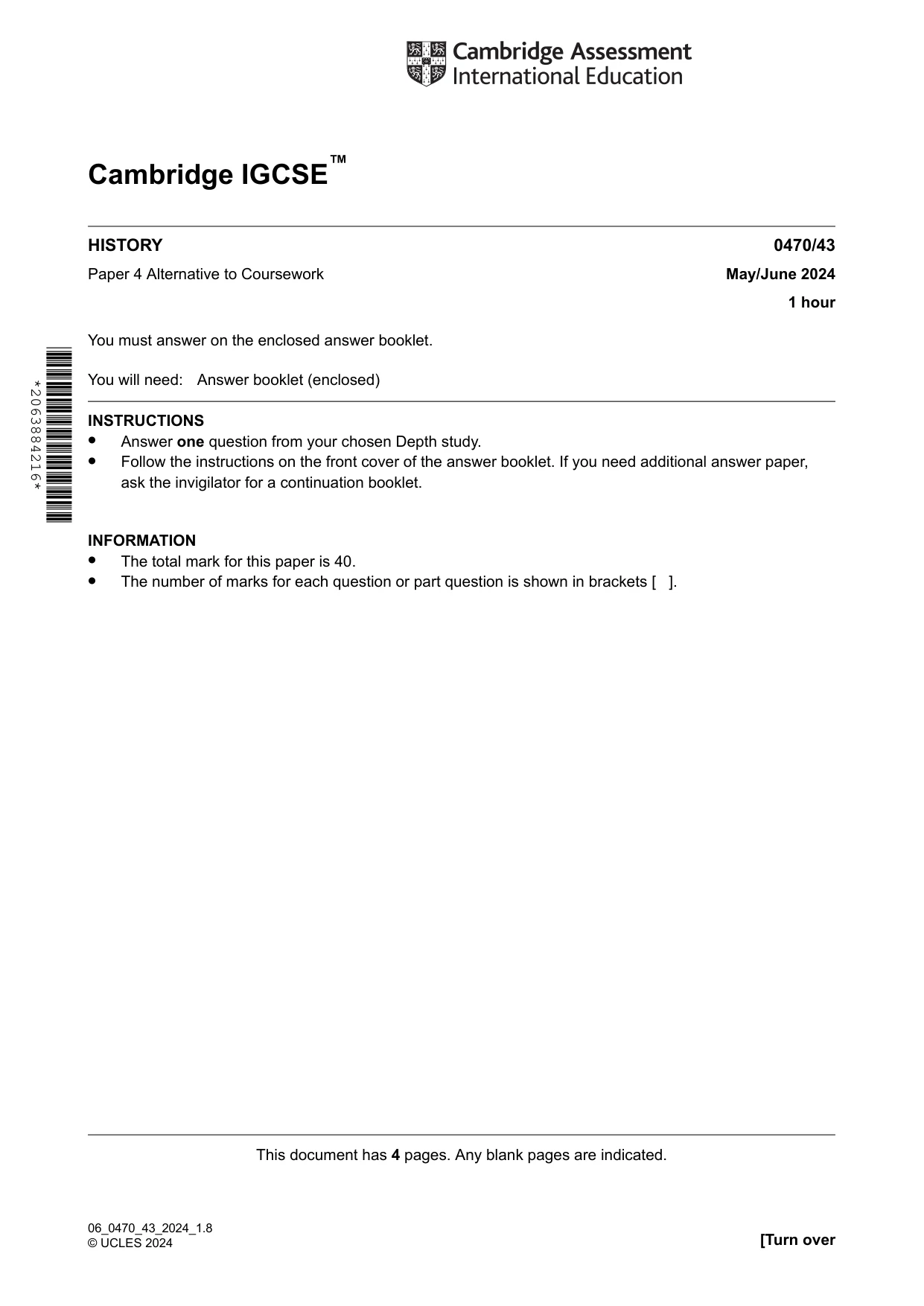
Question paper, page 1
Cambridge IGCSE™ 0470/43 May/June 2024 1 hour HISTORY Paper 4 Alternative to Coursework You must answer on the enclosed answer booklet. You will need: Answer booklet (enclosed) INSTRUCTIONS • Answer one question from your chosen Depth study. • Follow the instructions on the front cover of the answer booklet. If you need additional answer paper, ask the invigilator for a continuation booklet. INFORMATION • The total mark for this paper is 40. • The number of marks for each question or part question is shown in brackets [ ]. This document has 4 pages. Any blank pages are indicated. [Turn over 06_0470_43_2024_1.8 © UCLES 2024 *2063884216*
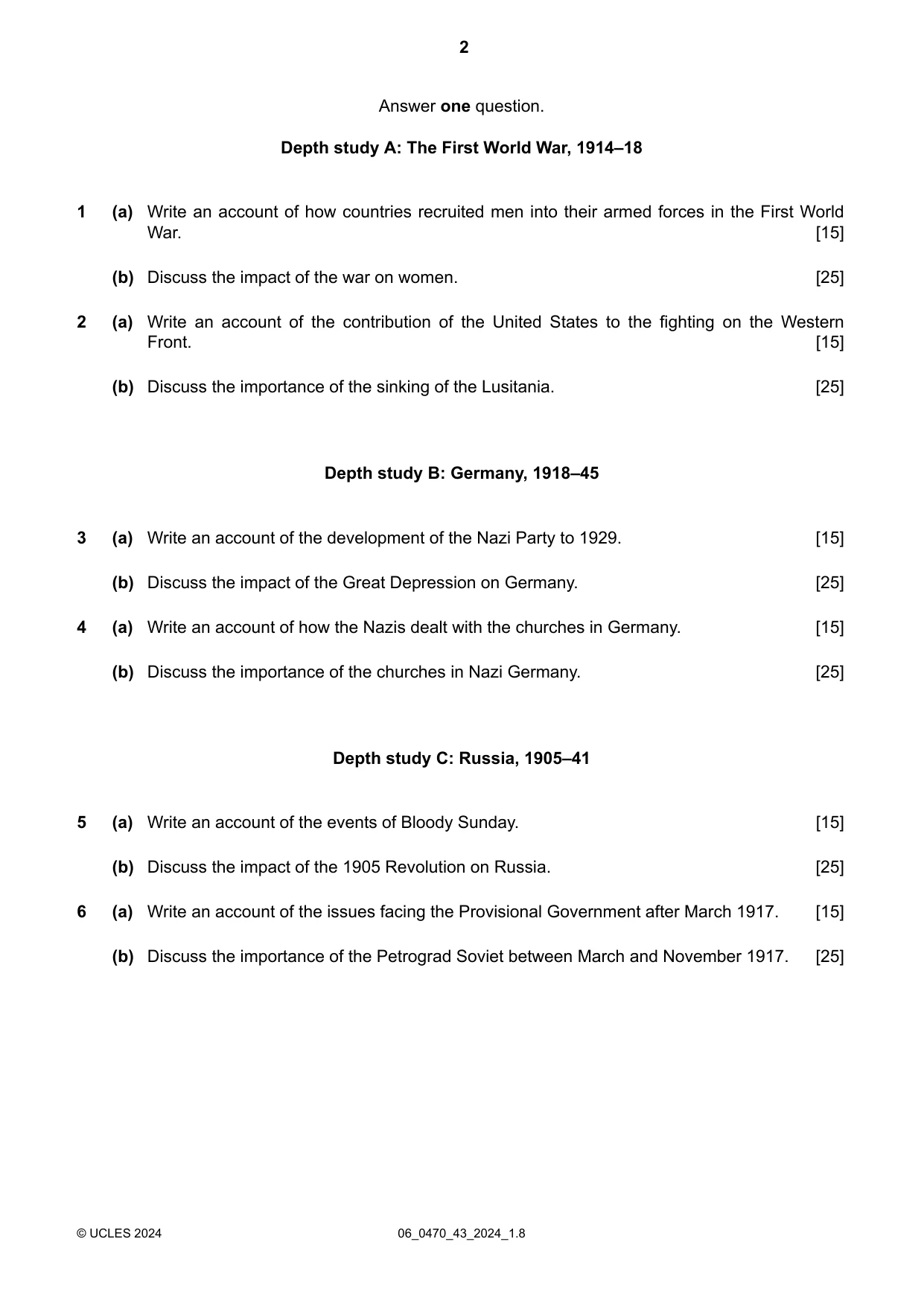
Question paper, page 2
Answer one question. Depth study A: The First World War, 1914–18 Write an account of how countries recruited men into their armed forces in the First World War. [15] (a) 1 Discuss the impact of the war on women. [25] (b) Write an account of the contribution of the United States to the fighting on the Western Front. [15] (a) 2 Discuss the importance of the sinking of the Lusitania. [25] (b) Depth study B: Germany, 1918–45 Write an account of the development of the Nazi Party to 1929. [15] (a) 3 Discuss the impact of the Great Depression on Germany. [25] (b) Write an account of how the Nazis dealt with the churches in Germany. [15] (a) 4 Discuss the importance of the churches in Nazi Germany. [25] (b) Depth study C: Russia, 1905–41 Write an account of the events of Bloody Sunday. [15] (a) 5 Discuss the impact of the 1905 Revolution on Russia. [25] (b) Write an account of the issues facing the Provisional Government after March 1917. [15] (a) 6 Discuss the importance of the Petrograd Soviet between March and November 1917. [25] (b) 06_0470_43_2024_1.8 © UCLES 2024 2
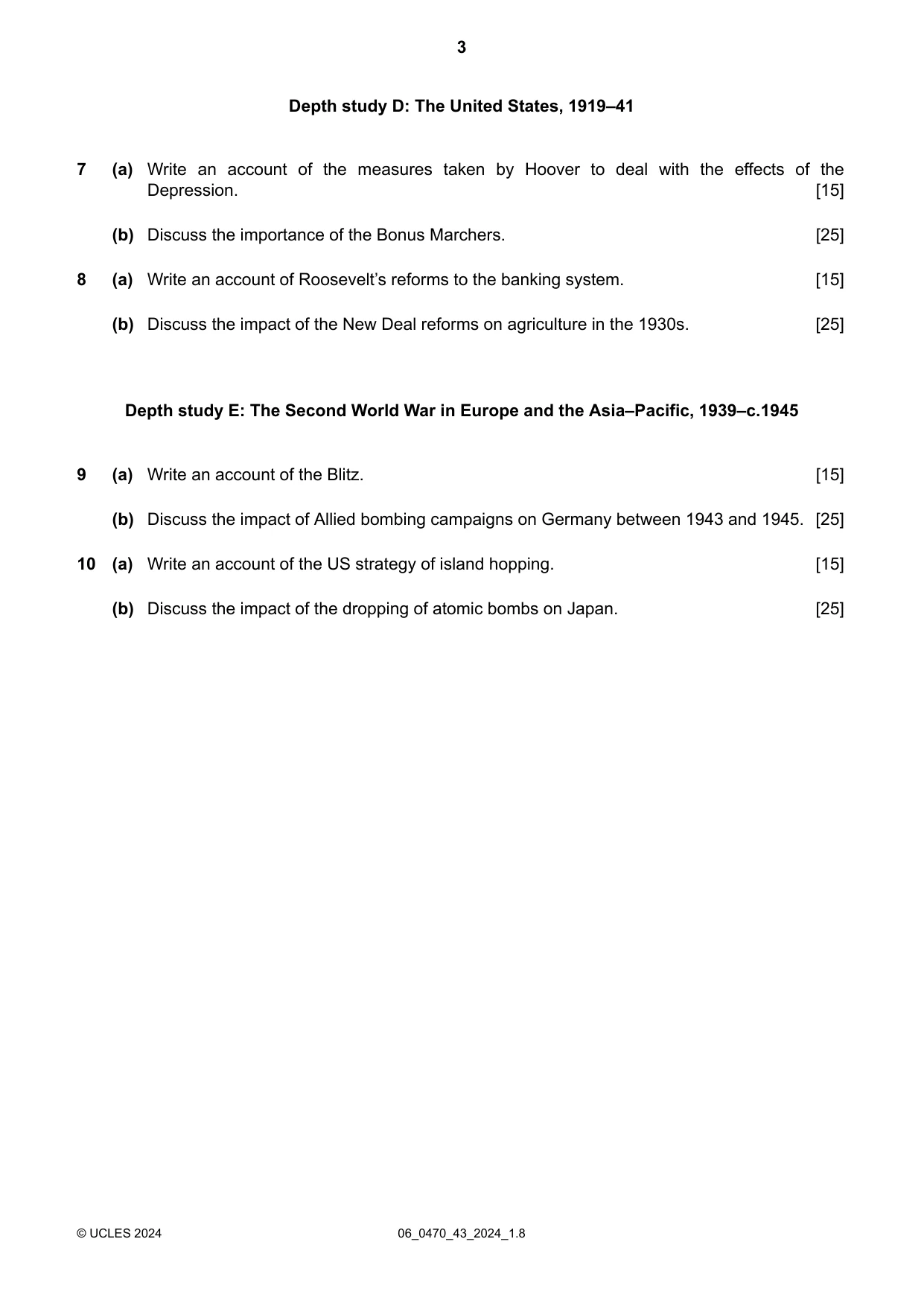
Question paper, page 3
Depth study D: The United States, 1919–41 Write an account of the measures taken by Hoover to deal with the effects of the Depression. [15] (a) 7 Discuss the importance of the Bonus Marchers. [25] (b) Write an account of Roosevelt’s reforms to the banking system. [15] (a) 8 Discuss the impact of the New Deal reforms on agriculture in the 1930s. [25] (b) Depth study E: The Second World War in Europe and the Asia–Pacific, 1939–c.1945 Write an account of the Blitz. [15] (a) 9 Discuss the impact of Allied bombing campaigns on Germany between 1943 and 1945. [25] (b) Write an account of the US strategy of island hopping. [15] (a) 10 Discuss the impact of the dropping of atomic bombs on Japan. [25] (b) 06_0470_43_2024_1.8 © UCLES 2024 3
Question paper, page 4
BLANK PAGE Permission to reproduce items where third-party owned material protected by copyright is included has been sought and cleared where possible. Every reasonable effort has been made by the publisher (UCLES) to trace copyright holders, but if any items requiring clearance have unwittingly been included, the publisher will be pleased to make amends at the earliest possible opportunity. To avoid the issue of disclosure of answer-related information to candidates, all copyright acknowledgements are reproduced online in the Cambridge Assessment International Education Copyright Acknowledgements Booklet. This is produced for each series of examinations and is freely available to download at www.cambridgeinternational.org after the live examination series. Cambridge Assessment International Education is part of Cambridge Assessment. Cambridge Assessment is the brand name of the University of Cambridge Local Examinations Syndicate (UCLES), which is a department of the University of Cambridge. 06_0470_43_2024_1.8 © UCLES 2024 4
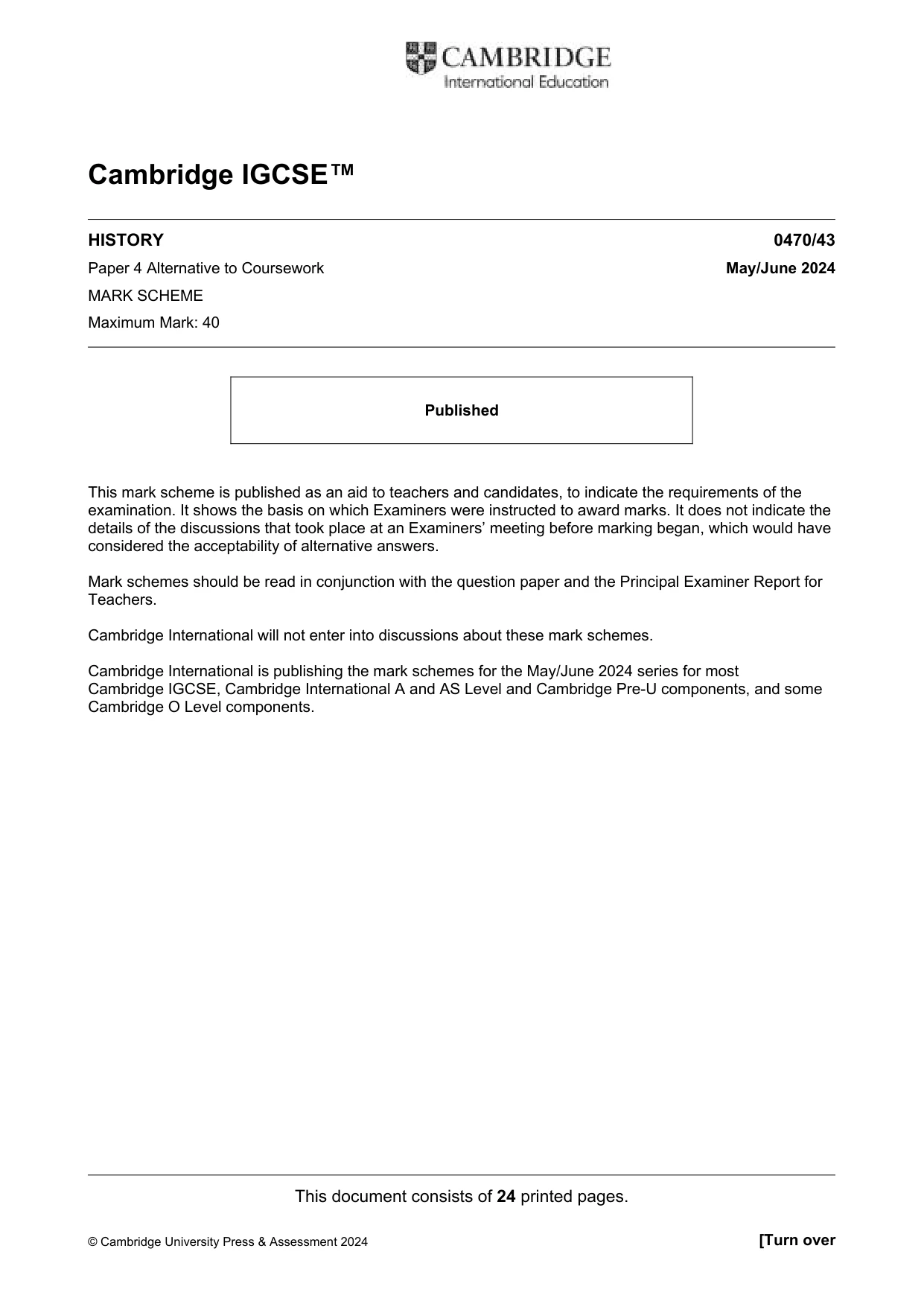
Mark scheme, page 1
This document consists of 24 printed pages. © Cambridge University Press & Assessment 2024 [Turn over Cambridge IGCSE™ HISTORY 0470/43 Paper 4 Alternative to Coursework May/June 2024 MARK SCHEME Maximum Mark: 40 Published This mark scheme is published as an aid to teachers and candidates, to indicate the requirements of the examination. It shows the basis on which Examiners were instructed to award marks. It does not indicate the details of the discussions that took place at an Examiners’ meeting before marking began, which would have considered the acceptability of alternative answers. Mark schemes should be read in conjunction with the question paper and the Principal Examiner Report for Teachers. Cambridge International will not enter into discussions about these mark schemes. Cambridge International is publishing the mark schemes for the May/June 2024 series for most Cambridge IGCSE, Cambridge International A and AS Level and Cambridge Pre-U components, and some Cambridge O Level components.
Mark scheme, page 2
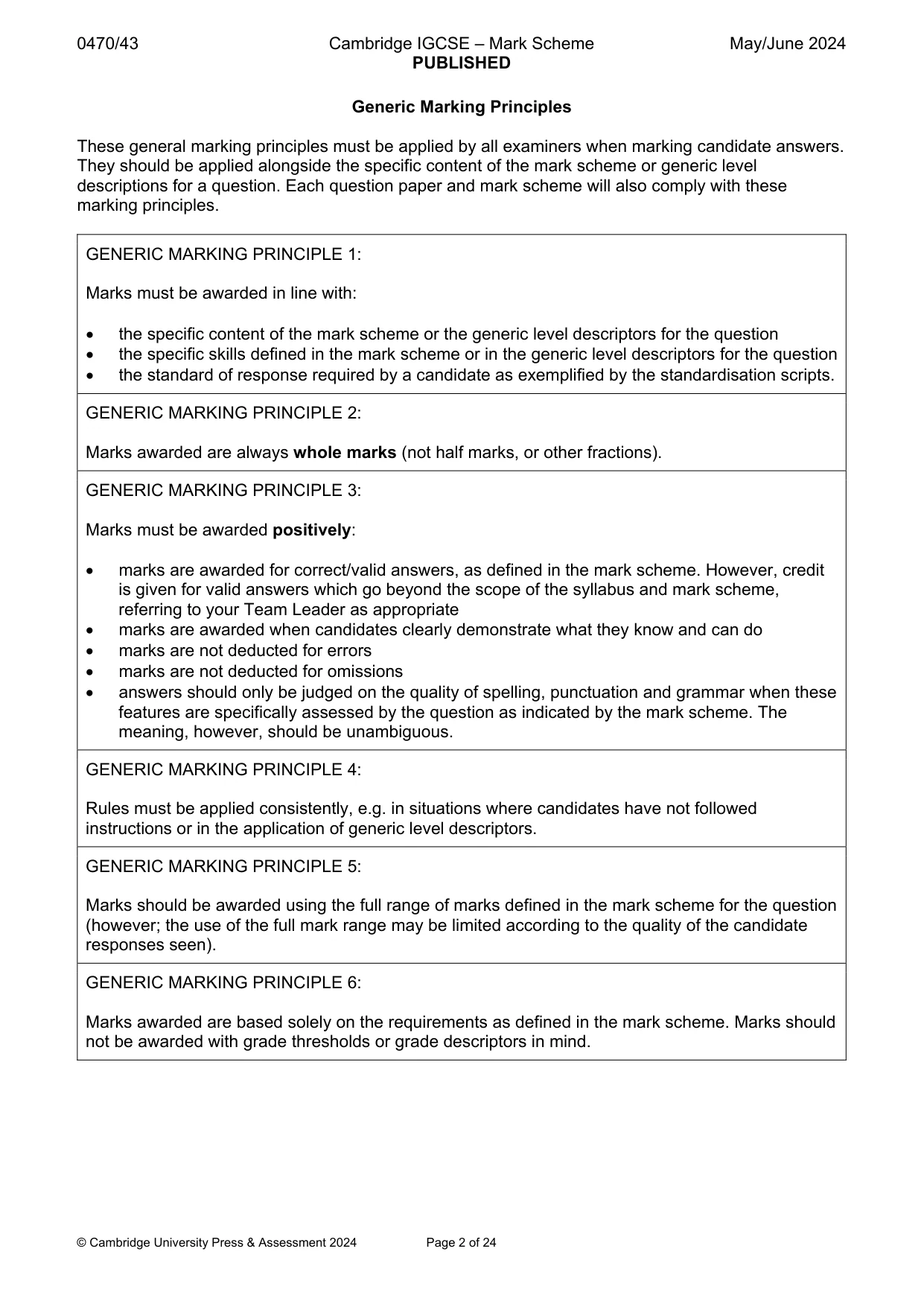
0470/43 Cambridge IGCSE – Mark Scheme PUBLISHED May/June 2024 © Cambridge University Press & Assessment 2024 Page 2 of 24 Generic Marking Principles These general marking principles must be applied by all examiners when marking candidate answers. They should be applied alongside the specific content of the mark scheme or generic level descriptions for a question. Each question paper and mark scheme will also comply with these marking principles. GENERIC MARKING PRINCIPLE 1: Marks must be awarded in line with: the specific content of the mark scheme or the generic level descriptors for the question the specific skills defined in the mark scheme or in the generic level descriptors for the question the standard of response required by a candidate as exemplified by the standardisation scripts. GENERIC MARKING PRINCIPLE 2: Marks awarded are always whole marks (not half marks, or other fractions). GENERIC MARKING PRINCIPLE 3: Marks must be awarded positively: marks are awarded for correct/valid answers, as defined in the mark scheme. However, credit is given for valid answers which go beyond the scope of the syllabus and mark scheme, referring to your Team Leader as appropriate marks are awarded when candidates clearly demonstrate what they know and can do marks are not deducted for errors marks are not deducted for omissions answers should only be judged on the quality of spelling, punctuation and grammar when these features are specifically assessed by the question as indicated by the mark scheme. The meaning, however, should be unambiguous. GENERIC MARKING PRINCIPLE 4: Rules must be applied consistently, e.g. in situations where candidates have not followed instructions or in the application of generic level descriptors. GENERIC MARKING PRINCIPLE 5: Marks should be awarded using the full range of marks defined in the mark scheme for the question (however; the use of the full mark range may be limited according to the quality of the candidate responses seen). GENERIC MARKING PRINCIPLE 6: Marks awarded are based solely on the requirements as defined in the mark scheme. Marks should not be awarded with grade thresholds or grade descriptors in mind.
Mark scheme, page 3
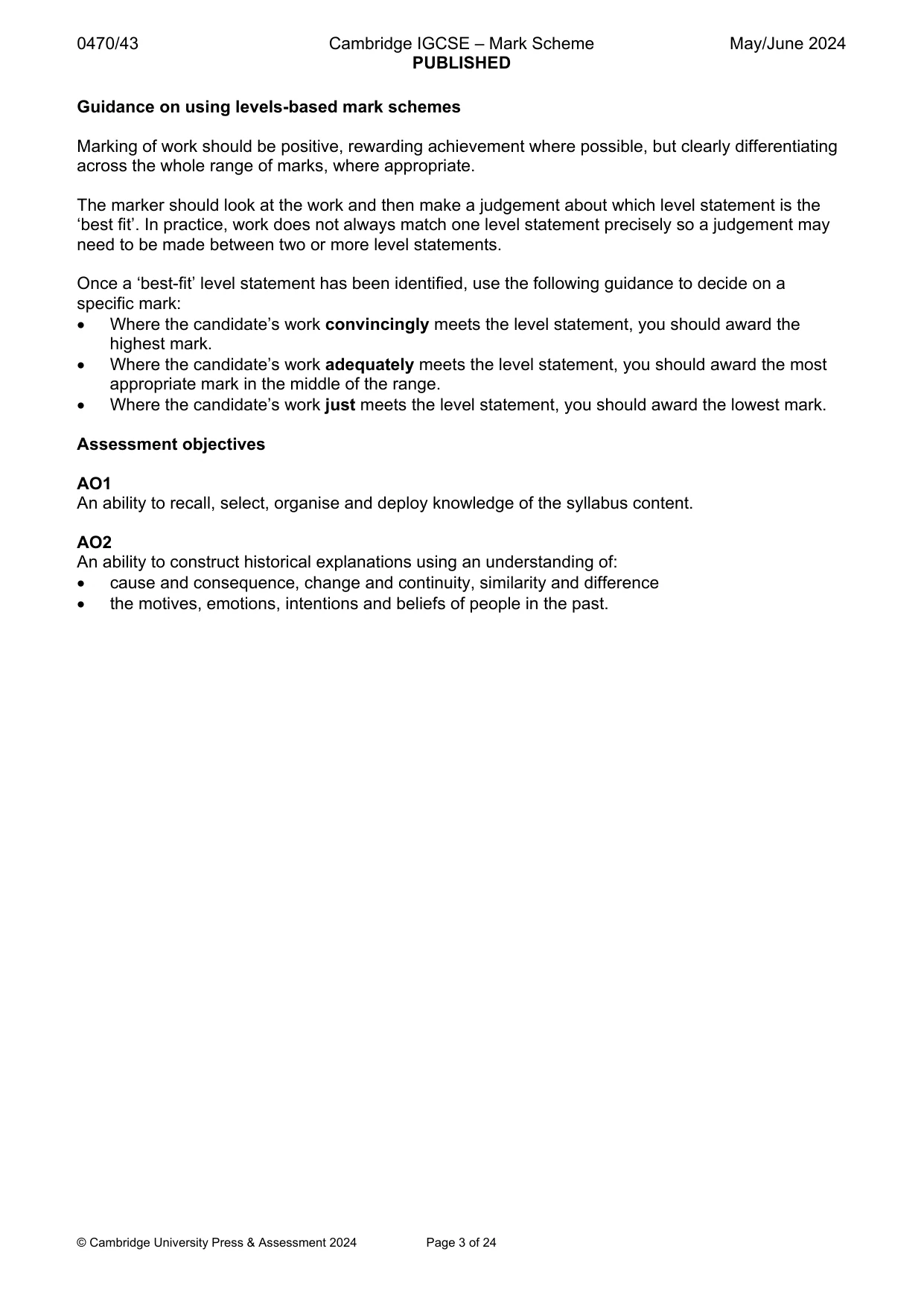
0470/43 Cambridge IGCSE – Mark Scheme PUBLISHED May/June 2024 © Cambridge University Press & Assessment 2024 Page 3 of 24 Guidance on using levels-based mark schemes Marking of work should be positive, rewarding achievement where possible, but clearly differentiating across the whole range of marks, where appropriate. The marker should look at the work and then make a judgement about which level statement is the ‘best fit’. In practice, work does not always match one level statement precisely so a judgement may need to be made between two or more level statements. Once a ‘best-fit’ level statement has been identified, use the following guidance to decide on a specific mark: Where the candidate’s work convincingly meets the level statement, you should award the highest mark. Where the candidate’s work adequately meets the level statement, you should award the most appropriate mark in the middle of the range. Where the candidate’s work just meets the level statement, you should award the lowest mark. Assessment objectives AO1 An ability to recall, select, organise and deploy knowledge of the syllabus content. AO2 An ability to construct historical explanations using an understanding of: cause and consequence, change and continuity, similarity and difference the motives, emotions, intentions and beliefs of people in the past.
Mark scheme, page 4
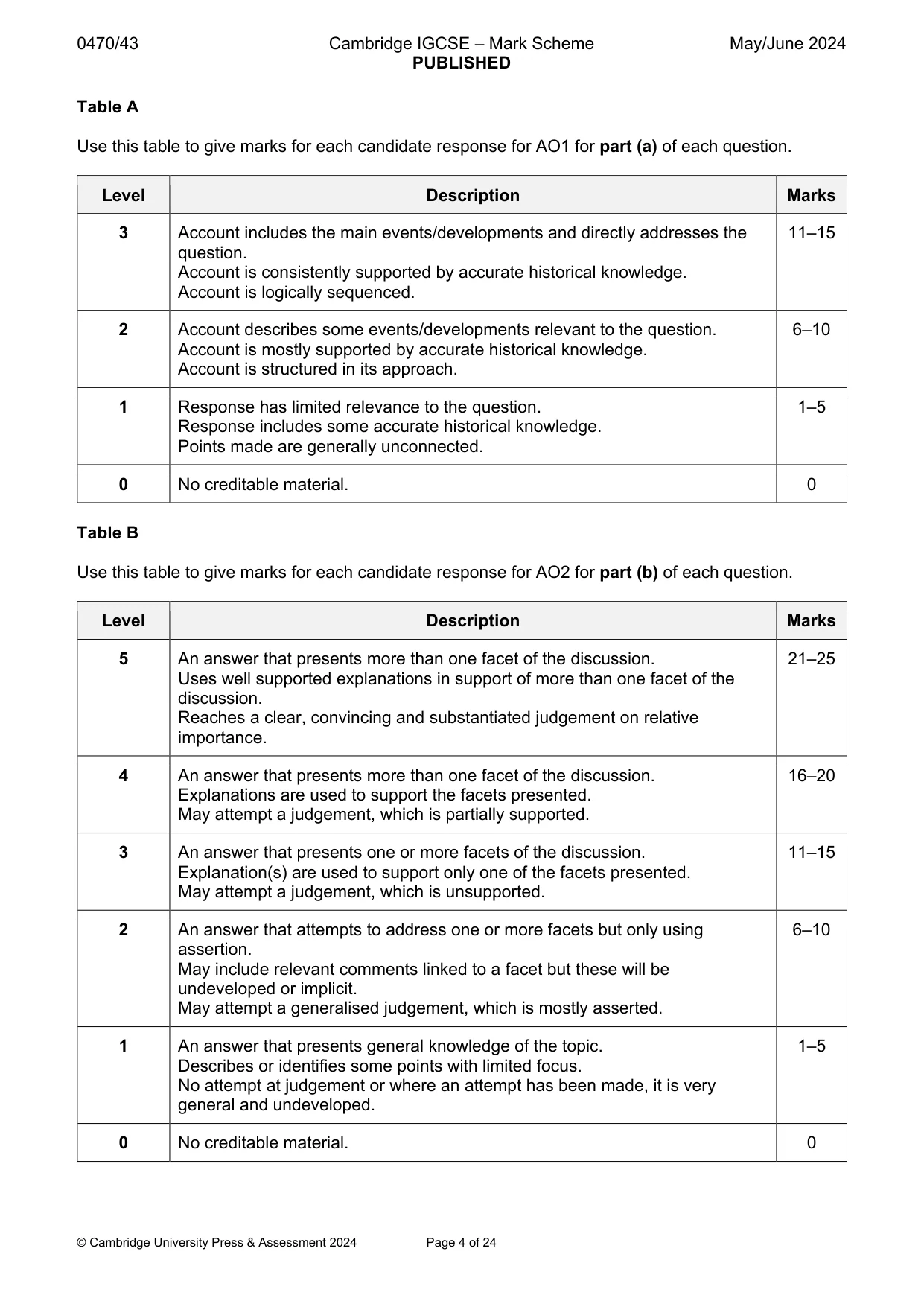
0470/43 Cambridge IGCSE – Mark Scheme PUBLISHED May/June 2024 © Cambridge University Press & Assessment 2024 Page 4 of 24 Table A Use this table to give marks for each candidate response for AO1 for part (a) of each question. Level Description Marks 3 Account includes the main events/developments and directly addresses the question. Account is consistently supported by accurate historical knowledge. Account is logically sequenced. 11–15 2 Account describes some events/developments relevant to the question. Account is mostly supported by accurate historical knowledge. Account is structured in its approach. 6–10 1 Response has limited relevance to the question. Response includes some accurate historical knowledge. Points made are generally unconnected. 1–5 0 No creditable material. 0 Table B Use this table to give marks for each candidate response for AO2 for part (b) of each question. Level Description Marks 5 An answer that presents more than one facet of the discussion. Uses well supported explanations in support of more than one facet of the discussion. Reaches a clear, convincing and substantiated judgement on relative importance. 21–25 4 An answer that presents more than one facet of the discussion. Explanations are used to support the facets presented. May attempt a judgement, which is partially supported. 16–20 3 An answer that presents one or more facets of the discussion. Explanation(s) are used to support only one of the facets presented. May attempt a judgement, which is unsupported. 11–15 2 An answer that attempts to address one or more facets but only using assertion. May include relevant comments linked to a facet but these will be undeveloped or implicit. May attempt a generalised judgement, which is mostly asserted. 6–10 1 An answer that presents general knowledge of the topic. Describes or identifies some points with limited focus. No attempt at judgement or where an attempt has been made, it is very general and undeveloped. 1–5 0 No creditable material. 0
Mark scheme, page 5
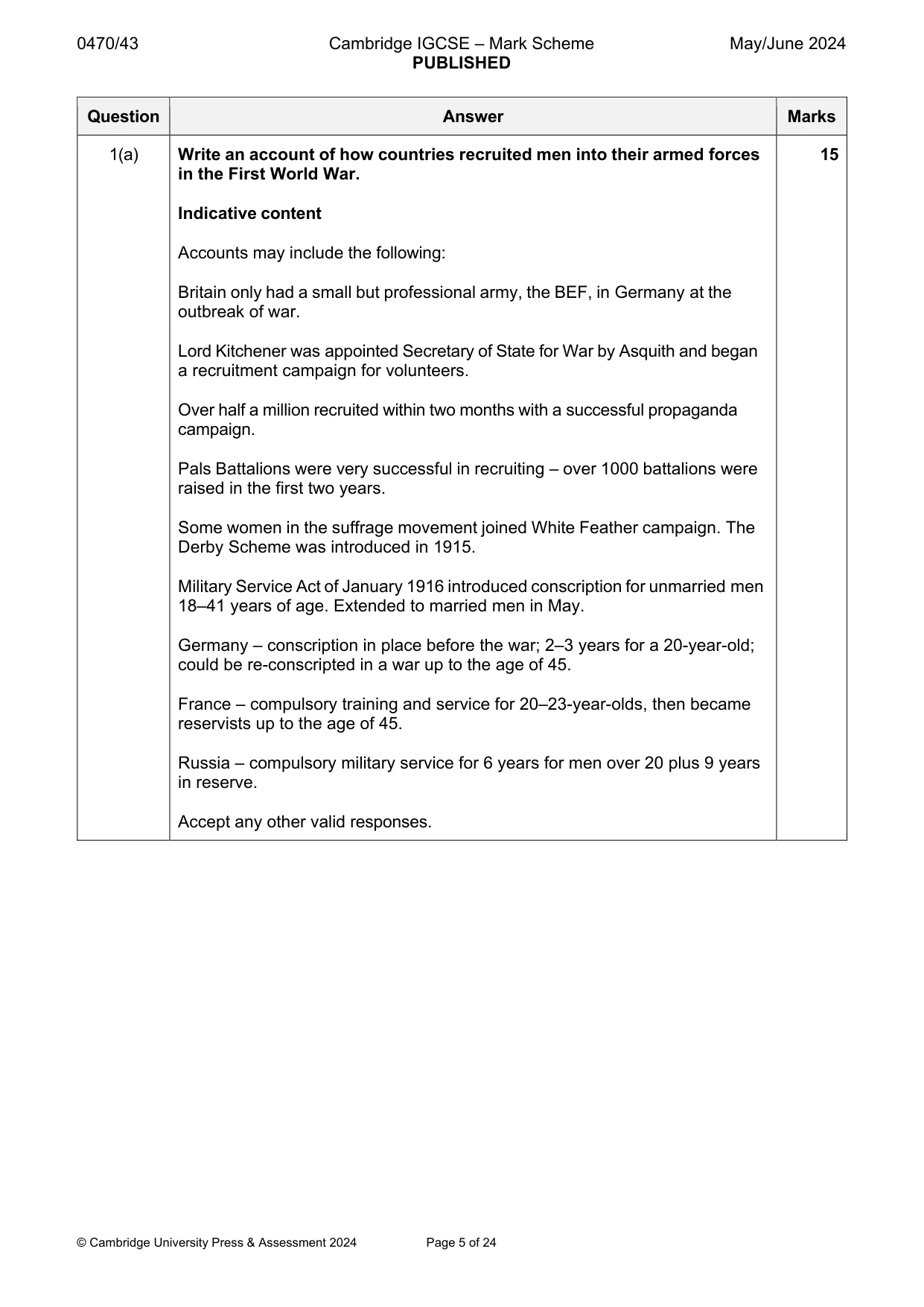
0470/43 Cambridge IGCSE – Mark Scheme PUBLISHED May/June 2024 © Cambridge University Press & Assessment 2024 Page 5 of 24 Question Answer Marks 1(a) Write an account of how countries recruited men into their armed forces in the First World War. Indicative content Accounts may include the following: Britain only had a small but professional army, the BEF, in Germany at the outbreak of war. Lord Kitchener was appointed Secretary of State for War by Asquith and began a recruitment campaign for volunteers. Over half a million recruited within two months with a successful propaganda campaign. Pals Battalions were very successful in recruiting – over 1000 battalions were raised in the first two years. Some women in the suffrage movement joined White Feather campaign. The Derby Scheme was introduced in 1915. Military Service Act of January 1916 introduced conscription for unmarried men 18–41 years of age. Extended to married men in May. Germany – conscription in place before the war; 2–3 years for a 20-year-old; could be re-conscripted in a war up to the age of 45. France – compulsory training and service for 20–23-year-olds, then became reservists up to the age of 45. Russia – compulsory military service for 6 years for men over 20 plus 9 years in reserve. Accept any other valid responses. 15
Mark scheme, page 6
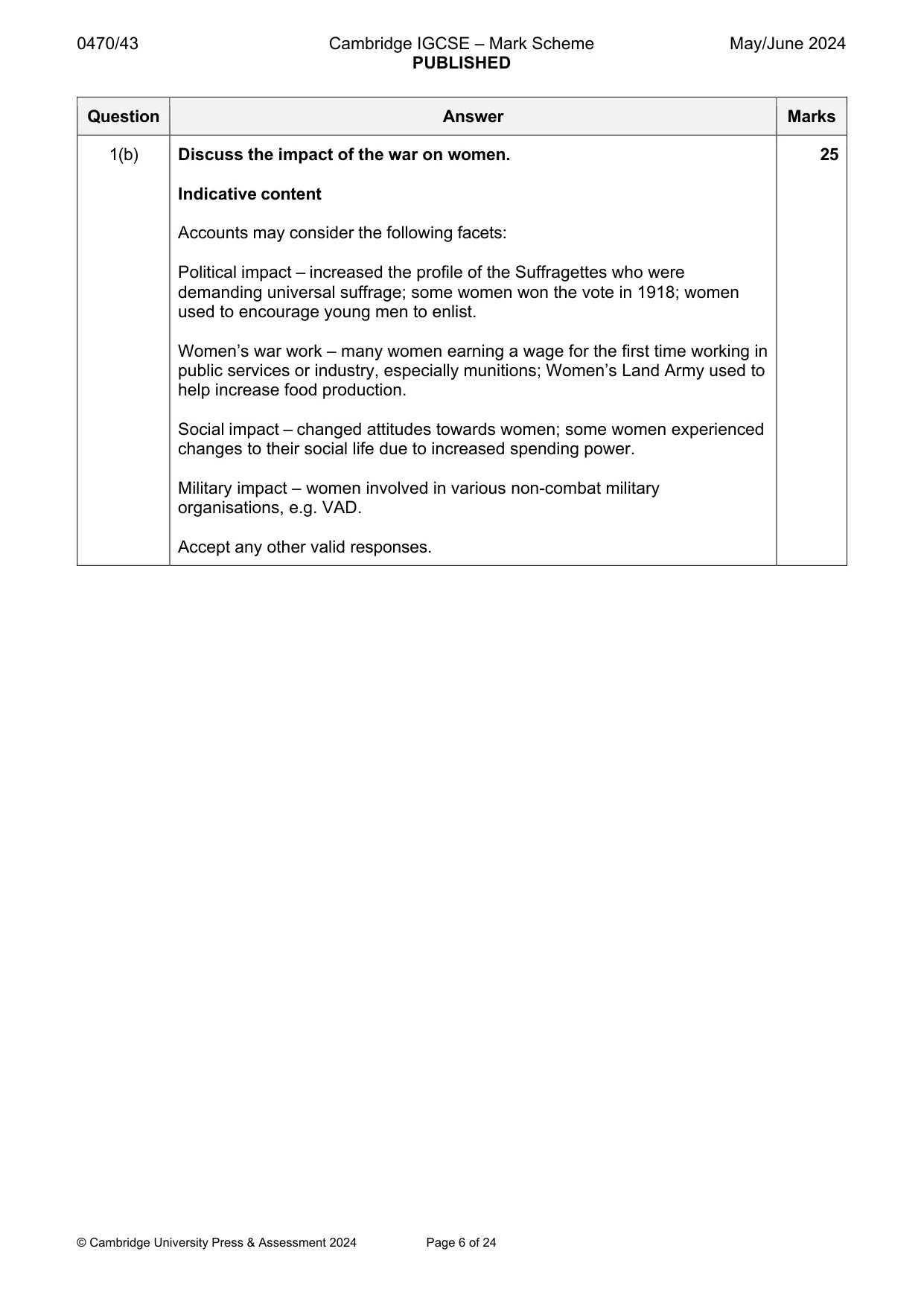
0470/43 Cambridge IGCSE – Mark Scheme PUBLISHED May/June 2024 © Cambridge University Press & Assessment 2024 Page 6 of 24 Question Answer Marks 1(b) Discuss the impact of the war on women. Indicative content Accounts may consider the following facets: Political impact – increased the profile of the Suffragettes who were demanding universal suffrage; some women won the vote in 1918; women used to encourage young men to enlist. Women’s war work – many women earning a wage for the first time working in public services or industry, especially munitions; Women’s Land Army used to help increase food production. Social impact – changed attitudes towards women; some women experienced changes to their social life due to increased spending power. Military impact – women involved in various non-combat military organisations, e.g. VAD. Accept any other valid responses. 25
Mark scheme, page 7
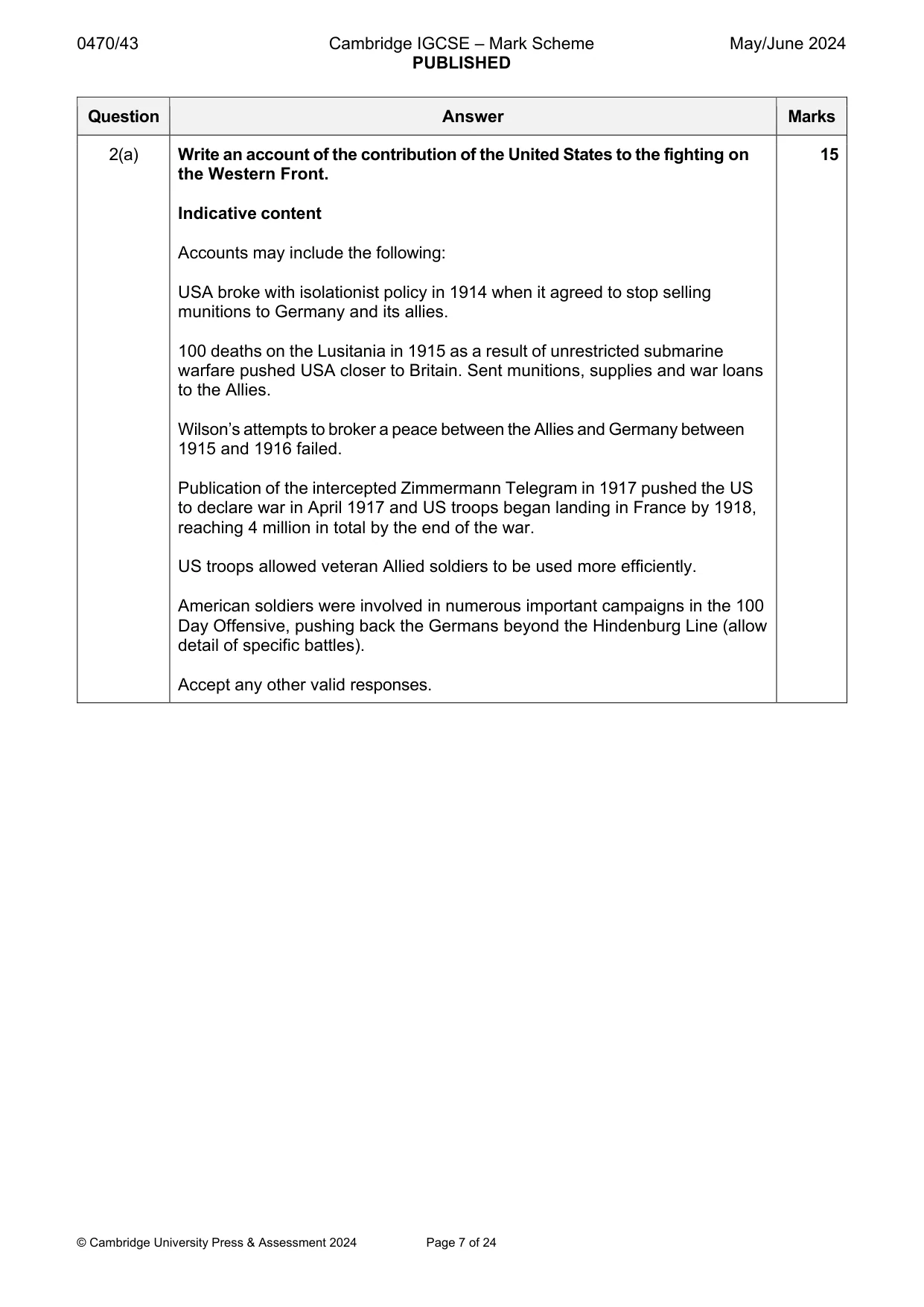
0470/43 Cambridge IGCSE – Mark Scheme PUBLISHED May/June 2024 © Cambridge University Press & Assessment 2024 Page 7 of 24 Question Answer Marks 2(a) Write an account of the contribution of the United States to the fighting on the Western Front. Indicative content Accounts may include the following: USA broke with isolationist policy in 1914 when it agreed to stop selling munitions to Germany and its allies. 100 deaths on the Lusitania in 1915 as a result of unrestricted submarine warfare pushed USA closer to Britain. Sent munitions, supplies and war loans to the Allies. Wilson’s attempts to broker a peace between the Allies and Germany between 1915 and 1916 failed. Publication of the intercepted Zimmermann Telegram in 1917 pushed the US to declare war in April 1917 and US troops began landing in France by 1918, reaching 4 million in total by the end of the war. US troops allowed veteran Allied soldiers to be used more efficiently. American soldiers were involved in numerous important campaigns in the 100 Day Offensive, pushing back the Germans beyond the Hindenburg Line (allow detail of specific battles). Accept any other valid responses. 15
Mark scheme, page 8
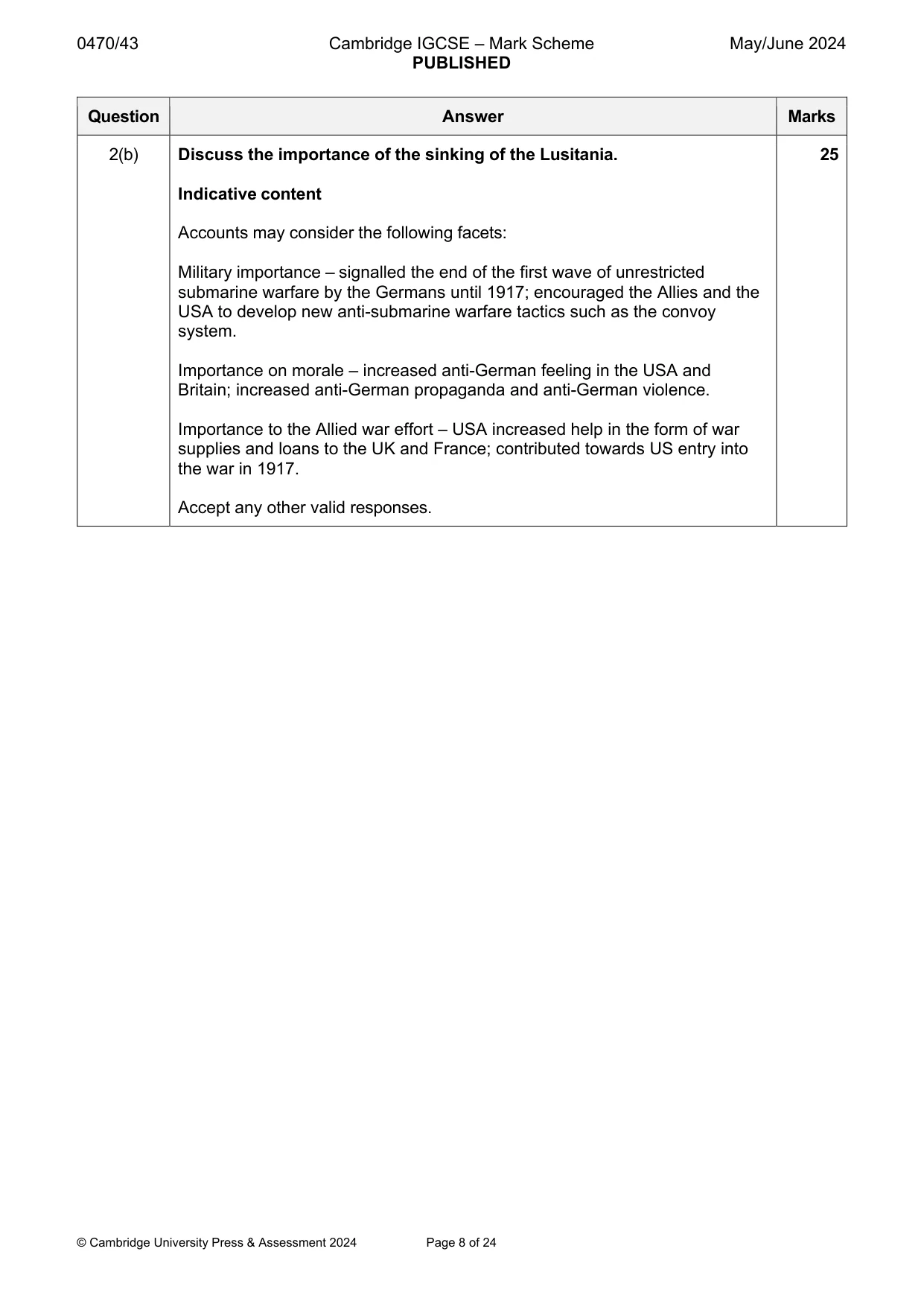
0470/43 Cambridge IGCSE – Mark Scheme PUBLISHED May/June 2024 © Cambridge University Press & Assessment 2024 Page 8 of 24 Question Answer Marks 2(b) Discuss the importance of the sinking of the Lusitania. Indicative content Accounts may consider the following facets: Military importance – signalled the end of the first wave of unrestricted submarine warfare by the Germans until 1917; encouraged the Allies and the USA to develop new anti-submarine warfare tactics such as the convoy system. Importance on morale – increased anti-German feeling in the USA and Britain; increased anti-German propaganda and anti-German violence. Importance to the Allied war effort – USA increased help in the form of war supplies and loans to the UK and France; contributed towards US entry into the war in 1917. Accept any other valid responses. 25
Mark scheme, page 9
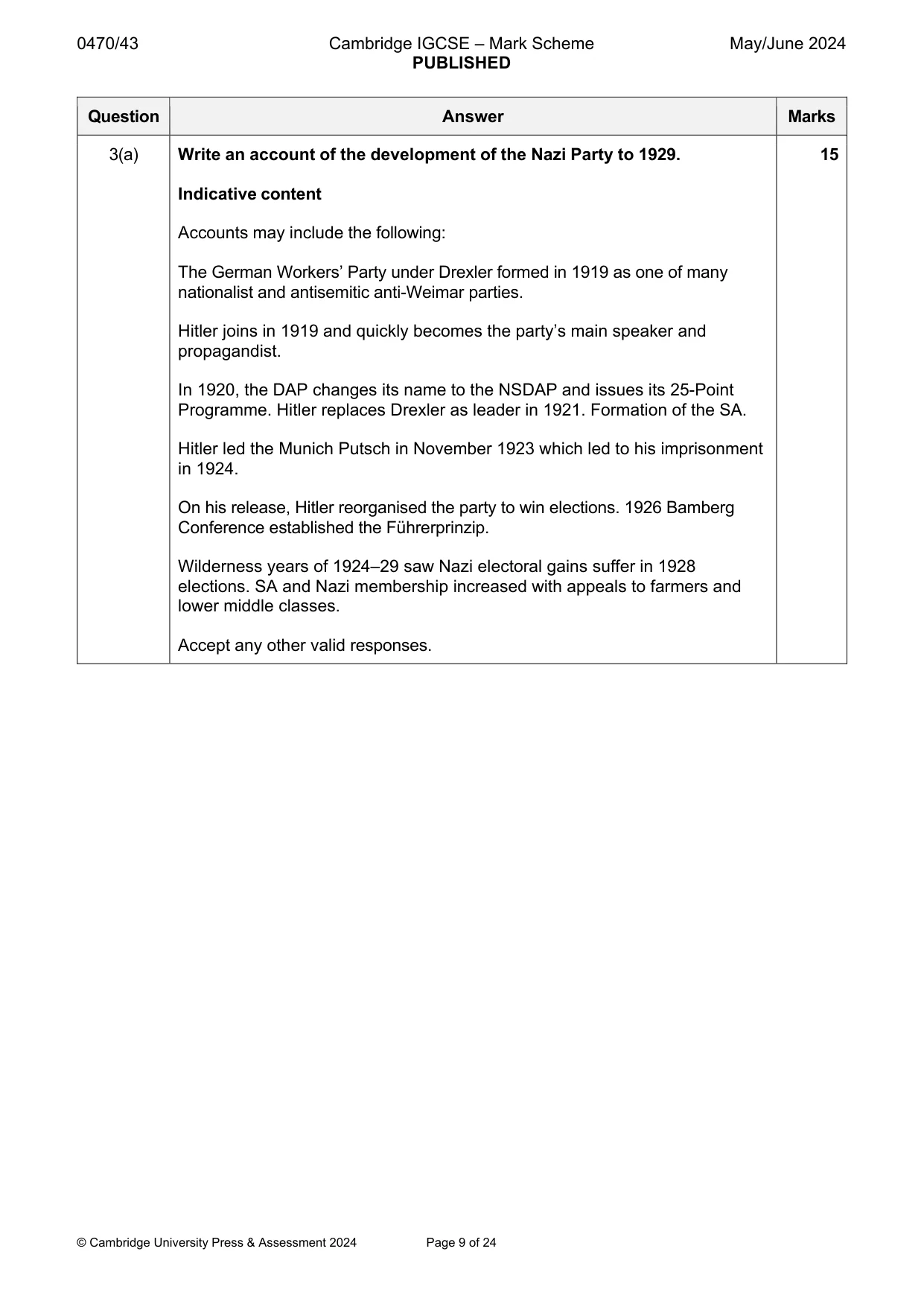
0470/43 Cambridge IGCSE – Mark Scheme PUBLISHED May/June 2024 © Cambridge University Press & Assessment 2024 Page 9 of 24 Question Answer Marks 3(a) Write an account of the development of the Nazi Party to 1929. Indicative content Accounts may include the following: The German Workers’ Party under Drexler formed in 1919 as one of many nationalist and antisemitic anti-Weimar parties. Hitler joins in 1919 and quickly becomes the party’s main speaker and propagandist. In 1920, the DAP changes its name to the NSDAP and issues its 25-Point Programme. Hitler replaces Drexler as leader in 1921. Formation of the SA. Hitler led the Munich Putsch in November 1923 which led to his imprisonment in 1924. On his release, Hitler reorganised the party to win elections. 1926 Bamberg Conference established the Führerprinzip. Wilderness years of 1924–29 saw Nazi electoral gains suffer in 1928 elections. SA and Nazi membership increased with appeals to farmers and lower middle classes. Accept any other valid responses. 15
Mark scheme, page 10
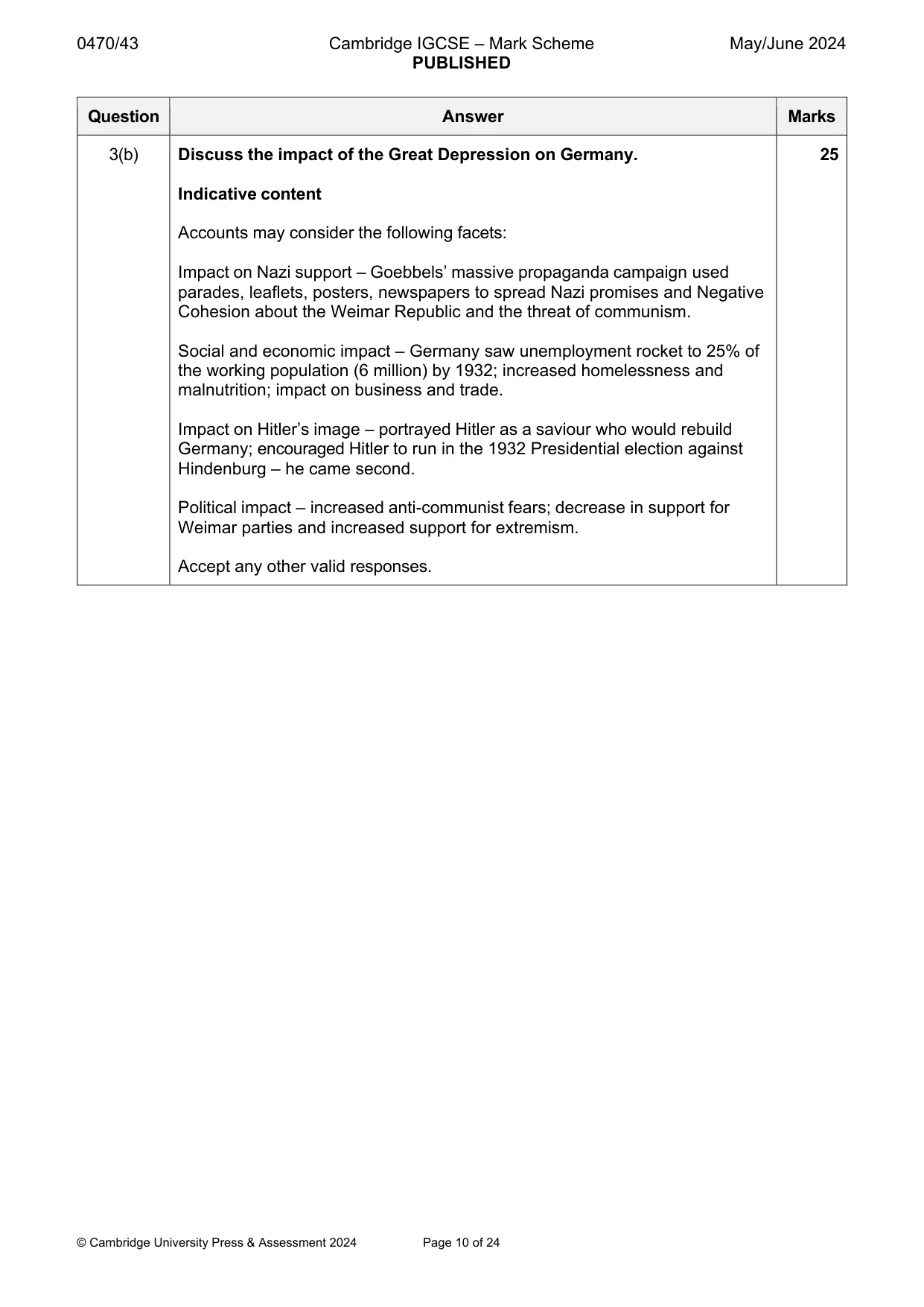
0470/43 Cambridge IGCSE – Mark Scheme PUBLISHED May/June 2024 © Cambridge University Press & Assessment 2024 Page 10 of 24 Question Answer Marks 3(b) Discuss the impact of the Great Depression on Germany. Indicative content Accounts may consider the following facets: Impact on Nazi support – Goebbels’ massive propaganda campaign used parades, leaflets, posters, newspapers to spread Nazi promises and Negative Cohesion about the Weimar Republic and the threat of communism. Social and economic impact – Germany saw unemployment rocket to 25% of the working population (6 million) by 1932; increased homelessness and malnutrition; impact on business and trade. Impact on Hitler’s image – portrayed Hitler as a saviour who would rebuild Germany; encouraged Hitler to run in the 1932 Presidential election against Hindenburg – he came second. Political impact – increased anti-communist fears; decrease in support for Weimar parties and increased support for extremism. Accept any other valid responses. 25
Mark scheme, page 11
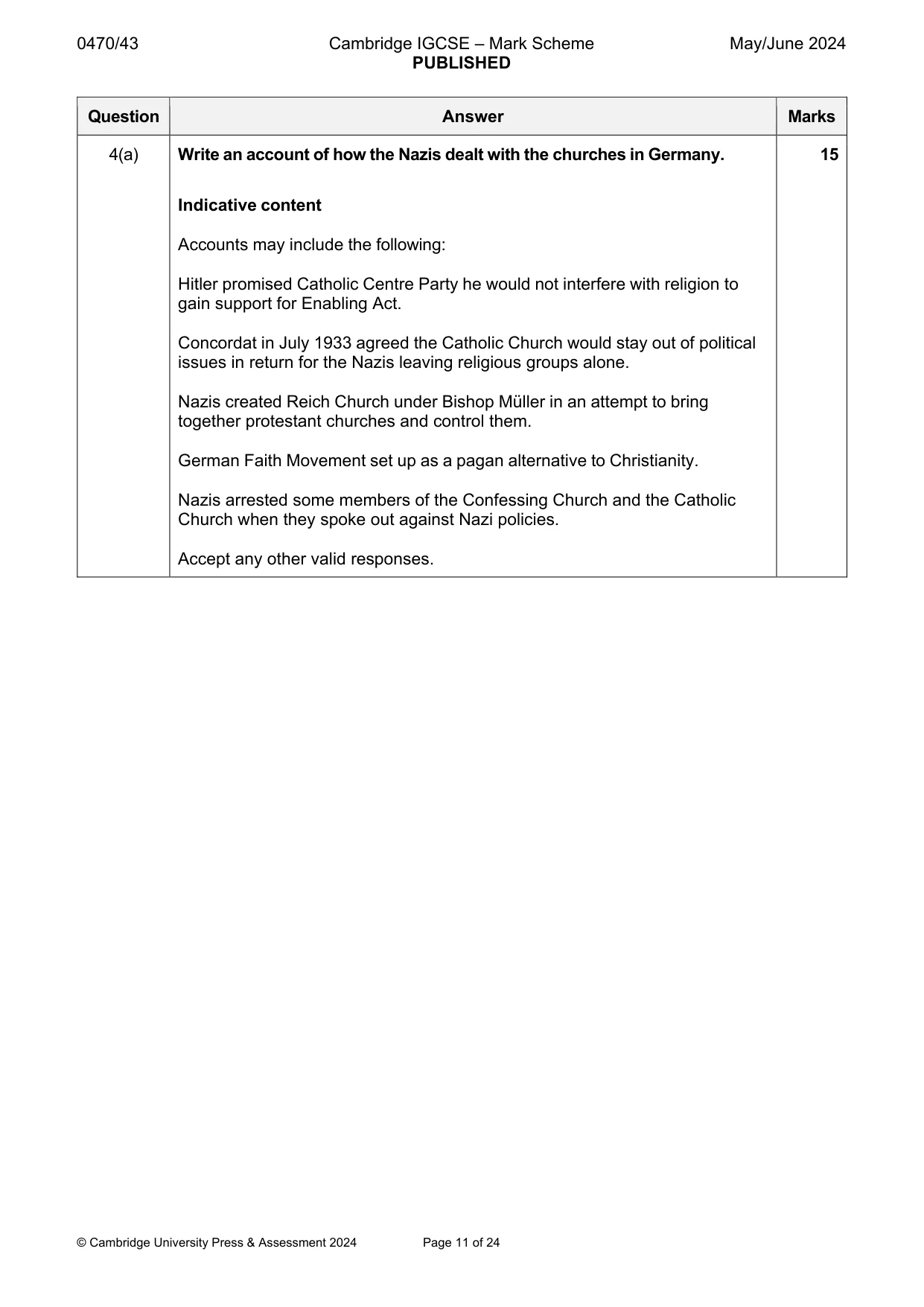
0470/43 Cambridge IGCSE – Mark Scheme PUBLISHED May/June 2024 © Cambridge University Press & Assessment 2024 Page 11 of 24 Question Answer Marks 4(a) Write an account of how the Nazis dealt with the churches in Germany. Indicative content Accounts may include the following: Hitler promised Catholic Centre Party he would not interfere with religion to gain support for Enabling Act. Concordat in July 1933 agreed the Catholic Church would stay out of political issues in return for the Nazis leaving religious groups alone. Nazis created Reich Church under Bishop Müller in an attempt to bring together protestant churches and control them. German Faith Movement set up as a pagan alternative to Christianity. Nazis arrested some members of the Confessing Church and the Catholic Church when they spoke out against Nazi policies. Accept any other valid responses. 15
Mark scheme, page 12
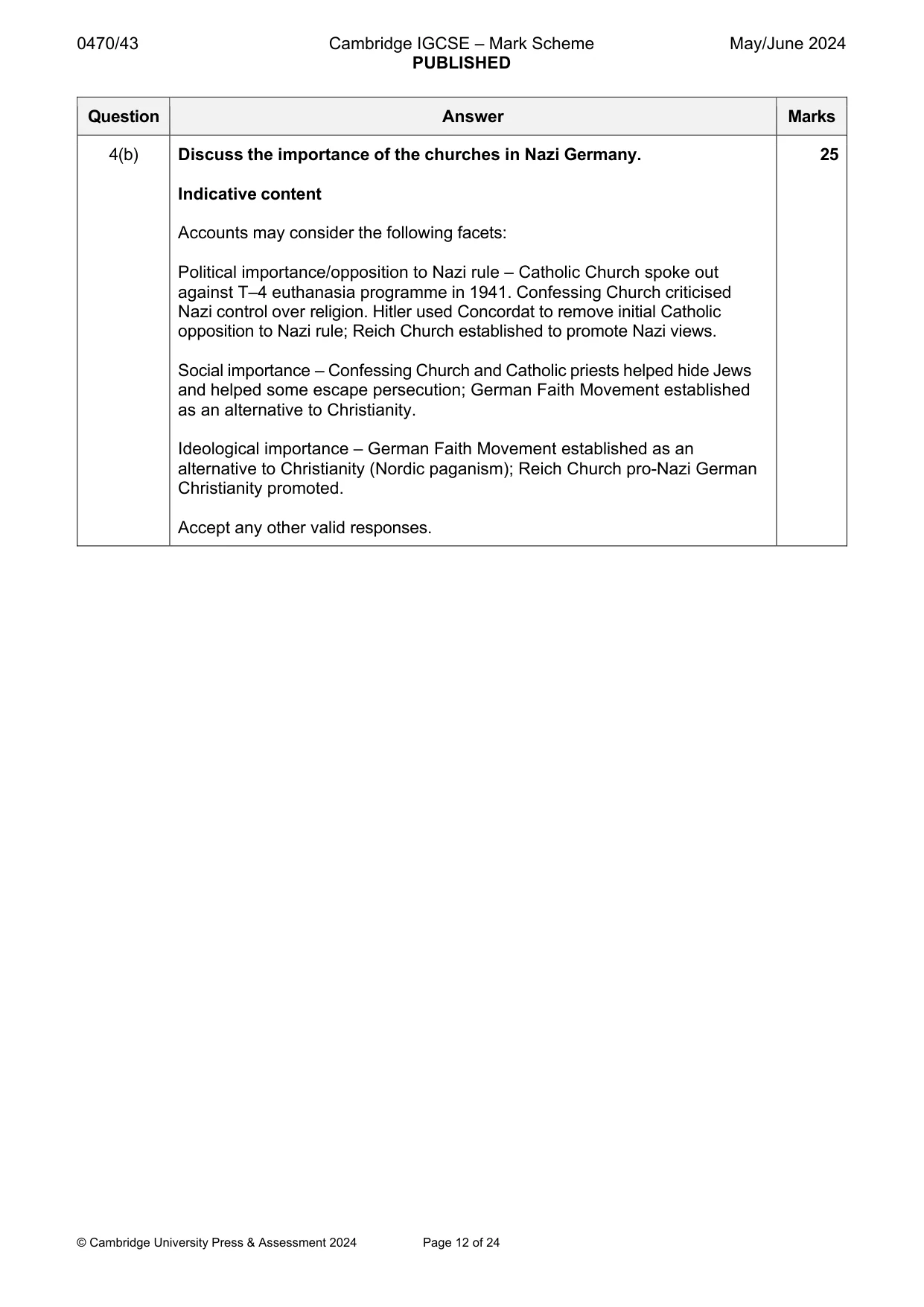
0470/43 Cambridge IGCSE – Mark Scheme PUBLISHED May/June 2024 © Cambridge University Press & Assessment 2024 Page 12 of 24 Question Answer Marks 4(b) Discuss the importance of the churches in Nazi Germany. Indicative content Accounts may consider the following facets: Political importance/opposition to Nazi rule – Catholic Church spoke out against T–4 euthanasia programme in 1941. Confessing Church criticised Nazi control over religion. Hitler used Concordat to remove initial Catholic opposition to Nazi rule; Reich Church established to promote Nazi views. Social importance – Confessing Church and Catholic priests helped hide Jews and helped some escape persecution; German Faith Movement established as an alternative to Christianity. Ideological importance – German Faith Movement established as an alternative to Christianity (Nordic paganism); Reich Church pro-Nazi German Christianity promoted. Accept any other valid responses. 25
Mark scheme, page 13
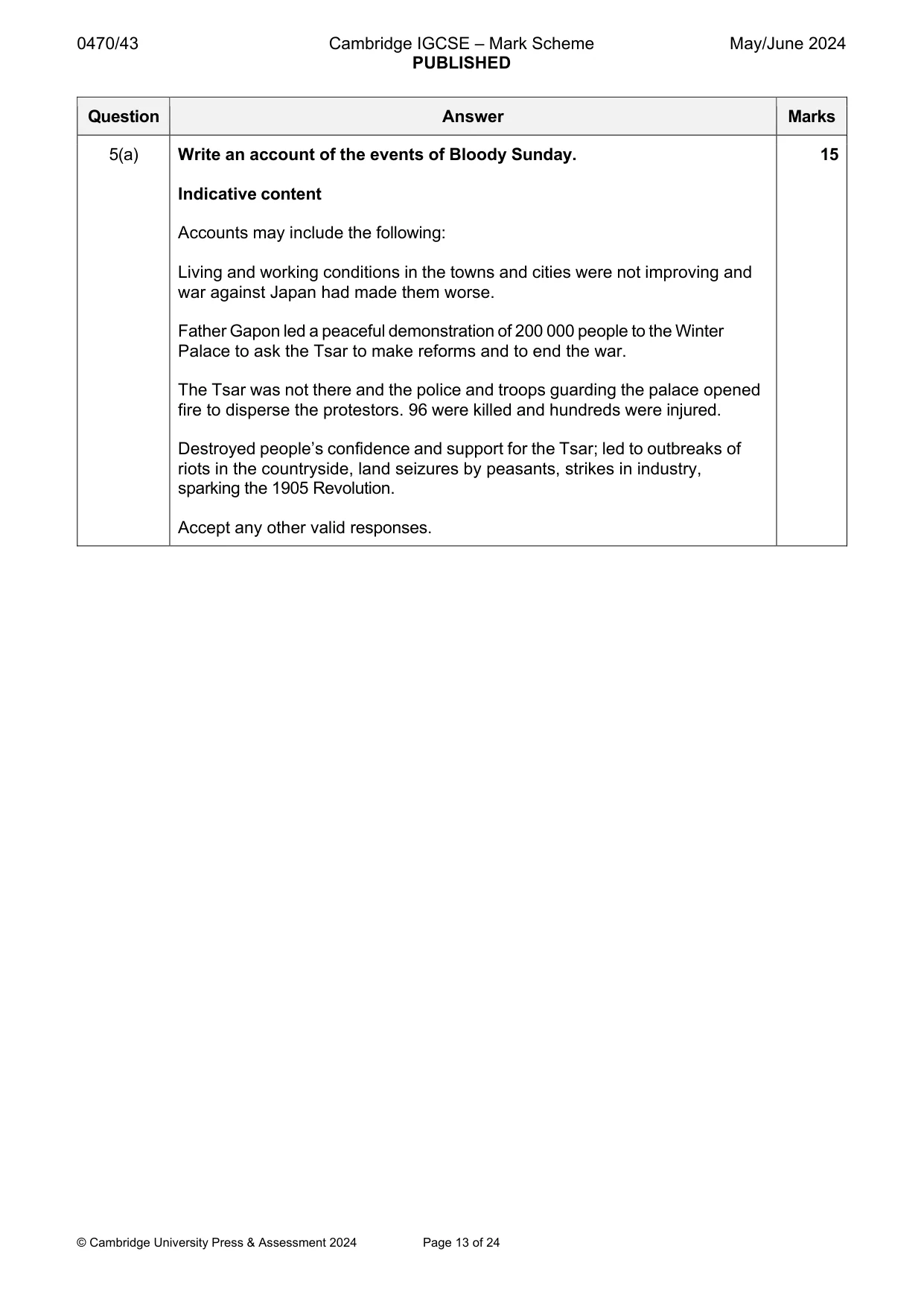
0470/43 Cambridge IGCSE – Mark Scheme PUBLISHED May/June 2024 © Cambridge University Press & Assessment 2024 Page 13 of 24 Question Answer Marks 5(a) Write an account of the events of Bloody Sunday. Indicative content Accounts may include the following: Living and working conditions in the towns and cities were not improving and war against Japan had made them worse. Father Gapon led a peaceful demonstration of 200 000 people to the Winter Palace to ask the Tsar to make reforms and to end the war. The Tsar was not there and the police and troops guarding the palace opened fire to disperse the protestors. 96 were killed and hundreds were injured. Destroyed people’s confidence and support for the Tsar; led to outbreaks of riots in the countryside, land seizures by peasants, strikes in industry, sparking the 1905 Revolution. Accept any other valid responses. 15
Mark scheme, page 14
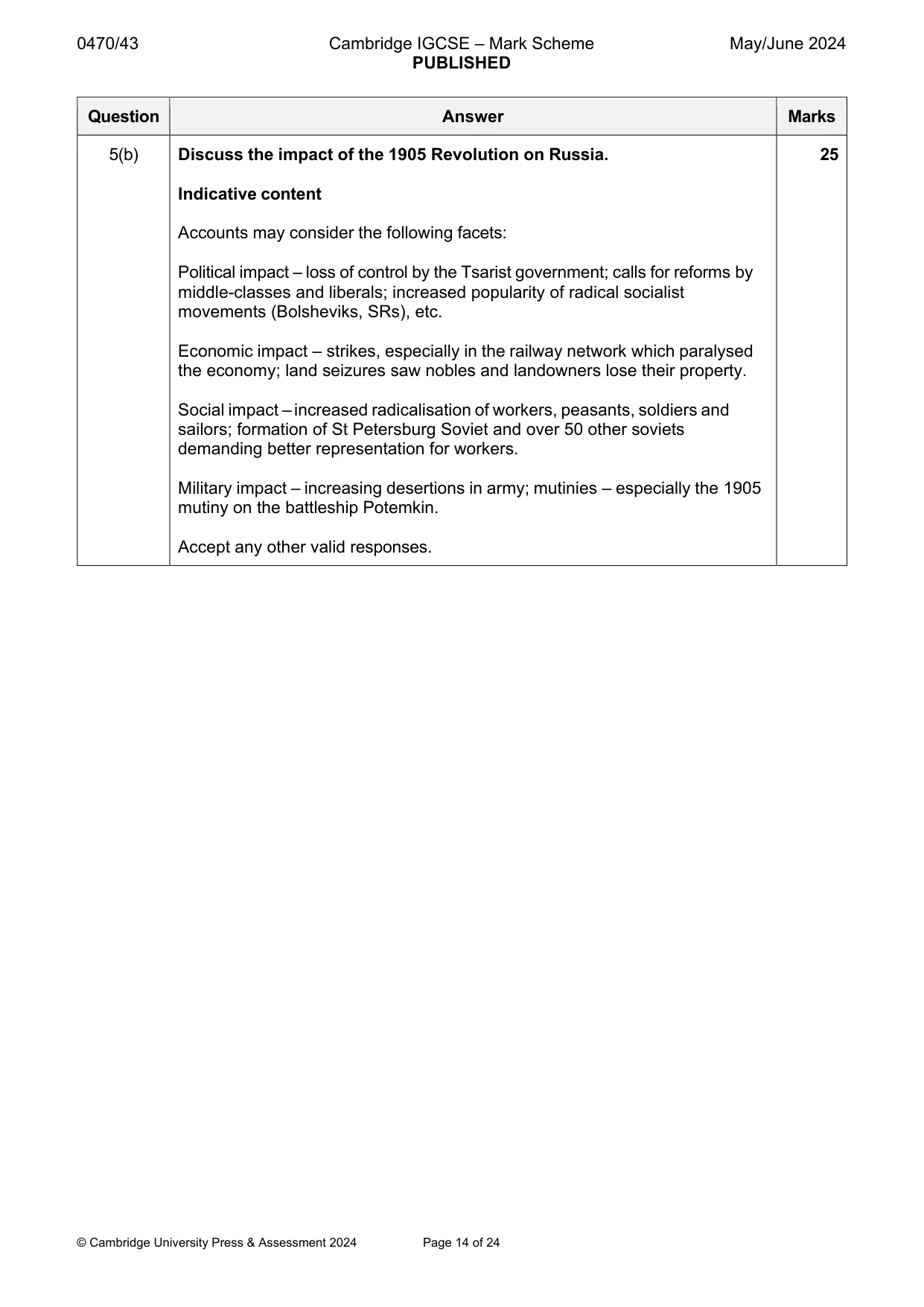
0470/43 Cambridge IGCSE – Mark Scheme PUBLISHED May/June 2024 © Cambridge University Press & Assessment 2024 Page 14 of 24 Question Answer Marks 5(b) Discuss the impact of the 1905 Revolution on Russia. Indicative content Accounts may consider the following facets: Political impact – loss of control by the Tsarist government; calls for reforms by middle-classes and liberals; increased popularity of radical socialist movements (Bolsheviks, SRs), etc. Economic impact – strikes, especially in the railway network which paralysed the economy; land seizures saw nobles and landowners lose their property. Social impact – increased radicalisation of workers, peasants, soldiers and sailors; formation of St Petersburg Soviet and over 50 other soviets demanding better representation for workers. Military impact – increasing desertions in army; mutinies – especially the 1905 mutiny on the battleship Potemkin. Accept any other valid responses. 25
Mark scheme, page 15
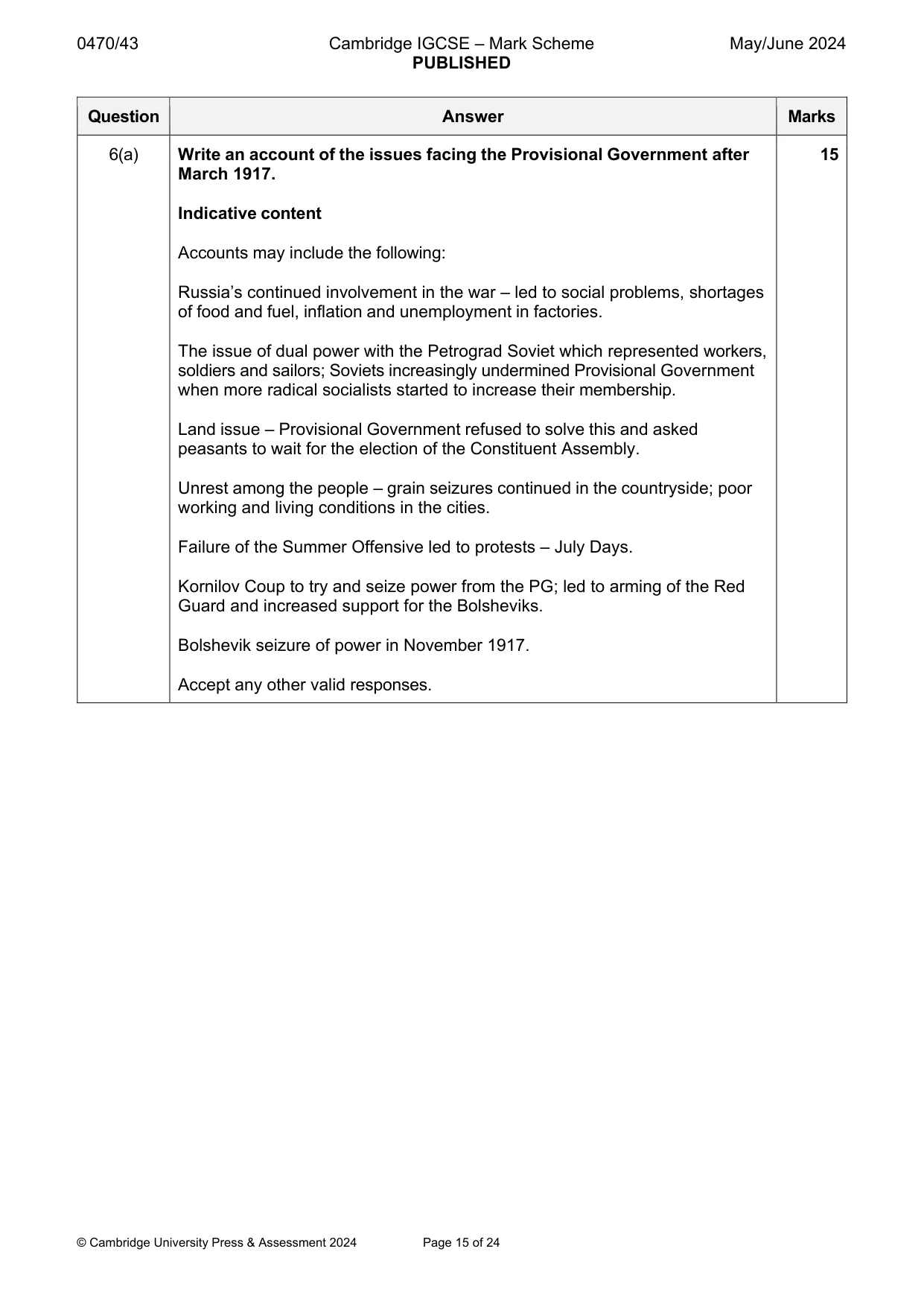
0470/43 Cambridge IGCSE – Mark Scheme PUBLISHED May/June 2024 © Cambridge University Press & Assessment 2024 Page 15 of 24 Question Answer Marks 6(a) Write an account of the issues facing the Provisional Government after March 1917. Indicative content Accounts may include the following: Russia’s continued involvement in the war – led to social problems, shortages of food and fuel, inflation and unemployment in factories. The issue of dual power with the Petrograd Soviet which represented workers, soldiers and sailors; Soviets increasingly undermined Provisional Government when more radical socialists started to increase their membership. Land issue – Provisional Government refused to solve this and asked peasants to wait for the election of the Constituent Assembly. Unrest among the people – grain seizures continued in the countryside; poor working and living conditions in the cities. Failure of the Summer Offensive led to protests – July Days. Kornilov Coup to try and seize power from the PG; led to arming of the Red Guard and increased support for the Bolsheviks. Bolshevik seizure of power in November 1917. Accept any other valid responses. 15
Mark scheme, page 16
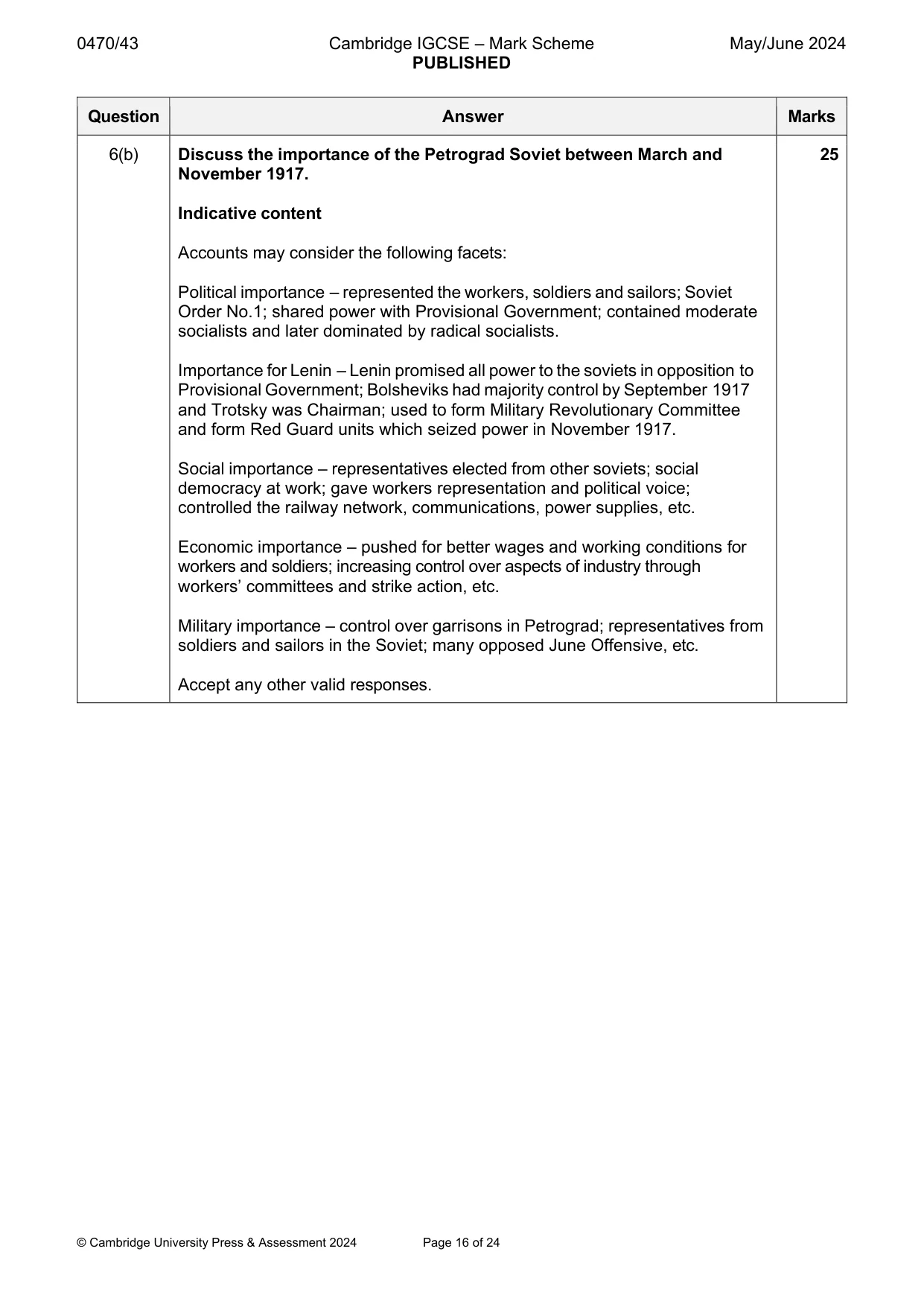
0470/43 Cambridge IGCSE – Mark Scheme PUBLISHED May/June 2024 © Cambridge University Press & Assessment 2024 Page 16 of 24 Question Answer Marks 6(b) Discuss the importance of the Petrograd Soviet between March and November 1917. Indicative content Accounts may consider the following facets: Political importance – represented the workers, soldiers and sailors; Soviet Order No.1; shared power with Provisional Government; contained moderate socialists and later dominated by radical socialists. Importance for Lenin – Lenin promised all power to the soviets in opposition to Provisional Government; Bolsheviks had majority control by September 1917 and Trotsky was Chairman; used to form Military Revolutionary Committee and form Red Guard units which seized power in November 1917. Social importance – representatives elected from other soviets; social democracy at work; gave workers representation and political voice; controlled the railway network, communications, power supplies, etc. Economic importance – pushed for better wages and working conditions for workers and soldiers; increasing control over aspects of industry through workers’ committees and strike action, etc. Military importance – control over garrisons in Petrograd; representatives from soldiers and sailors in the Soviet; many opposed June Offensive, etc. Accept any other valid responses. 25
Mark scheme, page 17
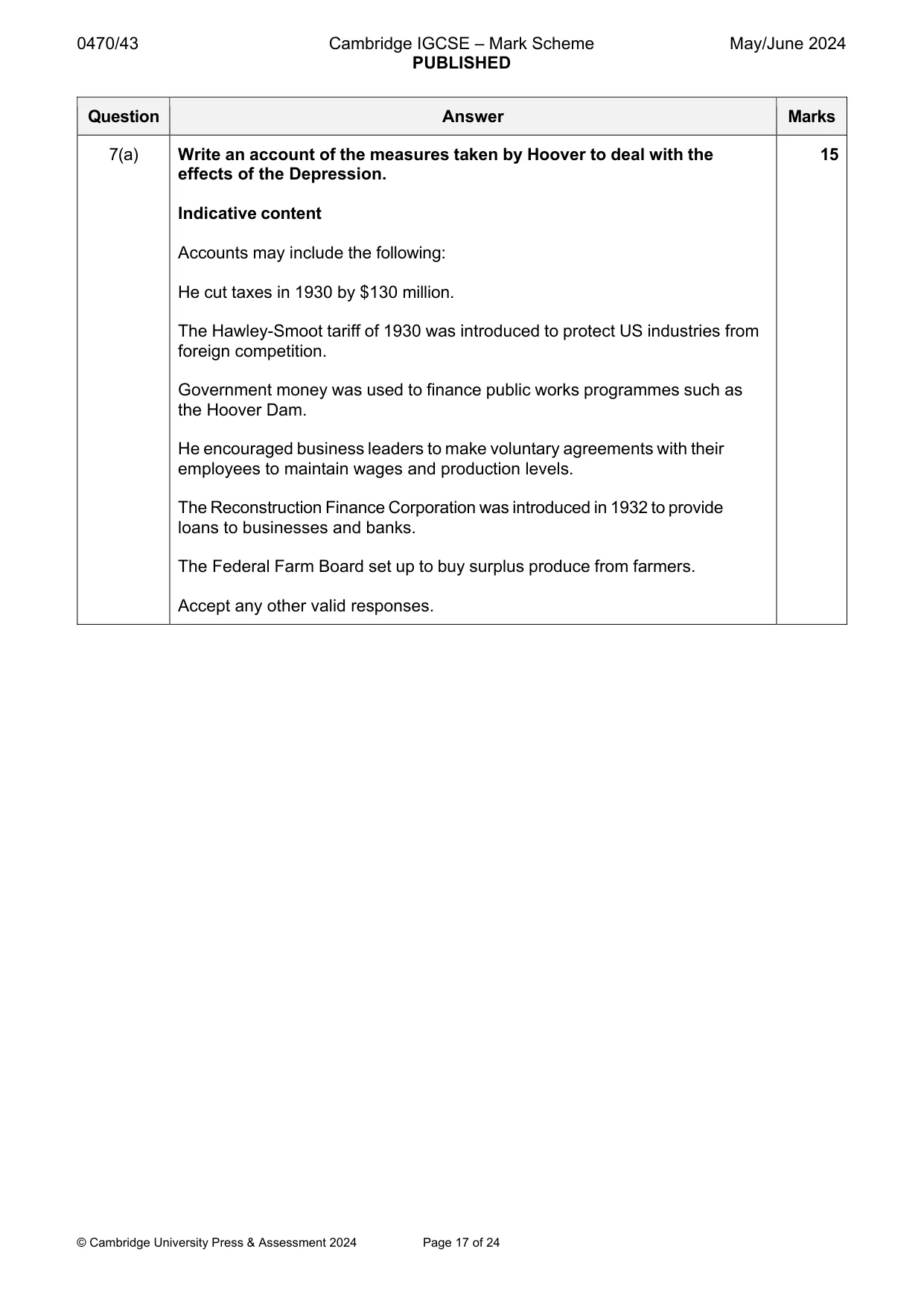
0470/43 Cambridge IGCSE – Mark Scheme PUBLISHED May/June 2024 © Cambridge University Press & Assessment 2024 Page 17 of 24 Question Answer Marks 7(a) Write an account of the measures taken by Hoover to deal with the effects of the Depression. Indicative content Accounts may include the following: He cut taxes in 1930 by $130 million. The Hawley-Smoot tariff of 1930 was introduced to protect US industries from foreign competition. Government money was used to finance public works programmes such as the Hoover Dam. He encouraged business leaders to make voluntary agreements with their employees to maintain wages and production levels. The Reconstruction Finance Corporation was introduced in 1932 to provide loans to businesses and banks. The Federal Farm Board set up to buy surplus produce from farmers. Accept any other valid responses. 15
Mark scheme, page 18
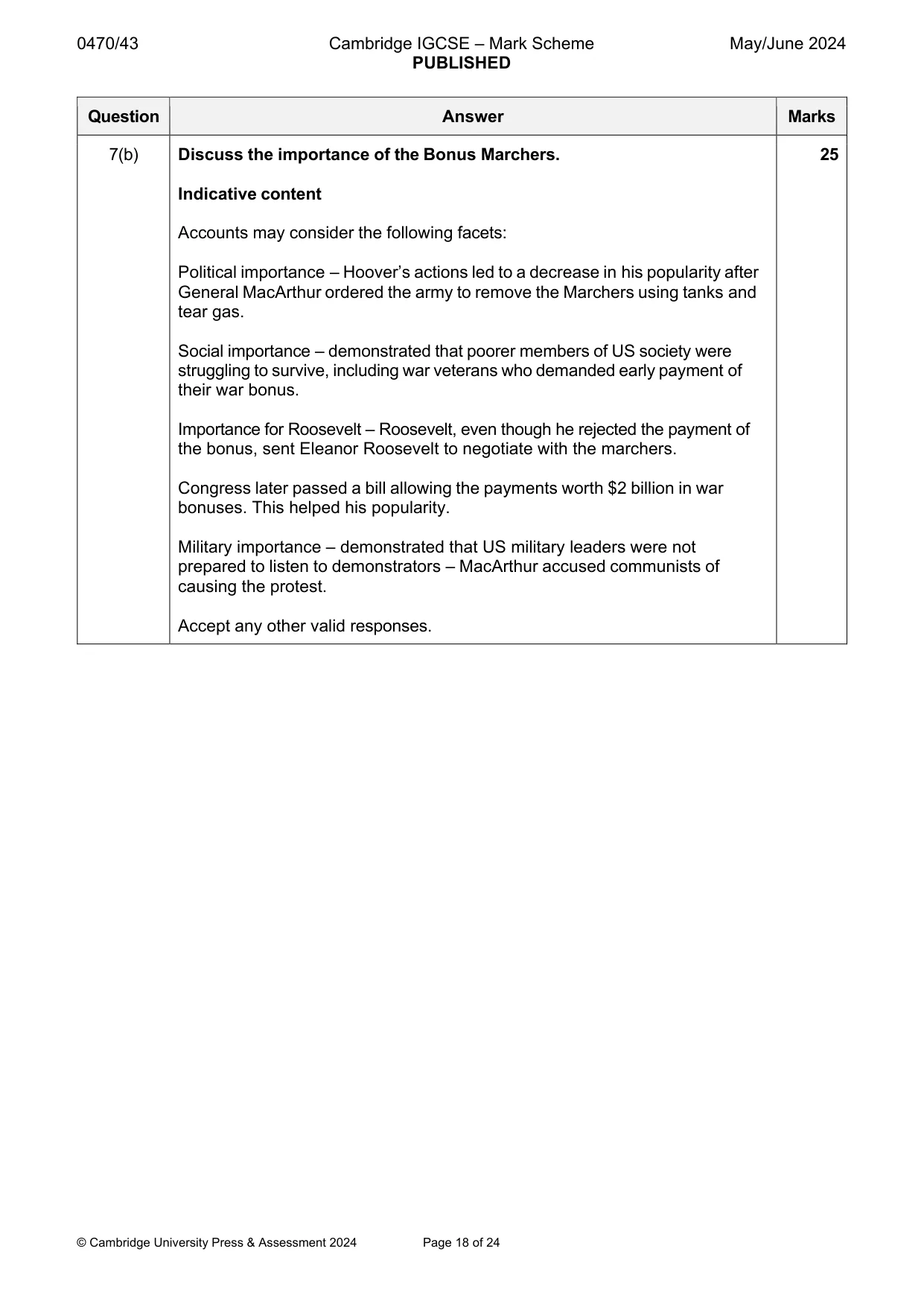
0470/43 Cambridge IGCSE – Mark Scheme PUBLISHED May/June 2024 © Cambridge University Press & Assessment 2024 Page 18 of 24 Question Answer Marks 7(b) Discuss the importance of the Bonus Marchers. Indicative content Accounts may consider the following facets: Political importance – Hoover’s actions led to a decrease in his popularity after General MacArthur ordered the army to remove the Marchers using tanks and tear gas. Social importance – demonstrated that poorer members of US society were struggling to survive, including war veterans who demanded early payment of their war bonus. Importance for Roosevelt – Roosevelt, even though he rejected the payment of the bonus, sent Eleanor Roosevelt to negotiate with the marchers. Congress later passed a bill allowing the payments worth $2 billion in war bonuses. This helped his popularity. Military importance – demonstrated that US military leaders were not prepared to listen to demonstrators – MacArthur accused communists of causing the protest. Accept any other valid responses. 25
Mark scheme, page 19
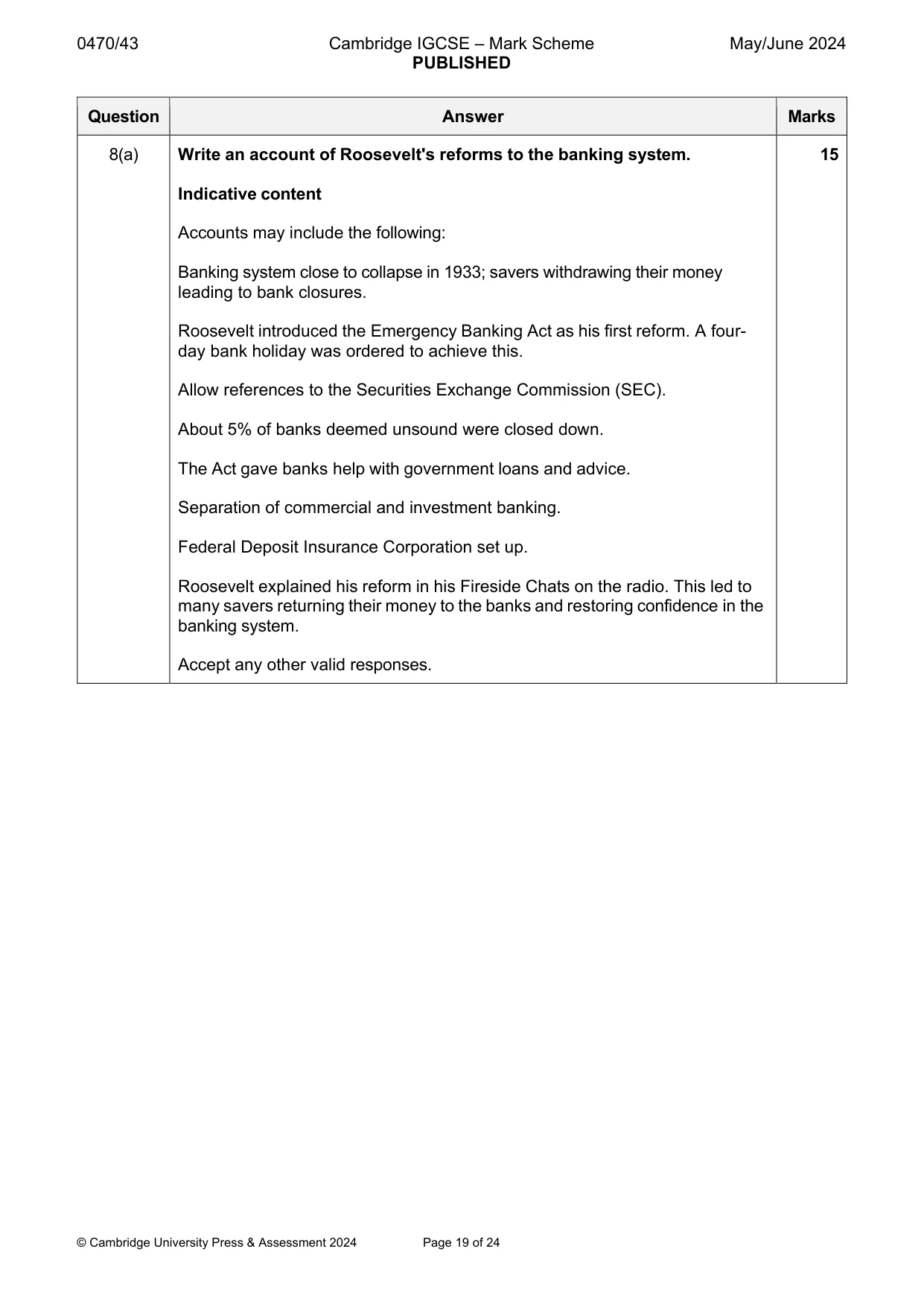
0470/43 Cambridge IGCSE – Mark Scheme PUBLISHED May/June 2024 © Cambridge University Press & Assessment 2024 Page 19 of 24 Question Answer Marks 8(a) Write an account of Roosevelt's reforms to the banking system. Indicative content Accounts may include the following: Banking system close to collapse in 1933; savers withdrawing their money leading to bank closures. Roosevelt introduced the Emergency Banking Act as his first reform. A four- day bank holiday was ordered to achieve this. Allow references to the Securities Exchange Commission (SEC). About 5% of banks deemed unsound were closed down. The Act gave banks help with government loans and advice. Separation of commercial and investment banking. Federal Deposit Insurance Corporation set up. Roosevelt explained his reform in his Fireside Chats on the radio. This led to many savers returning their money to the banks and restoring confidence in the banking system. Accept any other valid responses. 15
Mark scheme, page 20
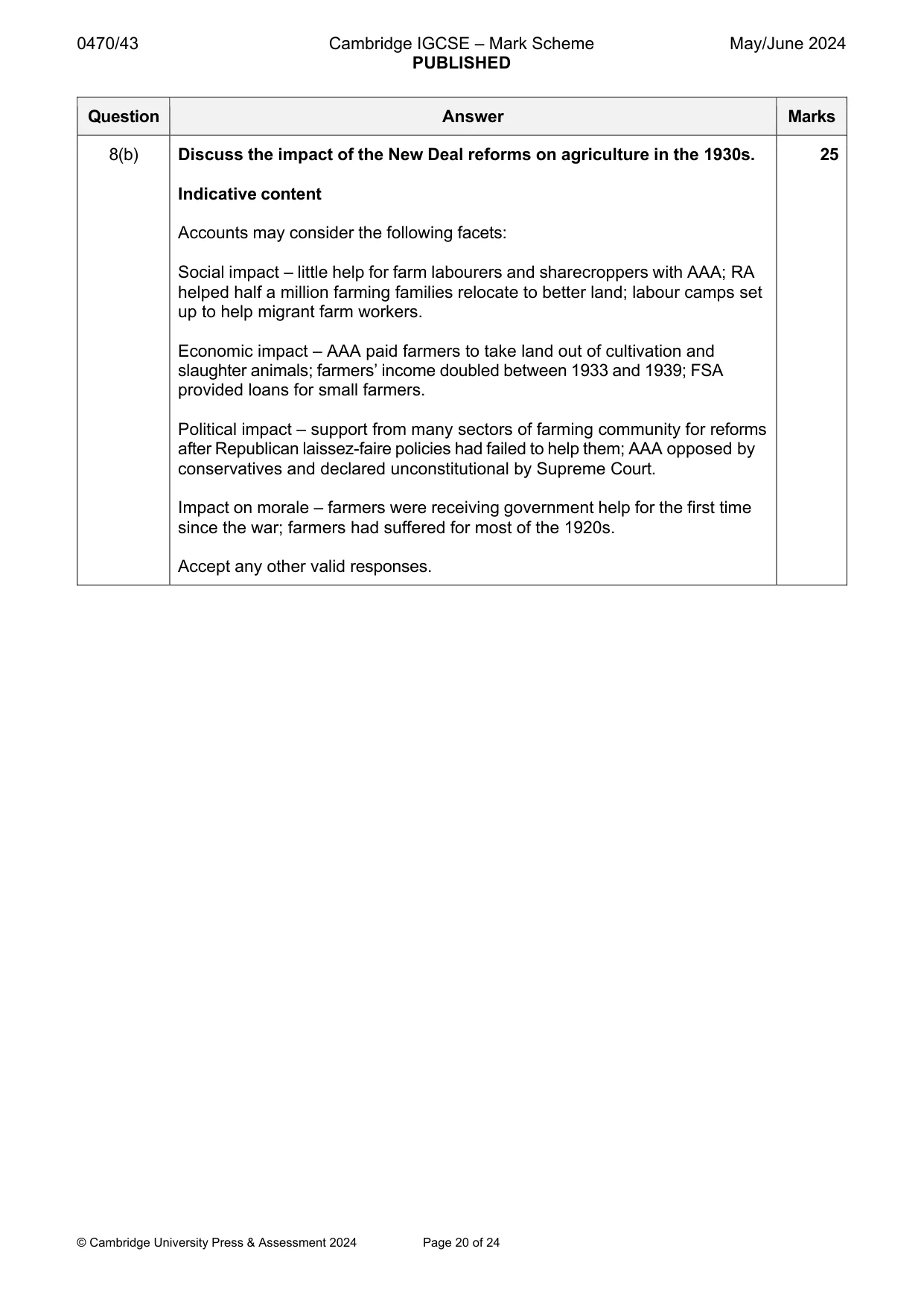
0470/43 Cambridge IGCSE – Mark Scheme PUBLISHED May/June 2024 © Cambridge University Press & Assessment 2024 Page 20 of 24 Question Answer Marks 8(b) Discuss the impact of the New Deal reforms on agriculture in the 1930s. Indicative content Accounts may consider the following facets: Social impact – little help for farm labourers and sharecroppers with AAA; RA helped half a million farming families relocate to better land; labour camps set up to help migrant farm workers. Economic impact – AAA paid farmers to take land out of cultivation and slaughter animals; farmers’ income doubled between 1933 and 1939; FSA provided loans for small farmers. Political impact – support from many sectors of farming community for reforms after Republican laissez-faire policies had failed to help them; AAA opposed by conservatives and declared unconstitutional by Supreme Court. Impact on morale – farmers were receiving government help for the first time since the war; farmers had suffered for most of the 1920s. Accept any other valid responses. 25
Mark scheme, page 21
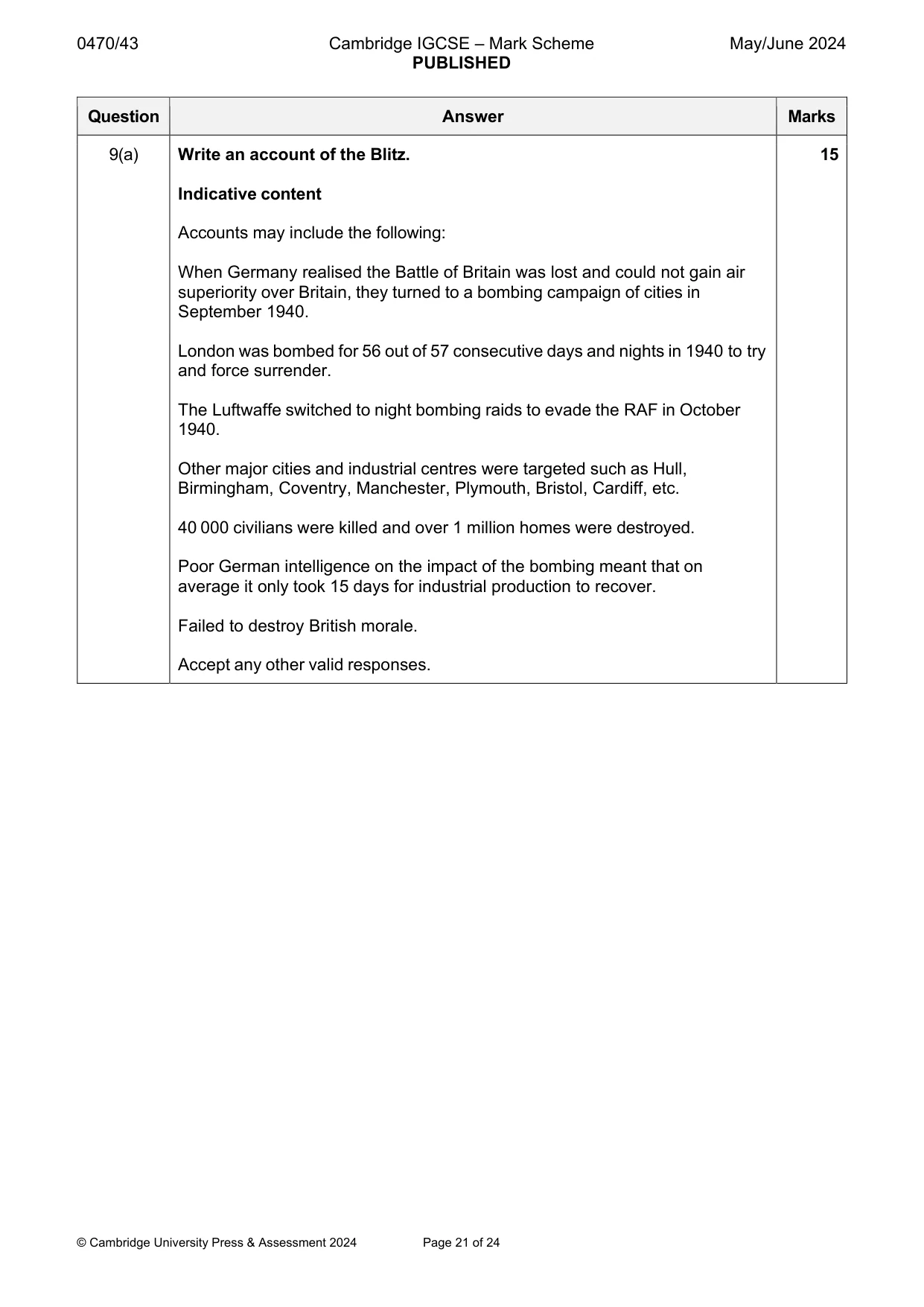
0470/43 Cambridge IGCSE – Mark Scheme PUBLISHED May/June 2024 © Cambridge University Press & Assessment 2024 Page 21 of 24 Question Answer Marks 9(a) Write an account of the Blitz. Indicative content Accounts may include the following: When Germany realised the Battle of Britain was lost and could not gain air superiority over Britain, they turned to a bombing campaign of cities in September 1940. London was bombed for 56 out of 57 consecutive days and nights in 1940 to try and force surrender. The Luftwaffe switched to night bombing raids to evade the RAF in October 1940. Other major cities and industrial centres were targeted such as Hull, Birmingham, Coventry, Manchester, Plymouth, Bristol, Cardiff, etc. 40 000 civilians were killed and over 1 million homes were destroyed. Poor German intelligence on the impact of the bombing meant that on average it only took 15 days for industrial production to recover. Failed to destroy British morale. Accept any other valid responses. 15
Mark scheme, page 22
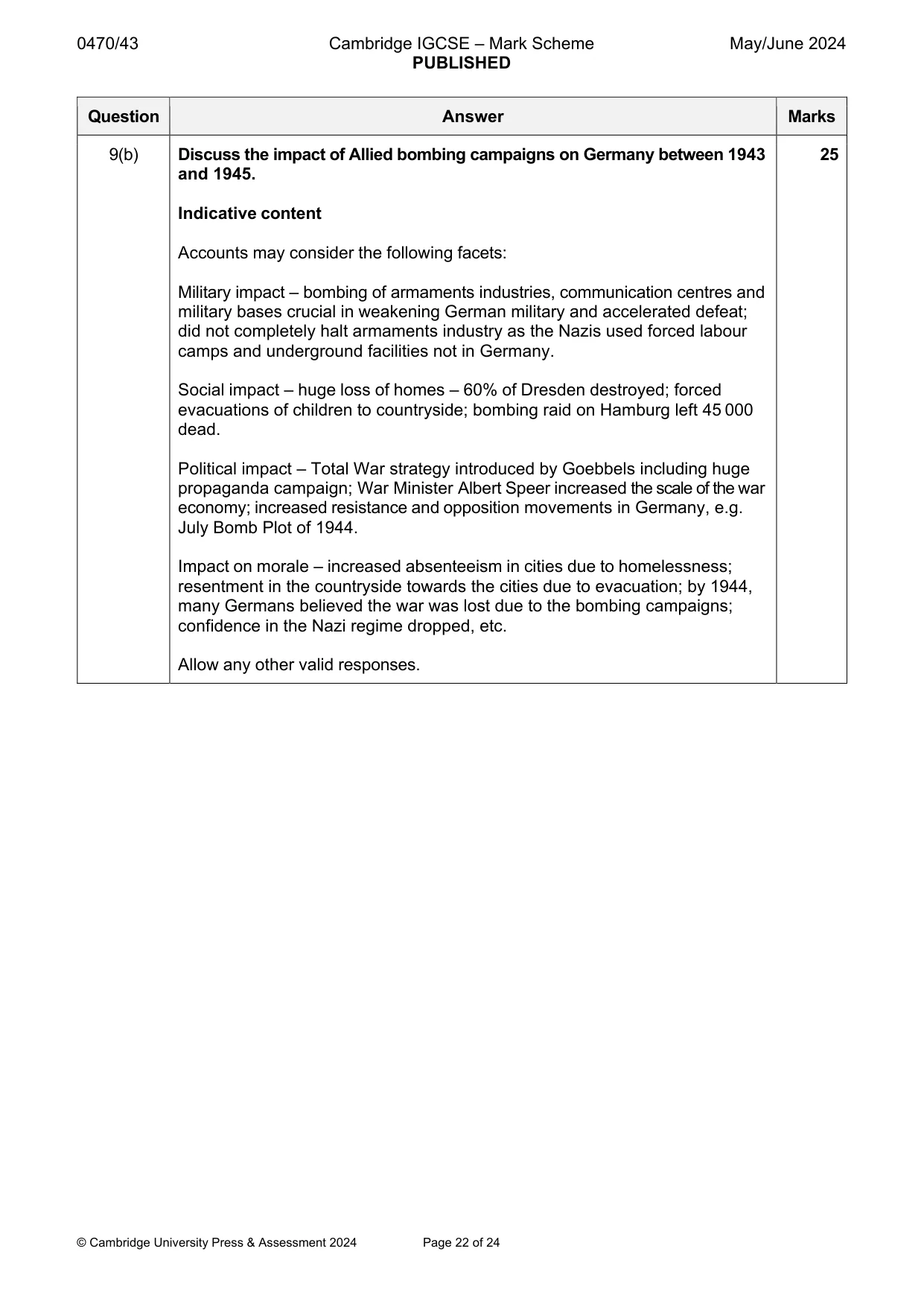
0470/43 Cambridge IGCSE – Mark Scheme PUBLISHED May/June 2024 © Cambridge University Press & Assessment 2024 Page 22 of 24 Question Answer Marks 9(b) Discuss the impact of Allied bombing campaigns on Germany between 1943 and 1945. Indicative content Accounts may consider the following facets: Military impact – bombing of armaments industries, communication centres and military bases crucial in weakening German military and accelerated defeat; did not completely halt armaments industry as the Nazis used forced labour camps and underground facilities not in Germany. Social impact – huge loss of homes – 60% of Dresden destroyed; forced evacuations of children to countryside; bombing raid on Hamburg left 45 000 dead. Political impact – Total War strategy introduced by Goebbels including huge propaganda campaign; War Minister Albert Speer increased the scale of the war economy; increased resistance and opposition movements in Germany, e.g. July Bomb Plot of 1944. Impact on morale – increased absenteeism in cities due to homelessness; resentment in the countryside towards the cities due to evacuation; by 1944, many Germans believed the war was lost due to the bombing campaigns; confidence in the Nazi regime dropped, etc. Allow any other valid responses. 25
Mark scheme, page 23
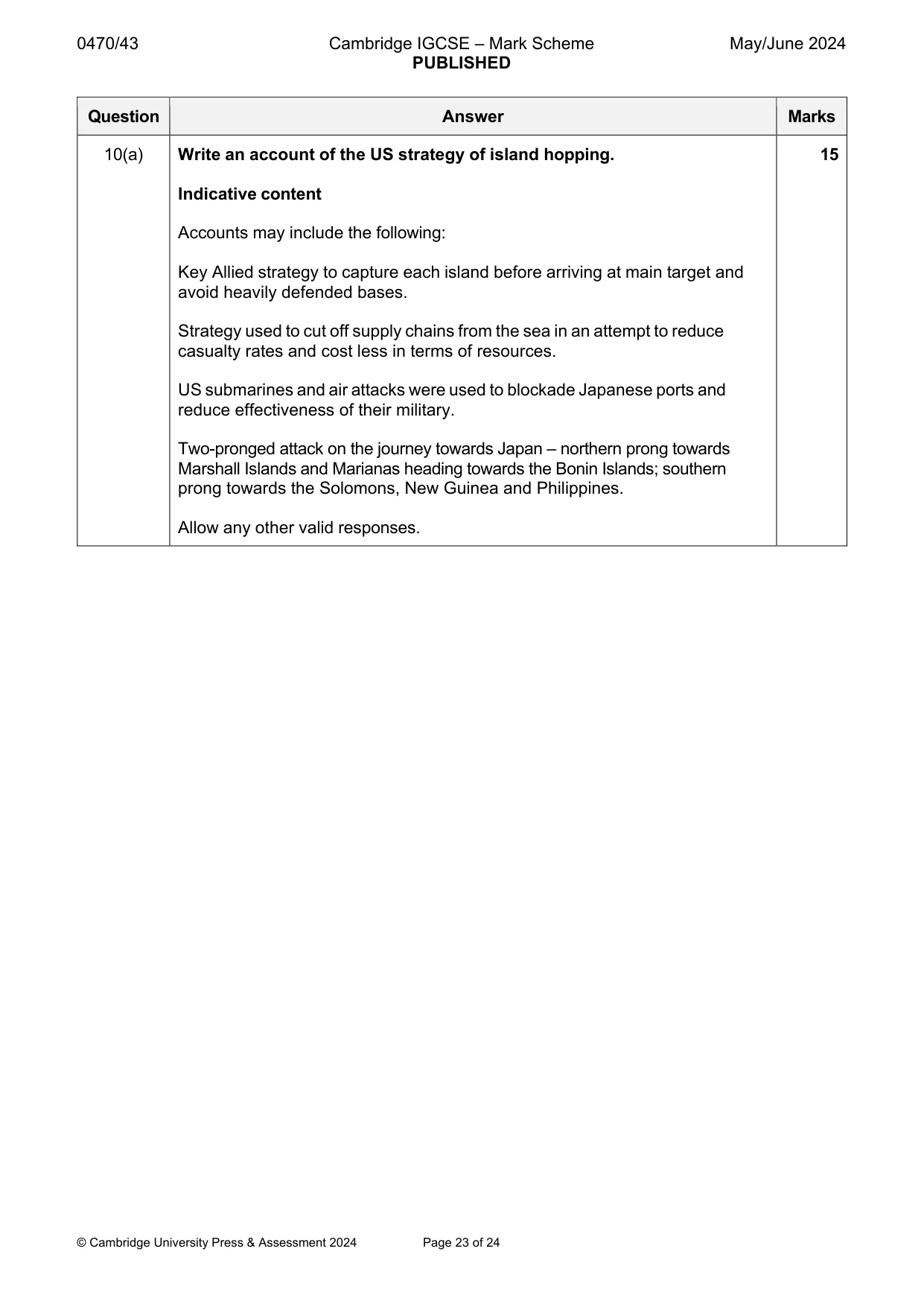
0470/43 Cambridge IGCSE – Mark Scheme PUBLISHED May/June 2024 © Cambridge University Press & Assessment 2024 Page 23 of 24 Question Answer Marks 10(a) Write an account of the US strategy of island hopping. Indicative content Accounts may include the following: Key Allied strategy to capture each island before arriving at main target and avoid heavily defended bases. Strategy used to cut off supply chains from the sea in an attempt to reduce casualty rates and cost less in terms of resources. US submarines and air attacks were used to blockade Japanese ports and reduce effectiveness of their military. Two-pronged attack on the journey towards Japan – northern prong towards Marshall Islands and Marianas heading towards the Bonin Islands; southern prong towards the Solomons, New Guinea and Philippines. Allow any other valid responses. 15
Mark scheme, page 24
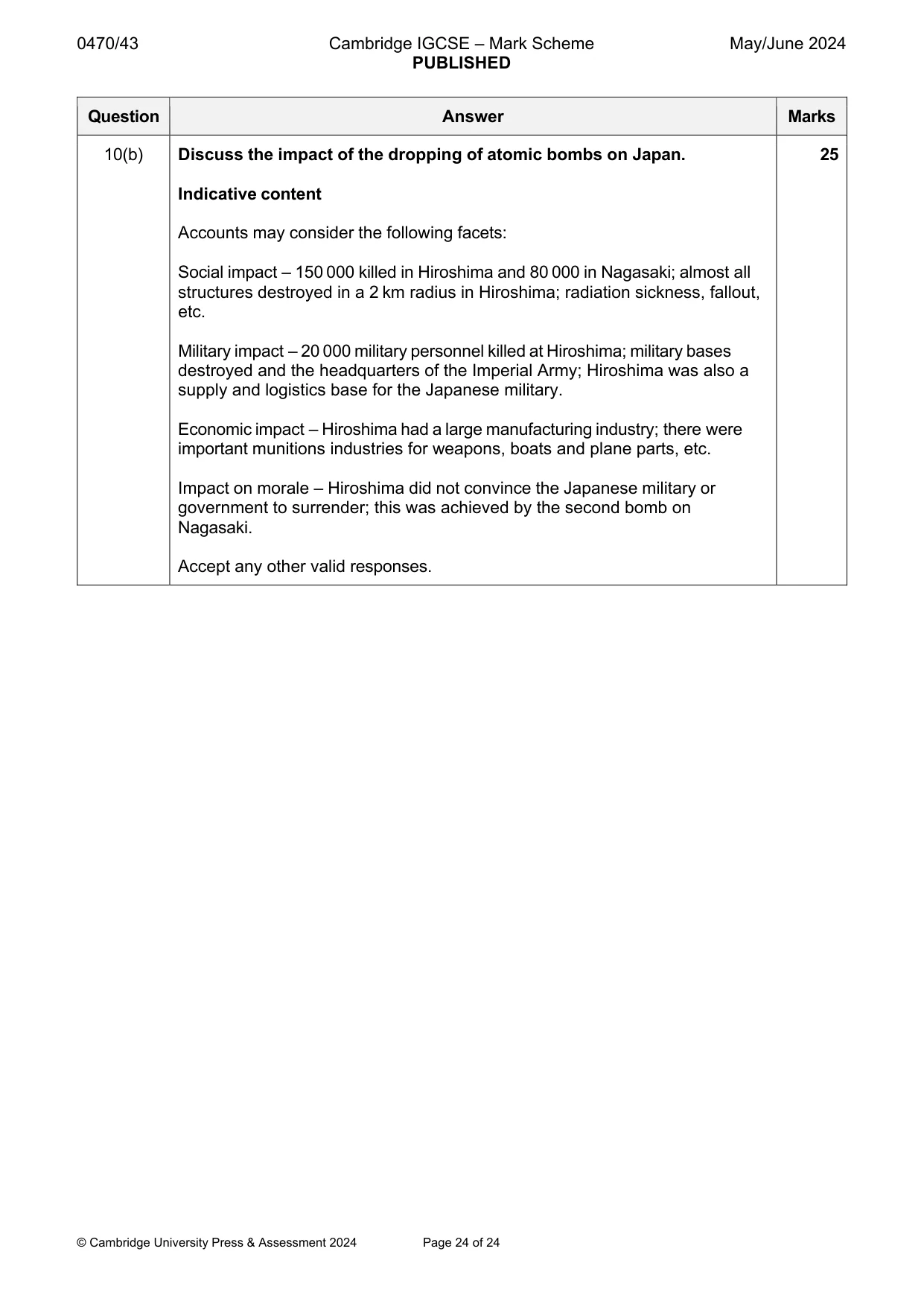
0470/43 Cambridge IGCSE – Mark Scheme PUBLISHED May/June 2024 © Cambridge University Press & Assessment 2024 Page 24 of 24 Question Answer Marks 10(b) Discuss the impact of the dropping of atomic bombs on Japan. Indicative content Accounts may consider the following facets: Social impact – 150 000 killed in Hiroshima and 80 000 in Nagasaki; almost all structures destroyed in a 2 km radius in Hiroshima; radiation sickness, fallout, etc. Military impact – 20 000 military personnel killed at Hiroshima; military bases destroyed and the headquarters of the Imperial Army; Hiroshima was also a supply and logistics base for the Japanese military. Economic impact – Hiroshima had a large manufacturing industry; there were important munitions industries for weapons, boats and plane parts, etc. Impact on morale – Hiroshima did not convince the Japanese military or government to surrender; this was achieved by the second bomb on Nagasaki. Accept any other valid responses. 25
What you needed in this session
Cambridge’s own grade thresholds for 2024 May/June, Paper 4 · Variant 3. A higher threshold means an easier paper — the bar moves with how the cohort did.