Cambridge IGCSE History 0470 — 2025 Oct/Nov Paper 4 · Variant 1
0470/41/O/N/25 · 40 marks · 60 min
The question paper and its mark scheme, free to read here and free to download. This is Cambridge’s own paper, exactly as it was sat.
Question paper4 pages
Mark scheme16 pages
Answers below. Sit the paper first if you are practising.
Paper as text
Question paper, page 1
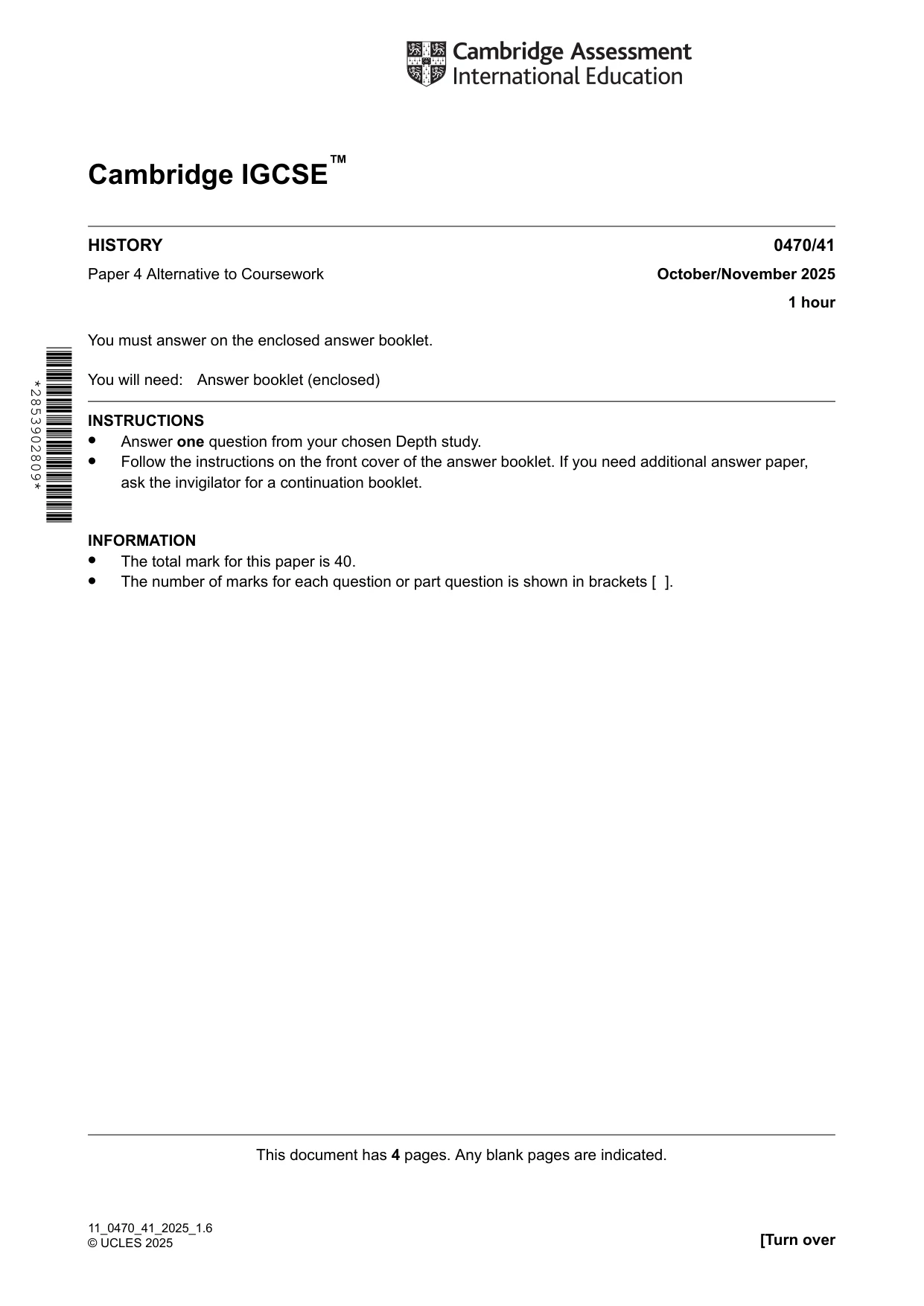
Cambridge IGCSE™ 0470/41 October/November 2025 1 hour HISTORY Paper 4 Alternative to Coursework You must answer on the enclosed answer booklet. You will need: Answer booklet (enclosed) INSTRUCTIONS • Answer one question from your chosen Depth study. • Follow the instructions on the front cover of the answer booklet. If you need additional answer paper, ask the invigilator for a continuation booklet. INFORMATION • The total mark for this paper is 40. • The number of marks for each question or part question is shown in brackets [ ]. This document has 4 pages. Any blank pages are indicated. [Turn over 11_0470_41_2025_1.6 © UCLES 2025 *2853902809*
Question paper, page 2
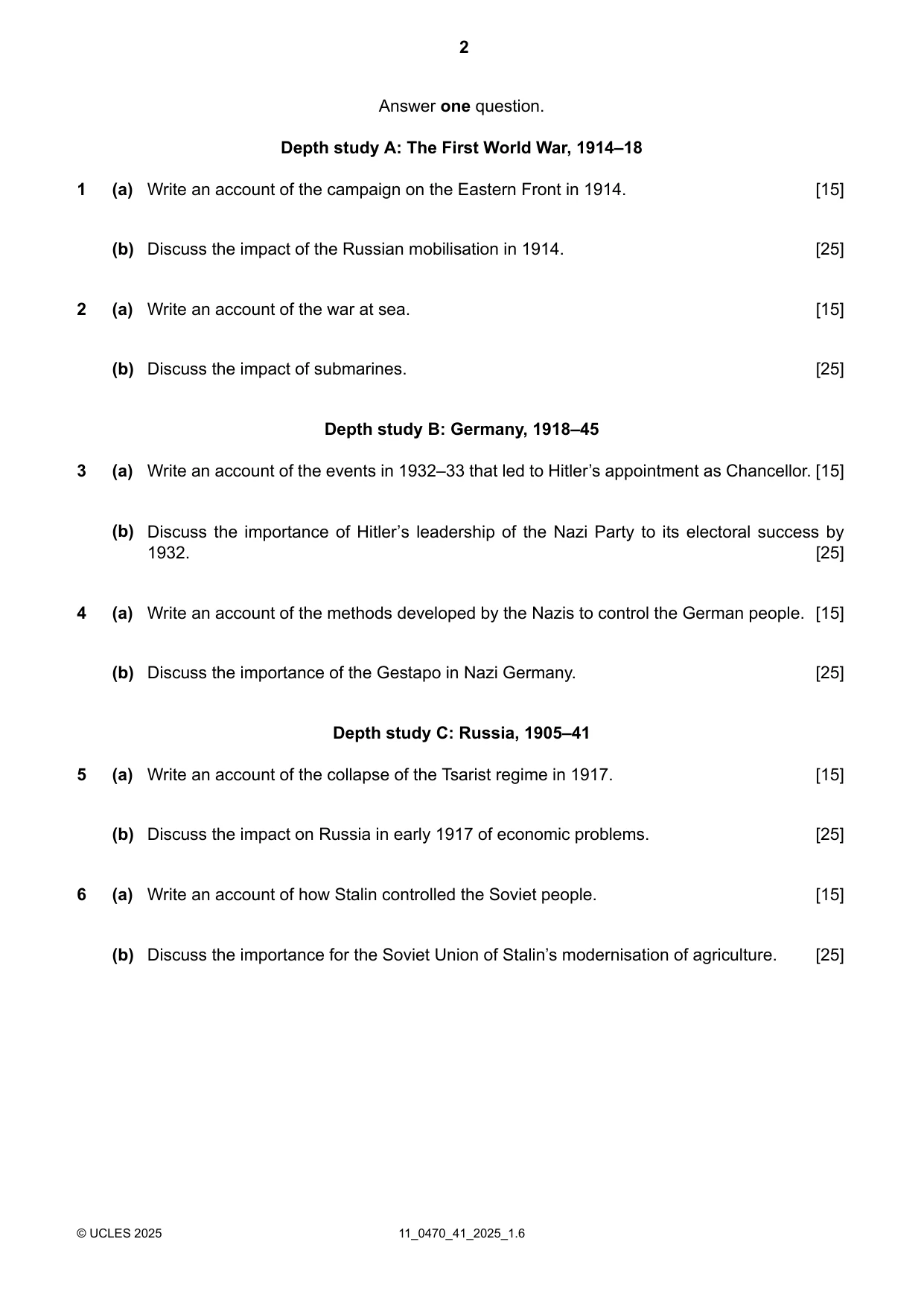
Answer one question. Depth study A: The First World War, 1914–18 Write an account of the campaign on the Eastern Front in 1914. [15] (a) 1 Discuss the impact of the Russian mobilisation in 1914. [25] (b) Write an account of the war at sea. [15] (a) 2 Discuss the impact of submarines. [25] (b) Depth study B: Germany, 1918–45 Write an account of the events in 1932–33 that led to Hitler’s appointment as Chancellor. [15] (a) 3 Discuss the importance of Hitler’s leadership of the Nazi Party to its electoral success by 1932. [25] (b) Write an account of the methods developed by the Nazis to control the German people. [15] (a) 4 Discuss the importance of the Gestapo in Nazi Germany. [25] (b) Depth study C: Russia, 1905–41 Write an account of the collapse of the Tsarist regime in 1917. [15] (a) 5 Discuss the impact on Russia in early 1917 of economic problems. [25] (b) Write an account of how Stalin controlled the Soviet people. [15] (a) 6 Discuss the importance for the Soviet Union of Stalin’s modernisation of agriculture. [25] (b) 11_0470_41_2025_1.6 © UCLES 2025 2
Question paper, page 3
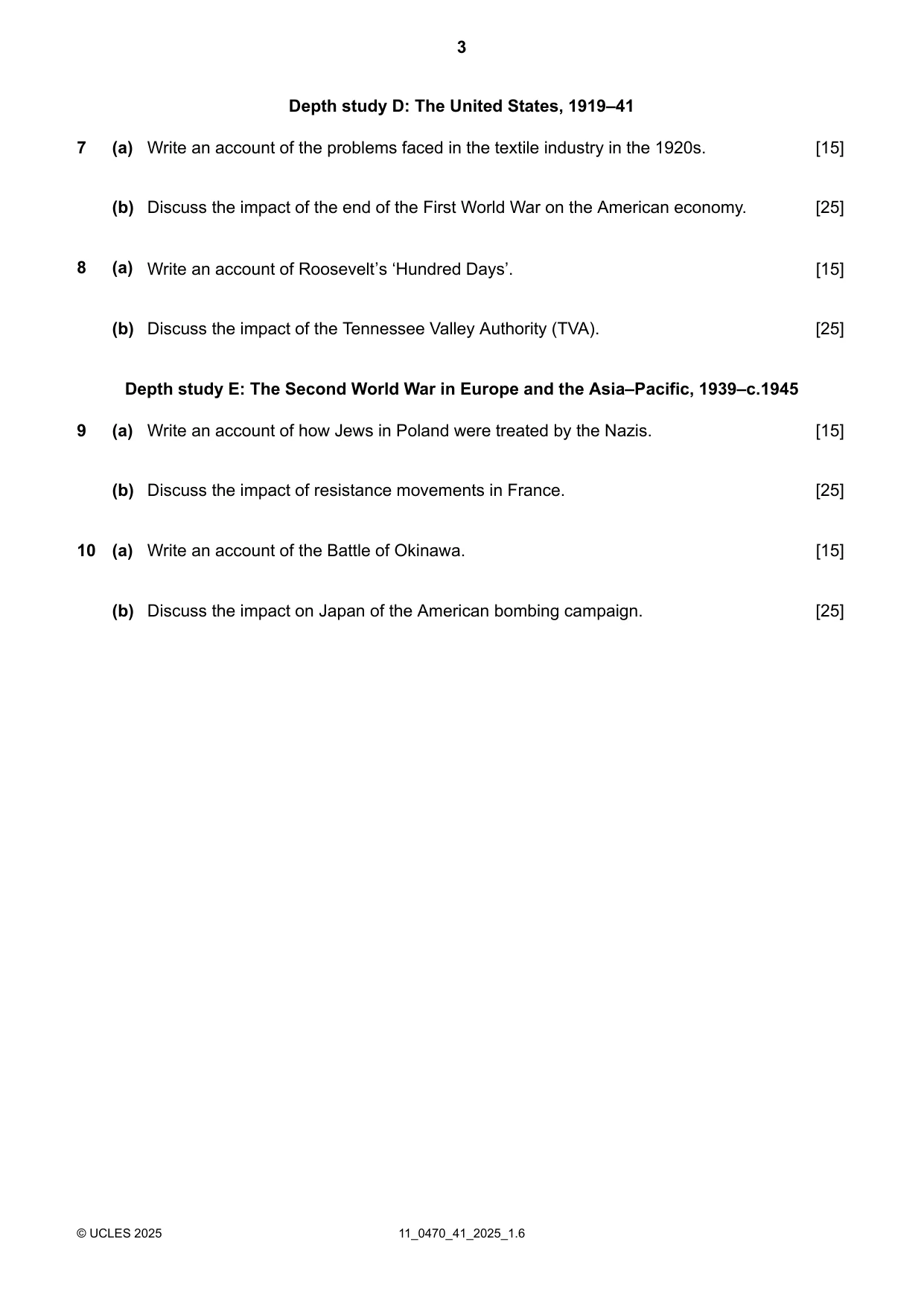
Depth study D: The United States, 1919–41 Write an account of the problems faced in the textile industry in the 1920s. [15] (a) 7 Discuss the impact of the end of the First World War on the American economy. [25] (b) Write an account of Roosevelt’s ‘Hundred Days’. [15] (a) 8 Discuss the impact of the Tennessee Valley Authority (TVA). [25] (b) Depth study E: The Second World War in Europe and the Asia–Pacific, 1939–c.1945 Write an account of how Jews in Poland were treated by the Nazis. [15] (a) 9 Discuss the impact of resistance movements in France. [25] (b) Write an account of the Battle of Okinawa. [15] (a) 10 Discuss the impact on Japan of the American bombing campaign. [25] (b) 11_0470_41_2025_1.6 © UCLES 2025 3
Question paper, page 4
BLANK PAGE Permission to reproduce items where third-party owned material protected by copyright is included has been sought and cleared where possible. Every reasonable effort has been made by the publisher (UCLES) to trace copyright holders, but if any items requiring clearance have unwittingly been included, the publisher will be pleased to make amends at the earliest possible opportunity. To avoid the issue of disclosure of answer-related information to candidates, all copyright acknowledgements are reproduced online in the Cambridge Assessment International Education Copyright Acknowledgements Booklet. This is produced for each series of examinations and is freely available to download at www.cambridgeinternational.org after the live examination series. Cambridge Assessment International Education is part of Cambridge Assessment. Cambridge Assessment is the brand name of the University of Cambridge Local Examinations Syndicate (UCLES), which is a department of the University of Cambridge. 11_0470_41_2025_1.6 © UCLES 2025 4
Mark scheme, page 1
This document consists of 16 printed pages. © Cambridge University Press & Assessment 2025 [Turn over Cambridge IGCSE™ HISTORY 0470/41 Paper 4 Alternative to Coursework October/November 2025 MARK SCHEME Maximum Mark: 40 Published This mark scheme is published as an aid to teachers and candidates, to indicate the requirements of the examination. It shows the basis on which Examiners were instructed to award marks. It does not indicate the details of the discussions that took place at an Examiners’ meeting before marking began, which would have considered the acceptability of alternative answers. Mark schemes should be read in conjunction with the question paper and the Principal Examiner Report for Teachers. Cambridge International will not enter into discussions about these mark schemes. Cambridge International is publishing the mark schemes for the October/November 2025 series for most Cambridge IGCSE, Cambridge International A and AS Level components, and some Cambridge O Level components.
Mark scheme, page 2
0470/41 Cambridge IGCSE – Mark Scheme PUBLISHED October/November 2025 © Cambridge University Press & Assessment 2025 Page 2 of 16 Generic Marking Principles These general marking principles must be applied by all examiners when marking candidate answers. They should be applied alongside the specific content of the mark scheme or generic level descriptions for a question. Each question paper and mark scheme will also comply with these marking principles. GENERIC MARKING PRINCIPLE 1: Marks must be awarded in line with: • the specific content of the mark scheme or the generic level descriptors for the question • the specific skills defined in the mark scheme or in the generic level descriptors for the question • the standard of response required by a candidate as exemplified by the standardisation scripts. GENERIC MARKING PRINCIPLE 2: Marks awarded are always whole marks (not half marks, or other fractions). GENERIC MARKING PRINCIPLE 3: Marks must be awarded positively: • marks are awarded for correct/valid answers, as defined in the mark scheme. However, credit is given for valid answers which go beyond the scope of the syllabus and mark scheme, referring to your Team Leader as appropriate • marks are awarded when candidates clearly demonstrate what they know and can do • marks are not deducted for errors • marks are not deducted for omissions • answers should only be judged on the quality of spelling, punctuation and grammar when these features are specifically assessed by the question as indicated by the mark scheme. The meaning, however, should be unambiguous. GENERIC MARKING PRINCIPLE 4: Rules must be applied consistently, e.g. in situations where candidates have not followed instructions or in the application of generic level descriptors. GENERIC MARKING PRINCIPLE 5: Marks should be awarded using the full range of marks defined in the mark scheme for the question. (However, the use of the full mark range may be limited according to the quality of the candidate responses seen.) GENERIC MARKING PRINCIPLE 6: Marks awarded are based solely on the requirements as defined in the mark scheme. Marks should not be awarded with grade thresholds or grade descriptors in mind.
Mark scheme, page 3
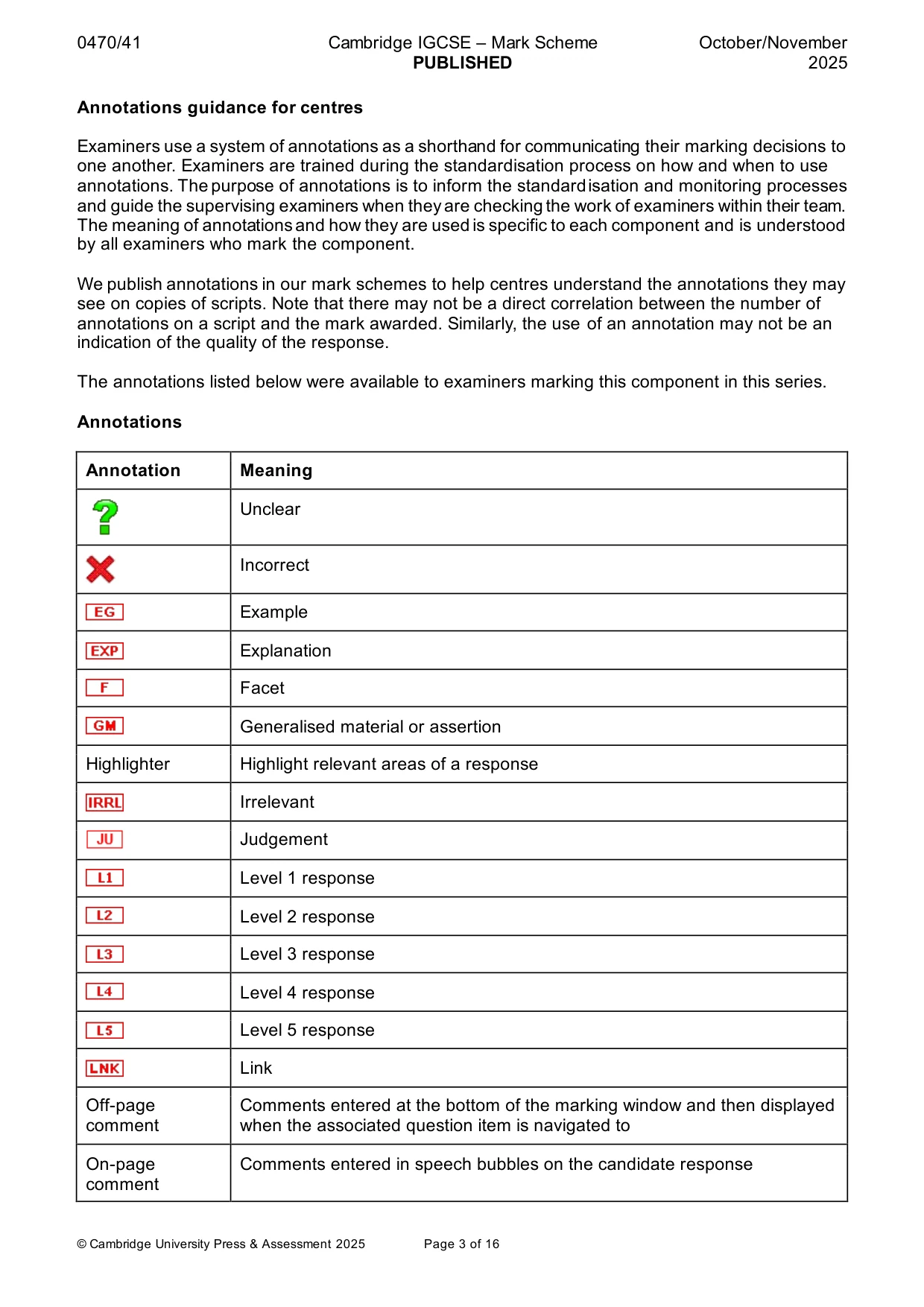
0470/41 Cambridge IGCSE – Mark Scheme PUBLISHED October/November 2025 © Cambridge University Press & Assessment 2025 Page 3 of 16 Annotations guidance for centres Examiners use a system of annotations as a shorthand for communicating their marking decisions to one another. Examiners are trained during the standardisation process on how and when to use annotations. The purpose of annotations is to inform the standardisation and monitoring processes and guide the supervising examiners when they are checking the work of examiners within their team. The meaning of annotations and how they are used is specific to each component and is understood by all examiners who mark the component. We publish annotations in our mark schemes to help centres understand the annotations they may see on copies of scripts. Note that there may not be a direct correlation between the number of annotations on a script and the mark awarded. Similarly, the use of an annotation may not be an indication of the quality of the response. The annotations listed below were available to examiners marking this component in this series. Annotations Annotation Meaning Unclear Incorrect Example Explanation Facet Generalised material or assertion Highlighter Highlight relevant areas of a response Irrelevant Judgement Level 1 response Level 2 response Level 3 response Level 4 response Level 5 response Link Off-page comment Comments entered at the bottom of the marking window and then displayed when the associated question item is navigated to On-page comment Comments entered in speech bubbles on the candidate response
Mark scheme, page 4
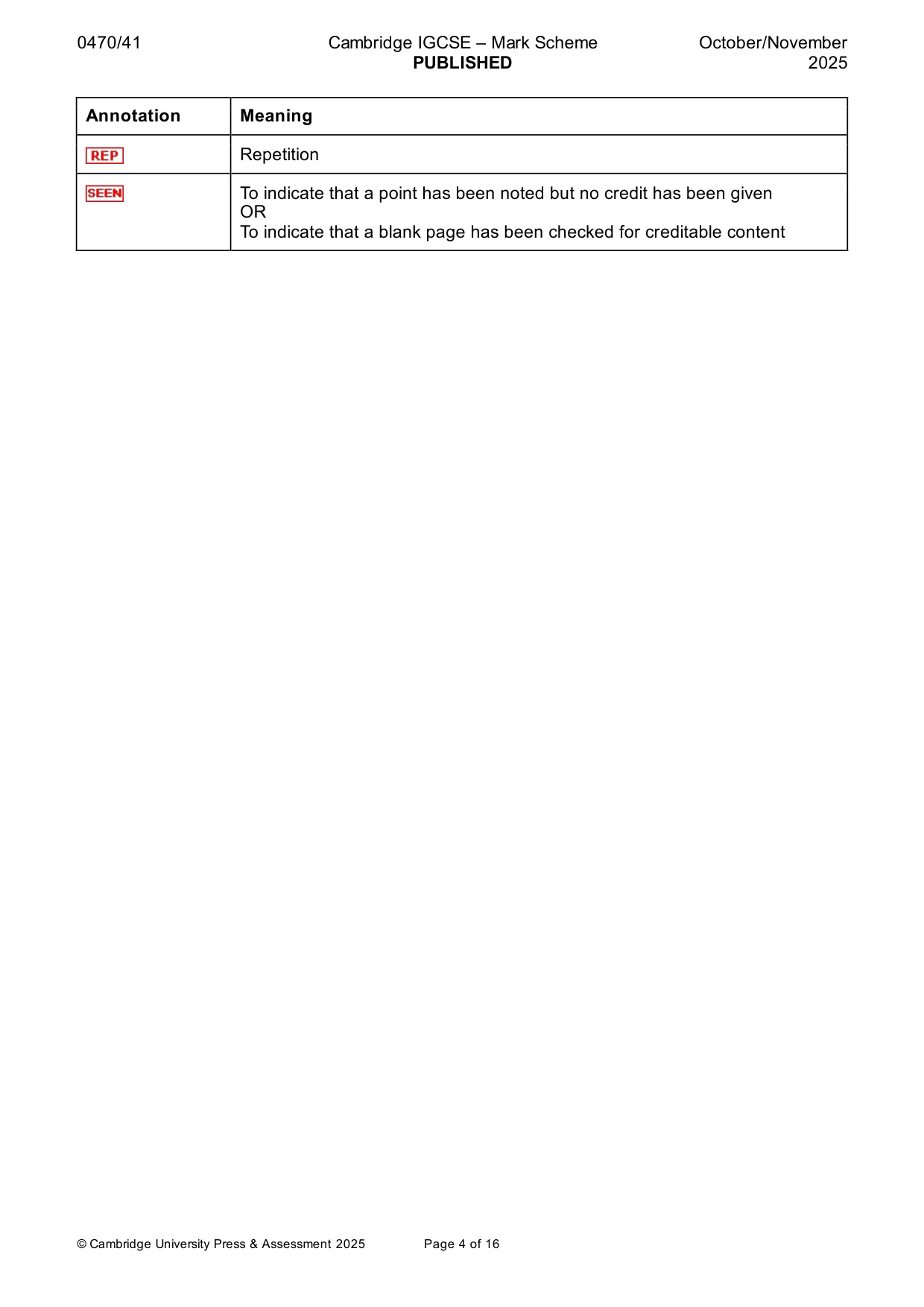
0470/41 Cambridge IGCSE – Mark Scheme PUBLISHED October/November 2025 © Cambridge University Press & Assessment 2025 Page 4 of 16 Annotation Meaning Repetition To indicate that a point has been noted but no credit has been given OR To indicate that a blank page has been checked for creditable content
Mark scheme, page 5
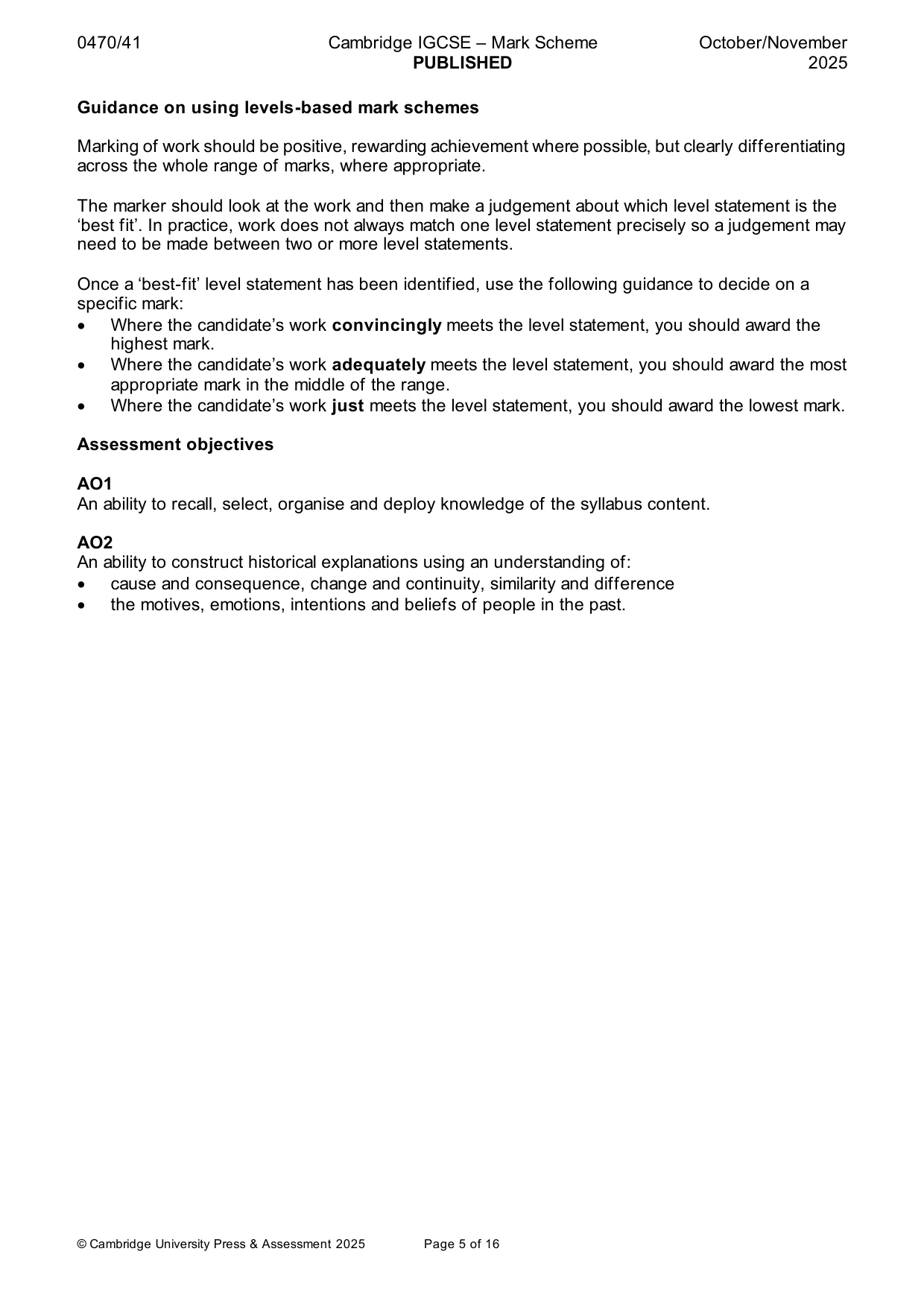
0470/41 Cambridge IGCSE – Mark Scheme PUBLISHED October/November 2025 © Cambridge University Press & Assessment 2025 Page 5 of 16 Guidance on using levels-based mark schemes Marking of work should be positive, rewarding achievement where possible, but clearly differentiating across the whole range of marks, where appropriate. The marker should look at the work and then make a judgement about which level statement is the ‘best fit’. In practice, work does not always match one level statement precisely so a judgement may need to be made between two or more level statements. Once a ‘best-fit’ level statement has been identified, use the following guidance to decide on a specific mark: • Where the candidate’s work convincingly meets the level statement, you should award the highest mark. • Where the candidate’s work adequately meets the level statement, you should award the most appropriate mark in the middle of the range. • Where the candidate’s work just meets the level statement, you should award the lowest mark. Assessment objectives AO1 An ability to recall, select, organise and deploy knowledge of the syllabus content. AO2 An ability to construct historical explanations using an understanding of: • cause and consequence, change and continuity, similarity and difference • the motives, emotions, intentions and beliefs of people in the past.
Mark scheme, page 6
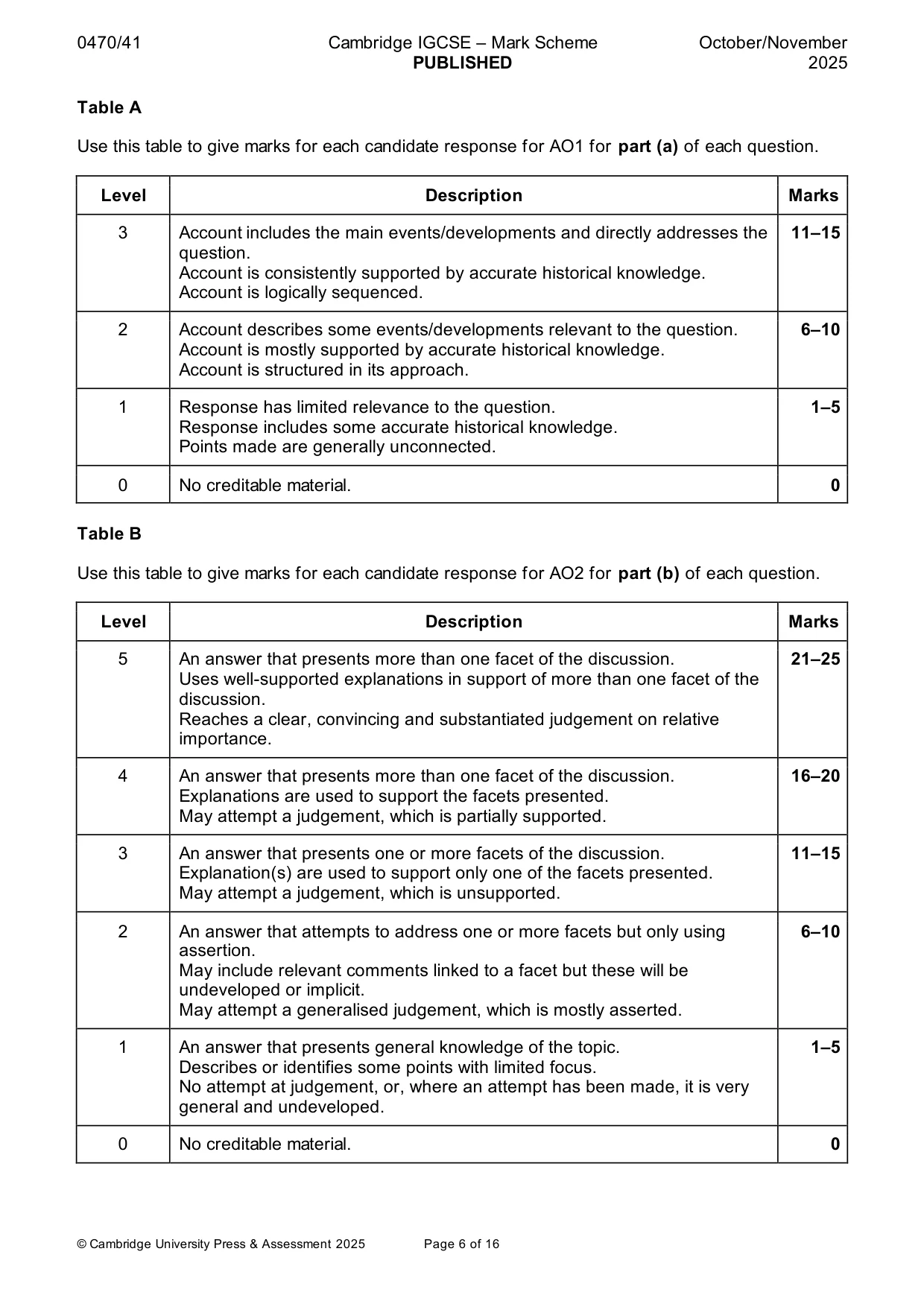
0470/41 Cambridge IGCSE – Mark Scheme PUBLISHED October/November 2025 © Cambridge University Press & Assessment 2025 Page 6 of 16 Table A Use this table to give marks for each candidate response for AO1 for part (a) of each question. Level Description Marks 3 Account includes the main events/developments and directly addresses the question. Account is consistently supported by accurate historical knowledge. Account is logically sequenced. 11–15 2 Account describes some events/developments relevant to the question. Account is mostly supported by accurate historical knowledge. Account is structured in its approach. 6–10 1 Response has limited relevance to the question. Response includes some accurate historical knowledge. Points made are generally unconnected. 1–5 0 No creditable material. 0 Table B Use this table to give marks for each candidate response for AO2 for part (b) of each question. Level Description Marks 5 An answer that presents more than one facet of the discussion. Uses well-supported explanations in support of more than one facet of the discussion. Reaches a clear, convincing and substantiated judgement on relative importance. 21–25 4 An answer that presents more than one facet of the discussion. Explanations are used to support the facets presented. May attempt a judgement, which is partially supported. 16–20 3 An answer that presents one or more facets of the discussion. Explanation(s) are used to support only one of the facets presented. May attempt a judgement, which is unsupported. 11–15 2 An answer that attempts to address one or more facets but only using assertion. May include relevant comments linked to a facet but these will be undeveloped or implicit. May attempt a generalised judgement, which is mostly asserted. 6–10 1 An answer that presents general knowledge of the topic. Describes or identifies some points with limited focus. No attempt at judgement, or, where an attempt has been made, it is very general and undeveloped. 1–5 0 No creditable material. 0
Mark scheme, page 7
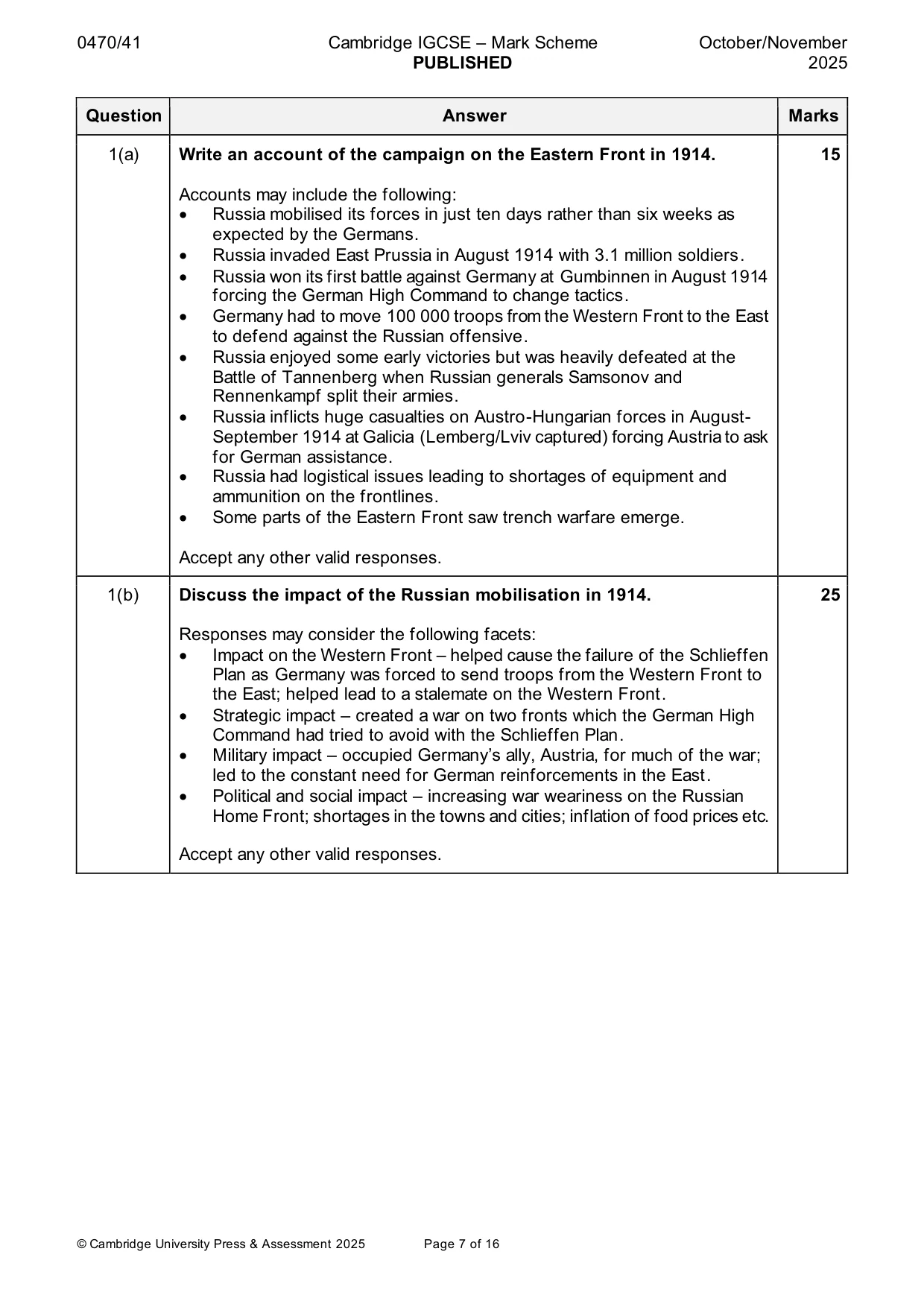
0470/41 Cambridge IGCSE – Mark Scheme PUBLISHED October/November 2025 © Cambridge University Press & Assessment 2025 Page 7 of 16 Question Answer Marks 1(a) Write an account of the campaign on the Eastern Front in 1914. Accounts may include the following: • Russia mobilised its forces in just ten days rather than six weeks as expected by the Germans. • Russia invaded East Prussia in August 1914 with 3.1 million soldiers. • Russia won its first battle against Germany at Gumbinnen in August 1914 forcing the German High Command to change tactics. • Germany had to move 100 000 troops from the Western Front to the East to defend against the Russian offensive. • Russia enjoyed some early victories but was heavily defeated at the Battle of Tannenberg when Russian generals Samsonov and Rennenkampf split their armies. • Russia inflicts huge casualties on Austro-Hungarian forces in August- September 1914 at Galicia (Lemberg/Lviv captured) forcing Austria to ask for German assistance. • Russia had logistical issues leading to shortages of equipment and ammunition on the frontlines. • Some parts of the Eastern Front saw trench warfare emerge. Accept any other valid responses. 15 1(b) Discuss the impact of the Russian mobilisation in 1914. Responses may consider the following facets: • Impact on the Western Front – helped cause the failure of the Schlieffen Plan as Germany was forced to send troops from the Western Front to the East; helped lead to a stalemate on the Western Front. • Strategic impact – created a war on two fronts which the German High Command had tried to avoid with the Schlieffen Plan. • Military impact – occupied Germany’s ally, Austria, for much of the war; led to the constant need for German reinforcements in the East. • Political and social impact – increasing war weariness on the Russian Home Front; shortages in the towns and cities; inflation of food prices etc. Accept any other valid responses. 25
Mark scheme, page 8
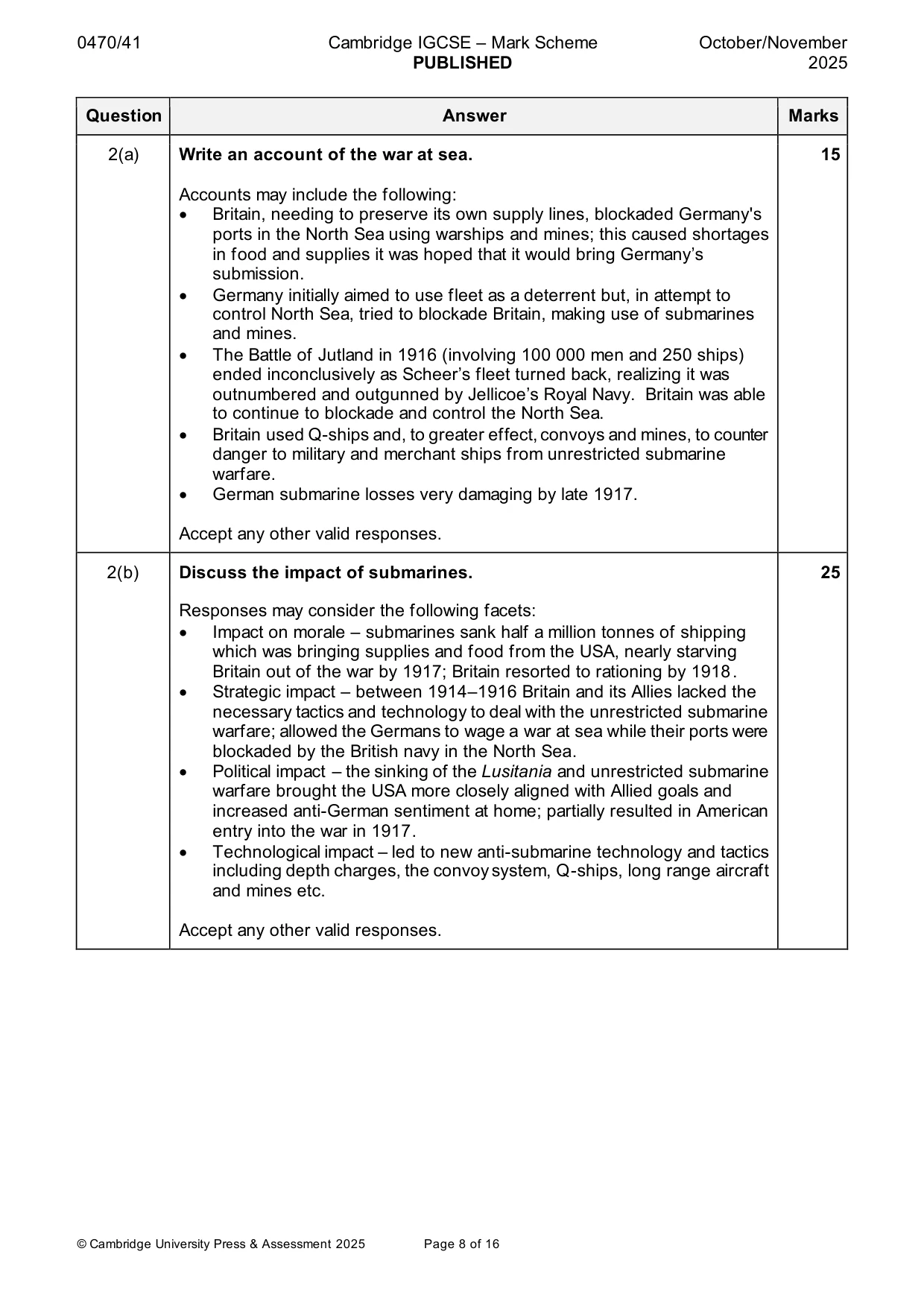
0470/41 Cambridge IGCSE – Mark Scheme PUBLISHED October/November 2025 © Cambridge University Press & Assessment 2025 Page 8 of 16 Question Answer Marks 2(a) Write an account of the war at sea. Accounts may include the following: • Britain, needing to preserve its own supply lines, blockaded Germany's ports in the North Sea using warships and mines; this caused shortages in food and supplies it was hoped that it would bring Germany’s submission. • Germany initially aimed to use fleet as a deterrent but, in attempt to control North Sea, tried to blockade Britain, making use of submarines and mines. • The Battle of Jutland in 1916 (involving 100 000 men and 250 ships) ended inconclusively as Scheer’s fleet turned back, realizing it was outnumbered and outgunned by Jellicoe’s Royal Navy. Britain was able to continue to blockade and control the North Sea. • Britain used Q-ships and, to greater effect, convoys and mines, to counter danger to military and merchant ships from unrestricted submarine warfare. • German submarine losses very damaging by late 1917. Accept any other valid responses. 15 2(b) Discuss the impact of submarines. Responses may consider the following facets: • Impact on morale – submarines sank half a million tonnes of shipping which was bringing supplies and food from the USA, nearly starving Britain out of the war by 1917; Britain resorted to rationing by 1918. • Strategic impact – between 1914–1916 Britain and its Allies lacked the necessary tactics and technology to deal with the unrestricted submarine warfare; allowed the Germans to wage a war at sea while their ports were blockaded by the British navy in the North Sea. • Political impact – the sinking of the Lusitania and unrestricted submarine warfare brought the USA more closely aligned with Allied goals and increased anti-German sentiment at home; partially resulted in American entry into the war in 1917. • Technological impact – led to new anti-submarine technology and tactics including depth charges, the convoy system, Q-ships, long range aircraft and mines etc. Accept any other valid responses. 25
Mark scheme, page 9
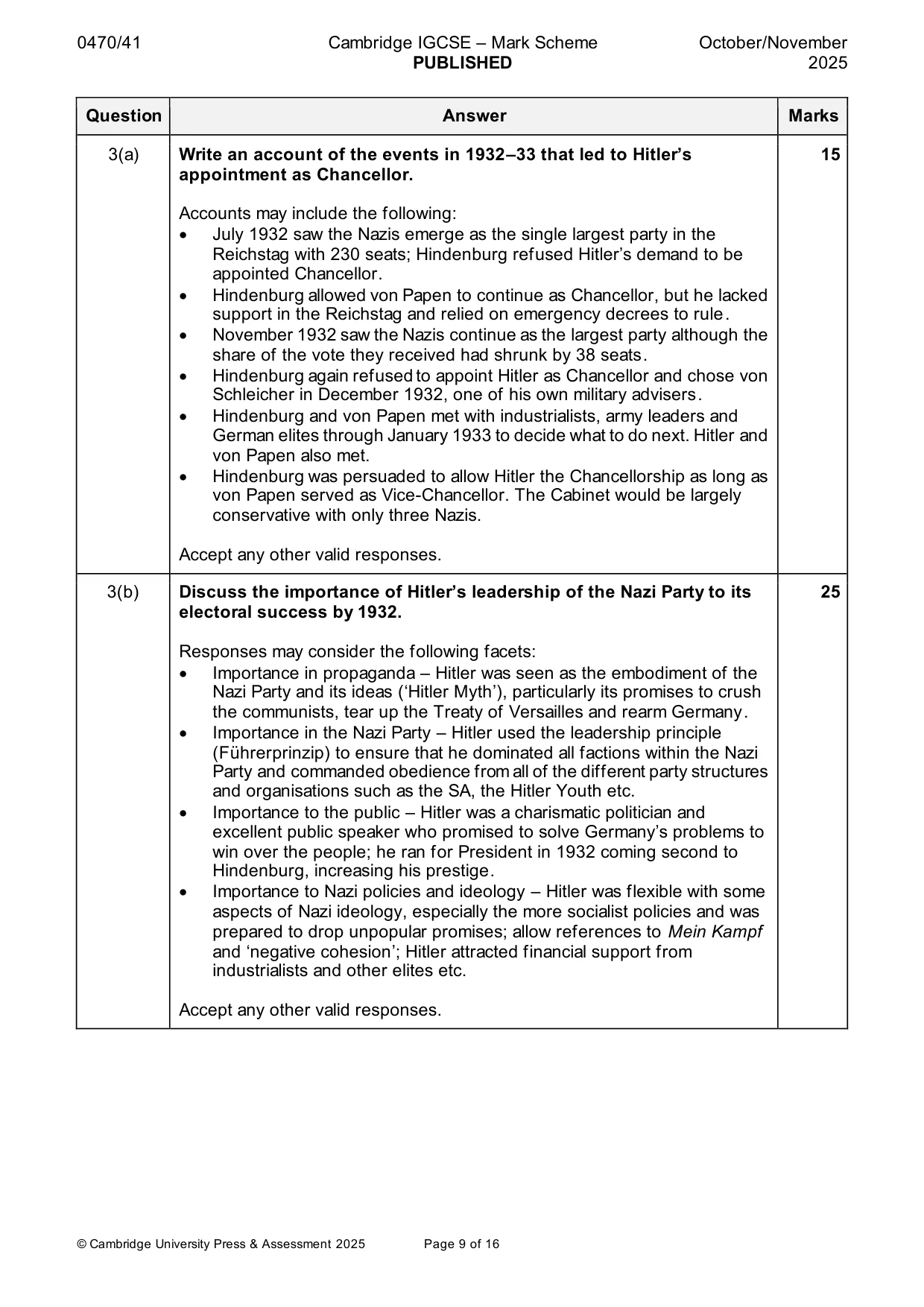
0470/41 Cambridge IGCSE – Mark Scheme PUBLISHED October/November 2025 © Cambridge University Press & Assessment 2025 Page 9 of 16 Question Answer Marks 3(a) Write an account of the events in 1932–33 that led to Hitler’s appointment as Chancellor. Accounts may include the following: • July 1932 saw the Nazis emerge as the single largest party in the Reichstag with 230 seats; Hindenburg refused Hitler’s demand to be appointed Chancellor. • Hindenburg allowed von Papen to continue as Chancellor, but he lacked support in the Reichstag and relied on emergency decrees to rule. • November 1932 saw the Nazis continue as the largest party although the share of the vote they received had shrunk by 38 seats. • Hindenburg again refused to appoint Hitler as Chancellor and chose von Schleicher in December 1932, one of his own military advisers. • Hindenburg and von Papen met with industrialists, army leaders and German elites through January 1933 to decide what to do next. Hitler and von Papen also met. • Hindenburg was persuaded to allow Hitler the Chancellorship as long as von Papen served as Vice-Chancellor. The Cabinet would be largely conservative with only three Nazis. Accept any other valid responses. 15 3(b) Discuss the importance of Hitler’s leadership of the Nazi Party to its electoral success by 1932. Responses may consider the following facets: • Importance in propaganda – Hitler was seen as the embodiment of the Nazi Party and its ideas (‘Hitler Myth’), particularly its promises to crush the communists, tear up the Treaty of Versailles and rearm Germany. • Importance in the Nazi Party – Hitler used the leadership principle (Führerprinzip) to ensure that he dominated all factions within the Nazi Party and commanded obedience from all of the different party structures and organisations such as the SA, the Hitler Youth etc. • Importance to the public – Hitler was a charismatic politician and excellent public speaker who promised to solve Germany’s problems to win over the people; he ran for President in 1932 coming second to Hindenburg, increasing his prestige. • Importance to Nazi policies and ideology – Hitler was flexible with some aspects of Nazi ideology, especially the more socialist policies and was prepared to drop unpopular promises; allow references to Mein Kampf and ‘negative cohesion’; Hitler attracted financial support from industrialists and other elites etc. Accept any other valid responses. 25
Mark scheme, page 10
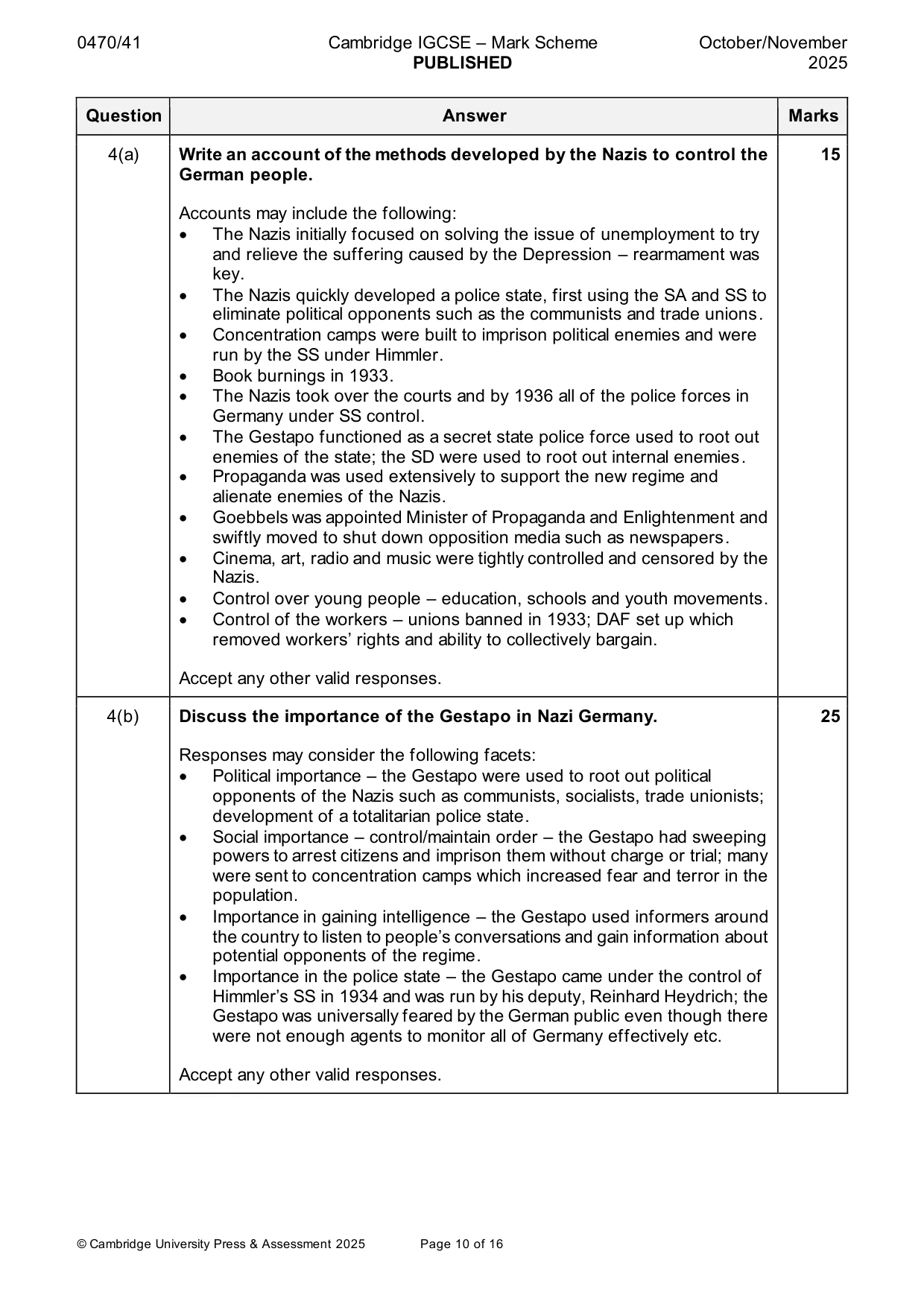
0470/41 Cambridge IGCSE – Mark Scheme PUBLISHED October/November 2025 © Cambridge University Press & Assessment 2025 Page 10 of 16 Question Answer Marks 4(a) Write an account of the methods developed by the Nazis to control the German people. Accounts may include the following: • The Nazis initially focused on solving the issue of unemployment to try and relieve the suffering caused by the Depression – rearmament was key. • The Nazis quickly developed a police state, first using the SA and SS to eliminate political opponents such as the communists and trade unions. • Concentration camps were built to imprison political enemies and were run by the SS under Himmler. • Book burnings in 1933. • The Nazis took over the courts and by 1936 all of the police forces in Germany under SS control. • The Gestapo functioned as a secret state police force used to root out enemies of the state; the SD were used to root out internal enemies. • Propaganda was used extensively to support the new regime and alienate enemies of the Nazis. • Goebbels was appointed Minister of Propaganda and Enlightenment and swiftly moved to shut down opposition media such as newspapers. • Cinema, art, radio and music were tightly controlled and censored by the Nazis. • Control over young people – education, schools and youth movements. • Control of the workers – unions banned in 1933; DAF set up which removed workers’ rights and ability to collectively bargain. Accept any other valid responses. 15 4(b) Discuss the importance of the Gestapo in Nazi Germany. Responses may consider the following facets: • Political importance – the Gestapo were used to root out political opponents of the Nazis such as communists, socialists, trade unionists; development of a totalitarian police state. • Social importance – control/maintain order – the Gestapo had sweeping powers to arrest citizens and imprison them without charge or trial; many were sent to concentration camps which increased fear and terror in the population. • Importance in gaining intelligence – the Gestapo used informers around the country to listen to people’s conversations and gain information about potential opponents of the regime. • Importance in the police state – the Gestapo came under the control of Himmler’s SS in 1934 and was run by his deputy, Reinhard Heydrich; the Gestapo was universally feared by the German public even though there were not enough agents to monitor all of Germany effectively etc. Accept any other valid responses. 25
Mark scheme, page 11
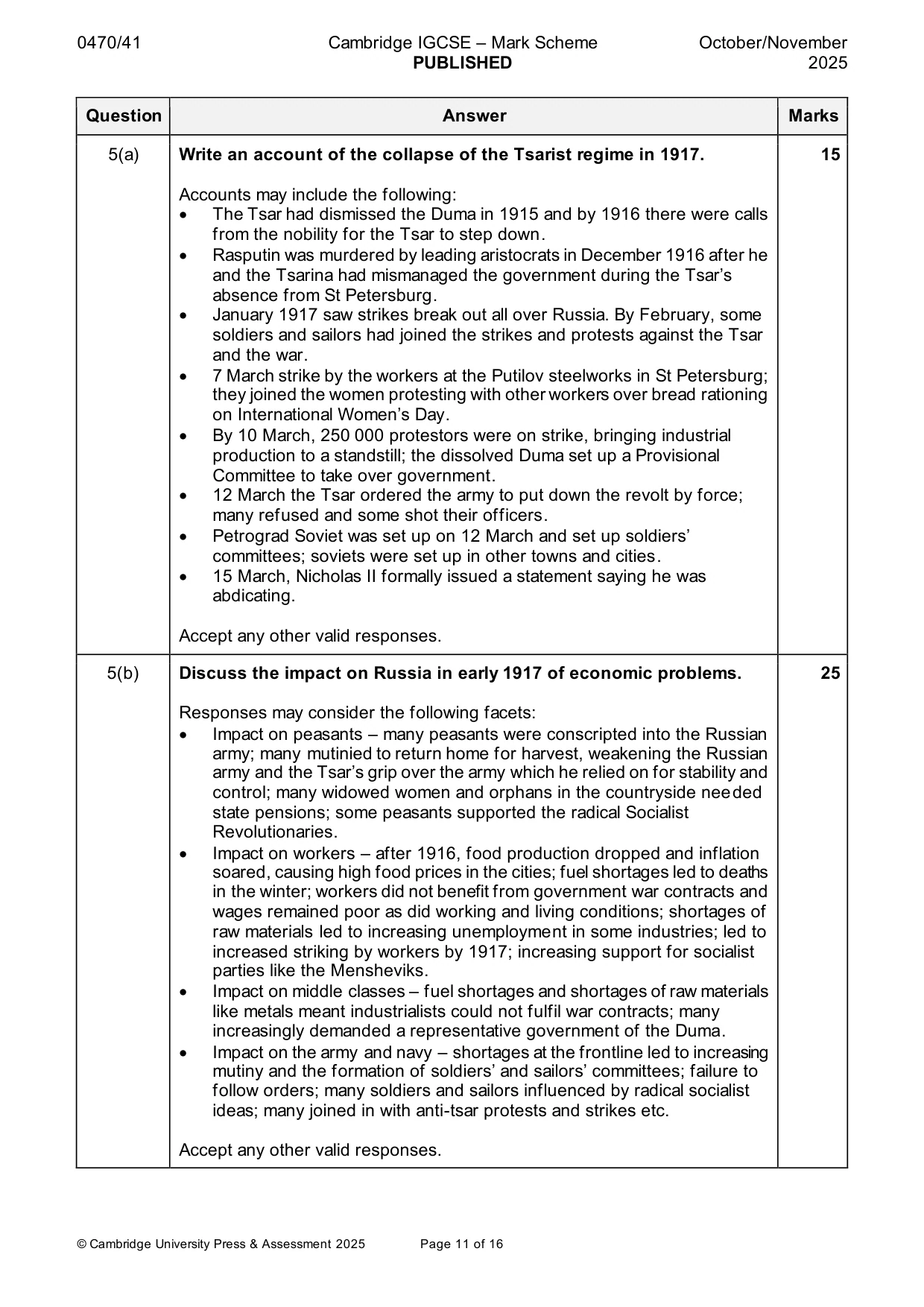
0470/41 Cambridge IGCSE – Mark Scheme PUBLISHED October/November 2025 © Cambridge University Press & Assessment 2025 Page 11 of 16 Question Answer Marks 5(a) Write an account of the collapse of the Tsarist regime in 1917. Accounts may include the following: • The Tsar had dismissed the Duma in 1915 and by 1916 there were calls from the nobility for the Tsar to step down. • Rasputin was murdered by leading aristocrats in December 1916 after he and the Tsarina had mismanaged the government during the Tsar’s absence from St Petersburg. • January 1917 saw strikes break out all over Russia. By February, some soldiers and sailors had joined the strikes and protests against the Tsar and the war. • 7 March strike by the workers at the Putilov steelworks in St Petersburg; they joined the women protesting with other workers over bread rationing on International Women’s Day. • By 10 March, 250 000 protestors were on strike, bringing industrial production to a standstill; the dissolved Duma set up a Provisional Committee to take over government. • 12 March the Tsar ordered the army to put down the revolt by force; many refused and some shot their officers. • Petrograd Soviet was set up on 12 March and set up soldiers’ committees; soviets were set up in other towns and cities. • 15 March, Nicholas II formally issued a statement saying he was abdicating. Accept any other valid responses. 15 5(b) Discuss the impact on Russia in early 1917 of economic problems. Responses may consider the following facets: • Impact on peasants – many peasants were conscripted into the Russian army; many mutinied to return home for harvest, weakening the Russian army and the Tsar’s grip over the army which he relied on for stability and control; many widowed women and orphans in the countryside needed state pensions; some peasants supported the radical Socialist Revolutionaries. • Impact on workers – after 1916, food production dropped and inflation soared, causing high food prices in the cities; fuel shortages led to deaths in the winter; workers did not benefit from government war contracts and wages remained poor as did working and living conditions; shortages of raw materials led to increasing unemployment in some industries; led to increased striking by workers by 1917; increasing support for socialist parties like the Mensheviks. • Impact on middle classes – fuel shortages and shortages of raw materials like metals meant industrialists could not fulfil war contracts; many increasingly demanded a representative government of the Duma. • Impact on the army and navy – shortages at the frontline led to increasing mutiny and the formation of soldiers’ and sailors’ committees; failure to follow orders; many soldiers and sailors influenced by radical socialist ideas; many joined in with anti-tsar protests and strikes etc. Accept any other valid responses. 25
Mark scheme, page 12
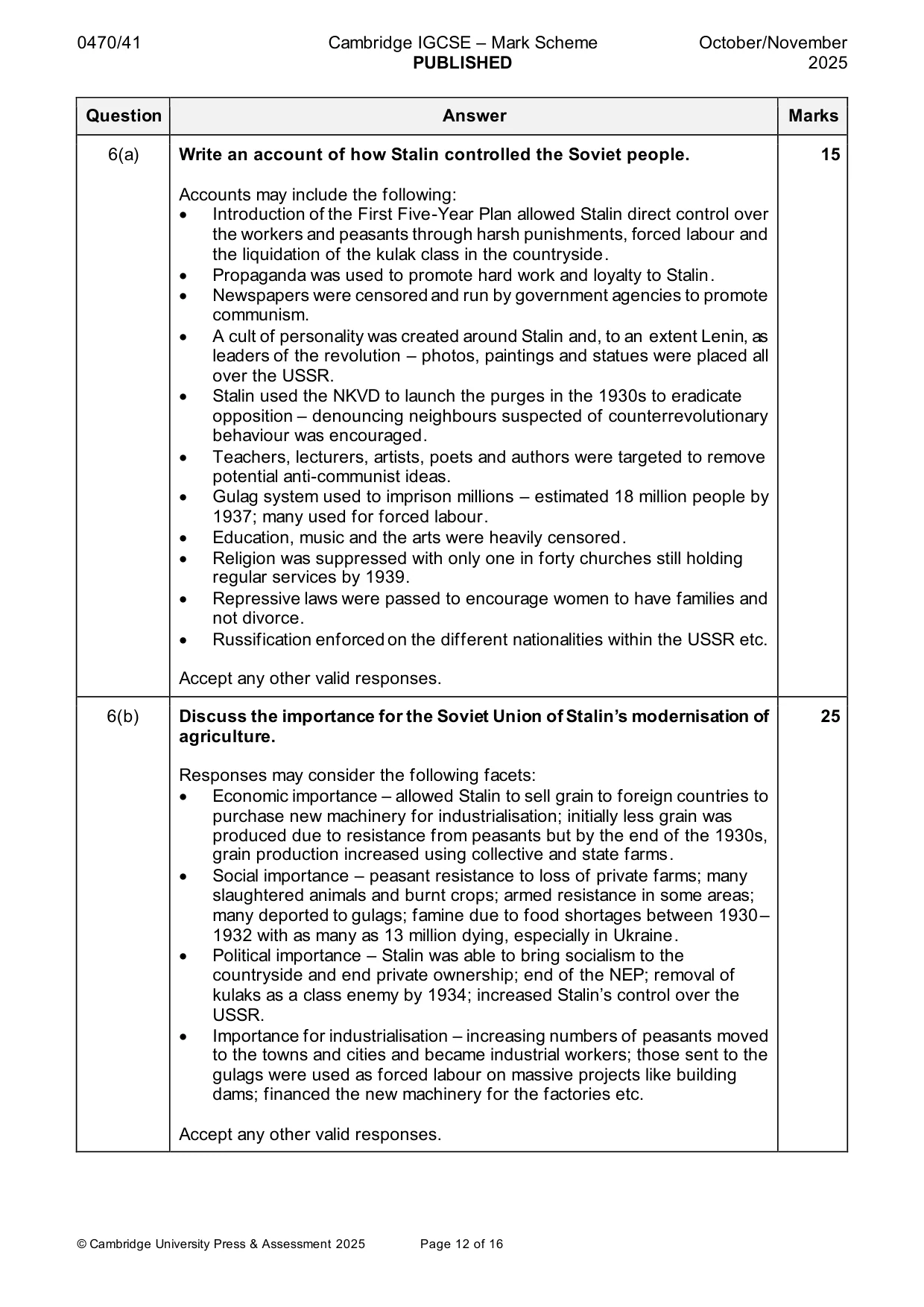
0470/41 Cambridge IGCSE – Mark Scheme PUBLISHED October/November 2025 © Cambridge University Press & Assessment 2025 Page 12 of 16 Question Answer Marks 6(a) Write an account of how Stalin controlled the Soviet people. Accounts may include the following: • Introduction of the First Five-Year Plan allowed Stalin direct control over the workers and peasants through harsh punishments, forced labour and the liquidation of the kulak class in the countryside. • Propaganda was used to promote hard work and loyalty to Stalin. • Newspapers were censored and run by government agencies to promote communism. • A cult of personality was created around Stalin and, to an extent Lenin, as leaders of the revolution – photos, paintings and statues were placed all over the USSR. • Stalin used the NKVD to launch the purges in the 1930s to eradicate opposition – denouncing neighbours suspected of counterrevolutionary behaviour was encouraged. • Teachers, lecturers, artists, poets and authors were targeted to remove potential anti-communist ideas. • Gulag system used to imprison millions – estimated 18 million people by 1937; many used for forced labour. • Education, music and the arts were heavily censored. • Religion was suppressed with only one in forty churches still holding regular services by 1939. • Repressive laws were passed to encourage women to have families and not divorce. • Russification enforced on the different nationalities within the USSR etc. Accept any other valid responses. 15 6(b) Discuss the importance for the Soviet Union of Stalin’s modernisation of agriculture. Responses may consider the following facets: • Economic importance – allowed Stalin to sell grain to foreign countries to purchase new machinery for industrialisation; initially less grain was produced due to resistance from peasants but by the end of the 1930s, grain production increased using collective and state farms. • Social importance – peasant resistance to loss of private farms; many slaughtered animals and burnt crops; armed resistance in some areas; many deported to gulags; famine due to food shortages between 1930– 1932 with as many as 13 million dying, especially in Ukraine. • Political importance – Stalin was able to bring socialism to the countryside and end private ownership; end of the NEP; removal of kulaks as a class enemy by 1934; increased Stalin’s control over the USSR. • Importance for industrialisation – increasing numbers of peasants moved to the towns and cities and became industrial workers; those sent to the gulags were used as forced labour on massive projects like building dams; financed the new machinery for the factories etc. Accept any other valid responses. 25
Mark scheme, page 13
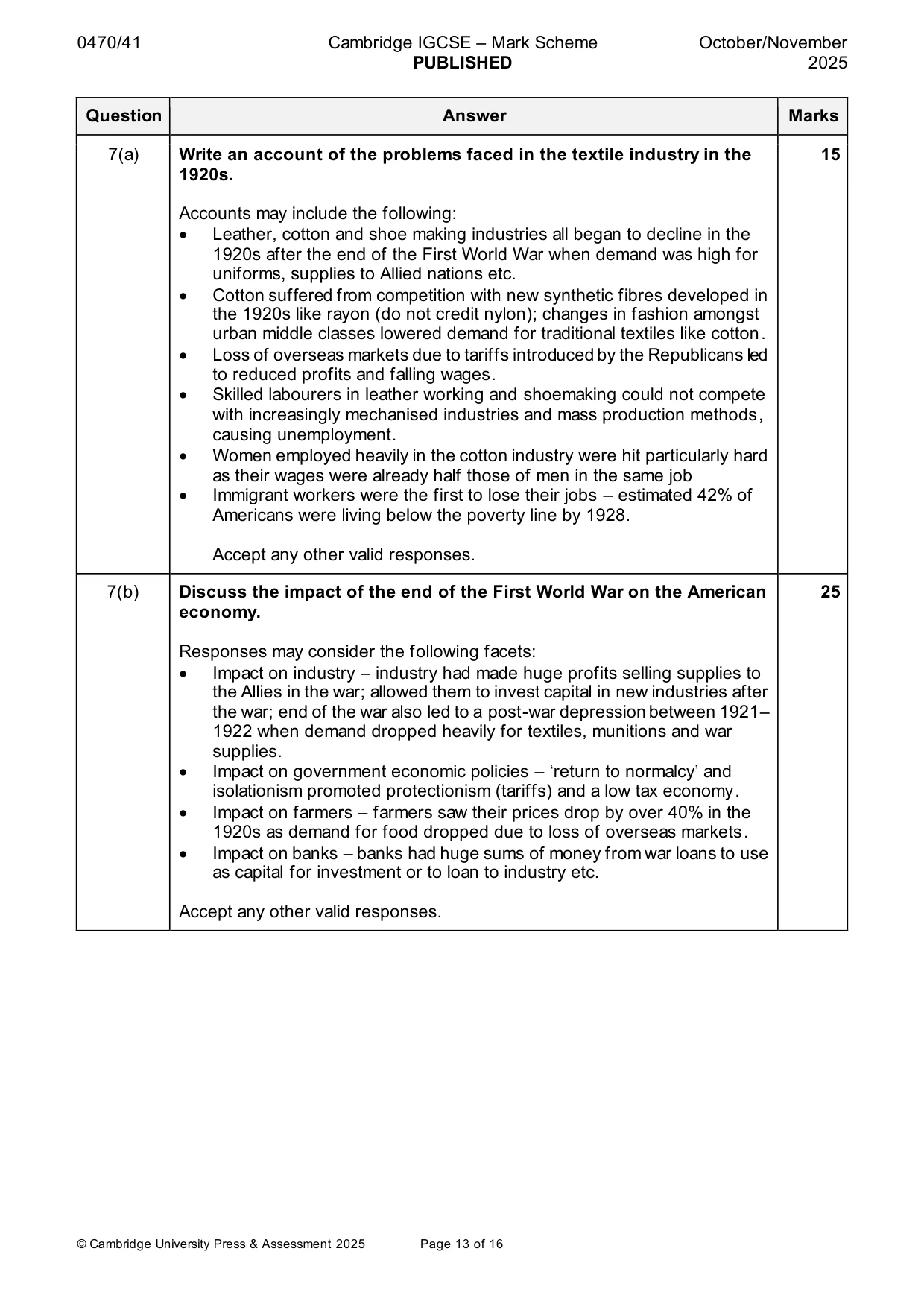
0470/41 Cambridge IGCSE – Mark Scheme PUBLISHED October/November 2025 © Cambridge University Press & Assessment 2025 Page 13 of 16 Question Answer Marks 7(a) Write an account of the problems faced in the textile industry in the 1920s. Accounts may include the following: • Leather, cotton and shoe making industries all began to decline in the 1920s after the end of the First World War when demand was high for uniforms, supplies to Allied nations etc. • Cotton suffered from competition with new synthetic fibres developed in the 1920s like rayon (do not credit nylon); changes in fashion amongst urban middle classes lowered demand for traditional textiles like cotton. • Loss of overseas markets due to tariffs introduced by the Republicans led to reduced profits and falling wages. • Skilled labourers in leather working and shoemaking could not compete with increasingly mechanised industries and mass production methods, causing unemployment. • Women employed heavily in the cotton industry were hit particularly hard as their wages were already half those of men in the same job • Immigrant workers were the first to lose their jobs – estimated 42% of Americans were living below the poverty line by 1928. Accept any other valid responses. 15 7(b) Discuss the impact of the end of the First World War on the American economy. Responses may consider the following facets: • Impact on industry – industry had made huge profits selling supplies to the Allies in the war; allowed them to invest capital in new industries after the war; end of the war also led to a post-war depression between 1921– 1922 when demand dropped heavily for textiles, munitions and war supplies. • Impact on government economic policies – ‘return to normalcy’ and isolationism promoted protectionism (tariffs) and a low tax economy. • Impact on farmers – farmers saw their prices drop by over 40% in the 1920s as demand for food dropped due to loss of overseas markets. • Impact on banks – banks had huge sums of money from war loans to use as capital for investment or to loan to industry etc. Accept any other valid responses. 25
Mark scheme, page 14
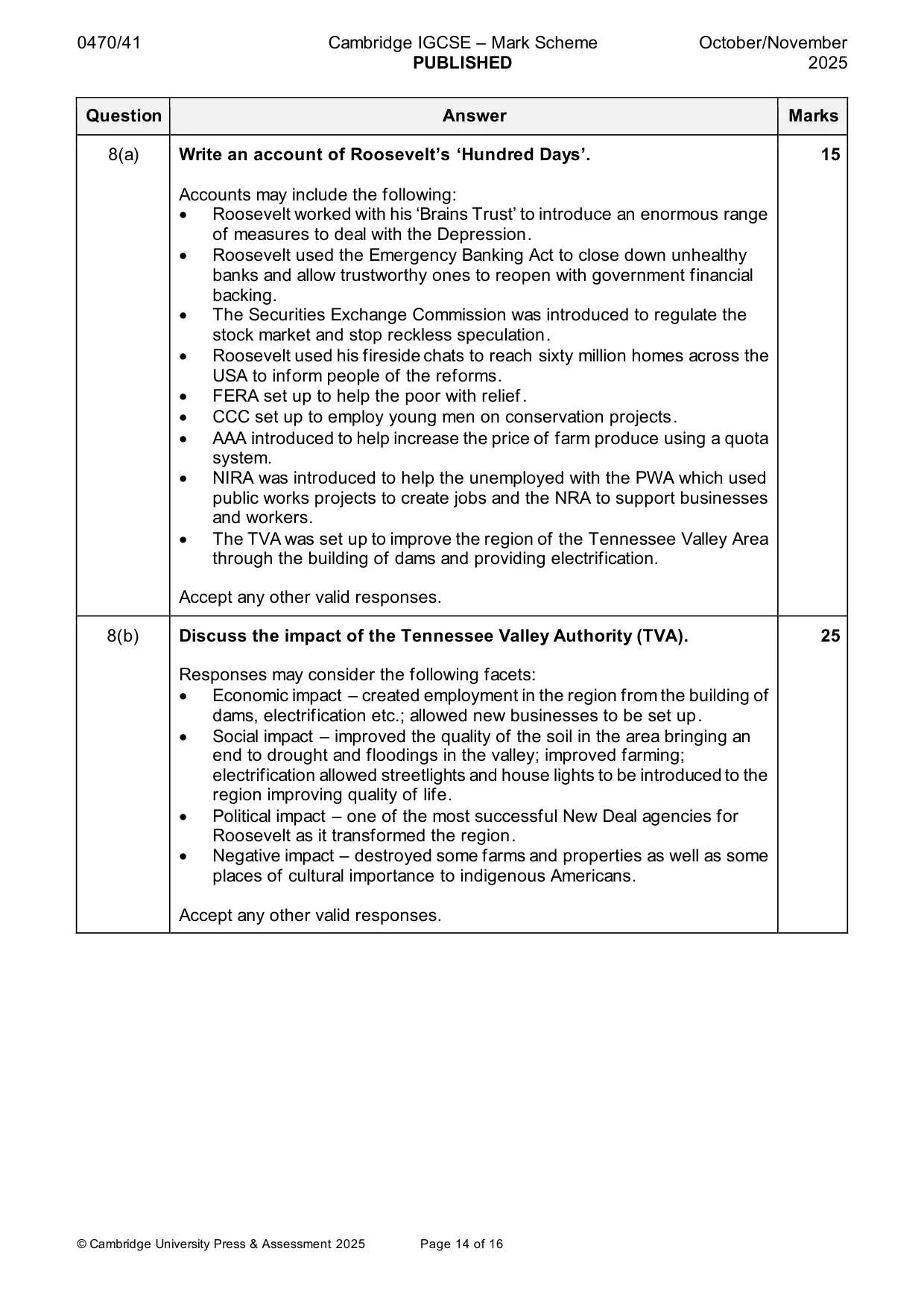
0470/41 Cambridge IGCSE – Mark Scheme PUBLISHED October/November 2025 © Cambridge University Press & Assessment 2025 Page 14 of 16 Question Answer Marks 8(a) Write an account of Roosevelt’s ‘Hundred Days’. Accounts may include the following: • Roosevelt worked with his ‘Brains Trust’ to introduce an enormous range of measures to deal with the Depression. • Roosevelt used the Emergency Banking Act to close down unhealthy banks and allow trustworthy ones to reopen with government financial backing. • The Securities Exchange Commission was introduced to regulate the stock market and stop reckless speculation. • Roosevelt used his fireside chats to reach sixty million homes across the USA to inform people of the reforms. • FERA set up to help the poor with relief. • CCC set up to employ young men on conservation projects. • AAA introduced to help increase the price of farm produce using a quota system. • NIRA was introduced to help the unemployed with the PWA which used public works projects to create jobs and the NRA to support businesses and workers. • The TVA was set up to improve the region of the Tennessee Valley Area through the building of dams and providing electrification. Accept any other valid responses. 15 8(b) Discuss the impact of the Tennessee Valley Authority (TVA). Responses may consider the following facets: • Economic impact – created employment in the region from the building of dams, electrification etc.; allowed new businesses to be set up. • Social impact – improved the quality of the soil in the area bringing an end to drought and floodings in the valley; improved farming; electrification allowed streetlights and house lights to be introduced to the region improving quality of life. • Political impact – one of the most successful New Deal agencies for Roosevelt as it transformed the region. • Negative impact – destroyed some farms and properties as well as some places of cultural importance to indigenous Americans. Accept any other valid responses. 25
Mark scheme, page 15
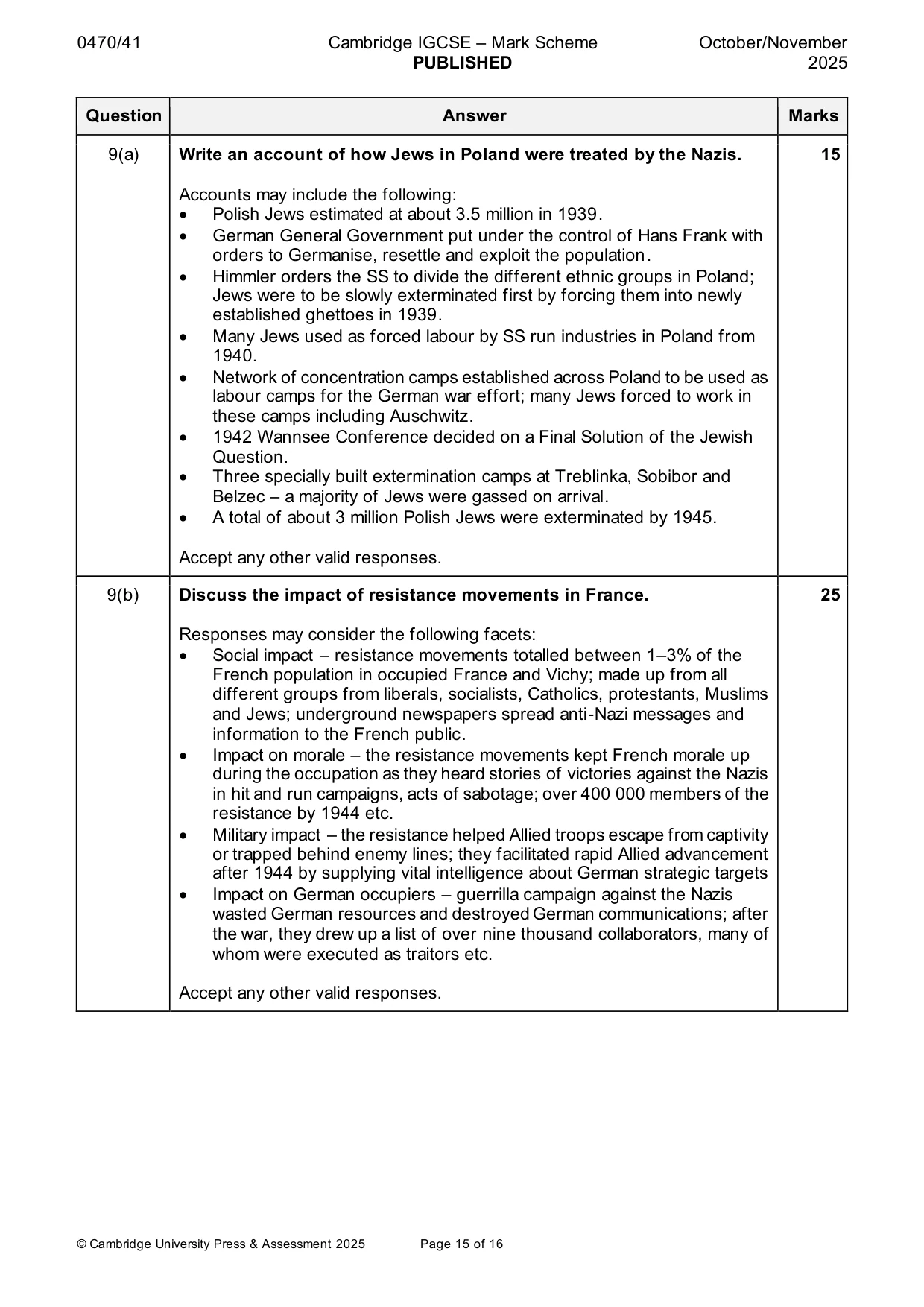
0470/41 Cambridge IGCSE – Mark Scheme PUBLISHED October/November 2025 © Cambridge University Press & Assessment 2025 Page 15 of 16 Question Answer Marks 9(a) Write an account of how Jews in Poland were treated by the Nazis. Accounts may include the following: • Polish Jews estimated at about 3.5 million in 1939. • German General Government put under the control of Hans Frank with orders to Germanise, resettle and exploit the population. • Himmler orders the SS to divide the different ethnic groups in Poland; Jews were to be slowly exterminated first by forcing them into newly established ghettoes in 1939. • Many Jews used as forced labour by SS run industries in Poland from 1940. • Network of concentration camps established across Poland to be used as labour camps for the German war effort; many Jews forced to work in these camps including Auschwitz. • 1942 Wannsee Conference decided on a Final Solution of the Jewish Question. • Three specially built extermination camps at Treblinka, Sobibor and Belzec – a majority of Jews were gassed on arrival. • A total of about 3 million Polish Jews were exterminated by 1945. Accept any other valid responses. 15 9(b) Discuss the impact of resistance movements in France. Responses may consider the following facets: • Social impact – resistance movements totalled between 1–3% of the French population in occupied France and Vichy; made up from all different groups from liberals, socialists, Catholics, protestants, Muslims and Jews; underground newspapers spread anti-Nazi messages and information to the French public. • Impact on morale – the resistance movements kept French morale up during the occupation as they heard stories of victories against the Nazis in hit and run campaigns, acts of sabotage; over 400 000 members of the resistance by 1944 etc. • Military impact – the resistance helped Allied troops escape from captivity or trapped behind enemy lines; they facilitated rapid Allied advancement after 1944 by supplying vital intelligence about German strategic targets • Impact on German occupiers – guerrilla campaign against the Nazis wasted German resources and destroyed German communications; after the war, they drew up a list of over nine thousand collaborators, many of whom were executed as traitors etc. Accept any other valid responses. 25
Mark scheme, page 16
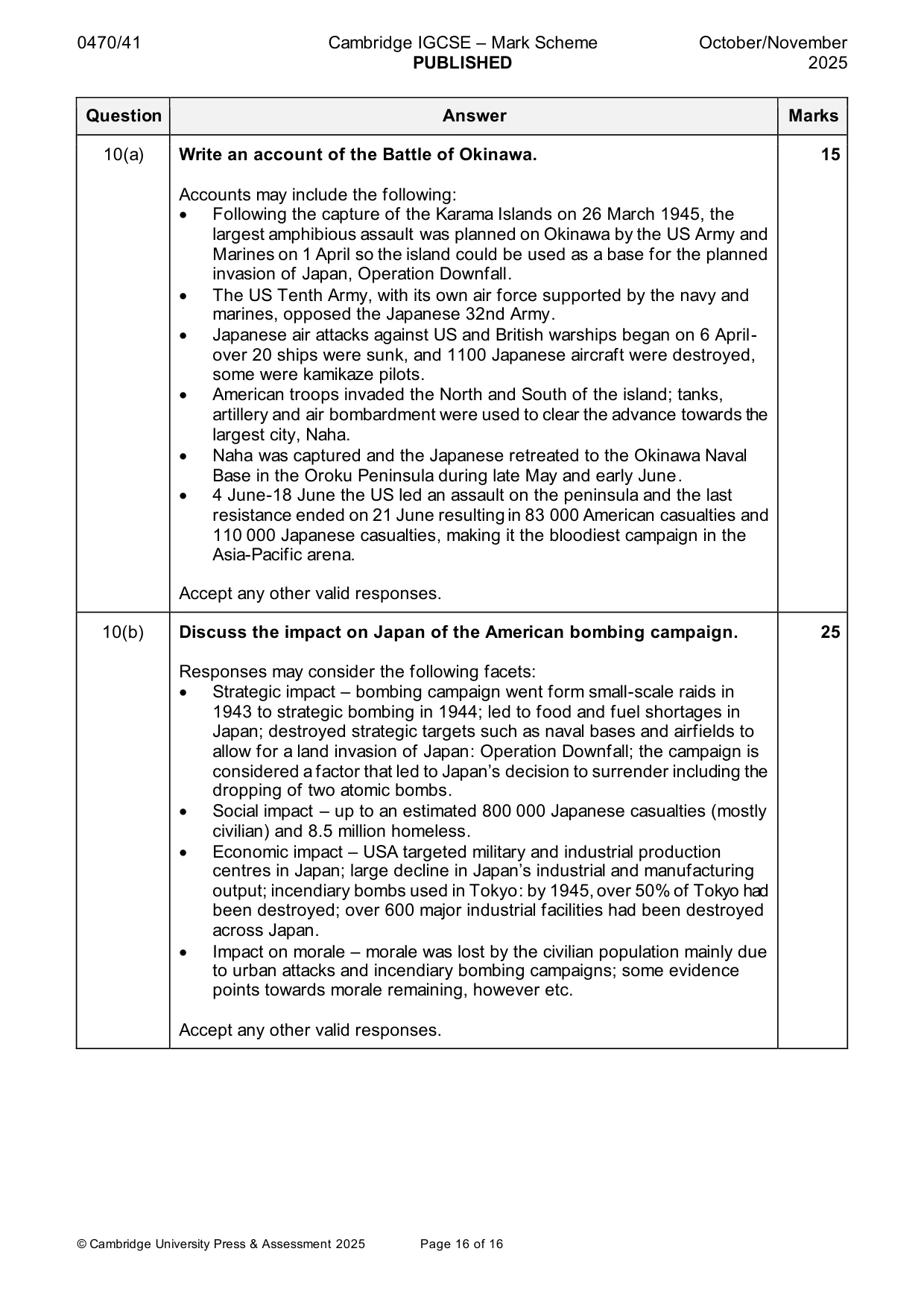
0470/41 Cambridge IGCSE – Mark Scheme PUBLISHED October/November 2025 © Cambridge University Press & Assessment 2025 Page 16 of 16 Question Answer Marks 10(a) Write an account of the Battle of Okinawa. Accounts may include the following: • Following the capture of the Karama Islands on 26 March 1945, the largest amphibious assault was planned on Okinawa by the US Army and Marines on 1 April so the island could be used as a base for the planned invasion of Japan, Operation Downfall. • The US Tenth Army, with its own air force supported by the navy and marines, opposed the Japanese 32nd Army. • Japanese air attacks against US and British warships began on 6 April- over 20 ships were sunk, and 1100 Japanese aircraft were destroyed, some were kamikaze pilots. • American troops invaded the North and South of the island; tanks, artillery and air bombardment were used to clear the advance towards the largest city, Naha. • Naha was captured and the Japanese retreated to the Okinawa Naval Base in the Oroku Peninsula during late May and early June. • 4 June-18 June the US led an assault on the peninsula and the last resistance ended on 21 June resulting in 83 000 American casualties and 110 000 Japanese casualties, making it the bloodiest campaign in the Asia-Pacific arena. Accept any other valid responses. 15 10(b) Discuss the impact on Japan of the American bombing campaign. Responses may consider the following facets: • Strategic impact – bombing campaign went form small-scale raids in 1943 to strategic bombing in 1944; led to food and fuel shortages in Japan; destroyed strategic targets such as naval bases and airfields to allow for a land invasion of Japan: Operation Downfall; the campaign is considered a factor that led to Japan’s decision to surrender including the dropping of two atomic bombs. • Social impact – up to an estimated 800 000 Japanese casualties (mostly civilian) and 8.5 million homeless. • Economic impact – USA targeted military and industrial production centres in Japan; large decline in Japan’s industrial and manufacturing output; incendiary bombs used in Tokyo: by 1945, over 50% of Tokyo had been destroyed; over 600 major industrial facilities had been destroyed across Japan. • Impact on morale – morale was lost by the civilian population mainly due to urban attacks and incendiary bombing campaigns; some evidence points towards morale remaining, however etc. Accept any other valid responses. 25
What you needed in this session
Cambridge’s own grade thresholds for 2025 Oct/Nov, Paper 4 · Variant 1. A higher threshold means an easier paper — the bar moves with how the cohort did.