Cambridge IGCSE History 0470 — 2025 Oct/Nov Paper 2 · Variant 3
0470/23/O/N/25 · 40 marks · 105 min
The question paper and its mark scheme, free to read here and free to download. This is Cambridge’s own paper, exactly as it was sat.
Question paper12 pages

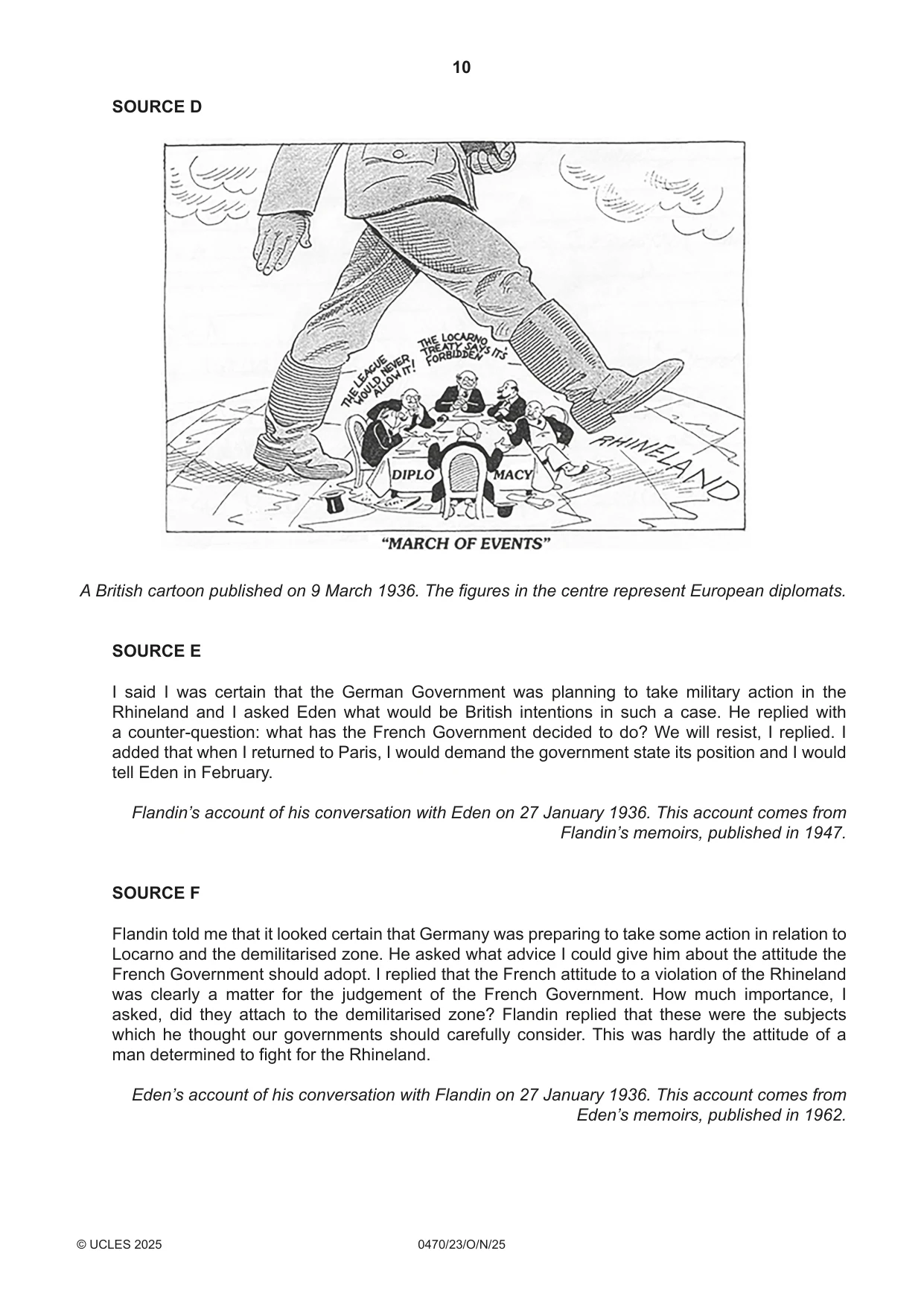
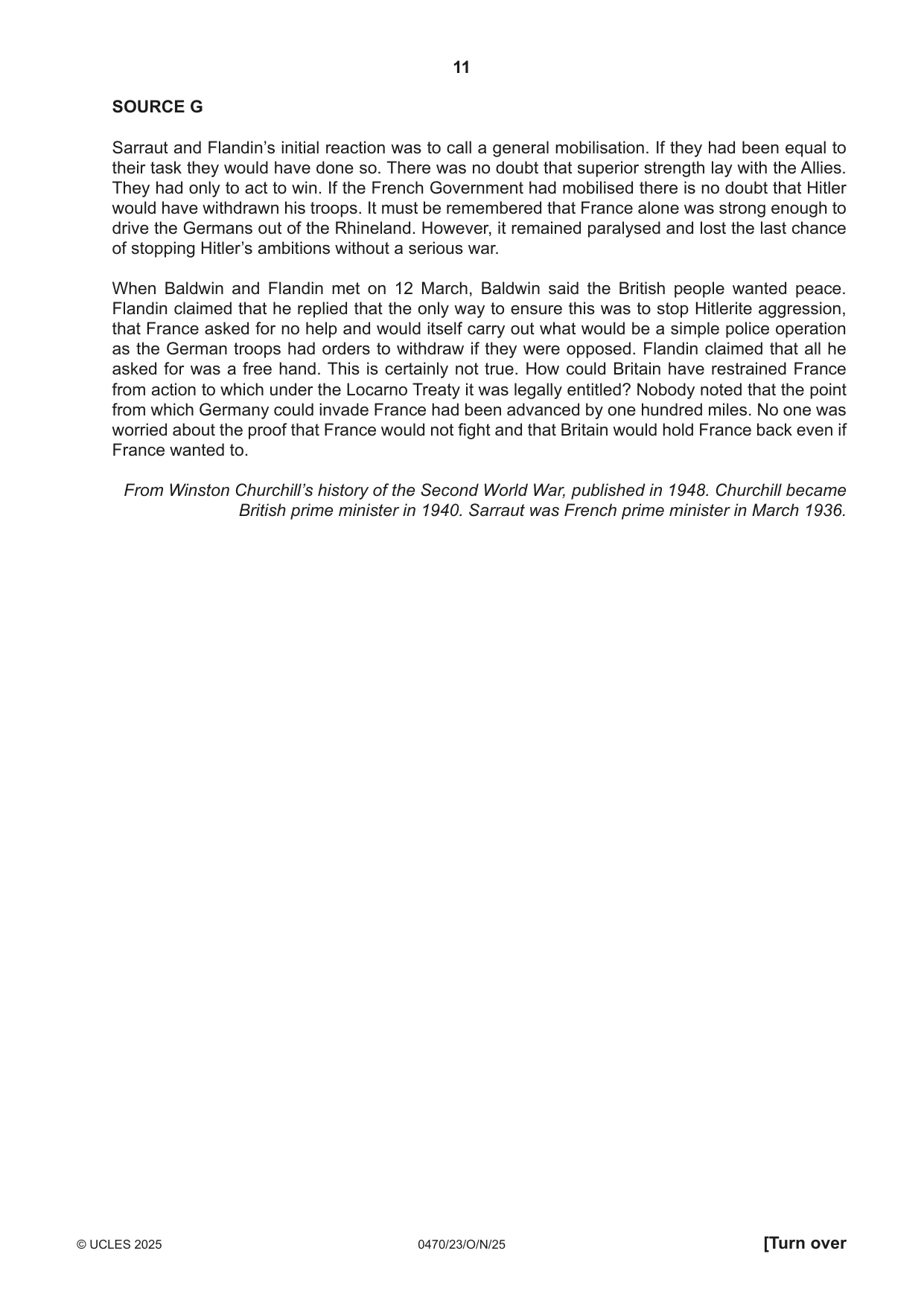
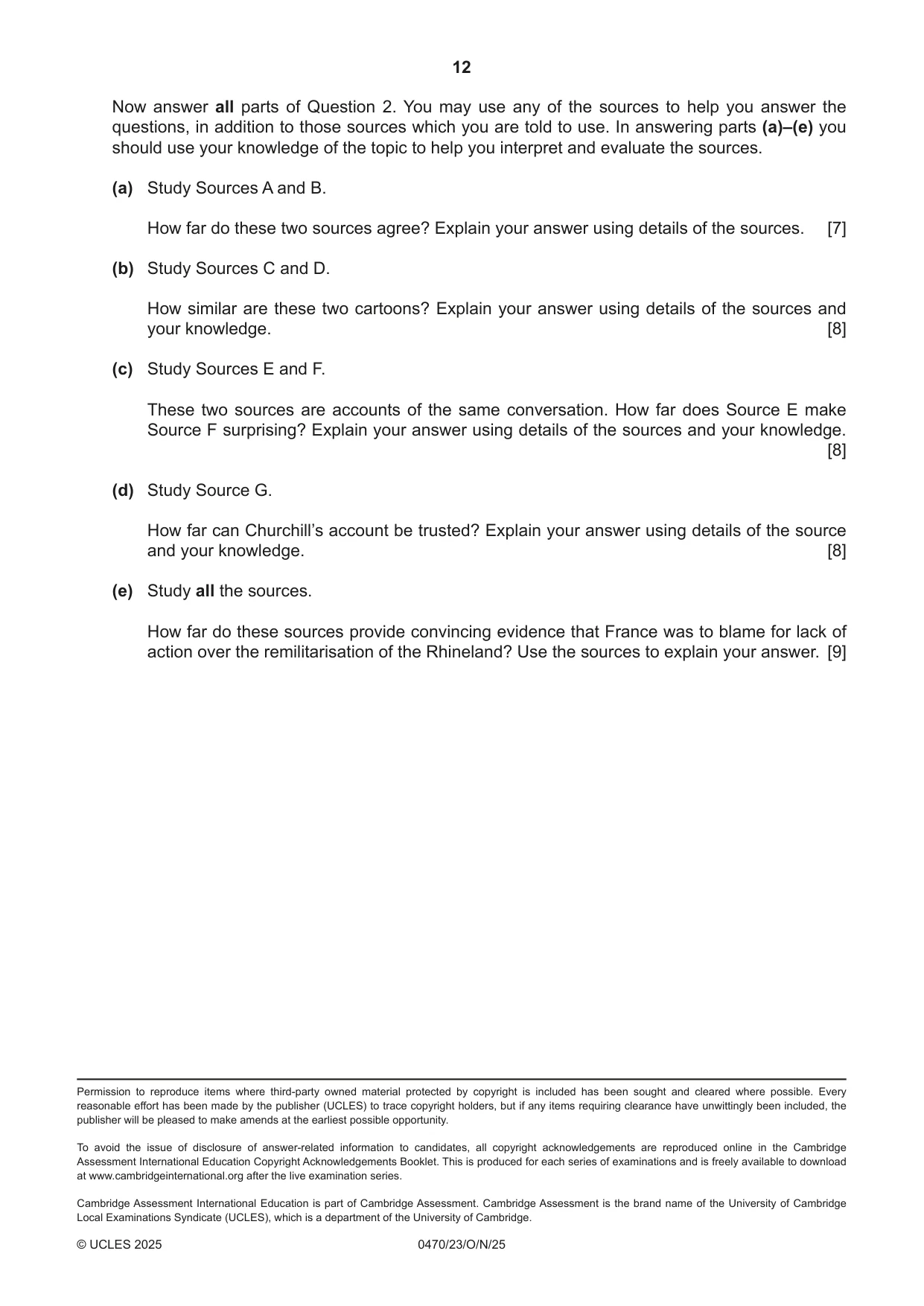
Mark scheme15 pages
Answers below. Sit the paper first if you are practising.
Paper as text
Question paper, page 1
This document has 12 pages. Any blank pages are indicated. [Turn over Cambridge IGCSE™ HISTORY 0470/23 Paper 2 Document Questions October/November 2025 1 hour 45 minutes You must answer on the enclosed answer booklet. You will need: Answer booklet (enclosed) INSTRUCTIONS ● Answer one question on one option only. Option A: Nineteenth century topic Option B: Twentieth century topic ● Follow the instructions on the front cover of the answer booklet. If you need additional answer paper, ask the invigilator for a continuation booklet. INFORMATION ● The total mark for this paper is 40. ● The number of marks for each question or part question is shown in brackets [ ]. * 4 5 3 5 2 6 3 6 8 8 * DC (CJ/SG) 343502/3 © UCLES 2025
Question paper, page 2
2 0470/23/O/N/25 © UCLES 2025 Option A: Nineteenth century topic 1 How keen was the North on fighting a civil war? Study the Background Information and the sources carefully, and then answer all the questions. Background Information During the first half of the nineteenth century, relations between the North and the South gradually grew worse. There were disagreements over slavery and states’ rights. Lincoln’s victory in the presidential election of 1860 made the situation worse. On 20 December, South Carolina voted to secede from the Union. Other Southern states followed, and in February 1861 the Confederacy was established. This left Lincoln and the North in a difficult position. Should a compromise with the South be sought? Were Lincoln and the North ready to go to war against Southerners who, until a few days before, had been fellow countrymen? Was it worth going to war to save the Union and abolish slavery? How keen was the North to fight a civil war? SOURCE A Before and during the first weeks after the start of Mr. Lincoln’s administration, there was a general feeling all over the North of looking for a peaceful solution to the crisis now upon the country. The Government seemed to be paralysed and the border states were active in their efforts to avert civil war. Fort Sumter was to be abandoned and the Northern people stood apparently powerless. But now the Government is aroused, the North is alive, and its divided people united. Drums are beating, men are enlisting, banners are flying, and money is pouring into the national treasury to put an end to the slaveholding rebellion. A united North was not expected by the slaveowning states, and there was much in the history of Northern obedience to the Slave Power to encourage this belief. But now the cry is for war to the bitter end. If the change in the popular feeling has been sudden, the causes leading to it have been long maturing. The Government has been patient and long-suffering. It had heard rebellious threats six months ago, it has seen seven states formally secede from the Union. However, when it saw an attempt to starve out Major Anderson and his men from Fort Sumter, feelings changed. One thing is now certain, the slaveholding rebellion and its leaders will be crushed. Let the Northern army confront them from one direction, a furious slave insurrection meet them at another, and starvation threaten them from still another. From a newspaper edited by Frederick Douglass, New York, May 1861. Douglass escaped from slavery in 1838 and became a leading abolitionist.
Question paper, page 3
3 0470/23/O/N/25 © UCLES 2025 [Turn over SOURCE B Before Lincoln’s presidency began, government remained in the hands of pro-Southern politicians who did little about the seceded states. However, as soon as Lincoln became President, he decided to send a military relief expedition to Fort Sumter. Once the Confederates had fired on Fort Sumter, many Northerners rallied to the Union’s defence. Wrongly thinking that victory was inevitable, many people in the North expressed great enthusiasm for the coming of the war. Big rallies and celebrations erupted in many major cities. This support for the war was due to the long years of disagreement with the South. Lincoln’s election was greeted with a feeling in the North that the country had thrown off the domination of the slaveholders, who had to be defeated. The unity and willingness of the North to fight surprised the South, which began to understand that independence would not be won without a fight. However, some people in the North were not happy about fighting a war to abolish slavery and the Copperheads, many of them in the North, firmly opposed the war. Opinion was also divided in the border states, with brother going against brother, and neighbour against neighbour. Here, there was little enthusiasm for a war. Military experts thought that it would be difficult for the North to achieve a victory. The South did not need to win, it just had to defend, while the North had to invade and conquer the Confederacy. From a recent history book about the Civil War. SOURCE C MEN OF NEW HAMPSHIRE! WILL YOU VOTE FOR THESE MEN? The declaration below shows the spirit of the traitors who are attempting to gain power in New Hampshire in their attempt to subvert our noble government. John George, Copperhead candidate for Congress, said the following: ‘Radical abolitionism must be put down. This great country will be shattered into fragments if it is not, or else we shall find ourselves brought under the iron rule of military despotism. I will not do a thing to support the President or the Government. I will not do anything that can be interpreted as supporting this war. I am personally acquainted with Jefferson Davis. He is a man of firmness of will and is the only one who could conduct the South through the present struggle. President Lincoln is a fool, an imbecile, a tyrant. The abolitionists are more dangerous than the Southern rebels. The war has been caused by abolitionists.’ From a poster published in New Hampshire, a Northern state, during elections for Congress, March 1863.
Question paper, page 4
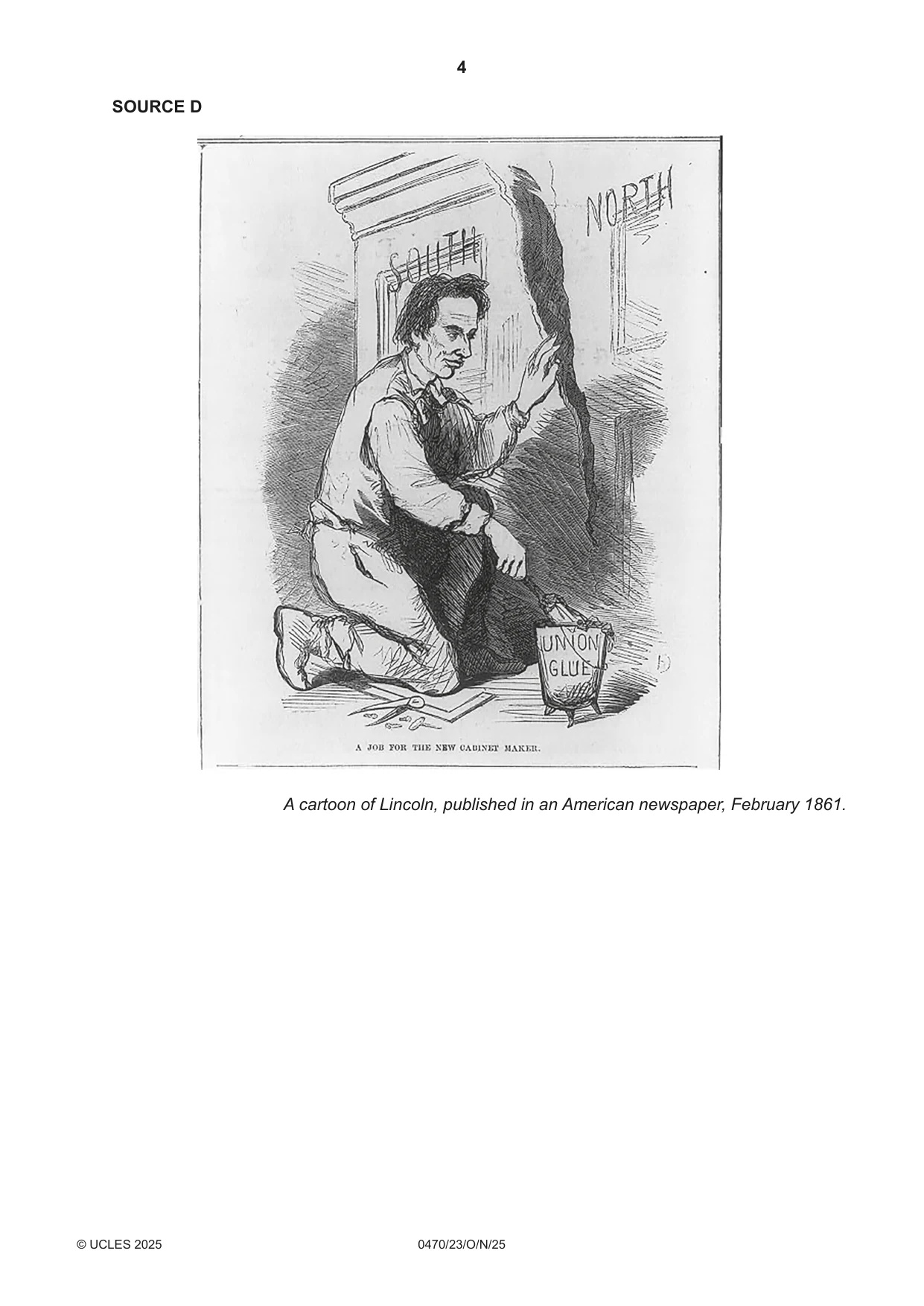
4 0470/23/O/N/25 © UCLES 2025 SOURCE D A cartoon of Lincoln, published in an American newspaper, February 1861.
Question paper, page 5
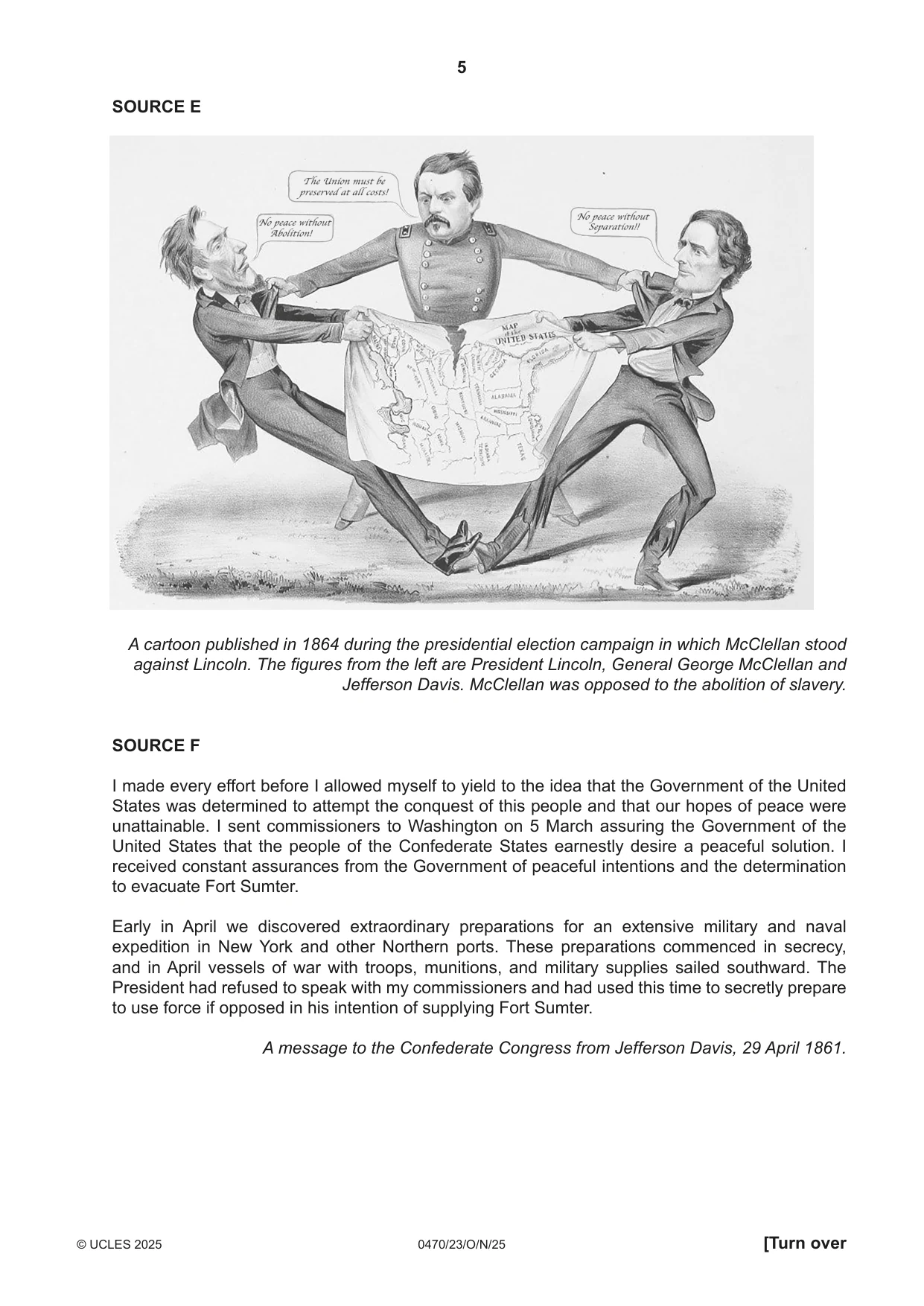
5 0470/23/O/N/25 © UCLES 2025 [Turn over SOURCE E A cartoon published in 1864 during the presidential election campaign in which McClellan stood against Lincoln. The figures from the left are President Lincoln, General George McClellan and Jefferson Davis. McClellan was opposed to the abolition of slavery. SOURCE F I made every effort before I allowed myself to yield to the idea that the Government of the United States was determined to attempt the conquest of this people and that our hopes of peace were unattainable. I sent commissioners to Washington on 5 March assuring the Government of the United States that the people of the Confederate States earnestly desire a peaceful solution. I received constant assurances from the Government of peaceful intentions and the determination to evacuate Fort Sumter. Early in April we discovered extraordinary preparations for an extensive military and naval expedition in New York and other Northern ports. These preparations commenced in secrecy, and in April vessels of war with troops, munitions, and military supplies sailed southward. The President had refused to speak with my commissioners and had used this time to secretly prepare to use force if opposed in his intention of supplying Fort Sumter. A message to the Confederate Congress from Jefferson Davis, 29 April 1861.
Question paper, page 6
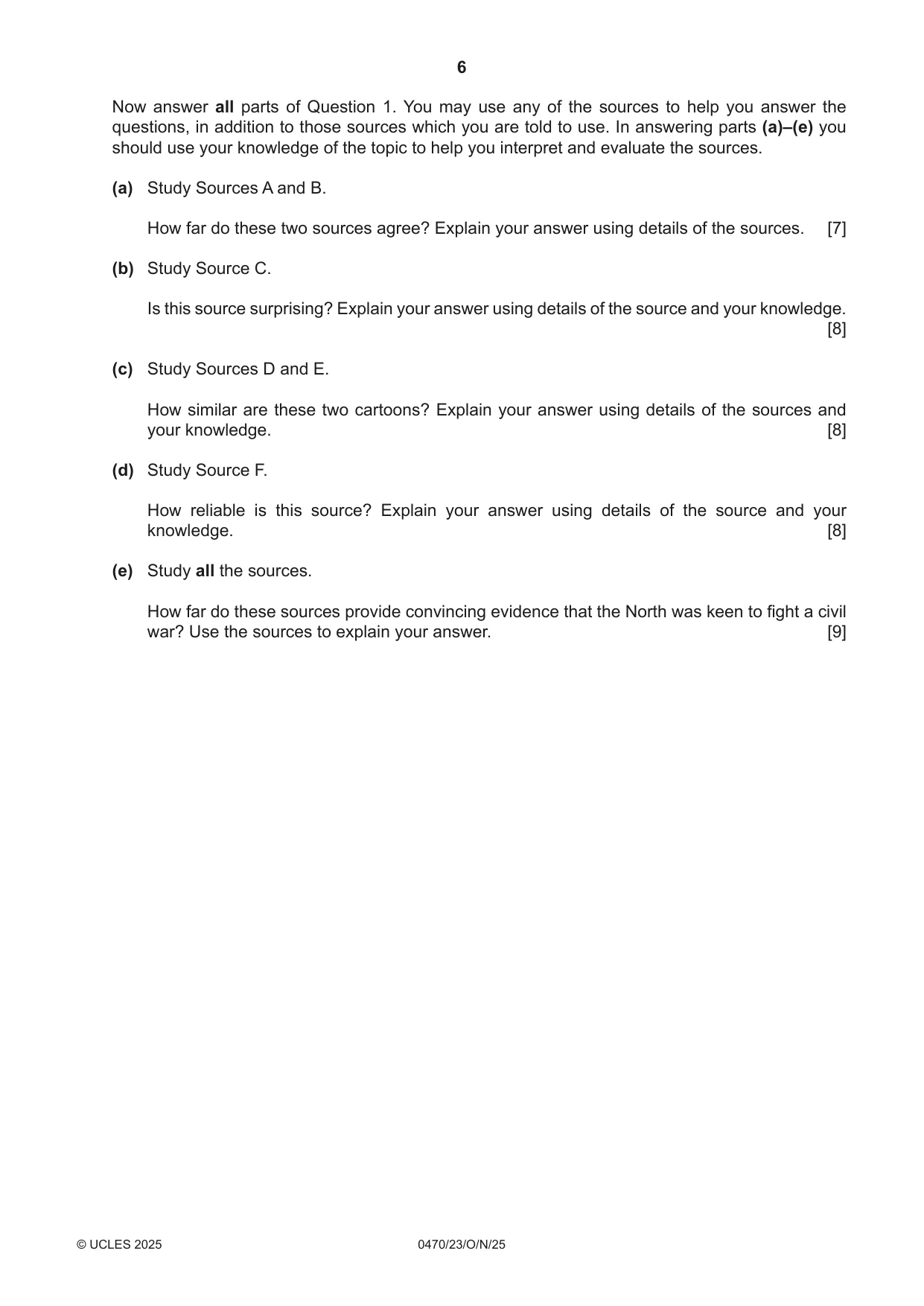
6 0470/23/O/N/25 © UCLES 2025 Now answer all parts of Question 1. You may use any of the sources to help you answer the questions, in addition to those sources which you are told to use. In answering parts (a)–(e) you should use your knowledge of the topic to help you interpret and evaluate the sources. (a) Study Sources A and B. How far do these two sources agree? Explain your answer using details of the sources. [7] (b) Study Source C. Is this source surprising? Explain your answer using details of the source and your knowledge. [8] (c) Study Sources D and E. How similar are these two cartoons? Explain your answer using details of the sources and your knowledge. [8] (d) Study Source F. How reliable is this source? Explain your answer using details of the source and your knowledge. [8] (e) Study all the sources. How far do these sources provide convincing evidence that the North was keen to fight a civil war? Use the sources to explain your answer. [9]
Question paper, page 7
7 0470/23/O/N/25 © UCLES 2025 [Turn over BLANK PAGE
Question paper, page 8
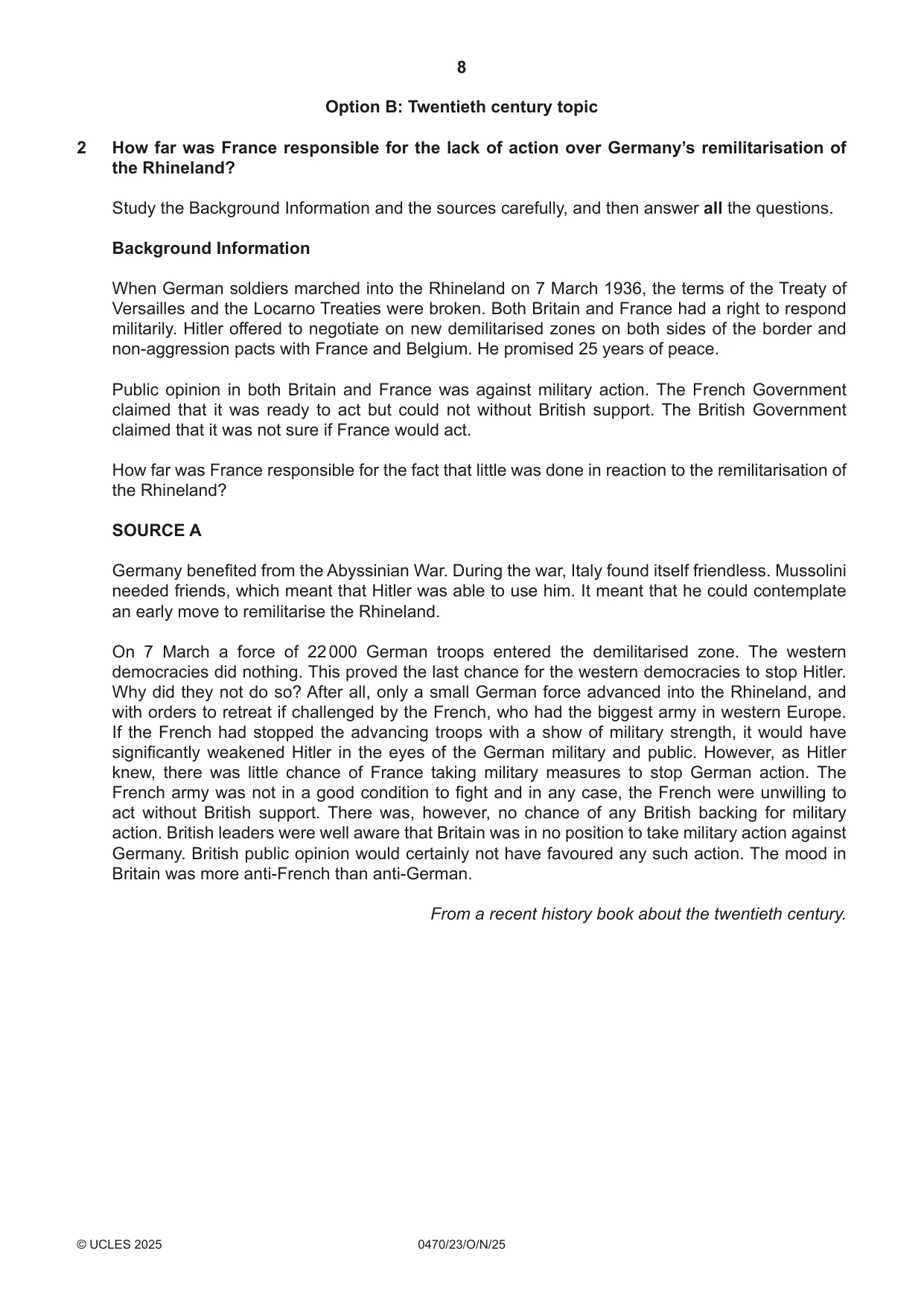
8 0470/23/O/N/25 © UCLES 2025 Option B: Twentieth century topic 2 How far was France responsible for the lack of action over Germany’s remilitarisation of the Rhineland? Study the Background Information and the sources carefully, and then answer all the questions. Background Information When German soldiers marched into the Rhineland on 7 March 1936, the terms of the Treaty of Versailles and the Locarno Treaties were broken. Both Britain and France had a right to respond militarily. Hitler offered to negotiate on new demilitarised zones on both sides of the border and non-aggression pacts with France and Belgium. He promised 25 years of peace. Public opinion in both Britain and France was against military action. The French Government claimed that it was ready to act but could not without British support. The British Government claimed that it was not sure if France would act. How far was France responsible for the fact that little was done in reaction to the remilitarisation of the Rhineland? SOURCE A Germany benefited from the Abyssinian War. During the war, Italy found itself friendless. Mussolini needed friends, which meant that Hitler was able to use him. It meant that he could contemplate an early move to remilitarise the Rhineland. On 7 March a force of 22 000 German troops entered the demilitarised zone. The western democracies did nothing. This proved the last chance for the western democracies to stop Hitler. Why did they not do so? After all, only a small German force advanced into the Rhineland, and with orders to retreat if challenged by the French, who had the biggest army in western Europe. If the French had stopped the advancing troops with a show of military strength, it would have significantly weakened Hitler in the eyes of the German military and public. However, as Hitler knew, there was little chance of France taking military measures to stop German action. The French army was not in a good condition to fight and in any case, the French were unwilling to act without British support. There was, however, no chance of any British backing for military action. British leaders were well aware that Britain was in no position to take military action against Germany. British public opinion would certainly not have favoured any such action. The mood in Britain was more anti-French than anti-German. From a recent history book about the twentieth century.
Question paper, page 9
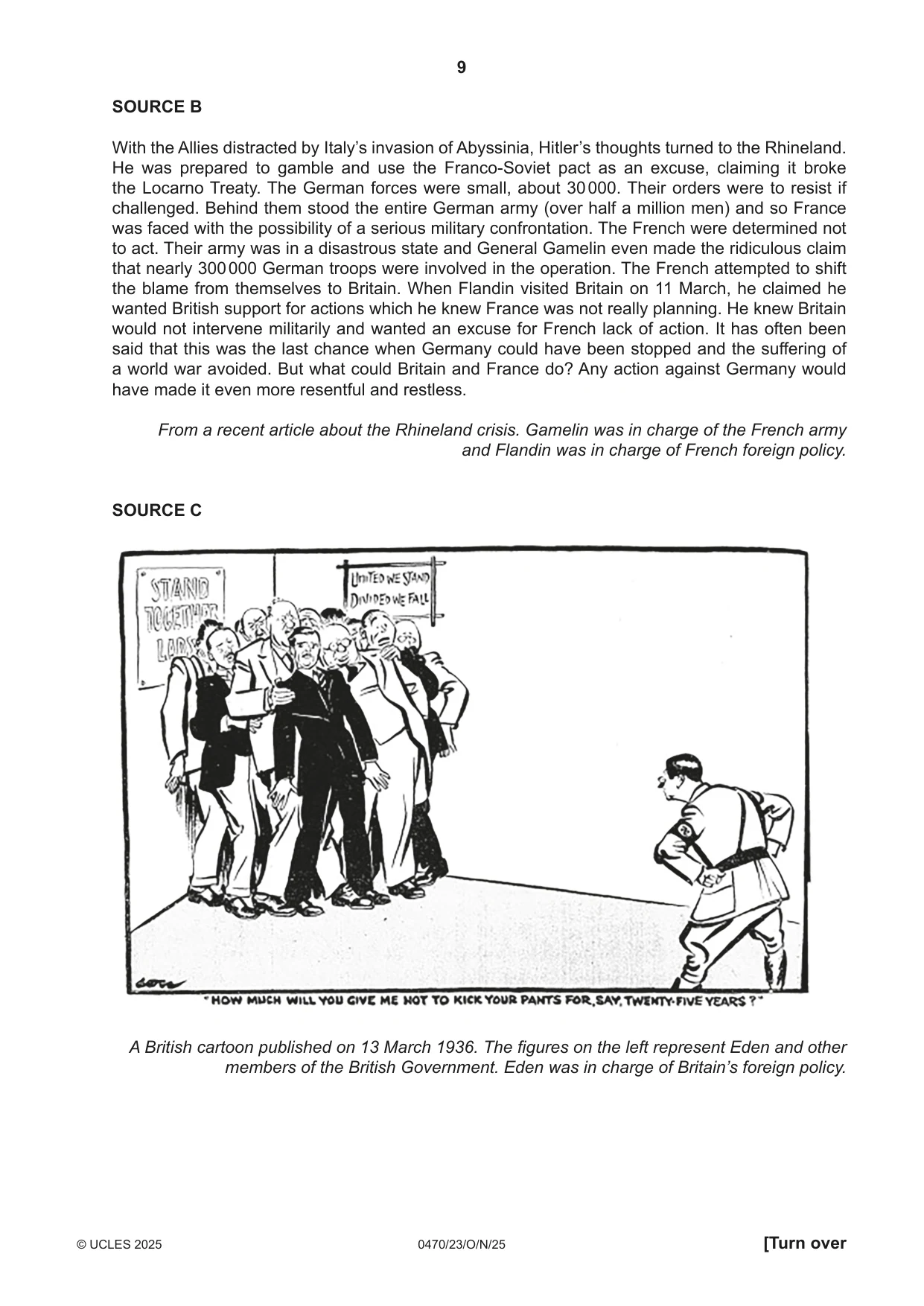
9 0470/23/O/N/25 © UCLES 2025 [Turn over SOURCE B With the Allies distracted by Italy’s invasion of Abyssinia, Hitler’s thoughts turned to the Rhineland. He was prepared to gamble and use the Franco-Soviet pact as an excuse, claiming it broke the Locarno Treaty. The German forces were small, about 30 000. Their orders were to resist if challenged. Behind them stood the entire German army (over half a million men) and so France was faced with the possibility of a serious military confrontation. The French were determined not to act. Their army was in a disastrous state and General Gamelin even made the ridiculous claim that nearly 300 000 German troops were involved in the operation. The French attempted to shift the blame from themselves to Britain. When Flandin visited Britain on 11 March, he claimed he wanted British support for actions which he knew France was not really planning. He knew Britain would not intervene militarily and wanted an excuse for French lack of action. It has often been said that this was the last chance when Germany could have been stopped and the suffering of a world war avoided. But what could Britain and France do? Any action against Germany would have made it even more resentful and restless. From a recent article about the Rhineland crisis. Gamelin was in charge of the French army and Flandin was in charge of French foreign policy. SOURCE C A British cartoon published on 13 March 1936. The figures on the left represent Eden and other members of the British Government. Eden was in charge of Britain’s foreign policy.
Question paper, page 10
10 0470/23/O/N/25 © UCLES 2025 SOURCE D A British cartoon published on 9 March 1936. The figures in the centre represent European diplomats. SOURCE E I said I was certain that the German Government was planning to take military action in the Rhineland and I asked Eden what would be British intentions in such a case. He replied with a counter-question: what has the French Government decided to do? We will resist, I replied. I added that when I returned to Paris, I would demand the government state its position and I would tell Eden in February. Flandin’s account of his conversation with Eden on 27 January 1936. This account comes from Flandin’s memoirs, published in 1947. SOURCE F Flandin told me that it looked certain that Germany was preparing to take some action in relation to Locarno and the demilitarised zone. He asked what advice I could give him about the attitude the French Government should adopt. I replied that the French attitude to a violation of the Rhineland was clearly a matter for the judgement of the French Government. How much importance, I asked, did they attach to the demilitarised zone? Flandin replied that these were the subjects which he thought our governments should carefully consider. This was hardly the attitude of a man determined to fight for the Rhineland. Eden’s account of his conversation with Flandin on 27 January 1936. This account comes from Eden’s memoirs, published in 1962.
Question paper, page 11
11 0470/23/O/N/25 © UCLES 2025 [Turn over SOURCE G Sarraut and Flandin’s initial reaction was to call a general mobilisation. If they had been equal to their task they would have done so. There was no doubt that superior strength lay with the Allies. They had only to act to win. If the French Government had mobilised there is no doubt that Hitler would have withdrawn his troops. It must be remembered that France alone was strong enough to drive the Germans out of the Rhineland. However, it remained paralysed and lost the last chance of stopping Hitler’s ambitions without a serious war. When Baldwin and Flandin met on 12 March, Baldwin said the British people wanted peace. Flandin claimed that he replied that the only way to ensure this was to stop Hitlerite aggression, that France asked for no help and would itself carry out what would be a simple police operation as the German troops had orders to withdraw if they were opposed. Flandin claimed that all he asked for was a free hand. This is certainly not true. How could Britain have restrained France from action to which under the Locarno Treaty it was legally entitled? Nobody noted that the point from which Germany could invade France had been advanced by one hundred miles. No one was worried about the proof that France would not fight and that Britain would hold France back even if France wanted to. From Winston Churchill’s history of the Second World War, published in 1948. Churchill became British prime minister in 1940. Sarraut was French prime minister in March 1936.
Question paper, page 12
12 0470/23/O/N/25 © UCLES 2025 Permission to reproduce items where third-party owned material protected by copyright is included has been sought and cleared where possible. Every reasonable effort has been made by the publisher (UCLES) to trace copyright holders, but if any items requiring clearance have unwittingly been included, the publisher will be pleased to make amends at the earliest possible opportunity. To avoid the issue of disclosure of answer-related information to candidates, all copyright acknowledgements are reproduced online in the Cambridge Assessment International Education Copyright Acknowledgements Booklet. This is produced for each series of examinations and is freely available to download at www.cambridgeinternational.org after the live examination series. Cambridge Assessment International Education is part of Cambridge Assessment. Cambridge Assessment is the brand name of the University of Cambridge Local Examinations Syndicate (UCLES), which is a department of the University of Cambridge. Now answer all parts of Question 2. You may use any of the sources to help you answer the questions, in addition to those sources which you are told to use. In answering parts (a)–(e) you should use your knowledge of the topic to help you interpret and evaluate the sources. (a) Study Sources A and B. How far do these two sources agree? Explain your answer using details of the sources. [7] (b) Study Sources C and D. How similar are these two cartoons? Explain your answer using details of the sources and your knowledge. [8] (c) Study Sources E and F. These two sources are accounts of the same conversation. How far does Source E make Source F surprising? Explain your answer using details of the sources and your knowledge. [8] (d) Study Source G. How far can Churchill’s account be trusted? Explain your answer using details of the source and your knowledge. [8] (e) Study all the sources. How far do these sources provide convincing evidence that France was to blame for lack of action over the remilitarisation of the Rhineland? Use the sources to explain your answer. [9]
Mark scheme, page 1
This document consists of 15 printed pages. © Cambridge University Press & Assessment 2025 [Turn over Cambridge IGCSE™ HISTORY 0470/23 Paper 2 October/November 2025 MARK SCHEME Maximum Mark: 40 Published This mark scheme is published as an aid to teachers and candidates, to indicate the requirements of the examination. It shows the basis on which Examiners were instructed to award marks. It does not indicate the details of the discussions that took place at an Examiners’ meeting before marking began, which would have considered the acceptability of alternative answers. Mark schemes should be read in conjunction with the question paper and the Principal Examiner Report for Teachers. Cambridge International will not enter into discussions about these mark schemes. Cambridge International is publishing the mark schemes for the October/November 2025 series for most Cambridge IGCSE, Cambridge International A and AS Level components, and some Cambridge O Level components.
Mark scheme, page 2
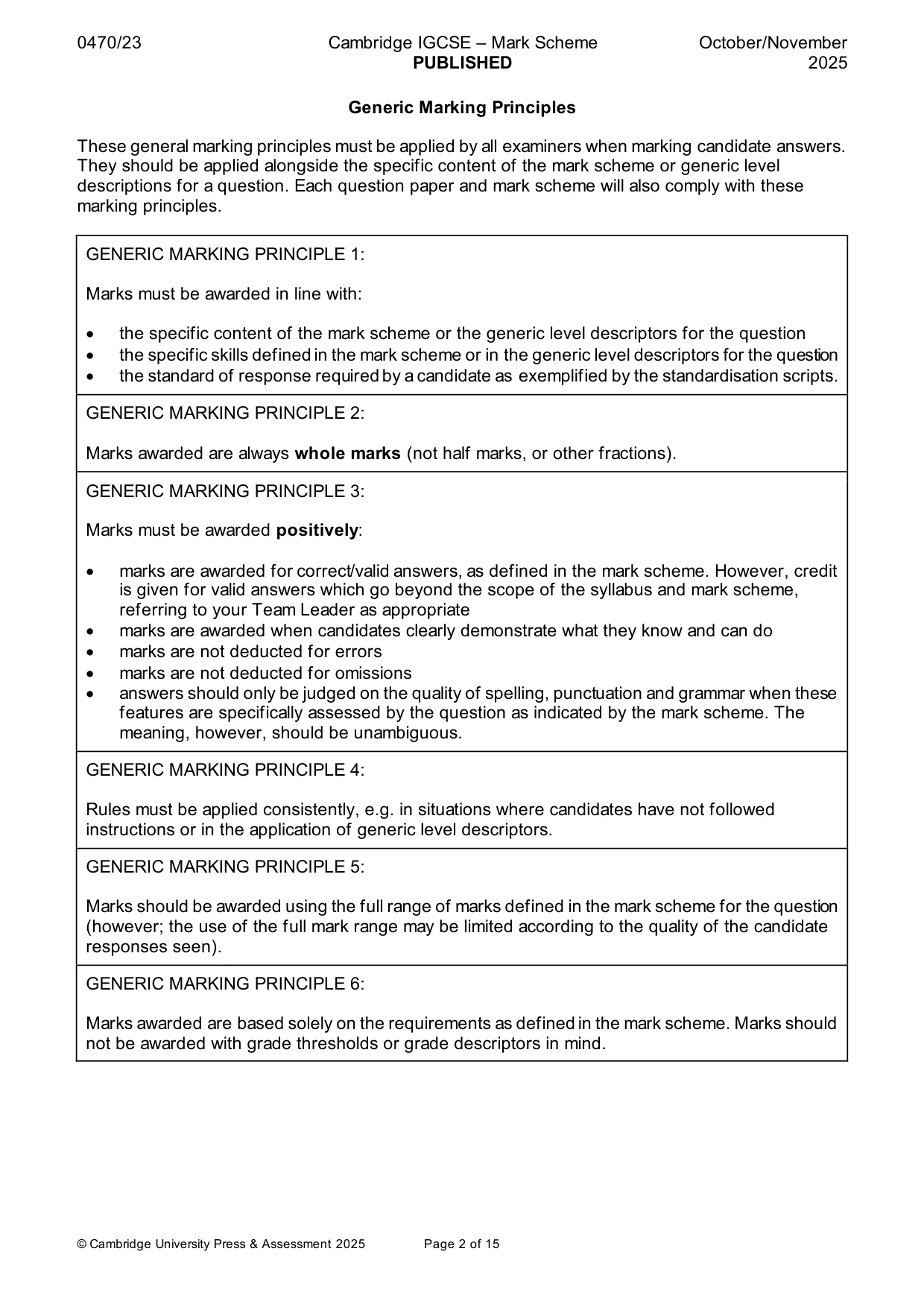
0470/23 Cambridge IGCSE – Mark Scheme PUBLISHED October/November 2025 © Cambridge University Press & Assessment 2025 Page 2 of 15 Generic Marking Principles These general marking principles must be applied by all examiners when marking candidate answers. They should be applied alongside the specific content of the mark scheme or generic level descriptions for a question. Each question paper and mark scheme will also comply with these marking principles. GENERIC MARKING PRINCIPLE 1: Marks must be awarded in line with: • the specific content of the mark scheme or the generic level descriptors for the question • the specific skills defined in the mark scheme or in the generic level descriptors for the question • the standard of response required by a candidate as exemplified by the standardisation scripts. GENERIC MARKING PRINCIPLE 2: Marks awarded are always whole marks (not half marks, or other fractions). GENERIC MARKING PRINCIPLE 3: Marks must be awarded positively: • marks are awarded for correct/valid answers, as defined in the mark scheme. However, credit is given for valid answers which go beyond the scope of the syllabus and mark scheme, referring to your Team Leader as appropriate • marks are awarded when candidates clearly demonstrate what they know and can do • marks are not deducted for errors • marks are not deducted for omissions • answers should only be judged on the quality of spelling, punctuation and grammar when these features are specifically assessed by the question as indicated by the mark scheme. The meaning, however, should be unambiguous. GENERIC MARKING PRINCIPLE 4: Rules must be applied consistently, e.g. in situations where candidates have not followed instructions or in the application of generic level descriptors. GENERIC MARKING PRINCIPLE 5: Marks should be awarded using the full range of marks defined in the mark scheme for the question (however; the use of the full mark range may be limited according to the quality of the candidate responses seen). GENERIC MARKING PRINCIPLE 6: Marks awarded are based solely on the requirements as defined in the mark scheme. Marks should not be awarded with grade thresholds or grade descriptors in mind.
Mark scheme, page 3
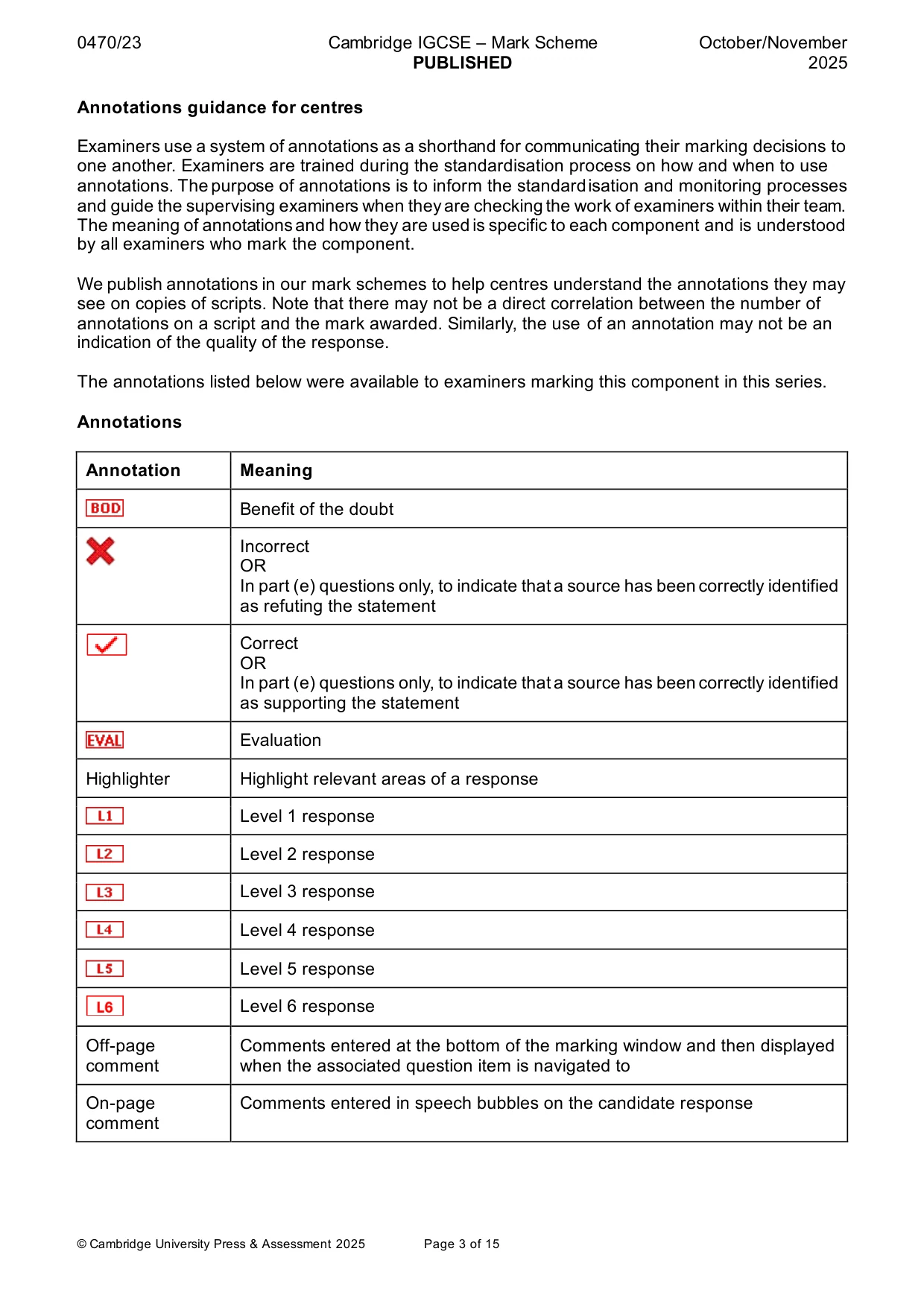
0470/23 Cambridge IGCSE – Mark Scheme PUBLISHED October/November 2025 © Cambridge University Press & Assessment 2025 Page 3 of 15 Annotations guidance for centres Examiners use a system of annotations as a shorthand for communicating their marking decisions to one another. Examiners are trained during the standardisation process on how and when to use annotations. The purpose of annotations is to inform the standardisation and monitoring processes and guide the supervising examiners when they are checking the work of examiners within their team. The meaning of annotations and how they are used is specific to each component and is understood by all examiners who mark the component. We publish annotations in our mark schemes to help centres understand the annotations they may see on copies of scripts. Note that there may not be a direct correlation between the number of annotations on a script and the mark awarded. Similarly, the use of an annotation may not be an indication of the quality of the response. The annotations listed below were available to examiners marking this component in this series. Annotations Annotation Meaning Benefit of the doubt Incorrect OR In part (e) questions only, to indicate that a source has been correctly identified as refuting the statement Correct OR In part (e) questions only, to indicate that a source has been correctly identified as supporting the statement Evaluation Highlighter Highlight relevant areas of a response Level 1 response Level 2 response Level 3 response Level 4 response Level 5 response Level 6 response Off-page comment Comments entered at the bottom of the marking window and then displayed when the associated question item is navigated to On-page comment Comments entered in speech bubbles on the candidate response
Mark scheme, page 4
0470/23 Cambridge IGCSE – Mark Scheme PUBLISHED October/November 2025 © Cambridge University Press & Assessment 2025 Page 4 of 15 Annotation Meaning To indicate that a point has been noted but no credit has been given OR To indicate that a blank page has been checked for creditable content Does not address the question
Mark scheme, page 5
0470/23 Cambridge IGCSE – Mark Scheme PUBLISHED October/November 2025 © Cambridge University Press & Assessment 2025 Page 5 of 15 Assessment objectives AO1 An ability to recall, select, organise and deploy knowledge of the syllabus content. AO3 An ability to understand, interpret, evaluate and use a range of sources as evidence, in their historical context.
Mark scheme, page 6
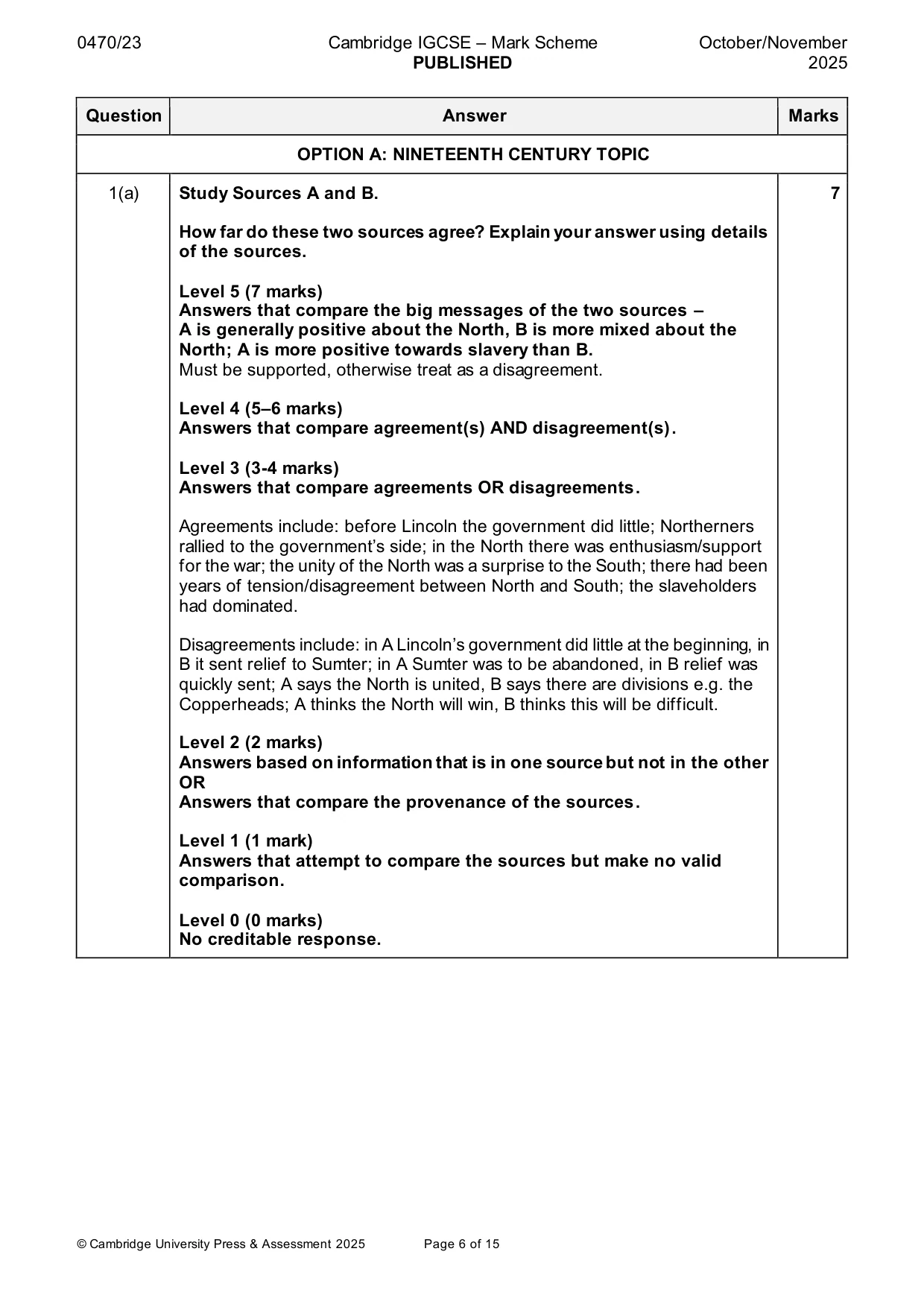
0470/23 Cambridge IGCSE – Mark Scheme PUBLISHED October/November 2025 © Cambridge University Press & Assessment 2025 Page 6 of 15 Question Answer Marks OPTION A: NINETEENTH CENTURY TOPIC 1(a) Study Sources A and B. How far do these two sources agree? Explain your answer using details of the sources. Level 5 (7 marks) Answers that compare the big messages of the two sources – A is generally positive about the North, B is more mixed about the North; A is more positive towards slavery than B. Must be supported, otherwise treat as a disagreement. Level 4 (5–6 marks) Answers that compare agreement(s) AND disagreement(s). Level 3 (3-4 marks) Answers that compare agreements OR disagreements. Agreements include: before Lincoln the government did little; Northerners rallied to the government’s side; in the North there was enthusiasm/support for the war; the unity of the North was a surprise to the South; there had been years of tension/disagreement between North and South; the slaveholders had dominated. Disagreements include: in A Lincoln’s government did little at the beginning, in B it sent relief to Sumter; in A Sumter was to be abandoned, in B relief was quickly sent; A says the North is united, B says there are divisions e.g. the Copperheads; A thinks the North will win, B thinks this will be difficult. Level 2 (2 marks) Answers based on information that is in one source but not in the other OR Answers that compare the provenance of the sources. Level 1 (1 mark) Answers that attempt to compare the sources but make no valid comparison. Level 0 (0 marks) No creditable response. 7
Mark scheme, page 7
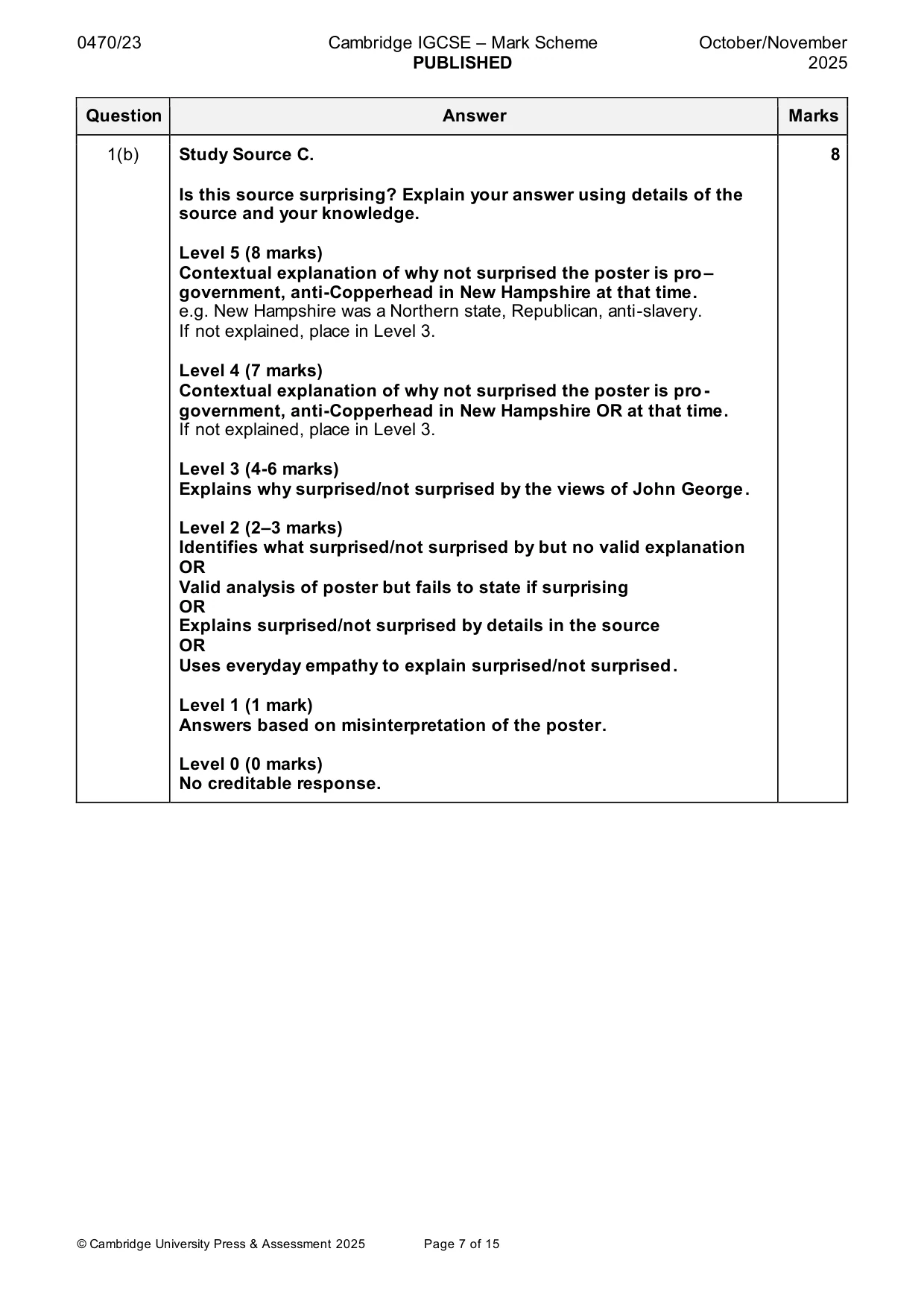
0470/23 Cambridge IGCSE – Mark Scheme PUBLISHED October/November 2025 © Cambridge University Press & Assessment 2025 Page 7 of 15 Question Answer Marks 1(b) Study Source C. Is this source surprising? Explain your answer using details of the source and your knowledge. Level 5 (8 marks) Contextual explanation of why not surprised the poster is pro– government, anti-Copperhead in New Hampshire at that time. e.g. New Hampshire was a Northern state, Republican, anti-slavery. If not explained, place in Level 3. Level 4 (7 marks) Contextual explanation of why not surprised the poster is pro- government, anti-Copperhead in New Hampshire OR at that time. If not explained, place in Level 3. Level 3 (4-6 marks) Explains why surprised/not surprised by the views of John George. Level 2 (2–3 marks) Identifies what surprised/not surprised by but no valid explanation OR Valid analysis of poster but fails to state if surprising OR Explains surprised/not surprised by details in the source OR Uses everyday empathy to explain surprised/not surprised. Level 1 (1 mark) Answers based on misinterpretation of the poster. Level 0 (0 marks) No creditable response. 8
Mark scheme, page 8
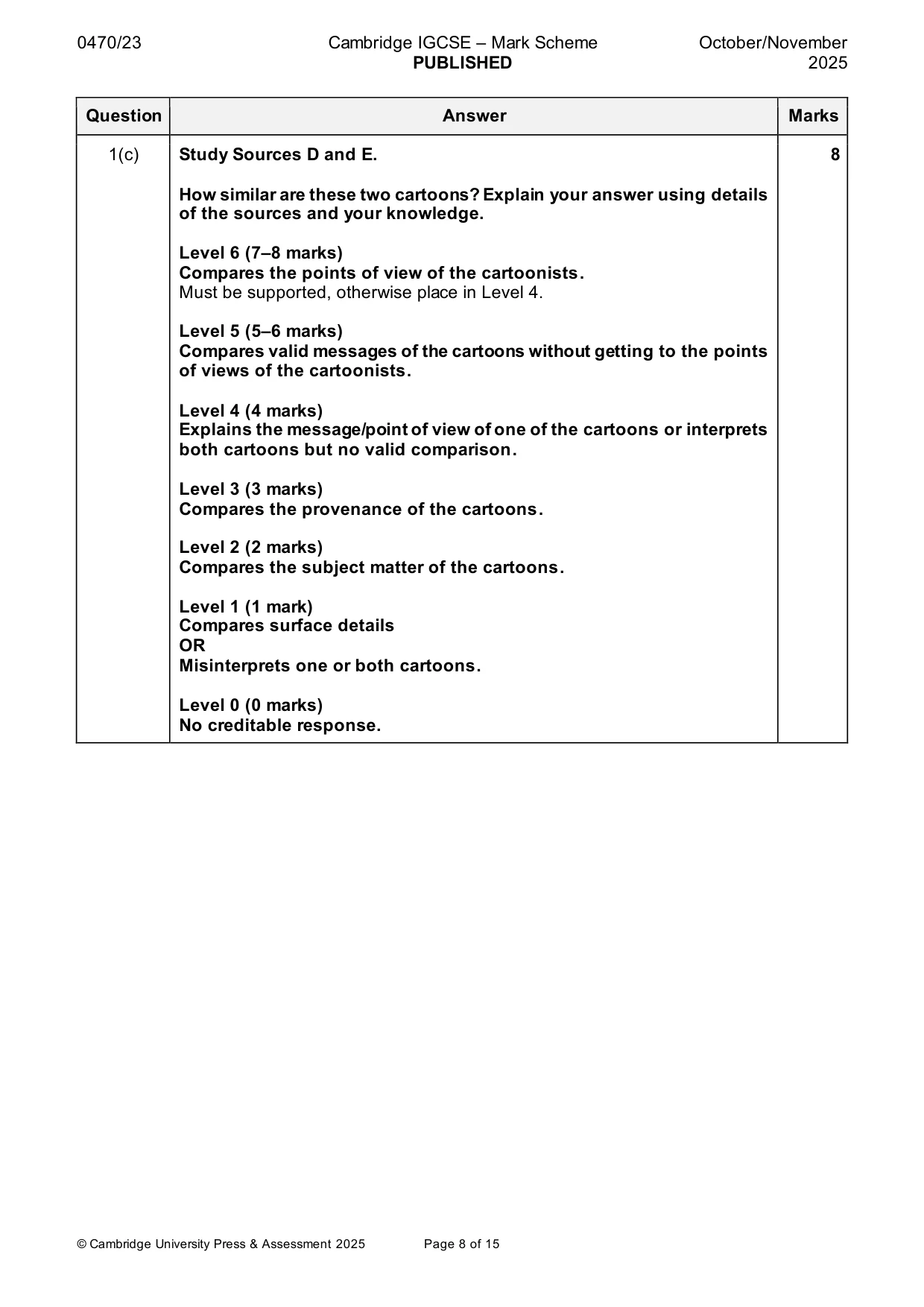
0470/23 Cambridge IGCSE – Mark Scheme PUBLISHED October/November 2025 © Cambridge University Press & Assessment 2025 Page 8 of 15 Question Answer Marks 1(c) Study Sources D and E. How similar are these two cartoons? Explain your answer using details of the sources and your knowledge. Level 6 (7–8 marks) Compares the points of view of the cartoonists. Must be supported, otherwise place in Level 4. Level 5 (5–6 marks) Compares valid messages of the cartoons without getting to the points of views of the cartoonists. Level 4 (4 marks) Explains the message/point of view of one of the cartoons or interprets both cartoons but no valid comparison. Level 3 (3 marks) Compares the provenance of the cartoons. Level 2 (2 marks) Compares the subject matter of the cartoons. Level 1 (1 mark) Compares surface details OR Misinterprets one or both cartoons. Level 0 (0 marks) No creditable response. 8
Mark scheme, page 9
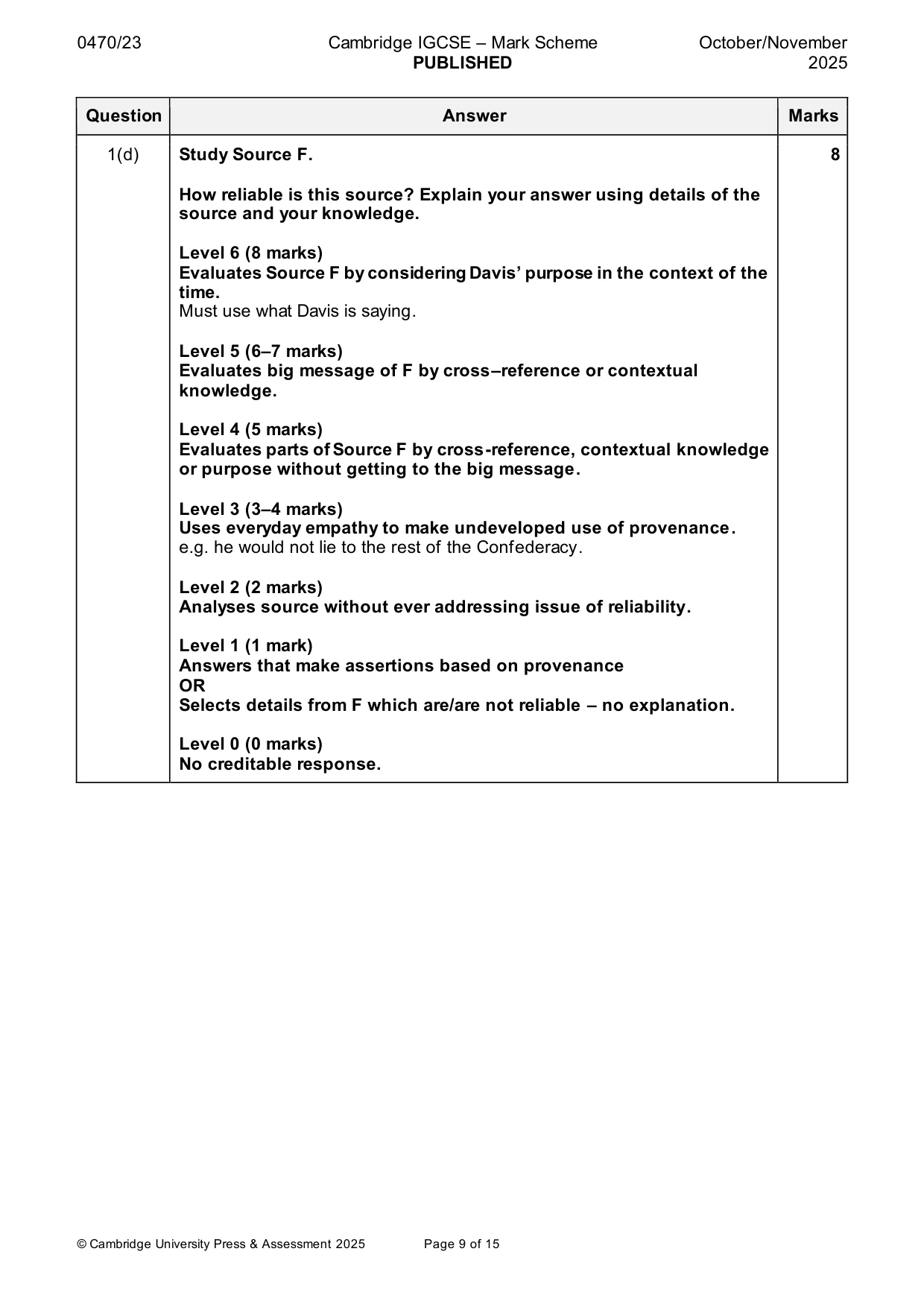
0470/23 Cambridge IGCSE – Mark Scheme PUBLISHED October/November 2025 © Cambridge University Press & Assessment 2025 Page 9 of 15 Question Answer Marks 1(d) Study Source F. How reliable is this source? Explain your answer using details of the source and your knowledge. Level 6 (8 marks) Evaluates Source F by considering Davis’ purpose in the context of the time. Must use what Davis is saying. Level 5 (6–7 marks) Evaluates big message of F by cross–reference or contextual knowledge. Level 4 (5 marks) Evaluates parts of Source F by cross-reference, contextual knowledge or purpose without getting to the big message. Level 3 (3–4 marks) Uses everyday empathy to make undeveloped use of provenance. e.g. he would not lie to the rest of the Confederacy. Level 2 (2 marks) Analyses source without ever addressing issue of reliability. Level 1 (1 mark) Answers that make assertions based on provenance OR Selects details from F which are/are not reliable – no explanation. Level 0 (0 marks) No creditable response. 8
Mark scheme, page 10
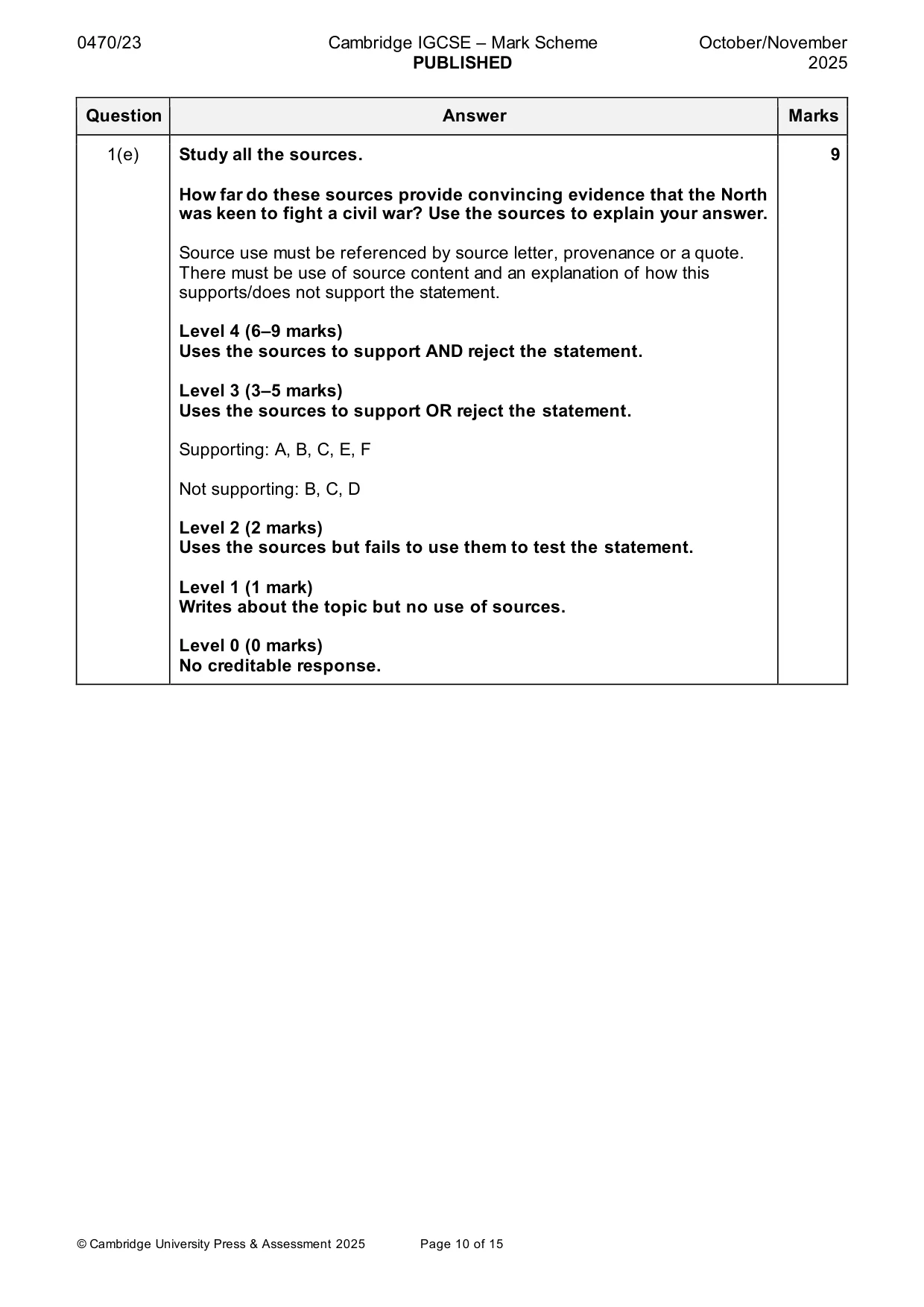
0470/23 Cambridge IGCSE – Mark Scheme PUBLISHED October/November 2025 © Cambridge University Press & Assessment 2025 Page 10 of 15 Question Answer Marks 1(e) Study all the sources. How far do these sources provide convincing evidence that the North was keen to fight a civil war? Use the sources to explain your answer. Source use must be referenced by source letter, provenance or a quote. There must be use of source content and an explanation of how this supports/does not support the statement. Level 4 (6–9 marks) Uses the sources to support AND reject the statement. Level 3 (3–5 marks) Uses the sources to support OR reject the statement. Supporting: A, B, C, E, F Not supporting: B, C, D Level 2 (2 marks) Uses the sources but fails to use them to test the statement. Level 1 (1 mark) Writes about the topic but no use of sources. Level 0 (0 marks) No creditable response. 9
Mark scheme, page 11
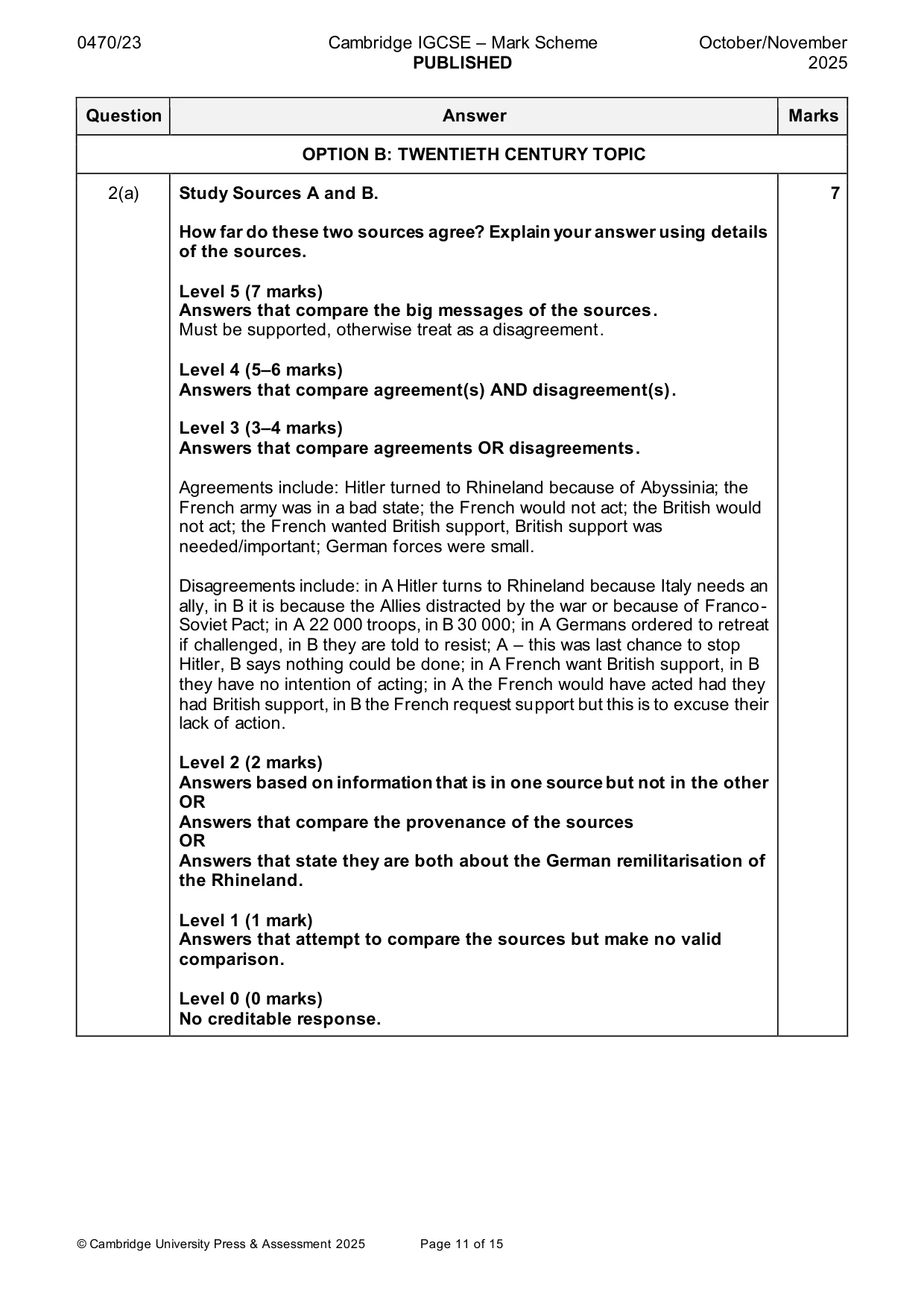
0470/23 Cambridge IGCSE – Mark Scheme PUBLISHED October/November 2025 © Cambridge University Press & Assessment 2025 Page 11 of 15 Question Answer Marks OPTION B: TWENTIETH CENTURY TOPIC 2(a) Study Sources A and B. How far do these two sources agree? Explain your answer using details of the sources. Level 5 (7 marks) Answers that compare the big messages of the sources. Must be supported, otherwise treat as a disagreement. Level 4 (5–6 marks) Answers that compare agreement(s) AND disagreement(s). Level 3 (3–4 marks) Answers that compare agreements OR disagreements. Agreements include: Hitler turned to Rhineland because of Abyssinia; the French army was in a bad state; the French would not act; the British would not act; the French wanted British support, British support was needed/important; German forces were small. Disagreements include: in A Hitler turns to Rhineland because Italy needs an ally, in B it is because the Allies distracted by the war or because of Franco- Soviet Pact; in A 22 000 troops, in B 30 000; in A Germans ordered to retreat if challenged, in B they are told to resist; A – this was last chance to stop Hitler, B says nothing could be done; in A French want British support, in B they have no intention of acting; in A the French would have acted had they had British support, in B the French request support but this is to excuse their lack of action. Level 2 (2 marks) Answers based on information that is in one source but not in the other OR Answers that compare the provenance of the sources OR Answers that state they are both about the German remilitarisation of the Rhineland. Level 1 (1 mark) Answers that attempt to compare the sources but make no valid comparison. Level 0 (0 marks) No creditable response. 7
Mark scheme, page 12
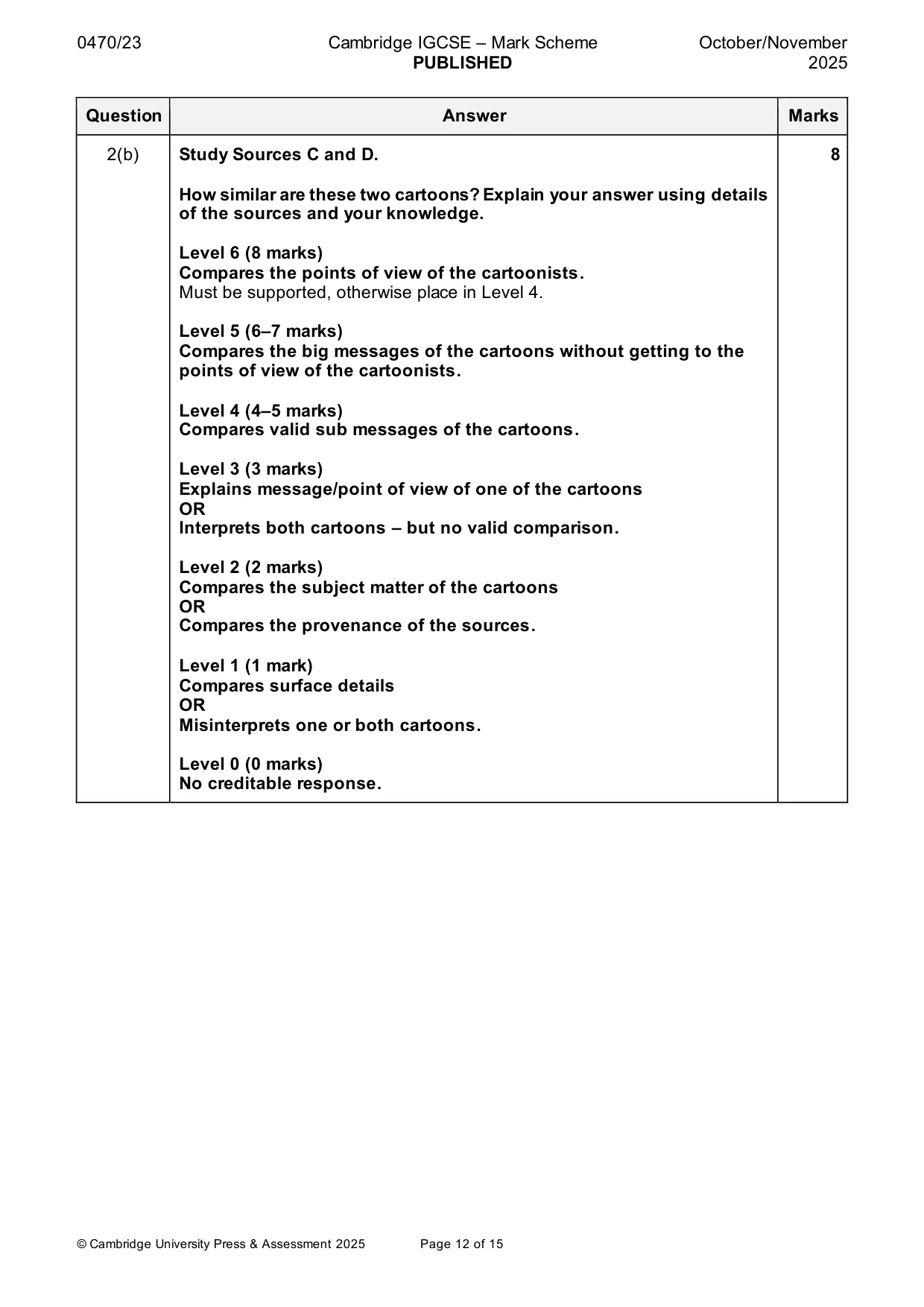
0470/23 Cambridge IGCSE – Mark Scheme PUBLISHED October/November 2025 © Cambridge University Press & Assessment 2025 Page 12 of 15 Question Answer Marks 2(b) Study Sources C and D. How similar are these two cartoons? Explain your answer using details of the sources and your knowledge. Level 6 (8 marks) Compares the points of view of the cartoonists. Must be supported, otherwise place in Level 4. Level 5 (6–7 marks) Compares the big messages of the cartoons without getting to the points of view of the cartoonists. Level 4 (4–5 marks) Compares valid sub messages of the cartoons. Level 3 (3 marks) Explains message/point of view of one of the cartoons OR Interprets both cartoons – but no valid comparison. Level 2 (2 marks) Compares the subject matter of the cartoons OR Compares the provenance of the sources. Level 1 (1 mark) Compares surface details OR Misinterprets one or both cartoons. Level 0 (0 marks) No creditable response. 8
Mark scheme, page 13
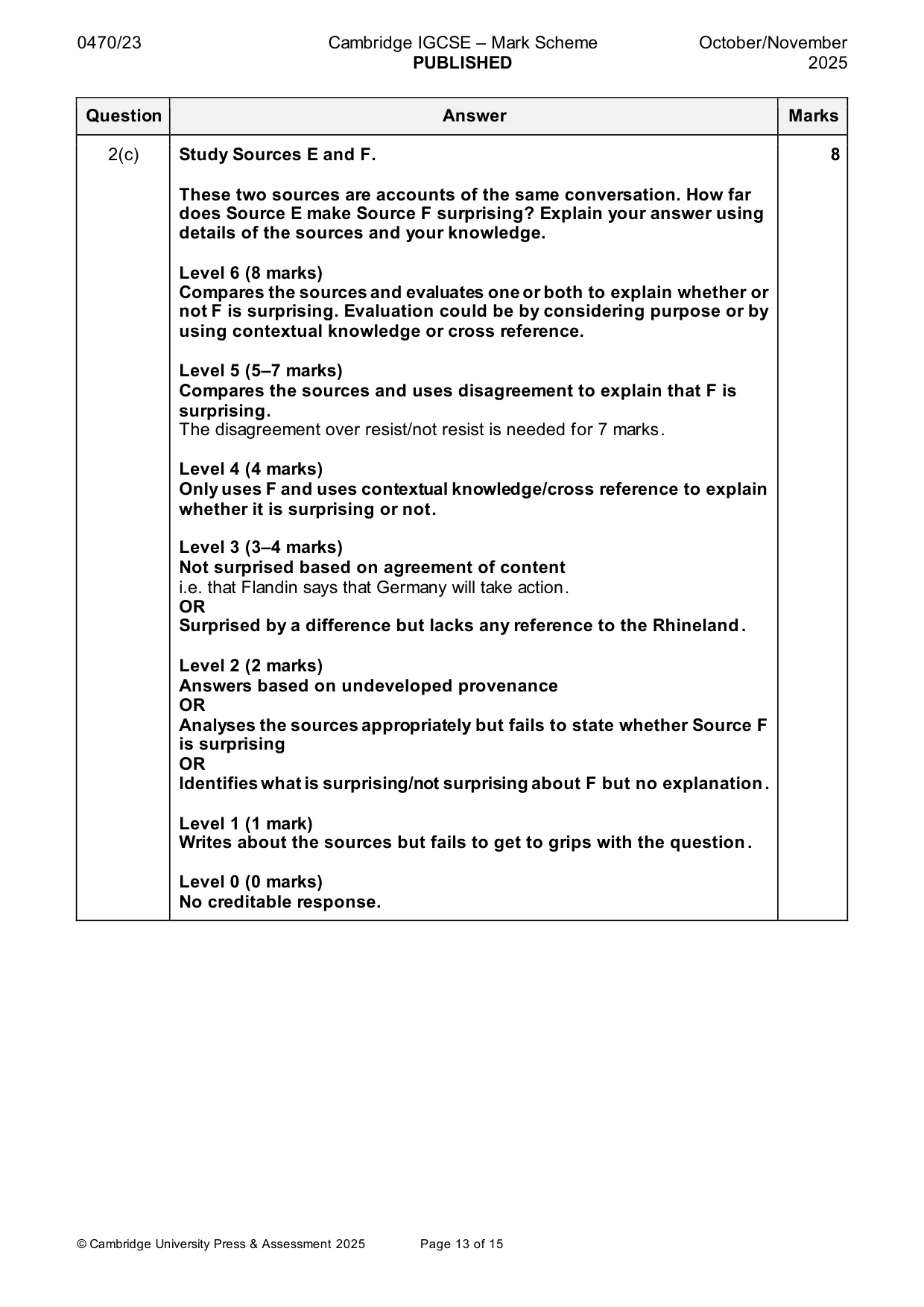
0470/23 Cambridge IGCSE – Mark Scheme PUBLISHED October/November 2025 © Cambridge University Press & Assessment 2025 Page 13 of 15 Question Answer Marks 2(c) Study Sources E and F. These two sources are accounts of the same conversation. How far does Source E make Source F surprising? Explain your answer using details of the sources and your knowledge. Level 6 (8 marks) Compares the sources and evaluates one or both to explain whether or not F is surprising. Evaluation could be by considering purpose or by using contextual knowledge or cross reference. Level 5 (5–7 marks) Compares the sources and uses disagreement to explain that F is surprising. The disagreement over resist/not resist is needed for 7 marks. Level 4 (4 marks) Only uses F and uses contextual knowledge/cross reference to explain whether it is surprising or not. Level 3 (3–4 marks) Not surprised based on agreement of content i.e. that Flandin says that Germany will take action. OR Surprised by a difference but lacks any reference to the Rhineland. Level 2 (2 marks) Answers based on undeveloped provenance OR Analyses the sources appropriately but fails to state whether Source F is surprising OR Identifies what is surprising/not surprising about F but no explanation. Level 1 (1 mark) Writes about the sources but fails to get to grips with the question. Level 0 (0 marks) No creditable response. 8
Mark scheme, page 14
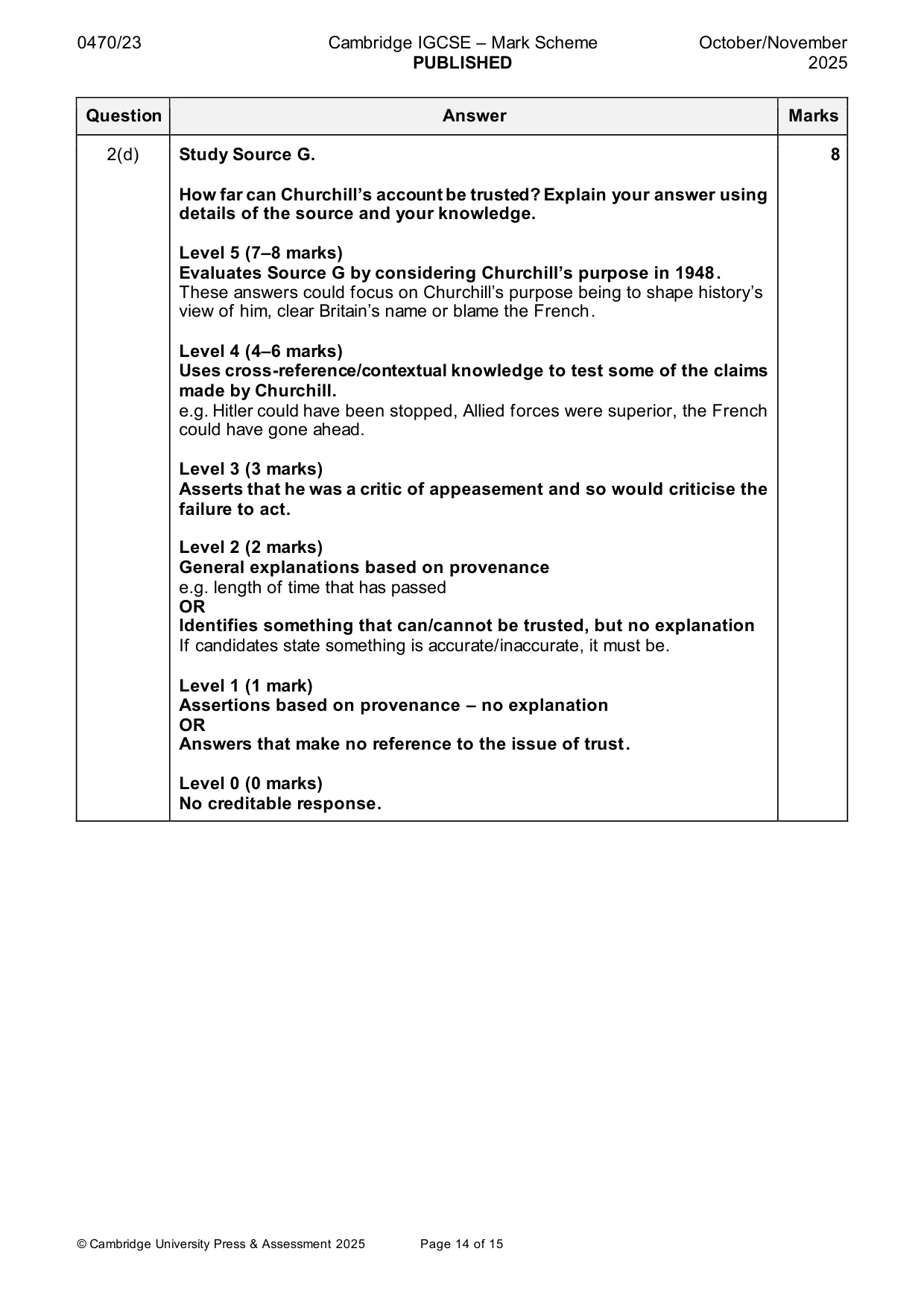
0470/23 Cambridge IGCSE – Mark Scheme PUBLISHED October/November 2025 © Cambridge University Press & Assessment 2025 Page 14 of 15 Question Answer Marks 2(d) Study Source G. How far can Churchill’s account be trusted? Explain your answer using details of the source and your knowledge. Level 5 (7–8 marks) Evaluates Source G by considering Churchill’s purpose in 1948. These answers could focus on Churchill’s purpose being to shape history’s view of him, clear Britain’s name or blame the French. Level 4 (4–6 marks) Uses cross-reference/contextual knowledge to test some of the claims made by Churchill. e.g. Hitler could have been stopped, Allied forces were superior, the French could have gone ahead. Level 3 (3 marks) Asserts that he was a critic of appeasement and so would criticise the failure to act. Level 2 (2 marks) General explanations based on provenance e.g. length of time that has passed OR Identifies something that can/cannot be trusted, but no explanation If candidates state something is accurate/inaccurate, it must be. Level 1 (1 mark) Assertions based on provenance – no explanation OR Answers that make no reference to the issue of trust. Level 0 (0 marks) No creditable response. 8
Mark scheme, page 15
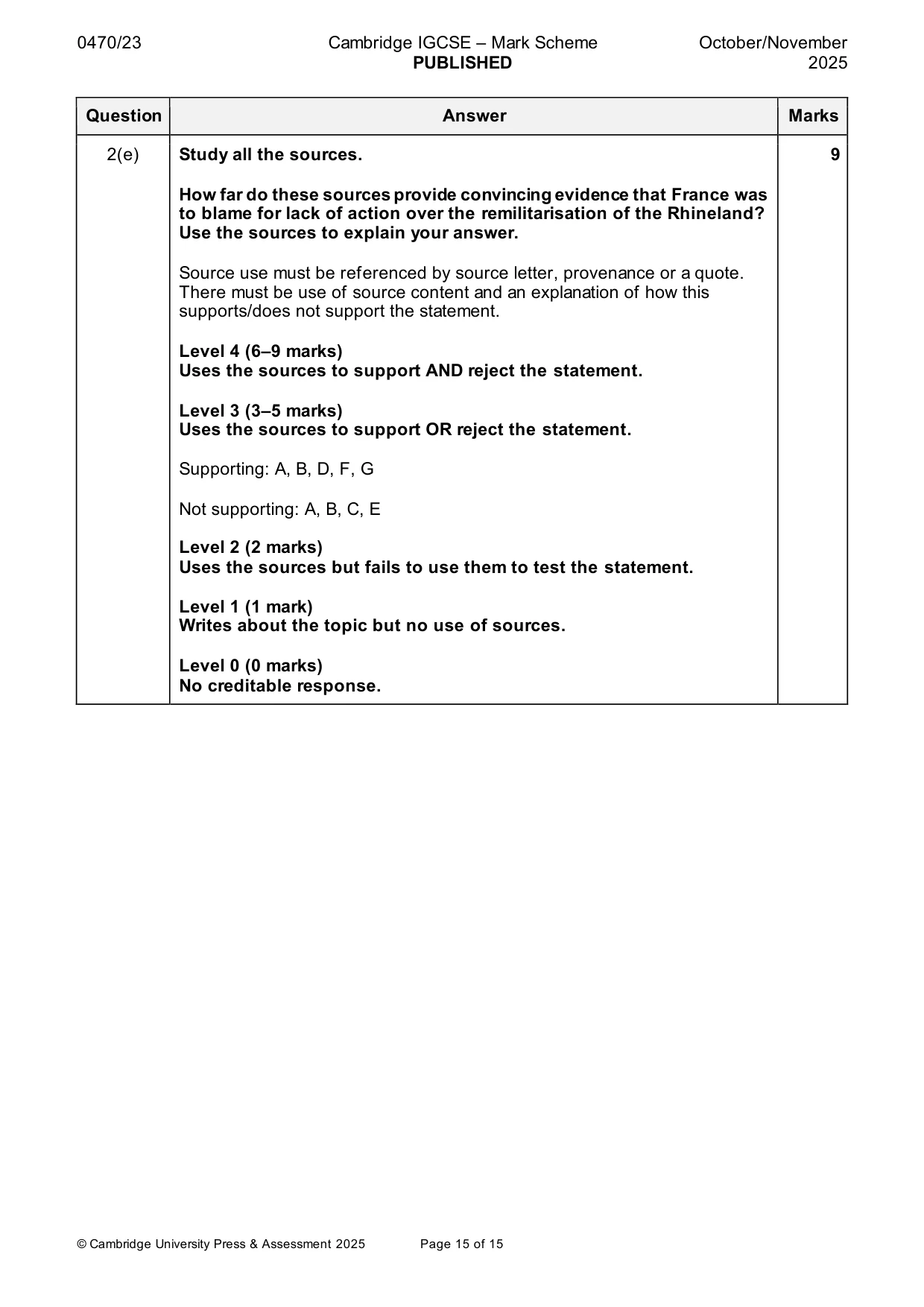
0470/23 Cambridge IGCSE – Mark Scheme PUBLISHED October/November 2025 © Cambridge University Press & Assessment 2025 Page 15 of 15 Question Answer Marks 2(e) Study all the sources. How far do these sources provide convincing evidence that France was to blame for lack of action over the remilitarisation of the Rhineland? Use the sources to explain your answer. Source use must be referenced by source letter, provenance or a quote. There must be use of source content and an explanation of how this supports/does not support the statement. Level 4 (6–9 marks) Uses the sources to support AND reject the statement. Level 3 (3–5 marks) Uses the sources to support OR reject the statement. Supporting: A, B, D, F, G Not supporting: A, B, C, E Level 2 (2 marks) Uses the sources but fails to use them to test the statement. Level 1 (1 mark) Writes about the topic but no use of sources. Level 0 (0 marks) No creditable response. 9
What you needed in this session
Cambridge’s own grade thresholds for 2025 Oct/Nov, Paper 2 · Variant 3. A higher threshold means an easier paper — the bar moves with how the cohort did.