Cambridge IGCSE History 0470 — 2024 Oct/Nov Paper 2 · Variant 3
0470/23/O/N/24 · 40 marks · 105 min
The question paper and its mark scheme, free to read here and free to download. This is Cambridge’s own paper, exactly as it was sat.
Question paper12 pages
Mark scheme13 pages
Answers below. Sit the paper first if you are practising.
Paper as text
Question paper, page 1
[Turn over Cambridge IGCSE™ * 3 7 6 0 5 6 6 0 4 9 * This document has 12 pages. DC (WW/SG) 337697/3 © UCLES 2024 HISTORY 0470/23 Paper 2 Document Questions October/November 2024 1 hour 45 minutes You must answer on the enclosed answer booklet. You will need: Answer booklet (enclosed) INSTRUCTIONS ● Answer one question on one option only. Option A: Nineteenth century topic Option B: Twentieth century topic ● Follow the instructions on the front cover of the answer booklet. If you need additional answer paper, ask the invigilator for a continuation booklet. INFORMATION ● The total mark for this paper is 40. ● The number of marks for each question or part question is shown in brackets [ ].
Question paper, page 2
2 0470/23/O/N/24 © UCLES 2024 Option A: Nineteenth century topic 1 What caused the American warship, the USS Maine, to sink? Study the Background Information and the sources carefully, and then answer all parts of Question 1. Background Information In 1895 the Cubans launched their War of Independence against Spanish rule. Many people in the USA sympathised with the rebels and accused the Spanish of being cruel. In 1898 the USS Maine was sent to Havana to protect US interests. This visit was regarded with suspicion by the Spanish authorities. At 9.40 pm on 15 February there was an explosion on the Maine and it sank, with the loss of around 260 lives. Both US President McKinley and the Spanish ordered inquiries. However, many Americans, including newspapers such as the New York World, did not wait for the reports of these inquiries and demanded war with Spain. By April 1898 the two countries were at war. Did the Spanish sink the Maine?
Question paper, page 3
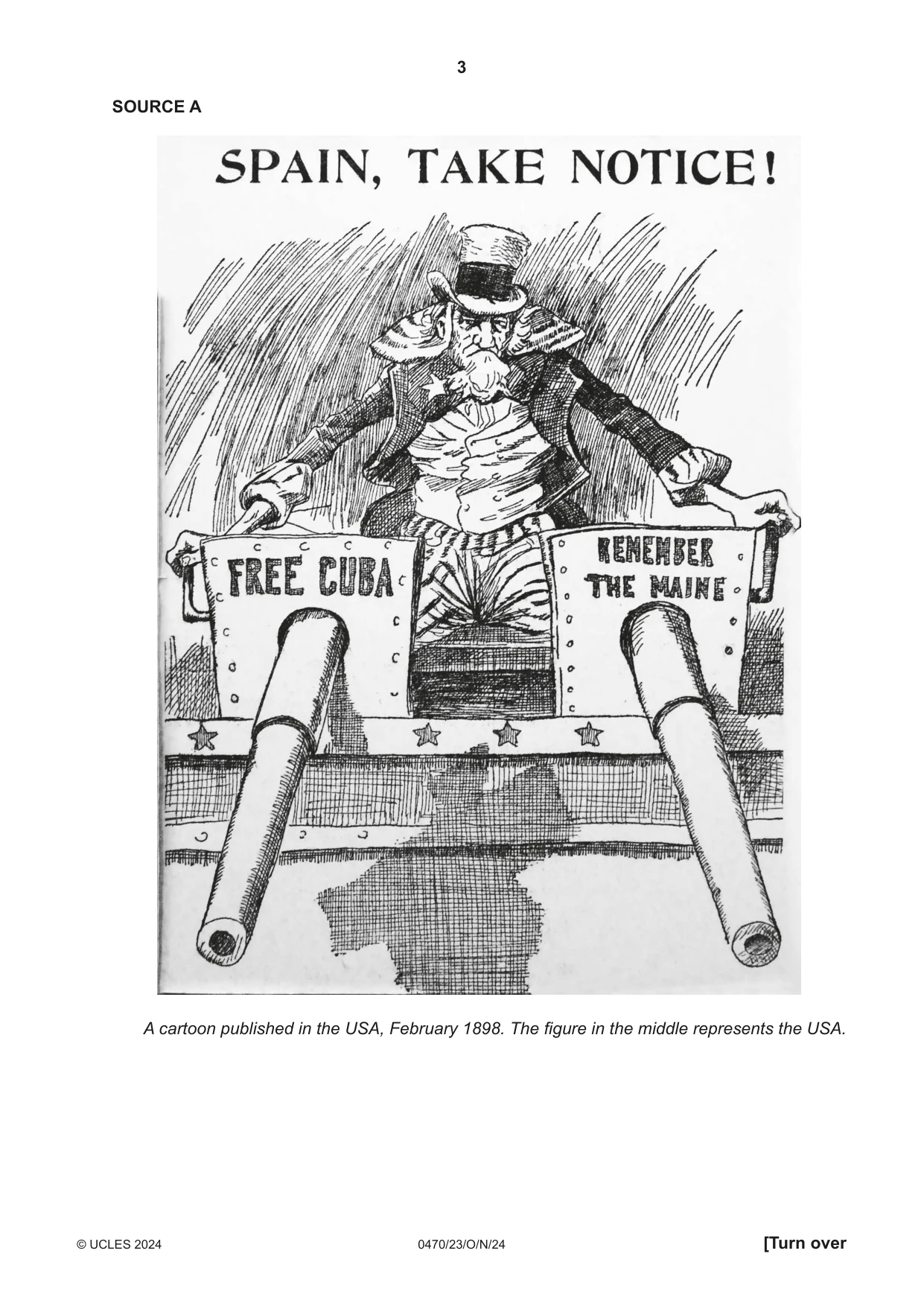
3 0470/23/O/N/24 © UCLES 2024 [Turn over SOURCE A A cartoon published in the USA, February 1898. The figure in the middle represents the USA.
Question paper, page 4
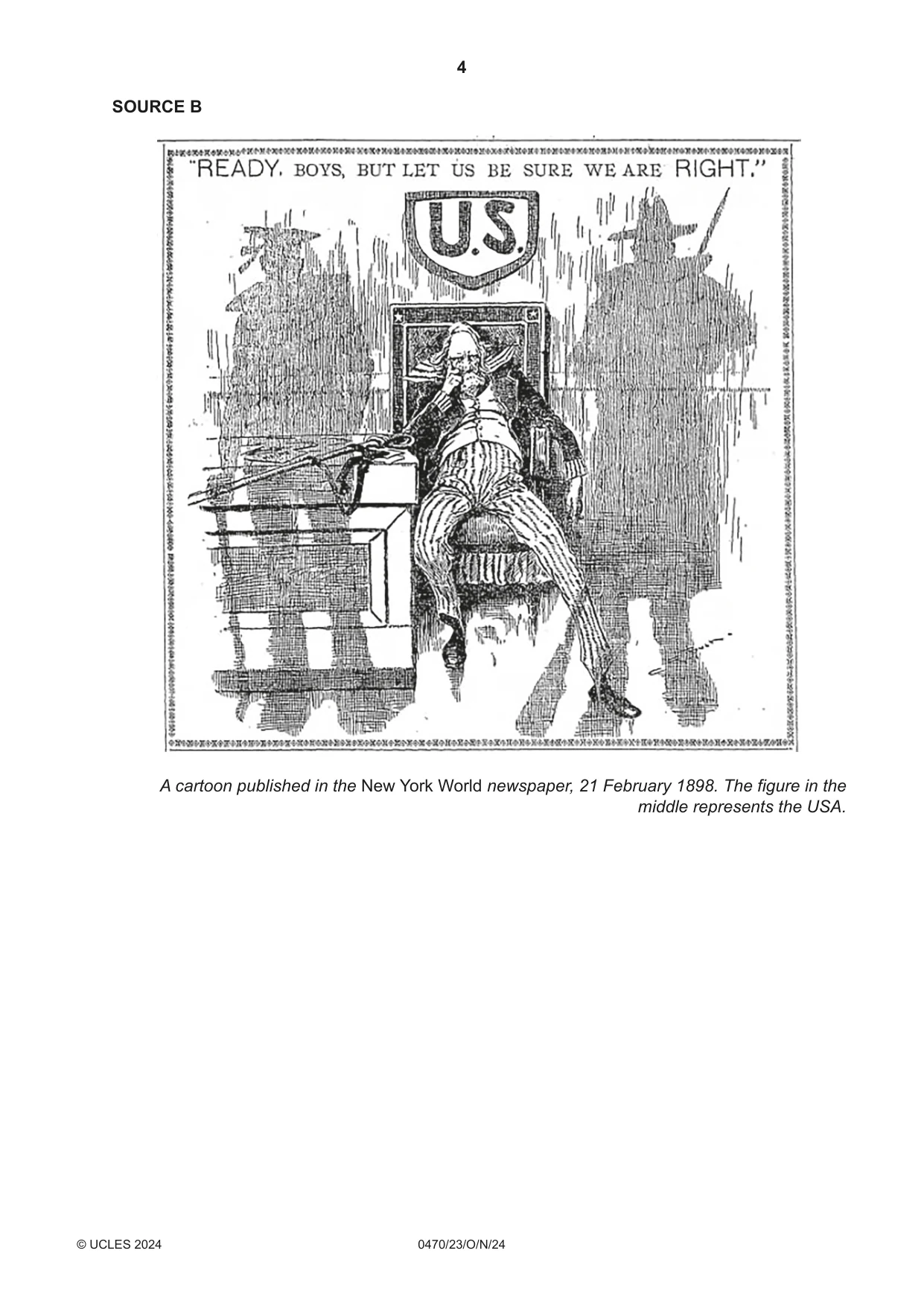
4 0470/23/O/N/24 © UCLES 2024 SOURCE B A cartoon published in the New York World newspaper, 21 February 1898. The figure in the middle represents the USA.
Question paper, page 5
5 0470/23/O/N/24 © UCLES 2024 [Turn over SOURCE C DESTRUCTION OF THE WARSHIP MAINE WAS THE WORK OF THE ENEMY Roosevelt Convinced the Explosion of the Warship Was Not an Accident The Journal Offers $50,000 Reward for the Conviction of the Criminals Who Sent 258 American Sailors to Their Death NAVAL OFFICERS THINK THE MAINE WAS DESTROYED BY A SPANISH MINE The Journal’s special reporter at Havana writes that it is the secret opinion of many people in Havana and of several American naval authorities that the warship Maine was destroyed by a mine and 258 men were killed on purpose by the Spanish. The Spaniards, it is believed, arranged to have the Maine drop anchor over a harbour mine. Wires connected the mine to the magazine of the ship. If this is true, the brutal nature of the Spaniards will be shown by the fact that they waited to explode the mine until all the men had gone to sleep. Spanish officials are protesting too much that they did not do it. Our government has ordered an investigation. This newspaper has sent divers to Havana to report on the condition of the wreck. The suspicion that the Maine was purposely blown up grows stronger every hour. Not a single fact to the contrary has been produced. From the New York Journal and Advertiser, 17 February 1898. Roosevelt was the member of the government who was second in charge of the navy. A mine is a bomb placed in water. The magazine is where the ship’s ammunition is stored. SOURCE D The evidence of eyewitnesses and experts proves the absence of all the signs which always accompany the explosion of a torpedo. The witnesses report that there was only a single explosion; that no column of water was thrown up, there was no shaking of the shore, and that no dead fish were seen. The divers found splits in the hull outwards, a sure sign that the explosion was internal. When the bottom of the bay around the vessel was examined, not a single sign of the action of a torpedo was found. The actions of the USA have prevented investigations in the interior of the vessel, which would help decide the internal cause of the disaster. From the report of the Spanish Inquiry into the sinking of the Maine, March 1898.
Question paper, page 6
6 0470/23/O/N/24 © UCLES 2024 SOURCE E To think the destruction of the Maine was an ordinary accident and not due to any external agency or hostile intent was completely in defiance of the probabilities. Battleships are not in the habit of blowing themselves up. The Spaniards regarded the sending of the Maine as a menace to Spanish sovereignty in Cuba and as an encouragement to the Cuban rebels. Captain Sigsbee knew that there was bitterness against the presence of the Maine among the Spanish military in Havana. He was aware of the threats to destroy his ship. It was generally supposed that the Spanish preparation for the defence of Havana had included mines and torpedoes in the harbour. The Spanish authorities anchored the Maine where the underwater harbour defences might be used against it. All Spaniards thought it a sensible measure to anchor it close to a mine. Although the probability of guilt was overwhelming, the American people saw the fairness of suspending judgement until proof had been found. Published in an American monthly journal, April 1898. Captain Sigsbee was Captain of the Maine. SOURCE F The force of the explosion was great enough to shake the whole city water-front and throw down telephone lines. The American officers acted with the courage which the terrible circumstances demanded. Everything possible was done by the Spanish officers on shore to aid the survivors. The Spanish Ambassador in Washington expressed his sympathy. Some of the Jingoes and the sensational newspapers have spread rumours, which have been proved to be not true, that the explosion was caused from outside the ship by someone from the shore or in the harbour. However, there has been praiseworthy self-restraint exercised by the public to wait for an investigation and to hope the explosion resulted from accident. All that we know is that not more than 26 of the men remained uninjured; 57 being wounded and 246 killed. From an American magazine, 26 February 1898. The Jingoes were strong supporters of war with Spain for patriotic reasons.
Question paper, page 7
7 0470/23/O/N/24 © UCLES 2024 [Turn over Now answer all parts of Question 1. You may use any of the sources to help you answer the questions, in addition to those sources which you are told to use. In answering parts (a)–(e) you should use your knowledge of the topic to help you interpret and evaluate the sources. (a) Study Sources A and B. How far would these two cartoonists have agreed with each other? Explain your answer using details of the sources and your knowledge. [8] (b) Study Sources C and D. How far does Source C prove Source D is wrong? Explain your answer using details of the sources and your knowledge. [8] (c) Study Source E. Can Source E be trusted as evidence about the sinking of the Maine? Explain your answer using details of the source and your knowledge. [8] (d) Study Source F. Is Source F surprising? Explain your answer using details of the source and your knowledge. [7] (e) Study all the sources. How far do these sources provide convincing evidence that the Spanish blew up the Maine? Use the sources to explain your answer. [9]
Question paper, page 8
8 0470/23/O/N/24 © UCLES 2024 Option B: Twentieth century topic 2 Who was the aggressor in the early years of the Cold War? Study the Background Information and the sources carefully, and then answer all parts of Question 2. Background Information Although the Soviet Union and the USA were allies during the Second World War, once the fighting stopped a ‘cold war’ soon began to develop. The USA accused the USSR of forcing countries in eastern Europe under its control and planning to spread its power into other parts of Europe. The USSR accused the USA of extending its influence and power across Europe through the Truman Doctrine and the Marshall Plan. Both countries claimed they were merely acting defensively but many historians in the West have blamed the Soviets for being the aggressors. How far was the USSR the aggressor in the early years of the Cold War? SOURCE A A cartoon published in the USA, 27 August 1946.
Question paper, page 9
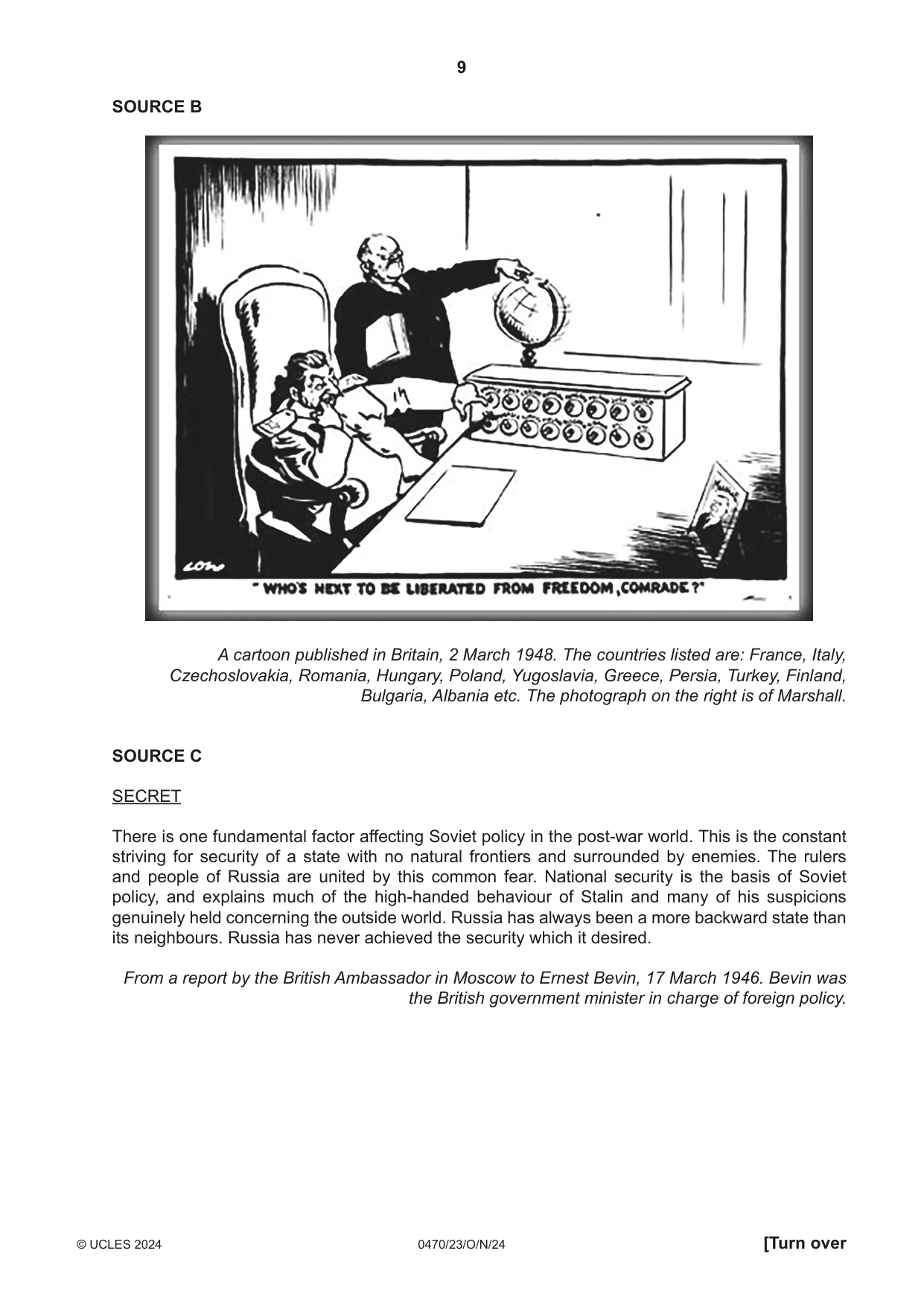
9 0470/23/O/N/24 © UCLES 2024 [Turn over SOURCE B A cartoon published in Britain, 2 March 1948. The countries listed are: France, Italy, Czechoslovakia, Romania, Hungary, Poland, Yugoslavia, Greece, Persia, Turkey, Finland, Bulgaria, Albania etc. The photograph on the right is of Marshall. SOURCE C SECRET There is one fundamental factor affecting Soviet policy in the post-war world. This is the constant striving for security of a state with no natural frontiers and surrounded by enemies. The rulers and people of Russia are united by this common fear. National security is the basis of Soviet policy, and explains much of the high-handed behaviour of Stalin and many of his suspicions genuinely held concerning the outside world. Russia has always been a more backward state than its neighbours. Russia has never achieved the security which it desired. From a report by the British Ambassador in Moscow to Ernest Bevin, 17 March 1946. Bevin was the British government minister in charge of foreign policy.
Question paper, page 10
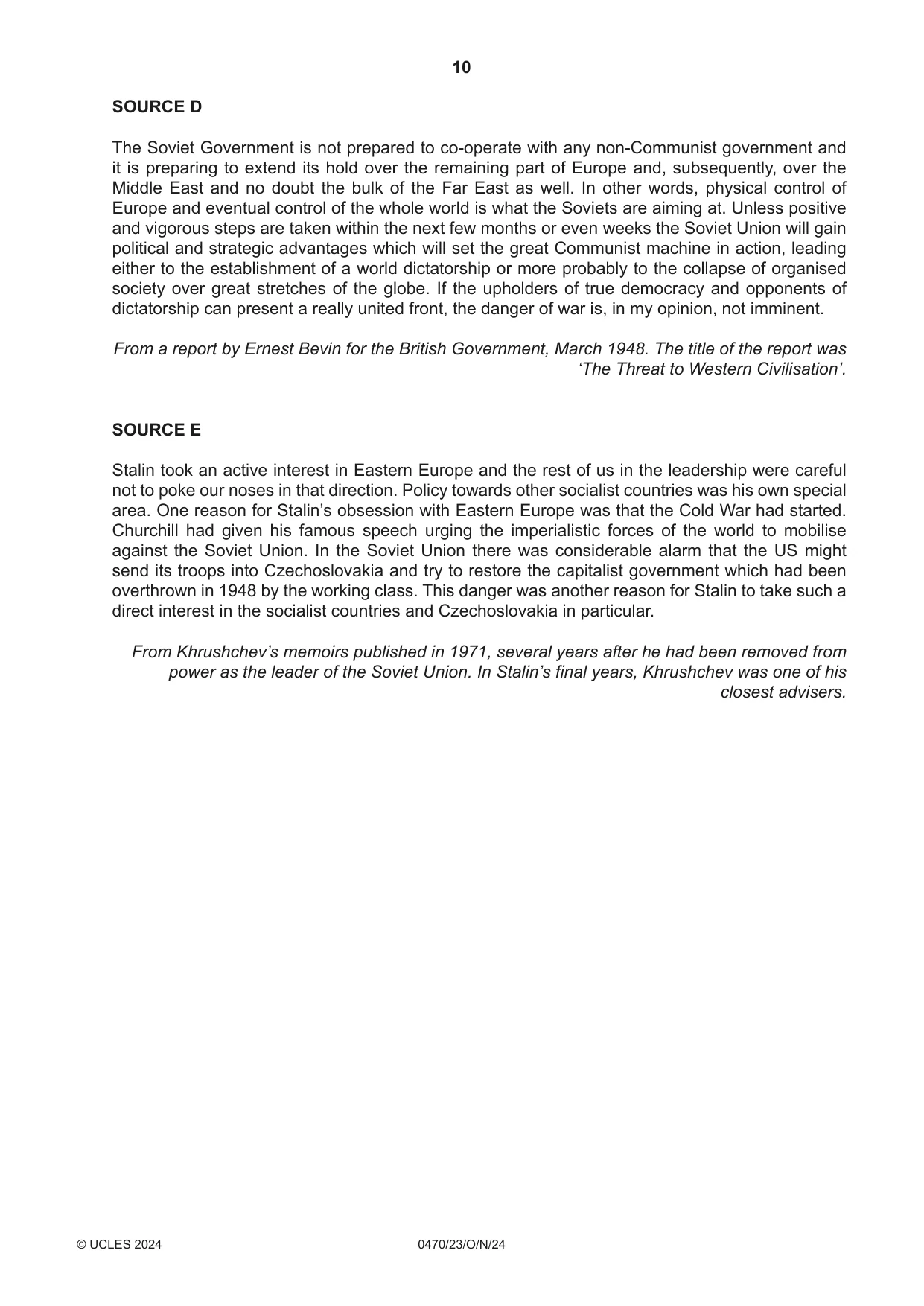
10 0470/23/O/N/24 © UCLES 2024 SOURCE D The Soviet Government is not prepared to co-operate with any non-Communist government and it is preparing to extend its hold over the remaining part of Europe and, subsequently, over the Middle East and no doubt the bulk of the Far East as well. In other words, physical control of Europe and eventual control of the whole world is what the Soviets are aiming at. Unless positive and vigorous steps are taken within the next few months or even weeks the Soviet Union will gain political and strategic advantages which will set the great Communist machine in action, leading either to the establishment of a world dictatorship or more probably to the collapse of organised society over great stretches of the globe. If the upholders of true democracy and opponents of dictatorship can present a really united front, the danger of war is, in my opinion, not imminent. From a report by Ernest Bevin for the British Government, March 1948. The title of the report was ‘The Threat to Western Civilisation’. SOURCE E Stalin took an active interest in Eastern Europe and the rest of us in the leadership were careful not to poke our noses in that direction. Policy towards other socialist countries was his own special area. One reason for Stalin’s obsession with Eastern Europe was that the Cold War had started. Churchill had given his famous speech urging the imperialistic forces of the world to mobilise against the Soviet Union. In the Soviet Union there was considerable alarm that the US might send its troops into Czechoslovakia and try to restore the capitalist government which had been overthrown in 1948 by the working class. This danger was another reason for Stalin to take such a direct interest in the socialist countries and Czechoslovakia in particular. From Khrushchev’s memoirs published in 1971, several years after he had been removed from power as the leader of the Soviet Union. In Stalin’s final years, Khrushchev was one of his closest advisers.
Question paper, page 11
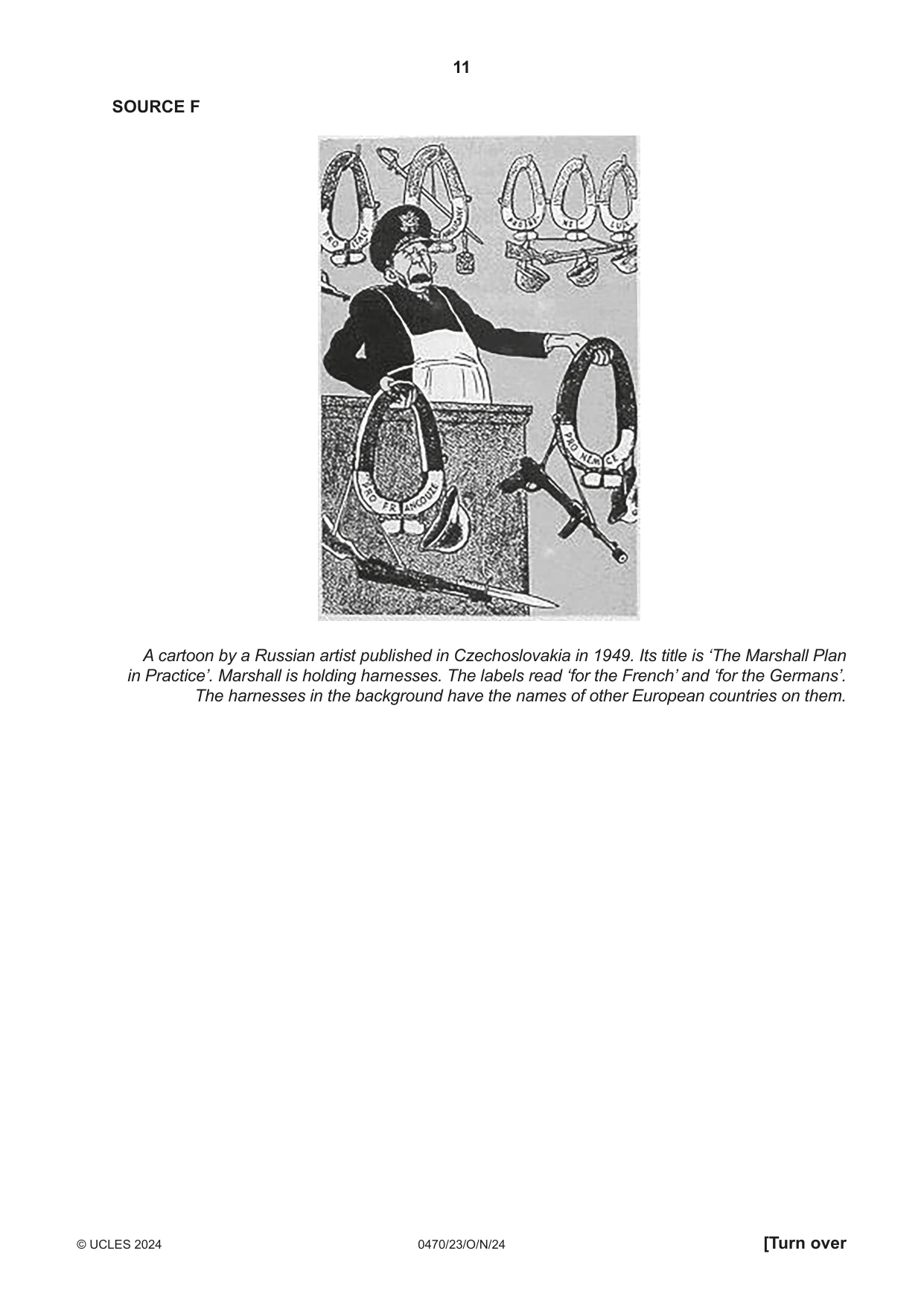
11 0470/23/O/N/24 © UCLES 2024 [Turn over SOURCE F A cartoon by a Russian artist published in Czechoslovakia in 1949. Its title is ‘The Marshall Plan in Practice’. Marshall is holding harnesses. The labels read ‘for the French’ and ‘for the Germans’. The harnesses in the background have the names of other European countries on them.
Question paper, page 12
12 0470/23/O/N/24 © UCLES 2024 Permission to reproduce items where third-party owned material protected by copyright is included has been sought and cleared where possible. Every reasonable effort has been made by the publisher (UCLES) to trace copyright holders, but if any items requiring clearance have unwittingly been included, the publisher will be pleased to make amends at the earliest possible opportunity. To avoid the issue of disclosure of answer-related information to candidates, all copyright acknowledgements are reproduced online in the Cambridge Assessment International Education Copyright Acknowledgements Booklet. This is produced for each series of examinations and is freely available to download at www.cambridgeinternational.org after the live examination series. Cambridge Assessment International Education is part of Cambridge Assessment. Cambridge Assessment is the brand name of the University of Cambridge Local Examinations Syndicate (UCLES), which is a department of the University of Cambridge. Now answer all parts of Question 2. You may use any of the sources to help you answer the questions, in addition to those sources which you are told to use. In answering parts (a)–(e) you should use your knowledge of the topic to help you interpret and evaluate the sources. (a) Study Sources A and B. How far would these two cartoonists have agreed? Explain your answer using details of the sources and your knowledge. [8] (b) Study Sources C and D. How far does Source C make Source D surprising? Explain your answer using details of the sources and your knowledge. [8] (c) Study Source E. How far can Khrushchev’s account be trusted? Explain your answer using details of the source and your knowledge. [7] (d) Study Source F. Why was this cartoon published at that time? Explain your answer using details of the source and your knowledge. [8] (e) Study all the sources. How far do these sources provide convincing evidence that the Soviet Union was the aggressor in the early years of the Cold War? Use the sources to explain your answer. [9]
Mark scheme, page 1
This document consists of 13 printed pages. © Cambridge University Press & Assessment 2024 [Turn over Cambridge IGCSE™ HISTORY 0470/23 Paper 2 October/November 2024 MARK SCHEME Maximum Mark: 40 Published This mark scheme is published as an aid to teachers and candidates, to indicate the requirements of the examination. It shows the basis on which Examiners were instructed to award marks. It does not indicate the details of the discussions that took place at an Examiners’ meeting before marking began, which would have considered the acceptability of alternative answers. Mark schemes should be read in conjunction with the question paper and the Principal Examiner Report for Teachers. Cambridge International will not enter into discussions about these mark schemes. Cambridge International is publishing the mark schemes for the October/November 2024 series for most Cambridge IGCSE, Cambridge International A and AS Level components, and some Cambridge O Level components.
Mark scheme, page 2
0470/23 Cambridge IGCSE – Mark Scheme PUBLISHED October/November 2024 © Cambridge University Press & Assessment 2024 Page 2 of 13 Generic Marking Principles These general marking principles must be applied by all examiners when marking candidate answers. They should be applied alongside the specific content of the mark scheme or generic level descriptions for a question. Each question paper and mark scheme will also comply with these marking principles. GENERIC MARKING PRINCIPLE 1: Marks must be awarded in line with: • the specific content of the mark scheme or the generic level descriptors for the question • the specific skills defined in the mark scheme or in the generic level descriptors for the question • the standard of response required by a candidate as exemplified by the standardisation scripts. GENERIC MARKING PRINCIPLE 2: Marks awarded are always whole marks (not half marks, or other fractions). GENERIC MARKING PRINCIPLE 3: Marks must be awarded positively: • marks are awarded for correct/valid answers, as defined in the mark scheme. However, credit is given for valid answers which go beyond the scope of the syllabus and mark scheme, referring to your Team Leader as appropriate • marks are awarded when candidates clearly demonstrate what they know and can do • marks are not deducted for errors • marks are not deducted for omissions • answers should only be judged on the quality of spelling, punctuation and grammar when these features are specifically assessed by the question as indicated by the mark scheme. The meaning, however, should be unambiguous. GENERIC MARKING PRINCIPLE 4: Rules must be applied consistently, e.g. in situations where candidates have not followed instructions or in the application of generic level descriptors. GENERIC MARKING PRINCIPLE 5: Marks should be awarded using the full range of marks defined in the mark scheme for the question (however; the use of the full mark range may be limited according to the quality of the candidate responses seen). GENERIC MARKING PRINCIPLE 6: Marks awarded are based solely on the requirements as defined in the mark scheme. Marks should not be awarded with grade thresholds or grade descriptors in mind.
Mark scheme, page 3
0470/23 Cambridge IGCSE – Mark Scheme PUBLISHED October/November 2024 © Cambridge University Press & Assessment 2024 Page 3 of 13 Assessment objectives AO1 An ability to recall, select, organise and deploy knowledge of the syllabus content. AO3 An ability to understand, interpret, evaluate and use a range of sources as evidence, in their historical context.
Mark scheme, page 4
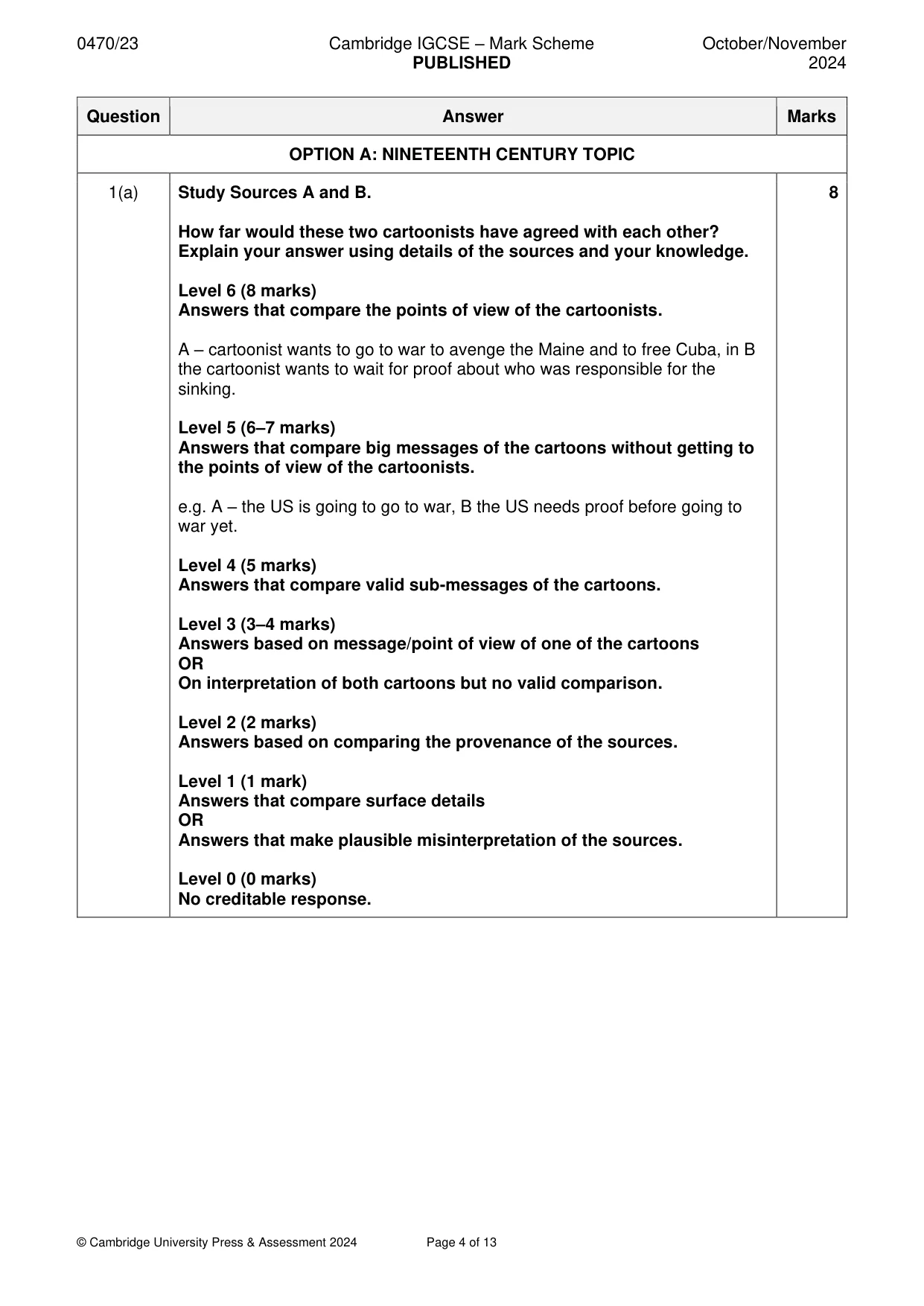
0470/23 Cambridge IGCSE – Mark Scheme PUBLISHED October/November 2024 © Cambridge University Press & Assessment 2024 Page 4 of 13 Question Answer Marks OPTION A: NINETEENTH CENTURY TOPIC 1(a) Study Sources A and B. How far would these two cartoonists have agreed with each other? Explain your answer using details of the sources and your knowledge. Level 6 (8 marks) Answers that compare the points of view of the cartoonists. A – cartoonist wants to go to war to avenge the Maine and to free Cuba, in B the cartoonist wants to wait for proof about who was responsible for the sinking. Level 5 (6–7 marks) Answers that compare big messages of the cartoons without getting to the points of view of the cartoonists. e.g. A – the US is going to go to war, B the US needs proof before going to war yet. Level 4 (5 marks) Answers that compare valid sub-messages of the cartoons. Level 3 (3–4 marks) Answers based on message/point of view of one of the cartoons OR On interpretation of both cartoons but no valid comparison. Level 2 (2 marks) Answers based on comparing the provenance of the sources. Level 1 (1 mark) Answers that compare surface details OR Answers that make plausible misinterpretation of the sources. Level 0 (0 marks) No creditable response. 8
Mark scheme, page 5
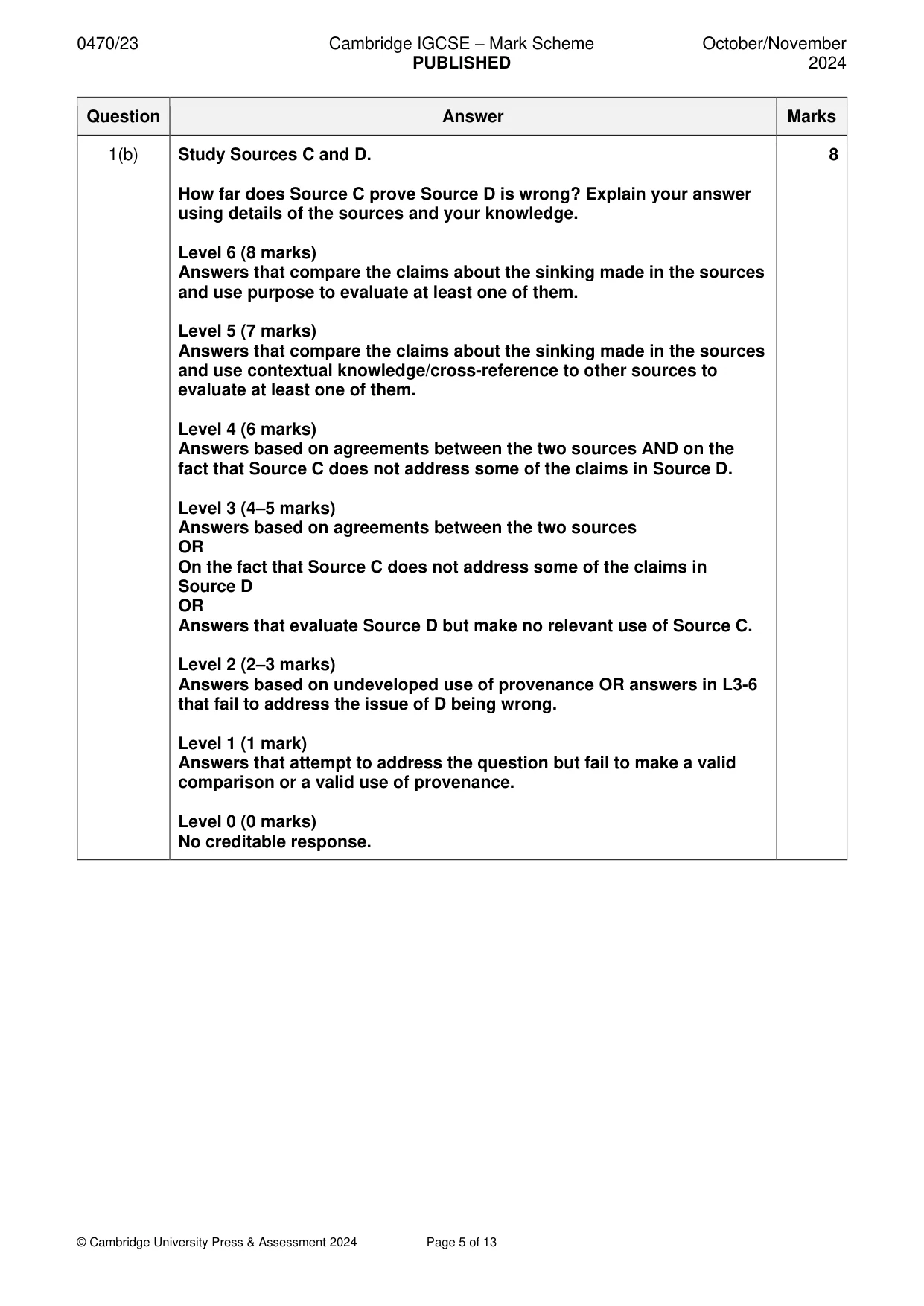
0470/23 Cambridge IGCSE – Mark Scheme PUBLISHED October/November 2024 © Cambridge University Press & Assessment 2024 Page 5 of 13 Question Answer Marks 1(b) Study Sources C and D. How far does Source C prove Source D is wrong? Explain your answer using details of the sources and your knowledge. Level 6 (8 marks) Answers that compare the claims about the sinking made in the sources and use purpose to evaluate at least one of them. Level 5 (7 marks) Answers that compare the claims about the sinking made in the sources and use contextual knowledge/cross-reference to other sources to evaluate at least one of them. Level 4 (6 marks) Answers based on agreements between the two sources AND on the fact that Source C does not address some of the claims in Source D. Level 3 (4–5 marks) Answers based on agreements between the two sources OR On the fact that Source C does not address some of the claims in Source D OR Answers that evaluate Source D but make no relevant use of Source C. Level 2 (2–3 marks) Answers based on undeveloped use of provenance OR answers in L3-6 that fail to address the issue of D being wrong. Level 1 (1 mark) Answers that attempt to address the question but fail to make a valid comparison or a valid use of provenance. Level 0 (0 marks) No creditable response. 8
Mark scheme, page 6
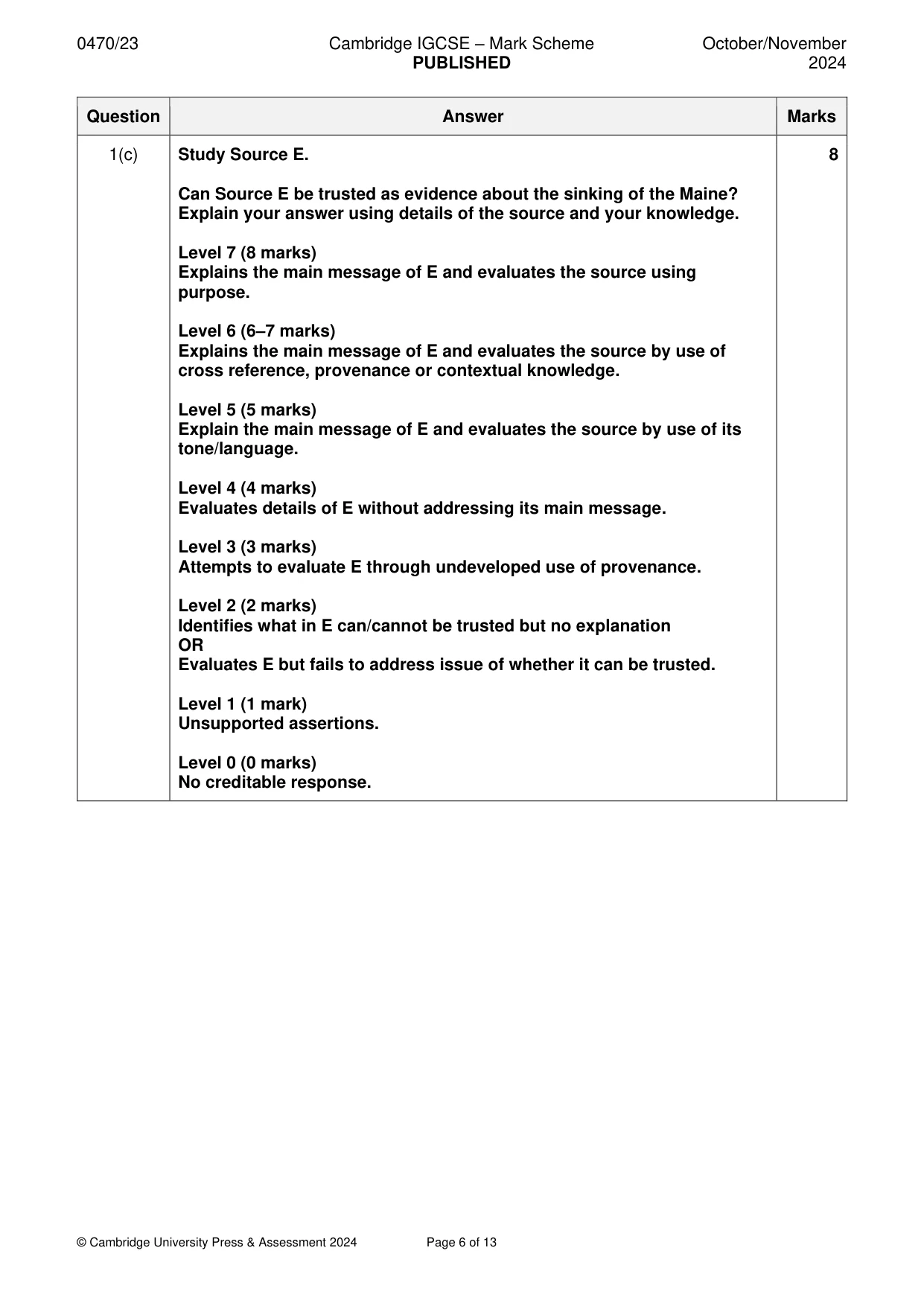
0470/23 Cambridge IGCSE – Mark Scheme PUBLISHED October/November 2024 © Cambridge University Press & Assessment 2024 Page 6 of 13 Question Answer Marks 1(c) Study Source E. Can Source E be trusted as evidence about the sinking of the Maine? Explain your answer using details of the source and your knowledge. Level 7 (8 marks) Explains the main message of E and evaluates the source using purpose. Level 6 (6–7 marks) Explains the main message of E and evaluates the source by use of cross reference, provenance or contextual knowledge. Level 5 (5 marks) Explain the main message of E and evaluates the source by use of its tone/language. Level 4 (4 marks) Evaluates details of E without addressing its main message. Level 3 (3 marks) Attempts to evaluate E through undeveloped use of provenance. Level 2 (2 marks) Identifies what in E can/cannot be trusted but no explanation OR Evaluates E but fails to address issue of whether it can be trusted. Level 1 (1 mark) Unsupported assertions. Level 0 (0 marks) No creditable response. 8
Mark scheme, page 7
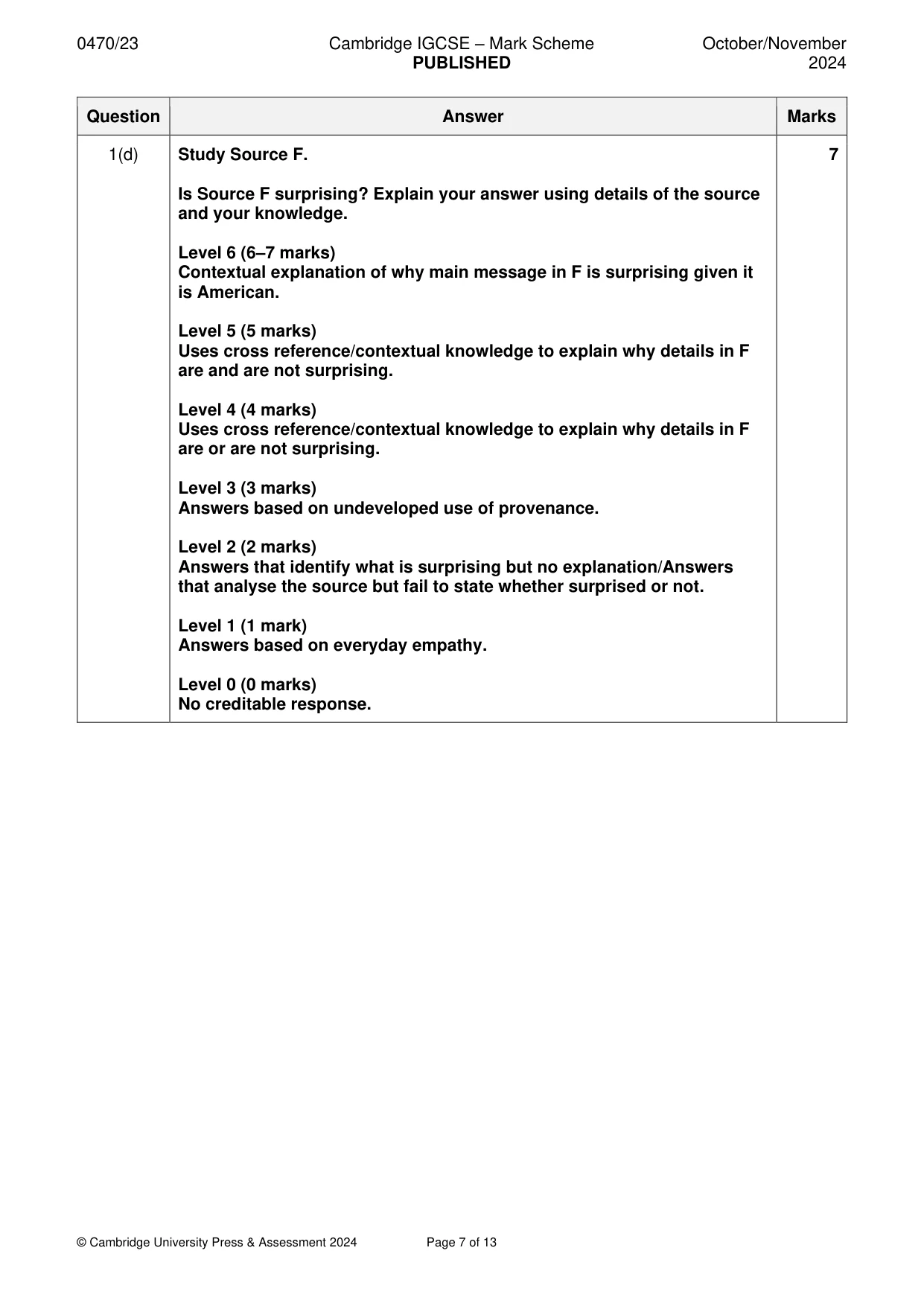
0470/23 Cambridge IGCSE – Mark Scheme PUBLISHED October/November 2024 © Cambridge University Press & Assessment 2024 Page 7 of 13 Question Answer Marks 1(d) Study Source F. Is Source F surprising? Explain your answer using details of the source and your knowledge. Level 6 (6–7 marks) Contextual explanation of why main message in F is surprising given it is American. Level 5 (5 marks) Uses cross reference/contextual knowledge to explain why details in F are and are not surprising. Level 4 (4 marks) Uses cross reference/contextual knowledge to explain why details in F are or are not surprising. Level 3 (3 marks) Answers based on undeveloped use of provenance. Level 2 (2 marks) Answers that identify what is surprising but no explanation/Answers that analyse the source but fail to state whether surprised or not. Level 1 (1 mark) Answers based on everyday empathy. Level 0 (0 marks) No creditable response. 7
Mark scheme, page 8
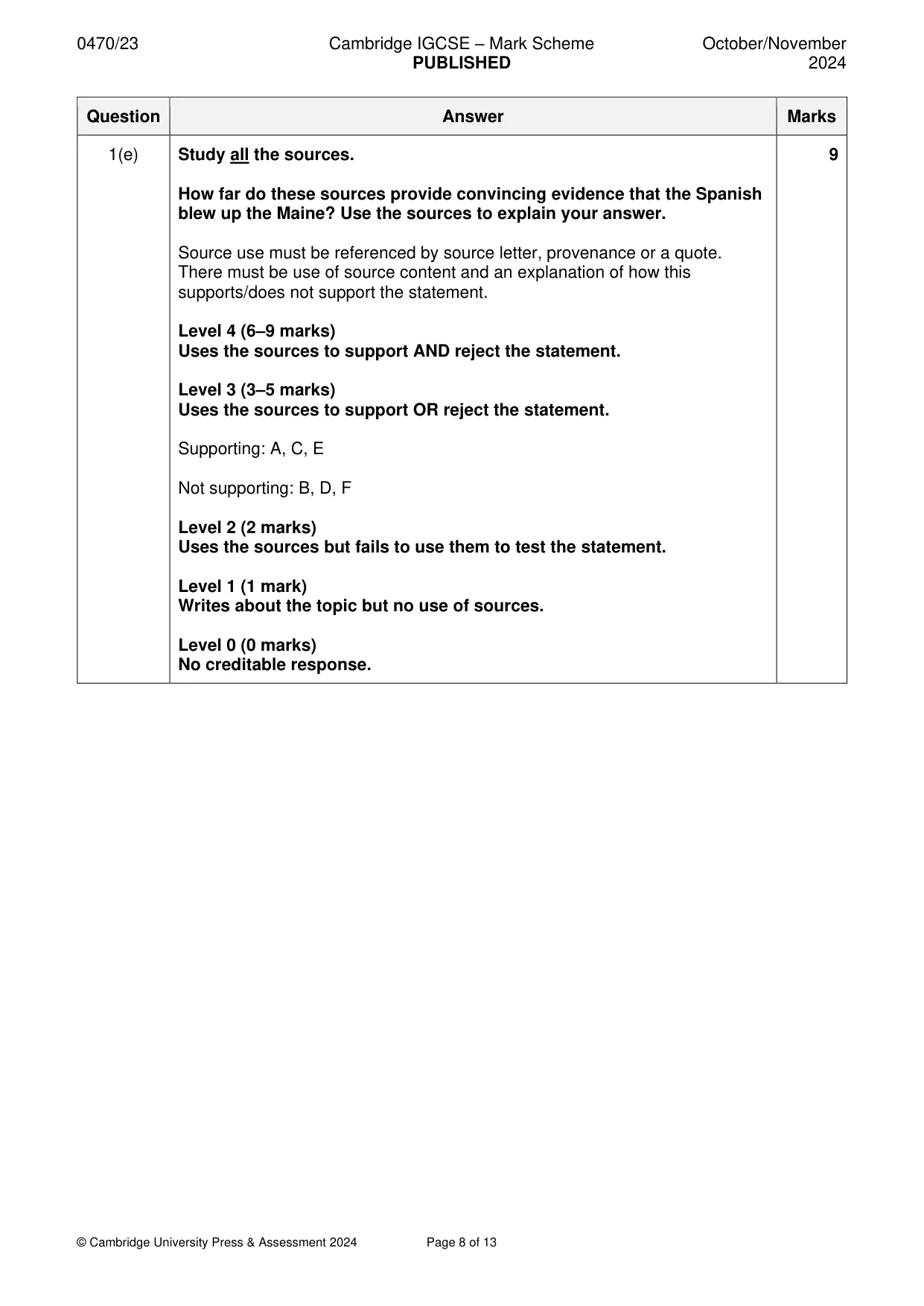
0470/23 Cambridge IGCSE – Mark Scheme PUBLISHED October/November 2024 © Cambridge University Press & Assessment 2024 Page 8 of 13 Question Answer Marks 1(e) Study all the sources. How far do these sources provide convincing evidence that the Spanish blew up the Maine? Use the sources to explain your answer. Source use must be referenced by source letter, provenance or a quote. There must be use of source content and an explanation of how this supports/does not support the statement. Level 4 (6–9 marks) Uses the sources to support AND reject the statement. Level 3 (3–5 marks) Uses the sources to support OR reject the statement. Supporting: A, C, E Not supporting: B, D, F Level 2 (2 marks) Uses the sources but fails to use them to test the statement. Level 1 (1 mark) Writes about the topic but no use of sources. Level 0 (0 marks) No creditable response. 9
Mark scheme, page 9
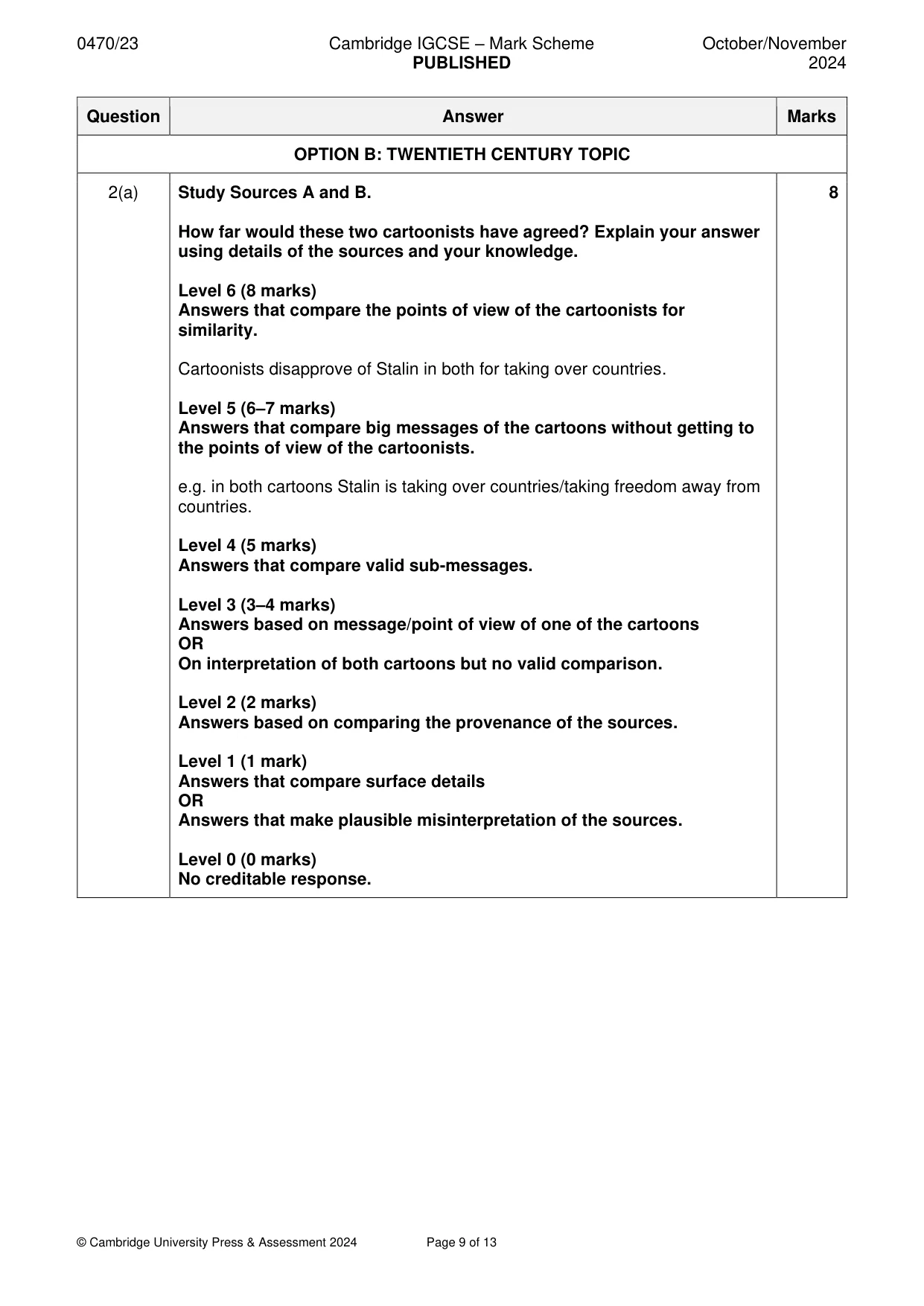
0470/23 Cambridge IGCSE – Mark Scheme PUBLISHED October/November 2024 © Cambridge University Press & Assessment 2024 Page 9 of 13 Question Answer Marks OPTION B: TWENTIETH CENTURY TOPIC 2(a) Study Sources A and B. How far would these two cartoonists have agreed? Explain your answer using details of the sources and your knowledge. Level 6 (8 marks) Answers that compare the points of view of the cartoonists for similarity. Cartoonists disapprove of Stalin in both for taking over countries. Level 5 (6–7 marks) Answers that compare big messages of the cartoons without getting to the points of view of the cartoonists. e.g. in both cartoons Stalin is taking over countries/taking freedom away from countries. Level 4 (5 marks) Answers that compare valid sub-messages. Level 3 (3–4 marks) Answers based on message/point of view of one of the cartoons OR On interpretation of both cartoons but no valid comparison. Level 2 (2 marks) Answers based on comparing the provenance of the sources. Level 1 (1 mark) Answers that compare surface details OR Answers that make plausible misinterpretation of the sources. Level 0 (0 marks) No creditable response. 8
Mark scheme, page 10
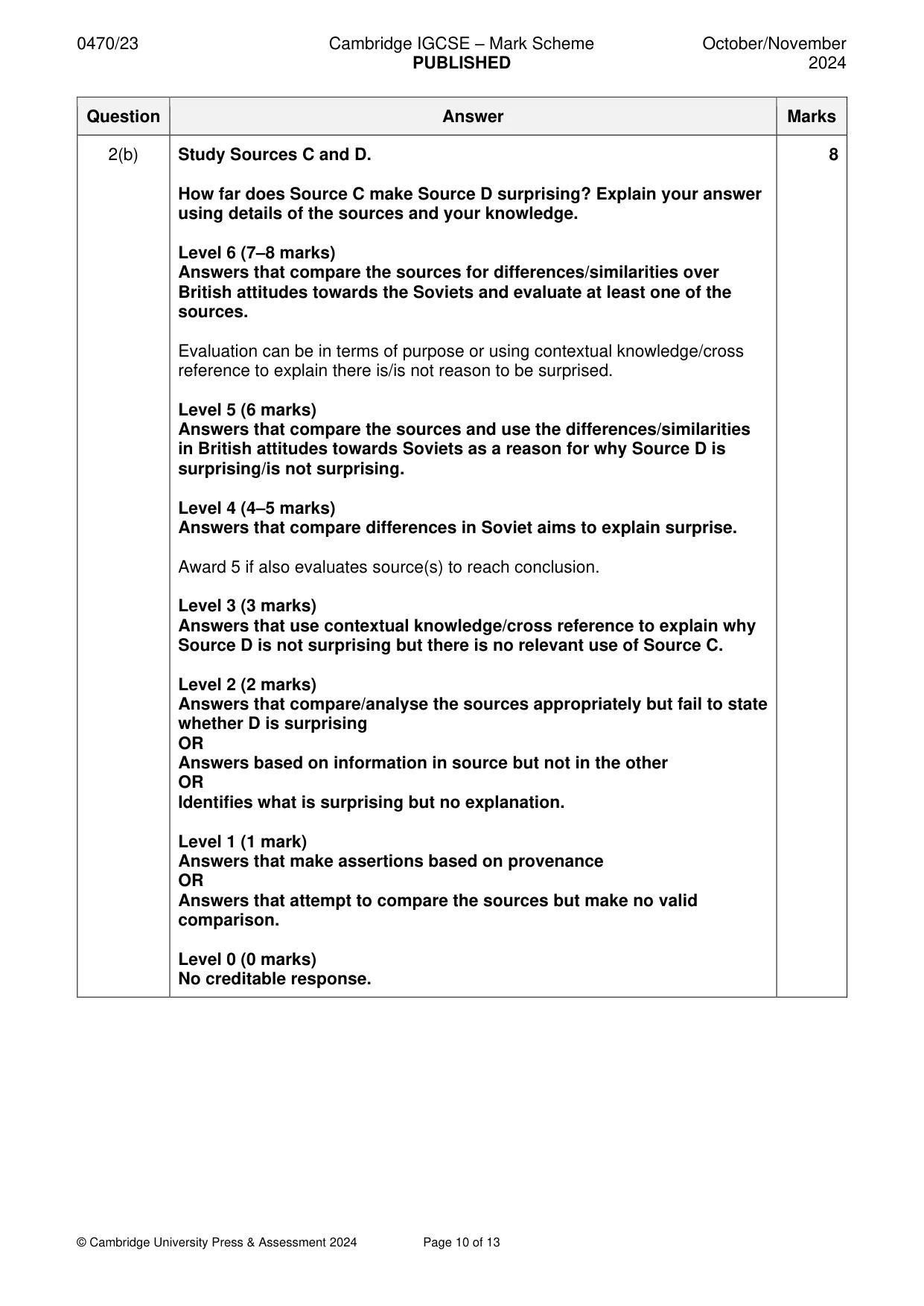
0470/23 Cambridge IGCSE – Mark Scheme PUBLISHED October/November 2024 © Cambridge University Press & Assessment 2024 Page 10 of 13 Question Answer Marks 2(b) Study Sources C and D. How far does Source C make Source D surprising? Explain your answer using details of the sources and your knowledge. Level 6 (7–8 marks) Answers that compare the sources for differences/similarities over British attitudes towards the Soviets and evaluate at least one of the sources. Evaluation can be in terms of purpose or using contextual knowledge/cross reference to explain there is/is not reason to be surprised. Level 5 (6 marks) Answers that compare the sources and use the differences/similarities in British attitudes towards Soviets as a reason for why Source D is surprising/is not surprising. Level 4 (4–5 marks) Answers that compare differences in Soviet aims to explain surprise. Award 5 if also evaluates source(s) to reach conclusion. Level 3 (3 marks) Answers that use contextual knowledge/cross reference to explain why Source D is not surprising but there is no relevant use of Source C. Level 2 (2 marks) Answers that compare/analyse the sources appropriately but fail to state whether D is surprising OR Answers based on information in source but not in the other OR Identifies what is surprising but no explanation. Level 1 (1 mark) Answers that make assertions based on provenance OR Answers that attempt to compare the sources but make no valid comparison. Level 0 (0 marks) No creditable response. 8
Mark scheme, page 11
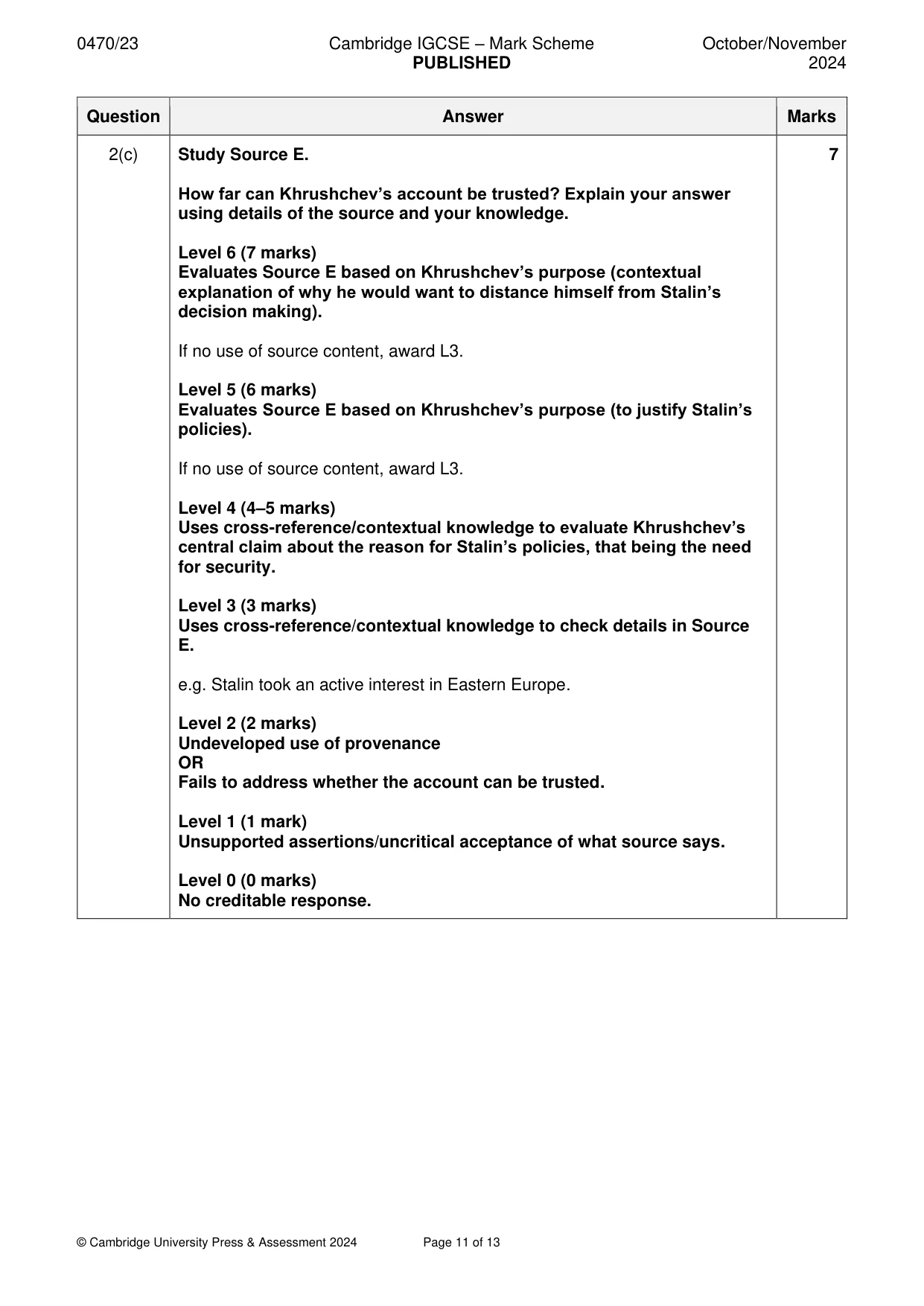
0470/23 Cambridge IGCSE – Mark Scheme PUBLISHED October/November 2024 © Cambridge University Press & Assessment 2024 Page 11 of 13 Question Answer Marks 2(c) Study Source E. How far can Khrushchev’s account be trusted? Explain your answer using details of the source and your knowledge. Level 6 (7 marks) Evaluates Source E based on Khrushchev’s purpose (contextual explanation of why he would want to distance himself from Stalin’s decision making). If no use of source content, award L3. Level 5 (6 marks) Evaluates Source E based on Khrushchev’s purpose (to justify Stalin’s policies). If no use of source content, award L3. Level 4 (4–5 marks) Uses cross-reference/contextual knowledge to evaluate Khrushchev’s central claim about the reason for Stalin’s policies, that being the need for security. Level 3 (3 marks) Uses cross-reference/contextual knowledge to check details in Source E. e.g. Stalin took an active interest in Eastern Europe. Level 2 (2 marks) Undeveloped use of provenance OR Fails to address whether the account can be trusted. Level 1 (1 mark) Unsupported assertions/uncritical acceptance of what source says. Level 0 (0 marks) No creditable response. 7
Mark scheme, page 12
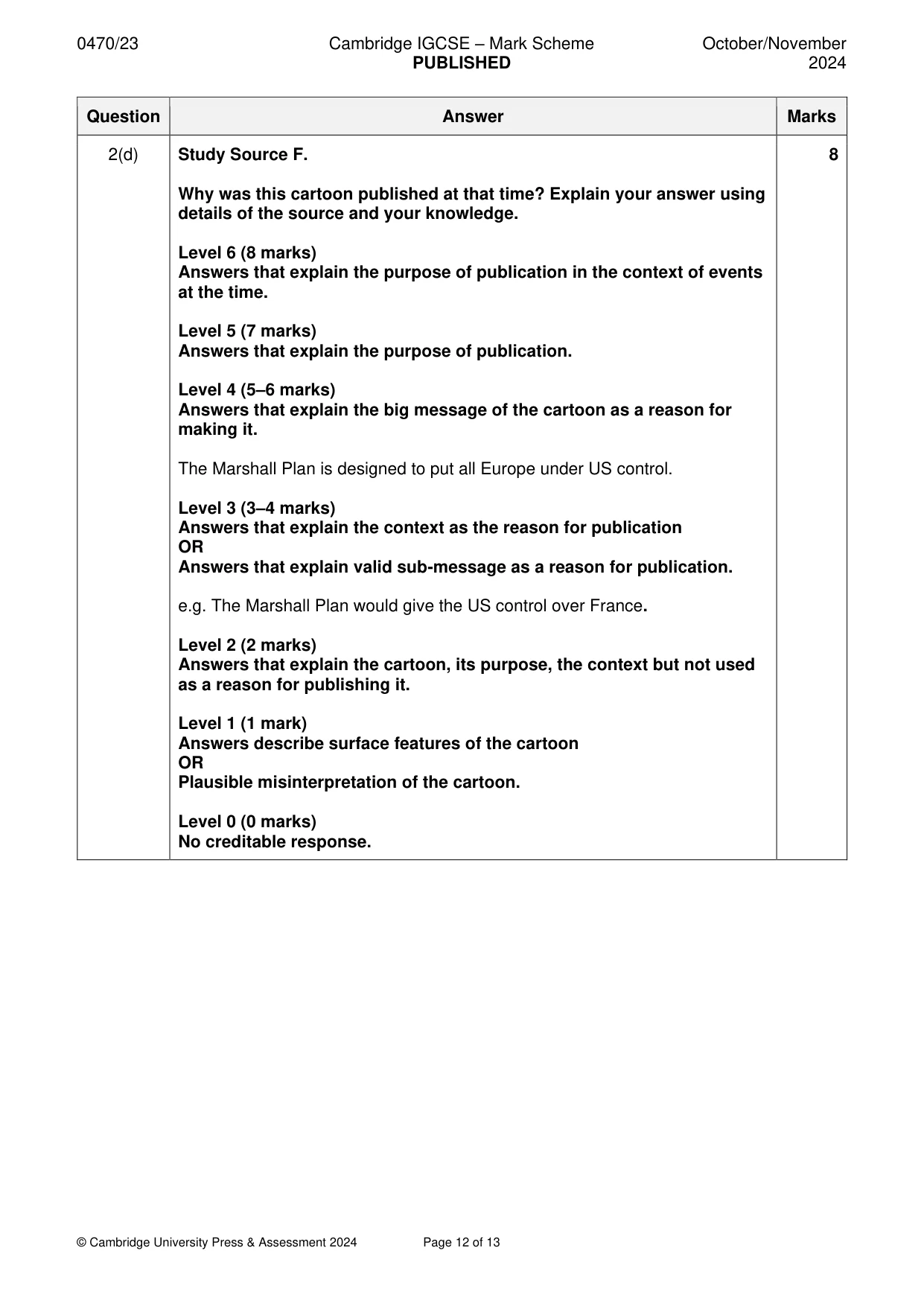
0470/23 Cambridge IGCSE – Mark Scheme PUBLISHED October/November 2024 © Cambridge University Press & Assessment 2024 Page 12 of 13 Question Answer Marks 2(d) Study Source F. Why was this cartoon published at that time? Explain your answer using details of the source and your knowledge. Level 6 (8 marks) Answers that explain the purpose of publication in the context of events at the time. Level 5 (7 marks) Answers that explain the purpose of publication. Level 4 (5–6 marks) Answers that explain the big message of the cartoon as a reason for making it. The Marshall Plan is designed to put all Europe under US control. Level 3 (3–4 marks) Answers that explain the context as the reason for publication OR Answers that explain valid sub-message as a reason for publication. e.g. The Marshall Plan would give the US control over France. Level 2 (2 marks) Answers that explain the cartoon, its purpose, the context but not used as a reason for publishing it. Level 1 (1 mark) Answers describe surface features of the cartoon OR Plausible misinterpretation of the cartoon. Level 0 (0 marks) No creditable response. 8
Mark scheme, page 13
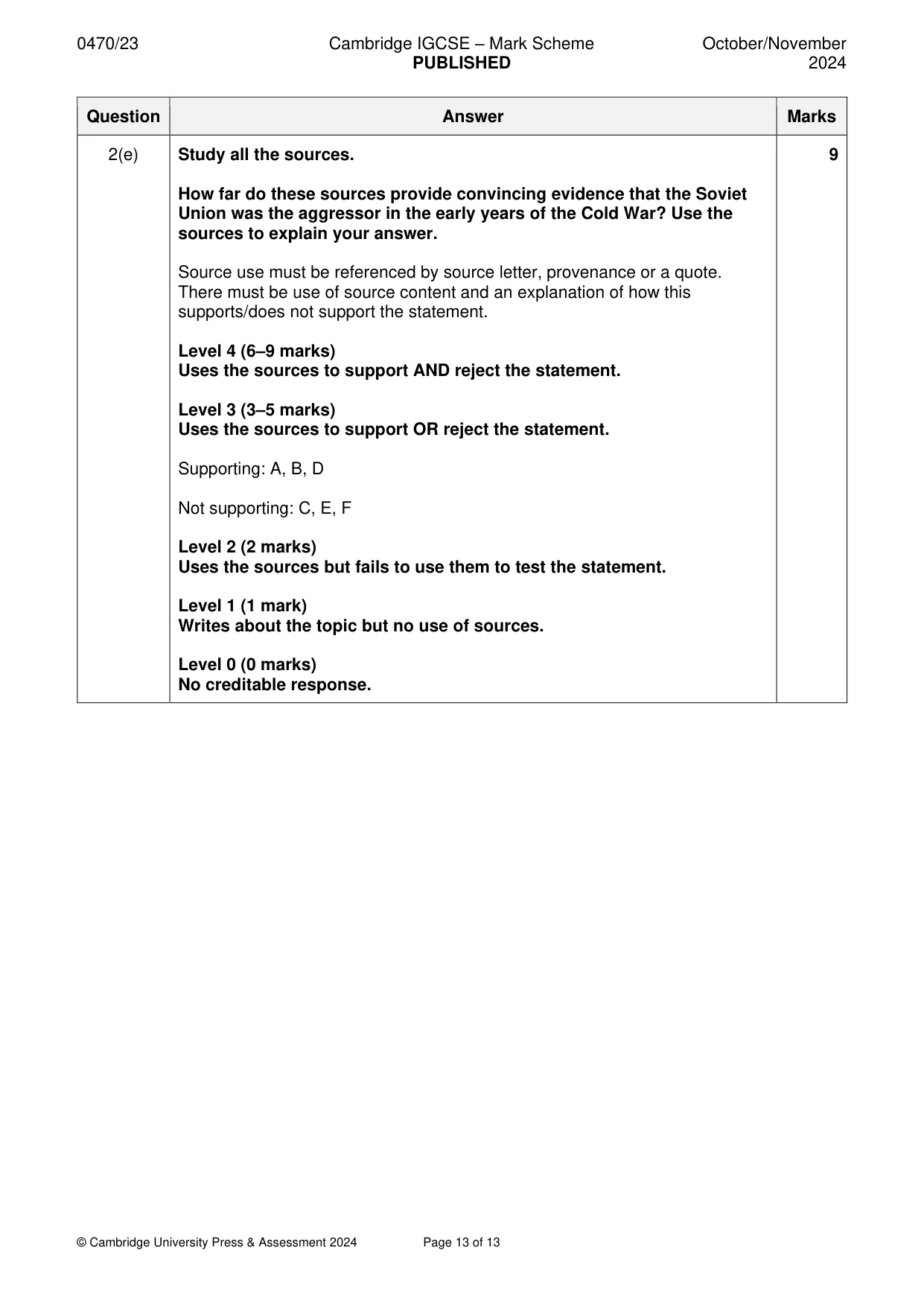
0470/23 Cambridge IGCSE – Mark Scheme PUBLISHED October/November 2024 © Cambridge University Press & Assessment 2024 Page 13 of 13 Question Answer Marks 2(e) Study all the sources. How far do these sources provide convincing evidence that the Soviet Union was the aggressor in the early years of the Cold War? Use the sources to explain your answer. Source use must be referenced by source letter, provenance or a quote. There must be use of source content and an explanation of how this supports/does not support the statement. Level 4 (6–9 marks) Uses the sources to support AND reject the statement. Level 3 (3–5 marks) Uses the sources to support OR reject the statement. Supporting: A, B, D Not supporting: C, E, F Level 2 (2 marks) Uses the sources but fails to use them to test the statement. Level 1 (1 mark) Writes about the topic but no use of sources. Level 0 (0 marks) No creditable response. 9
What you needed in this session
Cambridge’s own grade thresholds for 2024 Oct/Nov, Paper 2 · Variant 3. A higher threshold means an easier paper — the bar moves with how the cohort did.