Cambridge IGCSE History 0470 — 2023 May/June Paper 2 · Variant 3
0470/23/M/J/23 · 50 marks · ≈56 min
The question paper and its mark scheme, free to read here and free to download. This is Cambridge’s own paper, exactly as it was sat.
Question paper16 pages


Mark scheme11 pages
Answers below. Sit the paper first if you are practising.
Paper as text
Question paper, page 1
This document has 16 pages. Any blank pages are indicated. [Turn over Cambridge IGCSE™ DC (LE/JG) 312400/3 © UCLES 2023 HISTORY 0470/23 Paper 2 May/June 2023 2 hours You must answer on the enclosed answer booklet. You will need: Answer booklet (enclosed) INSTRUCTIONS ● Answer all the questions on one option only. Option A: Nineteenth century topic Option B: Twentieth century topic ● Follow the instructions on the front cover of the answer booklet. If you need additional answer paper, ask the invigilator for a continuation booklet. INFORMATION ● The total mark for this paper is 50. ● The number of marks for each question or part question is shown in brackets [ ]. * 1 6 8 9 7 1 7 7 3 7 *
Question paper, page 2
2 0470/23/M/J/23 © UCLES 2023 Option A: Nineteenth century topic HOW FAR DID INDIA AND INDIANS BENEFIT FROM BRITISH RULE? Study the Background Information and the sources carefully, and then answer all the questions. Background Information By the 1820s nearly all of India was under the direct, or indirect, control of the British East India Company. After the Indian Mutiny of 1857 the East India Company was dissolved and India came under the direct rule of the British government. In 1876 Queen Victoria became Empress of India. In the last decades of the nineteenth century India suffered from terrible famines, with millions of people dying. Indian nationalism grew and in 1885 the Indian National Congress was formed. The impact of British rule on India has led to much debate among historians and politicians. Some claim that the British modernised India and laid the foundations for the India of today, while others argue that British rule was racist, held back economic growth and exploited India for its wealth. Did British rule benefit India and Indians? SOURCE A British imperialism gave India many of its admirable features such as language, democracy and its railways. In fact, it laid the foundations for India’s eventual success in a future globalised world. From the 1820s the East India Company attempted to modernise India. Suttee was banned. Schools and universities were established. By the 1860s hundreds of thousands of Indian children were at school and spoke the English language, although some Indian leaders claimed these schools threatened Indian culture and religions. The 1857 Rebellion led to some democratic changes such as Indians being consulted through a new Legislative Council. Traditional Indian society began to break down and this led to a strong middle class and a sense of Indian nationalism. British rule saw a period of expanding growth and industrial development. Communications were revolutionised across India, with thousands of miles of electric telegraph being established. By the end of the century India benefited from 28 000 miles of railways connecting interior regions to the main ports. The railways were a mixed blessing because they accelerated the pace of raw-material extraction from India and destroyed India’s local handicraft industries by facilitating an influx of cheap manufactured goods from Britain. From a recent article on a website.
Question paper, page 3
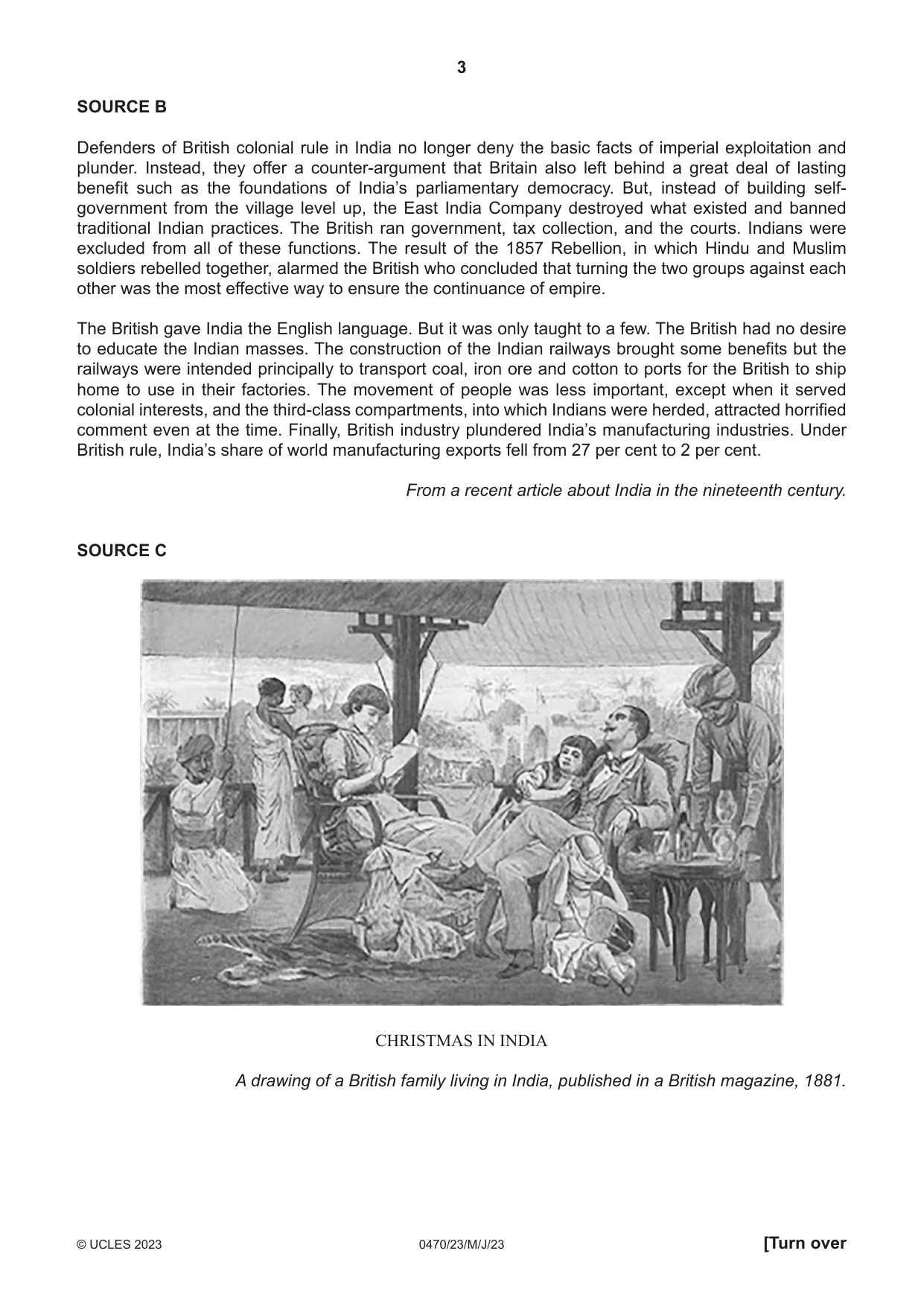
3 0470/23/M/J/23 © UCLES 2023 [Turn over SOURCE B Defenders of British colonial rule in India no longer deny the basic facts of imperial exploitation and plunder. Instead, they offer a counter-argument that Britain also left behind a great deal of lasting benefit such as the foundations of India’s parliamentary democracy. But, instead of building self- government from the village level up, the East India Company destroyed what existed and banned traditional Indian practices. The British ran government, tax collection, and the courts. Indians were excluded from all of these functions. The result of the 1857 Rebellion, in which Hindu and Muslim soldiers rebelled together, alarmed the British who concluded that turning the two groups against each other was the most effective way to ensure the continuance of empire. The British gave India the English language. But it was only taught to a few. The British had no desire to educate the Indian masses. The construction of the Indian railways brought some benefits but the railways were intended principally to transport coal, iron ore and cotton to ports for the British to ship home to use in their factories. The movement of people was less important, except when it served colonial interests, and the third-class compartments, into which Indians were herded, attracted horrified comment even at the time. Finally, British industry plundered India’s manufacturing industries. Under British rule, India’s share of world manufacturing exports fell from 27 per cent to 2 per cent. From a recent article about India in the nineteenth century. SOURCE C CHRISTMAS IN INDIA A drawing of a British family living in India, published in a British magazine, 1881.
Question paper, page 4
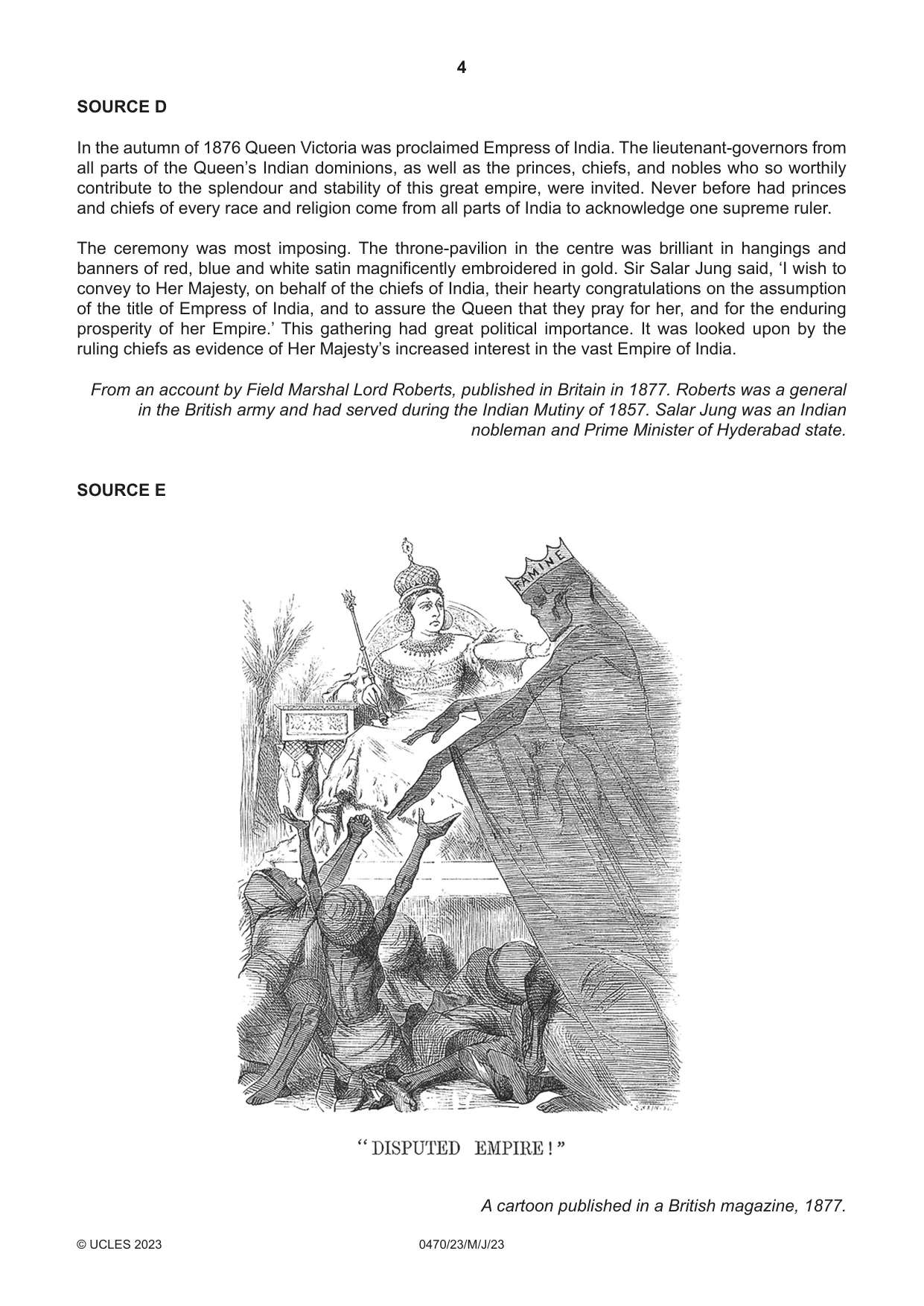
4 0470/23/M/J/23 © UCLES 2023 SOURCE D In the autumn of 1876 Queen Victoria was proclaimed Empress of India. The lieutenant-governors from all parts of the Queen’s Indian dominions, as well as the princes, chiefs, and nobles who so worthily contribute to the splendour and stability of this great empire, were invited. Never before had princes and chiefs of every race and religion come from all parts of India to acknowledge one supreme ruler. The ceremony was most imposing. The throne-pavilion in the centre was brilliant in hangings and banners of red, blue and white satin magnificently embroidered in gold. Sir Salar Jung said, ‘I wish to convey to Her Majesty, on behalf of the chiefs of India, their hearty congratulations on the assumption of the title of Empress of India, and to assure the Queen that they pray for her, and for the enduring prosperity of her Empire.’ This gathering had great political importance. It was looked upon by the ruling chiefs as evidence of Her Majesty’s increased interest in the vast Empire of India. From an account by Field Marshal Lord Roberts, published in Britain in 1877. Roberts was a general in the British army and had served during the Indian Mutiny of 1857. Salar Jung was an Indian nobleman and Prime Minister of Hyderabad state. SOURCE E A cartoon published in a British magazine, 1877.
Question paper, page 5
5 0470/23/M/J/23 © UCLES 2023 [Turn over SOURCE F The Benefits of British Rule: In the Cause of Humanity: Abolition of suttee. Charitable aid in time of famine. Glorious work all of this. In the Cause of Civilisation: Education, both male and female. Politically: Peace and order. Freedom of speech and liberty of the press. Security of life and property. Freedom from oppression. Materially: Loans for railways and irrigation. The policy of building railways and irrigation works is hopeful, has already resulted in much good. Development of a few valuable products, such as indigo, tea, coffee, silk, etc. Increase of exports. The Disadvantages of British Rule: In the Cause of Humanity: Nothing. In the Cause of Civilisation: Nothing. Politically: Repeated breach of promises to give Indians a fair share in the higher administration of their own country. An utter disregard for the feelings and views of Indians. Financially: The oppressiveness of the taxes imposed. Materially: The great mass of the poor earn almost nothing. The famines that the British could have prevented if they had done their duty. Summary: British rule has been a great blessing; our great misfortune is that you do not know our wants. When you understand our real wishes, I have not the least doubt that you would do justice. An essay by Dadabhai Naoroji published in 1871. Naoroji was one of the most important figures in the early Indian nationalist movement, and one of the founder members of the Indian National Congress. He was also a member of the British Parliament and divided his time between Britain and India. SOURCE G Never was there a conquest of such extent accompanied with so little of wrong and suffering to the people. The British have prevented repetitions of those outrages on humanity, wherever it has been in their power to control the princes. From an article by Charles Creighton Hazewell, an American journalist and politician, published in an American magazine in 1857. Content removed due to copyright restrictions.
Question paper, page 6
6 0470/23/M/J/23 © UCLES 2023 SOURCE H Who owns the steamship line by which we came to India? The British. Who built that splendid railway station in Bombay? The British. Who built the railway on which we rode to Calcutta? The British. We find that Calcutta and Bombay have a large commerce. To whom does it belong? Mainly to the British. We find that the British have built 29 000 miles of railway; have created good postal and telegraph systems; and have established many schools, colleges and hospitals. But is there another side? Have we been out among the Indian people? Have we looked into the causes of those famines, the most terrible known to the modern world? During the first eighty years of the nineteenth century, 18 million people died of famine. Why, then, have all these millions of people perished? Because they were so indescribably poor. This is not the India which the British tell us about in their official reports. This is India from the inside, the India of the people who bear the burdens and pay the taxes, and do the starving when the famines come. Perhaps the greatest of all this is the enormous drain of wealth from India to Britain. From an article by Jabez T Sunderland, an American social reformer and anti-imperialist who visited India in 1895–96, published in an American magazine in 1908.
Question paper, page 7
7 0470/23/M/J/23 © UCLES 2023 [Turn over Now answer all the following questions. You may use any of the sources to help you answer the questions, in addition to those sources which you are told to use. In answering the questions you should use your knowledge of the topic to help you interpret and evaluate the sources. 1 Study Sources A and B. How far do these two sources agree? Explain your answer using details of the sources. [7] 2 Study Source C. How useful is this source as evidence about the British in India? Explain your answer using details of the source and your knowledge. [7] 3 Study Sources D and E. Does Source D prove that the views of the cartoonist (Source E) were wrong? Explain your answer using details of the sources and your knowledge. [8] 4 Study Source F. Do you find this source surprising? Explain your answer using details of the source and your knowledge. [8] 5 Study Sources G and H. Why do these two sources disagree? Explain your answer using details of the sources and your knowledge. [8] 6 Study all the sources. How far do these sources provide convincing evidence that India and Indians benefited from British rule? Use the sources to explain your answer. [12]
Question paper, page 8
8 0470/23/M/J/23 © UCLES 2023 Option B: Twentieth Century topic WAS BRITAIN RIGHT NOT TO ACT OVER THE REMILITARISATION OF THE RHINELAND? Study the Background Information and the sources carefully, and then answer all the questions. Background Information When Germany sent its army into the Rhineland on 7 March 1936, it was breaking both the Treaty of Versailles and the Locarno Treaties. Despite this, Britain and France did not intervene. Some politicians at the time such as Churchill, and some historians since, have argued that it was clear that Hitler was not going to limit his ambitions to the Rhineland, and that if Britain and France had acted in 1936 they could have stopped Hitler. Others argue that the British government had no choice but to try and appease Hitler because its armed forces were too weak to act and anyway there was little support within Britain for action against Germany. Was Britain justified in not taking firmer action over the Rhineland? SOURCE A Britain’s policy over the Rhineland was understandable. From the beginning it wanted to prevent war. There was no possibility of Britain receiving military support from France. French politicians had ruled out the use of force, France’s army was not capable of immediate action and French public opinion was opposed to it. For the French, the Rhineland was not worth fighting for. Nor was there any chance of British military action. Although they did not trust Hitler, British leaders were well aware that Britain was in no position to take military action against Germany. British public opinion would certainly not have supported any such action. The mood in Britain after the Abyssinian Crisis was more anti-French than anti-German. There was no desire to take on Hitler when in the eyes of many people he was simply entering ‘his own backyard’. Government attempts to persuade the British public to accept rearmament had little success. The last thing the government wanted was a continental involvement that might alienate working-class voters and make it impossible to build agreement for strengthening national defences. The British government accepted the Rhineland was an important issue, but considered it more important to get on well with Germany. They believed Britain had too many enemies, and not enough resources to cope with them. All this made Hitler’s offer of a non-aggression pact very attractive. From a history book.
Question paper, page 9
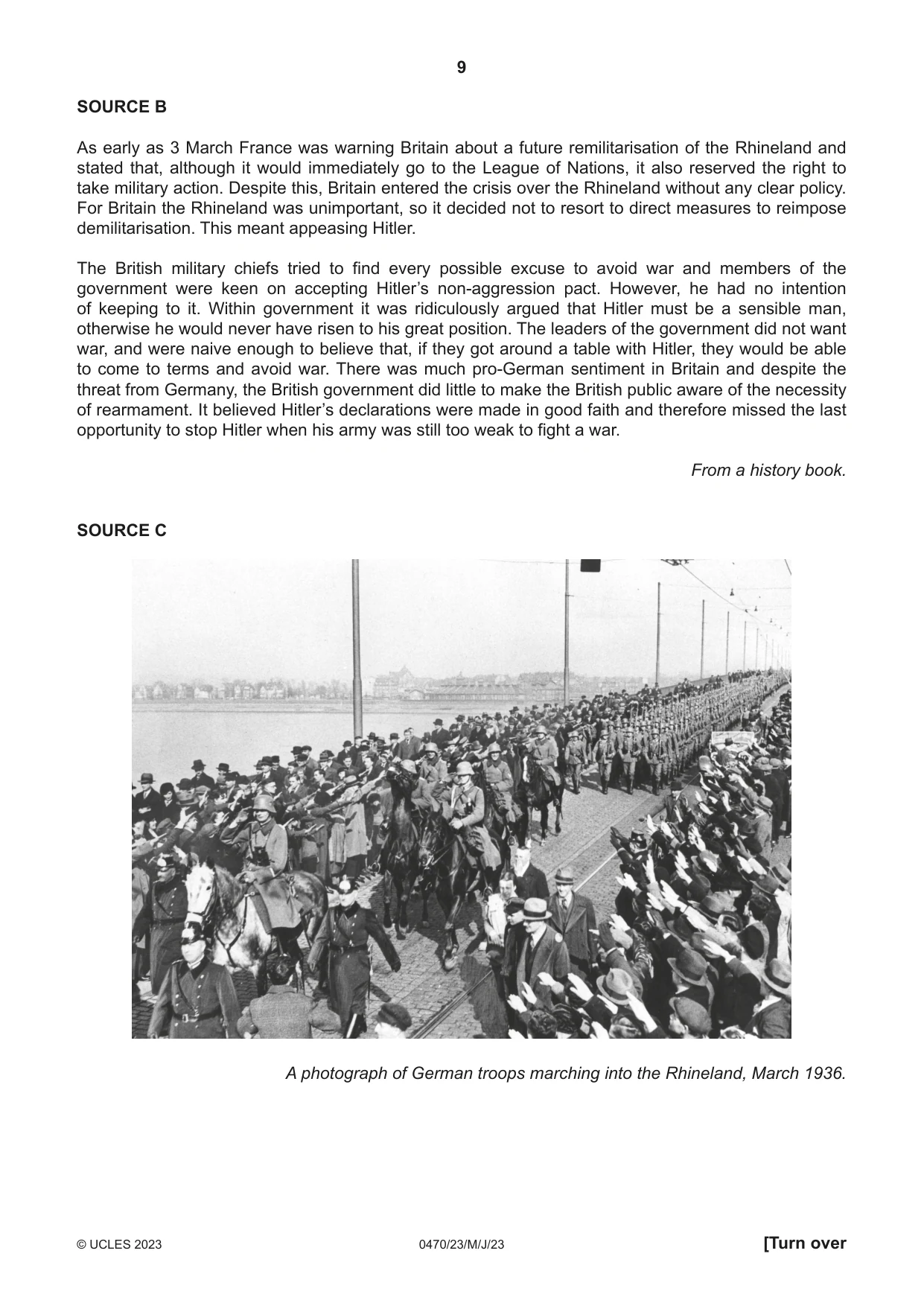
9 0470/23/M/J/23 © UCLES 2023 [Turn over SOURCE B As early as 3 March France was warning Britain about a future remilitarisation of the Rhineland and stated that, although it would immediately go to the League of Nations, it also reserved the right to take military action. Despite this, Britain entered the crisis over the Rhineland without any clear policy. For Britain the Rhineland was unimportant, so it decided not to resort to direct measures to reimpose demilitarisation. This meant appeasing Hitler. The British military chiefs tried to find every possible excuse to avoid war and members of the government were keen on accepting Hitler’s non-aggression pact. However, he had no intention of keeping to it. Within government it was ridiculously argued that Hitler must be a sensible man, otherwise he would never have risen to his great position. The leaders of the government did not want war, and were naive enough to believe that, if they got around a table with Hitler, they would be able to come to terms and avoid war. There was much pro-German sentiment in Britain and despite the threat from Germany, the British government did little to make the British public aware of the necessity of rearmament. It believed Hitler’s declarations were made in good faith and therefore missed the last opportunity to stop Hitler when his army was still too weak to fight a war. From a history book. SOURCE C A photograph of German troops marching into the Rhineland, March 1936.
Question paper, page 10
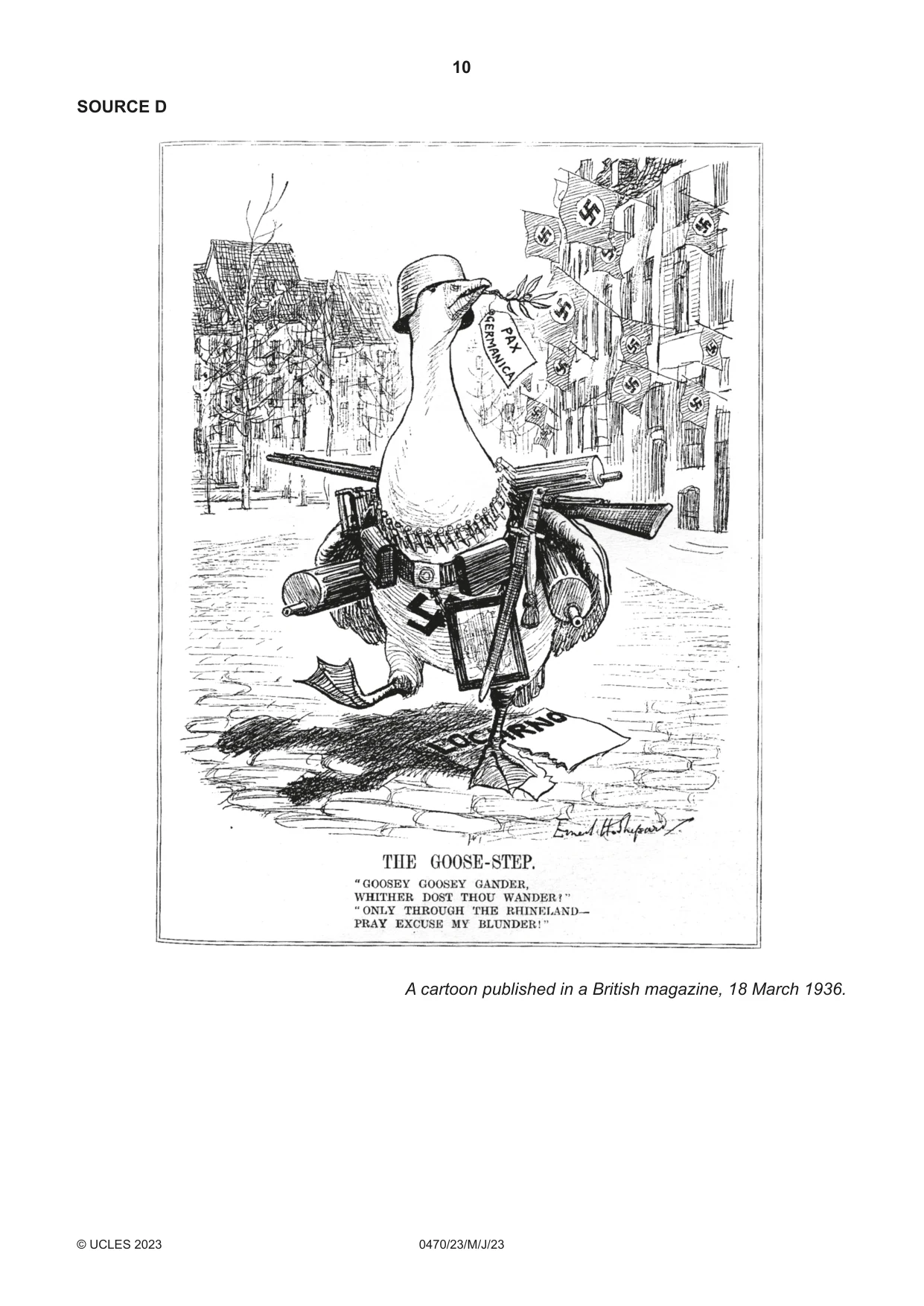
10 0470/23/M/J/23 © UCLES 2023 SOURCE D A cartoon published in a British magazine, 18 March 1936.
Question paper, page 11
11 0470/23/M/J/23 © UCLES 2023 [Turn over SOURCE E We must discourage any military action by France against Germany. Germany could be called on to evacuate the Rhineland but such a demand should not be made unless the Powers who made it were prepared to enforce it by military action. Fortunately, Flandin has said that France will not act alone but will take the matter to the League of Nations. This he must be encouraged to do. The French public might get restless at such slow action and demand action of a military character. Such a development must be avoided if possible. While we cannot object to the Council declaring that Germany has violated the Versailles and Locarno Treaties, this is not to be followed by a French attack on Germany and a request for our armed assistance. But we must be ready to offer the French something as compensation for the tearing up of Versailles and Locarno. We might agree to a condemnation of Germany but we ought to resist an economic boycott. The essential thing will be to persuade France to accept negotiations with Germany. We are in a weak position because France can hold us to our Locarno obligations and call upon us to join in turning German forces out of the Rhineland. The strength of our position lies in the fact that France is not in the mood for military action of this sort. From a policy document presented by Eden to the rest of the British government, 8 March 1936. Eden was a member of the British government and in charge of foreign policy. Flandin was in charge of French foreign policy. SOURCE F The German Ambassador came to see me on the morning of 7 March and handed me a document which announces that the German government has restored the full sovereignty of Germany in the demilitarised zone of the Rhineland. The second part of the document contains a series of proposals which are designed to promote the establishment of a system of peaceful security for Europe. The French and Belgian governments have asked that the Council of the League of Nations may be summoned as soon as possible to consider the situation. I must emphasise that the Council of the League is the proper body for this purpose. There is no reason to suppose that the German action implies a threat of hostilities. The German government speaks of its ‘unchangeable longing for a real peace in Europe’ and expresses its willingness to conclude a non-aggression pact with France and Belgium. If peace is to be secured there is a duty to rebuild. It is in that spirit that we must approach the new proposals of the German Chancellor. Eden speaking in the British Parliament, 9 March 1936.
Question paper, page 12
12 0470/23/M/J/23 © UCLES 2023 SOURCE G At the end of January 1936, I was conscious of a new atmosphere in Britain. Mussolini’s conquest of Abyssinia and the breakdown of ‘Collective Security’ had made the Labour Party and the public prepared to contemplate war against Nazi tyranny. Although the opposition parties continued to oppose rearmament, there was a measure of agreement and had the government risen to the occasion they could have led a united people forward. The remilitarisation of the Rhineland was a vital issue for France but they were unable to move without the support of Britain. However, they did not have any encouragement to resist German aggression from Britain. If the French army had mobilised there is no doubt Hitler would have had to withdraw. France alone was strong enough to drive the Germans out of the Rhineland. I warned the British government at the time that after the occupation of the Rhineland the incorporation of Austria into Germany was clearly the next step. From a book about the events leading up to the Second World War by Winston Churchill, published in 1948. The Labour Party was the opposition party in Britain. SOURCE H The whole world turns its eyes towards Britain. If Britain will act now it can lead Europe, and you will prevent war. It is your last chance. If you do not stop Germany now, it is all over. If you do not maintain the Treaty of Locarno, all that will remain for you to wait for is rearmament by Germany. If you do not stop Germany by force today, war is inevitable. Flandin speaking in a private meeting to British politicians, businessmen and journalists, 12 March 1936.
Question paper, page 13
13 0470/23/M/J/23 © UCLES 2023 Now answer all the following questions. You may use any of the sources to help you answer the questions, in addition to those sources which you are told to use. In answering the questions you should use your knowledge of the topic to help you interpret and evaluate the sources. 1 Study Sources A and B. How far do these two sources agree? Explain your answer using details of the sources. [7] 2 Study Sources C and D. How far would the photographer (Source C) have agreed with the cartoonist (Source D)? Explain your answer using details of the sources and your knowledge. [8] 3 Study Source E. How useful is this source to a historian studying the crisis over the Rhineland? Explain your answer using details of the source and your knowledge. [7] 4 Study Sources F and G. How far does Source G make Source F surprising? Explain your answer using details of the sources and your knowledge. [8] 5 Study Source H. Why do you think Flandin attended this meeting? Explain your answer using details of the source and your knowledge. [8] 6 Study all the sources. How far do these sources provide convincing evidence that British policy over the Rhineland was justified? Use the sources to explain your answer. [12]
Question paper, page 14
14 0470/23/M/J/23 © UCLES 2023 BLANK PAGE
Question paper, page 15
15 0470/23/M/J/23 © UCLES 2023 BLANK PAGE
Question paper, page 16
16 0470/23/M/J/23 © UCLES 2023 Permission to reproduce items where third-party owned material protected by copyright is included has been sought and cleared where possible. Every reasonable effort has been made by the publisher (UCLES) to trace copyright holders, but if any items requiring clearance have unwittingly been included, the publisher will be pleased to make amends at the earliest possible opportunity. To avoid the issue of disclosure of answer-related information to candidates, all copyright acknowledgements are reproduced online in the Cambridge Assessment International Education Copyright Acknowledgements Booklet. This is produced for each series of examinations and is freely available to download at www.cambridgeinternational.org after the live examination series. Cambridge Assessment International Education is part of Cambridge Assessment. Cambridge Assessment is the brand name of the University of Cambridge Local Examinations Syndicate (UCLES), which is a department of the University of Cambridge. BLANK PAGE
Mark scheme, page 1
This document consists of 11 printed pages. © UCLES 2023 [Turn over Cambridge IGCSE™ HISTORY 0470/23 Paper 2 May/June 2023 MARK SCHEME Maximum Mark: 50 Published This mark scheme is published as an aid to teachers and candidates, to indicate the requirements of the examination. It shows the basis on which Examiners were instructed to award marks. It does not indicate the details of the discussions that took place at an Examiners’ meeting before marking began, which would have considered the acceptability of alternative answers. Mark schemes should be read in conjunction with the question paper and the Principal Examiner Report for Teachers. Cambridge International will not enter into discussions about these mark schemes. Cambridge International is publishing the mark schemes for the May/June 2023 series for most Cambridge IGCSE, Cambridge International A and AS Level and Cambridge Pre-U components, and some Cambridge O Level components.
Mark scheme, page 2
0470/23 Cambridge IGCSE – Mark Scheme PUBLISHED May/June 2023 © UCLES 2023 Page 2 of 11 Generic Marking Principles These general marking principles must be applied by all examiners when marking candidate answers. They should be applied alongside the specific content of the mark scheme or generic level descriptors for a question. Each question paper and mark scheme will also comply with these marking principles. GENERIC MARKING PRINCIPLE 1: Marks must be awarded in line with: the specific content of the mark scheme or the generic level descriptors for the question the specific skills defined in the mark scheme or in the generic level descriptors for the question the standard of response required by a candidate as exemplified by the standardisation scripts. GENERIC MARKING PRINCIPLE 2: Marks awarded are always whole marks (not half marks, or other fractions). GENERIC MARKING PRINCIPLE 3: Marks must be awarded positively: marks are awarded for correct/valid answers, as defined in the mark scheme. However, credit is given for valid answers which go beyond the scope of the syllabus and mark scheme, referring to your Team Leader as appropriate marks are awarded when candidates clearly demonstrate what they know and can do marks are not deducted for errors marks are not deducted for omissions answers should only be judged on the quality of spelling, punctuation and grammar when these features are specifically assessed by the question as indicated by the mark scheme. The meaning, however, should be unambiguous. GENERIC MARKING PRINCIPLE 4: Rules must be applied consistently, e.g. in situations where candidates have not followed instructions or in the application of generic level descriptors. GENERIC MARKING PRINCIPLE 5: Marks should be awarded using the full range of marks defined in the mark scheme for the question (however; the use of the full mark range may be limited according to the quality of the candidate responses seen). GENERIC MARKING PRINCIPLE 6: Marks awarded are based solely on the requirements as defined in the mark scheme. Marks should not be awarded with grade thresholds or grade descriptors in mind.
Mark scheme, page 3
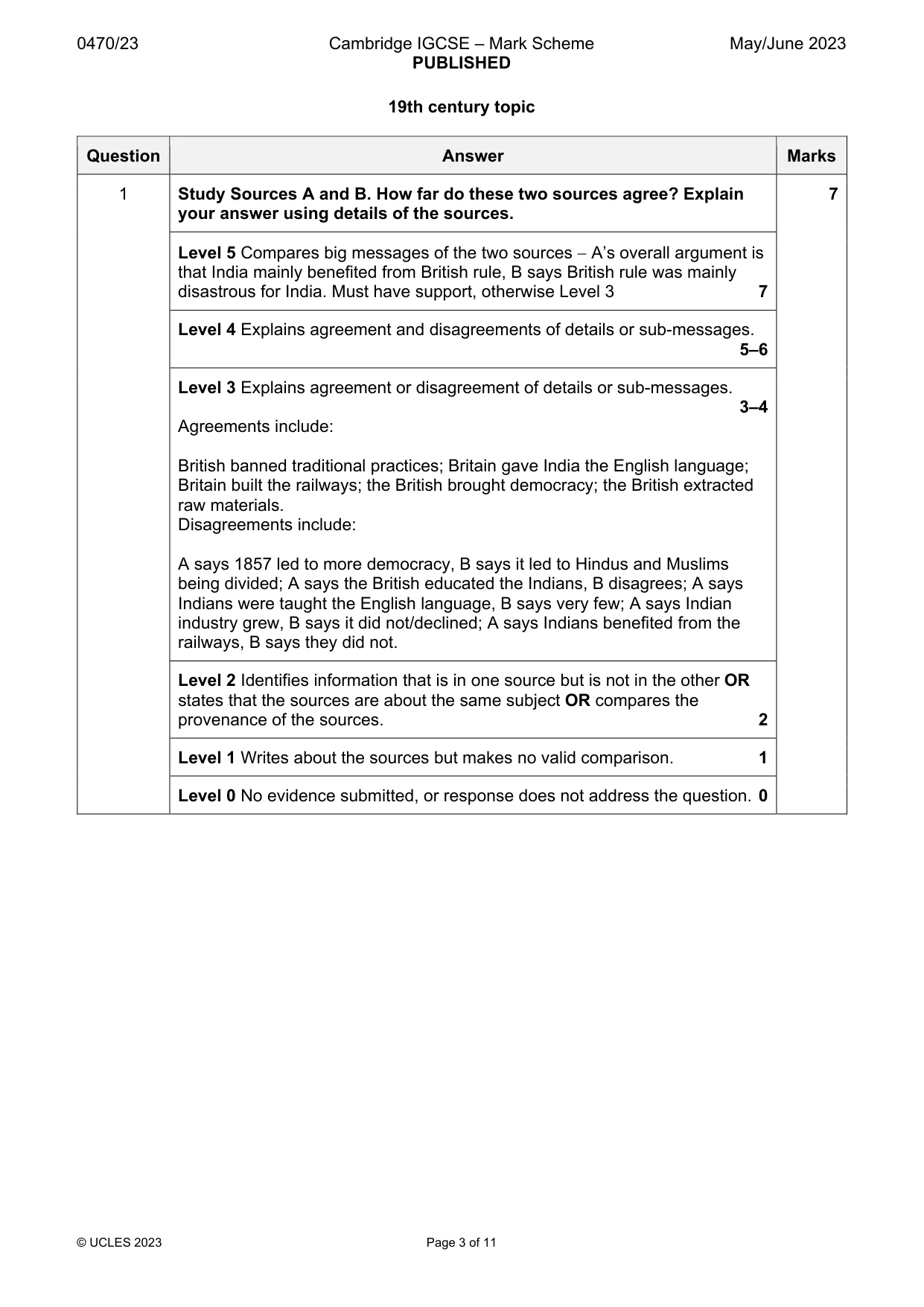
0470/23 Cambridge IGCSE – Mark Scheme PUBLISHED May/June 2023 © UCLES 2023 Page 3 of 11 19th century topic Question Answer Marks 1 Study Sources A and B. How far do these two sources agree? Explain your answer using details of the sources. 7 Level 5 Compares big messages of the two sources A’s overall argument is that India mainly benefited from British rule, B says British rule was mainly disastrous for India. Must have support, otherwise Level 3 7 Level 4 Explains agreement and disagreements of details or sub-messages. 5–6 Level 3 Explains agreement or disagreement of details or sub-messages. 3–4 Agreements include: British banned traditional practices; Britain gave India the English language; Britain built the railways; the British brought democracy; the British extracted raw materials. Disagreements include: A says 1857 led to more democracy, B says it led to Hindus and Muslims being divided; A says the British educated the Indians, B disagrees; A says Indians were taught the English language, B says very few; A says Indian industry grew, B says it did not/declined; A says Indians benefited from the railways, B says they did not. Level 2 Identifies information that is in one source but is not in the other OR states that the sources are about the same subject OR compares the provenance of the sources. 2 Level 1 Writes about the sources but makes no valid comparison. 1 Level 0 No evidence submitted, or response does not address the question. 0
Mark scheme, page 4
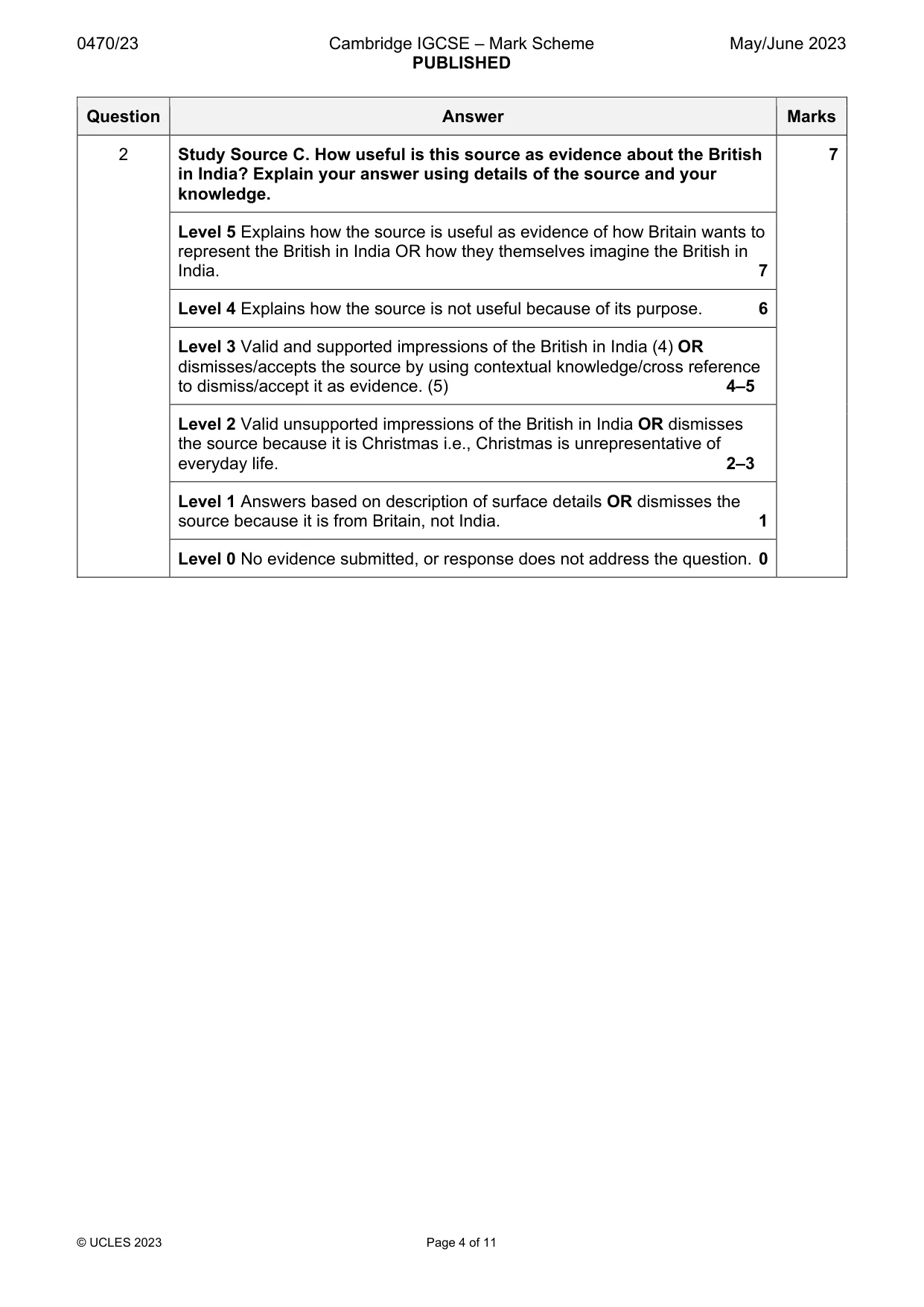
0470/23 Cambridge IGCSE – Mark Scheme PUBLISHED May/June 2023 © UCLES 2023 Page 4 of 11 Question Answer Marks 2 Study Source C. How useful is this source as evidence about the British in India? Explain your answer using details of the source and your knowledge. 7 Level 5 Explains how the source is useful as evidence of how Britain wants to represent the British in India OR how they themselves imagine the British in India. 7 Level 4 Explains how the source is not useful because of its purpose. 6 Level 3 Valid and supported impressions of the British in India (4) OR dismisses/accepts the source by using contextual knowledge/cross reference to dismiss/accept it as evidence. (5) 4–5 Level 2 Valid unsupported impressions of the British in India OR dismisses the source because it is Christmas i.e., Christmas is unrepresentative of everyday life. 2–3 Level 1 Answers based on description of surface details OR dismisses the source because it is from Britain, not India. 1 Level 0 No evidence submitted, or response does not address the question. 0
Mark scheme, page 5
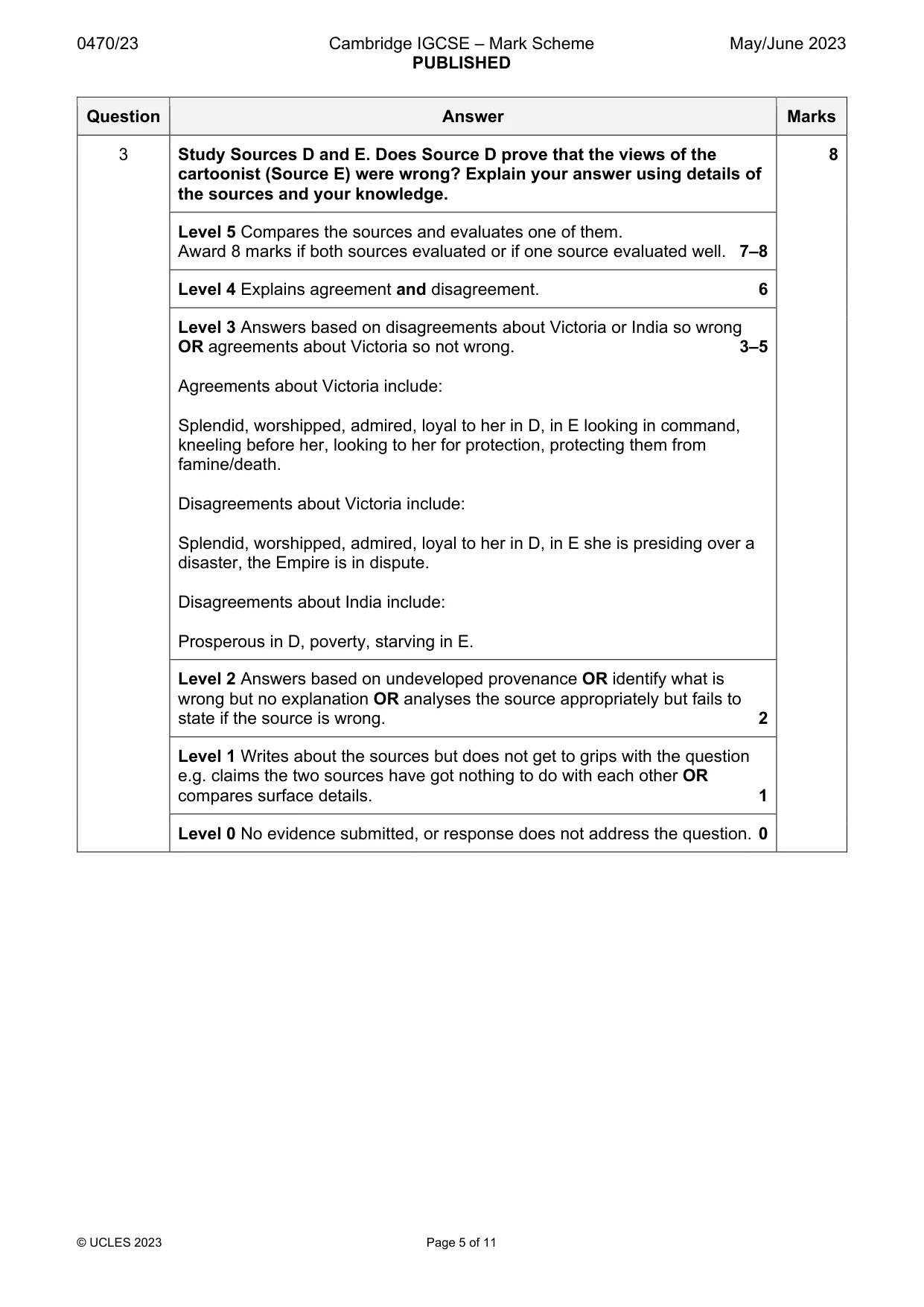
0470/23 Cambridge IGCSE – Mark Scheme PUBLISHED May/June 2023 © UCLES 2023 Page 5 of 11 Question Answer Marks 3 Study Sources D and E. Does Source D prove that the views of the cartoonist (Source E) were wrong? Explain your answer using details of the sources and your knowledge. 8 Level 5 Compares the sources and evaluates one of them. Award 8 marks if both sources evaluated or if one source evaluated well. 7–8 Level 4 Explains agreement and disagreement. 6 Level 3 Answers based on disagreements about Victoria or India so wrong OR agreements about Victoria so not wrong. 3–5 Agreements about Victoria include: Splendid, worshipped, admired, loyal to her in D, in E looking in command, kneeling before her, looking to her for protection, protecting them from famine/death. Disagreements about Victoria include: Splendid, worshipped, admired, loyal to her in D, in E she is presiding over a disaster, the Empire is in dispute. Disagreements about India include: Prosperous in D, poverty, starving in E. Level 2 Answers based on undeveloped provenance OR identify what is wrong but no explanation OR analyses the source appropriately but fails to state if the source is wrong. 2 Level 1 Writes about the sources but does not get to grips with the question e.g. claims the two sources have got nothing to do with each other OR compares surface details. 1 Level 0 No evidence submitted, or response does not address the question. 0
Mark scheme, page 6
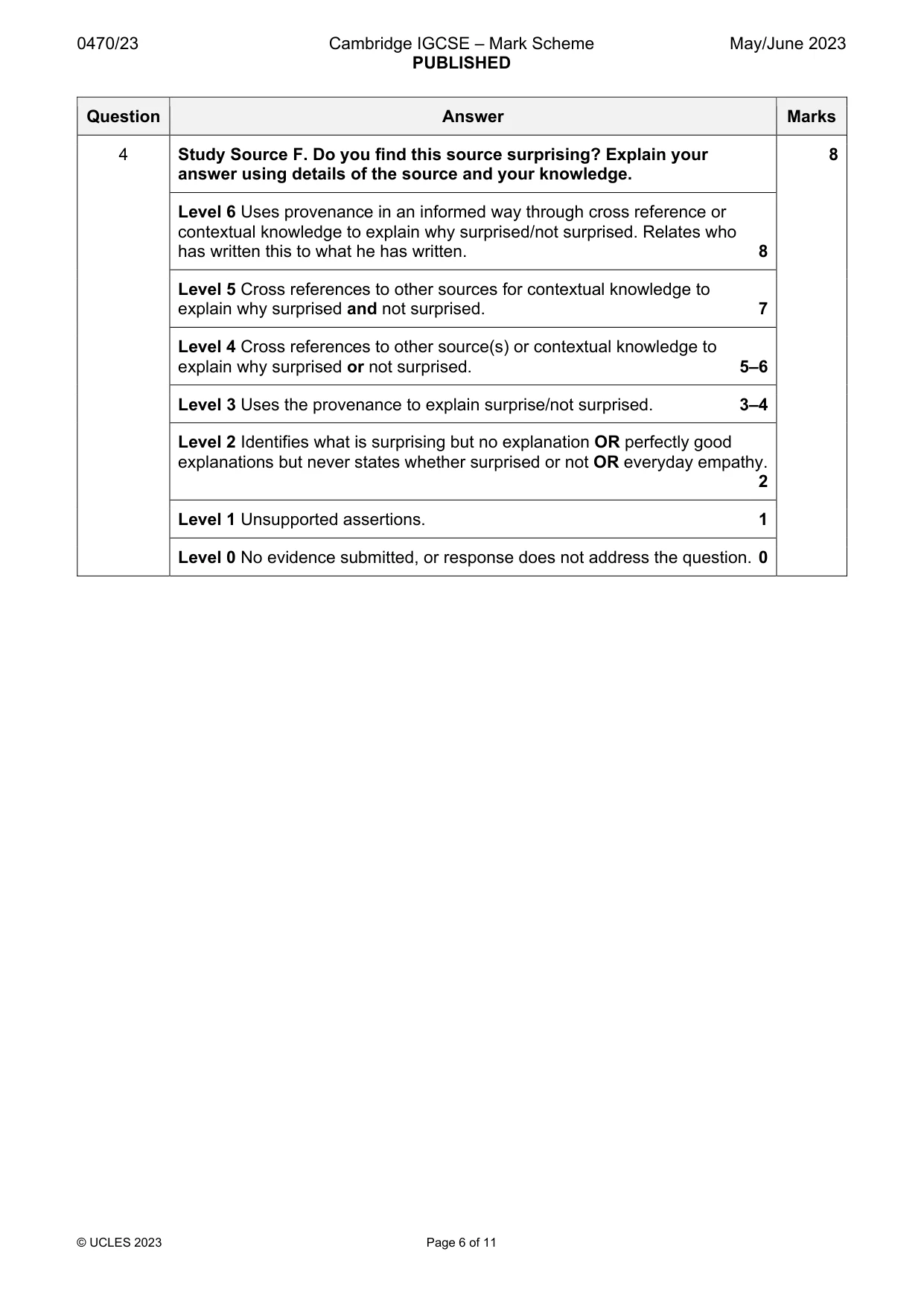
0470/23 Cambridge IGCSE – Mark Scheme PUBLISHED May/June 2023 © UCLES 2023 Page 6 of 11 Question Answer Marks 4 Study Source F. Do you find this source surprising? Explain your answer using details of the source and your knowledge. 8 Level 6 Uses provenance in an informed way through cross reference or contextual knowledge to explain why surprised/not surprised. Relates who has written this to what he has written. 8 Level 5 Cross references to other sources for contextual knowledge to explain why surprised and not surprised. 7 Level 4 Cross references to other source(s) or contextual knowledge to explain why surprised or not surprised. 5–6 Level 3 Uses the provenance to explain surprise/not surprised. 3–4 Level 2 Identifies what is surprising but no explanation OR perfectly good explanations but never states whether surprised or not OR everyday empathy. 2 Level 1 Unsupported assertions. 1 Level 0 No evidence submitted, or response does not address the question. 0
Mark scheme, page 7
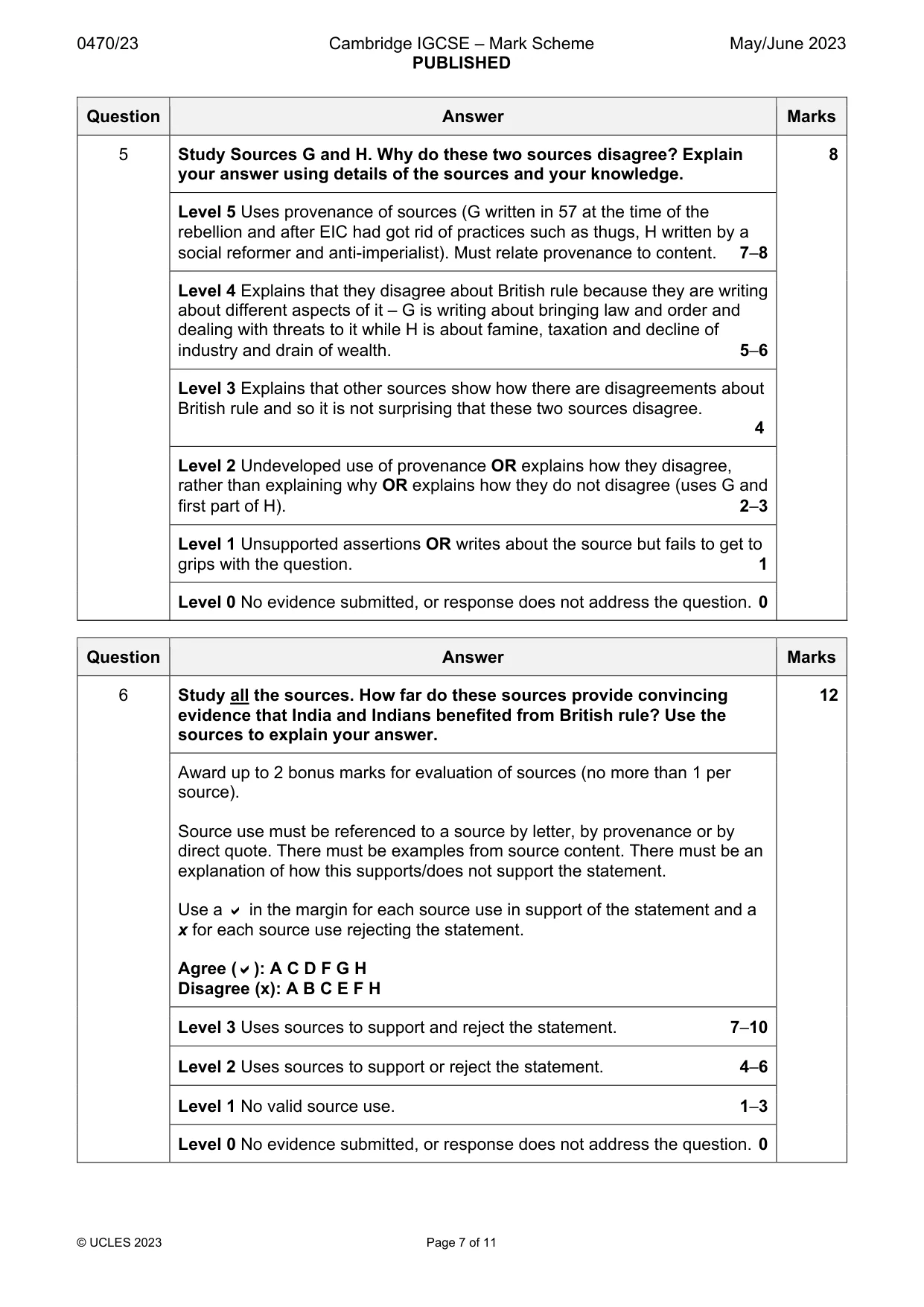
0470/23 Cambridge IGCSE – Mark Scheme PUBLISHED May/June 2023 © UCLES 2023 Page 7 of 11 Question Answer Marks 5 Study Sources G and H. Why do these two sources disagree? Explain your answer using details of the sources and your knowledge. 8 Level 5 Uses provenance of sources (G written in 57 at the time of the rebellion and after EIC had got rid of practices such as thugs, H written by a social reformer and anti-imperialist). Must relate provenance to content. 78 Level 4 Explains that they disagree about British rule because they are writing about different aspects of it – G is writing about bringing law and order and dealing with threats to it while H is about famine, taxation and decline of industry and drain of wealth. 56 Level 3 Explains that other sources show how there are disagreements about British rule and so it is not surprising that these two sources disagree. 4 Level 2 Undeveloped use of provenance OR explains how they disagree, rather than explaining why OR explains how they do not disagree (uses G and first part of H). 23 Level 1 Unsupported assertions OR writes about the source but fails to get to grips with the question. 1 Level 0 No evidence submitted, or response does not address the question. 0 Question Answer Marks 6 Study all the sources. How far do these sources provide convincing evidence that India and Indians benefited from British rule? Use the sources to explain your answer. 12 Award up to 2 bonus marks for evaluation of sources (no more than 1 per source). Source use must be referenced to a source by letter, by provenance or by direct quote. There must be examples from source content. There must be an explanation of how this supports/does not support the statement. Use a in the margin for each source use in support of the statement and a x for each source use rejecting the statement. Agree (): A C D F G H Disagree (x): A B C E F H Level 3 Uses sources to support and reject the statement. 710 Level 2 Uses sources to support or reject the statement. 46 Level 1 No valid source use. 13 Level 0 No evidence submitted, or response does not address the question. 0
Mark scheme, page 8
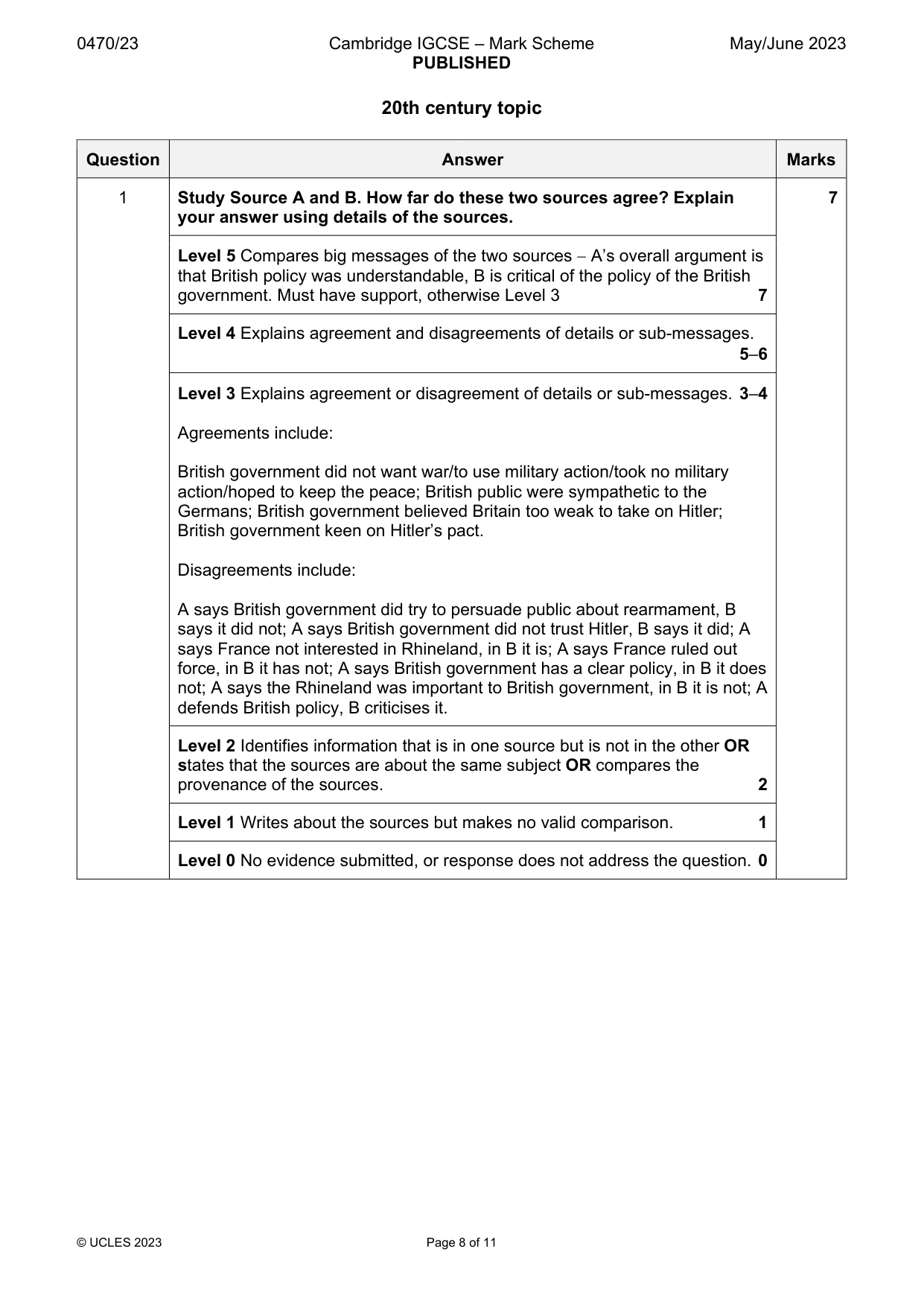
0470/23 Cambridge IGCSE – Mark Scheme PUBLISHED May/June 2023 © UCLES 2023 Page 8 of 11 20th century topic Question Answer Marks 1 Study Source A and B. How far do these two sources agree? Explain your answer using details of the sources. 7 Level 5 Compares big messages of the two sources A’s overall argument is that British policy was understandable, B is critical of the policy of the British government. Must have support, otherwise Level 3 7 Level 4 Explains agreement and disagreements of details or sub-messages. 56 Level 3 Explains agreement or disagreement of details or sub-messages. 34 Agreements include: British government did not want war/to use military action/took no military action/hoped to keep the peace; British public were sympathetic to the Germans; British government believed Britain too weak to take on Hitler; British government keen on Hitler’s pact. Disagreements include: A says British government did try to persuade public about rearmament, B says it did not; A says British government did not trust Hitler, B says it did; A says France not interested in Rhineland, in B it is; A says France ruled out force, in B it has not; A says British government has a clear policy, in B it does not; A says the Rhineland was important to British government, in B it is not; A defends British policy, B criticises it. Level 2 Identifies information that is in one source but is not in the other OR states that the sources are about the same subject OR compares the provenance of the sources. 2 Level 1 Writes about the sources but makes no valid comparison. 1 Level 0 No evidence submitted, or response does not address the question. 0
Mark scheme, page 9
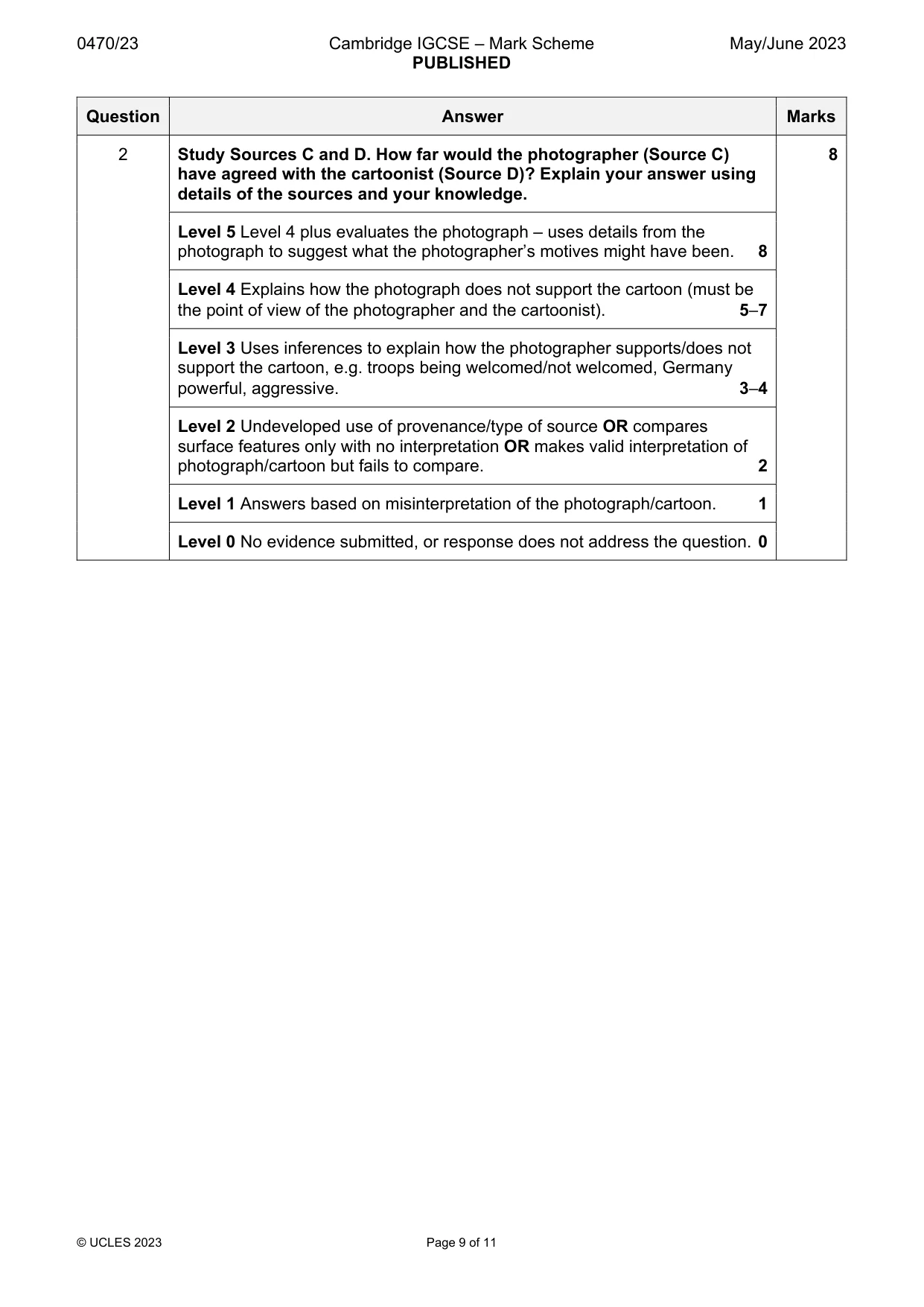
0470/23 Cambridge IGCSE – Mark Scheme PUBLISHED May/June 2023 © UCLES 2023 Page 9 of 11 Question Answer Marks 2 Study Sources C and D. How far would the photographer (Source C) have agreed with the cartoonist (Source D)? Explain your answer using details of the sources and your knowledge. 8 Level 5 Level 4 plus evaluates the photograph – uses details from the photograph to suggest what the photographer’s motives might have been. 8 Level 4 Explains how the photograph does not support the cartoon (must be the point of view of the photographer and the cartoonist). 57 Level 3 Uses inferences to explain how the photographer supports/does not support the cartoon, e.g. troops being welcomed/not welcomed, Germany powerful, aggressive. 34 Level 2 Undeveloped use of provenance/type of source OR compares surface features only with no interpretation OR makes valid interpretation of photograph/cartoon but fails to compare. 2 Level 1 Answers based on misinterpretation of the photograph/cartoon. 1 Level 0 No evidence submitted, or response does not address the question. 0
Mark scheme, page 10
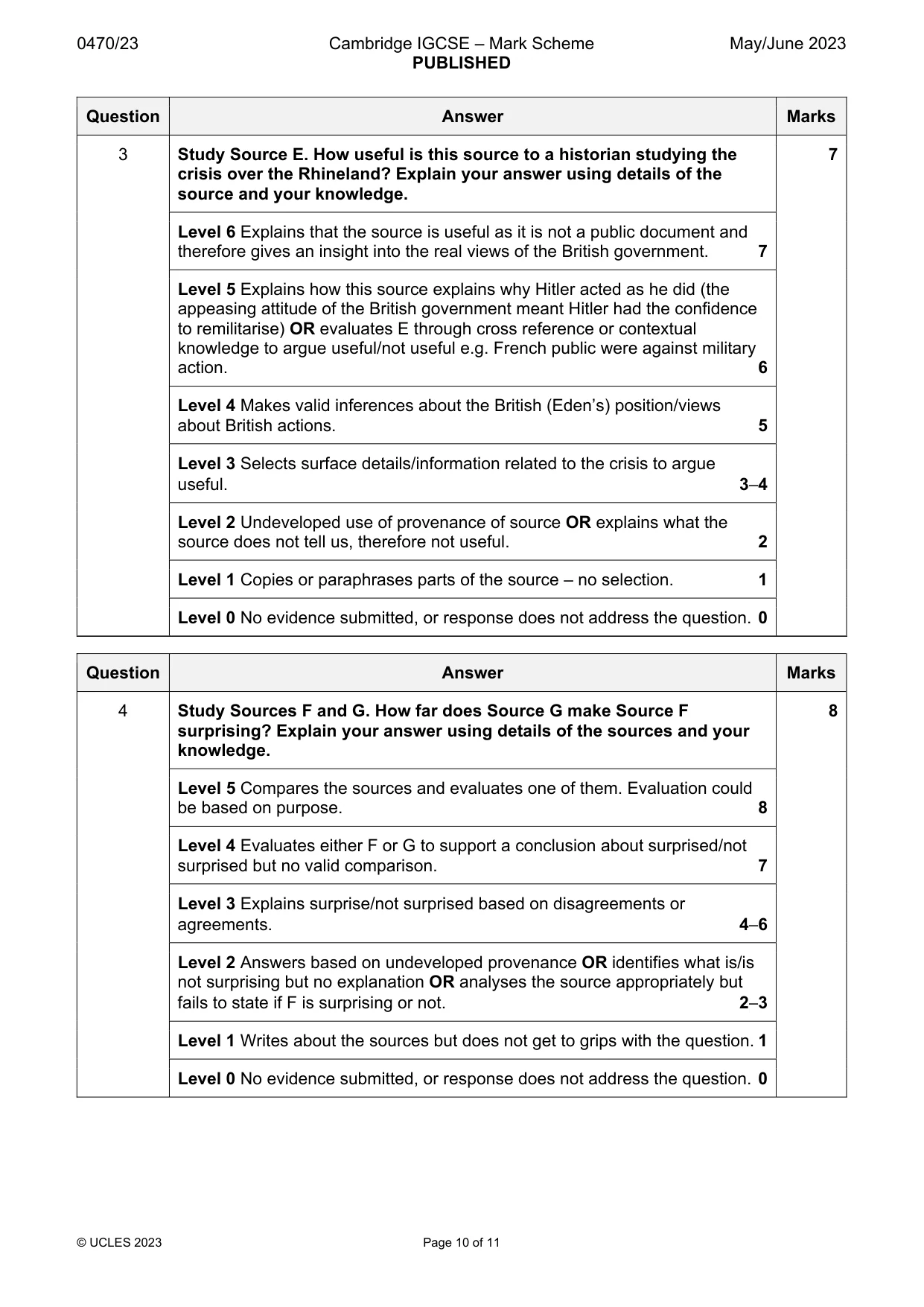
0470/23 Cambridge IGCSE – Mark Scheme PUBLISHED May/June 2023 © UCLES 2023 Page 10 of 11 Question Answer Marks 3 Study Source E. How useful is this source to a historian studying the crisis over the Rhineland? Explain your answer using details of the source and your knowledge. 7 Level 6 Explains that the source is useful as it is not a public document and therefore gives an insight into the real views of the British government. 7 Level 5 Explains how this source explains why Hitler acted as he did (the appeasing attitude of the British government meant Hitler had the confidence to remilitarise) OR evaluates E through cross reference or contextual knowledge to argue useful/not useful e.g. French public were against military action. 6 Level 4 Makes valid inferences about the British (Eden’s) position/views about British actions. 5 Level 3 Selects surface details/information related to the crisis to argue useful. 34 Level 2 Undeveloped use of provenance of source OR explains what the source does not tell us, therefore not useful. 2 Level 1 Copies or paraphrases parts of the source – no selection. 1 Level 0 No evidence submitted, or response does not address the question. 0 Question Answer Marks 4 Study Sources F and G. How far does Source G make Source F surprising? Explain your answer using details of the sources and your knowledge. 8 Level 5 Compares the sources and evaluates one of them. Evaluation could be based on purpose. 8 Level 4 Evaluates either F or G to support a conclusion about surprised/not surprised but no valid comparison. 7 Level 3 Explains surprise/not surprised based on disagreements or agreements. 46 Level 2 Answers based on undeveloped provenance OR identifies what is/is not surprising but no explanation OR analyses the source appropriately but fails to state if F is surprising or not. 23 Level 1 Writes about the sources but does not get to grips with the question. 1 Level 0 No evidence submitted, or response does not address the question. 0
Mark scheme, page 11
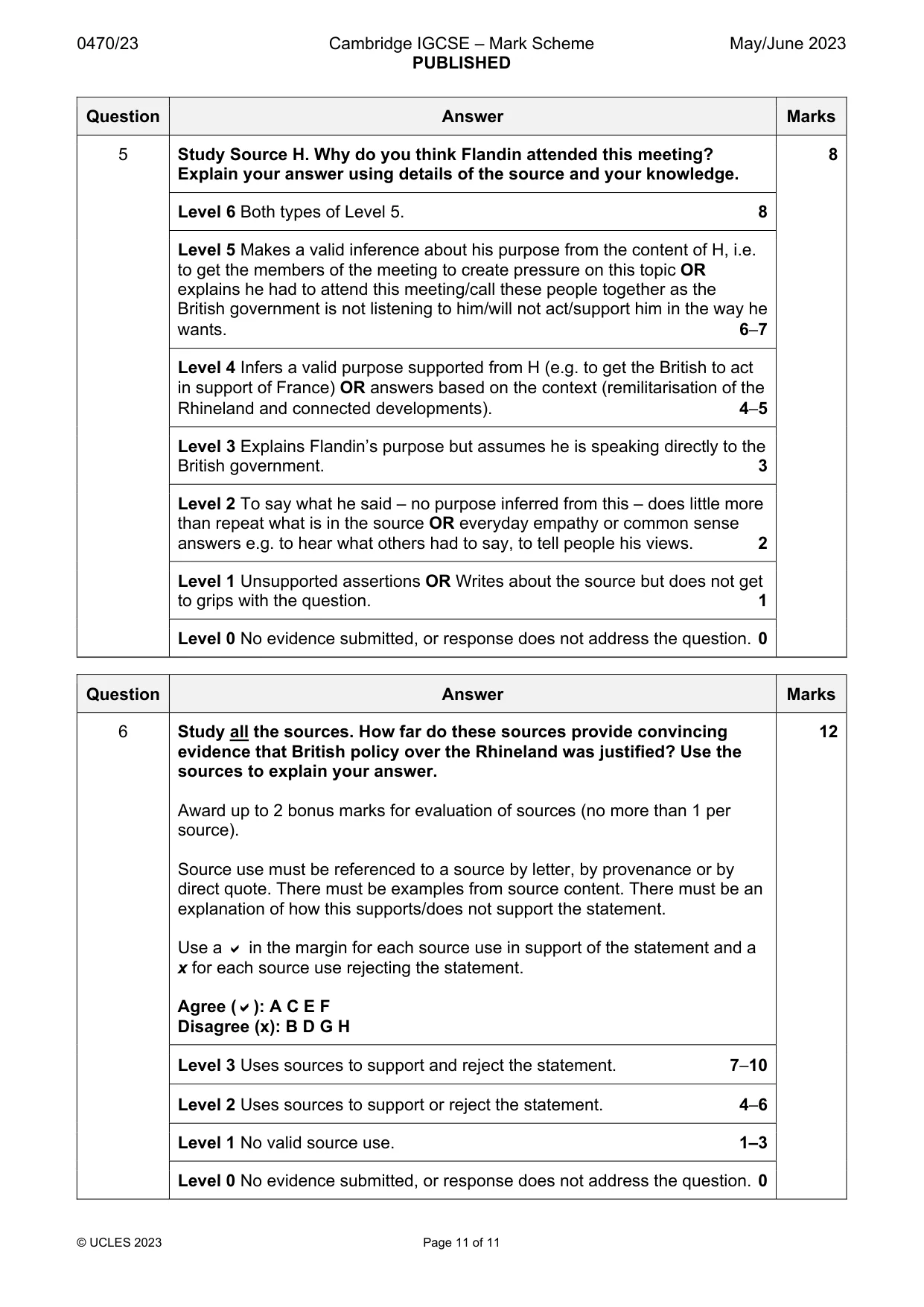
0470/23 Cambridge IGCSE – Mark Scheme PUBLISHED May/June 2023 © UCLES 2023 Page 11 of 11 Question Answer Marks 5 Study Source H. Why do you think Flandin attended this meeting? Explain your answer using details of the source and your knowledge. 8 Level 6 Both types of Level 5. 8 Level 5 Makes a valid inference about his purpose from the content of H, i.e. to get the members of the meeting to create pressure on this topic OR explains he had to attend this meeting/call these people together as the British government is not listening to him/will not act/support him in the way he wants. 67 Level 4 Infers a valid purpose supported from H (e.g. to get the British to act in support of France) OR answers based on the context (remilitarisation of the Rhineland and connected developments). 45 Level 3 Explains Flandin’s purpose but assumes he is speaking directly to the British government. 3 Level 2 To say what he said – no purpose inferred from this – does little more than repeat what is in the source OR everyday empathy or common sense answers e.g. to hear what others had to say, to tell people his views. 2 Level 1 Unsupported assertions OR Writes about the source but does not get to grips with the question. 1 Level 0 No evidence submitted, or response does not address the question. 0 Question Answer Marks 6 Study all the sources. How far do these sources provide convincing evidence that British policy over the Rhineland was justified? Use the sources to explain your answer. Award up to 2 bonus marks for evaluation of sources (no more than 1 per source). Source use must be referenced to a source by letter, by provenance or by direct quote. There must be examples from source content. There must be an explanation of how this supports/does not support the statement. Use a in the margin for each source use in support of the statement and a x for each source use rejecting the statement. Agree (): A C E F Disagree (x): B D G H 12 Level 3 Uses sources to support and reject the statement. 710 Level 2 Uses sources to support or reject the statement. 46 Level 1 No valid source use. 1–3 Level 0 No evidence submitted, or response does not address the question. 0
What you needed in this session
Cambridge’s own grade thresholds for 2023 May/June, Paper 2 · Variant 3. A higher threshold means an easier paper — the bar moves with how the cohort did.