Cambridge IGCSE History 0470 — 2025 May/June Paper 2 · Variant 3
0470/23/M/J/25 · 40 marks · 105 min
The question paper and its mark scheme, free to read here and free to download. This is Cambridge’s own paper, exactly as it was sat.
Question paper12 pages



Mark scheme15 pages
Answers below. Sit the paper first if you are practising.
Paper as text
Question paper, page 1
This document has 12 pages. Any blank pages are indicated. [Turn over Cambridge IGCSE™ HISTORY 0470/23 Paper 2 Document Questions May/June 2025 1 hour 45 minutes You must answer on the enclosed answer booklet. You will need: Answer booklet (enclosed) INSTRUCTIONS ● Answer one question on one option only. Option A: Nineteenth century topic Option B: Twentieth century topic ● Follow the instructions on the front cover of the answer booklet. If you need additional answer paper, ask the invigilator for a continuation booklet. INFORMATION ● The total mark for this paper is 40. ● The number of marks for each question or part question is shown in brackets [ ]. * 7 6 8 4 3 1 1 7 9 8 * DC (CJ) 343099/2 © UCLES 2025
Question paper, page 2
2 0470/23/M/J/25 © UCLES 2025 Option A: Nineteenth century topic 1 Why did the Frankfurt Parliament fail? Study the Background Information and the sources carefully, and then answer all parts of Question 1. Background Information The Frankfurt Parliament, which first met in May 1848, was the result of the revolutions across Germany. In May 1849, it was driven out of Frankfurt to Stuttgart, and in June it was forcibly dispersed by soldiers. To explain its eventual failure, some historians have pointed to developments outside the Parliament such as the recovery of the German princes and the lack of interest in the Parliament by the German people. Other historians have focused on problems within the Parliament itself. Did the Frankfurt Parliament fail because of factors internal to the Parliament itself? SOURCE A The members of the Frankfurt Parliament were freely elected from the 39 German states and were elected by 75 per cent of the adult male population. It was an achievement to have got the Parliament elected and ready to work in just over a month. The members worked well together, united by a sense of mission. The Parliament made some important decisions. In December 1848 it introduced fundamental rights, which were later an important influence on the Weimar Constitution. These rights included equality before the law and freedom of the press. The Parliament’s position became less secure in early 1849 when the Princes recovered their authority, but as late as March 1849 the Parliament was united enough to agree the Imperial Constitution, which was intended to establish a unified German state. However, the rejection of the Imperial Crown by Frederick William IV of Prussia in April 1849 was a fatal blow and persuaded many members to leave Frankfurt. Across Germany, the counter-revolutionary forces were recovering. The Parliament did not have its own army and it was forced to move to Stuttgart, where it was dispersed by force in June 1849. Despite this, it had important achievements. From a recent history book. SOURCE B The Frankfurt Parliament was not very representative of the people as a whole. The vast majority of members were middle-class: lawyers, professors and government officials. There were few artisans and almost no peasants, despite these groups playing a key part in the revolution. In December 1848 it issued the Fifty Articles, promising legal equality and greater press freedom. In March 1849 Frederick William rejected the offer of the crown of Germany. This, and the rejection of the proposed German constitution by some German states, contributed to its weakness. Although the Princes gradually recovered their power and authority, the Parliament was mainly responsible for its own downfall. Its members were politically inexperienced and too academic. There were disagreements between the liberals, nationalists and radicals. This meant it acted slowly – it took almost a year to draft a constitution. It also lacked power. It could not raise taxes and did not have its own army. The Frankfurt Parliament was a missed opportunity. From a recent study of the Frankfurt Parliament.
Question paper, page 3
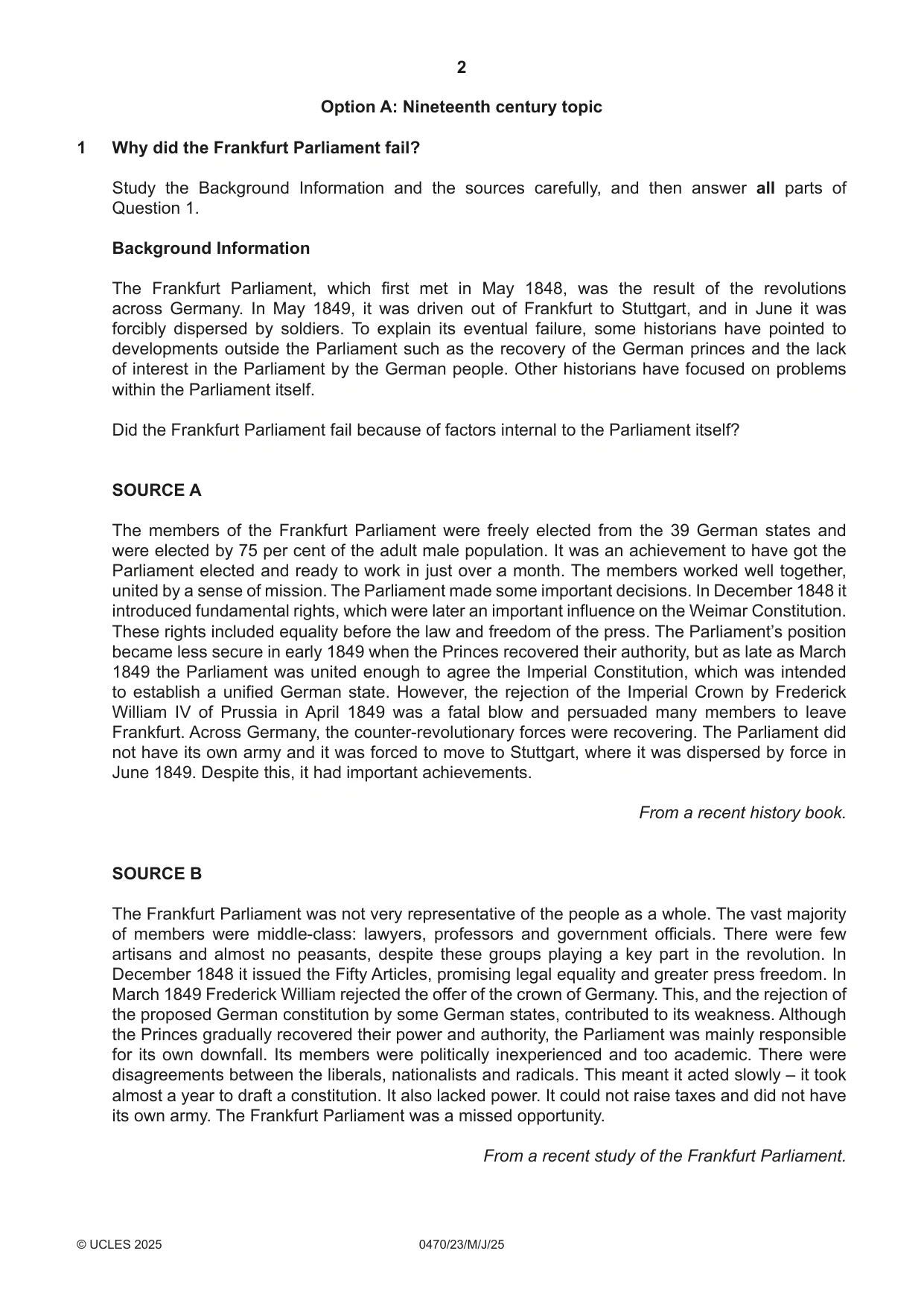
3 0470/23/M/J/25 © UCLES 2025 [Turn over SOURCE C A cartoon, entitled ‘German unity. A tragedy in one act’, published in Germany in 1848. It shows individual German states, including Bavaria, Austria, Prussia and Baden. The writing across the bottom says, ‘This should all be one Germany.’ SOURCE D The power of extraordinary events, the demands which have been expressed loudly throughout our fatherland, and the past calls of the state governments have led to this great Assembly. This Assembly has been greeted with joy and confidence by the entire German people. It is a great new achievement – the German parliament. The German governments are united with the German people in their love for our great fatherland. We greet with joy, and extend our hand of welcome to the national representatives, and wish them good luck and good fortune. A message from the German Confederation at the opening of the Frankfurt Parliament, May 1848. SOURCE E Thus vanished the German parliament, and with it the first and last creation of the Revolution. Chosen under the influence of the capitalist class by a scattered rural population only just awakening from feudalism, this parliament served to bring into one body all the great popular names of 1820–1848 and then ruin them. Political liberalism is forever impossible in Germany. We have seen how it failed by its cowardice and short-sighted wavering typical of its middle-class approach. It lost the confidence of the working class. The rural population supported the parliament. Two-thirds of the armies of the smaller nations were ready to fight for it if only it had acted with courage. The politicians who led it were not clear sighted and were incapable of supporting the parliament. From ‘Revolution and Counter-Revolution in Germany’, written in 1851–52 , edited by Karl Marx.
Question paper, page 4
4 0470/23/M/J/25 © UCLES 2025 SOURCE F The enemies have raised high the standard of revolt, first in Saxony, and then in south Germany. I was not able to submit a favourable reply to the offer of a crown by the German National Assembly. It does not have the right, without the consent of the German governments, to bestow the crown they have offered me. They made the offer on the condition that I would accept a constitution which could not be reconciled with the rights and safety of the German states. I have tried in every possible way to reach an understanding with the Assembly. Now it has broken with Prussia. The majority of its members are no longer those who Germany can look on with pride. Most of the deputies left the Assembly when it became obvious it was on the road to ruin. I have ordered all the Prussian deputies to be recalled. The other governments will do the same. A party now dominating the Assembly is in alliance with the terrorists. While they urge the unity of Germany, they are really fighting the battle of godlessness and theft and arousing a war. An announcement ‘To My People!’ by Frederick William IV of Prussia, 15 May 1849.
Question paper, page 5
5 0470/23/M/J/25 © UCLES 2025 [Turn over Now answer all parts of Question 1. You may use any of the sources to help you answer the questions, in addition to those sources which you are told to use. In answering parts (a)–(e) you should use your knowledge of the topic to help you interpret and evaluate the sources. (a) Study Sources A and B. How far do these two sources agree? Explain your answer using details of the sources. [7] (b) Study Source C. How surprising is this cartoon? Explain your answer using details of the source and your knowledge. [8] (c) Study Sources D and E. Does Source D prove that Source E is wrong about the Frankfurt Parliament? Explain your answer using details of the sources and your knowledge. [8] (d) Study Source F. Why did Frederick William make this announcement at that time? Explain your answer using details of the source and your knowledge. [8] (e) Study all the sources. How far do these sources provide convincing evidence that the Frankfurt Parliament failed because of its internal weaknesses? Use the sources to explain your answer. [9]
Question paper, page 6
6 0470/23/M/J/25 © UCLES 2025 Option B: Twentieth century topic 2 Was the Hoare–Laval Pact justified? Study the Background Information and the sources carefully, and then answer all the questions. Background Information When Italy invaded Abyssinia in October 1935, it was condemned by the League of Nations, which introduced sanctions in response. However, both Britain and France were keen to find a solution that would enable them to maintain good relations with Italy. They did not want Mussolini to become closer to Hitler, and they opposed stronger sanctions. In December 1935, Hoare and Laval, the Foreign Ministers of Britain and France, met in Paris to try and find a peaceful settlement. They secretly agreed the Hoare–Laval Pact, which gave Mussolini large parts of Abyssinia. On 9 December, the plan was leaked, and there was outrage in Britain, France and Abyssinia. At first, the British government supported the plan but then rejected it. Both Hoare and Laval resigned. Were Hoare and Laval right to agree the Hoare–Laval Pact? SOURCE A Hoare went to Paris on 7 December 1935 with instructions to reach an agreement with the French that would be acceptable to the Italians. Baldwin had told him to avoid war at all costs. Hoare was determined to succeed. The talks went smoothly and it was not necessary for Laval to persuade Hoare into an agreement. Hoare rightly believed that oil sanctions were too risky. He knew Britain had serious military weaknesses and decided the sensible thing was to buy off Italy, so that Britain could concentrate on the far greater danger of Germany. The leaking of the Pact on 9 December created much high-minded indignation among the British public but the government defended the Pact. It understood that both Britain and France had overwhelming strategic and economic reasons why they should not go to war with Italy. By 17 December, however, facing mounting public anger, the government had decided to withdraw its support for the Pact. It had lost the best chance of a peaceful settlement of the crisis. From a recent history book. Baldwin was the British Prime Minister at the time. SOURCE B On 7 December 1935 Hoare left for talks with Laval. He went with little guidance from the British government and later wrote in his autobiography that he had no intention of committing the government to an agreement. In Paris, he found himself under great pressure from Laval, who told him that a mobilisation of French forces at short notice could not be counted on. However, the talks went well and an agreement was reached. When it was leaked on 9 December it caused uproar in public opinion. The agreement was immoral, as it rewarded the aggressor and encouraged further aggression. This was the most promising time to have stood up to fascism with force. Italy was economically weak and its military forces were no match for those of Britain. The Pact showed the unwillingness of Britain and France to stand up to Mussolini, and the credibility of the League was lost. From a recent article.
Question paper, page 7
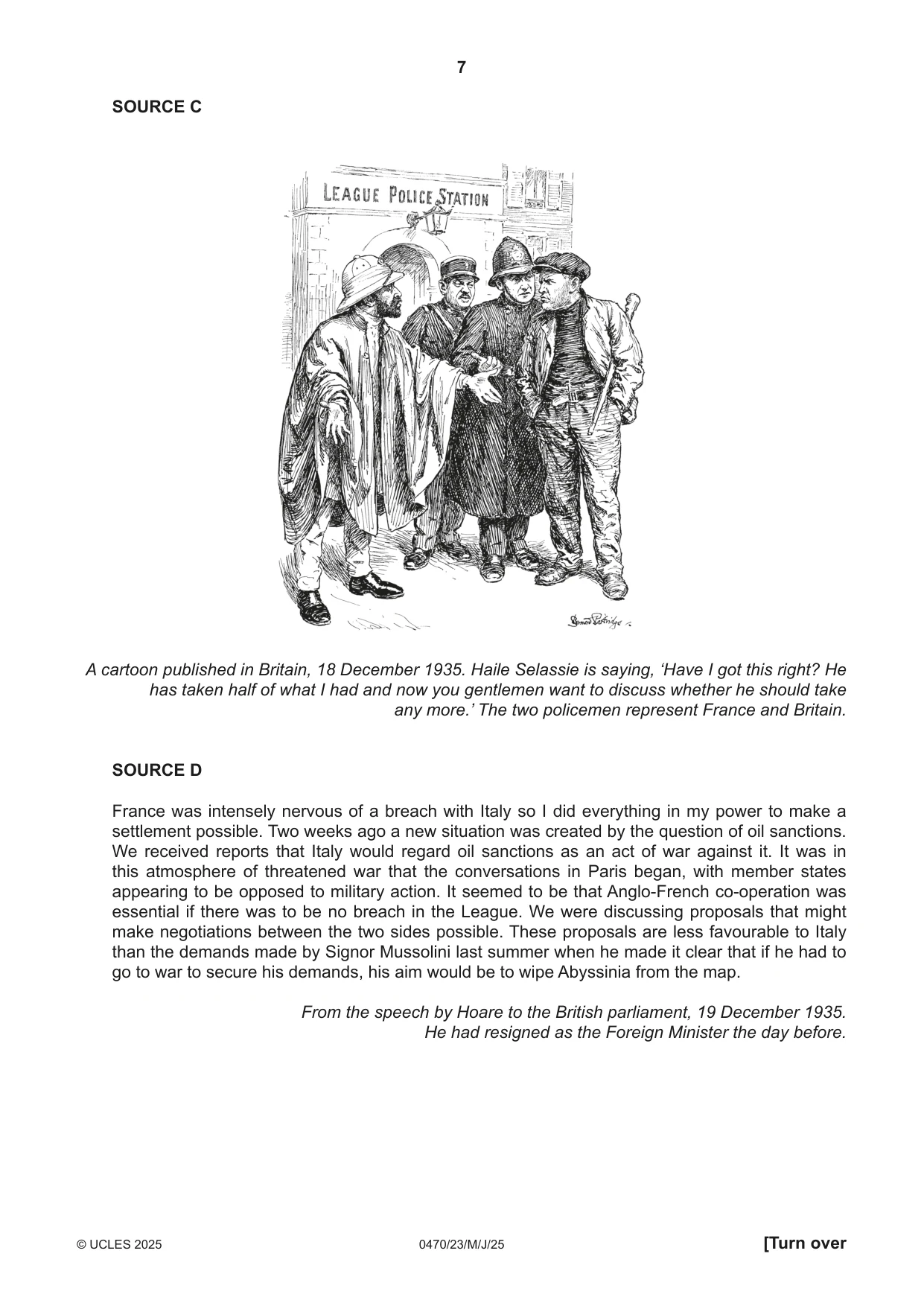
7 0470/23/M/J/25 © UCLES 2025 [Turn over SOURCE C A cartoon published in Britain, 18 December 1935. Haile Selassie is saying, ‘Have I got this right? He has taken half of what I had and now you gentlemen want to discuss whether he should take any more.’ The two policemen represent France and Britain. SOURCE D France was intensely nervous of a breach with Italy so I did everything in my power to make a settlement possible. Two weeks ago a new situation was created by the question of oil sanctions. We received reports that Italy would regard oil sanctions as an act of war against it. It was in this atmosphere of threatened war that the conversations in Paris began, with member states appearing to be opposed to military action. It seemed to be that Anglo-French co-operation was essential if there was to be no breach in the League. We were discussing proposals that might make negotiations between the two sides possible. These proposals are less favourable to Italy than the demands made by Signor Mussolini last summer when he made it clear that if he had to go to war to secure his demands, his aim would be to wipe Abyssinia from the map. From the speech by Hoare to the British parliament, 19 December 1935. He had resigned as the Foreign Minister the day before.
Question paper, page 8
8 0470/23/M/J/25 © UCLES 2025 SOURCE E I expressed my astonishment at the terms of the Hoare–Laval proposals. I knew Haile Selassie would not accept them. The terms asked him to surrender too much, and even if they had been supported by the British and French governments, the League would never have approved them. My wish was to have nothing to do with the proposals. The reaction of public opinion was angry and ashamed. It was said that we should have no part in rewarding aggressors. I knew that at the League of Nations I should meet with criticism from many delegates. Even now I am unable to understand how Hoare could think that the proposals he agreed with Laval were consistent with his own speech, made to the Assembly only three months before, when he declared his support for the League and collective security. From the memoirs of Anthony Eden. He was the minister in the British government responsible for Britain’s relations with the League of Nations. His memoirs were published in 1962. SOURCE F The Hoare–Laval ‘peace plan’ marks the most shameless betrayal of the principles of the League of Nations! And at what precise moment? The moment of the faltering of the Italian army in Abyssinia and of ever-increasing problems for Mussolini at home! It is beyond understanding! I can imagine the course of events. When Hoare went to Paris he was given the most general instructions to do his best to end the conflict as soon as possible, even by ‘correcting’ Abyssinia’s frontiers. Laval made it clear to him that Britain could not count on France in an armed conflict with Italy and refused to support oil sanctions. What could Hoare do? He felt a surge of imperialist sentiments and decided to show that he was the hero of British foreign policy. From the diary of Ivan Maisky, Soviet ambassador to London. The diary was written at the time of the events it describes but was not published until 2015.
Question paper, page 9
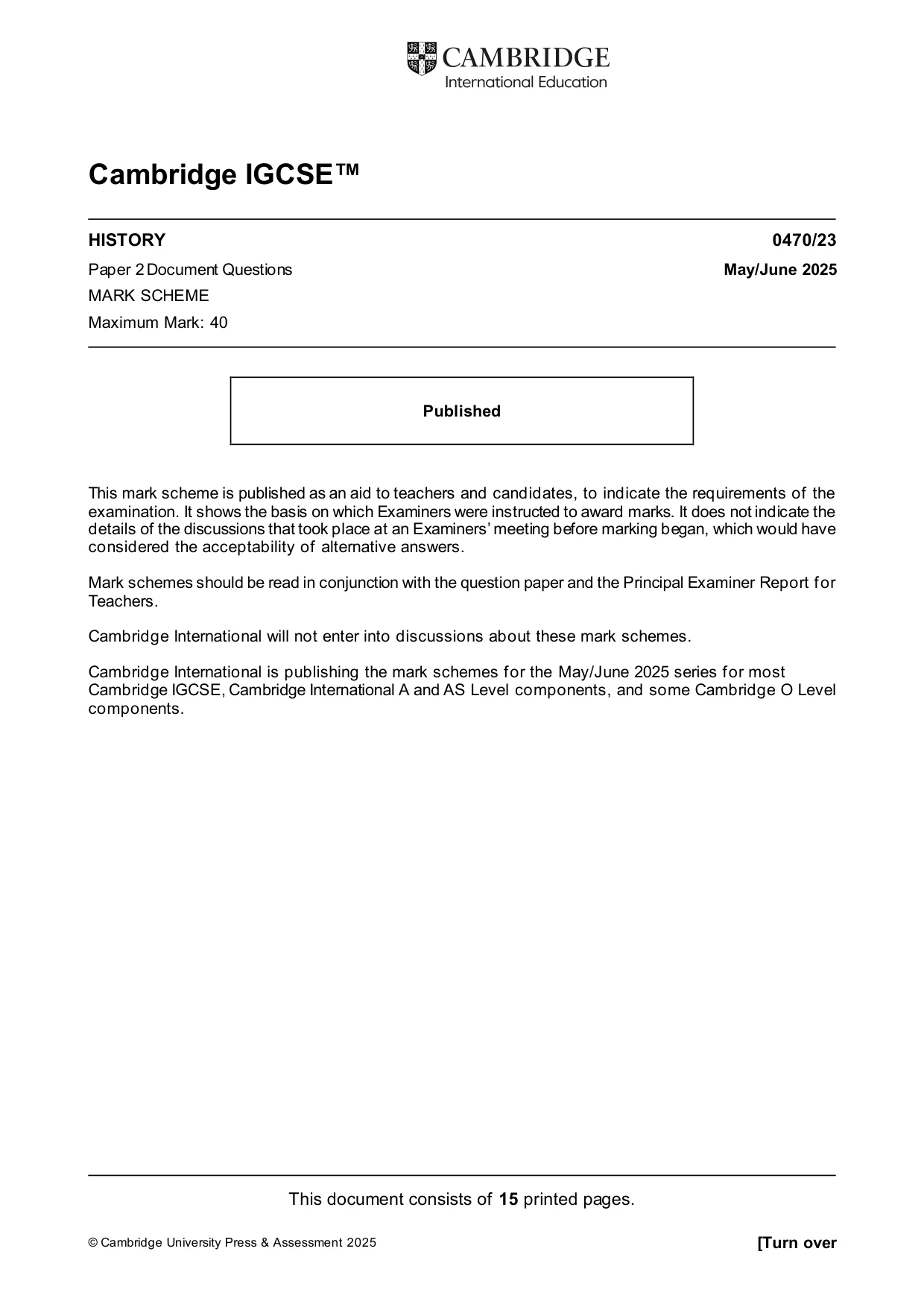
9 0470/23/M/J/25 © UCLES 2025 Now answer all parts of Question 2. You may use any of the sources to help you answer the questions, in addition to those sources which you are told to use. In answering parts (a)–(e) you should use your knowledge of the topic to help you interpret and evaluate the sources. (a) Study Sources A and B. How far do these two sources agree? Explain your answer using details of the sources. [7] (b) Study Source C. What is the cartoonist’s message? Explain your answer using details of the source and your knowledge. [8] (c) Study Sources D and E. How far does Source D make Source E surprising? Explain your answer using details of the sources and your knowledge. [8] (d) Study Source F. How useful is this source to a historian studying the Hoare–Laval Pact? Explain your answer using details of the source and your knowledge. [8] (e) Study all the sources. How far do these sources provide convincing evidence that Hoare and Laval were justified in devising the Hoare–Laval Pact? Use the sources to explain your answer. [9]
Question paper, page 10
10 0470/23/M/J/25 © UCLES 2025 BLANK PAGE
Question paper, page 11
11 0470/23/M/J/25 © UCLES 2025 BLANK PAGE
Question paper, page 12
12 0470/23/M/J/25 © UCLES 2025 Permission to reproduce items where third-party owned material protected by copyright is included has been sought and cleared where possible. Every reasonable effort has been made by the publisher (UCLES) to trace copyright holders, but if any items requiring clearance have unwittingly been included, the publisher will be pleased to make amends at the earliest possible opportunity. To avoid the issue of disclosure of answer-related information to candidates, all copyright acknowledgements are reproduced online in the Cambridge Assessment International Education Copyright Acknowledgements Booklet. This is produced for each series of examinations and is freely available to download at www.cambridgeinternational.org after the live examination series. Cambridge Assessment International Education is part of Cambridge Assessment. Cambridge Assessment is the brand name of the University of Cambridge Local Examinations Syndicate (UCLES), which is a department of the University of Cambridge. BLANK PAGE
Mark scheme, page 1
This document consists of 15 printed pages. © Cambridge University Press & Assessment 2025 [Turn over Cambridge IGCSE™ HISTORY 0470/23 Paper 2 Document Questions May/June 2025 MARK SCHEME Maximum Mark: 40 Published This mark scheme is published as an aid to teachers and candidates, to indicate the requirements of the examination. It shows the basis on which Examiners were instructed to award marks. It does not indicate the details of the discussions that took place at an Examiners’ meeting before marking began, which would have considered the acceptability of alternative answers. Mark schemes should be read in conjunction with the question paper and the Principal Examiner Report for Teachers. Cambridge International will not enter into discussions about these mark schemes. Cambridge International is publishing the mark schemes for the May/June 2025 series for most Cambridge IGCSE, Cambridge International A and AS Level components, and some Cambridge O Level components.
Mark scheme, page 2
0470/23 Cambridge IGCSE – Mark Scheme PUBLISHED May/June 2025 © Cambridge University Press & Assessment 2025 Page 2 of 15 Generic Marking Principles These general marking principles must be applied by all examiners when marking candidate answers. They should be applied alongside the specific content of the mark scheme or generic level descriptions for a question. Each question paper and mark scheme will also comply with these marking principles. GENERIC MARKING PRINCIPLE 1: Marks must be awarded in line with: • the specific content of the mark scheme or the generic level descriptors for the question • the specific skills defined in the mark scheme or in the generic level descriptors for the question • the standard of response required by a candidate as exemplified by the standardisation scripts. GENERIC MARKING PRINCIPLE 2: Marks awarded are always whole marks (not half marks, or other fractions). GENERIC MARKING PRINCIPLE 3: Marks must be awarded positively: • marks are awarded for correct/valid answers, as defined in the mark scheme. However, credit is given for valid answers which go beyond the scope of the syllabus and mark scheme, referring to your Team Leader as appropriate • marks are awarded when candidates clearly demonstrate what they know and can do • marks are not deducted for errors • marks are not deducted for omissions • answers should only be judged on the quality of spelling, punctuation and grammar when these features are specifically assessed by the question as indicated by the mark scheme. The meaning, however, should be unambiguous. GENERIC MARKING PRINCIPLE 4: Rules must be applied consistently, e.g. in situations where candidates have not followed instructions or in the application of generic level descriptors. GENERIC MARKING PRINCIPLE 5: Marks should be awarded using the full range of marks defined in the mark scheme for the question (however; the use of the full mark range may be limited according to the quality of the candidate responses seen). GENERIC MARKING PRINCIPLE 6: Marks awarded are based solely on the requirements as defined in the mark scheme. Marks should not be awarded with grade thresholds or grade descriptors in mind.
Mark scheme, page 3
0470/23 Cambridge IGCSE – Mark Scheme PUBLISHED May/June 2025 © Cambridge University Press & Assessment 2025 Page 3 of 15 Annotations guidance for centres Examiners use a system of annotations as a shorthand for communicating their marking decisions to one another. Examiners are trained during the standardisation process on how and when to use annotations. The purpose of annotations is to inform the standardisation and monitoring processes and guide the supervising examiners when they are checking the work of examiners within their team. The meaning of annotations and how they are used is specific to each component and is understood by all examiners who mark the component. We publish annotations in our mark schemes to help centres understand the annotations they may see on copies of scripts. Note that there may not be a direct correlation between the number of annotations on a script and the mark awarded. Similarly, the use of an annotation may not be an indication of the quality of the response. The annotations listed below were available to examiners marking this component in this series. Annotations Annotation Meaning Benefit of the doubt Incorrect OR In part (e) questions only, to indicate that a source has been correctly identified as refuting the statement Correct OR In part (e) questions only, to indicate that a source has been correctly identified as supporting the statement Evaluation Highlighter Highlight relevant areas of a response Level 1 response Level 2 response Level 3 response Level 4 response Level 5 response Level 6 response Level 7 response Off-page comment Comments entered at the bottom of the marking window and then displayed when the associated question item is navigated to On-page comment Comments entered in speech bubbles on the candidate response
Mark scheme, page 4
0470/23 Cambridge IGCSE – Mark Scheme PUBLISHED May/June 2025 © Cambridge University Press & Assessment 2025 Page 4 of 15 Annotation Meaning To indicate that a point has been noted but no credit has been given OR To indicate that a blank page has been checked for creditable content
Mark scheme, page 5
0470/23 Cambridge IGCSE – Mark Scheme PUBLISHED May/June 2025 © Cambridge University Press & Assessment 2025 Page 5 of 15 Assessment objectives AO1 An ability to recall, select, organise and deploy knowledge of the syllabus content. AO3 An ability to understand, interpret, evaluate and use a range of sources as evidence, in their historical context.
Mark scheme, page 6
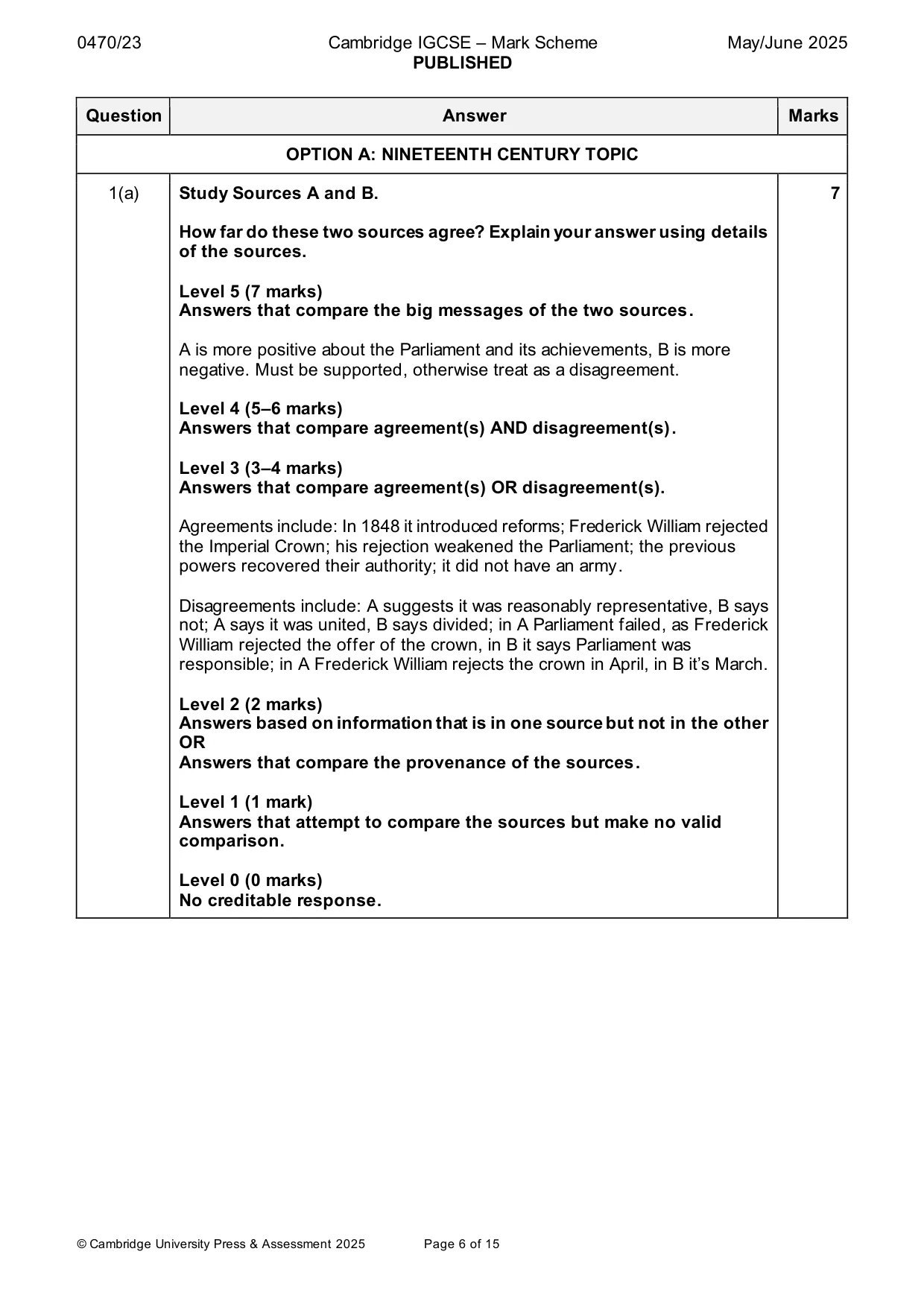
0470/23 Cambridge IGCSE – Mark Scheme PUBLISHED May/June 2025 © Cambridge University Press & Assessment 2025 Page 6 of 15 Question Answer Marks OPTION A: NINETEENTH CENTURY TOPIC 1(a) Study Sources A and B. How far do these two sources agree? Explain your answer using details of the sources. Level 5 (7 marks) Answers that compare the big messages of the two sources. A is more positive about the Parliament and its achievements, B is more negative. Must be supported, otherwise treat as a disagreement. Level 4 (5–6 marks) Answers that compare agreement(s) AND disagreement(s). Level 3 (3–4 marks) Answers that compare agreement(s) OR disagreement(s). Agreements include: In 1848 it introduced reforms; Frederick William rejected the Imperial Crown; his rejection weakened the Parliament; the previous powers recovered their authority; it did not have an army. Disagreements include: A suggests it was reasonably representative, B says not; A says it was united, B says divided; in A Parliament failed, as Frederick William rejected the offer of the crown, in B it says Parliament was responsible; in A Frederick William rejects the crown in April, in B it’s March. Level 2 (2 marks) Answers based on information that is in one source but not in the other OR Answers that compare the provenance of the sources. Level 1 (1 mark) Answers that attempt to compare the sources but make no valid comparison. Level 0 (0 marks) No creditable response. 7
Mark scheme, page 7
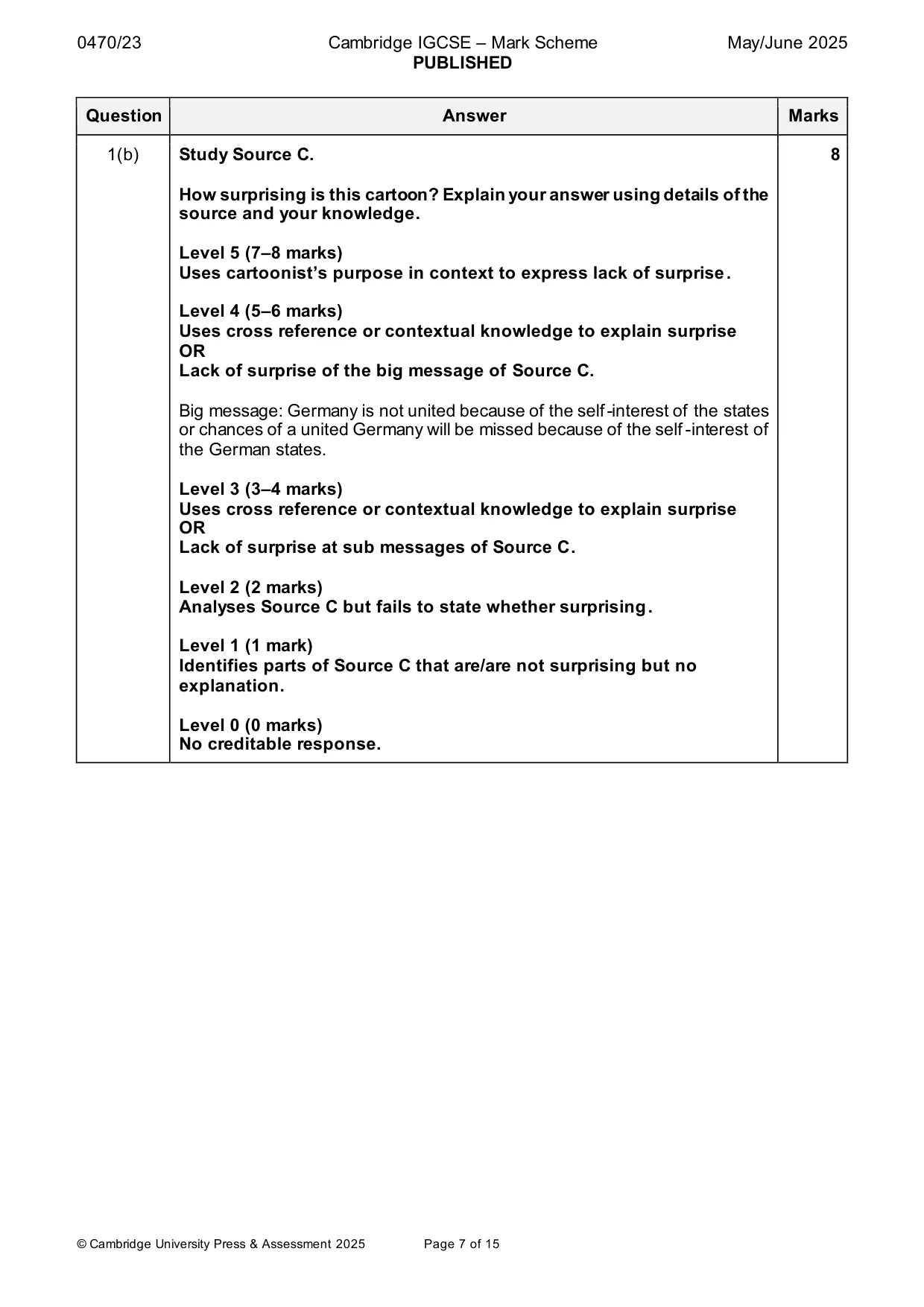
0470/23 Cambridge IGCSE – Mark Scheme PUBLISHED May/June 2025 © Cambridge University Press & Assessment 2025 Page 7 of 15 Question Answer Marks 1(b) Study Source C. How surprising is this cartoon? Explain your answer using details of the source and your knowledge. Level 5 (7–8 marks) Uses cartoonist’s purpose in context to express lack of surprise. Level 4 (5–6 marks) Uses cross reference or contextual knowledge to explain surprise OR Lack of surprise of the big message of Source C. Big message: Germany is not united because of the self-interest of the states or chances of a united Germany will be missed because of the self -interest of the German states. Level 3 (3–4 marks) Uses cross reference or contextual knowledge to explain surprise OR Lack of surprise at sub messages of Source C. Level 2 (2 marks) Analyses Source C but fails to state whether surprising. Level 1 (1 mark) Identifies parts of Source C that are/are not surprising but no explanation. Level 0 (0 marks) No creditable response. 8
Mark scheme, page 8
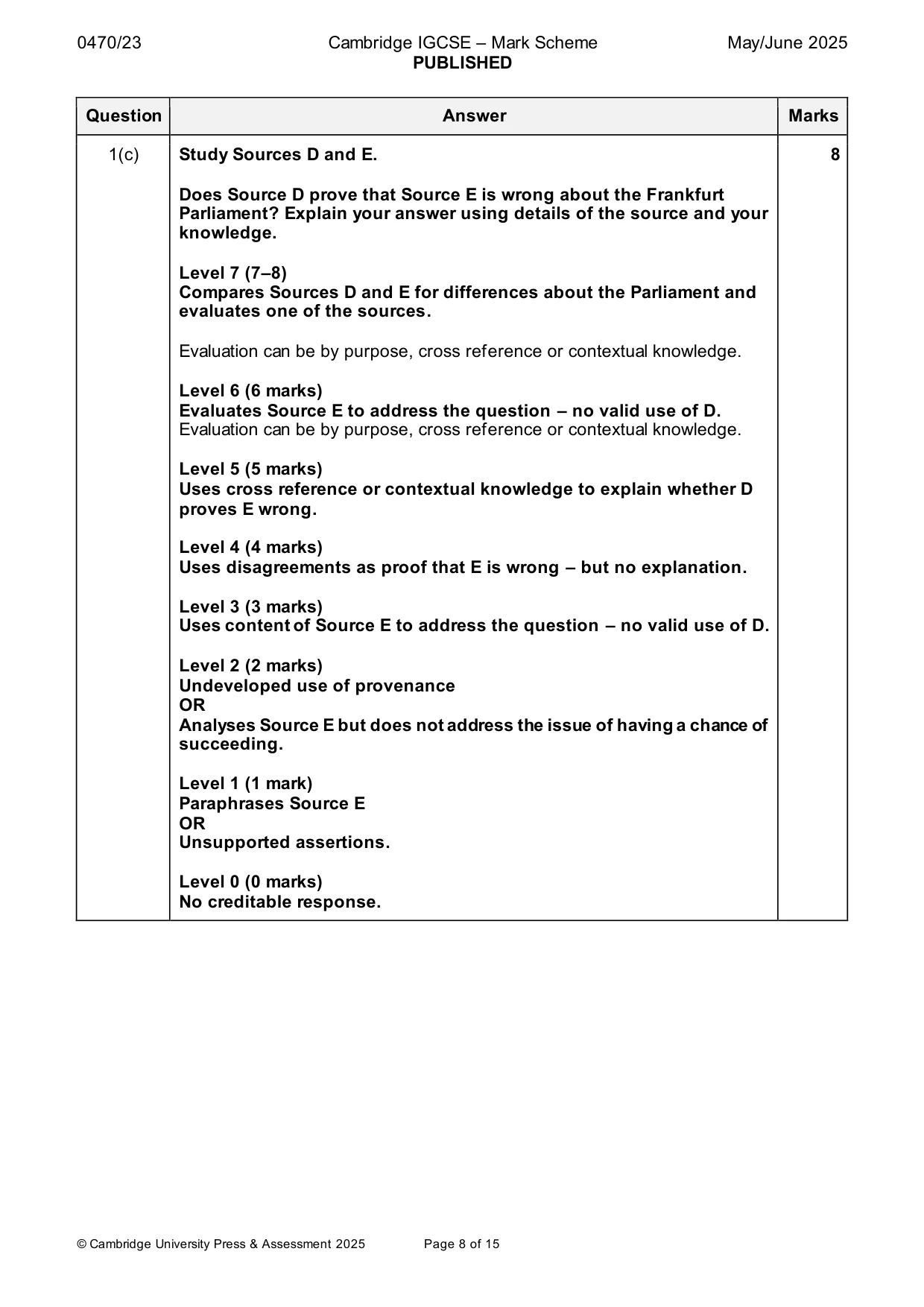
0470/23 Cambridge IGCSE – Mark Scheme PUBLISHED May/June 2025 © Cambridge University Press & Assessment 2025 Page 8 of 15 Question Answer Marks 1(c) Study Sources D and E. Does Source D prove that Source E is wrong about the Frankfurt Parliament? Explain your answer using details of the source and your knowledge. Level 7 (7–8) Compares Sources D and E for differences about the Parliament and evaluates one of the sources. Evaluation can be by purpose, cross reference or contextual knowledge. Level 6 (6 marks) Evaluates Source E to address the question – no valid use of D. Evaluation can be by purpose, cross reference or contextual knowledge. Level 5 (5 marks) Uses cross reference or contextual knowledge to explain whether D proves E wrong. Level 4 (4 marks) Uses disagreements as proof that E is wrong – but no explanation. Level 3 (3 marks) Uses content of Source E to address the question – no valid use of D. Level 2 (2 marks) Undeveloped use of provenance OR Analyses Source E but does not address the issue of having a chance of succeeding. Level 1 (1 mark) Paraphrases Source E OR Unsupported assertions. Level 0 (0 marks) No creditable response. 8
Mark scheme, page 9
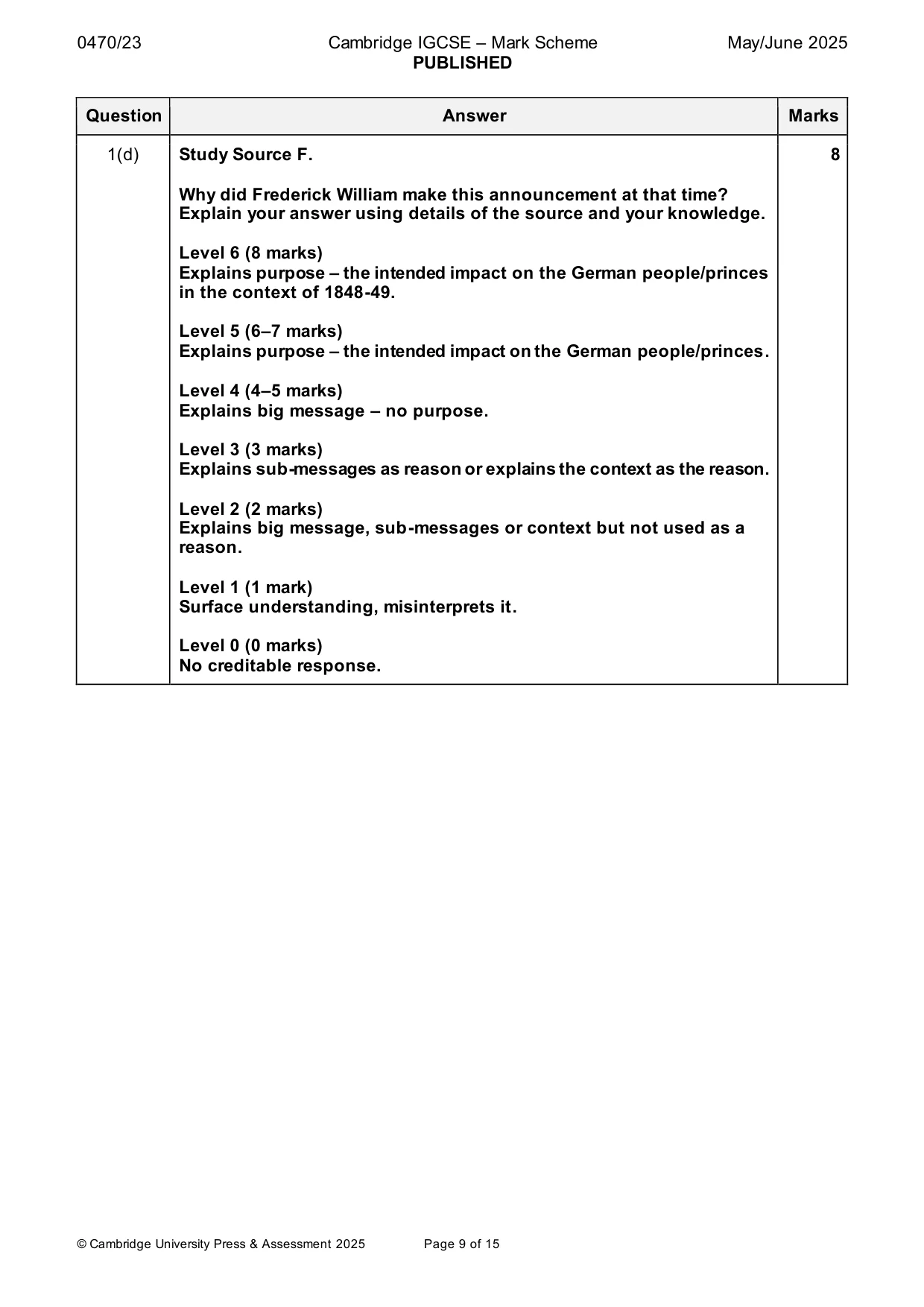
0470/23 Cambridge IGCSE – Mark Scheme PUBLISHED May/June 2025 © Cambridge University Press & Assessment 2025 Page 9 of 15 Question Answer Marks 1(d) Study Source F. Why did Frederick William make this announcement at that time? Explain your answer using details of the source and your knowledge. Level 6 (8 marks) Explains purpose – the intended impact on the German people/princes in the context of 1848-49. Level 5 (6–7 marks) Explains purpose – the intended impact on the German people/princes. Level 4 (4–5 marks) Explains big message – no purpose. Level 3 (3 marks) Explains sub-messages as reason or explains the context as the reason. Level 2 (2 marks) Explains big message, sub-messages or context but not used as a reason. Level 1 (1 mark) Surface understanding, misinterprets it. Level 0 (0 marks) No creditable response. 8
Mark scheme, page 10
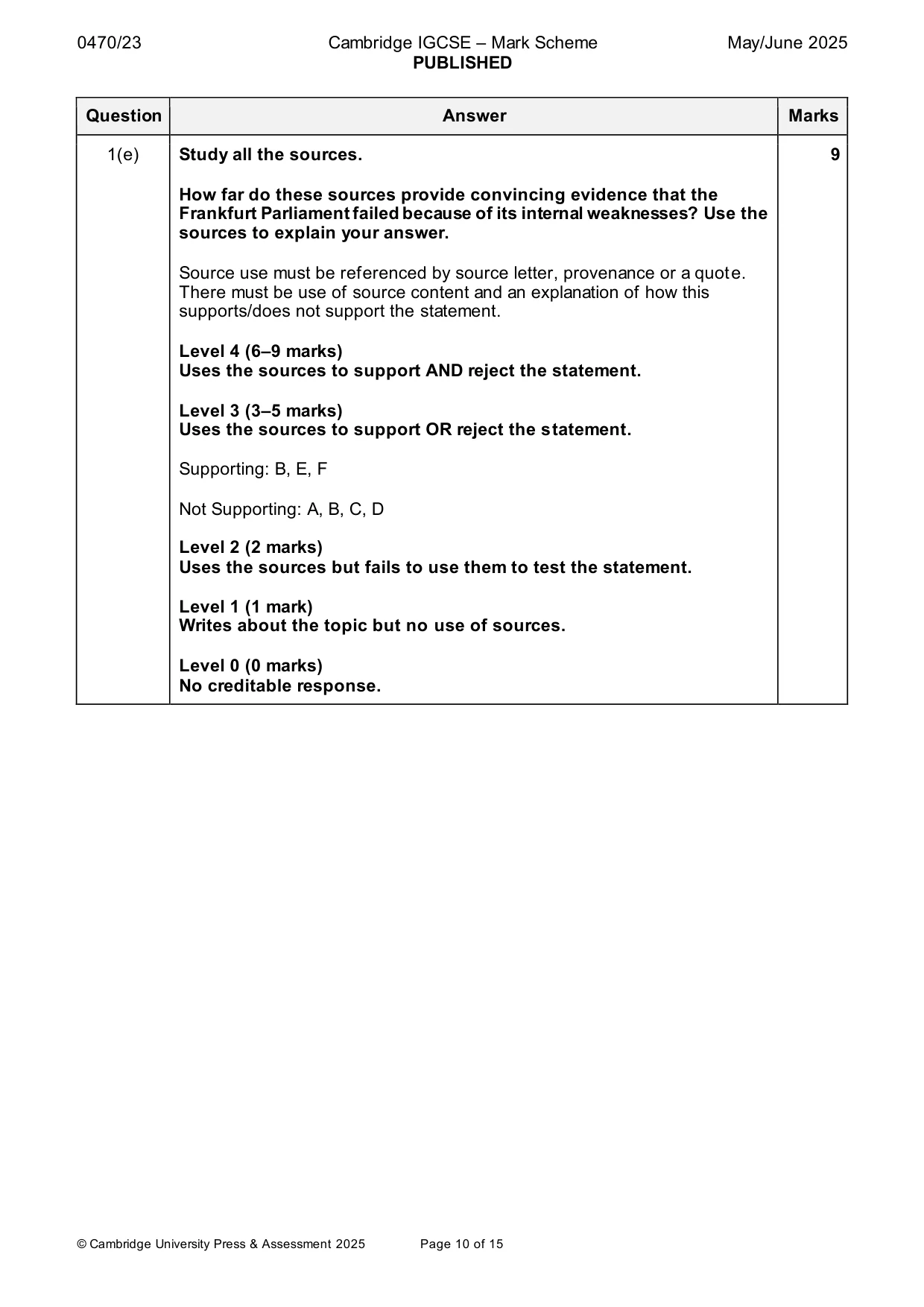
0470/23 Cambridge IGCSE – Mark Scheme PUBLISHED May/June 2025 © Cambridge University Press & Assessment 2025 Page 10 of 15 Question Answer Marks 1(e) Study all the sources. How far do these sources provide convincing evidence that the Frankfurt Parliament failed because of its internal weaknesses? Use the sources to explain your answer. Source use must be referenced by source letter, provenance or a quote. There must be use of source content and an explanation of how this supports/does not support the statement. Level 4 (6–9 marks) Uses the sources to support AND reject the statement. Level 3 (3–5 marks) Uses the sources to support OR reject the statement. Supporting: B, E, F Not Supporting: A, B, C, D Level 2 (2 marks) Uses the sources but fails to use them to test the statement. Level 1 (1 mark) Writes about the topic but no use of sources. Level 0 (0 marks) No creditable response. 9
Mark scheme, page 11
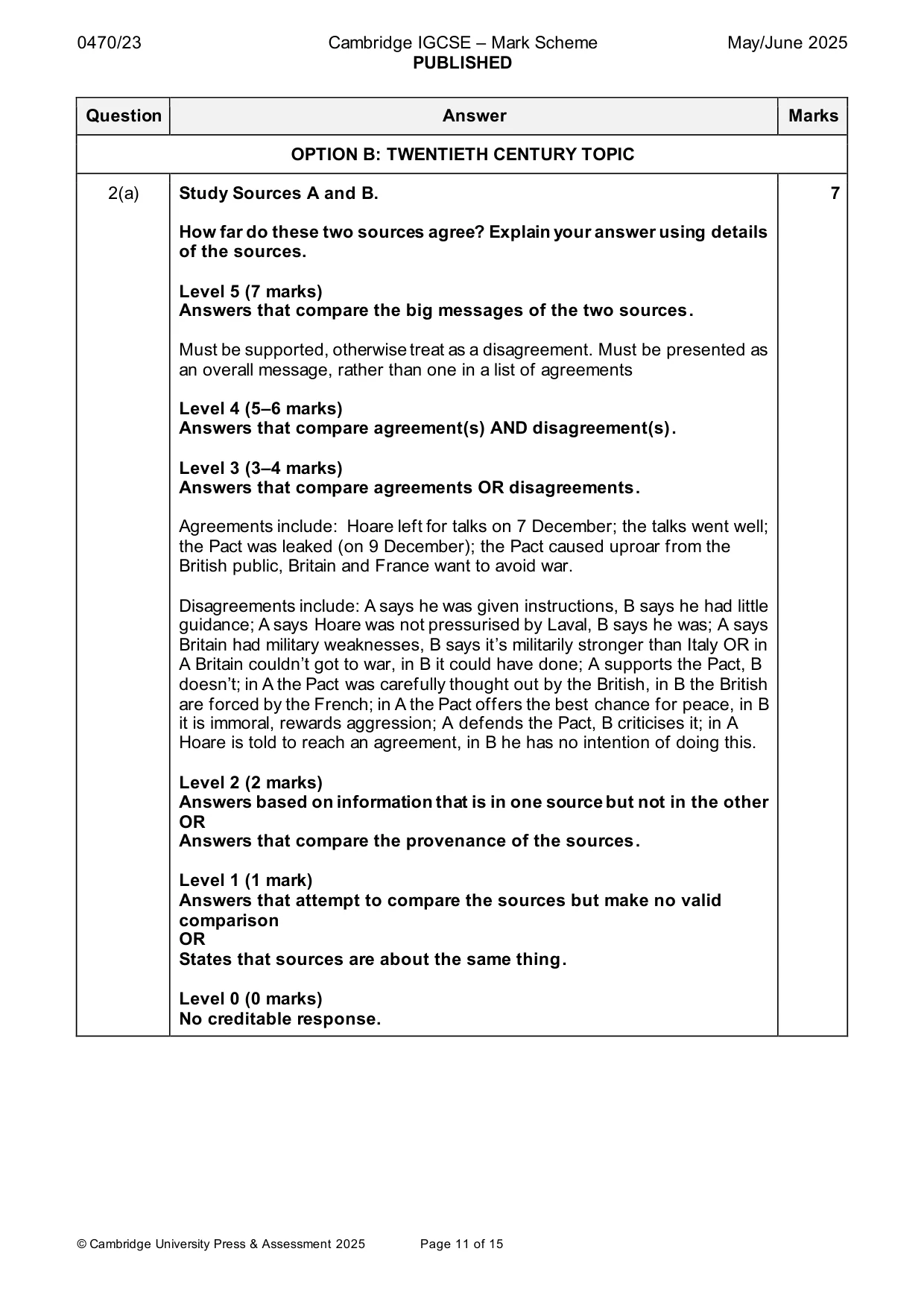
0470/23 Cambridge IGCSE – Mark Scheme PUBLISHED May/June 2025 © Cambridge University Press & Assessment 2025 Page 11 of 15 Question Answer Marks OPTION B: TWENTIETH CENTURY TOPIC 2(a) Study Sources A and B. How far do these two sources agree? Explain your answer using details of the sources. Level 5 (7 marks) Answers that compare the big messages of the two sources. Must be supported, otherwise treat as a disagreement. Must be presented as an overall message, rather than one in a list of agreements Level 4 (5–6 marks) Answers that compare agreement(s) AND disagreement(s). Level 3 (3–4 marks) Answers that compare agreements OR disagreements. Agreements include: Hoare left for talks on 7 December; the talks went well; the Pact was leaked (on 9 December); the Pact caused uproar from the British public, Britain and France want to avoid war. Disagreements include: A says he was given instructions, B says he had little guidance; A says Hoare was not pressurised by Laval, B says he was; A says Britain had military weaknesses, B says it’s militarily stronger than Italy OR in A Britain couldn’t got to war, in B it could have done; A supports the Pact, B doesn’t; in A the Pact was carefully thought out by the British, in B the British are forced by the French; in A the Pact offers the best chance for peace, in B it is immoral, rewards aggression; A defends the Pact, B criticises it; in A Hoare is told to reach an agreement, in B he has no intention of doing this. Level 2 (2 marks) Answers based on information that is in one source but not in the other OR Answers that compare the provenance of the sources. Level 1 (1 mark) Answers that attempt to compare the sources but make no valid comparison OR States that sources are about the same thing. Level 0 (0 marks) No creditable response. 7
Mark scheme, page 12
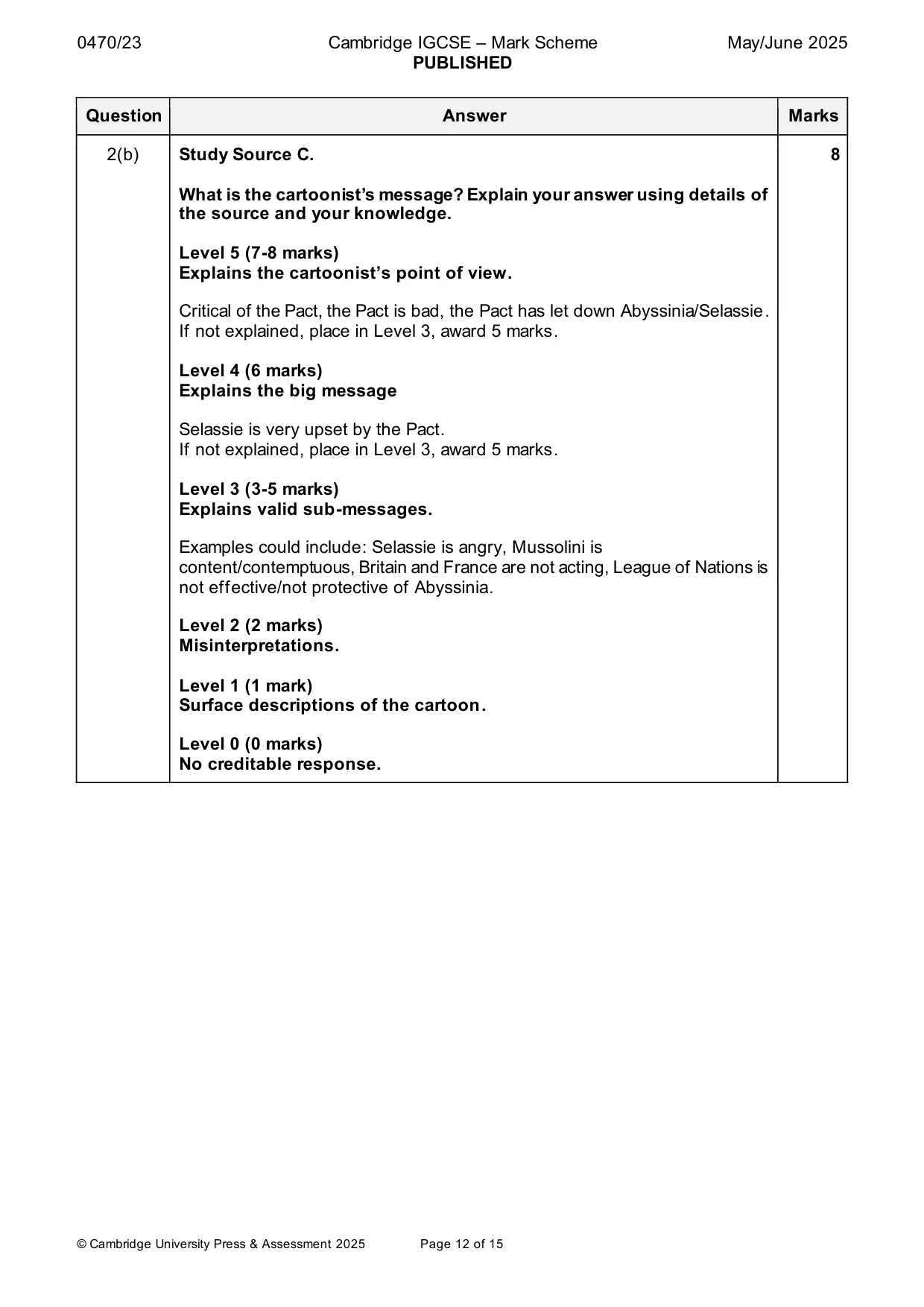
0470/23 Cambridge IGCSE – Mark Scheme PUBLISHED May/June 2025 © Cambridge University Press & Assessment 2025 Page 12 of 15 Question Answer Marks 2(b) Study Source C. What is the cartoonist’s message? Explain your answer using details of the source and your knowledge. Level 5 (7-8 marks) Explains the cartoonist’s point of view. Critical of the Pact, the Pact is bad, the Pact has let down Abyssinia/Selassie. If not explained, place in Level 3, award 5 marks. Level 4 (6 marks) Explains the big message Selassie is very upset by the Pact. If not explained, place in Level 3, award 5 marks. Level 3 (3-5 marks) Explains valid sub-messages. Examples could include: Selassie is angry, Mussolini is content/contemptuous, Britain and France are not acting, League of Nations is not effective/not protective of Abyssinia. Level 2 (2 marks) Misinterpretations. Level 1 (1 mark) Surface descriptions of the cartoon. Level 0 (0 marks) No creditable response. 8
Mark scheme, page 13
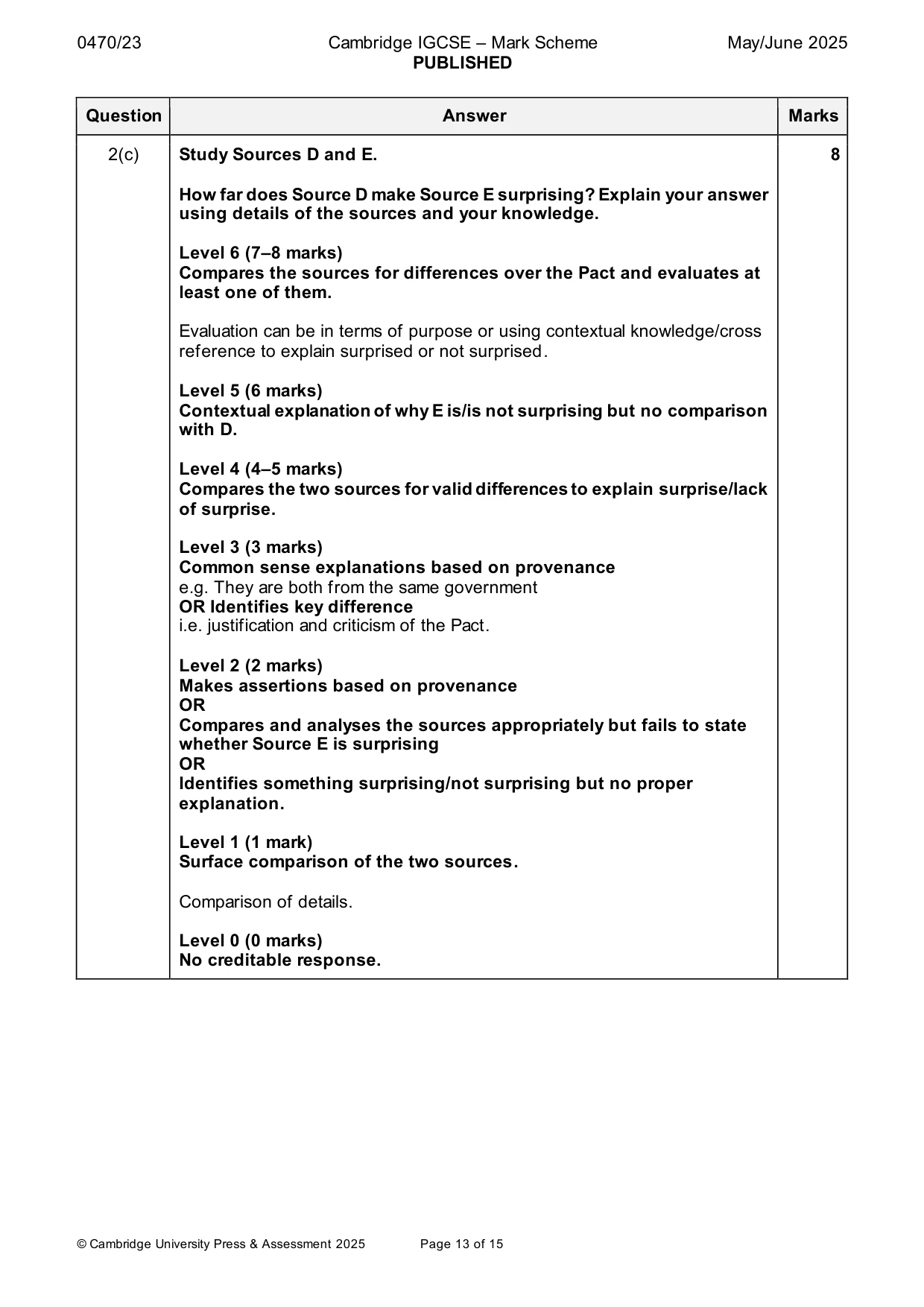
0470/23 Cambridge IGCSE – Mark Scheme PUBLISHED May/June 2025 © Cambridge University Press & Assessment 2025 Page 13 of 15 Question Answer Marks 2(c) Study Sources D and E. How far does Source D make Source E surprising? Explain your answer using details of the sources and your knowledge. Level 6 (7–8 marks) Compares the sources for differences over the Pact and evaluates at least one of them. Evaluation can be in terms of purpose or using contextual knowledge/cross reference to explain surprised or not surprised. Level 5 (6 marks) Contextual explanation of why E is/is not surprising but no comparison with D. Level 4 (4–5 marks) Compares the two sources for valid differences to explain surprise/lack of surprise. Level 3 (3 marks) Common sense explanations based on provenance e.g. They are both from the same government OR Identifies key difference i.e. justification and criticism of the Pact. Level 2 (2 marks) Makes assertions based on provenance OR Compares and analyses the sources appropriately but fails to state whether Source E is surprising OR Identifies something surprising/not surprising but no proper explanation. Level 1 (1 mark) Surface comparison of the two sources. Comparison of details. Level 0 (0 marks) No creditable response. 8
Mark scheme, page 14
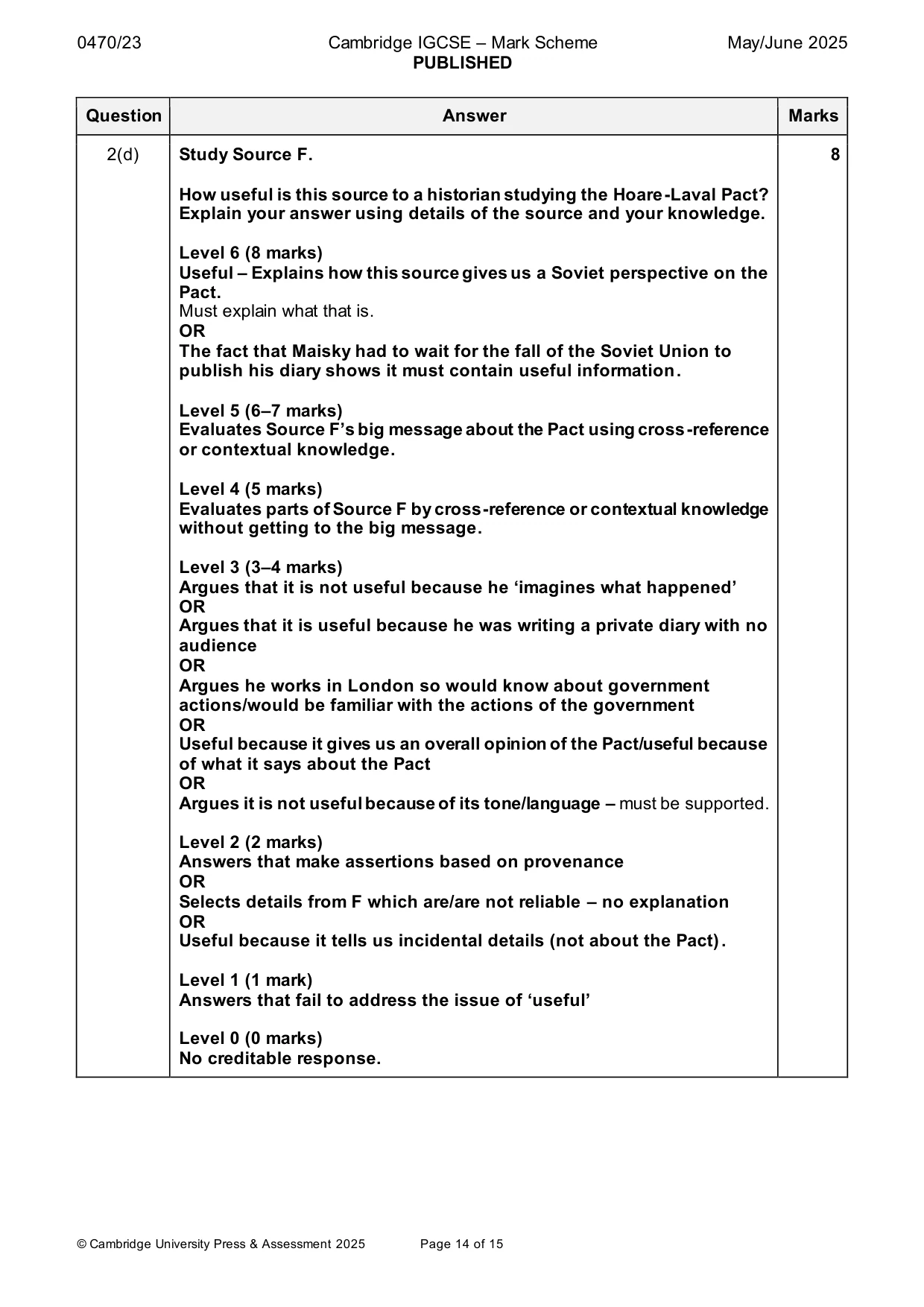
0470/23 Cambridge IGCSE – Mark Scheme PUBLISHED May/June 2025 © Cambridge University Press & Assessment 2025 Page 14 of 15 Question Answer Marks 2(d) Study Source F. How useful is this source to a historian studying the Hoare-Laval Pact? Explain your answer using details of the source and your knowledge. Level 6 (8 marks) Useful – Explains how this source gives us a Soviet perspective on the Pact. Must explain what that is. OR The fact that Maisky had to wait for the fall of the Soviet Union to publish his diary shows it must contain useful information. Level 5 (6–7 marks) Evaluates Source F’s big message about the Pact using cross-reference or contextual knowledge. Level 4 (5 marks) Evaluates parts of Source F by cross-reference or contextual knowledge without getting to the big message. Level 3 (3–4 marks) Argues that it is not useful because he ‘imagines what happened’ OR Argues that it is useful because he was writing a private diary with no audience OR Argues he works in London so would know about government actions/would be familiar with the actions of the government OR Useful because it gives us an overall opinion of the Pact/useful because of what it says about the Pact OR Argues it is not useful because of its tone/language – must be supported. Level 2 (2 marks) Answers that make assertions based on provenance OR Selects details from F which are/are not reliable – no explanation OR Useful because it tells us incidental details (not about the Pact). Level 1 (1 mark) Answers that fail to address the issue of ‘useful’ Level 0 (0 marks) No creditable response. 8
Mark scheme, page 15
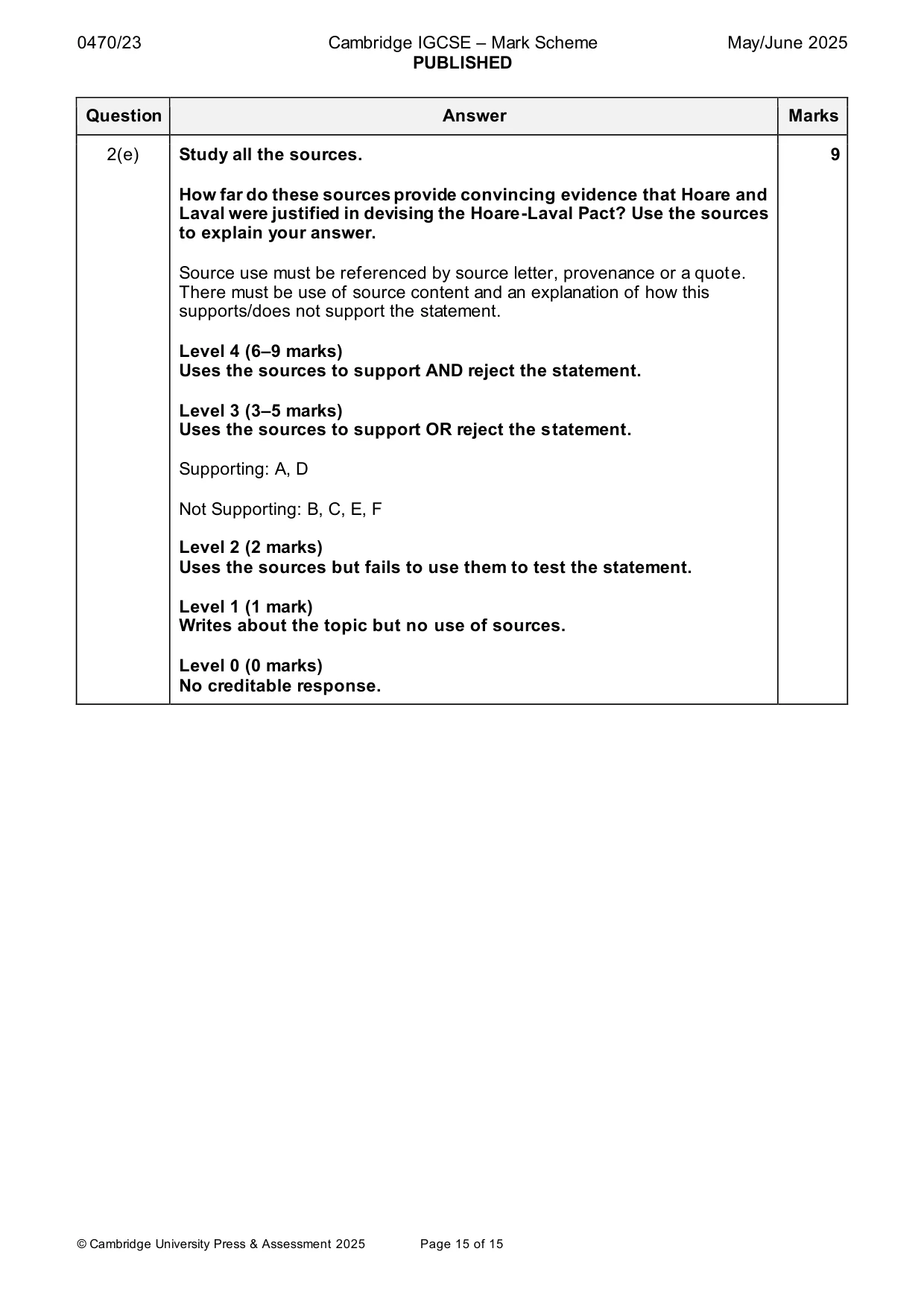
0470/23 Cambridge IGCSE – Mark Scheme PUBLISHED May/June 2025 © Cambridge University Press & Assessment 2025 Page 15 of 15 Question Answer Marks 2(e) Study all the sources. How far do these sources provide convincing evidence that Hoare and Laval were justified in devising the Hoare-Laval Pact? Use the sources to explain your answer. Source use must be referenced by source letter, provenance or a quote. There must be use of source content and an explanation of how this supports/does not support the statement. Level 4 (6–9 marks) Uses the sources to support AND reject the statement. Level 3 (3–5 marks) Uses the sources to support OR reject the statement. Supporting: A, D Not Supporting: B, C, E, F Level 2 (2 marks) Uses the sources but fails to use them to test the statement. Level 1 (1 mark) Writes about the topic but no use of sources. Level 0 (0 marks) No creditable response. 9
What you needed in this session
Cambridge’s own grade thresholds for 2025 May/June, Paper 2 · Variant 3. A higher threshold means an easier paper — the bar moves with how the cohort did.