Cambridge IGCSE History 0470 — 2024 May/June Paper 2 · Variant 3
0470/23/M/J/24 · 40 marks · 105 min
The question paper and its mark scheme, free to read here and free to download. This is Cambridge’s own paper, exactly as it was sat.
Question paper12 pages

Mark scheme13 pages
Answers below. Sit the paper first if you are practising.
Paper as text
Question paper, page 1
This document has 12 pages. Any blank pages are indicated. [Turn over Cambridge IGCSE™ DC (SK/CGW) 330338/3 © UCLES 2024 * 4 7 6 4 1 5 0 1 8 5 * HISTORY 0470/23 Paper 2 Document Questions May/June 2024 1 hour 45 minutes You must answer on the enclosed answer booklet. You will need: Answer booklet (enclosed) INSTRUCTIONS ● Answer one question on one option only. Option A: Nineteenth century topic Option B: Twentieth century topic ● Follow the instructions on the front cover of the answer booklet. If you need additional answer paper, ask the invigilator for a continuation booklet. INFORMATION ● The total mark for this paper is 40. ● The number of marks for each question or part question is shown in brackets [ ].
Question paper, page 2
2 0470/23/M/J/24 © UCLES 2024 Option A: Nineteenth century topic 1 Who was more to blame for the July Crisis of 1914, Austria or Serbia? Study the Background Information and the sources carefully, and then answer all parts of Question 1. Background Information In the late nineteenth century Bismarck had predicted that ‘some damned foolish thing in the Balkans’ would cause the next big war. On 28 June 1914, members of Black Hand, a Serb nationalist group, assassinated the heir to the Austrian throne. They wanted a larger Serbian nation that would unite all Serbs. This was a direct threat to the Austrian Empire. Austria blamed the Serbian government for the murder and on 23 July sent Serbia a list of demands. Serbia agreed to many, but not all of them. On 28 July Austria declared war on Serbia and began by bombarding Belgrade. Austria was supported by Germany, and Serbia by Russia. Within a few days almost the whole of Europe was at war. Who was more to blame for the deteriorating situation in July 1914, Austria or Serbia? SOURCE A The painful events of 28 June have proved the existence of a subversive movement in Serbia, whose aim is to separate portions of territory from Austria. This movement, coming into being under the eyes of the Serbian Government, has committed acts of terrorism. The Serbian Government has done nothing to suppress this movement. It has tolerated criminal activities, press reports directed against Austria, the glorification of the assassins, and anything which could push the people of Serbia into hatred of Austria. It is clear from the confessions of the criminals responsible for the assassination that it was planned in Belgrade, that the murderers received their weapons and bombs from Serbian officers who belonged to the Narodna Odbrana, and that the movement of the criminals and their weapons to Bosnia was arranged by Serbian frontier authorities. The Austrian government is compelled to demand that the Serbian Government give assurance that it will condemn the propaganda against Austria, dissolve the Narodna Odbrana, and hold an inquiry with Austrian officials into the conspiracy. From the Austrian ultimatum to Serbia, 23 July 1914. The Narodna Odbrana was a Serbian nationalist organisation that used violent methods.
Question paper, page 3
3 0470/23/M/J/24 © UCLES 2024 [Turn over SOURCE B The Serbian government is convinced that its reply will clear up any misunderstanding which threatens to destroy the friendly relations between Austria and Serbia. It cannot be made responsible for newspaper articles which are not under the control of the state. The Serbian government has helped in the solution of a whole series of questions which have arisen between Serbia and Austria. It was therefore painfully surprised by the assertion that citizens of Serbia had participated in the preparations of the outrage in Sarajevo. It expected to be invited to cooperate in the investigation of the crime, and was ready to surrender to the court every Serbian citizen whose participation in the crime was proven. It considers it is its duty to begin an investigation against all those persons who have participated in the outrage and who are in its territory. The involvement of Austrian officials in this investigation cannot be accepted. The Serbian government condemns all propaganda which is directed against Austria and will dissolve the Narodna Odbrana. From the Serbian reply to Austria, 25 July 1914. SOURCE C After reading the Serbian reply I am convinced that the wishes of the Austrian government have been largely fulfilled. The few reservations that Serbia makes in regard to individual points could be settled by negotiation. I propose to say to Austria that Serbia’s retreat has been forced in a very humiliating manner, and we offer our congratulations. Naturally, as a result, a cause for war no longer exists. However, a guarantee that the promises would be carried out is necessary. That could be secured by some gentle violence – a temporary military occupation of Belgrade which should be occupied until the demands have actually been complied with. On this basis, I am ready to mediate for peace. This should be communicated to Austria. A letter from German Emperor William II to Jagow, Foreign Minister of Germany, 28 July 1914. SOURCE D I do remember, whether it was at the end of May or the beginning of June, when Pašić said to us there were people who were going to go to Sarajevo to kill Franz Ferdinand. They told me afterwards the plot was hatched by a secret patriotic organisation in Belgrade. Pašić and the rest of us said that the Minister of the Interior should issue instructions to stop them. But the frontier authorities belonged to the organisation and did not carry out the instructions. They claimed that the instructions reached them too late, and the young men had already got across into Bosnia. Jovanović, a member of the Serbian government in 1914, speaking in 1924. Pašić was Prime Minister of Serbia.
Question paper, page 4
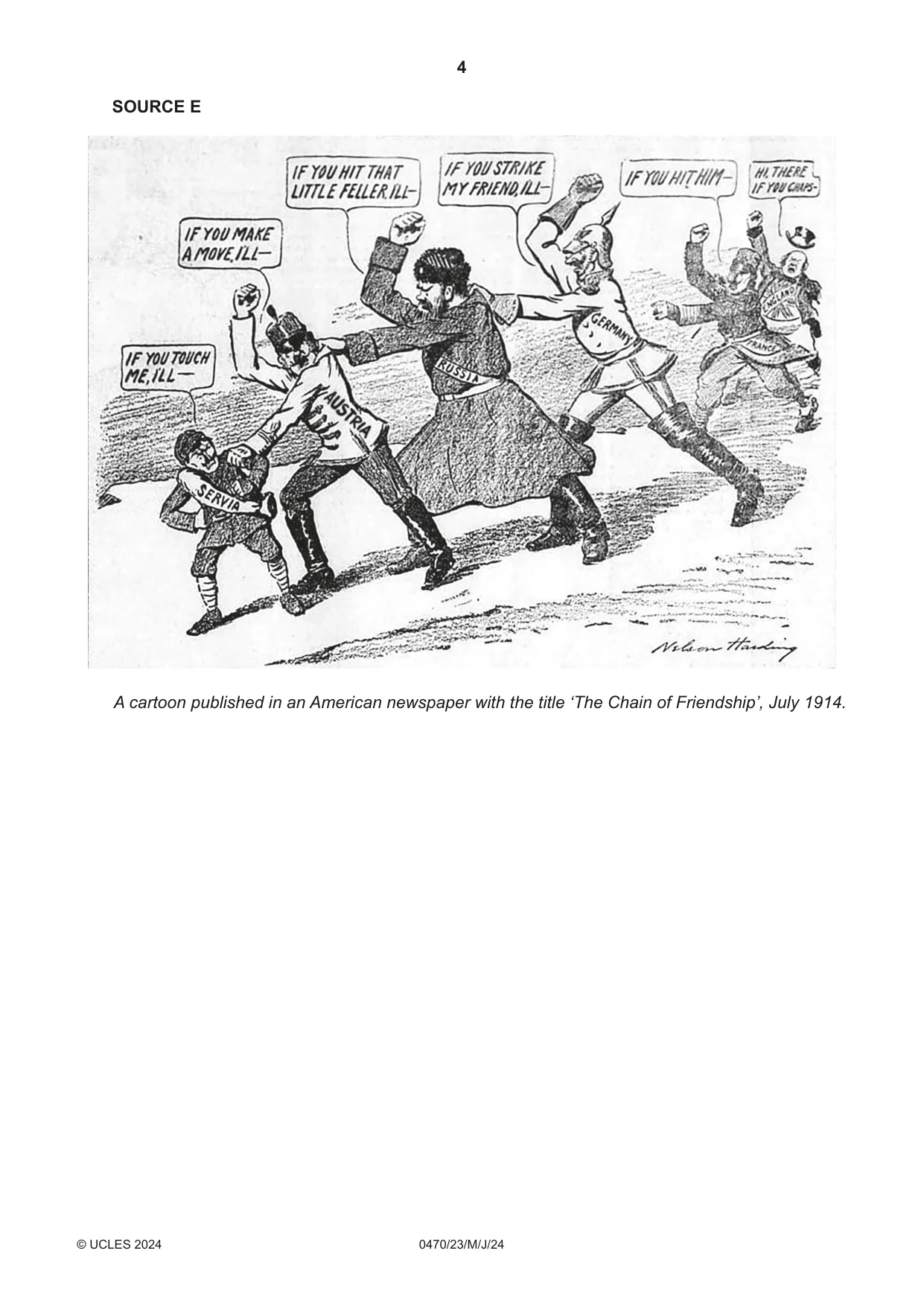
4 0470/23/M/J/24 © UCLES 2024 SOURCE E A cartoon published in an American newspaper with the title ‘The Chain of Friendship’, July 1914.
Question paper, page 5
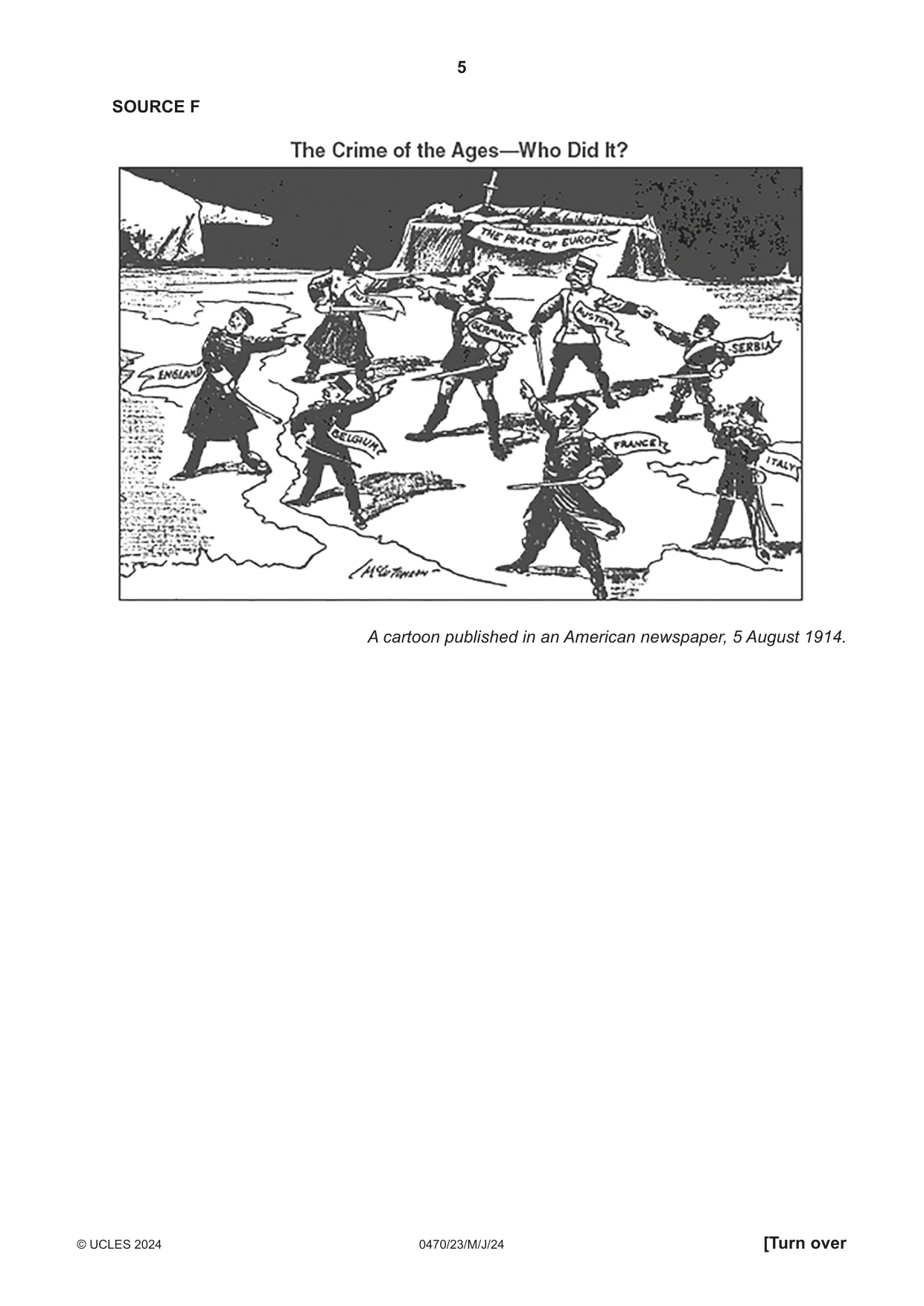
5 0470/23/M/J/24 © UCLES 2024 [Turn over SOURCE F A cartoon published in an American newspaper, 5 August 1914.
Question paper, page 6
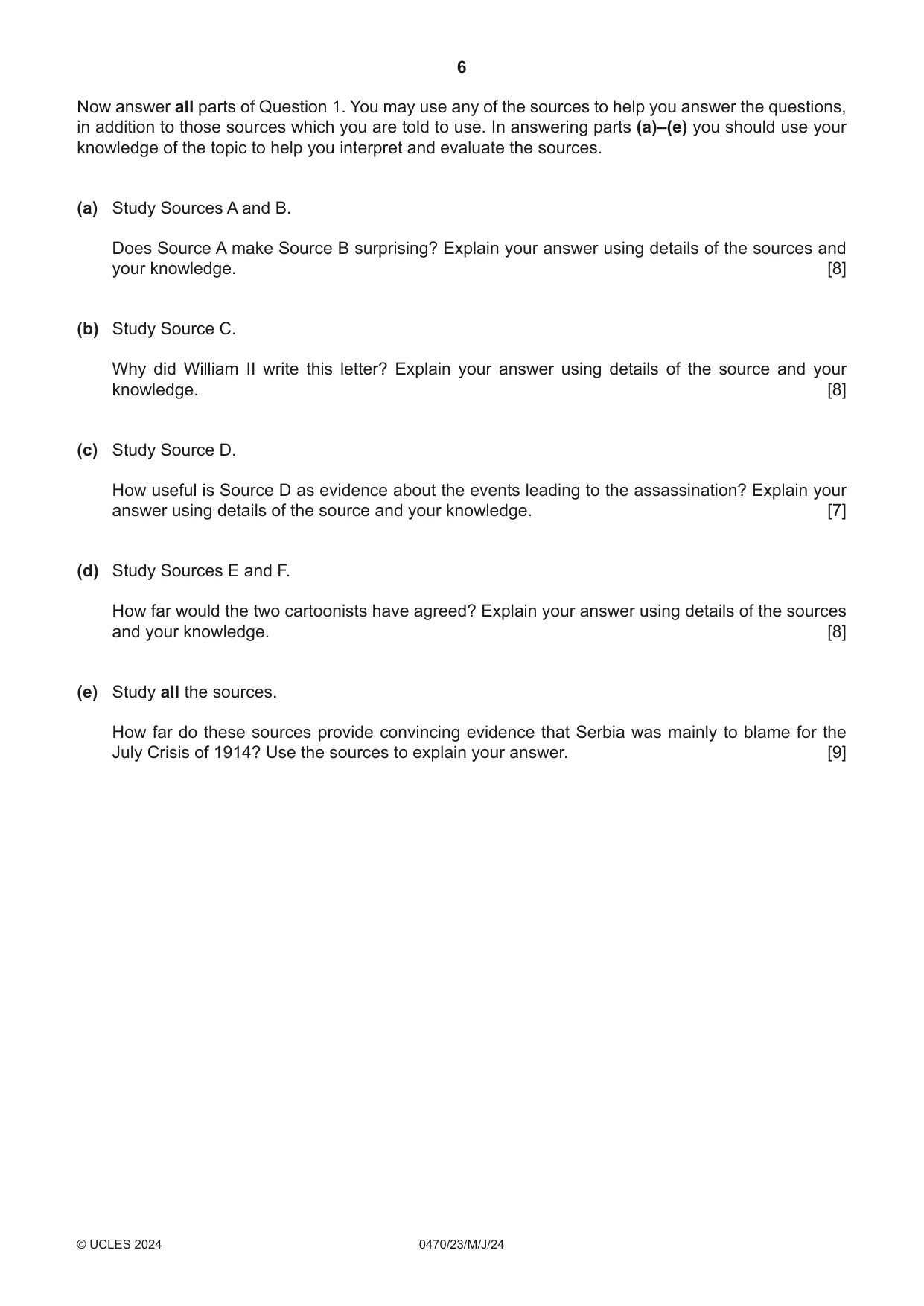
6 0470/23/M/J/24 © UCLES 2024 Now answer all parts of Question 1. You may use any of the sources to help you answer the questions, in addition to those sources which you are told to use. In answering parts (a)–(e) you should use your knowledge of the topic to help you interpret and evaluate the sources. (a) Study Sources A and B. Does Source A make Source B surprising? Explain your answer using details of the sources and your knowledge. [8] (b) Study Source C. Why did William II write this letter? Explain your answer using details of the source and your knowledge. [8] (c) Study Source D. How useful is Source D as evidence about the events leading to the assassination? Explain your answer using details of the source and your knowledge. [7] (d) Study Sources E and F. How far would the two cartoonists have agreed? Explain your answer using details of the sources and your knowledge. [8] (e) Study all the sources. How far do these sources provide convincing evidence that Serbia was mainly to blame for the July Crisis of 1914? Use the sources to explain your answer. [9]
Question paper, page 7
7 0470/23/M/J/24 © UCLES 2024 [Turn over BLANK PAGE
Question paper, page 8
8 0470/23/M/J/24 © UCLES 2024 Option B: Twentieth century topic 2 Was Vietnamisation a failure? Study the Background Information and the sources carefully, and then answer all parts of Question 2. Background Information When Nixon became president in January 1969, he knew that he had to find a way of ending American military participation in Vietnam without the United States being humiliated. He also had to ensure that South Vietnam would not fall to the Communists. In 1968 alone 14 600 US troops had been killed in Vietnam and the war was becoming more unpopular amongst the American public. Nixon decided to introduce ‘Vietnamisation’. This involved developing and strengthening the South Vietnamese army so that it could defend South Vietnam by itself and thus allow US troops to be gradually withdrawn. It also involved ‘pacification’ – winning the trust and support of the South Vietnamese people. Nixon’s policies were tested by the huge anti-war demonstrations in the autumn of 1969, and by the Communist Easter Offensive between March and October 1972. How effective was Vietnamisation? SOURCE A Vietnamisation was a new strategy and may have been even more successful given time and with the continuing support of US forces. It was initially successful before being sabotaged by premature troop withdrawal. In 1972 the Communists launched an Easter Offensive using three divisions attacking on three fronts. The ARVN had increased in size and, with the support of US forces, was able to stop the largest Communist offensive yet and the war seemed at a turning point. The ARVN was now capable of bravely resisting Communist aggression and had not faltered in the face of the Communist offensive, as it had in the past. However, rather than commit the forces necessary to finally turn the tide, Nixon opted to withdraw the bulk of US forces, with the last leaving later in 1972. As a result, the ARVN was unable to defend Saigon. Vietnamisation was more effective than previous strategies. If the US forces had remained in the country, the effects of Vietnamisation could have changed the course of the war. Vietnamisation had brought American troops home, but it had not saved South Vietnam. From a recent account of the Vietnam War. The ARVN was the South Vietnamese Army.
Question paper, page 9
9 0470/23/M/J/24 © UCLES 2024 [Turn over SOURCE B Vietnamisation was not Nixon’s idea. It had actually been tried in 1967 when attempts were made to improve the armed forces of South Vietnam. The size of ARVN forces grew but they were not better and the number of desertions grew. A great effort was made to train the ARVN officers but with little success. However, senior commanders were encouraged to make positive comments about ARVN progress. These were distributed through the propaganda network and many Americans began to believe that Nixon had found the magic formula to get the United States out of the war and defeat the Communists. However, the Communists launched the huge Easter Offensive in March 1972 and the ARVN, fighting without American ground support, was forced to retreat. But the Communists weakened themselves by attacking along three fronts and the ARVN regrouped and counter-attacked. General Abrams remarked, ‘The South Vietnamese did it!’ However, although the soldiers fought bravely, the leadership from the officers was still poor. The most important reason for the PAVN defeat was American airpower. Although the ARVN technically won, the signs were not good. The Communists had mounted a major offensive and the ARVN was losing control of the countryside. When the last American combat soldier left Vietnam in 1972, there was little chance the ARVN would be able to hold on to the South. From a recent article about Vietnamisation. The PAVN was the Communist People’s Army of Vietnam. Abrams was in command of US military operations in Vietnam from 1968 to 1972. SOURCE C Under my new plan I ordered an increase in the training and equipment of South Vietnamese forces. The main mission of our troops is to enable the South Vietnamese forces to assume full responsibility for the security of South Vietnam. We have begun to see the results of this. By 15 December, over 60 000 men will have been withdrawn from South Vietnam. The South Vietnamese have continued to gain in strength. As a result, they have been able to take over combat responsibilities from our American troops. Enemy infiltration is less than twenty per cent of what it was last year and US casualties have declined to the lowest point in three years. We plan the withdrawal of all US combat ground forces, and their replacement by South Vietnamese forces. This withdrawal will be made from strength and not from weakness. From President Nixon’s speech to the American people, 3 November 1969.
Question paper, page 10
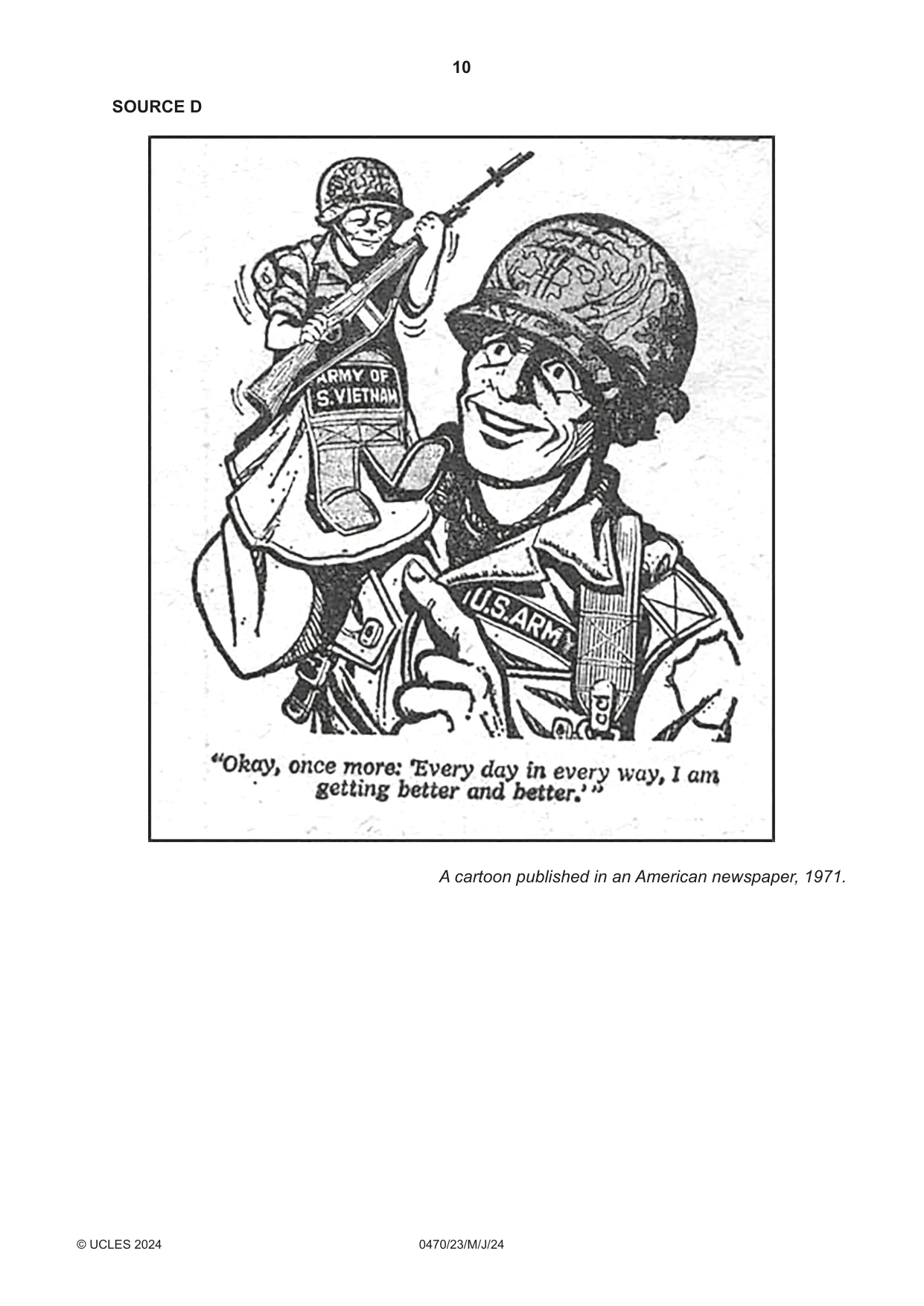
10 0470/23/M/J/24 © UCLES 2024 SOURCE D A cartoon published in an American newspaper, 1971.
Question paper, page 11
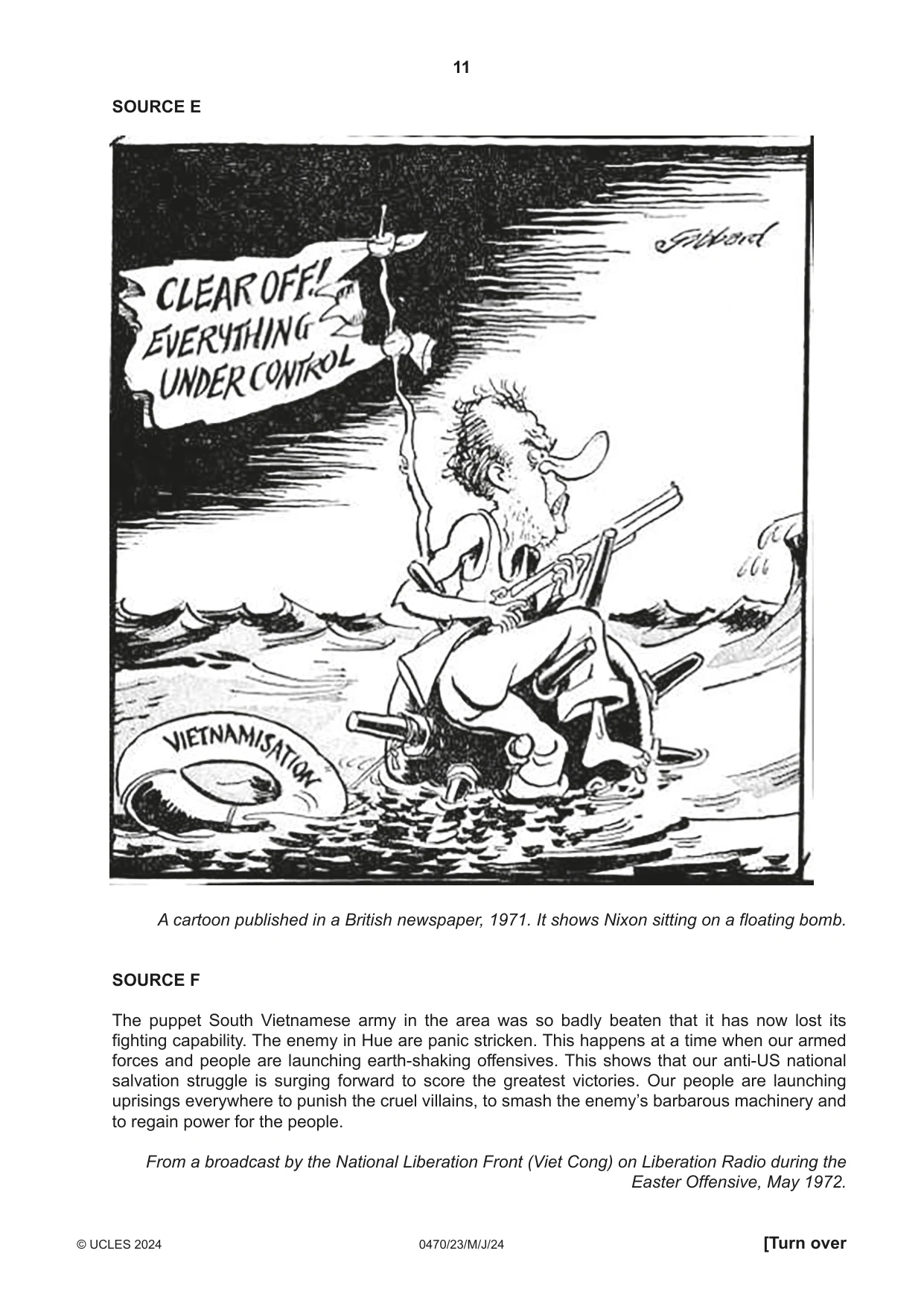
11 0470/23/M/J/24 © UCLES 2024 [Turn over SOURCE E A cartoon published in a British newspaper, 1971. It shows Nixon sitting on a floating bomb. SOURCE F The puppet South Vietnamese army in the area was so badly beaten that it has now lost its fighting capability. The enemy in Hue are panic stricken. This happens at a time when our armed forces and people are launching earth-shaking offensives. This shows that our anti-US national salvation struggle is surging forward to score the greatest victories. Our people are launching uprisings everywhere to punish the cruel villains, to smash the enemy’s barbarous machinery and to regain power for the people. From a broadcast by the National Liberation Front (Viet Cong) on Liberation Radio during the Easter Offensive, May 1972.
Question paper, page 12
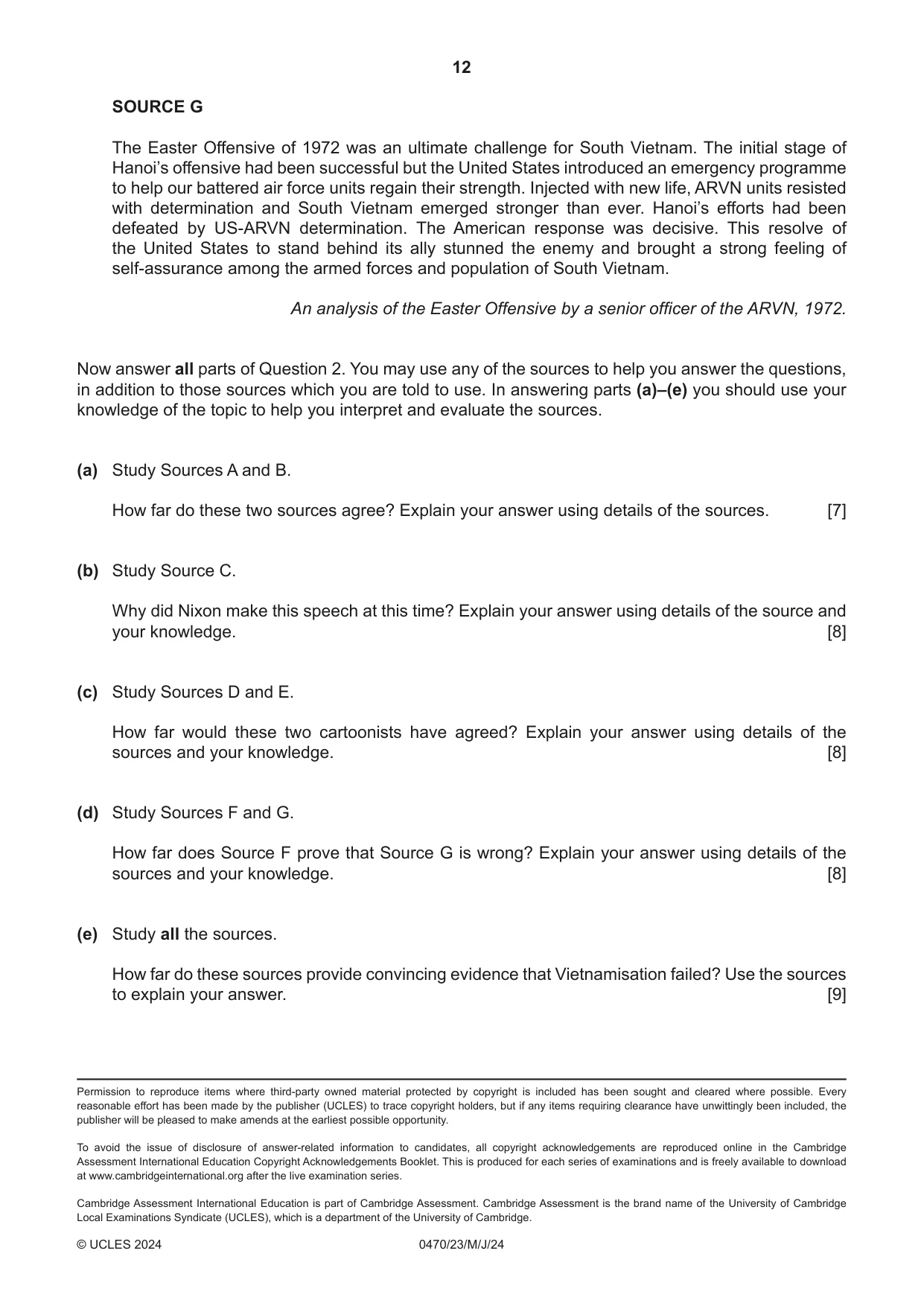
12 0470/23/M/J/24 © UCLES 2024 SOURCE G The Easter Offensive of 1972 was an ultimate challenge for South Vietnam. The initial stage of Hanoi’s offensive had been successful but the United States introduced an emergency programme to help our battered air force units regain their strength. Injected with new life, ARVN units resisted with determination and South Vietnam emerged stronger than ever. Hanoi’s efforts had been defeated by US-ARVN determination. The American response was decisive. This resolve of the United States to stand behind its ally stunned the enemy and brought a strong feeling of self-assurance among the armed forces and population of South Vietnam. An analysis of the Easter Offensive by a senior officer of the ARVN, 1972. Now answer all parts of Question 2. You may use any of the sources to help you answer the questions, in addition to those sources which you are told to use. In answering parts (a)–(e) you should use your knowledge of the topic to help you interpret and evaluate the sources. (a) Study Sources A and B. How far do these two sources agree? Explain your answer using details of the sources. [7] (b) Study Source C. Why did Nixon make this speech at this time? Explain your answer using details of the source and your knowledge. [8] (c) Study Sources D and E. How far would these two cartoonists have agreed? Explain your answer using details of the sources and your knowledge. [8] (d) Study Sources F and G. How far does Source F prove that Source G is wrong? Explain your answer using details of the sources and your knowledge. [8] (e) Study all the sources. How far do these sources provide convincing evidence that Vietnamisation failed? Use the sources to explain your answer. [9] Permission to reproduce items where third-party owned material protected by copyright is included has been sought and cleared where possible. Every reasonable effort has been made by the publisher (UCLES) to trace copyright holders, but if any items requiring clearance have unwittingly been included, the publisher will be pleased to make amends at the earliest possible opportunity. To avoid the issue of disclosure of answer-related information to candidates, all copyright acknowledgements are reproduced online in the Cambridge Assessment International Education Copyright Acknowledgements Booklet. This is produced for each series of examinations and is freely available to download at www.cambridgeinternational.org after the live examination series. Cambridge Assessment International Education is part of Cambridge Assessment. Cambridge Assessment is the brand name of the University of Cambridge Local Examinations Syndicate (UCLES), which is a department of the University of Cambridge.
Mark scheme, page 1
This document consists of 13 printed pages. © Cambridge University Press & Assessment 2024 [Turn over Cambridge IGCSE™ HISTORY 0470/23 Paper 2 May/June 2024 MARK SCHEME Maximum Mark: 40 Published This mark scheme is published as an aid to teachers and candidates, to indicate the requirements of the examination. It shows the basis on which Examiners were instructed to award marks. It does not indicate the details of the discussions that took place at an Examiners’ meeting before marking began, which would have considered the acceptability of alternative answers. Mark schemes should be read in conjunction with the question paper and the Principal Examiner Report for Teachers. Cambridge International will not enter into discussions about these mark schemes. Cambridge International is publishing the mark schemes for the May/June 2024 series for most Cambridge IGCSE, Cambridge International A and AS Level and Cambridge Pre-U components, and some Cambridge O Level components.
Mark scheme, page 2
0470/23 Cambridge IGCSE – Mark Scheme PUBLISHED May/June 2024 © Cambridge University Press & Assessment 2024 Page 2 of 13 Generic Marking Principles These general marking principles must be applied by all examiners when marking candidate answers. They should be applied alongside the specific content of the mark scheme or generic level descriptions for a question. Each question paper and mark scheme will also comply with these marking principles. GENERIC MARKING PRINCIPLE 1: Marks must be awarded in line with: the specific content of the mark scheme or the generic level descriptors for the question the specific skills defined in the mark scheme or in the generic level descriptors for the question the standard of response required by a candidate as exemplified by the standardisation scripts. GENERIC MARKING PRINCIPLE 2: Marks awarded are always whole marks (not half marks, or other fractions). GENERIC MARKING PRINCIPLE 3: Marks must be awarded positively: marks are awarded for correct/valid answers, as defined in the mark scheme. However, credit is given for valid answers which go beyond the scope of the syllabus and mark scheme, referring to your Team Leader as appropriate marks are awarded when candidates clearly demonstrate what they know and can do marks are not deducted for errors marks are not deducted for omissions answers should only be judged on the quality of spelling, punctuation and grammar when these features are specifically assessed by the question as indicated by the mark scheme. The meaning, however, should be unambiguous. GENERIC MARKING PRINCIPLE 4: Rules must be applied consistently, e.g. in situations where candidates have not followed instructions or in the application of generic level descriptors. GENERIC MARKING PRINCIPLE 5: Marks should be awarded using the full range of marks defined in the mark scheme for the question (however; the use of the full mark range may be limited according to the quality of the candidate responses seen). GENERIC MARKING PRINCIPLE 6: Marks awarded are based solely on the requirements as defined in the mark scheme. Marks should not be awarded with grade thresholds or grade descriptors in mind.
Mark scheme, page 3
0470/23 Cambridge IGCSE – Mark Scheme PUBLISHED May/June 2024 © Cambridge University Press & Assessment 2024 Page 3 of 13 Assessment objectives AO1 An ability to recall, select, organise and deploy knowledge of the syllabus content. AO3 An ability to understand, interpret, evaluate and use a range of sources as evidence, in their historical context.
Mark scheme, page 4
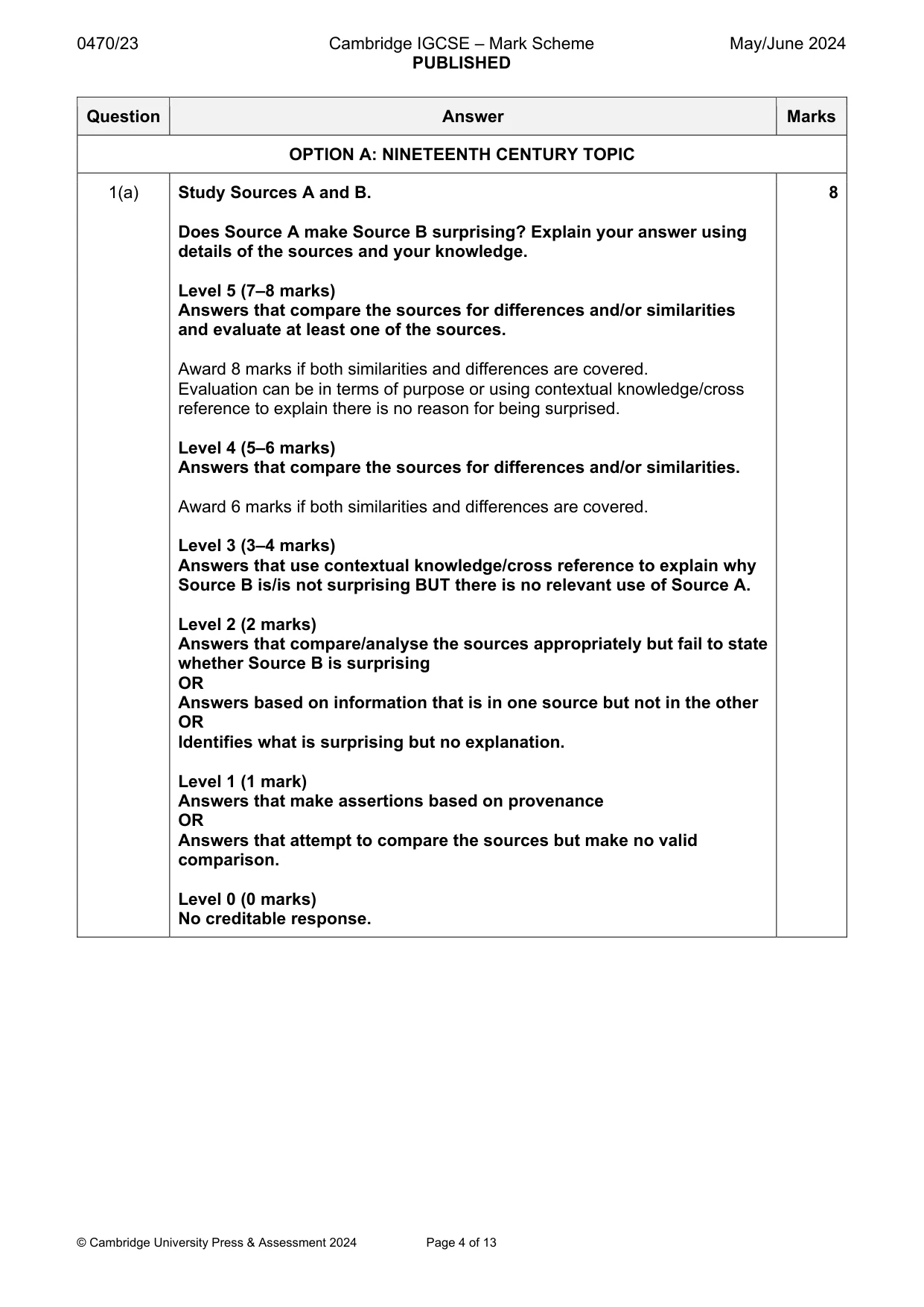
0470/23 Cambridge IGCSE – Mark Scheme PUBLISHED May/June 2024 © Cambridge University Press & Assessment 2024 Page 4 of 13 Question Answer Marks OPTION A: NINETEENTH CENTURY TOPIC 1(a) Study Sources A and B. Does Source A make Source B surprising? Explain your answer using details of the sources and your knowledge. Level 5 (7–8 marks) Answers that compare the sources for differences and/or similarities and evaluate at least one of the sources. Award 8 marks if both similarities and differences are covered. Evaluation can be in terms of purpose or using contextual knowledge/cross reference to explain there is no reason for being surprised. Level 4 (5–6 marks) Answers that compare the sources for differences and/or similarities. Award 6 marks if both similarities and differences are covered. Level 3 (3–4 marks) Answers that use contextual knowledge/cross reference to explain why Source B is/is not surprising BUT there is no relevant use of Source A. Level 2 (2 marks) Answers that compare/analyse the sources appropriately but fail to state whether Source B is surprising OR Answers based on information that is in one source but not in the other OR Identifies what is surprising but no explanation. Level 1 (1 mark) Answers that make assertions based on provenance OR Answers that attempt to compare the sources but make no valid comparison. Level 0 (0 marks) No creditable response. 8
Mark scheme, page 5
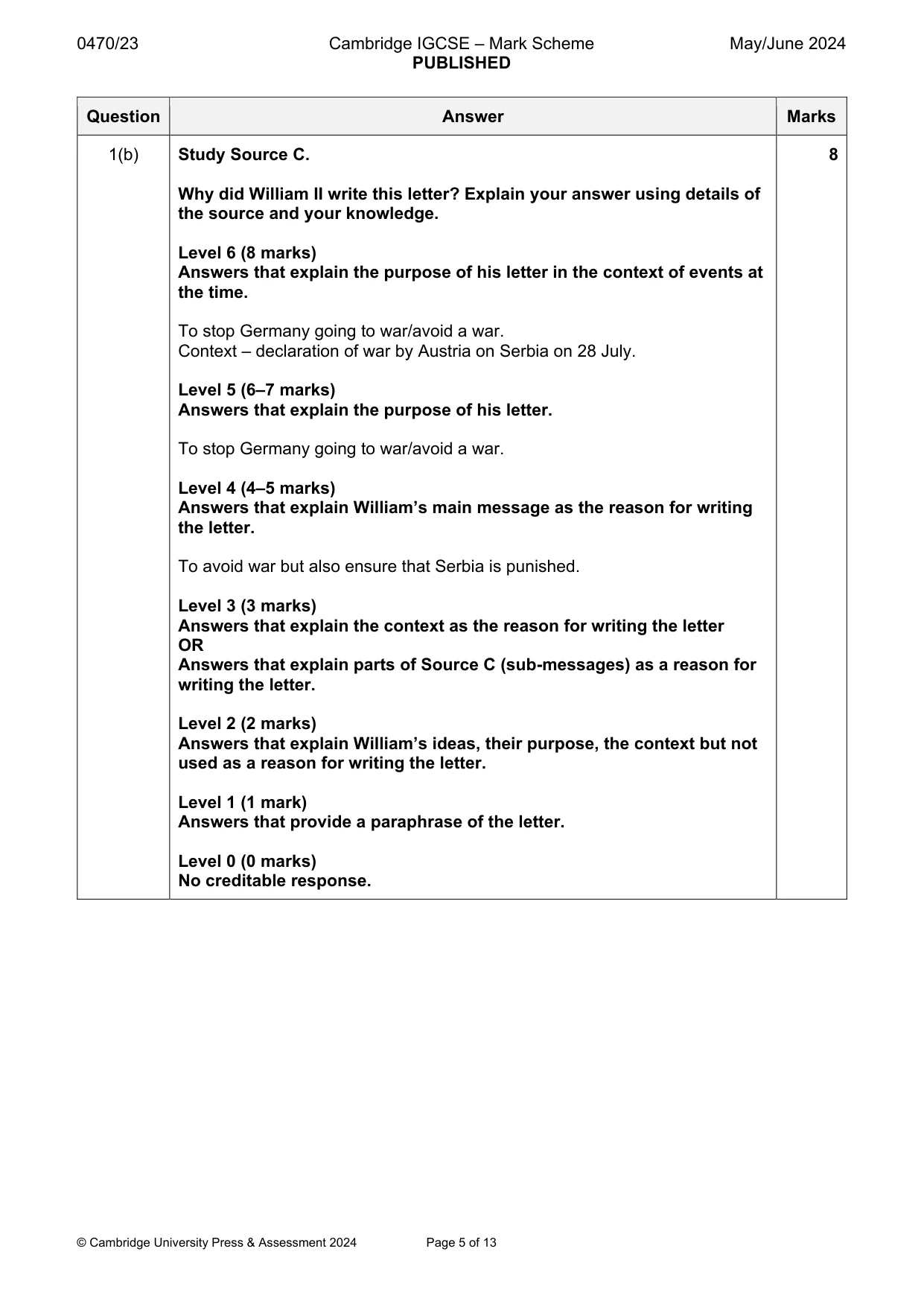
0470/23 Cambridge IGCSE – Mark Scheme PUBLISHED May/June 2024 © Cambridge University Press & Assessment 2024 Page 5 of 13 Question Answer Marks 1(b) Study Source C. Why did William II write this letter? Explain your answer using details of the source and your knowledge. Level 6 (8 marks) Answers that explain the purpose of his letter in the context of events at the time. To stop Germany going to war/avoid a war. Context – declaration of war by Austria on Serbia on 28 July. Level 5 (6–7 marks) Answers that explain the purpose of his letter. To stop Germany going to war/avoid a war. Level 4 (4–5 marks) Answers that explain William’s main message as the reason for writing the letter. To avoid war but also ensure that Serbia is punished. Level 3 (3 marks) Answers that explain the context as the reason for writing the letter OR Answers that explain parts of Source C (sub-messages) as a reason for writing the letter. Level 2 (2 marks) Answers that explain William’s ideas, their purpose, the context but not used as a reason for writing the letter. Level 1 (1 mark) Answers that provide a paraphrase of the letter. Level 0 (0 marks) No creditable response. 8
Mark scheme, page 6
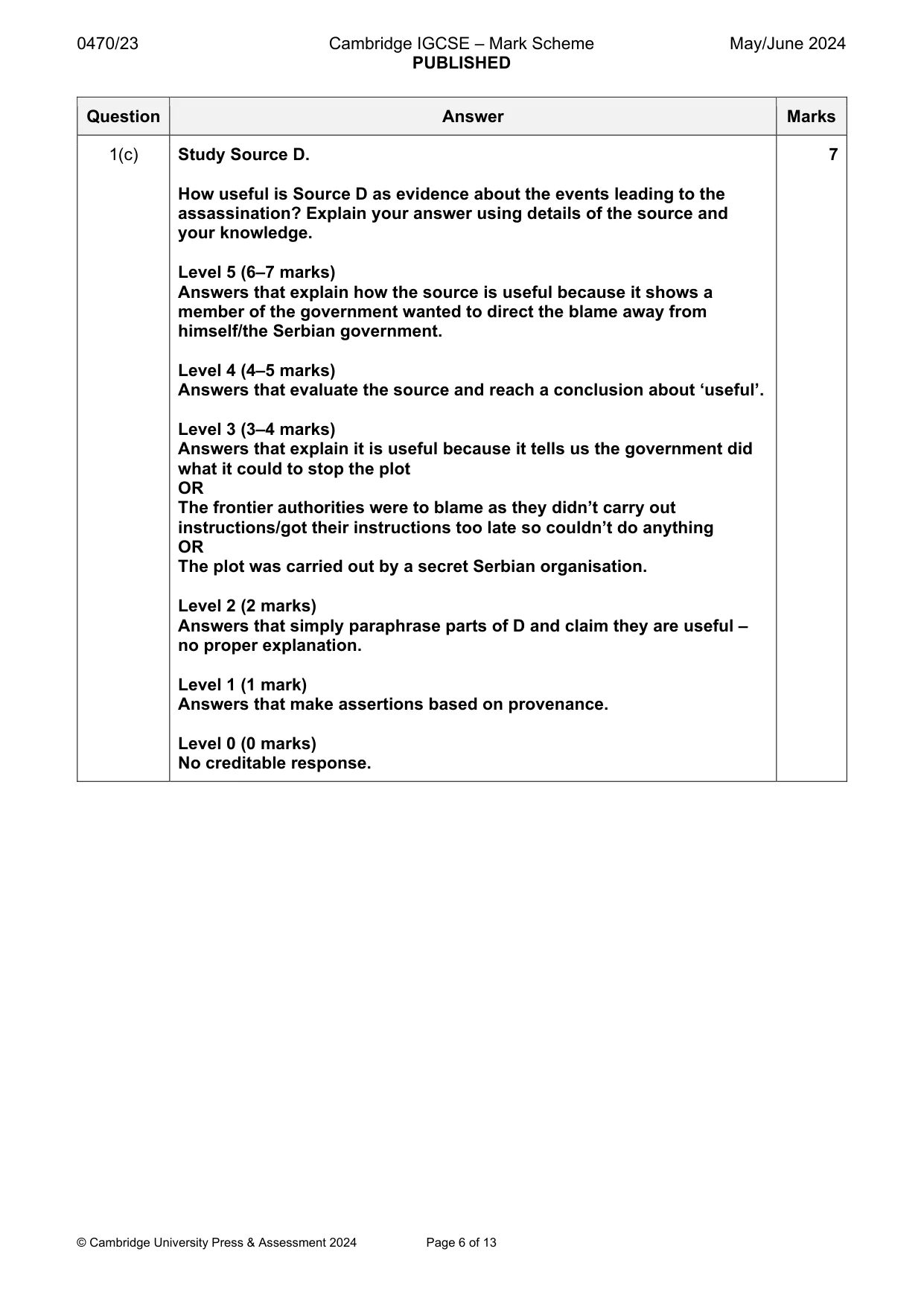
0470/23 Cambridge IGCSE – Mark Scheme PUBLISHED May/June 2024 © Cambridge University Press & Assessment 2024 Page 6 of 13 Question Answer Marks 1(c) Study Source D. How useful is Source D as evidence about the events leading to the assassination? Explain your answer using details of the source and your knowledge. Level 5 (6–7 marks) Answers that explain how the source is useful because it shows a member of the government wanted to direct the blame away from himself/the Serbian government. Level 4 (4–5 marks) Answers that evaluate the source and reach a conclusion about ‘useful’. Level 3 (3–4 marks) Answers that explain it is useful because it tells us the government did what it could to stop the plot OR The frontier authorities were to blame as they didn’t carry out instructions/got their instructions too late so couldn’t do anything OR The plot was carried out by a secret Serbian organisation. Level 2 (2 marks) Answers that simply paraphrase parts of D and claim they are useful – no proper explanation. Level 1 (1 mark) Answers that make assertions based on provenance. Level 0 (0 marks) No creditable response. 7
Mark scheme, page 7
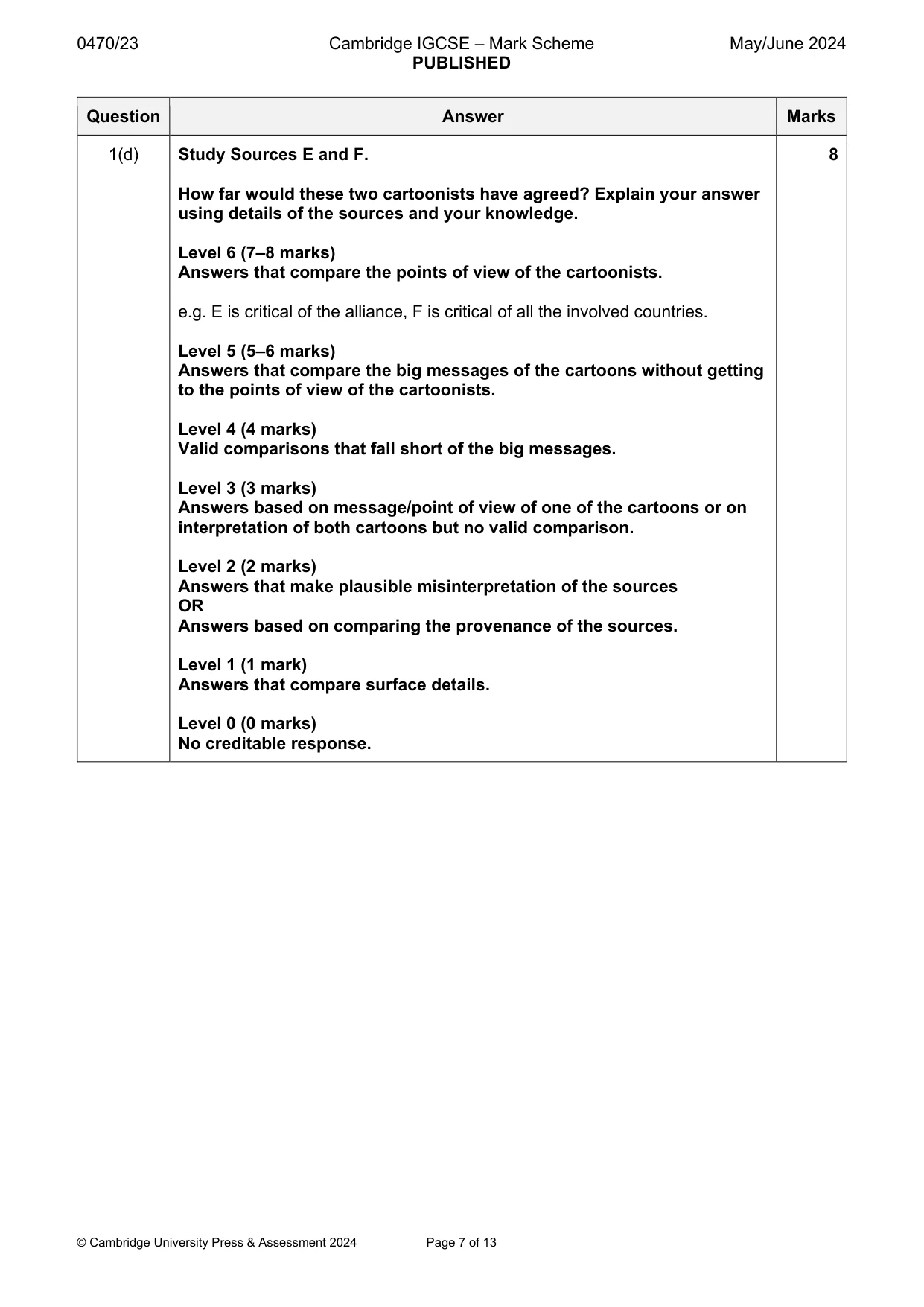
0470/23 Cambridge IGCSE – Mark Scheme PUBLISHED May/June 2024 © Cambridge University Press & Assessment 2024 Page 7 of 13 Question Answer Marks 1(d) Study Sources E and F. How far would these two cartoonists have agreed? Explain your answer using details of the sources and your knowledge. Level 6 (7–8 marks) Answers that compare the points of view of the cartoonists. e.g. E is critical of the alliance, F is critical of all the involved countries. Level 5 (5–6 marks) Answers that compare the big messages of the cartoons without getting to the points of view of the cartoonists. Level 4 (4 marks) Valid comparisons that fall short of the big messages. Level 3 (3 marks) Answers based on message/point of view of one of the cartoons or on interpretation of both cartoons but no valid comparison. Level 2 (2 marks) Answers that make plausible misinterpretation of the sources OR Answers based on comparing the provenance of the sources. Level 1 (1 mark) Answers that compare surface details. Level 0 (0 marks) No creditable response. 8
Mark scheme, page 8
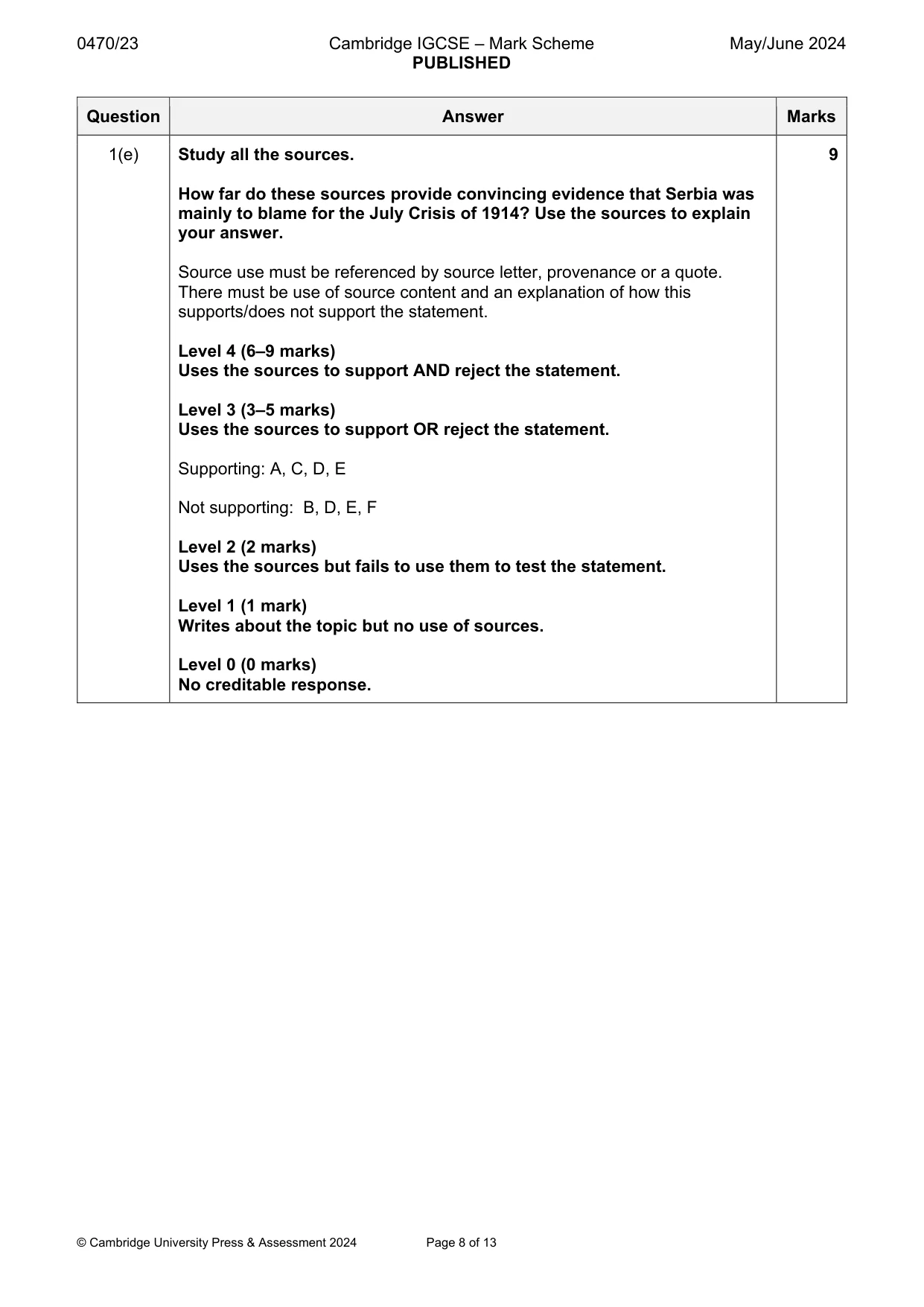
0470/23 Cambridge IGCSE – Mark Scheme PUBLISHED May/June 2024 © Cambridge University Press & Assessment 2024 Page 8 of 13 Question Answer Marks 1(e) Study all the sources. How far do these sources provide convincing evidence that Serbia was mainly to blame for the July Crisis of 1914? Use the sources to explain your answer. Source use must be referenced by source letter, provenance or a quote. There must be use of source content and an explanation of how this supports/does not support the statement. Level 4 (6–9 marks) Uses the sources to support AND reject the statement. Level 3 (3–5 marks) Uses the sources to support OR reject the statement. Supporting: A, C, D, E Not supporting: B, D, E, F Level 2 (2 marks) Uses the sources but fails to use them to test the statement. Level 1 (1 mark) Writes about the topic but no use of sources. Level 0 (0 marks) No creditable response. 9
Mark scheme, page 9
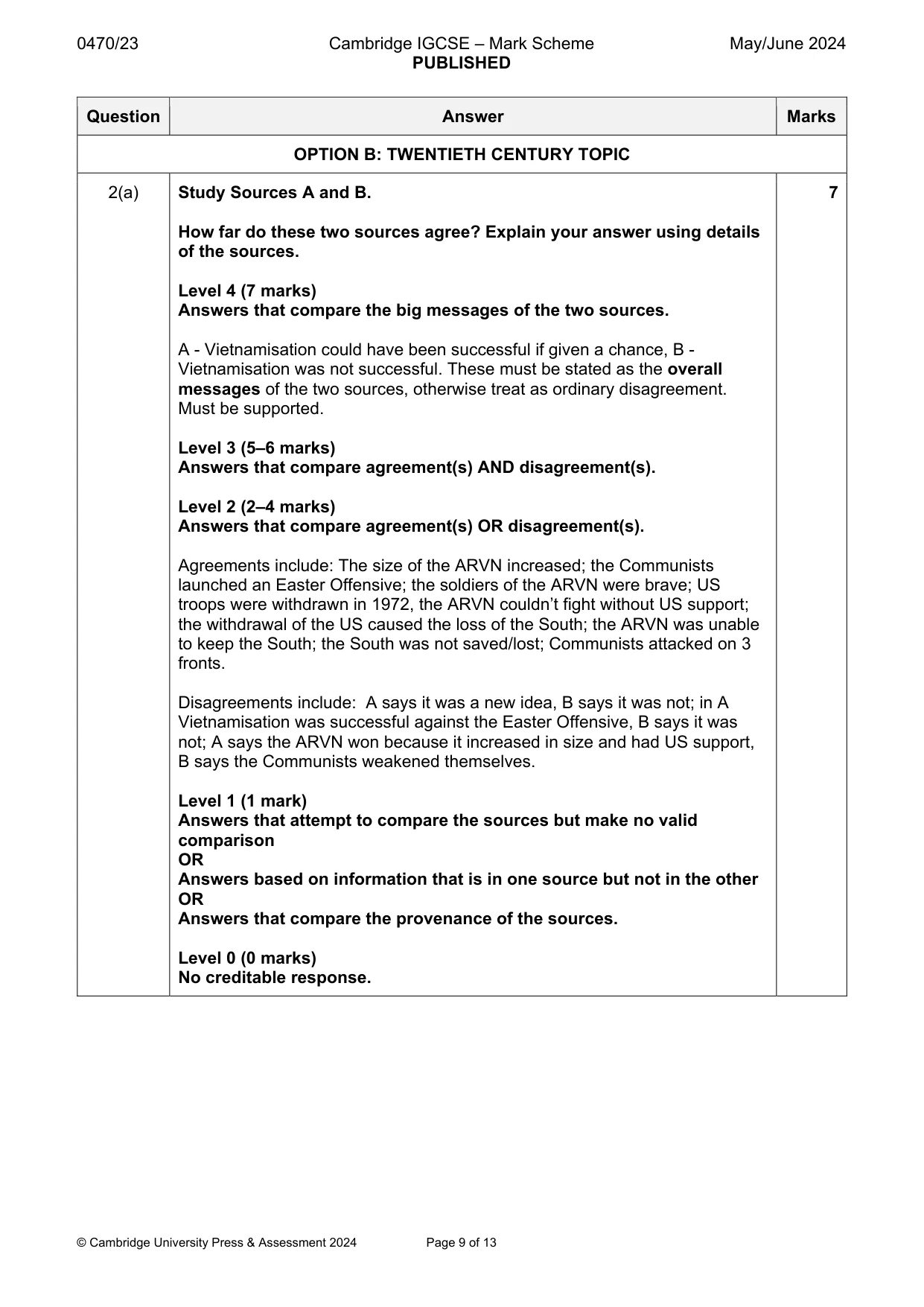
0470/23 Cambridge IGCSE – Mark Scheme PUBLISHED May/June 2024 © Cambridge University Press & Assessment 2024 Page 9 of 13 Question Answer Marks OPTION B: TWENTIETH CENTURY TOPIC 2(a) Study Sources A and B. How far do these two sources agree? Explain your answer using details of the sources. Level 4 (7 marks) Answers that compare the big messages of the two sources. A - Vietnamisation could have been successful if given a chance, B - Vietnamisation was not successful. These must be stated as the overall messages of the two sources, otherwise treat as ordinary disagreement. Must be supported. Level 3 (5–6 marks) Answers that compare agreement(s) AND disagreement(s). Level 2 (2–4 marks) Answers that compare agreement(s) OR disagreement(s). Agreements include: The size of the ARVN increased; the Communists launched an Easter Offensive; the soldiers of the ARVN were brave; US troops were withdrawn in 1972, the ARVN couldn’t fight without US support; the withdrawal of the US caused the loss of the South; the ARVN was unable to keep the South; the South was not saved/lost; Communists attacked on 3 fronts. Disagreements include: A says it was a new idea, B says it was not; in A Vietnamisation was successful against the Easter Offensive, B says it was not; A says the ARVN won because it increased in size and had US support, B says the Communists weakened themselves. Level 1 (1 mark) Answers that attempt to compare the sources but make no valid comparison OR Answers based on information that is in one source but not in the other OR Answers that compare the provenance of the sources. Level 0 (0 marks) No creditable response. 7
Mark scheme, page 10
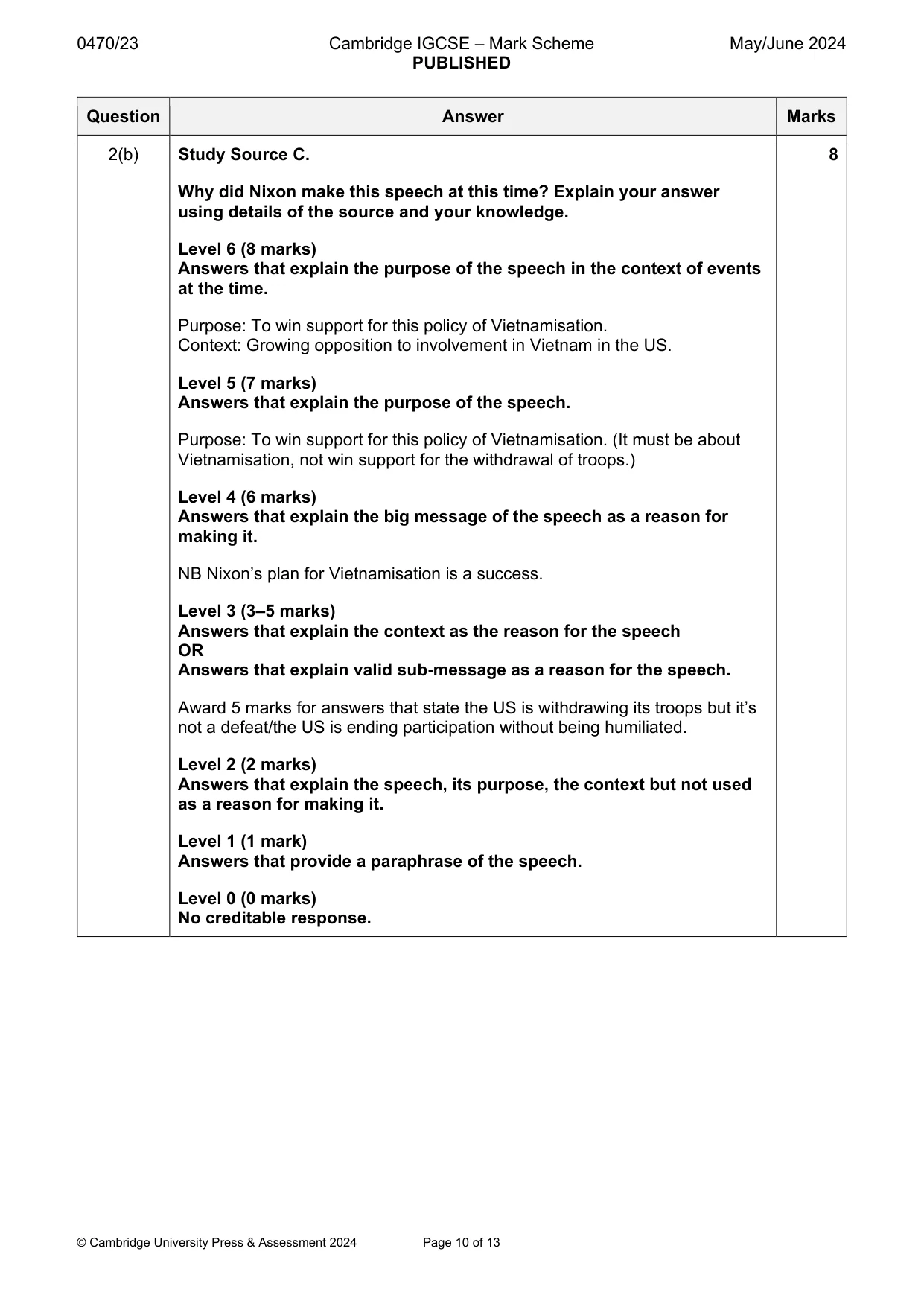
0470/23 Cambridge IGCSE – Mark Scheme PUBLISHED May/June 2024 © Cambridge University Press & Assessment 2024 Page 10 of 13 Question Answer Marks 2(b) Study Source C. Why did Nixon make this speech at this time? Explain your answer using details of the source and your knowledge. Level 6 (8 marks) Answers that explain the purpose of the speech in the context of events at the time. Purpose: To win support for this policy of Vietnamisation. Context: Growing opposition to involvement in Vietnam in the US. Level 5 (7 marks) Answers that explain the purpose of the speech. Purpose: To win support for this policy of Vietnamisation. (It must be about Vietnamisation, not win support for the withdrawal of troops.) Level 4 (6 marks) Answers that explain the big message of the speech as a reason for making it. NB Nixon’s plan for Vietnamisation is a success. Level 3 (3–5 marks) Answers that explain the context as the reason for the speech OR Answers that explain valid sub-message as a reason for the speech. Award 5 marks for answers that state the US is withdrawing its troops but it’s not a defeat/the US is ending participation without being humiliated. Level 2 (2 marks) Answers that explain the speech, its purpose, the context but not used as a reason for making it. Level 1 (1 mark) Answers that provide a paraphrase of the speech. Level 0 (0 marks) No creditable response. 8
Mark scheme, page 11
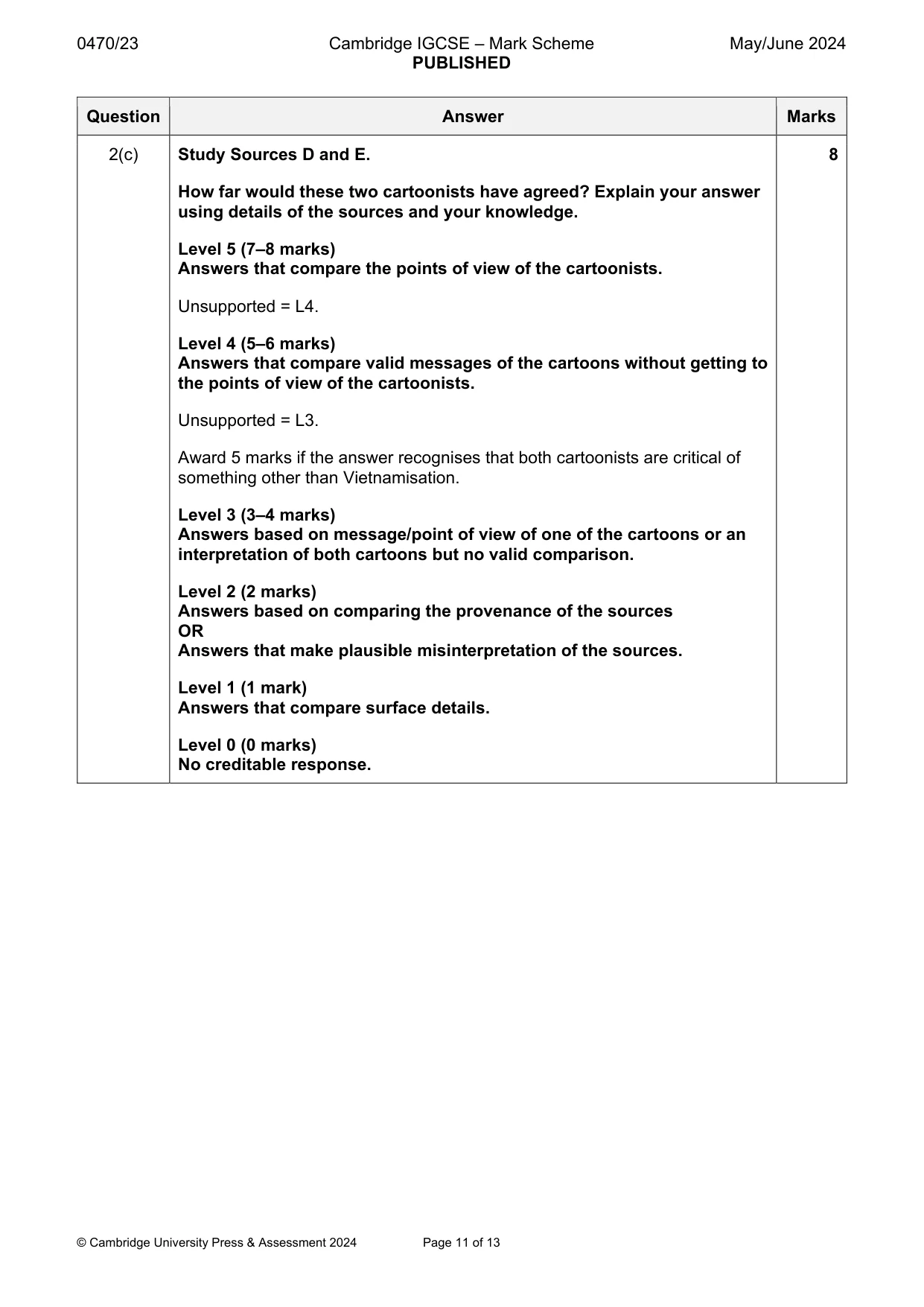
0470/23 Cambridge IGCSE – Mark Scheme PUBLISHED May/June 2024 © Cambridge University Press & Assessment 2024 Page 11 of 13 Question Answer Marks 2(c) Study Sources D and E. How far would these two cartoonists have agreed? Explain your answer using details of the sources and your knowledge. Level 5 (7–8 marks) Answers that compare the points of view of the cartoonists. Unsupported = L4. Level 4 (5–6 marks) Answers that compare valid messages of the cartoons without getting to the points of view of the cartoonists. Unsupported = L3. Award 5 marks if the answer recognises that both cartoonists are critical of something other than Vietnamisation. Level 3 (3–4 marks) Answers based on message/point of view of one of the cartoons or an interpretation of both cartoons but no valid comparison. Level 2 (2 marks) Answers based on comparing the provenance of the sources OR Answers that make plausible misinterpretation of the sources. Level 1 (1 mark) Answers that compare surface details. Level 0 (0 marks) No creditable response. 8
Mark scheme, page 12
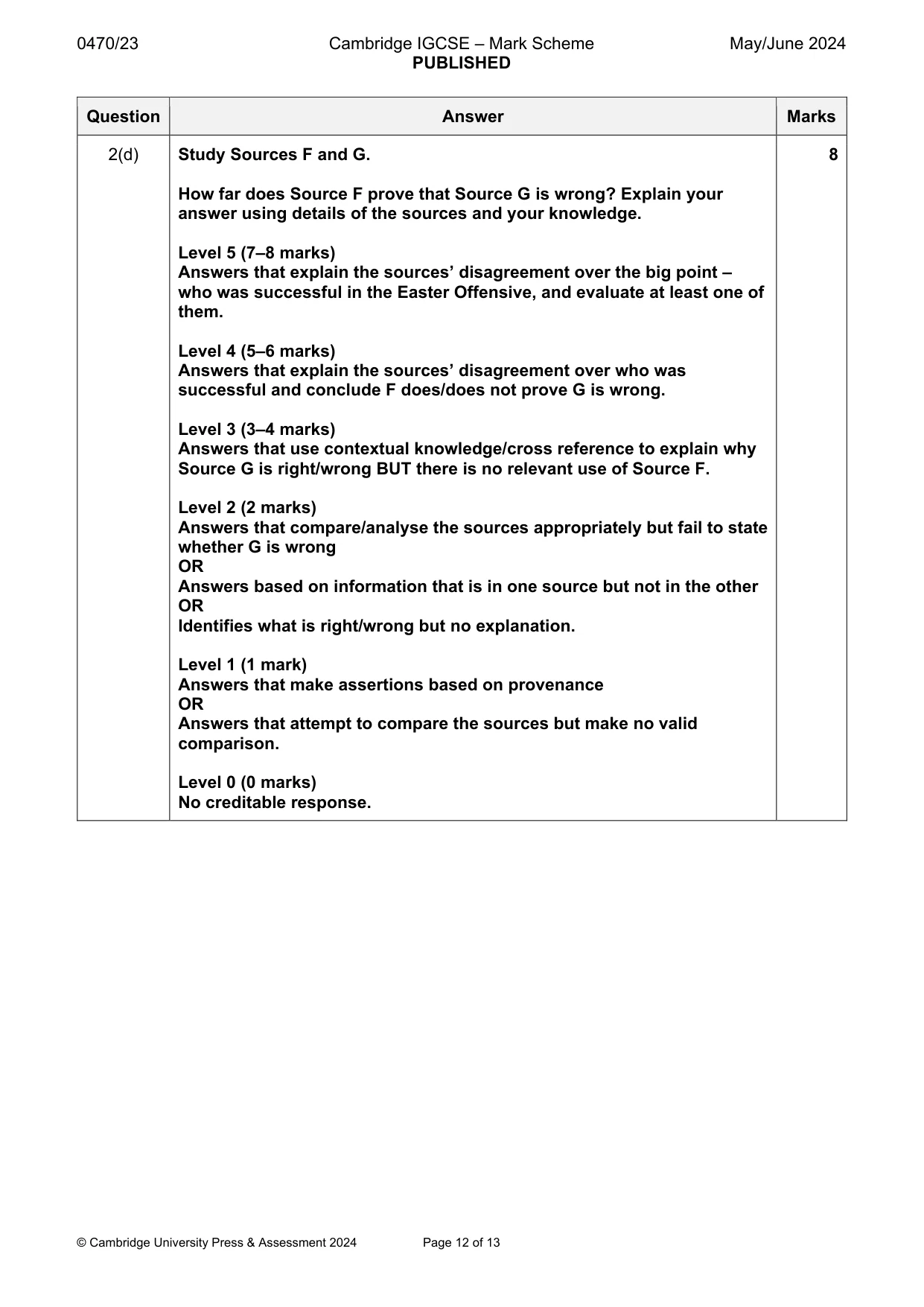
0470/23 Cambridge IGCSE – Mark Scheme PUBLISHED May/June 2024 © Cambridge University Press & Assessment 2024 Page 12 of 13 Question Answer Marks 2(d) Study Sources F and G. How far does Source F prove that Source G is wrong? Explain your answer using details of the sources and your knowledge. Level 5 (7–8 marks) Answers that explain the sources’ disagreement over the big point – who was successful in the Easter Offensive, and evaluate at least one of them. Level 4 (5–6 marks) Answers that explain the sources’ disagreement over who was successful and conclude F does/does not prove G is wrong. Level 3 (3–4 marks) Answers that use contextual knowledge/cross reference to explain why Source G is right/wrong BUT there is no relevant use of Source F. Level 2 (2 marks) Answers that compare/analyse the sources appropriately but fail to state whether G is wrong OR Answers based on information that is in one source but not in the other OR Identifies what is right/wrong but no explanation. Level 1 (1 mark) Answers that make assertions based on provenance OR Answers that attempt to compare the sources but make no valid comparison. Level 0 (0 marks) No creditable response. 8
Mark scheme, page 13
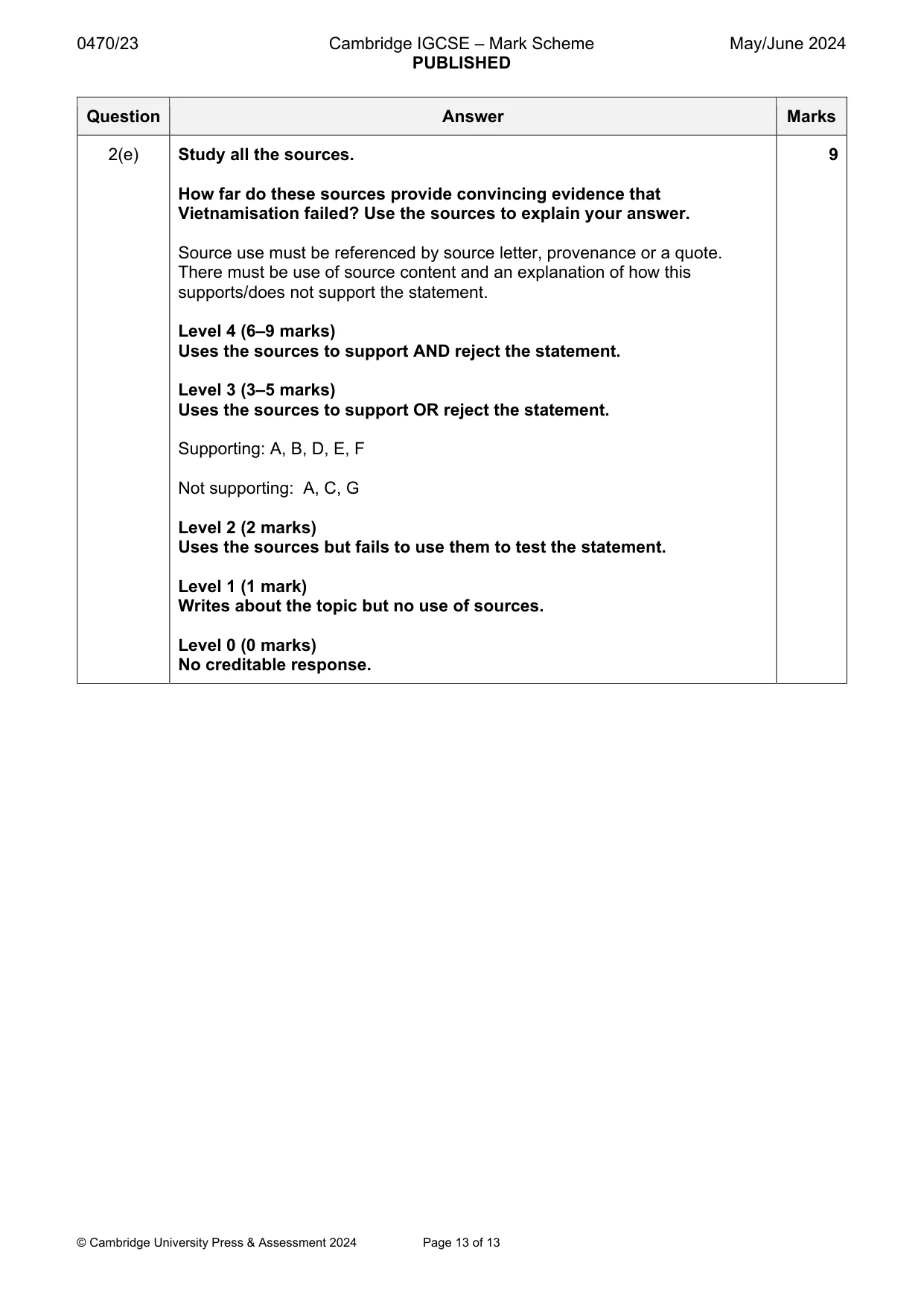
0470/23 Cambridge IGCSE – Mark Scheme PUBLISHED May/June 2024 © Cambridge University Press & Assessment 2024 Page 13 of 13 Question Answer Marks 2(e) Study all the sources. How far do these sources provide convincing evidence that Vietnamisation failed? Use the sources to explain your answer. Source use must be referenced by source letter, provenance or a quote. There must be use of source content and an explanation of how this supports/does not support the statement. Level 4 (6–9 marks) Uses the sources to support AND reject the statement. Level 3 (3–5 marks) Uses the sources to support OR reject the statement. Supporting: A, B, D, E, F Not supporting: A, C, G Level 2 (2 marks) Uses the sources but fails to use them to test the statement. Level 1 (1 mark) Writes about the topic but no use of sources. Level 0 (0 marks) No creditable response. 9
What you needed in this session
Cambridge’s own grade thresholds for 2024 May/June, Paper 2 · Variant 3. A higher threshold means an easier paper — the bar moves with how the cohort did.