Cambridge IGCSE History 0470 — 2023 Oct/Nov Paper 2 · Variant 3
0470/23/O/N/23 · 50 marks · ≈56 min
The question paper and its mark scheme, free to read here and free to download. This is Cambridge’s own paper, exactly as it was sat.
Question paper16 pages


Mark scheme14 pages
Answers below. Sit the paper first if you are practising.
Paper as text
Question paper, page 1
This document has 16 pages. Any blank pages are indicated. [Turn over Cambridge IGCSE™ * 8 7 4 4 8 6 4 7 3 4 * HISTORY 0470/23 Paper 2 October/November 2023 2 hours You must answer on the enclosed answer booklet. You will need: Answer booklet (enclosed) INSTRUCTIONS ● Answer all the questions on one option only. Option A: Nineteenth century topic Option B: Twentieth century topic ● Follow the instructions on the front cover of the answer booklet. If you need additional answer paper, ask the invigilator for a continuation booklet. INFORMATION ● The total mark for this paper is 50. ● The number of marks for each question or part question is shown in brackets [ ]. DC (RW/CGW) 317442/2 © UCLES 2023
Question paper, page 2
2 0470/23/O/N/23 © UCLES 2023 Option A: Nineteenth century topic HOW FAR WAS SERBIA RESPONSIBLE FOR THE OUTBREAK OF WAR WITH AUSTRIA‑HUNGARY IN 1914? Study the Background Information and the sources carefully, and then answer all the questions. Background Information Relations between Austria‑Hungary and Serbia were already tense in the years before the assassination of Archduke Franz Ferdinand. Austria‑Hungary saw Serbia and the Serbs living within its own borders as threats to its fragile empire, while Serbia feared that Austria‑Hungary threatened its existence. Franz Ferdinand, the heir to the Austrian throne, was assassinated by Serb nationalists on 28 June 1914. With German support (the German ‘blank cheque’ of 5 July), Austria issued an ultimatum to Serbia on 23 July. Austria rejected Serbia’s reply and declared war on Serbia on 28 July. Within weeks all the major European powers were at war. How far was Serbia to blame for the outbreak of war with Austria‑Hungary? SOURCE A The murderers of Franz Ferdinand were intent on using violence to destroy Austro‑Hungarian rule over Bosnian Serbs. Austria‑Hungary was quick to blame the assassination on Serb nationalism. It decided that Serbia was to be punished despite the fact that there was no evidence linking the Serb government to the murder. In fact, the Serbs immediately condemned the assassins and promised to try any person found in Serbia who was involved. Serbia did not want a war at this time. However, Austria‑Hungary was determined to use the assassination to crush Serbia and over‑reacted. Austria‑Hungary’s military leaders – who were most to blame for the conflict – saw the assassination by a Bosnian Serb as an excuse to conquer and destroy Serbia. Serbia’s sovereignty would be destroyed if it accepted the terms of the Austrian ultimatum in full, but any reply other than complete acceptance would give Austria‑Hungary its excuse for war. Serbia was ready to agree to all points of the ultimatum but Russia persuaded it not to agree to one of the terms. This gave Austria‑Hungary an excuse to declare war on Serbia on 28 July. From a history book.
Question paper, page 3
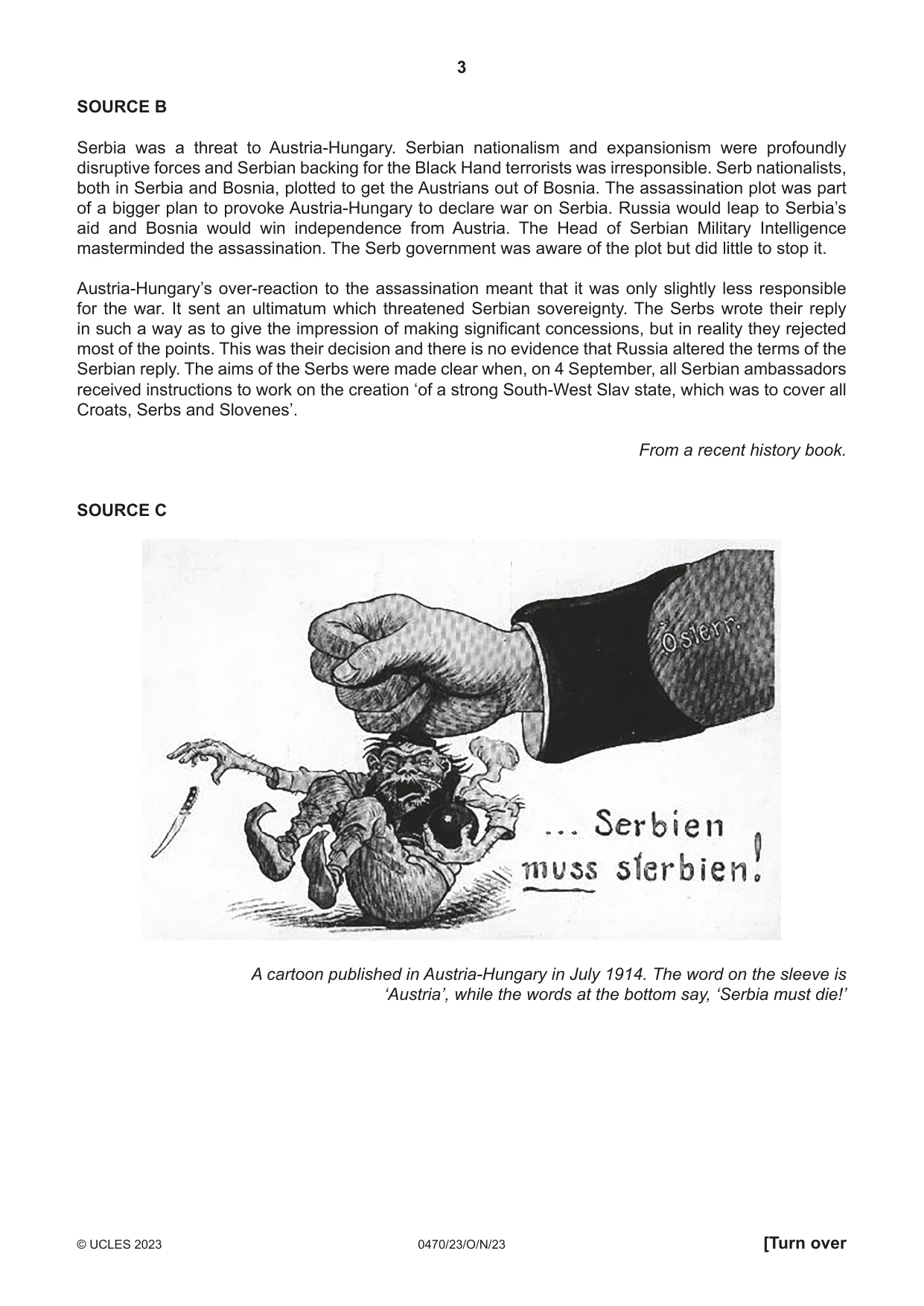
3 0470/23/O/N/23 © UCLES 2023 [Turn over SOURCE B Serbia was a threat to Austria‑Hungary. Serbian nationalism and expansionism were profoundly disruptive forces and Serbian backing for the Black Hand terrorists was irresponsible. Serb nationalists, both in Serbia and Bosnia, plotted to get the Austrians out of Bosnia. The assassination plot was part of a bigger plan to provoke Austria‑Hungary to declare war on Serbia. Russia would leap to Serbia’s aid and Bosnia would win independence from Austria. The Head of Serbian Military Intelligence masterminded the assassination. The Serb government was aware of the plot but did little to stop it. Austria‑Hungary’s over‑reaction to the assassination meant that it was only slightly less responsible for the war. It sent an ultimatum which threatened Serbian sovereignty. The Serbs wrote their reply in such a way as to give the impression of making significant concessions, but in reality they rejected most of the points. This was their decision and there is no evidence that Russia altered the terms of the Serbian reply. The aims of the Serbs were made clear when, on 4 September, all Serbian ambassadors received instructions to work on the creation ‘of a strong South‑West Slav state, which was to cover all Croats, Serbs and Slovenes’. From a recent history book. SOURCE C A cartoon published in Austria‑Hungary in July 1914. The word on the sleeve is ‘Austria’, while the words at the bottom say, ‘Serbia must die!’
Question paper, page 4
4 0470/23/O/N/23 © UCLES 2023 SOURCE D The goodwill which Austria‑Hungary has shown towards Serbia did not restrain it. Serbia continued to allow propaganda of which the fatal consequences were demonstrated to the whole world on 28 June, when the Heir to the Monarchy fell victim to a plot hatched in Belgrade. Because of this the Imperial Government has felt compelled to take urgent steps to force the Serbian Government to stop the terrorist movement that is threatening the security and integrity of the Austro‑Hungarian Monarchy. The Imperial Government is convinced that in taking this step they will be in full agreement with all civilised nations, who cannot permit assassination to become a weapon that can be used in political disputes, nor the peace of Europe to be continually disturbed by movements based in Belgrade. An explanatory letter, attached to a copy of the ultimatum to Serbia, sent to all the major European powers by the Austro‑Hungarian Government, 23 July 1914. SOURCE E The ultimatum of the Austro‑Hungarian government goes far beyond my worst expectations. Its authors are under the influence of the military party and the Austro‑Hungarian Army. Such a lack of moderation will attract the sympathies of the great mass of European public opinion to Serbia, in spite of the horror caused by the murders of Sarajevo. Even in Berlin, the Austro‑Hungarian demands are considered excessive. ‘Austria‑Hungary’, says one German newspaper, ‘will have to prove the serious accusations which it brings against Serbia by publishing the results of its judicial inquiry.’ It is improbable that the Austro‑Hungarian statesmen should have made up their minds to take such a dangerous step without having consulted the German government, and without having obtained the assent of the Emperor William. The Emperor has given a free hand to his allies in spite of the risk of bringing on a European conflict. A letter from the Belgian ambassador in Berlin to the Belgian government, 24 July 1914. SOURCE F Čabrinović confesses that he was the first of the conspirators to hurl a bomb against the Archduke’s carriage. Princip confesses he fired two shots by which the Archduke and his wife received fatal wounds. Both confess that the act was done with intent to murder. Only one of the bombs was used. The remaining five bombs came later into the possession of the police. In the opinion of the judicial experts these bombs are Serbian and were made for military purposes. They are identical with the 21 bombs which were found in Bosnia in 1913 partly in their original packing, which proved without a doubt that they came from the Serbian Army depot of Kragujevatz. It is thus proved that the bombs which were used in the attempt against the Archduke also came from the depot at Kragujevatz. Grabež quite spontaneously called the grenades ‘Kragujevatz bombs’. From the official Austrian Report on the assassination, published in July 1914. Čabrinović, Princip and Grabež were three of the conspirators.
Question paper, page 5
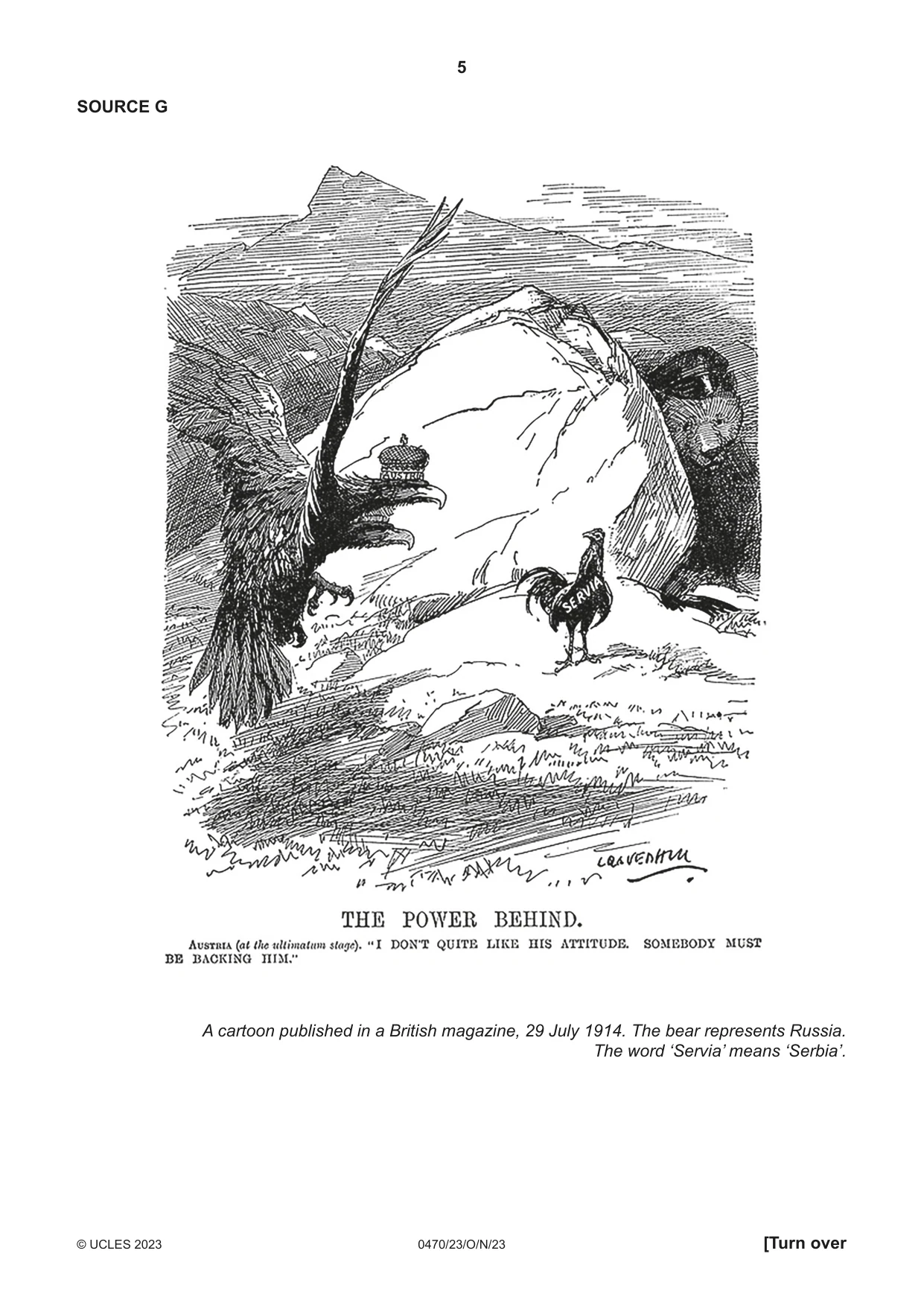
5 0470/23/O/N/23 © UCLES 2023 [Turn over SOURCE G A cartoon published in a British magazine, 29 July 1914. The bear represents Russia. The word ‘Servia’ means ‘Serbia’.
Question paper, page 6
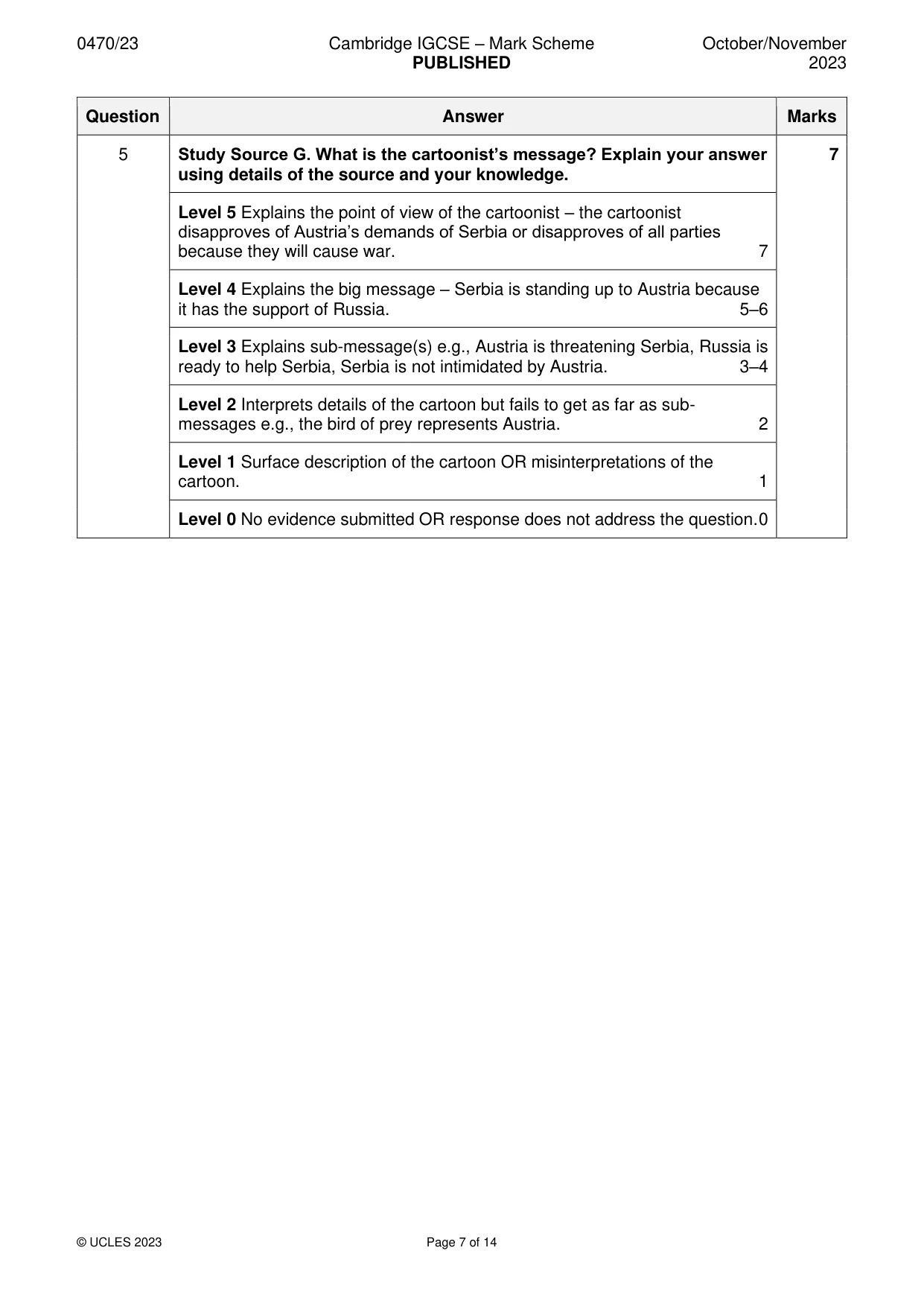
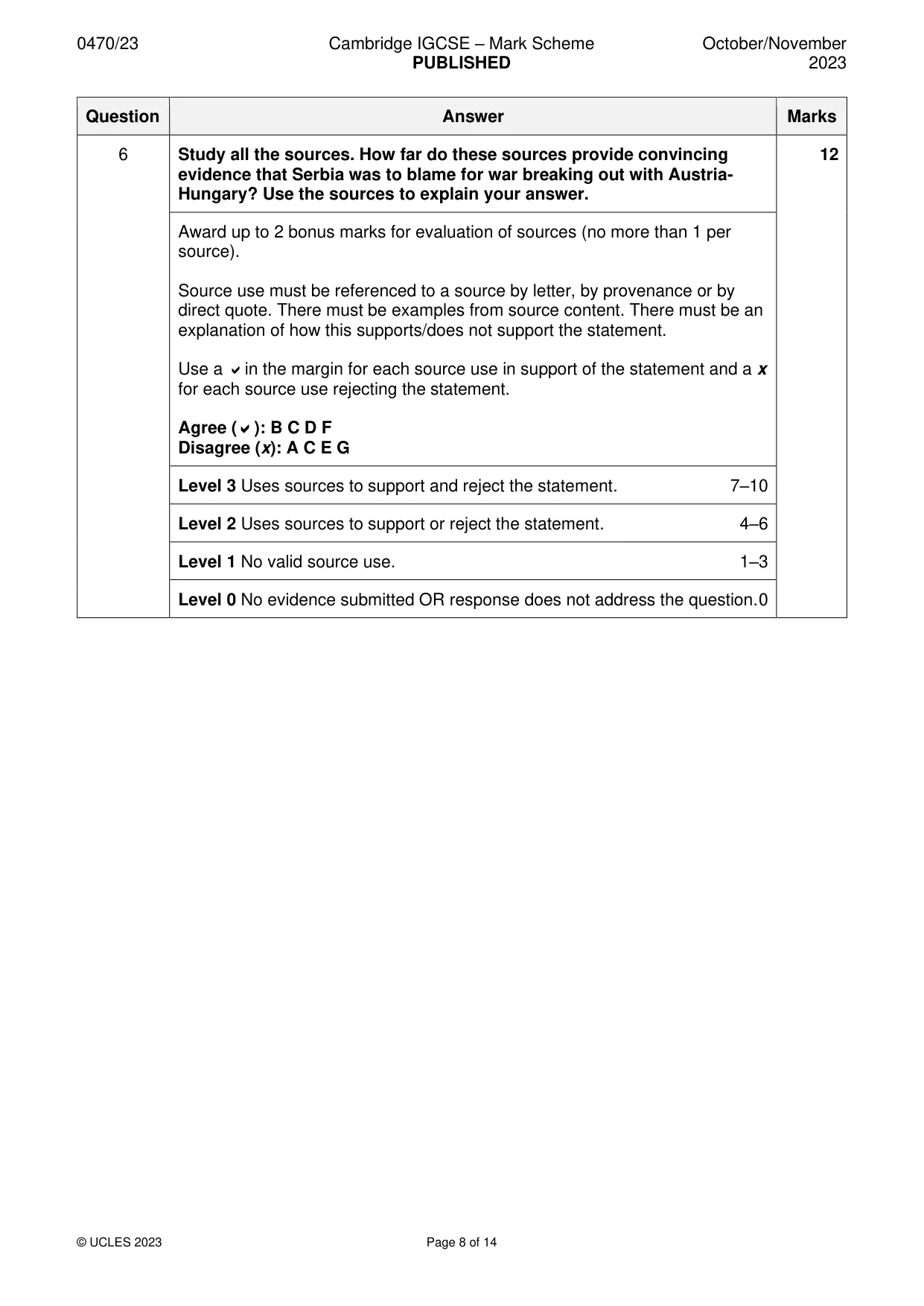
6 0470/23/O/N/23 © UCLES 2023 Now answer all the following questions. You may use any of the sources to help you answer the questions, in addition to those sources which you are told to use. In answering the questions you should use your knowledge of the topic to help you interpret and evaluate the sources. 1 Study Sources A and B. How far do these two sources agree? Explain your answer using details of the sources. [7] 2 Study Source C. Why was this source published in July 1914? Explain your answer using details of the source and your knowledge. [8] 3 Study Sources D and E. How far does Source D make Source E surprising? Explain your answer using details of the sources and your knowledge. [8] 4 Study Source F. How useful is this source to a historian studying the assassination of Franz Ferdinand? Explain your answer using details of the source and your knowledge. [8] 5 Study Source G. What is the cartoonist’s message? Explain your answer using details of the source and your knowledge. [7] 6 Study all the sources. How far do these sources provide convincing evidence that Serbia was to blame for war breaking out with Austria‑Hungary? Use the sources to explain your answer. [12]
Question paper, page 7
7 0470/23/O/N/23 © UCLES 2023 [Turn over BLANK PAGE
Question paper, page 8
8 0470/23/O/N/23 © UCLES 2023 Option B: Twentieth century topic WAS THE BERLIN WALL CONSTRUCTED TO PREVENT EAST GERMANS ESCAPING TO WEST BERLIN? Study the Background Information and the sources carefully, and then answer all the questions. Background Information The construction of the Berlin Wall by the East Germans began on 13 August 1961. Berlin was surrounded by communist East Germany and the Wall cut off West Berlin from East Germany and East Berlin. The immediate effect of the Wall was to prevent East Germans from travelling or emigrating to West Germany. According to the East Germans the Wall was an ‘anti‑fascist protective barrier’, designed to protect East Germans from the aggressive West and from Western agents and spies. It was claimed that East Berliners were being lured into West Berlin where they were exploited. They also claimed that West Berliners were buying cheap state‑subsidised goods in East Berlin, and that Western spies and ex‑Nazis were able to get into East Berlin to undermine the communist state. The West rejected these claims and argued that the Wall was designed to stop East Berliners fleeing to West Berlin. Between 1949 and 1961 some 2.5 million East Germans moved from East Germany to West Germany, many of them through Berlin. What was the main reason why the Berlin Wall was built?
Question paper, page 9
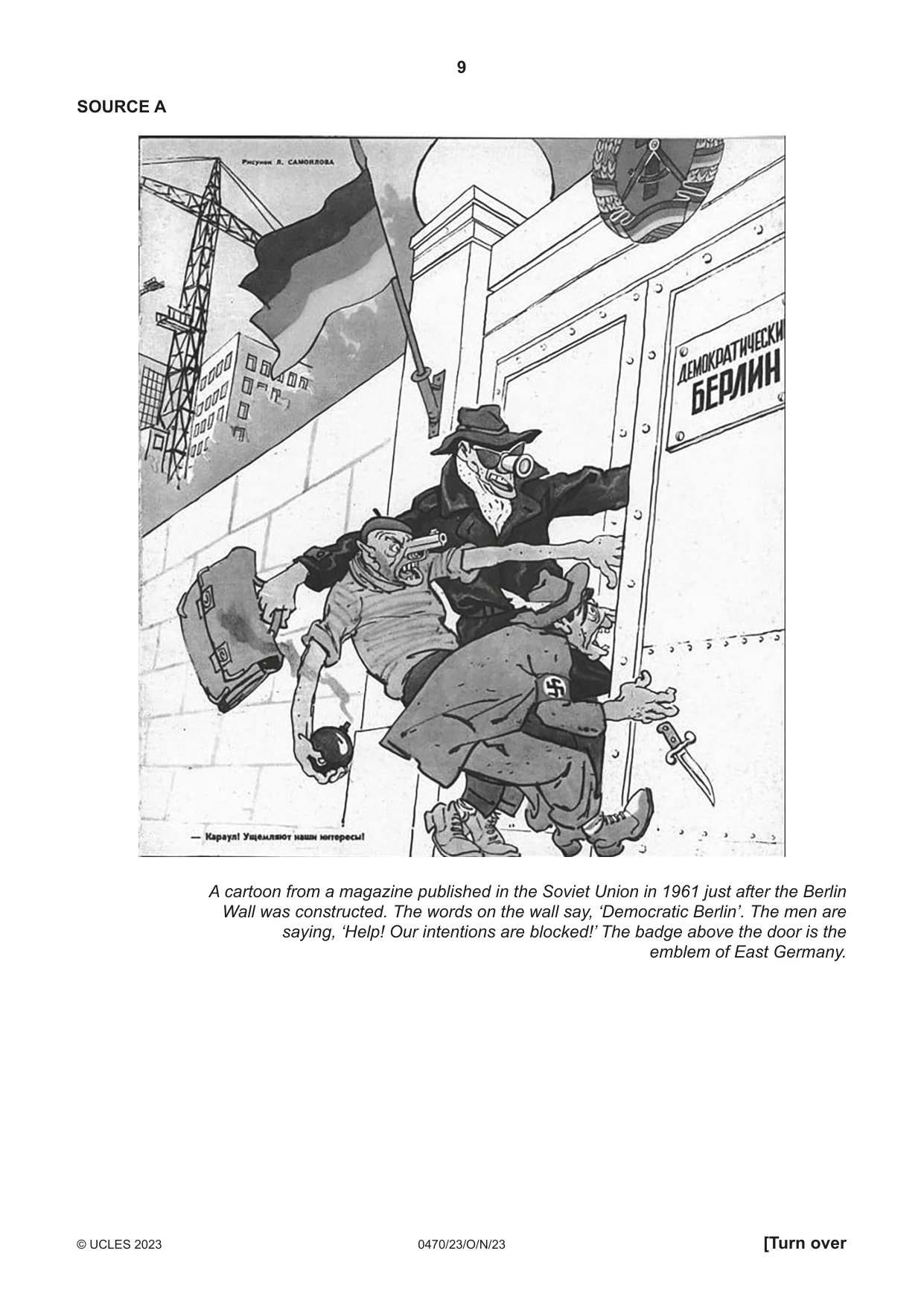
9 0470/23/O/N/23 © UCLES 2023 [Turn over SOURCE A A cartoon from a magazine published in the Soviet Union in 1961 just after the Berlin Wall was constructed. The words on the wall say, ‘Democratic Berlin’. The men are saying, ‘Help! Our intentions are blocked!’ The badge above the door is the emblem of East Germany.
Question paper, page 10
10 0470/23/O/N/23 © UCLES 2023 SOURCE B The front cover of an American magazine, August 1962. Content removed due to copyright restrictions.
Question paper, page 11
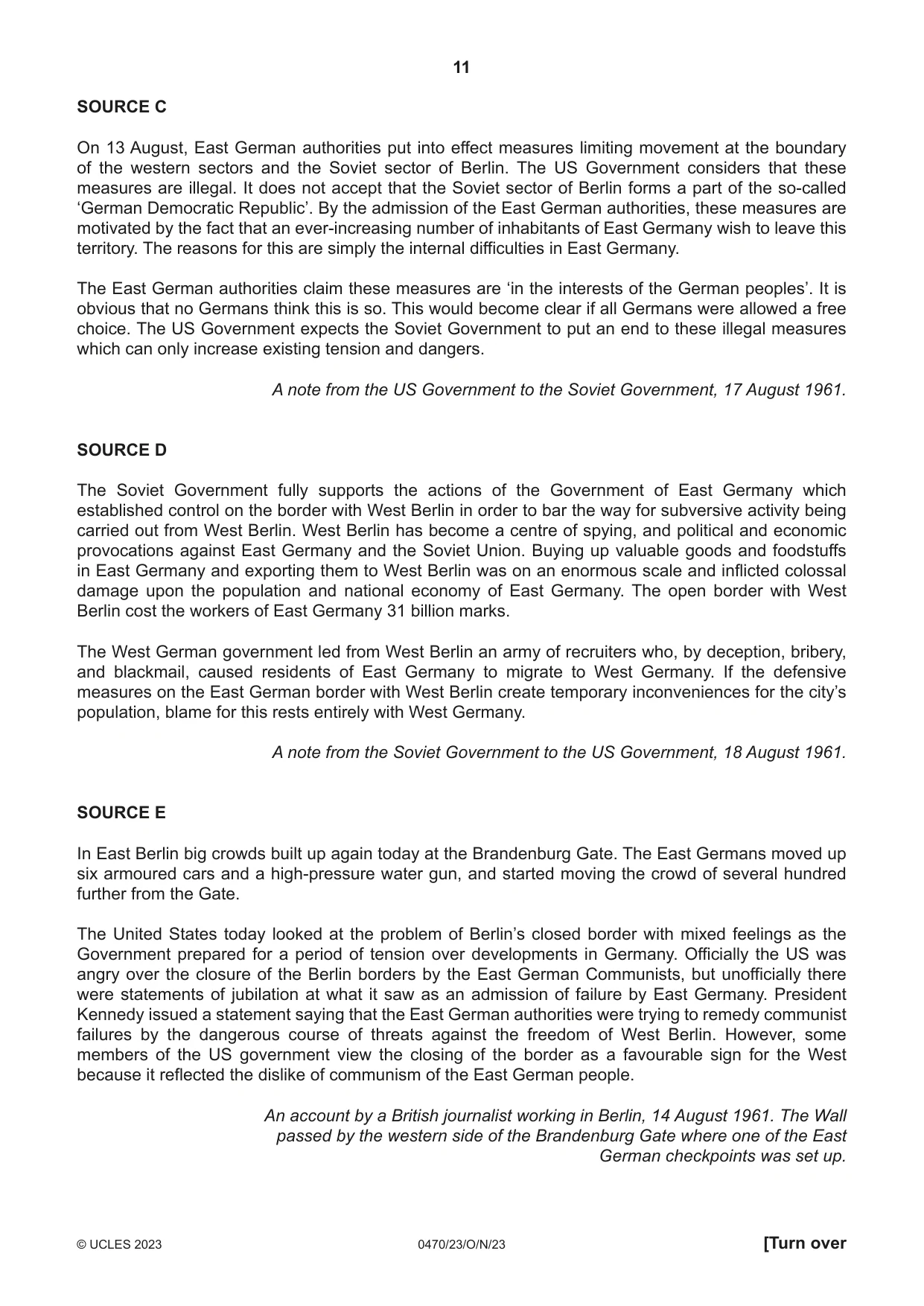
11 0470/23/O/N/23 © UCLES 2023 [Turn over SOURCE C On 13 August, East German authorities put into effect measures limiting movement at the boundary of the western sectors and the Soviet sector of Berlin. The US Government considers that these measures are illegal. It does not accept that the Soviet sector of Berlin forms a part of the so‑called ‘German Democratic Republic’. By the admission of the East German authorities, these measures are motivated by the fact that an ever‑increasing number of inhabitants of East Germany wish to leave this territory. The reasons for this are simply the internal difficulties in East Germany. The East German authorities claim these measures are ‘in the interests of the German peoples’. It is obvious that no Germans think this is so. This would become clear if all Germans were allowed a free choice. The US Government expects the Soviet Government to put an end to these illegal measures which can only increase existing tension and dangers. A note from the US Government to the Soviet Government, 17 August 1961. SOURCE D The Soviet Government fully supports the actions of the Government of East Germany which established control on the border with West Berlin in order to bar the way for subversive activity being carried out from West Berlin. West Berlin has become a centre of spying, and political and economic provocations against East Germany and the Soviet Union. Buying up valuable goods and foodstuffs in East Germany and exporting them to West Berlin was on an enormous scale and inflicted colossal damage upon the population and national economy of East Germany. The open border with West Berlin cost the workers of East Germany 31 billion marks. The West German government led from West Berlin an army of recruiters who, by deception, bribery, and blackmail, caused residents of East Germany to migrate to West Germany. If the defensive measures on the East German border with West Berlin create temporary inconveniences for the city’s population, blame for this rests entirely with West Germany. A note from the Soviet Government to the US Government, 18 August 1961. SOURCE E In East Berlin big crowds built up again today at the Brandenburg Gate. The East Germans moved up six armoured cars and a high‑pressure water gun, and started moving the crowd of several hundred further from the Gate. The United States today looked at the problem of Berlin’s closed border with mixed feelings as the Government prepared for a period of tension over developments in Germany. Officially the US was angry over the closure of the Berlin borders by the East German Communists, but unofficially there were statements of jubilation at what it saw as an admission of failure by East Germany. President Kennedy issued a statement saying that the East German authorities were trying to remedy communist failures by the dangerous course of threats against the freedom of West Berlin. However, some members of the US government view the closing of the border as a favourable sign for the West because it reflected the dislike of communism of the East German people. An account by a British journalist working in Berlin, 14 August 1961. The Wall passed by the western side of the Brandenburg Gate where one of the East German checkpoints was set up.
Question paper, page 12
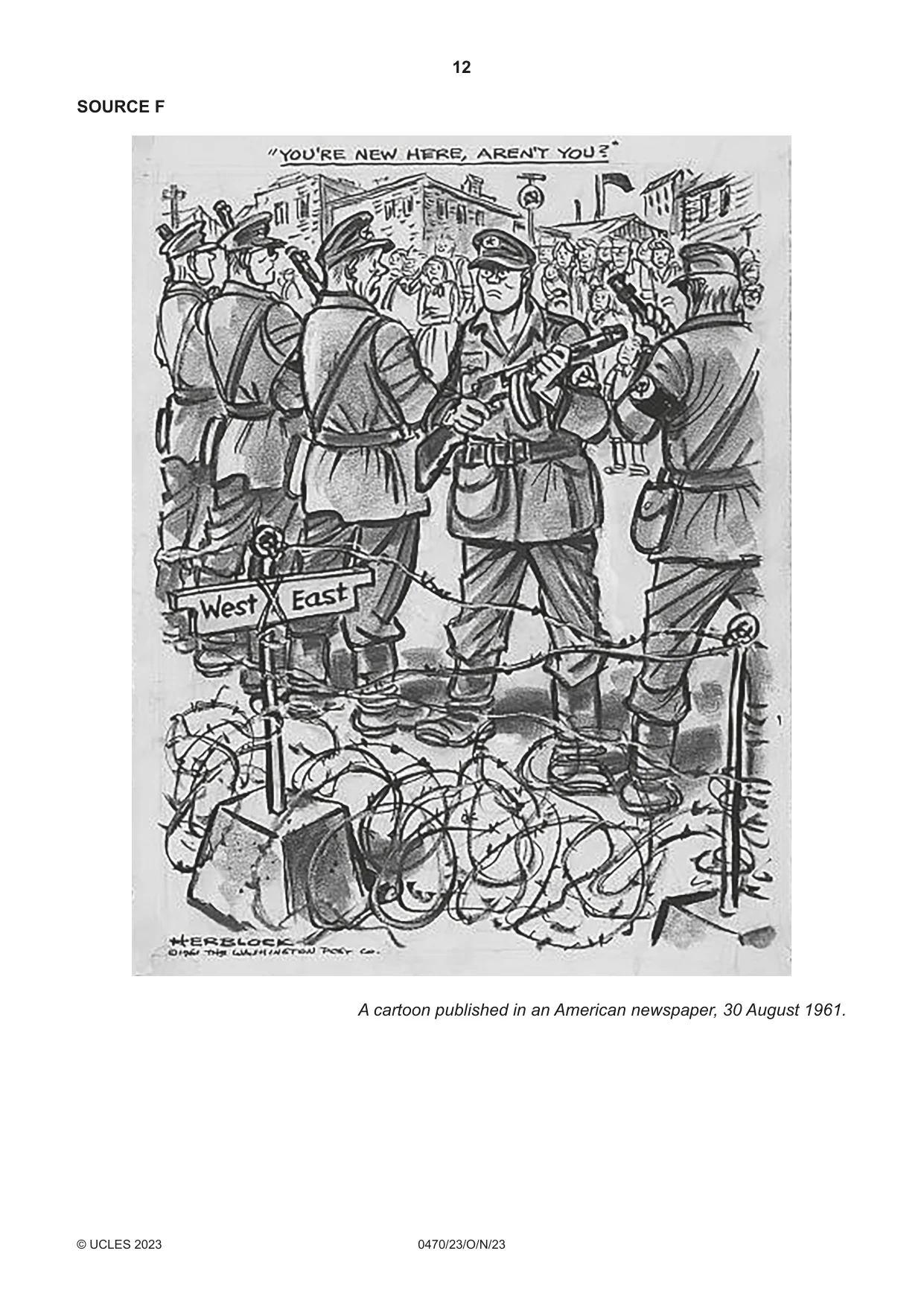
12 0470/23/O/N/23 © UCLES 2023 SOURCE F A cartoon published in an American newspaper, 30 August 1961.
Question paper, page 13
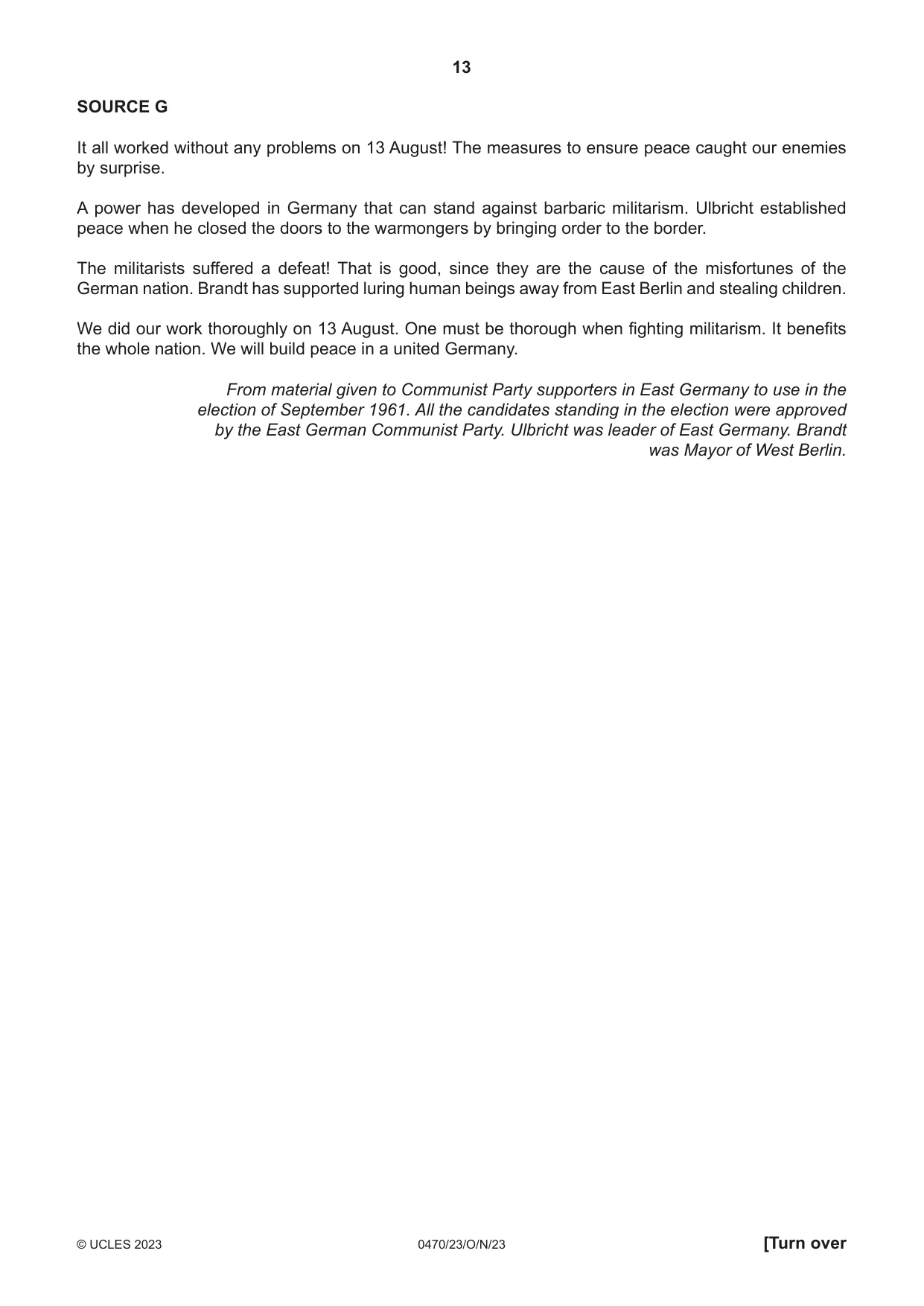
13 0470/23/O/N/23 © UCLES 2023 [Turn over SOURCE G It all worked without any problems on 13 August! The measures to ensure peace caught our enemies by surprise. A power has developed in Germany that can stand against barbaric militarism. Ulbricht established peace when he closed the doors to the warmongers by bringing order to the border. The militarists suffered a defeat! That is good, since they are the cause of the misfortunes of the German nation. Brandt has supported luring human beings away from East Berlin and stealing children. We did our work thoroughly on 13 August. One must be thorough when fighting militarism. It benefits the whole nation. We will build peace in a united Germany. From material given to Communist Party supporters in East Germany to use in the election of September 1961. All the candidates standing in the election were approved by the East German Communist Party. Ulbricht was leader of East Germany. Brandt was Mayor of West Berlin.
Question paper, page 14
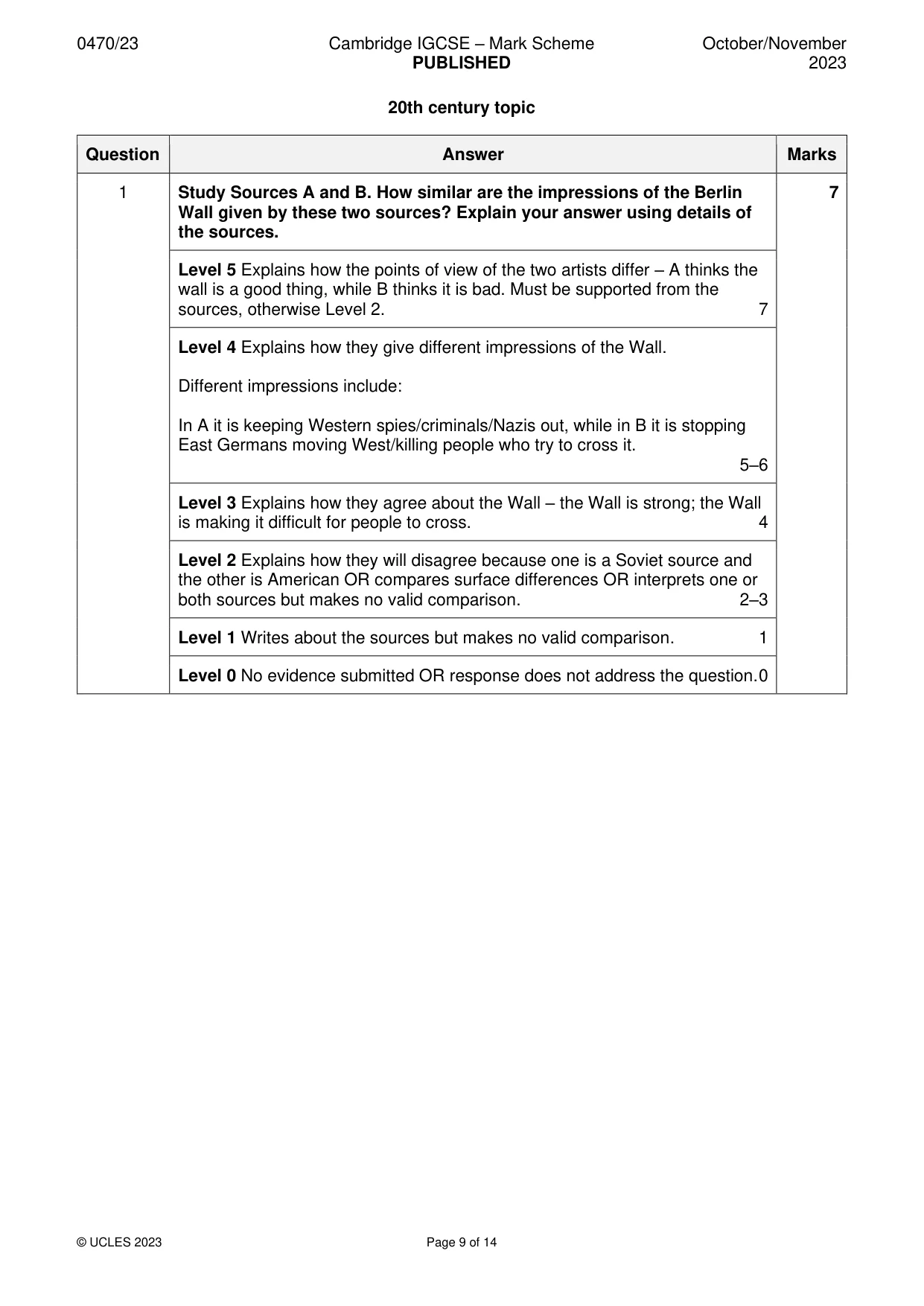
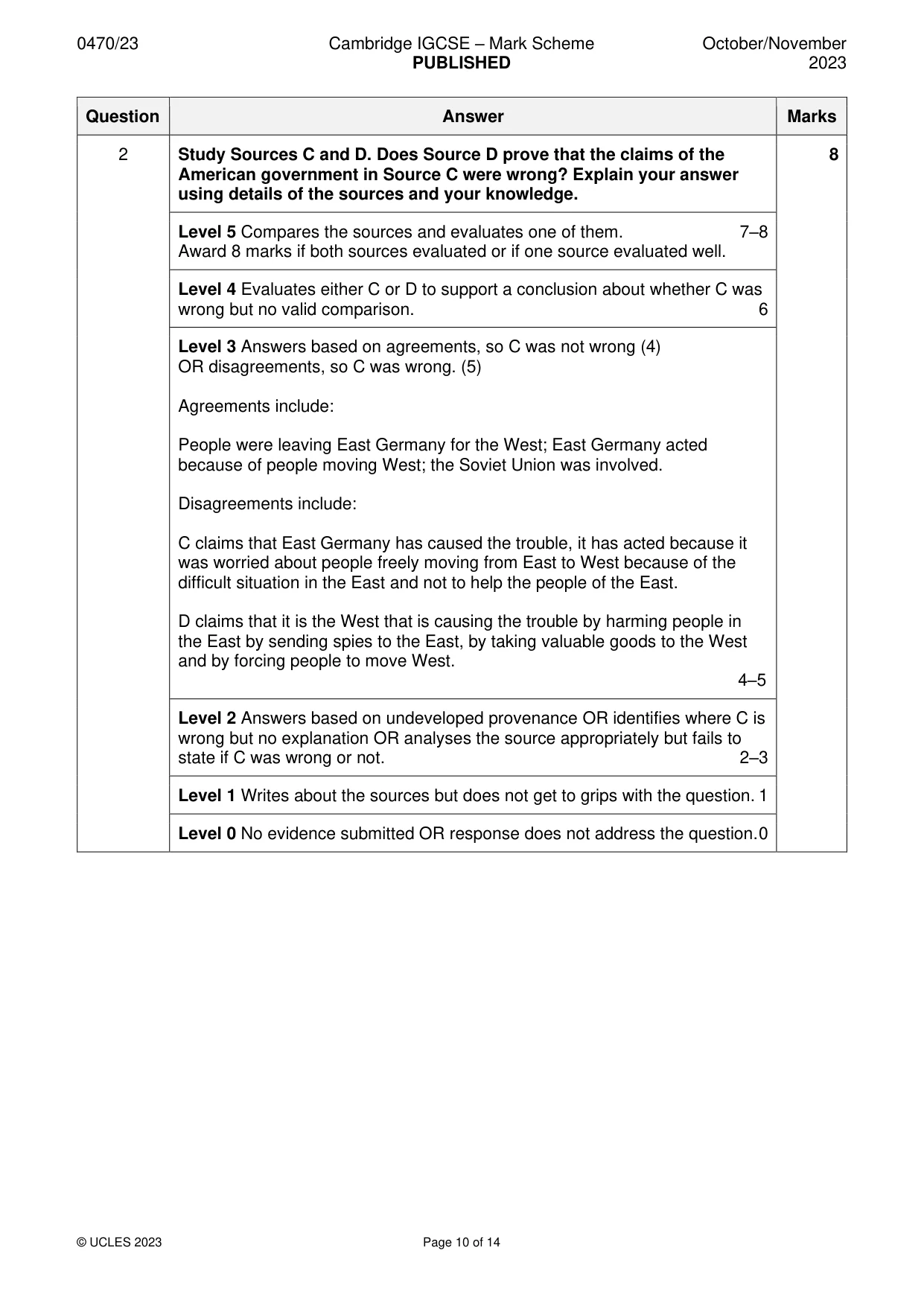
14 0470/23/O/N/23 © UCLES 2023 Now answer all the following questions. You may use any of the sources to help you answer the questions, in addition to those sources which you are told to use. In answering the questions you should use your knowledge of the topic to help you interpret and evaluate the sources. 1 Study Sources A and B. How similar are the impressions of the Berlin Wall given by these two sources? Explain your answer using details of the sources. [7] 2 Study Sources C and D. Does Source D prove that the claims of the American government in Source C were wrong? Explain your answer using details of the sources and your knowledge. [8] 3 Study Source E. Are you surprised by this account? Explain your answer using details of the source and your knowledge. [8] 4 Study Source F. What is the cartoonist’s message? Explain your answer using details of the source and your knowledge. [8] 5 Study Source G. How useful is this source to a historian studying the Berlin Wall? Explain your answer using details of the source and your knowledge. [7] 6 Study all the sources. How far do these sources provide convincing evidence that the Berlin Wall was built to prevent East Germans escaping to West Berlin? Use the sources to explain your answer. [12]
Question paper, page 15
15 0470/23/O/N/23 © UCLES 2023 BLANK PAGE
Question paper, page 16
16 0470/23/O/N/23 © UCLES 2023 Permission to reproduce items where third‑party owned material protected by copyright is included has been sought and cleared where possible. Every reasonable effort has been made by the publisher (UCLES) to trace copyright holders, but if any items requiring clearance have unwittingly been included, the publisher will be pleased to make amends at the earliest possible opportunity. To avoid the issue of disclosure of answer‑related information to candidates, all copyright acknowledgements are reproduced online in the Cambridge Assessment International Education Copyright Acknowledgements Booklet. This is produced for each series of examinations and is freely available to download at www.cambridgeinternational.org after the live examination series. Cambridge Assessment International Education is part of Cambridge Assessment. Cambridge Assessment is the brand name of the University of Cambridge Local Examinations Syndicate (UCLES), which is a department of the University of Cambridge. BLANK PAGE
Mark scheme, page 1
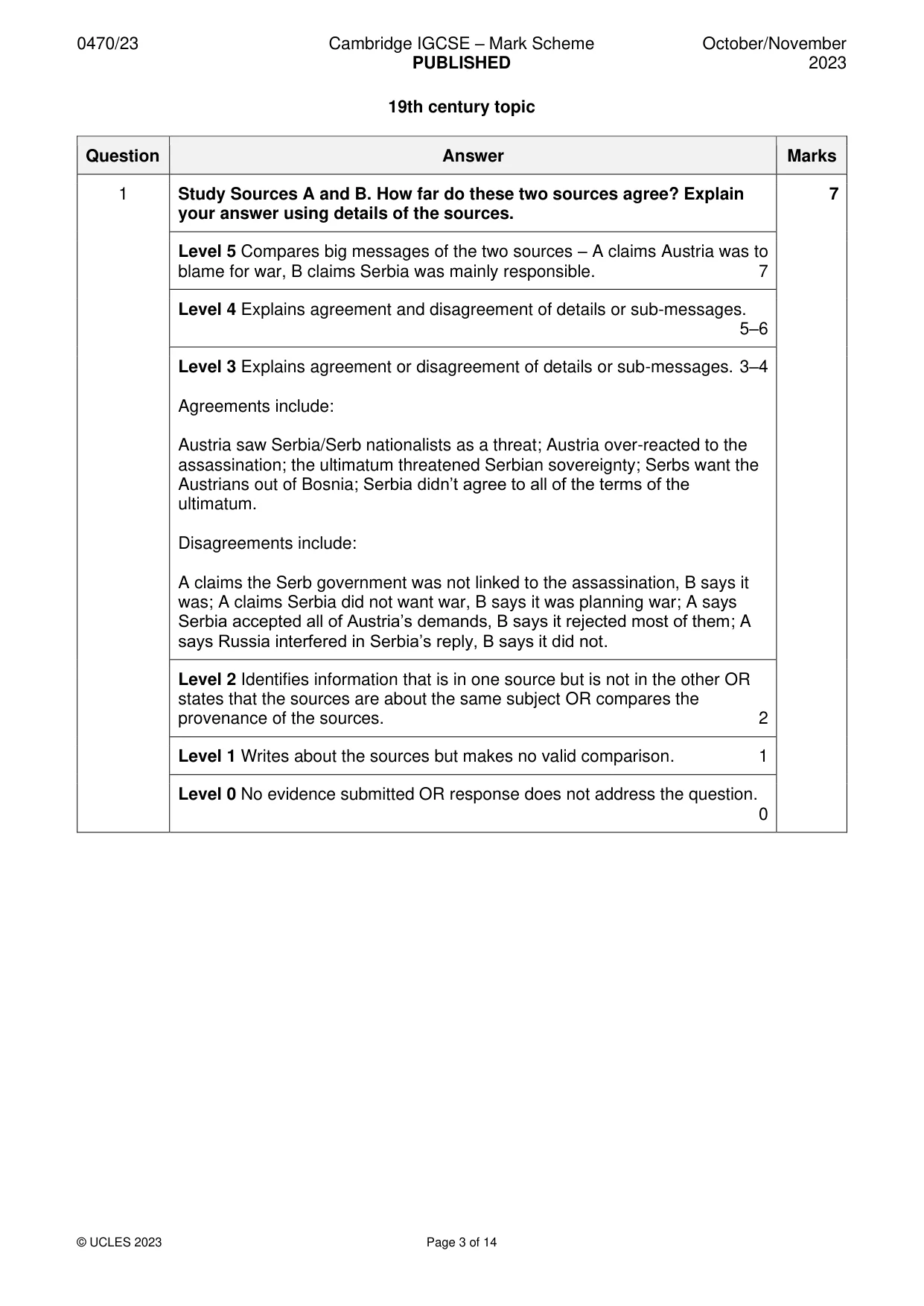
This document consists of 14 printed pages. © UCLES 2023 [Turn over Cambridge IGCSE™ HISTORY 0470/23 Paper 2 October/November 2023 MARK SCHEME Maximum Mark: 50 Published This mark scheme is published as an aid to teachers and candidates, to indicate the requirements of the examination. It shows the basis on which Examiners were instructed to award marks. It does not indicate the details of the discussions that took place at an Examiners’ meeting before marking began, which would have considered the acceptability of alternative answers. Mark schemes should be read in conjunction with the question paper and the Principal Examiner Report for Teachers. Cambridge International will not enter into discussions about these mark schemes. Cambridge International is publishing the mark schemes for the October/November 2023 series for most Cambridge IGCSE, Cambridge International A and AS Level components, and some Cambridge O Level components.
Mark scheme, page 2
0470/23 Cambridge IGCSE – Mark Scheme PUBLISHED October/November 2023 © UCLES 2023 Page 2 of 14 Generic Marking Principles These general marking principles must be applied by all examiners when marking candidate answers. They should be applied alongside the specific content of the mark scheme or generic level descriptors for a question. Each question paper and mark scheme will also comply with these marking principles. GENERIC MARKING PRINCIPLE 1: Marks must be awarded in line with: • the specific content of the mark scheme or the generic level descriptors for the question • the specific skills defined in the mark scheme or in the generic level descriptors for the question • the standard of response required by a candidate as exemplified by the standardisation scripts. GENERIC MARKING PRINCIPLE 2: Marks awarded are always whole marks (not half marks, or other fractions). GENERIC MARKING PRINCIPLE 3: Marks must be awarded positively: • marks are awarded for correct/valid answers, as defined in the mark scheme. However, credit is given for valid answers which go beyond the scope of the syllabus and mark scheme, referring to your Team Leader as appropriate • marks are awarded when candidates clearly demonstrate what they know and can do • marks are not deducted for errors • marks are not deducted for omissions • answers should only be judged on the quality of spelling, punctuation and grammar when these features are specifically assessed by the question as indicated by the mark scheme. The meaning, however, should be unambiguous. GENERIC MARKING PRINCIPLE 4: Rules must be applied consistently, e.g. in situations where candidates have not followed instructions or in the application of generic level descriptors. GENERIC MARKING PRINCIPLE 5: Marks should be awarded using the full range of marks defined in the mark scheme for the question (however; the use of the full mark range may be limited according to the quality of the candidate responses seen). GENERIC MARKING PRINCIPLE 6: Marks awarded are based solely on the requirements as defined in the mark scheme. Marks should not be awarded with grade thresholds or grade descriptors in mind.
Mark scheme, page 3
0470/23 Cambridge IGCSE – Mark Scheme PUBLISHED October/November 2023 © UCLES 2023 Page 3 of 14 19th century topic Question Answer Marks 1 Study Sources A and B. How far do these two sources agree? Explain your answer using details of the sources. 7 Level 5 Compares big messages of the two sources – A claims Austria was to blame for war, B claims Serbia was mainly responsible. 7 Level 4 Explains agreement and disagreement of details or sub-messages. 5–6 Level 3 Explains agreement or disagreement of details or sub-messages. 3–4 Agreements include: Austria saw Serbia/Serb nationalists as a threat; Austria over-reacted to the assassination; the ultimatum threatened Serbian sovereignty; Serbs want the Austrians out of Bosnia; Serbia didn’t agree to all of the terms of the ultimatum. Disagreements include: A claims the Serb government was not linked to the assassination, B says it was; A claims Serbia did not want war, B says it was planning war; A says Serbia accepted all of Austria’s demands, B says it rejected most of them; A says Russia interfered in Serbia’s reply, B says it did not. Level 2 Identifies information that is in one source but is not in the other OR states that the sources are about the same subject OR compares the provenance of the sources. 2 Level 1 Writes about the sources but makes no valid comparison. 1 Level 0 No evidence submitted OR response does not address the question. 0
Mark scheme, page 4
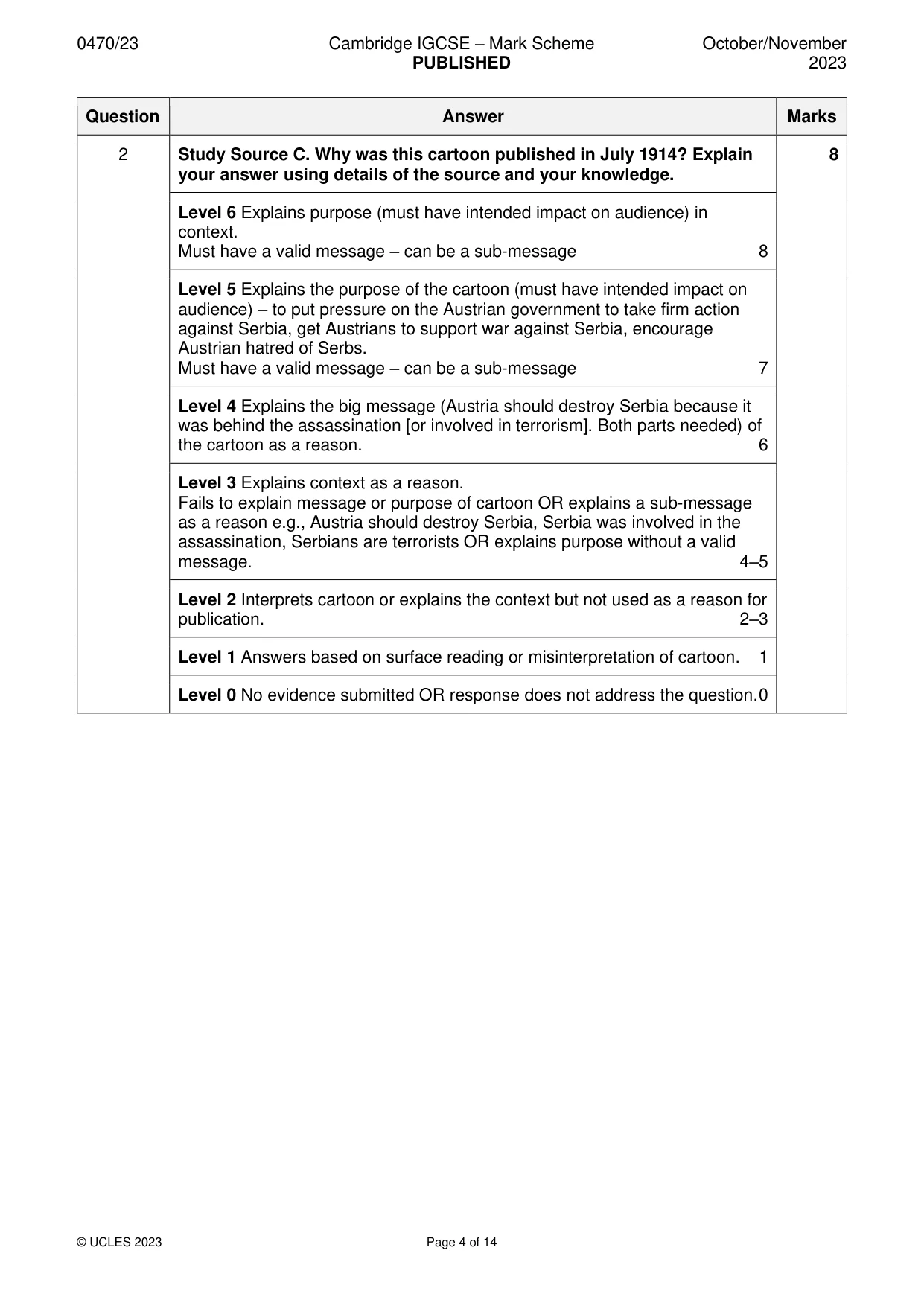
0470/23 Cambridge IGCSE – Mark Scheme PUBLISHED October/November 2023 © UCLES 2023 Page 4 of 14 Question Answer Marks 2 Study Source C. Why was this cartoon published in July 1914? Explain your answer using details of the source and your knowledge. 8 Level 6 Explains purpose (must have intended impact on audience) in context. Must have a valid message – can be a sub-message 8 Level 5 Explains the purpose of the cartoon (must have intended impact on audience) – to put pressure on the Austrian government to take firm action against Serbia, get Austrians to support war against Serbia, encourage Austrian hatred of Serbs. Must have a valid message – can be a sub-message 7 Level 4 Explains the big message (Austria should destroy Serbia because it was behind the assassination [or involved in terrorism]. Both parts needed) of the cartoon as a reason. 6 Level 3 Explains context as a reason. Fails to explain message or purpose of cartoon OR explains a sub-message as a reason e.g., Austria should destroy Serbia, Serbia was involved in the assassination, Serbians are terrorists OR explains purpose without a valid message. 4–5 Level 2 Interprets cartoon or explains the context but not used as a reason for publication. 2–3 Level 1 Answers based on surface reading or misinterpretation of cartoon. 1 Level 0 No evidence submitted OR response does not address the question. 0
Mark scheme, page 5
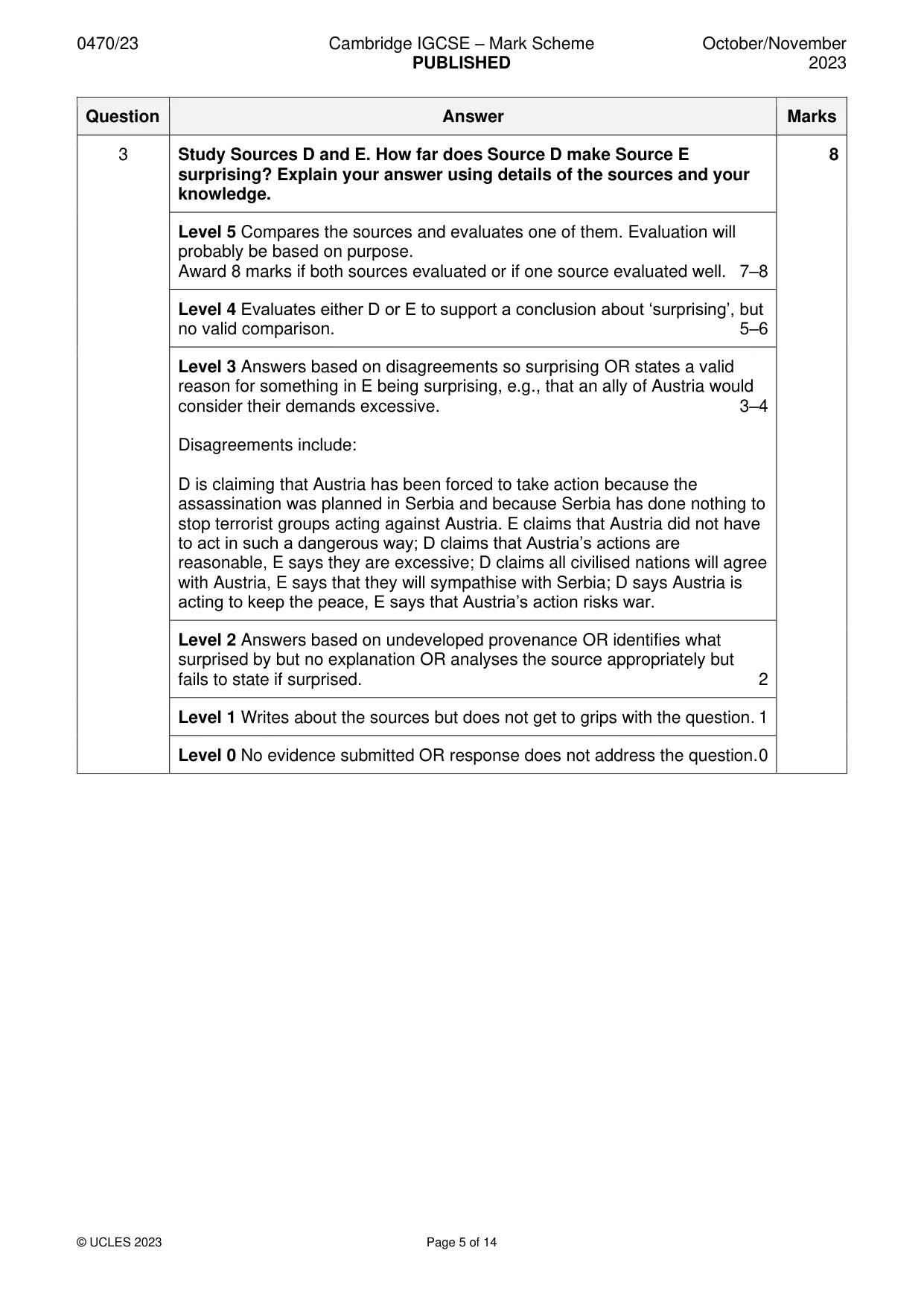
0470/23 Cambridge IGCSE – Mark Scheme PUBLISHED October/November 2023 © UCLES 2023 Page 5 of 14 Question Answer Marks 3 Study Sources D and E. How far does Source D make Source E surprising? Explain your answer using details of the sources and your knowledge. 8 Level 5 Compares the sources and evaluates one of them. Evaluation will probably be based on purpose. Award 8 marks if both sources evaluated or if one source evaluated well. 7–8 Level 4 Evaluates either D or E to support a conclusion about ‘surprising’, but no valid comparison. 5–6 Level 3 Answers based on disagreements so surprising OR states a valid reason for something in E being surprising, e.g., that an ally of Austria would consider their demands excessive. 3–4 Disagreements include: D is claiming that Austria has been forced to take action because the assassination was planned in Serbia and because Serbia has done nothing to stop terrorist groups acting against Austria. E claims that Austria did not have to act in such a dangerous way; D claims that Austria’s actions are reasonable, E says they are excessive; D claims all civilised nations will agree with Austria, E says that they will sympathise with Serbia; D says Austria is acting to keep the peace, E says that Austria’s action risks war. Level 2 Answers based on undeveloped provenance OR identifies what surprised by but no explanation OR analyses the source appropriately but fails to state if surprised. 2 Level 1 Writes about the sources but does not get to grips with the question. 1 Level 0 No evidence submitted OR response does not address the question. 0
Mark scheme, page 6
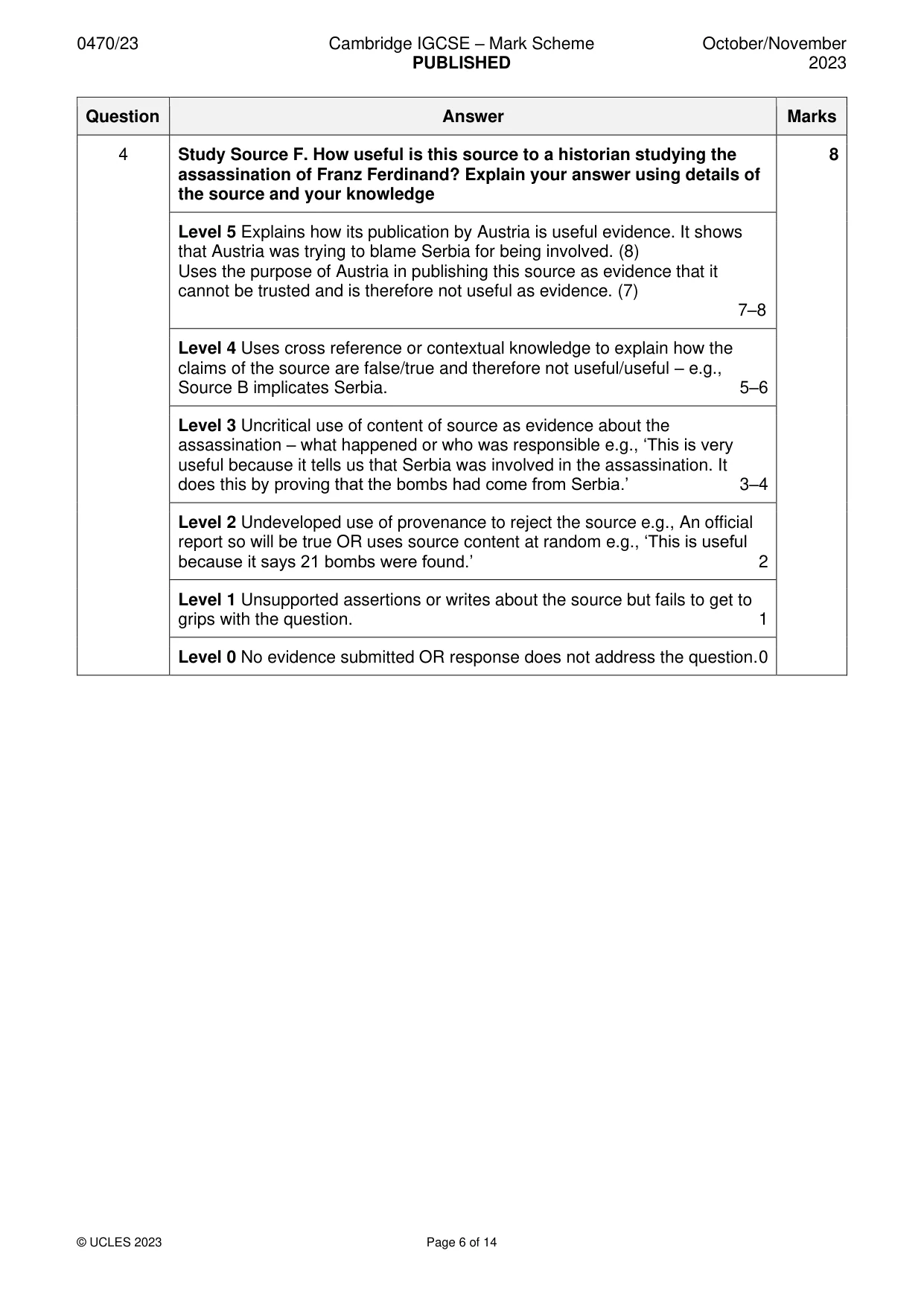
0470/23 Cambridge IGCSE – Mark Scheme PUBLISHED October/November 2023 © UCLES 2023 Page 6 of 14 Question Answer Marks 4 Study Source F. How useful is this source to a historian studying the assassination of Franz Ferdinand? Explain your answer using details of the source and your knowledge 8 Level 5 Explains how its publication by Austria is useful evidence. It shows that Austria was trying to blame Serbia for being involved. (8) Uses the purpose of Austria in publishing this source as evidence that it cannot be trusted and is therefore not useful as evidence. (7) 7–8 Level 4 Uses cross reference or contextual knowledge to explain how the claims of the source are false/true and therefore not useful/useful – e.g., Source B implicates Serbia. 5–6 Level 3 Uncritical use of content of source as evidence about the assassination – what happened or who was responsible e.g., ‘This is very useful because it tells us that Serbia was involved in the assassination. It does this by proving that the bombs had come from Serbia.’ 3–4 Level 2 Undeveloped use of provenance to reject the source e.g., An official report so will be true OR uses source content at random e.g., ‘This is useful because it says 21 bombs were found.’ 2 Level 1 Unsupported assertions or writes about the source but fails to get to grips with the question. 1 Level 0 No evidence submitted OR response does not address the question. 0
Mark scheme, page 7
0470/23 Cambridge IGCSE – Mark Scheme PUBLISHED October/November 2023 © UCLES 2023 Page 7 of 14 Question Answer Marks 5 Study Source G. What is the cartoonist’s message? Explain your answer using details of the source and your knowledge. 7 Level 5 Explains the point of view of the cartoonist – the cartoonist disapproves of Austria’s demands of Serbia or disapproves of all parties because they will cause war. 7 Level 4 Explains the big message – Serbia is standing up to Austria because it has the support of Russia. 5–6 Level 3 Explains sub-message(s) e.g., Austria is threatening Serbia, Russia is ready to help Serbia, Serbia is not intimidated by Austria. 3–4 Level 2 Interprets details of the cartoon but fails to get as far as sub- messages e.g., the bird of prey represents Austria. 2 Level 1 Surface description of the cartoon OR misinterpretations of the cartoon. 1 Level 0 No evidence submitted OR response does not address the question. 0
Mark scheme, page 8
0470/23 Cambridge IGCSE – Mark Scheme PUBLISHED October/November 2023 © UCLES 2023 Page 8 of 14 Question Answer Marks 6 Study all the sources. How far do these sources provide convincing evidence that Serbia was to blame for war breaking out with Austria- Hungary? Use the sources to explain your answer. 12 Award up to 2 bonus marks for evaluation of sources (no more than 1 per source). Source use must be referenced to a source by letter, by provenance or by direct quote. There must be examples from source content. There must be an explanation of how this supports/does not support the statement. Use a in the margin for each source use in support of the statement and a x for each source use rejecting the statement. Agree (): B C D F Disagree (x): A C E G Level 3 Uses sources to support and reject the statement. 7–10 Level 2 Uses sources to support or reject the statement. 4–6 Level 1 No valid source use. 1–3 Level 0 No evidence submitted OR response does not address the question. 0
Mark scheme, page 9
0470/23 Cambridge IGCSE – Mark Scheme PUBLISHED October/November 2023 © UCLES 2023 Page 9 of 14 20th century topic Question Answer Marks 1 Study Sources A and B. How similar are the impressions of the Berlin Wall given by these two sources? Explain your answer using details of the sources. 7 Level 5 Explains how the points of view of the two artists differ – A thinks the wall is a good thing, while B thinks it is bad. Must be supported from the sources, otherwise Level 2. 7 Level 4 Explains how they give different impressions of the Wall. Different impressions include: In A it is keeping Western spies/criminals/Nazis out, while in B it is stopping East Germans moving West/killing people who try to cross it. 5–6 Level 3 Explains how they agree about the Wall – the Wall is strong; the Wall is making it difficult for people to cross. 4 Level 2 Explains how they will disagree because one is a Soviet source and the other is American OR compares surface differences OR interprets one or both sources but makes no valid comparison. 2–3 Level 1 Writes about the sources but makes no valid comparison. 1 Level 0 No evidence submitted OR response does not address the question. 0
Mark scheme, page 10
0470/23 Cambridge IGCSE – Mark Scheme PUBLISHED October/November 2023 © UCLES 2023 Page 10 of 14 Question Answer Marks 2 Study Sources C and D. Does Source D prove that the claims of the American government in Source C were wrong? Explain your answer using details of the sources and your knowledge. 8 Level 5 Compares the sources and evaluates one of them. 7–8 Award 8 marks if both sources evaluated or if one source evaluated well. Level 4 Evaluates either C or D to support a conclusion about whether C was wrong but no valid comparison. 6 Level 3 Answers based on agreements, so C was not wrong (4) OR disagreements, so C was wrong. (5) Agreements include: People were leaving East Germany for the West; East Germany acted because of people moving West; the Soviet Union was involved. Disagreements include: C claims that East Germany has caused the trouble, it has acted because it was worried about people freely moving from East to West because of the difficult situation in the East and not to help the people of the East. D claims that it is the West that is causing the trouble by harming people in the East by sending spies to the East, by taking valuable goods to the West and by forcing people to move West. 4–5 Level 2 Answers based on undeveloped provenance OR identifies where C is wrong but no explanation OR analyses the source appropriately but fails to state if C was wrong or not. 2–3 Level 1 Writes about the sources but does not get to grips with the question. 1 Level 0 No evidence submitted OR response does not address the question. 0
Mark scheme, page 11
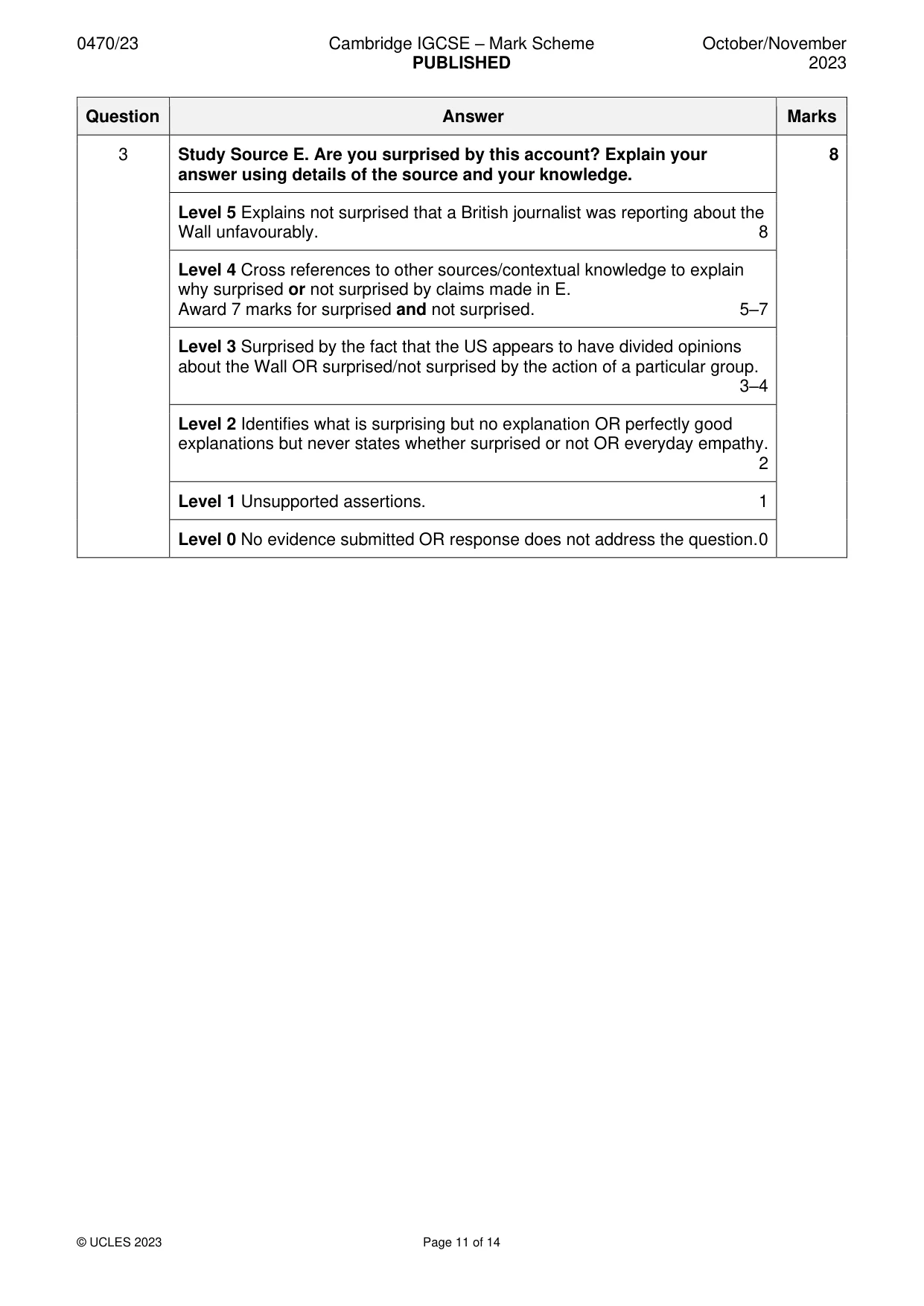
0470/23 Cambridge IGCSE – Mark Scheme PUBLISHED October/November 2023 © UCLES 2023 Page 11 of 14 Question Answer Marks 3 Study Source E. Are you surprised by this account? Explain your answer using details of the source and your knowledge. 8 Level 5 Explains not surprised that a British journalist was reporting about the Wall unfavourably. 8 Level 4 Cross references to other sources/contextual knowledge to explain why surprised or not surprised by claims made in E. Award 7 marks for surprised and not surprised. 5–7 Level 3 Surprised by the fact that the US appears to have divided opinions about the Wall OR surprised/not surprised by the action of a particular group. 3–4 Level 2 Identifies what is surprising but no explanation OR perfectly good explanations but never states whether surprised or not OR everyday empathy. 2 Level 1 Unsupported assertions. 1 Level 0 No evidence submitted OR response does not address the question. 0
Mark scheme, page 12
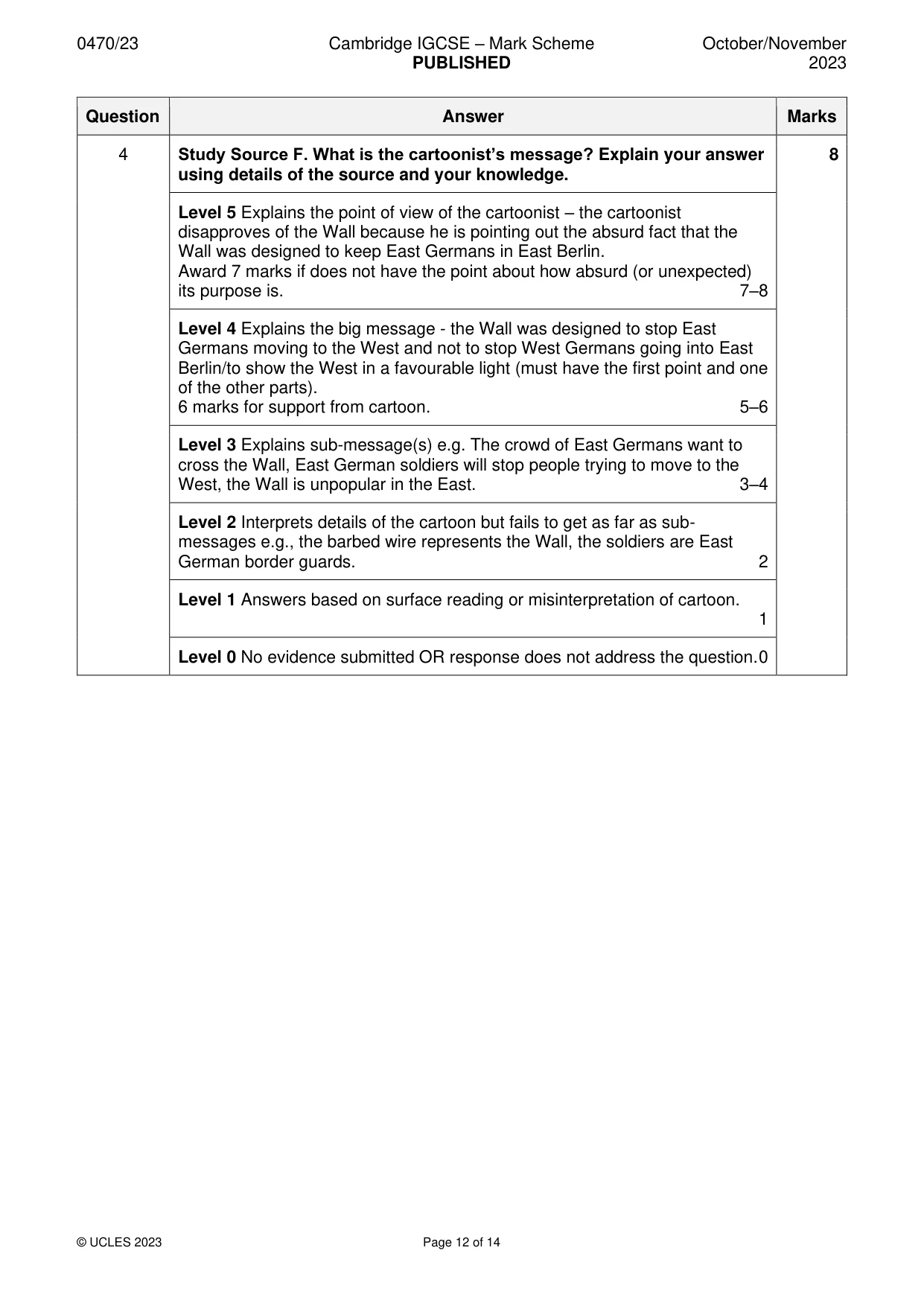
0470/23 Cambridge IGCSE – Mark Scheme PUBLISHED October/November 2023 © UCLES 2023 Page 12 of 14 Question Answer Marks 4 Study Source F. What is the cartoonist’s message? Explain your answer using details of the source and your knowledge. 8 Level 5 Explains the point of view of the cartoonist – the cartoonist disapproves of the Wall because he is pointing out the absurd fact that the Wall was designed to keep East Germans in East Berlin. Award 7 marks if does not have the point about how absurd (or unexpected) its purpose is. 7–8 Level 4 Explains the big message - the Wall was designed to stop East Germans moving to the West and not to stop West Germans going into East Berlin/to show the West in a favourable light (must have the first point and one of the other parts). 6 marks for support from cartoon. 5–6 Level 3 Explains sub-message(s) e.g. The crowd of East Germans want to cross the Wall, East German soldiers will stop people trying to move to the West, the Wall is unpopular in the East. 3–4 Level 2 Interprets details of the cartoon but fails to get as far as sub- messages e.g., the barbed wire represents the Wall, the soldiers are East German border guards. 2 Level 1 Answers based on surface reading or misinterpretation of cartoon. 1 Level 0 No evidence submitted OR response does not address the question. 0
Mark scheme, page 13
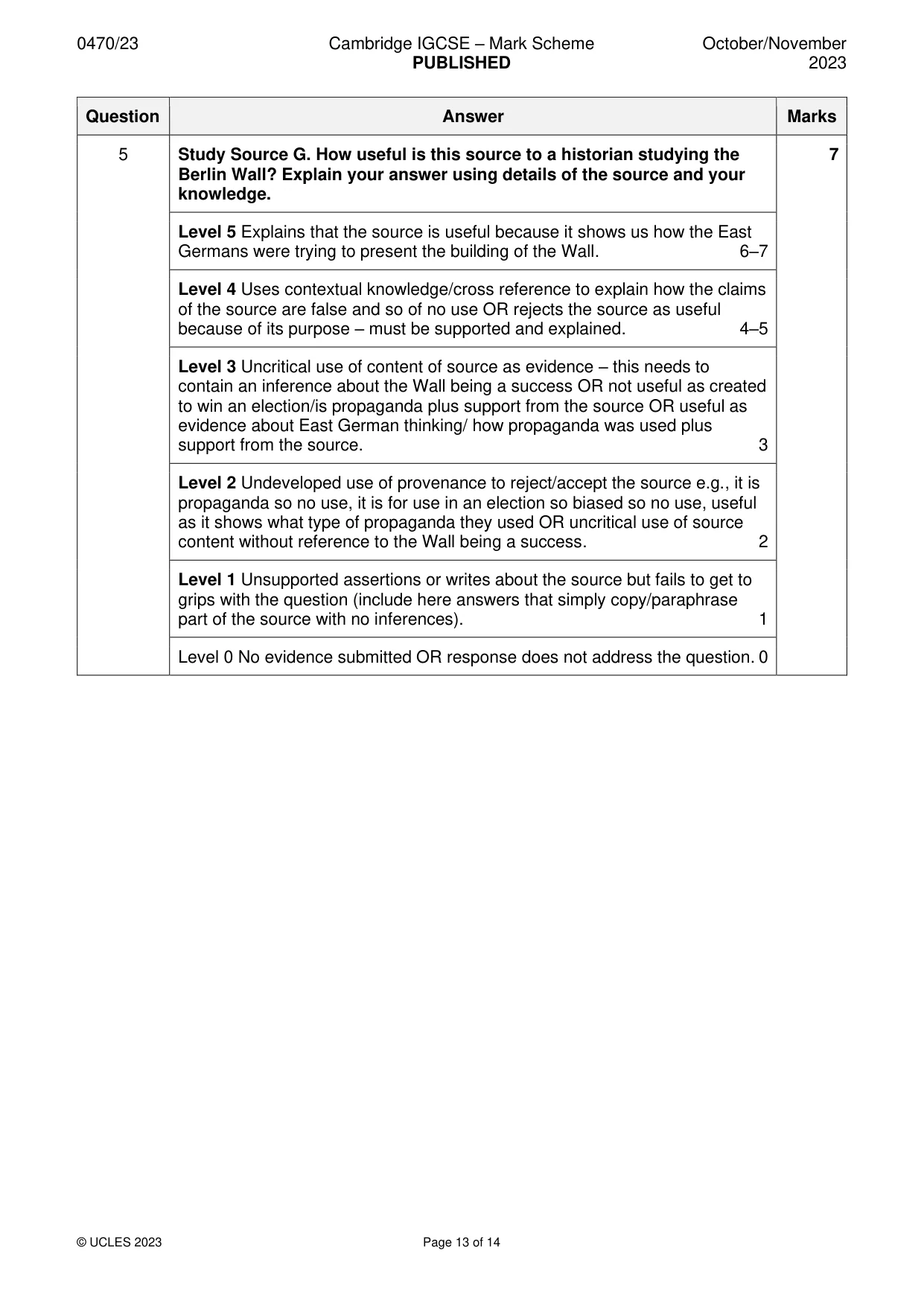
0470/23 Cambridge IGCSE – Mark Scheme PUBLISHED October/November 2023 © UCLES 2023 Page 13 of 14 Question Answer Marks 5 Study Source G. How useful is this source to a historian studying the Berlin Wall? Explain your answer using details of the source and your knowledge. 7 Level 5 Explains that the source is useful because it shows us how the East Germans were trying to present the building of the Wall. 6–7 Level 4 Uses contextual knowledge/cross reference to explain how the claims of the source are false and so of no use OR rejects the source as useful because of its purpose – must be supported and explained. 4–5 Level 3 Uncritical use of content of source as evidence – this needs to contain an inference about the Wall being a success OR not useful as created to win an election/is propaganda plus support from the source OR useful as evidence about East German thinking/ how propaganda was used plus support from the source. 3 Level 2 Undeveloped use of provenance to reject/accept the source e.g., it is propaganda so no use, it is for use in an election so biased so no use, useful as it shows what type of propaganda they used OR uncritical use of source content without reference to the Wall being a success. 2 Level 1 Unsupported assertions or writes about the source but fails to get to grips with the question (include here answers that simply copy/paraphrase part of the source with no inferences). 1 Level 0 No evidence submitted OR response does not address the question. 0
Mark scheme, page 14
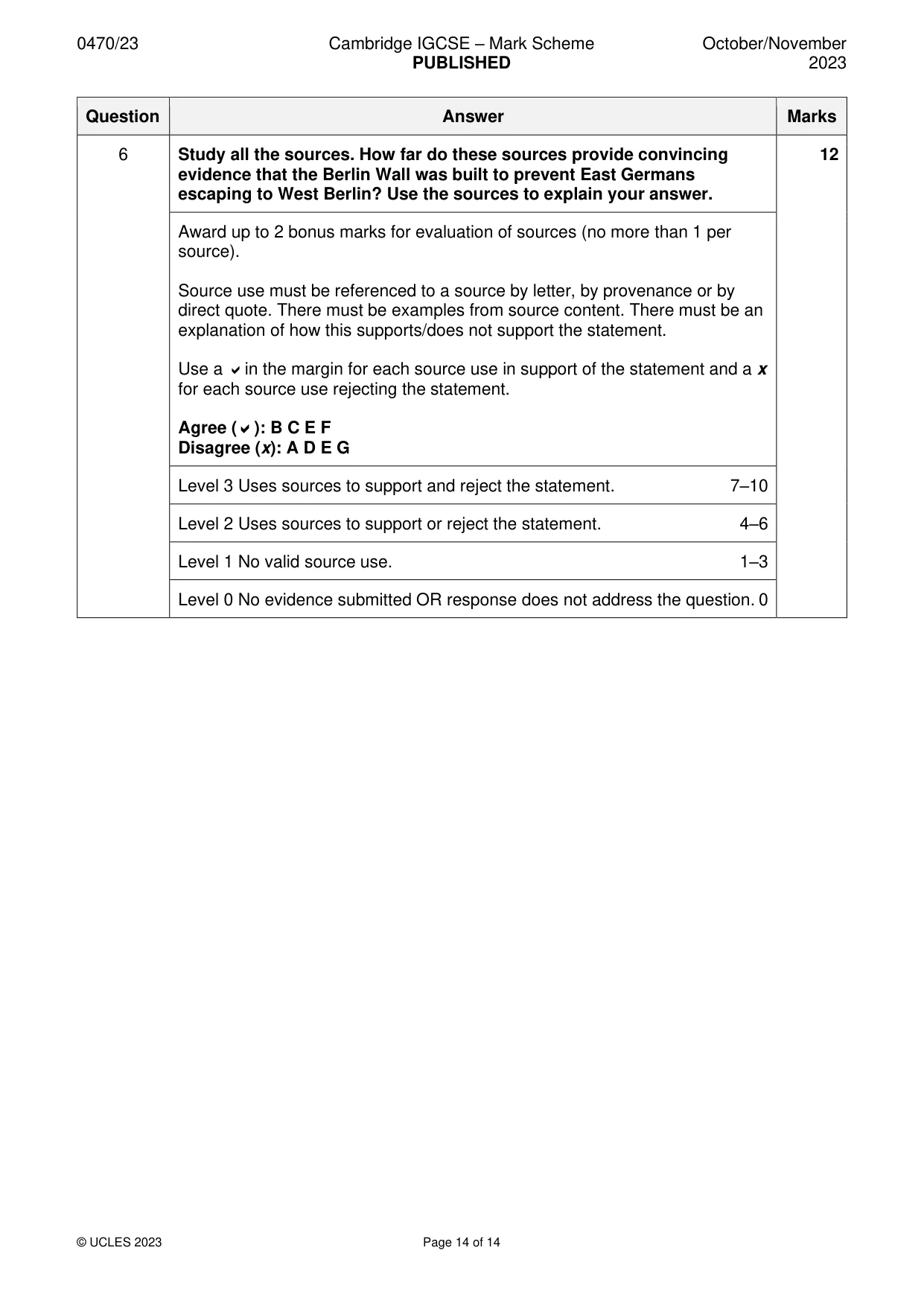
0470/23 Cambridge IGCSE – Mark Scheme PUBLISHED October/November 2023 © UCLES 2023 Page 14 of 14 Question Answer Marks 6 Study all the sources. How far do these sources provide convincing evidence that the Berlin Wall was built to prevent East Germans escaping to West Berlin? Use the sources to explain your answer. 12 Award up to 2 bonus marks for evaluation of sources (no more than 1 per source). Source use must be referenced to a source by letter, by provenance or by direct quote. There must be examples from source content. There must be an explanation of how this supports/does not support the statement. Use a in the margin for each source use in support of the statement and a x for each source use rejecting the statement. Agree (): B C E F Disagree (x): A D E G Level 3 Uses sources to support and reject the statement. 7–10 Level 2 Uses sources to support or reject the statement. 4–6 Level 1 No valid source use. 1–3 Level 0 No evidence submitted OR response does not address the question. 0
What you needed in this session
Cambridge’s own grade thresholds for 2023 Oct/Nov, Paper 2 · Variant 3. A higher threshold means an easier paper — the bar moves with how the cohort did.