Cambridge IGCSE History 0470 — 2025 Oct/Nov Paper 2 · Variant 1
0470/21/O/N/25 · 40 marks · 105 min
The question paper and its mark scheme, free to read here and free to download. This is Cambridge’s own paper, exactly as it was sat.
Question paper12 pages



Mark scheme15 pages
Answers below. Sit the paper first if you are practising.
Paper as text
Question paper, page 1
Cambridge Assessment International Education Cambridge IGCSE™ HISTORY 0470/21 Paper 2 Document Questions October/November 2025 1 hour 45 minutes You must answer on the enclosed answer booklet. You will need: Answer booklet (enclosed) INSTRUCTIONS e Answer one question on one option only. Option A: Nineteenth century topic Option B: Twentieth century topic e — Follow the instructions on the front cover of the answer booklet. If you need additional answer paper, ask the invigilator for a continuation booklet. INFORMATION e — The total mark for this paper is 40. e The number of marks for each question or part question is shown in brackets [ ]. This document has 12 pages. Any blank pages are indicated. DC (CE/FC) 343454/3 © UCLES 2025 [Turn over
Question paper, page 2
2 0470/21/O/N/25 © UCLES 2025 Option A: Nineteenth century topic 1 How did people in the South of the USA justify slavery? Study the Background Information and the sources carefully, and then answer all parts of Question 1. Background Information By 1830 there were two million black people who were slaves in the USA. All but 3500 were in the South. Most worked on large plantations cultivating crops such as cotton and tobacco, while others were domestic servants or day labourers. The one thing they all had in common was that they were regarded as the property of the slave owners. In the first half of the nineteenth century, opposition to slavery grew, especially in the North. Abolitionists formed societies and organised campaigns against it. This forced Southerners to defend and justify slavery. They used many different arguments to do this. For example, some claimed that black people would not be able to look after themselves, while others argued that they needed to be kept under control, otherwise they would rise up in rebellion. What was the main justification for slavery used by people in the South? SOURCE A It is not difficult to understand why slavery was often justified by Southerners. Some Southerners turned to the Bible to find support for such views but abolitionists did the same to find reasons for rejecting slavery. From a recent internet article about the history of the USA. SOURCE B Southerners formed unreasonable or untrue justifications for slavery. Some argued that it was the natural order taking its course and that Africans were inferior beings. One justification stood out as being the foundation of many justifications of slavery – that it was supported in the Bible. Southerners found much in the Old Testament to use in support of slavery. It was claimed that slaves by their very nature were not able to take care of themselves and white people had been appointed by God to look after them. Another argument was that the existence of slavery reduced the danger of class warfare amongst white people, because they all enjoyed the status of ‘citizen’, in contrast to landless slaves. It is also worth remembering that slavery was profitable. By 1840, the South grew 60 percent of the world’s cotton. Southerners argued that slavery was essential for this economic growth. From a recent article on the internet. Content removed due to copyright restrictions.
Question paper, page 3
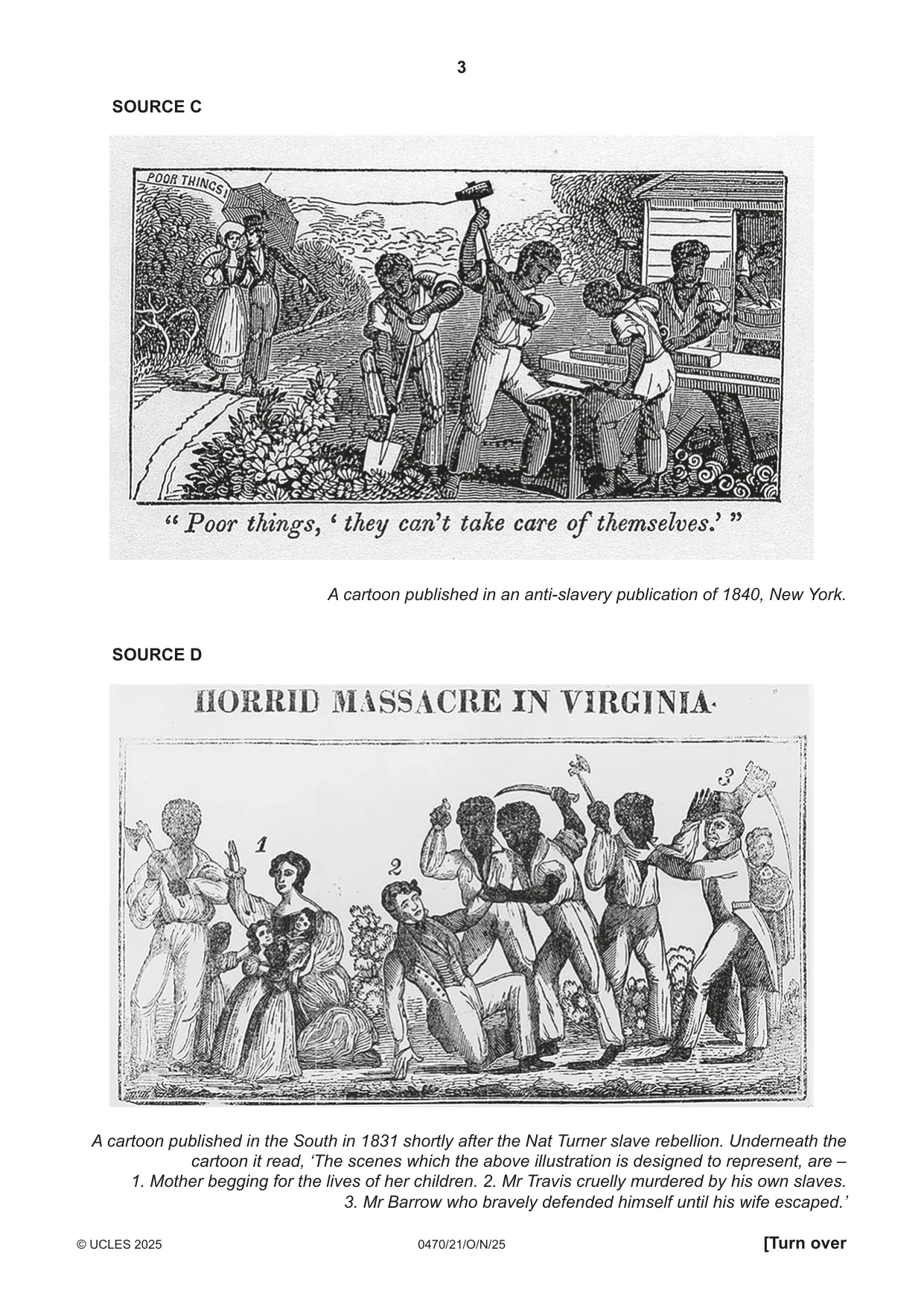
3 0470/21/O/N/25 © UCLES 2025 [Turn over SOURCE C A cartoon published in an anti-slavery publication of 1840, New York. SOURCE D A cartoon published in the South in 1831 shortly after the Nat Turner slave rebellion. Underneath the cartoon it read, ‘The scenes which the above illustration is designed to represent, are – 1. Mother begging for the lives of her children. 2. Mr Travis cruelly murdered by his own slaves. 3. Mr Barrow who bravely defended himself until his wife escaped.’
Question paper, page 4
4 0470/21/O/N/25 © UCLES 2025 SOURCE E Rows of white cabins with gardens; black men in the fields; black women sewing, knitting and weaving, with their children dancing, singing and playing, formed the pictures of my childhood. Bread, meat, milk, vegetables and fruit were plentiful. Black people were taught different trades, and there were blacksmiths, carpenters and weavers. Their work was for feeding and clothing themselves. All were merry-hearted, and among them I never saw a discontented face. Our house servants were numerous, polite and well trained. They were brought to the house at ten years of age, and instructed in the branches of household employment. The atmosphere of our own home was consideration and kindness. And I believe the maltreatment of one of our servants – we had never heard the word slave – would have upset us beyond endurance. My mother said the black people were placed here by God, for us to take care of. When we emancipate them, it does not better their condition. Those left free soon sink into poverty and become a nuisance to the community. From ‘A Girl’s Life in Virginia Before the War’ by Letitia M Burwell, who spent most of her life in rural Virginia. Her account was published in 1878. SOURCE F The slave is a piece of property to be bought and sold at the will of his master. He is deprived of education and denied the right to get married. The slaveholders use all kinds of cruelty to keep the slave as a slave – starvation, the bloody whip, the chain, the thumb-screw and the dungeon. Men, women and children are sold like horses and sheep. You will ask me, can such things be possible in a Christian country? I have to inform you that the religion of the southern states is the great supporter of the bloody atrocities I have described. Ministers of religion come forward and use the pages of the Bible to defend slavery. From a speech by Frederick Douglass in Britain, May 1846. Douglass was a black American who escaped from slavery and became a leading member of the abolitionist movement in the USA.
Question paper, page 5
5 0470/21/O/N/25 © UCLES 2025 [Turn over Now answer all parts of Question 1. You may use any of the sources to help you answer the questions, in addition to those sources which you are told to use. In answering parts (a)–(e) you should use your knowledge of the topic to help you interpret and evaluate the sources. (a) Study Sources A and B. How far do these two sources agree? Explain your answer using details of the sources. [7] (b) Study Source C. What is the cartoonist’s message? Explain your answer using details of the source and your knowledge. [8] (c) Study Source D. Why was this source published in the South in 1831? Explain your answer using details of the source and your knowledge. [8] (d) Study Sources E and F. Does Source E prove that Source F cannot be trusted? Explain your answer using details of the sources and your knowledge. [8] (e) Study all the sources. How far do these sources provide convincing evidence that people in the South justified slavery by claiming that black Americans were not capable of looking after themselves? Use the sources to explain your answer. [9]
Question paper, page 6
6 0470/21/O/N/25 © UCLES 2025 Option B: Twentieth century topic 2 Was Hitler justified in remilitarising the Rhineland in 1936? Study the Background Information and the sources carefully, and then answer all parts of Question 2. Background Information In the Treaty of Versailles, the Rhineland was demilitarised. This meant that there could be no German troops or fortifications there. This aimed to increase French security. Allied troops were also stationed in the Rhineland. In 1925 the western frontiers of Germany and the demilitarisation of the Rhineland were guaranteed by the Locarno Pact signed by Germany, Belgium, France, Britain and Italy. In 1930 Allied troops were withdrawn. Tensions between France and Germany grew in 1935, when France signed a treaty of mutual support with the USSR. On the morning of 7 March 1936, German troops marched into the Rhineland. Many people in Britain and nearly everybody in Germany thought this was justified. Was Hitler justified in remilitarising the Rhineland? SOURCE A In negotiations in recent years, the German Government has consistently stressed that it intended to fulfil all of the obligations arising from the Locarno Pact, as long as the other countries were willing to stand by it. This condition no longer exists as regards France. France responded to Germany’s repeated friendly advances and assurances of peace by violating the Locarno Pact. It agreed a military alliance with the Soviet Union directed exclusively against Germany. Hence the Pact has lost its meaning and ceased, in a practical sense, to exist. As a consequence, Germany no longer views itself bound to this Pact. The German Government is now compelled to react to the new situation created by this alliance. In the interests of the right of a people to safeguard its borders and maintain its defence, the German Reich Government has today re-established the full and unlimited sovereignty of the Reich in the demilitarised zone of the Rhineland. Now that Germany’s sovereignty over the entire territory of the German Reich has been achieved, the German Government is willing to re-enter the League of Nations. From Hitler’s speech to the Reichstag, 7 March 1936. SOURCE B A demilitarised zone established entirely at the expense of one country is an arrangement no country would freely accept. The country in whose territory the zone was established would in time react against what would be considered a humiliation. The demilitarised zone would become a cause of friction. In the case of the Rhineland, once Germany has got rid of the occupying armies, it is probable that it will react against the demilitarisation. A report by the British Committee of Imperial Defence, the highest military planning body of the British Government, December 1925.
Question paper, page 7
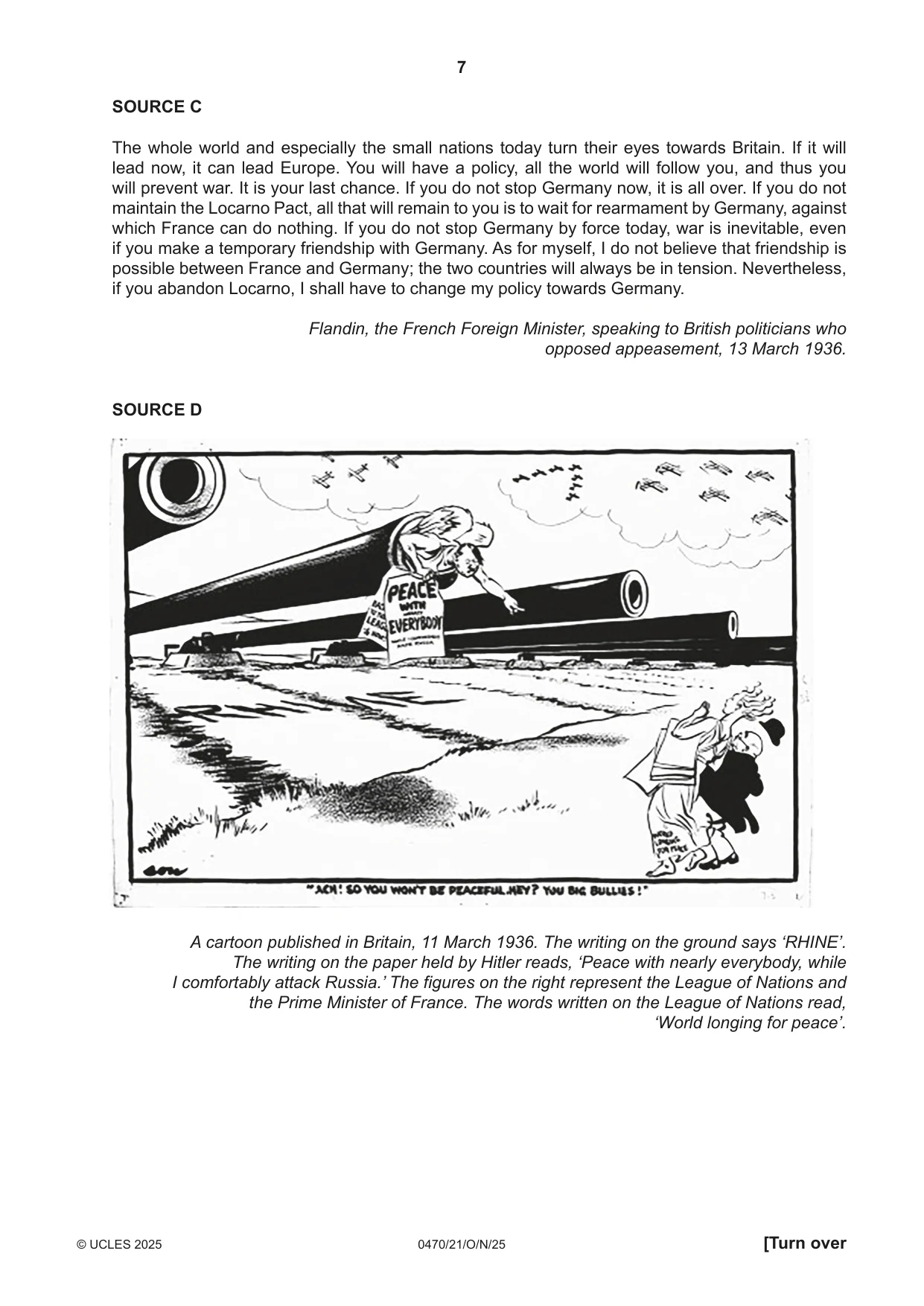
7 0470/21/O/N/25 © UCLES 2025 [Turn over SOURCE C The whole world and especially the small nations today turn their eyes towards Britain. If it will lead now, it can lead Europe. You will have a policy, all the world will follow you, and thus you will prevent war. It is your last chance. If you do not stop Germany now, it is all over. If you do not maintain the Locarno Pact, all that will remain to you is to wait for rearmament by Germany, against which France can do nothing. If you do not stop Germany by force today, war is inevitable, even if you make a temporary friendship with Germany. As for myself, I do not believe that friendship is possible between France and Germany; the two countries will always be in tension. Nevertheless, if you abandon Locarno, I shall have to change my policy towards Germany. Flandin, the French Foreign Minister, speaking to British politicians who opposed appeasement, 13 March 1936. SOURCE D A cartoon published in Britain, 11 March 1936. The writing on the ground says ‘RHINE’. The writing on the paper held by Hitler reads, ‘Peace with nearly everybody, while I comfortably attack Russia.’ The figures on the right represent the League of Nations and the Prime Minister of France. The words written on the League of Nations read, ‘World longing for peace’.
Question paper, page 8
8 0470/21/O/N/25 © UCLES 2025 SOURCE E A cartoon published in an American newspaper, March 1936. SOURCE F The reoccupation by such a small military force made it clear that it was a purely defensive and symbolic act. There were no aggressive plans for the future, as is shown on 12 March 1936 when the German government, at the suggestion of Britain, promised not to increase the forces in the Rhineland. We also agreed not to move the troops any closer to the border, on condition that France would do the same. France did not want to accept this offer. In a speech to the Reichstag on 7 March 1936, Hitler explained to the world the reasons for the reoccupation. Even today I have the firm conviction that at that time Hitler was not thinking of war. I must emphasise that any such intention was far from my own thoughts. On the contrary, I considered the restoration of sovereignty in the Rhineland a step towards peace and understanding. From a speech by Neurath at the Nuremberg Trials, 1946. He was being tried, along with other prominent Nazis, for war crimes committed by the Nazi regime. In 1936 he was the German Minister of Foreign Affairs. Content removed due to copyright restrictions.
Question paper, page 9
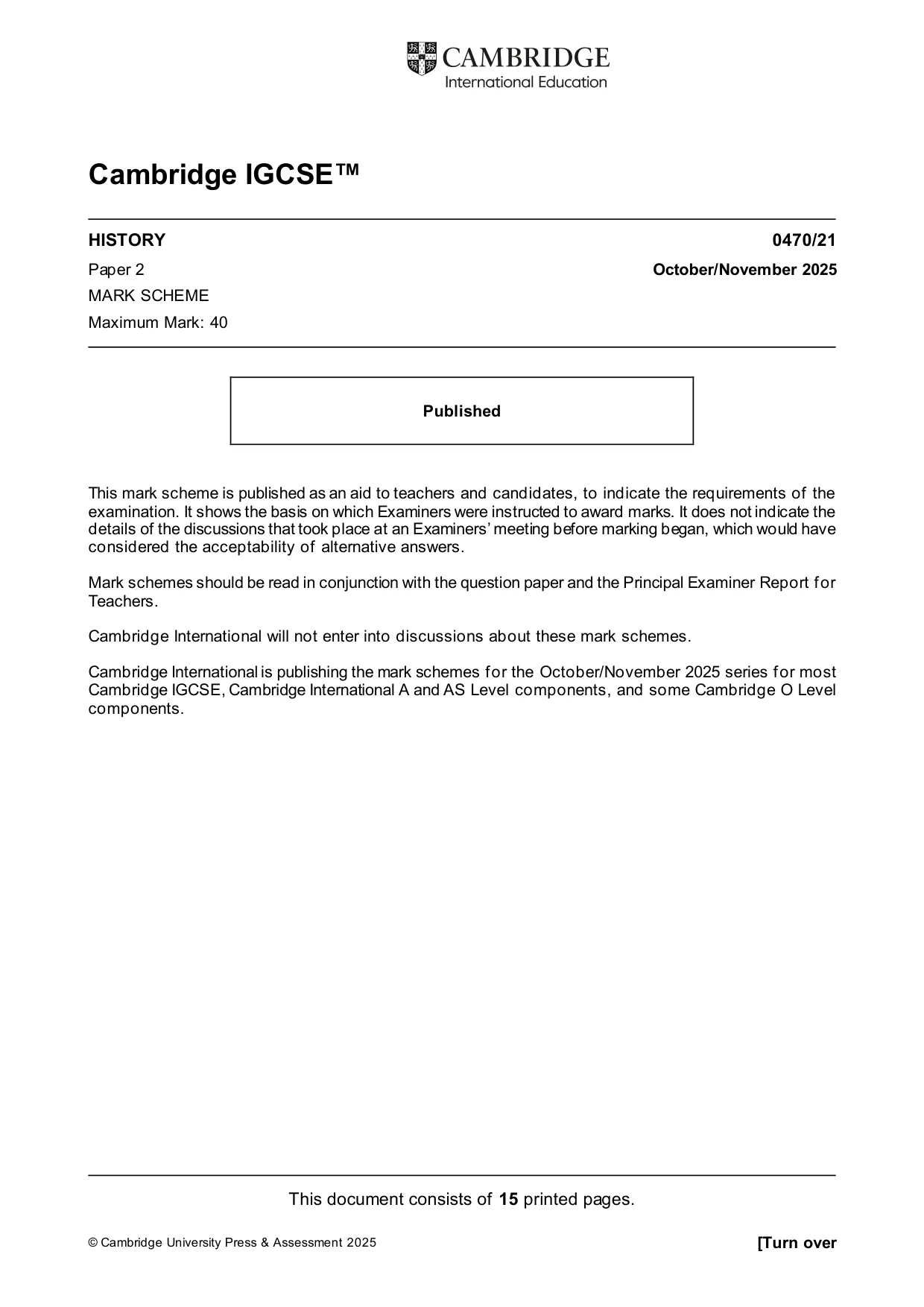
9 0470/21/O/N/25 © UCLES 2025 Now answer all parts of Question 2. You may use any of the sources to help you answer the questions, in addition to those sources which you are told to use. In answering parts (a)–(e) you should use your knowledge of the topic to help you interpret and evaluate the sources. (a) Study Source A. Why did Hitler make this speech at that time? Explain your answer using details of the source and your knowledge. [7] (b) Study Sources B and C. Does Source B make Source C surprising? Explain your answer using details of the sources and your knowledge. [8] (c) Study Sources D and E. How similar are these two cartoons? Explain your answer using details of the sources and your knowledge. [8] (d) Study Source F. Can Neurath’s account be trusted? Explain your answer using details of the source and your knowledge. [8] (e) Study all the sources. How far do these sources provide convincing evidence that Hitler was justified in remilitarising the Rhineland? Use the sources to explain your answer. [9]
Question paper, page 10
10 0470/21/O/N/25 © UCLES 2025 BLANK PAGE
Question paper, page 11
11 0470/21/O/N/25 © UCLES 2025 BLANK PAGE
Question paper, page 12
12 0470/21/O/N/25 © UCLES 2025 Permission to reproduce items where third-party owned material protected by copyright is included has been sought and cleared where possible. Every reasonable effort has been made by the publisher (UCLES) to trace copyright holders, but if any items requiring clearance have unwittingly been included, the publisher will be pleased to make amends at the earliest possible opportunity. To avoid the issue of disclosure of answer-related information to candidates, all copyright acknowledgements are reproduced online in the Cambridge Assessment International Education Copyright Acknowledgements Booklet. This is produced for each series of examinations and is freely available to download at www.cambridgeinternational.org after the live examination series. Cambridge Assessment International Education is part of Cambridge Assessment. Cambridge Assessment is the brand name of the University of Cambridge Local Examinations Syndicate (UCLES), which is a department of the University of Cambridge. BLANK PAGE
Mark scheme, page 1
This document consists of 15 printed pages. © Cambridge University Press & Assessment 2025 [Turn over Cambridge IGCSE™ HISTORY 0470/21 Paper 2 October/November 2025 MARK SCHEME Maximum Mark: 40 Published This mark scheme is published as an aid to teachers and candidates, to indicate the requirements of the examination. It shows the basis on which Examiners were instructed to award marks. It does not indicate the details of the discussions that took place at an Examiners’ meeting before marking began, which would have considered the acceptability of alternative answers. Mark schemes should be read in conjunction with the question paper and the Principal Examiner Report for Teachers. Cambridge International will not enter into discussions about these mark schemes. Cambridge International is publishing the mark schemes for the October/November 2025 series for most Cambridge IGCSE, Cambridge International A and AS Level components, and some Cambridge O Level components.
Mark scheme, page 2
0470/21 Cambridge IGCSE – Mark Scheme PUBLISHED October/November 2025 © Cambridge University Press & Assessment 2025 Page 2 of 15 Generic Marking Principles These general marking principles must be applied by all examiners when marking candidate answers. They should be applied alongside the specific content of the mark scheme or generic level descriptions for a question. Each question paper and mark scheme will also comply with these marking principles. GENERIC MARKING PRINCIPLE 1: Marks must be awarded in line with: • the specific content of the mark scheme or the generic level descriptors for the question • the specific skills defined in the mark scheme or in the generic level descriptors for the question • the standard of response required by a candidate as exemplified by the standardisation scripts. GENERIC MARKING PRINCIPLE 2: Marks awarded are always whole marks (not half marks, or other fractions). GENERIC MARKING PRINCIPLE 3: Marks must be awarded positively: • marks are awarded for correct/valid answers, as defined in the mark scheme. However, credit is given for valid answers which go beyond the scope of the syllabus and mark scheme, referring to your Team Leader as appropriate • marks are awarded when candidates clearly demonstrate what they know and can do • marks are not deducted for errors • marks are not deducted for omissions • answers should only be judged on the quality of spelling, punctuation and grammar when these features are specifically assessed by the question as indicated by the mark scheme. The meaning, however, should be unambiguous. GENERIC MARKING PRINCIPLE 4: Rules must be applied consistently, e.g. in situations where candidates have not followed instructions or in the application of generic level descriptors. GENERIC MARKING PRINCIPLE 5: Marks should be awarded using the full range of marks defined in the mark scheme for the question (however; the use of the full mark range may be limited according to the quality of the candidate responses seen). GENERIC MARKING PRINCIPLE 6: Marks awarded are based solely on the requirements as defined in the mark scheme. Marks should not be awarded with grade thresholds or grade descriptors in mind.
Mark scheme, page 3
0470/21 Cambridge IGCSE – Mark Scheme PUBLISHED October/November 2025 © Cambridge University Press & Assessment 2025 Page 3 of 15 Annotations guidance for centres Examiners use a system of annotations as a shorthand for communicating their marking decisions to one another. Examiners are trained during the standardisation process on how and when to use annotations. The purpose of annotations is to inform the standardisation and monitoring processes and guide the supervising examiners when they are checking the work of examiners within their team. The meaning of annotations and how they are used is specific to each component and is understood by all examiners who mark the component. We publish annotations in our mark schemes to help centres understand the annotations they may see on copies of scripts. Note that there may not be a direct correlation between the number of annotations on a script and the mark awarded. Similarly, the use of an annotation may not be an indication of the quality of the response. The annotations listed below were available to examiners marking this component in this series. Annotations Annotation Meaning Benefit of the doubt Incorrect OR In part (e) questions only, to indicate that a source has been correctly identified as refuting the statement Correct OR In part (e) questions only, to indicate that a source has been correctly identified as supporting the statement Evaluation Highlighter Highlight relevant areas of a response Level 1 response Level 2 response Level 3 response Level 4 response Level 5 response Level 6 response Level 7 response Off-page comment Comments entered at the bottom of the marking window and then displayed when the associated question item is navigated to On-page comment Comments entered in speech bubbles on the candidate response
Mark scheme, page 4
0470/21 Cambridge IGCSE – Mark Scheme PUBLISHED October/November 2025 © Cambridge University Press & Assessment 2025 Page 4 of 15 Annotation Meaning To indicate that a point has been noted but no credit has been given OR To indicate that a blank page has been checked for creditable content Does not address the question
Mark scheme, page 5
0470/21 Cambridge IGCSE – Mark Scheme PUBLISHED October/November 2025 © Cambridge University Press & Assessment 2025 Page 5 of 15 Assessment objectives AO1 An ability to recall, select, organise and deploy knowledge of the syllabus content. AO3 An ability to understand, interpret, evaluate and use a range of sources as evidence, in their historical context.
Mark scheme, page 6
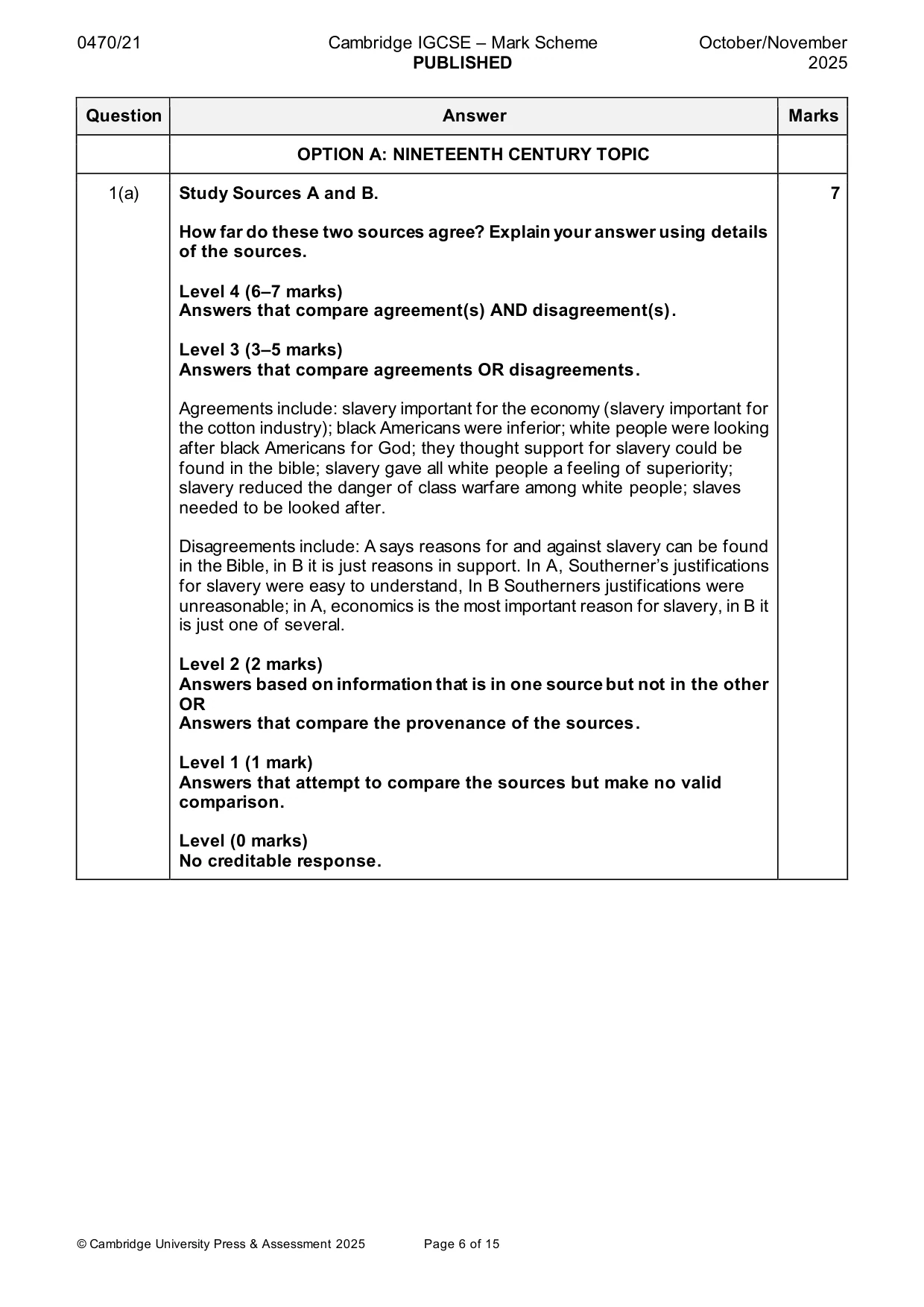
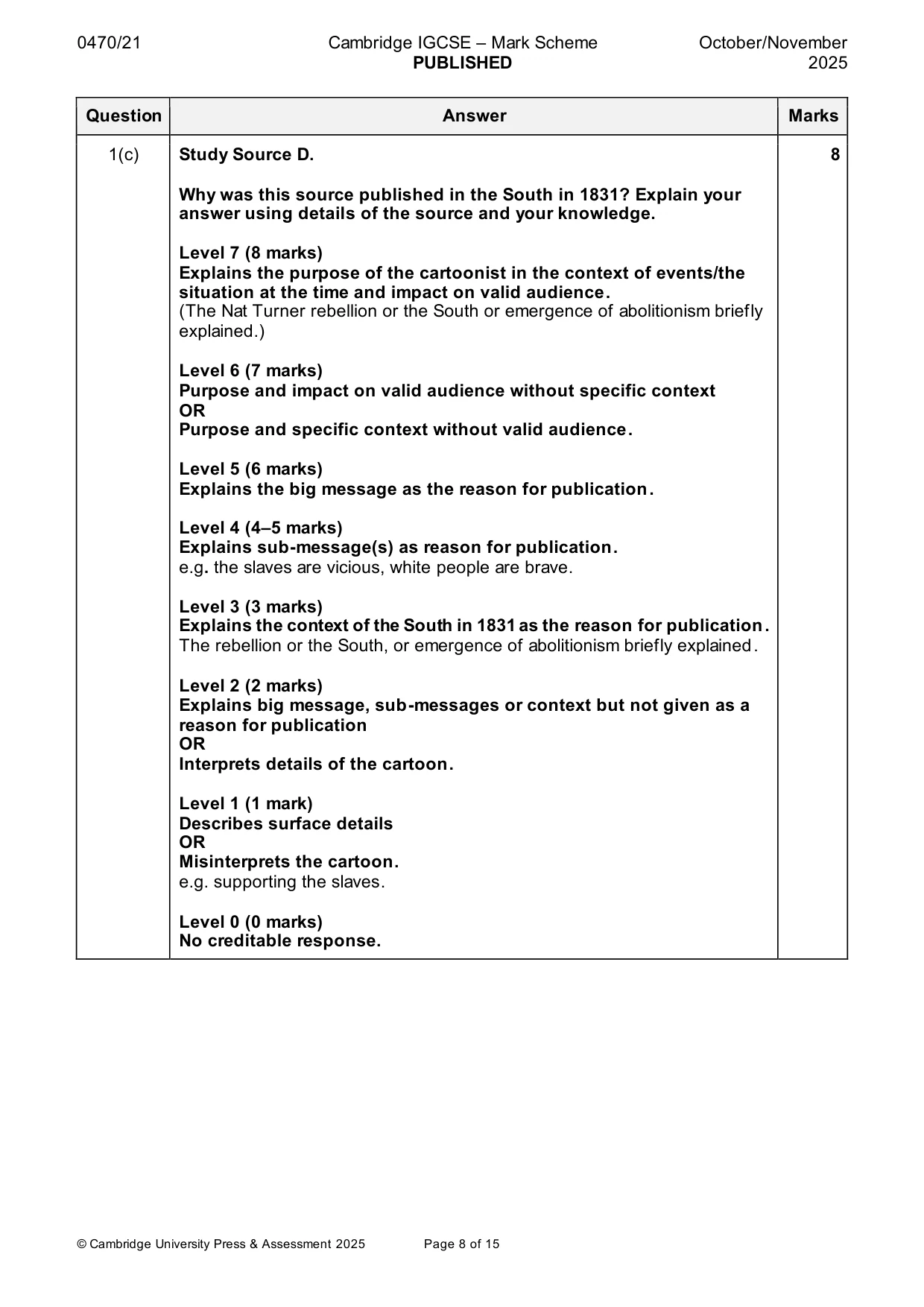
0470/21 Cambridge IGCSE – Mark Scheme PUBLISHED October/November 2025 © Cambridge University Press & Assessment 2025 Page 6 of 15 Question Answer Marks OPTION A: NINETEENTH CENTURY TOPIC 1(a) Study Sources A and B. How far do these two sources agree? Explain your answer using details of the sources. Level 4 (6–7 marks) Answers that compare agreement(s) AND disagreement(s). Level 3 (3–5 marks) Answers that compare agreements OR disagreements. Agreements include: slavery important for the economy (slavery important for the cotton industry); black Americans were inferior; white people were looking after black Americans for God; they thought support for slavery could be found in the bible; slavery gave all white people a feeling of superiority; slavery reduced the danger of class warfare among white people; slaves needed to be looked after. Disagreements include: A says reasons for and against slavery can be found in the Bible, in B it is just reasons in support. In A, Southerner’s justifications for slavery were easy to understand, In B Southerners justifications were unreasonable; in A, economics is the most important reason for slavery, in B it is just one of several. Level 2 (2 marks) Answers based on information that is in one source but not in the other OR Answers that compare the provenance of the sources. Level 1 (1 mark) Answers that attempt to compare the sources but make no valid comparison. Level (0 marks) No creditable response. 7
Mark scheme, page 7
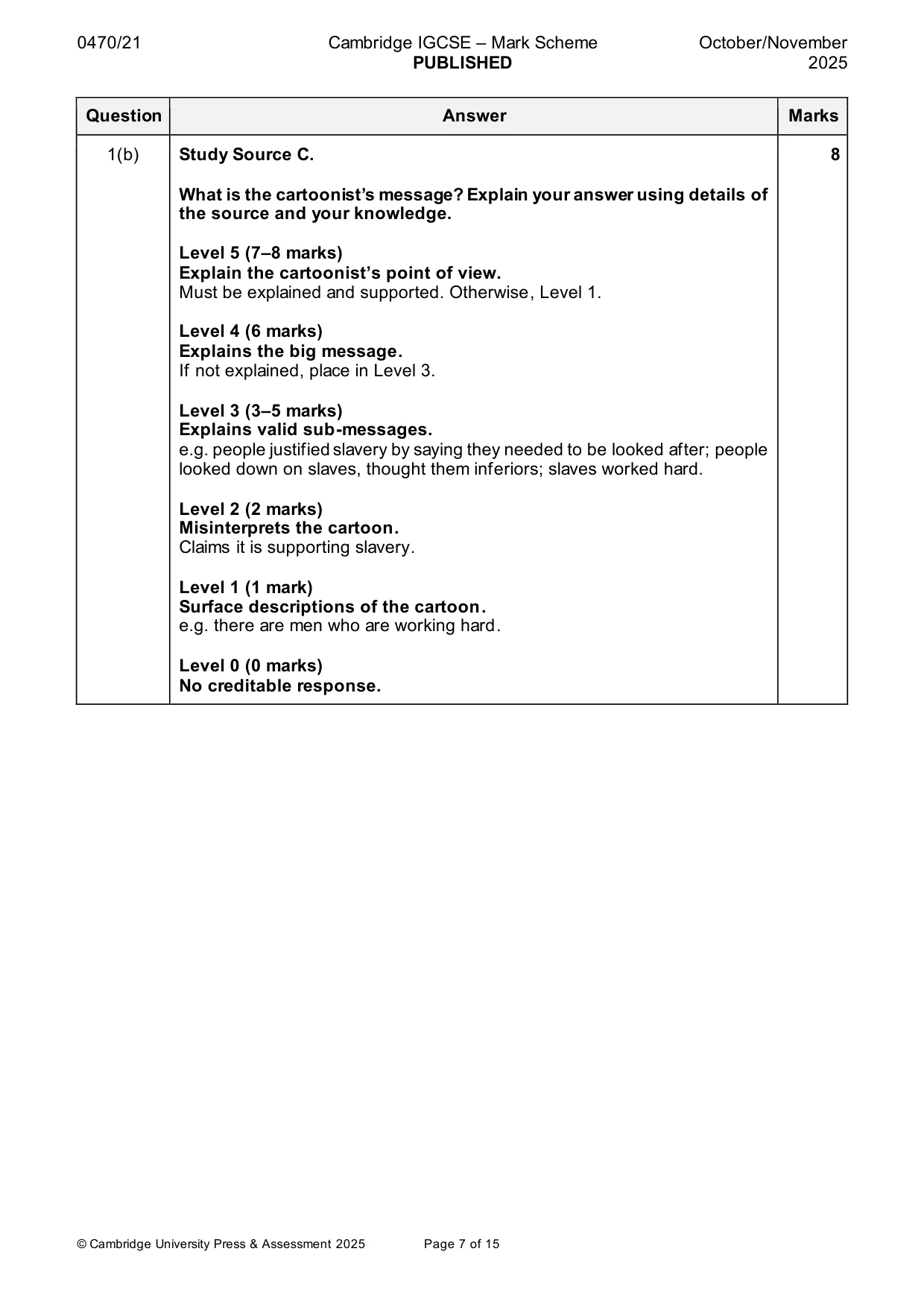
0470/21 Cambridge IGCSE – Mark Scheme PUBLISHED October/November 2025 © Cambridge University Press & Assessment 2025 Page 7 of 15 Question Answer Marks 1(b) Study Source C. What is the cartoonist’s message? Explain your answer using details of the source and your knowledge. Level 5 (7–8 marks) Explain the cartoonist’s point of view. Must be explained and supported. Otherwise, Level 1. Level 4 (6 marks) Explains the big message. If not explained, place in Level 3. Level 3 (3–5 marks) Explains valid sub-messages. e.g. people justified slavery by saying they needed to be looked after; people looked down on slaves, thought them inferiors; slaves worked hard. Level 2 (2 marks) Misinterprets the cartoon. Claims it is supporting slavery. Level 1 (1 mark) Surface descriptions of the cartoon. e.g. there are men who are working hard. Level 0 (0 marks) No creditable response. 8
Mark scheme, page 8
0470/21 Cambridge IGCSE – Mark Scheme PUBLISHED October/November 2025 © Cambridge University Press & Assessment 2025 Page 8 of 15 Question Answer Marks 1(c) Study Source D. Why was this source published in the South in 1831? Explain your answer using details of the source and your knowledge. Level 7 (8 marks) Explains the purpose of the cartoonist in the context of events/the situation at the time and impact on valid audience. (The Nat Turner rebellion or the South or emergence of abolitionism briefly explained.) Level 6 (7 marks) Purpose and impact on valid audience without specific context OR Purpose and specific context without valid audience. Level 5 (6 marks) Explains the big message as the reason for publication. Level 4 (4–5 marks) Explains sub-message(s) as reason for publication. e.g. the slaves are vicious, white people are brave. Level 3 (3 marks) Explains the context of the South in 1831 as the reason for publication. The rebellion or the South, or emergence of abolitionism briefly explained. Level 2 (2 marks) Explains big message, sub-messages or context but not given as a reason for publication OR Interprets details of the cartoon. Level 1 (1 mark) Describes surface details OR Misinterprets the cartoon. e.g. supporting the slaves. Level 0 (0 marks) No creditable response. 8
Mark scheme, page 9
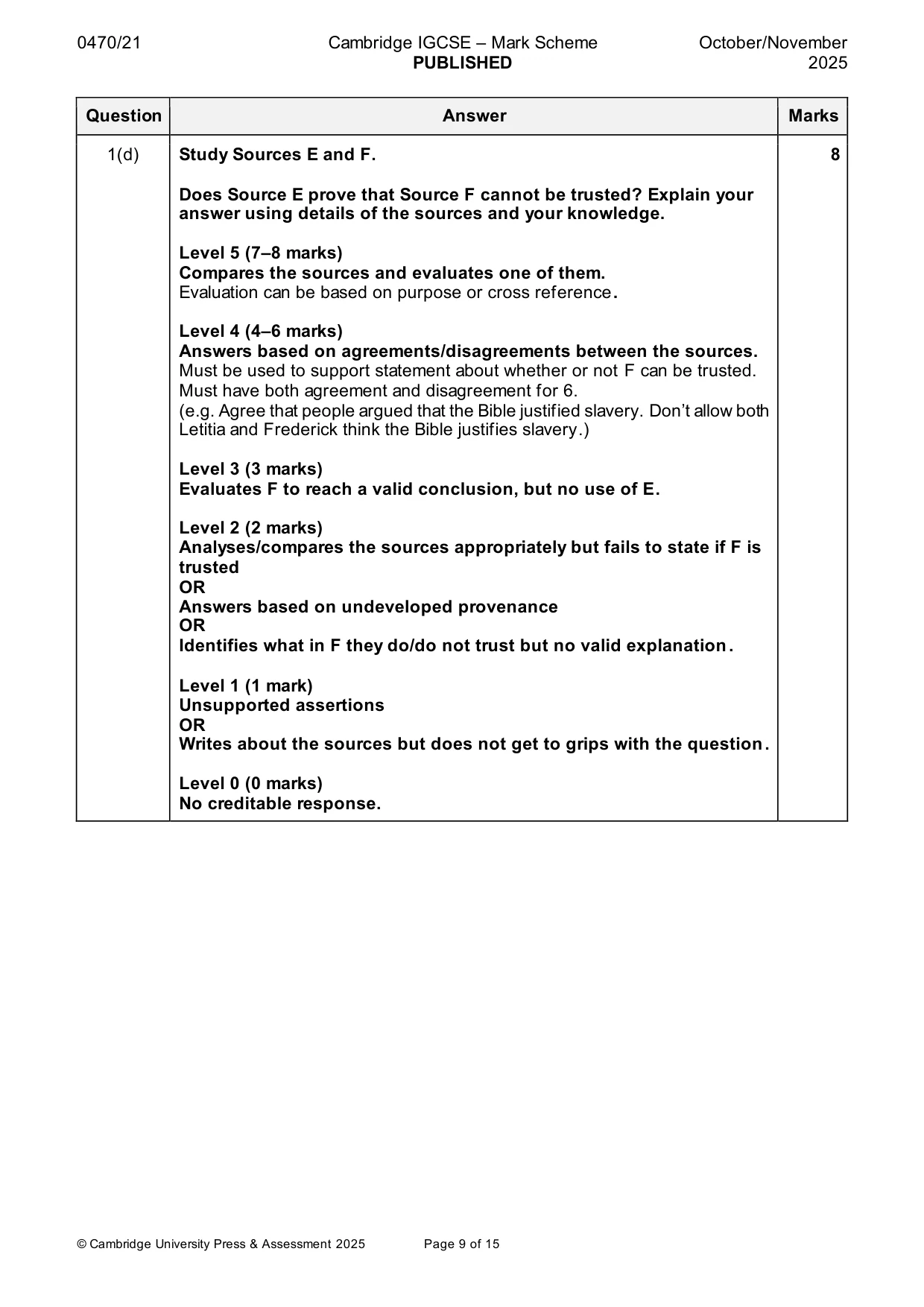
0470/21 Cambridge IGCSE – Mark Scheme PUBLISHED October/November 2025 © Cambridge University Press & Assessment 2025 Page 9 of 15 Question Answer Marks 1(d) Study Sources E and F. Does Source E prove that Source F cannot be trusted? Explain your answer using details of the sources and your knowledge. Level 5 (7–8 marks) Compares the sources and evaluates one of them. Evaluation can be based on purpose or cross reference. Level 4 (4–6 marks) Answers based on agreements/disagreements between the sources. Must be used to support statement about whether or not F can be trusted. Must have both agreement and disagreement for 6. (e.g. Agree that people argued that the Bible justified slavery. Don’t allow both Letitia and Frederick think the Bible justifies slavery.) Level 3 (3 marks) Evaluates F to reach a valid conclusion, but no use of E. Level 2 (2 marks) Analyses/compares the sources appropriately but fails to state if F is trusted OR Answers based on undeveloped provenance OR Identifies what in F they do/do not trust but no valid explanation. Level 1 (1 mark) Unsupported assertions OR Writes about the sources but does not get to grips with the question. Level 0 (0 marks) No creditable response. 8
Mark scheme, page 10
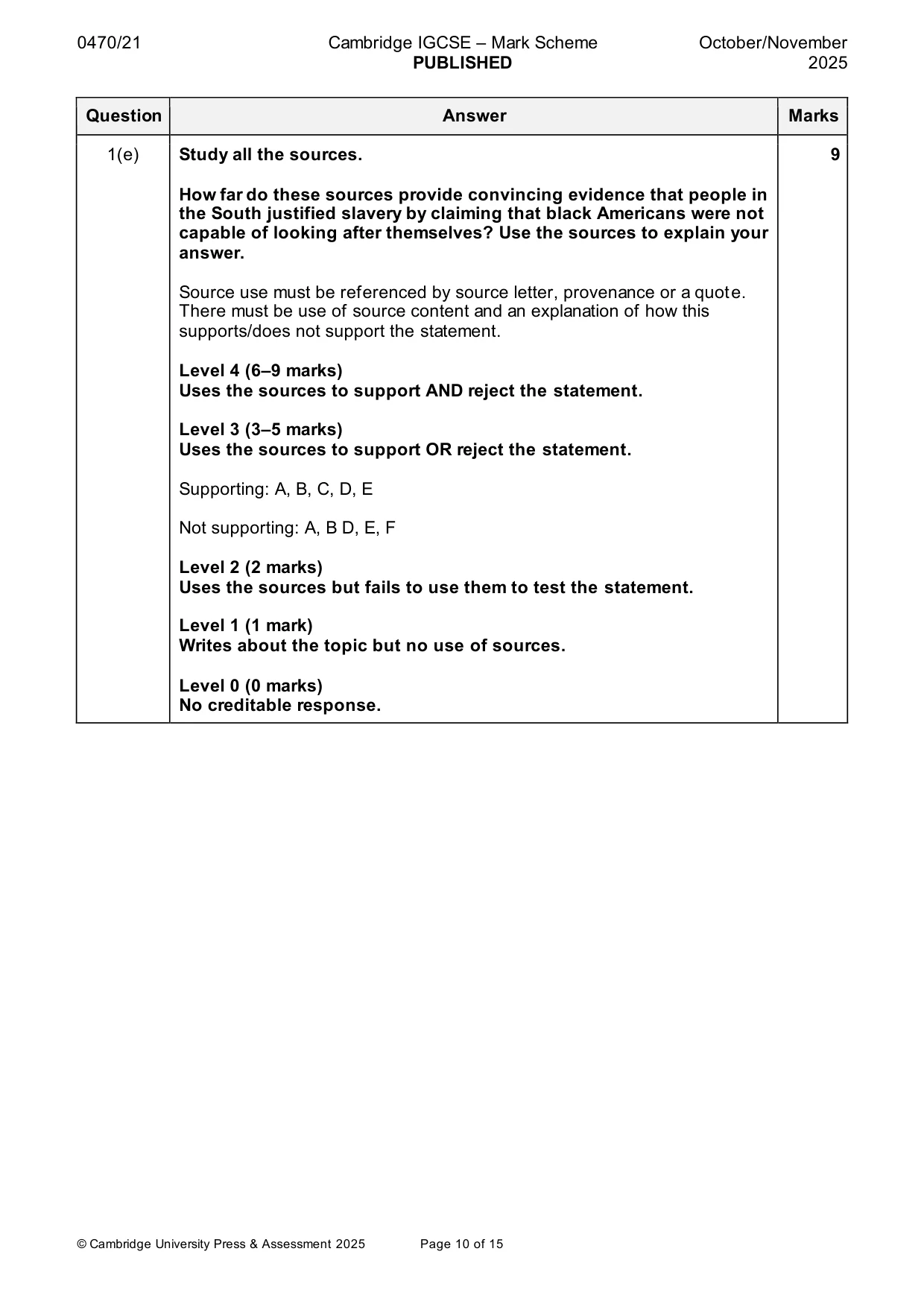
0470/21 Cambridge IGCSE – Mark Scheme PUBLISHED October/November 2025 © Cambridge University Press & Assessment 2025 Page 10 of 15 Question Answer Marks 1(e) Study all the sources. How far do these sources provide convincing evidence that people in the South justified slavery by claiming that black Americans were not capable of looking after themselves? Use the sources to explain your answer. Source use must be referenced by source letter, provenance or a quote. There must be use of source content and an explanation of how this supports/does not support the statement. Level 4 (6–9 marks) Uses the sources to support AND reject the statement. Level 3 (3–5 marks) Uses the sources to support OR reject the statement. Supporting: A, B, C, D, E Not supporting: A, B D, E, F Level 2 (2 marks) Uses the sources but fails to use them to test the statement. Level 1 (1 mark) Writes about the topic but no use of sources. Level 0 (0 marks) No creditable response. 9
Mark scheme, page 11
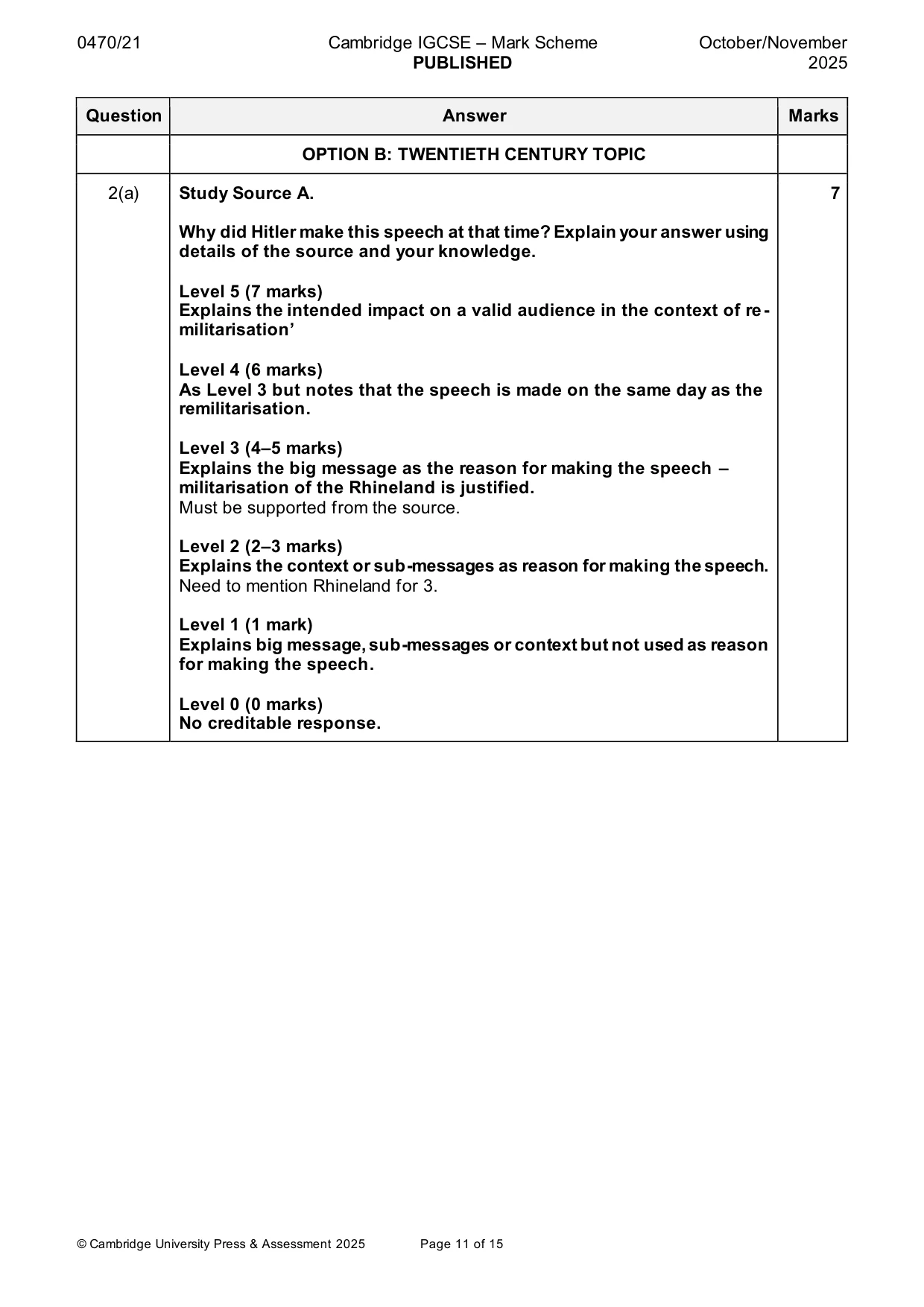
0470/21 Cambridge IGCSE – Mark Scheme PUBLISHED October/November 2025 © Cambridge University Press & Assessment 2025 Page 11 of 15 Question Answer Marks OPTION B: TWENTIETH CENTURY TOPIC 2(a) Study Source A. Why did Hitler make this speech at that time? Explain your answer using details of the source and your knowledge. Level 5 (7 marks) Explains the intended impact on a valid audience in the context of re- militarisation’ Level 4 (6 marks) As Level 3 but notes that the speech is made on the same day as the remilitarisation. Level 3 (4–5 marks) Explains the big message as the reason for making the speech – militarisation of the Rhineland is justified. Must be supported from the source. Level 2 (2–3 marks) Explains the context or sub-messages as reason for making the speech. Need to mention Rhineland for 3. Level 1 (1 mark) Explains big message, sub-messages or context but not used as reason for making the speech. Level 0 (0 marks) No creditable response. 7
Mark scheme, page 12
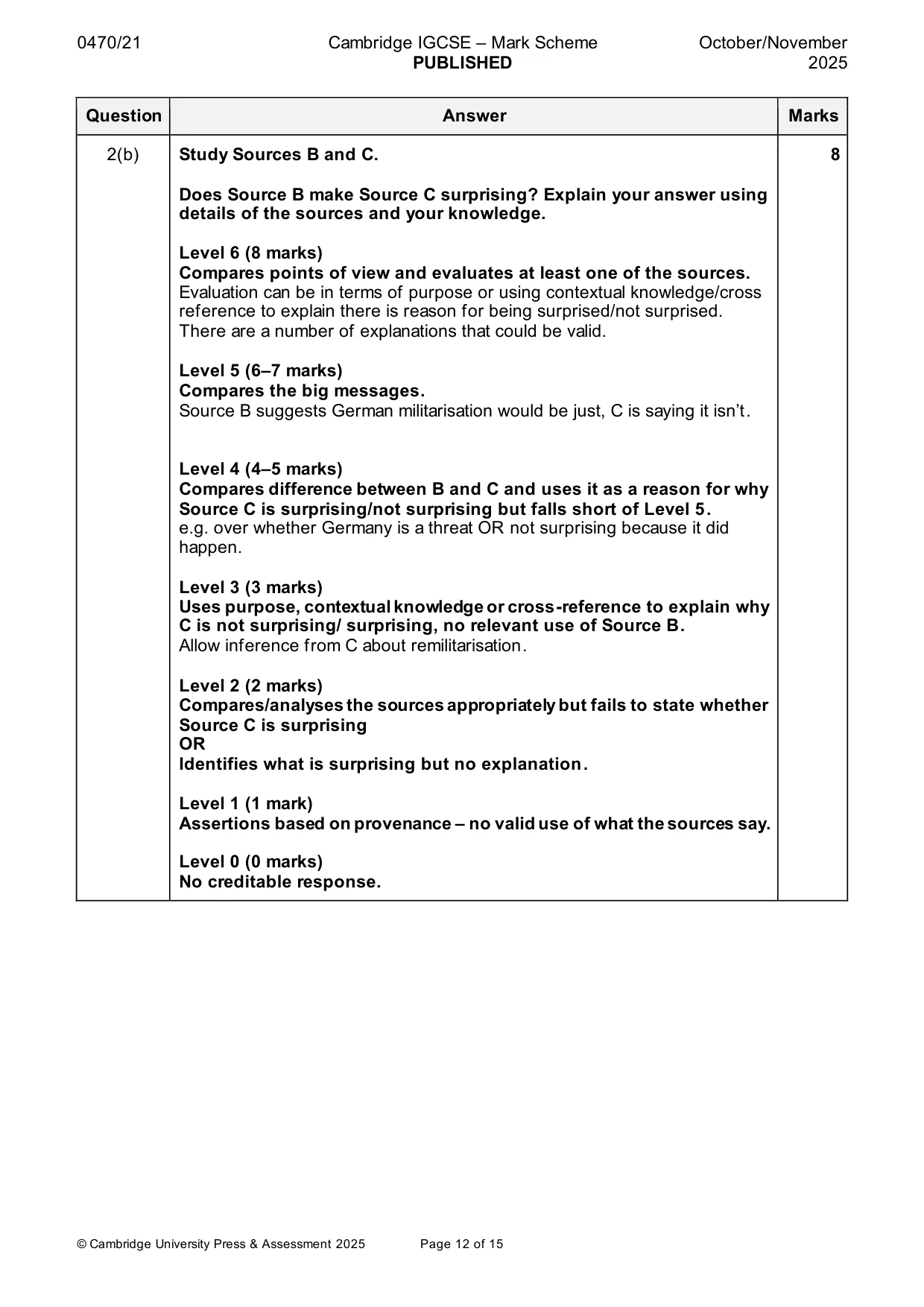
0470/21 Cambridge IGCSE – Mark Scheme PUBLISHED October/November 2025 © Cambridge University Press & Assessment 2025 Page 12 of 15 Question Answer Marks 2(b) Study Sources B and C. Does Source B make Source C surprising? Explain your answer using details of the sources and your knowledge. Level 6 (8 marks) Compares points of view and evaluates at least one of the sources. Evaluation can be in terms of purpose or using contextual knowledge/cross reference to explain there is reason for being surprised/not surprised. There are a number of explanations that could be valid. Level 5 (6–7 marks) Compares the big messages. Source B suggests German militarisation would be just, C is saying it isn’t. Level 4 (4–5 marks) Compares difference between B and C and uses it as a reason for why Source C is surprising/not surprising but falls short of Level 5. e.g. over whether Germany is a threat OR not surprising because it did happen. Level 3 (3 marks) Uses purpose, contextual knowledge or cross-reference to explain why C is not surprising/ surprising, no relevant use of Source B. Allow inference from C about remilitarisation. Level 2 (2 marks) Compares/analyses the sources appropriately but fails to state whether Source C is surprising OR Identifies what is surprising but no explanation. Level 1 (1 mark) Assertions based on provenance – no valid use of what the sources say. Level 0 (0 marks) No creditable response. 8
Mark scheme, page 13
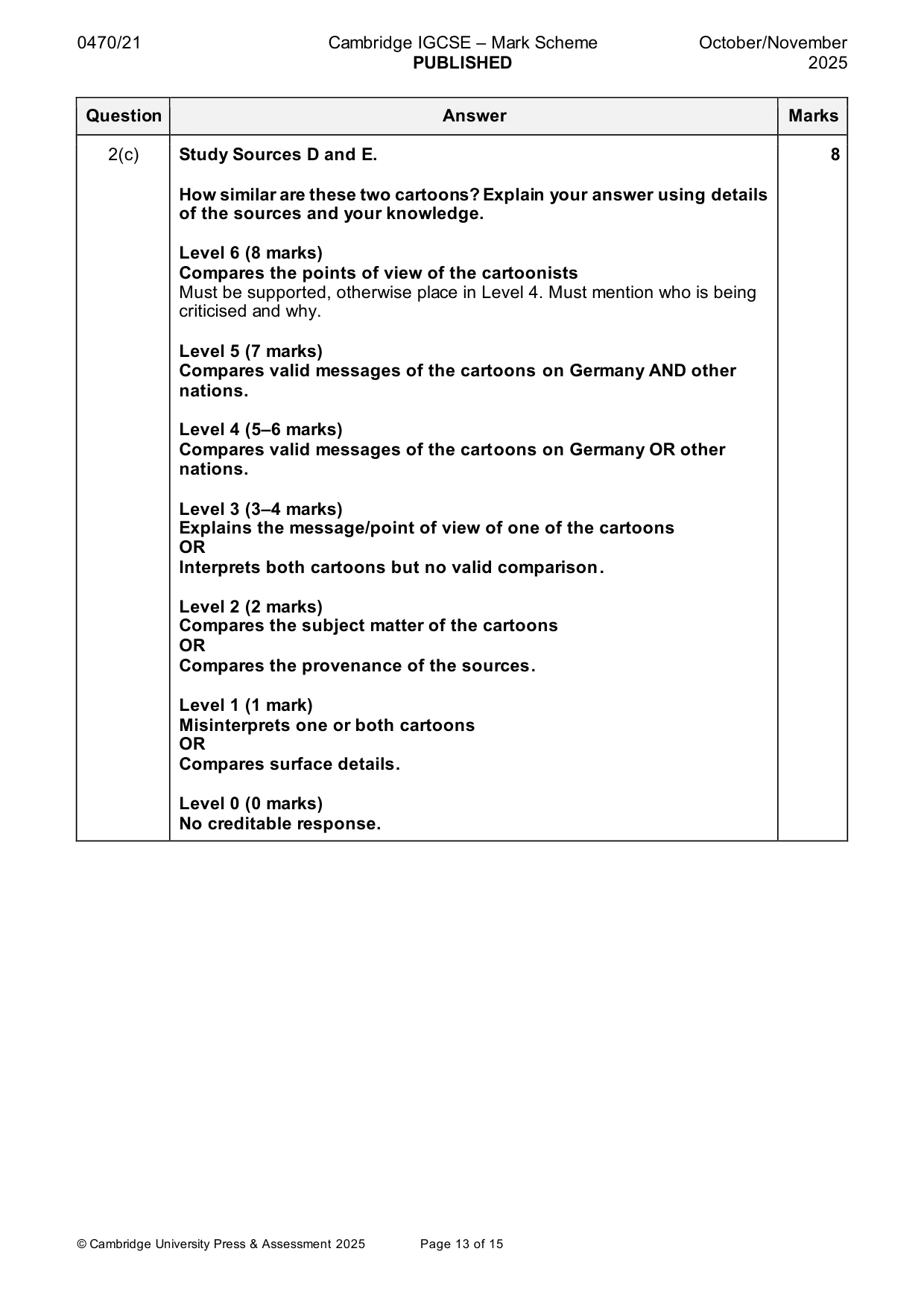
0470/21 Cambridge IGCSE – Mark Scheme PUBLISHED October/November 2025 © Cambridge University Press & Assessment 2025 Page 13 of 15 Question Answer Marks 2(c) Study Sources D and E. How similar are these two cartoons? Explain your answer using details of the sources and your knowledge. Level 6 (8 marks) Compares the points of view of the cartoonists Must be supported, otherwise place in Level 4. Must mention who is being criticised and why. Level 5 (7 marks) Compares valid messages of the cartoons on Germany AND other nations. Level 4 (5–6 marks) Compares valid messages of the cartoons on Germany OR other nations. Level 3 (3–4 marks) Explains the message/point of view of one of the cartoons OR Interprets both cartoons but no valid comparison. Level 2 (2 marks) Compares the subject matter of the cartoons OR Compares the provenance of the sources. Level 1 (1 mark) Misinterprets one or both cartoons OR Compares surface details. Level 0 (0 marks) No creditable response. 8
Mark scheme, page 14
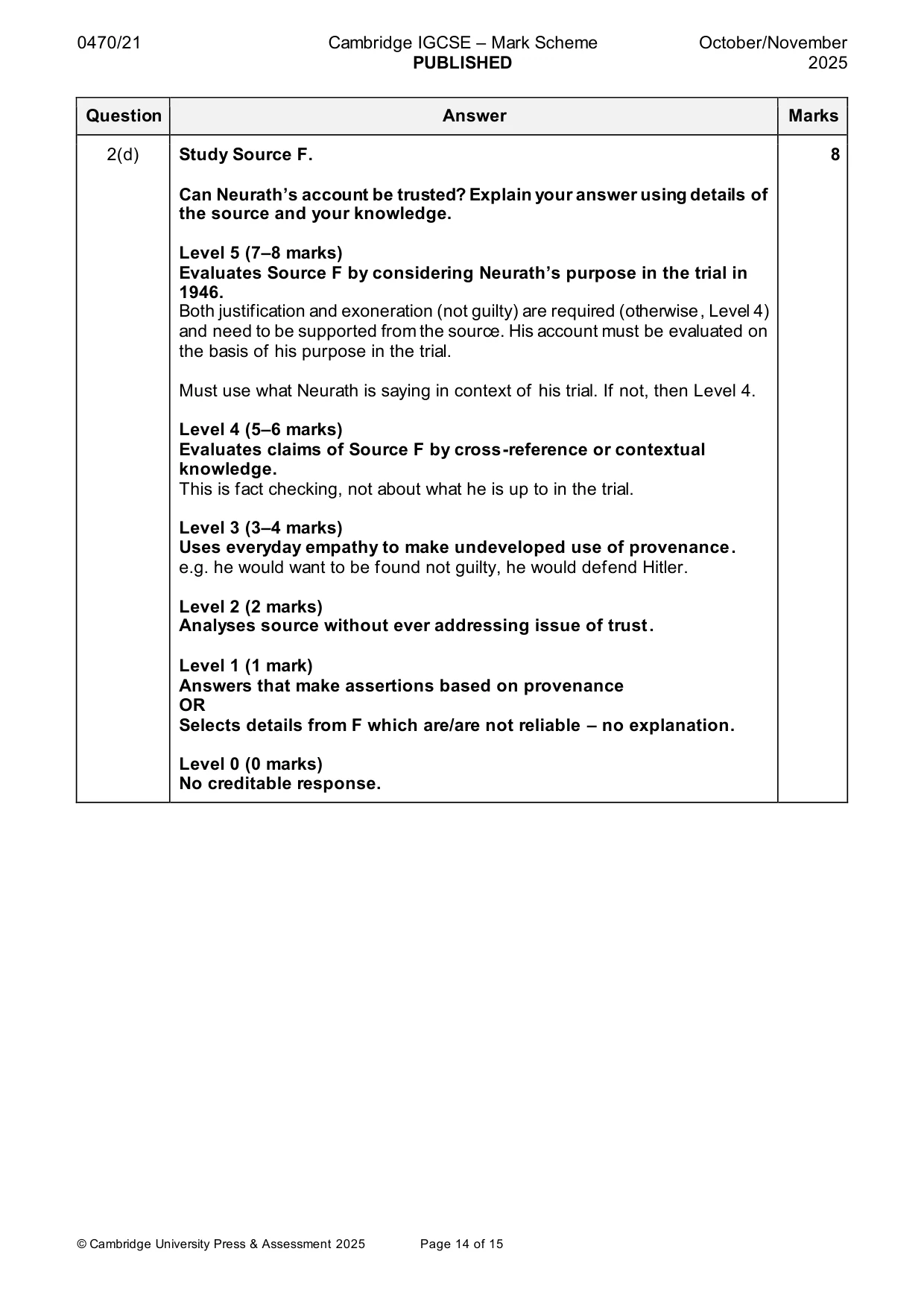
0470/21 Cambridge IGCSE – Mark Scheme PUBLISHED October/November 2025 © Cambridge University Press & Assessment 2025 Page 14 of 15 Question Answer Marks 2(d) Study Source F. Can Neurath’s account be trusted? Explain your answer using details of the source and your knowledge. Level 5 (7–8 marks) Evaluates Source F by considering Neurath’s purpose in the trial in 1946. Both justification and exoneration (not guilty) are required (otherwise, Level 4) and need to be supported from the source. His account must be evaluated on the basis of his purpose in the trial. Must use what Neurath is saying in context of his trial. If not, then Level 4. Level 4 (5–6 marks) Evaluates claims of Source F by cross-reference or contextual knowledge. This is fact checking, not about what he is up to in the trial. Level 3 (3–4 marks) Uses everyday empathy to make undeveloped use of provenance. e.g. he would want to be found not guilty, he would defend Hitler. Level 2 (2 marks) Analyses source without ever addressing issue of trust. Level 1 (1 mark) Answers that make assertions based on provenance OR Selects details from F which are/are not reliable – no explanation. Level 0 (0 marks) No creditable response. 8
Mark scheme, page 15
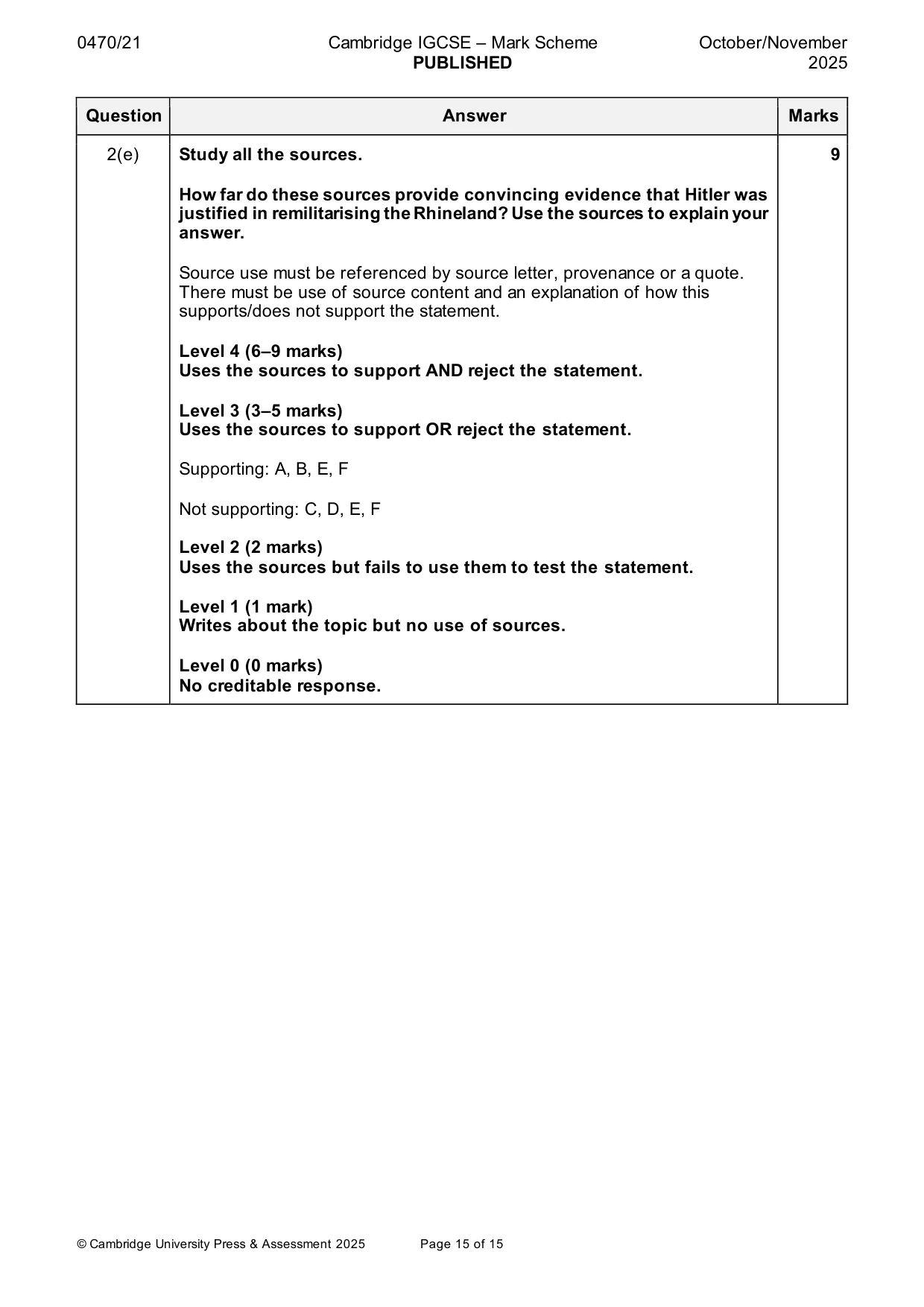
0470/21 Cambridge IGCSE – Mark Scheme PUBLISHED October/November 2025 © Cambridge University Press & Assessment 2025 Page 15 of 15 Question Answer Marks 2(e) Study all the sources. How far do these sources provide convincing evidence that Hitler was justified in remilitarising the Rhineland? Use the sources to explain your answer. Source use must be referenced by source letter, provenance or a quote. There must be use of source content and an explanation of how this supports/does not support the statement. Level 4 (6–9 marks) Uses the sources to support AND reject the statement. Level 3 (3–5 marks) Uses the sources to support OR reject the statement. Supporting: A, B, E, F Not supporting: C, D, E, F Level 2 (2 marks) Uses the sources but fails to use them to test the statement. Level 1 (1 mark) Writes about the topic but no use of sources. Level 0 (0 marks) No creditable response. 9
What you needed in this session
Cambridge’s own grade thresholds for 2025 Oct/Nov, Paper 2 · Variant 1. A higher threshold means an easier paper — the bar moves with how the cohort did.