Cambridge IGCSE History 0470 — 2025 Oct/Nov Paper 2 · Variant 2
0470/22/O/N/25 · 40 marks · 105 min
The question paper and its mark scheme, free to read here and free to download. This is Cambridge’s own paper, exactly as it was sat.
Question paper12 pages

Mark scheme15 pages
Answers below. Sit the paper first if you are practising.
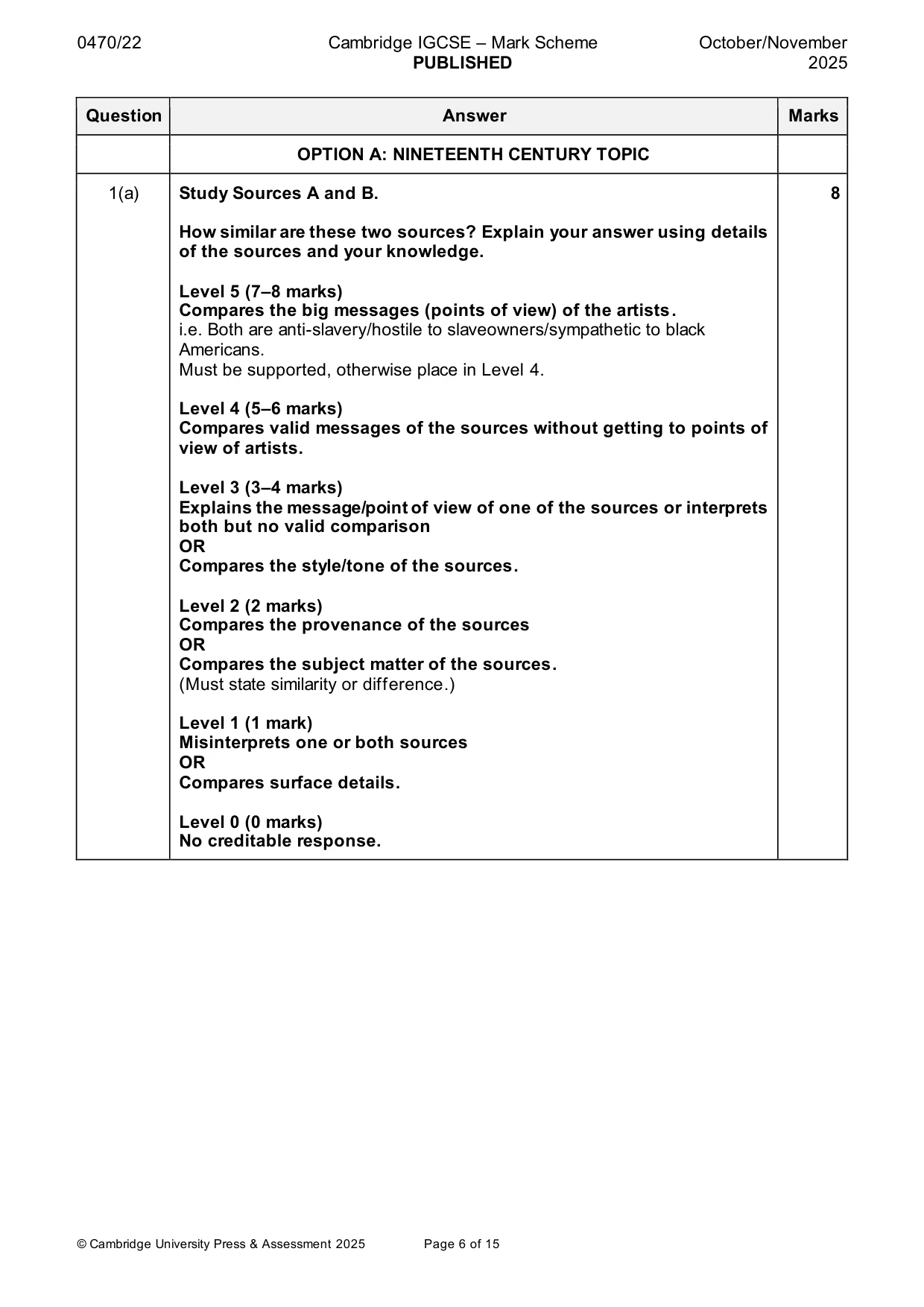
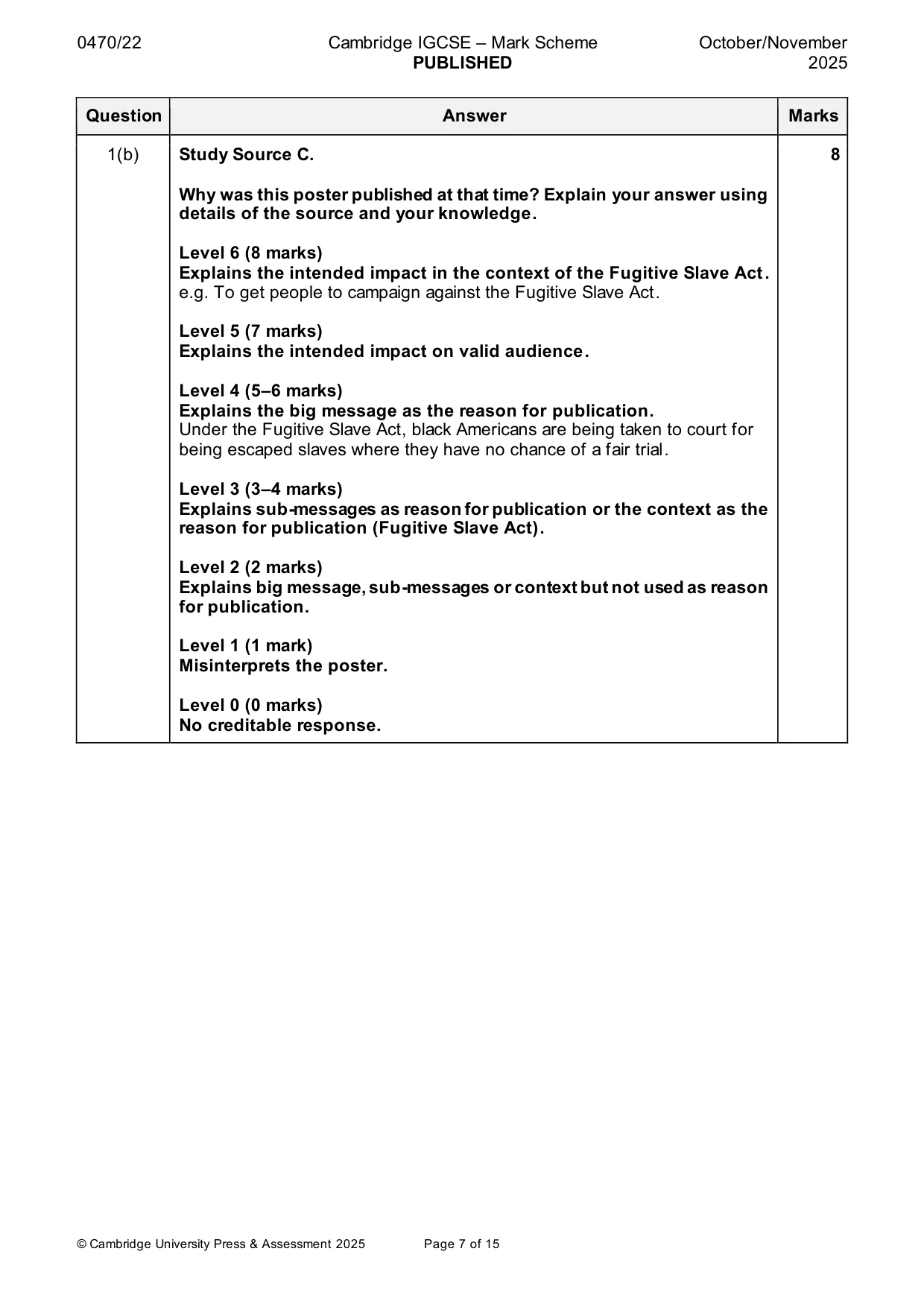
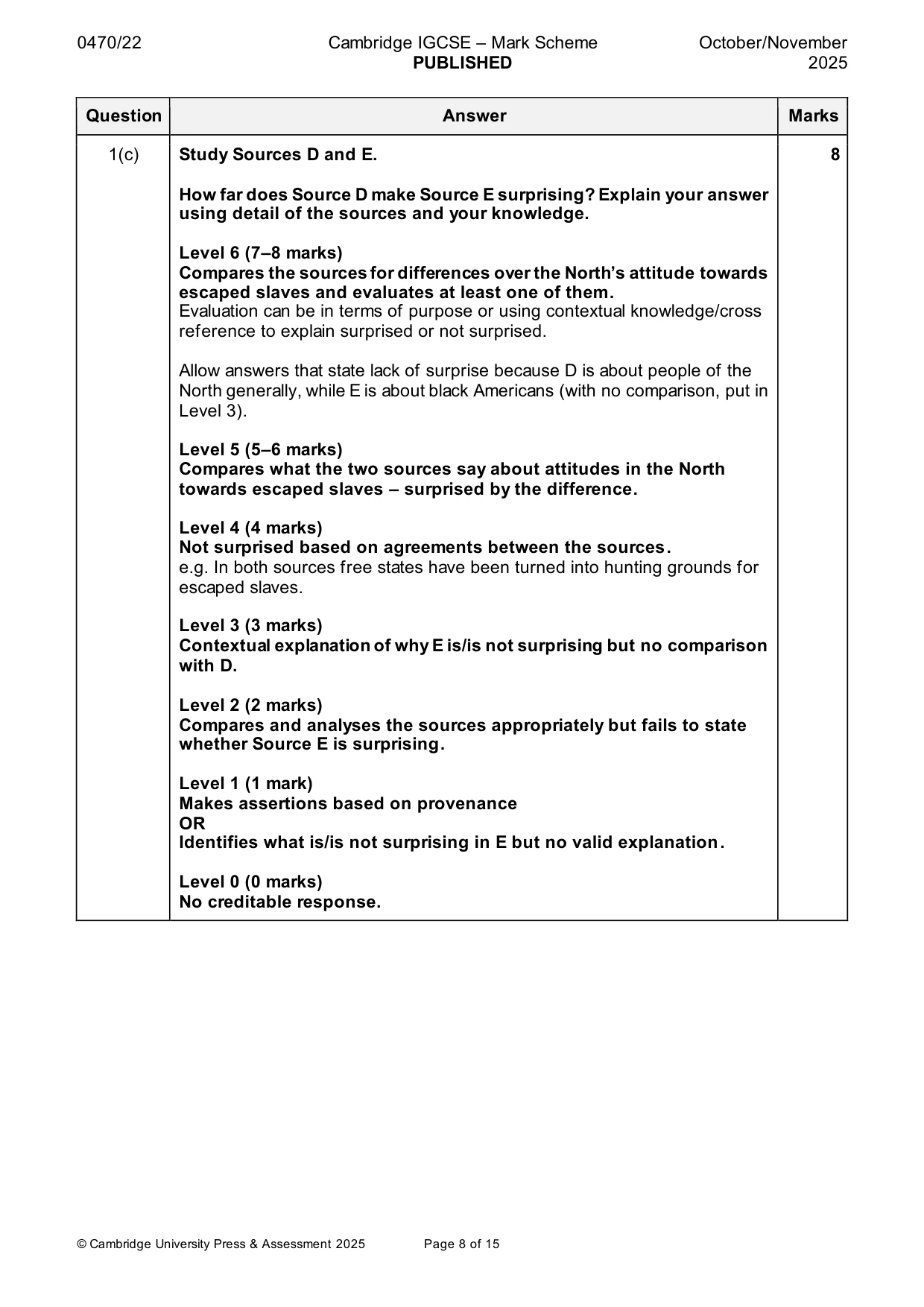
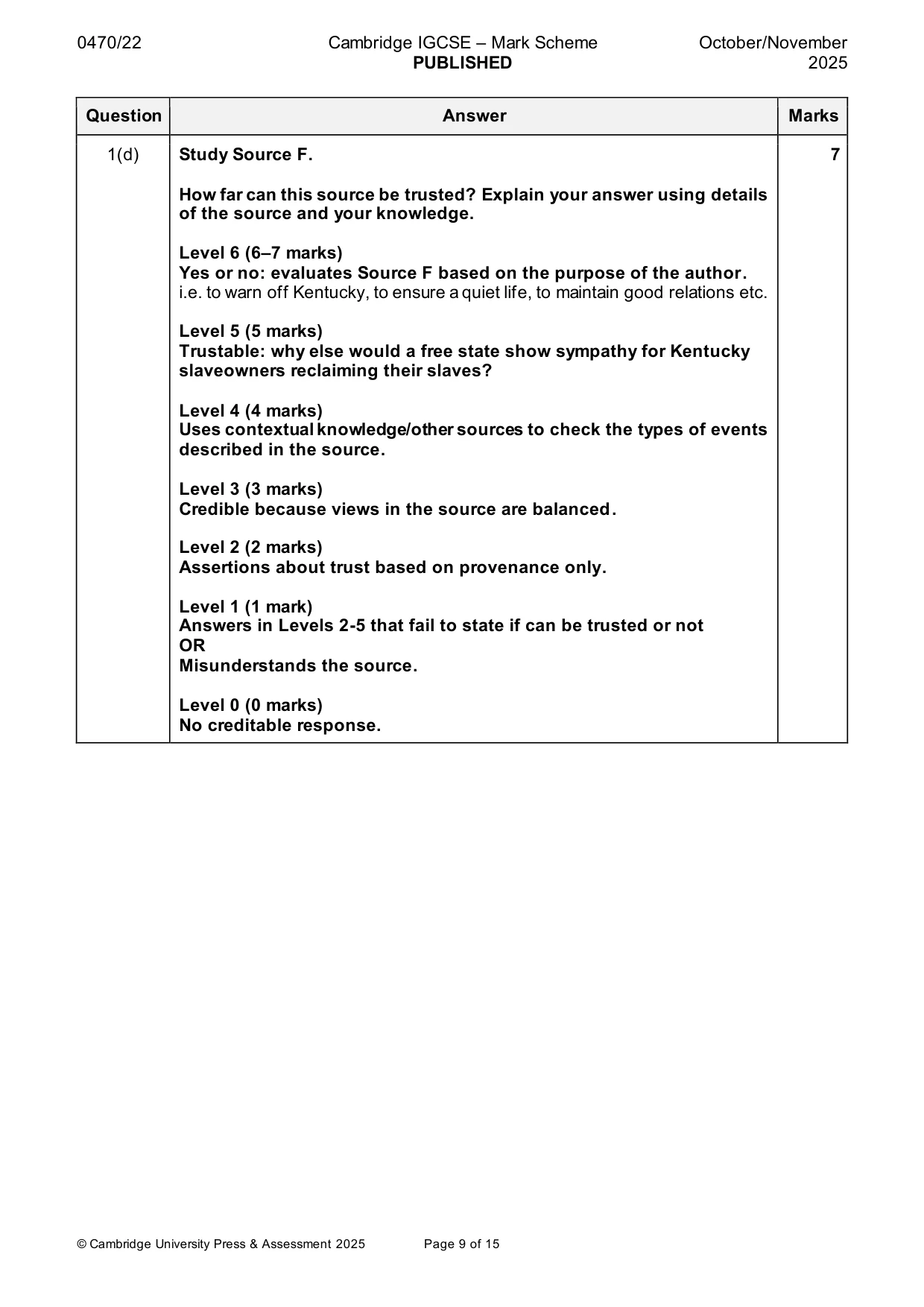
Paper as text
Question paper, page 1
Cambridge Assessment International Education Cambridge IGCSE™ HISTORY 0470/22 Paper 2 Document Questions October/November 2025 1 hour 45 minutes You must answer on the enclosed answer booklet. You will need: Answer booklet (enclosed) INSTRUCTIONS e Answer one question on one option only. Option A: Nineteenth century topic Option B: Twentieth century topic e Follow the instructions on the front cover of the answer booklet. If you need additional answer paper, ask the invigilator for a continuation booklet. INFORMATION e The total mark for this paper is 40. e The number of marks for each question or part question is shown in brackets [ ]. This document has 12 pages. Any blank pages are indicated. DC (KS/KS) 343468/3 © UCLES 2025 [Turn over
Question paper, page 2
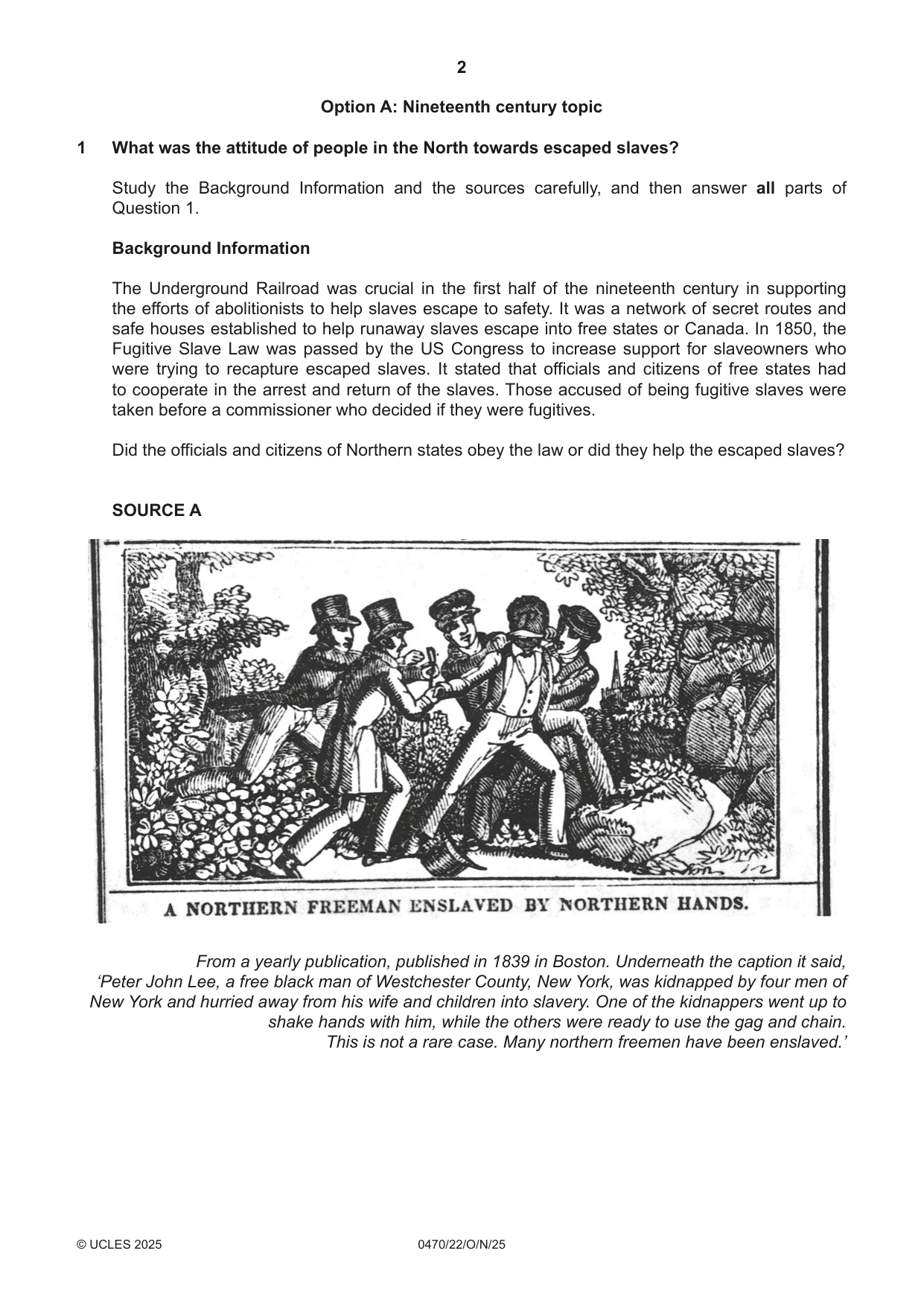
2 0470/22/O/N/25 © UCLES 2025 Option A: Nineteenth century topic 1 What was the attitude of people in the North towards escaped slaves? Study the Background Information and the sources carefully, and then answer all parts of Question 1. Background Information The Underground Railroad was crucial in the first half of the nineteenth century in supporting the efforts of abolitionists to help slaves escape to safety. It was a network of secret routes and safe houses established to help runaway slaves escape into free states or Canada. In 1850, the Fugitive Slave Law was passed by the US Congress to increase support for slaveowners who were trying to recapture escaped slaves. It stated that officials and citizens of free states had to cooperate in the arrest and return of the slaves. Those accused of being fugitive slaves were taken before a commissioner who decided if they were fugitives. Did the officials and citizens of Northern states obey the law or did they help the escaped slaves? SOURCE A From a yearly publication, published in 1839 in Boston. Underneath the caption it said, ‘Peter John Lee, a free black man of Westchester County, New York, was kidnapped by four men of New York and hurried away from his wife and children into slavery. One of the kidnappers went up to shake hands with him, while the others were ready to use the gag and chain. This is not a rare case. Many northern freemen have been enslaved.’
Question paper, page 3
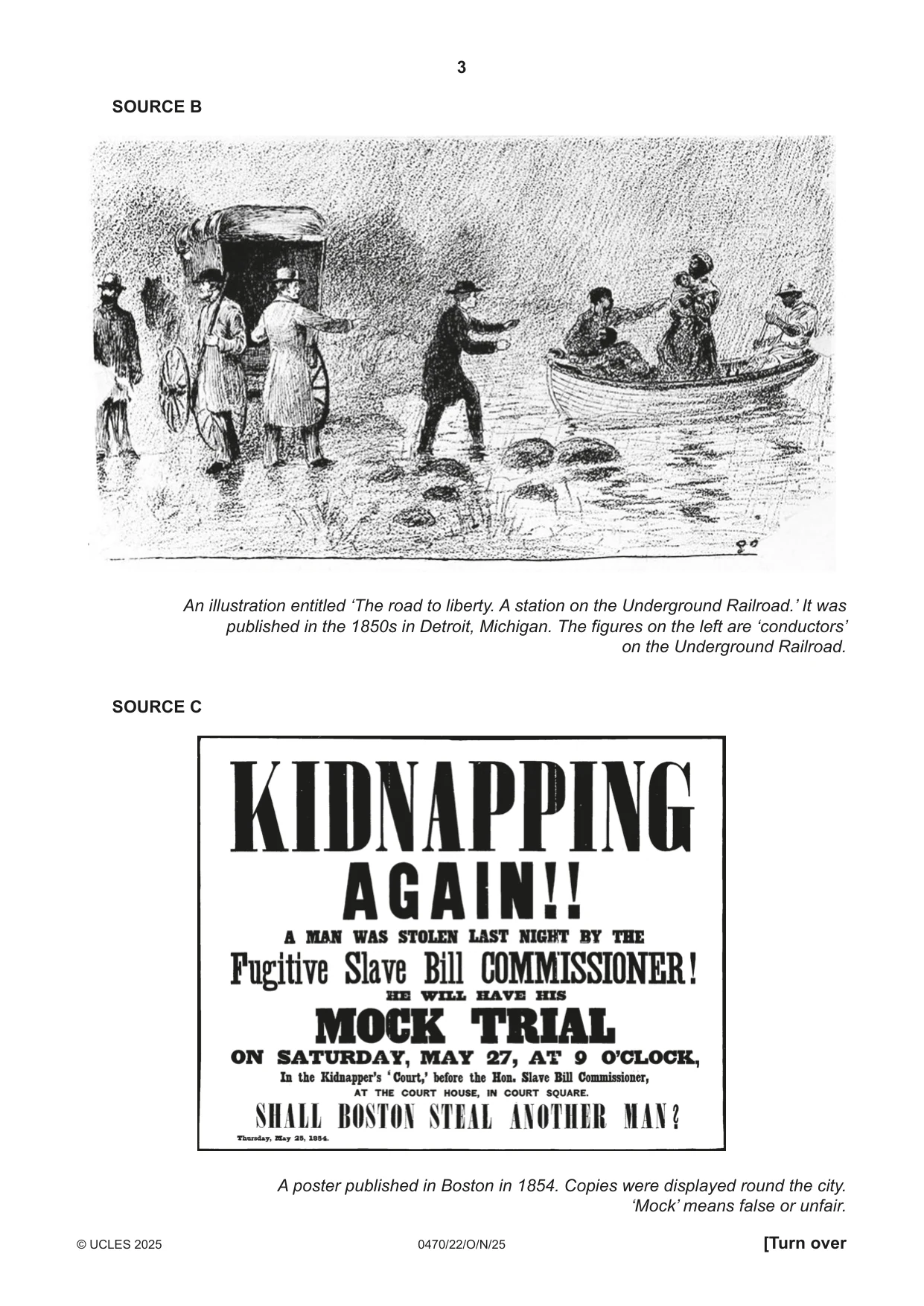
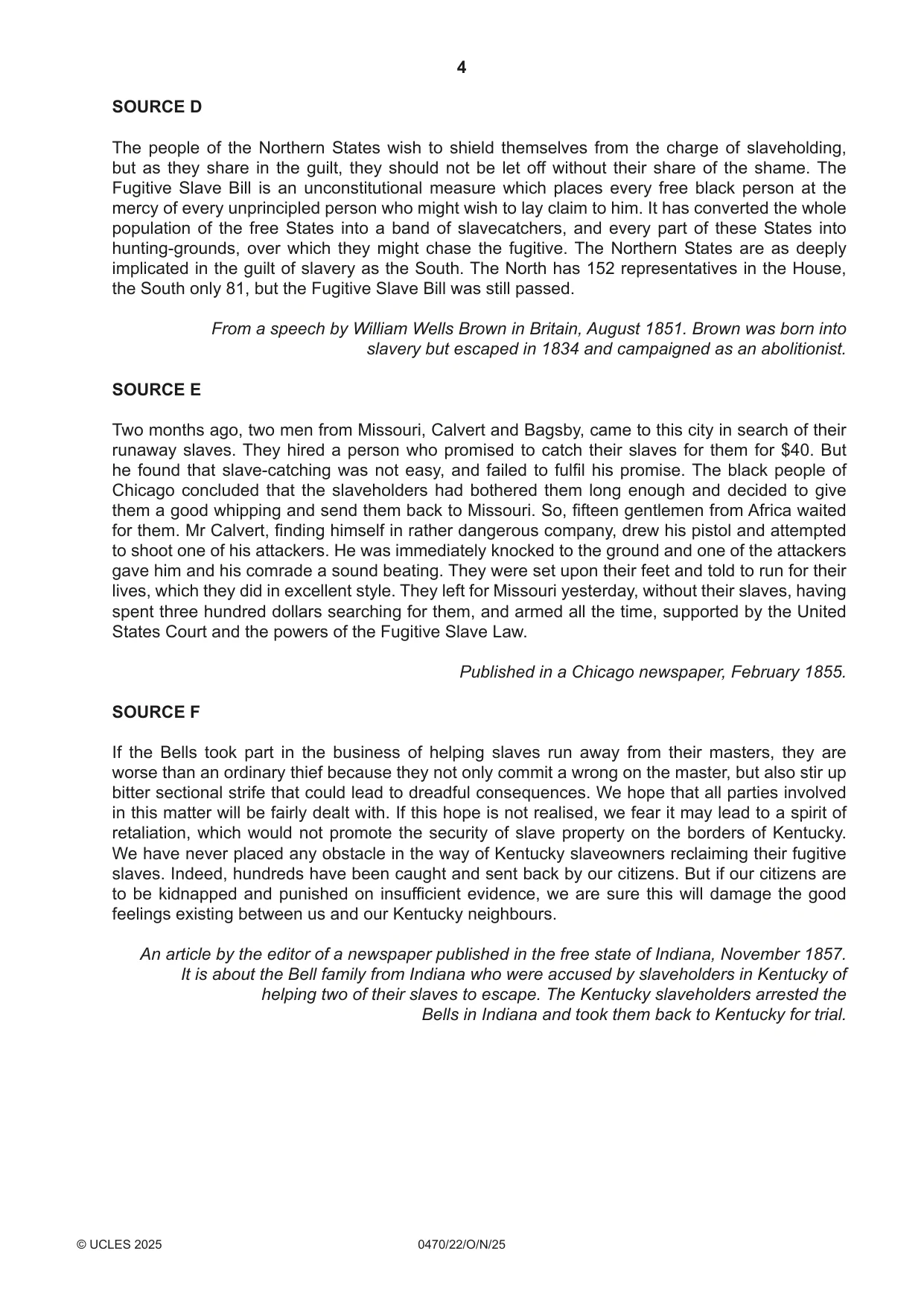
3 0470/22/O/N/25 © UCLES 2025 [Turn over SOURCE B An illustration entitled ‘The road to liberty. A station on the Underground Railroad.’ It was published in the 1850s in Detroit, Michigan. The figures on the left are ‘conductors’ on the Underground Railroad. SOURCE C A poster published in Boston in 1854. Copies were displayed round the city. ‘Mock’ means false or unfair.
Question paper, page 4
4 0470/22/O/N/25 © UCLES 2025 SOURCE D The people of the Northern States wish to shield themselves from the charge of slaveholding, but as they share in the guilt, they should not be let off without their share of the shame. The Fugitive Slave Bill is an unconstitutional measure which places every free black person at the mercy of every unprincipled person who might wish to lay claim to him. It has converted the whole population of the free States into a band of slavecatchers, and every part of these States into hunting-grounds, over which they might chase the fugitive. The Northern States are as deeply implicated in the guilt of slavery as the South. The North has 152 representatives in the House, the South only 81, but the Fugitive Slave Bill was still passed. From a speech by William Wells Brown in Britain, August 1851. Brown was born into slavery but escaped in 1834 and campaigned as an abolitionist. SOURCE E Two months ago, two men from Missouri, Calvert and Bagsby, came to this city in search of their runaway slaves. They hired a person who promised to catch their slaves for them for $40. But he found that slave-catching was not easy, and failed to fulfil his promise. The black people of Chicago concluded that the slaveholders had bothered them long enough and decided to give them a good whipping and send them back to Missouri. So, fifteen gentlemen from Africa waited for them. Mr Calvert, finding himself in rather dangerous company, drew his pistol and attempted to shoot one of his attackers. He was immediately knocked to the ground and one of the attackers gave him and his comrade a sound beating. They were set upon their feet and told to run for their lives, which they did in excellent style. They left for Missouri yesterday, without their slaves, having spent three hundred dollars searching for them, and armed all the time, supported by the United States Court and the powers of the Fugitive Slave Law. Published in a Chicago newspaper, February 1855. SOURCE F If the Bells took part in the business of helping slaves run away from their masters, they are worse than an ordinary thief because they not only commit a wrong on the master, but also stir up bitter sectional strife that could lead to dreadful consequences. We hope that all parties involved in this matter will be fairly dealt with. If this hope is not realised, we fear it may lead to a spirit of retaliation, which would not promote the security of slave property on the borders of Kentucky. We have never placed any obstacle in the way of Kentucky slaveowners reclaiming their fugitive slaves. Indeed, hundreds have been caught and sent back by our citizens. But if our citizens are to be kidnapped and punished on insufficient evidence, we are sure this will damage the good feelings existing between us and our Kentucky neighbours. An article by the editor of a newspaper published in the free state of Indiana, November 1857. It is about the Bell family from Indiana who were accused by slaveholders in Kentucky of helping two of their slaves to escape. The Kentucky slaveholders arrested the Bells in Indiana and took them back to Kentucky for trial.
Question paper, page 5
5 0470/22/O/N/25 © UCLES 2025 [Turn over Now answer all parts of Question 1. You may use any of the sources to help you answer the questions, in addition to those sources which you are told to use. In answering parts (a)–(e) you should use your knowledge of the topic to help you interpret and evaluate the sources. (a) Study Sources A and B. How similar are these two sources? Explain your answer using details of the sources and your knowledge. [8] (b) Study Source C. Why was this poster published at that time? Explain your answer using details of the source and your knowledge. [8] (c) Study Sources D and E. How far does Source D make Source E surprising? Explain your answer using details of the sources and your knowledge. [8] (d) Study Source F. How far can this source be trusted? Explain your answer using details of the source and your knowledge. [7] (e) Study all the sources. How far do these sources provide convincing evidence that people in the North sympathised with escaping slaves? Use the sources to explain your answer. [9]
Question paper, page 6
6 0470/22/O/N/25 © UCLES 2025 Option B: Twentieth century topic 2 Was Germany justified in remilitarising the Rhineland in 1936? Study the Background Information and the sources carefully, and then answer all parts of Question 2. Background Information On 7 March 1936, German troops marched into the Rhineland. This caused much concern across Europe. The Treaty of Versailles had designated the Rhineland as a demilitarised zone to provide Belgium and France with some protection. Allied troops occupied the Rhineland until 1930. In 1925, the German Government freely signed the Locarno Treaty, accepting the terms of the Treaty of Versailles. In 1936, Hitler claimed that the Mutual Assistance Pact, signed by France and the Soviet Union in May 1935, broke the Locarno Treaty. He said that this meant he was no longer bound by Locarno and had a right to remilitarise the Rhineland. Many people in Britain thought Germany had a right to have troops there. Hitler was also worried that the French–Soviet agreement could lead to an encirclement of Germany by hostile powers. Was Germany justified in remilitarising the Rhineland?
Question paper, page 7
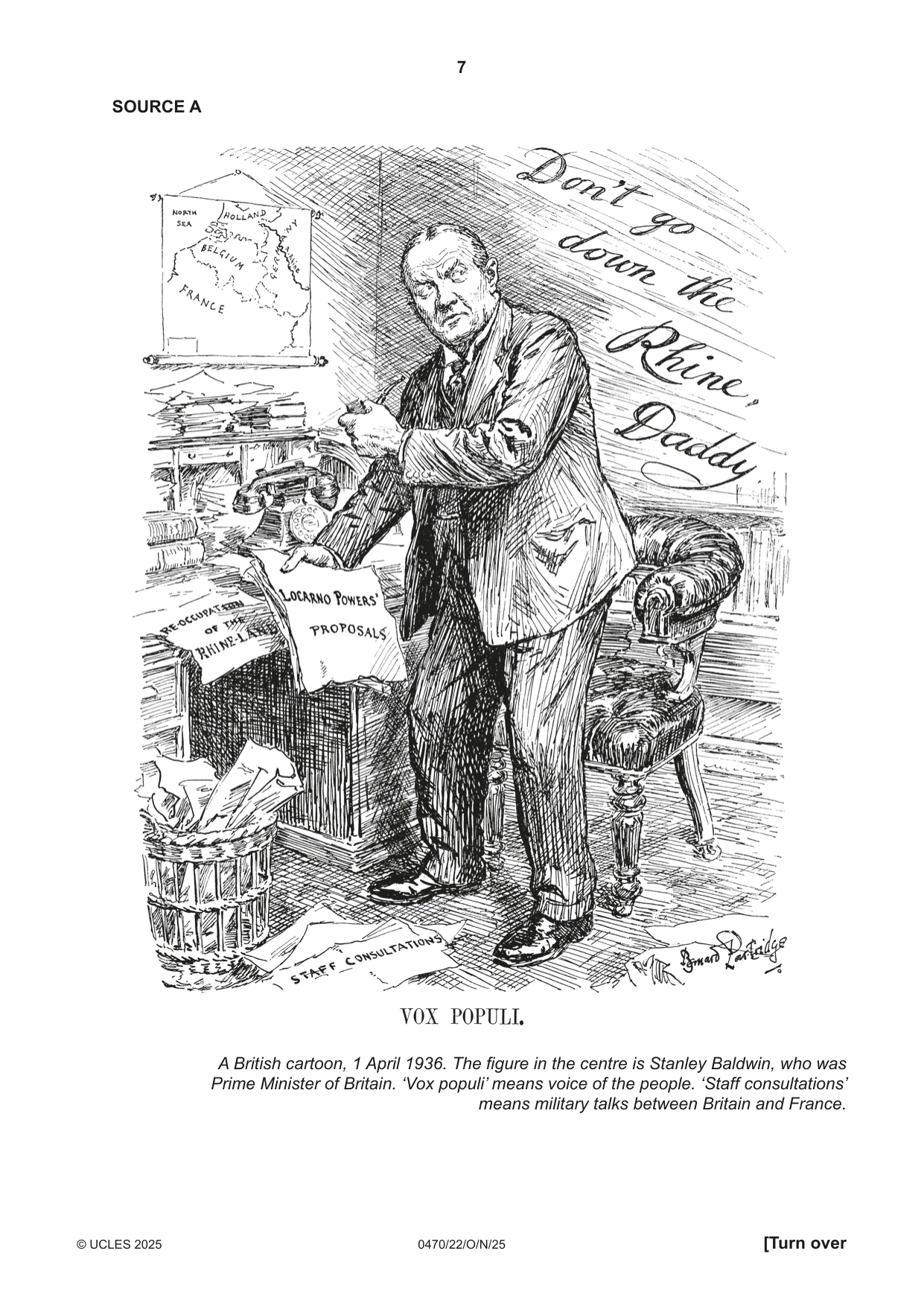
7 0470/22/O/N/25 © UCLES 2025 [Turn over SOURCE A A British cartoon, 1 April 1936. The figure in the centre is Stanley Baldwin, who was Prime Minister of Britain. ‘Vox populi’ means voice of the people. ‘Staff consultations’ means military talks between Britain and France.
Question paper, page 8
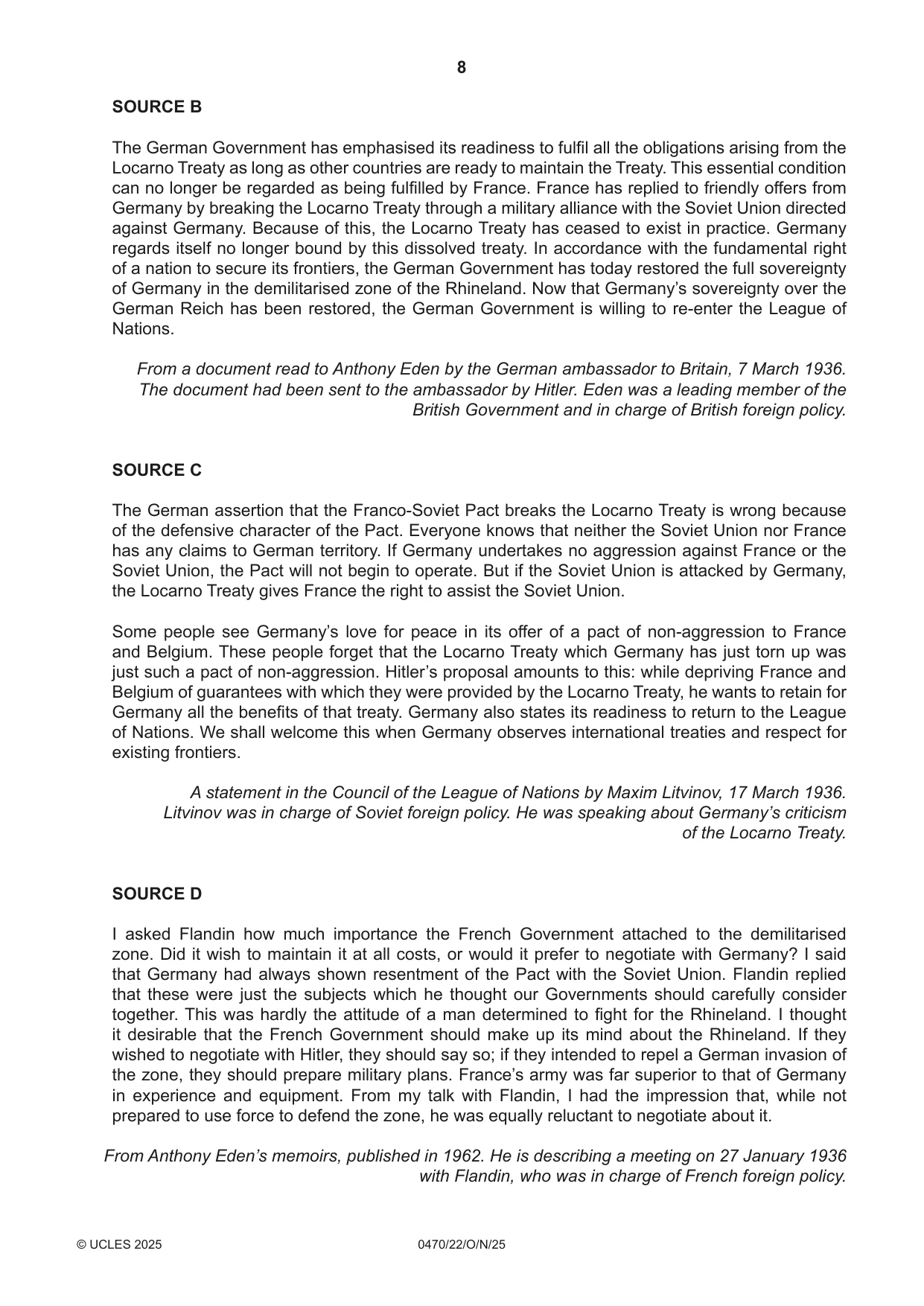
8 0470/22/O/N/25 © UCLES 2025 SOURCE B The German Government has emphasised its readiness to fulfil all the obligations arising from the Locarno Treaty as long as other countries are ready to maintain the Treaty. This essential condition can no longer be regarded as being fulfilled by France. France has replied to friendly offers from Germany by breaking the Locarno Treaty through a military alliance with the Soviet Union directed against Germany. Because of this, the Locarno Treaty has ceased to exist in practice. Germany regards itself no longer bound by this dissolved treaty. In accordance with the fundamental right of a nation to secure its frontiers, the German Government has today restored the full sovereignty of Germany in the demilitarised zone of the Rhineland. Now that Germany’s sovereignty over the German Reich has been restored, the German Government is willing to re-enter the League of Nations. From a document read to Anthony Eden by the German ambassador to Britain, 7 March 1936. The document had been sent to the ambassador by Hitler. Eden was a leading member of the British Government and in charge of British foreign policy. SOURCE C The German assertion that the Franco-Soviet Pact breaks the Locarno Treaty is wrong because of the defensive character of the Pact. Everyone knows that neither the Soviet Union nor France has any claims to German territory. If Germany undertakes no aggression against France or the Soviet Union, the Pact will not begin to operate. But if the Soviet Union is attacked by Germany, the Locarno Treaty gives France the right to assist the Soviet Union. Some people see Germany’s love for peace in its offer of a pact of non-aggression to France and Belgium. These people forget that the Locarno Treaty which Germany has just torn up was just such a pact of non-aggression. Hitler’s proposal amounts to this: while depriving France and Belgium of guarantees with which they were provided by the Locarno Treaty, he wants to retain for Germany all the benefits of that treaty. Germany also states its readiness to return to the League of Nations. We shall welcome this when Germany observes international treaties and respect for existing frontiers. A statement in the Council of the League of Nations by Maxim Litvinov, 17 March 1936. Litvinov was in charge of Soviet foreign policy. He was speaking about Germany’s criticism of the Locarno Treaty. SOURCE D I asked Flandin how much importance the French Government attached to the demilitarised zone. Did it wish to maintain it at all costs, or would it prefer to negotiate with Germany? I said that Germany had always shown resentment of the Pact with the Soviet Union. Flandin replied that these were just the subjects which he thought our Governments should carefully consider together. This was hardly the attitude of a man determined to fight for the Rhineland. I thought it desirable that the French Government should make up its mind about the Rhineland. If they wished to negotiate with Hitler, they should say so; if they intended to repel a German invasion of the zone, they should prepare military plans. France’s army was far superior to that of Germany in experience and equipment. From my talk with Flandin, I had the impression that, while not prepared to use force to defend the zone, he was equally reluctant to negotiate about it. From Anthony Eden’s memoirs, published in 1962. He is describing a meeting on 27 January 1936 with Flandin, who was in charge of French foreign policy.
Question paper, page 9
9 0470/22/O/N/25 © UCLES 2025 [Turn over SOURCE E In defiance of the Locarno Pact, the German government has sent considerable forces into the demilitarised zone, without even having looked into entering negotiations on the subject. There can be no more peace in Europe, there can be no more international relations if this method is accepted. Speaking in the name of the French government, I declare that we intend to see this essential guarantee of French security maintained. We are not willing to leave French cities placed under the fire of German cannons. From a radio broadcast to the French people by Albert Sarraut, the French Prime Minister, 8 March 1936. SOURCE F A cartoon, entitled ‘The watch on the Rhine’, published in an American newspaper, 10 March 1936. ‘The watch’ is a group of soldiers whose duty is to offer protection. Content removed due to copyright restrictions.
Question paper, page 10
10 0470/22/O/N/25 © UCLES 2025 SOURCE G A cartoon published in an American newspaper, March 1936. Content removed due to copyright restrictions.
Question paper, page 11
11 0470/22/O/N/25 © UCLES 2025 Now answer all parts of Question 2. You may use any of the sources to help you answer the questions, in addition to those sources which you are told to use. In answering parts (a)–(e) you should use your knowledge of the topic to help you interpret and evaluate the sources. (a) Study Source A. What is the cartoonist’s message? Explain your answer using details of the source and your knowledge. [7] (b) Study Sources B and C. How far do these two sources agree? Explain your answer using details of the sources and your knowledge. [8] (c) Study Sources D and E. How far does Source D make Source E surprising? Explain your answer using details of the sources and your knowledge. [8] (d) Study Sources F and G. How similar are these two cartoons? Explain your answer using details of the sources and your knowledge. [8] (e) Study all the sources. How far do these sources provide convincing evidence that Hitler was justified in remilitarising the Rhineland? Use the sources to explain your answer. [9]
Question paper, page 12
12 0470/22/O/N/25 © UCLES 2025 Permission to reproduce items where third-party owned material protected by copyright is included has been sought and cleared where possible. Every reasonable effort has been made by the publisher (UCLES) to trace copyright holders, but if any items requiring clearance have unwittingly been included, the publisher will be pleased to make amends at the earliest possible opportunity. To avoid the issue of disclosure of answer-related information to candidates, all copyright acknowledgements are reproduced online in the Cambridge Assessment International Education Copyright Acknowledgements Booklet. This is produced for each series of examinations and is freely available to download at www.cambridgeinternational.org after the live examination series. Cambridge Assessment International Education is part of Cambridge Assessment. Cambridge Assessment is the brand name of the University of Cambridge Local Examinations Syndicate (UCLES), which is a department of the University of Cambridge. BLANK PAGE
Mark scheme, page 1
This document consists of 15 printed pages. © Cambridge University Press & Assessment 2025 [Turn over Cambridge IGCSE™ HISTORY 0470/22 Paper 2 October/November 2025 MARK SCHEME Maximum Mark: 40 Published This mark scheme is published as an aid to teachers and candidates, to indicate the requirements of the examination. It shows the basis on which Examiners were instructed to award marks. It does not indicate the details of the discussions that took place at an Examiners’ meeting before marking began, which would have considered the acceptability of alternative answers. Mark schemes should be read in conjunction with the question paper and the Principal Examiner Report for Teachers. Cambridge International will not enter into discussions about these mark schemes. Cambridge International is publishing the mark schemes for the October/November 2025 series for most Cambridge IGCSE, Cambridge International A and AS Level components, and some Cambridge O Level components.
Mark scheme, page 2
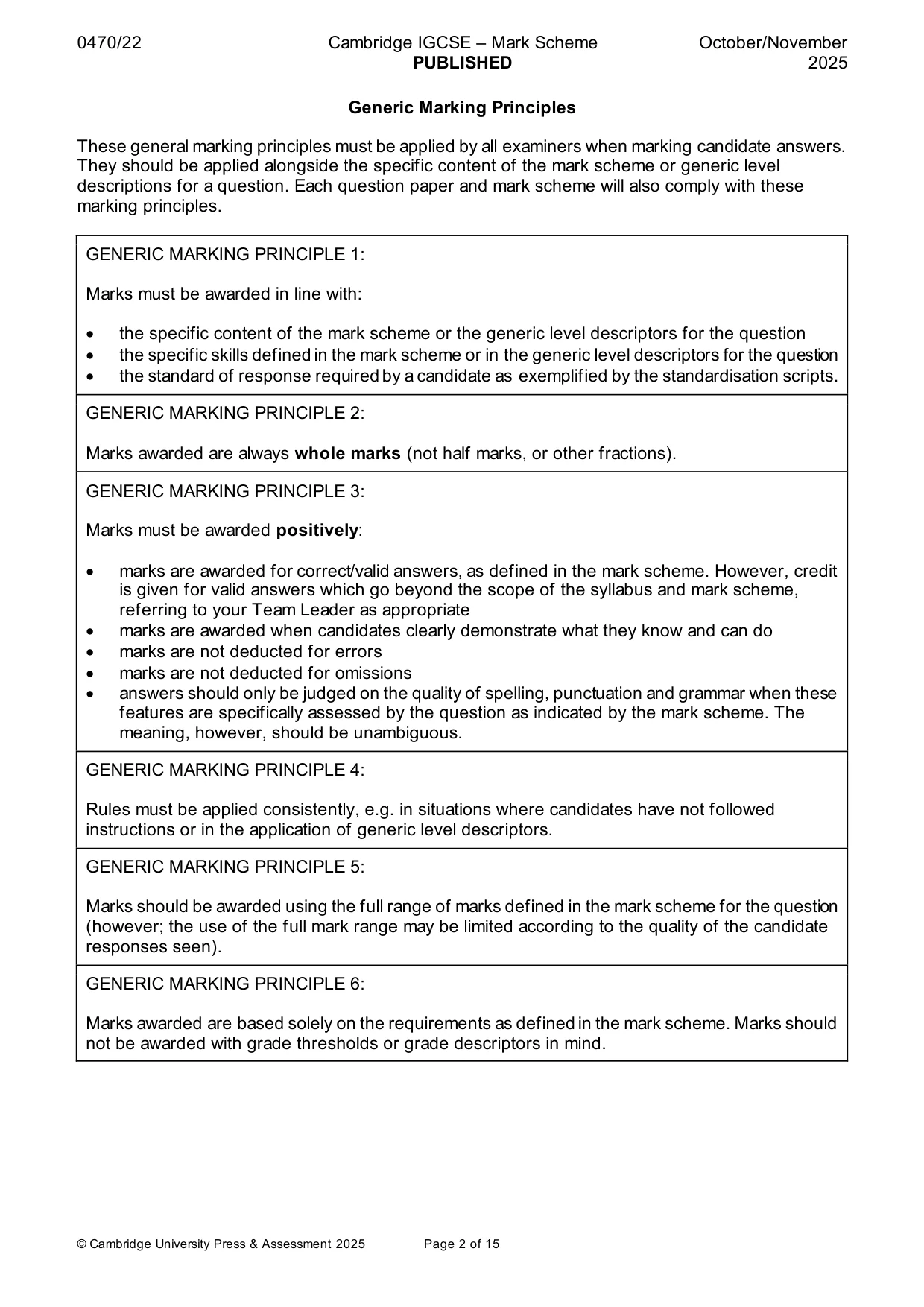
0470/22 Cambridge IGCSE – Mark Scheme PUBLISHED October/November 2025 © Cambridge University Press & Assessment 2025 Page 2 of 15 Generic Marking Principles These general marking principles must be applied by all examiners when marking candidate answers. They should be applied alongside the specific content of the mark scheme or generic level descriptions for a question. Each question paper and mark scheme will also comply with these marking principles. GENERIC MARKING PRINCIPLE 1: Marks must be awarded in line with: • the specific content of the mark scheme or the generic level descriptors for the question • the specific skills defined in the mark scheme or in the generic level descriptors for the question • the standard of response required by a candidate as exemplified by the standardisation scripts. GENERIC MARKING PRINCIPLE 2: Marks awarded are always whole marks (not half marks, or other fractions). GENERIC MARKING PRINCIPLE 3: Marks must be awarded positively: • marks are awarded for correct/valid answers, as defined in the mark scheme. However, credit is given for valid answers which go beyond the scope of the syllabus and mark scheme, referring to your Team Leader as appropriate • marks are awarded when candidates clearly demonstrate what they know and can do • marks are not deducted for errors • marks are not deducted for omissions • answers should only be judged on the quality of spelling, punctuation and grammar when these features are specifically assessed by the question as indicated by the mark scheme. The meaning, however, should be unambiguous. GENERIC MARKING PRINCIPLE 4: Rules must be applied consistently, e.g. in situations where candidates have not followed instructions or in the application of generic level descriptors. GENERIC MARKING PRINCIPLE 5: Marks should be awarded using the full range of marks defined in the mark scheme for the question (however; the use of the full mark range may be limited according to the quality of the candidate responses seen). GENERIC MARKING PRINCIPLE 6: Marks awarded are based solely on the requirements as defined in the mark scheme. Marks should not be awarded with grade thresholds or grade descriptors in mind.
Mark scheme, page 3
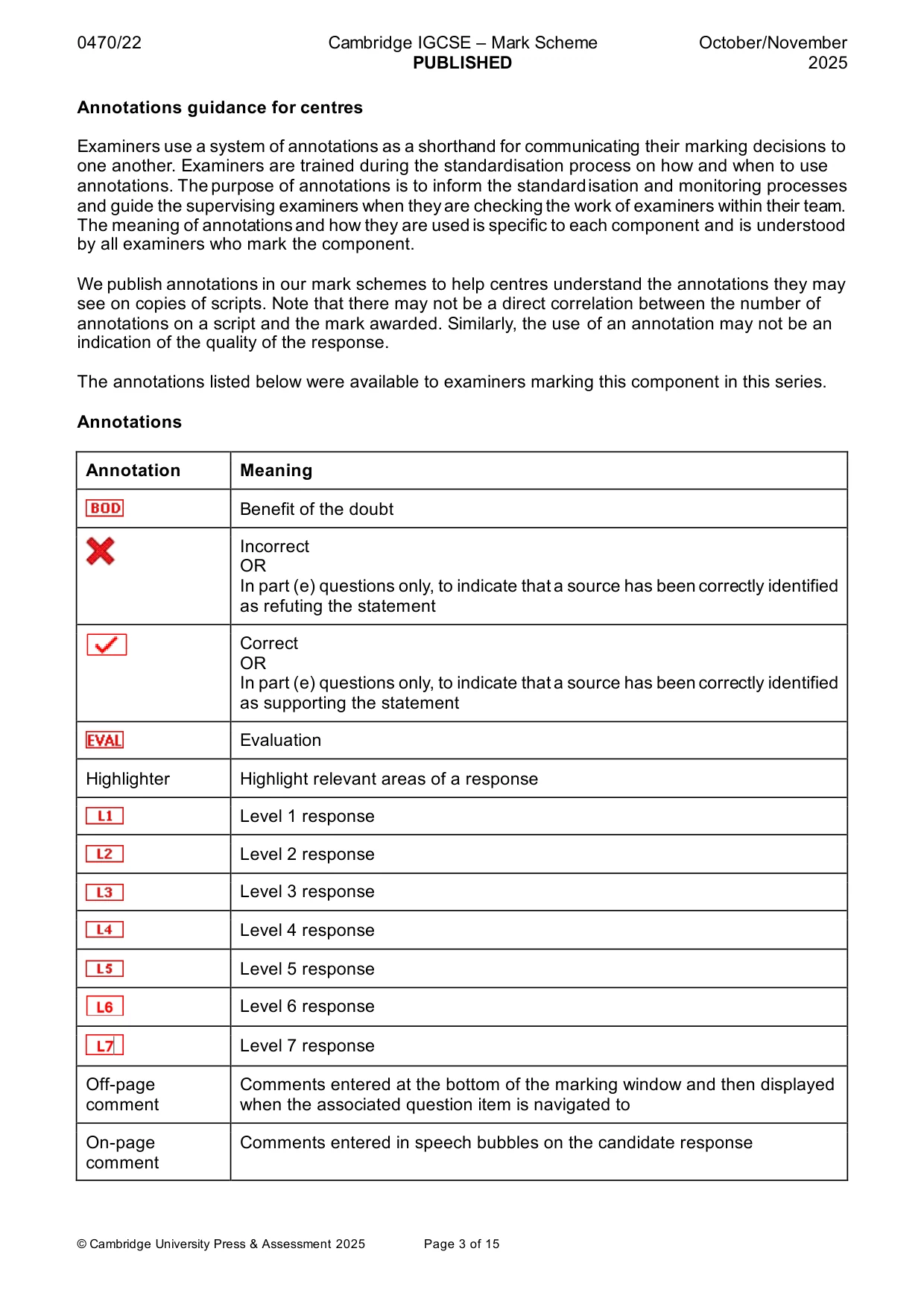
0470/22 Cambridge IGCSE – Mark Scheme PUBLISHED October/November 2025 © Cambridge University Press & Assessment 2025 Page 3 of 15 Annotations guidance for centres Examiners use a system of annotations as a shorthand for communicating their marking decisions to one another. Examiners are trained during the standardisation process on how and when to use annotations. The purpose of annotations is to inform the standardisation and monitoring processes and guide the supervising examiners when they are checking the work of examiners within their team. The meaning of annotations and how they are used is specific to each component and is understood by all examiners who mark the component. We publish annotations in our mark schemes to help centres understand the annotations they may see on copies of scripts. Note that there may not be a direct correlation between the number of annotations on a script and the mark awarded. Similarly, the use of an annotation may not be an indication of the quality of the response. The annotations listed below were available to examiners marking this component in this series. Annotations Annotation Meaning Benefit of the doubt Incorrect OR In part (e) questions only, to indicate that a source has been correctly identified as refuting the statement Correct OR In part (e) questions only, to indicate that a source has been correctly identified as supporting the statement Evaluation Highlighter Highlight relevant areas of a response Level 1 response Level 2 response Level 3 response Level 4 response Level 5 response Level 6 response Level 7 response Off-page comment Comments entered at the bottom of the marking window and then displayed when the associated question item is navigated to On-page comment Comments entered in speech bubbles on the candidate response
Mark scheme, page 4
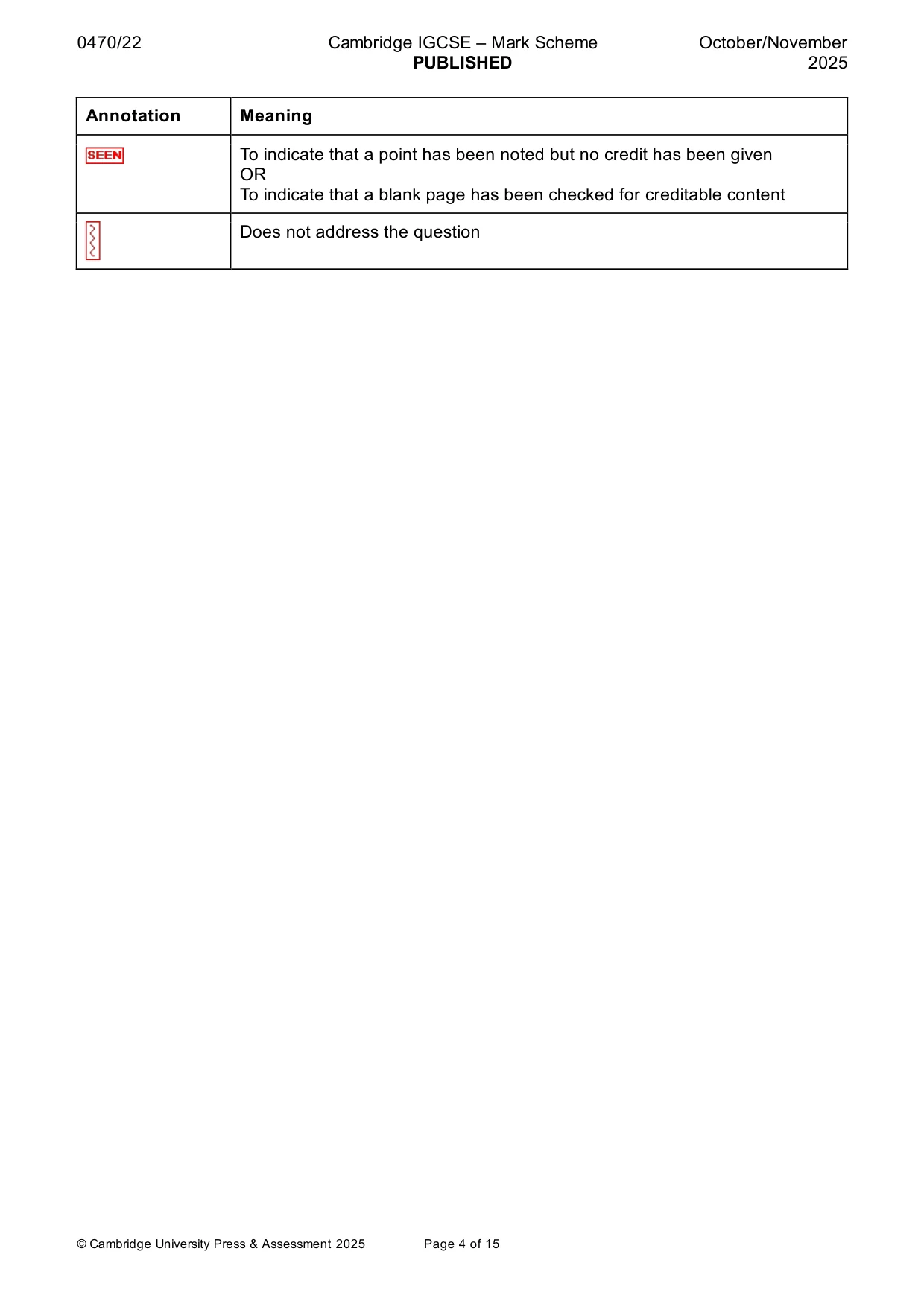
0470/22 Cambridge IGCSE – Mark Scheme PUBLISHED October/November 2025 © Cambridge University Press & Assessment 2025 Page 4 of 15 Annotation Meaning To indicate that a point has been noted but no credit has been given OR To indicate that a blank page has been checked for creditable content Does not address the question
Mark scheme, page 5
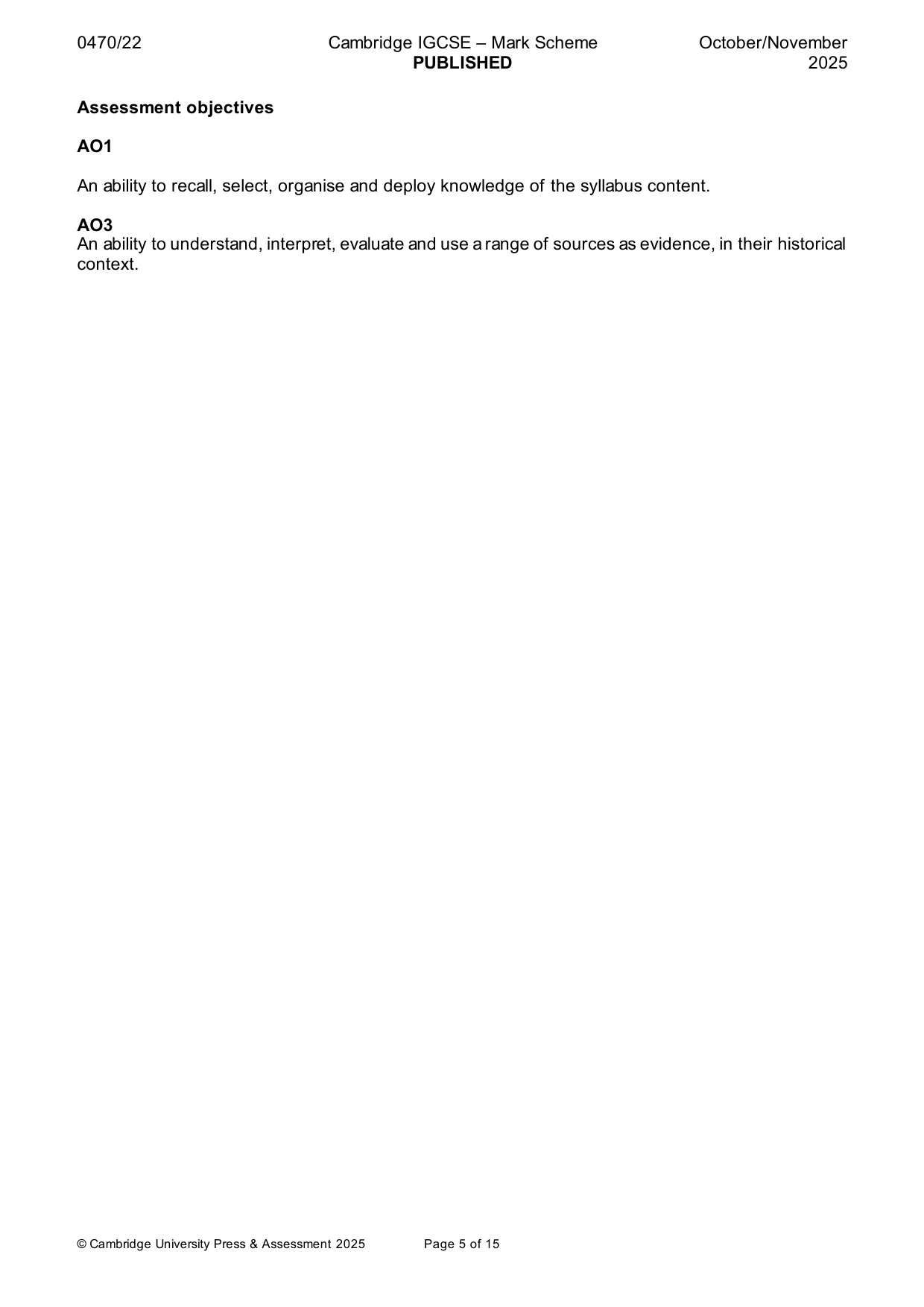
0470/22 Cambridge IGCSE – Mark Scheme PUBLISHED October/November 2025 © Cambridge University Press & Assessment 2025 Page 5 of 15 Assessment objectives AO1 An ability to recall, select, organise and deploy knowledge of the syllabus content. AO3 An ability to understand, interpret, evaluate and use a range of sources as evidence, in their historical context.
Mark scheme, page 6
0470/22 Cambridge IGCSE – Mark Scheme PUBLISHED October/November 2025 © Cambridge University Press & Assessment 2025 Page 6 of 15 Question Answer Marks OPTION A: NINETEENTH CENTURY TOPIC 1(a) Study Sources A and B. How similar are these two sources? Explain your answer using details of the sources and your knowledge. Level 5 (7–8 marks) Compares the big messages (points of view) of the artists. i.e. Both are anti-slavery/hostile to slaveowners/sympathetic to black Americans. Must be supported, otherwise place in Level 4. Level 4 (5–6 marks) Compares valid messages of the sources without getting to points of view of artists. Level 3 (3–4 marks) Explains the message/point of view of one of the sources or interprets both but no valid comparison OR Compares the style/tone of the sources. Level 2 (2 marks) Compares the provenance of the sources OR Compares the subject matter of the sources. (Must state similarity or difference.) Level 1 (1 mark) Misinterprets one or both sources OR Compares surface details. Level 0 (0 marks) No creditable response. 8
Mark scheme, page 7
0470/22 Cambridge IGCSE – Mark Scheme PUBLISHED October/November 2025 © Cambridge University Press & Assessment 2025 Page 7 of 15 Question Answer Marks 1(b) Study Source C. Why was this poster published at that time? Explain your answer using details of the source and your knowledge. Level 6 (8 marks) Explains the intended impact in the context of the Fugitive Slave Act. e.g. To get people to campaign against the Fugitive Slave Act. Level 5 (7 marks) Explains the intended impact on valid audience. Level 4 (5–6 marks) Explains the big message as the reason for publication. Under the Fugitive Slave Act, black Americans are being taken to court for being escaped slaves where they have no chance of a fair trial. Level 3 (3–4 marks) Explains sub-messages as reason for publication or the context as the reason for publication (Fugitive Slave Act). Level 2 (2 marks) Explains big message, sub-messages or context but not used as reason for publication. Level 1 (1 mark) Misinterprets the poster. Level 0 (0 marks) No creditable response. 8
Mark scheme, page 8
0470/22 Cambridge IGCSE – Mark Scheme PUBLISHED October/November 2025 © Cambridge University Press & Assessment 2025 Page 8 of 15 Question Answer Marks 1(c) Study Sources D and E. How far does Source D make Source E surprising? Explain your answer using detail of the sources and your knowledge. Level 6 (7–8 marks) Compares the sources for differences over the North’s attitude towards escaped slaves and evaluates at least one of them. Evaluation can be in terms of purpose or using contextual knowledge/cross reference to explain surprised or not surprised. Allow answers that state lack of surprise because D is about people of the North generally, while E is about black Americans (with no comparison, put in Level 3). Level 5 (5–6 marks) Compares what the two sources say about attitudes in the North towards escaped slaves – surprised by the difference. Level 4 (4 marks) Not surprised based on agreements between the sources. e.g. In both sources free states have been turned into hunting grounds for escaped slaves. Level 3 (3 marks) Contextual explanation of why E is/is not surprising but no comparison with D. Level 2 (2 marks) Compares and analyses the sources appropriately but fails to state whether Source E is surprising. Level 1 (1 mark) Makes assertions based on provenance OR Identifies what is/is not surprising in E but no valid explanation. Level 0 (0 marks) No creditable response. 8
Mark scheme, page 9
0470/22 Cambridge IGCSE – Mark Scheme PUBLISHED October/November 2025 © Cambridge University Press & Assessment 2025 Page 9 of 15 Question Answer Marks 1(d) Study Source F. How far can this source be trusted? Explain your answer using details of the source and your knowledge. Level 6 (6–7 marks) Yes or no: evaluates Source F based on the purpose of the author. i.e. to warn off Kentucky, to ensure a quiet life, to maintain good relations etc. Level 5 (5 marks) Trustable: why else would a free state show sympathy for Kentucky slaveowners reclaiming their slaves? Level 4 (4 marks) Uses contextual knowledge/other sources to check the types of events described in the source. Level 3 (3 marks) Credible because views in the source are balanced. Level 2 (2 marks) Assertions about trust based on provenance only. Level 1 (1 mark) Answers in Levels 2-5 that fail to state if can be trusted or not OR Misunderstands the source. Level 0 (0 marks) No creditable response. 7
Mark scheme, page 10
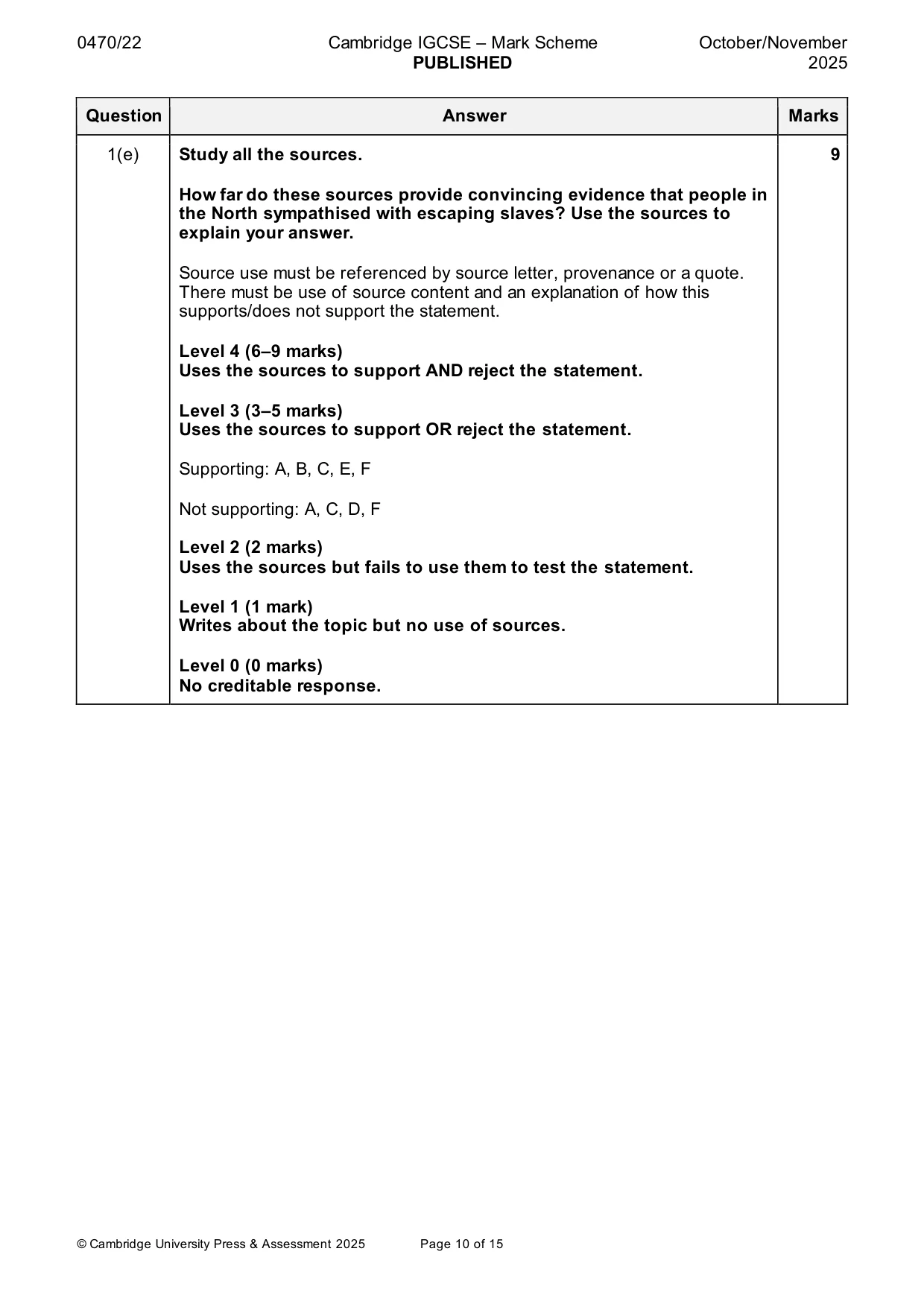
0470/22 Cambridge IGCSE – Mark Scheme PUBLISHED October/November 2025 © Cambridge University Press & Assessment 2025 Page 10 of 15 Question Answer Marks 1(e) Study all the sources. How far do these sources provide convincing evidence that people in the North sympathised with escaping slaves? Use the sources to explain your answer. Source use must be referenced by source letter, provenance or a quote. There must be use of source content and an explanation of how this supports/does not support the statement. Level 4 (6–9 marks) Uses the sources to support AND reject the statement. Level 3 (3–5 marks) Uses the sources to support OR reject the statement. Supporting: A, B, C, E, F Not supporting: A, C, D, F Level 2 (2 marks) Uses the sources but fails to use them to test the statement. Level 1 (1 mark) Writes about the topic but no use of sources. Level 0 (0 marks) No creditable response. 9
Mark scheme, page 11
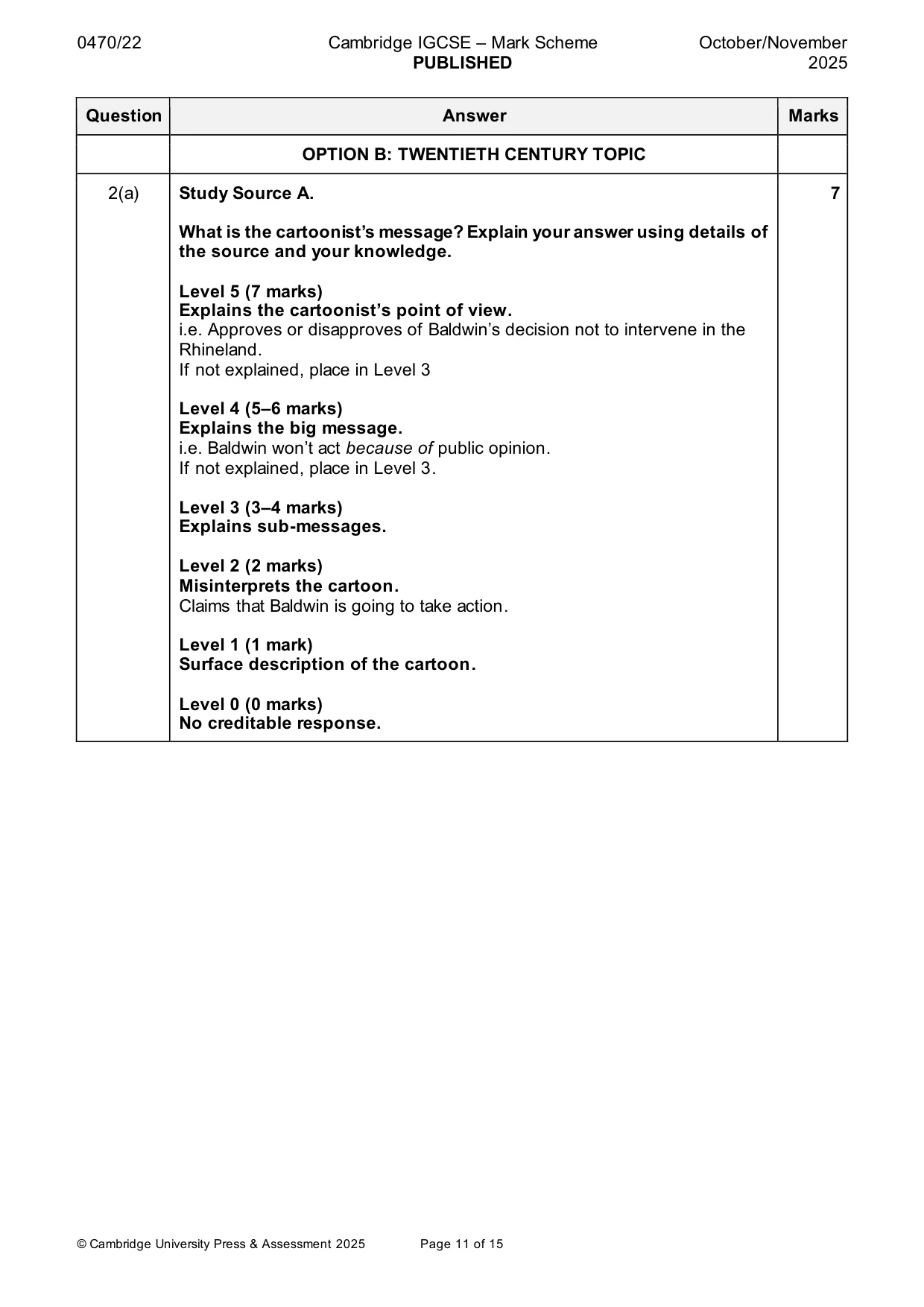
0470/22 Cambridge IGCSE – Mark Scheme PUBLISHED October/November 2025 © Cambridge University Press & Assessment 2025 Page 11 of 15 Question Answer Marks OPTION B: TWENTIETH CENTURY TOPIC 2(a) Study Source A. What is the cartoonist’s message? Explain your answer using details of the source and your knowledge. Level 5 (7 marks) Explains the cartoonist’s point of view. i.e. Approves or disapproves of Baldwin’s decision not to intervene in the Rhineland. If not explained, place in Level 3 Level 4 (5–6 marks) Explains the big message. i.e. Baldwin won’t act because of public opinion. If not explained, place in Level 3. Level 3 (3–4 marks) Explains sub-messages. Level 2 (2 marks) Misinterprets the cartoon. Claims that Baldwin is going to take action. Level 1 (1 mark) Surface description of the cartoon. Level 0 (0 marks) No creditable response. 7
Mark scheme, page 12
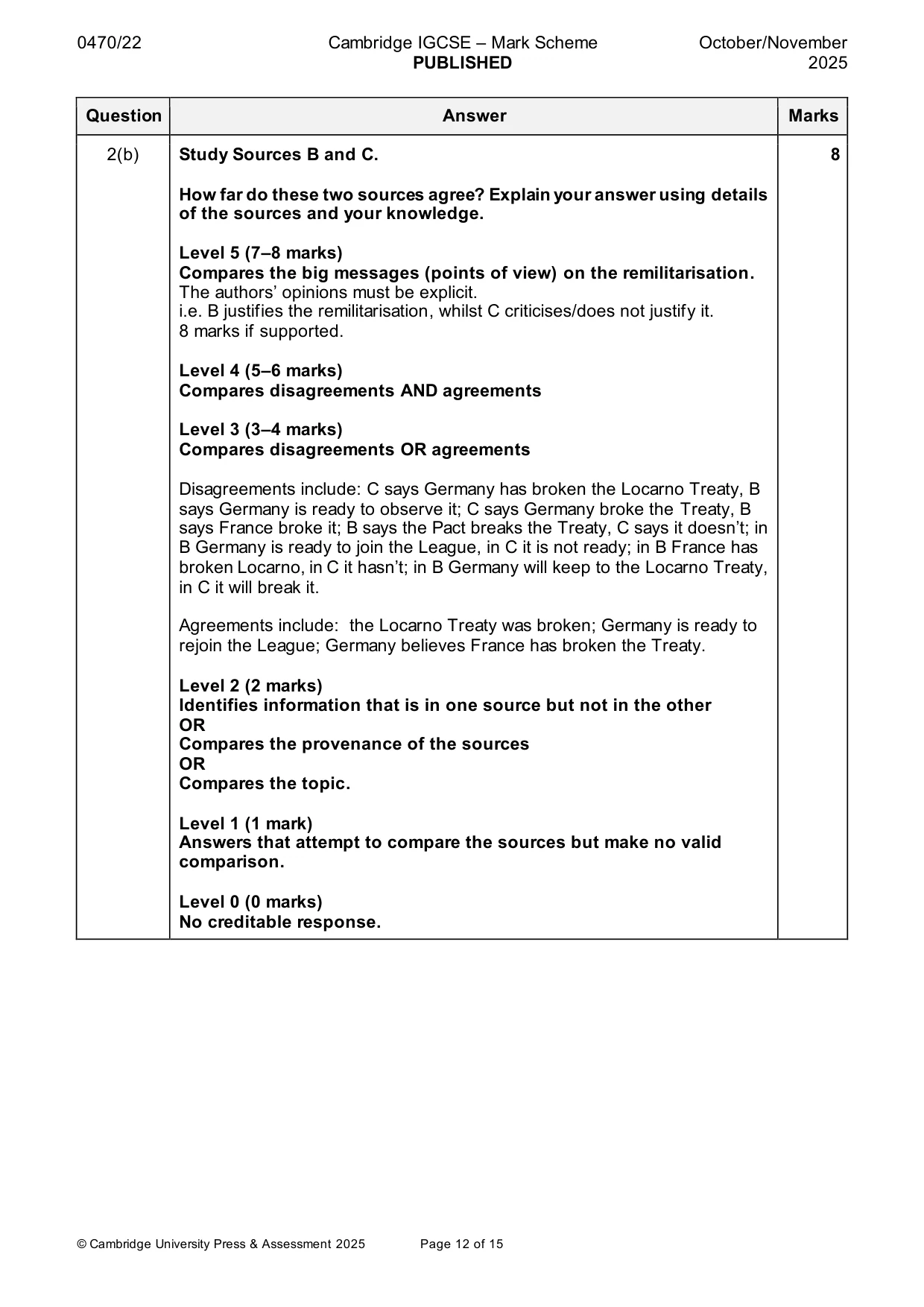
0470/22 Cambridge IGCSE – Mark Scheme PUBLISHED October/November 2025 © Cambridge University Press & Assessment 2025 Page 12 of 15 Question Answer Marks 2(b) Study Sources B and C. How far do these two sources agree? Explain your answer using details of the sources and your knowledge. Level 5 (7–8 marks) Compares the big messages (points of view) on the remilitarisation. The authors’ opinions must be explicit. i.e. B justifies the remilitarisation, whilst C criticises/does not justify it. 8 marks if supported. Level 4 (5–6 marks) Compares disagreements AND agreements Level 3 (3–4 marks) Compares disagreements OR agreements Disagreements include: C says Germany has broken the Locarno Treaty, B says Germany is ready to observe it; C says Germany broke the Treaty, B says France broke it; B says the Pact breaks the Treaty, C says it doesn’t; in B Germany is ready to join the League, in C it is not ready; in B France has broken Locarno, in C it hasn’t; in B Germany will keep to the Locarno Treaty, in C it will break it. Agreements include: the Locarno Treaty was broken; Germany is ready to rejoin the League; Germany believes France has broken the Treaty. Level 2 (2 marks) Identifies information that is in one source but not in the other OR Compares the provenance of the sources OR Compares the topic. Level 1 (1 mark) Answers that attempt to compare the sources but make no valid comparison. Level 0 (0 marks) No creditable response. 8
Mark scheme, page 13
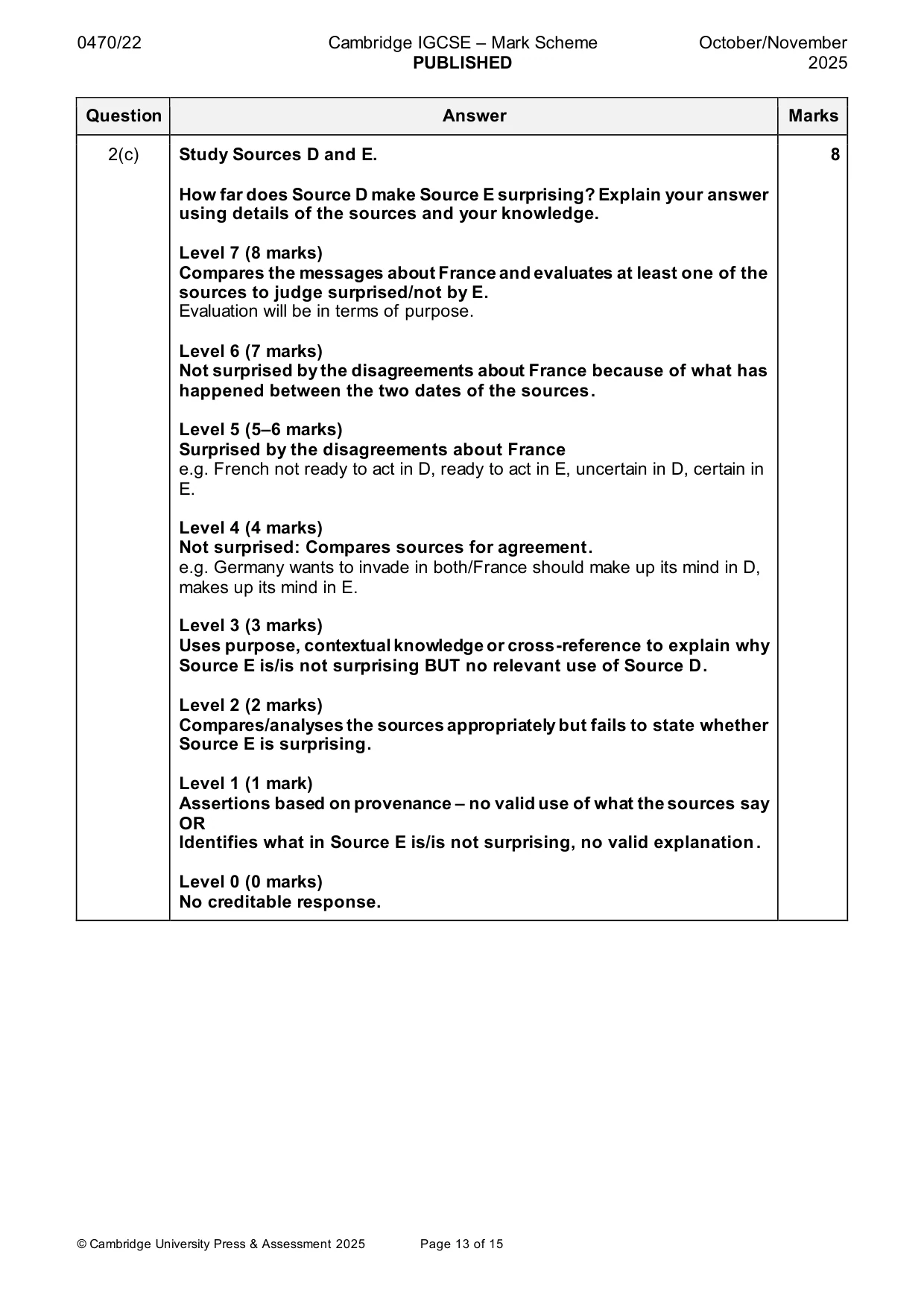
0470/22 Cambridge IGCSE – Mark Scheme PUBLISHED October/November 2025 © Cambridge University Press & Assessment 2025 Page 13 of 15 Question Answer Marks 2(c) Study Sources D and E. How far does Source D make Source E surprising? Explain your answer using details of the sources and your knowledge. Level 7 (8 marks) Compares the messages about France and evaluates at least one of the sources to judge surprised/not by E. Evaluation will be in terms of purpose. Level 6 (7 marks) Not surprised by the disagreements about France because of what has happened between the two dates of the sources. Level 5 (5–6 marks) Surprised by the disagreements about France e.g. French not ready to act in D, ready to act in E, uncertain in D, certain in E. Level 4 (4 marks) Not surprised: Compares sources for agreement. e.g. Germany wants to invade in both/France should make up its mind in D, makes up its mind in E. Level 3 (3 marks) Uses purpose, contextual knowledge or cross-reference to explain why Source E is/is not surprising BUT no relevant use of Source D. Level 2 (2 marks) Compares/analyses the sources appropriately but fails to state whether Source E is surprising. Level 1 (1 mark) Assertions based on provenance – no valid use of what the sources say OR Identifies what in Source E is/is not surprising, no valid explanation. Level 0 (0 marks) No creditable response. 8
Mark scheme, page 14
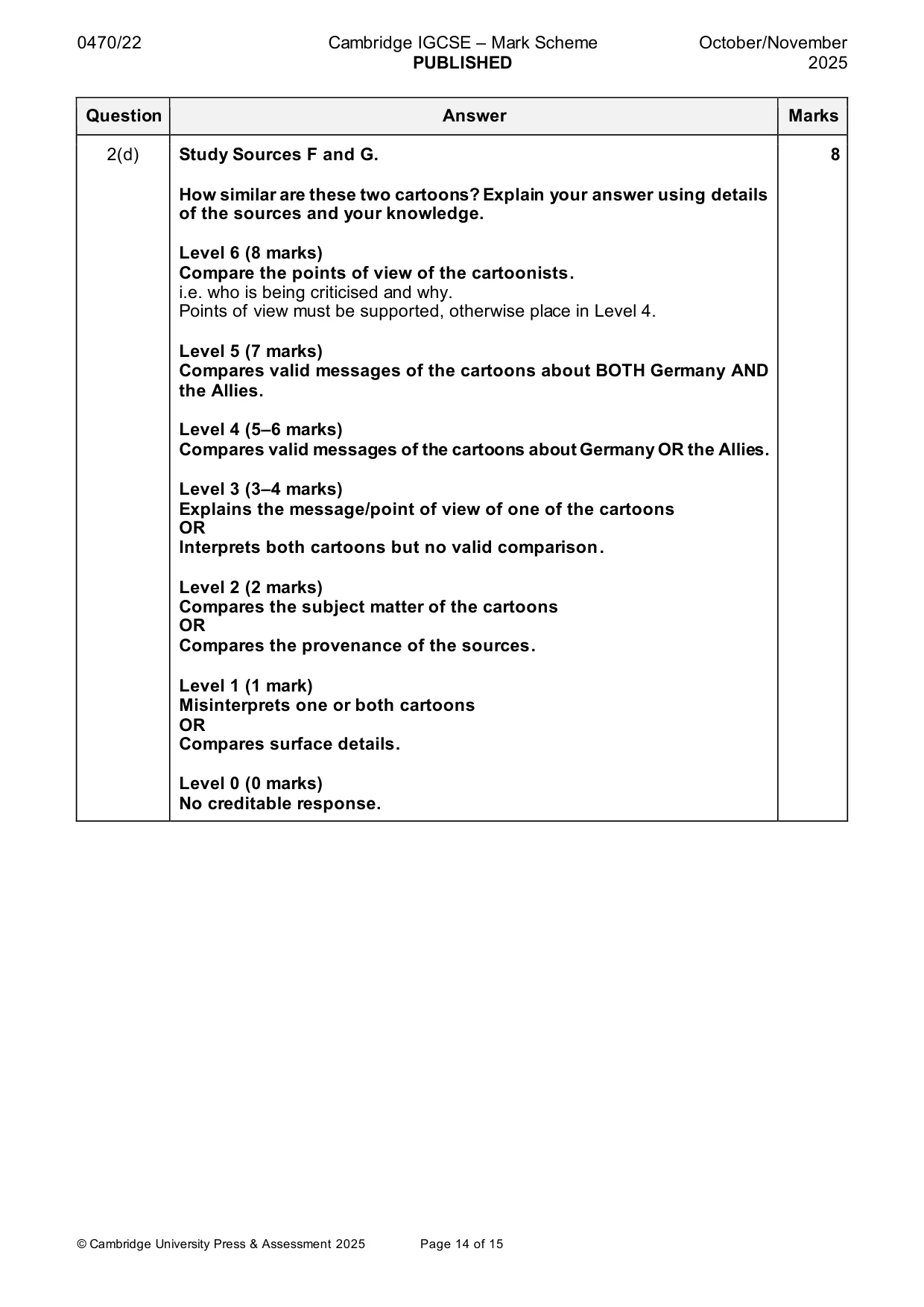
0470/22 Cambridge IGCSE – Mark Scheme PUBLISHED October/November 2025 © Cambridge University Press & Assessment 2025 Page 14 of 15 Question Answer Marks 2(d) Study Sources F and G. How similar are these two cartoons? Explain your answer using details of the sources and your knowledge. Level 6 (8 marks) Compare the points of view of the cartoonists. i.e. who is being criticised and why. Points of view must be supported, otherwise place in Level 4. Level 5 (7 marks) Compares valid messages of the cartoons about BOTH Germany AND the Allies. Level 4 (5–6 marks) Compares valid messages of the cartoons about Germany OR the Allies. Level 3 (3–4 marks) Explains the message/point of view of one of the cartoons OR Interprets both cartoons but no valid comparison. Level 2 (2 marks) Compares the subject matter of the cartoons OR Compares the provenance of the sources. Level 1 (1 mark) Misinterprets one or both cartoons OR Compares surface details. Level 0 (0 marks) No creditable response. 8
Mark scheme, page 15
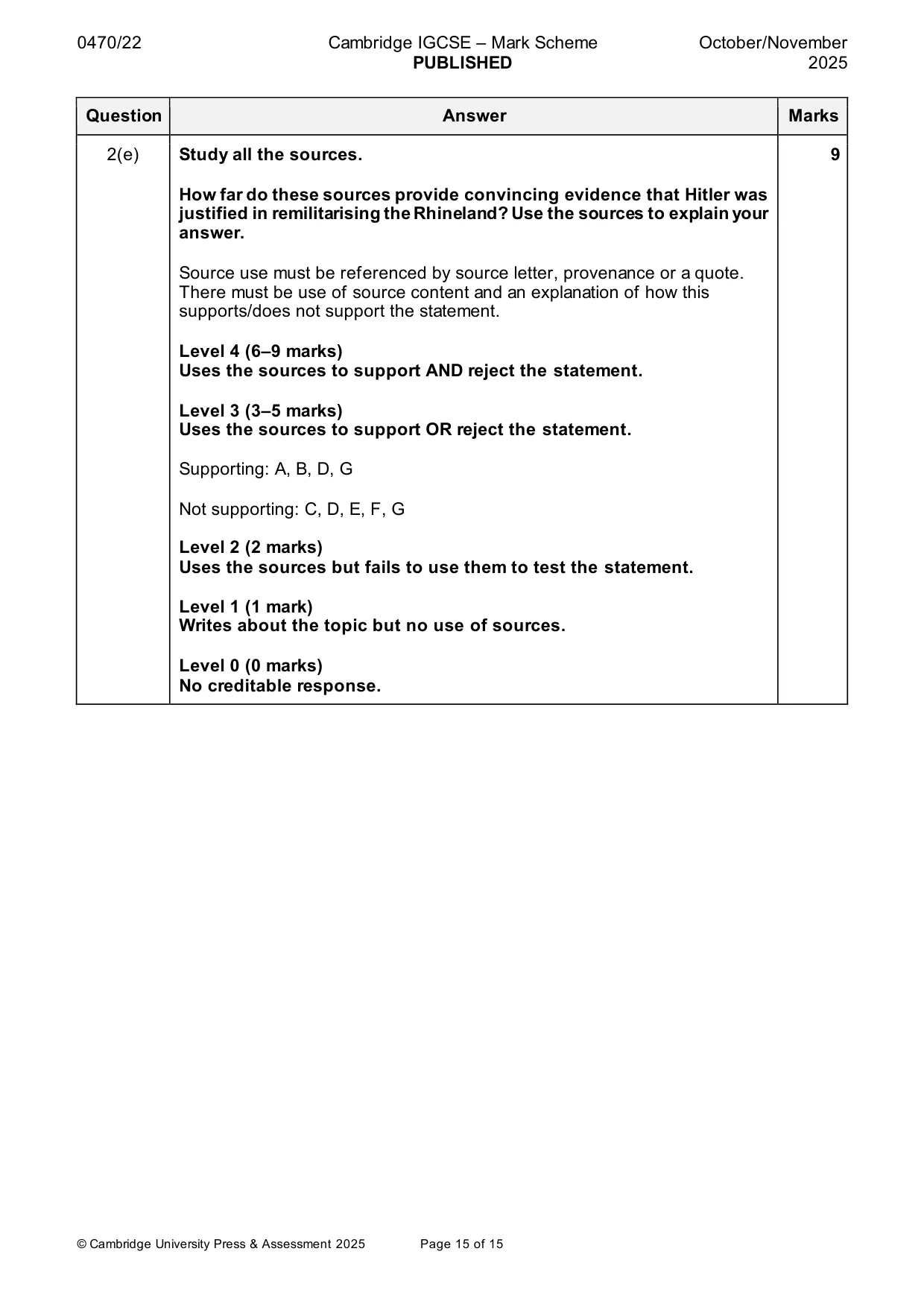
0470/22 Cambridge IGCSE – Mark Scheme PUBLISHED October/November 2025 © Cambridge University Press & Assessment 2025 Page 15 of 15 Question Answer Marks 2(e) Study all the sources. How far do these sources provide convincing evidence that Hitler was justified in remilitarising the Rhineland? Use the sources to explain your answer. Source use must be referenced by source letter, provenance or a quote. There must be use of source content and an explanation of how this supports/does not support the statement. Level 4 (6–9 marks) Uses the sources to support AND reject the statement. Level 3 (3–5 marks) Uses the sources to support OR reject the statement. Supporting: A, B, D, G Not supporting: C, D, E, F, G Level 2 (2 marks) Uses the sources but fails to use them to test the statement. Level 1 (1 mark) Writes about the topic but no use of sources. Level 0 (0 marks) No creditable response. 9
What you needed in this session
Cambridge’s own grade thresholds for 2025 Oct/Nov, Paper 2 · Variant 2. A higher threshold means an easier paper — the bar moves with how the cohort did.