Cambridge IGCSE History 0470 — 2022 May/June Paper 2 · Variant 3
0470/23/M/J/22 · 50 marks · ≈56 min
The question paper and its mark scheme, free to read here and free to download. This is Cambridge’s own paper, exactly as it was sat.
Question paper12 pages


Mark scheme8 pages
Answers below. Sit the paper first if you are practising.
Paper as text
Question paper, page 1
This document has 12 pages. Any blank pages are indicated. [Turn over Cambridge IGCSE™ HISTORY 0470/23 Paper 2 May/June 2022 2 hours You must answer on the enclosed answer booklet. You will need: Answer booklet (enclosed) INSTRUCTIONS ● Answer all the questions on one option only. Option A: Nineteenth century topic Option B: Twentieth century topic ● Follow the instructions on the front cover of the answer booklet. If you need additional answer paper, ask the invigilator for a continuation booklet. INFORMATION ● The total mark for this paper is 50. ● The number of marks for each question or part question is shown in brackets [ ]. * 0 5 9 0 5 4 9 6 4 8 * DC (LK/CT) 213972/1 © UCLES 2022
Question paper, page 2
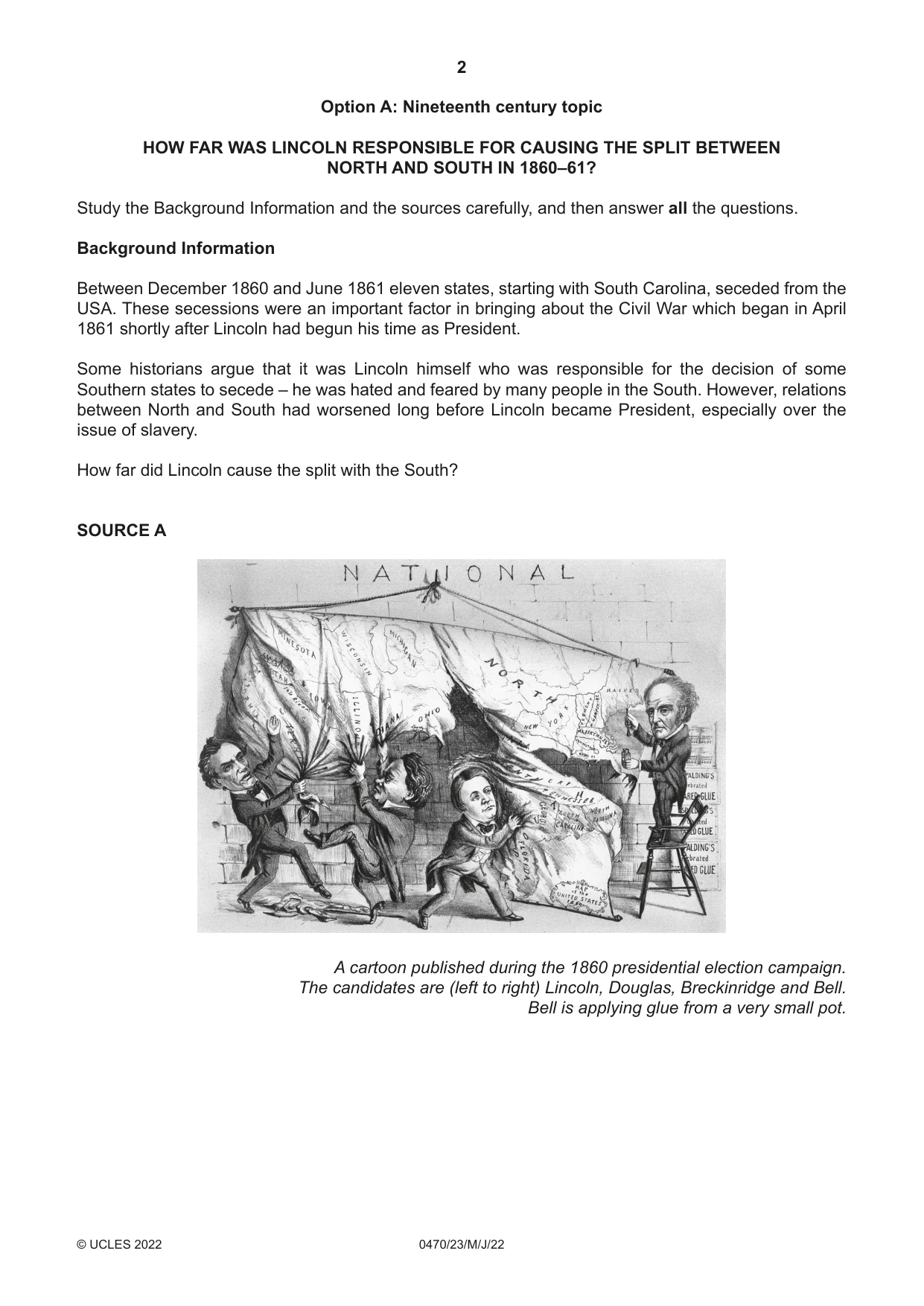
2 0470/23/M/J/22 © UCLES 2022 Option A: Nineteenth century topic HOW FAR WAS LINCOLN RESPONSIBLE FOR CAUSING THE SPLIT BETWEEN NORTH AND SOUTH IN 1860–61? Study the Background Information and the sources carefully, and then answer all the questions. Background Information Between December 1860 and June 1861 eleven states, starting with South Carolina, seceded from the USA. These secessions were an important factor in bringing about the Civil War which began in April 1861 shortly after Lincoln had begun his time as President. Some historians argue that it was Lincoln himself who was responsible for the decision of some Southern states to secede – he was hated and feared by many people in the South. However, relations between North and South had worsened long before Lincoln became President, especially over the issue of slavery. How far did Lincoln cause the split with the South? SOURCE A A cartoon published during the 1860 presidential election campaign. The candidates are (left to right) Lincoln, Douglas, Breckinridge and Bell. Bell is applying glue from a very small pot.
Question paper, page 3
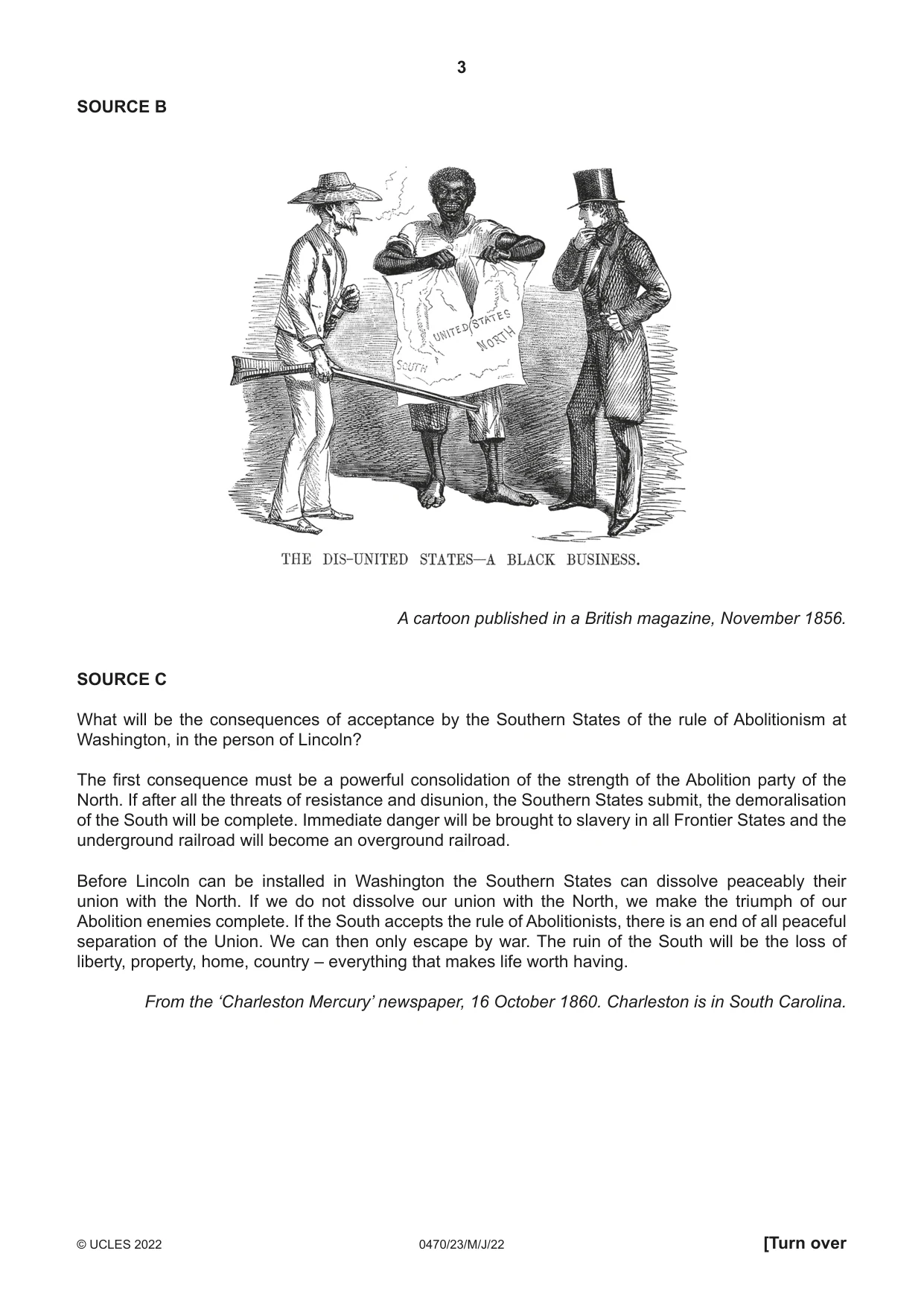
3 0470/23/M/J/22 © UCLES 2022 [Turn over SOURCE B A cartoon published in a British magazine, November 1856. SOURCE C What will be the consequences of acceptance by the Southern States of the rule of Abolitionism at Washington, in the person of Lincoln? The first consequence must be a powerful consolidation of the strength of the Abolition party of the North. If after all the threats of resistance and disunion, the Southern States submit, the demoralisation of the South will be complete. Immediate danger will be brought to slavery in all Frontier States and the underground railroad will become an overground railroad. Before Lincoln can be installed in Washington the Southern States can dissolve peaceably their union with the North. If we do not dissolve our union with the North, we make the triumph of our Abolition enemies complete. If the South accepts the rule of Abolitionists, there is an end of all peaceful separation of the Union. We can then only escape by war. The ruin of the South will be the loss of liberty, property, home, country – everything that makes life worth having. From the ‘Charleston Mercury’ newspaper, 16 October 1860. Charleston is in South Carolina.
Question paper, page 4
4 0470/23/M/J/22 © UCLES 2022 SOURCE D I am of the opinion that it would be unwise for the Southern states to secede, if Lincoln were to be elected. I believe that in the Union we would still be able to resist aggressions against the equal rights of the people of the Southern states. We would still have a majority in the US Senate opposed to the abolitionists. Without the consent of that body no law could be passed. We have also the US Supreme Court, whose opinions are favourable to the equality, both of persons and of property. We also have a majority of the United States opposed to the faction of which Lincoln is the head. From a published letter by a Breckinridge supporter, Kentucky, October 1860. SOURCE E Do not consider any compromise in regard to the extension of slavery. The instant you do, they have us beaten; all our labour is lost, and sooner or later will have to be done all over again. Douglas is sure to be again trying to bring in his ‘Popular Sovereignty’. Have none of it. The conflict has to come and better now than later. You know I think the fugitive slave clause of the constitution ought to be enforced – or at least it ought not to be resisted. A letter from Lincoln to William Kellogg, 11 December 1860. Kellogg, a Republican congressman, had proposed a compromise including an extension to the Missouri Compromise line. SOURCE F The people of Georgia have dissolved their political connection with the Government of the United States of America. For the last ten years we have had numerous causes of complaint against non- slave-holding States. They have endeavoured to weaken our security, to disturb our domestic peace and tranquillity. The Federal Government has tried to deprive us of an equal enjoyment of the common Territories of the Republic. This hostile policy has placed the two sections of the Union for many years in the condition of virtual civil war. Recent events have fully demonstrated the necessity of separation. Northern States have by a large majority committed the Government of the United States into the hands of the party of Lincoln, called the Republican party, which under its present name and organisation, is openly an anti-slavery party. While it supports waste and corruption in the administration of Government, anti-slavery is its mission and its purpose. From Georgia’s declaration of secession, 29 January 1861.
Question paper, page 5
5 0470/23/M/J/22 © UCLES 2022 [Turn over Now answer all the following questions. You may use any of the sources to help you answer the questions, in addition to those sources which you are told to use. In answering the questions you should use your knowledge of the topic to help you interpret and evaluate the sources. 1 Study Source A. What impressions does this cartoon give of the presidential candidates? Explain your answer using details of the source. [6] 2 Study Source B. What is the cartoonist’s message? Explain your answer using details of the source and your knowledge. [8] 3 Study Sources C and D. How far does Source D prove that the author of Source C was wrong? Explain your answer using details of the sources and your knowledge. [8] 4 Study Source E. Are you surprised that this was Lincoln’s position in December 1860? Explain your answer using details of the source and your knowledge. [8] 5 Study Source F. Why was this source issued in January 1861? Explain your answer using details of the source and your knowledge. [8] 6 Study all the sources. How far do these sources provide convincing evidence that it was Lincoln who split the South from the North in 1860-61? Use the sources to explain your answer. [12]
Question paper, page 6
6 0470/23/M/J/22 © UCLES 2022 Option B: Twentieth century topic HOW FAR WAS JARUZELSKI IN CONTROL IN POLAND IN 1981? Study the Background Information and the sources carefully, and then answer all the questions. Background Information Jaruzelski became leader of Poland on 18 October 1981 because the Soviet Union had become dissatisfied with the actions of Kania in dealing with Solidarity and the strikes and protests that were occurring across Poland. However, under Jaruzelski, these continued, and even got worse. On 13 December Jaruzelski announced to the Polish people that he was imposing martial law. Some historians claim he was pressurised to do this by the Soviet Union, while others claim he was trying to avoid a Soviet military invasion. How strong a leader was Jaruzelski? Was he being told what to do by the Soviet Union or was he in control? SOURCE A The front cover of the American ‘Time’ magazine, 28 December 1981. Content removed due to copyright restrictions.
Question paper, page 7
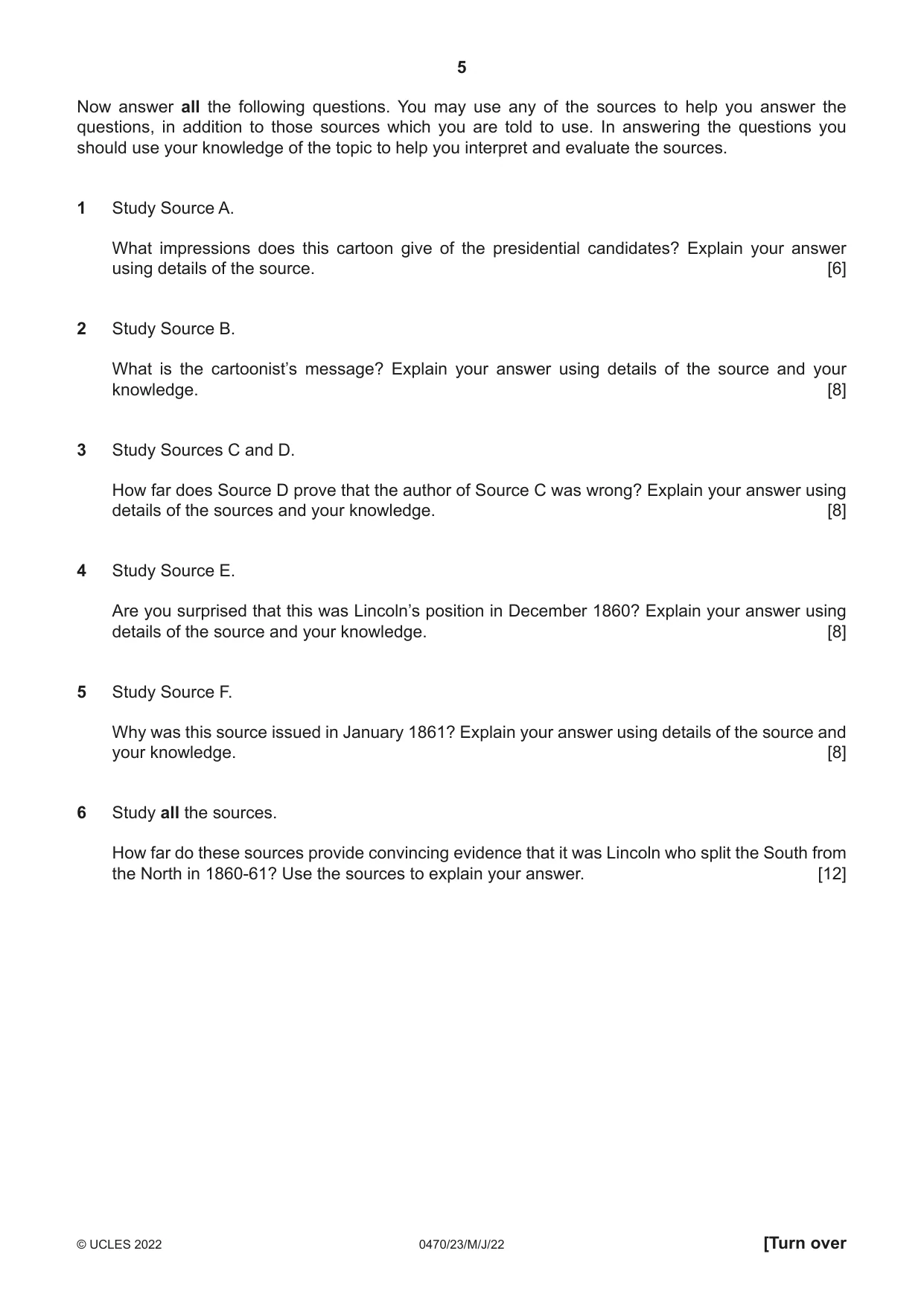
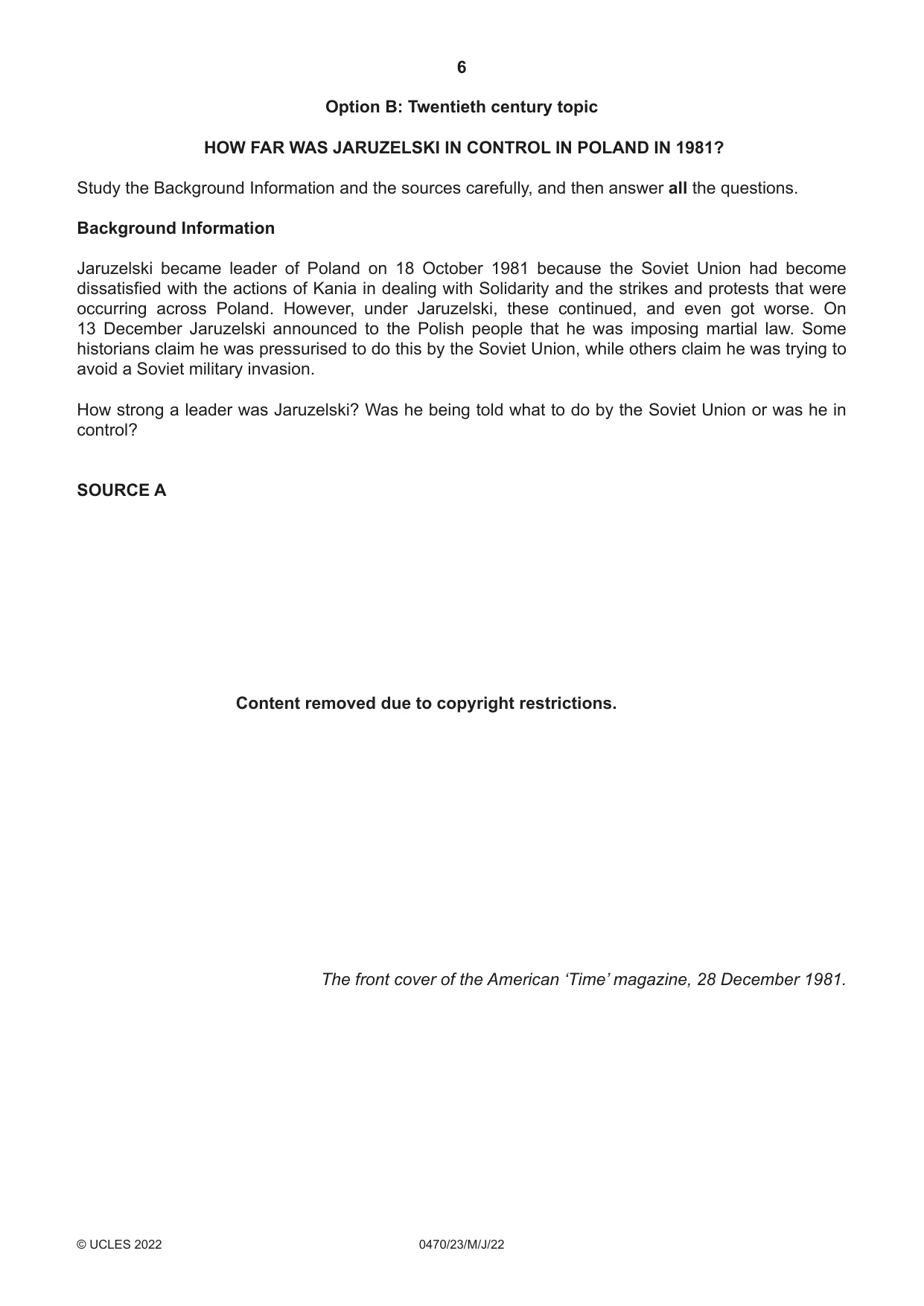
7 0470/23/M/J/22 © UCLES 2022 [Turn over SOURCE B I wanted to congratulate you on your election to the post of First Secretary of the Polish Communist Party. There is no other individual in the Polish Workers’ Party whose authority is equal to yours. We are convinced that you will cope with the very difficult tasks before you and will do everything to overcome the severe problems facing your country. It is important, without wasting time, to take the decisive measures you intend against the counter-revolution. We hope everyone will sense that things in Poland will move along differently. Brezhnev speaking on the telephone to Jaruzelski, 19 October 1981. SOURCE C We greeted your election as First Secretary of the Polish Communist Party with great hopes. We were aware that earlier in the struggle against anti-socialist forces you were held back by the political indecisiveness of the party leadership. Now this obstacle has been eliminated. We had hoped that people in Poland would sense that things in Poland were finally on a different course. We spoke on the phone about the need for a turnabout in the situation. However, one gets the impression that this has not been achieved. The anti-socialist forces are continuing to spread their influence among ever-wider segments of the population. It seems to me that you must mobilise the entire party in the struggle to win the hearts and minds of people. I would like to mention another matter. A lot has been written about your meeting with Walesa and the agreement to set up a ‘Front of National Accord’. How far can you go with such agreements without losing control over the situation? Agreements must not make concessions to the enemies of socialism. We know there are still people in the leadership of your party who want to continue the bankrupt course of Kania. A message from Brezhnev to Jaruzelski, 21 November 1981. SOURCE D A cartoon published in the Netherlands, 12 December 1980. Brezhnev is saying to Walesa, ‘I would never interfere in Poland’s domestic affairs!’
Question paper, page 8
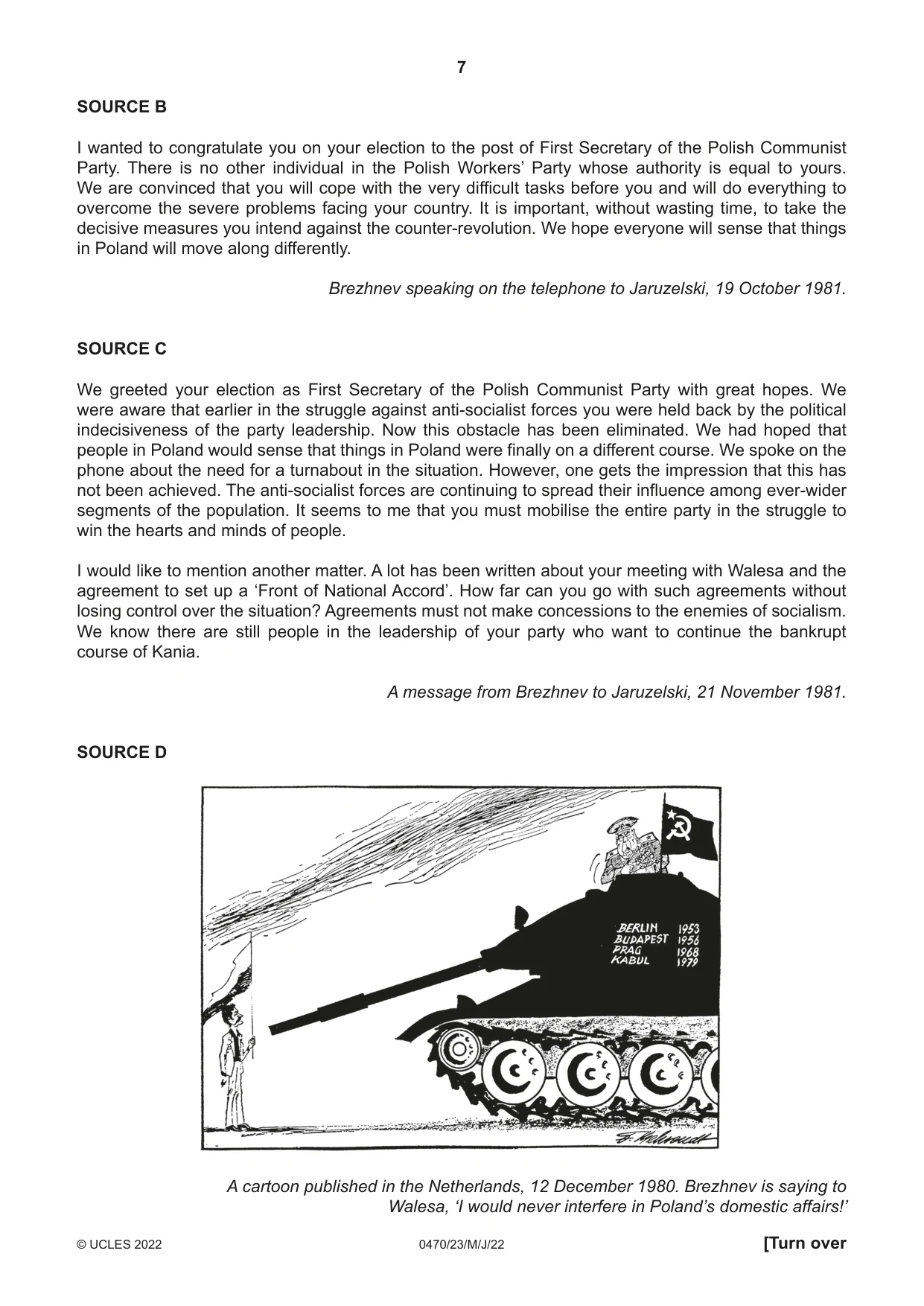
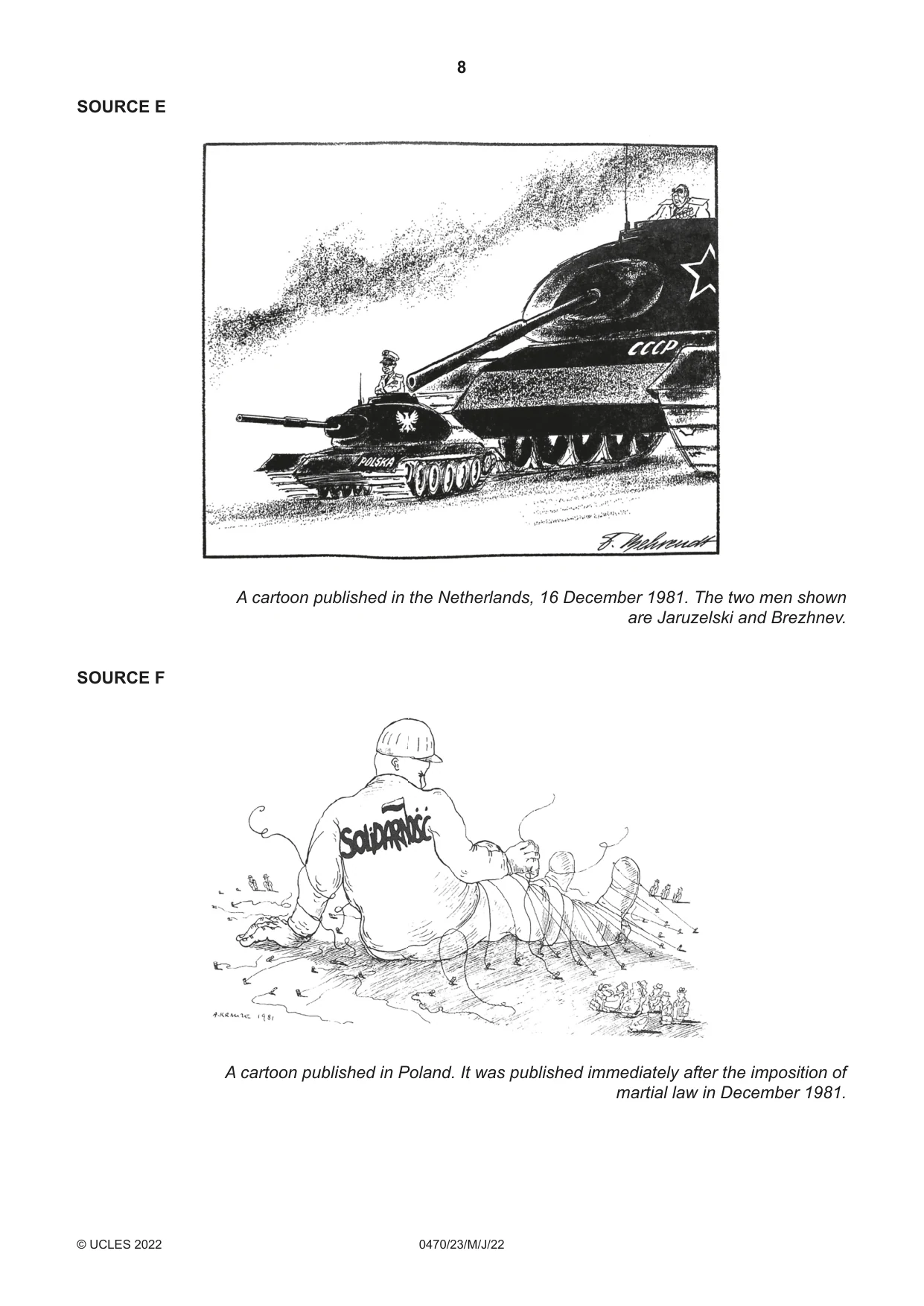
8 0470/23/ M / J /22 © UCLES 2022 SOURCE E A cartoon published in the Netherlands, 16 December 1981. The two men shown are Jaruzelski and Brezhnev. SOURCE F A cartoon published in Poland. It was published immediately after the imposition of martial law in December 1981.
Question paper, page 9
9 0470/23/M/J/22 © UCLES 2022 [Turn over SOURCE G The rigours of martial law have complicated everyday life. But these restrictions are a lesser evil than the invasion which has so long threatened us. The introduction of martial law has saved Poland from a danger whose real character and seriousness are still not comprehended in full everywhere. On 13 December there was no other way of avoiding the disintegration of the state. Where was Poland going? How long could the country, torn by strikes, aflame with tensions and sinking in a climate of artificially created hatred, have continued to survive? There is still room in Poland for responsible, independent unions and the democratisation begun last year will continue. I state that the reports of alleged tens or hundreds of fatal casualties, of thousands arrested, held in the freezing conditions, beaten up and tortured, are a lie. One cannot hide the truth about Poland in Poland. Sooner or later, it will be known to the whole world. Jaruzelski speaking to the Polish people on the radio, 25 December 1981.
Question paper, page 10
10 0470/23/M/J/22 © UCLES 2022 Now answer all the following questions. You may use any of the sources to help you answer the questions, in addition to those sources which you are told to use. In answering the questions you should use your knowledge of the topic to help you interpret and evaluate the sources. 1 Study Source A. What impressions does this source give of Jaruzelski? Explain your answer using details of the source. [7] 2 Study Sources B and C. How far does Source B make Source C surprising? Explain your answer using details of the sources and your knowledge. [8] 3 Study Sources D and E. These two cartoons are by the same cartoonist. Had he changed his opinion between drawing the two cartoons? Explain your answer using details of the sources and your knowledge. [8] 4 Study Source F. What is the cartoonist’s message? Explain your answer using details of the source and your knowledge. [7] 5 Study Source G. Why did Jaruzelski make this announcement to the Polish people on 25 December 1981? Explain your answer using details of the source and your knowledge. [8] 6 Study all the sources. How far do these sources provide convincing evidence that Jaruzelski was in control in Poland? Use the sources to explain your answer. [12]
Question paper, page 11
11 0470/23/M/J/22 © UCLES 2022 BLANK PAGE
Question paper, page 12
12 0470/23/M/J/22 © UCLES 2022 Permission to reproduce items where third-party owned material protected by copyright is included has been sought and cleared where possible. Every reasonable effort has been made by the publisher (UCLES) to trace copyright holders, but if any items requiring clearance have unwittingly been included, the publisher will be pleased to make amends at the earliest possible opportunity. To avoid the issue of disclosure of answer-related information to candidates, all copyright acknowledgements are reproduced online in the Cambridge Assessment International Education Copyright Acknowledgements Booklet. This is produced for each series of examinations and is freely available to download at www.cambridgeinternational.org after the live examination series. Cambridge Assessment International Education is part of Cambridge Assessment. Cambridge Assessment is the brand name of the University of Cambridge Local Examinations Syndicate (UCLES), which is a department of the University of Cambridge. BLANK PAGE
Mark scheme, page 1
This document consists of 8 printed pages. © UCLES 2022 [Turn over Cambridge IGCSE™ HISTORY 0470/23 Paper 2 May/June 2022 MARK SCHEME Maximum Mark: 50 Published This mark scheme is published as an aid to teachers and candidates, to indicate the requirements of the examination. It shows the basis on which Examiners were instructed to award marks. It does not indicate the details of the discussions that took place at an Examiners’ meeting before marking began, which would have considered the acceptability of alternative answers. Mark schemes should be read in conjunction with the question paper and the Principal Examiner Report for Teachers. Cambridge International will not enter into discussions about these mark schemes. Cambridge International is publishing the mark schemes for the May/June 2022 series for most Cambridge IGCSE, Cambridge International A and AS Level and Cambridge Pre-U components, and some Cambridge O Level components.
Mark scheme, page 2
0470/23 Cambridge IGCSE – Mark Scheme PUBLISHED May/June 2022 © UCLES 2022 Page 2 of 8 Generic Marking Principles These general marking principles must be applied by all examiners when marking candidate answers. They should be applied alongside the specific content of the mark scheme or generic level descriptors for a question. Each question paper and mark scheme will also comply with these marking principles. GENERIC MARKING PRINCIPLE 1: Marks must be awarded in line with: the specific content of the mark scheme or the generic level descriptors for the question the specific skills defined in the mark scheme or in the generic level descriptors for the question the standard of response required by a candidate as exemplified by the standardisation scripts. GENERIC MARKING PRINCIPLE 2: Marks awarded are always whole marks (not half marks, or other fractions). GENERIC MARKING PRINCIPLE 3: Marks must be awarded positively: marks are awarded for correct/valid answers, as defined in the mark scheme. However, credit is given for valid answers which go beyond the scope of the syllabus and mark scheme, referring to your Team Leader as appropriate marks are awarded when candidates clearly demonstrate what they know and can do marks are not deducted for errors marks are not deducted for omissions answers should only be judged on the quality of spelling, punctuation and grammar when these features are specifically assessed by the question as indicated by the mark scheme. The meaning, however, should be unambiguous. GENERIC MARKING PRINCIPLE 4: Rules must be applied consistently, e.g. in situations where candidates have not followed instructions or in the application of generic level descriptors. GENERIC MARKING PRINCIPLE 5: Marks should be awarded using the full range of marks defined in the mark scheme for the question (however; the use of the full mark range may be limited according to the quality of the candidate responses seen). GENERIC MARKING PRINCIPLE 6: Marks awarded are based solely on the requirements as defined in the mark scheme. Marks should not be awarded with grade thresholds or grade descriptors in mind.
Mark scheme, page 3
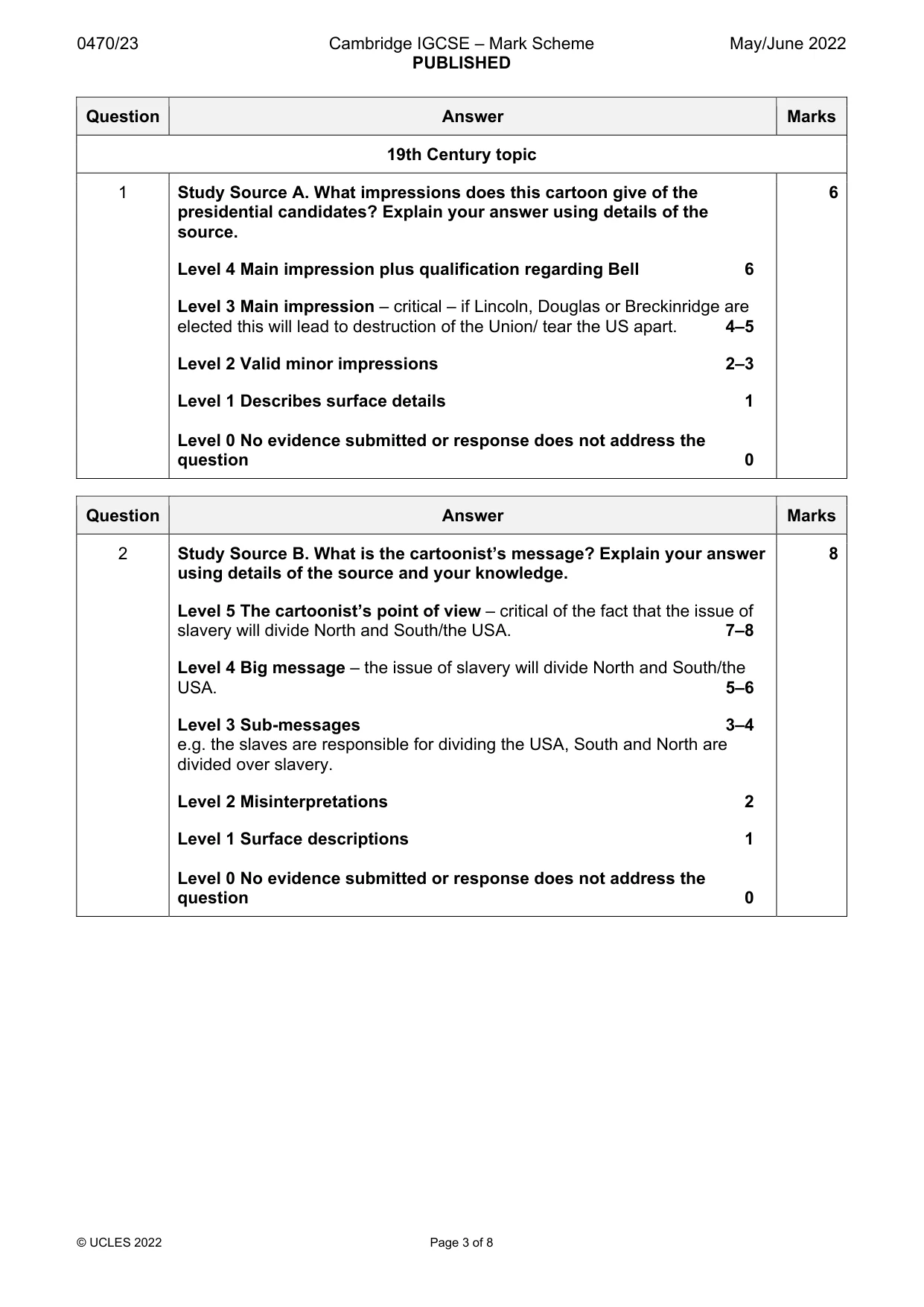
0470/23 Cambridge IGCSE – Mark Scheme PUBLISHED May/June 2022 © UCLES 2022 Page 3 of 8 Question Answer Marks 19th Century topic 1 Study Source A. What impressions does this cartoon give of the presidential candidates? Explain your answer using details of the source. Level 4 Main impression plus qualification regarding Bell 6 Level 3 Main impression – critical – if Lincoln, Douglas or Breckinridge are elected this will lead to destruction of the Union/ tear the US apart. 4–5 Level 2 Valid minor impressions 2–3 Level 1 Describes surface details 1 Level 0 No evidence submitted or response does not address the question 0 6 Question Answer Marks 2 Study Source B. What is the cartoonist’s message? Explain your answer using details of the source and your knowledge. Level 5 The cartoonist’s point of view – critical of the fact that the issue of slavery will divide North and South/the USA. 7–8 Level 4 Big message – the issue of slavery will divide North and South/the USA. 5–6 Level 3 Sub-messages 3–4 e.g. the slaves are responsible for dividing the USA, South and North are divided over slavery. Level 2 Misinterpretations 2 Level 1 Surface descriptions 1 Level 0 No evidence submitted or response does not address the question 0 8
Mark scheme, page 4
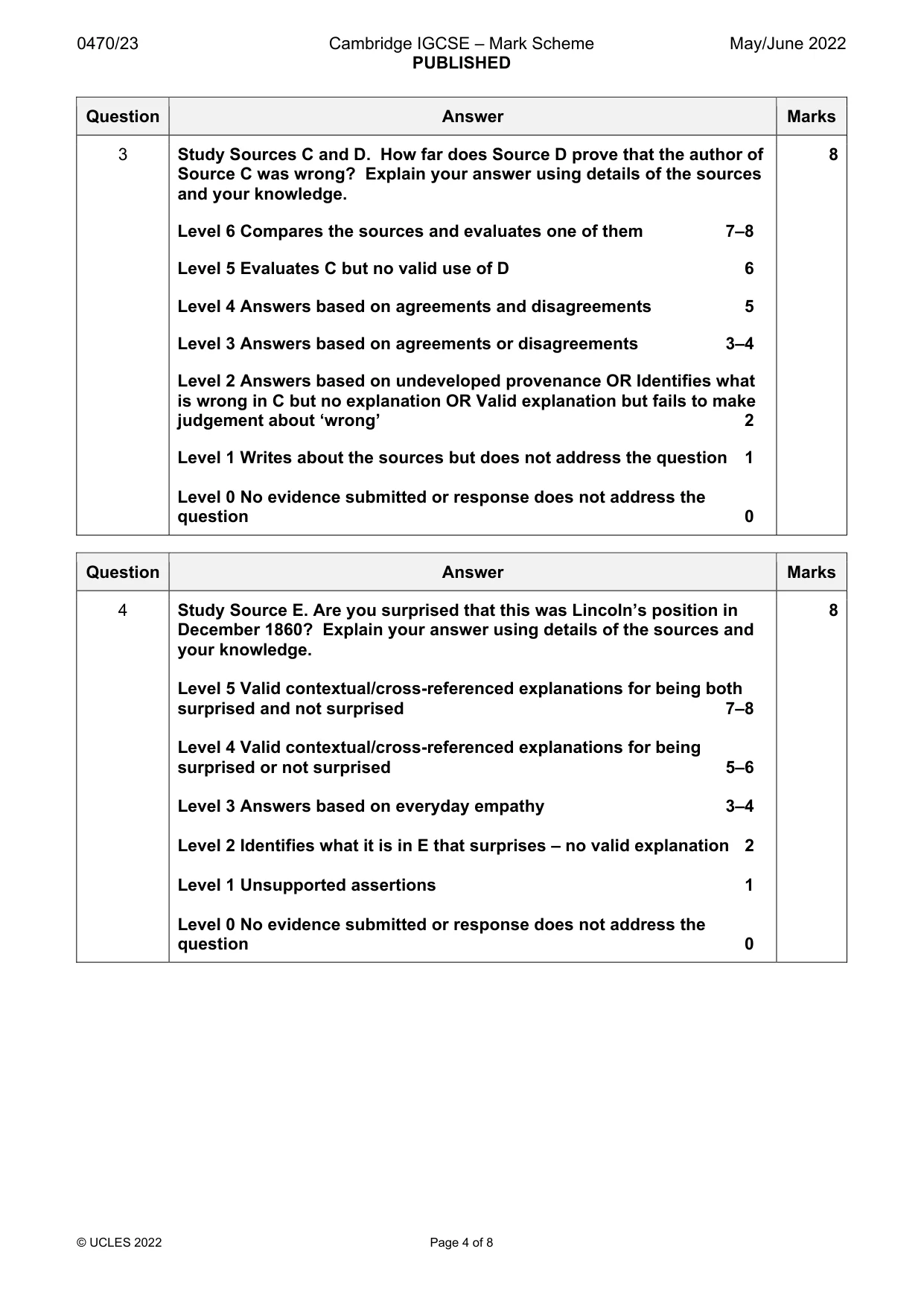
0470/23 Cambridge IGCSE – Mark Scheme PUBLISHED May/June 2022 © UCLES 2022 Page 4 of 8 Question Answer Marks 3 Study Sources C and D. How far does Source D prove that the author of Source C was wrong? Explain your answer using details of the sources and your knowledge. Level 6 Compares the sources and evaluates one of them 7–8 Level 5 Evaluates C but no valid use of D 6 Level 4 Answers based on agreements and disagreements 5 Level 3 Answers based on agreements or disagreements 3–4 Level 2 Answers based on undeveloped provenance OR Identifies what is wrong in C but no explanation OR Valid explanation but fails to make judgement about ‘wrong’ 2 Level 1 Writes about the sources but does not address the question 1 Level 0 No evidence submitted or response does not address the question 0 8 Question Answer Marks 4 Study Source E. Are you surprised that this was Lincoln’s position in December 1860? Explain your answer using details of the sources and your knowledge. Level 5 Valid contextual/cross-referenced explanations for being both surprised and not surprised 7–8 Level 4 Valid contextual/cross-referenced explanations for being surprised or not surprised 5–6 Level 3 Answers based on everyday empathy 3–4 Level 2 Identifies what it is in E that surprises – no valid explanation 2 Level 1 Unsupported assertions 1 Level 0 No evidence submitted or response does not address the question 0 8
Mark scheme, page 5
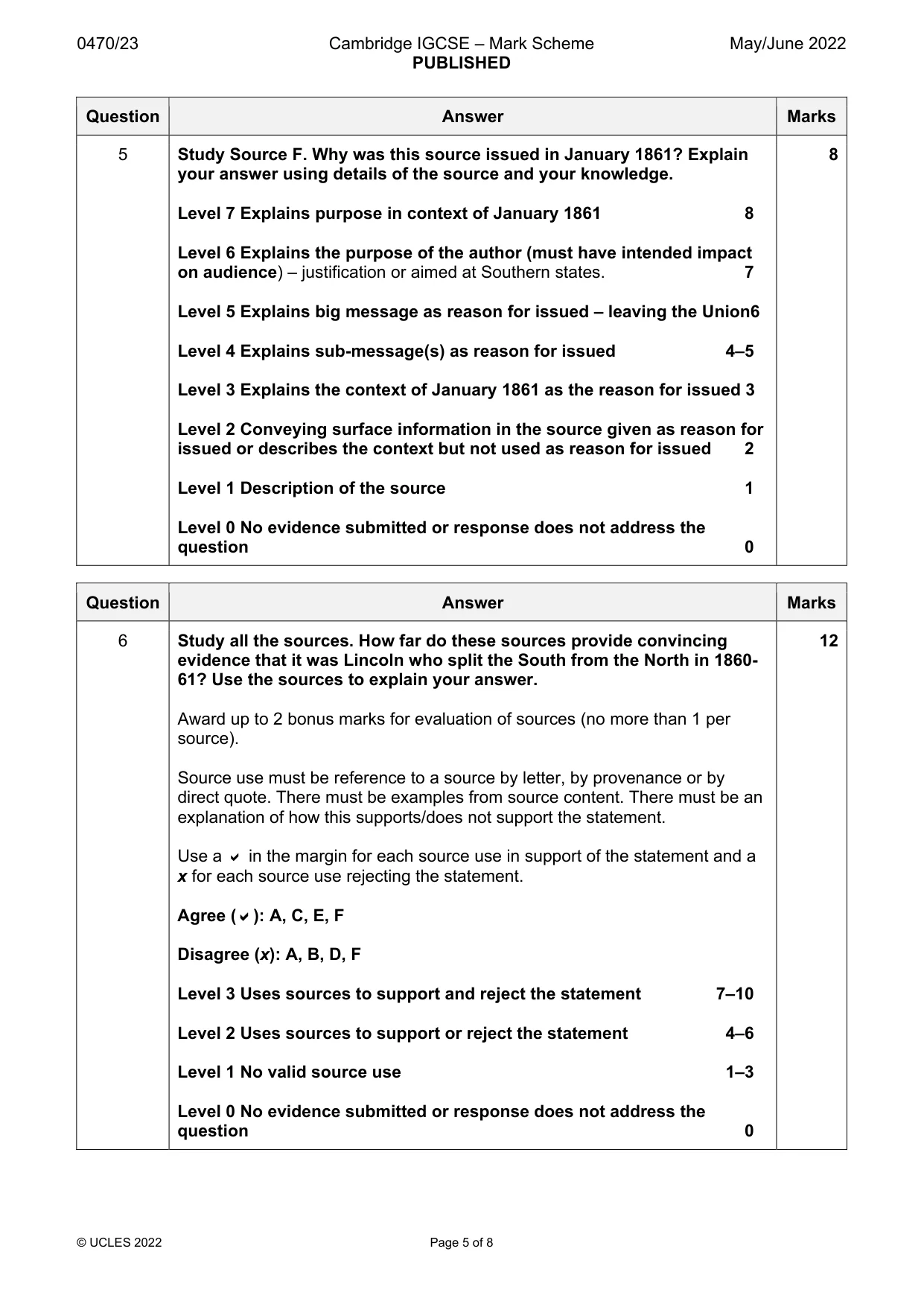
0470/23 Cambridge IGCSE – Mark Scheme PUBLISHED May/June 2022 © UCLES 2022 Page 5 of 8 Question Answer Marks 5 Study Source F. Why was this source issued in January 1861? Explain your answer using details of the source and your knowledge. Level 7 Explains purpose in context of January 1861 8 Level 6 Explains the purpose of the author (must have intended impact on audience) – justification or aimed at Southern states. 7 Level 5 Explains big message as reason for issued – leaving the Union6 Level 4 Explains sub-message(s) as reason for issued 4–5 Level 3 Explains the context of January 1861 as the reason for issued 3 Level 2 Conveying surface information in the source given as reason for issued or describes the context but not used as reason for issued 2 Level 1 Description of the source 1 Level 0 No evidence submitted or response does not address the question 0 8 Question Answer Marks 6 Study all the sources. How far do these sources provide convincing evidence that it was Lincoln who split the South from the North in 1860- 61? Use the sources to explain your answer. Award up to 2 bonus marks for evaluation of sources (no more than 1 per source). Source use must be reference to a source by letter, by provenance or by direct quote. There must be examples from source content. There must be an explanation of how this supports/does not support the statement. Use a in the margin for each source use in support of the statement and a x for each source use rejecting the statement. Agree (): A, C, E, F Disagree (x): A, B, D, F Level 3 Uses sources to support and reject the statement 7–10 Level 2 Uses sources to support or reject the statement 4–6 Level 1 No valid source use 1–3 Level 0 No evidence submitted or response does not address the question 0 12
Mark scheme, page 6
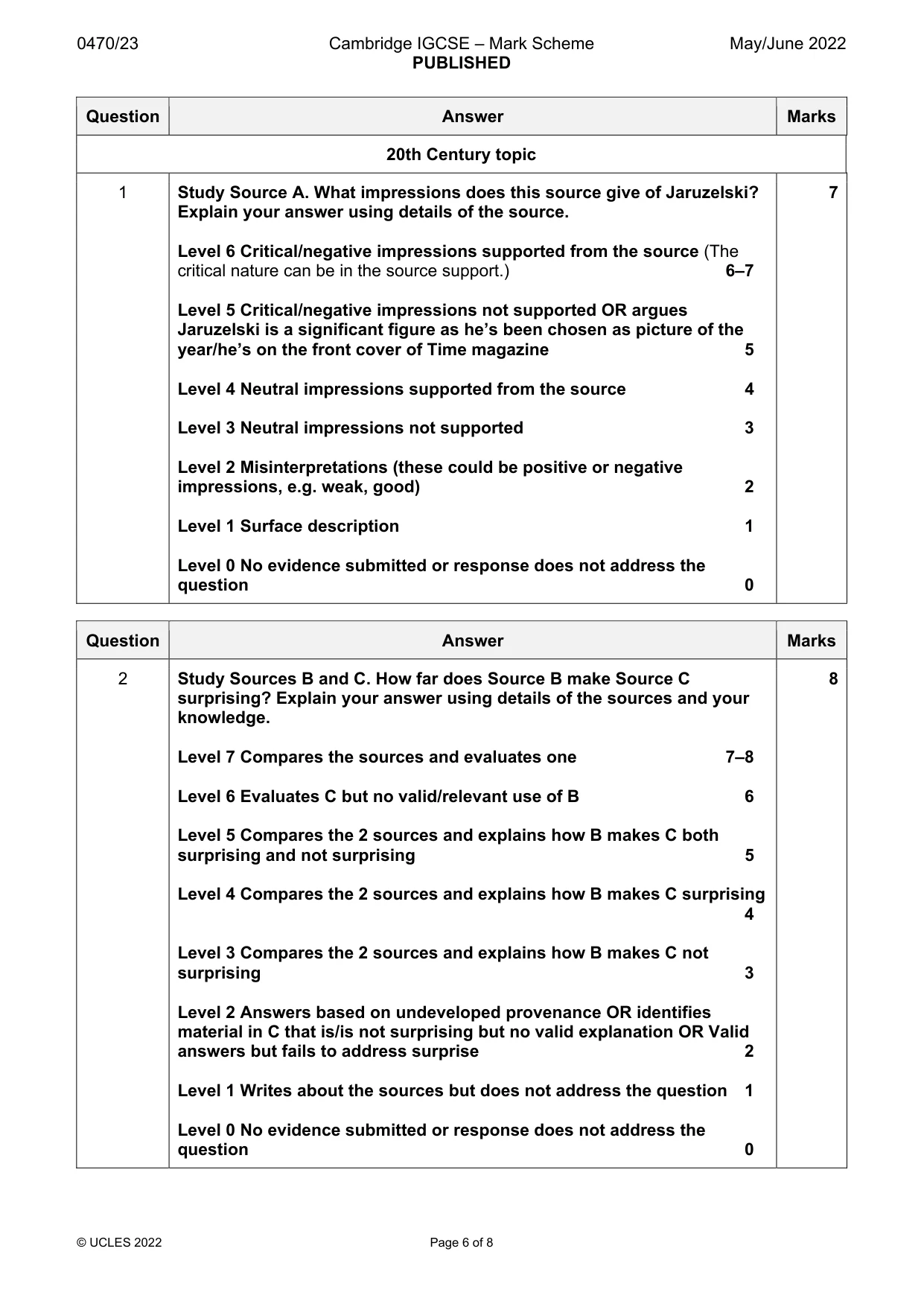
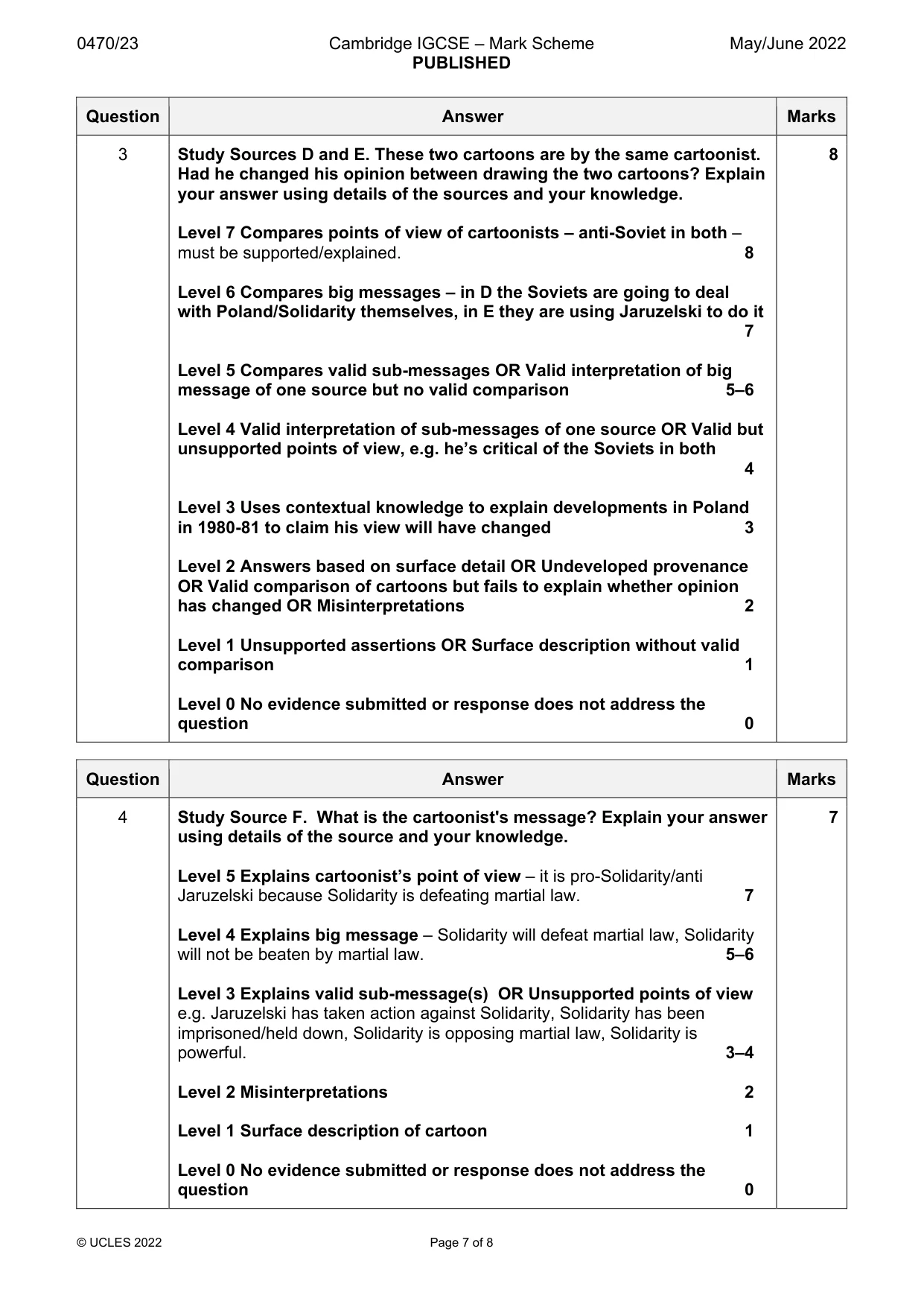
0470/23 Cambridge IGCSE – Mark Scheme PUBLISHED May/June 2022 © UCLES 2022 Page 6 of 8 Question Answer Marks 20th Century topic 1 Study Source A. What impressions does this source give of Jaruzelski? Explain your answer using details of the source. Level 6 Critical/negative impressions supported from the source (The critical nature can be in the source support.) 6–7 Level 5 Critical/negative impressions not supported OR argues Jaruzelski is a significant figure as he’s been chosen as picture of the year/he’s on the front cover of Time magazine 5 Level 4 Neutral impressions supported from the source 4 Level 3 Neutral impressions not supported 3 Level 2 Misinterpretations (these could be positive or negative impressions, e.g. weak, good) 2 Level 1 Surface description 1 Level 0 No evidence submitted or response does not address the question 0 7 Question Answer Marks 2 Study Sources B and C. How far does Source B make Source C surprising? Explain your answer using details of the sources and your knowledge. Level 7 Compares the sources and evaluates one 7–8 Level 6 Evaluates C but no valid/relevant use of B 6 Level 5 Compares the 2 sources and explains how B makes C both surprising and not surprising 5 Level 4 Compares the 2 sources and explains how B makes C surprising 4 Level 3 Compares the 2 sources and explains how B makes C not surprising 3 Level 2 Answers based on undeveloped provenance OR identifies material in C that is/is not surprising but no valid explanation OR Valid answers but fails to address surprise 2 Level 1 Writes about the sources but does not address the question 1 Level 0 No evidence submitted or response does not address the question 0 8
Mark scheme, page 7
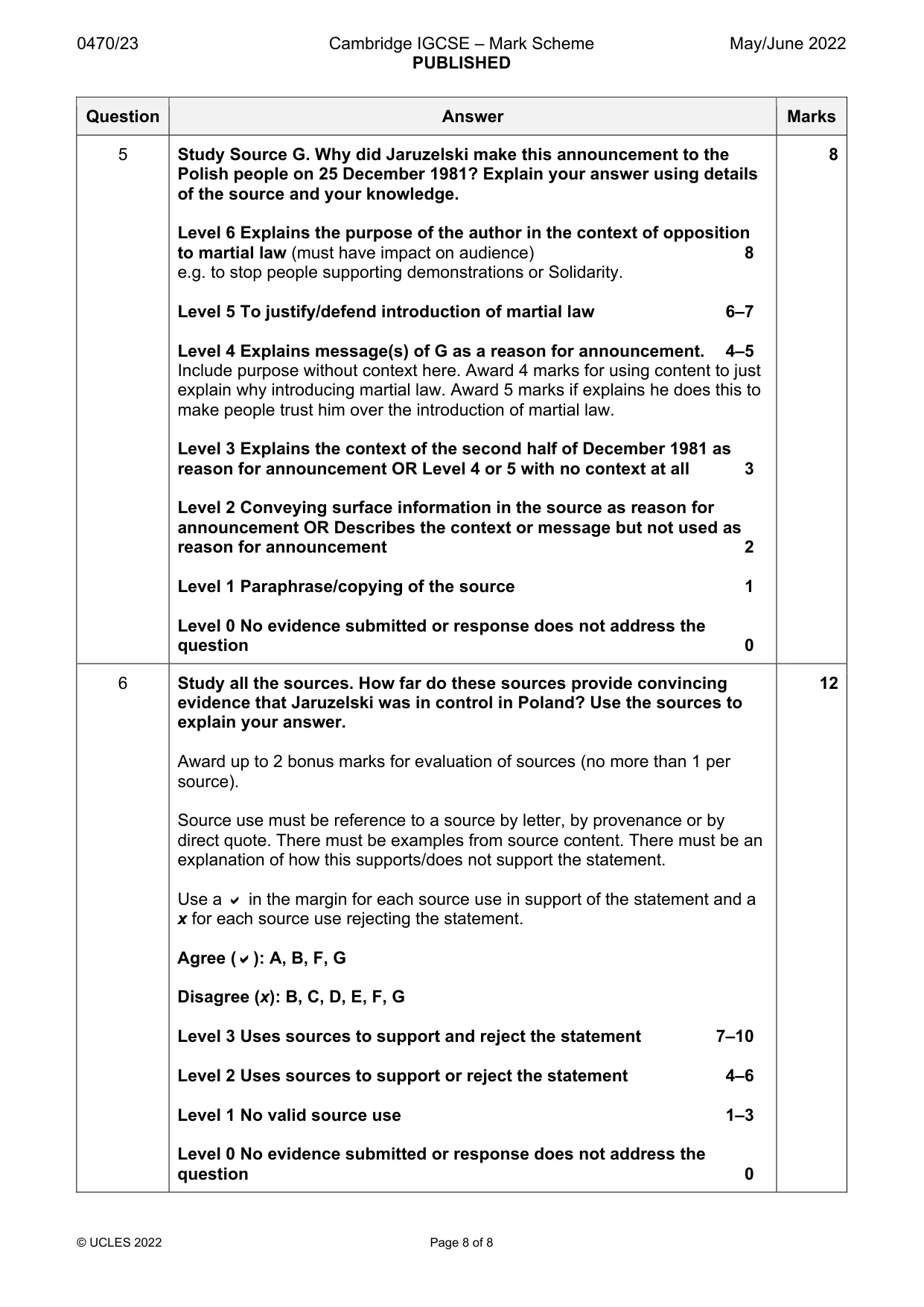
0470/23 Cambridge IGCSE – Mark Scheme PUBLISHED May/June 2022 © UCLES 2022 Page 7 of 8 Question Answer Marks 3 Study Sources D and E. These two cartoons are by the same cartoonist. Had he changed his opinion between drawing the two cartoons? Explain your answer using details of the sources and your knowledge. Level 7 Compares points of view of cartoonists – anti-Soviet in both – must be supported/explained. 8 Level 6 Compares big messages – in D the Soviets are going to deal with Poland/Solidarity themselves, in E they are using Jaruzelski to do it 7 Level 5 Compares valid sub-messages OR Valid interpretation of big message of one source but no valid comparison 5–6 Level 4 Valid interpretation of sub-messages of one source OR Valid but unsupported points of view, e.g. he’s critical of the Soviets in both 4 Level 3 Uses contextual knowledge to explain developments in Poland in 1980-81 to claim his view will have changed 3 Level 2 Answers based on surface detail OR Undeveloped provenance OR Valid comparison of cartoons but fails to explain whether opinion has changed OR Misinterpretations 2 Level 1 Unsupported assertions OR Surface description without valid comparison 1 Level 0 No evidence submitted or response does not address the question 0 8 Question Answer Marks 4 Study Source F. What is the cartoonist's message? Explain your answer using details of the source and your knowledge. Level 5 Explains cartoonist’s point of view – it is pro-Solidarity/anti Jaruzelski because Solidarity is defeating martial law. 7 Level 4 Explains big message – Solidarity will defeat martial law, Solidarity will not be beaten by martial law. 5–6 Level 3 Explains valid sub-message(s) OR Unsupported points of view e.g. Jaruzelski has taken action against Solidarity, Solidarity has been imprisoned/held down, Solidarity is opposing martial law, Solidarity is powerful. 3–4 Level 2 Misinterpretations 2 Level 1 Surface description of cartoon 1 Level 0 No evidence submitted or response does not address the question 0 7
Mark scheme, page 8
0470/23 Cambridge IGCSE – Mark Scheme PUBLISHED May/June 2022 © UCLES 2022 Page 8 of 8 Question Answer Marks 5 Study Source G. Why did Jaruzelski make this announcement to the Polish people on 25 December 1981? Explain your answer using details of the source and your knowledge. Level 6 Explains the purpose of the author in the context of opposition to martial law (must have impact on audience) 8 e.g. to stop people supporting demonstrations or Solidarity. Level 5 To justify/defend introduction of martial law 6–7 Level 4 Explains message(s) of G as a reason for announcement. 4–5 Include purpose without context here. Award 4 marks for using content to just explain why introducing martial law. Award 5 marks if explains he does this to make people trust him over the introduction of martial law. Level 3 Explains the context of the second half of December 1981 as reason for announcement OR Level 4 or 5 with no context at all 3 Level 2 Conveying surface information in the source as reason for announcement OR Describes the context or message but not used as reason for announcement 2 Level 1 Paraphrase/copying of the source 1 Level 0 No evidence submitted or response does not address the question 0 8 6 Study all the sources. How far do these sources provide convincing evidence that Jaruzelski was in control in Poland? Use the sources to explain your answer. Award up to 2 bonus marks for evaluation of sources (no more than 1 per source). Source use must be reference to a source by letter, by provenance or by direct quote. There must be examples from source content. There must be an explanation of how this supports/does not support the statement. Use a in the margin for each source use in support of the statement and a x for each source use rejecting the statement. Agree (): A, B, F, G Disagree (x): B, C, D, E, F, G Level 3 Uses sources to support and reject the statement 7–10 Level 2 Uses sources to support or reject the statement 4–6 Level 1 No valid source use 1–3 Level 0 No evidence submitted or response does not address the question 0 12
What you needed in this session
Cambridge’s own grade thresholds for 2022 May/June, Paper 2 · Variant 3. A higher threshold means an easier paper — the bar moves with how the cohort did.