Cambridge IGCSE History 0470 — 2025 Feb/March Paper 2 · Variant 2
0470/22/F/M/25 · 40 marks · 105 min
The question paper and its mark scheme, free to read here and free to download. This is Cambridge’s own paper, exactly as it was sat.
Question paper12 pages
Mark scheme14 pages
Answers below. Sit the paper first if you are practising.
Paper as text
Question paper, page 1
This document has 12 pages. [Turn over Cambridge IGCSE™ * 0 5 1 0 9 4 6 3 4 6 * DC (CJ/CB) 342312/3 © UCLES 2025 HISTORY 0470/22 Paper 2 Document Questions February/March 2025 1 hour 45 minutes You must answer on the enclosed answer booklet. You will need: Answer booklet (enclosed) INSTRUCTIONS ● Answer one question on one option only. Option A: Nineteenth century topic Option B: Twentieth century topic ● Follow the instructions on the front cover of the answer booklet. If you need additional answer paper, ask the invigilator for a continuation booklet. INFORMATION ● The total mark for this paper is 40. ● The number of marks for each question or part question is shown in brackets [ ].
Question paper, page 2
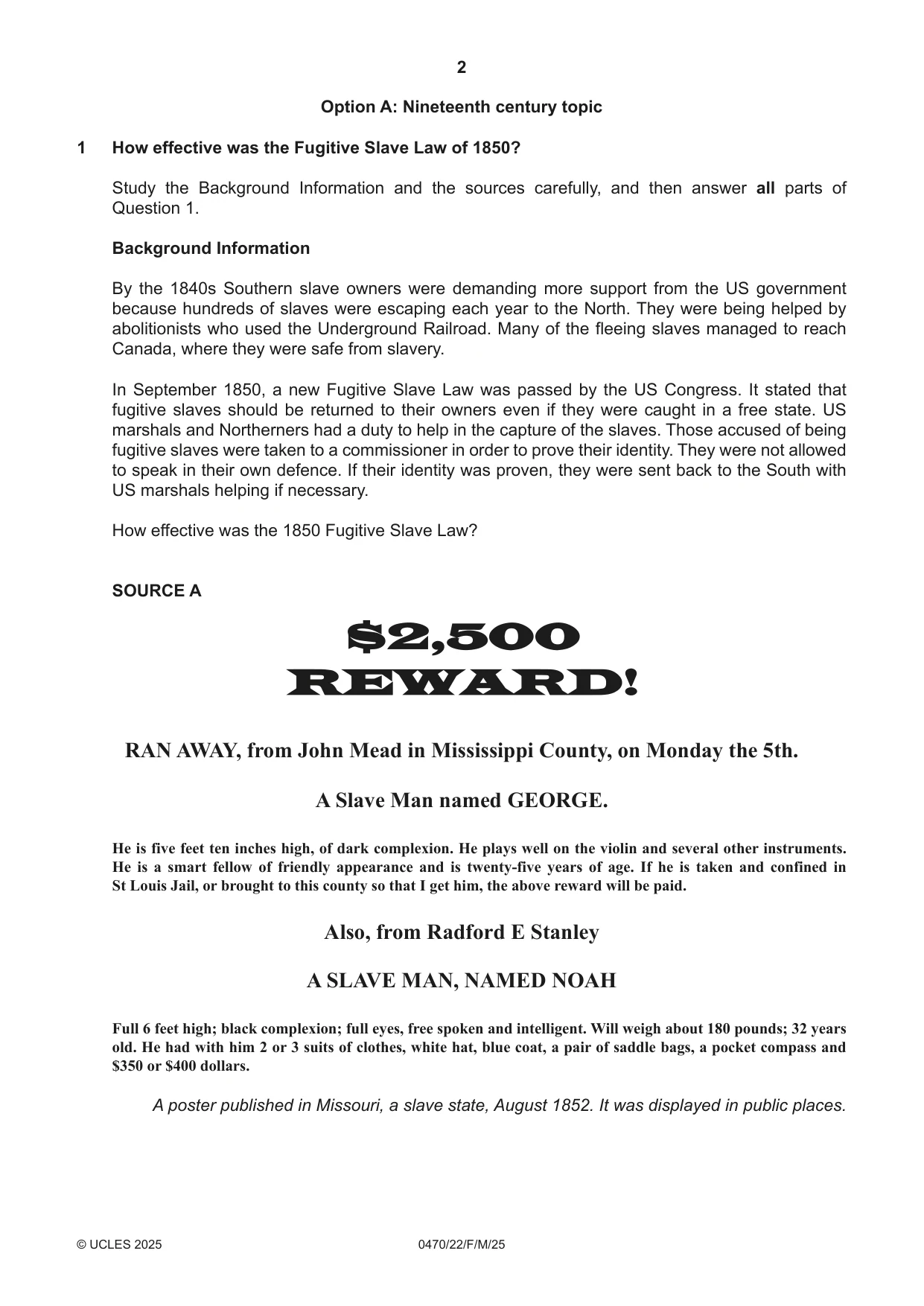
2 0470/22/F/M/25 © UCLES 2025 Option A: Nineteenth century topic 1 How effective was the Fugitive Slave Law of 1850? Study the Background Information and the sources carefully, and then answer all parts of Question 1. Background Information By the 1840s Southern slave owners were demanding more support from the US government because hundreds of slaves were escaping each year to the North. They were being helped by abolitionists who used the Underground Railroad. Many of the fleeing slaves managed to reach Canada, where they were safe from slavery. In September 1850, a new Fugitive Slave Law was passed by the US Congress. It stated that fugitive slaves should be returned to their owners even if they were caught in a free state. US marshals and Northerners had a duty to help in the capture of the slaves. Those accused of being fugitive slaves were taken to a commissioner in order to prove their identity. They were not allowed to speak in their own defence. If their identity was proven, they were sent back to the South with US marshals helping if necessary. How effective was the 1850 Fugitive Slave Law? SOURCE A RAN AWAY, from John Mead in Mississippi County, on Monday the 5th. A Slave Man named GEORGE. He is five feet ten inches high, of dark complexion. He plays well on the violin and several other instruments. He is a smart fellow of friendly appearance and is twenty-five years of age. If he is taken and confined in St Louis Jail, or brought to this county so that I get him, the above reward will be paid. Also, from Radford E Stanley A SLAVE MAN, NAMED NOAH Full 6 feet high; black complexion; full eyes, free spoken and intelligent. Will weigh about 180 pounds; 32 years old. He had with him 2 or 3 suits of clothes, white hat, blue coat, a pair of saddle bags, a pocket compass and $350 or $400 dollars. A poster published in Missouri, a slave state, August 1852. It was displayed in public places.
Question paper, page 3
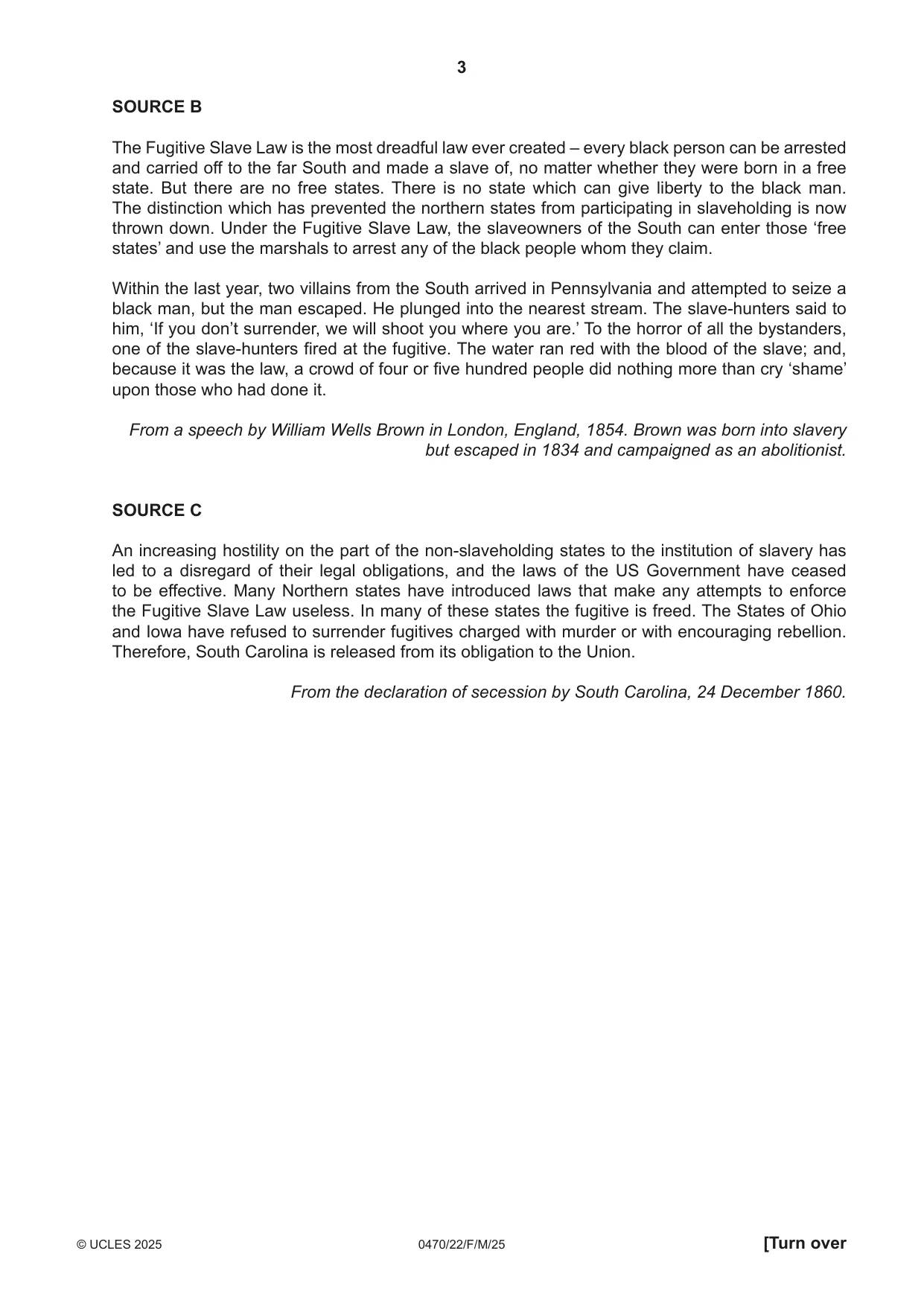
3 0470/22/F/M/25 © UCLES 2025 [Turn over SOURCE B The Fugitive Slave Law is the most dreadful law ever created – every black person can be arrested and carried off to the far South and made a slave of, no matter whether they were born in a free state. But there are no free states. There is no state which can give liberty to the black man. The distinction which has prevented the northern states from participating in slaveholding is now thrown down. Under the Fugitive Slave Law, the slaveowners of the South can enter those ‘free states’ and use the marshals to arrest any of the black people whom they claim. Within the last year, two villains from the South arrived in Pennsylvania and attempted to seize a black man, but the man escaped. He plunged into the nearest stream. The slave-hunters said to him, ‘If you don’t surrender, we will shoot you where you are.’ To the horror of all the bystanders, one of the slave-hunters fired at the fugitive. The water ran red with the blood of the slave; and, because it was the law, a crowd of four or five hundred people did nothing more than cry ‘shame’ upon those who had done it. From a speech by William Wells Brown in London, England, 1854. Brown was born into slavery but escaped in 1834 and campaigned as an abolitionist. SOURCE C An increasing hostility on the part of the non-slaveholding states to the institution of slavery has led to a disregard of their legal obligations, and the laws of the US Government have ceased to be effective. Many Northern states have introduced laws that make any attempts to enforce the Fugitive Slave Law useless. In many of these states the fugitive is freed. The States of Ohio and Iowa have refused to surrender fugitives charged with murder or with encouraging rebellion. Therefore, South Carolina is released from its obligation to the Union. From the declaration of secession by South Carolina, 24 December 1860.
Question paper, page 4
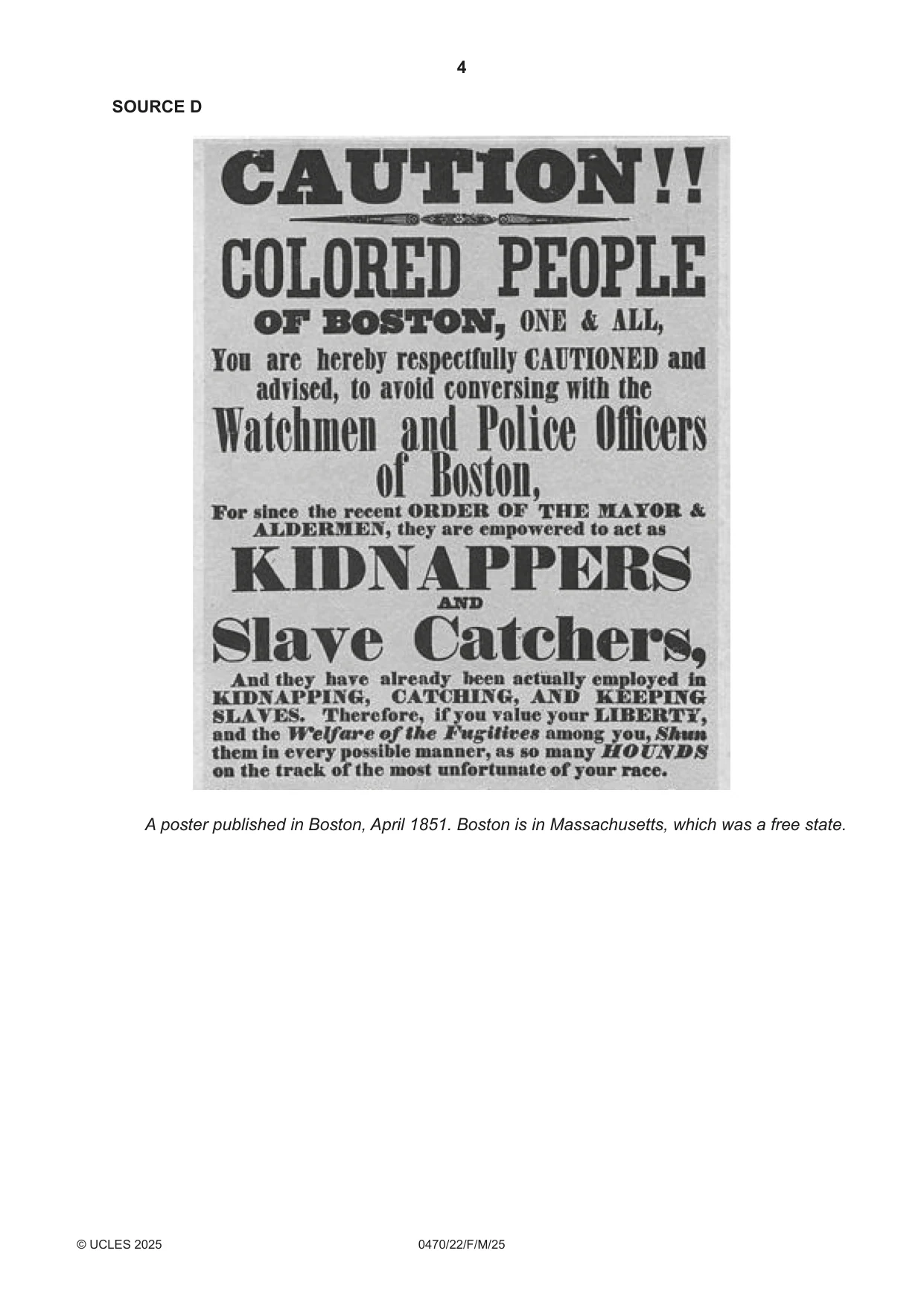
4 0470/22/F/M/25 © UCLES 2025 SOURCE D A poster published in Boston, April 1851. Boston is in Massachusetts, which was a free state.
Question paper, page 5
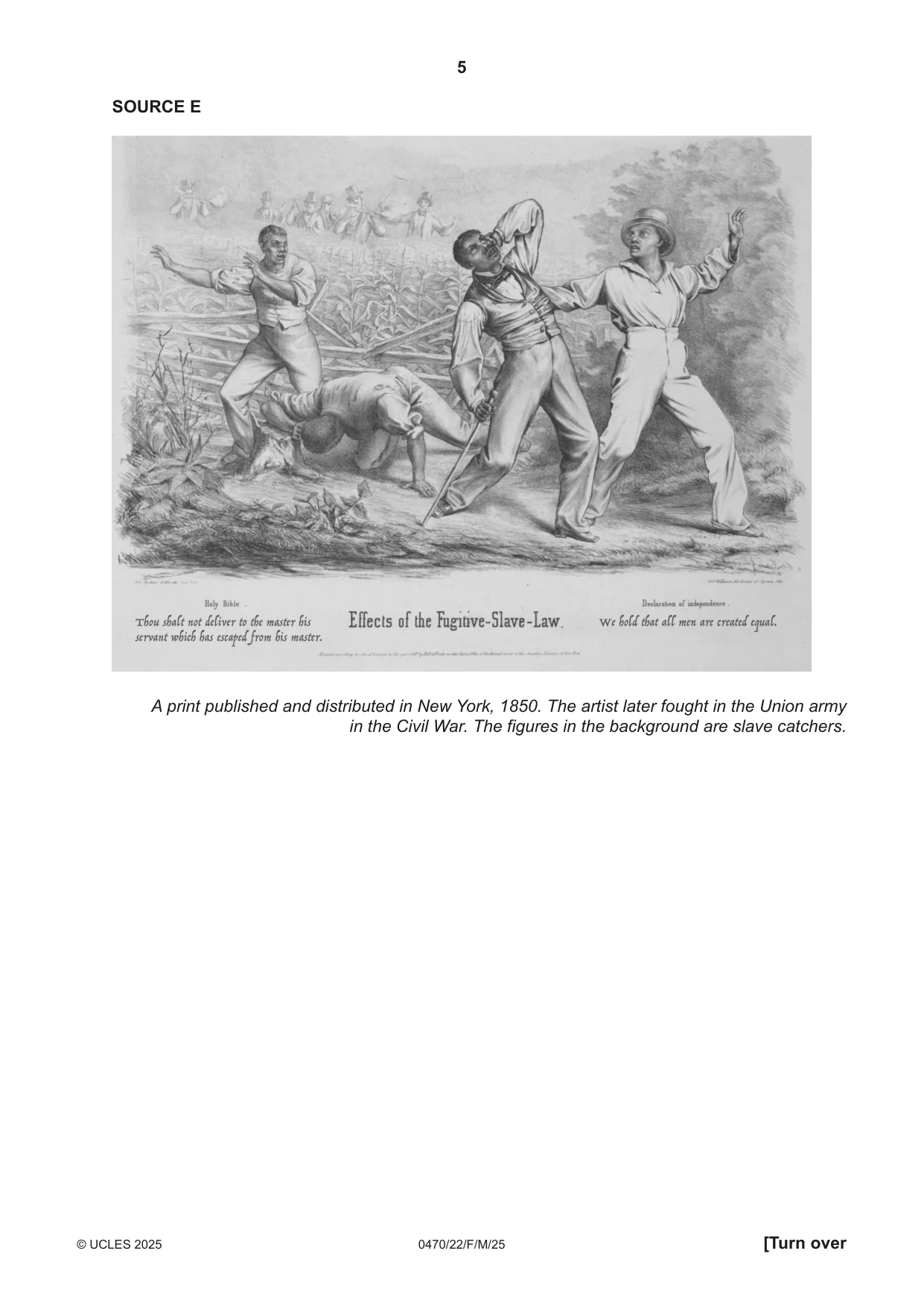
5 0470/22/F/M/25 © UCLES 2025 [Turn over SOURCE E A print published and distributed in New York, 1850. The artist later fought in the Union army in the Civil War. The figures in the background are slave catchers.
Question paper, page 6
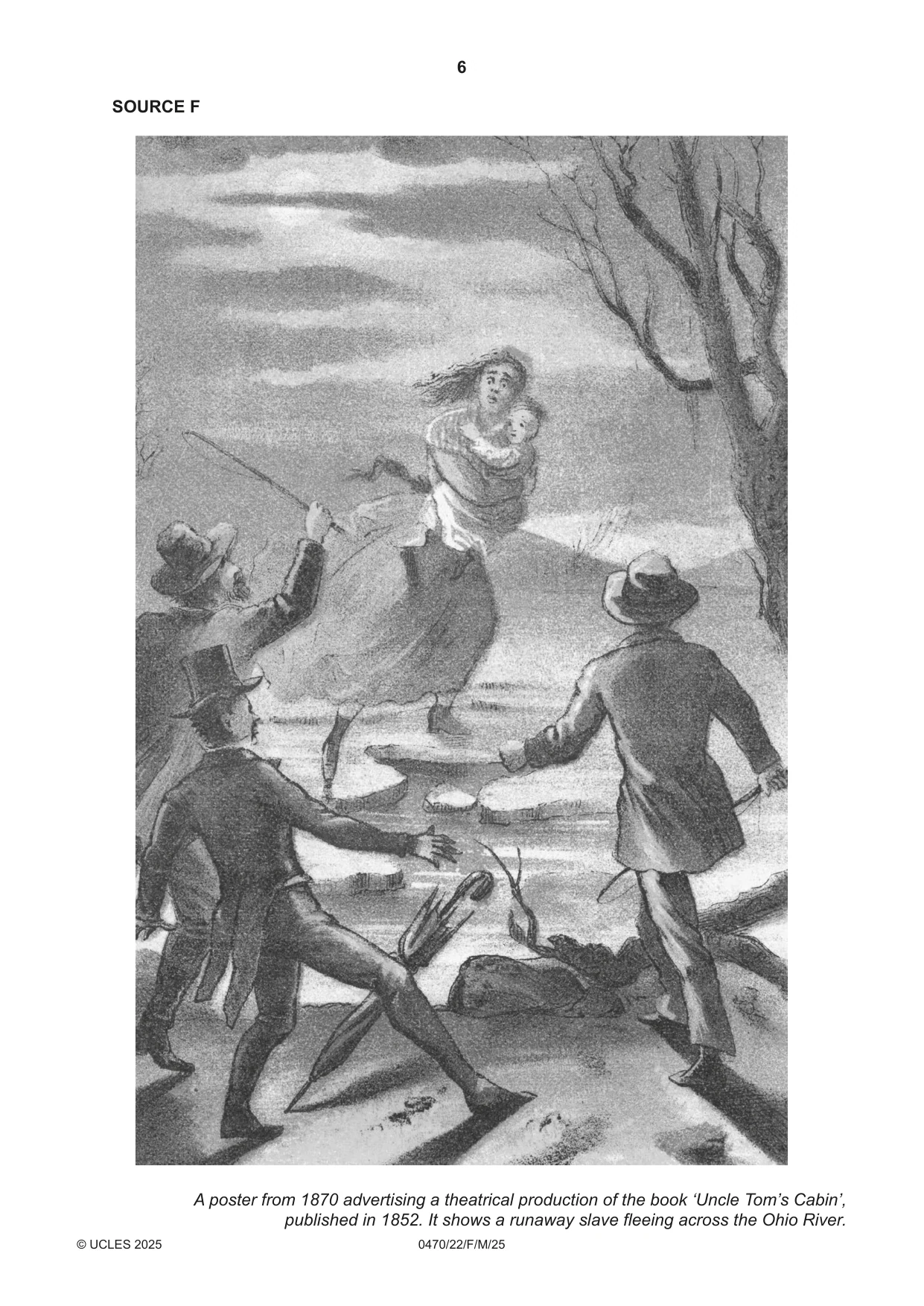
6 0470/22/F/M/25 © UCLES 2025 SOURCE F A poster from 1870 advertising a theatrical production of the book ‘Uncle Tom’s Cabin’, published in 1852. It shows a runaway slave fleeing across the Ohio River.
Question paper, page 7
7 0470/22/F/M/25 © UCLES 2025 [Turn over Now answer all parts of Question 1. You may use any of the sources to help you answer the questions, in addition to those sources which you are told to use. In answering parts (a)–(e) you should use your knowledge of the topic to help you interpret and evaluate the sources. (a) Study Source A. How useful is this source to a historian studying slavery in the USA in the 1850s? Explain your answer using details of the source and your knowledge. [7] (b) Study Sources B and C. How far does Source B make Source C surprising? Explain your answer using details of the sources and your knowledge. [8] (c) Study Source D. Why was this source published in Boston in 1851? Explain your answer using details of the source and your knowledge. [8] (d) Study Sources E and F. Which one of these two sources provides the more reliable evidence about the Fugitive Slave Law? Explain your answer using details of the sources and your knowledge. [8] (e) Study all the sources. How far do these sources provide convincing evidence that the Fugitive Slave Law was effective? Use the sources to explain your answer. [9]
Question paper, page 8
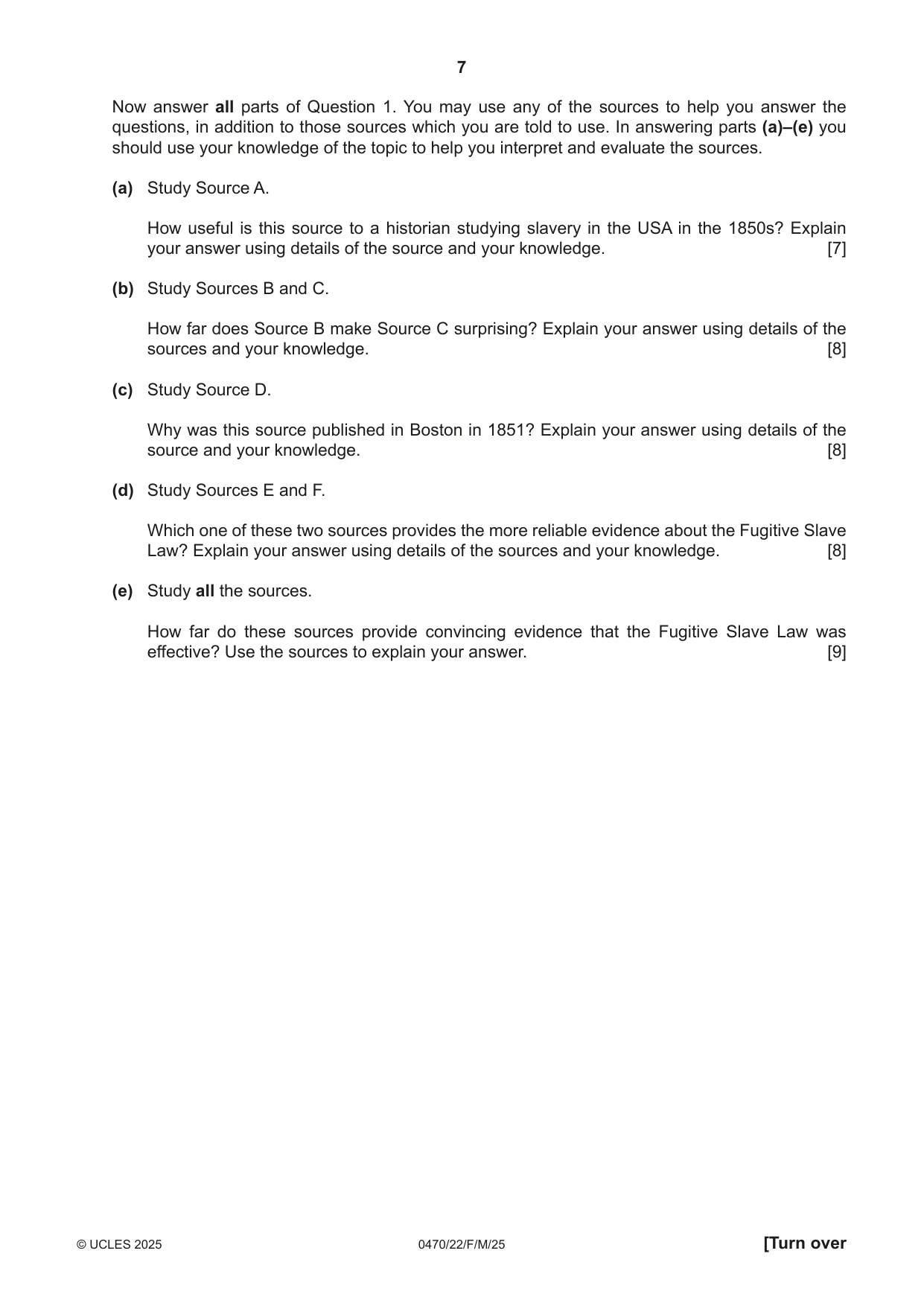
8 0470/22/F/M/25 © UCLES 2025 Option B: Twentieth century topic 2 How reasonable were Mussolini’s actions over Corfu? Study the Background Information and the sources carefully, and then answer all parts of Question 2. Background Information The Corfu incident started in August 1923 when Italian members of a commission, sent by the Conference of Ambassadors to mark the Albanian–Greek border, were murdered. There were claims that Greeks were responsible for the killings, and Mussolini sent Greece an ultimatum and then occupied Corfu. The Conference of Ambassadors decided that Greece should pay Italy compensation and that Italy should leave Corfu. Was Mussolini justified in how he acted over Corfu? SOURCE A The crisis broke out when Italian members of a commission working on the Albanian–Greek border were murdered. On 29 August, Mussolini quickly sent reasonable demands to the Greek government, which rejected them. On 31 August Mussolini invaded Corfu, in effect holding the Greek island hostage. Greece wanted the matter to be dealt with by the League of Nations but it was generally agreed that the Conference of Ambassadors should deal with it. Greece had to pay heavy compensation to Italy due to its ‘negligence before and after the crime’. Happy that he had achieved his aims, Mussolini evacuated the island on 27 September. In Italy, the whole incident was regarded as a triumph which was celebrated by the Italian people. From a recent history book. SOURCE B In August 1923, Mussolini saw an opportunity to show his contempt for the League. On 27 August, within a day of the shooting of the Italian commissioners, he had ordered the occupation of Corfu and sent an ultimatum to Greece. He made sure the Greeks could not accept all of the ultimatum. Despite several governments, including the British, believing that Albanians were guilty of the murders, Greece acted as reasonably as possible and accepted most of the Italian demands. On 31 August, with Mussolini claiming that Corfu was rightfully part of Italy, the Italians bombarded and invaded Corfu. The Greeks appealed to the League of Nations but Mussolini, knowing that the French would support him, demanded the matter be settled by the Conference of Ambassadors. Greece was outraged by the Conference’s ruling that it should pay Italy compensation. The Conference also ruled that the Italians should leave Corfu. British naval threats made Mussolini leave the island. What had started as an attempt to dominate the Adriatic turned into a withdrawal and a confrontation with Britain. Despite this, Mussolini and the Italian people regarded his actions as successful. From a recent history book.
Question paper, page 9
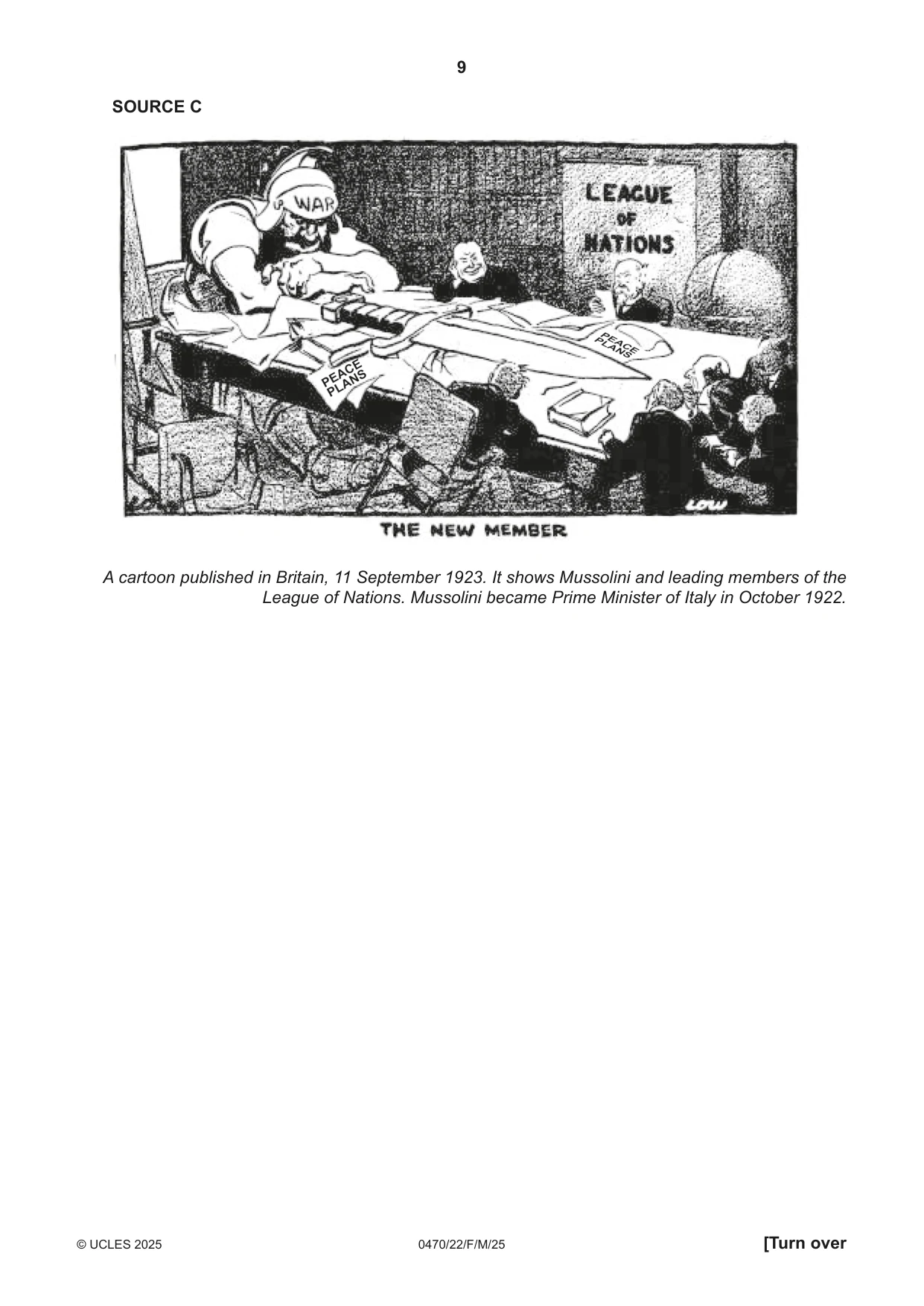
9 0470/22/F/M/25 © UCLES 2025 [Turn over SOURCE C A cartoon published in Britain, 11 September 1923. It shows Mussolini and leading members of the League of Nations. Mussolini became Prime Minister of Italy in October 1922.
Question paper, page 10
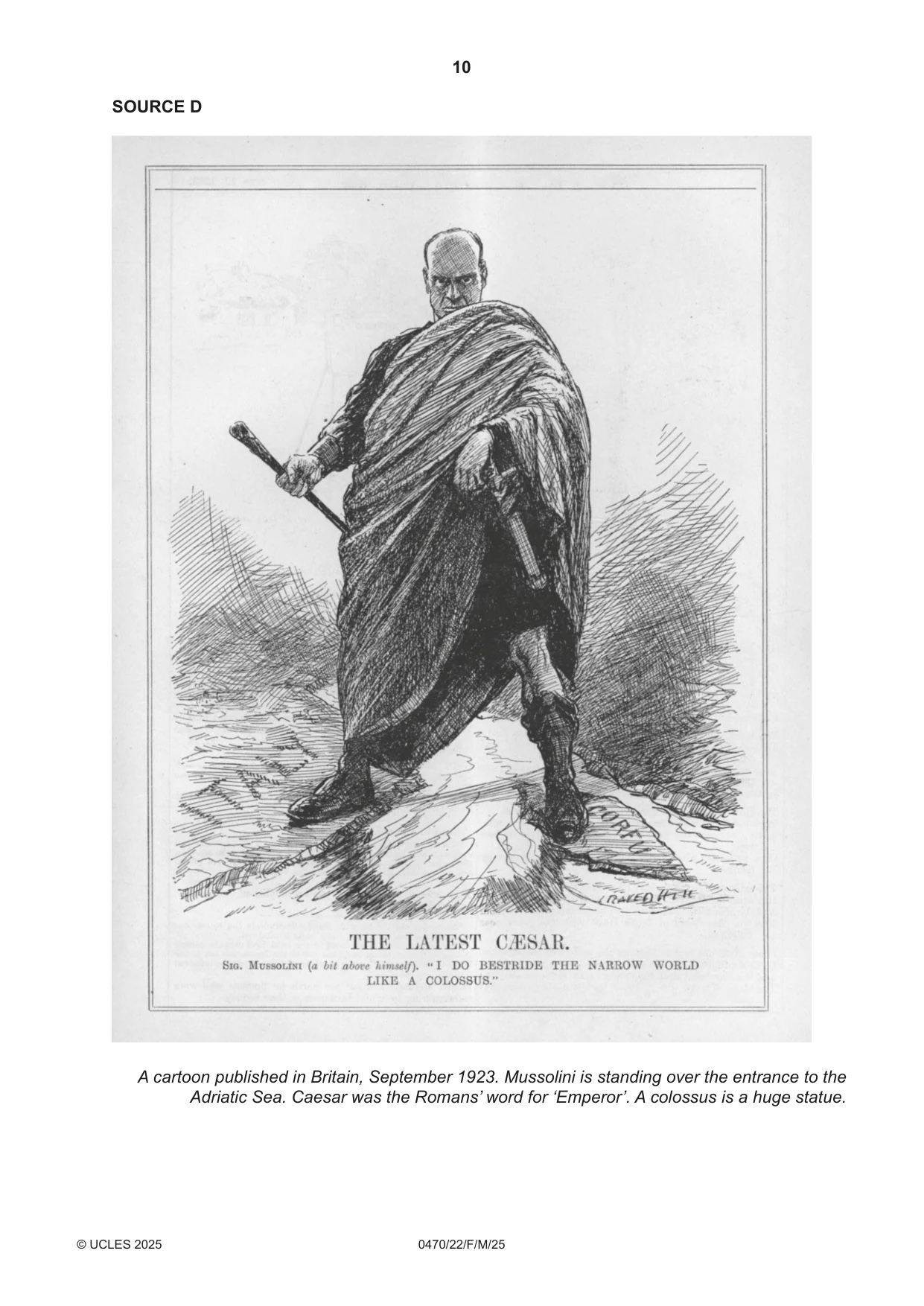
10 0470/22/F/M/25 © UCLES 2025 SOURCE D A cartoon published in Britain, September 1923. Mussolini is standing over the entrance to the Adriatic Sea. Caesar was the Romans’ word for ‘Emperor’. A colossus is a huge statue.
Question paper, page 11
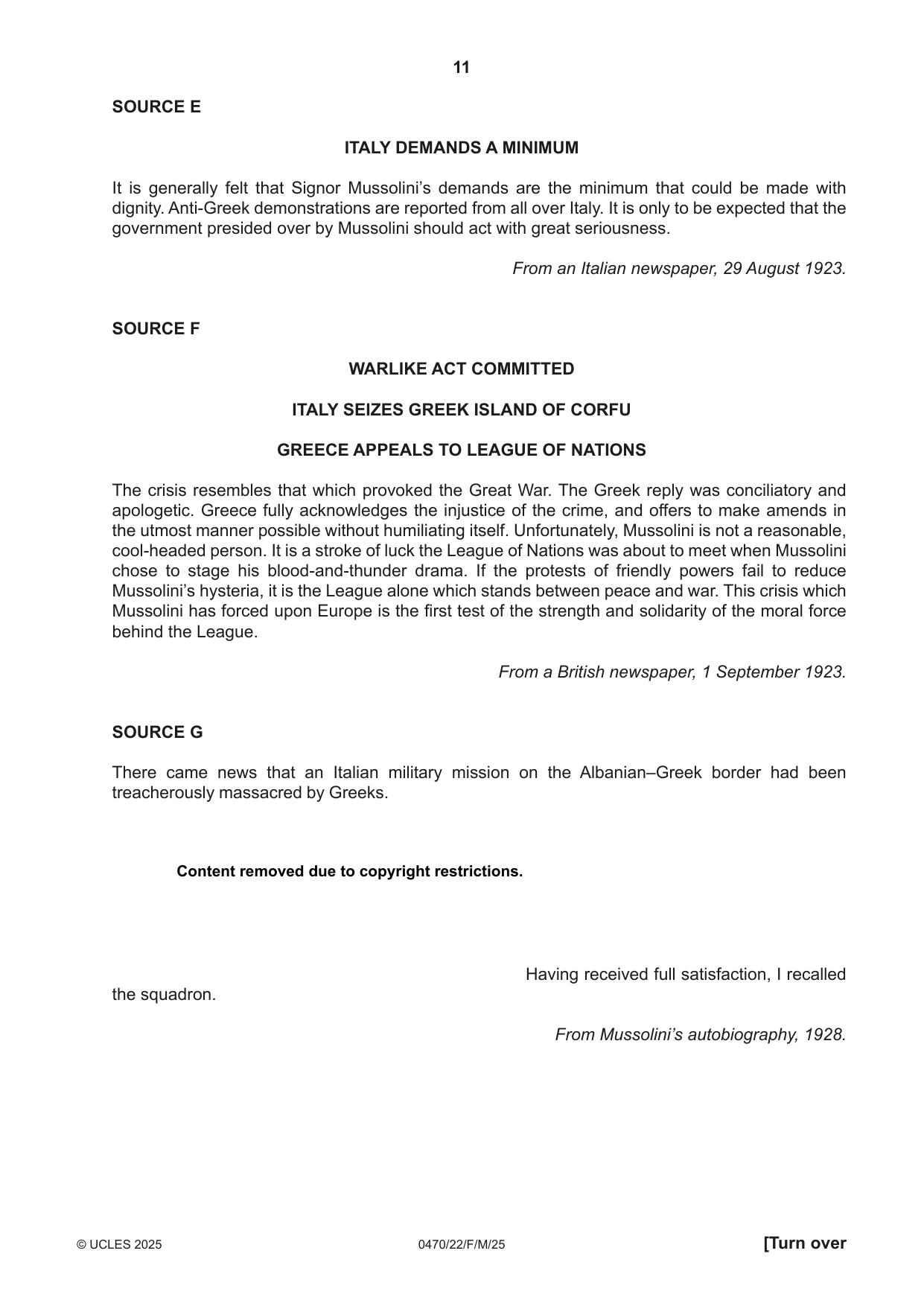
11 0470/22/F/M/25 © UCLES 2025 [Turn over SOURCE E ITALY DEMANDS A MINIMUM It is generally felt that Signor Mussolini’s demands are the minimum that could be made with dignity. Anti-Greek demonstrations are reported from all over Italy. It is only to be expected that the government presided over by Mussolini should act with great seriousness. From an Italian newspaper, 29 August 1923. SOURCE F WARLIKE ACT COMMITTED ITALY SEIZES GREEK ISLAND OF CORFU GREECE APPEALS TO LEAGUE OF NATIONS The crisis resembles that which provoked the Great War. The Greek reply was conciliatory and apologetic. Greece fully acknowledges the injustice of the crime, and offers to make amends in the utmost manner possible without humiliating itself. Unfortunately, Mussolini is not a reasonable, cool-headed person. It is a stroke of luck the League of Nations was about to meet when Mussolini chose to stage his blood-and-thunder drama. If the protests of friendly powers fail to reduce Mussolini’s hysteria, it is the League alone which stands between peace and war. This crisis which Mussolini has forced upon Europe is the first test of the strength and solidarity of the moral force behind the League. From a British newspaper, 1 September 1923. SOURCE G There came news that an Italian military mission on the Albanian–Greek border had been treacherously massacred by Greeks. Having received full satisfaction, I recalled the squadron. From Mussolini’s autobiography, 1928. Content removed due to copyright restrictions.
Question paper, page 12
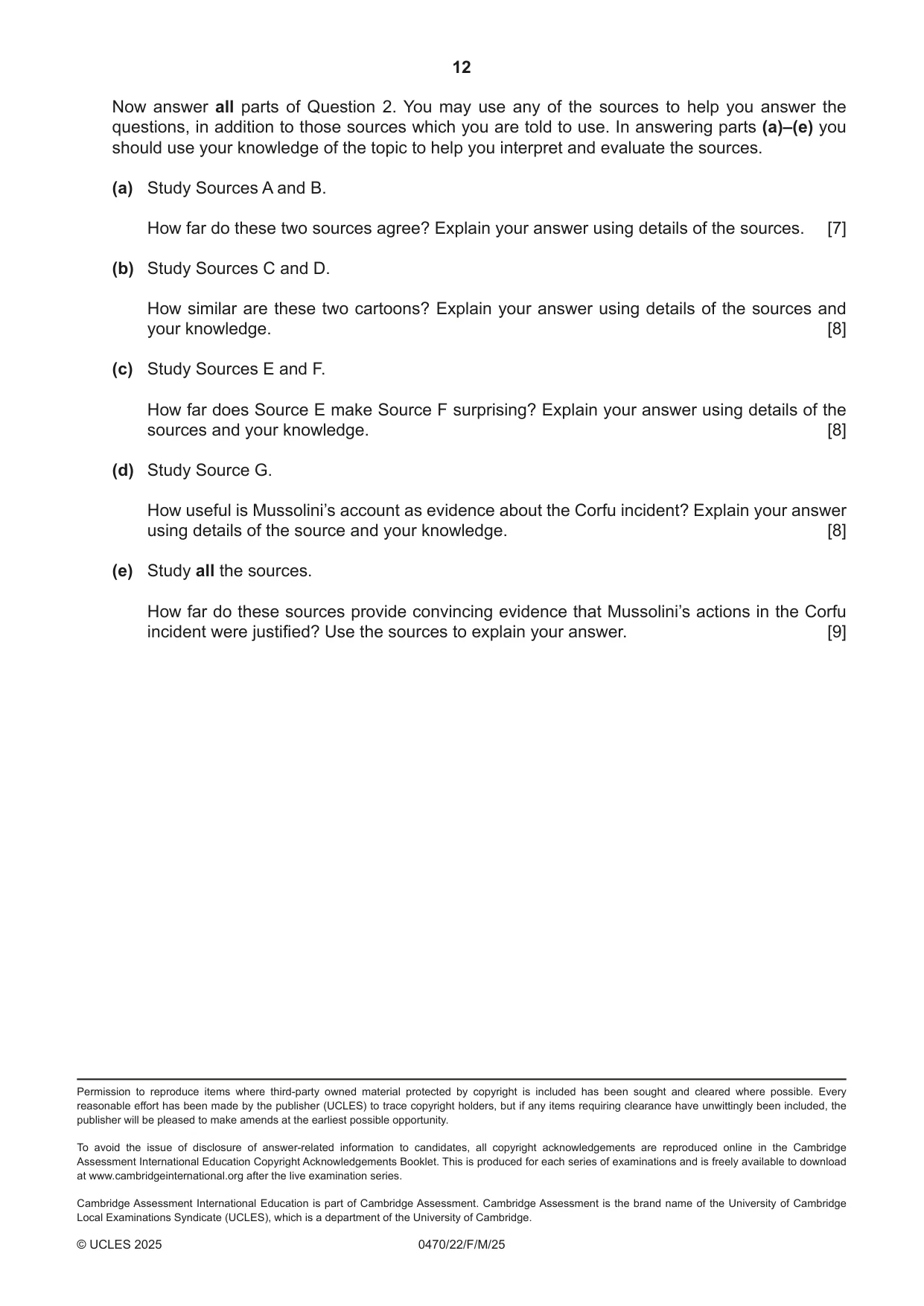
12 0470/22/F/M/25 © UCLES 2025 Permission to reproduce items where third-party owned material protected by copyright is included has been sought and cleared where possible. Every reasonable effort has been made by the publisher (UCLES) to trace copyright holders, but if any items requiring clearance have unwittingly been included, the publisher will be pleased to make amends at the earliest possible opportunity. To avoid the issue of disclosure of answer-related information to candidates, all copyright acknowledgements are reproduced online in the Cambridge Assessment International Education Copyright Acknowledgements Booklet. This is produced for each series of examinations and is freely available to download at www.cambridgeinternational.org after the live examination series. Cambridge Assessment International Education is part of Cambridge Assessment. Cambridge Assessment is the brand name of the University of Cambridge Local Examinations Syndicate (UCLES), which is a department of the University of Cambridge. Now answer all parts of Question 2. You may use any of the sources to help you answer the questions, in addition to those sources which you are told to use. In answering parts (a)–(e) you should use your knowledge of the topic to help you interpret and evaluate the sources. (a) Study Sources A and B. How far do these two sources agree? Explain your answer using details of the sources. [7] (b) Study Sources C and D. How similar are these two cartoons? Explain your answer using details of the sources and your knowledge. [8] (c) Study Sources E and F. How far does Source E make Source F surprising? Explain your answer using details of the sources and your knowledge. [8] (d) Study Source G. How useful is Mussolini’s account as evidence about the Corfu incident? Explain your answer using details of the source and your knowledge. [8] (e) Study all the sources. How far do these sources provide convincing evidence that Mussolini’s actions in the Corfu incident were justified? Use the sources to explain your answer. [9]
Mark scheme, page 1
This document consists of 14 printed pages. © Cambridge University Press & Assessment 2025 [Turn over Cambridge IGCSE™ HISTORY 0470/22 Paper 2 February/March 2025 MARK SCHEME Maximum Mark: 40 Published This mark scheme is published as an aid to teachers and candidates, to indicate the requirements of the examination. It shows the basis on which Examiners were instructed to award marks. It does not indicate the details of the discussions that took place at an Examiners’ meeting before marking began, which would have considered the acceptability of alternative answers. Mark schemes should be read in conjunction with the question paper and the Principal Examiner Report for Teachers. Cambridge International will not enter into discussions about these mark schemes. Cambridge International is publishing the mark schemes for the February/March 2025 series for most Cambridge IGCSE, Cambridge International A and AS Level components, and some Cambridge O Level components.
Mark scheme, page 2
0470/22 Cambridge IGCSE – Mark Scheme PUBLISHED February/March 2025 © Cambridge University Press & Assessment 2025 Page 2 of 14 Generic Marking Principles These general marking principles must be applied by all examiners when marking candidate answers. They should be applied alongside the specific content of the mark scheme or generic level descriptions for a question. Each question paper and mark scheme will also comply with these marking principles. GENERIC MARKING PRINCIPLE 1: Marks must be awarded in line with: • the specific content of the mark scheme or the generic level descriptors for the question • the specific skills defined in the mark scheme or in the generic level descriptors for the question • the standard of response required by a candidate as exemplified by the standardisation scripts. GENERIC MARKING PRINCIPLE 2: Marks awarded are always whole marks (not half marks, or other fractions). GENERIC MARKING PRINCIPLE 3: Marks must be awarded positively: • marks are awarded for correct/valid answers, as defined in the mark scheme. However, credit is given for valid answers which go beyond the scope of the syllabus and mark scheme, referring to your Team Leader as appropriate • marks are awarded when candidates clearly demonstrate what they know and can do • marks are not deducted for errors • marks are not deducted for omissions • answers should only be judged on the quality of spelling, punctuation and grammar when these features are specifically assessed by the question as indicated by the mark scheme. The meaning, however, should be unambiguous. GENERIC MARKING PRINCIPLE 4: Rules must be applied consistently, e.g. in situations where candidates have not followed instructions or in the application of generic level descriptors. GENERIC MARKING PRINCIPLE 5: Marks should be awarded using the full range of marks defined in the mark scheme for the question (however; the use of the full mark range may be limited according to the quality of the candidate responses seen). GENERIC MARKING PRINCIPLE 6: Marks awarded are based solely on the requirements as defined in the mark scheme. Marks should not be awarded with grade thresholds or grade descriptors in mind.
Mark scheme, page 3
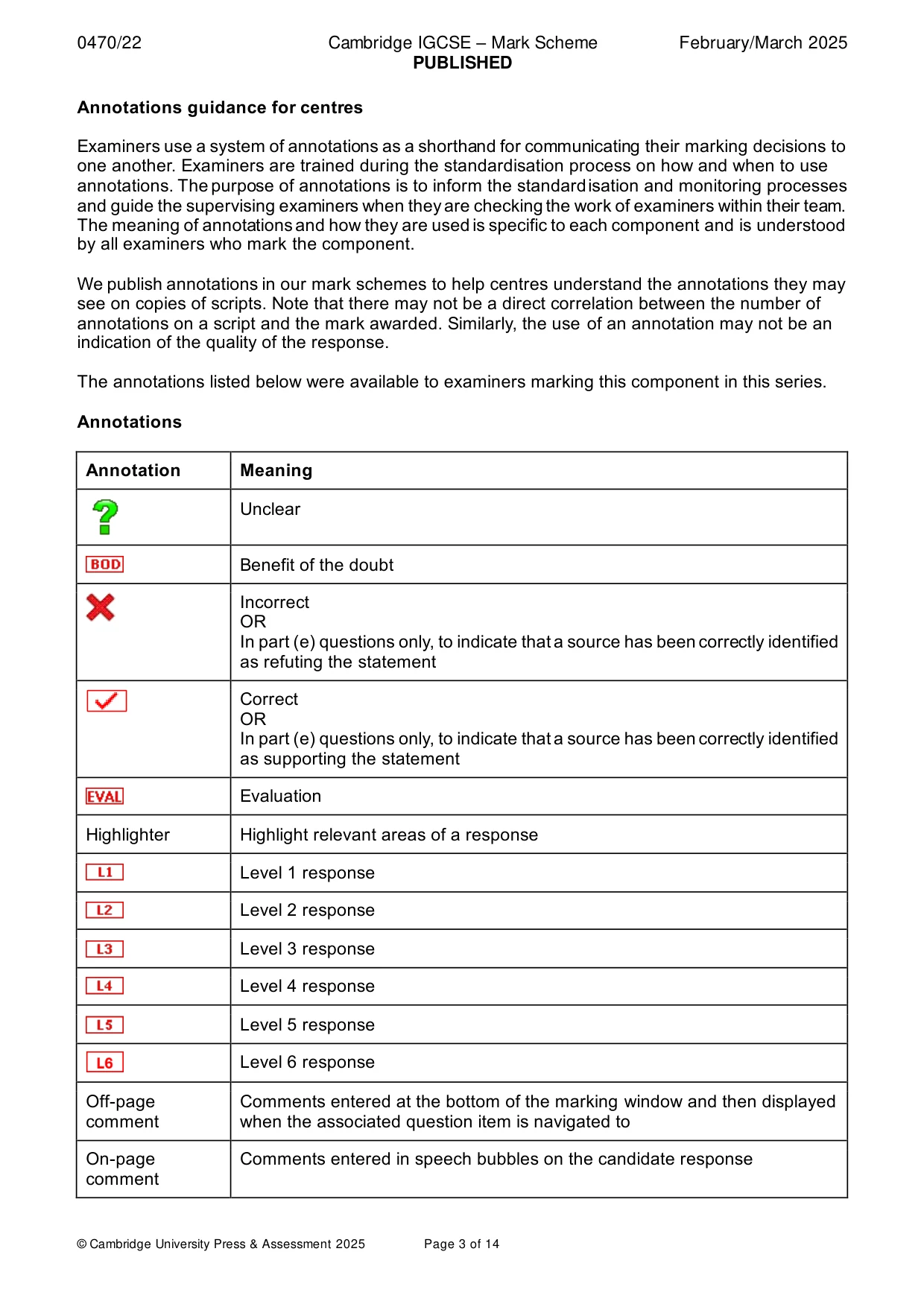
0470/22 Cambridge IGCSE – Mark Scheme PUBLISHED February/March 2025 © Cambridge University Press & Assessment 2025 Page 3 of 14 Annotations guidance for centres Examiners use a system of annotations as a shorthand for communicating their marking decisions to one another. Examiners are trained during the standardisation process on how and when to use annotations. The purpose of annotations is to inform the standardisation and monitoring processes and guide the supervising examiners when they are checking the work of examiners within their team. The meaning of annotations and how they are used is specific to each component and is understood by all examiners who mark the component. We publish annotations in our mark schemes to help centres understand the annotations they may see on copies of scripts. Note that there may not be a direct correlation between the number of annotations on a script and the mark awarded. Similarly, the use of an annotation may not be an indication of the quality of the response. The annotations listed below were available to examiners marking this component in this series. Annotations Annotation Meaning Unclear Benefit of the doubt Incorrect OR In part (e) questions only, to indicate that a source has been correctly identified as refuting the statement Correct OR In part (e) questions only, to indicate that a source has been correctly identified as supporting the statement Evaluation Highlighter Highlight relevant areas of a response Level 1 response Level 2 response Level 3 response Level 4 response Level 5 response Level 6 response Off-page comment Comments entered at the bottom of the marking window and then displayed when the associated question item is navigated to On-page comment Comments entered in speech bubbles on the candidate response
Mark scheme, page 4
0470/22 Cambridge IGCSE – Mark Scheme PUBLISHED February/March 2025 © Cambridge University Press & Assessment 2025 Page 4 of 14 Annotation Meaning To indicate that a point has been noted but no credit has been given OR To indicate that a blank page has been checked for creditable content Assessment objectives AO1 An ability to recall, select, organise and deploy knowledge of the syllabus content. AO3 An ability to understand, interpret, evaluate and use a range of sources as evidence, in their historical context.
Mark scheme, page 5
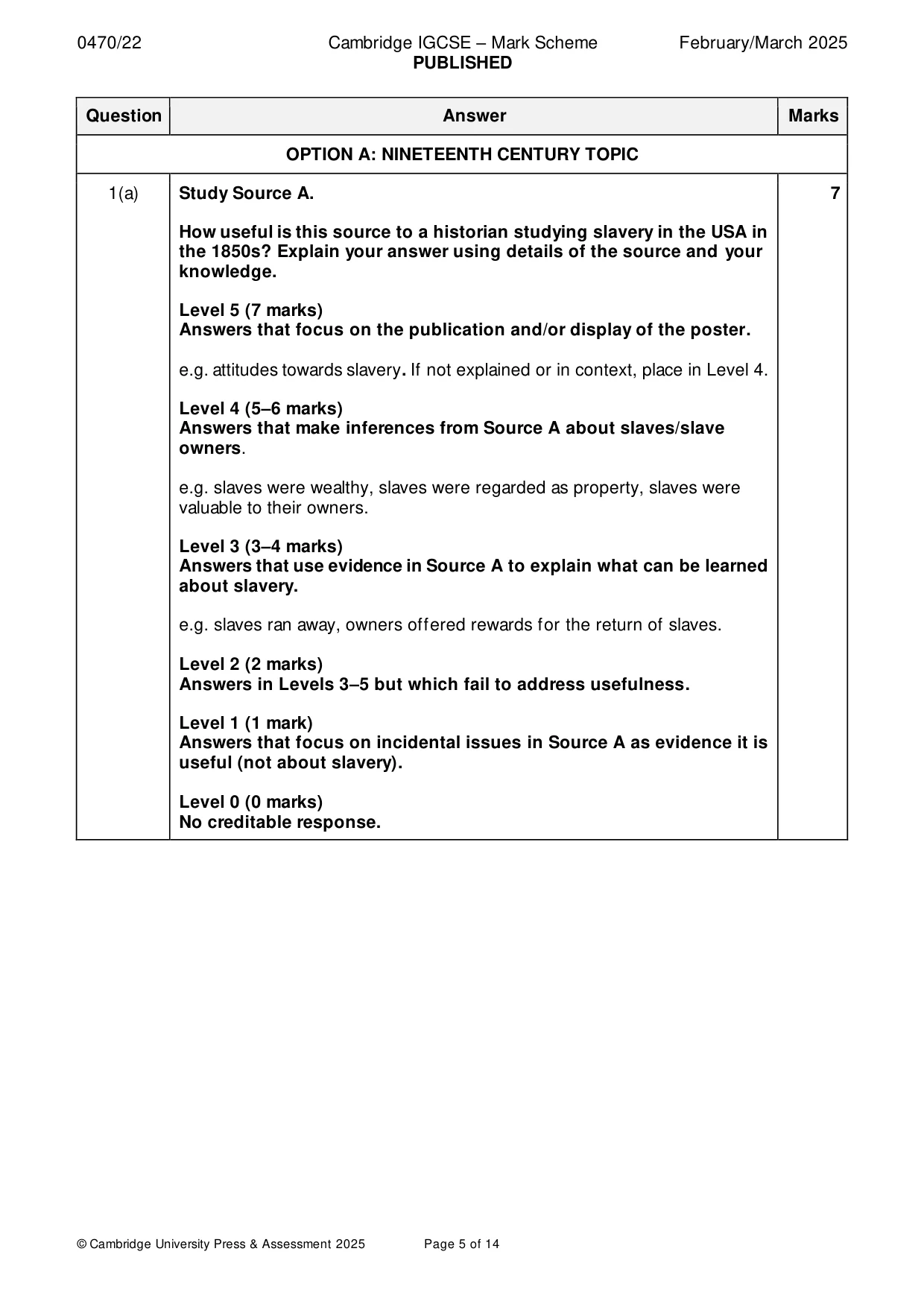
0470/22 Cambridge IGCSE – Mark Scheme PUBLISHED February/March 2025 © Cambridge University Press & Assessment 2025 Page 5 of 14 Question Answer Marks OPTION A: NINETEENTH CENTURY TOPIC 1(a) Study Source A. How useful is this source to a historian studying slavery in the USA in the 1850s? Explain your answer using details of the source and your knowledge. Level 5 (7 marks) Answers that focus on the publication and/or display of the poster. e.g. attitudes towards slavery. If not explained or in context, place in Level 4. Level 4 (5–6 marks) Answers that make inferences from Source A about slaves/slave owners. e.g. slaves were wealthy, slaves were regarded as property, slaves were valuable to their owners. Level 3 (3–4 marks) Answers that use evidence in Source A to explain what can be learned about slavery. e.g. slaves ran away, owners offered rewards for the return of slaves. Level 2 (2 marks) Answers in Levels 3–5 but which fail to address usefulness. Level 1 (1 mark) Answers that focus on incidental issues in Source A as evidence it is useful (not about slavery). Level 0 (0 marks) No creditable response. 7
Mark scheme, page 6
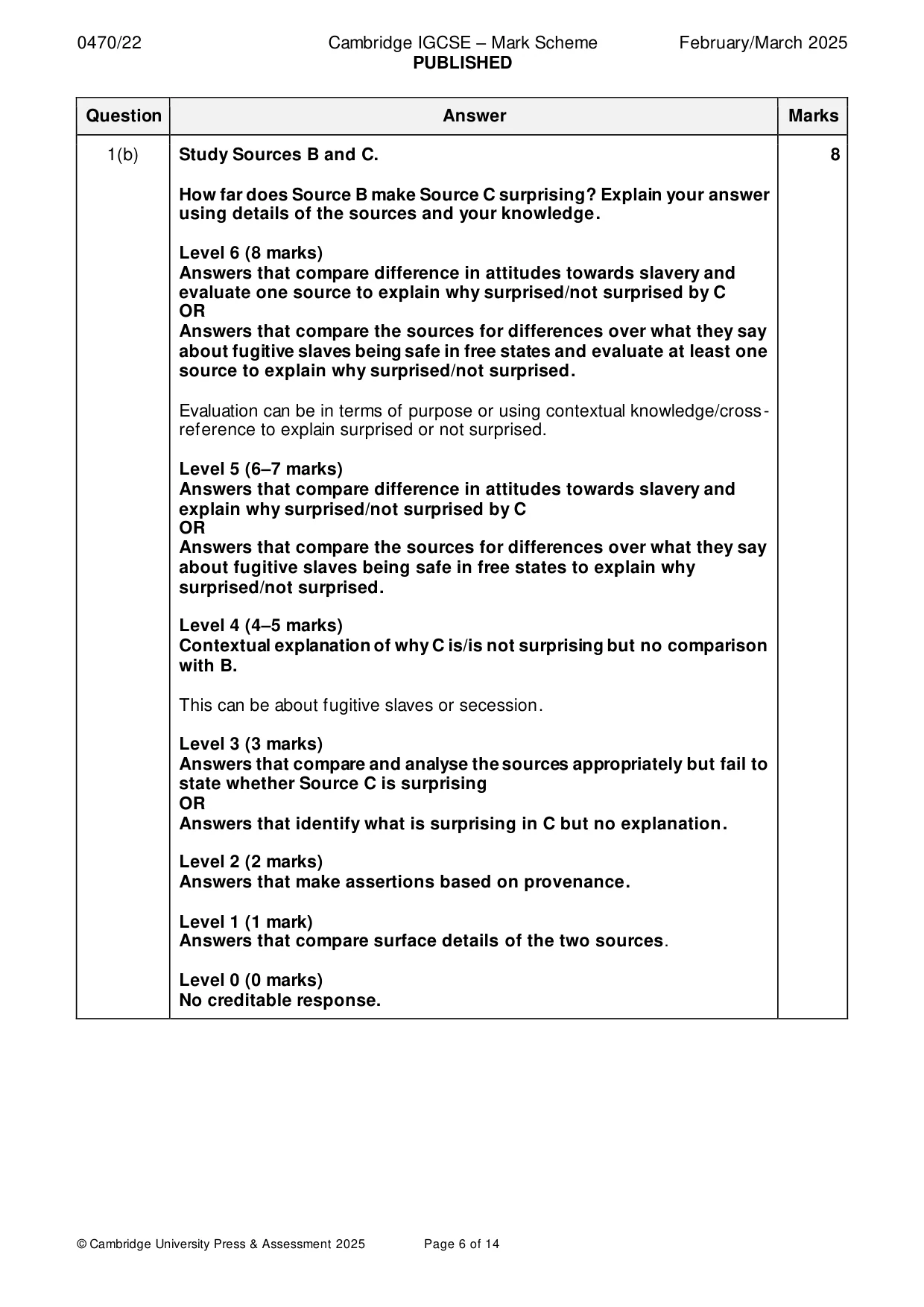
0470/22 Cambridge IGCSE – Mark Scheme PUBLISHED February/March 2025 © Cambridge University Press & Assessment 2025 Page 6 of 14 Question Answer Marks 1(b) Study Sources B and C. How far does Source B make Source C surprising? Explain your answer using details of the sources and your knowledge. Level 6 (8 marks) Answers that compare difference in attitudes towards slavery and evaluate one source to explain why surprised/not surprised by C OR Answers that compare the sources for differences over what they say about fugitive slaves being safe in free states and evaluate at least one source to explain why surprised/not surprised. Evaluation can be in terms of purpose or using contextual knowledge/cross- reference to explain surprised or not surprised. Level 5 (6–7 marks) Answers that compare difference in attitudes towards slavery and explain why surprised/not surprised by C OR Answers that compare the sources for differences over what they say about fugitive slaves being safe in free states to explain why surprised/not surprised. Level 4 (4–5 marks) Contextual explanation of why C is/is not surprising but no comparison with B. This can be about fugitive slaves or secession. Level 3 (3 marks) Answers that compare and analyse the sources appropriately but fail to state whether Source C is surprising OR Answers that identify what is surprising in C but no explanation. Level 2 (2 marks) Answers that make assertions based on provenance. Level 1 (1 mark) Answers that compare surface details of the two sources. Level 0 (0 marks) No creditable response. 8
Mark scheme, page 7
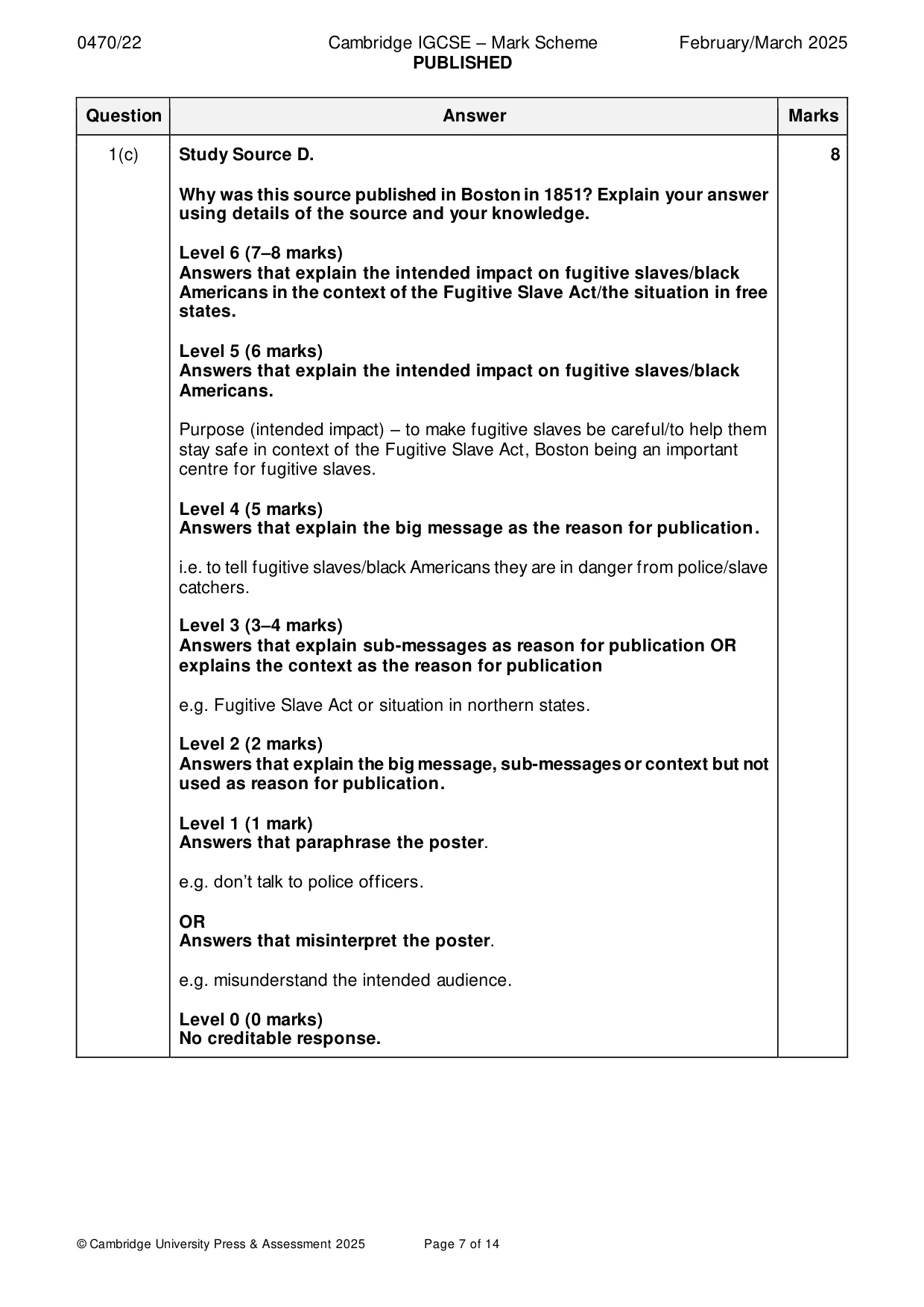
0470/22 Cambridge IGCSE – Mark Scheme PUBLISHED February/March 2025 © Cambridge University Press & Assessment 2025 Page 7 of 14 Question Answer Marks 1(c) Study Source D. Why was this source published in Boston in 1851? Explain your answer using details of the source and your knowledge. Level 6 (7–8 marks) Answers that explain the intended impact on fugitive slaves/black Americans in the context of the Fugitive Slave Act/the situation in free states. Level 5 (6 marks) Answers that explain the intended impact on fugitive slaves/black Americans. Purpose (intended impact) – to make fugitive slaves be careful/to help them stay safe in context of the Fugitive Slave Act, Boston being an important centre for fugitive slaves. Level 4 (5 marks) Answers that explain the big message as the reason for publication. i.e. to tell fugitive slaves/black Americans they are in danger from police/slave catchers. Level 3 (3–4 marks) Answers that explain sub-messages as reason for publication OR explains the context as the reason for publication e.g. Fugitive Slave Act or situation in northern states. Level 2 (2 marks) Answers that explain the big message, sub-messages or context but not used as reason for publication. Level 1 (1 mark) Answers that paraphrase the poster. e.g. don’t talk to police officers. OR Answers that misinterpret the poster. e.g. misunderstand the intended audience. Level 0 (0 marks) No creditable response. 8
Mark scheme, page 8
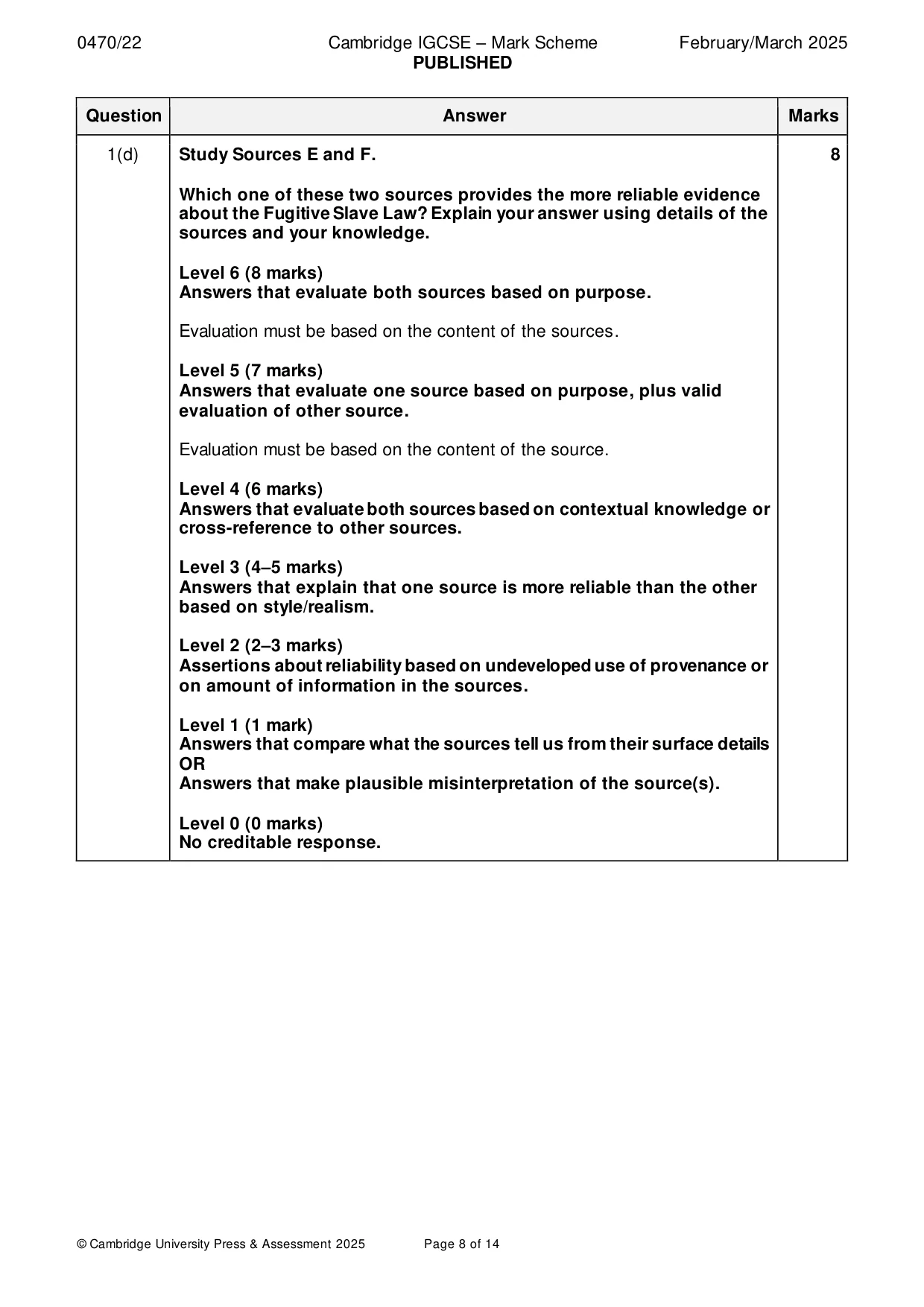
0470/22 Cambridge IGCSE – Mark Scheme PUBLISHED February/March 2025 © Cambridge University Press & Assessment 2025 Page 8 of 14 Question Answer Marks 1(d) Study Sources E and F. Which one of these two sources provides the more reliable evidence about the Fugitive Slave Law? Explain your answer using details of the sources and your knowledge. Level 6 (8 marks) Answers that evaluate both sources based on purpose. Evaluation must be based on the content of the sources. Level 5 (7 marks) Answers that evaluate one source based on purpose, plus valid evaluation of other source. Evaluation must be based on the content of the source. Level 4 (6 marks) Answers that evaluate both sources based on contextual knowledge or cross-reference to other sources. Level 3 (4–5 marks) Answers that explain that one source is more reliable than the other based on style/realism. Level 2 (2–3 marks) Assertions about reliability based on undeveloped use of provenance or on amount of information in the sources. Level 1 (1 mark) Answers that compare what the sources tell us from their surface details OR Answers that make plausible misinterpretation of the source(s). Level 0 (0 marks) No creditable response. 8
Mark scheme, page 9
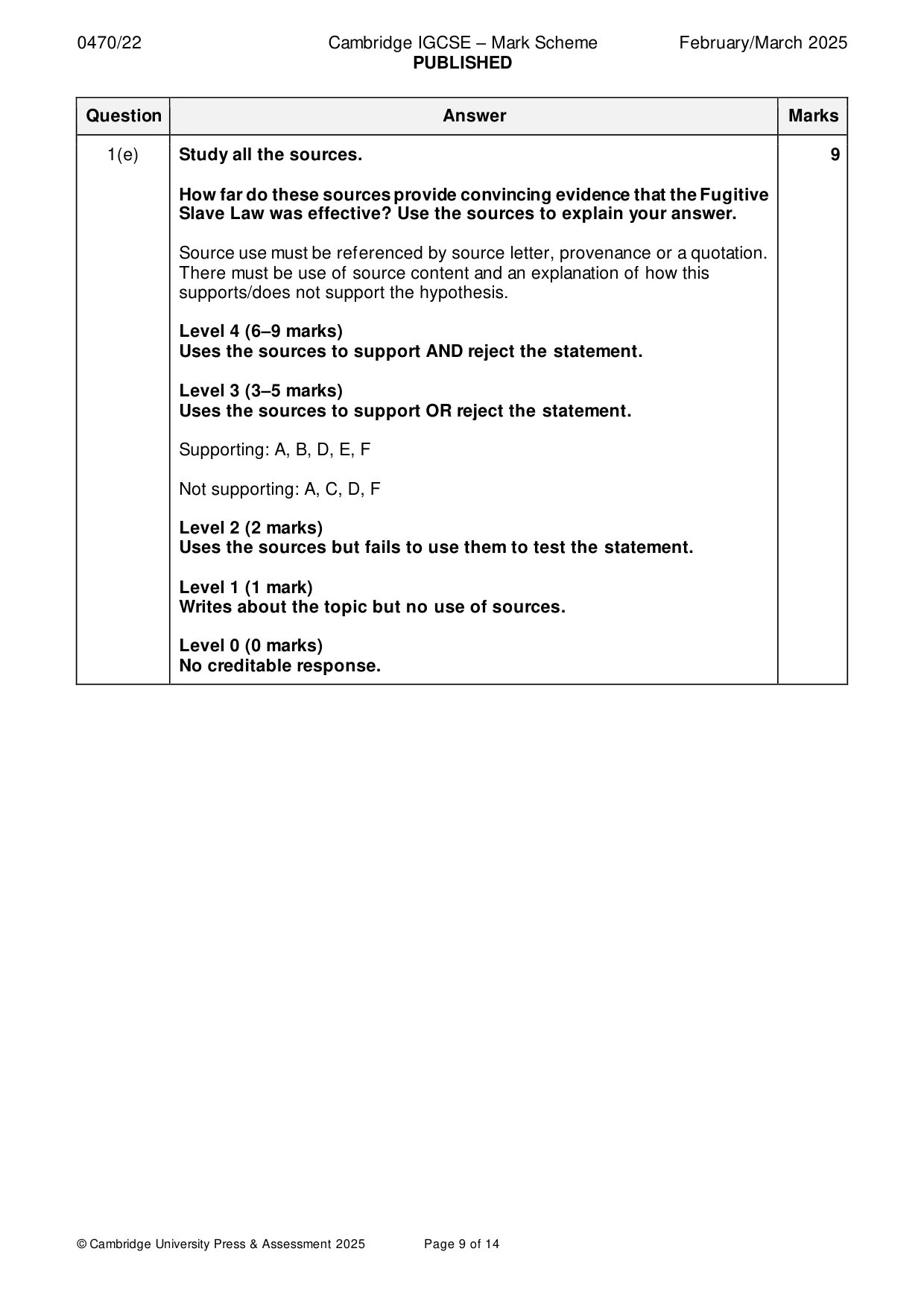
0470/22 Cambridge IGCSE – Mark Scheme PUBLISHED February/March 2025 © Cambridge University Press & Assessment 2025 Page 9 of 14 Question Answer Marks 1(e) Study all the sources. How far do these sources provide convincing evidence that the Fugitive Slave Law was effective? Use the sources to explain your answer. Source use must be referenced by source letter, provenance or a quotation. There must be use of source content and an explanation of how this supports/does not support the hypothesis. Level 4 (6–9 marks) Uses the sources to support AND reject the statement. Level 3 (3–5 marks) Uses the sources to support OR reject the statement. Supporting: A, B, D, E, F Not supporting: A, C, D, F Level 2 (2 marks) Uses the sources but fails to use them to test the statement. Level 1 (1 mark) Writes about the topic but no use of sources. Level 0 (0 marks) No creditable response. 9
Mark scheme, page 10
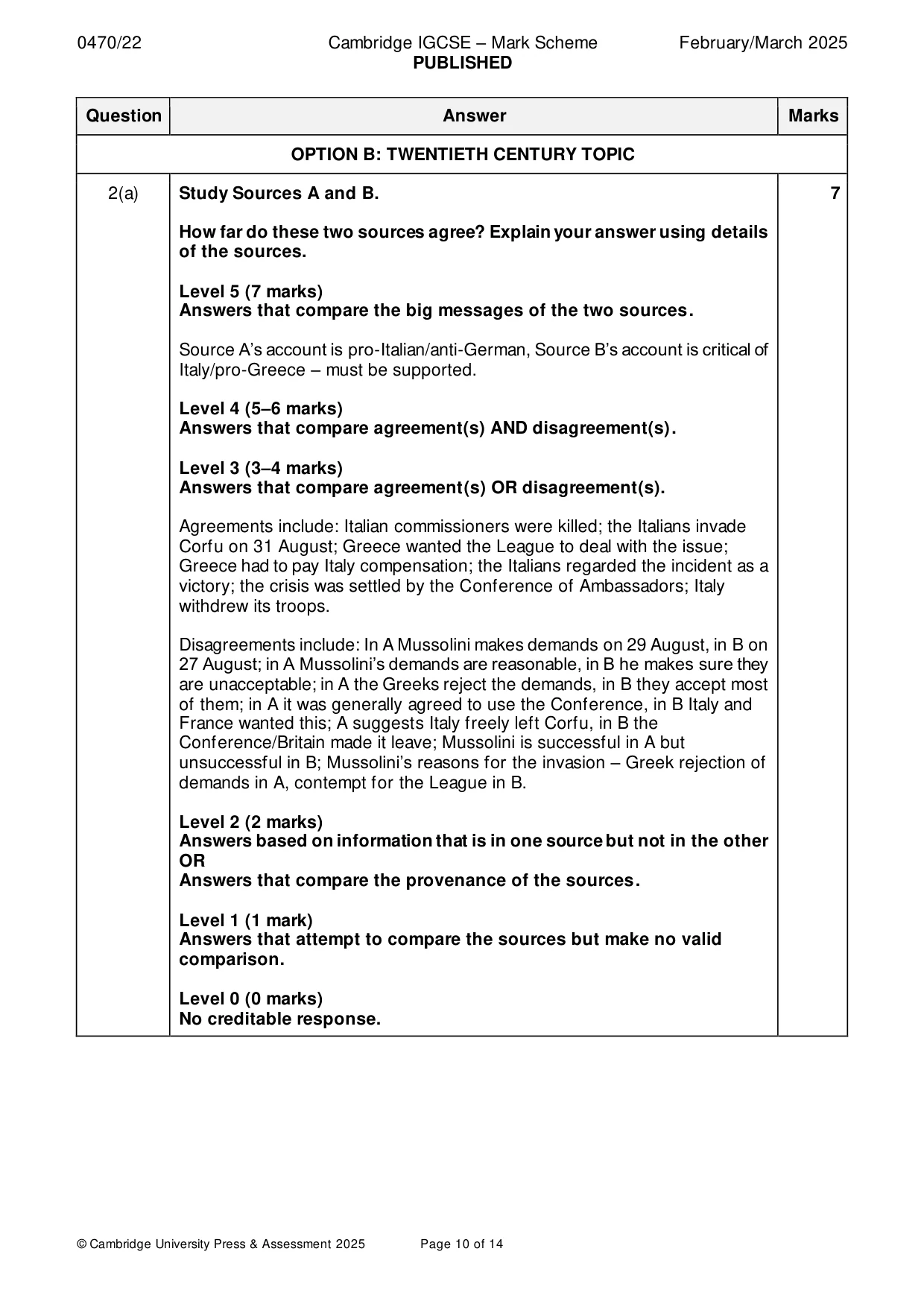
0470/22 Cambridge IGCSE – Mark Scheme PUBLISHED February/March 2025 © Cambridge University Press & Assessment 2025 Page 10 of 14 Question Answer Marks OPTION B: TWENTIETH CENTURY TOPIC 2(a) Study Sources A and B. How far do these two sources agree? Explain your answer using details of the sources. Level 5 (7 marks) Answers that compare the big messages of the two sources. Source A’s account is pro-Italian/anti-German, Source B’s account is critical of Italy/pro-Greece – must be supported. Level 4 (5–6 marks) Answers that compare agreement(s) AND disagreement(s). Level 3 (3–4 marks) Answers that compare agreement(s) OR disagreement(s). Agreements include: Italian commissioners were killed; the Italians invade Corfu on 31 August; Greece wanted the League to deal with the issue; Greece had to pay Italy compensation; the Italians regarded the incident as a victory; the crisis was settled by the Conference of Ambassadors; Italy withdrew its troops. Disagreements include: In A Mussolini makes demands on 29 August, in B on 27 August; in A Mussolini’s demands are reasonable, in B he makes sure they are unacceptable; in A the Greeks reject the demands, in B they accept most of them; in A it was generally agreed to use the Conference, in B Italy and France wanted this; A suggests Italy freely left Corfu, in B the Conference/Britain made it leave; Mussolini is successful in A but unsuccessful in B; Mussolini’s reasons for the invasion – Greek rejection of demands in A, contempt for the League in B. Level 2 (2 marks) Answers based on information that is in one source but not in the other OR Answers that compare the provenance of the sources. Level 1 (1 mark) Answers that attempt to compare the sources but make no valid comparison. Level 0 (0 marks) No creditable response. 7
Mark scheme, page 11
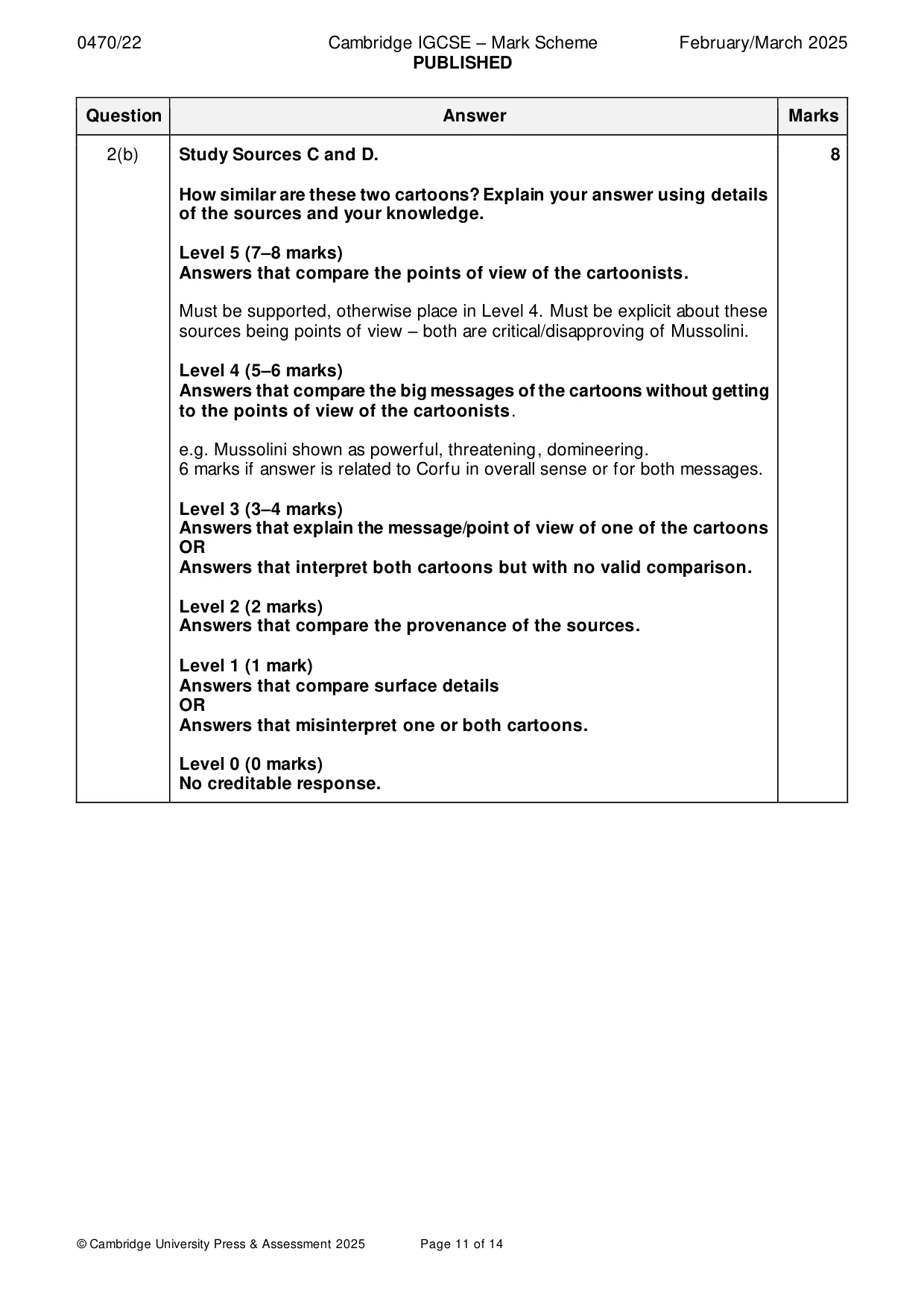
0470/22 Cambridge IGCSE – Mark Scheme PUBLISHED February/March 2025 © Cambridge University Press & Assessment 2025 Page 11 of 14 Question Answer Marks 2(b) Study Sources C and D. How similar are these two cartoons? Explain your answer using details of the sources and your knowledge. Level 5 (7–8 marks) Answers that compare the points of view of the cartoonists. Must be supported, otherwise place in Level 4. Must be explicit about these sources being points of view – both are critical/disapproving of Mussolini. Level 4 (5–6 marks) Answers that compare the big messages of the cartoons without getting to the points of view of the cartoonists. e.g. Mussolini shown as powerful, threatening, domineering. 6 marks if answer is related to Corfu in overall sense or for both messages. Level 3 (3–4 marks) Answers that explain the message/point of view of one of the cartoons OR Answers that interpret both cartoons but with no valid comparison. Level 2 (2 marks) Answers that compare the provenance of the sources. Level 1 (1 mark) Answers that compare surface details OR Answers that misinterpret one or both cartoons. Level 0 (0 marks) No creditable response. 8
Mark scheme, page 12
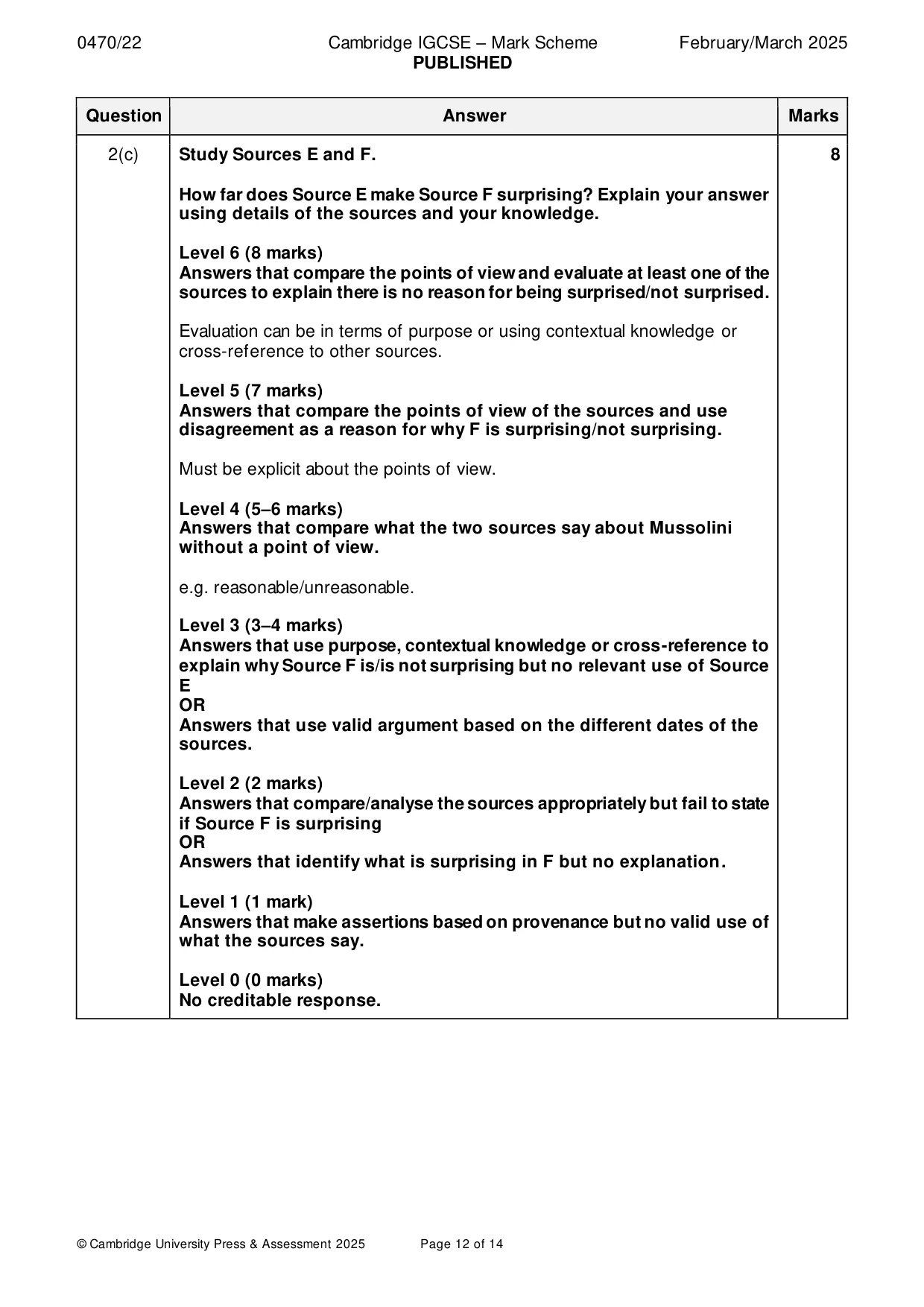
0470/22 Cambridge IGCSE – Mark Scheme PUBLISHED February/March 2025 © Cambridge University Press & Assessment 2025 Page 12 of 14 Question Answer Marks 2(c) Study Sources E and F. How far does Source E make Source F surprising? Explain your answer using details of the sources and your knowledge. Level 6 (8 marks) Answers that compare the points of view and evaluate at least one of the sources to explain there is no reason for being surprised/not surprised. Evaluation can be in terms of purpose or using contextual knowledge or cross-reference to other sources. Level 5 (7 marks) Answers that compare the points of view of the sources and use disagreement as a reason for why F is surprising/not surprising. Must be explicit about the points of view. Level 4 (5–6 marks) Answers that compare what the two sources say about Mussolini without a point of view. e.g. reasonable/unreasonable. Level 3 (3–4 marks) Answers that use purpose, contextual knowledge or cross-reference to explain why Source F is/is not surprising but no relevant use of Source E OR Answers that use valid argument based on the different dates of the sources. Level 2 (2 marks) Answers that compare/analyse the sources appropriately but fail to state if Source F is surprising OR Answers that identify what is surprising in F but no explanation. Level 1 (1 mark) Answers that make assertions based on provenance but no valid use of what the sources say. Level 0 (0 marks) No creditable response. 8
Mark scheme, page 13
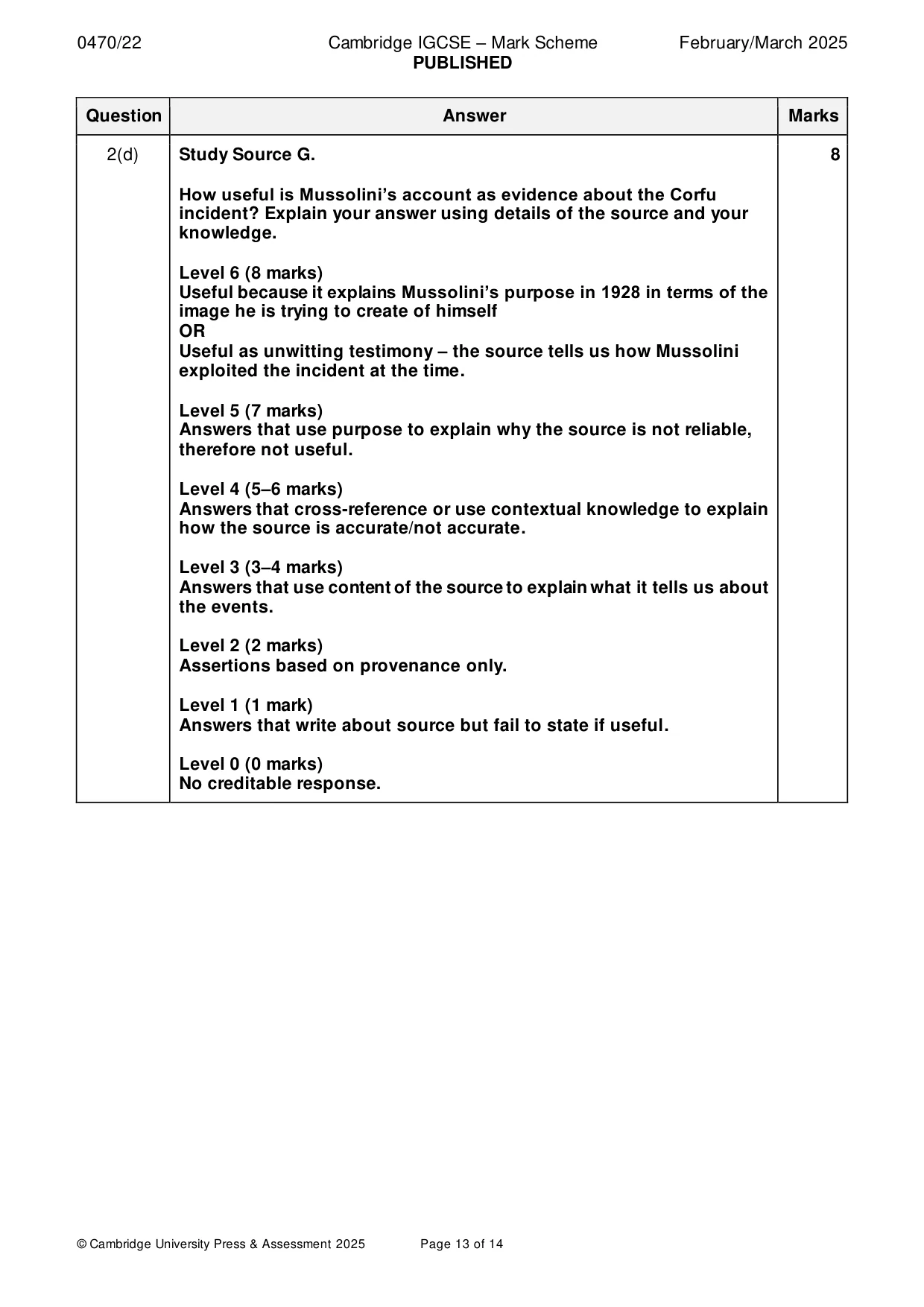
0470/22 Cambridge IGCSE – Mark Scheme PUBLISHED February/March 2025 © Cambridge University Press & Assessment 2025 Page 13 of 14 Question Answer Marks 2(d) Study Source G. How useful is Mussolini’s account as evidence about the Corfu incident? Explain your answer using details of the source and your knowledge. Level 6 (8 marks) Useful because it explains Mussolini’s purpose in 1928 in terms of the image he is trying to create of himself OR Useful as unwitting testimony – the source tells us how Mussolini exploited the incident at the time. Level 5 (7 marks) Answers that use purpose to explain why the source is not reliable, therefore not useful. Level 4 (5–6 marks) Answers that cross-reference or use contextual knowledge to explain how the source is accurate/not accurate. Level 3 (3–4 marks) Answers that use content of the source to explain what it tells us about the events. Level 2 (2 marks) Assertions based on provenance only. Level 1 (1 mark) Answers that write about source but fail to state if useful. Level 0 (0 marks) No creditable response. 8
Mark scheme, page 14
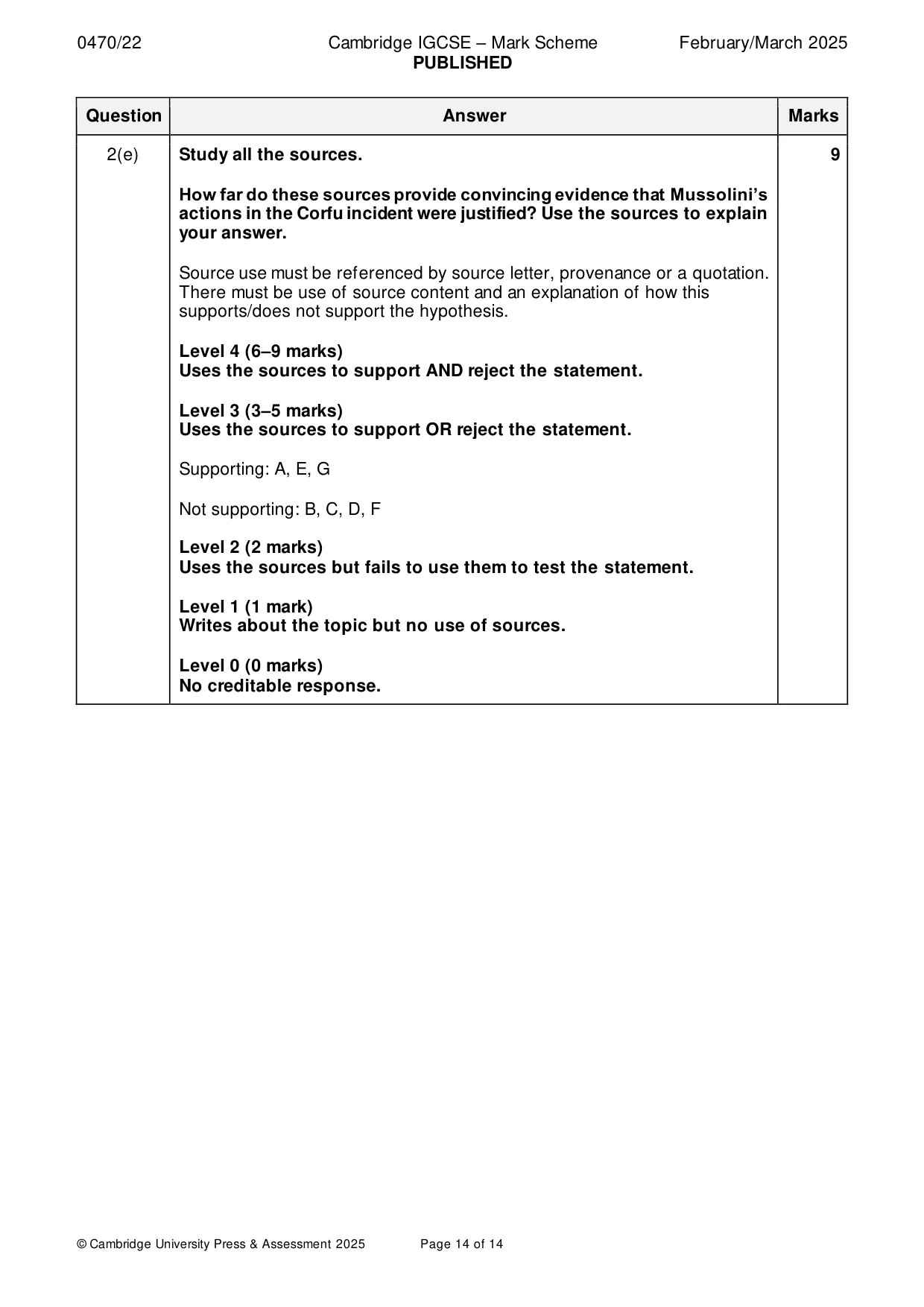
0470/22 Cambridge IGCSE – Mark Scheme PUBLISHED February/March 2025 © Cambridge University Press & Assessment 2025 Page 14 of 14 Question Answer Marks 2(e) Study all the sources. How far do these sources provide convincing evidence that Mussolini’s actions in the Corfu incident were justified? Use the sources to explain your answer. Source use must be referenced by source letter, provenance or a quotation. There must be use of source content and an explanation of how this supports/does not support the hypothesis. Level 4 (6–9 marks) Uses the sources to support AND reject the statement. Level 3 (3–5 marks) Uses the sources to support OR reject the statement. Supporting: A, E, G Not supporting: B, C, D, F Level 2 (2 marks) Uses the sources but fails to use them to test the statement. Level 1 (1 mark) Writes about the topic but no use of sources. Level 0 (0 marks) No creditable response. 9
What you needed in this session
Cambridge’s own grade thresholds for 2025 Feb/March, Paper 2 · Variant 2. A higher threshold means an easier paper — the bar moves with how the cohort did.