Cambridge IGCSE History 0470 — 2023 Feb/March Paper 2 · Variant 2
0470/22/F/M/23 · 50 marks · ≈56 min
The question paper and its mark scheme, free to read here and free to download. This is Cambridge’s own paper, exactly as it was sat.
Question paper16 pages

Mark scheme14 pages
Answers below. Sit the paper first if you are practising.
Paper as text
Question paper, page 1
This document has 16 pages. Any blank pages are indicated. [Turn over Cambridge IGCSE™ HISTORY 0470/22 Paper 2 February/March 2023 2 hours You must answer on the enclosed answer booklet. You will need: Answer booklet (enclosed) INSTRUCTIONS ● Answer all the questions on one option only. Option A: Nineteenth century topic Option B: Twentieth century topic ● Follow the instructions on the front cover of the answer booklet. If you need additional answer paper, ask the invigilator for a continuation booklet. INFORMATION ● The total mark for this paper is 50. ● The number of marks for each question or part question is shown in brackets [ ]. * 9 3 1 7 2 3 2 3 4 6 * DC (LK/CB) 312378/4 © UCLES 2023
Question paper, page 2
2 0470/22/F/M/23 © UCLES 2023 Option A: Nineteenth century topic WAS GERMANY MORE TO BLAME THAN BRITAIN FOR WAR IN 1914? Study the Background Information and the sources carefully, and then answer all the questions. Background Information By early August 1914 Europe had descended into a full-scale war. Many of the Great Powers had been preparing for war for some time and Europe was full of bitter national rivalries. Yet Britain and Germany have often been singled out as being mainly responsible for the situation in 1914 turning into a world war: Germany, for its pursuit of Weltpolitik; Britain, for its determination to preserve its supremacy at sea, and its failure to make its position clear during the summer of 1914. Who was more to blame: Britain or Germany? SOURCE A While all the European powers contributed to the growth of tension, it was Emperor Wilhelm II who was willing to risk a war by giving Germany’s support to Austria-Hungary’s invasion of Serbia. Germany’s Schlieffen Plan aimed at domination and was the main reason why War Guilt was later rightly heaped upon Germany. For Germany, international relations were about the struggle for survival and war was the natural way of deciding it. Its army chiefs thought that a European war was inevitable and that the sooner it happened the better. They urged Austria to mobilise against Russia, promising that Germany would follow. However, the British government failed to make its position clear and was responsible for Germany believing that Britain would not intervene. Britain gave its allies, France and Russia, too few signs of support. Germany was not under any immediate threat from Russia, France or Britain. It launched a European war to assert and establish its own dominance. Britain acted too late and, when it did, it was because of Germany’s invasion of Belgium and to defend British national security and colonial interests. It was responding to the actions of Germany. From a recent history book. SOURCE B Britain started an important phase of the arms race with the construction of HMS Dreadnought and so it is puzzling why Britain, with such power, failed to intervene to suppress hostile members of the international community. It is right to be critical of Britain’s ambiguous policy. German desires to become the most powerful country in the world were clear. Britain’s half-hearted attachment to its allies made a continental war more likely. Even agreements such as the Entente with France in 1904 were aimed at protecting its colonial interests. Britain’s attitude left Germany unclear about its intentions. Germany was also convinced that it was being encircled and Russian mobilisation suggested a real threat. Although German imperialism, under the banner of Weltpolitik, and its aggressive Schlieffen Plan, provided the framework for the basic tensions in the pre-war period, it was Britain’s lack of clarity that led Germany to support Austria against Serbia and to declare war on France. Germany understandably assumed that Britain would not risk a war. When Britain did act, a major war resulted. Britain did not respond to Germany’s invasion of Belgium to defend Belgium, or because of a threat to its security or to maintain a balance of power. It responded to maintain its own dominant position in Europe and around the world. From a history book.
Question paper, page 3
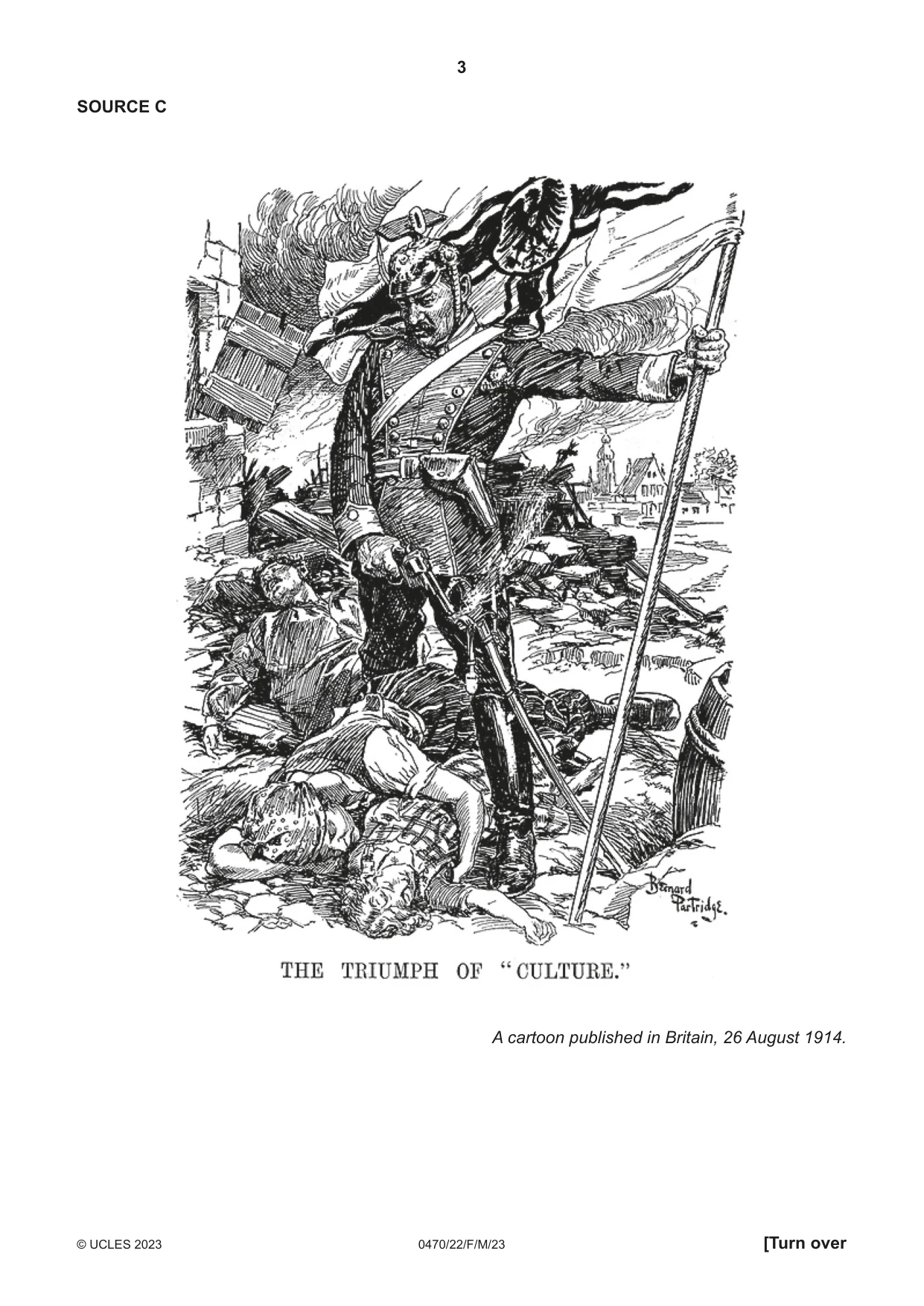
3 0470/22/F/M/23 © UCLES 2023 [Turn over SOURCE C A cartoon published in Britain, 26 August 1914.
Question paper, page 4
4 0470/22/F/M/23 © UCLES 2023 SOURCE D The blame must mainly fall on Germany. It could have prevented war if it had chosen to speak to Austria-Hungary. It has chosen not to do so. It has preferred to make demands in St Petersburg and in Paris which no government could agree to, and to defeat the last efforts of this country and of others for mediation. From a British newspaper, 4 August 1914. SOURCE E At the very time that the Tsar was announcing his summer war programme, I was busy at Corfu excavating antiquities; then I went to Wiesbaden and finally to Norway. A monarch who wishes war and prepares it in such a way that he can suddenly fall upon his neighbours – a task requiring long secret mobilisation preparations – does not spend months outside his own country and does not allow his Chief of the General Staff to go to Carlsbad on leave of absence. My enemies, in the meantime, planned their preparations for an attack. Our entire diplomatic machine failed. The menace of war was not seen because our Foreign Office was so hypnotised with its belief in peace at any cost. It had completely eliminated war from its calculations and therefore did not rightly estimate the importance of the signs of war. From the memoirs of Emperor Wilhelm II, published in 1922.
Question paper, page 5
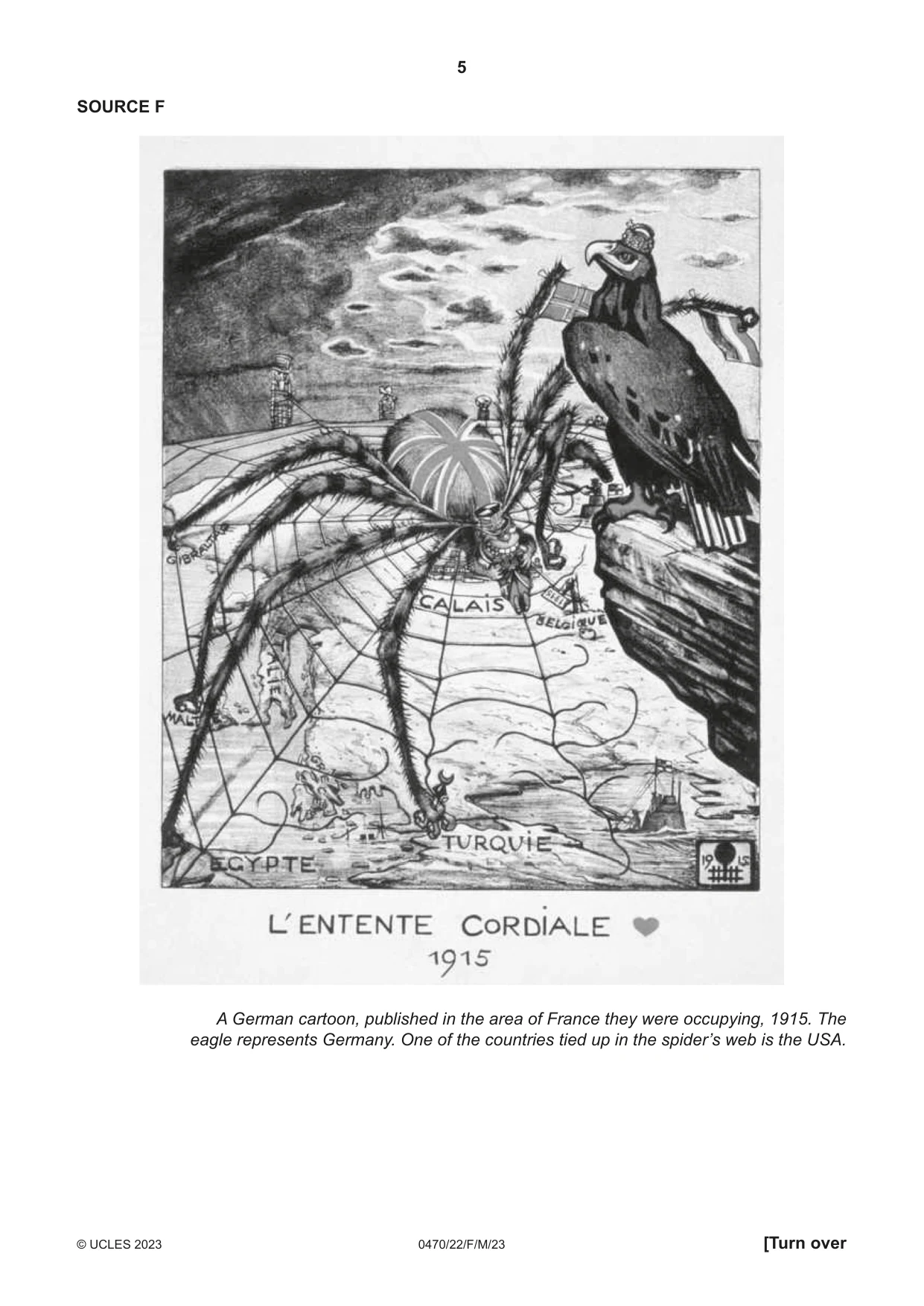
5 0470/22/F/M/23 © UCLES 2023 [Turn over SOURCE F A German cartoon, published in the area of France they were occupying, 1915. The eagle represents Germany. One of the countries tied up in the spider’s web is the USA.
Question paper, page 6
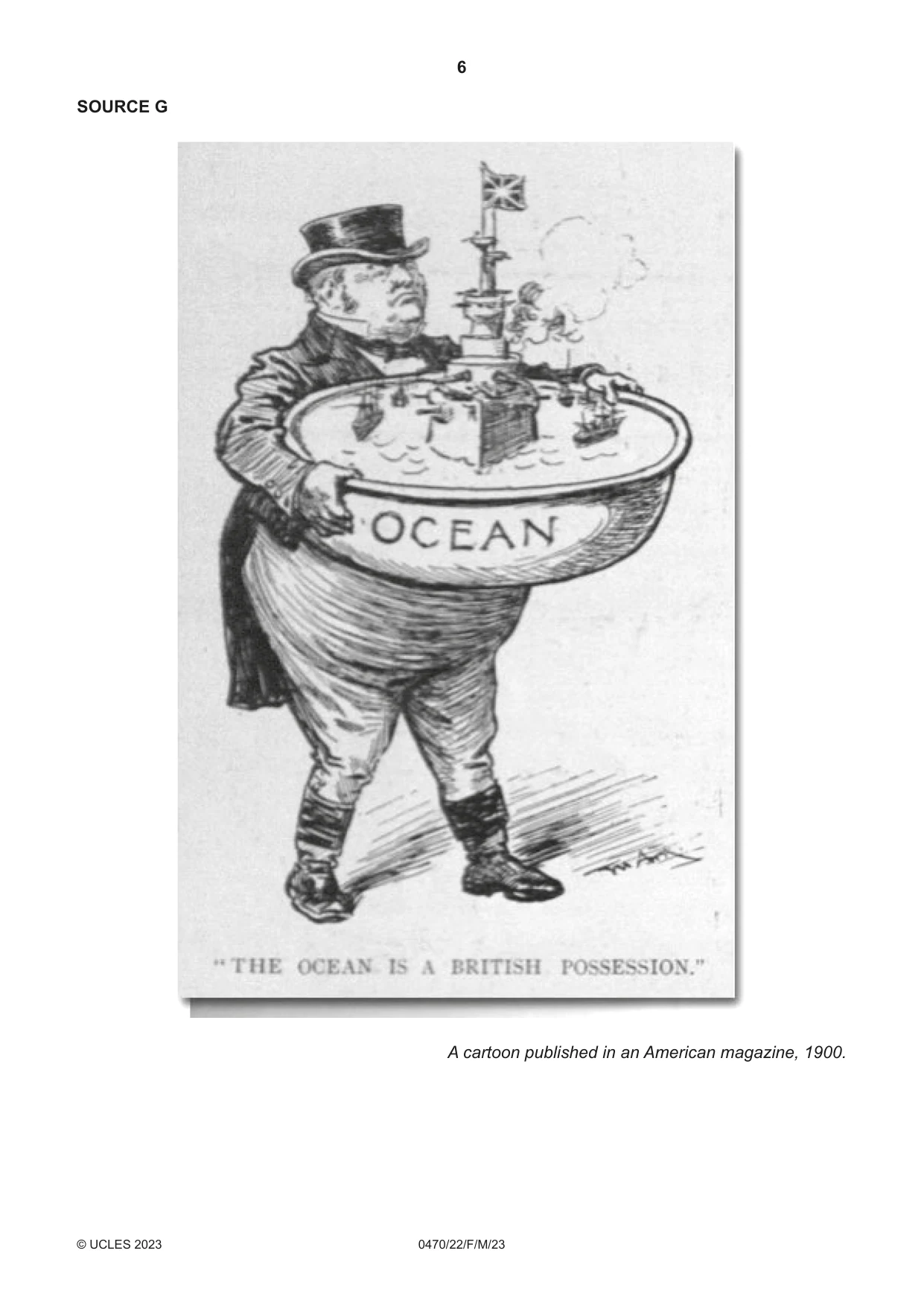
6 0470/22/F/M/23 © UCLES 2023 SOURCE G A cartoon published in an American magazine, 1900.
Question paper, page 7
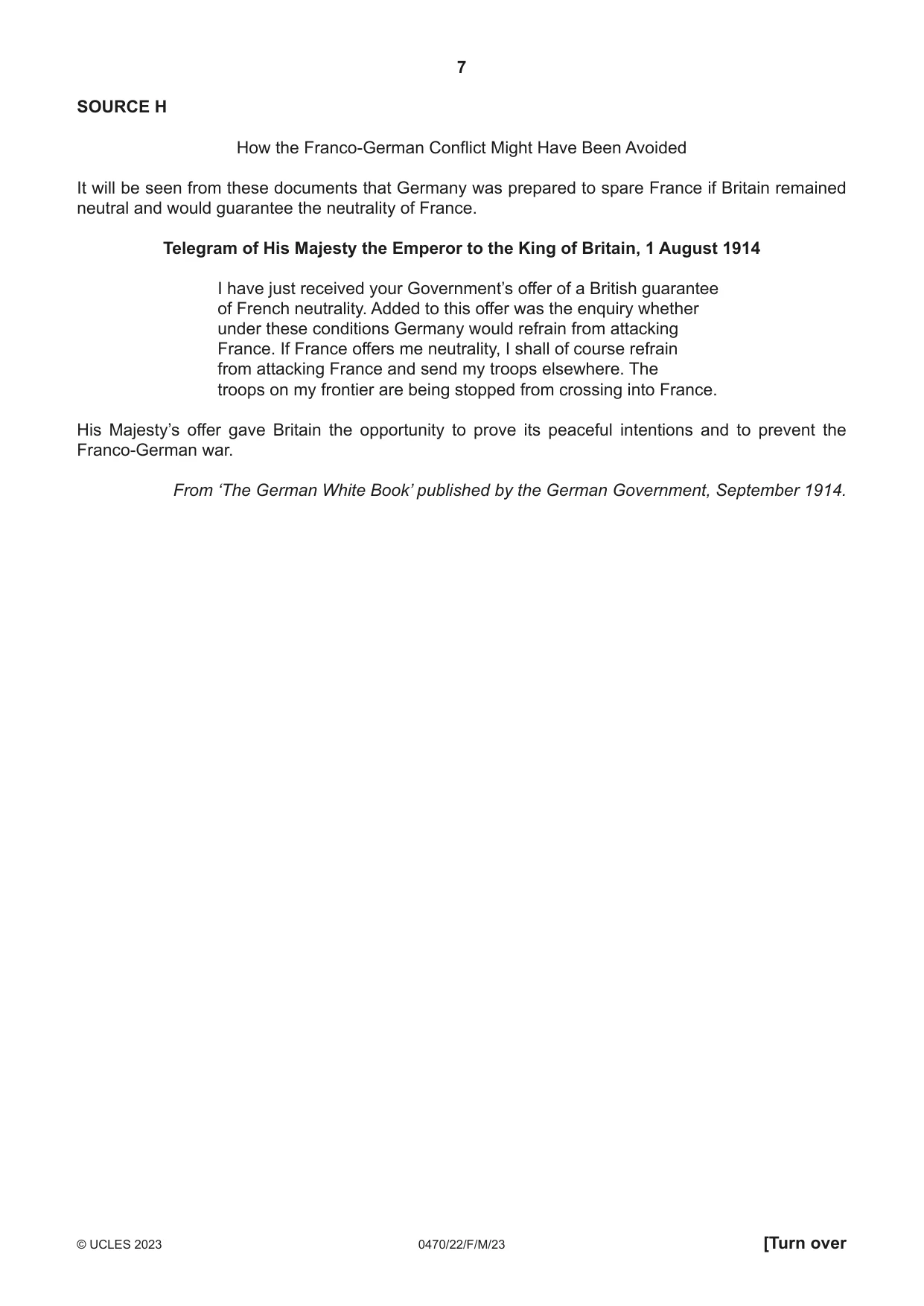
7 0470/22/F/M/23 © UCLES 2023 [Turn over SOURCE H How the Franco-German Conflict Might Have Been Avoided It will be seen from these documents that Germany was prepared to spare France if Britain remained neutral and would guarantee the neutrality of France. Telegram of His Majesty the Emperor to the King of Britain, 1 August 1914 I have just received your Government’s offer of a British guarantee of French neutrality. Added to this offer was the enquiry whether under these conditions Germany would refrain from attacking France. If France offers me neutrality, I shall of course refrain from attacking France and send my troops elsewhere. The troops on my frontier are being stopped from crossing into France. His Majesty’s offer gave Britain the opportunity to prove its peaceful intentions and to prevent the Franco-German war. From ‘The German White Book’ published by the German Government, September 1914.
Question paper, page 8
8 0470/22/F/M/23 © UCLES 2023 Now answer all the following questions. You may use any of the sources to help you answer the questions, in addition to those sources which you are told to use. In answering the questions you should use your knowledge of the topic to help you interpret and evaluate the sources. 1 Study Sources A and B. How far do these two sources agree? Explain your answer using details of the sources. [7] 2 Study Source C. Why was this cartoon published in August 1914? Explain your answer using details of the source and your knowledge. [8] 3 Study Sources D and E. Does Source D make Source E surprising? Explain your answer using details of the sources and your knowledge. [8] 4 Study Sources F and G. How far do these two cartoonists agree? Explain your answer using details of the sources and your knowledge. [8] 5 Study Source H. How useful is this source to a historian studying the events leading to the First World War? Explain your answer using details of the source and your knowledge. [7] 6 Study all the sources. How far do these sources provide convincing evidence that Germany was responsible for war breaking out in August 1914? Use the sources to explain your answer. [12]
Question paper, page 9
9 0470/22/F/M/23 © UCLES 2023 [Turn over BLANK PAGE
Question paper, page 10
10 0470/22/F/M/23 © UCLES 2023 Option B: Twentieth century topic WHY DID STALIN AGREE TO A PACT WITH GERMANY? Study the Background Information and the sources carefully, and then answer all the questions. Background Information On 23 August 1939, Germany and the Soviet Union signed the Nazi–Soviet Pact. The two countries agreed not to attack each other and, in a secret section, to divide Poland between them. Shortly afterwards, Germany and the Soviet Union had invaded Poland and the Second World War had begun. Before 1939 the Soviet Union had been extremely critical of Germany. Why was Stalin ready to sign a pact with Germany in 1939? One explanation is that Stalin was keen to grab as much of eastern Europe as he could. Another is that he was worried about a possible German invasion. However, there are some historians who blame Britain, and Britain’s Prime Minister, Chamberlain. They argue that Stalin had tried to form an anti-fascist alliance with Britain and France. Despite the support of some British politicians, like Churchill, for such an alliance, Chamberlain rejected Stalin’s advances. This, it is argued, is what drove the Soviet Union into a pact with Germany. How far was Britain responsible for the Soviet Union agreeing to the Nazi–Soviet Pact? SOURCE A The prospect of a ‘grand alliance’ was the best chance of deterring Hitler but Chamberlain’s deep distrust of the Soviet Union meant that Churchill’s idea of an alliance with it never had a chance of winning the support of the British government. In March 1939 Stalin remained cautious, awaiting developments, wary of becoming involved in a clash of ‘imperialist powers’. Even after Germany’s invasion of the remainder of Czechoslovakia on 15 March, Chamberlain did not consider the Soviets as suitable allies. The Soviets were more convinced than ever that Chamberlain was planning what he had always wanted; a war between Germany and the Soviet Union. However, in April the Soviets proposed a triple alliance with Britain and France. By May, after Britain’s lack of enthusiasm for the Soviet proposal, Stalin’s thinking had again changed. He began to make hesitant steps towards an agreement with Germany. Hitler was keen because it would rule out any chance of an anti-German alliance. On the evening of 21 August Soviet citizens were astonished to learn that Germany and the Soviet Union were on the verge of an extraordinary deal. After years of being told that fascism was the ultimate evil, they were amazed to find that Hitler was now their friend. It was an alliance that was difficult to understand, and involved the abandonment of principles that had been held strongly for years. From a recent history book.
Question paper, page 11
11 0470/22/F/M/23 © UCLES 2023 [Turn over SOURCE B When Hitler ordered the invasion of the remainder of Czechoslovakia on 15 March 1939, Britain responded by proposing a pact with France, Poland and the Soviet Union. Then, on 14 April, Chamberlain asked the Soviet Union to assist Poland in the event of an attack by Germany, but Moscow turned down the invitation. Five weeks earlier, on 10 March, Stalin had told a Communist Party conference that they should be ‘cautious and not allow our country to be drawn into conflicts by warmongers’. This meant that Britain and France could not count on Soviet help in a conflict with Germany. In April signs came from Moscow that Stalin was interested in improving relations with Germany, but it was not possible until August 1939 to be sure of the direction the Soviet Union’s foreign policy would take. In August there were contacts between Germany and Soviet Russia, with the Soviets being tempted by having their own sphere of interest, as well as non-involvement in any European conflict. On 24 August a shocked world learned about the Pact. The agreement made sense to both sides. Stalin had gained a large area of land the Western Powers had been unable to offer him, he gained the time he needed to arm his country in case of a future German attack, and he could watch the capitalist powers tear each other apart. Most of all, Soviet citizens were relieved. It meant that the dreaded nightmare of encirclement had been destroyed. Stalin had been successfully playing the capitalist powers against one another. From a recent history book. SOURCE C A British cartoon published on 29 June 1939. The figures sitting down are senior members of the German government. The writing on the folder reads, ‘Proposals for a Nazi–Soviet Pact to dish [defeat] the democracies’. The notice hanging on the door handle reads, ‘Engaged on talks re British–Soviet Pact’.
Question paper, page 12
12 0470/22/F/M/23 © UCLES 2023 SOURCE D I must confess the most profound mistrust of the Soviet Union. I have no belief in its ability to maintain an effective offensive, even if it wanted to. And I distrust its motives, which seem to me to have little connection with our ideas of liberty. Moreover, it is both hated and suspected by many other smaller states such as Poland, Romania and Finland. A private letter from Chamberlain to his sister, 26 March 1939. SOURCE E The Leader of the Opposition has put forward the idea that the British Government is influenced in its negotiations with the Soviet Union by mistrust of its ideology. This is not so. We are not concerned with the Soviet Union’s internal political doctrine. If we can enlist its cooperation in building a peace front, we welcome it, we want it. The suggestion that we despise the assistance of the Soviet Union is without foundation. The vast population and resources of the Soviet Union are obviously an important factor in the situation which confronts us. However, we are aware that the direct participation of the Soviet Union may not be in accordance with the wishes of Poland and Romania. Accordingly, we suggested to the Soviet Government that it should make a declaration that it is ready to lend assistance to Poland and Romania. From a speech in the British Parliament by Chamberlain, 19 May 1939.
Question paper, page 13
13 0470/22/F/M/23 © UCLES 2023 [Turn over SOURCE F An American cartoon, 24 August 1939.
Question paper, page 14
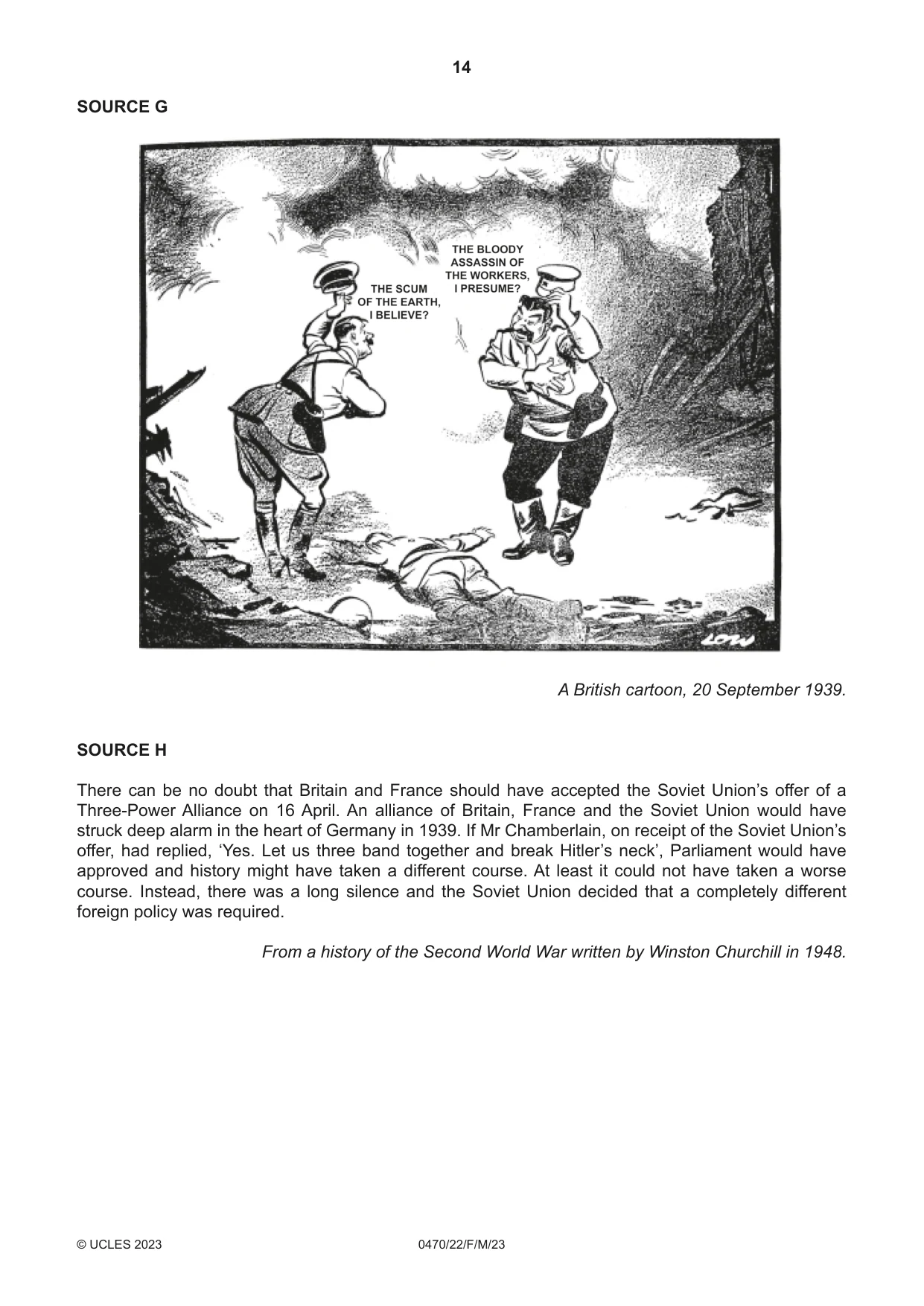
14 0470/22/F/M/23 © UCLES 2023 SOURCE G A British cartoon, 20 September 1939. SOURCE H There can be no doubt that Britain and France should have accepted the Soviet Union’s offer of a Three-Power Alliance on 16 April. An alliance of Britain, France and the Soviet Union would have struck deep alarm in the heart of Germany in 1939. If Mr Chamberlain, on receipt of the Soviet Union’s offer, had replied, ‘Yes. Let us three band together and break Hitler’s neck’, Parliament would have approved and history might have taken a different course. At least it could not have taken a worse course. Instead, there was a long silence and the Soviet Union decided that a completely different foreign policy was required. From a history of the Second World War written by Winston Churchill in 1948.
Question paper, page 15
15 0470/22/F/M/23 © UCLES 2023 Now answer all the following questions. You may use any of the sources to help you answer the questions, in addition to those sources which you are told to use. In answering the questions you should use your knowledge of the topic to help you interpret and evaluate the sources. 1 Study Sources A and B. How far do these two sources agree? Explain your answer using details of the sources. [7] 2 Study Source C. Why was this source published in June 1939? Explain your answer using details of the source and your knowledge. [8] 3 Study Sources D and E. Does Source D prove that Chamberlain was lying in Source E? Explain your answer using details of the sources and your knowledge. [8] 4 Study Sources F and G. How far would these two cartoonists have agreed? Explain your answer using details of the sources and your knowledge. [8] 5 Study Source H. How useful is this source to a historian studying events leading to the Second World War? Explain your answer using details of the source and your knowledge. [7] 6 Study all the sources. How far do these sources provide convincing evidence that Chamberlain was to blame for Stalin making a pact with Germany? Use the sources to explain your answer. [12]
Question paper, page 16
16 0470/22/F/M/23 © UCLES 2023 Permission to reproduce items where third-party owned material protected by copyright is included has been sought and cleared where possible. Every reasonable effort has been made by the publisher (UCLES) to trace copyright holders, but if any items requiring clearance have unwittingly been included, the publisher will be pleased to make amends at the earliest possible opportunity. To avoid the issue of disclosure of answer-related information to candidates, all copyright acknowledgements are reproduced online in the Cambridge Assessment International Education Copyright Acknowledgements Booklet. This is produced for each series of examinations and is freely available to download at www.cambridgeinternational.org after the live examination series. Cambridge Assessment International Education is part of Cambridge Assessment. Cambridge Assessment is the brand name of the University of Cambridge Local Examinations Syndicate (UCLES), which is a department of the University of Cambridge. BLANK PAGE
Mark scheme, page 1
This document consists of 14 printed pages. © UCLES 2023 [Turn over Cambridge IGCSE™ HISTORY 0470/22 Paper 2 February/March 2023 MARK SCHEME Maximum Mark: 50 Published This mark scheme is published as an aid to teachers and candidates, to indicate the requirements of the examination. It shows the basis on which Examiners were instructed to award marks. It does not indicate the details of the discussions that took place at an Examiners’ meeting before marking began, which would have considered the acceptability of alternative answers. Mark schemes should be read in conjunction with the question paper and the Principal Examiner Report for Teachers. Cambridge International will not enter into discussions about these mark schemes. Cambridge International is publishing the mark schemes for the February/March 2023 series for most Cambridge IGCSE™, Cambridge International A and AS Level components and some Cambridge O Level components.
Mark scheme, page 2
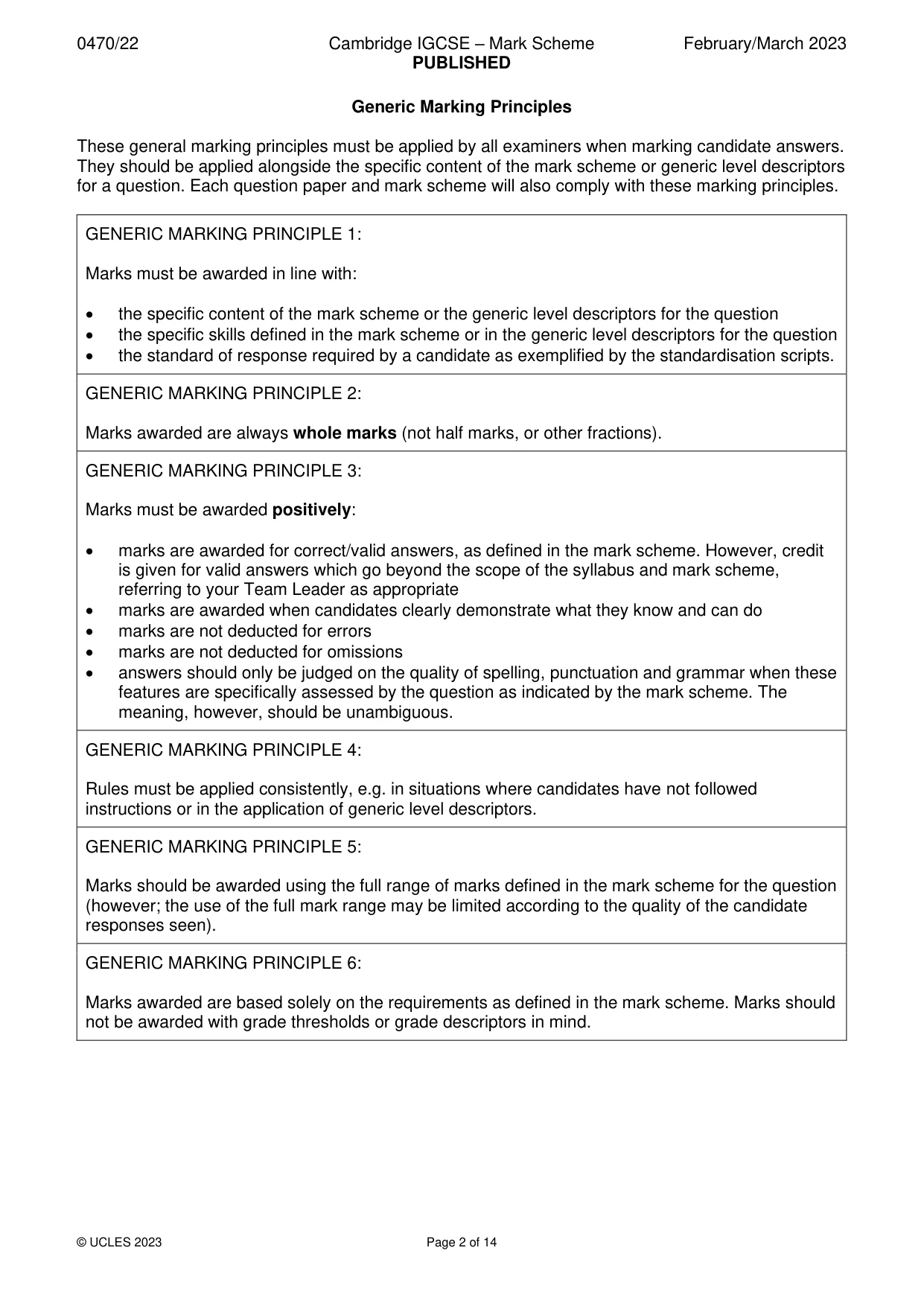
0470/22 Cambridge IGCSE – Mark Scheme PUBLISHED February/March 2023 © UCLES 2023 Page 2 of 14 Generic Marking Principles These general marking principles must be applied by all examiners when marking candidate answers. They should be applied alongside the specific content of the mark scheme or generic level descriptors for a question. Each question paper and mark scheme will also comply with these marking principles. GENERIC MARKING PRINCIPLE 1: Marks must be awarded in line with: • the specific content of the mark scheme or the generic level descriptors for the question • the specific skills defined in the mark scheme or in the generic level descriptors for the question • the standard of response required by a candidate as exemplified by the standardisation scripts. GENERIC MARKING PRINCIPLE 2: Marks awarded are always whole marks (not half marks, or other fractions). GENERIC MARKING PRINCIPLE 3: Marks must be awarded positively: • marks are awarded for correct/valid answers, as defined in the mark scheme. However, credit is given for valid answers which go beyond the scope of the syllabus and mark scheme, referring to your Team Leader as appropriate • marks are awarded when candidates clearly demonstrate what they know and can do • marks are not deducted for errors • marks are not deducted for omissions • answers should only be judged on the quality of spelling, punctuation and grammar when these features are specifically assessed by the question as indicated by the mark scheme. The meaning, however, should be unambiguous. GENERIC MARKING PRINCIPLE 4: Rules must be applied consistently, e.g. in situations where candidates have not followed instructions or in the application of generic level descriptors. GENERIC MARKING PRINCIPLE 5: Marks should be awarded using the full range of marks defined in the mark scheme for the question (however; the use of the full mark range may be limited according to the quality of the candidate responses seen). GENERIC MARKING PRINCIPLE 6: Marks awarded are based solely on the requirements as defined in the mark scheme. Marks should not be awarded with grade thresholds or grade descriptors in mind.
Mark scheme, page 3
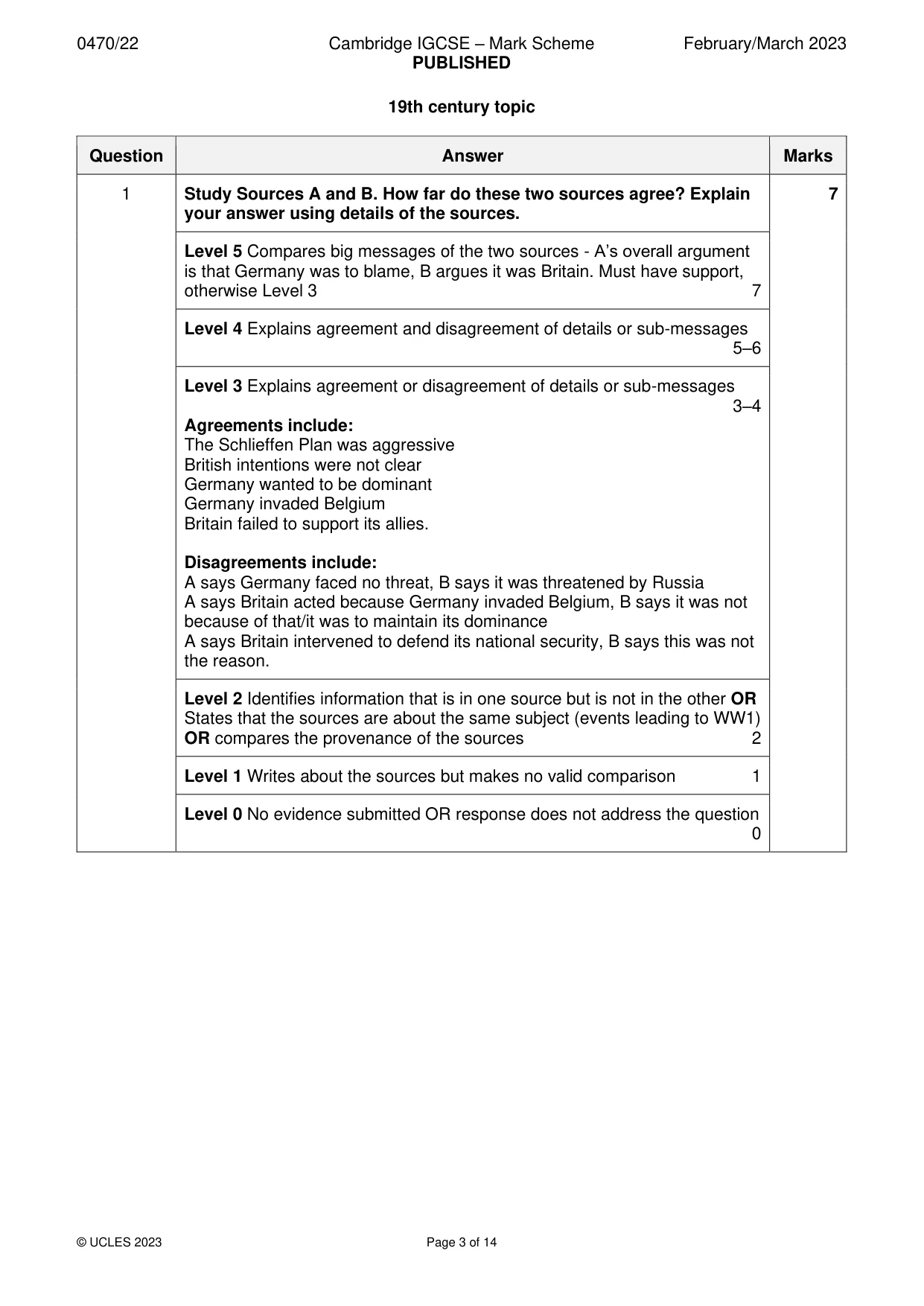
0470/22 Cambridge IGCSE – Mark Scheme PUBLISHED February/March 2023 © UCLES 2023 Page 3 of 14 19th century topic Question Answer Marks 1 Study Sources A and B. How far do these two sources agree? Explain your answer using details of the sources. 7 Level 5 Compares big messages of the two sources - A’s overall argument is that Germany was to blame, B argues it was Britain. Must have support, otherwise Level 3 7 Level 4 Explains agreement and disagreement of details or sub-messages 5–6 Level 3 Explains agreement or disagreement of details or sub-messages 3–4 Agreements include: The Schlieffen Plan was aggressive British intentions were not clear Germany wanted to be dominant Germany invaded Belgium Britain failed to support its allies. Disagreements include: A says Germany faced no threat, B says it was threatened by Russia A says Britain acted because Germany invaded Belgium, B says it was not because of that/it was to maintain its dominance A says Britain intervened to defend its national security, B says this was not the reason. Level 2 Identifies information that is in one source but is not in the other OR States that the sources are about the same subject (events leading to WW1) OR compares the provenance of the sources 2 Level 1 Writes about the sources but makes no valid comparison 1 Level 0 No evidence submitted OR response does not address the question 0
Mark scheme, page 4
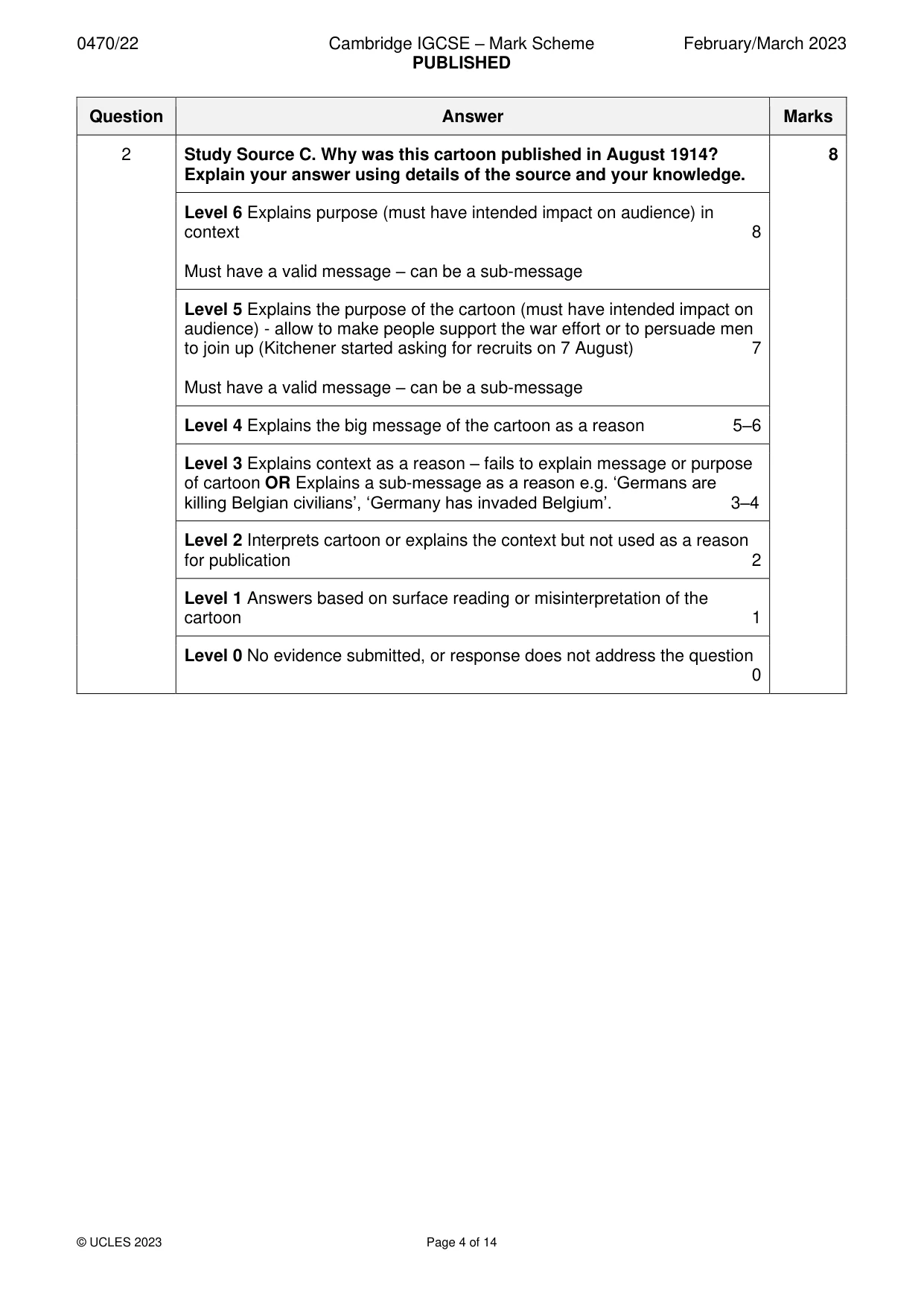
0470/22 Cambridge IGCSE – Mark Scheme PUBLISHED February/March 2023 © UCLES 2023 Page 4 of 14 Question Answer Marks 2 Study Source C. Why was this cartoon published in August 1914? Explain your answer using details of the source and your knowledge. 8 Level 6 Explains purpose (must have intended impact on audience) in context 8 Must have a valid message – can be a sub-message Level 5 Explains the purpose of the cartoon (must have intended impact on audience) - allow to make people support the war effort or to persuade men to join up (Kitchener started asking for recruits on 7 August) 7 Must have a valid message – can be a sub-message Level 4 Explains the big message of the cartoon as a reason 5–6 Level 3 Explains context as a reason – fails to explain message or purpose of cartoon OR Explains a sub-message as a reason e.g. ‘Germans are killing Belgian civilians’, ‘Germany has invaded Belgium’. 3–4 Level 2 Interprets cartoon or explains the context but not used as a reason for publication 2 Level 1 Answers based on surface reading or misinterpretation of the cartoon 1 Level 0 No evidence submitted, or response does not address the question 0
Mark scheme, page 5
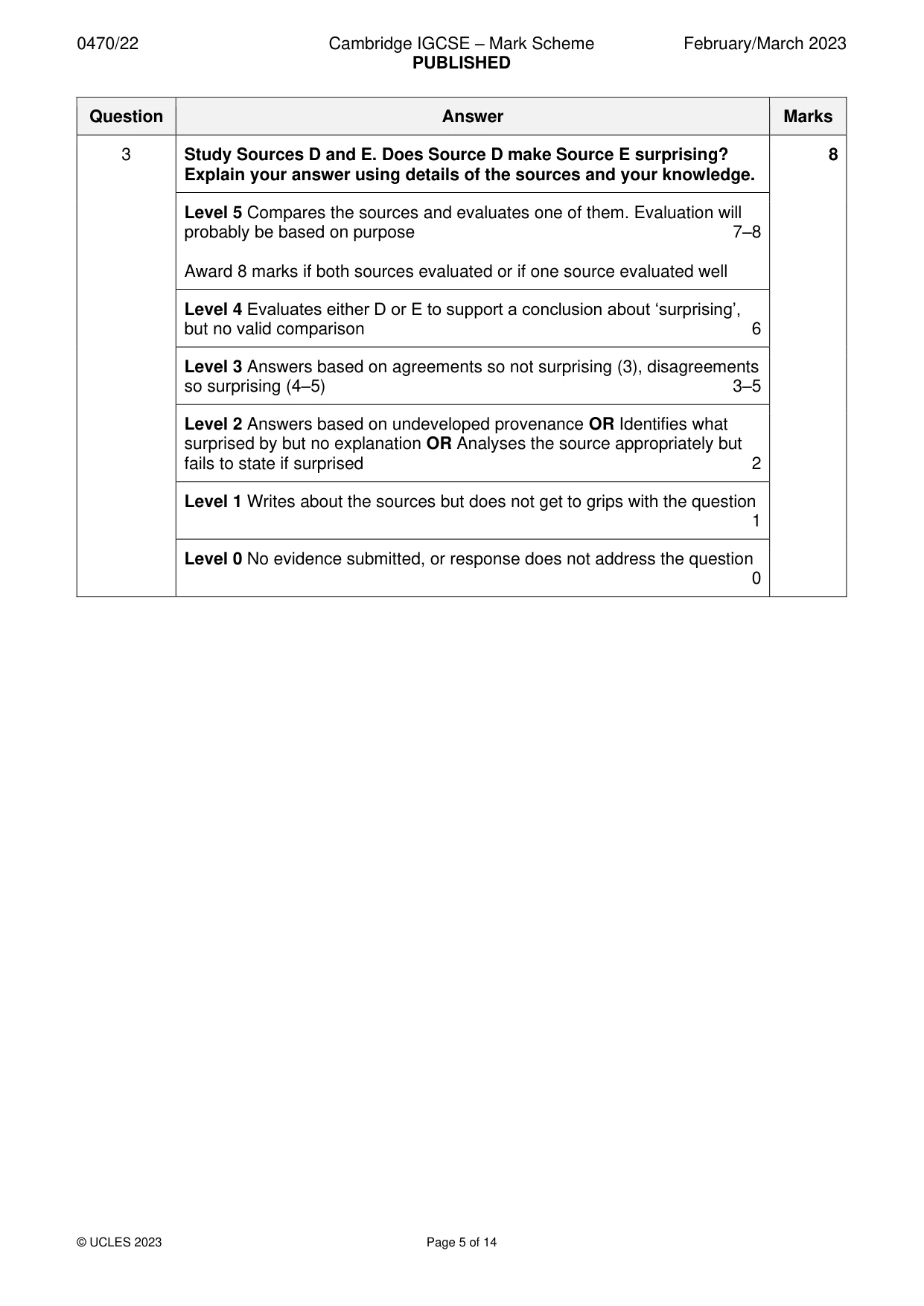
0470/22 Cambridge IGCSE – Mark Scheme PUBLISHED February/March 2023 © UCLES 2023 Page 5 of 14 Question Answer Marks 3 Study Sources D and E. Does Source D make Source E surprising? Explain your answer using details of the sources and your knowledge. 8 Level 5 Compares the sources and evaluates one of them. Evaluation will probably be based on purpose 7–8 Award 8 marks if both sources evaluated or if one source evaluated well Level 4 Evaluates either D or E to support a conclusion about ‘surprising’, but no valid comparison 6 Level 3 Answers based on agreements so not surprising (3), disagreements so surprising (4–5) 3–5 Level 2 Answers based on undeveloped provenance OR Identifies what surprised by but no explanation OR Analyses the source appropriately but fails to state if surprised 2 Level 1 Writes about the sources but does not get to grips with the question 1 Level 0 No evidence submitted, or response does not address the question 0
Mark scheme, page 6
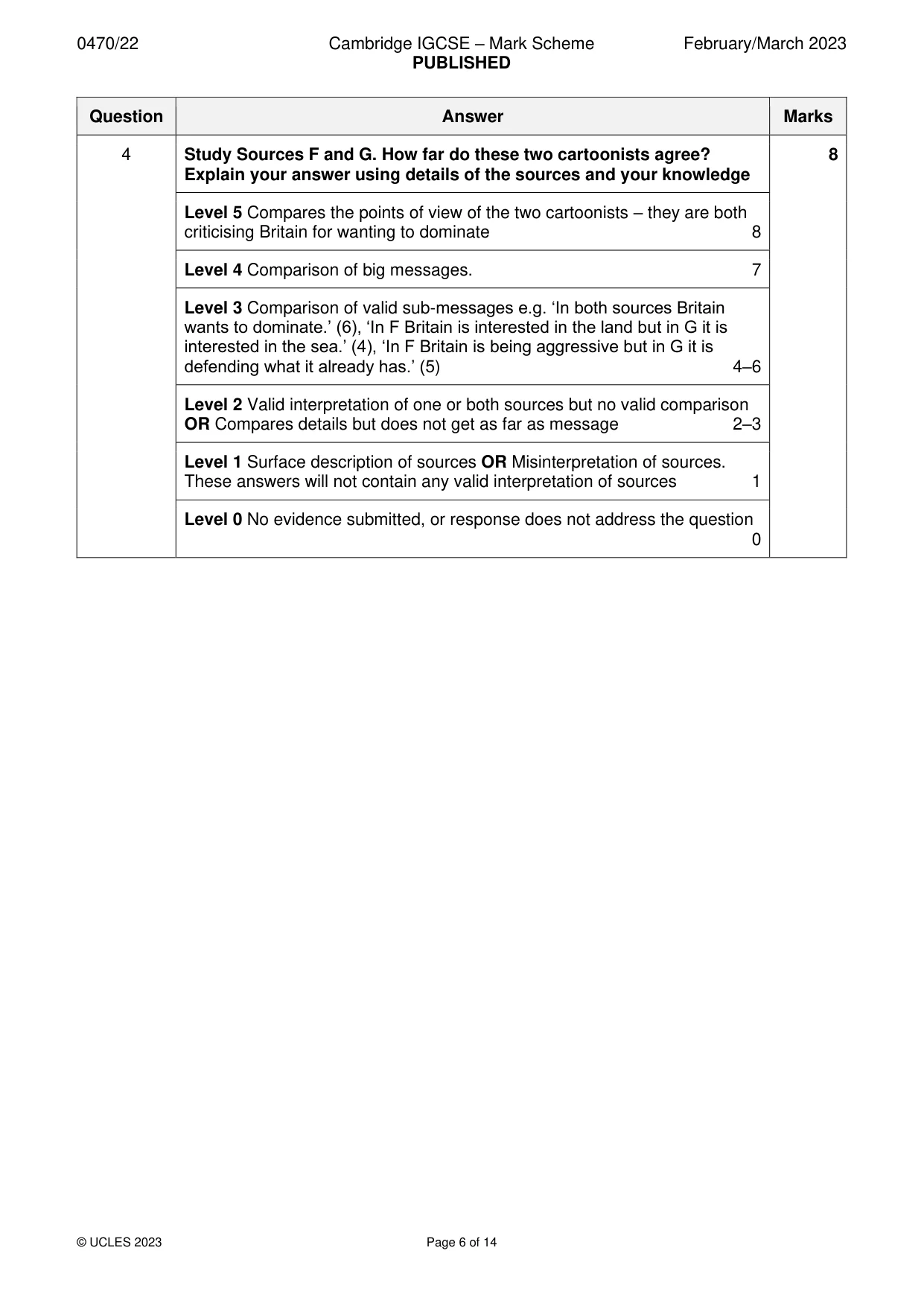
0470/22 Cambridge IGCSE – Mark Scheme PUBLISHED February/March 2023 © UCLES 2023 Page 6 of 14 Question Answer Marks 4 Study Sources F and G. How far do these two cartoonists agree? Explain your answer using details of the sources and your knowledge 8 Level 5 Compares the points of view of the two cartoonists – they are both criticising Britain for wanting to dominate 8 Level 4 Comparison of big messages. 7 Level 3 Comparison of valid sub-messages e.g. ‘In both sources Britain wants to dominate.’ (6), ‘In F Britain is interested in the land but in G it is interested in the sea.’ (4), ‘In F Britain is being aggressive but in G it is defending what it already has.’ (5) 4–6 Level 2 Valid interpretation of one or both sources but no valid comparison OR Compares details but does not get as far as message 2–3 Level 1 Surface description of sources OR Misinterpretation of sources. These answers will not contain any valid interpretation of sources 1 Level 0 No evidence submitted, or response does not address the question 0
Mark scheme, page 7
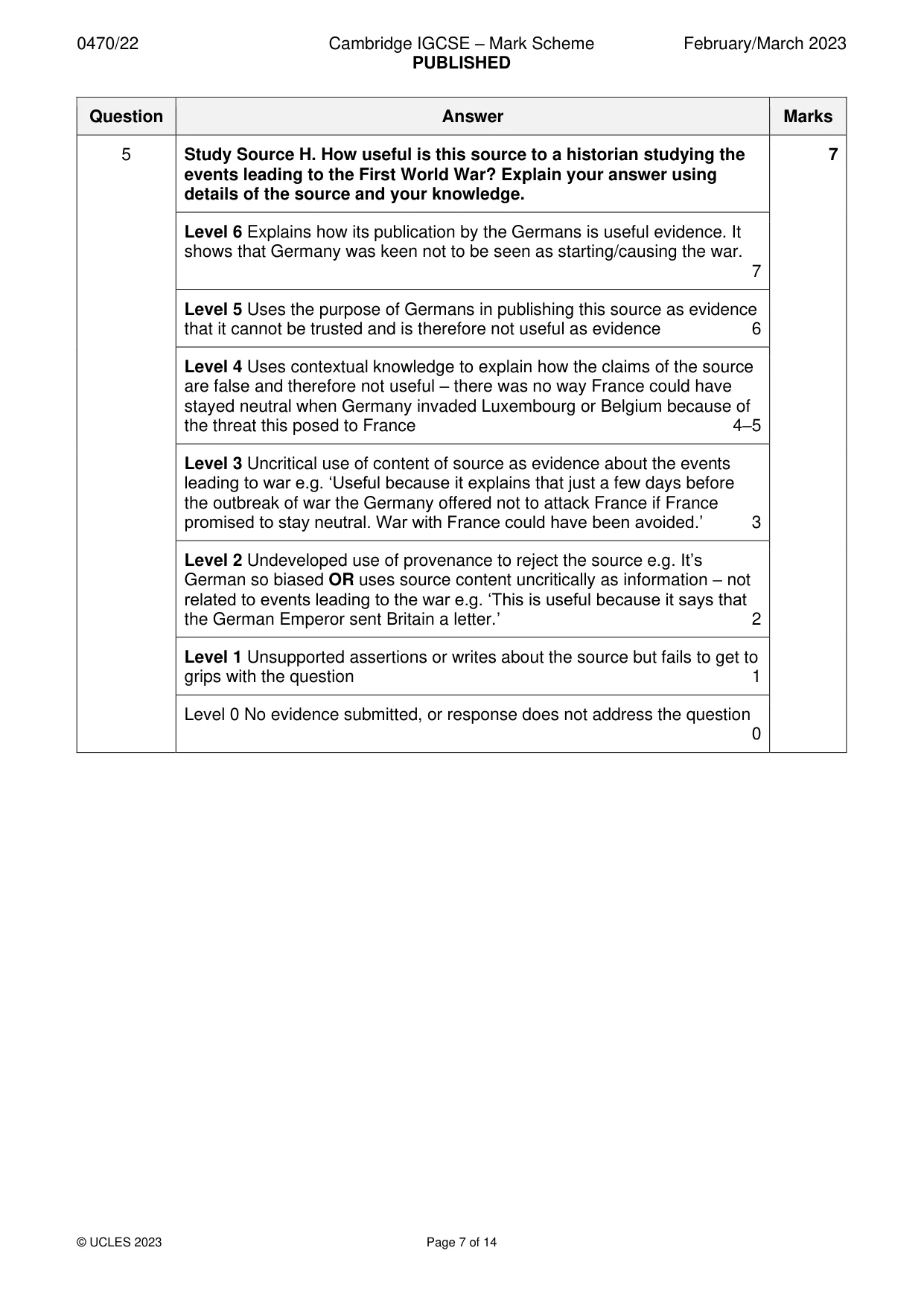
0470/22 Cambridge IGCSE – Mark Scheme PUBLISHED February/March 2023 © UCLES 2023 Page 7 of 14 Question Answer Marks 5 Study Source H. How useful is this source to a historian studying the events leading to the First World War? Explain your answer using details of the source and your knowledge. 7 Level 6 Explains how its publication by the Germans is useful evidence. It shows that Germany was keen not to be seen as starting/causing the war. 7 Level 5 Uses the purpose of Germans in publishing this source as evidence that it cannot be trusted and is therefore not useful as evidence 6 Level 4 Uses contextual knowledge to explain how the claims of the source are false and therefore not useful – there was no way France could have stayed neutral when Germany invaded Luxembourg or Belgium because of the threat this posed to France 4–5 Level 3 Uncritical use of content of source as evidence about the events leading to war e.g. ‘Useful because it explains that just a few days before the outbreak of war the Germany offered not to attack France if France promised to stay neutral. War with France could have been avoided.’ 3 Level 2 Undeveloped use of provenance to reject the source e.g. It’s German so biased OR uses source content uncritically as information – not related to events leading to the war e.g. ‘This is useful because it says that the German Emperor sent Britain a letter.’ 2 Level 1 Unsupported assertions or writes about the source but fails to get to grips with the question 1 Level 0 No evidence submitted, or response does not address the question 0
Mark scheme, page 8
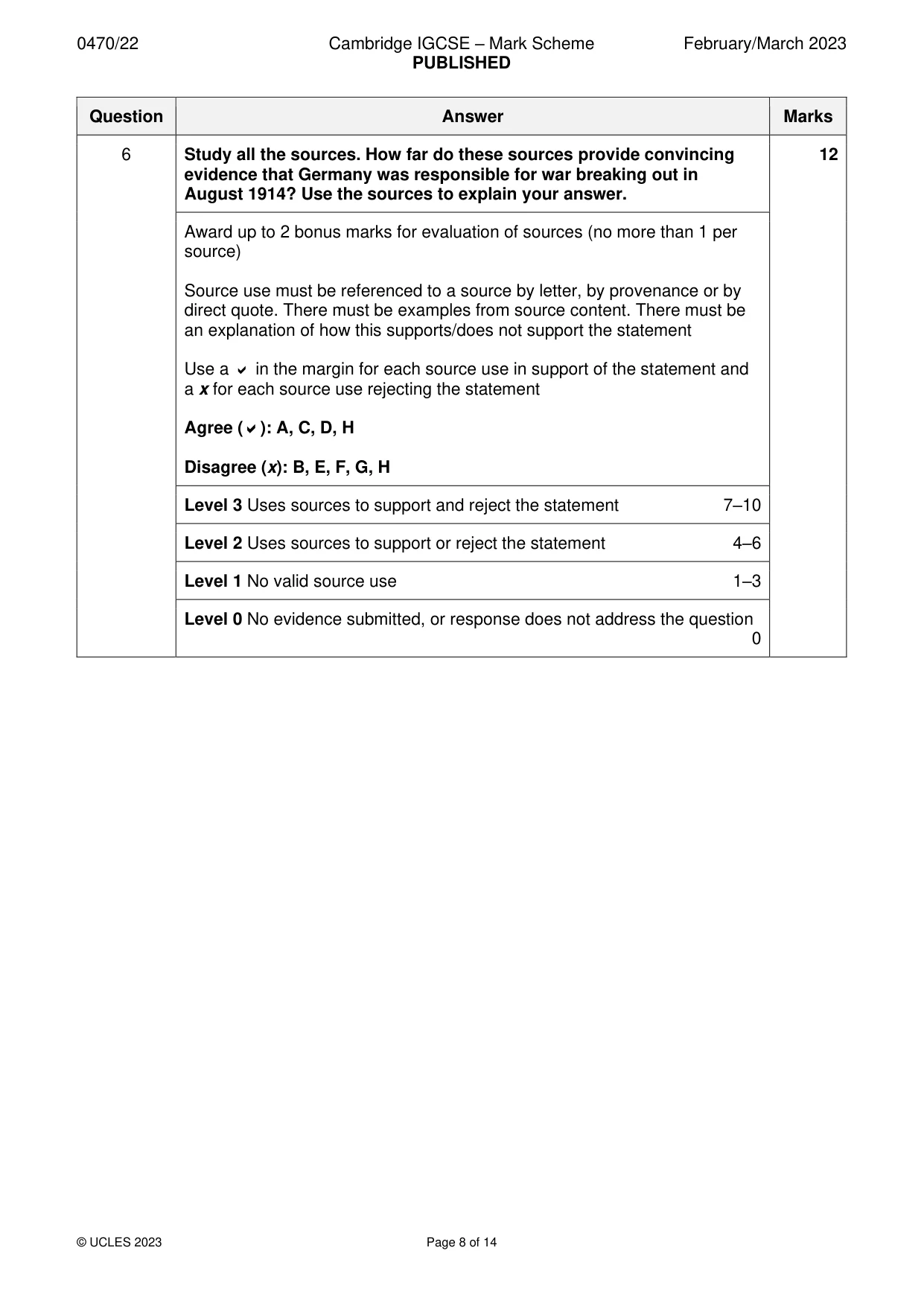
0470/22 Cambridge IGCSE – Mark Scheme PUBLISHED February/March 2023 © UCLES 2023 Page 8 of 14 Question Answer Marks 6 Study all the sources. How far do these sources provide convincing evidence that Germany was responsible for war breaking out in August 1914? Use the sources to explain your answer. 12 Award up to 2 bonus marks for evaluation of sources (no more than 1 per source) Source use must be referenced to a source by letter, by provenance or by direct quote. There must be examples from source content. There must be an explanation of how this supports/does not support the statement Use a in the margin for each source use in support of the statement and a x for each source use rejecting the statement Agree (): A, C, D, H Disagree (x): B, E, F, G, H Level 3 Uses sources to support and reject the statement 7–10 Level 2 Uses sources to support or reject the statement 4–6 Level 1 No valid source use 1–3 Level 0 No evidence submitted, or response does not address the question 0
Mark scheme, page 9
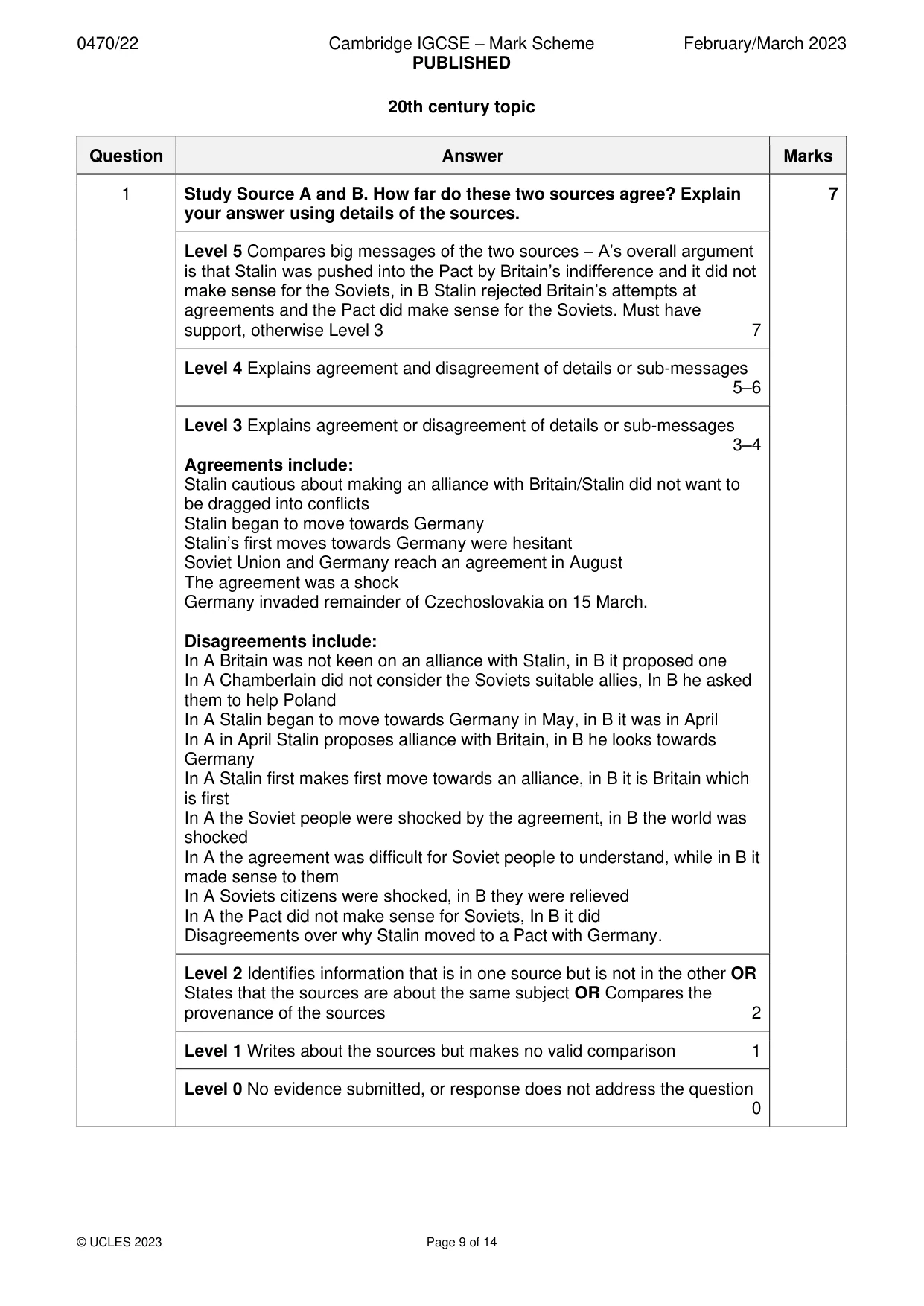
0470/22 Cambridge IGCSE – Mark Scheme PUBLISHED February/March 2023 © UCLES 2023 Page 9 of 14 20th century topic Question Answer Marks 1 Study Source A and B. How far do these two sources agree? Explain your answer using details of the sources. 7 Level 5 Compares big messages of the two sources – A’s overall argument is that Stalin was pushed into the Pact by Britain’s indifference and it did not make sense for the Soviets, in B Stalin rejected Britain’s attempts at agreements and the Pact did make sense for the Soviets. Must have support, otherwise Level 3 7 Level 4 Explains agreement and disagreement of details or sub-messages 5–6 Level 3 Explains agreement or disagreement of details or sub-messages 3–4 Agreements include: Stalin cautious about making an alliance with Britain/Stalin did not want to be dragged into conflicts Stalin began to move towards Germany Stalin’s first moves towards Germany were hesitant Soviet Union and Germany reach an agreement in August The agreement was a shock Germany invaded remainder of Czechoslovakia on 15 March. Disagreements include: In A Britain was not keen on an alliance with Stalin, in B it proposed one In A Chamberlain did not consider the Soviets suitable allies, In B he asked them to help Poland In A Stalin began to move towards Germany in May, in B it was in April In A in April Stalin proposes alliance with Britain, in B he looks towards Germany In A Stalin first makes first move towards an alliance, in B it is Britain which is first In A the Soviet people were shocked by the agreement, in B the world was shocked In A the agreement was difficult for Soviet people to understand, while in B it made sense to them In A Soviets citizens were shocked, in B they were relieved In A the Pact did not make sense for Soviets, In B it did Disagreements over why Stalin moved to a Pact with Germany. Level 2 Identifies information that is in one source but is not in the other OR States that the sources are about the same subject OR Compares the provenance of the sources 2 Level 1 Writes about the sources but makes no valid comparison 1 Level 0 No evidence submitted, or response does not address the question 0
Mark scheme, page 10
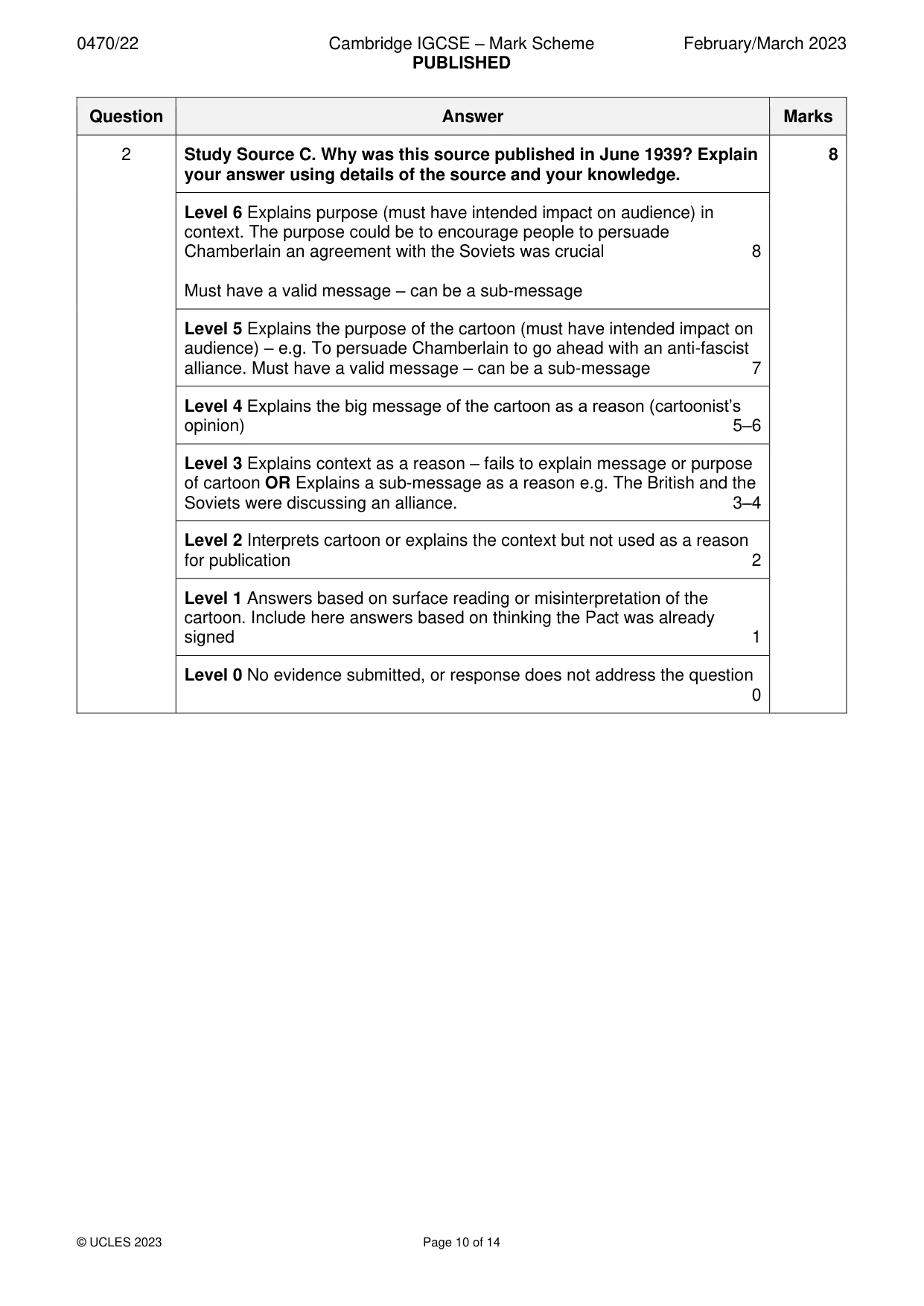
0470/22 Cambridge IGCSE – Mark Scheme PUBLISHED February/March 2023 © UCLES 2023 Page 10 of 14 Question Answer Marks 2 Study Source C. Why was this source published in June 1939? Explain your answer using details of the source and your knowledge. 8 Level 6 Explains purpose (must have intended impact on audience) in context. The purpose could be to encourage people to persuade Chamberlain an agreement with the Soviets was crucial 8 Must have a valid message – can be a sub-message Level 5 Explains the purpose of the cartoon (must have intended impact on audience) – e.g. To persuade Chamberlain to go ahead with an anti-fascist alliance. Must have a valid message – can be a sub-message 7 Level 4 Explains the big message of the cartoon as a reason (cartoonist’s opinion) 5–6 Level 3 Explains context as a reason – fails to explain message or purpose of cartoon OR Explains a sub-message as a reason e.g. The British and the Soviets were discussing an alliance. 3–4 Level 2 Interprets cartoon or explains the context but not used as a reason for publication 2 Level 1 Answers based on surface reading or misinterpretation of the cartoon. Include here answers based on thinking the Pact was already signed 1 Level 0 No evidence submitted, or response does not address the question 0
Mark scheme, page 11
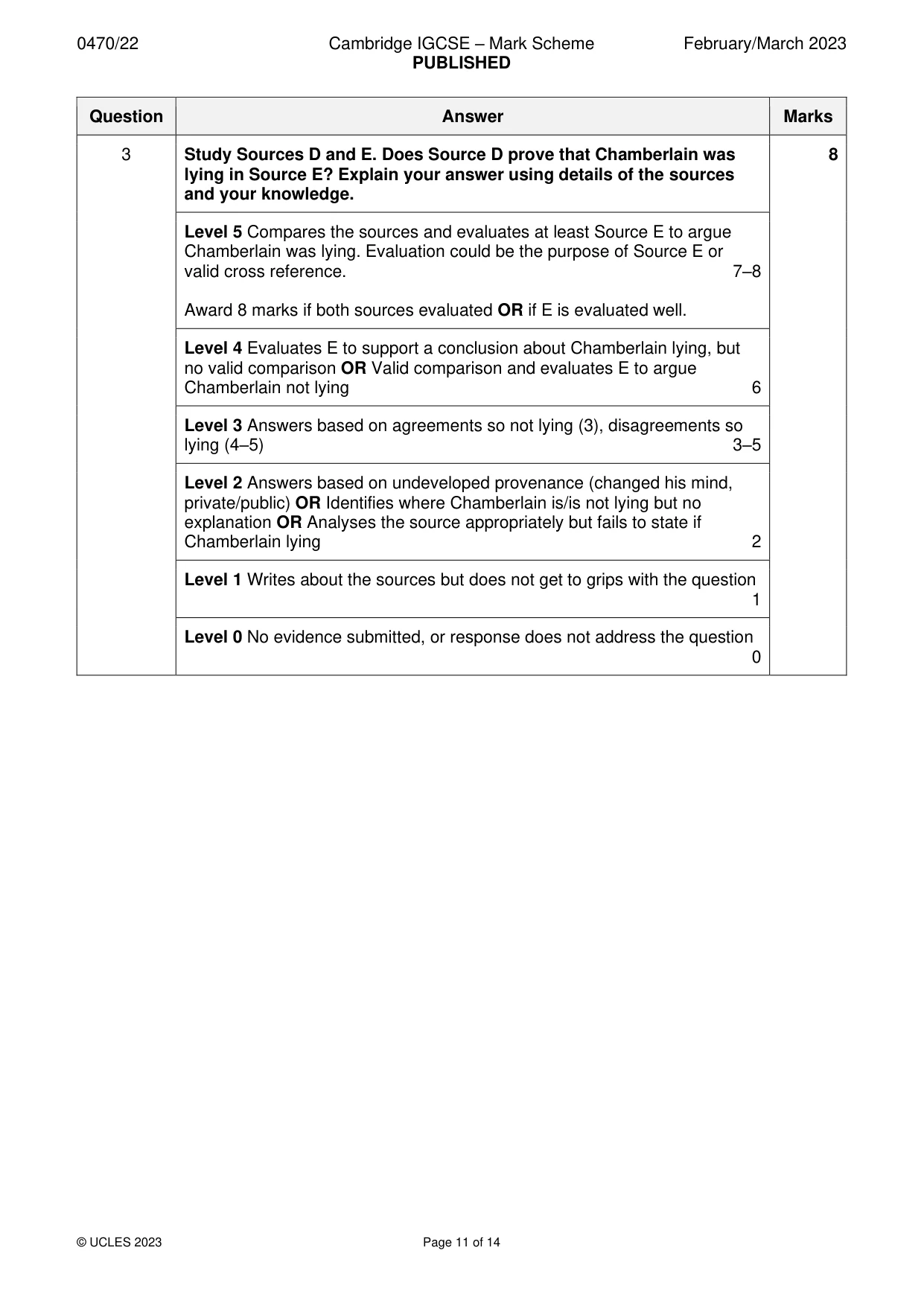
0470/22 Cambridge IGCSE – Mark Scheme PUBLISHED February/March 2023 © UCLES 2023 Page 11 of 14 Question Answer Marks 3 Study Sources D and E. Does Source D prove that Chamberlain was lying in Source E? Explain your answer using details of the sources and your knowledge. 8 Level 5 Compares the sources and evaluates at least Source E to argue Chamberlain was lying. Evaluation could be the purpose of Source E or valid cross reference. 7–8 Award 8 marks if both sources evaluated OR if E is evaluated well. Level 4 Evaluates E to support a conclusion about Chamberlain lying, but no valid comparison OR Valid comparison and evaluates E to argue Chamberlain not lying 6 Level 3 Answers based on agreements so not lying (3), disagreements so lying (4–5) 3–5 Level 2 Answers based on undeveloped provenance (changed his mind, private/public) OR Identifies where Chamberlain is/is not lying but no explanation OR Analyses the source appropriately but fails to state if Chamberlain lying 2 Level 1 Writes about the sources but does not get to grips with the question 1 Level 0 No evidence submitted, or response does not address the question 0
Mark scheme, page 12
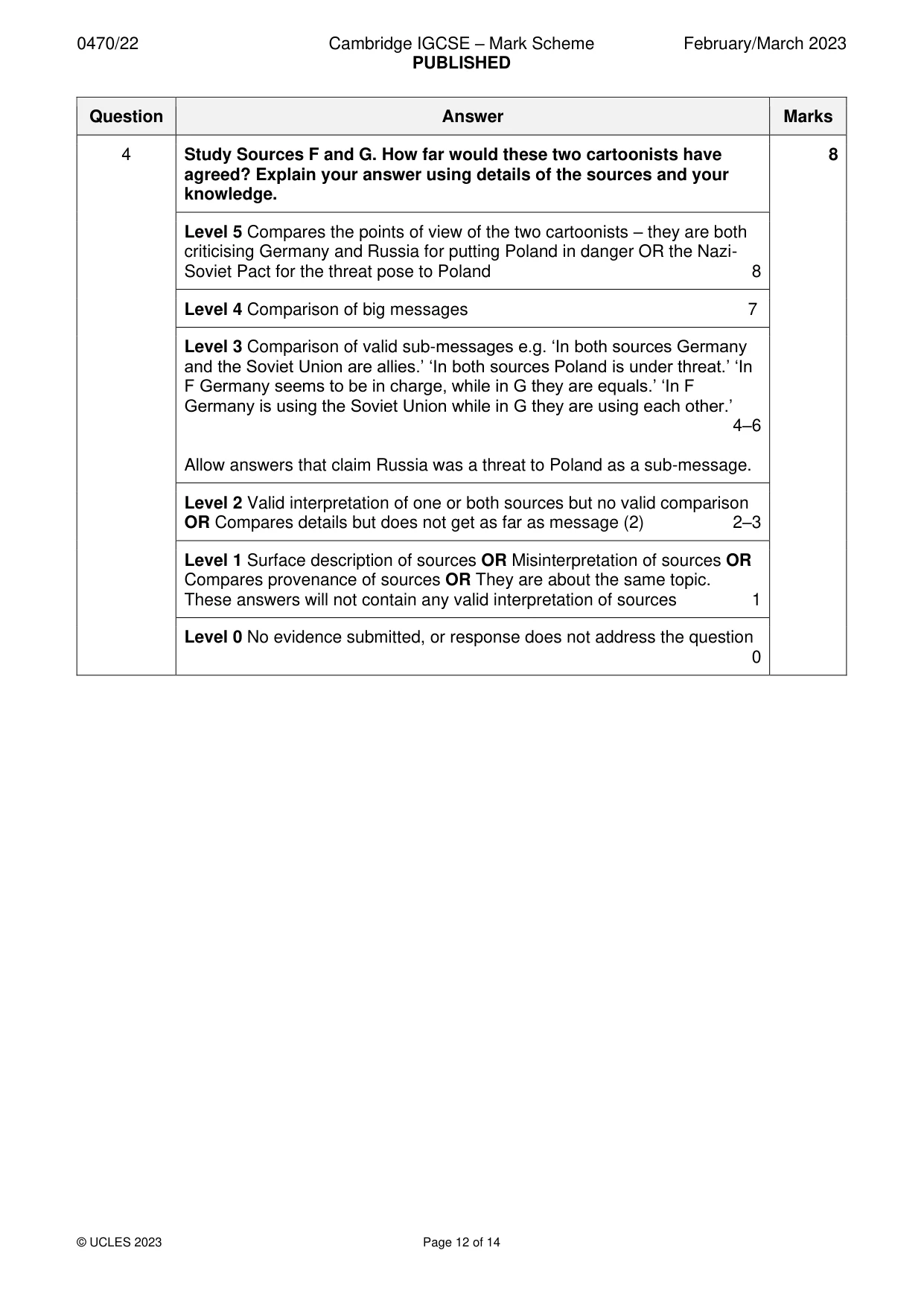
0470/22 Cambridge IGCSE – Mark Scheme PUBLISHED February/March 2023 © UCLES 2023 Page 12 of 14 Question Answer Marks 4 Study Sources F and G. How far would these two cartoonists have agreed? Explain your answer using details of the sources and your knowledge. 8 Level 5 Compares the points of view of the two cartoonists – they are both criticising Germany and Russia for putting Poland in danger OR the Nazi- Soviet Pact for the threat pose to Poland 8 Level 4 Comparison of big messages 7 Level 3 Comparison of valid sub-messages e.g. ‘In both sources Germany and the Soviet Union are allies.’ ‘In both sources Poland is under threat.’ ‘In F Germany seems to be in charge, while in G they are equals.’ ‘In F Germany is using the Soviet Union while in G they are using each other.’ 4–6 Allow answers that claim Russia was a threat to Poland as a sub-message. Level 2 Valid interpretation of one or both sources but no valid comparison OR Compares details but does not get as far as message (2) 2–3 Level 1 Surface description of sources OR Misinterpretation of sources OR Compares provenance of sources OR They are about the same topic. These answers will not contain any valid interpretation of sources 1 Level 0 No evidence submitted, or response does not address the question 0
Mark scheme, page 13
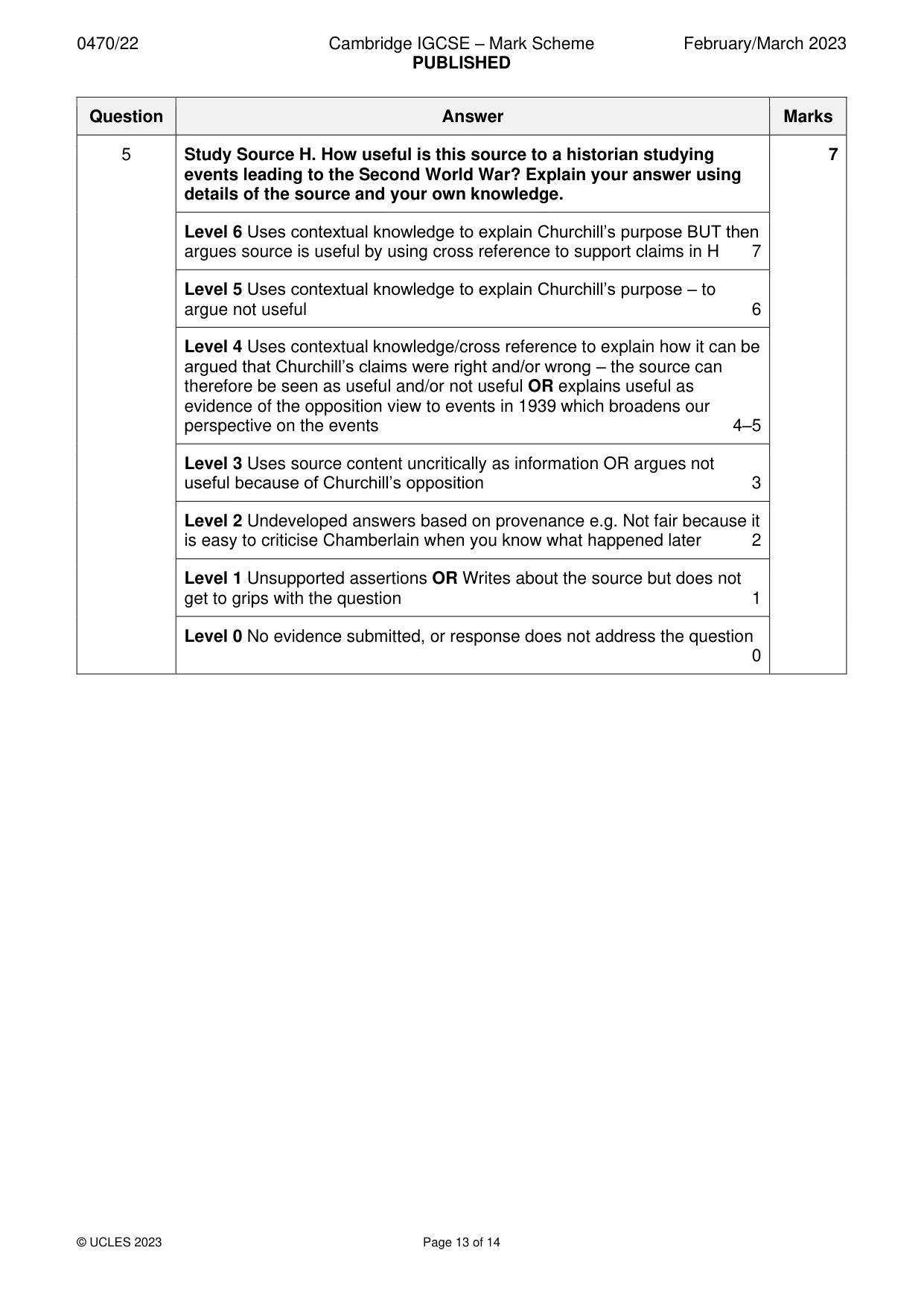
0470/22 Cambridge IGCSE – Mark Scheme PUBLISHED February/March 2023 © UCLES 2023 Page 13 of 14 Question Answer Marks 5 Study Source H. How useful is this source to a historian studying events leading to the Second World War? Explain your answer using details of the source and your own knowledge. 7 Level 6 Uses contextual knowledge to explain Churchill’s purpose BUT then argues source is useful by using cross reference to support claims in H 7 Level 5 Uses contextual knowledge to explain Churchill’s purpose – to argue not useful 6 Level 4 Uses contextual knowledge/cross reference to explain how it can be argued that Churchill’s claims were right and/or wrong – the source can therefore be seen as useful and/or not useful OR explains useful as evidence of the opposition view to events in 1939 which broadens our perspective on the events 4–5 Level 3 Uses source content uncritically as information OR argues not useful because of Churchill’s opposition 3 Level 2 Undeveloped answers based on provenance e.g. Not fair because it is easy to criticise Chamberlain when you know what happened later 2 Level 1 Unsupported assertions OR Writes about the source but does not get to grips with the question 1 Level 0 No evidence submitted, or response does not address the question 0
Mark scheme, page 14
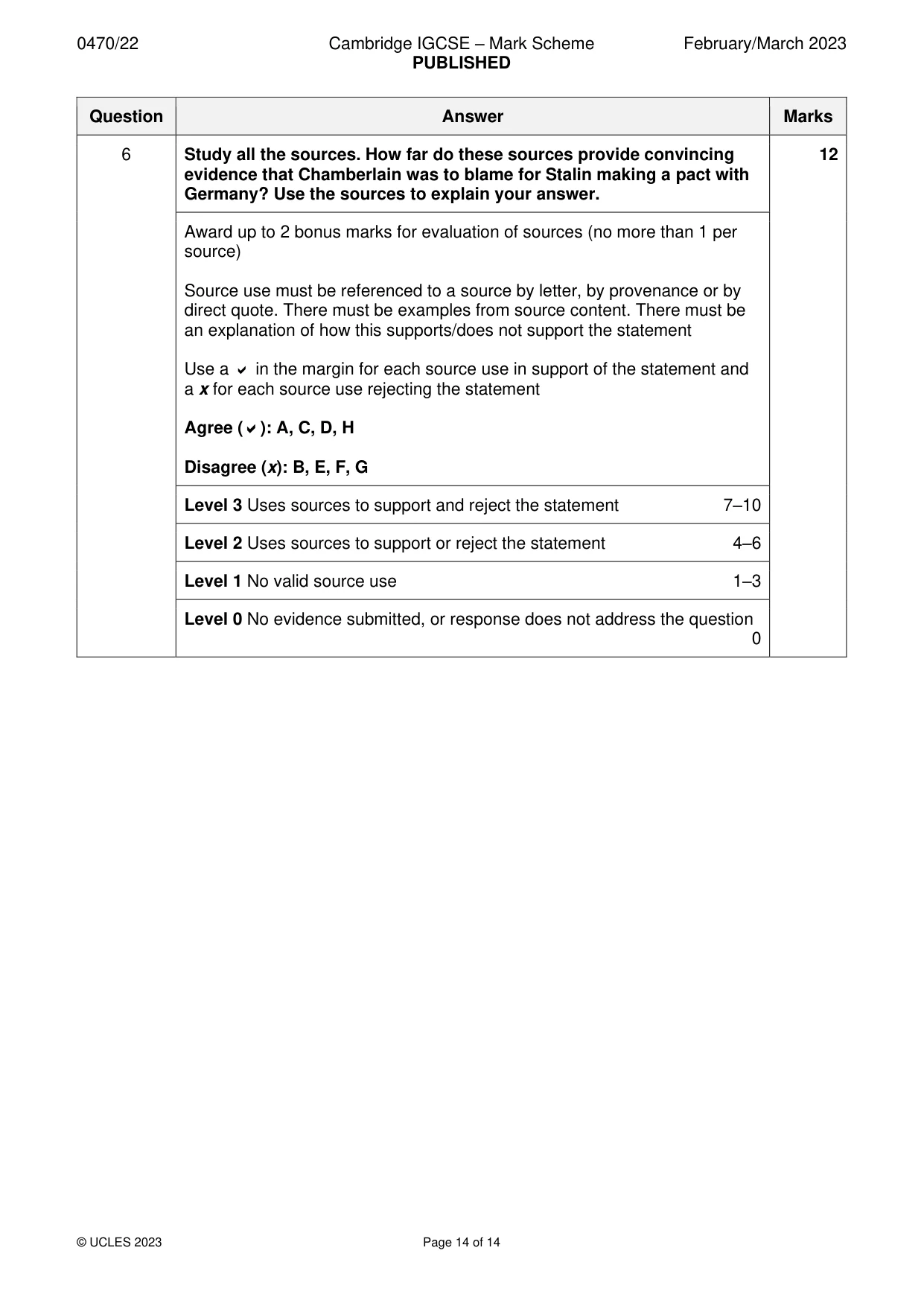
0470/22 Cambridge IGCSE – Mark Scheme PUBLISHED February/March 2023 © UCLES 2023 Page 14 of 14 Question Answer Marks 6 Study all the sources. How far do these sources provide convincing evidence that Chamberlain was to blame for Stalin making a pact with Germany? Use the sources to explain your answer. 12 Award up to 2 bonus marks for evaluation of sources (no more than 1 per source) Source use must be referenced to a source by letter, by provenance or by direct quote. There must be examples from source content. There must be an explanation of how this supports/does not support the statement Use a in the margin for each source use in support of the statement and a x for each source use rejecting the statement Agree (): A, C, D, H Disagree (x): B, E, F, G Level 3 Uses sources to support and reject the statement 7–10 Level 2 Uses sources to support or reject the statement 4–6 Level 1 No valid source use 1–3 Level 0 No evidence submitted, or response does not address the question 0
What you needed in this session
Cambridge’s own grade thresholds for 2023 Feb/March, Paper 2 · Variant 2. A higher threshold means an easier paper — the bar moves with how the cohort did.