Cambridge IGCSE History 0470 — 2024 May/June Paper 2 · Variant 2
0470/22/M/J/24 · 40 marks · 105 min
The question paper and its mark scheme, free to read here and free to download. This is Cambridge’s own paper, exactly as it was sat.
Question paper12 pages
Mark scheme13 pages
Answers below. Sit the paper first if you are practising.
Paper as text
Question paper, page 1
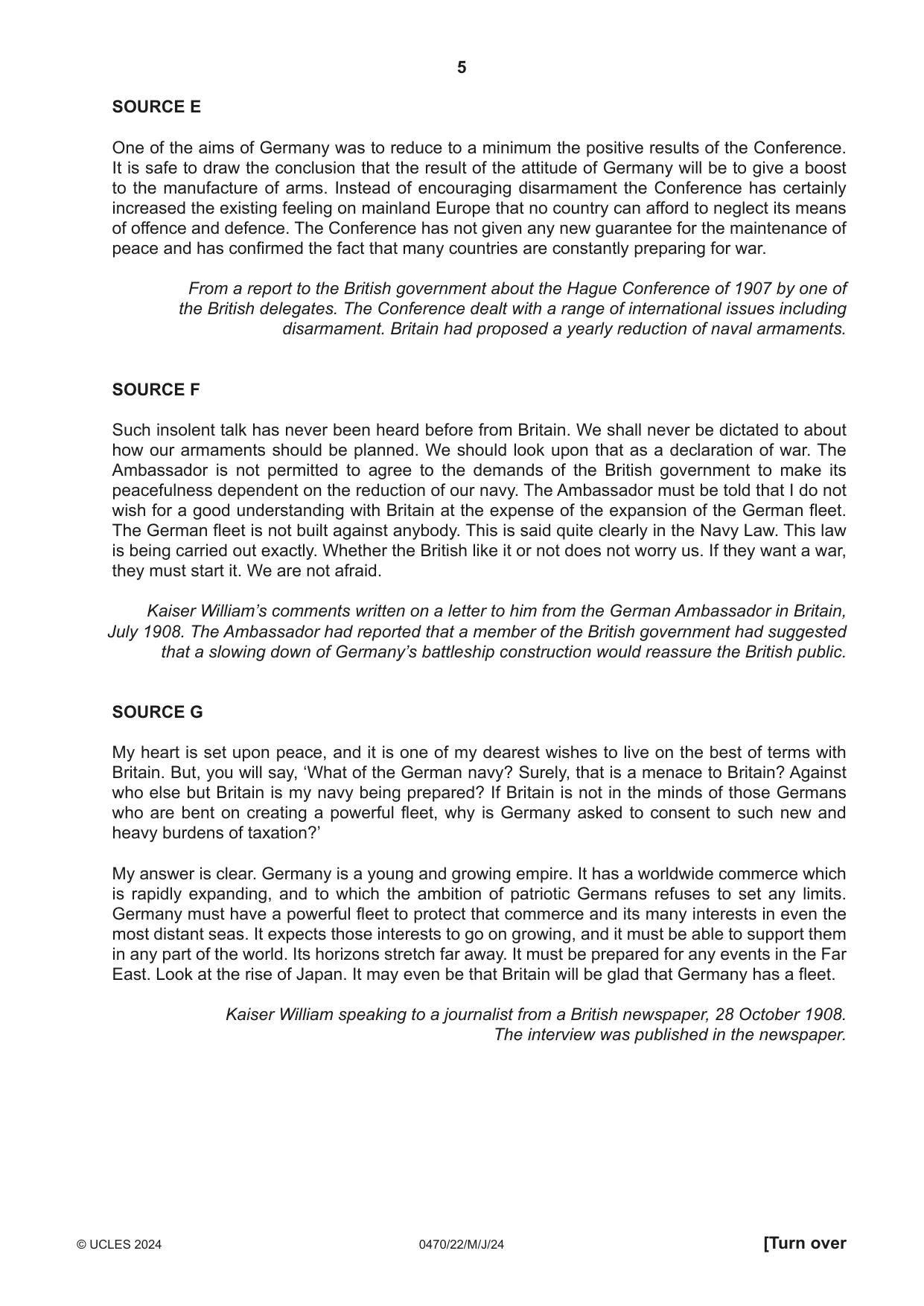
This document has 12 pages. Any blank pages are indicated. [Turn over Cambridge IGCSE™ * 1 0 5 7 8 4 2 7 7 8 * HISTORY 0470/22 Paper 2 Document Questions May/June 2024 1 hour 45 minutes You must answer on the enclosed answer booklet. You will need: Answer booklet (enclosed) INSTRUCTIONS ● Answer one question on one option only. Option A: Nineteenth century topic Option B: Twentieth century topic ● Follow the instructions on the front cover of the answer booklet. If you need additional answer paper, ask the invigilator for a continuation booklet. INFORMATION ● The total mark for this paper is 40. ● The number of marks for each question or part question is shown in brackets [ ]. DC (SK/CGW) 330337/3 © UCLES 2024
Question paper, page 2
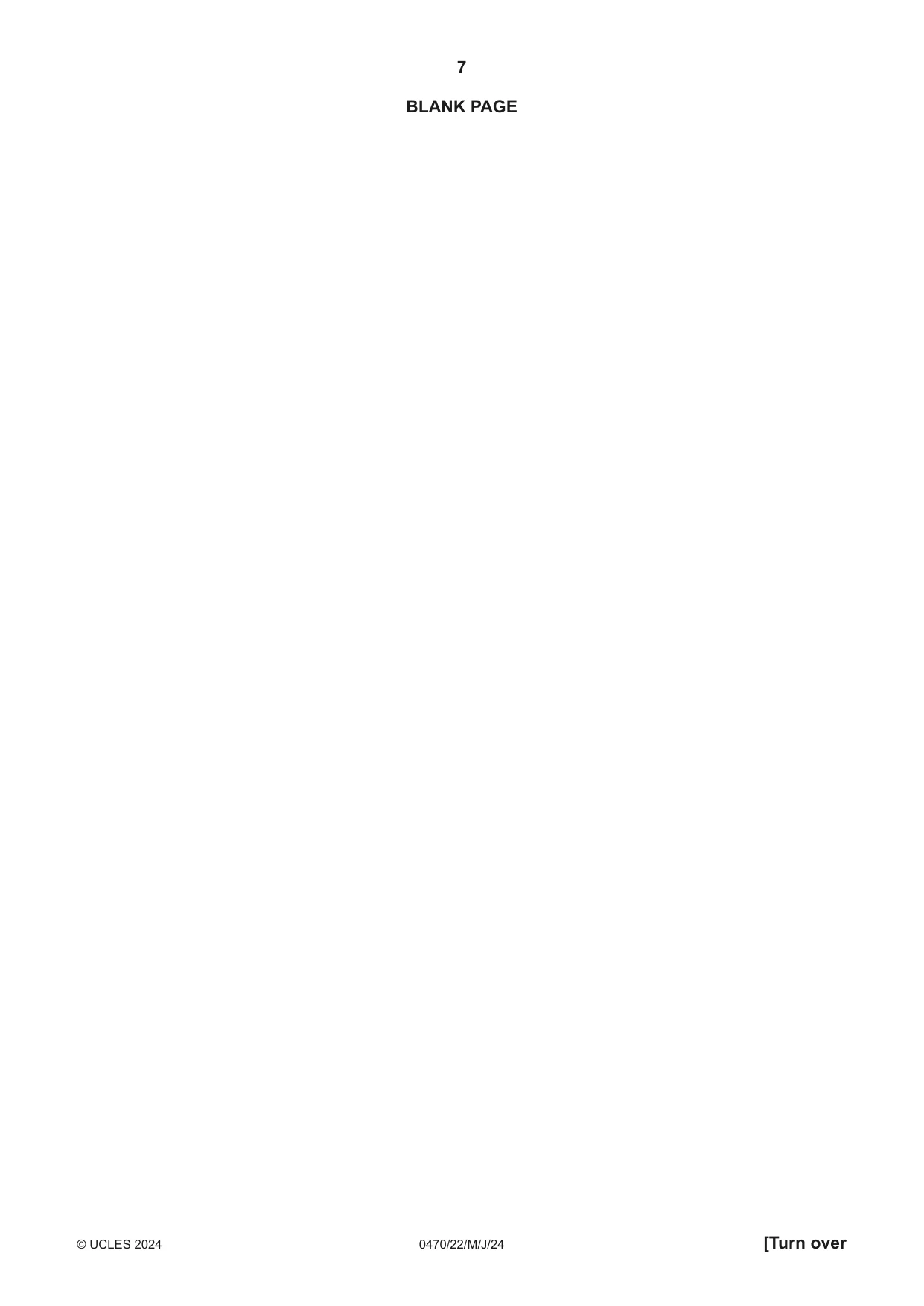
2 0470/22/M/J/24 © UCLES 2024 Option A: Nineteenth century topic 1 Who was more to blame for the naval race between Britain and Germany? Study the Background Information and the sources carefully, and then answer all parts of Question 1. Background Information The naval race between Britain and Germany was an important part of the arms race in the years before the First World War. It significantly contributed towards the growing hostility between Britain and Germany and was a key factor in the increasing tensions between the Great Powers in Europe. Traditionally, Britain had the largest navy in the world, but in 1898 Germany began to create a powerful battle fleet. In 1906 the rivalry between the two countries grew with the building of the dreadnoughts – a new type of battleship, faster and more powerful than any previous battleship. Who was more responsible for the naval race, Britain or Germany? SOURCE A Kaiser William wanted Britain as a friend and thought the best way of achieving this was to build a powerful navy. Once Britain saw the power of the German fleet it would respect Germany and offer friendship. When Tirpitz became in charge of the navy in 1897, William had an ally. They both misunderstood the situation because their policy of building up Germany’s fleet was totally against the British view of its security. Britain ruled the seas and would never allow the German navy to rival the British navy. As far as Britain was concerned, a strong German navy in the North Sea raised the possibility of an invasion. Germany’s policy was in fact no threat to Britain, but Britain failed to see this. It also failed to understand the threat Germany felt the British fleet posed to Germany. In 1905 Britain worsened relations with Germany by starting to build the first dreadnought. This left Germany with no choice. It could not let Britain threaten Germany with dreadnoughts and so it had to respond by building its own dreadnoughts. In 1908 Tirpitz said, ‘Every new ship added to our battlefleet means an increase in risk for Britain if it attacks us.’ In Britain the anti-German public was aggressively demanding eight new dreadnoughts be built. From a recent history book. SOURCE B William’s motives were simple. He wanted to make Germany a world power and so a great navy was needed. Traditionally Britain ruled the waves but William did not understand what right Britain had to do this. Tirpitz’s appointment in 1897 as the government minister in charge of the navy meant that Germany had decided to build a navy strong enough to defeat the British navy. It became clear to Britain that the German fleet that was emerging was designed to only operate in the North Sea – a clear threat to Britain. In fact, the German navy was emerging as Britain’s main enemy of the future. Britain was bound to be uneasy and in 1906 launched the first dreadnought. Britain had to meet the German naval challenge and from that date focused on the possibility of a naval war in the seas around Britain and even a German invasion. The appearance of the first dreadnought did not improve Anglo-German relations. Tirpitz increased the tension by stating that he would build two dreadnoughts a year and ignored warnings that his naval programme was turning Britain against Germany. From a recent history book.
Question paper, page 3
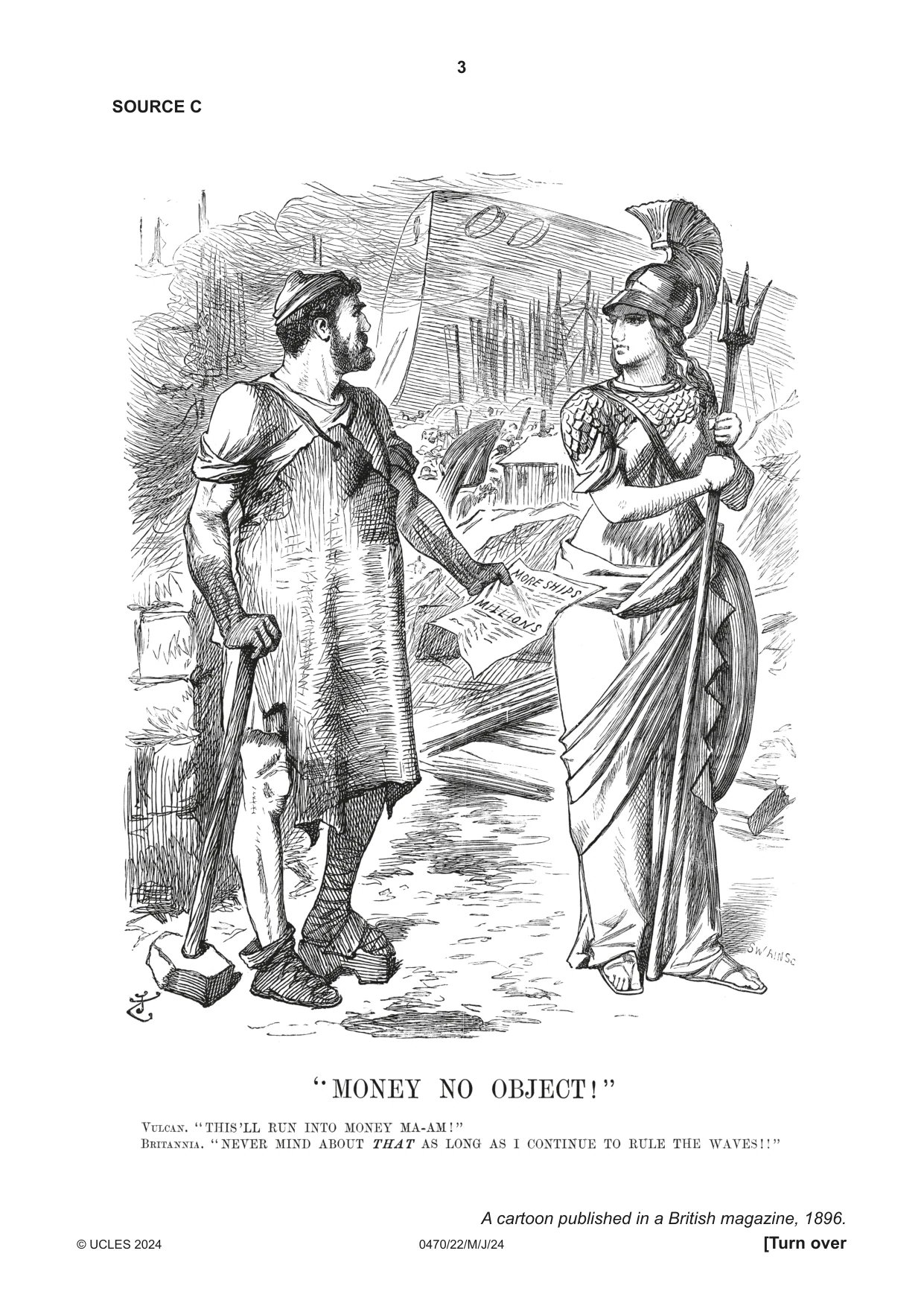
3 0470/22/M/J/24 © UCLES 2024 [Turn over SOURCE C A cartoon published in a British magazine, 1896.
Question paper, page 4
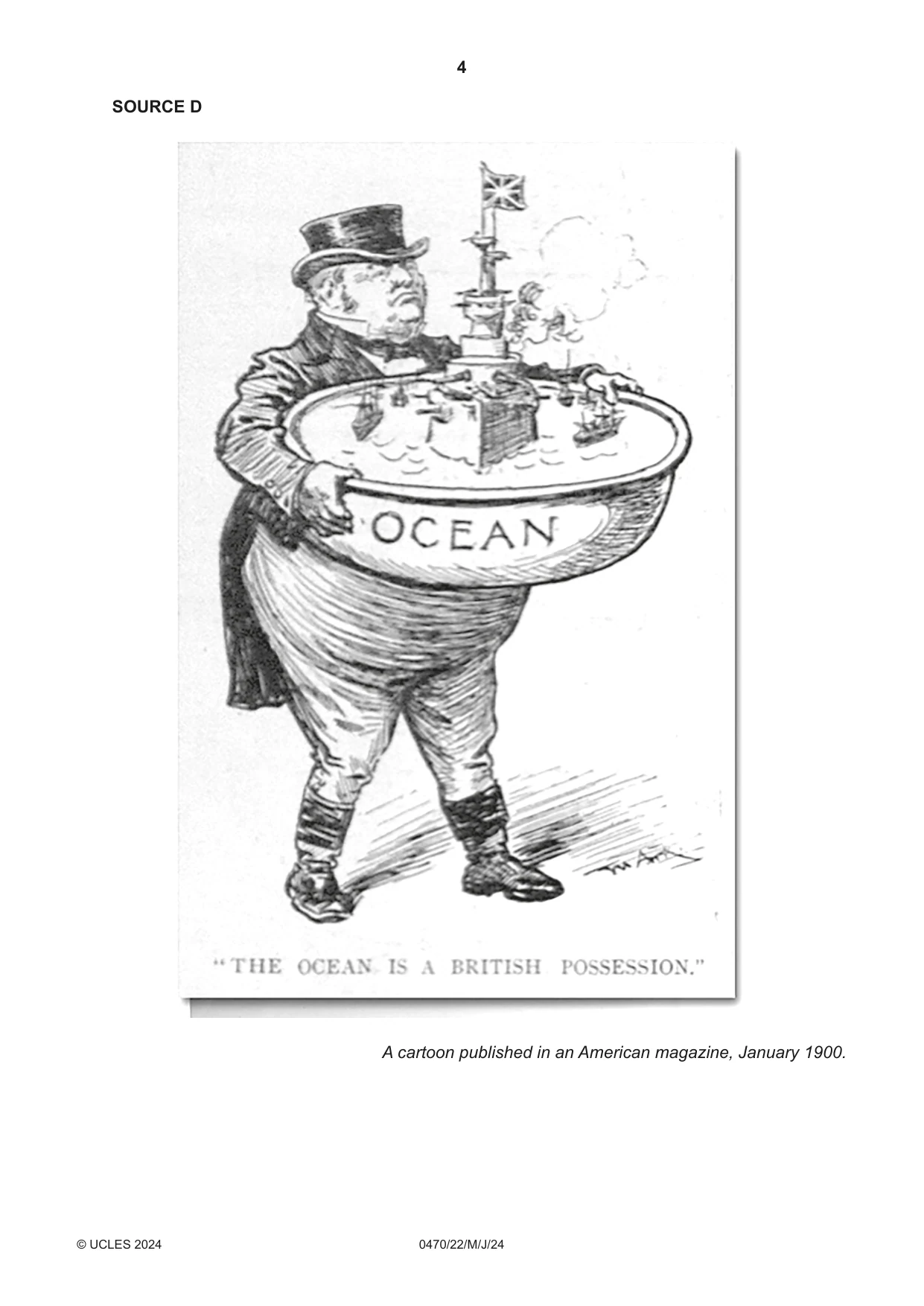
4 0470/22/M/J/24 © UCLES 2024 SOURCE D A cartoon published in an American magazine, January 1900.
Question paper, page 5
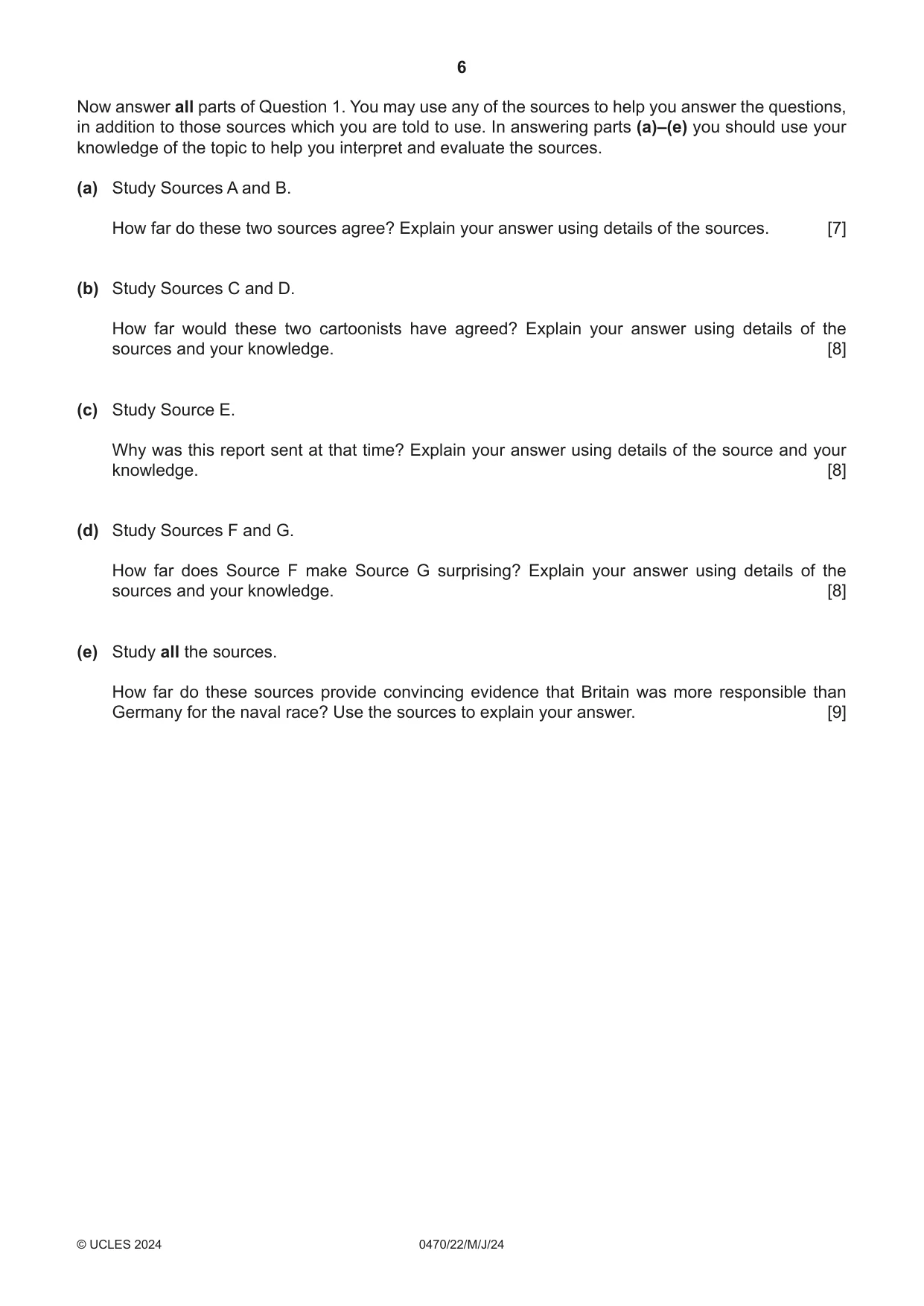
5 0470/22/M/J/24 © UCLES 2024 [Turn over SOURCE E One of the aims of Germany was to reduce to a minimum the positive results of the Conference. It is safe to draw the conclusion that the result of the attitude of Germany will be to give a boost to the manufacture of arms. Instead of encouraging disarmament the Conference has certainly increased the existing feeling on mainland Europe that no country can afford to neglect its means of offence and defence. The Conference has not given any new guarantee for the maintenance of peace and has confirmed the fact that many countries are constantly preparing for war. From a report to the British government about the Hague Conference of 1907 by one of the British delegates. The Conference dealt with a range of international issues including disarmament. Britain had proposed a yearly reduction of naval armaments. SOURCE F Such insolent talk has never been heard before from Britain. We shall never be dictated to about how our armaments should be planned. We should look upon that as a declaration of war. The Ambassador is not permitted to agree to the demands of the British government to make its peacefulness dependent on the reduction of our navy. The Ambassador must be told that I do not wish for a good understanding with Britain at the expense of the expansion of the German fleet. The German fleet is not built against anybody. This is said quite clearly in the Navy Law. This law is being carried out exactly. Whether the British like it or not does not worry us. If they want a war, they must start it. We are not afraid. Kaiser William’s comments written on a letter to him from the German Ambassador in Britain, July 1908. The Ambassador had reported that a member of the British government had suggested that a slowing down of Germany’s battleship construction would reassure the British public. SOURCE G My heart is set upon peace, and it is one of my dearest wishes to live on the best of terms with Britain. But, you will say, ‘What of the German navy? Surely, that is a menace to Britain? Against who else but Britain is my navy being prepared? If Britain is not in the minds of those Germans who are bent on creating a powerful fleet, why is Germany asked to consent to such new and heavy burdens of taxation?’ My answer is clear. Germany is a young and growing empire. It has a worldwide commerce which is rapidly expanding, and to which the ambition of patriotic Germans refuses to set any limits. Germany must have a powerful fleet to protect that commerce and its many interests in even the most distant seas. It expects those interests to go on growing, and it must be able to support them in any part of the world. Its horizons stretch far away. It must be prepared for any events in the Far East. Look at the rise of Japan. It may even be that Britain will be glad that Germany has a fleet. Kaiser William speaking to a journalist from a British newspaper, 28 October 1908. The interview was published in the newspaper.
Question paper, page 6
6 0470/22/M/J/24 © UCLES 2024 Now answer all parts of Question 1. You may use any of the sources to help you answer the questions, in addition to those sources which you are told to use. In answering parts (a)–(e) you should use your knowledge of the topic to help you interpret and evaluate the sources. (a) Study Sources A and B. How far do these two sources agree? Explain your answer using details of the sources. [7] (b) Study Sources C and D. How far would these two cartoonists have agreed? Explain your answer using details of the sources and your knowledge. [8] (c) Study Source E. Why was this report sent at that time? Explain your answer using details of the source and your knowledge. [8] (d) Study Sources F and G. How far does Source F make Source G surprising? Explain your answer using details of the sources and your knowledge. [8] (e) Study all the sources. How far do these sources provide convincing evidence that Britain was more responsible than Germany for the naval race? Use the sources to explain your answer. [9]
Question paper, page 7
7 0470/22/M/J/24 © UCLES 2024 [Turn over BLANK PAGE
Question paper, page 8
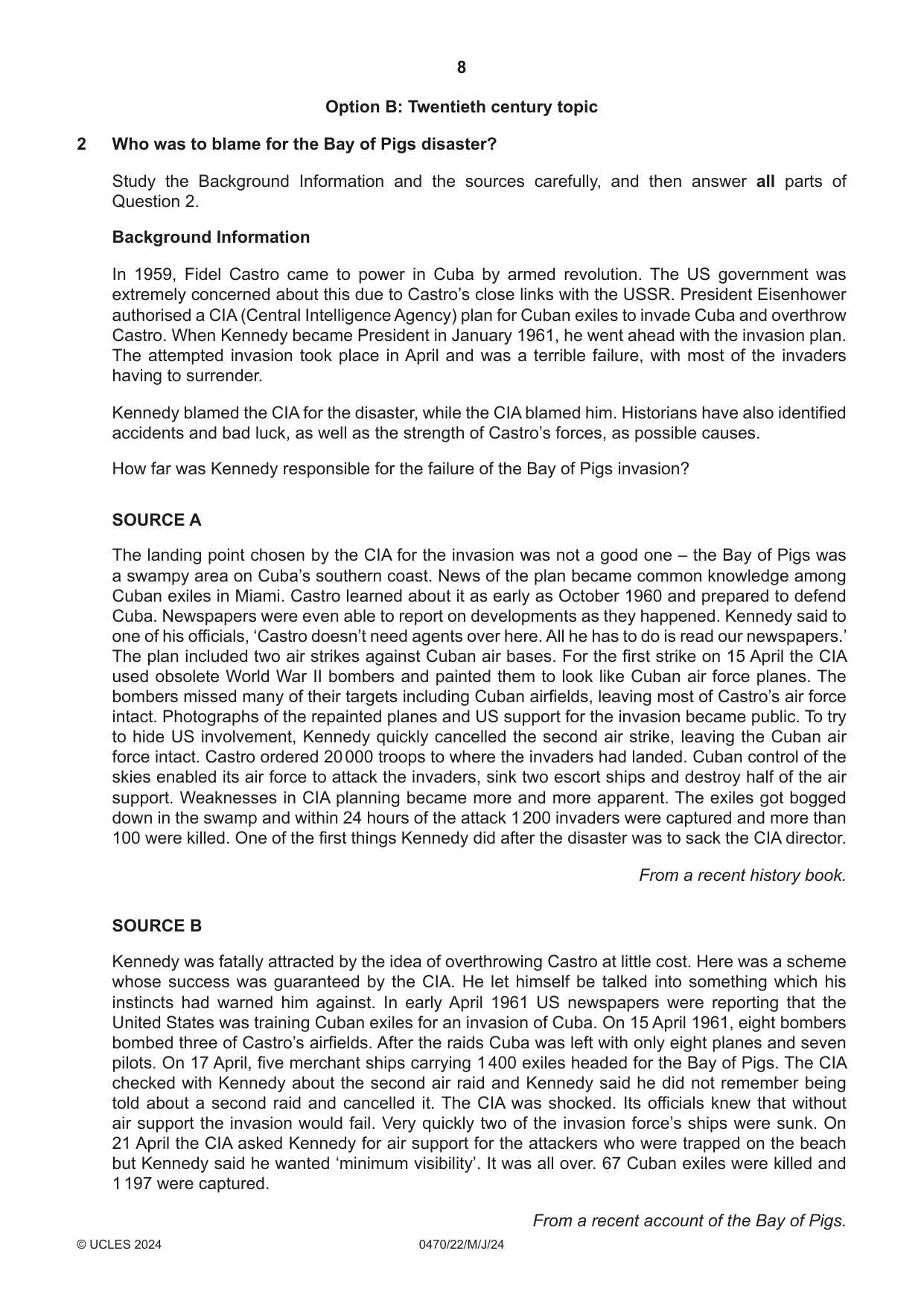
8 0470/22/M/J/24 © UCLES 2024 Option B: Twentieth century topic 2 Who was to blame for the Bay of Pigs disaster? Study the Background Information and the sources carefully, and then answer all parts of Question 2. Background Information In 1959, Fidel Castro came to power in Cuba by armed revolution. The US government was extremely concerned about this due to Castro’s close links with the USSR. President Eisenhower authorised a CIA (Central Intelligence Agency) plan for Cuban exiles to invade Cuba and overthrow Castro. When Kennedy became President in January 1961, he went ahead with the invasion plan. The attempted invasion took place in April and was a terrible failure, with most of the invaders having to surrender. Kennedy blamed the CIA for the disaster, while the CIA blamed him. Historians have also identified accidents and bad luck, as well as the strength of Castro’s forces, as possible causes. How far was Kennedy responsible for the failure of the Bay of Pigs invasion? SOURCE A The landing point chosen by the CIA for the invasion was not a good one – the Bay of Pigs was a swampy area on Cuba’s southern coast. News of the plan became common knowledge among Cuban exiles in Miami. Castro learned about it as early as October 1960 and prepared to defend Cuba. Newspapers were even able to report on developments as they happened. Kennedy said to one of his officials, ‘Castro doesn’t need agents over here. All he has to do is read our newspapers.’ The plan included two air strikes against Cuban air bases. For the first strike on 15 April the CIA used obsolete World War II bombers and painted them to look like Cuban air force planes. The bombers missed many of their targets including Cuban airfields, leaving most of Castro’s air force intact. Photographs of the repainted planes and US support for the invasion became public. To try to hide US involvement, Kennedy quickly cancelled the second air strike, leaving the Cuban air force intact. Castro ordered 20 000 troops to where the invaders had landed. Cuban control of the skies enabled its air force to attack the invaders, sink two escort ships and destroy half of the air support. Weaknesses in CIA planning became more and more apparent. The exiles got bogged down in the swamp and within 24 hours of the attack 1 200 invaders were captured and more than 100 were killed. One of the first things Kennedy did after the disaster was to sack the CIA director. From a recent history book. SOURCE B Kennedy was fatally attracted by the idea of overthrowing Castro at little cost. Here was a scheme whose success was guaranteed by the CIA. He let himself be talked into something which his instincts had warned him against. In early April 1961 US newspapers were reporting that the United States was training Cuban exiles for an invasion of Cuba. On 15 April 1961, eight bombers bombed three of Castro’s airfields. After the raids Cuba was left with only eight planes and seven pilots. On 17 April, five merchant ships carrying 1 400 exiles headed for the Bay of Pigs. The CIA checked with Kennedy about the second air raid and Kennedy said he did not remember being told about a second raid and cancelled it. The CIA was shocked. Its officials knew that without air support the invasion would fail. Very quickly two of the invasion force’s ships were sunk. On 21 April the CIA asked Kennedy for air support for the attackers who were trapped on the beach but Kennedy said he wanted ‘minimum visibility’. It was all over. 67 Cuban exiles were killed and 1 197 were captured. From a recent account of the Bay of Pigs.
Question paper, page 9
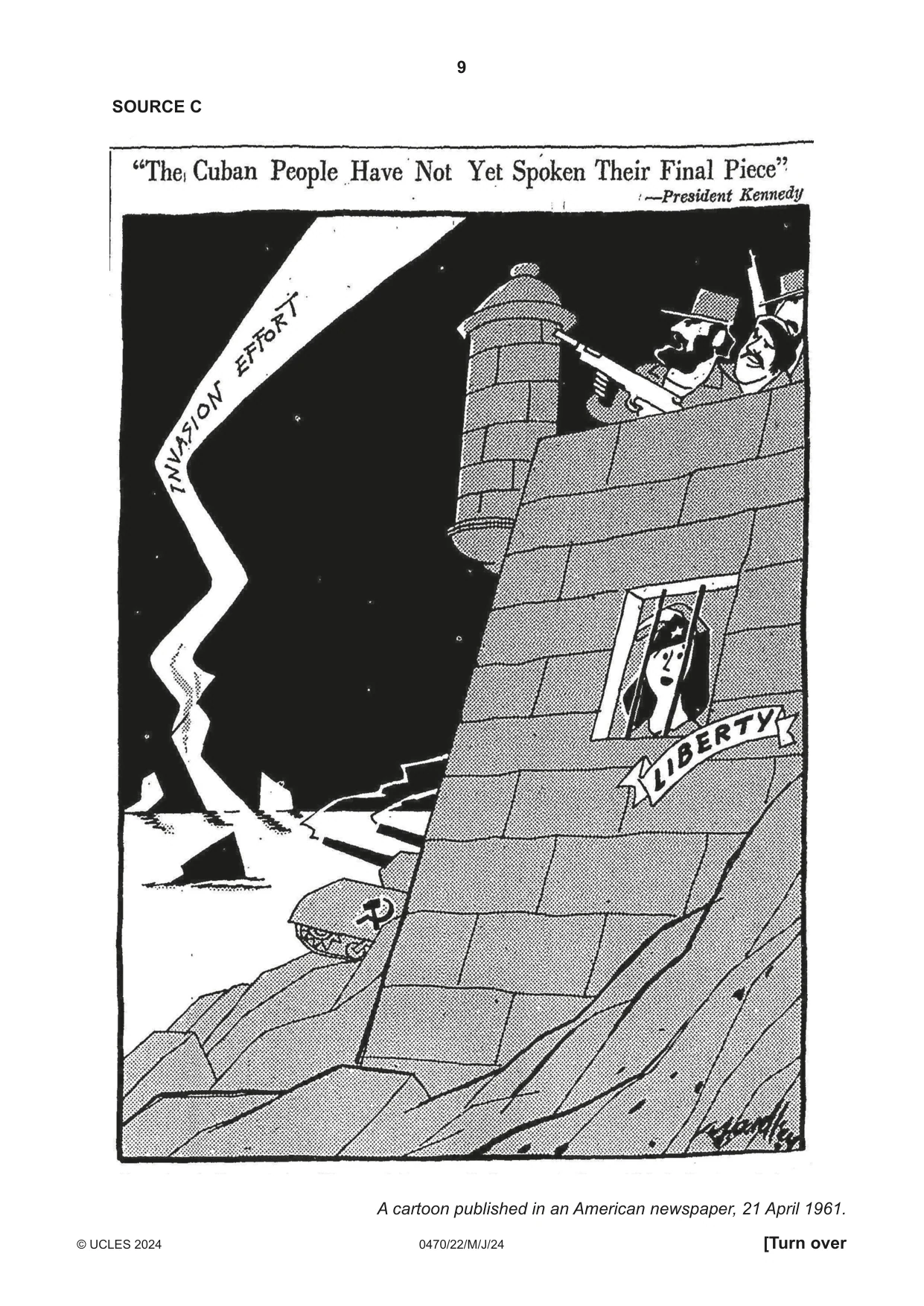
9 0470/22/M/J/24 © UCLES 2024 [Turn over SOURCE C A cartoon published in an American newspaper, 21 April 1961.
Question paper, page 10
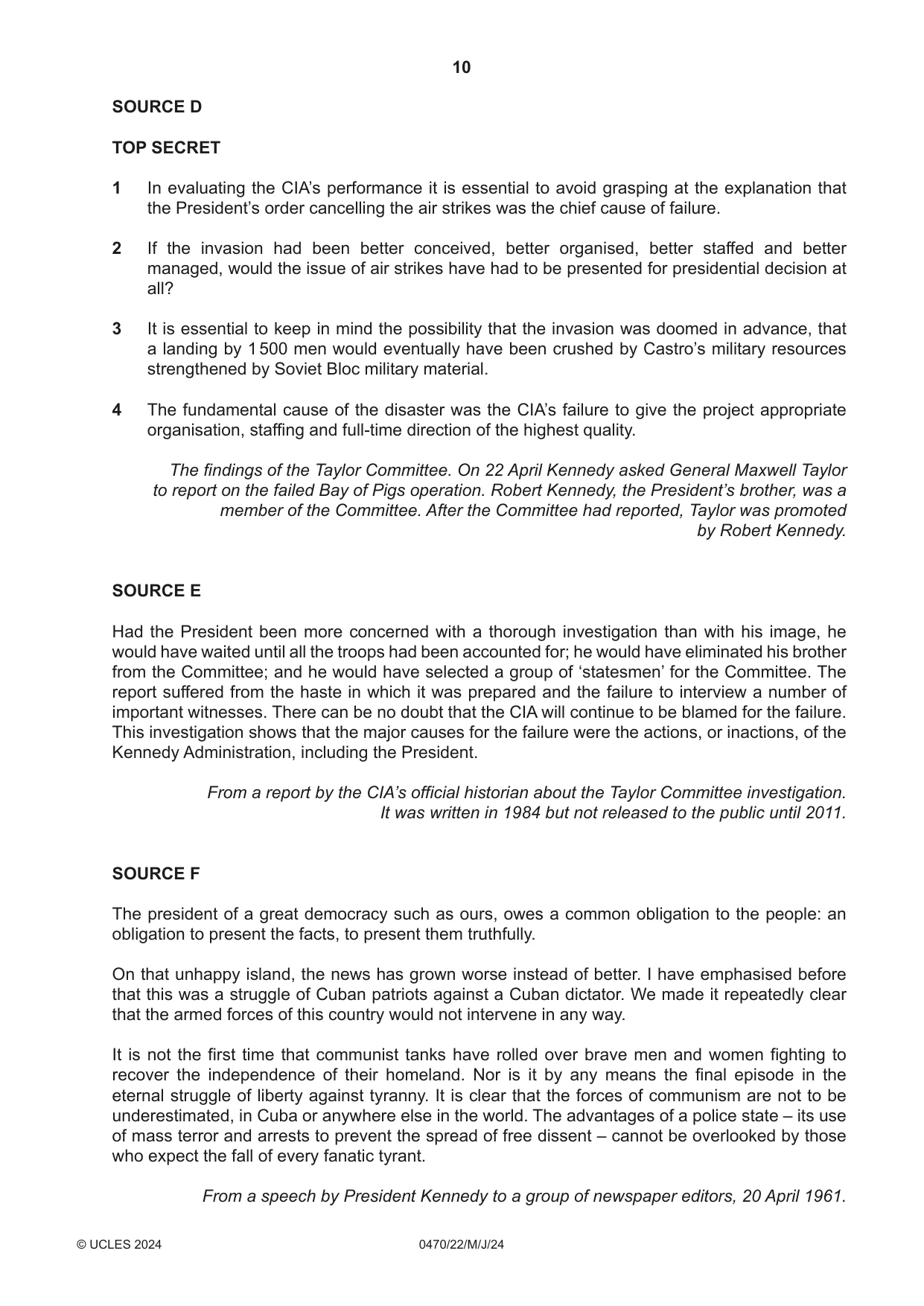
10 0470/22/M/J/24 © UCLES 2024 SOURCE D TOP SECRET 1 In evaluating the CIA’s performance it is essential to avoid grasping at the explanation that the President’s order cancelling the air strikes was the chief cause of failure. 2 If the invasion had been better conceived, better organised, better staffed and better managed, would the issue of air strikes have had to be presented for presidential decision at all? 3 It is essential to keep in mind the possibility that the invasion was doomed in advance, that a landing by 1 500 men would eventually have been crushed by Castro’s military resources strengthened by Soviet Bloc military material. 4 The fundamental cause of the disaster was the CIA’s failure to give the project appropriate organisation, staffing and full-time direction of the highest quality. The findings of the Taylor Committee. On 22 April Kennedy asked General Maxwell Taylor to report on the failed Bay of Pigs operation. Robert Kennedy, the President’s brother, was a member of the Committee. After the Committee had reported, Taylor was promoted by Robert Kennedy. SOURCE E Had the President been more concerned with a thorough investigation than with his image, he would have waited until all the troops had been accounted for; he would have eliminated his brother from the Committee; and he would have selected a group of ‘statesmen’ for the Committee. The report suffered from the haste in which it was prepared and the failure to interview a number of important witnesses. There can be no doubt that the CIA will continue to be blamed for the failure. This investigation shows that the major causes for the failure were the actions, or inactions, of the Kennedy Administration, including the President. From a report by the CIA’s official historian about the Taylor Committee investigation. It was written in 1984 but not released to the public until 2011. SOURCE F The president of a great democracy such as ours, owes a common obligation to the people: an obligation to present the facts, to present them truthfully. On that unhappy island, the news has grown worse instead of better. I have emphasised before that this was a struggle of Cuban patriots against a Cuban dictator. We made it repeatedly clear that the armed forces of this country would not intervene in any way. It is not the first time that communist tanks have rolled over brave men and women fighting to recover the independence of their homeland. Nor is it by any means the final episode in the eternal struggle of liberty against tyranny. It is clear that the forces of communism are not to be underestimated, in Cuba or anywhere else in the world. The advantages of a police state – its use of mass terror and arrests to prevent the spread of free dissent – cannot be overlooked by those who expect the fall of every fanatic tyrant. From a speech by President Kennedy to a group of newspaper editors, 20 April 1961.
Question paper, page 11
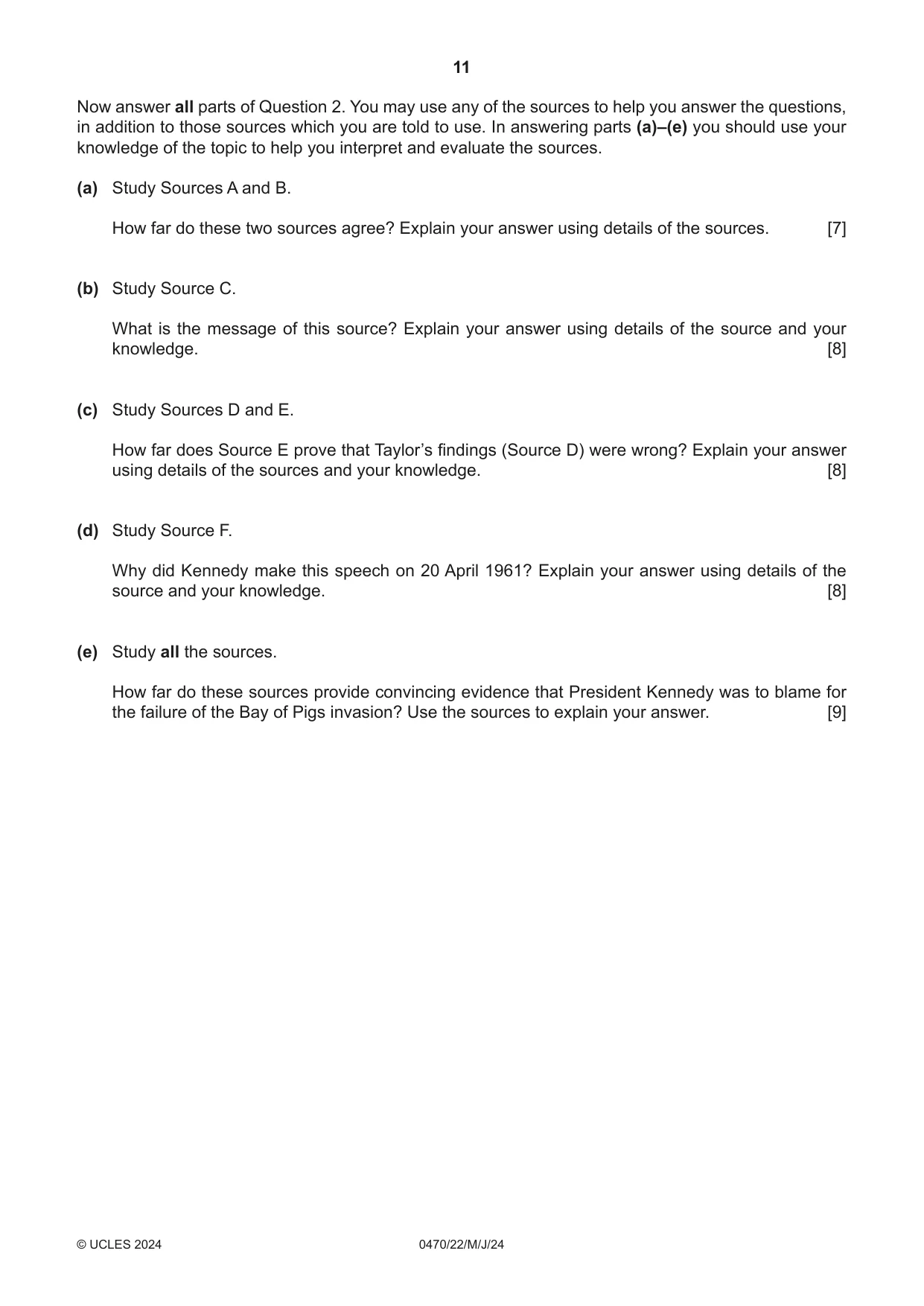
11 0470/22/M/J/24 © UCLES 2024 Now answer all parts of Question 2. You may use any of the sources to help you answer the questions, in addition to those sources which you are told to use. In answering parts (a)–(e) you should use your knowledge of the topic to help you interpret and evaluate the sources. (a) Study Sources A and B. How far do these two sources agree? Explain your answer using details of the sources. [7] (b) Study Source C. What is the message of this source? Explain your answer using details of the source and your knowledge. [8] (c) Study Sources D and E. How far does Source E prove that Taylor’s findings (Source D) were wrong? Explain your answer using details of the sources and your knowledge. [8] (d) Study Source F. Why did Kennedy make this speech on 20 April 1961? Explain your answer using details of the source and your knowledge. [8] (e) Study all the sources. How far do these sources provide convincing evidence that President Kennedy was to blame for the failure of the Bay of Pigs invasion? Use the sources to explain your answer. [9]
Question paper, page 12
12 0470/22/M/J/24 © UCLES 2024 Permission to reproduce items where third-party owned material protected by copyright is included has been sought and cleared where possible. Every reasonable effort has been made by the publisher (UCLES) to trace copyright holders, but if any items requiring clearance have unwittingly been included, the publisher will be pleased to make amends at the earliest possible opportunity. To avoid the issue of disclosure of answer-related information to candidates, all copyright acknowledgements are reproduced online in the Cambridge Assessment International Education Copyright Acknowledgements Booklet. This is produced for each series of examinations and is freely available to download at www.cambridgeinternational.org after the live examination series. Cambridge Assessment International Education is part of Cambridge Assessment. Cambridge Assessment is the brand name of the University of Cambridge Local Examinations Syndicate (UCLES), which is a department of the University of Cambridge. BLANK PAGE
Mark scheme, page 1
This document consists of 13 printed pages. © Cambridge University Press & Assessment 2024 [Turn over Cambridge IGCSE™ HISTORY 0470/22 Paper 2 May/June 2024 MARK SCHEME Maximum Mark: 40 Published This mark scheme is published as an aid to teachers and candidates, to indicate the requirements of the examination. It shows the basis on which Examiners were instructed to award marks. It does not indicate the details of the discussions that took place at an Examiners’ meeting before marking began, which would have considered the acceptability of alternative answers. Mark schemes should be read in conjunction with the question paper and the Principal Examiner Report for Teachers. Cambridge International will not enter into discussions about these mark schemes. Cambridge International is publishing the mark schemes for the May/June 2024 series for most Cambridge IGCSE, Cambridge International A and AS Level and Cambridge Pre-U components, and some Cambridge O Level components.
Mark scheme, page 2
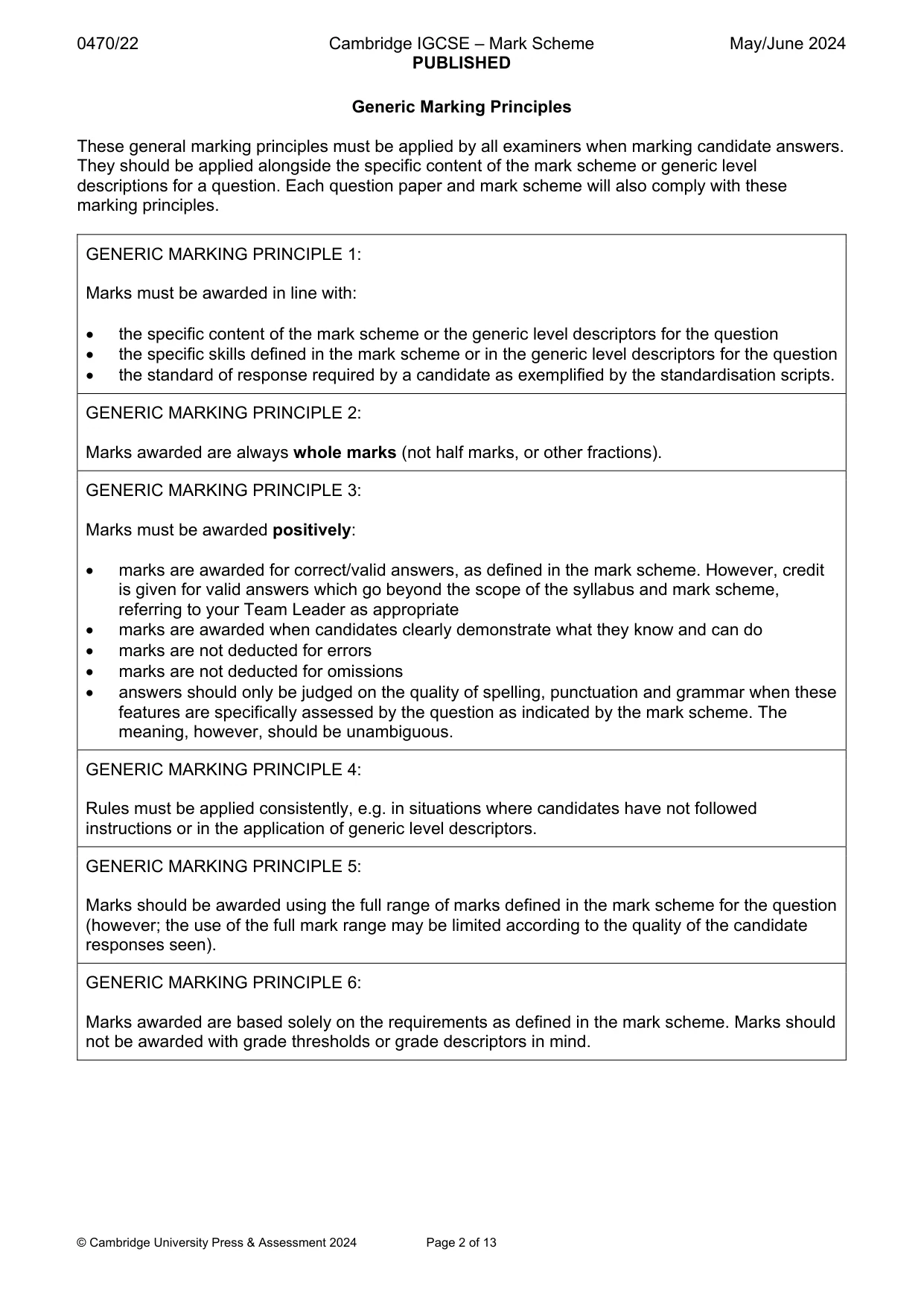
0470/22 Cambridge IGCSE – Mark Scheme PUBLISHED May/June 2024 © Cambridge University Press & Assessment 2024 Page 2 of 13 Generic Marking Principles These general marking principles must be applied by all examiners when marking candidate answers. They should be applied alongside the specific content of the mark scheme or generic level descriptions for a question. Each question paper and mark scheme will also comply with these marking principles. GENERIC MARKING PRINCIPLE 1: Marks must be awarded in line with: the specific content of the mark scheme or the generic level descriptors for the question the specific skills defined in the mark scheme or in the generic level descriptors for the question the standard of response required by a candidate as exemplified by the standardisation scripts. GENERIC MARKING PRINCIPLE 2: Marks awarded are always whole marks (not half marks, or other fractions). GENERIC MARKING PRINCIPLE 3: Marks must be awarded positively: marks are awarded for correct/valid answers, as defined in the mark scheme. However, credit is given for valid answers which go beyond the scope of the syllabus and mark scheme, referring to your Team Leader as appropriate marks are awarded when candidates clearly demonstrate what they know and can do marks are not deducted for errors marks are not deducted for omissions answers should only be judged on the quality of spelling, punctuation and grammar when these features are specifically assessed by the question as indicated by the mark scheme. The meaning, however, should be unambiguous. GENERIC MARKING PRINCIPLE 4: Rules must be applied consistently, e.g. in situations where candidates have not followed instructions or in the application of generic level descriptors. GENERIC MARKING PRINCIPLE 5: Marks should be awarded using the full range of marks defined in the mark scheme for the question (however; the use of the full mark range may be limited according to the quality of the candidate responses seen). GENERIC MARKING PRINCIPLE 6: Marks awarded are based solely on the requirements as defined in the mark scheme. Marks should not be awarded with grade thresholds or grade descriptors in mind.
Mark scheme, page 3
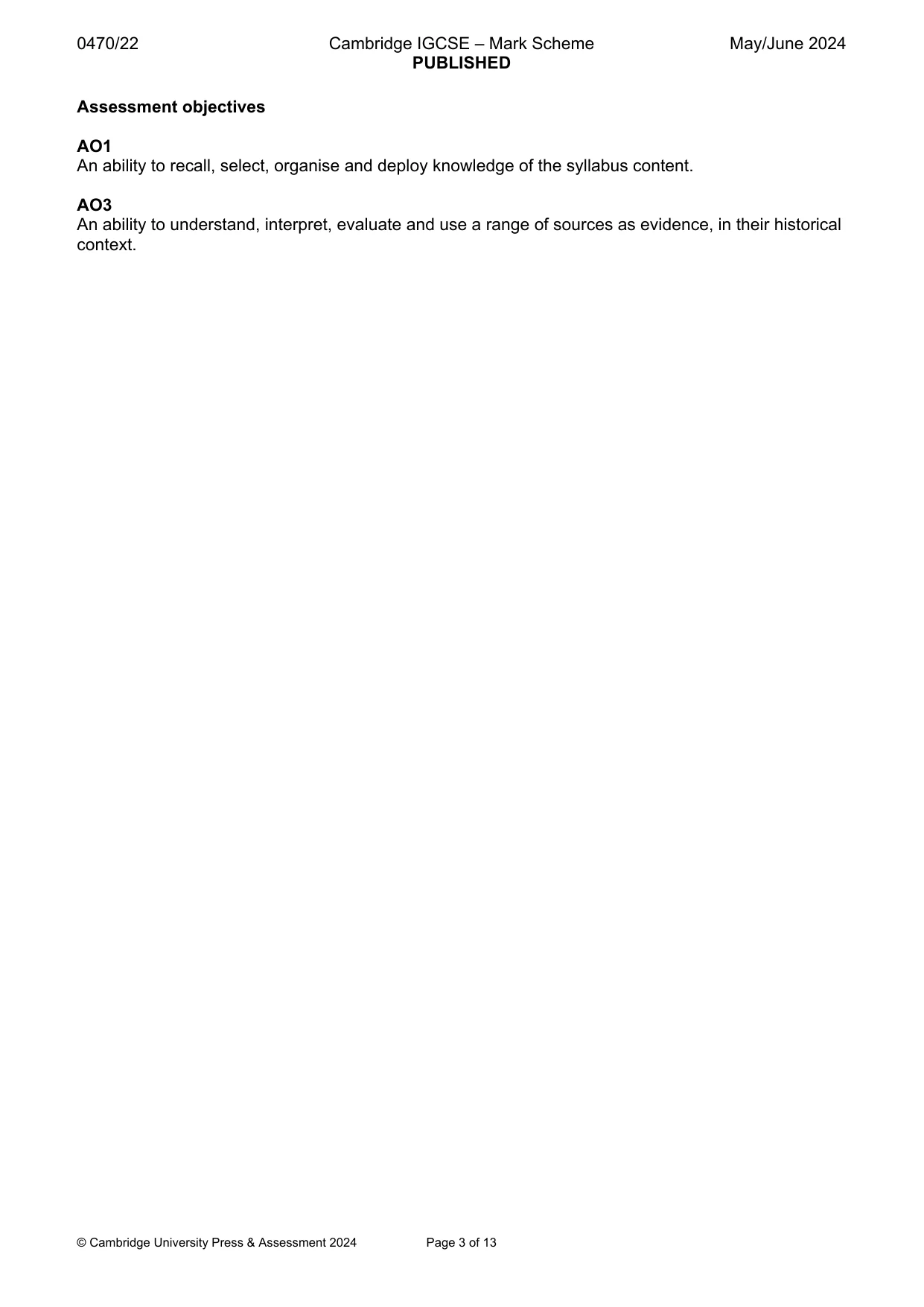
0470/22 Cambridge IGCSE – Mark Scheme PUBLISHED May/June 2024 © Cambridge University Press & Assessment 2024 Page 3 of 13 Assessment objectives AO1 An ability to recall, select, organise and deploy knowledge of the syllabus content. AO3 An ability to understand, interpret, evaluate and use a range of sources as evidence, in their historical context.
Mark scheme, page 4
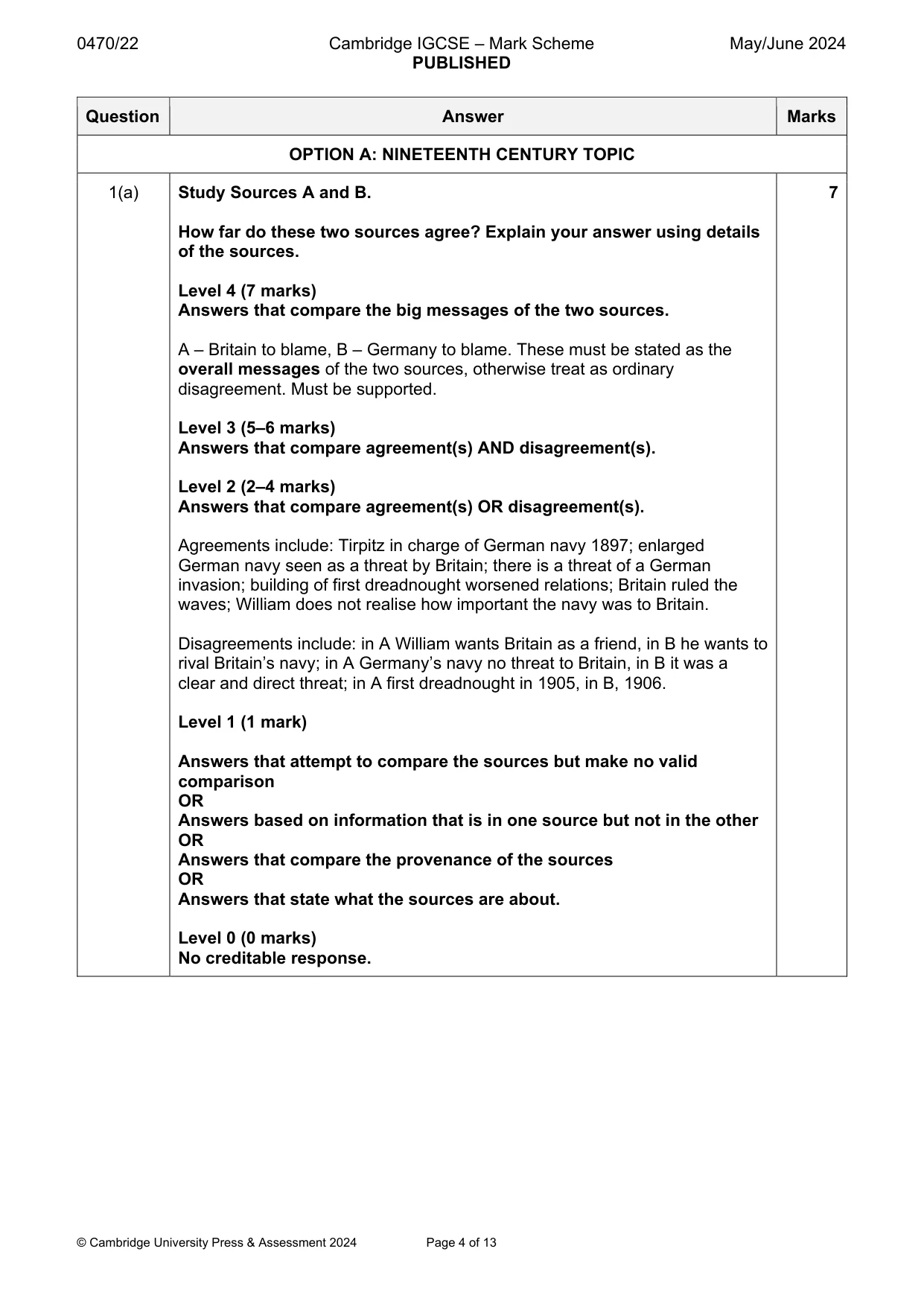
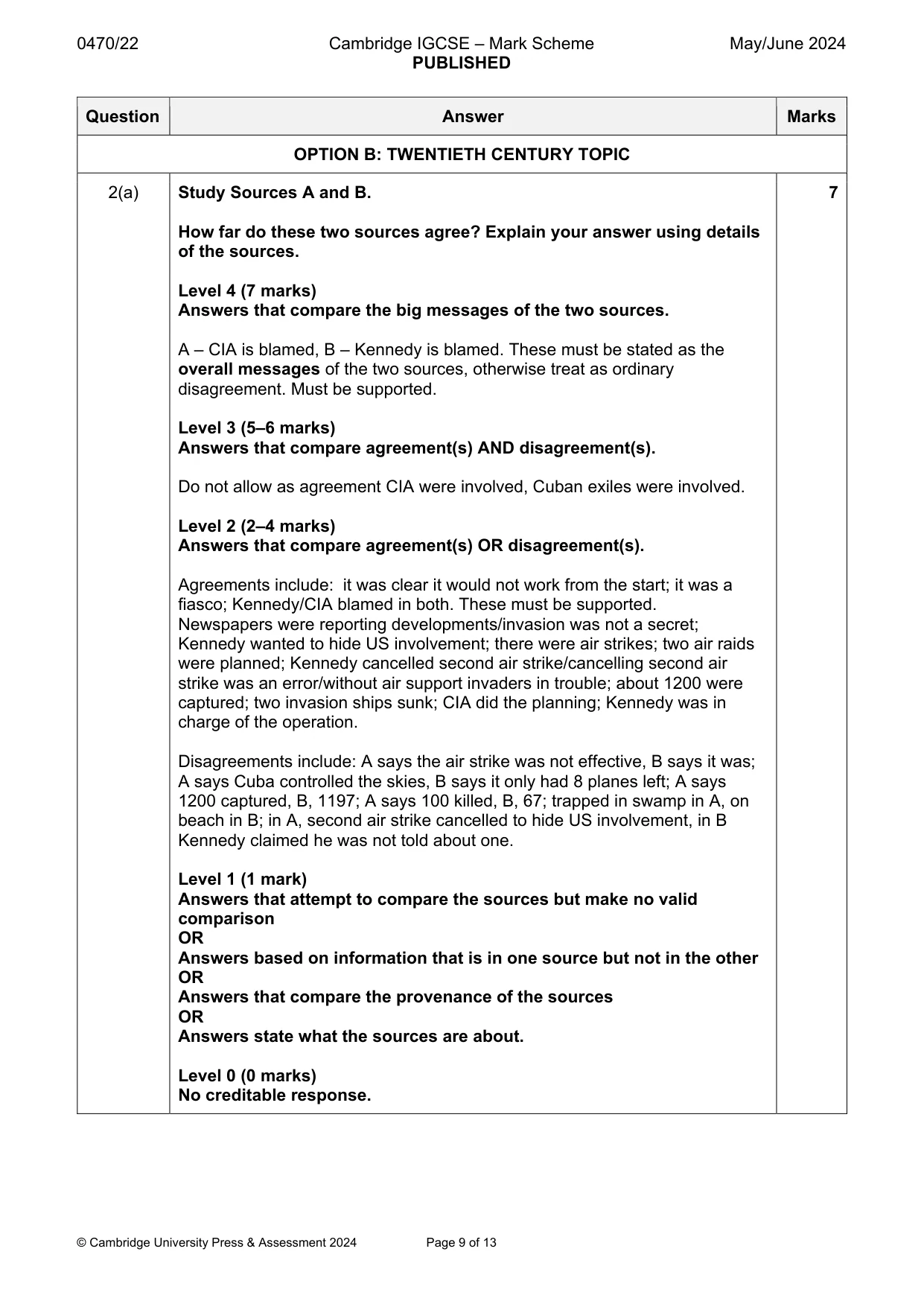
0470/22 Cambridge IGCSE – Mark Scheme PUBLISHED May/June 2024 © Cambridge University Press & Assessment 2024 Page 4 of 13 Question Answer Marks OPTION A: NINETEENTH CENTURY TOPIC 1(a) Study Sources A and B. How far do these two sources agree? Explain your answer using details of the sources. Level 4 (7 marks) Answers that compare the big messages of the two sources. A – Britain to blame, B – Germany to blame. These must be stated as the overall messages of the two sources, otherwise treat as ordinary disagreement. Must be supported. Level 3 (5–6 marks) Answers that compare agreement(s) AND disagreement(s). Level 2 (2–4 marks) Answers that compare agreement(s) OR disagreement(s). Agreements include: Tirpitz in charge of German navy 1897; enlarged German navy seen as a threat by Britain; there is a threat of a German invasion; building of first dreadnought worsened relations; Britain ruled the waves; William does not realise how important the navy was to Britain. Disagreements include: in A William wants Britain as a friend, in B he wants to rival Britain’s navy; in A Germany’s navy no threat to Britain, in B it was a clear and direct threat; in A first dreadnought in 1905, in B, 1906. Level 1 (1 mark) Answers that attempt to compare the sources but make no valid comparison OR Answers based on information that is in one source but not in the other OR Answers that compare the provenance of the sources OR Answers that state what the sources are about. Level 0 (0 marks) No creditable response. 7
Mark scheme, page 5
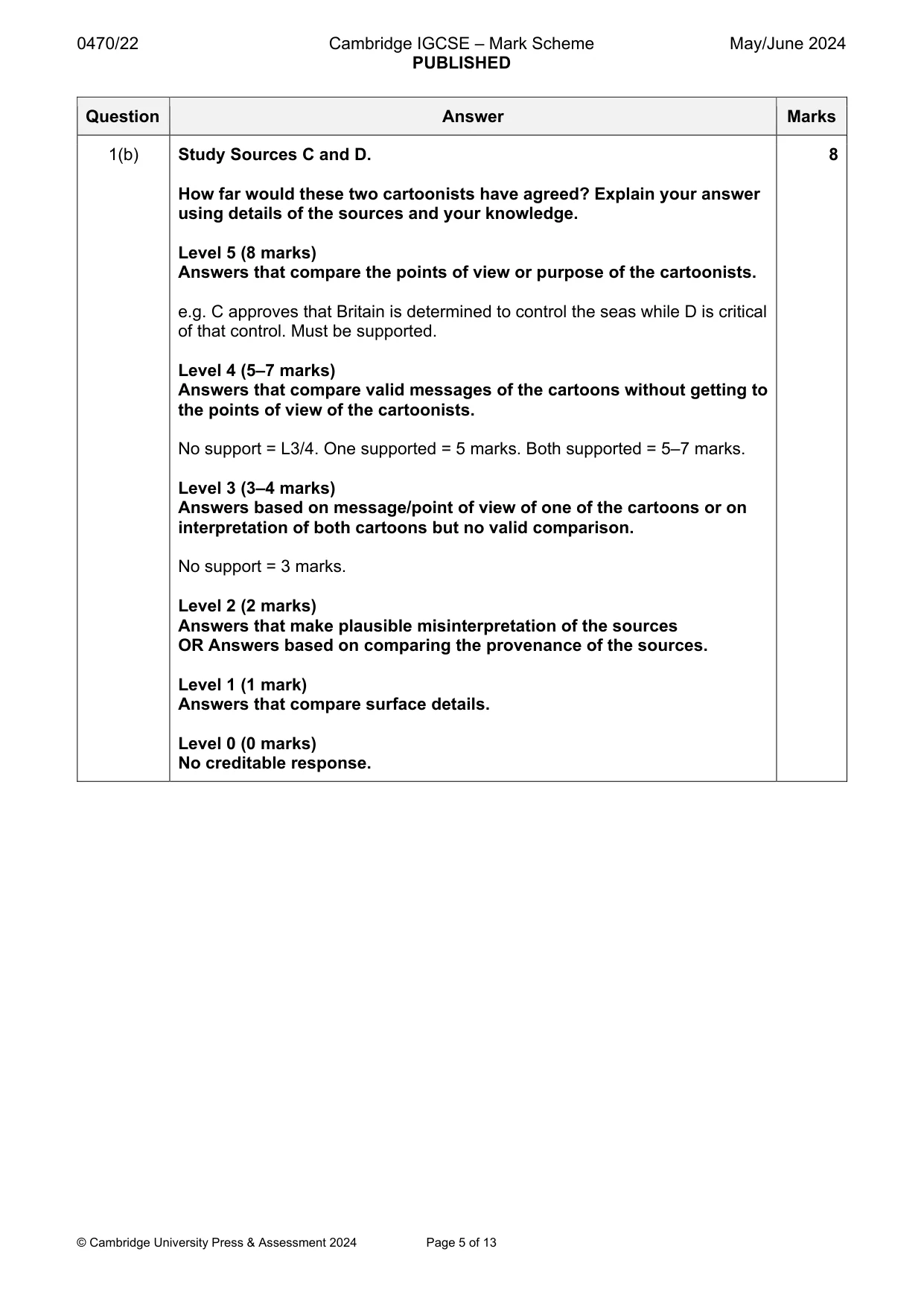
0470/22 Cambridge IGCSE – Mark Scheme PUBLISHED May/June 2024 © Cambridge University Press & Assessment 2024 Page 5 of 13 Question Answer Marks 1(b) Study Sources C and D. How far would these two cartoonists have agreed? Explain your answer using details of the sources and your knowledge. Level 5 (8 marks) Answers that compare the points of view or purpose of the cartoonists. e.g. C approves that Britain is determined to control the seas while D is critical of that control. Must be supported. Level 4 (5–7 marks) Answers that compare valid messages of the cartoons without getting to the points of view of the cartoonists. No support = L3/4. One supported = 5 marks. Both supported = 5–7 marks. Level 3 (3–4 marks) Answers based on message/point of view of one of the cartoons or on interpretation of both cartoons but no valid comparison. No support = 3 marks. Level 2 (2 marks) Answers that make plausible misinterpretation of the sources OR Answers based on comparing the provenance of the sources. Level 1 (1 mark) Answers that compare surface details. Level 0 (0 marks) No creditable response. 8
Mark scheme, page 6
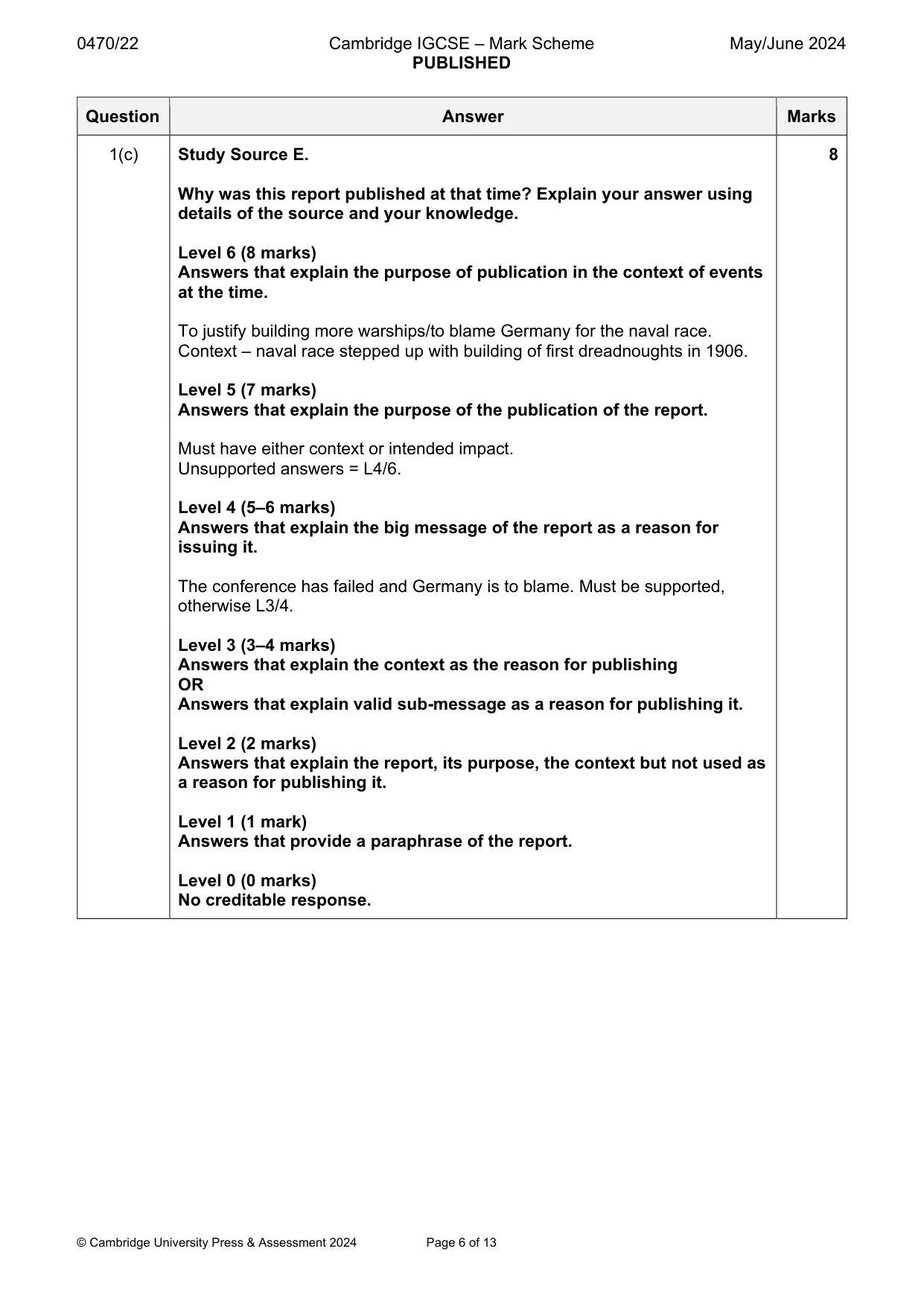
0470/22 Cambridge IGCSE – Mark Scheme PUBLISHED May/June 2024 © Cambridge University Press & Assessment 2024 Page 6 of 13 Question Answer Marks 1(c) Study Source E. Why was this report published at that time? Explain your answer using details of the source and your knowledge. Level 6 (8 marks) Answers that explain the purpose of publication in the context of events at the time. To justify building more warships/to blame Germany for the naval race. Context – naval race stepped up with building of first dreadnoughts in 1906. Level 5 (7 marks) Answers that explain the purpose of the publication of the report. Must have either context or intended impact. Unsupported answers = L4/6. Level 4 (5–6 marks) Answers that explain the big message of the report as a reason for issuing it. The conference has failed and Germany is to blame. Must be supported, otherwise L3/4. Level 3 (3–4 marks) Answers that explain the context as the reason for publishing OR Answers that explain valid sub-message as a reason for publishing it. Level 2 (2 marks) Answers that explain the report, its purpose, the context but not used as a reason for publishing it. Level 1 (1 mark) Answers that provide a paraphrase of the report. Level 0 (0 marks) No creditable response. 8
Mark scheme, page 7
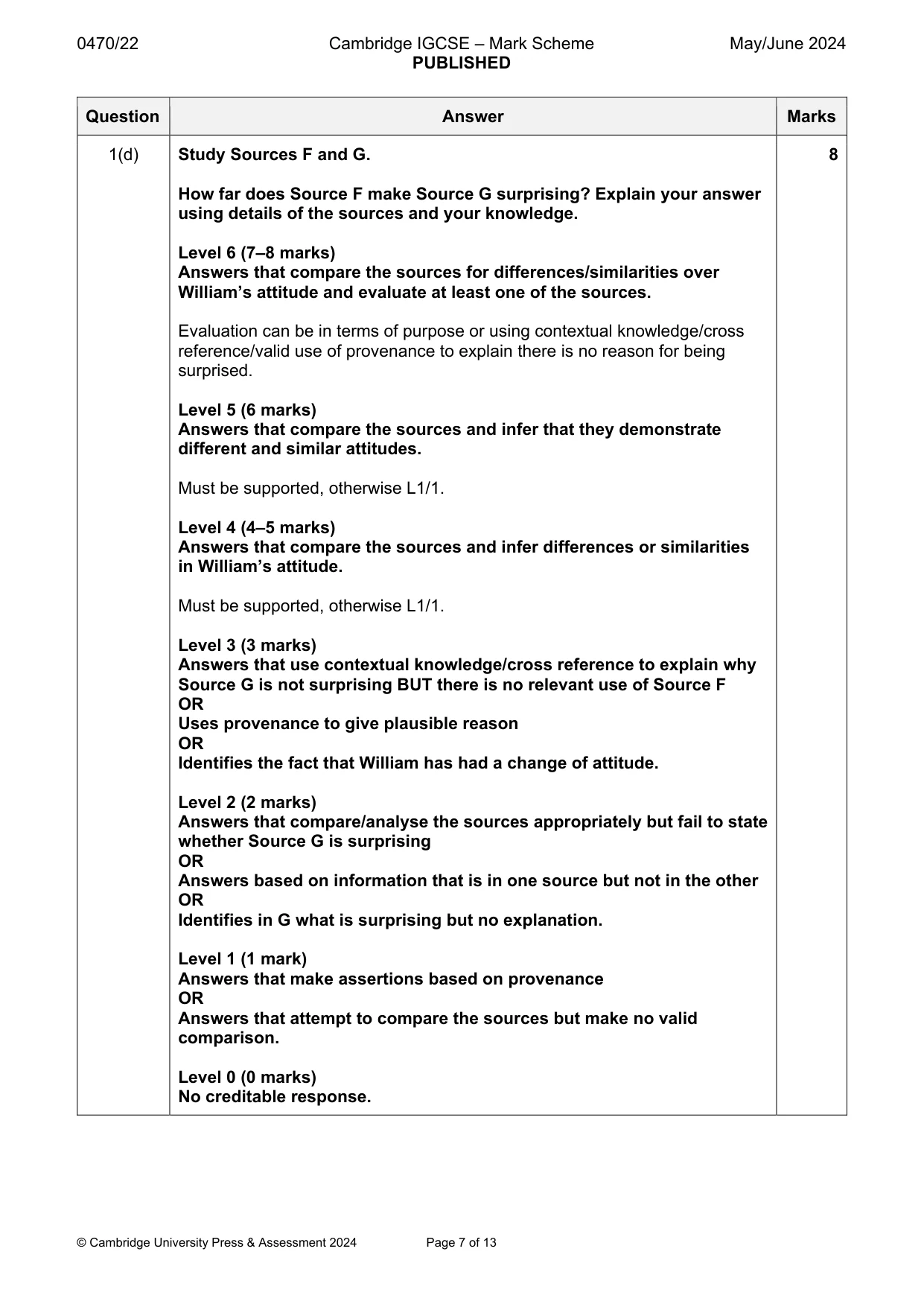
0470/22 Cambridge IGCSE – Mark Scheme PUBLISHED May/June 2024 © Cambridge University Press & Assessment 2024 Page 7 of 13 Question Answer Marks 1(d) Study Sources F and G. How far does Source F make Source G surprising? Explain your answer using details of the sources and your knowledge. Level 6 (7–8 marks) Answers that compare the sources for differences/similarities over William’s attitude and evaluate at least one of the sources. Evaluation can be in terms of purpose or using contextual knowledge/cross reference/valid use of provenance to explain there is no reason for being surprised. Level 5 (6 marks) Answers that compare the sources and infer that they demonstrate different and similar attitudes. Must be supported, otherwise L1/1. Level 4 (4–5 marks) Answers that compare the sources and infer differences or similarities in William’s attitude. Must be supported, otherwise L1/1. Level 3 (3 marks) Answers that use contextual knowledge/cross reference to explain why Source G is not surprising BUT there is no relevant use of Source F OR Uses provenance to give plausible reason OR Identifies the fact that William has had a change of attitude. Level 2 (2 marks) Answers that compare/analyse the sources appropriately but fail to state whether Source G is surprising OR Answers based on information that is in one source but not in the other OR Identifies in G what is surprising but no explanation. Level 1 (1 mark) Answers that make assertions based on provenance OR Answers that attempt to compare the sources but make no valid comparison. Level 0 (0 marks) No creditable response. 8
Mark scheme, page 8
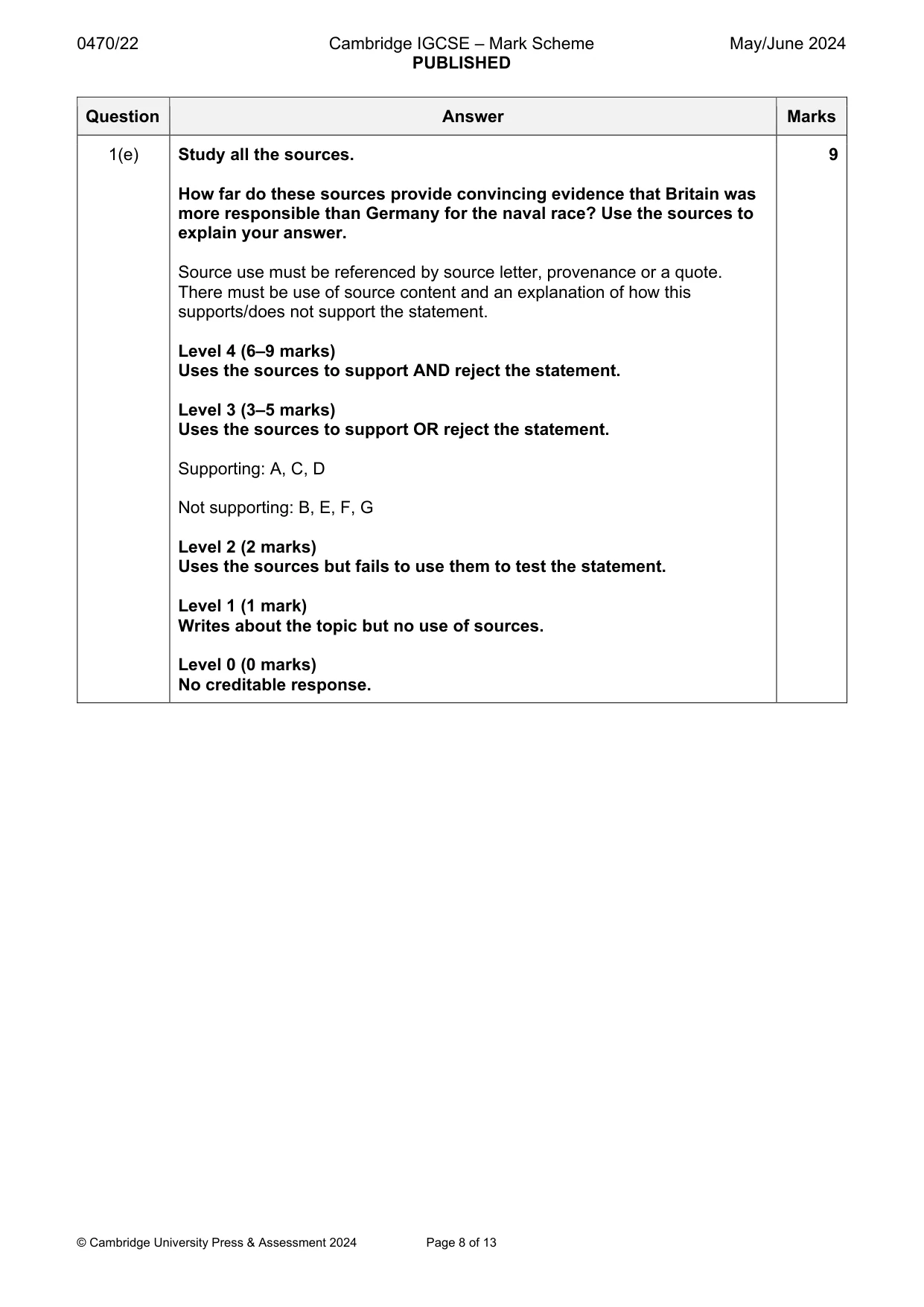
0470/22 Cambridge IGCSE – Mark Scheme PUBLISHED May/June 2024 © Cambridge University Press & Assessment 2024 Page 8 of 13 Question Answer Marks 1(e) Study all the sources. How far do these sources provide convincing evidence that Britain was more responsible than Germany for the naval race? Use the sources to explain your answer. Source use must be referenced by source letter, provenance or a quote. There must be use of source content and an explanation of how this supports/does not support the statement. Level 4 (6–9 marks) Uses the sources to support AND reject the statement. Level 3 (3–5 marks) Uses the sources to support OR reject the statement. Supporting: A, C, D Not supporting: B, E, F, G Level 2 (2 marks) Uses the sources but fails to use them to test the statement. Level 1 (1 mark) Writes about the topic but no use of sources. Level 0 (0 marks) No creditable response. 9
Mark scheme, page 9
0470/22 Cambridge IGCSE – Mark Scheme PUBLISHED May/June 2024 © Cambridge University Press & Assessment 2024 Page 9 of 13 Question Answer Marks OPTION B: TWENTIETH CENTURY TOPIC 2(a) Study Sources A and B. How far do these two sources agree? Explain your answer using details of the sources. Level 4 (7 marks) Answers that compare the big messages of the two sources. A – CIA is blamed, B – Kennedy is blamed. These must be stated as the overall messages of the two sources, otherwise treat as ordinary disagreement. Must be supported. Level 3 (5–6 marks) Answers that compare agreement(s) AND disagreement(s). Do not allow as agreement CIA were involved, Cuban exiles were involved. Level 2 (2–4 marks) Answers that compare agreement(s) OR disagreement(s). Agreements include: it was clear it would not work from the start; it was a fiasco; Kennedy/CIA blamed in both. These must be supported. Newspapers were reporting developments/invasion was not a secret; Kennedy wanted to hide US involvement; there were air strikes; two air raids were planned; Kennedy cancelled second air strike/cancelling second air strike was an error/without air support invaders in trouble; about 1200 were captured; two invasion ships sunk; CIA did the planning; Kennedy was in charge of the operation. Disagreements include: A says the air strike was not effective, B says it was; A says Cuba controlled the skies, B says it only had 8 planes left; A says 1200 captured, B, 1197; A says 100 killed, B, 67; trapped in swamp in A, on beach in B; in A, second air strike cancelled to hide US involvement, in B Kennedy claimed he was not told about one. Level 1 (1 mark) Answers that attempt to compare the sources but make no valid comparison OR Answers based on information that is in one source but not in the other OR Answers that compare the provenance of the sources OR Answers state what the sources are about. Level 0 (0 marks) No creditable response. 7
Mark scheme, page 10
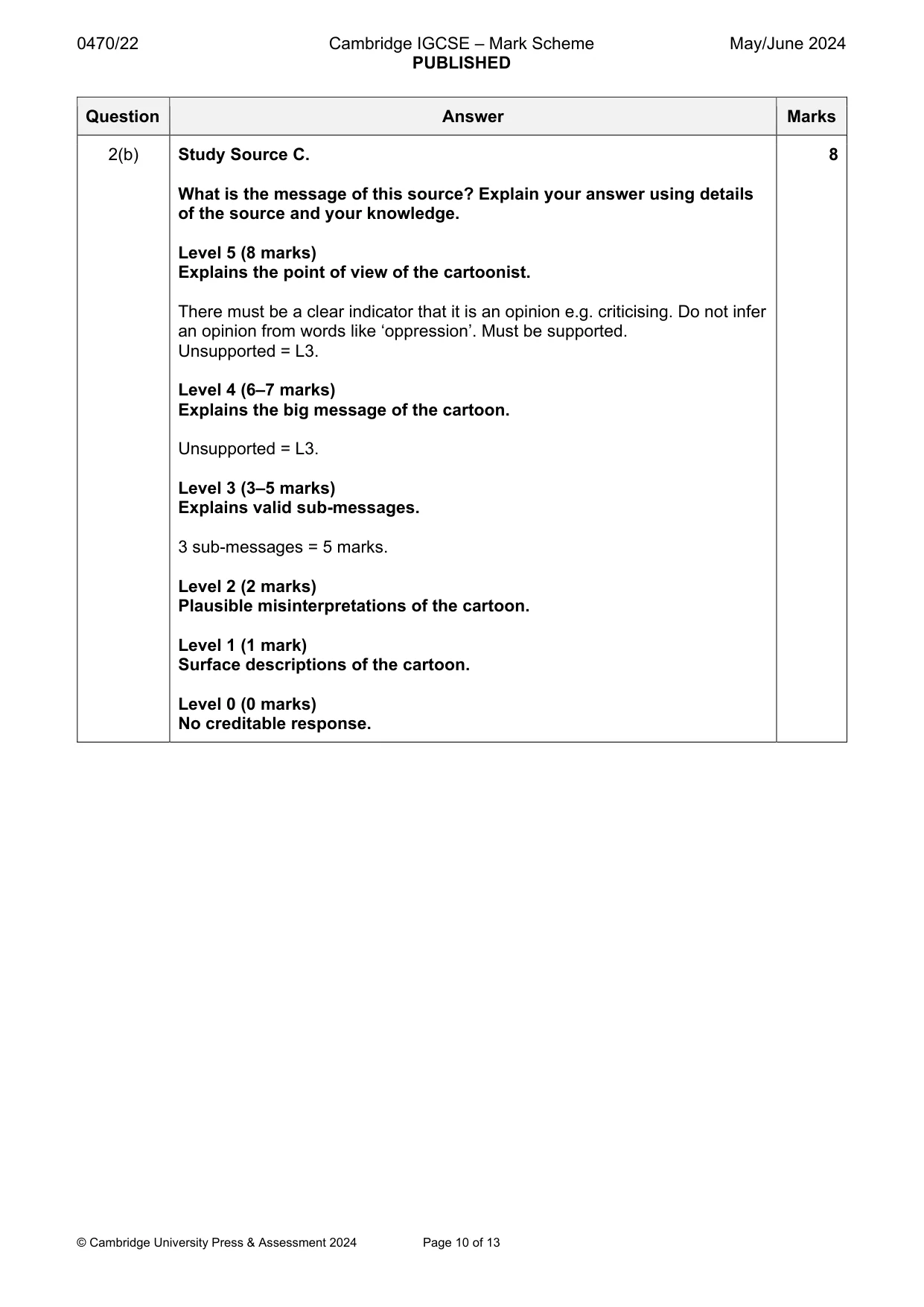
0470/22 Cambridge IGCSE – Mark Scheme PUBLISHED May/June 2024 © Cambridge University Press & Assessment 2024 Page 10 of 13 Question Answer Marks 2(b) Study Source C. What is the message of this source? Explain your answer using details of the source and your knowledge. Level 5 (8 marks) Explains the point of view of the cartoonist. There must be a clear indicator that it is an opinion e.g. criticising. Do not infer an opinion from words like ‘oppression’. Must be supported. Unsupported = L3. Level 4 (6–7 marks) Explains the big message of the cartoon. Unsupported = L3. Level 3 (3–5 marks) Explains valid sub-messages. 3 sub-messages = 5 marks. Level 2 (2 marks) Plausible misinterpretations of the cartoon. Level 1 (1 mark) Surface descriptions of the cartoon. Level 0 (0 marks) No creditable response. 8
Mark scheme, page 11
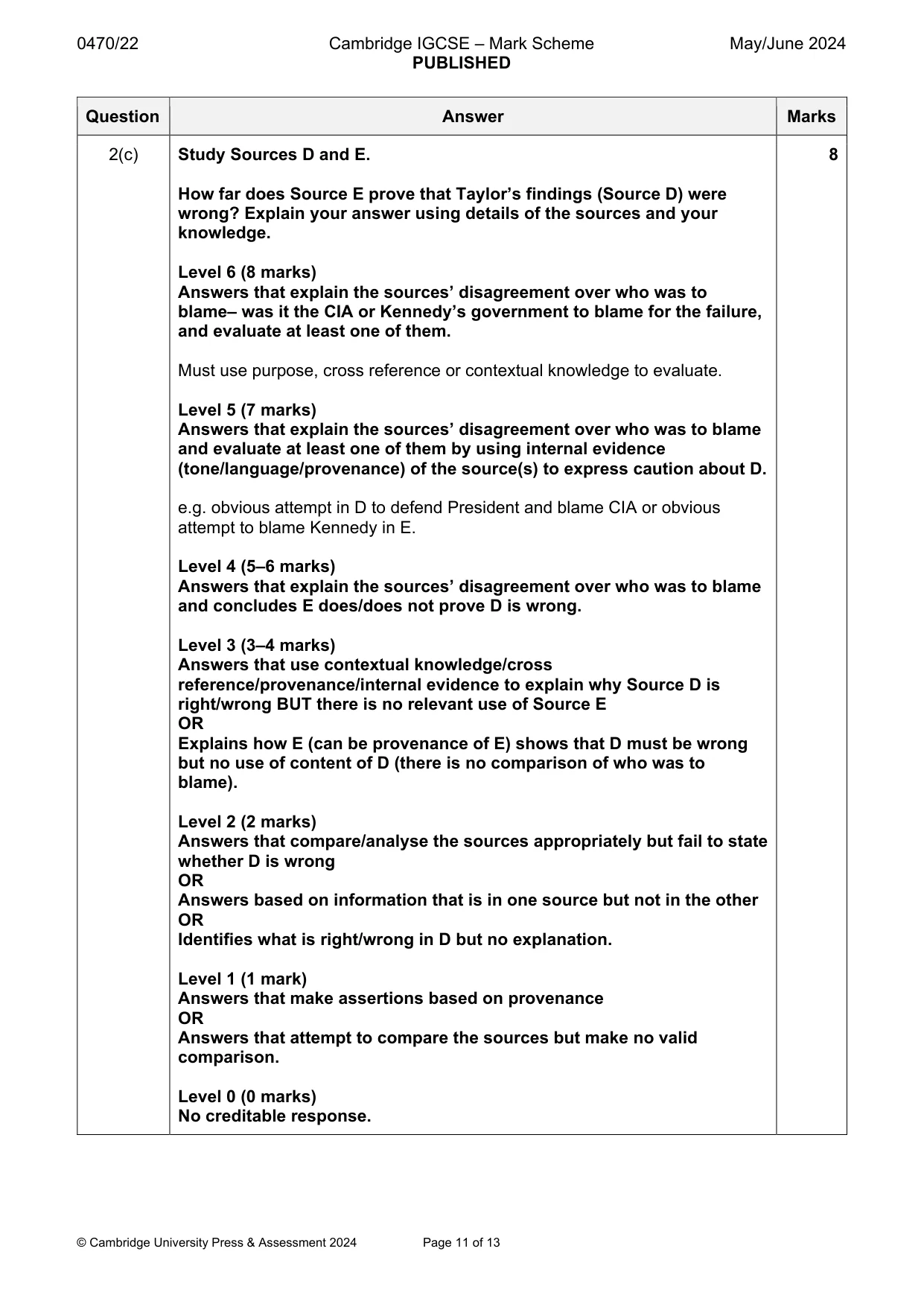
0470/22 Cambridge IGCSE – Mark Scheme PUBLISHED May/June 2024 © Cambridge University Press & Assessment 2024 Page 11 of 13 Question Answer Marks 2(c) Study Sources D and E. How far does Source E prove that Taylor’s findings (Source D) were wrong? Explain your answer using details of the sources and your knowledge. Level 6 (8 marks) Answers that explain the sources’ disagreement over who was to blame– was it the CIA or Kennedy’s government to blame for the failure, and evaluate at least one of them. Must use purpose, cross reference or contextual knowledge to evaluate. Level 5 (7 marks) Answers that explain the sources’ disagreement over who was to blame and evaluate at least one of them by using internal evidence (tone/language/provenance) of the source(s) to express caution about D. e.g. obvious attempt in D to defend President and blame CIA or obvious attempt to blame Kennedy in E. Level 4 (5–6 marks) Answers that explain the sources’ disagreement over who was to blame and concludes E does/does not prove D is wrong. Level 3 (3–4 marks) Answers that use contextual knowledge/cross reference/provenance/internal evidence to explain why Source D is right/wrong BUT there is no relevant use of Source E OR Explains how E (can be provenance of E) shows that D must be wrong but no use of content of D (there is no comparison of who was to blame). Level 2 (2 marks) Answers that compare/analyse the sources appropriately but fail to state whether D is wrong OR Answers based on information that is in one source but not in the other OR Identifies what is right/wrong in D but no explanation. Level 1 (1 mark) Answers that make assertions based on provenance OR Answers that attempt to compare the sources but make no valid comparison. Level 0 (0 marks) No creditable response. 8
Mark scheme, page 12
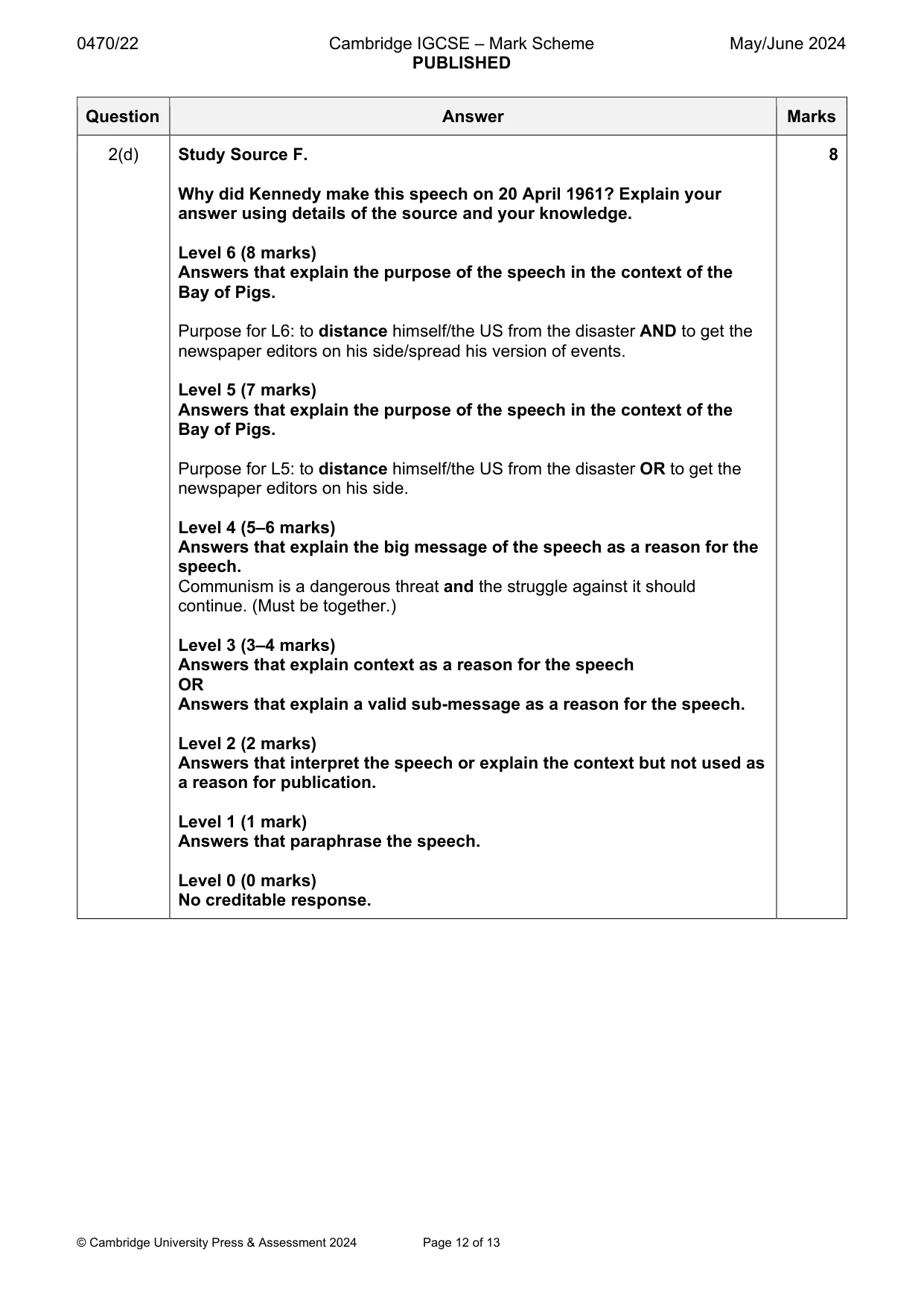
0470/22 Cambridge IGCSE – Mark Scheme PUBLISHED May/June 2024 © Cambridge University Press & Assessment 2024 Page 12 of 13 Question Answer Marks 2(d) Study Source F. Why did Kennedy make this speech on 20 April 1961? Explain your answer using details of the source and your knowledge. Level 6 (8 marks) Answers that explain the purpose of the speech in the context of the Bay of Pigs. Purpose for L6: to distance himself/the US from the disaster AND to get the newspaper editors on his side/spread his version of events. Level 5 (7 marks) Answers that explain the purpose of the speech in the context of the Bay of Pigs. Purpose for L5: to distance himself/the US from the disaster OR to get the newspaper editors on his side. Level 4 (5–6 marks) Answers that explain the big message of the speech as a reason for the speech. Communism is a dangerous threat and the struggle against it should continue. (Must be together.) Level 3 (3–4 marks) Answers that explain context as a reason for the speech OR Answers that explain a valid sub-message as a reason for the speech. Level 2 (2 marks) Answers that interpret the speech or explain the context but not used as a reason for publication. Level 1 (1 mark) Answers that paraphrase the speech. Level 0 (0 marks) No creditable response. 8
Mark scheme, page 13
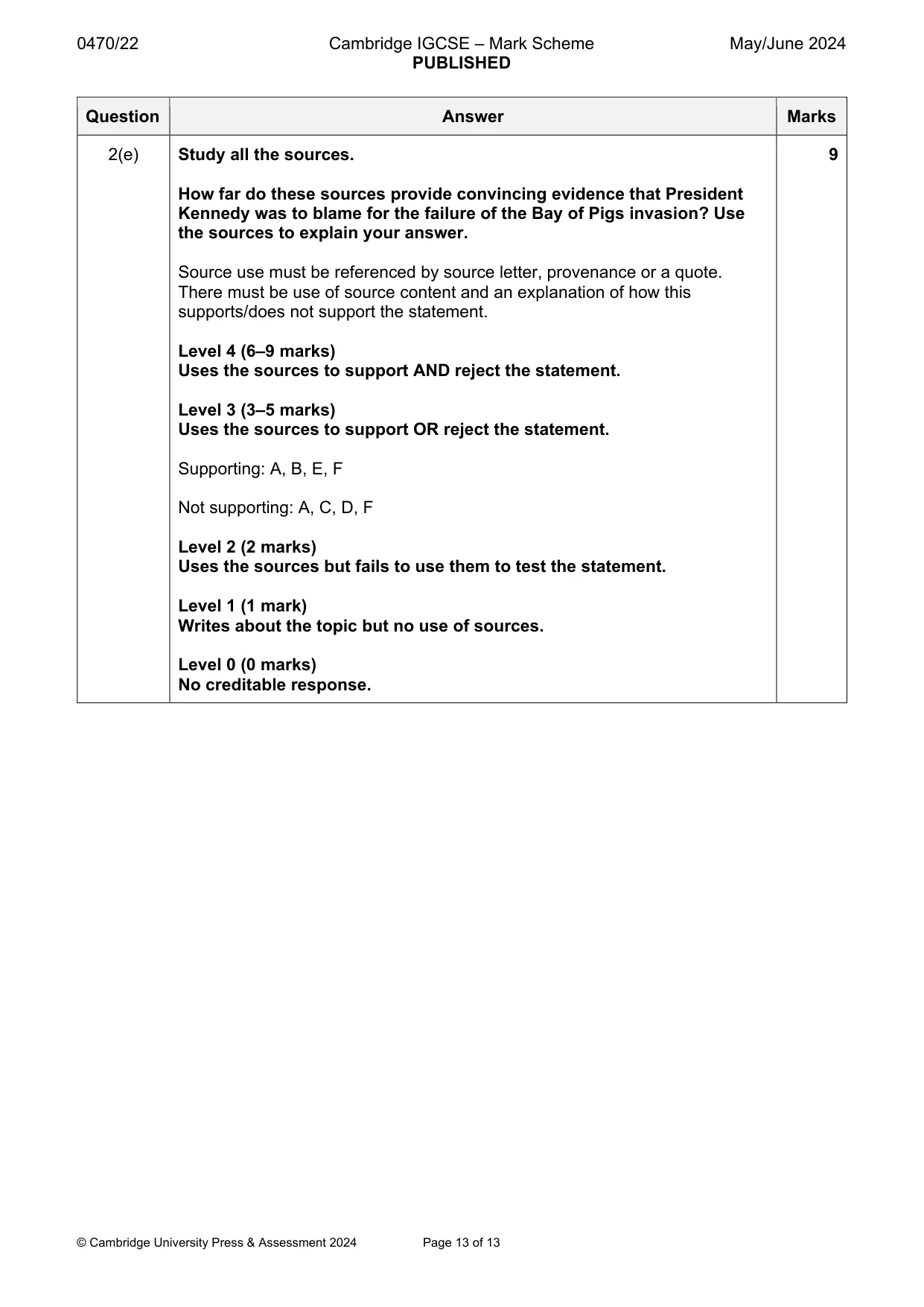
0470/22 Cambridge IGCSE – Mark Scheme PUBLISHED May/June 2024 © Cambridge University Press & Assessment 2024 Page 13 of 13 Question Answer Marks 2(e) Study all the sources. How far do these sources provide convincing evidence that President Kennedy was to blame for the failure of the Bay of Pigs invasion? Use the sources to explain your answer. Source use must be referenced by source letter, provenance or a quote. There must be use of source content and an explanation of how this supports/does not support the statement. Level 4 (6–9 marks) Uses the sources to support AND reject the statement. Level 3 (3–5 marks) Uses the sources to support OR reject the statement. Supporting: A, B, E, F Not supporting: A, C, D, F Level 2 (2 marks) Uses the sources but fails to use them to test the statement. Level 1 (1 mark) Writes about the topic but no use of sources. Level 0 (0 marks) No creditable response. 9
What you needed in this session
Cambridge’s own grade thresholds for 2024 May/June, Paper 2 · Variant 2. A higher threshold means an easier paper — the bar moves with how the cohort did.