Cambridge IGCSE History 0470 — 2024 Oct/Nov Paper 2 · Variant 2
0470/22/O/N/24 · 40 marks · 105 min
The question paper and its mark scheme, free to read here and free to download. This is Cambridge’s own paper, exactly as it was sat.
Question paper16 pages


Mark scheme13 pages
Answers below. Sit the paper first if you are practising.
Paper as text
Question paper, page 1
[Turn over Cambridge IGCSE™ This document has 16 pages. Any blank pages are indicated. DC (WW/CGW) 336452/3 © UCLES 2024 * 5 3 2 6 9 0 0 2 0 3 * HISTORY 0470/22 Paper 2 Document Questions October/November 2024 1 hour 45 minutes You must answer on the enclosed answer booklet. You will need: Answer booklet (enclosed) INSTRUCTIONS ● Answer one question on one option only. Option A: Nineteenth century topic Option B: Twentieth century topic ● Follow the instructions on the front cover of the answer booklet. If you need additional answer paper, ask the invigilator for a continuation booklet. INFORMATION ● The total mark for this paper is 40. ● The number of marks for each question or part question is shown in brackets [ ].
Question paper, page 2
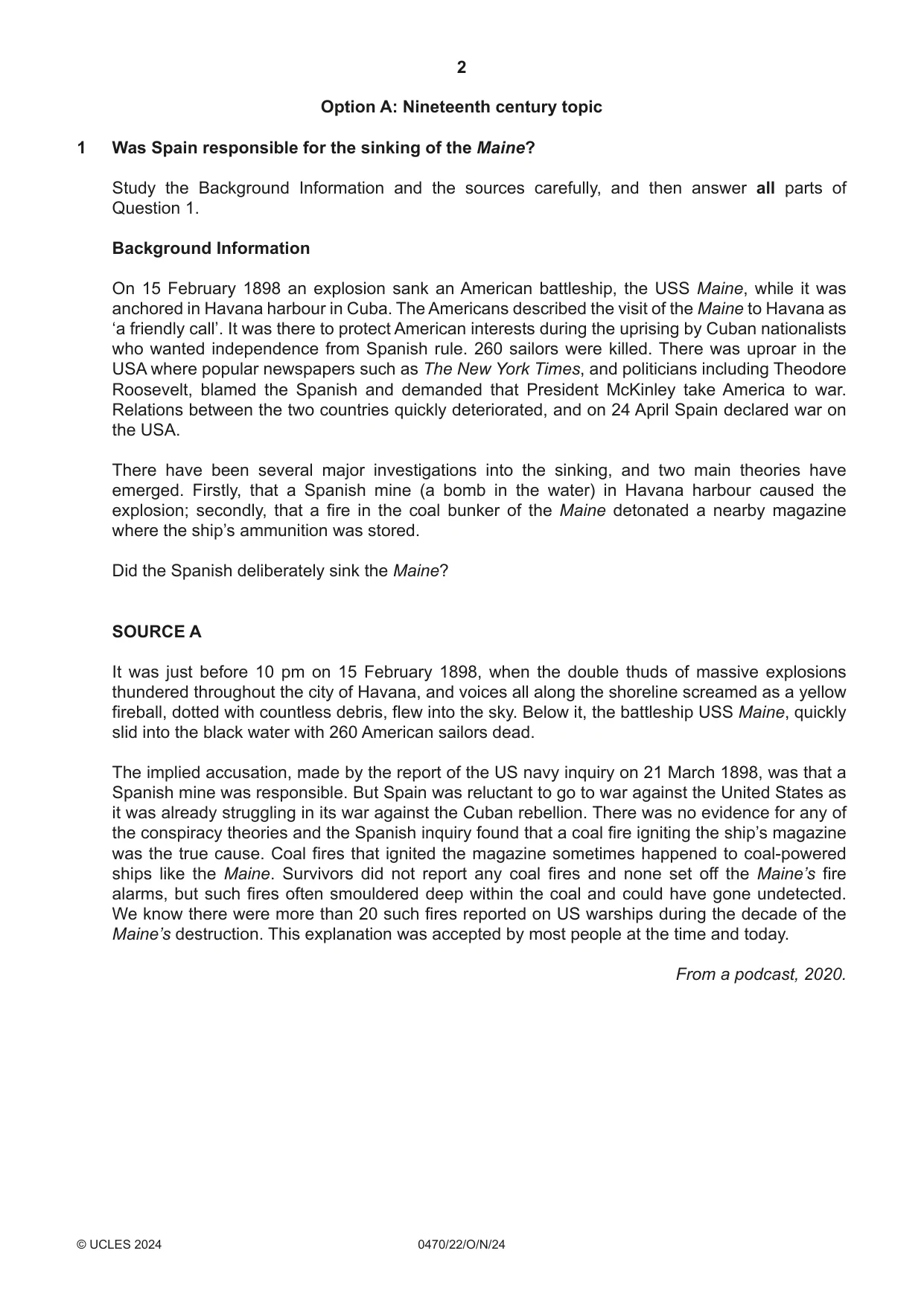
2 0470/22/O/N/24 © UCLES 2024 Option A: Nineteenth century topic 1 Was Spain responsible for the sinking of the Maine? Study the Background Information and the sources carefully, and then answer all parts of Question 1. Background Information On 15 February 1898 an explosion sank an American battleship, the USS Maine, while it was anchored in Havana harbour in Cuba. The Americans described the visit of the Maine to Havana as ‘a friendly call’. It was there to protect American interests during the uprising by Cuban nationalists who wanted independence from Spanish rule. 260 sailors were killed. There was uproar in the USA where popular newspapers such as The New York Times, and politicians including Theodore Roosevelt, blamed the Spanish and demanded that President McKinley take America to war. Relations between the two countries quickly deteriorated, and on 24 April Spain declared war on the USA. There have been several major investigations into the sinking, and two main theories have emerged. Firstly, that a Spanish mine (a bomb in the water) in Havana harbour caused the explosion; secondly, that a fire in the coal bunker of the Maine detonated a nearby magazine where the ship’s ammunition was stored. Did the Spanish deliberately sink the Maine? SOURCE A It was just before 10 pm on 15 February 1898, when the double thuds of massive explosions thundered throughout the city of Havana, and voices all along the shoreline screamed as a yellow fireball, dotted with countless debris, flew into the sky. Below it, the battleship USS Maine, quickly slid into the black water with 260 American sailors dead. The implied accusation, made by the report of the US navy inquiry on 21 March 1898, was that a Spanish mine was responsible. But Spain was reluctant to go to war against the United States as it was already struggling in its war against the Cuban rebellion. There was no evidence for any of the conspiracy theories and the Spanish inquiry found that a coal fire igniting the ship’s magazine was the true cause. Coal fires that ignited the magazine sometimes happened to coal-powered ships like the Maine. Survivors did not report any coal fires and none set off the Maine’s fire alarms, but such fires often smouldered deep within the coal and could have gone undetected. We know there were more than 20 such fires reported on US warships during the decade of the Maine’s destruction. This explanation was accepted by most people at the time and today. From a podcast, 2020.
Question paper, page 3
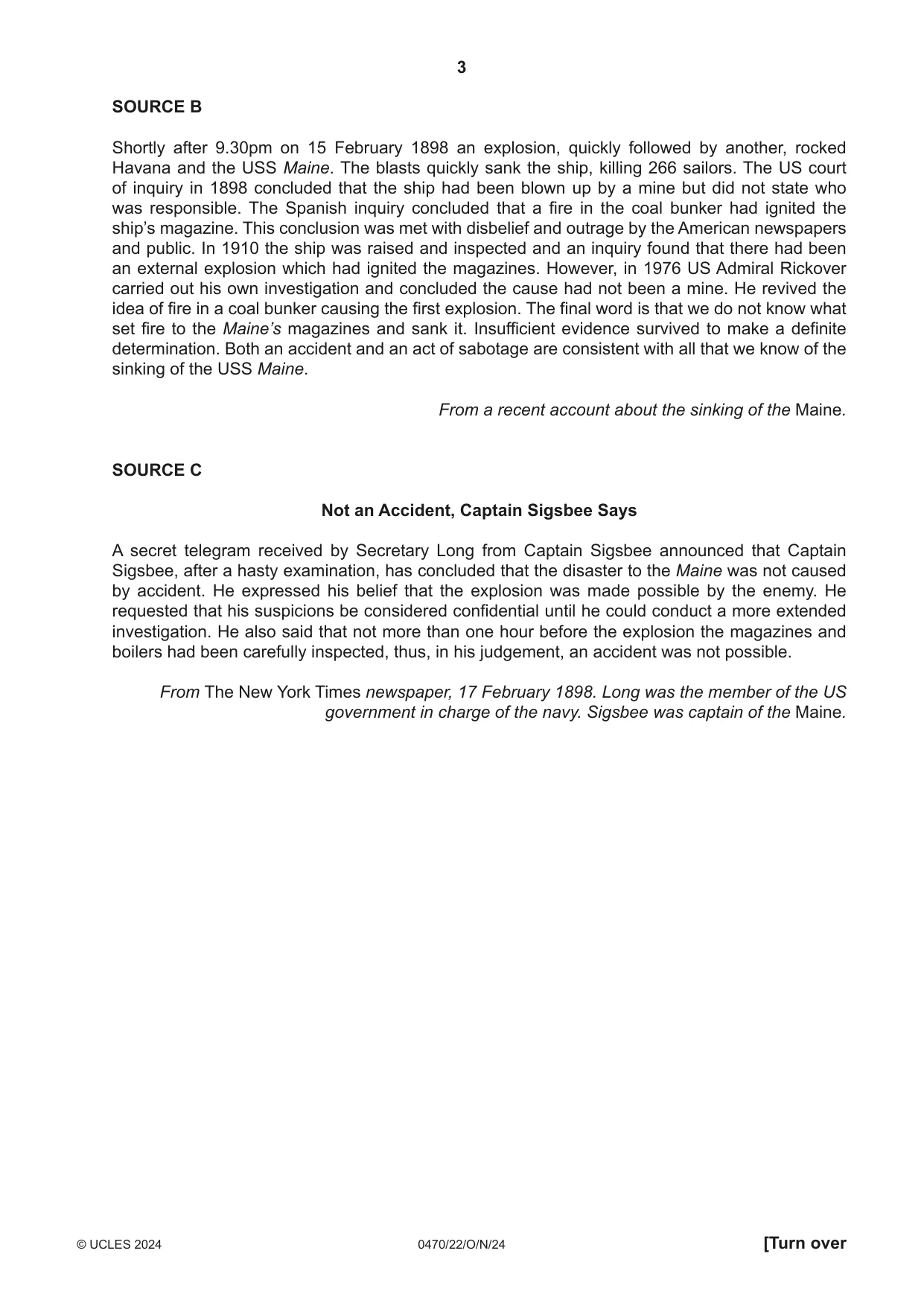
3 0470/22/O/N/24 © UCLES 2024 [Turn over SOURCE B Shortly after 9.30pm on 15 February 1898 an explosion, quickly followed by another, rocked Havana and the USS Maine. The blasts quickly sank the ship, killing 266 sailors. The US court of inquiry in 1898 concluded that the ship had been blown up by a mine but did not state who was responsible. The Spanish inquiry concluded that a fire in the coal bunker had ignited the ship’s magazine. This conclusion was met with disbelief and outrage by the American newspapers and public. In 1910 the ship was raised and inspected and an inquiry found that there had been an external explosion which had ignited the magazines. However, in 1976 US Admiral Rickover carried out his own investigation and concluded the cause had not been a mine. He revived the idea of fire in a coal bunker causing the first explosion. The final word is that we do not know what set fire to the Maine’s magazines and sank it. Insufficient evidence survived to make a definite determination. Both an accident and an act of sabotage are consistent with all that we know of the sinking of the USS Maine. From a recent account about the sinking of the Maine. SOURCE C Not an Accident, Captain Sigsbee Says A secret telegram received by Secretary Long from Captain Sigsbee announced that Captain Sigsbee, after a hasty examination, has concluded that the disaster to the Maine was not caused by accident. He expressed his belief that the explosion was made possible by the enemy. He requested that his suspicions be considered confidential until he could conduct a more extended investigation. He also said that not more than one hour before the explosion the magazines and boilers had been carefully inspected, thus, in his judgement, an accident was not possible. From The New York Times newspaper, 17 February 1898. Long was the member of the US government in charge of the navy. Sigsbee was captain of the Maine.
Question paper, page 4
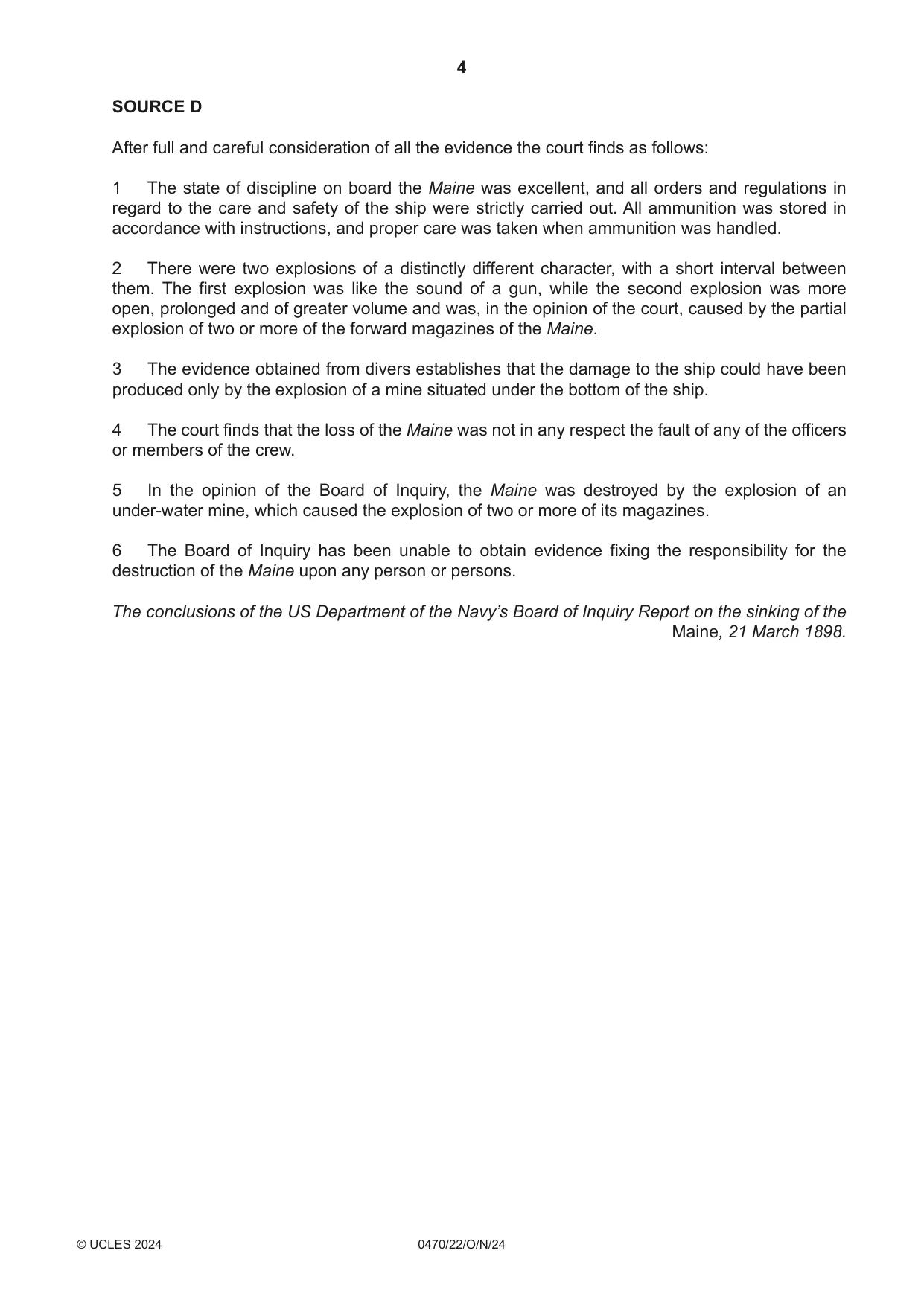
4 0470/22/O/N/24 © UCLES 2024 SOURCE D After full and careful consideration of all the evidence the court finds as follows: 1 The state of discipline on board the Maine was excellent, and all orders and regulations in regard to the care and safety of the ship were strictly carried out. All ammunition was stored in accordance with instructions, and proper care was taken when ammunition was handled. 2 There were two explosions of a distinctly different character, with a short interval between them. The first explosion was like the sound of a gun, while the second explosion was more open, prolonged and of greater volume and was, in the opinion of the court, caused by the partial explosion of two or more of the forward magazines of the Maine. 3 The evidence obtained from divers establishes that the damage to the ship could have been produced only by the explosion of a mine situated under the bottom of the ship. 4 The court finds that the loss of the Maine was not in any respect the fault of any of the officers or members of the crew. 5 In the opinion of the Board of Inquiry, the Maine was destroyed by the explosion of an under-water mine, which caused the explosion of two or more of its magazines. 6 The Board of Inquiry has been unable to obtain evidence fixing the responsibility for the destruction of the Maine upon any person or persons. The conclusions of the US Department of the Navy’s Board of Inquiry Report on the sinking of the Maine, 21 March 1898.
Question paper, page 5
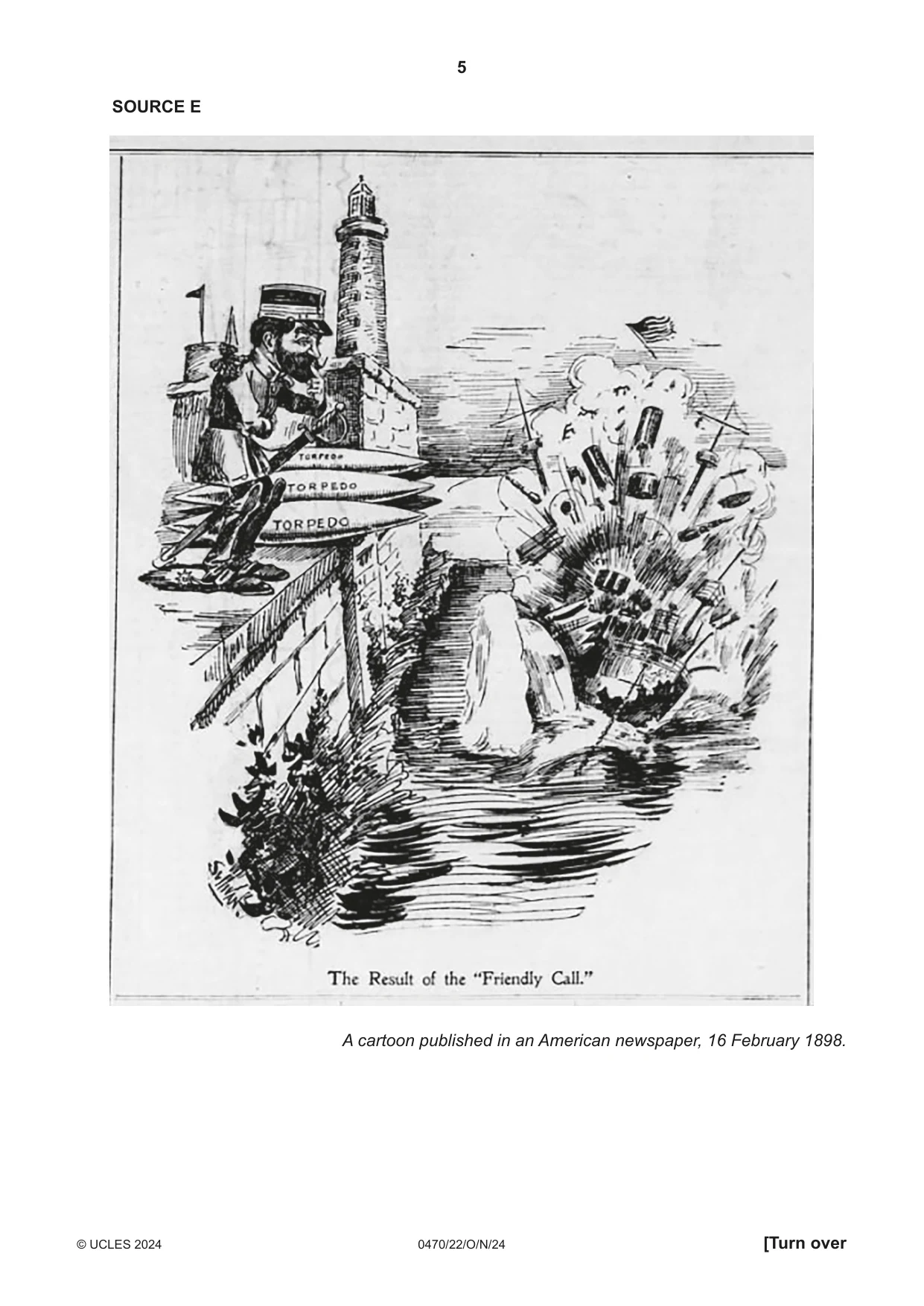
5 0470/22/O/N/24 © UCLES 2024 [Turn over SOURCE E A cartoon published in an American newspaper, 16 February 1898.
Question paper, page 6
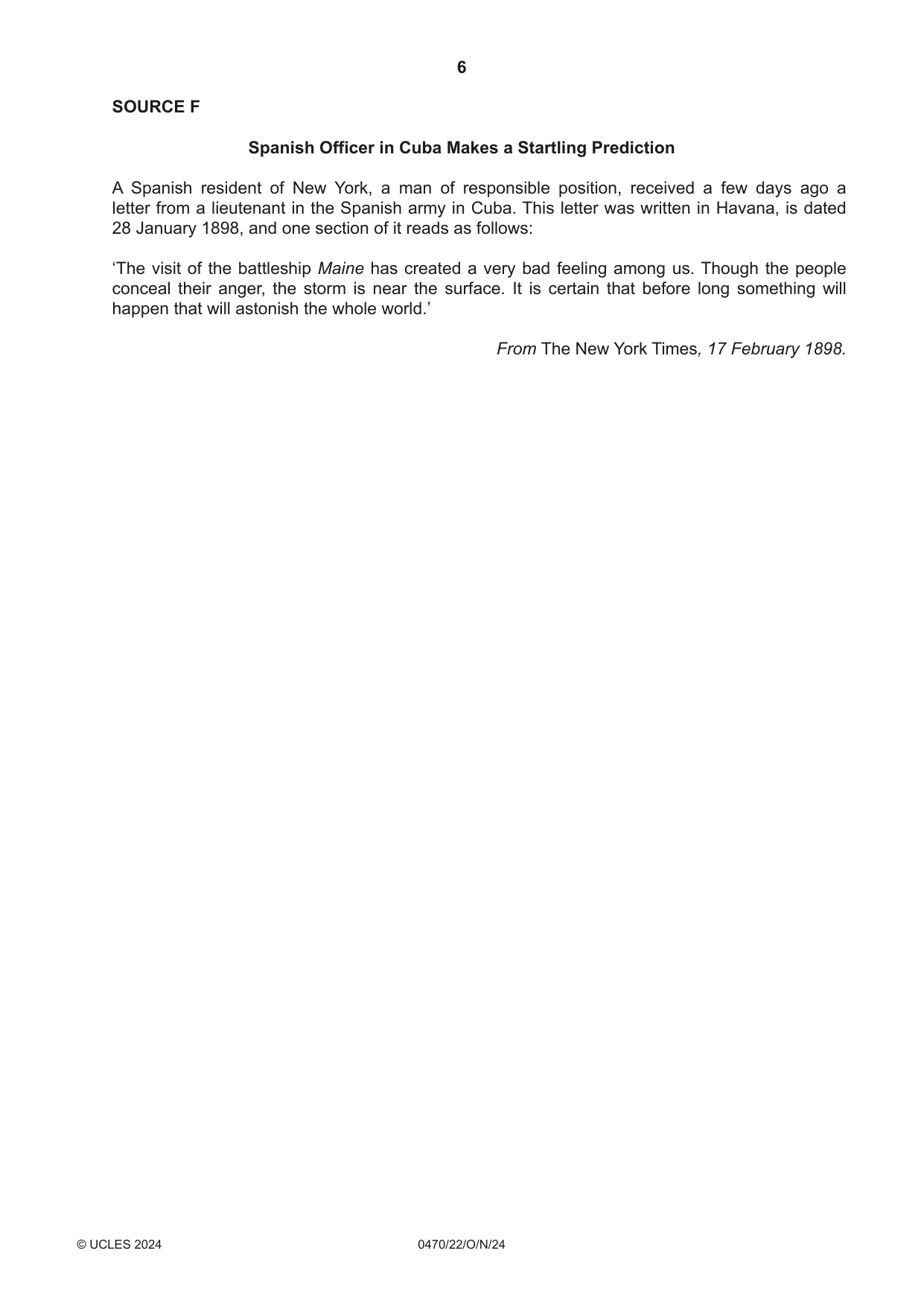
6 0470/22/O/N/24 © UCLES 2024 SOURCE F Spanish Officer in Cuba Makes a Startling Prediction A Spanish resident of New York, a man of responsible position, received a few days ago a letter from a lieutenant in the Spanish army in Cuba. This letter was written in Havana, is dated 28 January 1898, and one section of it reads as follows: ‘The visit of the battleship Maine has created a very bad feeling among us. Though the people conceal their anger, the storm is near the surface. It is certain that before long something will happen that will astonish the whole world.’ From The New York Times, 17 February 1898.
Question paper, page 7
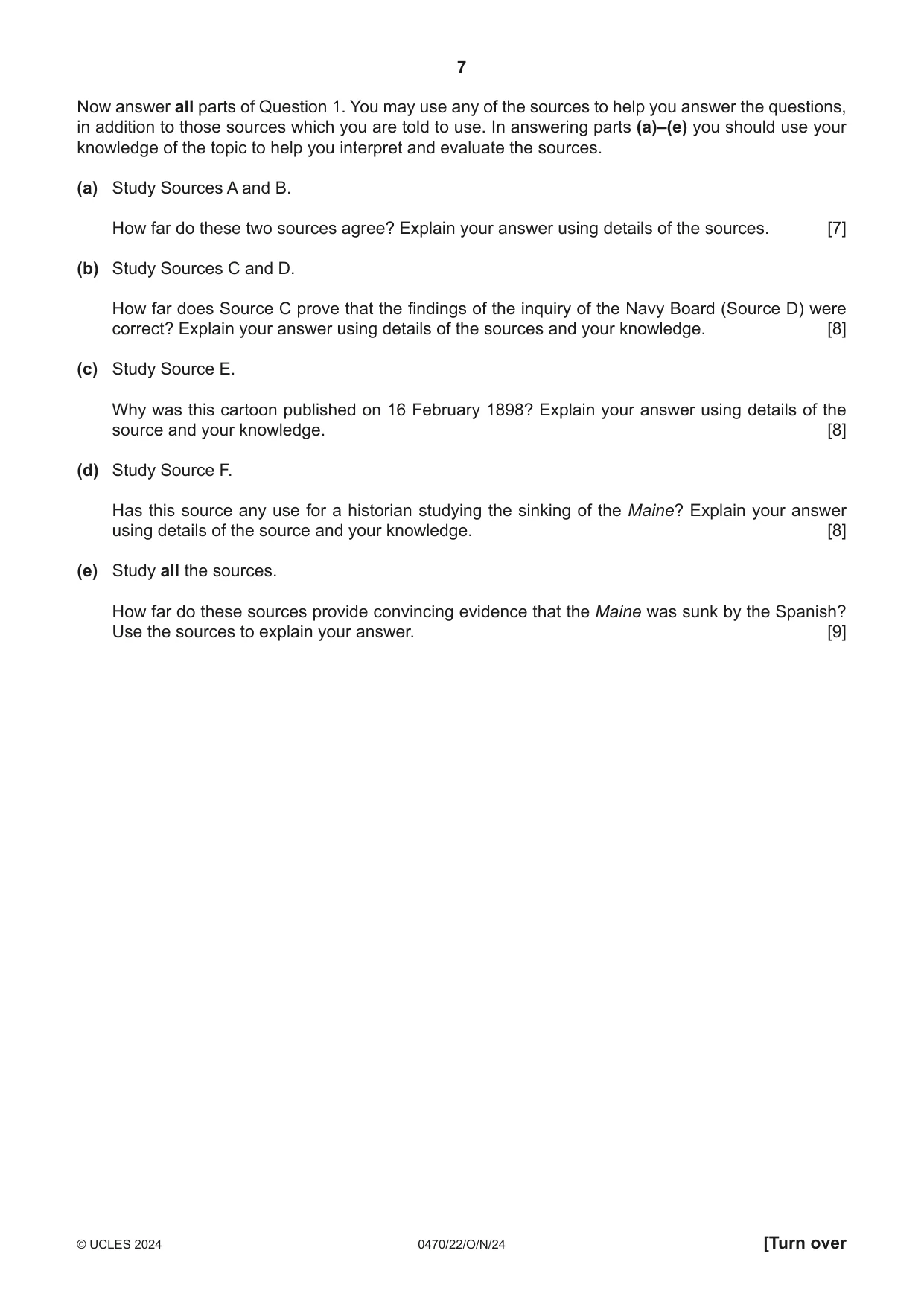
7 0470/22/O/N/24 © UCLES 2024 [Turn over Now answer all parts of Question 1. You may use any of the sources to help you answer the questions, in addition to those sources which you are told to use. In answering parts (a)–(e) you should use your knowledge of the topic to help you interpret and evaluate the sources. (a) Study Sources A and B. How far do these two sources agree? Explain your answer using details of the sources. [7] (b) Study Sources C and D. How far does Source C prove that the findings of the inquiry of the Navy Board (Source D) were correct? Explain your answer using details of the sources and your knowledge. [8] (c) Study Source E. Why was this cartoon published on 16 February 1898? Explain your answer using details of the source and your knowledge. [8] (d) Study Source F. Has this source any use for a historian studying the sinking of the Maine? Explain your answer using details of the source and your knowledge. [8] (e) Study all the sources. How far do these sources provide convincing evidence that the Maine was sunk by the Spanish? Use the sources to explain your answer. [9]
Question paper, page 8
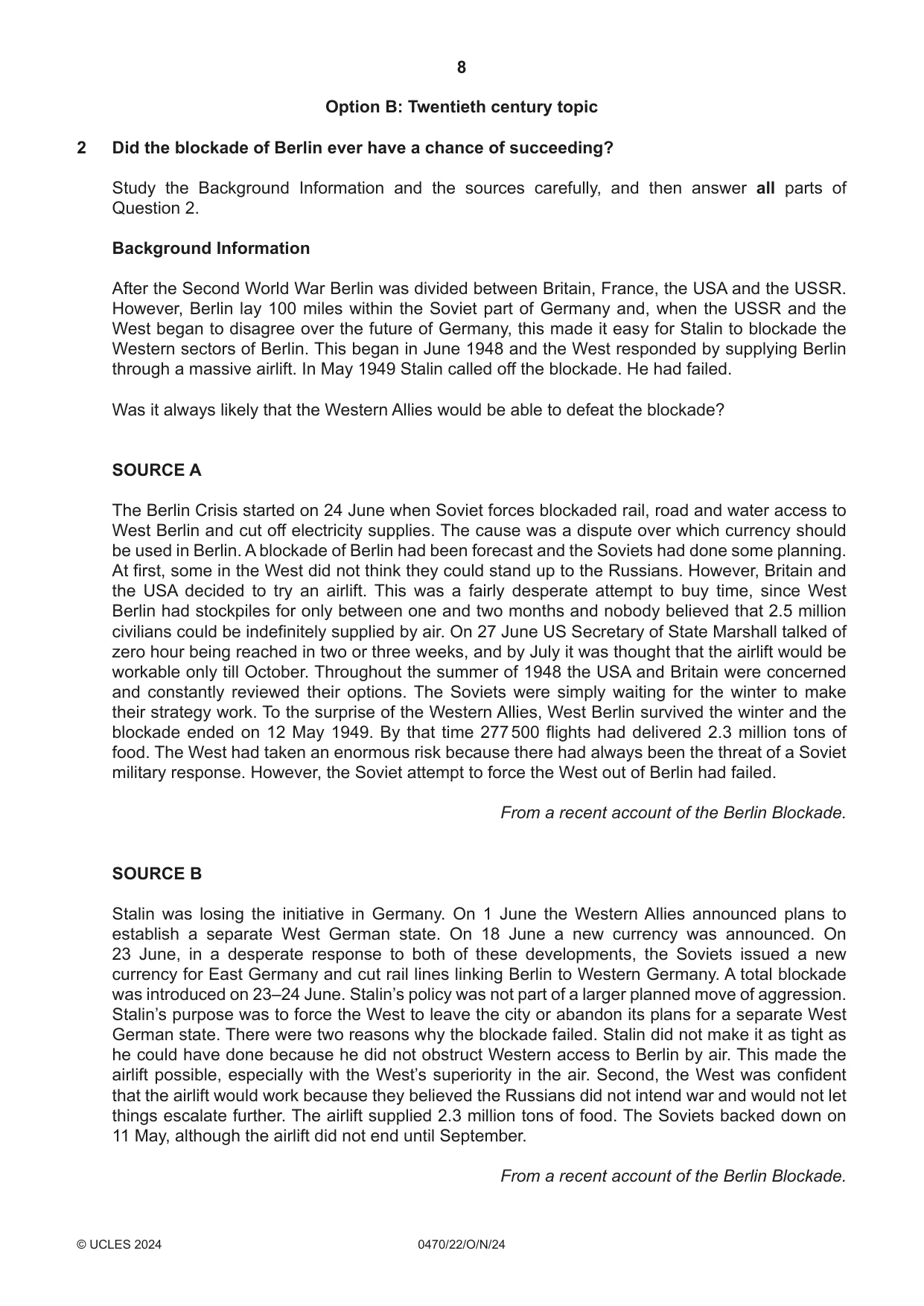
8 0470/22/O/N/24 © UCLES 2024 Option B: Twentieth century topic 2 Did the blockade of Berlin ever have a chance of succeeding? Study the Background Information and the sources carefully, and then answer all parts of Question 2. Background Information After the Second World War Berlin was divided between Britain, France, the USA and the USSR. However, Berlin lay 100 miles within the Soviet part of Germany and, when the USSR and the West began to disagree over the future of Germany, this made it easy for Stalin to blockade the Western sectors of Berlin. This began in June 1948 and the West responded by supplying Berlin through a massive airlift. In May 1949 Stalin called off the blockade. He had failed. Was it always likely that the Western Allies would be able to defeat the blockade? SOURCE A The Berlin Crisis started on 24 June when Soviet forces blockaded rail, road and water access to West Berlin and cut off electricity supplies. The cause was a dispute over which currency should be used in Berlin. A blockade of Berlin had been forecast and the Soviets had done some planning. At first, some in the West did not think they could stand up to the Russians. However, Britain and the USA decided to try an airlift. This was a fairly desperate attempt to buy time, since West Berlin had stockpiles for only between one and two months and nobody believed that 2.5 million civilians could be indefinitely supplied by air. On 27 June US Secretary of State Marshall talked of zero hour being reached in two or three weeks, and by July it was thought that the airlift would be workable only till October. Throughout the summer of 1948 the USA and Britain were concerned and constantly reviewed their options. The Soviets were simply waiting for the winter to make their strategy work. To the surprise of the Western Allies, West Berlin survived the winter and the blockade ended on 12 May 1949. By that time 277 500 flights had delivered 2.3 million tons of food. The West had taken an enormous risk because there had always been the threat of a Soviet military response. However, the Soviet attempt to force the West out of Berlin had failed. From a recent account of the Berlin Blockade. SOURCE B Stalin was losing the initiative in Germany. On 1 June the Western Allies announced plans to establish a separate West German state. On 18 June a new currency was announced. On 23 June, in a desperate response to both of these developments, the Soviets issued a new currency for East Germany and cut rail lines linking Berlin to Western Germany. A total blockade was introduced on 23–24 June. Stalin’s policy was not part of a larger planned move of aggression. Stalin’s purpose was to force the West to leave the city or abandon its plans for a separate West German state. There were two reasons why the blockade failed. Stalin did not make it as tight as he could have done because he did not obstruct Western access to Berlin by air. This made the airlift possible, especially with the West’s superiority in the air. Second, the West was confident that the airlift would work because they believed the Russians did not intend war and would not let things escalate further. The airlift supplied 2.3 million tons of food. The Soviets backed down on 11 May, although the airlift did not end until September. From a recent account of the Berlin Blockade.
Question paper, page 9
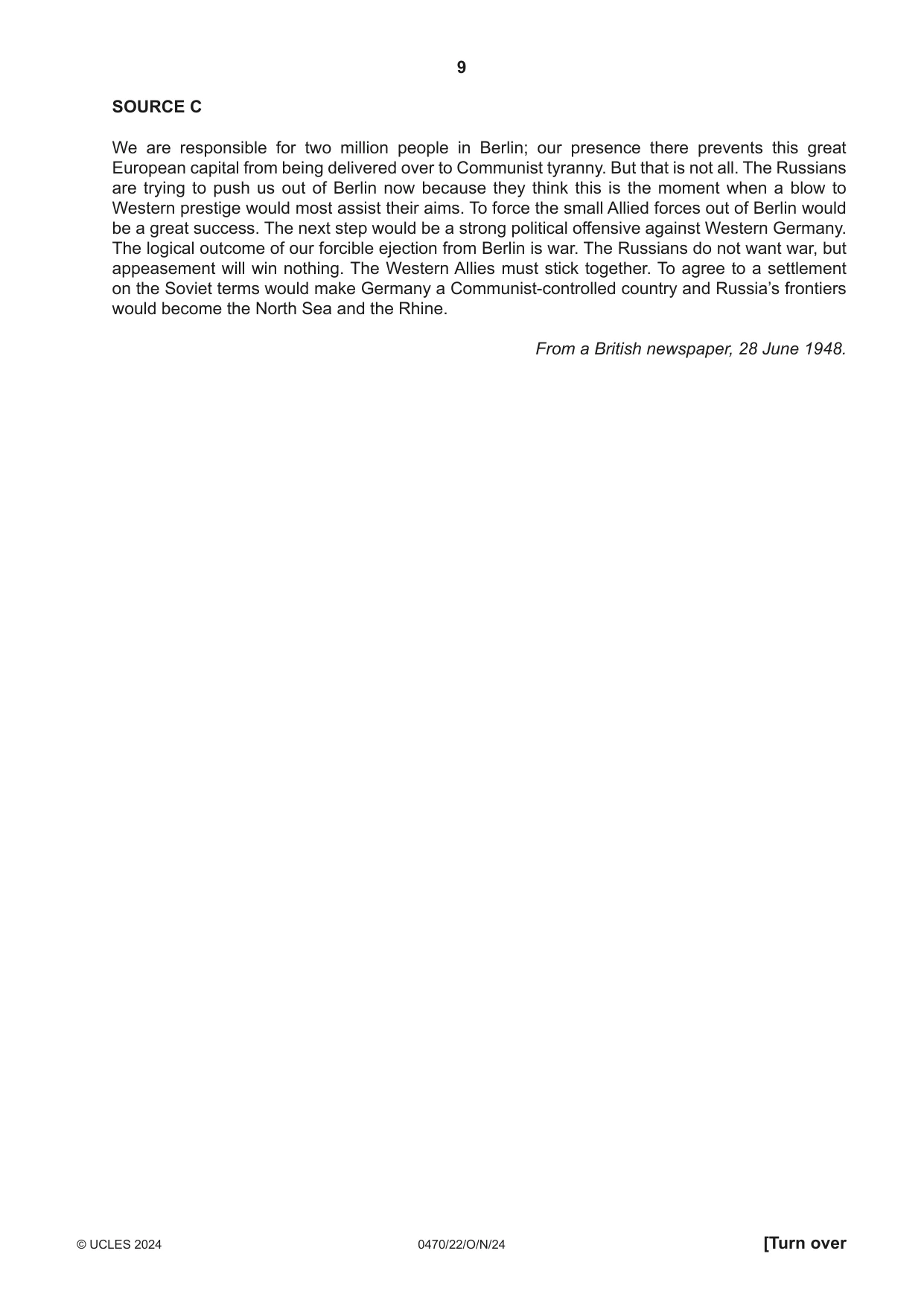
9 0470/22/O/N/24 © UCLES 2024 [Turn over SOURCE C We are responsible for two million people in Berlin; our presence there prevents this great European capital from being delivered over to Communist tyranny. But that is not all. The Russians are trying to push us out of Berlin now because they think this is the moment when a blow to Western prestige would most assist their aims. To force the small Allied forces out of Berlin would be a great success. The next step would be a strong political offensive against Western Germany. The logical outcome of our forcible ejection from Berlin is war. The Russians do not want war, but appeasement will win nothing. The Western Allies must stick together. To agree to a settlement on the Soviet terms would make Germany a Communist-controlled country and Russia’s frontiers would become the North Sea and the Rhine. From a British newspaper, 28 June 1948.
Question paper, page 10
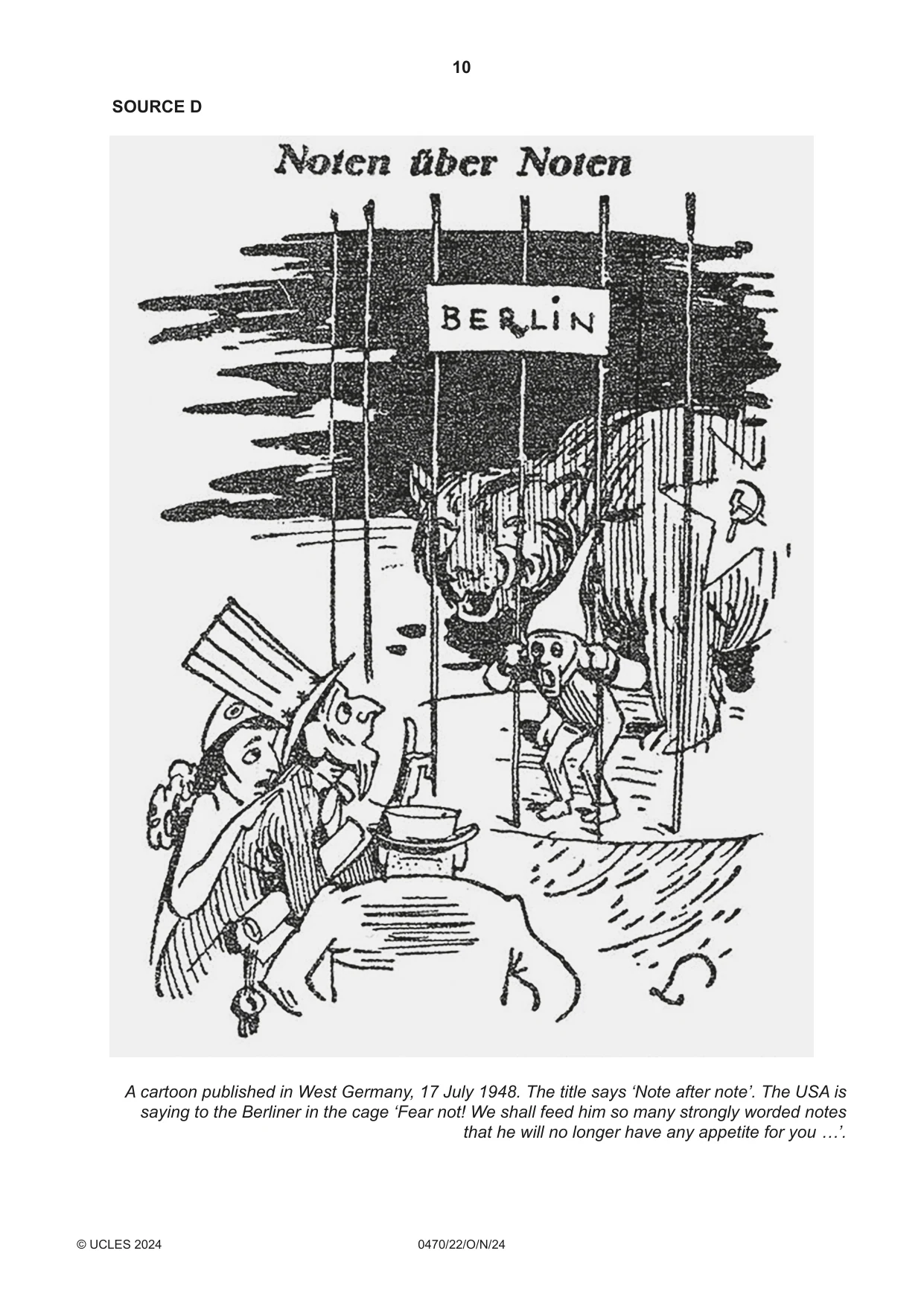
10 0470/22/O/N/24 © UCLES 2024 SOURCE D A cartoon published in West Germany, 17 July 1948. The title says ‘Note after note’. The USA is saying to the Berliner in the cage ‘Fear not! We shall feed him so many strongly worded notes that he will no longer have any appetite for you …’.
Question paper, page 11
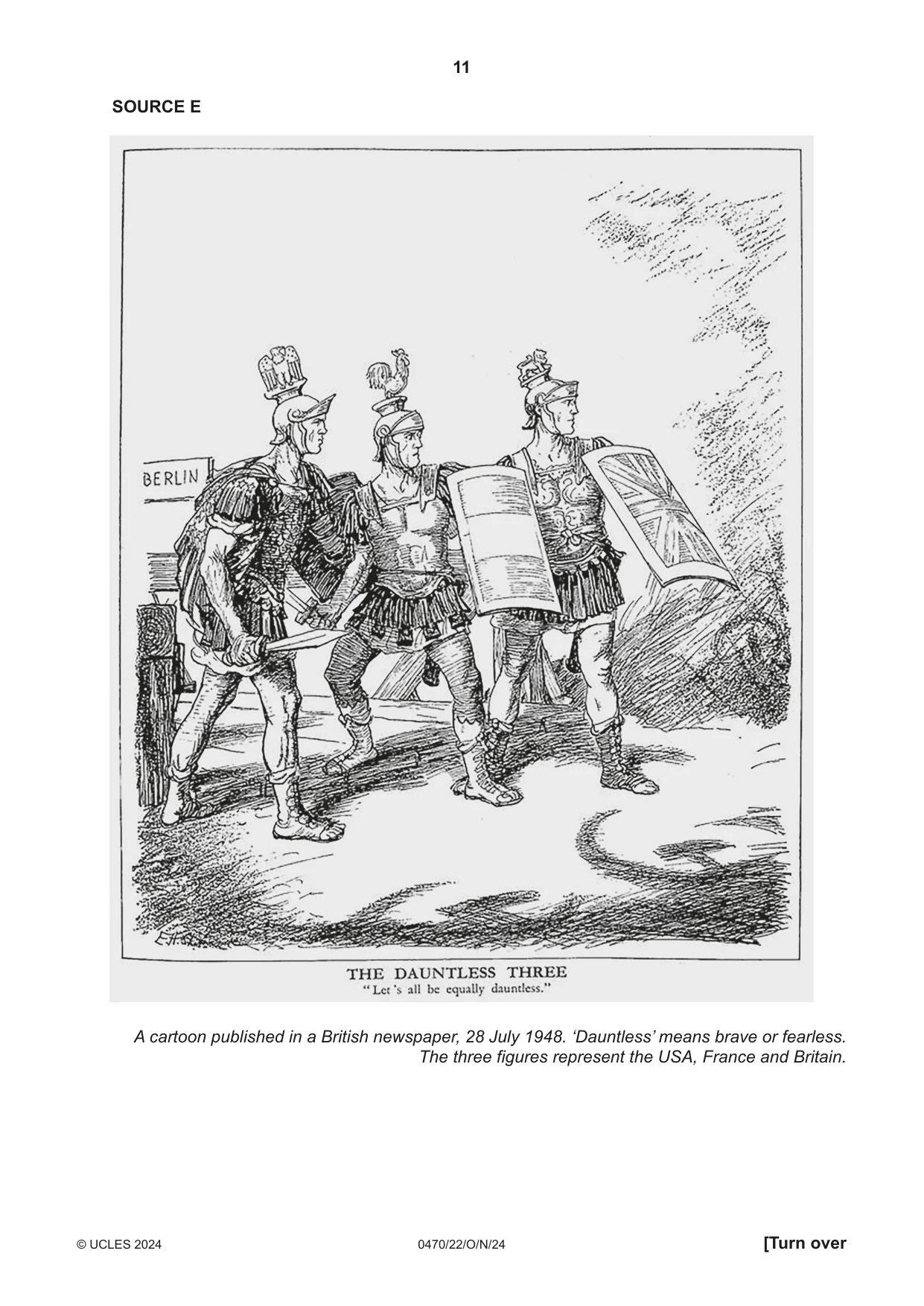
11 0470/22/O/N/24 © UCLES 2024 [Turn over SOURCE E A cartoon published in a British newspaper, 28 July 1948. ‘Dauntless’ means brave or fearless. The three figures represent the USA, France and Britain.
Question paper, page 12
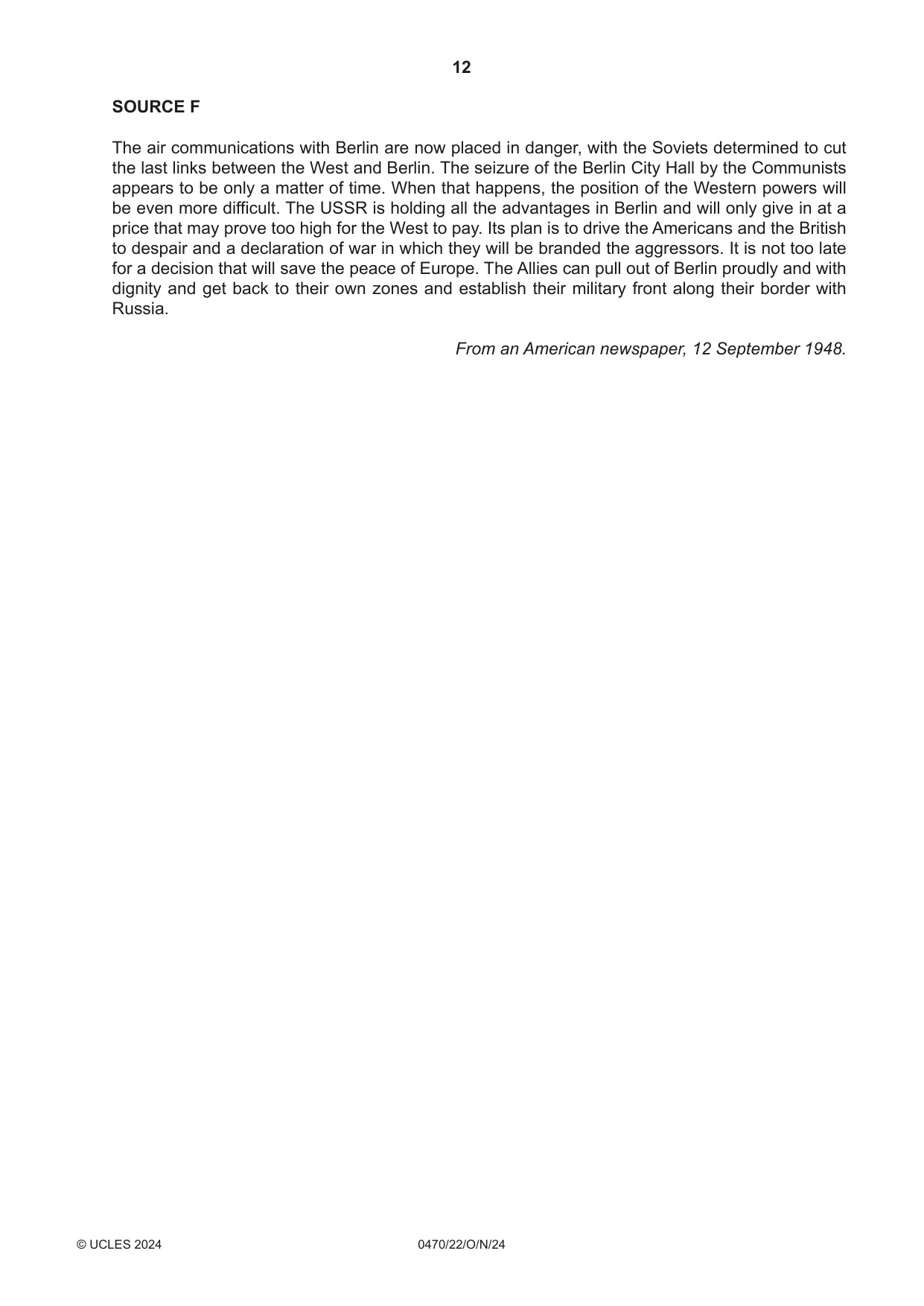
12 0470/22/O/N/24 © UCLES 2024 SOURCE F The air communications with Berlin are now placed in danger, with the Soviets determined to cut the last links between the West and Berlin. The seizure of the Berlin City Hall by the Communists appears to be only a matter of time. When that happens, the position of the Western powers will be even more difficult. The USSR is holding all the advantages in Berlin and will only give in at a price that may prove too high for the West to pay. Its plan is to drive the Americans and the British to despair and a declaration of war in which they will be branded the aggressors. It is not too late for a decision that will save the peace of Europe. The Allies can pull out of Berlin proudly and with dignity and get back to their own zones and establish their military front along their border with Russia. From an American newspaper, 12 September 1948.
Question paper, page 13
13 0470/22/O/N/24 © UCLES 2024 Now answer all parts of Question 2. You may use any of the sources to help you answer the questions, in addition to those sources which you are told to use. In answering parts (a)–(e) you should use your knowledge of the topic to help you interpret and evaluate the sources. (a) Study Sources A and B. How far do these two sources agree? Explain your answer using details of the sources. [7] (b) Study Source C. Why was this source published at this time? Explain your answer using details of the source and your knowledge. [8] (c) Study Sources D and E. How far would these two cartoonists have agreed about the crisis over Berlin? Explain your answer using details of the sources and your knowledge. [8] (d) Study Source F. Is this source surprising? Explain your answer using details of the source and your knowledge. [8] (e) Study all the sources. How far do these sources provide convincing evidence that when the blockade began the Western Allies had a good chance of defeating it? Use the sources to explain your answer. [9]
Question paper, page 14
14 0470/22/O/N/24 © UCLES 2024 BLANK PAGE
Question paper, page 15
15 0470/22/O/N/24 © UCLES 2024 BLANK PAGE
Question paper, page 16
16 0470/22/O/N/24 © UCLES 2024 Permission to reproduce items where third-party owned material protected by copyright is included has been sought and cleared where possible. Every reasonable effort has been made by the publisher (UCLES) to trace copyright holders, but if any items requiring clearance have unwittingly been included, the publisher will be pleased to make amends at the earliest possible opportunity. To avoid the issue of disclosure of answer-related information to candidates, all copyright acknowledgements are reproduced online in the Cambridge Assessment International Education Copyright Acknowledgements Booklet. This is produced for each series of examinations and is freely available to download at www.cambridgeinternational.org after the live examination series. Cambridge Assessment International Education is part of Cambridge Assessment. Cambridge Assessment is the brand name of the University of Cambridge Local Examinations Syndicate (UCLES), which is a department of the University of Cambridge. BLANK PAGE
Mark scheme, page 1
This document consists of 13 printed pages. © Cambridge University Press & Assessment 2024 [Turn over Cambridge IGCSE™ HISTORY 0470/22 Paper 2 October/November 2024 MARK SCHEME Maximum Mark: 40 Published This mark scheme is published as an aid to teachers and candidates, to indicate the requirements of the examination. It shows the basis on which Examiners were instructed to award marks. It does not indicate the details of the discussions that took place at an Examiners’ meeting before marking began, which would have considered the acceptability of alternative answers. Mark schemes should be read in conjunction with the question paper and the Principal Examiner Report for Teachers. Cambridge International will not enter into discussions about these mark schemes. Cambridge International is publishing the mark schemes for the October/November 2024 series for most Cambridge IGCSE, Cambridge International A and AS Level components, and some Cambridge O Level components.
Mark scheme, page 2
0470/22 Cambridge IGCSE – Mark Scheme PUBLISHED October/November 2024 © Cambridge University Press & Assessment 2024 Page 2 of 13 Generic Marking Principles These general marking principles must be applied by all examiners when marking candidate answers. They should be applied alongside the specific content of the mark scheme or generic level descriptions for a question. Each question paper and mark scheme will also comply with these marking principles. GENERIC MARKING PRINCIPLE 1: Marks must be awarded in line with: • the specific content of the mark scheme or the generic level descriptors for the question • the specific skills defined in the mark scheme or in the generic level descriptors for the question • the standard of response required by a candidate as exemplified by the standardisation scripts. GENERIC MARKING PRINCIPLE 2: Marks awarded are always whole marks (not half marks, or other fractions). GENERIC MARKING PRINCIPLE 3: Marks must be awarded positively: • marks are awarded for correct/valid answers, as defined in the mark scheme. However, credit is given for valid answers which go beyond the scope of the syllabus and mark scheme, referring to your Team Leader as appropriate • marks are awarded when candidates clearly demonstrate what they know and can do • marks are not deducted for errors • marks are not deducted for omissions • answers should only be judged on the quality of spelling, punctuation and grammar when these features are specifically assessed by the question as indicated by the mark scheme. The meaning, however, should be unambiguous. GENERIC MARKING PRINCIPLE 4: Rules must be applied consistently, e.g. in situations where candidates have not followed instructions or in the application of generic level descriptors. GENERIC MARKING PRINCIPLE 5: Marks should be awarded using the full range of marks defined in the mark scheme for the question (however; the use of the full mark range may be limited according to the quality of the candidate responses seen). GENERIC MARKING PRINCIPLE 6: Marks awarded are based solely on the requirements as defined in the mark scheme. Marks should not be awarded with grade thresholds or grade descriptors in mind.
Mark scheme, page 3
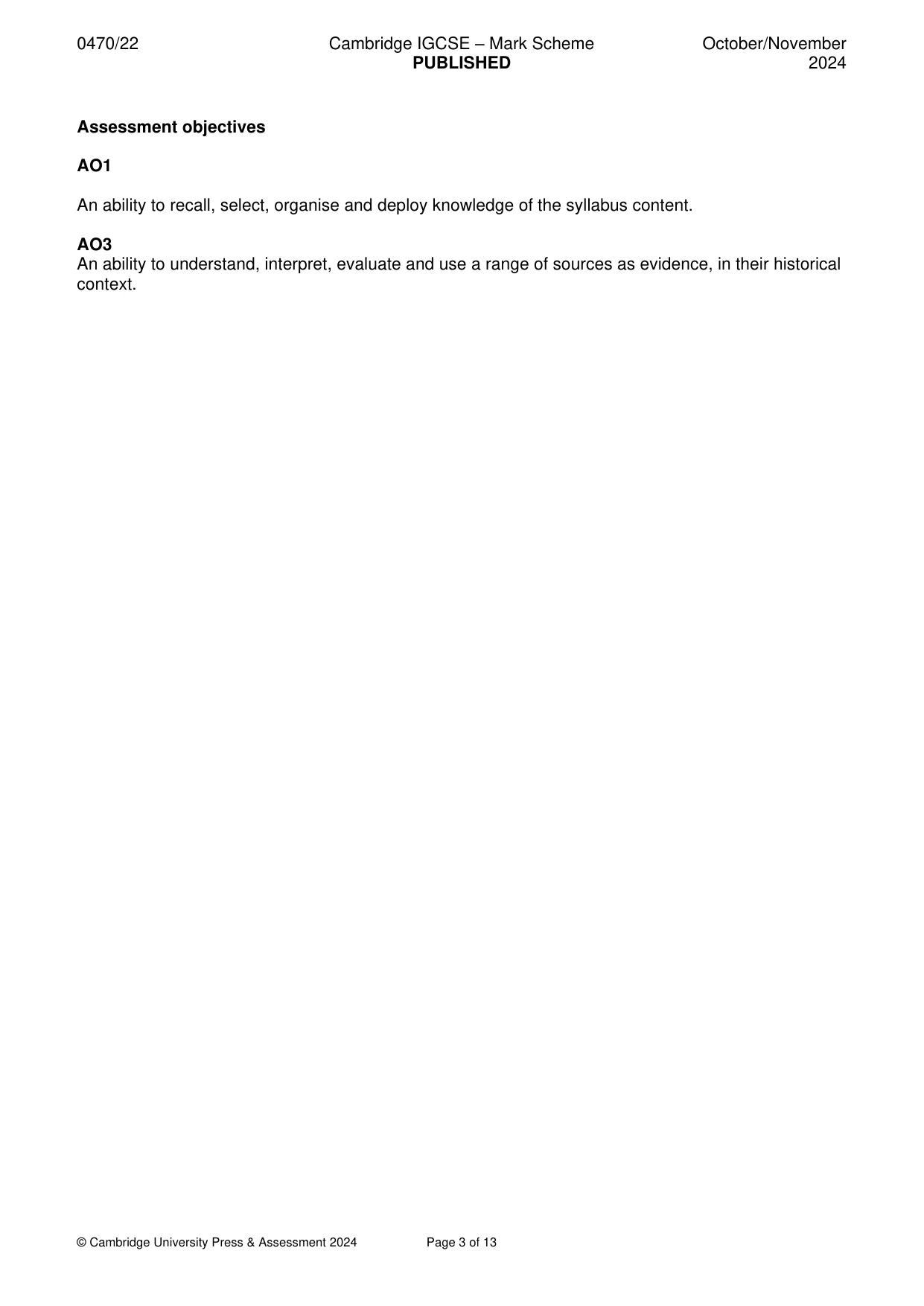
0470/22 Cambridge IGCSE – Mark Scheme PUBLISHED October/November 2024 © Cambridge University Press & Assessment 2024 Page 3 of 13 Assessment objectives AO1 An ability to recall, select, organise and deploy knowledge of the syllabus content. AO3 An ability to understand, interpret, evaluate and use a range of sources as evidence, in their historical context.
Mark scheme, page 4
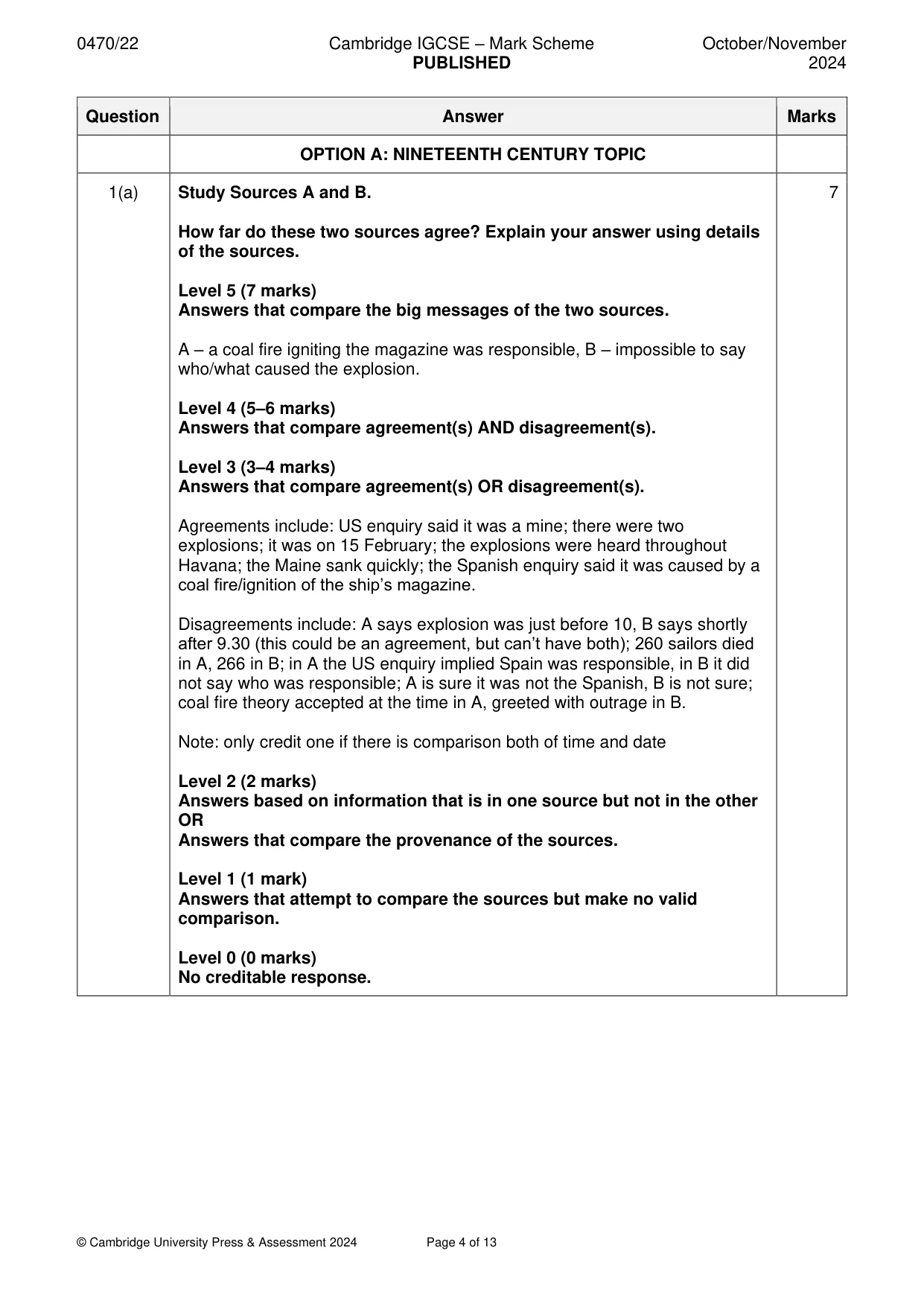
0470/22 Cambridge IGCSE – Mark Scheme PUBLISHED October/November 2024 © Cambridge University Press & Assessment 2024 Page 4 of 13 Question Answer Marks OPTION A: NINETEENTH CENTURY TOPIC 1(a) Study Sources A and B. How far do these two sources agree? Explain your answer using details of the sources. Level 5 (7 marks) Answers that compare the big messages of the two sources. A – a coal fire igniting the magazine was responsible, B – impossible to say who/what caused the explosion. Level 4 (5–6 marks) Answers that compare agreement(s) AND disagreement(s). Level 3 (3–4 marks) Answers that compare agreement(s) OR disagreement(s). Agreements include: US enquiry said it was a mine; there were two explosions; it was on 15 February; the explosions were heard throughout Havana; the Maine sank quickly; the Spanish enquiry said it was caused by a coal fire/ignition of the ship’s magazine. Disagreements include: A says explosion was just before 10, B says shortly after 9.30 (this could be an agreement, but can’t have both); 260 sailors died in A, 266 in B; in A the US enquiry implied Spain was responsible, in B it did not say who was responsible; A is sure it was not the Spanish, B is not sure; coal fire theory accepted at the time in A, greeted with outrage in B. Note: only credit one if there is comparison both of time and date Level 2 (2 marks) Answers based on information that is in one source but not in the other OR Answers that compare the provenance of the sources. Level 1 (1 mark) Answers that attempt to compare the sources but make no valid comparison. Level 0 (0 marks) No creditable response. 7
Mark scheme, page 5
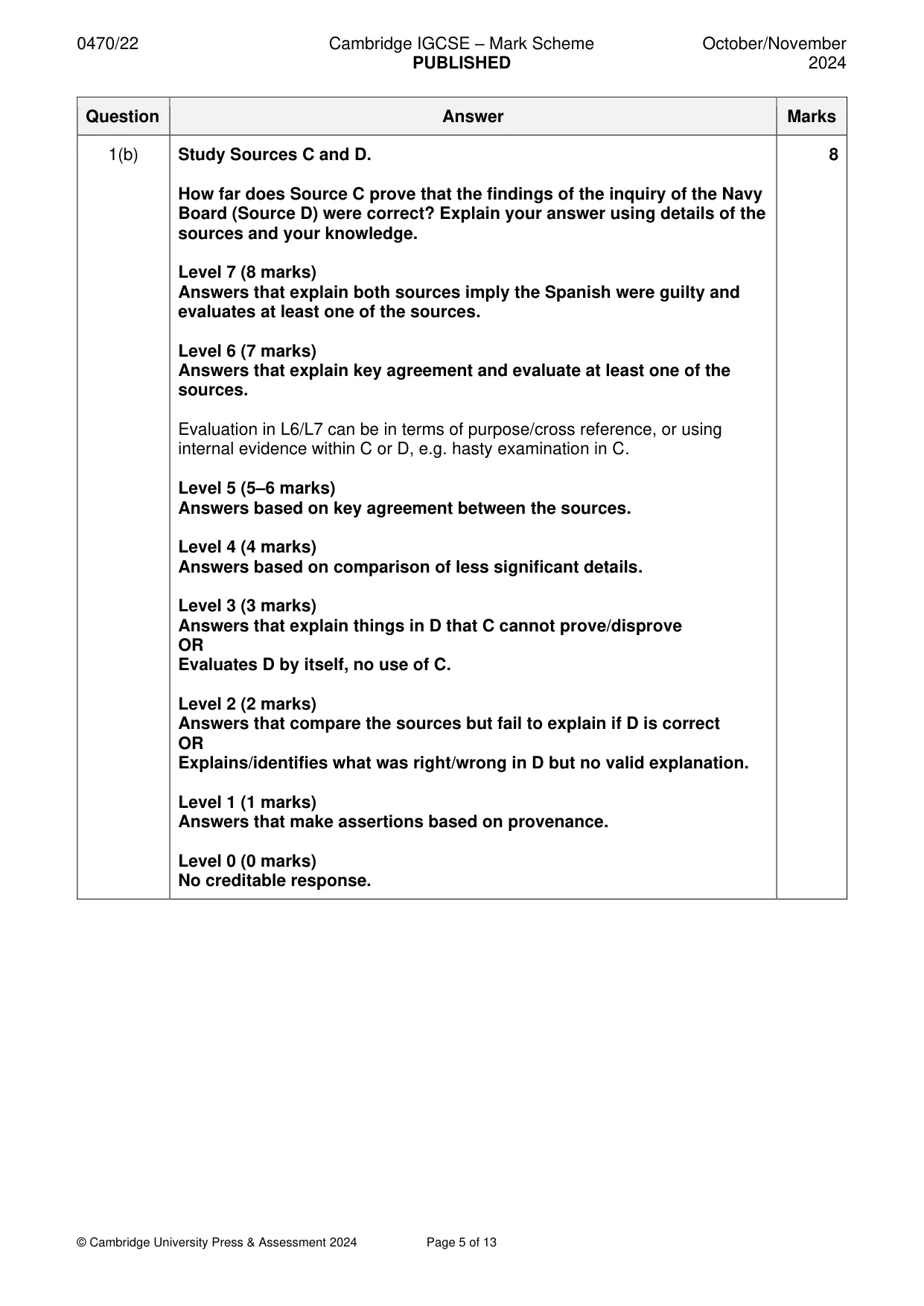
0470/22 Cambridge IGCSE – Mark Scheme PUBLISHED October/November 2024 © Cambridge University Press & Assessment 2024 Page 5 of 13 Question Answer Marks 1(b) Study Sources C and D. How far does Source C prove that the findings of the inquiry of the Navy Board (Source D) were correct? Explain your answer using details of the sources and your knowledge. Level 7 (8 marks) Answers that explain both sources imply the Spanish were guilty and evaluates at least one of the sources. Level 6 (7 marks) Answers that explain key agreement and evaluate at least one of the sources. Evaluation in L6/L7 can be in terms of purpose/cross reference, or using internal evidence within C or D, e.g. hasty examination in C. Level 5 (5–6 marks) Answers based on key agreement between the sources. Level 4 (4 marks) Answers based on comparison of less significant details. Level 3 (3 marks) Answers that explain things in D that C cannot prove/disprove OR Evaluates D by itself, no use of C. Level 2 (2 marks) Answers that compare the sources but fail to explain if D is correct OR Explains/identifies what was right/wrong in D but no valid explanation. Level 1 (1 marks) Answers that make assertions based on provenance. Level 0 (0 marks) No creditable response. 8
Mark scheme, page 6
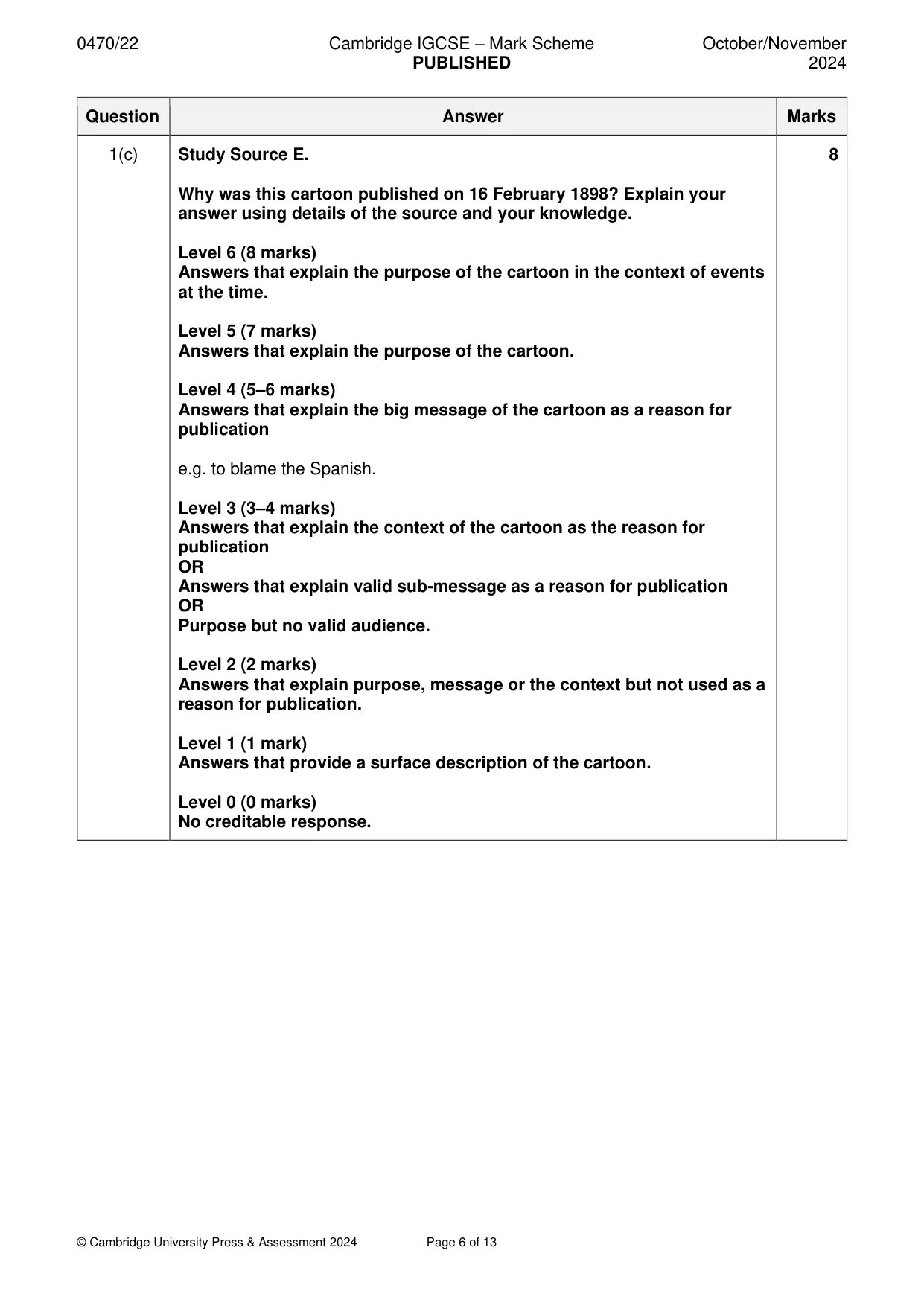
0470/22 Cambridge IGCSE – Mark Scheme PUBLISHED October/November 2024 © Cambridge University Press & Assessment 2024 Page 6 of 13 Question Answer Marks 1(c) Study Source E. Why was this cartoon published on 16 February 1898? Explain your answer using details of the source and your knowledge. Level 6 (8 marks) Answers that explain the purpose of the cartoon in the context of events at the time. Level 5 (7 marks) Answers that explain the purpose of the cartoon. Level 4 (5–6 marks) Answers that explain the big message of the cartoon as a reason for publication e.g. to blame the Spanish. Level 3 (3–4 marks) Answers that explain the context of the cartoon as the reason for publication OR Answers that explain valid sub-message as a reason for publication OR Purpose but no valid audience. Level 2 (2 marks) Answers that explain purpose, message or the context but not used as a reason for publication. Level 1 (1 mark) Answers that provide a surface description of the cartoon. Level 0 (0 marks) No creditable response. 8
Mark scheme, page 7
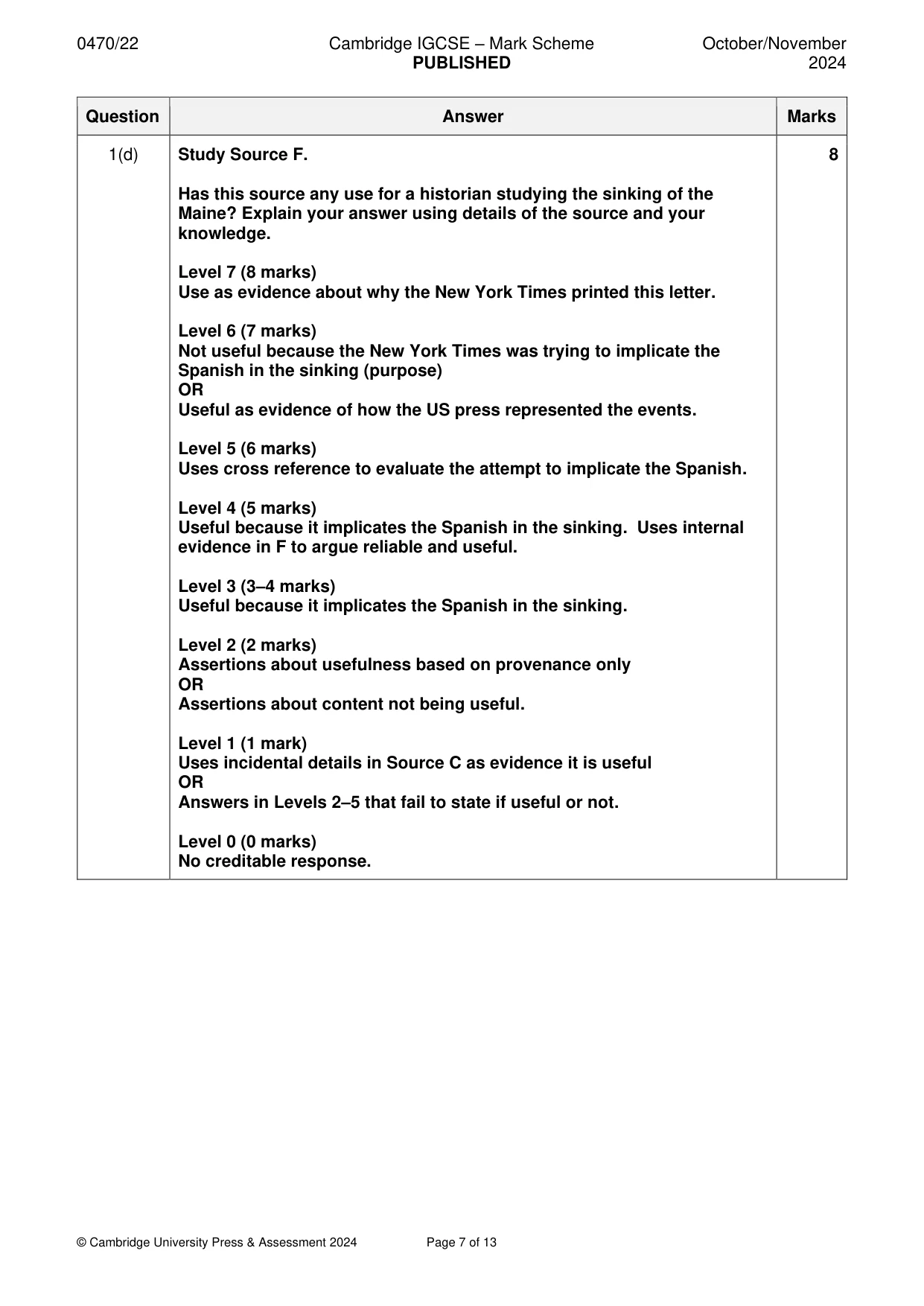
0470/22 Cambridge IGCSE – Mark Scheme PUBLISHED October/November 2024 © Cambridge University Press & Assessment 2024 Page 7 of 13 Question Answer Marks 1(d) Study Source F. Has this source any use for a historian studying the sinking of the Maine? Explain your answer using details of the source and your knowledge. Level 7 (8 marks) Use as evidence about why the New York Times printed this letter. Level 6 (7 marks) Not useful because the New York Times was trying to implicate the Spanish in the sinking (purpose) OR Useful as evidence of how the US press represented the events. Level 5 (6 marks) Uses cross reference to evaluate the attempt to implicate the Spanish. Level 4 (5 marks) Useful because it implicates the Spanish in the sinking. Uses internal evidence in F to argue reliable and useful. Level 3 (3–4 marks) Useful because it implicates the Spanish in the sinking. Level 2 (2 marks) Assertions about usefulness based on provenance only OR Assertions about content not being useful. Level 1 (1 mark) Uses incidental details in Source C as evidence it is useful OR Answers in Levels 2–5 that fail to state if useful or not. Level 0 (0 marks) No creditable response. 8
Mark scheme, page 8
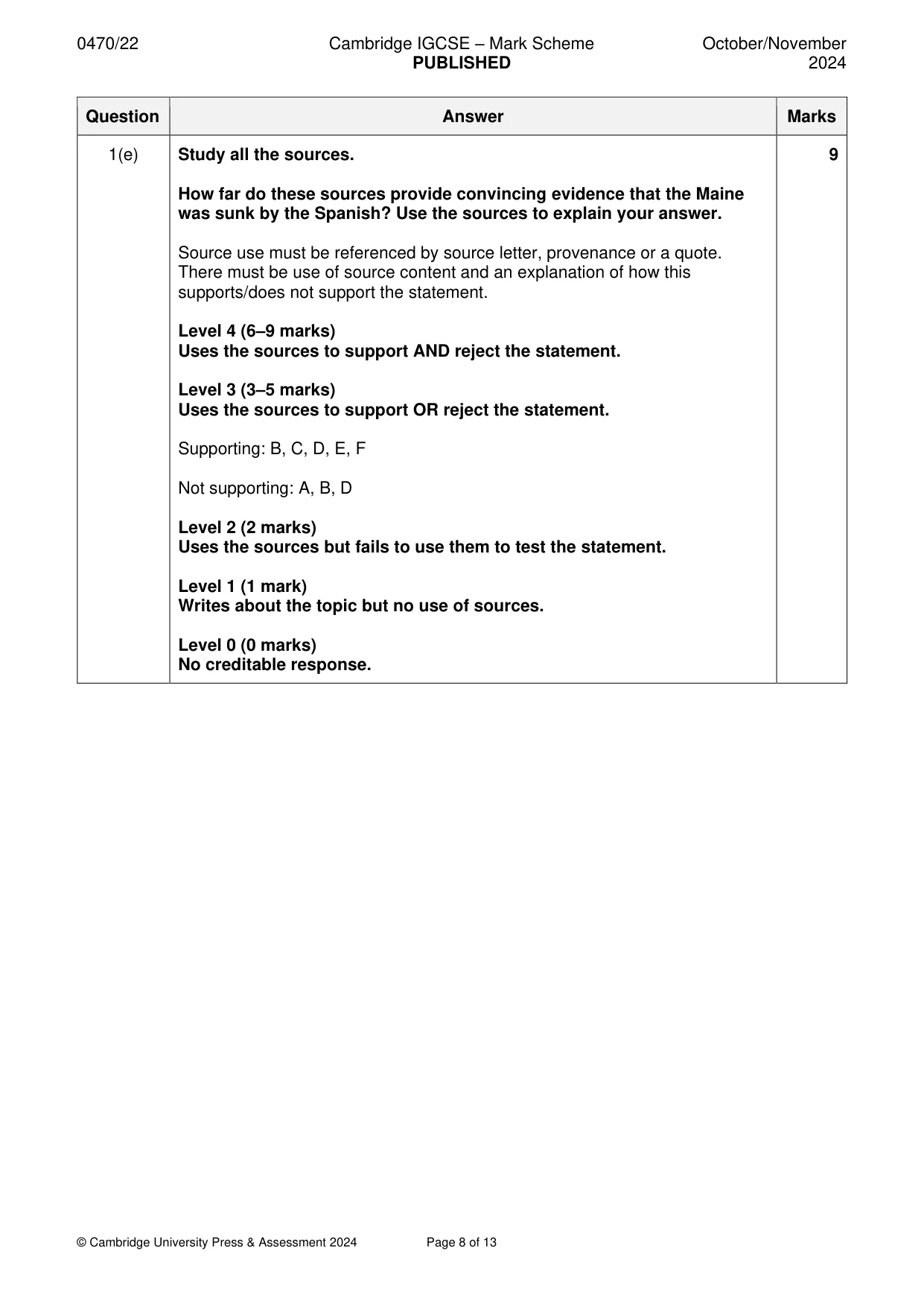
0470/22 Cambridge IGCSE – Mark Scheme PUBLISHED October/November 2024 © Cambridge University Press & Assessment 2024 Page 8 of 13 Question Answer Marks 1(e) Study all the sources. How far do these sources provide convincing evidence that the Maine was sunk by the Spanish? Use the sources to explain your answer. Source use must be referenced by source letter, provenance or a quote. There must be use of source content and an explanation of how this supports/does not support the statement. Level 4 (6–9 marks) Uses the sources to support AND reject the statement. Level 3 (3–5 marks) Uses the sources to support OR reject the statement. Supporting: B, C, D, E, F Not supporting: A, B, D Level 2 (2 marks) Uses the sources but fails to use them to test the statement. Level 1 (1 mark) Writes about the topic but no use of sources. Level 0 (0 marks) No creditable response. 9
Mark scheme, page 9
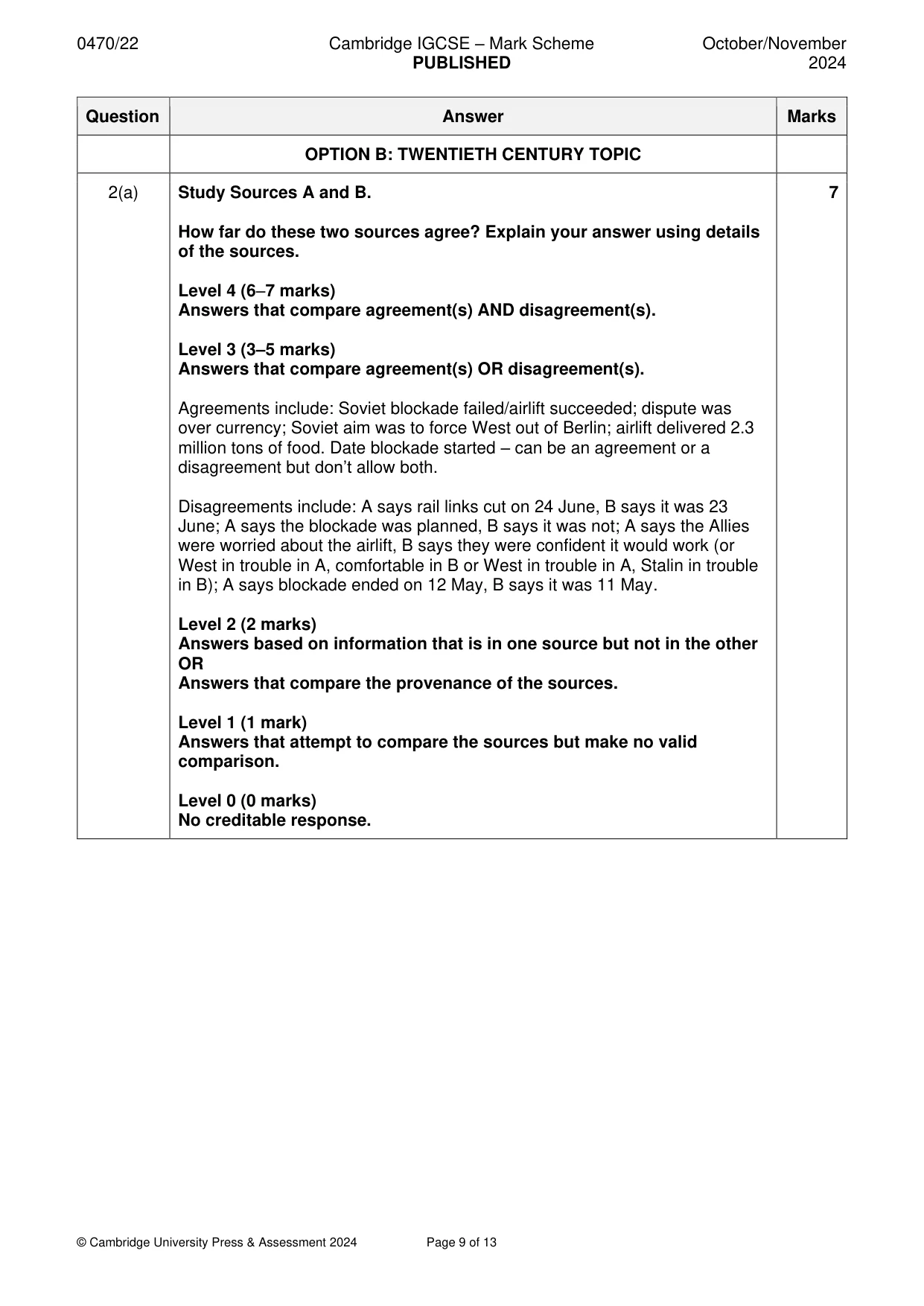
0470/22 Cambridge IGCSE – Mark Scheme PUBLISHED October/November 2024 © Cambridge University Press & Assessment 2024 Page 9 of 13 Question Answer Marks OPTION B: TWENTIETH CENTURY TOPIC 2(a) Study Sources A and B. How far do these two sources agree? Explain your answer using details of the sources. Level 4 (6–7 marks) Answers that compare agreement(s) AND disagreement(s). Level 3 (3–5 marks) Answers that compare agreement(s) OR disagreement(s). Agreements include: Soviet blockade failed/airlift succeeded; dispute was over currency; Soviet aim was to force West out of Berlin; airlift delivered 2.3 million tons of food. Date blockade started – can be an agreement or a disagreement but don’t allow both. Disagreements include: A says rail links cut on 24 June, B says it was 23 June; A says the blockade was planned, B says it was not; A says the Allies were worried about the airlift, B says they were confident it would work (or West in trouble in A, comfortable in B or West in trouble in A, Stalin in trouble in B); A says blockade ended on 12 May, B says it was 11 May. Level 2 (2 marks) Answers based on information that is in one source but not in the other OR Answers that compare the provenance of the sources. Level 1 (1 mark) Answers that attempt to compare the sources but make no valid comparison. Level 0 (0 marks) No creditable response. 7
Mark scheme, page 10
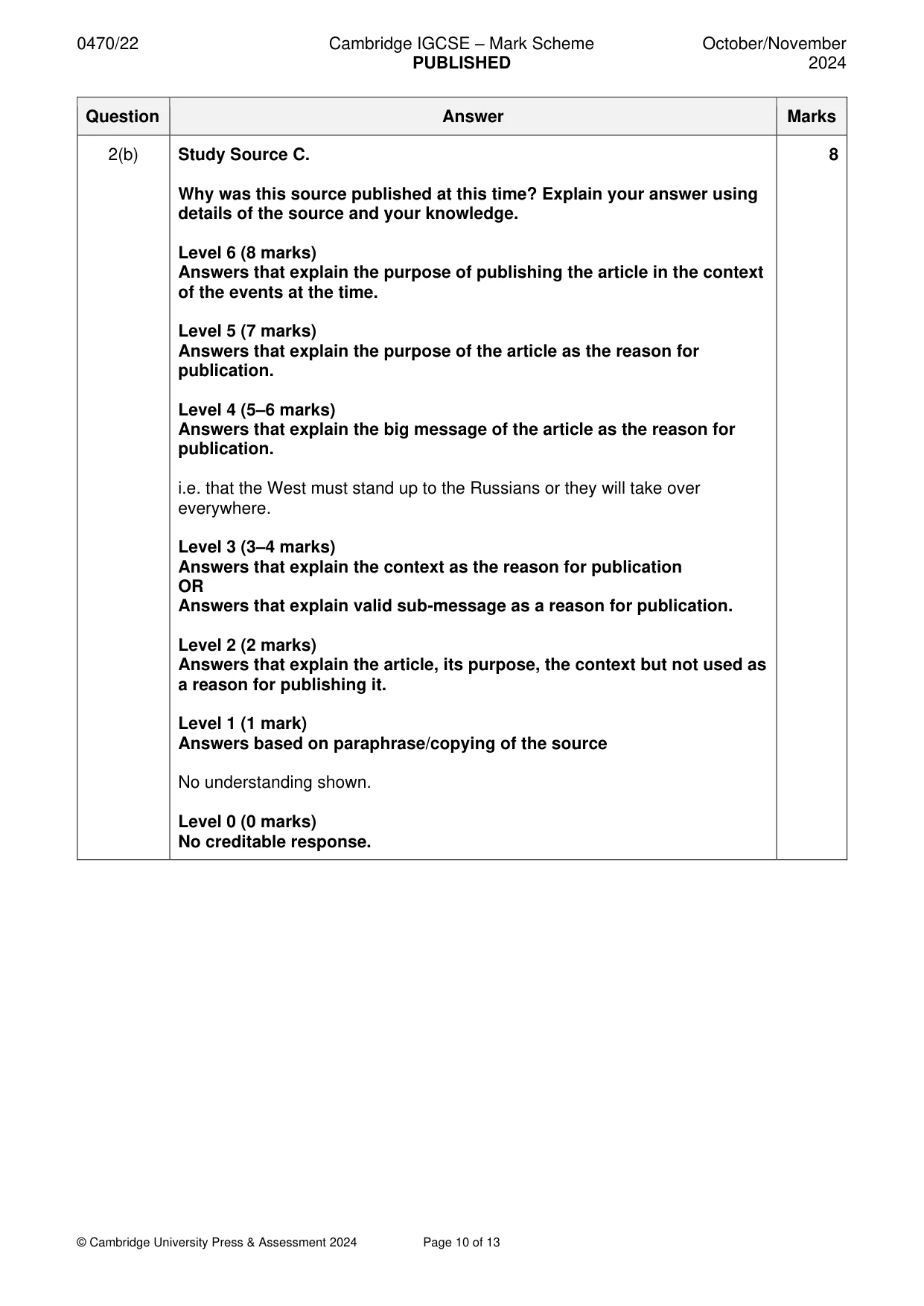
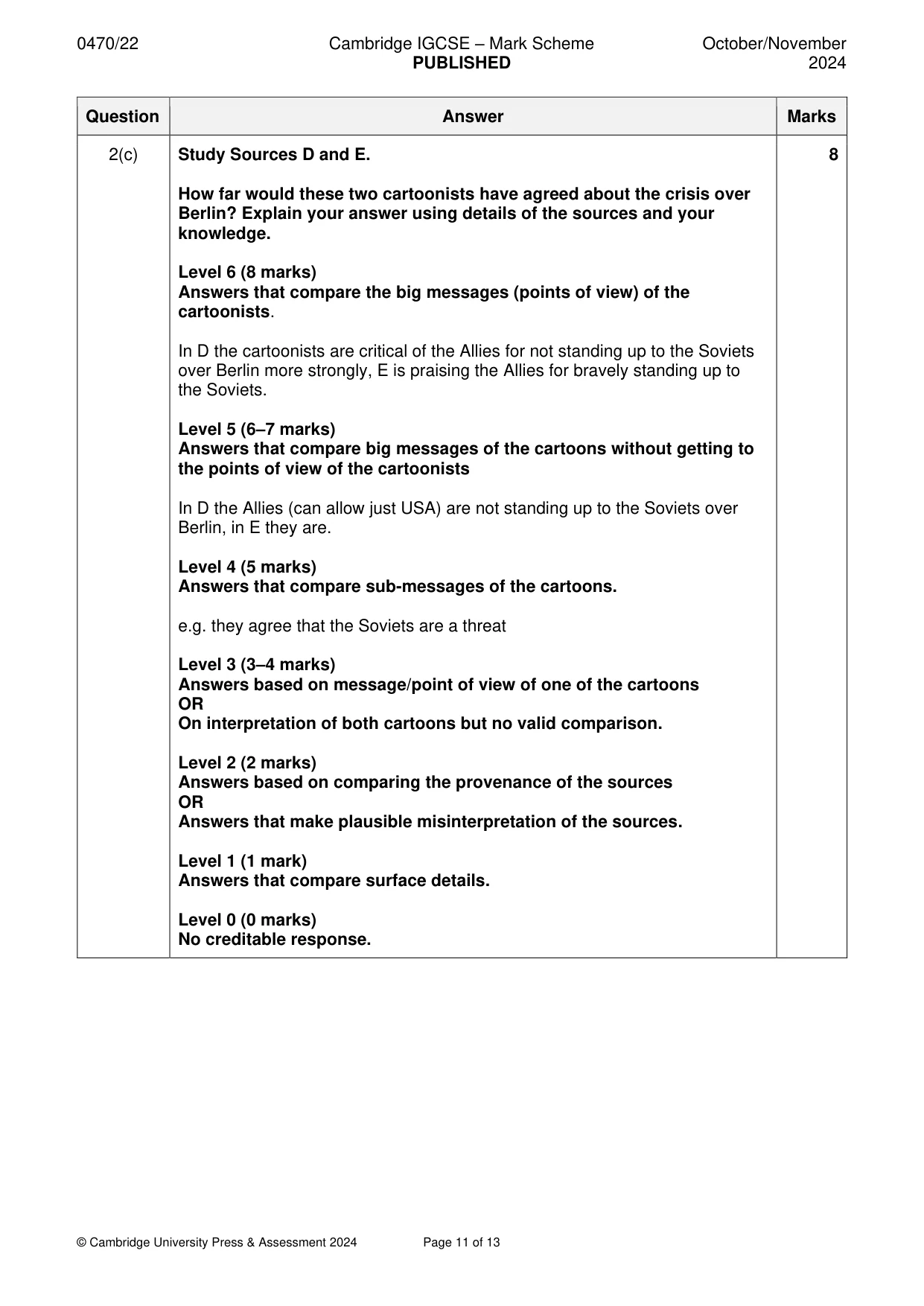
0470/22 Cambridge IGCSE – Mark Scheme PUBLISHED October/November 2024 © Cambridge University Press & Assessment 2024 Page 10 of 13 Question Answer Marks 2(b) Study Source C. Why was this source published at this time? Explain your answer using details of the source and your knowledge. Level 6 (8 marks) Answers that explain the purpose of publishing the article in the context of the events at the time. Level 5 (7 marks) Answers that explain the purpose of the article as the reason for publication. Level 4 (5–6 marks) Answers that explain the big message of the article as the reason for publication. i.e. that the West must stand up to the Russians or they will take over everywhere. Level 3 (3–4 marks) Answers that explain the context as the reason for publication OR Answers that explain valid sub-message as a reason for publication. Level 2 (2 marks) Answers that explain the article, its purpose, the context but not used as a reason for publishing it. Level 1 (1 mark) Answers based on paraphrase/copying of the source No understanding shown. Level 0 (0 marks) No creditable response. 8
Mark scheme, page 11
0470/22 Cambridge IGCSE – Mark Scheme PUBLISHED October/November 2024 © Cambridge University Press & Assessment 2024 Page 11 of 13 Question Answer Marks 2(c) Study Sources D and E. How far would these two cartoonists have agreed about the crisis over Berlin? Explain your answer using details of the sources and your knowledge. Level 6 (8 marks) Answers that compare the big messages (points of view) of the cartoonists. In D the cartoonists are critical of the Allies for not standing up to the Soviets over Berlin more strongly, E is praising the Allies for bravely standing up to the Soviets. Level 5 (6–7 marks) Answers that compare big messages of the cartoons without getting to the points of view of the cartoonists In D the Allies (can allow just USA) are not standing up to the Soviets over Berlin, in E they are. Level 4 (5 marks) Answers that compare sub-messages of the cartoons. e.g. they agree that the Soviets are a threat Level 3 (3–4 marks) Answers based on message/point of view of one of the cartoons OR On interpretation of both cartoons but no valid comparison. Level 2 (2 marks) Answers based on comparing the provenance of the sources OR Answers that make plausible misinterpretation of the sources. Level 1 (1 mark) Answers that compare surface details. Level 0 (0 marks) No creditable response. 8
Mark scheme, page 12
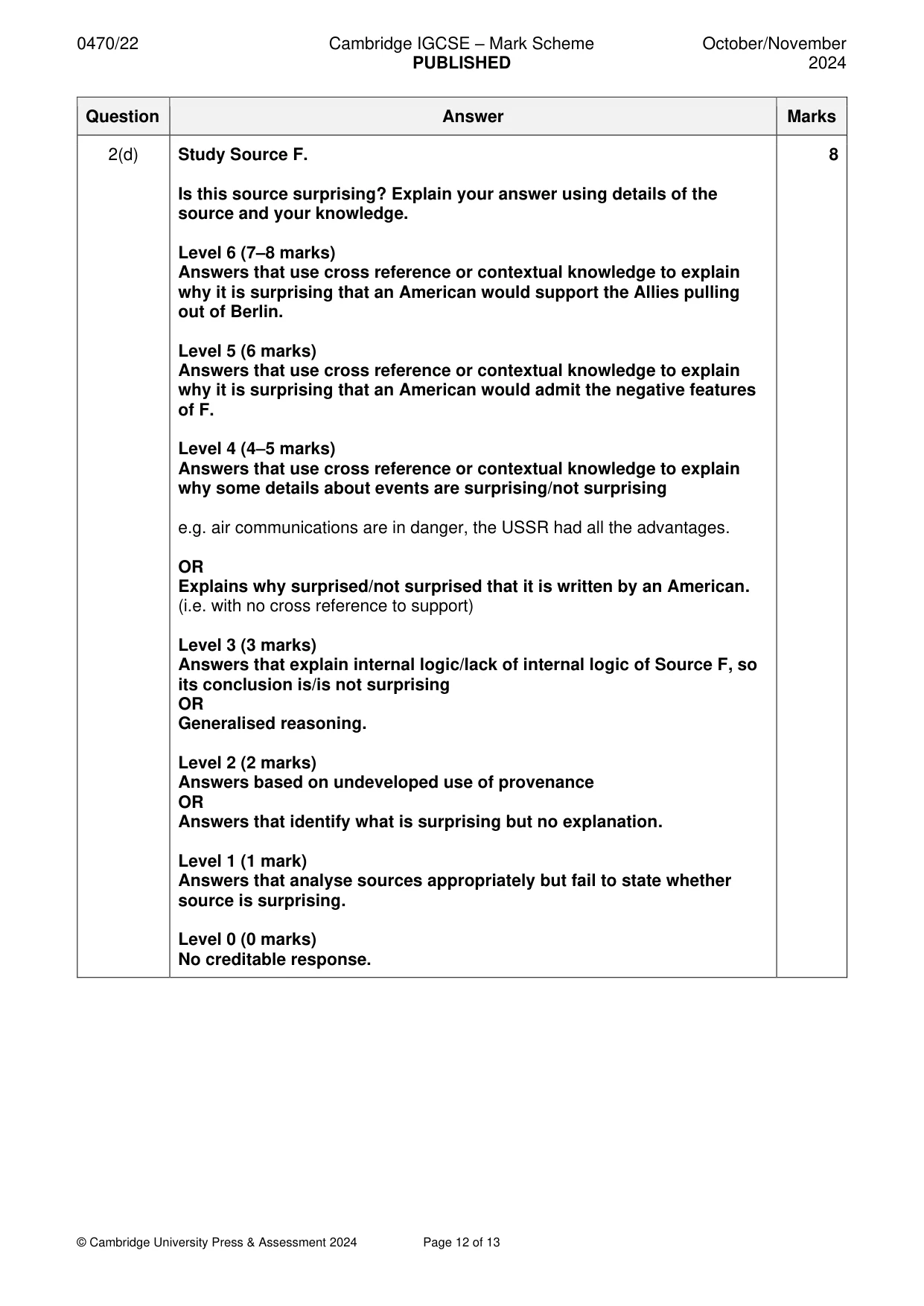
0470/22 Cambridge IGCSE – Mark Scheme PUBLISHED October/November 2024 © Cambridge University Press & Assessment 2024 Page 12 of 13 Question Answer Marks 2(d) Study Source F. Is this source surprising? Explain your answer using details of the source and your knowledge. Level 6 (7–8 marks) Answers that use cross reference or contextual knowledge to explain why it is surprising that an American would support the Allies pulling out of Berlin. Level 5 (6 marks) Answers that use cross reference or contextual knowledge to explain why it is surprising that an American would admit the negative features of F. Level 4 (4–5 marks) Answers that use cross reference or contextual knowledge to explain why some details about events are surprising/not surprising e.g. air communications are in danger, the USSR had all the advantages. OR Explains why surprised/not surprised that it is written by an American. (i.e. with no cross reference to support) Level 3 (3 marks) Answers that explain internal logic/lack of internal logic of Source F, so its conclusion is/is not surprising OR Generalised reasoning. Level 2 (2 marks) Answers based on undeveloped use of provenance OR Answers that identify what is surprising but no explanation. Level 1 (1 mark) Answers that analyse sources appropriately but fail to state whether source is surprising. Level 0 (0 marks) No creditable response. 8
Mark scheme, page 13
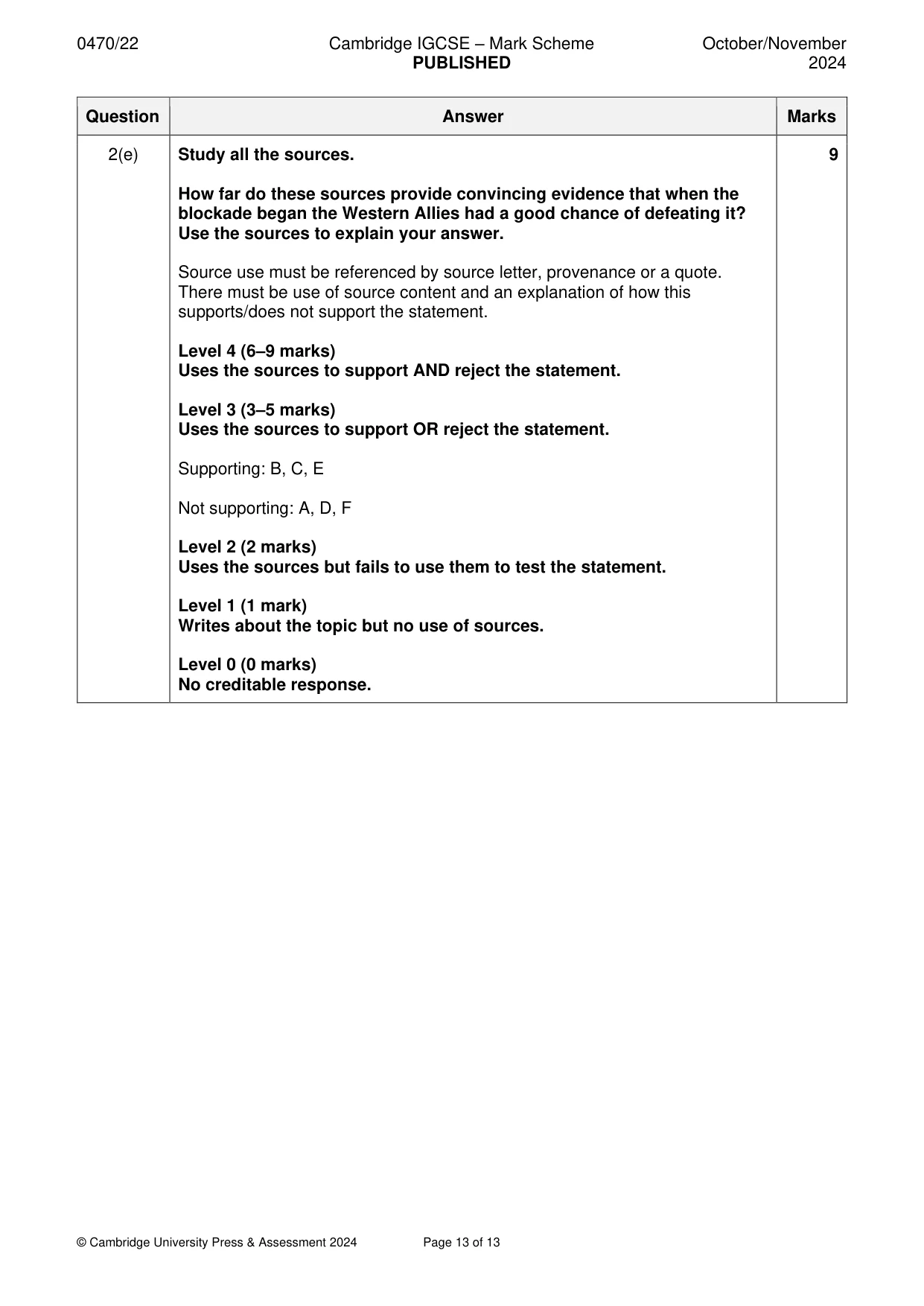
0470/22 Cambridge IGCSE – Mark Scheme PUBLISHED October/November 2024 © Cambridge University Press & Assessment 2024 Page 13 of 13 Question Answer Marks 2(e) Study all the sources. How far do these sources provide convincing evidence that when the blockade began the Western Allies had a good chance of defeating it? Use the sources to explain your answer. Source use must be referenced by source letter, provenance or a quote. There must be use of source content and an explanation of how this supports/does not support the statement. Level 4 (6–9 marks) Uses the sources to support AND reject the statement. Level 3 (3–5 marks) Uses the sources to support OR reject the statement. Supporting: B, C, E Not supporting: A, D, F Level 2 (2 marks) Uses the sources but fails to use them to test the statement. Level 1 (1 mark) Writes about the topic but no use of sources. Level 0 (0 marks) No creditable response. 9
What you needed in this session
Cambridge’s own grade thresholds for 2024 Oct/Nov, Paper 2 · Variant 2. A higher threshold means an easier paper — the bar moves with how the cohort did.