Cambridge IGCSE History 0470 — 2023 May/June Paper 2 · Variant 2
0470/22/M/J/23 · 50 marks · ≈56 min
The question paper and its mark scheme, free to read here and free to download. This is Cambridge’s own paper, exactly as it was sat.
Question paper16 pages



Mark scheme16 pages
Answers below. Sit the paper first if you are practising.
Paper as text
Question paper, page 1
[Turn over Cambridge IGCSE™ This document has 16 pages. Any blank pages are indicated. DC (LE/SG) 312397/4 © UCLES 2023 * 2 8 0 7 7 2 2 4 9 1 * HISTORY 0470/22 Paper 2 May/June 2023 2 hours You must answer on the enclosed answer booklet. You will need: Answer booklet (enclosed) INSTRUCTIONS ● Answer all the questions on one option only. Option A: Nineteenth century topic Option B: Twentieth century topic ● Follow the instructions on the front cover of the answer booklet. If you need additional answer paper, ask the invigilator for a continuation booklet. INFORMATION ● The total mark for this paper is 50. ● The number of marks for each question or part question is shown in brackets [ ].
Question paper, page 2
2 0470/22/M/J/23 © UCLES 2023 Option A: Nineteenth century topic HOW FAR DID AFRICA AND AFRICANS BENEFIT FROM EUROPEAN IMPERIALISM? Study the Background Information and the sources carefully, and then answer all the questions. Background Information The debate over the impact of European imperialism on Africa arouses strong opinions. On one side of the debate there are claims that it is impossible to put a price on the suffering it caused, and that it involved the brutal repression of the indigenous peoples and increased the wealth of Europe at the expense of Africa. On the other hand, there are claims that it led to gains for Africa in areas of medicine and technological knowledge, and that it sowed the seeds for democratic systems of government. Was the overall impact of imperialism beneficial or harmful for Africa? SOURCE A Imperialism led to Africans losing their land and their independence. Even the British system of indirect rule failed to leave African rulers free to behave as if nothing had changed with colonisation. The British disrupted traditional African culture and ways of living. Traditional authority figures were replaced and the gap between African chiefs and their people was widened. African economies were changed and became dependent on trade with Britain. The change to cash crops led to famine. Men were forced to leave villages to find ways to support themselves and their families. The division of Africa was harmful. Long-term rival chiefdoms were forced together. At other times, kinship groups were split between colonies. The artificial boundaries created problems for the nations that evolved from the former colonies. However, colonialism did lead to some improvements in sanitation, and provided hospitals and schools. Lifespans increased and literacy rates improved, although many died of new diseases such as smallpox. To aid economic growth, railroads, dams, and telephone and telegraph lines were built, but these mostly benefited European business interests, not Africans. Even fighting against slavery helped Britain’s trading interests. From a recent history book. SOURCE B It is difficult to make a sweeping judgement about British rule in Africa, but there were many benefits for Africans. The British system of indirect rule meant that power was exercised through African political structures and local rulers were still powerful. Africans were helped by Western medicine and formal education was introduced promoting literacy. Road systems, railroads, water and electricity were introduced. The Christian religion took away the need for sacrifices and rituals. Boundaries were established, making the process of independence easier. Colonial governments took over much of the land for their mines and farms. Belgium and Britain were most responsible for taking the best land and encouraging settlers into these areas. They used Africans as cheap labour in the mines and farms. Many African men were separated from their families and African villages lost their manpower for food production. Cash crops were introduced to meet the industrial needs of European countries and famine resulted from neglecting the production of basic foodstuffs. However, Africans in British colonies were often better off and the British were more tolerant of local religions and customs. The British put enormous resources into combating slavery. The Royal Navy stopped slave ships while British missionaries and explorers, with the help of British officials, worked tirelessly to stop the slave trade. From a recent history book.
Question paper, page 3
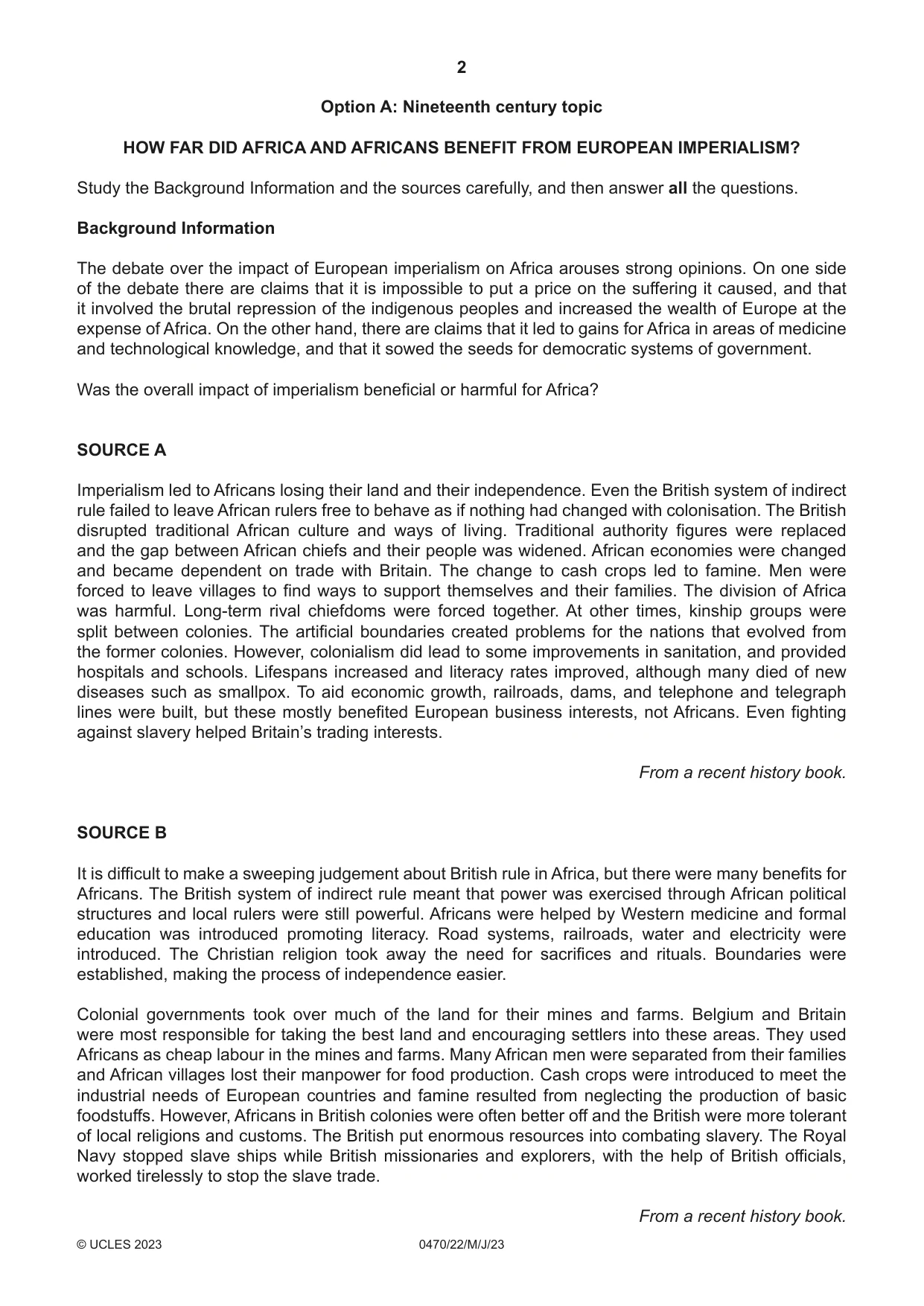
3 0470/22/M/J/23 © UCLES 2023 [Turn over SOURCE C A British advertisement for soap, 1890s.
Question paper, page 4
4 0470/22/M/J/23 © UCLES 2023 SOURCE D A photograph of a village school established by German missionaries in South West Africa, 1910. SOURCE E More large schools with European masters, where trades could be learnt and discipline enforced, are wanted in every district, so that there may be more thoroughness about the education. The expense would be large, but it is a matter of vital importance to the Colony that the young may be so trained that they can take their places worthily as members of a civilised and industrious community. From a report by the Chief Magistrate for the Division of Transkei, to the Parliament of the Cape Colony, 1879. SOURCE F All the Powers bind themselves to watch over the preservation of the native tribes, and to care for the improvement of the conditions of their moral and material well-being and to help in suppressing slavery. They shall protect all religious, scientific or charitable institutions which aim at instructing the natives and bringing home to them the blessings of civilisation. Christian missionaries, scientists, and explorers shall likewise be the objects of special protection. Freedom of conscience and religious toleration are guaranteed to the natives. From the agreements reached at the Berlin Conference (1884–85) which was attended by fourteen countries. The Conference was called to reach agreement over the partitioning of Africa. Content removed due to copyright restrictions.
Question paper, page 5
5 0470/22/M/J/23 © UCLES 2023 [Turn over SOURCE G The charges brought by the Association are directed against an entire system of administration which it condemns. Mr Harris’ Testimony I called attention to the atrocities including murders of men, women and children, destruction of the Baringa towns and the resulting famine. The murder of the chief of the village of Bolima, and the killing and cutting up of his wives. The public floggings of practically any and everyone. I then mentioned that the forests are exhausted of rubber. This is because the vines have been worked in such a way that all the rubber roots need a rest and the natives are now reduced to digging up these roots in order to get rubber. Huge taxes are imposed on the people by the ABIR agents. These taxes are levied on the food of the people. The whole village was under the despotic control of the ABIR sentries who resorted to murder and cannibalism. From a report of the evidence given to the Commission of Inquiry in 1904 into accusations of atrocities in the Congo Free State. It was published in London in 1905 by the Congo Reform Association which was worried that Leopold II of Belgium would not publish the findings of the Commission. The ABIR was the Abir Congo Company which ran part of the Congo Free State for Leopold.
Question paper, page 6
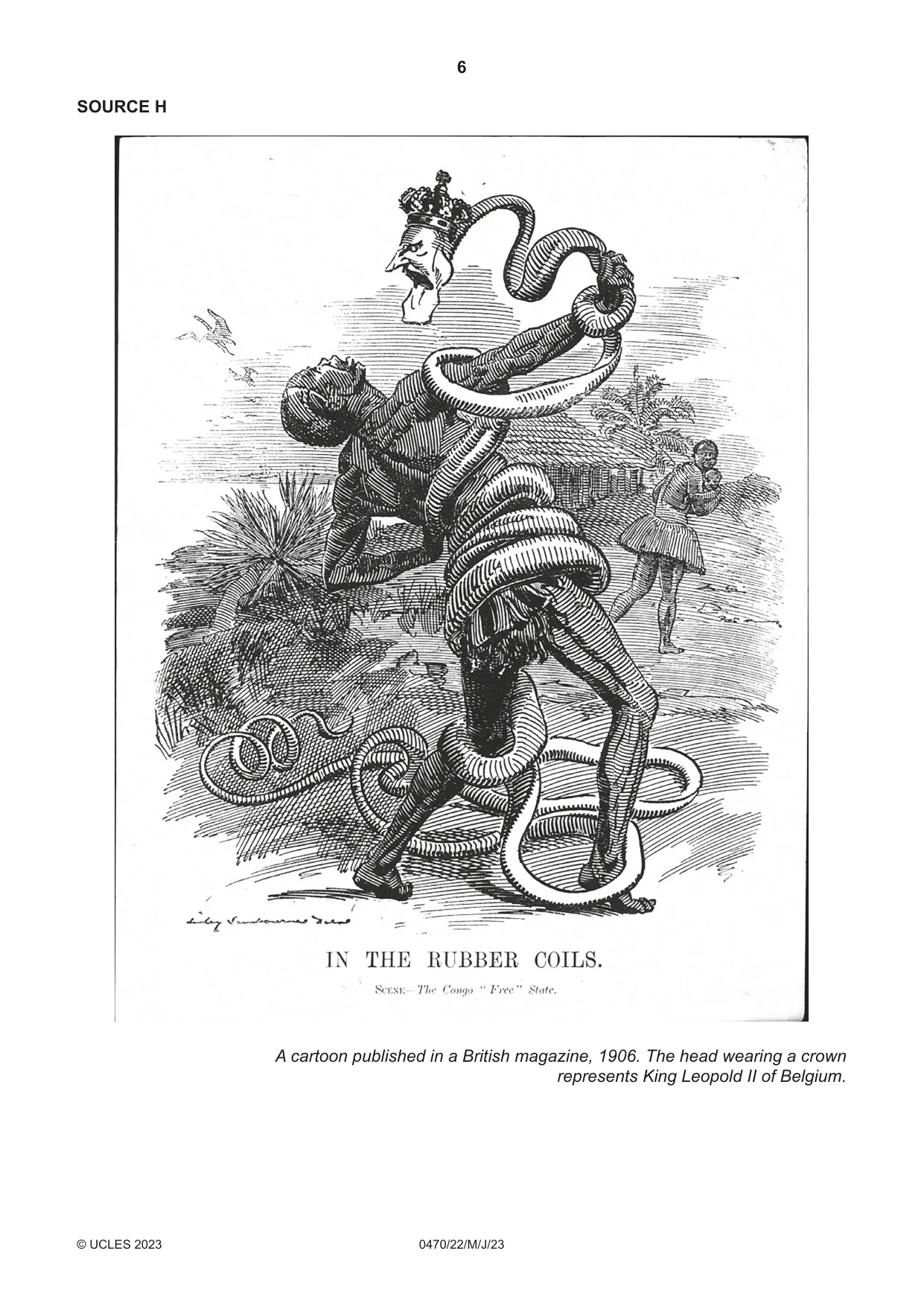
6 0470/22/M/J/23 © UCLES 2023 SOURCE H A cartoon published in a British magazine, 1906. The head wearing a crown represents King Leopold II of Belgium.
Question paper, page 7
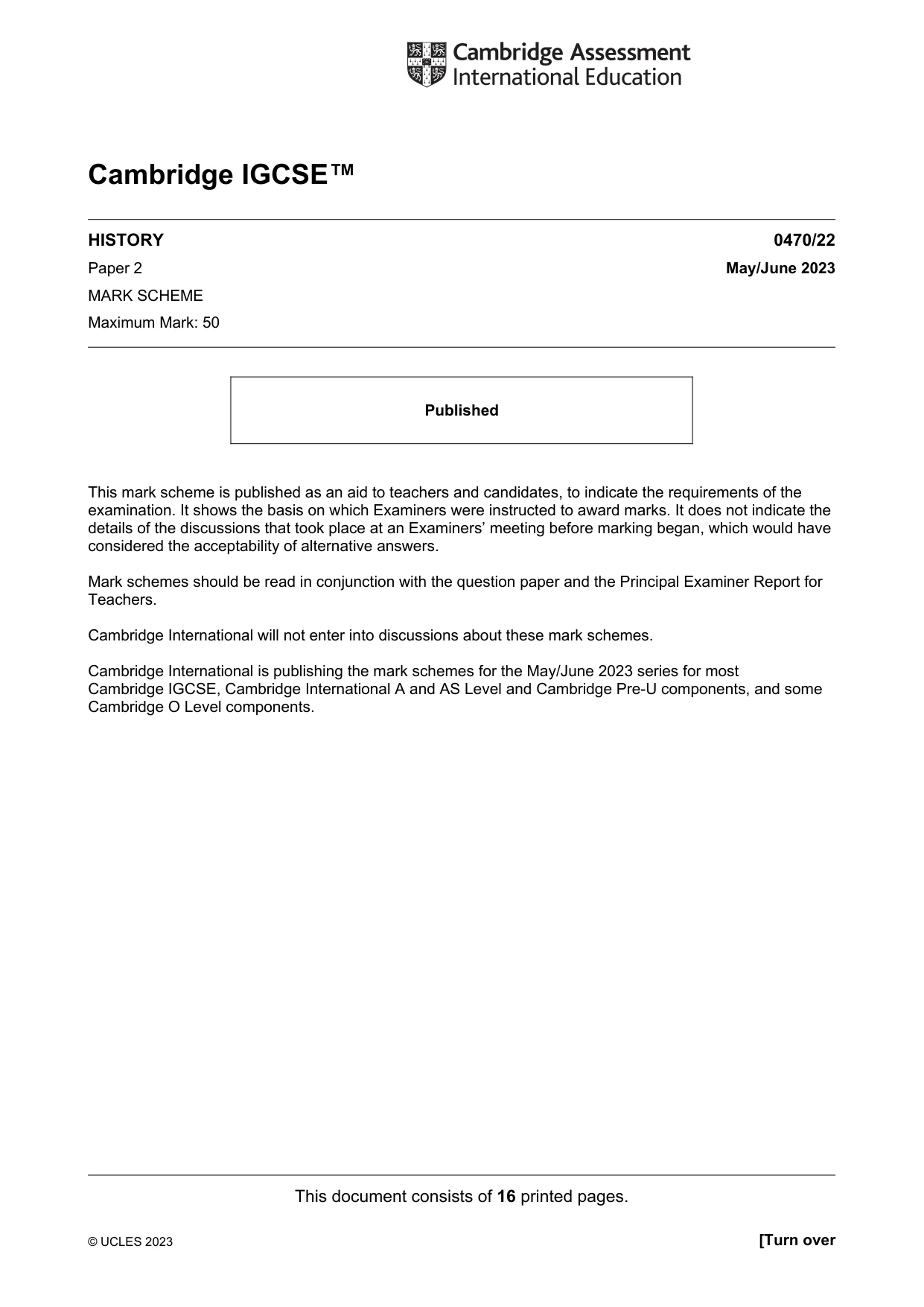
7 0470/22/M/J/23 © UCLES 2023 [Turn over Now answer all the following questions. You may use any of the sources to help you answer the questions, in addition to those sources which you are told to use. In answering the questions you should use your knowledge of the topic to help you interpret and evaluate the sources. 1 Study Sources A and B. How far do these two sources agree? Explain your answer using details of the sources. [7] 2 Study Source C. How reliable is Source C as evidence about European imperialism? Explain your answer using details of the source and your knowledge. [7] 3 Study Sources D and E. Is one of these sources more useful than the other to a historian studying colonial Africa? Explain your answer using details of the sources and your knowledge. [8] 4 Study Sources F and G. How far does Source F make Source G surprising? Explain your answer using details of the sources and your knowledge. [8] 5 Study Source H. Why was this source published in 1906? Explain your answer using details of the source and your knowledge. [8] 6 Study all the sources. How far do these sources provide convincing evidence that imperialism had a beneficial impact on Africa? Use the sources to explain your answer. [12]
Question paper, page 8
8 0470/22/M/J/23 © UCLES 2023 Option B: Twentieth century topic WAS THE ANSCHLUSS SUPPORTED BY THE AUSTRIAN PEOPLE? Study the Background Information and the sources carefully, and then answer all the questions. Background Information After Hitler came to power, Nazi propaganda in Austria in favour of a union with Germany intensified. In 1934 Austrian Nazis assassinated the chancellor, Dollfuss. His replacement, Schuschnigg, decided to hold a plebiscite in 1938 to see if Austrians wanted a free and independent Austria. Under Nazi pressure, he cancelled the plebiscite and resigned. On the next day, 12 March 1938, German troops entered Austria, and one day later, Austria was incorporated into Germany. A plebiscite was held in April and showed overwhelming support for the union in Germany and in Austria. Hitler claimed that the German people had a right to self-determination and that this involved uniting all Germans, including those in Austria, in a Greater Germany. He also claimed that the overwhelming majority of Austrians wanted a union with Germany. Austrians like Schuschnigg, as well as many European countries, regarded Austria as an independent country and saw the events of March 1938 as a conquest by Germany. How far did the Austrian people support the Anschluss? SOURCE A When the German army marched into Austria on 12 March 1938, it did not have to fight because it was welcomed by the Austrian people. A life-long ambition of Hitler, the ‘return’ of German-Austria to the Greater German Reich, was fulfilled. Newsreels of Hitler announcing the event in Vienna, and the ecstatic crowds who were listening to him, went all round the world at the time. They showed that the vast majority of Austrians supported the Anschluss. This was reinforced on 10 April when a plebiscite was held in Germany and Austria. Although the plebiscite was subject to Nazi propaganda and intimidation, the result (99.8 per cent of Austrians in favour of the Anschluss) did represent the genuine German nationalist feeling in Austria at the time. How many Austrians behind closed doors were secretly against the Anschluss remains unknown but only one ‘unhappy face’ of an Austrian in public when the Germans marched in has ever been produced. Recent research has suggested that two-thirds of the electorate were genuinely in favour of German rule. What is not in dispute is the intensity of the anti-Semitic aggression that was soon unleashed on Austria’s Jews. Mobs roved the streets inflicting physical abuse and ritual humiliation (like forced washing of pavements) on anyone suspected of hostility to the new regime. All of this represented the attitudes of the time in 1930s Austria where the majority of Vienna’s clubs and organisations refused to accept Jews as members. From a recent history book.
Question paper, page 9
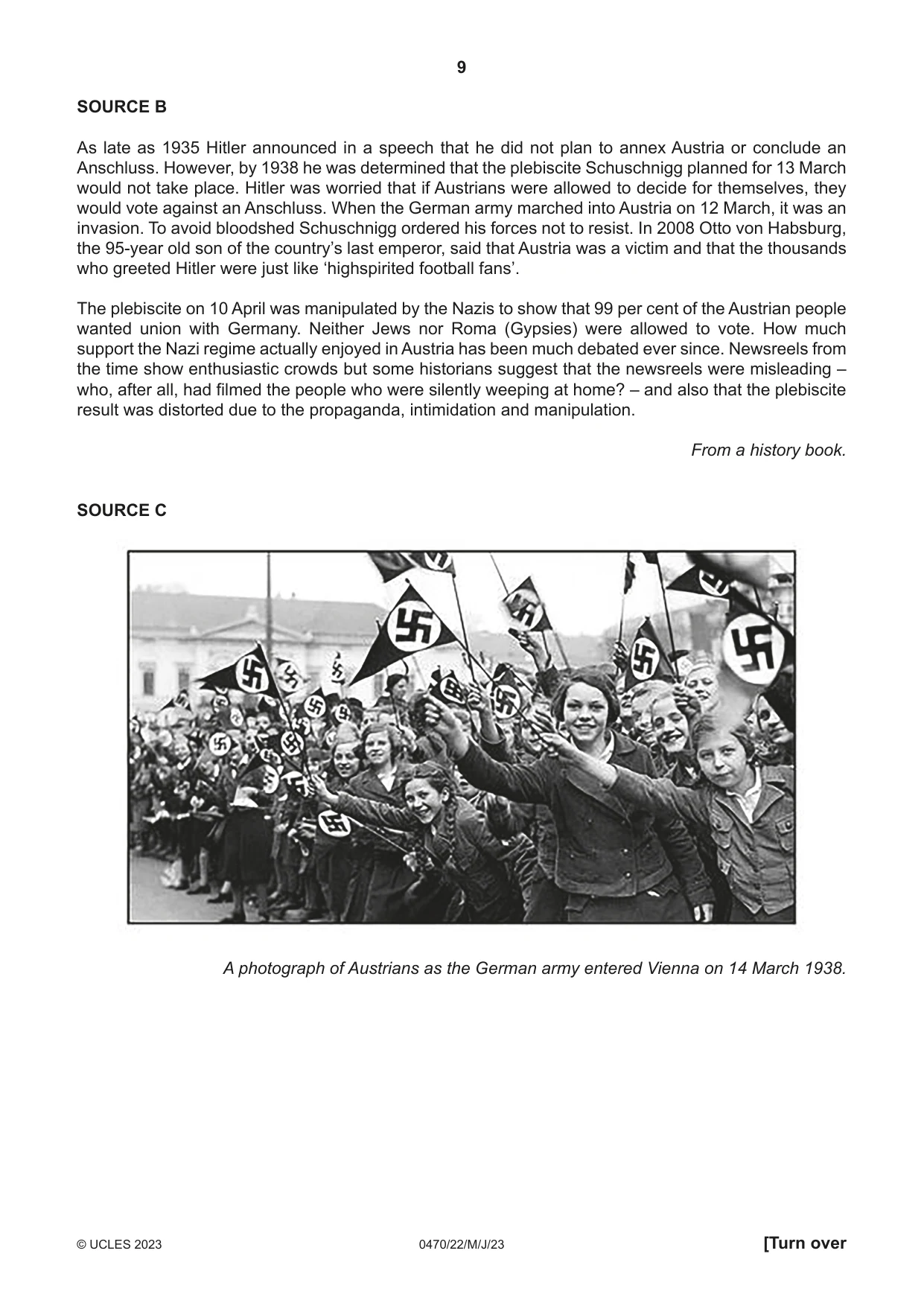
9 0470/22/M/J/23 © UCLES 2023 [Turn over SOURCE B As late as 1935 Hitler announced in a speech that he did not plan to annex Austria or conclude an Anschluss. However, by 1938 he was determined that the plebiscite Schuschnigg planned for 13 March would not take place. Hitler was worried that if Austrians were allowed to decide for themselves, they would vote against an Anschluss. When the German army marched into Austria on 12 March, it was an invasion. To avoid bloodshed Schuschnigg ordered his forces not to resist. In 2008 Otto von Habsburg, the 95-year old son of the country’s last emperor, said that Austria was a victim and that the thousands who greeted Hitler were just like ‘highspirited football fans’. The plebiscite on 10 April was manipulated by the Nazis to show that 99 per cent of the Austrian people wanted union with Germany. Neither Jews nor Roma (Gypsies) were allowed to vote. How much support the Nazi regime actually enjoyed in Austria has been much debated ever since. Newsreels from the time show enthusiastic crowds but some historians suggest that the newsreels were misleading – who, after all, had filmed the people who were silently weeping at home? – and also that the plebiscite result was distorted due to the propaganda, intimidation and manipulation. From a history book. SOURCE C A photograph of Austrians as the German army entered Vienna on 14 March 1938.
Question paper, page 10
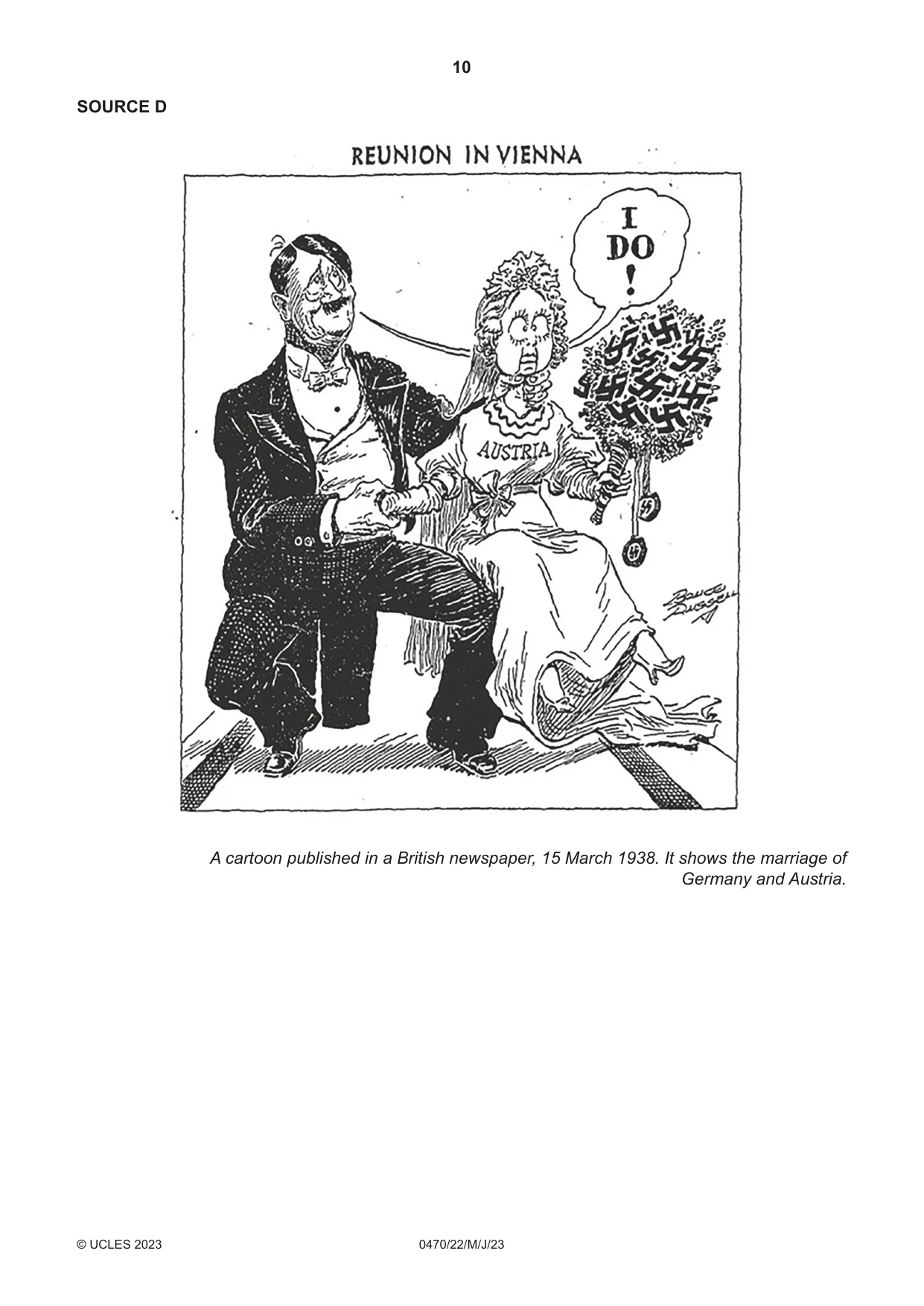
10 0470/22/M/J/23 © UCLES 2023 SOURCE D A cartoon published in a British newspaper, 15 March 1938. It shows the marriage of Germany and Austria.
Question paper, page 11
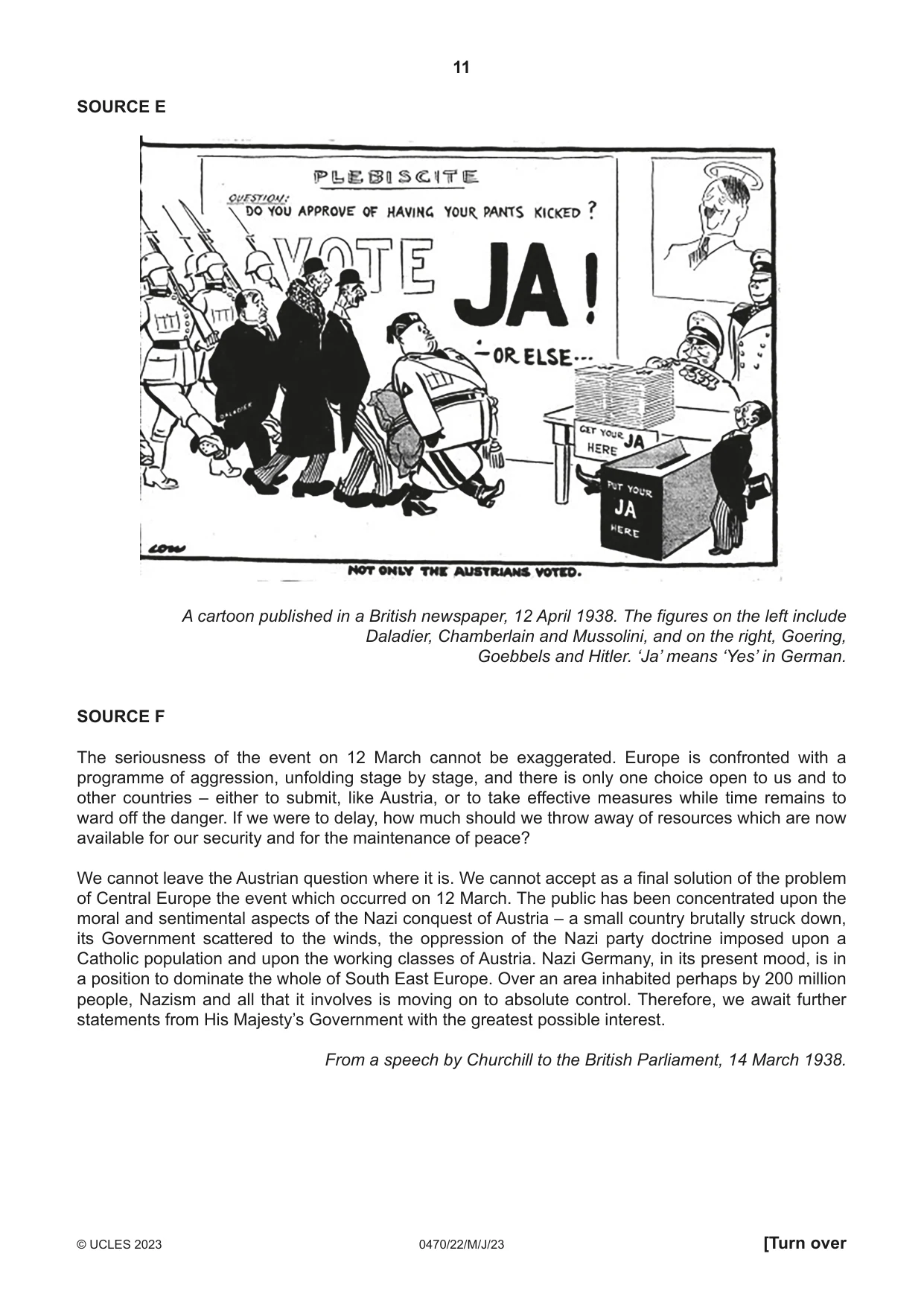
11 0470/22/M/J/23 © UCLES 2023 [Turn over SOURCE E A cartoon published in a British newspaper, 12 April 1938. The figures on the left include Daladier, Chamberlain and Mussolini, and on the right, Goering, Goebbels and Hitler. ‘Ja’ means ‘Yes’ in German. SOURCE F The seriousness of the event on 12 March cannot be exaggerated. Europe is confronted with a programme of aggression, unfolding stage by stage, and there is only one choice open to us and to other countries – either to submit, like Austria, or to take effective measures while time remains to ward off the danger. If we were to delay, how much should we throw away of resources which are now available for our security and for the maintenance of peace? We cannot leave the Austrian question where it is. We cannot accept as a final solution of the problem of Central Europe the event which occurred on 12 March. The public has been concentrated upon the moral and sentimental aspects of the Nazi conquest of Austria – a small country brutally struck down, its Government scattered to the winds, the oppression of the Nazi party doctrine imposed upon a Catholic population and upon the working classes of Austria. Nazi Germany, in its present mood, is in a position to dominate the whole of South East Europe. Over an area inhabited perhaps by 200 million people, Nazism and all that it involves is moving on to absolute control. Therefore, we await further statements from His Majesty’s Government with the greatest possible interest. From a speech by Churchill to the British Parliament, 14 March 1938.
Question paper, page 12
12 0470/22/M/J/23 © UCLES 2023 SOURCE G Certain foreign newspapers have said that we fell on Austria with brutal methods. I can only say that even in death they cannot stop lying. I have in the course of my political struggle won much love from my people, but when I crossed the former frontier into Austria I was met by such a stream of love as I have never before experienced. We have come not as tyrants, but as liberators: an entire people rejoiced. Here, not brutal violence, but our swastika has conquered. In truth it was the uprising of the people. Millions of our countrymen in Austria have held their banners high and have remained loyal to the Reich. From a speech by Hitler during the campaign for the German parliamentary elections, 25 March 1938. SOURCE H We were under no obligation to take action over Austria, but we were pledged to consult with the French and Italian Governments if action was taken which affected Austrian independence. As a result of that consultation, we made protests to the German Government over their actions. It is quite untrue to suggest that we have ever given Germany our assent or encouragement to the absorption of Austria into the German Reich. We have never refused to recognise the special interest that Germany had in the development of its relations with Austria, having regard to the close relationship existing between the two countries. But we have always made it clear to Germany that we would disapprove of the use of violent methods. However, it is necessary to face facts. Nothing could have stopped this action by Germany unless we and others had been prepared to use force to prevent it. The British Prime Minister, Neville Chamberlain, speaking in a debate in the British Parliament, 14 March 1938.
Question paper, page 13
13 0470/22/M/J/23 © UCLES 2023 Now answer all the following questions. You may use any of the sources to help you answer the questions, in addition to those sources which you are told to use. In answering the questions you should use your knowledge of the topic to help you interpret and evaluate the sources. 1 Study Sources A and B. How far do these two sources agree? Explain your answer using details of the sources. [7] 2 Study Source C. How useful is this source to a historian studying the Anschluss? Explain your answer using details of the source and your knowledge. [8] 3 Study Sources D and E. How similar are the messages of the two cartoonists? Explain your answer using details of the sources and your knowledge. [7] 4 Study Sources F and G. After reading Source F, do you believe Hitler in Source G? Explain your answer using details of the sources and your knowledge. [8] 5 Study Source H. Are you surprised by this source? Explain your answer using details of the source and your knowledge. [8] 6 Study all the sources. How far do these sources provide convincing evidence that the Austrian people supported the Anschluss? Use the sources to explain your answer. [12]
Question paper, page 14
14 0470/22/M/J/23 © UCLES 2023 BLANK PAGE
Question paper, page 15
15 0470/22/M/J/23 © UCLES 2023 BLANK PAGE
Question paper, page 16
16 0470/22/M/J/23 © UCLES 2023 Permission to reproduce items where third-party owned material protected by copyright is included has been sought and cleared where possible. Every reasonable effort has been made by the publisher (UCLES) to trace copyright holders, but if any items requiring clearance have unwittingly been included, the publisher will be pleased to make amends at the earliest possible opportunity. To avoid the issue of disclosure of answer-related information to candidates, all copyright acknowledgements are reproduced online in the Cambridge Assessment International Education Copyright Acknowledgements Booklet. This is produced for each series of examinations and is freely available to download at www.cambridgeinternational.org after the live examination series. Cambridge Assessment International Education is part of Cambridge Assessment. Cambridge Assessment is the brand name of the University of Cambridge Local Examinations Syndicate (UCLES), which is a department of the University of Cambridge. BLANK PAGE
Mark scheme, page 1
This document consists of 16 printed pages. © UCLES 2023 [Turn over Cambridge IGCSE™ HISTORY 0470/22 Paper 2 May/June 2023 MARK SCHEME Maximum Mark: 50 Published This mark scheme is published as an aid to teachers and candidates, to indicate the requirements of the examination. It shows the basis on which Examiners were instructed to award marks. It does not indicate the details of the discussions that took place at an Examiners’ meeting before marking began, which would have considered the acceptability of alternative answers. Mark schemes should be read in conjunction with the question paper and the Principal Examiner Report for Teachers. Cambridge International will not enter into discussions about these mark schemes. Cambridge International is publishing the mark schemes for the May/June 2023 series for most Cambridge IGCSE, Cambridge International A and AS Level and Cambridge Pre-U components, and some Cambridge O Level components.
Mark scheme, page 2
0470/22 Cambridge IGCSE – Mark Scheme PUBLISHED May/June 2023 © UCLES 2023 Page 2 of 16 Generic Marking Principles These general marking principles must be applied by all examiners when marking candidate answers. They should be applied alongside the specific content of the mark scheme or generic level descriptors for a question. Each question paper and mark scheme will also comply with these marking principles. GENERIC MARKING PRINCIPLE 1: Marks must be awarded in line with: the specific content of the mark scheme or the generic level descriptors for the question the specific skills defined in the mark scheme or in the generic level descriptors for the question the standard of response required by a candidate as exemplified by the standardisation scripts. GENERIC MARKING PRINCIPLE 2: Marks awarded are always whole marks (not half marks, or other fractions). GENERIC MARKING PRINCIPLE 3: Marks must be awarded positively: marks are awarded for correct/valid answers, as defined in the mark scheme. However, credit is given for valid answers which go beyond the scope of the syllabus and mark scheme, referring to your Team Leader as appropriate marks are awarded when candidates clearly demonstrate what they know and can do marks are not deducted for errors marks are not deducted for omissions answers should only be judged on the quality of spelling, punctuation and grammar when these features are specifically assessed by the question as indicated by the mark scheme. The meaning, however, should be unambiguous. GENERIC MARKING PRINCIPLE 4: Rules must be applied consistently, e.g. in situations where candidates have not followed instructions or in the application of generic level descriptors.
Mark scheme, page 3
0470/22 Cambridge IGCSE – Mark Scheme PUBLISHED May/June 2023 © UCLES 2023 Page 3 of 16 GENERIC MARKING PRINCIPLE 5: Marks should be awarded using the full range of marks defined in the mark scheme for the question (however; the use of the full mark range may be limited according to the quality of the candidate responses seen). GENERIC MARKING PRINCIPLE 6: Marks awarded are based solely on the requirements as defined in the mark scheme. Marks should not be awarded with grade thresholds or grade descriptors in mind.
Mark scheme, page 4
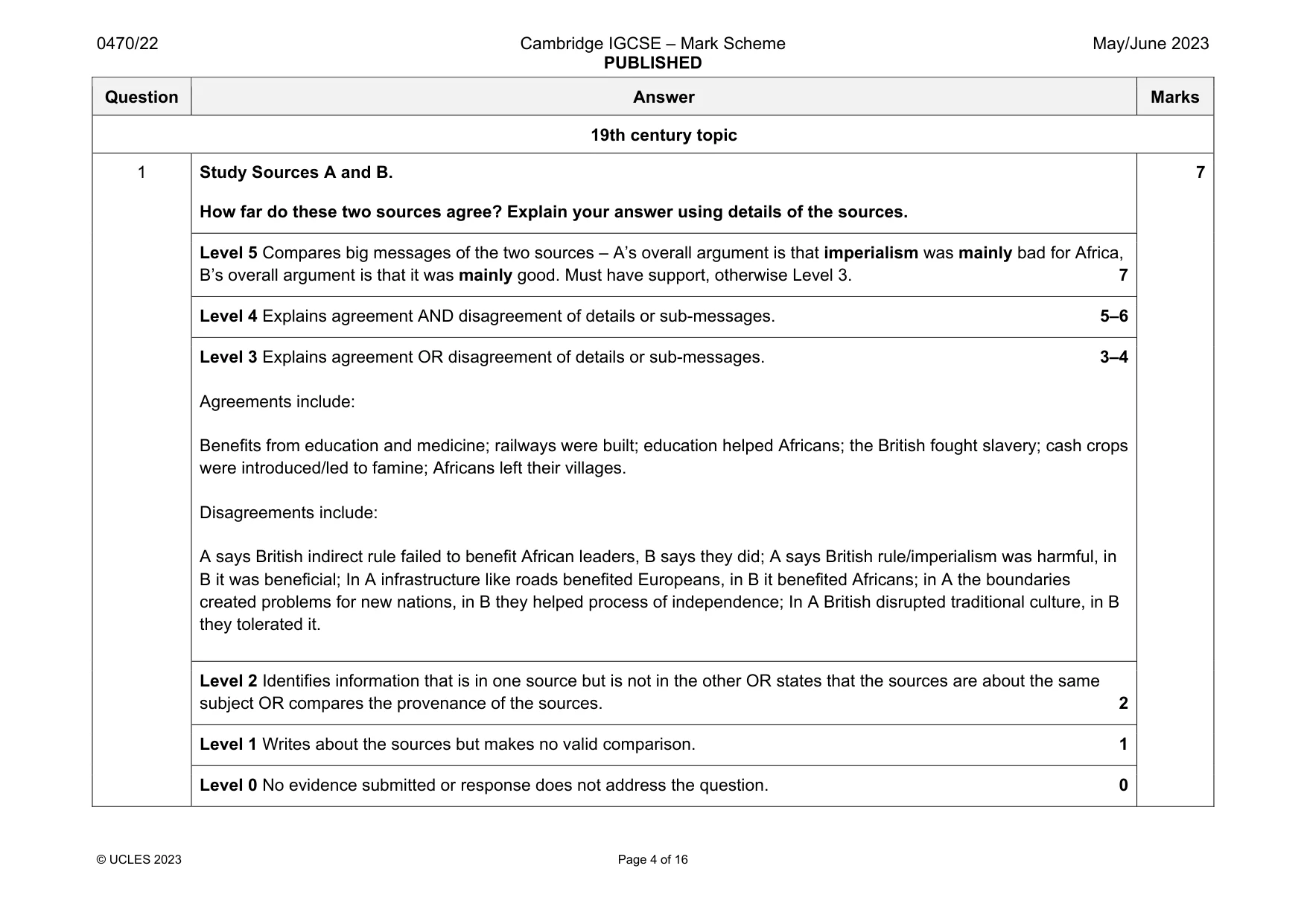
0470/22 Cambridge IGCSE – Mark Scheme PUBLISHED May/June 2023 © UCLES 2023 Page 4 of 16 Question Answer Marks 19th century topic 1 Study Sources A and B. How far do these two sources agree? Explain your answer using details of the sources. 7 Level 5 Compares big messages of the two sources – A’s overall argument is that imperialism was mainly bad for Africa, B’s overall argument is that it was mainly good. Must have support, otherwise Level 3. 7 Level 4 Explains agreement AND disagreement of details or sub-messages. 5–6 Level 3 Explains agreement OR disagreement of details or sub-messages. 3–4 Agreements include: Benefits from education and medicine; railways were built; education helped Africans; the British fought slavery; cash crops were introduced/led to famine; Africans left their villages. Disagreements include: A says British indirect rule failed to benefit African leaders, B says they did; A says British rule/imperialism was harmful, in B it was beneficial; In A infrastructure like roads benefited Europeans, in B it benefited Africans; in A the boundaries created problems for new nations, in B they helped process of independence; In A British disrupted traditional culture, in B they tolerated it. Level 2 Identifies information that is in one source but is not in the other OR states that the sources are about the same subject OR compares the provenance of the sources. 2 Level 1 Writes about the sources but makes no valid comparison. 1 Level 0 No evidence submitted or response does not address the question. 0
Mark scheme, page 5
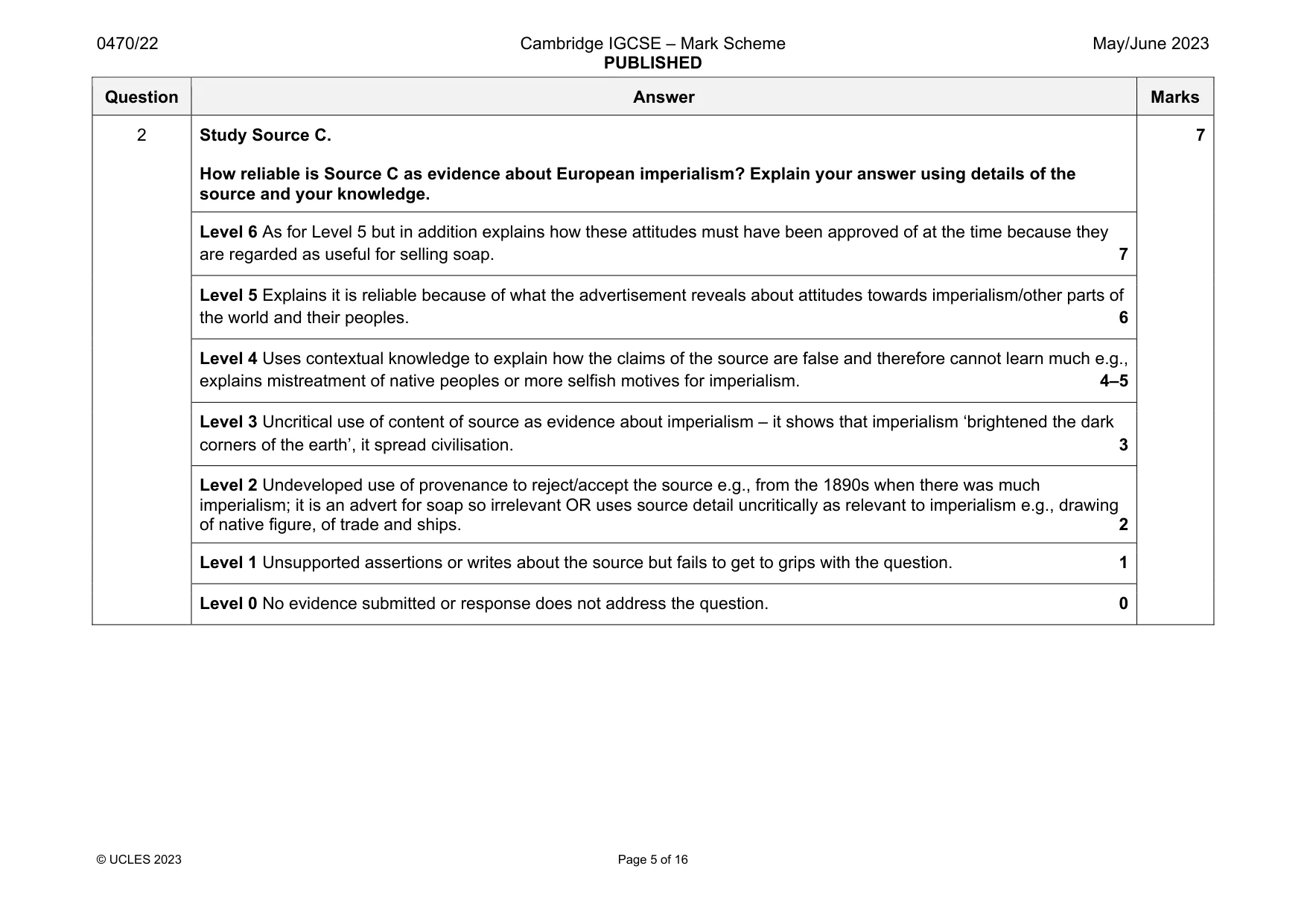
0470/22 Cambridge IGCSE – Mark Scheme PUBLISHED May/June 2023 © UCLES 2023 Page 5 of 16 Question Answer Marks 2 Study Source C. How reliable is Source C as evidence about European imperialism? Explain your answer using details of the source and your knowledge. 7 Level 6 As for Level 5 but in addition explains how these attitudes must have been approved of at the time because they are regarded as useful for selling soap. 7 Level 5 Explains it is reliable because of what the advertisement reveals about attitudes towards imperialism/other parts of the world and their peoples. 6 Level 4 Uses contextual knowledge to explain how the claims of the source are false and therefore cannot learn much e.g., explains mistreatment of native peoples or more selfish motives for imperialism. 4–5 Level 3 Uncritical use of content of source as evidence about imperialism – it shows that imperialism ‘brightened the dark corners of the earth’, it spread civilisation. 3 Level 2 Undeveloped use of provenance to reject/accept the source e.g., from the 1890s when there was much imperialism; it is an advert for soap so irrelevant OR uses source detail uncritically as relevant to imperialism e.g., drawing of native figure, of trade and ships. 2 Level 1 Unsupported assertions or writes about the source but fails to get to grips with the question. 1 Level 0 No evidence submitted or response does not address the question. 0
Mark scheme, page 6
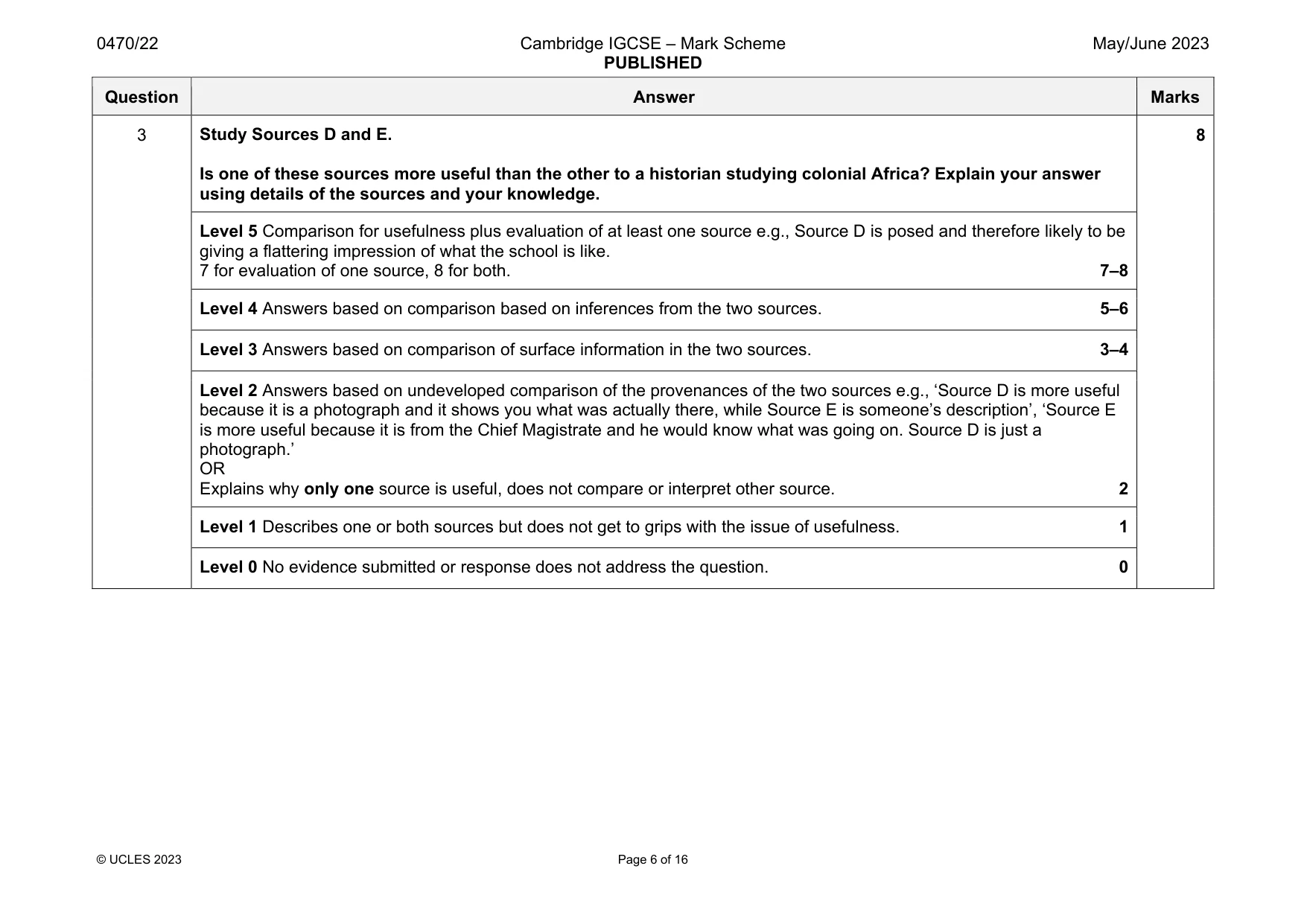
0470/22 Cambridge IGCSE – Mark Scheme PUBLISHED May/June 2023 © UCLES 2023 Page 6 of 16 Question Answer Marks 3 Study Sources D and E. Is one of these sources more useful than the other to a historian studying colonial Africa? Explain your answer using details of the sources and your knowledge. 8 Level 5 Comparison for usefulness plus evaluation of at least one source e.g., Source D is posed and therefore likely to be giving a flattering impression of what the school is like. 7 for evaluation of one source, 8 for both. 7–8 Level 4 Answers based on comparison based on inferences from the two sources. 5–6 Level 3 Answers based on comparison of surface information in the two sources. 3–4 Level 2 Answers based on undeveloped comparison of the provenances of the two sources e.g., ‘Source D is more useful because it is a photograph and it shows you what was actually there, while Source E is someone’s description’, ‘Source E is more useful because it is from the Chief Magistrate and he would know what was going on. Source D is just a photograph.’ OR Explains why only one source is useful, does not compare or interpret other source. 2 Level 1 Describes one or both sources but does not get to grips with the issue of usefulness. 1 Level 0 No evidence submitted or response does not address the question. 0
Mark scheme, page 7
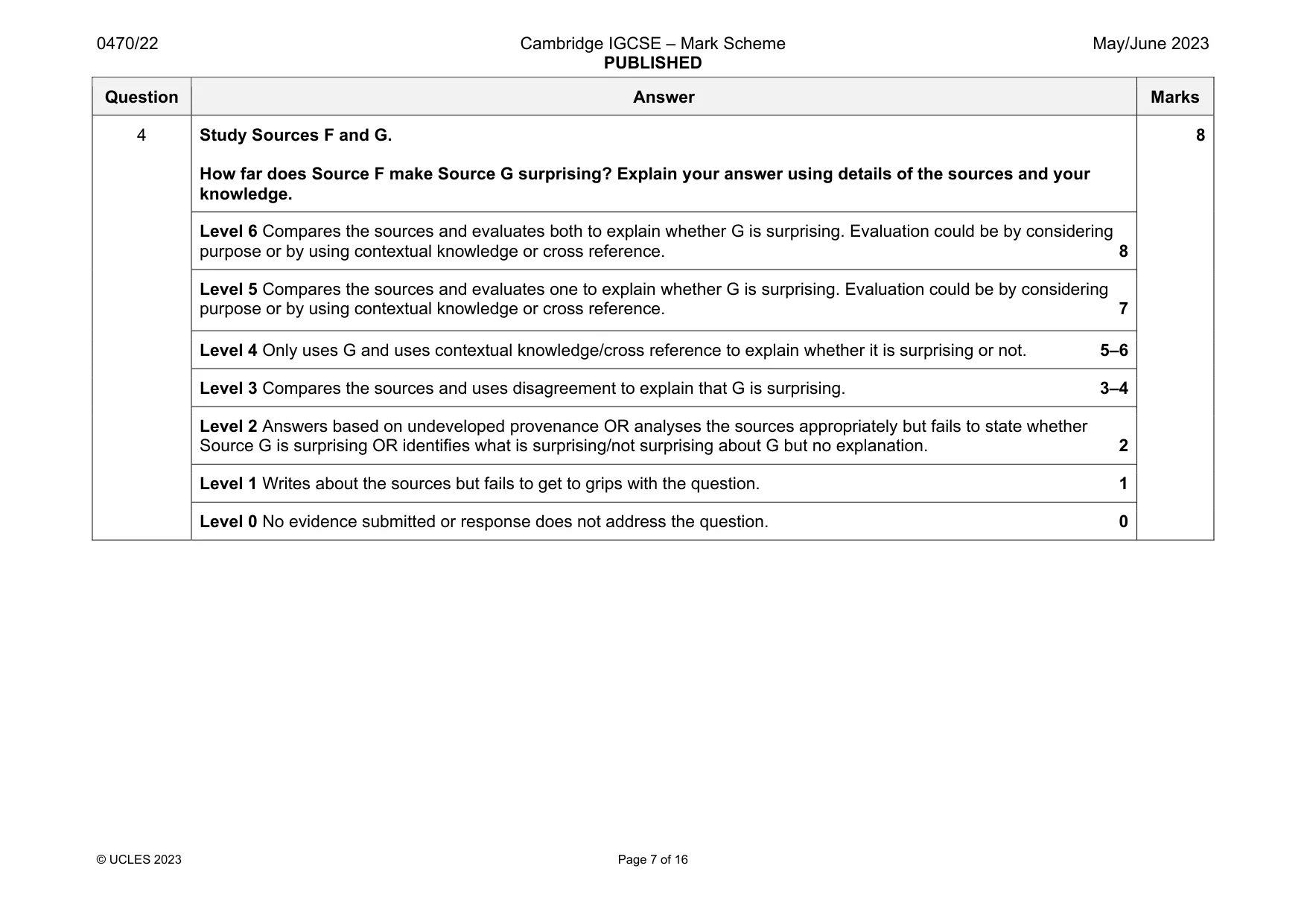
0470/22 Cambridge IGCSE – Mark Scheme PUBLISHED May/June 2023 © UCLES 2023 Page 7 of 16 Question Answer Marks 4 Study Sources F and G. How far does Source F make Source G surprising? Explain your answer using details of the sources and your knowledge. 8 Level 6 Compares the sources and evaluates both to explain whether G is surprising. Evaluation could be by considering purpose or by using contextual knowledge or cross reference. 8 Level 5 Compares the sources and evaluates one to explain whether G is surprising. Evaluation could be by considering purpose or by using contextual knowledge or cross reference. 7 Level 4 Only uses G and uses contextual knowledge/cross reference to explain whether it is surprising or not. 5–6 Level 3 Compares the sources and uses disagreement to explain that G is surprising. 3–4 Level 2 Answers based on undeveloped provenance OR analyses the sources appropriately but fails to state whether Source G is surprising OR identifies what is surprising/not surprising about G but no explanation. 2 Level 1 Writes about the sources but fails to get to grips with the question. 1 Level 0 No evidence submitted or response does not address the question. 0
Mark scheme, page 8
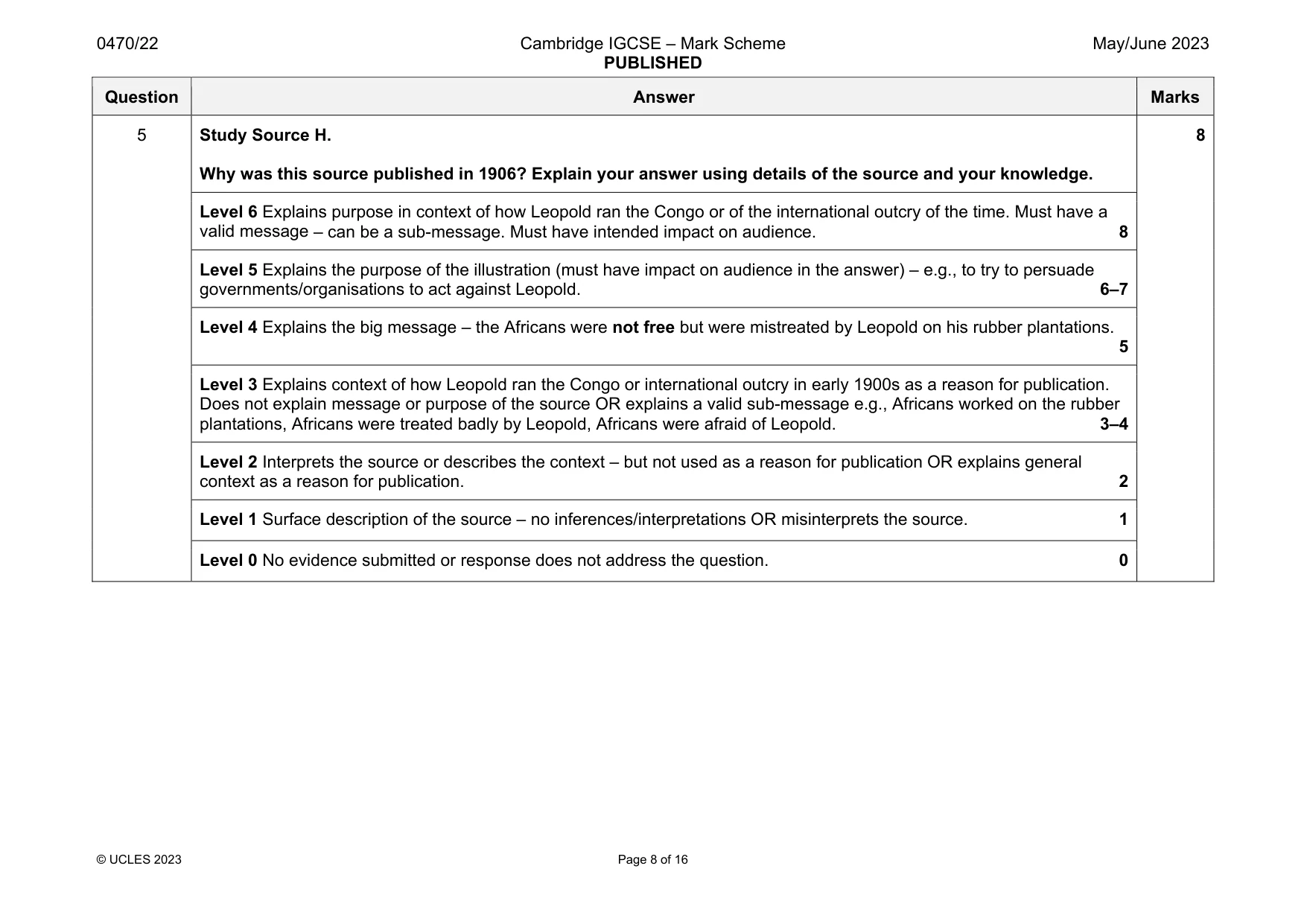
0470/22 Cambridge IGCSE – Mark Scheme PUBLISHED May/June 2023 © UCLES 2023 Page 8 of 16 Question Answer Marks 5 Study Source H. Why was this source published in 1906? Explain your answer using details of the source and your knowledge. 8 Level 6 Explains purpose in context of how Leopold ran the Congo or of the international outcry of the time. Must have a valid message – can be a sub-message. Must have intended impact on audience. 8 Level 5 Explains the purpose of the illustration (must have impact on audience in the answer) – e.g., to try to persuade governments/organisations to act against Leopold. 6–7 Level 4 Explains the big message – the Africans were not free but were mistreated by Leopold on his rubber plantations. 5 Level 3 Explains context of how Leopold ran the Congo or international outcry in early 1900s as a reason for publication. Does not explain message or purpose of the source OR explains a valid sub-message e.g., Africans worked on the rubber plantations, Africans were treated badly by Leopold, Africans were afraid of Leopold. 3–4 Level 2 Interprets the source or describes the context – but not used as a reason for publication OR explains general context as a reason for publication. 2 Level 1 Surface description of the source – no inferences/interpretations OR misinterprets the source. 1 Level 0 No evidence submitted or response does not address the question. 0
Mark scheme, page 9
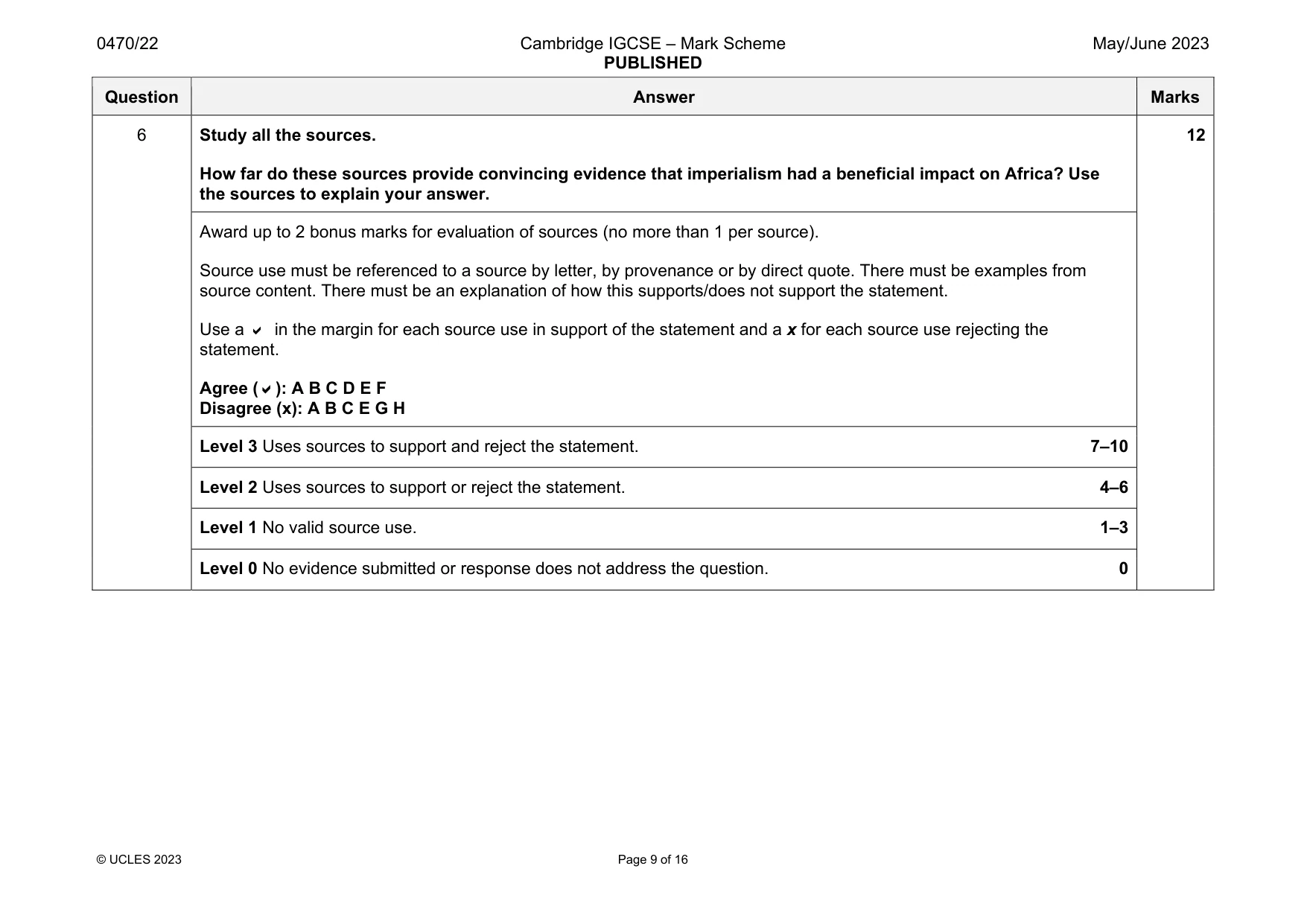
0470/22 Cambridge IGCSE – Mark Scheme PUBLISHED May/June 2023 © UCLES 2023 Page 9 of 16 Question Answer Marks 6 Study all the sources. How far do these sources provide convincing evidence that imperialism had a beneficial impact on Africa? Use the sources to explain your answer. 12 Award up to 2 bonus marks for evaluation of sources (no more than 1 per source). Source use must be referenced to a source by letter, by provenance or by direct quote. There must be examples from source content. There must be an explanation of how this supports/does not support the statement. Use a in the margin for each source use in support of the statement and a x for each source use rejecting the statement. Agree (): A B C D E F Disagree (x): A B C E G H Level 3 Uses sources to support and reject the statement. 7–10 Level 2 Uses sources to support or reject the statement. 4–6 Level 1 No valid source use. 1–3 Level 0 No evidence submitted or response does not address the question. 0
Mark scheme, page 10
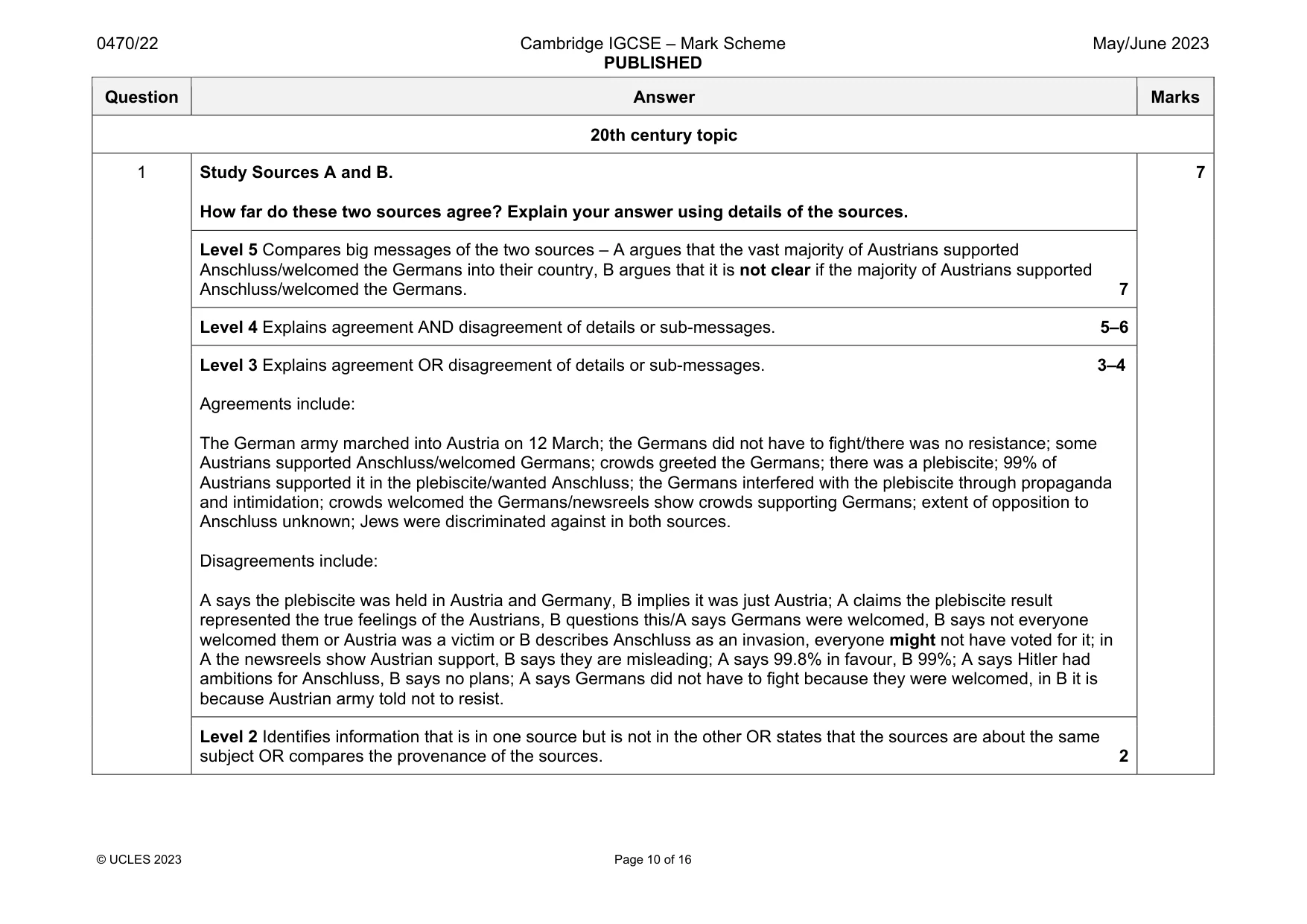
0470/22 Cambridge IGCSE – Mark Scheme PUBLISHED May/June 2023 © UCLES 2023 Page 10 of 16 Question Answer Marks 20th century topic 1 Study Sources A and B. How far do these two sources agree? Explain your answer using details of the sources. 7 Level 5 Compares big messages of the two sources – A argues that the vast majority of Austrians supported Anschluss/welcomed the Germans into their country, B argues that it is not clear if the majority of Austrians supported Anschluss/welcomed the Germans. 7 Level 4 Explains agreement AND disagreement of details or sub-messages. 5–6 Level 3 Explains agreement OR disagreement of details or sub-messages. 3–4 Agreements include: The German army marched into Austria on 12 March; the Germans did not have to fight/there was no resistance; some Austrians supported Anschluss/welcomed Germans; crowds greeted the Germans; there was a plebiscite; 99% of Austrians supported it in the plebiscite/wanted Anschluss; the Germans interfered with the plebiscite through propaganda and intimidation; crowds welcomed the Germans/newsreels show crowds supporting Germans; extent of opposition to Anschluss unknown; Jews were discriminated against in both sources. Disagreements include: A says the plebiscite was held in Austria and Germany, B implies it was just Austria; A claims the plebiscite result represented the true feelings of the Austrians, B questions this/A says Germans were welcomed, B says not everyone welcomed them or Austria was a victim or B describes Anschluss as an invasion, everyone might not have voted for it; in A the newsreels show Austrian support, B says they are misleading; A says 99.8% in favour, B 99%; A says Hitler had ambitions for Anschluss, B says no plans; A says Germans did not have to fight because they were welcomed, in B it is because Austrian army told not to resist. Level 2 Identifies information that is in one source but is not in the other OR states that the sources are about the same subject OR compares the provenance of the sources. 2
Mark scheme, page 11
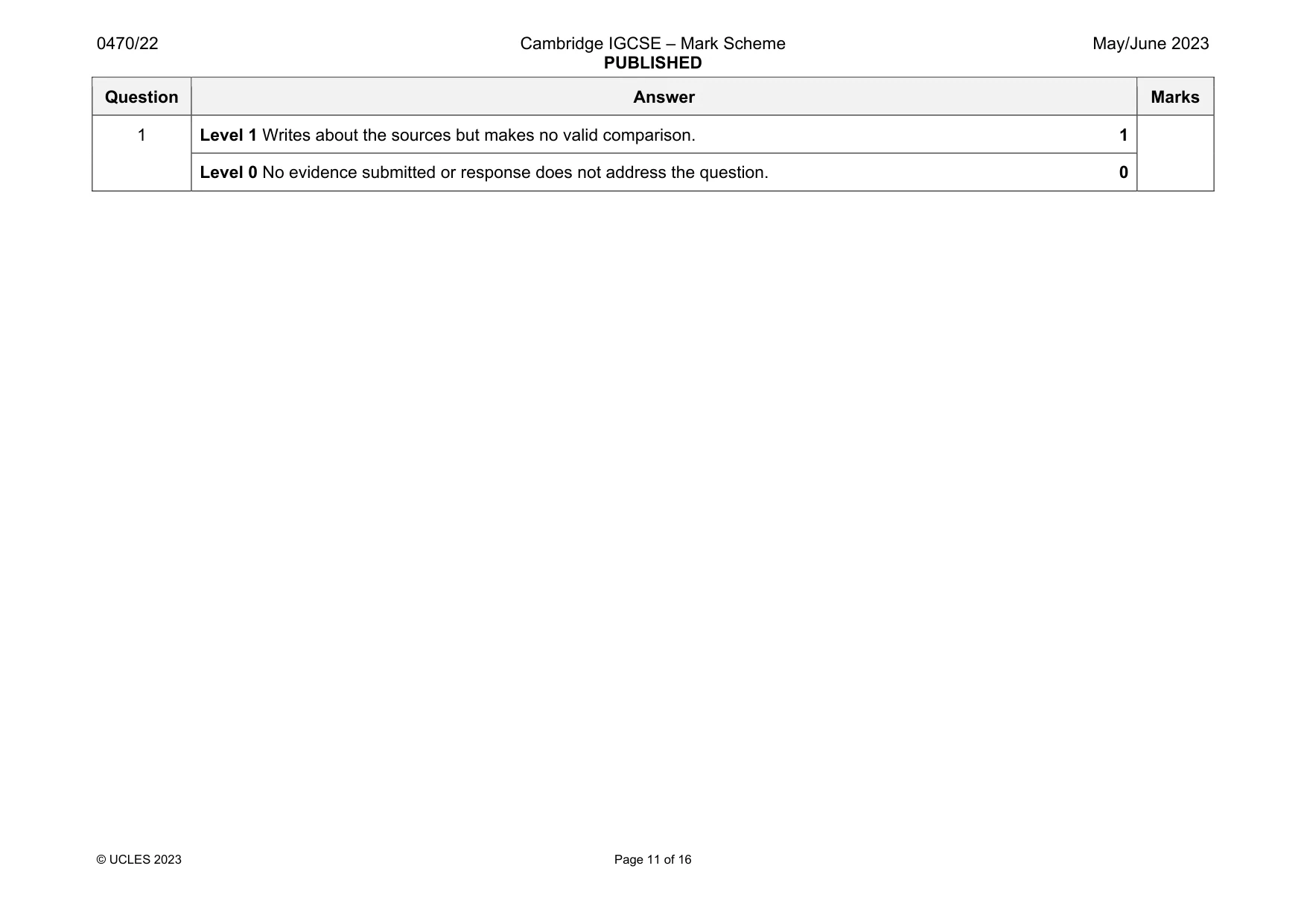
0470/22 Cambridge IGCSE – Mark Scheme PUBLISHED May/June 2023 © UCLES 2023 Page 11 of 16 Question Answer Marks 1 Level 1 Writes about the sources but makes no valid comparison. 1 Level 0 No evidence submitted or response does not address the question. 0
Mark scheme, page 12
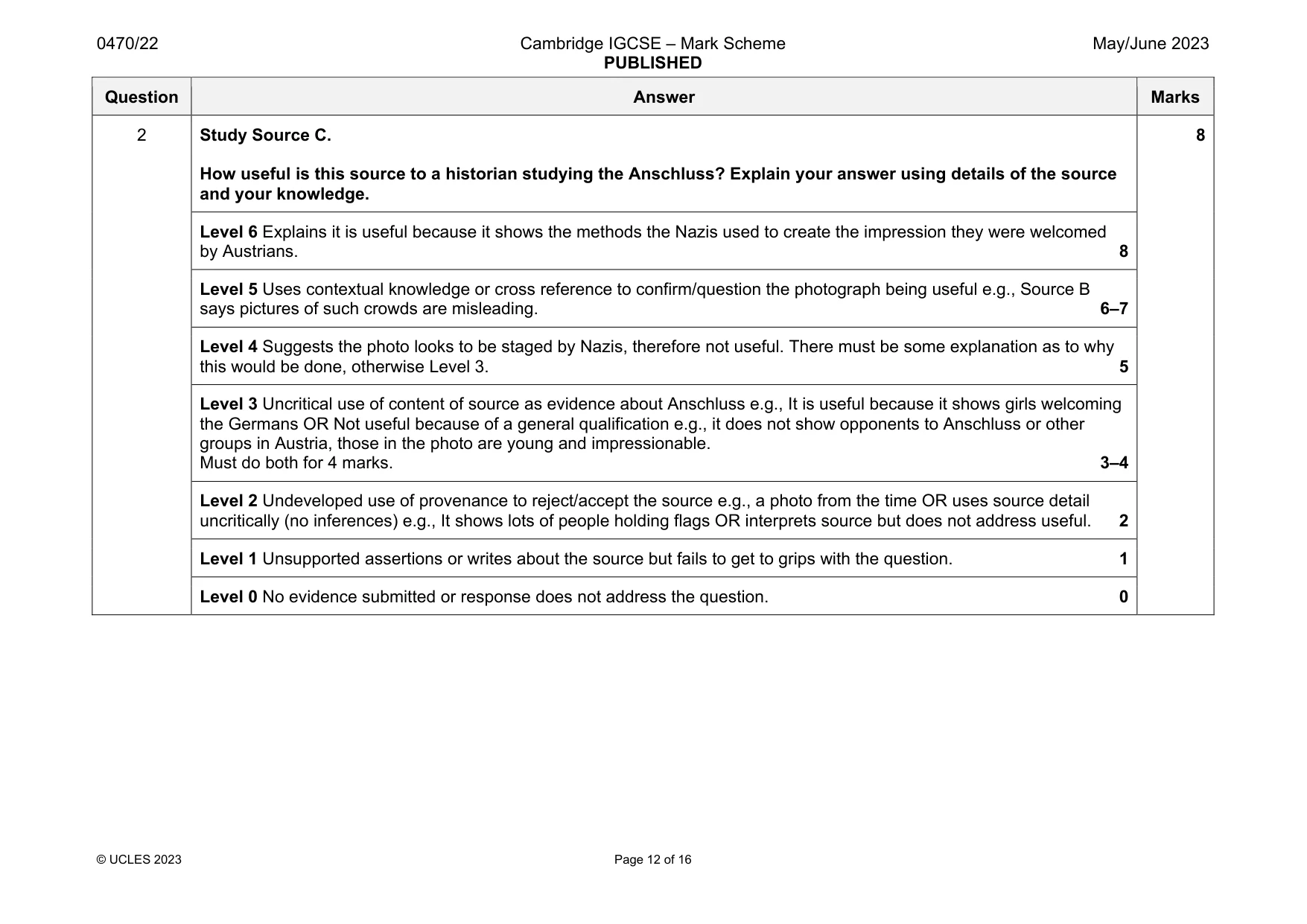
0470/22 Cambridge IGCSE – Mark Scheme PUBLISHED May/June 2023 © UCLES 2023 Page 12 of 16 Question Answer Marks 2 Study Source C. How useful is this source to a historian studying the Anschluss? Explain your answer using details of the source and your knowledge. 8 Level 6 Explains it is useful because it shows the methods the Nazis used to create the impression they were welcomed by Austrians. 8 Level 5 Uses contextual knowledge or cross reference to confirm/question the photograph being useful e.g., Source B says pictures of such crowds are misleading. 6–7 Level 4 Suggests the photo looks to be staged by Nazis, therefore not useful. There must be some explanation as to why this would be done, otherwise Level 3. 5 Level 3 Uncritical use of content of source as evidence about Anschluss e.g., It is useful because it shows girls welcoming the Germans OR Not useful because of a general qualification e.g., it does not show opponents to Anschluss or other groups in Austria, those in the photo are young and impressionable. Must do both for 4 marks. 3–4 Level 2 Undeveloped use of provenance to reject/accept the source e.g., a photo from the time OR uses source detail uncritically (no inferences) e.g., It shows lots of people holding flags OR interprets source but does not address useful. 2 Level 1 Unsupported assertions or writes about the source but fails to get to grips with the question. 1 Level 0 No evidence submitted or response does not address the question. 0
Mark scheme, page 13
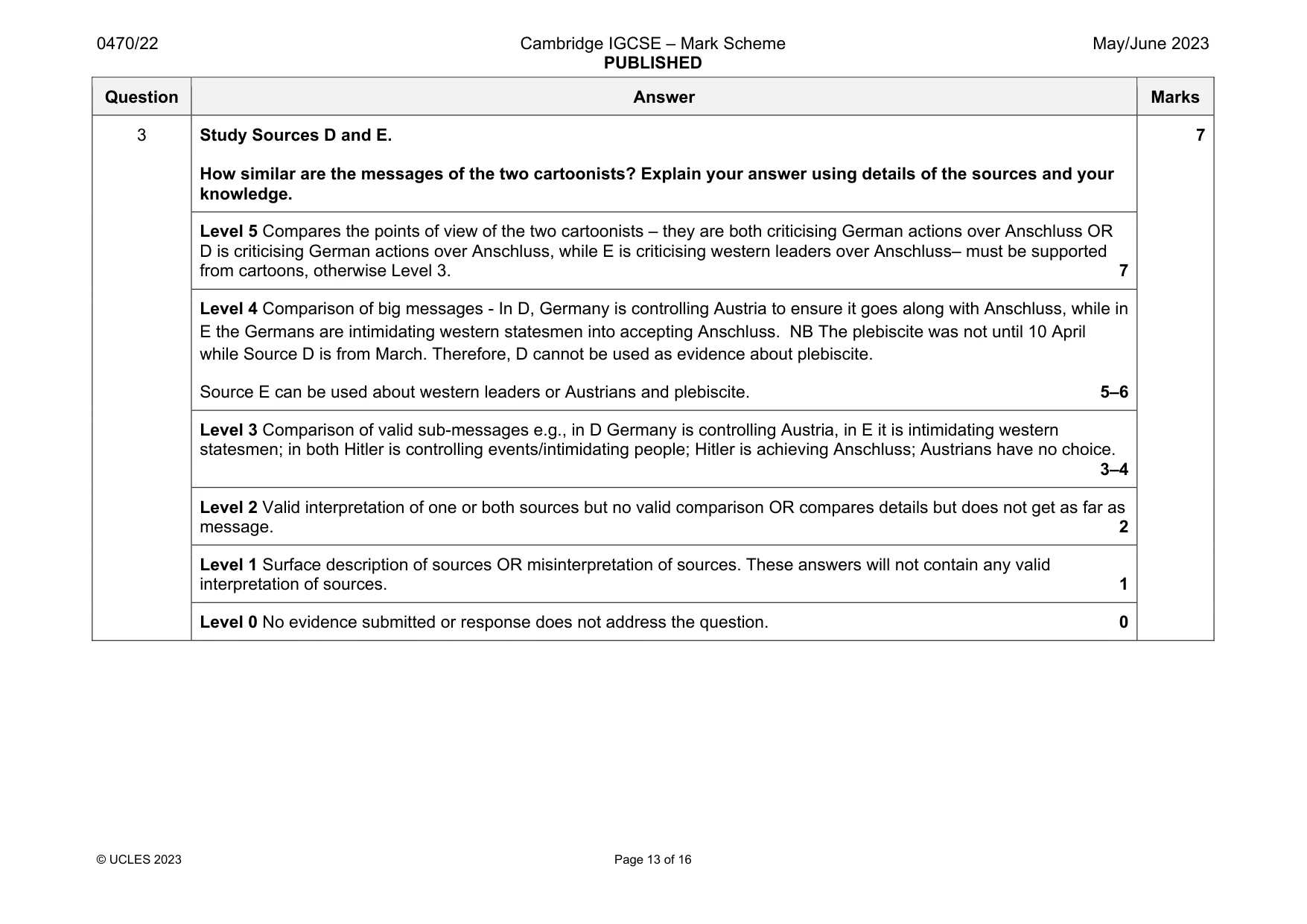
0470/22 Cambridge IGCSE – Mark Scheme PUBLISHED May/June 2023 © UCLES 2023 Page 13 of 16 Question Answer Marks 3 Study Sources D and E. How similar are the messages of the two cartoonists? Explain your answer using details of the sources and your knowledge. 7 Level 5 Compares the points of view of the two cartoonists – they are both criticising German actions over Anschluss OR D is criticising German actions over Anschluss, while E is criticising western leaders over Anschluss– must be supported from cartoons, otherwise Level 3. 7 Level 4 Comparison of big messages - In D, Germany is controlling Austria to ensure it goes along with Anschluss, while in E the Germans are intimidating western statesmen into accepting Anschluss. NB The plebiscite was not until 10 April while Source D is from March. Therefore, D cannot be used as evidence about plebiscite. Source E can be used about western leaders or Austrians and plebiscite. 5–6 Level 3 Comparison of valid sub-messages e.g., in D Germany is controlling Austria, in E it is intimidating western statesmen; in both Hitler is controlling events/intimidating people; Hitler is achieving Anschluss; Austrians have no choice. 3–4 Level 2 Valid interpretation of one or both sources but no valid comparison OR compares details but does not get as far as message. 2 Level 1 Surface description of sources OR misinterpretation of sources. These answers will not contain any valid interpretation of sources. 1 Level 0 No evidence submitted or response does not address the question. 0
Mark scheme, page 14
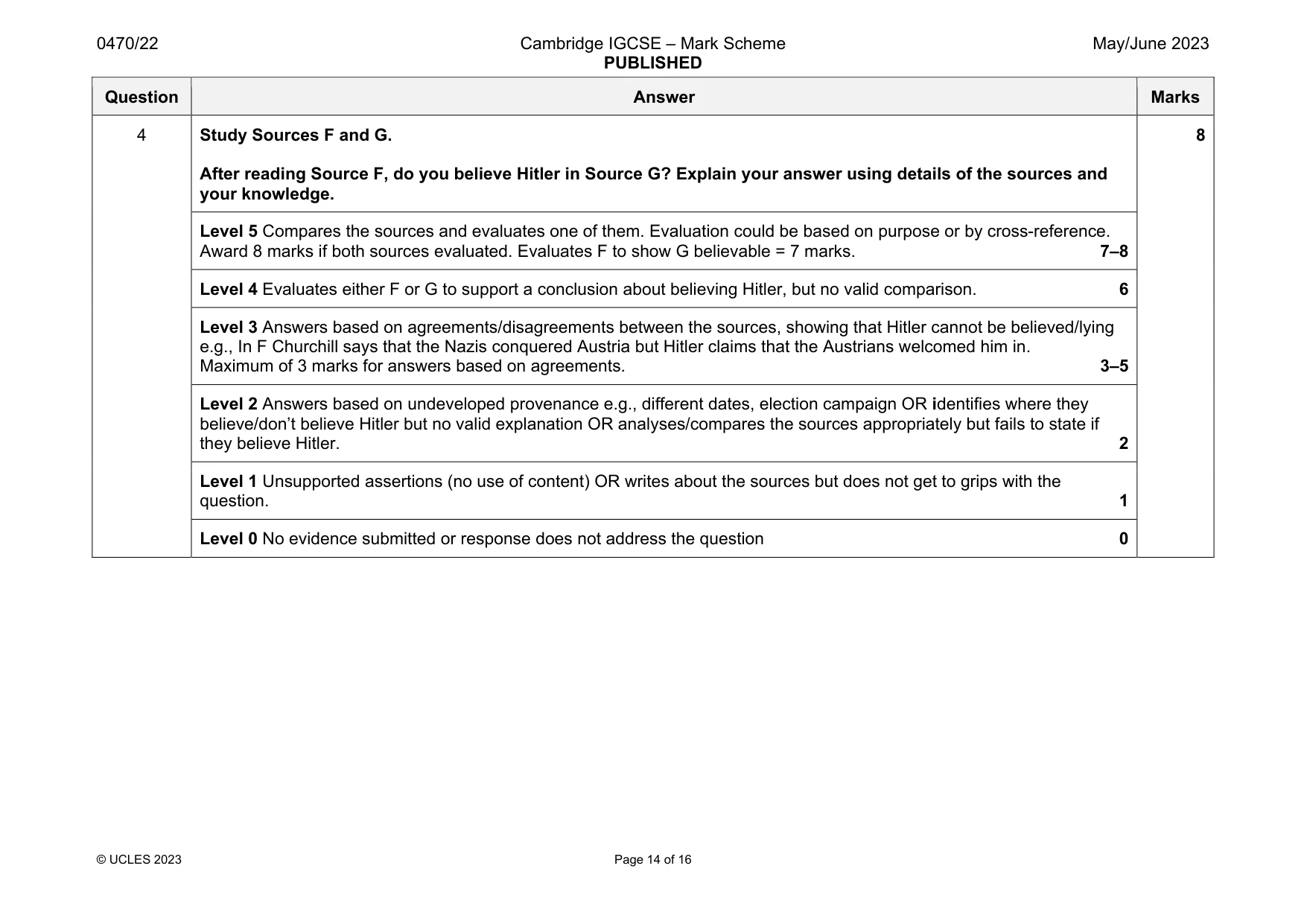
0470/22 Cambridge IGCSE – Mark Scheme PUBLISHED May/June 2023 © UCLES 2023 Page 14 of 16 Question Answer Marks 4 Study Sources F and G. After reading Source F, do you believe Hitler in Source G? Explain your answer using details of the sources and your knowledge. 8 Level 5 Compares the sources and evaluates one of them. Evaluation could be based on purpose or by cross-reference. Award 8 marks if both sources evaluated. Evaluates F to show G believable = 7 marks. 7–8 Level 4 Evaluates either F or G to support a conclusion about believing Hitler, but no valid comparison. 6 Level 3 Answers based on agreements/disagreements between the sources, showing that Hitler cannot be believed/lying e.g., In F Churchill says that the Nazis conquered Austria but Hitler claims that the Austrians welcomed him in. Maximum of 3 marks for answers based on agreements. 3–5 Level 2 Answers based on undeveloped provenance e.g., different dates, election campaign OR identifies where they believe/don’t believe Hitler but no valid explanation OR analyses/compares the sources appropriately but fails to state if they believe Hitler. 2 Level 1 Unsupported assertions (no use of content) OR writes about the sources but does not get to grips with the question. 1 Level 0 No evidence submitted or response does not address the question 0
Mark scheme, page 15
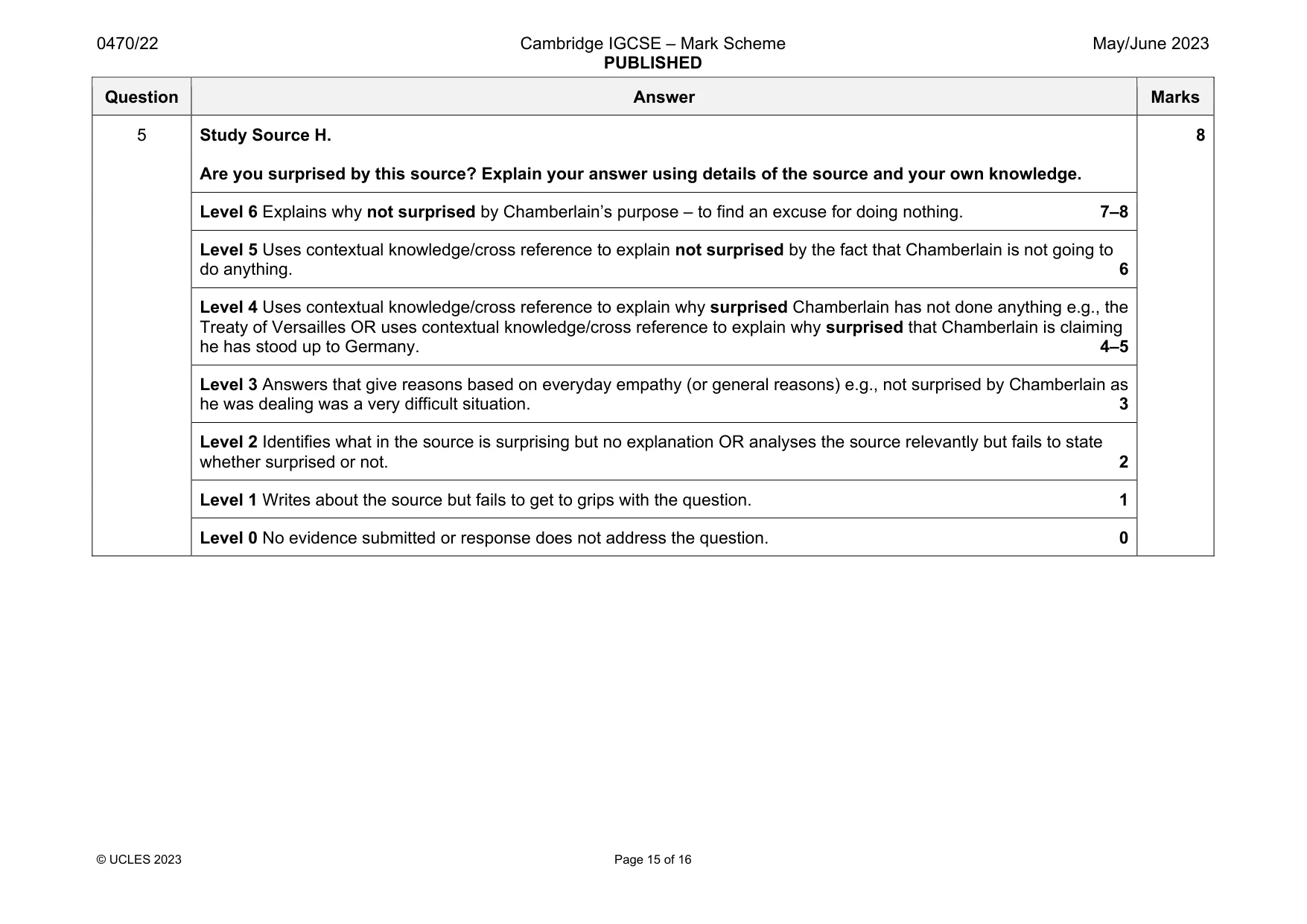
0470/22 Cambridge IGCSE – Mark Scheme PUBLISHED May/June 2023 © UCLES 2023 Page 15 of 16 Question Answer Marks 5 Study Source H. Are you surprised by this source? Explain your answer using details of the source and your own knowledge. 8 Level 6 Explains why not surprised by Chamberlain’s purpose – to find an excuse for doing nothing. 7–8 Level 5 Uses contextual knowledge/cross reference to explain not surprised by the fact that Chamberlain is not going to do anything. 6 Level 4 Uses contextual knowledge/cross reference to explain why surprised Chamberlain has not done anything e.g., the Treaty of Versailles OR uses contextual knowledge/cross reference to explain why surprised that Chamberlain is claiming he has stood up to Germany. 4–5 Level 3 Answers that give reasons based on everyday empathy (or general reasons) e.g., not surprised by Chamberlain as he was dealing was a very difficult situation. 3 Level 2 Identifies what in the source is surprising but no explanation OR analyses the source relevantly but fails to state whether surprised or not. 2 Level 1 Writes about the source but fails to get to grips with the question. 1 Level 0 No evidence submitted or response does not address the question. 0
Mark scheme, page 16
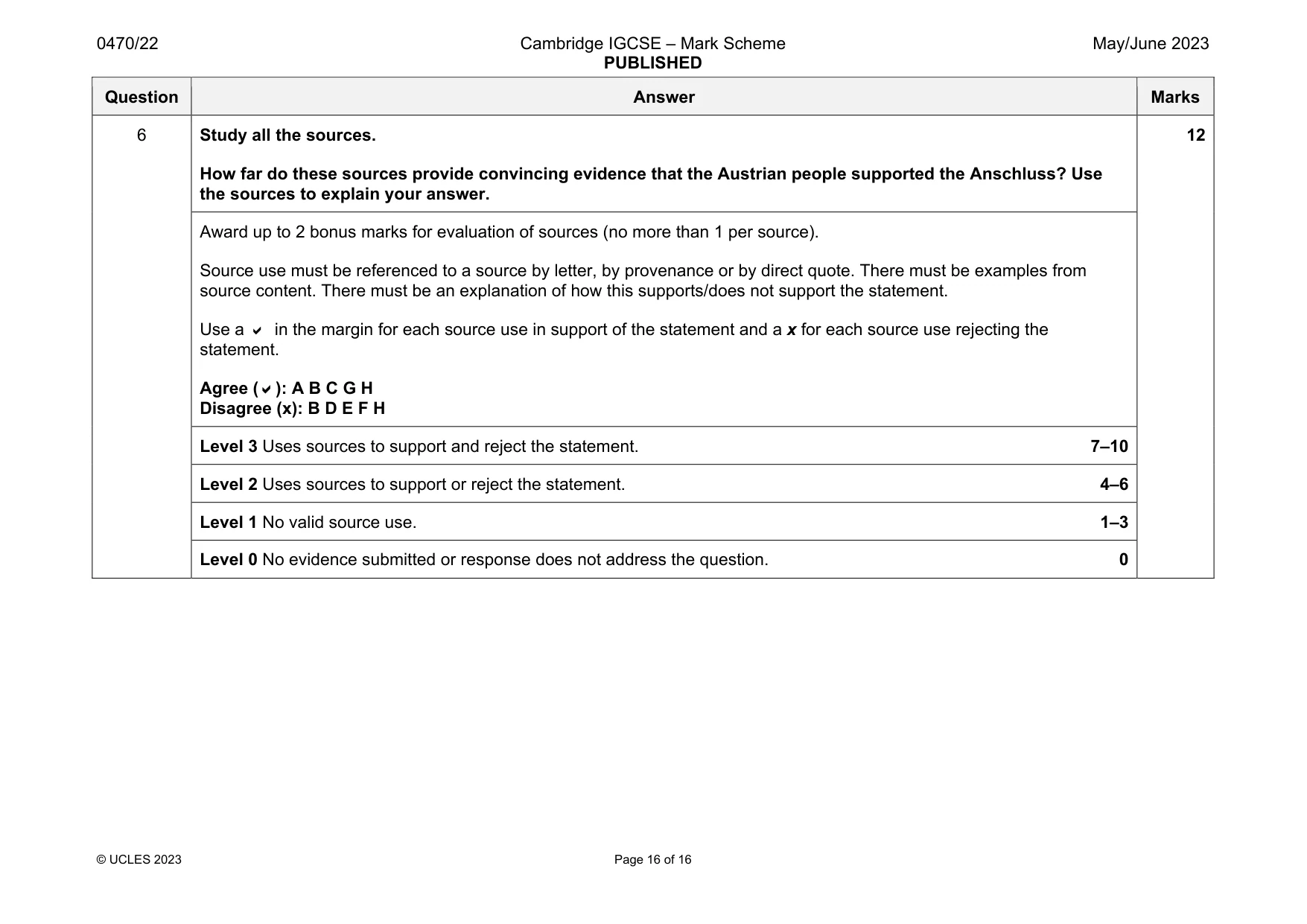
0470/22 Cambridge IGCSE – Mark Scheme PUBLISHED May/June 2023 © UCLES 2023 Page 16 of 16 Question Answer Marks 6 Study all the sources. How far do these sources provide convincing evidence that the Austrian people supported the Anschluss? Use the sources to explain your answer. 12 Award up to 2 bonus marks for evaluation of sources (no more than 1 per source). Source use must be referenced to a source by letter, by provenance or by direct quote. There must be examples from source content. There must be an explanation of how this supports/does not support the statement. Use a in the margin for each source use in support of the statement and a x for each source use rejecting the statement. Agree (): A B C G H Disagree (x): B D E F H Level 3 Uses sources to support and reject the statement. 7–10 Level 2 Uses sources to support or reject the statement. 4–6 Level 1 No valid source use. 1–3 Level 0 No evidence submitted or response does not address the question. 0
What you needed in this session
Cambridge’s own grade thresholds for 2023 May/June, Paper 2 · Variant 2. A higher threshold means an easier paper — the bar moves with how the cohort did.