Cambridge IGCSE History 0470 — 2025 May/June Paper 2 · Variant 2
0470/22/M/J/25 · 40 marks · 105 min
The question paper and its mark scheme, free to read here and free to download. This is Cambridge’s own paper, exactly as it was sat.
Question paper12 pages
Mark scheme15 pages
Answers below. Sit the paper first if you are practising.
Paper as text
Question paper, page 1
This document has 12 pages. Any blank pages are indicated. [Turn over Cambridge IGCSE™ HISTORY 0470/22 Paper 2 Document Questions May/June 2025 1 hour 45 minutes You must answer on the enclosed answer booklet. You will need: Answer booklet (enclosed) INSTRUCTIONS ● Answer one question on one option only. Option A: Nineteenth century topic Option B: Twentieth century topic ● Follow the instructions on the front cover of the answer booklet. If you need additional answer paper, ask the invigilator for a continuation booklet. INFORMATION ● The total mark for this paper is 40. ● The number of marks for each question or part question is shown in brackets [ ]. * 8 7 1 4 6 2 8 9 5 7 * DC (CJ) 343096/2 © UCLES 2025
Question paper, page 2
2 0470/22/M/J/25 © UCLES 2025 Option A: Nineteenth century topic 1 Why was there war between France and Prussia in 1870–71? Study the Background Information and the sources carefully, and then answer all parts of Question 1. Background Information By 1870 tensions between France and Prussia had been building for some time. Napoleon III was concerned about growing Prussian power as a result of its victory over Austria in 1866. Also, the two countries disagreed over who should become the next king of Spain. During this dispute Bismarck edited a telegram to make it seem as if the Prussian king, William I, had insulted the French. On 19 July 1870 war began between the two countries. How far was Prussia responsible for the war? SOURCE A The government of Napoleon III is unable to accept the proposal that a Prussian prince might become king of Spain. It would threaten the territorial security of France. Therefore, France must ask the King of Prussia for a guarantee that such an arrangement could not be carried out without the agreement of Napoleon III. Because the King of Prussia has refused to give this, the French government can only see Prussia’s declaration as a threat to France and to the general balance of power in Europe. The French government has consequently decided to take steps to defend its honour. It considers itself, therefore, to be at war with Prussia. An official statement of the French government, 19 July 1870. SOURCE B The proposal that a German prince should be a candidate for the throne of Spain gives the hope of finding a guarantee for the orderly and peaceful government of Spain, a country that has undergone many hardships. It has become an excuse for France to find a cause of war which ignores the rights of the people of Spain to the blessings of peace. Germany in the past centuries has suffered silently such outrages on its rights and honour. When disunited, it did not know how strong it was. Today, when the Wars of Freedom have begun to draw Germany together, when the armaments of Germany no longer leave an opening to the enemy, Germany has the will and the power to resist renewed acts of French violence. The sword has been forced into our hand. We are supported by the unanimous will of the German governments of the South, as well as of the North. Our only aim is to create a lasting peace for Europe. The speech of William I of Prussia at the opening of the North German Parliament, 19 July 1870.
Question paper, page 3
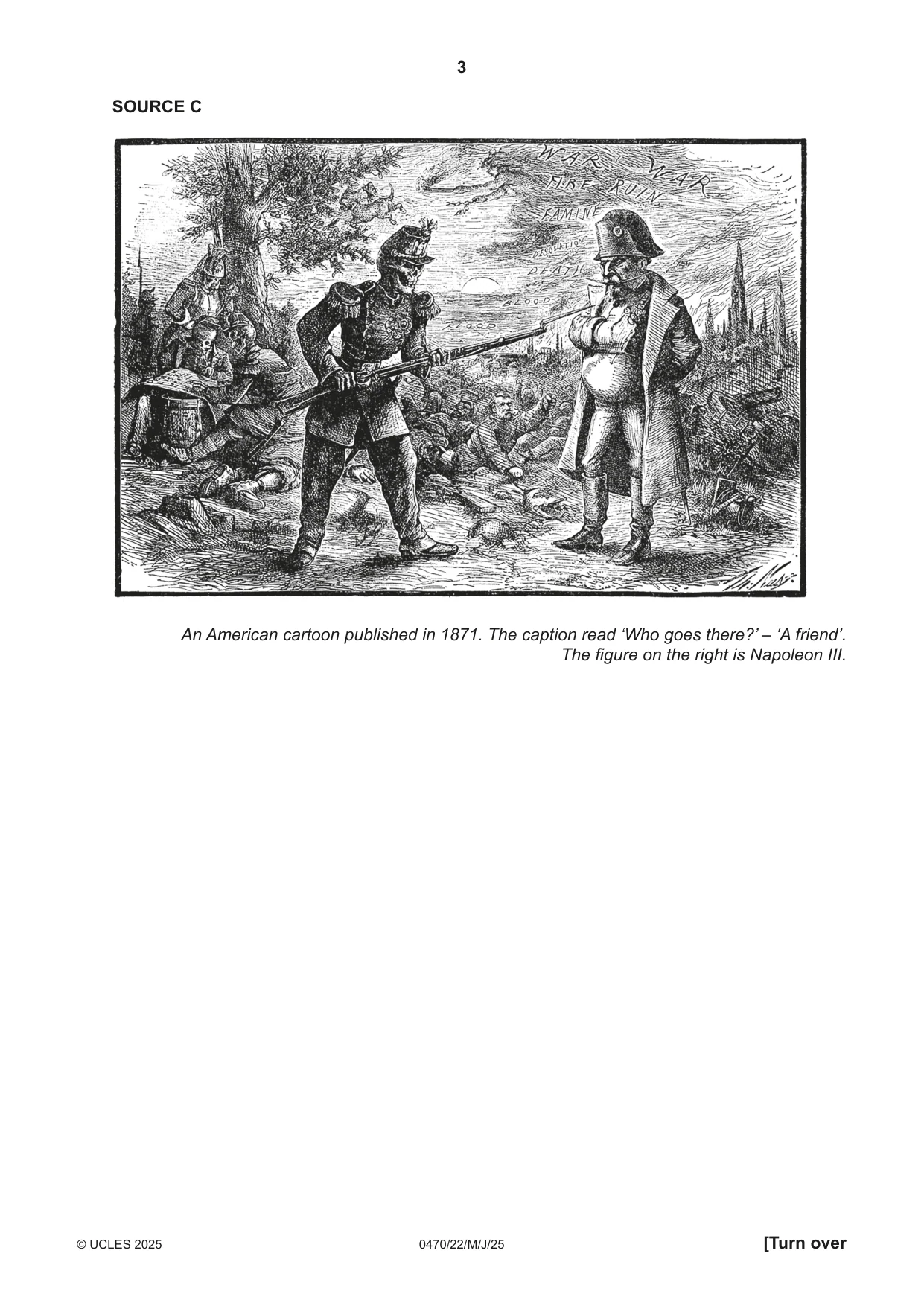
3 0470/22/M/J/25 © UCLES 2025 [Turn over SOURCE C An American cartoon published in 1871. The caption read ‘Who goes there?’ – ‘A friend’. The figure on the right is Napoleon III.
Question paper, page 4
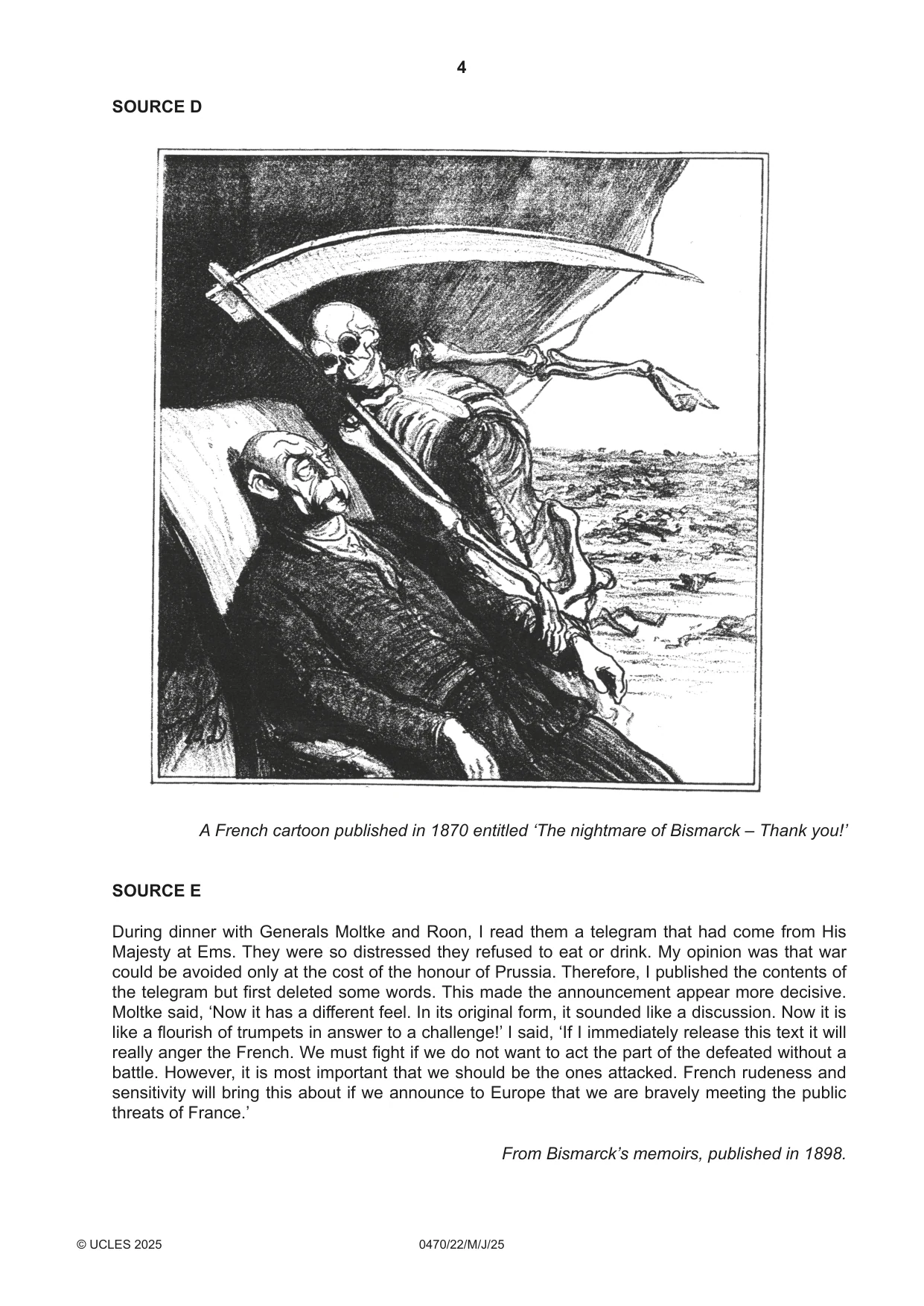
4 0470/22/M/J/25 © UCLES 2025 SOURCE D A French cartoon published in 1870 entitled ‘The nightmare of Bismarck – Thank you!’ SOURCE E During dinner with Generals Moltke and Roon, I read them a telegram that had come from His Majesty at Ems. They were so distressed they refused to eat or drink. My opinion was that war could be avoided only at the cost of the honour of Prussia. Therefore, I published the contents of the telegram but first deleted some words. This made the announcement appear more decisive. Moltke said, ‘Now it has a different feel. In its original form, it sounded like a discussion. Now it is like a flourish of trumpets in answer to a challenge!’ I said, ‘If I immediately release this text it will really anger the French. We must fight if we do not want to act the part of the defeated without a battle. However, it is most important that we should be the ones attacked. French rudeness and sensitivity will bring this about if we announce to Europe that we are bravely meeting the public threats of France.’ From Bismarck’s memoirs, published in 1898.
Question paper, page 5
5 0470/22/M/J/25 © UCLES 2025 [Turn over SOURCE F France has declared war against Prussia. It was completely unexpected. Whatever unfavourable impression of their character has been given by the French Emperor and government, no one thought they were capable of this. In all parts of Germany there is a united determination to punish this sin. The King arrived back from Ems last night looking as majestic as ever. He was sent loyal messages. I quote from one, ‘French rudeness has insulted our honour and, without any reason, the peace of Prussia and Germany. We beg your majesty not to put down the sword until French insolence has been punished.’ A report by a British journalist working in Berlin, July 1870. SOURCE G There is nothing in our attitude to annoy or alarm France. There is nothing to prevent peace for ten or fifteen years, by which time the French will have become accustomed to German unity. I told our generals earlier this year when they tried to prove to me that we must beat the French if we went to war then, ‘I will still do all I can to prevent war; for you must remember, a war between near neighbours and old enemies, like France and Prussia, is only the first of at least six; and supposing we won all six, what should we have succeeded in doing? Why, in ruining France and most likely ourselves. Do you think a poor, starving, bankrupt neighbour is desirable? France buys largely from us, and sells many things we want. Is it in our interest to ruin it completely?’ Bismarck giving an interview to a British journalist, September 1867.
Question paper, page 6
6 0470/22/M/J/25 © UCLES 2025 Now answer all parts of Question 1. You may use any of the sources to help you answer the questions, in addition to those sources which you are told to use. In answering parts (a)–(e) you should use your knowledge of the topic to help you interpret and evaluate the sources. (a) Study Sources A and B. Why do these two sources disagree? Explain your answer using details of the sources and your knowledge. [8] (b) Study Sources C and D. How far would these two cartoonists have disagreed? Explain your answer using details of the sources and your knowledge. [8] (c) Study Sources E and F. Does Source E make Source F surprising? Explain your answer using details of the sources and your knowledge. [8] (d) Study Source G. Can Bismarck be trusted in this source? Explain your answer using details of the source and your knowledge. [7] (e) Study all the sources. How far do these sources provide convincing evidence that Prussia was responsible for the Franco-Prussian War? Use the sources to explain your answer. [9]
Question paper, page 7
7 0470/22/M/J/25 © UCLES 2025 [Turn over BLANK PAGE
Question paper, page 8
8 0470/22/M/J/25 © UCLES 2025 Option B: Twentieth century topic 2 Why did Mussolini invade Abyssinia? Study the Background Information and the sources carefully, and then answer all parts of Question 2. Background Information One of the most serious challenges to the authority of the League of Nations was Italy’s invasion of Abyssinia that began on 3 October 1935. For Mussolini, Abyssinia seemed an obvious choice. It was one of the few countries in Africa not under European control, it was located beside the Italian colonies of Somaliland and Eritrea, and its borders were not clearly defined. Some historians have argued that Mussolini wanted to build a great Italian empire and that he saw his mission as bringing civilisation to what he regarded as a barbaric country. Did Mussolini invade Abyssinia because he thought he was bringing civilisation to Abyssinia? SOURCE A One motivation for Mussolini’s invasion of Abyssinia came from the state of affairs in Italy. It was far behind Britain and France economically, it was over-populated and there had been massive emigration to the United States. Italians asked, why should they not settle in Italian possessions overseas and thereby contribute to the developing and civilising of those areas? Abyssinia was suitable for settlement and economic development. These social and economic motivations were, however, superficial. The basic motivations were psychological. It was considered unfair that Italy had not been properly rewarded for its contribution to the Allied victory in 1918. The vast empires of Britain and France were expanded, while the small Italian empire was not. However, Mussolini’s personal motivation was part of this. It was not that there was active opposition to him in Italy, it was rather that he wanted a triumph and glory for Italy and for himself. He wanted war not so much for the fruits of victory as for its own sake and he felt confident there would be no opposition from the League of Nations. From an article about Mussolini. SOURCE B Confident that the League would do nothing, Mussolini began to plan a conquest of Abyssinia that would provide Italy with revenge. The defeat that Italy suffered at the Battle of Adowa in 1896 was a stain on the national character that needed to be destroyed. It would also mean Italy avenging the injustices of the peace treaties. Mussolini tried to win over Italians to the idea by speaking of Italy’s mission to help Abyssinia progress from its primitive state. More importantly, it was no accident that Mussolini started to prepare for the invasion at the time of the Depression. Abyssinia was poor and remote and was not a source of raw materials nor a market for Italy’s manufactured goods. But Mussolini did need to turn the attention of Italians away from the dreadful state of their own country. He was always anxious that a people suffering economic hardship might overthrow him. He saw he could channel internal frustration into external violence. He also thought that Abyssinia would provide living space for a population he was encouraging to expand, as well as reducing unemployment by sending men off to fight. From a recent history book.
Question paper, page 9
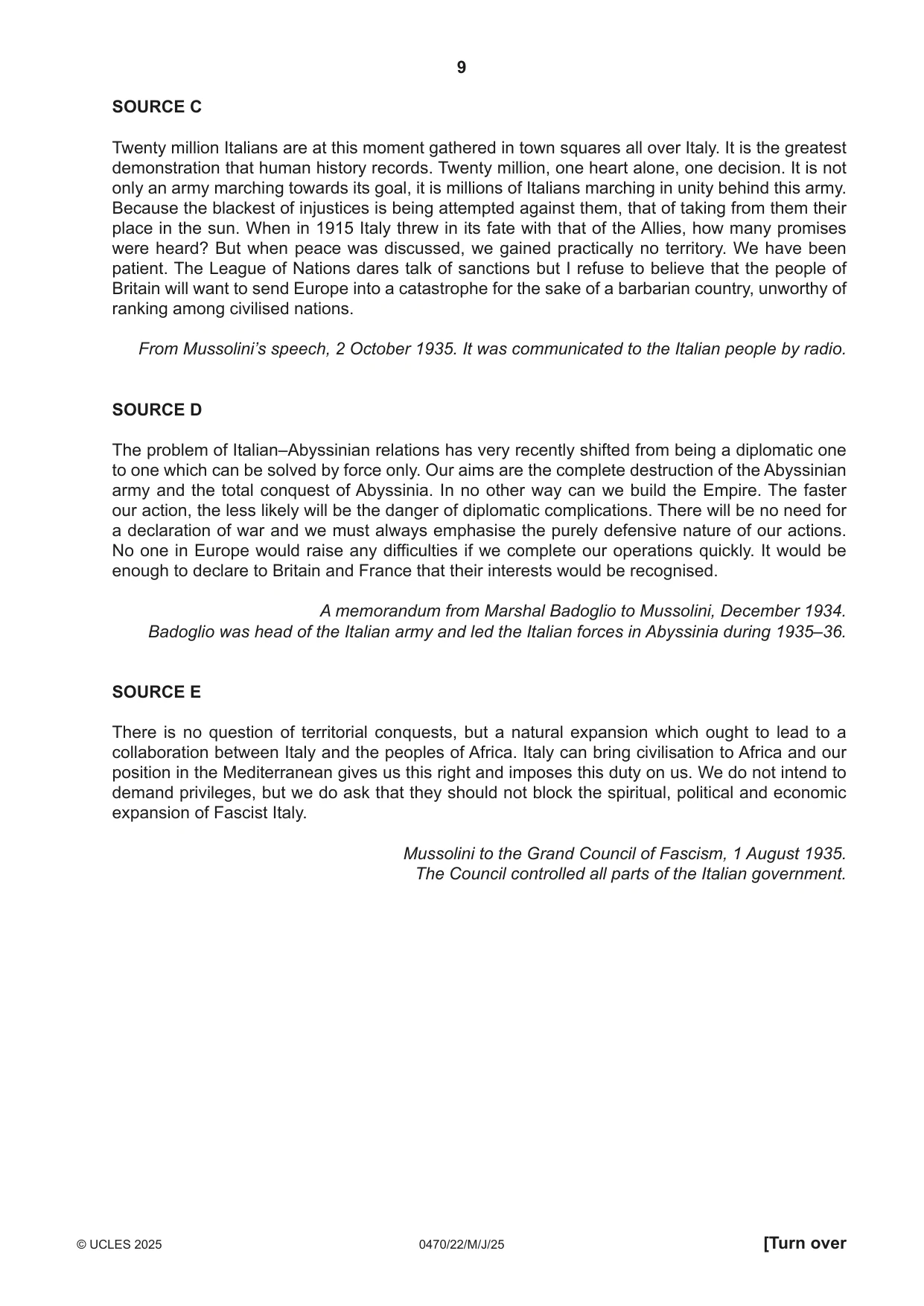
9 0470/22/M/J/25 © UCLES 2025 [Turn over SOURCE C Twenty million Italians are at this moment gathered in town squares all over Italy. It is the greatest demonstration that human history records. Twenty million, one heart alone, one decision. It is not only an army marching towards its goal, it is millions of Italians marching in unity behind this army. Because the blackest of injustices is being attempted against them, that of taking from them their place in the sun. When in 1915 Italy threw in its fate with that of the Allies, how many promises were heard? But when peace was discussed, we gained practically no territory. We have been patient. The League of Nations dares talk of sanctions but I refuse to believe that the people of Britain will want to send Europe into a catastrophe for the sake of a barbarian country, unworthy of ranking among civilised nations. From Mussolini’s speech, 2 October 1935. It was communicated to the Italian people by radio. SOURCE D The problem of Italian–Abyssinian relations has very recently shifted from being a diplomatic one to one which can be solved by force only. Our aims are the complete destruction of the Abyssinian army and the total conquest of Abyssinia. In no other way can we build the Empire. The faster our action, the less likely will be the danger of diplomatic complications. There will be no need for a declaration of war and we must always emphasise the purely defensive nature of our actions. No one in Europe would raise any difficulties if we complete our operations quickly. It would be enough to declare to Britain and France that their interests would be recognised. A memorandum from Marshal Badoglio to Mussolini, December 1934. Badoglio was head of the Italian army and led the Italian forces in Abyssinia during 1935–36. SOURCE E There is no question of territorial conquests, but a natural expansion which ought to lead to a collaboration between Italy and the peoples of Africa. Italy can bring civilisation to Africa and our position in the Mediterranean gives us this right and imposes this duty on us. We do not intend to demand privileges, but we do ask that they should not block the spiritual, political and economic expansion of Fascist Italy. Mussolini to the Grand Council of Fascism, 1 August 1935. The Council controlled all parts of the Italian government.
Question paper, page 10
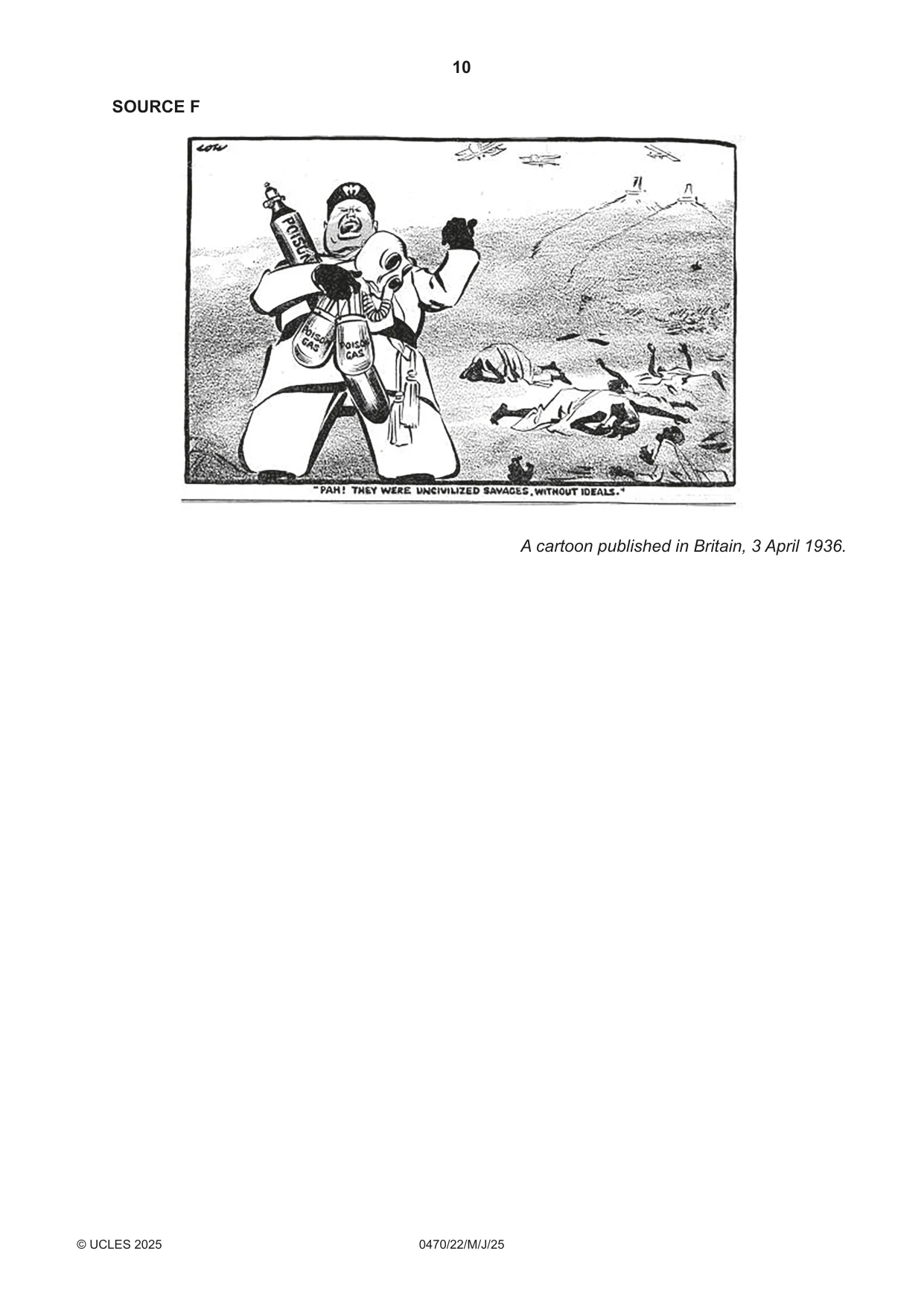
10 0470/22/M/J/25 © UCLES 2025 SOURCE F A cartoon published in Britain, 3 April 1936.
Question paper, page 11
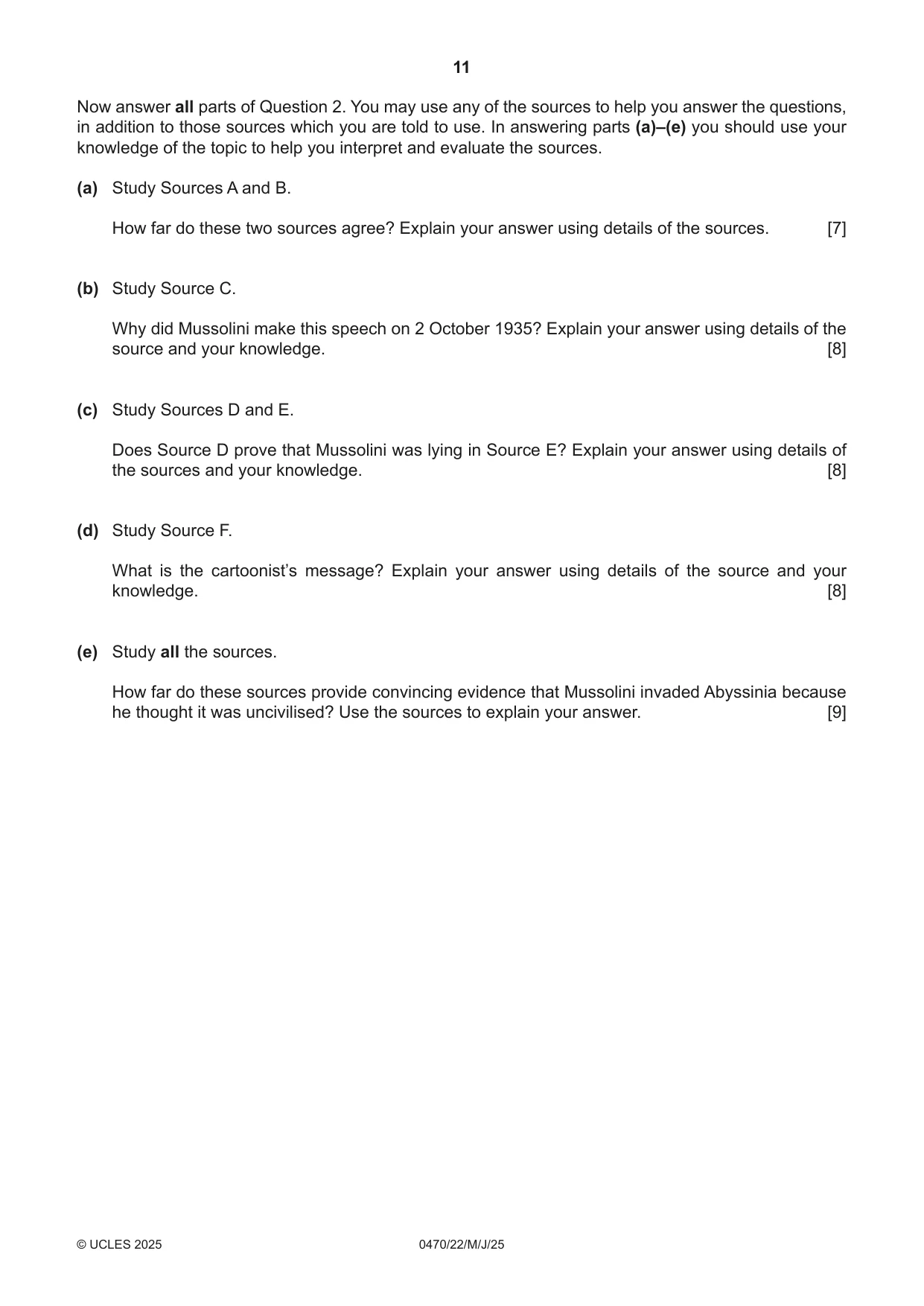
11 0470/22/M/J/25 © UCLES 2025 Now answer all parts of Question 2. You may use any of the sources to help you answer the questions, in addition to those sources which you are told to use. In answering parts (a)–(e) you should use your knowledge of the topic to help you interpret and evaluate the sources. (a) Study Sources A and B. How far do these two sources agree? Explain your answer using details of the sources. [7] (b) Study Source C. Why did Mussolini make this speech on 2 October 1935? Explain your answer using details of the source and your knowledge. [8] (c) Study Sources D and E. Does Source D prove that Mussolini was lying in Source E? Explain your answer using details of the sources and your knowledge. [8] (d) Study Source F. What is the cartoonist’s message? Explain your answer using details of the source and your knowledge. [8] (e) Study all the sources. How far do these sources provide convincing evidence that Mussolini invaded Abyssinia because he thought it was uncivilised? Use the sources to explain your answer. [9]
Question paper, page 12
12 0470/22/M/J/25 © UCLES 2025 Permission to reproduce items where third-party owned material protected by copyright is included has been sought and cleared where possible. Every reasonable effort has been made by the publisher (UCLES) to trace copyright holders, but if any items requiring clearance have unwittingly been included, the publisher will be pleased to make amends at the earliest possible opportunity. To avoid the issue of disclosure of answer-related information to candidates, all copyright acknowledgements are reproduced online in the Cambridge Assessment International Education Copyright Acknowledgements Booklet. This is produced for each series of examinations and is freely available to download at www.cambridgeinternational.org after the live examination series. Cambridge Assessment International Education is part of Cambridge Assessment. Cambridge Assessment is the brand name of the University of Cambridge Local Examinations Syndicate (UCLES), which is a department of the University of Cambridge. BLANK PAGE
Mark scheme, page 1
This document consists of 15 printed pages. © Cambridge University Press & Assessment 2025 [Turn over Cambridge IGCSE™ HISTORY 0470/22 Paper 2 Document Questions May/June 2025 MARK SCHEME Maximum Mark: 40 Published This mark scheme is published as an aid to teachers and candidates, to indicate the requirements of the examination. It shows the basis on which Examiners were instructed to award marks. It does not indicate the details of the discussions that took place at an Examiners’ meeting before marking began, which would have considered the acceptability of alternative answers. Mark schemes should be read in conjunction with the question paper and the Principal Examiner Report for Teachers. Cambridge International will not enter into discussions about these mark schemes. Cambridge International is publishing the mark schemes for the May/June 2025 series for most Cambridge IGCSE, Cambridge International A and AS Level components, and some Cambridge O Level components.
Mark scheme, page 2
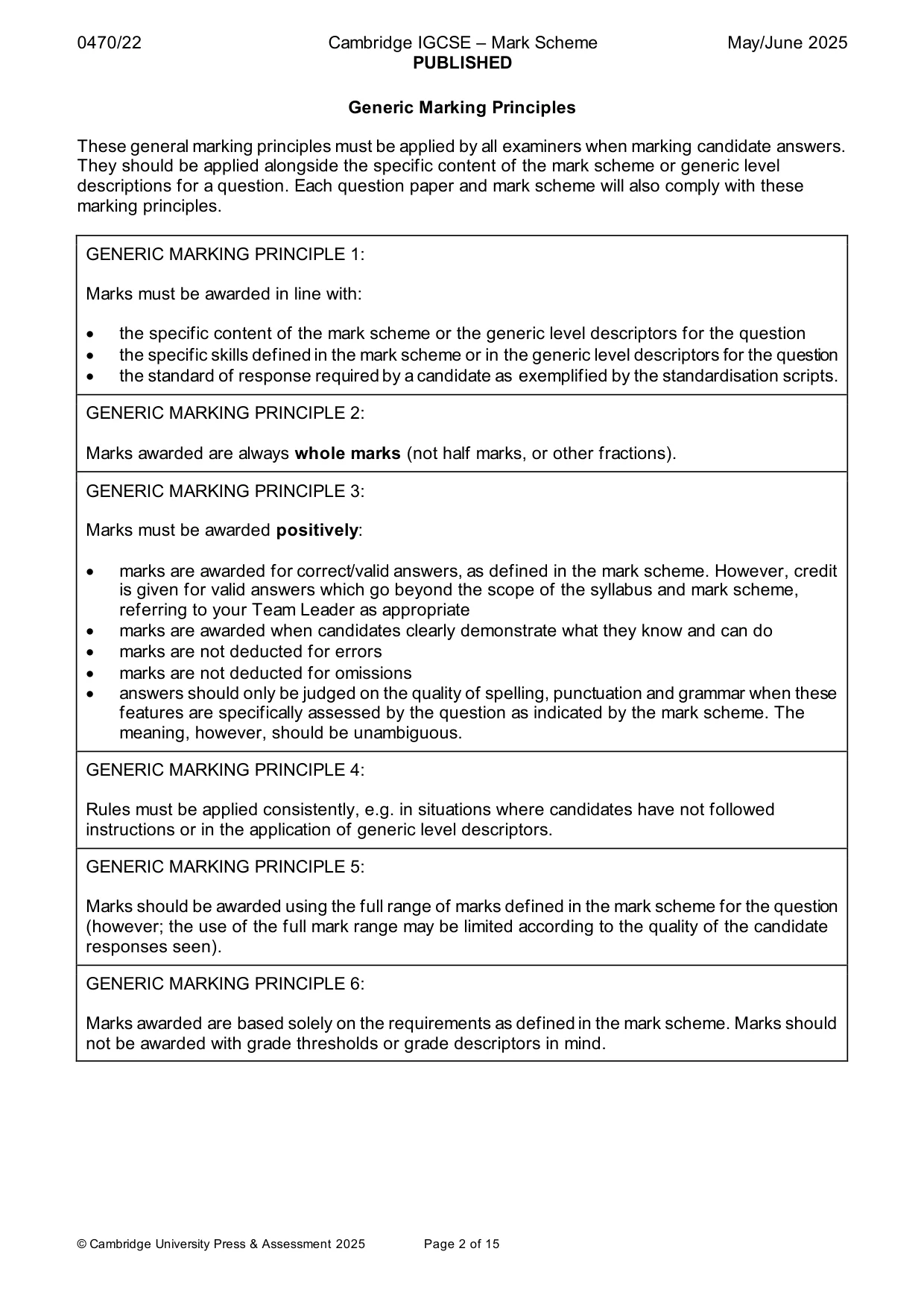
0470/22 Cambridge IGCSE – Mark Scheme PUBLISHED May/June 2025 © Cambridge University Press & Assessment 2025 Page 2 of 15 Generic Marking Principles These general marking principles must be applied by all examiners when marking candidate answers. They should be applied alongside the specific content of the mark scheme or generic level descriptions for a question. Each question paper and mark scheme will also comply with these marking principles. GENERIC MARKING PRINCIPLE 1: Marks must be awarded in line with: • the specific content of the mark scheme or the generic level descriptors for the question • the specific skills defined in the mark scheme or in the generic level descriptors for the question • the standard of response required by a candidate as exemplified by the standardisation scripts. GENERIC MARKING PRINCIPLE 2: Marks awarded are always whole marks (not half marks, or other fractions). GENERIC MARKING PRINCIPLE 3: Marks must be awarded positively: • marks are awarded for correct/valid answers, as defined in the mark scheme. However, credit is given for valid answers which go beyond the scope of the syllabus and mark scheme, referring to your Team Leader as appropriate • marks are awarded when candidates clearly demonstrate what they know and can do • marks are not deducted for errors • marks are not deducted for omissions • answers should only be judged on the quality of spelling, punctuation and grammar when these features are specifically assessed by the question as indicated by the mark scheme. The meaning, however, should be unambiguous. GENERIC MARKING PRINCIPLE 4: Rules must be applied consistently, e.g. in situations where candidates have not followed instructions or in the application of generic level descriptors. GENERIC MARKING PRINCIPLE 5: Marks should be awarded using the full range of marks defined in the mark scheme for the question (however; the use of the full mark range may be limited according to the quality of the candidate responses seen). GENERIC MARKING PRINCIPLE 6: Marks awarded are based solely on the requirements as defined in the mark scheme. Marks should not be awarded with grade thresholds or grade descriptors in mind.
Mark scheme, page 3
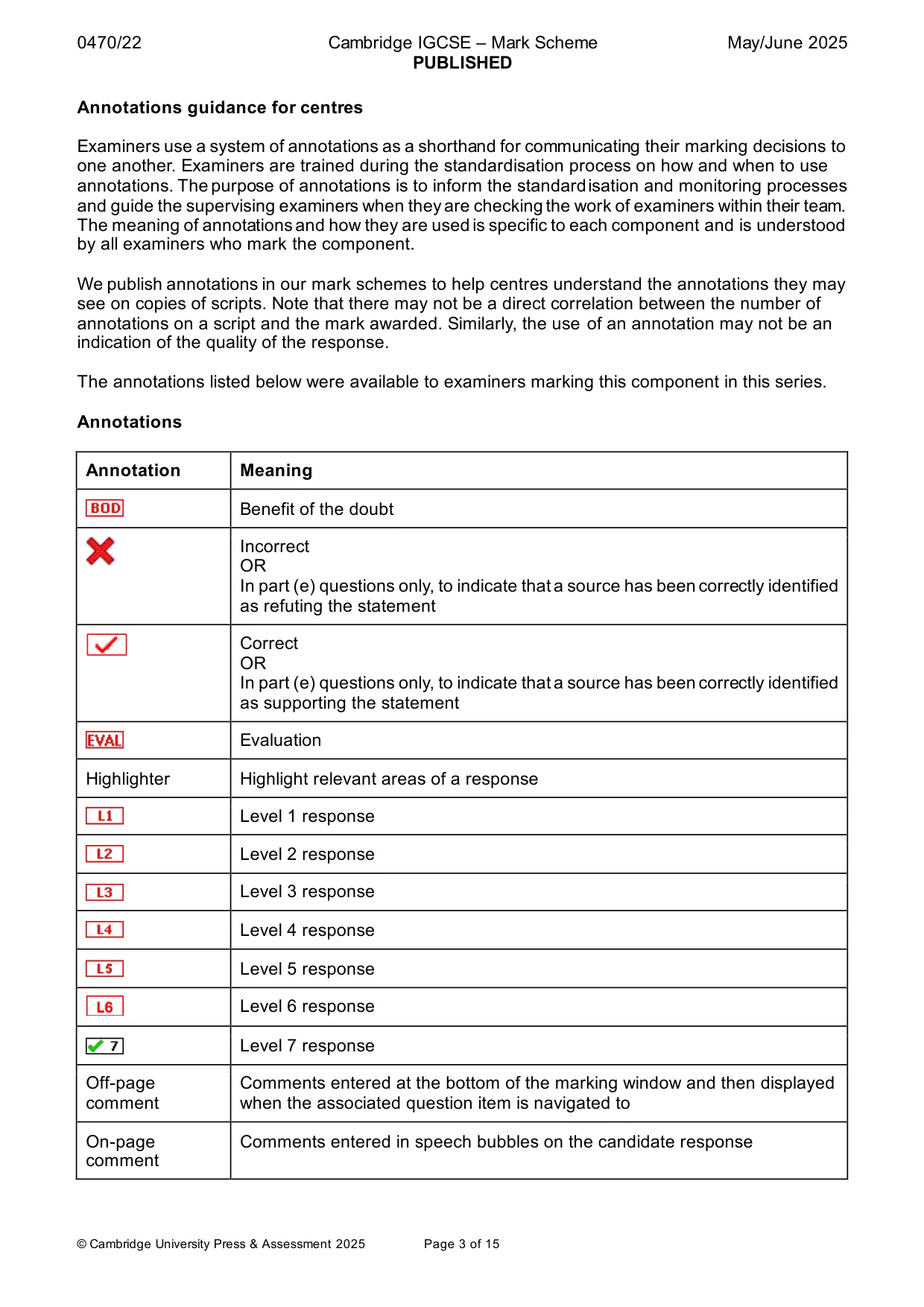
0470/22 Cambridge IGCSE – Mark Scheme PUBLISHED May/June 2025 © Cambridge University Press & Assessment 2025 Page 3 of 15 Annotations guidance for centres Examiners use a system of annotations as a shorthand for communicating their marking decisions to one another. Examiners are trained during the standardisation process on how and when to use annotations. The purpose of annotations is to inform the standardisation and monitoring processes and guide the supervising examiners when they are checking the work of examiners within their team. The meaning of annotations and how they are used is specific to each component and is understood by all examiners who mark the component. We publish annotations in our mark schemes to help centres understand the annotations they may see on copies of scripts. Note that there may not be a direct correlation between the number of annotations on a script and the mark awarded. Similarly, the use of an annotation may not be an indication of the quality of the response. The annotations listed below were available to examiners marking this component in this series. Annotations Annotation Meaning Benefit of the doubt Incorrect OR In part (e) questions only, to indicate that a source has been correctly identified as refuting the statement Correct OR In part (e) questions only, to indicate that a source has been correctly identified as supporting the statement Evaluation Highlighter Highlight relevant areas of a response Level 1 response Level 2 response Level 3 response Level 4 response Level 5 response Level 6 response Level 7 response Off-page comment Comments entered at the bottom of the marking window and then displayed when the associated question item is navigated to On-page comment Comments entered in speech bubbles on the candidate response
Mark scheme, page 4
0470/22 Cambridge IGCSE – Mark Scheme PUBLISHED May/June 2025 © Cambridge University Press & Assessment 2025 Page 4 of 15 Annotation Meaning To indicate that a point has been noted but no credit has been given OR To indicate that a blank page has been checked for creditable content
Mark scheme, page 5
0470/22 Cambridge IGCSE – Mark Scheme PUBLISHED May/June 2025 © Cambridge University Press & Assessment 2025 Page 5 of 15 Assessment objectives AO1 An ability to recall, select, organise and deploy knowledge of the syllabus content. AO3 An ability to understand, interpret, evaluate and use a range of sources as evidence, in their historical context.
Mark scheme, page 6
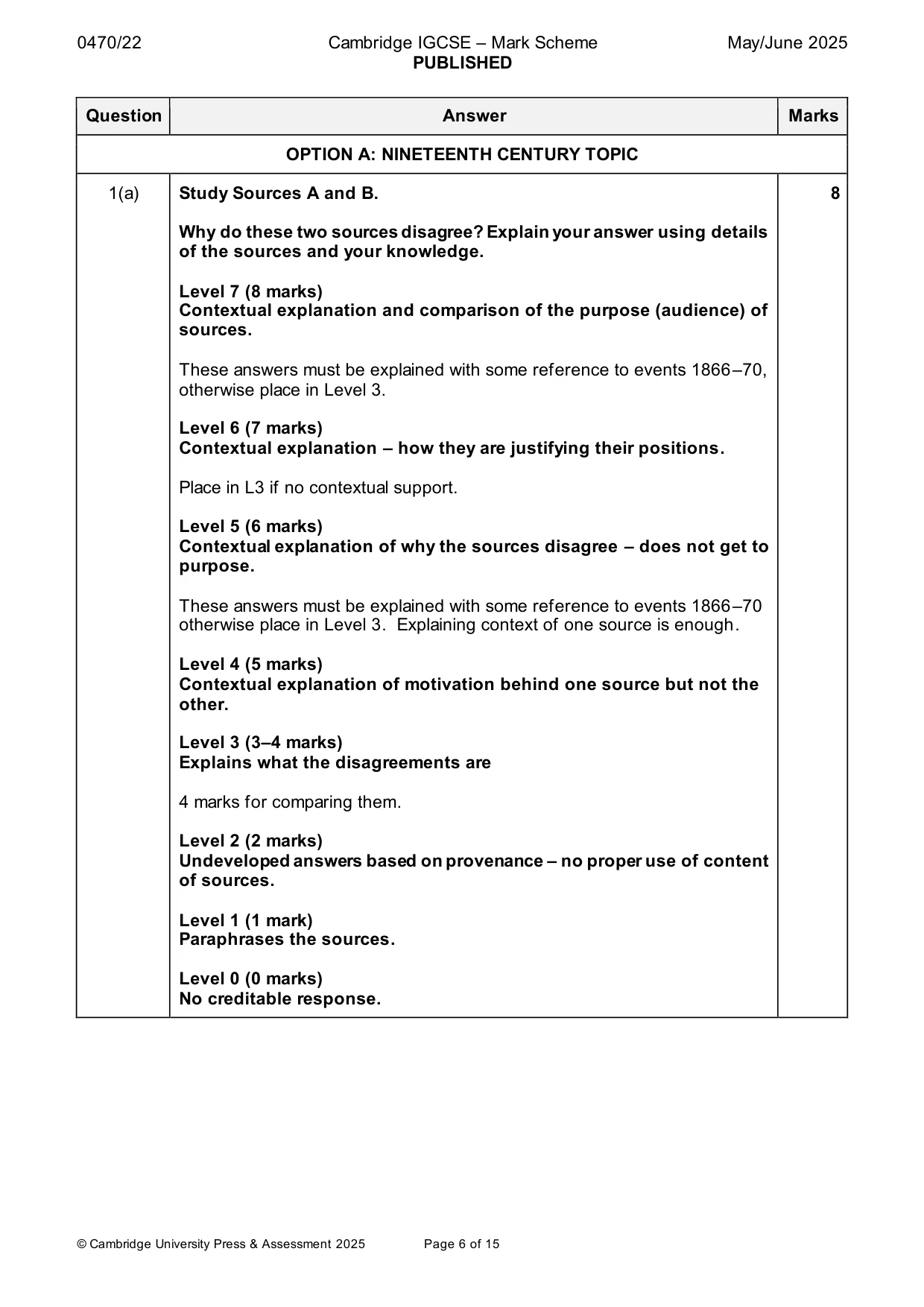
0470/22 Cambridge IGCSE – Mark Scheme PUBLISHED May/June 2025 © Cambridge University Press & Assessment 2025 Page 6 of 15 Question Answer Marks OPTION A: NINETEENTH CENTURY TOPIC 1(a) Study Sources A and B. Why do these two sources disagree? Explain your answer using details of the sources and your knowledge. Level 7 (8 marks) Contextual explanation and comparison of the purpose (audience) of sources. These answers must be explained with some reference to events 1866–70, otherwise place in Level 3. Level 6 (7 marks) Contextual explanation – how they are justifying their positions. Place in L3 if no contextual support. Level 5 (6 marks) Contextual explanation of why the sources disagree – does not get to purpose. These answers must be explained with some reference to events 1866–70 otherwise place in Level 3. Explaining context of one source is enough. Level 4 (5 marks) Contextual explanation of motivation behind one source but not the other. Level 3 (3–4 marks) Explains what the disagreements are 4 marks for comparing them. Level 2 (2 marks) Undeveloped answers based on provenance – no proper use of content of sources. Level 1 (1 mark) Paraphrases the sources. Level 0 (0 marks) No creditable response. 8
Mark scheme, page 7
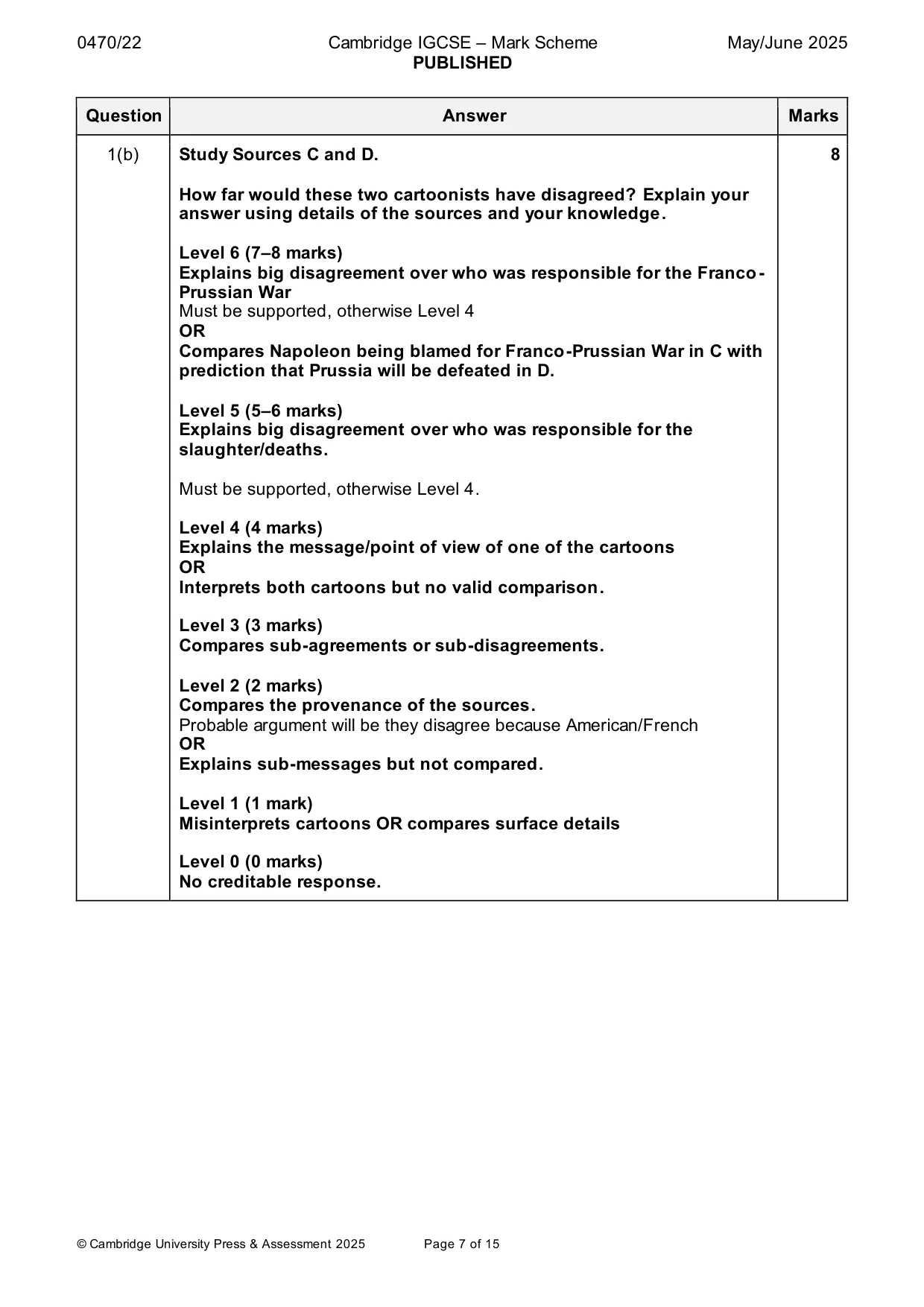
0470/22 Cambridge IGCSE – Mark Scheme PUBLISHED May/June 2025 © Cambridge University Press & Assessment 2025 Page 7 of 15 Question Answer Marks 1(b) Study Sources C and D. How far would these two cartoonists have disagreed? Explain your answer using details of the sources and your knowledge. Level 6 (7–8 marks) Explains big disagreement over who was responsible for the Franco- Prussian War Must be supported, otherwise Level 4 OR Compares Napoleon being blamed for Franco-Prussian War in C with prediction that Prussia will be defeated in D. Level 5 (5–6 marks) Explains big disagreement over who was responsible for the slaughter/deaths. Must be supported, otherwise Level 4. Level 4 (4 marks) Explains the message/point of view of one of the cartoons OR Interprets both cartoons but no valid comparison. Level 3 (3 marks) Compares sub-agreements or sub-disagreements. Level 2 (2 marks) Compares the provenance of the sources. Probable argument will be they disagree because American/French OR Explains sub-messages but not compared. Level 1 (1 mark) Misinterprets cartoons OR compares surface details Level 0 (0 marks) No creditable response. 8
Mark scheme, page 8
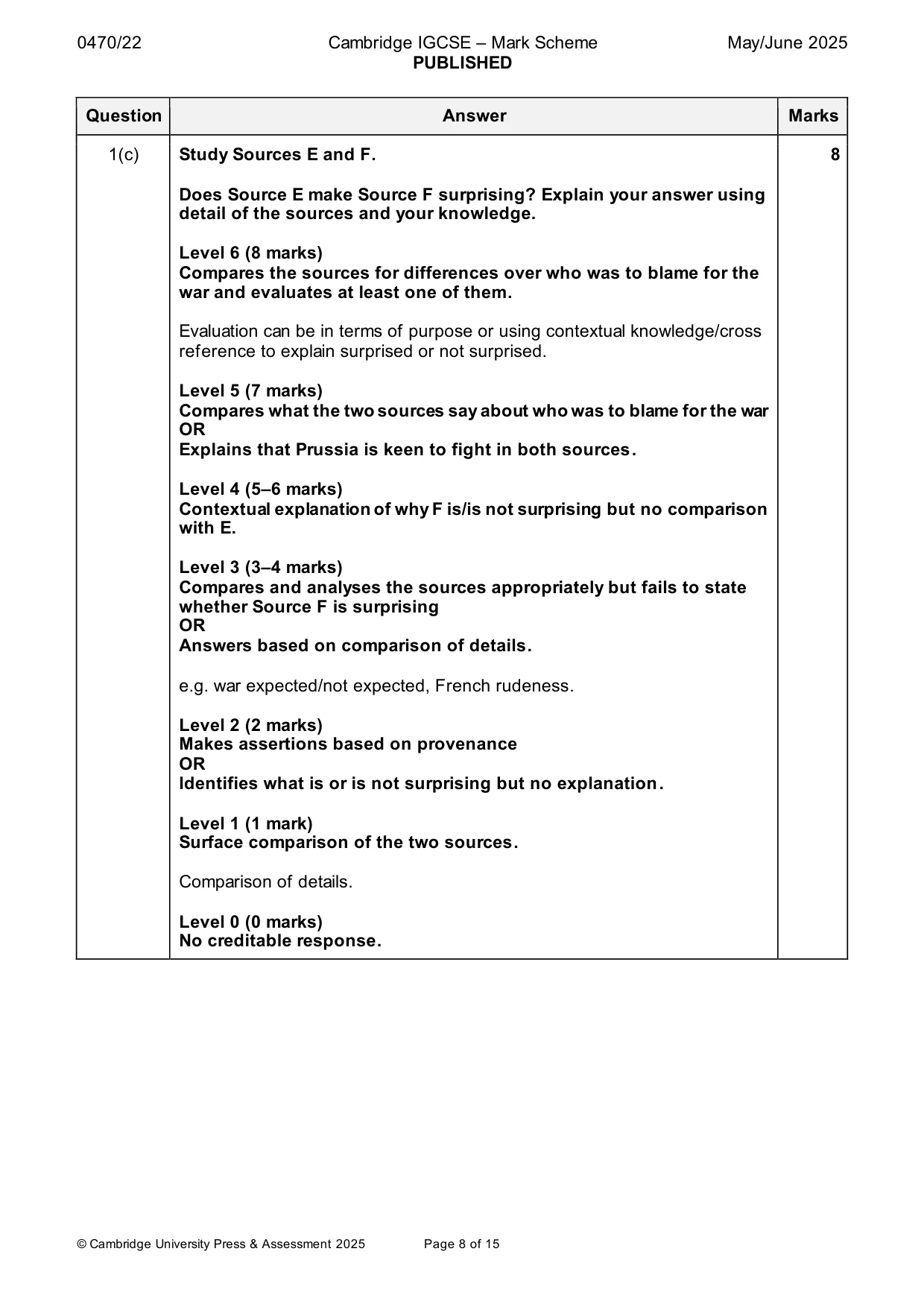
0470/22 Cambridge IGCSE – Mark Scheme PUBLISHED May/June 2025 © Cambridge University Press & Assessment 2025 Page 8 of 15 Question Answer Marks 1(c) Study Sources E and F. Does Source E make Source F surprising? Explain your answer using detail of the sources and your knowledge. Level 6 (8 marks) Compares the sources for differences over who was to blame for the war and evaluates at least one of them. Evaluation can be in terms of purpose or using contextual knowledge/cross reference to explain surprised or not surprised. Level 5 (7 marks) Compares what the two sources say about who was to blame for the war OR Explains that Prussia is keen to fight in both sources. Level 4 (5–6 marks) Contextual explanation of why F is/is not surprising but no comparison with E. Level 3 (3–4 marks) Compares and analyses the sources appropriately but fails to state whether Source F is surprising OR Answers based on comparison of details. e.g. war expected/not expected, French rudeness. Level 2 (2 marks) Makes assertions based on provenance OR Identifies what is or is not surprising but no explanation. Level 1 (1 mark) Surface comparison of the two sources. Comparison of details. Level 0 (0 marks) No creditable response. 8
Mark scheme, page 9
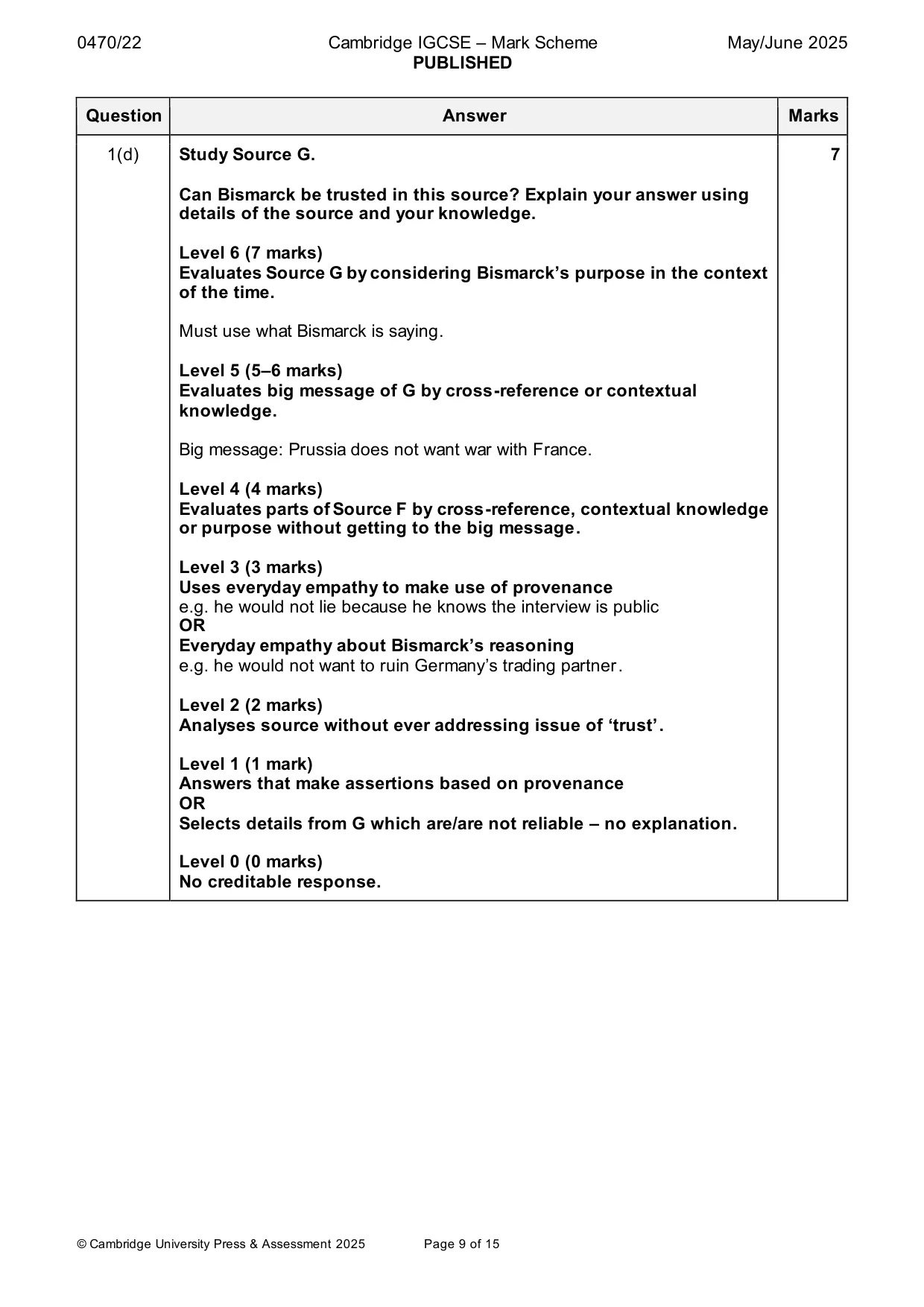
0470/22 Cambridge IGCSE – Mark Scheme PUBLISHED May/June 2025 © Cambridge University Press & Assessment 2025 Page 9 of 15 Question Answer Marks 1(d) Study Source G. Can Bismarck be trusted in this source? Explain your answer using details of the source and your knowledge. Level 6 (7 marks) Evaluates Source G by considering Bismarck’s purpose in the context of the time. Must use what Bismarck is saying. Level 5 (5–6 marks) Evaluates big message of G by cross-reference or contextual knowledge. Big message: Prussia does not want war with France. Level 4 (4 marks) Evaluates parts of Source F by cross-reference, contextual knowledge or purpose without getting to the big message. Level 3 (3 marks) Uses everyday empathy to make use of provenance e.g. he would not lie because he knows the interview is public OR Everyday empathy about Bismarck’s reasoning e.g. he would not want to ruin Germany’s trading partner. Level 2 (2 marks) Analyses source without ever addressing issue of ‘trust’. Level 1 (1 mark) Answers that make assertions based on provenance OR Selects details from G which are/are not reliable – no explanation. Level 0 (0 marks) No creditable response. 7
Mark scheme, page 10
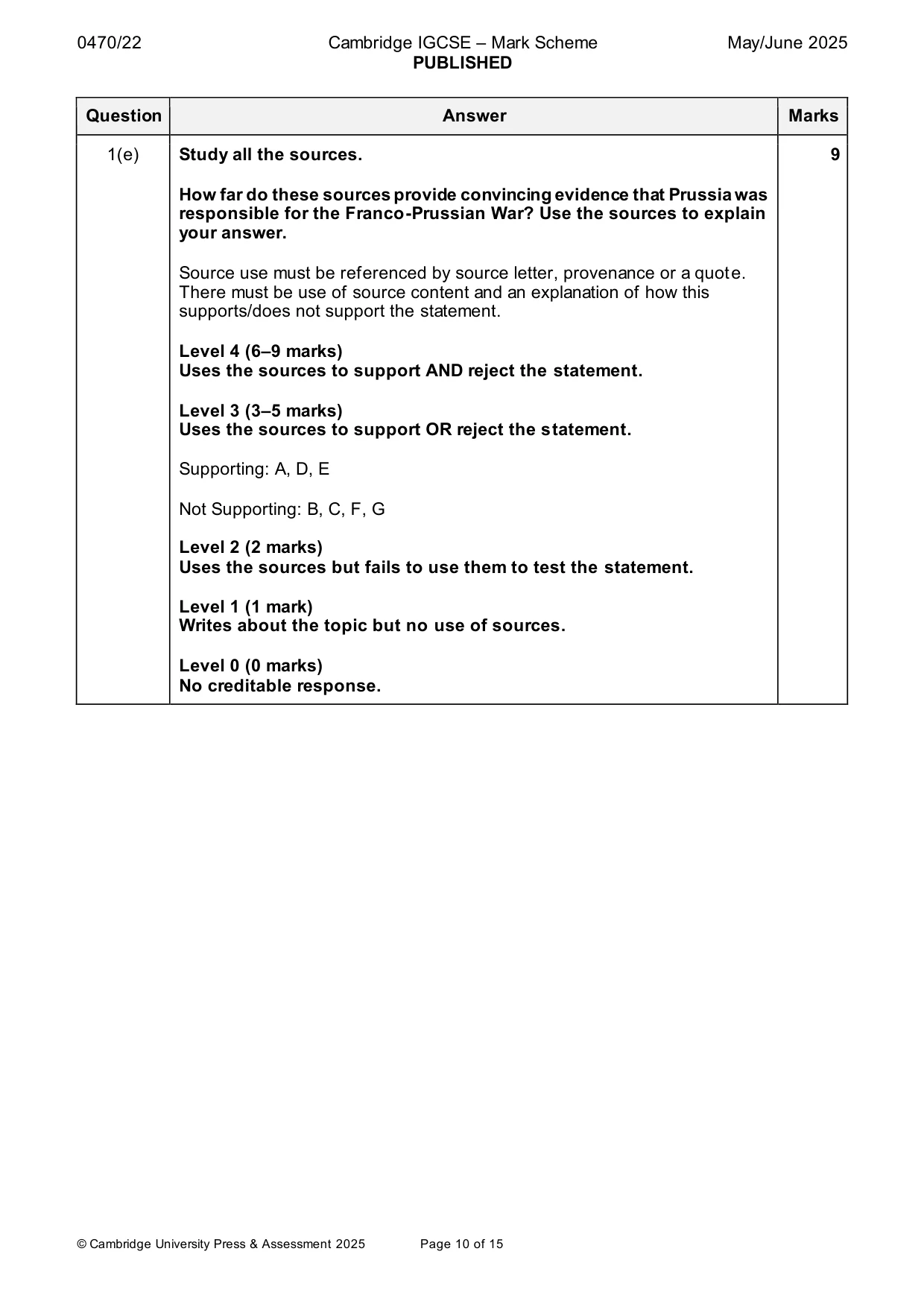
0470/22 Cambridge IGCSE – Mark Scheme PUBLISHED May/June 2025 © Cambridge University Press & Assessment 2025 Page 10 of 15 Question Answer Marks 1(e) Study all the sources. How far do these sources provide convincing evidence that Prussia was responsible for the Franco-Prussian War? Use the sources to explain your answer. Source use must be referenced by source letter, provenance or a quote. There must be use of source content and an explanation of how this supports/does not support the statement. Level 4 (6–9 marks) Uses the sources to support AND reject the statement. Level 3 (3–5 marks) Uses the sources to support OR reject the statement. Supporting: A, D, E Not Supporting: B, C, F, G Level 2 (2 marks) Uses the sources but fails to use them to test the statement. Level 1 (1 mark) Writes about the topic but no use of sources. Level 0 (0 marks) No creditable response. 9
Mark scheme, page 11
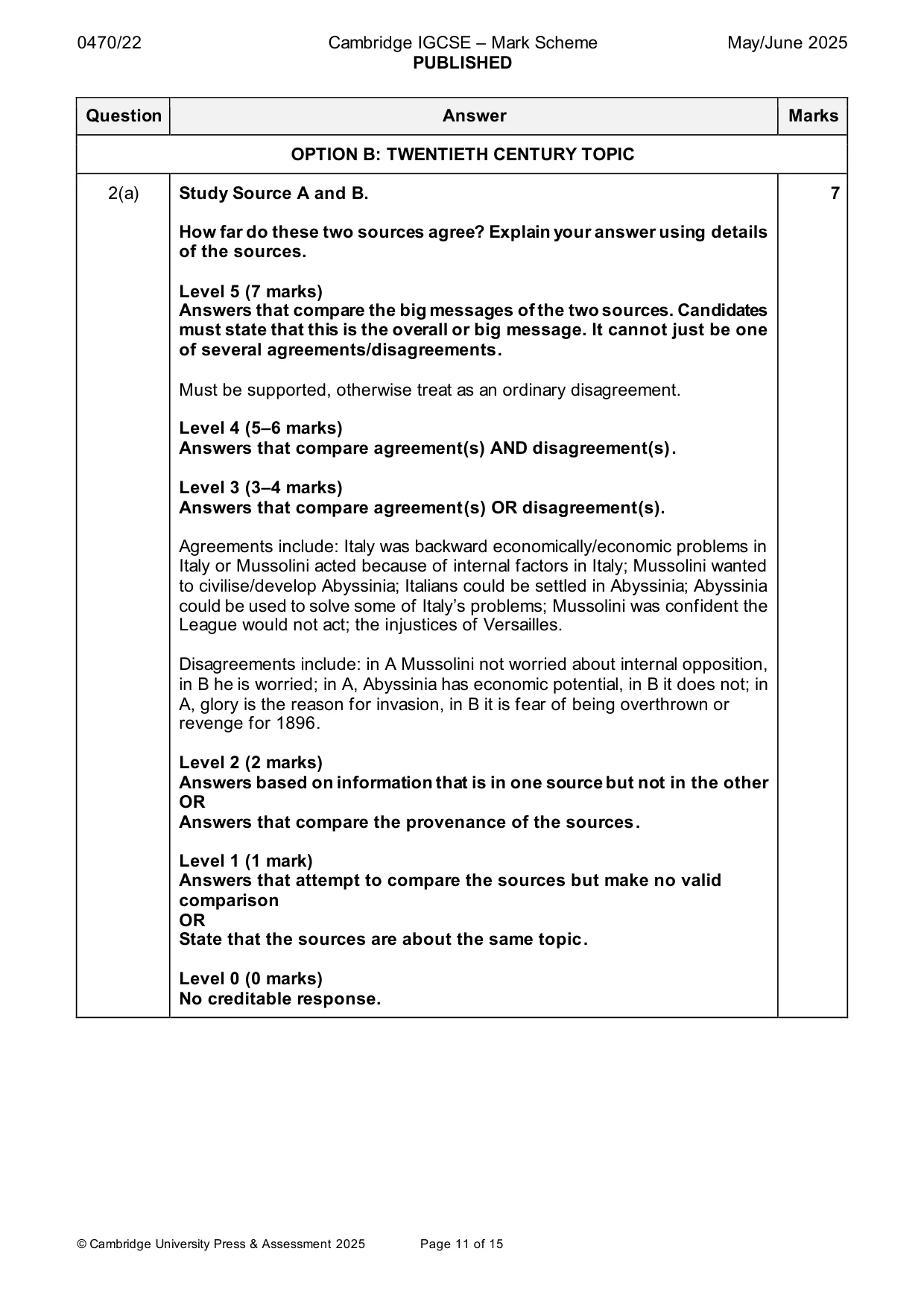
0470/22 Cambridge IGCSE – Mark Scheme PUBLISHED May/June 2025 © Cambridge University Press & Assessment 2025 Page 11 of 15 Question Answer Marks OPTION B: TWENTIETH CENTURY TOPIC 2(a) Study Source A and B. How far do these two sources agree? Explain your answer using details of the sources. Level 5 (7 marks) Answers that compare the big messages of the two sources. Candidates must state that this is the overall or big message. It cannot just be one of several agreements/disagreements. Must be supported, otherwise treat as an ordinary disagreement. Level 4 (5–6 marks) Answers that compare agreement(s) AND disagreement(s). Level 3 (3–4 marks) Answers that compare agreement(s) OR disagreement(s). Agreements include: Italy was backward economically/economic problems in Italy or Mussolini acted because of internal factors in Italy; Mussolini wanted to civilise/develop Abyssinia; Italians could be settled in Abyssinia; Abyssinia could be used to solve some of Italy’s problems; Mussolini was confident the League would not act; the injustices of Versailles. Disagreements include: in A Mussolini not worried about internal opposition, in B he is worried; in A, Abyssinia has economic potential, in B it does not; in A, glory is the reason for invasion, in B it is fear of being overthrown or revenge for 1896. Level 2 (2 marks) Answers based on information that is in one source but not in the other OR Answers that compare the provenance of the sources. Level 1 (1 mark) Answers that attempt to compare the sources but make no valid comparison OR State that the sources are about the same topic. Level 0 (0 marks) No creditable response. 7
Mark scheme, page 12
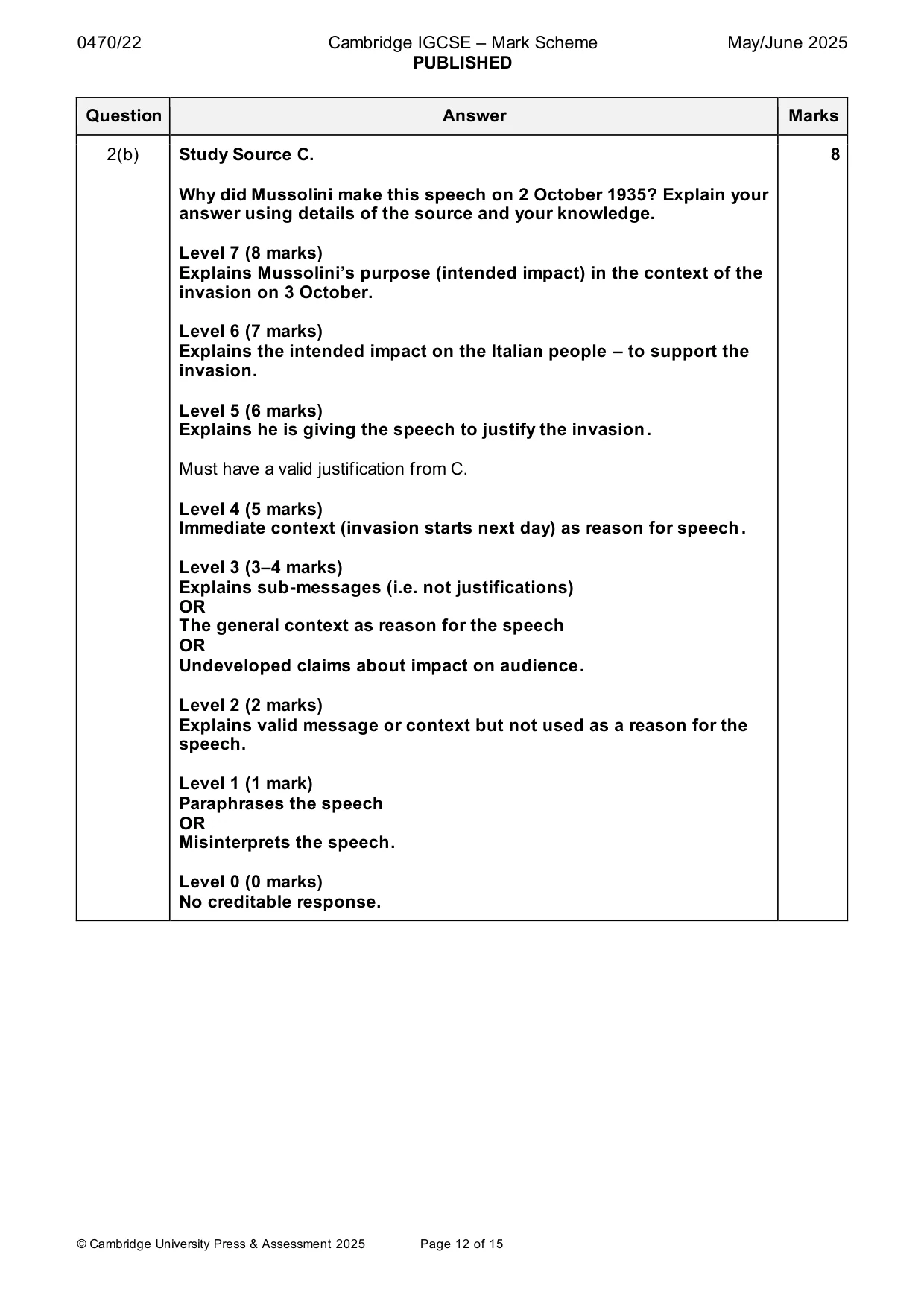
0470/22 Cambridge IGCSE – Mark Scheme PUBLISHED May/June 2025 © Cambridge University Press & Assessment 2025 Page 12 of 15 Question Answer Marks 2(b) Study Source C. Why did Mussolini make this speech on 2 October 1935? Explain your answer using details of the source and your knowledge. Level 7 (8 marks) Explains Mussolini’s purpose (intended impact) in the context of the invasion on 3 October. Level 6 (7 marks) Explains the intended impact on the Italian people – to support the invasion. Level 5 (6 marks) Explains he is giving the speech to justify the invasion. Must have a valid justification from C. Level 4 (5 marks) Immediate context (invasion starts next day) as reason for speech. Level 3 (3–4 marks) Explains sub-messages (i.e. not justifications) OR The general context as reason for the speech OR Undeveloped claims about impact on audience. Level 2 (2 marks) Explains valid message or context but not used as a reason for the speech. Level 1 (1 mark) Paraphrases the speech OR Misinterprets the speech. Level 0 (0 marks) No creditable response. 8
Mark scheme, page 13
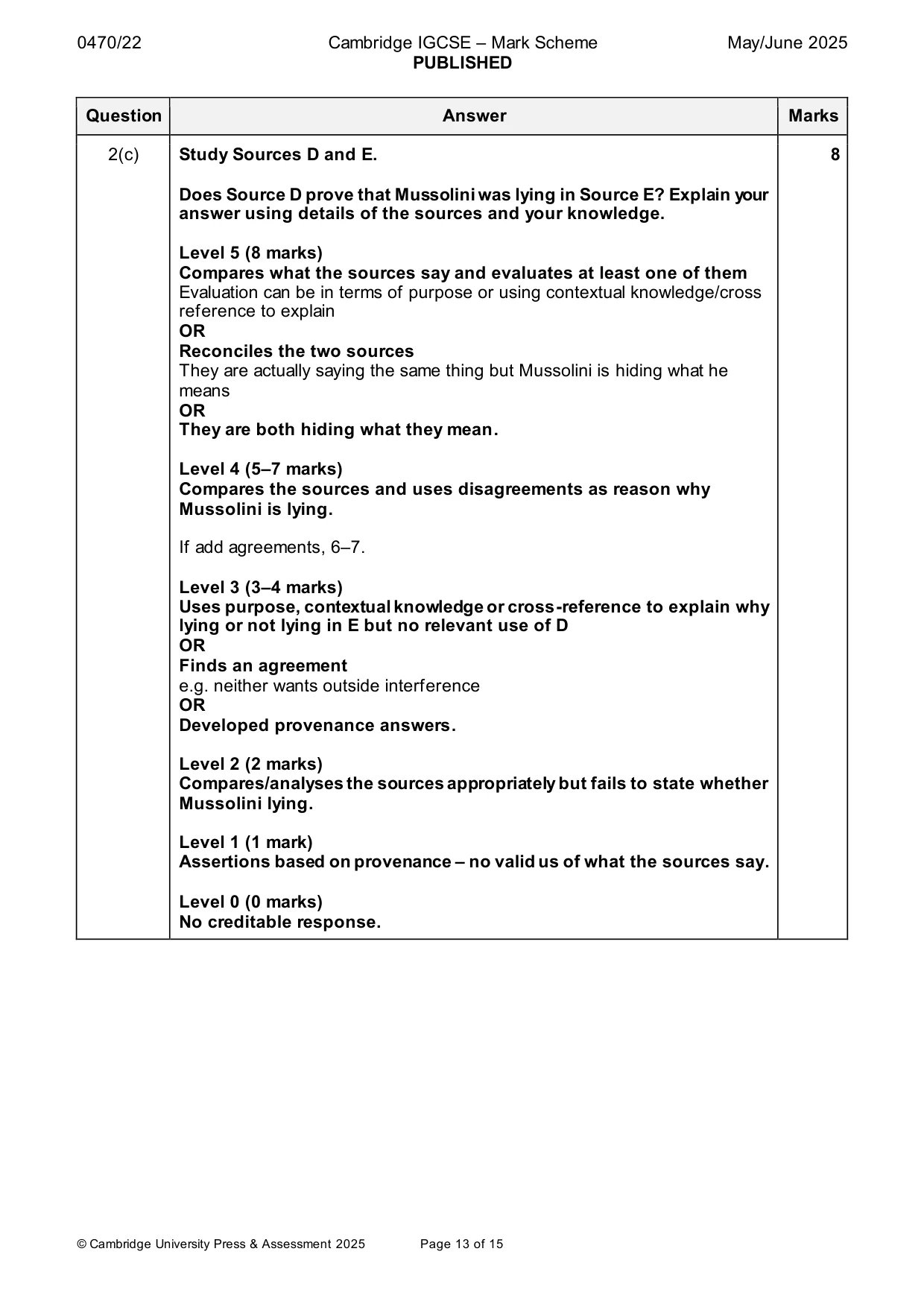
0470/22 Cambridge IGCSE – Mark Scheme PUBLISHED May/June 2025 © Cambridge University Press & Assessment 2025 Page 13 of 15 Question Answer Marks 2(c) Study Sources D and E. Does Source D prove that Mussolini was lying in Source E? Explain your answer using details of the sources and your knowledge. Level 5 (8 marks) Compares what the sources say and evaluates at least one of them Evaluation can be in terms of purpose or using contextual knowledge/cross reference to explain OR Reconciles the two sources They are actually saying the same thing but Mussolini is hiding what he means OR They are both hiding what they mean. Level 4 (5–7 marks) Compares the sources and uses disagreements as reason why Mussolini is lying. If add agreements, 6–7. Level 3 (3–4 marks) Uses purpose, contextual knowledge or cross-reference to explain why lying or not lying in E but no relevant use of D OR Finds an agreement e.g. neither wants outside interference OR Developed provenance answers. Level 2 (2 marks) Compares/analyses the sources appropriately but fails to state whether Mussolini lying. Level 1 (1 mark) Assertions based on provenance – no valid us of what the sources say. Level 0 (0 marks) No creditable response. 8
Mark scheme, page 14
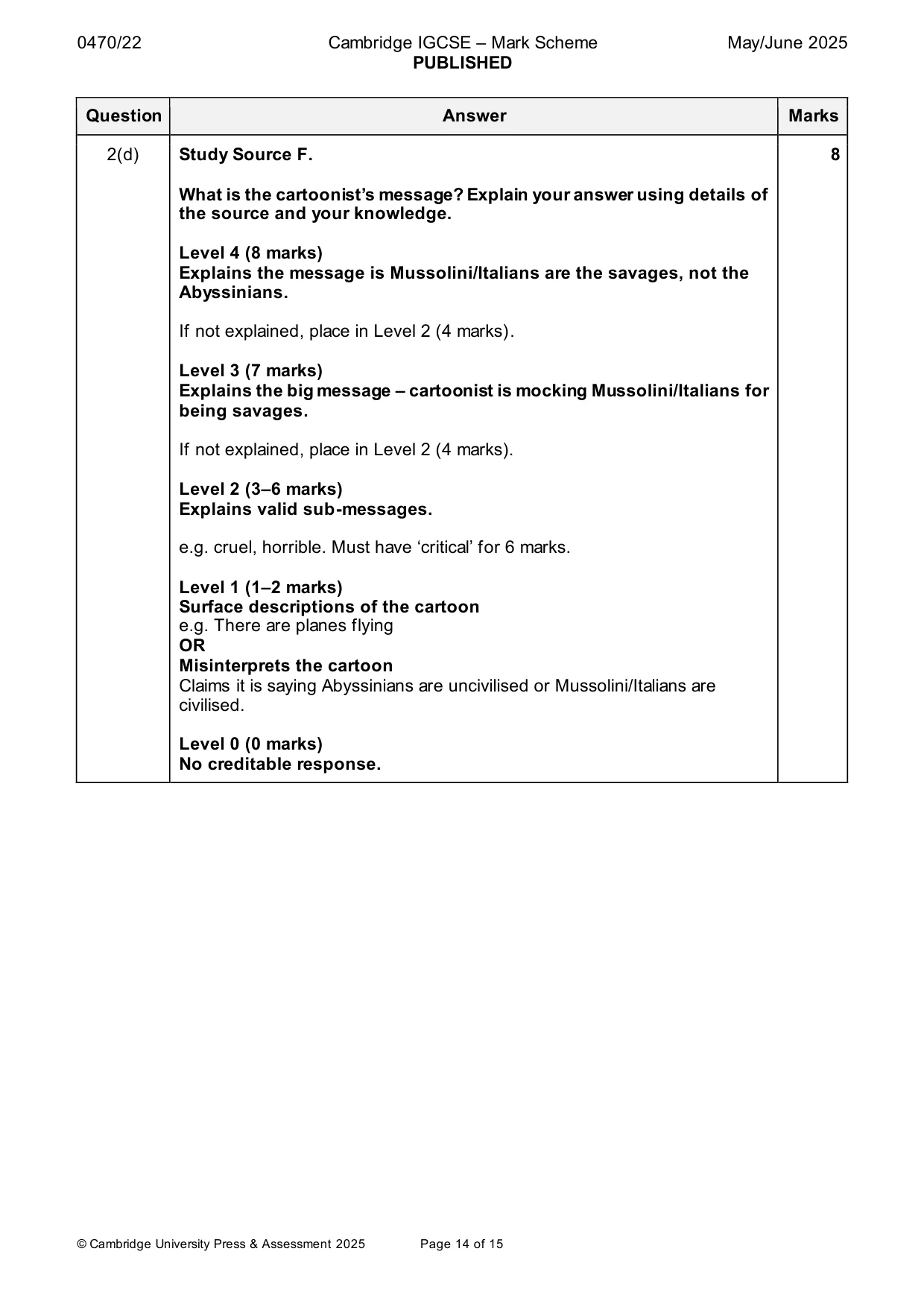
0470/22 Cambridge IGCSE – Mark Scheme PUBLISHED May/June 2025 © Cambridge University Press & Assessment 2025 Page 14 of 15 Question Answer Marks 2(d) Study Source F. What is the cartoonist’s message? Explain your answer using details of the source and your knowledge. Level 4 (8 marks) Explains the message is Mussolini/Italians are the savages, not the Abyssinians. If not explained, place in Level 2 (4 marks). Level 3 (7 marks) Explains the big message – cartoonist is mocking Mussolini/Italians for being savages. If not explained, place in Level 2 (4 marks). Level 2 (3–6 marks) Explains valid sub-messages. e.g. cruel, horrible. Must have ‘critical’ for 6 marks. Level 1 (1–2 marks) Surface descriptions of the cartoon e.g. There are planes flying OR Misinterprets the cartoon Claims it is saying Abyssinians are uncivilised or Mussolini/Italians are civilised. Level 0 (0 marks) No creditable response. 8
Mark scheme, page 15
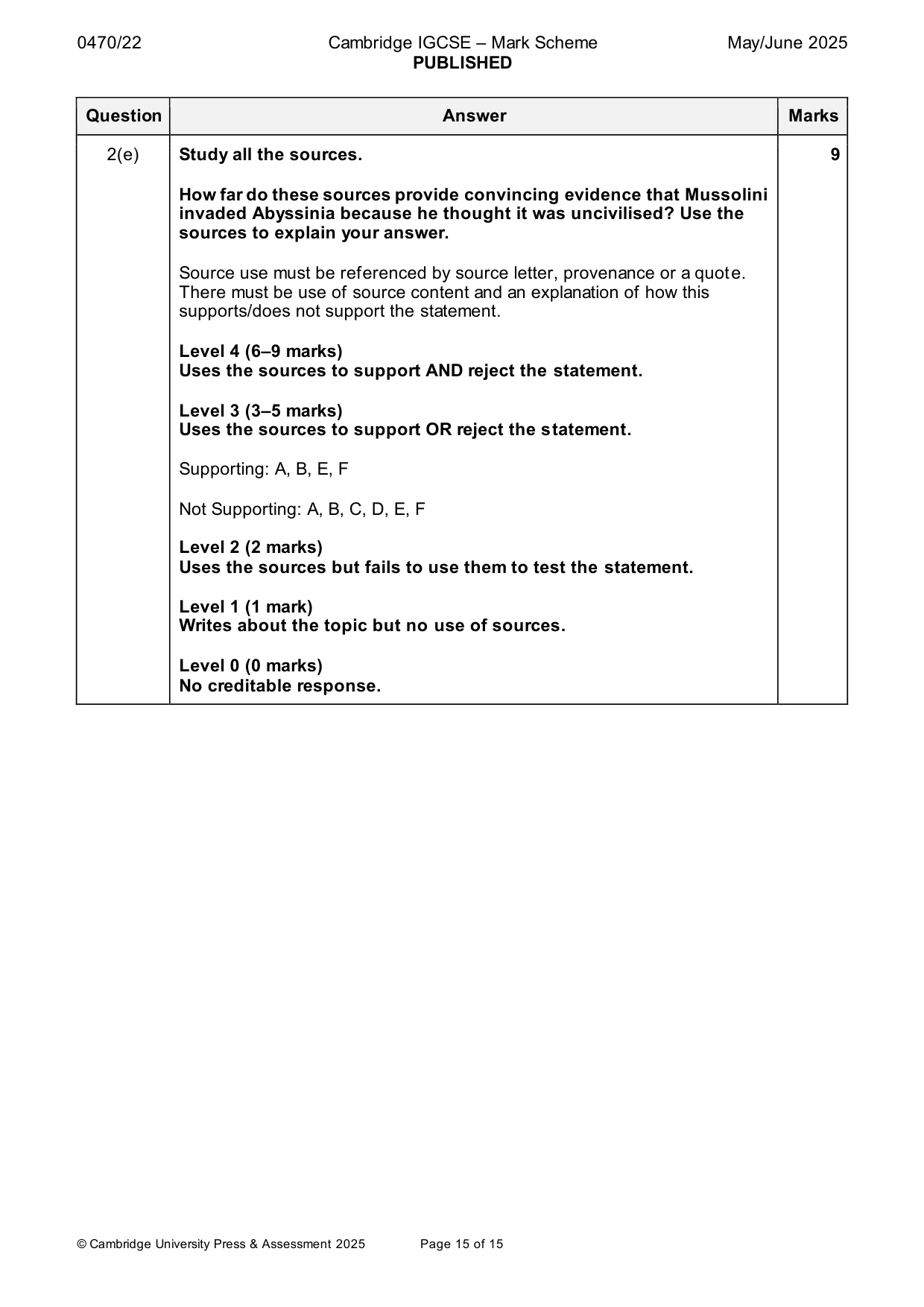
0470/22 Cambridge IGCSE – Mark Scheme PUBLISHED May/June 2025 © Cambridge University Press & Assessment 2025 Page 15 of 15 Question Answer Marks 2(e) Study all the sources. How far do these sources provide convincing evidence that Mussolini invaded Abyssinia because he thought it was uncivilised? Use the sources to explain your answer. Source use must be referenced by source letter, provenance or a quote. There must be use of source content and an explanation of how this supports/does not support the statement. Level 4 (6–9 marks) Uses the sources to support AND reject the statement. Level 3 (3–5 marks) Uses the sources to support OR reject the statement. Supporting: A, B, E, F Not Supporting: A, B, C, D, E, F Level 2 (2 marks) Uses the sources but fails to use them to test the statement. Level 1 (1 mark) Writes about the topic but no use of sources. Level 0 (0 marks) No creditable response. 9
What you needed in this session
Cambridge’s own grade thresholds for 2025 May/June, Paper 2 · Variant 2. A higher threshold means an easier paper — the bar moves with how the cohort did.