Cambridge IGCSE History 0470 — 2025 May/June Paper 2 · Variant 1
0470/21/M/J/25 · 40 marks · 105 min
The question paper and its mark scheme, free to read here and free to download. This is Cambridge’s own paper, exactly as it was sat.
Question paper12 pages
Mark scheme14 pages
Answers below. Sit the paper first if you are practising.
Paper as text
Question paper, page 1
This document has 12 pages. Any blank pages are indicated. [Turn over Cambridge IGCSE™ HISTORY 0470/21 Paper 2 Document Questions May/June 2025 1 hour 45 minutes You must answer on the enclosed answer booklet. You will need: Answer booklet (enclosed) INSTRUCTIONS ● Answer one question on one option only. Option A: Nineteenth century topic Option B: Twentieth century topic ● Follow the instructions on the front cover of the answer booklet. If you need additional answer paper, ask the invigilator for a continuation booklet. INFORMATION ● The total mark for this paper is 40. ● The number of marks for each question or part question is shown in brackets [ ]. * 9 9 4 3 8 3 4 3 9 3 * DC (CJ) 342886/2 © UCLES 2025
Question paper, page 2
2 0470/21/M/J/25 © UCLES 2025 Option A: Nineteenth century topic 1 Who was responsible for the Austro–Prussian War? Study the Background Information and the sources carefully, and then answer all parts of Question 1. Background Information By the early 1860s, Prussia was becoming ready to challenge Austria’s dominance over Germany. The issue that finally brought the two states to war was that of the Duchies of Holstein and Schleswig. In 1865, Austria and Prussia signed the Gastein Convention, dividing the Duchies between them. However, this did not create good relations between the two countries and by June 1866, they were at war. Although historians have recognised the reluctance of William I of Prussia to go to war, Bismarck has often been blamed for deliberately bringing the war about. However, others have argued that Austria, very unwisely, caused the war. Was Austria to blame for the war in 1866? SOURCE A In January 1864, a joint Prussian–Austrian army marched against Denmark into Holstein and then Schleswig. By July 1864, Denmark had surrendered. In 1865 it was agreed in the Convention of Gastein that Holstein would be administered by Austria, and Schleswig by Prussia. However, Austria and Prussia would have joint sovereignty over both Duchies. This agreement provided plenty of opportunities for friction between the two German states, especially as both wanted to be the leading state in Germany. It is likely that Bismarck wanted no more than to gain control of both Duchies and that his policies at this time were designed to merely frighten Austria. There is no reason to think that war was forced upon Austria by Prussia. In fact, Austria thought it was using Prussia. In a provocative move in June 1866, it ended talks with Prussia and referred the issue of the Duchies to the German Diet. This broke previous agreements and provoked Bismarck to send troops into Holstein. Austria then made the crucial move of asking the Diet to mobilise for war. From a recent history book. SOURCE B Bismarck suggested that Austria and Prussia act jointly against Denmark, and was happy to agree joint control over the Duchies of Holstein and Schleswig, because this would give him the possibility of war against Austria whenever he wanted. When the Austrian–Prussian army occupied Schleswig in 1864, Bismarck had already decided that war against Austria was necessary, not only to release Germany from Austria, but to unify Germany under Prussian leadership. Despite opposition from William I and the Prussian Crown Prince, Austria was deceived by Bismarck all the way. Bismarck skilfully encouraged the Austrians to put themselves in the wrong, time and time again. When Austria referred the issue of the Duchies to the Diet in June 1866, it was committing only a technical infringement of earlier agreements. However, this gave Prussia the welcome excuse to send troops into Holstein. It then made the decisive move by declaring that the German Confederation was abolished and invading Saxony, Hanover and Hesse-Cassel. From an article about the causes of the Austro–Prussian War.
Question paper, page 3
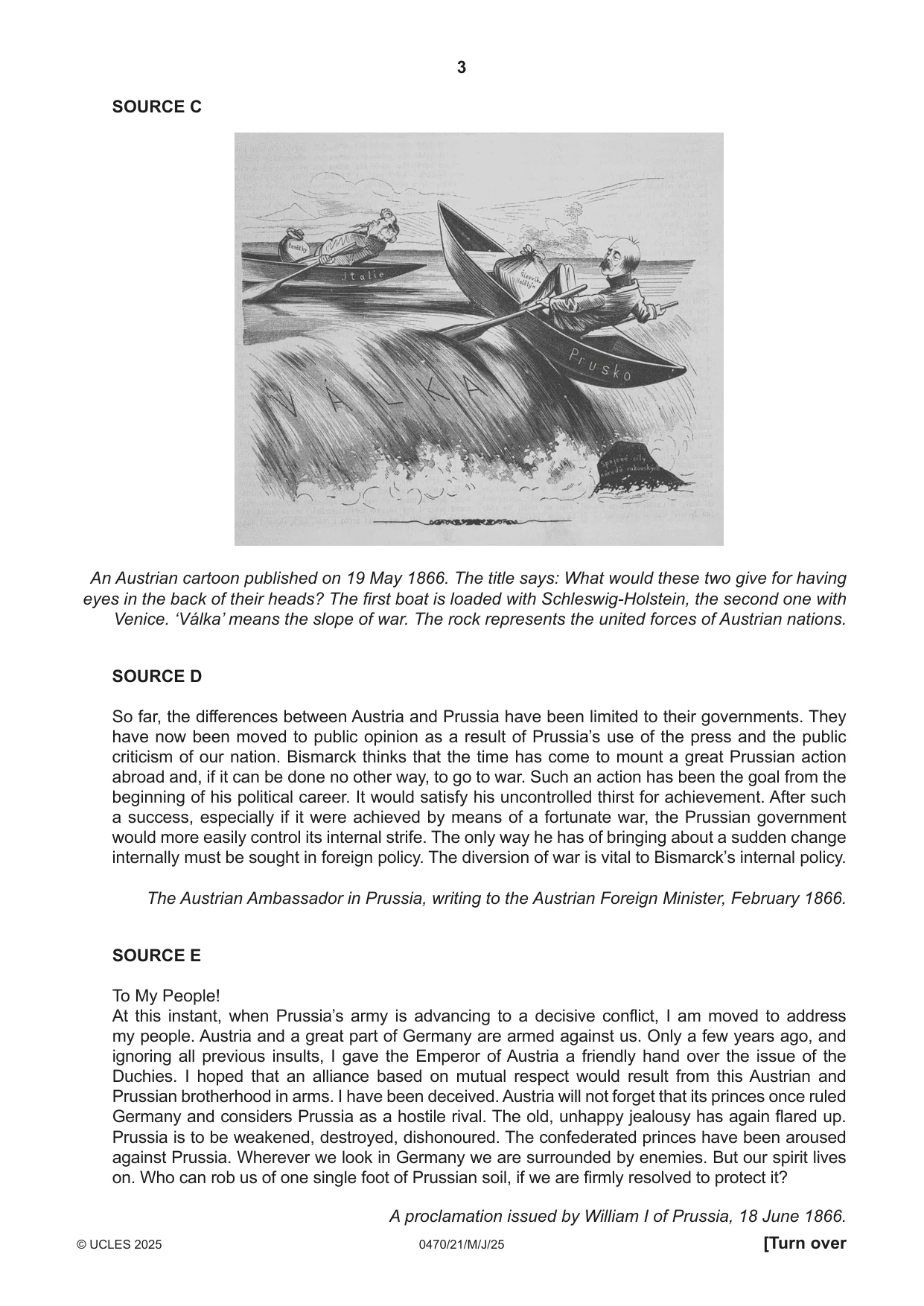
3 0470/21/M/J/25 © UCLES 2025 [Turn over SOURCE C An Austrian cartoon published on 19 May 1866. The title says: What would these two give for having eyes in the back of their heads? The first boat is loaded with Schleswig-Holstein, the second one with Venice. ‘Válka’ means the slope of war. The rock represents the united forces of Austrian nations. SOURCE D So far, the differences between Austria and Prussia have been limited to their governments. They have now been moved to public opinion as a result of Prussia’s use of the press and the public criticism of our nation. Bismarck thinks that the time has come to mount a great Prussian action abroad and, if it can be done no other way, to go to war. Such an action has been the goal from the beginning of his political career. It would satisfy his uncontrolled thirst for achievement. After such a success, especially if it were achieved by means of a fortunate war, the Prussian government would more easily control its internal strife. The only way he has of bringing about a sudden change internally must be sought in foreign policy. The diversion of war is vital to Bismarck’s internal policy. The Austrian Ambassador in Prussia, writing to the Austrian Foreign Minister, February 1866. SOURCE E To My People! At this instant, when Prussia’s army is advancing to a decisive conflict, I am moved to address my people. Austria and a great part of Germany are armed against us. Only a few years ago, and ignoring all previous insults, I gave the Emperor of Austria a friendly hand over the issue of the Duchies. I hoped that an alliance based on mutual respect would result from this Austrian and Prussian brotherhood in arms. I have been deceived. Austria will not forget that its princes once ruled Germany and considers Prussia as a hostile rival. The old, unhappy jealousy has again flared up. Prussia is to be weakened, destroyed, dishonoured. The confederated princes have been aroused against Prussia. Wherever we look in Germany we are surrounded by enemies. But our spirit lives on. Who can rob us of one single foot of Prussian soil, if we are firmly resolved to protect it? A proclamation issued by William I of Prussia, 18 June 1866.
Question paper, page 4
4 0470/21/M/J/25 © UCLES 2025 SOURCE F During the joint occupation of the Duchies, it soon became clear that Austria’s game was not an open one, but that it considered the situation favourable for acting on its jealousy towards Prussia. Hatred of Prussia was deliberately encouraged in and out of Germany, and Austria considered the ground sufficiently prepared for a war. In the winter of 1865–66, it began to provoke Prussia in every way. You know what conflicts of conscience I had to go through before I could believe in the possibility of this war and how I tried every means of preventing it. It was not until I saw that the honour of Prussia was at stake, and when all doubts about Austria’s intentions were removed, that I considered using force. A letter from William I to his wife, 1867. His wife was staying with the British Queen. The letter was meant to be seen by the British government.
Question paper, page 5
5 0470/21/M/J/25 © UCLES 2025 [Turn over Now answer all parts of Question 1. You may use any of the sources to help you answer the questions, in addition to those sources which you are told to use. In answering parts (a)–(e) you should use your knowledge of the topic to help you interpret and evaluate the sources. (a) Study Sources A and B. How far do these two sources agree? Explain your answer using details of the sources. [7] (b) Study Source C. What is the cartoonist’s message? Explain your answer using details of the source and your knowledge. [8] (c) Study Sources D and E. Does Source D make Source E surprising? Explain your answer using details of the sources and your knowledge. [8] (d) Study Source F. Can William I’s account be trusted? Explain your answer using details of the source and your knowledge. [8] (e) Study all the sources. How far do these sources provide convincing evidence that Austria was to blame for the Austro–Prussian War? Use the sources to explain your answer. [9]
Question paper, page 6
6 0470/21/M/J/25 © UCLES 2025 Option B: Twentieth century topic 2 What was the main criticism of the League of Nations in its early years? Study the Background Information and the sources carefully, and then answer all parts of Question 2. Background Information The League of Nations was founded on 10 January 1920. Its main aims were to keep international peace through collective security and to settle disputes through negotiation. Opinions about the League were divided from the beginning. Some countries thought it had too much power, some thought it was too weak. Others claimed it would be used to preserve the advantages gained by Britain and France through the Treaty of Versailles. How far was early criticism of the League based on the idea that it was too weak? SOURCE A Criticisms of the League were often based on suspicions about the power it had over member states, and about collective security. US Senators objected to Article 10 of the League’s Covenant, which would commit the United States to defending any member of the League in the event of an attack. They saw this as a violation of US sovereignty. British leaders had a limited idea of the League; they favoured a League without sanctions, one that would not infringe national sovereignty. They wanted a League that would recreate, not challenge, a balance of power. Clemenceau preferred to rely on old-fashioned military alliances and Lloyd George preferred private meetings of heads of governments. At times he claimed the League was a dangerous institution. Although many saw it as a club of the victors, Britain and France disagreed: France wanted to maintain the existing situation, whereas Britain saw that change was necessary. On the other hand, many smaller states enthusiastically signed the Covenant in 1919 because they viewed the League as an organisation that would protect them from the ambitions of their larger neighbours. Asian and Latin American countries welcomed the Assembly’s universal character. From a history book. SOURCE B The League’s approach of collective security appeared to many to be the best alternative to the balance-of-power approach that had failed. Wilson saw the League as replacing great-power politics. It failed to do this because it was too weak and it faced the growing power of nationalism. To be successful, it required the willingness of the great powers to use it. Another criticism of the League was that it was created by the victorious powers and the defeated had been excluded – it was not universal. To many non-European members, it was a Eurocentric institution, yet the British and French did not believe that using it would provide stability to Europe. The Bolsheviks in Russia saw it as a cosy club of victor-powers like Britain and France where they could work together to secure their acquisitions. Many critics pointed to its lack of power. It could not make member states take action or impose sanctions. Lloyd George did not feel strongly either way about the League but at Versailles had realised that he could not gain Wilson’s support for British interests if he abandoned the League. From a recent history book.
Question paper, page 7
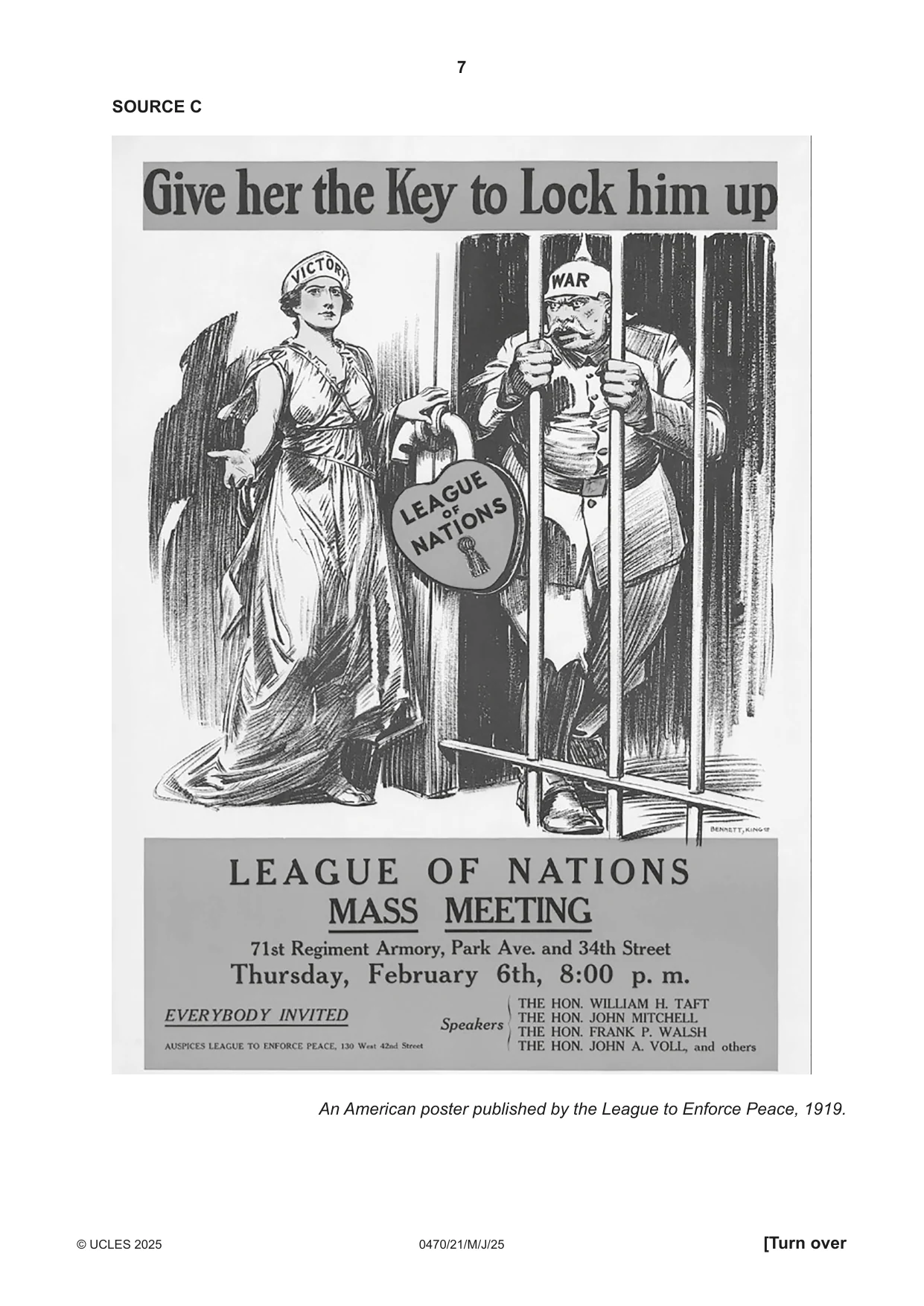
7 0470/21/M/J/25 © UCLES 2025 [Turn over SOURCE C An American poster published by the League to Enforce Peace, 1919.
Question paper, page 8
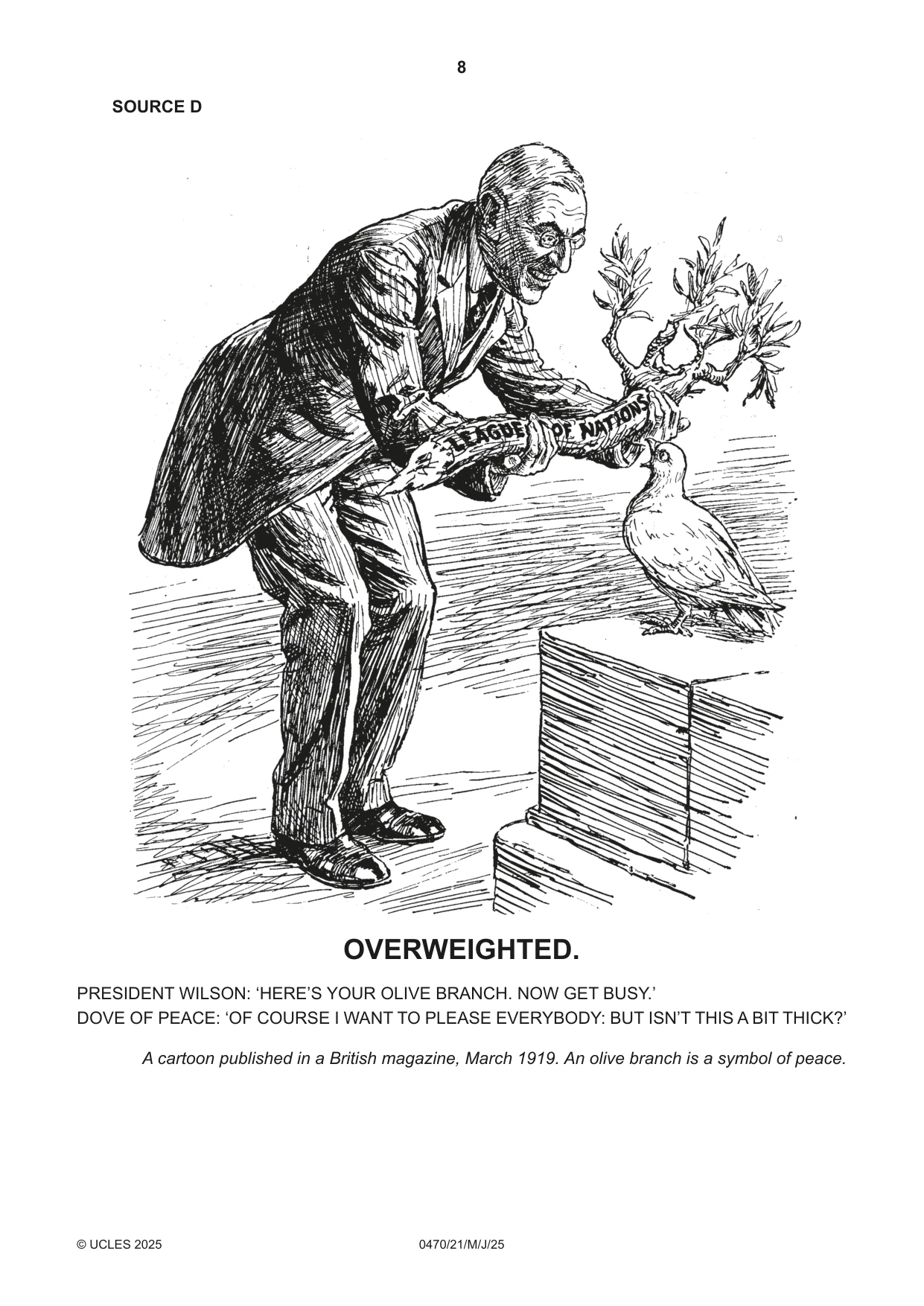
8 0470/21/M/J/25 © UCLES 2025 SOURCE D OVERWEIGHTED. PRESIDENT WILSON: ‘HERE’S YOUR OLIVE BRANCH. NOW GET BUSY.’ DOVE OF PEACE: ‘OF COURSE I WANT TO PLEASE EVERYBODY: BUT ISN’T THIS A BIT THICK?’ A cartoon published in a British magazine, March 1919. An olive branch is a symbol of peace.
Question paper, page 9
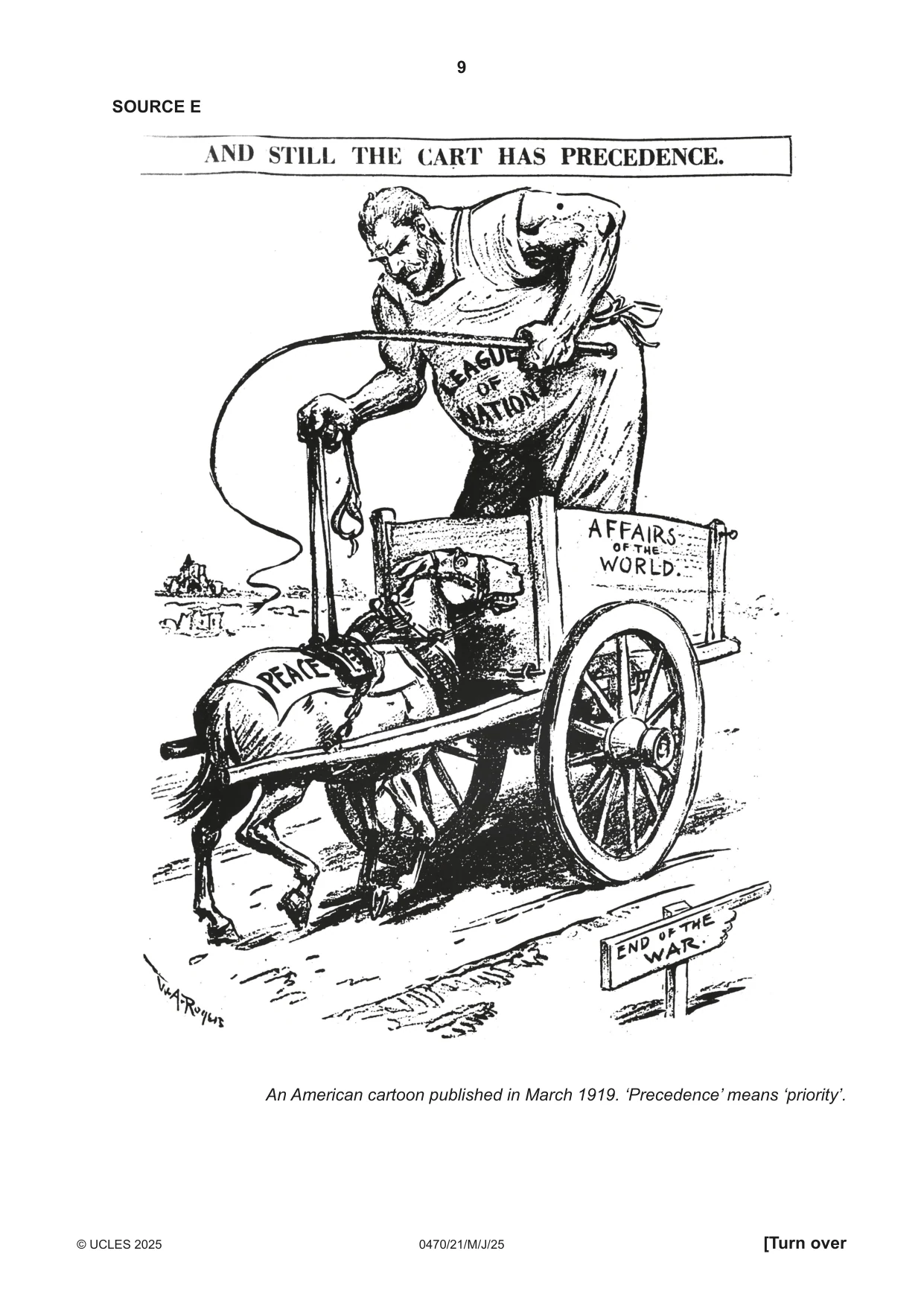
9 0470/21/M/J/25 © UCLES 2025 [Turn over SOURCE E An American cartoon published in March 1919. ‘Precedence’ means ‘priority’.
Question paper, page 10
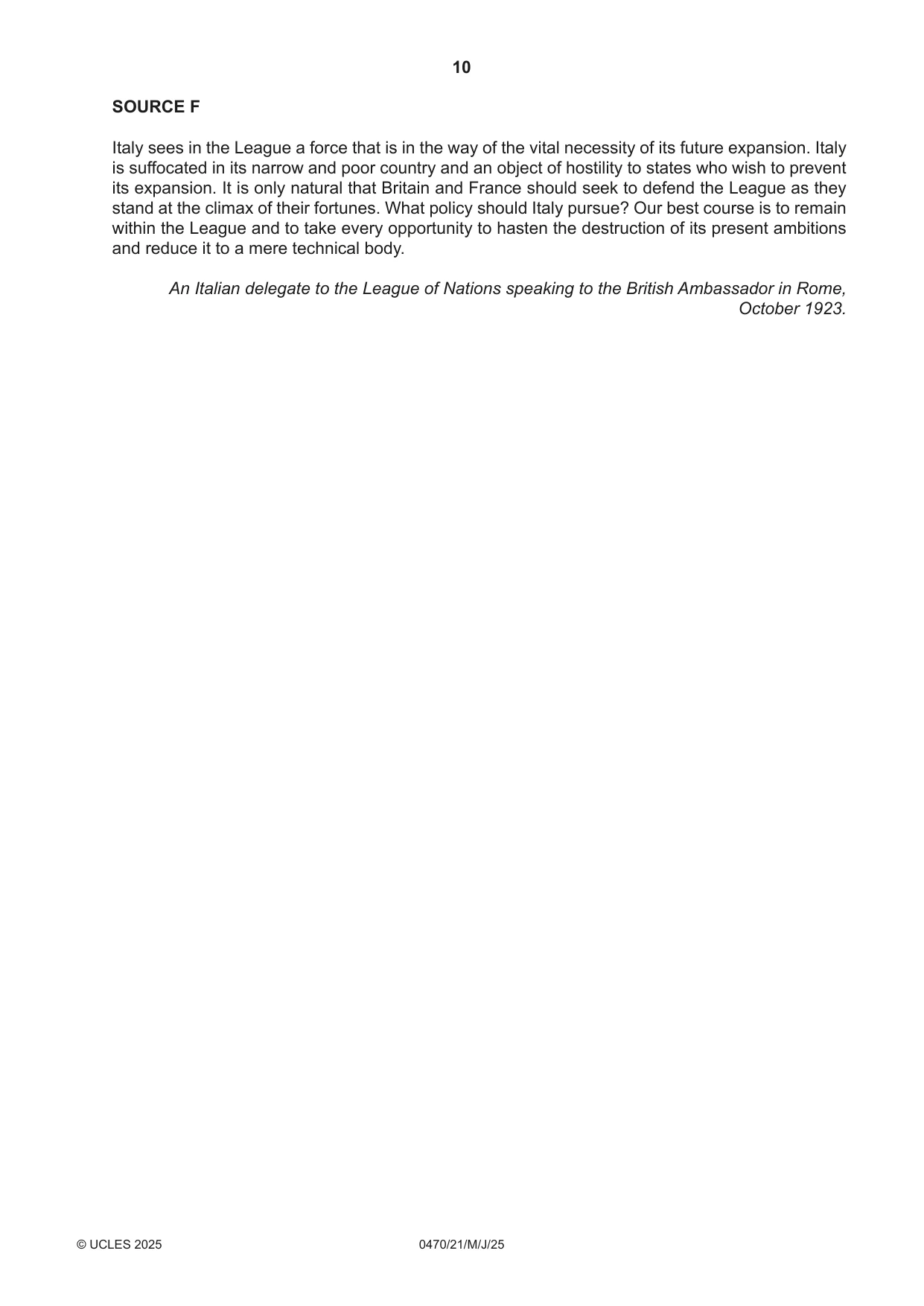
10 0470/21/M/J/25 © UCLES 2025 SOURCE F Italy sees in the League a force that is in the way of the vital necessity of its future expansion. Italy is suffocated in its narrow and poor country and an object of hostility to states who wish to prevent its expansion. It is only natural that Britain and France should seek to defend the League as they stand at the climax of their fortunes. What policy should Italy pursue? Our best course is to remain within the League and to take every opportunity to hasten the destruction of its present ambitions and reduce it to a mere technical body. An Italian delegate to the League of Nations speaking to the British Ambassador in Rome, October 1923.
Question paper, page 11
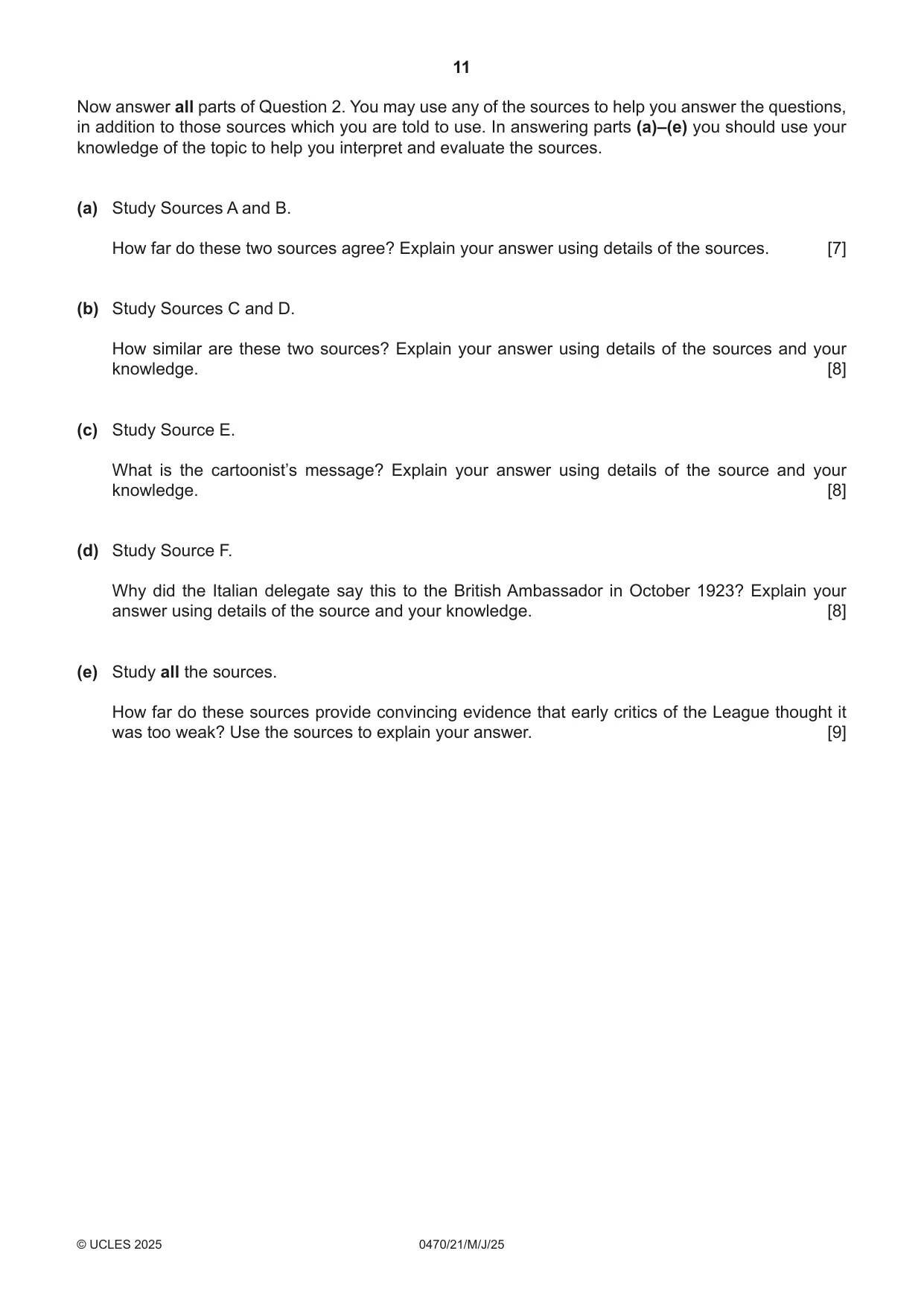
11 0470/21/M/J/25 © UCLES 2025 Now answer all parts of Question 2. You may use any of the sources to help you answer the questions, in addition to those sources which you are told to use. In answering parts (a)–(e) you should use your knowledge of the topic to help you interpret and evaluate the sources. (a) Study Sources A and B. How far do these two sources agree? Explain your answer using details of the sources. [7] (b) Study Sources C and D. How similar are these two sources? Explain your answer using details of the sources and your knowledge. [8] (c) Study Source E. What is the cartoonist’s message? Explain your answer using details of the source and your knowledge. [8] (d) Study Source F. Why did the Italian delegate say this to the British Ambassador in October 1923? Explain your answer using details of the source and your knowledge. [8] (e) Study all the sources. How far do these sources provide convincing evidence that early critics of the League thought it was too weak? Use the sources to explain your answer. [9]
Question paper, page 12
12 0470/21/M/J/25 © UCLES 2025 Permission to reproduce items where third-party owned material protected by copyright is included has been sought and cleared where possible. Every reasonable effort has been made by the publisher (UCLES) to trace copyright holders, but if any items requiring clearance have unwittingly been included, the publisher will be pleased to make amends at the earliest possible opportunity. To avoid the issue of disclosure of answer-related information to candidates, all copyright acknowledgements are reproduced online in the Cambridge Assessment International Education Copyright Acknowledgements Booklet. This is produced for each series of examinations and is freely available to download at www.cambridgeinternational.org after the live examination series. Cambridge Assessment International Education is part of Cambridge Assessment. Cambridge Assessment is the brand name of the University of Cambridge Local Examinations Syndicate (UCLES), which is a department of the University of Cambridge. BLANK PAGE
Mark scheme, page 1
This document consists of 14 printed pages. © Cambridge University Press & Assessment 2025 [Turn over Cambridge IGCSE™ HISTORY 0470/21 Paper 2 Document Questions May/June 2025 MARK SCHEME Maximum Mark: 40 Published This mark scheme is published as an aid to teachers and candidates, to indicate the requirements of the examination. It shows the basis on which Examiners were instructed to award marks. It does not indicate the details of the discussions that took place at an Examiners’ meeting before marking began, which would have considered the acceptability of alternative answers. Mark schemes should be read in conjunction with the question paper and the Principal Examiner Report for Teachers. Cambridge International will not enter into discussions about these mark schemes. Cambridge International is publishing the mark schemes for the May/June 2025 series for most Cambridge IGCSE, Cambridge International A and AS Level components, and some Cambridge O Level components.
Mark scheme, page 2
0470/21 Cambridge IGCSE – Mark Scheme PUBLISHED May/June 2025 © Cambridge University Press & Assessment 2025 Page 2 of 14 Generic Marking Principles These general marking principles must be applied by all examiners when marking candidate answers. They should be applied alongside the specific content of the mark scheme or generic level descriptions for a question. Each question paper and mark scheme will also comply with these marking principles. GENERIC MARKING PRINCIPLE 1: Marks must be awarded in line with: • the specific content of the mark scheme or the generic level descriptors for the question • the specific skills defined in the mark scheme or in the generic level descriptors for the question • the standard of response required by a candidate as exemplified by the standardisation scripts. GENERIC MARKING PRINCIPLE 2: Marks awarded are always whole marks (not half marks, or other fractions). GENERIC MARKING PRINCIPLE 3: Marks must be awarded positively: • marks are awarded for correct/valid answers, as defined in the mark scheme. However, credit is given for valid answers which go beyond the scope of the syllabus and mark scheme, referring to your Team Leader as appropriate • marks are awarded when candidates clearly demonstrate what they know and can do • marks are not deducted for errors • marks are not deducted for omissions • answers should only be judged on the quality of spelling, punctuation and grammar when these features are specifically assessed by the question as indicated by the mark scheme. The meaning, however, should be unambiguous. GENERIC MARKING PRINCIPLE 4: Rules must be applied consistently, e.g. in situations where candidates have not followed instructions or in the application of generic level descriptors. GENERIC MARKING PRINCIPLE 5: Marks should be awarded using the full range of marks defined in the mark scheme for the question (however; the use of the full mark range may be limited according to the quality of the candidate responses seen). GENERIC MARKING PRINCIPLE 6: Marks awarded are based solely on the requirements as defined in the mark scheme. Marks should not be awarded with grade thresholds or grade descriptors in mind.
Mark scheme, page 3
0470/21 Cambridge IGCSE – Mark Scheme PUBLISHED May/June 2025 © Cambridge University Press & Assessment 2025 Page 3 of 14 Annotations guidance for centres Examiners use a system of annotations as a shorthand for communicating their marking decisions to one another. Examiners are trained during the standardisation process on how and when to use annotations. The purpose of annotations is to inform the standardisation and monitoring processes and guide the supervising examiners when they are checking the work of examiners within their team. The meaning of annotations and how they are used is specific to each component and is understood by all examiners who mark the component. We publish annotations in our mark schemes to help centres understand the annotations they may see on copies of scripts. Note that there may not be a direct correlation between the number of annotations on a script and the mark awarded. Similarly, the use of an annotation may not be an indication of the quality of the response. The annotations listed below were available to examiners marking this component in this series. Annotations Annotation Meaning Benefit of the doubt Incorrect OR In part (e) questions only, to indicate that a source has been correctly identified as refuting the statement Correct OR In part (e) questions only, to indicate that a source has been correctly identified as supporting the statement Evaluation Highlighter Highlight relevant areas of a response Level 1 response Level 2 response Level 3 response Level 4 response Level 5 response Off-page comment Comments entered at the bottom of the marking window and then displayed when the associated question item is navigated to On-page comment Comments entered in speech bubbles on the candidate response To indicate that a point has been noted but no credit has been given OR To indicate that a blank page has been checked for creditable content
Mark scheme, page 4
0470/21 Cambridge IGCSE – Mark Scheme PUBLISHED May/June 2025 © Cambridge University Press & Assessment 2025 Page 4 of 14 Assessment objectives AO1 An ability to recall, select, organise and deploy knowledge of the syllabus content. AO3 An ability to understand, interpret, evaluate and use a range of sources as evidence, in their historical context.
Mark scheme, page 5
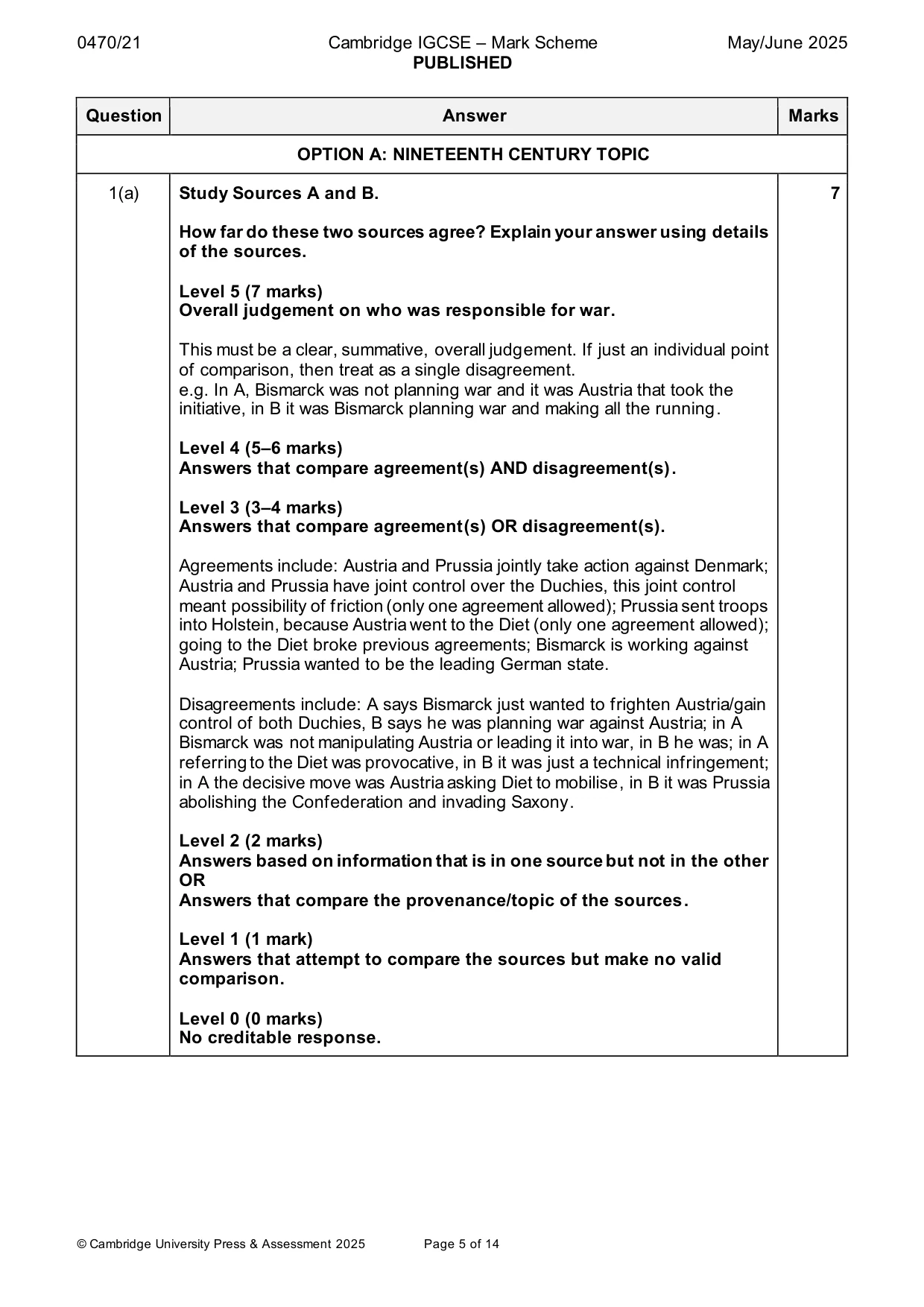
0470/21 Cambridge IGCSE – Mark Scheme PUBLISHED May/June 2025 © Cambridge University Press & Assessment 2025 Page 5 of 14 Question Answer Marks OPTION A: NINETEENTH CENTURY TOPIC 1(a) Study Sources A and B. How far do these two sources agree? Explain your answer using details of the sources. Level 5 (7 marks) Overall judgement on who was responsible for war. This must be a clear, summative, overall judgement. If just an individual point of comparison, then treat as a single disagreement. e.g. In A, Bismarck was not planning war and it was Austria that took the initiative, in B it was Bismarck planning war and making all the running. Level 4 (5–6 marks) Answers that compare agreement(s) AND disagreement(s). Level 3 (3–4 marks) Answers that compare agreement(s) OR disagreement(s). Agreements include: Austria and Prussia jointly take action against Denmark; Austria and Prussia have joint control over the Duchies, this joint control meant possibility of friction (only one agreement allowed); Prussia sent troops into Holstein, because Austria went to the Diet (only one agreement allowed); going to the Diet broke previous agreements; Bismarck is working against Austria; Prussia wanted to be the leading German state. Disagreements include: A says Bismarck just wanted to frighten Austria/gain control of both Duchies, B says he was planning war against Austria; in A Bismarck was not manipulating Austria or leading it into war, in B he was; in A referring to the Diet was provocative, in B it was just a technical infringement; in A the decisive move was Austria asking Diet to mobilise, in B it was Prussia abolishing the Confederation and invading Saxony. Level 2 (2 marks) Answers based on information that is in one source but not in the other OR Answers that compare the provenance/topic of the sources. Level 1 (1 mark) Answers that attempt to compare the sources but make no valid comparison. Level 0 (0 marks) No creditable response. 7
Mark scheme, page 6
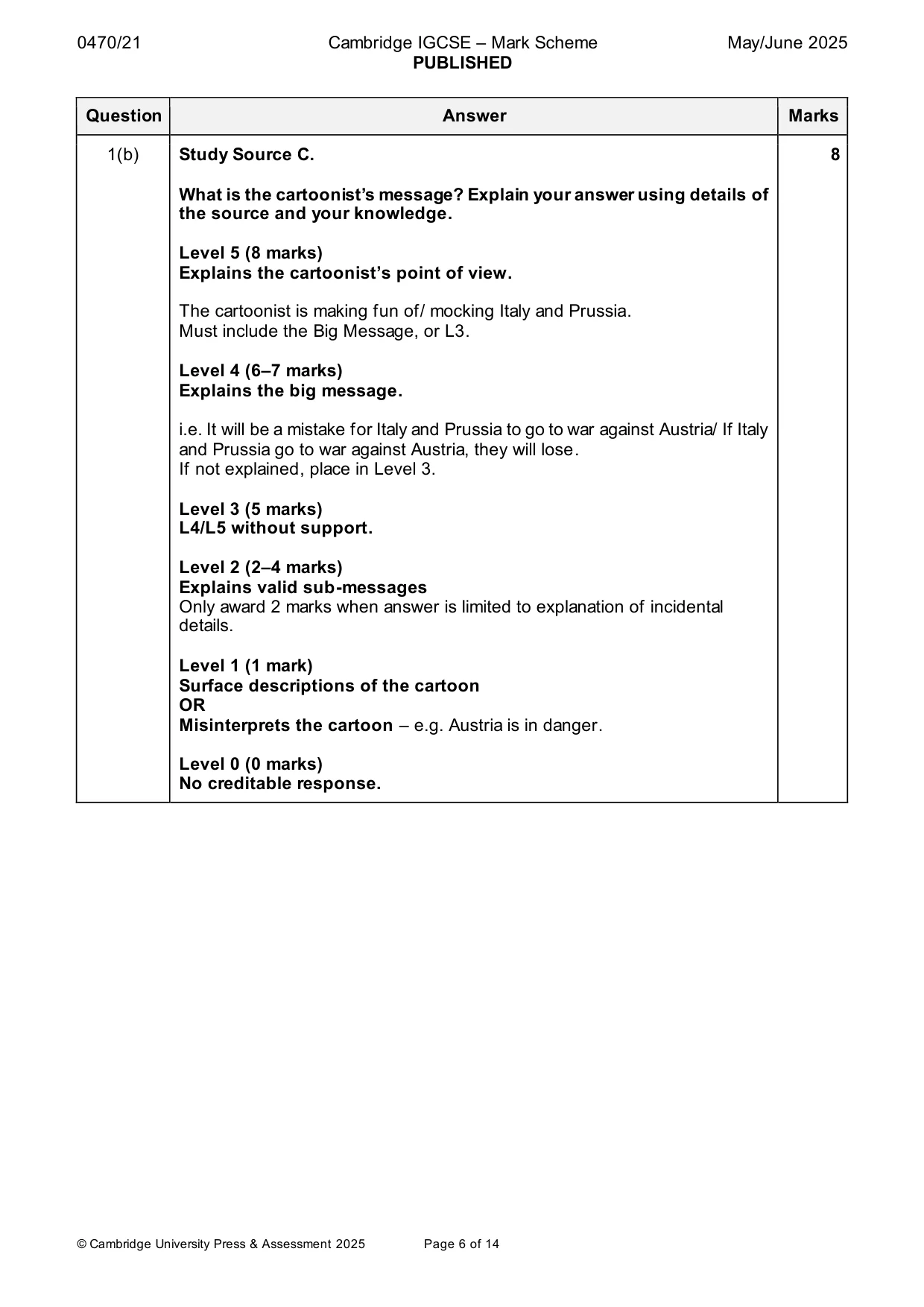
0470/21 Cambridge IGCSE – Mark Scheme PUBLISHED May/June 2025 © Cambridge University Press & Assessment 2025 Page 6 of 14 Question Answer Marks 1(b) Study Source C. What is the cartoonist’s message? Explain your answer using details of the source and your knowledge. Level 5 (8 marks) Explains the cartoonist’s point of view. The cartoonist is making fun of/ mocking Italy and Prussia. Must include the Big Message, or L3. Level 4 (6–7 marks) Explains the big message. i.e. It will be a mistake for Italy and Prussia to go to war against Austria/ If Italy and Prussia go to war against Austria, they will lose. If not explained, place in Level 3. Level 3 (5 marks) L4/L5 without support. Level 2 (2–4 marks) Explains valid sub-messages Only award 2 marks when answer is limited to explanation of incidental details. Level 1 (1 mark) Surface descriptions of the cartoon OR Misinterprets the cartoon – e.g. Austria is in danger. Level 0 (0 marks) No creditable response. 8
Mark scheme, page 7
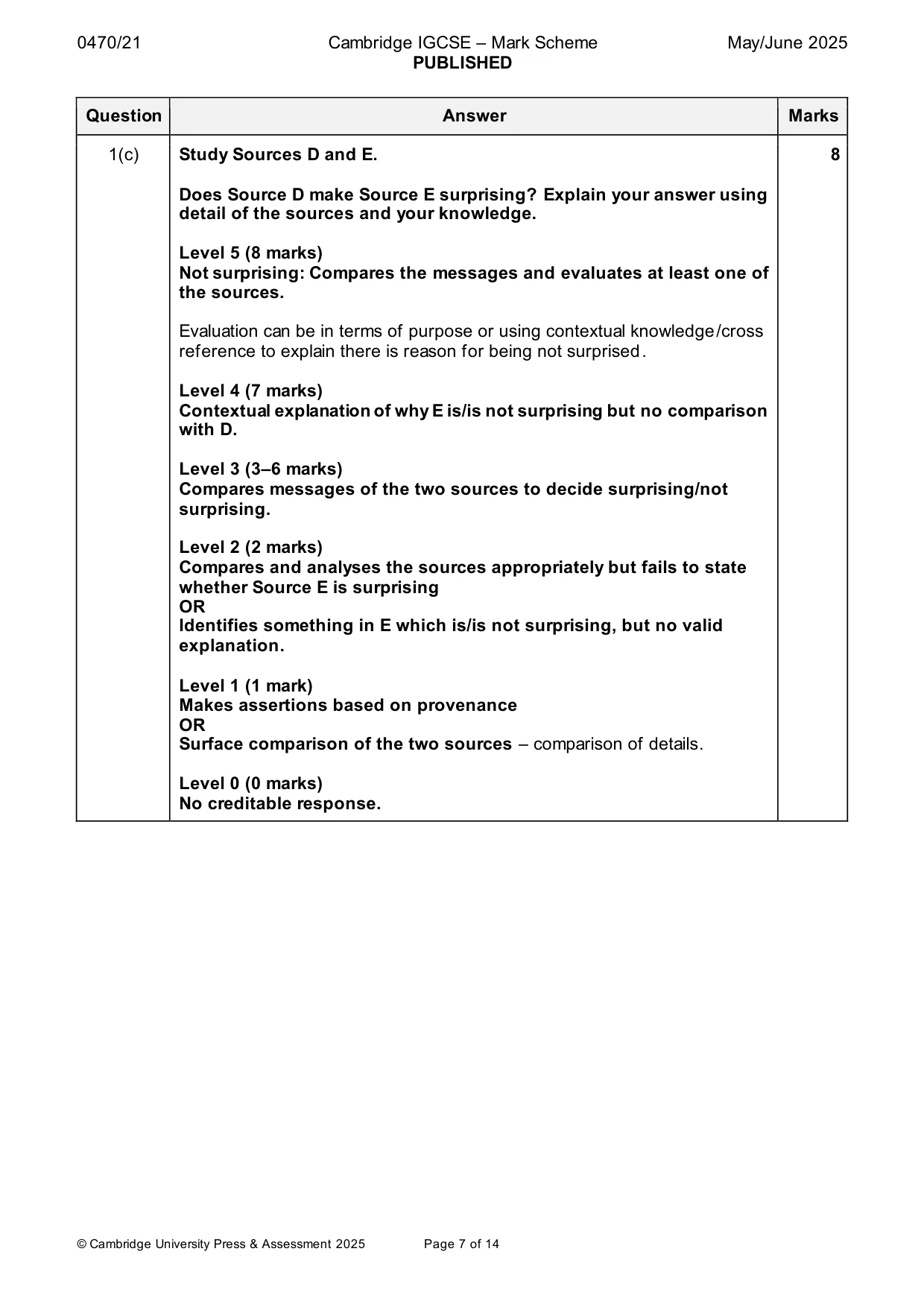
0470/21 Cambridge IGCSE – Mark Scheme PUBLISHED May/June 2025 © Cambridge University Press & Assessment 2025 Page 7 of 14 Question Answer Marks 1(c) Study Sources D and E. Does Source D make Source E surprising? Explain your answer using detail of the sources and your knowledge. Level 5 (8 marks) Not surprising: Compares the messages and evaluates at least one of the sources. Evaluation can be in terms of purpose or using contextual knowledge/cross reference to explain there is reason for being not surprised. Level 4 (7 marks) Contextual explanation of why E is/is not surprising but no comparison with D. Level 3 (3–6 marks) Compares messages of the two sources to decide surprising/not surprising. Level 2 (2 marks) Compares and analyses the sources appropriately but fails to state whether Source E is surprising OR Identifies something in E which is/is not surprising, but no valid explanation. Level 1 (1 mark) Makes assertions based on provenance OR Surface comparison of the two sources – comparison of details. Level 0 (0 marks) No creditable response. 8
Mark scheme, page 8
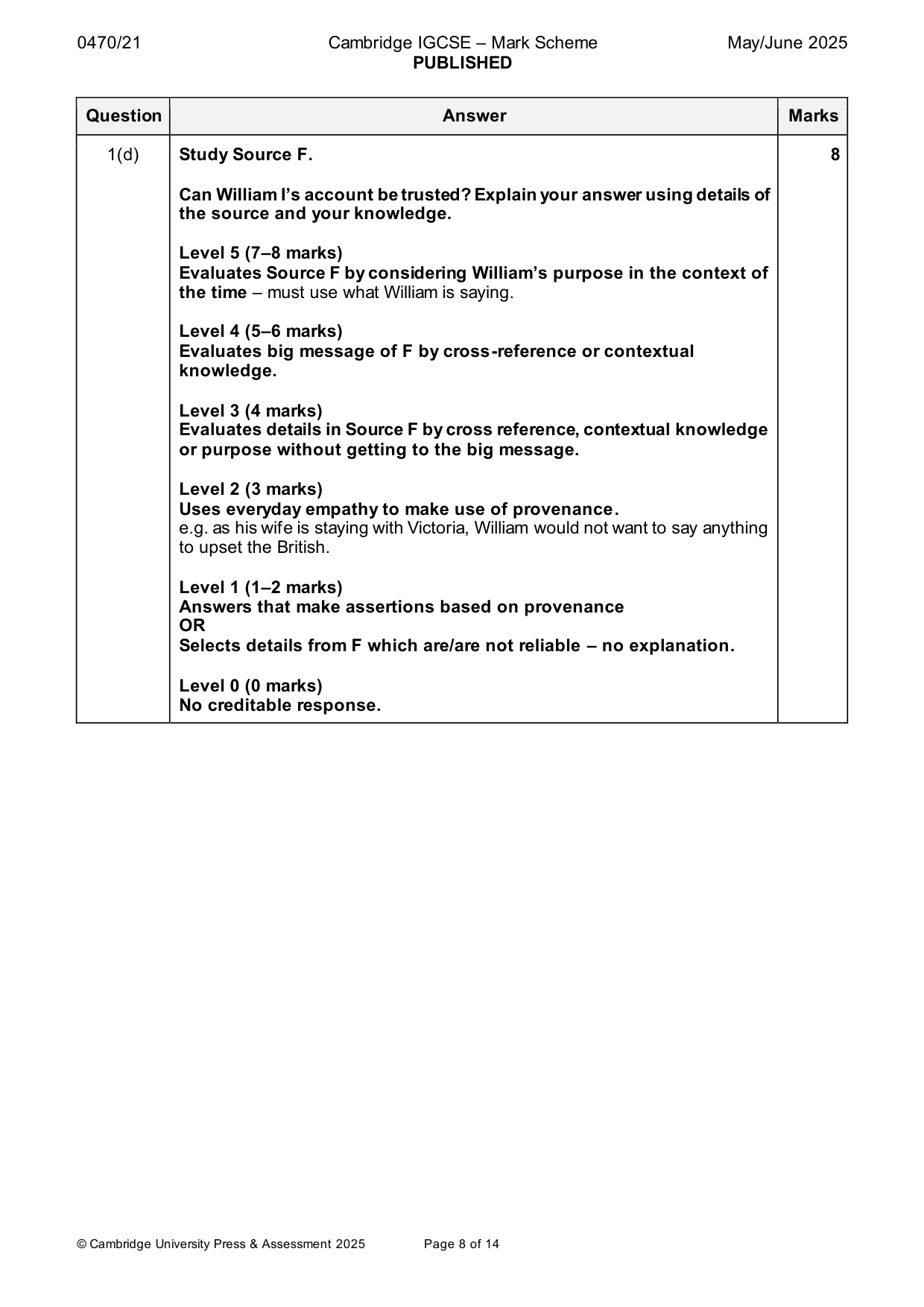
0470/21 Cambridge IGCSE – Mark Scheme PUBLISHED May/June 2025 © Cambridge University Press & Assessment 2025 Page 8 of 14 Question Answer Marks 1(d) Study Source F. Can William I’s account be trusted? Explain your answer using details of the source and your knowledge. Level 5 (7–8 marks) Evaluates Source F by considering William’s purpose in the context of the time – must use what William is saying. Level 4 (5–6 marks) Evaluates big message of F by cross-reference or contextual knowledge. Level 3 (4 marks) Evaluates details in Source F by cross reference, contextual knowledge or purpose without getting to the big message. Level 2 (3 marks) Uses everyday empathy to make use of provenance. e.g. as his wife is staying with Victoria, William would not want to say anything to upset the British. Level 1 (1–2 marks) Answers that make assertions based on provenance OR Selects details from F which are/are not reliable – no explanation. Level 0 (0 marks) No creditable response. 8
Mark scheme, page 9
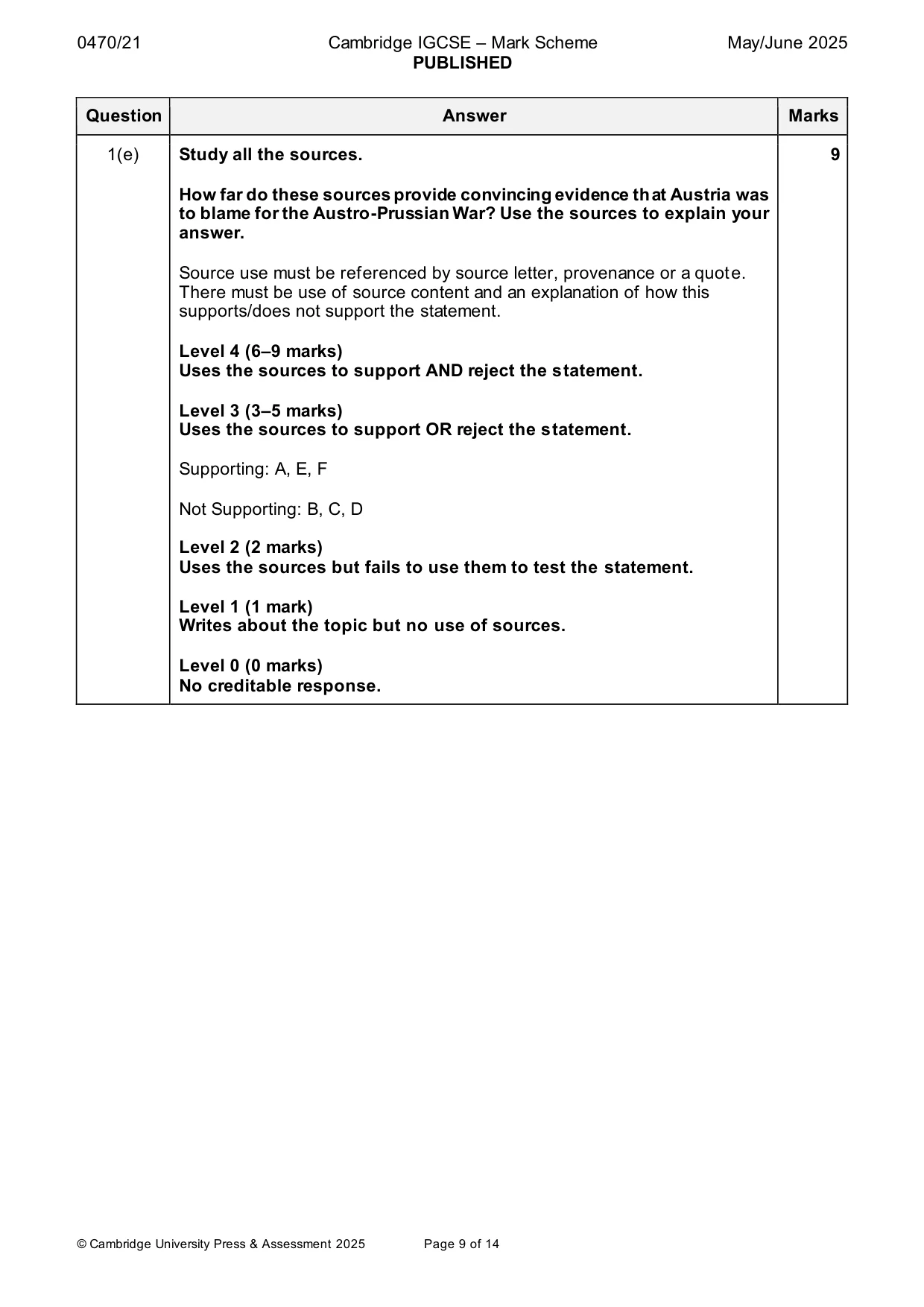
0470/21 Cambridge IGCSE – Mark Scheme PUBLISHED May/June 2025 © Cambridge University Press & Assessment 2025 Page 9 of 14 Question Answer Marks 1(e) Study all the sources. How far do these sources provide convincing evidence that Austria was to blame for the Austro-Prussian War? Use the sources to explain your answer. Source use must be referenced by source letter, provenance or a quote. There must be use of source content and an explanation of how this supports/does not support the statement. Level 4 (6–9 marks) Uses the sources to support AND reject the statement. Level 3 (3–5 marks) Uses the sources to support OR reject the statement. Supporting: A, E, F Not Supporting: B, C, D Level 2 (2 marks) Uses the sources but fails to use them to test the statement. Level 1 (1 mark) Writes about the topic but no use of sources. Level 0 (0 marks) No creditable response. 9
Mark scheme, page 10
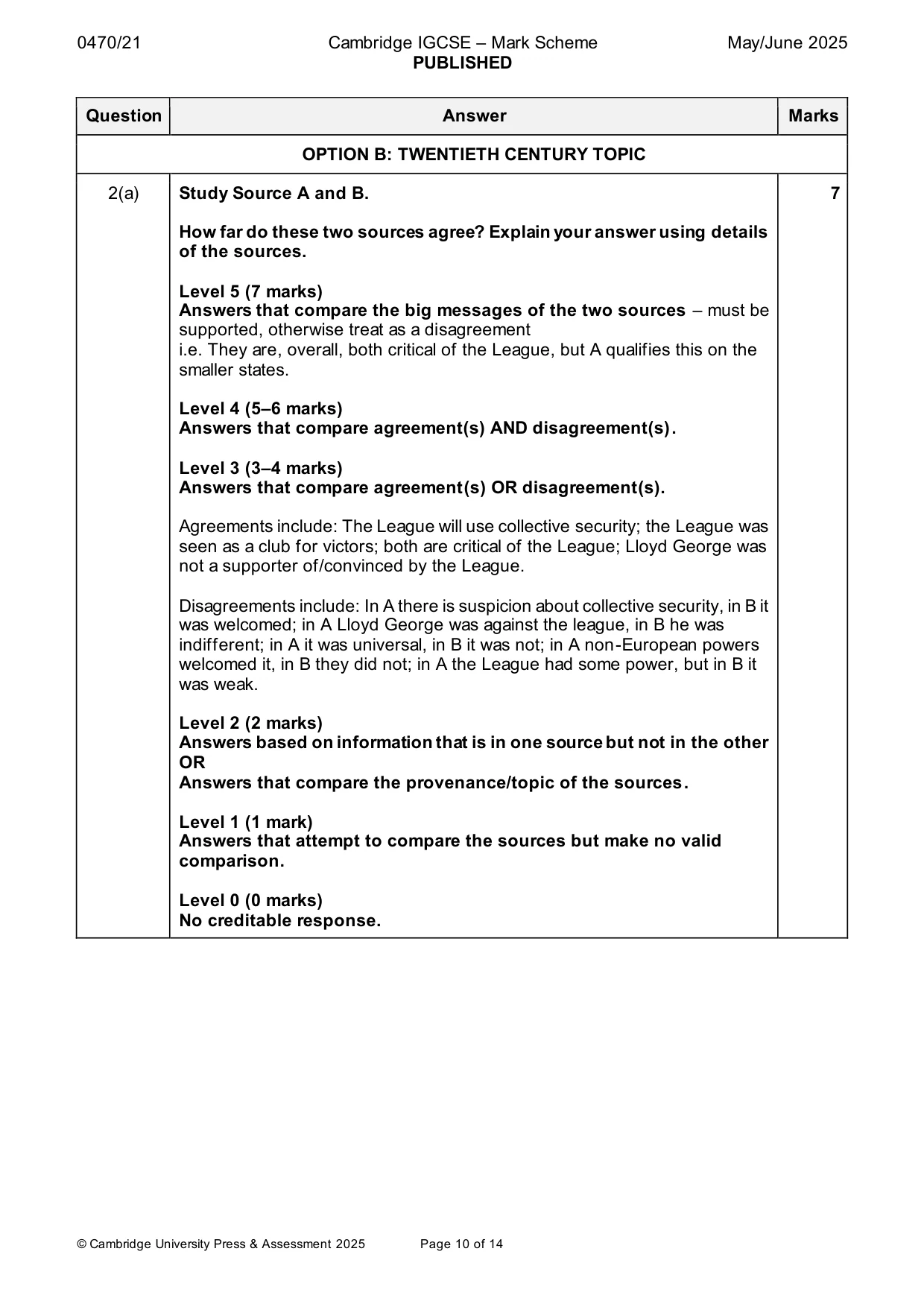
0470/21 Cambridge IGCSE – Mark Scheme PUBLISHED May/June 2025 © Cambridge University Press & Assessment 2025 Page 10 of 14 Question Answer Marks OPTION B: TWENTIETH CENTURY TOPIC 2(a) Study Source A and B. How far do these two sources agree? Explain your answer using details of the sources. Level 5 (7 marks) Answers that compare the big messages of the two sources – must be supported, otherwise treat as a disagreement i.e. They are, overall, both critical of the League, but A qualifies this on the smaller states. Level 4 (5–6 marks) Answers that compare agreement(s) AND disagreement(s). Level 3 (3–4 marks) Answers that compare agreement(s) OR disagreement(s). Agreements include: The League will use collective security; the League was seen as a club for victors; both are critical of the League; Lloyd George was not a supporter of/convinced by the League. Disagreements include: In A there is suspicion about collective security, in B it was welcomed; in A Lloyd George was against the league, in B he was indifferent; in A it was universal, in B it was not; in A non-European powers welcomed it, in B they did not; in A the League had some power, but in B it was weak. Level 2 (2 marks) Answers based on information that is in one source but not in the other OR Answers that compare the provenance/topic of the sources. Level 1 (1 mark) Answers that attempt to compare the sources but make no valid comparison. Level 0 (0 marks) No creditable response. 7
Mark scheme, page 11
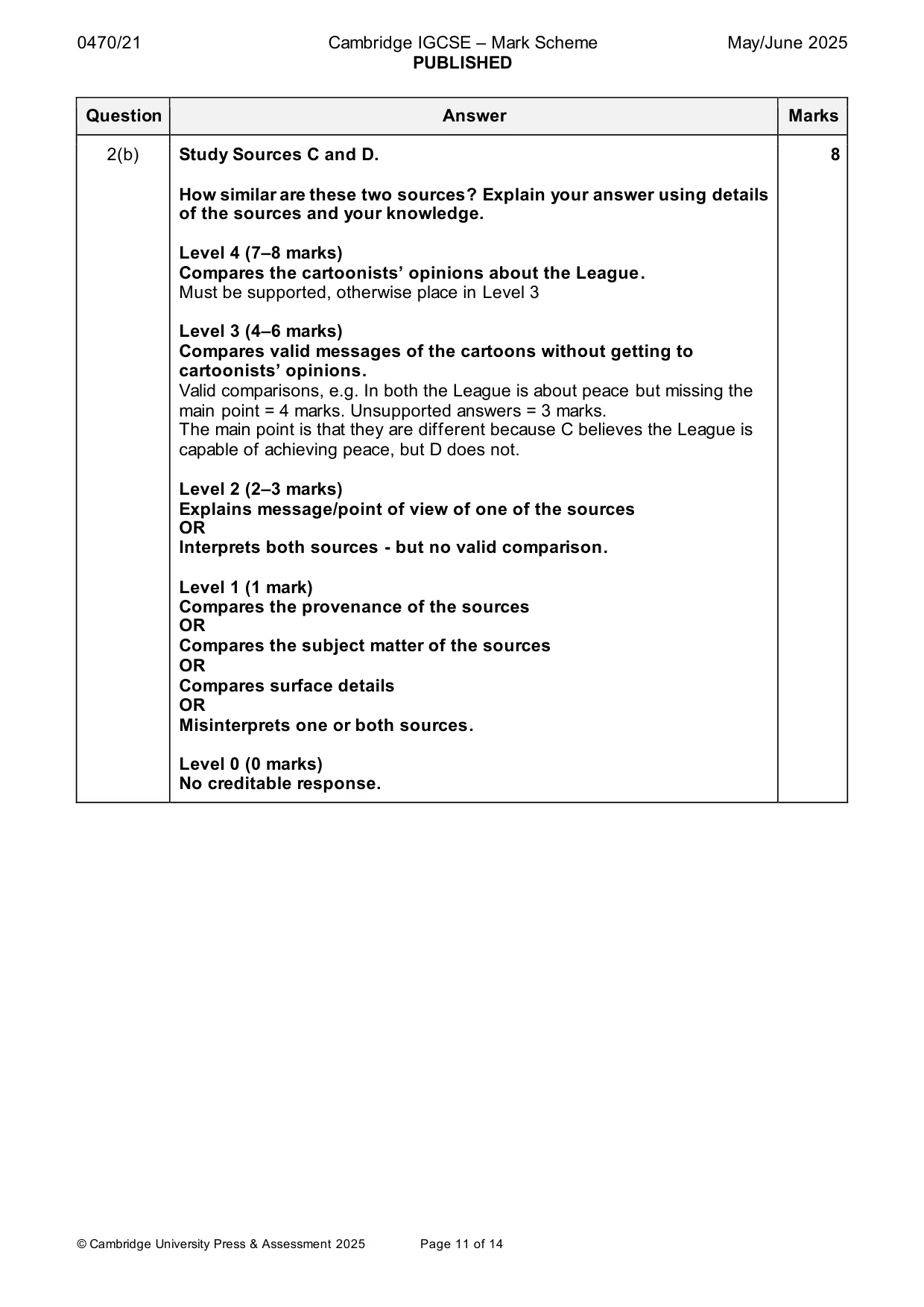
0470/21 Cambridge IGCSE – Mark Scheme PUBLISHED May/June 2025 © Cambridge University Press & Assessment 2025 Page 11 of 14 Question Answer Marks 2(b) Study Sources C and D. How similar are these two sources? Explain your answer using details of the sources and your knowledge. Level 4 (7–8 marks) Compares the cartoonists’ opinions about the League. Must be supported, otherwise place in Level 3 Level 3 (4–6 marks) Compares valid messages of the cartoons without getting to cartoonists’ opinions. Valid comparisons, e.g. In both the League is about peace but missing the main point = 4 marks. Unsupported answers = 3 marks. The main point is that they are different because C believes the League is capable of achieving peace, but D does not. Level 2 (2–3 marks) Explains message/point of view of one of the sources OR Interprets both sources - but no valid comparison. Level 1 (1 mark) Compares the provenance of the sources OR Compares the subject matter of the sources OR Compares surface details OR Misinterprets one or both sources. Level 0 (0 marks) No creditable response. 8
Mark scheme, page 12
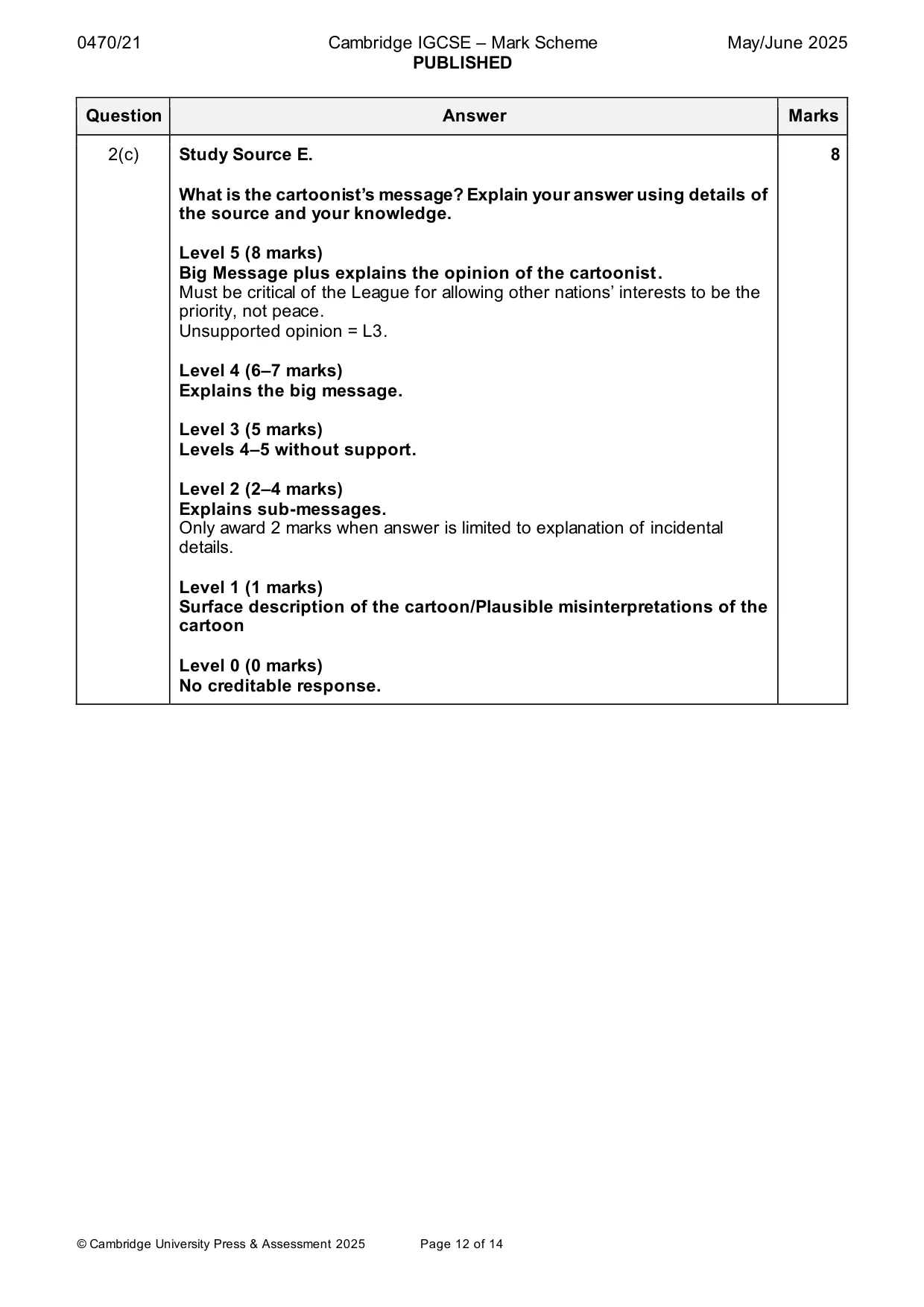
0470/21 Cambridge IGCSE – Mark Scheme PUBLISHED May/June 2025 © Cambridge University Press & Assessment 2025 Page 12 of 14 Question Answer Marks 2(c) Study Source E. What is the cartoonist’s message? Explain your answer using details of the source and your knowledge. Level 5 (8 marks) Big Message plus explains the opinion of the cartoonist. Must be critical of the League for allowing other nations’ interests to be the priority, not peace. Unsupported opinion = L3. Level 4 (6–7 marks) Explains the big message. Level 3 (5 marks) Levels 4–5 without support. Level 2 (2–4 marks) Explains sub-messages. Only award 2 marks when answer is limited to explanation of incidental details. Level 1 (1 marks) Surface description of the cartoon/Plausible misinterpretations of the cartoon Level 0 (0 marks) No creditable response. 8
Mark scheme, page 13
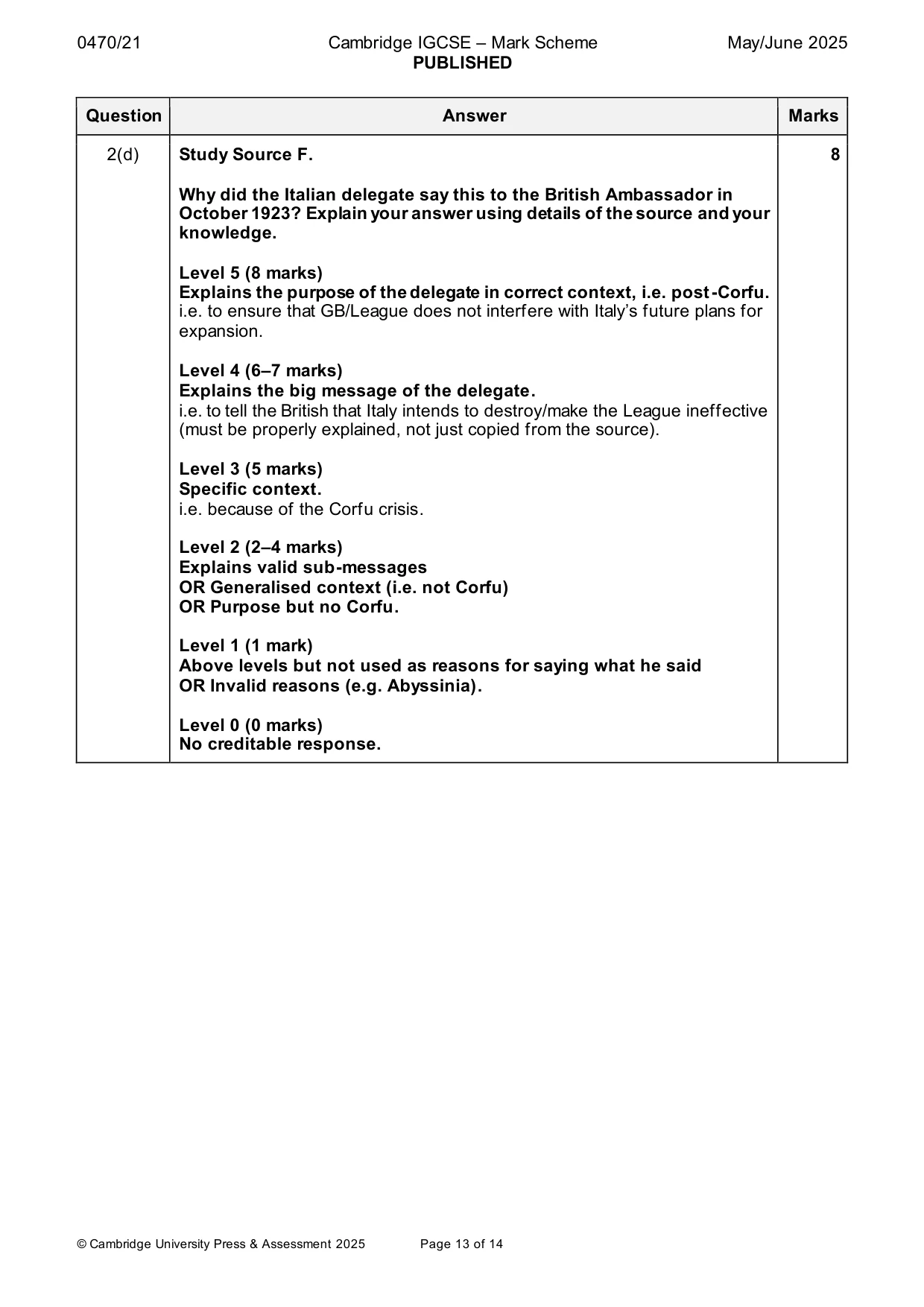
0470/21 Cambridge IGCSE – Mark Scheme PUBLISHED May/June 2025 © Cambridge University Press & Assessment 2025 Page 13 of 14 Question Answer Marks 2(d) Study Source F. Why did the Italian delegate say this to the British Ambassador in October 1923? Explain your answer using details of the source and your knowledge. Level 5 (8 marks) Explains the purpose of the delegate in correct context, i.e. post-Corfu. i.e. to ensure that GB/League does not interfere with Italy’s future plans for expansion. Level 4 (6–7 marks) Explains the big message of the delegate. i.e. to tell the British that Italy intends to destroy/make the League ineffective (must be properly explained, not just copied from the source). Level 3 (5 marks) Specific context. i.e. because of the Corfu crisis. Level 2 (2–4 marks) Explains valid sub-messages OR Generalised context (i.e. not Corfu) OR Purpose but no Corfu. Level 1 (1 mark) Above levels but not used as reasons for saying what he said OR Invalid reasons (e.g. Abyssinia). Level 0 (0 marks) No creditable response. 8
Mark scheme, page 14
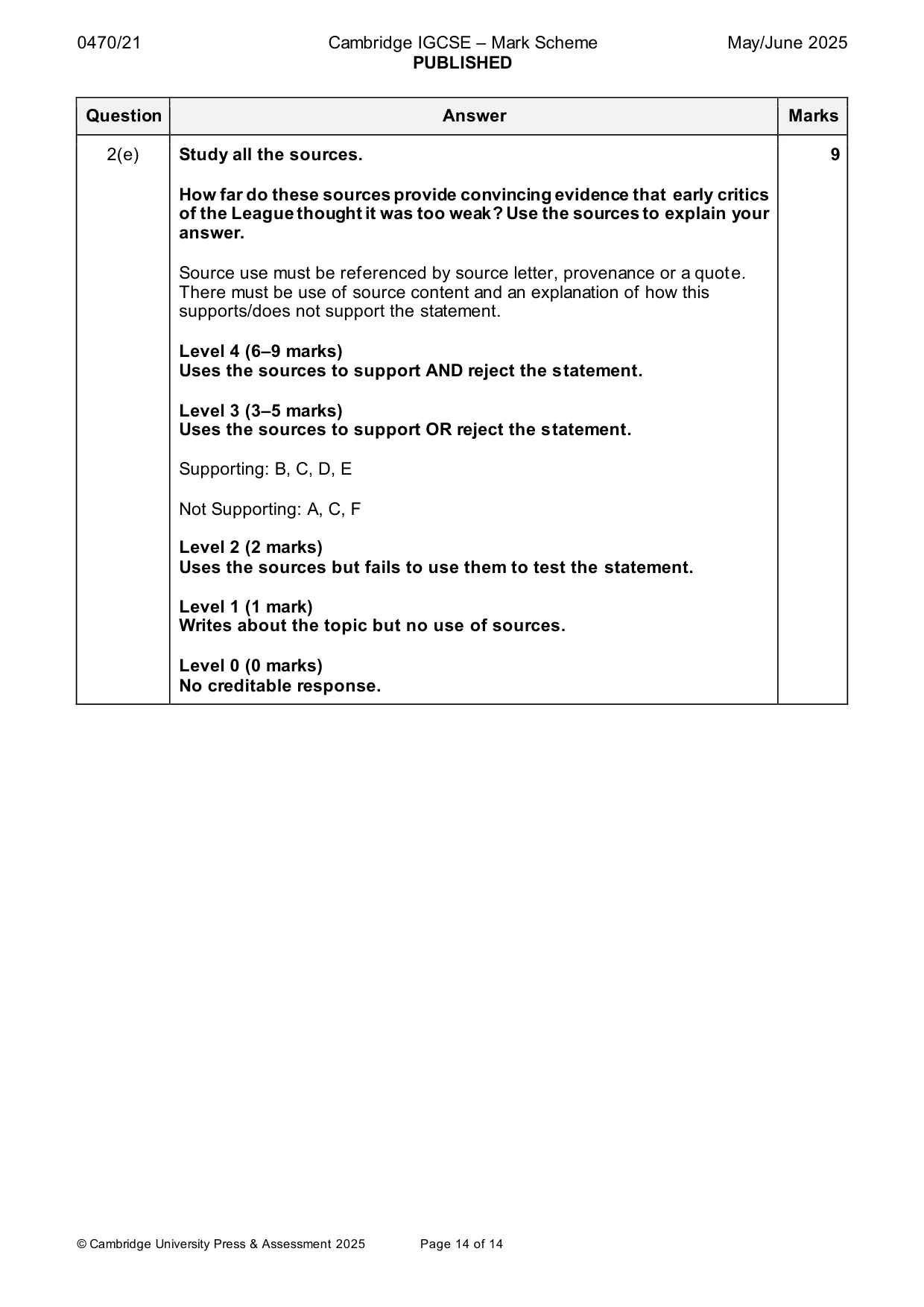
0470/21 Cambridge IGCSE – Mark Scheme PUBLISHED May/June 2025 © Cambridge University Press & Assessment 2025 Page 14 of 14 Question Answer Marks 2(e) Study all the sources. How far do these sources provide convincing evidence that early critics of the League thought it was too weak? Use the sources to explain your answer. Source use must be referenced by source letter, provenance or a quote. There must be use of source content and an explanation of how this supports/does not support the statement. Level 4 (6–9 marks) Uses the sources to support AND reject the statement. Level 3 (3–5 marks) Uses the sources to support OR reject the statement. Supporting: B, C, D, E Not Supporting: A, C, F Level 2 (2 marks) Uses the sources but fails to use them to test the statement. Level 1 (1 mark) Writes about the topic but no use of sources. Level 0 (0 marks) No creditable response. 9
What you needed in this session
Cambridge’s own grade thresholds for 2025 May/June, Paper 2 · Variant 1. A higher threshold means an easier paper — the bar moves with how the cohort did.