Cambridge IGCSE History 0470 — 2023 Oct/Nov Paper 2 · Variant 1
0470/21/O/N/23 · 50 marks · ≈56 min
The question paper and its mark scheme, free to read here and free to download. This is Cambridge’s own paper, exactly as it was sat.
Question paper12 pages

Mark scheme14 pages
Answers below. Sit the paper first if you are practising.
Paper as text
Question paper, page 1
This document has 12 pages. Any blank pages are indicated. [Turn over Cambridge IGCSE™ * 6 6 7 3 7 4 9 3 5 0 * DC (LK/SG) 317439/5 © UCLES 2023 HISTORY 0470/21 Paper 2 October/November 2023 2 hours You must answer on the enclosed answer booklet. You will need: Answer booklet (enclosed) INSTRUCTIONS ● Answer all the questions on one option only. Option A: Nineteenth century topic Option B: Twentieth century topic ● Follow the instructions on the front cover of the answer booklet. If you need additional answer paper, ask the invigilator for a continuation booklet. INFORMATION ● The total mark for this paper is 50. ● The number of marks for each question or part question is shown in brackets [ ].
Question paper, page 2
2 0470/21/O/N/23 © UCLES 2023 Option A: Nineteenth century topic DID THE SECOND MOROCCAN CRISIS COME CLOSE TO CAUSING A WAR? Study the Background Information and the sources carefully, and then answer all the questions. Background Information Some historians have claimed that the Second Moroccan Crisis of 1911 nearly caused war. The German action of sending the gunboat Panther to Agadir in July 1911 caused tensions with both Britain and France, especially because German intentions were not clear. Tensions were increased later in the month when Lloyd George, a senior member of the British government, made a speech warning Germany that Britain would defend its interests. The crisis was ended by negotiations between France and Germany in November 1911. These led to a secret agreement in which Germany accepted France’s position in Morocco in return for some territory in Africa. When news of the agreement leaked out, it was heavily criticised in Germany. Did the crisis nearly cause war? SOURCE A The Second Moroccan Crisis began when France sent troops to the city of Fez to prevent rebellions by some tribes. The Sultan of Morocco had been forced to get help from France. On 1 July 1911, a gunboat was sent by Germany to the port of Agadir in Morocco. The gunboat, called the Panther, was meant to scare the French. Germany wanted to separate France and Britain and to maintain Germany as a strong European power. The Panther caused tensions between Britain and Germany because of the competition between their navies. Britain saw the gunboat’s arrival as part of Germany’s plan to create a naval base on Morocco’s Atlantic coast and to interfere with its naval domination of the Atlantic Ocean. Germany’s actions did not come close to causing a war. Germany was still unable to break apart the alliance between France and Britain, and France and Germany made an agreement. France would be allowed to continue its activity in Morocco without Germany intervening if it gave something back to Germany. As a result, Germany got parts of the French Congo in Africa. Germany got the bad end of the deal. It was given land that nobody wanted. Moreover, France now had full permission to make Morocco into a protectorate. From a recent account of the Second Moroccan Crisis.
Question paper, page 3
3 0470/21/O/N/23 © UCLES 2023 [Turn over SOURCE B Germany’s intervention in Morocco was a return to a policy of seeking colonial success in order to arouse national feeling at home and stop socialist success in elections. It almost led to war. It was inspired by a French move to put down native disorders in Morocco. French troops were sent to Fez and Germany realised this would take effective power from the Sultan of Morocco and thus break the agreement made after the First Moroccan Crisis. In return for increased French control of Morocco, Germany decided it wanted some French territory in central Africa. To make its ambitions clear, Germany decided to send warships to Morocco and land troops there. Three warships were sent: the Panther was the first to arrive on 1 July. The British government was unclear about German intentions, but because of the naval rivalry with Germany it became convinced there was a plan for a German attack on its fleet. This wrecked any chance of an agreement with Britain, and of Germany splitting the Entente. Confronted with French determination not to yield, and its belief that the British were only waiting for the call to stand with the French, Germany backed down. In return for worthless land in the Congo area, which was not worth the great risk Germany had taken, it recognised the French protectorate over Morocco. This was a real setback for German diplomacy, and the colonial success, which it wanted above all else, was not forthcoming. From a recent account of the Second Moroccan Crisis.
Question paper, page 4
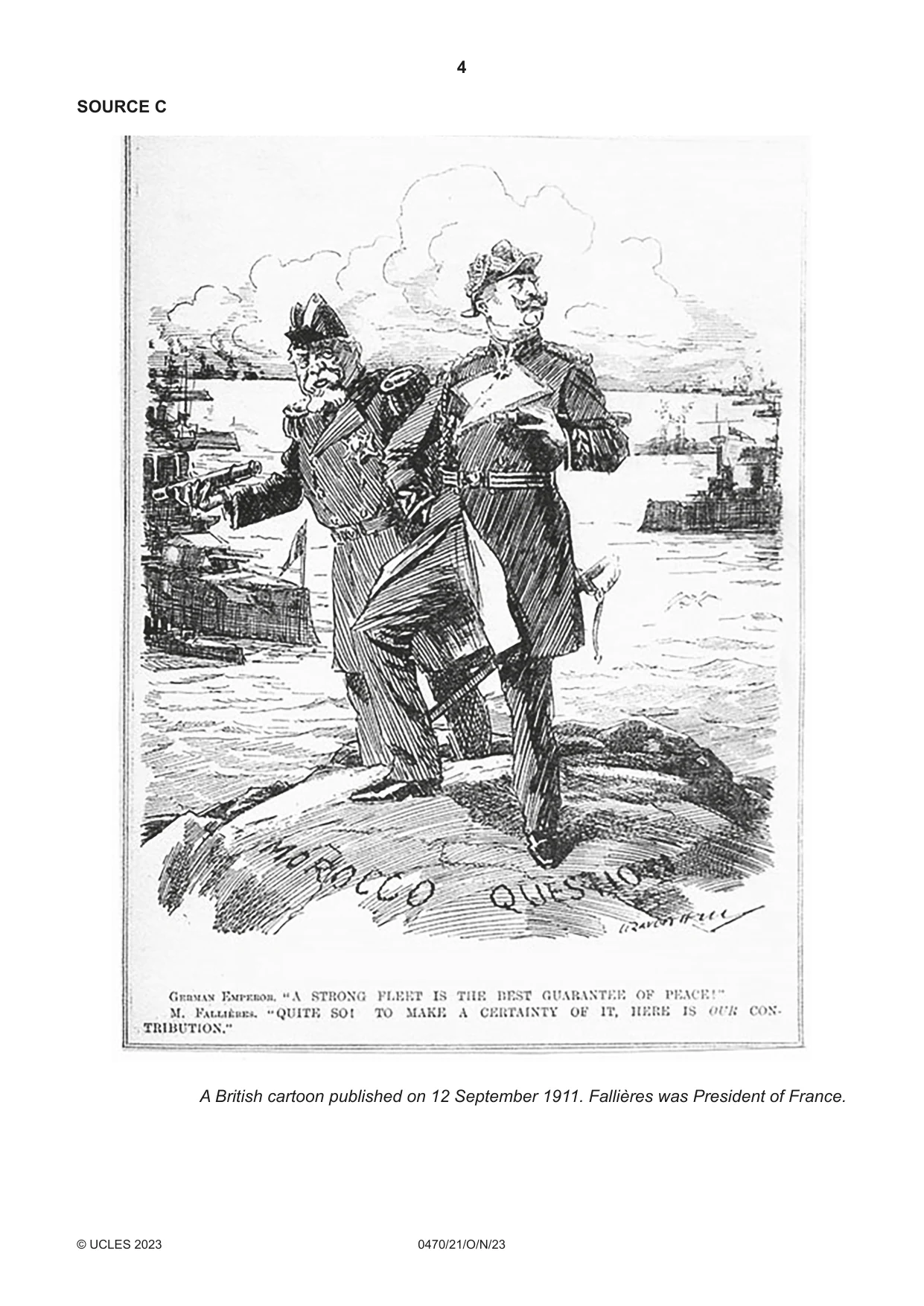
4 0470/21/O/N/23 © UCLES 2023 SOURCE C A British cartoon published on 12 September 1911. Fallières was President of France.
Question paper, page 5
5 0470/21/O/N/23 © UCLES 2023 [Turn over SOURCE D The Germans might attempt a surprise attack against our navy. The German High Seas Fleet has put to sea and vanished. Let’s suppose, instead of going to Norway as announced, it has gone straight for Portland, preceded by a division of destroyers which could launch a surprise night torpedo attack. This could bring the main German fleet into action at dawn against our ships which would be without steam, without coal, without crews. From a British newspaper, 21 July 1911. The British and German navies had arranged joint naval exercises in Norwegian waters. Portland was a major British naval base where some Dreadnoughts were based. SOURCE E We are in a satisfactory position of having twice as many Dreadnoughts as Germany AND A NUMBER GREATER BY ONE THAN THE WHOLE OF THE REST OF THE WORLD PUT TOGETHER! I don’t think there is the very faintest fear of war! How lucky we are! Just when there is a tendency to ease down our naval activities comes AGADIR! Admiral Fisher, head of the British navy, to a member of the British government, 1 August 1911. SOURCE F Now we know where Britain stands. Like a flash of lightning in the night, these events have shown the German people where the enemy is. We know now, when we wish to expand in the world, when we wish to have our place in the sun, who it is that lays claim to world-wide domination. Gentleman, we Germans are not in the habit of permitting this sort of thing and the German people will know how to reply. We shall secure peace, not by concessions, but with the German sword. From a speech in the Reichstag by Ernst von Heydebrand, leader of the German Conservative Party, November 1911. He was responding to the Franco-German agreement over Morocco and was greeted with thunderous applause. SOURCE G The only real crisis in Anglo-German relations between 1904 and 1914 was in the summer of 1911 over the Morocco dispute with France. Senior members of the German government lacked any talent for dealing with Britain and did damage by their sloppy handling of the affair. They sent the gunboat Panther to Morocco on 1 July 1911. Though the British government demanded an explanation, our government left them in the dark about our intentions for several weeks. The result was Lloyd George’s speech warning that Britain would side with France if it was challenged. I was off duty and about to leave on my summer holiday when I learned about the sending of the Panther. I believed this show of power was a mistake. We did not want to go to war and the German government made a blunder when it did not reveal its intentions. We gave later assurances that we never considered demanding Moroccan territory and it looked as if we were backing away from Britain’s raised sword. From the memoirs of Grand Admiral Tirpitz, published in 1919. Tirpitz was in charge of the German navy, but was forced to resign in 1916.
Question paper, page 6
6 0470/21/O/N/23 © UCLES 2023 Now answer all the following questions. You may use any of the sources to help you answer the questions, in addition to those sources which you are told to use. In answering the questions you should use your knowledge of the topic to help you interpret and evaluate the sources. 1 Study Sources A and B. How far do these two sources agree? Explain your answer using details of the sources. [7] 2 Study Source C. What is the cartoonist’s message? Explain your answer using details of the source and your knowledge. [8] 3 Study Sources D and E. How far does Source E make Source D surprising? Explain your answer using details of the sources and your knowledge. [8] 4 Study Source F. Why did Heydebrand make this speech at that time? Explain your answer using details of the source and your knowledge. [7] 5 Study Source G. Do you trust this account of the crisis over Morocco? Explain your answer using details of the source and your knowledge. [8] 6 Study all the sources. How far do these sources provide convincing evidence that Europe was very close to war in 1911? Use the sources to explain your answer. [12]
Question paper, page 7
7 0470/21/O/N/23 © UCLES 2023 [Turn over BLANK PAGE
Question paper, page 8
8 0470/21/O/N/23 © UCLES 2023 Option B: Twentieth century topic WHY DID THE SOVIETS USE MILITARY FORCE IN HUNGARY IN NOVEMBER 1956? Study the Background Information and the sources carefully, and then answer all the questions. Background Information On 23 October 1956 demonstrations in Hungary began to get out of control. The demonstrators demanded independence from the Soviet Union and political freedom for the people of Hungary. On 24 October Soviet tanks entered Budapest and fighting soon broke out across Hungary. The Soviets agreed to a new government led by Imre Nagy and to a ceasefire. Nagy then announced a series of reforms including Hungary’s neutrality and its departure from the Warsaw Pact. On 30 October the Soviet Union declared its readiness to withdraw troops from Hungary. However, the Soviet leaders changed their minds the next day and on 4 November Soviet tanks moved into Budapest. Why did the Soviets resort to military force in November 1956? Was it because of Nagy’s decision to leave the Warsaw Pact, a fear that the demonstrations might spread to other countries in the Eastern Bloc, or that ‘counter-revolutionaries’ might seize power in Hungary? How far were external factors, like the crisis in Suez, responsible for the Soviets’ decision? Was fear of a counter-revolution the main reason why the Soviets used military force in Hungary in November 1956? SOURCE A Khrushchev was worried that Soviet withdrawal from Hungary would be seen as weakness by the West. He was also concerned about hardliners in Moscow who wanted more firm action to be taken, and by Nagy’s announcements (27 to 30 October) that he would include non-communists in his government, dissolve the secret police, and achieve greater independence from the Soviet Union by withdrawing from the Warsaw Pact. It took the Soviets between 24 and 31 October to decide what to do and the decision on 30 October to withdraw troops was only a temporary position while they came to a final decision. By 30 October, they were already very concerned by Nagy’s actions and his weak leadership. Their major worry was that an independent Hungary, and the possibility of demands for independence spreading to the USSR’s satellite states, would undermine the USSR’s power in the Eastern Bloc. By 31 October, reasons for a tough stance were overwhelming and Soviet tanks reappeared on 4 November. The use of military force by the Soviets and the defeat of the revolution had always been inevitable. From a recent history book. SOURCE B The Soviet decision to send in tanks on 4 November to defeat the revolution surprised everybody because Khrushchev had promised an end to Stalin’s repressive methods. On 31 October the Soviets had withdrawn their troops from Budapest and issued a statement promising to enter into negotiations over the issue of Soviet troops in Hungary. The revolution seemed to be on the verge of success. On the very same day the Soviet leadership suddenly and completely changed its mind and decided to end the revolution violently. It seems that the Soviets were worried that Nagy was losing control of the situation and that Hungary could fall to counter-revolutionaries who were far more extreme than him. Khrushchev was concerned that if he did not act, he would look weak in comparison with the British, French and Israelis, whose actions in Suez had begun on 29 October. From a recent history book.
Question paper, page 9
9 0470/21/O/N/23 © UCLES 2023 [Turn over SOURCE C A cartoon published in Britain, 28 November 1956. The figures sitting represent President Nasser of Egypt, and Israel, Britain and France. The figure standing represents the United Nations.
Question paper, page 10
10 0470/21/O/N/23 © UCLES 2023 SOURCE D What decision should we make? The counter-revolution might have temporarily gained the upper hand, then a lot of the workers’ blood would have been shed. And if NATO penetrated into the socialist countries through Hungary, it would have been dangerous. I considered what the consequences would be if we did not give a helping hand to the Hungarian working class and the counter-revolutionary elements became stronger. They were beginning to control the government headed by Nagy. Around him were emigrants who fled the country after the establishment of socialism in Hungary, and had returned. This indicated the direction of the development of events if the counter-revolution won. We decided that it would be unforgivable if we did not help the Hungarian working class and decided to use our troops. From Khrushchev’s memoirs, published in 1971. SOURCE E We should re-examine our assessment and should not withdraw troops from Hungary. We have no other choice. If we depart from Hungary, it will give a great boost to the Americans – the imperialists. They will see it as weakness on our part and will go on the offensive. We would then expose the weakness of our position. The Soviet Communist Party members will not accept it if we withdraw. To Egypt they will then add Hungary. Khrushchev speaking to the Presidium of the Supreme Soviet of the USSR, the main decision-making body of the USSR, 31 October 1956. SOURCE F A cartoon published in Hungary in 1956. The words on the coat covering the horse say, ‘Democracy, freedom, independence, our own way’. The words at the bottom say, ‘And what’s beneath it’. The figure on the right is a Soviet soldier.
Question paper, page 11
11 0470/21/O/N/23 © UCLES 2023 SOURCE G A cartoon published in the Netherlands, November 1956. The caption read, ‘Law and Order are restored again.’ The writing on the flag says, ‘Long live freedom’ and ‘Hungary’. SOURCE H I asked Kovács how much truth there was in the Russian assertion that the revolution had become a counter-revolution and therefore Russian intervention was justified. ‘No! This was a genuine revolution from inside,’ Kovács said, ‘led by Communists who fought for it during the first few days. Non-Communists like me came forward and demanded a share in Hungary’s future. This was granted by Nagy. True, there was a small fringe of extremists, and there were some who had ties with the exiled Nazis, but at no time was their strength such as to cause concern.’ ‘Then there was no reason why the Russians should have come again and destroyed the revolution?’ ‘None,’ Kovács replied, ‘unless they are trying to revert to the old Stalinist days. But if that is what they really are trying – and at the moment it looks like it – they will fail.’ An interview between an American journalist and Belá Kovács, 4 November 1956, in a cellar where Kovács was hiding from the Soviet army. Kovács had opposed the Communists in Hungary after the Second World War and had been imprisoned. In November 1956, he became a member of Nagy’s government. The interview was published in an American newspaper in December 1956. [Turn over
Question paper, page 12
12 0470/21/O/N/23 © UCLES 2023 Permission to reproduce items where third-party owned material protected by copyright is included has been sought and cleared where possible. Every reasonable effort has been made by the publisher (UCLES) to trace copyright holders, but if any items requiring clearance have unwittingly been included, the publisher will be pleased to make amends at the earliest possible opportunity. To avoid the issue of disclosure of answer-related information to candidates, all copyright acknowledgements are reproduced online in the Cambridge Assessment International Education Copyright Acknowledgements Booklet. This is produced for each series of examinations and is freely available to download at www.cambridgeinternational.org after the live examination series. Cambridge Assessment International Education is part of Cambridge Assessment. Cambridge Assessment is the brand name of the University of Cambridge Local Examinations Syndicate (UCLES), which is a department of the University of Cambridge. Now answer all the following questions. You may use any of the sources to help you answer the questions, in addition to those sources which you are told to use. In answering the questions you should use your knowledge of the topic to help you interpret and evaluate the sources. 1 Study Sources A and B. How far do these two sources agree? Explain your answer using details of the sources. [7] 2 Study Source C. What is the cartoonist’s message? Explain your answer using details of the source and your knowledge. [7] 3 Study Sources D and E. How far does Source E make Source D surprising? Explain your answer using details of the sources and your knowledge. [8] 4 Study Sources F and G. How far would these two cartoonists have agreed about events in Hungary? Explain your answer using details of the sources and your knowledge. [8] 5 Study Source H. How useful is this source as evidence about the Hungarian revolution? Explain your answer using details of the source and your knowledge. [8] 6 Study all the sources. How far do these sources provide convincing evidence that the Soviets used military force in Hungary in November 1956 to put down counter-revolution? Use the sources to explain your answer. [12]
Mark scheme, page 1
This document consists of 14 printed pages. © UCLES 2023 [Turn over Cambridge IGCSE™ HISTORY 0470/21 Paper 2 October/November 2023 MARK SCHEME Maximum Mark: 50 Published This mark scheme is published as an aid to teachers and candidates, to indicate the requirements of the examination. It shows the basis on which Examiners were instructed to award marks. It does not indicate the details of the discussions that took place at an Examiners’ meeting before marking began, which would have considered the acceptability of alternative answers. Mark schemes should be read in conjunction with the question paper and the Principal Examiner Report for Teachers. Cambridge International will not enter into discussions about these mark schemes. Cambridge International is publishing the mark schemes for the October/November 2023 series for most Cambridge IGCSE, Cambridge International A and AS Level components, and some Cambridge O Level components.
Mark scheme, page 2
0470/21 Cambridge IGCSE – Mark Scheme PUBLISHED October/November 2023 © UCLES 2023 Page 2 of 14 Generic Marking Principles These general marking principles must be applied by all examiners when marking candidate answers. They should be applied alongside the specific content of the mark scheme or generic level descriptors for a question. Each question paper and mark scheme will also comply with these marking principles. GENERIC MARKING PRINCIPLE 1: Marks must be awarded in line with: • the specific content of the mark scheme or the generic level descriptors for the question • the specific skills defined in the mark scheme or in the generic level descriptors for the question • the standard of response required by a candidate as exemplified by the standardisation scripts. GENERIC MARKING PRINCIPLE 2: Marks awarded are always whole marks (not half marks, or other fractions). GENERIC MARKING PRINCIPLE 3: Marks must be awarded positively: • marks are awarded for correct/valid answers, as defined in the mark scheme. However, credit is given for valid answers which go beyond the scope of the syllabus and mark scheme, referring to your Team Leader as appropriate • marks are awarded when candidates clearly demonstrate what they know and can do • marks are not deducted for errors • marks are not deducted for omissions • answers should only be judged on the quality of spelling, punctuation and grammar when these features are specifically assessed by the question as indicated by the mark scheme. The meaning, however, should be unambiguous. GENERIC MARKING PRINCIPLE 4: Rules must be applied consistently, e.g. in situations where candidates have not followed instructions or in the application of generic level descriptors. GENERIC MARKING PRINCIPLE 5: Marks should be awarded using the full range of marks defined in the mark scheme for the question (however; the use of the full mark range may be limited according to the quality of the candidate responses seen). GENERIC MARKING PRINCIPLE 6: Marks awarded are based solely on the requirements as defined in the mark scheme. Marks should not be awarded with grade thresholds or grade descriptors in mind.
Mark scheme, page 3
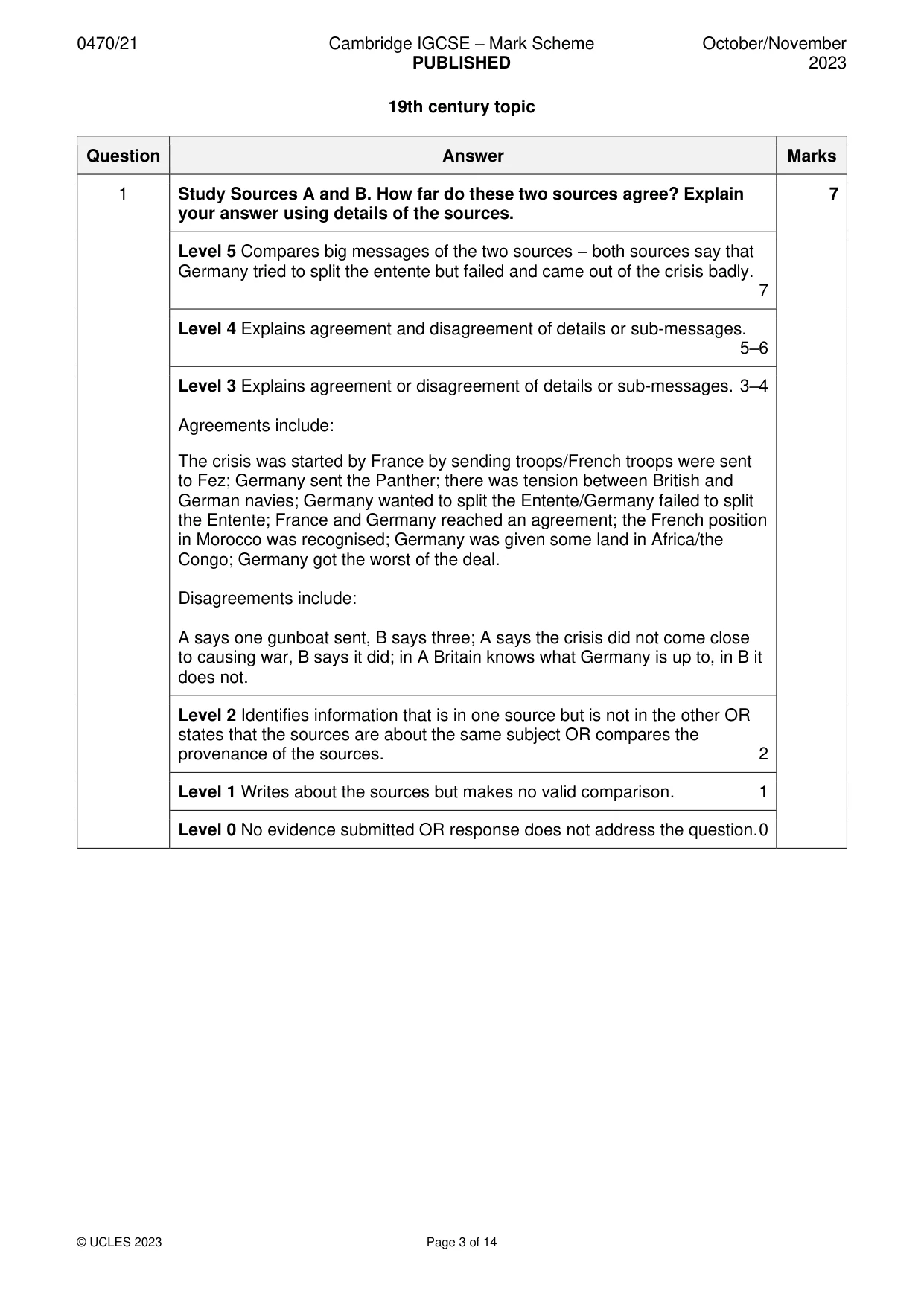
0470/21 Cambridge IGCSE – Mark Scheme PUBLISHED October/November 2023 © UCLES 2023 Page 3 of 14 19th century topic Question Answer Marks 1 Study Sources A and B. How far do these two sources agree? Explain your answer using details of the sources. 7 Level 5 Compares big messages of the two sources – both sources say that Germany tried to split the entente but failed and came out of the crisis badly. 7 Level 4 Explains agreement and disagreement of details or sub-messages. 5–6 Level 3 Explains agreement or disagreement of details or sub-messages. 3–4 Agreements include: The crisis was started by France by sending troops/French troops were sent to Fez; Germany sent the Panther; there was tension between British and German navies; Germany wanted to split the Entente/Germany failed to split the Entente; France and Germany reached an agreement; the French position in Morocco was recognised; Germany was given some land in Africa/the Congo; Germany got the worst of the deal. Disagreements include: A says one gunboat sent, B says three; A says the crisis did not come close to causing war, B says it did; in A Britain knows what Germany is up to, in B it does not. Level 2 Identifies information that is in one source but is not in the other OR states that the sources are about the same subject OR compares the provenance of the sources. 2 Level 1 Writes about the sources but makes no valid comparison. 1 Level 0 No evidence submitted OR response does not address the question. 0
Mark scheme, page 4
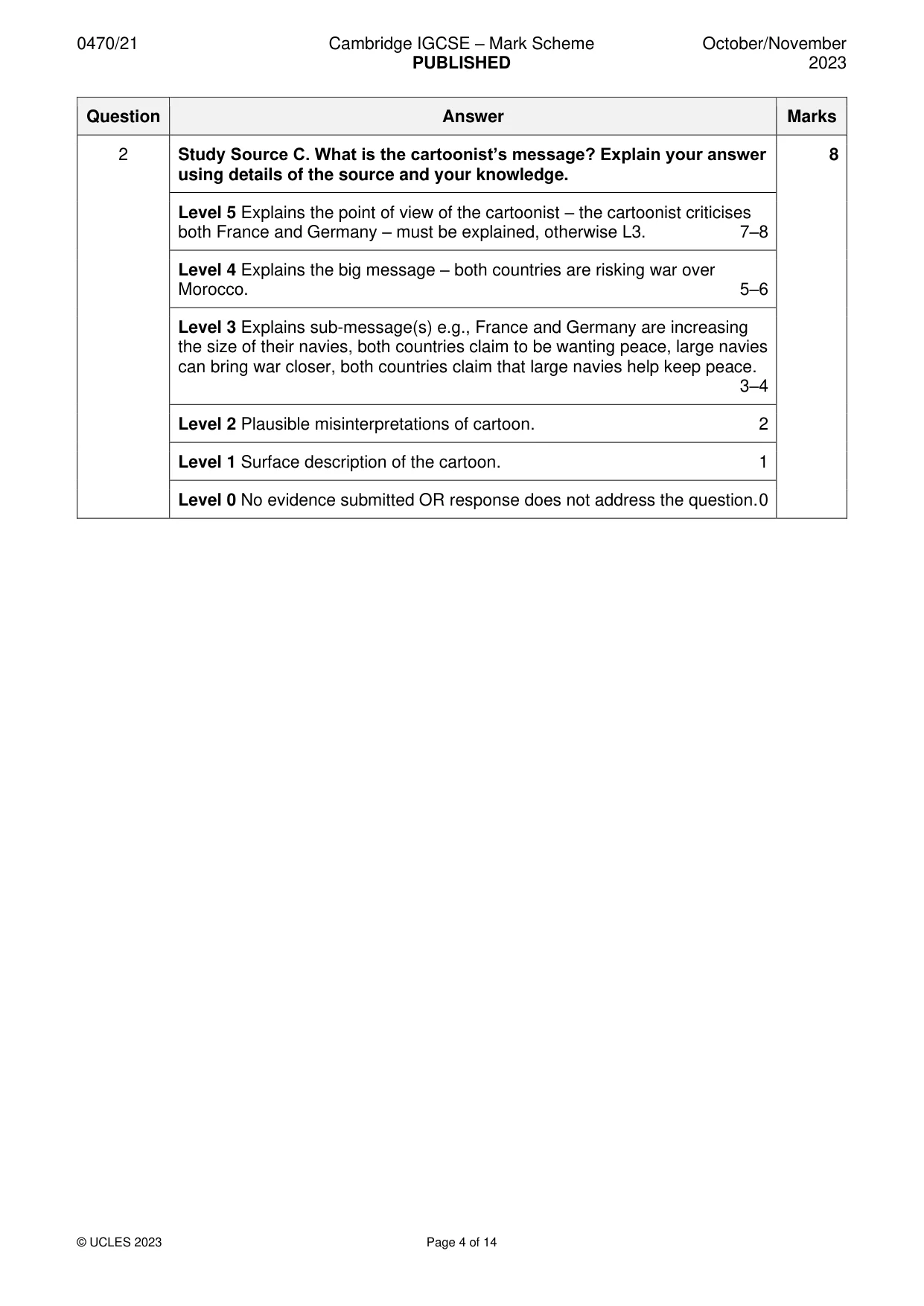
0470/21 Cambridge IGCSE – Mark Scheme PUBLISHED October/November 2023 © UCLES 2023 Page 4 of 14 Question Answer Marks 2 Study Source C. What is the cartoonist’s message? Explain your answer using details of the source and your knowledge. 8 Level 5 Explains the point of view of the cartoonist – the cartoonist criticises both France and Germany – must be explained, otherwise L3. 7–8 Level 4 Explains the big message – both countries are risking war over Morocco. 5–6 Level 3 Explains sub-message(s) e.g., France and Germany are increasing the size of their navies, both countries claim to be wanting peace, large navies can bring war closer, both countries claim that large navies help keep peace. 3–4 Level 2 Plausible misinterpretations of cartoon. 2 Level 1 Surface description of the cartoon. 1 Level 0 No evidence submitted OR response does not address the question. 0
Mark scheme, page 5
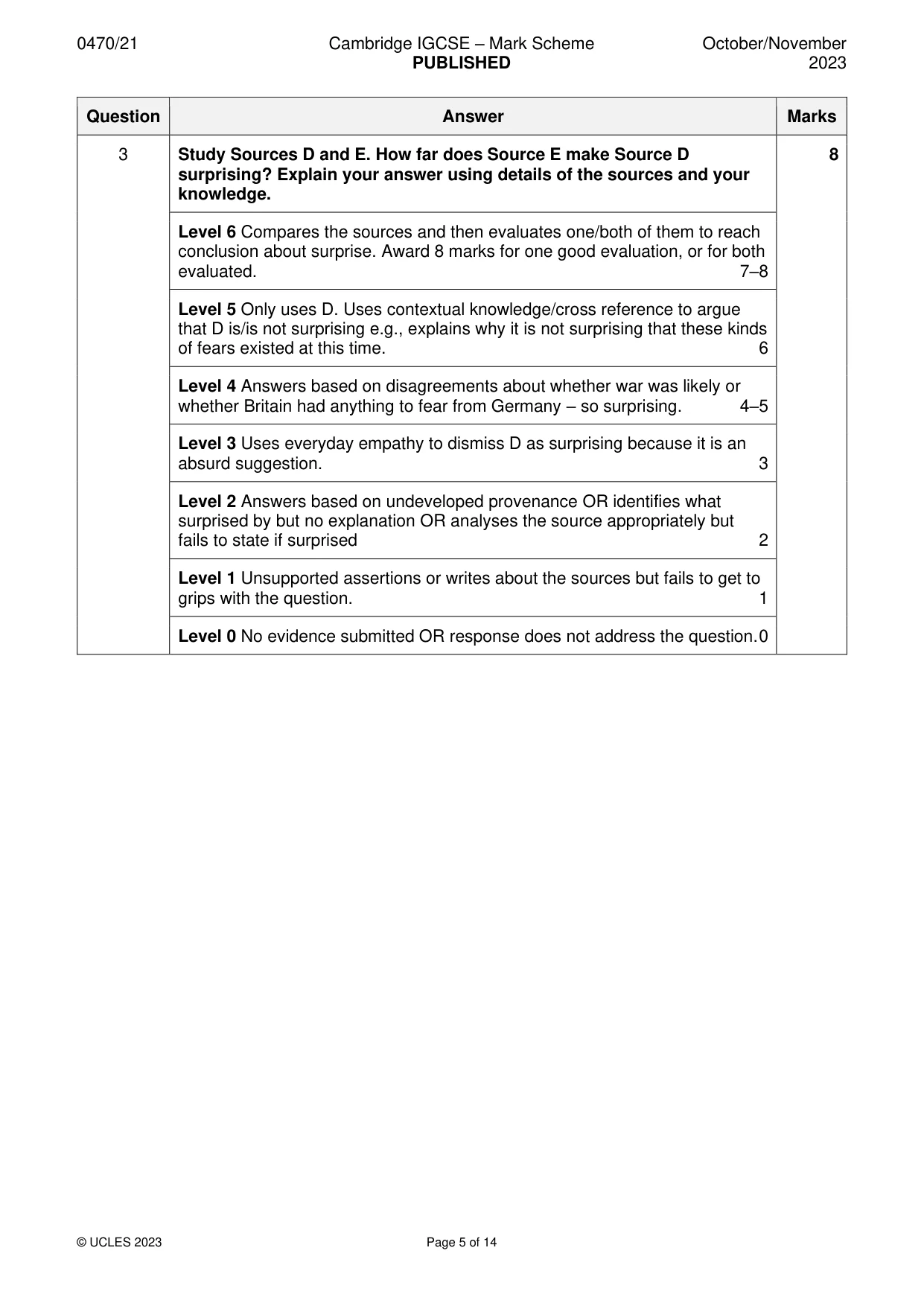
0470/21 Cambridge IGCSE – Mark Scheme PUBLISHED October/November 2023 © UCLES 2023 Page 5 of 14 Question Answer Marks 3 Study Sources D and E. How far does Source E make Source D surprising? Explain your answer using details of the sources and your knowledge. 8 Level 6 Compares the sources and then evaluates one/both of them to reach conclusion about surprise. Award 8 marks for one good evaluation, or for both evaluated. 7–8 Level 5 Only uses D. Uses contextual knowledge/cross reference to argue that D is/is not surprising e.g., explains why it is not surprising that these kinds of fears existed at this time. 6 Level 4 Answers based on disagreements about whether war was likely or whether Britain had anything to fear from Germany – so surprising. 4–5 Level 3 Uses everyday empathy to dismiss D as surprising because it is an absurd suggestion. 3 Level 2 Answers based on undeveloped provenance OR identifies what surprised by but no explanation OR analyses the source appropriately but fails to state if surprised 2 Level 1 Unsupported assertions or writes about the sources but fails to get to grips with the question. 1 Level 0 No evidence submitted OR response does not address the question. 0
Mark scheme, page 6
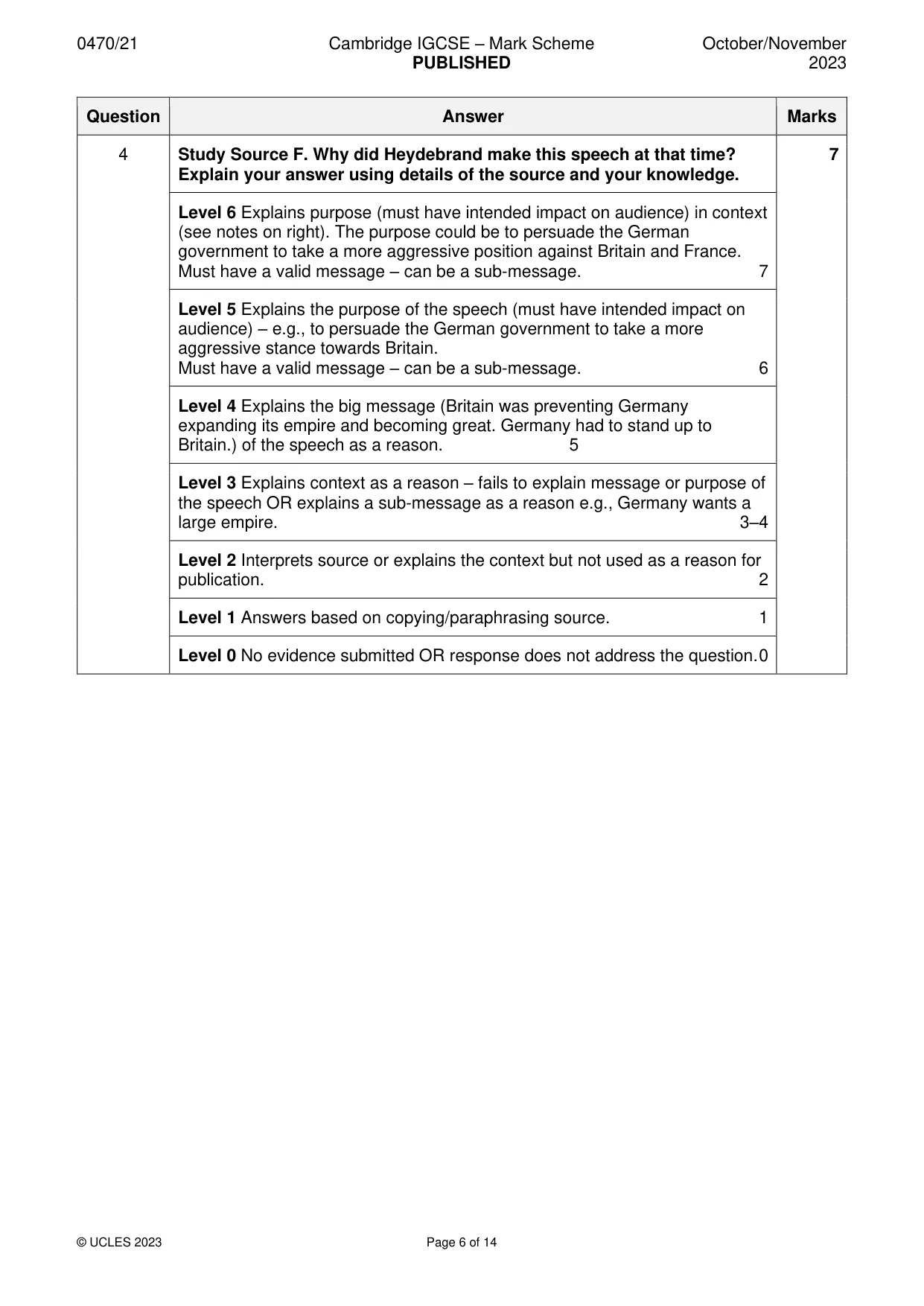
0470/21 Cambridge IGCSE – Mark Scheme PUBLISHED October/November 2023 © UCLES 2023 Page 6 of 14 Question Answer Marks 4 Study Source F. Why did Heydebrand make this speech at that time? Explain your answer using details of the source and your knowledge. 7 Level 6 Explains purpose (must have intended impact on audience) in context (see notes on right). The purpose could be to persuade the German government to take a more aggressive position against Britain and France. Must have a valid message – can be a sub-message. 7 Level 5 Explains the purpose of the speech (must have intended impact on audience) – e.g., to persuade the German government to take a more aggressive stance towards Britain. Must have a valid message – can be a sub-message. 6 Level 4 Explains the big message (Britain was preventing Germany expanding its empire and becoming great. Germany had to stand up to Britain.) of the speech as a reason. 5 Level 3 Explains context as a reason – fails to explain message or purpose of the speech OR explains a sub-message as a reason e.g., Germany wants a large empire. 3–4 Level 2 Interprets source or explains the context but not used as a reason for publication. 2 Level 1 Answers based on copying/paraphrasing source. 1 Level 0 No evidence submitted OR response does not address the question. 0
Mark scheme, page 7
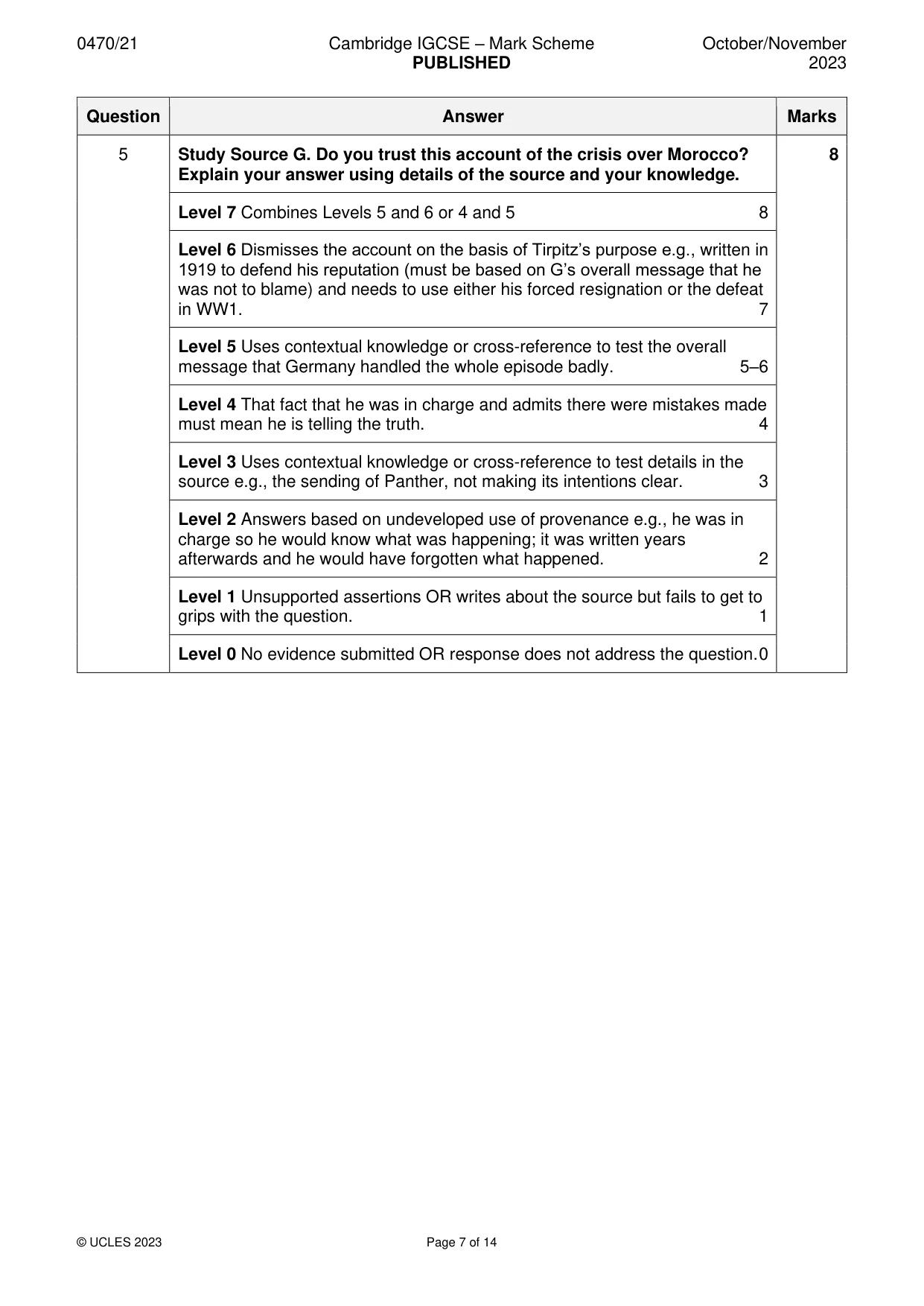
0470/21 Cambridge IGCSE – Mark Scheme PUBLISHED October/November 2023 © UCLES 2023 Page 7 of 14 Question Answer Marks 5 Study Source G. Do you trust this account of the crisis over Morocco? Explain your answer using details of the source and your knowledge. 8 Level 7 Combines Levels 5 and 6 or 4 and 5 8 Level 6 Dismisses the account on the basis of Tirpitz’s purpose e.g., written in 1919 to defend his reputation (must be based on G’s overall message that he was not to blame) and needs to use either his forced resignation or the defeat in WW1. 7 Level 5 Uses contextual knowledge or cross-reference to test the overall message that Germany handled the whole episode badly. 5–6 Level 4 That fact that he was in charge and admits there were mistakes made must mean he is telling the truth. 4 Level 3 Uses contextual knowledge or cross-reference to test details in the source e.g., the sending of Panther, not making its intentions clear. 3 Level 2 Answers based on undeveloped use of provenance e.g., he was in charge so he would know what was happening; it was written years afterwards and he would have forgotten what happened. 2 Level 1 Unsupported assertions OR writes about the source but fails to get to grips with the question. 1 Level 0 No evidence submitted OR response does not address the question. 0
Mark scheme, page 8
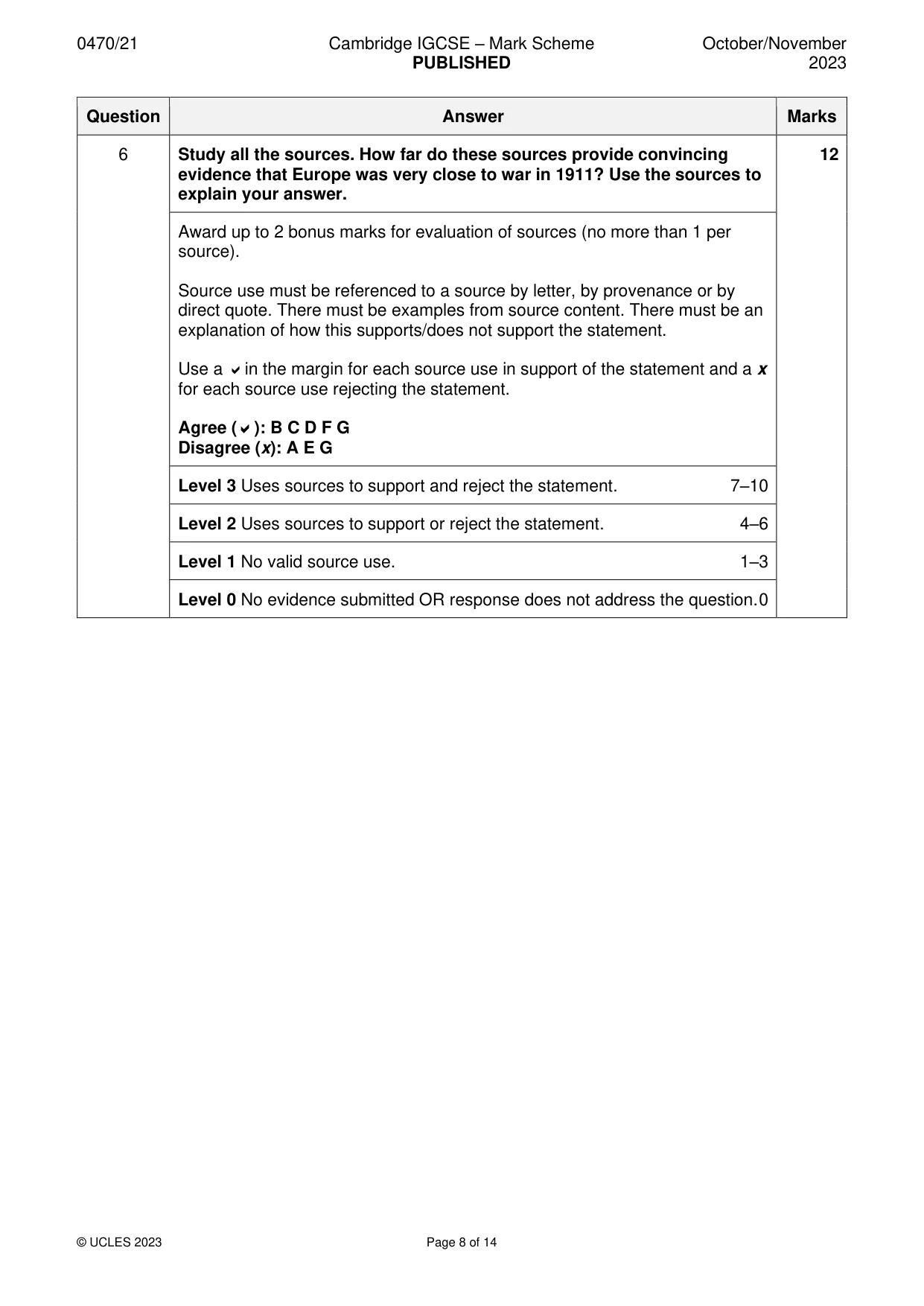
0470/21 Cambridge IGCSE – Mark Scheme PUBLISHED October/November 2023 © UCLES 2023 Page 8 of 14 Question Answer Marks 6 Study all the sources. How far do these sources provide convincing evidence that Europe was very close to war in 1911? Use the sources to explain your answer. 12 Award up to 2 bonus marks for evaluation of sources (no more than 1 per source). Source use must be referenced to a source by letter, by provenance or by direct quote. There must be examples from source content. There must be an explanation of how this supports/does not support the statement. Use a in the margin for each source use in support of the statement and a x for each source use rejecting the statement. Agree (): B C D F G Disagree (x): A E G Level 3 Uses sources to support and reject the statement. 7–10 Level 2 Uses sources to support or reject the statement. 4–6 Level 1 No valid source use. 1–3 Level 0 No evidence submitted OR response does not address the question. 0
Mark scheme, page 9
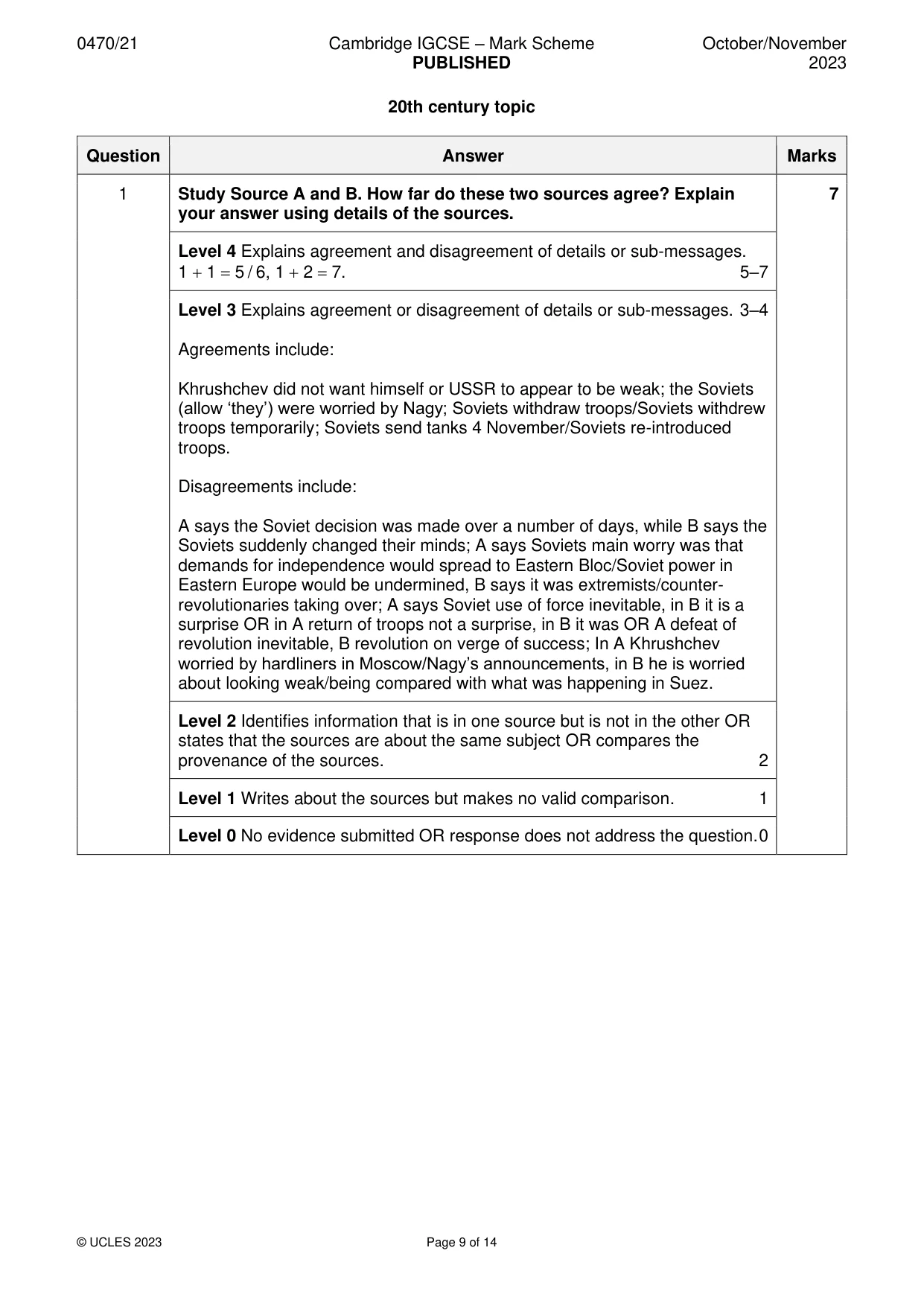
0470/21 Cambridge IGCSE – Mark Scheme PUBLISHED October/November 2023 © UCLES 2023 Page 9 of 14 20th century topic Question Answer Marks 1 Study Source A and B. How far do these two sources agree? Explain your answer using details of the sources. 7 Level 4 Explains agreement and disagreement of details or sub-messages. 1 + 1 = 5 / 6, 1 + 2 = 7. 5–7 Level 3 Explains agreement or disagreement of details or sub-messages. 3–4 Agreements include: Khrushchev did not want himself or USSR to appear to be weak; the Soviets (allow ‘they’) were worried by Nagy; Soviets withdraw troops/Soviets withdrew troops temporarily; Soviets send tanks 4 November/Soviets re-introduced troops. Disagreements include: A says the Soviet decision was made over a number of days, while B says the Soviets suddenly changed their minds; A says Soviets main worry was that demands for independence would spread to Eastern Bloc/Soviet power in Eastern Europe would be undermined, B says it was extremists/counter- revolutionaries taking over; A says Soviet use of force inevitable, in B it is a surprise OR in A return of troops not a surprise, in B it was OR A defeat of revolution inevitable, B revolution on verge of success; In A Khrushchev worried by hardliners in Moscow/Nagy’s announcements, in B he is worried about looking weak/being compared with what was happening in Suez. Level 2 Identifies information that is in one source but is not in the other OR states that the sources are about the same subject OR compares the provenance of the sources. 2 Level 1 Writes about the sources but makes no valid comparison. 1 Level 0 No evidence submitted OR response does not address the question. 0
Mark scheme, page 10
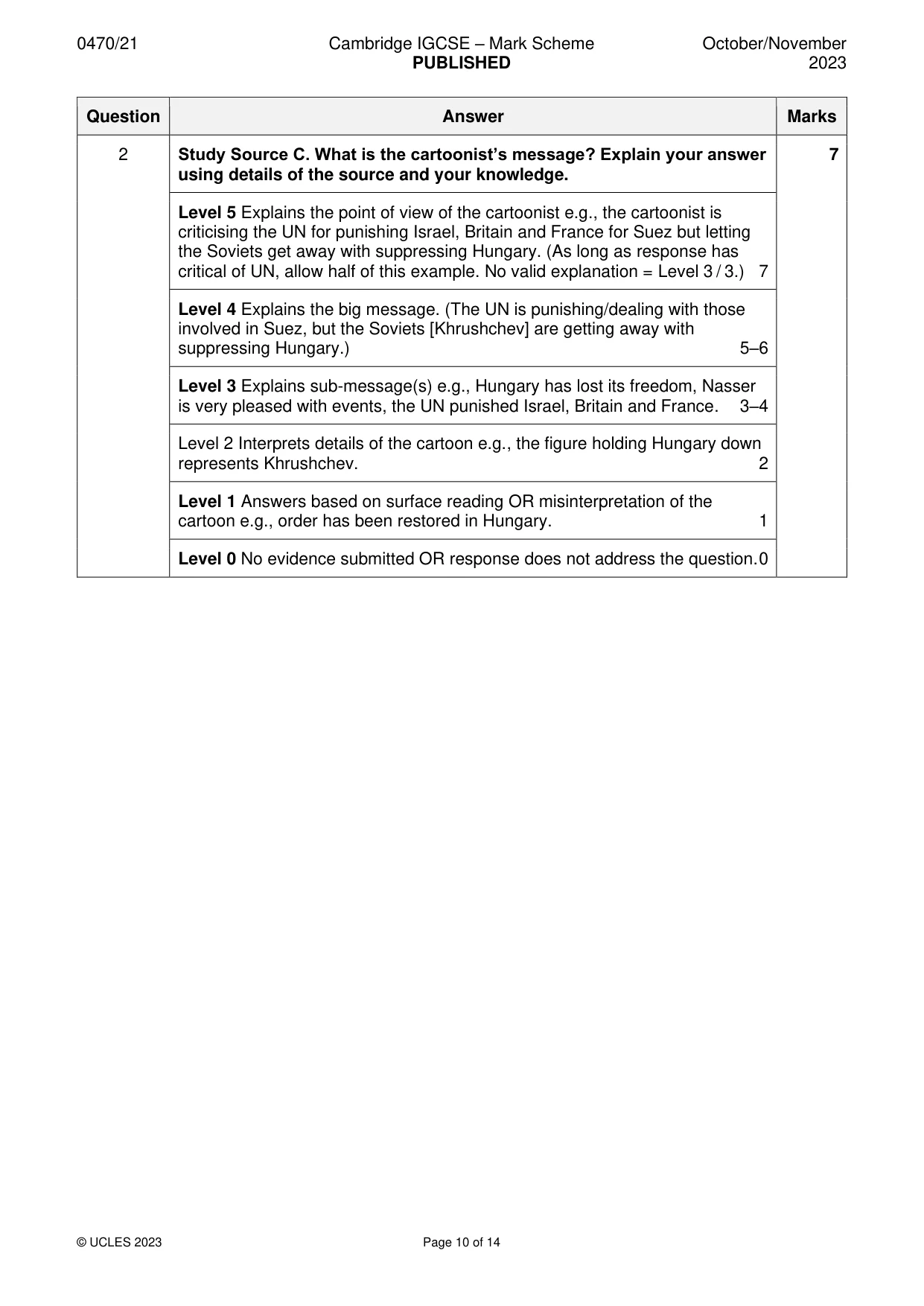
0470/21 Cambridge IGCSE – Mark Scheme PUBLISHED October/November 2023 © UCLES 2023 Page 10 of 14 Question Answer Marks 2 Study Source C. What is the cartoonist’s message? Explain your answer using details of the source and your knowledge. 7 Level 5 Explains the point of view of the cartoonist e.g., the cartoonist is criticising the UN for punishing Israel, Britain and France for Suez but letting the Soviets get away with suppressing Hungary. (As long as response has critical of UN, allow half of this example. No valid explanation = Level 3 / 3.) 7 Level 4 Explains the big message. (The UN is punishing/dealing with those involved in Suez, but the Soviets [Khrushchev] are getting away with suppressing Hungary.) 5–6 Level 3 Explains sub-message(s) e.g., Hungary has lost its freedom, Nasser is very pleased with events, the UN punished Israel, Britain and France. 3–4 Level 2 Interprets details of the cartoon e.g., the figure holding Hungary down represents Khrushchev. 2 Level 1 Answers based on surface reading OR misinterpretation of the cartoon e.g., order has been restored in Hungary. 1 Level 0 No evidence submitted OR response does not address the question. 0
Mark scheme, page 11
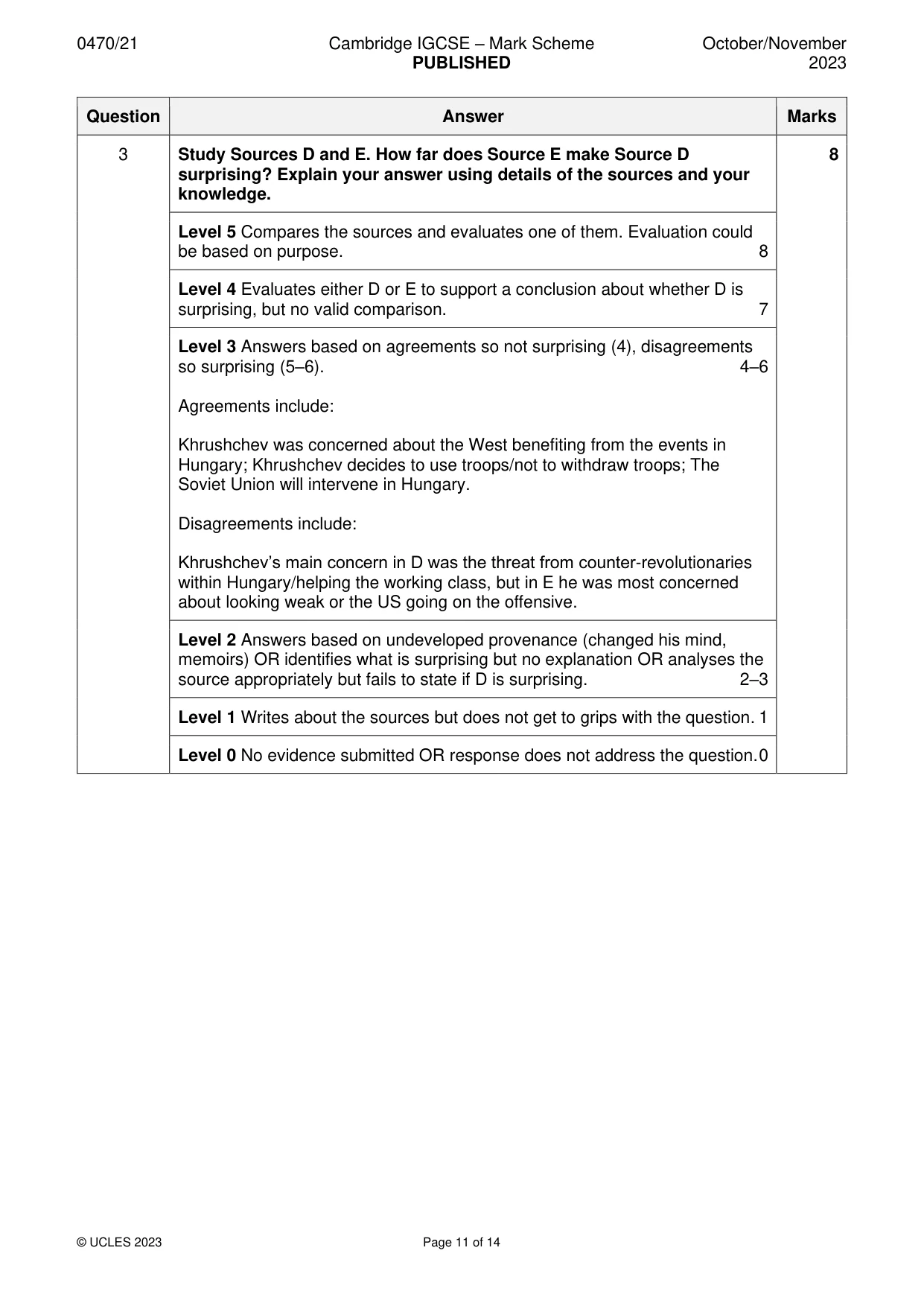
0470/21 Cambridge IGCSE – Mark Scheme PUBLISHED October/November 2023 © UCLES 2023 Page 11 of 14 Question Answer Marks 3 Study Sources D and E. How far does Source E make Source D surprising? Explain your answer using details of the sources and your knowledge. 8 Level 5 Compares the sources and evaluates one of them. Evaluation could be based on purpose. 8 Level 4 Evaluates either D or E to support a conclusion about whether D is surprising, but no valid comparison. 7 Level 3 Answers based on agreements so not surprising (4), disagreements so surprising (5–6). 4–6 Agreements include: Khrushchev was concerned about the West benefiting from the events in Hungary; Khrushchev decides to use troops/not to withdraw troops; The Soviet Union will intervene in Hungary. Disagreements include: Khrushchev’s main concern in D was the threat from counter-revolutionaries within Hungary/helping the working class, but in E he was most concerned about looking weak or the US going on the offensive. Level 2 Answers based on undeveloped provenance (changed his mind, memoirs) OR identifies what is surprising but no explanation OR analyses the source appropriately but fails to state if D is surprising. 2–3 Level 1 Writes about the sources but does not get to grips with the question. 1 Level 0 No evidence submitted OR response does not address the question. 0
Mark scheme, page 12
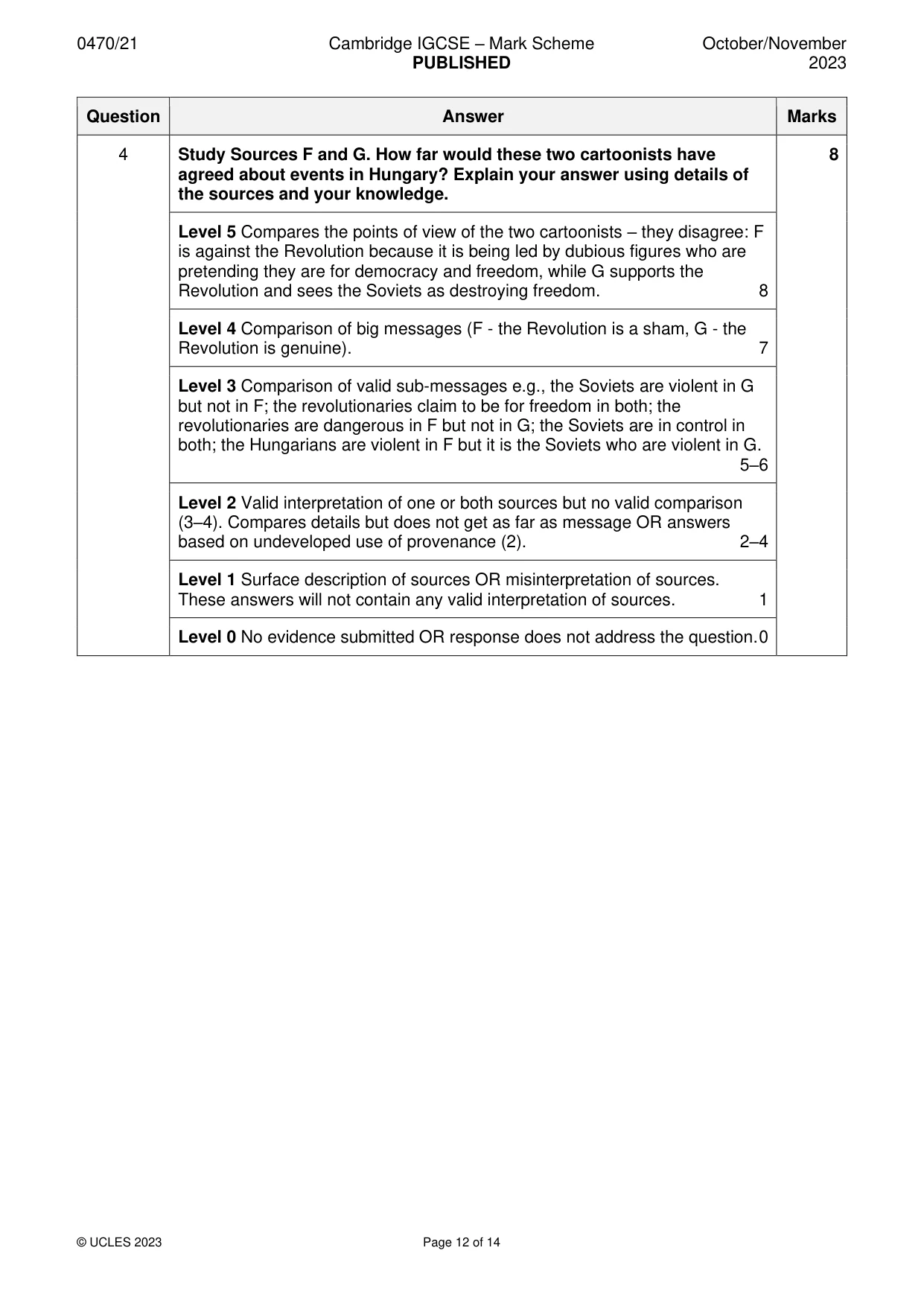
0470/21 Cambridge IGCSE – Mark Scheme PUBLISHED October/November 2023 © UCLES 2023 Page 12 of 14 Question Answer Marks 4 Study Sources F and G. How far would these two cartoonists have agreed about events in Hungary? Explain your answer using details of the sources and your knowledge. 8 Level 5 Compares the points of view of the two cartoonists – they disagree: F is against the Revolution because it is being led by dubious figures who are pretending they are for democracy and freedom, while G supports the Revolution and sees the Soviets as destroying freedom. 8 Level 4 Comparison of big messages (F - the Revolution is a sham, G - the Revolution is genuine). 7 Level 3 Comparison of valid sub-messages e.g., the Soviets are violent in G but not in F; the revolutionaries claim to be for freedom in both; the revolutionaries are dangerous in F but not in G; the Soviets are in control in both; the Hungarians are violent in F but it is the Soviets who are violent in G. 5–6 Level 2 Valid interpretation of one or both sources but no valid comparison (3–4). Compares details but does not get as far as message OR answers based on undeveloped use of provenance (2). 2–4 Level 1 Surface description of sources OR misinterpretation of sources. These answers will not contain any valid interpretation of sources. 1 Level 0 No evidence submitted OR response does not address the question. 0
Mark scheme, page 13
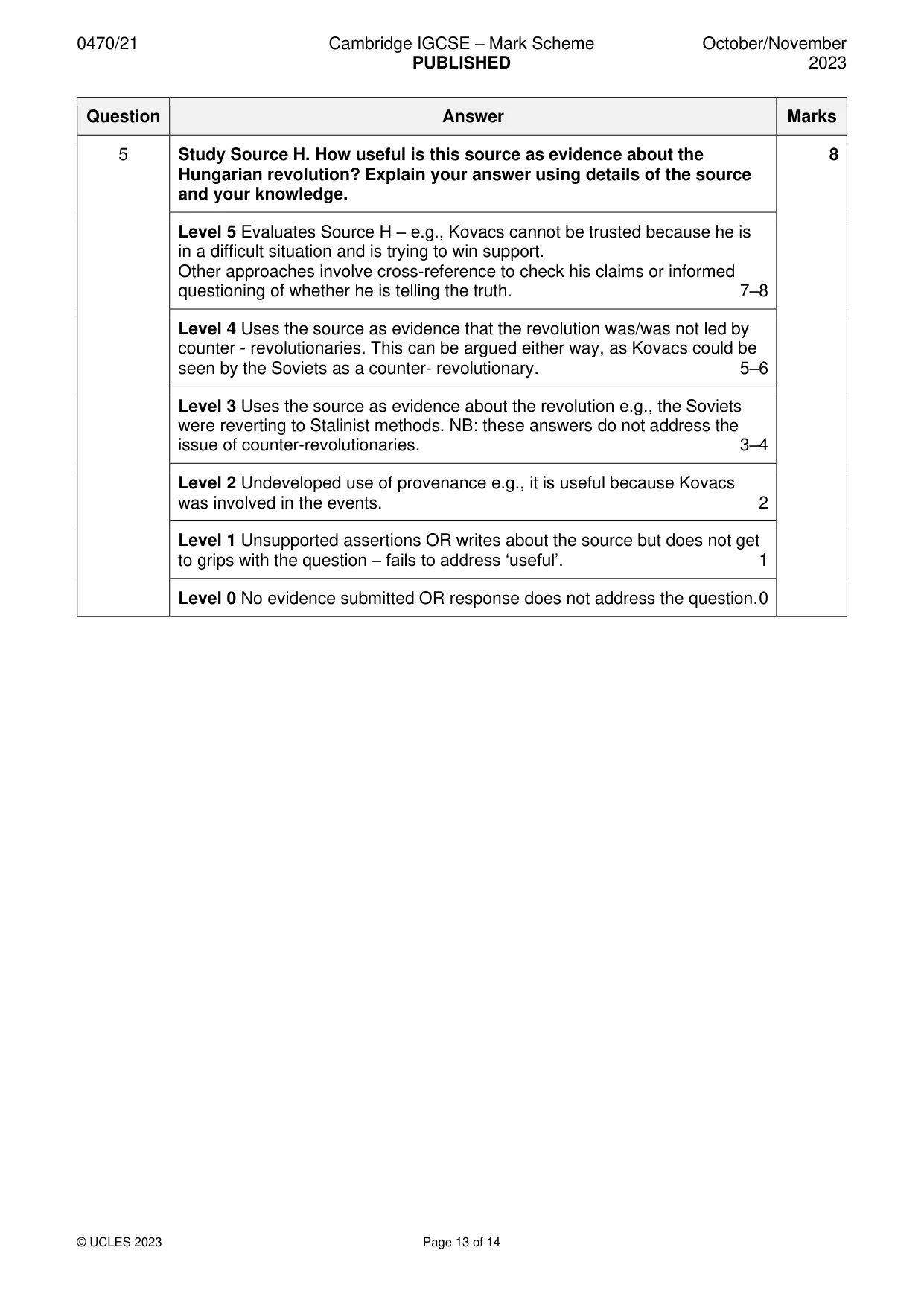
0470/21 Cambridge IGCSE – Mark Scheme PUBLISHED October/November 2023 © UCLES 2023 Page 13 of 14 Question Answer Marks 5 Study Source H. How useful is this source as evidence about the Hungarian revolution? Explain your answer using details of the source and your knowledge. 8 Level 5 Evaluates Source H – e.g., Kovacs cannot be trusted because he is in a difficult situation and is trying to win support. Other approaches involve cross-reference to check his claims or informed questioning of whether he is telling the truth. 7–8 Level 4 Uses the source as evidence that the revolution was/was not led by counter - revolutionaries. This can be argued either way, as Kovacs could be seen by the Soviets as a counter- revolutionary. 5–6 Level 3 Uses the source as evidence about the revolution e.g., the Soviets were reverting to Stalinist methods. NB: these answers do not address the issue of counter-revolutionaries. 3–4 Level 2 Undeveloped use of provenance e.g., it is useful because Kovacs was involved in the events. 2 Level 1 Unsupported assertions OR writes about the source but does not get to grips with the question – fails to address ‘useful’. 1 Level 0 No evidence submitted OR response does not address the question. 0
Mark scheme, page 14
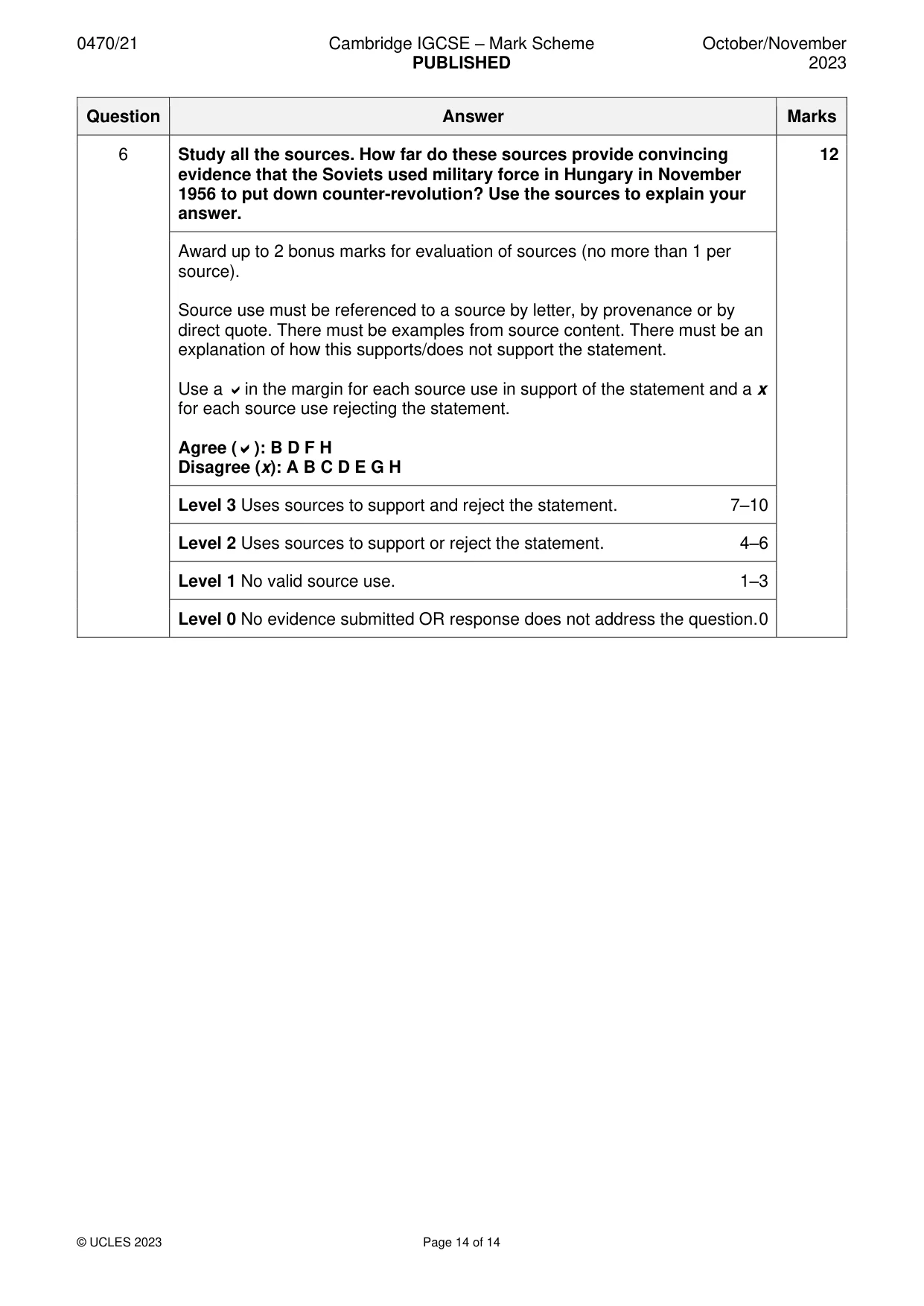
0470/21 Cambridge IGCSE – Mark Scheme PUBLISHED October/November 2023 © UCLES 2023 Page 14 of 14 Question Answer Marks 6 Study all the sources. How far do these sources provide convincing evidence that the Soviets used military force in Hungary in November 1956 to put down counter-revolution? Use the sources to explain your answer. 12 Award up to 2 bonus marks for evaluation of sources (no more than 1 per source). Source use must be referenced to a source by letter, by provenance or by direct quote. There must be examples from source content. There must be an explanation of how this supports/does not support the statement. Use a in the margin for each source use in support of the statement and a x for each source use rejecting the statement. Agree (): B D F H Disagree (x): A B C D E G H Level 3 Uses sources to support and reject the statement. 7–10 Level 2 Uses sources to support or reject the statement. 4–6 Level 1 No valid source use. 1–3 Level 0 No evidence submitted OR response does not address the question. 0
What you needed in this session
Cambridge’s own grade thresholds for 2023 Oct/Nov, Paper 2 · Variant 1. A higher threshold means an easier paper — the bar moves with how the cohort did.