Cambridge IGCSE History 0470 — 2024 May/June Paper 2 · Variant 1
0470/21/M/J/24 · 40 marks · 105 min
The question paper and its mark scheme, free to read here and free to download. This is Cambridge’s own paper, exactly as it was sat.
Question paper12 pages

Mark scheme13 pages
Answers below. Sit the paper first if you are practising.
Paper as text
Question paper, page 1
This document has 12 pages. Any blank pages are indicated. [Turn over Cambridge IGCSE™ DC (SK/CGW) 330336/3 © UCLES 2024 * 1 0 8 1 0 8 0 7 8 4 * HISTORY 0470/21 Paper 2 Document Questions May/June 2024 1 hour 45 minutes You must answer on the enclosed answer booklet. You will need: Answer booklet (enclosed) INSTRUCTIONS ● Answer one question on one option only. Option A: Nineteenth century topic Option B: Twentieth century topic ● Follow the instructions on the front cover of the answer booklet. If you need additional answer paper, ask the invigilator for a continuation booklet. INFORMATION ● The total mark for this paper is 40. ● The number of marks for each question or part question is shown in brackets [ ].
Question paper, page 2
2 0470/21/M/J/24 © UCLES 2024 Option A: Nineteenth century topic 1 How far was Russia responsible for the outbreak of the First World War? Study the Background Information and the sources carefully, and then answer all parts of Question 1. Background Information Some historians argue that Russia was responsible for the outbreak of the First World War. They point to Russia’s support for Serbia in its quarrel with Austria. It has been claimed that Russia was exploiting this quarrel for its own advantage. Indeed, on 24 July Russia began a preliminary mobilisation of its armed forces. On 29 July Russia decided to fully mobilise. Although Tsar Nicholas II tried to limit this to a partial mobilisation, by 30 July he had agreed to full mobilisation. This was followed by Germany issuing an ultimatum on 31 July demanding that Russia ‘cease all war measures’. This was ignored, and on 1 August Germany declared war on Russia. Soon Britain and France were involved. How important were Russian actions in causing the outbreak of the First World War? SOURCE A On 29 July the Russian government decided to mobilise its army. The fact that Russia mobilised first is significant. From a purely military point of view, there was no immediate necessity for Russian mobilisation. Germany did not mobilise until 2 August, a day after declaring war on Russia. The Austrian partial mobilisation on 25 July was not a direct threat to Russia. Nor was Serbia in imminent danger. The ignorant and impulsive Sazonov was unaware of these factors, but Sukhomlinov, the Minister of War, and the leaders of the army should have known better. On 30 July Moltke used the Russian mobilisation to urge the Austrians to mobilise against Russia and to undermine Bethmann Hollweg’s efforts within the German government to bring about a peaceful solution. The Russian mobilisation must be seen against the background of July 1914 and is explained by the Schlieffen Plan and the need of France to get the Russian army into action quickly. However, German fears about Russia were real and understandable. If Russia continued at peace and modernised at its present rate, it would soon become the most powerful state in Europe. Such a state, hostile as it was towards Germany, would pursue expansion into Europe. From a recent history book. Sazonov was Russia’s Foreign Minister. Moltke was head of the German army, and Bethmann Hollweg was head of the German government. SOURCE B Although the Tsar agreed to a mobilisation on 29 July, later that day he changed his mind. It was on the following day that he was finally persuaded to agree to it. Russia had little choice. Its mobilisation was an act to defend Russia and Serbia, both of which were threatened by Austrian actions. By 29–30 July war was almost inevitable and could only have been avoided by Germany abandoning Austria. But Bethmann Hollweg’s attempts to persuade Austria to moderate its position were being undermined by Moltke, who wanted war, and who encouraged Austria to mobilise. Germany was a powerful nation-state and had no need to be worried about Russia. Although Russia had traditions of militarism and territorial expansion, Germany had little to fear. The Schlieffen Plan was the product of an aggressive German Empire whose generals rejected Russian proposals for peace. The risks that Germany took in 1914 made little sense unless it was seeking to carve out a European empire. From a recent history book.
Question paper, page 3
3 0470/21/M/J/24 © UCLES 2024 [Turn over SOURCE C I wanted to keep peace – naturally not at the cost of our renewed humiliation. Not being a diplomat, I did not have the ability to specify in what way this humiliation was to be avoided. The Tsar saw me just as a technician who must build the instrument of war, and the Tsar was the one who would decide the time for action. I am convinced the decision on war was made around 24–28 July when Sazonov, Poincaré and the head of the Russian army agreed a plan to make war. During and after Poincaré’s visit, I was cut off from the Tsar until 2 August when the war machine had already been set into action. Sazonov negotiated with Poincaré without any contact with me. The Tsar believed he could go above the head of the Minister of War. From Sukhomlinov’s memoirs which were published in Germany in 1924. They were dedicated to Kaiser Wilhelm II. Sukhomlinov was dismissed as Minister of War in 1915 after the Russian army suffered several defeats. Poincaré was President of France. SOURCE D No one in Russia ever had any thought of aggression; such a course was never considered. This was the attitude of the Tsar, who was a profound lover of peace. The strongest opponent of any sort of policy of aggression was Sukhomlinov, the Minister of War, probably because of the unsatisfactory condition of his department and the army. There was no trace in St Petersburg of the existence of any party which wanted war. This influenced the course of my negotiations in Berlin where I tried to calm German hostility. From Sazonov’s memoirs published in 1928.
Question paper, page 4
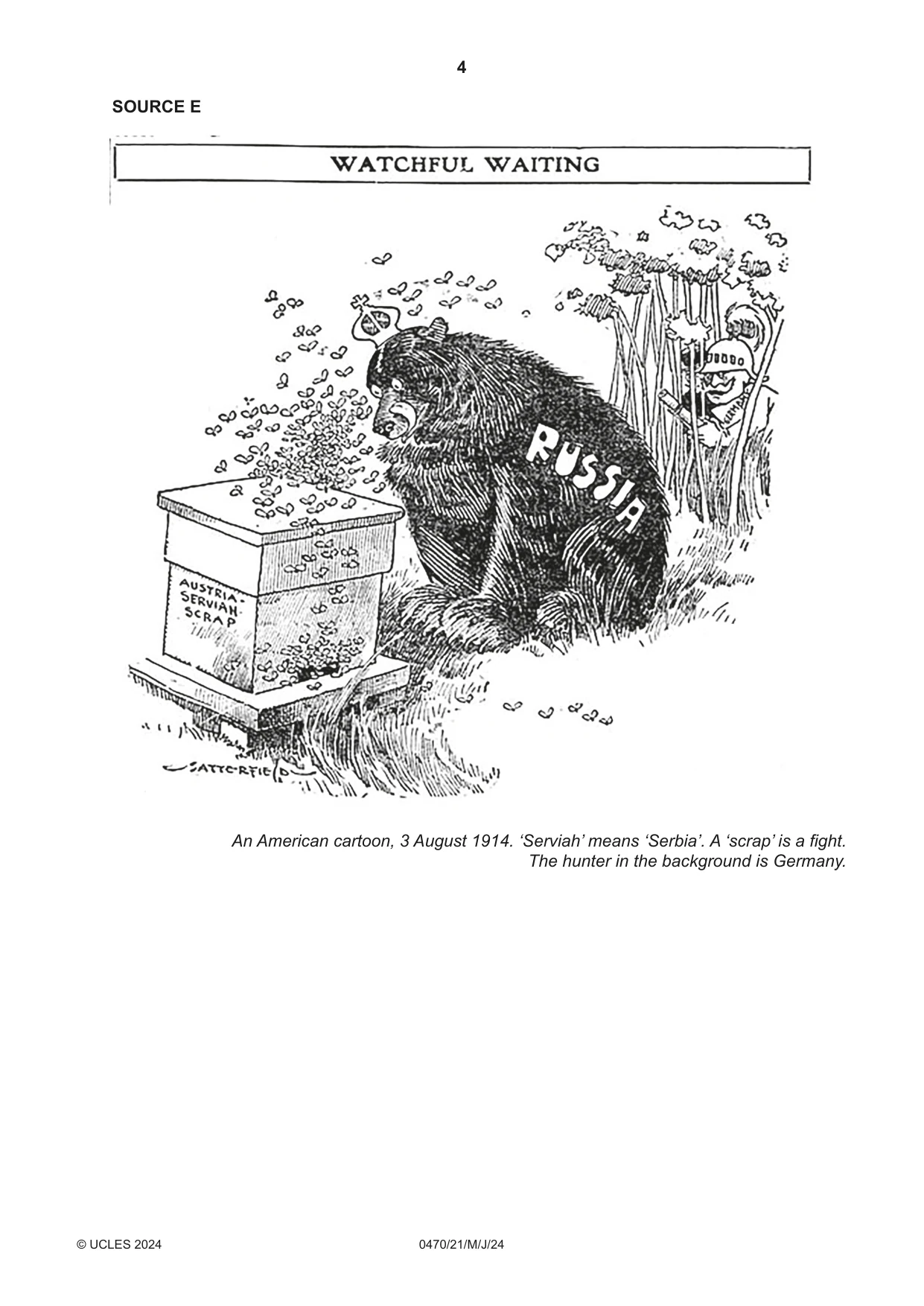
4 0470/21/M/J/24 © UCLES 2024 SOURCE E An American cartoon, 3 August 1914. ‘Serviah’ means ‘Serbia’. A ‘scrap’ is a fight. The hunter in the background is Germany.
Question paper, page 5
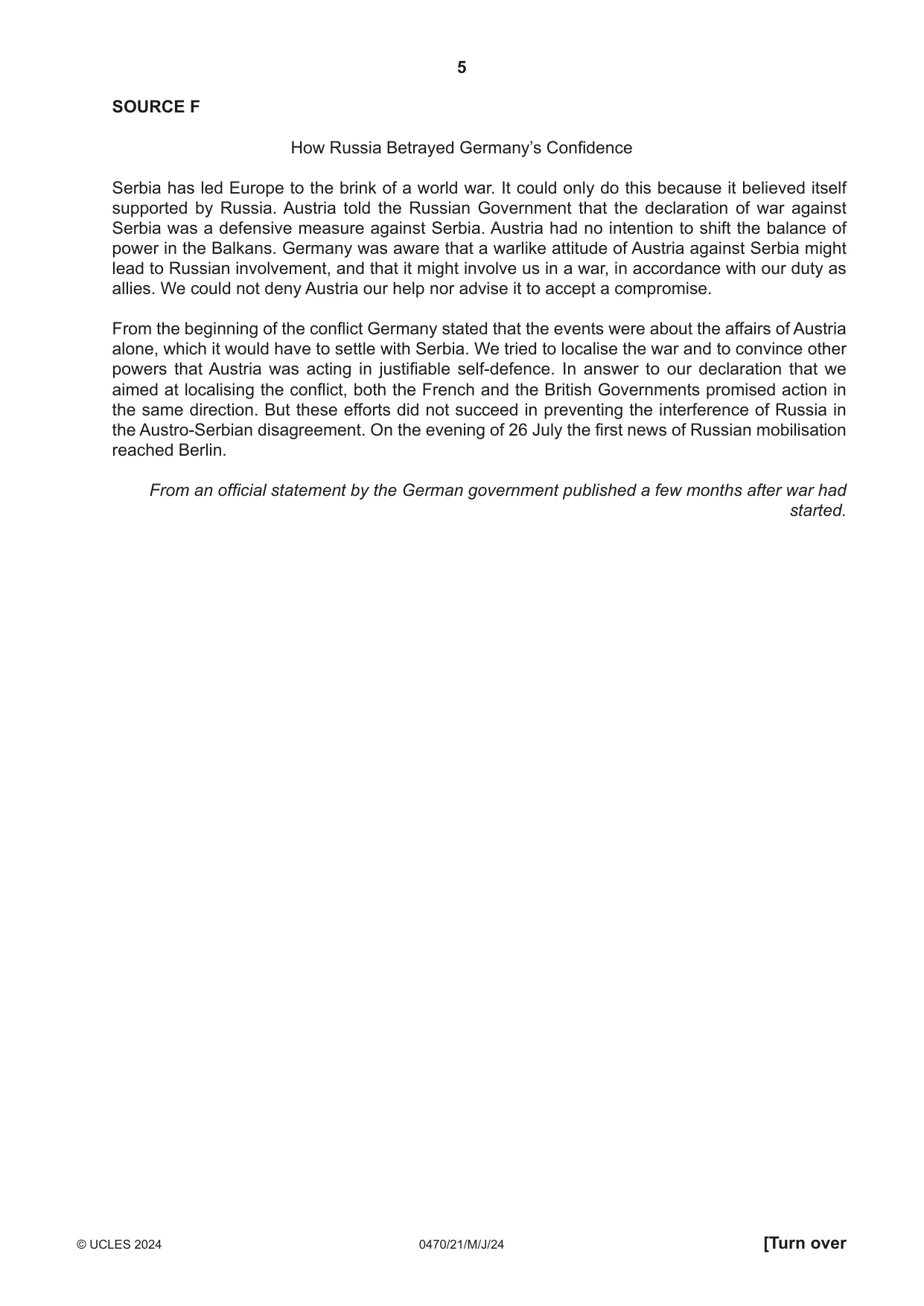
5 0470/21/M/J/24 © UCLES 2024 [Turn over SOURCE F How Russia Betrayed Germany’s Confidence Serbia has led Europe to the brink of a world war. It could only do this because it believed itself supported by Russia. Austria told the Russian Government that the declaration of war against Serbia was a defensive measure against Serbia. Austria had no intention to shift the balance of power in the Balkans. Germany was aware that a warlike attitude of Austria against Serbia might lead to Russian involvement, and that it might involve us in a war, in accordance with our duty as allies. We could not deny Austria our help nor advise it to accept a compromise. From the beginning of the conflict Germany stated that the events were about the affairs of Austria alone, which it would have to settle with Serbia. We tried to localise the war and to convince other powers that Austria was acting in justifiable self-defence. In answer to our declaration that we aimed at localising the conflict, both the French and the British Governments promised action in the same direction. But these efforts did not succeed in preventing the interference of Russia in the Austro-Serbian disagreement. On the evening of 26 July the first news of Russian mobilisation reached Berlin. From an official statement by the German government published a few months after war had started.
Question paper, page 6
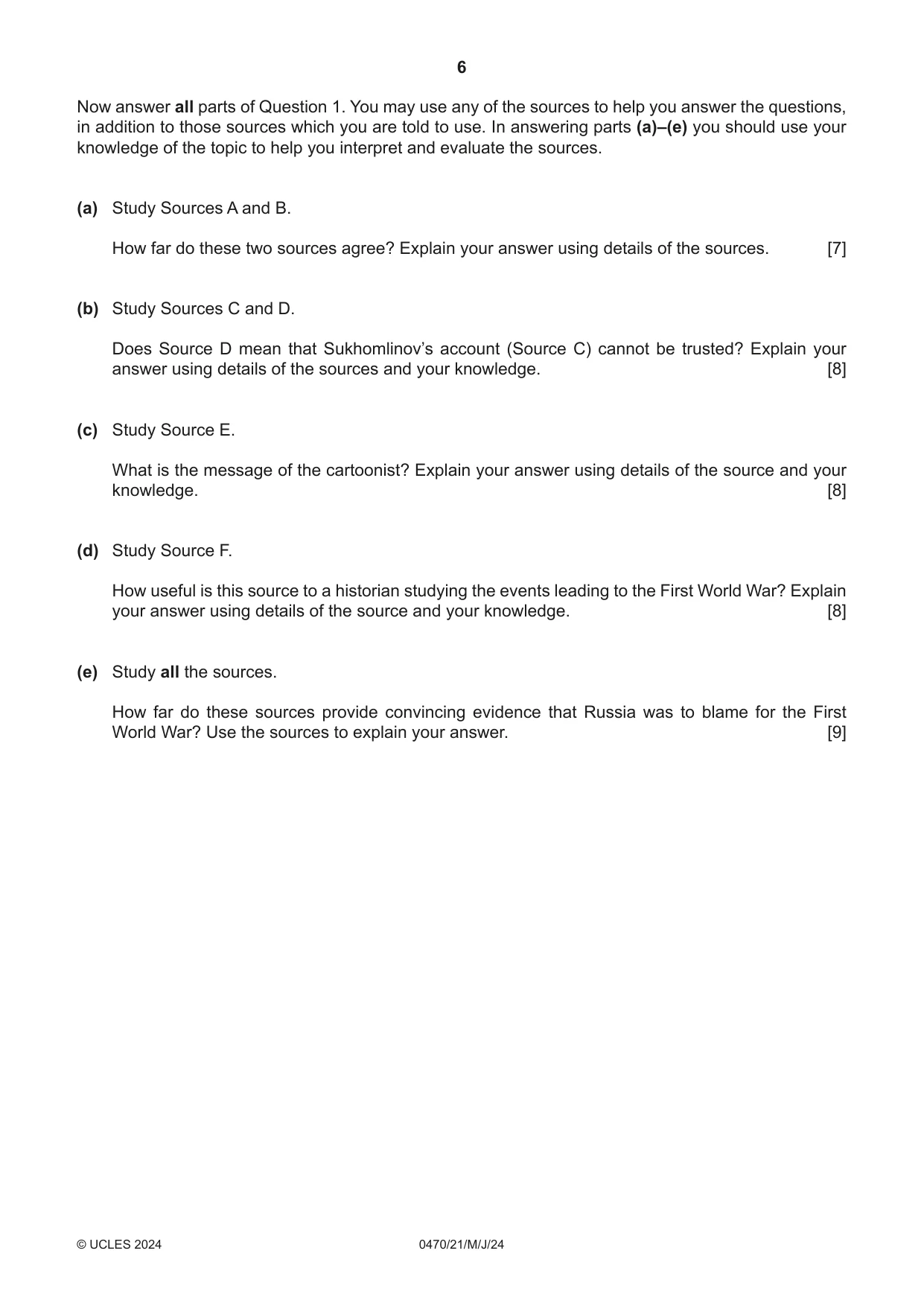
6 0470/21/M/J/24 © UCLES 2024 Now answer all parts of Question 1. You may use any of the sources to help you answer the questions, in addition to those sources which you are told to use. In answering parts (a)–(e) you should use your knowledge of the topic to help you interpret and evaluate the sources. (a) Study Sources A and B. How far do these two sources agree? Explain your answer using details of the sources. [7] (b) Study Sources C and D. Does Source D mean that Sukhomlinov’s account (Source C) cannot be trusted? Explain your answer using details of the sources and your knowledge. [8] (c) Study Source E. What is the message of the cartoonist? Explain your answer using details of the source and your knowledge. [8] (d) Study Source F. How useful is this source to a historian studying the events leading to the First World War? Explain your answer using details of the source and your knowledge. [8] (e) Study all the sources. How far do these sources provide convincing evidence that Russia was to blame for the First World War? Use the sources to explain your answer. [9]
Question paper, page 7
7 0470/21/M/J/24 © UCLES 2024 [Turn over BLANK PAGE
Question paper, page 8
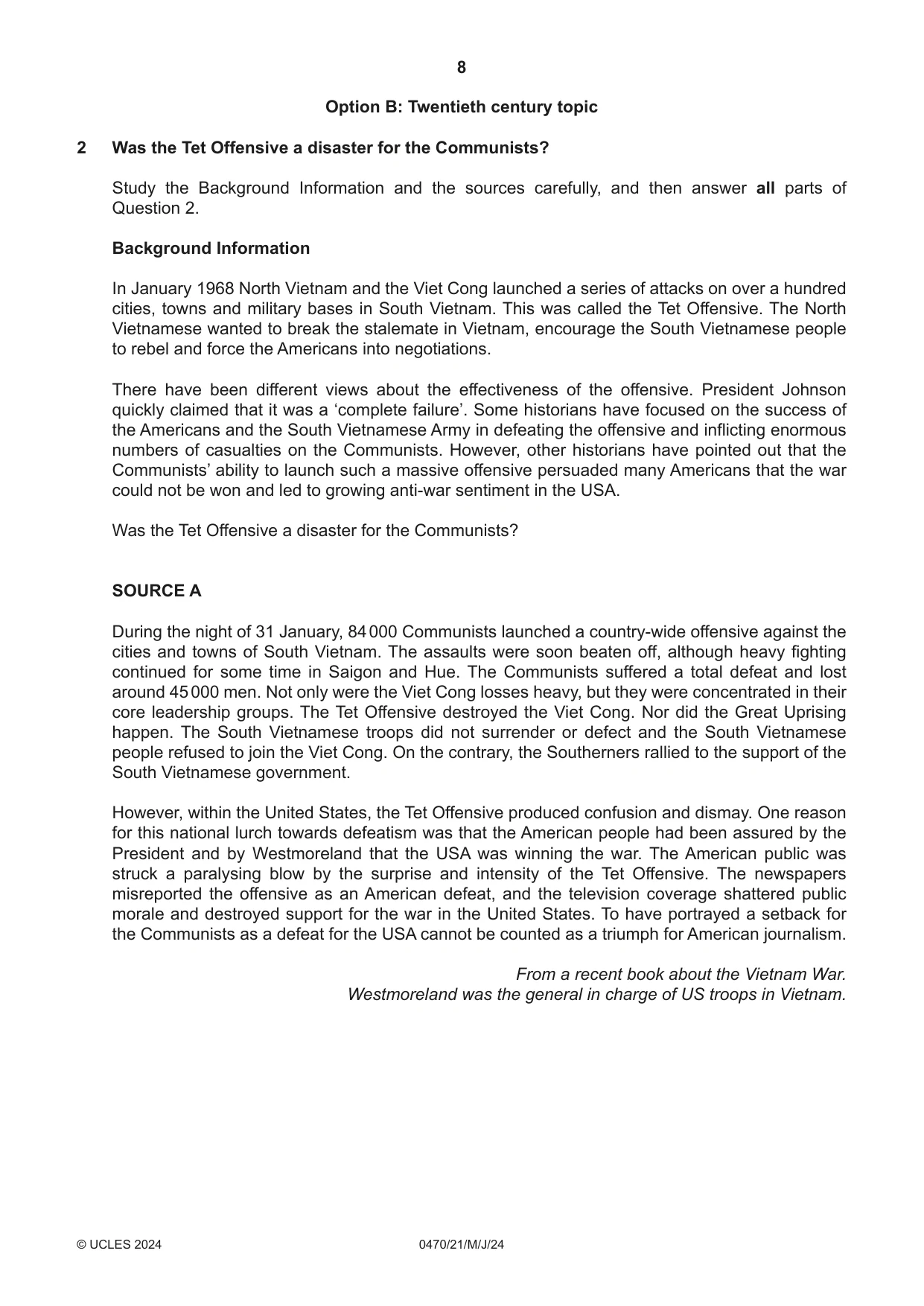
8 0470/21/M/J/24 © UCLES 2024 Option B: Twentieth century topic 2 Was the Tet Offensive a disaster for the Communists? Study the Background Information and the sources carefully, and then answer all parts of Question 2. Background Information In January 1968 North Vietnam and the Viet Cong launched a series of attacks on over a hundred cities, towns and military bases in South Vietnam. This was called the Tet Offensive. The North Vietnamese wanted to break the stalemate in Vietnam, encourage the South Vietnamese people to rebel and force the Americans into negotiations. There have been different views about the effectiveness of the offensive. President Johnson quickly claimed that it was a ‘complete failure’. Some historians have focused on the success of the Americans and the South Vietnamese Army in defeating the offensive and inflicting enormous numbers of casualties on the Communists. However, other historians have pointed out that the Communists’ ability to launch such a massive offensive persuaded many Americans that the war could not be won and led to growing anti-war sentiment in the USA. Was the Tet Offensive a disaster for the Communists? SOURCE A During the night of 31 January, 84 000 Communists launched a country-wide offensive against the cities and towns of South Vietnam. The assaults were soon beaten off, although heavy fighting continued for some time in Saigon and Hue. The Communists suffered a total defeat and lost around 45 000 men. Not only were the Viet Cong losses heavy, but they were concentrated in their core leadership groups. The Tet Offensive destroyed the Viet Cong. Nor did the Great Uprising happen. The South Vietnamese troops did not surrender or defect and the South Vietnamese people refused to join the Viet Cong. On the contrary, the Southerners rallied to the support of the South Vietnamese government. However, within the United States, the Tet Offensive produced confusion and dismay. One reason for this national lurch towards defeatism was that the American people had been assured by the President and by Westmoreland that the USA was winning the war. The American public was struck a paralysing blow by the surprise and intensity of the Tet Offensive. The newspapers misreported the offensive as an American defeat, and the television coverage shattered public morale and destroyed support for the war in the United States. To have portrayed a setback for the Communists as a defeat for the USA cannot be counted as a triumph for American journalism. From a recent book about the Vietnam War. Westmoreland was the general in charge of US troops in Vietnam.
Question paper, page 9
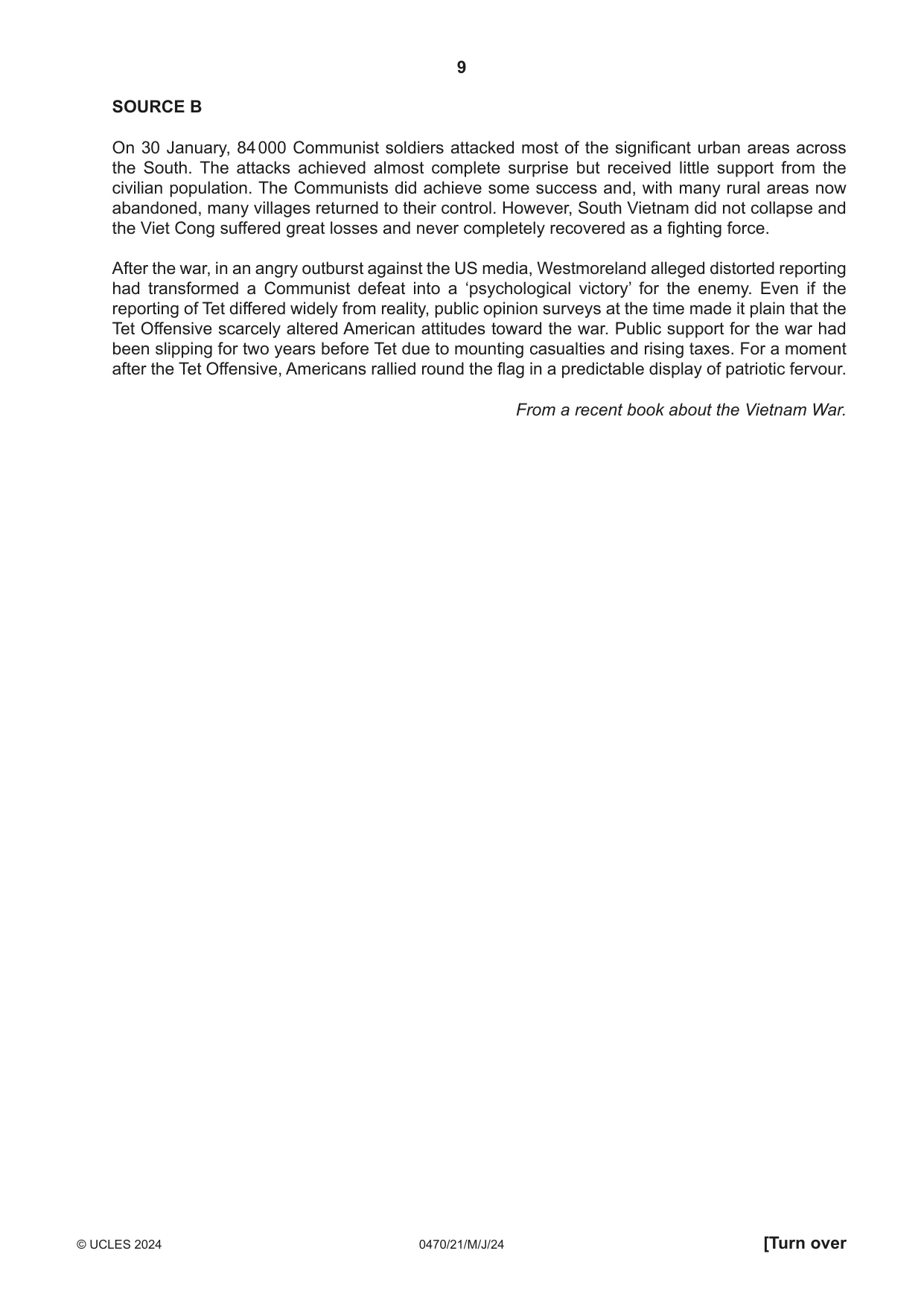
9 0470/21/M/J/24 © UCLES 2024 [Turn over SOURCE B On 30 January, 84 000 Communist soldiers attacked most of the significant urban areas across the South. The attacks achieved almost complete surprise but received little support from the civilian population. The Communists did achieve some success and, with many rural areas now abandoned, many villages returned to their control. However, South Vietnam did not collapse and the Viet Cong suffered great losses and never completely recovered as a fighting force. After the war, in an angry outburst against the US media, Westmoreland alleged distorted reporting had transformed a Communist defeat into a ‘psychological victory’ for the enemy. Even if the reporting of Tet differed widely from reality, public opinion surveys at the time made it plain that the Tet Offensive scarcely altered American attitudes toward the war. Public support for the war had been slipping for two years before Tet due to mounting casualties and rising taxes. For a moment after the Tet Offensive, Americans rallied round the flag in a predictable display of patriotic fervour. From a recent book about the Vietnam War.
Question paper, page 10
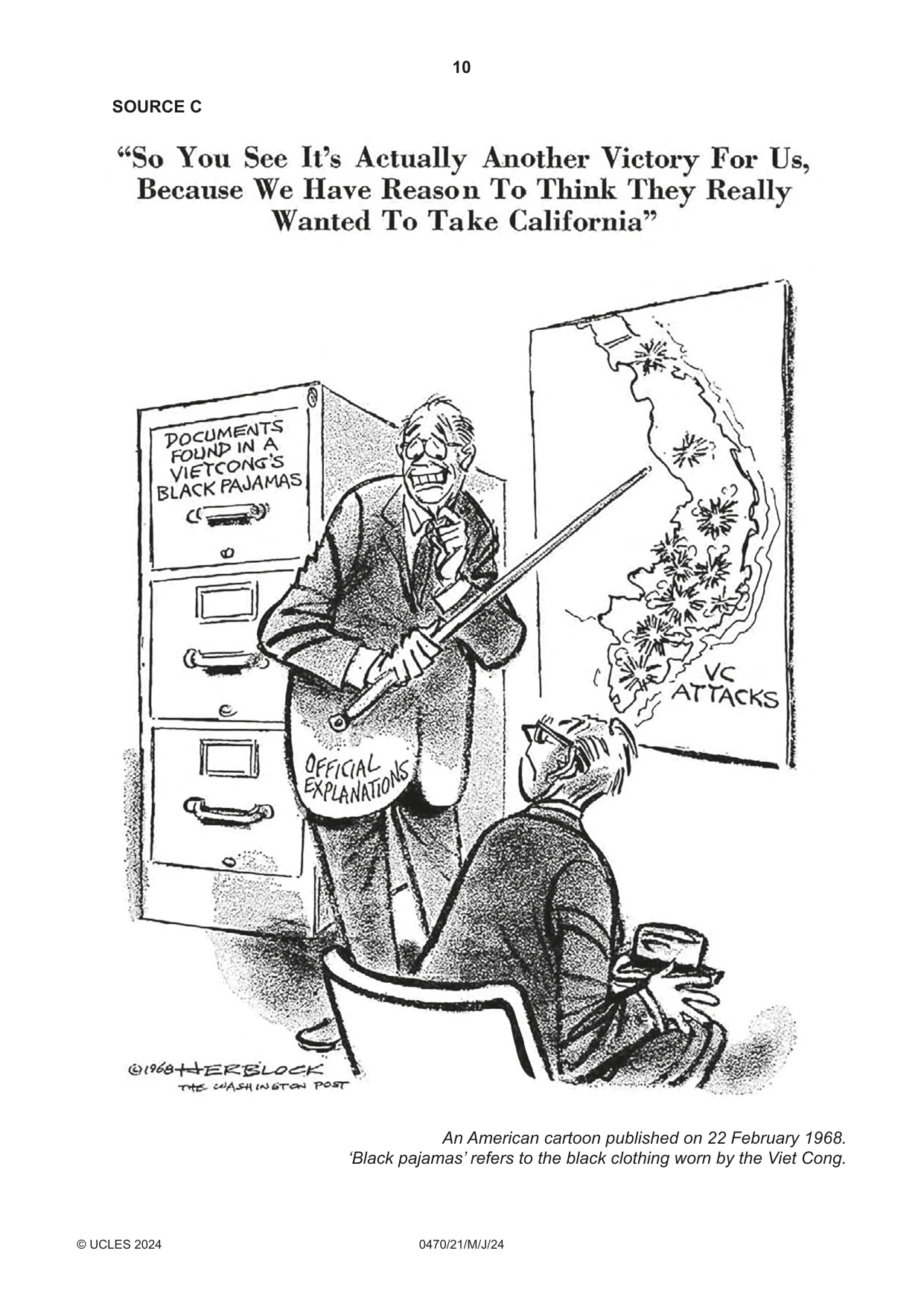
10 0470/21/M/J/24 © UCLES 2024 SOURCE C An American cartoon published on 22 February 1968. ‘Black pajamas’ refers to the black clothing worn by the Viet Cong.
Question paper, page 11
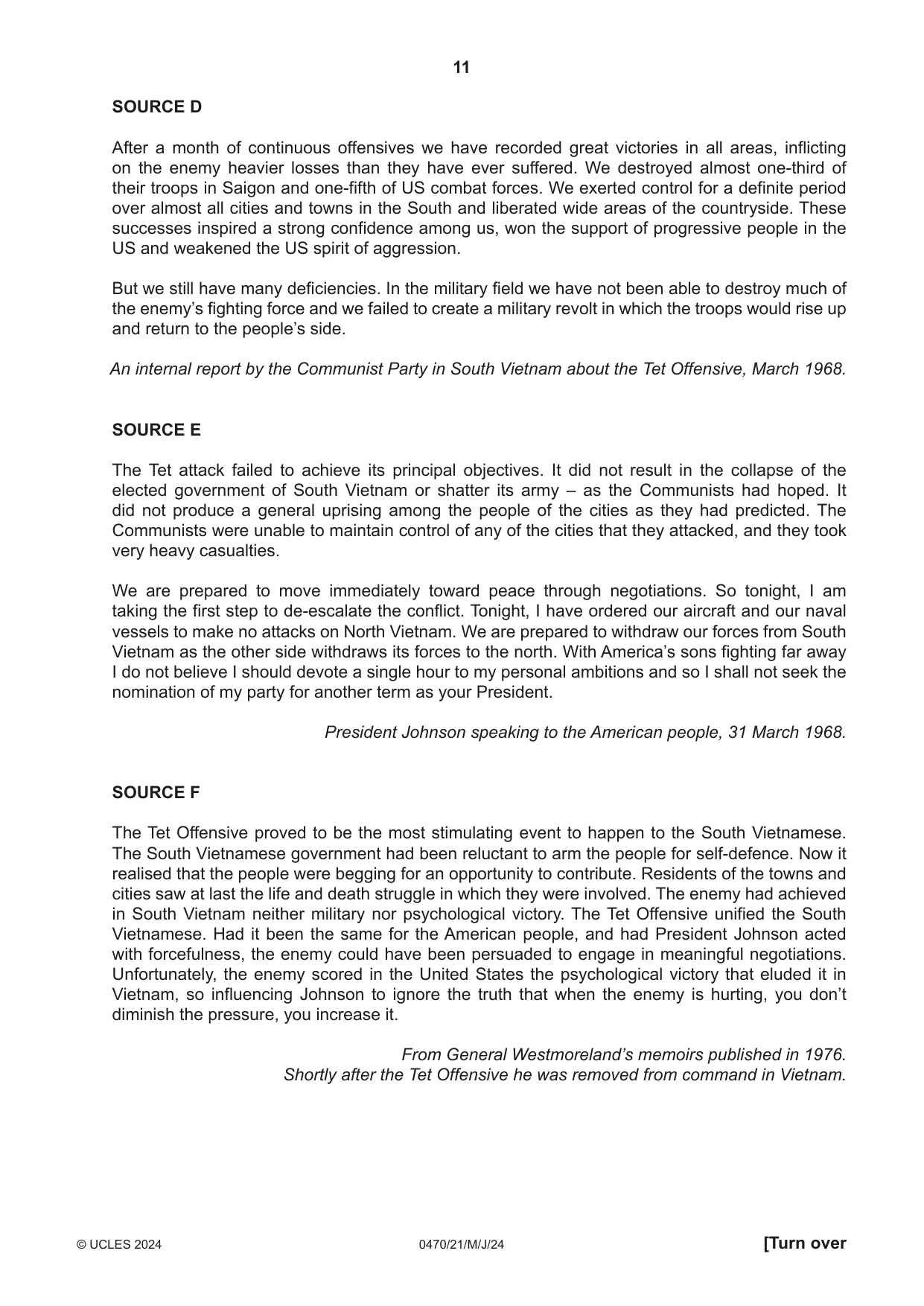
11 0470/21/M/J/24 © UCLES 2024 [Turn over SOURCE D After a month of continuous offensives we have recorded great victories in all areas, inflicting on the enemy heavier losses than they have ever suffered. We destroyed almost one-third of their troops in Saigon and one-fifth of US combat forces. We exerted control for a definite period over almost all cities and towns in the South and liberated wide areas of the countryside. These successes inspired a strong confidence among us, won the support of progressive people in the US and weakened the US spirit of aggression. But we still have many deficiencies. In the military field we have not been able to destroy much of the enemy’s fighting force and we failed to create a military revolt in which the troops would rise up and return to the people’s side. An internal report by the Communist Party in South Vietnam about the Tet Offensive, March 1968. SOURCE E The Tet attack failed to achieve its principal objectives. It did not result in the collapse of the elected government of South Vietnam or shatter its army – as the Communists had hoped. It did not produce a general uprising among the people of the cities as they had predicted. The Communists were unable to maintain control of any of the cities that they attacked, and they took very heavy casualties. We are prepared to move immediately toward peace through negotiations. So tonight, I am taking the first step to de-escalate the conflict. Tonight, I have ordered our aircraft and our naval vessels to make no attacks on North Vietnam. We are prepared to withdraw our forces from South Vietnam as the other side withdraws its forces to the north. With America’s sons fighting far away I do not believe I should devote a single hour to my personal ambitions and so I shall not seek the nomination of my party for another term as your President. President Johnson speaking to the American people, 31 March 1968. SOURCE F The Tet Offensive proved to be the most stimulating event to happen to the South Vietnamese. The South Vietnamese government had been reluctant to arm the people for self-defence. Now it realised that the people were begging for an opportunity to contribute. Residents of the towns and cities saw at last the life and death struggle in which they were involved. The enemy had achieved in South Vietnam neither military nor psychological victory. The Tet Offensive unified the South Vietnamese. Had it been the same for the American people, and had President Johnson acted with forcefulness, the enemy could have been persuaded to engage in meaningful negotiations. Unfortunately, the enemy scored in the United States the psychological victory that eluded it in Vietnam, so influencing Johnson to ignore the truth that when the enemy is hurting, you don’t diminish the pressure, you increase it. From General Westmoreland’s memoirs published in 1976. Shortly after the Tet Offensive he was removed from command in Vietnam.
Question paper, page 12
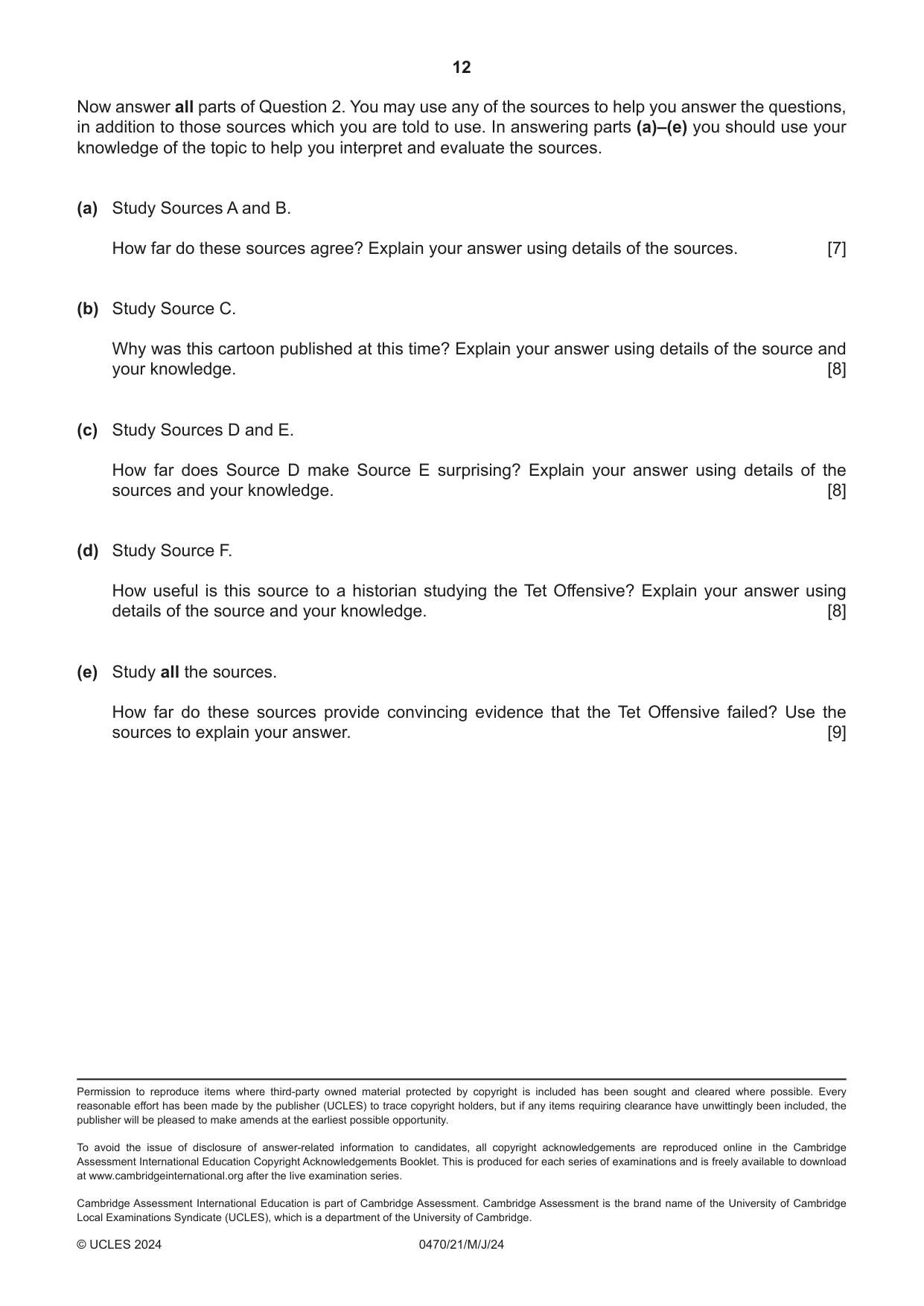
12 0470/21/M/J/24 © UCLES 2024 Permission to reproduce items where third-party owned material protected by copyright is included has been sought and cleared where possible. Every reasonable effort has been made by the publisher (UCLES) to trace copyright holders, but if any items requiring clearance have unwittingly been included, the publisher will be pleased to make amends at the earliest possible opportunity. To avoid the issue of disclosure of answer-related information to candidates, all copyright acknowledgements are reproduced online in the Cambridge Assessment International Education Copyright Acknowledgements Booklet. This is produced for each series of examinations and is freely available to download at www.cambridgeinternational.org after the live examination series. Cambridge Assessment International Education is part of Cambridge Assessment. Cambridge Assessment is the brand name of the University of Cambridge Local Examinations Syndicate (UCLES), which is a department of the University of Cambridge. Now answer all parts of Question 2. You may use any of the sources to help you answer the questions, in addition to those sources which you are told to use. In answering parts (a)–(e) you should use your knowledge of the topic to help you interpret and evaluate the sources. (a) Study Sources A and B. How far do these sources agree? Explain your answer using details of the sources. [7] (b) Study Source C. Why was this cartoon published at this time? Explain your answer using details of the source and your knowledge. [8] (c) Study Sources D and E. How far does Source D make Source E surprising? Explain your answer using details of the sources and your knowledge. [8] (d) Study Source F. How useful is this source to a historian studying the Tet Offensive? Explain your answer using details of the source and your knowledge. [8] (e) Study all the sources. How far do these sources provide convincing evidence that the Tet Offensive failed? Use the sources to explain your answer. [9]
Mark scheme, page 1
This document consists of 13 printed pages. © Cambridge University Press & Assessment 2024 [Turn over Cambridge IGCSE™ HISTORY 0470/21 Paper 2 May/June 2024 MARK SCHEME Maximum Mark: 40 Published This mark scheme is published as an aid to teachers and candidates, to indicate the requirements of the examination. It shows the basis on which Examiners were instructed to award marks. It does not indicate the details of the discussions that took place at an Examiners’ meeting before marking began, which would have considered the acceptability of alternative answers. Mark schemes should be read in conjunction with the question paper and the Principal Examiner Report for Teachers. Cambridge International will not enter into discussions about these mark schemes. Cambridge International is publishing the mark schemes for the May/June 2024 series for most Cambridge IGCSE, Cambridge International A and AS Level and Cambridge Pre-U components, and some Cambridge O Level components.
Mark scheme, page 2
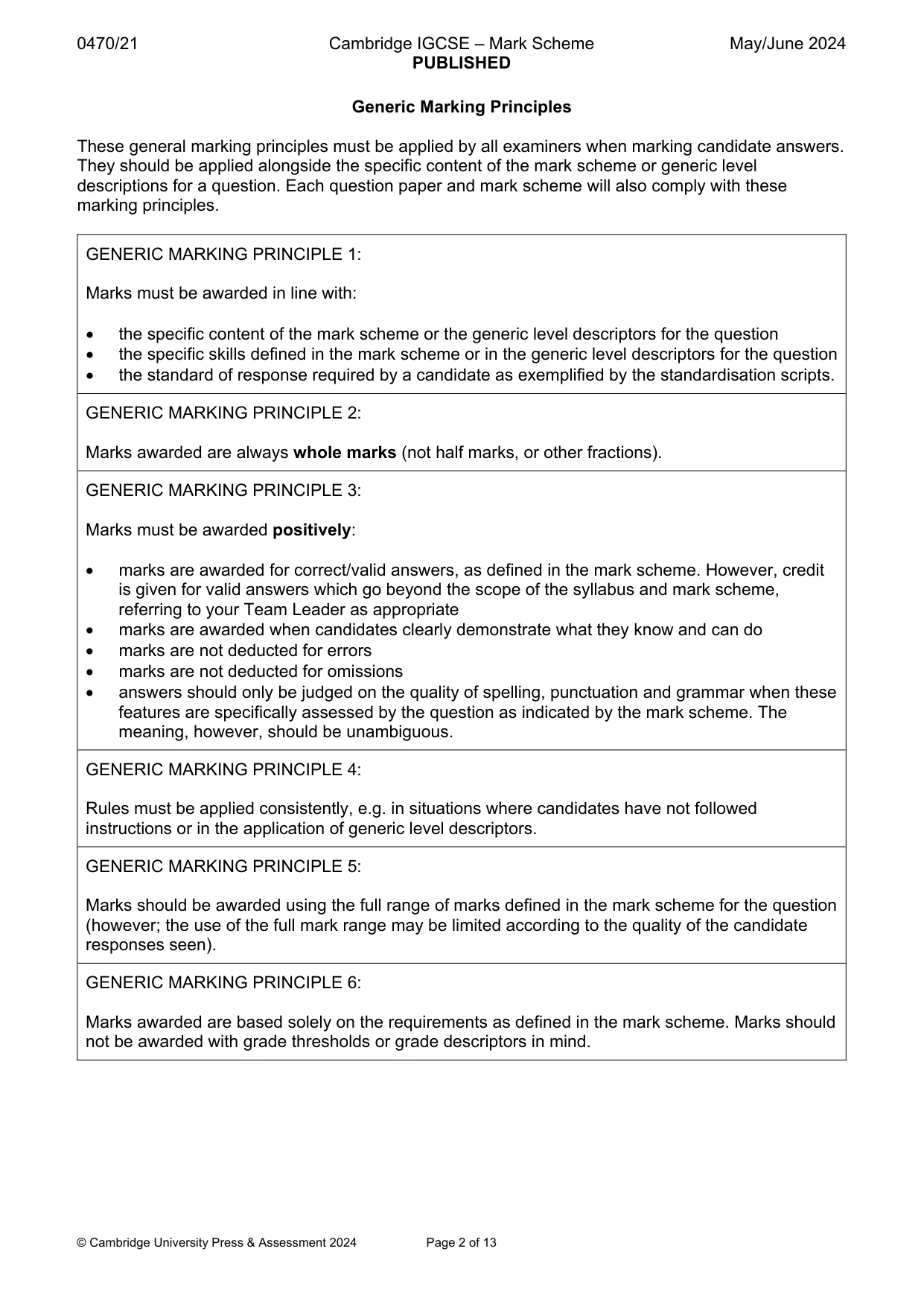
0470/21 Cambridge IGCSE – Mark Scheme PUBLISHED May/June 2024 © Cambridge University Press & Assessment 2024 Page 2 of 13 Generic Marking Principles These general marking principles must be applied by all examiners when marking candidate answers. They should be applied alongside the specific content of the mark scheme or generic level descriptions for a question. Each question paper and mark scheme will also comply with these marking principles. GENERIC MARKING PRINCIPLE 1: Marks must be awarded in line with: the specific content of the mark scheme or the generic level descriptors for the question the specific skills defined in the mark scheme or in the generic level descriptors for the question the standard of response required by a candidate as exemplified by the standardisation scripts. GENERIC MARKING PRINCIPLE 2: Marks awarded are always whole marks (not half marks, or other fractions). GENERIC MARKING PRINCIPLE 3: Marks must be awarded positively: marks are awarded for correct/valid answers, as defined in the mark scheme. However, credit is given for valid answers which go beyond the scope of the syllabus and mark scheme, referring to your Team Leader as appropriate marks are awarded when candidates clearly demonstrate what they know and can do marks are not deducted for errors marks are not deducted for omissions answers should only be judged on the quality of spelling, punctuation and grammar when these features are specifically assessed by the question as indicated by the mark scheme. The meaning, however, should be unambiguous. GENERIC MARKING PRINCIPLE 4: Rules must be applied consistently, e.g. in situations where candidates have not followed instructions or in the application of generic level descriptors. GENERIC MARKING PRINCIPLE 5: Marks should be awarded using the full range of marks defined in the mark scheme for the question (however; the use of the full mark range may be limited according to the quality of the candidate responses seen). GENERIC MARKING PRINCIPLE 6: Marks awarded are based solely on the requirements as defined in the mark scheme. Marks should not be awarded with grade thresholds or grade descriptors in mind.
Mark scheme, page 3
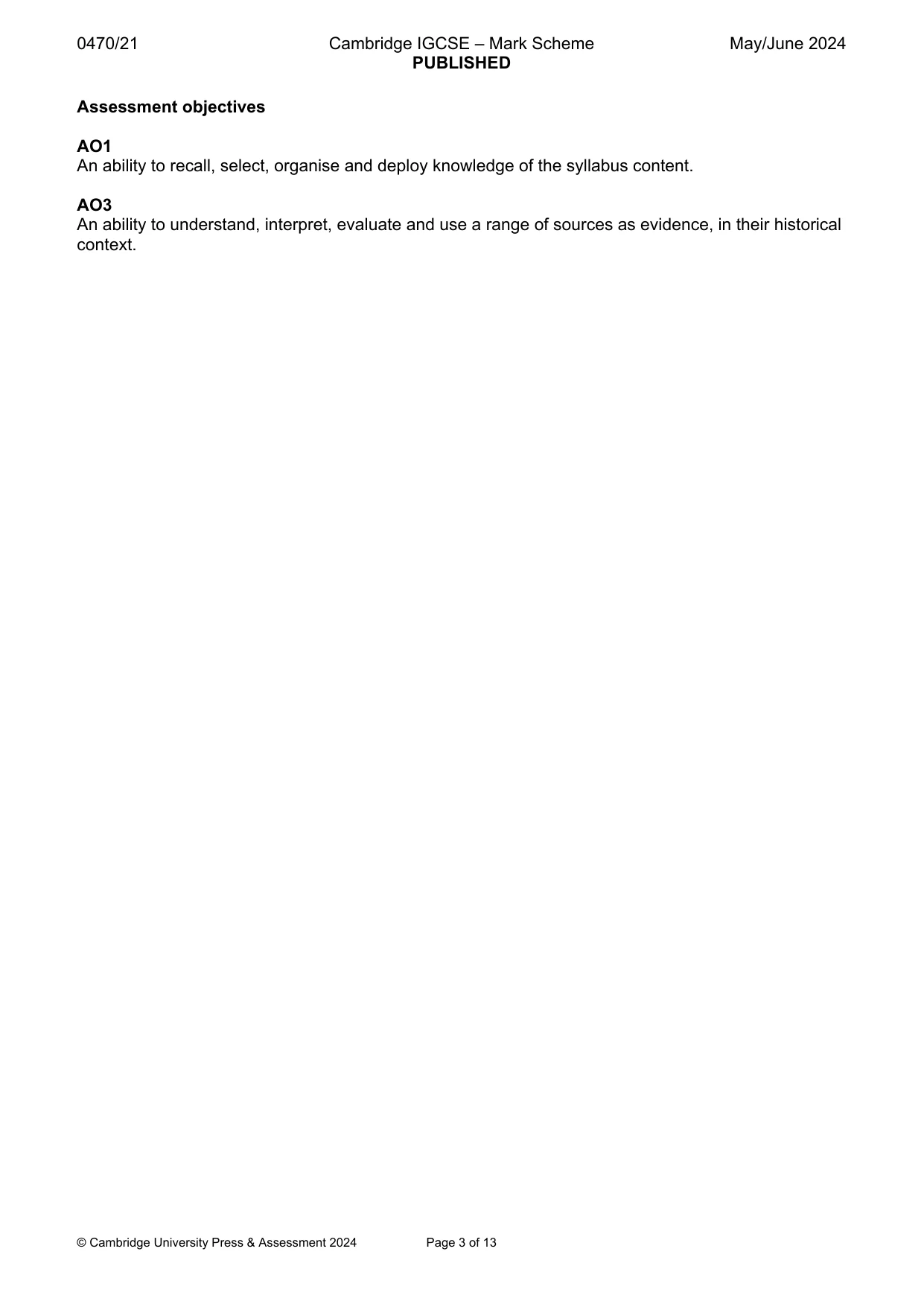
0470/21 Cambridge IGCSE – Mark Scheme PUBLISHED May/June 2024 © Cambridge University Press & Assessment 2024 Page 3 of 13 Assessment objectives AO1 An ability to recall, select, organise and deploy knowledge of the syllabus content. AO3 An ability to understand, interpret, evaluate and use a range of sources as evidence, in their historical context.
Mark scheme, page 4
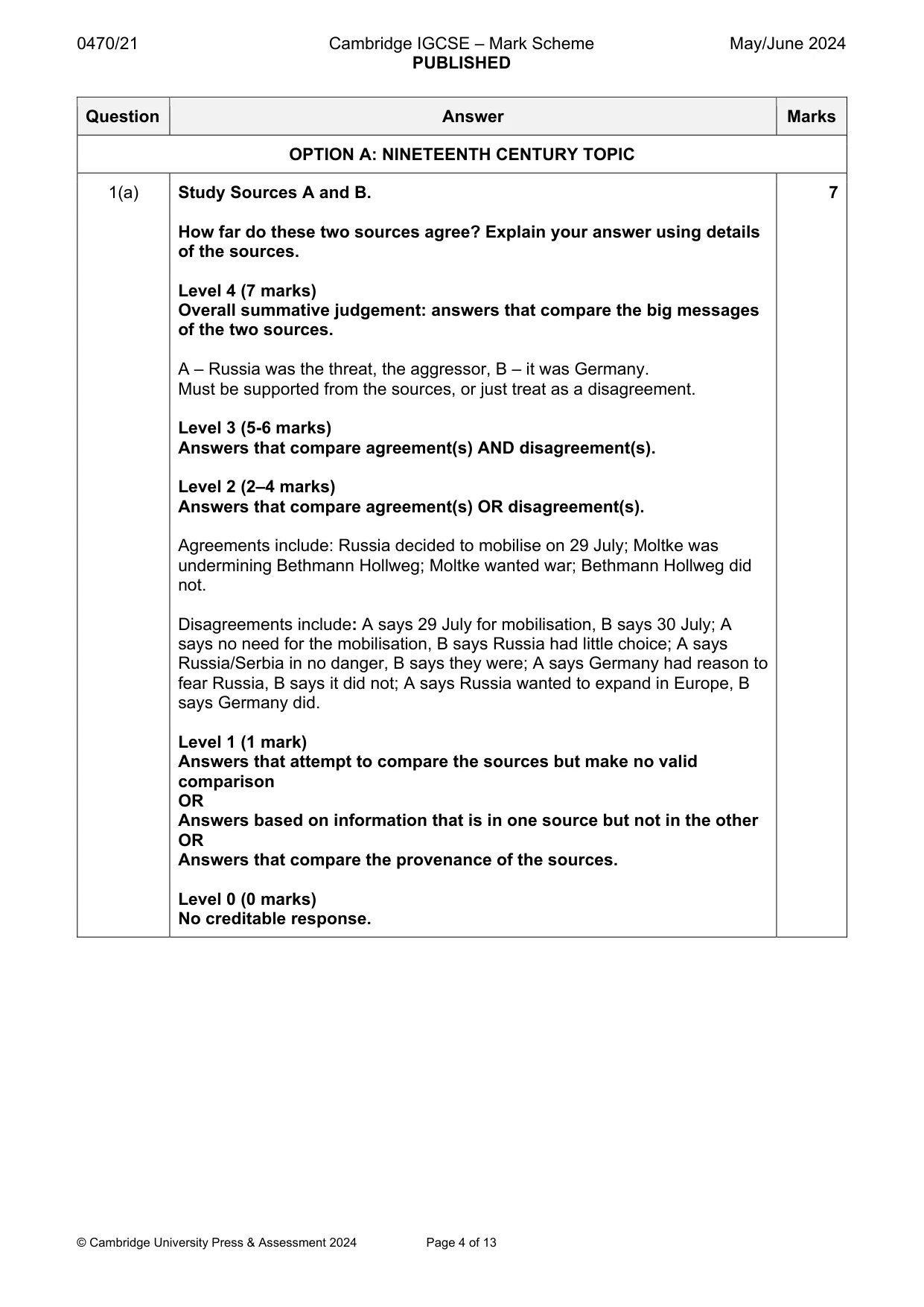
0470/21 Cambridge IGCSE – Mark Scheme PUBLISHED May/June 2024 © Cambridge University Press & Assessment 2024 Page 4 of 13 Question Answer Marks OPTION A: NINETEENTH CENTURY TOPIC 1(a) Study Sources A and B. How far do these two sources agree? Explain your answer using details of the sources. Level 4 (7 marks) Overall summative judgement: answers that compare the big messages of the two sources. A – Russia was the threat, the aggressor, B – it was Germany. Must be supported from the sources, or just treat as a disagreement. Level 3 (5-6 marks) Answers that compare agreement(s) AND disagreement(s). Level 2 (2–4 marks) Answers that compare agreement(s) OR disagreement(s). Agreements include: Russia decided to mobilise on 29 July; Moltke was undermining Bethmann Hollweg; Moltke wanted war; Bethmann Hollweg did not. Disagreements include: A says 29 July for mobilisation, B says 30 July; A says no need for the mobilisation, B says Russia had little choice; A says Russia/Serbia in no danger, B says they were; A says Germany had reason to fear Russia, B says it did not; A says Russia wanted to expand in Europe, B says Germany did. Level 1 (1 mark) Answers that attempt to compare the sources but make no valid comparison OR Answers based on information that is in one source but not in the other OR Answers that compare the provenance of the sources. Level 0 (0 marks) No creditable response. 7
Mark scheme, page 5
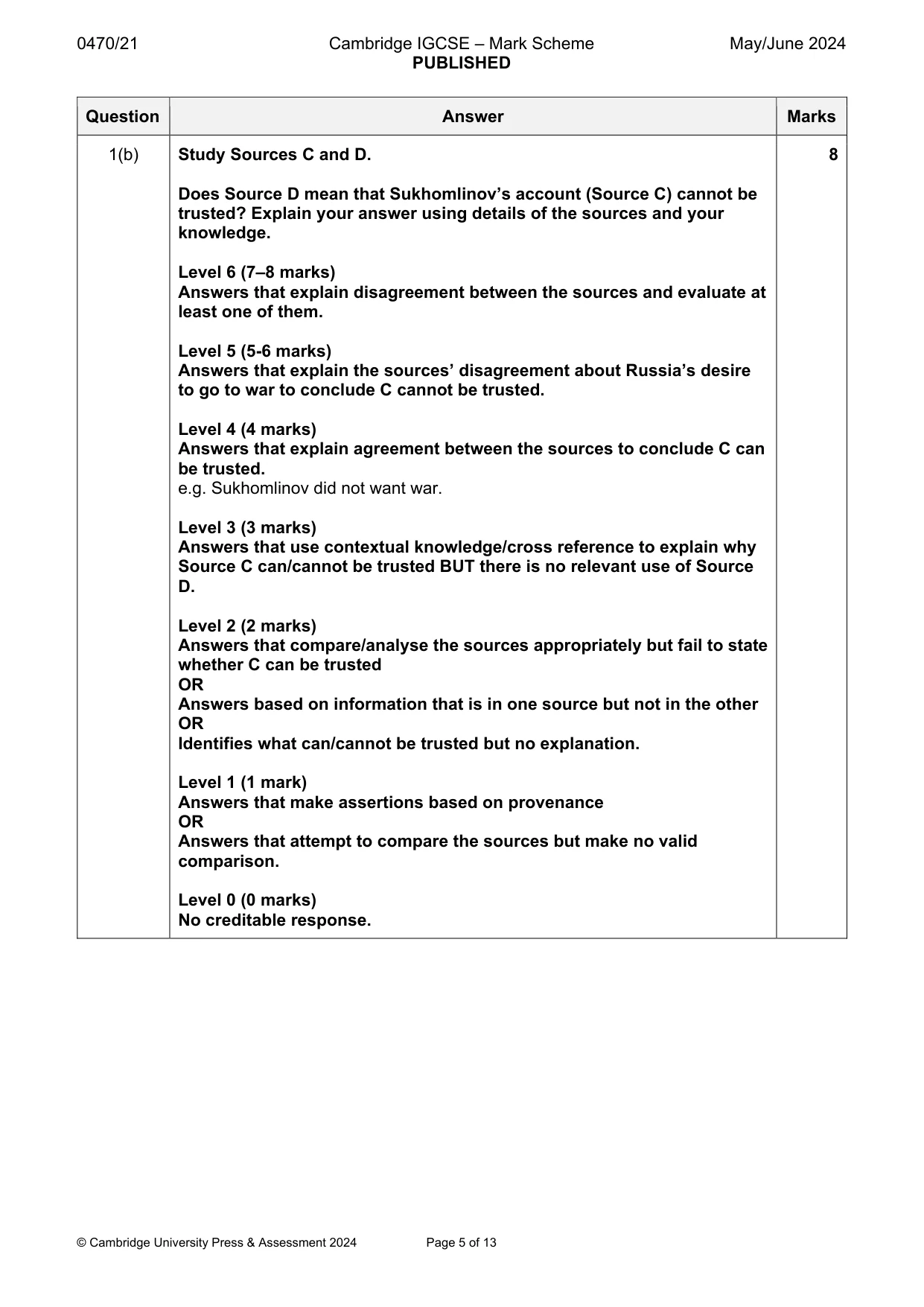
0470/21 Cambridge IGCSE – Mark Scheme PUBLISHED May/June 2024 © Cambridge University Press & Assessment 2024 Page 5 of 13 Question Answer Marks 1(b) Study Sources C and D. Does Source D mean that Sukhomlinov’s account (Source C) cannot be trusted? Explain your answer using details of the sources and your knowledge. Level 6 (7–8 marks) Answers that explain disagreement between the sources and evaluate at least one of them. Level 5 (5-6 marks) Answers that explain the sources’ disagreement about Russia’s desire to go to war to conclude C cannot be trusted. Level 4 (4 marks) Answers that explain agreement between the sources to conclude C can be trusted. e.g. Sukhomlinov did not want war. Level 3 (3 marks) Answers that use contextual knowledge/cross reference to explain why Source C can/cannot be trusted BUT there is no relevant use of Source D. Level 2 (2 marks) Answers that compare/analyse the sources appropriately but fail to state whether C can be trusted OR Answers based on information that is in one source but not in the other OR Identifies what can/cannot be trusted but no explanation. Level 1 (1 mark) Answers that make assertions based on provenance OR Answers that attempt to compare the sources but make no valid comparison. Level 0 (0 marks) No creditable response. 8
Mark scheme, page 6
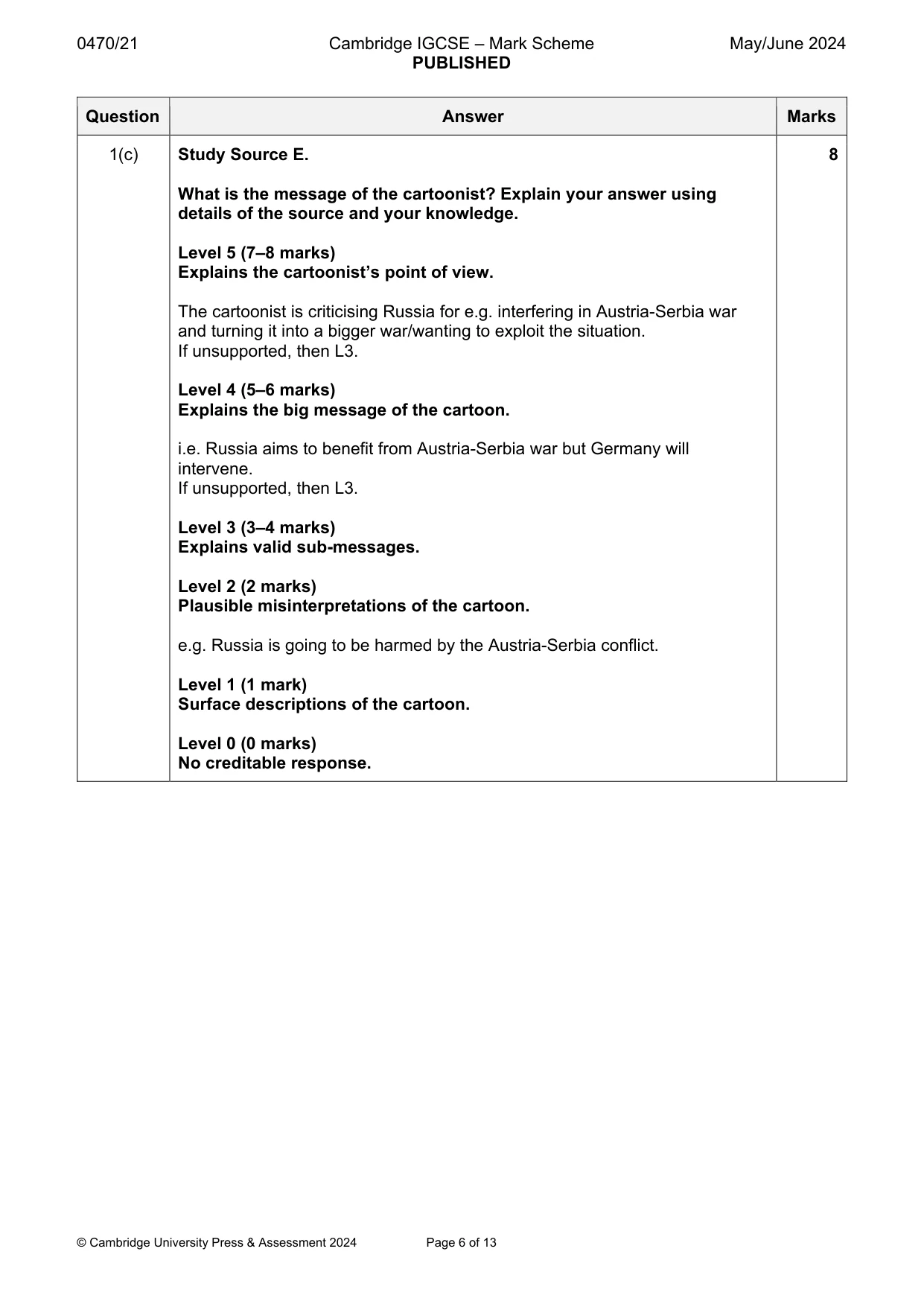
0470/21 Cambridge IGCSE – Mark Scheme PUBLISHED May/June 2024 © Cambridge University Press & Assessment 2024 Page 6 of 13 Question Answer Marks 1(c) Study Source E. What is the message of the cartoonist? Explain your answer using details of the source and your knowledge. Level 5 (7–8 marks) Explains the cartoonist’s point of view. The cartoonist is criticising Russia for e.g. interfering in Austria-Serbia war and turning it into a bigger war/wanting to exploit the situation. If unsupported, then L3. Level 4 (5–6 marks) Explains the big message of the cartoon. i.e. Russia aims to benefit from Austria-Serbia war but Germany will intervene. If unsupported, then L3. Level 3 (3–4 marks) Explains valid sub-messages. Level 2 (2 marks) Plausible misinterpretations of the cartoon. e.g. Russia is going to be harmed by the Austria-Serbia conflict. Level 1 (1 mark) Surface descriptions of the cartoon. Level 0 (0 marks) No creditable response. 8
Mark scheme, page 7
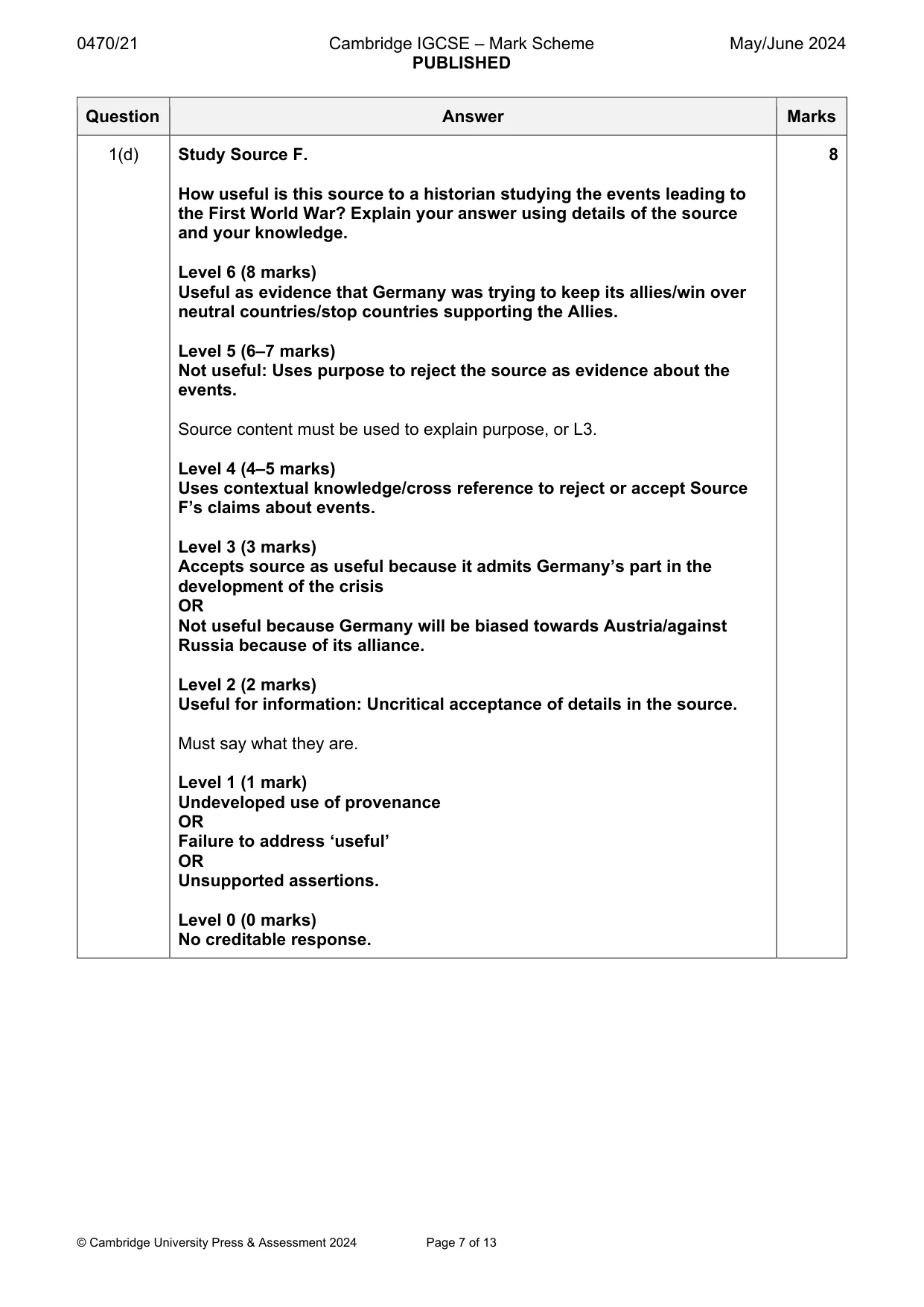
0470/21 Cambridge IGCSE – Mark Scheme PUBLISHED May/June 2024 © Cambridge University Press & Assessment 2024 Page 7 of 13 Question Answer Marks 1(d) Study Source F. How useful is this source to a historian studying the events leading to the First World War? Explain your answer using details of the source and your knowledge. Level 6 (8 marks) Useful as evidence that Germany was trying to keep its allies/win over neutral countries/stop countries supporting the Allies. Level 5 (6–7 marks) Not useful: Uses purpose to reject the source as evidence about the events. Source content must be used to explain purpose, or L3. Level 4 (4–5 marks) Uses contextual knowledge/cross reference to reject or accept Source F’s claims about events. Level 3 (3 marks) Accepts source as useful because it admits Germany’s part in the development of the crisis OR Not useful because Germany will be biased towards Austria/against Russia because of its alliance. Level 2 (2 marks) Useful for information: Uncritical acceptance of details in the source. Must say what they are. Level 1 (1 mark) Undeveloped use of provenance OR Failure to address ‘useful’ OR Unsupported assertions. Level 0 (0 marks) No creditable response. 8
Mark scheme, page 8
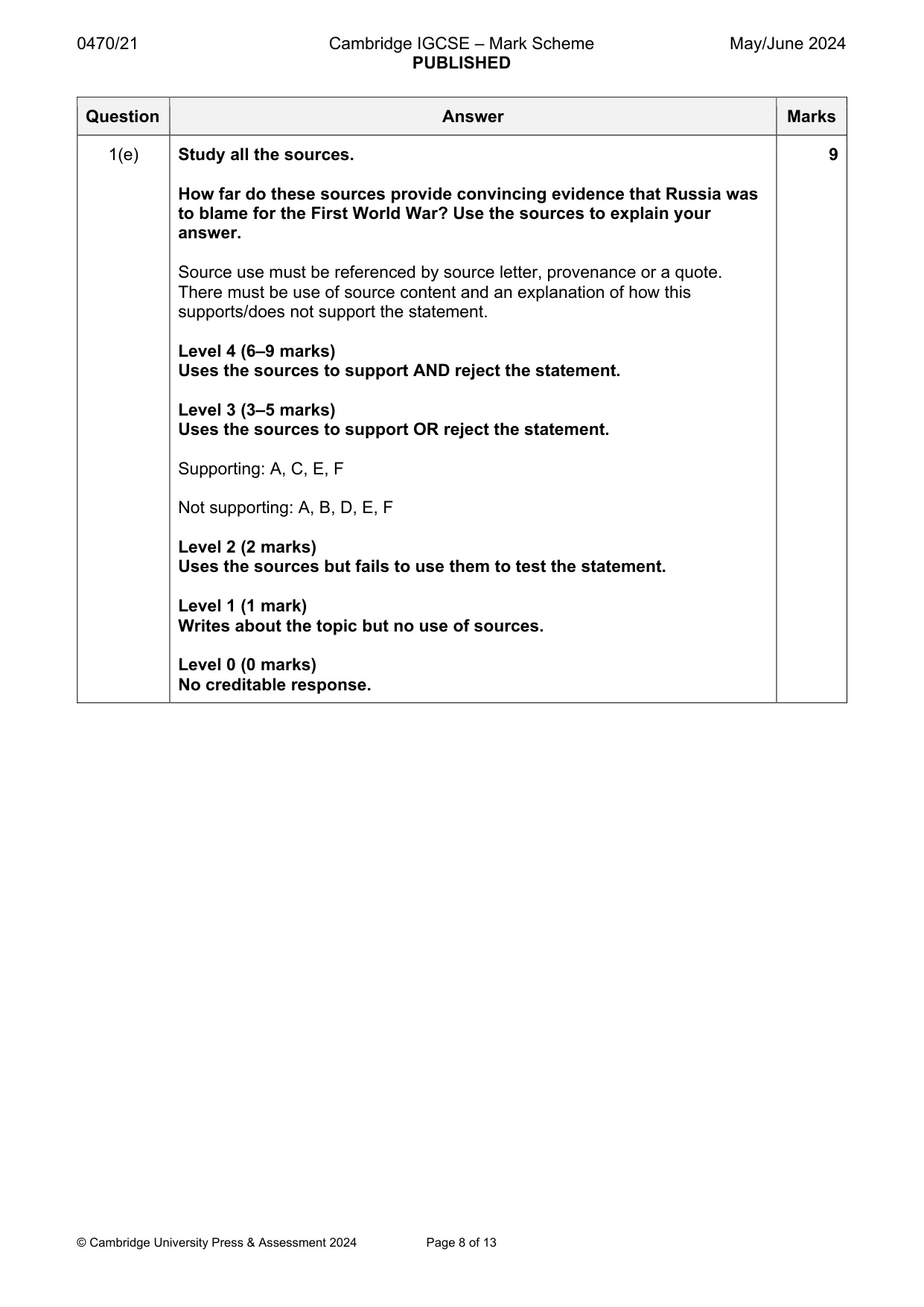
0470/21 Cambridge IGCSE – Mark Scheme PUBLISHED May/June 2024 © Cambridge University Press & Assessment 2024 Page 8 of 13 Question Answer Marks 1(e) Study all the sources. How far do these sources provide convincing evidence that Russia was to blame for the First World War? Use the sources to explain your answer. Source use must be referenced by source letter, provenance or a quote. There must be use of source content and an explanation of how this supports/does not support the statement. Level 4 (6–9 marks) Uses the sources to support AND reject the statement. Level 3 (3–5 marks) Uses the sources to support OR reject the statement. Supporting: A, C, E, F Not supporting: A, B, D, E, F Level 2 (2 marks) Uses the sources but fails to use them to test the statement. Level 1 (1 mark) Writes about the topic but no use of sources. Level 0 (0 marks) No creditable response. 9
Mark scheme, page 9
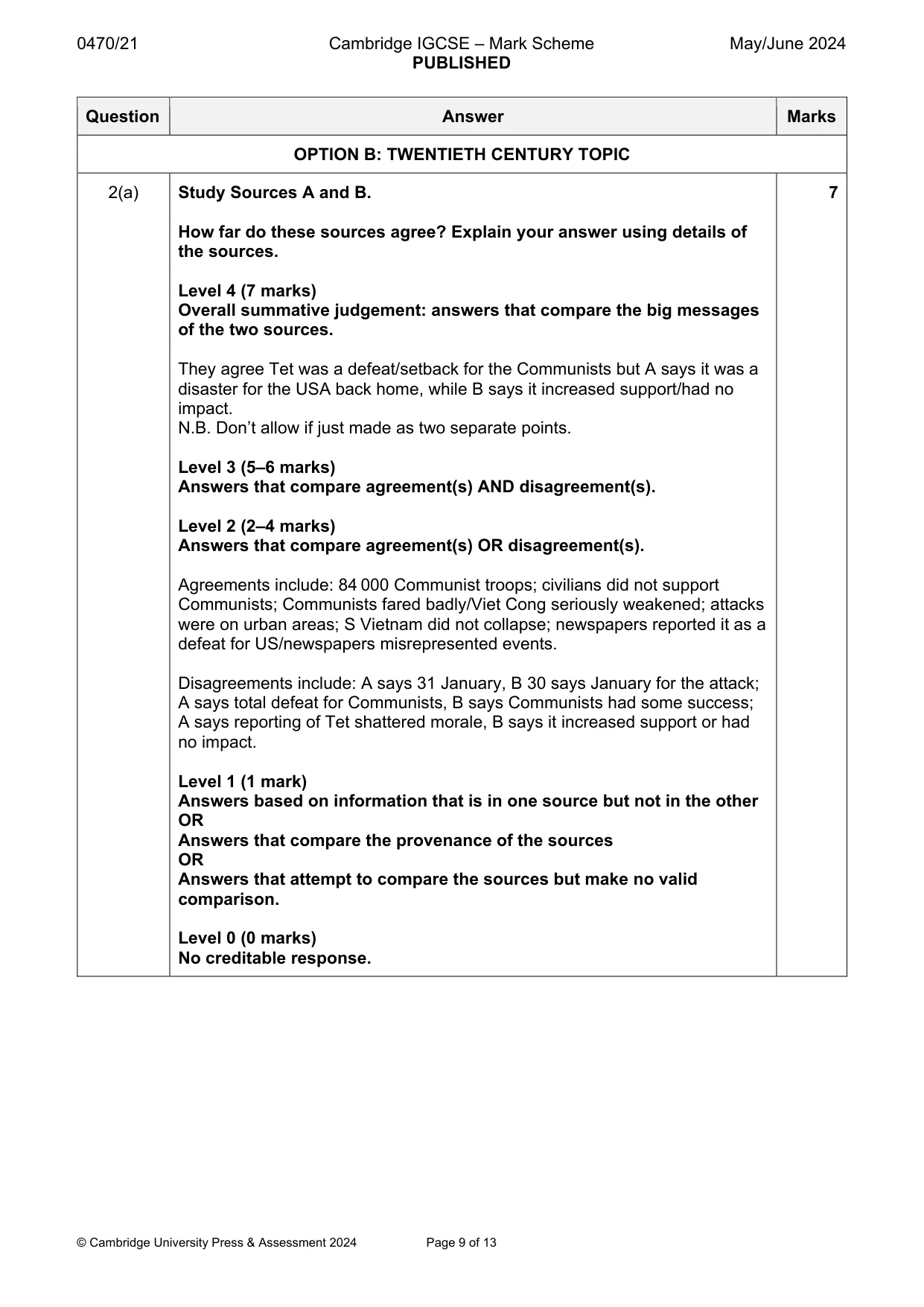
0470/21 Cambridge IGCSE – Mark Scheme PUBLISHED May/June 2024 © Cambridge University Press & Assessment 2024 Page 9 of 13 Question Answer Marks OPTION B: TWENTIETH CENTURY TOPIC 2(a) Study Sources A and B. How far do these sources agree? Explain your answer using details of the sources. Level 4 (7 marks) Overall summative judgement: answers that compare the big messages of the two sources. They agree Tet was a defeat/setback for the Communists but A says it was a disaster for the USA back home, while B says it increased support/had no impact. N.B. Don’t allow if just made as two separate points. Level 3 (5–6 marks) Answers that compare agreement(s) AND disagreement(s). Level 2 (2–4 marks) Answers that compare agreement(s) OR disagreement(s). Agreements include: 84 000 Communist troops; civilians did not support Communists; Communists fared badly/Viet Cong seriously weakened; attacks were on urban areas; S Vietnam did not collapse; newspapers reported it as a defeat for US/newspapers misrepresented events. Disagreements include: A says 31 January, B 30 says January for the attack; A says total defeat for Communists, B says Communists had some success; A says reporting of Tet shattered morale, B says it increased support or had no impact. Level 1 (1 mark) Answers based on information that is in one source but not in the other OR Answers that compare the provenance of the sources OR Answers that attempt to compare the sources but make no valid comparison. Level 0 (0 marks) No creditable response. 7
Mark scheme, page 10
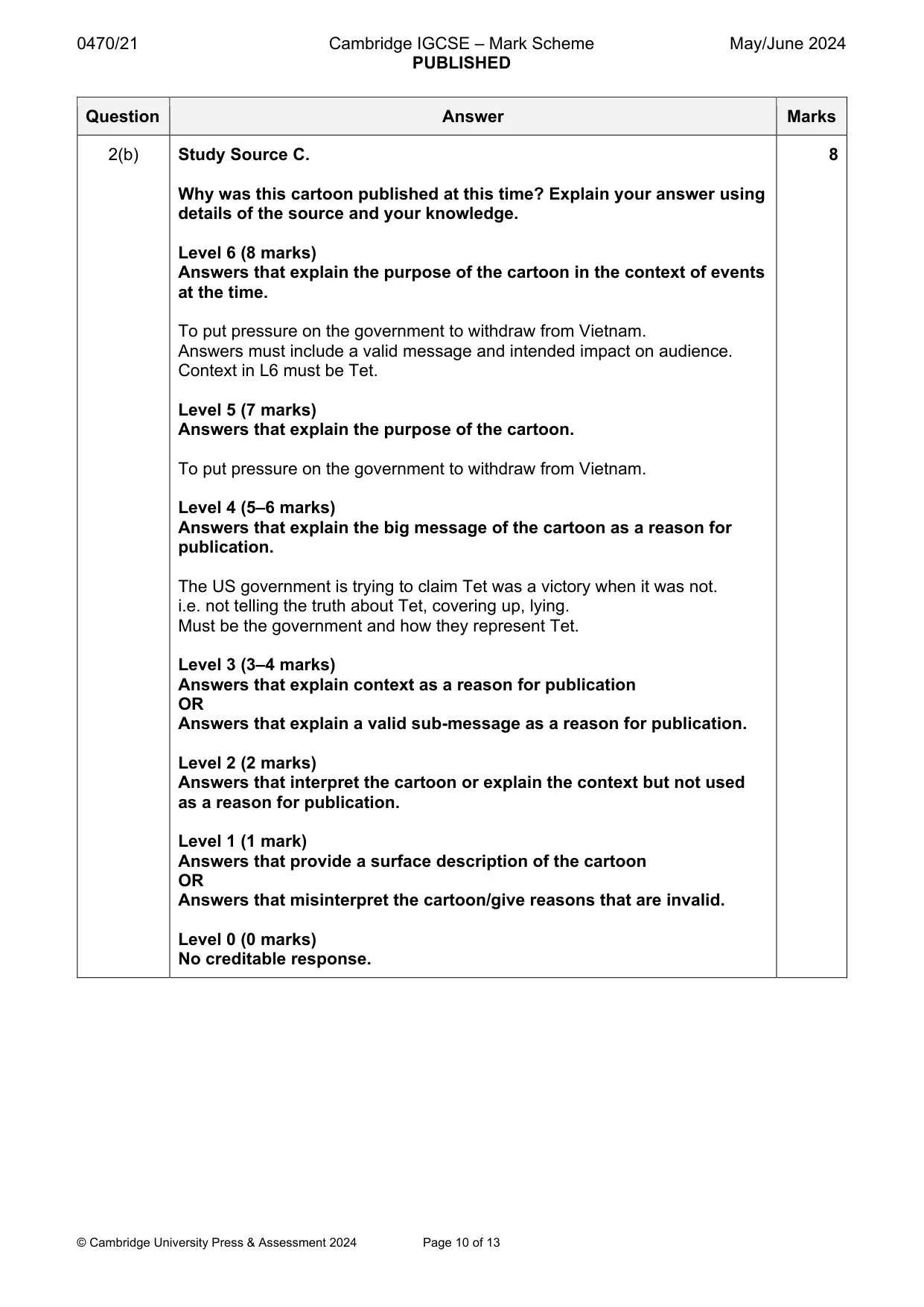
0470/21 Cambridge IGCSE – Mark Scheme PUBLISHED May/June 2024 © Cambridge University Press & Assessment 2024 Page 10 of 13 Question Answer Marks 2(b) Study Source C. Why was this cartoon published at this time? Explain your answer using details of the source and your knowledge. Level 6 (8 marks) Answers that explain the purpose of the cartoon in the context of events at the time. To put pressure on the government to withdraw from Vietnam. Answers must include a valid message and intended impact on audience. Context in L6 must be Tet. Level 5 (7 marks) Answers that explain the purpose of the cartoon. To put pressure on the government to withdraw from Vietnam. Level 4 (5–6 marks) Answers that explain the big message of the cartoon as a reason for publication. The US government is trying to claim Tet was a victory when it was not. i.e. not telling the truth about Tet, covering up, lying. Must be the government and how they represent Tet. Level 3 (3–4 marks) Answers that explain context as a reason for publication OR Answers that explain a valid sub-message as a reason for publication. Level 2 (2 marks) Answers that interpret the cartoon or explain the context but not used as a reason for publication. Level 1 (1 mark) Answers that provide a surface description of the cartoon OR Answers that misinterpret the cartoon/give reasons that are invalid. Level 0 (0 marks) No creditable response. 8
Mark scheme, page 11
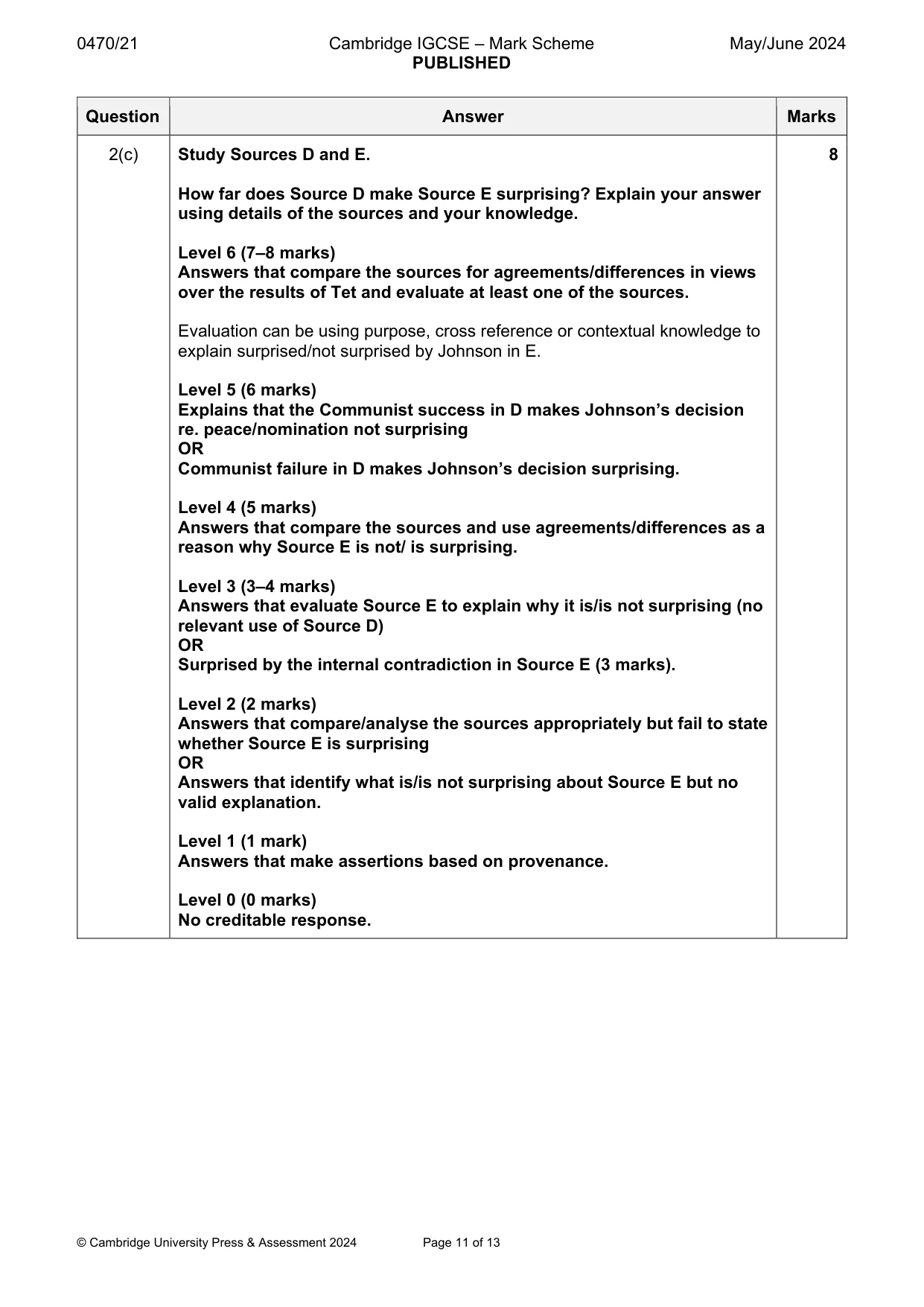
0470/21 Cambridge IGCSE – Mark Scheme PUBLISHED May/June 2024 © Cambridge University Press & Assessment 2024 Page 11 of 13 Question Answer Marks 2(c) Study Sources D and E. How far does Source D make Source E surprising? Explain your answer using details of the sources and your knowledge. Level 6 (7–8 marks) Answers that compare the sources for agreements/differences in views over the results of Tet and evaluate at least one of the sources. Evaluation can be using purpose, cross reference or contextual knowledge to explain surprised/not surprised by Johnson in E. Level 5 (6 marks) Explains that the Communist success in D makes Johnson’s decision re. peace/nomination not surprising OR Communist failure in D makes Johnson’s decision surprising. Level 4 (5 marks) Answers that compare the sources and use agreements/differences as a reason why Source E is not/ is surprising. Level 3 (3–4 marks) Answers that evaluate Source E to explain why it is/is not surprising (no relevant use of Source D) OR Surprised by the internal contradiction in Source E (3 marks). Level 2 (2 marks) Answers that compare/analyse the sources appropriately but fail to state whether Source E is surprising OR Answers that identify what is/is not surprising about Source E but no valid explanation. Level 1 (1 mark) Answers that make assertions based on provenance. Level 0 (0 marks) No creditable response. 8
Mark scheme, page 12
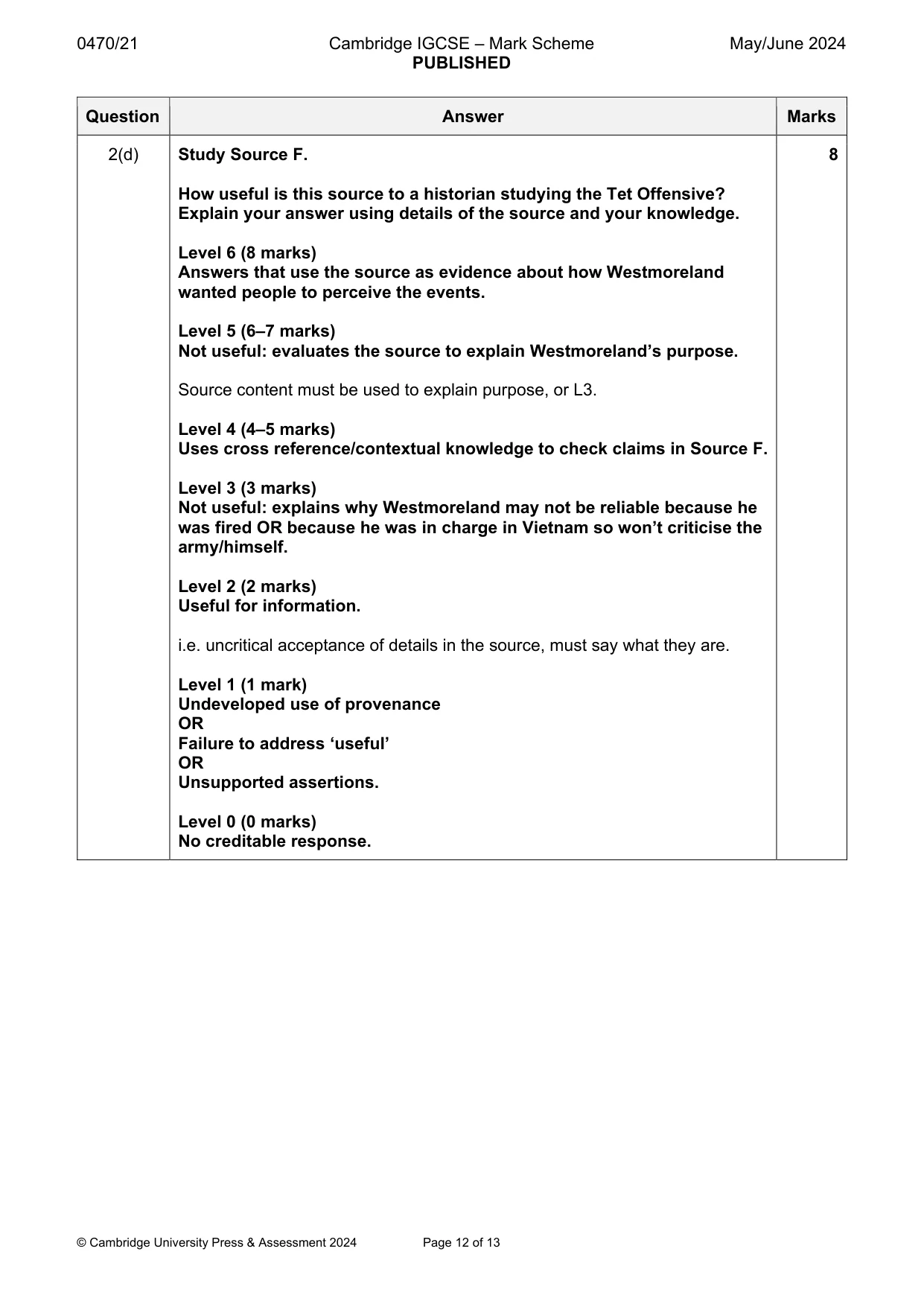
0470/21 Cambridge IGCSE – Mark Scheme PUBLISHED May/June 2024 © Cambridge University Press & Assessment 2024 Page 12 of 13 Question Answer Marks 2(d) Study Source F. How useful is this source to a historian studying the Tet Offensive? Explain your answer using details of the source and your knowledge. Level 6 (8 marks) Answers that use the source as evidence about how Westmoreland wanted people to perceive the events. Level 5 (6–7 marks) Not useful: evaluates the source to explain Westmoreland’s purpose. Source content must be used to explain purpose, or L3. Level 4 (4–5 marks) Uses cross reference/contextual knowledge to check claims in Source F. Level 3 (3 marks) Not useful: explains why Westmoreland may not be reliable because he was fired OR because he was in charge in Vietnam so won’t criticise the army/himself. Level 2 (2 marks) Useful for information. i.e. uncritical acceptance of details in the source, must say what they are. Level 1 (1 mark) Undeveloped use of provenance OR Failure to address ‘useful’ OR Unsupported assertions. Level 0 (0 marks) No creditable response. 8
Mark scheme, page 13
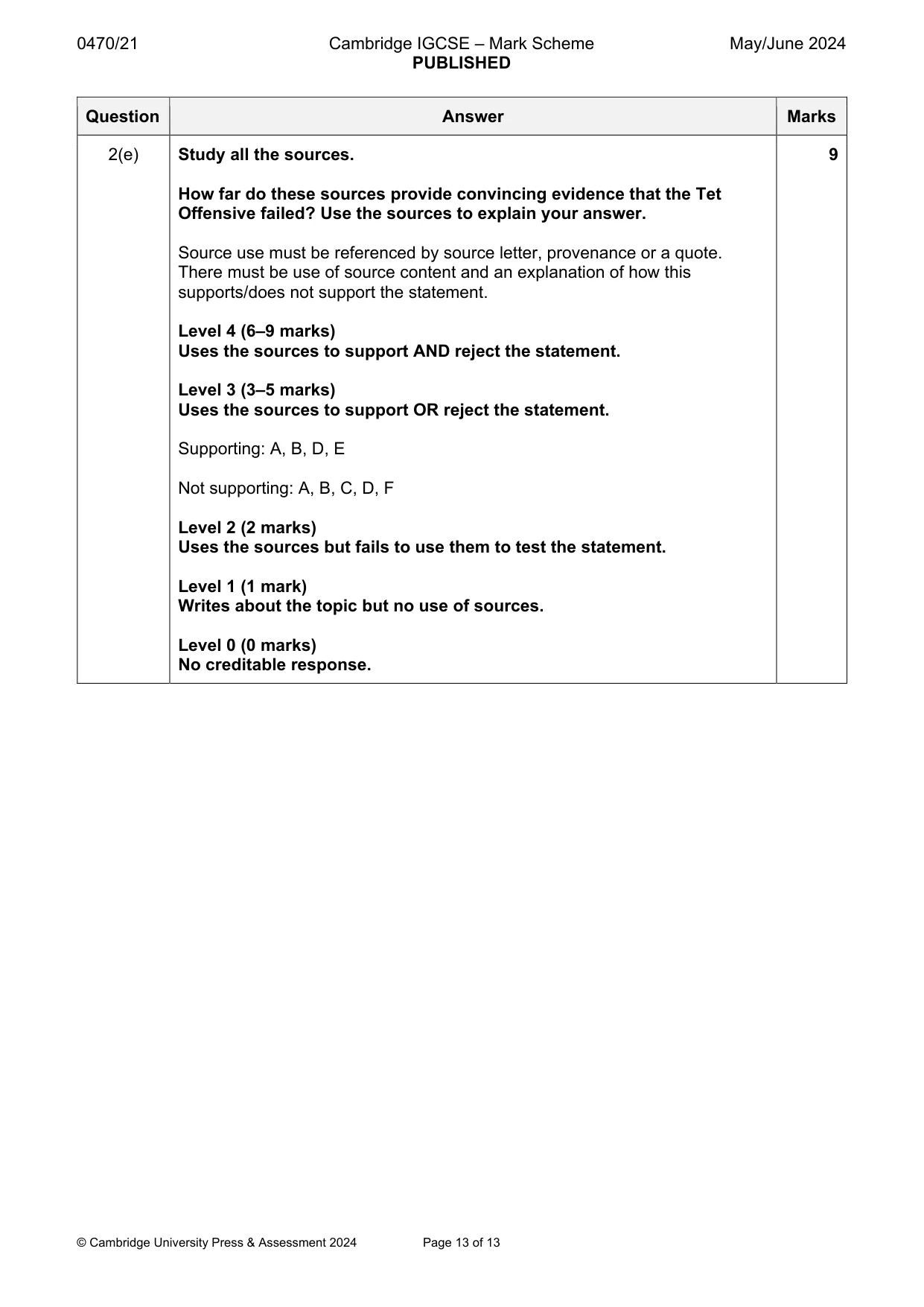
0470/21 Cambridge IGCSE – Mark Scheme PUBLISHED May/June 2024 © Cambridge University Press & Assessment 2024 Page 13 of 13 Question Answer Marks 2(e) Study all the sources. How far do these sources provide convincing evidence that the Tet Offensive failed? Use the sources to explain your answer. Source use must be referenced by source letter, provenance or a quote. There must be use of source content and an explanation of how this supports/does not support the statement. Level 4 (6–9 marks) Uses the sources to support AND reject the statement. Level 3 (3–5 marks) Uses the sources to support OR reject the statement. Supporting: A, B, D, E Not supporting: A, B, C, D, F Level 2 (2 marks) Uses the sources but fails to use them to test the statement. Level 1 (1 mark) Writes about the topic but no use of sources. Level 0 (0 marks) No creditable response. 9
What you needed in this session
Cambridge’s own grade thresholds for 2024 May/June, Paper 2 · Variant 1. A higher threshold means an easier paper — the bar moves with how the cohort did.