Cambridge IGCSE History 0470 — 2023 May/June Paper 2 · Variant 1
0470/21/M/J/23 · 50 marks · ≈56 min
The question paper and its mark scheme, free to read here and free to download. This is Cambridge’s own paper, exactly as it was sat.
Question paper16 pages


Mark scheme15 pages
Answers below. Sit the paper first if you are practising.
Paper as text
Question paper, page 1
This document has 16 pages. Any blank pages are indicated. [Turn over Cambridge IGCSE™ * 3 2 2 2 5 3 8 6 5 7 * DC (EF/SG) 312377/4 © UCLES 2023 HISTORY 0470/21 Paper 2 May/June 2023 2 hours You must answer on the enclosed answer booklet. You will need: Answer booklet (enclosed) INSTRUCTIONS ● Answer all the questions on one option only. Option A: Nineteenth century topic Option B: Twentieth century topic ● Follow the instructions on the front cover of the answer booklet. If you need additional answer paper, ask the invigilator for a continuation booklet. INFORMATION ● The total mark for this paper is 50. ● The number of marks for each question or part question is shown in brackets [ ].
Question paper, page 2
2 0470/21/M/J/23 © UCLES 2023 Option A: Nineteenth century topic WHAT WAS THE MAIN MOTIVE BEHIND EUROPEAN IMPERIALISM? Study the Background Information and the sources carefully, and then answer all the questions. Background Information Many motives have been suggested for the European imperialism of the second half of the nineteenth century. Many historians have argued that the main motive was political – to gain more colonies than other powers for national pride, prestige and security. Closely connected to this were economic motives – to gain raw materials for manufacturing products and to gain markets to sell or buy products. Other motives that have been suggested include a belief that European cultural values were superior to those of other groups, which led to a desire to convert these people to Christianity, to ‘civilise’ them, and to bring them the benefits of education and modern medicine. What was the main motive for European imperialism? SOURCE A I am placing before you the arguments that justify the policy of colonial expansion. The industrialised population of Europe, and especially the people of our rich and hardworking country of France, need markets for exports. Our major industries lack markets because Germany is setting up trade barriers, and because the United States of America has become protectionist. The French policy of colonial expansion was inspired by the fact that a navy such as ours cannot do without safe harbours, defences and supply centres. The higher races have the duty to civilise the inferior races. I maintain that European nations carry out this superior civilising duty with generosity and sincerity. In this competition of so many rivals rising up around us, a policy of withdrawal is simply the road to decline. In our time nations are great only through expansion; it is not by spreading the peaceable light of their institutions that they are great. Spreading light without expansion is to sink from the first rank to the third and fourth. From a speech to the French Parliament by Jules Ferry, the French Prime Minister, 1884.
Question paper, page 3
3 0470/21/M/J/23 © UCLES 2023 [Turn over SOURCE B We are forced to seek new markets because old ones are being closed to us by protectionism. A great commercial empire like ours must go forward. To allow other nations to develop new lands, and to refuse to do so ourselves, is to go backward; and this is deplorable, seeing that we have proved ourselves better at dealing with native races and developing new countries. In Africa the most useful missions are the medical and the industrial. As the skill of the European in medicine demonstrates his superiority, he gains an influence in his teaching of the truths of Christianity. Such demonstration from a British doctor has more weight than mere preaching. The value of the industrial mission is to teach the simpler aspects of agriculture such as sinking of wells and irrigation. These make the land more productive, and this will enable the African people to purchase from the trader cloth and household goods which shall produce greater comforts in their social life. The children should be educated by the establishment of schools. This may produce really great results – neatness, order, and discipline. The essential point in dealing with Africans is to establish a respect for the European. Upon this depends his influence. The whole influence of the European in Africa is gained by this assertion of his superiority. From the book, The Rise of Our East African Empire, by Lord Lugard, 1893. Lugard was a British soldier and an explorer of Africa. He was Governor of both Southern and Northern Nigeria, and later became the first Governor‑General of Nigeria. SOURCE C We have conquered for ourselves a place in the sun. It will now be my task to see that this place in the sun shall remain our undisputed possession and that our industry and agriculture develop. Our future lies upon the water. The more Germans go out upon the water in the service of the battle flag, so much the better it will be for us. Germans must learn to direct their glances upon what is distant and great. May it be my function to protect and advance commerce and trade! As head of the Empire, I therefore rejoice over every citizen who goes forth with this large outlook and seeks new points where we can drive in the nail on which to hang our armour. From a speech by Kaiser Wilhelm II of Germany, 1901. The Kaiser was speaking to an audience of military recruits.
Question paper, page 4
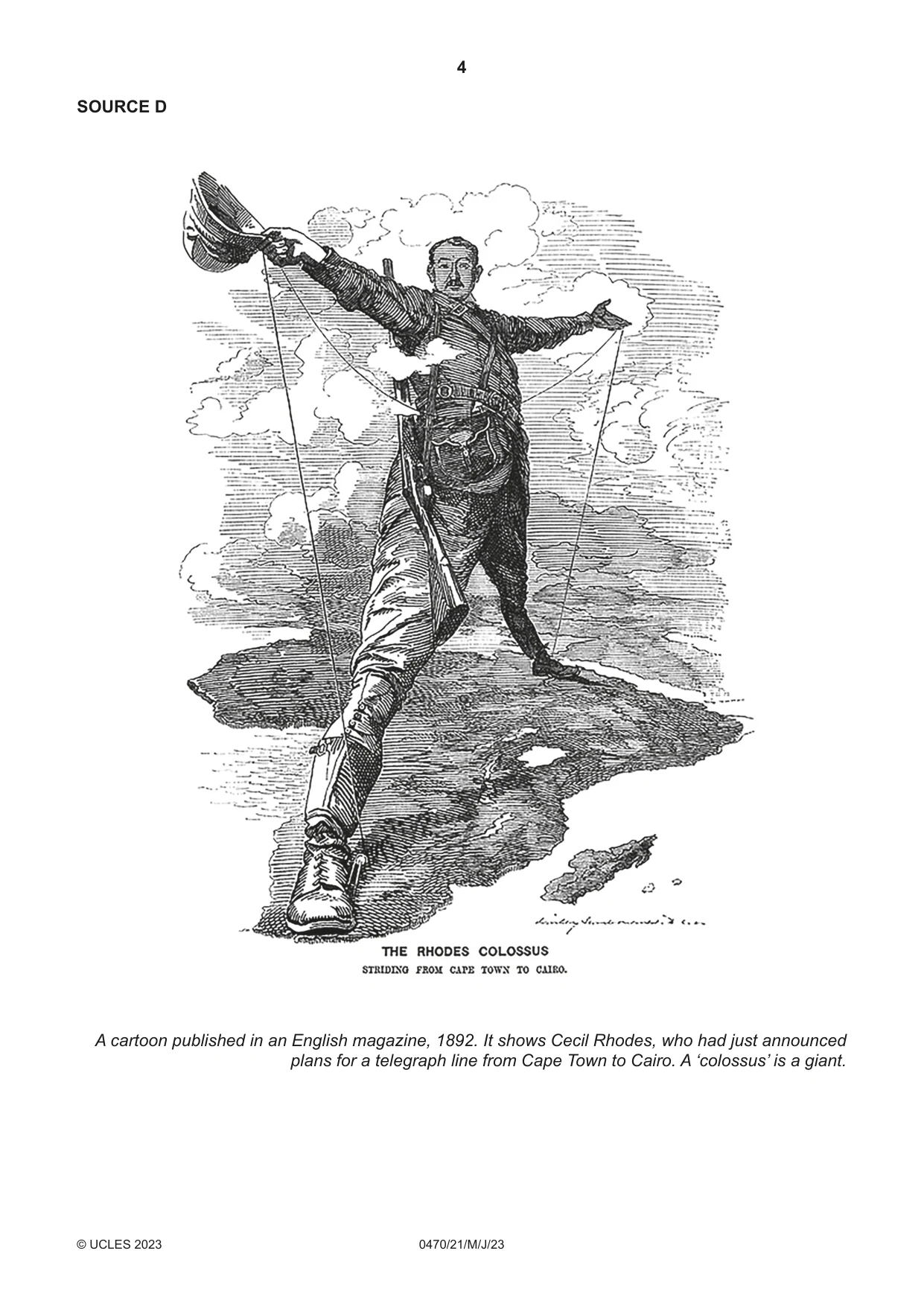
4 0470/21/M/J/23 © UCLES 2023 SOURCE D A cartoon published in an English magazine, 1892. It shows Cecil Rhodes, who had just announced plans for a telegraph line from Cape Town to Cairo. A ‘colossus’ is a giant.
Question paper, page 5
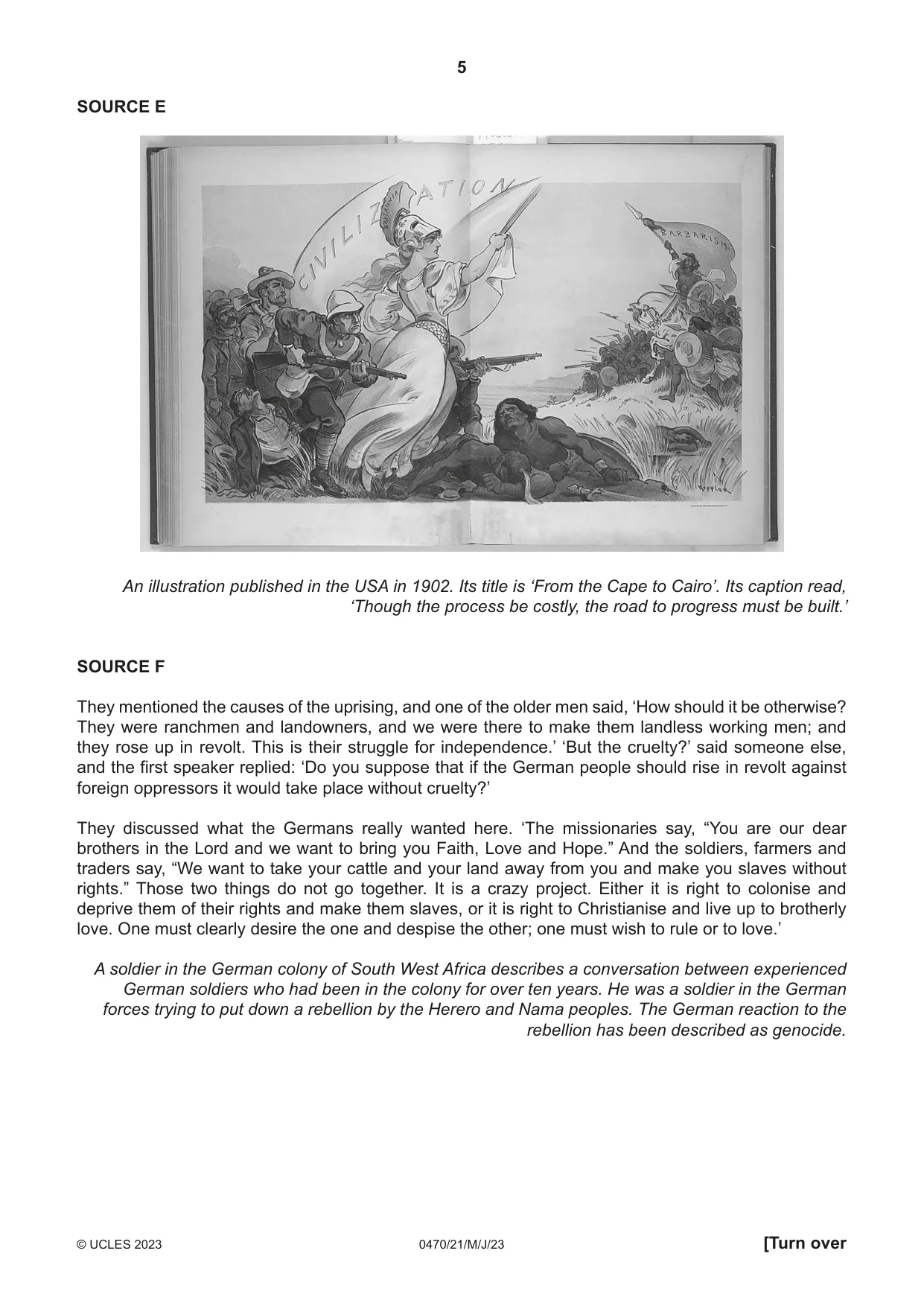
5 0470/21/M/J/23 © UCLES 2023 [Turn over SOURCE E An illustration published in the USA in 1902. Its title is ‘From the Cape to Cairo’. Its caption read, ‘Though the process be costly, the road to progress must be built.’ SOURCE F They mentioned the causes of the uprising, and one of the older men said, ‘How should it be otherwise? They were ranchmen and landowners, and we were there to make them landless working men; and they rose up in revolt. This is their struggle for independence.’ ‘But the cruelty?’ said someone else, and the first speaker replied: ‘Do you suppose that if the German people should rise in revolt against foreign oppressors it would take place without cruelty?’ They discussed what the Germans really wanted here. ‘The missionaries say, “You are our dear brothers in the Lord and we want to bring you Faith, Love and Hope.” And the soldiers, farmers and traders say, “We want to take your cattle and your land away from you and make you slaves without rights.” Those two things do not go together. It is a crazy project. Either it is right to colonise and deprive them of their rights and make them slaves, or it is right to Christianise and live up to brotherly love. One must clearly desire the one and despise the other; one must wish to rule or to love.’ A soldier in the German colony of South West Africa describes a conversation between experienced German soldiers who had been in the colony for over ten years. He was a soldier in the German forces trying to put down a rebellion by the Herero and Nama peoples. The German reaction to the rebellion has been described as genocide.
Question paper, page 6
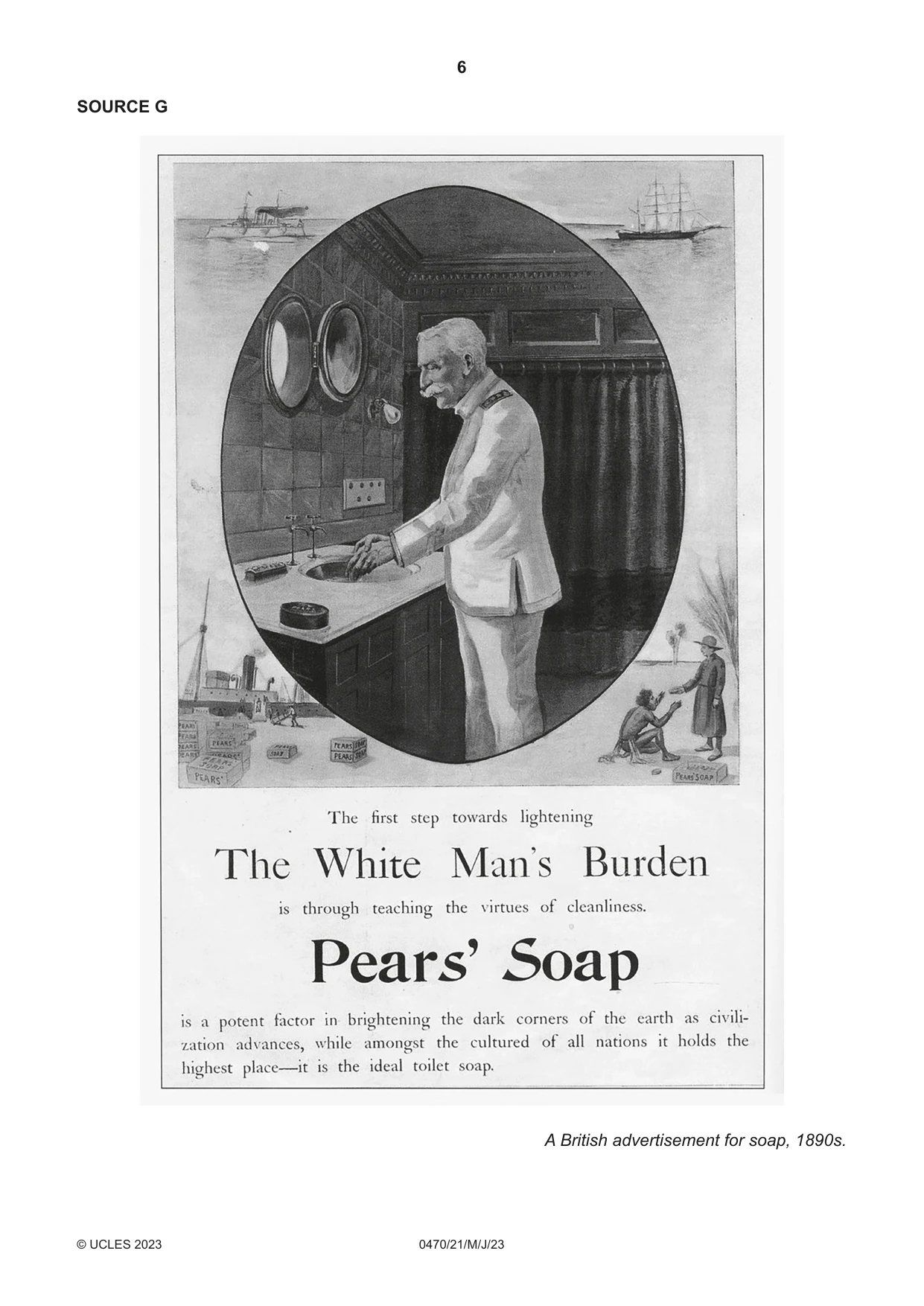
6 0470/21/M/J/23 © UCLES 2023 SOURCE G A British advertisement for soap, 1890s.
Question paper, page 7
7 0470/21/M/J/23 © UCLES 2023 [Turn over Now answer all the following questions. You may use any of the sources to help you answer the questions, in addition to those sources which you are told to use. In answering the questions you should use your knowledge of the topic to help you interpret and evaluate the sources. 1 Study Sources A and B. How similar are the views in these two sources? Explain your answer using details of the sources. [7] 2 Study Source C. Why did the Kaiser make this speech at that time? Explain your answer using details of the source and your knowledge. [8] 3 Study Sources D and E. Would these two artists have agreed about European imperialism? Explain your answer using details of the sources and your knowledge. [8] 4 Study Source F. Are you surprised by this source? Explain your answer using details of the source and your knowledge. [7] 5 Study Source G. How useful is this source to a historian studying imperialism? Explain your answer using details of the source and your knowledge. [8] 6 Study all the sources. How far do these sources provide convincing evidence that the main reason for European imperialism was to spread civilisation? Use the sources to explain your answer. [12]
Question paper, page 8
8 0470/21/M/J/23 © UCLES 2023 Option B: Twentieth century topic WAS APPEASEMENT AN ERROR? Study the Background Information and the sources carefully, and then answer all the questions. Background Information Throughout most of the 1930s Britain and France made concessions to Germany to avoid war. Successive British governments believed that Britain would not be successful in a war with Germany. Many people in Britain believed that Germany had been treated unfairly in the Treaty of Versailles. When the German army marched into the Rhineland on 7 March 1936 they thought the Germans were merely walking into ‘their own backyard’, and when Chamberlain, Daladier, Hitler and Mussolini signed the Munich Agreement on 30 September 1938 there was rejoicing throughout Britain. However, there were some politicians such as Churchill who began questioning the policy of appeasement as early as 1936. Was the policy of appeasement the correct one at the time? SOURCE A To see Neville Chamberlain as merely an example of cowardice ignores other factors. Did he, in September 1938, have any choice but to act as he did? We easily forget what a difficult problem the rise of Hitler posed for other European states in the 1930s. How were they to deal with a man controlling Europe’s most militarised and warlike nation, who was determined to dominate the whole continent? Hitler was only stopped by history’s most destructive war, which may have cost 25 million lives in Russia alone. But who would choose such a solution? Memories were only too fresh of the First World War of 1914–18 in which a whole generation was slaughtered. Furthermore, there was a terror of a new weapon: the bomber aircraft. In 1938, the Committee of Imperial Defence told Chamberlain that a German bomber offensive launched against Britain would result in half a million civilian deaths within the first three weeks. The armed forces felt Britain was not ready for conflict. The general public were terrified of war, and as desperate to avoid it as Chamberlain was. When he returned after Munich waving the piece of paper bearing Hitler’s signature, he was regarded as a national hero. Nearly all the newspapers in Britain welcomed the Munich Agreement. Only a few voices, such as that of Winston Churchill, denounced appeasement. From a recent newspaper article.
Question paper, page 9
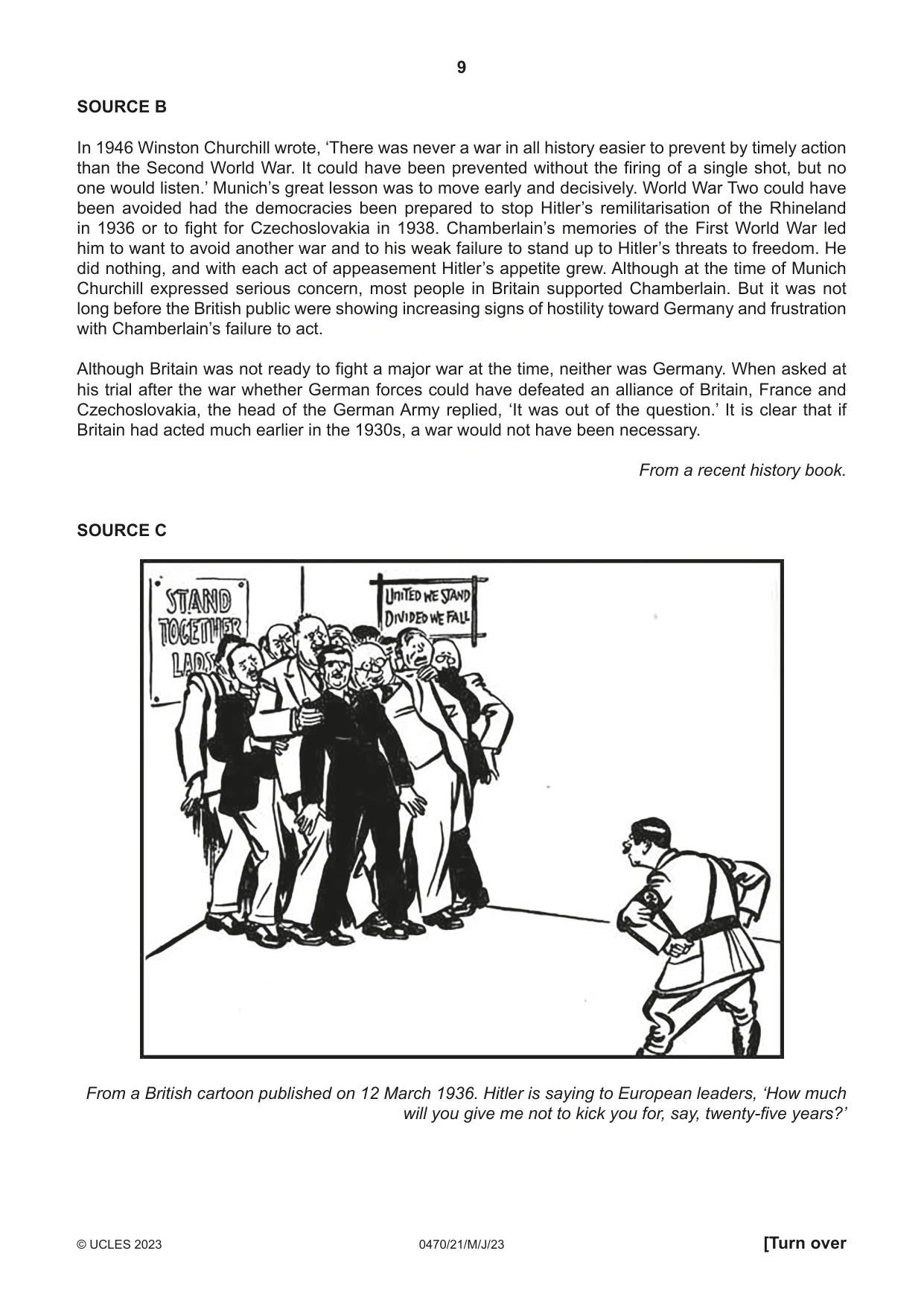
9 0470/21/M/J/23 © UCLES 2023 [Turn over SOURCE B In 1946 Winston Churchill wrote, ‘There was never a war in all history easier to prevent by timely action than the Second World War. It could have been prevented without the firing of a single shot, but no one would listen.’ Munich’s great lesson was to move early and decisively. World War Two could have been avoided had the democracies been prepared to stop Hitler’s remilitarisation of the Rhineland in 1936 or to fight for Czechoslovakia in 1938. Chamberlain’s memories of the First World War led him to want to avoid another war and to his weak failure to stand up to Hitler’s threats to freedom. He did nothing, and with each act of appeasement Hitler’s appetite grew. Although at the time of Munich Churchill expressed serious concern, most people in Britain supported Chamberlain. But it was not long before the British public were showing increasing signs of hostility toward Germany and frustration with Chamberlain’s failure to act. Although Britain was not ready to fight a major war at the time, neither was Germany. When asked at his trial after the war whether German forces could have defeated an alliance of Britain, France and Czechoslovakia, the head of the German Army replied, ‘It was out of the question.’ It is clear that if Britain had acted much earlier in the 1930s, a war would not have been necessary. From a recent history book. SOURCE C From a British cartoon published on 12 March 1936. Hitler is saying to European leaders, ‘How much will you give me not to kick you for, say, twenty‑five years?’
Question paper, page 10
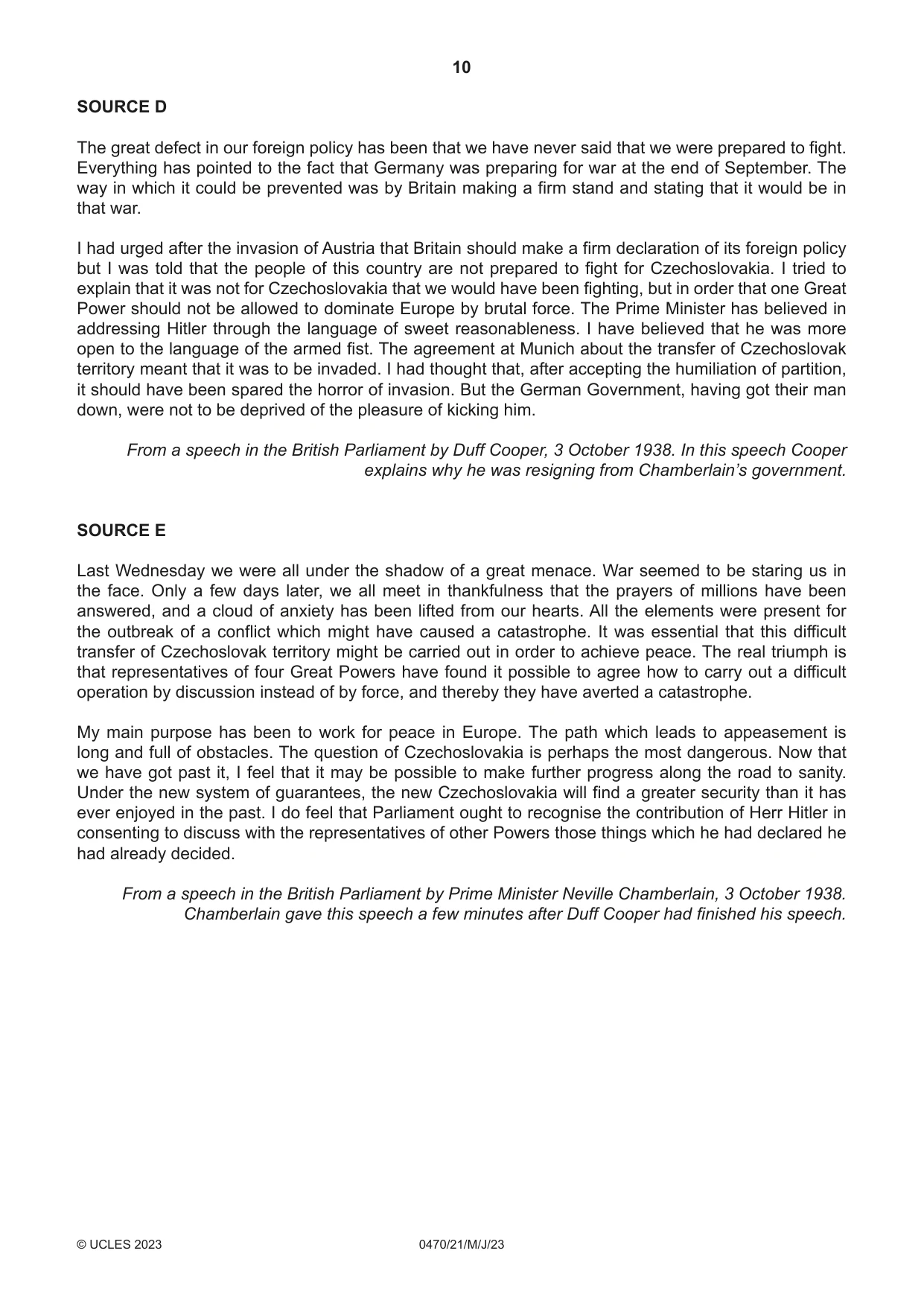
10 0470/21/M/J/23 © UCLES 2023 SOURCE D The great defect in our foreign policy has been that we have never said that we were prepared to fight. Everything has pointed to the fact that Germany was preparing for war at the end of September. The way in which it could be prevented was by Britain making a firm stand and stating that it would be in that war. I had urged after the invasion of Austria that Britain should make a firm declaration of its foreign policy but I was told that the people of this country are not prepared to fight for Czechoslovakia. I tried to explain that it was not for Czechoslovakia that we would have been fighting, but in order that one Great Power should not be allowed to dominate Europe by brutal force. The Prime Minister has believed in addressing Hitler through the language of sweet reasonableness. I have believed that he was more open to the language of the armed fist. The agreement at Munich about the transfer of Czechoslovak territory meant that it was to be invaded. I had thought that, after accepting the humiliation of partition, it should have been spared the horror of invasion. But the German Government, having got their man down, were not to be deprived of the pleasure of kicking him. From a speech in the British Parliament by Duff Cooper, 3 October 1938. In this speech Cooper explains why he was resigning from Chamberlain’s government. SOURCE E Last Wednesday we were all under the shadow of a great menace. War seemed to be staring us in the face. Only a few days later, we all meet in thankfulness that the prayers of millions have been answered, and a cloud of anxiety has been lifted from our hearts. All the elements were present for the outbreak of a conflict which might have caused a catastrophe. It was essential that this difficult transfer of Czechoslovak territory might be carried out in order to achieve peace. The real triumph is that representatives of four Great Powers have found it possible to agree how to carry out a difficult operation by discussion instead of by force, and thereby they have averted a catastrophe. My main purpose has been to work for peace in Europe. The path which leads to appeasement is long and full of obstacles. The question of Czechoslovakia is perhaps the most dangerous. Now that we have got past it, I feel that it may be possible to make further progress along the road to sanity. Under the new system of guarantees, the new Czechoslovakia will find a greater security than it has ever enjoyed in the past. I do feel that Parliament ought to recognise the contribution of Herr Hitler in consenting to discuss with the representatives of other Powers those things which he had declared he had already decided. From a speech in the British Parliament by Prime Minister Neville Chamberlain, 3 October 1938. Chamberlain gave this speech a few minutes after Duff Cooper had finished his speech.
Question paper, page 11
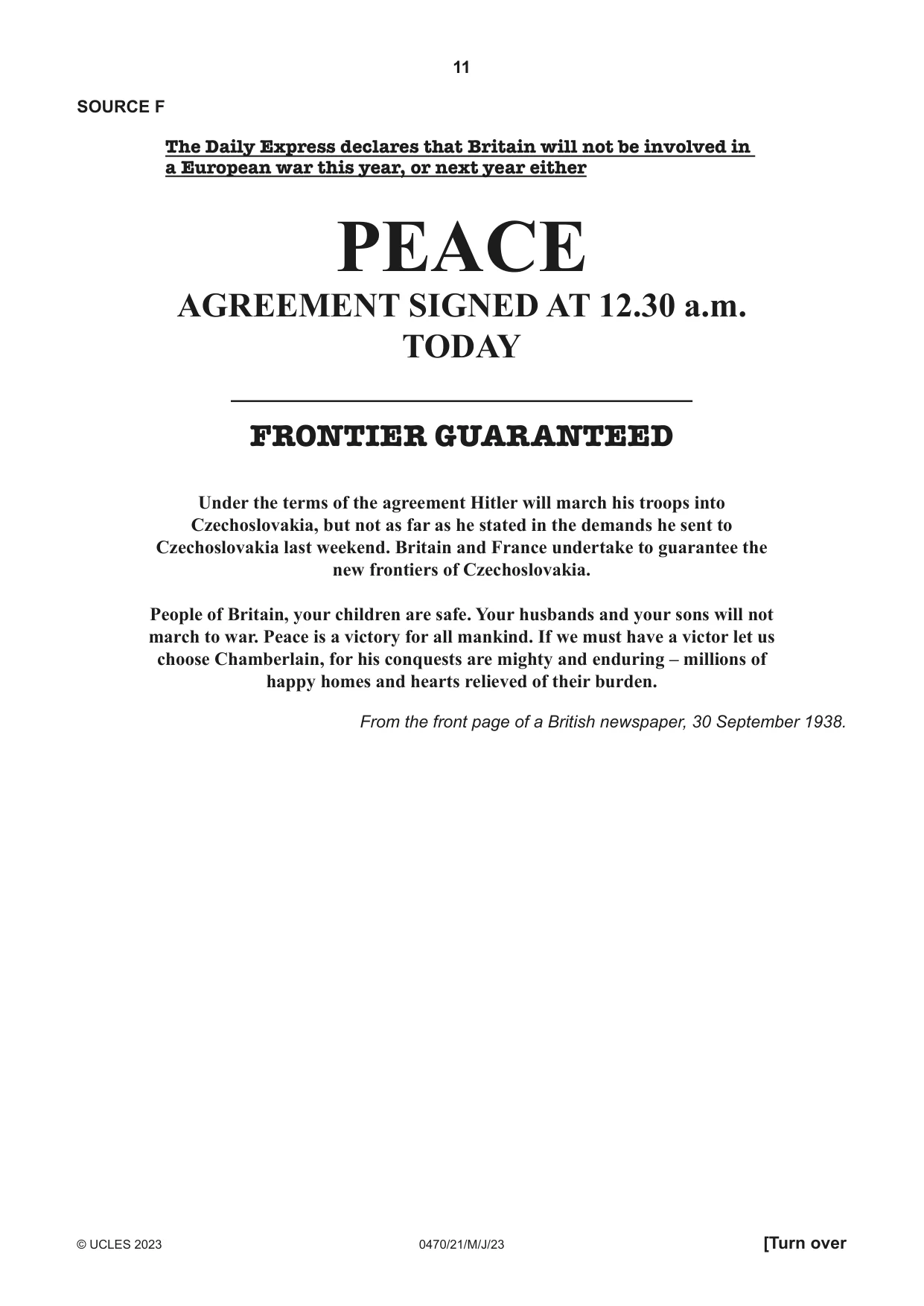
11 0470/21/M/J/23 © UCLES 2023 [Turn over SOURCE F The Daily Express declares that Britain will not be involved in a European war this year, or next year either PEACE AGREEMENT SIGNED AT 12.30 a.m. TODAY FRONTIER GUARANTEED Under the terms of the agreement Hitler will march his troops into Czechoslovakia, but not as far as he stated in the demands he sent to Czechoslovakia last weekend. Britain and France undertake to guarantee the new frontiers of Czechoslovakia. People of Britain, your children are safe. Your husbands and your sons will not march to war. Peace is a victory for all mankind. If we must have a victor let us choose Chamberlain, for his conquests are mighty and enduring – millions of happy homes and hearts relieved of their burden. From the front page of a British newspaper, 30 September 1938.
Question paper, page 12
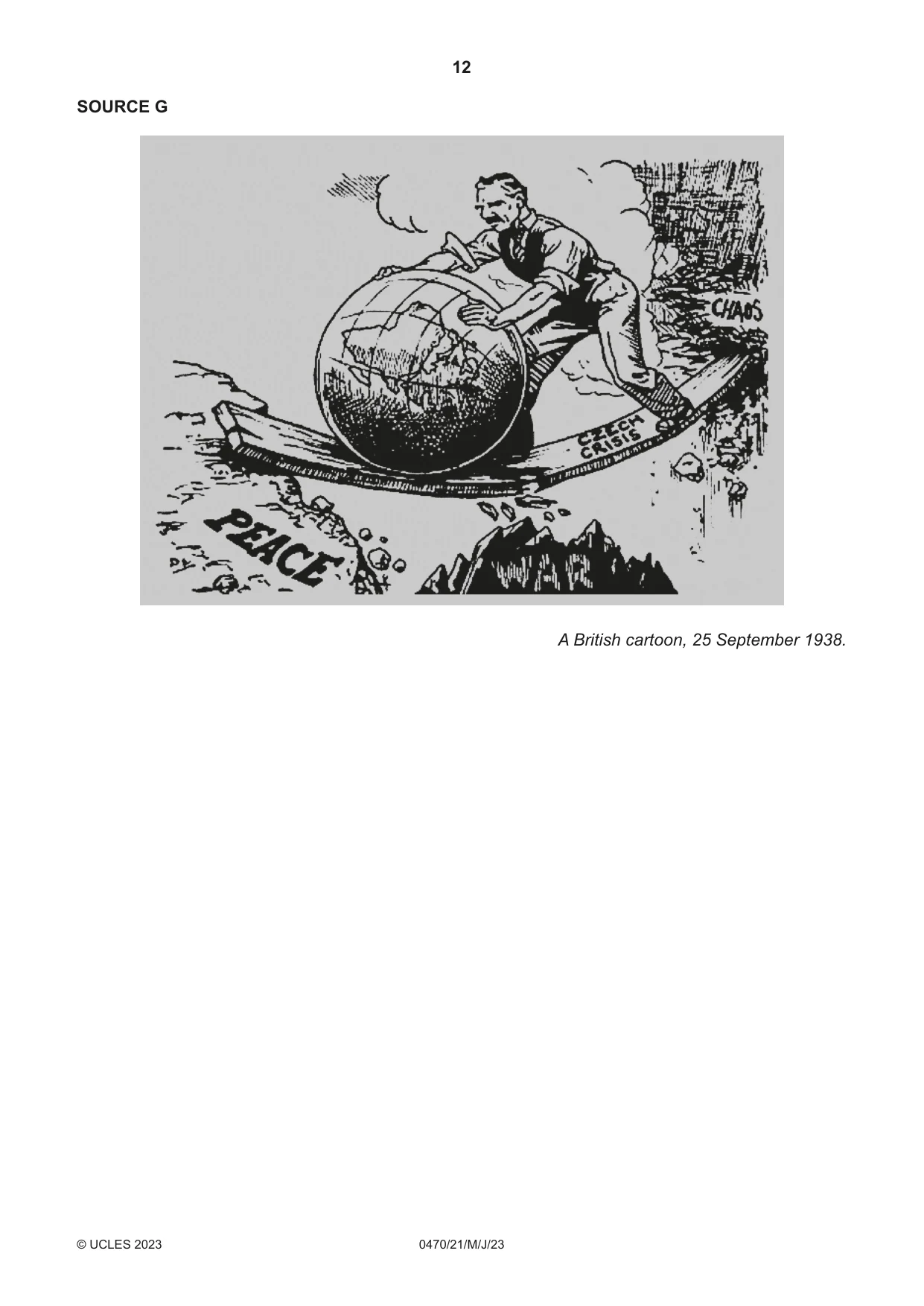
12 0470/21/M/J/23 © UCLES 2023 SOURCE G A British cartoon, 25 September 1938.
Question paper, page 13
13 0470/21/M/J/23 © UCLES 2023 [Turn over SOURCE H A cartoon published in an American newspaper, 7 October 1938.
Question paper, page 14
14 0470/21/M/J/23 © UCLES 2023 Now answer all the following questions. You may use any of the sources to help you answer the questions, in addition to those sources which you are told to use. In answering the questions you should use your knowledge of the topic to help you interpret and evaluate the sources. 1 Study Sources A and B. How far do these two sources agree? Explain your answer using details of the sources. [7] 2 Study Source C. Why was this source published on 12 March 1936? Explain your answer using details of the source and your knowledge. [8] 3 Study Sources D and E. Does Source E mean that Duff Cooper need not have resigned? Explain your answer using details of the sources and your knowledge. [8] 4 Study Source F. Do you find this source surprising? Explain your answer using details of the source and your knowledge. [7] 5 Study Sources G and H. How far would these two cartoonists have agreed? Explain your answer using details of the sources and your knowledge. [8] 6 Study all the sources. How far do these sources provide convincing evidence that appeasement was an error? Use the sources to explain your answer. [12]
Question paper, page 15
15 0470/21/M/J/23 © UCLES 2023 BLANK PAGE
Question paper, page 16
16 0470/21/M/J/23 © UCLES 2023 Permission to reproduce items where third‑party owned material protected by copyright is included has been sought and cleared where possible. Every reasonable effort has been made by the publisher (UCLES) to trace copyright holders, but if any items requiring clearance have unwittingly been included, the publisher will be pleased to make amends at the earliest possible opportunity. To avoid the issue of disclosure of answer‑related information to candidates, all copyright acknowledgements are reproduced online in the Cambridge Assessment International Education Copyright Acknowledgements Booklet. This is produced for each series of examinations and is freely available to download at www.cambridgeinternational.org after the live examination series. Cambridge Assessment International Education is part of Cambridge Assessment. Cambridge Assessment is the brand name of the University of Cambridge Local Examinations Syndicate (UCLES), which is a department of the University of Cambridge. BLANK PAGE
Mark scheme, page 1
This document consists of 15 printed pages. © UCLES 2023 [Turn over Cambridge IGCSE™ HISTORY 0470/21 Paper 2 May/June 2023 MARK SCHEME Maximum Mark: 50 Published This mark scheme is published as an aid to teachers and candidates, to indicate the requirements of the examination. It shows the basis on which Examiners were instructed to award marks. It does not indicate the details of the discussions that took place at an Examiners’ meeting before marking began, which would have considered the acceptability of alternative answers. Mark schemes should be read in conjunction with the question paper and the Principal Examiner Report for Teachers. Cambridge International will not enter into discussions about these mark schemes. Cambridge International is publishing the mark schemes for the May/June 2023 series for most Cambridge IGCSE, Cambridge International A and AS Level and Cambridge Pre-U components, and some Cambridge O Level components.
Mark scheme, page 2
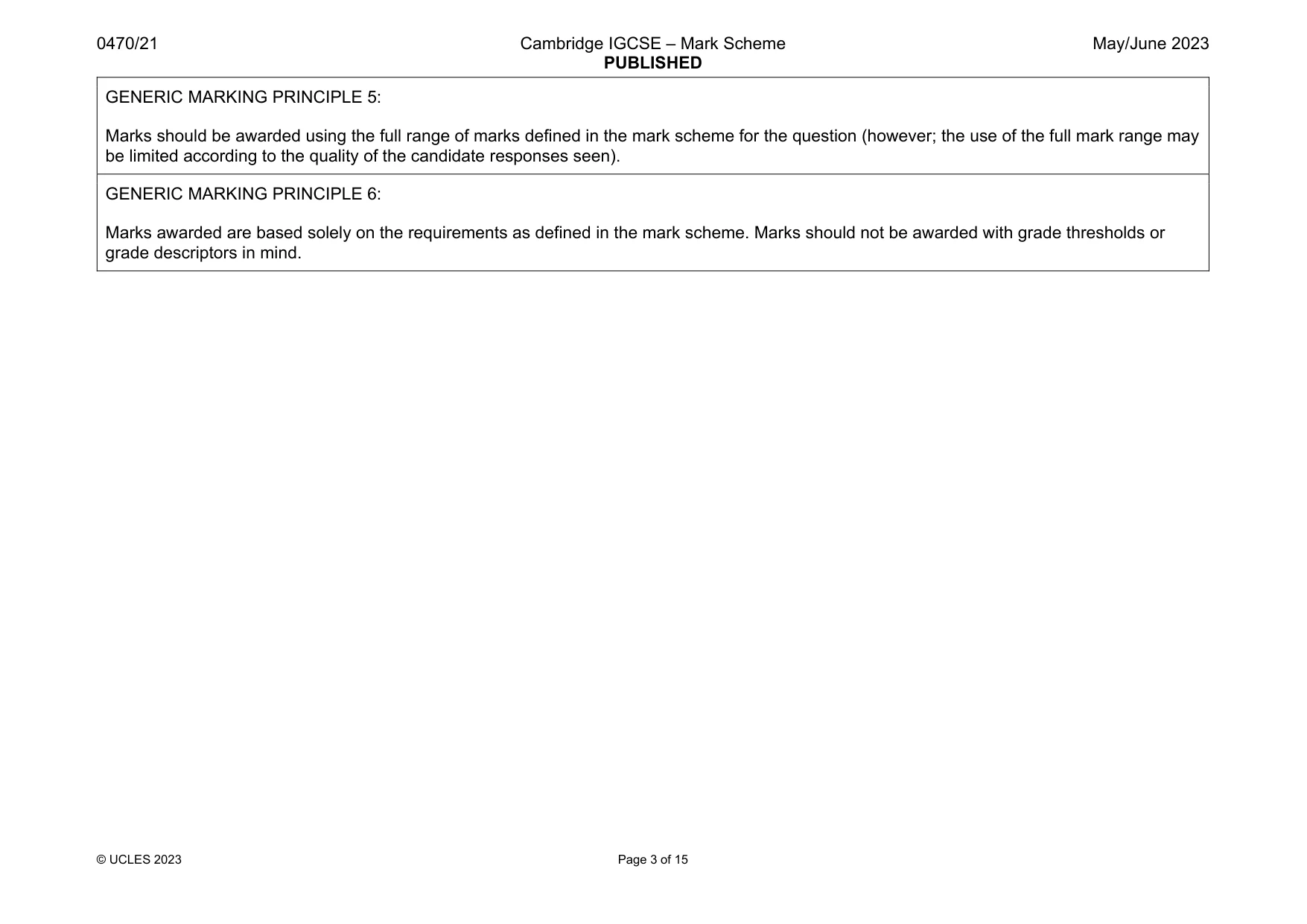
0470/21 Cambridge IGCSE – Mark Scheme PUBLISHED May/June 2023 © UCLES 2023 Page 2 of 15 Generic Marking Principles These general marking principles must be applied by all examiners when marking candidate answers. They should be applied alongside the specific content of the mark scheme or generic level descriptors for a question. Each question paper and mark scheme will also comply with these marking principles. GENERIC MARKING PRINCIPLE 1: Marks must be awarded in line with: the specific content of the mark scheme or the generic level descriptors for the question the specific skills defined in the mark scheme or in the generic level descriptors for the question the standard of response required by a candidate as exemplified by the standardisation scripts. GENERIC MARKING PRINCIPLE 2: Marks awarded are always whole marks (not half marks, or other fractions). GENERIC MARKING PRINCIPLE 3: Marks must be awarded positively: marks are awarded for correct/valid answers, as defined in the mark scheme. However, credit is given for valid answers which go beyond the scope of the syllabus and mark scheme, referring to your Team Leader as appropriate marks are awarded when candidates clearly demonstrate what they know and can do marks are not deducted for errors marks are not deducted for omissions answers should only be judged on the quality of spelling, punctuation and grammar when these features are specifically assessed by the question as indicated by the mark scheme. The meaning, however, should be unambiguous. GENERIC MARKING PRINCIPLE 4: Rules must be applied consistently, e.g. in situations where candidates have not followed instructions or in the application of generic level descriptors.
Mark scheme, page 3
0470/21 Cambridge IGCSE – Mark Scheme PUBLISHED May/June 2023 © UCLES 2023 Page 3 of 15 GENERIC MARKING PRINCIPLE 5: Marks should be awarded using the full range of marks defined in the mark scheme for the question (however; the use of the full mark range may be limited according to the quality of the candidate responses seen). GENERIC MARKING PRINCIPLE 6: Marks awarded are based solely on the requirements as defined in the mark scheme. Marks should not be awarded with grade thresholds or grade descriptors in mind.
Mark scheme, page 4
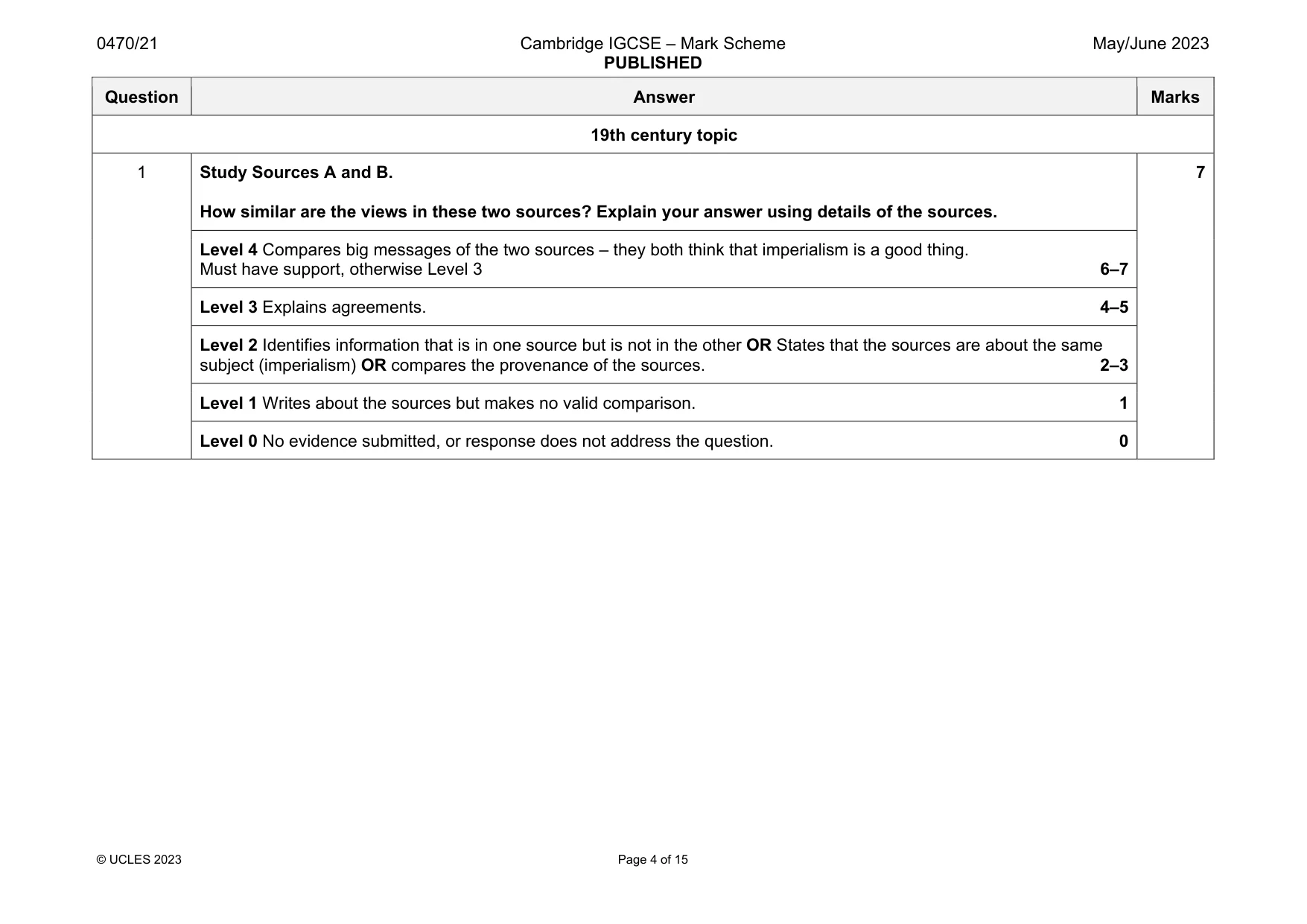
0470/21 Cambridge IGCSE – Mark Scheme PUBLISHED May/June 2023 © UCLES 2023 Page 4 of 15 Question Answer Marks 19th century topic 1 Study Sources A and B. How similar are the views in these two sources? Explain your answer using details of the sources. 7 Level 4 Compares big messages of the two sources – they both think that imperialism is a good thing. Must have support, otherwise Level 3 6–7 Level 3 Explains agreements. 4–5 Level 2 Identifies information that is in one source but is not in the other OR States that the sources are about the same subject (imperialism) OR compares the provenance of the sources. 2–3 Level 1 Writes about the sources but makes no valid comparison. 1 Level 0 No evidence submitted, or response does not address the question. 0
Mark scheme, page 5
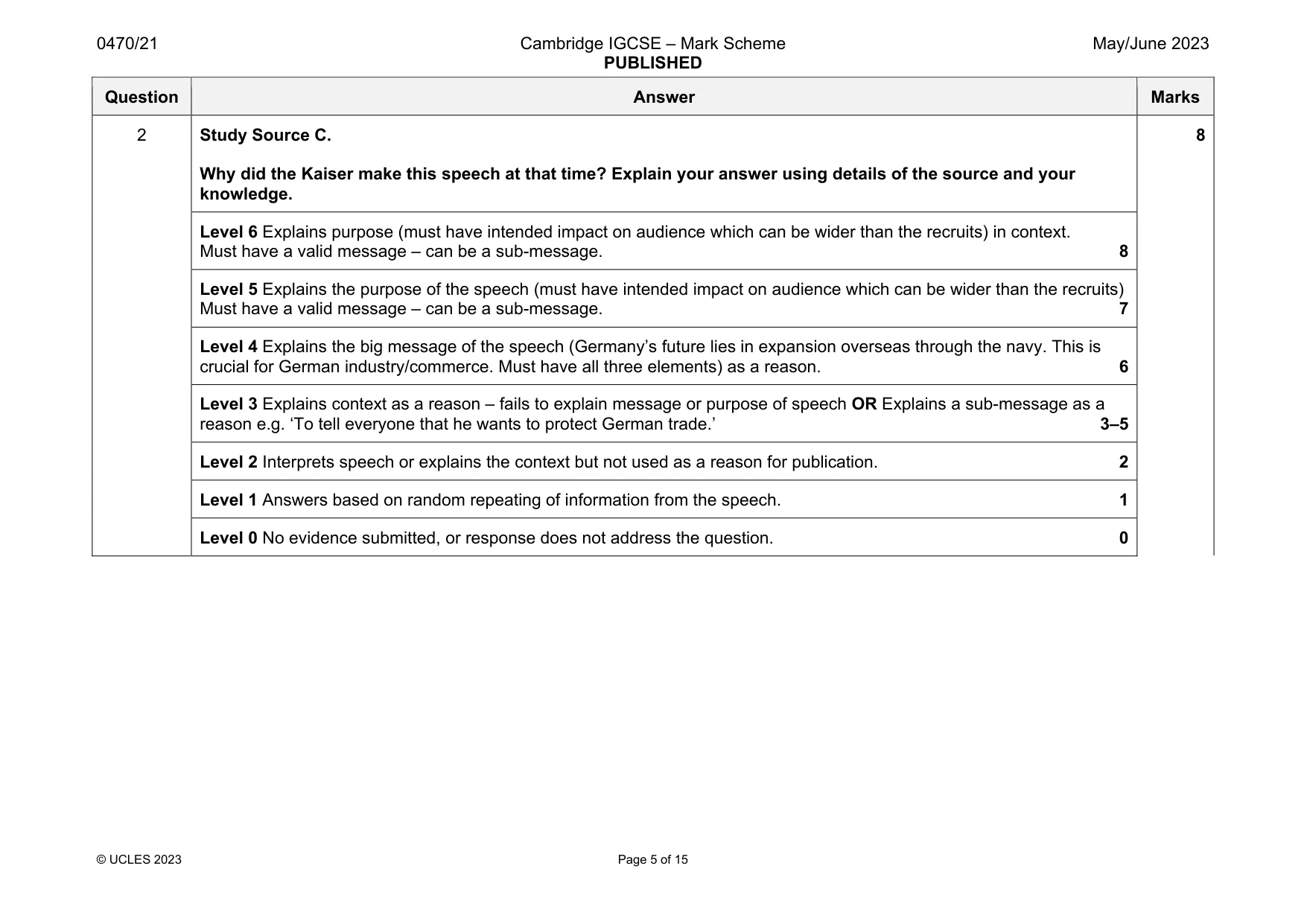
0470/21 Cambridge IGCSE – Mark Scheme PUBLISHED May/June 2023 © UCLES 2023 Page 5 of 15 Question Answer Marks 2 Study Source C. Why did the Kaiser make this speech at that time? Explain your answer using details of the source and your knowledge. 8 Level 6 Explains purpose (must have intended impact on audience which can be wider than the recruits) in context. Must have a valid message – can be a sub-message. 8 Level 5 Explains the purpose of the speech (must have intended impact on audience which can be wider than the recruits) Must have a valid message – can be a sub-message. 7 Level 4 Explains the big message of the speech (Germany’s future lies in expansion overseas through the navy. This is crucial for German industry/commerce. Must have all three elements) as a reason. 6 Level 3 Explains context as a reason – fails to explain message or purpose of speech OR Explains a sub-message as a reason e.g. ‘To tell everyone that he wants to protect German trade.’ 3–5 Level 2 Interprets speech or explains the context but not used as a reason for publication. 2 Level 1 Answers based on random repeating of information from the speech. 1 Level 0 No evidence submitted, or response does not address the question. 0
Mark scheme, page 6
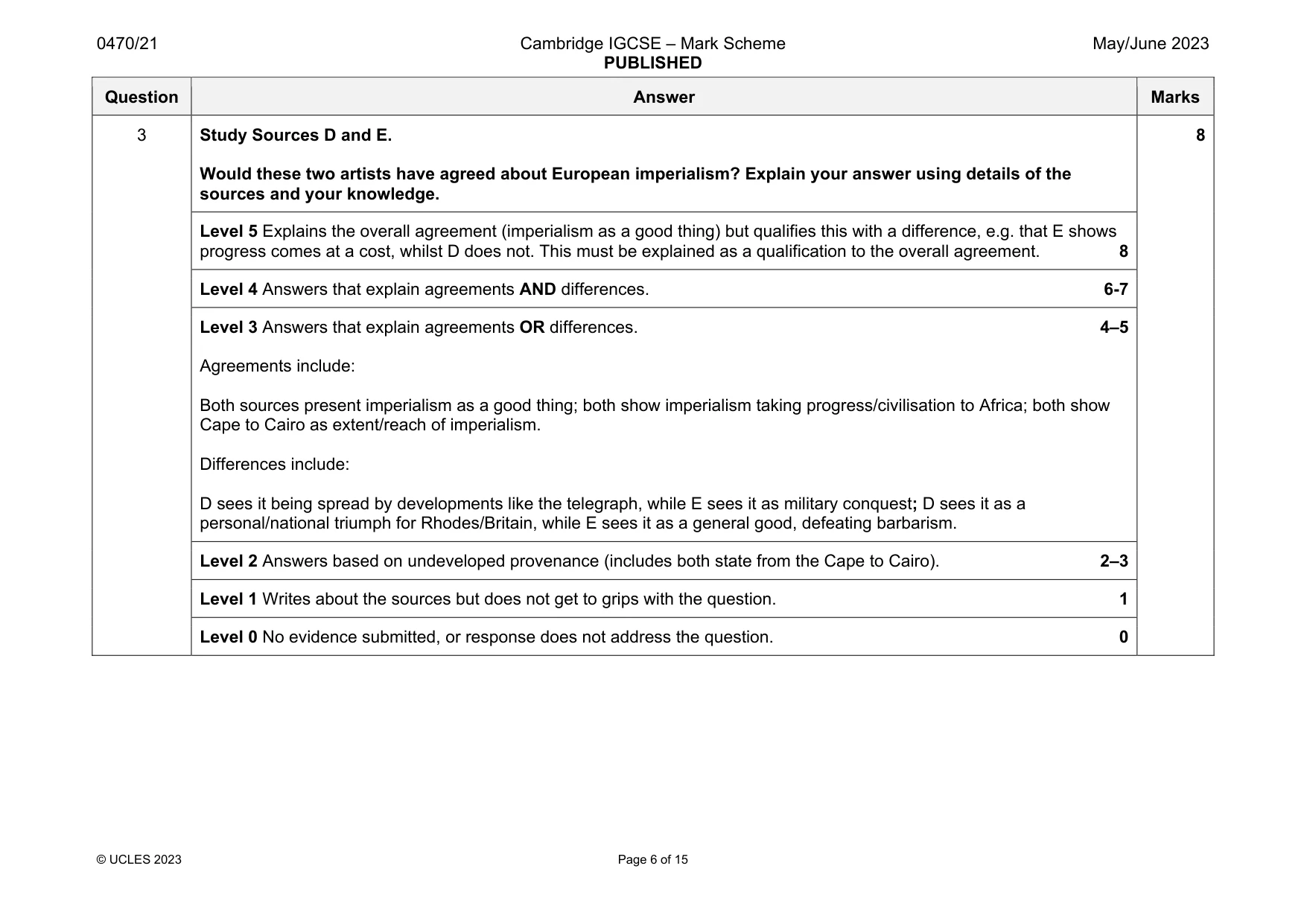
0470/21 Cambridge IGCSE – Mark Scheme PUBLISHED May/June 2023 © UCLES 2023 Page 6 of 15 Question Answer Marks 3 Study Sources D and E. Would these two artists have agreed about European imperialism? Explain your answer using details of the sources and your knowledge. 8 Level 5 Explains the overall agreement (imperialism as a good thing) but qualifies this with a difference, e.g. that E shows progress comes at a cost, whilst D does not. This must be explained as a qualification to the overall agreement. 8 Level 4 Answers that explain agreements AND differences. 6-7 Level 3 Answers that explain agreements OR differences. 4–5 Agreements include: Both sources present imperialism as a good thing; both show imperialism taking progress/civilisation to Africa; both show Cape to Cairo as extent/reach of imperialism. Differences include: D sees it being spread by developments like the telegraph, while E sees it as military conquest; D sees it as a personal/national triumph for Rhodes/Britain, while E sees it as a general good, defeating barbarism. Level 2 Answers based on undeveloped provenance (includes both state from the Cape to Cairo). 2–3 Level 1 Writes about the sources but does not get to grips with the question. 1 Level 0 No evidence submitted, or response does not address the question. 0
Mark scheme, page 7
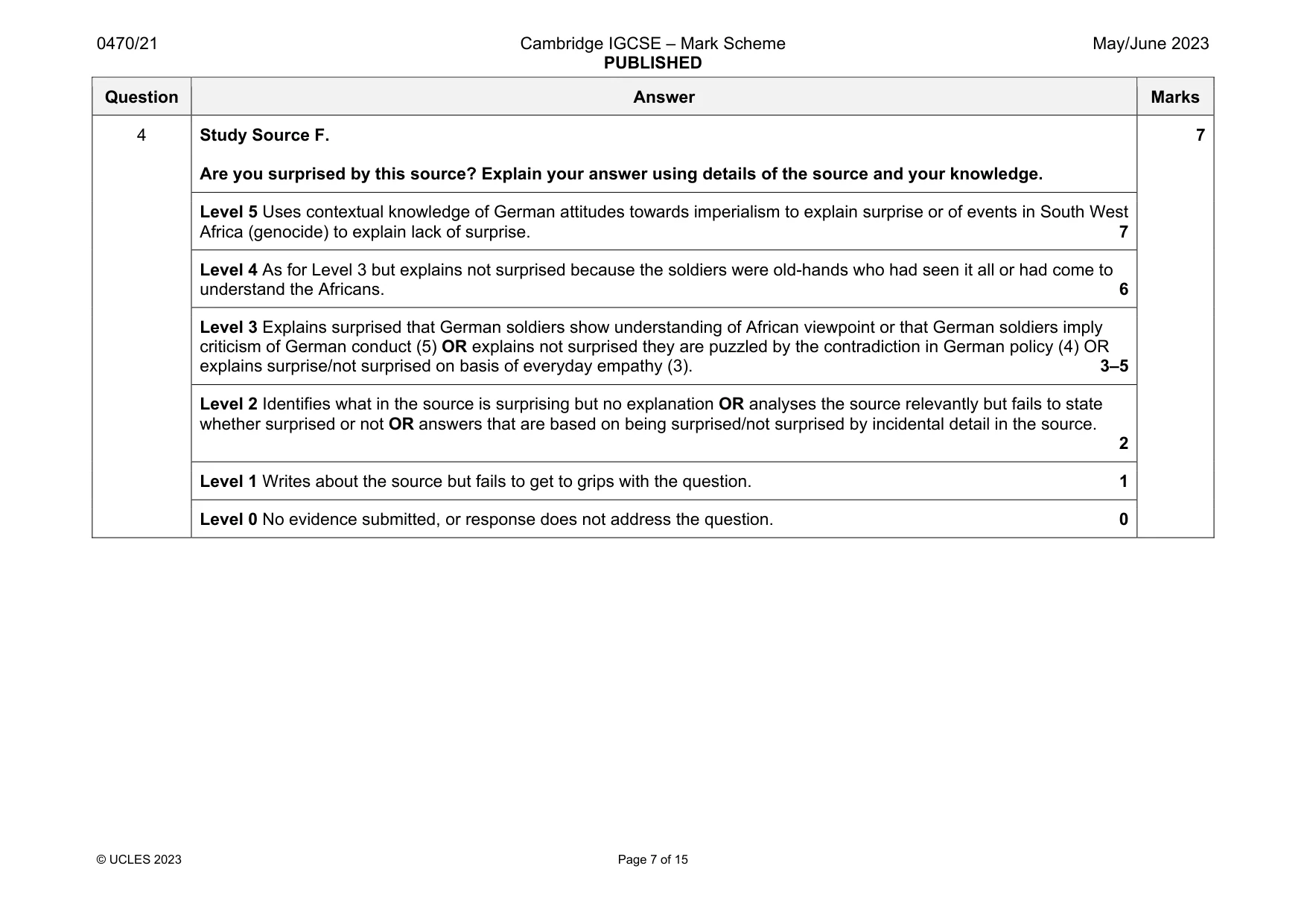
0470/21 Cambridge IGCSE – Mark Scheme PUBLISHED May/June 2023 © UCLES 2023 Page 7 of 15 Question Answer Marks 4 Study Source F. Are you surprised by this source? Explain your answer using details of the source and your knowledge. 7 Level 5 Uses contextual knowledge of German attitudes towards imperialism to explain surprise or of events in South West Africa (genocide) to explain lack of surprise. 7 Level 4 As for Level 3 but explains not surprised because the soldiers were old-hands who had seen it all or had come to understand the Africans. 6 Level 3 Explains surprised that German soldiers show understanding of African viewpoint or that German soldiers imply criticism of German conduct (5) OR explains not surprised they are puzzled by the contradiction in German policy (4) OR explains surprise/not surprised on basis of everyday empathy (3). 3–5 Level 2 Identifies what in the source is surprising but no explanation OR analyses the source relevantly but fails to state whether surprised or not OR answers that are based on being surprised/not surprised by incidental detail in the source. 2 Level 1 Writes about the source but fails to get to grips with the question. 1 Level 0 No evidence submitted, or response does not address the question. 0
Mark scheme, page 8
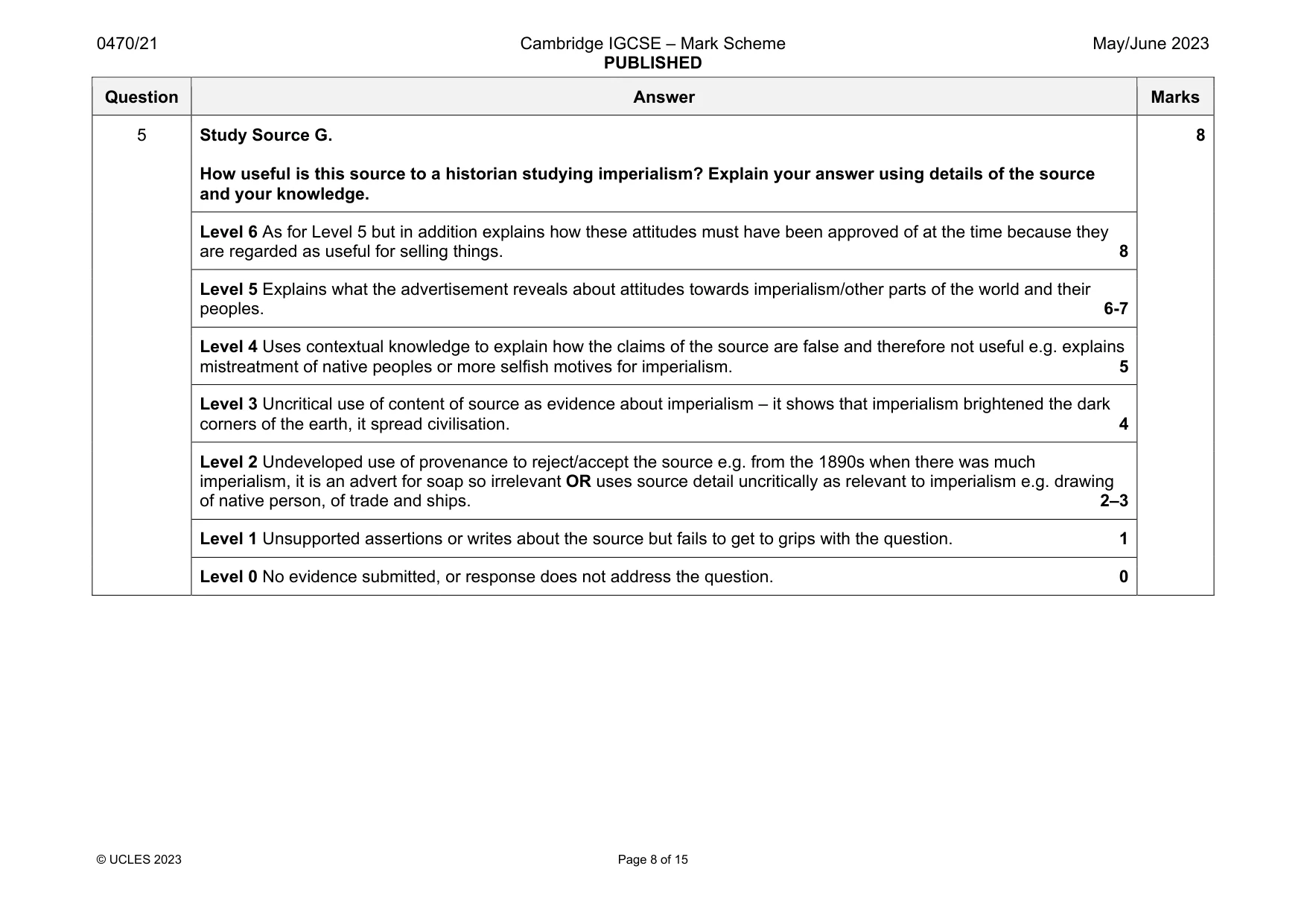
0470/21 Cambridge IGCSE – Mark Scheme PUBLISHED May/June 2023 © UCLES 2023 Page 8 of 15 Question Answer Marks 5 Study Source G. How useful is this source to a historian studying imperialism? Explain your answer using details of the source and your knowledge. 8 Level 6 As for Level 5 but in addition explains how these attitudes must have been approved of at the time because they are regarded as useful for selling things. 8 Level 5 Explains what the advertisement reveals about attitudes towards imperialism/other parts of the world and their peoples. 6-7 Level 4 Uses contextual knowledge to explain how the claims of the source are false and therefore not useful e.g. explains mistreatment of native peoples or more selfish motives for imperialism. 5 Level 3 Uncritical use of content of source as evidence about imperialism – it shows that imperialism brightened the dark corners of the earth, it spread civilisation. 4 Level 2 Undeveloped use of provenance to reject/accept the source e.g. from the 1890s when there was much imperialism, it is an advert for soap so irrelevant OR uses source detail uncritically as relevant to imperialism e.g. drawing of native person, of trade and ships. 2–3 Level 1 Unsupported assertions or writes about the source but fails to get to grips with the question. 1 Level 0 No evidence submitted, or response does not address the question. 0
Mark scheme, page 9
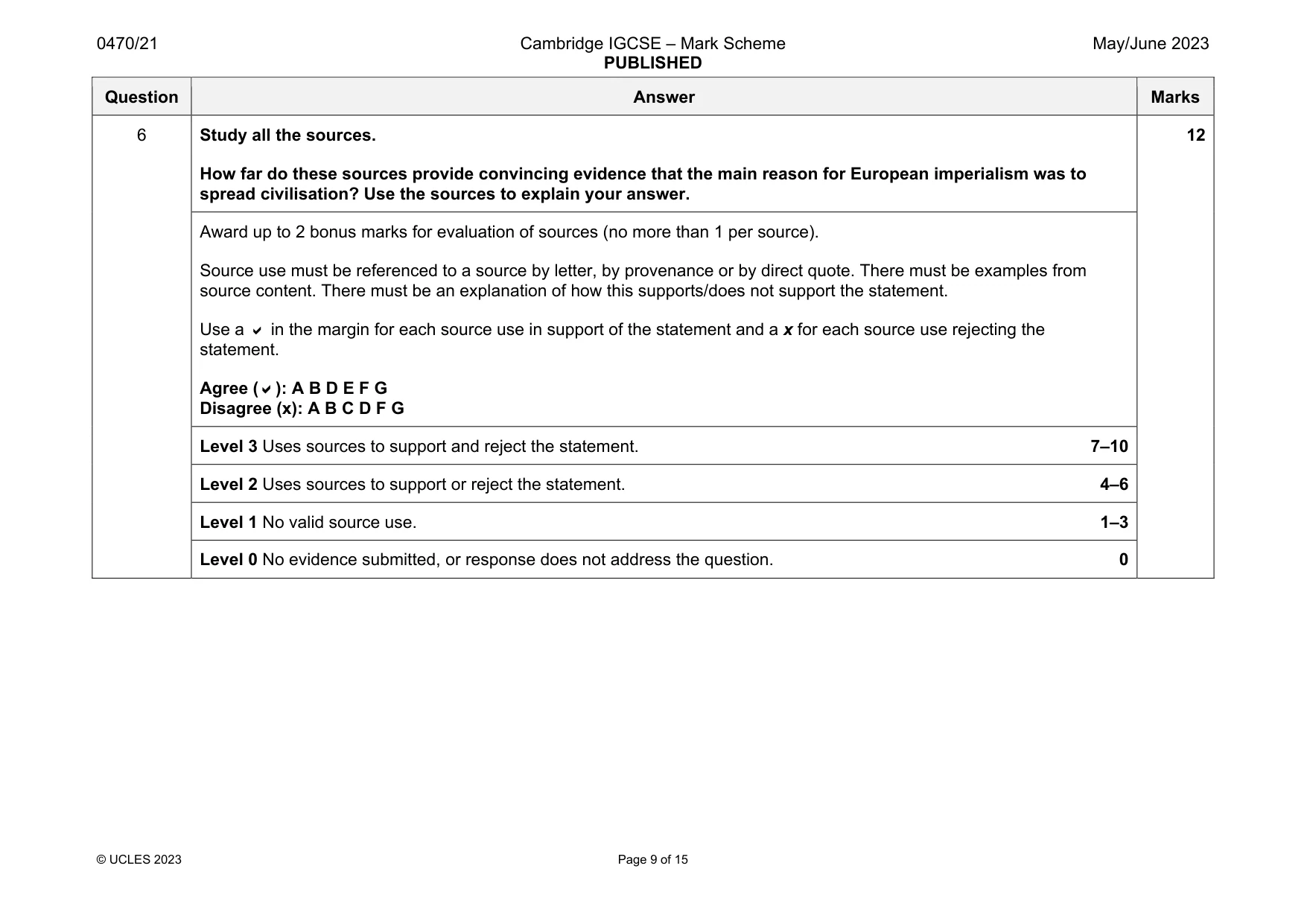
0470/21 Cambridge IGCSE – Mark Scheme PUBLISHED May/June 2023 © UCLES 2023 Page 9 of 15 Question Answer Marks 6 Study all the sources. How far do these sources provide convincing evidence that the main reason for European imperialism was to spread civilisation? Use the sources to explain your answer. 12 Award up to 2 bonus marks for evaluation of sources (no more than 1 per source). Source use must be referenced to a source by letter, by provenance or by direct quote. There must be examples from source content. There must be an explanation of how this supports/does not support the statement. Use a in the margin for each source use in support of the statement and a x for each source use rejecting the statement. Agree (): A B D E F G Disagree (x): A B C D F G Level 3 Uses sources to support and reject the statement. 7–10 Level 2 Uses sources to support or reject the statement. 4–6 Level 1 No valid source use. 1–3 Level 0 No evidence submitted, or response does not address the question. 0
Mark scheme, page 10
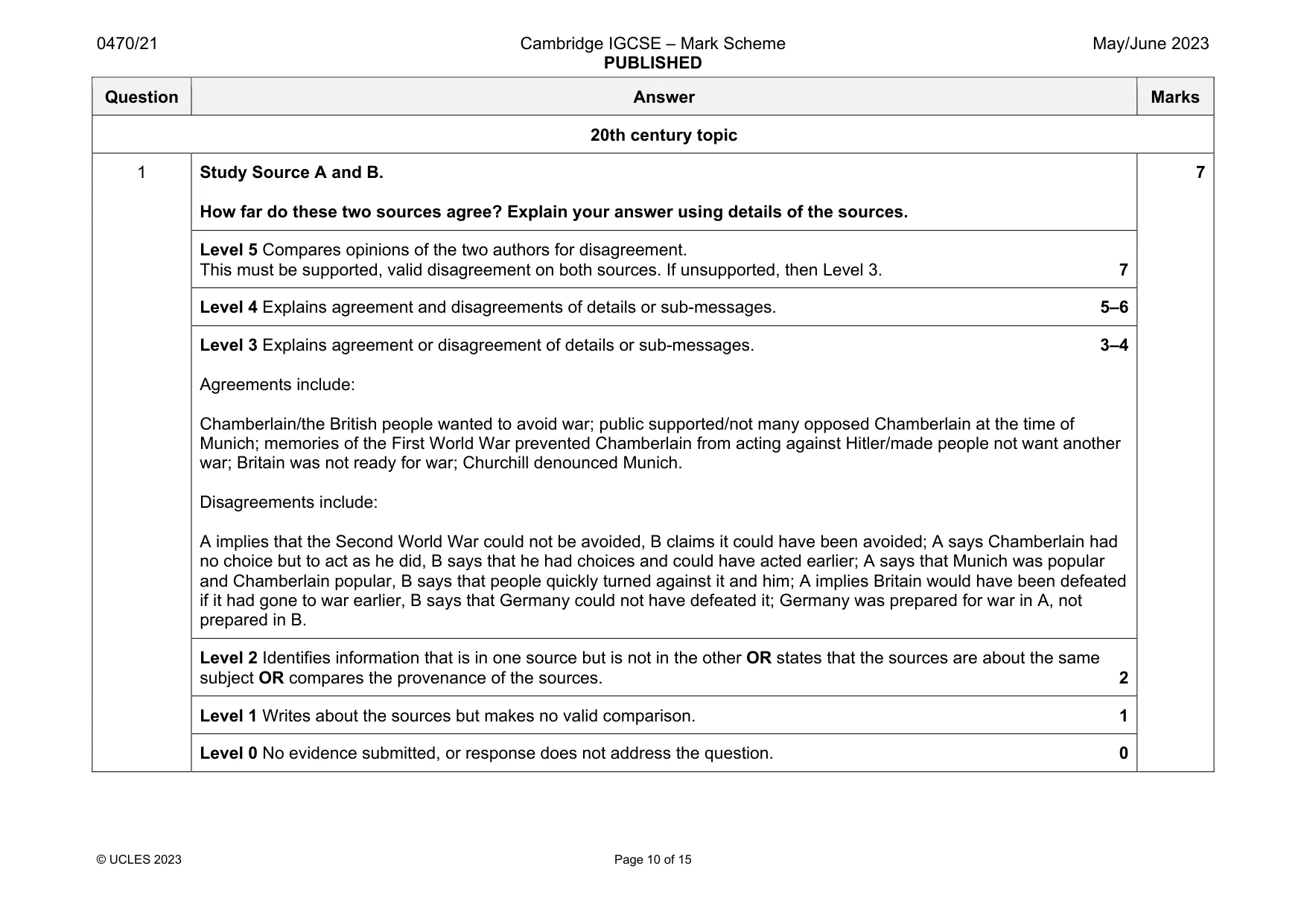
0470/21 Cambridge IGCSE – Mark Scheme PUBLISHED May/June 2023 © UCLES 2023 Page 10 of 15 Question Answer Marks 20th century topic 1 Study Source A and B. How far do these two sources agree? Explain your answer using details of the sources. 7 Level 5 Compares opinions of the two authors for disagreement. This must be supported, valid disagreement on both sources. If unsupported, then Level 3. 7 Level 4 Explains agreement and disagreements of details or sub-messages. 5–6 Level 3 Explains agreement or disagreement of details or sub-messages. 3–4 Agreements include: Chamberlain/the British people wanted to avoid war; public supported/not many opposed Chamberlain at the time of Munich; memories of the First World War prevented Chamberlain from acting against Hitler/made people not want another war; Britain was not ready for war; Churchill denounced Munich. Disagreements include: A implies that the Second World War could not be avoided, B claims it could have been avoided; A says Chamberlain had no choice but to act as he did, B says that he had choices and could have acted earlier; A says that Munich was popular and Chamberlain popular, B says that people quickly turned against it and him; A implies Britain would have been defeated if it had gone to war earlier, B says that Germany could not have defeated it; Germany was prepared for war in A, not prepared in B. Level 2 Identifies information that is in one source but is not in the other OR states that the sources are about the same subject OR compares the provenance of the sources. 2 Level 1 Writes about the sources but makes no valid comparison. 1 Level 0 No evidence submitted, or response does not address the question. 0
Mark scheme, page 11
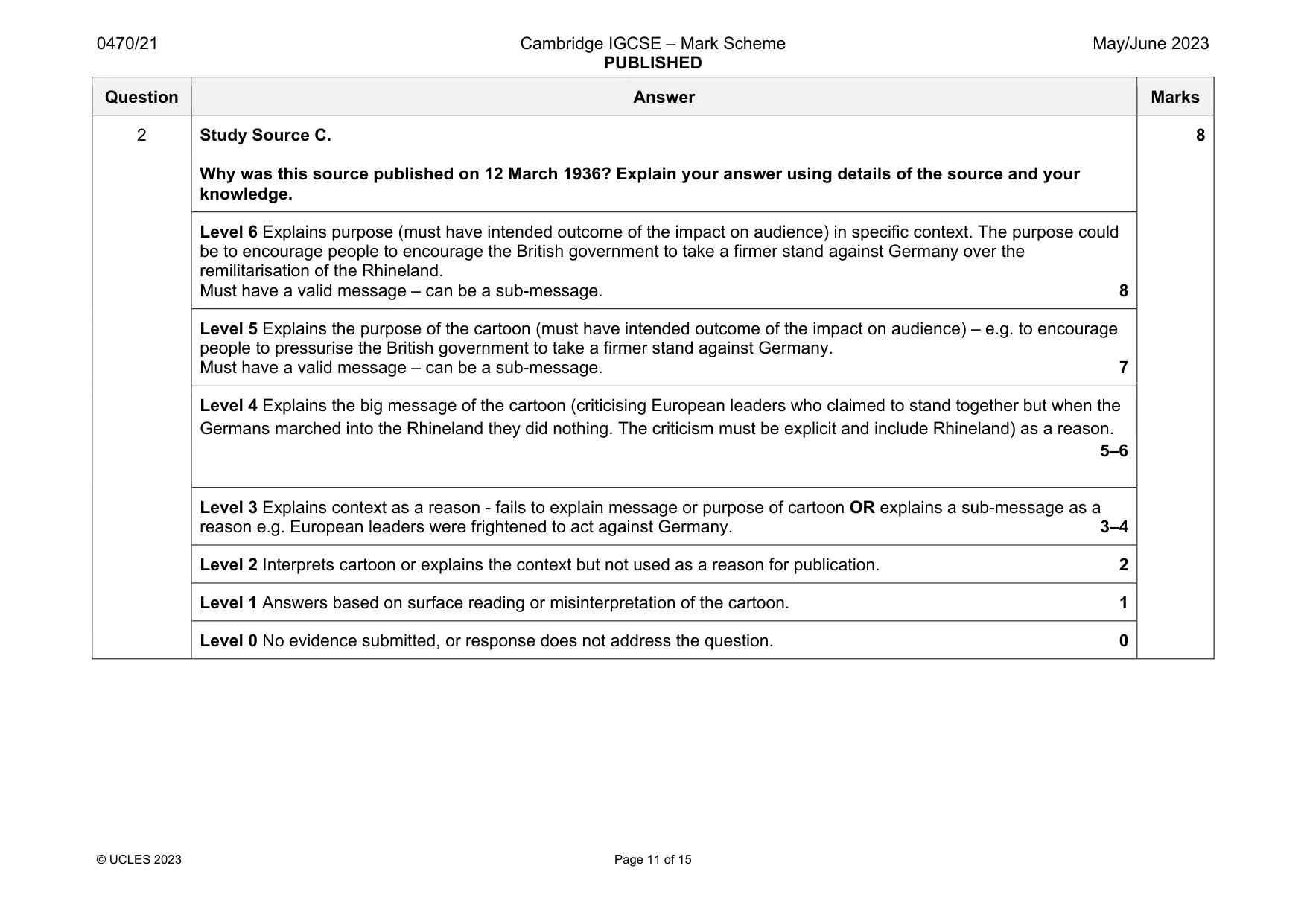
0470/21 Cambridge IGCSE – Mark Scheme PUBLISHED May/June 2023 © UCLES 2023 Page 11 of 15 Question Answer Marks 2 Study Source C. Why was this source published on 12 March 1936? Explain your answer using details of the source and your knowledge. 8 Level 6 Explains purpose (must have intended outcome of the impact on audience) in specific context. The purpose could be to encourage people to encourage the British government to take a firmer stand against Germany over the remilitarisation of the Rhineland. Must have a valid message – can be a sub-message. 8 Level 5 Explains the purpose of the cartoon (must have intended outcome of the impact on audience) – e.g. to encourage people to pressurise the British government to take a firmer stand against Germany. Must have a valid message – can be a sub-message. 7 Level 4 Explains the big message of the cartoon (criticising European leaders who claimed to stand together but when the Germans marched into the Rhineland they did nothing. The criticism must be explicit and include Rhineland) as a reason. 5–6 Level 3 Explains context as a reason - fails to explain message or purpose of cartoon OR explains a sub-message as a reason e.g. European leaders were frightened to act against Germany. 3–4 Level 2 Interprets cartoon or explains the context but not used as a reason for publication. 2 Level 1 Answers based on surface reading or misinterpretation of the cartoon. 1 Level 0 No evidence submitted, or response does not address the question. 0
Mark scheme, page 12
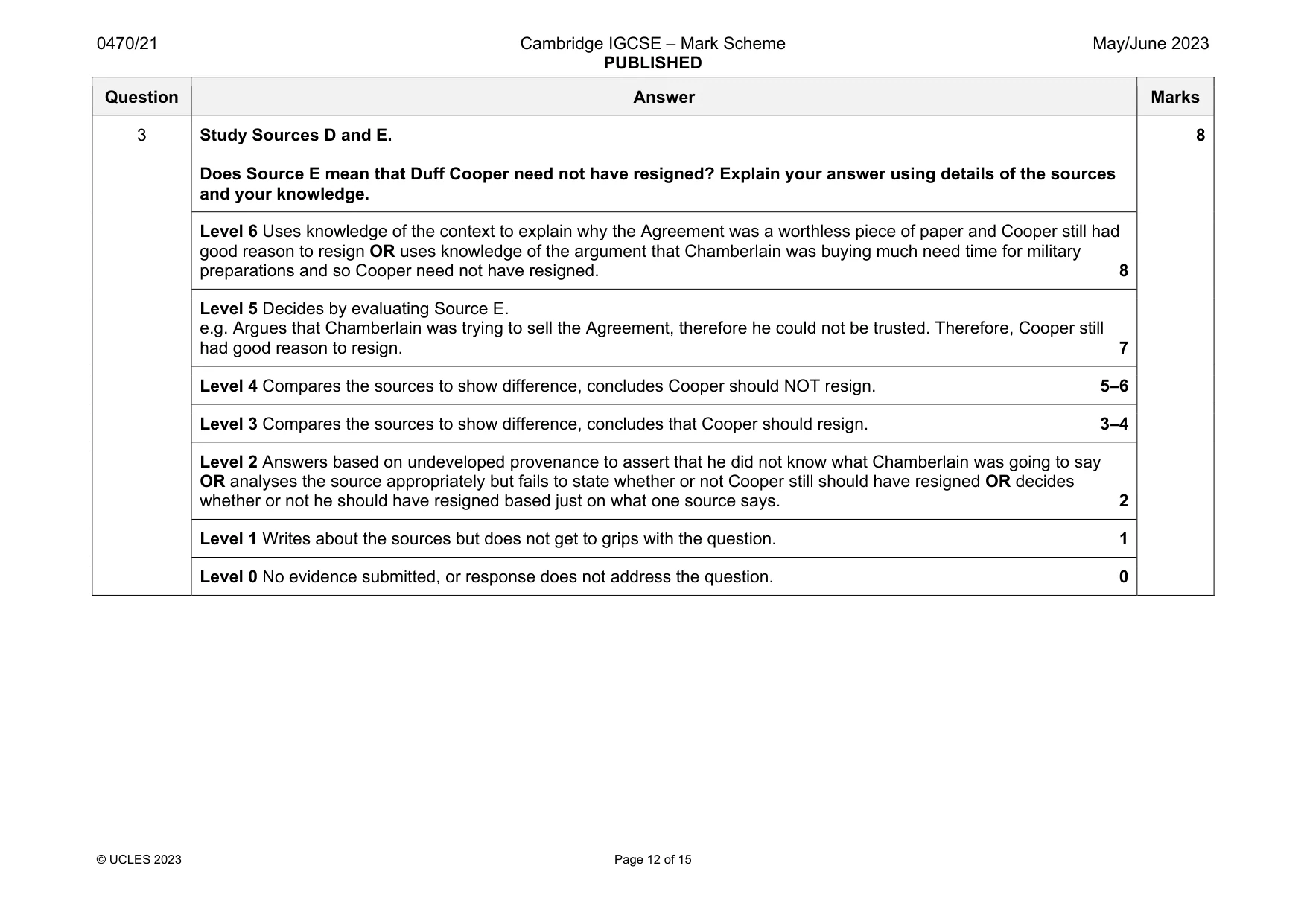
0470/21 Cambridge IGCSE – Mark Scheme PUBLISHED May/June 2023 © UCLES 2023 Page 12 of 15 Question Answer Marks 3 Study Sources D and E. Does Source E mean that Duff Cooper need not have resigned? Explain your answer using details of the sources and your knowledge. 8 Level 6 Uses knowledge of the context to explain why the Agreement was a worthless piece of paper and Cooper still had good reason to resign OR uses knowledge of the argument that Chamberlain was buying much need time for military preparations and so Cooper need not have resigned. 8 Level 5 Decides by evaluating Source E. e.g. Argues that Chamberlain was trying to sell the Agreement, therefore he could not be trusted. Therefore, Cooper still had good reason to resign. 7 Level 4 Compares the sources to show difference, concludes Cooper should NOT resign. 5–6 Level 3 Compares the sources to show difference, concludes that Cooper should resign. 3–4 Level 2 Answers based on undeveloped provenance to assert that he did not know what Chamberlain was going to say OR analyses the source appropriately but fails to state whether or not Cooper still should have resigned OR decides whether or not he should have resigned based just on what one source says. 2 Level 1 Writes about the sources but does not get to grips with the question. 1 Level 0 No evidence submitted, or response does not address the question. 0
Mark scheme, page 13
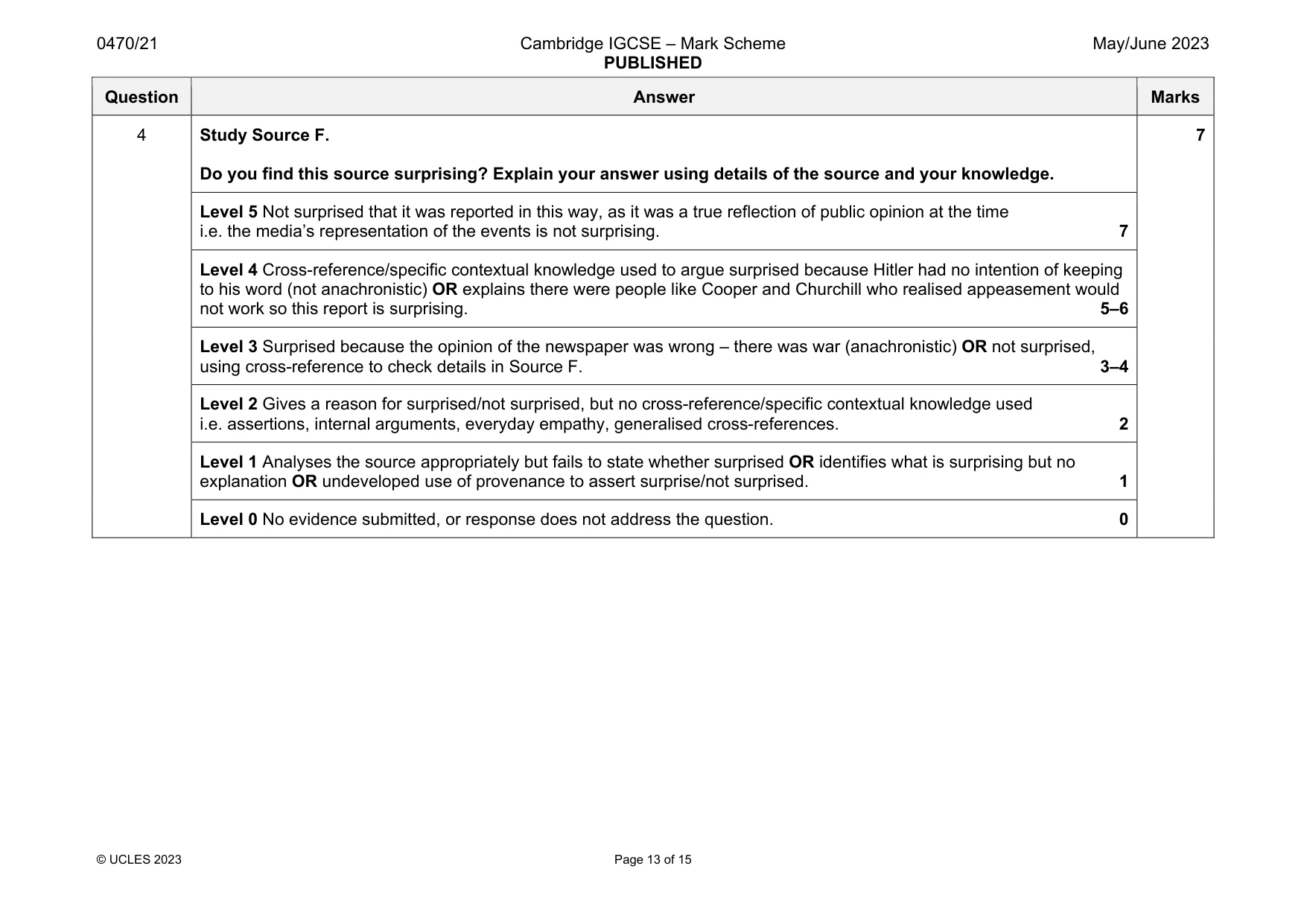
0470/21 Cambridge IGCSE – Mark Scheme PUBLISHED May/June 2023 © UCLES 2023 Page 13 of 15 Question Answer Marks 4 Study Source F. Do you find this source surprising? Explain your answer using details of the source and your knowledge. 7 Level 5 Not surprised that it was reported in this way, as it was a true reflection of public opinion at the time i.e. the media’s representation of the events is not surprising. 7 Level 4 Cross-reference/specific contextual knowledge used to argue surprised because Hitler had no intention of keeping to his word (not anachronistic) OR explains there were people like Cooper and Churchill who realised appeasement would not work so this report is surprising. 5–6 Level 3 Surprised because the opinion of the newspaper was wrong – there was war (anachronistic) OR not surprised, using cross-reference to check details in Source F. 3–4 Level 2 Gives a reason for surprised/not surprised, but no cross-reference/specific contextual knowledge used i.e. assertions, internal arguments, everyday empathy, generalised cross-references. 2 Level 1 Analyses the source appropriately but fails to state whether surprised OR identifies what is surprising but no explanation OR undeveloped use of provenance to assert surprise/not surprised. 1 Level 0 No evidence submitted, or response does not address the question. 0
Mark scheme, page 14
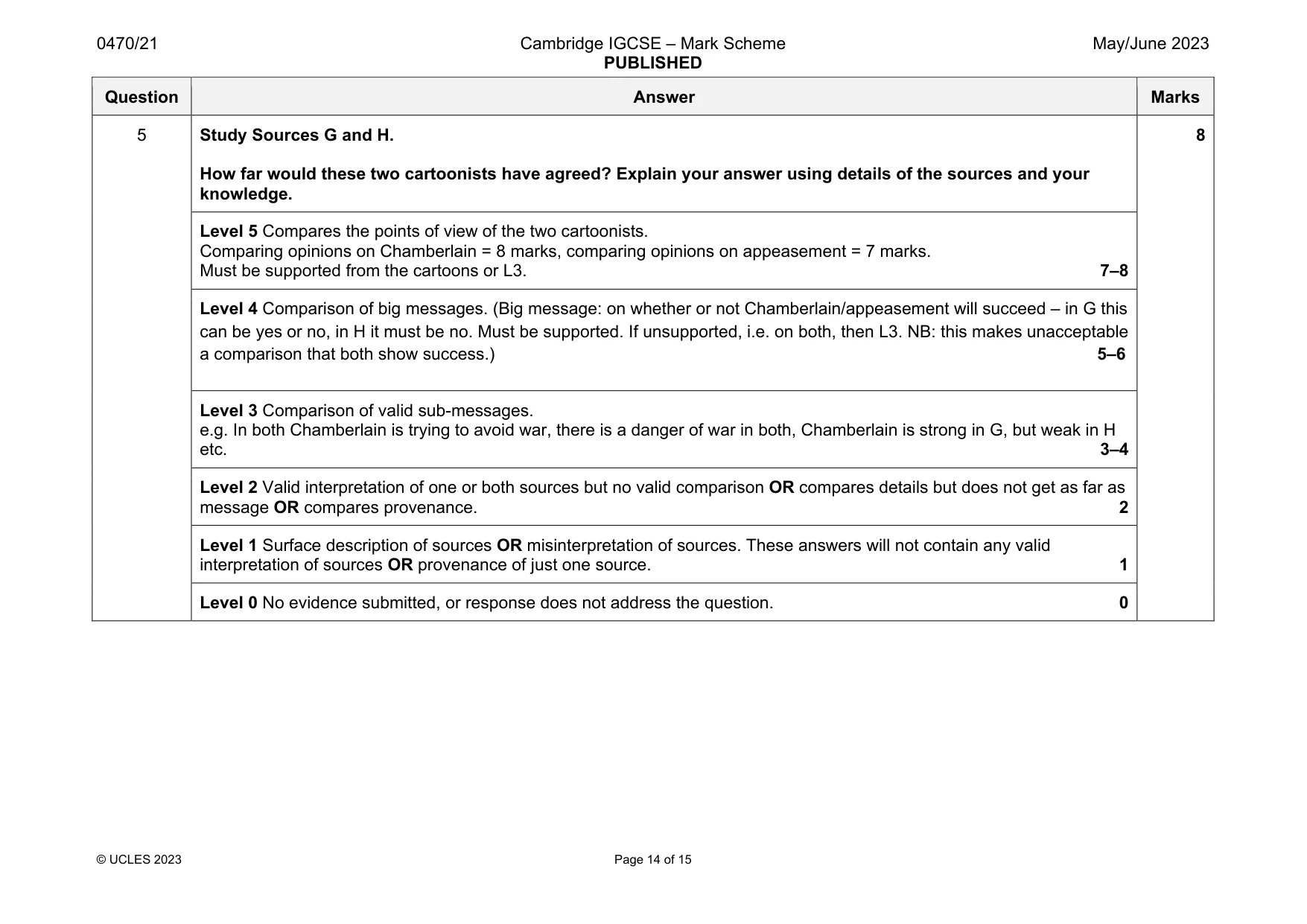
0470/21 Cambridge IGCSE – Mark Scheme PUBLISHED May/June 2023 © UCLES 2023 Page 14 of 15 Question Answer Marks 5 Study Sources G and H. How far would these two cartoonists have agreed? Explain your answer using details of the sources and your knowledge. 8 Level 5 Compares the points of view of the two cartoonists. Comparing opinions on Chamberlain = 8 marks, comparing opinions on appeasement = 7 marks. Must be supported from the cartoons or L3. 7–8 Level 4 Comparison of big messages. (Big message: on whether or not Chamberlain/appeasement will succeed – in G this can be yes or no, in H it must be no. Must be supported. If unsupported, i.e. on both, then L3. NB: this makes unacceptable a comparison that both show success.) 5–6 Level 3 Comparison of valid sub-messages. e.g. In both Chamberlain is trying to avoid war, there is a danger of war in both, Chamberlain is strong in G, but weak in H etc. 3–4 Level 2 Valid interpretation of one or both sources but no valid comparison OR compares details but does not get as far as message OR compares provenance. 2 Level 1 Surface description of sources OR misinterpretation of sources. These answers will not contain any valid interpretation of sources OR provenance of just one source. 1 Level 0 No evidence submitted, or response does not address the question. 0
Mark scheme, page 15
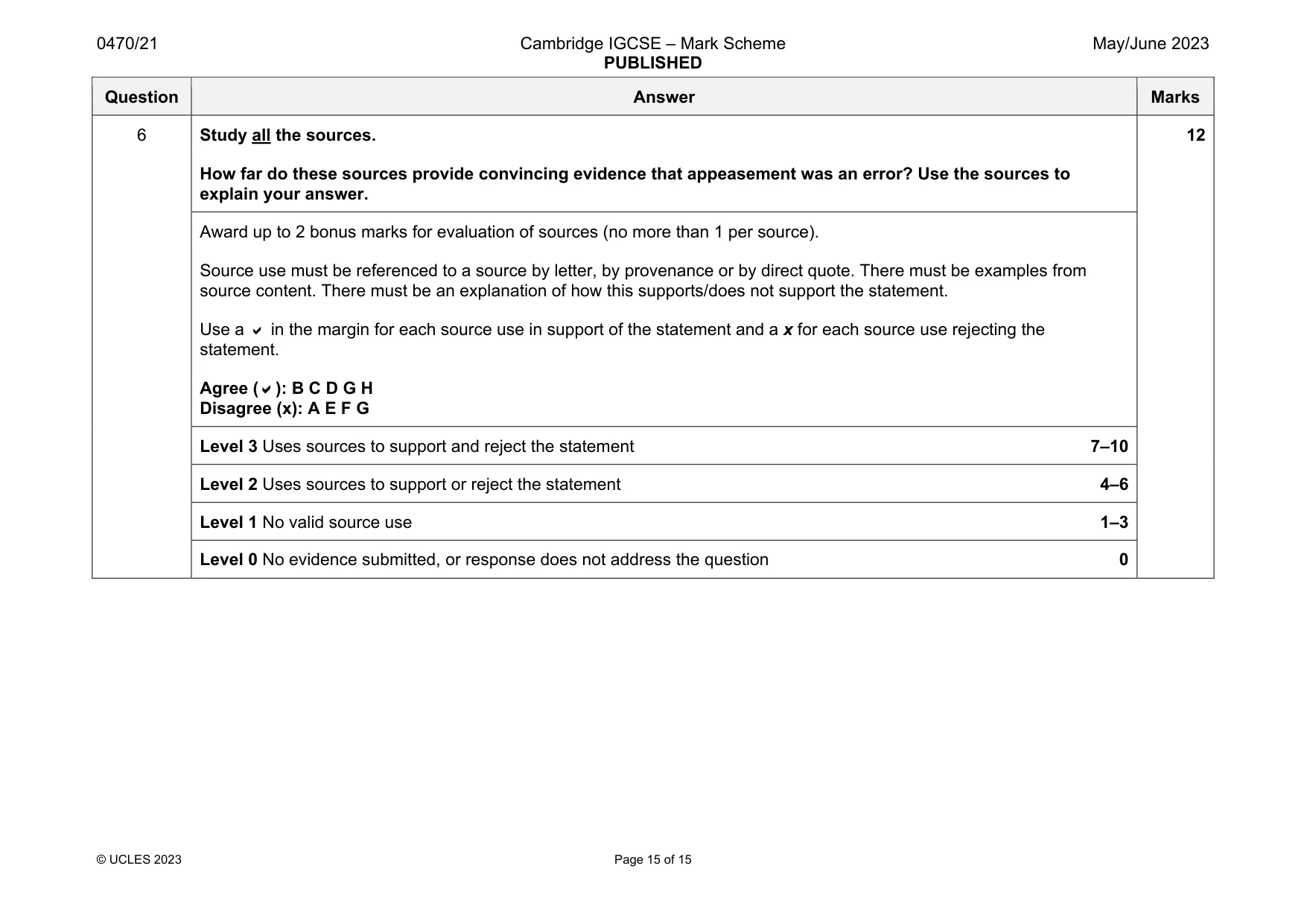
0470/21 Cambridge IGCSE – Mark Scheme PUBLISHED May/June 2023 © UCLES 2023 Page 15 of 15 Question Answer Marks 6 Study all the sources. How far do these sources provide convincing evidence that appeasement was an error? Use the sources to explain your answer. 12 Award up to 2 bonus marks for evaluation of sources (no more than 1 per source). Source use must be referenced to a source by letter, by provenance or by direct quote. There must be examples from source content. There must be an explanation of how this supports/does not support the statement. Use a in the margin for each source use in support of the statement and a x for each source use rejecting the statement. Agree (): B C D G H Disagree (x): A E F G Level 3 Uses sources to support and reject the statement 7–10 Level 2 Uses sources to support or reject the statement 4–6 Level 1 No valid source use 1–3 Level 0 No evidence submitted, or response does not address the question 0
What you needed in this session
Cambridge’s own grade thresholds for 2023 May/June, Paper 2 · Variant 1. A higher threshold means an easier paper — the bar moves with how the cohort did.