Cambridge IGCSE History 0470 — 2022 May/June Paper 2 · Variant 1
0470/21/M/J/22 · 50 marks · ≈56 min
The question paper and its mark scheme, free to read here and free to download. This is Cambridge’s own paper, exactly as it was sat.
Question paper12 pages



Mark scheme10 pages
Answers below. Sit the paper first if you are practising.
Paper as text
Question paper, page 1
This document has 12 pages. Any blank pages are indicated. [Turn over DC (JP/CT) 304185/2 © UCLES 2022 * 7 8 6 3 3 1 7 6 2 5 * Cambridge IGCSE™ HISTORY 0470/21 Paper 2 May/June 2022 2 hours You must answer on the enclosed answer booklet. You will need: Answer booklet (enclosed) INSTRUCTIONS ● Answer all the questions on one option only. Option A: Nineteenth century topic Option B: Twentieth century topic ● Follow the instructions on the front cover of the answer booklet. If you need additional answer paper, ask the invigilator for a continuation booklet. INFORMATION ● The total mark for this paper is 50. ● The number of marks for each question or part question is shown in brackets [ ].
Question paper, page 2
2 0470/21/M/J/22 © UCLES 2022 Option A: Nineteenth century topic WAS THE KU KLUX KLAN’S MAIN PURPOSE TO DEFEAT THE REPUBLICAN PARTY? Study the Background Information and the sources carefully, and then answer all the questions. Background Information There has been much discussion of the main aims of the Ku Klux Klan. Some contemporaries and historians have emphasised that it wanted to intimidate voters who supported the Republican Party. It wanted to defeat the Republicans in elections and achieve conservative Democratic control of the southern states. However, few Democrats were willing to admit the Klan’s political character and purpose. Others have argued that its main aim was to oppose Reconstruction and that it was a reaction to poor government, crime and chaos during that period. Some have suggested that the emergence of the Klan was based on a deep fear of black people and their newly gained rights. They have pointed to a desire to destroy the cultural, economic and social independence that ex-slaves had gained with emancipation. How far was the Ku Klux Klan’s main purpose a party political one – to defeat Republicans? SOURCE A In 1866 General Nathan Bedford Forrest founded the Ku Klux Klan in Tennessee as a ‘social club’. By 1868 it had evolved into a hooded terrorist organisation that its members called ‘The Invisible Empire of the South’. Forrest was its first leader or ‘Grand Wizard’. White Southerners from all classes joined the Klan’s ranks. In the name of preserving law and order in a white-dominated society, Klansmen punished newly freed ex-slaves for a variety of reasons, including behaving in an ‘impudent’ manner towards white people. They whipped the teachers of freedmen’s schools and burnt their schoolhouses. But first and foremost, the Klan sought to do away with Republican influence in the South by terrorising and murdering its party leaders and all those who voted for it. In the time leading up to the 1868 presidential election, the Klan’s activities picked up in speed and brutality. In 1871 Congress passed the Ku Klux Klan Act, which allowed the government to act against terrorist organisations. But with the overwhelming support for the Klan in the South, convictions were difficult to obtain. From a recent history book. SOURCE B The Klan, a white supremacist group, was founded by Confederate army veterans in Pulaski, Tennessee in December 1865. Dressed up in scary costumes with hoods, they rode about at night threatening and frightening black people. They demanded that black people either vote Democrat or not at all. The Klan loved weird titles, and a former Confederate general, Nathan Bedford Forrest, is said to have been for a time the Klan’s leader as Grand Wizard. The Klan’s main aim was to keep black people down and white supremacy intact, and it committed dreadful crimes against them. It also worked to restrict the black labouring class by attacking their attempts to be economically independent. Any white people who purchased cotton from black farmers were threatened, beaten and killed. Black churches, as well as schools established by the Freedmen’s Bureau, were also attacked. The Klan faded away in the 1870s after the federal government had taken action. From a recent history book.
Question paper, page 3
3 0470/21/M/J/22 © UCLES 2022 [Turn over SOURCE C A cartoon that appeared in the Independent Monitor newspaper of Tuscaloosa, Alabama, 1 September 1868. The caption read, ‘Hang dogs hang! Stand fast, to their hanging! The above represents the fate in store for those great pests of Southern society – the carpet-bagger and the scalawag – if found in Dixie’s land after the break of day on 4th of March.’ 4 March 1869 was the day Democrats hoped Horatio Seymour would become President. Dixie was a nickname for the South. SOURCE D The main cause of the existence of the Ku Klux Klan is the Union Leagues. These were composed of black men, with a sprinkling of white people. They had political and criminal aims. They were organised for the purpose of committing crimes upon white people. During the process of Reconstruction there were no courts in the State of Alabama. Everything was chaotic. The Ku Klux Klan was organised to counteract the aims and acts of the Union Leagues, and to punish crime where the laws failed to provide justice. Under the Reconstruction measures there were a great many men who were not capable of being judges or prosecutors. They were unfit to administer the laws. R B Lindsay, Governor of Alabama, giving evidence to a Congressional Committee investigating the Ku Klux Klan, 1871. Lindsay was a Democrat. Union Leagues were men’s clubs set up to promote loyalty to the Union and support the Republican Party. SOURCE E There were numerous organisations of the Democratic Party known as the Ku Klux Klans whose aims were to intimidate Republicans and prevent them from voting. These organisations were armed and patrolled night and day, committing murders and outrages on Republicans. They produced such terror among freedmen and others belonging to the Republican Party that it was unsafe to hold meetings. A great many freedmen who desired to vote Republican were forced to vote Democrat by violence, fraud and intimidation. A Republican supporter giving evidence to a Congressional Committee investigating the Ku Klux Klan, 1871.
Question paper, page 4
4 0470/21/M/J/22 © UCLES 2022 SOURCE F A cartoon published in an American magazine, October 1874. SOURCE G CHARACTER AND AIMS OF THE ORDER This is an institution of Chivalry, Humanity, Mercy and Patriotism. To protect the weak, the innocent and the defenceless, from the wrongs and outrages of the lawless, the violent and the brutal. Questions to be asked of candidates wanting to join the Ku Klux Klan. Did you belong to the Federal Army during the late war? Are you opposed to black equality? Are you in favour of a white man’s government in this country? Are you in favour of Constitutional liberty, and a government of fair laws instead of violence and oppression? Are you in favour of the return of the Southern people to all their rights, civil and political? From the ‘Organisation and Principles of the Ku Klux Klan’, 1868.
Question paper, page 5
5 0470/21/M/J/22 © UCLES 2022 [Turn over SOURCE H The Klan came to my brother’s door and spoke in an outlandish tone, which I had heard they generally used at a black man’s house. They said, ‘Where’s Elias?’ My brother’s wife said, ‘He lives across the yard.’ They carried me into the yard and said, ‘Who burned our houses?’ I told them it was not me. I could not burn houses. They said, ‘Haven’t you been preaching against the Ku Klux? Doesn’t a Republican Party newspaper come to your house?’ One had a horsewhip and he struck me eight times on my hip bone. One of them took a strap and buckled it around my neck and said, ‘Let’s take him to the river and drown him.’ One of them told my sister-in-law to pick me up. As she stooped down one of them struck her with a strap. Then they said, ‘Will you put a card in the paper to renounce all republicanism?’ They said if I did not they would come back the next week and kill me. Evidence given by Elias Hill to a committee of the Senate that was investigating the situation in North Carolina, 1871. Hill was an ex-slave and was crippled in both legs and arms. He taught black children to read and write and was a leading figure in the local black community. Now answer all the following questions. You may use any of the sources to help you answer the questions, in addition to those sources which you are told to use. In answering the questions you should use your knowledge of the topic to help you interpret and evaluate the sources. 1 Study Sources A and B. How far do these two sources agree? Explain your answer using details of the sources. [7] 2 Study Source C. Why was this cartoon published in 1868? Explain your answer using details of the source and your knowledge. [8] 3 Study Sources D and E. Does Source D mean that Source E cannot be believed? Explain your answer using details of the sources and your knowledge. [8] 4 Study Source F. What is the cartoonist’s message? Explain your answer using details of the source and your knowledge. [8] 5 Study Sources G and H. Does Source G make Source H surprising? Explain your answer using details of the sources and your knowledge. [7] 6 Study all the sources. How far do these sources provide convincing evidence that the Ku Klux Klan’s main purpose was to ensure the defeat of the Republicans? Use the sources to explain your answer. [12]
Question paper, page 6
6 0470/21/M/J/22 © UCLES 2022 Option B: Twentieth century topic COULD THE SOVIET UNION RELY ON THE POLISH AUTHORITIES TO DEAL WITH THE PROTESTS AND STRIKES IN 1980-81? Study the Background Information and the sources carefully, and then answer all the questions. Background Information When the Solidarity movement emerged in Poland from the strikes and protests of 1980, the Soviet Union had to decide whether or not to intervene. On previous occasions, such as the Hungarian Revolution of 1956 and the Prague Spring in 1968, the Soviet Union had used armed forces. The Soviet Union clearly wanted Solidarity to be suppressed, but could it depend on the Polish leadership to do this? In September 1980, Edward Gierek was replaced as leader of Poland by Stanislaw Kania. However, under pressure from the Soviet Union, Kania was replaced by General Jaruzelski in October 1981. All three leaders promised to deal with Poland’s problems and to suppress the protests. Could the Soviet Union rely on the Polish leadership to deal with the situation? SOURCE A The Soviet Union is postponing as long as possible the agonising decision of whether or not to invade Poland. To disguise their dilemma, however, the Soviets are stepping up the psychological pressure on Poland. Parallels between Poland in 1981 and Czechoslovakia in 1968 were drawn this week by Brezhnev. The military preparations have included mobilisation of Warsaw Pact forces on the Polish borders and three-week-long Warsaw Pact manoeuvres in and around Poland. Meanwhile, Soviet diplomatic moves toward the West include the first indication of an interest in reductions in medium-range weapons. This can be interpreted in different ways. The Soviets may be hiding their true intent of invading Poland behind a false arms-control smoke screen. The Kremlin failed to stem democratisation in Poland last September. Since then Solidarity has become a mass patriotic movement. The hard-line Polish Communists, whom Moscow might have used, have become demoralised. The Soviet Union cannot now depend on the Polish security forces and Army to suppress a Polish strike but would have to do the job itself. From an article by an American journalist, 8 April 1981. SOURCE B We asked Kania whether the Party had a plan for an emergency situation in which an open threat would arise to the people’s rule. He said that there is such a plan, and that they know who should be arrested and how to use the army. We achieved complete understanding in evaluating the reasons for the crisis and the seriousness of the counter-revolutionary threat. Kania carefully took down everything we said. As far as Kania is concerned, he made a good impression on me and on other comrades who took part in the negotiations. He is a serious and thoughtful person. It’s clear that he is a good political leader; we will judge him only by his deeds. Brezhnev reporting to the Soviet Politburo about a meeting with the Polish leadership, 31 October 1980. The Politburo was the main policy-making body in the Soviet Union.
Question paper, page 7
7 0470/21/M/J/22 © UCLES 2022 [Turn over SOURCE C For a long time developments in Poland have caused anxiety and concern. Kania has failed to take measures. When he took office we emphasised that it was necessary to launch a decisive attack on counter-revolution. He agreed but then followed a policy of compromise. Kania has been the main hindrance in the struggle for socialism. The question arose of restoring the leadership to a sound position. The Poles put forward Jaruzelski. Change in the leadership is a positive fact. The Party approved the actions of the Politburo relating to the crisis in Poland. An evaluation of the situation in Poland by Brezhnev, given to the Congress of the Soviet Communist Party, October 1981. SOURCE D Citizens of the People’s Republic of Poland! Today I address myself to you as a soldier and as the head of the Polish government. I address you concerning extraordinarily important questions. Our homeland is on the verge of collapse. The state structures no longer work. Our struggling economy is given more shocks every day. Strikes and protests have become normal. It cannot be said that we didn’t show moderation and patience – sometimes too much. We created a chance to deepen the system of democracy and to widen the reforms but there was no leadership from Solidarity. Party members, you must oppose propaganda which states that martial law was imposed from the outside. This offends us. We made this decision, we accomplished it, and we are responsible for it. Jaruzelski speaking on state radio and TV in the morning of 13 December 1981. SOURCE E A cartoon published in Britain, 14 December 1981. It shows Walesa, leader of Solidarity.
Question paper, page 8
8 0470/21/M/J/22 © UCLES 2022 SOURCE F Martial law in Poland has lasted a month. As Jaruzelski says, the counter-revolution is now crushed. Relative stability has been introduced into the country. Jaruzelski can now take advantage of martial law to carry out a sweeping purge of the Polish Communist Party. This might yield good results. One gets the impression that Jaruzelski is very strong and is able, on most occasions, to find proper solutions. It is good that he is studying the Hungarian experience in struggling against counter-revolution. Brezhnev speaking at a meeting of the Soviet Politburo, 14 January 1982. SOURCE G A cartoon published in the USA, 1982. The figure in the cartoon is Jaruzelski.
Question paper, page 9
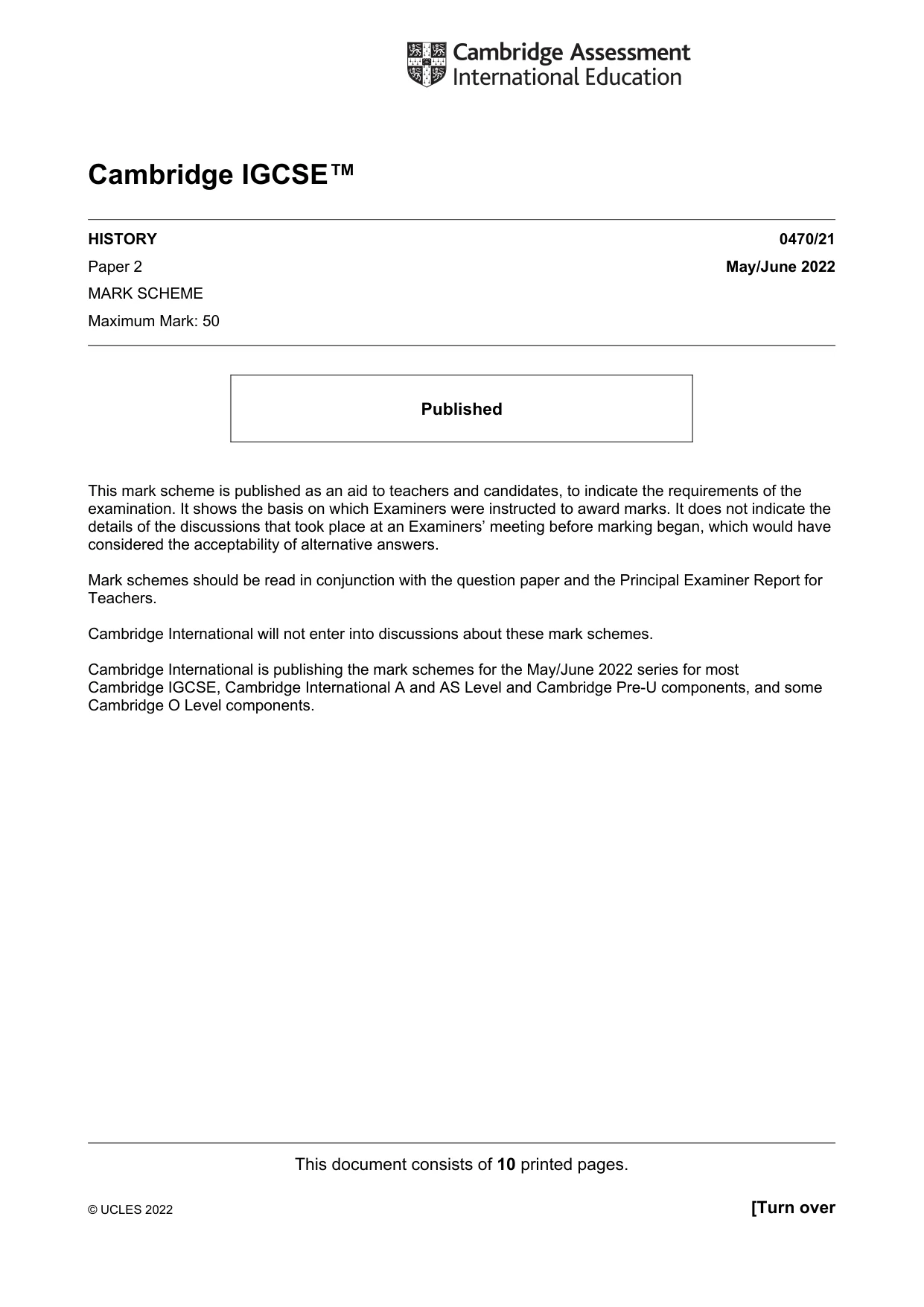
9 0470/21/M/J/22 © UCLES 2022 Now answer all the following questions. You may use any of the sources to help you answer the questions, in addition to those sources which you are told to use. In answering the questions you should use your knowledge of the topic to help you interpret and evaluate the sources. 1 Study Source A. What impressions does this source give of the Soviets? Explain your answer using details of the source. [7] 2 Study Sources B and C. Does Source B make Source C surprising? Explain your answer using details of the sources and your knowledge. [8] 3 Study Source D. Why did Jaruzelski make this speech in December 1981? Explain your answer using details of the source and your knowledge. [8] 4 Study Source E. What is the cartoonist’s message? Explain your answer using details of the source and your knowledge. [8] 5 Study Sources F and G. How far does Source G prove that Brezhnev (Source F) was right? Explain your answer using details of the sources and your knowledge. [7] 6 Study all the sources. How far do these sources provide convincing evidence that the Polish leadership was able to deal with the problems in Poland? Use the sources to explain your answer. [12]
Question paper, page 10
10 0470/21/M/J/22 © UCLES 2022 BLANK PAGE
Question paper, page 11
11 0470/21/M/J/22 © UCLES 2022 BLANK PAGE
Question paper, page 12
12 0470/21/M/J/22 © UCLES 2022 Permission to reproduce items where third-party owned material protected by copyright is included has been sought and cleared where possible. Every reasonable effort has been made by the publisher (UCLES) to trace copyright holders, but if any items requiring clearance have unwittingly been included, the publisher will be pleased to make amends at the earliest possible opportunity. To avoid the issue of disclosure of answer-related information to candidates, all copyright acknowledgements are reproduced online in the Cambridge Assessment International Education Copyright Acknowledgements Booklet. This is produced for each series of examinations and is freely available to download at www.cambridgeinternational.org after the live examination series. Cambridge Assessment International Education is part of Cambridge Assessment. Cambridge Assessment is the brand name of the University of Cambridge Local Examinations Syndicate (UCLES), which is a department of the University of Cambridge. BLANK PAGE
Mark scheme, page 1
This document consists of 10 printed pages. © UCLES 2022 [Turn over Cambridge IGCSE™ HISTORY 0470/21 Paper 2 May/June 2022 MARK SCHEME Maximum Mark: 50 Published This mark scheme is published as an aid to teachers and candidates, to indicate the requirements of the examination. It shows the basis on which Examiners were instructed to award marks. It does not indicate the details of the discussions that took place at an Examiners’ meeting before marking began, which would have considered the acceptability of alternative answers. Mark schemes should be read in conjunction with the question paper and the Principal Examiner Report for Teachers. Cambridge International will not enter into discussions about these mark schemes. Cambridge International is publishing the mark schemes for the May/June 2022 series for most Cambridge IGCSE, Cambridge International A and AS Level and Cambridge Pre-U components, and some Cambridge O Level components.
Mark scheme, page 2
0470/21 Cambridge IGCSE – Mark Scheme PUBLISHED May/June 2022 © UCLES 2022 Page 2 of 10 Generic Marking Principles These general marking principles must be applied by all examiners when marking candidate answers. They should be applied alongside the specific content of the mark scheme or generic level descriptors for a question. Each question paper and mark scheme will also comply with these marking principles. GENERIC MARKING PRINCIPLE 1: Marks must be awarded in line with: the specific content of the mark scheme or the generic level descriptors for the question the specific skills defined in the mark scheme or in the generic level descriptors for the question the standard of response required by a candidate as exemplified by the standardisation scripts. GENERIC MARKING PRINCIPLE 2: Marks awarded are always whole marks (not half marks, or other fractions). GENERIC MARKING PRINCIPLE 3: Marks must be awarded positively: marks are awarded for correct/valid answers, as defined in the mark scheme. However, credit is given for valid answers which go beyond the scope of the syllabus and mark scheme, referring to your Team Leader as appropriate marks are awarded when candidates clearly demonstrate what they know and can do marks are not deducted for errors marks are not deducted for omissions answers should only be judged on the quality of spelling, punctuation and grammar when these features are specifically assessed by the question as indicated by the mark scheme. The meaning, however, should be unambiguous. GENERIC MARKING PRINCIPLE 4: Rules must be applied consistently, e.g. in situations where candidates have not followed instructions or in the application of generic level descriptors. GENERIC MARKING PRINCIPLE 5: Marks should be awarded using the full range of marks defined in the mark scheme for the question (however; the use of the full mark range may be limited according to the quality of the candidate responses seen). GENERIC MARKING PRINCIPLE 6: Marks awarded are based solely on the requirements as defined in the mark scheme. Marks should not be awarded with grade thresholds or grade descriptors in mind.
Mark scheme, page 3
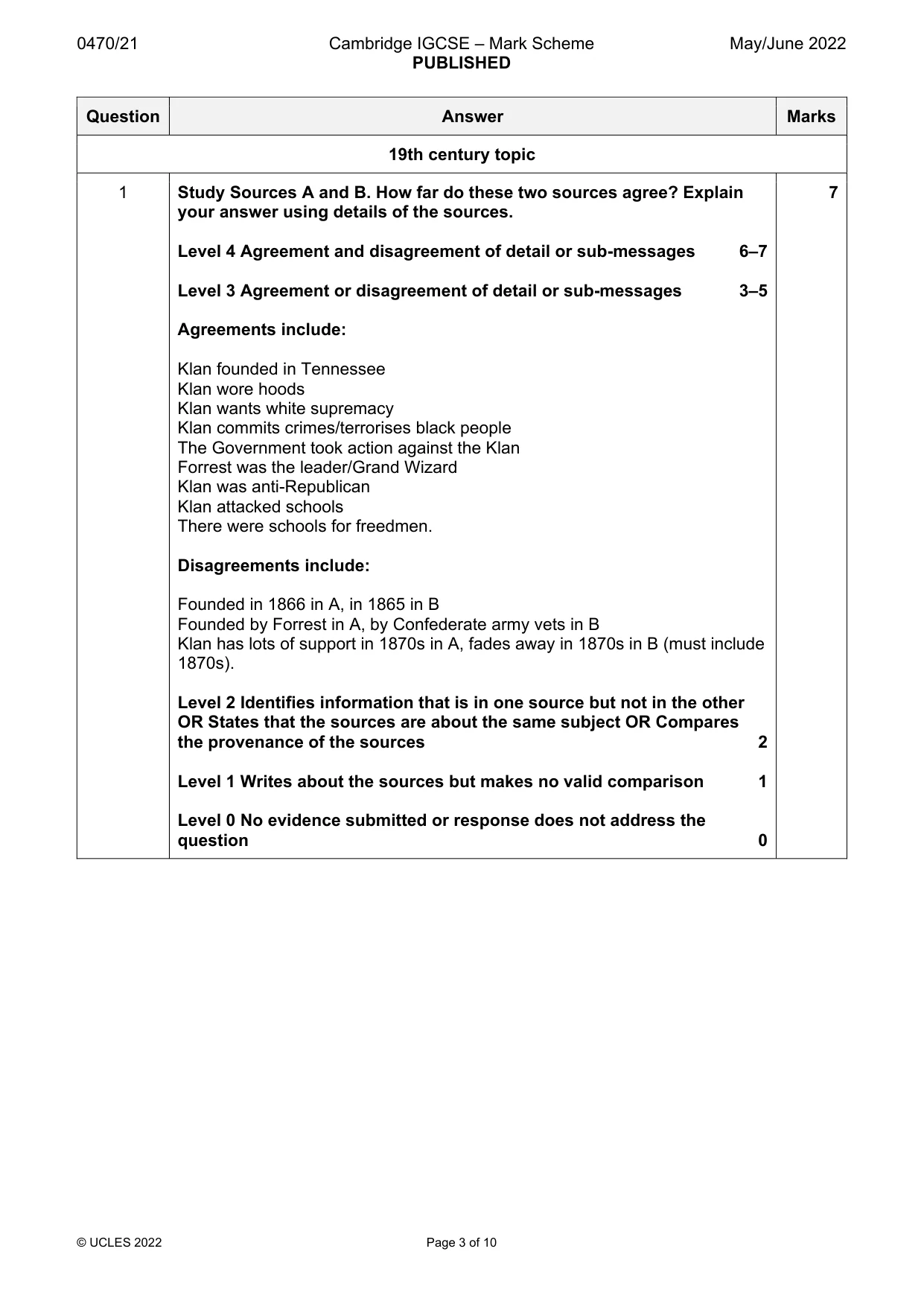
0470/21 Cambridge IGCSE – Mark Scheme PUBLISHED May/June 2022 © UCLES 2022 Page 3 of 10 Question Answer Marks 19th century topic 1 Study Sources A and B. How far do these two sources agree? Explain your answer using details of the sources. Level 4 Agreement and disagreement of detail or sub-messages 6–7 Level 3 Agreement or disagreement of detail or sub-messages 3–5 Agreements include: Klan founded in Tennessee Klan wore hoods Klan wants white supremacy Klan commits crimes/terrorises black people The Government took action against the Klan Forrest was the leader/Grand Wizard Klan was anti-Republican Klan attacked schools There were schools for freedmen. Disagreements include: Founded in 1866 in A, in 1865 in B Founded by Forrest in A, by Confederate army vets in B Klan has lots of support in 1870s in A, fades away in 1870s in B (must include 1870s). Level 2 Identifies information that is in one source but not in the other OR States that the sources are about the same subject OR Compares the provenance of the sources 2 Level 1 Writes about the sources but makes no valid comparison 1 Level 0 No evidence submitted or response does not address the question 0 7
Mark scheme, page 4
0470/21 Cambridge IGCSE – Mark Scheme PUBLISHED May/June 2022 © UCLES 2022 Page 4 of 10 Question Answer Marks 2 Study Source C. Why was this cartoon published in 1868? Explain your answer using details of the source and your knowledge. Level 7 Explains purpose in context of 1868 8 Context must be the presidential election of 1868. Level 6 Explains the purpose of the author 7 (Must have intended impact on audience) Level 5 To threaten an appropriate target group that something nasty will happen to them. 6 Must have threat and group that is targeted. Level 4 Explains sub-message(s) as reason for publication 4–5 Level 3 Explains the context of 1868 as the reason for publication OR undeveloped statement on threat/purpose 3 Level 2 Conveying information in the source given as reason for publication or describes the context but not used as reason for publication 2 Level 1 Description of the source 1 Level 0 No evidence submitted or response does not address the question 0 8 Question Answer Marks 3 Study Sources D and E. Does Source D mean that Source E cannot be believed? Explain your answer using details of the sources and your knowledge. Level 6 Compares the sources and evaluates one of them 7–8 Level 5 Evaluates E but no valid use of D 6 Level 4 Answers based on disagreements 4–5 i.e. based on favourable view of the Klan in D, critical view of the Klan in E. Level 3 Answers based on agreements 3 e.g. No, it can be believed because in both they show there was disorder and violence. Level 2 Answers based on undeveloped provenance 2 Level 1 Writes about the sources but does not address the question 1 Level 0 No evidence submitted or response does not address the question 0 8
Mark scheme, page 5
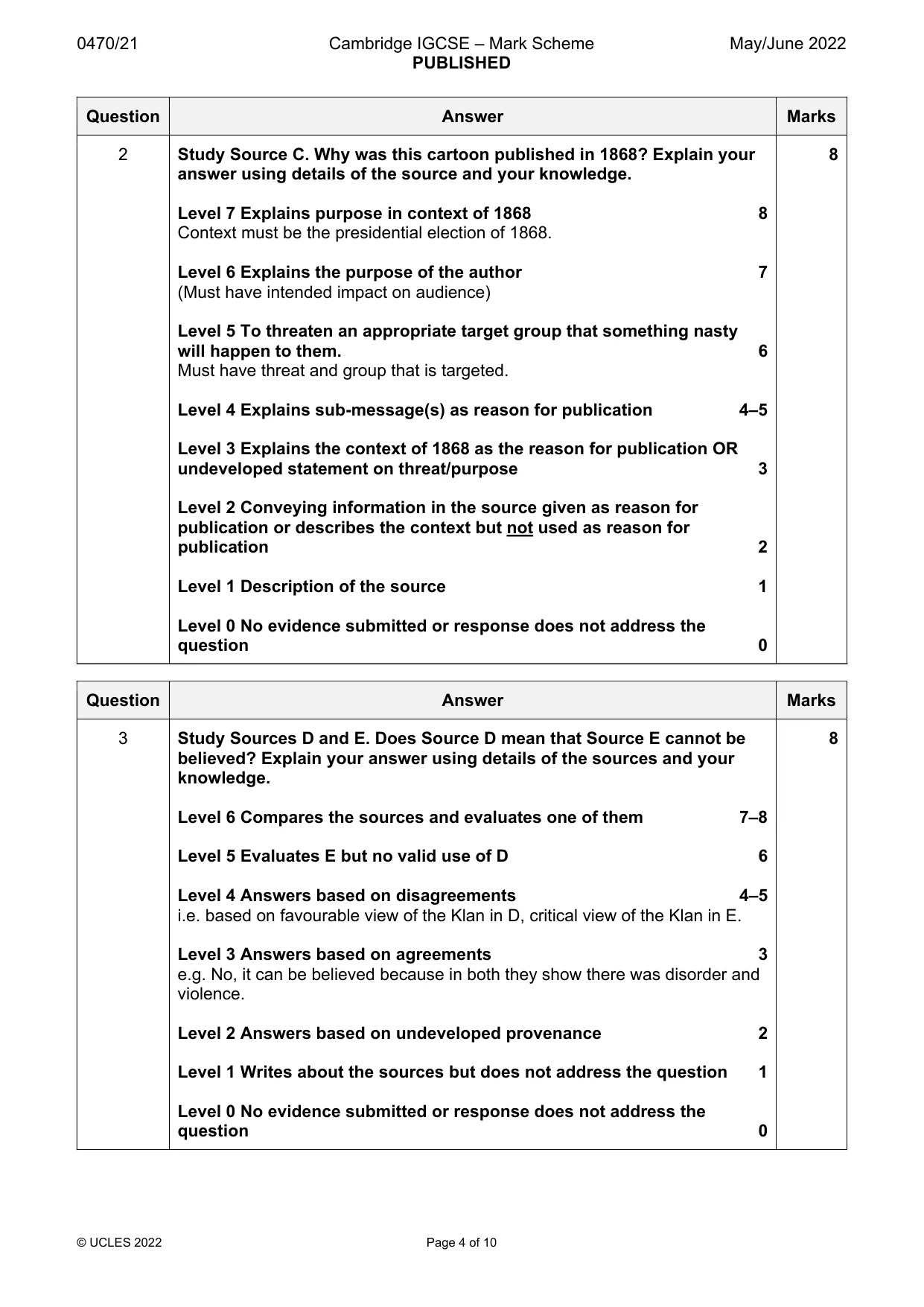
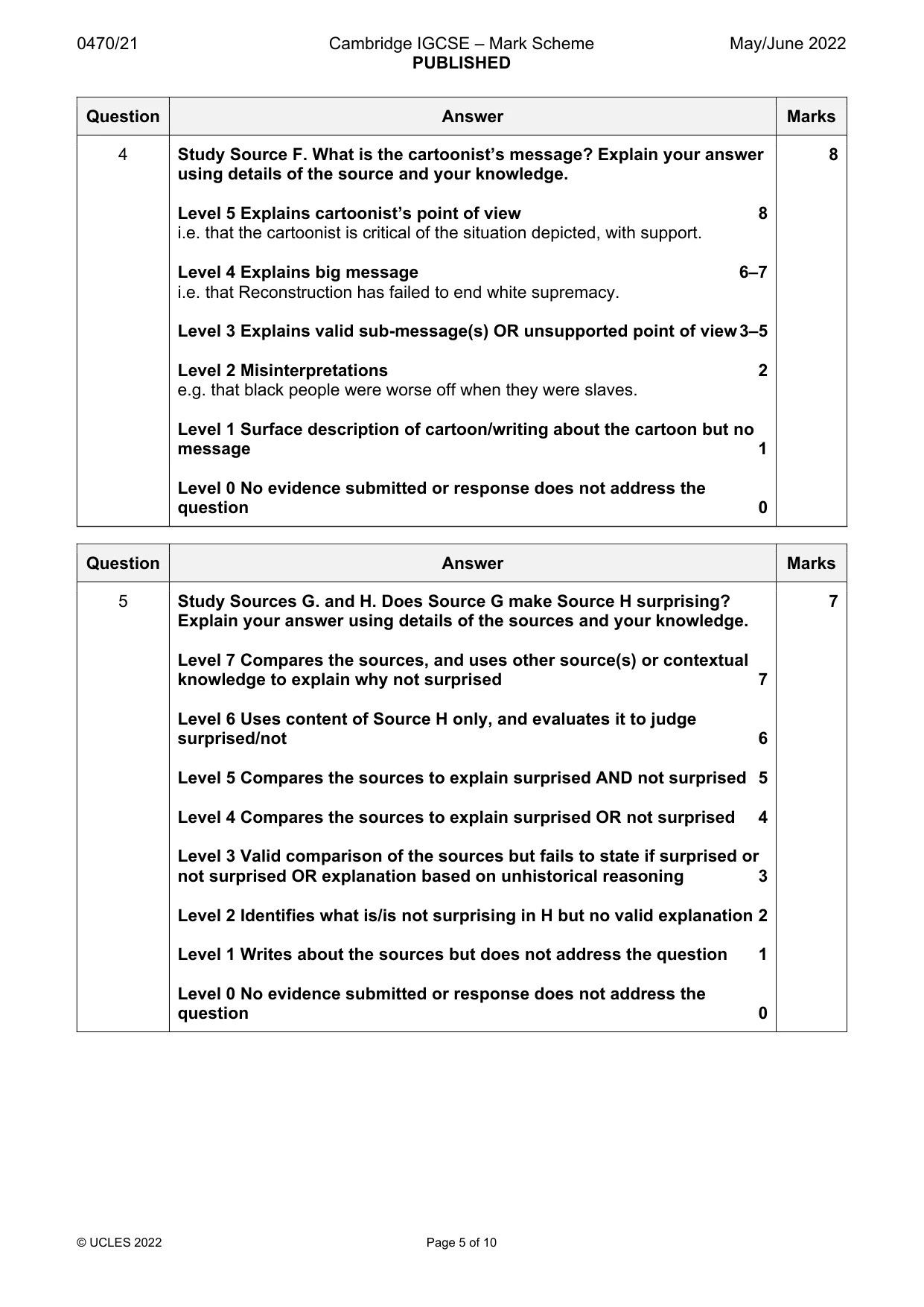
0470/21 Cambridge IGCSE – Mark Scheme PUBLISHED May/June 2022 © UCLES 2022 Page 5 of 10 Question Answer Marks 4 Study Source F. What is the cartoonist’s message? Explain your answer using details of the source and your knowledge. Level 5 Explains cartoonist’s point of view 8 i.e. that the cartoonist is critical of the situation depicted, with support. Level 4 Explains big message 6–7 i.e. that Reconstruction has failed to end white supremacy. Level 3 Explains valid sub-message(s) OR unsupported point of view 3–5 Level 2 Misinterpretations 2 e.g. that black people were worse off when they were slaves. Level 1 Surface description of cartoon/writing about the cartoon but no message 1 Level 0 No evidence submitted or response does not address the question 0 8 Question Answer Marks 5 Study Sources G. and H. Does Source G make Source H surprising? Explain your answer using details of the sources and your knowledge. Level 7 Compares the sources, and uses other source(s) or contextual knowledge to explain why not surprised 7 Level 6 Uses content of Source H only, and evaluates it to judge surprised/not 6 Level 5 Compares the sources to explain surprised AND not surprised 5 Level 4 Compares the sources to explain surprised OR not surprised 4 Level 3 Valid comparison of the sources but fails to state if surprised or not surprised OR explanation based on unhistorical reasoning 3 Level 2 Identifies what is/is not surprising in H but no valid explanation 2 Level 1 Writes about the sources but does not address the question 1 Level 0 No evidence submitted or response does not address the question 0 7
Mark scheme, page 6
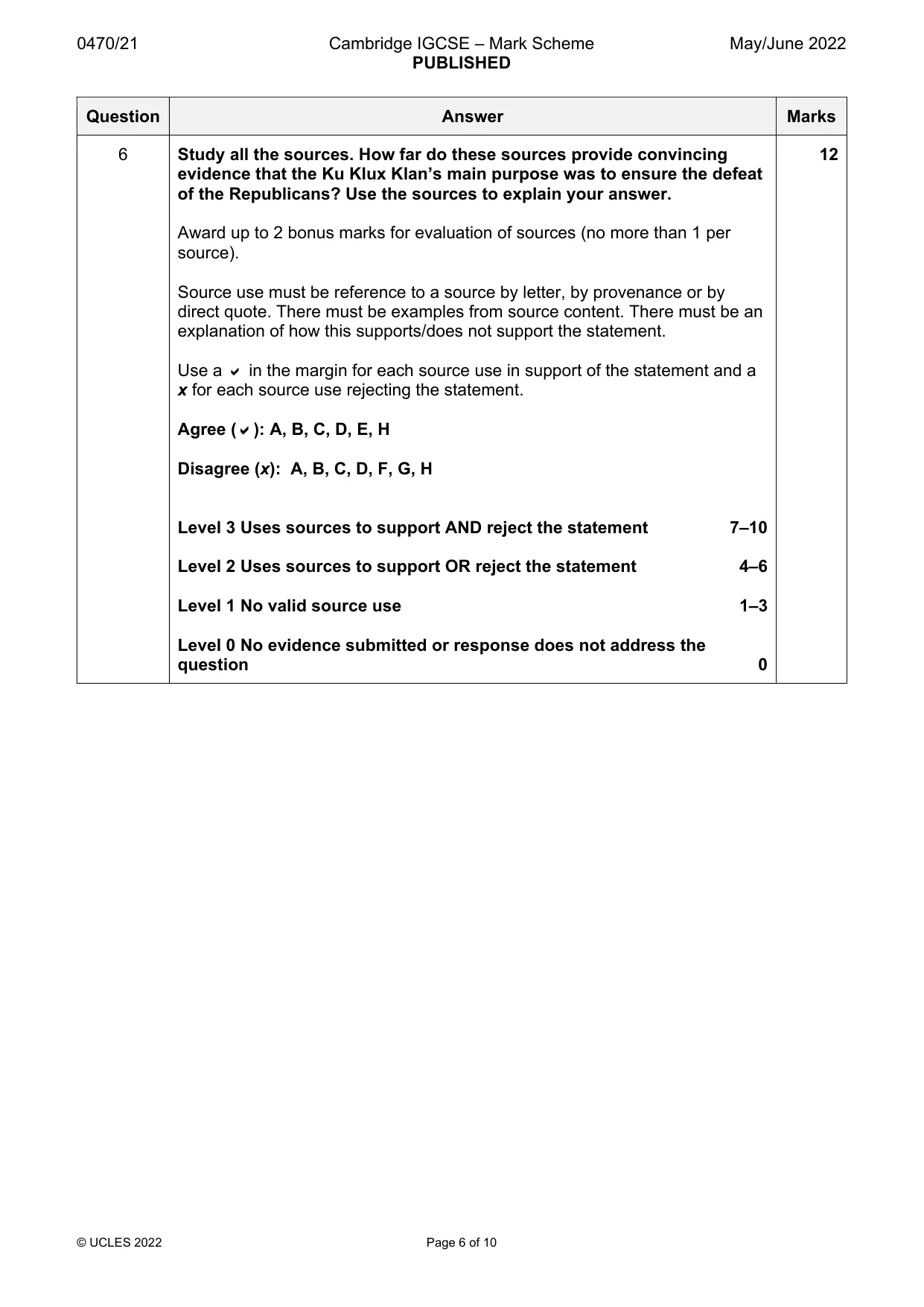
0470/21 Cambridge IGCSE – Mark Scheme PUBLISHED May/June 2022 © UCLES 2022 Page 6 of 10 Question Answer Marks 6 Study all the sources. How far do these sources provide convincing evidence that the Ku Klux Klan’s main purpose was to ensure the defeat of the Republicans? Use the sources to explain your answer. Award up to 2 bonus marks for evaluation of sources (no more than 1 per source). Source use must be reference to a source by letter, by provenance or by direct quote. There must be examples from source content. There must be an explanation of how this supports/does not support the statement. Use a in the margin for each source use in support of the statement and a x for each source use rejecting the statement. Agree (): A, B, C, D, E, H Disagree (x): A, B, C, D, F, G, H Level 3 Uses sources to support AND reject the statement 7–10 Level 2 Uses sources to support OR reject the statement 4–6 Level 1 No valid source use 1–3 Level 0 No evidence submitted or response does not address the question 0 12
Mark scheme, page 7
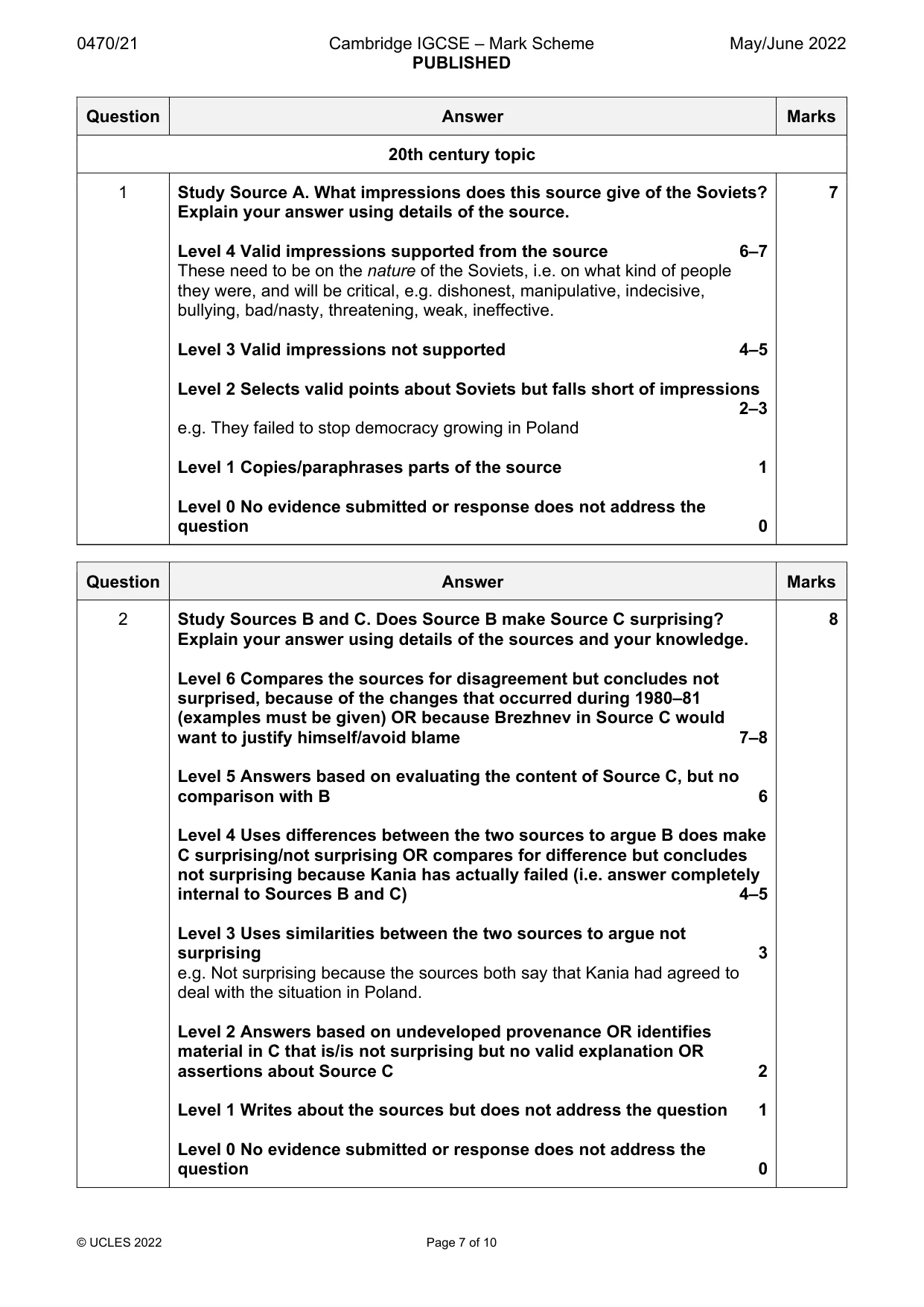
0470/21 Cambridge IGCSE – Mark Scheme PUBLISHED May/June 2022 © UCLES 2022 Page 7 of 10 Question Answer Marks 20th century topic 1 Study Source A. What impressions does this source give of the Soviets? Explain your answer using details of the source. Level 4 Valid impressions supported from the source 6–7 These need to be on the nature of the Soviets, i.e. on what kind of people they were, and will be critical, e.g. dishonest, manipulative, indecisive, bullying, bad/nasty, threatening, weak, ineffective. Level 3 Valid impressions not supported 4–5 Level 2 Selects valid points about Soviets but falls short of impressions 2–3 e.g. They failed to stop democracy growing in Poland Level 1 Copies/paraphrases parts of the source 1 Level 0 No evidence submitted or response does not address the question 0 7 Question Answer Marks 2 Study Sources B and C. Does Source B make Source C surprising? Explain your answer using details of the sources and your knowledge. Level 6 Compares the sources for disagreement but concludes not surprised, because of the changes that occurred during 1980–81 (examples must be given) OR because Brezhnev in Source C would want to justify himself/avoid blame 7–8 Level 5 Answers based on evaluating the content of Source C, but no comparison with B 6 Level 4 Uses differences between the two sources to argue B does make C surprising/not surprising OR compares for difference but concludes not surprising because Kania has actually failed (i.e. answer completely internal to Sources B and C) 4–5 Level 3 Uses similarities between the two sources to argue not surprising 3 e.g. Not surprising because the sources both say that Kania had agreed to deal with the situation in Poland. Level 2 Answers based on undeveloped provenance OR identifies material in C that is/is not surprising but no valid explanation OR assertions about Source C 2 Level 1 Writes about the sources but does not address the question 1 Level 0 No evidence submitted or response does not address the question 0 8
Mark scheme, page 8
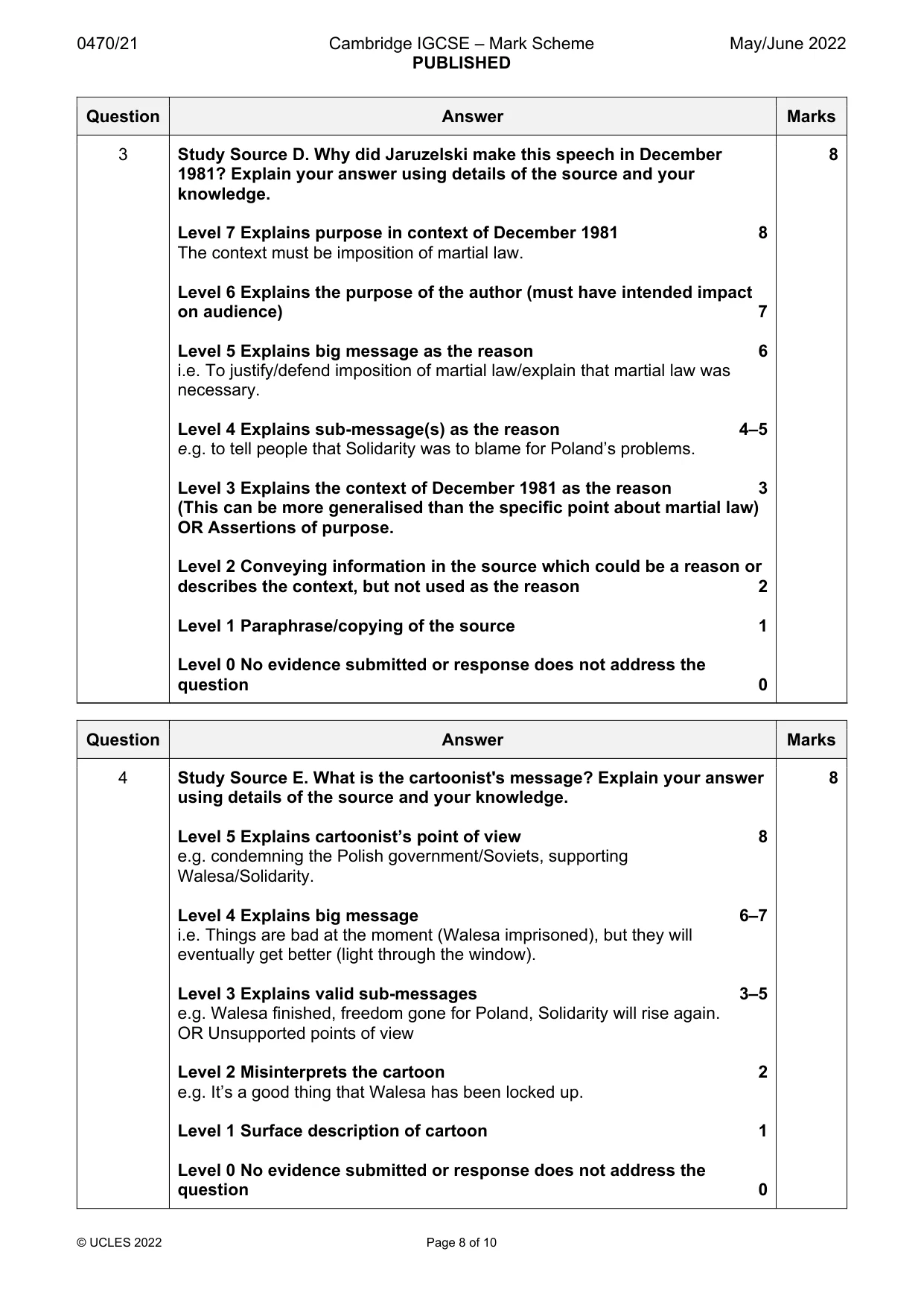
0470/21 Cambridge IGCSE – Mark Scheme PUBLISHED May/June 2022 © UCLES 2022 Page 8 of 10 Question Answer Marks 3 Study Source D. Why did Jaruzelski make this speech in December 1981? Explain your answer using details of the source and your knowledge. Level 7 Explains purpose in context of December 1981 8 The context must be imposition of martial law. Level 6 Explains the purpose of the author (must have intended impact on audience) 7 Level 5 Explains big message as the reason 6 i.e. To justify/defend imposition of martial law/explain that martial law was necessary. Level 4 Explains sub-message(s) as the reason 4–5 e.g. to tell people that Solidarity was to blame for Poland’s problems. Level 3 Explains the context of December 1981 as the reason 3 (This can be more generalised than the specific point about martial law) OR Assertions of purpose. Level 2 Conveying information in the source which could be a reason or describes the context, but not used as the reason 2 Level 1 Paraphrase/copying of the source 1 Level 0 No evidence submitted or response does not address the question 0 8 Question Answer Marks 4 Study Source E. What is the cartoonist's message? Explain your answer using details of the source and your knowledge. Level 5 Explains cartoonist’s point of view 8 e.g. condemning the Polish government/Soviets, supporting Walesa/Solidarity. Level 4 Explains big message 6–7 i.e. Things are bad at the moment (Walesa imprisoned), but they will eventually get better (light through the window). Level 3 Explains valid sub-messages 3–5 e.g. Walesa finished, freedom gone for Poland, Solidarity will rise again. OR Unsupported points of view Level 2 Misinterprets the cartoon 2 e.g. It’s a good thing that Walesa has been locked up. Level 1 Surface description of cartoon 1 Level 0 No evidence submitted or response does not address the question 0 8
Mark scheme, page 9
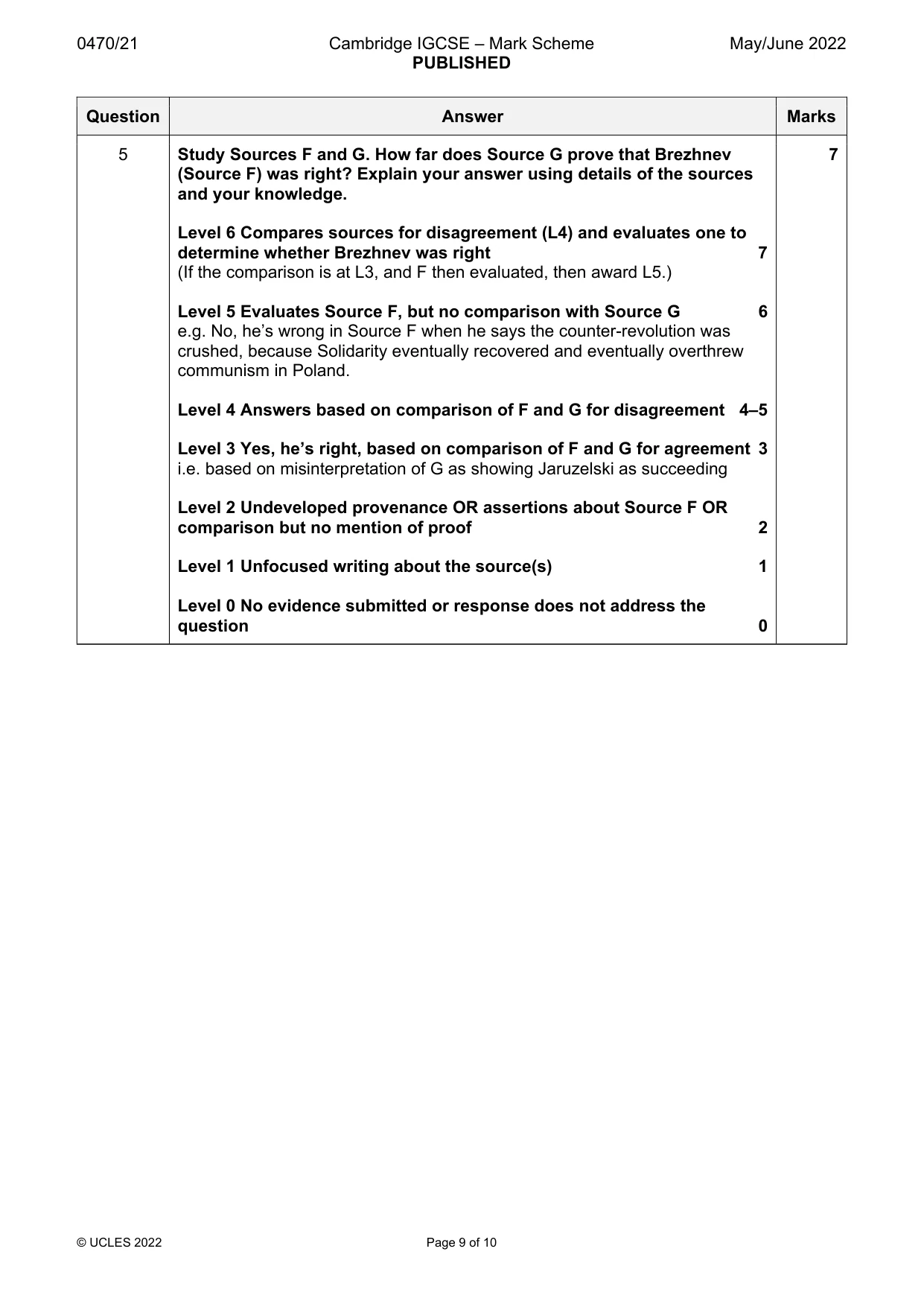
0470/21 Cambridge IGCSE – Mark Scheme PUBLISHED May/June 2022 © UCLES 2022 Page 9 of 10 Question Answer Marks 5 Study Sources F and G. How far does Source G prove that Brezhnev (Source F) was right? Explain your answer using details of the sources and your knowledge. Level 6 Compares sources for disagreement (L4) and evaluates one to determine whether Brezhnev was right 7 (If the comparison is at L3, and F then evaluated, then award L5.) Level 5 Evaluates Source F, but no comparison with Source G 6 e.g. No, he’s wrong in Source F when he says the counter-revolution was crushed, because Solidarity eventually recovered and eventually overthrew communism in Poland. Level 4 Answers based on comparison of F and G for disagreement 4–5 Level 3 Yes, he’s right, based on comparison of F and G for agreement 3 i.e. based on misinterpretation of G as showing Jaruzelski as succeeding Level 2 Undeveloped provenance OR assertions about Source F OR comparison but no mention of proof 2 Level 1 Unfocused writing about the source(s) 1 Level 0 No evidence submitted or response does not address the question 0 7
Mark scheme, page 10
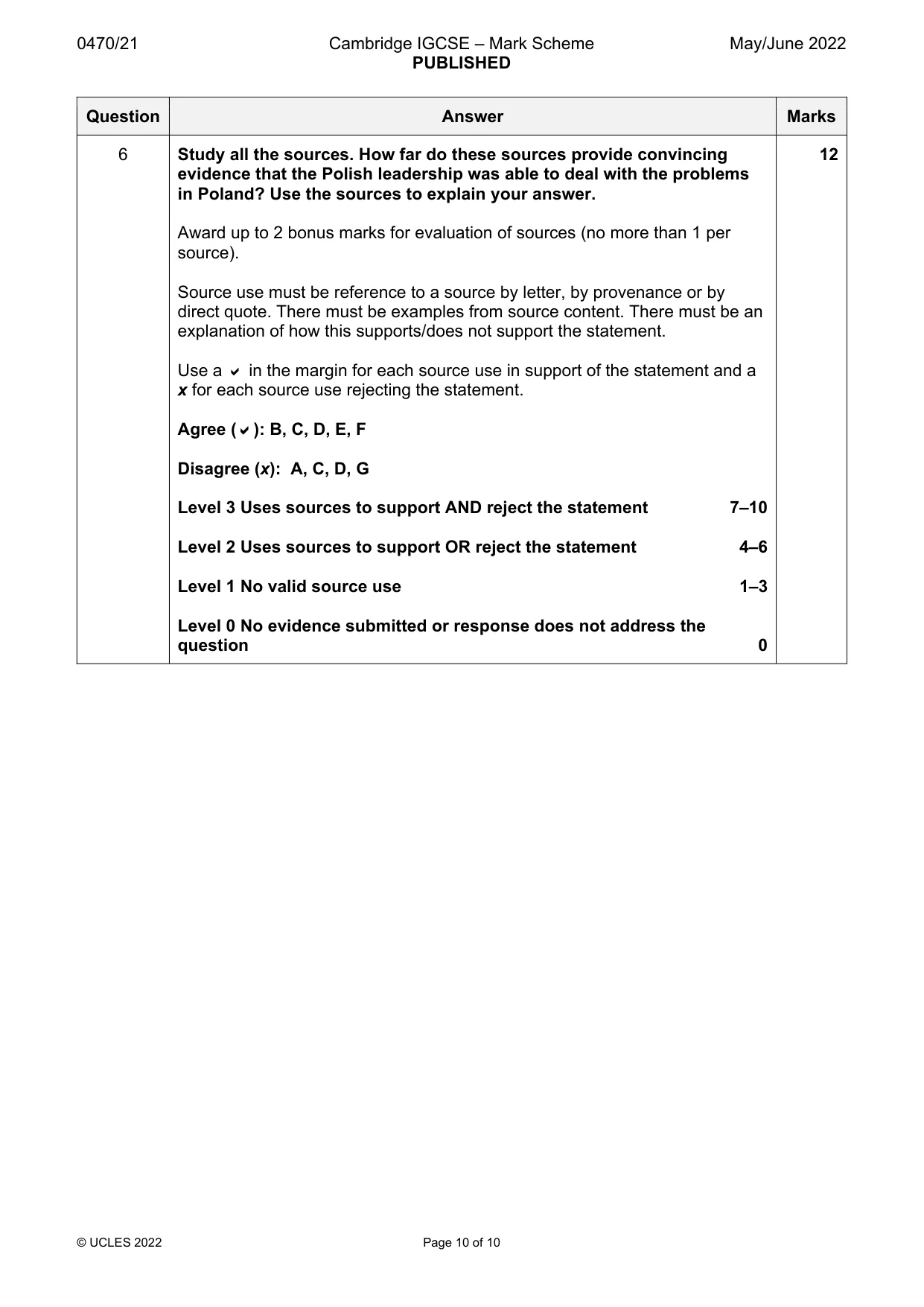
0470/21 Cambridge IGCSE – Mark Scheme PUBLISHED May/June 2022 © UCLES 2022 Page 10 of 10 Question Answer Marks 6 Study all the sources. How far do these sources provide convincing evidence that the Polish leadership was able to deal with the problems in Poland? Use the sources to explain your answer. Award up to 2 bonus marks for evaluation of sources (no more than 1 per source). Source use must be reference to a source by letter, by provenance or by direct quote. There must be examples from source content. There must be an explanation of how this supports/does not support the statement. Use a in the margin for each source use in support of the statement and a x for each source use rejecting the statement. Agree (): B, C, D, E, F Disagree (x): A, C, D, G Level 3 Uses sources to support AND reject the statement 7–10 Level 2 Uses sources to support OR reject the statement 4–6 Level 1 No valid source use 1–3 Level 0 No evidence submitted or response does not address the question 0 12
What you needed in this session
Cambridge’s own grade thresholds for 2022 May/June, Paper 2 · Variant 1. A higher threshold means an easier paper — the bar moves with how the cohort did.