Cambridge IGCSE History 0470 — 2024 Oct/Nov Paper 2 · Variant 1
0470/21/O/N/24 · 40 marks · 105 min
The question paper and its mark scheme, free to read here and free to download. This is Cambridge’s own paper, exactly as it was sat.
Question paper16 pages


Mark scheme13 pages
Answers below. Sit the paper first if you are practising.
Paper as text
Question paper, page 1
This document has 16 pages. Any blank pages are indicated. [Turn over Cambridge IGCSE™ HISTORY 0470/21 Paper 2 Document Questions October/November 2024 1 hour 45 minutes You must answer on the enclosed answer booklet. You will need: Answer booklet (enclosed) INSTRUCTIONS ● Answer one question on one option only. Option A: Nineteenth century topic Option B: Twentieth century topic ● Follow the instructions on the front cover of the answer booklet. If you need additional answer paper, ask the invigilator for a continuation booklet. INFORMATION ● The total mark for this paper is 40. ● The number of marks for each question or part question is shown in brackets [ ]. * 7 8 0 8 7 7 0 2 2 2 * DC (ST/CGW) 336319/3 © UCLES 2024
Question paper, page 2
2 0470/21/O/N/24 © UCLES 2024 Option A: Nineteenth century topic 1 Did Americans blame Spain for the sinking of the Maine? Study the Background Information and the sources carefully, and then answer all parts of Question 1. Background Information As soon as the American warship USS Maine exploded and sank in the Cuban port of Havana on 15 February 1898, newspapers and politicians in the United States began to blame the Spanish. Even before there was any evidence, claims were made that a Spanish mine (a floating bomb) had destroyed the warship. President McKinley was more cautious and set up a court of inquiry. Popular newspapers, led by the New York Journal and the New York World, also made claims about Spanish cruelty towards the Cubans who were fighting for independence from Spanish rule, and demanded that America go to war to free Cuba. Did all Americans blame the Spanish for the sinking of the Maine? SOURCE A This has been a busy day. We have been overwhelmed with callers, expressing sympathy. The entire staff of the Spanish embassy called to express regrets. The records show that 253 men were killed. There is an intense difference of opinion as to the cause of the sinking of the Maine. The opinion of each individual is determined by his bias. If he is a conservative, he is sure that it was an accident; if he is a jingo, he is sure it was deliberate. My own judgement is that it was the result of an accident such as a ship of war carrying powerful explosives is likely to experience. John D Long, US Secretary of the Navy, writing in his journal, 16 February 1898. Long was the member of the government in charge of the navy. A jingo was a strong supporter of war against Spain for patriotic reasons. SOURCE B It would be wasting our time to discuss the American theory that the Maine was blown up by the explosion of a mine connected by wires to our shipyard. Spain’s honour stands too high to be harmed by the squeamish drivel of those nasty American jingoes. The best way to get rid of these toads is to crush them. The American jingoes believe that all men are made like themselves. It was President McKinley’s duty to see that Spain should not be so grossly insulted by the jingo newspapers. Since he did not do so, he is as much a jingo as the jingo newspapers. We must declare that the claim that the Maine was blown up by us is laughable. What reason could we have for destroying the American battleship? Even ten ships would not enable the United States to triumph over Spain. From a Spanish newspaper published in Madrid, 1 March 1898.
Question paper, page 3
3 0470/21/O/N/24 © UCLES 2024 [Turn over SOURCE C To five hundred thousand Cubans starved or otherwise murdered by the Spanish have been added an American battleship and three hundred American sailors lost as the direct result of the policy of our government. The Spanish claim it was an accident. If it was an accident, it was remarkably convenient for Spain. Two years ago our naval superiority over Spain was overwhelming. Our government allowed Spain to overcome that disadvantage by building enough ships to bring its navy up to equality with ours. This ‘accidental’ destruction of the American fleet means it will not take long for Spain’s naval strength to overtake our own. If it be found that Spain caused this disaster, no power will be able to restrain the American people from taking a justifiable revenge. All the circumstances fix the burden of proof upon Spain. The Maine was lying in one of its harbours, under the guns of its fortresses. The destruction of the Maine strengthens Spain in the event of the war that Spain desires. The chances against such a destruction by accident were millions to one, and yet it occurred. The investigations must clearly prove Spain’s innocence or its guilt will be assumed. From the New York Journal, 17 February 1898. SOURCE D INSPECTION OF THE MAINE WILL DECIDE Divers Will Inspect the Ship to Find Out Whether the Explosion Was From the Outside or Inside Magazines of Warships Sometimes Blow Up Because of Too Much Heat Inside – Hard to Blow Up the Magazine from the Outside The warship Maine was destroyed in Havana harbour last night. Secretary Long was asked whether he thought this was the work of the enemy. He replied: ‘I do not. I am influenced by the fact that Captain Sigsbee has not yet reported. He is waiting to write a full report. So long as he has not made a decision, I certainly cannot. I should think from the signs, however, that there was an accident – that the magazine exploded. How that came about I do not know.’ A naval officer, who knows a great deal about warships, dismissed the idea that the Maine had been destroyed on purpose. He said that fires sometimes started in the coal bunkers, and he told of such a fire very close to the magazine on board another warship. The fire became so hot that the steel wall between the fire and the ammunition melted. He did not believe that the Spanish had either the information or the equipment necessary to blow up the magazine. From the New York Times, 17 February 1898. The magazine is where the ship’s ammunition is stored. Captain Sigsbee was captain of the Maine.
Question paper, page 4
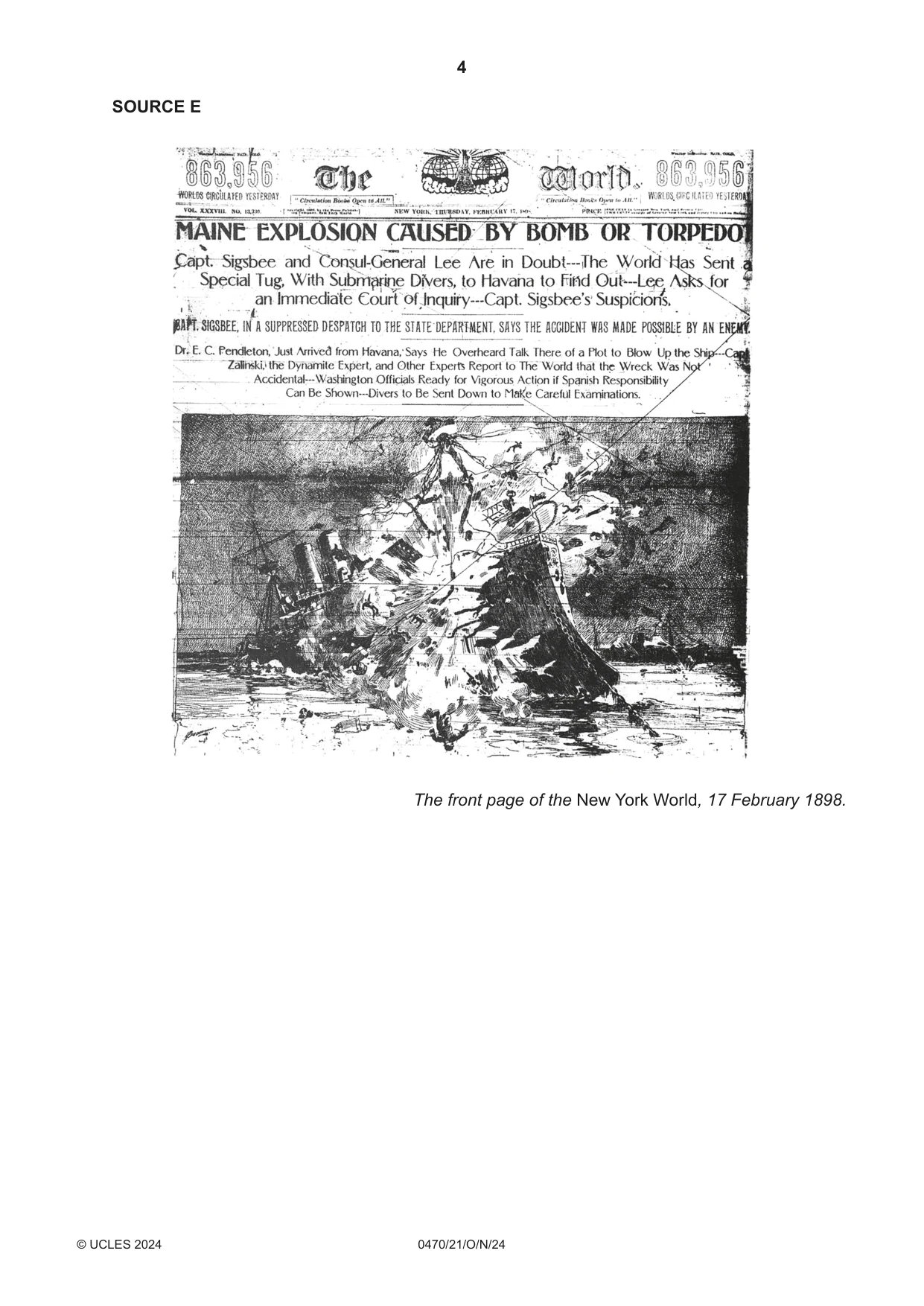
4 0470/21/O/N/24 © UCLES 2024 SOURCE E The front page of the New York World, 17 February 1898.
Question paper, page 5
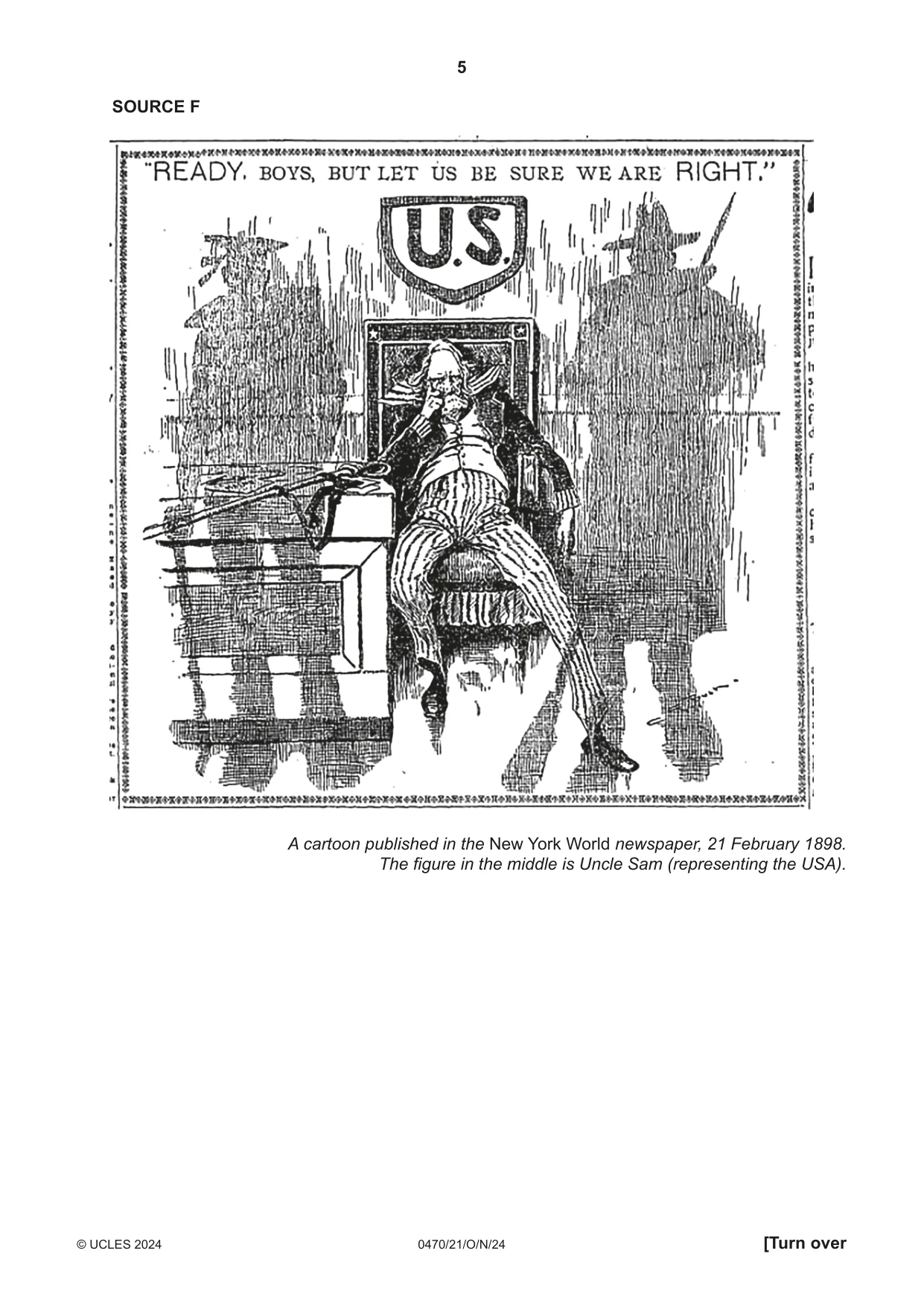
5 0470/21/O/N/24 © UCLES 2024 [Turn over SOURCE F A cartoon published in the New York World newspaper, 21 February 1898. The figure in the middle is Uncle Sam (representing the USA).
Question paper, page 6
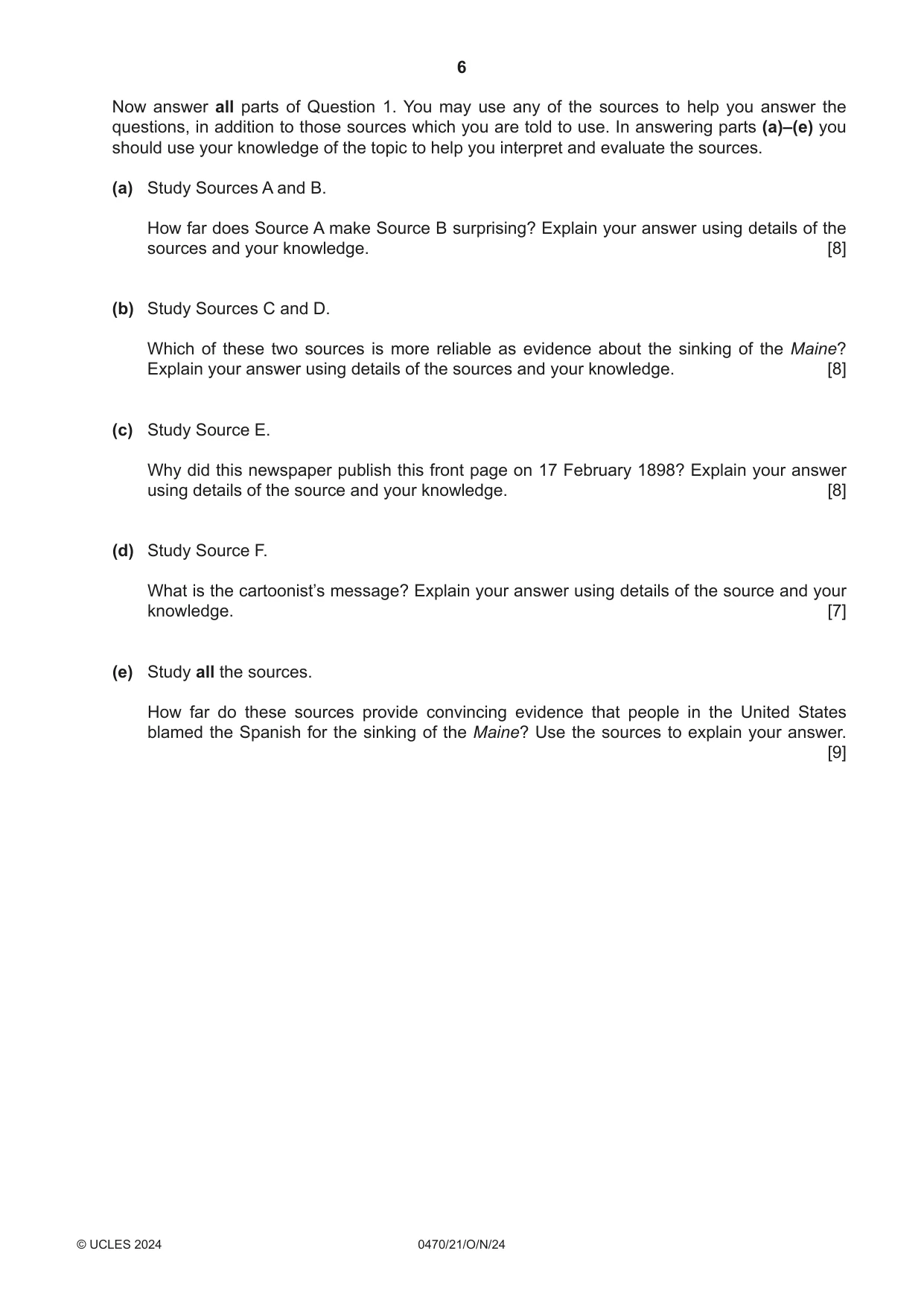
6 0470/21/O/N/24 © UCLES 2024 Now answer all parts of Question 1. You may use any of the sources to help you answer the questions, in addition to those sources which you are told to use. In answering parts (a)–(e) you should use your knowledge of the topic to help you interpret and evaluate the sources. (a) Study Sources A and B. How far does Source A make Source B surprising? Explain your answer using details of the sources and your knowledge. [8] (b) Study Sources C and D. Which of these two sources is more reliable as evidence about the sinking of the Maine? Explain your answer using details of the sources and your knowledge. [8] (c) Study Source E. Why did this newspaper publish this front page on 17 February 1898? Explain your answer using details of the source and your knowledge. [8] (d) Study Source F. What is the cartoonist’s message? Explain your answer using details of the source and your knowledge. [7] (e) Study all the sources. How far do these sources provide convincing evidence that people in the United States blamed the Spanish for the sinking of the Maine? Use the sources to explain your answer. [9]
Question paper, page 7
7 0470/21/O/N/24 © UCLES 2024 [Turn over BLANK PAGE
Question paper, page 8
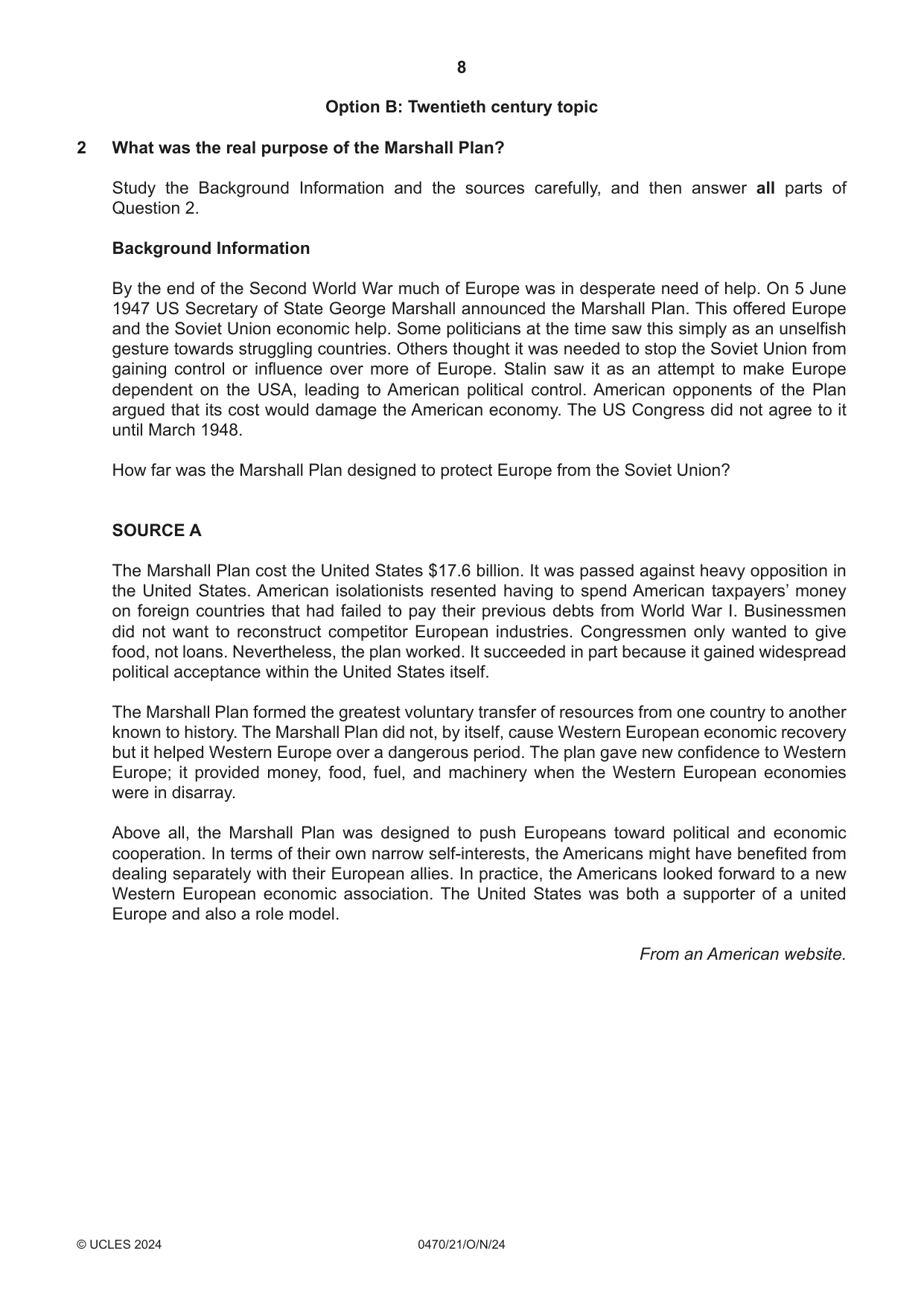
8 0470/21/O/N/24 © UCLES 2024 Option B: Twentieth century topic 2 What was the real purpose of the Marshall Plan? Study the Background Information and the sources carefully, and then answer all parts of Question 2. Background Information By the end of the Second World War much of Europe was in desperate need of help. On 5 June 1947 US Secretary of State George Marshall announced the Marshall Plan. This offered Europe and the Soviet Union economic help. Some politicians at the time saw this simply as an unselfish gesture towards struggling countries. Others thought it was needed to stop the Soviet Union from gaining control or influence over more of Europe. Stalin saw it as an attempt to make Europe dependent on the USA, leading to American political control. American opponents of the Plan argued that its cost would damage the American economy. The US Congress did not agree to it until March 1948. How far was the Marshall Plan designed to protect Europe from the Soviet Union? SOURCE A The Marshall Plan cost the United States $17.6 billion. It was passed against heavy opposition in the United States. American isolationists resented having to spend American taxpayers’ money on foreign countries that had failed to pay their previous debts from World War I. Businessmen did not want to reconstruct competitor European industries. Congressmen only wanted to give food, not loans. Nevertheless, the plan worked. It succeeded in part because it gained widespread political acceptance within the United States itself. The Marshall Plan formed the greatest voluntary transfer of resources from one country to another known to history. The Marshall Plan did not, by itself, cause Western European economic recovery but it helped Western Europe over a dangerous period. The plan gave new confidence to Western Europe; it provided money, food, fuel, and machinery when the Western European economies were in disarray. Above all, the Marshall Plan was designed to push Europeans toward political and economic cooperation. In terms of their own narrow self‑interests, the Americans might have benefited from dealing separately with their European allies. In practice, the Americans looked forward to a new Western European economic association. The United States was both a supporter of a united Europe and also a role model. From an American website.
Question paper, page 9
9 0470/21/O/N/24 © UCLES 2024 [Turn over SOURCE B The Marshall Plan was not designed as a disaster fund just to help Europe over the immediate post‑war years. It was a long‑term plan for recovery and growth. By 1952 it had cost the United States an enormous $13 billion. There was much opposition in the US. Truman only managed to get it through Congress because by March 1948 the communist coup in Czechoslovakia had taken place. This persuaded members of Congress that Marshall Aid would be an economic barrier to Soviet expansion. Even after this the USA was still split over the issue. The main aim of the Marshall Plan was not to rebuild European economies but to protect them from Soviet communism. In April 1947 the CIA had reported that ‘the greatest danger to the security of the United States is economic collapse in western Europe and the Communists coming to power.’ In the short term the Plan was successful. Between 1947 and 1951 the economies of western Europe rose by thirty per cent. This reduced the danger from communism. Its impact was also psychological. It made Europeans feel better about themselves and their future. In the longer run, the Americans failed to persuade the Europeans to cooperate in their economic planning. However, although the Marshall Plan was an economic programme, the crisis it avoided was political. From a recent account of the Marshall Plan. SOURCE C The Truman Doctrine and the Marshall Plan are examples of the way in which the principles of the United Nations are broken. The United States has moved towards using economic relief as an instrument of political pressure. The Marshall Plan is a variant of the Truman Doctrine. In this plan the United States requires countries in need of relief to renounce their right to plan their national economies in their own way. This makes them dependent on the interests of American monopolies. It is becoming clear to everyone that the Plan will mean placing European countries under the economic and political control of the United States, and direct interference in the internal affairs of those countries. Andrei Vyshinsky speaking to the United Nations General Assembly, 18 September 1947. Vyshinsky was the Soviet Deputy Foreign Minister.
Question paper, page 10
10 0470/21/O/N/24 © UCLES 2024 SOURCE D A cartoon published in an American newspaper, 4 January 1948. Content removed due to copyright restrictions.
Question paper, page 11
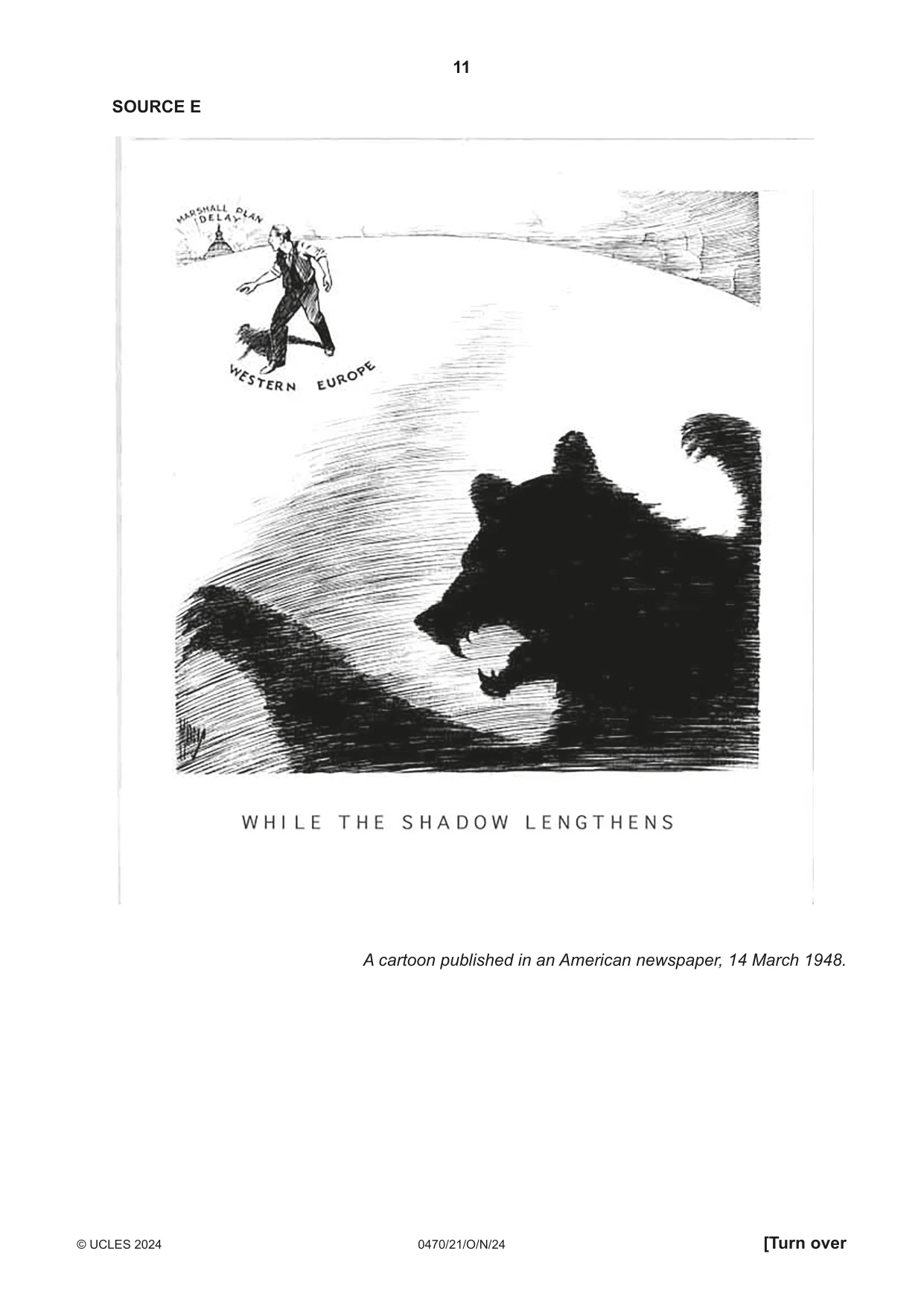
11 0470/21/O/N/24 © UCLES 2024 [Turn over SOURCE E A cartoon published in an American newspaper, 14 March 1948.
Question paper, page 12
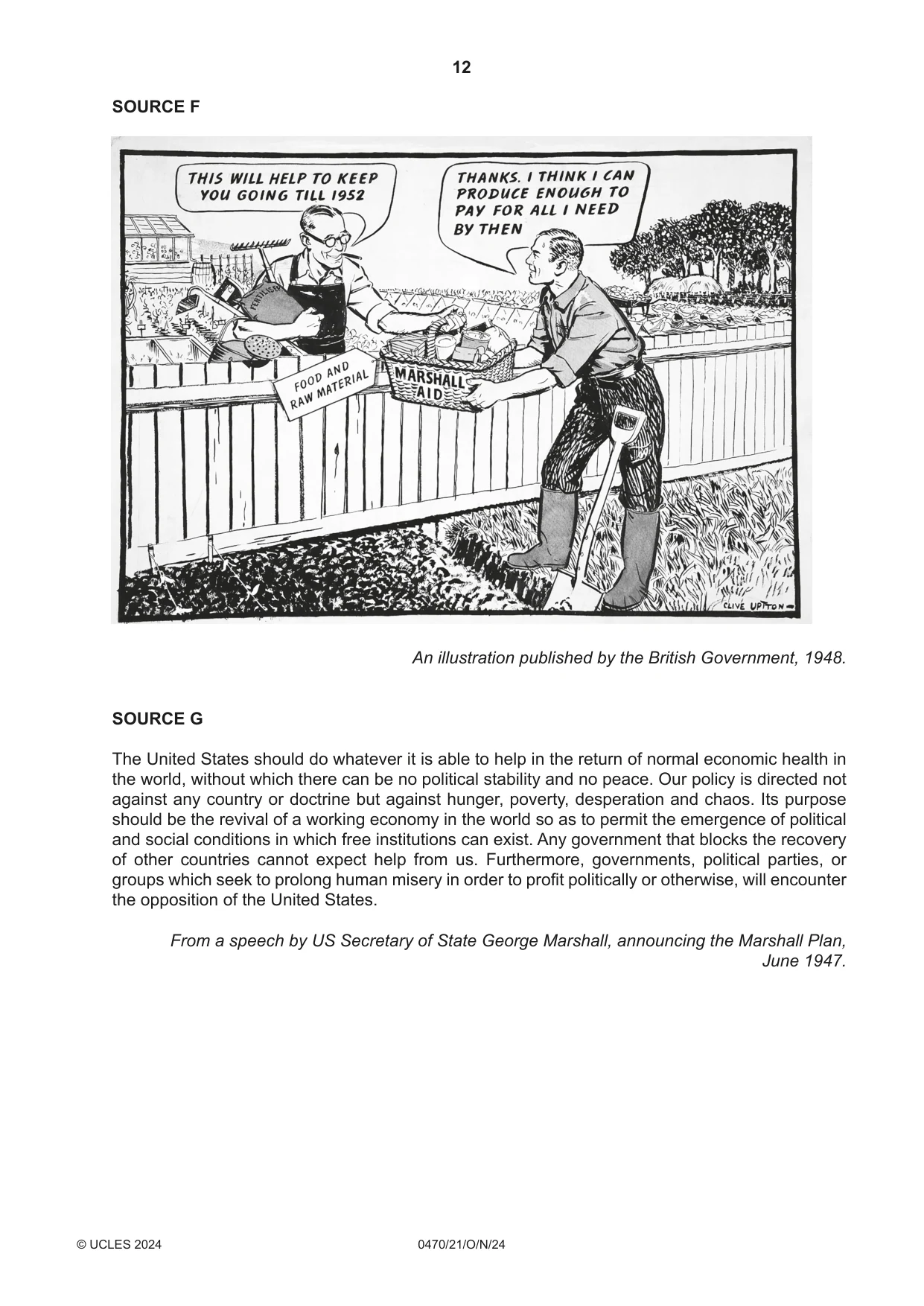
12 0470/21/O/N/24 © UCLES 2024 SOURCE F An illustration published by the British Government, 1948. SOURCE G The United States should do whatever it is able to help in the return of normal economic health in the world, without which there can be no political stability and no peace. Our policy is directed not against any country or doctrine but against hunger, poverty, desperation and chaos. Its purpose should be the revival of a working economy in the world so as to permit the emergence of political and social conditions in which free institutions can exist. Any government that blocks the recovery of other countries cannot expect help from us. Furthermore, governments, political parties, or groups which seek to prolong human misery in order to profit politically or otherwise, will encounter the opposition of the United States. From a speech by US Secretary of State George Marshall, announcing the Marshall Plan, June 1947.
Question paper, page 13
13 0470/21/O/N/24 © UCLES 2024 Now answer all parts of Question 2. You may use any of the sources to help you answer the questions, in addition to those sources which you are told to use. In answering parts (a)–(e) you should use your knowledge of the topic to help you interpret and evaluate the sources. (a) Study Sources A and B. How far do these two sources agree? Explain your answer using details of the sources. [7] (b) Study Source C. Why did Vyshinsky make this speech at that time? Explain your answer using details of the source and your knowledge. [8] (c) Study Sources D and E. How similar are these two cartoons? Explain your answer using details of the sources and your knowledge. [8] (d) Study Sources F and G. How far does Source F support Marshall’s claims in Source G? Explain your answer using details of the sources and your knowledge. [8] (e) Study all the sources. How far do these sources provide convincing evidence that the Marshall Plan was designed to protect the West from the threat of the Soviet Union? Use the sources to explain your answer. [9]
Question paper, page 14
14 0470/21/O/N/24 © UCLES 2024 BLANK PAGE
Question paper, page 15
15 0470/21/O/N/24 © UCLES 2024 BLANK PAGE
Question paper, page 16
16 0470/21/O/N/24 © UCLES 2024 Permission to reproduce items where third‑party owned material protected by copyright is included has been sought and cleared where possible. Every reasonable effort has been made by the publisher (UCLES) to trace copyright holders, but if any items requiring clearance have unwittingly been included, the publisher will be pleased to make amends at the earliest possible opportunity. To avoid the issue of disclosure of answer‑related information to candidates, all copyright acknowledgements are reproduced online in the Cambridge Assessment International Education Copyright Acknowledgements Booklet. This is produced for each series of examinations and is freely available to download at www.cambridgeinternational.org after the live examination series. Cambridge Assessment International Education is part of Cambridge Assessment. Cambridge Assessment is the brand name of the University of Cambridge Local Examinations Syndicate (UCLES), which is a department of the University of Cambridge. BLANK PAGE
Mark scheme, page 1
This document consists of 13 printed pages. © Cambridge University Press & Assessment 2024 [Turn over Cambridge IGCSE™ HISTORY 0470/21 Paper 2 October/November 2024 MARK SCHEME Maximum Mark: 40 Published This mark scheme is published as an aid to teachers and candidates, to indicate the requirements of the examination. It shows the basis on which Examiners were instructed to award marks. It does not indicate the details of the discussions that took place at an Examiners’ meeting before marking began, which would have considered the acceptability of alternative answers. Mark schemes should be read in conjunction with the question paper and the Principal Examiner Report for Teachers. Cambridge International will not enter into discussions about these mark schemes. Cambridge International is publishing the mark schemes for the October/November 2024 series for most Cambridge IGCSE, Cambridge International A and AS Level components, and some Cambridge O Level components.
Mark scheme, page 2
0470/21 Cambridge IGCSE – Mark Scheme PUBLISHED October/November 2024 © Cambridge University Press & Assessment 2024 Page 2 of 13 Generic Marking Principles These general marking principles must be applied by all examiners when marking candidate answers. They should be applied alongside the specific content of the mark scheme or generic level descriptions for a question. Each question paper and mark scheme will also comply with these marking principles. GENERIC MARKING PRINCIPLE 1: Marks must be awarded in line with: • the specific content of the mark scheme or the generic level descriptors for the question • the specific skills defined in the mark scheme or in the generic level descriptors for the question • the standard of response required by a candidate as exemplified by the standardisation scripts. GENERIC MARKING PRINCIPLE 2: Marks awarded are always whole marks (not half marks, or other fractions). GENERIC MARKING PRINCIPLE 3: Marks must be awarded positively: • marks are awarded for correct/valid answers, as defined in the mark scheme. However, credit is given for valid answers which go beyond the scope of the syllabus and mark scheme, referring to your Team Leader as appropriate • marks are awarded when candidates clearly demonstrate what they know and can do • marks are not deducted for errors • marks are not deducted for omissions • answers should only be judged on the quality of spelling, punctuation and grammar when these features are specifically assessed by the question as indicated by the mark scheme. The meaning, however, should be unambiguous. GENERIC MARKING PRINCIPLE 4: Rules must be applied consistently, e.g. in situations where candidates have not followed instructions or in the application of generic level descriptors. GENERIC MARKING PRINCIPLE 5: Marks should be awarded using the full range of marks defined in the mark scheme for the question (however; the use of the full mark range may be limited according to the quality of the candidate responses seen). GENERIC MARKING PRINCIPLE 6: Marks awarded are based solely on the requirements as defined in the mark scheme. Marks should not be awarded with grade thresholds or grade descriptors in mind.
Mark scheme, page 3
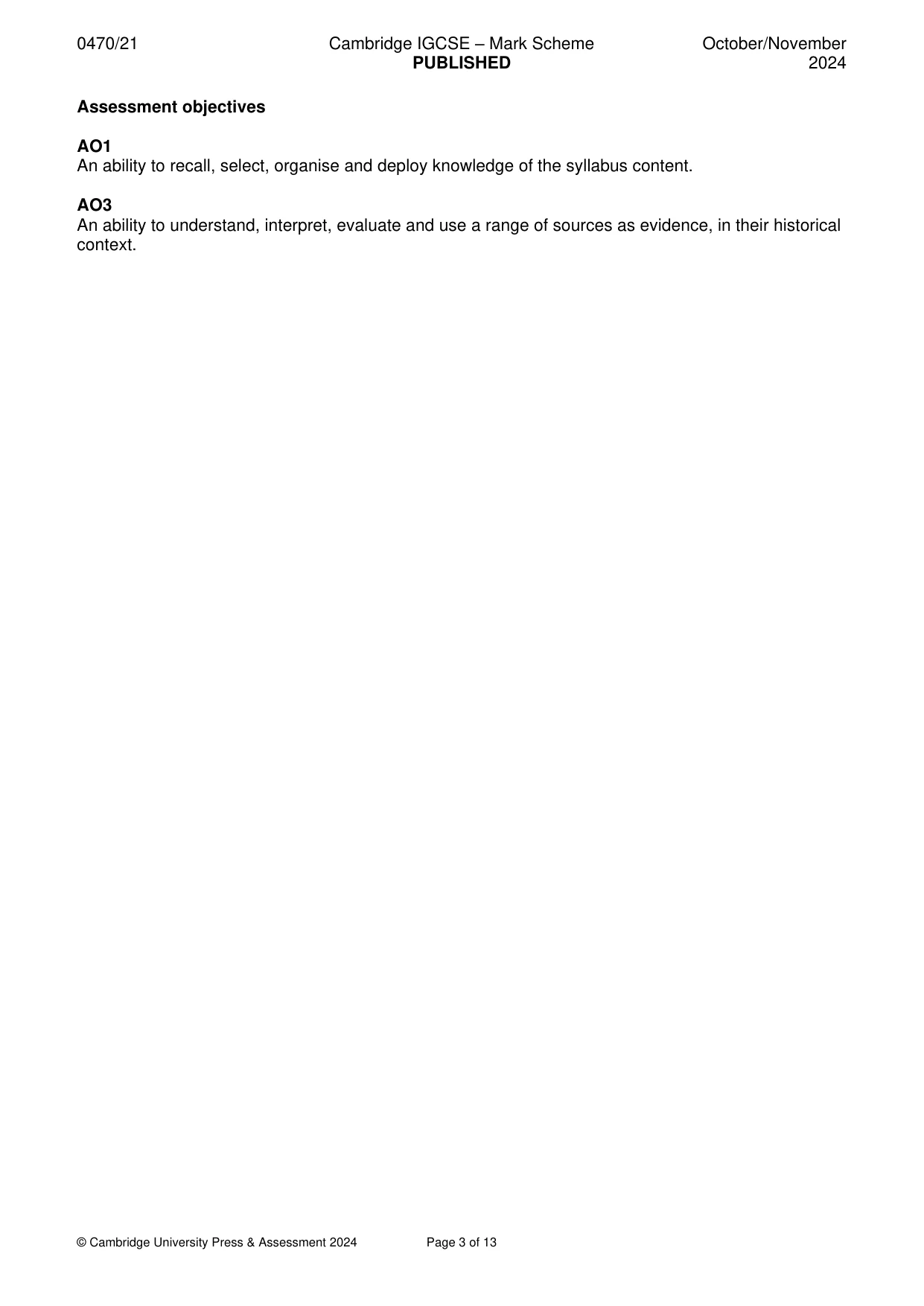
0470/21 Cambridge IGCSE – Mark Scheme PUBLISHED October/November 2024 © Cambridge University Press & Assessment 2024 Page 3 of 13 Assessment objectives AO1 An ability to recall, select, organise and deploy knowledge of the syllabus content. AO3 An ability to understand, interpret, evaluate and use a range of sources as evidence, in their historical context.
Mark scheme, page 4
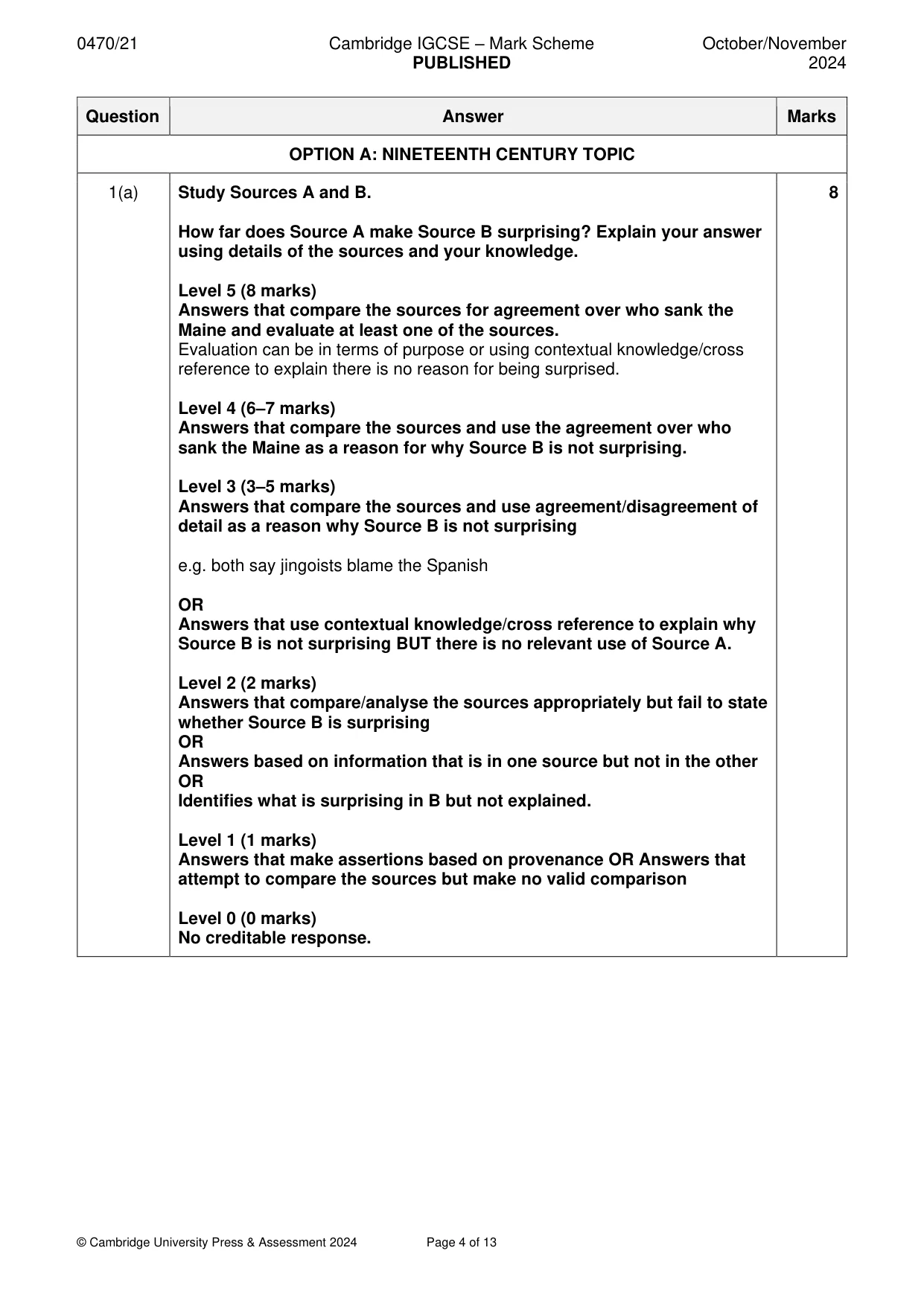
0470/21 Cambridge IGCSE – Mark Scheme PUBLISHED October/November 2024 © Cambridge University Press & Assessment 2024 Page 4 of 13 Question Answer Marks OPTION A: NINETEENTH CENTURY TOPIC 1(a) Study Sources A and B. How far does Source A make Source B surprising? Explain your answer using details of the sources and your knowledge. Level 5 (8 marks) Answers that compare the sources for agreement over who sank the Maine and evaluate at least one of the sources. Evaluation can be in terms of purpose or using contextual knowledge/cross reference to explain there is no reason for being surprised. Level 4 (6–7 marks) Answers that compare the sources and use the agreement over who sank the Maine as a reason for why Source B is not surprising. Level 3 (3–5 marks) Answers that compare the sources and use agreement/disagreement of detail as a reason why Source B is not surprising e.g. both say jingoists blame the Spanish OR Answers that use contextual knowledge/cross reference to explain why Source B is not surprising BUT there is no relevant use of Source A. Level 2 (2 marks) Answers that compare/analyse the sources appropriately but fail to state whether Source B is surprising OR Answers based on information that is in one source but not in the other OR Identifies what is surprising in B but not explained. Level 1 (1 marks) Answers that make assertions based on provenance OR Answers that attempt to compare the sources but make no valid comparison Level 0 (0 marks) No creditable response. 8
Mark scheme, page 5
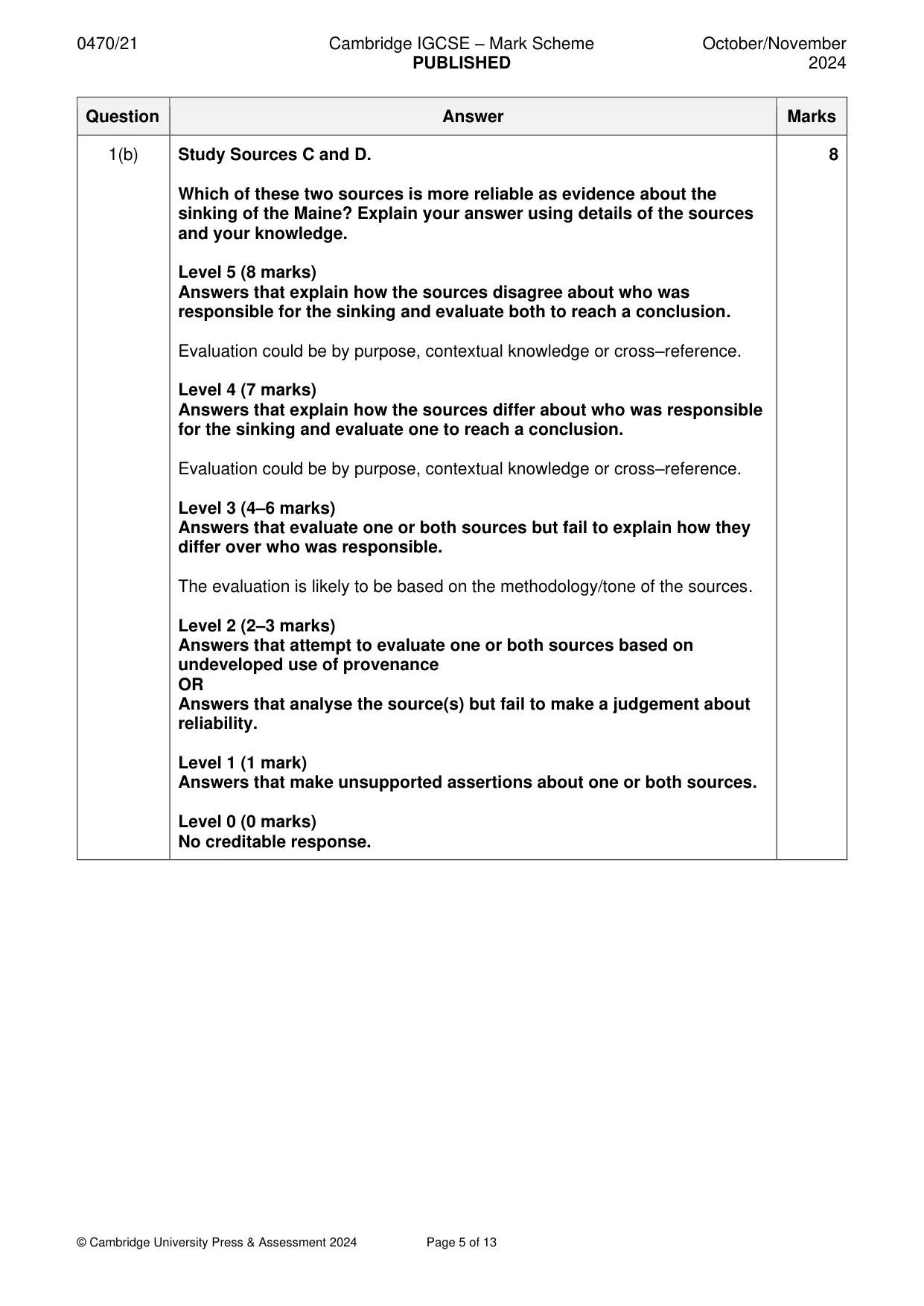
0470/21 Cambridge IGCSE – Mark Scheme PUBLISHED October/November 2024 © Cambridge University Press & Assessment 2024 Page 5 of 13 Question Answer Marks 1(b) Study Sources C and D. Which of these two sources is more reliable as evidence about the sinking of the Maine? Explain your answer using details of the sources and your knowledge. Level 5 (8 marks) Answers that explain how the sources disagree about who was responsible for the sinking and evaluate both to reach a conclusion. Evaluation could be by purpose, contextual knowledge or cross–reference. Level 4 (7 marks) Answers that explain how the sources differ about who was responsible for the sinking and evaluate one to reach a conclusion. Evaluation could be by purpose, contextual knowledge or cross–reference. Level 3 (4–6 marks) Answers that evaluate one or both sources but fail to explain how they differ over who was responsible. The evaluation is likely to be based on the methodology/tone of the sources. Level 2 (2–3 marks) Answers that attempt to evaluate one or both sources based on undeveloped use of provenance OR Answers that analyse the source(s) but fail to make a judgement about reliability. Level 1 (1 mark) Answers that make unsupported assertions about one or both sources. Level 0 (0 marks) No creditable response. 8
Mark scheme, page 6
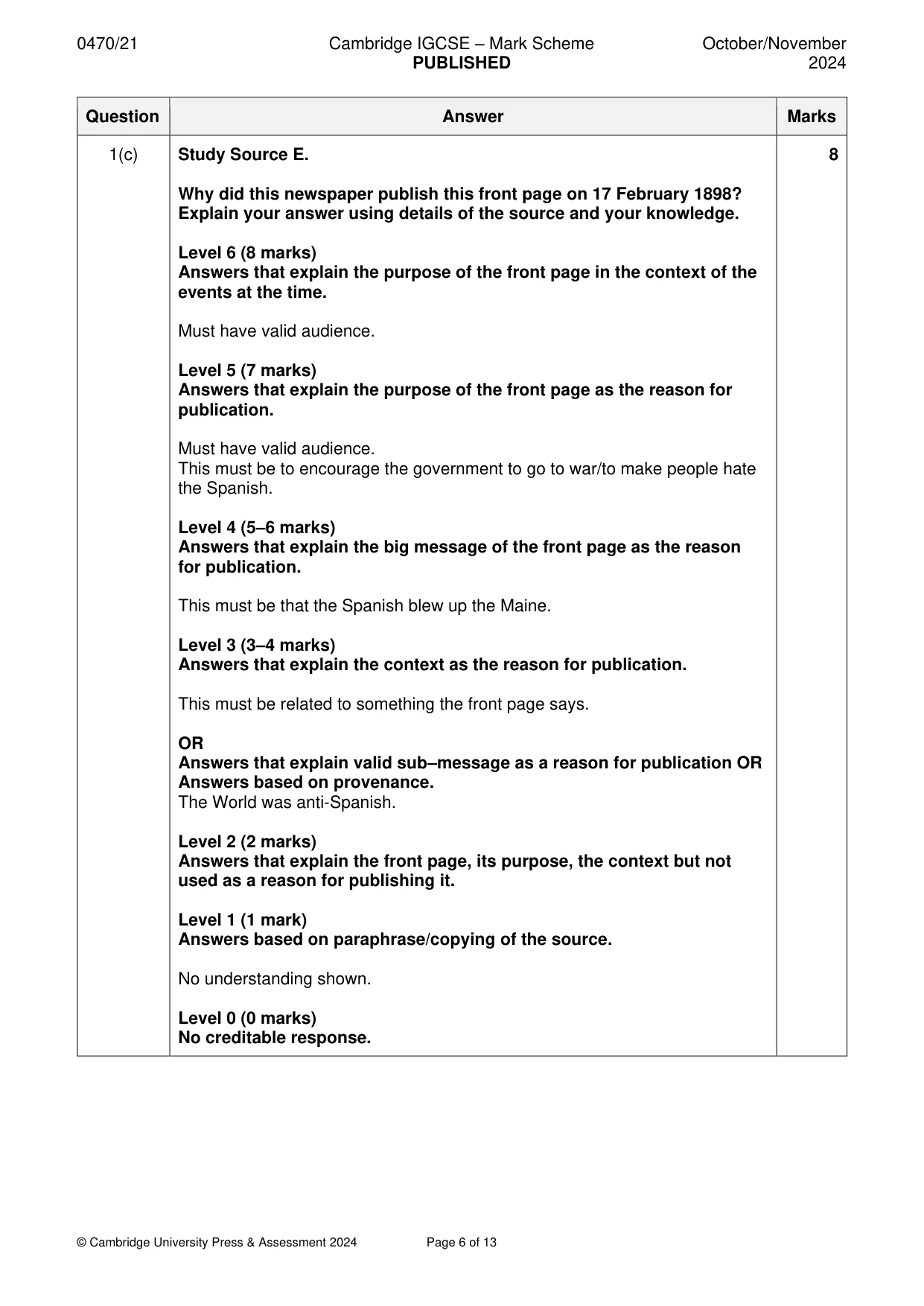
0470/21 Cambridge IGCSE – Mark Scheme PUBLISHED October/November 2024 © Cambridge University Press & Assessment 2024 Page 6 of 13 Question Answer Marks 1(c) Study Source E. Why did this newspaper publish this front page on 17 February 1898? Explain your answer using details of the source and your knowledge. Level 6 (8 marks) Answers that explain the purpose of the front page in the context of the events at the time. Must have valid audience. Level 5 (7 marks) Answers that explain the purpose of the front page as the reason for publication. Must have valid audience. This must be to encourage the government to go to war/to make people hate the Spanish. Level 4 (5–6 marks) Answers that explain the big message of the front page as the reason for publication. This must be that the Spanish blew up the Maine. Level 3 (3–4 marks) Answers that explain the context as the reason for publication. This must be related to something the front page says. OR Answers that explain valid sub–message as a reason for publication OR Answers based on provenance. The World was anti-Spanish. Level 2 (2 marks) Answers that explain the front page, its purpose, the context but not used as a reason for publishing it. Level 1 (1 mark) Answers based on paraphrase/copying of the source. No understanding shown. Level 0 (0 marks) No creditable response. 8
Mark scheme, page 7
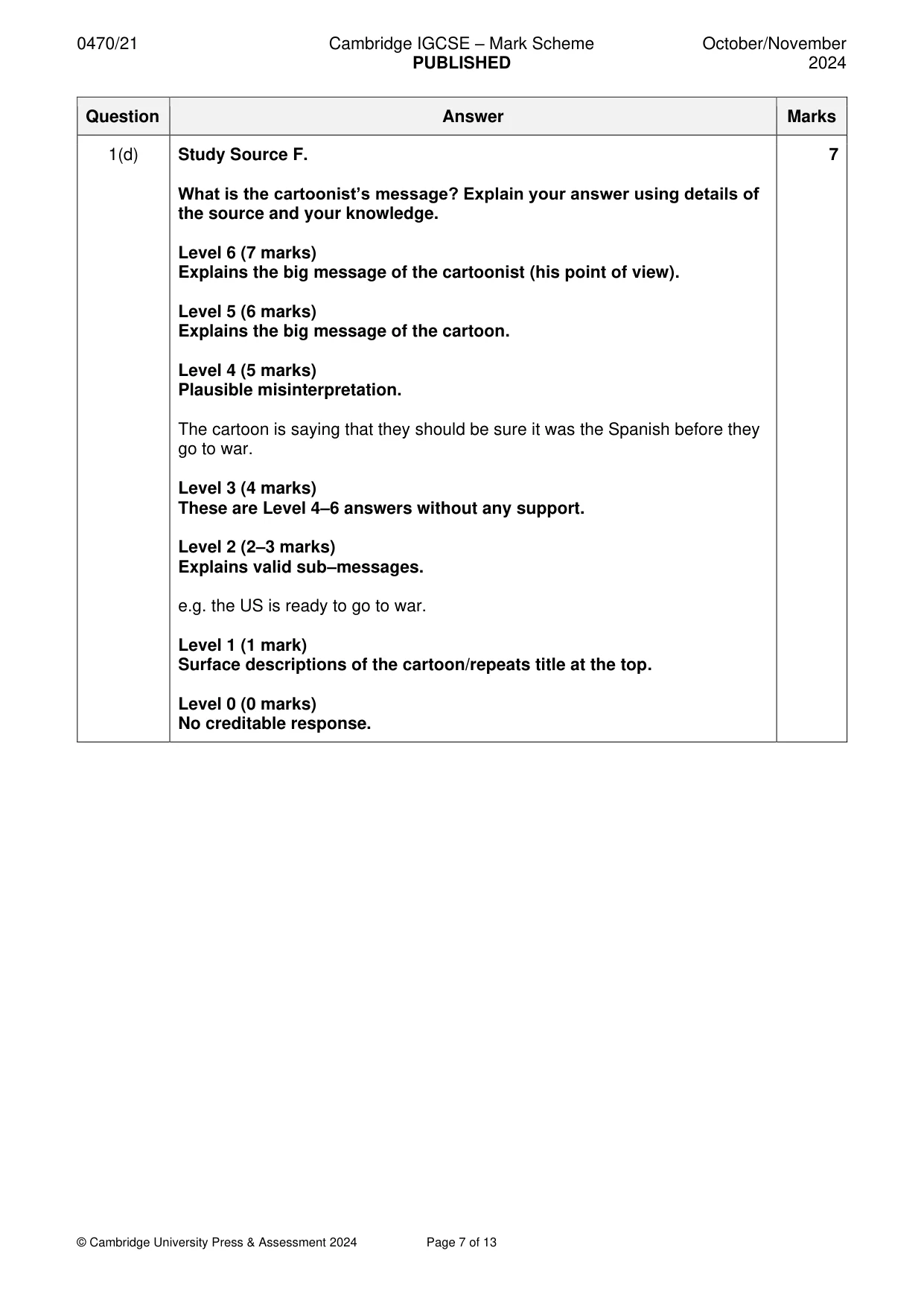
0470/21 Cambridge IGCSE – Mark Scheme PUBLISHED October/November 2024 © Cambridge University Press & Assessment 2024 Page 7 of 13 Question Answer Marks 1(d) Study Source F. What is the cartoonist’s message? Explain your answer using details of the source and your knowledge. Level 6 (7 marks) Explains the big message of the cartoonist (his point of view). Level 5 (6 marks) Explains the big message of the cartoon. Level 4 (5 marks) Plausible misinterpretation. The cartoon is saying that they should be sure it was the Spanish before they go to war. Level 3 (4 marks) These are Level 4–6 answers without any support. Level 2 (2–3 marks) Explains valid sub–messages. e.g. the US is ready to go to war. Level 1 (1 mark) Surface descriptions of the cartoon/repeats title at the top. Level 0 (0 marks) No creditable response. 7
Mark scheme, page 8
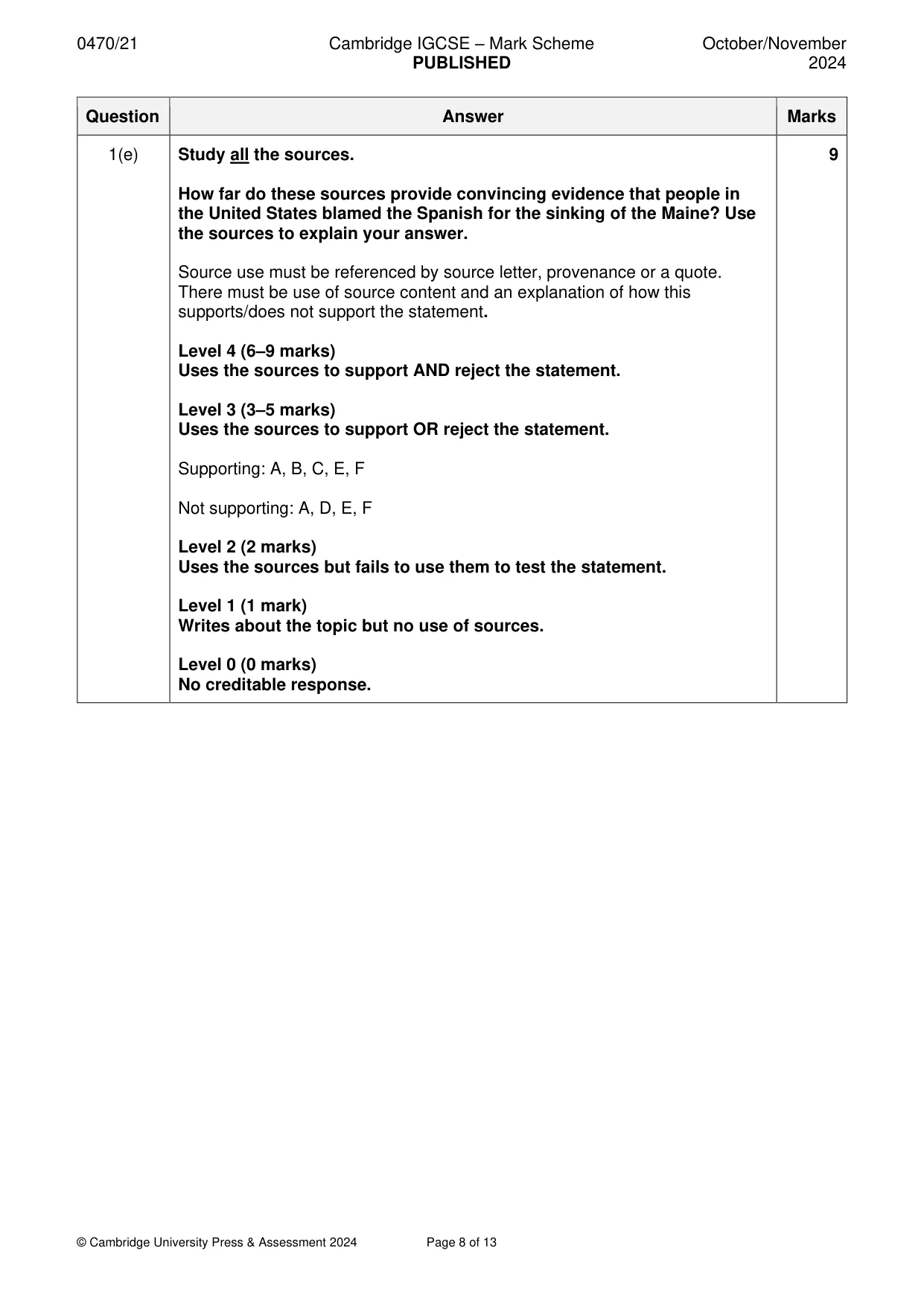
0470/21 Cambridge IGCSE – Mark Scheme PUBLISHED October/November 2024 © Cambridge University Press & Assessment 2024 Page 8 of 13 Question Answer Marks 1(e) Study all the sources. How far do these sources provide convincing evidence that people in the United States blamed the Spanish for the sinking of the Maine? Use the sources to explain your answer. Source use must be referenced by source letter, provenance or a quote. There must be use of source content and an explanation of how this supports/does not support the statement. Level 4 (6–9 marks) Uses the sources to support AND reject the statement. Level 3 (3–5 marks) Uses the sources to support OR reject the statement. Supporting: A, B, C, E, F Not supporting: A, D, E, F Level 2 (2 marks) Uses the sources but fails to use them to test the statement. Level 1 (1 mark) Writes about the topic but no use of sources. Level 0 (0 marks) No creditable response. 9
Mark scheme, page 9
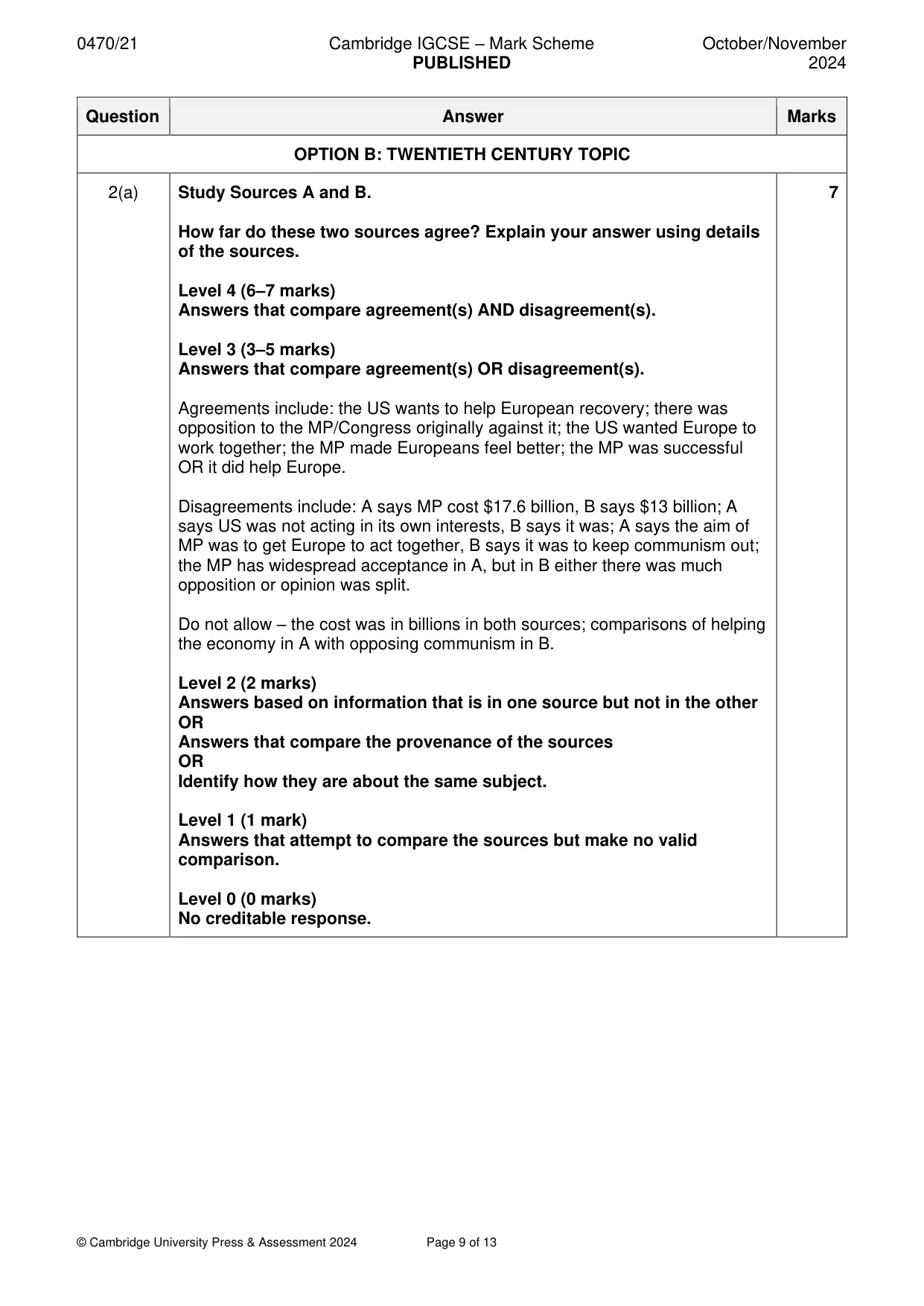
0470/21 Cambridge IGCSE – Mark Scheme PUBLISHED October/November 2024 © Cambridge University Press & Assessment 2024 Page 9 of 13 Question Answer Marks OPTION B: TWENTIETH CENTURY TOPIC 2(a) Study Sources A and B. How far do these two sources agree? Explain your answer using details of the sources. Level 4 (6–7 marks) Answers that compare agreement(s) AND disagreement(s). Level 3 (3–5 marks) Answers that compare agreement(s) OR disagreement(s). Agreements include: the US wants to help European recovery; there was opposition to the MP/Congress originally against it; the US wanted Europe to work together; the MP made Europeans feel better; the MP was successful OR it did help Europe. Disagreements include: A says MP cost $17.6 billion, B says $13 billion; A says US was not acting in its own interests, B says it was; A says the aim of MP was to get Europe to act together, B says it was to keep communism out; the MP has widespread acceptance in A, but in B either there was much opposition or opinion was split. Do not allow – the cost was in billions in both sources; comparisons of helping the economy in A with opposing communism in B. Level 2 (2 marks) Answers based on information that is in one source but not in the other OR Answers that compare the provenance of the sources OR Identify how they are about the same subject. Level 1 (1 mark) Answers that attempt to compare the sources but make no valid comparison. Level 0 (0 marks) No creditable response. 7
Mark scheme, page 10
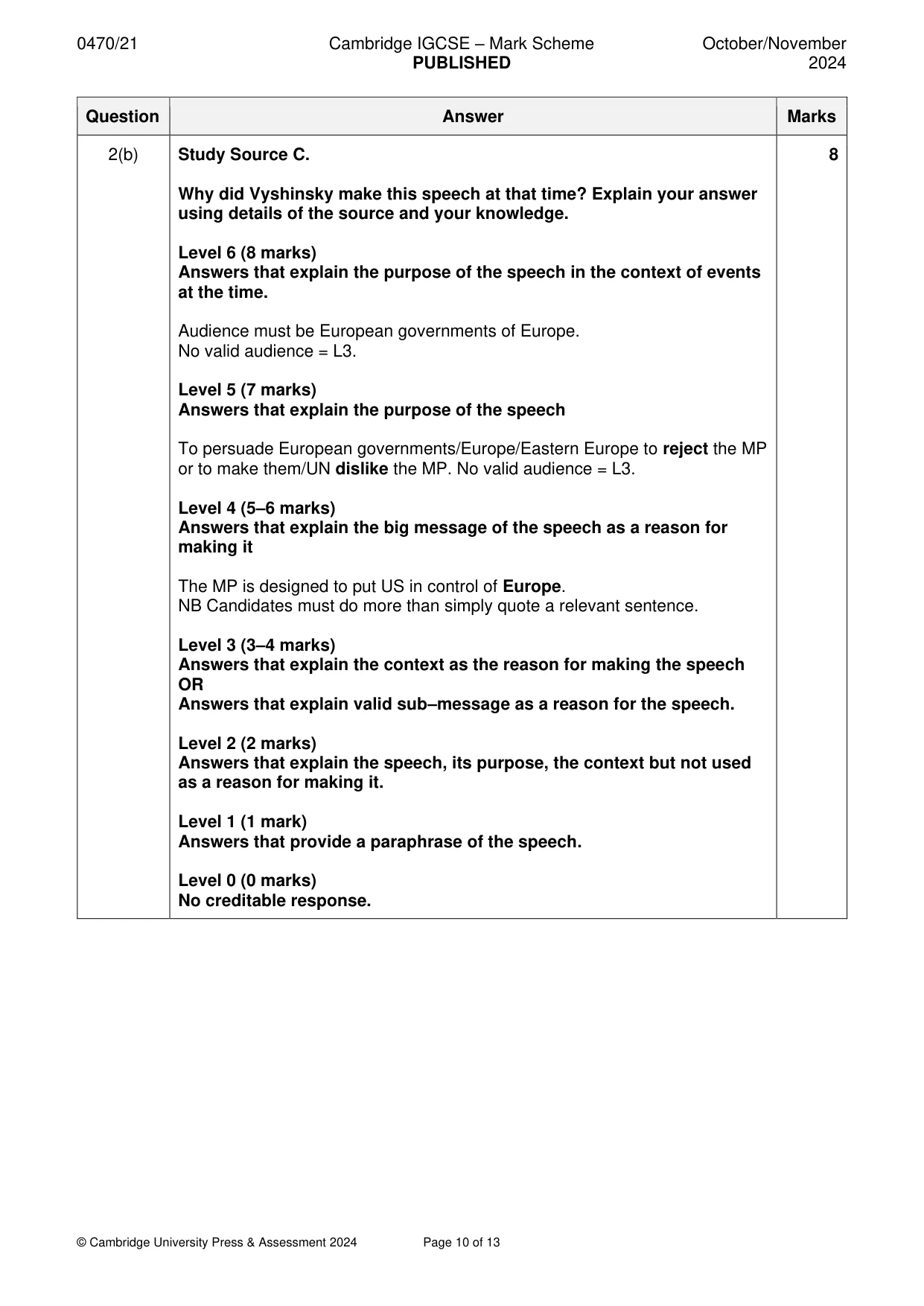
0470/21 Cambridge IGCSE – Mark Scheme PUBLISHED October/November 2024 © Cambridge University Press & Assessment 2024 Page 10 of 13 Question Answer Marks 2(b) Study Source C. Why did Vyshinsky make this speech at that time? Explain your answer using details of the source and your knowledge. Level 6 (8 marks) Answers that explain the purpose of the speech in the context of events at the time. Audience must be European governments of Europe. No valid audience = L3. Level 5 (7 marks) Answers that explain the purpose of the speech To persuade European governments/Europe/Eastern Europe to reject the MP or to make them/UN dislike the MP. No valid audience = L3. Level 4 (5–6 marks) Answers that explain the big message of the speech as a reason for making it The MP is designed to put US in control of Europe. NB Candidates must do more than simply quote a relevant sentence. Level 3 (3–4 marks) Answers that explain the context as the reason for making the speech OR Answers that explain valid sub–message as a reason for the speech. Level 2 (2 marks) Answers that explain the speech, its purpose, the context but not used as a reason for making it. Level 1 (1 mark) Answers that provide a paraphrase of the speech. Level 0 (0 marks) No creditable response. 8
Mark scheme, page 11
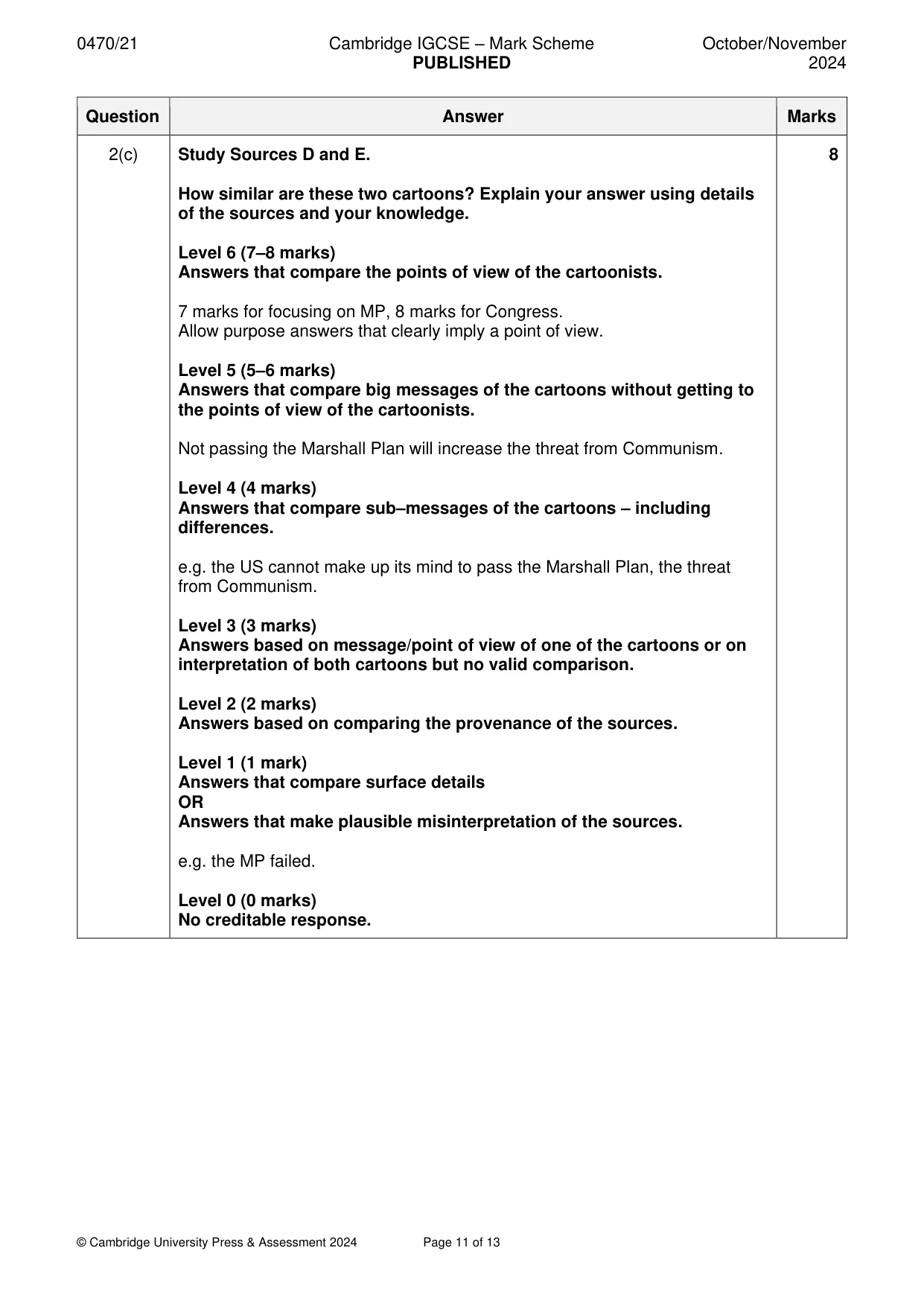
0470/21 Cambridge IGCSE – Mark Scheme PUBLISHED October/November 2024 © Cambridge University Press & Assessment 2024 Page 11 of 13 Question Answer Marks 2(c) Study Sources D and E. How similar are these two cartoons? Explain your answer using details of the sources and your knowledge. Level 6 (7–8 marks) Answers that compare the points of view of the cartoonists. 7 marks for focusing on MP, 8 marks for Congress. Allow purpose answers that clearly imply a point of view. Level 5 (5–6 marks) Answers that compare big messages of the cartoons without getting to the points of view of the cartoonists. Not passing the Marshall Plan will increase the threat from Communism. Level 4 (4 marks) Answers that compare sub–messages of the cartoons – including differences. e.g. the US cannot make up its mind to pass the Marshall Plan, the threat from Communism. Level 3 (3 marks) Answers based on message/point of view of one of the cartoons or on interpretation of both cartoons but no valid comparison. Level 2 (2 marks) Answers based on comparing the provenance of the sources. Level 1 (1 mark) Answers that compare surface details OR Answers that make plausible misinterpretation of the sources. e.g. the MP failed. Level 0 (0 marks) No creditable response. 8
Mark scheme, page 12
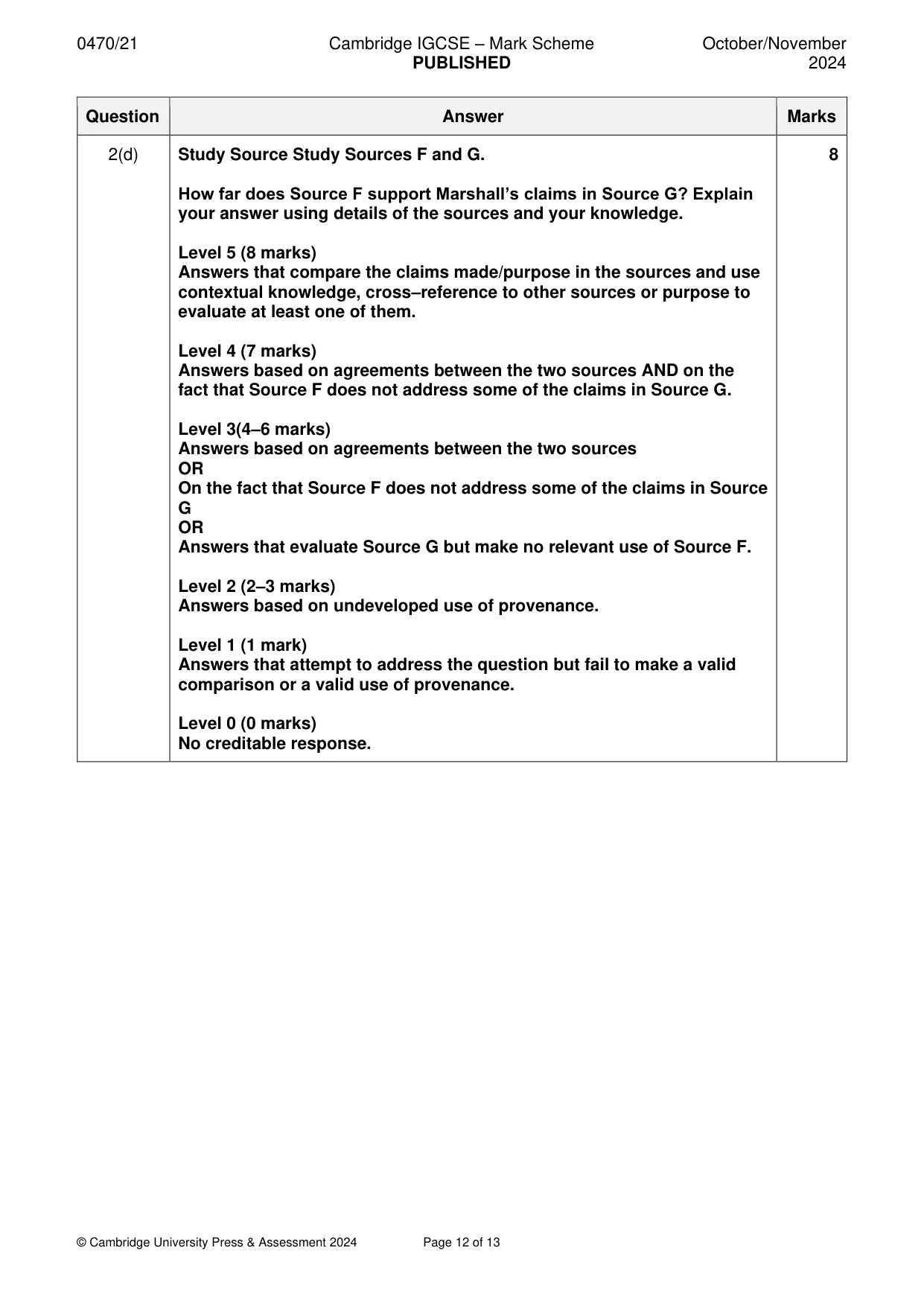
0470/21 Cambridge IGCSE – Mark Scheme PUBLISHED October/November 2024 © Cambridge University Press & Assessment 2024 Page 12 of 13 Question Answer Marks 2(d) Study Source Study Sources F and G. How far does Source F support Marshall’s claims in Source G? Explain your answer using details of the sources and your knowledge. Level 5 (8 marks) Answers that compare the claims made/purpose in the sources and use contextual knowledge, cross–reference to other sources or purpose to evaluate at least one of them. Level 4 (7 marks) Answers based on agreements between the two sources AND on the fact that Source F does not address some of the claims in Source G. Level 3(4–6 marks) Answers based on agreements between the two sources OR On the fact that Source F does not address some of the claims in Source G OR Answers that evaluate Source G but make no relevant use of Source F. Level 2 (2–3 marks) Answers based on undeveloped use of provenance. Level 1 (1 mark) Answers that attempt to address the question but fail to make a valid comparison or a valid use of provenance. Level 0 (0 marks) No creditable response. 8
Mark scheme, page 13
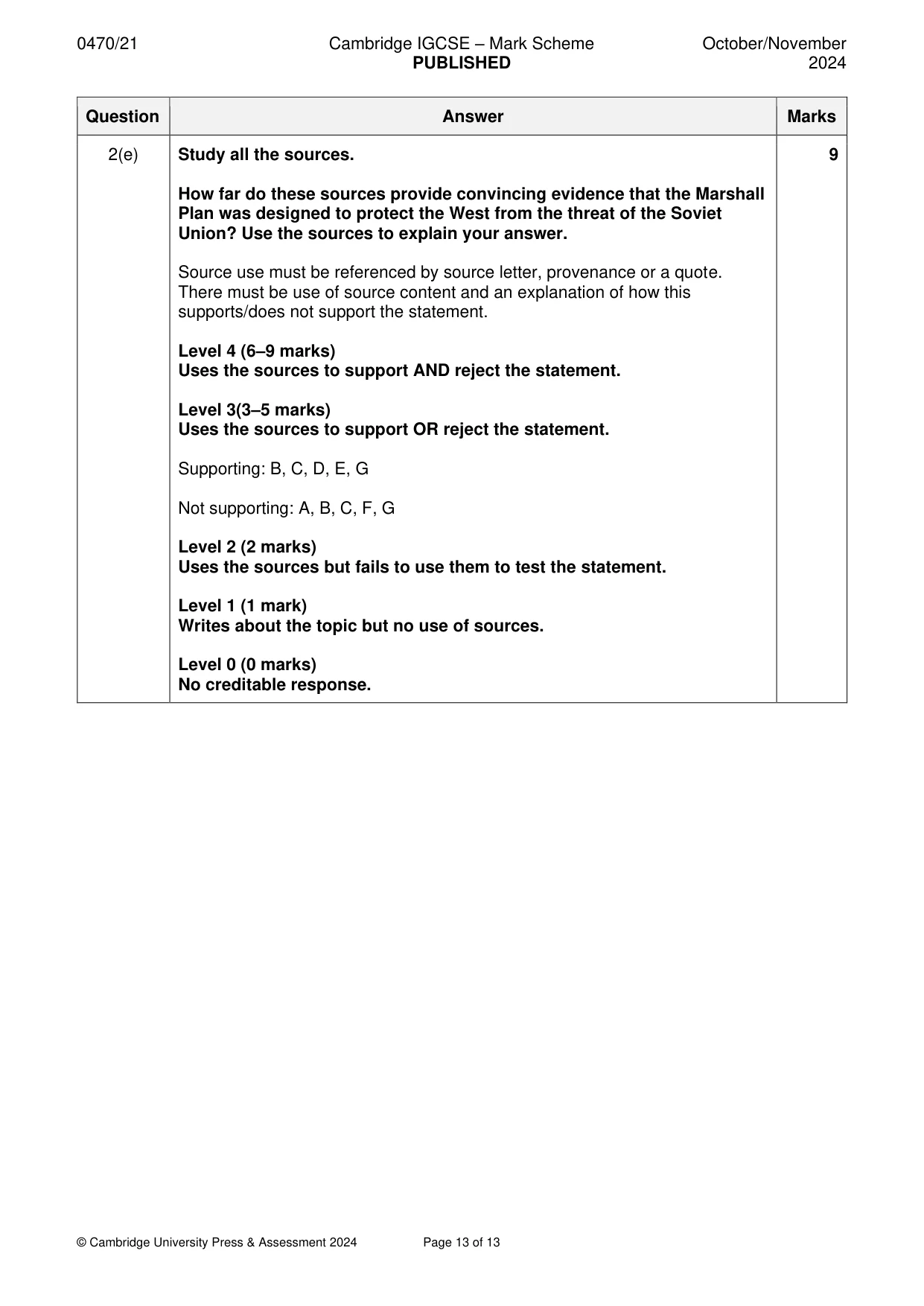
0470/21 Cambridge IGCSE – Mark Scheme PUBLISHED October/November 2024 © Cambridge University Press & Assessment 2024 Page 13 of 13 Question Answer Marks 2(e) Study all the sources. How far do these sources provide convincing evidence that the Marshall Plan was designed to protect the West from the threat of the Soviet Union? Use the sources to explain your answer. Source use must be referenced by source letter, provenance or a quote. There must be use of source content and an explanation of how this supports/does not support the statement. Level 4 (6–9 marks) Uses the sources to support AND reject the statement. Level 3(3–5 marks) Uses the sources to support OR reject the statement. Supporting: B, C, D, E, G Not supporting: A, B, C, F, G Level 2 (2 marks) Uses the sources but fails to use them to test the statement. Level 1 (1 mark) Writes about the topic but no use of sources. Level 0 (0 marks) No creditable response. 9
What you needed in this session
Cambridge’s own grade thresholds for 2024 Oct/Nov, Paper 2 · Variant 1. A higher threshold means an easier paper — the bar moves with how the cohort did.