Cambridge IGCSE History 0470 — 2025 Oct/Nov Paper 1 · Variant 1
0470/11/O/N/25 · 60 marks · 120 min
The question paper and its mark scheme, free to read here and free to download. This is Cambridge’s own paper, exactly as it was sat.
Question paper8 pages

Mark scheme77 pages
Answers below. Sit the paper first if you are practising.

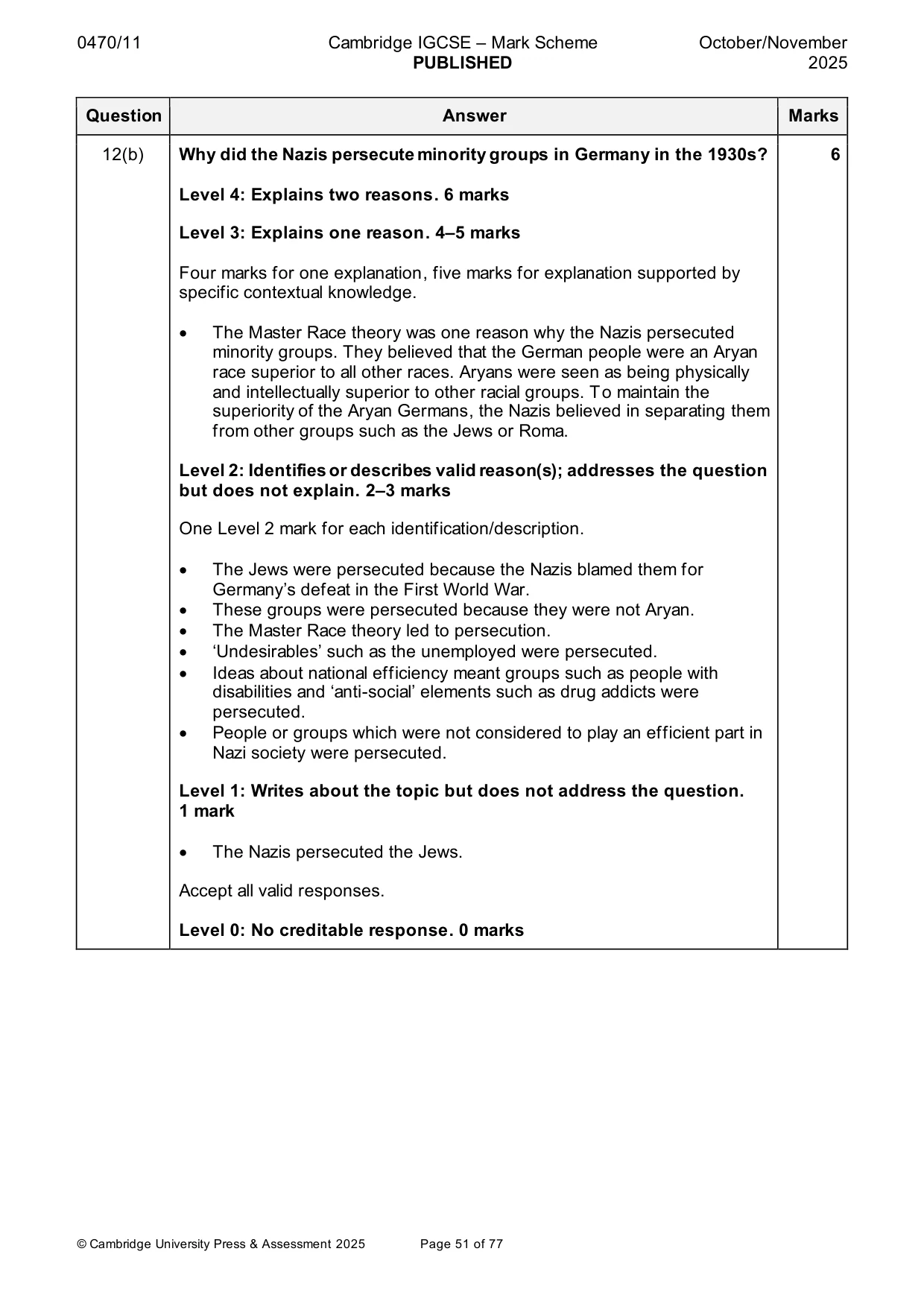
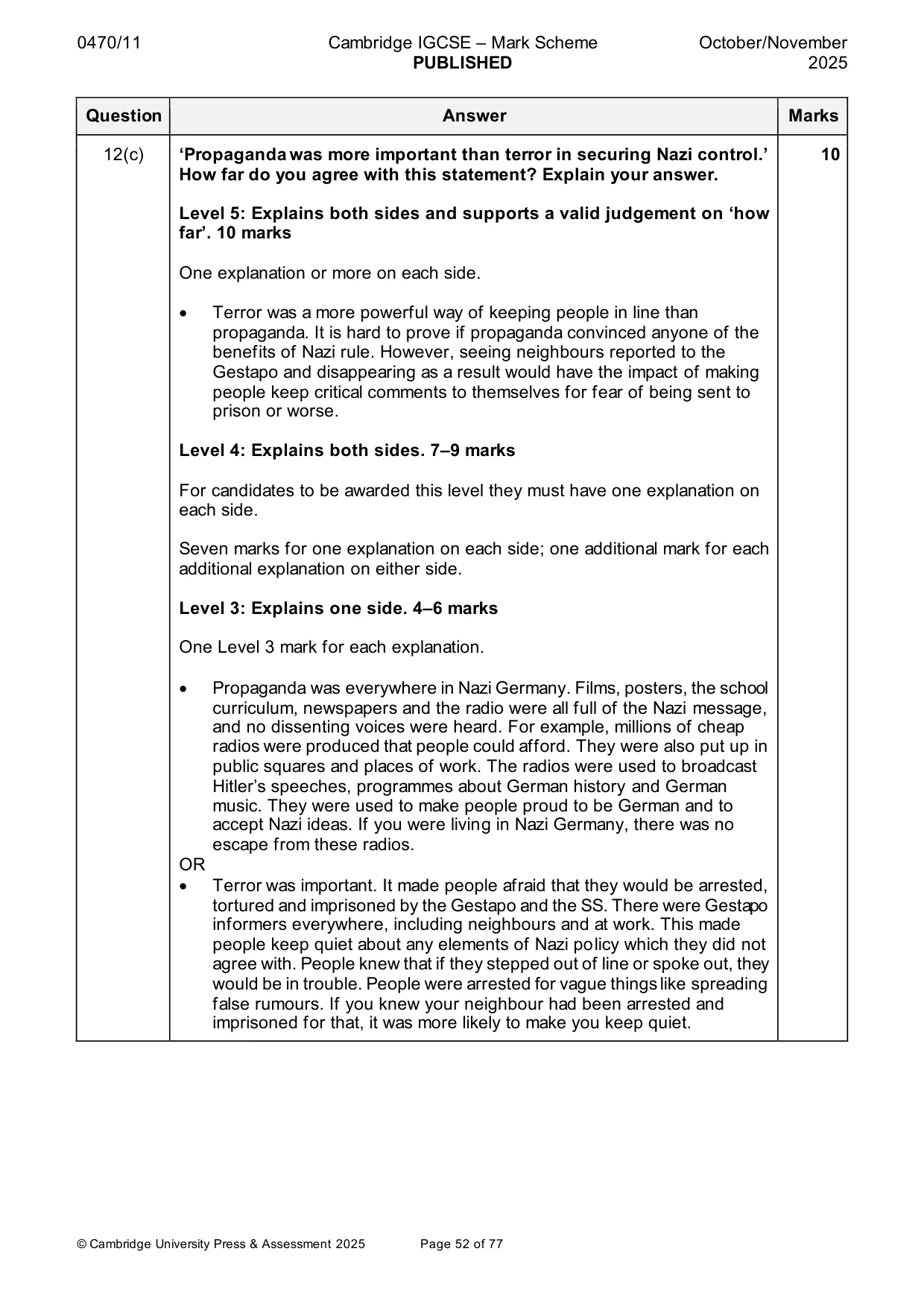
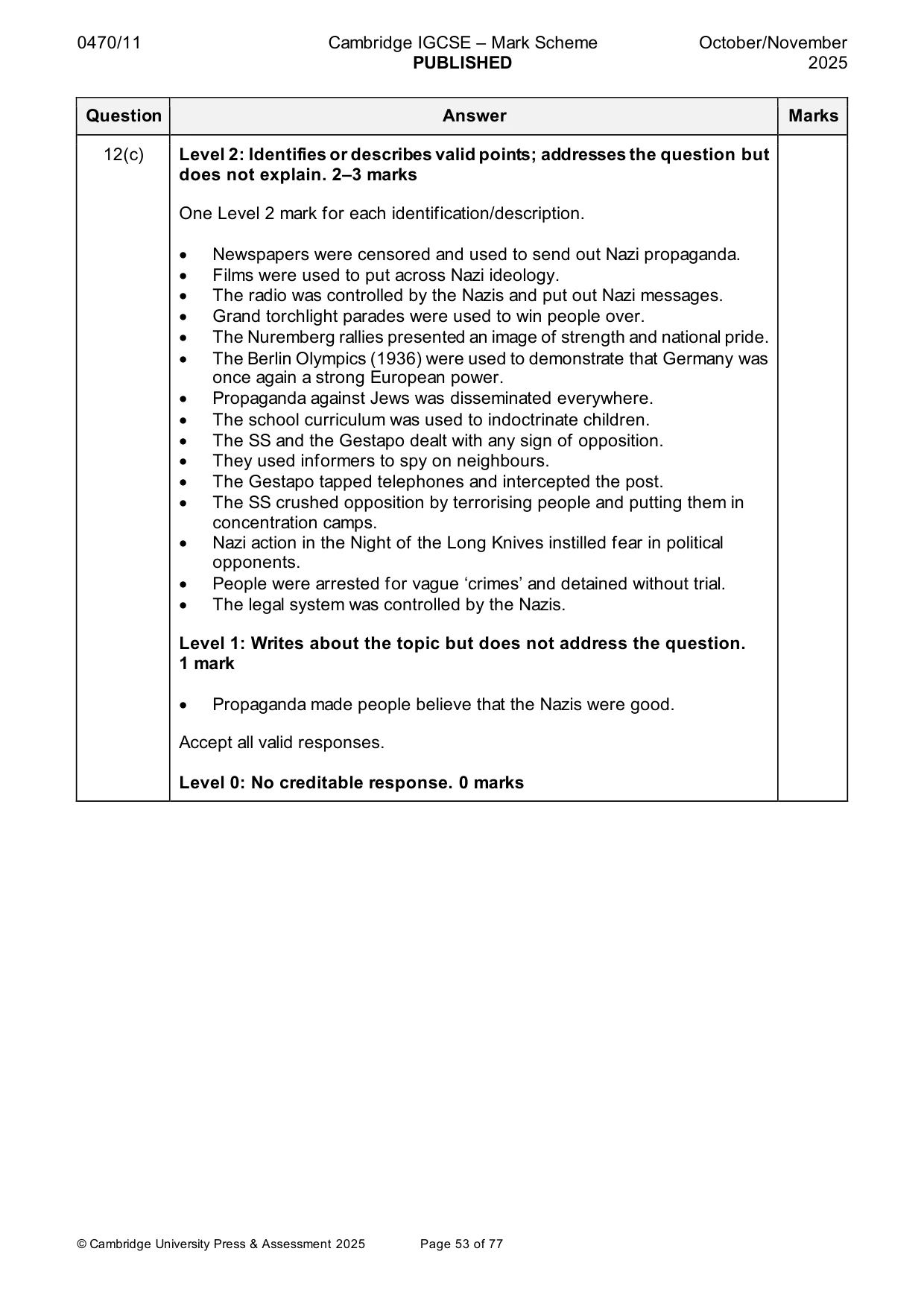
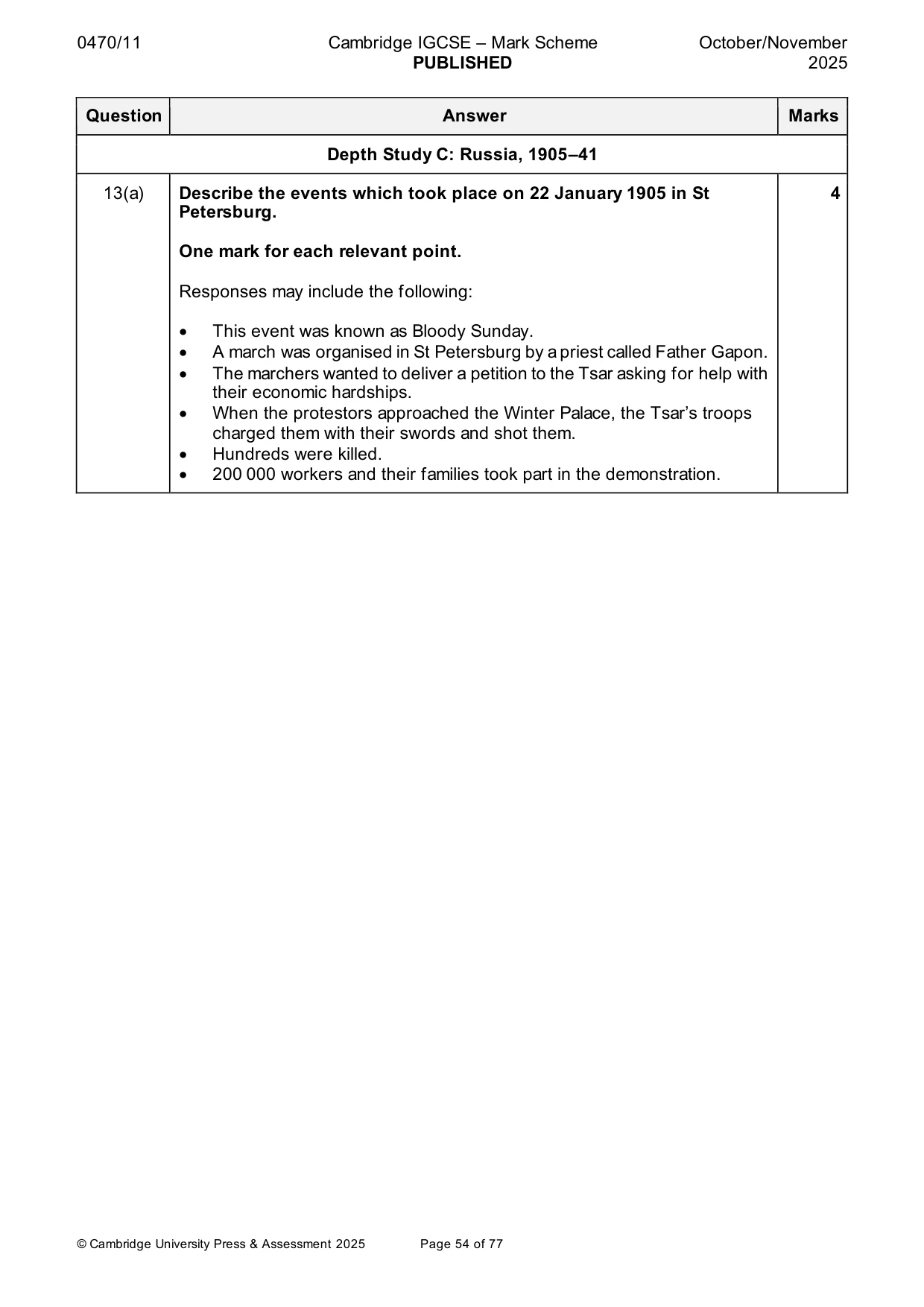
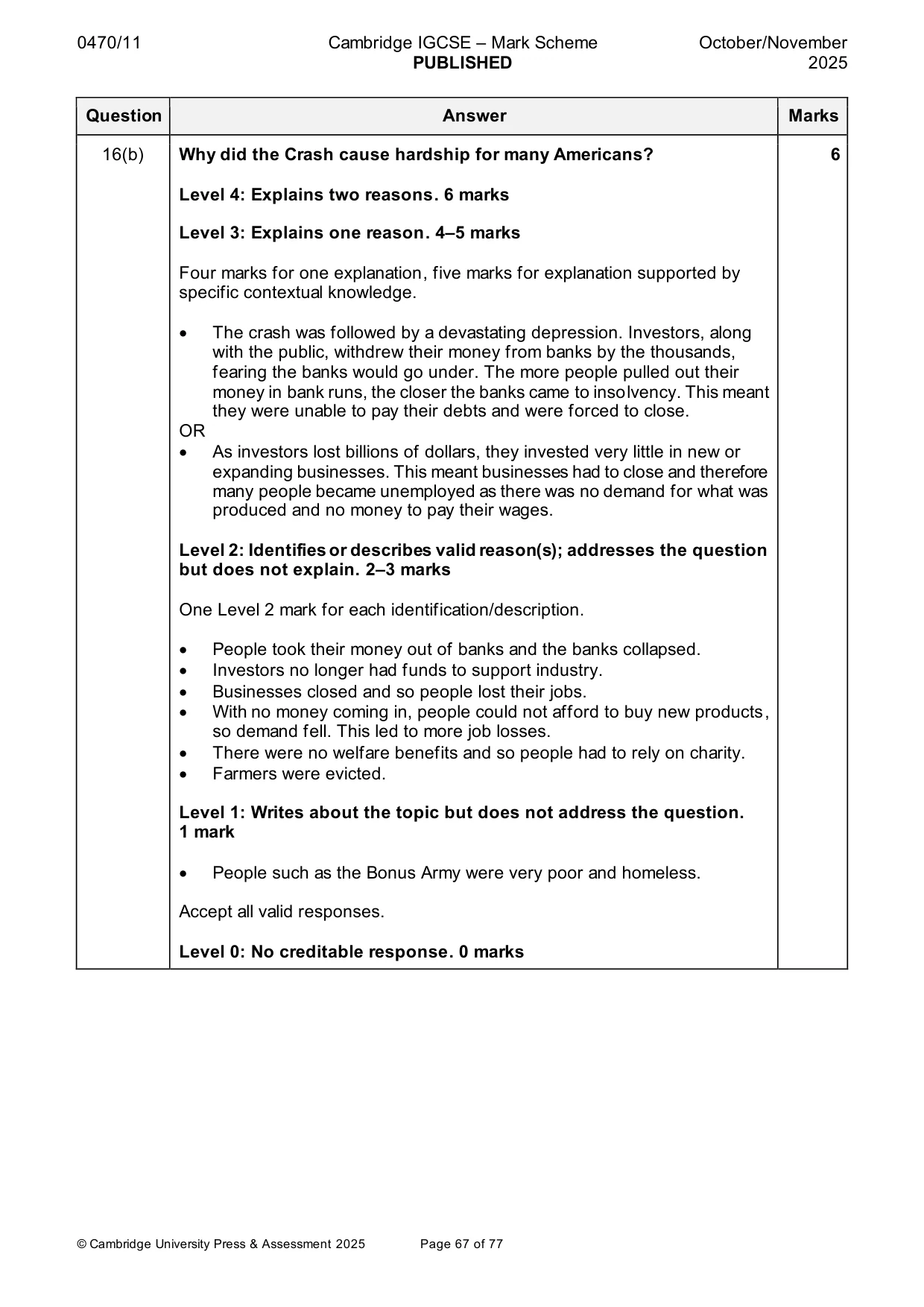
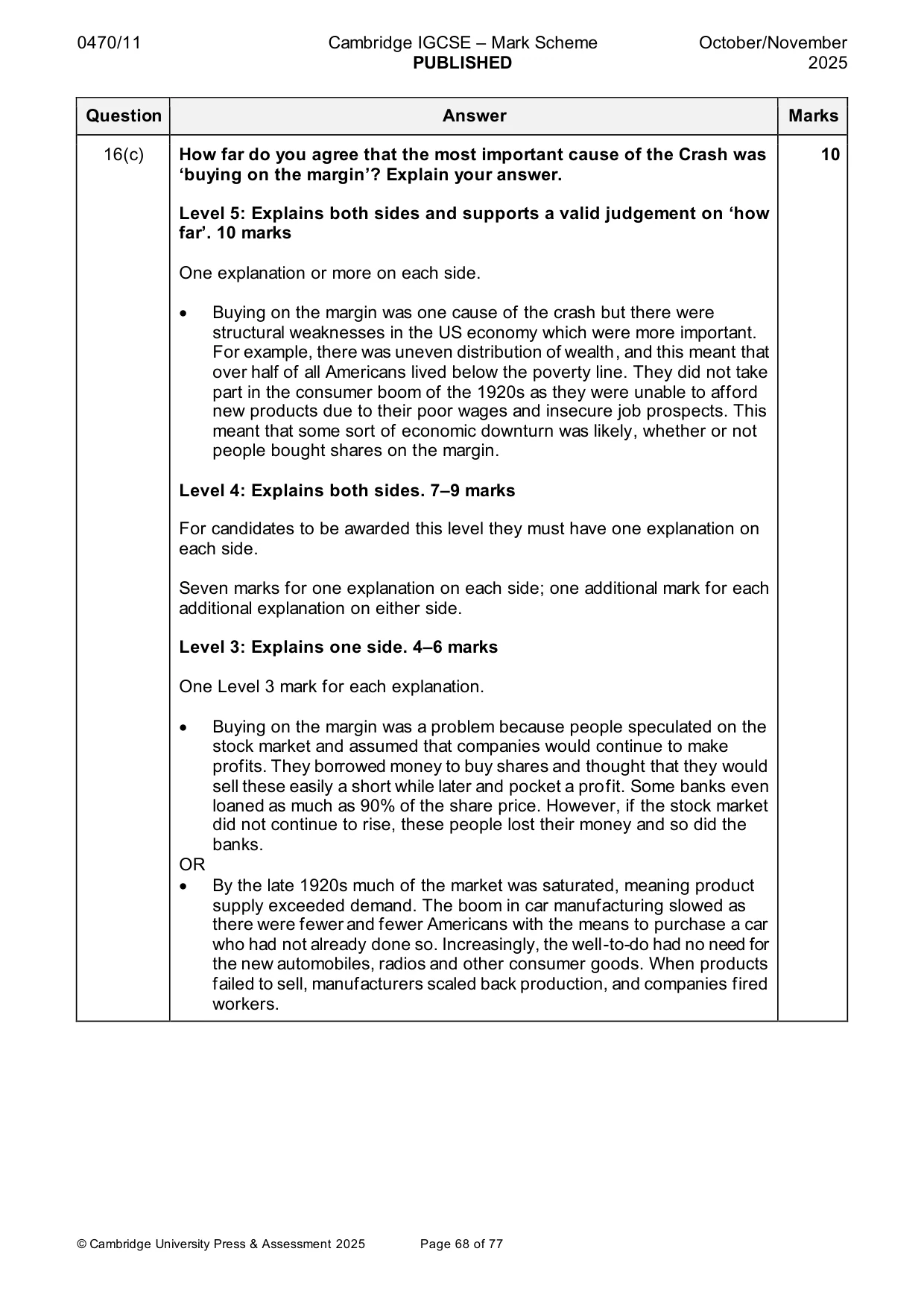
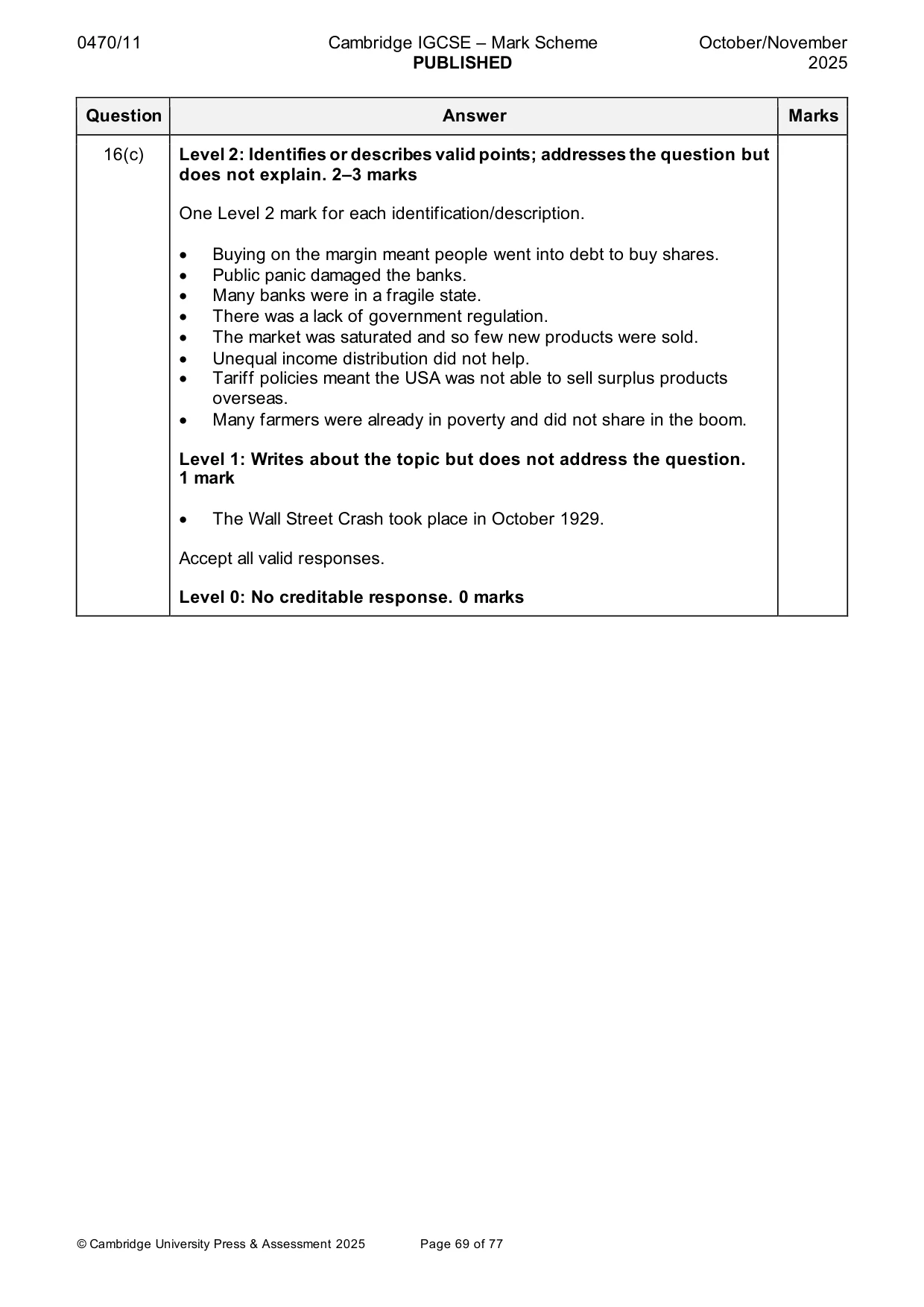
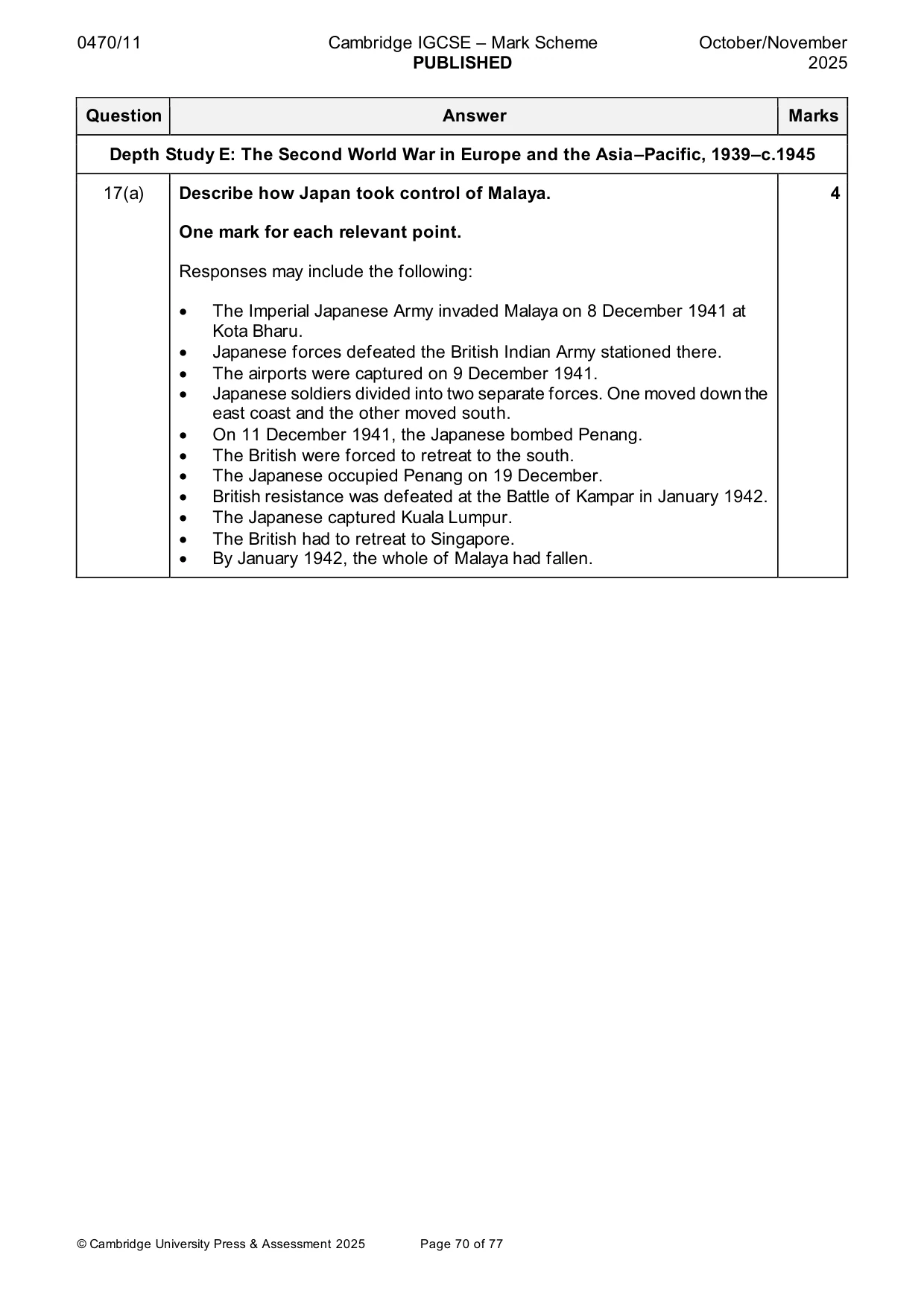
Paper as text
Question paper, page 1
This document has 8 pages. Any blank pages are indicated. [Turn over DC (JP) 343269/1 © UCLES 2025 * 7 7 3 5 3 7 8 5 7 6 * Cambridge IGCSE™ HISTORY 0470/11 Paper 1 Structured Questions October/November 2025 2 hours You must answer on the enclosed answer booklet. You will need: Answer booklet (enclosed) INSTRUCTIONS ● Answer three questions in total: Section A (Core content): answer two questions. Section B (Depth studies): answer one question. ● Follow the instructions on the front cover of the answer booklet. If you need additional answer paper, ask the invigilator for a continuation booklet. INFORMATION ● The total mark for this paper is 60. ● The number of marks for each question or part question is shown in brackets [ ].
Question paper, page 2
2 0470/11/O/N/25 © UCLES 2025 SECTION A: CORE CONTENT Answer two questions from this section. Option A: The nineteenth century 1 A wave of revolutions swept across Europe in 1848. (a) What was the role of Pope Pius IX in the revolutions in Italy? [4] (b) Why was there support for revolutionary ideas across Europe by 1848? [6] (c) ‘The revolutions of 1848 failed because the revolutionaries had different aims.’ How far do you agree with this statement? Explain your answer. [10] 2 German unification took several decades to complete. (a) Describe how the Prussian army was reformed between 1859 and 1862. [4] (b) Why was Austria able to reassert control over Germany by 1850? [6] (c) ‘Germany was united more through the use of diplomacy than the use of force.’ How far do you agree with this statement? Explain your answer. [10] 3 European powers were keen to establish colonies. (a) Describe the British policy of indirect rule. [4] (b) Why was the Berlin Conference of 1884–85 important? [6] (c) ‘European powers wanted to build empires for economic reasons.’ How far do you agree with this statement? Explain your answer. [10] 4 A range of different factors contributed to the outbreak of the First World War. (a) What happened in the Bosnian Crisis of 1908–09? [4] (b) Why did events involving Morocco in 1905–06 lead to increased tensions in Europe? [6] (c) How far do you agree that Austria was responsible for the outbreak of a general European war in 1914? Explain your answer. [10]
Question paper, page 3
3 0470/11/O/N/25 © UCLES 2025 [Turn over Option B: The twentieth century 5 The Treaty of Versailles disappointed many Germans. (a) What were Wilson’s aims at Versailles? [4] (b) Why was Clemenceau disappointed with the Treaty of Versailles? [6] (c) ‘In the Treaty of Versailles, Lloyd George achieved what he wanted.’ How far do you agree with this statement? Explain your answer. [10] 6 The League had some success but struggled to maintain peace in the 1930s. (a) Describe how the League worked to improve public health. [4] (b) Why did the League fail to introduce sanctions when Japan invaded Manchuria? [6] (c) How far do you agree that France’s desire to maintain Italian friendship was to blame for the failure of the League over Abyssinia? Explain your answer. [10] 7 There were agreements and differences between the United States and the Soviet Union in the build up to the Cold War. (a) What agreements were reached at the Potsdam Conference? [4] (b) Why was the Warsaw Pact established in 1955? [6] (c) How far do you agree that differences in ideology were to blame for the Cold War? Explain your answer. [10] 8 The involvement of the United States in Vietnam was often controversial. (a) What was the Strategic Hamlet Program? [4] (b) Why was the Gulf of Tonkin Incident important? [6] (c) ‘The United States withdrew from Vietnam because of American public opinion.’ How far do you agree with this statement? Explain your answer. [10]
Question paper, page 4
4 0470/11/O/N/25 © UCLES 2025 SECTION B: DEPTH STUDIES Answer one question from this section. Depth study A: The First World War, 1914–18 9 Troops from the British Empire faced difficult circumstances in Africa. (a) What happened at Tanga in 1914? [4] (b) Why was the campaign in South West Africa a success for the Allies? [6] (c) ‘The Allied campaign in East Africa was a success.’ How far do you agree with this statement? Explain your answer. [10] 10 Germany faced an increasingly difficult situation in 1918. (a) What was the Ludendorff Offensive? [4] (b) Why were German forces defeated at Amiens? [6] (c) ‘Civilian unrest caused the outbreak of the German revolution in October 1918.’ How far do you agree with this statement? Explain your answer. [10] Depth study B: Germany, 1918–45 11 Hitler was able to gain and consolidate power in Germany. (a) What was the Munich Putsch? [4] (b) Why was the world economic depression important for the Nazis? [6] (c) ‘The Enabling Act was more important to Hitler’s consolidation of power than the Night of the Long Knives.’ How far do you agree with this statement? Explain your answer. [10] 12 In ruling Germany, the Nazis used different methods. (a) How did the Nazis control literature and the media in Germany? [4] (b) Why did the Nazis persecute minority groups in Germany in the 1930s? [6] (c) ‘Propaganda was more important than terror in securing Nazi control.’ How far do you agree with this statement? Explain your answer. [10]
Question paper, page 5
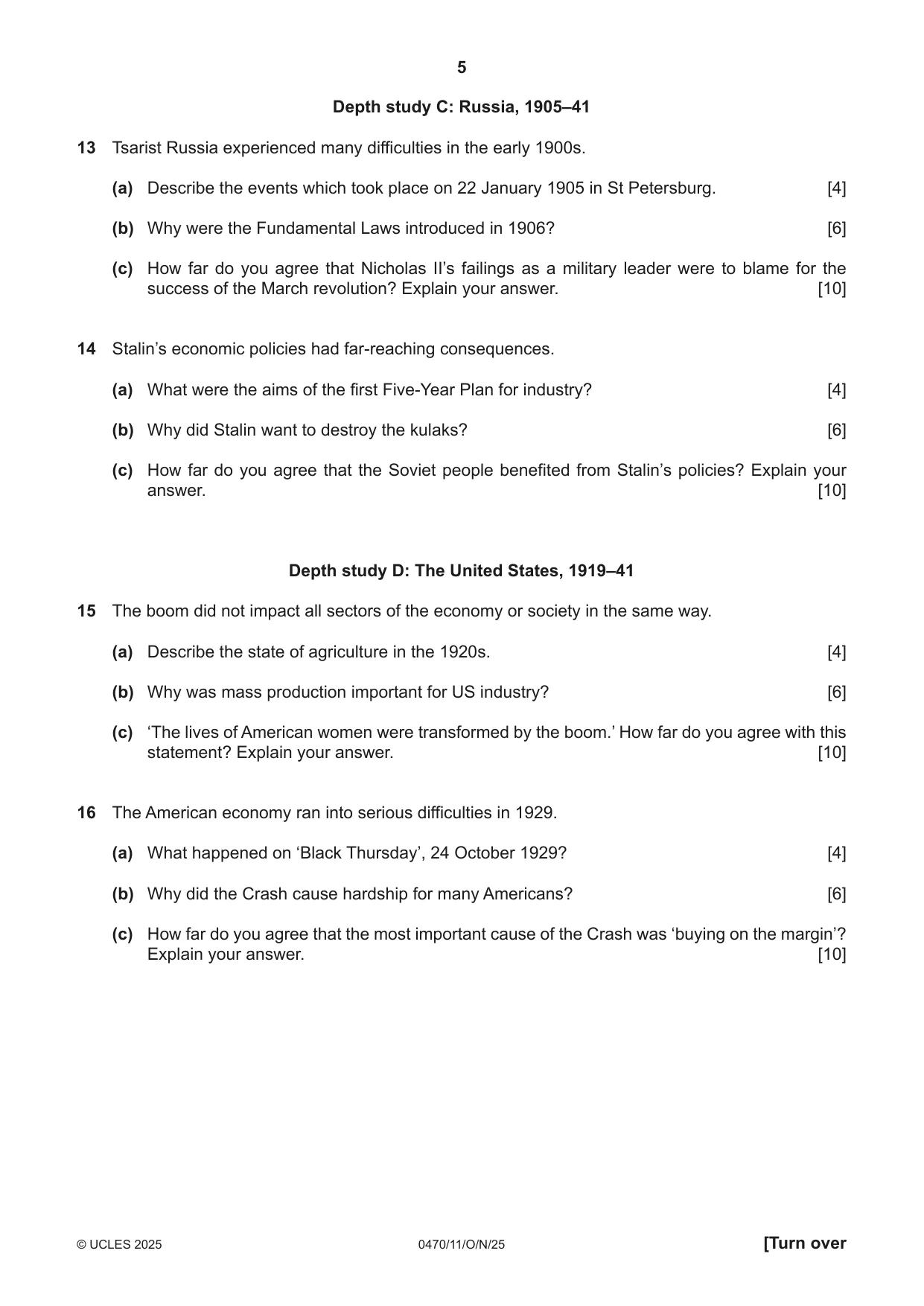
5 0470/11/O/N/25 © UCLES 2025 [Turn over Depth study C: Russia, 1905–41 13 Tsarist Russia experienced many difficulties in the early 1900s. (a) Describe the events which took place on 22 January 1905 in St Petersburg. [4] (b) Why were the Fundamental Laws introduced in 1906? [6] (c) How far do you agree that Nicholas II’s failings as a military leader were to blame for the success of the March revolution? Explain your answer. [10] 14 Stalin’s economic policies had far-reaching consequences. (a) What were the aims of the first Five-Year Plan for industry? [4] (b) Why did Stalin want to destroy the kulaks? [6] (c) How far do you agree that the Soviet people benefited from Stalin’s policies? Explain your answer. [10] Depth study D: The United States, 1919–41 15 The boom did not impact all sectors of the economy or society in the same way. (a) Describe the state of agriculture in the 1920s. [4] (b) Why was mass production important for US industry? [6] (c) ‘The lives of American women were transformed by the boom.’ How far do you agree with this statement? Explain your answer. [10] 16 The American economy ran into serious difficulties in 1929. (a) What happened on ‘Black Thursday’, 24 October 1929? [4] (b) Why did the Crash cause hardship for many Americans? [6] (c) How far do you agree that the most important cause of the Crash was ‘buying on the margin’? Explain your answer. [10]
Question paper, page 6
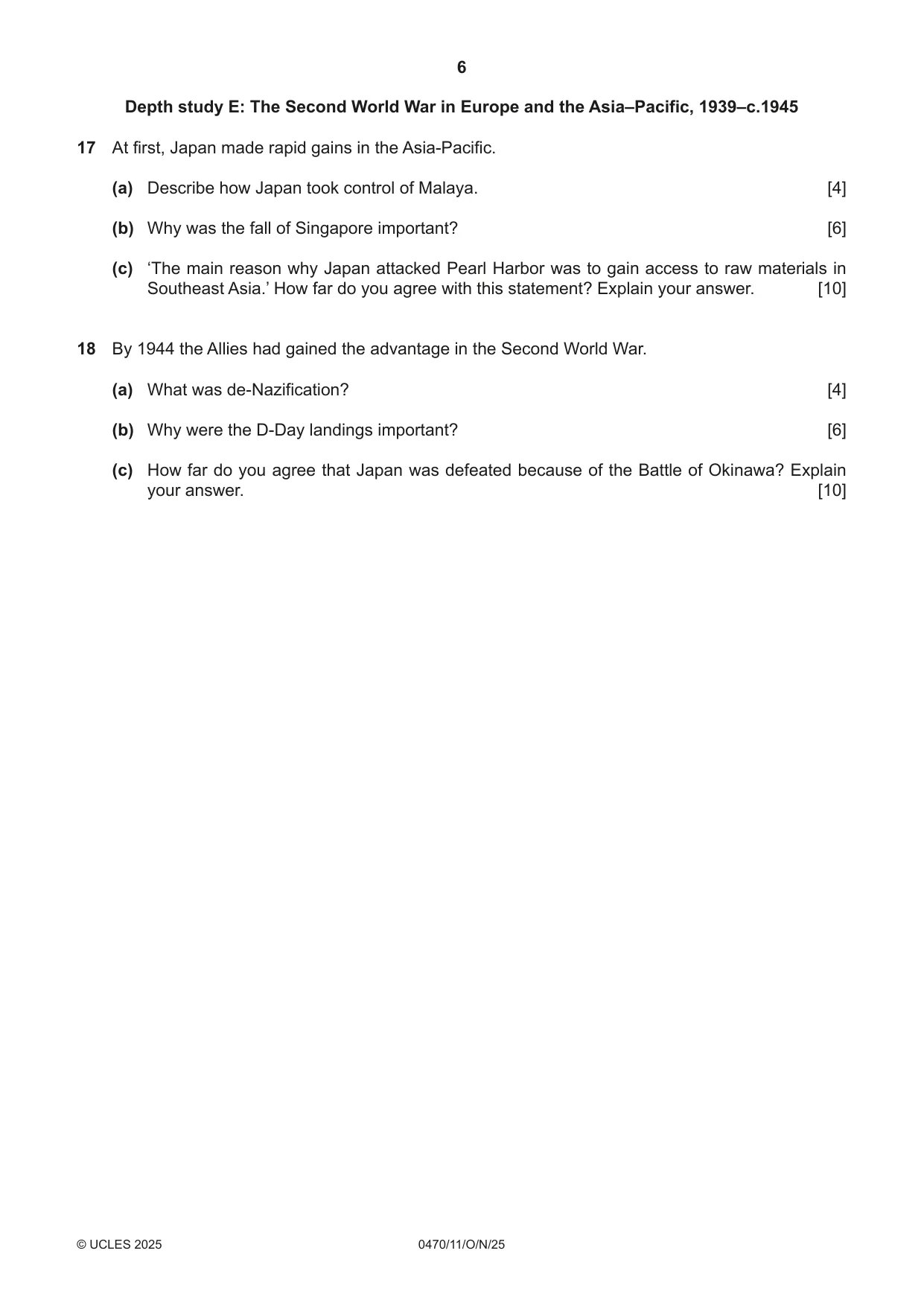
6 0470/11/O/N/25 © UCLES 2025 Depth study E: The Second World War in Europe and the Asia–Pacific, 1939–c.1945 17 At first, Japan made rapid gains in the Asia-Pacific. (a) Describe how Japan took control of Malaya. [4] (b) Why was the fall of Singapore important? [6] (c) ‘The main reason why Japan attacked Pearl Harbor was to gain access to raw materials in Southeast Asia.’ How far do you agree with this statement? Explain your answer. [10] 18 By 1944 the Allies had gained the advantage in the Second World War. (a) What was de-Nazification? [4] (b) Why were the D-Day landings important? [6] (c) How far do you agree that Japan was defeated because of the Battle of Okinawa? Explain your answer. [10]
Question paper, page 7
7 0470/11/O/N/25 © UCLES 2025 BLANK PAGE
Question paper, page 8
8 0470/11/O/N/25 © UCLES 2025 Permission to reproduce items where third-party owned material protected by copyright is included has been sought and cleared where possible. Every reasonable effort has been made by the publisher (UCLES) to trace copyright holders, but if any items requiring clearance have unwittingly been included, the publisher will be pleased to make amends at the earliest possible opportunity. To avoid the issue of disclosure of answer-related information to candidates, all copyright acknowledgements are reproduced online in the Cambridge Assessment International Education Copyright Acknowledgements Booklet. This is produced for each series of examinations and is freely available to download at www.cambridgeinternational.org after the live examination series. Cambridge Assessment International Education is part of Cambridge Assessment. Cambridge Assessment is the brand name of the University of Cambridge Local Examinations Syndicate (UCLES), which is a department of the University of Cambridge. BLANK PAGE
Mark scheme, page 1
This document consists of 77 printed pages. © Cambridge University Press & Assessment 2025 [Turn over Cambridge IGCSE™ HISTORY 0470/11 Paper 1 October/November 2025 MARK SCHEME Maximum Mark: 60 Published This mark scheme is published as an aid to teachers and candidates, to indicate the requirements of the examination. It shows the basis on which Examiners were instructed to award marks. It does not indicate the details of the discussions that took place at an Examiners’ meeting before marking began, which would have considered the acceptability of alternative answers. Mark schemes should be read in conjunction with the question paper and the Principal Examiner Report for Teachers. Cambridge International will not enter into discussions about these mark schemes. Cambridge International is publishing the mark schemes for the October/November 2025 series for most Cambridge IGCSE, Cambridge International A and AS Level components, and some Cambridge O Level components.
Mark scheme, page 2
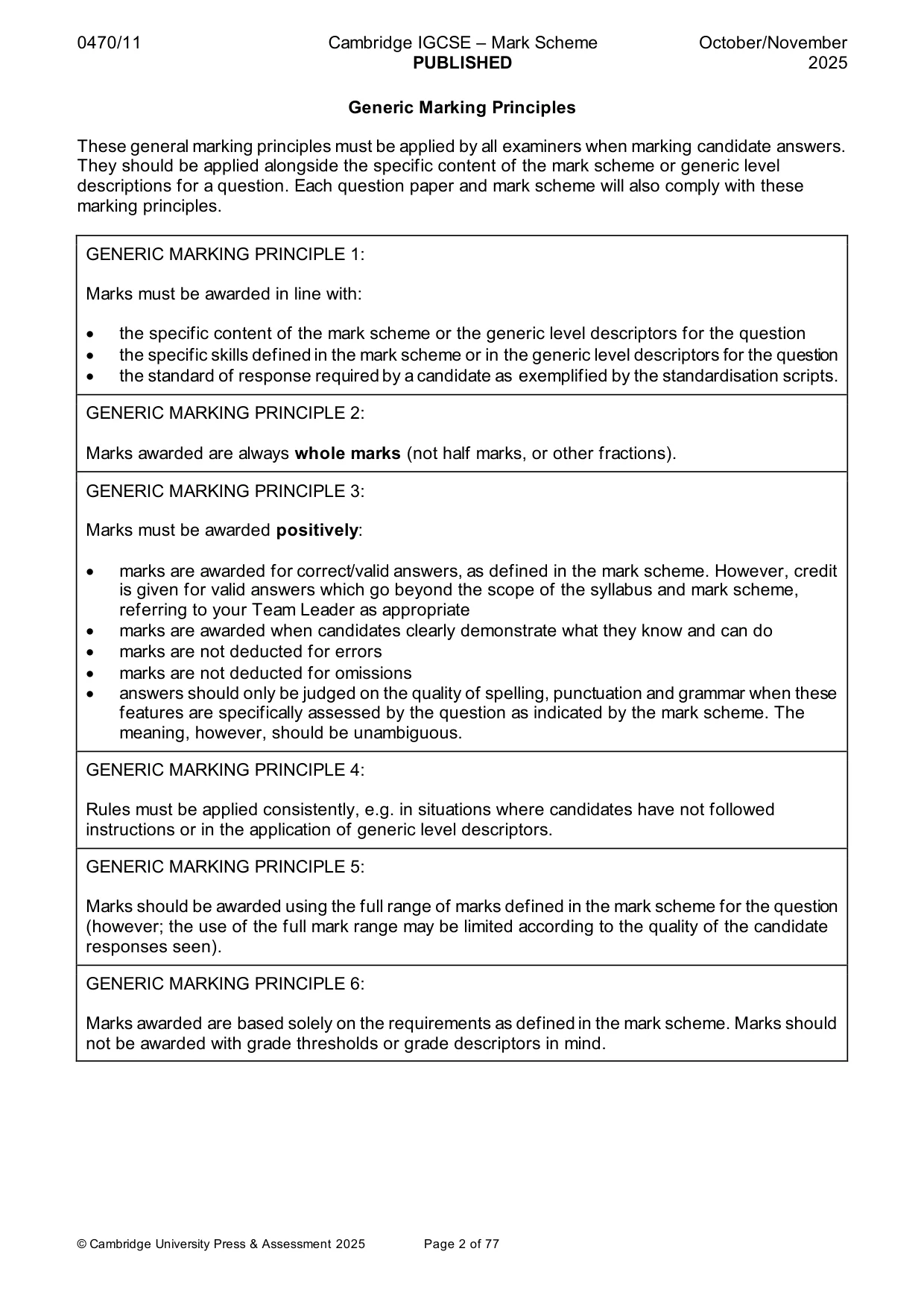
0470/11 Cambridge IGCSE – Mark Scheme PUBLISHED October/November 2025 © Cambridge University Press & Assessment 2025 Page 2 of 77 Generic Marking Principles These general marking principles must be applied by all examiners when marking candidate answers. They should be applied alongside the specific content of the mark scheme or generic level descriptions for a question. Each question paper and mark scheme will also comply with these marking principles. GENERIC MARKING PRINCIPLE 1: Marks must be awarded in line with: • the specific content of the mark scheme or the generic level descriptors for the question • the specific skills defined in the mark scheme or in the generic level descriptors for the question • the standard of response required by a candidate as exemplified by the standardisation scripts. GENERIC MARKING PRINCIPLE 2: Marks awarded are always whole marks (not half marks, or other fractions). GENERIC MARKING PRINCIPLE 3: Marks must be awarded positively: • marks are awarded for correct/valid answers, as defined in the mark scheme. However, credit is given for valid answers which go beyond the scope of the syllabus and mark scheme, referring to your Team Leader as appropriate • marks are awarded when candidates clearly demonstrate what they know and can do • marks are not deducted for errors • marks are not deducted for omissions • answers should only be judged on the quality of spelling, punctuation and grammar when these features are specifically assessed by the question as indicated by the mark scheme. The meaning, however, should be unambiguous. GENERIC MARKING PRINCIPLE 4: Rules must be applied consistently, e.g. in situations where candidates have not followed instructions or in the application of generic level descriptors. GENERIC MARKING PRINCIPLE 5: Marks should be awarded using the full range of marks defined in the mark scheme for the question (however; the use of the full mark range may be limited according to the quality of the candidate responses seen). GENERIC MARKING PRINCIPLE 6: Marks awarded are based solely on the requirements as defined in the mark scheme. Marks should not be awarded with grade thresholds or grade descriptors in mind.
Mark scheme, page 3
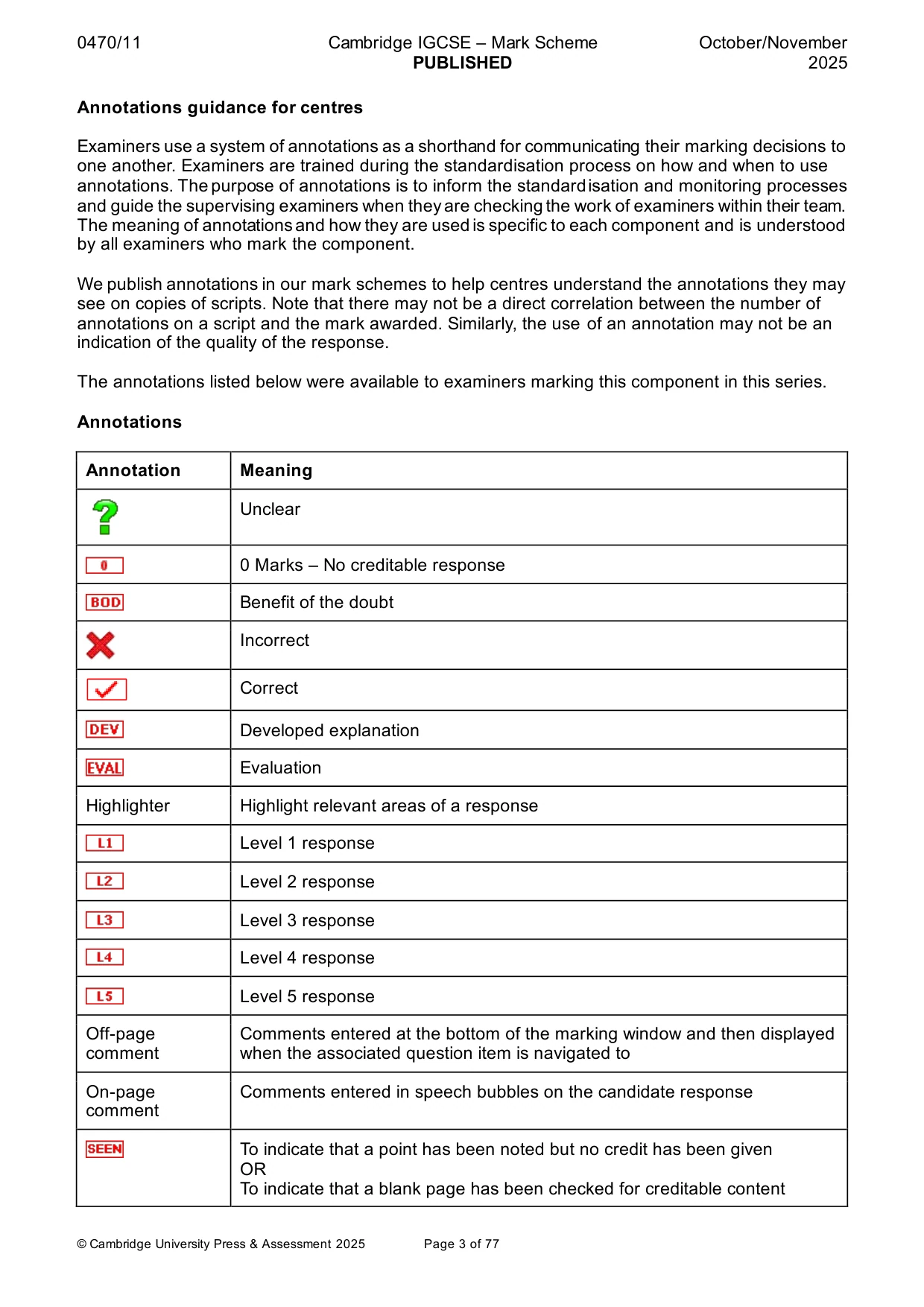
0470/11 Cambridge IGCSE – Mark Scheme PUBLISHED October/November 2025 © Cambridge University Press & Assessment 2025 Page 3 of 77 Annotations guidance for centres Examiners use a system of annotations as a shorthand for communicating their marking decisions to one another. Examiners are trained during the standardisation process on how and when to use annotations. The purpose of annotations is to inform the standardisation and monitoring processes and guide the supervising examiners when they are checking the work of examiners within their team. The meaning of annotations and how they are used is specific to each component and is understood by all examiners who mark the component. We publish annotations in our mark schemes to help centres understand the annotations they may see on copies of scripts. Note that there may not be a direct correlation between the number of annotations on a script and the mark awarded. Similarly, the use of an annotation may not be an indication of the quality of the response. The annotations listed below were available to examiners marking this component in this series. Annotations Annotation Meaning Unclear 0 Marks – No creditable response Benefit of the doubt Incorrect Correct Developed explanation Evaluation Highlighter Highlight relevant areas of a response Level 1 response Level 2 response Level 3 response Level 4 response Level 5 response Off-page comment Comments entered at the bottom of the marking window and then displayed when the associated question item is navigated to On-page comment Comments entered in speech bubbles on the candidate response To indicate that a point has been noted but no credit has been given OR To indicate that a blank page has been checked for creditable content
Mark scheme, page 4
0470/11 Cambridge IGCSE – Mark Scheme PUBLISHED October/November 2025 © Cambridge University Press & Assessment 2025 Page 4 of 77 Assessment objectives AO1 An ability to recall, select, organise and deploy knowledge of the syllabus content. AO2 An ability to construct historical explanations using an understanding of: • cause and consequence, change and continuity, similarity and difference • the motives, emotions, intentions and beliefs of people in the past.
Mark scheme, page 5
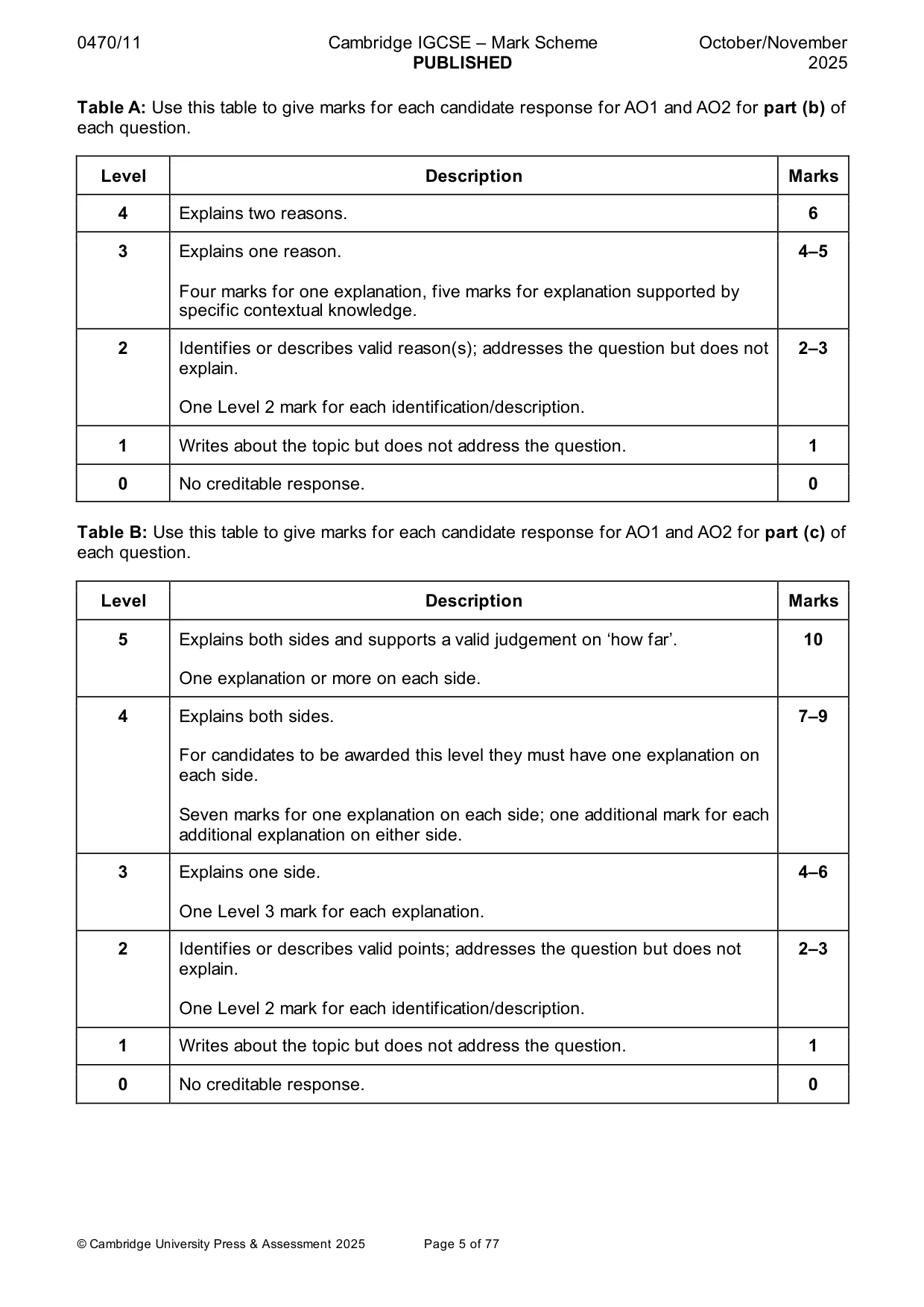
0470/11 Cambridge IGCSE – Mark Scheme PUBLISHED October/November 2025 © Cambridge University Press & Assessment 2025 Page 5 of 77 Table A: Use this table to give marks for each candidate response for AO1 and AO2 for part (b) of each question. Level Description Marks 4 Explains two reasons. 6 3 Explains one reason. Four marks for one explanation, five marks for explanation supported by specific contextual knowledge. 4–5 2 Identifies or describes valid reason(s); addresses the question but does not explain. One Level 2 mark for each identification/description. 2–3 1 Writes about the topic but does not address the question. 1 0 No creditable response. 0 Table B: Use this table to give marks for each candidate response for AO1 and AO2 for part (c) of each question. Level Description Marks 5 Explains both sides and supports a valid judgement on ‘how far’. One explanation or more on each side. 10 4 Explains both sides. For candidates to be awarded this level they must have one explanation on each side. Seven marks for one explanation on each side; one additional mark for each additional explanation on either side. 7–9 3 Explains one side. One Level 3 mark for each explanation. 4–6 2 Identifies or describes valid points; addresses the question but does not explain. One Level 2 mark for each identification/description. 2–3 1 Writes about the topic but does not address the question. 1 0 No creditable response. 0
Mark scheme, page 6
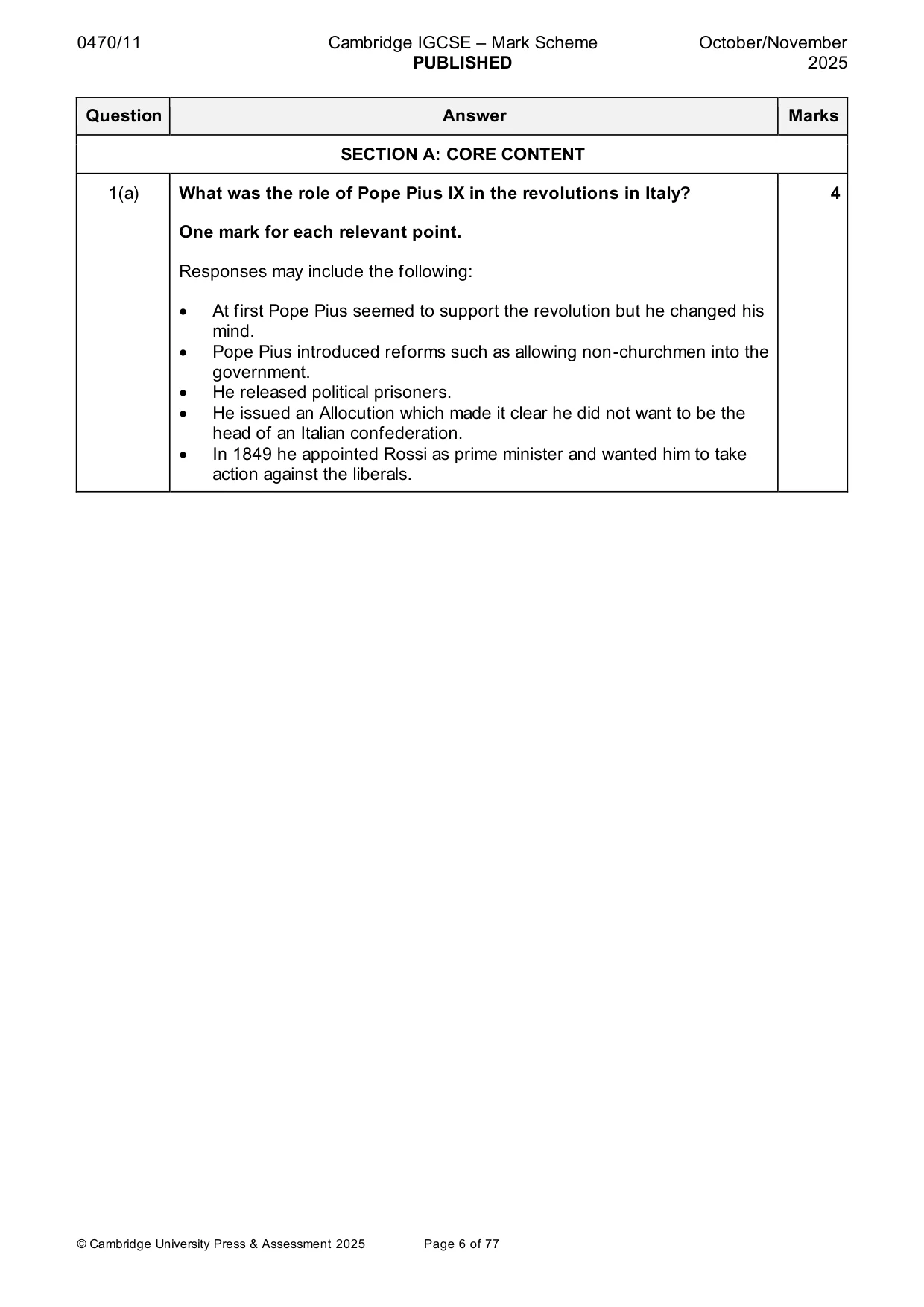
0470/11 Cambridge IGCSE – Mark Scheme PUBLISHED October/November 2025 © Cambridge University Press & Assessment 2025 Page 6 of 77 Question Answer Marks SECTION A: CORE CONTENT 1(a) What was the role of Pope Pius IX in the revolutions in Italy? One mark for each relevant point. Responses may include the following: • At first Pope Pius seemed to support the revolution but he changed his mind. • Pope Pius introduced reforms such as allowing non-churchmen into the government. • He released political prisoners. • He issued an Allocution which made it clear he did not want to be the head of an Italian confederation. • In 1849 he appointed Rossi as prime minister and wanted him to take action against the liberals. 4
Mark scheme, page 7
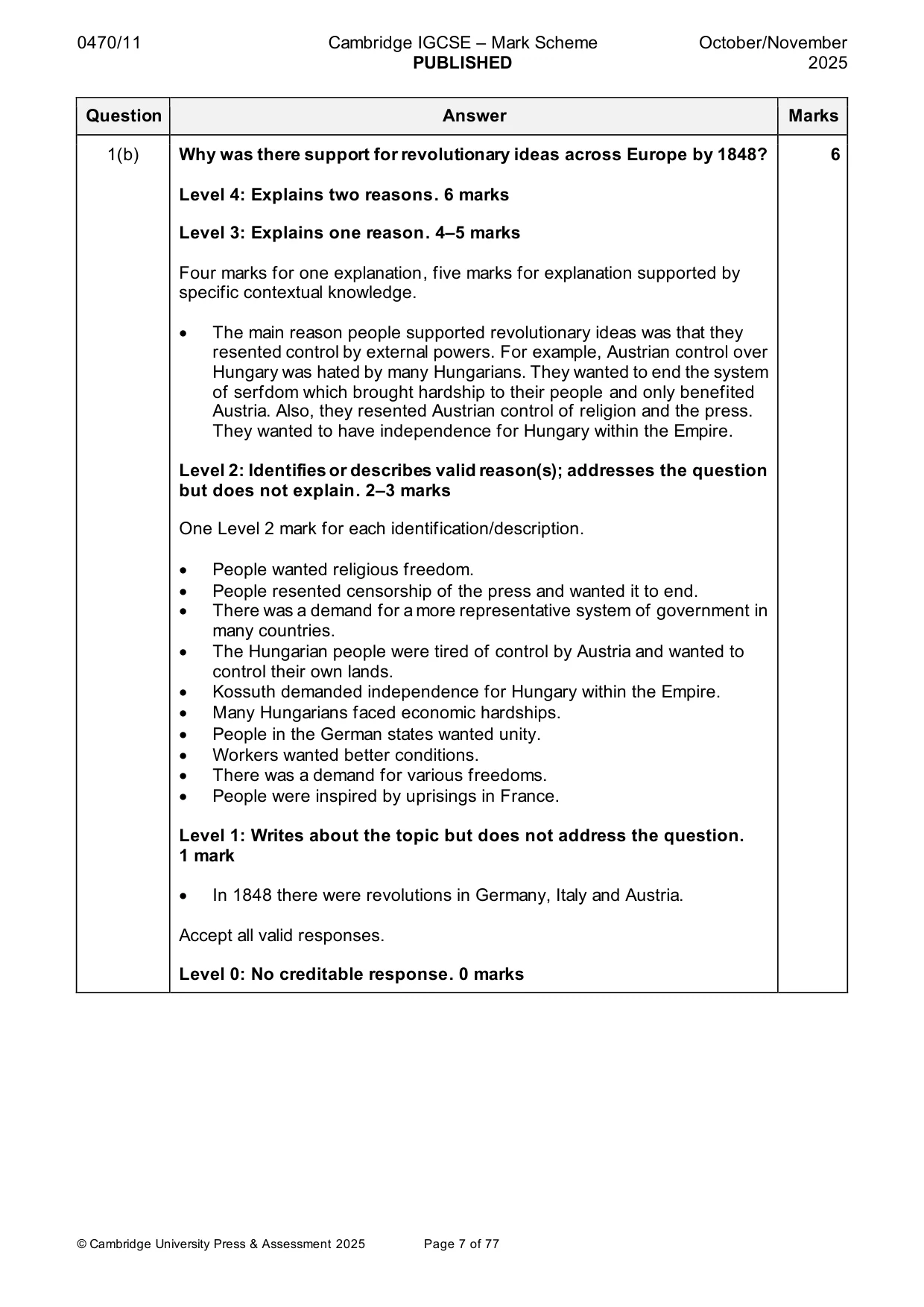
0470/11 Cambridge IGCSE – Mark Scheme PUBLISHED October/November 2025 © Cambridge University Press & Assessment 2025 Page 7 of 77 Question Answer Marks 1(b) Why was there support for revolutionary ideas across Europe by 1848? Level 4: Explains two reasons. 6 marks Level 3: Explains one reason. 4–5 marks Four marks for one explanation, five marks for explanation supported by specific contextual knowledge. • The main reason people supported revolutionary ideas was that they resented control by external powers. For example, Austrian control over Hungary was hated by many Hungarians. They wanted to end the system of serfdom which brought hardship to their people and only benefited Austria. Also, they resented Austrian control of religion and the press. They wanted to have independence for Hungary within the Empire. Level 2: Identifies or describes valid reason(s); addresses the question but does not explain. 2–3 marks One Level 2 mark for each identification/description. • People wanted religious freedom. • People resented censorship of the press and wanted it to end. • There was a demand for a more representative system of government in many countries. • The Hungarian people were tired of control by Austria and wanted to control their own lands. • Kossuth demanded independence for Hungary within the Empire. • Many Hungarians faced economic hardships. • People in the German states wanted unity. • Workers wanted better conditions. • There was a demand for various freedoms. • People were inspired by uprisings in France. Level 1: Writes about the topic but does not address the question. 1 mark • In 1848 there were revolutions in Germany, Italy and Austria. Accept all valid responses. Level 0: No creditable response. 0 marks 6
Mark scheme, page 8
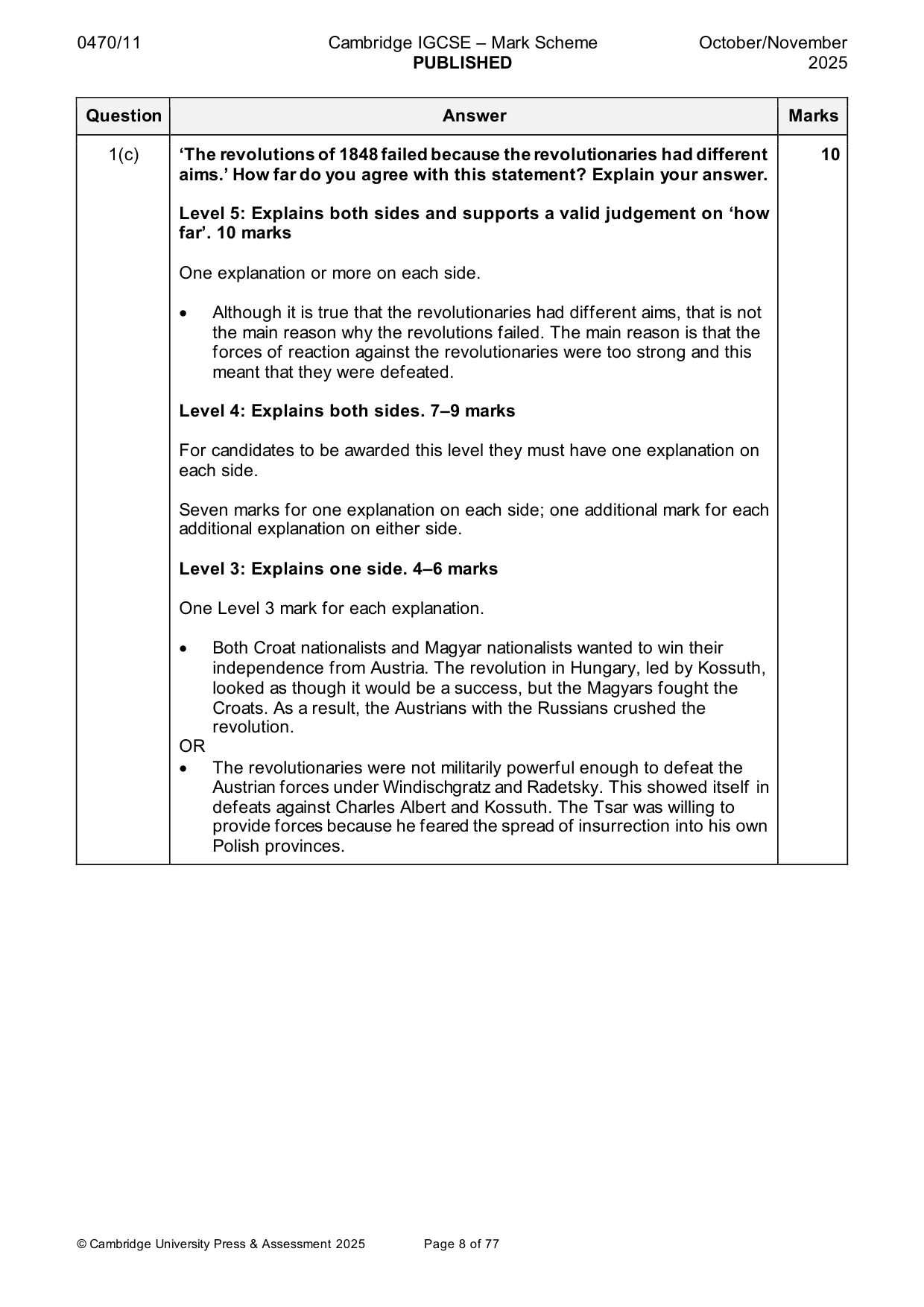
0470/11 Cambridge IGCSE – Mark Scheme PUBLISHED October/November 2025 © Cambridge University Press & Assessment 2025 Page 8 of 77 Question Answer Marks 1(c) ‘The revolutions of 1848 failed because the revolutionaries had different aims.’ How far do you agree with this statement? Explain your answer. Level 5: Explains both sides and supports a valid judgement on ‘how far’. 10 marks One explanation or more on each side. • Although it is true that the revolutionaries had different aims, that is not the main reason why the revolutions failed. The main reason is that the forces of reaction against the revolutionaries were too strong and this meant that they were defeated. Level 4: Explains both sides. 7–9 marks For candidates to be awarded this level they must have one explanation on each side. Seven marks for one explanation on each side; one additional mark for each additional explanation on either side. Level 3: Explains one side. 4–6 marks One Level 3 mark for each explanation. • Both Croat nationalists and Magyar nationalists wanted to win their independence from Austria. The revolution in Hungary, led by Kossuth, looked as though it would be a success, but the Magyars fought the Croats. As a result, the Austrians with the Russians crushed the revolution. OR • The revolutionaries were not militarily powerful enough to defeat the Austrian forces under Windischgratz and Radetsky. This showed itself in defeats against Charles Albert and Kossuth. The Tsar was willing to provide forces because he feared the spread of insurrection into his own Polish provinces. 10
Mark scheme, page 9
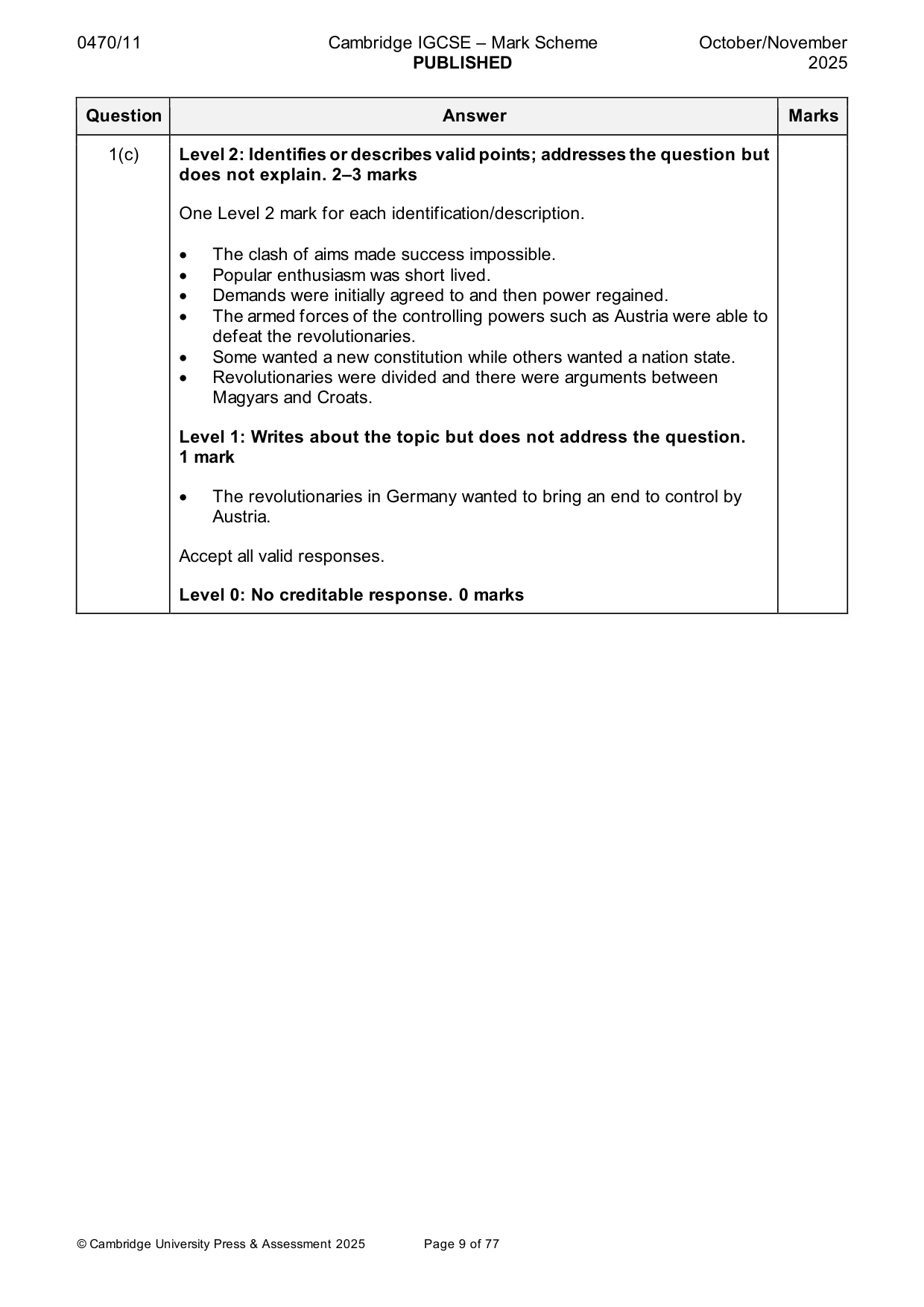
0470/11 Cambridge IGCSE – Mark Scheme PUBLISHED October/November 2025 © Cambridge University Press & Assessment 2025 Page 9 of 77 Question Answer Marks 1(c) Level 2: Identifies or describes valid points; addresses the question but does not explain. 2–3 marks One Level 2 mark for each identification/description. • The clash of aims made success impossible. • Popular enthusiasm was short lived. • Demands were initially agreed to and then power regained. • The armed forces of the controlling powers such as Austria were able to defeat the revolutionaries. • Some wanted a new constitution while others wanted a nation state. • Revolutionaries were divided and there were arguments between Magyars and Croats. Level 1: Writes about the topic but does not address the question. 1 mark • The revolutionaries in Germany wanted to bring an end to control by Austria. Accept all valid responses. Level 0: No creditable response. 0 marks
Mark scheme, page 10
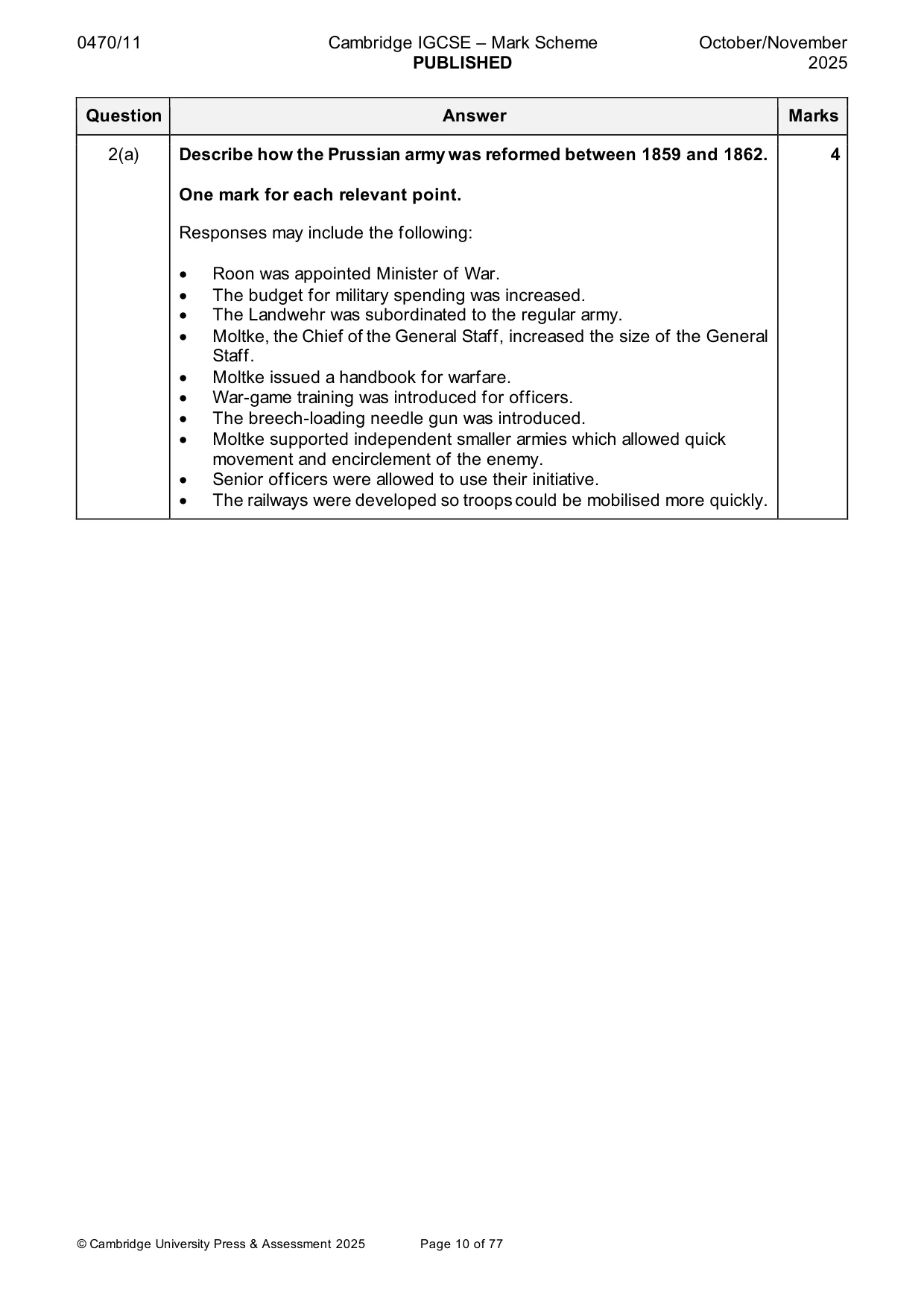
0470/11 Cambridge IGCSE – Mark Scheme PUBLISHED October/November 2025 © Cambridge University Press & Assessment 2025 Page 10 of 77 Question Answer Marks 2(a) Describe how the Prussian army was reformed between 1859 and 1862. One mark for each relevant point. Responses may include the following: • Roon was appointed Minister of War. • The budget for military spending was increased. • The Landwehr was subordinated to the regular army. • Moltke, the Chief of the General Staff, increased the size of the General Staff. • Moltke issued a handbook for warfare. • War-game training was introduced for officers. • The breech-loading needle gun was introduced. • Moltke supported independent smaller armies which allowed quick movement and encirclement of the enemy. • Senior officers were allowed to use their initiative. • The railways were developed so troops could be mobilised more quickly. 4
Mark scheme, page 11
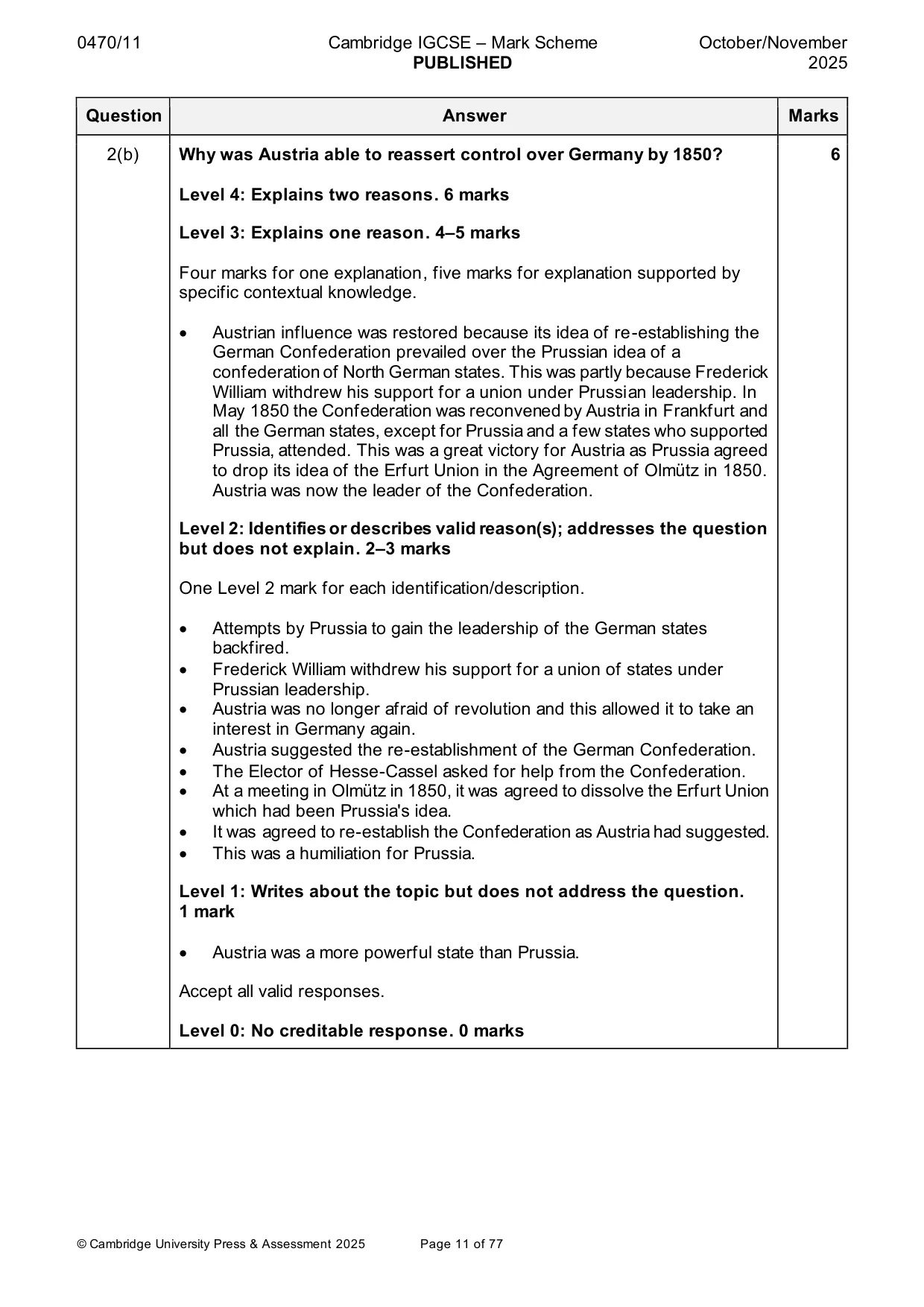
0470/11 Cambridge IGCSE – Mark Scheme PUBLISHED October/November 2025 © Cambridge University Press & Assessment 2025 Page 11 of 77 Question Answer Marks 2(b) Why was Austria able to reassert control over Germany by 1850? Level 4: Explains two reasons. 6 marks Level 3: Explains one reason. 4–5 marks Four marks for one explanation, five marks for explanation supported by specific contextual knowledge. • Austrian influence was restored because its idea of re-establishing the German Confederation prevailed over the Prussian idea of a confederation of North German states. This was partly because Frederick William withdrew his support for a union under Prussian leadership. In May 1850 the Confederation was reconvened by Austria in Frankfurt and all the German states, except for Prussia and a few states who supported Prussia, attended. This was a great victory for Austria as Prussia agreed to drop its idea of the Erfurt Union in the Agreement of Olmütz in 1850. Austria was now the leader of the Confederation. Level 2: Identifies or describes valid reason(s); addresses the question but does not explain. 2–3 marks One Level 2 mark for each identification/description. • Attempts by Prussia to gain the leadership of the German states backfired. • Frederick William withdrew his support for a union of states under Prussian leadership. • Austria was no longer afraid of revolution and this allowed it to take an interest in Germany again. • Austria suggested the re-establishment of the German Confederation. • The Elector of Hesse-Cassel asked for help from the Confederation. • At a meeting in Olmütz in 1850, it was agreed to dissolve the Erfurt Union which had been Prussia's idea. • It was agreed to re-establish the Confederation as Austria had suggested. • This was a humiliation for Prussia. Level 1: Writes about the topic but does not address the question. 1 mark • Austria was a more powerful state than Prussia. Accept all valid responses. Level 0: No creditable response. 0 marks 6
Mark scheme, page 12
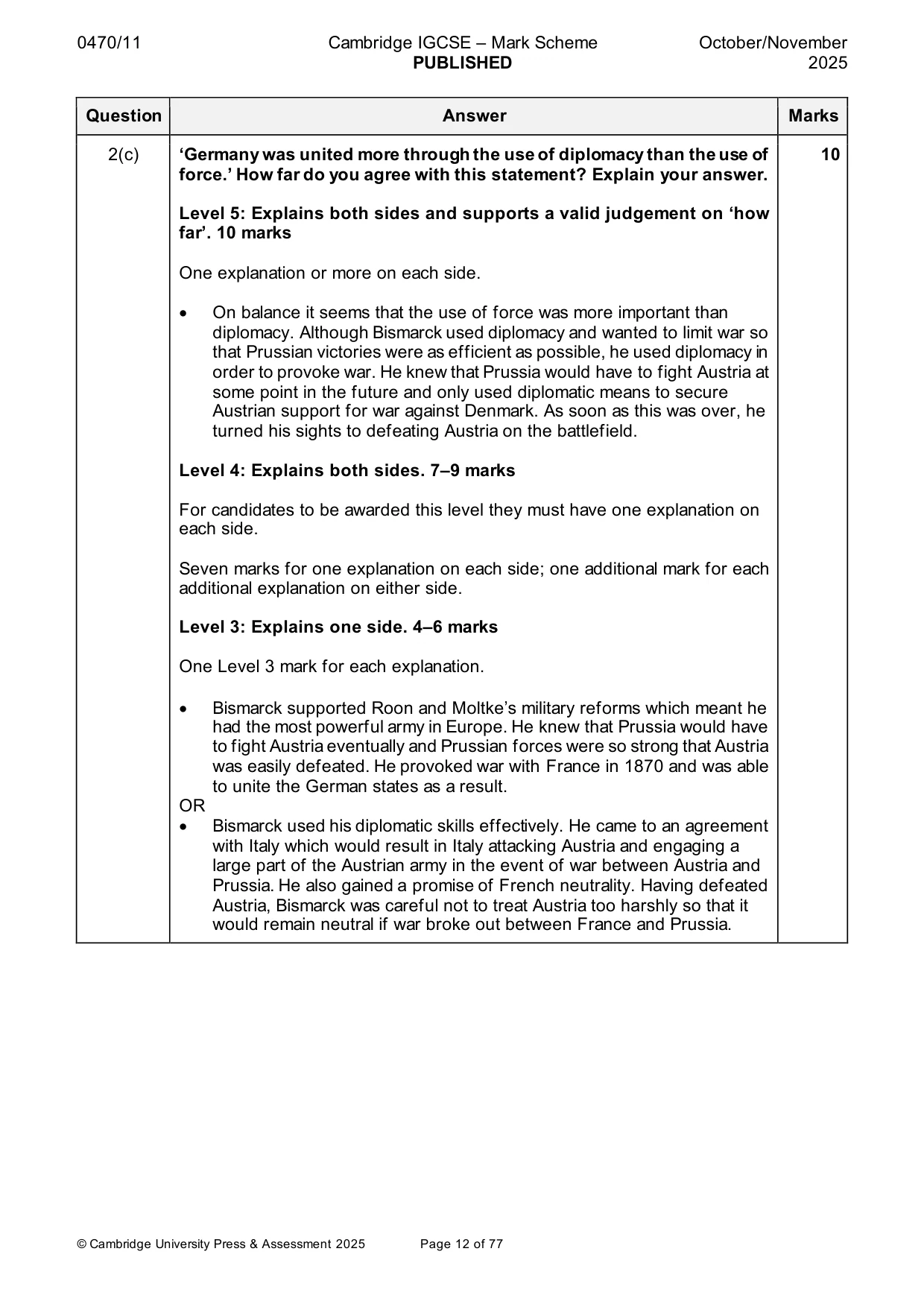
0470/11 Cambridge IGCSE – Mark Scheme PUBLISHED October/November 2025 © Cambridge University Press & Assessment 2025 Page 12 of 77 Question Answer Marks 2(c) ‘Germany was united more through the use of diplomacy than the use of force.’ How far do you agree with this statement? Explain your answer. Level 5: Explains both sides and supports a valid judgement on ‘how far’. 10 marks One explanation or more on each side. • On balance it seems that the use of force was more important than diplomacy. Although Bismarck used diplomacy and wanted to limit war so that Prussian victories were as efficient as possible, he used diplomacy in order to provoke war. He knew that Prussia would have to fight Austria at some point in the future and only used diplomatic means to secure Austrian support for war against Denmark. As soon as this was over, he turned his sights to defeating Austria on the battlefield. Level 4: Explains both sides. 7–9 marks For candidates to be awarded this level they must have one explanation on each side. Seven marks for one explanation on each side; one additional mark for each additional explanation on either side. Level 3: Explains one side. 4–6 marks One Level 3 mark for each explanation. • Bismarck supported Roon and Moltke’s military reforms which meant he had the most powerful army in Europe. He knew that Prussia would have to fight Austria eventually and Prussian forces were so strong that Austria was easily defeated. He provoked war with France in 1870 and was able to unite the German states as a result. OR • Bismarck used his diplomatic skills effectively. He came to an agreement with Italy which would result in Italy attacking Austria and engaging a large part of the Austrian army in the event of war between Austria and Prussia. He also gained a promise of French neutrality. Having defeated Austria, Bismarck was careful not to treat Austria too harshly so that it would remain neutral if war broke out between France and Prussia. 10
Mark scheme, page 13
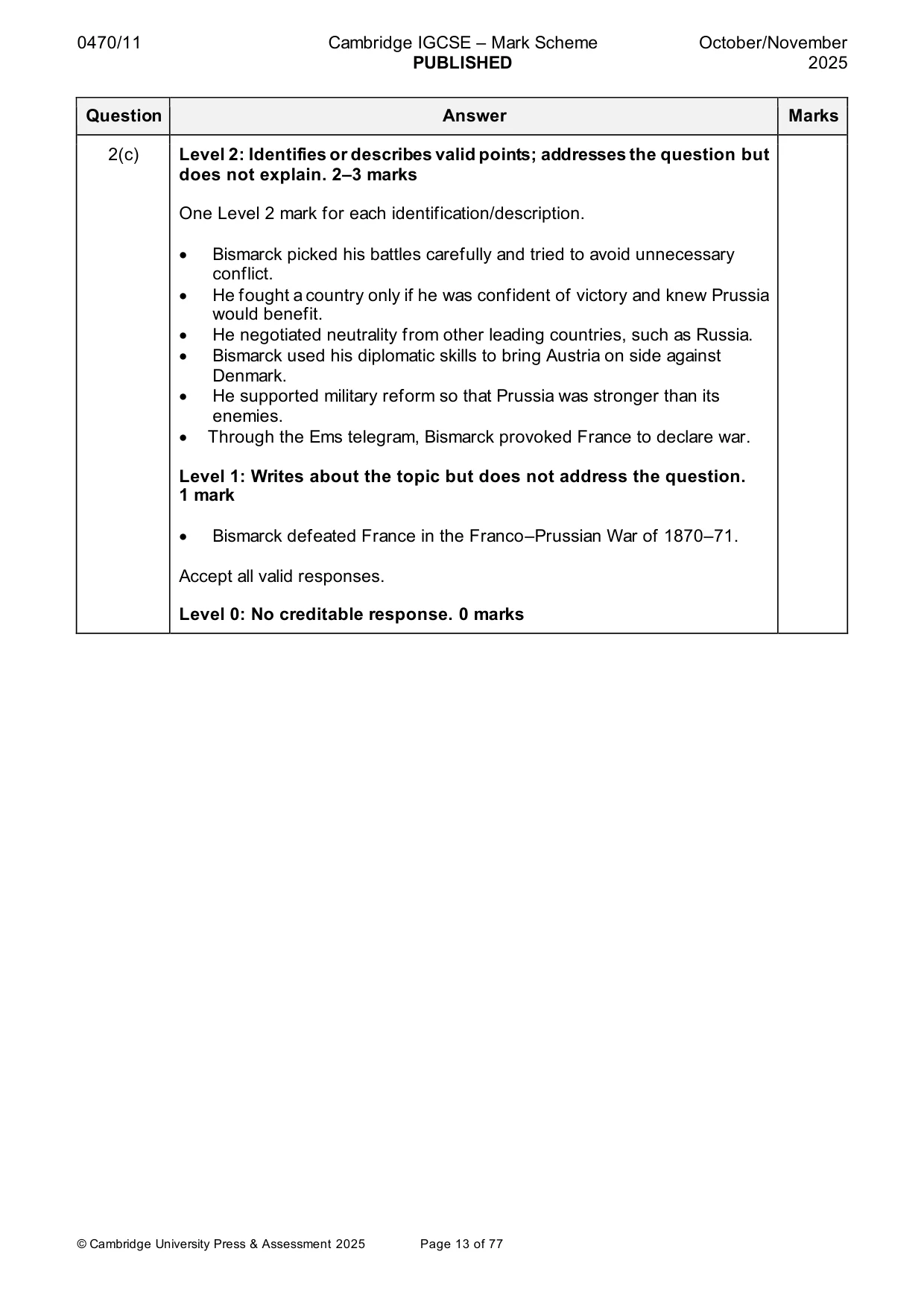
0470/11 Cambridge IGCSE – Mark Scheme PUBLISHED October/November 2025 © Cambridge University Press & Assessment 2025 Page 13 of 77 Question Answer Marks 2(c) Level 2: Identifies or describes valid points; addresses the question but does not explain. 2–3 marks One Level 2 mark for each identification/description. • Bismarck picked his battles carefully and tried to avoid unnecessary conflict. • He fought a country only if he was confident of victory and knew Prussia would benefit. • He negotiated neutrality from other leading countries, such as Russia. • Bismarck used his diplomatic skills to bring Austria on side against Denmark. • He supported military reform so that Prussia was stronger than its enemies. • Through the Ems telegram, Bismarck provoked France to declare war. Level 1: Writes about the topic but does not address the question. 1 mark • Bismarck defeated France in the Franco–Prussian War of 1870–71. Accept all valid responses. Level 0: No creditable response. 0 marks
Mark scheme, page 14
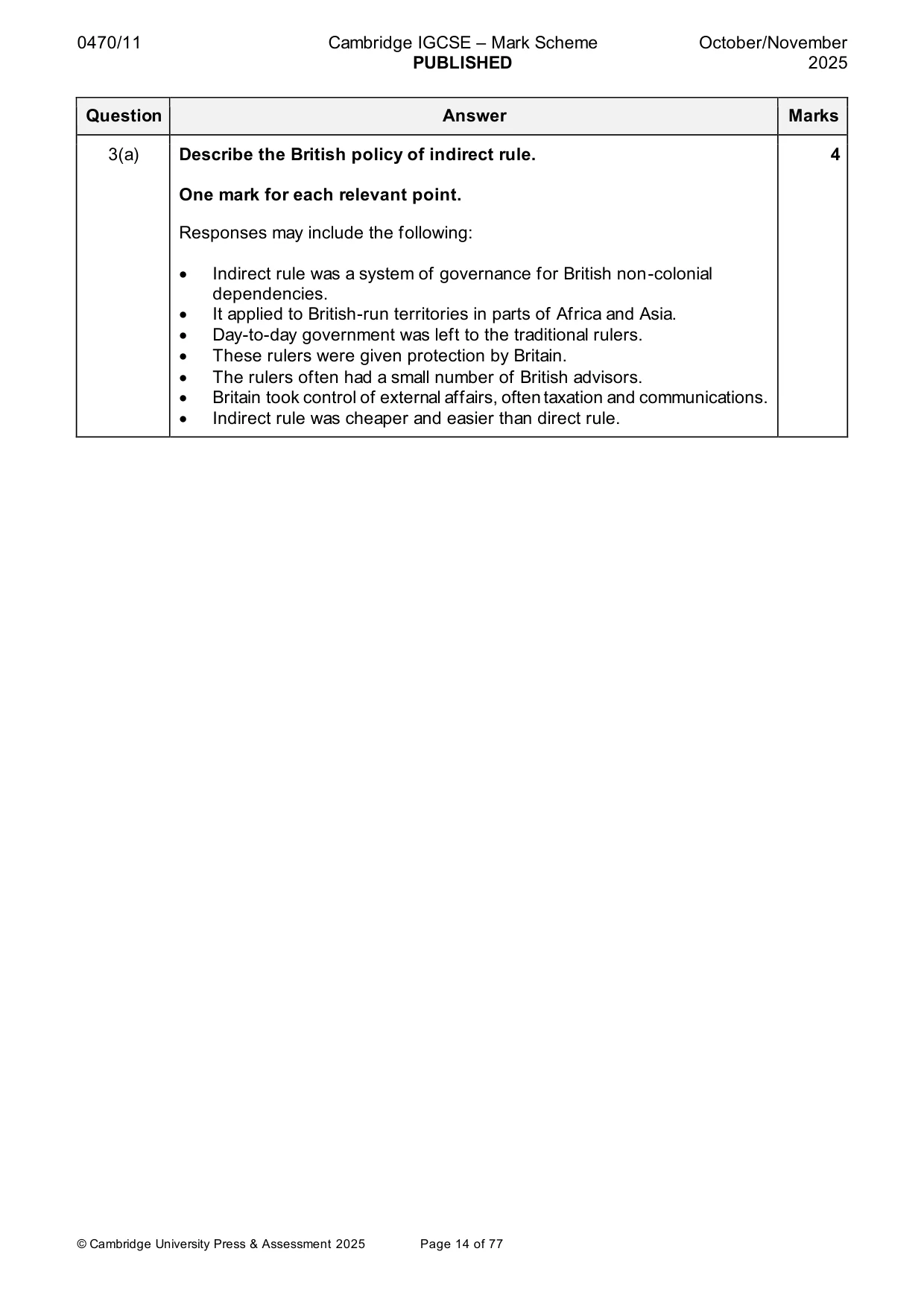
0470/11 Cambridge IGCSE – Mark Scheme PUBLISHED October/November 2025 © Cambridge University Press & Assessment 2025 Page 14 of 77 Question Answer Marks 3(a) Describe the British policy of indirect rule. One mark for each relevant point. Responses may include the following: • Indirect rule was a system of governance for British non-colonial dependencies. • It applied to British-run territories in parts of Africa and Asia. • Day-to-day government was left to the traditional rulers. • These rulers were given protection by Britain. • The rulers often had a small number of British advisors. • Britain took control of external affairs, often taxation and communications. • Indirect rule was cheaper and easier than direct rule. 4
Mark scheme, page 15
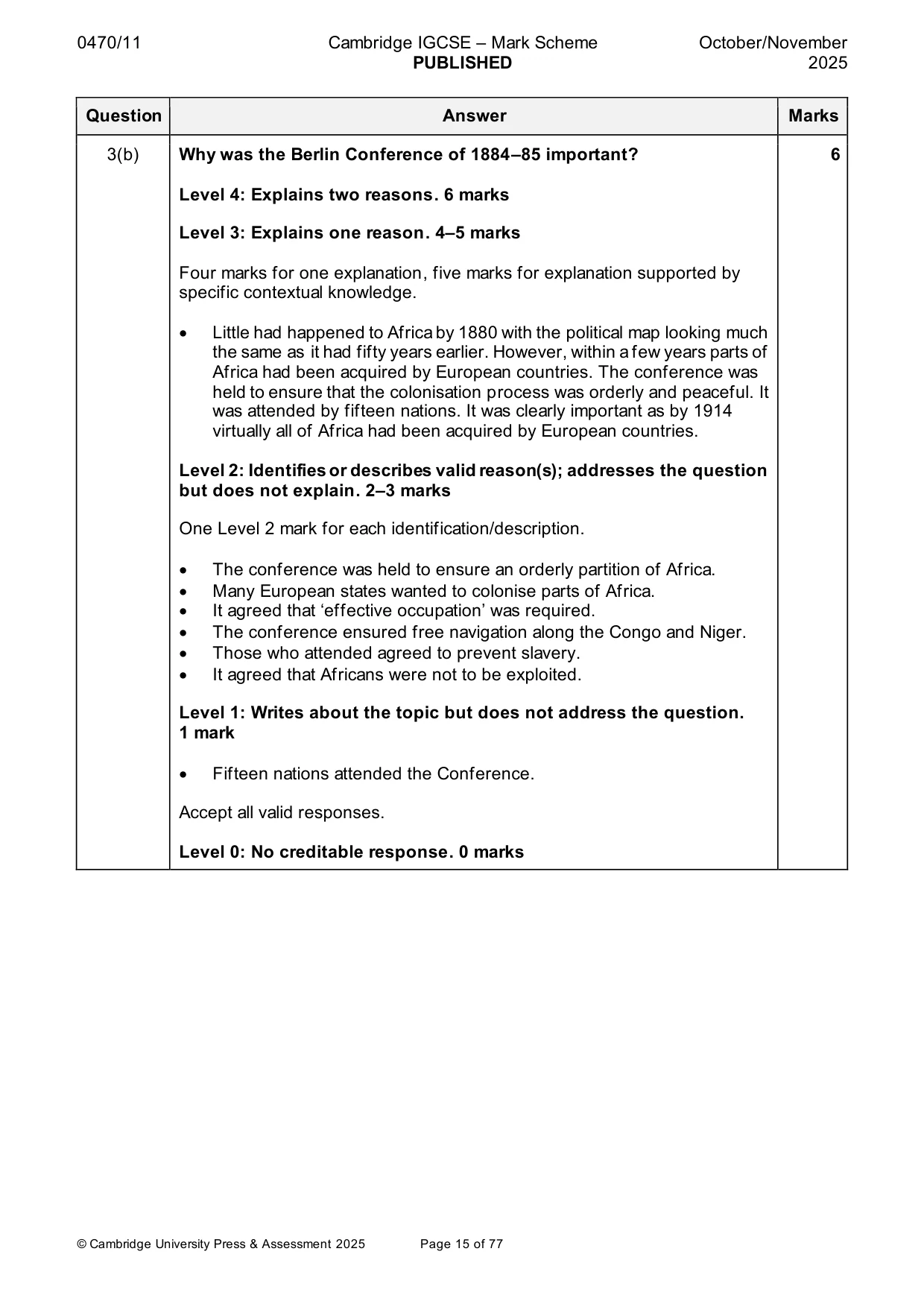
0470/11 Cambridge IGCSE – Mark Scheme PUBLISHED October/November 2025 © Cambridge University Press & Assessment 2025 Page 15 of 77 Question Answer Marks 3(b) Why was the Berlin Conference of 1884–85 important? Level 4: Explains two reasons. 6 marks Level 3: Explains one reason. 4–5 marks Four marks for one explanation, five marks for explanation supported by specific contextual knowledge. • Little had happened to Africa by 1880 with the political map looking much the same as it had fifty years earlier. However, within a few years parts of Africa had been acquired by European countries. The conference was held to ensure that the colonisation process was orderly and peaceful. It was attended by fifteen nations. It was clearly important as by 1914 virtually all of Africa had been acquired by European countries. Level 2: Identifies or describes valid reason(s); addresses the question but does not explain. 2–3 marks One Level 2 mark for each identification/description. • The conference was held to ensure an orderly partition of Africa. • Many European states wanted to colonise parts of Africa. • It agreed that ‘effective occupation’ was required. • The conference ensured free navigation along the Congo and Niger. • Those who attended agreed to prevent slavery. • It agreed that Africans were not to be exploited. Level 1: Writes about the topic but does not address the question. 1 mark • Fifteen nations attended the Conference. Accept all valid responses. Level 0: No creditable response. 0 marks 6
Mark scheme, page 16
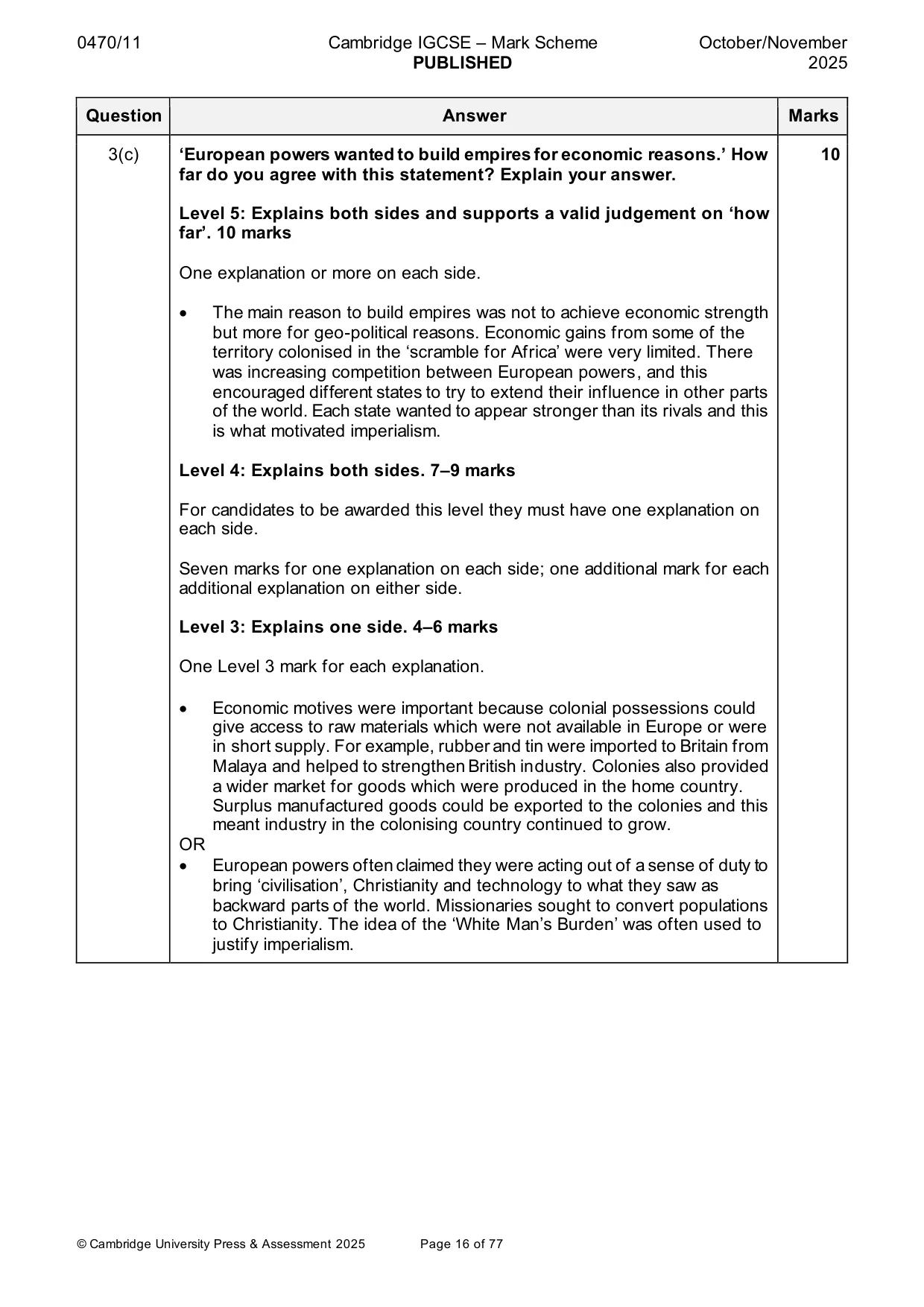
0470/11 Cambridge IGCSE – Mark Scheme PUBLISHED October/November 2025 © Cambridge University Press & Assessment 2025 Page 16 of 77 Question Answer Marks 3(c) ‘European powers wanted to build empires for economic reasons.’ How far do you agree with this statement? Explain your answer. Level 5: Explains both sides and supports a valid judgement on ‘how far’. 10 marks One explanation or more on each side. • The main reason to build empires was not to achieve economic strength but more for geo-political reasons. Economic gains from some of the territory colonised in the ‘scramble for Africa’ were very limited. There was increasing competition between European powers, and this encouraged different states to try to extend their influence in other parts of the world. Each state wanted to appear stronger than its rivals and this is what motivated imperialism. Level 4: Explains both sides. 7–9 marks For candidates to be awarded this level they must have one explanation on each side. Seven marks for one explanation on each side; one additional mark for each additional explanation on either side. Level 3: Explains one side. 4–6 marks One Level 3 mark for each explanation. • Economic motives were important because colonial possessions could give access to raw materials which were not available in Europe or were in short supply. For example, rubber and tin were imported to Britain from Malaya and helped to strengthen British industry. Colonies also provided a wider market for goods which were produced in the home country. Surplus manufactured goods could be exported to the colonies and this meant industry in the colonising country continued to grow. OR • European powers often claimed they were acting out of a sense of duty to bring ‘civilisation’, Christianity and technology to what they saw as backward parts of the world. Missionaries sought to convert populations to Christianity. The idea of the ‘White Man’s Burden’ was often used to justify imperialism. 10
Mark scheme, page 17
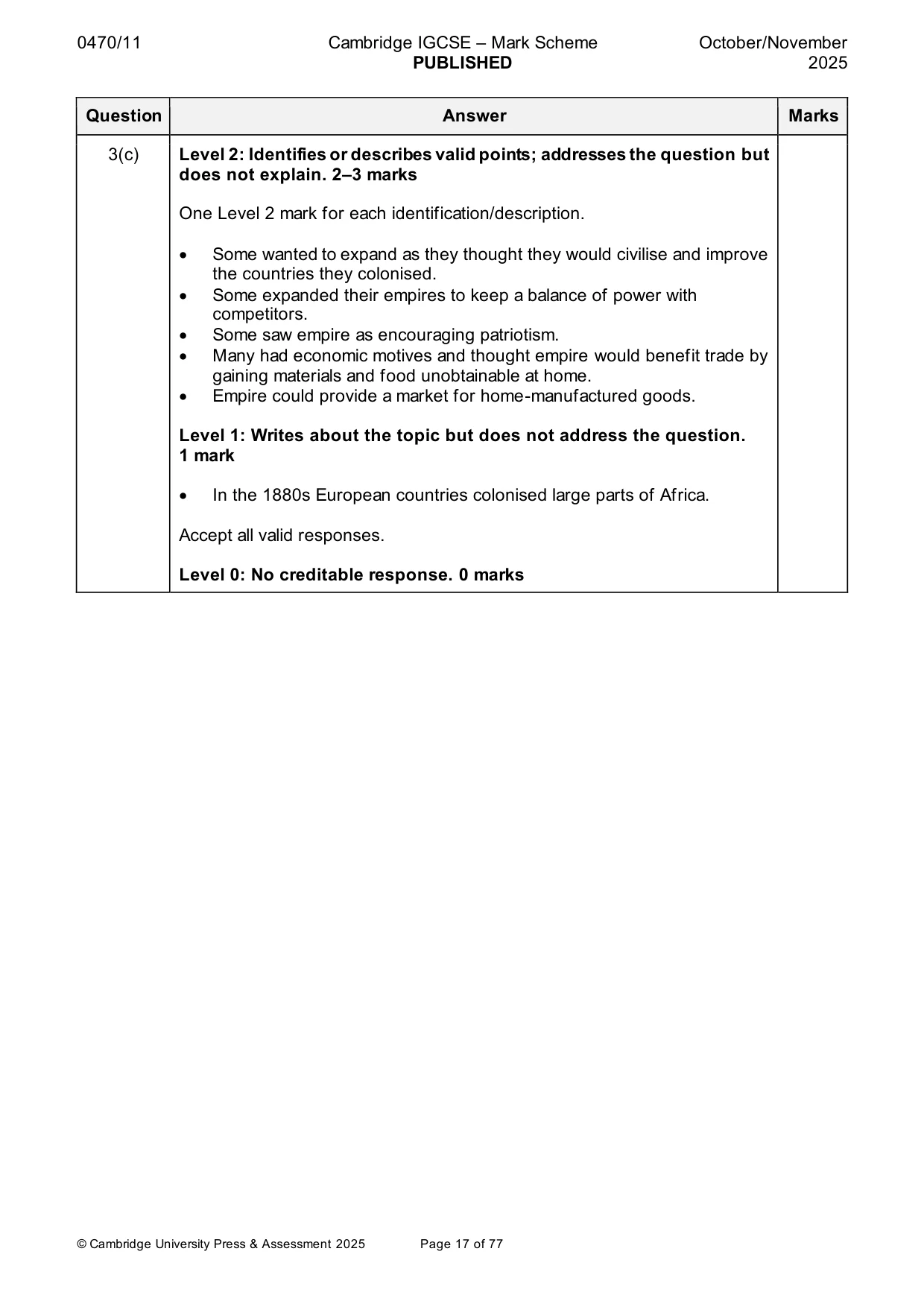
0470/11 Cambridge IGCSE – Mark Scheme PUBLISHED October/November 2025 © Cambridge University Press & Assessment 2025 Page 17 of 77 Question Answer Marks 3(c) Level 2: Identifies or describes valid points; addresses the question but does not explain. 2–3 marks One Level 2 mark for each identification/description. • Some wanted to expand as they thought they would civilise and improve the countries they colonised. • Some expanded their empires to keep a balance of power with competitors. • Some saw empire as encouraging patriotism. • Many had economic motives and thought empire would benefit trade by gaining materials and food unobtainable at home. • Empire could provide a market for home-manufactured goods. Level 1: Writes about the topic but does not address the question. 1 mark • In the 1880s European countries colonised large parts of Africa. Accept all valid responses. Level 0: No creditable response. 0 marks
Mark scheme, page 18
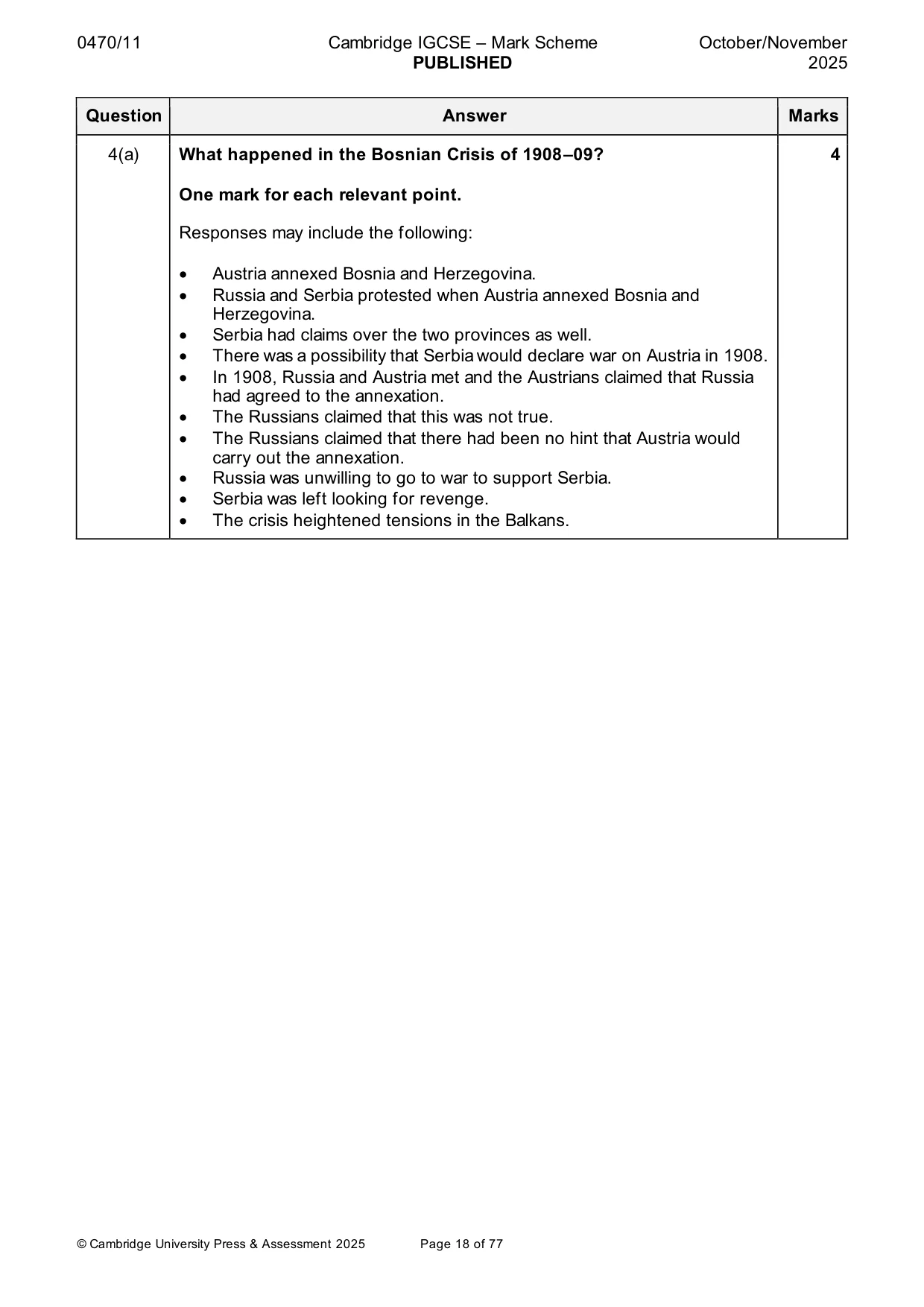
0470/11 Cambridge IGCSE – Mark Scheme PUBLISHED October/November 2025 © Cambridge University Press & Assessment 2025 Page 18 of 77 Question Answer Marks 4(a) What happened in the Bosnian Crisis of 1908–09? One mark for each relevant point. Responses may include the following: • Austria annexed Bosnia and Herzegovina. • Russia and Serbia protested when Austria annexed Bosnia and Herzegovina. • Serbia had claims over the two provinces as well. • There was a possibility that Serbia would declare war on Austria in 1908. • In 1908, Russia and Austria met and the Austrians claimed that Russia had agreed to the annexation. • The Russians claimed that this was not true. • The Russians claimed that there had been no hint that Austria would carry out the annexation. • Russia was unwilling to go to war to support Serbia. • Serbia was left looking for revenge. • The crisis heightened tensions in the Balkans. 4
Mark scheme, page 19
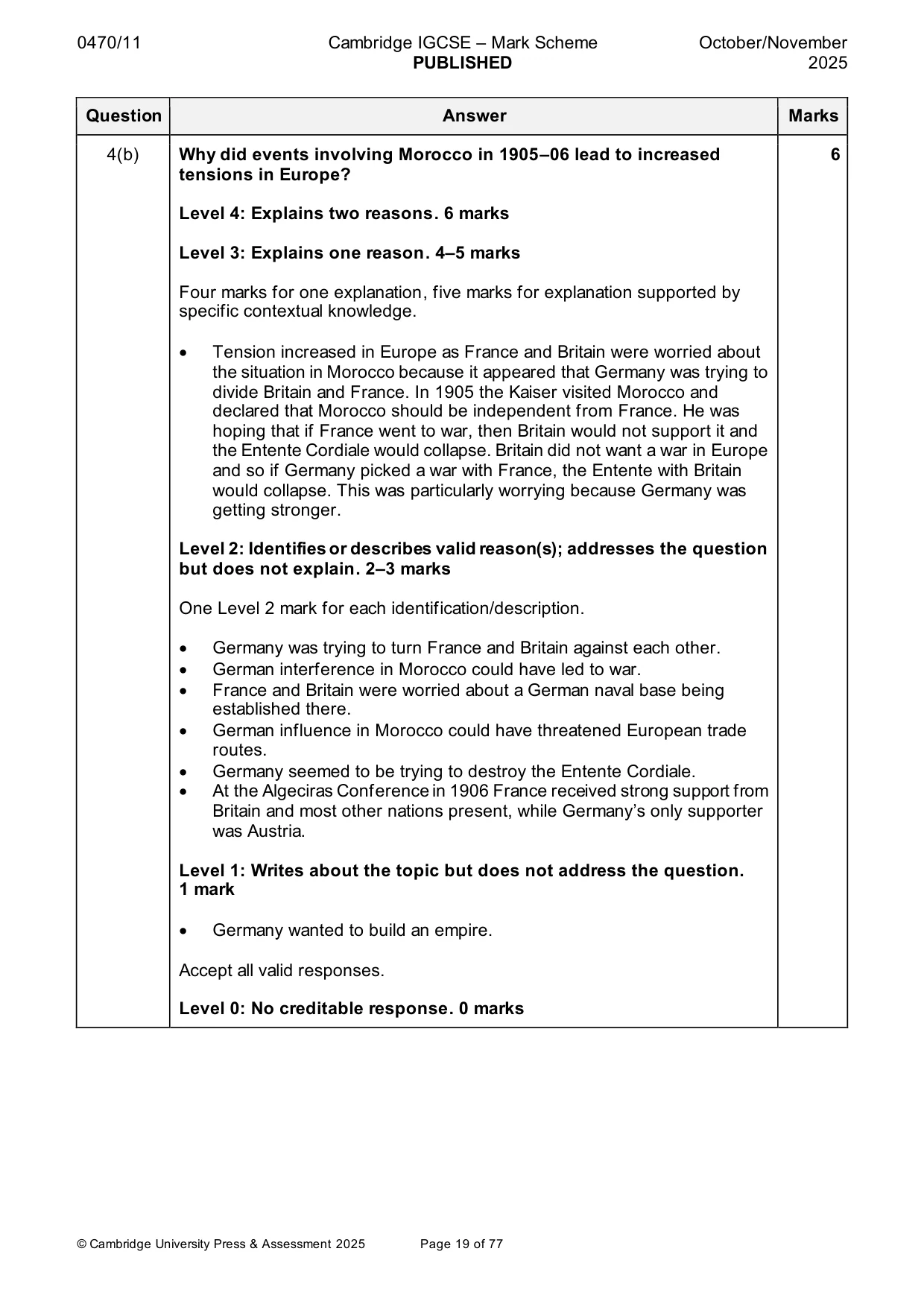
0470/11 Cambridge IGCSE – Mark Scheme PUBLISHED October/November 2025 © Cambridge University Press & Assessment 2025 Page 19 of 77 Question Answer Marks 4(b) Why did events involving Morocco in 1905–06 lead to increased tensions in Europe? Level 4: Explains two reasons. 6 marks Level 3: Explains one reason. 4–5 marks Four marks for one explanation, five marks for explanation supported by specific contextual knowledge. • Tension increased in Europe as France and Britain were worried about the situation in Morocco because it appeared that Germany was trying to divide Britain and France. In 1905 the Kaiser visited Morocco and declared that Morocco should be independent from France. He was hoping that if France went to war, then Britain would not support it and the Entente Cordiale would collapse. Britain did not want a war in Europe and so if Germany picked a war with France, the Entente with Britain would collapse. This was particularly worrying because Germany was getting stronger. Level 2: Identifies or describes valid reason(s); addresses the question but does not explain. 2–3 marks One Level 2 mark for each identification/description. • Germany was trying to turn France and Britain against each other. • German interference in Morocco could have led to war. • France and Britain were worried about a German naval base being established there. • German influence in Morocco could have threatened European trade routes. • Germany seemed to be trying to destroy the Entente Cordiale. • At the Algeciras Conference in 1906 France received strong support from Britain and most other nations present, while Germany’s only supporter was Austria. Level 1: Writes about the topic but does not address the question. 1 mark • Germany wanted to build an empire. Accept all valid responses. Level 0: No creditable response. 0 marks 6
Mark scheme, page 20
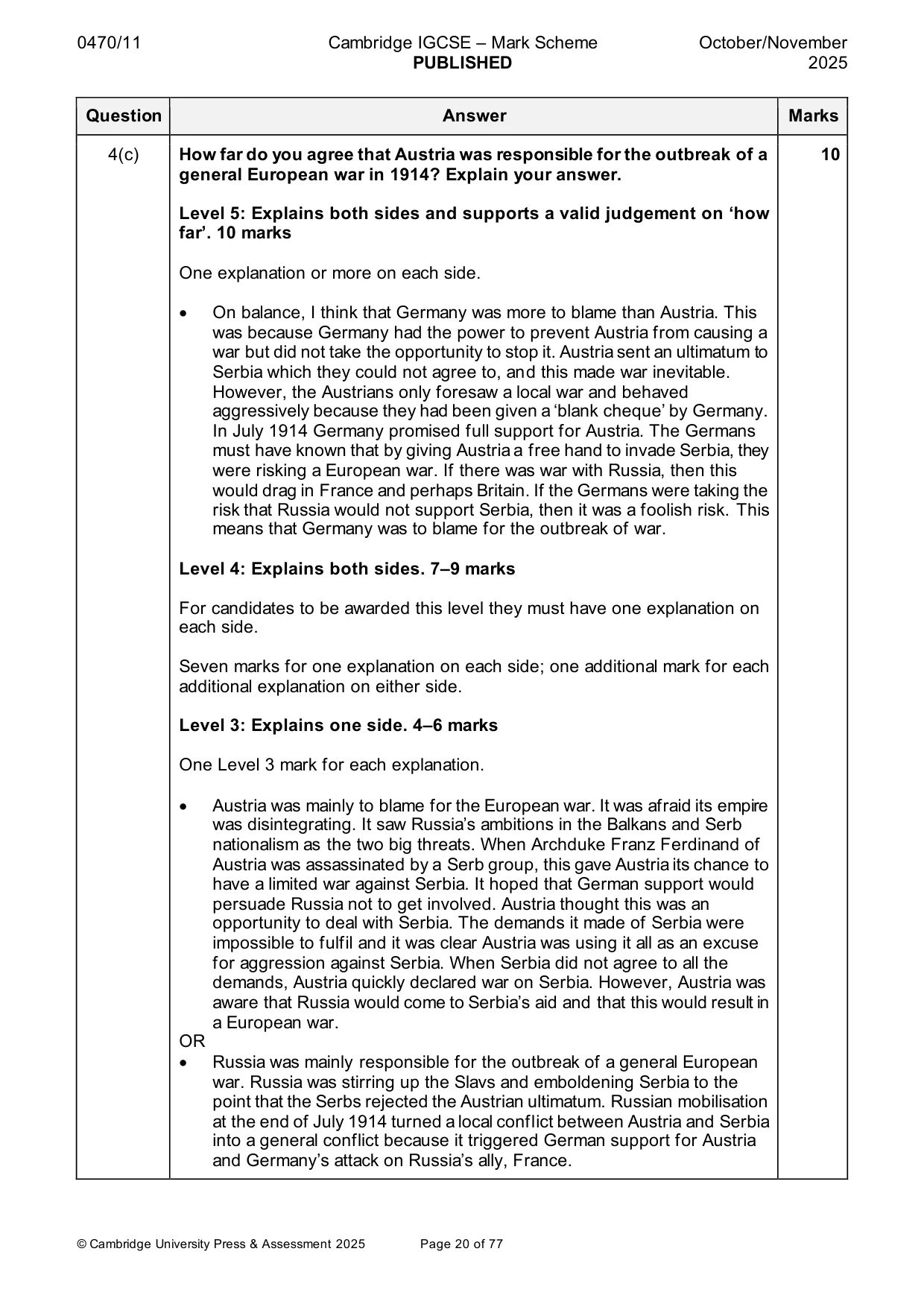
0470/11 Cambridge IGCSE – Mark Scheme PUBLISHED October/November 2025 © Cambridge University Press & Assessment 2025 Page 20 of 77 Question Answer Marks 4(c) How far do you agree that Austria was responsible for the outbreak of a general European war in 1914? Explain your answer. Level 5: Explains both sides and supports a valid judgement on ‘how far’. 10 marks One explanation or more on each side. • On balance, I think that Germany was more to blame than Austria. This was because Germany had the power to prevent Austria from causing a war but did not take the opportunity to stop it. Austria sent an ultimatum to Serbia which they could not agree to, and this made war inevitable. However, the Austrians only foresaw a local war and behaved aggressively because they had been given a ‘blank cheque’ by Germany. In July 1914 Germany promised full support for Austria. The Germans must have known that by giving Austria a free hand to invade Serbia, they were risking a European war. If there was war with Russia, then this would drag in France and perhaps Britain. If the Germans were taking the risk that Russia would not support Serbia, then it was a foolish risk. This means that Germany was to blame for the outbreak of war. Level 4: Explains both sides. 7–9 marks For candidates to be awarded this level they must have one explanation on each side. Seven marks for one explanation on each side; one additional mark for each additional explanation on either side. Level 3: Explains one side. 4–6 marks One Level 3 mark for each explanation. • Austria was mainly to blame for the European war. It was afraid its empire was disintegrating. It saw Russia’s ambitions in the Balkans and Serb nationalism as the two big threats. When Archduke Franz Ferdinand of Austria was assassinated by a Serb group, this gave Austria its chance to have a limited war against Serbia. It hoped that German support would persuade Russia not to get involved. Austria thought this was an opportunity to deal with Serbia. The demands it made of Serbia were impossible to fulfil and it was clear Austria was using it all as an excuse for aggression against Serbia. When Serbia did not agree to all the demands, Austria quickly declared war on Serbia. However, Austria was aware that Russia would come to Serbia’s aid and that this would result in a European war. OR • Russia was mainly responsible for the outbreak of a general European war. Russia was stirring up the Slavs and emboldening Serbia to the point that the Serbs rejected the Austrian ultimatum. Russian mobilisation at the end of July 1914 turned a local conflict between Austria and Serbia into a general conflict because it triggered German support for Austria and Germany’s attack on Russia’s ally, France. 10
Mark scheme, page 21
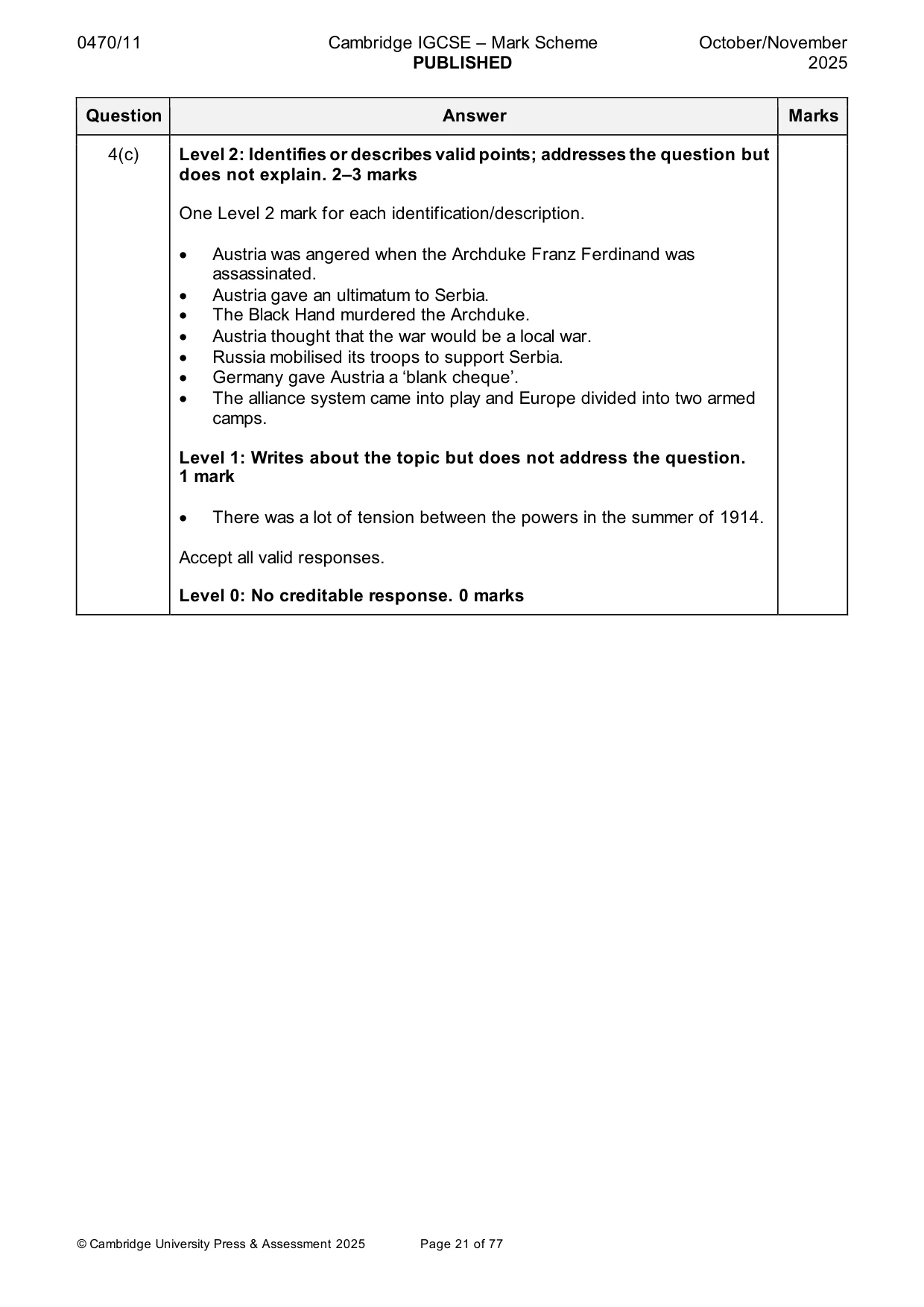
0470/11 Cambridge IGCSE – Mark Scheme PUBLISHED October/November 2025 © Cambridge University Press & Assessment 2025 Page 21 of 77 Question Answer Marks 4(c) Level 2: Identifies or describes valid points; addresses the question but does not explain. 2–3 marks One Level 2 mark for each identification/description. • Austria was angered when the Archduke Franz Ferdinand was assassinated. • Austria gave an ultimatum to Serbia. • The Black Hand murdered the Archduke. • Austria thought that the war would be a local war. • Russia mobilised its troops to support Serbia. • Germany gave Austria a ‘blank cheque’. • The alliance system came into play and Europe divided into two armed camps. Level 1: Writes about the topic but does not address the question. 1 mark • There was a lot of tension between the powers in the summer of 1914. Accept all valid responses. Level 0: No creditable response. 0 marks
Mark scheme, page 22
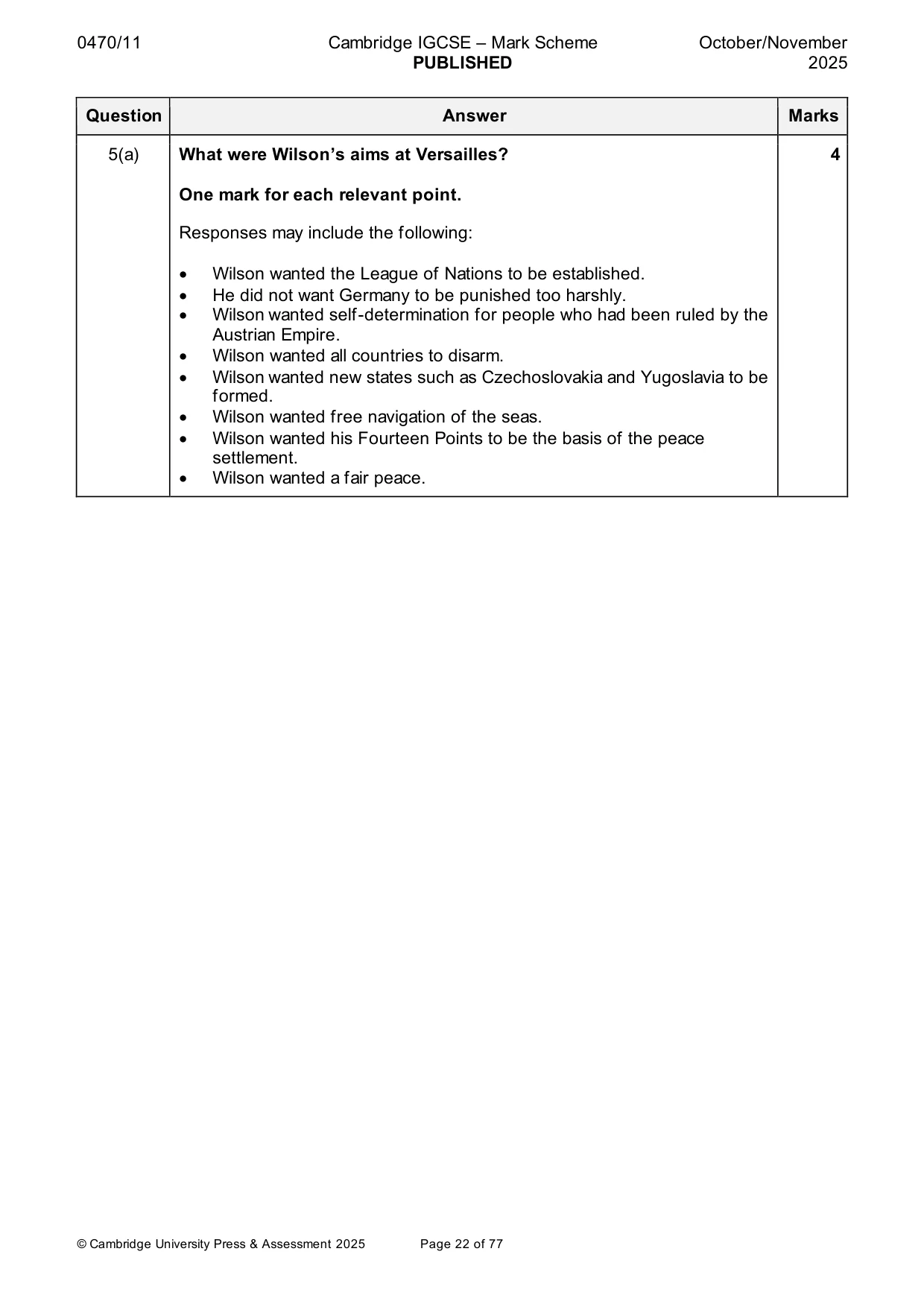
0470/11 Cambridge IGCSE – Mark Scheme PUBLISHED October/November 2025 © Cambridge University Press & Assessment 2025 Page 22 of 77 Question Answer Marks 5(a) What were Wilson’s aims at Versailles? One mark for each relevant point. Responses may include the following: • Wilson wanted the League of Nations to be established. • He did not want Germany to be punished too harshly. • Wilson wanted self-determination for people who had been ruled by the Austrian Empire. • Wilson wanted all countries to disarm. • Wilson wanted new states such as Czechoslovakia and Yugoslavia to be formed. • Wilson wanted free navigation of the seas. • Wilson wanted his Fourteen Points to be the basis of the peace settlement. • Wilson wanted a fair peace. 4
Mark scheme, page 23
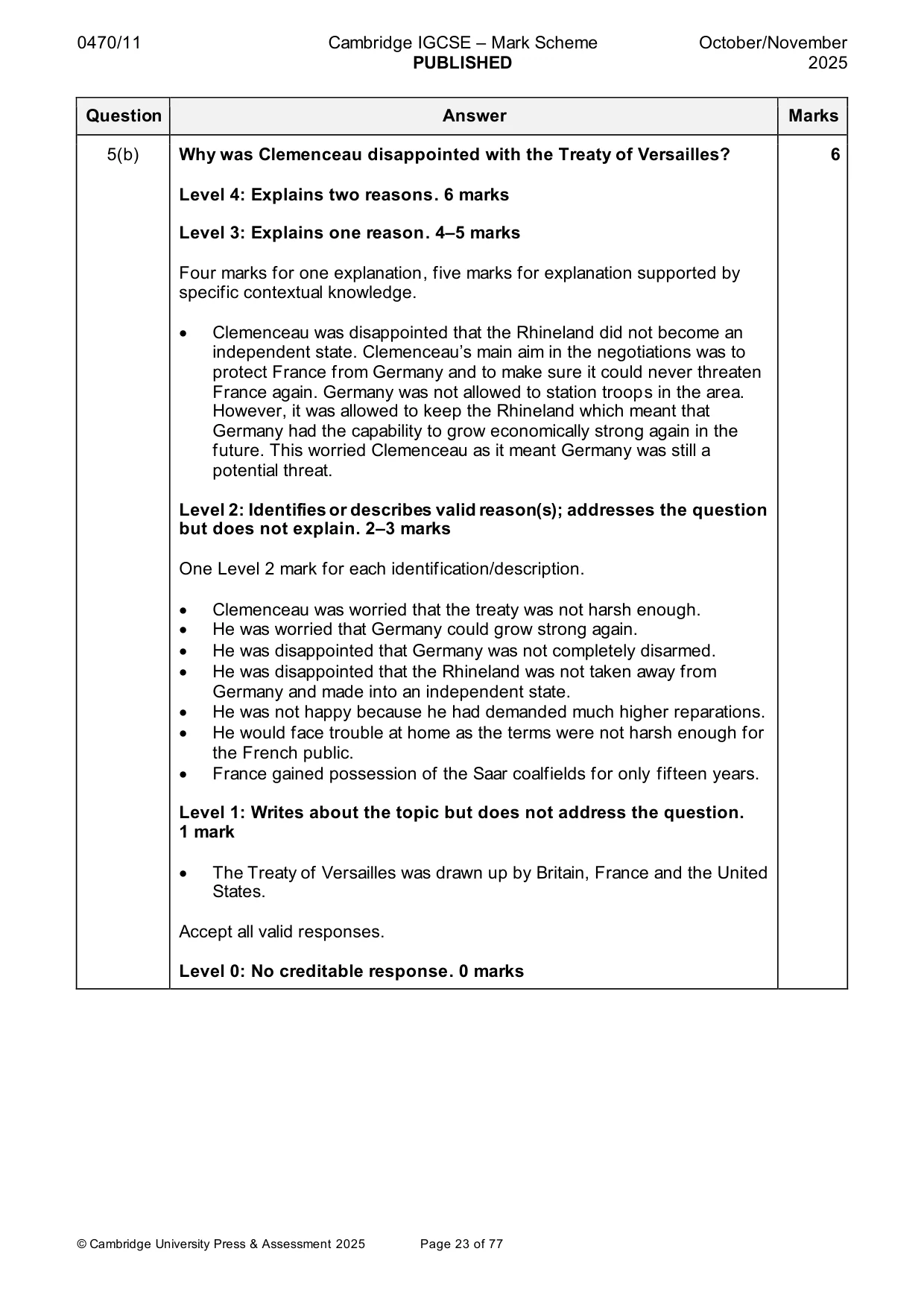
0470/11 Cambridge IGCSE – Mark Scheme PUBLISHED October/November 2025 © Cambridge University Press & Assessment 2025 Page 23 of 77 Question Answer Marks 5(b) Why was Clemenceau disappointed with the Treaty of Versailles? Level 4: Explains two reasons. 6 marks Level 3: Explains one reason. 4–5 marks Four marks for one explanation, five marks for explanation supported by specific contextual knowledge. • Clemenceau was disappointed that the Rhineland did not become an independent state. Clemenceau’s main aim in the negotiations was to protect France from Germany and to make sure it could never threaten France again. Germany was not allowed to station troops in the area. However, it was allowed to keep the Rhineland which meant that Germany had the capability to grow economically strong again in the future. This worried Clemenceau as it meant Germany was still a potential threat. Level 2: Identifies or describes valid reason(s); addresses the question but does not explain. 2–3 marks One Level 2 mark for each identification/description. • Clemenceau was worried that the treaty was not harsh enough. • He was worried that Germany could grow strong again. • He was disappointed that Germany was not completely disarmed. • He was disappointed that the Rhineland was not taken away from Germany and made into an independent state. • He was not happy because he had demanded much higher reparations. • He would face trouble at home as the terms were not harsh enough for the French public. • France gained possession of the Saar coalfields for only fifteen years. Level 1: Writes about the topic but does not address the question. 1 mark • The Treaty of Versailles was drawn up by Britain, France and the United States. Accept all valid responses. Level 0: No creditable response. 0 marks 6
Mark scheme, page 24
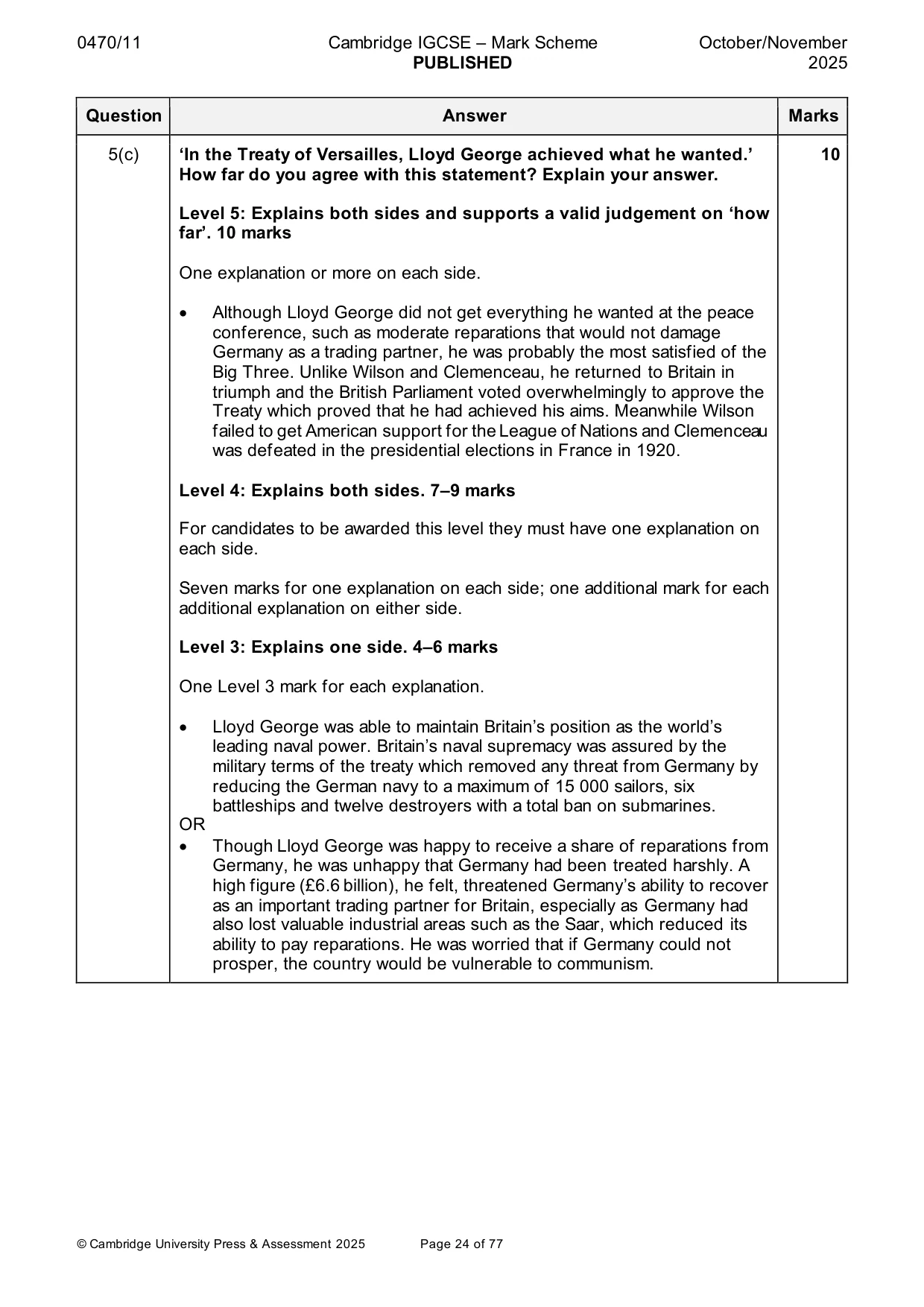
0470/11 Cambridge IGCSE – Mark Scheme PUBLISHED October/November 2025 © Cambridge University Press & Assessment 2025 Page 24 of 77 Question Answer Marks 5(c) ‘In the Treaty of Versailles, Lloyd George achieved what he wanted.’ How far do you agree with this statement? Explain your answer. Level 5: Explains both sides and supports a valid judgement on ‘how far’. 10 marks One explanation or more on each side. • Although Lloyd George did not get everything he wanted at the peace conference, such as moderate reparations that would not damage Germany as a trading partner, he was probably the most satisfied of the Big Three. Unlike Wilson and Clemenceau, he returned to Britain in triumph and the British Parliament voted overwhelmingly to approve the Treaty which proved that he had achieved his aims. Meanwhile Wilson failed to get American support for the League of Nations and Clemenceau was defeated in the presidential elections in France in 1920. Level 4: Explains both sides. 7–9 marks For candidates to be awarded this level they must have one explanation on each side. Seven marks for one explanation on each side; one additional mark for each additional explanation on either side. Level 3: Explains one side. 4–6 marks One Level 3 mark for each explanation. • Lloyd George was able to maintain Britain’s position as the world’s leading naval power. Britain’s naval supremacy was assured by the military terms of the treaty which removed any threat from Germany by reducing the German navy to a maximum of 15 000 sailors, six battleships and twelve destroyers with a total ban on submarines. OR • Though Lloyd George was happy to receive a share of reparations from Germany, he was unhappy that Germany had been treated harshly. A high figure (£6.6 billion), he felt, threatened Germany’s ability to recover as an important trading partner for Britain, especially as Germany had also lost valuable industrial areas such as the Saar, which reduced its ability to pay reparations. He was worried that if Germany could not prosper, the country would be vulnerable to communism. 10
Mark scheme, page 25
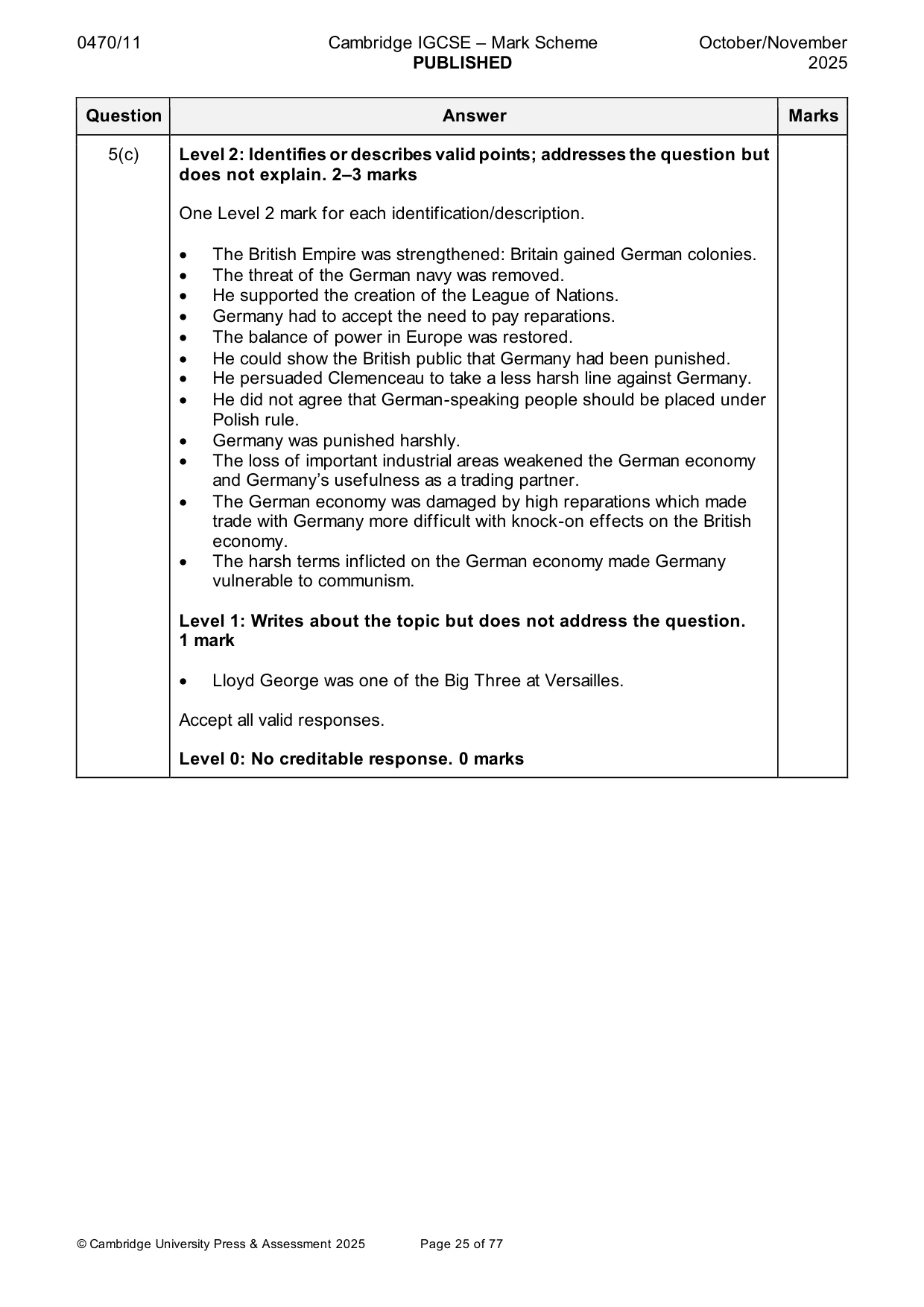
0470/11 Cambridge IGCSE – Mark Scheme PUBLISHED October/November 2025 © Cambridge University Press & Assessment 2025 Page 25 of 77 Question Answer Marks 5(c) Level 2: Identifies or describes valid points; addresses the question but does not explain. 2–3 marks One Level 2 mark for each identification/description. • The British Empire was strengthened: Britain gained German colonies. • The threat of the German navy was removed. • He supported the creation of the League of Nations. • Germany had to accept the need to pay reparations. • The balance of power in Europe was restored. • He could show the British public that Germany had been punished. • He persuaded Clemenceau to take a less harsh line against Germany. • He did not agree that German-speaking people should be placed under Polish rule. • Germany was punished harshly. • The loss of important industrial areas weakened the German economy and Germany’s usefulness as a trading partner. • The German economy was damaged by high reparations which made trade with Germany more difficult with knock-on effects on the British economy. • The harsh terms inflicted on the German economy made Germany vulnerable to communism. Level 1: Writes about the topic but does not address the question. 1 mark • Lloyd George was one of the Big Three at Versailles. Accept all valid responses. Level 0: No creditable response. 0 marks
Mark scheme, page 26
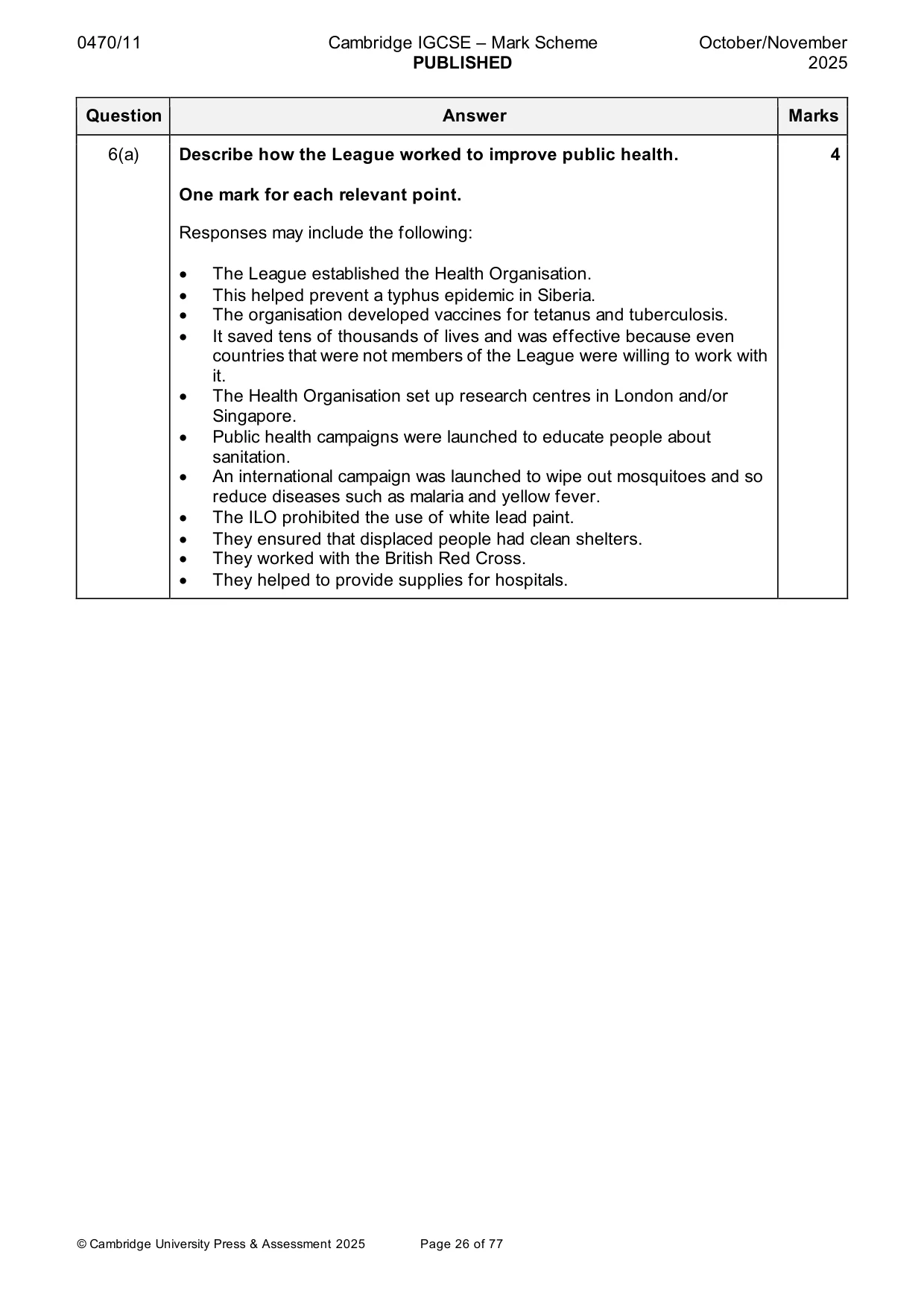
0470/11 Cambridge IGCSE – Mark Scheme PUBLISHED October/November 2025 © Cambridge University Press & Assessment 2025 Page 26 of 77 Question Answer Marks 6(a) Describe how the League worked to improve public health. One mark for each relevant point. Responses may include the following: • The League established the Health Organisation. • This helped prevent a typhus epidemic in Siberia. • The organisation developed vaccines for tetanus and tuberculosis. • It saved tens of thousands of lives and was effective because even countries that were not members of the League were willing to work with it. • The Health Organisation set up research centres in London and/or Singapore. • Public health campaigns were launched to educate people about sanitation. • An international campaign was launched to wipe out mosquitoes and so reduce diseases such as malaria and yellow fever. • The ILO prohibited the use of white lead paint. • They ensured that displaced people had clean shelters. • They worked with the British Red Cross. • They helped to provide supplies for hospitals. 4
Mark scheme, page 27
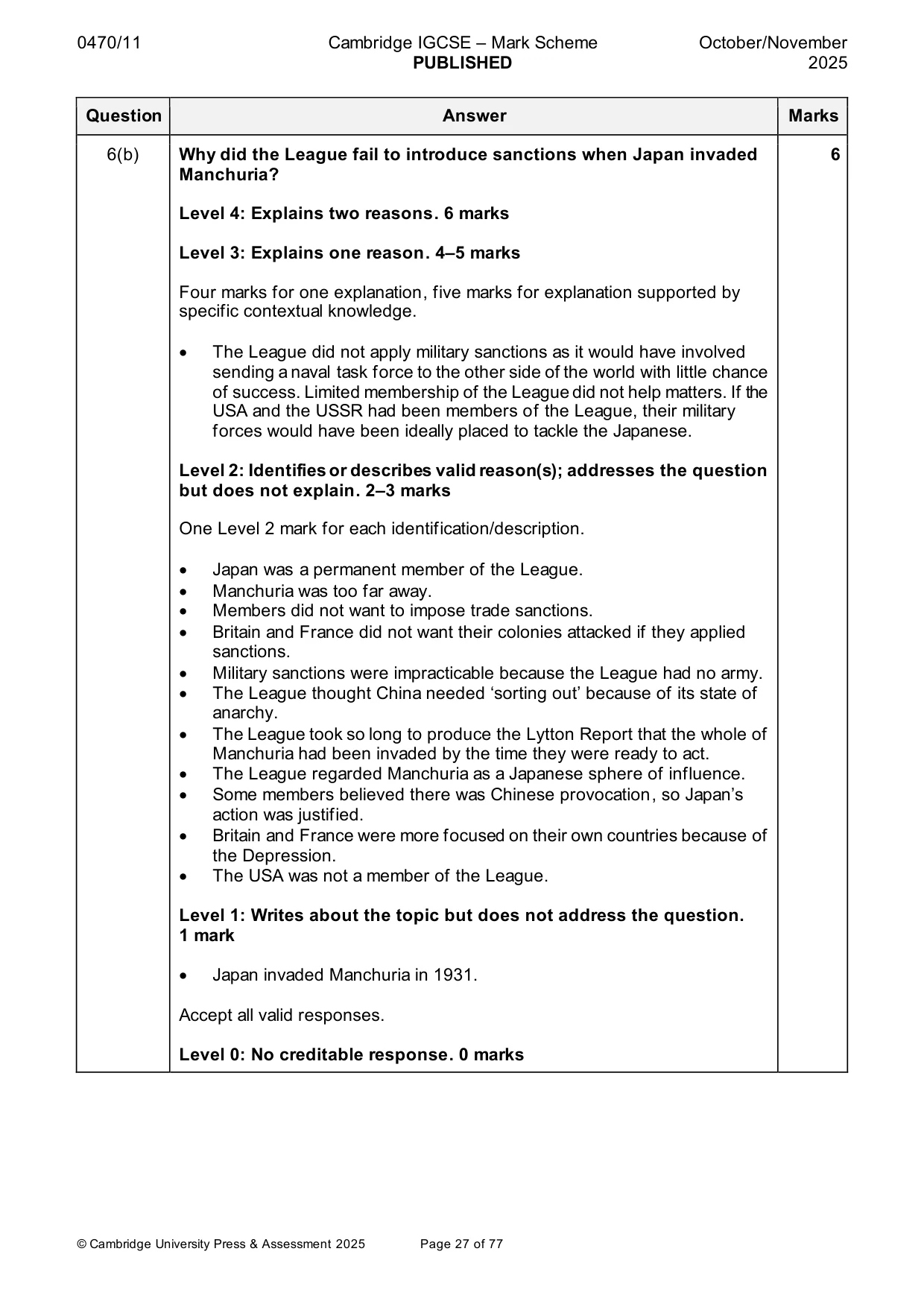
0470/11 Cambridge IGCSE – Mark Scheme PUBLISHED October/November 2025 © Cambridge University Press & Assessment 2025 Page 27 of 77 Question Answer Marks 6(b) Why did the League fail to introduce sanctions when Japan invaded Manchuria? Level 4: Explains two reasons. 6 marks Level 3: Explains one reason. 4–5 marks Four marks for one explanation, five marks for explanation supported by specific contextual knowledge. • The League did not apply military sanctions as it would have involved sending a naval task force to the other side of the world with little chance of success. Limited membership of the League did not help matters. If the USA and the USSR had been members of the League, their military forces would have been ideally placed to tackle the Japanese. Level 2: Identifies or describes valid reason(s); addresses the question but does not explain. 2–3 marks One Level 2 mark for each identification/description. • Japan was a permanent member of the League. • Manchuria was too far away. • Members did not want to impose trade sanctions. • Britain and France did not want their colonies attacked if they applied sanctions. • Military sanctions were impracticable because the League had no army. • The League thought China needed ‘sorting out’ because of its state of anarchy. • The League took so long to produce the Lytton Report that the whole of Manchuria had been invaded by the time they were ready to act. • The League regarded Manchuria as a Japanese sphere of influence. • Some members believed there was Chinese provocation, so Japan’s action was justified. • Britain and France were more focused on their own countries because of the Depression. • The USA was not a member of the League. Level 1: Writes about the topic but does not address the question. 1 mark • Japan invaded Manchuria in 1931. Accept all valid responses. Level 0: No creditable response. 0 marks 6
Mark scheme, page 28
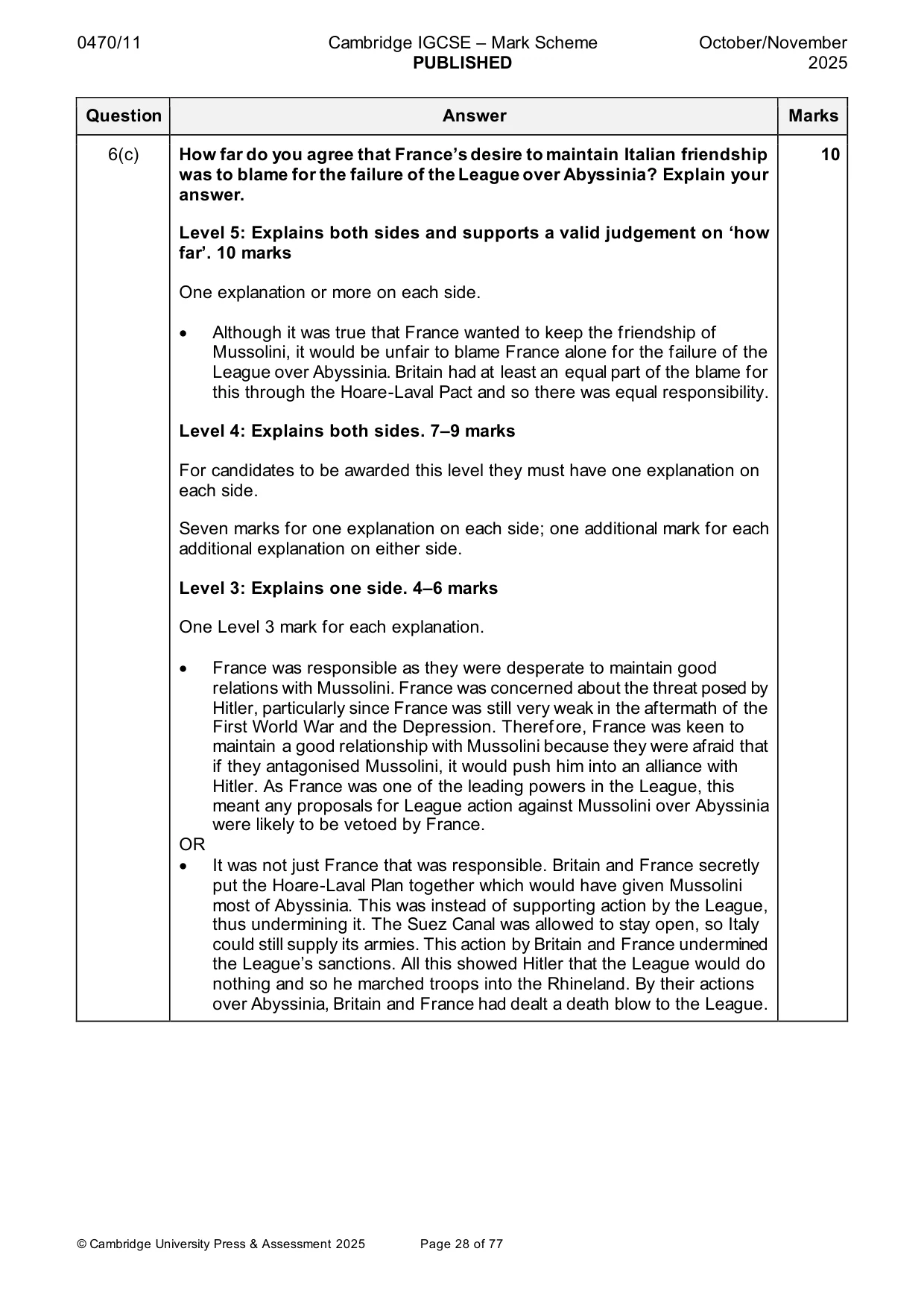
0470/11 Cambridge IGCSE – Mark Scheme PUBLISHED October/November 2025 © Cambridge University Press & Assessment 2025 Page 28 of 77 Question Answer Marks 6(c) How far do you agree that France’s desire to maintain Italian friendship was to blame for the failure of the League over Abyssinia? Explain your answer. Level 5: Explains both sides and supports a valid judgement on ‘how far’. 10 marks One explanation or more on each side. • Although it was true that France wanted to keep the friendship of Mussolini, it would be unfair to blame France alone for the failure of the League over Abyssinia. Britain had at least an equal part of the blame for this through the Hoare-Laval Pact and so there was equal responsibility. Level 4: Explains both sides. 7–9 marks For candidates to be awarded this level they must have one explanation on each side. Seven marks for one explanation on each side; one additional mark for each additional explanation on either side. Level 3: Explains one side. 4–6 marks One Level 3 mark for each explanation. • France was responsible as they were desperate to maintain good relations with Mussolini. France was concerned about the threat posed by Hitler, particularly since France was still very weak in the aftermath of the First World War and the Depression. Therefore, France was keen to maintain a good relationship with Mussolini because they were afraid that if they antagonised Mussolini, it would push him into an alliance with Hitler. As France was one of the leading powers in the League, this meant any proposals for League action against Mussolini over Abyssinia were likely to be vetoed by France. OR • It was not just France that was responsible. Britain and France secretly put the Hoare-Laval Plan together which would have given Mussolini most of Abyssinia. This was instead of supporting action by the League, thus undermining it. The Suez Canal was allowed to stay open, so Italy could still supply its armies. This action by Britain and France undermined the League’s sanctions. All this showed Hitler that the League would do nothing and so he marched troops into the Rhineland. By their actions over Abyssinia, Britain and France had dealt a death blow to the League. 10
Mark scheme, page 29
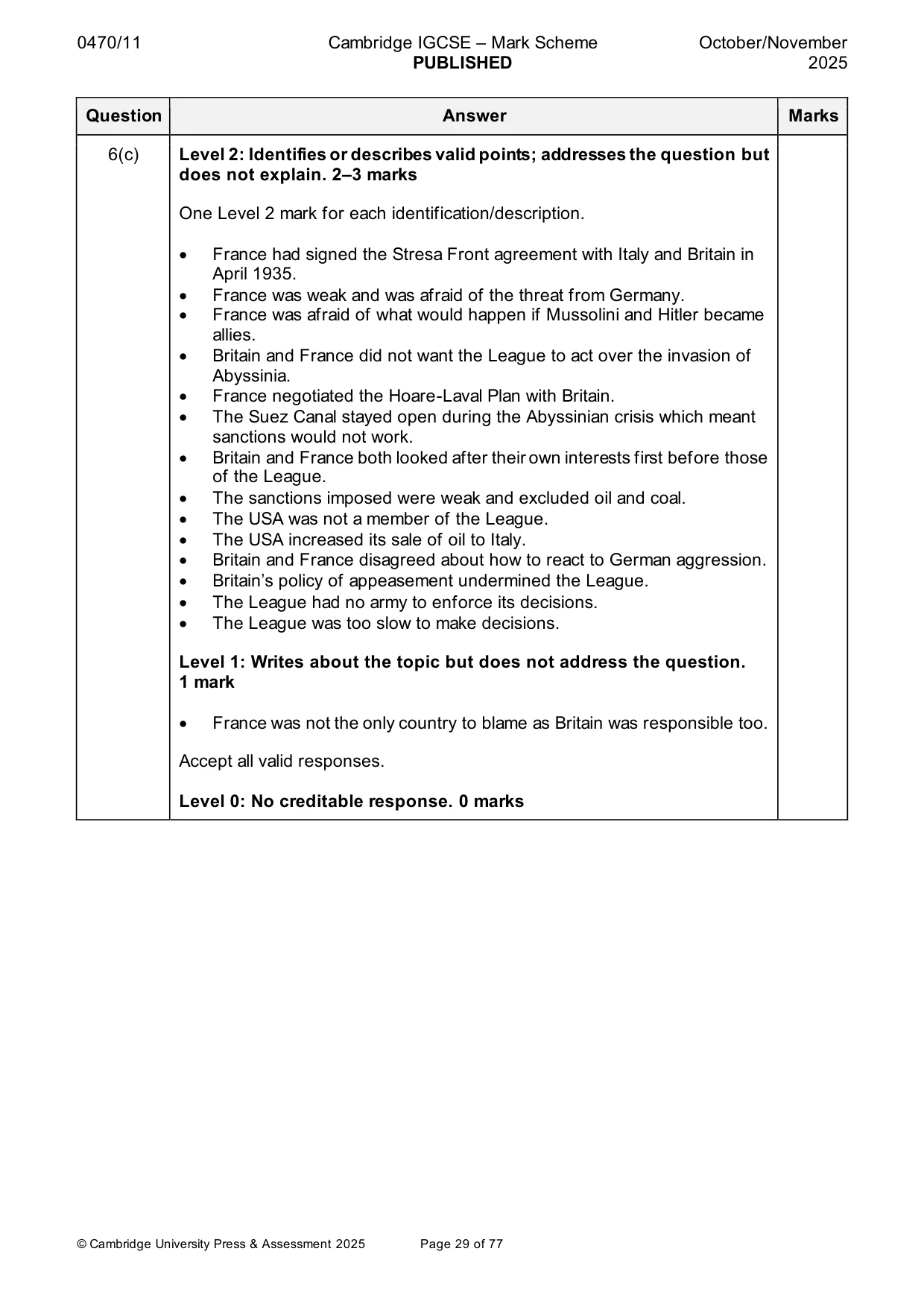
0470/11 Cambridge IGCSE – Mark Scheme PUBLISHED October/November 2025 © Cambridge University Press & Assessment 2025 Page 29 of 77 Question Answer Marks 6(c) Level 2: Identifies or describes valid points; addresses the question but does not explain. 2–3 marks One Level 2 mark for each identification/description. • France had signed the Stresa Front agreement with Italy and Britain in April 1935. • France was weak and was afraid of the threat from Germany. • France was afraid of what would happen if Mussolini and Hitler became allies. • Britain and France did not want the League to act over the invasion of Abyssinia. • France negotiated the Hoare-Laval Plan with Britain. • The Suez Canal stayed open during the Abyssinian crisis which meant sanctions would not work. • Britain and France both looked after their own interests first before those of the League. • The sanctions imposed were weak and excluded oil and coal. • The USA was not a member of the League. • The USA increased its sale of oil to Italy. • Britain and France disagreed about how to react to German aggression. • Britain’s policy of appeasement undermined the League. • The League had no army to enforce its decisions. • The League was too slow to make decisions. Level 1: Writes about the topic but does not address the question. 1 mark • France was not the only country to blame as Britain was responsible too. Accept all valid responses. Level 0: No creditable response. 0 marks
Mark scheme, page 30
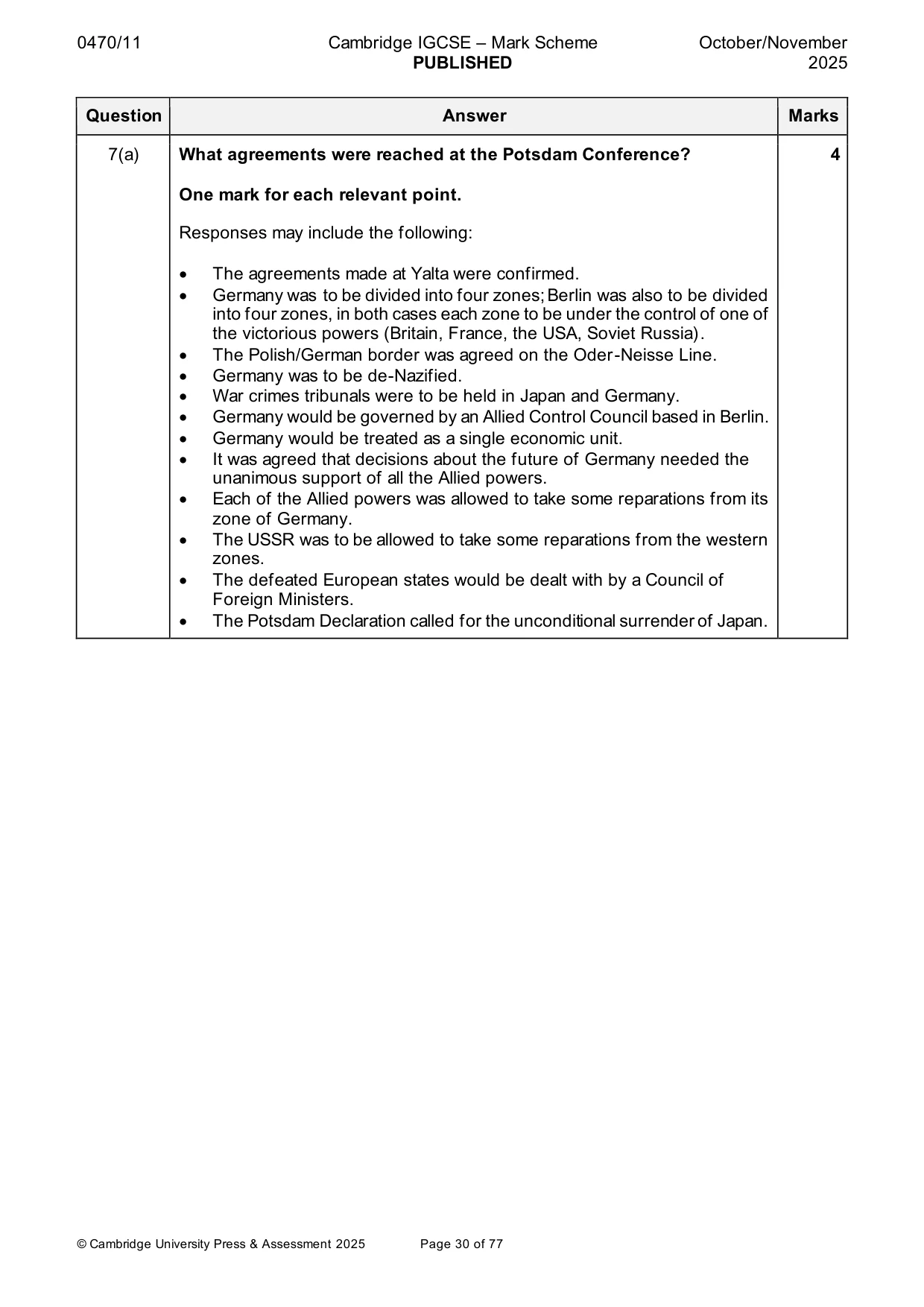
0470/11 Cambridge IGCSE – Mark Scheme PUBLISHED October/November 2025 © Cambridge University Press & Assessment 2025 Page 30 of 77 Question Answer Marks 7(a) What agreements were reached at the Potsdam Conference? One mark for each relevant point. Responses may include the following: • The agreements made at Yalta were confirmed. • Germany was to be divided into four zones; Berlin was also to be divided into four zones, in both cases each zone to be under the control of one of the victorious powers (Britain, France, the USA, Soviet Russia). • The Polish/German border was agreed on the Oder-Neisse Line. • Germany was to be de-Nazified. • War crimes tribunals were to be held in Japan and Germany. • Germany would be governed by an Allied Control Council based in Berlin. • Germany would be treated as a single economic unit. • It was agreed that decisions about the future of Germany needed the unanimous support of all the Allied powers. • Each of the Allied powers was allowed to take some reparations from its zone of Germany. • The USSR was to be allowed to take some reparations from the western zones. • The defeated European states would be dealt with by a Council of Foreign Ministers. • The Potsdam Declaration called for the unconditional surrender of Japan. 4
Mark scheme, page 31
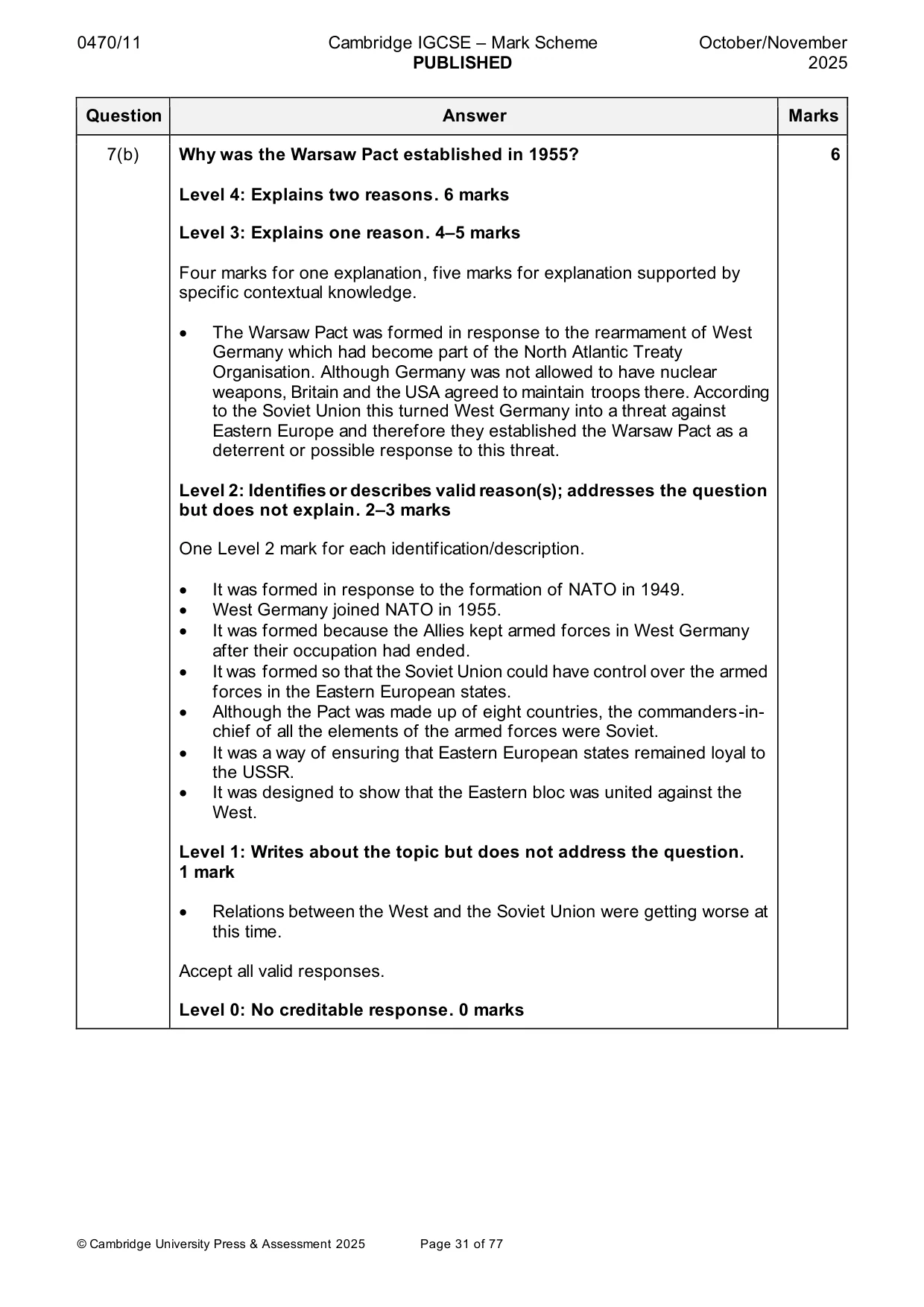
0470/11 Cambridge IGCSE – Mark Scheme PUBLISHED October/November 2025 © Cambridge University Press & Assessment 2025 Page 31 of 77 Question Answer Marks 7(b) Why was the Warsaw Pact established in 1955? Level 4: Explains two reasons. 6 marks Level 3: Explains one reason. 4–5 marks Four marks for one explanation, five marks for explanation supported by specific contextual knowledge. • The Warsaw Pact was formed in response to the rearmament of West Germany which had become part of the North Atlantic Treaty Organisation. Although Germany was not allowed to have nuclear weapons, Britain and the USA agreed to maintain troops there. According to the Soviet Union this turned West Germany into a threat against Eastern Europe and therefore they established the Warsaw Pact as a deterrent or possible response to this threat. Level 2: Identifies or describes valid reason(s); addresses the question but does not explain. 2–3 marks One Level 2 mark for each identification/description. • It was formed in response to the formation of NATO in 1949. • West Germany joined NATO in 1955. • It was formed because the Allies kept armed forces in West Germany after their occupation had ended. • It was formed so that the Soviet Union could have control over the armed forces in the Eastern European states. • Although the Pact was made up of eight countries, the commanders-in- chief of all the elements of the armed forces were Soviet. • It was a way of ensuring that Eastern European states remained loyal to the USSR. • It was designed to show that the Eastern bloc was united against the West. Level 1: Writes about the topic but does not address the question. 1 mark • Relations between the West and the Soviet Union were getting worse at this time. Accept all valid responses. Level 0: No creditable response. 0 marks 6
Mark scheme, page 32
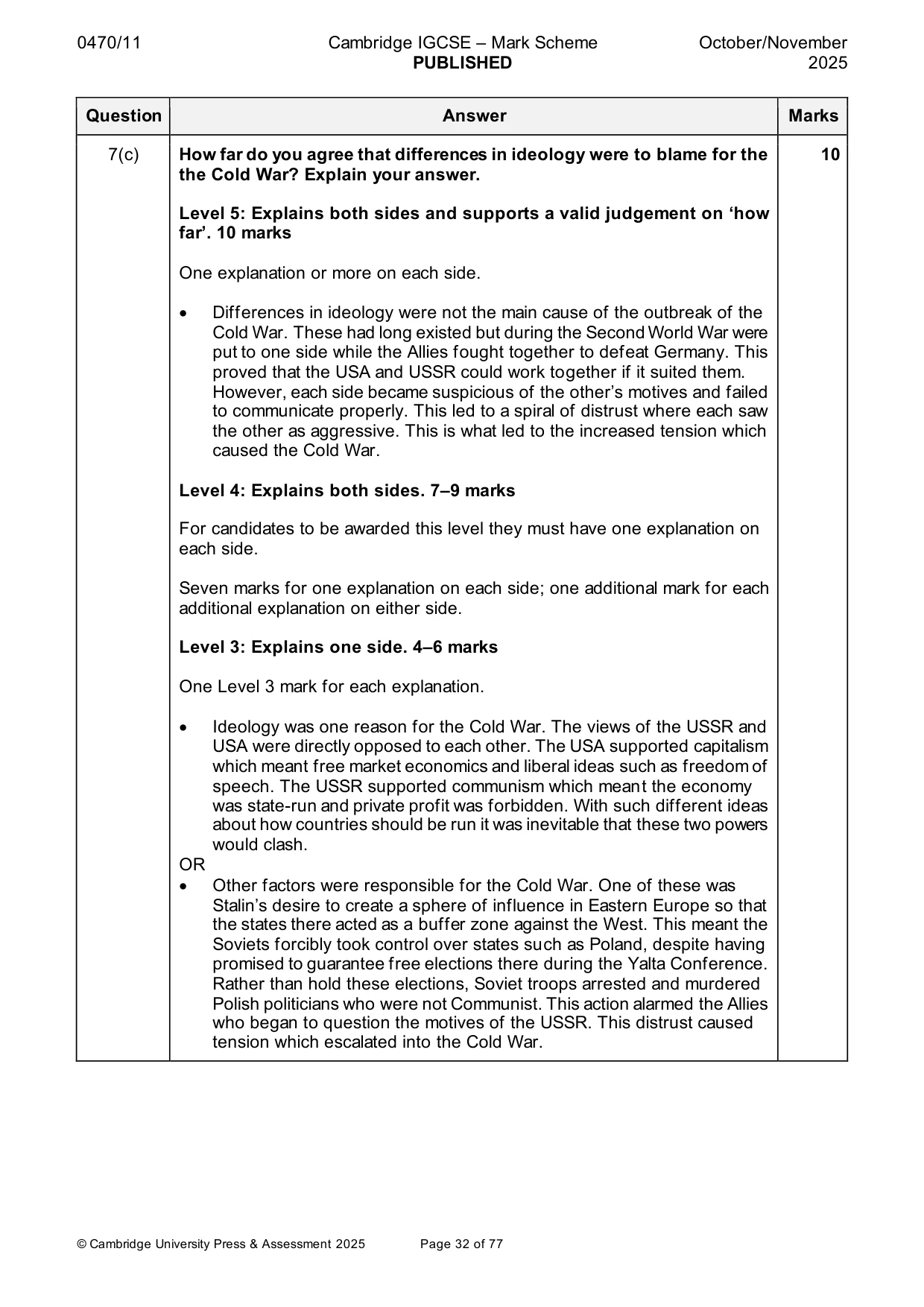
0470/11 Cambridge IGCSE – Mark Scheme PUBLISHED October/November 2025 © Cambridge University Press & Assessment 2025 Page 32 of 77 Question Answer Marks 7(c) How far do you agree that differences in ideology were to blame for the the Cold War? Explain your answer. Level 5: Explains both sides and supports a valid judgement on ‘how far’. 10 marks One explanation or more on each side. • Differences in ideology were not the main cause of the outbreak of the Cold War. These had long existed but during the Second World War were put to one side while the Allies fought together to defeat Germany. This proved that the USA and USSR could work together if it suited them. However, each side became suspicious of the other’s motives and failed to communicate properly. This led to a spiral of distrust where each saw the other as aggressive. This is what led to the increased tension which caused the Cold War. Level 4: Explains both sides. 7–9 marks For candidates to be awarded this level they must have one explanation on each side. Seven marks for one explanation on each side; one additional mark for each additional explanation on either side. Level 3: Explains one side. 4–6 marks One Level 3 mark for each explanation. • Ideology was one reason for the Cold War. The views of the USSR and USA were directly opposed to each other. The USA supported capitalism which meant free market economics and liberal ideas such as freedom of speech. The USSR supported communism which meant the economy was state-run and private profit was forbidden. With such different ideas about how countries should be run it was inevitable that these two powers would clash. OR • Other factors were responsible for the Cold War. One of these was Stalin’s desire to create a sphere of influence in Eastern Europe so that the states there acted as a buffer zone against the West. This meant the Soviets forcibly took control over states such as Poland, despite having promised to guarantee free elections there during the Yalta Conference. Rather than hold these elections, Soviet troops arrested and murdered Polish politicians who were not Communist. This action alarmed the Allies who began to question the motives of the USSR. This distrust caused tension which escalated into the Cold War. 10
Mark scheme, page 33
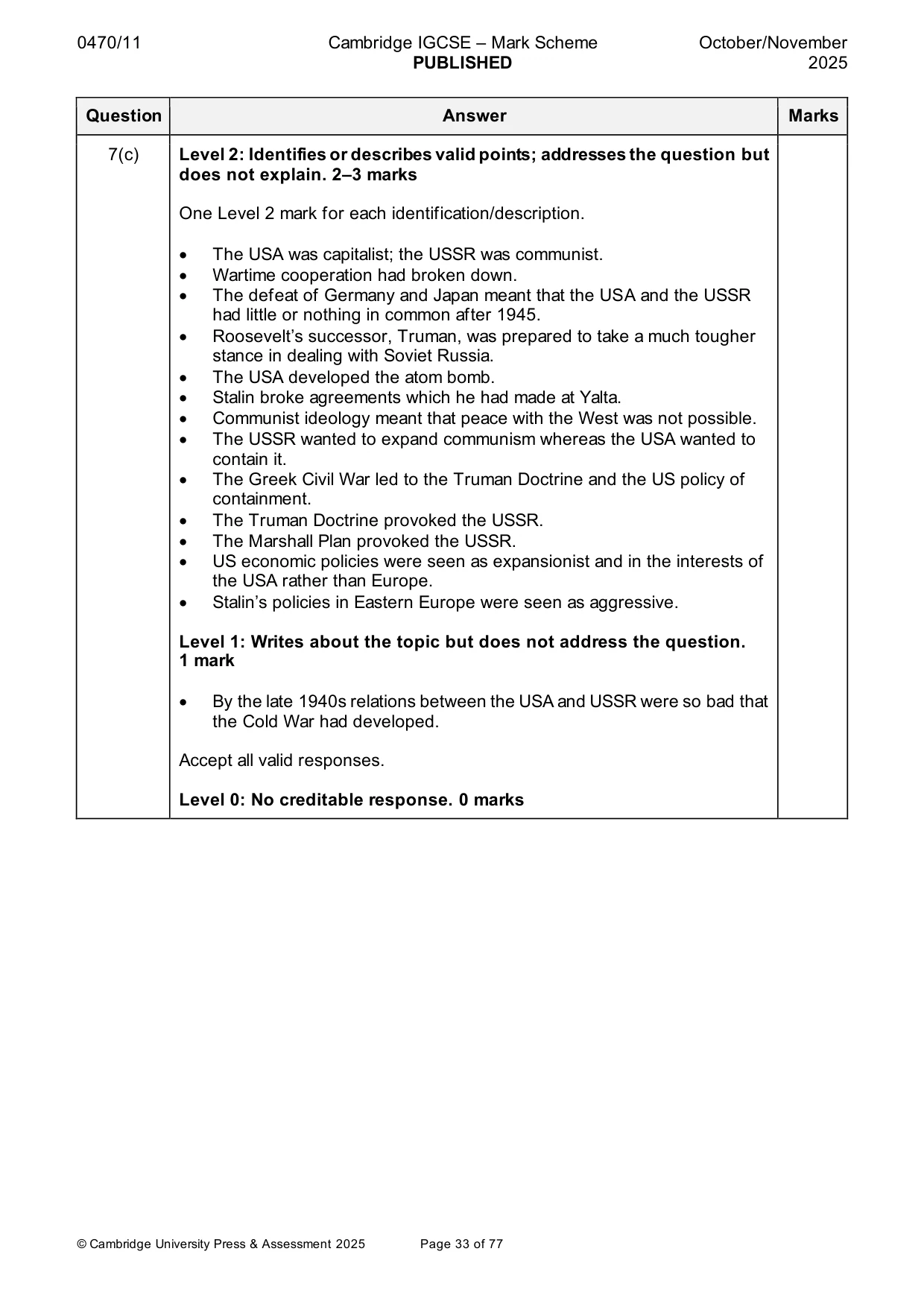
0470/11 Cambridge IGCSE – Mark Scheme PUBLISHED October/November 2025 © Cambridge University Press & Assessment 2025 Page 33 of 77 Question Answer Marks 7(c) Level 2: Identifies or describes valid points; addresses the question but does not explain. 2–3 marks One Level 2 mark for each identification/description. • The USA was capitalist; the USSR was communist. • Wartime cooperation had broken down. • The defeat of Germany and Japan meant that the USA and the USSR had little or nothing in common after 1945. • Roosevelt’s successor, Truman, was prepared to take a much tougher stance in dealing with Soviet Russia. • The USA developed the atom bomb. • Stalin broke agreements which he had made at Yalta. • Communist ideology meant that peace with the West was not possible. • The USSR wanted to expand communism whereas the USA wanted to contain it. • The Greek Civil War led to the Truman Doctrine and the US policy of containment. • The Truman Doctrine provoked the USSR. • The Marshall Plan provoked the USSR. • US economic policies were seen as expansionist and in the interests of the USA rather than Europe. • Stalin’s policies in Eastern Europe were seen as aggressive. Level 1: Writes about the topic but does not address the question. 1 mark • By the late 1940s relations between the USA and USSR were so bad that the Cold War had developed. Accept all valid responses. Level 0: No creditable response. 0 marks
Mark scheme, page 34
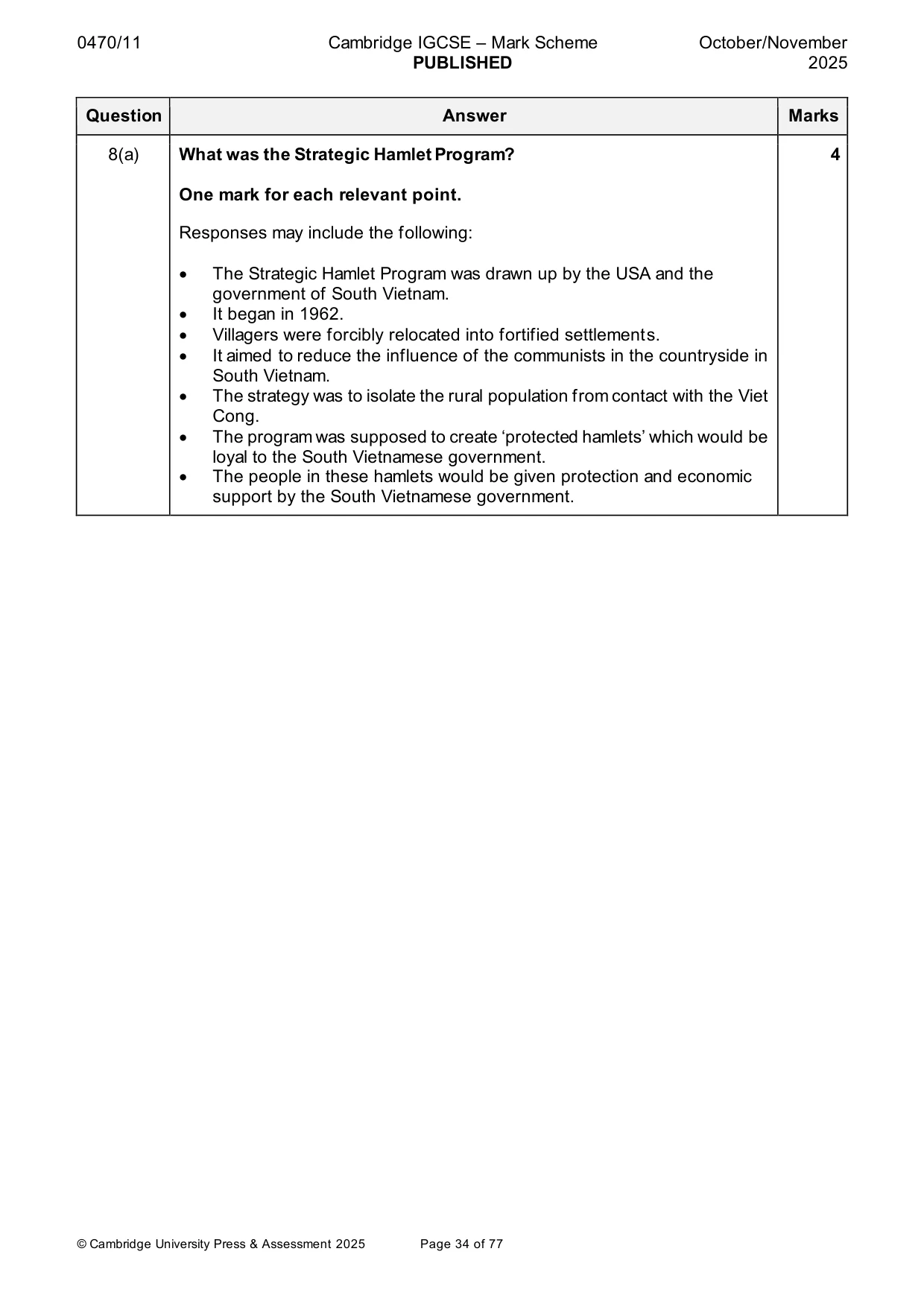
0470/11 Cambridge IGCSE – Mark Scheme PUBLISHED October/November 2025 © Cambridge University Press & Assessment 2025 Page 34 of 77 Question Answer Marks 8(a) What was the Strategic Hamlet Program? One mark for each relevant point. Responses may include the following: • The Strategic Hamlet Program was drawn up by the USA and the government of South Vietnam. • It began in 1962. • Villagers were forcibly relocated into fortified settlements. • It aimed to reduce the influence of the communists in the countryside in South Vietnam. • The strategy was to isolate the rural population from contact with the Viet Cong. • The program was supposed to create ‘protected hamlets’ which would be loyal to the South Vietnamese government. • The people in these hamlets would be given protection and economic support by the South Vietnamese government. 4
Mark scheme, page 35
0470/11 Cambridge IGCSE – Mark Scheme PUBLISHED October/November 2025 © Cambridge University Press & Assessment 2025 Page 35 of 77 Question Answer Marks 8(b) Why was the Gulf of Tonkin Incident important? Level 4: Explains two reasons. 6 marks Level 3: Explains one reason. 4–5 marks Four marks for one explanation, five marks for explanation supported by specific contextual knowledge. • The incident was important because the USA used it to increase their involvement in the conflict in Vietnam. Two American ships were attacked by gunboats from North Vietnam. The Americans claimed they were in international waters at the time of the attack and that this was unwarranted aggression by North Vietnam. Therefore, the USA claimed it was justified in becoming more involved in the conflict. Level 2: Identifies or describes valid reason(s); addresses the question but does not explain. 2–3 marks One Level 2 mark for each identification/description. • Two American warships were attacked in the Gulf of Tonkin. • They were attacked by North Vietnamese gunboats. • The Americans made false claims about what happened. • The Americans claimed that their warships were in international waters and used the attack as a reason to expand their involvement in Vietnam. • It led to the Gulf of Tonkin Resolution. • As a result of the attack, ground troops were sent to Vietnam in 1965. Level 1: Writes about the topic but does not address the question. 1 mark • The Gulf of Tonkin incident took place in August 1964. Accept all valid responses. Level 0: No creditable response. 0 marks 6
Mark scheme, page 36
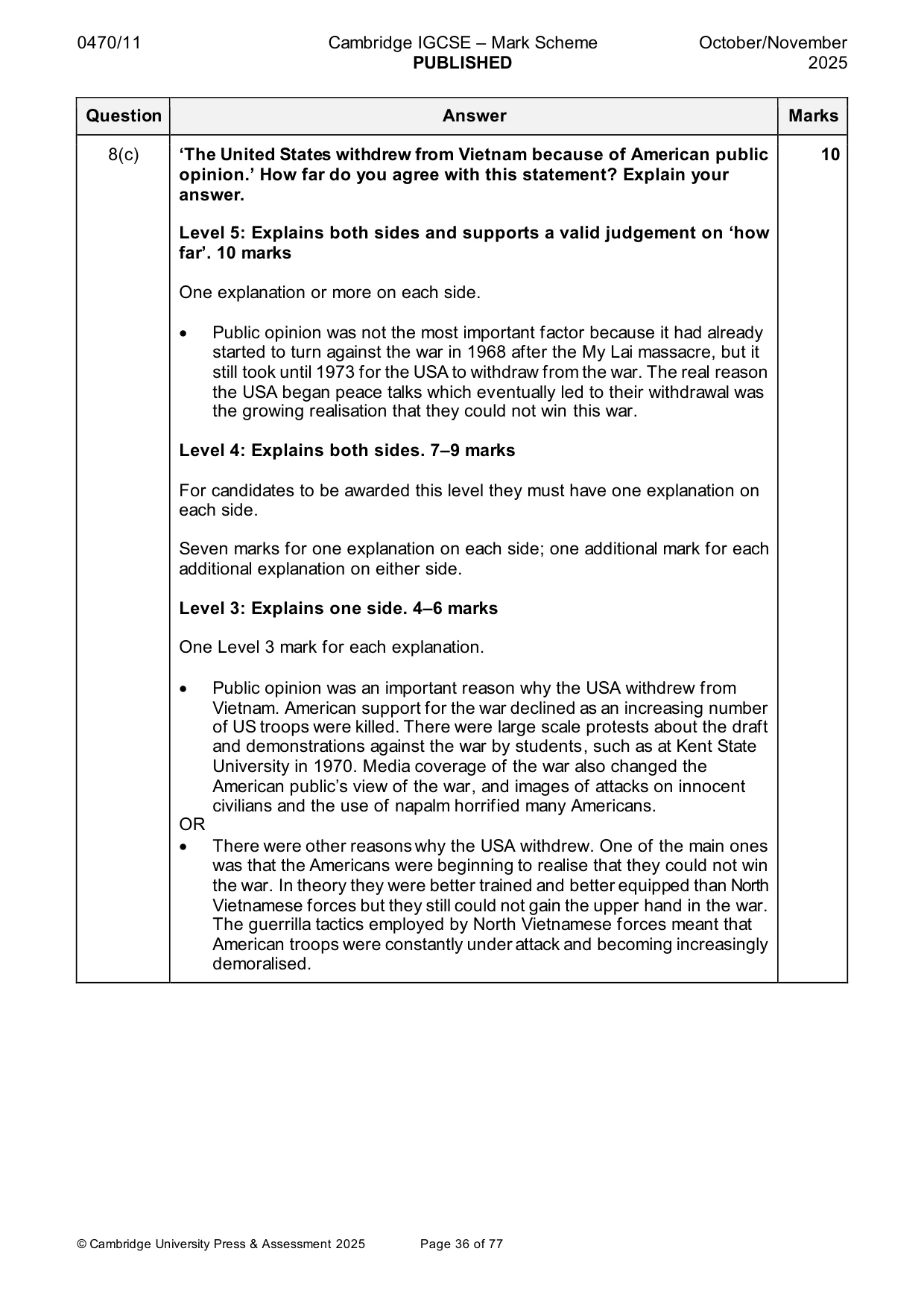
0470/11 Cambridge IGCSE – Mark Scheme PUBLISHED October/November 2025 © Cambridge University Press & Assessment 2025 Page 36 of 77 Question Answer Marks 8(c) ‘The United States withdrew from Vietnam because of American public opinion.’ How far do you agree with this statement? Explain your answer. Level 5: Explains both sides and supports a valid judgement on ‘how far’. 10 marks One explanation or more on each side. • Public opinion was not the most important factor because it had already started to turn against the war in 1968 after the My Lai massacre, but it still took until 1973 for the USA to withdraw from the war. The real reason the USA began peace talks which eventually led to their withdrawal was the growing realisation that they could not win this war. Level 4: Explains both sides. 7–9 marks For candidates to be awarded this level they must have one explanation on each side. Seven marks for one explanation on each side; one additional mark for each additional explanation on either side. Level 3: Explains one side. 4–6 marks One Level 3 mark for each explanation. • Public opinion was an important reason why the USA withdrew from Vietnam. American support for the war declined as an increasing number of US troops were killed. There were large scale protests about the draft and demonstrations against the war by students, such as at Kent State University in 1970. Media coverage of the war also changed the American public’s view of the war, and images of attacks on innocent civilians and the use of napalm horrified many Americans. OR • There were other reasons why the USA withdrew. One of the main ones was that the Americans were beginning to realise that they could not win the war. In theory they were better trained and better equipped than North Vietnamese forces but they still could not gain the upper hand in the war. The guerrilla tactics employed by North Vietnamese forces meant that American troops were constantly under attack and becoming increasingly demoralised. 10
Mark scheme, page 37
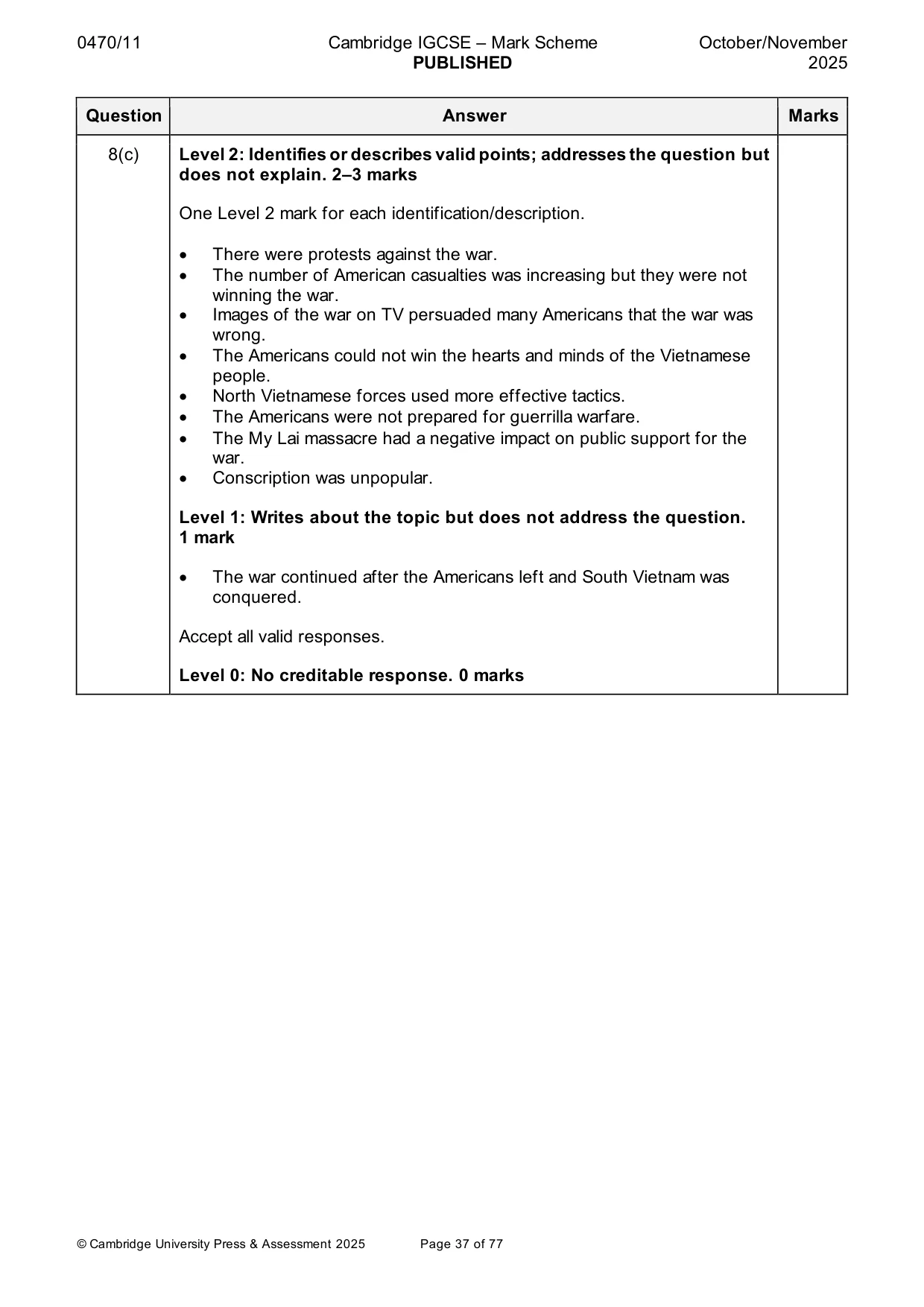
0470/11 Cambridge IGCSE – Mark Scheme PUBLISHED October/November 2025 © Cambridge University Press & Assessment 2025 Page 37 of 77 Question Answer Marks 8(c) Level 2: Identifies or describes valid points; addresses the question but does not explain. 2–3 marks One Level 2 mark for each identification/description. • There were protests against the war. • The number of American casualties was increasing but they were not winning the war. • Images of the war on TV persuaded many Americans that the war was wrong. • The Americans could not win the hearts and minds of the Vietnamese people. • North Vietnamese forces used more effective tactics. • The Americans were not prepared for guerrilla warfare. • The My Lai massacre had a negative impact on public support for the war. • Conscription was unpopular. Level 1: Writes about the topic but does not address the question. 1 mark • The war continued after the Americans left and South Vietnam was conquered. Accept all valid responses. Level 0: No creditable response. 0 marks
Mark scheme, page 38
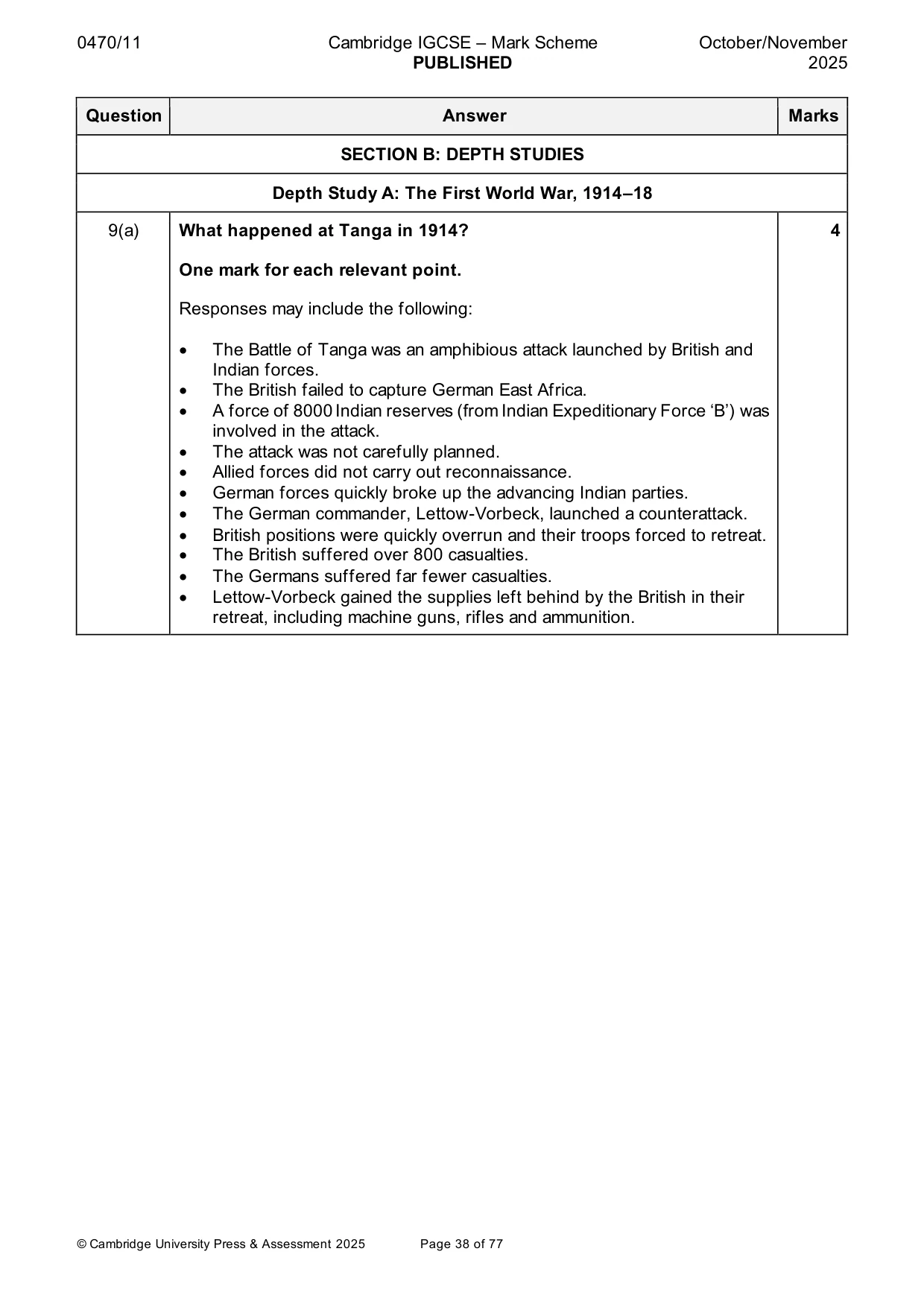
0470/11 Cambridge IGCSE – Mark Scheme PUBLISHED October/November 2025 © Cambridge University Press & Assessment 2025 Page 38 of 77 Question Answer Marks SECTION B: DEPTH STUDIES Depth Study A: The First World War, 1914–18 9(a) What happened at Tanga in 1914? One mark for each relevant point. Responses may include the following: • The Battle of Tanga was an amphibious attack launched by British and Indian forces. • The British failed to capture German East Africa. • A force of 8000 Indian reserves (from Indian Expeditionary Force ‘B’) was involved in the attack. • The attack was not carefully planned. • Allied forces did not carry out reconnaissance. • German forces quickly broke up the advancing Indian parties. • The German commander, Lettow-Vorbeck, launched a counterattack. • British positions were quickly overrun and their troops forced to retreat. • The British suffered over 800 casualties. • The Germans suffered far fewer casualties. • Lettow-Vorbeck gained the supplies left behind by the British in their retreat, including machine guns, rifles and ammunition. 4
Mark scheme, page 39
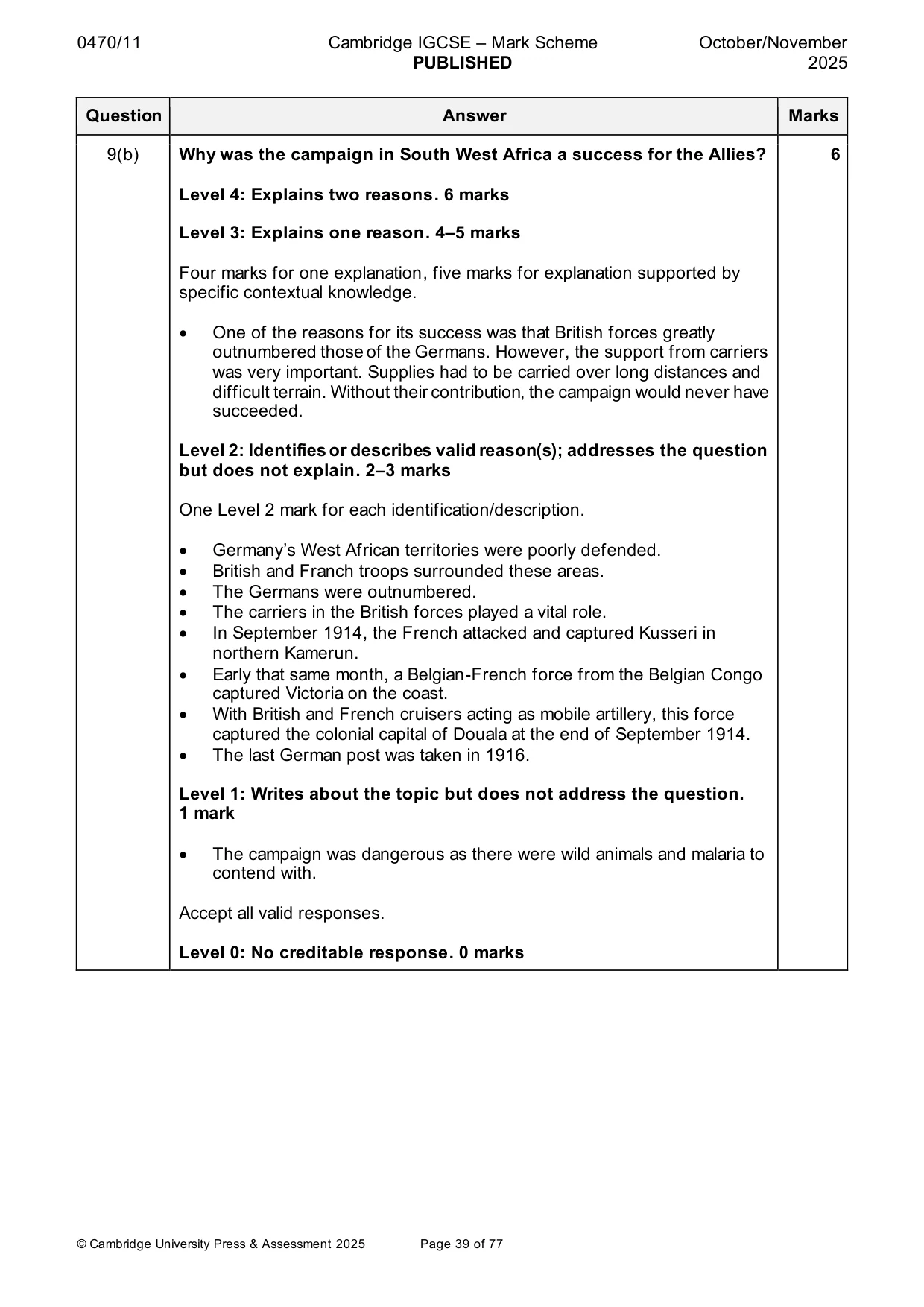
0470/11 Cambridge IGCSE – Mark Scheme PUBLISHED October/November 2025 © Cambridge University Press & Assessment 2025 Page 39 of 77 Question Answer Marks 9(b) Why was the campaign in South West Africa a success for the Allies? Level 4: Explains two reasons. 6 marks Level 3: Explains one reason. 4–5 marks Four marks for one explanation, five marks for explanation supported by specific contextual knowledge. • One of the reasons for its success was that British forces greatly outnumbered those of the Germans. However, the support from carriers was very important. Supplies had to be carried over long distances and difficult terrain. Without their contribution, the campaign would never have succeeded. Level 2: Identifies or describes valid reason(s); addresses the question but does not explain. 2–3 marks One Level 2 mark for each identification/description. • Germany’s West African territories were poorly defended. • British and Franch troops surrounded these areas. • The Germans were outnumbered. • The carriers in the British forces played a vital role. • In September 1914, the French attacked and captured Kusseri in northern Kamerun. • Early that same month, a Belgian-French force from the Belgian Congo captured Victoria on the coast. • With British and French cruisers acting as mobile artillery, this force captured the colonial capital of Douala at the end of September 1914. • The last German post was taken in 1916. Level 1: Writes about the topic but does not address the question. 1 mark • The campaign was dangerous as there were wild animals and malaria to contend with. Accept all valid responses. Level 0: No creditable response. 0 marks 6
Mark scheme, page 40
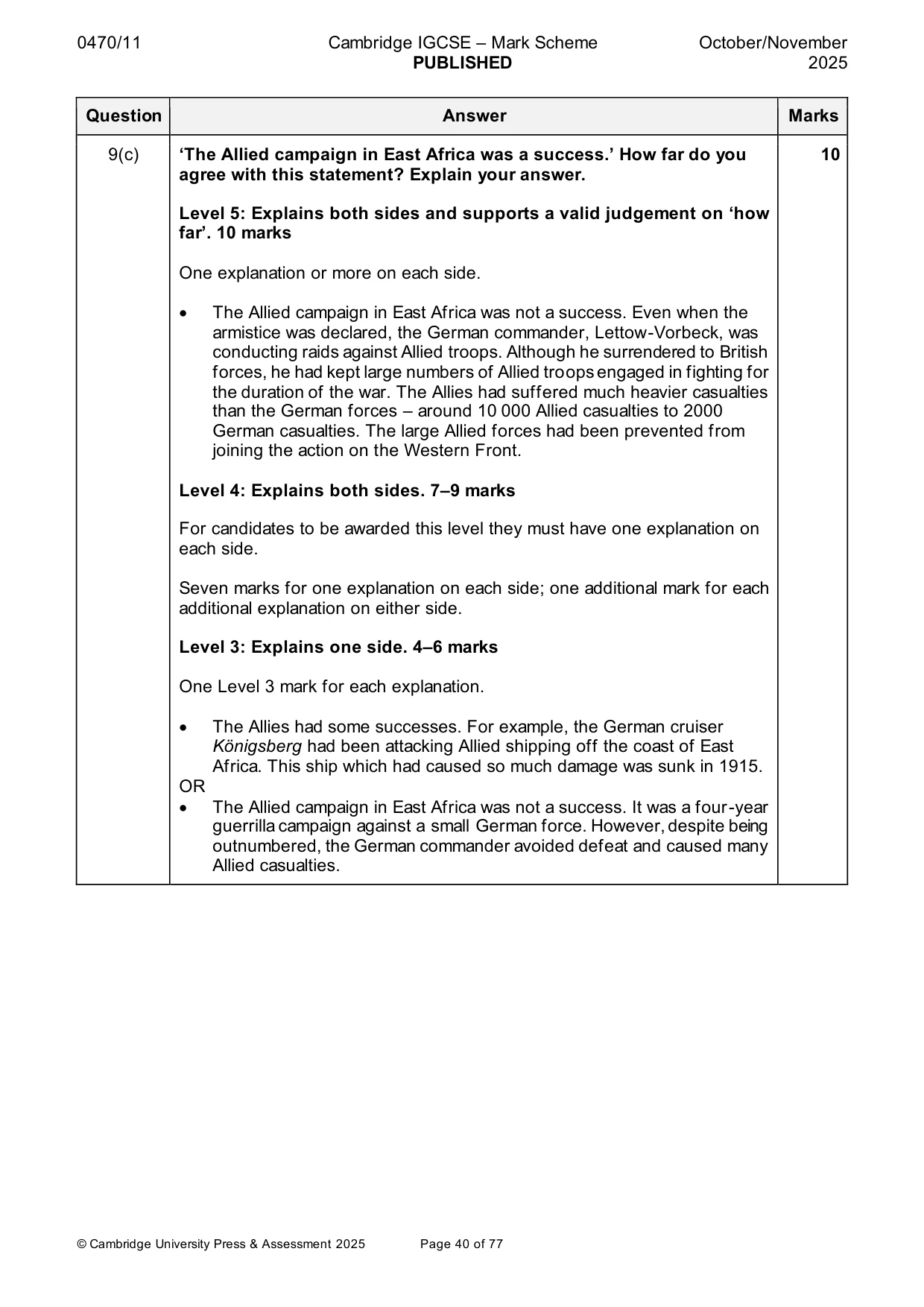
0470/11 Cambridge IGCSE – Mark Scheme PUBLISHED October/November 2025 © Cambridge University Press & Assessment 2025 Page 40 of 77 Question Answer Marks 9(c) ‘The Allied campaign in East Africa was a success.’ How far do you agree with this statement? Explain your answer. Level 5: Explains both sides and supports a valid judgement on ‘how far’. 10 marks One explanation or more on each side. • The Allied campaign in East Africa was not a success. Even when the armistice was declared, the German commander, Lettow-Vorbeck, was conducting raids against Allied troops. Although he surrendered to British forces, he had kept large numbers of Allied troops engaged in fighting for the duration of the war. The Allies had suffered much heavier casualties than the German forces – around 10 000 Allied casualties to 2000 German casualties. The large Allied forces had been prevented from joining the action on the Western Front. Level 4: Explains both sides. 7–9 marks For candidates to be awarded this level they must have one explanation on each side. Seven marks for one explanation on each side; one additional mark for each additional explanation on either side. Level 3: Explains one side. 4–6 marks One Level 3 mark for each explanation. • The Allies had some successes. For example, the German cruiser Königsberg had been attacking Allied shipping off the coast of East Africa. This ship which had caused so much damage was sunk in 1915. OR • The Allied campaign in East Africa was not a success. It was a four-year guerrilla campaign against a small German force. However, despite being outnumbered, the German commander avoided defeat and caused many Allied casualties. 10
Mark scheme, page 41
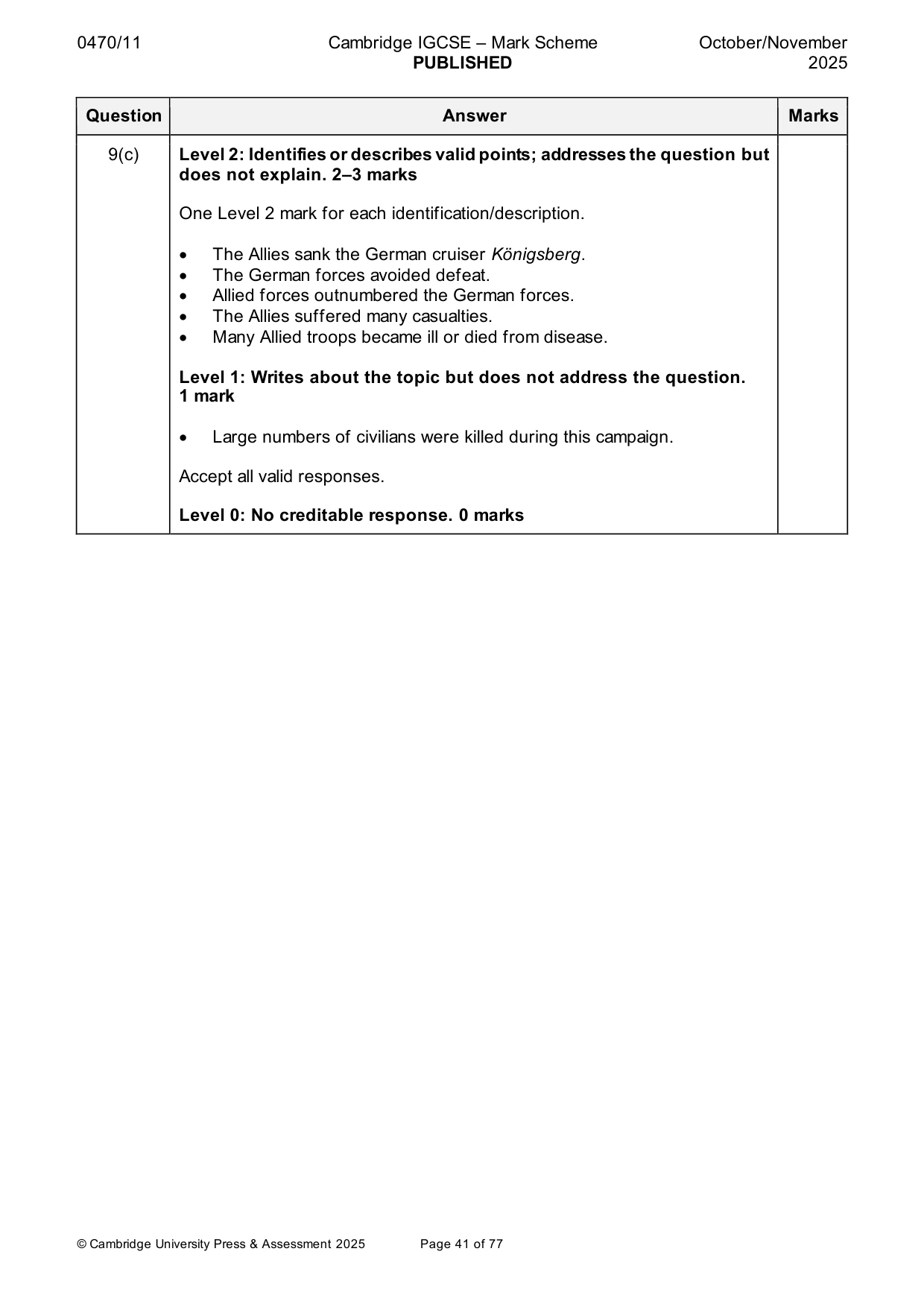
0470/11 Cambridge IGCSE – Mark Scheme PUBLISHED October/November 2025 © Cambridge University Press & Assessment 2025 Page 41 of 77 Question Answer Marks 9(c) Level 2: Identifies or describes valid points; addresses the question but does not explain. 2–3 marks One Level 2 mark for each identification/description. • The Allies sank the German cruiser Königsberg. • The German forces avoided defeat. • Allied forces outnumbered the German forces. • The Allies suffered many casualties. • Many Allied troops became ill or died from disease. Level 1: Writes about the topic but does not address the question. 1 mark • Large numbers of civilians were killed during this campaign. Accept all valid responses. Level 0: No creditable response. 0 marks
Mark scheme, page 42
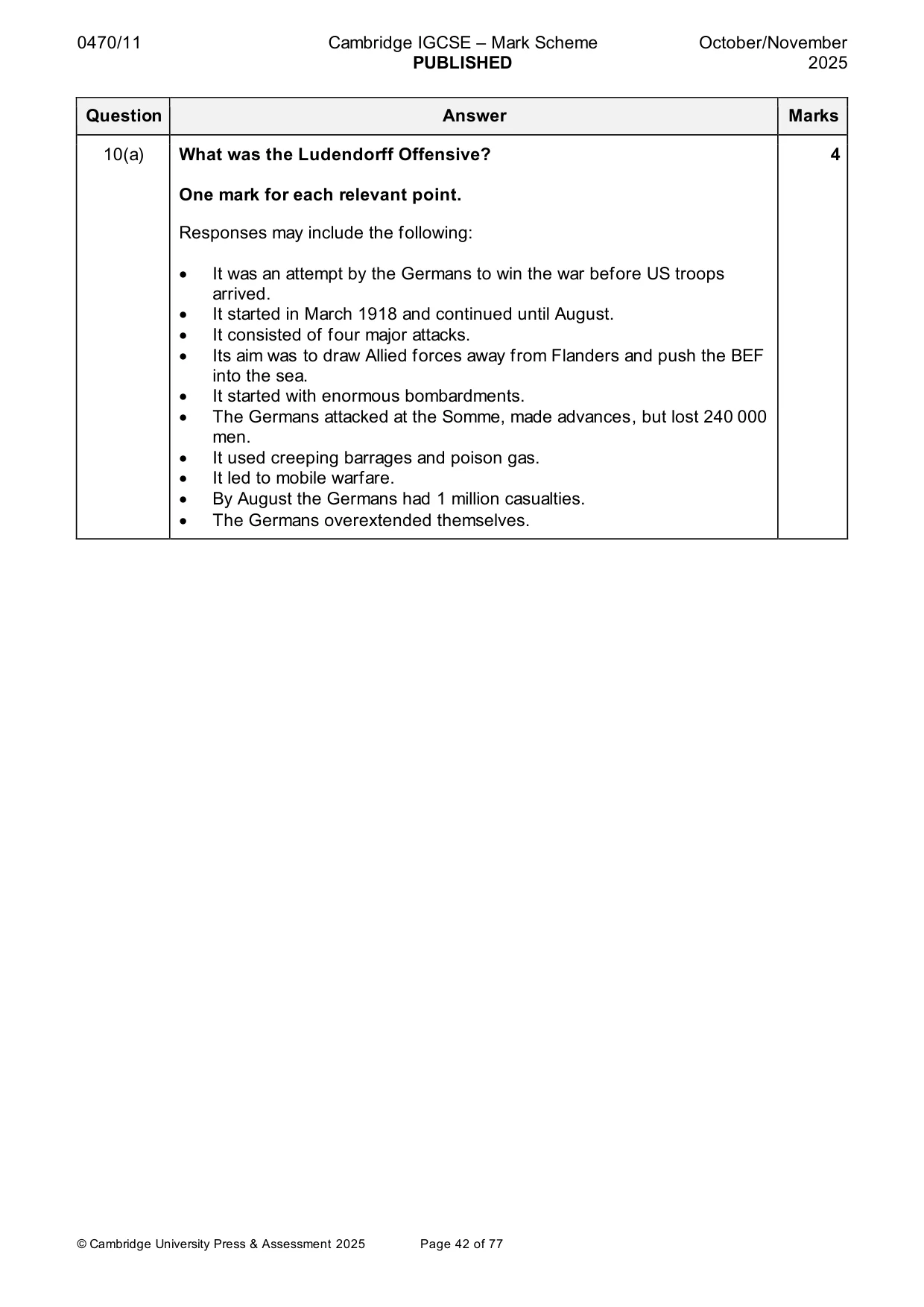
0470/11 Cambridge IGCSE – Mark Scheme PUBLISHED October/November 2025 © Cambridge University Press & Assessment 2025 Page 42 of 77 Question Answer Marks 10(a) What was the Ludendorff Offensive? One mark for each relevant point. Responses may include the following: • It was an attempt by the Germans to win the war before US troops arrived. • It started in March 1918 and continued until August. • It consisted of four major attacks. • Its aim was to draw Allied forces away from Flanders and push the BEF into the sea. • It started with enormous bombardments. • The Germans attacked at the Somme, made advances, but lost 240 000 men. • It used creeping barrages and poison gas. • It led to mobile warfare. • By August the Germans had 1 million casualties. • The Germans overextended themselves. 4
Mark scheme, page 43
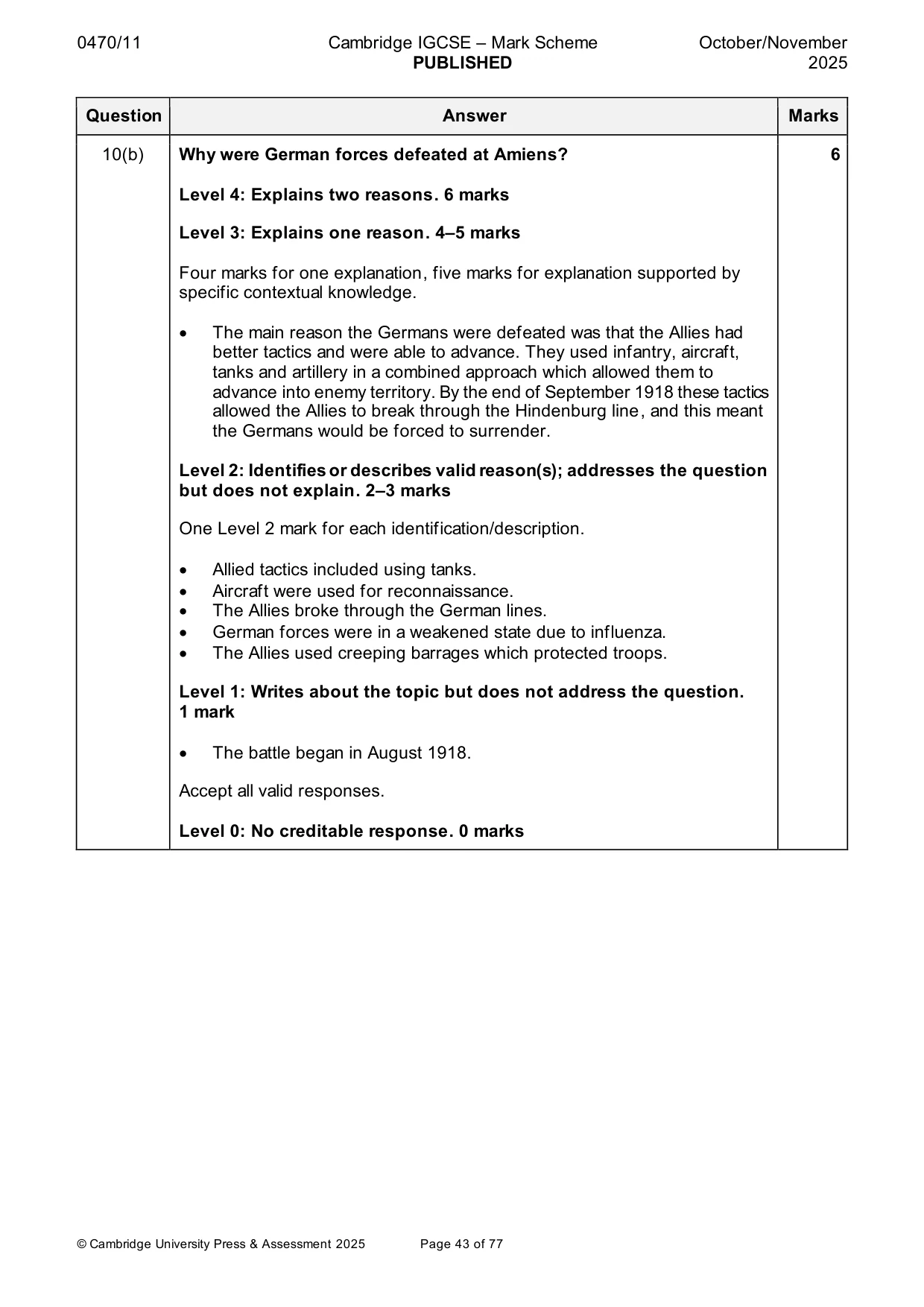
0470/11 Cambridge IGCSE – Mark Scheme PUBLISHED October/November 2025 © Cambridge University Press & Assessment 2025 Page 43 of 77 Question Answer Marks 10(b) Why were German forces defeated at Amiens? Level 4: Explains two reasons. 6 marks Level 3: Explains one reason. 4–5 marks Four marks for one explanation, five marks for explanation supported by specific contextual knowledge. • The main reason the Germans were defeated was that the Allies had better tactics and were able to advance. They used infantry, aircraft, tanks and artillery in a combined approach which allowed them to advance into enemy territory. By the end of September 1918 these tactics allowed the Allies to break through the Hindenburg line, and this meant the Germans would be forced to surrender. Level 2: Identifies or describes valid reason(s); addresses the question but does not explain. 2–3 marks One Level 2 mark for each identification/description. • Allied tactics included using tanks. • Aircraft were used for reconnaissance. • The Allies broke through the German lines. • German forces were in a weakened state due to influenza. • The Allies used creeping barrages which protected troops. Level 1: Writes about the topic but does not address the question. 1 mark • The battle began in August 1918. Accept all valid responses. Level 0: No creditable response. 0 marks 6
Mark scheme, page 44
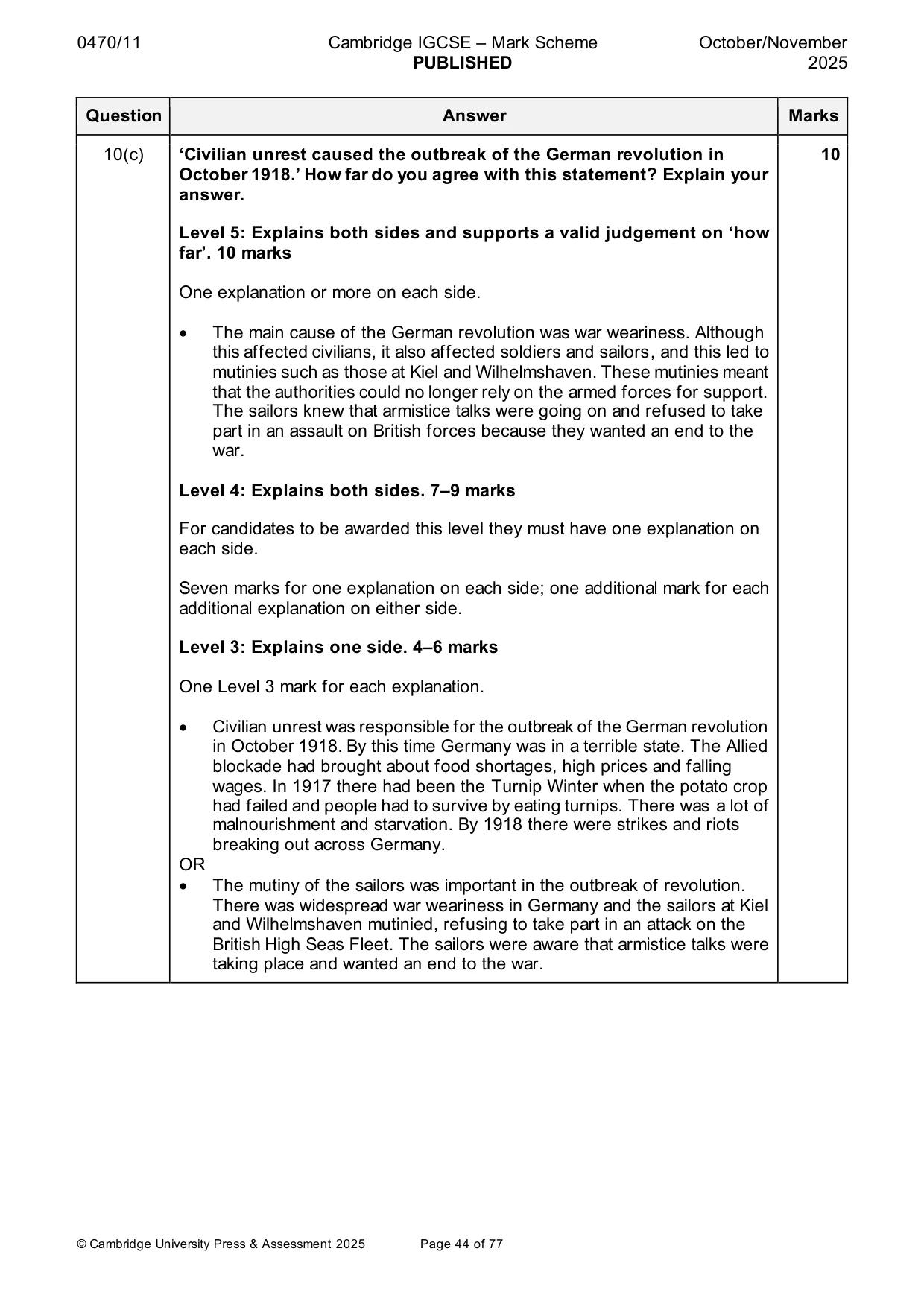
0470/11 Cambridge IGCSE – Mark Scheme PUBLISHED October/November 2025 © Cambridge University Press & Assessment 2025 Page 44 of 77 Question Answer Marks 10(c) ‘Civilian unrest caused the outbreak of the German revolution in October 1918.’ How far do you agree with this statement? Explain your answer. Level 5: Explains both sides and supports a valid judgement on ‘how far’. 10 marks One explanation or more on each side. • The main cause of the German revolution was war weariness. Although this affected civilians, it also affected soldiers and sailors, and this led to mutinies such as those at Kiel and Wilhelmshaven. These mutinies meant that the authorities could no longer rely on the armed forces for support. The sailors knew that armistice talks were going on and refused to take part in an assault on British forces because they wanted an end to the war. Level 4: Explains both sides. 7–9 marks For candidates to be awarded this level they must have one explanation on each side. Seven marks for one explanation on each side; one additional mark for each additional explanation on either side. Level 3: Explains one side. 4–6 marks One Level 3 mark for each explanation. • Civilian unrest was responsible for the outbreak of the German revolution in October 1918. By this time Germany was in a terrible state. The Allied blockade had brought about food shortages, high prices and falling wages. In 1917 there had been the Turnip Winter when the potato crop had failed and people had to survive by eating turnips. There was a lot of malnourishment and starvation. By 1918 there were strikes and riots breaking out across Germany. OR • The mutiny of the sailors was important in the outbreak of revolution. There was widespread war weariness in Germany and the sailors at Kiel and Wilhelmshaven mutinied, refusing to take part in an attack on the British High Seas Fleet. The sailors were aware that armistice talks were taking place and wanted an end to the war. 10
Mark scheme, page 45
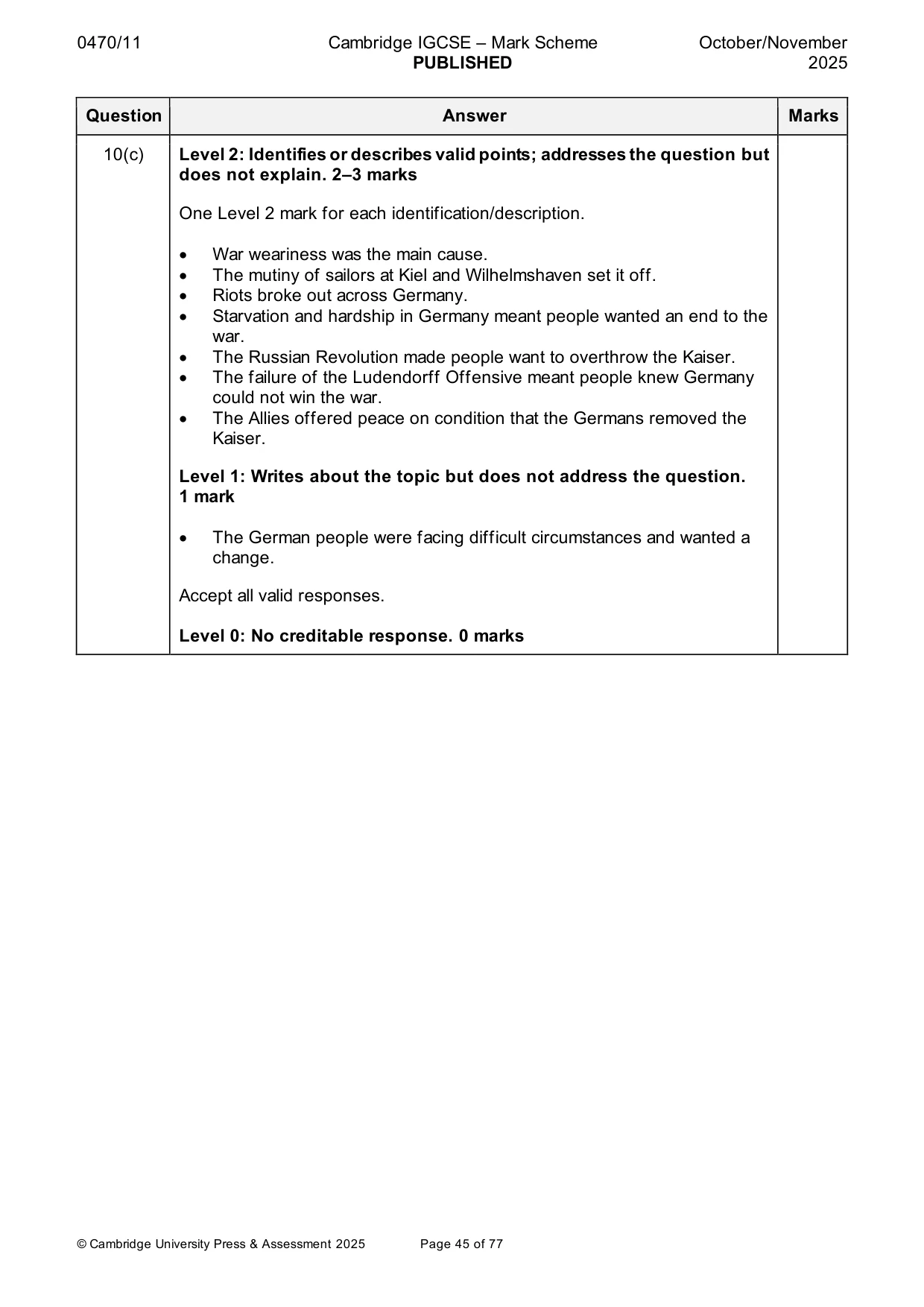
0470/11 Cambridge IGCSE – Mark Scheme PUBLISHED October/November 2025 © Cambridge University Press & Assessment 2025 Page 45 of 77 Question Answer Marks 10(c) Level 2: Identifies or describes valid points; addresses the question but does not explain. 2–3 marks One Level 2 mark for each identification/description. • War weariness was the main cause. • The mutiny of sailors at Kiel and Wilhelmshaven set it off. • Riots broke out across Germany. • Starvation and hardship in Germany meant people wanted an end to the war. • The Russian Revolution made people want to overthrow the Kaiser. • The failure of the Ludendorff Offensive meant people knew Germany could not win the war. • The Allies offered peace on condition that the Germans removed the Kaiser. Level 1: Writes about the topic but does not address the question. 1 mark • The German people were facing difficult circumstances and wanted a change. Accept all valid responses. Level 0: No creditable response. 0 marks
Mark scheme, page 46
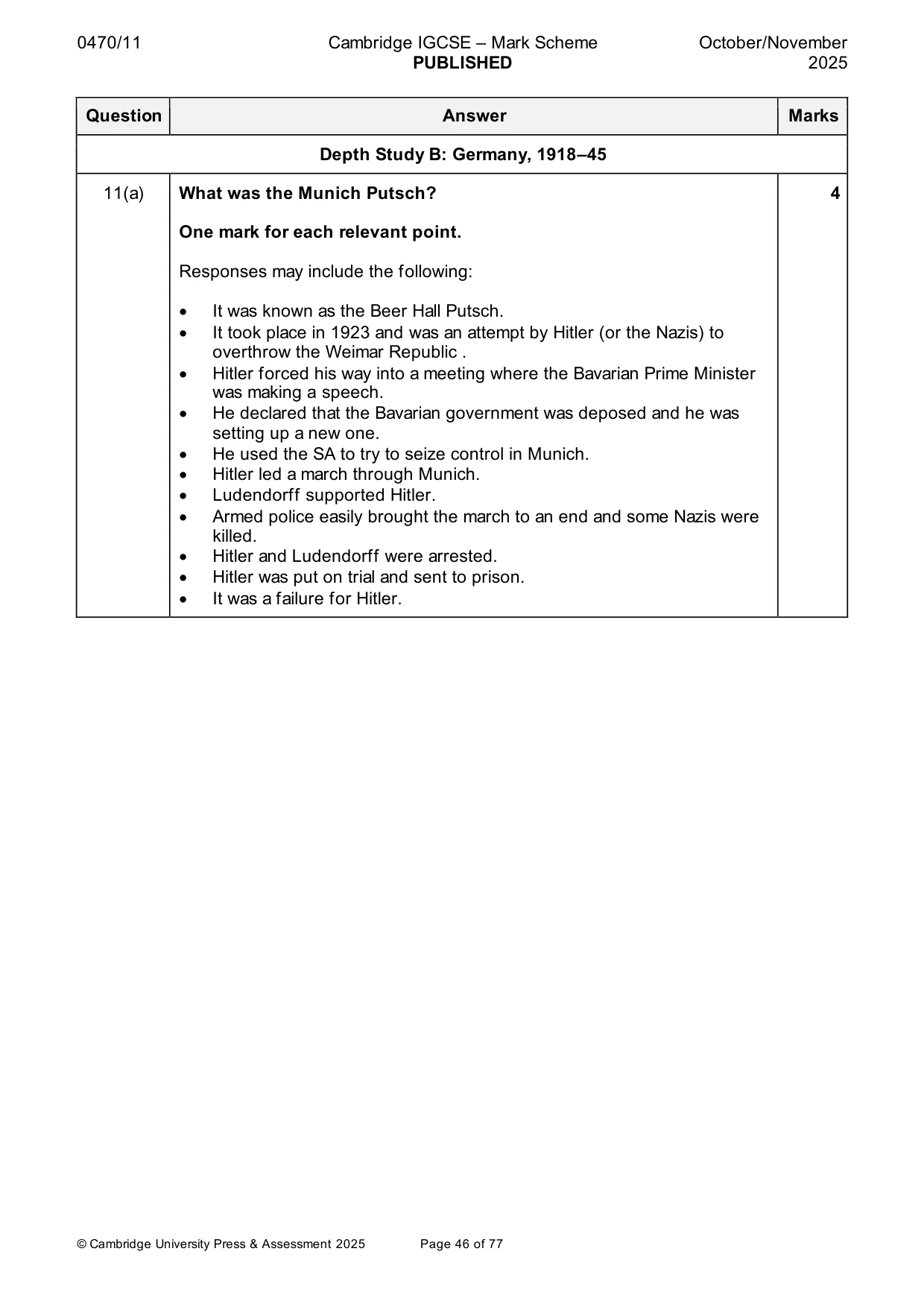
0470/11 Cambridge IGCSE – Mark Scheme PUBLISHED October/November 2025 © Cambridge University Press & Assessment 2025 Page 46 of 77 Question Answer Marks Depth Study B: Germany, 1918–45 11(a) What was the Munich Putsch? One mark for each relevant point. Responses may include the following: • It was known as the Beer Hall Putsch. • It took place in 1923 and was an attempt by Hitler (or the Nazis) to overthrow the Weimar Republic . • Hitler forced his way into a meeting where the Bavarian Prime Minister was making a speech. • He declared that the Bavarian government was deposed and he was setting up a new one. • He used the SA to try to seize control in Munich. • Hitler led a march through Munich. • Ludendorff supported Hitler. • Armed police easily brought the march to an end and some Nazis were killed. • Hitler and Ludendorff were arrested. • Hitler was put on trial and sent to prison. • It was a failure for Hitler. 4
Mark scheme, page 47
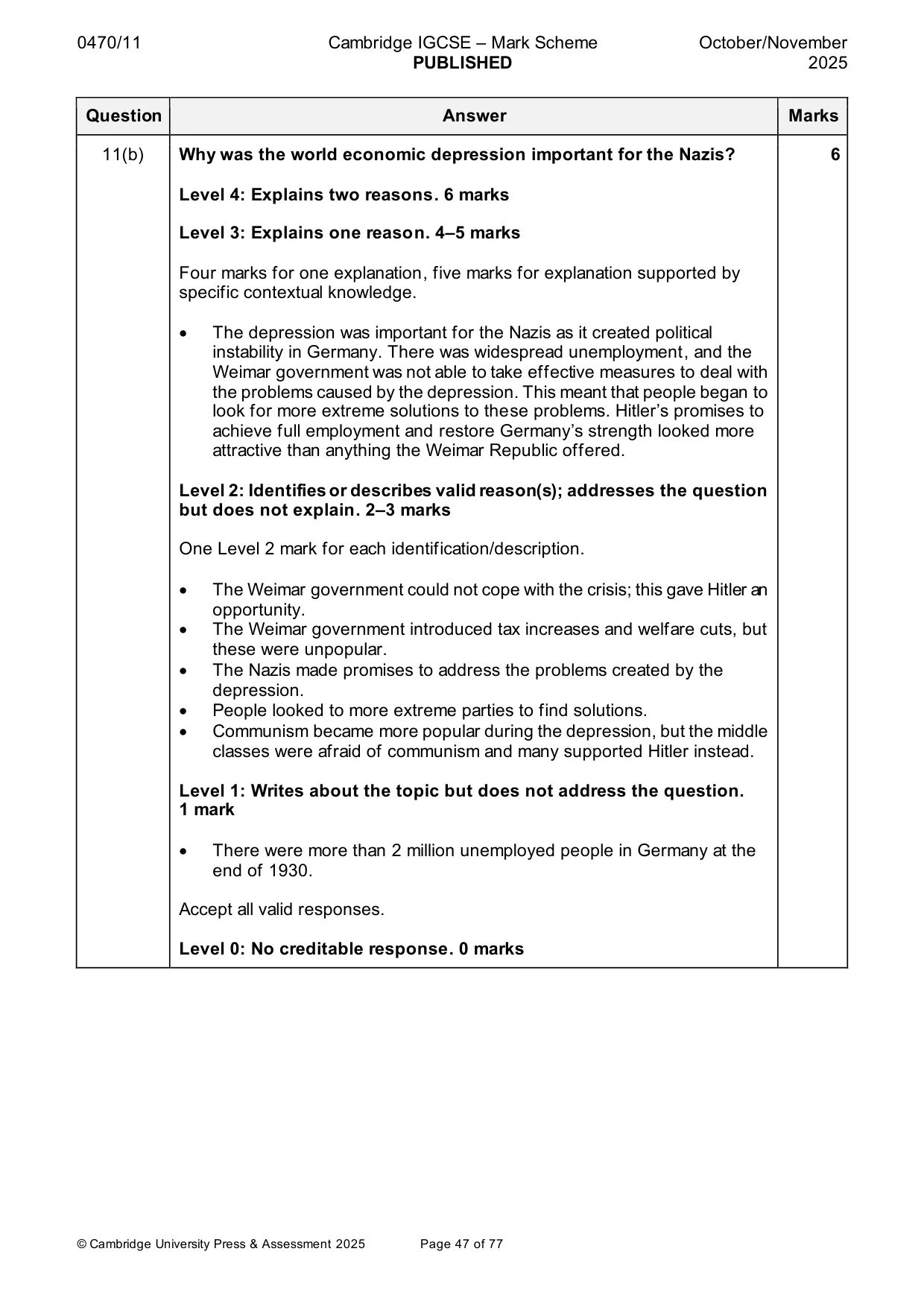
0470/11 Cambridge IGCSE – Mark Scheme PUBLISHED October/November 2025 © Cambridge University Press & Assessment 2025 Page 47 of 77 Question Answer Marks 11(b) Why was the world economic depression important for the Nazis? Level 4: Explains two reasons. 6 marks Level 3: Explains one reason. 4–5 marks Four marks for one explanation, five marks for explanation supported by specific contextual knowledge. • The depression was important for the Nazis as it created political instability in Germany. There was widespread unemployment, and the Weimar government was not able to take effective measures to deal with the problems caused by the depression. This meant that people began to look for more extreme solutions to these problems. Hitler’s promises to achieve full employment and restore Germany’s strength looked more attractive than anything the Weimar Republic offered. Level 2: Identifies or describes valid reason(s); addresses the question but does not explain. 2–3 marks One Level 2 mark for each identification/description. • The Weimar government could not cope with the crisis; this gave Hitler an opportunity. • The Weimar government introduced tax increases and welfare cuts, but these were unpopular. • The Nazis made promises to address the problems created by the depression. • People looked to more extreme parties to find solutions. • Communism became more popular during the depression, but the middle classes were afraid of communism and many supported Hitler instead. Level 1: Writes about the topic but does not address the question. 1 mark • There were more than 2 million unemployed people in Germany at the end of 1930. Accept all valid responses. Level 0: No creditable response. 0 marks 6
Mark scheme, page 48
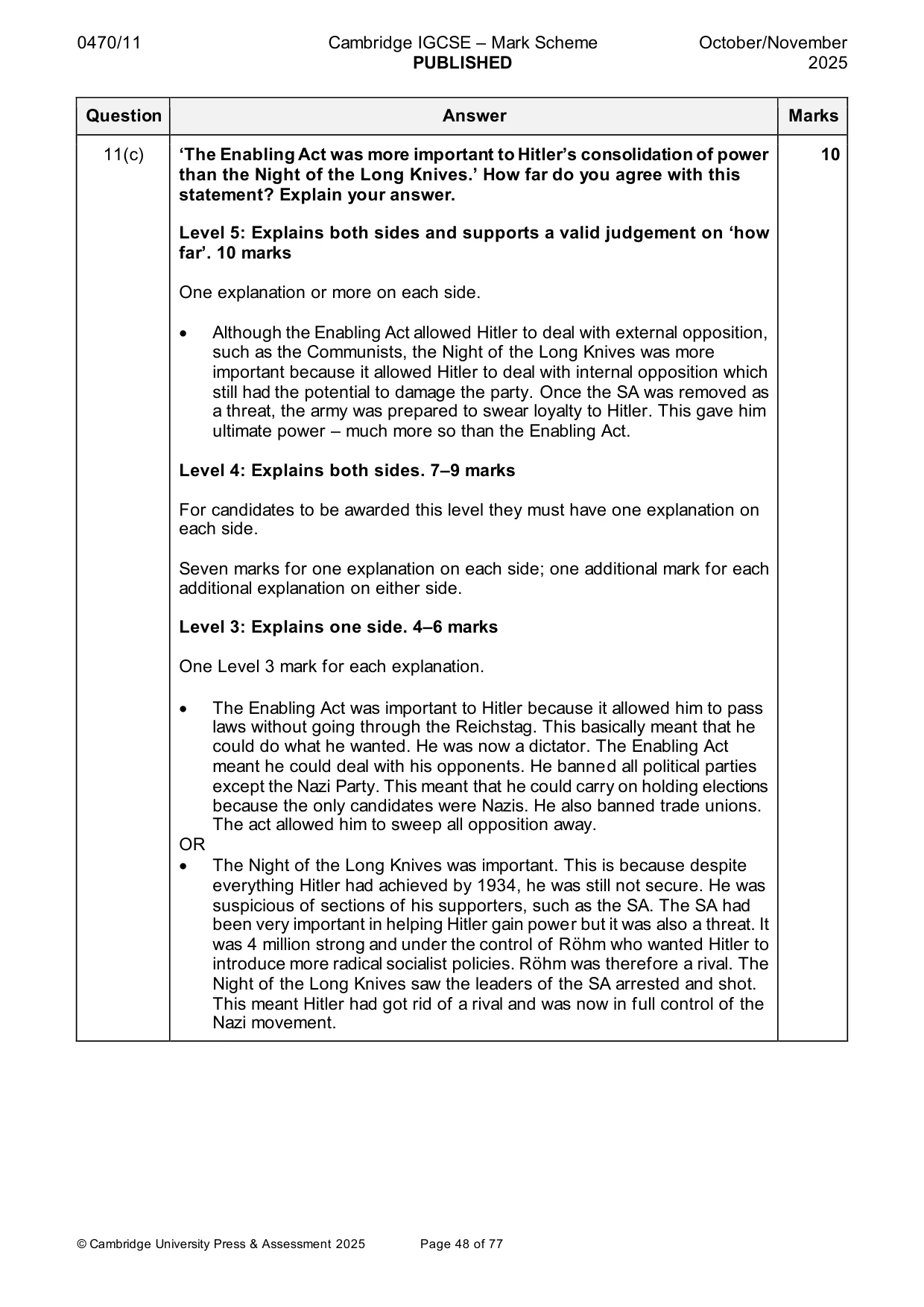
0470/11 Cambridge IGCSE – Mark Scheme PUBLISHED October/November 2025 © Cambridge University Press & Assessment 2025 Page 48 of 77 Question Answer Marks 11(c) ‘The Enabling Act was more important to Hitler’s consolidation of power than the Night of the Long Knives.’ How far do you agree with this statement? Explain your answer. Level 5: Explains both sides and supports a valid judgement on ‘how far’. 10 marks One explanation or more on each side. • Although the Enabling Act allowed Hitler to deal with external opposition, such as the Communists, the Night of the Long Knives was more important because it allowed Hitler to deal with internal opposition which still had the potential to damage the party. Once the SA was removed as a threat, the army was prepared to swear loyalty to Hitler. This gave him ultimate power – much more so than the Enabling Act. Level 4: Explains both sides. 7–9 marks For candidates to be awarded this level they must have one explanation on each side. Seven marks for one explanation on each side; one additional mark for each additional explanation on either side. Level 3: Explains one side. 4–6 marks One Level 3 mark for each explanation. • The Enabling Act was important to Hitler because it allowed him to pass laws without going through the Reichstag. This basically meant that he could do what he wanted. He was now a dictator. The Enabling Act meant he could deal with his opponents. He banned all political parties except the Nazi Party. This meant that he could carry on holding elections because the only candidates were Nazis. He also banned trade unions. The act allowed him to sweep all opposition away. OR • The Night of the Long Knives was important. This is because despite everything Hitler had achieved by 1934, he was still not secure. He was suspicious of sections of his supporters, such as the SA. The SA had been very important in helping Hitler gain power but it was also a threat. It was 4 million strong and under the control of Röhm who wanted Hitler to introduce more radical socialist policies. Röhm was therefore a rival. The Night of the Long Knives saw the leaders of the SA arrested and shot. This meant Hitler had got rid of a rival and was now in full control of the Nazi movement. 10
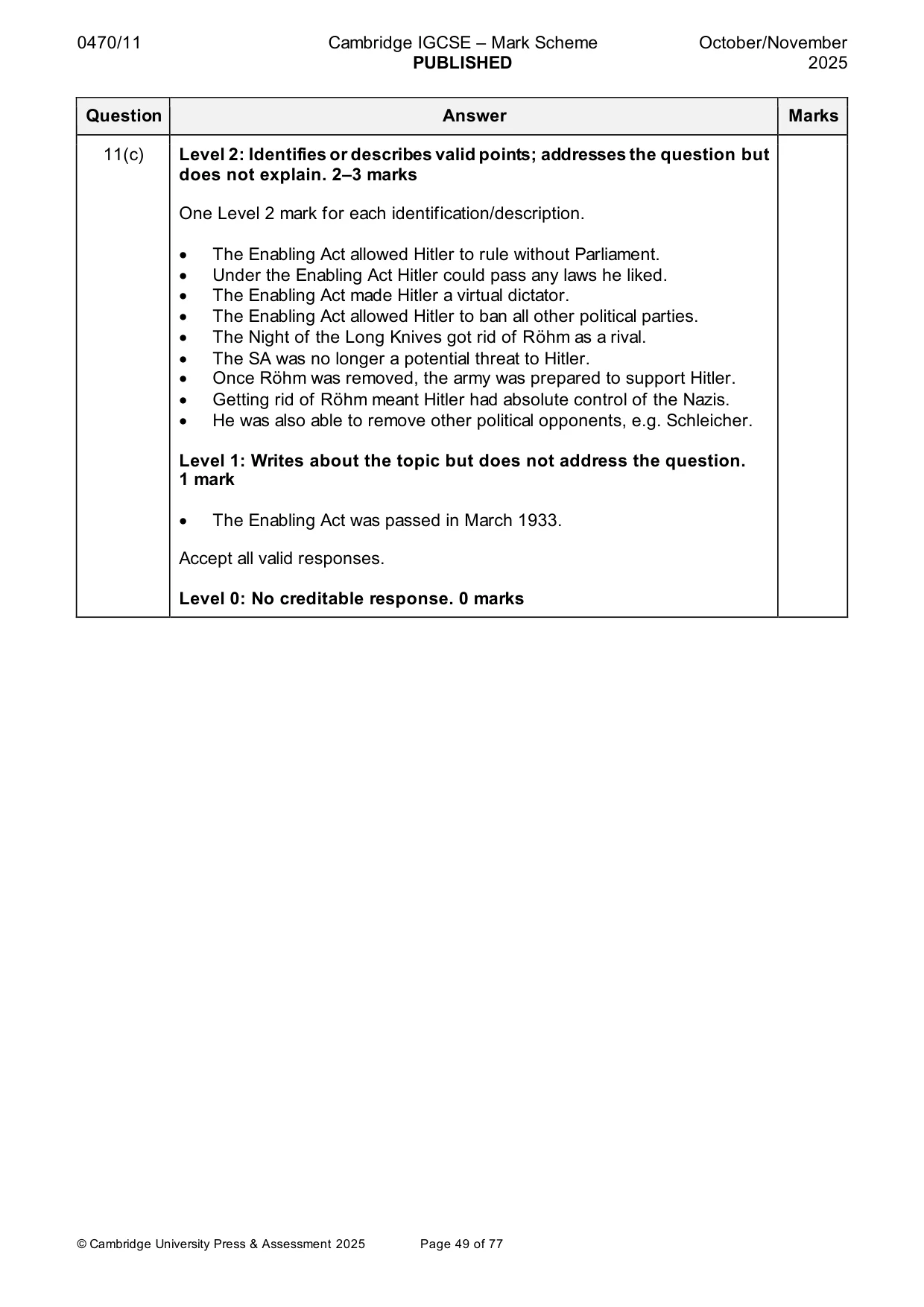
Mark scheme, page 49
0470/11 Cambridge IGCSE – Mark Scheme PUBLISHED October/November 2025 © Cambridge University Press & Assessment 2025 Page 49 of 77 Question Answer Marks 11(c) Level 2: Identifies or describes valid points; addresses the question but does not explain. 2–3 marks One Level 2 mark for each identification/description. • The Enabling Act allowed Hitler to rule without Parliament. • Under the Enabling Act Hitler could pass any laws he liked. • The Enabling Act made Hitler a virtual dictator. • The Enabling Act allowed Hitler to ban all other political parties. • The Night of the Long Knives got rid of Röhm as a rival. • The SA was no longer a potential threat to Hitler. • Once Röhm was removed, the army was prepared to support Hitler. • Getting rid of Röhm meant Hitler had absolute control of the Nazis. • He was also able to remove other political opponents, e.g. Schleicher. Level 1: Writes about the topic but does not address the question. 1 mark • The Enabling Act was passed in March 1933. Accept all valid responses. Level 0: No creditable response. 0 marks
Mark scheme, page 50
0470/11 Cambridge IGCSE – Mark Scheme PUBLISHED October/November 2025 © Cambridge University Press & Assessment 2025 Page 50 of 77 Question Answer Marks 12(a) How did the Nazis control literature and the media in Germany? One mark for each relevant point. Responses may include the following: • Goebbels controlled the media. • Books by authors who the Nazis disapproved of were burned. • Books had to be Nazi-approved. • Books by Jews and communists were banned from shops and libraries. • There was censorship of the newspapers. • Radio programmes broadcast Nazi propaganda. • Germans were not allowed to listen to foreign radio stations. • Hitler’s speeches were broadcast on the radio. • Workplaces had radios so the workers could hear the Nazi message. • Nazi posters were widely on display. • The Nazis controlled newspapers. • All films shown in cinemas carried a pro-Nazi message. • Jazz music was banned. 4
Mark scheme, page 51
0470/11 Cambridge IGCSE – Mark Scheme PUBLISHED October/November 2025 © Cambridge University Press & Assessment 2025 Page 51 of 77 Question Answer Marks 12(b) Why did the Nazis persecute minority groups in Germany in the 1930s? Level 4: Explains two reasons. 6 marks Level 3: Explains one reason. 4–5 marks Four marks for one explanation, five marks for explanation supported by specific contextual knowledge. • The Master Race theory was one reason why the Nazis persecuted minority groups. They believed that the German people were an Aryan race superior to all other races. Aryans were seen as being physically and intellectually superior to other racial groups. To maintain the superiority of the Aryan Germans, the Nazis believed in separating them from other groups such as the Jews or Roma. Level 2: Identifies or describes valid reason(s); addresses the question but does not explain. 2–3 marks One Level 2 mark for each identification/description. • The Jews were persecuted because the Nazis blamed them for Germany’s defeat in the First World War. • These groups were persecuted because they were not Aryan. • The Master Race theory led to persecution. • ‘Undesirables’ such as the unemployed were persecuted. • Ideas about national efficiency meant groups such as people with disabilities and ‘anti-social’ elements such as drug addicts were persecuted. • People or groups which were not considered to play an efficient part in Nazi society were persecuted. Level 1: Writes about the topic but does not address the question. 1 mark • The Nazis persecuted the Jews. Accept all valid responses. Level 0: No creditable response. 0 marks 6
Mark scheme, page 52
0470/11 Cambridge IGCSE – Mark Scheme PUBLISHED October/November 2025 © Cambridge University Press & Assessment 2025 Page 52 of 77 Question Answer Marks 12(c) ‘Propaganda was more important than terror in securing Nazi control.’ How far do you agree with this statement? Explain your answer. Level 5: Explains both sides and supports a valid judgement on ‘how far’. 10 marks One explanation or more on each side. • Terror was a more powerful way of keeping people in line than propaganda. It is hard to prove if propaganda convinced anyone of the benefits of Nazi rule. However, seeing neighbours reported to the Gestapo and disappearing as a result would have the impact of making people keep critical comments to themselves for fear of being sent to prison or worse. Level 4: Explains both sides. 7–9 marks For candidates to be awarded this level they must have one explanation on each side. Seven marks for one explanation on each side; one additional mark for each additional explanation on either side. Level 3: Explains one side. 4–6 marks One Level 3 mark for each explanation. • Propaganda was everywhere in Nazi Germany. Films, posters, the school curriculum, newspapers and the radio were all full of the Nazi message, and no dissenting voices were heard. For example, millions of cheap radios were produced that people could afford. They were also put up in public squares and places of work. The radios were used to broadcast Hitler’s speeches, programmes about German history and German music. They were used to make people proud to be German and to accept Nazi ideas. If you were living in Nazi Germany, there was no escape from these radios. OR • Terror was important. It made people afraid that they would be arrested, tortured and imprisoned by the Gestapo and the SS. There were Gestapo informers everywhere, including neighbours and at work. This made people keep quiet about any elements of Nazi policy which they did not agree with. People knew that if they stepped out of line or spoke out, they would be in trouble. People were arrested for vague things like spreading false rumours. If you knew your neighbour had been arrested and imprisoned for that, it was more likely to make you keep quiet. 10
Mark scheme, page 53
0470/11 Cambridge IGCSE – Mark Scheme PUBLISHED October/November 2025 © Cambridge University Press & Assessment 2025 Page 53 of 77 Question Answer Marks 12(c) Level 2: Identifies or describes valid points; addresses the question but does not explain. 2–3 marks One Level 2 mark for each identification/description. • Newspapers were censored and used to send out Nazi propaganda. • Films were used to put across Nazi ideology. • The radio was controlled by the Nazis and put out Nazi messages. • Grand torchlight parades were used to win people over. • The Nuremberg rallies presented an image of strength and national pride. • The Berlin Olympics (1936) were used to demonstrate that Germany was once again a strong European power. • Propaganda against Jews was disseminated everywhere. • The school curriculum was used to indoctrinate children. • The SS and the Gestapo dealt with any sign of opposition. • They used informers to spy on neighbours. • The Gestapo tapped telephones and intercepted the post. • The SS crushed opposition by terrorising people and putting them in concentration camps. • Nazi action in the Night of the Long Knives instilled fear in political opponents. • People were arrested for vague ‘crimes’ and detained without trial. • The legal system was controlled by the Nazis. Level 1: Writes about the topic but does not address the question. 1 mark • Propaganda made people believe that the Nazis were good. Accept all valid responses. Level 0: No creditable response. 0 marks
Mark scheme, page 54
0470/11 Cambridge IGCSE – Mark Scheme PUBLISHED October/November 2025 © Cambridge University Press & Assessment 2025 Page 54 of 77 Question Answer Marks Depth Study C: Russia, 1905–41 13(a) Describe the events which took place on 22 January 1905 in St Petersburg. One mark for each relevant point. Responses may include the following: • This event was known as Bloody Sunday. • A march was organised in St Petersburg by a priest called Father Gapon. • The marchers wanted to deliver a petition to the Tsar asking for help with their economic hardships. • When the protestors approached the Winter Palace, the Tsar’s troops charged them with their swords and shot them. • Hundreds were killed. • 200 000 workers and their families took part in the demonstration. 4
Mark scheme, page 55
0470/11 Cambridge IGCSE – Mark Scheme PUBLISHED October/November 2025 © Cambridge University Press & Assessment 2025 Page 55 of 77 Question Answer Marks 13(b) Why were the Fundamental Laws introduced in 1906? Level 4: Explains two reasons. 6 marks Level 3: Explains one reason. 4–5 marks Four marks for one explanation, five marks for explanation supported by specific contextual knowledge. • The Fundamental Laws were introduced because the Tsar did not want the newly established Duma to become too powerful. He made it clear that he was the ultimate authority in passing legislation and so the Tsar retained his power. He even reserved the right to appoint the State Council and pass laws without consulting the Duma at all. Level 2: Identifies or describes valid reason(s); addresses the question but does not explain. 2–3 marks One Level 2 mark for each identification/description. • Nicholas II wanted to retain his power. • He prevented the Duma from passing new laws. • The first Duma was very hostile towards the Tsar. • The deputies wanted universal voting rights and secret elections. • The Duma wanted freedom of speech. • The Tsar was horrified by the demands made by the Duma. Level 1: Writes about the topic but does not address the question. 1 mark • The October Manifesto established the Duma. Accept all valid responses. Level 0: No creditable response. 0 marks 6
Mark scheme, page 56
0470/11 Cambridge IGCSE – Mark Scheme PUBLISHED October/November 2025 © Cambridge University Press & Assessment 2025 Page 56 of 77 Question Answer Marks 13(c) How far do you agree that Nicholas II’s failings as a military leader were to blame for the success of the March revolution? Explain your answer. Level 5: Explains both sides and supports a valid judgement on ‘how far’. 10 marks One explanation or more on each side. • The main reason for the success of the March revolution was that the soldiers from the Petrograd garrison refused to fire on the demonstrators. They were mainly young reservists from the countryside and they did not want to be sent to war. Their dissatisfaction with the progress of the war meant they identified more easily with the people who were demonstrating. Until this time the Tsar had been able to rely on the loyalty of the armed forces and now this was no longer the case. Level 4: Explains both sides. 7–9 marks For candidates to be awarded this level they must have one explanation on each side. Seven marks for one explanation on each side; one additional mark for each additional explanation on either side. Level 3: Explains one side. 4–6 marks One Level 3 mark for each explanation. • Nicholas II’s failings as a war leader were to blame for the success of the March revolution. By leaving for the front to appear as commander-in- chief, the Tsar made himself the figurehead for the military failings of Russia. Therefore, he was blamed by many for the defeats which Russia suffered. The armed forces began to mutiny, and Nicholas was held responsible. OR • Food shortages united the Russian people in March 1917 and were an important cause of the revolution. There were bread riots, and demonstrations took place over three days. The food shortages inspired 50 000 workers to go on strike. By the end of the month over 200 000 workers were on strike, demanding higher pay so that they could afford food. When soldiers were ordered to fire on the strikers, they refused and it became clear that the government had lost control of the situation. 10
Mark scheme, page 57
0470/11 Cambridge IGCSE – Mark Scheme PUBLISHED October/November 2025 © Cambridge University Press & Assessment 2025 Page 57 of 77 Question Answer Marks 13(c) Level 2: Identifies or describes valid points; addresses the question but does not explain. 2–3 marks One Level 2 mark for each identification/description. • The Tsar took charge of the army and went to the front line. • As commander-in-chief he took the blame for Russia’s military failings and defeats. • There were widescale desertions. • The army did not have enough supplies to carry on fighting. • There were food shortages and people rioted. • The government was left in the hands of the Tsarina and Rasputin. • Soldiers from the Petrograd garrison refused to fire at the demonstrators. Level 1: Writes about the topic but does not address the question. 1 mark • Many people were hungry and hated the government. Accept all valid responses. Level 0: No creditable response. 0 marks
Mark scheme, page 58
0470/11 Cambridge IGCSE – Mark Scheme PUBLISHED October/November 2025 © Cambridge University Press & Assessment 2025 Page 58 of 77 Question Answer Marks 14(a) What were the aims of the first Five-Year Plan for industry? One mark for each relevant point. Responses may include the following: • To industrialise Soviet Russia as rapidly as possible. • To catch up with the industrial economies of the west. • The first Five-Year Plan was focused on increasing heavy industry. • Quotas for production were introduced. • Gosplan was set up to plan the economy. • Coal and steel production were to increase. • The plan aimed to increase electricity production. • New industrial plants were to be established. 4
Mark scheme, page 59
0470/11 Cambridge IGCSE – Mark Scheme PUBLISHED October/November 2025 © Cambridge University Press & Assessment 2025 Page 59 of 77 Question Answer Marks 14(b) Why did Stalin want to destroy the kulaks? Level 4: Explains two reasons. 6 marks Level 3: Explains one reason. 4–5 marks Four marks for one explanation, five marks for explanation supported by specific contextual knowledge. • Stalin wanted to destroy the kulaks so that he could impose his plans for collectivisation on the countryside. He wanted to collectivise the farms to increase his control and to increase production. To win support for this he described it as a way of sorting out the kulaks (richer peasants), who, he said, were enemies of the people and getting in the way of reforms. This persuaded some peasants to denounce their neighbours as kulaks, giving Stalin’s men the opportunity to confiscate their land and animals. Level 2: Identifies or describes valid reason(s); addresses the question but does not explain. 2–3 marks One Level 2 mark for each identification/description. • Stalin saw the kulaks as backward-looking and was suspicious of them. • Stalin accused the kulaks of hoarding grain. • Stalin wanted to force peasants into joining the collectives. • They provided a convenient ‘class enemy’ or scapegoat to justify what Stalin was doing. • The kulaks stood in the way of collectivisation. • This was a way of getting rid of the most successful peasants who might oppose Stalin. • Stalin did this to win the support of the poorer peasants. • All the land, animals and equipment once owned by the kulaks could be given to the collectives. • They often led resistance to collectivisation. • Kulaks often opposed the communists. Level 1: Writes about the topic but does not address the question. 1 mark • The kulaks were more prosperous peasants. Accept all valid responses. Level 0: No creditable response. 0 marks 6
Mark scheme, page 60
0470/11 Cambridge IGCSE – Mark Scheme PUBLISHED October/November 2025 © Cambridge University Press & Assessment 2025 Page 60 of 77 Question Answer Marks 14(c) How far do you agree that the Soviet people benefited from Stalin’s policies? Explain your answer. Level 5: Explains both sides and supports a valid judgement on ‘how far’. 10 marks One explanation or more on each side. • How far the people benefited from Stalin’s policies depended on who they were. Millions of people in the countryside did not benefit. Kulaks were killed or deported and millions of peasants died in the famine. However, other groups benefited. For example, women were able to gain an education and pursue careers. Industrial production increased which brought employment opportunities, and many Russians felt Russia was stronger and more powerful. Level 4: Explains both sides. 7–9 marks For candidates to be awarded this level they must have one explanation on each side. Seven marks for one explanation on each side; one additional mark for each additional explanation on either side. Level 3: Explains one side. 4–6 marks One Level 3 mark for each explanation. • Some Russians benefited. Women were given access to education and joined professions such as engineering or medicine. They had greater freedom and the right to divorce (for a time at least), free healthcare and childcare in their workplaces. Although Stalin’s policies towards women were motivated by his desire to increase production rather than achieve equality, many women’s lives changed in positive ways. OR • Some Russians did not benefit. For example, minority groups such as Latvians and Poles were treated badly and subjected to Russification. They were forced to learn Russian and those who had positions of power were removed, even if they were communist. Over 1.5 million were deported. 10
Mark scheme, page 61
0470/11 Cambridge IGCSE – Mark Scheme PUBLISHED October/November 2025 © Cambridge University Press & Assessment 2025 Page 61 of 77 Question Answer Marks 14(c) Level 2: Identifies or describes valid points; addresses the question but does not explain. 2–3 marks One Level 2 mark for each identification/description. • There were opportunities for industrial workers. • Women went to work. • More women joined professions. • Childcare was provided. • Ethnic minority groups were made to learn Russian. • Millions died in the countryside. • Living conditions were poor and there was a lack of consumer goods. • The purges resulted in the deaths or imprisonment of many Russian civilians. Level 1: Writes about the topic but does not address the question. 1 mark • Russia was modernised by Stalin. Accept all valid responses. Level 0: No creditable response. 0 marks
Mark scheme, page 62
0470/11 Cambridge IGCSE – Mark Scheme PUBLISHED October/November 2025 © Cambridge University Press & Assessment 2025 Page 62 of 77 Question Answer Marks Depth Study D: The United States, 1919–41 15(a) Describe the state of agriculture in the 1920s. One mark for each relevant point. Responses may include the following: • Farmers faced challenging times. • Overproduction meant that prices fell and profits dropped. • Many farmers were in debt. • Cheap imports of wheat (or competition) from Canada meant a decline in demand for US crops. • The end of the First World War resulted in a drop in demand from European countries for US agricultural produce. • Import tariffs meant that US farmers found it much harder to sell their produce in European markets. • Mechanisation was expensive and this added to debts. • Prohibition reduced the demand for wheat and barley crops. • American farmers who had taken on debt to invest in machinery to meet demand during the First World War could not pay their debts. • Smaller farmers struggled to survive and often had to sell their land. 4
Mark scheme, page 63
0470/11 Cambridge IGCSE – Mark Scheme PUBLISHED October/November 2025 © Cambridge University Press & Assessment 2025 Page 63 of 77 Question Answer Marks 15(b) Why was mass production important for US industry? Level 4: Explains two reasons. 6 marks Level 3: Explains one reason. 4–5 marks Four marks for one explanation, five marks for explanation supported by specific contextual knowledge. • Mass production was important because it meant that more goods could be produced more quickly. This meant that prices fell and more people could afford consumer goods such as cars, refrigerators and radios. This meant that demand increased, and this encouraged further industrial growth. Level 2: Identifies or describes valid reason(s); addresses the question but does not explain. 2–3 marks One Level 2 mark for each identification/description. • Mass production techniques were used in many industries. • Increased car production meant there was an increased demand for steel. • Mass production meant that prices fell. • It created more jobs. • It stimulated consumer demand. Level 1: Writes about the topic but does not address the question. 1 mark • Henry Ford manufactured cars. Accept all valid responses. Level 0: No creditable response. 0 marks 6
Mark scheme, page 64
0470/11 Cambridge IGCSE – Mark Scheme PUBLISHED October/November 2025 © Cambridge University Press & Assessment 2025 Page 64 of 77 Question Answer Marks 15(c) ‘The lives of American women were transformed by the boom.’ How far do you agree with this statement? Explain your answer. Level 5: Explains both sides and supports a valid judgement on ‘how far’. 10 marks One explanation or more on each side. • The lives of only a small proportion of women were transformed by the boom. The iconic image of the 1920s ‘flapper’ was not the reality for most women. A few young, middle-class women went to work in the cities, wore short dresses and went to jazz clubs unchaperoned. However, this was not the reality for most, who stayed at home and looked after the children, did domestic work or worked in low paid jobs just as they always had. Level 4: Explains both sides. 7–9 marks For candidates to be awarded this level they must have one explanation on each side. Seven marks for one explanation on each side; one additional mark for each additional explanation on either side. Level 3: Explains one side. 4–6 marks One Level 3 mark for each explanation. • One big change was that more women went out to work. Mechanisation in factories made this possible because strength was no longer important. In some new industries like radio, the employers preferred women workers. There was also a massive expansion in office work, and many young women took these jobs. They were attractive as employees because they could be paid less than men. OR • Women who lived in rural areas or worked in traditional industries did not benefit from the boom. If they were employed in the cotton industry, they continued to be paid poorly, as the lack of demand meant wage rates did not rise in the 1920s. Women who lived on farms were often unpaid workers and their lives did not change for the better in the 1920s as there was a depression. 10
Mark scheme, page 65
0470/11 Cambridge IGCSE – Mark Scheme PUBLISHED October/November 2025 © Cambridge University Press & Assessment 2025 Page 65 of 77 Question Answer Marks 15(c) Level 2: Identifies or describes valid points; addresses the question but does not explain. 2–3 marks One Level 2 mark for each identification/description. • More women went out to work. • Lightweight dresses in new fabrics such as rayon became popular, giving women more freedom of movement. • More women had short hair. • Women smoked in public and drove cars. • Make-up became popular. • Women had more free time because of labour-saving devices in the home. • Birth control clinics opened. • The divorce rate went up in the 1920s. • In rural areas women still had traditional roles. • Most women did not become flappers. • Women workers in cotton textiles did not benefit from the boom. • Women were still paid less than men. • Women had no access to key political positions. Level 1: Writes about the topic but does not address the question. 1 mark • Women had more opportunities in the 1920s. Accept all valid responses. Level 0: No creditable response. 0 marks
Mark scheme, page 66
0470/11 Cambridge IGCSE – Mark Scheme PUBLISHED October/November 2025 © Cambridge University Press & Assessment 2025 Page 66 of 77 Question Answer Marks 16(a) What happened on ‘Black Thursday’, 24 October 1929? One mark for each relevant point. Responses may include the following: • Investors rushed to sell their shares. • Share prices dropped. • Nearly 12.9 million shares were traded after prices dropped the previous day. • Stockbrokers could not keep up with the volume of trade requests from shareholders. • This resulted in panic and more people tried to sell their shares. • Police were dispatched to the New York Stock Exchange to quell potential rioting. • Wall Street executives tried to reassure the public. • Several major banks and investment companies bought up great blocks of stock in an attempt to stem the panic of investors. • At the end of the day the market closed only a few percentage points down. 4
Mark scheme, page 67
0470/11 Cambridge IGCSE – Mark Scheme PUBLISHED October/November 2025 © Cambridge University Press & Assessment 2025 Page 67 of 77 Question Answer Marks 16(b) Why did the Crash cause hardship for many Americans? Level 4: Explains two reasons. 6 marks Level 3: Explains one reason. 4–5 marks Four marks for one explanation, five marks for explanation supported by specific contextual knowledge. • The crash was followed by a devastating depression. Investors, along with the public, withdrew their money from banks by the thousands, fearing the banks would go under. The more people pulled out their money in bank runs, the closer the banks came to insolvency. This meant they were unable to pay their debts and were forced to close. OR • As investors lost billions of dollars, they invested very little in new or expanding businesses. This meant businesses had to close and therefore many people became unemployed as there was no demand for what was produced and no money to pay their wages. Level 2: Identifies or describes valid reason(s); addresses the question but does not explain. 2–3 marks One Level 2 mark for each identification/description. • People took their money out of banks and the banks collapsed. • Investors no longer had funds to support industry. • Businesses closed and so people lost their jobs. • With no money coming in, people could not afford to buy new products, so demand fell. This led to more job losses. • There were no welfare benefits and so people had to rely on charity. • Farmers were evicted. Level 1: Writes about the topic but does not address the question. 1 mark • People such as the Bonus Army were very poor and homeless. Accept all valid responses. Level 0: No creditable response. 0 marks 6
Mark scheme, page 68
0470/11 Cambridge IGCSE – Mark Scheme PUBLISHED October/November 2025 © Cambridge University Press & Assessment 2025 Page 68 of 77 Question Answer Marks 16(c) How far do you agree that the most important cause of the Crash was ‘buying on the margin’? Explain your answer. Level 5: Explains both sides and supports a valid judgement on ‘how far’. 10 marks One explanation or more on each side. • Buying on the margin was one cause of the crash but there were structural weaknesses in the US economy which were more important. For example, there was uneven distribution of wealth, and this meant that over half of all Americans lived below the poverty line. They did not take part in the consumer boom of the 1920s as they were unable to afford new products due to their poor wages and insecure job prospects. This meant that some sort of economic downturn was likely, whether or not people bought shares on the margin. Level 4: Explains both sides. 7–9 marks For candidates to be awarded this level they must have one explanation on each side. Seven marks for one explanation on each side; one additional mark for each additional explanation on either side. Level 3: Explains one side. 4–6 marks One Level 3 mark for each explanation. • Buying on the margin was a problem because people speculated on the stock market and assumed that companies would continue to make profits. They borrowed money to buy shares and thought that they would sell these easily a short while later and pocket a profit. Some banks even loaned as much as 90% of the share price. However, if the stock market did not continue to rise, these people lost their money and so did the banks. OR • By the late 1920s much of the market was saturated, meaning product supply exceeded demand. The boom in car manufacturing slowed as there were fewer and fewer Americans with the means to purchase a car who had not already done so. Increasingly, the well-to-do had no need for the new automobiles, radios and other consumer goods. When products failed to sell, manufacturers scaled back production, and companies fired workers. 10
Mark scheme, page 69
0470/11 Cambridge IGCSE – Mark Scheme PUBLISHED October/November 2025 © Cambridge University Press & Assessment 2025 Page 69 of 77 Question Answer Marks 16(c) Level 2: Identifies or describes valid points; addresses the question but does not explain. 2–3 marks One Level 2 mark for each identification/description. • Buying on the margin meant people went into debt to buy shares. • Public panic damaged the banks. • Many banks were in a fragile state. • There was a lack of government regulation. • The market was saturated and so few new products were sold. • Unequal income distribution did not help. • Tariff policies meant the USA was not able to sell surplus products overseas. • Many farmers were already in poverty and did not share in the boom. Level 1: Writes about the topic but does not address the question. 1 mark • The Wall Street Crash took place in October 1929. Accept all valid responses. Level 0: No creditable response. 0 marks
Mark scheme, page 70
0470/11 Cambridge IGCSE – Mark Scheme PUBLISHED October/November 2025 © Cambridge University Press & Assessment 2025 Page 70 of 77 Question Answer Marks Depth Study E: The Second World War in Europe and the Asia–Pacific, 1939–c.1945 17(a) Describe how Japan took control of Malaya. One mark for each relevant point. Responses may include the following: • The Imperial Japanese Army invaded Malaya on 8 December 1941 at Kota Bharu. • Japanese forces defeated the British Indian Army stationed there. • The airports were captured on 9 December 1941. • Japanese soldiers divided into two separate forces. One moved down the east coast and the other moved south. • On 11 December 1941, the Japanese bombed Penang. • The British were forced to retreat to the south. • The Japanese occupied Penang on 19 December. • British resistance was defeated at the Battle of Kampar in January 1942. • The Japanese captured Kuala Lumpur. • The British had to retreat to Singapore. • By January 1942, the whole of Malaya had fallen. 4
Mark scheme, page 71
0470/11 Cambridge IGCSE – Mark Scheme PUBLISHED October/November 2025 © Cambridge University Press & Assessment 2025 Page 71 of 77 Question Answer Marks 17(b) Why was the fall of Singapore important? Level 4: Explains two reasons. 6 marks Level 3: Explains one reason. 4–5 marks Four marks for one explanation, five marks for explanation supported by specific contextual knowledge. • The fall of Singapore was important as it was a huge boost to Japanese morale and enabled them to continue their war plans, at least for a time. They had defeated a numerically superior force and demonstrated better tactics. Added to this, they gained the resources and port access in Singapore. Level 2: Identifies or describes valid reason(s); addresses the question but does not explain. 2–3 marks One Level 2 mark for each identification/description. • British forces outnumbered Japanese forces by 85 000 to 35 000 but were defeated. • The British were forced into unconditional surrender. • Japan gained access to resources in Southeast Asia. • Gaining the port of Singapore was important to the Japanese. • The fall of Singapore was the largest British surrender in history. • Losing Singapore was a massive blow to British morale. • Japanese troops ‘on bicycles’ defeated supposedly superior British forces. Level 1: Writes about the topic but does not address the question. 1 mark • Civilians and captured soldiers were treated harshly by the Japanese. Accept all valid responses. Level 0: No creditable response. 0 marks 6
Mark scheme, page 72
0470/11 Cambridge IGCSE – Mark Scheme PUBLISHED October/November 2025 © Cambridge University Press & Assessment 2025 Page 72 of 77 Question Answer Marks 17(c) ‘The main reason why Japan attacked Pearl Harbor was to gain access to raw materials in Southeast Asia.’ How far do you agree with this statement? Explain your answer. Level 5: Explains both sides and supports a valid judgement on ‘how far’. 10 marks One explanation or more on each side. • The real reason that Japan attacked Pearl Harbor was to gain oil. Japan wanted to build an empire but lacked the natural resources, especially oil. They hoped to expand into Malaya and the Dutch East Indies and to take the oil they needed there. The USA had prevented Japan from buying oil and Japan wanted to make sure the USA did not stand in their way. Level 4: Explains both sides. 7–9 marks For candidates to be awarded this level they must have one explanation on each side. Seven marks for one explanation on each side; one additional mark for each additional explanation on either side. Level 3: Explains one side. 4–6 marks One Level 3 mark for each explanation. • Japan wanted materials in Southeast Asia. The USA had cut off oil imports, and oil was vital if Japan were to build an empire in Southeast Asia as they had limited supplies of oil of their own. Southeast Asia was rich in oil and other supplies such as rubber. The Japanese military could not survive without these supplies. If Japan could knock out US forces in the Pacific, then expansion to the South and East was a possibility for the Japanese and would allow them access to the materials they needed. OR • Japan wanted to strike the US forces at Pearl Harbor because they knew their expansion into Southeast Asia would provoke a response from the USA which had already frozen Japan’s assets after the invasion of Indochina. They thought that if they could launch a knockout blow on the naval base the Americans would be more likely to negotiate peace than try to fight. 10
Mark scheme, page 73
0470/11 Cambridge IGCSE – Mark Scheme PUBLISHED October/November 2025 © Cambridge University Press & Assessment 2025 Page 73 of 77 Question Answer Marks 17(c) Level 2: Identifies or describes valid points; addresses the question but does not explain. 2–3 marks One Level 2 mark for each identification/description. • Japan wanted oil from Southeast Asia. • Japan wanted to build an empire of its own. • Japan lacked the natural resources to make it a reality, with all but 6% of its oil supply being imported. • Japan hoped to force the USA to negotiate peace. • The USA cut off oil exports to Japan, which Japan relied on for its navy. • Japan attacked Pearl Harbor to punish the USA for supporting China. Level 1: Writes about the topic but does not address the question. 1 mark • Pearl Harbor was attacked in December 1941. Accept all valid responses. Level 0: No creditable response. 0 marks
Mark scheme, page 74
0470/11 Cambridge IGCSE – Mark Scheme PUBLISHED October/November 2025 © Cambridge University Press & Assessment 2025 Page 74 of 77 Question Answer Marks 18(a) What was de-Nazification? One mark for each relevant point. Responses may include the following: • De-Nazification was the process of removing Nazis and Nazism from public life in Germany and across occupied Europe after the fall of the Third Reich. • It occurred across German society, government and administration. • It was also conducted in the economic sphere, in culture, and in the judiciary and government. • Nazi publications were removed from libraries. • Nazi symbols were removed from public buildings. • Those who had been active Nazis such as the police, members of the SS, and civil servants, were removed from their posts by the Allies and subject to automatic arrest. • De-Nazification was carried out differently in the Allied occupation zones of Germany. 4
Mark scheme, page 75
0470/11 Cambridge IGCSE – Mark Scheme PUBLISHED October/November 2025 © Cambridge University Press & Assessment 2025 Page 75 of 77 Question Answer Marks 18(b) Why were the D-Day landings important? Level 4: Explains two reasons. 6 marks Level 3: Explains one reason. 4–5 marks Four marks for one explanation, five marks for explanation supported by specific contextual knowledge. • The D-Day landings were important because they opened a second front for the war in north-western Europe. They enabled the Allies to relieve pressure on the Soviet Union in the east and helped them to secure the liberation of France. Both outcomes would help to weaken Germany’s position in Europe, making them easier to defeat. It was planned that the invasion would drain German resources. Level 2: Identifies or describes valid reason(s); addresses the question but does not explain. 2–3 marks One Level 2 mark for each identification/description. • The landings relieved pressure on the Eastern Front. • The Allies aimed to secure a bridgehead in Normandy. • The Allies had not been in action in northern Europe since Dunkirk. • D-Day was intended to force Germany to fight on two fronts. • The invasion would help to drain Germany’s resources which would in turn make them easier to defeat. Level 1: Writes about the topic but does not address the question. 1 mark • The D-Day landings took place in June 1944. Accept all valid responses. Level 0: No creditable response. 0 marks 6
Mark scheme, page 76
0470/11 Cambridge IGCSE – Mark Scheme PUBLISHED October/November 2025 © Cambridge University Press & Assessment 2025 Page 76 of 77 Question Answer Marks 18(c) How far do you agree that Japan was defeated because of the Battle of Okinawa? Explain your answer. Level 5: Explains both sides and supports a valid judgement on ‘how far’. 10 marks One explanation or more on each side. • Although the Battle of Okinawa was a significant defeat for the Japanese, it was already clear that Japan could not win the war. The real issue was whether Japan would agree to surrender. The USA began to plan for a full-scale invasion of Japan. However, Truman decided to use atomic bombs to force the Japanese to surrender and they did this after the bombing of Nagasaki. Level 4: Explains both sides. 7–9 marks For candidates to be awarded this level they must have one explanation on each side. Seven marks for one explanation on each side; one additional mark for each additional explanation on either side. Level 3: Explains one side. 4–6 marks One Level 3 mark for each explanation. • The Battle of Okinawa was important. US landings on Okinawa in April 1945 led to another government collapse, causing more political instability in Japan. When the USA secured victory at Okinawa they decided to use it as a base for a full-scale invasion of Japan which they intended to launch in November 1945. OR • It could be argued that the Battle of Midway was more important than the Battle of Okinawa as it destabilised the Japanese government and made many realise that Japan could not win the war. After the defeat, Japanese naval leaders secretly admitted that Japan could not win the war. Saipan fell in July 1944 and this meant US bombers could be stationed within range of Tokyo. Many in the government also realised that Midway signalled that Japan could not end the war, but there were disputes between the government and military about how the war should be ended and the current government fell from power. The generals were keen to continue fighting, thinking they would gain better terms through a victory or an honourable defeat. 10
Mark scheme, page 77
0470/11 Cambridge IGCSE – Mark Scheme PUBLISHED October/November 2025 © Cambridge University Press & Assessment 2025 Page 77 of 77 Question Answer Marks 18(c) Level 2: Identifies or describes valid points; addresses the question but does not explain. 2–3 marks One Level 2 mark for each identification/description. • Defeating the Japanese at Okinawa allowed the USA to start planning the invasion of Japan. • Japan’s military leaders realised that Japan had little chance of victory after the defeat at Midway. • The USA dropped atomic bombs on Hiroshima and Nagasaki. • After the atomic bombing of Nagasaki the Emperor agreed to surrender. • In 1945, the USA carried out heavy bombing raids against major cities in Japan. Level 1: Writes about the topic but does not address the question. 1 mark • The bombing of Hiroshima killed at least 70 000 people. Accept all valid responses. Level 0: No creditable response. 0 marks
What you needed in this session
Cambridge’s own grade thresholds for 2025 Oct/Nov, Paper 1 · Variant 1. A higher threshold means an easier paper — the bar moves with how the cohort did.