Cambridge IGCSE History 0470 — 2025 May/June Paper 1 · Variant 1
0470/11/M/J/25 · 60 marks · 120 min
The question paper and its mark scheme, free to read here and free to download. This is Cambridge’s own paper, exactly as it was sat.
Question paper8 pages

Mark scheme77 pages
Answers below. Sit the paper first if you are practising.
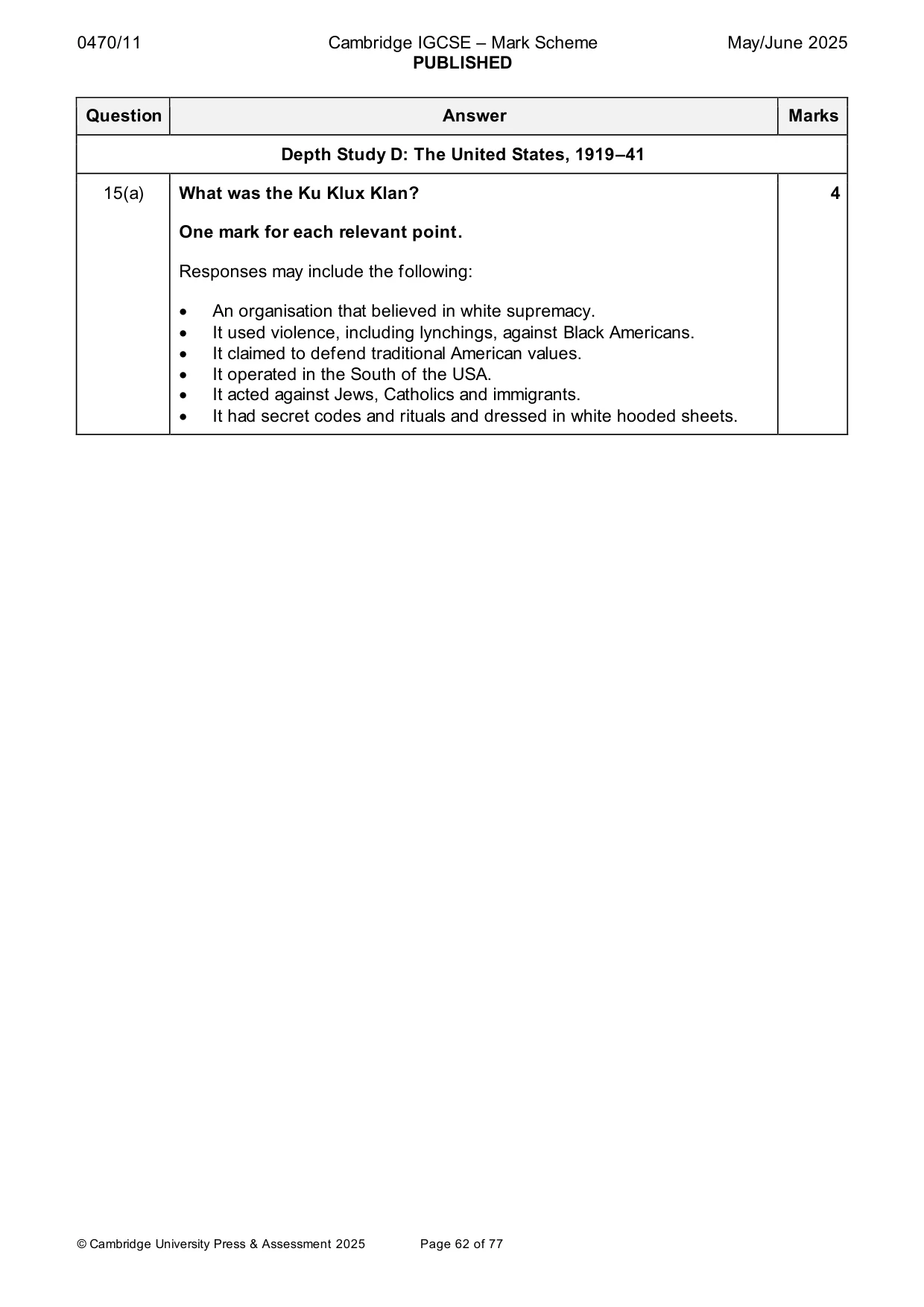
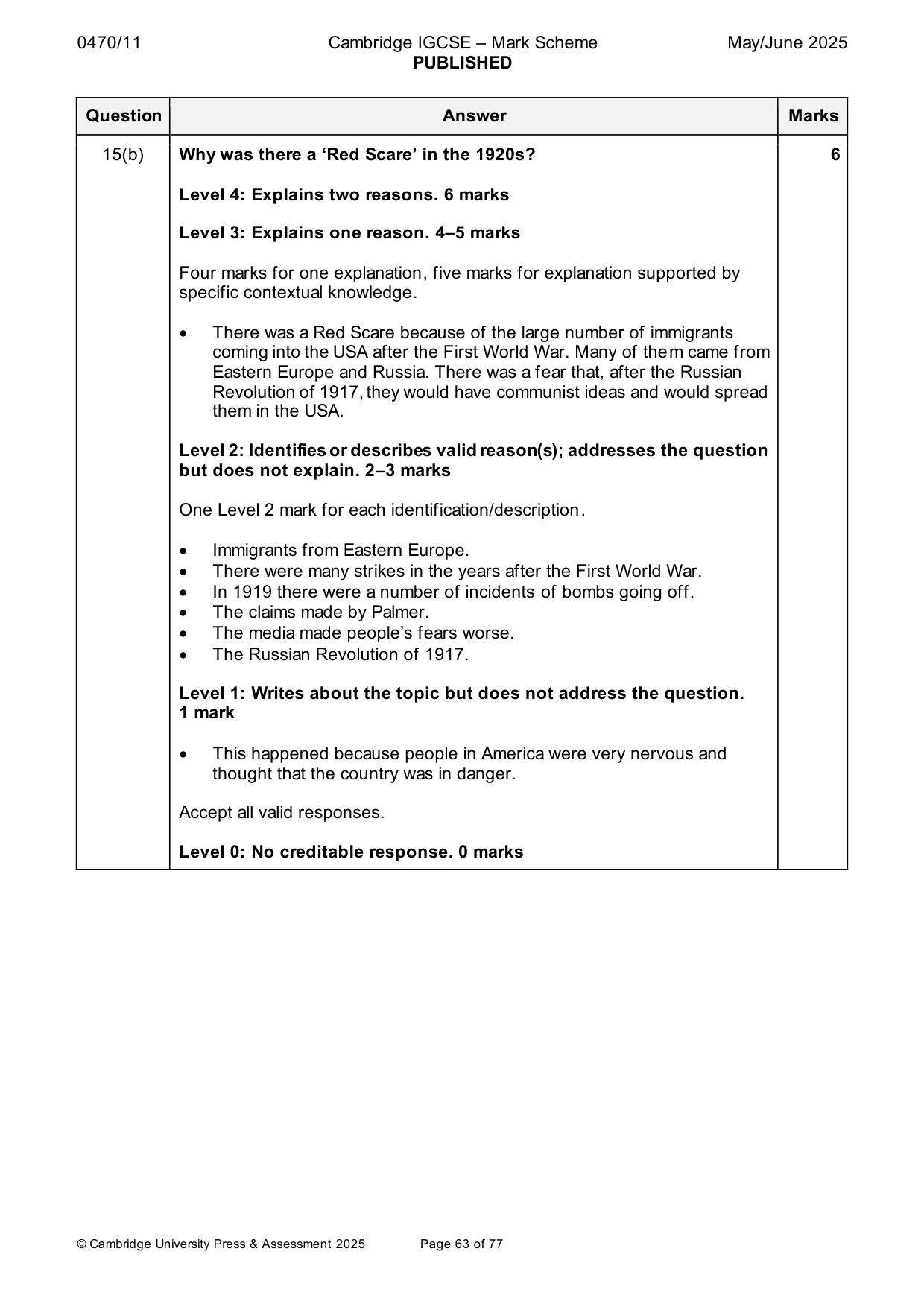
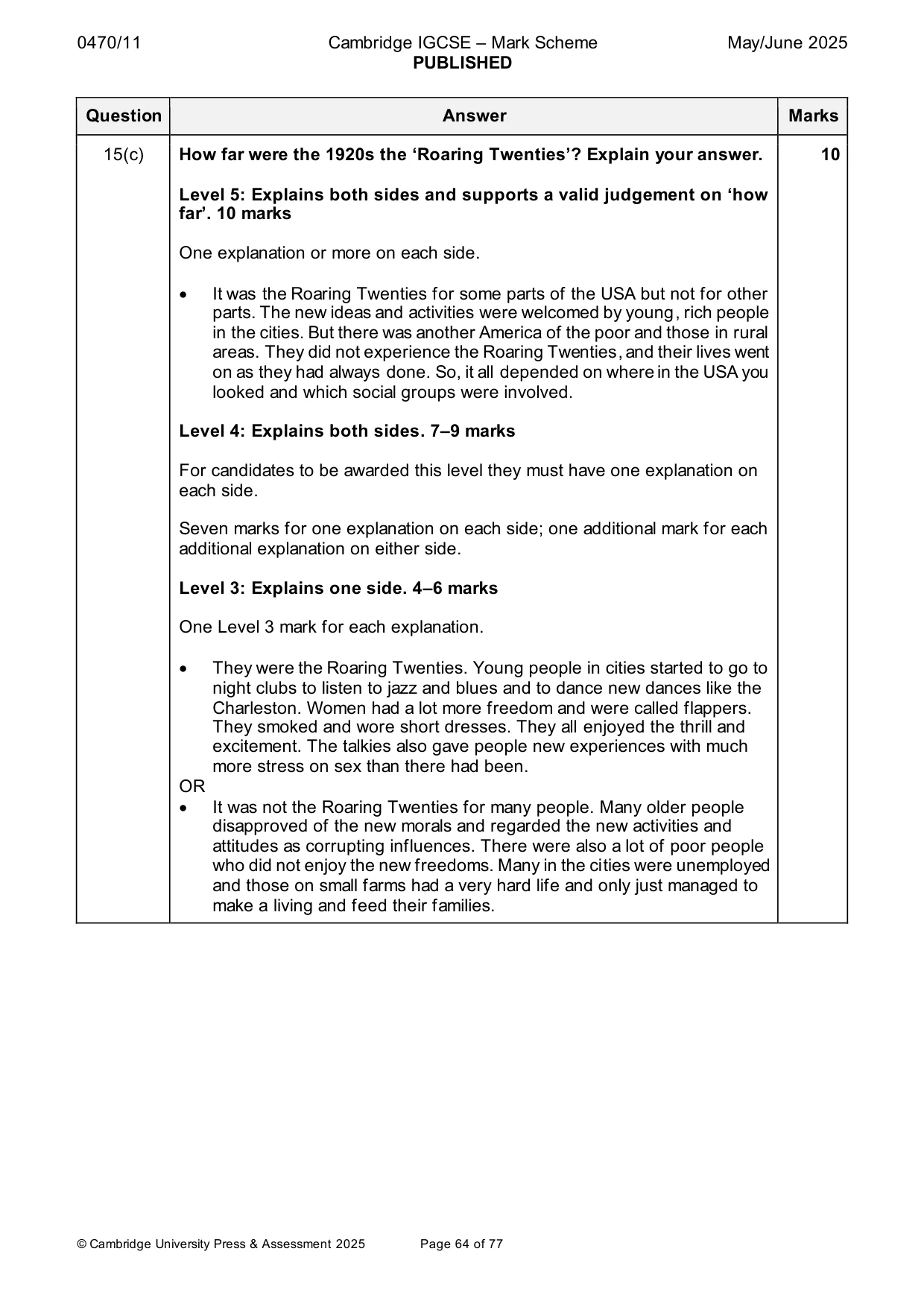
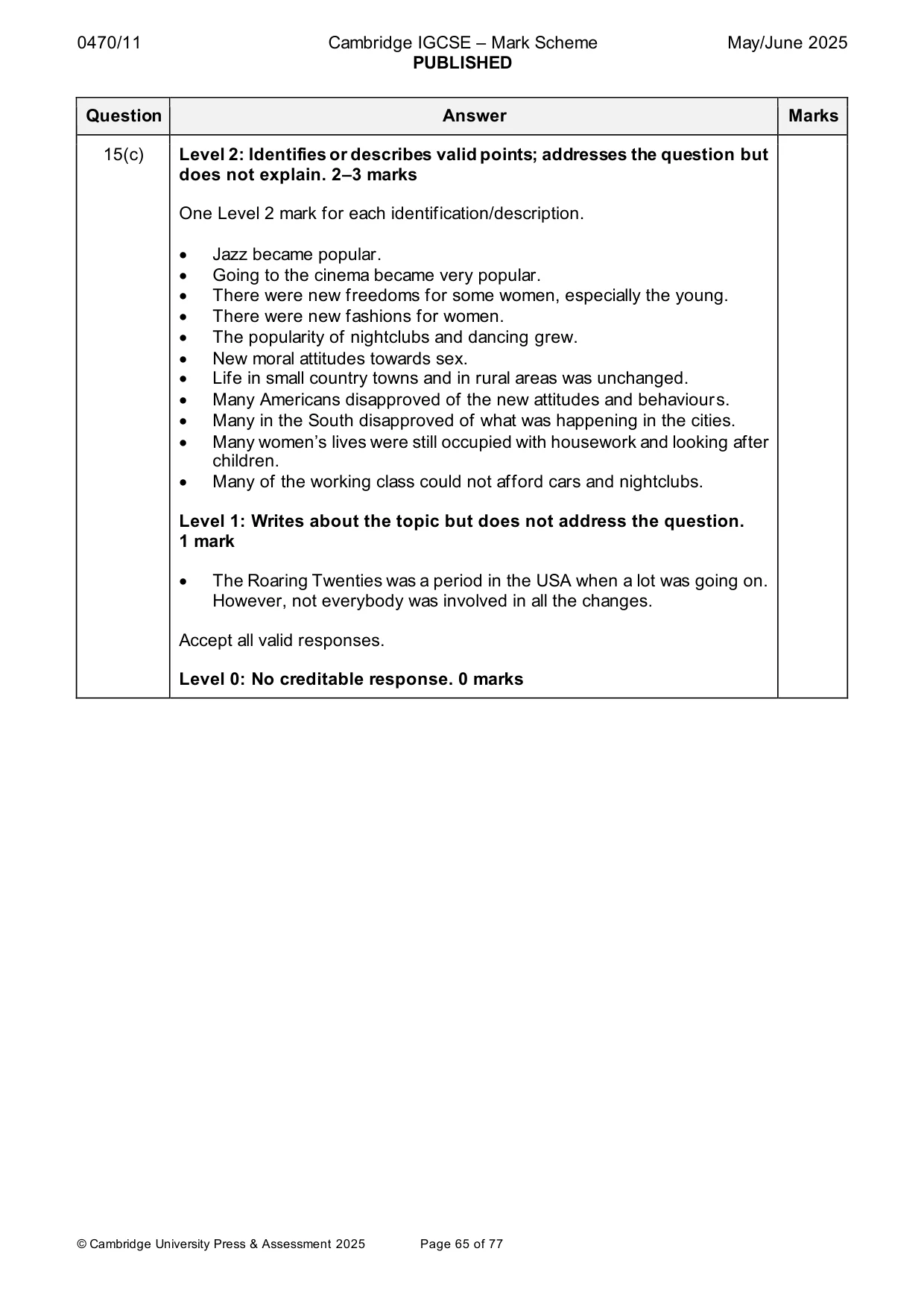
Paper as text
Question paper, page 1
This document has 8 pages. Any blank pages are indicated. [Turn over Cambridge IGCSE™ DC (CE) 361677/4 © UCLES 2025 * 2 6 7 3 2 9 5 7 1 4 * HISTORY 0470/11 Paper 1 Structured Questions May/June 2025 2 hours You must answer on the enclosed answer booklet. You will need: Answer booklet (enclosed) INSTRUCTIONS ● Answer three questions in total: Section A (Core content): answer two questions. Section B (Depth studies): answer one question. ● Follow the instructions on the front cover of the answer booklet. If you need additional answer paper, ask the invigilator for a continuation booklet. INFORMATION ● The total mark for this paper is 60. ● The number of marks for each question or part question is shown in brackets [ ].
Question paper, page 2
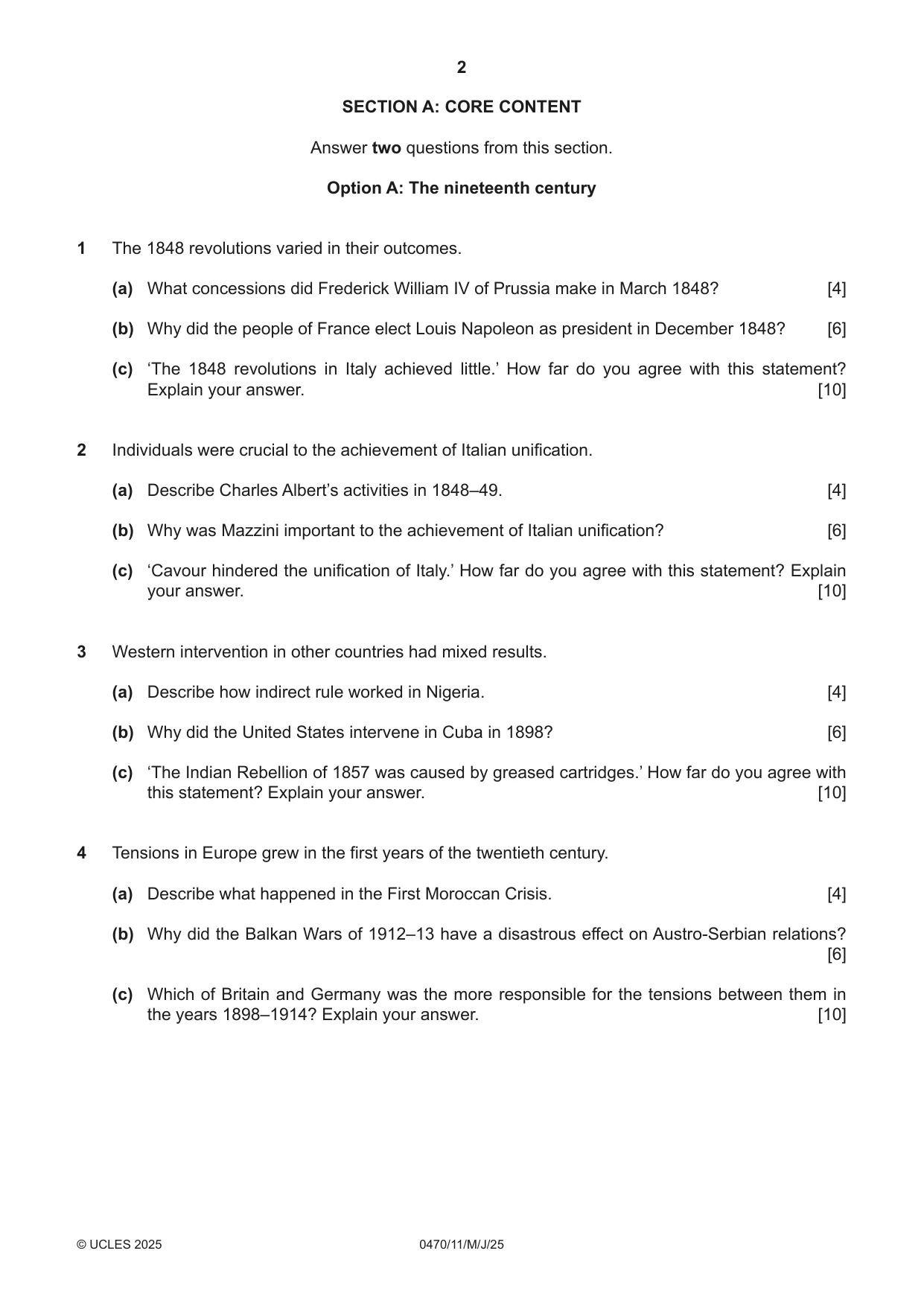
2 0470/11/M/J/25 © UCLES 2025 SECTION A: CORE CONTENT Answer two questions from this section. Option A: The nineteenth century 1 The 1848 revolutions varied in their outcomes. (a) What concessions did Frederick William IV of Prussia make in March 1848? [4] (b) Why did the people of France elect Louis Napoleon as president in December 1848? [6] (c) ‘The 1848 revolutions in Italy achieved little.’ How far do you agree with this statement? Explain your answer. [10] 2 Individuals were crucial to the achievement of Italian unification. (a) Describe Charles Albert’s activities in 1848–49. [4] (b) Why was Mazzini important to the achievement of Italian unification? [6] (c) ‘Cavour hindered the unification of Italy.’ How far do you agree with this statement? Explain your answer. [10] 3 Western intervention in other countries had mixed results. (a) Describe how indirect rule worked in Nigeria. [4] (b) Why did the United States intervene in Cuba in 1898? [6] (c) ‘The Indian Rebellion of 1857 was caused by greased cartridges.’ How far do you agree with this statement? Explain your answer. [10] 4 Tensions in Europe grew in the first years of the twentieth century. (a) Describe what happened in the First Moroccan Crisis. [4] (b) Why did the Balkan Wars of 1912–13 have a disastrous effect on Austro-Serbian relations? [6] (c) Which of Britain and Germany was the more responsible for the tensions between them in the years 1898–1914? Explain your answer. [10]
Question paper, page 3
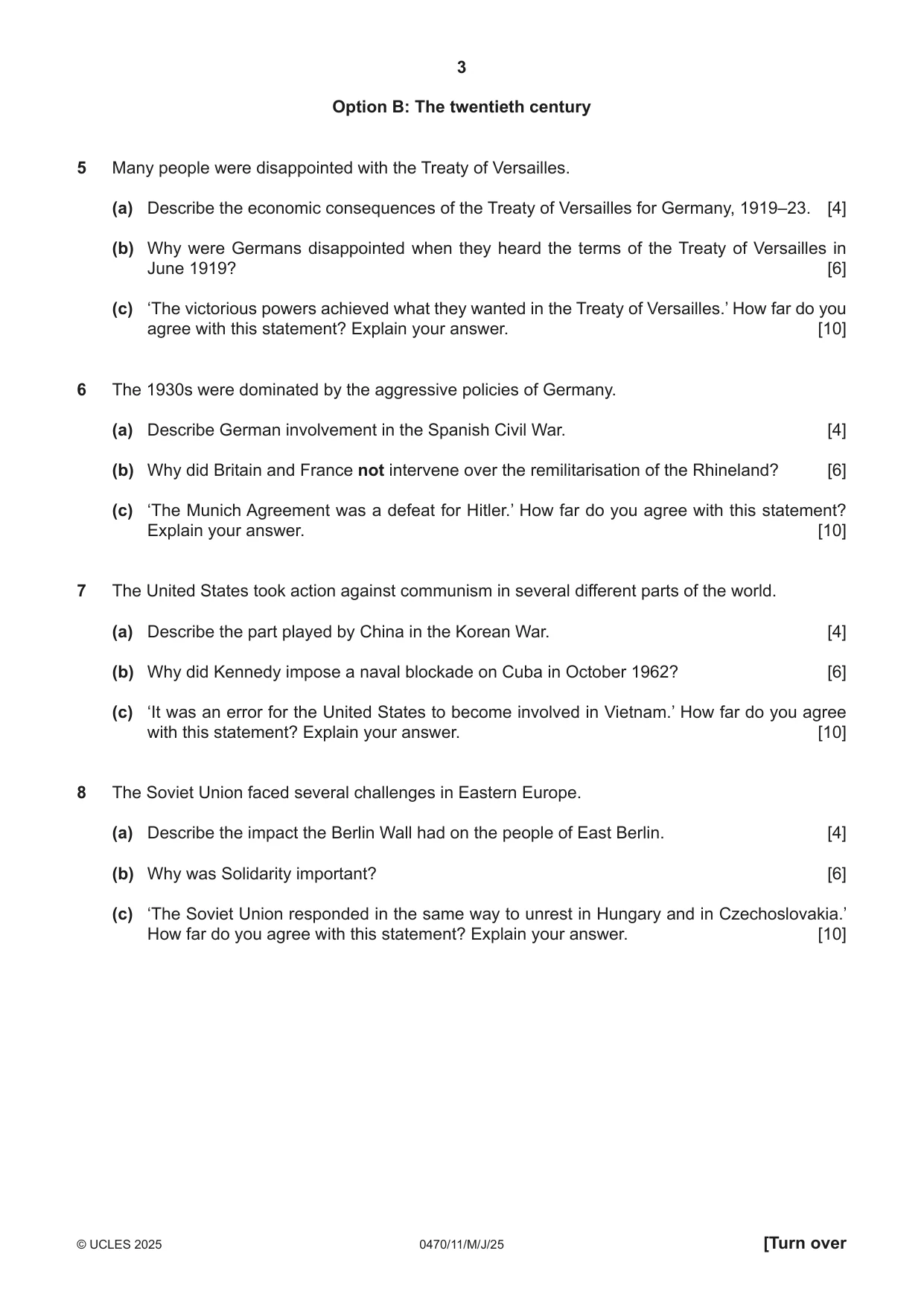
3 0470/11/M/J/25 © UCLES 2025 [Turn over Option B: The twentieth century 5 Many people were disappointed with the Treaty of Versailles. (a) Describe the economic consequences of the Treaty of Versailles for Germany, 1919–23. [4] (b) Why were Germans disappointed when they heard the terms of the Treaty of Versailles in June 1919? [6] (c) ‘The victorious powers achieved what they wanted in the Treaty of Versailles.’ How far do you agree with this statement? Explain your answer. [10] 6 The 1930s were dominated by the aggressive policies of Germany. (a) Describe German involvement in the Spanish Civil War. [4] (b) Why did Britain and France not intervene over the remilitarisation of the Rhineland? [6] (c) ‘The Munich Agreement was a defeat for Hitler.’ How far do you agree with this statement? Explain your answer. [10] 7 The United States took action against communism in several different parts of the world. (a) Describe the part played by China in the Korean War. [4] (b) Why did Kennedy impose a naval blockade on Cuba in October 1962? [6] (c) ‘It was an error for the United States to become involved in Vietnam.’ How far do you agree with this statement? Explain your answer. [10] 8 The Soviet Union faced several challenges in Eastern Europe. (a) Describe the impact the Berlin Wall had on the people of East Berlin. [4] (b) Why was Solidarity important? [6] (c) ‘The Soviet Union responded in the same way to unrest in Hungary and in Czechoslovakia.’ How far do you agree with this statement? Explain your answer. [10]
Question paper, page 4
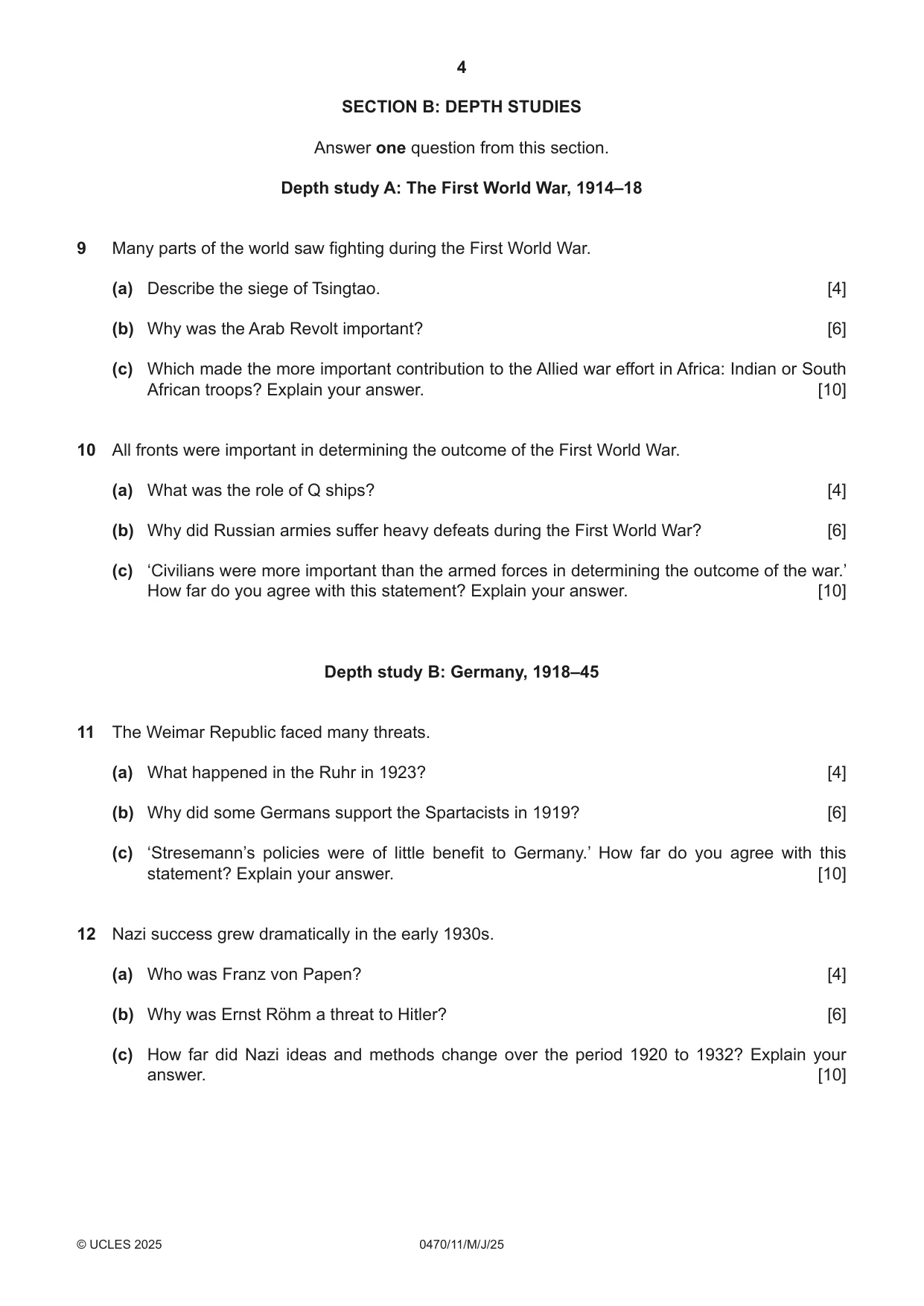
4 0470/11/M/J/25 © UCLES 2025 SECTION B: DEPTH STUDIES Answer one question from this section. Depth study A: The First World War, 1914–18 9 Many parts of the world saw fighting during the First World War. (a) Describe the siege of Tsingtao. [4] (b) Why was the Arab Revolt important? [6] (c) Which made the more important contribution to the Allied war effort in Africa: Indian or South African troops? Explain your answer. [10] 10 All fronts were important in determining the outcome of the First World War. (a) What was the role of Q ships? [4] (b) Why did Russian armies suffer heavy defeats during the First World War? [6] (c) ‘Civilians were more important than the armed forces in determining the outcome of the war.’ How far do you agree with this statement? Explain your answer. [10] Depth study B: Germany, 1918–45 11 The Weimar Republic faced many threats. (a) What happened in the Ruhr in 1923? [4] (b) Why did some Germans support the Spartacists in 1919? [6] (c) ‘Stresemann’s policies were of little benefit to Germany.’ How far do you agree with this statement? Explain your answer. [10] 12 Nazi success grew dramatically in the early 1930s. (a) Who was Franz von Papen? [4] (b) Why was Ernst Röhm a threat to Hitler? [6] (c) How far did Nazi ideas and methods change over the period 1920 to 1932? Explain your answer. [10]
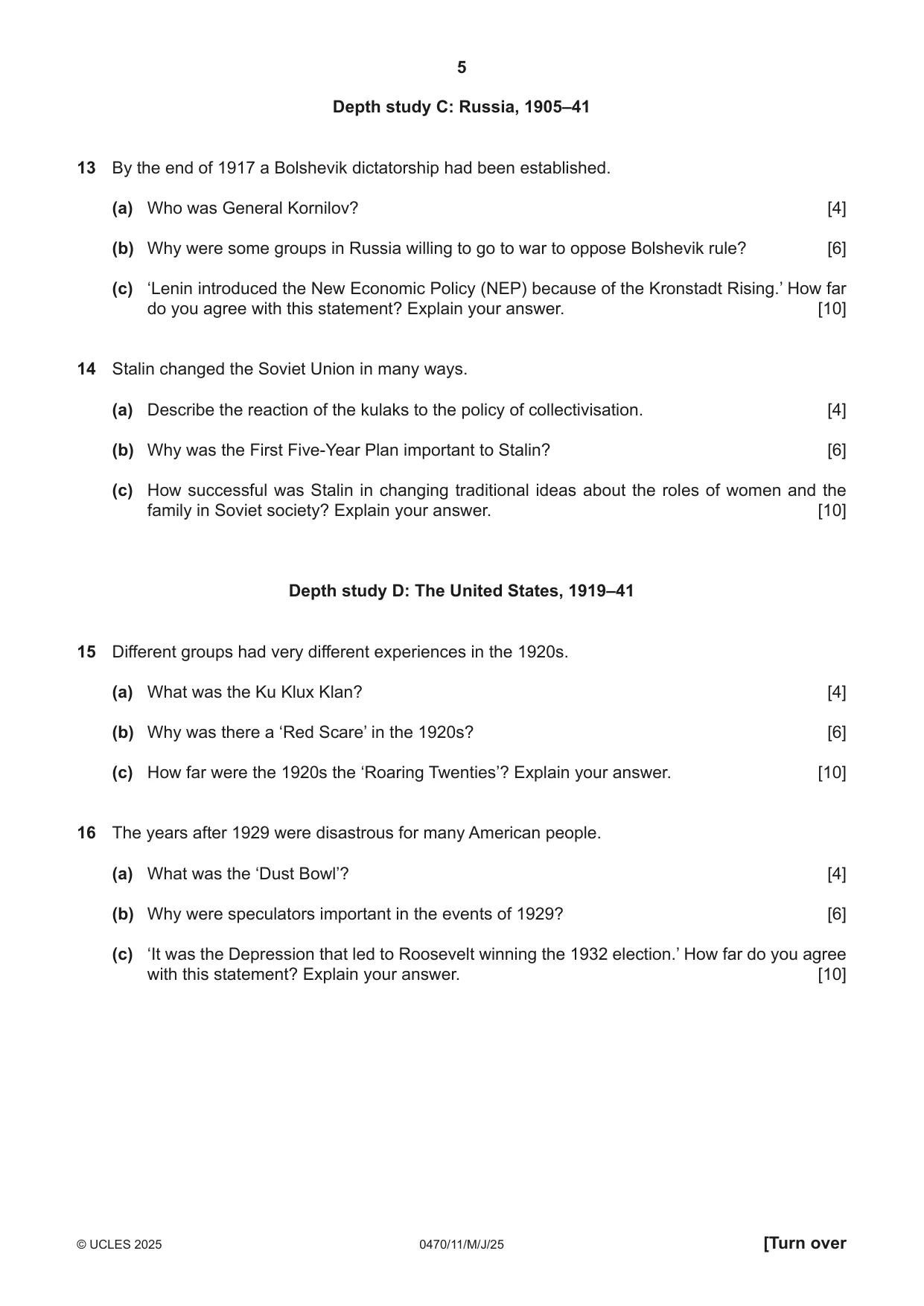
Question paper, page 5
5 0470/11/M/J/25 © UCLES 2025 [Turn over Depth study C: Russia, 1905–41 13 By the end of 1917 a Bolshevik dictatorship had been established. (a) Who was General Kornilov? [4] (b) Why were some groups in Russia willing to go to war to oppose Bolshevik rule? [6] (c) ‘Lenin introduced the New Economic Policy (NEP) because of the Kronstadt Rising.’ How far do you agree with this statement? Explain your answer. [10] 14 Stalin changed the Soviet Union in many ways. (a) Describe the reaction of the kulaks to the policy of collectivisation. [4] (b) Why was the First Five-Year Plan important to Stalin? [6] (c) How successful was Stalin in changing traditional ideas about the roles of women and the family in Soviet society? Explain your answer. [10] Depth study D: The United States, 1919–41 15 Different groups had very different experiences in the 1920s. (a) What was the Ku Klux Klan? [4] (b) Why was there a ‘Red Scare’ in the 1920s? [6] (c) How far were the 1920s the ‘Roaring Twenties’? Explain your answer. [10] 16 The years after 1929 were disastrous for many American people. (a) What was the ‘Dust Bowl’? [4] (b) Why were speculators important in the events of 1929? [6] (c) ‘It was the Depression that led to Roosevelt winning the 1932 election.’ How far do you agree with this statement? Explain your answer. [10]
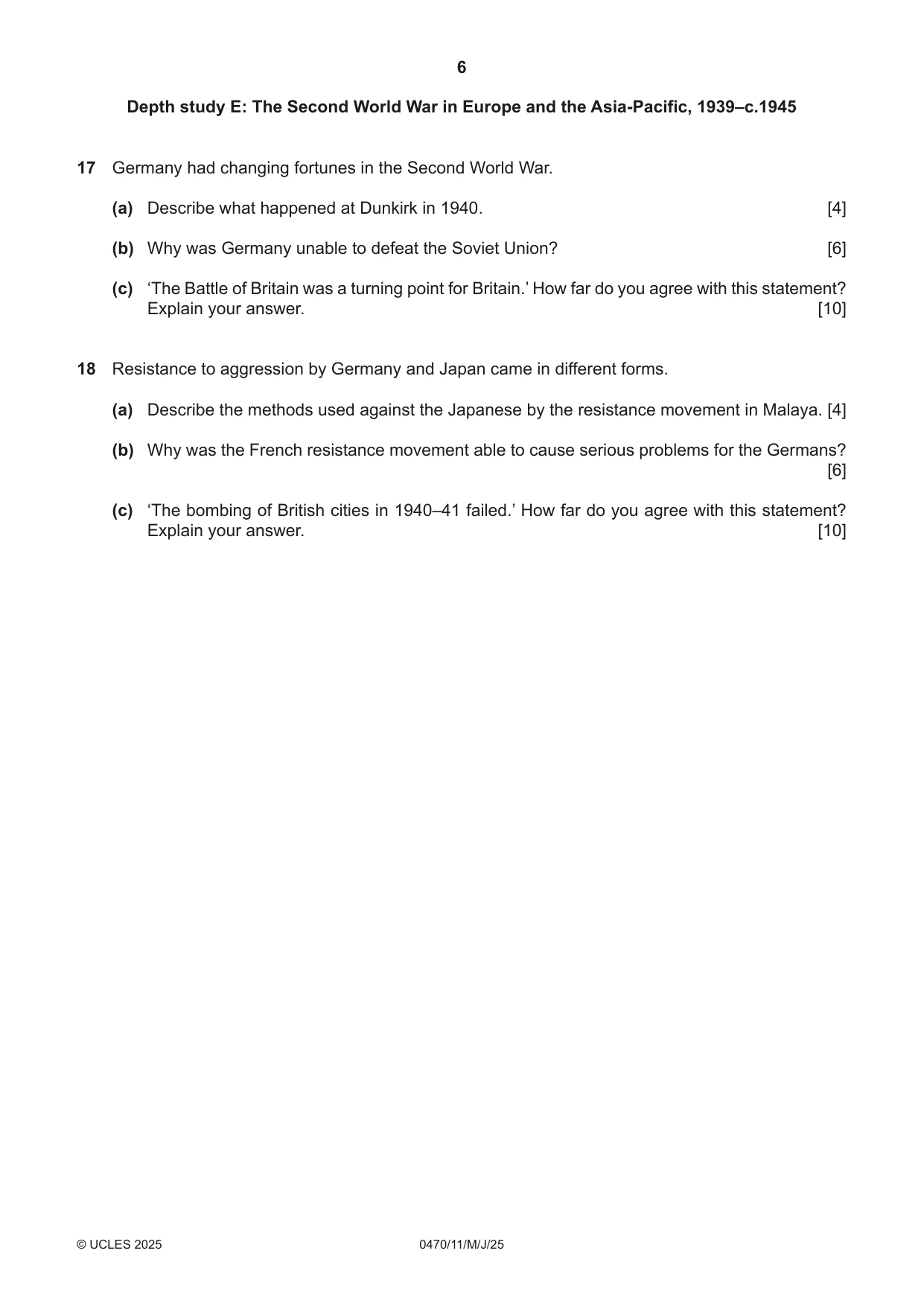
Question paper, page 6
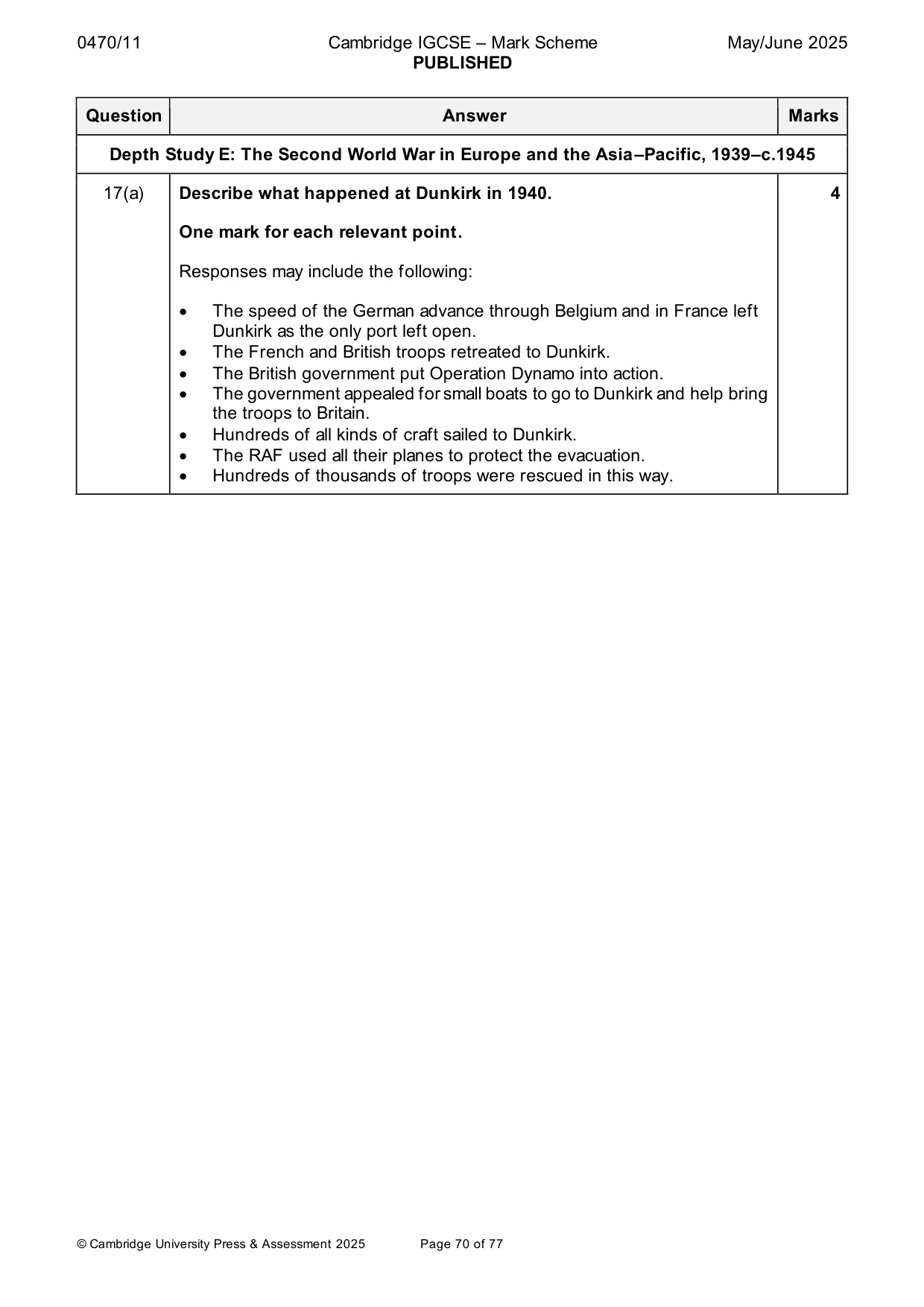
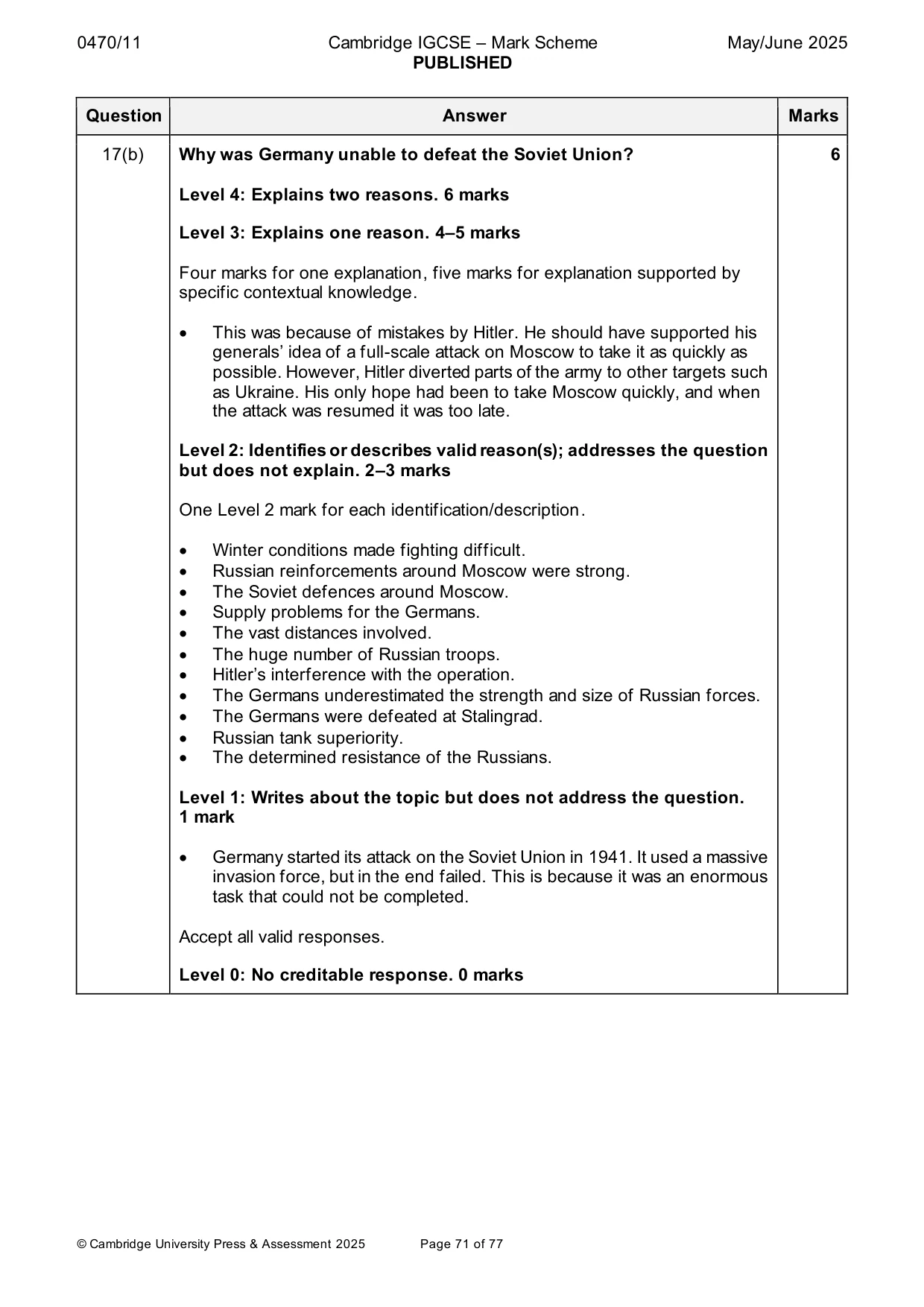
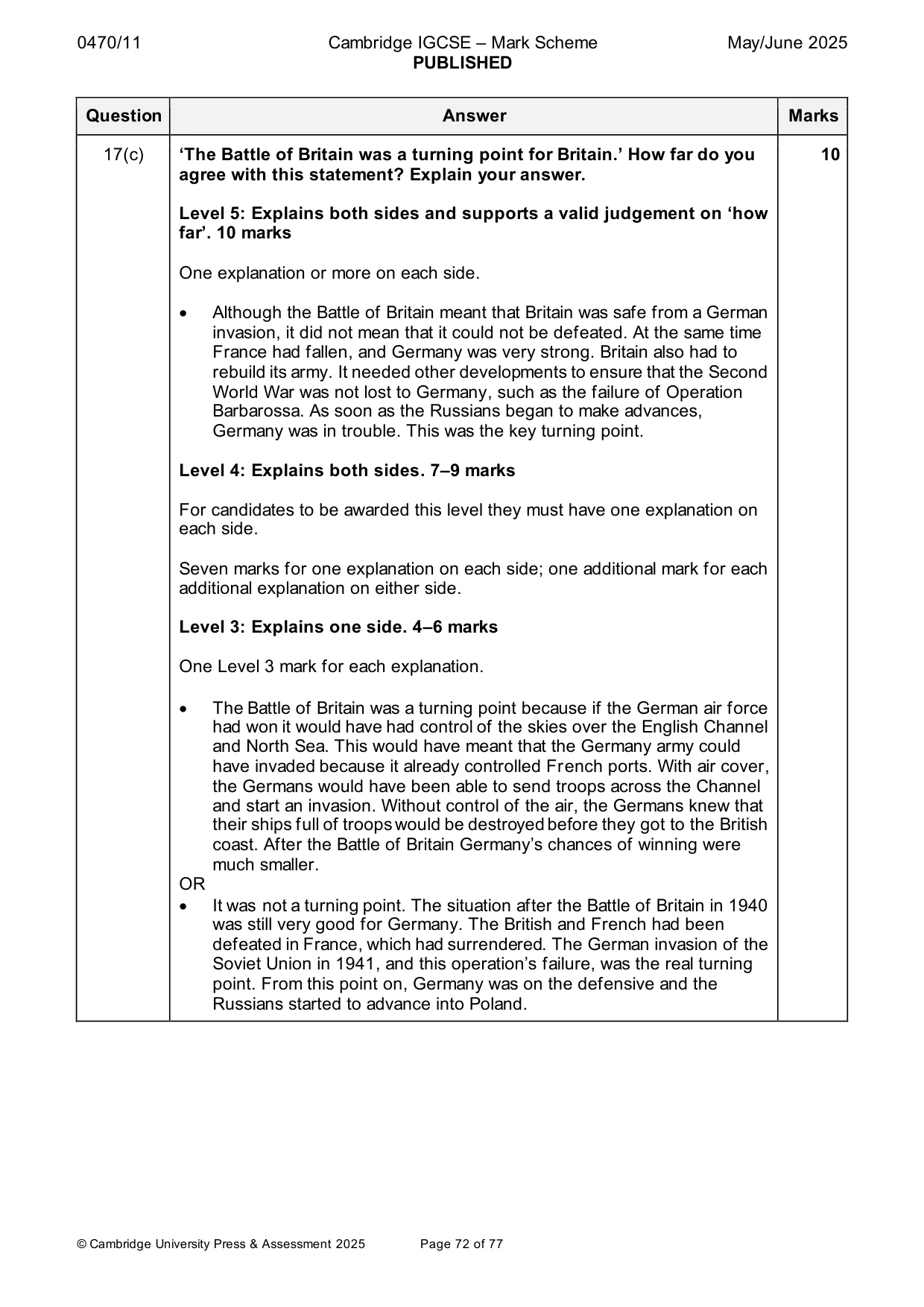
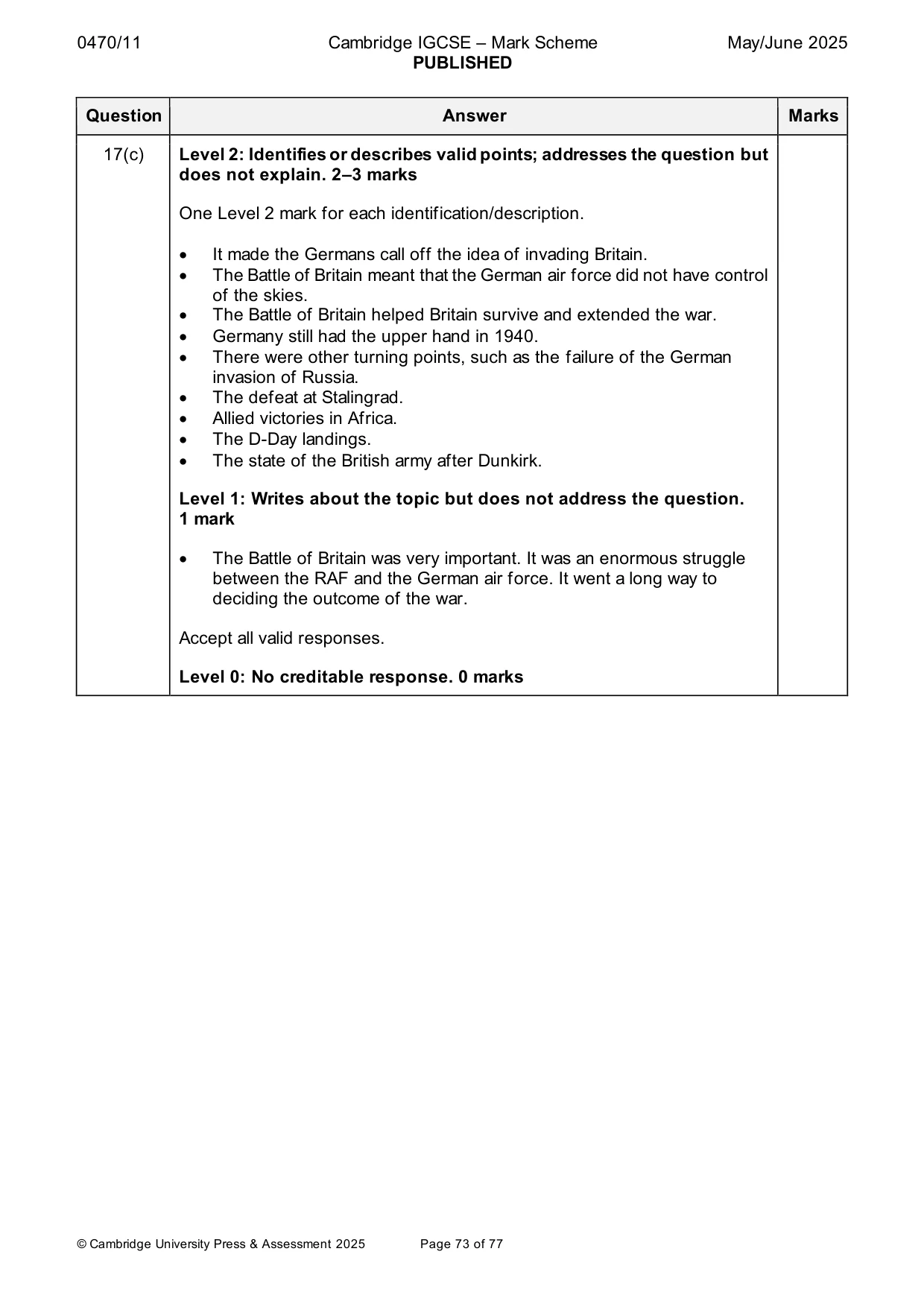
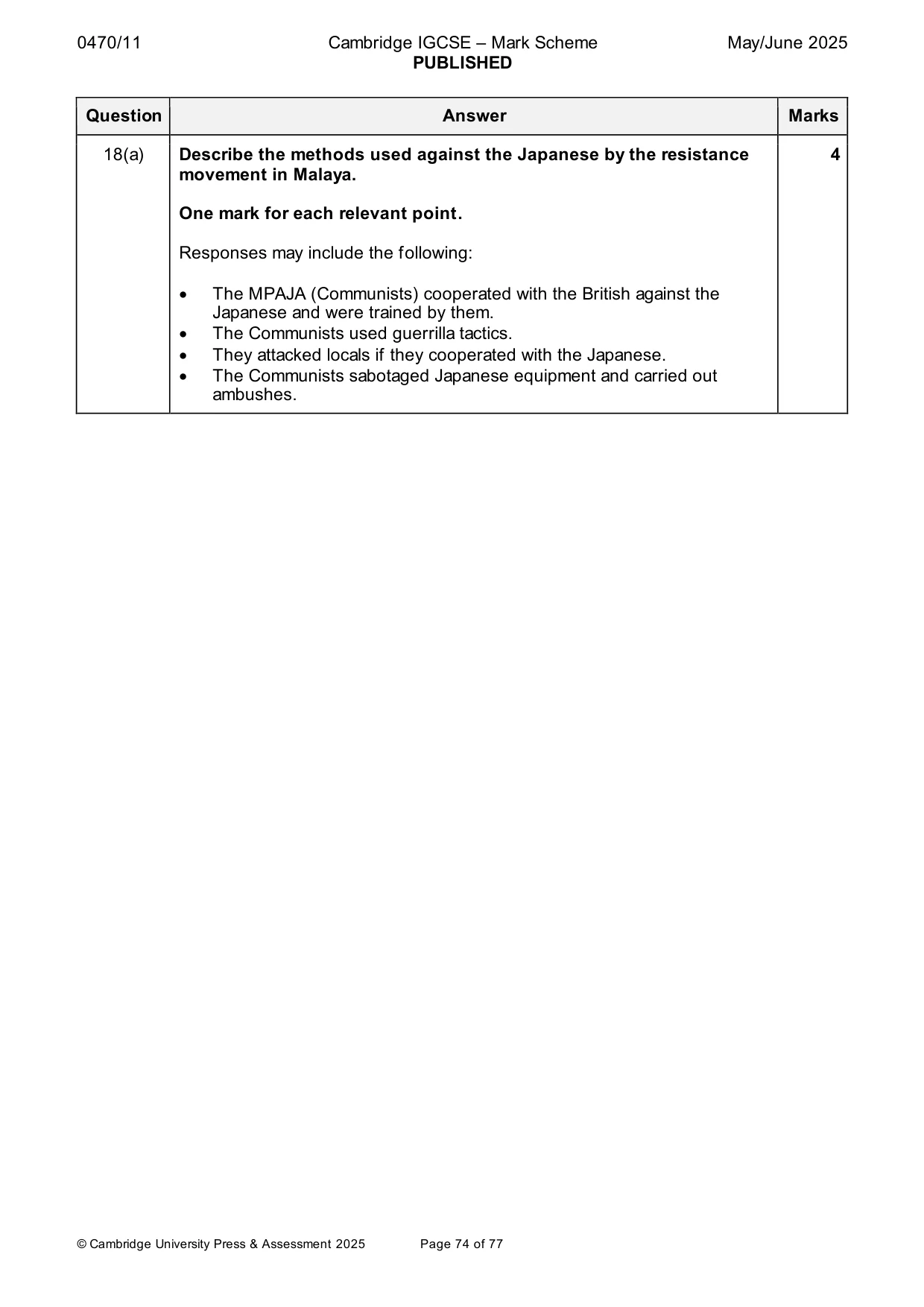
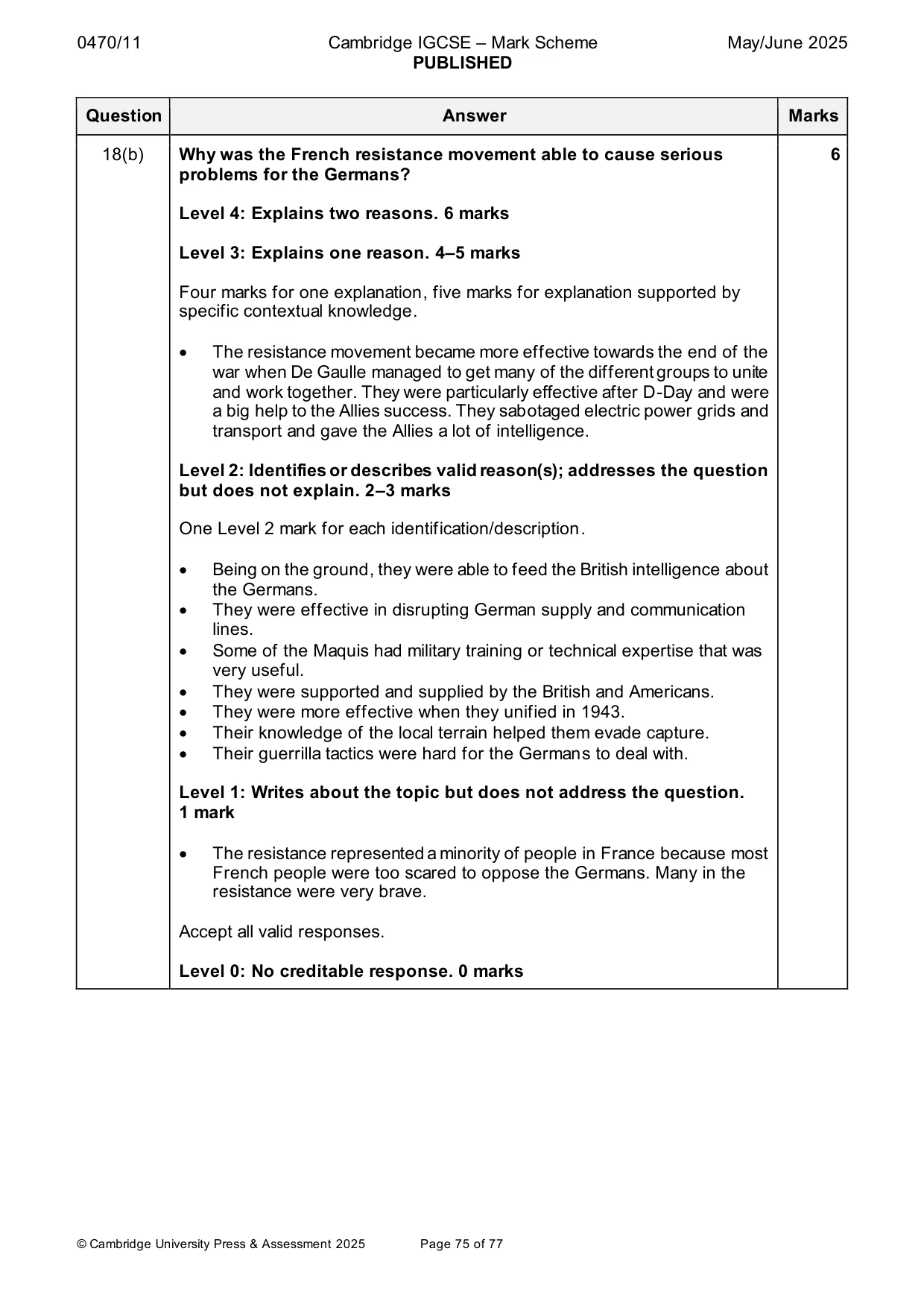
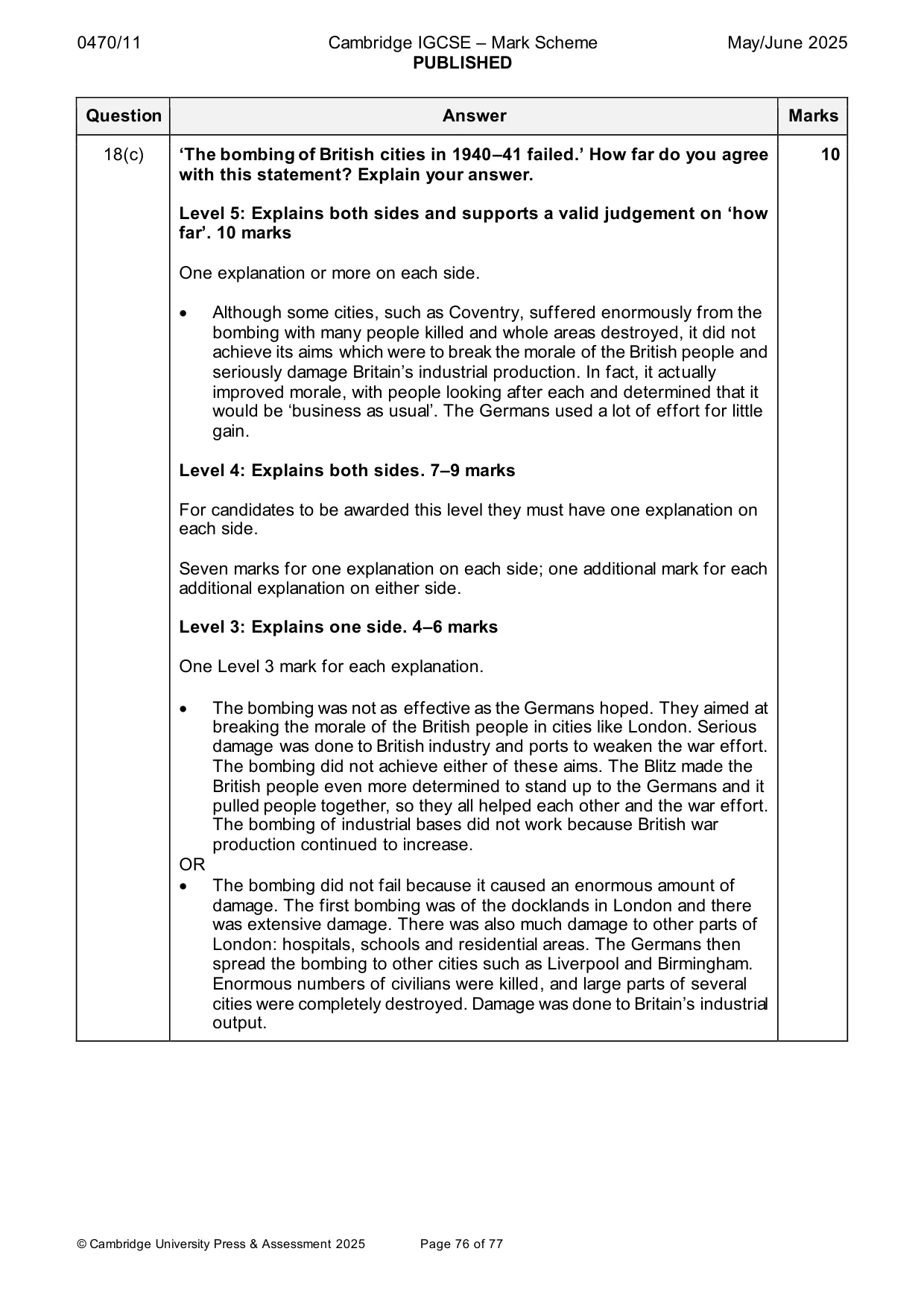
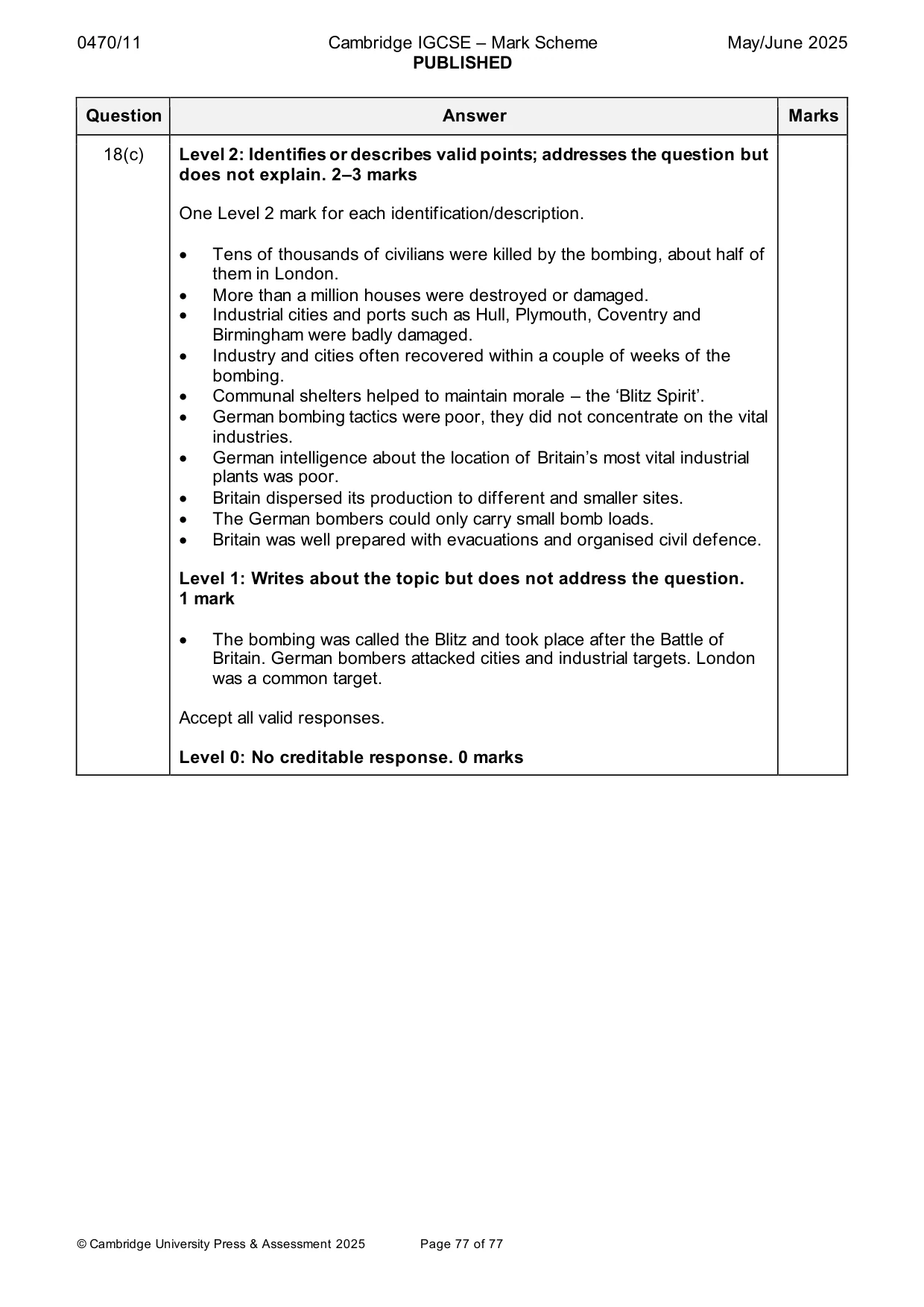
6 0470/11/M/J/25 © UCLES 2025 Depth study E: The Second World War in Europe and the Asia-Pacific, 1939–c.1945 17 Germany had changing fortunes in the Second World War. (a) Describe what happened at Dunkirk in 1940. [4] (b) Why was Germany unable to defeat the Soviet Union? [6] (c) ‘The Battle of Britain was a turning point for Britain.’ How far do you agree with this statement? Explain your answer. [10] 18 Resistance to aggression by Germany and Japan came in different forms. (a) Describe the methods used against the Japanese by the resistance movement in Malaya. [4] (b) Why was the French resistance movement able to cause serious problems for the Germans? [6] (c) ‘The bombing of British cities in 1940–41 failed.’ How far do you agree with this statement? Explain your answer. [10]
Question paper, page 7
7 0470/11/M/J/25 © UCLES 2025 BLANK PAGE
Question paper, page 8
8 0470/11/M/J/25 © UCLES 2025 Permission to reproduce items where third-party owned material protected by copyright is included has been sought and cleared where possible. Every reasonable effort has been made by the publisher (UCLES) to trace copyright holders, but if any items requiring clearance have unwittingly been included, the publisher will be pleased to make amends at the earliest possible opportunity. To avoid the issue of disclosure of answer-related information to candidates, all copyright acknowledgements are reproduced online in the Cambridge Assessment International Education Copyright Acknowledgements Booklet. This is produced for each series of examinations and is freely available to download at www.cambridgeinternational.org after the live examination series. Cambridge Assessment International Education is part of Cambridge Assessment. Cambridge Assessment is the brand name of the University of Cambridge Local Examinations Syndicate (UCLES), which is a department of the University of Cambridge. BLANK PAGE
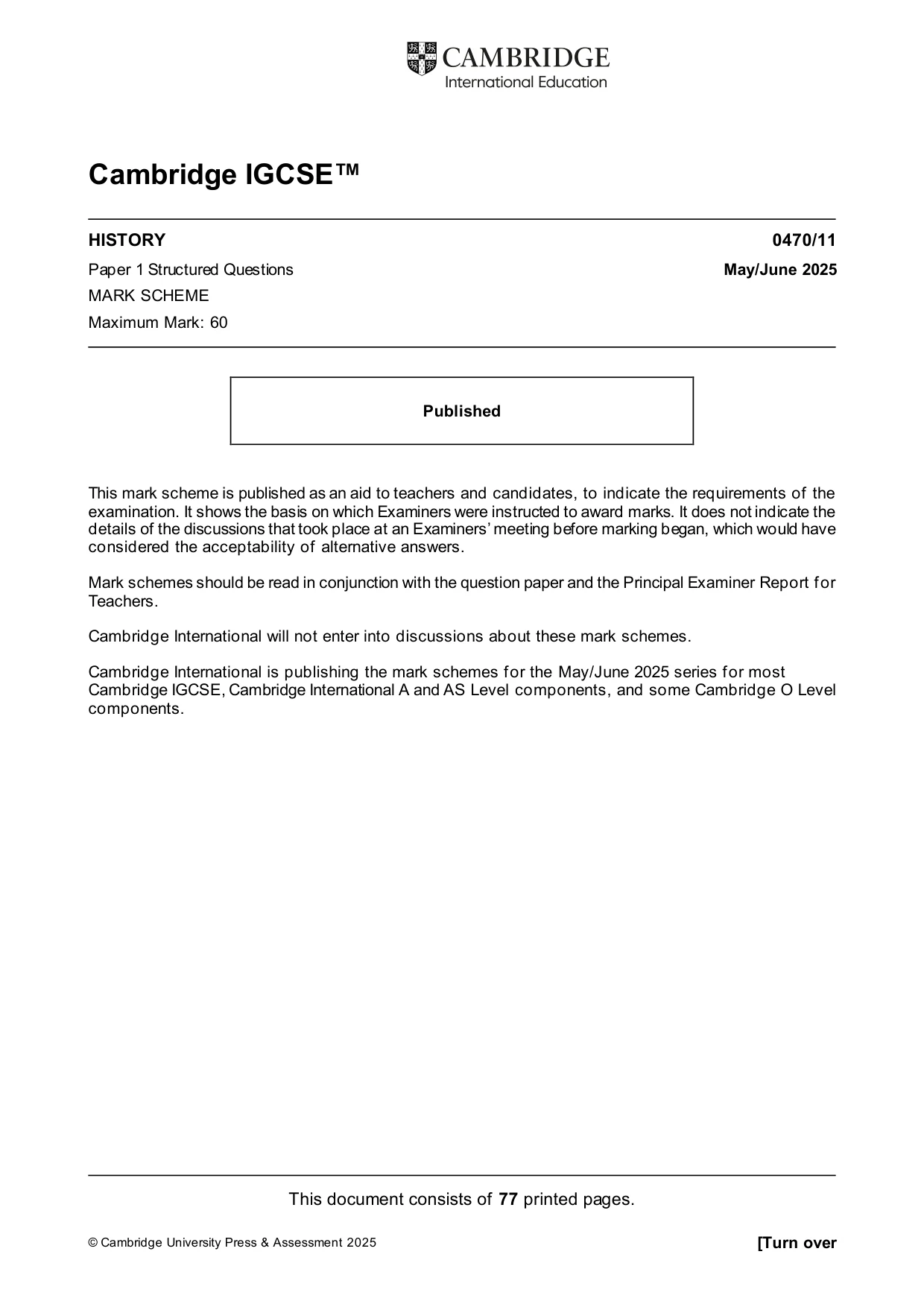
Mark scheme, page 1
This document consists of 77 printed pages. © Cambridge University Press & Assessment 2025 [Turn over Cambridge IGCSE™ HISTORY 0470/11 Paper 1 Structured Questions May/June 2025 MARK SCHEME Maximum Mark: 60 Published This mark scheme is published as an aid to teachers and candidates, to indicate the requirements of the examination. It shows the basis on which Examiners were instructed to award marks. It does not indicate the details of the discussions that took place at an Examiners’ meeting before marking began, which would have considered the acceptability of alternative answers. Mark schemes should be read in conjunction with the question paper and the Principal Examiner Report for Teachers. Cambridge International will not enter into discussions about these mark schemes. Cambridge International is publishing the mark schemes for the May/June 2025 series for most Cambridge IGCSE, Cambridge International A and AS Level components, and some Cambridge O Level components.
Mark scheme, page 2
0470/11 Cambridge IGCSE – Mark Scheme PUBLISHED May/June 2025 © Cambridge University Press & Assessment 2025 Page 2 of 77 Generic Marking Principles These general marking principles must be applied by all examiners when marking candidate answers. They should be applied alongside the specific content of the mark scheme or generic level descriptions for a question. Each question paper and mark scheme will also comply with these marking principles. GENERIC MARKING PRINCIPLE 1: Marks must be awarded in line with: • the specific content of the mark scheme or the generic level descriptors for the question • the specific skills defined in the mark scheme or in the generic level descriptors for the question • the standard of response required by a candidate as exemplified by the standardisation scripts. GENERIC MARKING PRINCIPLE 2: Marks awarded are always whole marks (not half marks, or other fractions). GENERIC MARKING PRINCIPLE 3: Marks must be awarded positively: • marks are awarded for correct/valid answers, as defined in the mark scheme. However, credit is given for valid answers which go beyond the scope of the syllabus and mark scheme, referring to your Team Leader as appropriate • marks are awarded when candidates clearly demonstrate what they know and can do • marks are not deducted for errors • marks are not deducted for omissions • answers should only be judged on the quality of spelling, punctuation and grammar when these features are specifically assessed by the question as indicated by the mark scheme. The meaning, however, should be unambiguous. GENERIC MARKING PRINCIPLE 4: Rules must be applied consistently, e.g. in situations where candidates have not followed instructions or in the application of generic level descriptors. GENERIC MARKING PRINCIPLE 5: Marks should be awarded using the full range of marks defined in the mark scheme for the question (however; the use of the full mark range may be limited according to the quality of the candidate responses seen). GENERIC MARKING PRINCIPLE 6: Marks awarded are based solely on the requirements as defined in the mark scheme. Marks should not be awarded with grade thresholds or grade descriptors in mind.
Mark scheme, page 3
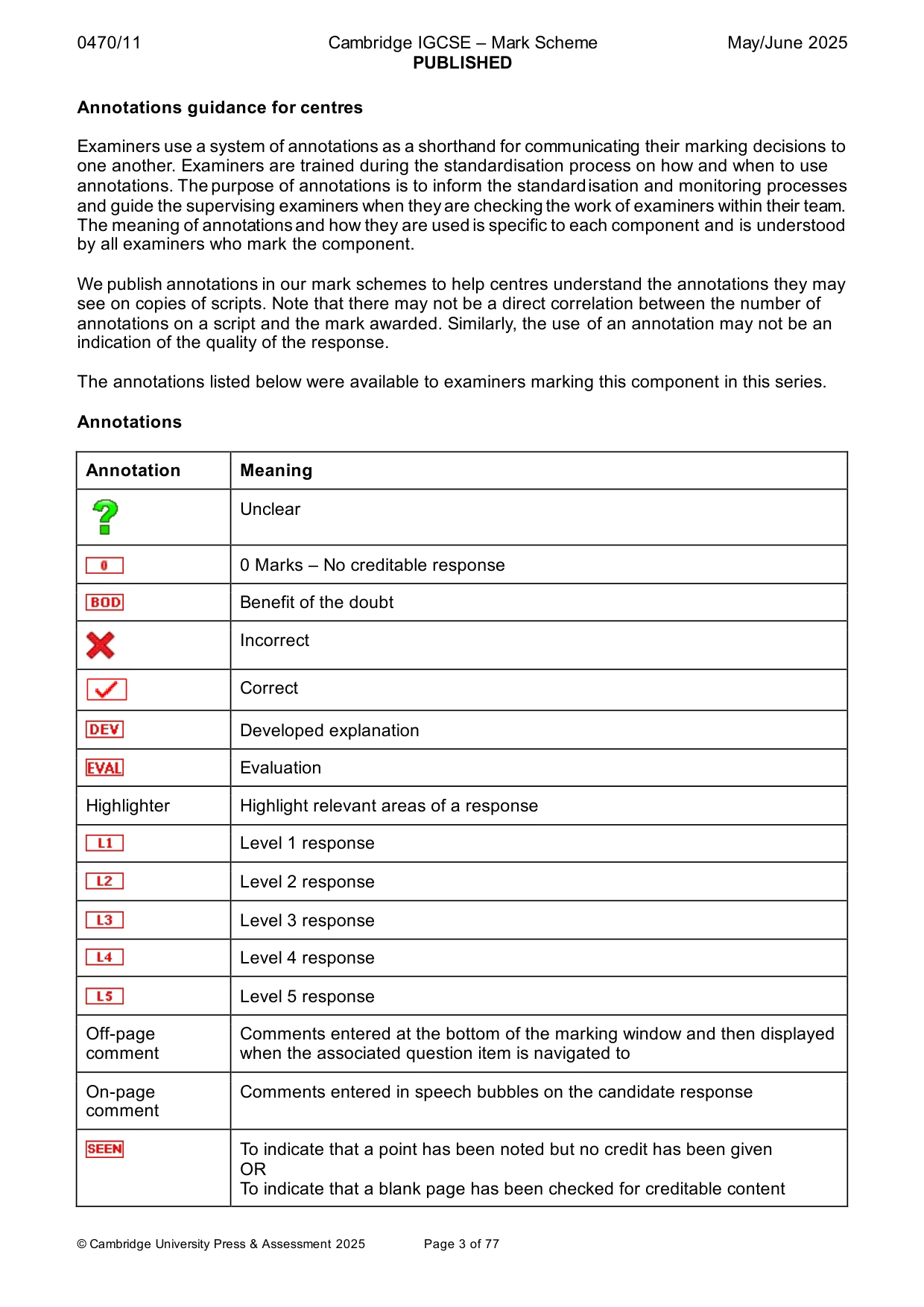
0470/11 Cambridge IGCSE – Mark Scheme PUBLISHED May/June 2025 © Cambridge University Press & Assessment 2025 Page 3 of 77 Annotations guidance for centres Examiners use a system of annotations as a shorthand for communicating their marking decisions to one another. Examiners are trained during the standardisation process on how and when to use annotations. The purpose of annotations is to inform the standardisation and monitoring processes and guide the supervising examiners when they are checking the work of examiners within their team. The meaning of annotations and how they are used is specific to each component and is understood by all examiners who mark the component. We publish annotations in our mark schemes to help centres understand the annotations they may see on copies of scripts. Note that there may not be a direct correlation between the number of annotations on a script and the mark awarded. Similarly, the use of an annotation may not be an indication of the quality of the response. The annotations listed below were available to examiners marking this component in this series. Annotations Annotation Meaning Unclear 0 Marks – No creditable response Benefit of the doubt Incorrect Correct Developed explanation Evaluation Highlighter Highlight relevant areas of a response Level 1 response Level 2 response Level 3 response Level 4 response Level 5 response Off-page comment Comments entered at the bottom of the marking window and then displayed when the associated question item is navigated to On-page comment Comments entered in speech bubbles on the candidate response To indicate that a point has been noted but no credit has been given OR To indicate that a blank page has been checked for creditable content
Mark scheme, page 4
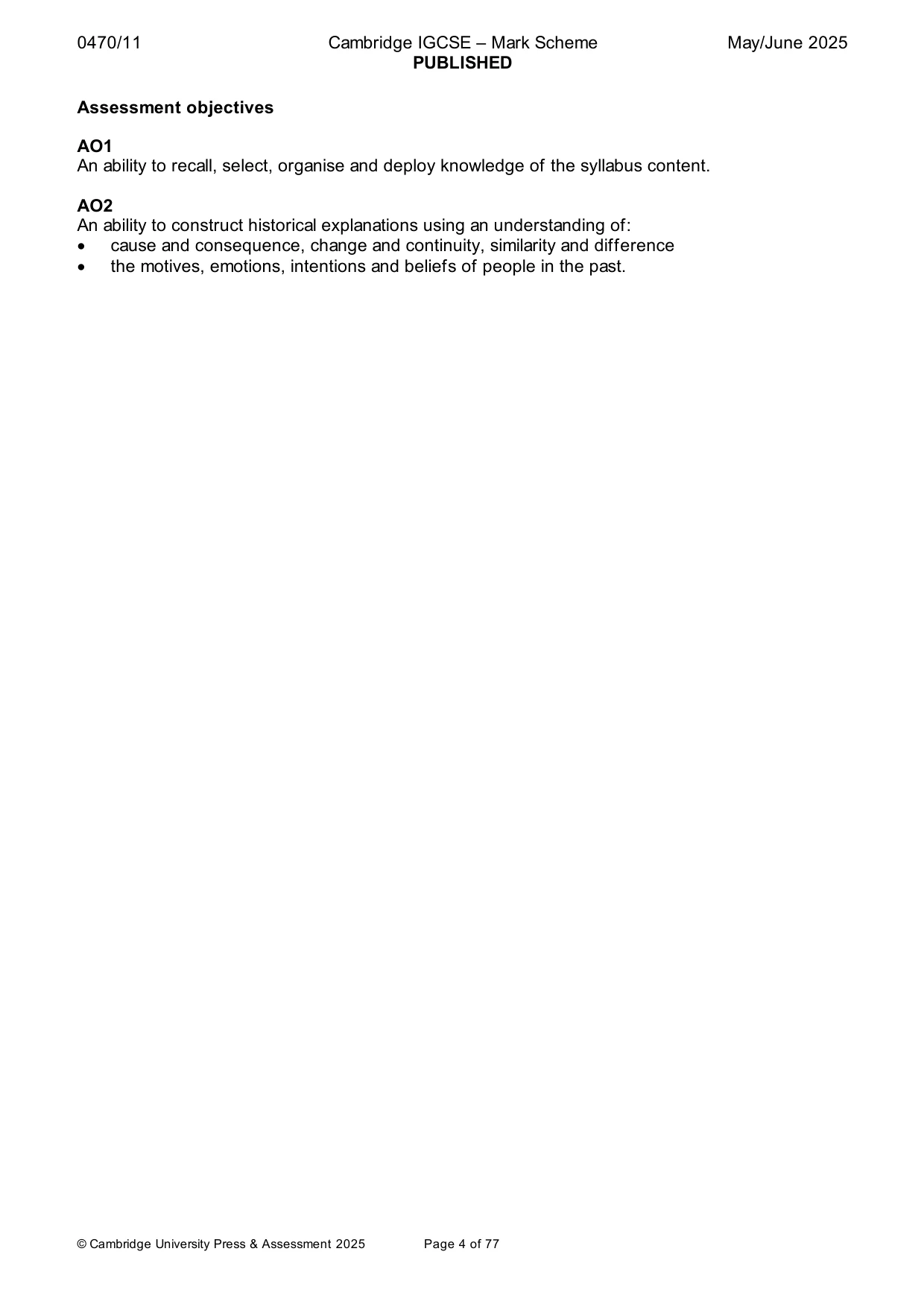
0470/11 Cambridge IGCSE – Mark Scheme PUBLISHED May/June 2025 © Cambridge University Press & Assessment 2025 Page 4 of 77 Assessment objectives AO1 An ability to recall, select, organise and deploy knowledge of the syllabus content. AO2 An ability to construct historical explanations using an understanding of: • cause and consequence, change and continuity, similarity and difference • the motives, emotions, intentions and beliefs of people in the past.
Mark scheme, page 5
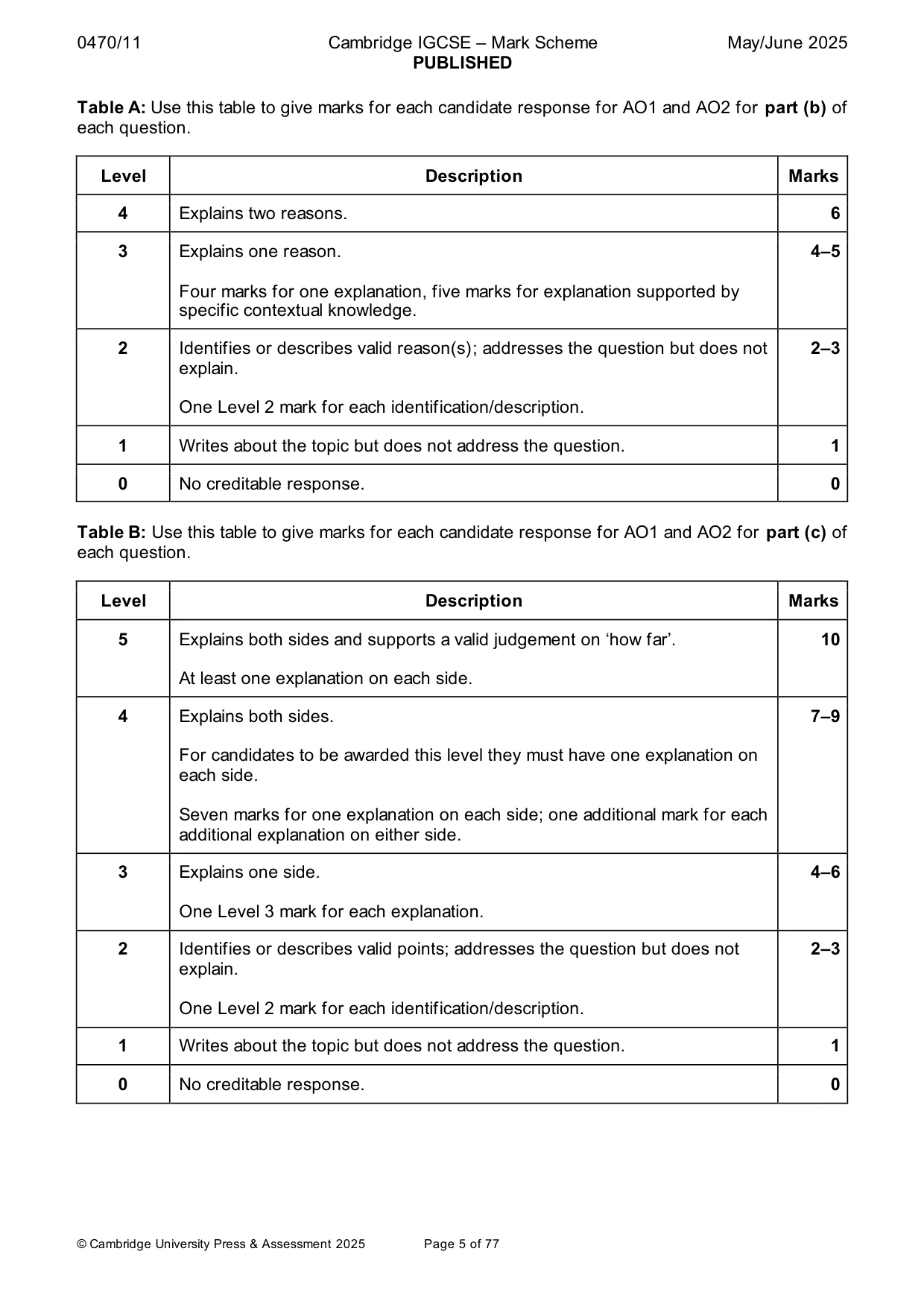
0470/11 Cambridge IGCSE – Mark Scheme PUBLISHED May/June 2025 © Cambridge University Press & Assessment 2025 Page 5 of 77 Table A: Use this table to give marks for each candidate response for AO1 and AO2 for part (b) of each question. Level Description Marks 4 Explains two reasons. 6 3 Explains one reason. Four marks for one explanation, five marks for explanation supported by specific contextual knowledge. 4–5 2 Identifies or describes valid reason(s); addresses the question but does not explain. One Level 2 mark for each identification/description. 2–3 1 Writes about the topic but does not address the question. 1 0 No creditable response. 0 Table B: Use this table to give marks for each candidate response for AO1 and AO2 for part (c) of each question. Level Description Marks 5 Explains both sides and supports a valid judgement on ‘how far’. At least one explanation on each side. 10 4 Explains both sides. For candidates to be awarded this level they must have one explanation on each side. Seven marks for one explanation on each side; one additional mark for each additional explanation on either side. 7–9 3 Explains one side. One Level 3 mark for each explanation. 4–6 2 Identifies or describes valid points; addresses the question but does not explain. One Level 2 mark for each identification/description. 2–3 1 Writes about the topic but does not address the question. 1 0 No creditable response. 0
Mark scheme, page 6
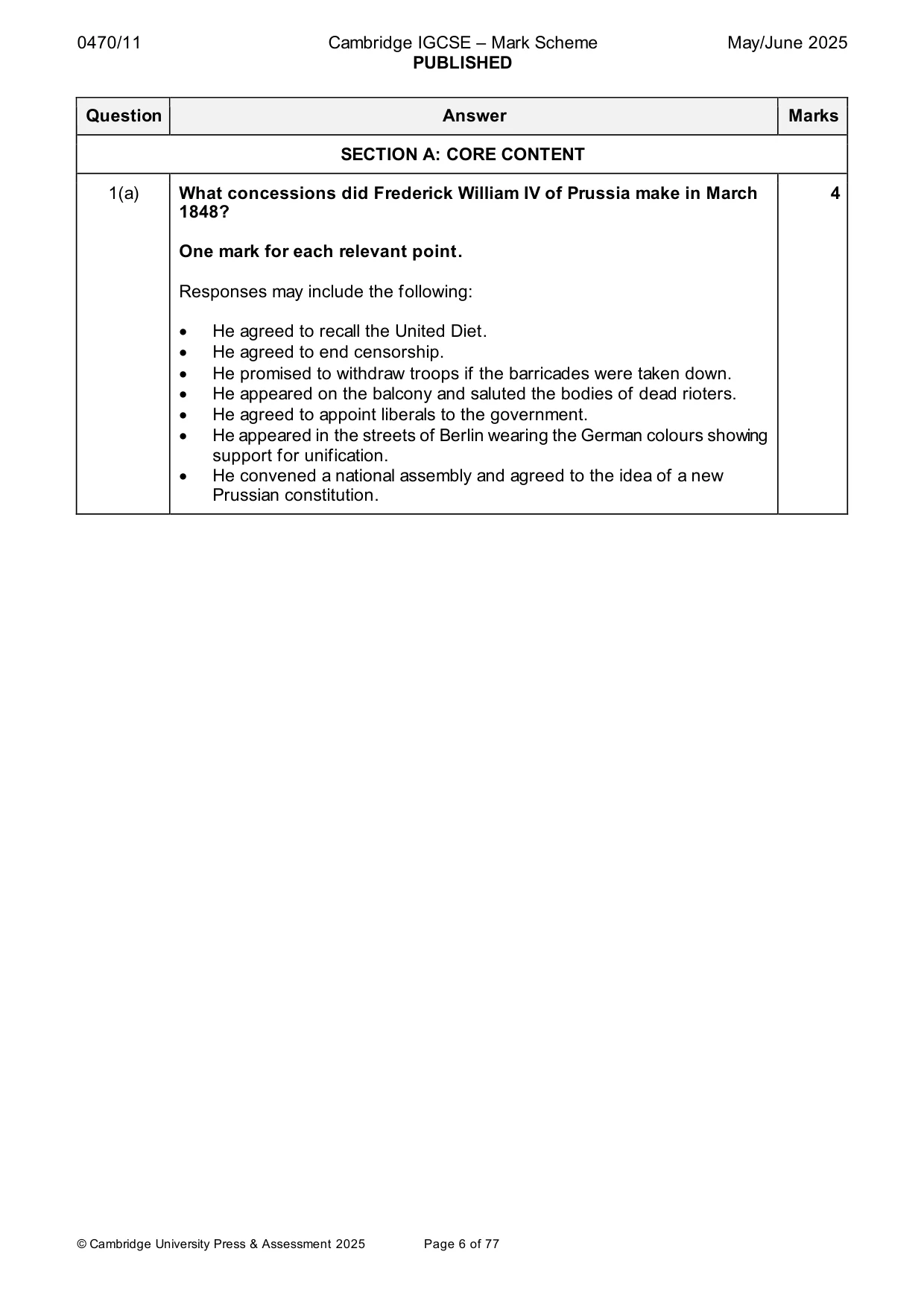
0470/11 Cambridge IGCSE – Mark Scheme PUBLISHED May/June 2025 © Cambridge University Press & Assessment 2025 Page 6 of 77 Question Answer Marks SECTION A: CORE CONTENT 1(a) What concessions did Frederick William IV of Prussia make in March 1848? One mark for each relevant point. Responses may include the following: • He agreed to recall the United Diet. • He agreed to end censorship. • He promised to withdraw troops if the barricades were taken down. • He appeared on the balcony and saluted the bodies of dead rioters. • He agreed to appoint liberals to the government. • He appeared in the streets of Berlin wearing the German colours showing support for unification. • He convened a national assembly and agreed to the idea of a new Prussian constitution. 4
Mark scheme, page 7
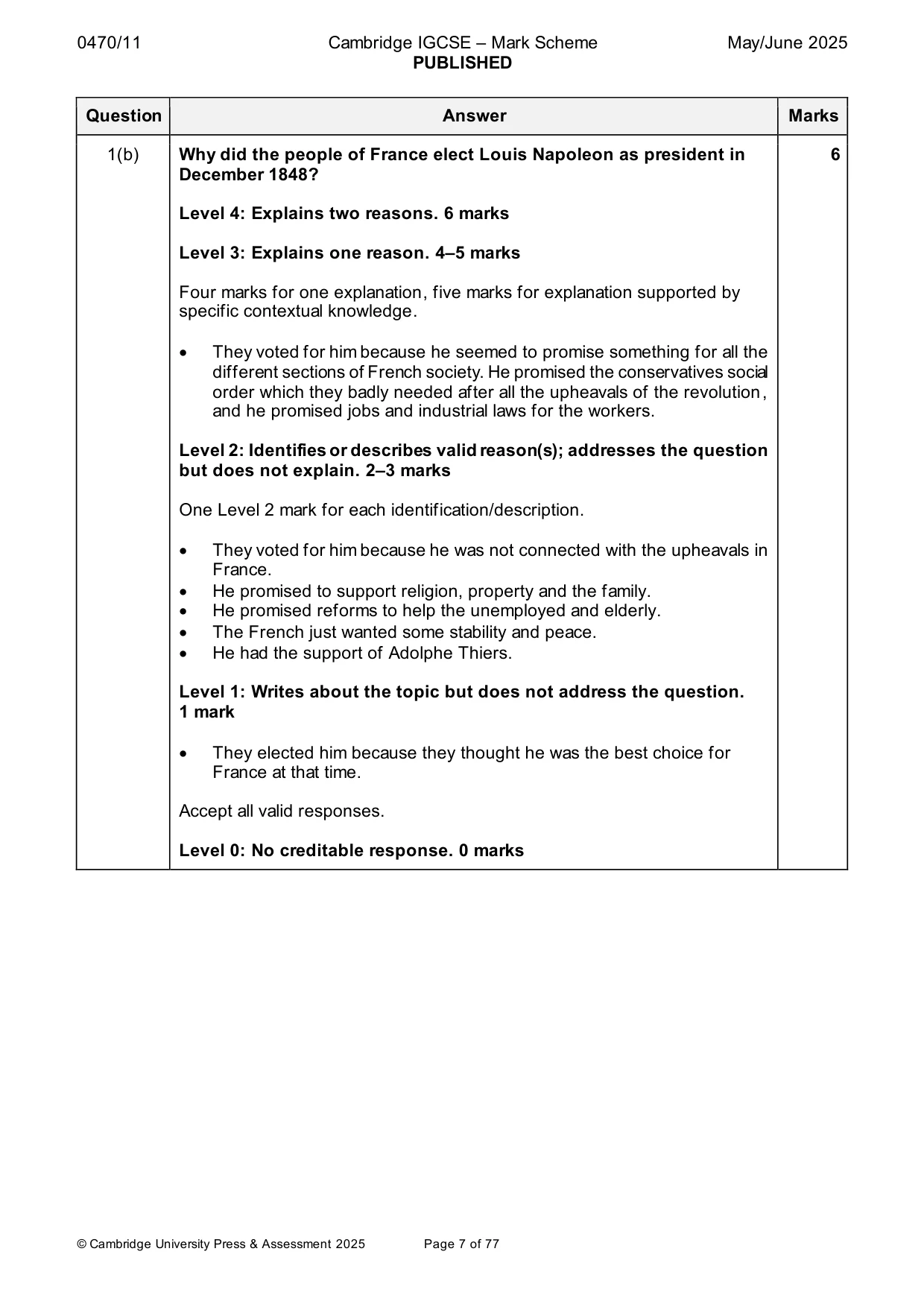
0470/11 Cambridge IGCSE – Mark Scheme PUBLISHED May/June 2025 © Cambridge University Press & Assessment 2025 Page 7 of 77 Question Answer Marks 1(b) Why did the people of France elect Louis Napoleon as president in December 1848? Level 4: Explains two reasons. 6 marks Level 3: Explains one reason. 4–5 marks Four marks for one explanation, five marks for explanation supported by specific contextual knowledge. • They voted for him because he seemed to promise something for all the different sections of French society. He promised the conservatives social order which they badly needed after all the upheavals of the revolution, and he promised jobs and industrial laws for the workers. Level 2: Identifies or describes valid reason(s); addresses the question but does not explain. 2–3 marks One Level 2 mark for each identification/description. • They voted for him because he was not connected with the upheavals in France. • He promised to support religion, property and the family. • He promised reforms to help the unemployed and elderly. • The French just wanted some stability and peace. • He had the support of Adolphe Thiers. Level 1: Writes about the topic but does not address the question. 1 mark • They elected him because they thought he was the best choice for France at that time. Accept all valid responses. Level 0: No creditable response. 0 marks 6
Mark scheme, page 8
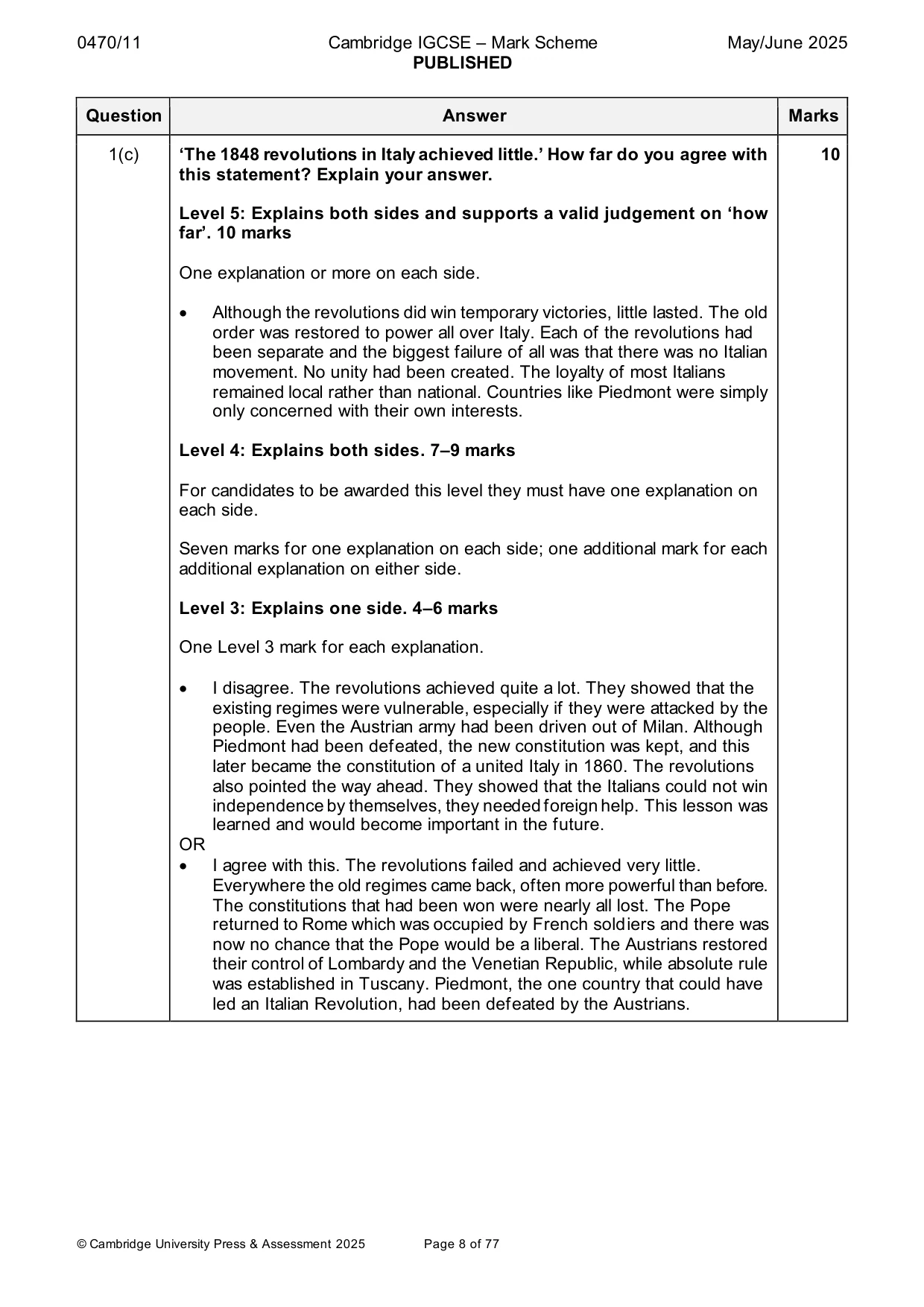
0470/11 Cambridge IGCSE – Mark Scheme PUBLISHED May/June 2025 © Cambridge University Press & Assessment 2025 Page 8 of 77 Question Answer Marks 1(c) ‘The 1848 revolutions in Italy achieved little.’ How far do you agree with this statement? Explain your answer. Level 5: Explains both sides and supports a valid judgement on ‘how far’. 10 marks One explanation or more on each side. • Although the revolutions did win temporary victories, little lasted. The old order was restored to power all over Italy. Each of the revolutions had been separate and the biggest failure of all was that there was no Italian movement. No unity had been created. The loyalty of most Italians remained local rather than national. Countries like Piedmont were simply only concerned with their own interests. Level 4: Explains both sides. 7–9 marks For candidates to be awarded this level they must have one explanation on each side. Seven marks for one explanation on each side; one additional mark for each additional explanation on either side. Level 3: Explains one side. 4–6 marks One Level 3 mark for each explanation. • I disagree. The revolutions achieved quite a lot. They showed that the existing regimes were vulnerable, especially if they were attacked by the people. Even the Austrian army had been driven out of Milan. Although Piedmont had been defeated, the new constitution was kept, and this later became the constitution of a united Italy in 1860. The revolutions also pointed the way ahead. They showed that the Italians could not win independence by themselves, they needed foreign help. This lesson was learned and would become important in the future. OR • I agree with this. The revolutions failed and achieved very little. Everywhere the old regimes came back, often more powerful than before. The constitutions that had been won were nearly all lost. The Pope returned to Rome which was occupied by French soldiers and there was now no chance that the Pope would be a liberal. The Austrians restored their control of Lombardy and the Venetian Republic, while absolute rule was established in Tuscany. Piedmont, the one country that could have led an Italian Revolution, had been defeated by the Austrians. 10
Mark scheme, page 9
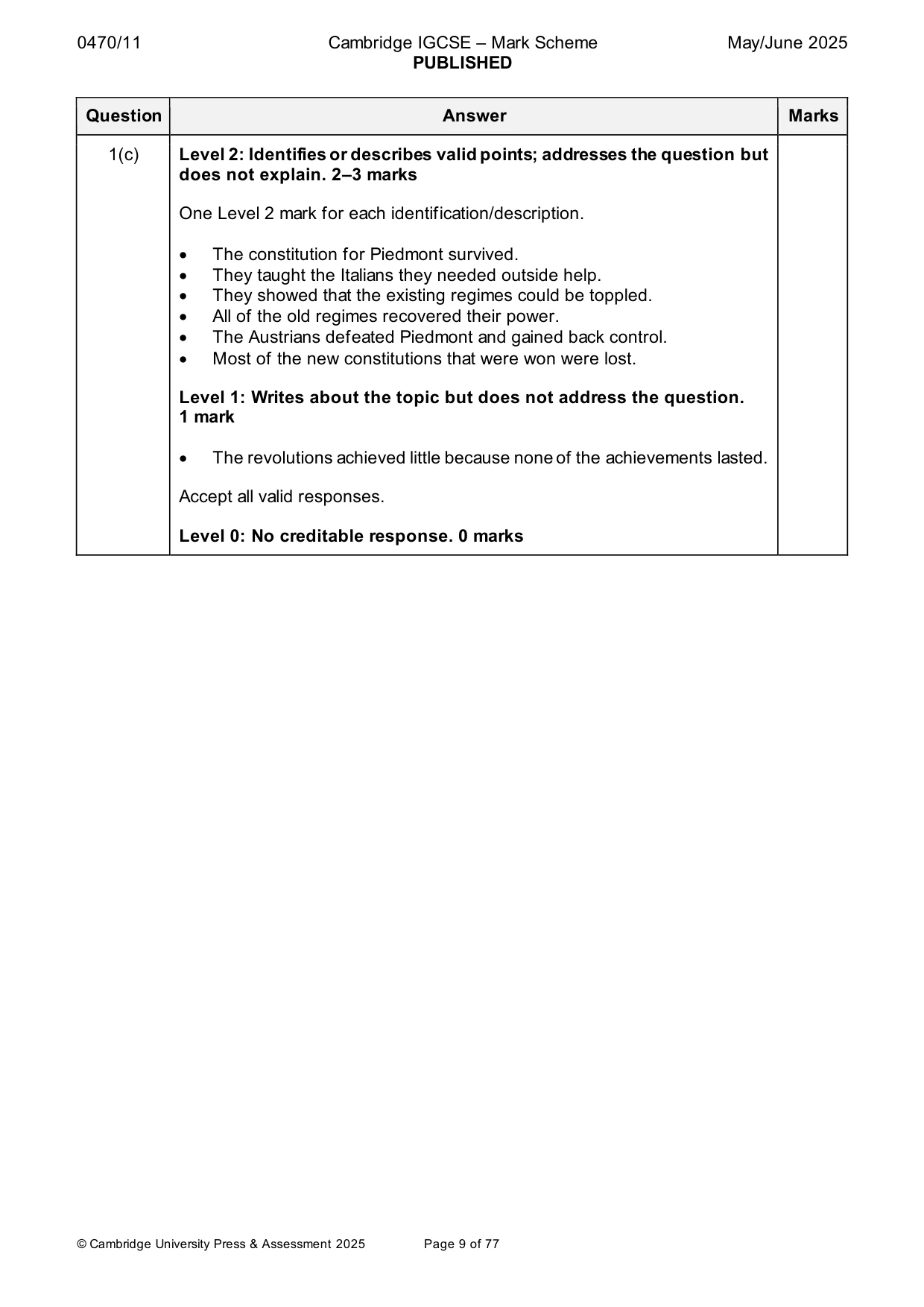
0470/11 Cambridge IGCSE – Mark Scheme PUBLISHED May/June 2025 © Cambridge University Press & Assessment 2025 Page 9 of 77 Question Answer Marks 1(c) Level 2: Identifies or describes valid points; addresses the question but does not explain. 2–3 marks One Level 2 mark for each identification/description. • The constitution for Piedmont survived. • They taught the Italians they needed outside help. • They showed that the existing regimes could be toppled. • All of the old regimes recovered their power. • The Austrians defeated Piedmont and gained back control. • Most of the new constitutions that were won were lost. Level 1: Writes about the topic but does not address the question. 1 mark • The revolutions achieved little because none of the achievements lasted. Accept all valid responses. Level 0: No creditable response. 0 marks
Mark scheme, page 10
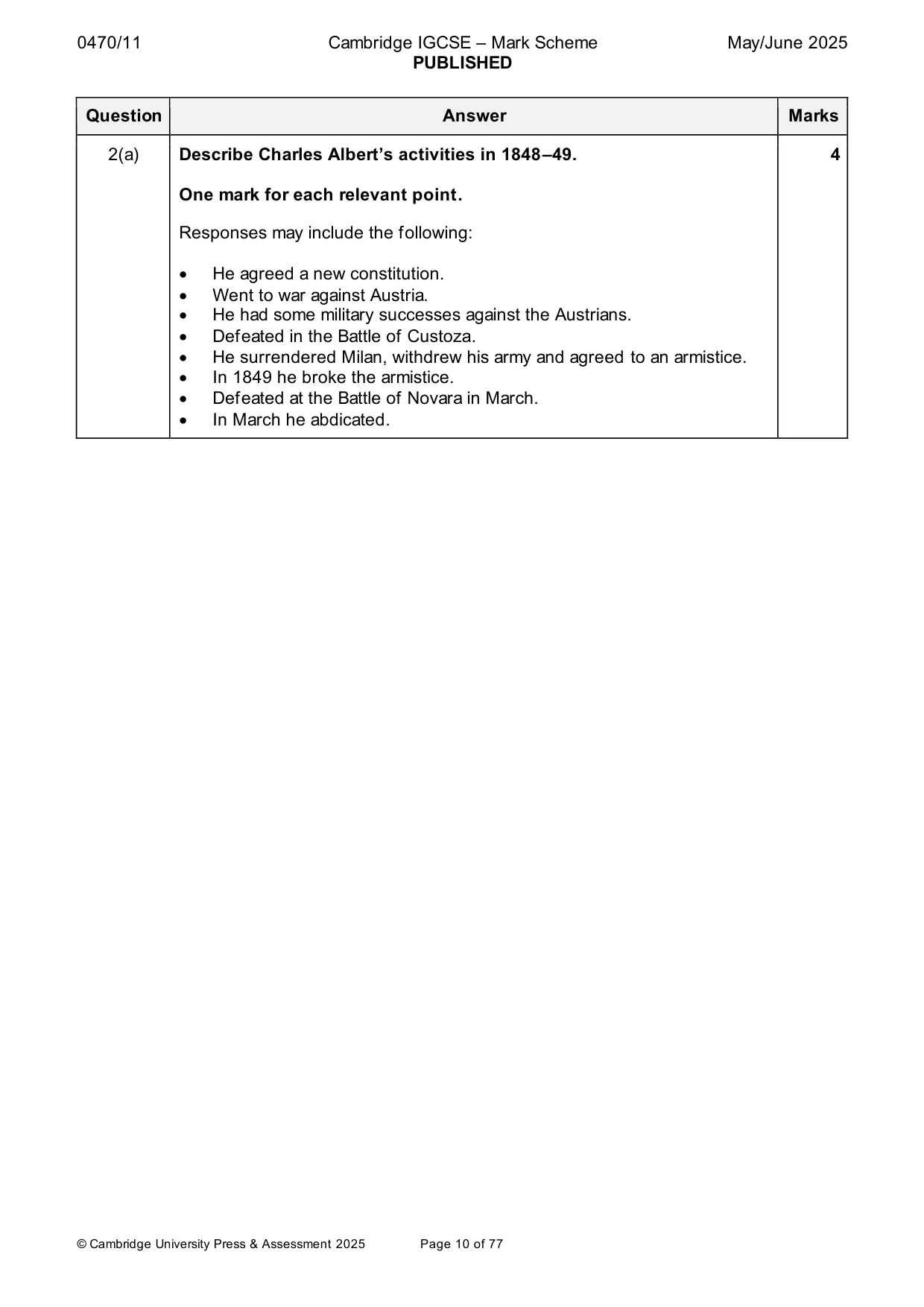
0470/11 Cambridge IGCSE – Mark Scheme PUBLISHED May/June 2025 © Cambridge University Press & Assessment 2025 Page 10 of 77 Question Answer Marks 2(a) Describe Charles Albert’s activities in 1848–49. One mark for each relevant point. Responses may include the following: • He agreed a new constitution. • Went to war against Austria. • He had some military successes against the Austrians. • Defeated in the Battle of Custoza. • He surrendered Milan, withdrew his army and agreed to an armistice. • In 1849 he broke the armistice. • Defeated at the Battle of Novara in March. • In March he abdicated. 4
Mark scheme, page 11
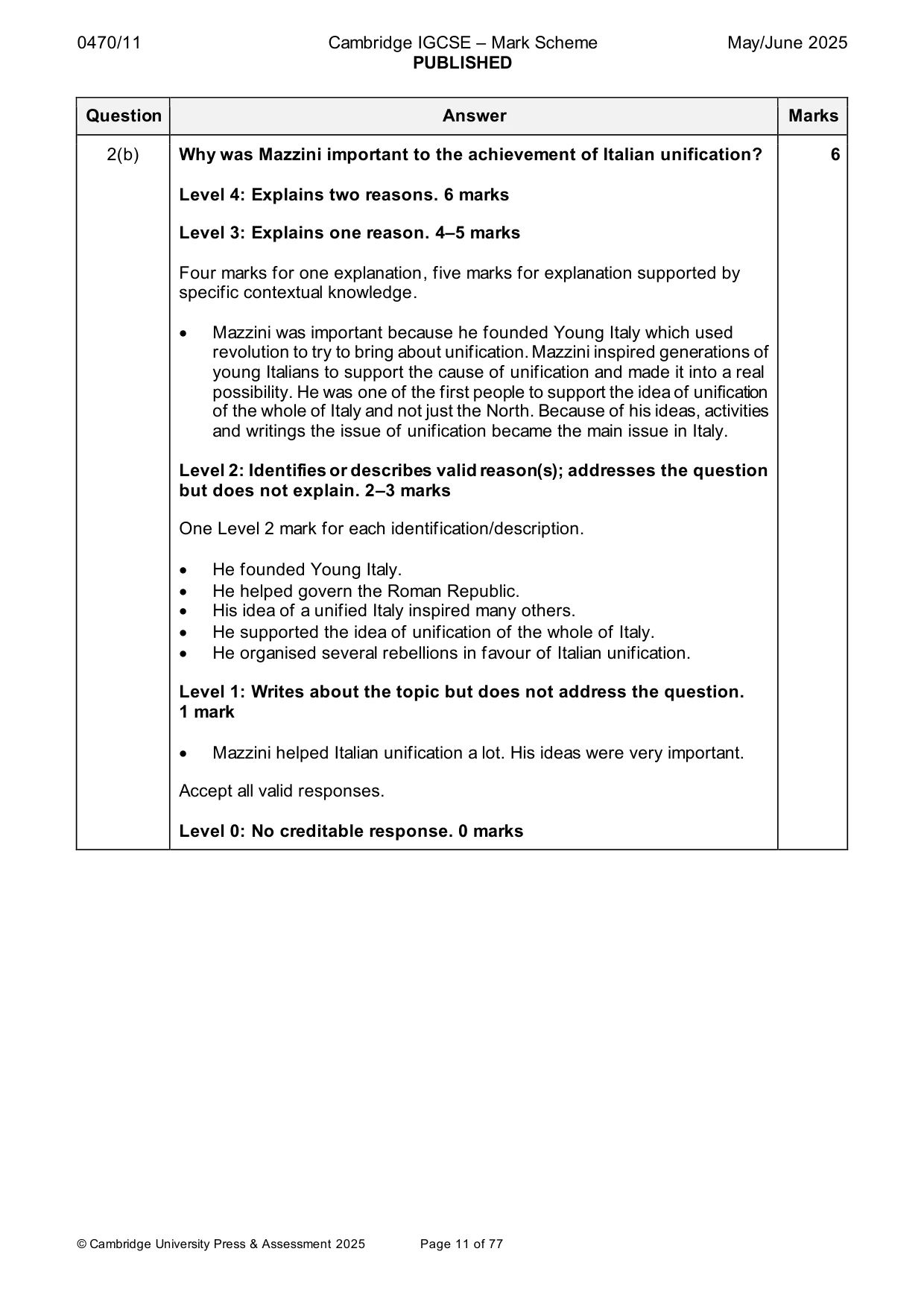
0470/11 Cambridge IGCSE – Mark Scheme PUBLISHED May/June 2025 © Cambridge University Press & Assessment 2025 Page 11 of 77 Question Answer Marks 2(b) Why was Mazzini important to the achievement of Italian unification? Level 4: Explains two reasons. 6 marks Level 3: Explains one reason. 4–5 marks Four marks for one explanation, five marks for explanation supported by specific contextual knowledge. • Mazzini was important because he founded Young Italy which used revolution to try to bring about unification. Mazzini inspired generations of young Italians to support the cause of unification and made it into a real possibility. He was one of the first people to support the idea of unification of the whole of Italy and not just the North. Because of his ideas, activities and writings the issue of unification became the main issue in Italy. Level 2: Identifies or describes valid reason(s); addresses the question but does not explain. 2–3 marks One Level 2 mark for each identification/description. • He founded Young Italy. • He helped govern the Roman Republic. • His idea of a unified Italy inspired many others. • He supported the idea of unification of the whole of Italy. • He organised several rebellions in favour of Italian unification. Level 1: Writes about the topic but does not address the question. 1 mark • Mazzini helped Italian unification a lot. His ideas were very important. Accept all valid responses. Level 0: No creditable response. 0 marks 6
Mark scheme, page 12
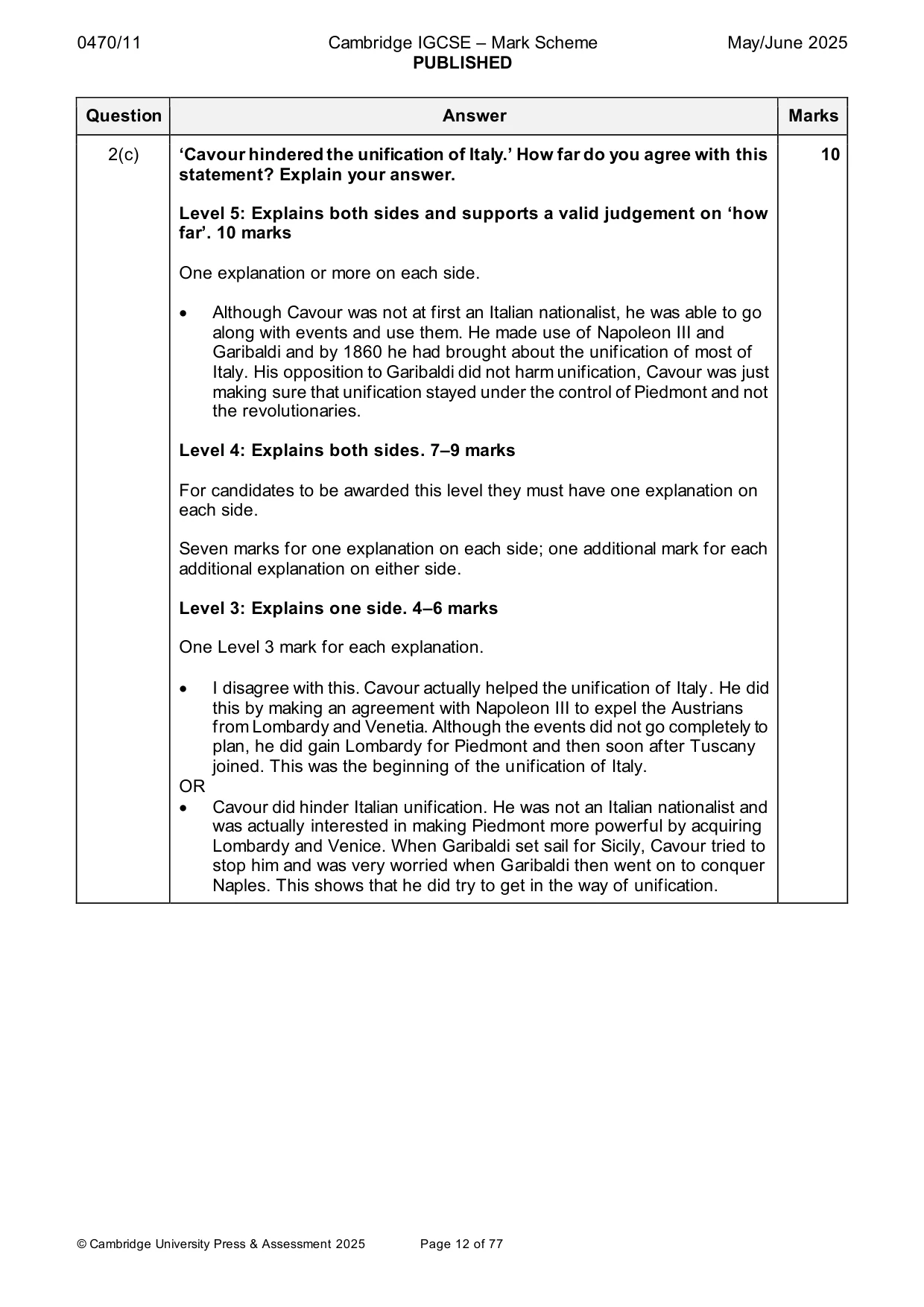
0470/11 Cambridge IGCSE – Mark Scheme PUBLISHED May/June 2025 © Cambridge University Press & Assessment 2025 Page 12 of 77 Question Answer Marks 2(c) ‘Cavour hindered the unification of Italy.’ How far do you agree with this statement? Explain your answer. Level 5: Explains both sides and supports a valid judgement on ‘how far’. 10 marks One explanation or more on each side. • Although Cavour was not at first an Italian nationalist, he was able to go along with events and use them. He made use of Napoleon III and Garibaldi and by 1860 he had brought about the unification of most of Italy. His opposition to Garibaldi did not harm unification, Cavour was just making sure that unification stayed under the control of Piedmont and not the revolutionaries. Level 4: Explains both sides. 7–9 marks For candidates to be awarded this level they must have one explanation on each side. Seven marks for one explanation on each side; one additional mark for each additional explanation on either side. Level 3: Explains one side. 4–6 marks One Level 3 mark for each explanation. • I disagree with this. Cavour actually helped the unification of Italy. He did this by making an agreement with Napoleon III to expel the Austrians from Lombardy and Venetia. Although the events did not go completely to plan, he did gain Lombardy for Piedmont and then soon after Tuscany joined. This was the beginning of the unification of Italy. OR • Cavour did hinder Italian unification. He was not an Italian nationalist and was actually interested in making Piedmont more powerful by acquiring Lombardy and Venice. When Garibaldi set sail for Sicily, Cavour tried to stop him and was very worried when Garibaldi then went on to conquer Naples. This shows that he did try to get in the way of unification. 10
Mark scheme, page 13
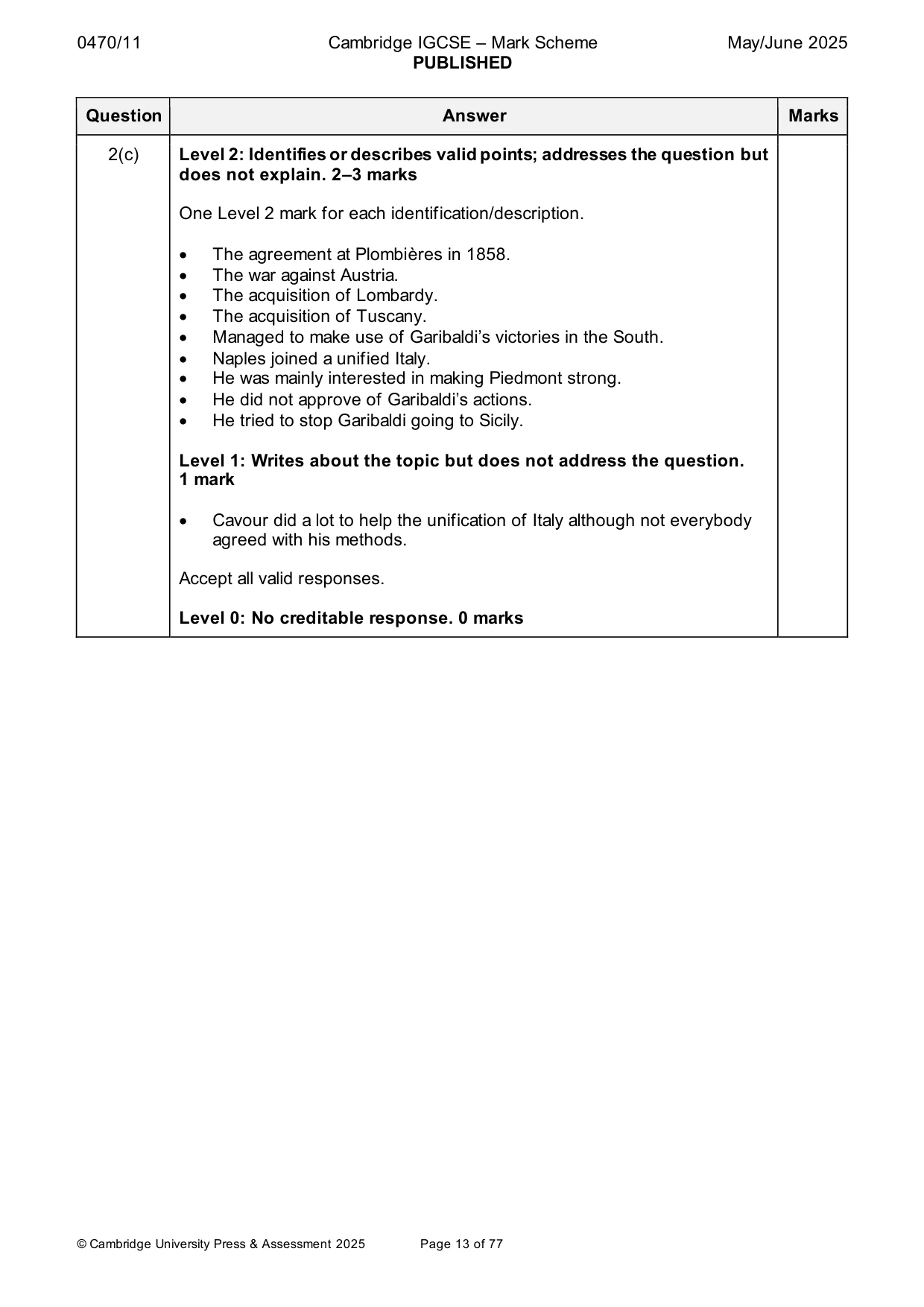
0470/11 Cambridge IGCSE – Mark Scheme PUBLISHED May/June 2025 © Cambridge University Press & Assessment 2025 Page 13 of 77 Question Answer Marks 2(c) Level 2: Identifies or describes valid points; addresses the question but does not explain. 2–3 marks One Level 2 mark for each identification/description. • The agreement at Plombières in 1858. • The war against Austria. • The acquisition of Lombardy. • The acquisition of Tuscany. • Managed to make use of Garibaldi’s victories in the South. • Naples joined a unified Italy. • He was mainly interested in making Piedmont strong. • He did not approve of Garibaldi’s actions. • He tried to stop Garibaldi going to Sicily. Level 1: Writes about the topic but does not address the question. 1 mark • Cavour did a lot to help the unification of Italy although not everybody agreed with his methods. Accept all valid responses. Level 0: No creditable response. 0 marks
Mark scheme, page 14
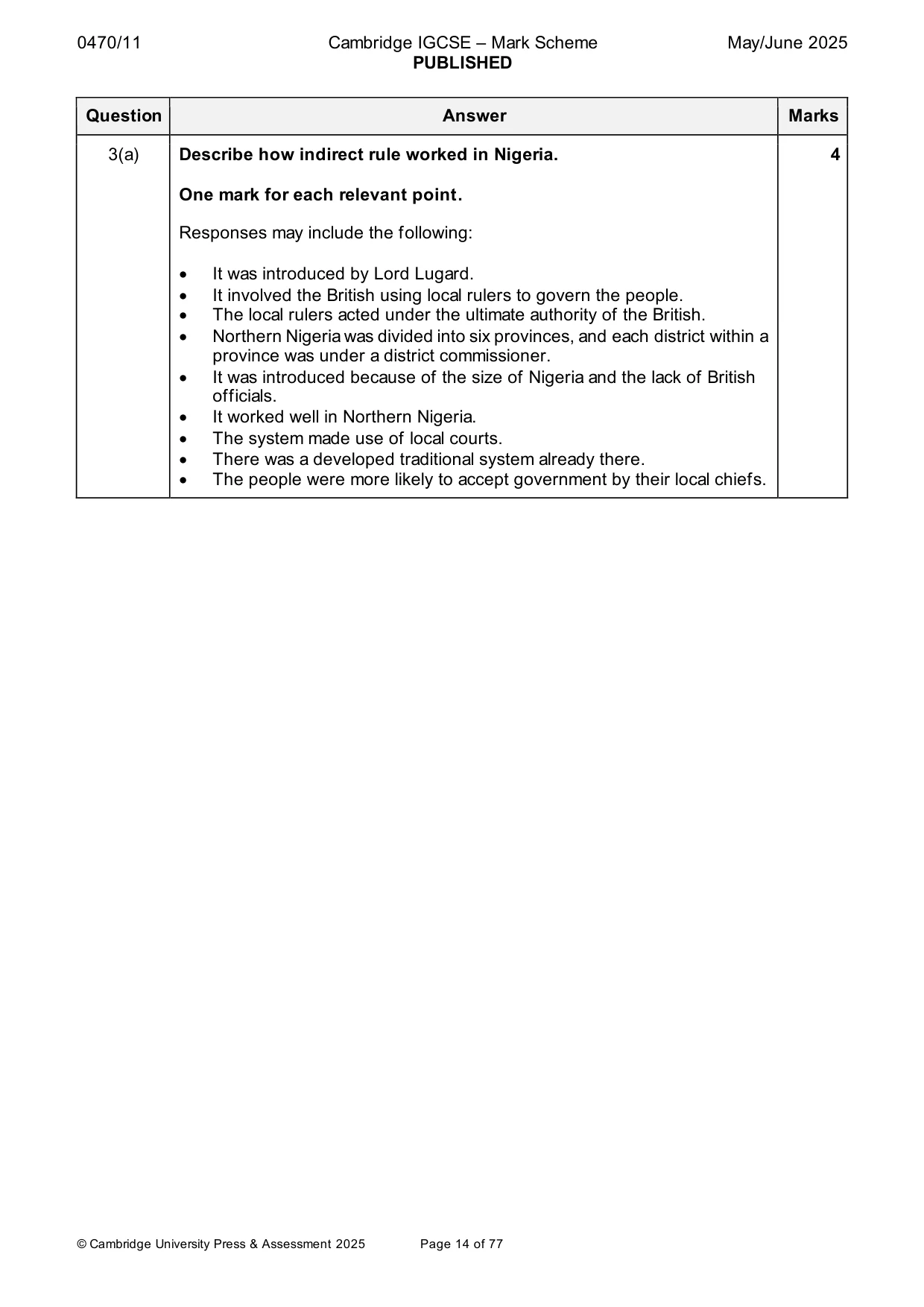
0470/11 Cambridge IGCSE – Mark Scheme PUBLISHED May/June 2025 © Cambridge University Press & Assessment 2025 Page 14 of 77 Question Answer Marks 3(a) Describe how indirect rule worked in Nigeria. One mark for each relevant point. Responses may include the following: • It was introduced by Lord Lugard. • It involved the British using local rulers to govern the people. • The local rulers acted under the ultimate authority of the British. • Northern Nigeria was divided into six provinces, and each district within a province was under a district commissioner. • It was introduced because of the size of Nigeria and the lack of British officials. • It worked well in Northern Nigeria. • The system made use of local courts. • There was a developed traditional system already there. • The people were more likely to accept government by their local chiefs. 4
Mark scheme, page 15
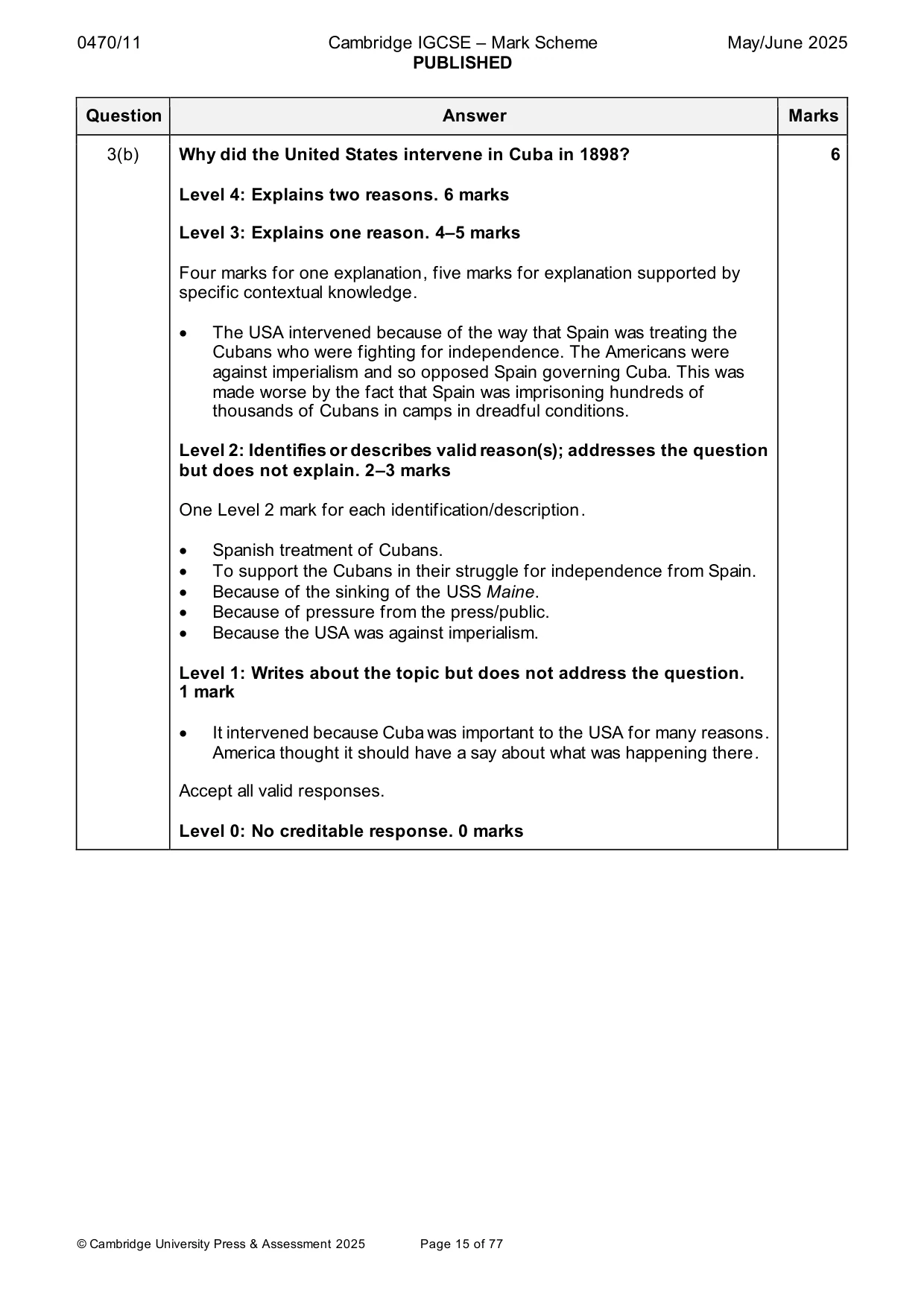
0470/11 Cambridge IGCSE – Mark Scheme PUBLISHED May/June 2025 © Cambridge University Press & Assessment 2025 Page 15 of 77 Question Answer Marks 3(b) Why did the United States intervene in Cuba in 1898? Level 4: Explains two reasons. 6 marks Level 3: Explains one reason. 4–5 marks Four marks for one explanation, five marks for explanation supported by specific contextual knowledge. • The USA intervened because of the way that Spain was treating the Cubans who were fighting for independence. The Americans were against imperialism and so opposed Spain governing Cuba. This was made worse by the fact that Spain was imprisoning hundreds of thousands of Cubans in camps in dreadful conditions. Level 2: Identifies or describes valid reason(s); addresses the question but does not explain. 2–3 marks One Level 2 mark for each identification/description. • Spanish treatment of Cubans. • To support the Cubans in their struggle for independence from Spain. • Because of the sinking of the USS Maine. • Because of pressure from the press/public. • Because the USA was against imperialism. Level 1: Writes about the topic but does not address the question. 1 mark • It intervened because Cuba was important to the USA for many reasons. America thought it should have a say about what was happening there. Accept all valid responses. Level 0: No creditable response. 0 marks 6
Mark scheme, page 16
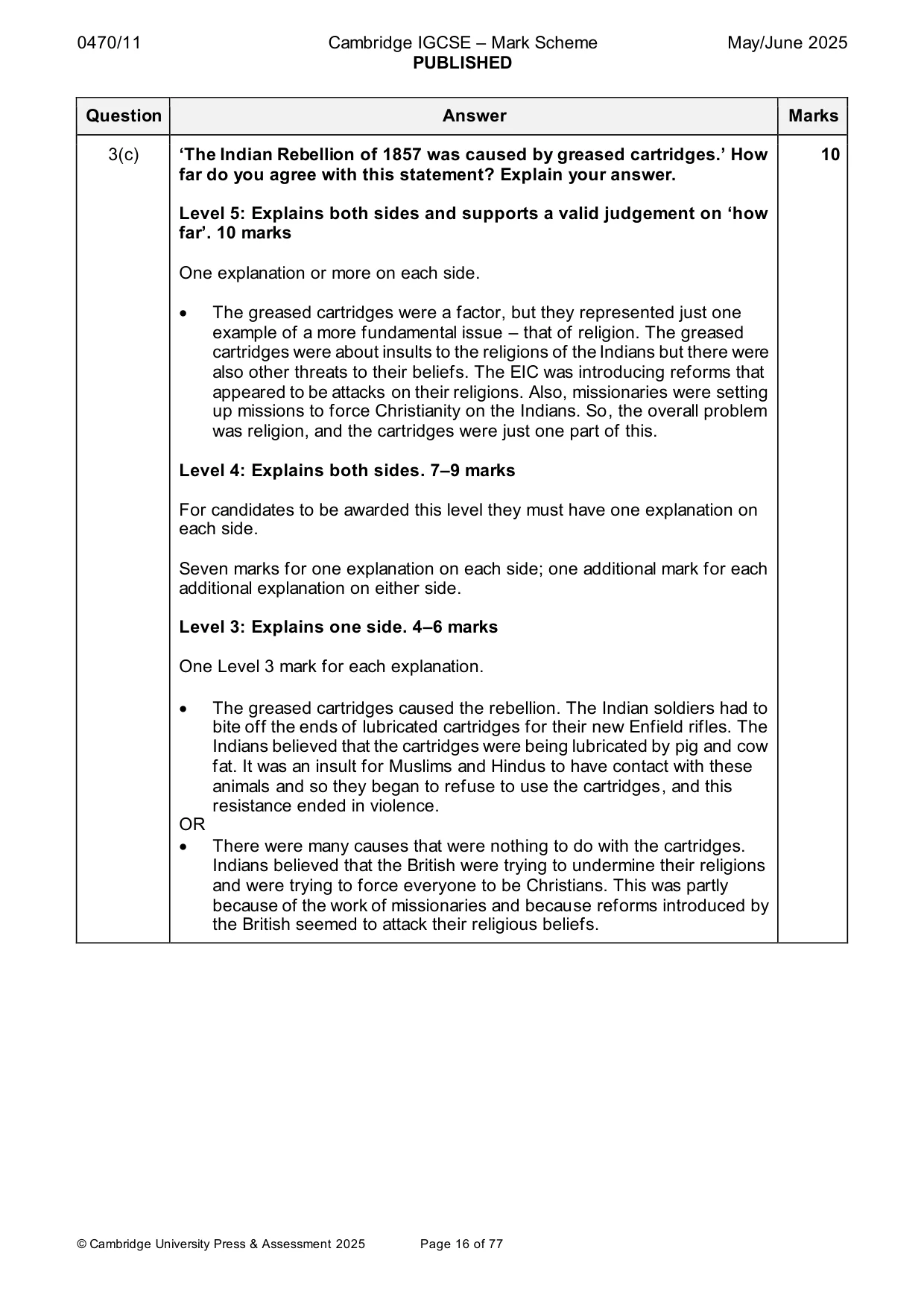
0470/11 Cambridge IGCSE – Mark Scheme PUBLISHED May/June 2025 © Cambridge University Press & Assessment 2025 Page 16 of 77 Question Answer Marks 3(c) ‘The Indian Rebellion of 1857 was caused by greased cartridges.’ How far do you agree with this statement? Explain your answer. Level 5: Explains both sides and supports a valid judgement on ‘how far’. 10 marks One explanation or more on each side. • The greased cartridges were a factor, but they represented just one example of a more fundamental issue – that of religion. The greased cartridges were about insults to the religions of the Indians but there were also other threats to their beliefs. The EIC was introducing reforms that appeared to be attacks on their religions. Also, missionaries were setting up missions to force Christianity on the Indians. So, the overall problem was religion, and the cartridges were just one part of this. Level 4: Explains both sides. 7–9 marks For candidates to be awarded this level they must have one explanation on each side. Seven marks for one explanation on each side; one additional mark for each additional explanation on either side. Level 3: Explains one side. 4–6 marks One Level 3 mark for each explanation. • The greased cartridges caused the rebellion. The Indian soldiers had to bite off the ends of lubricated cartridges for their new Enfield rifles. The Indians believed that the cartridges were being lubricated by pig and cow fat. It was an insult for Muslims and Hindus to have contact with these animals and so they began to refuse to use the cartridges, and this resistance ended in violence. OR • There were many causes that were nothing to do with the cartridges. Indians believed that the British were trying to undermine their religions and were trying to force everyone to be Christians. This was partly because of the work of missionaries and because reforms introduced by the British seemed to attack their religious beliefs. 10
Mark scheme, page 17
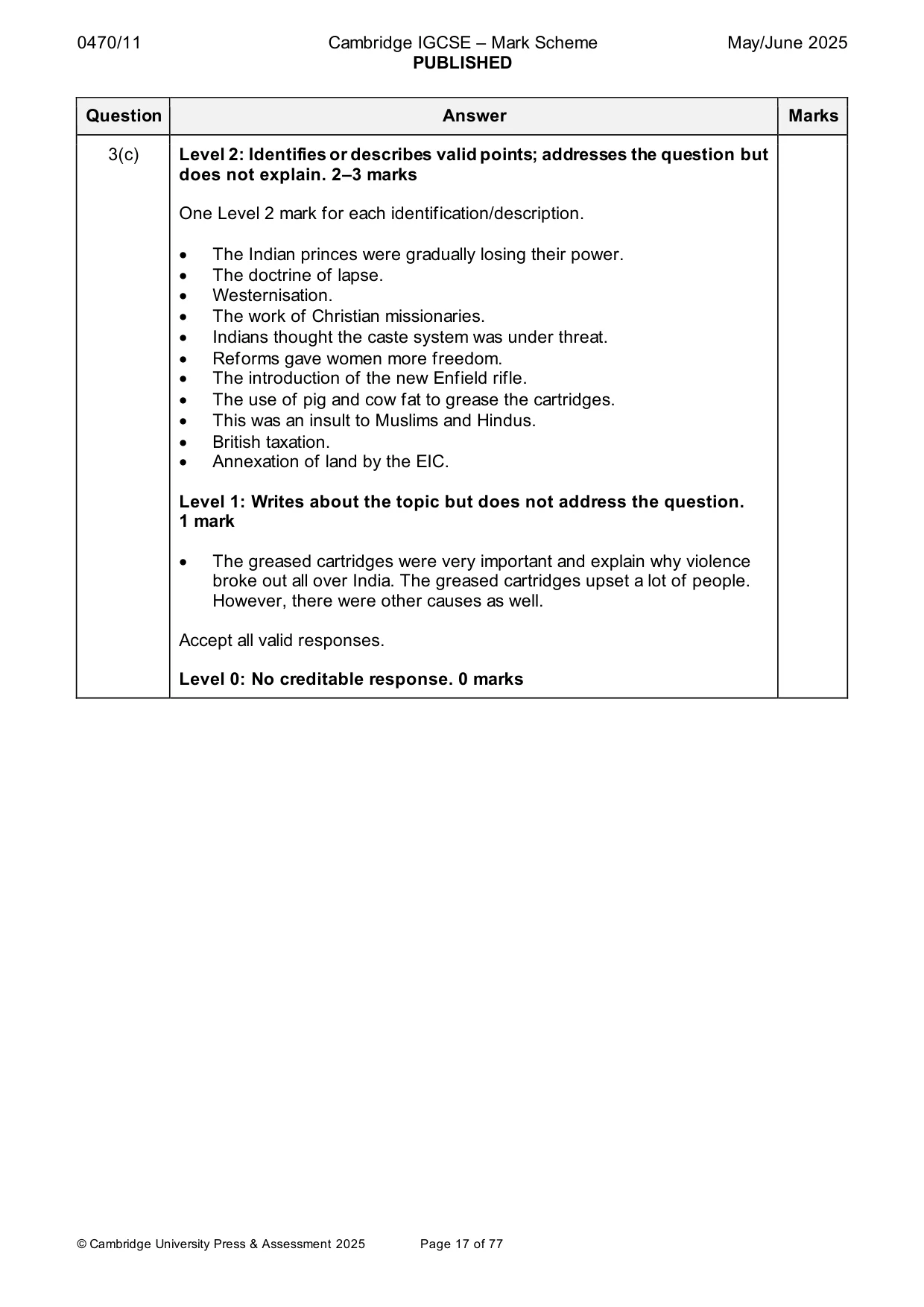
0470/11 Cambridge IGCSE – Mark Scheme PUBLISHED May/June 2025 © Cambridge University Press & Assessment 2025 Page 17 of 77 Question Answer Marks 3(c) Level 2: Identifies or describes valid points; addresses the question but does not explain. 2–3 marks One Level 2 mark for each identification/description. • The Indian princes were gradually losing their power. • The doctrine of lapse. • Westernisation. • The work of Christian missionaries. • Indians thought the caste system was under threat. • Reforms gave women more freedom. • The introduction of the new Enfield rifle. • The use of pig and cow fat to grease the cartridges. • This was an insult to Muslims and Hindus. • British taxation. • Annexation of land by the EIC. Level 1: Writes about the topic but does not address the question. 1 mark • The greased cartridges were very important and explain why violence broke out all over India. The greased cartridges upset a lot of people. However, there were other causes as well. Accept all valid responses. Level 0: No creditable response. 0 marks
Mark scheme, page 18
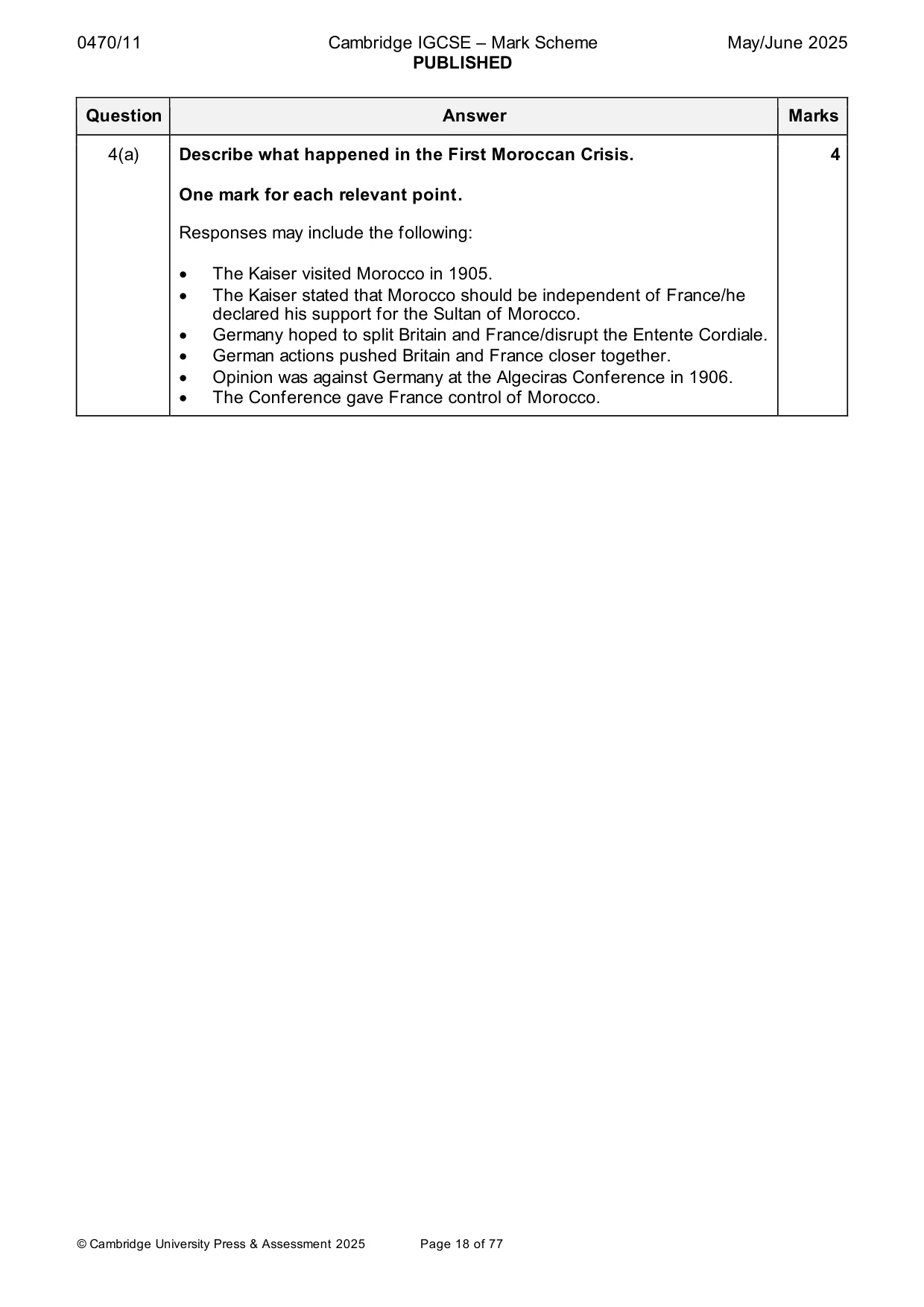
0470/11 Cambridge IGCSE – Mark Scheme PUBLISHED May/June 2025 © Cambridge University Press & Assessment 2025 Page 18 of 77 Question Answer Marks 4(a) Describe what happened in the First Moroccan Crisis. One mark for each relevant point. Responses may include the following: • The Kaiser visited Morocco in 1905. • The Kaiser stated that Morocco should be independent of France/he declared his support for the Sultan of Morocco. • Germany hoped to split Britain and France/disrupt the Entente Cordiale. • German actions pushed Britain and France closer together. • Opinion was against Germany at the Algeciras Conference in 1906. • The Conference gave France control of Morocco. 4
Mark scheme, page 19
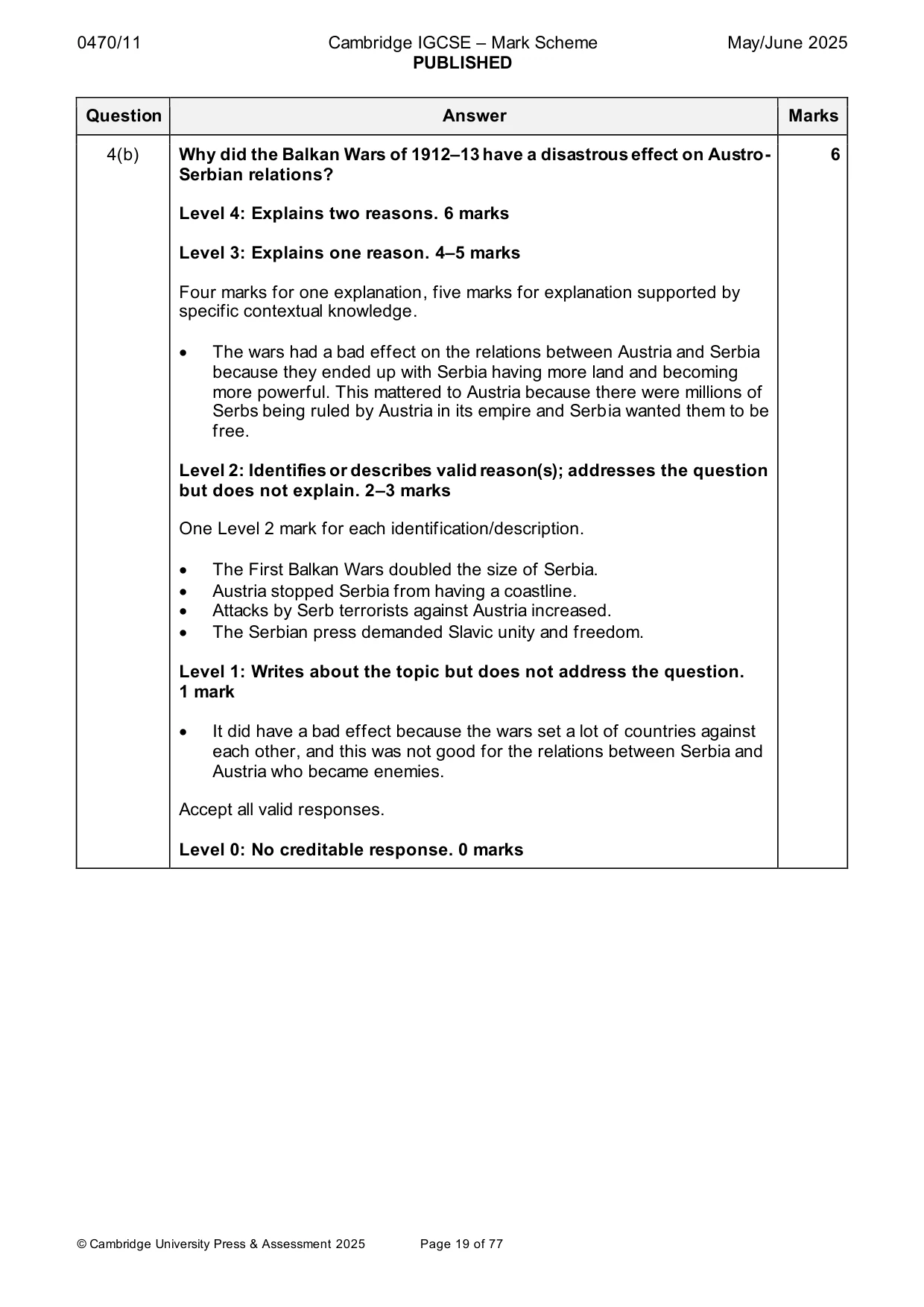
0470/11 Cambridge IGCSE – Mark Scheme PUBLISHED May/June 2025 © Cambridge University Press & Assessment 2025 Page 19 of 77 Question Answer Marks 4(b) Why did the Balkan Wars of 1912–13 have a disastrous effect on Austro- Serbian relations? Level 4: Explains two reasons. 6 marks Level 3: Explains one reason. 4–5 marks Four marks for one explanation, five marks for explanation supported by specific contextual knowledge. • The wars had a bad effect on the relations between Austria and Serbia because they ended up with Serbia having more land and becoming more powerful. This mattered to Austria because there were millions of Serbs being ruled by Austria in its empire and Serbia wanted them to be free. Level 2: Identifies or describes valid reason(s); addresses the question but does not explain. 2–3 marks One Level 2 mark for each identification/description. • The First Balkan Wars doubled the size of Serbia. • Austria stopped Serbia from having a coastline. • Attacks by Serb terrorists against Austria increased. • The Serbian press demanded Slavic unity and freedom. Level 1: Writes about the topic but does not address the question. 1 mark • It did have a bad effect because the wars set a lot of countries against each other, and this was not good for the relations between Serbia and Austria who became enemies. Accept all valid responses. Level 0: No creditable response. 0 marks 6
Mark scheme, page 20
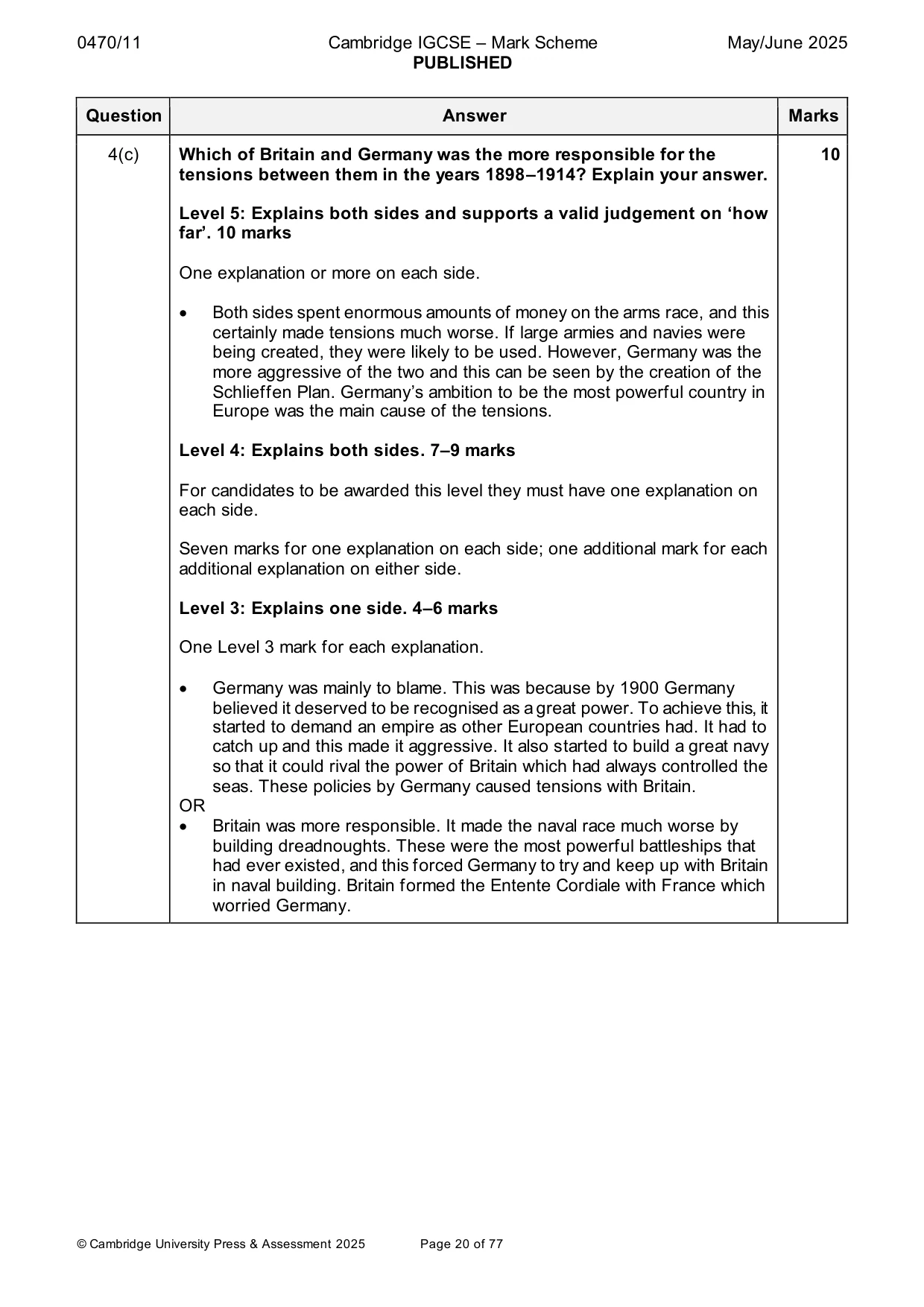
0470/11 Cambridge IGCSE – Mark Scheme PUBLISHED May/June 2025 © Cambridge University Press & Assessment 2025 Page 20 of 77 Question Answer Marks 4(c) Which of Britain and Germany was the more responsible for the tensions between them in the years 1898–1914? Explain your answer. Level 5: Explains both sides and supports a valid judgement on ‘how far’. 10 marks One explanation or more on each side. • Both sides spent enormous amounts of money on the arms race, and this certainly made tensions much worse. If large armies and navies were being created, they were likely to be used. However, Germany was the more aggressive of the two and this can be seen by the creation of the Schlieffen Plan. Germany’s ambition to be the most powerful country in Europe was the main cause of the tensions. Level 4: Explains both sides. 7–9 marks For candidates to be awarded this level they must have one explanation on each side. Seven marks for one explanation on each side; one additional mark for each additional explanation on either side. Level 3: Explains one side. 4–6 marks One Level 3 mark for each explanation. • Germany was mainly to blame. This was because by 1900 Germany believed it deserved to be recognised as a great power. To achieve this, it started to demand an empire as other European countries had. It had to catch up and this made it aggressive. It also started to build a great navy so that it could rival the power of Britain which had always controlled the seas. These policies by Germany caused tensions with Britain. OR • Britain was more responsible. It made the naval race much worse by building dreadnoughts. These were the most powerful battleships that had ever existed, and this forced Germany to try and keep up with Britain in naval building. Britain formed the Entente Cordiale with France which worried Germany. 10
Mark scheme, page 21
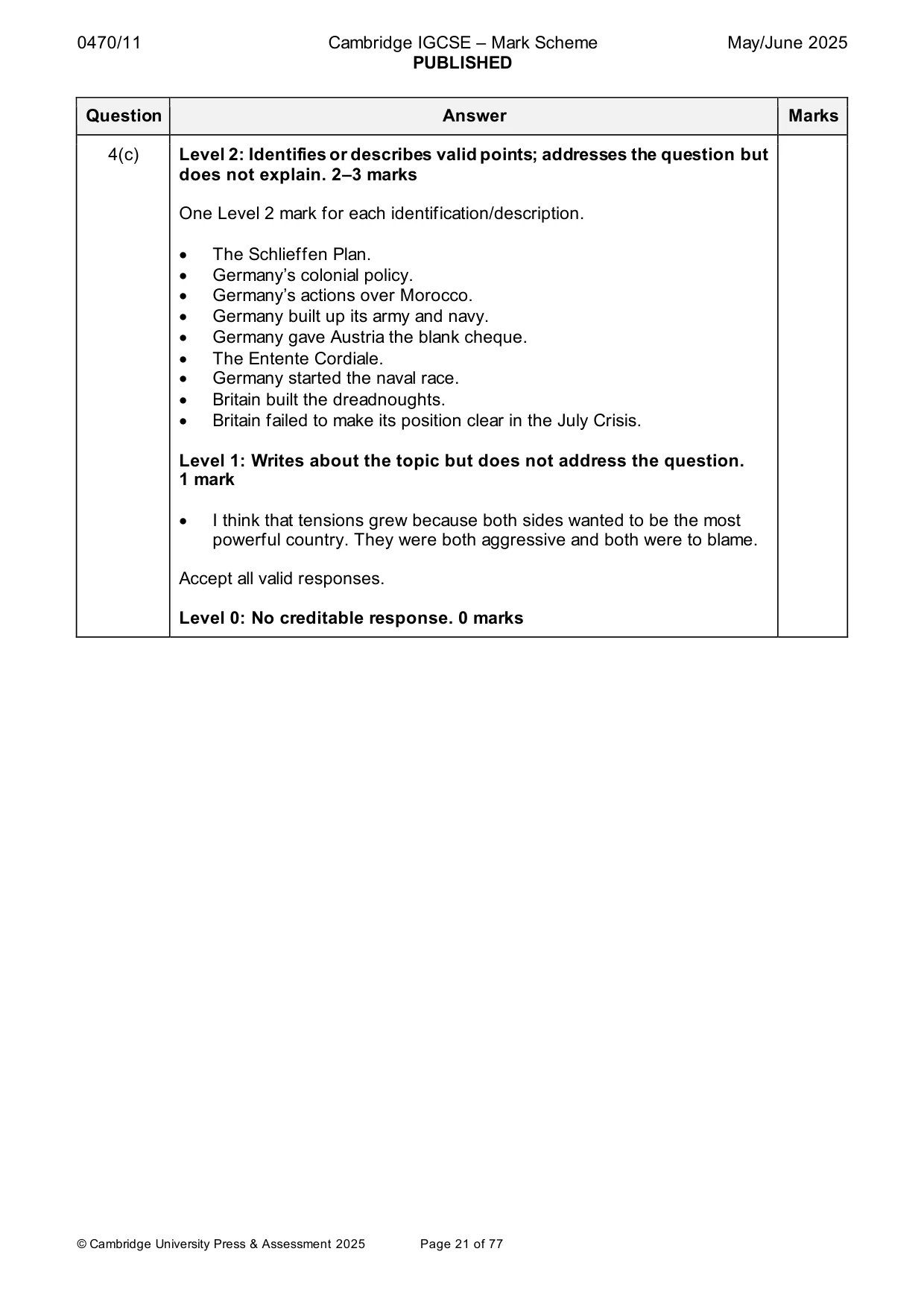
0470/11 Cambridge IGCSE – Mark Scheme PUBLISHED May/June 2025 © Cambridge University Press & Assessment 2025 Page 21 of 77 Question Answer Marks 4(c) Level 2: Identifies or describes valid points; addresses the question but does not explain. 2–3 marks One Level 2 mark for each identification/description. • The Schlieffen Plan. • Germany’s colonial policy. • Germany’s actions over Morocco. • Germany built up its army and navy. • Germany gave Austria the blank cheque. • The Entente Cordiale. • Germany started the naval race. • Britain built the dreadnoughts. • Britain failed to make its position clear in the July Crisis. Level 1: Writes about the topic but does not address the question. 1 mark • I think that tensions grew because both sides wanted to be the most powerful country. They were both aggressive and both were to blame. Accept all valid responses. Level 0: No creditable response. 0 marks
Mark scheme, page 22
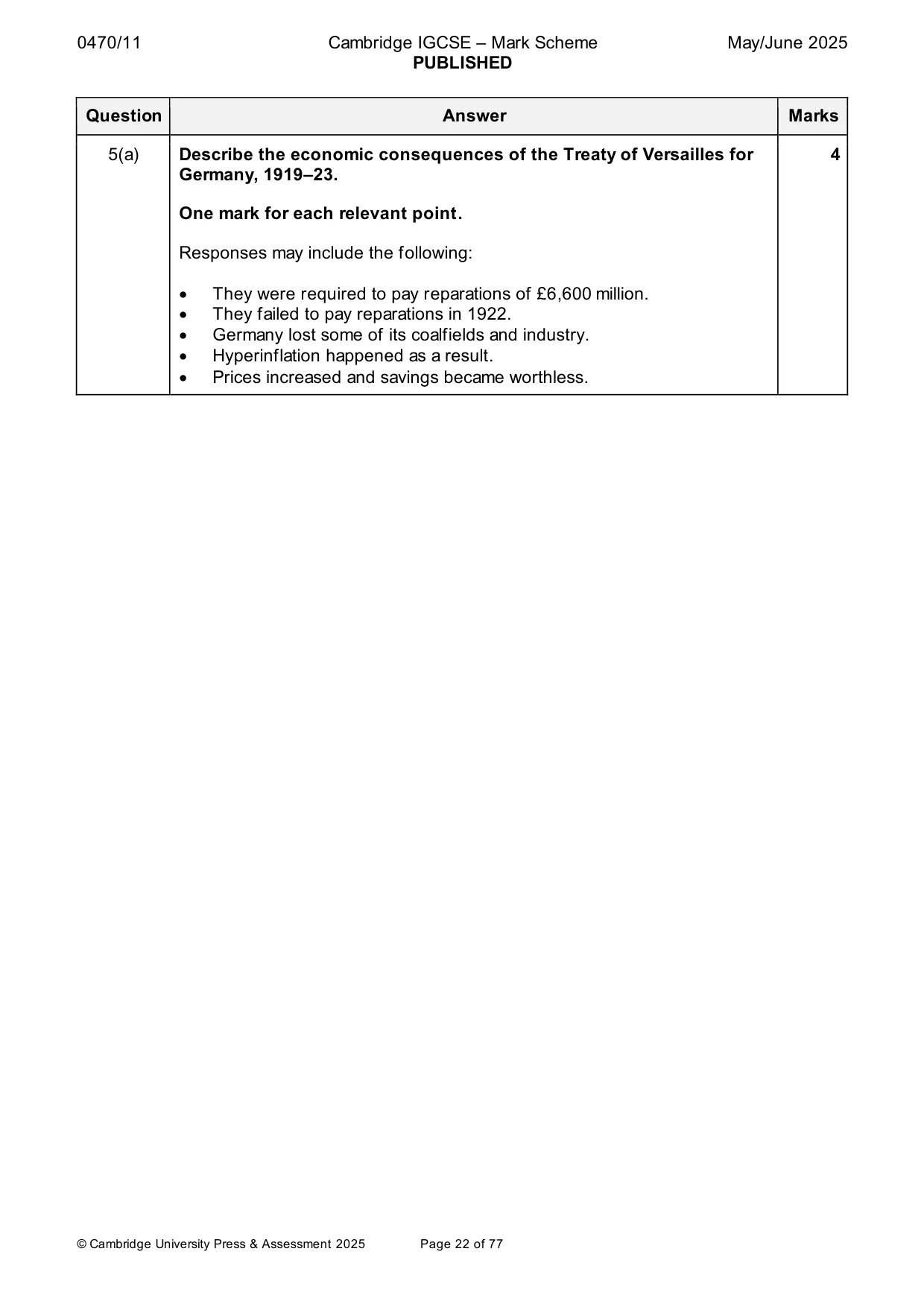
0470/11 Cambridge IGCSE – Mark Scheme PUBLISHED May/June 2025 © Cambridge University Press & Assessment 2025 Page 22 of 77 Question Answer Marks 5(a) Describe the economic consequences of the Treaty of Versailles for Germany, 1919–23. One mark for each relevant point. Responses may include the following: • They were required to pay reparations of £6,600 million. • They failed to pay reparations in 1922. • Germany lost some of its coalfields and industry. • Hyperinflation happened as a result. • Prices increased and savings became worthless. 4
Mark scheme, page 23
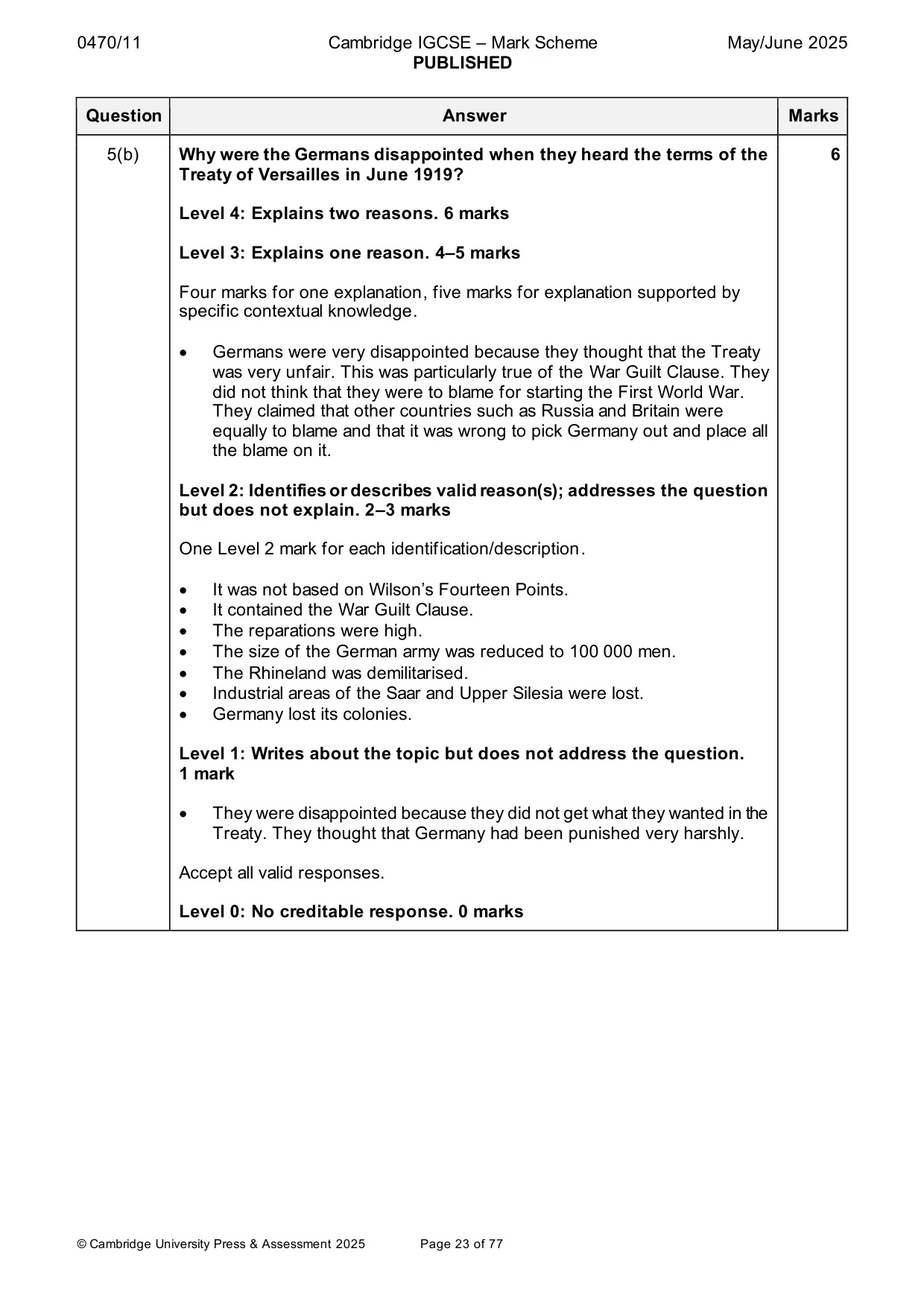
0470/11 Cambridge IGCSE – Mark Scheme PUBLISHED May/June 2025 © Cambridge University Press & Assessment 2025 Page 23 of 77 Question Answer Marks 5(b) Why were the Germans disappointed when they heard the terms of the Treaty of Versailles in June 1919? Level 4: Explains two reasons. 6 marks Level 3: Explains one reason. 4–5 marks Four marks for one explanation, five marks for explanation supported by specific contextual knowledge. • Germans were very disappointed because they thought that the Treaty was very unfair. This was particularly true of the War Guilt Clause. They did not think that they were to blame for starting the First World War. They claimed that other countries such as Russia and Britain were equally to blame and that it was wrong to pick Germany out and place all the blame on it. Level 2: Identifies or describes valid reason(s); addresses the question but does not explain. 2–3 marks One Level 2 mark for each identification/description. • It was not based on Wilson’s Fourteen Points. • It contained the War Guilt Clause. • The reparations were high. • The size of the German army was reduced to 100 000 men. • The Rhineland was demilitarised. • Industrial areas of the Saar and Upper Silesia were lost. • Germany lost its colonies. Level 1: Writes about the topic but does not address the question. 1 mark • They were disappointed because they did not get what they wanted in the Treaty. They thought that Germany had been punished very harshly. Accept all valid responses. Level 0: No creditable response. 0 marks 6
Mark scheme, page 24
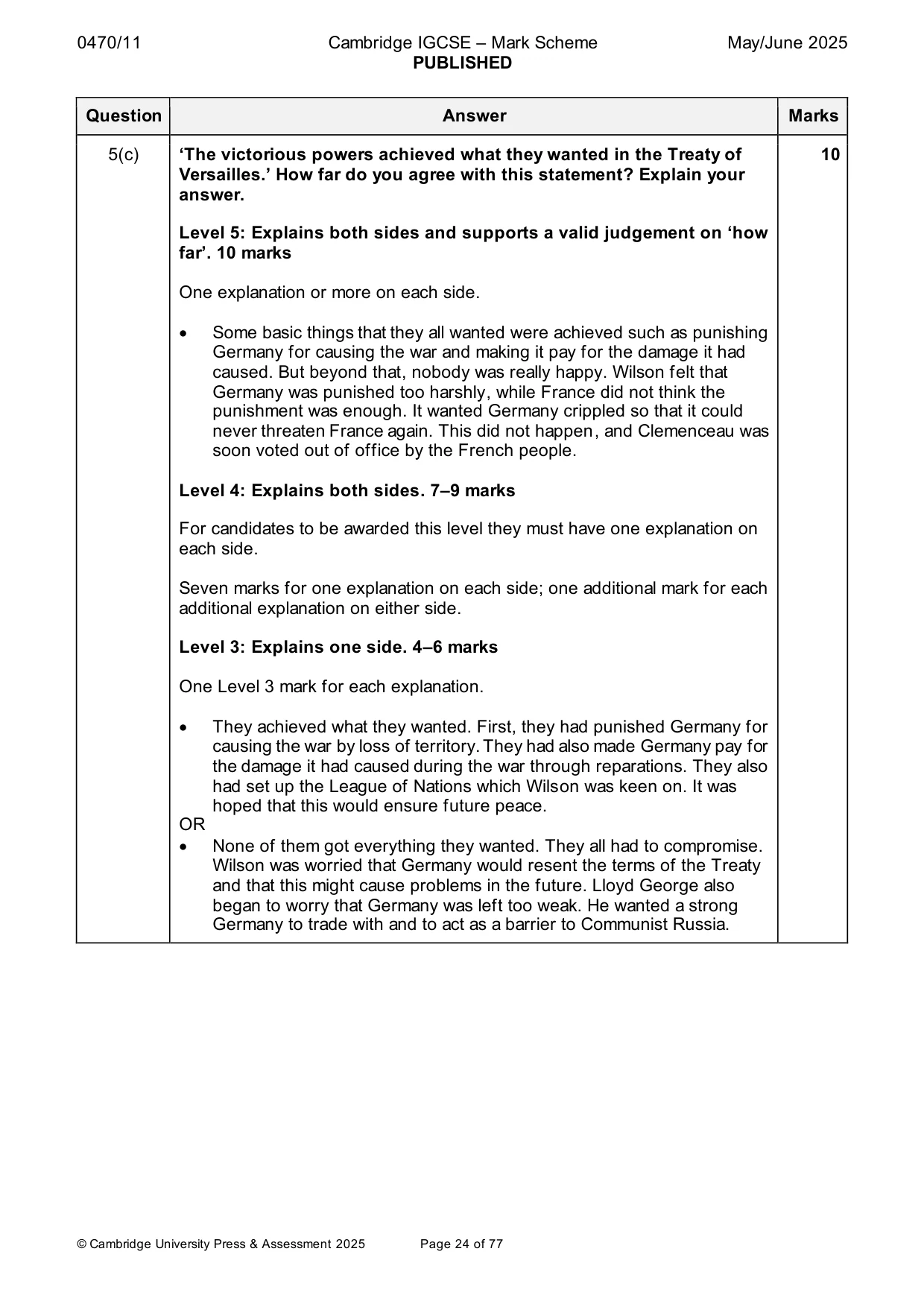
0470/11 Cambridge IGCSE – Mark Scheme PUBLISHED May/June 2025 © Cambridge University Press & Assessment 2025 Page 24 of 77 Question Answer Marks 5(c) ‘The victorious powers achieved what they wanted in the Treaty of Versailles.’ How far do you agree with this statement? Explain your answer. Level 5: Explains both sides and supports a valid judgement on ‘how far’. 10 marks One explanation or more on each side. • Some basic things that they all wanted were achieved such as punishing Germany for causing the war and making it pay for the damage it had caused. But beyond that, nobody was really happy. Wilson felt that Germany was punished too harshly, while France did not think the punishment was enough. It wanted Germany crippled so that it could never threaten France again. This did not happen, and Clemenceau was soon voted out of office by the French people. Level 4: Explains both sides. 7–9 marks For candidates to be awarded this level they must have one explanation on each side. Seven marks for one explanation on each side; one additional mark for each additional explanation on either side. Level 3: Explains one side. 4–6 marks One Level 3 mark for each explanation. • They achieved what they wanted. First, they had punished Germany for causing the war by loss of territory. They had also made Germany pay for the damage it had caused during the war through reparations. They also had set up the League of Nations which Wilson was keen on. It was hoped that this would ensure future peace. OR • None of them got everything they wanted. They all had to compromise. Wilson was worried that Germany would resent the terms of the Treaty and that this might cause problems in the future. Lloyd George also began to worry that Germany was left too weak. He wanted a strong Germany to trade with and to act as a barrier to Communist Russia. 10
Mark scheme, page 25
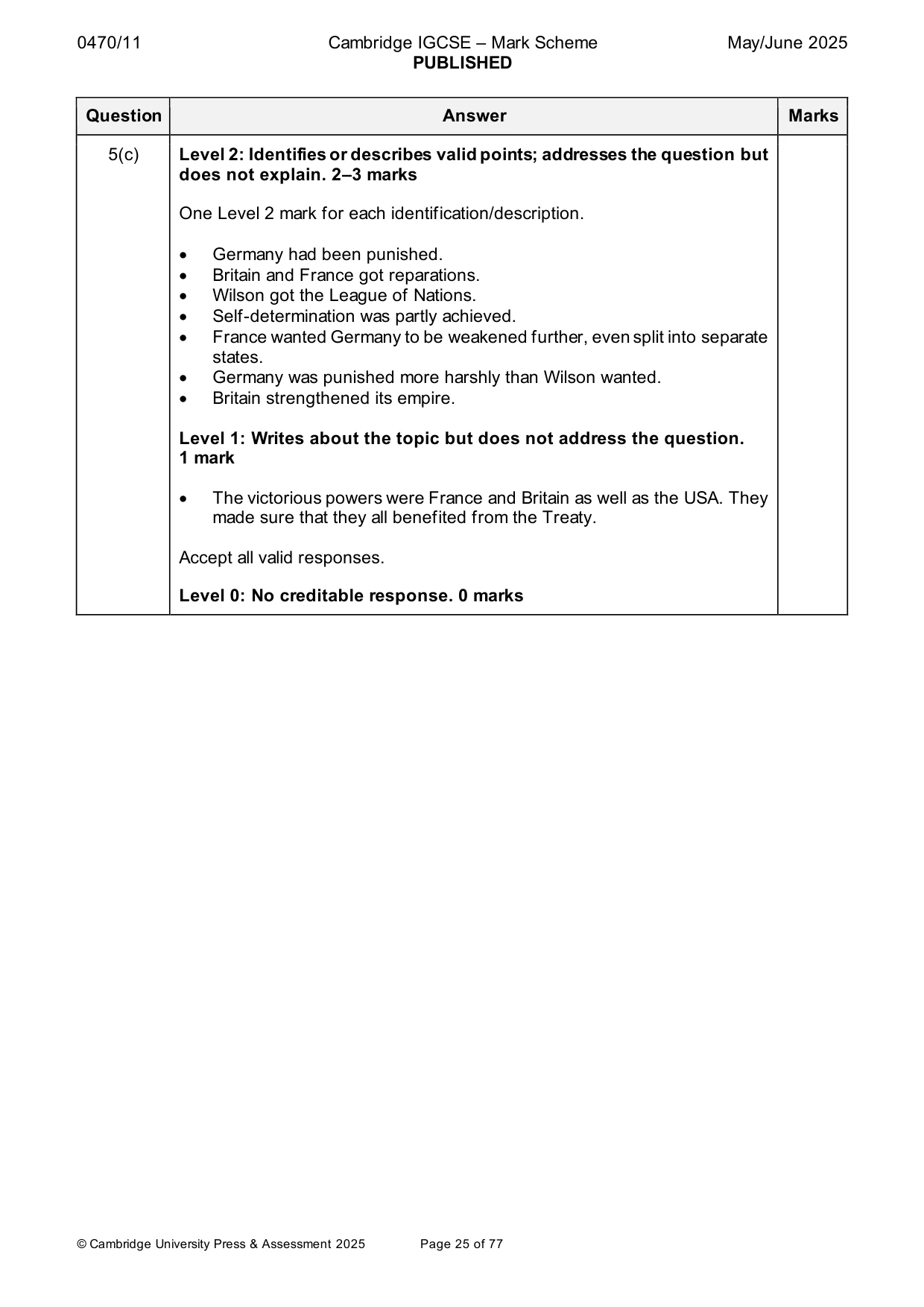
0470/11 Cambridge IGCSE – Mark Scheme PUBLISHED May/June 2025 © Cambridge University Press & Assessment 2025 Page 25 of 77 Question Answer Marks 5(c) Level 2: Identifies or describes valid points; addresses the question but does not explain. 2–3 marks One Level 2 mark for each identification/description. • Germany had been punished. • Britain and France got reparations. • Wilson got the League of Nations. • Self-determination was partly achieved. • France wanted Germany to be weakened further, even split into separate states. • Germany was punished more harshly than Wilson wanted. • Britain strengthened its empire. Level 1: Writes about the topic but does not address the question. 1 mark • The victorious powers were France and Britain as well as the USA. They made sure that they all benefited from the Treaty. Accept all valid responses. Level 0: No creditable response. 0 marks
Mark scheme, page 26
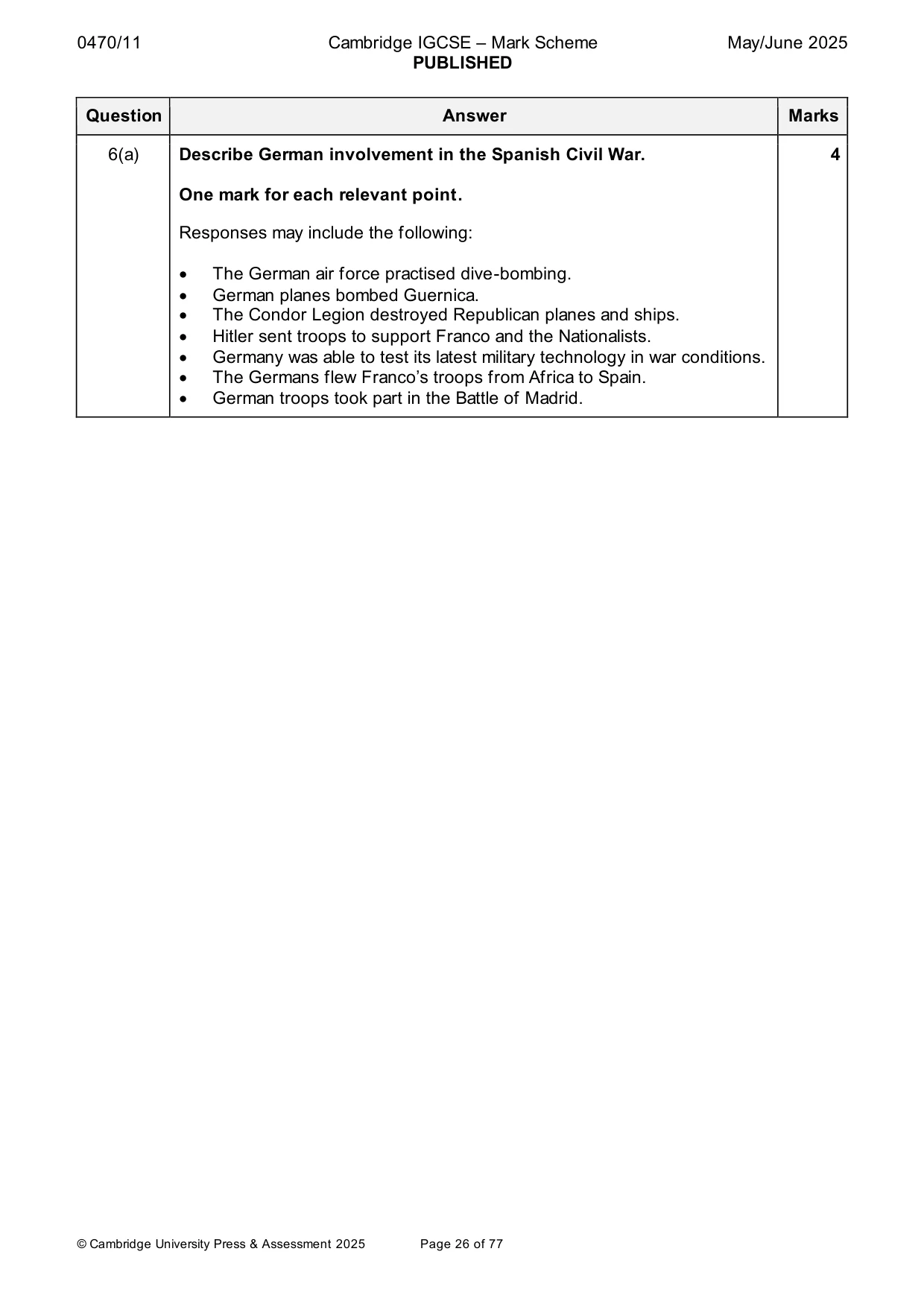
0470/11 Cambridge IGCSE – Mark Scheme PUBLISHED May/June 2025 © Cambridge University Press & Assessment 2025 Page 26 of 77 Question Answer Marks 6(a) Describe German involvement in the Spanish Civil War. One mark for each relevant point. Responses may include the following: • The German air force practised dive-bombing. • German planes bombed Guernica. • The Condor Legion destroyed Republican planes and ships. • Hitler sent troops to support Franco and the Nationalists. • Germany was able to test its latest military technology in war conditions. • The Germans flew Franco’s troops from Africa to Spain. • German troops took part in the Battle of Madrid. 4
Mark scheme, page 27
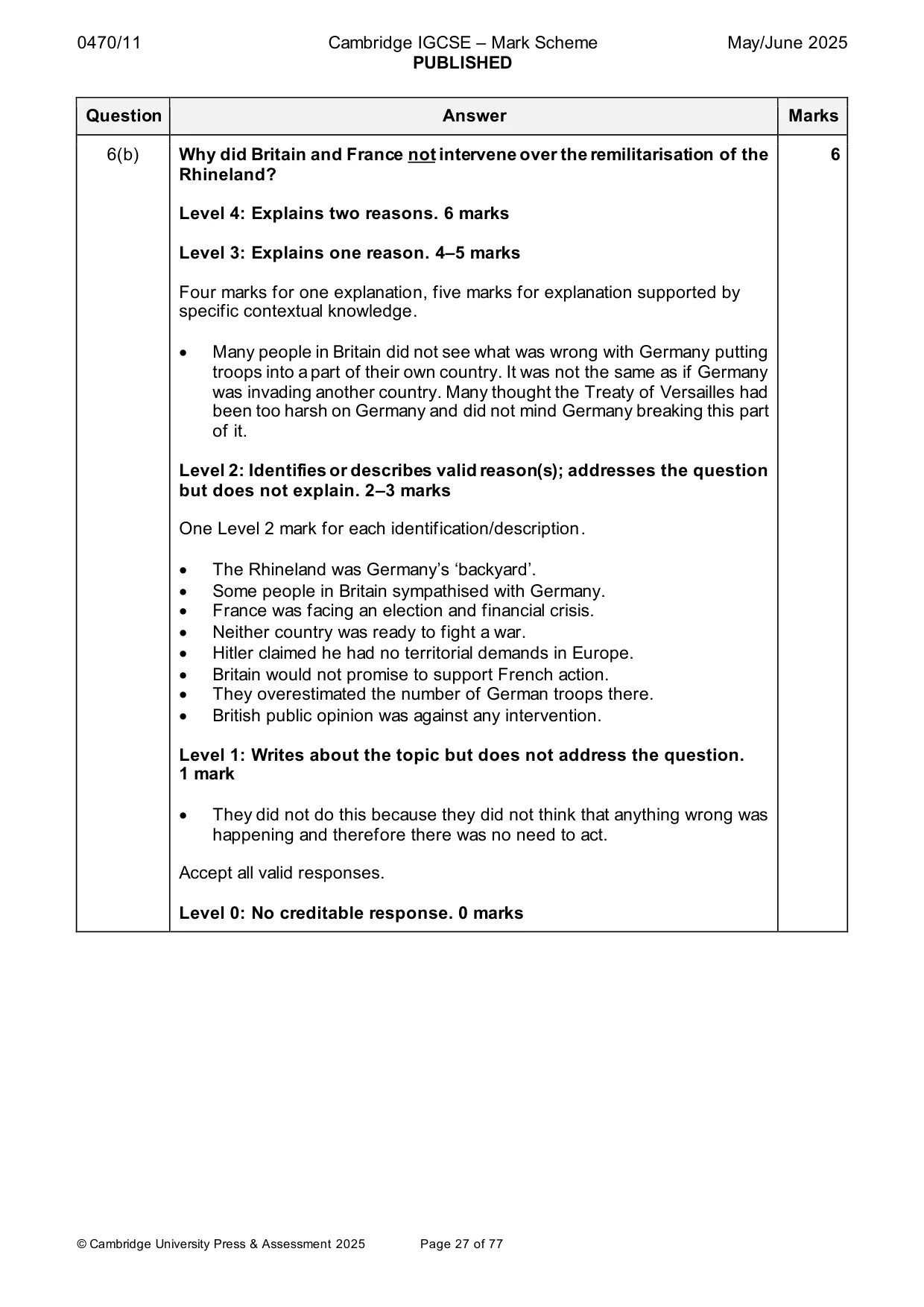
0470/11 Cambridge IGCSE – Mark Scheme PUBLISHED May/June 2025 © Cambridge University Press & Assessment 2025 Page 27 of 77 Question Answer Marks 6(b) Why did Britain and France not intervene over the remilitarisation of the Rhineland? Level 4: Explains two reasons. 6 marks Level 3: Explains one reason. 4–5 marks Four marks for one explanation, five marks for explanation supported by specific contextual knowledge. • Many people in Britain did not see what was wrong with Germany putting troops into a part of their own country. It was not the same as if Germany was invading another country. Many thought the Treaty of Versailles had been too harsh on Germany and did not mind Germany breaking this part of it. Level 2: Identifies or describes valid reason(s); addresses the question but does not explain. 2–3 marks One Level 2 mark for each identification/description. • The Rhineland was Germany’s ‘backyard’. • Some people in Britain sympathised with Germany. • France was facing an election and financial crisis. • Neither country was ready to fight a war. • Hitler claimed he had no territorial demands in Europe. • Britain would not promise to support French action. • They overestimated the number of German troops there. • British public opinion was against any intervention. Level 1: Writes about the topic but does not address the question. 1 mark • They did not do this because they did not think that anything wrong was happening and therefore there was no need to act. Accept all valid responses. Level 0: No creditable response. 0 marks 6
Mark scheme, page 28
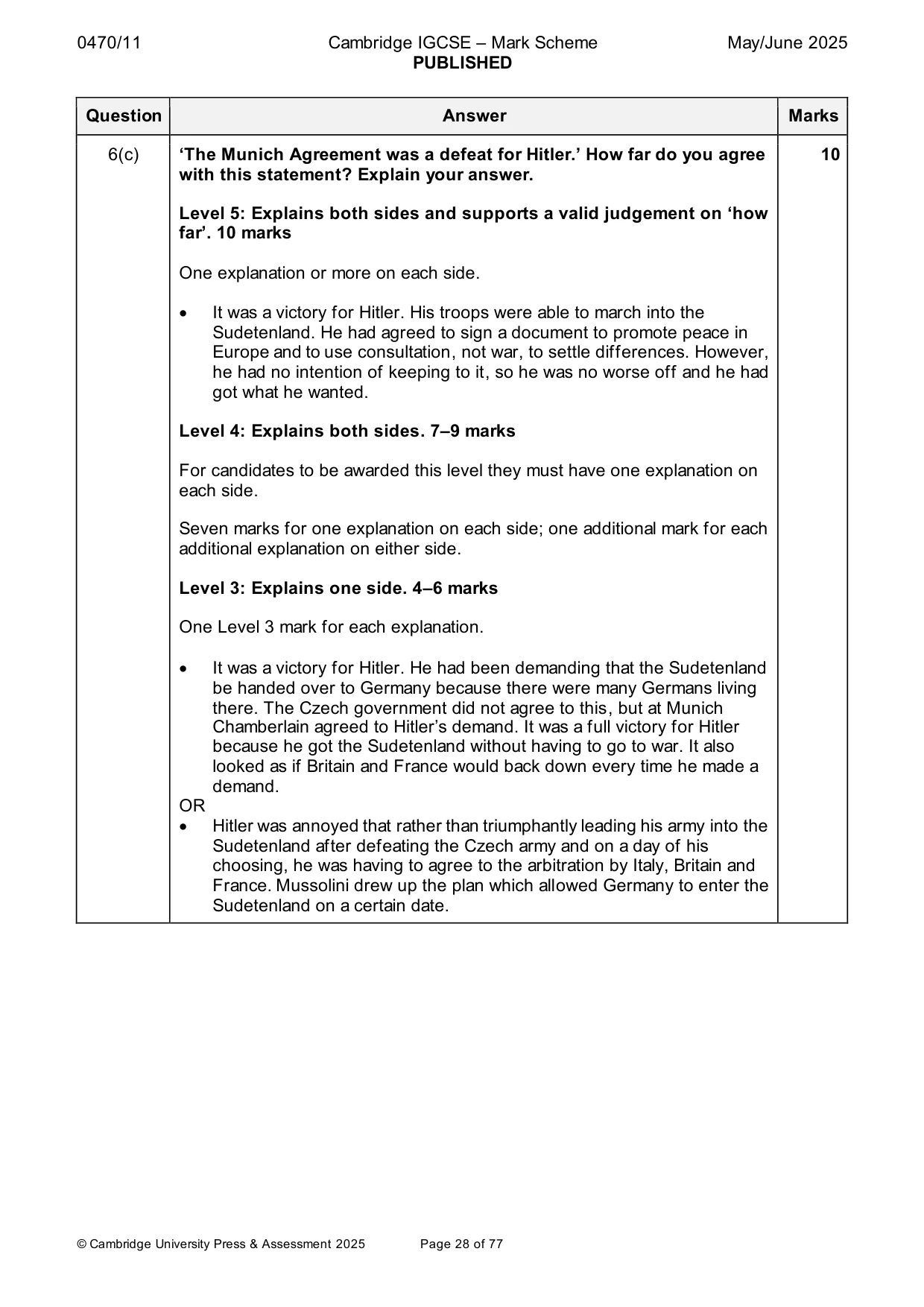
0470/11 Cambridge IGCSE – Mark Scheme PUBLISHED May/June 2025 © Cambridge University Press & Assessment 2025 Page 28 of 77 Question Answer Marks 6(c) ‘The Munich Agreement was a defeat for Hitler.’ How far do you agree with this statement? Explain your answer. Level 5: Explains both sides and supports a valid judgement on ‘how far’. 10 marks One explanation or more on each side. • It was a victory for Hitler. His troops were able to march into the Sudetenland. He had agreed to sign a document to promote peace in Europe and to use consultation, not war, to settle differences. However, he had no intention of keeping to it, so he was no worse off and he had got what he wanted. Level 4: Explains both sides. 7–9 marks For candidates to be awarded this level they must have one explanation on each side. Seven marks for one explanation on each side; one additional mark for each additional explanation on either side. Level 3: Explains one side. 4–6 marks One Level 3 mark for each explanation. • It was a victory for Hitler. He had been demanding that the Sudetenland be handed over to Germany because there were many Germans living there. The Czech government did not agree to this, but at Munich Chamberlain agreed to Hitler’s demand. It was a full victory for Hitler because he got the Sudetenland without having to go to war. It also looked as if Britain and France would back down every time he made a demand. OR • Hitler was annoyed that rather than triumphantly leading his army into the Sudetenland after defeating the Czech army and on a day of his choosing, he was having to agree to the arbitration by Italy, Britain and France. Mussolini drew up the plan which allowed Germany to enter the Sudetenland on a certain date. 10
Mark scheme, page 29
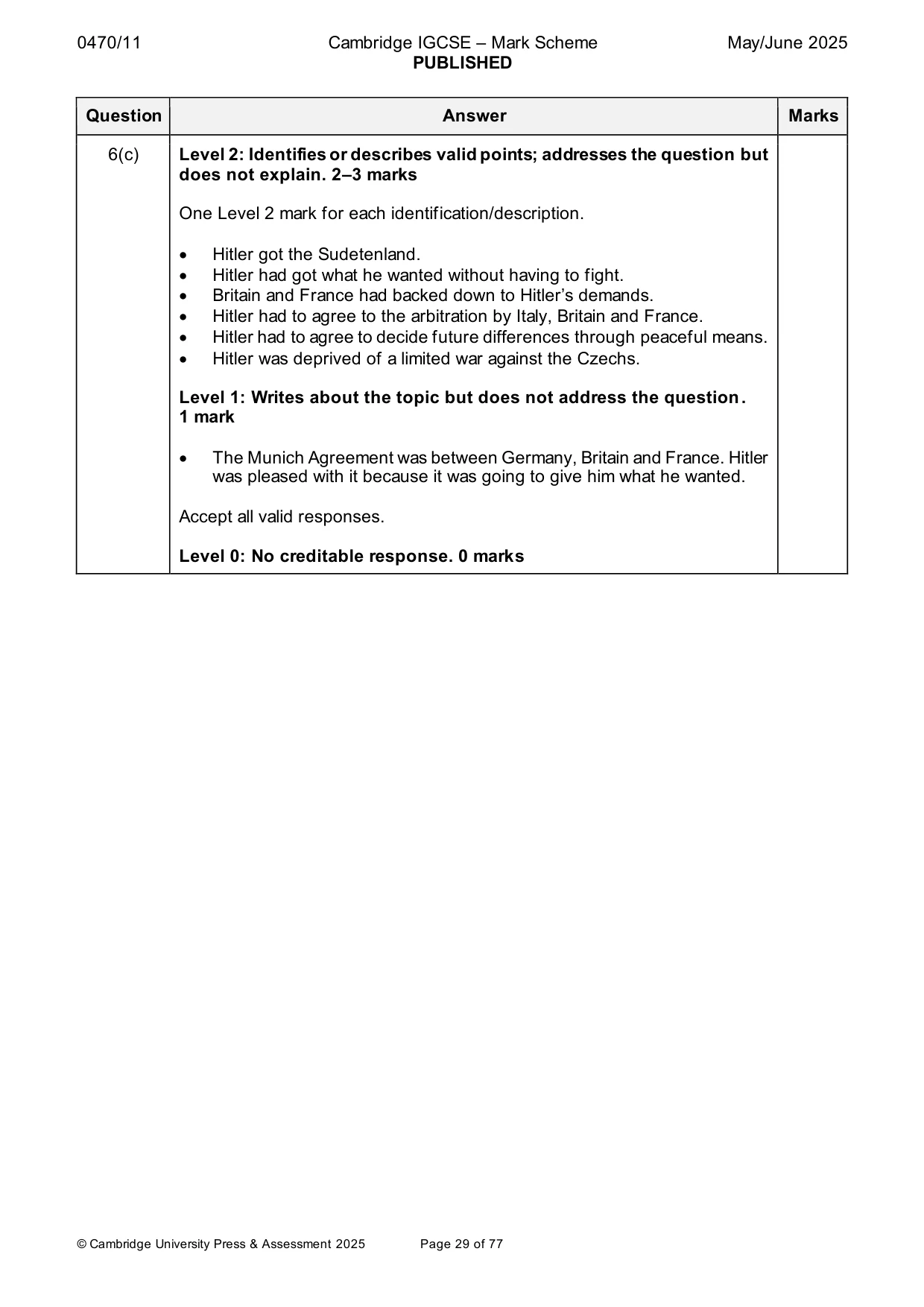
0470/11 Cambridge IGCSE – Mark Scheme PUBLISHED May/June 2025 © Cambridge University Press & Assessment 2025 Page 29 of 77 Question Answer Marks 6(c) Level 2: Identifies or describes valid points; addresses the question but does not explain. 2–3 marks One Level 2 mark for each identification/description. • Hitler got the Sudetenland. • Hitler had got what he wanted without having to fight. • Britain and France had backed down to Hitler’s demands. • Hitler had to agree to the arbitration by Italy, Britain and France. • Hitler had to agree to decide future differences through peaceful means. • Hitler was deprived of a limited war against the Czechs. Level 1: Writes about the topic but does not address the question. 1 mark • The Munich Agreement was between Germany, Britain and France. Hitler was pleased with it because it was going to give him what he wanted. Accept all valid responses. Level 0: No creditable response. 0 marks
Mark scheme, page 30
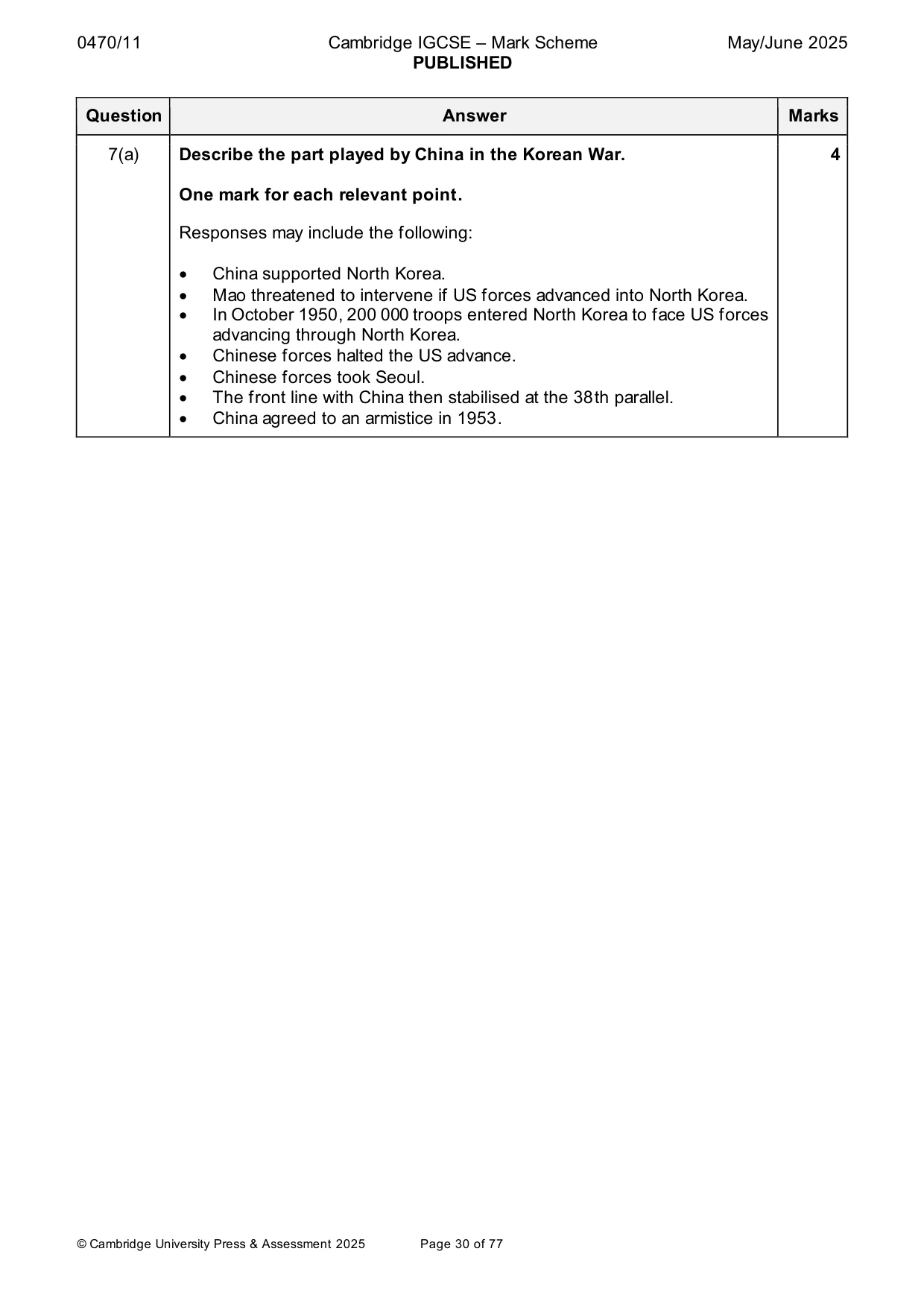
0470/11 Cambridge IGCSE – Mark Scheme PUBLISHED May/June 2025 © Cambridge University Press & Assessment 2025 Page 30 of 77 Question Answer Marks 7(a) Describe the part played by China in the Korean War. One mark for each relevant point. Responses may include the following: • China supported North Korea. • Mao threatened to intervene if US forces advanced into North Korea. • In October 1950, 200 000 troops entered North Korea to face US forces advancing through North Korea. • Chinese forces halted the US advance. • Chinese forces took Seoul. • The front line with China then stabilised at the 38th parallel. • China agreed to an armistice in 1953. 4
Mark scheme, page 31
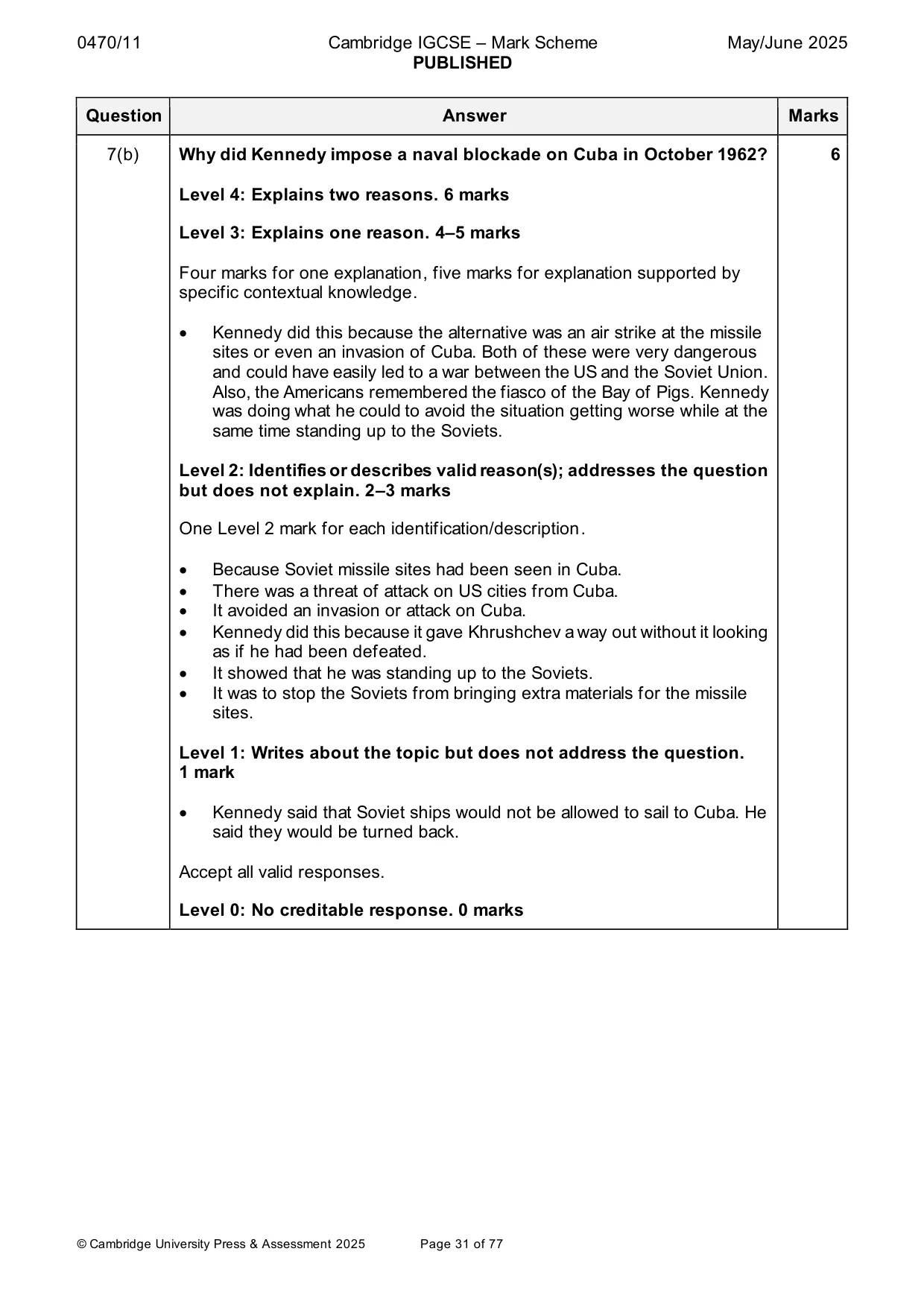
0470/11 Cambridge IGCSE – Mark Scheme PUBLISHED May/June 2025 © Cambridge University Press & Assessment 2025 Page 31 of 77 Question Answer Marks 7(b) Why did Kennedy impose a naval blockade on Cuba in October 1962? Level 4: Explains two reasons. 6 marks Level 3: Explains one reason. 4–5 marks Four marks for one explanation, five marks for explanation supported by specific contextual knowledge. • Kennedy did this because the alternative was an air strike at the missile sites or even an invasion of Cuba. Both of these were very dangerous and could have easily led to a war between the US and the Soviet Union. Also, the Americans remembered the fiasco of the Bay of Pigs. Kennedy was doing what he could to avoid the situation getting worse while at the same time standing up to the Soviets. Level 2: Identifies or describes valid reason(s); addresses the question but does not explain. 2–3 marks One Level 2 mark for each identification/description. • Because Soviet missile sites had been seen in Cuba. • There was a threat of attack on US cities from Cuba. • It avoided an invasion or attack on Cuba. • Kennedy did this because it gave Khrushchev a way out without it looking as if he had been defeated. • It showed that he was standing up to the Soviets. • It was to stop the Soviets from bringing extra materials for the missile sites. Level 1: Writes about the topic but does not address the question. 1 mark • Kennedy said that Soviet ships would not be allowed to sail to Cuba. He said they would be turned back. Accept all valid responses. Level 0: No creditable response. 0 marks 6
Mark scheme, page 32
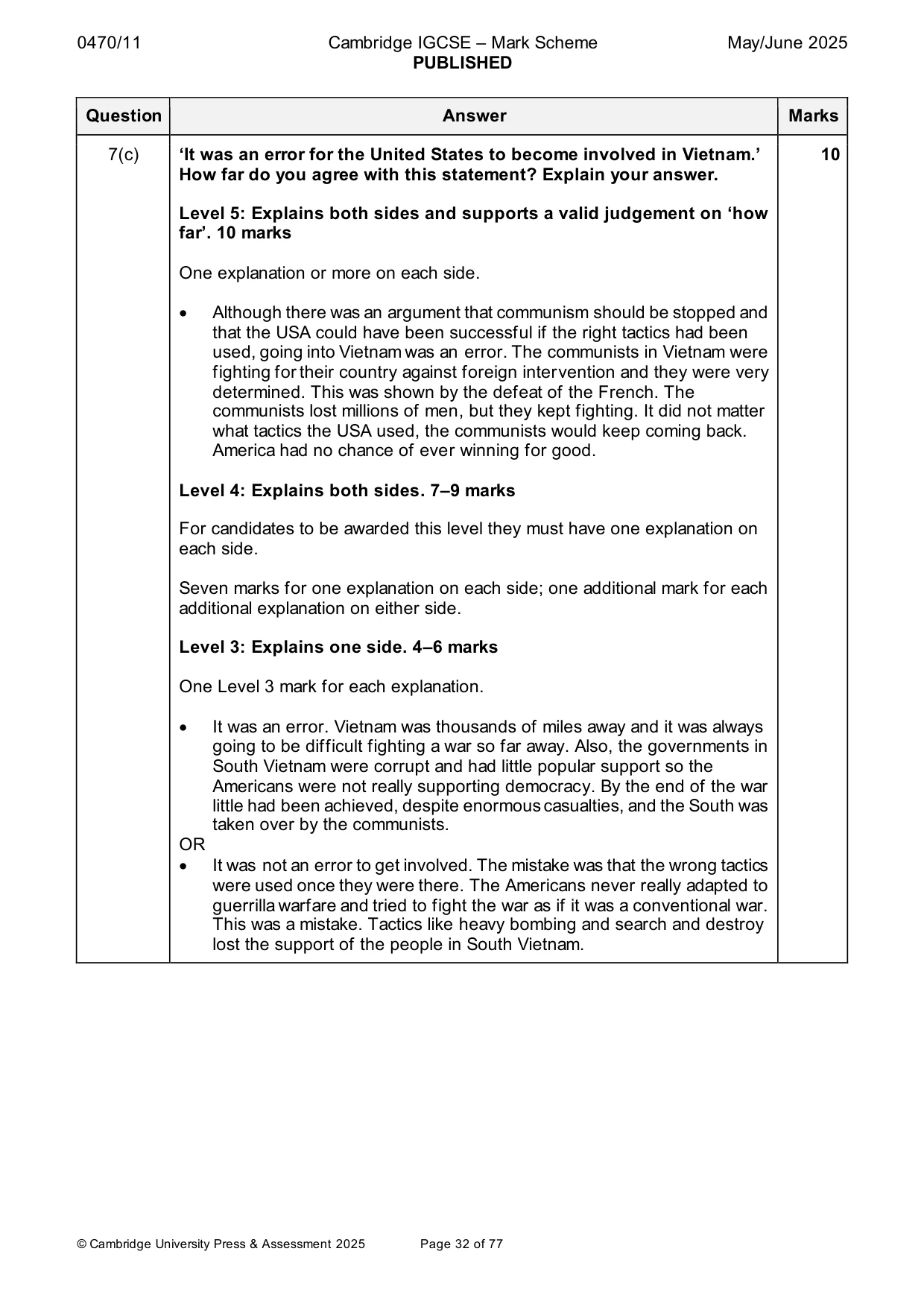
0470/11 Cambridge IGCSE – Mark Scheme PUBLISHED May/June 2025 © Cambridge University Press & Assessment 2025 Page 32 of 77 Question Answer Marks 7(c) ‘It was an error for the United States to become involved in Vietnam.’ How far do you agree with this statement? Explain your answer. Level 5: Explains both sides and supports a valid judgement on ‘how far’. 10 marks One explanation or more on each side. • Although there was an argument that communism should be stopped and that the USA could have been successful if the right tactics had been used, going into Vietnam was an error. The communists in Vietnam were fighting for their country against foreign intervention and they were very determined. This was shown by the defeat of the French. The communists lost millions of men, but they kept fighting. It did not matter what tactics the USA used, the communists would keep coming back. America had no chance of ever winning for good. Level 4: Explains both sides. 7–9 marks For candidates to be awarded this level they must have one explanation on each side. Seven marks for one explanation on each side; one additional mark for each additional explanation on either side. Level 3: Explains one side. 4–6 marks One Level 3 mark for each explanation. • It was an error. Vietnam was thousands of miles away and it was always going to be difficult fighting a war so far away. Also, the governments in South Vietnam were corrupt and had little popular support so the Americans were not really supporting democracy. By the end of the war little had been achieved, despite enormous casualties, and the South was taken over by the communists. OR • It was not an error to get involved. The mistake was that the wrong tactics were used once they were there. The Americans never really adapted to guerrilla warfare and tried to fight the war as if it was a conventional war. This was a mistake. Tactics like heavy bombing and search and destroy lost the support of the people in South Vietnam. 10
Mark scheme, page 33
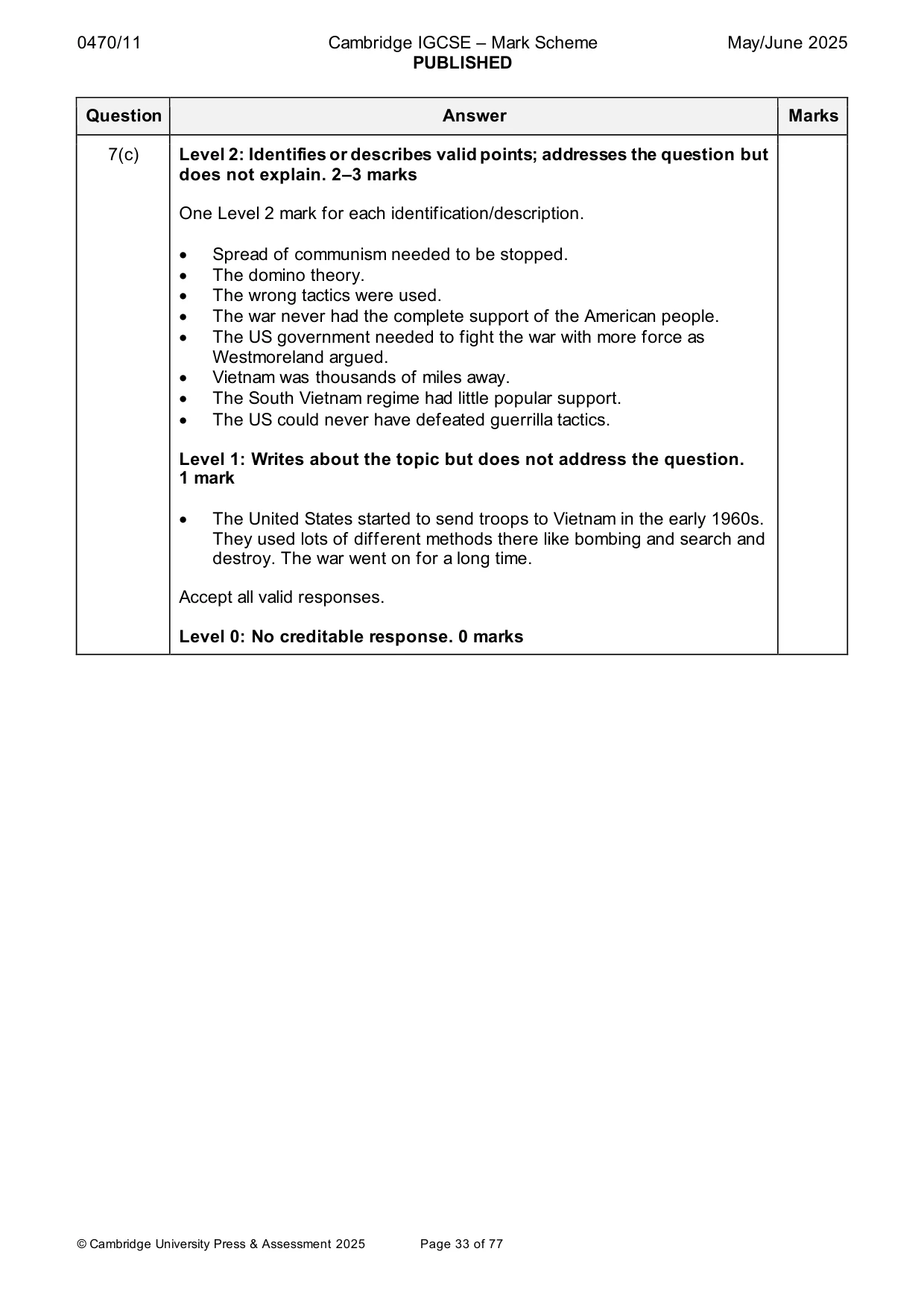
0470/11 Cambridge IGCSE – Mark Scheme PUBLISHED May/June 2025 © Cambridge University Press & Assessment 2025 Page 33 of 77 Question Answer Marks 7(c) Level 2: Identifies or describes valid points; addresses the question but does not explain. 2–3 marks One Level 2 mark for each identification/description. • Spread of communism needed to be stopped. • The domino theory. • The wrong tactics were used. • The war never had the complete support of the American people. • The US government needed to fight the war with more force as Westmoreland argued. • Vietnam was thousands of miles away. • The South Vietnam regime had little popular support. • The US could never have defeated guerrilla tactics. Level 1: Writes about the topic but does not address the question. 1 mark • The United States started to send troops to Vietnam in the early 1960s. They used lots of different methods there like bombing and search and destroy. The war went on for a long time. Accept all valid responses. Level 0: No creditable response. 0 marks
Mark scheme, page 34
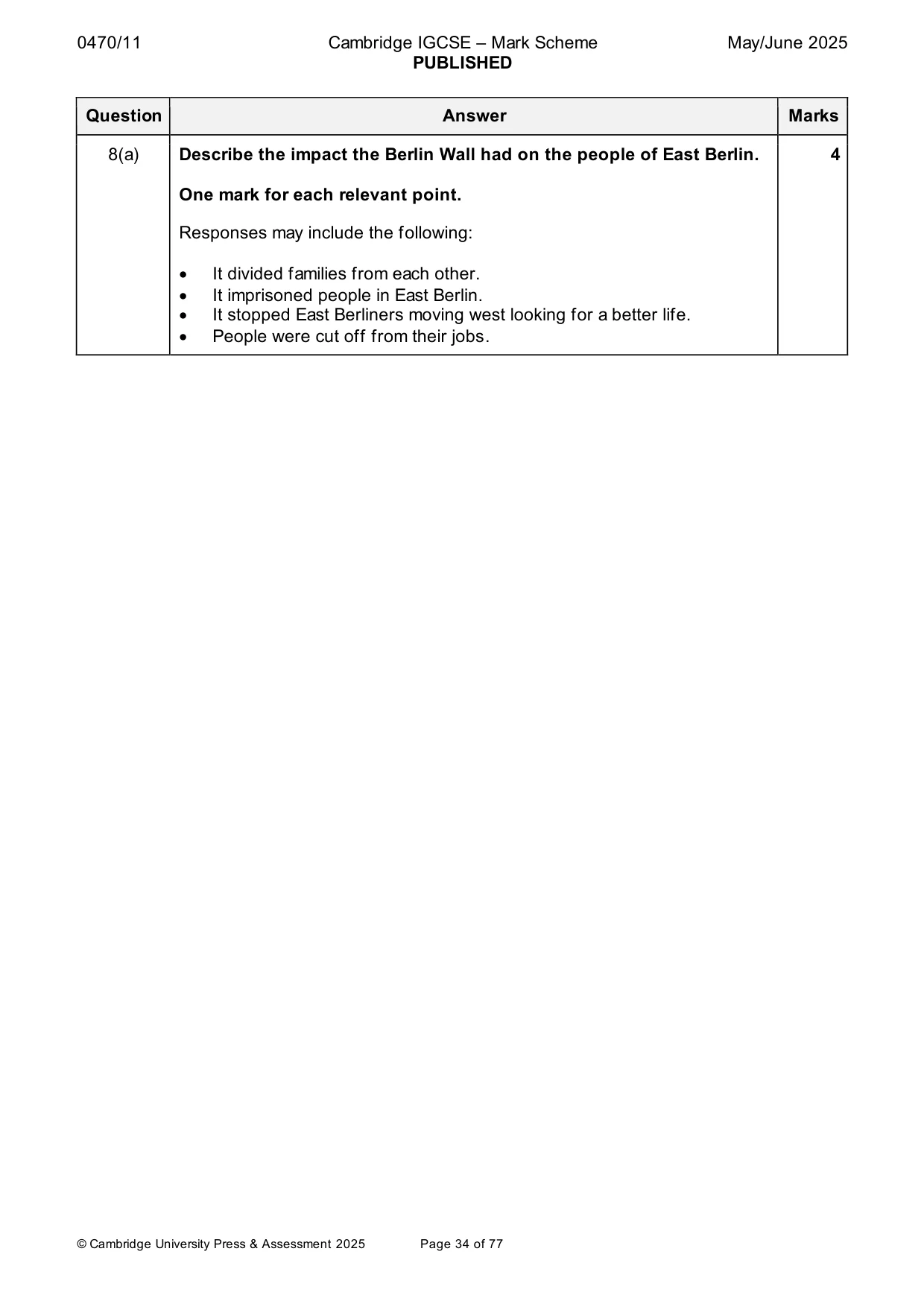
0470/11 Cambridge IGCSE – Mark Scheme PUBLISHED May/June 2025 © Cambridge University Press & Assessment 2025 Page 34 of 77 Question Answer Marks 8(a) Describe the impact the Berlin Wall had on the people of East Berlin. One mark for each relevant point. Responses may include the following: • It divided families from each other. • It imprisoned people in East Berlin. • It stopped East Berliners moving west looking for a better life. • People were cut off from their jobs. 4
Mark scheme, page 35
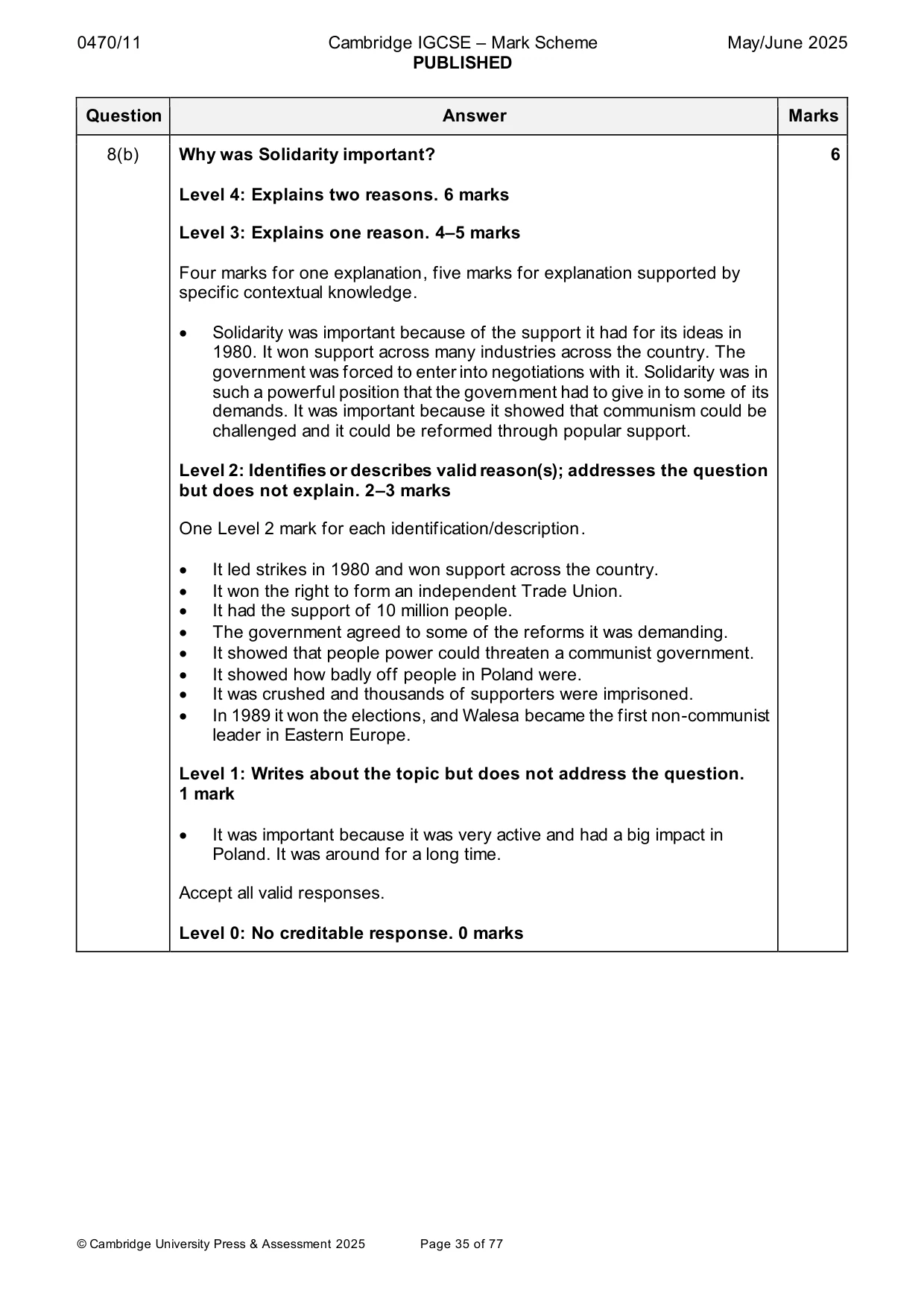
0470/11 Cambridge IGCSE – Mark Scheme PUBLISHED May/June 2025 © Cambridge University Press & Assessment 2025 Page 35 of 77 Question Answer Marks 8(b) Why was Solidarity important? Level 4: Explains two reasons. 6 marks Level 3: Explains one reason. 4–5 marks Four marks for one explanation, five marks for explanation supported by specific contextual knowledge. • Solidarity was important because of the support it had for its ideas in 1980. It won support across many industries across the country. The government was forced to enter into negotiations with it. Solidarity was in such a powerful position that the government had to give in to some of its demands. It was important because it showed that communism could be challenged and it could be reformed through popular support. Level 2: Identifies or describes valid reason(s); addresses the question but does not explain. 2–3 marks One Level 2 mark for each identification/description. • It led strikes in 1980 and won support across the country. • It won the right to form an independent Trade Union. • It had the support of 10 million people. • The government agreed to some of the reforms it was demanding. • It showed that people power could threaten a communist government. • It showed how badly off people in Poland were. • It was crushed and thousands of supporters were imprisoned. • In 1989 it won the elections, and Walesa became the first non-communist leader in Eastern Europe. Level 1: Writes about the topic but does not address the question. 1 mark • It was important because it was very active and had a big impact in Poland. It was around for a long time. Accept all valid responses. Level 0: No creditable response. 0 marks 6
Mark scheme, page 36
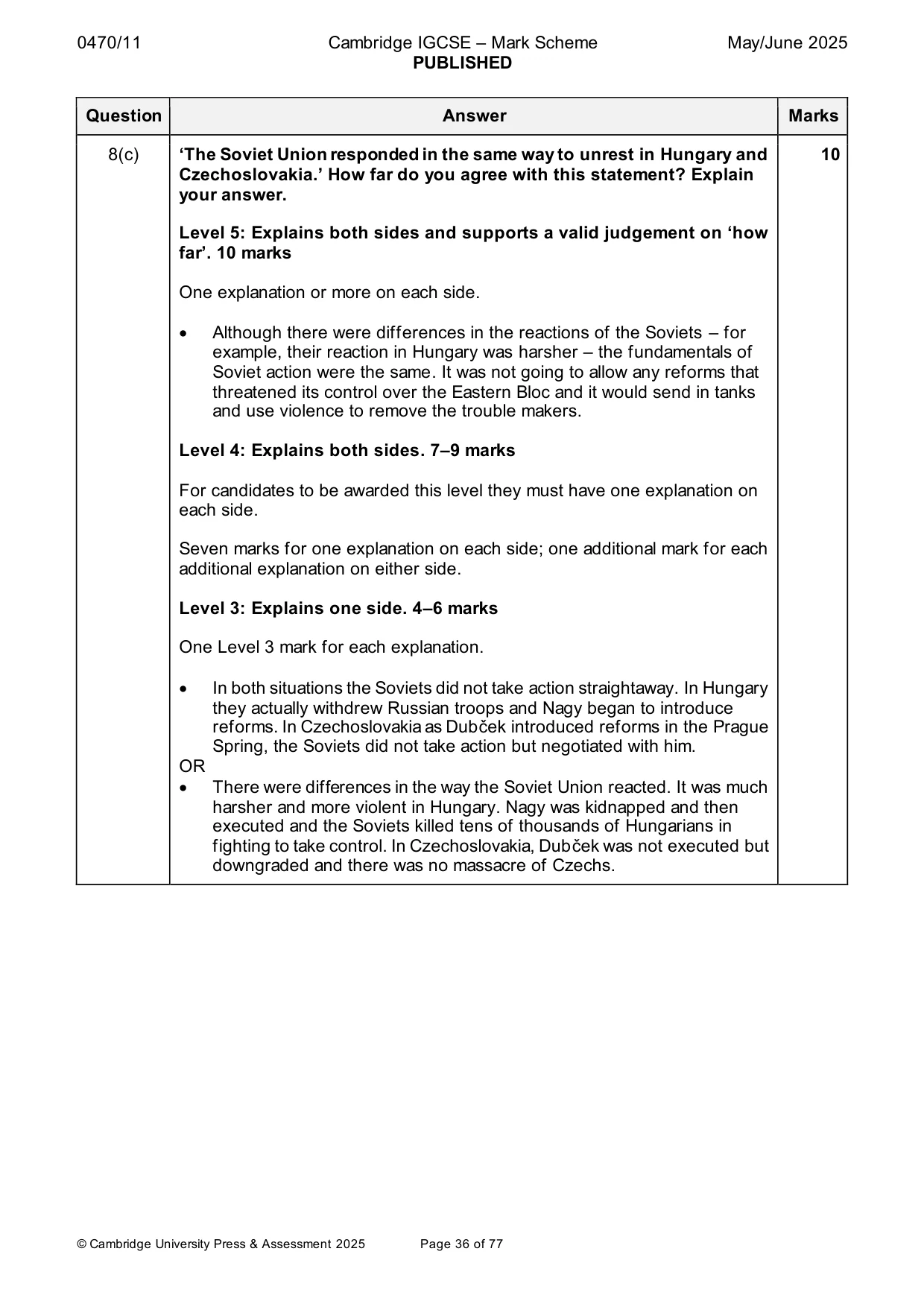
0470/11 Cambridge IGCSE – Mark Scheme PUBLISHED May/June 2025 © Cambridge University Press & Assessment 2025 Page 36 of 77 Question Answer Marks 8(c) ‘The Soviet Union responded in the same way to unrest in Hungary and Czechoslovakia.’ How far do you agree with this statement? Explain your answer. Level 5: Explains both sides and supports a valid judgement on ‘how far’. 10 marks One explanation or more on each side. • Although there were differences in the reactions of the Soviets – for example, their reaction in Hungary was harsher – the fundamentals of Soviet action were the same. It was not going to allow any reforms that threatened its control over the Eastern Bloc and it would send in tanks and use violence to remove the trouble makers. Level 4: Explains both sides. 7–9 marks For candidates to be awarded this level they must have one explanation on each side. Seven marks for one explanation on each side; one additional mark for each additional explanation on either side. Level 3: Explains one side. 4–6 marks One Level 3 mark for each explanation. • In both situations the Soviets did not take action straightaway. In Hungary they actually withdrew Russian troops and Nagy began to introduce reforms. In Czechoslovakia as Dubček introduced reforms in the Prague Spring, the Soviets did not take action but negotiated with him. OR • There were differences in the way the Soviet Union reacted. It was much harsher and more violent in Hungary. Nagy was kidnapped and then executed and the Soviets killed tens of thousands of Hungarians in fighting to take control. In Czechoslovakia, Dubček was not executed but downgraded and there was no massacre of Czechs. 10
Mark scheme, page 37
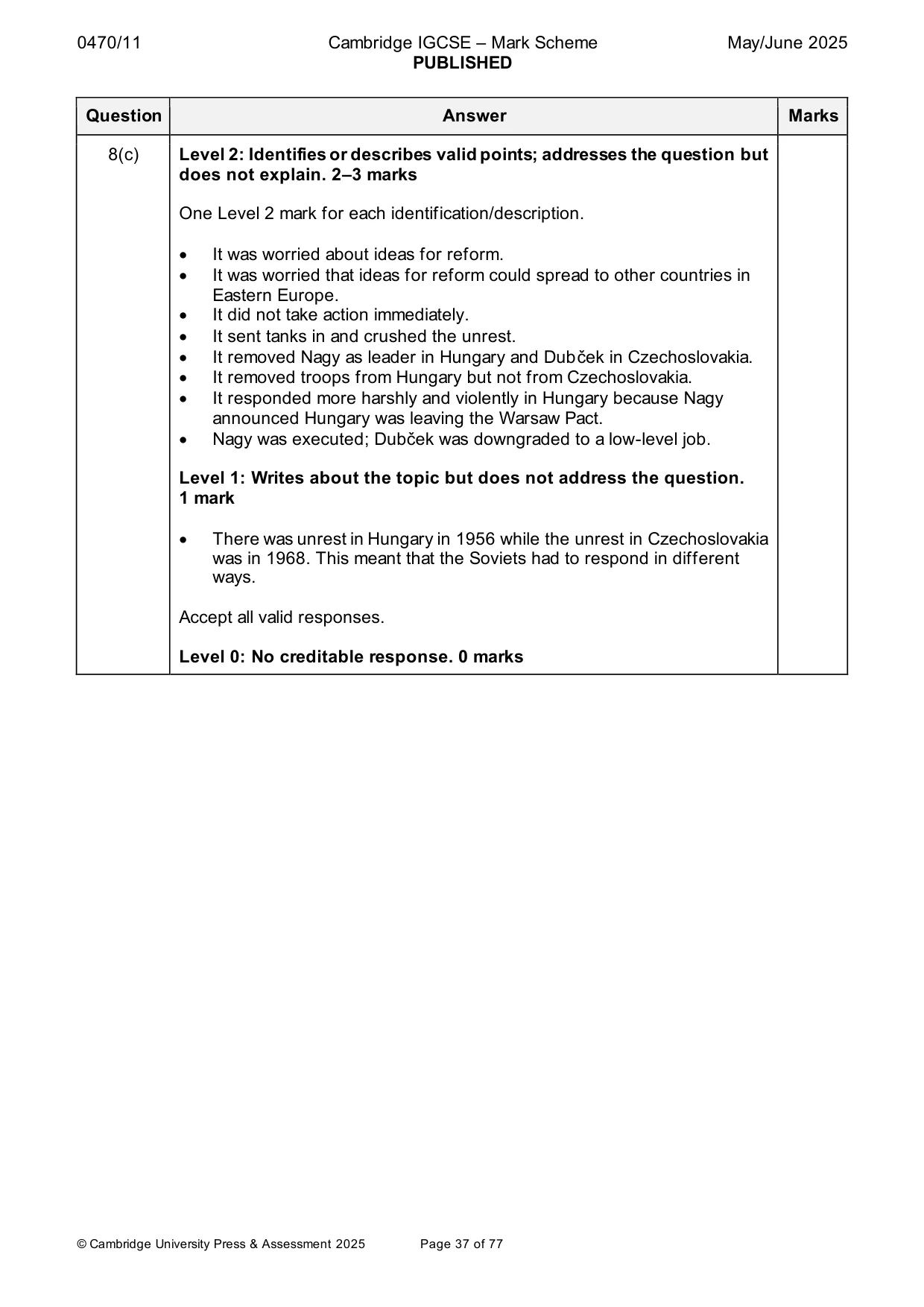
0470/11 Cambridge IGCSE – Mark Scheme PUBLISHED May/June 2025 © Cambridge University Press & Assessment 2025 Page 37 of 77 Question Answer Marks 8(c) Level 2: Identifies or describes valid points; addresses the question but does not explain. 2–3 marks One Level 2 mark for each identification/description. • It was worried about ideas for reform. • It was worried that ideas for reform could spread to other countries in Eastern Europe. • It did not take action immediately. • It sent tanks in and crushed the unrest. • It removed Nagy as leader in Hungary and Dubček in Czechoslovakia. • It removed troops from Hungary but not from Czechoslovakia. • It responded more harshly and violently in Hungary because Nagy announced Hungary was leaving the Warsaw Pact. • Nagy was executed; Dubček was downgraded to a low-level job. Level 1: Writes about the topic but does not address the question. 1 mark • There was unrest in Hungary in 1956 while the unrest in Czechoslovakia was in 1968. This meant that the Soviets had to respond in different ways. Accept all valid responses. Level 0: No creditable response. 0 marks
Mark scheme, page 38
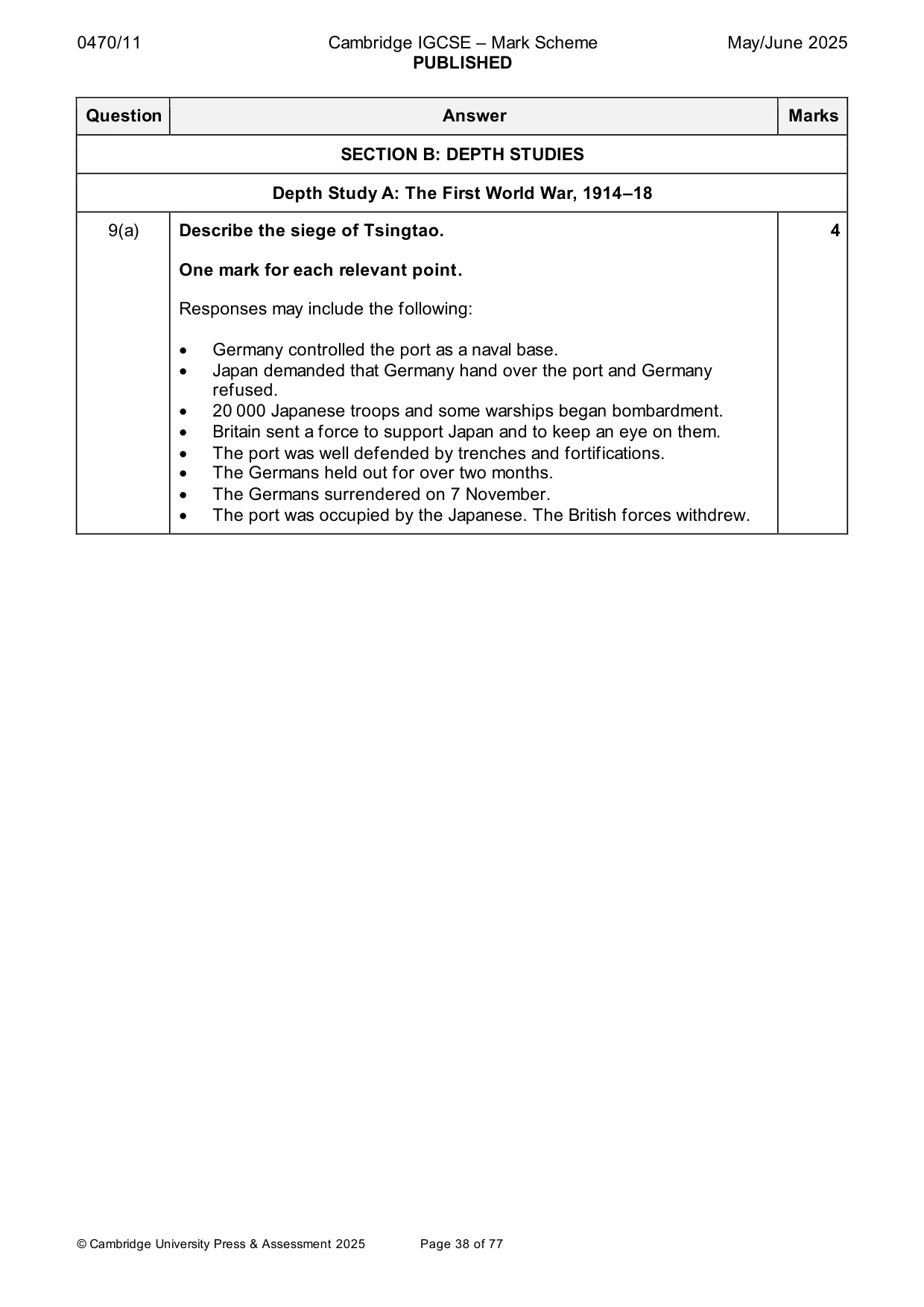
0470/11 Cambridge IGCSE – Mark Scheme PUBLISHED May/June 2025 © Cambridge University Press & Assessment 2025 Page 38 of 77 Question Answer Marks SECTION B: DEPTH STUDIES Depth Study A: The First World War, 1914–18 9(a) Describe the siege of Tsingtao. One mark for each relevant point. Responses may include the following: • Germany controlled the port as a naval base. • Japan demanded that Germany hand over the port and Germany refused. • 20 000 Japanese troops and some warships began bombardment. • Britain sent a force to support Japan and to keep an eye on them. • The port was well defended by trenches and fortifications. • The Germans held out for over two months. • The Germans surrendered on 7 November. • The port was occupied by the Japanese. The British forces withdrew. 4
Mark scheme, page 39
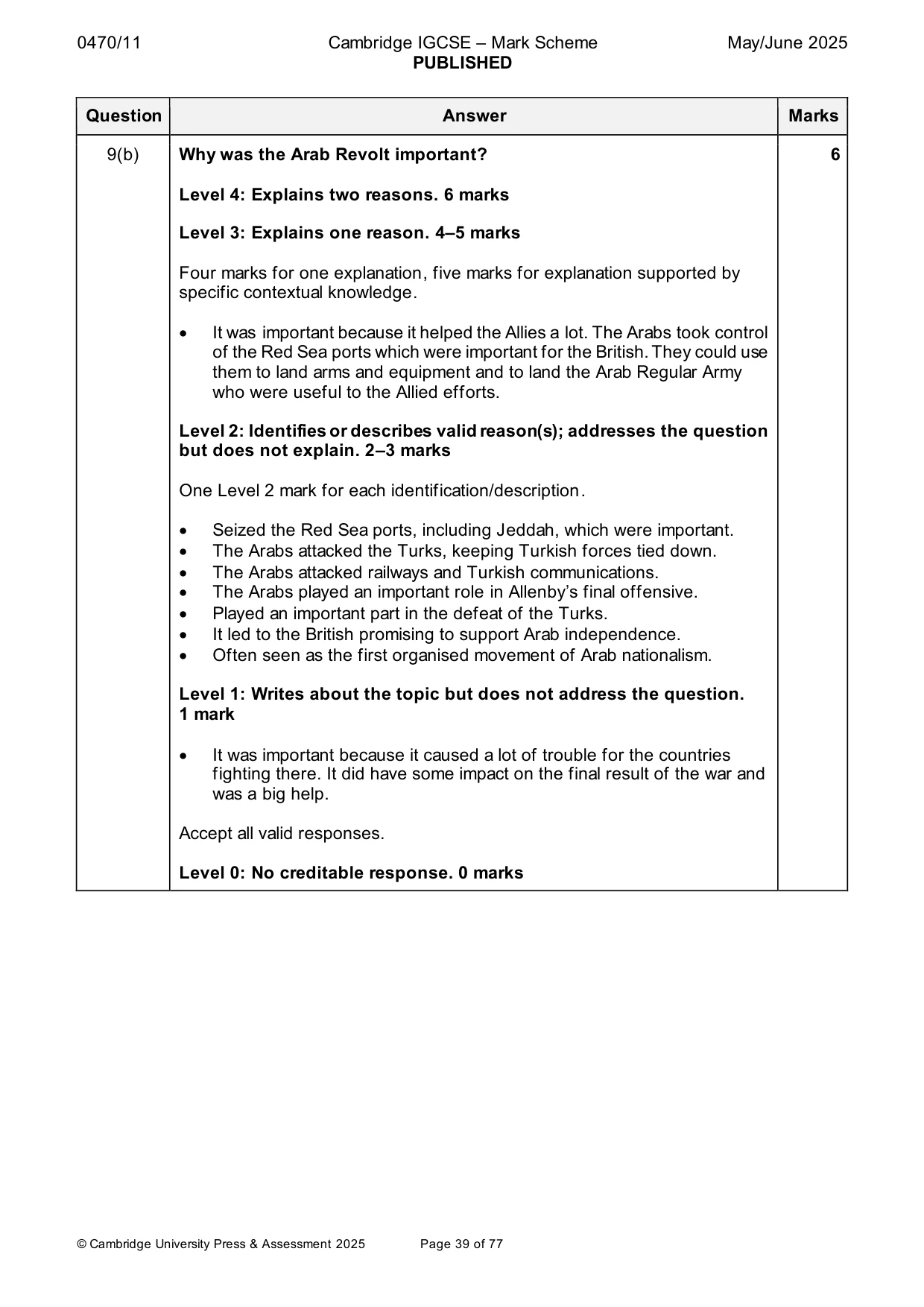
0470/11 Cambridge IGCSE – Mark Scheme PUBLISHED May/June 2025 © Cambridge University Press & Assessment 2025 Page 39 of 77 Question Answer Marks 9(b) Why was the Arab Revolt important? Level 4: Explains two reasons. 6 marks Level 3: Explains one reason. 4–5 marks Four marks for one explanation, five marks for explanation supported by specific contextual knowledge. • It was important because it helped the Allies a lot. The Arabs took control of the Red Sea ports which were important for the British. They could use them to land arms and equipment and to land the Arab Regular Army who were useful to the Allied efforts. Level 2: Identifies or describes valid reason(s); addresses the question but does not explain. 2–3 marks One Level 2 mark for each identification/description. • Seized the Red Sea ports, including Jeddah, which were important. • The Arabs attacked the Turks, keeping Turkish forces tied down. • The Arabs attacked railways and Turkish communications. • The Arabs played an important role in Allenby’s final offensive. • Played an important part in the defeat of the Turks. • It led to the British promising to support Arab independence. • Often seen as the first organised movement of Arab nationalism. Level 1: Writes about the topic but does not address the question. 1 mark • It was important because it caused a lot of trouble for the countries fighting there. It did have some impact on the final result of the war and was a big help. Accept all valid responses. Level 0: No creditable response. 0 marks 6
Mark scheme, page 40
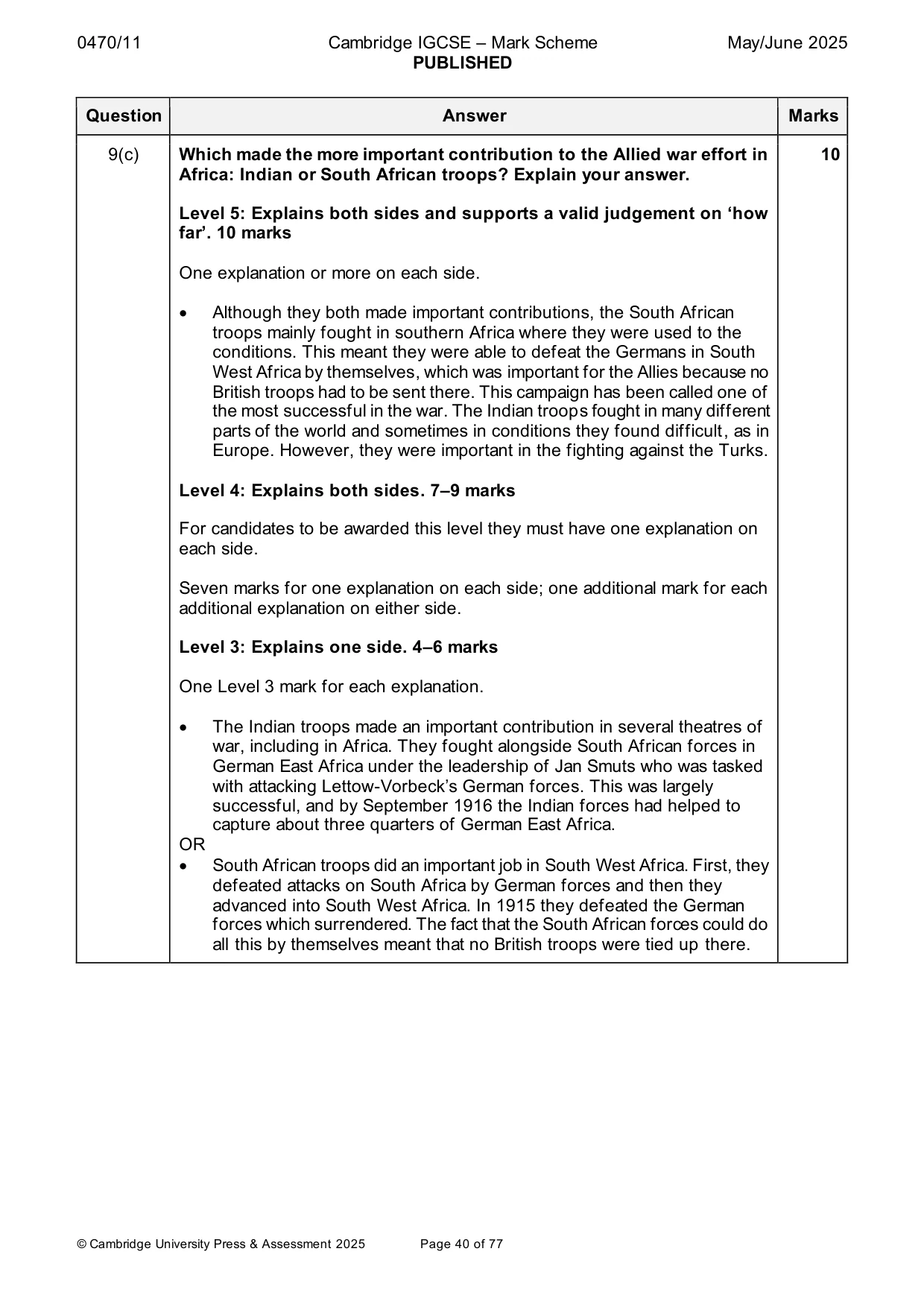
0470/11 Cambridge IGCSE – Mark Scheme PUBLISHED May/June 2025 © Cambridge University Press & Assessment 2025 Page 40 of 77 Question Answer Marks 9(c) Which made the more important contribution to the Allied war effort in Africa: Indian or South African troops? Explain your answer. Level 5: Explains both sides and supports a valid judgement on ‘how far’. 10 marks One explanation or more on each side. • Although they both made important contributions, the South African troops mainly fought in southern Africa where they were used to the conditions. This meant they were able to defeat the Germans in South West Africa by themselves, which was important for the Allies because no British troops had to be sent there. This campaign has been called one of the most successful in the war. The Indian troops fought in many different parts of the world and sometimes in conditions they found difficult, as in Europe. However, they were important in the fighting against the Turks. Level 4: Explains both sides. 7–9 marks For candidates to be awarded this level they must have one explanation on each side. Seven marks for one explanation on each side; one additional mark for each additional explanation on either side. Level 3: Explains one side. 4–6 marks One Level 3 mark for each explanation. • The Indian troops made an important contribution in several theatres of war, including in Africa. They fought alongside South African forces in German East Africa under the leadership of Jan Smuts who was tasked with attacking Lettow-Vorbeck’s German forces. This was largely successful, and by September 1916 the Indian forces had helped to capture about three quarters of German East Africa. OR • South African troops did an important job in South West Africa. First, they defeated attacks on South Africa by German forces and then they advanced into South West Africa. In 1915 they defeated the German forces which surrendered. The fact that the South African forces could do all this by themselves meant that no British troops were tied up there. 10
Mark scheme, page 41
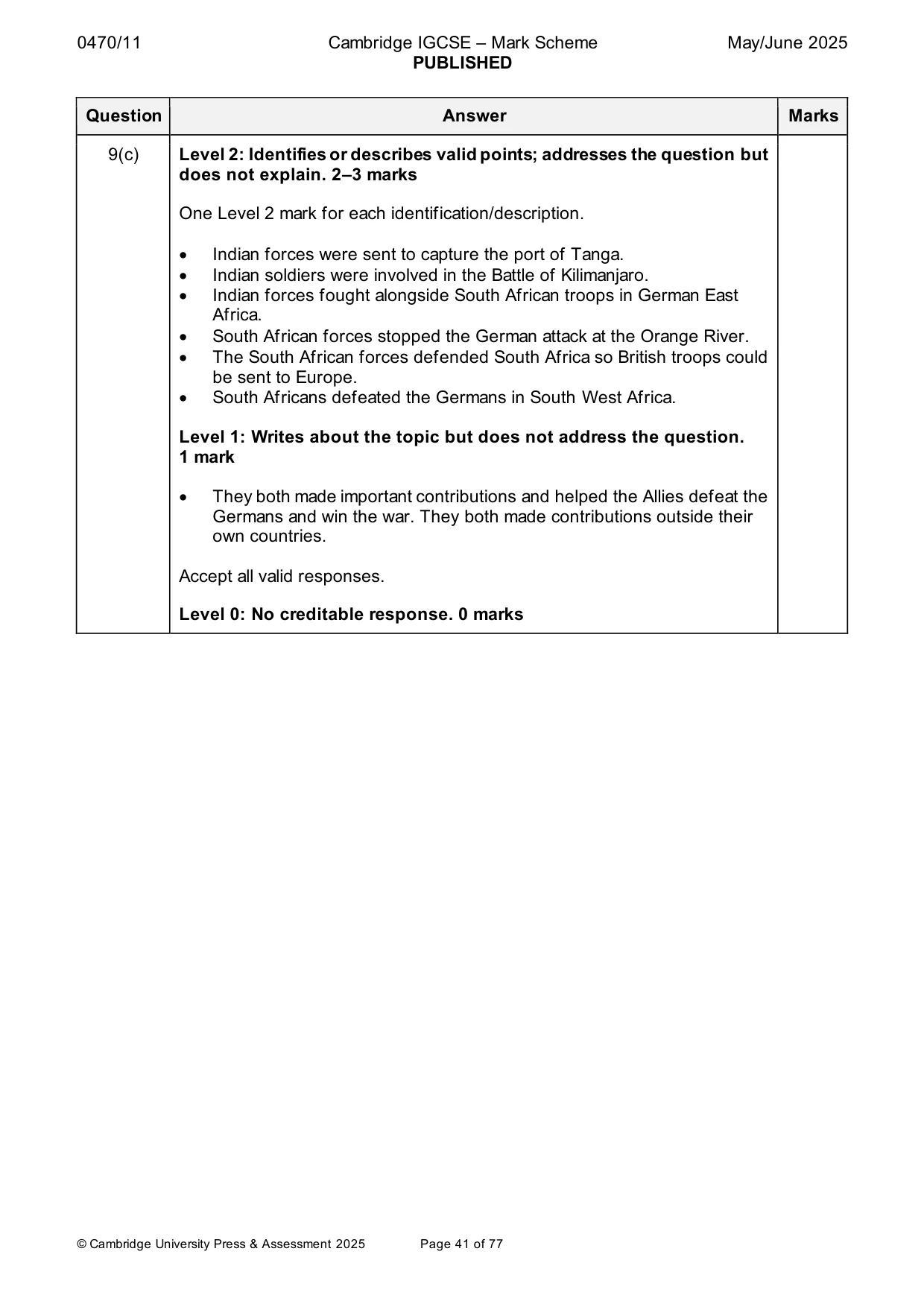
0470/11 Cambridge IGCSE – Mark Scheme PUBLISHED May/June 2025 © Cambridge University Press & Assessment 2025 Page 41 of 77 Question Answer Marks 9(c) Level 2: Identifies or describes valid points; addresses the question but does not explain. 2–3 marks One Level 2 mark for each identification/description. • Indian forces were sent to capture the port of Tanga. • Indian soldiers were involved in the Battle of Kilimanjaro. • Indian forces fought alongside South African troops in German East Africa. • South African forces stopped the German attack at the Orange River. • The South African forces defended South Africa so British troops could be sent to Europe. • South Africans defeated the Germans in South West Africa. Level 1: Writes about the topic but does not address the question. 1 mark • They both made important contributions and helped the Allies defeat the Germans and win the war. They both made contributions outside their own countries. Accept all valid responses. Level 0: No creditable response. 0 marks
Mark scheme, page 42
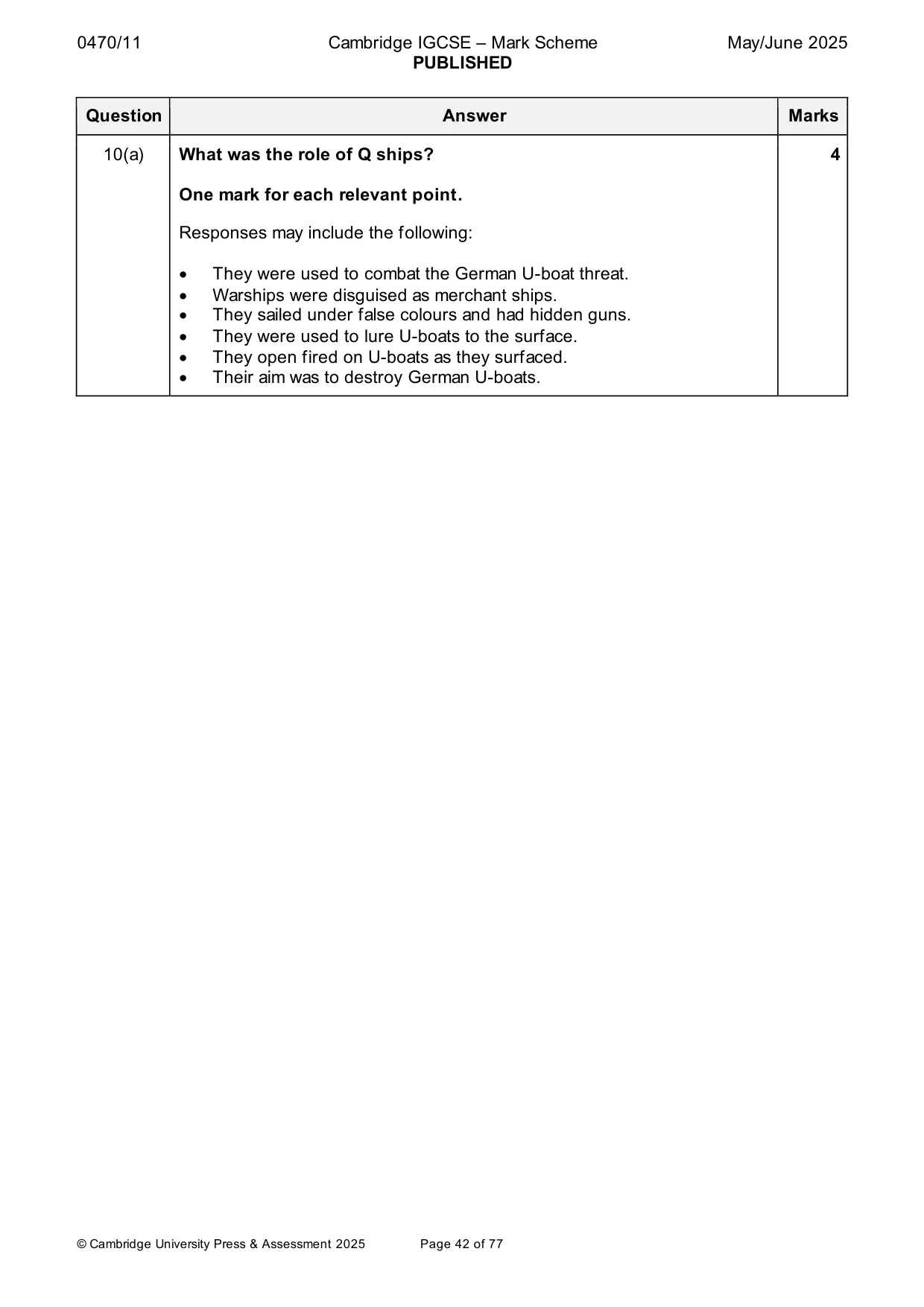
0470/11 Cambridge IGCSE – Mark Scheme PUBLISHED May/June 2025 © Cambridge University Press & Assessment 2025 Page 42 of 77 Question Answer Marks 10(a) What was the role of Q ships? One mark for each relevant point. Responses may include the following: • They were used to combat the German U-boat threat. • Warships were disguised as merchant ships. • They sailed under false colours and had hidden guns. • They were used to lure U-boats to the surface. • They open fired on U-boats as they surfaced. • Their aim was to destroy German U-boats. 4
Mark scheme, page 43
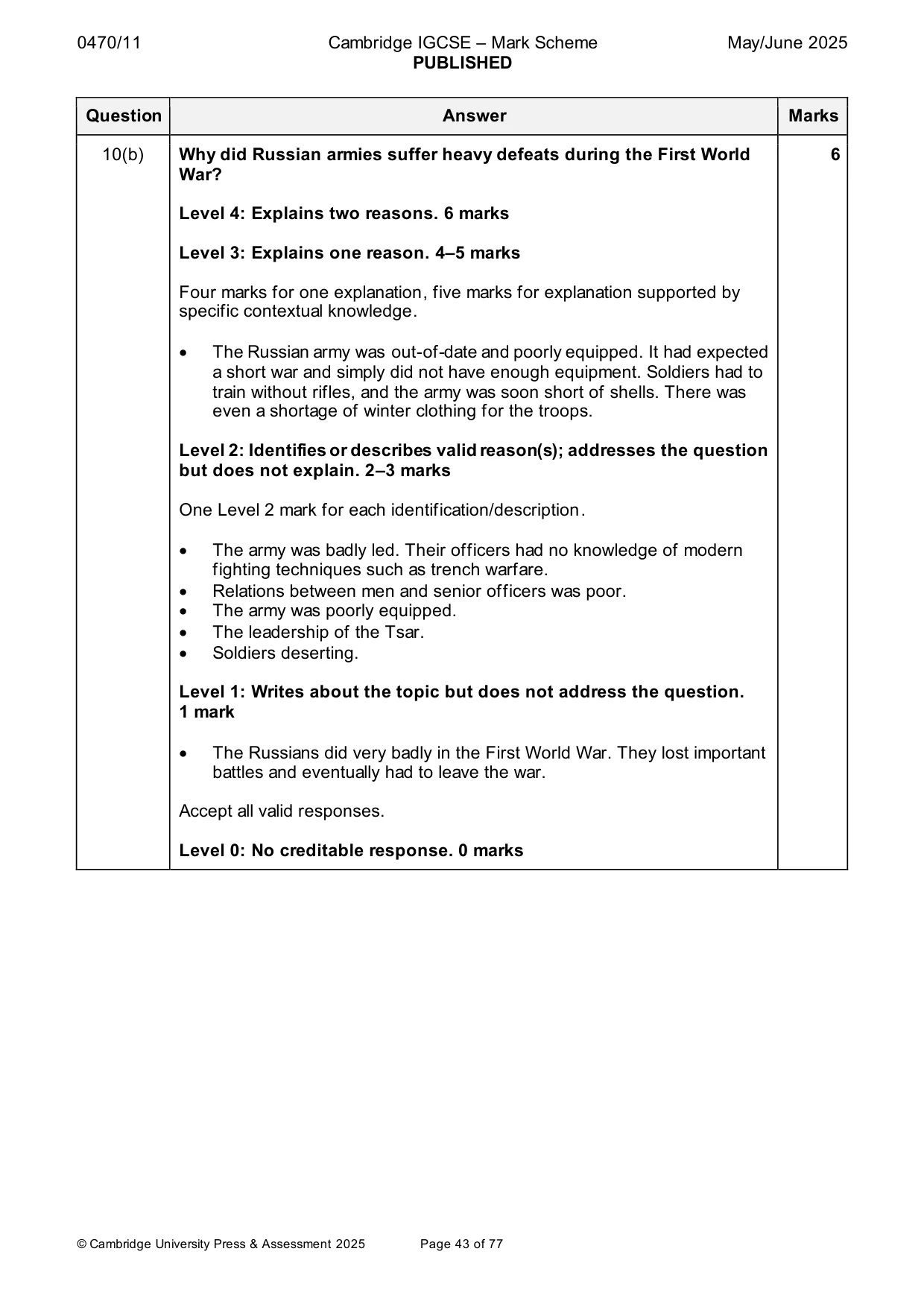
0470/11 Cambridge IGCSE – Mark Scheme PUBLISHED May/June 2025 © Cambridge University Press & Assessment 2025 Page 43 of 77 Question Answer Marks 10(b) Why did Russian armies suffer heavy defeats during the First World War? Level 4: Explains two reasons. 6 marks Level 3: Explains one reason. 4–5 marks Four marks for one explanation, five marks for explanation supported by specific contextual knowledge. • The Russian army was out-of-date and poorly equipped. It had expected a short war and simply did not have enough equipment. Soldiers had to train without rifles, and the army was soon short of shells. There was even a shortage of winter clothing for the troops. Level 2: Identifies or describes valid reason(s); addresses the question but does not explain. 2–3 marks One Level 2 mark for each identification/description. • The army was badly led. Their officers had no knowledge of modern fighting techniques such as trench warfare. • Relations between men and senior officers was poor. • The army was poorly equipped. • The leadership of the Tsar. • Soldiers deserting. Level 1: Writes about the topic but does not address the question. 1 mark • The Russians did very badly in the First World War. They lost important battles and eventually had to leave the war. Accept all valid responses. Level 0: No creditable response. 0 marks 6
Mark scheme, page 44
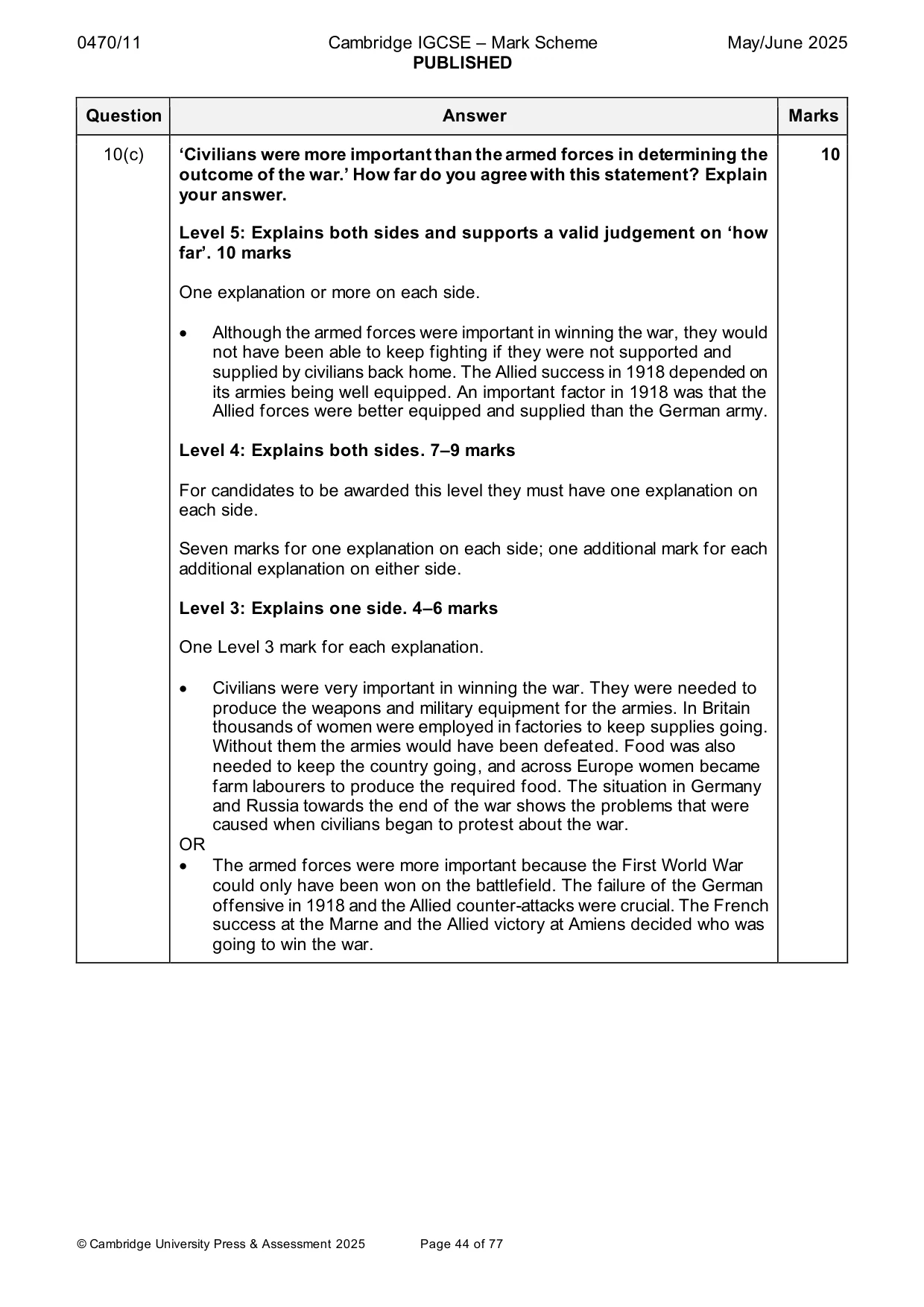
0470/11 Cambridge IGCSE – Mark Scheme PUBLISHED May/June 2025 © Cambridge University Press & Assessment 2025 Page 44 of 77 Question Answer Marks 10(c) ‘Civilians were more important than the armed forces in determining the outcome of the war.’ How far do you agree with this statement? Explain your answer. Level 5: Explains both sides and supports a valid judgement on ‘how far’. 10 marks One explanation or more on each side. • Although the armed forces were important in winning the war, they would not have been able to keep fighting if they were not supported and supplied by civilians back home. The Allied success in 1918 depended on its armies being well equipped. An important factor in 1918 was that the Allied forces were better equipped and supplied than the German army. Level 4: Explains both sides. 7–9 marks For candidates to be awarded this level they must have one explanation on each side. Seven marks for one explanation on each side; one additional mark for each additional explanation on either side. Level 3: Explains one side. 4–6 marks One Level 3 mark for each explanation. • Civilians were very important in winning the war. They were needed to produce the weapons and military equipment for the armies. In Britain thousands of women were employed in factories to keep supplies going. Without them the armies would have been defeated. Food was also needed to keep the country going, and across Europe women became farm labourers to produce the required food. The situation in Germany and Russia towards the end of the war shows the problems that were caused when civilians began to protest about the war. OR • The armed forces were more important because the First World War could only have been won on the battlefield. The failure of the German offensive in 1918 and the Allied counter-attacks were crucial. The French success at the Marne and the Allied victory at Amiens decided who was going to win the war. 10
Mark scheme, page 45
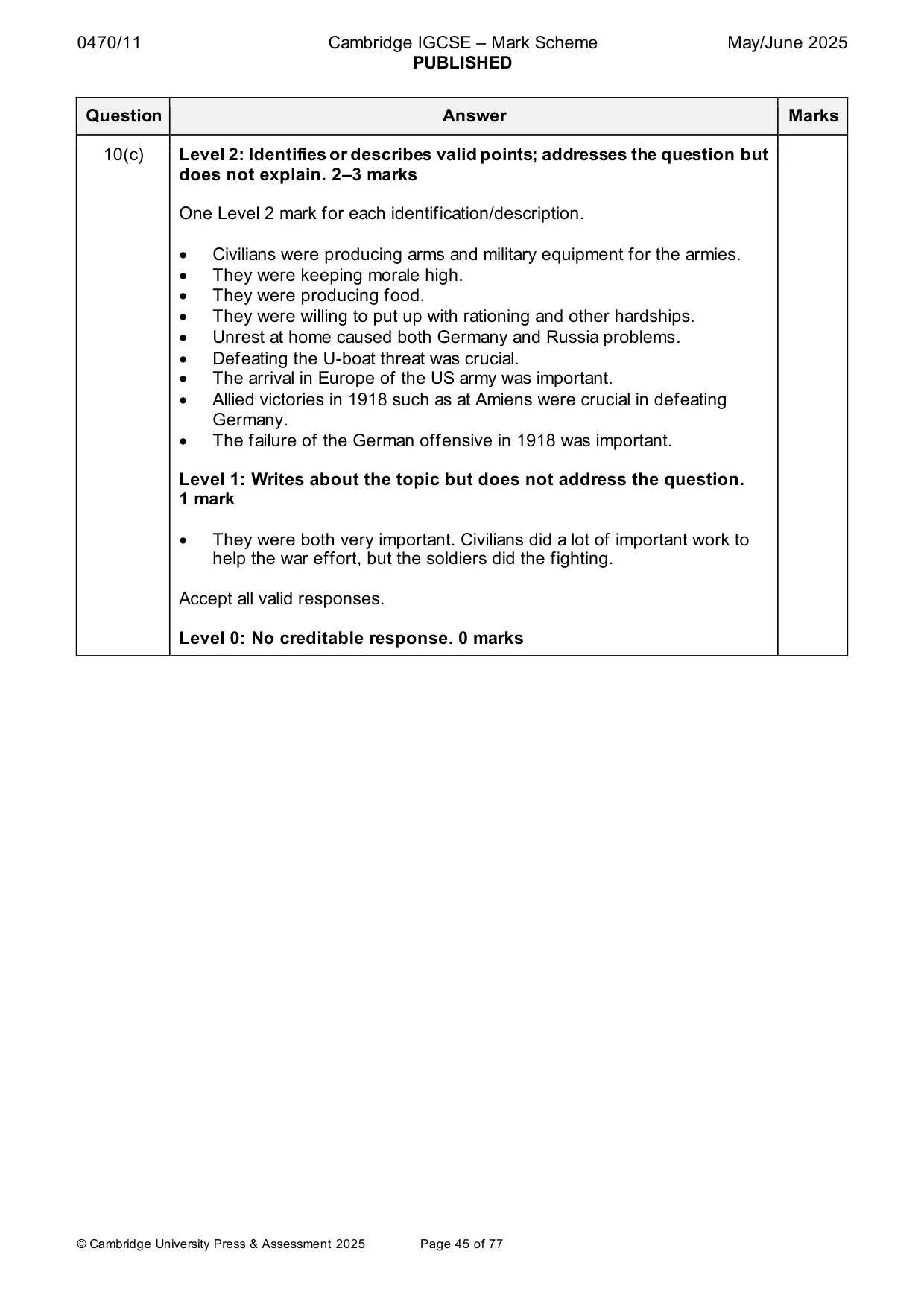
0470/11 Cambridge IGCSE – Mark Scheme PUBLISHED May/June 2025 © Cambridge University Press & Assessment 2025 Page 45 of 77 Question Answer Marks 10(c) Level 2: Identifies or describes valid points; addresses the question but does not explain. 2–3 marks One Level 2 mark for each identification/description. • Civilians were producing arms and military equipment for the armies. • They were keeping morale high. • They were producing food. • They were willing to put up with rationing and other hardships. • Unrest at home caused both Germany and Russia problems. • Defeating the U-boat threat was crucial. • The arrival in Europe of the US army was important. • Allied victories in 1918 such as at Amiens were crucial in defeating Germany. • The failure of the German offensive in 1918 was important. Level 1: Writes about the topic but does not address the question. 1 mark • They were both very important. Civilians did a lot of important work to help the war effort, but the soldiers did the fighting. Accept all valid responses. Level 0: No creditable response. 0 marks
Mark scheme, page 46
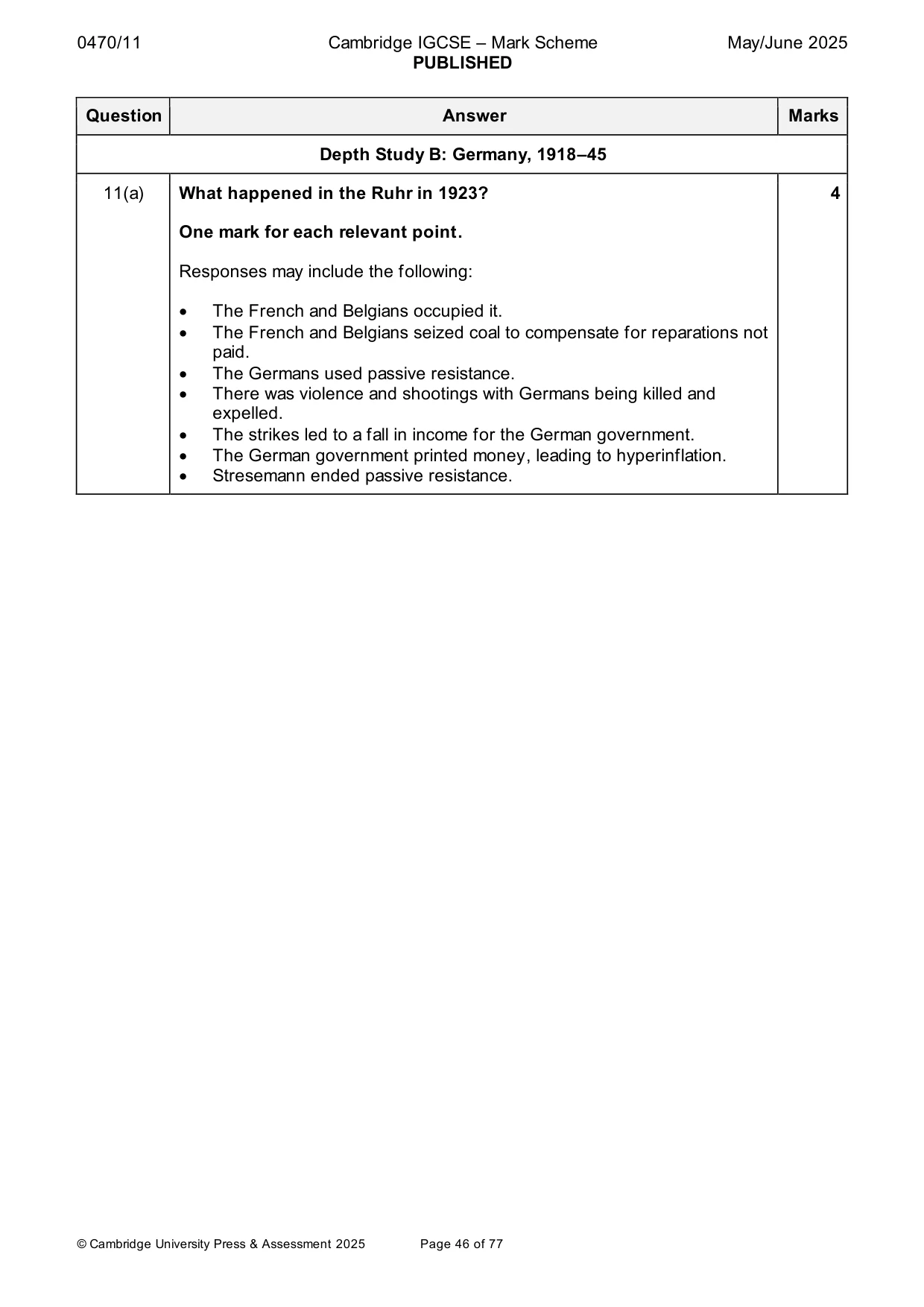
0470/11 Cambridge IGCSE – Mark Scheme PUBLISHED May/June 2025 © Cambridge University Press & Assessment 2025 Page 46 of 77 Question Answer Marks Depth Study B: Germany, 1918–45 11(a) What happened in the Ruhr in 1923? One mark for each relevant point. Responses may include the following: • The French and Belgians occupied it. • The French and Belgians seized coal to compensate for reparations not paid. • The Germans used passive resistance. • There was violence and shootings with Germans being killed and expelled. • The strikes led to a fall in income for the German government. • The German government printed money, leading to hyperinflation. • Stresemann ended passive resistance. 4
Mark scheme, page 47
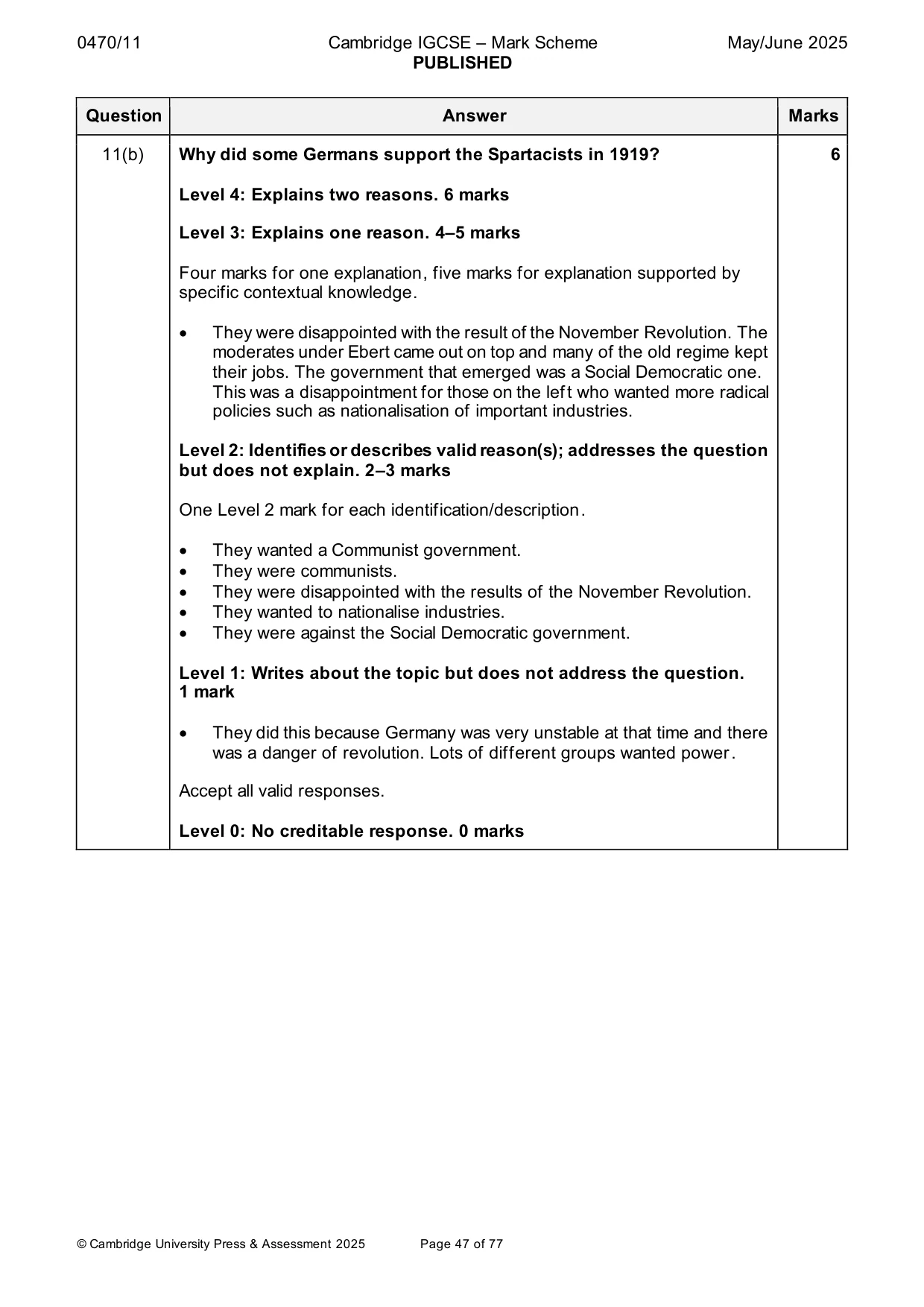
0470/11 Cambridge IGCSE – Mark Scheme PUBLISHED May/June 2025 © Cambridge University Press & Assessment 2025 Page 47 of 77 Question Answer Marks 11(b) Why did some Germans support the Spartacists in 1919? Level 4: Explains two reasons. 6 marks Level 3: Explains one reason. 4–5 marks Four marks for one explanation, five marks for explanation supported by specific contextual knowledge. • They were disappointed with the result of the November Revolution. The moderates under Ebert came out on top and many of the old regime kept their jobs. The government that emerged was a Social Democratic one. This was a disappointment for those on the left who wanted more radical policies such as nationalisation of important industries. Level 2: Identifies or describes valid reason(s); addresses the question but does not explain. 2–3 marks One Level 2 mark for each identification/description. • They wanted a Communist government. • They were communists. • They were disappointed with the results of the November Revolution. • They wanted to nationalise industries. • They were against the Social Democratic government. Level 1: Writes about the topic but does not address the question. 1 mark • They did this because Germany was very unstable at that time and there was a danger of revolution. Lots of different groups wanted power. Accept all valid responses. Level 0: No creditable response. 0 marks 6
Mark scheme, page 48
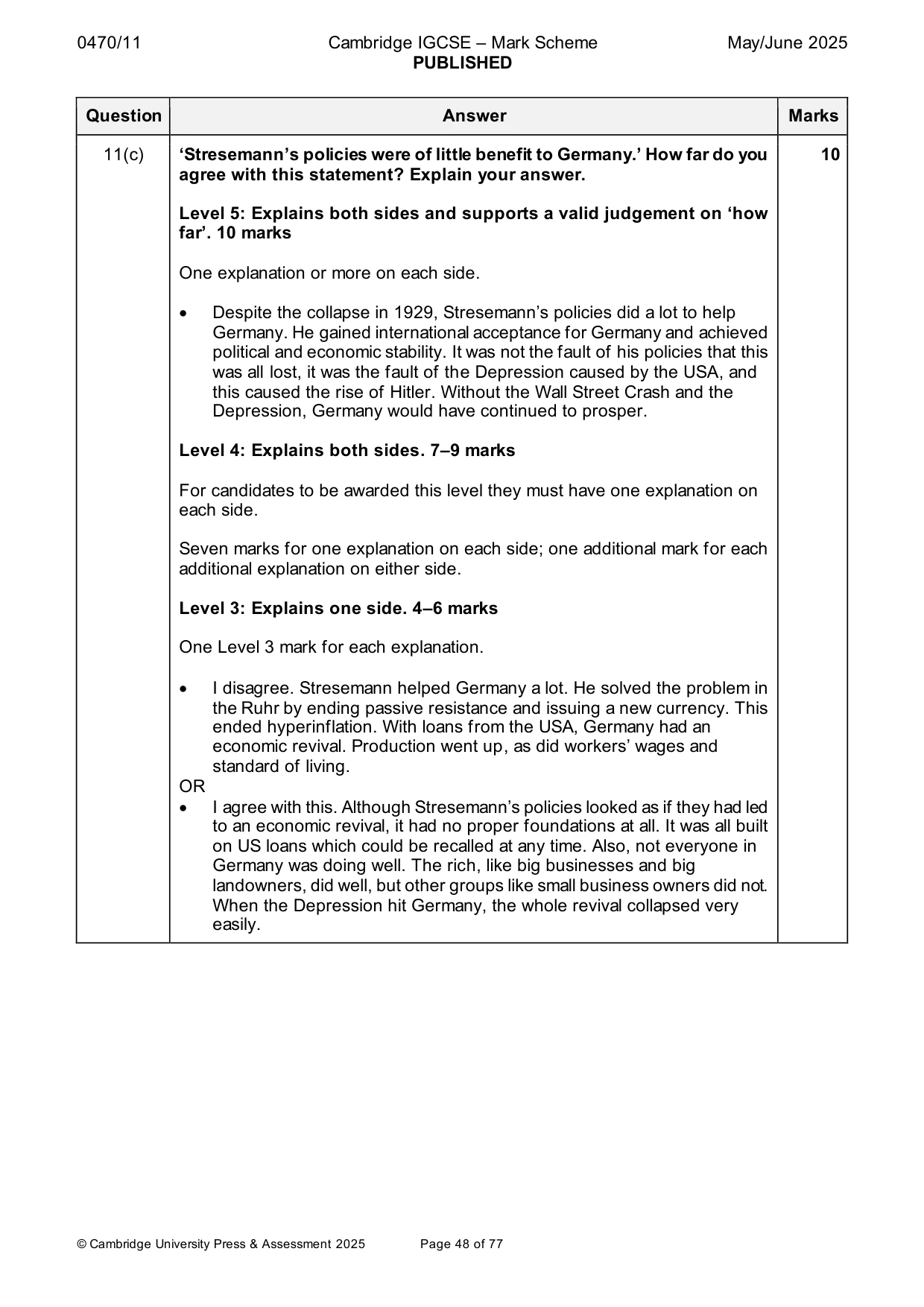
0470/11 Cambridge IGCSE – Mark Scheme PUBLISHED May/June 2025 © Cambridge University Press & Assessment 2025 Page 48 of 77 Question Answer Marks 11(c) ‘Stresemann’s policies were of little benefit to Germany.’ How far do you agree with this statement? Explain your answer. Level 5: Explains both sides and supports a valid judgement on ‘how far’. 10 marks One explanation or more on each side. • Despite the collapse in 1929, Stresemann’s policies did a lot to help Germany. He gained international acceptance for Germany and achieved political and economic stability. It was not the fault of his policies that this was all lost, it was the fault of the Depression caused by the USA, and this caused the rise of Hitler. Without the Wall Street Crash and the Depression, Germany would have continued to prosper. Level 4: Explains both sides. 7–9 marks For candidates to be awarded this level they must have one explanation on each side. Seven marks for one explanation on each side; one additional mark for each additional explanation on either side. Level 3: Explains one side. 4–6 marks One Level 3 mark for each explanation. • I disagree. Stresemann helped Germany a lot. He solved the problem in the Ruhr by ending passive resistance and issuing a new currency. This ended hyperinflation. With loans from the USA, Germany had an economic revival. Production went up, as did workers’ wages and standard of living. OR • I agree with this. Although Stresemann’s policies looked as if they had led to an economic revival, it had no proper foundations at all. It was all built on US loans which could be recalled at any time. Also, not everyone in Germany was doing well. The rich, like big businesses and big landowners, did well, but other groups like small business owners did not. When the Depression hit Germany, the whole revival collapsed very easily. 10
Mark scheme, page 49
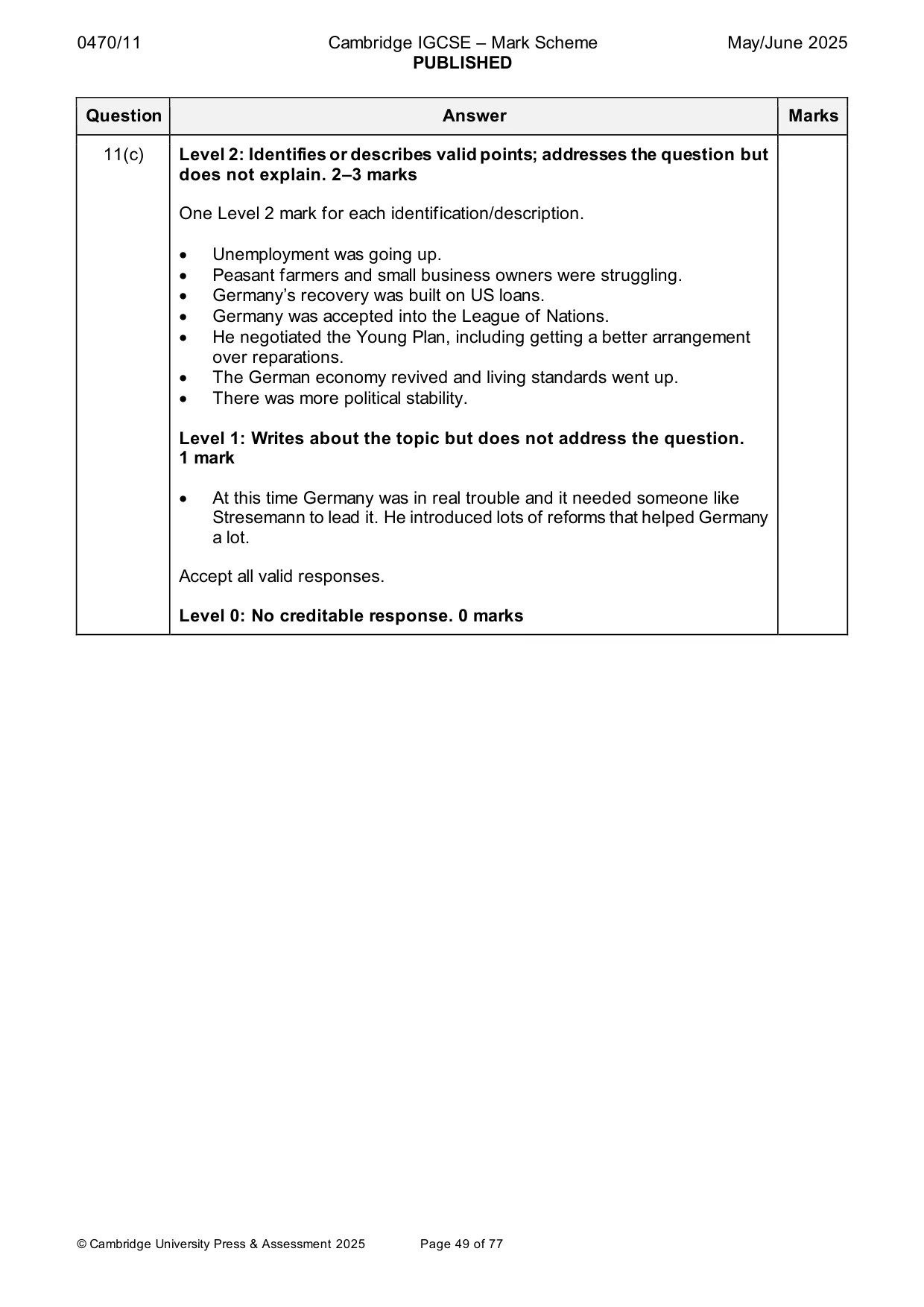
0470/11 Cambridge IGCSE – Mark Scheme PUBLISHED May/June 2025 © Cambridge University Press & Assessment 2025 Page 49 of 77 Question Answer Marks 11(c) Level 2: Identifies or describes valid points; addresses the question but does not explain. 2–3 marks One Level 2 mark for each identification/description. • Unemployment was going up. • Peasant farmers and small business owners were struggling. • Germany’s recovery was built on US loans. • Germany was accepted into the League of Nations. • He negotiated the Young Plan, including getting a better arrangement over reparations. • The German economy revived and living standards went up. • There was more political stability. Level 1: Writes about the topic but does not address the question. 1 mark • At this time Germany was in real trouble and it needed someone like Stresemann to lead it. He introduced lots of reforms that helped Germany a lot. Accept all valid responses. Level 0: No creditable response. 0 marks
Mark scheme, page 50
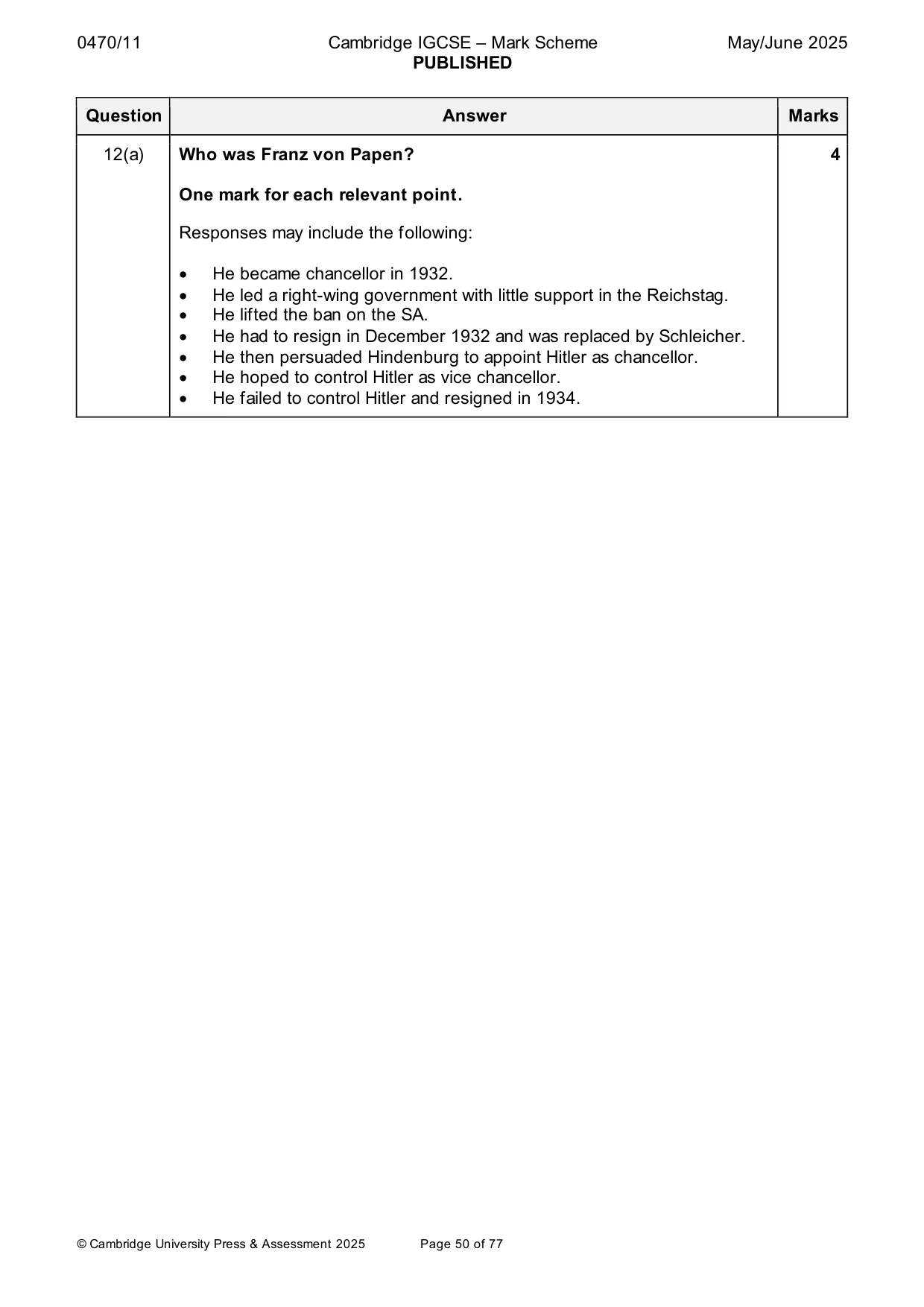
0470/11 Cambridge IGCSE – Mark Scheme PUBLISHED May/June 2025 © Cambridge University Press & Assessment 2025 Page 50 of 77 Question Answer Marks 12(a) Who was Franz von Papen? One mark for each relevant point. Responses may include the following: • He became chancellor in 1932. • He led a right-wing government with little support in the Reichstag. • He lifted the ban on the SA. • He had to resign in December 1932 and was replaced by Schleicher. • He then persuaded Hindenburg to appoint Hitler as chancellor. • He hoped to control Hitler as vice chancellor. • He failed to control Hitler and resigned in 1934. 4
Mark scheme, page 51
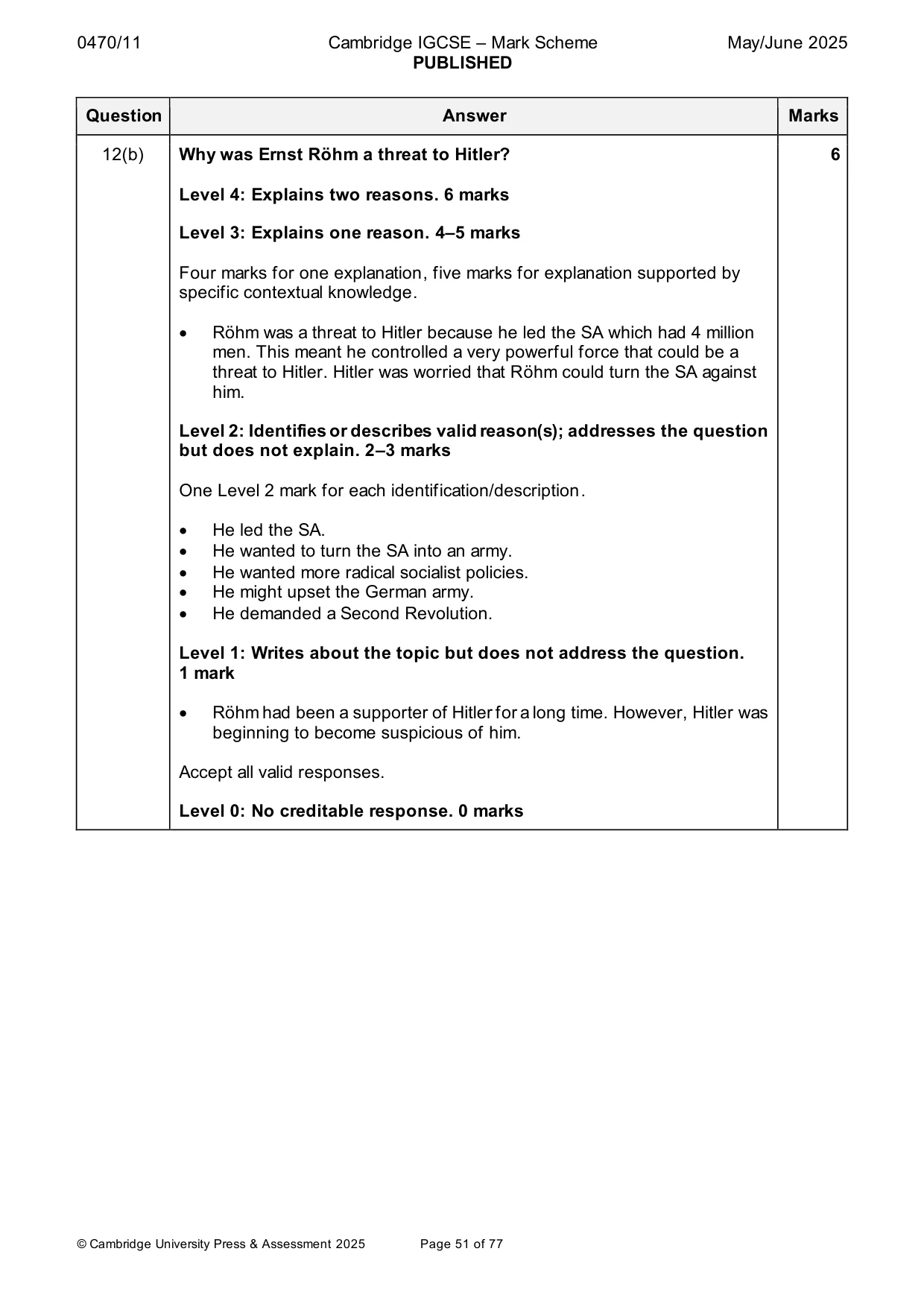
0470/11 Cambridge IGCSE – Mark Scheme PUBLISHED May/June 2025 © Cambridge University Press & Assessment 2025 Page 51 of 77 Question Answer Marks 12(b) Why was Ernst Röhm a threat to Hitler? Level 4: Explains two reasons. 6 marks Level 3: Explains one reason. 4–5 marks Four marks for one explanation, five marks for explanation supported by specific contextual knowledge. • Röhm was a threat to Hitler because he led the SA which had 4 million men. This meant he controlled a very powerful force that could be a threat to Hitler. Hitler was worried that Röhm could turn the SA against him. Level 2: Identifies or describes valid reason(s); addresses the question but does not explain. 2–3 marks One Level 2 mark for each identification/description. • He led the SA. • He wanted to turn the SA into an army. • He wanted more radical socialist policies. • He might upset the German army. • He demanded a Second Revolution. Level 1: Writes about the topic but does not address the question. 1 mark • Röhm had been a supporter of Hitler for a long time. However, Hitler was beginning to become suspicious of him. Accept all valid responses. Level 0: No creditable response. 0 marks 6
Mark scheme, page 52
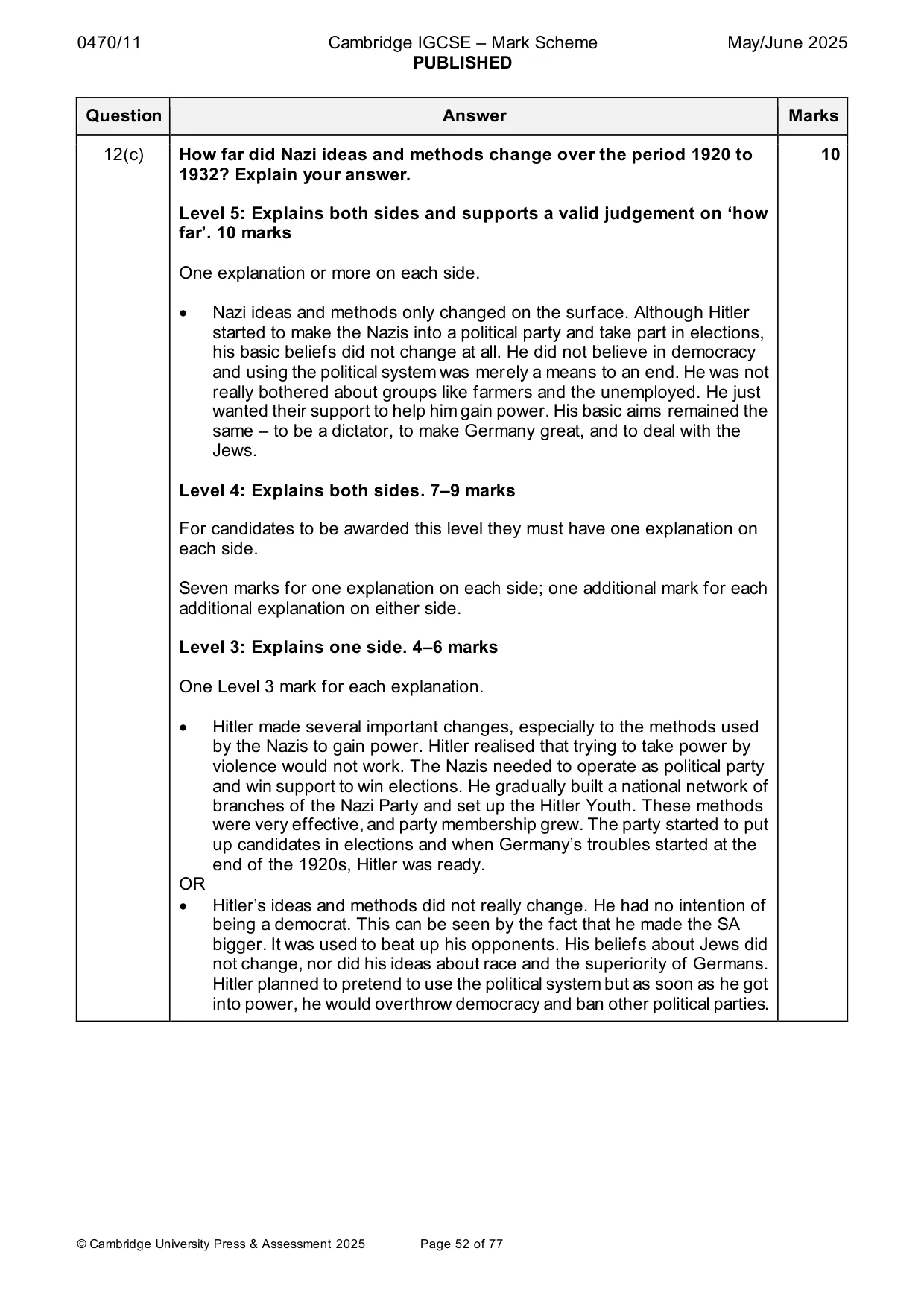
0470/11 Cambridge IGCSE – Mark Scheme PUBLISHED May/June 2025 © Cambridge University Press & Assessment 2025 Page 52 of 77 Question Answer Marks 12(c) How far did Nazi ideas and methods change over the period 1920 to 1932? Explain your answer. Level 5: Explains both sides and supports a valid judgement on ‘how far’. 10 marks One explanation or more on each side. • Nazi ideas and methods only changed on the surface. Although Hitler started to make the Nazis into a political party and take part in elections, his basic beliefs did not change at all. He did not believe in democracy and using the political system was merely a means to an end. He was not really bothered about groups like farmers and the unemployed. He just wanted their support to help him gain power. His basic aims remained the same – to be a dictator, to make Germany great, and to deal with the Jews. Level 4: Explains both sides. 7–9 marks For candidates to be awarded this level they must have one explanation on each side. Seven marks for one explanation on each side; one additional mark for each additional explanation on either side. Level 3: Explains one side. 4–6 marks One Level 3 mark for each explanation. • Hitler made several important changes, especially to the methods used by the Nazis to gain power. Hitler realised that trying to take power by violence would not work. The Nazis needed to operate as political party and win support to win elections. He gradually built a national network of branches of the Nazi Party and set up the Hitler Youth. These methods were very effective, and party membership grew. The party started to put up candidates in elections and when Germany’s troubles started at the end of the 1920s, Hitler was ready. OR • Hitler’s ideas and methods did not really change. He had no intention of being a democrat. This can be seen by the fact that he made the SA bigger. It was used to beat up his opponents. His beliefs about Jews did not change, nor did his ideas about race and the superiority of Germans. Hitler planned to pretend to use the political system but as soon as he got into power, he would overthrow democracy and ban other political parties. 10
Mark scheme, page 53
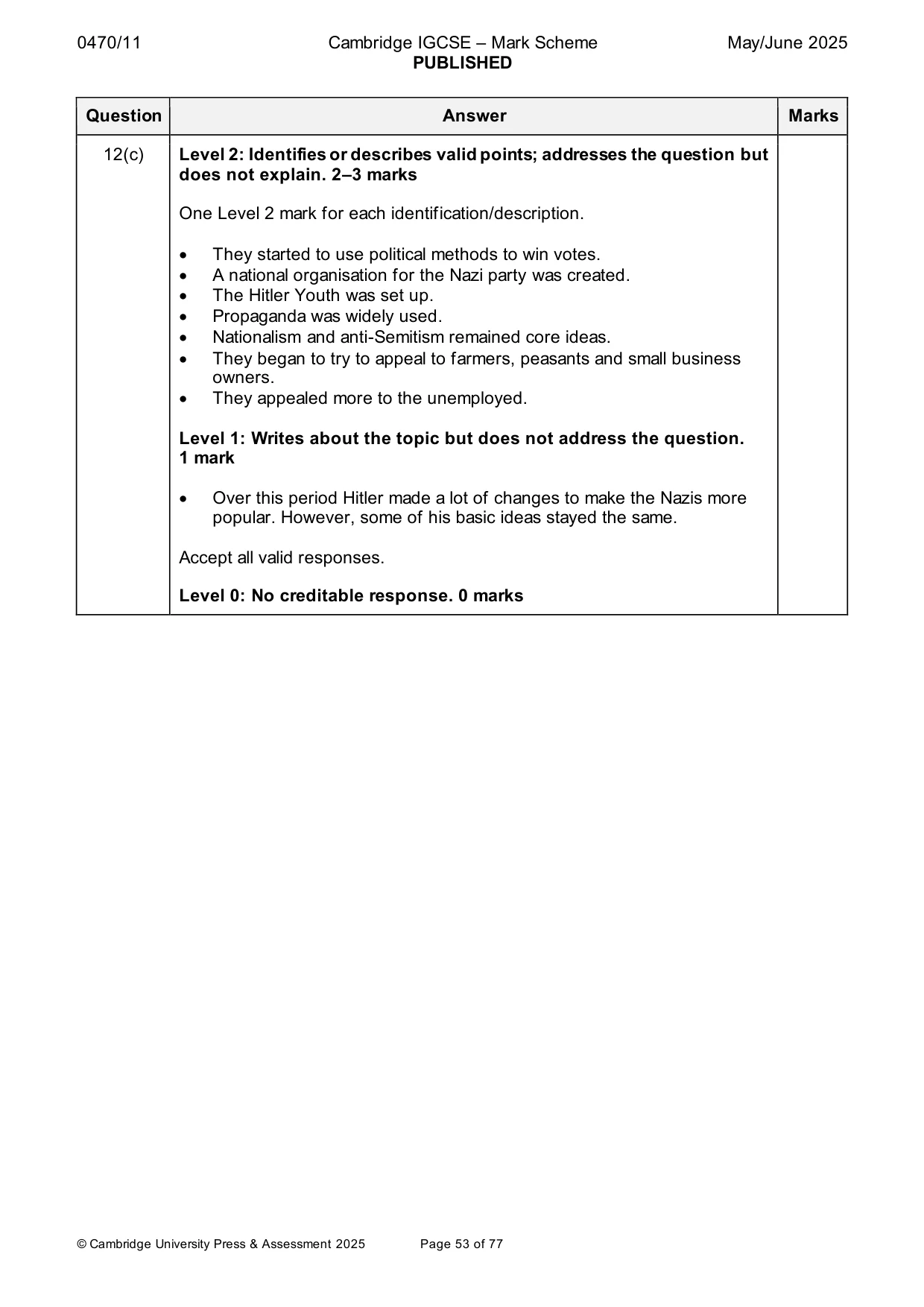
0470/11 Cambridge IGCSE – Mark Scheme PUBLISHED May/June 2025 © Cambridge University Press & Assessment 2025 Page 53 of 77 Question Answer Marks 12(c) Level 2: Identifies or describes valid points; addresses the question but does not explain. 2–3 marks One Level 2 mark for each identification/description. • They started to use political methods to win votes. • A national organisation for the Nazi party was created. • The Hitler Youth was set up. • Propaganda was widely used. • Nationalism and anti-Semitism remained core ideas. • They began to try to appeal to farmers, peasants and small business owners. • They appealed more to the unemployed. Level 1: Writes about the topic but does not address the question. 1 mark • Over this period Hitler made a lot of changes to make the Nazis more popular. However, some of his basic ideas stayed the same. Accept all valid responses. Level 0: No creditable response. 0 marks
Mark scheme, page 54
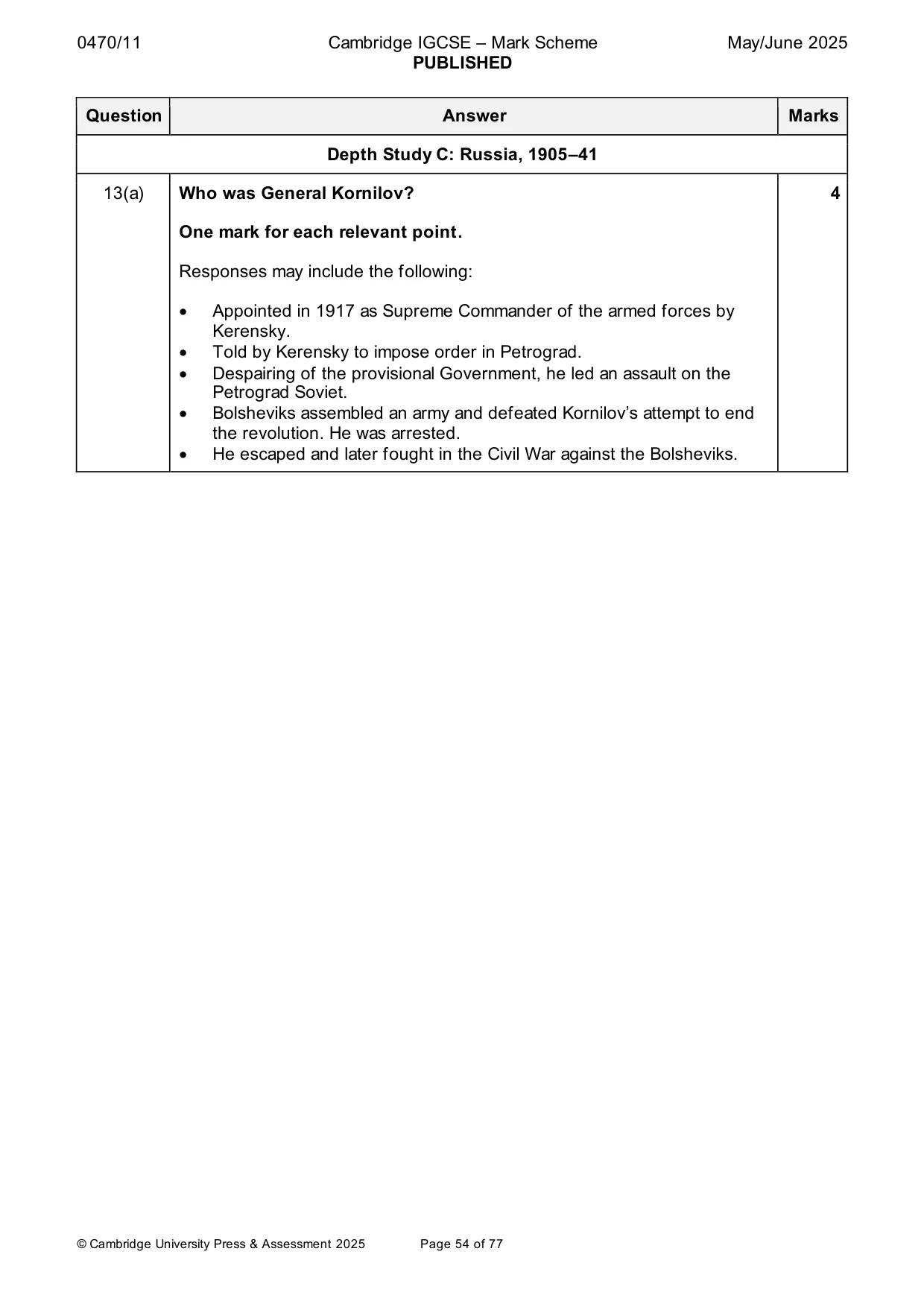
0470/11 Cambridge IGCSE – Mark Scheme PUBLISHED May/June 2025 © Cambridge University Press & Assessment 2025 Page 54 of 77 Question Answer Marks Depth Study C: Russia, 1905–41 13(a) Who was General Kornilov? One mark for each relevant point. Responses may include the following: • Appointed in 1917 as Supreme Commander of the armed forces by Kerensky. • Told by Kerensky to impose order in Petrograd. • Despairing of the provisional Government, he led an assault on the Petrograd Soviet. • Bolsheviks assembled an army and defeated Kornilov’s attempt to end the revolution. He was arrested. • He escaped and later fought in the Civil War against the Bolsheviks. 4
Mark scheme, page 55
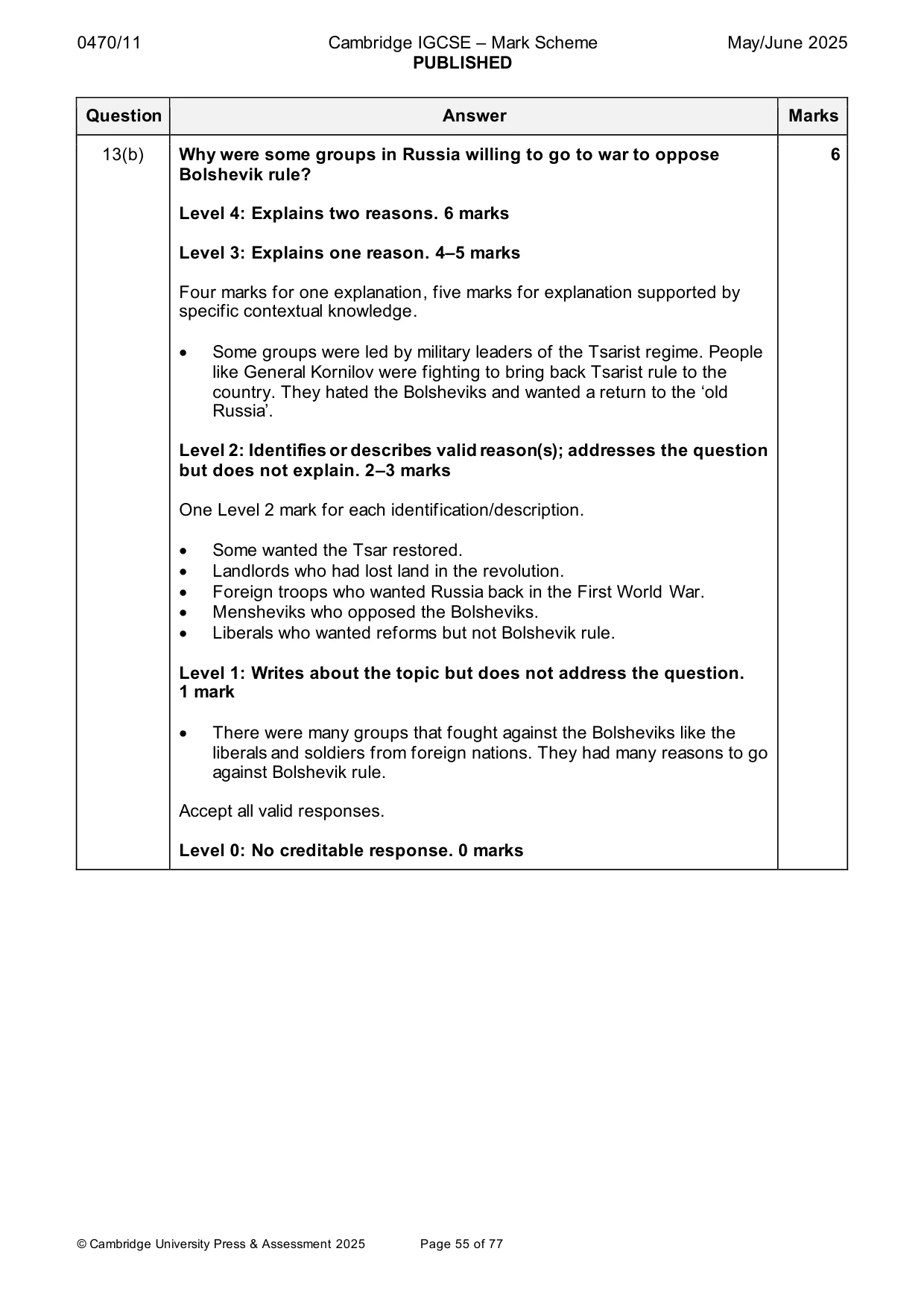
0470/11 Cambridge IGCSE – Mark Scheme PUBLISHED May/June 2025 © Cambridge University Press & Assessment 2025 Page 55 of 77 Question Answer Marks 13(b) Why were some groups in Russia willing to go to war to oppose Bolshevik rule? Level 4: Explains two reasons. 6 marks Level 3: Explains one reason. 4–5 marks Four marks for one explanation, five marks for explanation supported by specific contextual knowledge. • Some groups were led by military leaders of the Tsarist regime. People like General Kornilov were fighting to bring back Tsarist rule to the country. They hated the Bolsheviks and wanted a return to the ‘old Russia’. Level 2: Identifies or describes valid reason(s); addresses the question but does not explain. 2–3 marks One Level 2 mark for each identification/description. • Some wanted the Tsar restored. • Landlords who had lost land in the revolution. • Foreign troops who wanted Russia back in the First World War. • Mensheviks who opposed the Bolsheviks. • Liberals who wanted reforms but not Bolshevik rule. Level 1: Writes about the topic but does not address the question. 1 mark • There were many groups that fought against the Bolsheviks like the liberals and soldiers from foreign nations. They had many reasons to go against Bolshevik rule. Accept all valid responses. Level 0: No creditable response. 0 marks 6
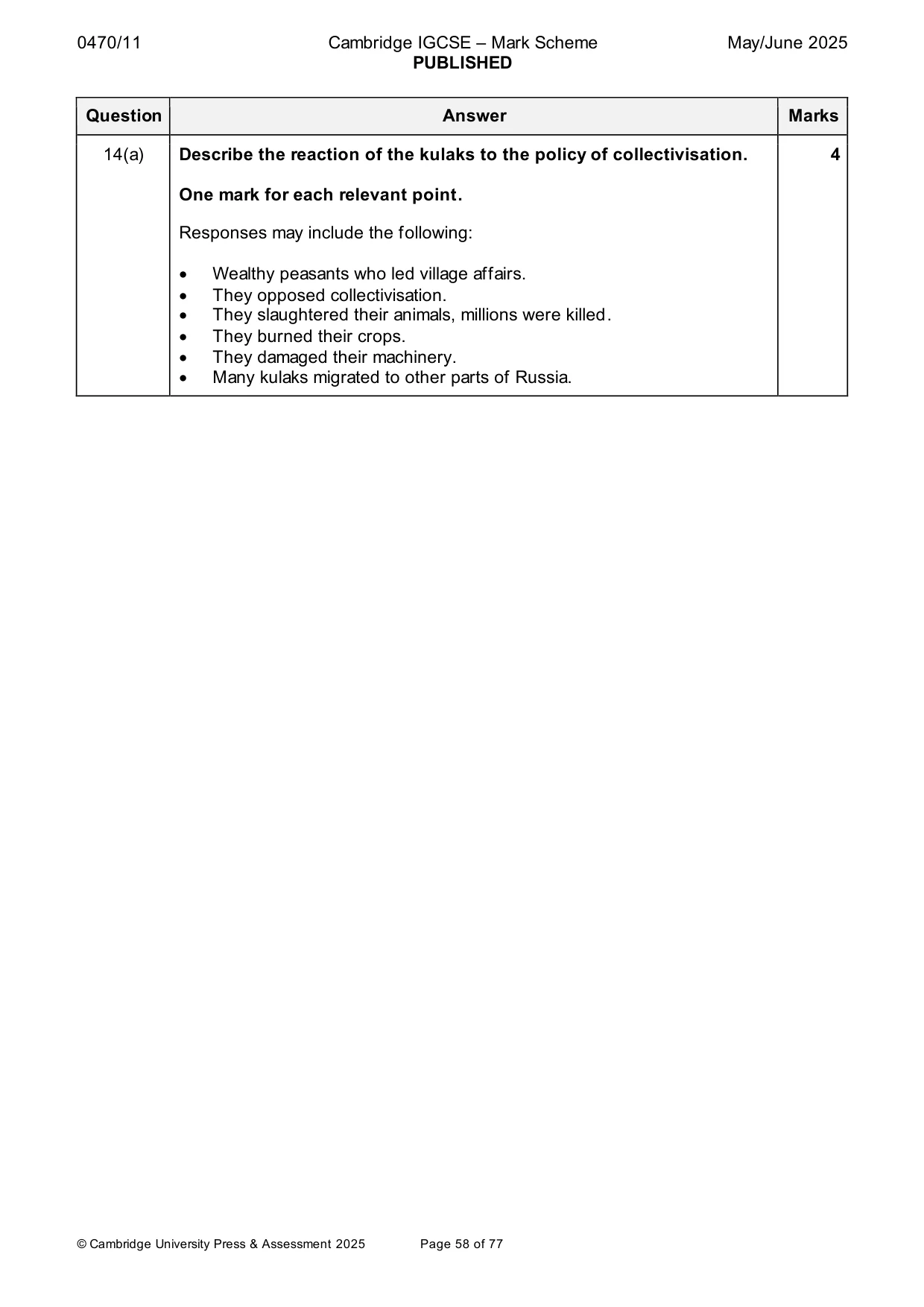
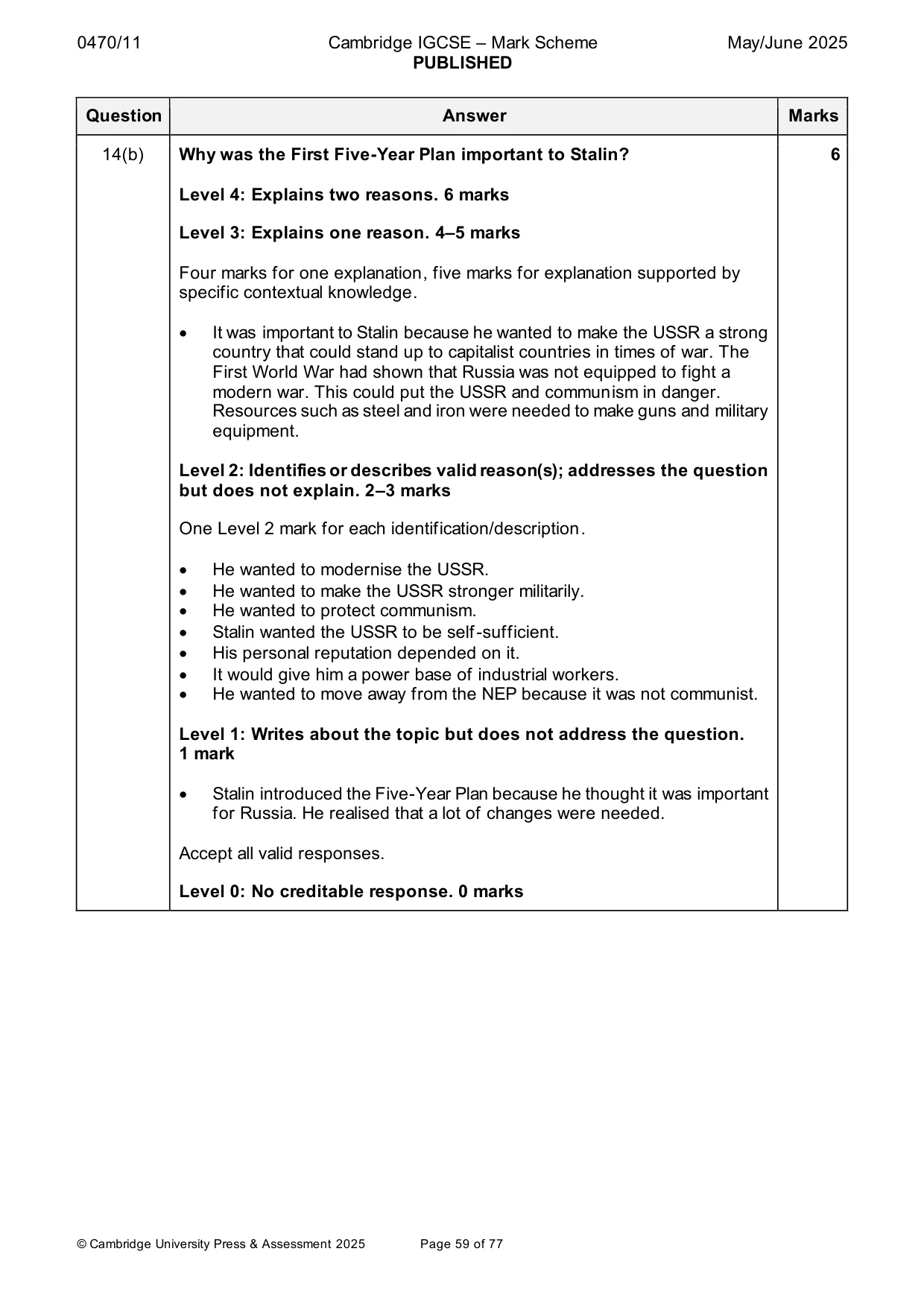
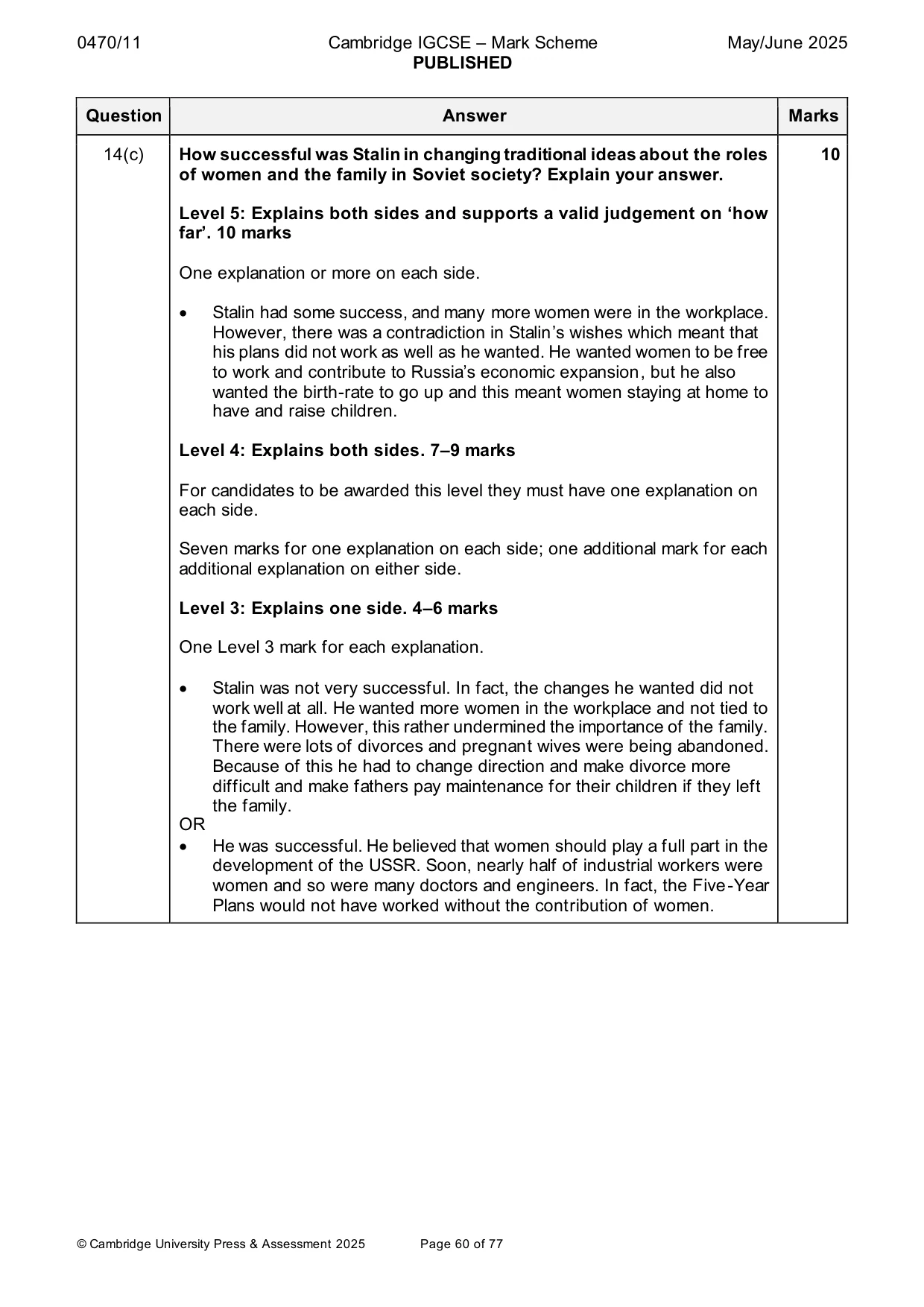
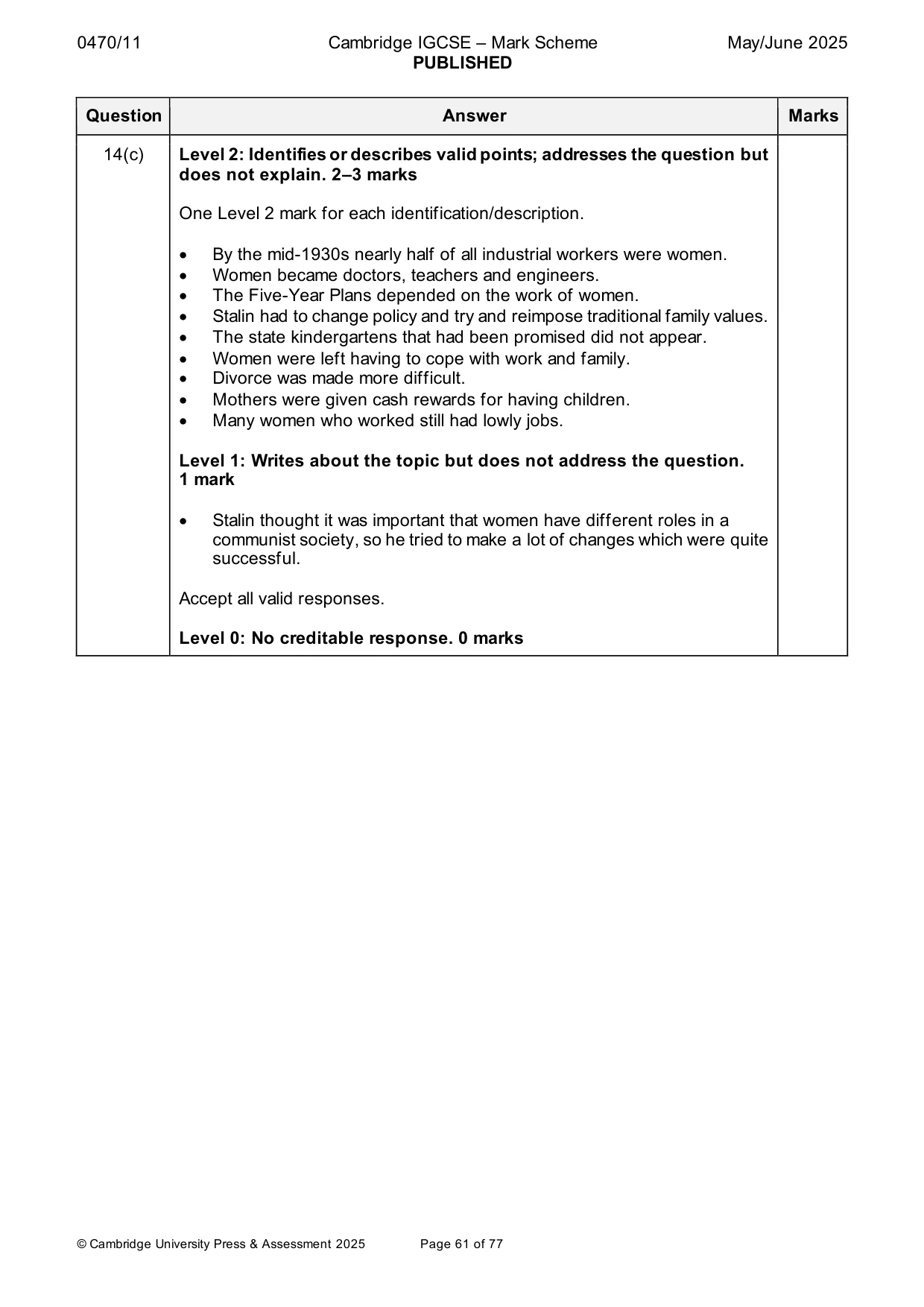
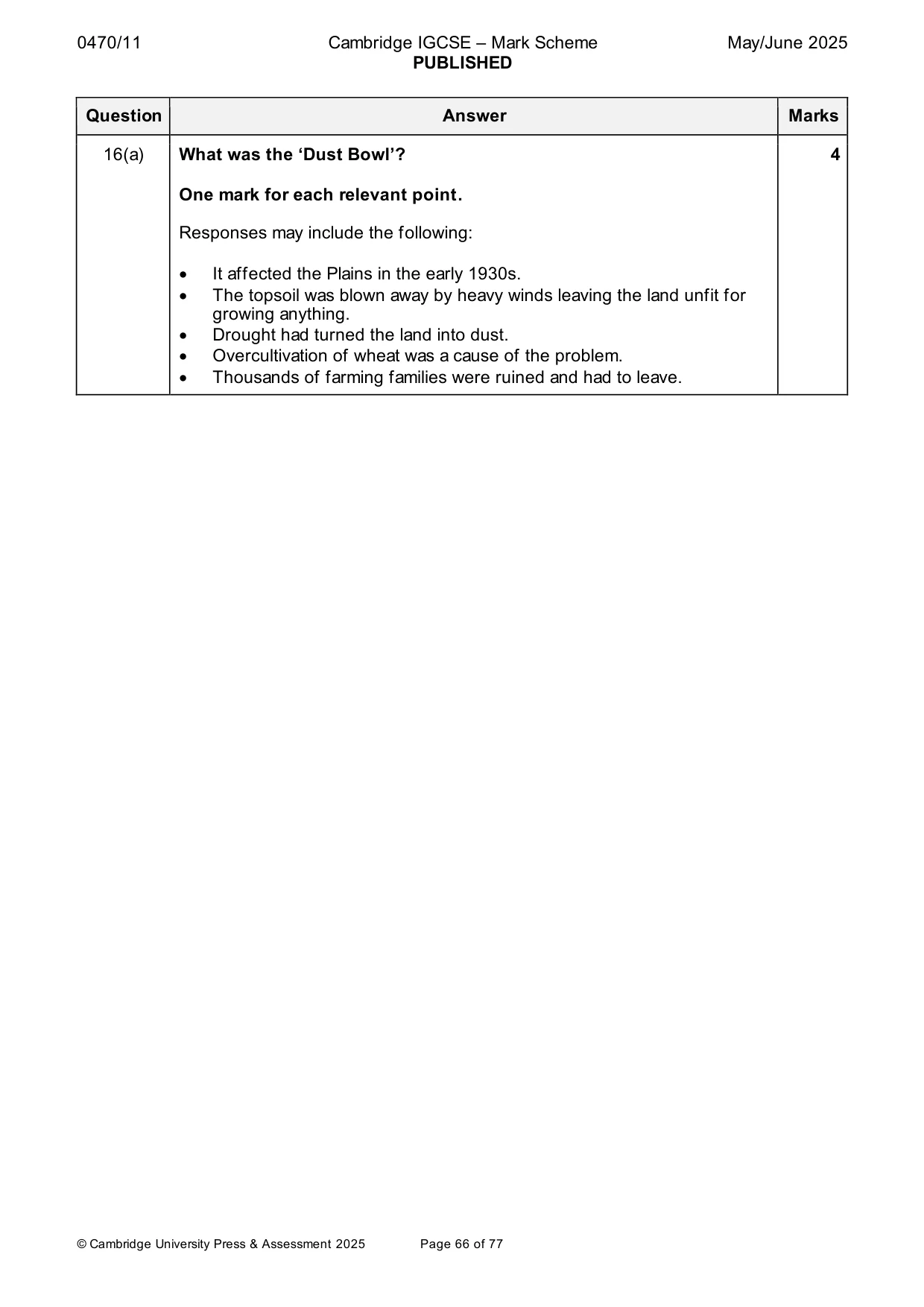
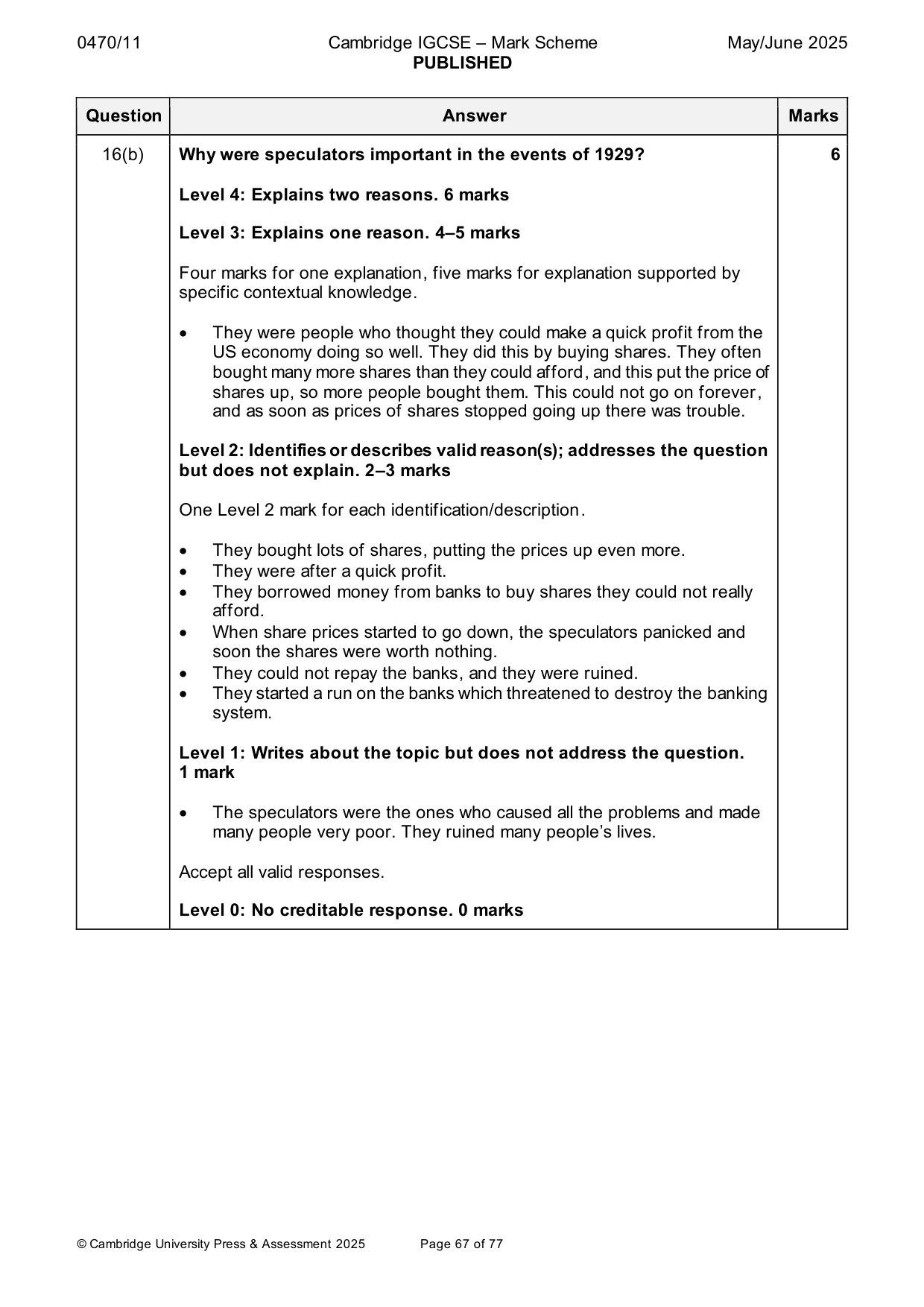
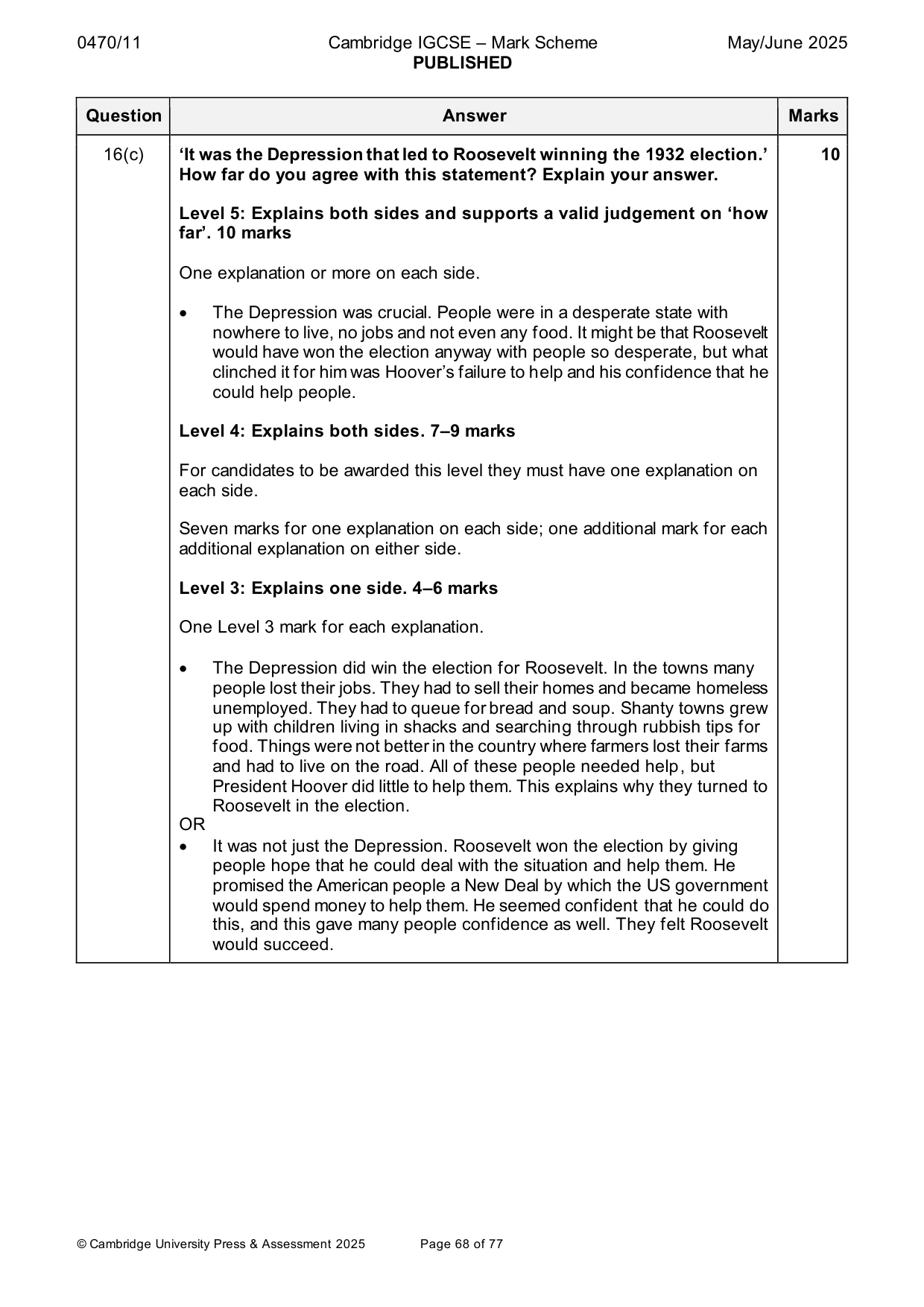
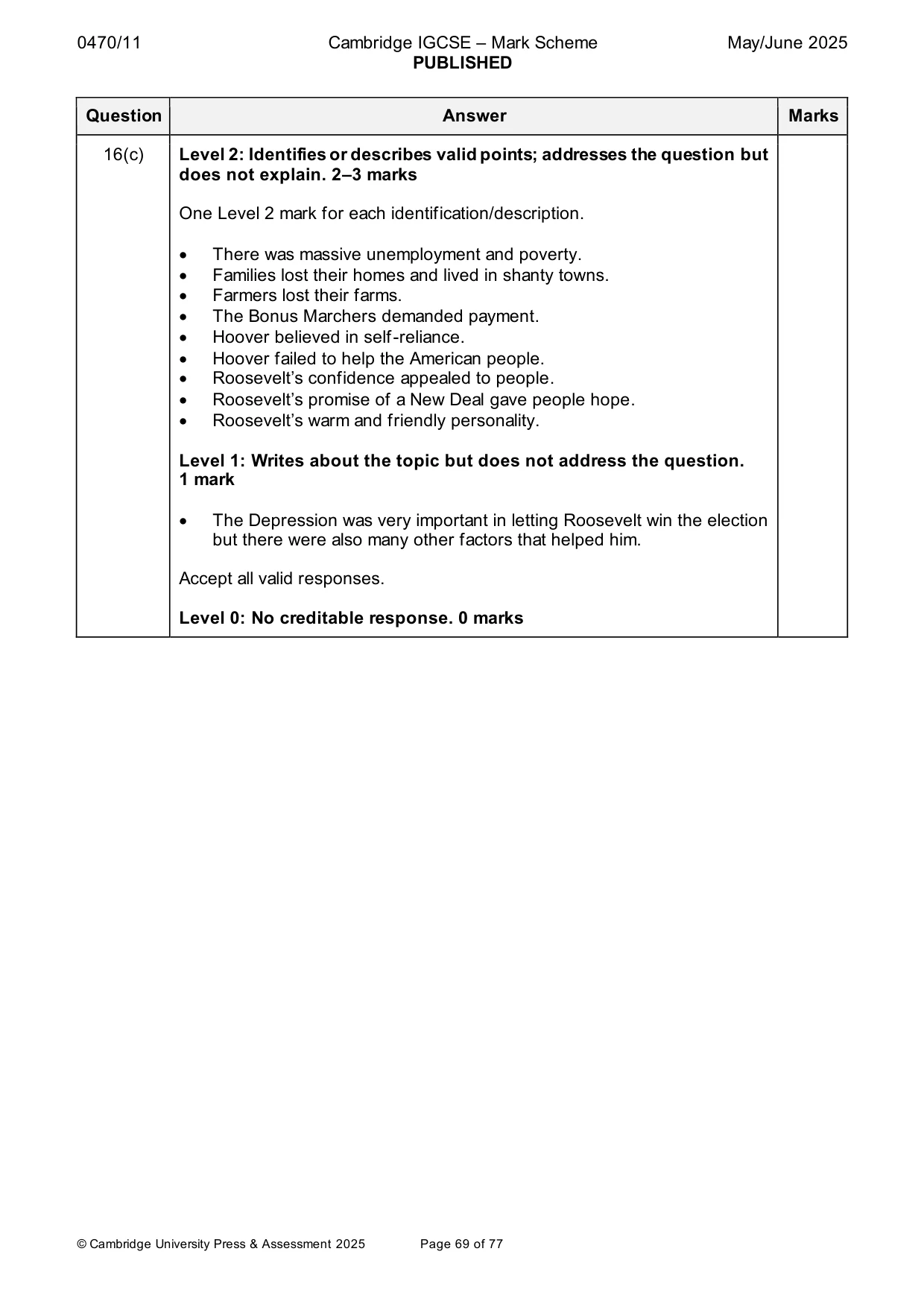
Mark scheme, page 56
0470/11 Cambridge IGCSE – Mark Scheme PUBLISHED May/June 2025 © Cambridge University Press & Assessment 2025 Page 56 of 77 Question Answer Marks 13(c) ‘Lenin introduced the New Economic Policy (NEP) because of the Kronstadt Rising.’ How far do you agree with this statement? Explain your answer. Level 5: Explains both sides and supports a valid judgement on ‘how far’. 10 marks One explanation or more on each side. • There was hardship across Russia with a lot of people suffering. However, what made Lenin realise there was a serious problem was the rising. It was by sailors who supported the Bolsheviks. This made Lenin realise that if his own supporters were rising up against him, there must be a serious problem. Level 4: Explains both sides. 7–9 marks For candidates to be awarded this level they must have one explanation on each side. Seven marks for one explanation on each side; one additional mark for each additional explanation on either side. Level 3: Explains one side. 4–6 marks One Level 3 mark for each explanation. • Lenin did introduce it because of Kronstadt. In 1921 sailors at Kronstadt Naval Base rose up in mutiny. This was because they thought that Bolshevik policies were making life very hard for the Russian people. They wanted elections, free speech and more food for the peasants. This made Lenin realise that he had to compromise and he passed reforms that allowed small factories to be privately owned and trading with other countries to resume. OR • It was caused by more than just the rising. War Communism had been very harsh for many people. Peasants had to hand over their surplus food to the government, discipline in factories was strict and strikers were shot. People were suffering from great hardship. Peasants were refusing to cooperate in producing more food and there were food shortages and in 1921 famine. There was widespread unrest, and this was why Lenin introduced the NEP – to make people’s lives a little easier and to provide more food. 10
Mark scheme, page 57
0470/11 Cambridge IGCSE – Mark Scheme PUBLISHED May/June 2025 © Cambridge University Press & Assessment 2025 Page 57 of 77 Question Answer Marks 13(c) Level 2: Identifies or describes valid points; addresses the question but does not explain. 2–3 marks One Level 2 mark for each identification/description. • The sailors had been supporters of the Bolsheviks. • Trouble might have spread to other military bases. • The rising was against the harsh conditions at the time. • The rising was a serious threat to Lenin. • The peasants were suffering very badly. • There was unrest in several parts of Russia. • War Communism had been very hard on the people. Level 1: Writes about the topic but does not address the question. 1 mark • The NEP was a new policy introduced by Lenin and it surprised a lot of people because it seemed to go against Bolshevik beliefs. However, Lenin thought it was needed at that time. Accept all valid responses. Level 0: No creditable response. 0 marks
Mark scheme, page 58
0470/11 Cambridge IGCSE – Mark Scheme PUBLISHED May/June 2025 © Cambridge University Press & Assessment 2025 Page 58 of 77 Question Answer Marks 14(a) Describe the reaction of the kulaks to the policy of collectivisation. One mark for each relevant point. Responses may include the following: • Wealthy peasants who led village affairs. • They opposed collectivisation. • They slaughtered their animals, millions were killed. • They burned their crops. • They damaged their machinery. • Many kulaks migrated to other parts of Russia. 4
Mark scheme, page 59
0470/11 Cambridge IGCSE – Mark Scheme PUBLISHED May/June 2025 © Cambridge University Press & Assessment 2025 Page 59 of 77 Question Answer Marks 14(b) Why was the First Five-Year Plan important to Stalin? Level 4: Explains two reasons. 6 marks Level 3: Explains one reason. 4–5 marks Four marks for one explanation, five marks for explanation supported by specific contextual knowledge. • It was important to Stalin because he wanted to make the USSR a strong country that could stand up to capitalist countries in times of war. The First World War had shown that Russia was not equipped to fight a modern war. This could put the USSR and communism in danger. Resources such as steel and iron were needed to make guns and military equipment. Level 2: Identifies or describes valid reason(s); addresses the question but does not explain. 2–3 marks One Level 2 mark for each identification/description. • He wanted to modernise the USSR. • He wanted to make the USSR stronger militarily. • He wanted to protect communism. • Stalin wanted the USSR to be self-sufficient. • His personal reputation depended on it. • It would give him a power base of industrial workers. • He wanted to move away from the NEP because it was not communist. Level 1: Writes about the topic but does not address the question. 1 mark • Stalin introduced the Five-Year Plan because he thought it was important for Russia. He realised that a lot of changes were needed. Accept all valid responses. Level 0: No creditable response. 0 marks 6
Mark scheme, page 60
0470/11 Cambridge IGCSE – Mark Scheme PUBLISHED May/June 2025 © Cambridge University Press & Assessment 2025 Page 60 of 77 Question Answer Marks 14(c) How successful was Stalin in changing traditional ideas about the roles of women and the family in Soviet society? Explain your answer. Level 5: Explains both sides and supports a valid judgement on ‘how far’. 10 marks One explanation or more on each side. • Stalin had some success, and many more women were in the workplace. However, there was a contradiction in Stalin’s wishes which meant that his plans did not work as well as he wanted. He wanted women to be free to work and contribute to Russia’s economic expansion, but he also wanted the birth-rate to go up and this meant women staying at home to have and raise children. Level 4: Explains both sides. 7–9 marks For candidates to be awarded this level they must have one explanation on each side. Seven marks for one explanation on each side; one additional mark for each additional explanation on either side. Level 3: Explains one side. 4–6 marks One Level 3 mark for each explanation. • Stalin was not very successful. In fact, the changes he wanted did not work well at all. He wanted more women in the workplace and not tied to the family. However, this rather undermined the importance of the family. There were lots of divorces and pregnant wives were being abandoned. Because of this he had to change direction and make divorce more difficult and make fathers pay maintenance for their children if they left the family. OR • He was successful. He believed that women should play a full part in the development of the USSR. Soon, nearly half of industrial workers were women and so were many doctors and engineers. In fact, the Five-Year Plans would not have worked without the contribution of women. 10
Mark scheme, page 61
0470/11 Cambridge IGCSE – Mark Scheme PUBLISHED May/June 2025 © Cambridge University Press & Assessment 2025 Page 61 of 77 Question Answer Marks 14(c) Level 2: Identifies or describes valid points; addresses the question but does not explain. 2–3 marks One Level 2 mark for each identification/description. • By the mid-1930s nearly half of all industrial workers were women. • Women became doctors, teachers and engineers. • The Five-Year Plans depended on the work of women. • Stalin had to change policy and try and reimpose traditional family values. • The state kindergartens that had been promised did not appear. • Women were left having to cope with work and family. • Divorce was made more difficult. • Mothers were given cash rewards for having children. • Many women who worked still had lowly jobs. Level 1: Writes about the topic but does not address the question. 1 mark • Stalin thought it was important that women have different roles in a communist society, so he tried to make a lot of changes which were quite successful. Accept all valid responses. Level 0: No creditable response. 0 marks
Mark scheme, page 62
0470/11 Cambridge IGCSE – Mark Scheme PUBLISHED May/June 2025 © Cambridge University Press & Assessment 2025 Page 62 of 77 Question Answer Marks Depth Study D: The United States, 1919–41 15(a) What was the Ku Klux Klan? One mark for each relevant point. Responses may include the following: • An organisation that believed in white supremacy. • It used violence, including lynchings, against Black Americans. • It claimed to defend traditional American values. • It operated in the South of the USA. • It acted against Jews, Catholics and immigrants. • It had secret codes and rituals and dressed in white hooded sheets. 4
Mark scheme, page 63
0470/11 Cambridge IGCSE – Mark Scheme PUBLISHED May/June 2025 © Cambridge University Press & Assessment 2025 Page 63 of 77 Question Answer Marks 15(b) Why was there a ‘Red Scare’ in the 1920s? Level 4: Explains two reasons. 6 marks Level 3: Explains one reason. 4–5 marks Four marks for one explanation, five marks for explanation supported by specific contextual knowledge. • There was a Red Scare because of the large number of immigrants coming into the USA after the First World War. Many of them came from Eastern Europe and Russia. There was a fear that, after the Russian Revolution of 1917, they would have communist ideas and would spread them in the USA. Level 2: Identifies or describes valid reason(s); addresses the question but does not explain. 2–3 marks One Level 2 mark for each identification/description. • Immigrants from Eastern Europe. • There were many strikes in the years after the First World War. • In 1919 there were a number of incidents of bombs going off. • The claims made by Palmer. • The media made people’s fears worse. • The Russian Revolution of 1917. Level 1: Writes about the topic but does not address the question. 1 mark • This happened because people in America were very nervous and thought that the country was in danger. Accept all valid responses. Level 0: No creditable response. 0 marks 6
Mark scheme, page 64
0470/11 Cambridge IGCSE – Mark Scheme PUBLISHED May/June 2025 © Cambridge University Press & Assessment 2025 Page 64 of 77 Question Answer Marks 15(c) How far were the 1920s the ‘Roaring Twenties’? Explain your answer. Level 5: Explains both sides and supports a valid judgement on ‘how far’. 10 marks One explanation or more on each side. • It was the Roaring Twenties for some parts of the USA but not for other parts. The new ideas and activities were welcomed by young, rich people in the cities. But there was another America of the poor and those in rural areas. They did not experience the Roaring Twenties, and their lives went on as they had always done. So, it all depended on where in the USA you looked and which social groups were involved. Level 4: Explains both sides. 7–9 marks For candidates to be awarded this level they must have one explanation on each side. Seven marks for one explanation on each side; one additional mark for each additional explanation on either side. Level 3: Explains one side. 4–6 marks One Level 3 mark for each explanation. • They were the Roaring Twenties. Young people in cities started to go to night clubs to listen to jazz and blues and to dance new dances like the Charleston. Women had a lot more freedom and were called flappers. They smoked and wore short dresses. They all enjoyed the thrill and excitement. The talkies also gave people new experiences with much more stress on sex than there had been. OR • It was not the Roaring Twenties for many people. Many older people disapproved of the new morals and regarded the new activities and attitudes as corrupting influences. There were also a lot of poor people who did not enjoy the new freedoms. Many in the cities were unemployed and those on small farms had a very hard life and only just managed to make a living and feed their families. 10
Mark scheme, page 65
0470/11 Cambridge IGCSE – Mark Scheme PUBLISHED May/June 2025 © Cambridge University Press & Assessment 2025 Page 65 of 77 Question Answer Marks 15(c) Level 2: Identifies or describes valid points; addresses the question but does not explain. 2–3 marks One Level 2 mark for each identification/description. • Jazz became popular. • Going to the cinema became very popular. • There were new freedoms for some women, especially the young. • There were new fashions for women. • The popularity of nightclubs and dancing grew. • New moral attitudes towards sex. • Life in small country towns and in rural areas was unchanged. • Many Americans disapproved of the new attitudes and behaviours. • Many in the South disapproved of what was happening in the cities. • Many women’s lives were still occupied with housework and looking after children. • Many of the working class could not afford cars and nightclubs. Level 1: Writes about the topic but does not address the question. 1 mark • The Roaring Twenties was a period in the USA when a lot was going on. However, not everybody was involved in all the changes. Accept all valid responses. Level 0: No creditable response. 0 marks
Mark scheme, page 66
0470/11 Cambridge IGCSE – Mark Scheme PUBLISHED May/June 2025 © Cambridge University Press & Assessment 2025 Page 66 of 77 Question Answer Marks 16(a) What was the ‘Dust Bowl’? One mark for each relevant point. Responses may include the following: • It affected the Plains in the early 1930s. • The topsoil was blown away by heavy winds leaving the land unfit for growing anything. • Drought had turned the land into dust. • Overcultivation of wheat was a cause of the problem. • Thousands of farming families were ruined and had to leave. 4
Mark scheme, page 67
0470/11 Cambridge IGCSE – Mark Scheme PUBLISHED May/June 2025 © Cambridge University Press & Assessment 2025 Page 67 of 77 Question Answer Marks 16(b) Why were speculators important in the events of 1929? Level 4: Explains two reasons. 6 marks Level 3: Explains one reason. 4–5 marks Four marks for one explanation, five marks for explanation supported by specific contextual knowledge. • They were people who thought they could make a quick profit from the US economy doing so well. They did this by buying shares. They often bought many more shares than they could afford, and this put the price of shares up, so more people bought them. This could not go on forever, and as soon as prices of shares stopped going up there was trouble. Level 2: Identifies or describes valid reason(s); addresses the question but does not explain. 2–3 marks One Level 2 mark for each identification/description. • They bought lots of shares, putting the prices up even more. • They were after a quick profit. • They borrowed money from banks to buy shares they could not really afford. • When share prices started to go down, the speculators panicked and soon the shares were worth nothing. • They could not repay the banks, and they were ruined. • They started a run on the banks which threatened to destroy the banking system. Level 1: Writes about the topic but does not address the question. 1 mark • The speculators were the ones who caused all the problems and made many people very poor. They ruined many people’s lives. Accept all valid responses. Level 0: No creditable response. 0 marks 6
Mark scheme, page 68
0470/11 Cambridge IGCSE – Mark Scheme PUBLISHED May/June 2025 © Cambridge University Press & Assessment 2025 Page 68 of 77 Question Answer Marks 16(c) ‘It was the Depression that led to Roosevelt winning the 1932 election.’ How far do you agree with this statement? Explain your answer. Level 5: Explains both sides and supports a valid judgement on ‘how far’. 10 marks One explanation or more on each side. • The Depression was crucial. People were in a desperate state with nowhere to live, no jobs and not even any food. It might be that Roosevelt would have won the election anyway with people so desperate, but what clinched it for him was Hoover’s failure to help and his confidence that he could help people. Level 4: Explains both sides. 7–9 marks For candidates to be awarded this level they must have one explanation on each side. Seven marks for one explanation on each side; one additional mark for each additional explanation on either side. Level 3: Explains one side. 4–6 marks One Level 3 mark for each explanation. • The Depression did win the election for Roosevelt. In the towns many people lost their jobs. They had to sell their homes and became homeless unemployed. They had to queue for bread and soup. Shanty towns grew up with children living in shacks and searching through rubbish tips for food. Things were not better in the country where farmers lost their farms and had to live on the road. All of these people needed help, but President Hoover did little to help them. This explains why they turned to Roosevelt in the election. OR • It was not just the Depression. Roosevelt won the election by giving people hope that he could deal with the situation and help them. He promised the American people a New Deal by which the US government would spend money to help them. He seemed confident that he could do this, and this gave many people confidence as well. They felt Roosevelt would succeed. 10
Mark scheme, page 69
0470/11 Cambridge IGCSE – Mark Scheme PUBLISHED May/June 2025 © Cambridge University Press & Assessment 2025 Page 69 of 77 Question Answer Marks 16(c) Level 2: Identifies or describes valid points; addresses the question but does not explain. 2–3 marks One Level 2 mark for each identification/description. • There was massive unemployment and poverty. • Families lost their homes and lived in shanty towns. • Farmers lost their farms. • The Bonus Marchers demanded payment. • Hoover believed in self-reliance. • Hoover failed to help the American people. • Roosevelt’s confidence appealed to people. • Roosevelt’s promise of a New Deal gave people hope. • Roosevelt’s warm and friendly personality. Level 1: Writes about the topic but does not address the question. 1 mark • The Depression was very important in letting Roosevelt win the election but there were also many other factors that helped him. Accept all valid responses. Level 0: No creditable response. 0 marks
Mark scheme, page 70
0470/11 Cambridge IGCSE – Mark Scheme PUBLISHED May/June 2025 © Cambridge University Press & Assessment 2025 Page 70 of 77 Question Answer Marks Depth Study E: The Second World War in Europe and the Asia–Pacific, 1939–c.1945 17(a) Describe what happened at Dunkirk in 1940. One mark for each relevant point. Responses may include the following: • The speed of the German advance through Belgium and in France left Dunkirk as the only port left open. • The French and British troops retreated to Dunkirk. • The British government put Operation Dynamo into action. • The government appealed for small boats to go to Dunkirk and help bring the troops to Britain. • Hundreds of all kinds of craft sailed to Dunkirk. • The RAF used all their planes to protect the evacuation. • Hundreds of thousands of troops were rescued in this way. 4
Mark scheme, page 71
0470/11 Cambridge IGCSE – Mark Scheme PUBLISHED May/June 2025 © Cambridge University Press & Assessment 2025 Page 71 of 77 Question Answer Marks 17(b) Why was Germany unable to defeat the Soviet Union? Level 4: Explains two reasons. 6 marks Level 3: Explains one reason. 4–5 marks Four marks for one explanation, five marks for explanation supported by specific contextual knowledge. • This was because of mistakes by Hitler. He should have supported his generals’ idea of a full-scale attack on Moscow to take it as quickly as possible. However, Hitler diverted parts of the army to other targets such as Ukraine. His only hope had been to take Moscow quickly, and when the attack was resumed it was too late. Level 2: Identifies or describes valid reason(s); addresses the question but does not explain. 2–3 marks One Level 2 mark for each identification/description. • Winter conditions made fighting difficult. • Russian reinforcements around Moscow were strong. • The Soviet defences around Moscow. • Supply problems for the Germans. • The vast distances involved. • The huge number of Russian troops. • Hitler’s interference with the operation. • The Germans underestimated the strength and size of Russian forces. • The Germans were defeated at Stalingrad. • Russian tank superiority. • The determined resistance of the Russians. Level 1: Writes about the topic but does not address the question. 1 mark • Germany started its attack on the Soviet Union in 1941. It used a massive invasion force, but in the end failed. This is because it was an enormous task that could not be completed. Accept all valid responses. Level 0: No creditable response. 0 marks 6
Mark scheme, page 72
0470/11 Cambridge IGCSE – Mark Scheme PUBLISHED May/June 2025 © Cambridge University Press & Assessment 2025 Page 72 of 77 Question Answer Marks 17(c) ‘The Battle of Britain was a turning point for Britain.’ How far do you agree with this statement? Explain your answer. Level 5: Explains both sides and supports a valid judgement on ‘how far’. 10 marks One explanation or more on each side. • Although the Battle of Britain meant that Britain was safe from a German invasion, it did not mean that it could not be defeated. At the same time France had fallen, and Germany was very strong. Britain also had to rebuild its army. It needed other developments to ensure that the Second World War was not lost to Germany, such as the failure of Operation Barbarossa. As soon as the Russians began to make advances, Germany was in trouble. This was the key turning point. Level 4: Explains both sides. 7–9 marks For candidates to be awarded this level they must have one explanation on each side. Seven marks for one explanation on each side; one additional mark for each additional explanation on either side. Level 3: Explains one side. 4–6 marks One Level 3 mark for each explanation. • The Battle of Britain was a turning point because if the German air force had won it would have had control of the skies over the English Channel and North Sea. This would have meant that the Germany army could have invaded because it already controlled French ports. With air cover, the Germans would have been able to send troops across the Channel and start an invasion. Without control of the air, the Germans knew that their ships full of troops would be destroyed before they got to the British coast. After the Battle of Britain Germany’s chances of winning were much smaller. OR • It was not a turning point. The situation after the Battle of Britain in 1940 was still very good for Germany. The British and French had been defeated in France, which had surrendered. The German invasion of the Soviet Union in 1941, and this operation’s failure, was the real turning point. From this point on, Germany was on the defensive and the Russians started to advance into Poland. 10
Mark scheme, page 73
0470/11 Cambridge IGCSE – Mark Scheme PUBLISHED May/June 2025 © Cambridge University Press & Assessment 2025 Page 73 of 77 Question Answer Marks 17(c) Level 2: Identifies or describes valid points; addresses the question but does not explain. 2–3 marks One Level 2 mark for each identification/description. • It made the Germans call off the idea of invading Britain. • The Battle of Britain meant that the German air force did not have control of the skies. • The Battle of Britain helped Britain survive and extended the war. • Germany still had the upper hand in 1940. • There were other turning points, such as the failure of the German invasion of Russia. • The defeat at Stalingrad. • Allied victories in Africa. • The D-Day landings. • The state of the British army after Dunkirk. Level 1: Writes about the topic but does not address the question. 1 mark • The Battle of Britain was very important. It was an enormous struggle between the RAF and the German air force. It went a long way to deciding the outcome of the war. Accept all valid responses. Level 0: No creditable response. 0 marks
Mark scheme, page 74
0470/11 Cambridge IGCSE – Mark Scheme PUBLISHED May/June 2025 © Cambridge University Press & Assessment 2025 Page 74 of 77 Question Answer Marks 18(a) Describe the methods used against the Japanese by the resistance movement in Malaya. One mark for each relevant point. Responses may include the following: • The MPAJA (Communists) cooperated with the British against the Japanese and were trained by them. • The Communists used guerrilla tactics. • They attacked locals if they cooperated with the Japanese. • The Communists sabotaged Japanese equipment and carried out ambushes. 4
Mark scheme, page 75
0470/11 Cambridge IGCSE – Mark Scheme PUBLISHED May/June 2025 © Cambridge University Press & Assessment 2025 Page 75 of 77 Question Answer Marks 18(b) Why was the French resistance movement able to cause serious problems for the Germans? Level 4: Explains two reasons. 6 marks Level 3: Explains one reason. 4–5 marks Four marks for one explanation, five marks for explanation supported by specific contextual knowledge. • The resistance movement became more effective towards the end of the war when De Gaulle managed to get many of the different groups to unite and work together. They were particularly effective after D-Day and were a big help to the Allies success. They sabotaged electric power grids and transport and gave the Allies a lot of intelligence. Level 2: Identifies or describes valid reason(s); addresses the question but does not explain. 2–3 marks One Level 2 mark for each identification/description. • Being on the ground, they were able to feed the British intelligence about the Germans. • They were effective in disrupting German supply and communication lines. • Some of the Maquis had military training or technical expertise that was very useful. • They were supported and supplied by the British and Americans. • They were more effective when they unified in 1943. • Their knowledge of the local terrain helped them evade capture. • Their guerrilla tactics were hard for the Germans to deal with. Level 1: Writes about the topic but does not address the question. 1 mark • The resistance represented a minority of people in France because most French people were too scared to oppose the Germans. Many in the resistance were very brave. Accept all valid responses. Level 0: No creditable response. 0 marks 6
Mark scheme, page 76
0470/11 Cambridge IGCSE – Mark Scheme PUBLISHED May/June 2025 © Cambridge University Press & Assessment 2025 Page 76 of 77 Question Answer Marks 18(c) ‘The bombing of British cities in 1940–41 failed.’ How far do you agree with this statement? Explain your answer. Level 5: Explains both sides and supports a valid judgement on ‘how far’. 10 marks One explanation or more on each side. • Although some cities, such as Coventry, suffered enormously from the bombing with many people killed and whole areas destroyed, it did not achieve its aims which were to break the morale of the British people and seriously damage Britain’s industrial production. In fact, it actually improved morale, with people looking after each and determined that it would be ‘business as usual’. The Germans used a lot of effort for little gain. Level 4: Explains both sides. 7–9 marks For candidates to be awarded this level they must have one explanation on each side. Seven marks for one explanation on each side; one additional mark for each additional explanation on either side. Level 3: Explains one side. 4–6 marks One Level 3 mark for each explanation. • The bombing was not as effective as the Germans hoped. They aimed at breaking the morale of the British people in cities like London. Serious damage was done to British industry and ports to weaken the war effort. The bombing did not achieve either of these aims. The Blitz made the British people even more determined to stand up to the Germans and it pulled people together, so they all helped each other and the war effort. The bombing of industrial bases did not work because British war production continued to increase. OR • The bombing did not fail because it caused an enormous amount of damage. The first bombing was of the docklands in London and there was extensive damage. There was also much damage to other parts of London: hospitals, schools and residential areas. The Germans then spread the bombing to other cities such as Liverpool and Birmingham. Enormous numbers of civilians were killed, and large parts of several cities were completely destroyed. Damage was done to Britain’s industrial output. 10
Mark scheme, page 77
0470/11 Cambridge IGCSE – Mark Scheme PUBLISHED May/June 2025 © Cambridge University Press & Assessment 2025 Page 77 of 77 Question Answer Marks 18(c) Level 2: Identifies or describes valid points; addresses the question but does not explain. 2–3 marks One Level 2 mark for each identification/description. • Tens of thousands of civilians were killed by the bombing, about half of them in London. • More than a million houses were destroyed or damaged. • Industrial cities and ports such as Hull, Plymouth, Coventry and Birmingham were badly damaged. • Industry and cities often recovered within a couple of weeks of the bombing. • Communal shelters helped to maintain morale – the ‘Blitz Spirit’. • German bombing tactics were poor, they did not concentrate on the vital industries. • German intelligence about the location of Britain’s most vital industrial plants was poor. • Britain dispersed its production to different and smaller sites. • The German bombers could only carry small bomb loads. • Britain was well prepared with evacuations and organised civil defence. Level 1: Writes about the topic but does not address the question. 1 mark • The bombing was called the Blitz and took place after the Battle of Britain. German bombers attacked cities and industrial targets. London was a common target. Accept all valid responses. Level 0: No creditable response. 0 marks
What you needed in this session
Cambridge’s own grade thresholds for 2025 May/June, Paper 1 · Variant 1. A higher threshold means an easier paper — the bar moves with how the cohort did.