Cambridge IGCSE History 0470 — 2024 May/June Paper 1 · Variant 1
0470/11/M/J/24 · 60 marks · 120 min
The question paper and its mark scheme, free to read here and free to download. This is Cambridge’s own paper, exactly as it was sat.
Question paper8 pages

Mark scheme76 pages
Answers below. Sit the paper first if you are practising.
Paper as text
Question paper, page 1
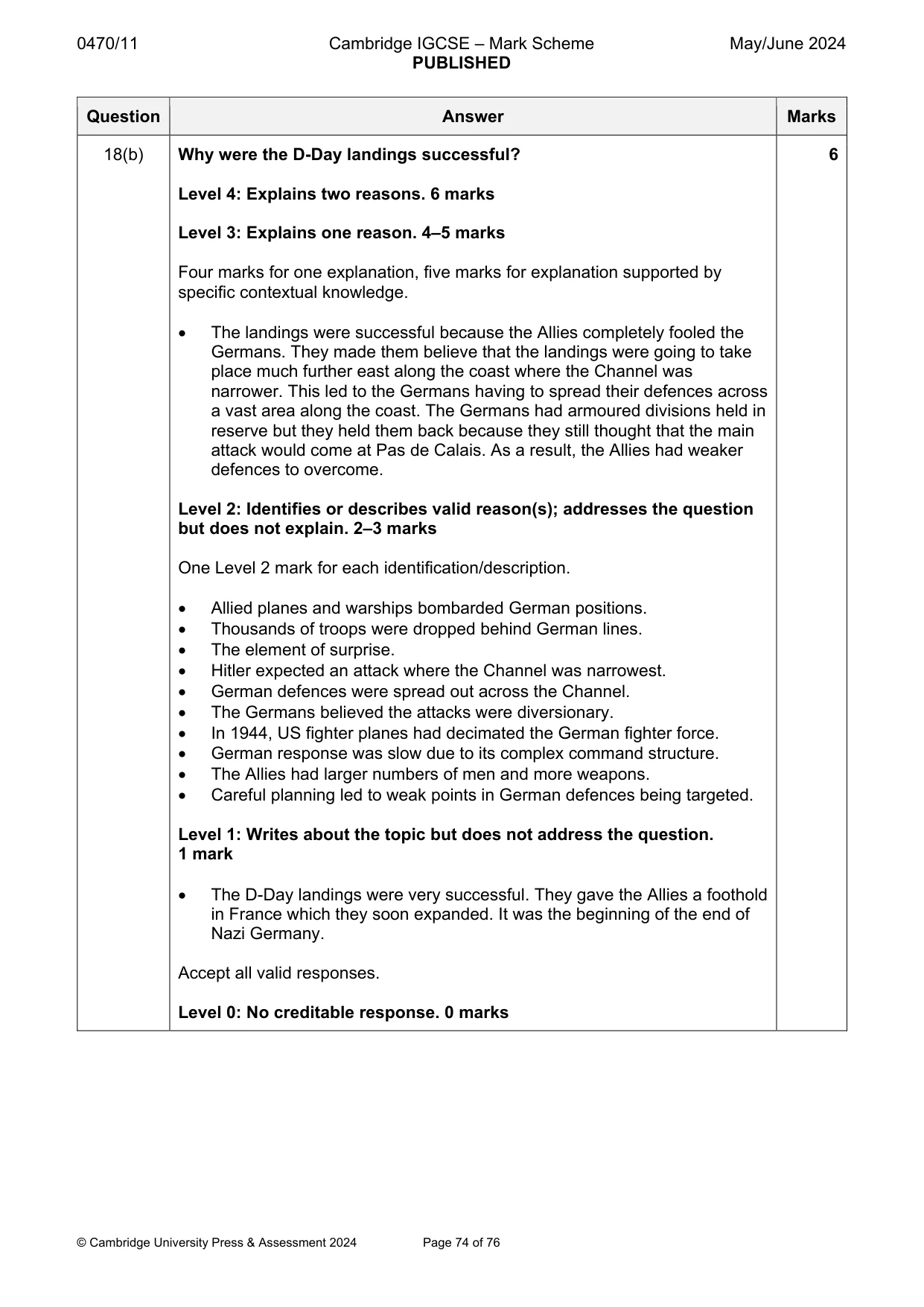
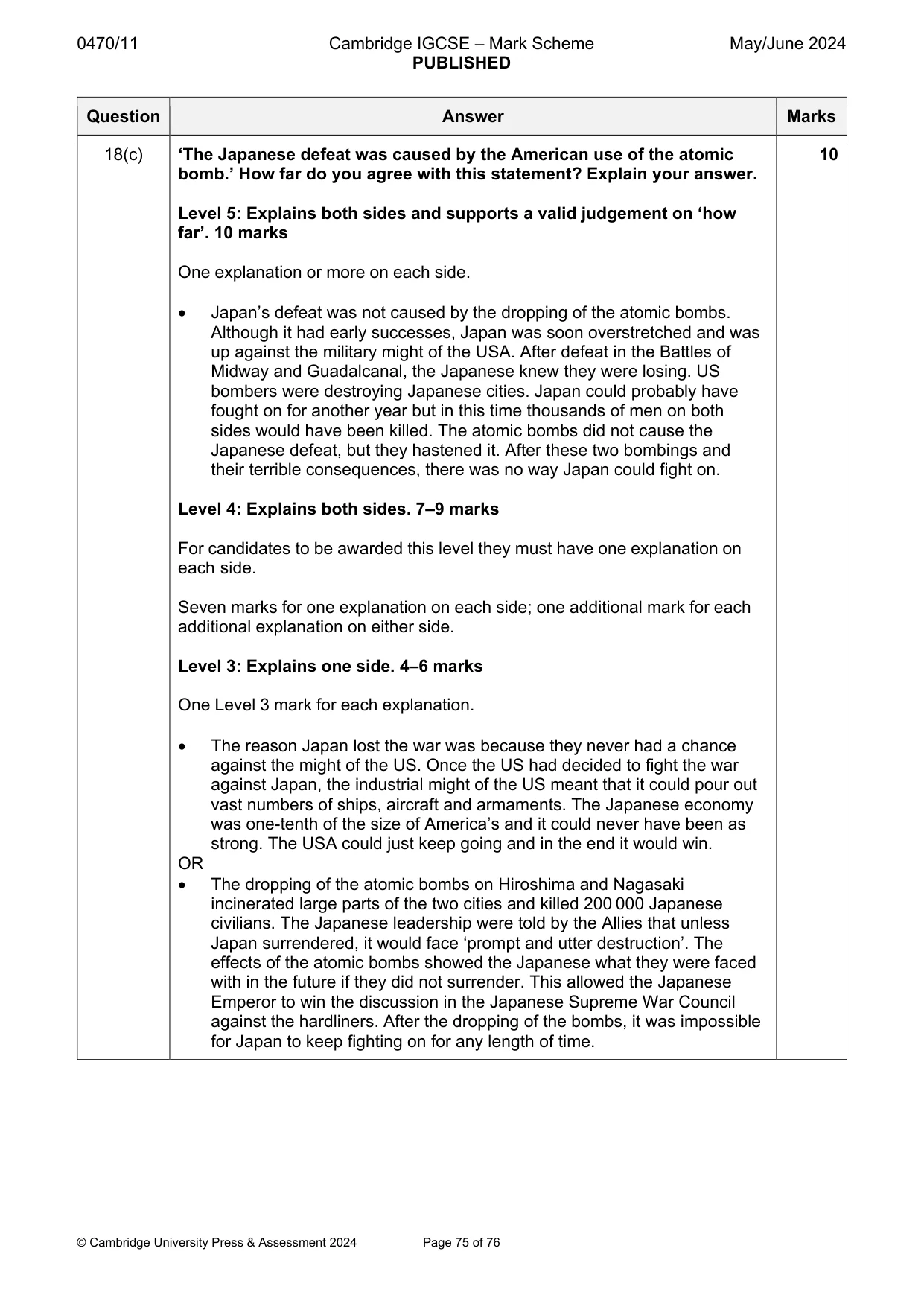
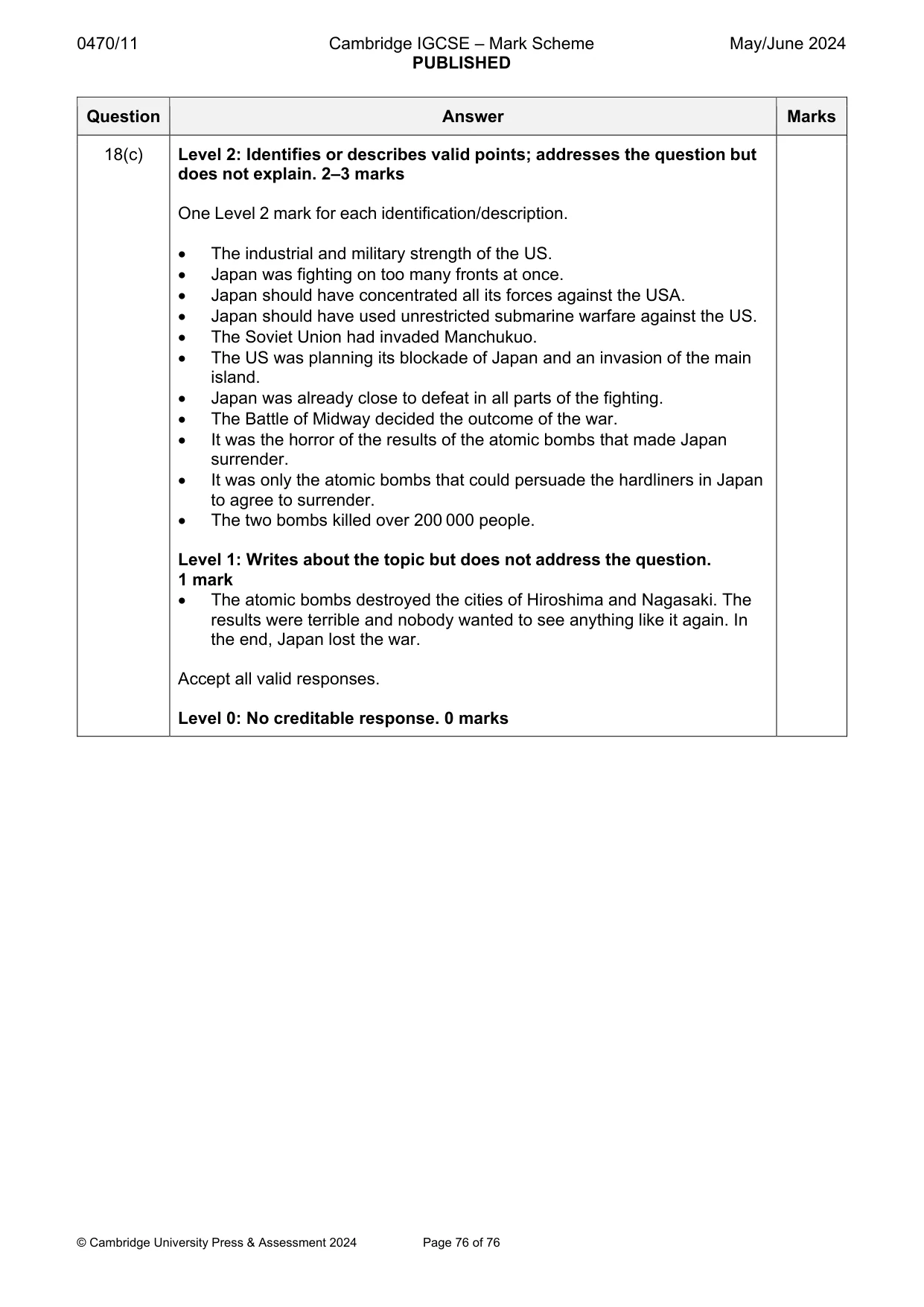
This document has 8 pages. Any blank pages are indicated. [Turn over Cambridge IGCSE™ * 2 1 1 9 1 8 6 3 1 4 * HISTORY 0470/11 Paper 1 Structured Questions May/June 2024 2 hours You must answer on the enclosed answer booklet. You will need: Answer booklet (enclosed) INSTRUCTIONS ● Answer three questions in total: Section A (Core content): answer two questions. Section B (Depth studies): answer one question. ● Follow the instructions on the front cover of the answer booklet. If you need additional answer paper, ask the invigilator for a continuation booklet. INFORMATION ● The total mark for this paper is 60. ● The number of marks for each question or part question is shown in brackets [ ]. DC (SL) 329518/5 © UCLES 2024
Question paper, page 2
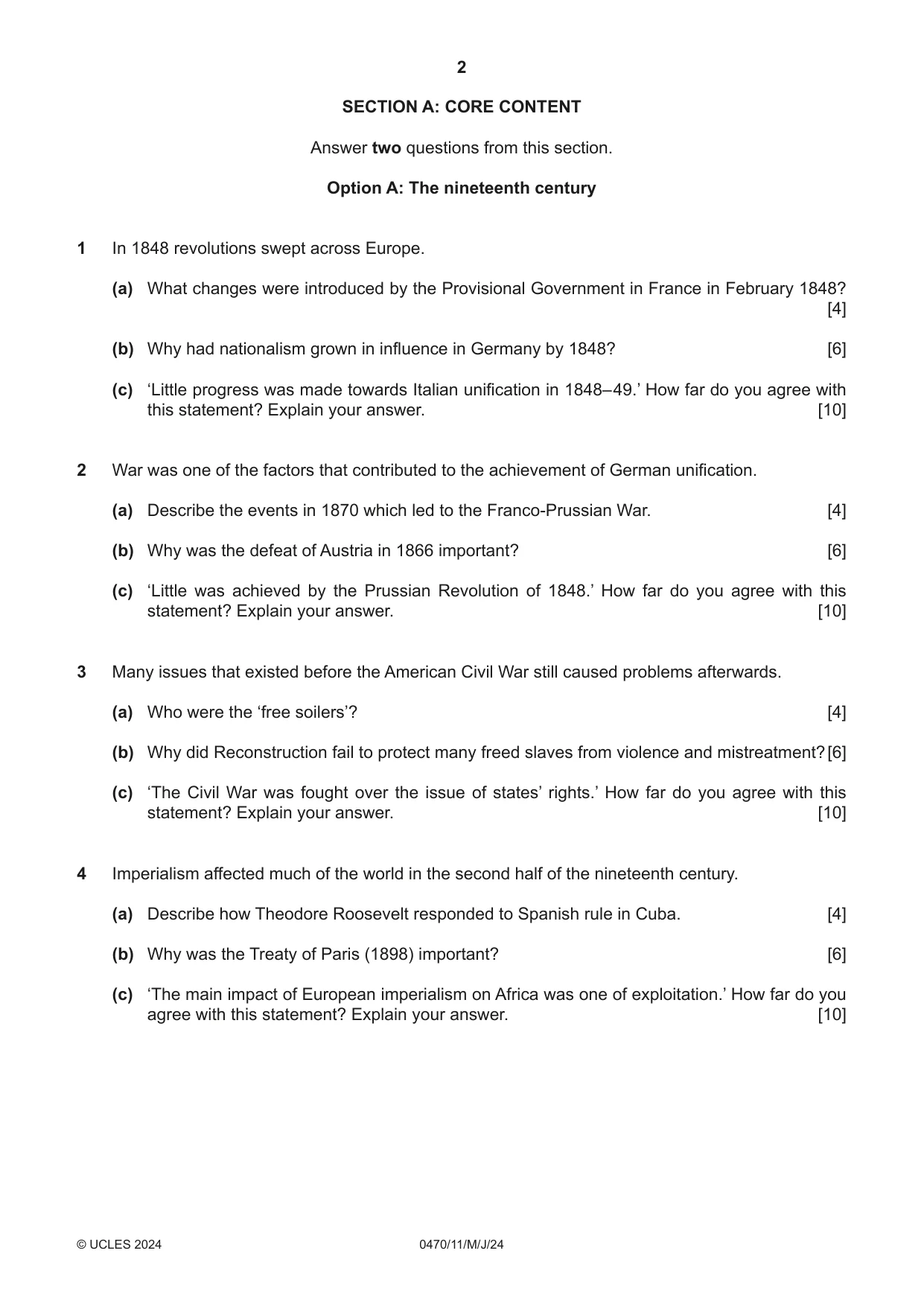
2 0470/11/M/J/24 © UCLES 2024 SECTION A: CORE CONTENT Answer two questions from this section. Option A: The nineteenth century 1 In 1848 revolutions swept across Europe. (a) What changes were introduced by the Provisional Government in France in February 1848? [4] (b) Why had nationalism grown in influence in Germany by 1848? [6] (c) ‘Little progress was made towards Italian unification in 1848– 49.’ How far do you agree with this statement? Explain your answer. [10] 2 War was one of the factors that contributed to the achievement of German unification. (a) Describe the events in 1870 which led to the Franco-Prussian War. [4] (b) Why was the defeat of Austria in 1866 important? [6] (c) ‘Little was achieved by the Prussian Revolution of 1848.’ How far do you agree with this statement? Explain your answer. [10] 3 Many issues that existed before the American Civil War still caused problems afterwards. (a) Who were the ‘free soilers’? [4] (b) Why did Reconstruction fail to protect many freed slaves from violence and mistreatment? [6] (c) ‘The Civil War was fought over the issue of states’ rights.’ How far do you agree with this statement? Explain your answer. [10] 4 Imperialism affected much of the world in the second half of the nineteenth century. (a) Describe how Theodore Roosevelt responded to Spanish rule in Cuba. [4] (b) Why was the Treaty of Paris (1898) important? [6] (c) ‘The main impact of European imperialism on Africa was one of exploitation.’ How far do you agree with this statement? Explain your answer. [10]
Question paper, page 3
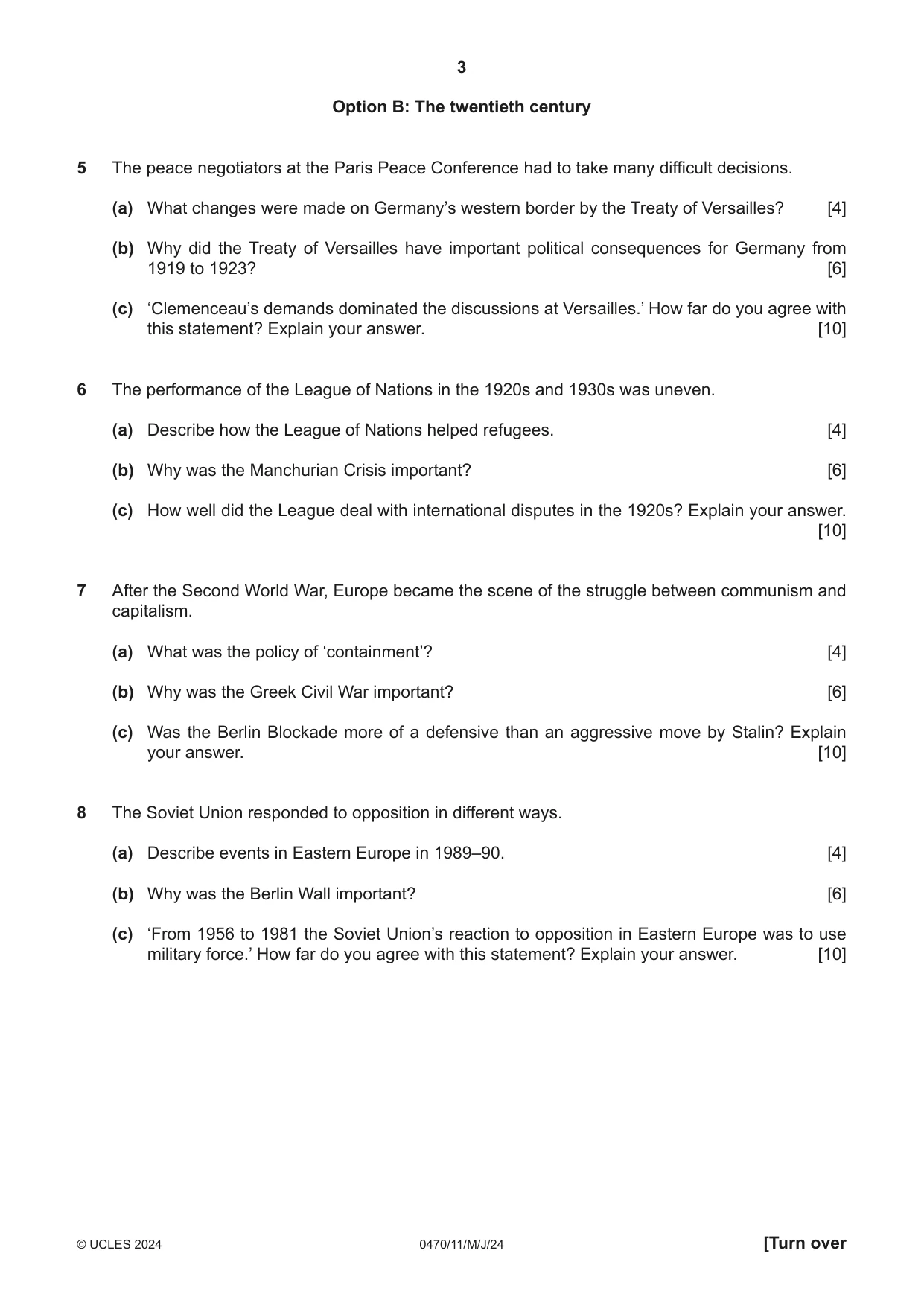
3 0470/11/M/J/24 © UCLES 2024 [Turn over Option B: The twentieth century 5 The peace negotiators at the Paris Peace Conference had to take many difficult decisions. (a) What changes were made on Germany’s western border by the Treaty of Versailles? [4] (b) Why did the Treaty of Versailles have important political consequences for Germany from 1919 to 1923? [6] (c) ‘Clemenceau’s demands dominated the discussions at Versailles.’ How far do you agree with this statement? Explain your answer. [10] 6 The performance of the League of Nations in the 1920s and 1930s was uneven. (a) Describe how the League of Nations helped refugees. [4] (b) Why was the Manchurian Crisis important? [6] (c) How well did the League deal with international disputes in the 1920s? Explain your answer. [10] 7 After the Second World War, Europe became the scene of the struggle between communism and capitalism. (a) What was the policy of ‘containment’? [4] (b) Why was the Greek Civil War important? [6] (c) Was the Berlin Blockade more of a defensive than an aggressive move by Stalin? Explain your answer. [10] 8 The Soviet Union responded to opposition in different ways. (a) Describe events in Eastern Europe in 1989–90. [4] (b) Why was the Berlin Wall important? [6] (c) ‘From 1956 to 1981 the Soviet Union’s reaction to opposition in Eastern Europe was to use military force.’ How far do you agree with this statement? Explain your answer. [10]
Question paper, page 4
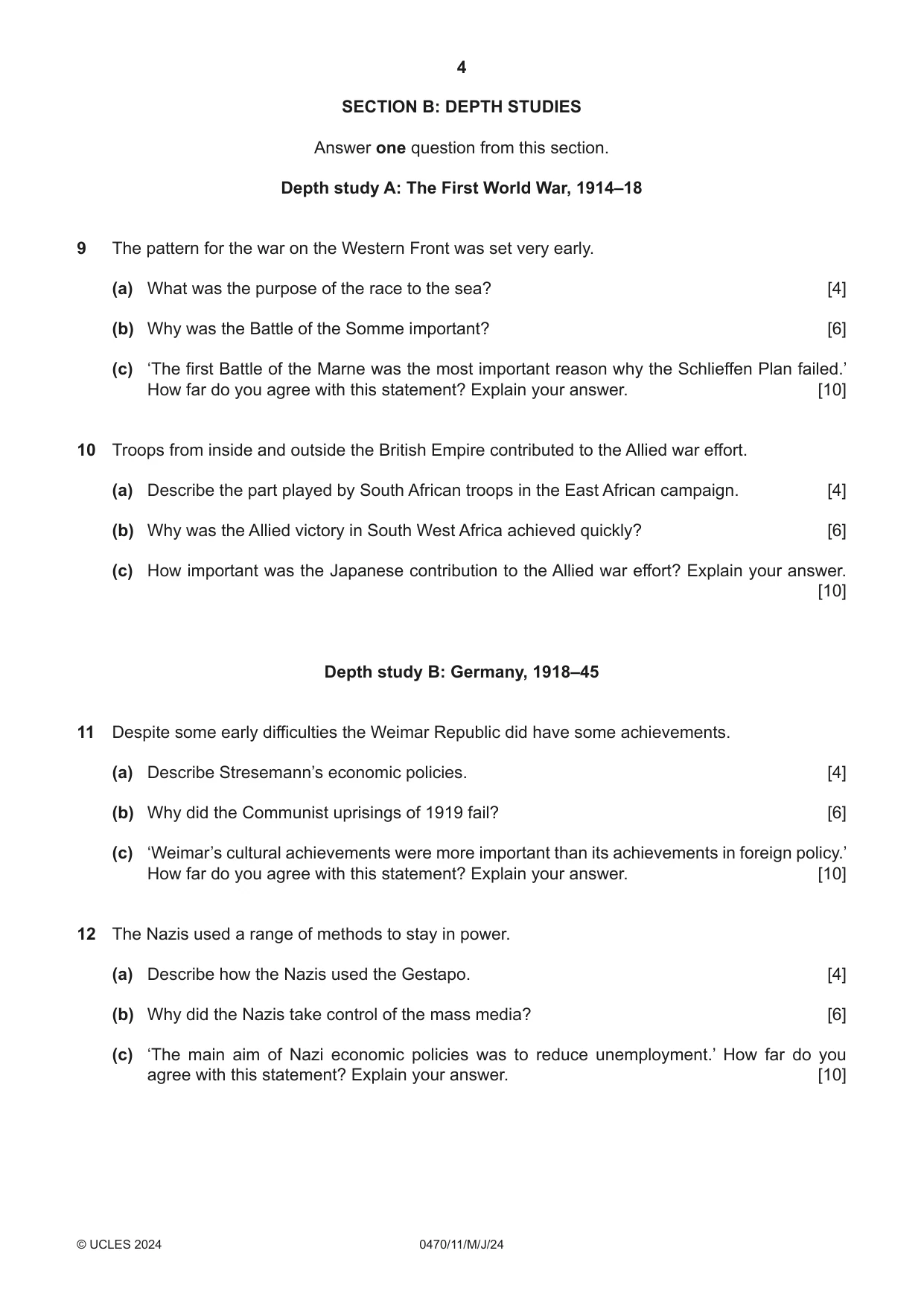
4 0470/11/M/J/24 © UCLES 2024 SECTION B: DEPTH STUDIES Answer one question from this section. Depth study A: The First World War, 1914–18 9 The pattern for the war on the Western Front was set very early. (a) What was the purpose of the race to the sea? [4] (b) Why was the Battle of the Somme important? [6] (c) ‘The first Battle of the Marne was the most important reason why the Schlieffen Plan failed.’ How far do you agree with this statement? Explain your answer. [10] 10 Troops from inside and outside the British Empire contributed to the Allied war effort. (a) Describe the part played by South African troops in the East African campaign. [4] (b) Why was the Allied victory in South West Africa achieved quickly? [6] (c) How important was the Japanese contribution to the Allied war effort? Explain your answer. [10] Depth study B: Germany, 1918–45 11 Despite some early difficulties the Weimar Republic did have some achievements. (a) Describe Stresemann’s economic policies. [4] (b) Why did the Communist uprisings of 1919 fail? [6] (c) ‘Weimar’s cultural achievements were more important than its achievements in foreign policy.’ How far do you agree with this statement? Explain your answer. [10] 12 The Nazis used a range of methods to stay in power. (a) Describe how the Nazis used the Gestapo. [4] (b) Why did the Nazis take control of the mass media? [6] (c) ‘The main aim of Nazi economic policies was to reduce unemployment.’ How far do you agree with this statement? Explain your answer. [10]
Question paper, page 5
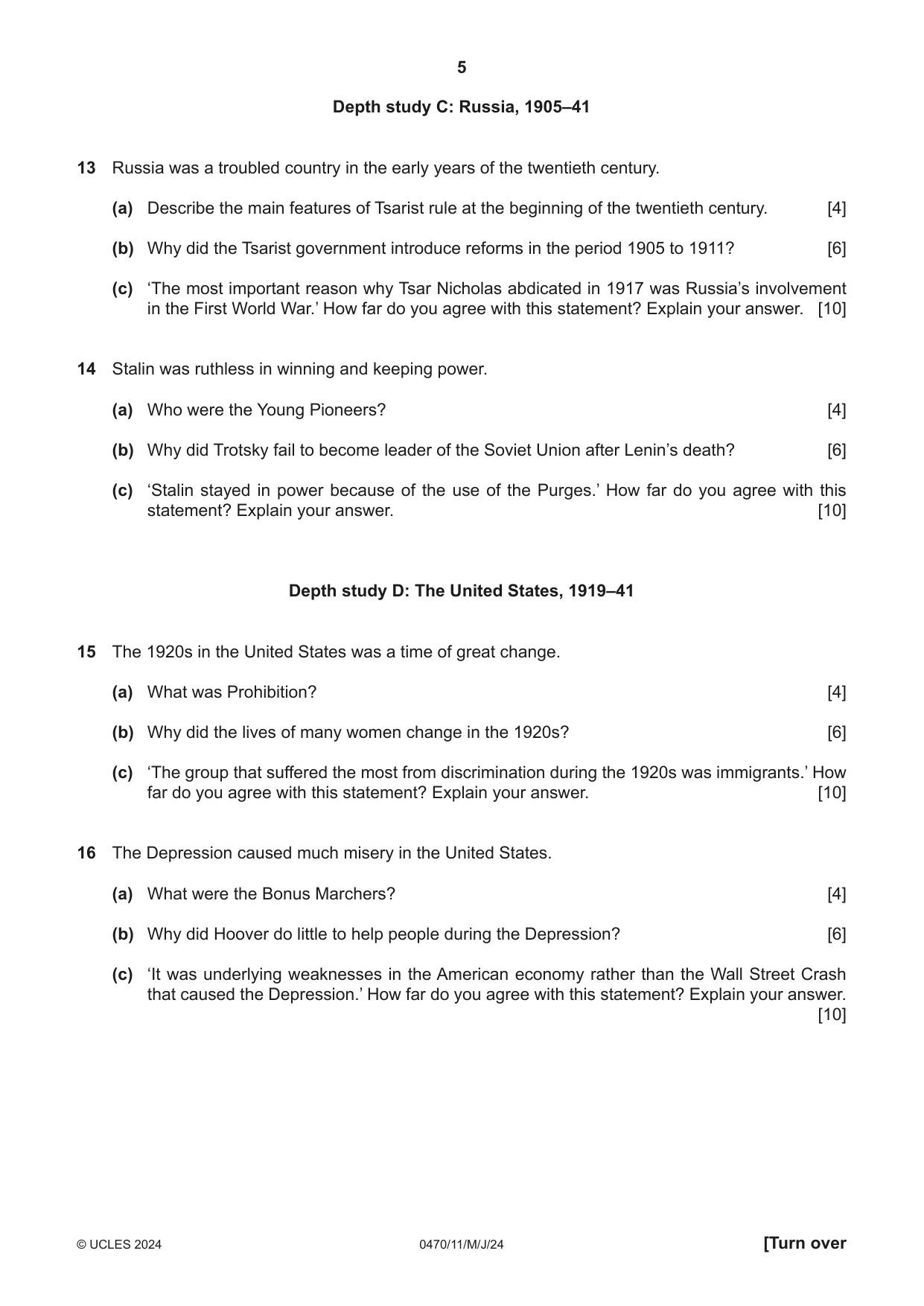
5 0470/11/M/J/24 © UCLES 2024 [Turn over Depth study C: Russia, 1905–41 13 Russia was a troubled country in the early years of the twentieth century. (a) Describe the main features of Tsarist rule at the beginning of the twentieth century. [4] (b) Why did the Tsarist government introduce reforms in the period 1905 to 1911? [6] (c) ‘The most important reason why Tsar Nicholas abdicated in 1917 was Russia’s involvement in the First World War.’ How far do you agree with this statement? Explain your answer. [10] 14 Stalin was ruthless in winning and keeping power. (a) Who were the Young Pioneers? [4] (b) Why did Trotsky fail to become leader of the Soviet Union after Lenin’s death? [6] (c) ‘Stalin stayed in power because of the use of the Purges.’ How far do you agree with this statement? Explain your answer. [10] Depth study D: The United States, 1919–41 15 The 1920s in the United States was a time of great change. (a) What was Prohibition? [4] (b) Why did the lives of many women change in the 1920s? [6] (c) ‘The group that suffered the most from discrimination during the 1920s was immigrants.’ How far do you agree with this statement? Explain your answer. [10] 16 The Depression caused much misery in the United States. (a) What were the Bonus Marchers? [4] (b) Why did Hoover do little to help people during the Depression? [6] (c) ‘It was underlying weaknesses in the American economy rather than the Wall Street Crash that caused the Depression.’ How far do you agree with this statement? Explain your answer. [10]
Question paper, page 6
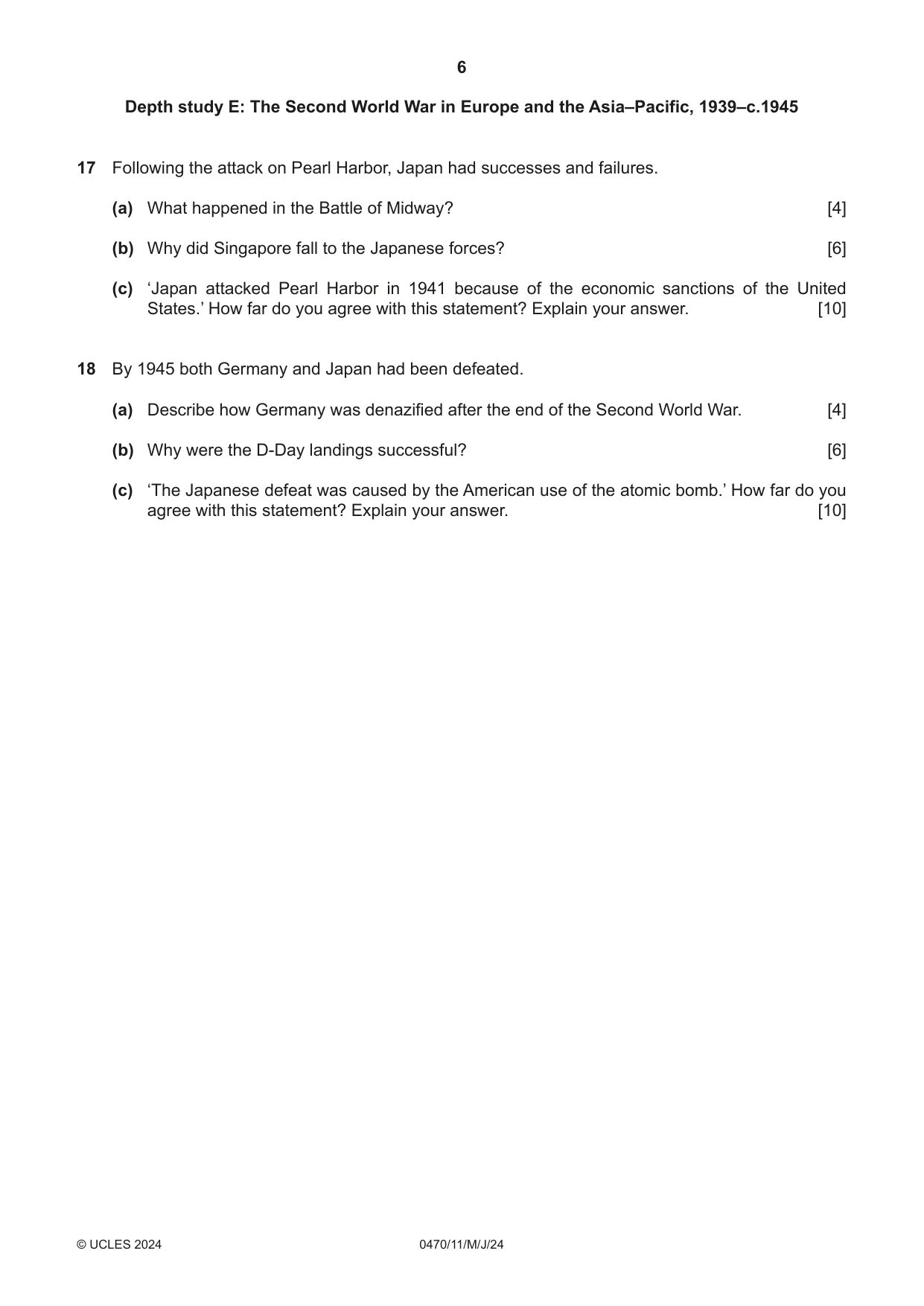
6 0470/11/M/J/24 © UCLES 2024 Depth study E: The Second World War in Europe and the Asia–Pacific, 1939–c.1945 17 Following the attack on Pearl Harbor, Japan had successes and failures. (a) What happened in the Battle of Midway? [4] (b) Why did Singapore fall to the Japanese forces? [6] (c) ‘Japan attacked Pearl Harbor in 1941 because of the economic sanctions of the United States.’ How far do you agree with this statement? Explain your answer. [10] 18 By 1945 both Germany and Japan had been defeated. (a) Describe how Germany was denazified after the end of the Second World War. [4] (b) Why were the D-Day landings successful? [6] (c) ‘The Japanese defeat was caused by the American use of the atomic bomb.’ How far do you agree with this statement? Explain your answer. [10]
Question paper, page 7
7 0470/11/M/J/24 © UCLES 2024 BLANK PAGE
Question paper, page 8
8 0470/11/M/J/24 © UCLES 2024 Permission to reproduce items where third-party owned material protected by copyright is included has been sought and cleared where possible. Every reasonable effort has been made by the publisher (UCLES) to trace copyright holders, but if any items requiring clearance have unwittingly been included, the publisher will be pleased to make amends at the earliest possible opportunity. To avoid the issue of disclosure of answer-related information to candidates, all copyright acknowledgements are reproduced online in the Cambridge Assessment International Education Copyright Acknowledgements Booklet. This is produced for each series of examinations and is freely available to download at www.cambridgeinternational.org after the live examination series. Cambridge Assessment International Education is part of Cambridge Assessment. Cambridge Assessment is the brand name of the University of Cambridge Local Examinations Syndicate (UCLES), which is a department of the University of Cambridge. BLANK PAGE
Mark scheme, page 1
This document consists of 76 printed pages. © Cambridge University Press & Assessment 2024 [Turn over Cambridge IGCSE™ HISTORY 0470/11 Paper 1 May/June 2024 MARK SCHEME Maximum Mark: 60 Published This mark scheme is published as an aid to teachers and candidates, to indicate the requirements of the examination. It shows the basis on which Examiners were instructed to award marks. It does not indicate the details of the discussions that took place at an Examiners’ meeting before marking began, which would have considered the acceptability of alternative answers. Mark schemes should be read in conjunction with the question paper and the Principal Examiner Report for Teachers. Cambridge International will not enter into discussions about these mark schemes. Cambridge International is publishing the mark schemes for the May/June 2024 series for most Cambridge IGCSE, Cambridge International A and AS Level and Cambridge Pre-U components, and some Cambridge O Level components.
Mark scheme, page 2
0470/11 Cambridge IGCSE – Mark Scheme PUBLISHED May/June 2024 © Cambridge University Press & Assessment 2024 Page 2 of 76 Generic Marking Principles These general marking principles must be applied by all examiners when marking candidate answers. They should be applied alongside the specific content of the mark scheme or generic level descriptions for a question. Each question paper and mark scheme will also comply with these marking principles. GENERIC MARKING PRINCIPLE 1: Marks must be awarded in line with: the specific content of the mark scheme or the generic level descriptors for the question the specific skills defined in the mark scheme or in the generic level descriptors for the question the standard of response required by a candidate as exemplified by the standardisation scripts. GENERIC MARKING PRINCIPLE 2: Marks awarded are always whole marks (not half marks, or other fractions). GENERIC MARKING PRINCIPLE 3: Marks must be awarded positively: marks are awarded for correct/valid answers, as defined in the mark scheme. However, credit is given for valid answers which go beyond the scope of the syllabus and mark scheme, referring to your Team Leader as appropriate marks are awarded when candidates clearly demonstrate what they know and can do marks are not deducted for errors marks are not deducted for omissions answers should only be judged on the quality of spelling, punctuation and grammar when these features are specifically assessed by the question as indicated by the mark scheme. The meaning, however, should be unambiguous. GENERIC MARKING PRINCIPLE 4: Rules must be applied consistently, e.g. in situations where candidates have not followed instructions or in the application of generic level descriptors. GENERIC MARKING PRINCIPLE 5: Marks should be awarded using the full range of marks defined in the mark scheme for the question (however; the use of the full mark range may be limited according to the quality of the candidate responses seen). GENERIC MARKING PRINCIPLE 6: Marks awarded are based solely on the requirements as defined in the mark scheme. Marks should not be awarded with grade thresholds or grade descriptors in mind.
Mark scheme, page 3
0470/11 Cambridge IGCSE – Mark Scheme PUBLISHED May/June 2024 © Cambridge University Press & Assessment 2024 Page 3 of 76 Assessment objectives AO1 An ability to recall, select, organise and deploy knowledge of the syllabus content. AO2 An ability to construct historical explanations using an understanding of: cause and consequence, change and continuity, similarity and difference the motives, emotions, intentions and beliefs of people in the past.
Mark scheme, page 4
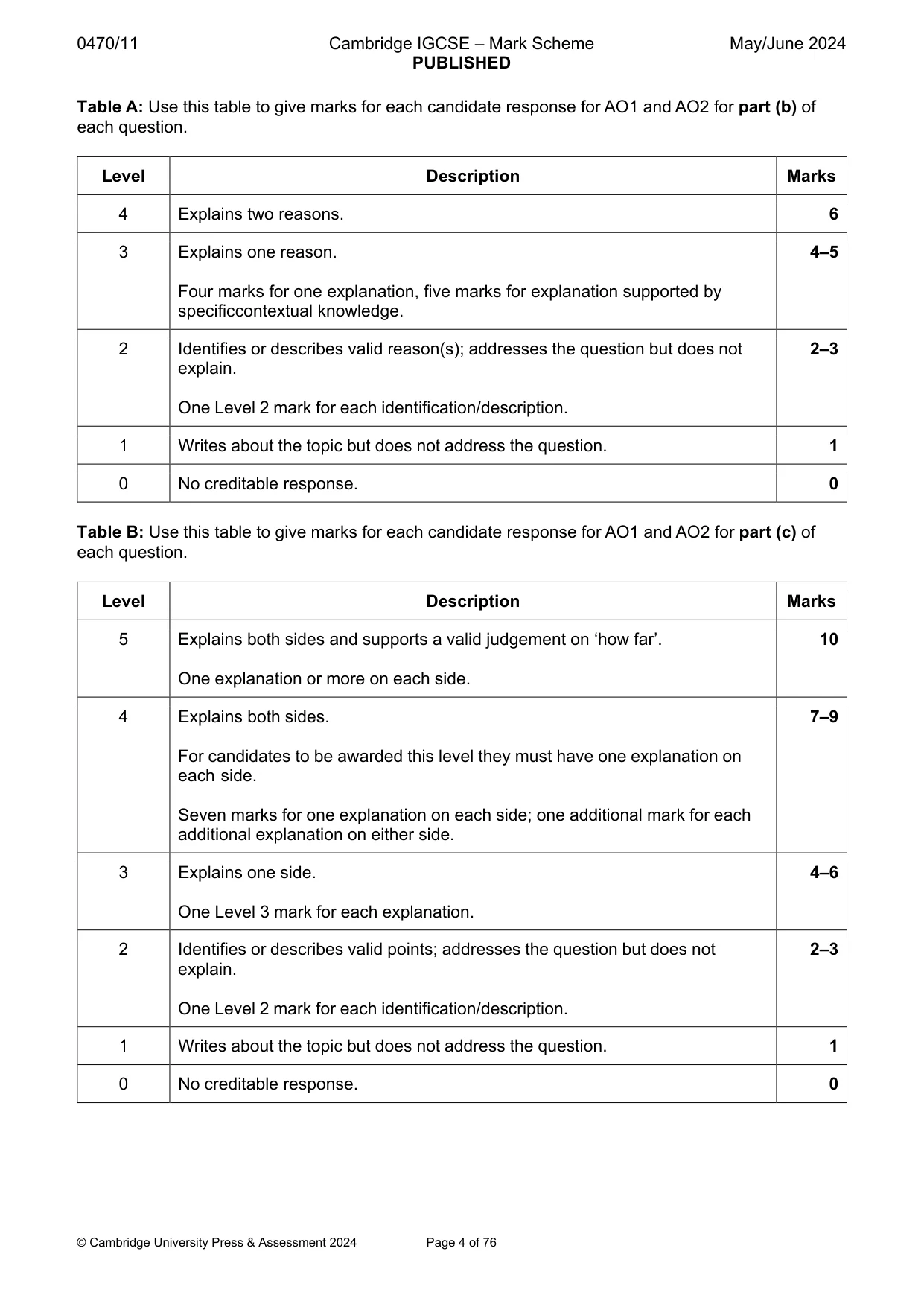
0470/11 Cambridge IGCSE – Mark Scheme PUBLISHED May/June 2024 © Cambridge University Press & Assessment 2024 Page 4 of 76 Table A: Use this table to give marks for each candidate response for AO1 and AO2 for part (b) of each question. Level Description Marks 4 Explains two reasons. 6 3 Explains one reason. Four marks for one explanation, five marks for explanation supported by specific contextual knowledge. 4–5 2 Identifies or describes valid reason(s); addresses the question but does not explain. One Level 2 mark for each identification/description. 2–3 1 Writes about the topic but does not address the question. 1 0 No creditable response. 0 Table B: Use this table to give marks for each candidate response for AO1 and AO2 for part (c) of each question. Level Description Marks 5 Explains both sides and supports a valid judgement on ‘how far’. One explanation or more on each side. 10 4 Explains both sides. For candidates to be awarded this level they must have one explanation on each side. Seven marks for one explanation on each side; one additional mark for each additional explanation on either side. 7–9 3 Explains one side. One Level 3 mark for each explanation. 4–6 2 Identifies or describes valid points; addresses the question but does not explain. One Level 2 mark for each identification/description. 2–3 1 Writes about the topic but does not address the question. 1 0 No creditable response. 0
Mark scheme, page 5
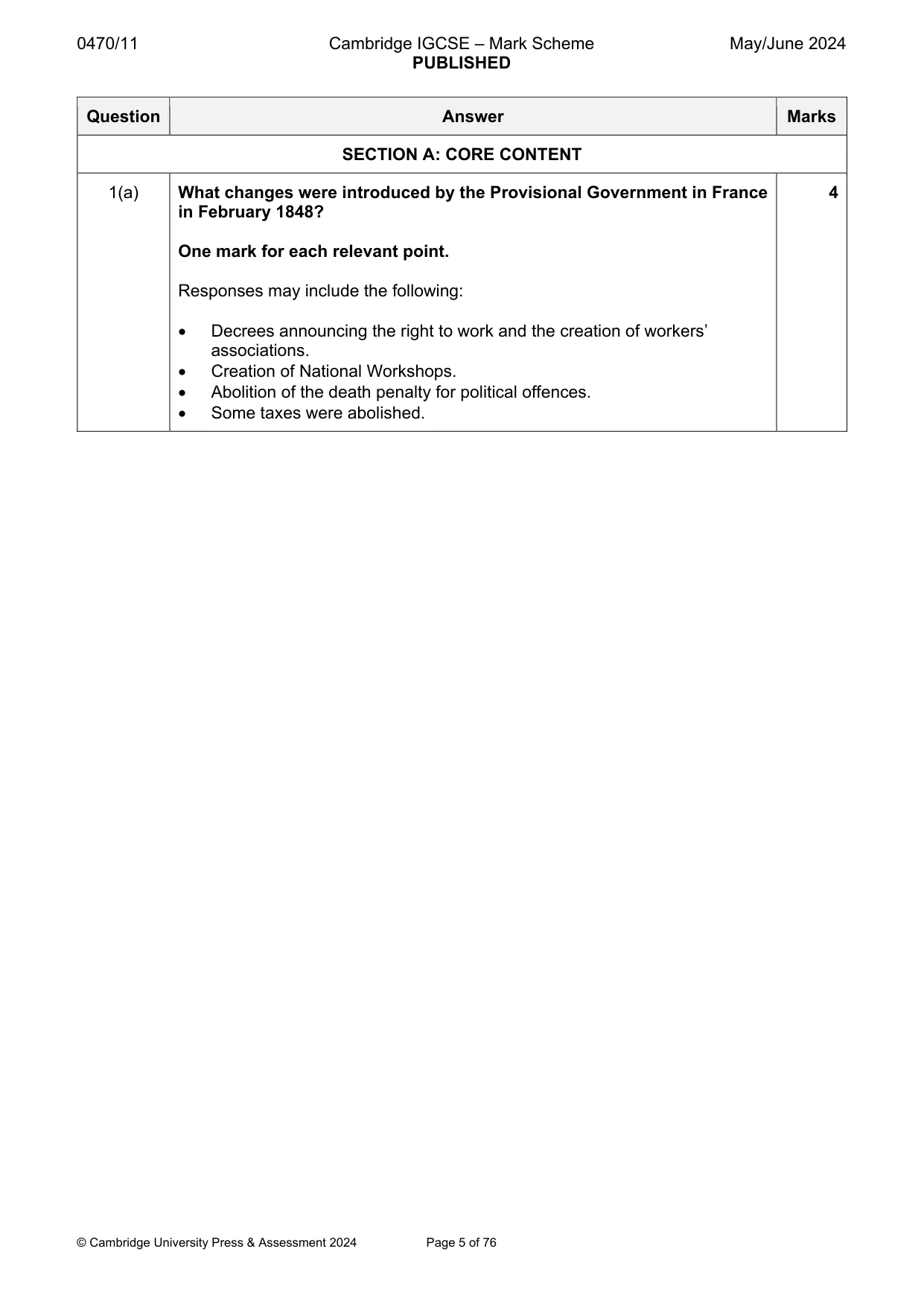
0470/11 Cambridge IGCSE – Mark Scheme PUBLISHED May/June 2024 © Cambridge University Press & Assessment 2024 Page 5 of 76 Question Answer Marks SECTION A: CORE CONTENT 1(a) What changes were introduced by the Provisional Government in France in February 1848? One mark for each relevant point. Responses may include the following: Decrees announcing the right to work and the creation of workers’ associations. Creation of National Workshops. Abolition of the death penalty for political offences. Some taxes were abolished. 4
Mark scheme, page 6
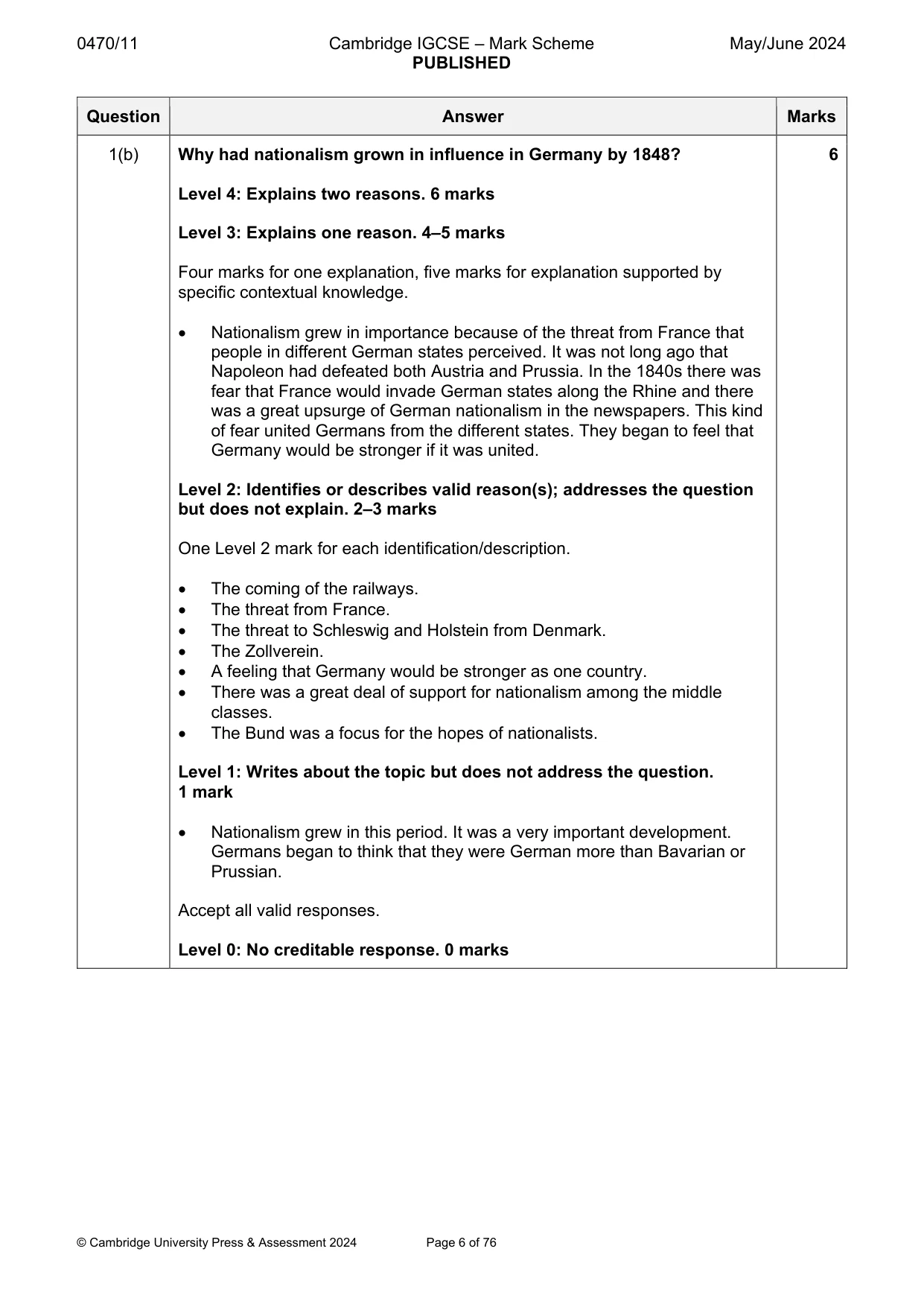
0470/11 Cambridge IGCSE – Mark Scheme PUBLISHED May/June 2024 © Cambridge University Press & Assessment 2024 Page 6 of 76 Question Answer Marks 1(b) Why had nationalism grown in influence in Germany by 1848? Level 4: Explains two reasons. 6 marks Level 3: Explains one reason. 4–5 marks Four marks for one explanation, five marks for explanation supported by specific contextual knowledge. Nationalism grew in importance because of the threat from France that people in different German states perceived. It was not long ago that Napoleon had defeated both Austria and Prussia. In the 1840s there was fear that France would invade German states along the Rhine and there was a great upsurge of German nationalism in the newspapers. This kind of fear united Germans from the different states. They began to feel that Germany would be stronger if it was united. Level 2: Identifies or describes valid reason(s); addresses the question but does not explain. 2–3 marks One Level 2 mark for each identification/description. The coming of the railways. The threat from France. The threat to Schleswig and Holstein from Denmark. The Zollverein. A feeling that Germany would be stronger as one country. There was a great deal of support for nationalism among the middle classes. The Bund was a focus for the hopes of nationalists. Level 1: Writes about the topic but does not address the question. 1 mark Nationalism grew in this period. It was a very important development. Germans began to think that they were German more than Bavarian or Prussian. Accept all valid responses. Level 0: No creditable response. 0 marks 6
Mark scheme, page 7
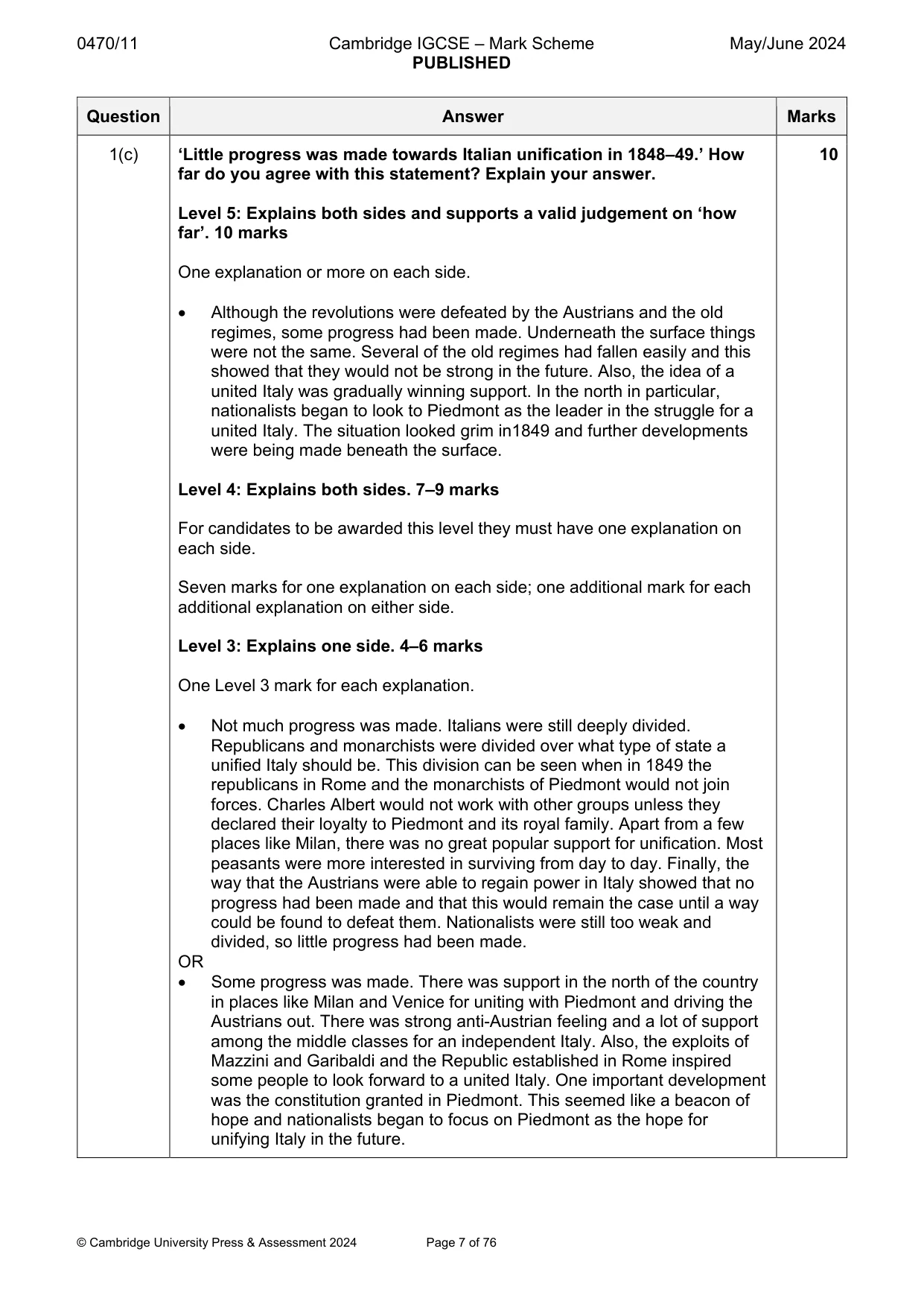
0470/11 Cambridge IGCSE – Mark Scheme PUBLISHED May/June 2024 © Cambridge University Press & Assessment 2024 Page 7 of 76 Question Answer Marks 1(c) ‘Little progress was made towards Italian unification in 1848–49.’ How far do you agree with this statement? Explain your answer. Level 5: Explains both sides and supports a valid judgement on ‘how far’. 10 marks One explanation or more on each side. Although the revolutions were defeated by the Austrians and the old regimes, some progress had been made. Underneath the surface things were not the same. Several of the old regimes had fallen easily and this showed that they would not be strong in the future. Also, the idea of a united Italy was gradually winning support. In the north in particular, nationalists began to look to Piedmont as the leader in the struggle for a united Italy. The situation looked grim in1849 and further developments were being made beneath the surface. Level 4: Explains both sides. 7–9 marks For candidates to be awarded this level they must have one explanation on each side. Seven marks for one explanation on each side; one additional mark for each additional explanation on either side. Level 3: Explains one side. 4–6 marks One Level 3 mark for each explanation. Not much progress was made. Italians were still deeply divided. Republicans and monarchists were divided over what type of state a unified Italy should be. This division can be seen when in 1849 the republicans in Rome and the monarchists of Piedmont would not join forces. Charles Albert would not work with other groups unless they declared their loyalty to Piedmont and its royal family. Apart from a few places like Milan, there was no great popular support for unification. Most peasants were more interested in surviving from day to day. Finally, the way that the Austrians were able to regain power in Italy showed that no progress had been made and that this would remain the case until a way could be found to defeat them. Nationalists were still too weak and divided, so little progress had been made. OR Some progress was made. There was support in the north of the country in places like Milan and Venice for uniting with Piedmont and driving the Austrians out. There was strong anti-Austrian feeling and a lot of support among the middle classes for an independent Italy. Also, the exploits of Mazzini and Garibaldi and the Republic established in Rome inspired some people to look forward to a united Italy. One important development was the constitution granted in Piedmont. This seemed like a beacon of hope and nationalists began to focus on Piedmont as the hope for unifying Italy in the future. 10
Mark scheme, page 8
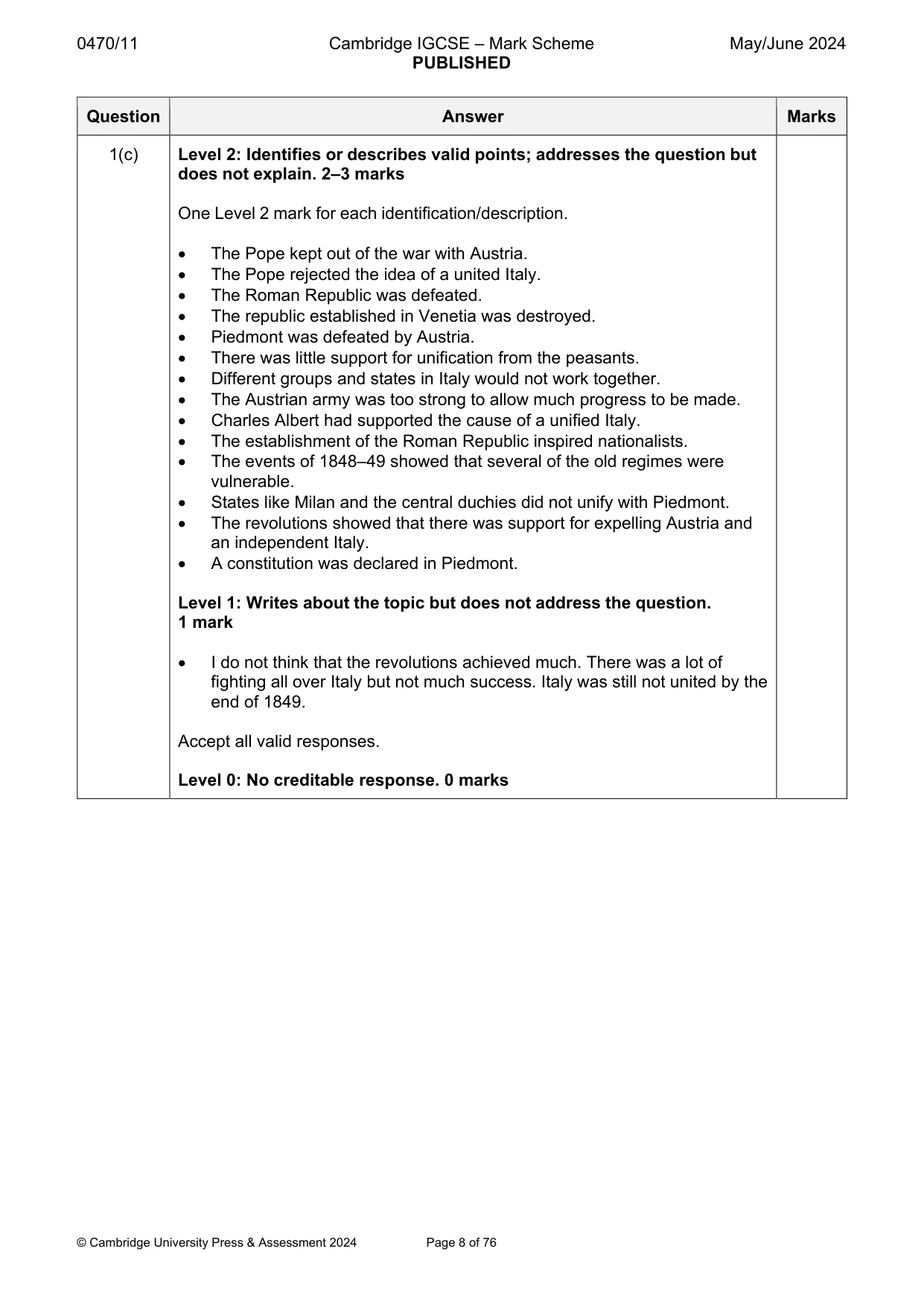
0470/11 Cambridge IGCSE – Mark Scheme PUBLISHED May/June 2024 © Cambridge University Press & Assessment 2024 Page 8 of 76 Question Answer Marks 1(c) Level 2: Identifies or describes valid points; addresses the question but does not explain. 2–3 marks One Level 2 mark for each identification/description. The Pope kept out of the war with Austria. The Pope rejected the idea of a united Italy. The Roman Republic was defeated. The republic established in Venetia was destroyed. Piedmont was defeated by Austria. There was little support for unification from the peasants. Different groups and states in Italy would not work together. The Austrian army was too strong to allow much progress to be made. Charles Albert had supported the cause of a unified Italy. The establishment of the Roman Republic inspired nationalists. The events of 1848–49 showed that several of the old regimes were vulnerable. States like Milan and the central duchies did not unify with Piedmont. The revolutions showed that there was support for expelling Austria and an independent Italy. A constitution was declared in Piedmont. Level 1: Writes about the topic but does not address the question. 1 mark I do not think that the revolutions achieved much. There was a lot of fighting all over Italy but not much success. Italy was still not united by the end of 1849. Accept all valid responses. Level 0: No creditable response. 0 marks
Mark scheme, page 9
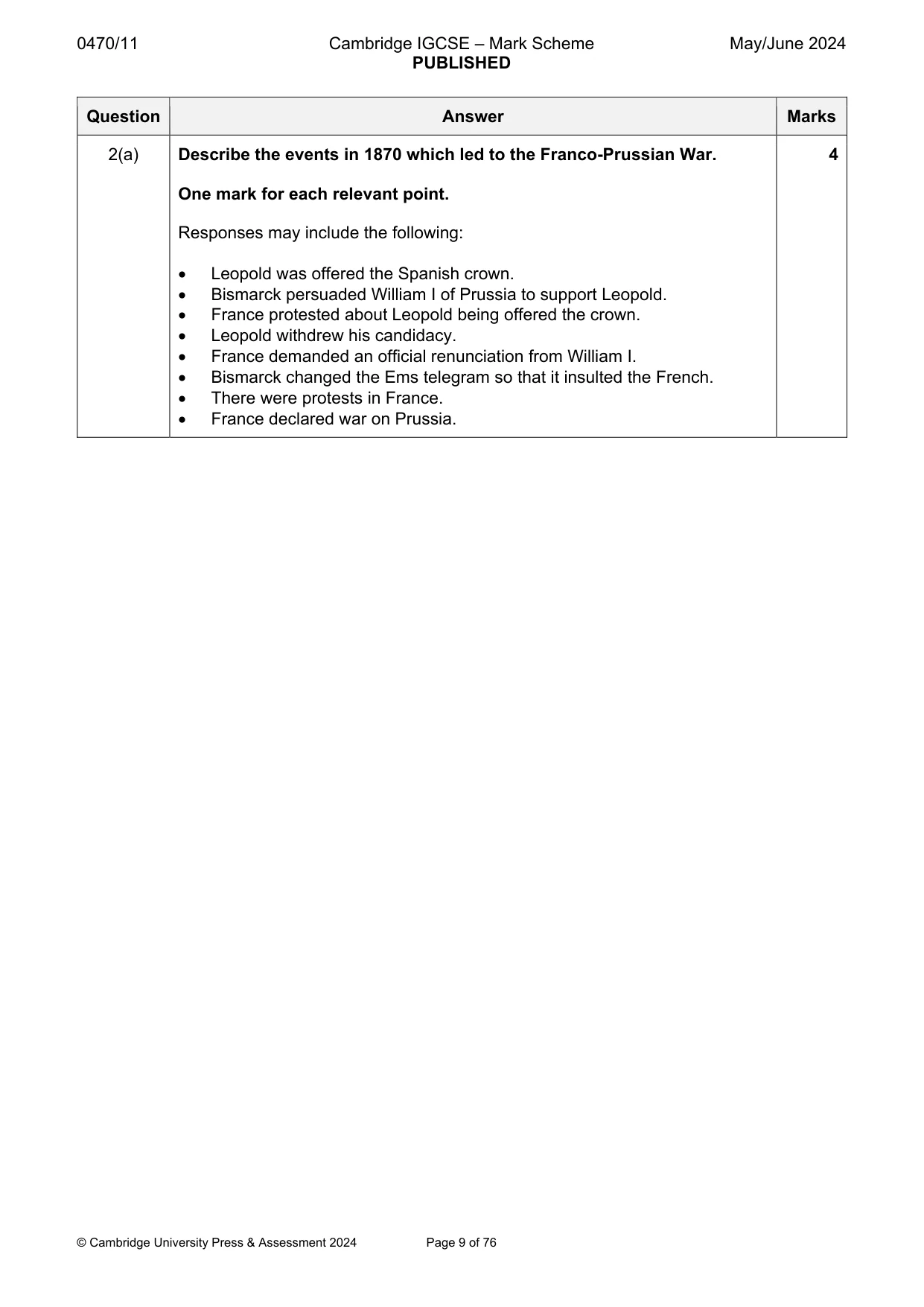
0470/11 Cambridge IGCSE – Mark Scheme PUBLISHED May/June 2024 © Cambridge University Press & Assessment 2024 Page 9 of 76 Question Answer Marks 2(a) Describe the events in 1870 which led to the Franco-Prussian War. One mark for each relevant point. Responses may include the following: Leopold was offered the Spanish crown. Bismarck persuaded William I of Prussia to support Leopold. France protested about Leopold being offered the crown. Leopold withdrew his candidacy. France demanded an official renunciation from William I. Bismarck changed the Ems telegram so that it insulted the French. There were protests in France. France declared war on Prussia. 4
Mark scheme, page 10
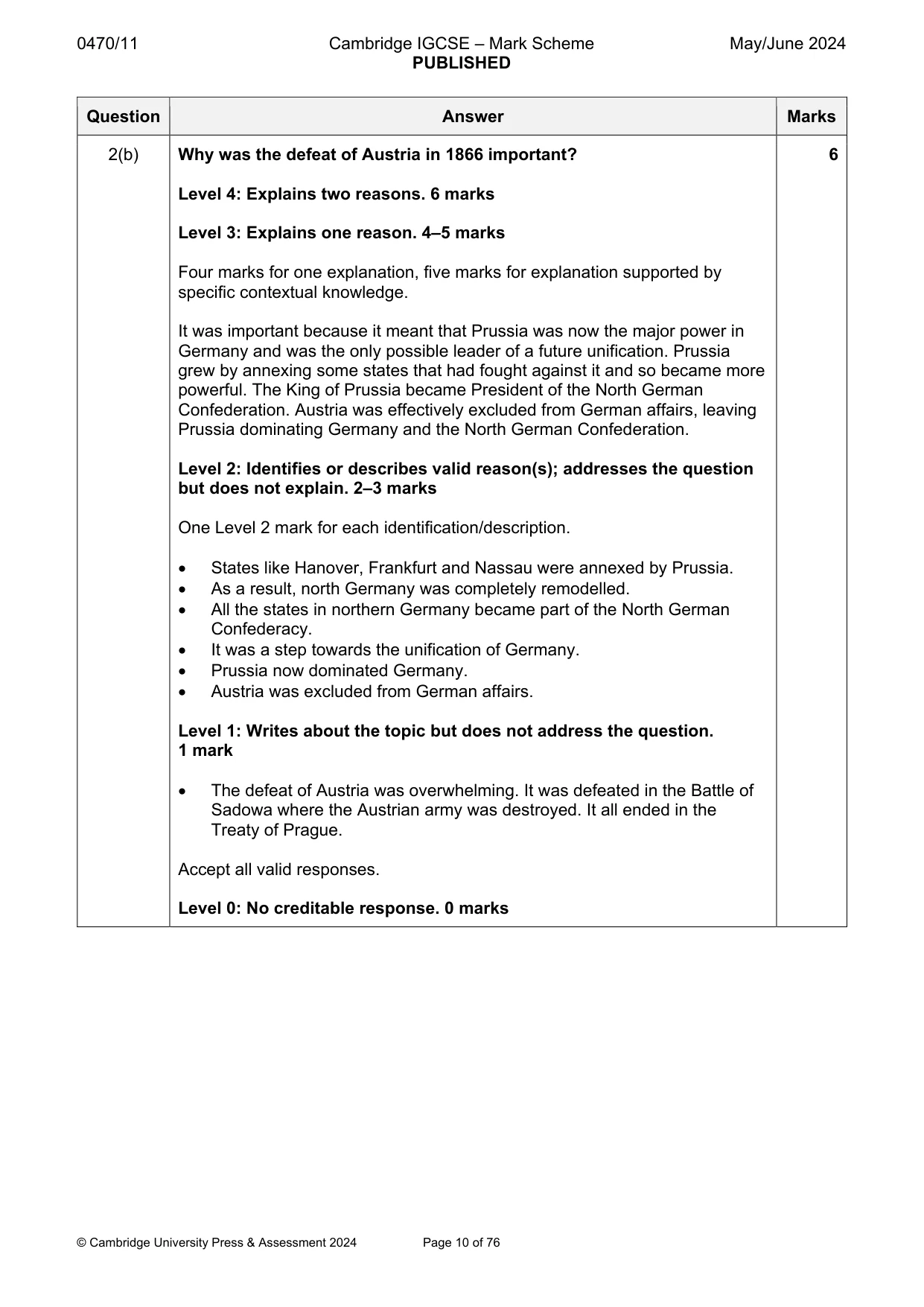
0470/11 Cambridge IGCSE – Mark Scheme PUBLISHED May/June 2024 © Cambridge University Press & Assessment 2024 Page 10 of 76 Question Answer Marks 2(b) Why was the defeat of Austria in 1866 important? Level 4: Explains two reasons. 6 marks Level 3: Explains one reason. 4–5 marks Four marks for one explanation, five marks for explanation supported by specific contextual knowledge. It was important because it meant that Prussia was now the major power in Germany and was the only possible leader of a future unification. Prussia grew by annexing some states that had fought against it and so became more powerful. The King of Prussia became President of the North German Confederation. Austria was effectively excluded from German affairs, leaving Prussia dominating Germany and the North German Confederation. Level 2: Identifies or describes valid reason(s); addresses the question but does not explain. 2–3 marks One Level 2 mark for each identification/description. States like Hanover, Frankfurt and Nassau were annexed by Prussia. As a result, north Germany was completely remodelled. All the states in northern Germany became part of the North German Confederacy. It was a step towards the unification of Germany. Prussia now dominated Germany. Austria was excluded from German affairs. Level 1: Writes about the topic but does not address the question. 1 mark The defeat of Austria was overwhelming. It was defeated in the Battle of Sadowa where the Austrian army was destroyed. It all ended in the Treaty of Prague. Accept all valid responses. Level 0: No creditable response. 0 marks 6
Mark scheme, page 11
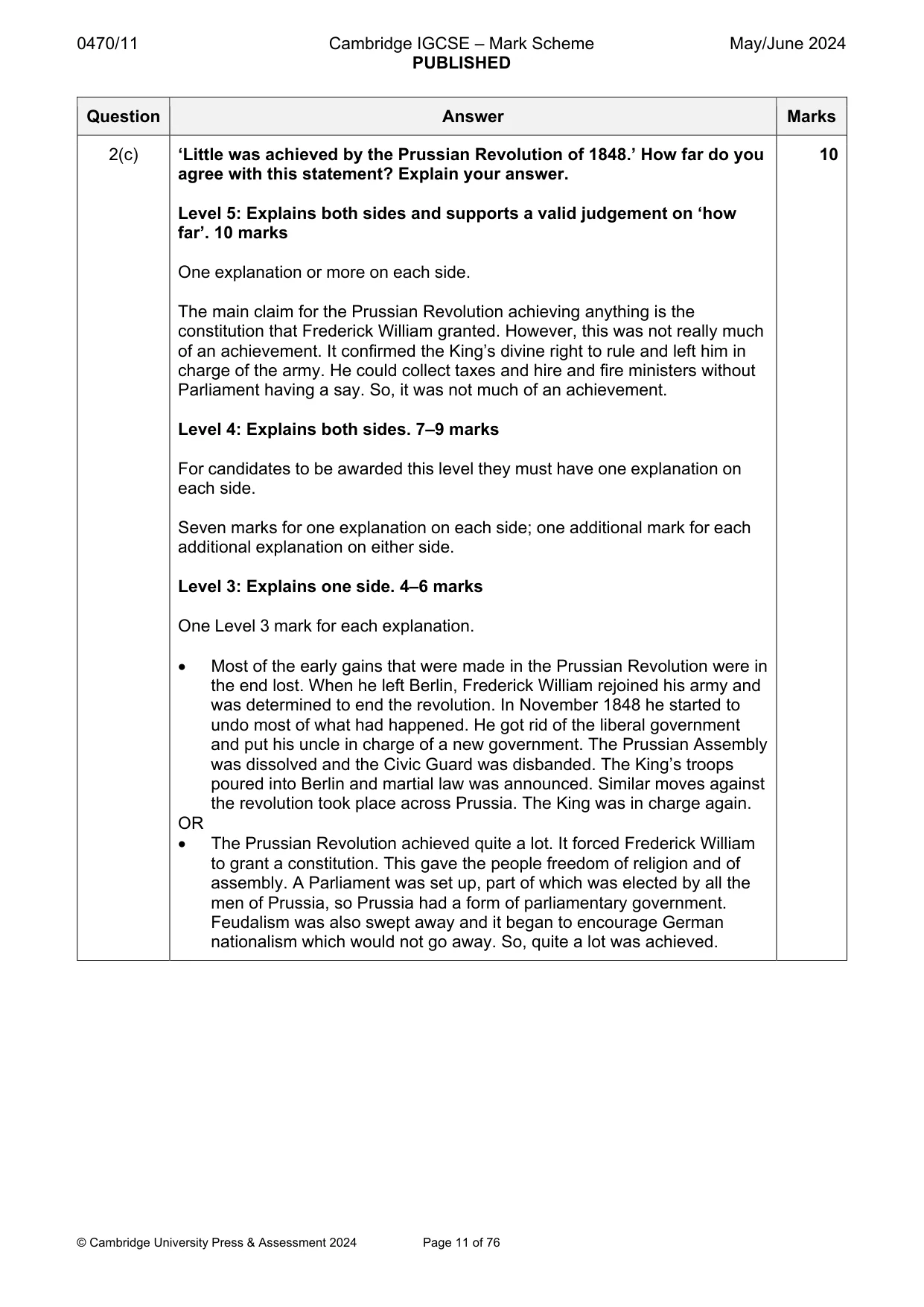
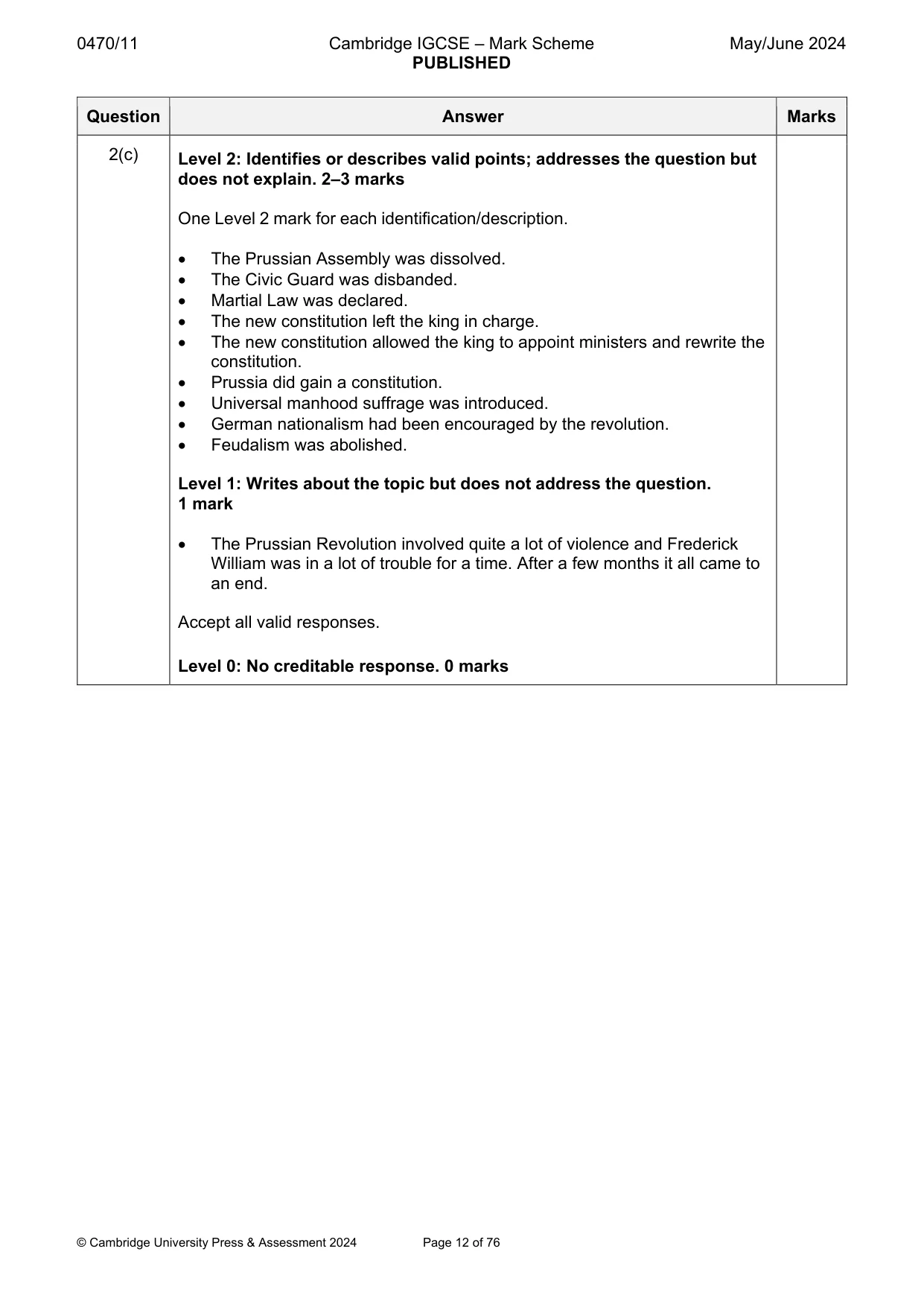
0470/11 Cambridge IGCSE – Mark Scheme PUBLISHED May/June 2024 © Cambridge University Press & Assessment 2024 Page 11 of 76 Question Answer Marks 2(c) ‘Little was achieved by the Prussian Revolution of 1848.’ How far do you agree with this statement? Explain your answer. Level 5: Explains both sides and supports a valid judgement on ‘how far’. 10 marks One explanation or more on each side. The main claim for the Prussian Revolution achieving anything is the constitution that Frederick William granted. However, this was not really much of an achievement. It confirmed the King’s divine right to rule and left him in charge of the army. He could collect taxes and hire and fire ministers without Parliament having a say. So, it was not much of an achievement. Level 4: Explains both sides. 7–9 marks For candidates to be awarded this level they must have one explanation on each side. Seven marks for one explanation on each side; one additional mark for each additional explanation on either side. Level 3: Explains one side. 4–6 marks One Level 3 mark for each explanation. Most of the early gains that were made in the Prussian Revolution were in the end lost. When he left Berlin, Frederick William rejoined his army and was determined to end the revolution. In November 1848 he started to undo most of what had happened. He got rid of the liberal government and put his uncle in charge of a new government. The Prussian Assembly was dissolved and the Civic Guard was disbanded. The King’s troops poured into Berlin and martial law was announced. Similar moves against the revolution took place across Prussia. The King was in charge again. OR The Prussian Revolution achieved quite a lot. It forced Frederick William to grant a constitution. This gave the people freedom of religion and of assembly. A Parliament was set up, part of which was elected by all the men of Prussia, so Prussia had a form of parliamentary government. Feudalism was also swept away and it began to encourage German nationalism which would not go away. So, quite a lot was achieved. 10
Mark scheme, page 12
0470/11 Cambridge IGCSE – Mark Scheme PUBLISHED May/June 2024 © Cambridge University Press & Assessment 2024 Page 12 of 76 Question Answer Marks 2(c) Level 2: Identifies or describes valid points; addresses the question but does not explain. 2–3 marks One Level 2 mark for each identification/description. The Prussian Assembly was dissolved. The Civic Guard was disbanded. Martial Law was declared. The new constitution left the king in charge. The new constitution allowed the king to appoint ministers and rewrite the constitution. Prussia did gain a constitution. Universal manhood suffrage was introduced. German nationalism had been encouraged by the revolution. Feudalism was abolished. Level 1: Writes about the topic but does not address the question. 1 mark The Prussian Revolution involved quite a lot of violence and Frederick William was in a lot of trouble for a time. After a few months it all came to an end. Accept all valid responses. Level 0: No creditable response. 0 marks
Mark scheme, page 13
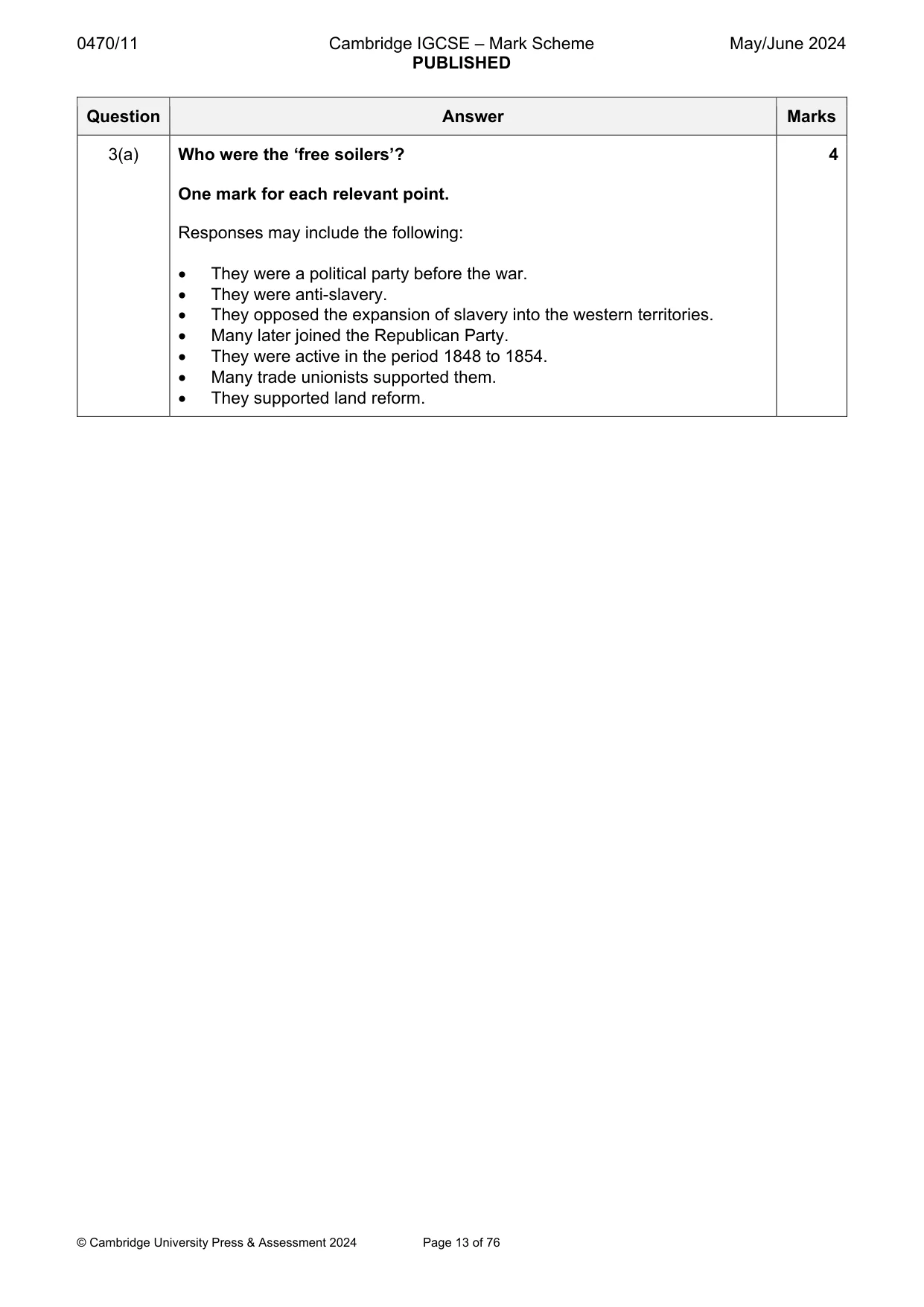
0470/11 Cambridge IGCSE – Mark Scheme PUBLISHED May/June 2024 © Cambridge University Press & Assessment 2024 Page 13 of 76 Question Answer Marks 3(a) Who were the ‘free soilers’? One mark for each relevant point. Responses may include the following: They were a political party before the war. They were anti-slavery. They opposed the expansion of slavery into the western territories. Many later joined the Republican Party. They were active in the period 1848 to 1854. Many trade unionists supported them. They supported land reform. 4
Mark scheme, page 14
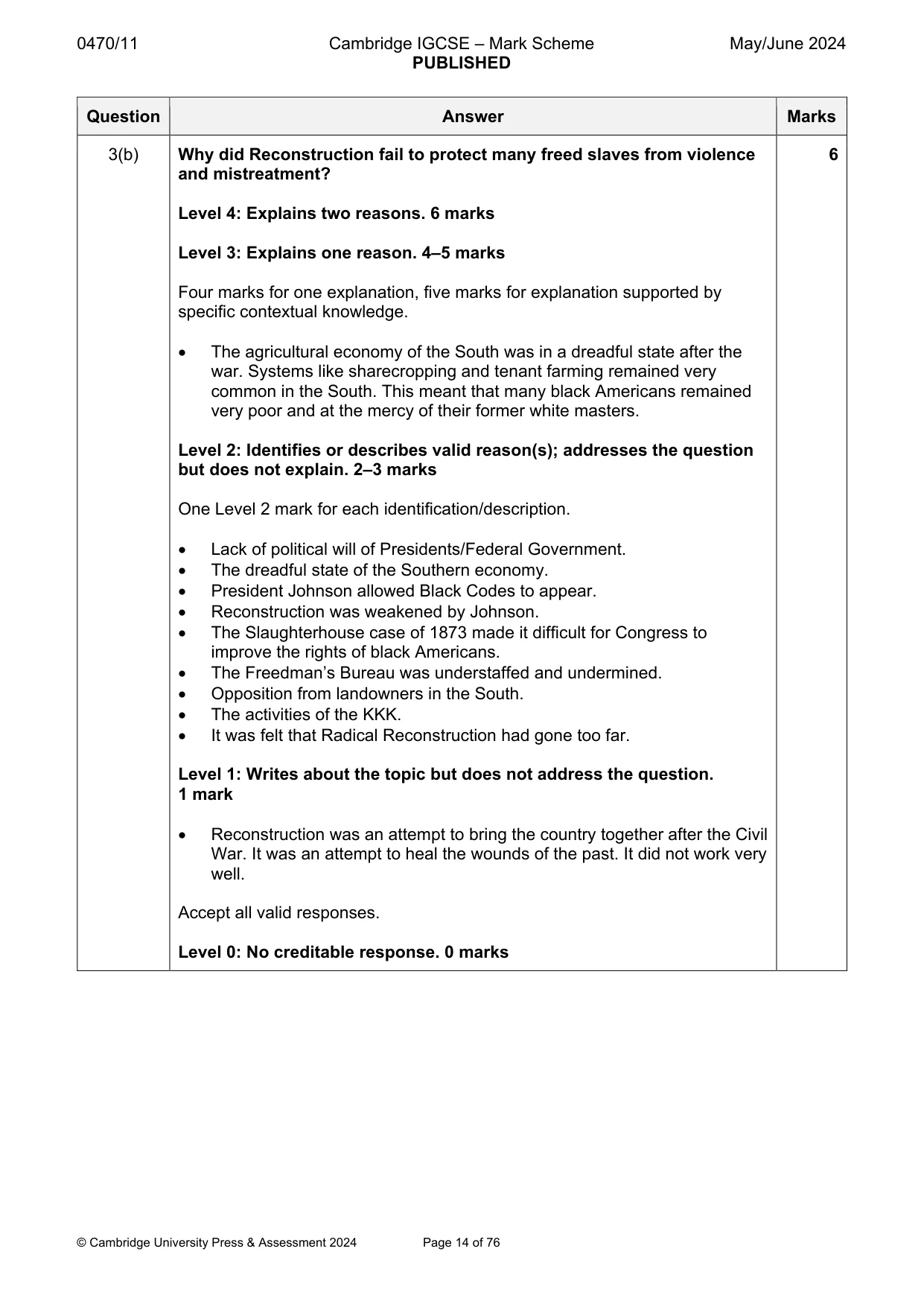
0470/11 Cambridge IGCSE – Mark Scheme PUBLISHED May/June 2024 © Cambridge University Press & Assessment 2024 Page 14 of 76 Question Answer Marks 3(b) Why did Reconstruction fail to protect many freed slaves from violence and mistreatment? Level 4: Explains two reasons. 6 marks Level 3: Explains one reason. 4–5 marks Four marks for one explanation, five marks for explanation supported by specific contextual knowledge. The agricultural economy of the South was in a dreadful state after the war. Systems like sharecropping and tenant farming remained very common in the South. This meant that many black Americans remained very poor and at the mercy of their former white masters. Level 2: Identifies or describes valid reason(s); addresses the question but does not explain. 2–3 marks One Level 2 mark for each identification/description. Lack of political will of Presidents/Federal Government. The dreadful state of the Southern economy. President Johnson allowed Black Codes to appear. Reconstruction was weakened by Johnson. The Slaughterhouse case of 1873 made it difficult for Congress to improve the rights of black Americans. The Freedman’s Bureau was understaffed and undermined. Opposition from landowners in the South. The activities of the KKK. It was felt that Radical Reconstruction had gone too far. Level 1: Writes about the topic but does not address the question. 1 mark Reconstruction was an attempt to bring the country together after the Civil War. It was an attempt to heal the wounds of the past. It did not work very well. Accept all valid responses. Level 0: No creditable response. 0 marks 6
Mark scheme, page 15
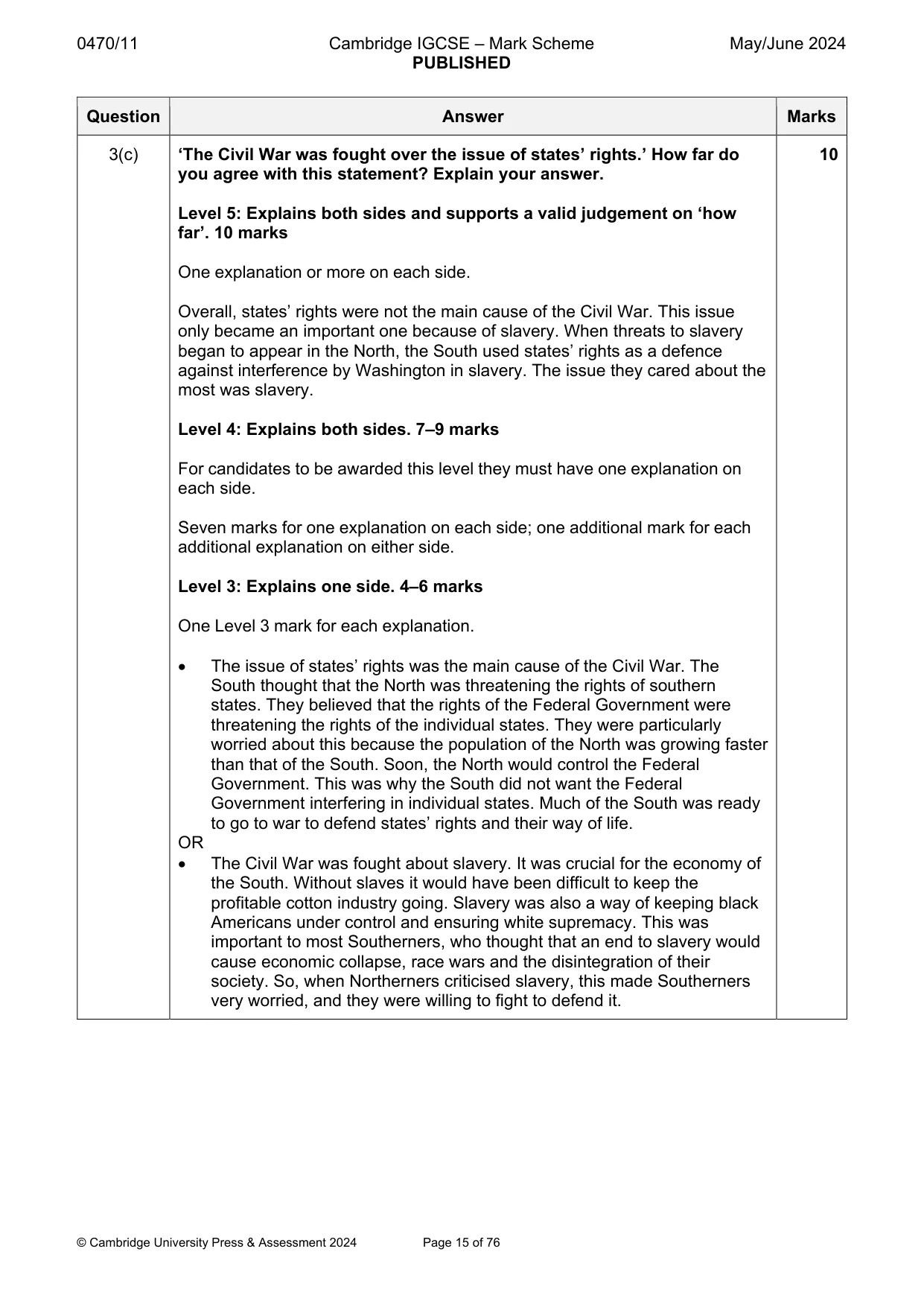
0470/11 Cambridge IGCSE – Mark Scheme PUBLISHED May/June 2024 © Cambridge University Press & Assessment 2024 Page 15 of 76 Question Answer Marks 3(c) ‘The Civil War was fought over the issue of states’ rights.’ How far do you agree with this statement? Explain your answer. Level 5: Explains both sides and supports a valid judgement on ‘how far’. 10 marks One explanation or more on each side. Overall, states’ rights were not the main cause of the Civil War. This issue only became an important one because of slavery. When threats to slavery began to appear in the North, the South used states’ rights as a defence against interference by Washington in slavery. The issue they cared about the most was slavery. Level 4: Explains both sides. 7–9 marks For candidates to be awarded this level they must have one explanation on each side. Seven marks for one explanation on each side; one additional mark for each additional explanation on either side. Level 3: Explains one side. 4–6 marks One Level 3 mark for each explanation. The issue of states’ rights was the main cause of the Civil War. The South thought that the North was threatening the rights of southern states. They believed that the rights of the Federal Government were threatening the rights of the individual states. They were particularly worried about this because the population of the North was growing faster than that of the South. Soon, the North would control the Federal Government. This was why the South did not want the Federal Government interfering in individual states. Much of the South was ready to go to war to defend states’ rights and their way of life. OR The Civil War was fought about slavery. It was crucial for the economy of the South. Without slaves it would have been difficult to keep the profitable cotton industry going. Slavery was also a way of keeping black Americans under control and ensuring white supremacy. This was important to most Southerners, who thought that an end to slavery would cause economic collapse, race wars and the disintegration of their society. So, when Northerners criticised slavery, this made Southerners very worried, and they were willing to fight to defend it. 10
Mark scheme, page 16
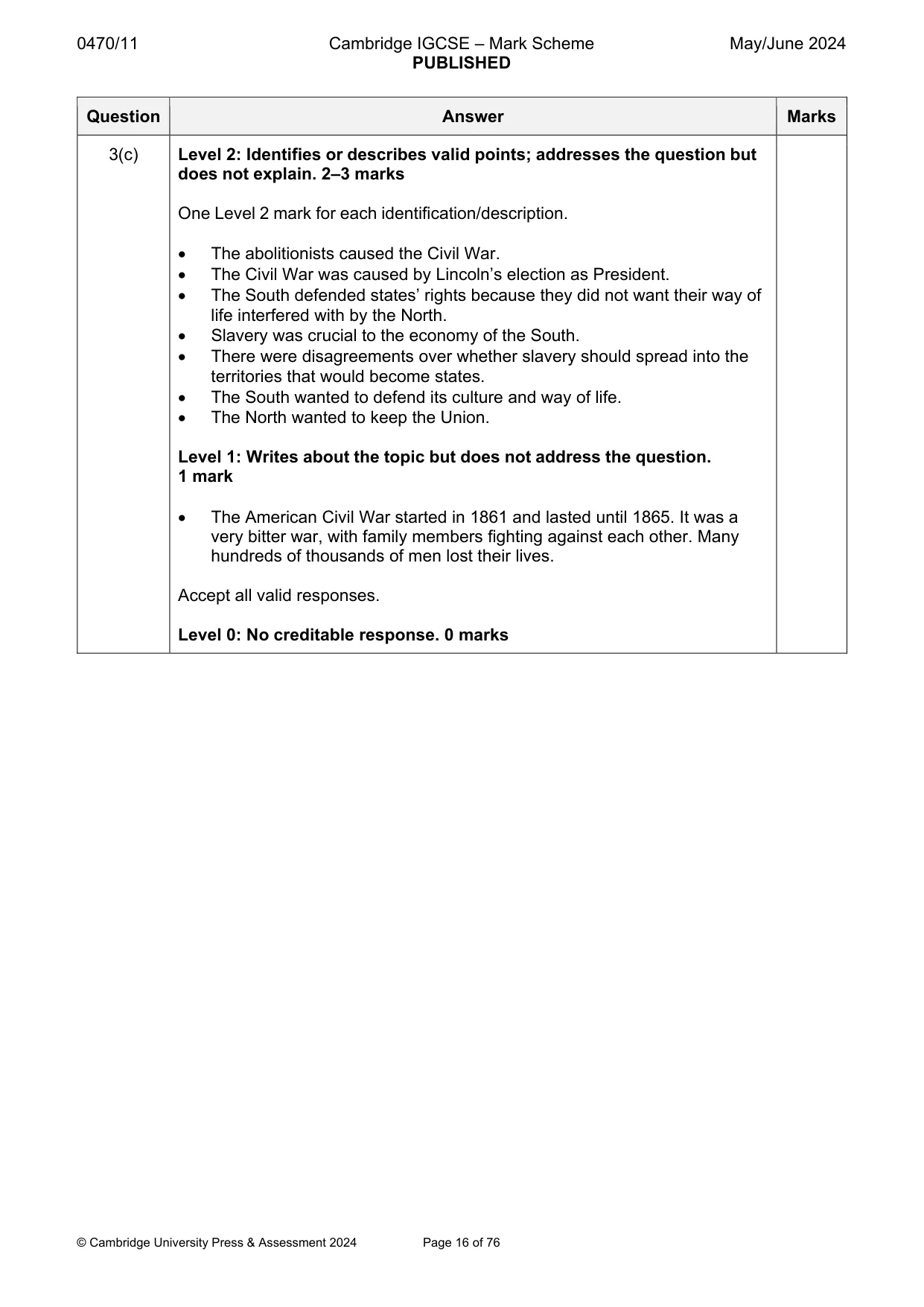
0470/11 Cambridge IGCSE – Mark Scheme PUBLISHED May/June 2024 © Cambridge University Press & Assessment 2024 Page 16 of 76 Question Answer Marks 3(c) Level 2: Identifies or describes valid points; addresses the question but does not explain. 2–3 marks One Level 2 mark for each identification/description. The abolitionists caused the Civil War. The Civil War was caused by Lincoln’s election as President. The South defended states’ rights because they did not want their way of life interfered with by the North. Slavery was crucial to the economy of the South. There were disagreements over whether slavery should spread into the territories that would become states. The South wanted to defend its culture and way of life. The North wanted to keep the Union. Level 1: Writes about the topic but does not address the question. 1 mark The American Civil War started in 1861 and lasted until 1865. It was a very bitter war, with family members fighting against each other. Many hundreds of thousands of men lost their lives. Accept all valid responses. Level 0: No creditable response. 0 marks
Mark scheme, page 17
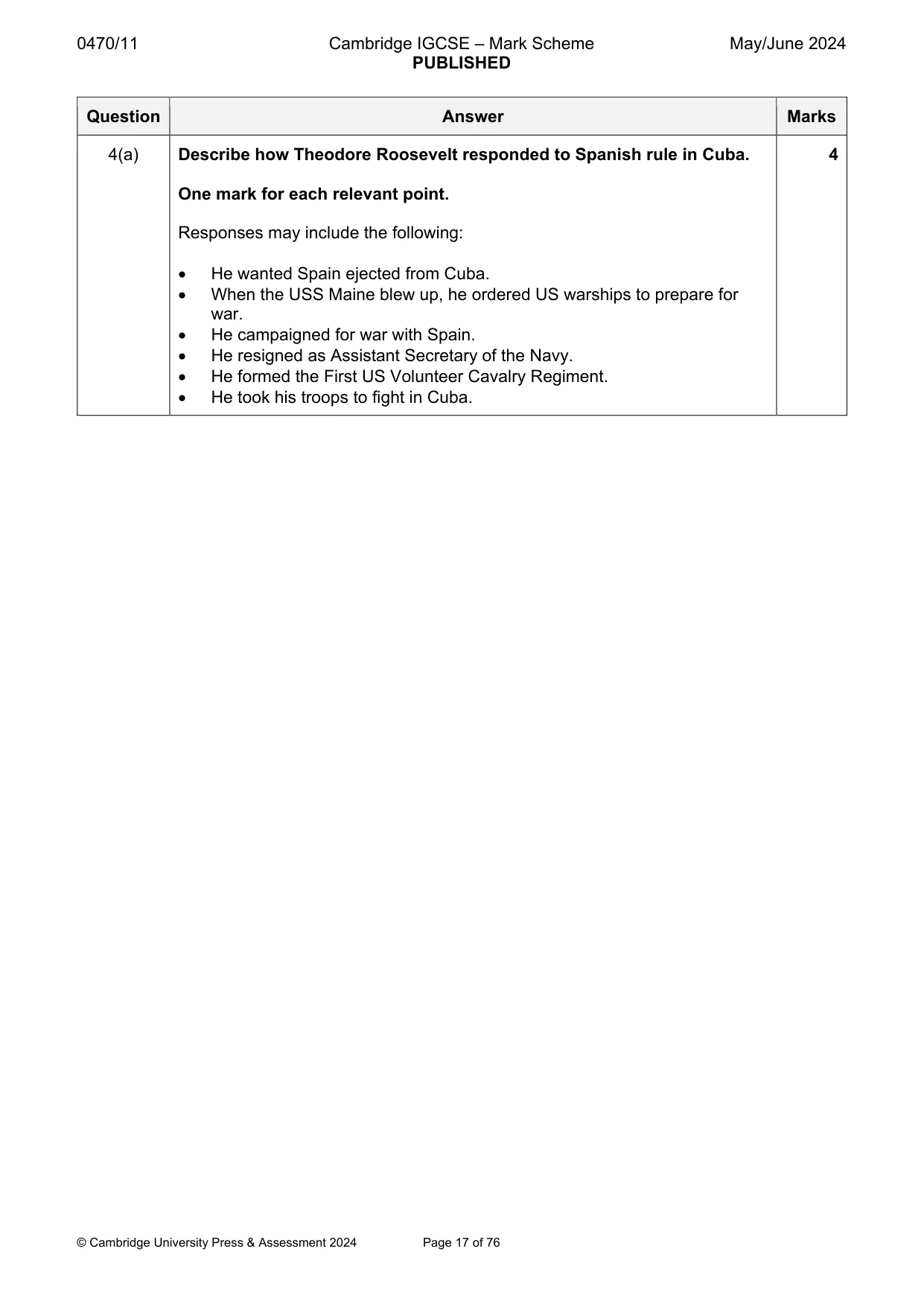
0470/11 Cambridge IGCSE – Mark Scheme PUBLISHED May/June 2024 © Cambridge University Press & Assessment 2024 Page 17 of 76 Question Answer Marks 4(a) Describe how Theodore Roosevelt responded to Spanish rule in Cuba. One mark for each relevant point. Responses may include the following: He wanted Spain ejected from Cuba. When the USS Maine blew up, he ordered US warships to prepare for war. He campaigned for war with Spain. He resigned as Assistant Secretary of the Navy. He formed the First US Volunteer Cavalry Regiment. He took his troops to fight in Cuba. 4
Mark scheme, page 18
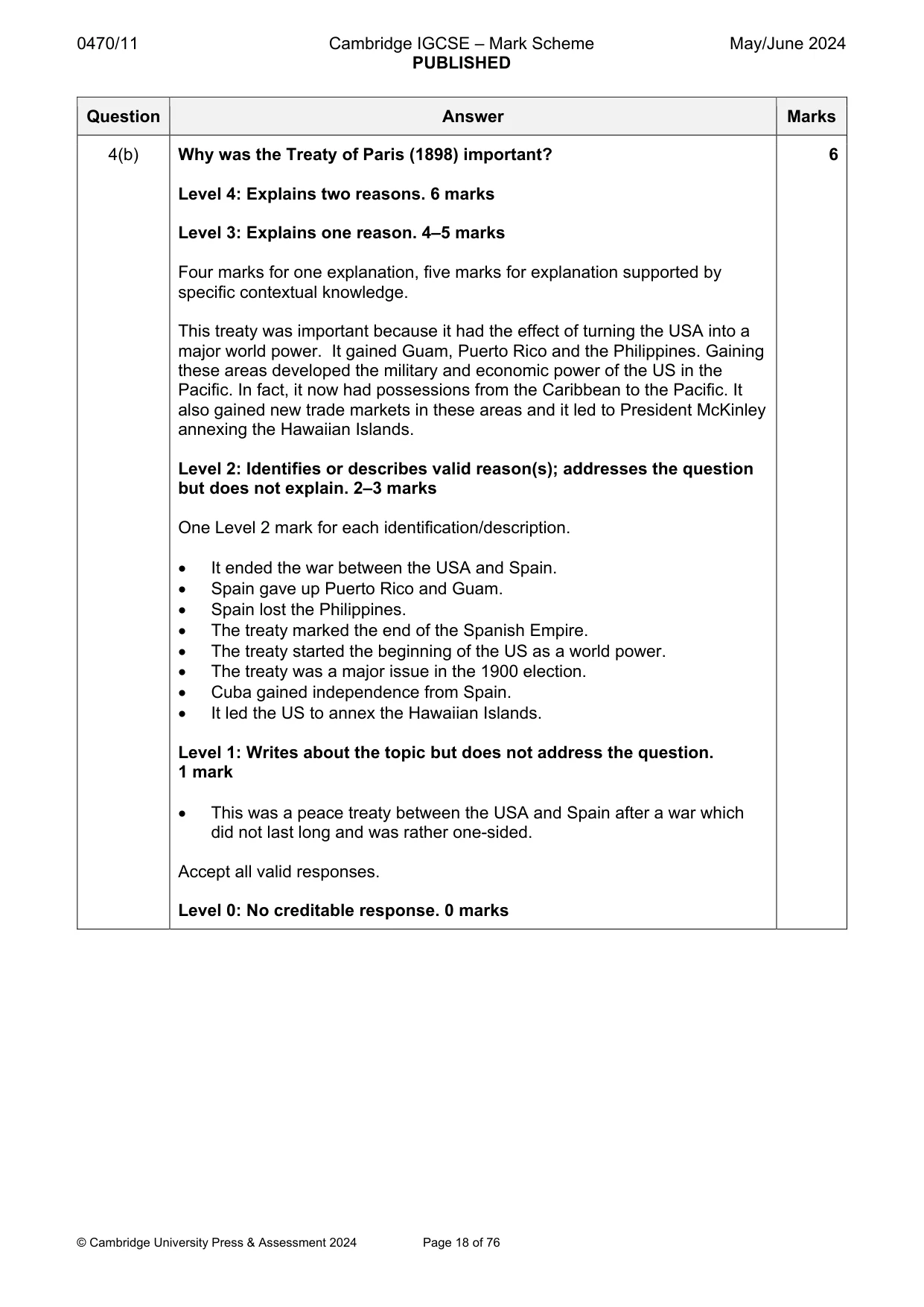
0470/11 Cambridge IGCSE – Mark Scheme PUBLISHED May/June 2024 © Cambridge University Press & Assessment 2024 Page 18 of 76 Question Answer Marks 4(b) Why was the Treaty of Paris (1898) important? Level 4: Explains two reasons. 6 marks Level 3: Explains one reason. 4–5 marks Four marks for one explanation, five marks for explanation supported by specific contextual knowledge. This treaty was important because it had the effect of turning the USA into a major world power. It gained Guam, Puerto Rico and the Philippines. Gaining these areas developed the military and economic power of the US in the Pacific. In fact, it now had possessions from the Caribbean to the Pacific. It also gained new trade markets in these areas and it led to President McKinley annexing the Hawaiian Islands. Level 2: Identifies or describes valid reason(s); addresses the question but does not explain. 2–3 marks One Level 2 mark for each identification/description. It ended the war between the USA and Spain. Spain gave up Puerto Rico and Guam. Spain lost the Philippines. The treaty marked the end of the Spanish Empire. The treaty started the beginning of the US as a world power. The treaty was a major issue in the 1900 election. Cuba gained independence from Spain. It led the US to annex the Hawaiian Islands. Level 1: Writes about the topic but does not address the question. 1 mark This was a peace treaty between the USA and Spain after a war which did not last long and was rather one-sided. Accept all valid responses. Level 0: No creditable response. 0 marks 6
Mark scheme, page 19
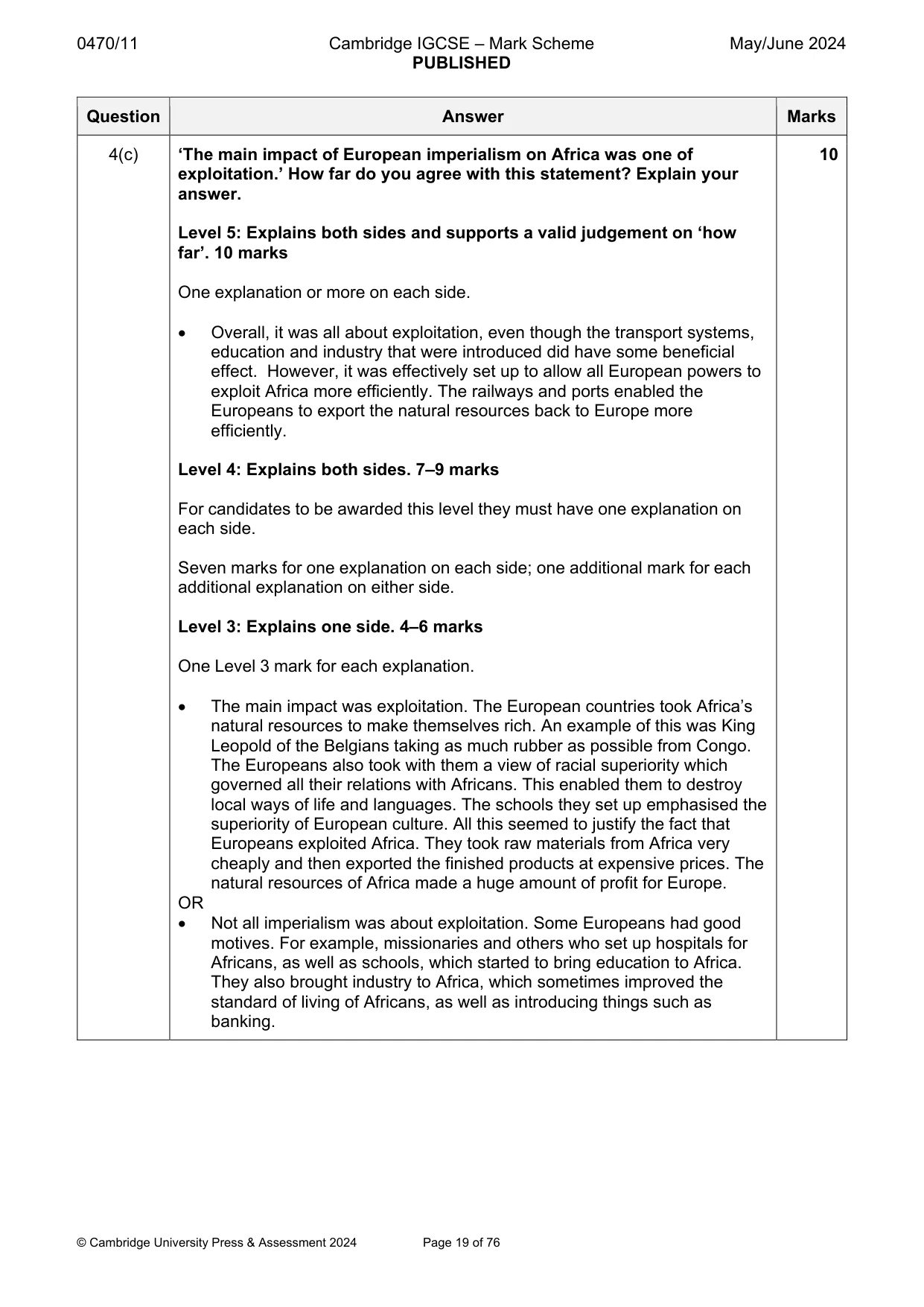
0470/11 Cambridge IGCSE – Mark Scheme PUBLISHED May/June 2024 © Cambridge University Press & Assessment 2024 Page 19 of 76 Question Answer Marks 4(c) ‘The main impact of European imperialism on Africa was one of exploitation.’ How far do you agree with this statement? Explain your answer. Level 5: Explains both sides and supports a valid judgement on ‘how far’. 10 marks One explanation or more on each side. Overall, it was all about exploitation, even though the transport systems, education and industry that were introduced did have some beneficial effect. However, it was effectively set up to allow all European powers to exploit Africa more efficiently. The railways and ports enabled the Europeans to export the natural resources back to Europe more efficiently. Level 4: Explains both sides. 7–9 marks For candidates to be awarded this level they must have one explanation on each side. Seven marks for one explanation on each side; one additional mark for each additional explanation on either side. Level 3: Explains one side. 4–6 marks One Level 3 mark for each explanation. The main impact was exploitation. The European countries took Africa’s natural resources to make themselves rich. An example of this was King Leopold of the Belgians taking as much rubber as possible from Congo. The Europeans also took with them a view of racial superiority which governed all their relations with Africans. This enabled them to destroy local ways of life and languages. The schools they set up emphasised the superiority of European culture. All this seemed to justify the fact that Europeans exploited Africa. They took raw materials from Africa very cheaply and then exported the finished products at expensive prices. The natural resources of Africa made a huge amount of profit for Europe. OR Not all imperialism was about exploitation. Some Europeans had good motives. For example, missionaries and others who set up hospitals for Africans, as well as schools, which started to bring education to Africa. They also brought industry to Africa, which sometimes improved the standard of living of Africans, as well as introducing things such as banking. 10
Mark scheme, page 20
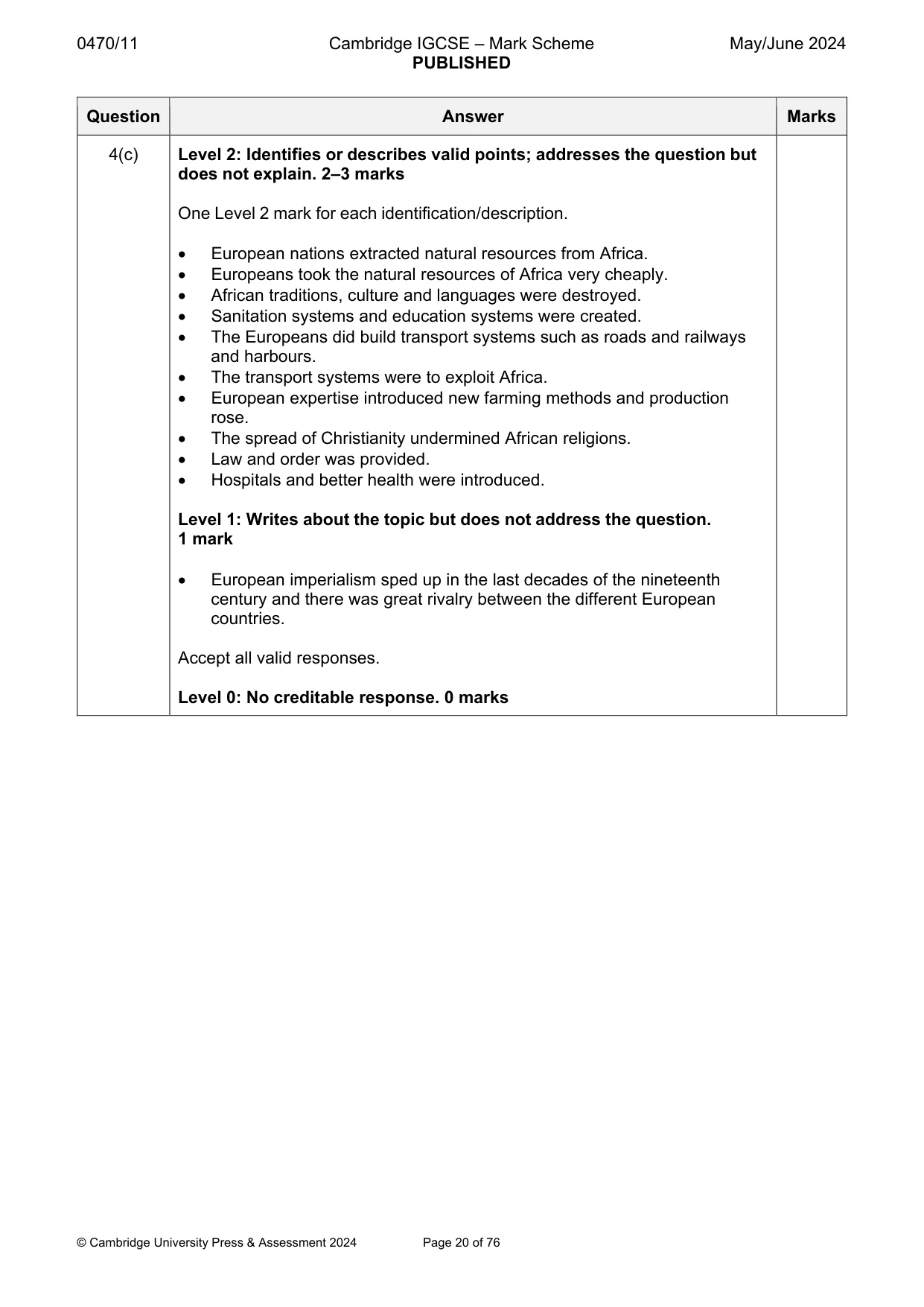
0470/11 Cambridge IGCSE – Mark Scheme PUBLISHED May/June 2024 © Cambridge University Press & Assessment 2024 Page 20 of 76 Question Answer Marks 4(c) Level 2: Identifies or describes valid points; addresses the question but does not explain. 2–3 marks One Level 2 mark for each identification/description. European nations extracted natural resources from Africa. Europeans took the natural resources of Africa very cheaply. African traditions, culture and languages were destroyed. Sanitation systems and education systems were created. The Europeans did build transport systems such as roads and railways and harbours. The transport systems were to exploit Africa. European expertise introduced new farming methods and production rose. The spread of Christianity undermined African religions. Law and order was provided. Hospitals and better health were introduced. Level 1: Writes about the topic but does not address the question. 1 mark European imperialism sped up in the last decades of the nineteenth century and there was great rivalry between the different European countries. Accept all valid responses. Level 0: No creditable response. 0 marks
Mark scheme, page 21
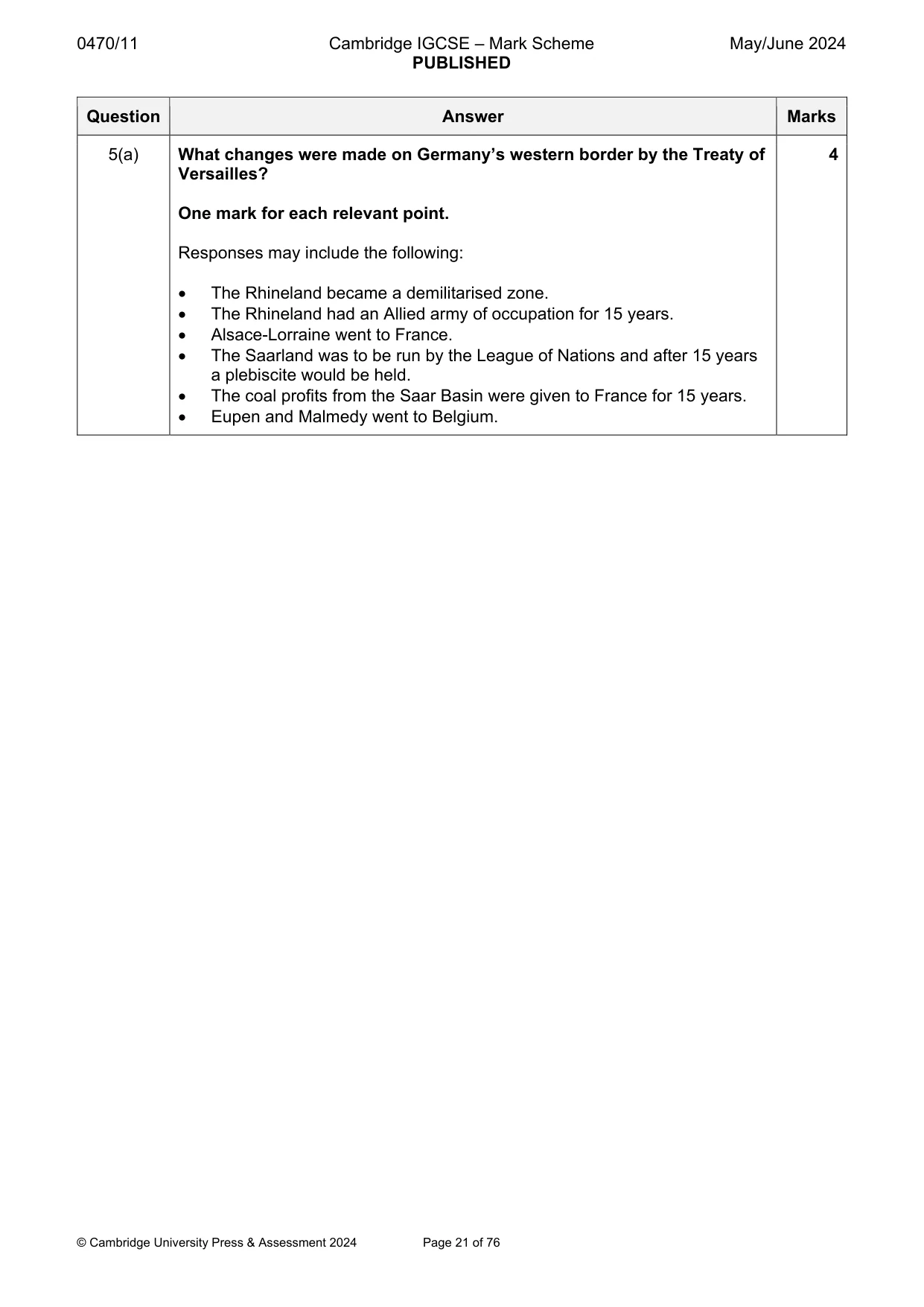
0470/11 Cambridge IGCSE – Mark Scheme PUBLISHED May/June 2024 © Cambridge University Press & Assessment 2024 Page 21 of 76 Question Answer Marks 5(a) What changes were made on Germany’s western border by the Treaty of Versailles? One mark for each relevant point. Responses may include the following: The Rhineland became a demilitarised zone. The Rhineland had an Allied army of occupation for 15 years. Alsace-Lorraine went to France. The Saarland was to be run by the League of Nations and after 15 years a plebiscite would be held. The coal profits from the Saar Basin were given to France for 15 years. Eupen and Malmedy went to Belgium. 4
Mark scheme, page 22
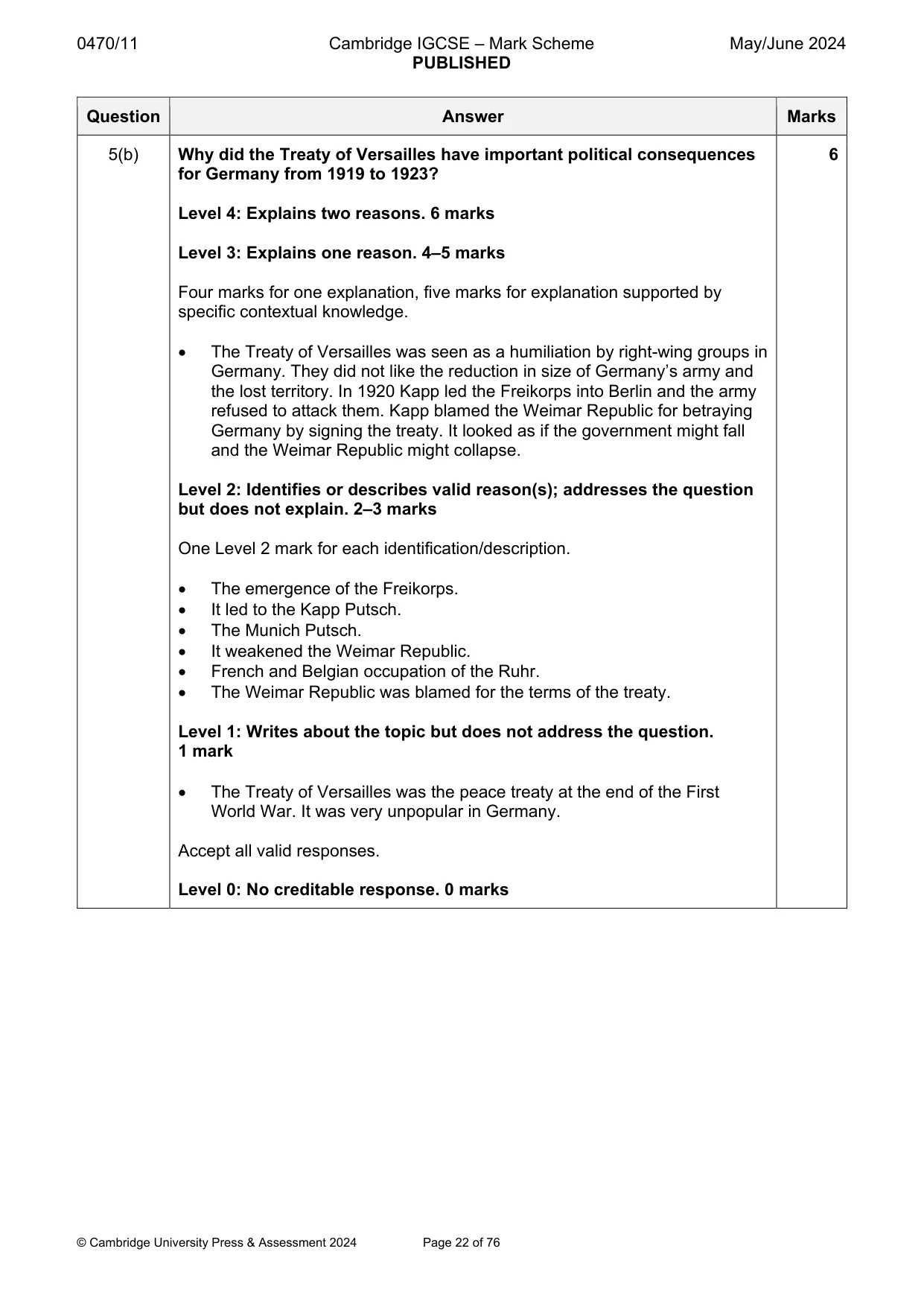
0470/11 Cambridge IGCSE – Mark Scheme PUBLISHED May/June 2024 © Cambridge University Press & Assessment 2024 Page 22 of 76 Question Answer Marks 5(b) Why did the Treaty of Versailles have important political consequences for Germany from 1919 to 1923? Level 4: Explains two reasons. 6 marks Level 3: Explains one reason. 4–5 marks Four marks for one explanation, five marks for explanation supported by specific contextual knowledge. The Treaty of Versailles was seen as a humiliation by right-wing groups in Germany. They did not like the reduction in size of Germany’s army and the lost territory. In 1920 Kapp led the Freikorps into Berlin and the army refused to attack them. Kapp blamed the Weimar Republic for betraying Germany by signing the treaty. It looked as if the government might fall and the Weimar Republic might collapse. Level 2: Identifies or describes valid reason(s); addresses the question but does not explain. 2–3 marks One Level 2 mark for each identification/description. The emergence of the Freikorps. It led to the Kapp Putsch. The Munich Putsch. It weakened the Weimar Republic. French and Belgian occupation of the Ruhr. The Weimar Republic was blamed for the terms of the treaty. Level 1: Writes about the topic but does not address the question. 1 mark The Treaty of Versailles was the peace treaty at the end of the First World War. It was very unpopular in Germany. Accept all valid responses. Level 0: No creditable response. 0 marks 6
Mark scheme, page 23
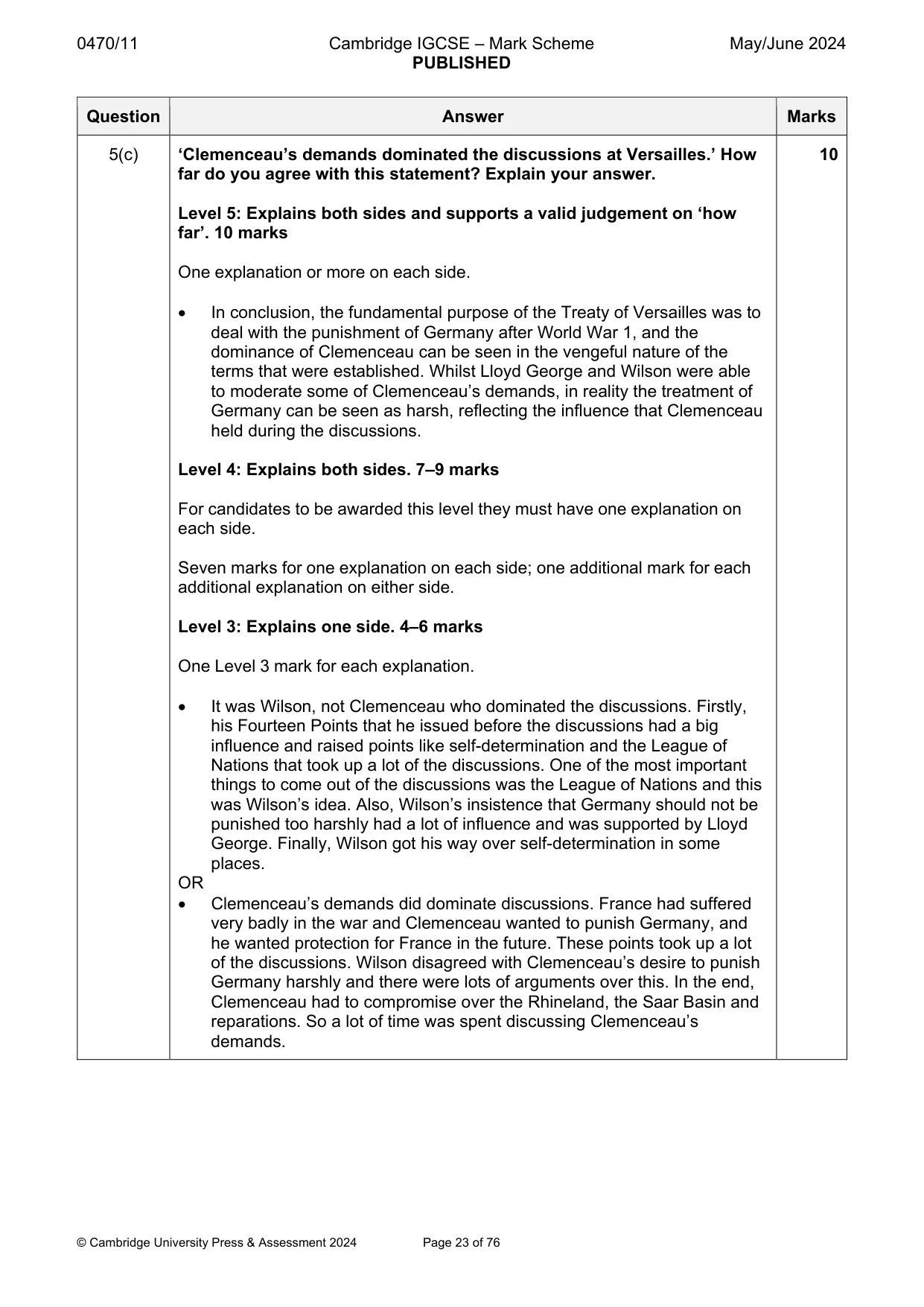
0470/11 Cambridge IGCSE – Mark Scheme PUBLISHED May/June 2024 © Cambridge University Press & Assessment 2024 Page 23 of 76 Question Answer Marks 5(c) ‘Clemenceau’s demands dominated the discussions at Versailles.’ How far do you agree with this statement? Explain your answer. Level 5: Explains both sides and supports a valid judgement on ‘how far’. 10 marks One explanation or more on each side. In conclusion, the fundamental purpose of the Treaty of Versailles was to deal with the punishment of Germany after World War 1, and the dominance of Clemenceau can be seen in the vengeful nature of the terms that were established. Whilst Lloyd George and Wilson were able to moderate some of Clemenceau’s demands, in reality the treatment of Germany can be seen as harsh, reflecting the influence that Clemenceau held during the discussions. Level 4: Explains both sides. 7–9 marks For candidates to be awarded this level they must have one explanation on each side. Seven marks for one explanation on each side; one additional mark for each additional explanation on either side. Level 3: Explains one side. 4–6 marks One Level 3 mark for each explanation. It was Wilson, not Clemenceau who dominated the discussions. Firstly, his Fourteen Points that he issued before the discussions had a big influence and raised points like self-determination and the League of Nations that took up a lot of the discussions. One of the most important things to come out of the discussions was the League of Nations and this was Wilson’s idea. Also, Wilson’s insistence that Germany should not be punished too harshly had a lot of influence and was supported by Lloyd George. Finally, Wilson got his way over self-determination in some places. OR Clemenceau’s demands did dominate discussions. France had suffered very badly in the war and Clemenceau wanted to punish Germany, and he wanted protection for France in the future. These points took up a lot of the discussions. Wilson disagreed with Clemenceau’s desire to punish Germany harshly and there were lots of arguments over this. In the end, Clemenceau had to compromise over the Rhineland, the Saar Basin and reparations. So a lot of time was spent discussing Clemenceau’s demands. 10
Mark scheme, page 24
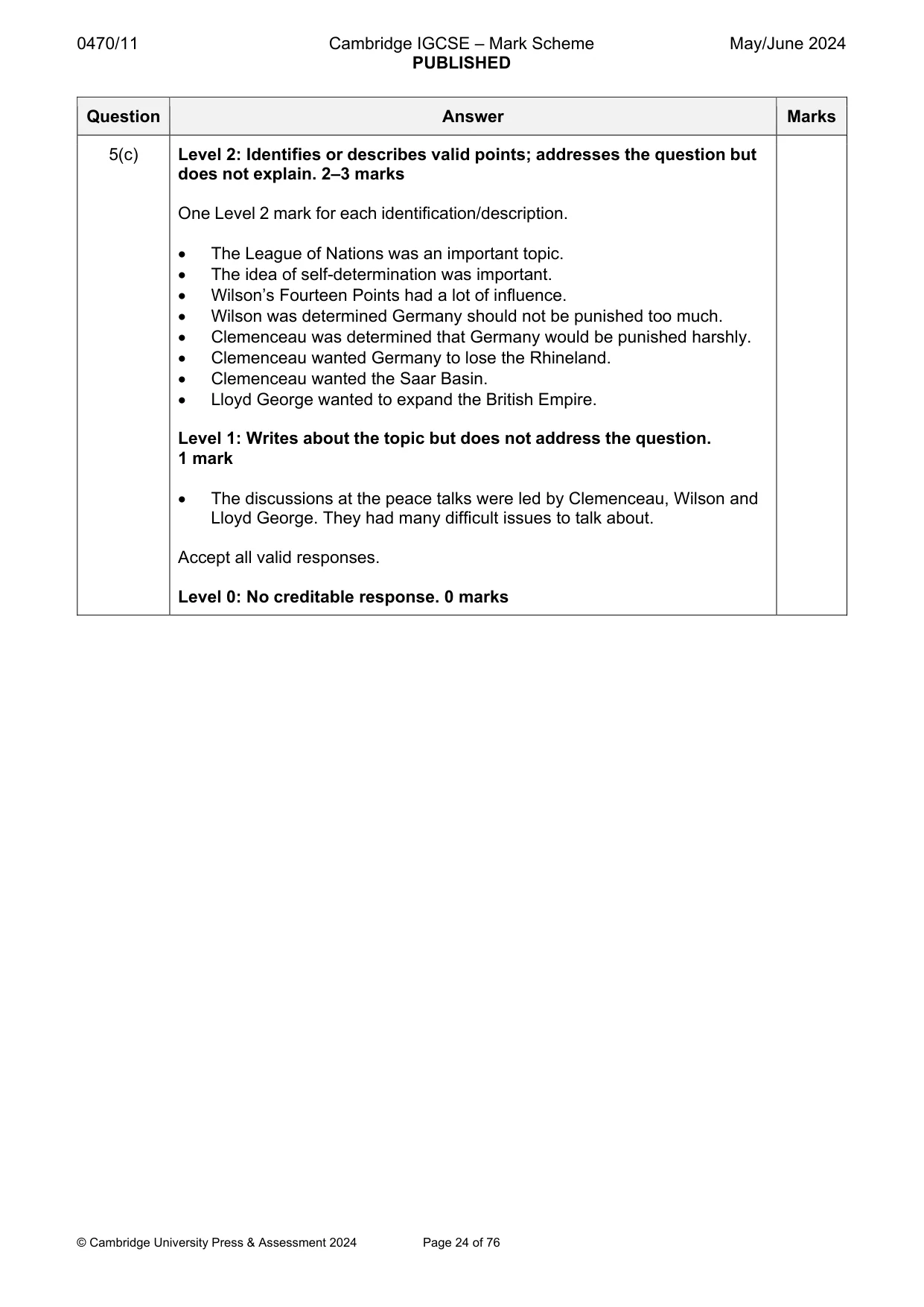
0470/11 Cambridge IGCSE – Mark Scheme PUBLISHED May/June 2024 © Cambridge University Press & Assessment 2024 Page 24 of 76 Question Answer Marks 5(c) Level 2: Identifies or describes valid points; addresses the question but does not explain. 2–3 marks One Level 2 mark for each identification/description. The League of Nations was an important topic. The idea of self-determination was important. Wilson’s Fourteen Points had a lot of influence. Wilson was determined Germany should not be punished too much. Clemenceau was determined that Germany would be punished harshly. Clemenceau wanted Germany to lose the Rhineland. Clemenceau wanted the Saar Basin. Lloyd George wanted to expand the British Empire. Level 1: Writes about the topic but does not address the question. 1 mark The discussions at the peace talks were led by Clemenceau, Wilson and Lloyd George. They had many difficult issues to talk about. Accept all valid responses. Level 0: No creditable response. 0 marks
Mark scheme, page 25
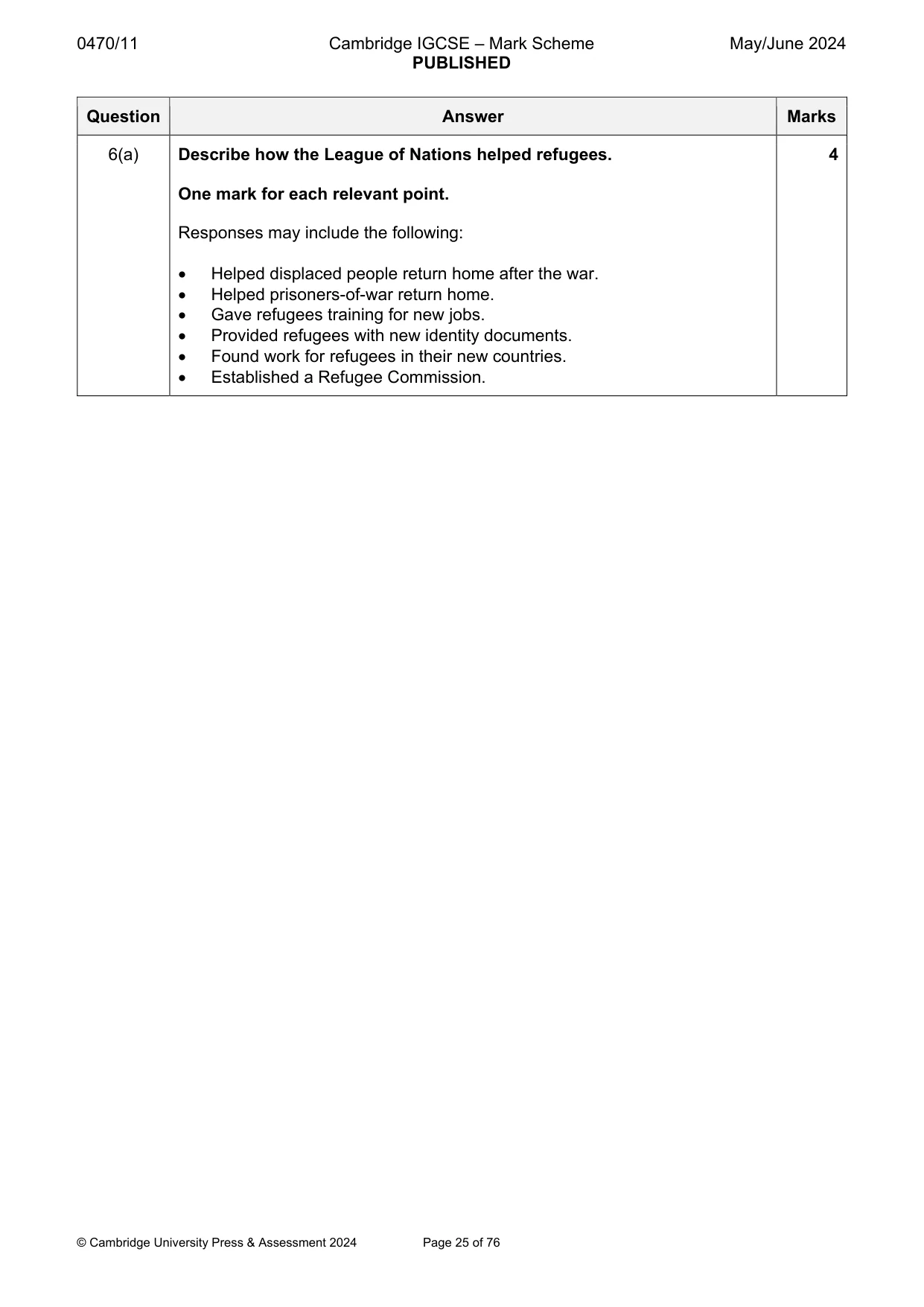
0470/11 Cambridge IGCSE – Mark Scheme PUBLISHED May/June 2024 © Cambridge University Press & Assessment 2024 Page 25 of 76 Question Answer Marks 6(a) Describe how the League of Nations helped refugees. One mark for each relevant point. Responses may include the following: Helped displaced people return home after the war. Helped prisoners-of-war return home. Gave refugees training for new jobs. Provided refugees with new identity documents. Found work for refugees in their new countries. Established a Refugee Commission. 4
Mark scheme, page 26
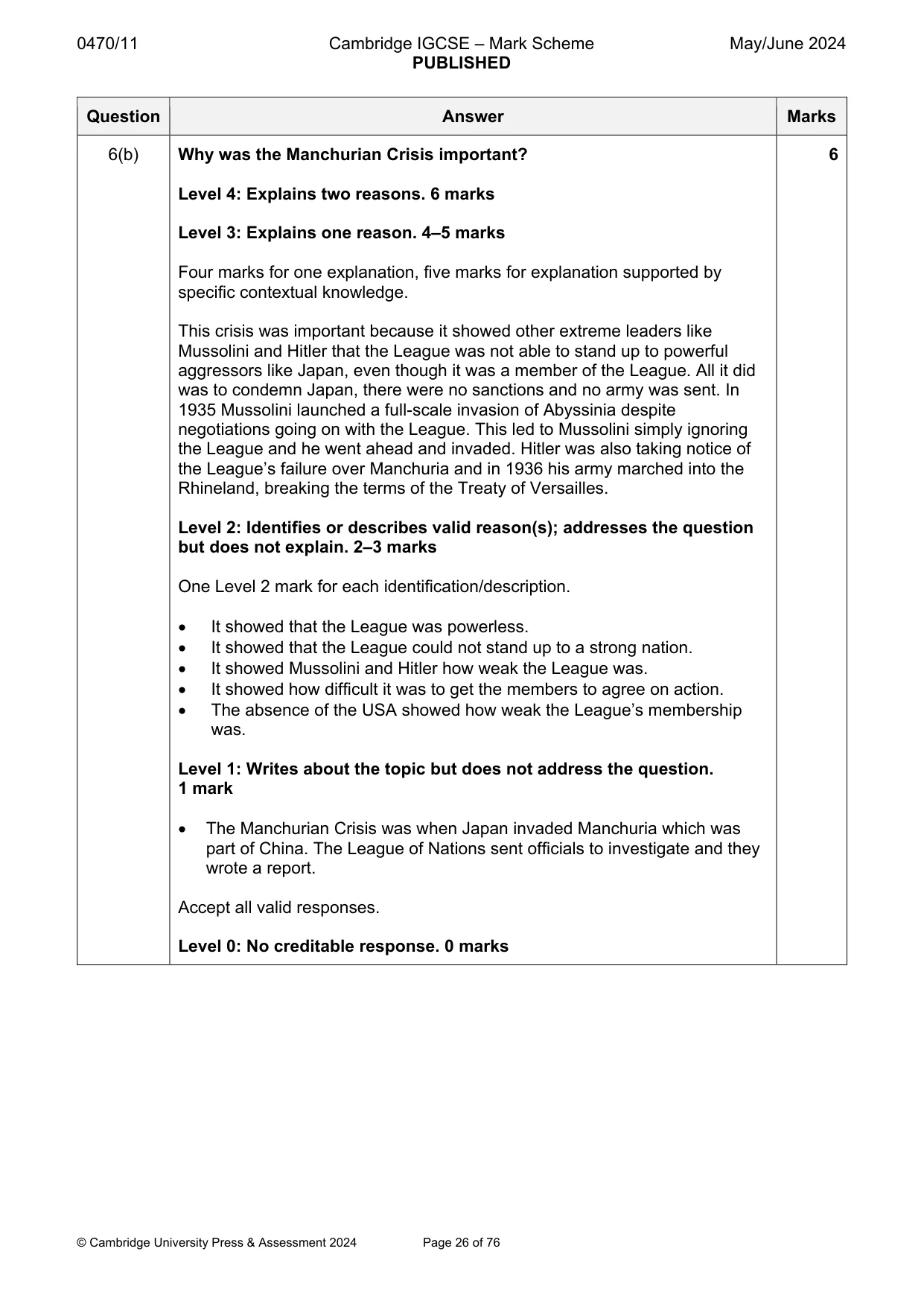
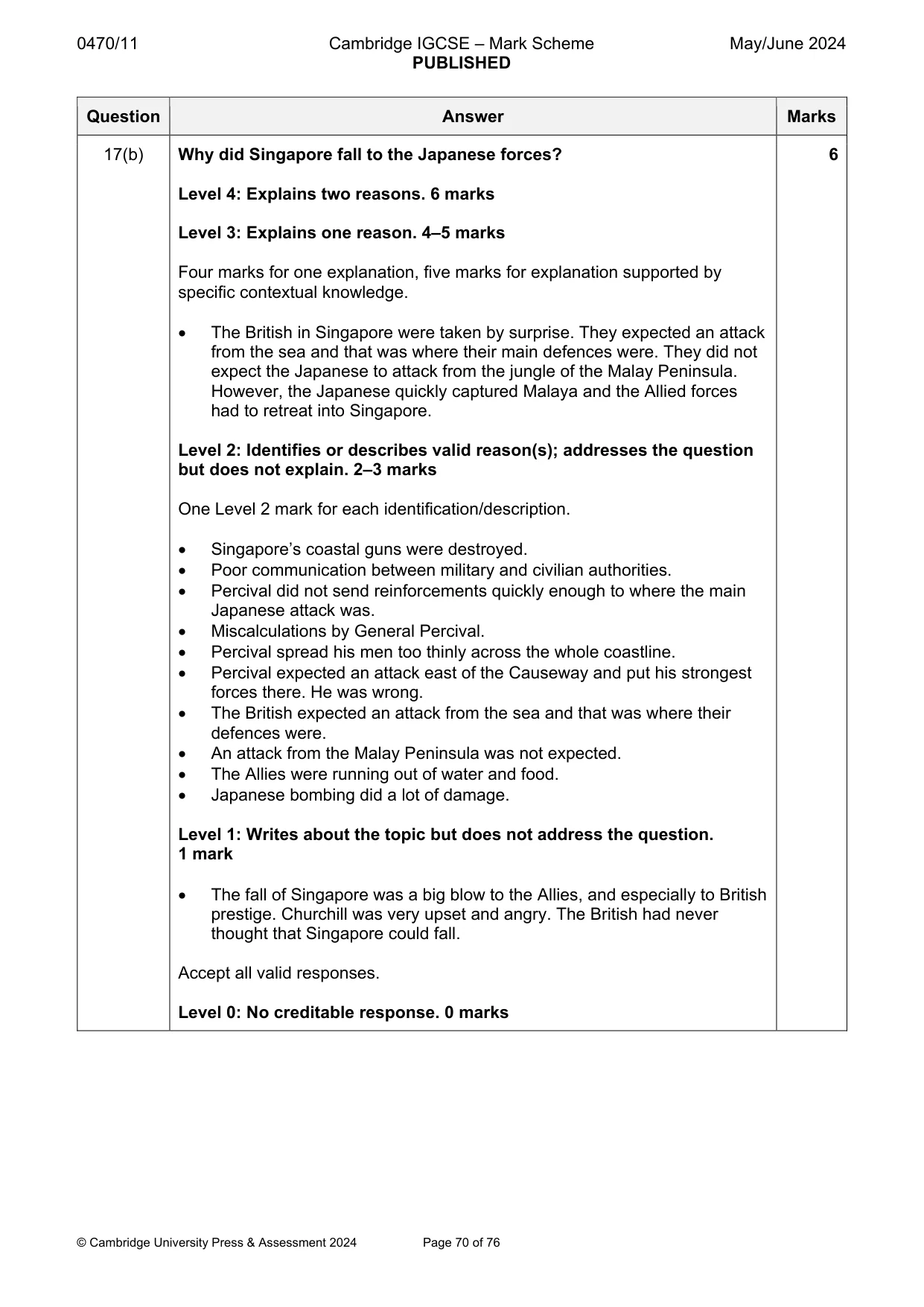
0470/11 Cambridge IGCSE – Mark Scheme PUBLISHED May/June 2024 © Cambridge University Press & Assessment 2024 Page 26 of 76 Question Answer Marks 6(b) Why was the Manchurian Crisis important? Level 4: Explains two reasons. 6 marks Level 3: Explains one reason. 4–5 marks Four marks for one explanation, five marks for explanation supported by specific contextual knowledge. This crisis was important because it showed other extreme leaders like Mussolini and Hitler that the League was not able to stand up to powerful aggressors like Japan, even though it was a member of the League. All it did was to condemn Japan, there were no sanctions and no army was sent. In 1935 Mussolini launched a full-scale invasion of Abyssinia despite negotiations going on with the League. This led to Mussolini simply ignoring the League and he went ahead and invaded. Hitler was also taking notice of the League’s failure over Manchuria and in 1936 his army marched into the Rhineland, breaking the terms of the Treaty of Versailles. Level 2: Identifies or describes valid reason(s); addresses the question but does not explain. 2–3 marks One Level 2 mark for each identification/description. It showed that the League was powerless. It showed that the League could not stand up to a strong nation. It showed Mussolini and Hitler how weak the League was. It showed how difficult it was to get the members to agree on action. The absence of the USA showed how weak the League’s membership was. Level 1: Writes about the topic but does not address the question. 1 mark The Manchurian Crisis was when Japan invaded Manchuria which was part of China. The League of Nations sent officials to investigate and they wrote a report. Accept all valid responses. Level 0: No creditable response. 0 marks 6
Mark scheme, page 27
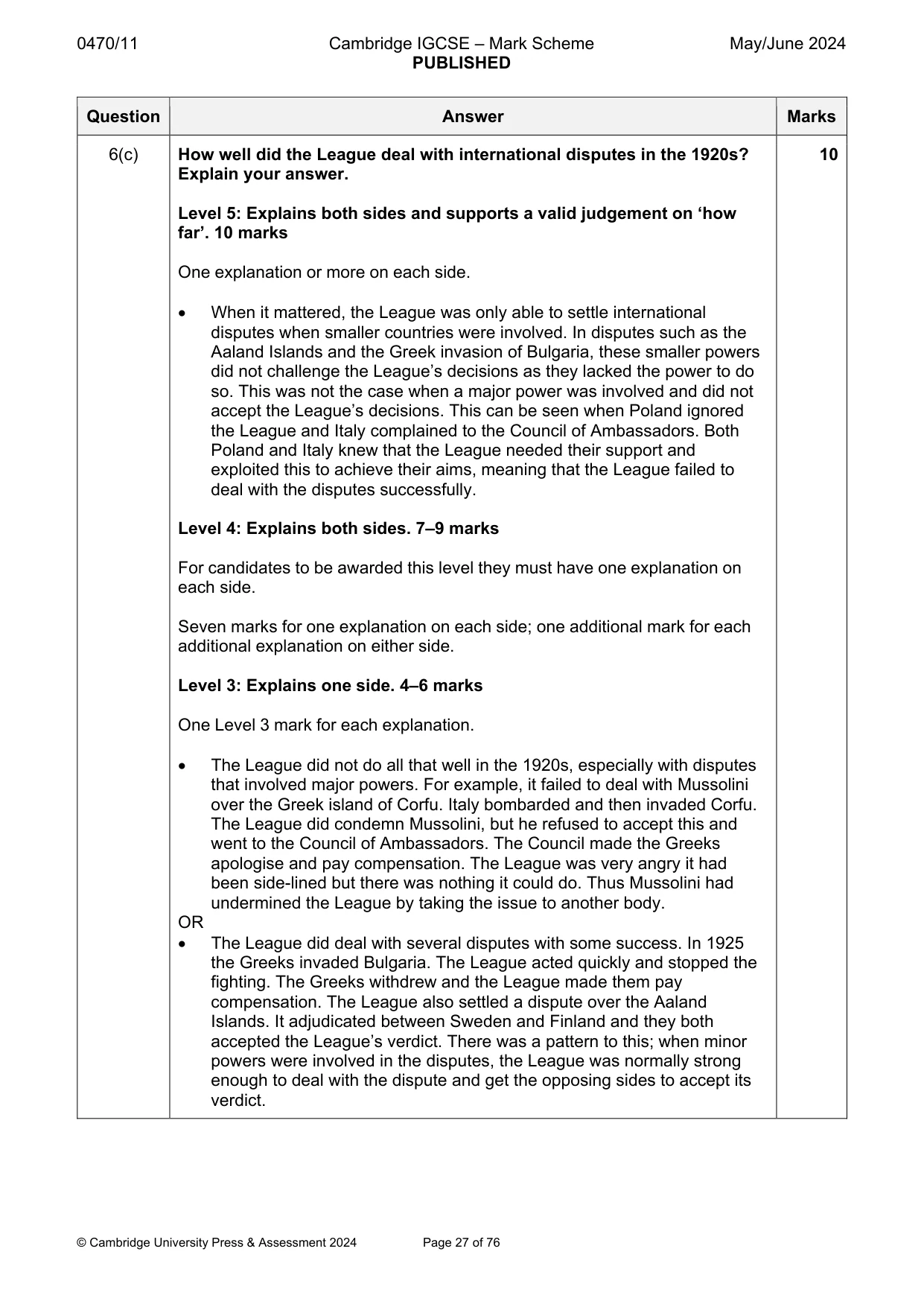
0470/11 Cambridge IGCSE – Mark Scheme PUBLISHED May/June 2024 © Cambridge University Press & Assessment 2024 Page 27 of 76 Question Answer Marks 6(c) How well did the League deal with international disputes in the 1920s? Explain your answer. Level 5: Explains both sides and supports a valid judgement on ‘how far’. 10 marks One explanation or more on each side. When it mattered, the League was only able to settle international disputes when smaller countries were involved. In disputes such as the Aaland Islands and the Greek invasion of Bulgaria, these smaller powers did not challenge the League’s decisions as they lacked the power to do so. This was not the case when a major power was involved and did not accept the League’s decisions. This can be seen when Poland ignored the League and Italy complained to the Council of Ambassadors. Both Poland and Italy knew that the League needed their support and exploited this to achieve their aims, meaning that the League failed to deal with the disputes successfully. Level 4: Explains both sides. 7–9 marks For candidates to be awarded this level they must have one explanation on each side. Seven marks for one explanation on each side; one additional mark for each additional explanation on either side. Level 3: Explains one side. 4–6 marks One Level 3 mark for each explanation. The League did not do all that well in the 1920s, especially with disputes that involved major powers. For example, it failed to deal with Mussolini over the Greek island of Corfu. Italy bombarded and then invaded Corfu. The League did condemn Mussolini, but he refused to accept this and went to the Council of Ambassadors. The Council made the Greeks apologise and pay compensation. The League was very angry it had been side-lined but there was nothing it could do. Thus Mussolini had undermined the League by taking the issue to another body. OR The League did deal with several disputes with some success. In 1925 the Greeks invaded Bulgaria. The League acted quickly and stopped the fighting. The Greeks withdrew and the League made them pay compensation. The League also settled a dispute over the Aaland Islands. It adjudicated between Sweden and Finland and they both accepted the League’s verdict. There was a pattern to this; when minor powers were involved in the disputes, the League was normally strong enough to deal with the dispute and get the opposing sides to accept its verdict. 10
Mark scheme, page 28
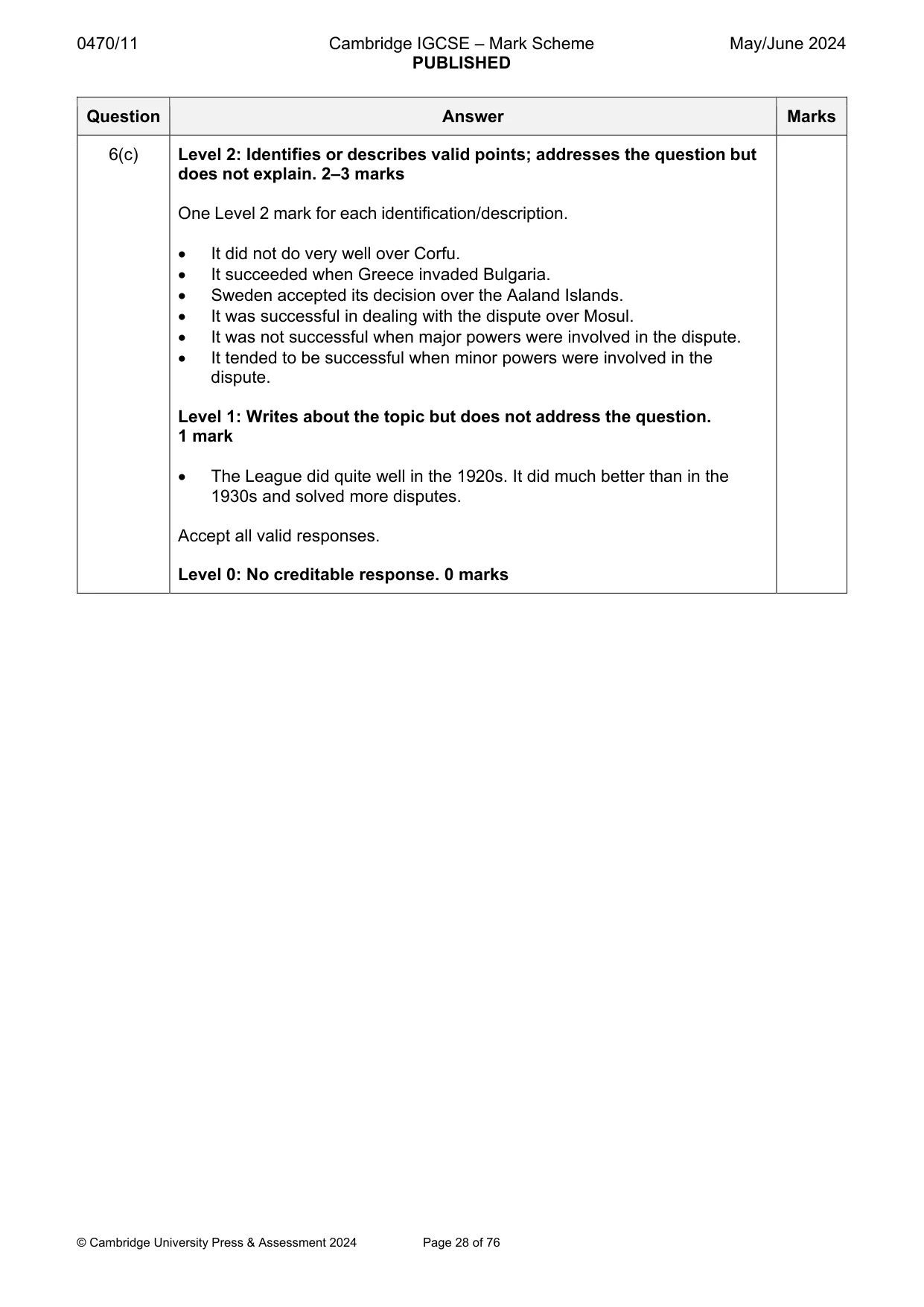
0470/11 Cambridge IGCSE – Mark Scheme PUBLISHED May/June 2024 © Cambridge University Press & Assessment 2024 Page 28 of 76 Question Answer Marks 6(c) Level 2: Identifies or describes valid points; addresses the question but does not explain. 2–3 marks One Level 2 mark for each identification/description. It did not do very well over Corfu. It succeeded when Greece invaded Bulgaria. Sweden accepted its decision over the Aaland Islands. It was successful in dealing with the dispute over Mosul. It was not successful when major powers were involved in the dispute. It tended to be successful when minor powers were involved in the dispute. Level 1: Writes about the topic but does not address the question. 1 mark The League did quite well in the 1920s. It did much better than in the 1930s and solved more disputes. Accept all valid responses. Level 0: No creditable response. 0 marks
Mark scheme, page 29
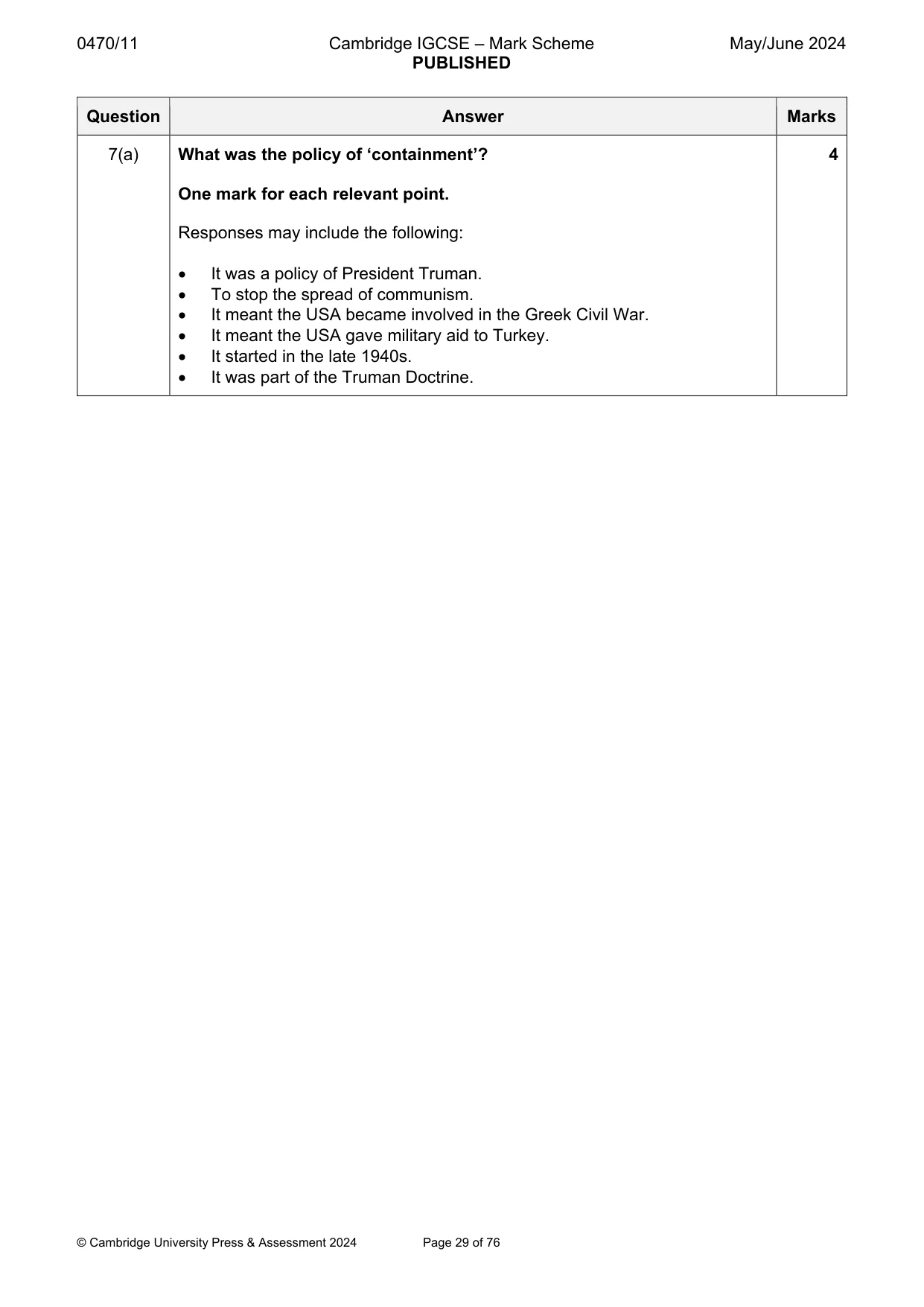
0470/11 Cambridge IGCSE – Mark Scheme PUBLISHED May/June 2024 © Cambridge University Press & Assessment 2024 Page 29 of 76 Question Answer Marks 7(a) What was the policy of ‘containment’? One mark for each relevant point. Responses may include the following: It was a policy of President Truman. To stop the spread of communism. It meant the USA became involved in the Greek Civil War. It meant the USA gave military aid to Turkey. It started in the late 1940s. It was part of the Truman Doctrine. 4
Mark scheme, page 30
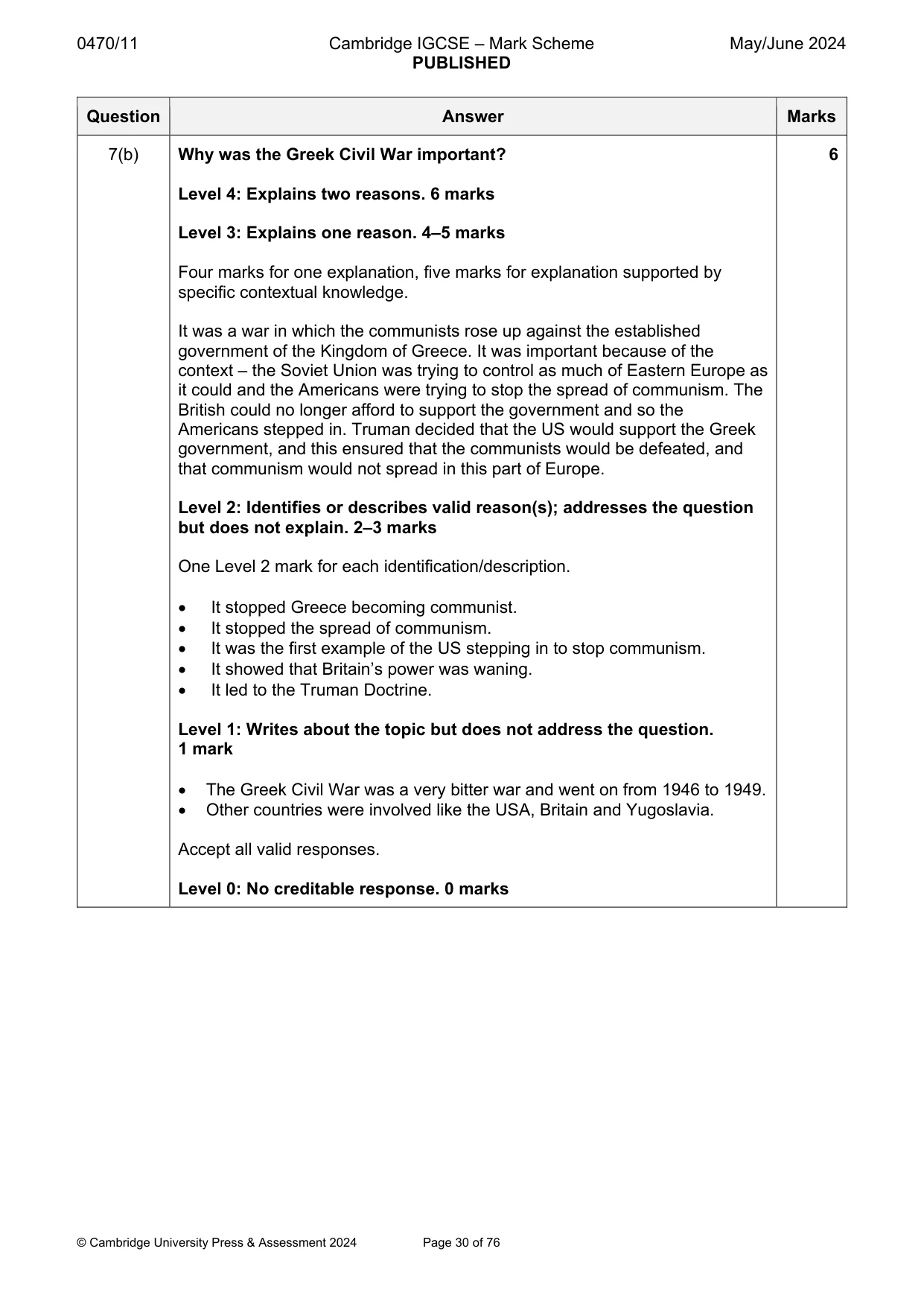
0470/11 Cambridge IGCSE – Mark Scheme PUBLISHED May/June 2024 © Cambridge University Press & Assessment 2024 Page 30 of 76 Question Answer Marks 7(b) Why was the Greek Civil War important? Level 4: Explains two reasons. 6 marks Level 3: Explains one reason. 4–5 marks Four marks for one explanation, five marks for explanation supported by specific contextual knowledge. It was a war in which the communists rose up against the established government of the Kingdom of Greece. It was important because of the context – the Soviet Union was trying to control as much of Eastern Europe as it could and the Americans were trying to stop the spread of communism. The British could no longer afford to support the government and so the Americans stepped in. Truman decided that the US would support the Greek government, and this ensured that the communists would be defeated, and that communism would not spread in this part of Europe. Level 2: Identifies or describes valid reason(s); addresses the question but does not explain. 2–3 marks One Level 2 mark for each identification/description. It stopped Greece becoming communist. It stopped the spread of communism. It was the first example of the US stepping in to stop communism. It showed that Britain’s power was waning. It led to the Truman Doctrine. Level 1: Writes about the topic but does not address the question. 1 mark The Greek Civil War was a very bitter war and went on from 1946 to 1949. Other countries were involved like the USA, Britain and Yugoslavia. Accept all valid responses. Level 0: No creditable response. 0 marks 6
Mark scheme, page 31
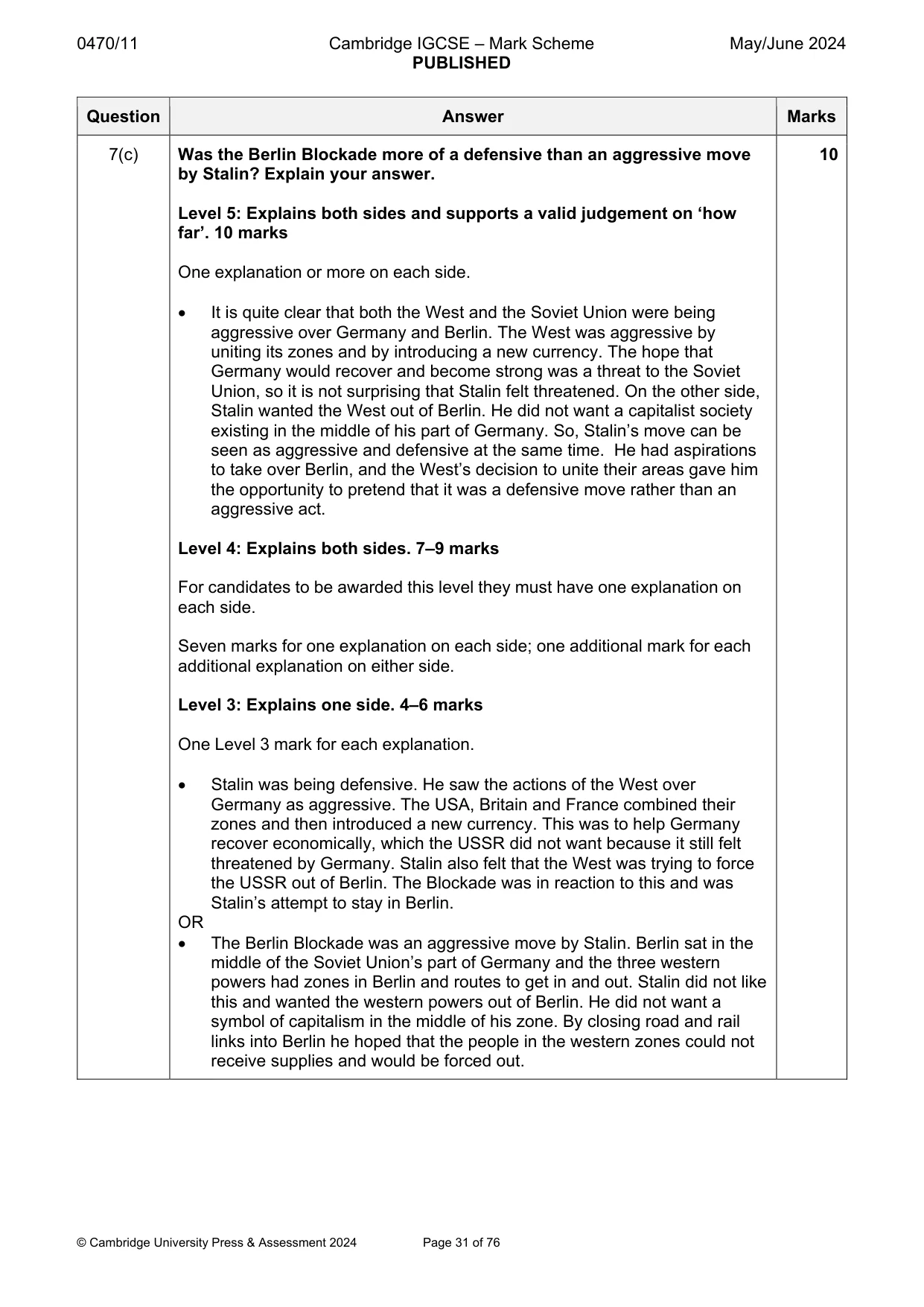
0470/11 Cambridge IGCSE – Mark Scheme PUBLISHED May/June 2024 © Cambridge University Press & Assessment 2024 Page 31 of 76 Question Answer Marks 7(c) Was the Berlin Blockade more of a defensive than an aggressive move by Stalin? Explain your answer. Level 5: Explains both sides and supports a valid judgement on ‘how far’. 10 marks One explanation or more on each side. It is quite clear that both the West and the Soviet Union were being aggressive over Germany and Berlin. The West was aggressive by uniting its zones and by introducing a new currency. The hope that Germany would recover and become strong was a threat to the Soviet Union, so it is not surprising that Stalin felt threatened. On the other side, Stalin wanted the West out of Berlin. He did not want a capitalist society existing in the middle of his part of Germany. So, Stalin’s move can be seen as aggressive and defensive at the same time. He had aspirations to take over Berlin, and the West’s decision to unite their areas gave him the opportunity to pretend that it was a defensive move rather than an aggressive act. Level 4: Explains both sides. 7–9 marks For candidates to be awarded this level they must have one explanation on each side. Seven marks for one explanation on each side; one additional mark for each additional explanation on either side. Level 3: Explains one side. 4–6 marks One Level 3 mark for each explanation. Stalin was being defensive. He saw the actions of the West over Germany as aggressive. The USA, Britain and France combined their zones and then introduced a new currency. This was to help Germany recover economically, which the USSR did not want because it still felt threatened by Germany. Stalin also felt that the West was trying to force the USSR out of Berlin. The Blockade was in reaction to this and was Stalin’s attempt to stay in Berlin. OR The Berlin Blockade was an aggressive move by Stalin. Berlin sat in the middle of the Soviet Union’s part of Germany and the three western powers had zones in Berlin and routes to get in and out. Stalin did not like this and wanted the western powers out of Berlin. He did not want a symbol of capitalism in the middle of his zone. By closing road and rail links into Berlin he hoped that the people in the western zones could not receive supplies and would be forced out. 10
Mark scheme, page 32
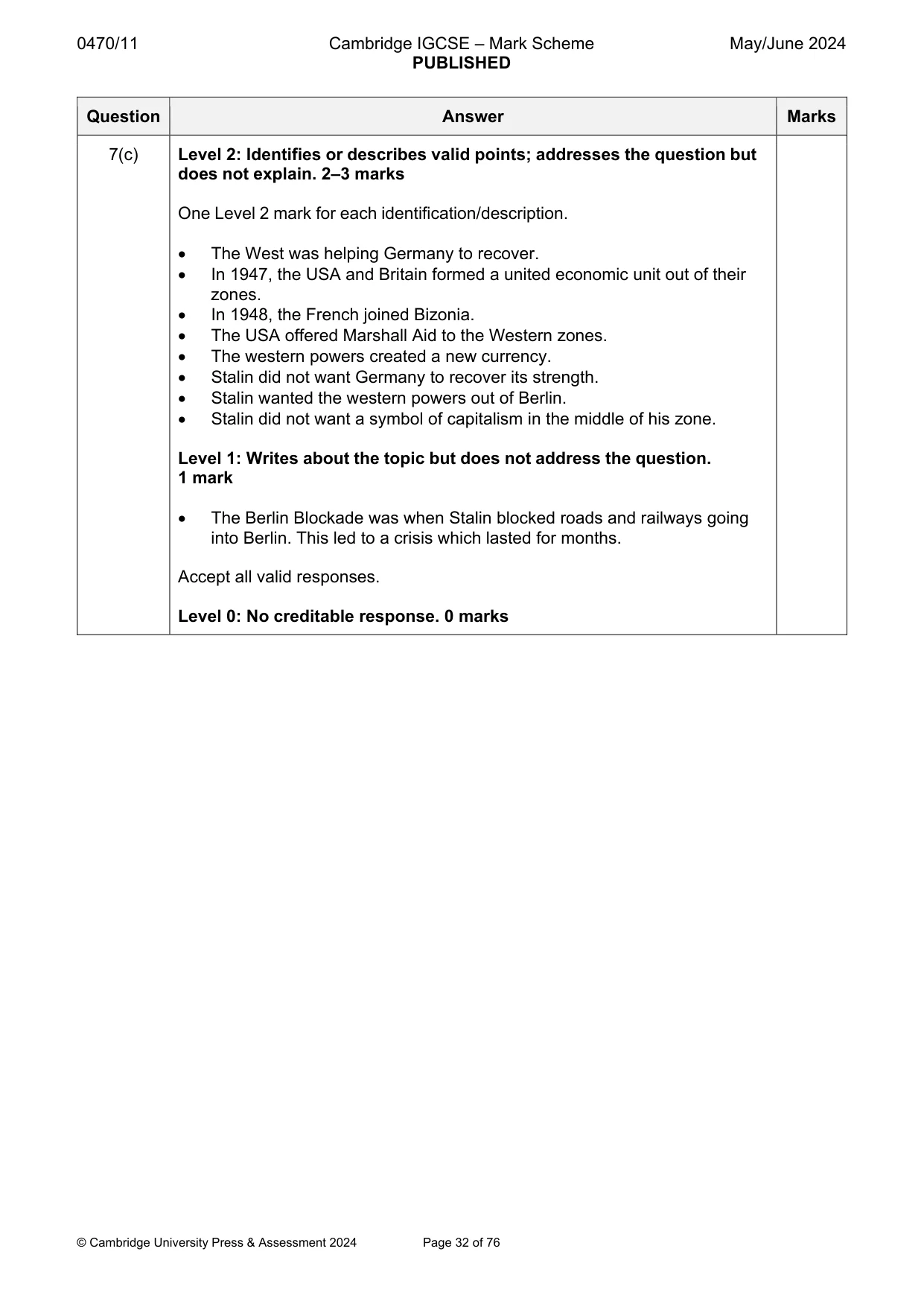
0470/11 Cambridge IGCSE – Mark Scheme PUBLISHED May/June 2024 © Cambridge University Press & Assessment 2024 Page 32 of 76 Question Answer Marks 7(c) Level 2: Identifies or describes valid points; addresses the question but does not explain. 2–3 marks One Level 2 mark for each identification/description. The West was helping Germany to recover. In 1947, the USA and Britain formed a united economic unit out of their zones. In 1948, the French joined Bizonia. The USA offered Marshall Aid to the Western zones. The western powers created a new currency. Stalin did not want Germany to recover its strength. Stalin wanted the western powers out of Berlin. Stalin did not want a symbol of capitalism in the middle of his zone. Level 1: Writes about the topic but does not address the question. 1 mark The Berlin Blockade was when Stalin blocked roads and railways going into Berlin. This led to a crisis which lasted for months. Accept all valid responses. Level 0: No creditable response. 0 marks
Mark scheme, page 33
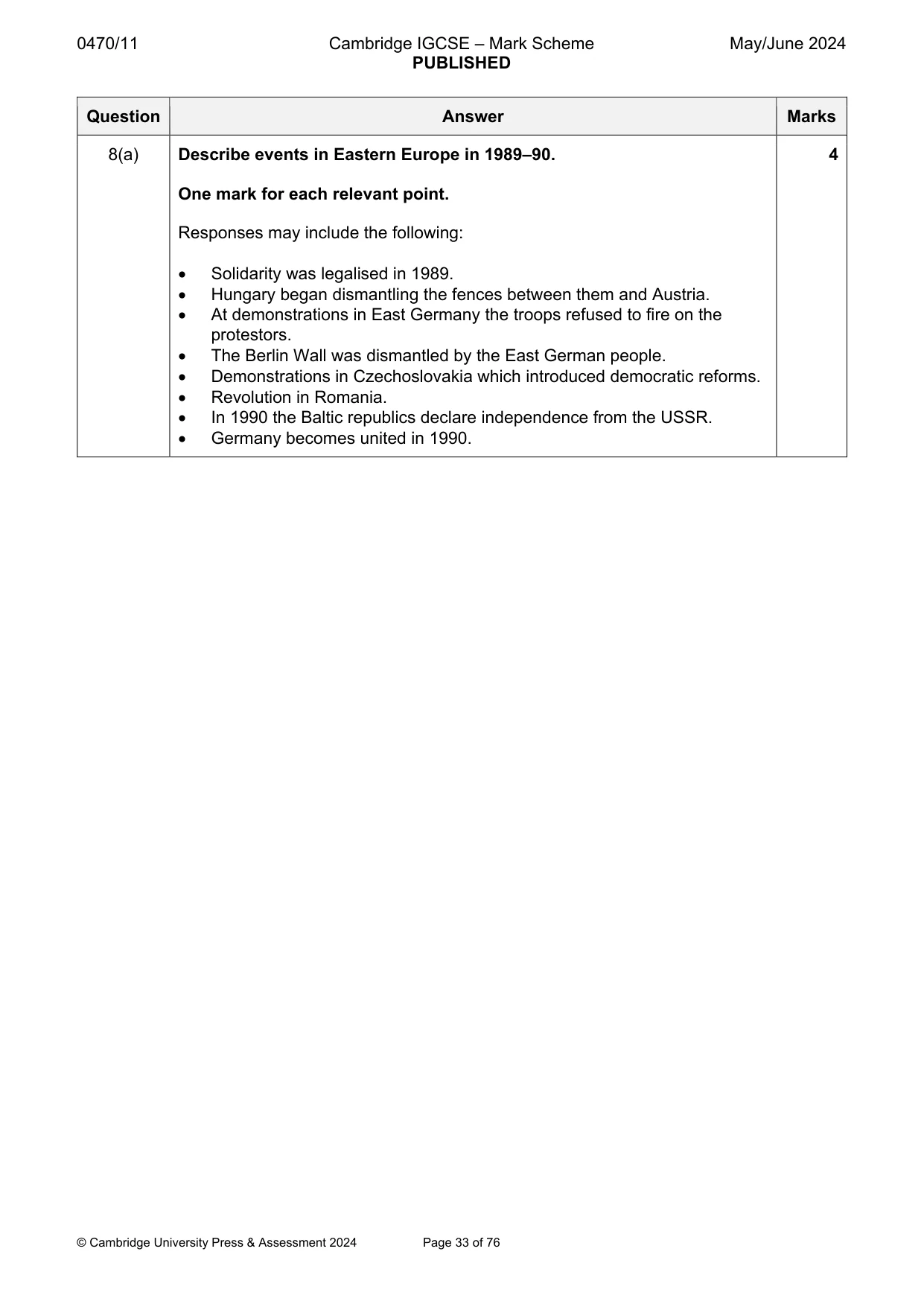
0470/11 Cambridge IGCSE – Mark Scheme PUBLISHED May/June 2024 © Cambridge University Press & Assessment 2024 Page 33 of 76 Question Answer Marks 8(a) Describe events in Eastern Europe in 1989–90. One mark for each relevant point. Responses may include the following: Solidarity was legalised in 1989. Hungary began dismantling the fences between them and Austria. At demonstrations in East Germany the troops refused to fire on the protestors. The Berlin Wall was dismantled by the East German people. Demonstrations in Czechoslovakia which introduced democratic reforms. Revolution in Romania. In 1990 the Baltic republics declare independence from the USSR. Germany becomes united in 1990. 4
Mark scheme, page 34
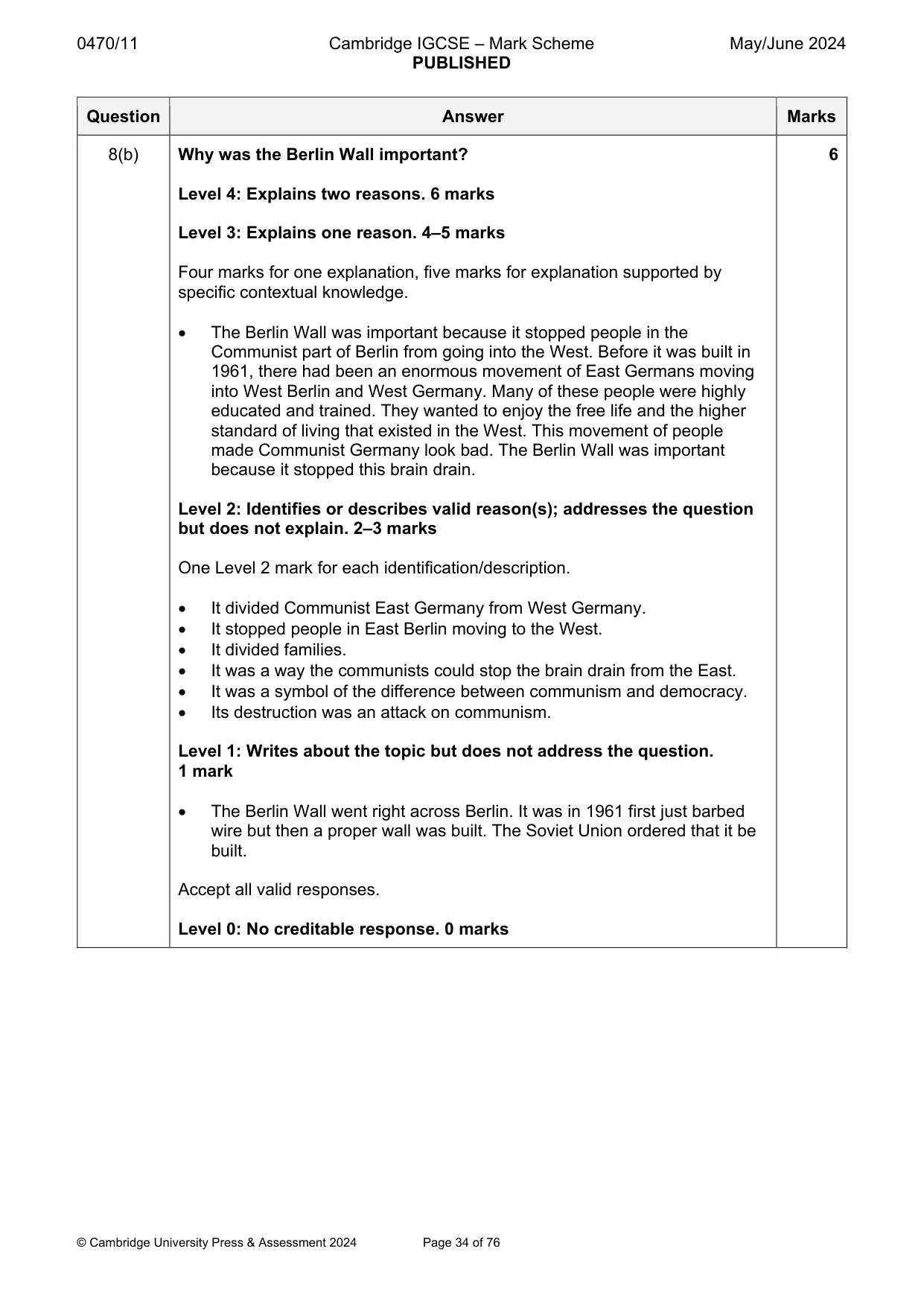
0470/11 Cambridge IGCSE – Mark Scheme PUBLISHED May/June 2024 © Cambridge University Press & Assessment 2024 Page 34 of 76 Question Answer Marks 8(b) Why was the Berlin Wall important? Level 4: Explains two reasons. 6 marks Level 3: Explains one reason. 4–5 marks Four marks for one explanation, five marks for explanation supported by specific contextual knowledge. The Berlin Wall was important because it stopped people in the Communist part of Berlin from going into the West. Before it was built in 1961, there had been an enormous movement of East Germans moving into West Berlin and West Germany. Many of these people were highly educated and trained. They wanted to enjoy the free life and the higher standard of living that existed in the West. This movement of people made Communist Germany look bad. The Berlin Wall was important because it stopped this brain drain. Level 2: Identifies or describes valid reason(s); addresses the question but does not explain. 2–3 marks One Level 2 mark for each identification/description. It divided Communist East Germany from West Germany. It stopped people in East Berlin moving to the West. It divided families. It was a way the communists could stop the brain drain from the East. It was a symbol of the difference between communism and democracy. Its destruction was an attack on communism. Level 1: Writes about the topic but does not address the question. 1 mark The Berlin Wall went right across Berlin. It was in 1961 first just barbed wire but then a proper wall was built. The Soviet Union ordered that it be built. Accept all valid responses. Level 0: No creditable response. 0 marks 6
Mark scheme, page 35
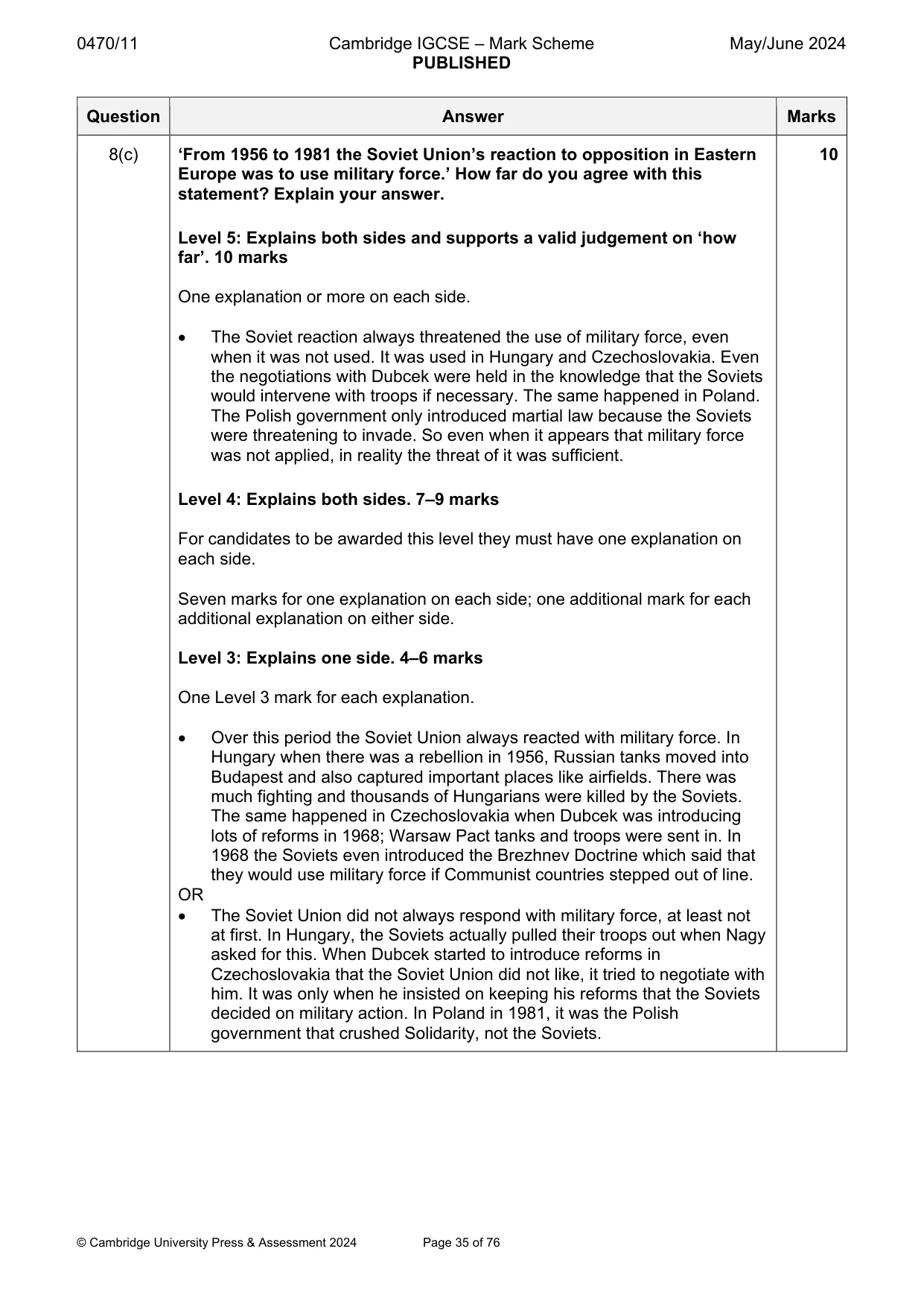
0470/11 Cambridge IGCSE – Mark Scheme PUBLISHED May/June 2024 © Cambridge University Press & Assessment 2024 Page 35 of 76 Question Answer Marks 8(c) ‘From 1956 to 1981 the Soviet Union’s reaction to opposition in Eastern Europe was to use military force.’ How far do you agree with this statement? Explain your answer. Level 5: Explains both sides and supports a valid judgement on ‘how far’. 10 marks One explanation or more on each side. The Soviet reaction always threatened the use of military force, even when it was not used. It was used in Hungary and Czechoslovakia. Even the negotiations with Dubcek were held in the knowledge that the Soviets would intervene with troops if necessary. The same happened in Poland. The Polish government only introduced martial law because the Soviets were threatening to invade. So even when it appears that military force was not applied, in reality the threat of it was sufficient. Level 4: Explains both sides. 7–9 marks For candidates to be awarded this level they must have one explanation on each side. Seven marks for one explanation on each side; one additional mark for each additional explanation on either side. Level 3: Explains one side. 4–6 marks One Level 3 mark for each explanation. Over this period the Soviet Union always reacted with military force. In Hungary when there was a rebellion in 1956, Russian tanks moved into Budapest and also captured important places like airfields. There was much fighting and thousands of Hungarians were killed by the Soviets. The same happened in Czechoslovakia when Dubcek was introducing lots of reforms in 1968; Warsaw Pact tanks and troops were sent in. In 1968 the Soviets even introduced the Brezhnev Doctrine which said that they would use military force if Communist countries stepped out of line. OR The Soviet Union did not always respond with military force, at least not at first. In Hungary, the Soviets actually pulled their troops out when Nagy asked for this. When Dubcek started to introduce reforms in Czechoslovakia that the Soviet Union did not like, it tried to negotiate with him. It was only when he insisted on keeping his reforms that the Soviets decided on military action. In Poland in 1981, it was the Polish government that crushed Solidarity, not the Soviets. 10
Mark scheme, page 36
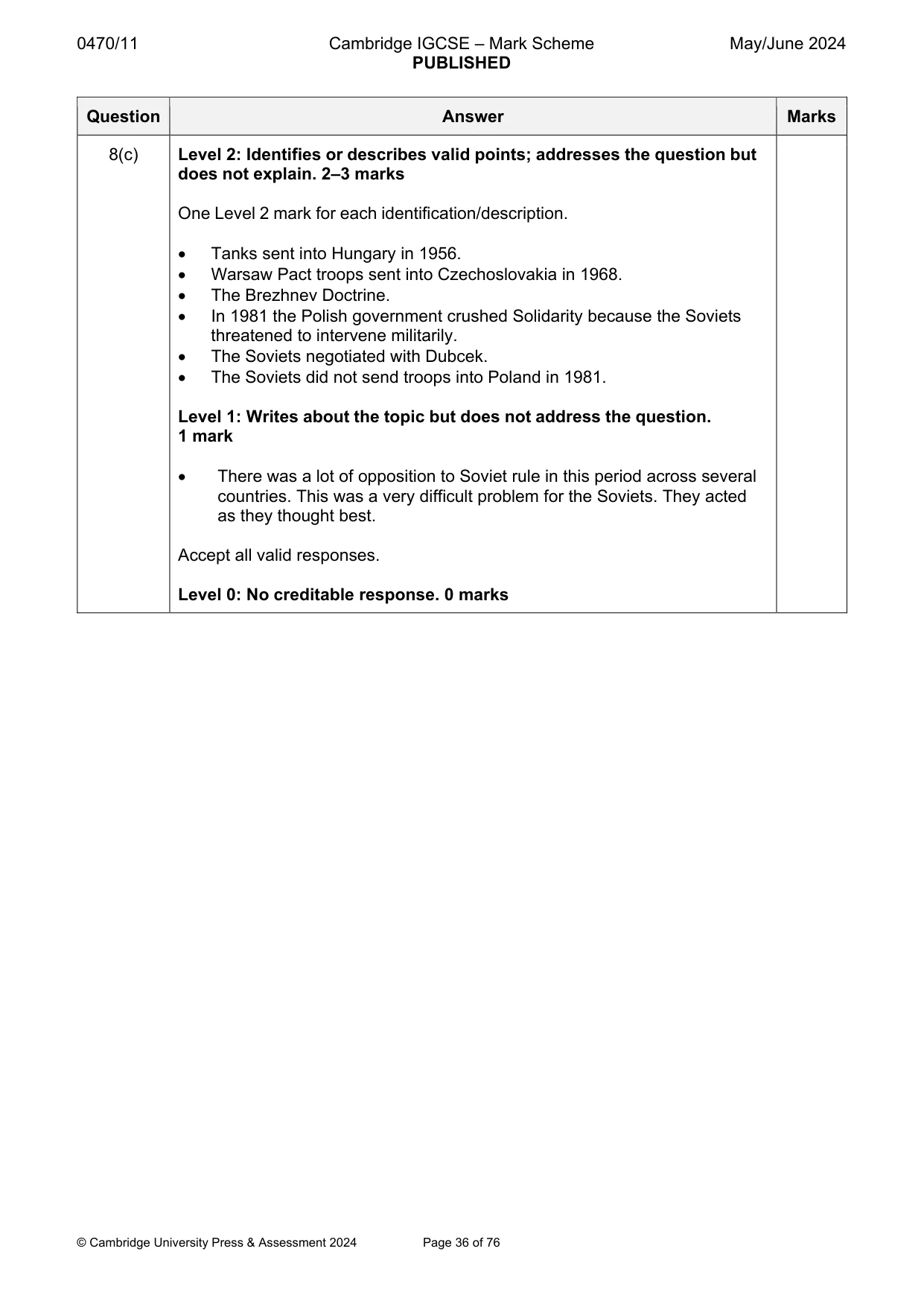
0470/11 Cambridge IGCSE – Mark Scheme PUBLISHED May/June 2024 © Cambridge University Press & Assessment 2024 Page 36 of 76 Question Answer Marks 8(c) Level 2: Identifies or describes valid points; addresses the question but does not explain. 2–3 marks One Level 2 mark for each identification/description. Tanks sent into Hungary in 1956. Warsaw Pact troops sent into Czechoslovakia in 1968. The Brezhnev Doctrine. In 1981 the Polish government crushed Solidarity because the Soviets threatened to intervene militarily. The Soviets negotiated with Dubcek. The Soviets did not send troops into Poland in 1981. Level 1: Writes about the topic but does not address the question. 1 mark There was a lot of opposition to Soviet rule in this period across several countries. This was a very difficult problem for the Soviets. They acted as they thought best. Accept all valid responses. Level 0: No creditable response. 0 marks
Mark scheme, page 37
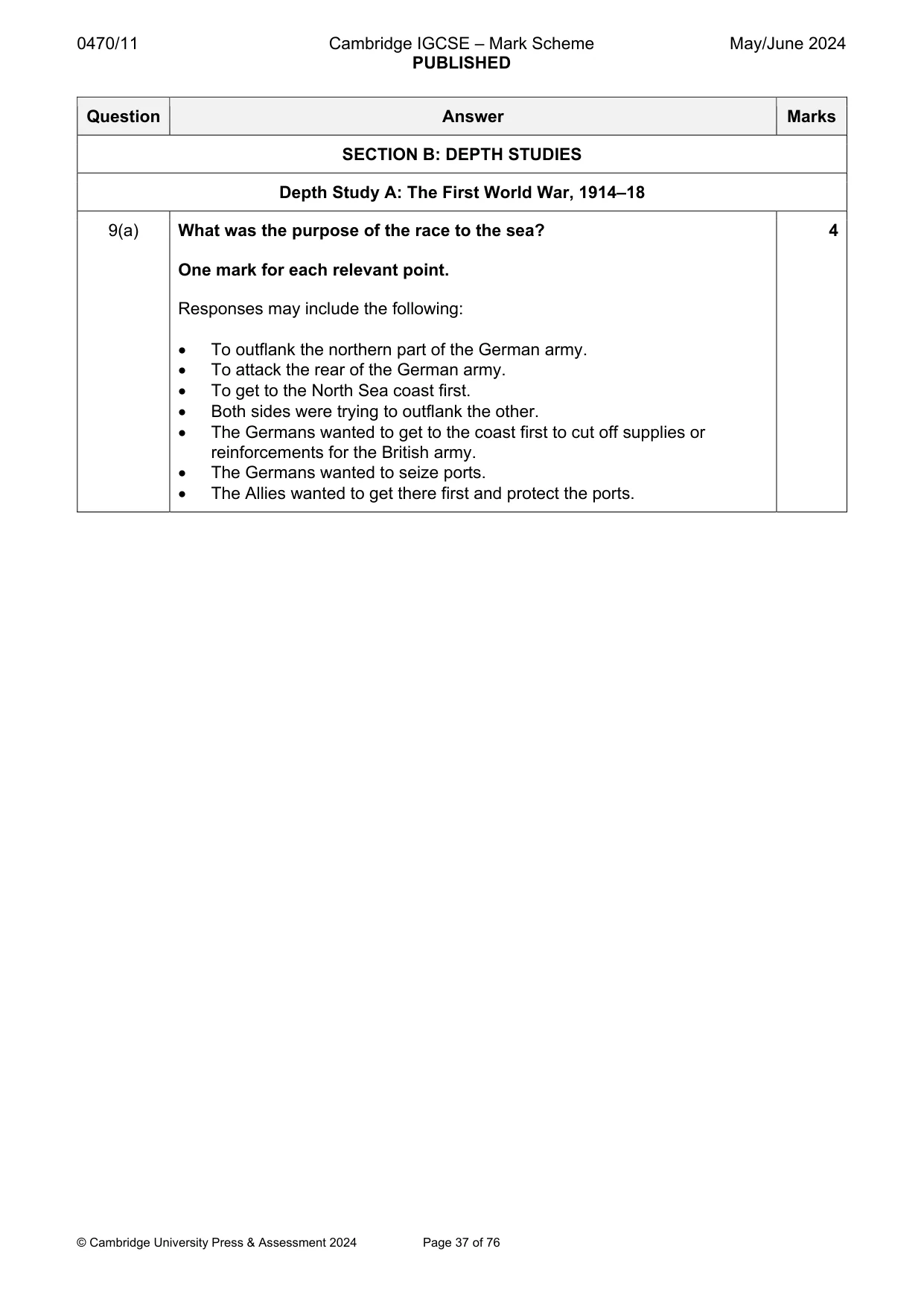
0470/11 Cambridge IGCSE – Mark Scheme PUBLISHED May/June 2024 © Cambridge University Press & Assessment 2024 Page 37 of 76 Question Answer Marks SECTION B: DEPTH STUDIES Depth Study A: The First World War, 1914–18 9(a) What was the purpose of the race to the sea? One mark for each relevant point. Responses may include the following: To outflank the northern part of the German army. To attack the rear of the German army. To get to the North Sea coast first. Both sides were trying to outflank the other. The Germans wanted to get to the coast first to cut off supplies or reinforcements for the British army. The Germans wanted to seize ports. The Allies wanted to get there first and protect the ports. 4
Mark scheme, page 38
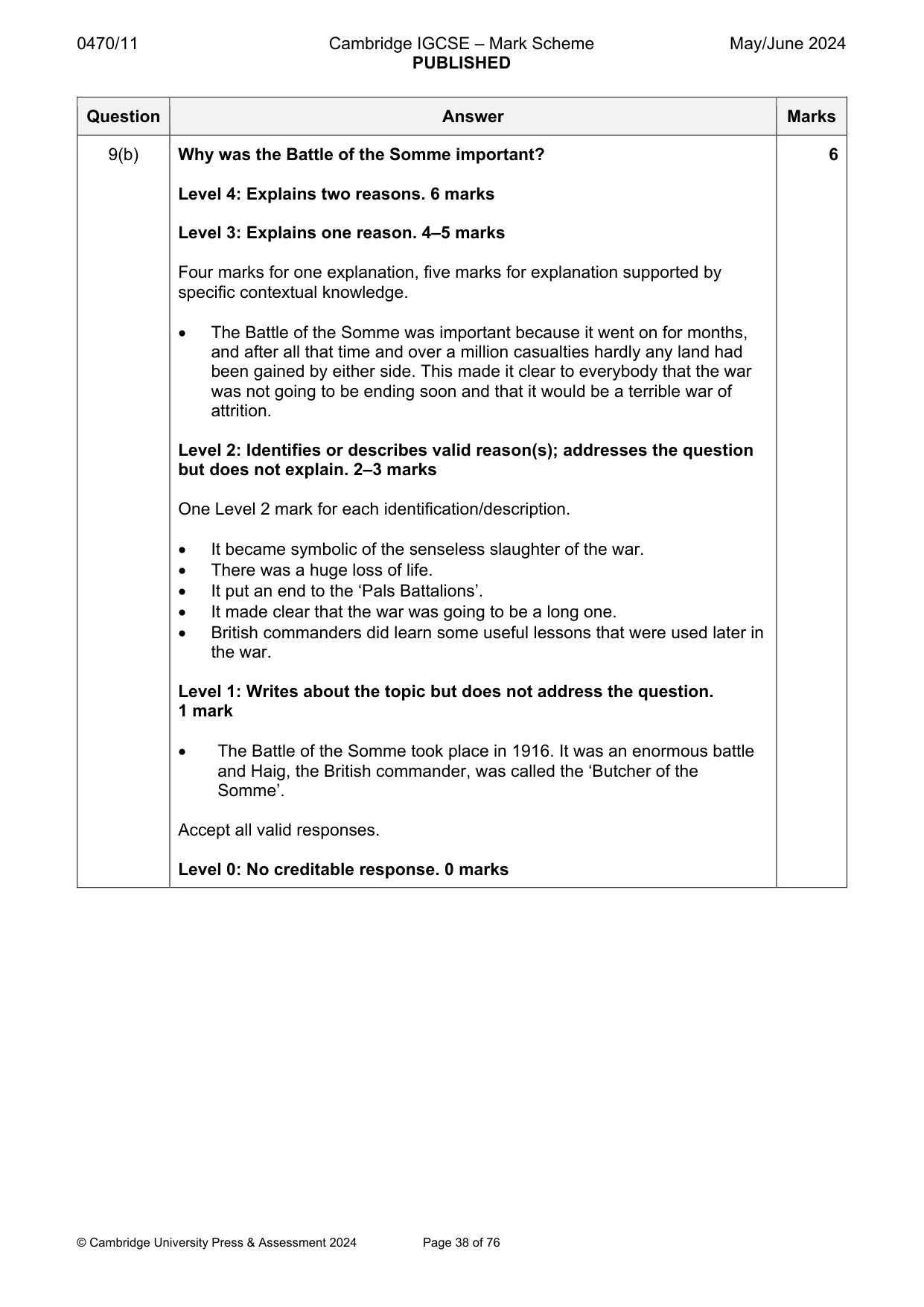
0470/11 Cambridge IGCSE – Mark Scheme PUBLISHED May/June 2024 © Cambridge University Press & Assessment 2024 Page 38 of 76 Question Answer Marks 9(b) Why was the Battle of the Somme important? Level 4: Explains two reasons. 6 marks Level 3: Explains one reason. 4–5 marks Four marks for one explanation, five marks for explanation supported by specific contextual knowledge. The Battle of the Somme was important because it went on for months, and after all that time and over a million casualties hardly any land had been gained by either side. This made it clear to everybody that the war was not going to be ending soon and that it would be a terrible war of attrition. Level 2: Identifies or describes valid reason(s); addresses the question but does not explain. 2–3 marks One Level 2 mark for each identification/description. It became symbolic of the senseless slaughter of the war. There was a huge loss of life. It put an end to the ‘Pals Battalions’. It made clear that the war was going to be a long one. British commanders did learn some useful lessons that were used later in the war. Level 1: Writes about the topic but does not address the question. 1 mark The Battle of the Somme took place in 1916. It was an enormous battle and Haig, the British commander, was called the ‘Butcher of the Somme’. Accept all valid responses. Level 0: No creditable response. 0 marks 6
Mark scheme, page 39
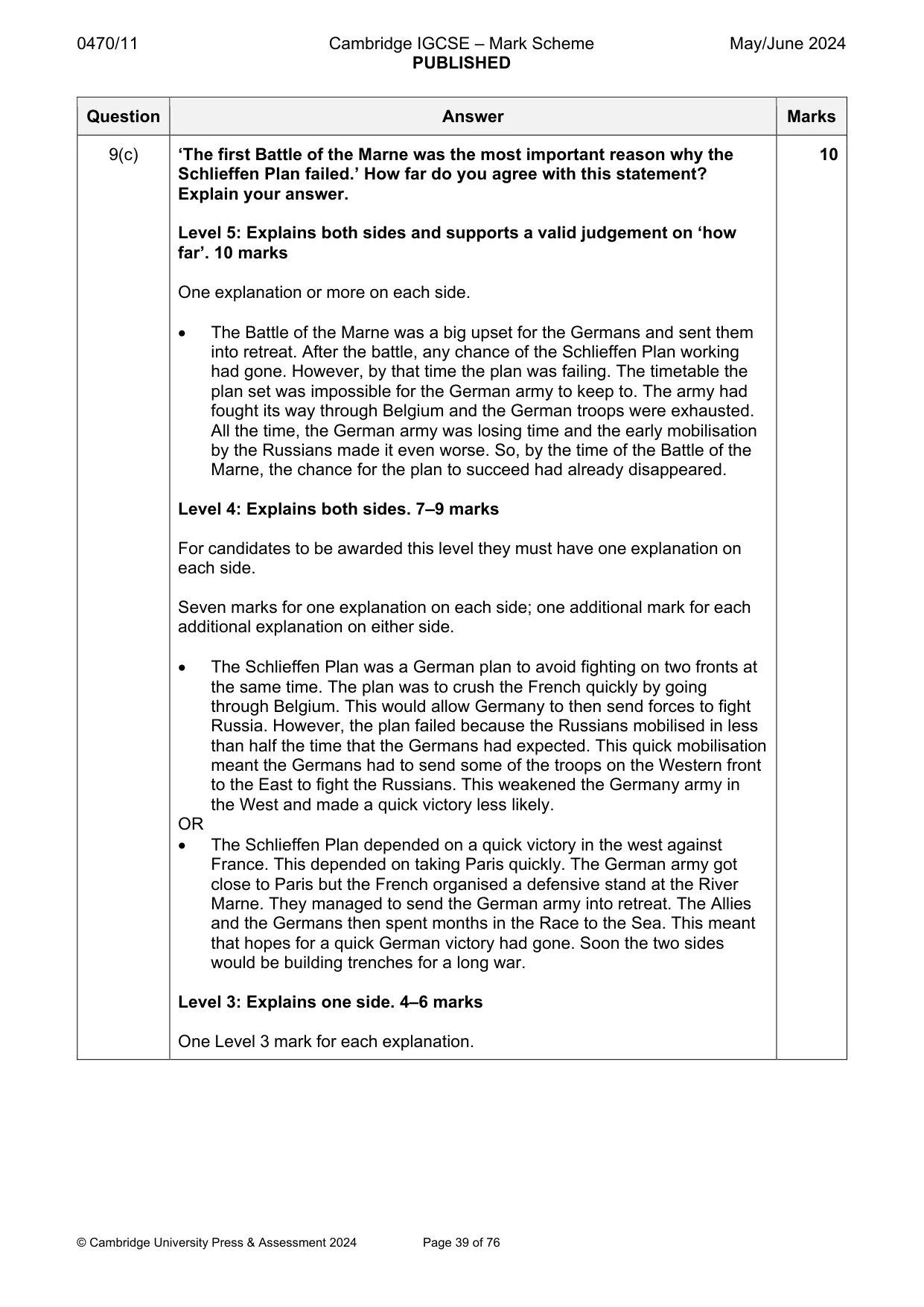
0470/11 Cambridge IGCSE – Mark Scheme PUBLISHED May/June 2024 © Cambridge University Press & Assessment 2024 Page 39 of 76 Question Answer Marks 9(c) ‘The first Battle of the Marne was the most important reason why the Schlieffen Plan failed.’ How far do you agree with this statement? Explain your answer. Level 5: Explains both sides and supports a valid judgement on ‘how far’. 10 marks One explanation or more on each side. The Battle of the Marne was a big upset for the Germans and sent them into retreat. After the battle, any chance of the Schlieffen Plan working had gone. However, by that time the plan was failing. The timetable the plan set was impossible for the German army to keep to. The army had fought its way through Belgium and the German troops were exhausted. All the time, the German army was losing time and the early mobilisation by the Russians made it even worse. So, by the time of the Battle of the Marne, the chance for the plan to succeed had already disappeared. Level 4: Explains both sides. 7–9 marks For candidates to be awarded this level they must have one explanation on each side. Seven marks for one explanation on each side; one additional mark for each additional explanation on either side. The Schlieffen Plan was a German plan to avoid fighting on two fronts at the same time. The plan was to crush the French quickly by going through Belgium. This would allow Germany to then send forces to fight Russia. However, the plan failed because the Russians mobilised in less than half the time that the Germans had expected. This quick mobilisation meant the Germans had to send some of the troops on the Western front to the East to fight the Russians. This weakened the Germany army in the West and made a quick victory less likely. OR The Schlieffen Plan depended on a quick victory in the west against France. This depended on taking Paris quickly. The German army got close to Paris but the French organised a defensive stand at the River Marne. They managed to send the German army into retreat. The Allies and the Germans then spent months in the Race to the Sea. This meant that hopes for a quick German victory had gone. Soon the two sides would be building trenches for a long war. Level 3: Explains one side. 4–6 marks One Level 3 mark for each explanation. 10
Mark scheme, page 40
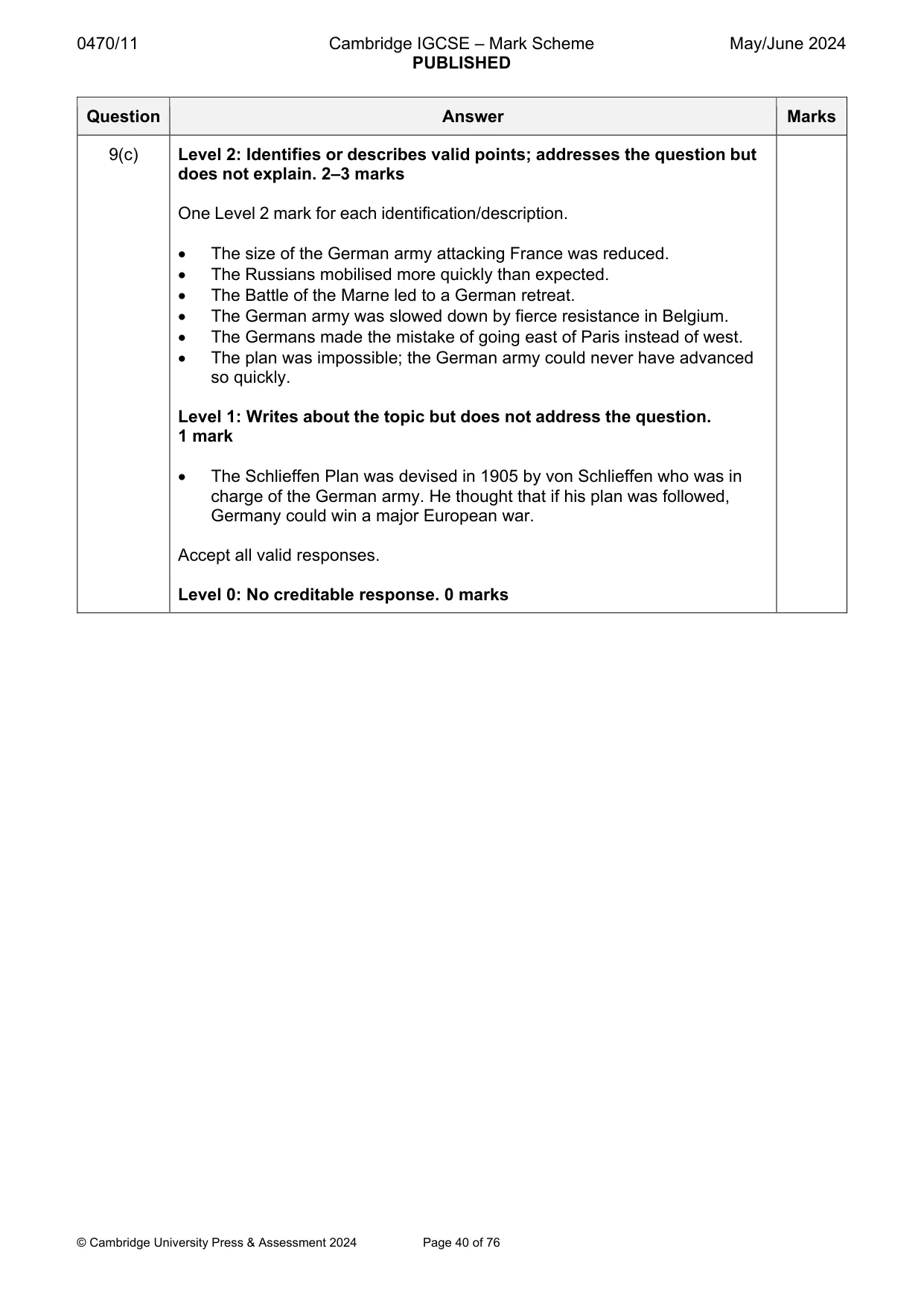
0470/11 Cambridge IGCSE – Mark Scheme PUBLISHED May/June 2024 © Cambridge University Press & Assessment 2024 Page 40 of 76 Question Answer Marks 9(c) Level 2: Identifies or describes valid points; addresses the question but does not explain. 2–3 marks One Level 2 mark for each identification/description. The size of the German army attacking France was reduced. The Russians mobilised more quickly than expected. The Battle of the Marne led to a German retreat. The German army was slowed down by fierce resistance in Belgium. The Germans made the mistake of going east of Paris instead of west. The plan was impossible; the German army could never have advanced so quickly. Level 1: Writes about the topic but does not address the question. 1 mark The Schlieffen Plan was devised in 1905 by von Schlieffen who was in charge of the German army. He thought that if his plan was followed, Germany could win a major European war. Accept all valid responses. Level 0: No creditable response. 0 marks
Mark scheme, page 41
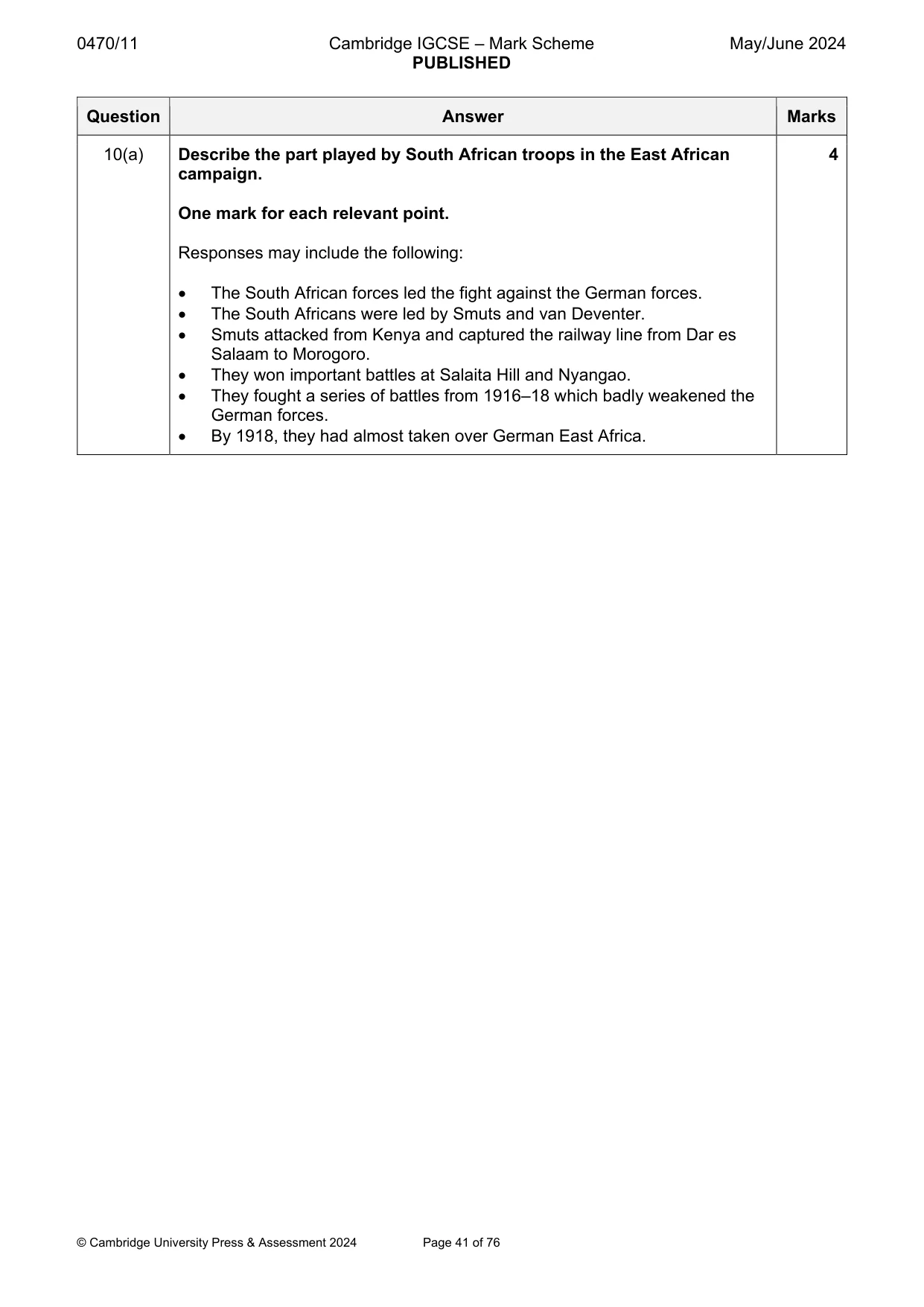
0470/11 Cambridge IGCSE – Mark Scheme PUBLISHED May/June 2024 © Cambridge University Press & Assessment 2024 Page 41 of 76 Question Answer Marks 10(a) Describe the part played by South African troops in the East African campaign. One mark for each relevant point. Responses may include the following: The South African forces led the fight against the German forces. The South Africans were led by Smuts and van Deventer. Smuts attacked from Kenya and captured the railway line from Dar es Salaam to Morogoro. They won important battles at Salaita Hill and Nyangao. They fought a series of battles from 1916–18 which badly weakened the German forces. By 1918, they had almost taken over German East Africa. 4
Mark scheme, page 42
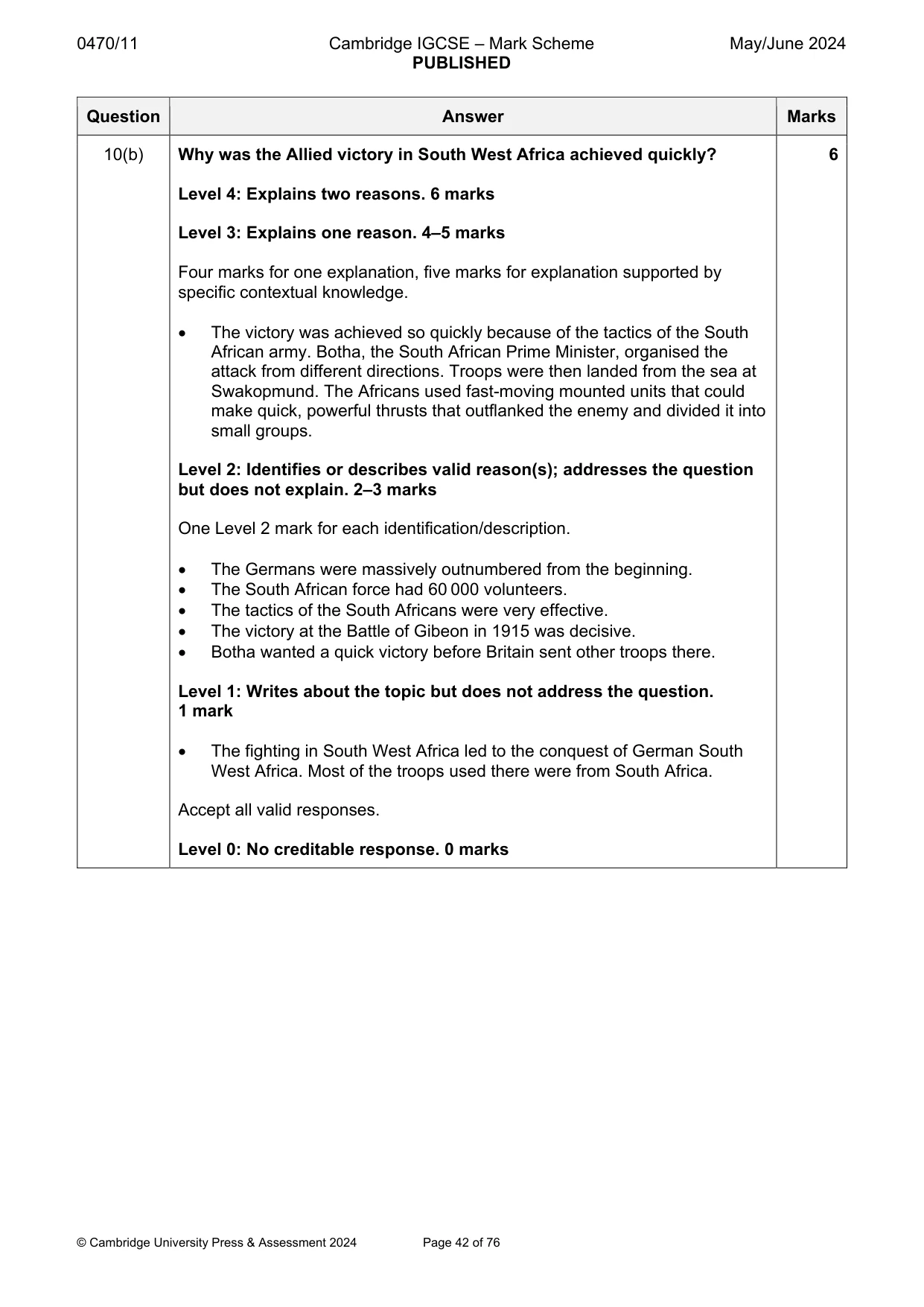
0470/11 Cambridge IGCSE – Mark Scheme PUBLISHED May/June 2024 © Cambridge University Press & Assessment 2024 Page 42 of 76 Question Answer Marks 10(b) Why was the Allied victory in South West Africa achieved quickly? Level 4: Explains two reasons. 6 marks Level 3: Explains one reason. 4–5 marks Four marks for one explanation, five marks for explanation supported by specific contextual knowledge. The victory was achieved so quickly because of the tactics of the South African army. Botha, the South African Prime Minister, organised the attack from different directions. Troops were then landed from the sea at Swakopmund. The Africans used fast-moving mounted units that could make quick, powerful thrusts that outflanked the enemy and divided it into small groups. Level 2: Identifies or describes valid reason(s); addresses the question but does not explain. 2–3 marks One Level 2 mark for each identification/description. The Germans were massively outnumbered from the beginning. The South African force had 60 000 volunteers. The tactics of the South Africans were very effective. The victory at the Battle of Gibeon in 1915 was decisive. Botha wanted a quick victory before Britain sent other troops there. Level 1: Writes about the topic but does not address the question. 1 mark The fighting in South West Africa led to the conquest of German South West Africa. Most of the troops used there were from South Africa. Accept all valid responses. Level 0: No creditable response. 0 marks 6
Mark scheme, page 43
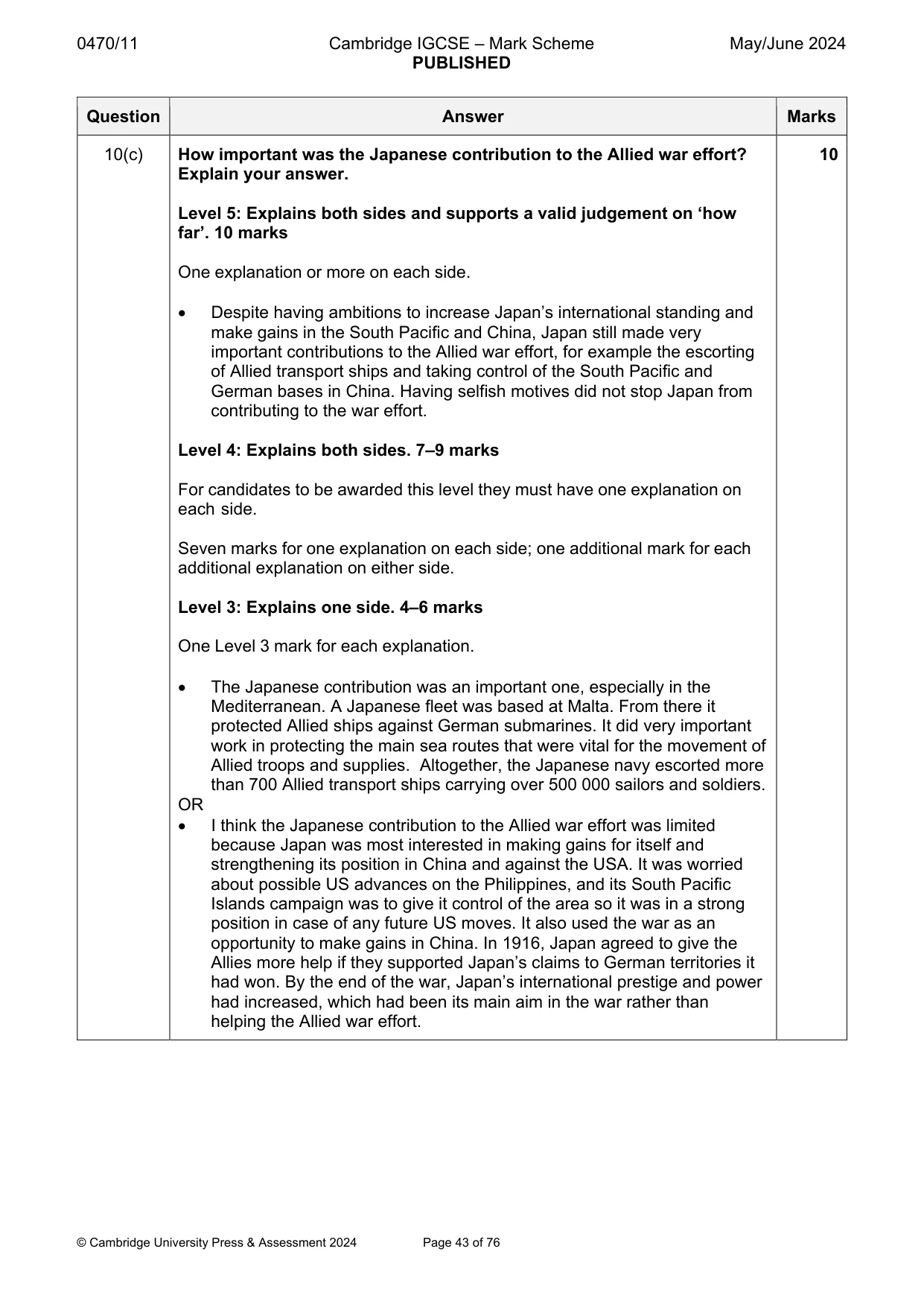
0470/11 Cambridge IGCSE – Mark Scheme PUBLISHED May/June 2024 © Cambridge University Press & Assessment 2024 Page 43 of 76 Question Answer Marks 10(c) How important was the Japanese contribution to the Allied war effort? Explain your answer. Level 5: Explains both sides and supports a valid judgement on ‘how far’. 10 marks One explanation or more on each side. Despite having ambitions to increase Japan’s international standing and make gains in the South Pacific and China, Japan still made very important contributions to the Allied war effort, for example the escorting of Allied transport ships and taking control of the South Pacific and German bases in China. Having selfish motives did not stop Japan from contributing to the war effort. Level 4: Explains both sides. 7–9 marks For candidates to be awarded this level they must have one explanation on each side. Seven marks for one explanation on each side; one additional mark for each additional explanation on either side. Level 3: Explains one side. 4–6 marks One Level 3 mark for each explanation. The Japanese contribution was an important one, especially in the Mediterranean. A Japanese fleet was based at Malta. From there it protected Allied ships against German submarines. It did very important work in protecting the main sea routes that were vital for the movement of Allied troops and supplies. Altogether, the Japanese navy escorted more than 700 Allied transport ships carrying over 500 000 sailors and soldiers. OR I think the Japanese contribution to the Allied war effort was limited because Japan was most interested in making gains for itself and strengthening its position in China and against the USA. It was worried about possible US advances on the Philippines, and its South Pacific Islands campaign was to give it control of the area so it was in a strong position in case of any future US moves. It also used the war as an opportunity to make gains in China. In 1916, Japan agreed to give the Allies more help if they supported Japan’s claims to German territories it had won. By the end of the war, Japan’s international prestige and power had increased, which had been its main aim in the war rather than helping the Allied war effort. 10
Mark scheme, page 44
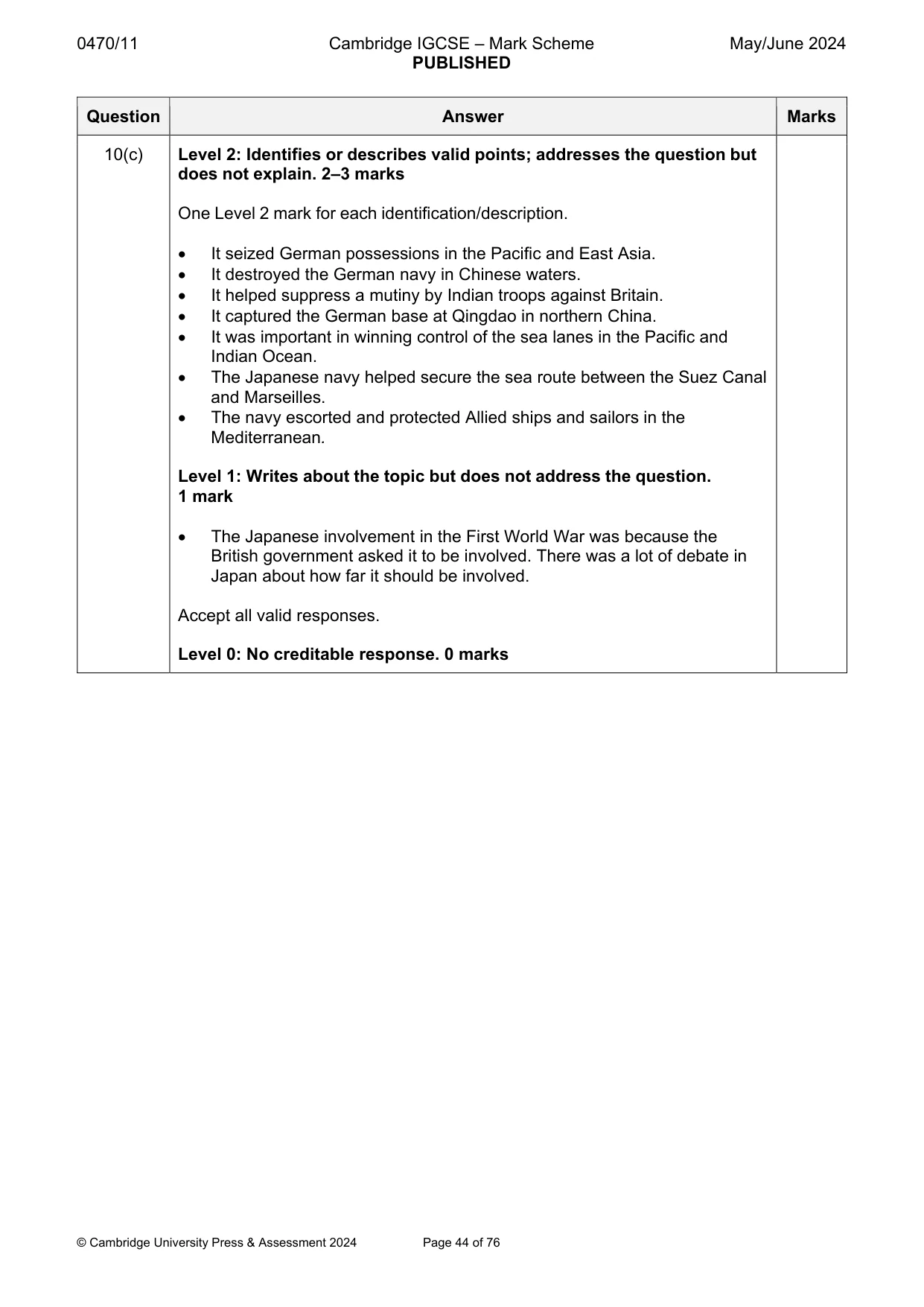
0470/11 Cambridge IGCSE – Mark Scheme PUBLISHED May/June 2024 © Cambridge University Press & Assessment 2024 Page 44 of 76 Question Answer Marks 10(c) Level 2: Identifies or describes valid points; addresses the question but does not explain. 2–3 marks One Level 2 mark for each identification/description. It seized German possessions in the Pacific and East Asia. It destroyed the German navy in Chinese waters. It helped suppress a mutiny by Indian troops against Britain. It captured the German base at Qingdao in northern China. It was important in winning control of the sea lanes in the Pacific and Indian Ocean. The Japanese navy helped secure the sea route between the Suez Canal and Marseilles. The navy escorted and protected Allied ships and sailors in the Mediterranean. Level 1: Writes about the topic but does not address the question. 1 mark The Japanese involvement in the First World War was because the British government asked it to be involved. There was a lot of debate in Japan about how far it should be involved. Accept all valid responses. Level 0: No creditable response. 0 marks
Mark scheme, page 45
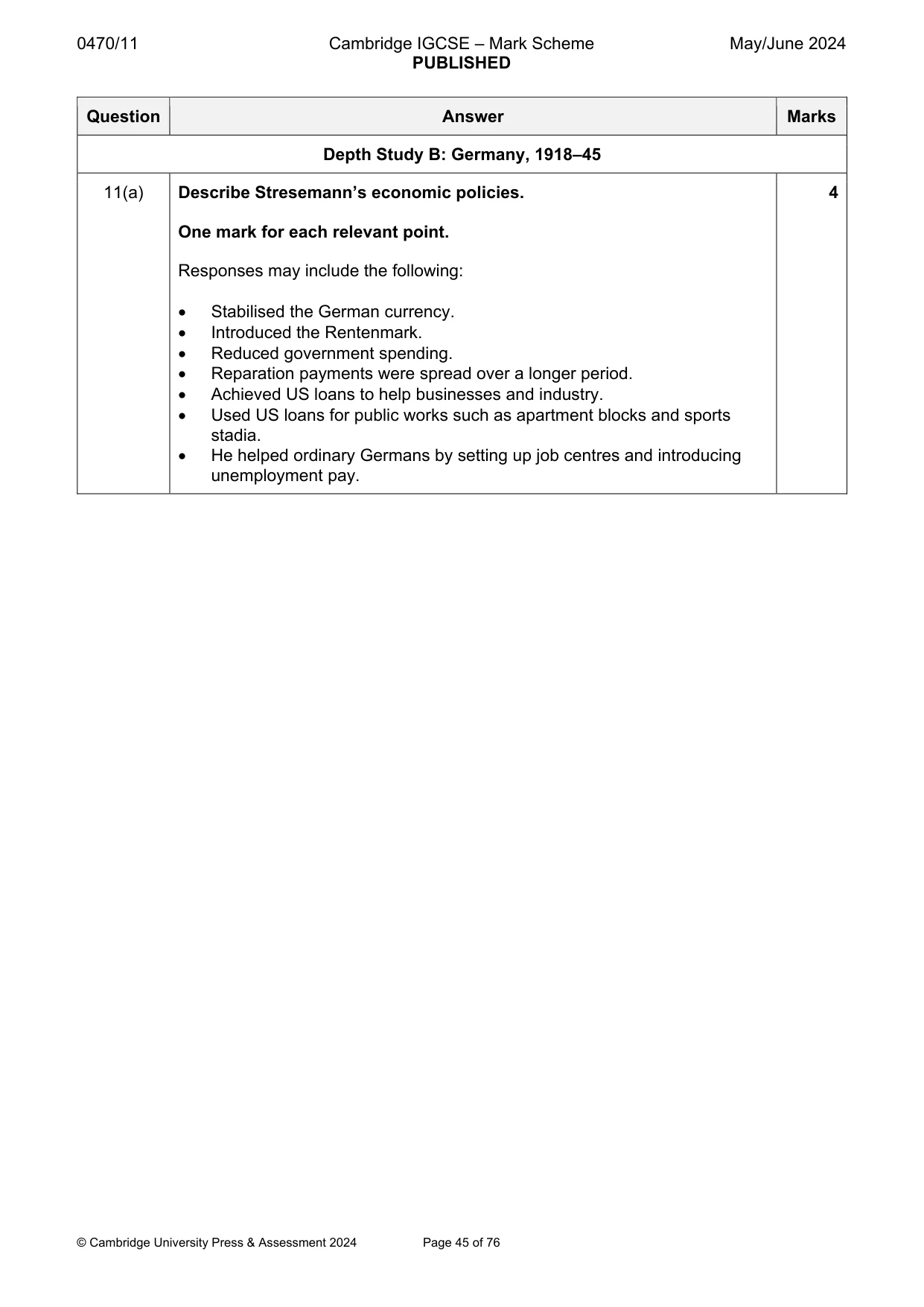
0470/11 Cambridge IGCSE – Mark Scheme PUBLISHED May/June 2024 © Cambridge University Press & Assessment 2024 Page 45 of 76 Question Answer Marks Depth Study B: Germany, 1918–45 11(a) Describe Stresemann’s economic policies. One mark for each relevant point. Responses may include the following: Stabilised the German currency. Introduced the Rentenmark. Reduced government spending. Reparation payments were spread over a longer period. Achieved US loans to help businesses and industry. Used US loans for public works such as apartment blocks and sports stadia. He helped ordinary Germans by setting up job centres and introducing unemployment pay. 4
Mark scheme, page 46
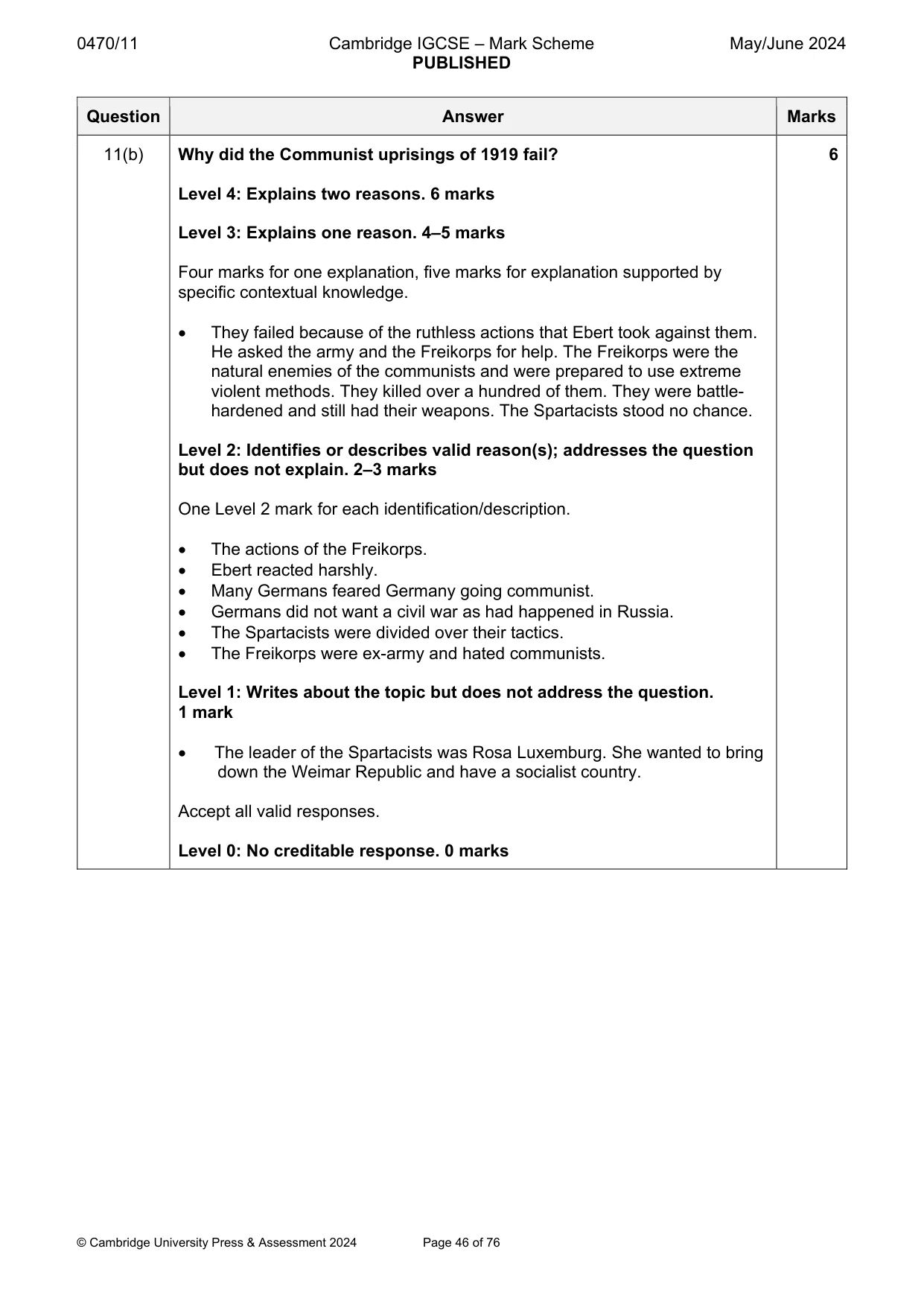
0470/11 Cambridge IGCSE – Mark Scheme PUBLISHED May/June 2024 © Cambridge University Press & Assessment 2024 Page 46 of 76 Question Answer Marks 11(b) Why did the Communist uprisings of 1919 fail? Level 4: Explains two reasons. 6 marks Level 3: Explains one reason. 4–5 marks Four marks for one explanation, five marks for explanation supported by specific contextual knowledge. They failed because of the ruthless actions that Ebert took against them. He asked the army and the Freikorps for help. The Freikorps were the natural enemies of the communists and were prepared to use extreme violent methods. They killed over a hundred of them. They were battle- hardened and still had their weapons. The Spartacists stood no chance. Level 2: Identifies or describes valid reason(s); addresses the question but does not explain. 2–3 marks One Level 2 mark for each identification/description. The actions of the Freikorps. Ebert reacted harshly. Many Germans feared Germany going communist. Germans did not want a civil war as had happened in Russia. The Spartacists were divided over their tactics. The Freikorps were ex-army and hated communists. Level 1: Writes about the topic but does not address the question. 1 mark The leader of the Spartacists was Rosa Luxemburg. She wanted to bring down the Weimar Republic and have a socialist country. Accept all valid responses. Level 0: No creditable response. 0 marks 6
Mark scheme, page 47
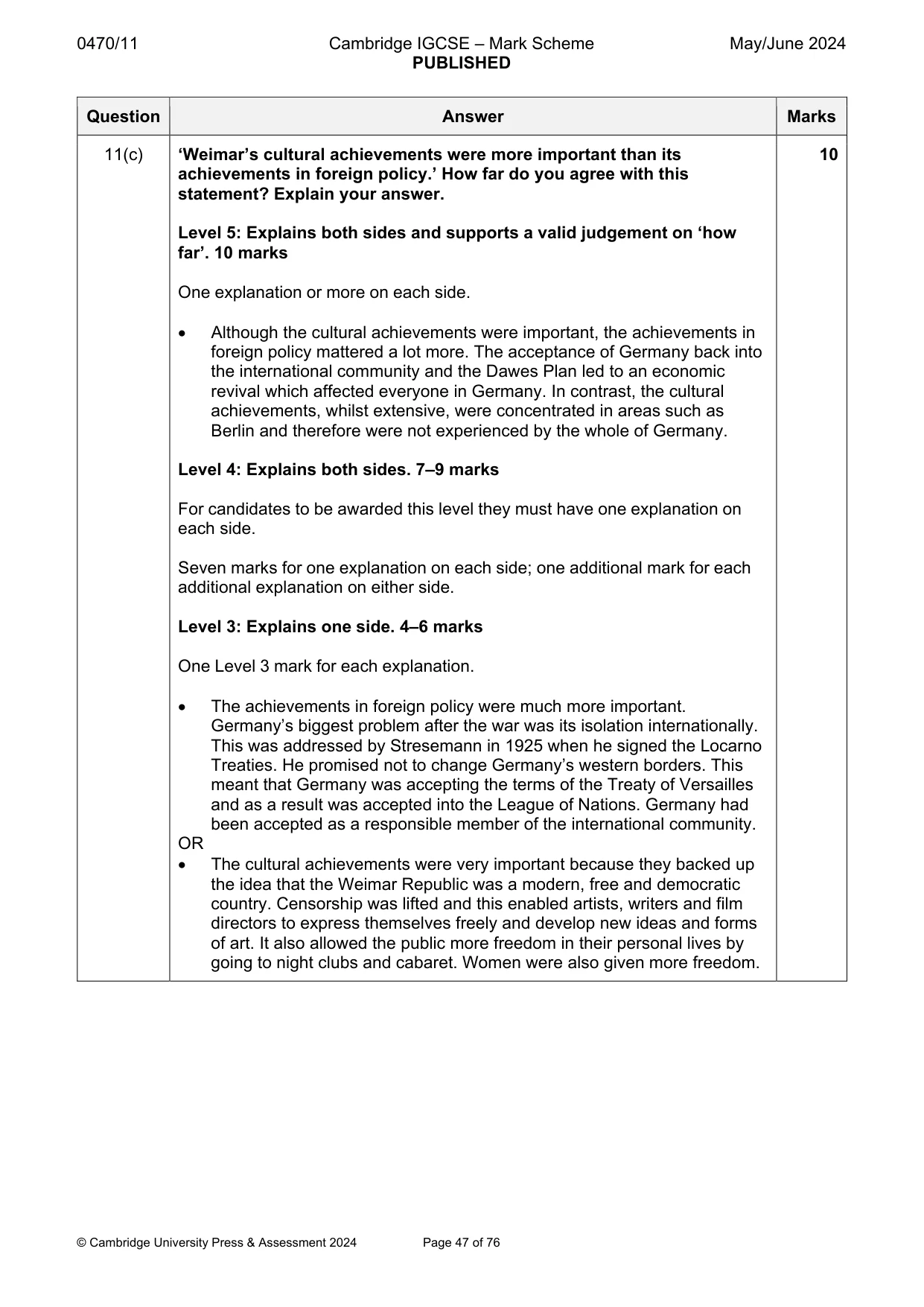
0470/11 Cambridge IGCSE – Mark Scheme PUBLISHED May/June 2024 © Cambridge University Press & Assessment 2024 Page 47 of 76 Question Answer Marks 11(c) ‘Weimar’s cultural achievements were more important than its achievements in foreign policy.’ How far do you agree with this statement? Explain your answer. Level 5: Explains both sides and supports a valid judgement on ‘how far’. 10 marks One explanation or more on each side. Although the cultural achievements were important, the achievements in foreign policy mattered a lot more. The acceptance of Germany back into the international community and the Dawes Plan led to an economic revival which affected everyone in Germany. In contrast, the cultural achievements, whilst extensive, were concentrated in areas such as Berlin and therefore were not experienced by the whole of Germany. Level 4: Explains both sides. 7–9 marks For candidates to be awarded this level they must have one explanation on each side. Seven marks for one explanation on each side; one additional mark for each additional explanation on either side. Level 3: Explains one side. 4–6 marks One Level 3 mark for each explanation. The achievements in foreign policy were much more important. Germany’s biggest problem after the war was its isolation internationally. This was addressed by Stresemann in 1925 when he signed the Locarno Treaties. He promised not to change Germany’s western borders. This meant that Germany was accepting the terms of the Treaty of Versailles and as a result was accepted into the League of Nations. Germany had been accepted as a responsible member of the international community. OR The cultural achievements were very important because they backed up the idea that the Weimar Republic was a modern, free and democratic country. Censorship was lifted and this enabled artists, writers and film directors to express themselves freely and develop new ideas and forms of art. It also allowed the public more freedom in their personal lives by going to night clubs and cabaret. Women were also given more freedom. 10
Mark scheme, page 48
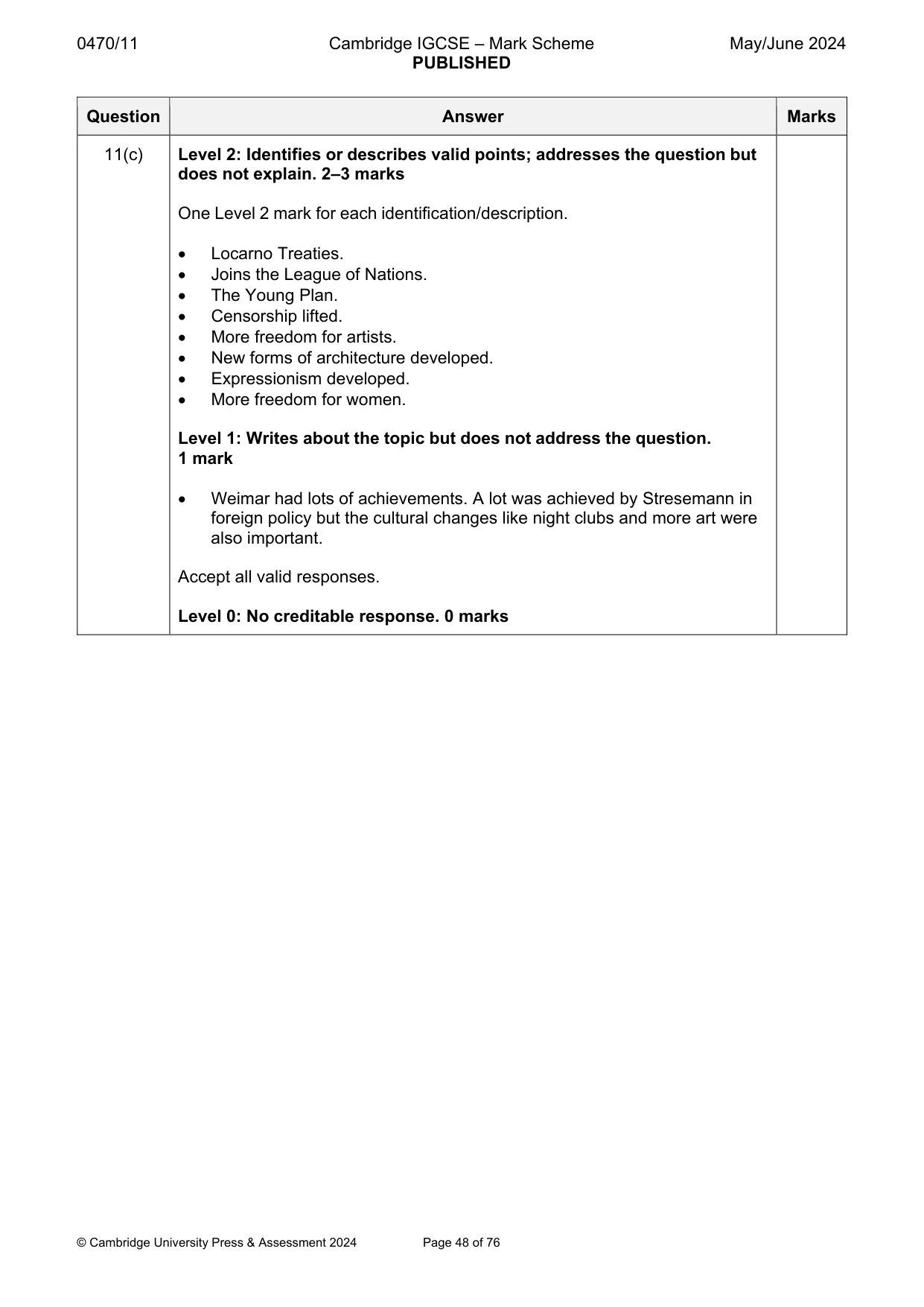
0470/11 Cambridge IGCSE – Mark Scheme PUBLISHED May/June 2024 © Cambridge University Press & Assessment 2024 Page 48 of 76 Question Answer Marks 11(c) Level 2: Identifies or describes valid points; addresses the question but does not explain. 2–3 marks One Level 2 mark for each identification/description. Locarno Treaties. Joins the League of Nations. The Young Plan. Censorship lifted. More freedom for artists. New forms of architecture developed. Expressionism developed. More freedom for women. Level 1: Writes about the topic but does not address the question. 1 mark Weimar had lots of achievements. A lot was achieved by Stresemann in foreign policy but the cultural changes like night clubs and more art were also important. Accept all valid responses. Level 0: No creditable response. 0 marks
Mark scheme, page 49
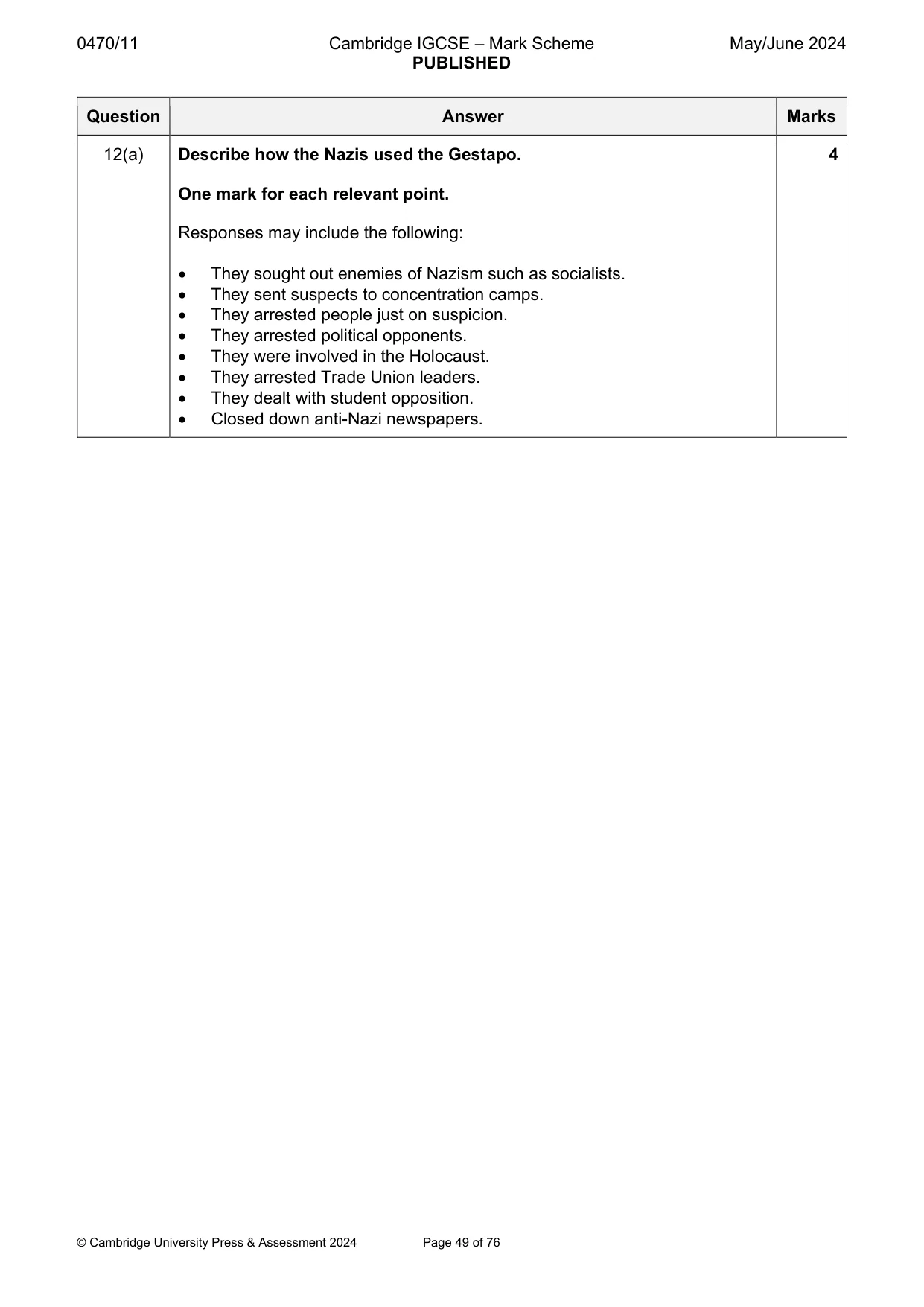
0470/11 Cambridge IGCSE – Mark Scheme PUBLISHED May/June 2024 © Cambridge University Press & Assessment 2024 Page 49 of 76 Question Answer Marks 12(a) Describe how the Nazis used the Gestapo. One mark for each relevant point. Responses may include the following: They sought out enemies of Nazism such as socialists. They sent suspects to concentration camps. They arrested people just on suspicion. They arrested political opponents. They were involved in the Holocaust. They arrested Trade Union leaders. They dealt with student opposition. Closed down anti-Nazi newspapers. 4
Mark scheme, page 50
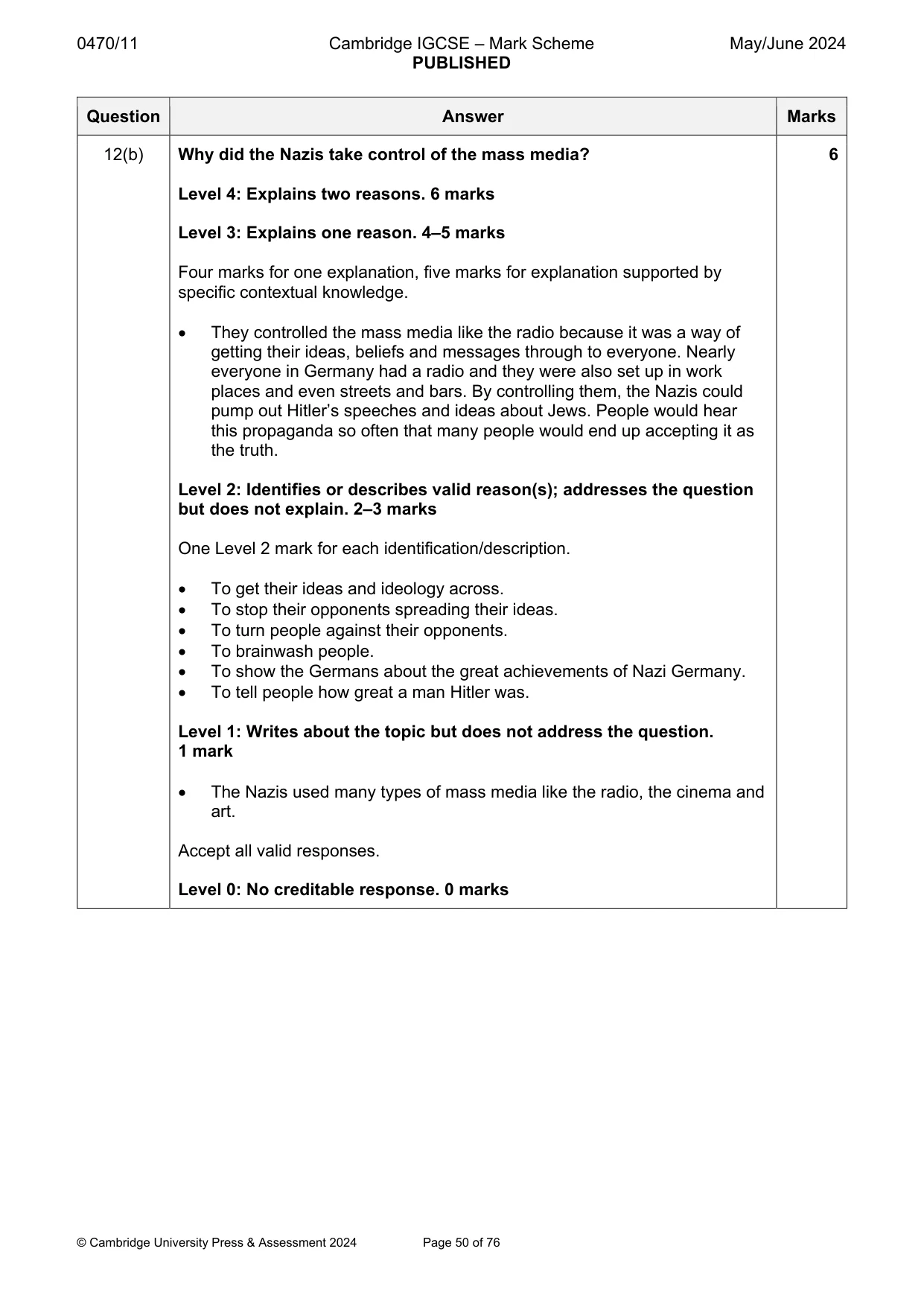
0470/11 Cambridge IGCSE – Mark Scheme PUBLISHED May/June 2024 © Cambridge University Press & Assessment 2024 Page 50 of 76 Question Answer Marks 12(b) Why did the Nazis take control of the mass media? Level 4: Explains two reasons. 6 marks Level 3: Explains one reason. 4–5 marks Four marks for one explanation, five marks for explanation supported by specific contextual knowledge. They controlled the mass media like the radio because it was a way of getting their ideas, beliefs and messages through to everyone. Nearly everyone in Germany had a radio and they were also set up in work places and even streets and bars. By controlling them, the Nazis could pump out Hitler’s speeches and ideas about Jews. People would hear this propaganda so often that many people would end up accepting it as the truth. Level 2: Identifies or describes valid reason(s); addresses the question but does not explain. 2–3 marks One Level 2 mark for each identification/description. To get their ideas and ideology across. To stop their opponents spreading their ideas. To turn people against their opponents. To brainwash people. To show the Germans about the great achievements of Nazi Germany. To tell people how great a man Hitler was. Level 1: Writes about the topic but does not address the question. 1 mark The Nazis used many types of mass media like the radio, the cinema and art. Accept all valid responses. Level 0: No creditable response. 0 marks 6
Mark scheme, page 51
0470/11 Cambridge IGCSE – Mark Scheme PUBLISHED May/June 2024 © Cambridge University Press & Assessment 2024 Page 51 of 76 Question Answer Marks 12(c) ‘The main aim of Nazi economic policies was to reduce unemployment.’ How far do you agree with this statement? Explain your answer. Level 5: Explains both sides and supports a valid judgement on ‘how far’. 10 marks One explanation or more on each side. Although it was important for Hitler to reduce unemployment and it helped him to become very popular, Hitler’s main aim from the start was to strengthen Germany’s economy in order to be able to achieve his foreign policy aims. Rearmament and Autarky were central to this, and the dramatic decline in the unemployment rate that these achieved was a beneficial side effect of achieving his main aim of preparing Germany for war. Level 4: Explains both sides. 7–9 marks For candidates to be awarded this level they must have one explanation on each side. Seven marks for one explanation on each side; one additional mark for each additional explanation on either side. Level 3: Explains one side. 4–6 marks In the elections in the early 1930s Hitler had promised to reduce unemployment. After he came to power, lots of measures were passed to achieve this. A huge work creation programme was established. Unemployed men were sent on public works projects to build motorways and railways. There were also house-building programmes and ones for building great public buildings. As a result, unemployment went down. This was an important aim of Hitler’s because it made him more popular and more secure. OR Hitler’s main aim was to get Germany ready and strong enough for war. This meant rearmament, and in 1936 he introduced a Four-Year Plan to do this. Hitler had some very definite foreign policy aims, like Lebensraum, that involved war, so he needed economic policies that made Germany economically strong and therefore militarily strong. Hitler wanted to make Germany self-sufficient so that it did not depend on other countries, especially if there was going to be war. Enormous rearmament programmes created thousands of new jobs and the main aim was not to bring down unemployment but to make Germany powerful in military terms. Finally, during the war every part of Germany’s economy was turned to supporting the war effort. One Level 3 mark for each explanation. 10
Mark scheme, page 52
0470/11 Cambridge IGCSE – Mark Scheme PUBLISHED May/June 2024 © Cambridge University Press & Assessment 2024 Page 52 of 76 Question Answer Marks 12(c) Level 2: Identifies or describes valid points; addresses the question but does not explain. 2–3 marks One Level 2 mark for each identification/description. Introduction of conscription. Public works schemes such as motorways and public buildings. The National Labour Service. Less unemployment made Hitler more popular. Rearmament. Autarky. Four-Year Plan. Hitler’s foreign policy plans. Level 1: Writes about the topic but does not address the question. 1 mark The Nazi economic policies were very different from those of the Weimar Republic and included spending a lot of money. By 1939, they were achieving what Hitler wanted. Accept all valid responses. Level 0: No creditable response. 0 marks
Mark scheme, page 53
0470/11 Cambridge IGCSE – Mark Scheme PUBLISHED May/June 2024 © Cambridge University Press & Assessment 2024 Page 53 of 76 Question Answer Marks Depth Study C: Russia, 1905–41 13(a) Describe the main features of Tsarist rule at the beginning of the twentieth century. One mark for each relevant point. Responses may include the following: Divine right to rule. An autocracy. Censorship. Political parties banned. Use of the Okhrana (secret police). Thousands of opponents in prison. Against reform. 4
Mark scheme, page 54
0470/11 Cambridge IGCSE – Mark Scheme PUBLISHED May/June 2024 © Cambridge University Press & Assessment 2024 Page 54 of 76 Question Answer Marks 13(b) Why did the Tsarist government introduce reforms in the period 1905 to 1911? Level 4: Explains two reasons. 6 marks Level 3: Explains one reason. 4–5 marks Four marks for one explanation, five marks for explanation supported by specific contextual knowledge. Reforms were introduced to modernise agriculture so that the peasants could produce more food. The methods used by the peasants were very old fashioned and they only produced enough for themselves. There was little to send to the growing cities for the industrial workers. The reforms allowed peasants to buy more land. The hope was that they would form a new class of prosperous peasants, farming for themselves and producing a surplus of food to sell to the cities. Level 2: Identifies or describes valid reason(s); addresses the question but does not explain. 2–3 marks One Level 2 mark for each identification/description. The 1905 revolution. The October Manifesto. To produce more food (modernise agriculture). To win the support of the peasants. To pacify industrial workers by passing reforms on working conditions. To reduce opposition to the Tsar. Level 1: Writes about the topic but does not address the question. 1 mark Quite a lot of reforms were passed in this period such as the agricultural reforms. However, there was also a lot of repression. Accept all valid responses. Level 0: No creditable response. 0 marks 6
Mark scheme, page 55
0470/11 Cambridge IGCSE – Mark Scheme PUBLISHED May/June 2024 © Cambridge University Press & Assessment 2024 Page 55 of 76 Question Answer Marks 13(c) ‘The most important reason why Tsar Nicholas abdicated in 1917 was Russia’s involvement in the First World War.’ How far do you agree with this statement? Explain your answer. Level 5: Explains both sides and supports a valid judgement on ‘how far’. 10 marks One explanation or more on each side. There were other factors like the actions of the Tsarina and Rasputin and the political unrest of the middle classes and the unrest of the workers that had been building up for years, but all these factors, in one way or another, were caused or made worse by the war. There had been unrest in Russia for years but the Tsar had survived. What was different this time was the war. It meant people were short of food and fuel and there were strikes and demonstrations everywhere. Soldiers even began to mutiny and refused to fire on demonstrators. All of this was so bad because of the war, and this is why it was the most important reason. Level 4: Explains both sides. 7–9 marks For candidates to be awarded this level they must have one explanation on each side. Seven marks for one explanation on each side; one additional mark for each additional explanation on either side. Level 3: Explains one side. 4–6 marks One Level 3 mark for each explanation. The war was very important as a cause of the Tsar’s abdication. The war was going very badly for Russia and in 1915 the Tsar made the mistake of taking personal charge of the army. This meant that he would now be blamed if the war continued to go badly. In fact, it got worse, with more defeats and the soldiers were very unhappy. It also caused problems back in Russia where prices went up and there were shortages of food and fuel. People were starving and cold. In 1917, there were strikes all over Russia because of the effects of the war. By March, the Tsar had no choice but to abdicate. OR It was the actions of the Tsarina that actually led to a situation where the Tsar had to abdicate. When the Tsar was leading the army, she was left in charge of governing the country. She was already unpopular because she was German and she opposed all reforms. The way she governed the country made all this worse. She used the hated Rasputin as her adviser and sacked lots of ministers. There were even rumours that they were having an affair and plotting a separate peace with Germany. Under her rule, the state of the country got worse and she did nothing about it. Because of her, the reputation of the royal family was at an all-time low by 1917 and people began to question their right to rule. 10
Mark scheme, page 56
0470/11 Cambridge IGCSE – Mark Scheme PUBLISHED May/June 2024 © Cambridge University Press & Assessment 2024 Page 56 of 76 Question Answer Marks 13(c) Level 2: Identifies or describes valid points; addresses the question but does not explain. 2–3 marks One Level 2 mark for each identification/description. The Tsar refused to introduce political reforms. The war went very badly. The Tsar took personal control of the war. The actions of the Tsarina. The influence of Rasputin. Discontent and unrest building up over years. The actions of the Petrograd Soviet. The mutiny of the soldiers. Level 1: Writes about the topic but does not address the question. 1 mark The Tsar had survived a long time but by 1917 things were so bad that he had to abdicate. Everyone had had enough of the Tsar. Accept all valid responses. Level 0: No creditable response. 0 marks
Mark scheme, page 57
0470/11 Cambridge IGCSE – Mark Scheme PUBLISHED May/June 2024 © Cambridge University Press & Assessment 2024 Page 57 of 76 Question Answer Marks 14(a) Who were the Young Pioneers? One mark for each relevant point. Responses may include the following: They were children aged 9–14. They were set up in 1922. They replaced scout movements. Membership was compulsory. They were indoctrinated into communist ideas. They wore a uniform. They went on camps which were for sport or interests such as geology. 4
Mark scheme, page 58
0470/11 Cambridge IGCSE – Mark Scheme PUBLISHED May/June 2024 © Cambridge University Press & Assessment 2024 Page 58 of 76 Question Answer Marks 14(b) Why did Trotsky fail to become leader of the Soviet Union after Lenin’s death? Level 4: Explains two reasons. 6 marks Level 3: Explains one reason. 4–5 marks Four marks for one explanation, five marks for explanation supported by specific contextual knowledge. Trotsky failed because he had a very determined and cunning rival in Stalin. Stalin worked hard to be in a position to take over from Lenin. He spent years building himself a strong position in the Party. He took on boring jobs like the General Secretary and filled other positions with his own supporters. So, when Lenin died, Stalin had a power base in the Party to support him. Trotsky did not bother to do any of this. Level 2: Identifies or describes valid reason(s); addresses the question but does not explain. 2–3 marks One Level 2 mark for each identification/description. He was arrogant and often upset Party members. He did not bother to build up support for himself. He underestimated Stalin. Stalin presented himself as Lenin’s natural successor. Stalin attended Lenin’s funeral, Trotsky did not. Trotsky’s idea of a permanent revolution lost him support. Fears that Trotsky might become a dictator. Stalin built up support in the Party. Level 1: Writes about the topic but does not address the question. 1 mark Trotsky did not become leader of the Soviet Union because people did not think he would be any good. He did some foolish things and this lost him a lot of support when his rivals were being very clever. Accept all valid responses. Level 0: No creditable response. 0 marks 6
Mark scheme, page 59
0470/11 Cambridge IGCSE – Mark Scheme PUBLISHED May/June 2024 © Cambridge University Press & Assessment 2024 Page 59 of 76 Question Answer Marks 14(c) ‘Stalin stayed in power because of the use of the Purges.’ How far do you agree with this statement? Explain your answer. Level 5: Explains both sides and supports a valid judgement on ‘how far’. 10 marks One explanation or more on each side. The Purges certainly frightened people into obeying Stalin and doing as they were told. People were petrified that they might be taken off to a labour camp at any moment. However, ruling by fear cannot last forever and there were signs that the Purges were coming to an end. Stalin could not, for example, afford to kill off all the generals in the army. A much stronger way of staying in power was to get people to love him. This is how the propaganda worked. The cult of personality made people worship Stalin. Mothers even told their children that he was the wisest man of the age. The main way that Stalin stayed in power was through this use of propaganda. Level 4: Explains both sides. 7–9 marks For candidates to be awarded this level they must have one explanation on each side. Seven marks for one explanation on each side; one additional mark for each additional explanation on either side. Level 3: Explains one side. 4–6 marks One Level 3 mark for each explanation. Stalin’s Purges were certainly very important in keeping him in power. Anyone that he suspected of being disloyal or a possible rival in the future he would act against. However, about 18 million were sent to labour camps, many of whom were completely innocent. So his Purges were acts of terror to terrify people into obeying him and not acting against him. They could see what would happen if they did. They were arrested and sent to labour camps or executed. They knew that their lives and careers depended on doing and saying exactly what Stalin wanted. This is why the Purges kept him in power. OR The main way that Stalin stayed in power was through using propaganda. He developed a cult of personality around himself. Images of Stalin were everywhere – photographs, statues, posters and pictures. All were designed to make him appear to be a hero and responsible for all of the Soviet Union’s greatest achievements. History books were rewritten to make him the hero and places were named after him. Processions were held to praise him. He almost became godlike. All of this brainwashed people into worshipping him and this helped keep him in power. 10
Mark scheme, page 60
0470/11 Cambridge IGCSE – Mark Scheme PUBLISHED May/June 2024 © Cambridge University Press & Assessment 2024 Page 60 of 76 Question Answer Marks 14(c) Level 2: Identifies or describes valid points; addresses the question but does not explain. 2–3 marks One Level 2 mark for each identification/description. Thousands of Party members were arrested and imprisoned or executed. Show trials were used to denounce Stalin’s enemies. The Red Army was purged to keep it under control. Those who disagreed with Stalin were purged. The secret police were purged to make sure it was not a threat to Stalin. Images of Stalin were everywhere. Statues of Stalin. Places were named after him. Cult of personality. He was made into a godlike figure. Level 1: Writes about the topic but does not address the question. 1 mark The Purges were very unpleasant. Anyone could be picked on and sent to labour camps. It was a very cruel policy to carry out. Accept all valid responses. Level 0: No creditable response. 0 marks
Mark scheme, page 61
0470/11 Cambridge IGCSE – Mark Scheme PUBLISHED May/June 2024 © Cambridge University Press & Assessment 2024 Page 61 of 76 Question Answer Marks Depth Study D: The United States, 1919–41 15(a) What was Prohibition? One mark for each relevant point. Responses may include the following: The making of alcohol was banned. The sale of alcohol was banned. The transporting of alcohol was banned. It lasted from 1920 to 1933. It led to illegal selling of alcohol. It led to crime and gangsterism. It led to corruption among the police and officials. It led to speakeasies. 4
Mark scheme, page 62
0470/11 Cambridge IGCSE – Mark Scheme PUBLISHED May/June 2024 © Cambridge University Press & Assessment 2024 Page 62 of 76 Question Answer Marks 15(b) Why did the lives of many women change in the 1920s? Level 4: Explains two reasons. 6 marks Level 3: Explains one reason. 4–5 marks Four marks for one explanation, five marks for explanation supported by specific contextual knowledge. The lives of some women changed because of employment opportunities. Before the First World War few women worked outside of the home. These new opportunities were created by new offices, department stores and factories using assembly lines. During the 1920s more than 2 million women joined the workforce. Level 2: Identifies or describes valid reason(s); addresses the question but does not explain. 2–3 marks One Level 2 mark for each identification/description. The motor car. Labour saving devices like washing machines. Wider availability of electricity. Fashion trends changed. New social freedoms. More leisure time. Changes during the First World War had an impact in the ’20s. In 1920 women got the vote. The invention of the flapper. Level 1: Writes about the topic but does not address the question. 1 mark The lives of women changed a lot in the 1920s. They were able to live a different life from the one their mothers had lived. However, not all women’s lives changed. Accept all valid responses. Level 0: No creditable response. 0 marks 6
Mark scheme, page 63
0470/11 Cambridge IGCSE – Mark Scheme PUBLISHED May/June 2024 © Cambridge University Press & Assessment 2024 Page 63 of 76 Question Answer Marks 15(c) ‘The group that suffered the most from discrimination during the 1920s was immigrants.’ How far do you agree with this statement? Explain your answer. Level 5: Explains both sides and supports a valid judgement on ‘how far’. 10 marks One explanation or more on each side. Many groups in America suffered discrimination, although this discrimination differed in nature. Whilst government legislation could be said to discriminate against native Americans and immigrants, state laws such as the Jim Crow laws affected black Americans. Other discrimination could be considered social in nature, such as attacks on black Americans by the Ku Klux Klan. Immigrants from Eastern Europe struggled to deal with the pervading attitudes of the WASPS. Therefore, immigrants did not suffer the ‘most’, as all of these groups suffered discrimination but in different forms. Level 4: Explains both sides. 7–9 marks For candidates to be awarded this level they must have one explanation on each side. Seven marks for one explanation on each side; one additional mark for each additional explanation on either side. Level 3: Explains one side. 4–6 marks One Level 3 mark for each explanation. Immigrants did suffer badly from discrimination. This was partly because immigration figures went up a lot. It was also because of fear of communism and other radical views. Because of the Russian Revolution, many Americans feared that immigrants from Eastern Europe and Russia would bring extreme ideas with them and cause trouble. There were a lot of strikes in 1919 and Americans thought that immigrants were behind them. The US also reduced the number from Asia that could come into the country. Many immigrants were discriminated against when they looked for housing and ended up in slums. Many could only get low- skilled and badly paid jobs because of discrimination. There was a lot of racial prejudice against immigrants because they were seen as a threat to American society and its values. OR The group that suffered the most was the black Americans. Many went north into the big cities looking for work. They were discriminated against, especially in regard to housing, where they ended up in poor urban areas such as Harlem. Most did not benefit from the boom. In the South they suffered from the Ku Klux Klan, which hunted them down and murdered them. 10
Mark scheme, page 64
0470/11 Cambridge IGCSE – Mark Scheme PUBLISHED May/June 2024 © Cambridge University Press & Assessment 2024 Page 64 of 76 Question Answer Marks 15(c) Level 2: Identifies or describes valid points; addresses the question but does not explain. 2–3 marks One Level 2 mark for each identification/description. Immigrants were seen as a threat to American values. Most immigrants were accepted as US citizens. Most immigrants had the vote. The Sacco and Vanzetti affair. Black Americans were murdered in the South by the Ku Klux Klan. Most black Americans could not vote. Black Americans were denied good education and jobs. Jim Crow laws legalised segregation. Black Americans could not serve on juries. Black Americans in the South had the worst jobs like sharecropping. Many car factories operated an all-white policy. Level 1: Writes about the topic but does not address the question. 1 mark I think there was a lot of discrimination in the USA in the 1920s and many groups suffered like immigrants and black Americans. Accept all valid responses. Level 0: No creditable response. 0 marks
Mark scheme, page 65
0470/11 Cambridge IGCSE – Mark Scheme PUBLISHED May/June 2024 © Cambridge University Press & Assessment 2024 Page 65 of 76 Question Answer Marks 16(a) What were the Bonus Marchers? One mark for each relevant point. Responses may include the following: They were ex-servicemen. They wanted their bonuses (pensions) to be paid early. Congress refused to pay the pensions early. They camped peacefully outside the White House. Hoover had the army clear them away. The army attacked them and burned their camps. 4
Mark scheme, page 66
0470/11 Cambridge IGCSE – Mark Scheme PUBLISHED May/June 2024 © Cambridge University Press & Assessment 2024 Page 66 of 76 Question Answer Marks 16(b) Why did Hoover do little to help people during the Depression? Level 4: Explains two reasons. 6 marks Level 3: Explains one reason. 4–5 marks Four marks for one explanation, five marks for explanation supported by specific contextual knowledge. Hoover did not do much because he was a Republican and did not believe it was the federal government’s job to provide support for the unemployed. He believed that people ought to support and look after themselves and their family. They should not rely on the government. If they did this, they would never learn how to be strong and independent. Level 2: Identifies or describes valid reason(s); addresses the question but does not explain. 2–3 marks One Level 2 mark for each identification/description. He believed in ‘rugged individualism’. He thought that prosperity would quickly return. He did not think it was the job of the federal government to help the unemployed. He was a Republican. He believed that business should be left alone and that it would sort out its problems. Level 1: Writes about the topic but does not address the question. 1 mark Hoover only took small measures to help. Accept all valid responses. Level 0: No creditable response. 0 marks 6
Mark scheme, page 67
0470/11 Cambridge IGCSE – Mark Scheme PUBLISHED May/June 2024 © Cambridge University Press & Assessment 2024 Page 67 of 76 Question Answer Marks 16(c) ‘It was underlying weaknesses in the American economy rather than the Wall Street Crash that caused the Depression.’ How far do you agree with this statement? Explain your answer. Level 5: Explains both sides and supports a valid judgement on ‘how far’. 10 marks One explanation or more on each side. The underlying weaknesses were far more important. The Wall Street Crash had the impact it did because it came at a time when long-term weaknesses in the economy were coming to a head. The uneven distribution in income meant that there were still many people with very low wages or who were unemployed and so could not buy consumer goods. Demand was falling all the time. Overproduction meant that factories had to produce less and lay people off. It was because all this was happening at the time that the effect of the Wall Street Crash was so bad, but the long-term weaknesses were the real cause of the Depression. Level 4: Explains both sides. 7–9 marks For candidates to be awarded this level they must have one explanation on each side. Seven marks for one explanation on each side; one additional mark for each additional explanation on either side. Level 3: Explains one side. 4–6 marks One Level 3 mark for each explanation. The USA did have underlying weaknesses in its economy that had been gradually growing over the years. One weakness was overproduction. For years, farmers and other industries had been producing too much. Even new industries producing consumer goods were producing too many because most people that could afford them had bought their cars and fridges. More goods were being produced than could be sold. This led to a reduction in production and some people lost their jobs. OR The Wall Street Crash meant that some banks failed because people had borrowed money to buy shares which were now worthless. This meant that the loans borrowed could not be repaid and banks went under. Bank failure led to businesses failing and people losing their jobs. This made things worse because they spent less and businesses were able to sell even less. In this way, the Crash led to business failure, unemployment and poverty. 10
Mark scheme, page 68
0470/11 Cambridge IGCSE – Mark Scheme PUBLISHED May/June 2024 © Cambridge University Press & Assessment 2024 Page 68 of 76 Question Answer Marks 16(c) Level 2: Identifies or describes valid points; addresses the question but does not explain. 2–3 marks One Level 2 mark for each identification/description. Overproduction. Economic slowdown had been coming. The Crash caused banks to fail. People withdrew their money from banks. Banks called in their loans. European tariffs. Europe not in a position to buy more American goods. Uneven distribution of income. Workers were sacked or lost their jobs. People did not spend or could not because they had lost their jobs. Level 1: Writes about the topic but does not address the question. 1 mark The Great Depression was an awful time for everyone. People lost their jobs, their savings were not worth anything and they had to live in poverty. It was not until the New Deal that they had any help. Accept all valid responses. Level 0: No creditable response. 0 marks
Mark scheme, page 69
0470/11 Cambridge IGCSE – Mark Scheme PUBLISHED May/June 2024 © Cambridge University Press & Assessment 2024 Page 69 of 76 Question Answer Marks Depth Study E: The Second World War in Europe and the Asia–Pacific, 1939–c.1945 17(a) What happened in the Battle of Midway? One mark for each relevant point. Responses may include the following: Surprise attack on the Allied base at Midway Island planned. The Americans learned that an attack on Midway Island was planned. The Japanese ships outgunned the American fleet. Three-pronged attack planned. The Japanese commander hesitated when he should have attacked. US dive bombers caused terrible damage to the Japanese ships. The Japanese fleet retreated. The battle turned the tide of the war in the Pacific. 4
Mark scheme, page 70
0470/11 Cambridge IGCSE – Mark Scheme PUBLISHED May/June 2024 © Cambridge University Press & Assessment 2024 Page 70 of 76 Question Answer Marks 17(b) Why did Singapore fall to the Japanese forces? Level 4: Explains two reasons. 6 marks Level 3: Explains one reason. 4–5 marks Four marks for one explanation, five marks for explanation supported by specific contextual knowledge. The British in Singapore were taken by surprise. They expected an attack from the sea and that was where their main defences were. They did not expect the Japanese to attack from the jungle of the Malay Peninsula. However, the Japanese quickly captured Malaya and the Allied forces had to retreat into Singapore. Level 2: Identifies or describes valid reason(s); addresses the question but does not explain. 2–3 marks One Level 2 mark for each identification/description. Singapore’s coastal guns were destroyed. Poor communication between military and civilian authorities. Percival did not send reinforcements quickly enough to where the main Japanese attack was. Miscalculations by General Percival. Percival spread his men too thinly across the whole coastline. Percival expected an attack east of the Causeway and put his strongest forces there. He was wrong. The British expected an attack from the sea and that was where their defences were. An attack from the Malay Peninsula was not expected. The Allies were running out of water and food. Japanese bombing did a lot of damage. Level 1: Writes about the topic but does not address the question. 1 mark The fall of Singapore was a big blow to the Allies, and especially to British prestige. Churchill was very upset and angry. The British had never thought that Singapore could fall. Accept all valid responses. Level 0: No creditable response. 0 marks 6
Mark scheme, page 71
0470/11 Cambridge IGCSE – Mark Scheme PUBLISHED May/June 2024 © Cambridge University Press & Assessment 2024 Page 71 of 76 Question Answer Marks 17(c) ‘Japan attacked Pearl Harbor in 1941 because of the economic sanctions of the United States.’ How far do you agree with this statement? Explain your answer. Level 5: Explains both sides and supports a valid judgement on ‘how far’. 10 marks One explanation or more on each side. The two factors were closely linked, and it is difficult to separate them. Japan wanted to build an empire but for this it needed oil. However, the US was worried about Japanese expansion and had put sanctions on oil, preventing supplies from getting to Japan. Japan knew that it had to weaken the US in the Pacific so that it could stop the US from interfering. If the US received a nasty blow, it would, they believed, withdraw; this would allow Japan to take the oil in places like the Philippines, which it needed in order to extend its empire. Level 4: Explains both sides. 7–9 marks For candidates to be awarded this level they must have one explanation on each side. Seven marks for one explanation on each side; one additional mark for each additional explanation on either side. Level 3: Explains one side. 4–6 marks One Level 3 mark for each explanation. The US economic sanctions were very important in Japan’s decision to bomb Pearl Harbor. Japan badly needed oil. It had to buy most of its oil from abroad. When Japan invaded French Indochina in 1941, the US froze all Japan’s assets in the US and this stopped Japan from buying more oil. Japan planned to take oil by force and planned to invade British Malaya. However, it was worried about an American response and so to weaken this response it decided to attack the US fleet at Pearl Harbor. So the basic reason was US sanctions on oil. OR The attack on Pearl Harbor was because the US wanted to stop Japan’s expansion. Japan wanted to build an empire and be recognised as a great power. It had already invaded Manchuria and in 1937 a major war with China started with Japan capturing Nanjing. This expansion worried the US, especially when Japan signed the Tripartite Pact with Germany and Italy. Japan knew that the US stood in the way of it building a great empire and decided to weaken the US in the Pacific. Destroying the US base at Pearl Harbor would give Japan control of the Pacific. 10
Mark scheme, page 72
0470/11 Cambridge IGCSE – Mark Scheme PUBLISHED May/June 2024 © Cambridge University Press & Assessment 2024 Page 72 of 76 Question Answer Marks 17(c) Level 2: Identifies or describes valid points; addresses the question but does not explain. 2–3 marks One Level 2 mark for each identification/description. The Japanese thought the US would revert to isolationism. Japan thought the US would negotiate a peace. Japan badly needed more oil. Japan wanted to weaken the US in the Pacific. The US introduced sanctions on aircraft exports, oil and scrap metal. The US stood in the way of Japanese expansion. To destroy the US Pacific Fleet. To enable it to invade Burma, British Malaya and the Philippines. Level 1: Writes about the topic but does not address the question. 1 mark The attack on Pearl Harbor caught the Americans by surprise. Three hundred US aircraft were destroyed. Accept all valid responses. Level 0: No creditable response. 0 marks
Mark scheme, page 73
0470/11 Cambridge IGCSE – Mark Scheme PUBLISHED May/June 2024 © Cambridge University Press & Assessment 2024 Page 73 of 76 Question Answer Marks 18(a) Describe how Germany was denazified after the end of the Second World War. One mark for each relevant point. Responses may include the following: The Nazi Party was banned. The Swastika symbol and Nazi emblem were banned. Nazis were removed from important positions in the police and civil service. 400 000 Germans were placed in internment camps. Denazification was turned over to the Germans. In each zone Germans had to fill in a questionnaire about their past. Ex-Nazis were fined; others were forced into retirement or sent to a labour camp. Ex-Nazis were forced to visit concentration camps. Those guilty of war crimes were tried at the Nuremburg Trials. 4
Mark scheme, page 74
0470/11 Cambridge IGCSE – Mark Scheme PUBLISHED May/June 2024 © Cambridge University Press & Assessment 2024 Page 74 of 76 Question Answer Marks 18(b) Why were the D-Day landings successful? Level 4: Explains two reasons. 6 marks Level 3: Explains one reason. 4–5 marks Four marks for one explanation, five marks for explanation supported by specific contextual knowledge. The landings were successful because the Allies completely fooled the Germans. They made them believe that the landings were going to take place much further east along the coast where the Channel was narrower. This led to the Germans having to spread their defences across a vast area along the coast. The Germans had armoured divisions held in reserve but they held them back because they still thought that the main attack would come at Pas de Calais. As a result, the Allies had weaker defences to overcome. Level 2: Identifies or describes valid reason(s); addresses the question but does not explain. 2–3 marks One Level 2 mark for each identification/description. Allied planes and warships bombarded German positions. Thousands of troops were dropped behind German lines. The element of surprise. Hitler expected an attack where the Channel was narrowest. German defences were spread out across the Channel. The Germans believed the attacks were diversionary. In 1944, US fighter planes had decimated the German fighter force. German response was slow due to its complex command structure. The Allies had larger numbers of men and more weapons. Careful planning led to weak points in German defences being targeted. Level 1: Writes about the topic but does not address the question. 1 mark The D-Day landings were very successful. They gave the Allies a foothold in France which they soon expanded. It was the beginning of the end of Nazi Germany. Accept all valid responses. Level 0: No creditable response. 0 marks 6
Mark scheme, page 75
0470/11 Cambridge IGCSE – Mark Scheme PUBLISHED May/June 2024 © Cambridge University Press & Assessment 2024 Page 75 of 76 Question Answer Marks 18(c) ‘The Japanese defeat was caused by the American use of the atomic bomb.’ How far do you agree with this statement? Explain your answer. Level 5: Explains both sides and supports a valid judgement on ‘how far’. 10 marks One explanation or more on each side. Japan’s defeat was not caused by the dropping of the atomic bombs. Although it had early successes, Japan was soon overstretched and was up against the military might of the USA. After defeat in the Battles of Midway and Guadalcanal, the Japanese knew they were losing. US bombers were destroying Japanese cities. Japan could probably have fought on for another year but in this time thousands of men on both sides would have been killed. The atomic bombs did not cause the Japanese defeat, but they hastened it. After these two bombings and their terrible consequences, there was no way Japan could fight on. Level 4: Explains both sides. 7–9 marks For candidates to be awarded this level they must have one explanation on each side. Seven marks for one explanation on each side; one additional mark for each additional explanation on either side. Level 3: Explains one side. 4–6 marks One Level 3 mark for each explanation. The reason Japan lost the war was because they never had a chance against the might of the US. Once the US had decided to fight the war against Japan, the industrial might of the US meant that it could pour out vast numbers of ships, aircraft and armaments. The Japanese economy was one-tenth of the size of America’s and it could never have been as strong. The USA could just keep going and in the end it would win. OR The dropping of the atomic bombs on Hiroshima and Nagasaki incinerated large parts of the two cities and killed 200 000 Japanese civilians. The Japanese leadership were told by the Allies that unless Japan surrendered, it would face ‘prompt and utter destruction’. The effects of the atomic bombs showed the Japanese what they were faced with in the future if they did not surrender. This allowed the Japanese Emperor to win the discussion in the Japanese Supreme War Council against the hardliners. After the dropping of the bombs, it was impossible for Japan to keep fighting on for any length of time. 10
Mark scheme, page 76
0470/11 Cambridge IGCSE – Mark Scheme PUBLISHED May/June 2024 © Cambridge University Press & Assessment 2024 Page 76 of 76 Question Answer Marks 18(c) Level 2: Identifies or describes valid points; addresses the question but does not explain. 2–3 marks One Level 2 mark for each identification/description. The industrial and military strength of the US. Japan was fighting on too many fronts at once. Japan should have concentrated all its forces against the USA. Japan should have used unrestricted submarine warfare against the US. The Soviet Union had invaded Manchukuo. The US was planning its blockade of Japan and an invasion of the main island. Japan was already close to defeat in all parts of the fighting. The Battle of Midway decided the outcome of the war. It was the horror of the results of the atomic bombs that made Japan surrender. It was only the atomic bombs that could persuade the hardliners in Japan to agree to surrender. The two bombs killed over 200 000 people. Level 1: Writes about the topic but does not address the question. 1 mark The atomic bombs destroyed the cities of Hiroshima and Nagasaki. The results were terrible and nobody wanted to see anything like it again. In the end, Japan lost the war. Accept all valid responses. Level 0: No creditable response. 0 marks
What you needed in this session
Cambridge’s own grade thresholds for 2024 May/June, Paper 1 · Variant 1. A higher threshold means an easier paper — the bar moves with how the cohort did.