Cambridge IGCSE History 0470 — 2025 Oct/Nov Paper 1 · Variant 3
0470/13/O/N/25 · 60 marks · 120 min
The question paper and its mark scheme, free to read here and free to download. This is Cambridge’s own paper, exactly as it was sat.
Question paper8 pages

Mark scheme74 pages
Answers below. Sit the paper first if you are practising.
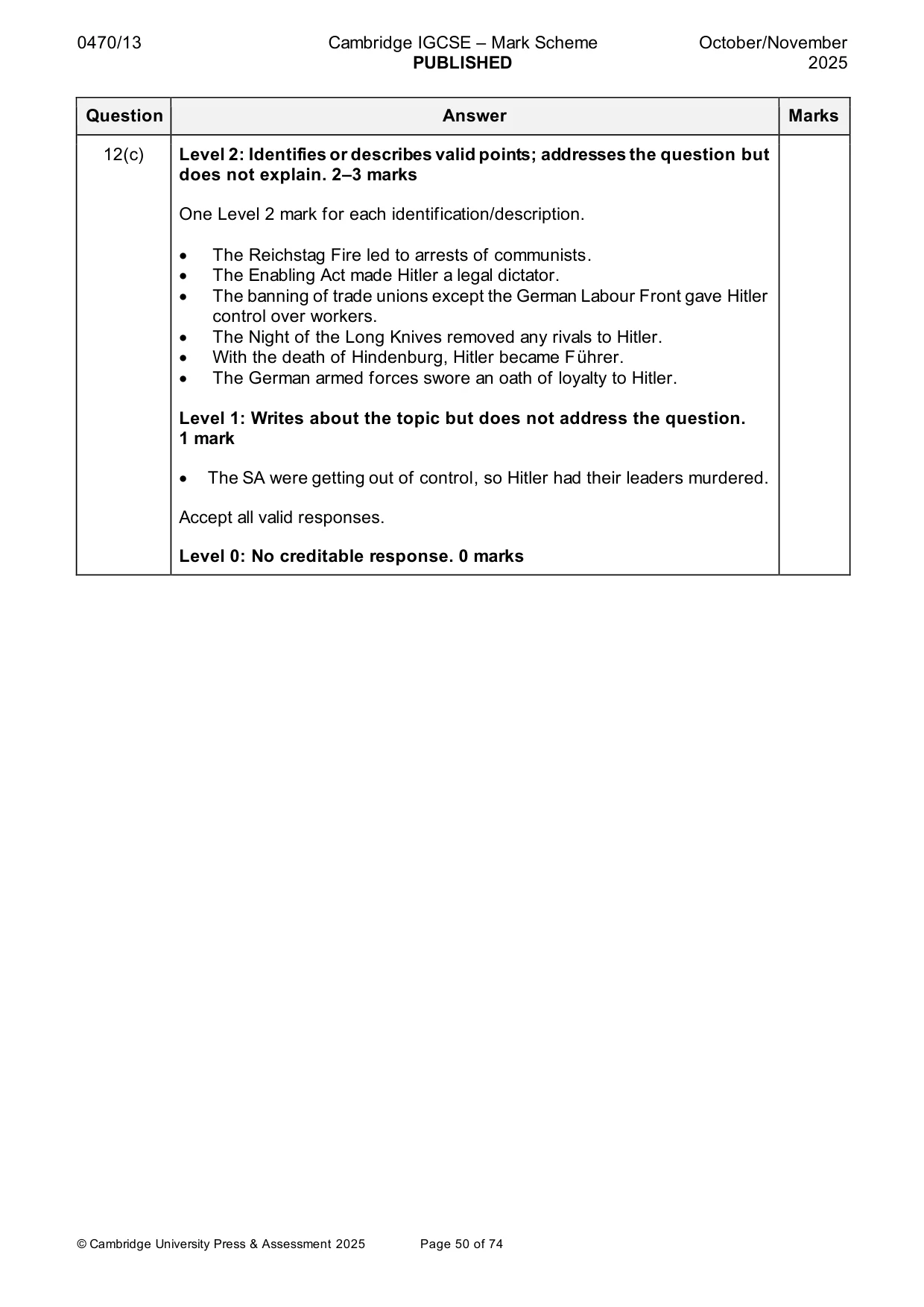
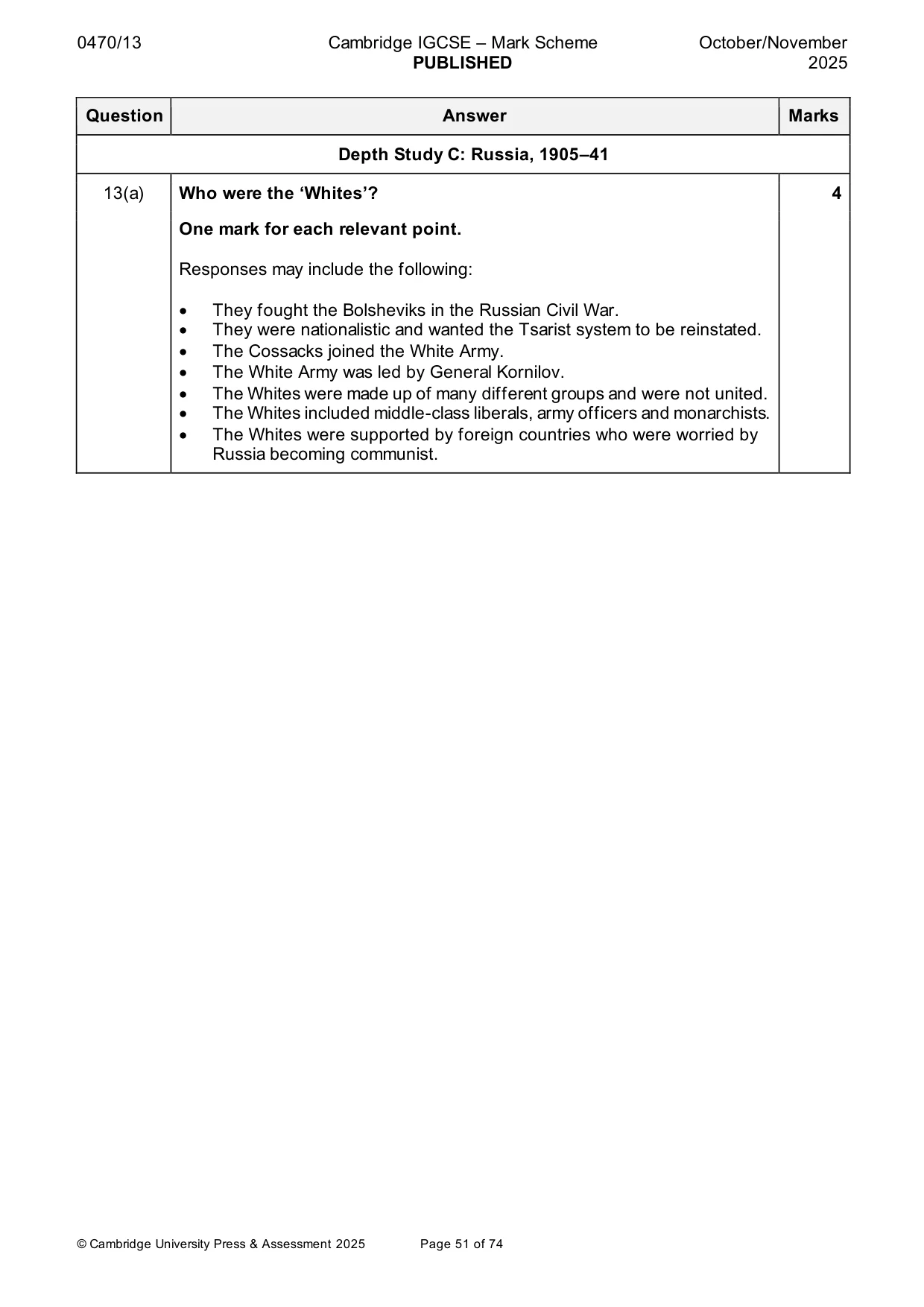
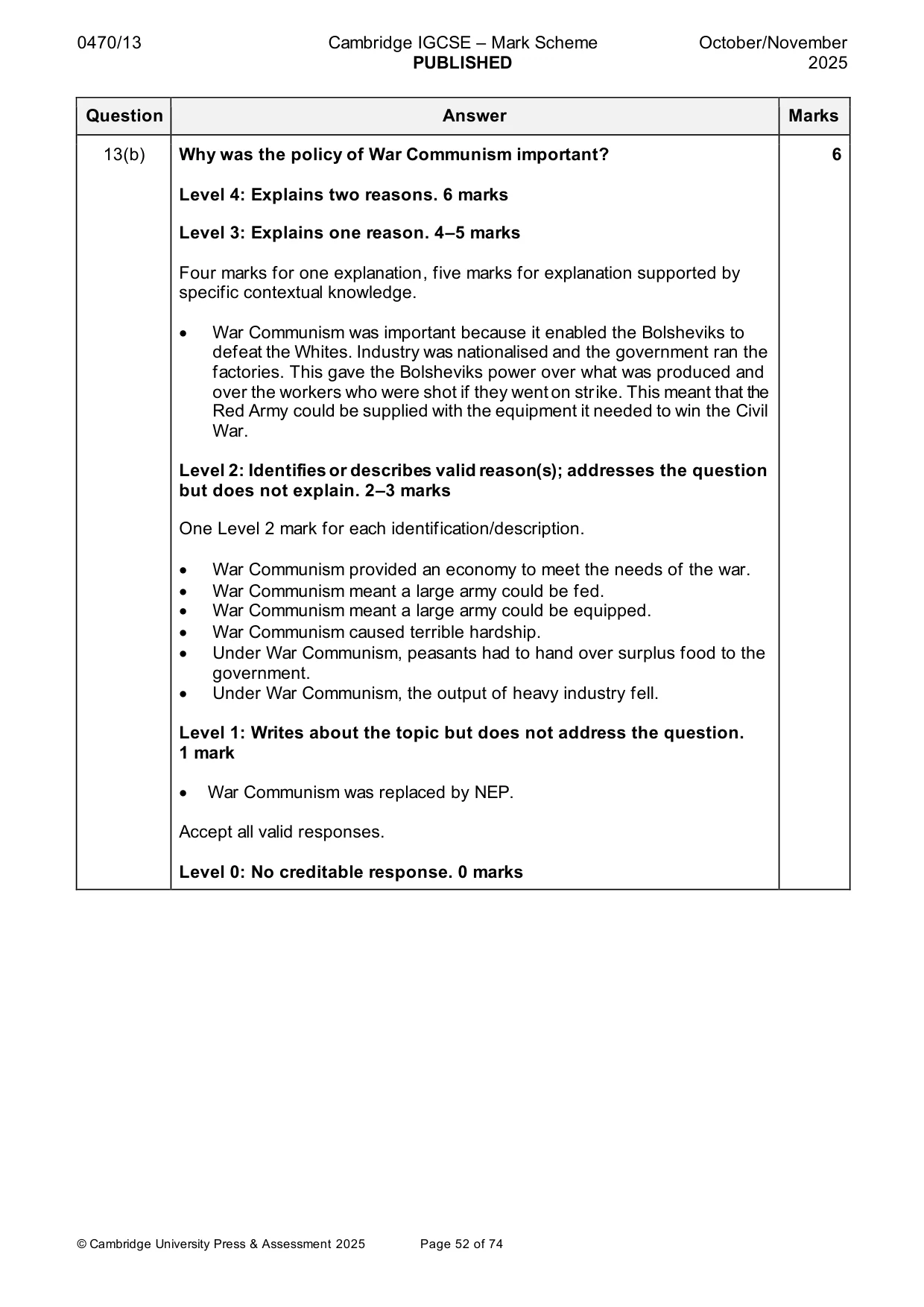
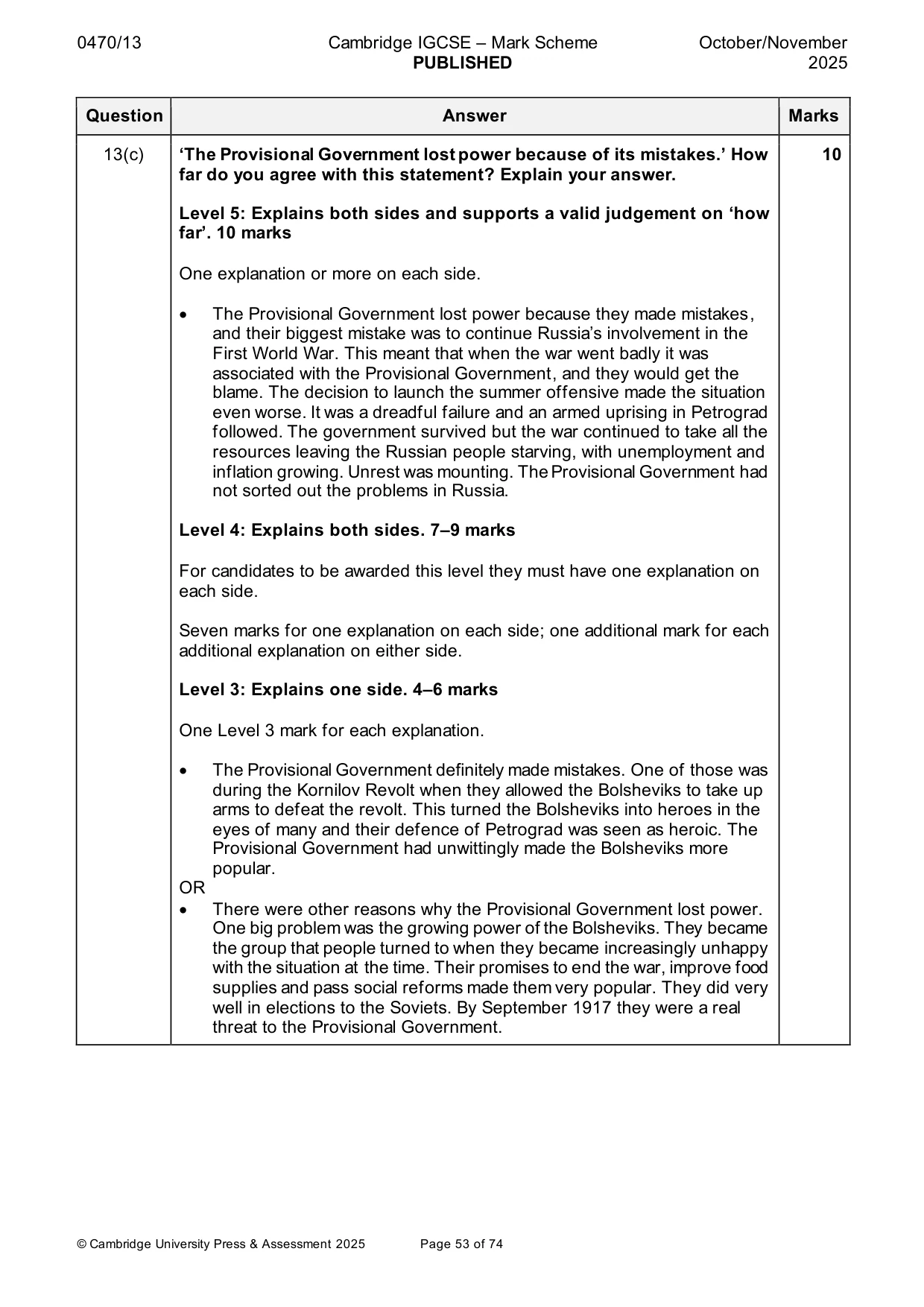
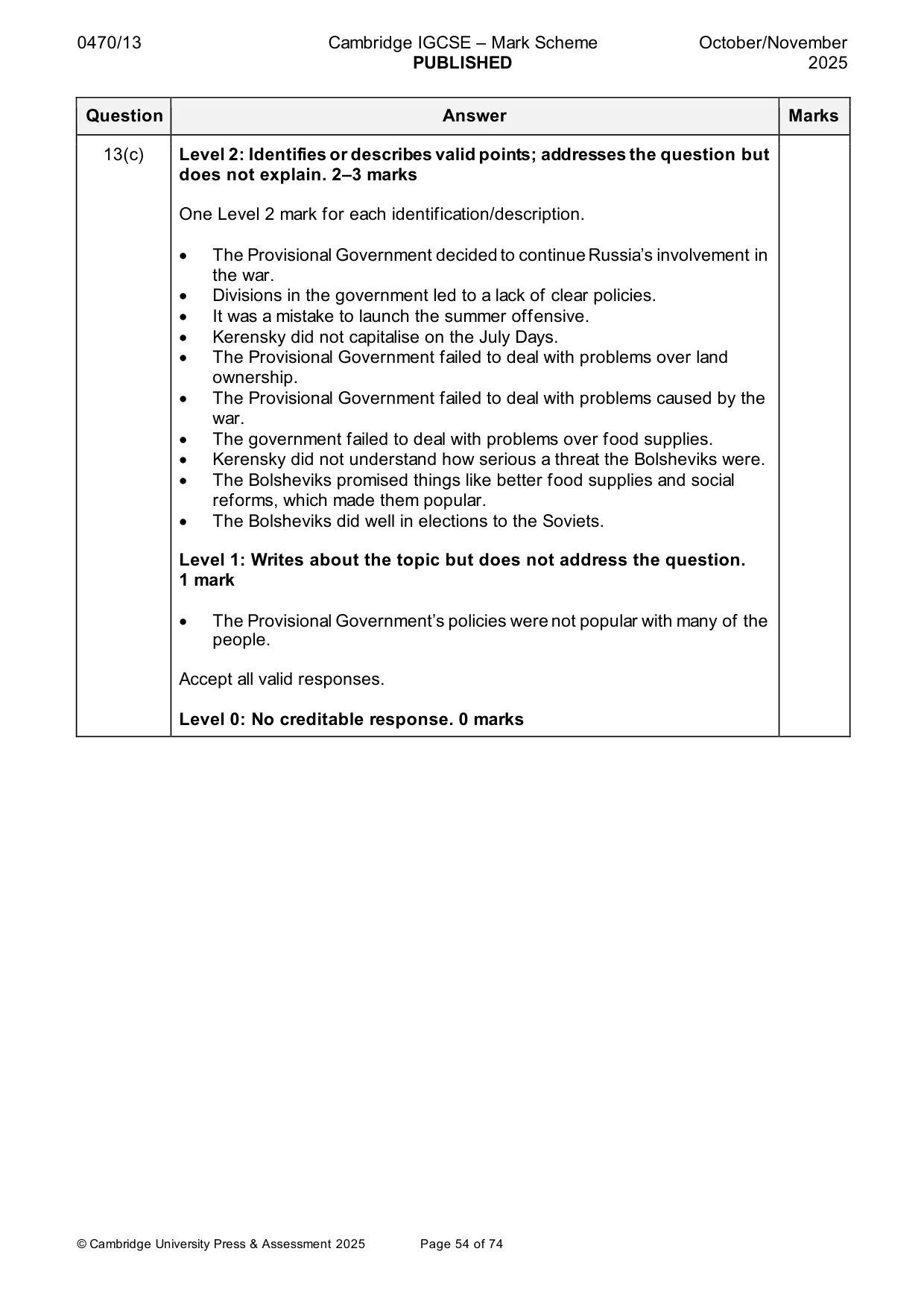
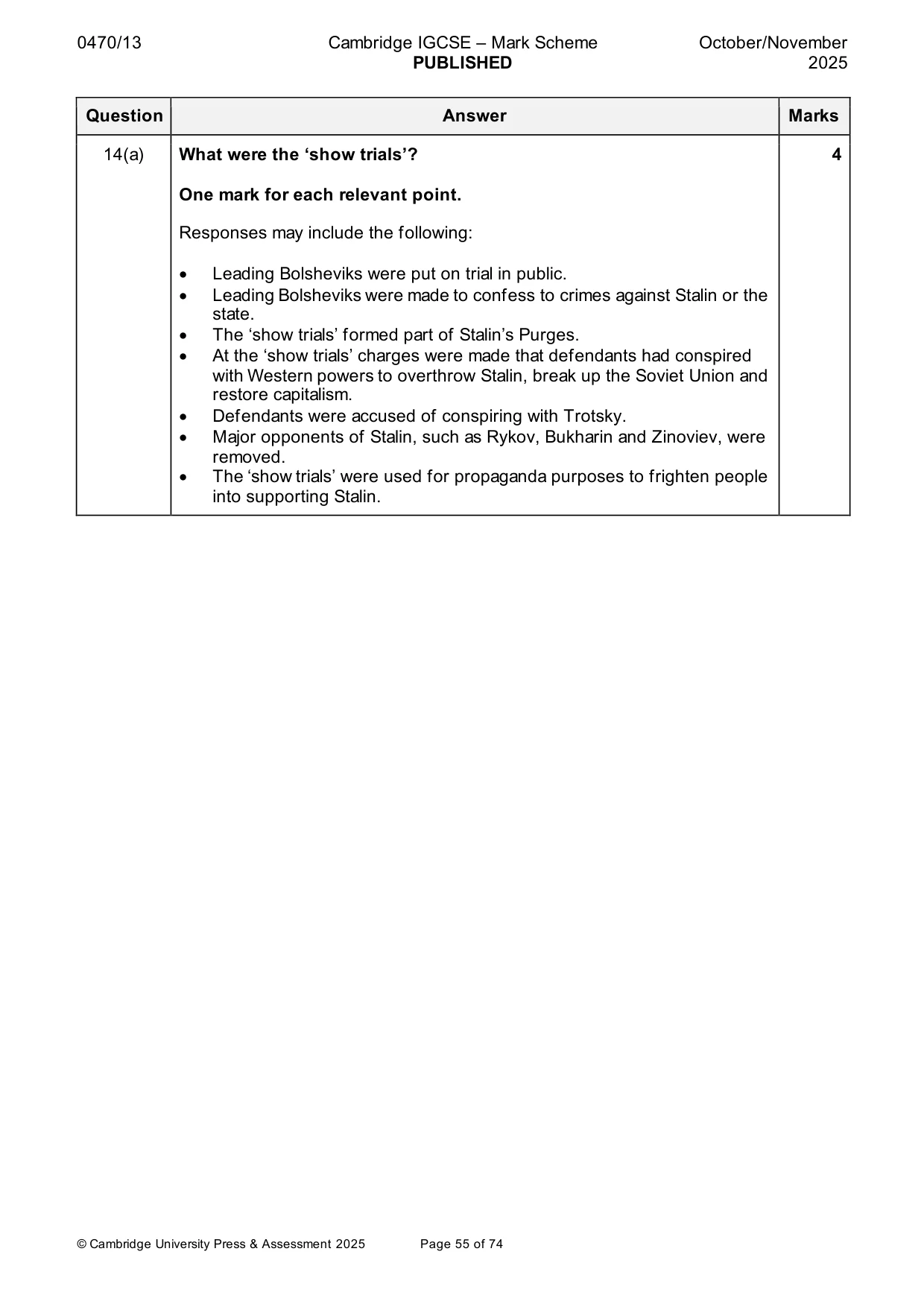
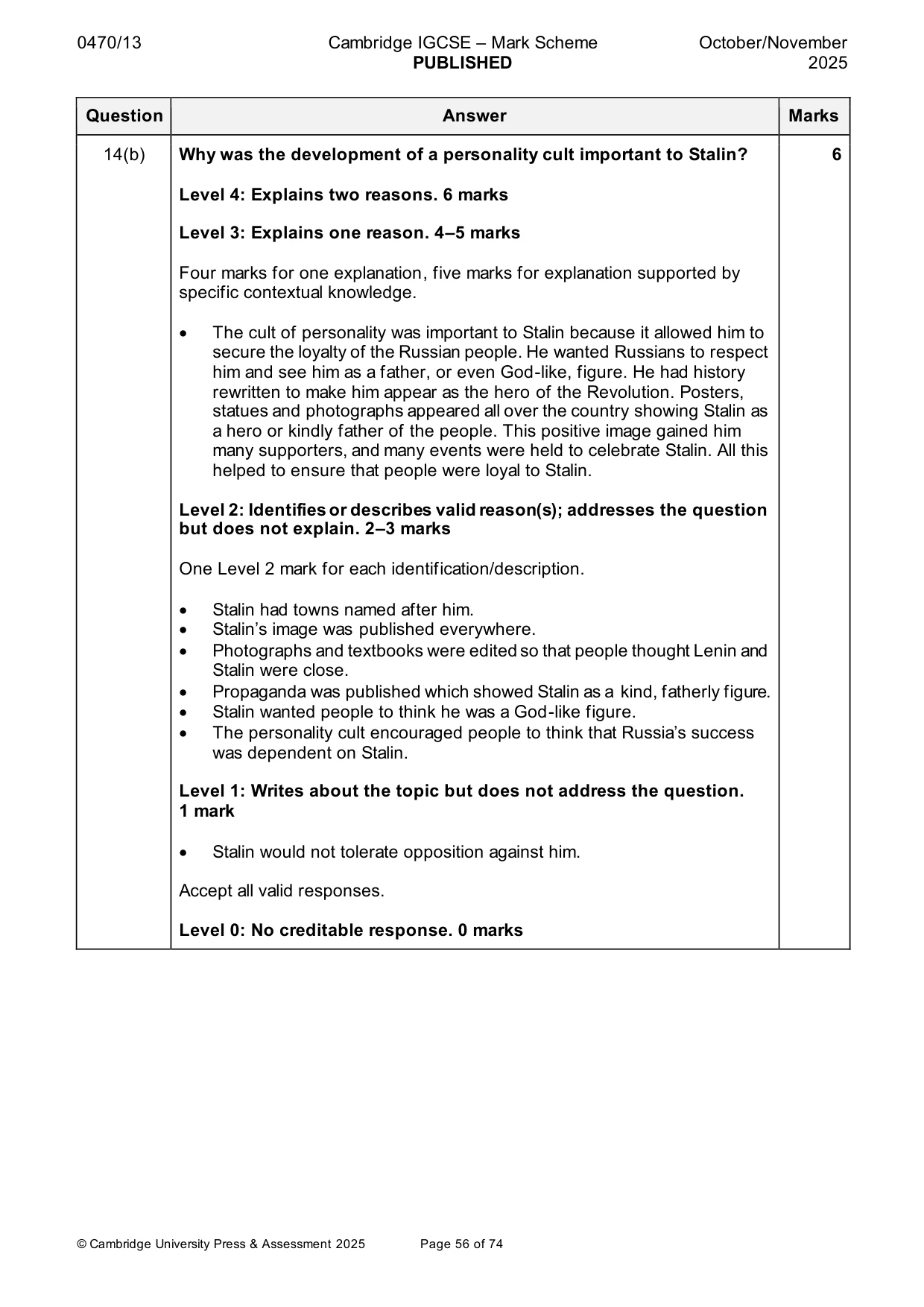
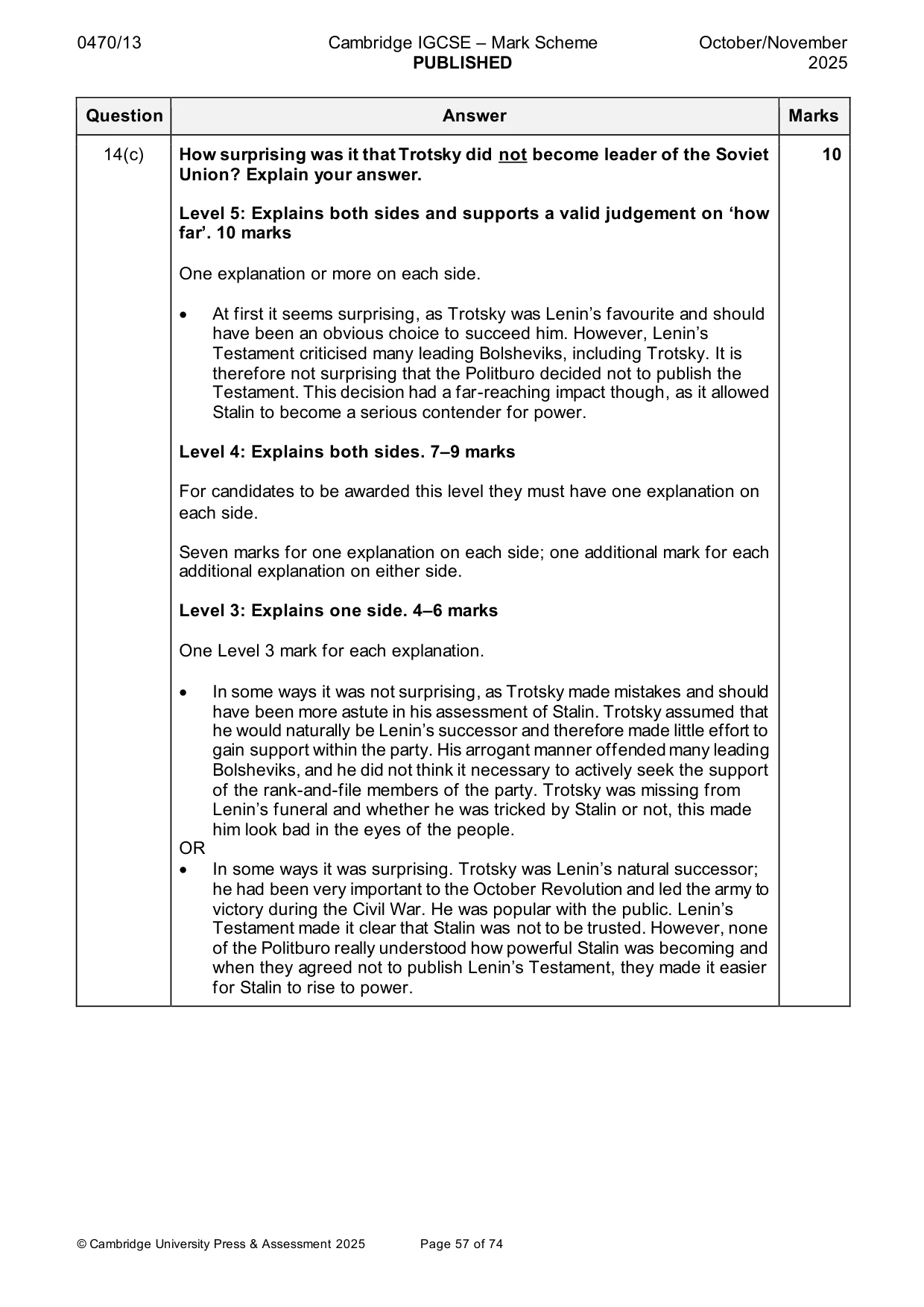
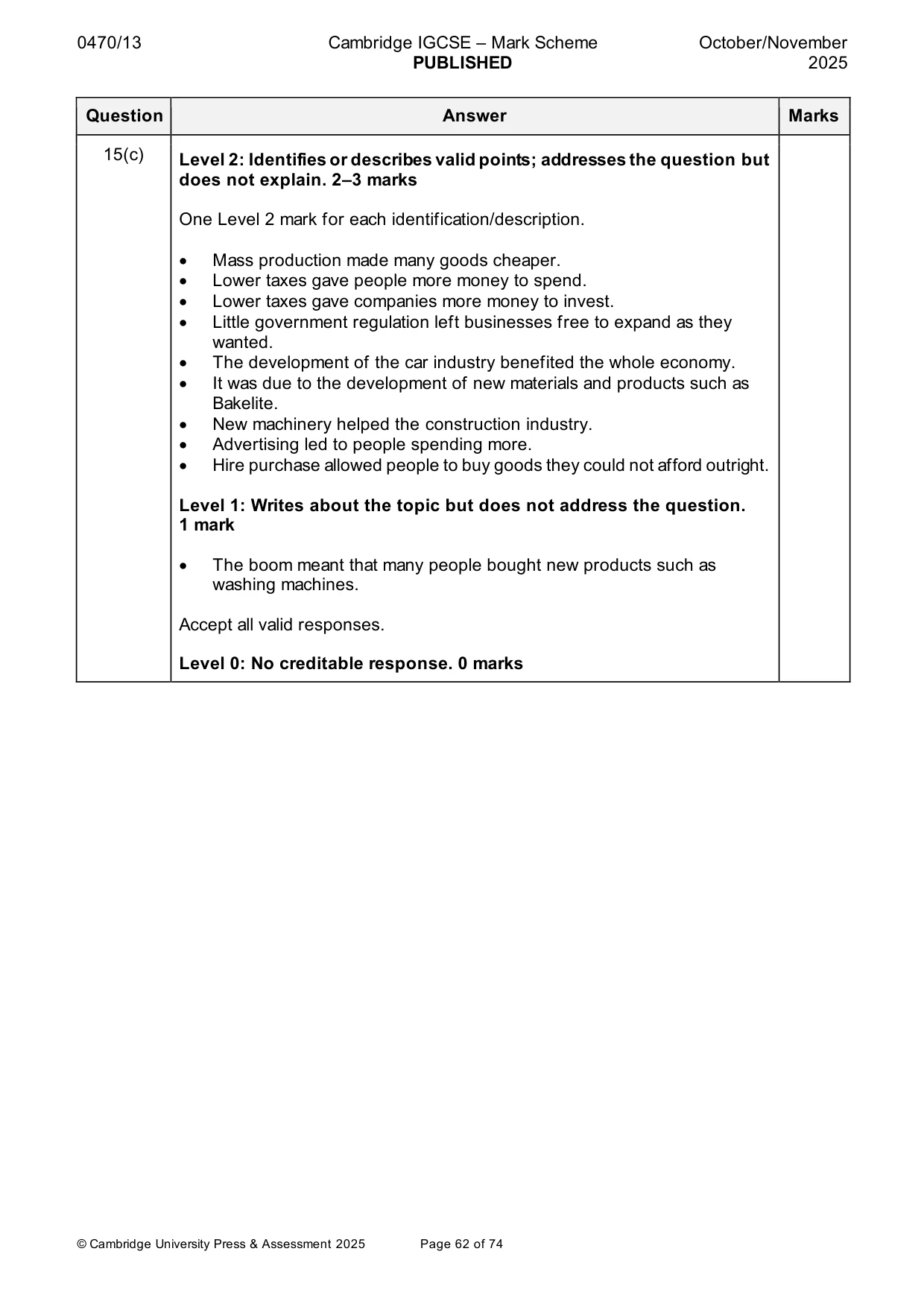
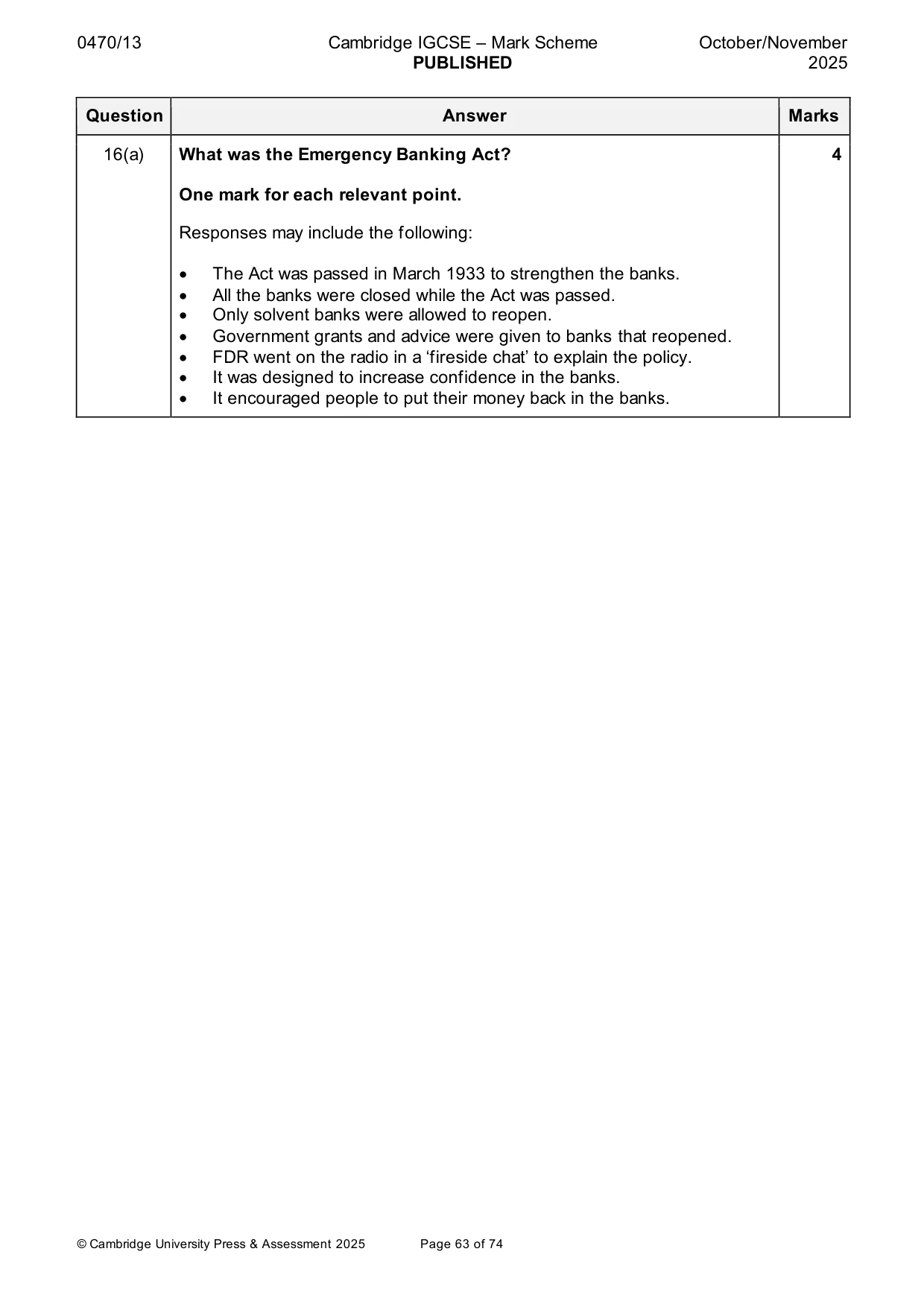
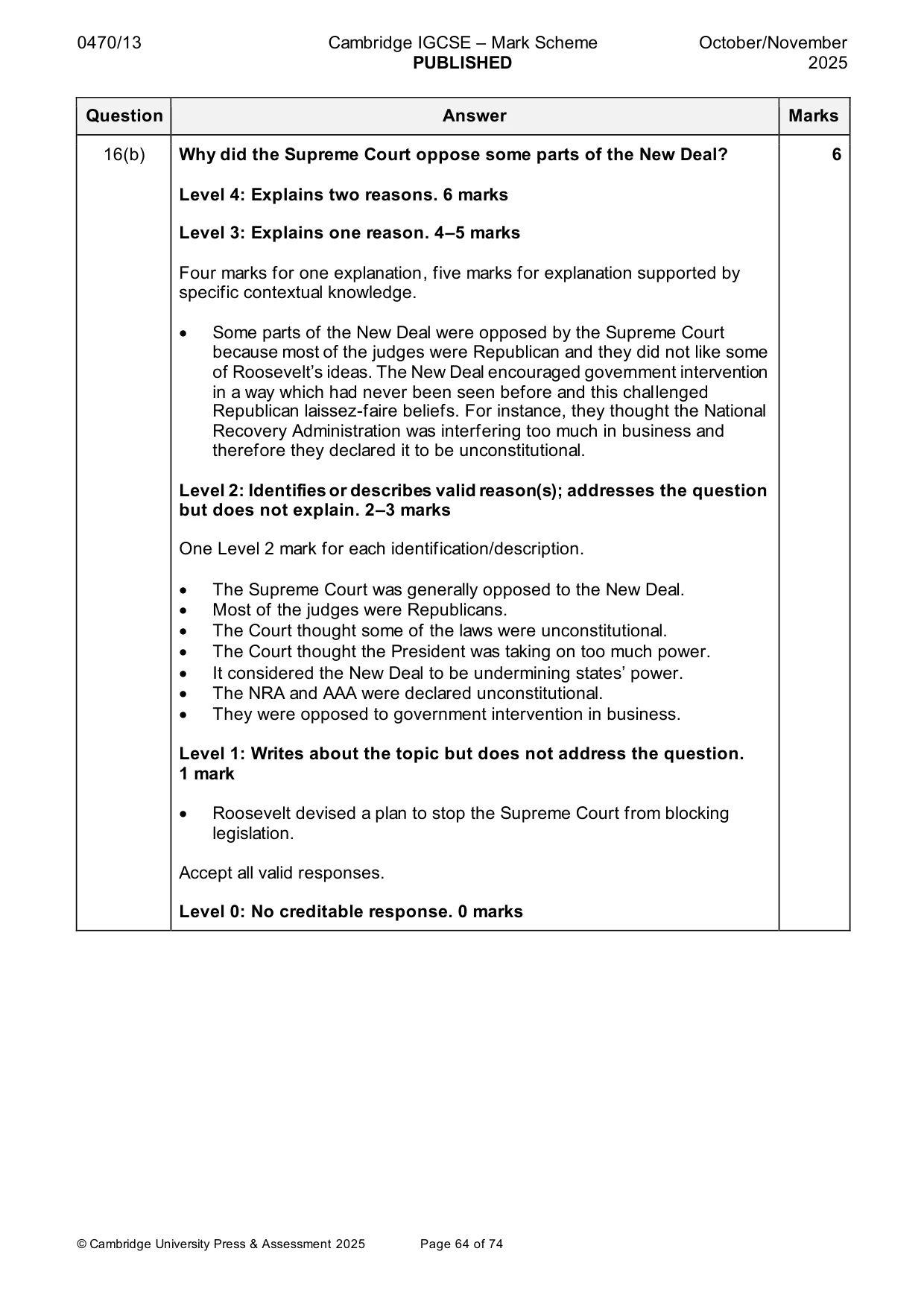
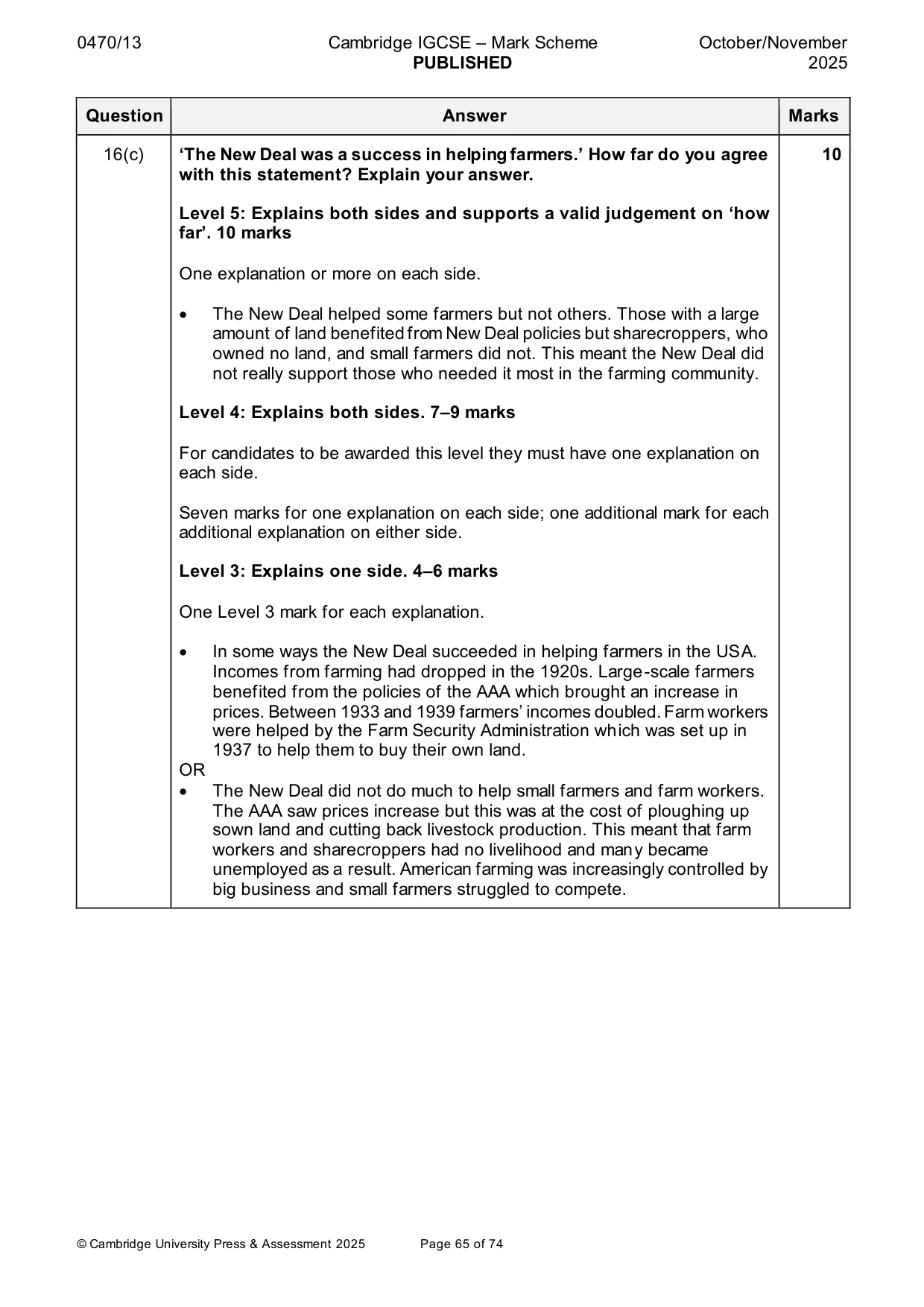
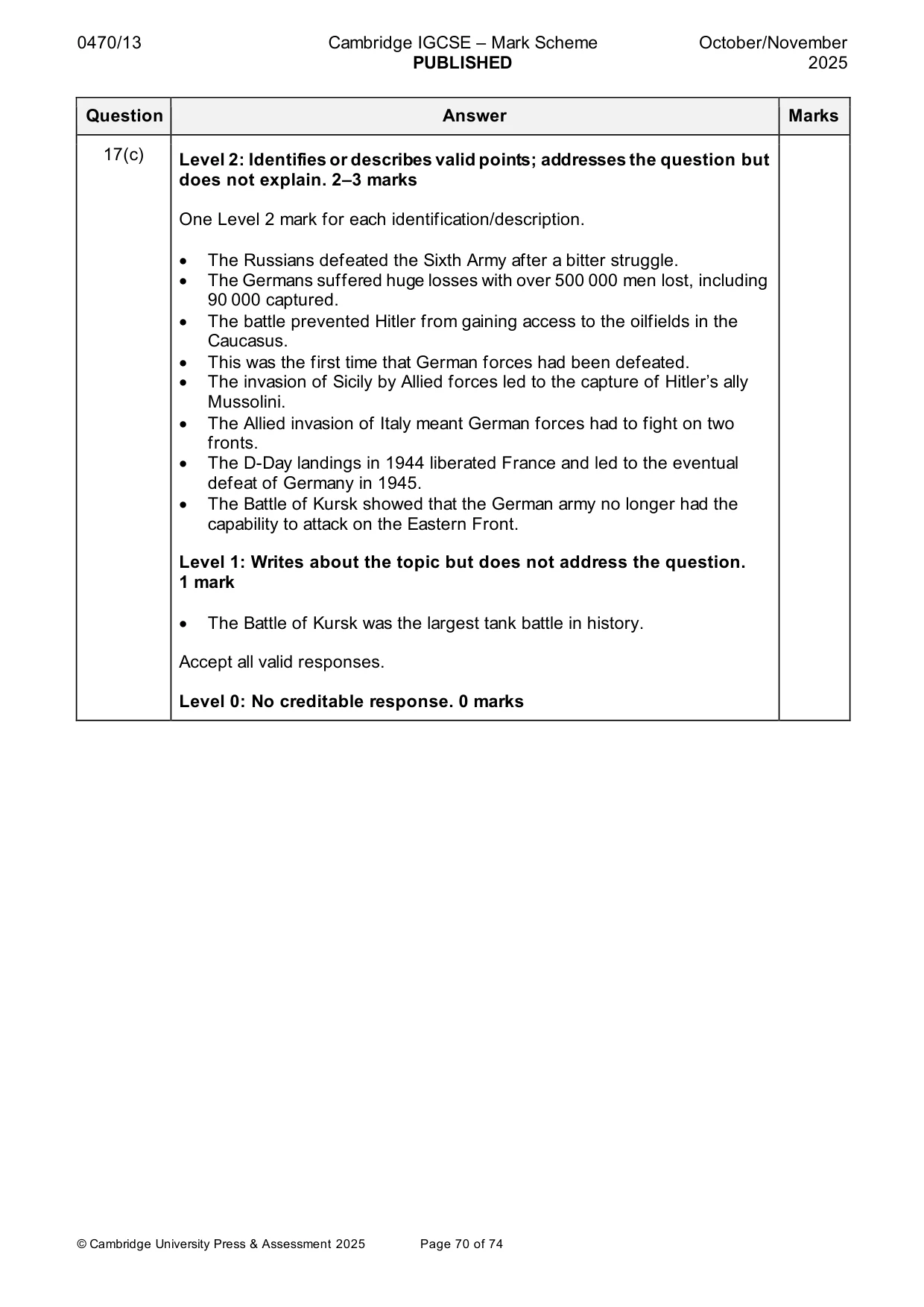
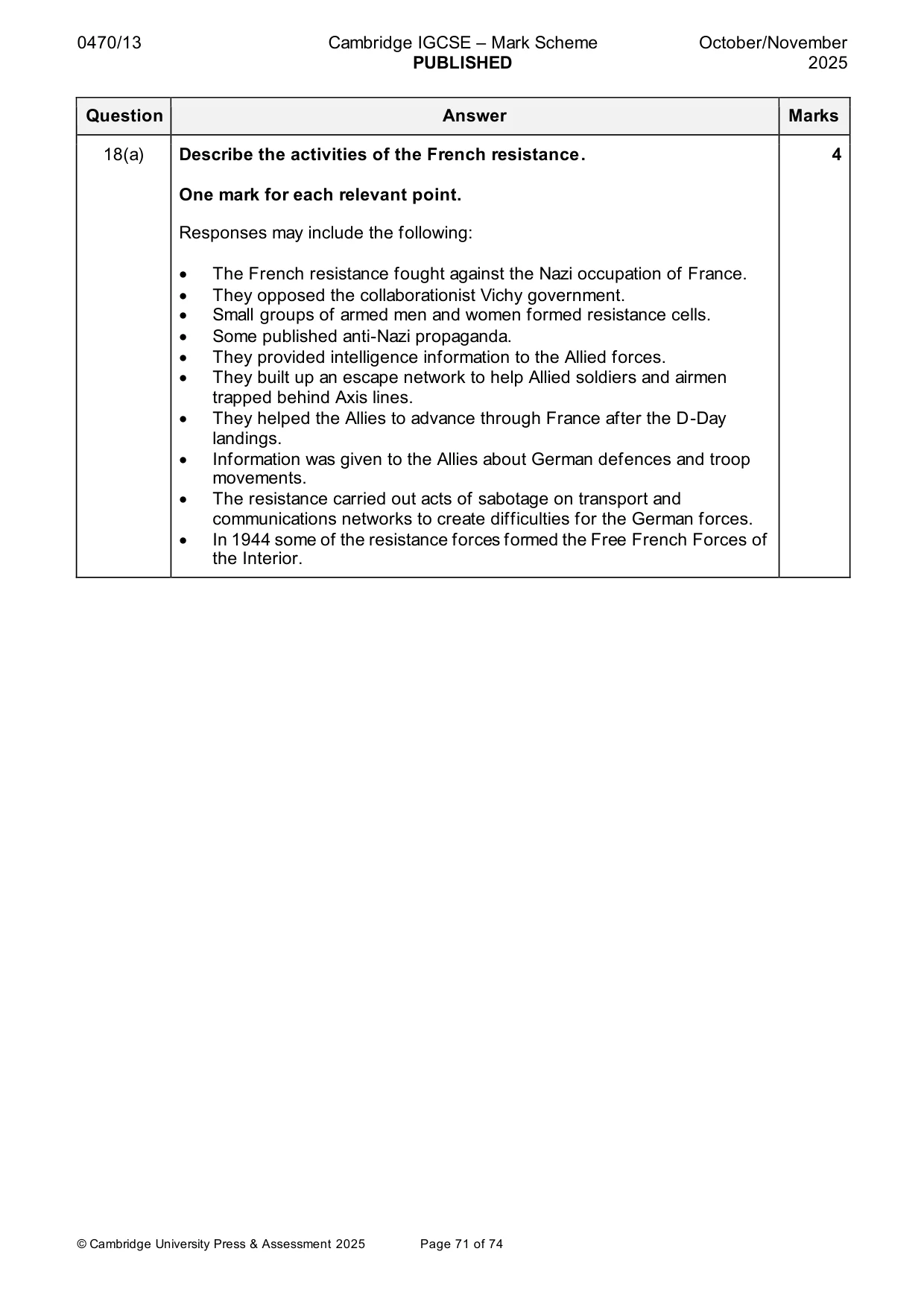
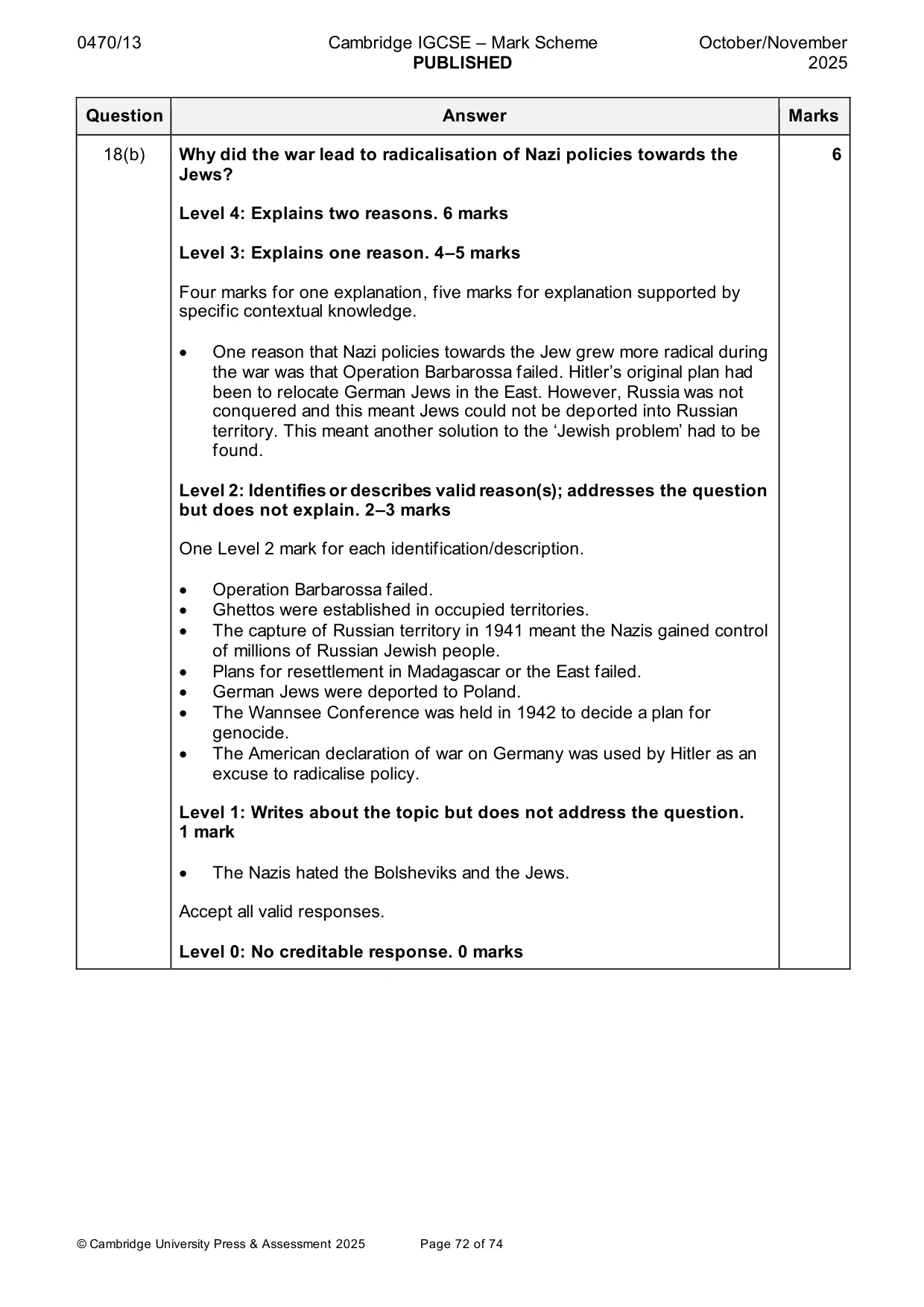
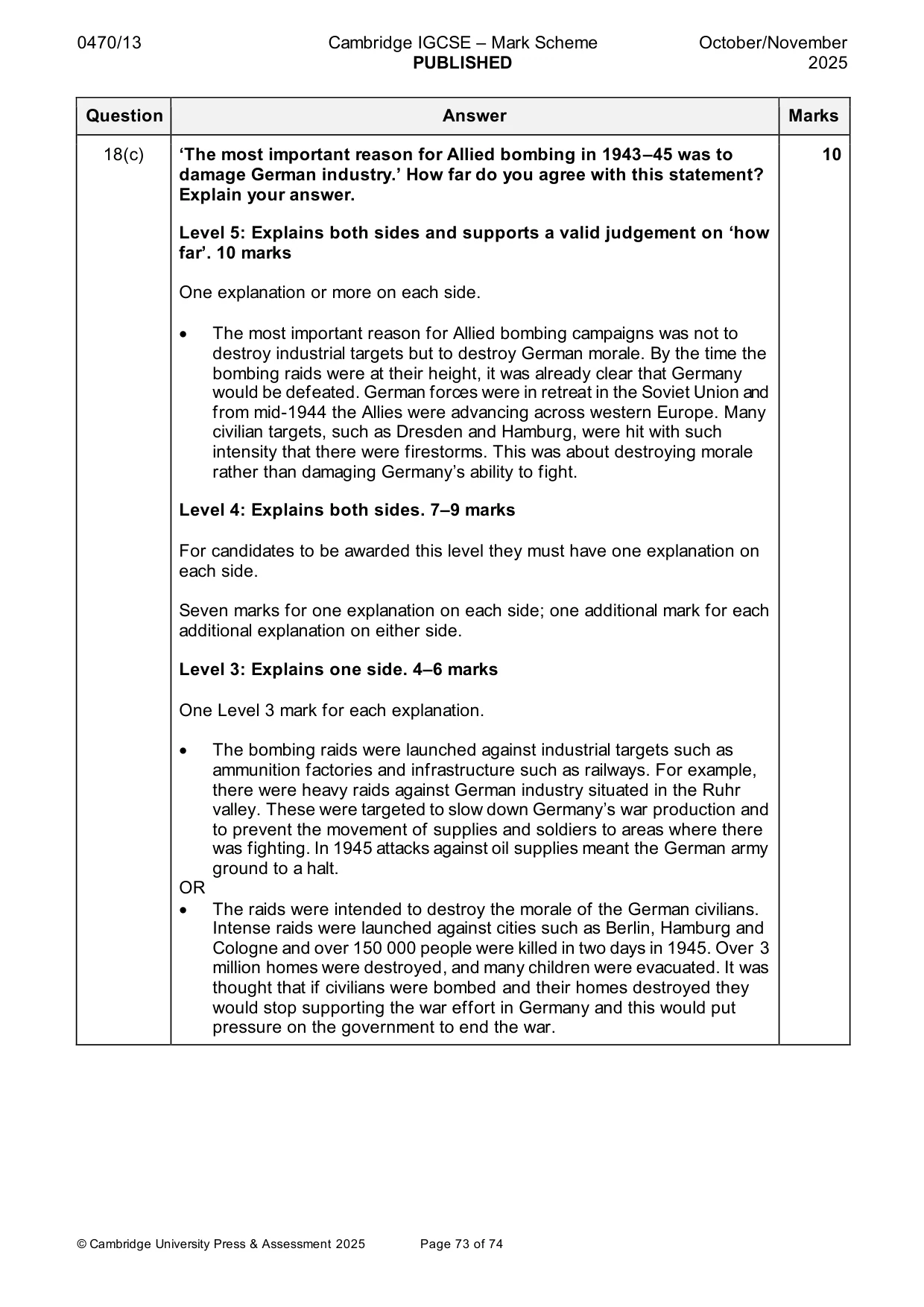
Paper as text
Question paper, page 1
This document has 8 pages. Any blank pages are indicated. [Turn over Cambridge IGCSE™ HISTORY 0470/13 Paper 1 Structured Questions October/November 2025 2 hours You must answer on the enclosed answer booklet. You will need: Answer booklet (enclosed) INSTRUCTIONS ● Answer three questions in total: Section A (Core content): answer two questions. Section B (Depth studies): answer one question. ● Follow the instructions on the front cover of the answer booklet. If you need additional answer paper, ask the invigilator for a continuation booklet. INFORMATION ● The total mark for this paper is 60. ● The number of marks for each question or part question is shown in brackets [ ]. * 4 7 1 0 4 2 7 9 6 2 * DC (SL) 343271/4 © UCLES 2025
Question paper, page 2
2 0470/13/O/N/25 © UCLES 2025 SECTION A: CORE CONTENT Answer two questions from this section. Option A: The nineteenth century 1 France was gripped by revolutionary activity in 1848. (a) What were the National Workshops in Paris in 1848? [4] (b) Why had Louis Philippe become unpopular with many of the French by 1848? [6] (c) ‘The 1848 revolution in France was a failure.’ How far do you agree with this statement? Explain your answer. [10] 2 Italian unification depended on the work of many individuals. (a) What was the role of Victor Emmanuel II in Italian unification? [4] (b) Why was there tension between Cavour and Garibaldi? [6] (c) ‘Napoleon III was a hindrance to Italian unification.’ How far do you agree with this statement? Explain your answer. [10] 3 The involvement of the United States in Cuba was important in many ways. (a) Describe the sinking of the USS Maine. [4] (b) Why was there a debate in the United States in the 1890s over imperialism? [6] (c) ‘The most important consequence of the Spanish–American War for the United States was economic gain.’ How far do you agree with this statement? Explain your answer. [10] 4 A range of different factors contributed to the outbreak of the First World War. (a) Describe Kaiser William II’s aims in foreign policy. [4] (b) Why did Britain and Japan form an alliance in 1902? [6] (c) ‘Germany was responsible for turning the July crisis of 1914 into a European war.’ How far do you agree with this statement? Explain your answer. [10]
Question paper, page 3
3 0470/13/O/N/25 © UCLES 2025 [Turn over Option B: The twentieth century 5 Many Germans hated the Treaty of Versailles. (a) What happened to the Rhineland as a result of the Treaty of Versailles? [4] (b) Why was the loss of Danzig important to Germany? [6] (c) ‘The Big Three agreed to punish Germany severely.’ How far do you agree with this statement? Explain your answer. [10] 6 The League of Nations attempted to keep the peace in the 1920s. (a) What was the League’s policy of collective security? [4] (b) Why were Britain and France important to the League? [6] (c) ‘The League of Nations achieved its aims in the 1920s.’ How far do you agree with this statement? Explain your answer. [10] 7 In 1945 it did not take long for tensions to emerge between the wartime Allies. (a) What was agreed about the future of Germany at Yalta? [4] (b) Why did the relationship between the Allies deteriorate between Yalta and Potsdam? [6] (c) How far do you agree that the Soviet Union caused the Cold War? Explain your answer. [10] 8 Soviet control over Eastern Europe faced many challenges. (a) Who was Imre Nagy? [4] (b) Why was Czechoslovakia invaded by Soviet troops in 1968? [6] (c) ‘Solidarity was to blame for the declining influence of the Soviet Union in Eastern Europe after 1985.’ How far do you agree with this statement? Explain your answer. [10]
Question paper, page 4
4 0470/13/O/N/25 © UCLES 2025 SECTION B: DEPTH STUDIES Answer one question from this section. Depth study A: The First World War, 1914–18 9 Life in the trenches was dangerous for many reasons. (a) Describe the use of poison gas on the Western Front. [4] (b) Why was the use of machine guns important on the Western Front? [6] (c) ‘The Battle of the Somme was fought to relieve pressure on Verdun.’ How far do you agree with this statement? Explain your answer. [10] 10 Germany faced difficulties on the home front and the battlefield in 1918. (a) Describe the actions taken by Germany which led to the United States becoming involved in the First World War. [4] (b) Why were there widespread disturbances across Germany in 1918? [6] (c) How important were Allied tactics in securing the defeat of the German offensive of 1918? Explain your answer. [10] Depth study B: Germany, 1918–45 11 The Weimar Republic had some successes in the 1920s. (a) Describe how Stresemann improved Germany’s international position. [4] (b) Why were the 1920s a period of cultural achievement in Germany? [6] (c) How far do you agree that the main challenge facing the Weimar government up to 1923 was political extremism? Explain your answer. [10] 12 The Nazis gained significant support in the 1930s. (a) What was the SA? [4] (b) Why did the Nazis become the largest party in the Reichstag in June 1932? [6] (c) ‘Securing the support of the army was the most important factor in Hitler’s consolidation of power, 1933–34.’ How far do you agree with this statement? Explain your answer. [10]
Question paper, page 5
5 0470/13/O/N/25 © UCLES 2025 [Turn over Depth study C: Russia, 1905–41 13 It took a long time for the Bolsheviks to establish control over Russia. (a) Who were the ‘Whites’? [4] (b) Why was the policy of War Communism important? [6] (c) ‘The Provisional Government lost power because of its mistakes.’ How far do you agree with this statement? Explain your answer. [10] 14 Once Stalin had gained power, he used many methods to maintain control. (a) What were the ‘show trials’? [4] (b) Why was the development of a personality cult important to Stalin? [6] (c) How surprising was it that Trotsky did not become leader of the Soviet Union? Explain your answer. [10] Depth study D: The United States, 1919–41 15 The 1920s saw unprecedented economic growth but not all Americans benefited. (a) What new consumer products became available as a result of the boom? [4] (b) Why did some American women not benefit from the boom? [6] (c) How important were Republican economic policies for the development of the boom? Explain your answer. [10] 16 The New Deal tried to help the US economy, but its measures were not always popular or effective. (a) What was the Emergency Banking Act? [4] (b) Why did the Supreme Court oppose some parts of the New Deal? [6] (c) ‘The New Deal was a success in helping farmers.’ How far do you agree with this statement? Explain your answer. [10]
Question paper, page 6
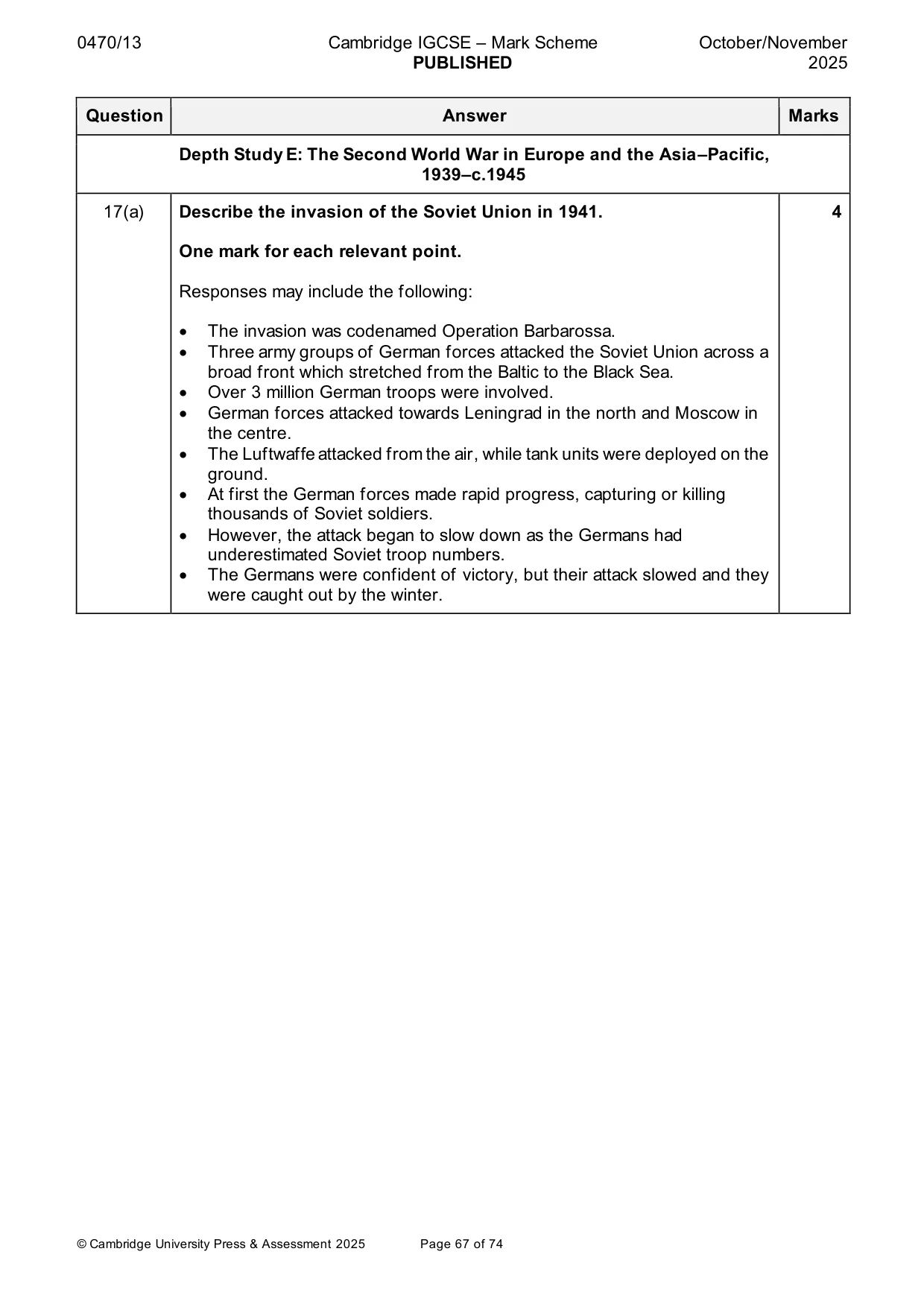
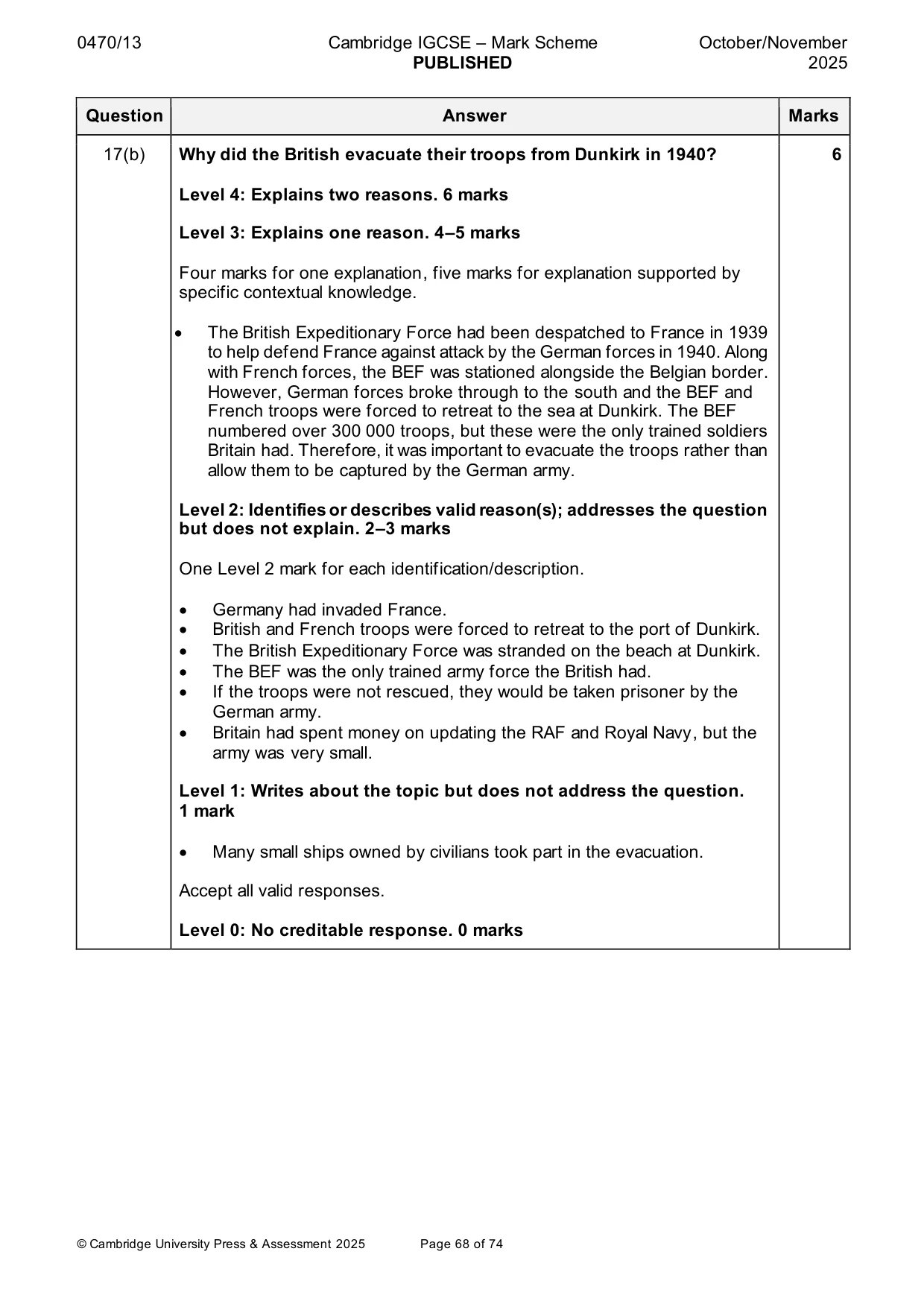
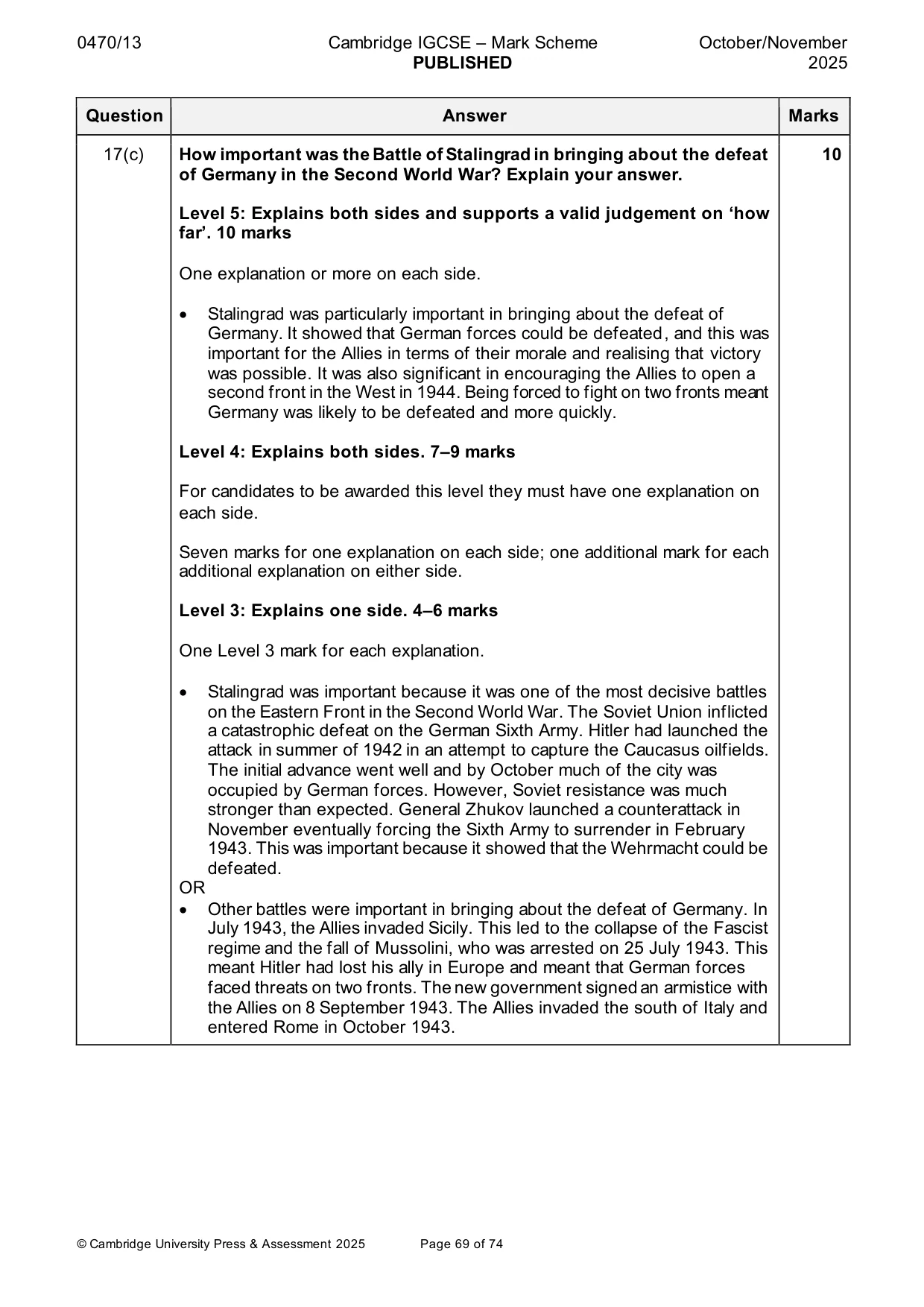
6 0470/13/O/N/25 © UCLES 2025 Depth study E: The Second World War in Europe and the Asia–Pacific, 1939–c.1945 17 At first, German forces made rapid advances across Europe. (a) Describe the invasion of the Soviet Union in 1941. [4] (b) Why did the British evacuate their troops from Dunkirk in 1940? [6] (c) How important was the Battle of Stalingrad in bringing about the defeat of Germany in the Second World War? Explain your answer. [10] 18 Civilians suffered great hardships as a result of war. (a) Describe the activities of the French resistance. [4] (b) Why did the war lead to radicalisation of Nazi policies towards the Jews? [6] (c) ‘The most important reason for Allied bombing in 1943–45 was to damage German industry.’ How far do you agree with this statement? Explain your answer. [10]
Question paper, page 7
7 0470/13/O/N/25 © UCLES 2025 BLANK PAGE
Question paper, page 8
8 0470/13/O/N/25 © UCLES 2025 Permission to reproduce items where third-party owned material protected by copyright is included has been sought and cleared where possible. Every reasonable effort has been made by the publisher (UCLES) to trace copyright holders, but if any items requiring clearance have unwittingly been included, the publisher will be pleased to make amends at the earliest possible opportunity. To avoid the issue of disclosure of answer-related information to candidates, all copyright acknowledgements are reproduced online in the Cambridge Assessment International Education Copyright Acknowledgements Booklet. This is produced for each series of examinations and is freely available to download at www.cambridgeinternational.org after the live examination series. Cambridge Assessment International Education is part of Cambridge Assessment. Cambridge Assessment is the brand name of the University of Cambridge Local Examinations Syndicate (UCLES), which is a department of the University of Cambridge. BLANK PAGE
Mark scheme, page 1
This document consists of 74 printed pages. © Cambridge University Press & Assessment 2025 [Turn over Cambridge IGCSE™ HISTORY 0470/13 Paper 1 October/November 2025 MARK SCHEME Maximum Mark: 60 Published This mark scheme is published as an aid to teachers and candidates, to indicate the requirements of the examination. It shows the basis on which Examiners were instructed to award marks. It does not indicate the details of the discussions that took place at an Examiners’ meeting before marking began, which would have considered the acceptability of alternative answers. Mark schemes should be read in conjunction with the question paper and the Principal Examiner Report for Teachers. Cambridge International will not enter into discussions about these mark schemes. Cambridge International is publishing the mark schemes for the October/November 2025 series for most Cambridge IGCSE, Cambridge International A and AS Level components, and some Cambridge O Level components.
Mark scheme, page 2
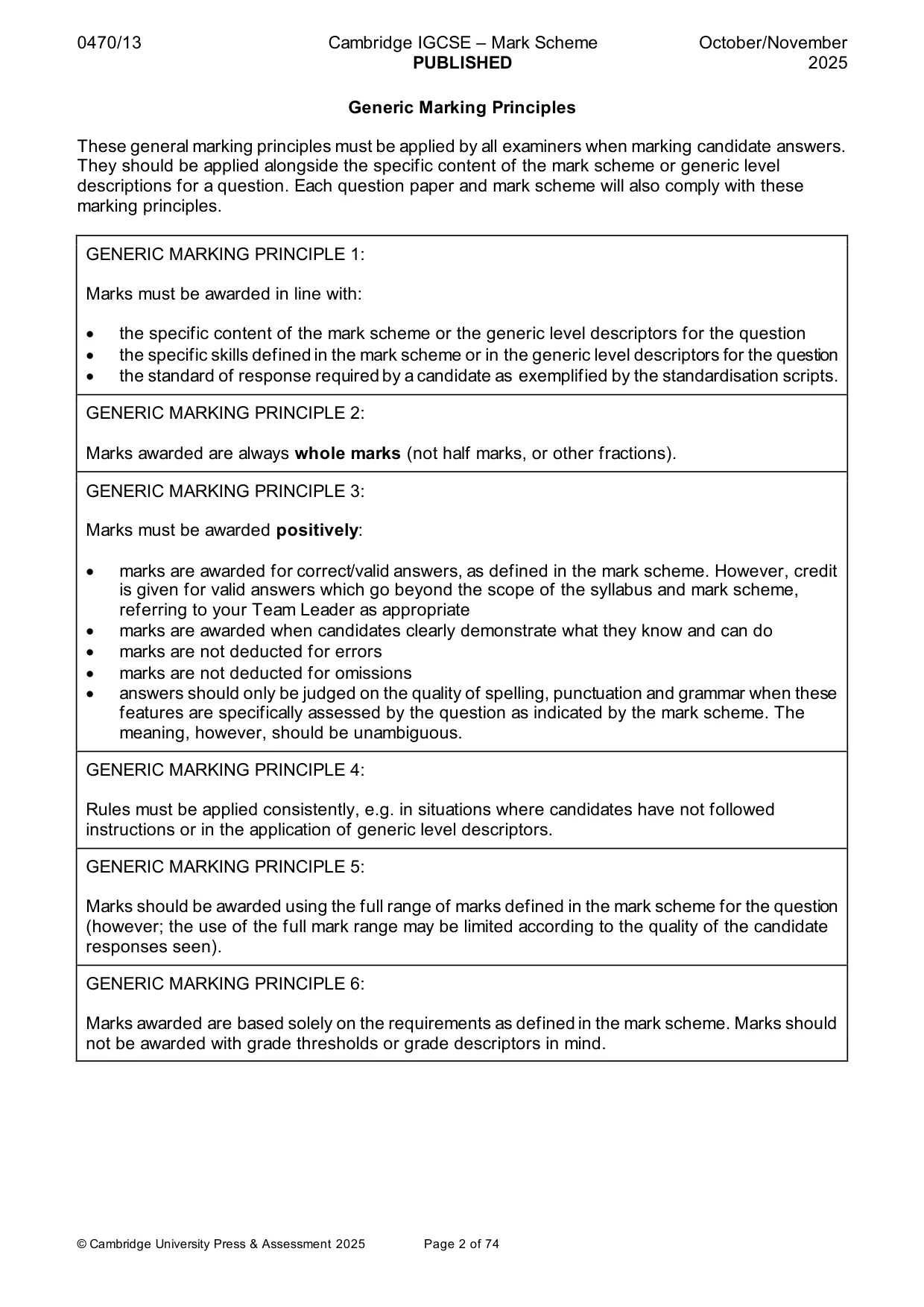
0470/13 Cambridge IGCSE – Mark Scheme PUBLISHED October/November 2025 © Cambridge University Press & Assessment 2025 Page 2 of 74 Generic Marking Principles These general marking principles must be applied by all examiners when marking candidate answers. They should be applied alongside the specific content of the mark scheme or generic level descriptions for a question. Each question paper and mark scheme will also comply with these marking principles. GENERIC MARKING PRINCIPLE 1: Marks must be awarded in line with: • the specific content of the mark scheme or the generic level descriptors for the question • the specific skills defined in the mark scheme or in the generic level descriptors for the question • the standard of response required by a candidate as exemplified by the standardisation scripts. GENERIC MARKING PRINCIPLE 2: Marks awarded are always whole marks (not half marks, or other fractions). GENERIC MARKING PRINCIPLE 3: Marks must be awarded positively: • marks are awarded for correct/valid answers, as defined in the mark scheme. However, credit is given for valid answers which go beyond the scope of the syllabus and mark scheme, referring to your Team Leader as appropriate • marks are awarded when candidates clearly demonstrate what they know and can do • marks are not deducted for errors • marks are not deducted for omissions • answers should only be judged on the quality of spelling, punctuation and grammar when these features are specifically assessed by the question as indicated by the mark scheme. The meaning, however, should be unambiguous. GENERIC MARKING PRINCIPLE 4: Rules must be applied consistently, e.g. in situations where candidates have not followed instructions or in the application of generic level descriptors. GENERIC MARKING PRINCIPLE 5: Marks should be awarded using the full range of marks defined in the mark scheme for the question (however; the use of the full mark range may be limited according to the quality of the candidate responses seen). GENERIC MARKING PRINCIPLE 6: Marks awarded are based solely on the requirements as defined in the mark scheme. Marks should not be awarded with grade thresholds or grade descriptors in mind.
Mark scheme, page 3
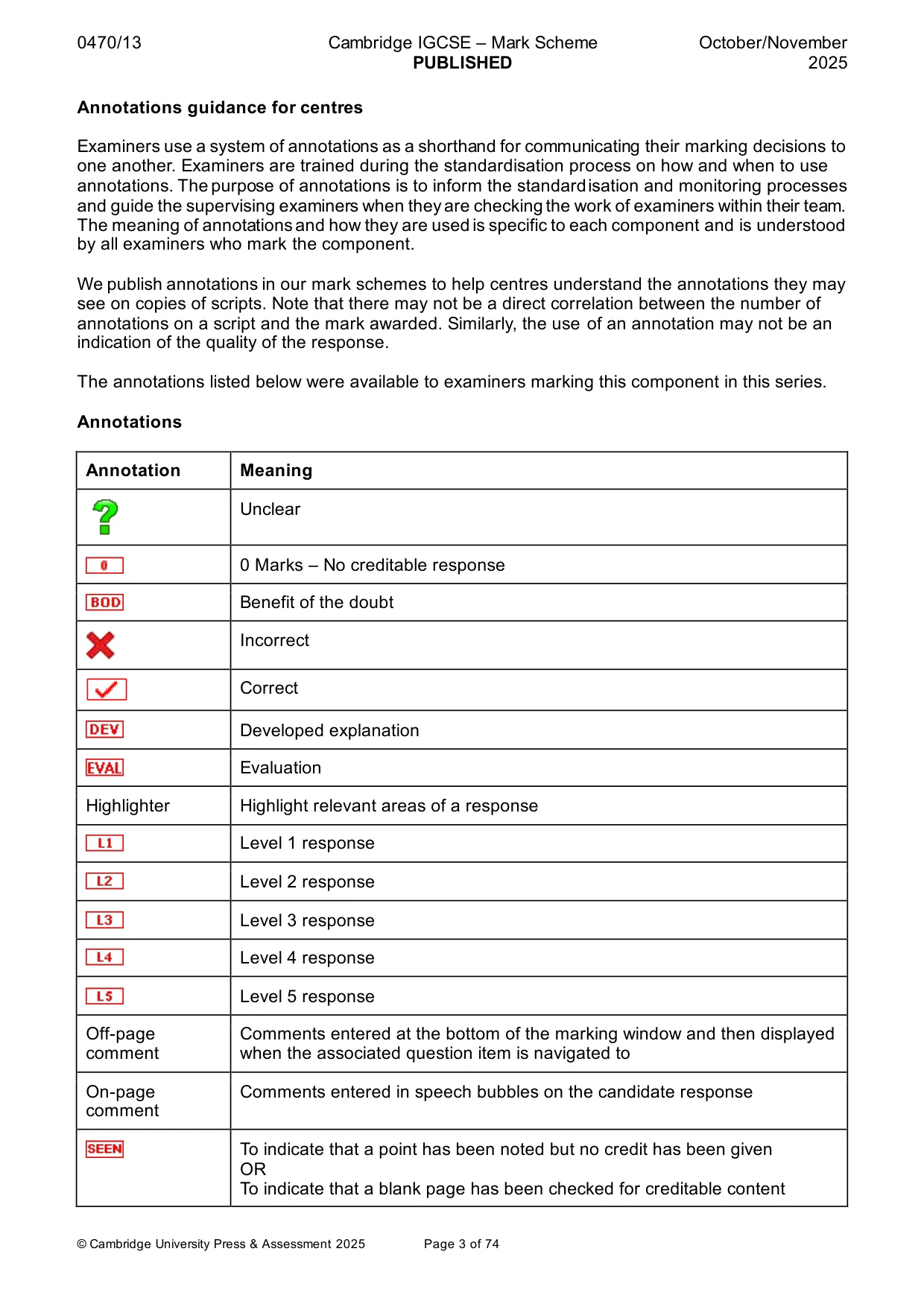
0470/13 Cambridge IGCSE – Mark Scheme PUBLISHED October/November 2025 © Cambridge University Press & Assessment 2025 Page 3 of 74 Annotations guidance for centres Examiners use a system of annotations as a shorthand for communicating their marking decisions to one another. Examiners are trained during the standardisation process on how and when to use annotations. The purpose of annotations is to inform the standardisation and monitoring processes and guide the supervising examiners when they are checking the work of examiners within their team. The meaning of annotations and how they are used is specific to each component and is understood by all examiners who mark the component. We publish annotations in our mark schemes to help centres understand the annotations they may see on copies of scripts. Note that there may not be a direct correlation between the number of annotations on a script and the mark awarded. Similarly, the use of an annotation may not be an indication of the quality of the response. The annotations listed below were available to examiners marking this component in this series. Annotations Annotation Meaning Unclear 0 Marks – No creditable response Benefit of the doubt Incorrect Correct Developed explanation Evaluation Highlighter Highlight relevant areas of a response Level 1 response Level 2 response Level 3 response Level 4 response Level 5 response Off-page comment Comments entered at the bottom of the marking window and then displayed when the associated question item is navigated to On-page comment Comments entered in speech bubbles on the candidate response To indicate that a point has been noted but no credit has been given OR To indicate that a blank page has been checked for creditable content
Mark scheme, page 4
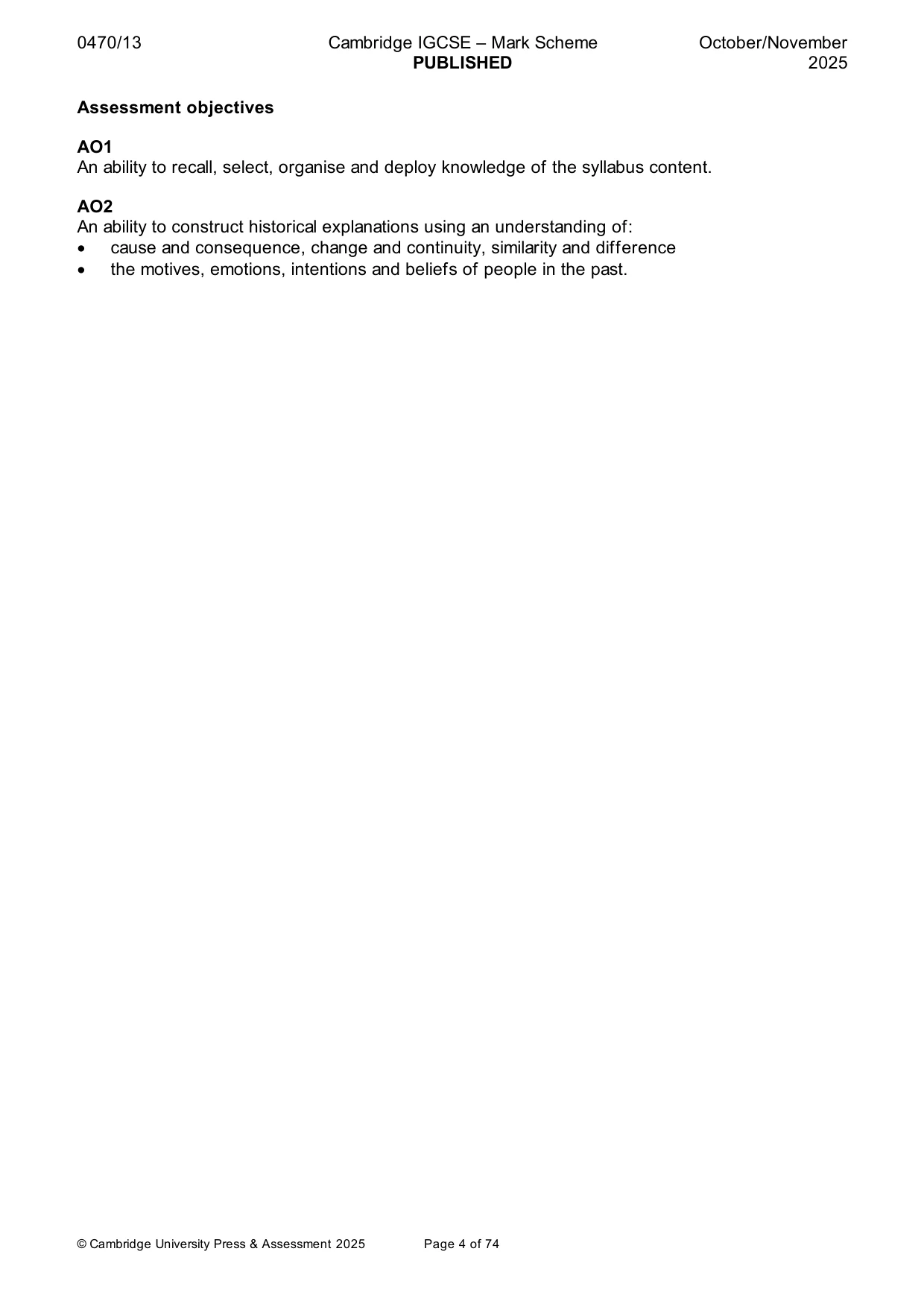
0470/13 Cambridge IGCSE – Mark Scheme PUBLISHED October/November 2025 © Cambridge University Press & Assessment 2025 Page 4 of 74 Assessment objectives AO1 An ability to recall, select, organise and deploy knowledge of the syllabus content. AO2 An ability to construct historical explanations using an understanding of: • cause and consequence, change and continuity, similarity and difference • the motives, emotions, intentions and beliefs of people in the past.
Mark scheme, page 5
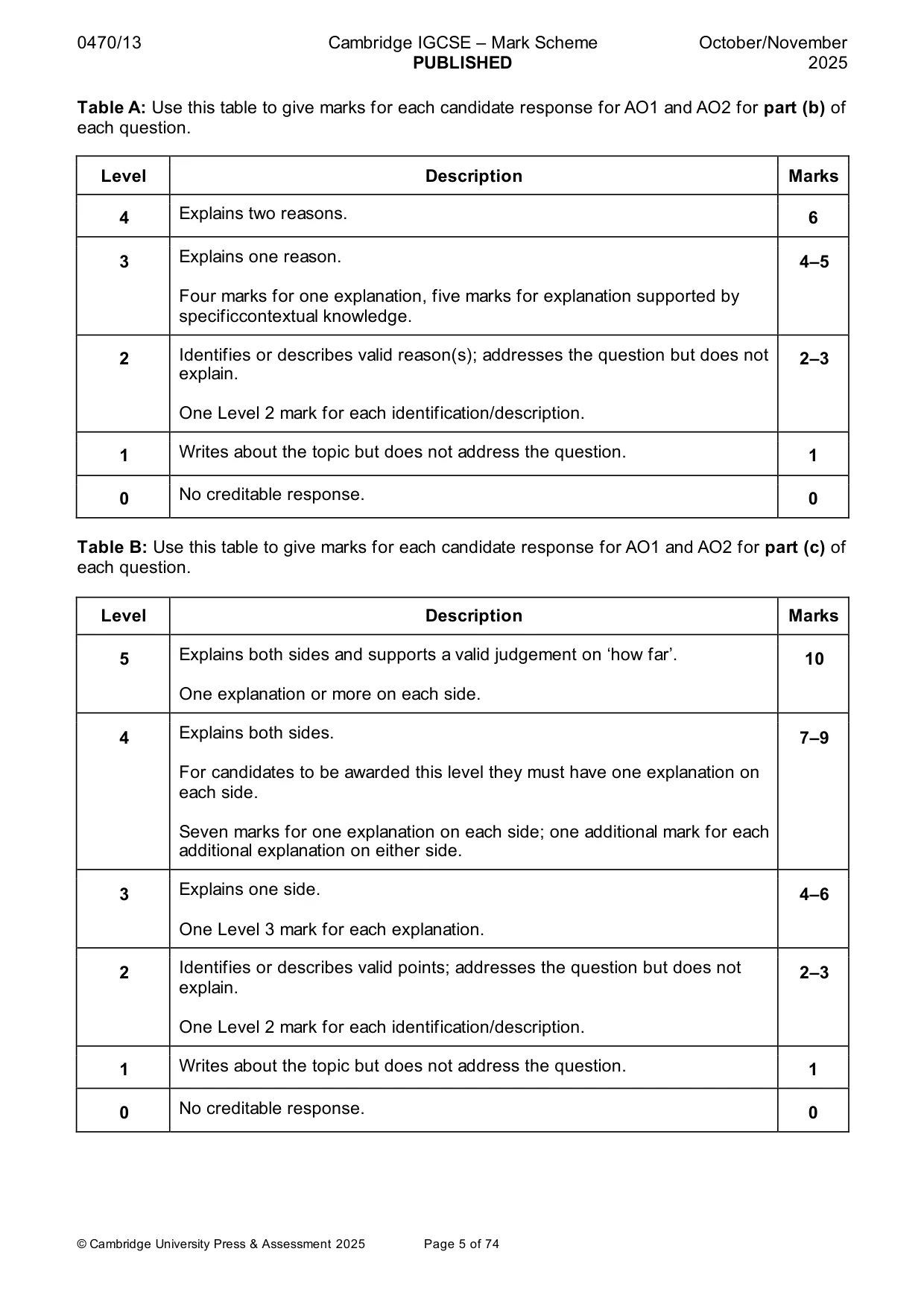
0470/13 Cambridge IGCSE – Mark Scheme PUBLISHED October/November 2025 © Cambridge University Press & Assessment 2025 Page 5 of 74 Table A: Use this table to give marks for each candidate response for AO1 and AO2 for part (b) of each question. Level Description Marks 4 Explains two reasons. 6 3 Explains one reason. Four marks for one explanation, five marks for explanation supported by specific contextual knowledge. 4–5 2 Identifies or describes valid reason(s); addresses the question but does not explain. One Level 2 mark for each identification/description. 2–3 1 Writes about the topic but does not address the question. 1 0 No creditable response. 0 Table B: Use this table to give marks for each candidate response for AO1 and AO2 for part (c) of each question. Level Description Marks 5 Explains both sides and supports a valid judgement on ‘how far’. One explanation or more on each side. 10 4 Explains both sides. For candidates to be awarded this level they must have one explanation on each side. Seven marks for one explanation on each side; one additional mark for each additional explanation on either side. 7–9 3 Explains one side. One Level 3 mark for each explanation. 4–6 2 Identifies or describes valid points; addresses the question but does not explain. One Level 2 mark for each identification/description. 2–3 1 Writes about the topic but does not address the question. 1 0 No creditable response. 0
Mark scheme, page 6
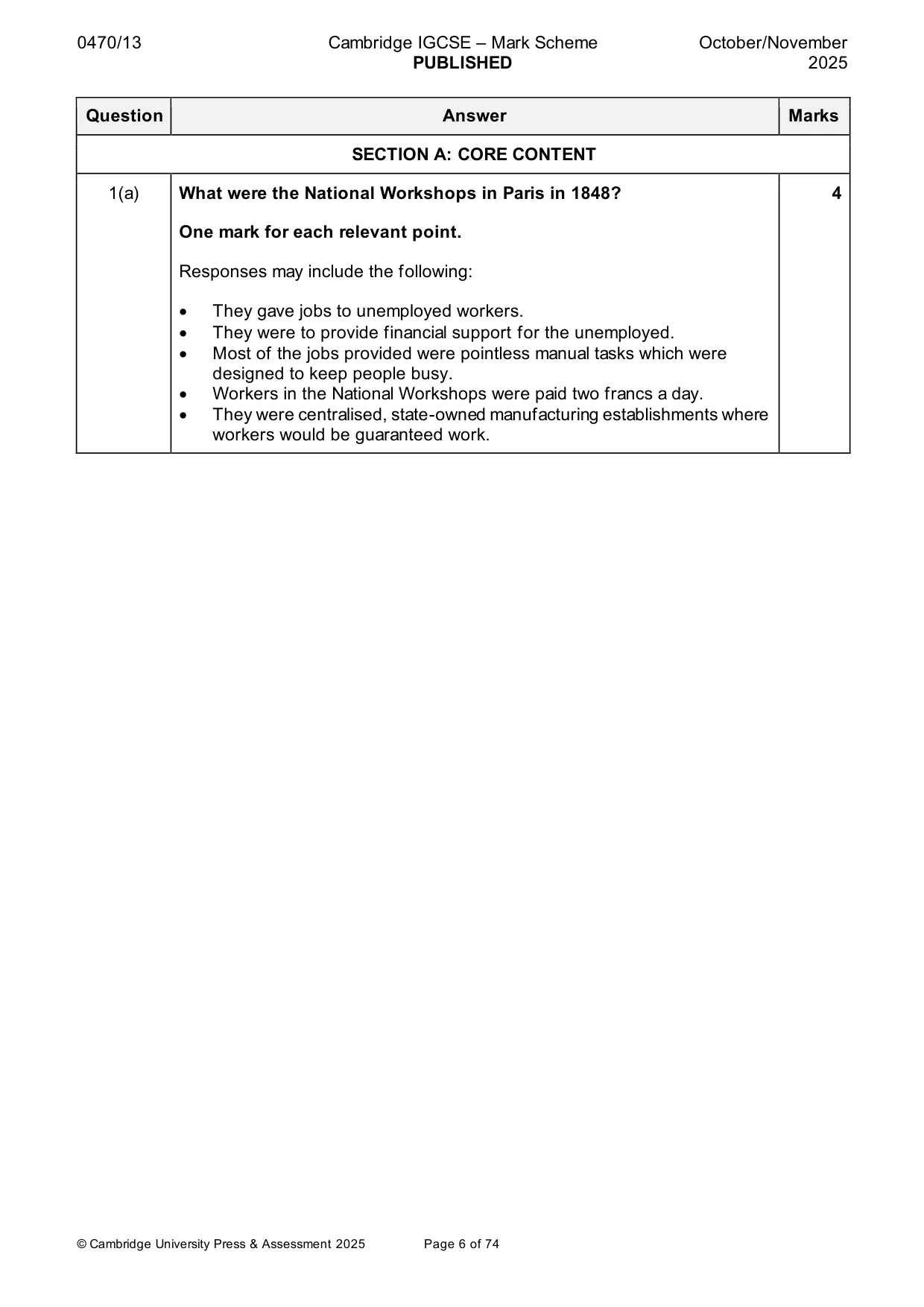
0470/13 Cambridge IGCSE – Mark Scheme PUBLISHED October/November 2025 © Cambridge University Press & Assessment 2025 Page 6 of 74 Question Answer Marks SECTION A: CORE CONTENT 1(a) What were the National Workshops in Paris in 1848? One mark for each relevant point. Responses may include the following: • They gave jobs to unemployed workers. • They were to provide financial support for the unemployed. • Most of the jobs provided were pointless manual tasks which were designed to keep people busy. • Workers in the National Workshops were paid two francs a day. • They were centralised, state-owned manufacturing establishments where workers would be guaranteed work. 4
Mark scheme, page 7
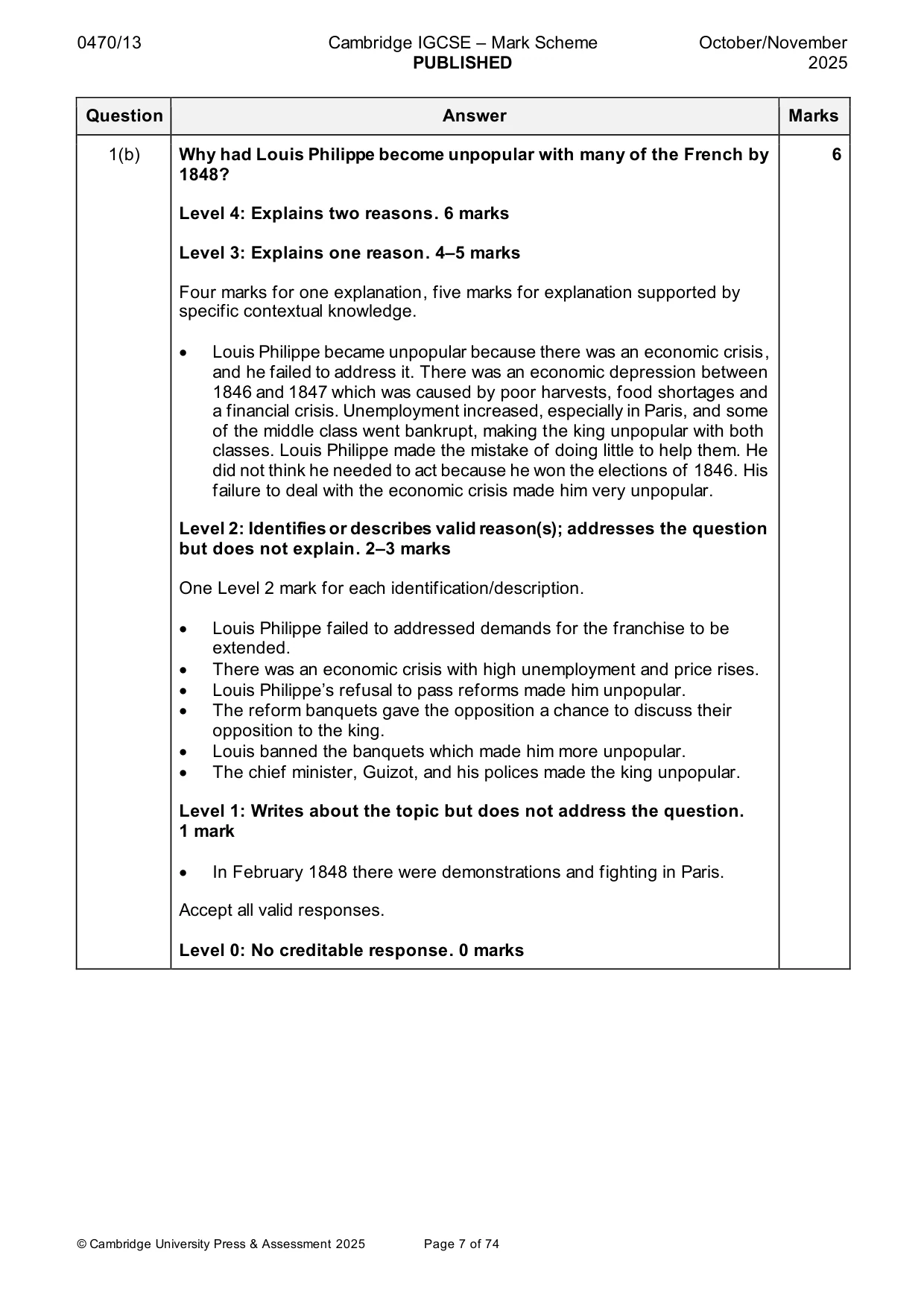
0470/13 Cambridge IGCSE – Mark Scheme PUBLISHED October/November 2025 © Cambridge University Press & Assessment 2025 Page 7 of 74 Question Answer Marks 1(b) Why had Louis Philippe become unpopular with many of the French by 1848? Level 4: Explains two reasons. 6 marks Level 3: Explains one reason. 4–5 marks Four marks for one explanation, five marks for explanation supported by specific contextual knowledge. • Louis Philippe became unpopular because there was an economic crisis, and he failed to address it. There was an economic depression between 1846 and 1847 which was caused by poor harvests, food shortages and a financial crisis. Unemployment increased, especially in Paris, and some of the middle class went bankrupt, making the king unpopular with both classes. Louis Philippe made the mistake of doing little to help them. He did not think he needed to act because he won the elections of 1846. His failure to deal with the economic crisis made him very unpopular. Level 2: Identifies or describes valid reason(s); addresses the question but does not explain. 2–3 marks One Level 2 mark for each identification/description. • Louis Philippe failed to addressed demands for the franchise to be extended. • There was an economic crisis with high unemployment and price rises. • Louis Philippe’s refusal to pass reforms made him unpopular. • The reform banquets gave the opposition a chance to discuss their opposition to the king. • Louis banned the banquets which made him more unpopular. • The chief minister, Guizot, and his polices made the king unpopular. Level 1: Writes about the topic but does not address the question. 1 mark • In February 1848 there were demonstrations and fighting in Paris. Accept all valid responses. Level 0: No creditable response. 0 marks 6
Mark scheme, page 8
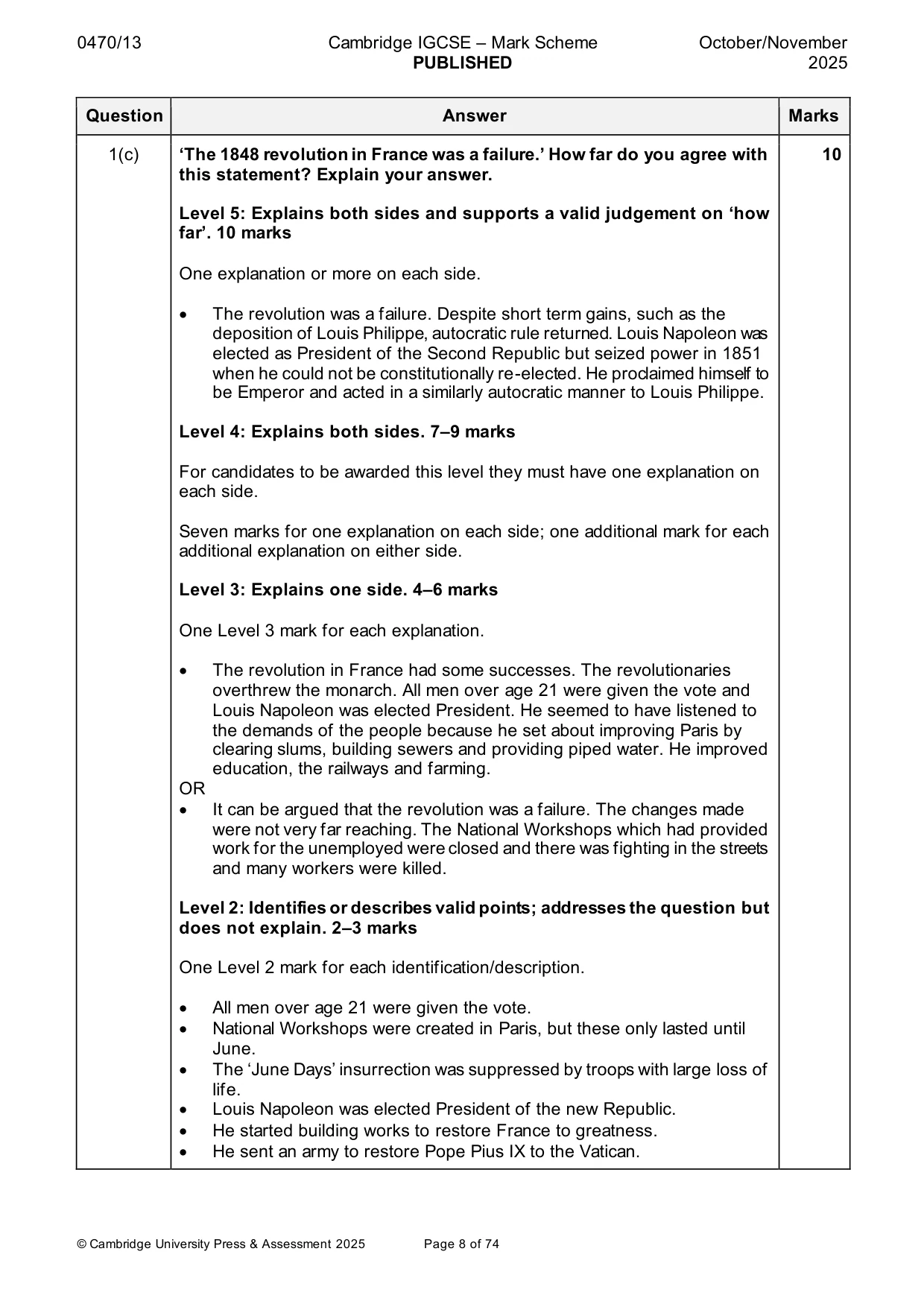
0470/13 Cambridge IGCSE – Mark Scheme PUBLISHED October/November 2025 © Cambridge University Press & Assessment 2025 Page 8 of 74 Question Answer Marks 1(c) ‘The 1848 revolution in France was a failure.’ How far do you agree with this statement? Explain your answer. Level 5: Explains both sides and supports a valid judgement on ‘how far’. 10 marks One explanation or more on each side. • The revolution was a failure. Despite short term gains, such as the deposition of Louis Philippe, autocratic rule returned. Louis Napoleon was elected as President of the Second Republic but seized power in 1851 when he could not be constitutionally re-elected. He proclaimed himself to be Emperor and acted in a similarly autocratic manner to Louis Philippe. Level 4: Explains both sides. 7–9 marks For candidates to be awarded this level they must have one explanation on each side. Seven marks for one explanation on each side; one additional mark for each additional explanation on either side. Level 3: Explains one side. 4–6 marks One Level 3 mark for each explanation. • The revolution in France had some successes. The revolutionaries overthrew the monarch. All men over age 21 were given the vote and Louis Napoleon was elected President. He seemed to have listened to the demands of the people because he set about improving Paris by clearing slums, building sewers and providing piped water. He improved education, the railways and farming. OR • It can be argued that the revolution was a failure. The changes made were not very far reaching. The National Workshops which had provided work for the unemployed were closed and there was fighting in the streets and many workers were killed. Level 2: Identifies or describes valid points; addresses the question but does not explain. 2–3 marks One Level 2 mark for each identification/description. • All men over age 21 were given the vote. • National Workshops were created in Paris, but these only lasted until June. • The ‘June Days’ insurrection was suppressed by troops with large loss of life. • Louis Napoleon was elected President of the new Republic. • He started building works to restore France to greatness. • He sent an army to restore Pope Pius IX to the Vatican. 10
Mark scheme, page 9
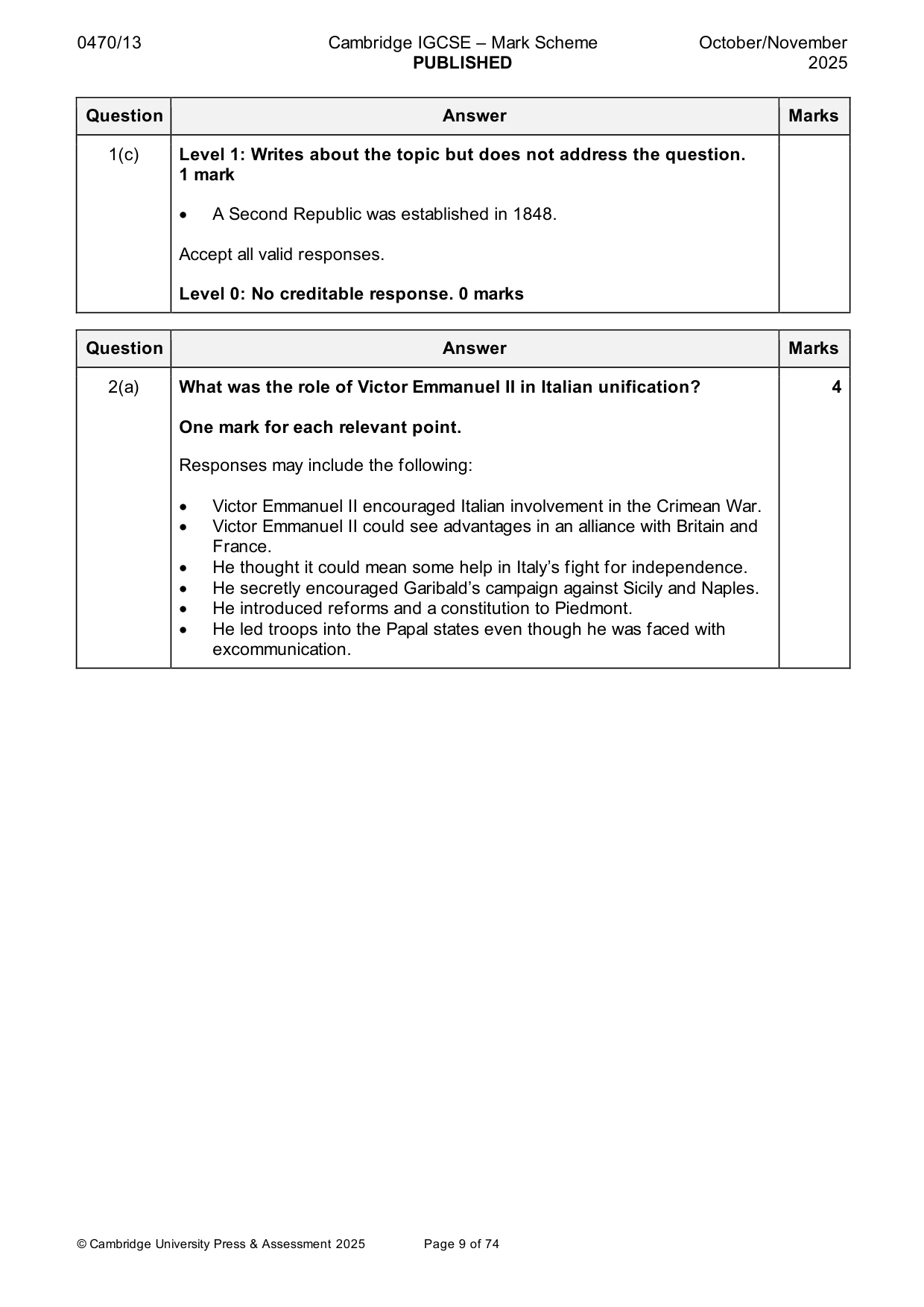
0470/13 Cambridge IGCSE – Mark Scheme PUBLISHED October/November 2025 © Cambridge University Press & Assessment 2025 Page 9 of 74 Question Answer Marks 1(c) Level 1: Writes about the topic but does not address the question. 1 mark • A Second Republic was established in 1848. Accept all valid responses. Level 0: No creditable response. 0 marks Question Answer Marks 2(a) What was the role of Victor Emmanuel II in Italian unification? One mark for each relevant point. Responses may include the following: • Victor Emmanuel II encouraged Italian involvement in the Crimean War. • Victor Emmanuel II could see advantages in an alliance with Britain and France. • He thought it could mean some help in Italy’s fight for independence. • He secretly encouraged Garibald’s campaign against Sicily and Naples. • He introduced reforms and a constitution to Piedmont. • He led troops into the Papal states even though he was faced with excommunication. 4
Mark scheme, page 10
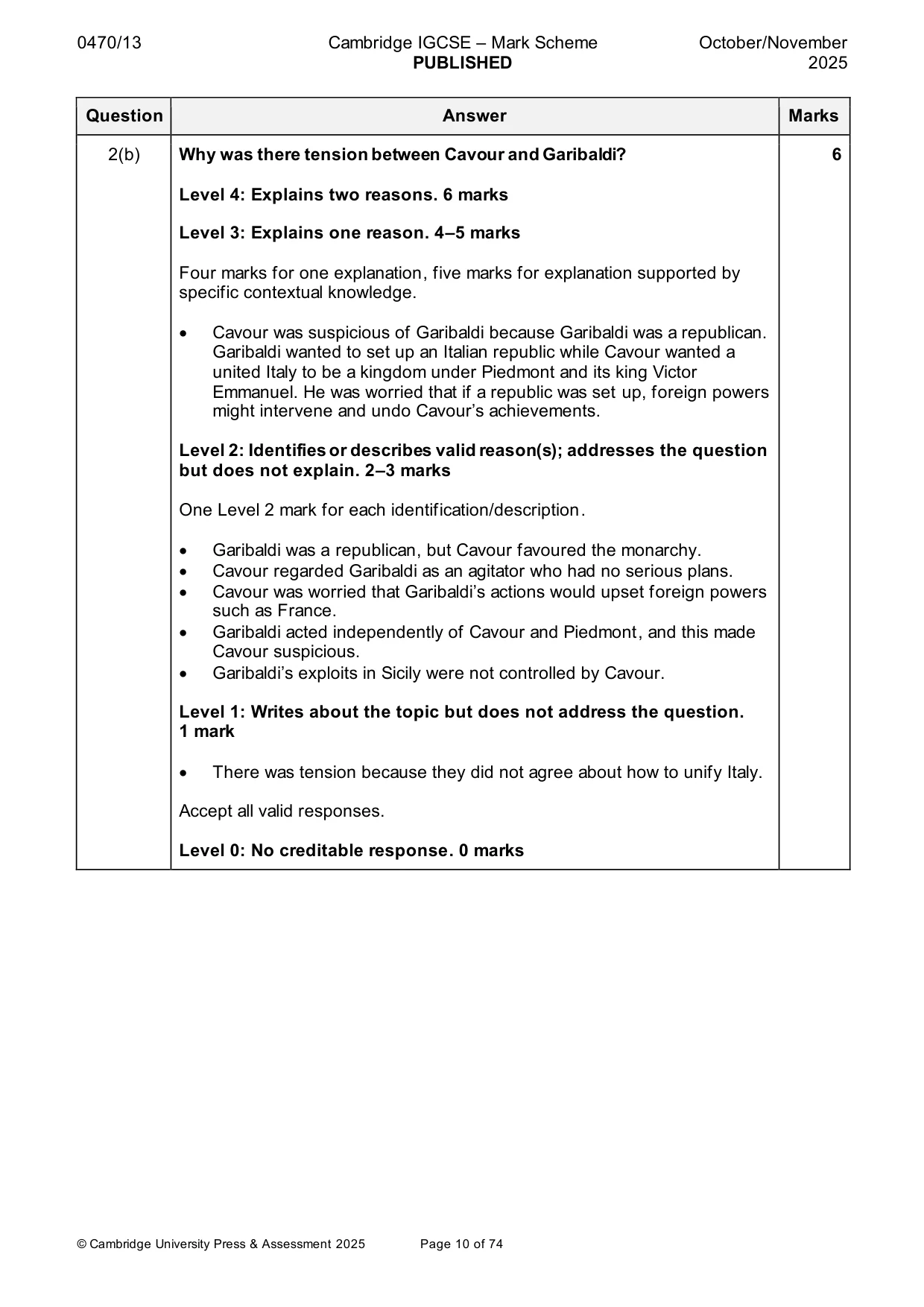
0470/13 Cambridge IGCSE – Mark Scheme PUBLISHED October/November 2025 © Cambridge University Press & Assessment 2025 Page 10 of 74 Question Answer Marks 2(b) Why was there tension between Cavour and Garibaldi? Level 4: Explains two reasons. 6 marks Level 3: Explains one reason. 4–5 marks Four marks for one explanation, five marks for explanation supported by specific contextual knowledge. • Cavour was suspicious of Garibaldi because Garibaldi was a republican. Garibaldi wanted to set up an Italian republic while Cavour wanted a united Italy to be a kingdom under Piedmont and its king Victor Emmanuel. He was worried that if a republic was set up, foreign powers might intervene and undo Cavour’s achievements. Level 2: Identifies or describes valid reason(s); addresses the question but does not explain. 2–3 marks One Level 2 mark for each identification/description. • Garibaldi was a republican, but Cavour favoured the monarchy. • Cavour regarded Garibaldi as an agitator who had no serious plans. • Cavour was worried that Garibaldi’s actions would upset foreign powers such as France. • Garibaldi acted independently of Cavour and Piedmont, and this made Cavour suspicious. • Garibaldi’s exploits in Sicily were not controlled by Cavour. Level 1: Writes about the topic but does not address the question. 1 mark • There was tension because they did not agree about how to unify Italy. Accept all valid responses. Level 0: No creditable response. 0 marks 6
Mark scheme, page 11
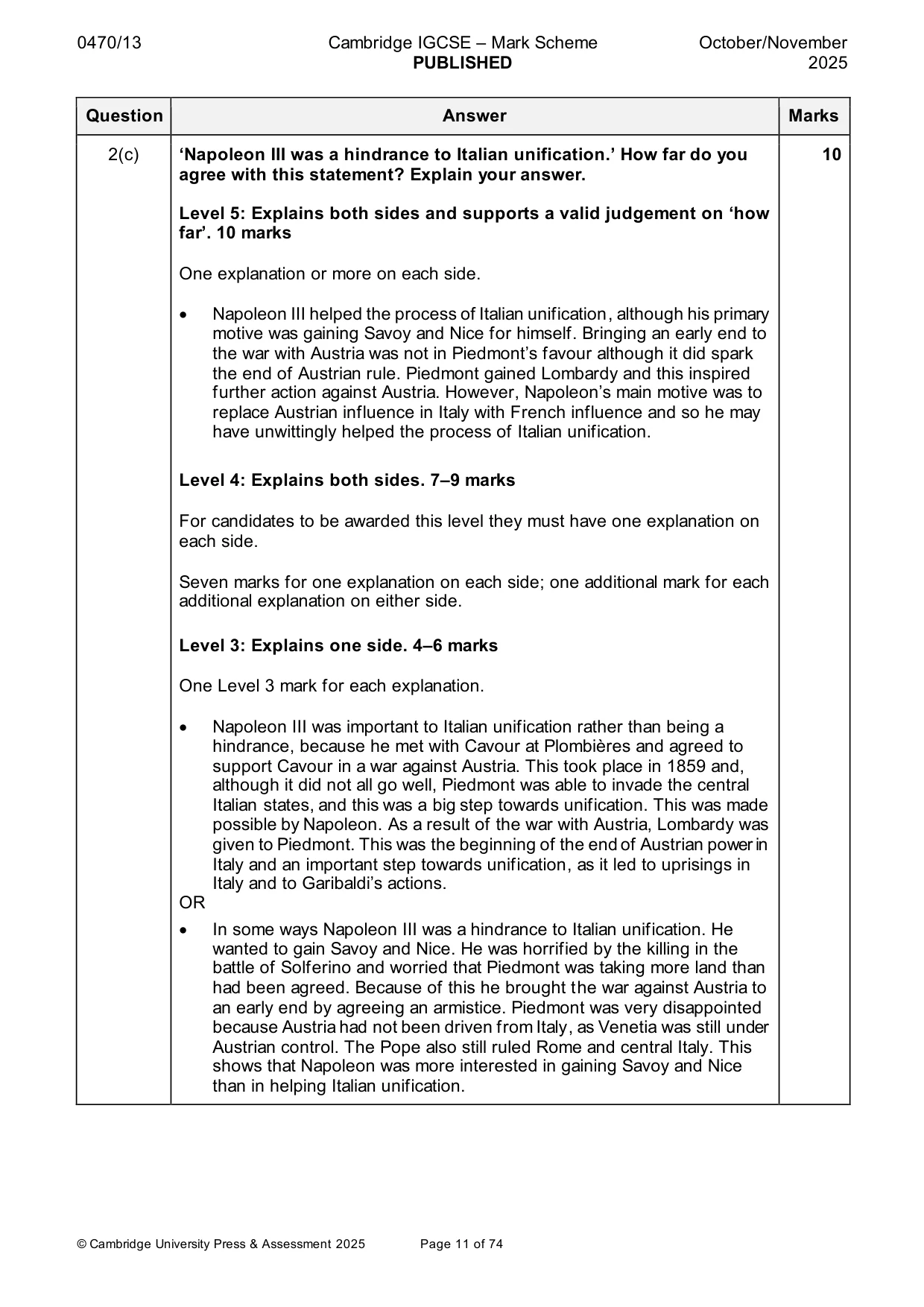
0470/13 Cambridge IGCSE – Mark Scheme PUBLISHED October/November 2025 © Cambridge University Press & Assessment 2025 Page 11 of 74 Question Answer Marks 2(c) ‘Napoleon III was a hindrance to Italian unification.’ How far do you agree with this statement? Explain your answer. Level 5: Explains both sides and supports a valid judgement on ‘how far’. 10 marks One explanation or more on each side. • Napoleon III helped the process of Italian unification, although his primary motive was gaining Savoy and Nice for himself. Bringing an early end to the war with Austria was not in Piedmont’s favour although it did spark the end of Austrian rule. Piedmont gained Lombardy and this inspired further action against Austria. However, Napoleon’s main motive was to replace Austrian influence in Italy with French influence and so he may have unwittingly helped the process of Italian unification. Level 4: Explains both sides. 7–9 marks For candidates to be awarded this level they must have one explanation on each side. Seven marks for one explanation on each side; one additional mark for each additional explanation on either side. Level 3: Explains one side. 4–6 marks One Level 3 mark for each explanation. • Napoleon III was important to Italian unification rather than being a hindrance, because he met with Cavour at Plombières and agreed to support Cavour in a war against Austria. This took place in 1859 and, although it did not all go well, Piedmont was able to invade the central Italian states, and this was a big step towards unification. This was made possible by Napoleon. As a result of the war with Austria, Lombardy was given to Piedmont. This was the beginning of the end of Austrian power in Italy and an important step towards unification, as it led to uprisings in Italy and to Garibaldi’s actions. OR • In some ways Napoleon III was a hindrance to Italian unification. He wanted to gain Savoy and Nice. He was horrified by the killing in the battle of Solferino and worried that Piedmont was taking more land than had been agreed. Because of this he brought the war against Austria to an early end by agreeing an armistice. Piedmont was very disappointed because Austria had not been driven from Italy, as Venetia was still under Austrian control. The Pope also still ruled Rome and central Italy. This shows that Napoleon was more interested in gaining Savoy and Nice than in helping Italian unification. 10
Mark scheme, page 12
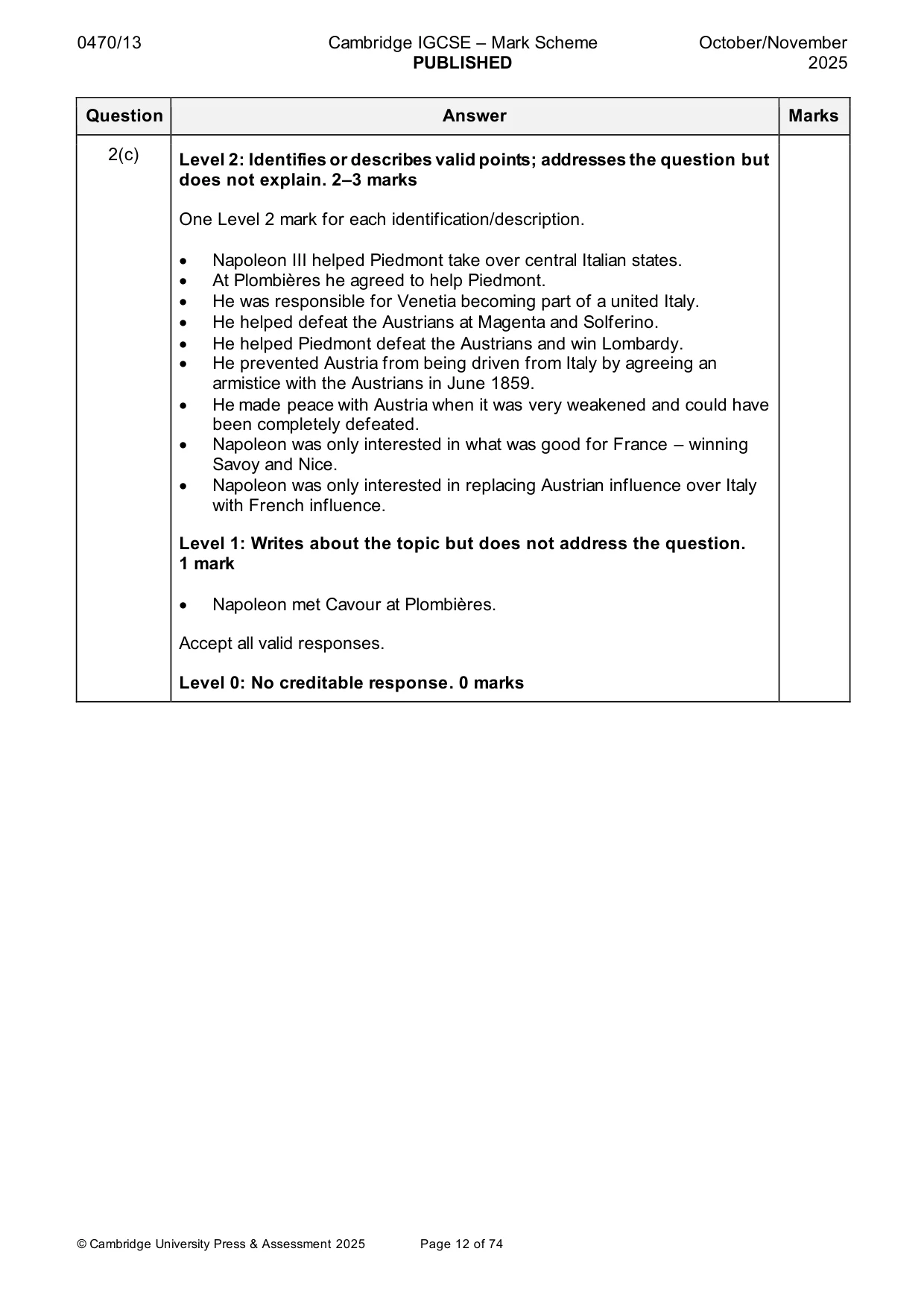
0470/13 Cambridge IGCSE – Mark Scheme PUBLISHED October/November 2025 © Cambridge University Press & Assessment 2025 Page 12 of 74 Question Answer Marks 2(c) Level 2: Identifies or describes valid points; addresses the question but does not explain. 2–3 marks One Level 2 mark for each identification/description. • Napoleon III helped Piedmont take over central Italian states. • At Plombières he agreed to help Piedmont. • He was responsible for Venetia becoming part of a united Italy. • He helped defeat the Austrians at Magenta and Solferino. • He helped Piedmont defeat the Austrians and win Lombardy. • He prevented Austria from being driven from Italy by agreeing an armistice with the Austrians in June 1859. • He made peace with Austria when it was very weakened and could have been completely defeated. • Napoleon was only interested in what was good for France – winning Savoy and Nice. • Napoleon was only interested in replacing Austrian influence over Italy with French influence. Level 1: Writes about the topic but does not address the question. 1 mark • Napoleon met Cavour at Plombières. Accept all valid responses. Level 0: No creditable response. 0 marks
Mark scheme, page 13
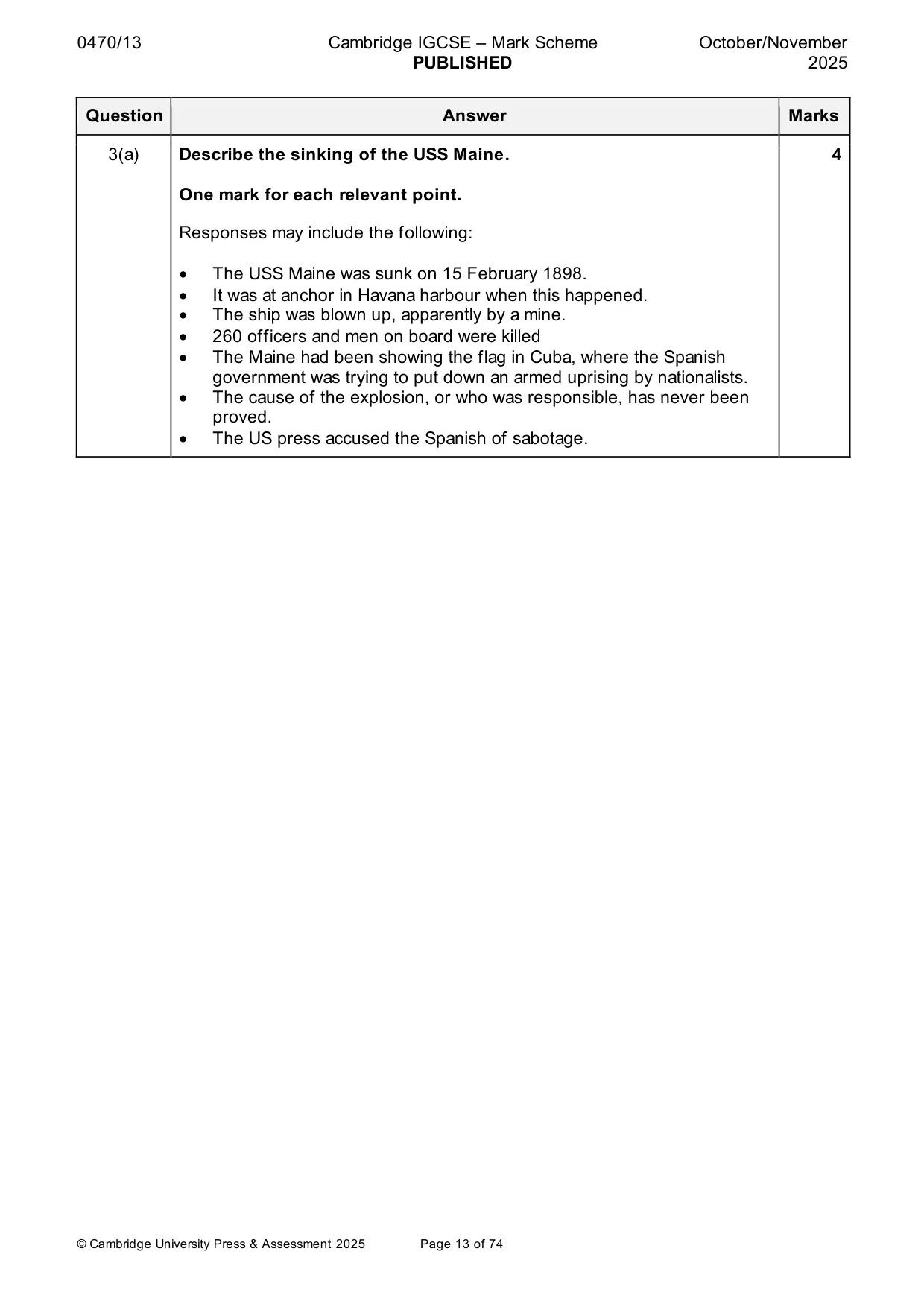
0470/13 Cambridge IGCSE – Mark Scheme PUBLISHED October/November 2025 © Cambridge University Press & Assessment 2025 Page 13 of 74 Question Answer Marks 3(a) Describe the sinking of the USS Maine. One mark for each relevant point. Responses may include the following: • The USS Maine was sunk on 15 February 1898. • It was at anchor in Havana harbour when this happened. • The ship was blown up, apparently by a mine. • 260 officers and men on board were killed • The Maine had been showing the flag in Cuba, where the Spanish government was trying to put down an armed uprising by nationalists. • The cause of the explosion, or who was responsible, has never been proved. • The US press accused the Spanish of sabotage. 4
Mark scheme, page 14
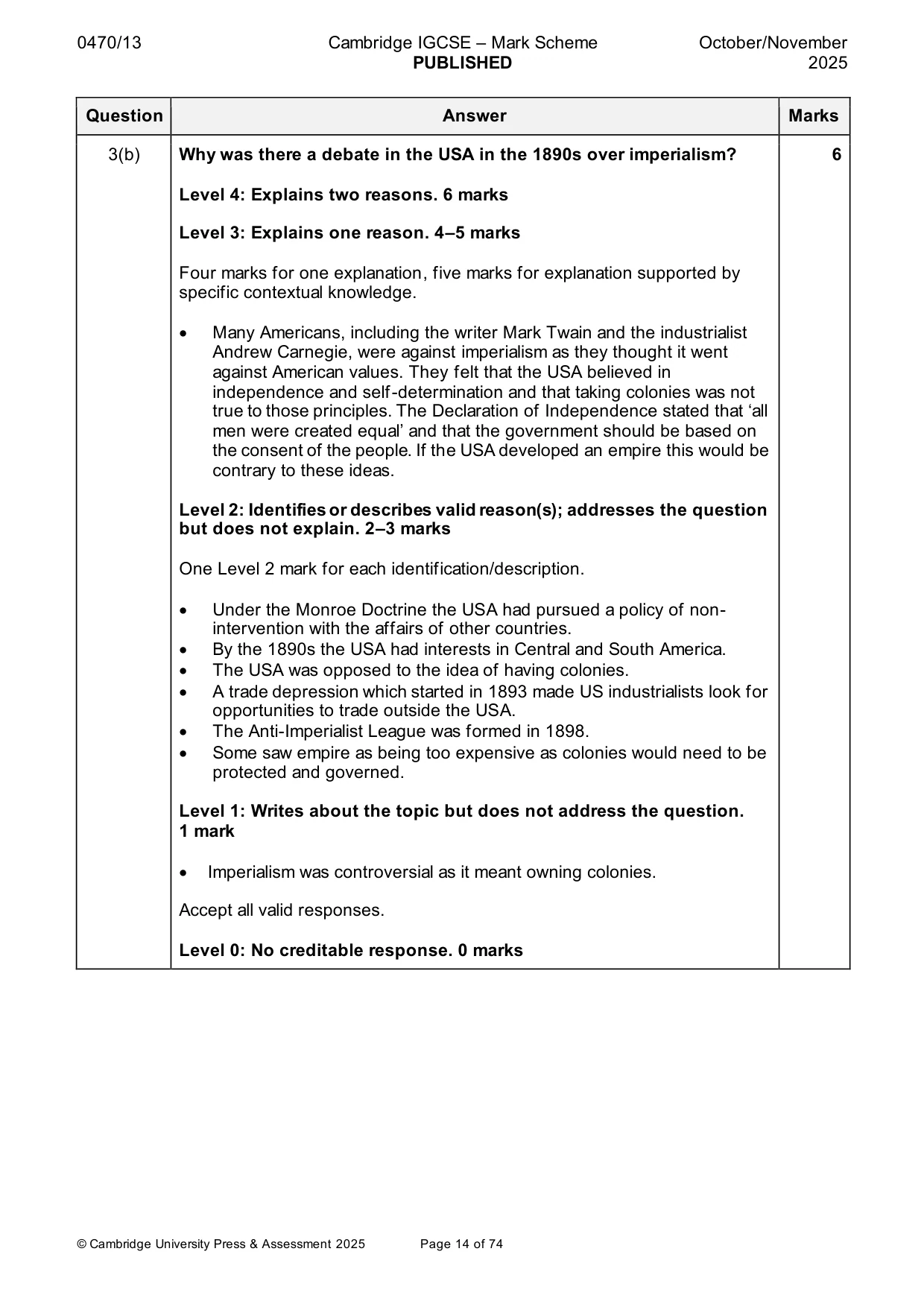
0470/13 Cambridge IGCSE – Mark Scheme PUBLISHED October/November 2025 © Cambridge University Press & Assessment 2025 Page 14 of 74 Question Answer Marks 3(b) Why was there a debate in the USA in the 1890s over imperialism? Level 4: Explains two reasons. 6 marks Level 3: Explains one reason. 4–5 marks Four marks for one explanation, five marks for explanation supported by specific contextual knowledge. • Many Americans, including the writer Mark Twain and the industrialist Andrew Carnegie, were against imperialism as they thought it went against American values. They felt that the USA believed in independence and self-determination and that taking colonies was not true to those principles. The Declaration of Independence stated that ‘all men were created equal’ and that the government should be based on the consent of the people. If the USA developed an empire this would be contrary to these ideas. Level 2: Identifies or describes valid reason(s); addresses the question but does not explain. 2–3 marks One Level 2 mark for each identification/description. • Under the Monroe Doctrine the USA had pursued a policy of non- intervention with the affairs of other countries. • By the 1890s the USA had interests in Central and South America. • The USA was opposed to the idea of having colonies. • A trade depression which started in 1893 made US industrialists look for opportunities to trade outside the USA. • The Anti-Imperialist League was formed in 1898. • Some saw empire as being too expensive as colonies would need to be protected and governed. Level 1: Writes about the topic but does not address the question. 1 mark • Imperialism was controversial as it meant owning colonies. Accept all valid responses. Level 0: No creditable response. 0 marks 6
Mark scheme, page 15
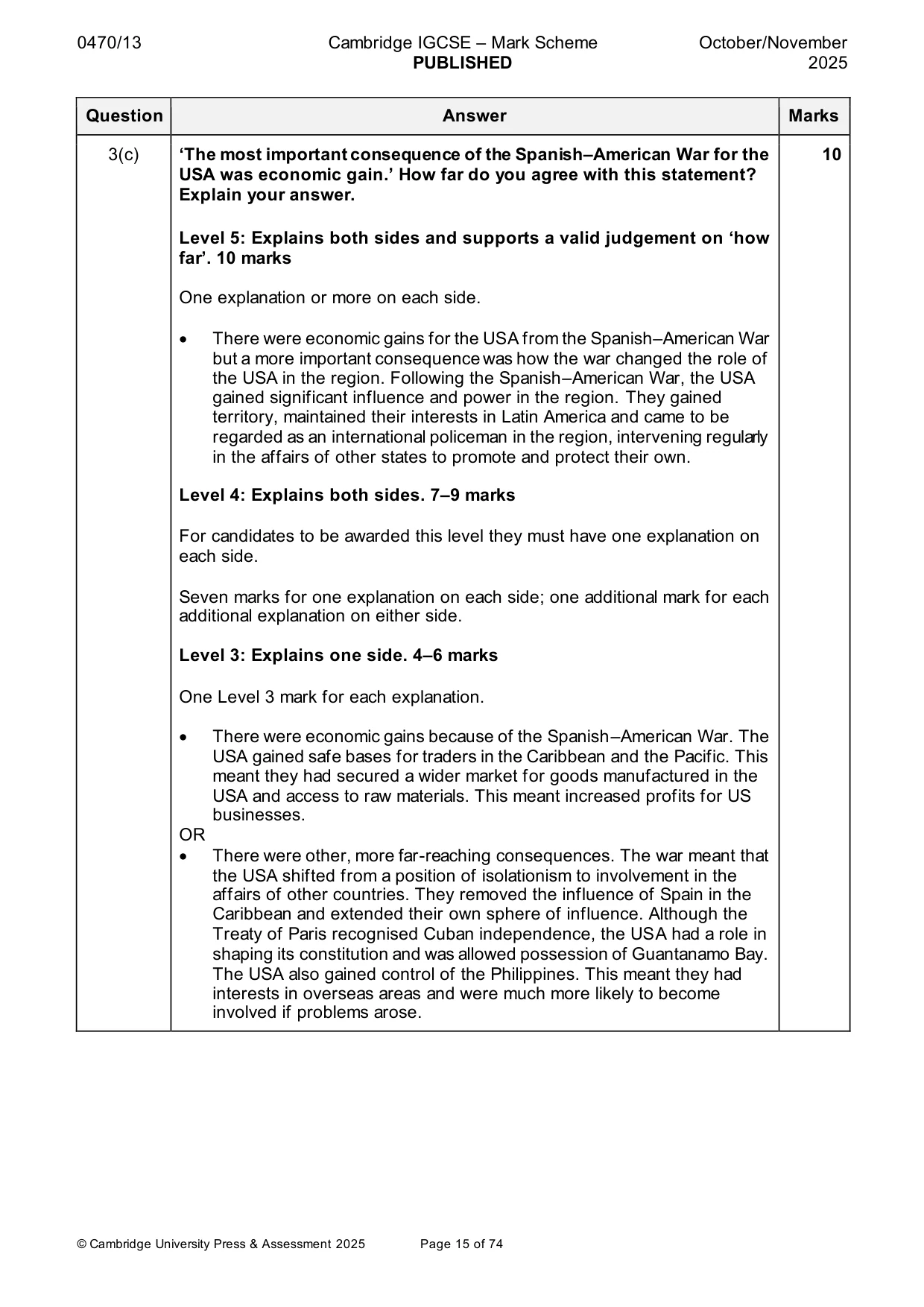
0470/13 Cambridge IGCSE – Mark Scheme PUBLISHED October/November 2025 © Cambridge University Press & Assessment 2025 Page 15 of 74 Question Answer Marks 3(c) ‘The most important consequence of the Spanish–American War for the USA was economic gain.’ How far do you agree with this statement? Explain your answer. Level 5: Explains both sides and supports a valid judgement on ‘how far’. 10 marks One explanation or more on each side. • There were economic gains for the USA from the Spanish–American War but a more important consequence was how the war changed the role of the USA in the region. Following the Spanish–American War, the USA gained significant influence and power in the region. They gained territory, maintained their interests in Latin America and came to be regarded as an international policeman in the region, intervening regularly in the affairs of other states to promote and protect their own. Level 4: Explains both sides. 7–9 marks For candidates to be awarded this level they must have one explanation on each side. Seven marks for one explanation on each side; one additional mark for each additional explanation on either side. Level 3: Explains one side. 4–6 marks One Level 3 mark for each explanation. • There were economic gains because of the Spanish–American War. The USA gained safe bases for traders in the Caribbean and the Pacific. This meant they had secured a wider market for goods manufactured in the USA and access to raw materials. This meant increased profits for US businesses. OR • There were other, more far-reaching consequences. The war meant that the USA shifted from a position of isolationism to involvement in the affairs of other countries. They removed the influence of Spain in the Caribbean and extended their own sphere of influence. Although the Treaty of Paris recognised Cuban independence, the USA had a role in shaping its constitution and was allowed possession of Guantanamo Bay. The USA also gained control of the Philippines. This meant they had interests in overseas areas and were much more likely to become involved if problems arose. 10
Mark scheme, page 16
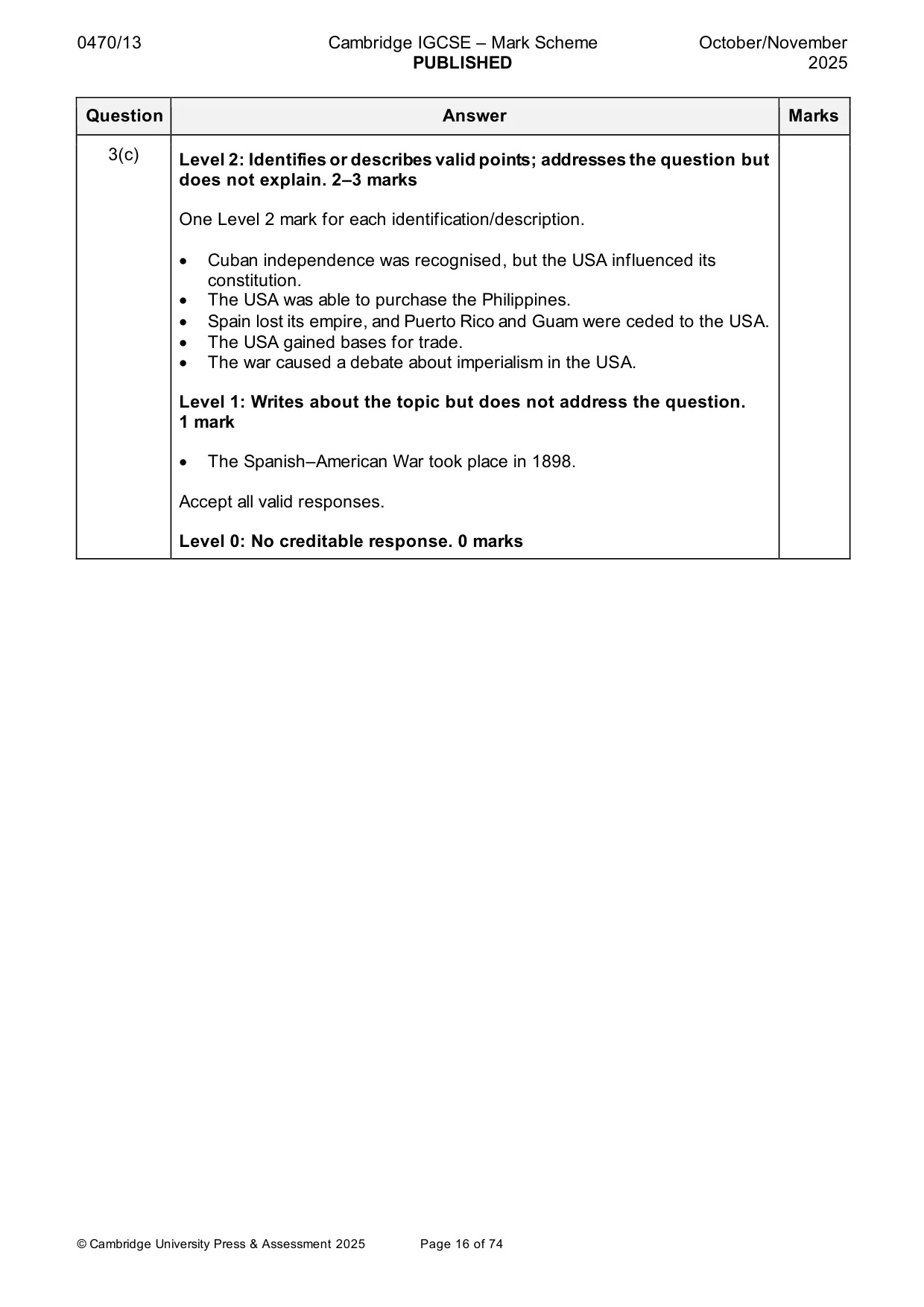
0470/13 Cambridge IGCSE – Mark Scheme PUBLISHED October/November 2025 © Cambridge University Press & Assessment 2025 Page 16 of 74 Question Answer Marks 3(c) Level 2: Identifies or describes valid points; addresses the question but does not explain. 2–3 marks One Level 2 mark for each identification/description. • Cuban independence was recognised, but the USA influenced its constitution. • The USA was able to purchase the Philippines. • Spain lost its empire, and Puerto Rico and Guam were ceded to the USA. • The USA gained bases for trade. • The war caused a debate about imperialism in the USA. Level 1: Writes about the topic but does not address the question. 1 mark • The Spanish–American War took place in 1898. Accept all valid responses. Level 0: No creditable response. 0 marks
Mark scheme, page 17
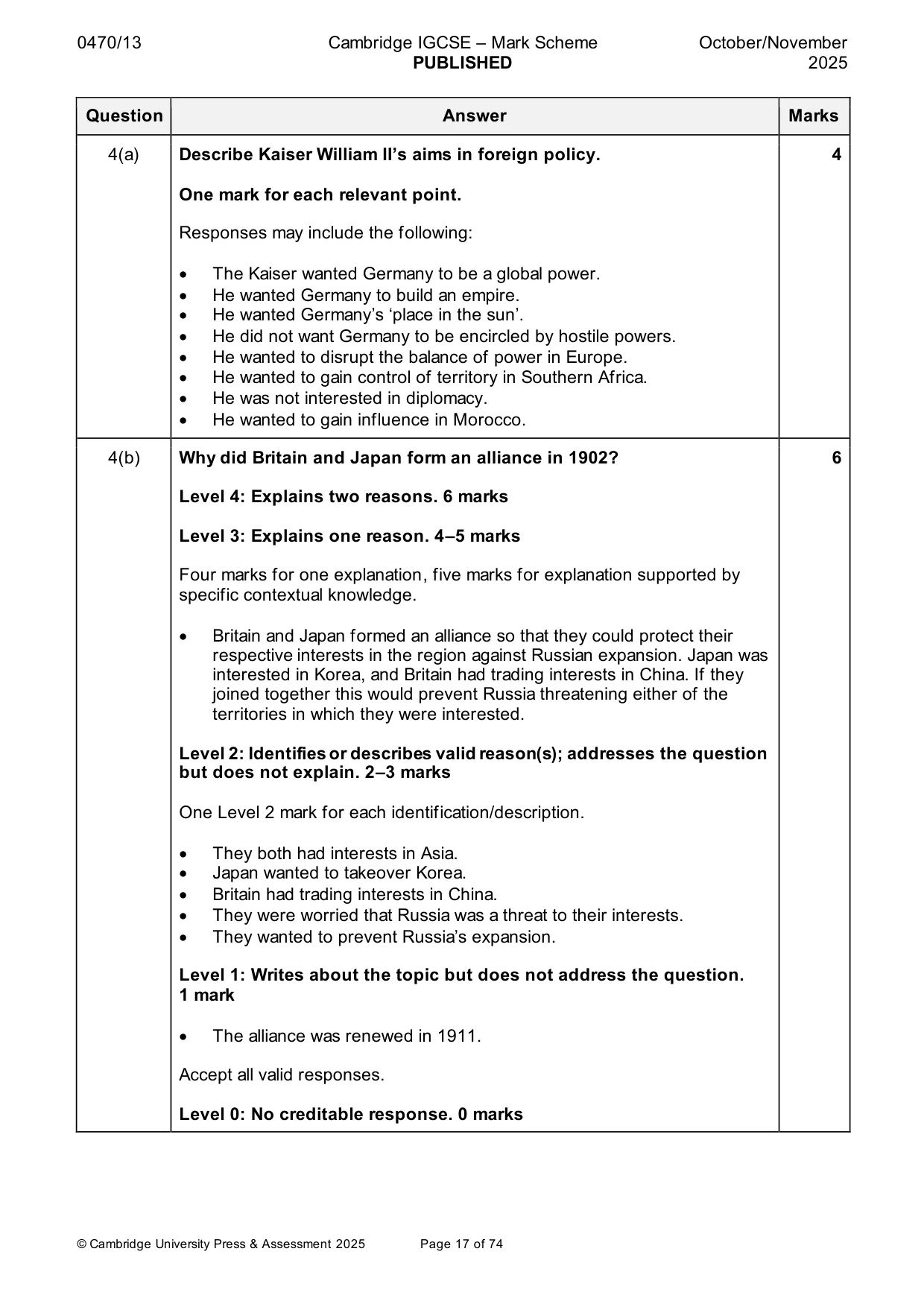
0470/13 Cambridge IGCSE – Mark Scheme PUBLISHED October/November 2025 © Cambridge University Press & Assessment 2025 Page 17 of 74 Question Answer Marks 4(a) Describe Kaiser William II’s aims in foreign policy. One mark for each relevant point. Responses may include the following: • The Kaiser wanted Germany to be a global power. • He wanted Germany to build an empire. • He wanted Germany’s ‘place in the sun’. • He did not want Germany to be encircled by hostile powers. • He wanted to disrupt the balance of power in Europe. • He wanted to gain control of territory in Southern Africa. • He was not interested in diplomacy. • He wanted to gain influence in Morocco. 4 4(b) Why did Britain and Japan form an alliance in 1902? Level 4: Explains two reasons. 6 marks Level 3: Explains one reason. 4–5 marks Four marks for one explanation, five marks for explanation supported by specific contextual knowledge. • Britain and Japan formed an alliance so that they could protect their respective interests in the region against Russian expansion. Japan was interested in Korea, and Britain had trading interests in China. If they joined together this would prevent Russia threatening either of the territories in which they were interested. Level 2: Identifies or describes valid reason(s); addresses the question but does not explain. 2–3 marks One Level 2 mark for each identification/description. • They both had interests in Asia. • Japan wanted to takeover Korea. • Britain had trading interests in China. • They were worried that Russia was a threat to their interests. • They wanted to prevent Russia’s expansion. Level 1: Writes about the topic but does not address the question. 1 mark • The alliance was renewed in 1911. Accept all valid responses. Level 0: No creditable response. 0 marks 6
Mark scheme, page 18
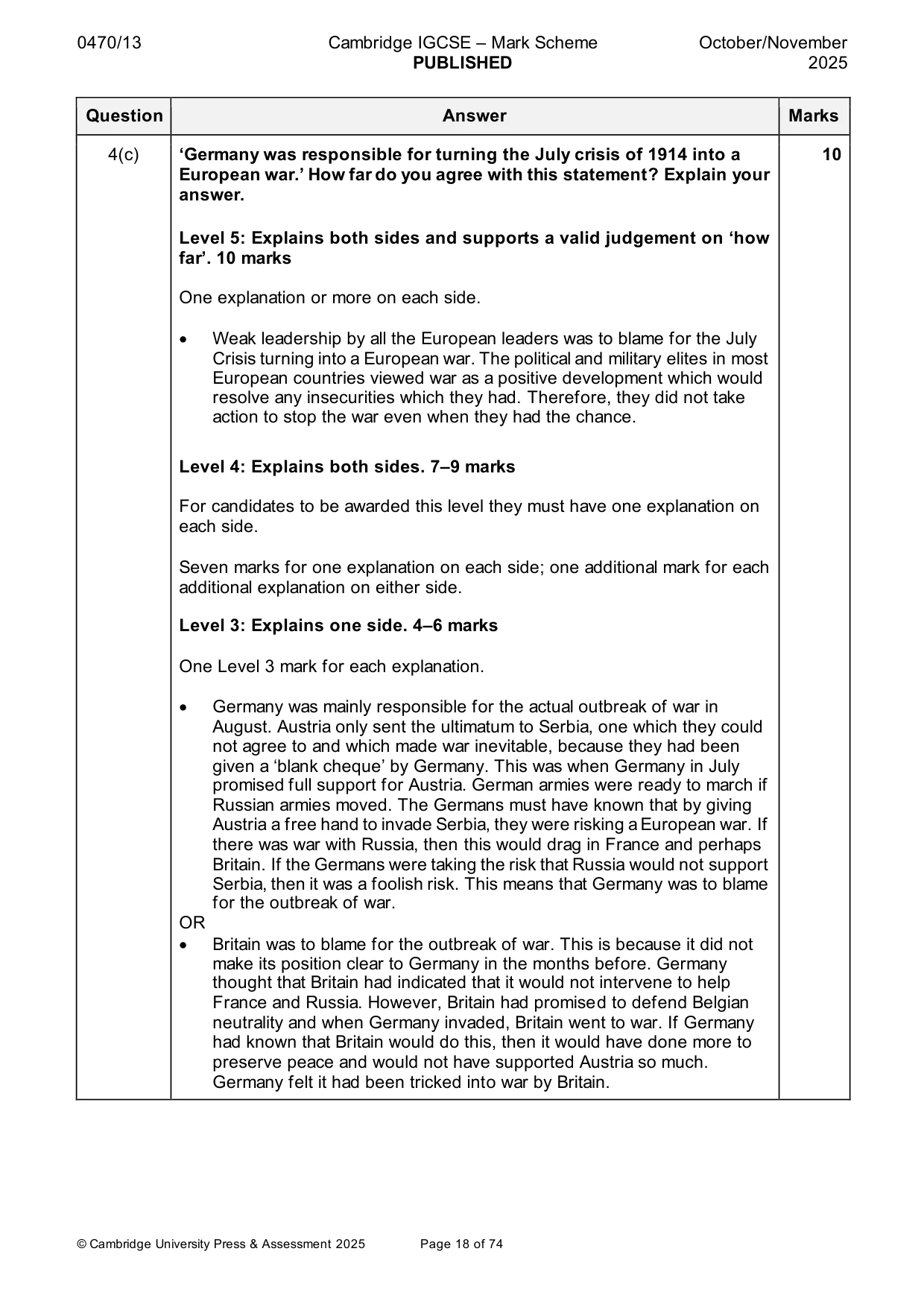
0470/13 Cambridge IGCSE – Mark Scheme PUBLISHED October/November 2025 © Cambridge University Press & Assessment 2025 Page 18 of 74 Question Answer Marks 4(c) ‘Germany was responsible for turning the July crisis of 1914 into a European war.’ How far do you agree with this statement? Explain your answer. Level 5: Explains both sides and supports a valid judgement on ‘how far’. 10 marks One explanation or more on each side. • Weak leadership by all the European leaders was to blame for the July Crisis turning into a European war. The political and military elites in most European countries viewed war as a positive development which would resolve any insecurities which they had. Therefore, they did not take action to stop the war even when they had the chance. Level 4: Explains both sides. 7–9 marks For candidates to be awarded this level they must have one explanation on each side. Seven marks for one explanation on each side; one additional mark for each additional explanation on either side. Level 3: Explains one side. 4–6 marks One Level 3 mark for each explanation. • Germany was mainly responsible for the actual outbreak of war in August. Austria only sent the ultimatum to Serbia, one which they could not agree to and which made war inevitable, because they had been given a ‘blank cheque’ by Germany. This was when Germany in July promised full support for Austria. German armies were ready to march if Russian armies moved. The Germans must have known that by giving Austria a free hand to invade Serbia, they were risking a European war. If there was war with Russia, then this would drag in France and perhaps Britain. If the Germans were taking the risk that Russia would not support Serbia, then it was a foolish risk. This means that Germany was to blame for the outbreak of war. OR • Britain was to blame for the outbreak of war. This is because it did not make its position clear to Germany in the months before. Germany thought that Britain had indicated that it would not intervene to help France and Russia. However, Britain had promised to defend Belgian neutrality and when Germany invaded, Britain went to war. If Germany had known that Britain would do this, then it would have done more to preserve peace and would not have supported Austria so much. Germany felt it had been tricked into war by Britain. 10
Mark scheme, page 19
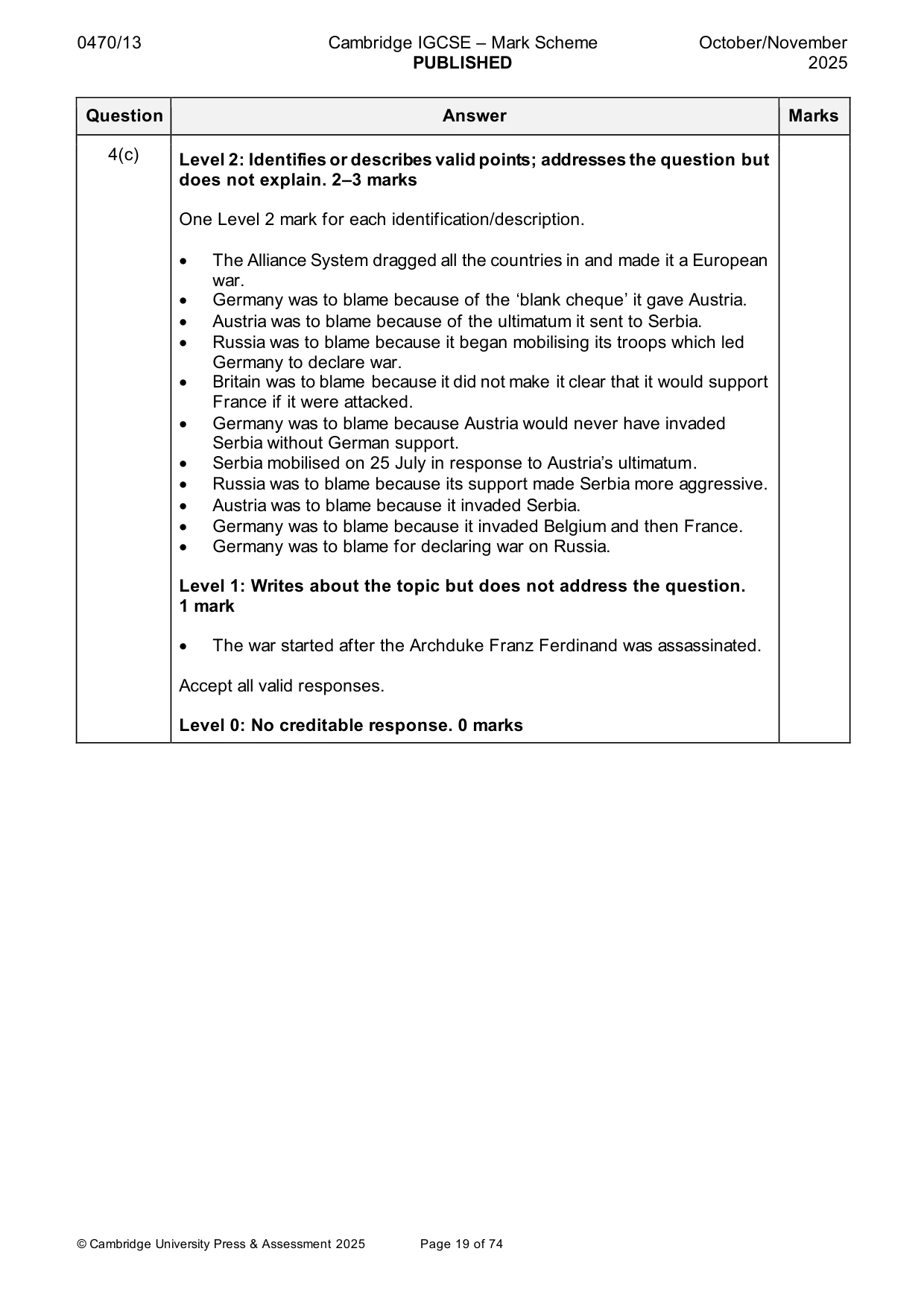
0470/13 Cambridge IGCSE – Mark Scheme PUBLISHED October/November 2025 © Cambridge University Press & Assessment 2025 Page 19 of 74 Question Answer Marks 4(c) Level 2: Identifies or describes valid points; addresses the question but does not explain. 2–3 marks One Level 2 mark for each identification/description. • The Alliance System dragged all the countries in and made it a European war. • Germany was to blame because of the ‘blank cheque’ it gave Austria. • Austria was to blame because of the ultimatum it sent to Serbia. • Russia was to blame because it began mobilising its troops which led Germany to declare war. • Britain was to blame because it did not make it clear that it would support France if it were attacked. • Germany was to blame because Austria would never have invaded Serbia without German support. • Serbia mobilised on 25 July in response to Austria’s ultimatum. • Russia was to blame because its support made Serbia more aggressive. • Austria was to blame because it invaded Serbia. • Germany was to blame because it invaded Belgium and then France. • Germany was to blame for declaring war on Russia. Level 1: Writes about the topic but does not address the question. 1 mark • The war started after the Archduke Franz Ferdinand was assassinated. Accept all valid responses. Level 0: No creditable response. 0 marks
Mark scheme, page 20
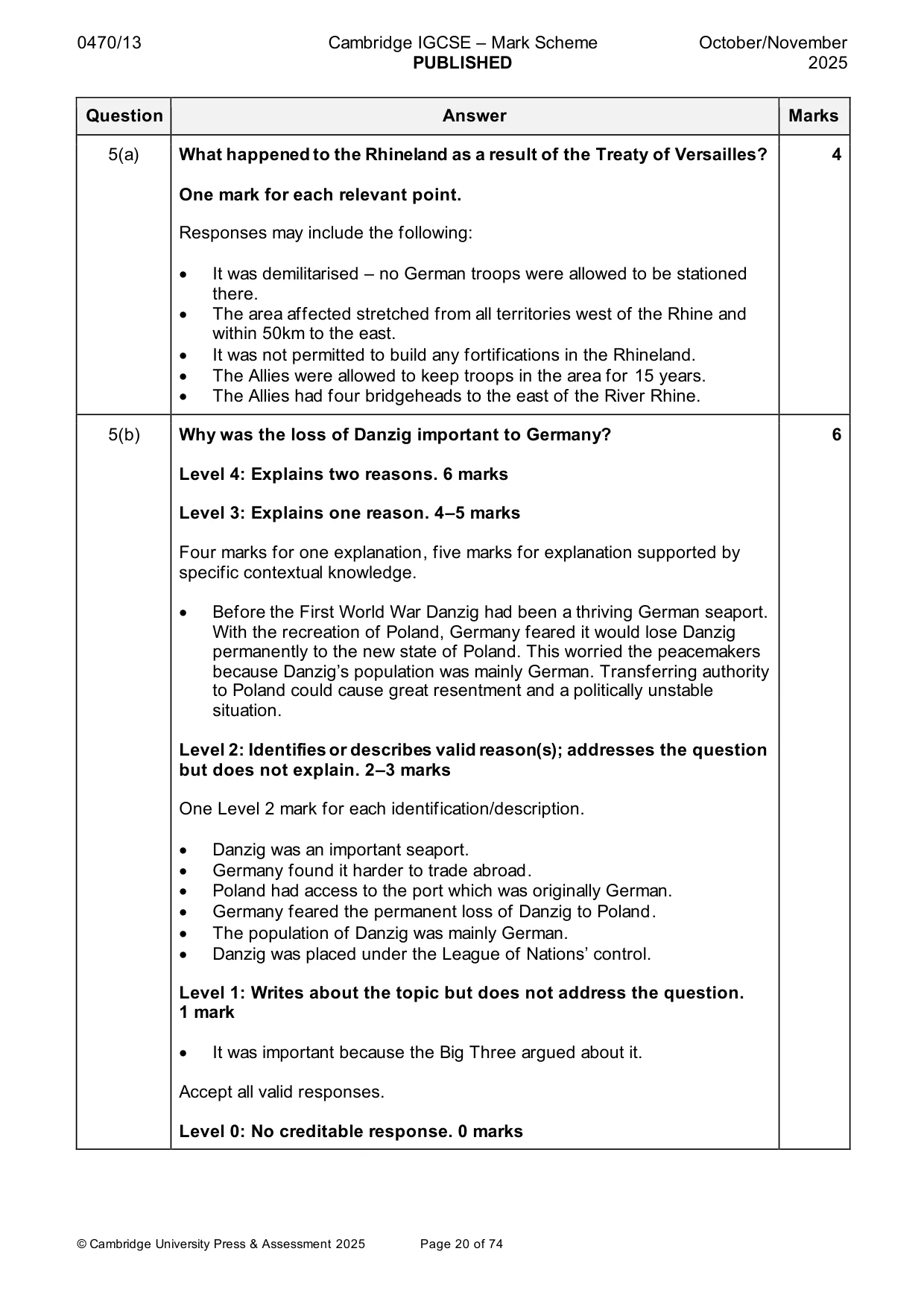
0470/13 Cambridge IGCSE – Mark Scheme PUBLISHED October/November 2025 © Cambridge University Press & Assessment 2025 Page 20 of 74 Question Answer Marks 5(a) What happened to the Rhineland as a result of the Treaty of Versailles? One mark for each relevant point. Responses may include the following: • It was demilitarised – no German troops were allowed to be stationed there. • The area affected stretched from all territories west of the Rhine and within 50km to the east. • It was not permitted to build any fortifications in the Rhineland. • The Allies were allowed to keep troops in the area for 15 years. • The Allies had four bridgeheads to the east of the River Rhine. 4 5(b) Why was the loss of Danzig important to Germany? Level 4: Explains two reasons. 6 marks Level 3: Explains one reason. 4–5 marks Four marks for one explanation, five marks for explanation supported by specific contextual knowledge. • Before the First World War Danzig had been a thriving German seaport. With the recreation of Poland, Germany feared it would lose Danzig permanently to the new state of Poland. This worried the peacemakers because Danzig’s population was mainly German. Transferring authority to Poland could cause great resentment and a politically unstable situation. Level 2: Identifies or describes valid reason(s); addresses the question but does not explain. 2–3 marks One Level 2 mark for each identification/description. • Danzig was an important seaport. • Germany found it harder to trade abroad. • Poland had access to the port which was originally German. • Germany feared the permanent loss of Danzig to Poland. • The population of Danzig was mainly German. • Danzig was placed under the League of Nations’ control. Level 1: Writes about the topic but does not address the question. 1 mark • It was important because the Big Three argued about it. Accept all valid responses. Level 0: No creditable response. 0 marks 6
Mark scheme, page 21
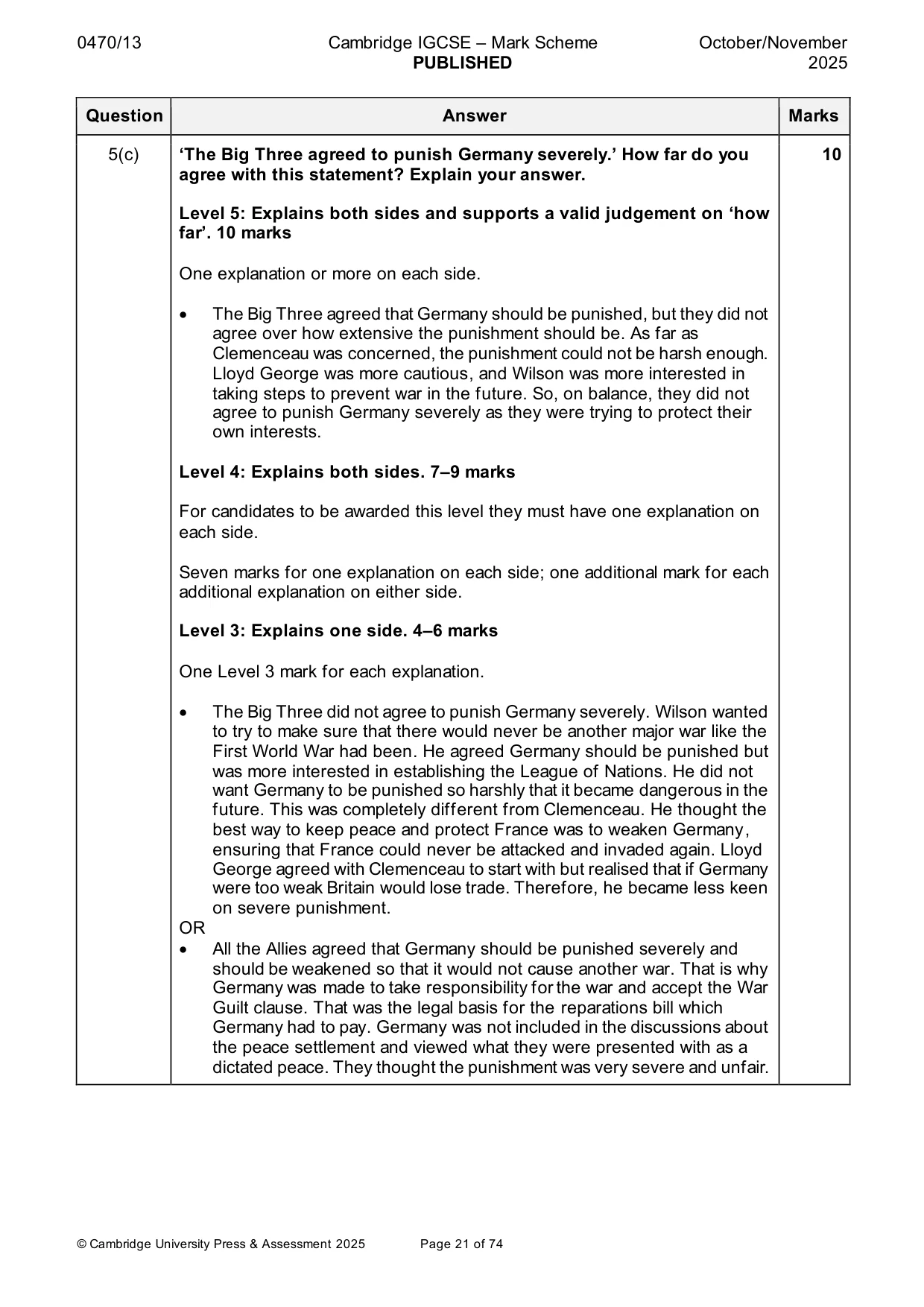
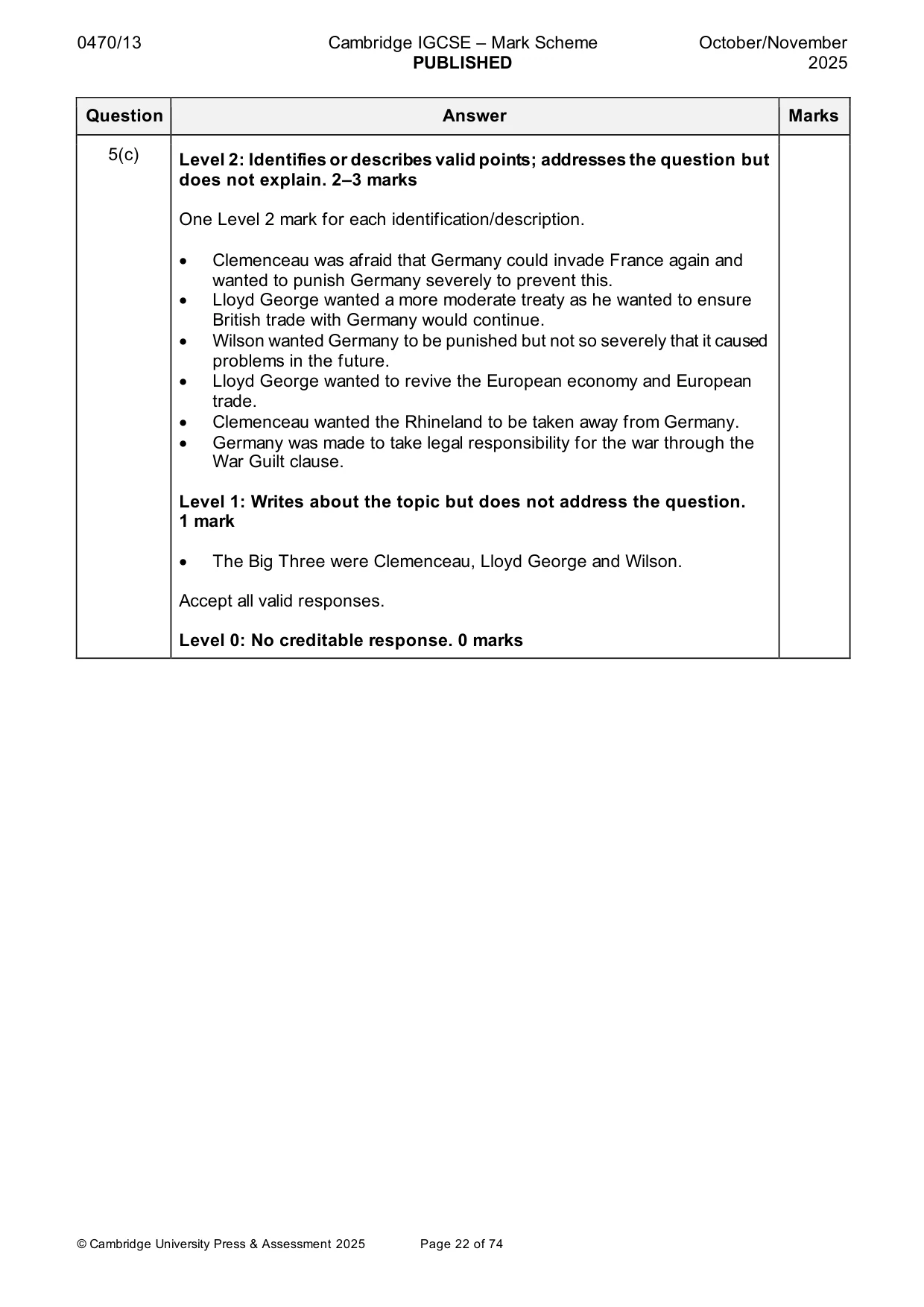
0470/13 Cambridge IGCSE – Mark Scheme PUBLISHED October/November 2025 © Cambridge University Press & Assessment 2025 Page 21 of 74 Question Answer Marks 5(c) ‘The Big Three agreed to punish Germany severely.’ How far do you agree with this statement? Explain your answer. Level 5: Explains both sides and supports a valid judgement on ‘how far’. 10 marks One explanation or more on each side. • The Big Three agreed that Germany should be punished, but they did not agree over how extensive the punishment should be. As far as Clemenceau was concerned, the punishment could not be harsh enough. Lloyd George was more cautious, and Wilson was more interested in taking steps to prevent war in the future. So, on balance, they did not agree to punish Germany severely as they were trying to protect their own interests. Level 4: Explains both sides. 7–9 marks For candidates to be awarded this level they must have one explanation on each side. Seven marks for one explanation on each side; one additional mark for each additional explanation on either side. Level 3: Explains one side. 4–6 marks One Level 3 mark for each explanation. • The Big Three did not agree to punish Germany severely. Wilson wanted to try to make sure that there would never be another major war like the First World War had been. He agreed Germany should be punished but was more interested in establishing the League of Nations. He did not want Germany to be punished so harshly that it became dangerous in the future. This was completely different from Clemenceau. He thought the best way to keep peace and protect France was to weaken Germany, ensuring that France could never be attacked and invaded again. Lloyd George agreed with Clemenceau to start with but realised that if Germany were too weak Britain would lose trade. Therefore, he became less keen on severe punishment. OR • All the Allies agreed that Germany should be punished severely and should be weakened so that it would not cause another war. That is why Germany was made to take responsibility for the war and accept the War Guilt clause. That was the legal basis for the reparations bill which Germany had to pay. Germany was not included in the discussions about the peace settlement and viewed what they were presented with as a dictated peace. They thought the punishment was very severe and unfair. 10
Mark scheme, page 22
0470/13 Cambridge IGCSE – Mark Scheme PUBLISHED October/November 2025 © Cambridge University Press & Assessment 2025 Page 22 of 74 Question Answer Marks 5(c) Level 2: Identifies or describes valid points; addresses the question but does not explain. 2–3 marks One Level 2 mark for each identification/description. • Clemenceau was afraid that Germany could invade France again and wanted to punish Germany severely to prevent this. • Lloyd George wanted a more moderate treaty as he wanted to ensure British trade with Germany would continue. • Wilson wanted Germany to be punished but not so severely that it caused problems in the future. • Lloyd George wanted to revive the European economy and European trade. • Clemenceau wanted the Rhineland to be taken away from Germany. • Germany was made to take legal responsibility for the war through the War Guilt clause. Level 1: Writes about the topic but does not address the question. 1 mark • The Big Three were Clemenceau, Lloyd George and Wilson. Accept all valid responses. Level 0: No creditable response. 0 marks
Mark scheme, page 23
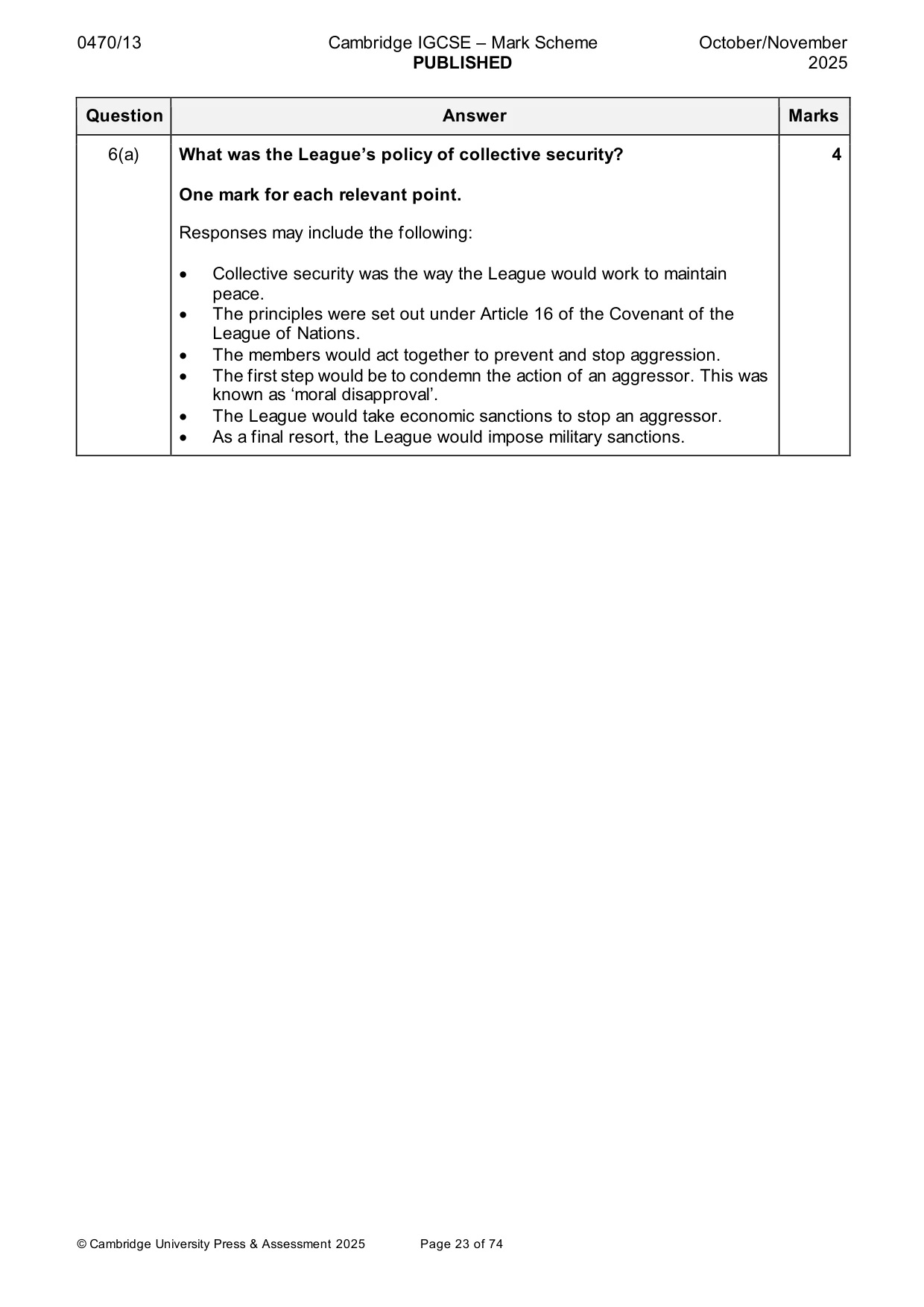
0470/13 Cambridge IGCSE – Mark Scheme PUBLISHED October/November 2025 © Cambridge University Press & Assessment 2025 Page 23 of 74 Question Answer Marks 6(a) What was the League’s policy of collective security? One mark for each relevant point. Responses may include the following: • Collective security was the way the League would work to maintain peace. • The principles were set out under Article 16 of the Covenant of the League of Nations. • The members would act together to prevent and stop aggression. • The first step would be to condemn the action of an aggressor. This was known as ‘moral disapproval’. • The League would take economic sanctions to stop an aggressor. • As a final resort, the League would impose military sanctions. 4
Mark scheme, page 24
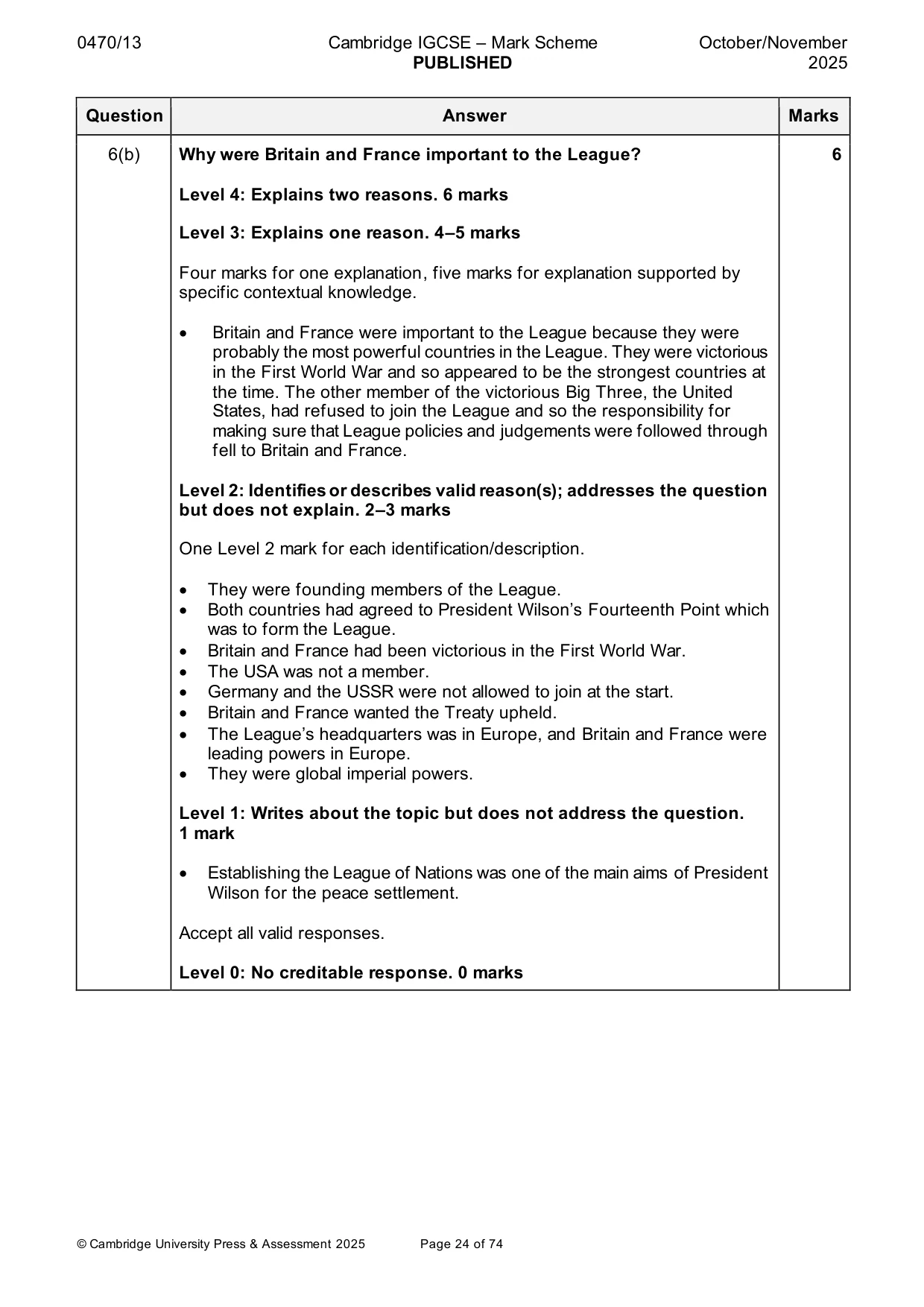
0470/13 Cambridge IGCSE – Mark Scheme PUBLISHED October/November 2025 © Cambridge University Press & Assessment 2025 Page 24 of 74 Question Answer Marks 6(b) Why were Britain and France important to the League? Level 4: Explains two reasons. 6 marks Level 3: Explains one reason. 4–5 marks Four marks for one explanation, five marks for explanation supported by specific contextual knowledge. • Britain and France were important to the League because they were probably the most powerful countries in the League. They were victorious in the First World War and so appeared to be the strongest countries at the time. The other member of the victorious Big Three, the United States, had refused to join the League and so the responsibility for making sure that League policies and judgements were followed through fell to Britain and France. Level 2: Identifies or describes valid reason(s); addresses the question but does not explain. 2–3 marks One Level 2 mark for each identification/description. • They were founding members of the League. • Both countries had agreed to President Wilson’s Fourteenth Point which was to form the League. • Britain and France had been victorious in the First World War. • The USA was not a member. • Germany and the USSR were not allowed to join at the start. • Britain and France wanted the Treaty upheld. • The League’s headquarters was in Europe, and Britain and France were leading powers in Europe. • They were global imperial powers. Level 1: Writes about the topic but does not address the question. 1 mark • Establishing the League of Nations was one of the main aims of President Wilson for the peace settlement. Accept all valid responses. Level 0: No creditable response. 0 marks 6
Mark scheme, page 25
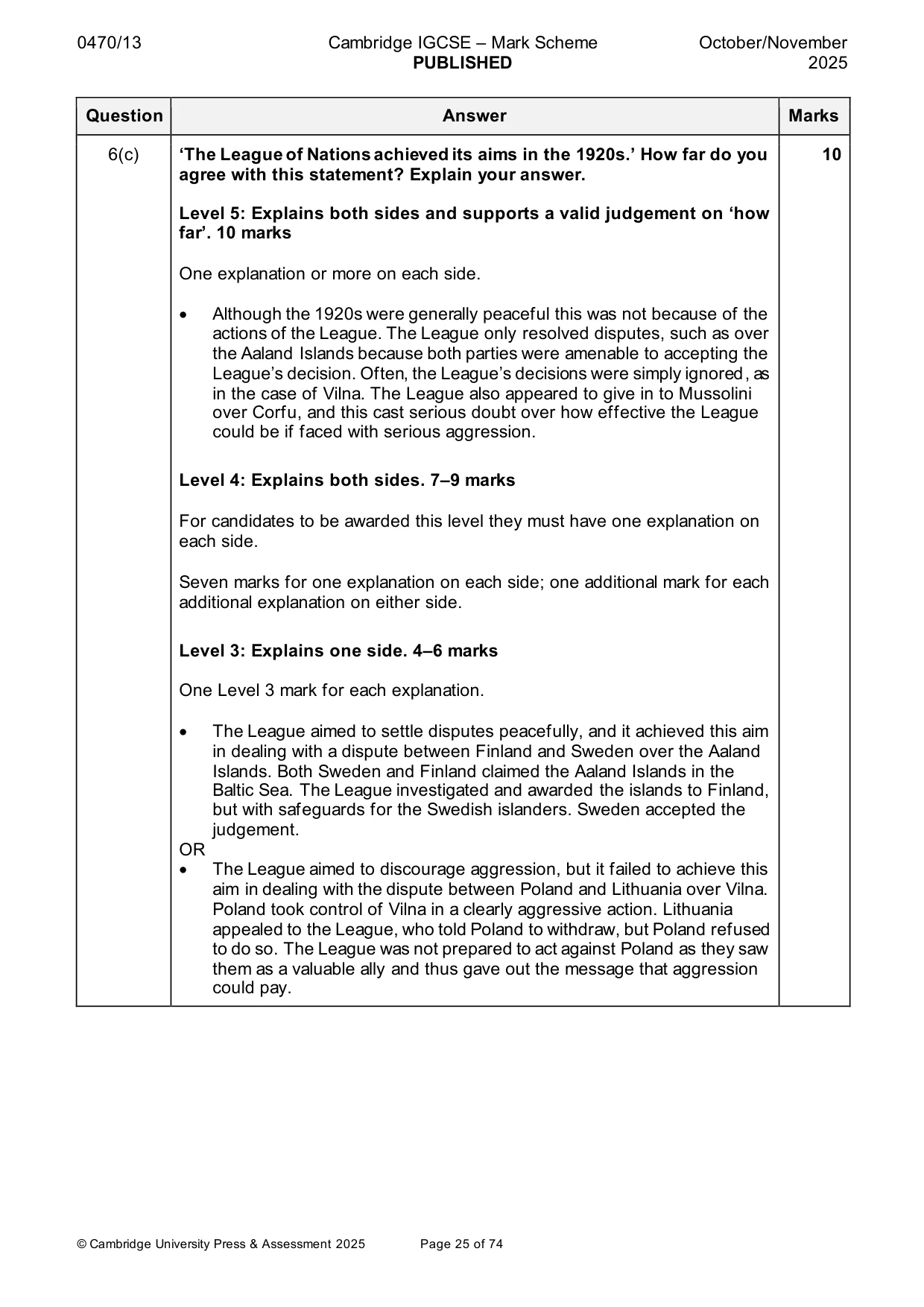
0470/13 Cambridge IGCSE – Mark Scheme PUBLISHED October/November 2025 © Cambridge University Press & Assessment 2025 Page 25 of 74 Question Answer Marks 6(c) ‘The League of Nations achieved its aims in the 1920s.’ How far do you agree with this statement? Explain your answer. Level 5: Explains both sides and supports a valid judgement on ‘how far’. 10 marks One explanation or more on each side. • Although the 1920s were generally peaceful this was not because of the actions of the League. The League only resolved disputes, such as over the Aaland Islands because both parties were amenable to accepting the League’s decision. Often, the League’s decisions were simply ignored, as in the case of Vilna. The League also appeared to give in to Mussolini over Corfu, and this cast serious doubt over how effective the League could be if faced with serious aggression. Level 4: Explains both sides. 7–9 marks For candidates to be awarded this level they must have one explanation on each side. Seven marks for one explanation on each side; one additional mark for each additional explanation on either side. Level 3: Explains one side. 4–6 marks One Level 3 mark for each explanation. • The League aimed to settle disputes peacefully, and it achieved this aim in dealing with a dispute between Finland and Sweden over the Aaland Islands. Both Sweden and Finland claimed the Aaland Islands in the Baltic Sea. The League investigated and awarded the islands to Finland, but with safeguards for the Swedish islanders. Sweden accepted the judgement. OR • The League aimed to discourage aggression, but it failed to achieve this aim in dealing with the dispute between Poland and Lithuania over Vilna. Poland took control of Vilna in a clearly aggressive action. Lithuania appealed to the League, who told Poland to withdraw, but Poland refused to do so. The League was not prepared to act against Poland as they saw them as a valuable ally and thus gave out the message that aggression could pay. 10
Mark scheme, page 26
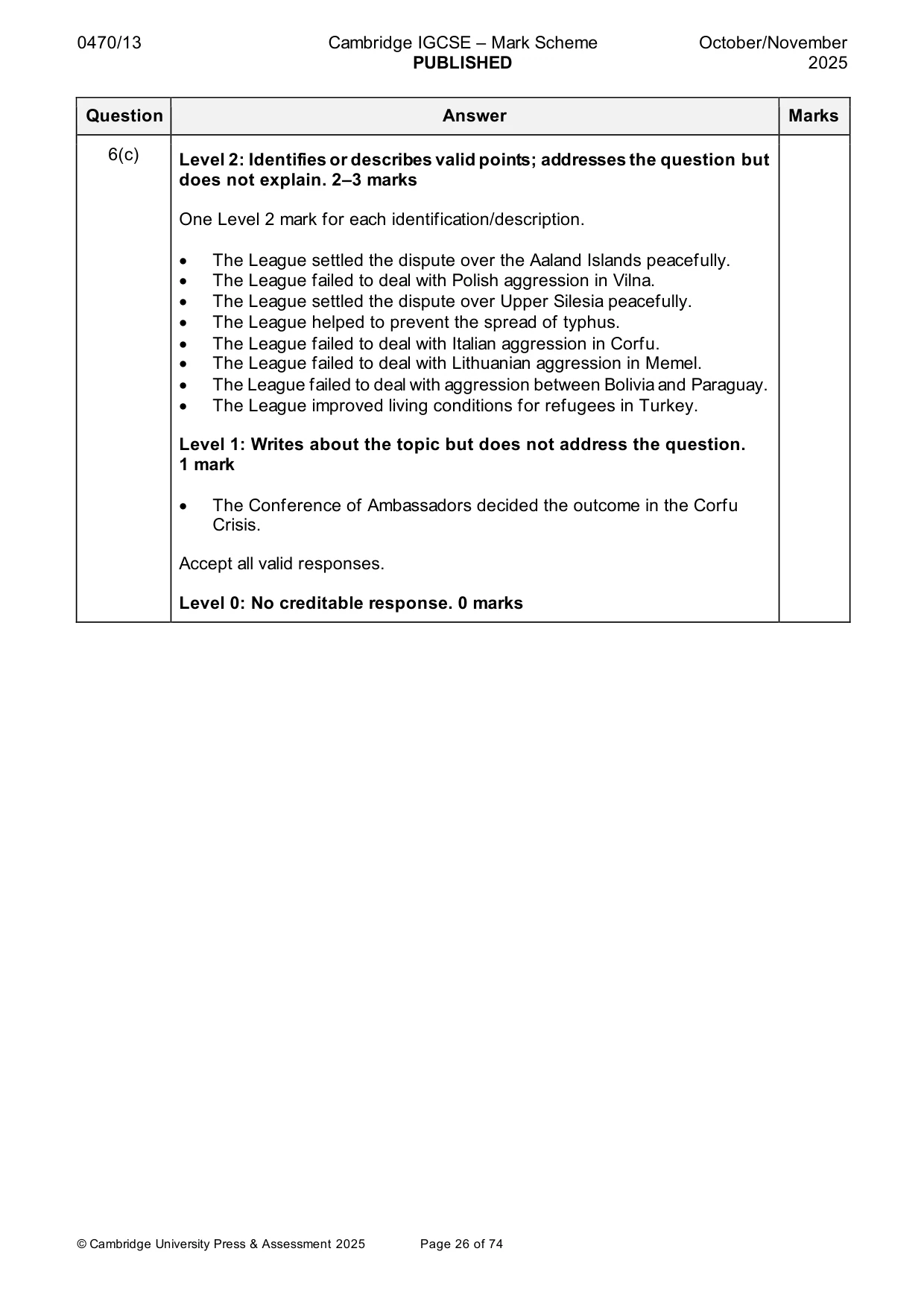
0470/13 Cambridge IGCSE – Mark Scheme PUBLISHED October/November 2025 © Cambridge University Press & Assessment 2025 Page 26 of 74 Question Answer Marks 6(c) Level 2: Identifies or describes valid points; addresses the question but does not explain. 2–3 marks One Level 2 mark for each identification/description. • The League settled the dispute over the Aaland Islands peacefully. • The League failed to deal with Polish aggression in Vilna. • The League settled the dispute over Upper Silesia peacefully. • The League helped to prevent the spread of typhus. • The League failed to deal with Italian aggression in Corfu. • The League failed to deal with Lithuanian aggression in Memel. • The League failed to deal with aggression between Bolivia and Paraguay. • The League improved living conditions for refugees in Turkey. Level 1: Writes about the topic but does not address the question. 1 mark • The Conference of Ambassadors decided the outcome in the Corfu Crisis. Accept all valid responses. Level 0: No creditable response. 0 marks
Mark scheme, page 27
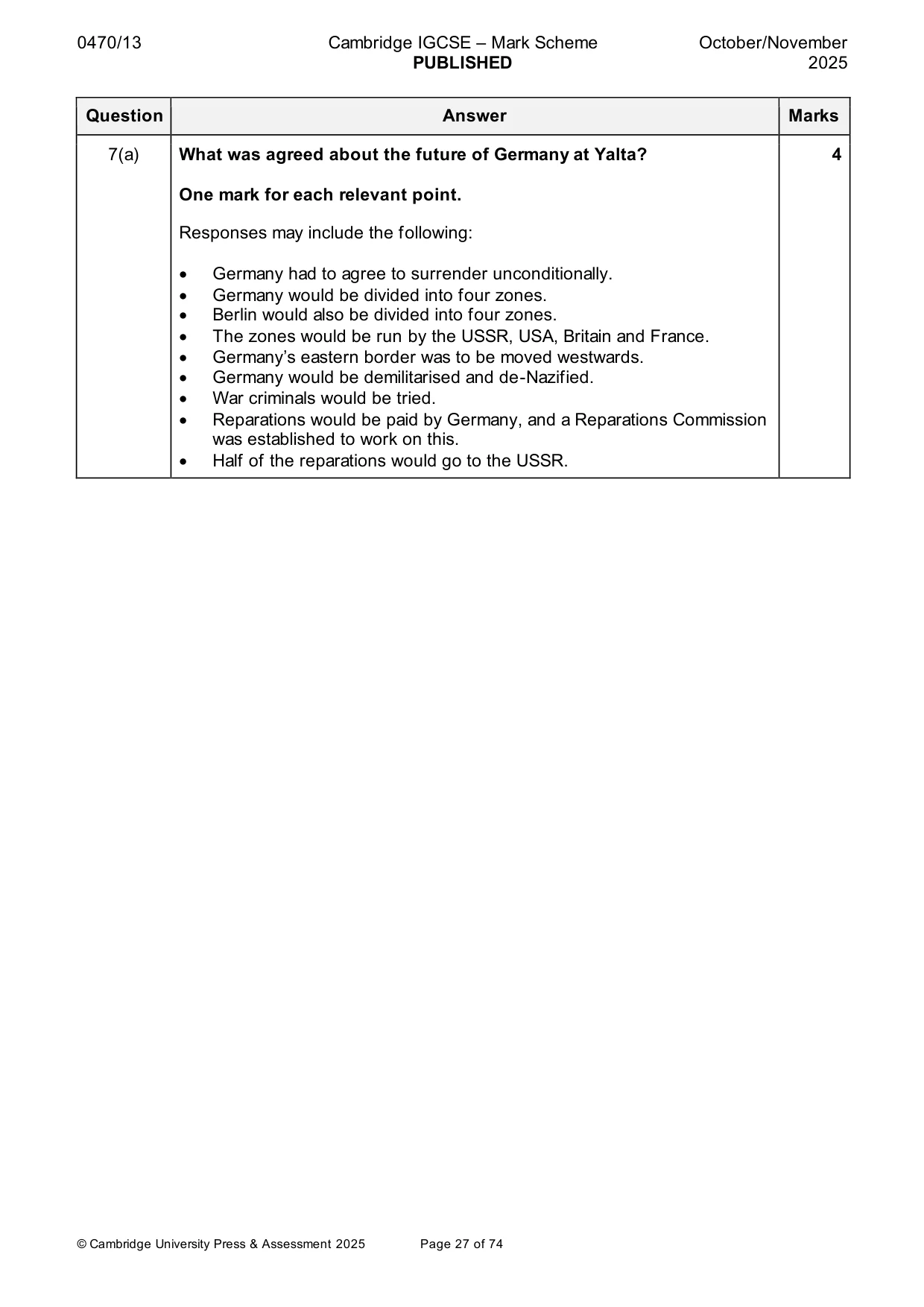
0470/13 Cambridge IGCSE – Mark Scheme PUBLISHED October/November 2025 © Cambridge University Press & Assessment 2025 Page 27 of 74 Question Answer Marks 7(a) What was agreed about the future of Germany at Yalta? One mark for each relevant point. Responses may include the following: • Germany had to agree to surrender unconditionally. • Germany would be divided into four zones. • Berlin would also be divided into four zones. • The zones would be run by the USSR, USA, Britain and France. • Germany’s eastern border was to be moved westwards. • Germany would be demilitarised and de-Nazified. • War criminals would be tried. • Reparations would be paid by Germany, and a Reparations Commission was established to work on this. • Half of the reparations would go to the USSR. 4
Mark scheme, page 28
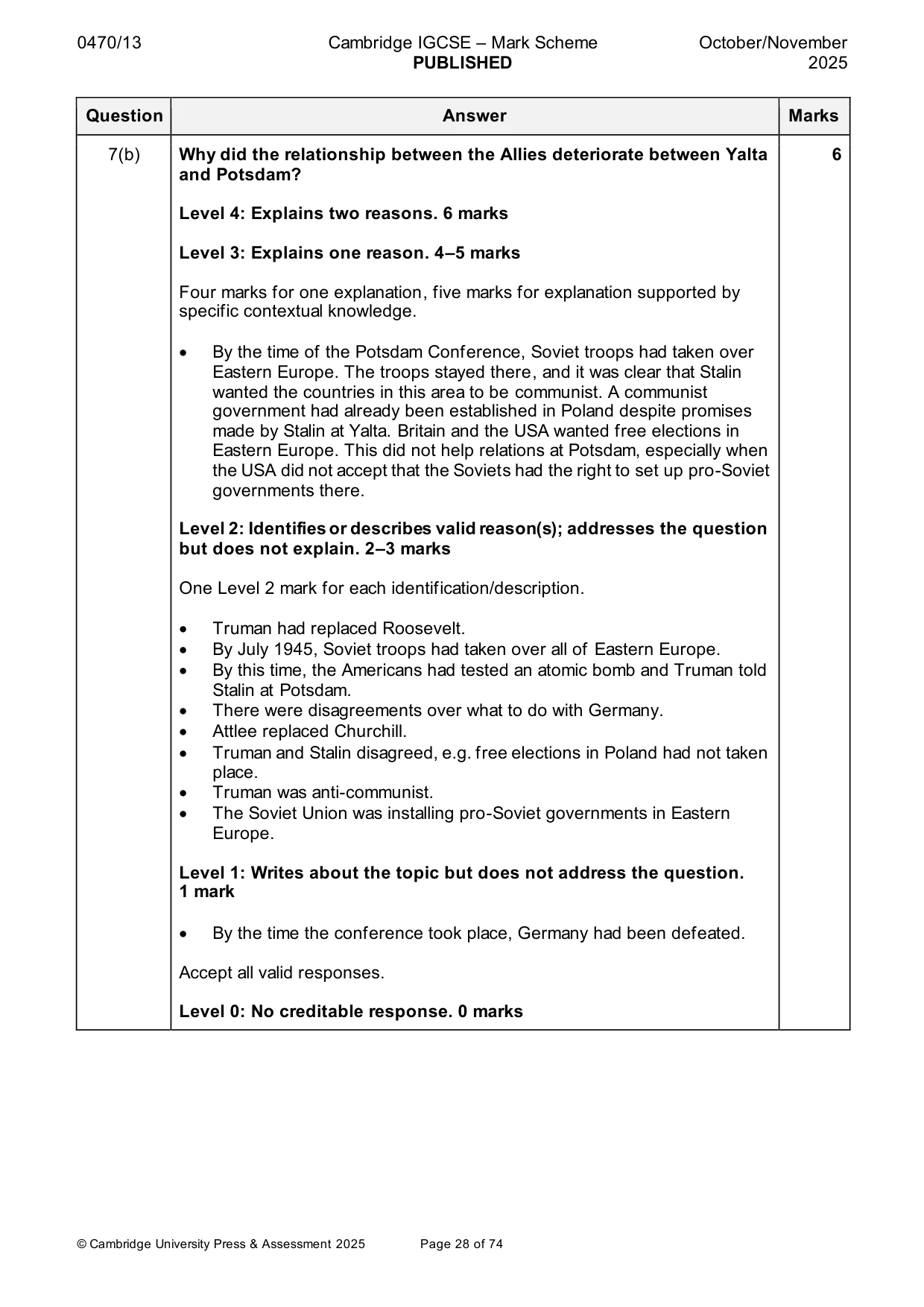
0470/13 Cambridge IGCSE – Mark Scheme PUBLISHED October/November 2025 © Cambridge University Press & Assessment 2025 Page 28 of 74 Question Answer Marks 7(b) Why did the relationship between the Allies deteriorate between Yalta and Potsdam? Level 4: Explains two reasons. 6 marks Level 3: Explains one reason. 4–5 marks Four marks for one explanation, five marks for explanation supported by specific contextual knowledge. • By the time of the Potsdam Conference, Soviet troops had taken over Eastern Europe. The troops stayed there, and it was clear that Stalin wanted the countries in this area to be communist. A communist government had already been established in Poland despite promises made by Stalin at Yalta. Britain and the USA wanted free elections in Eastern Europe. This did not help relations at Potsdam, especially when the USA did not accept that the Soviets had the right to set up pro-Soviet governments there. Level 2: Identifies or describes valid reason(s); addresses the question but does not explain. 2–3 marks One Level 2 mark for each identification/description. • Truman had replaced Roosevelt. • By July 1945, Soviet troops had taken over all of Eastern Europe. • By this time, the Americans had tested an atomic bomb and Truman told Stalin at Potsdam. • There were disagreements over what to do with Germany. • Attlee replaced Churchill. • Truman and Stalin disagreed, e.g. free elections in Poland had not taken place. • Truman was anti-communist. • The Soviet Union was installing pro-Soviet governments in Eastern Europe. Level 1: Writes about the topic but does not address the question. 1 mark • By the time the conference took place, Germany had been defeated. Accept all valid responses. Level 0: No creditable response. 0 marks 6
Mark scheme, page 29
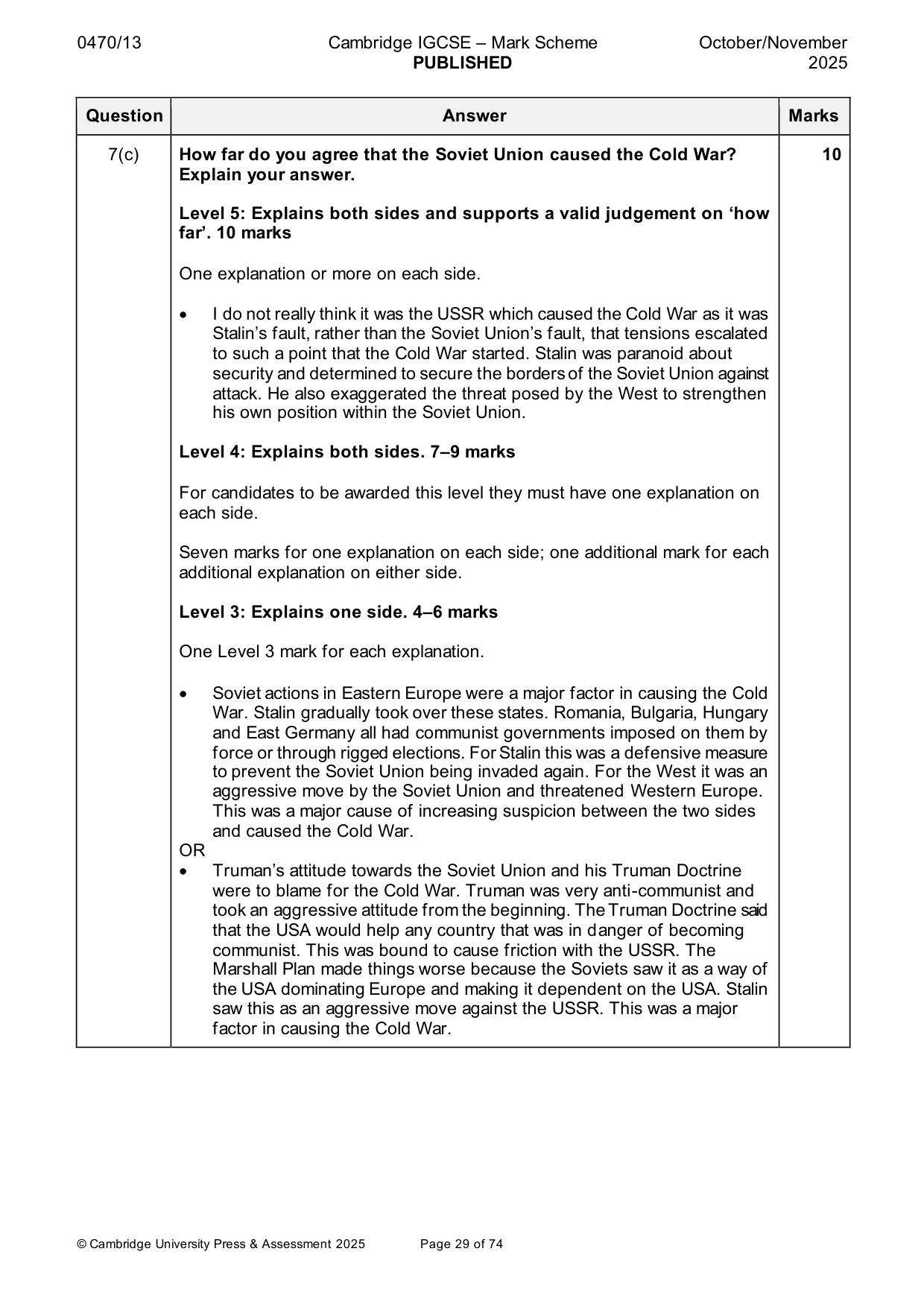
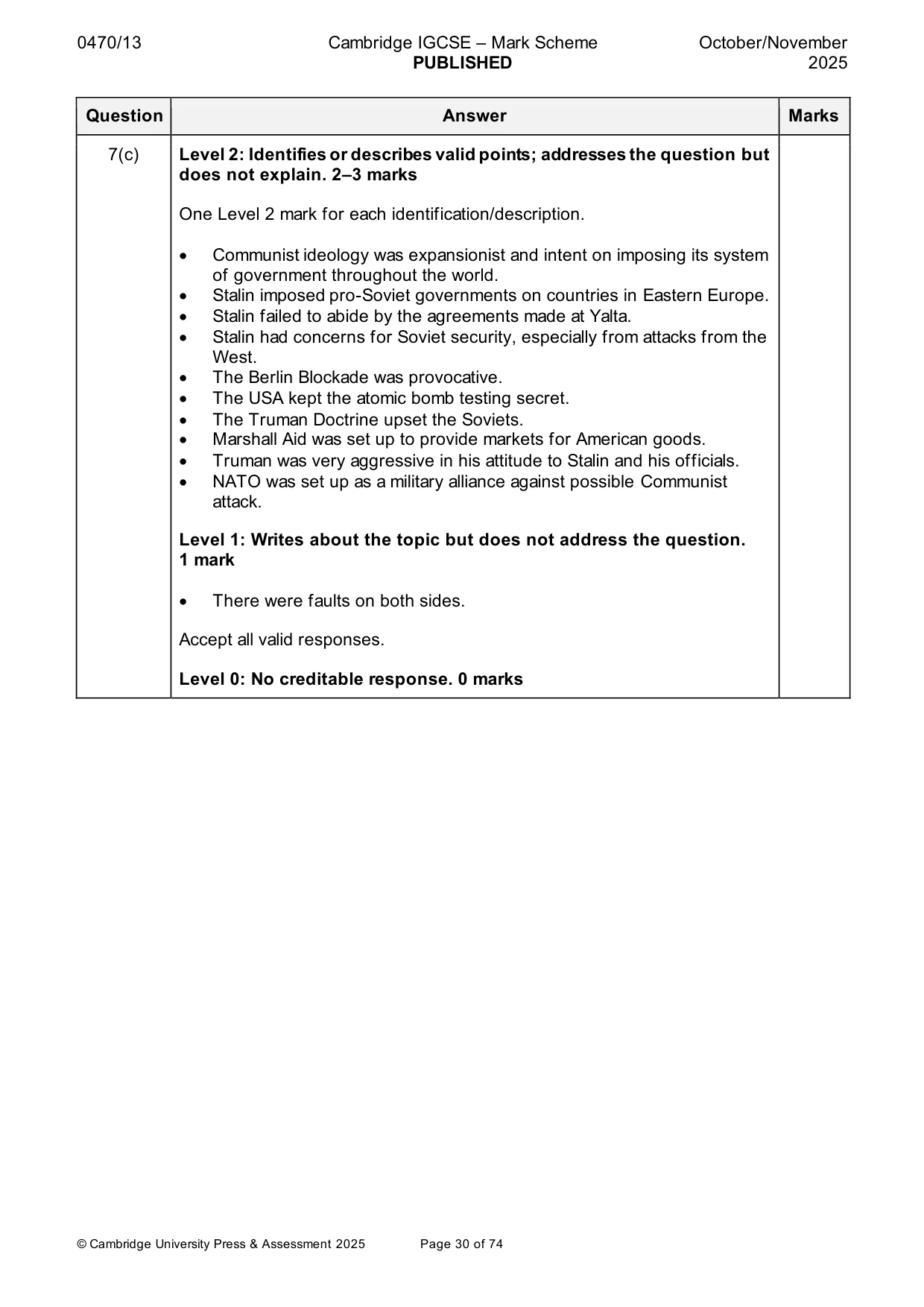
0470/13 Cambridge IGCSE – Mark Scheme PUBLISHED October/November 2025 © Cambridge University Press & Assessment 2025 Page 29 of 74 Question Answer Marks 7(c) How far do you agree that the Soviet Union caused the Cold War? Explain your answer. Level 5: Explains both sides and supports a valid judgement on ‘how far’. 10 marks One explanation or more on each side. • I do not really think it was the USSR which caused the Cold War as it was Stalin’s fault, rather than the Soviet Union’s fault, that tensions escalated to such a point that the Cold War started. Stalin was paranoid about security and determined to secure the borders of the Soviet Union against attack. He also exaggerated the threat posed by the West to strengthen his own position within the Soviet Union. Level 4: Explains both sides. 7–9 marks For candidates to be awarded this level they must have one explanation on each side. Seven marks for one explanation on each side; one additional mark for each additional explanation on either side. Level 3: Explains one side. 4–6 marks One Level 3 mark for each explanation. • Soviet actions in Eastern Europe were a major factor in causing the Cold War. Stalin gradually took over these states. Romania, Bulgaria, Hungary and East Germany all had communist governments imposed on them by force or through rigged elections. For Stalin this was a defensive measure to prevent the Soviet Union being invaded again. For the West it was an aggressive move by the Soviet Union and threatened Western Europe. This was a major cause of increasing suspicion between the two sides and caused the Cold War. OR • Truman’s attitude towards the Soviet Union and his Truman Doctrine were to blame for the Cold War. Truman was very anti-communist and took an aggressive attitude from the beginning. The Truman Doctrine said that the USA would help any country that was in danger of becoming communist. This was bound to cause friction with the USSR. The Marshall Plan made things worse because the Soviets saw it as a way of the USA dominating Europe and making it dependent on the USA. Stalin saw this as an aggressive move against the USSR. This was a major factor in causing the Cold War. 10
Mark scheme, page 30
0470/13 Cambridge IGCSE – Mark Scheme PUBLISHED October/November 2025 © Cambridge University Press & Assessment 2025 Page 30 of 74 Question Answer Marks 7(c) Level 2: Identifies or describes valid points; addresses the question but does not explain. 2–3 marks One Level 2 mark for each identification/description. • Communist ideology was expansionist and intent on imposing its system of government throughout the world. • Stalin imposed pro-Soviet governments on countries in Eastern Europe. • Stalin failed to abide by the agreements made at Yalta. • Stalin had concerns for Soviet security, especially from attacks from the West. • The Berlin Blockade was provocative. • The USA kept the atomic bomb testing secret. • The Truman Doctrine upset the Soviets. • Marshall Aid was set up to provide markets for American goods. • Truman was very aggressive in his attitude to Stalin and his officials. • NATO was set up as a military alliance against possible Communist attack. Level 1: Writes about the topic but does not address the question. 1 mark • There were faults on both sides. Accept all valid responses. Level 0: No creditable response. 0 marks
Mark scheme, page 31
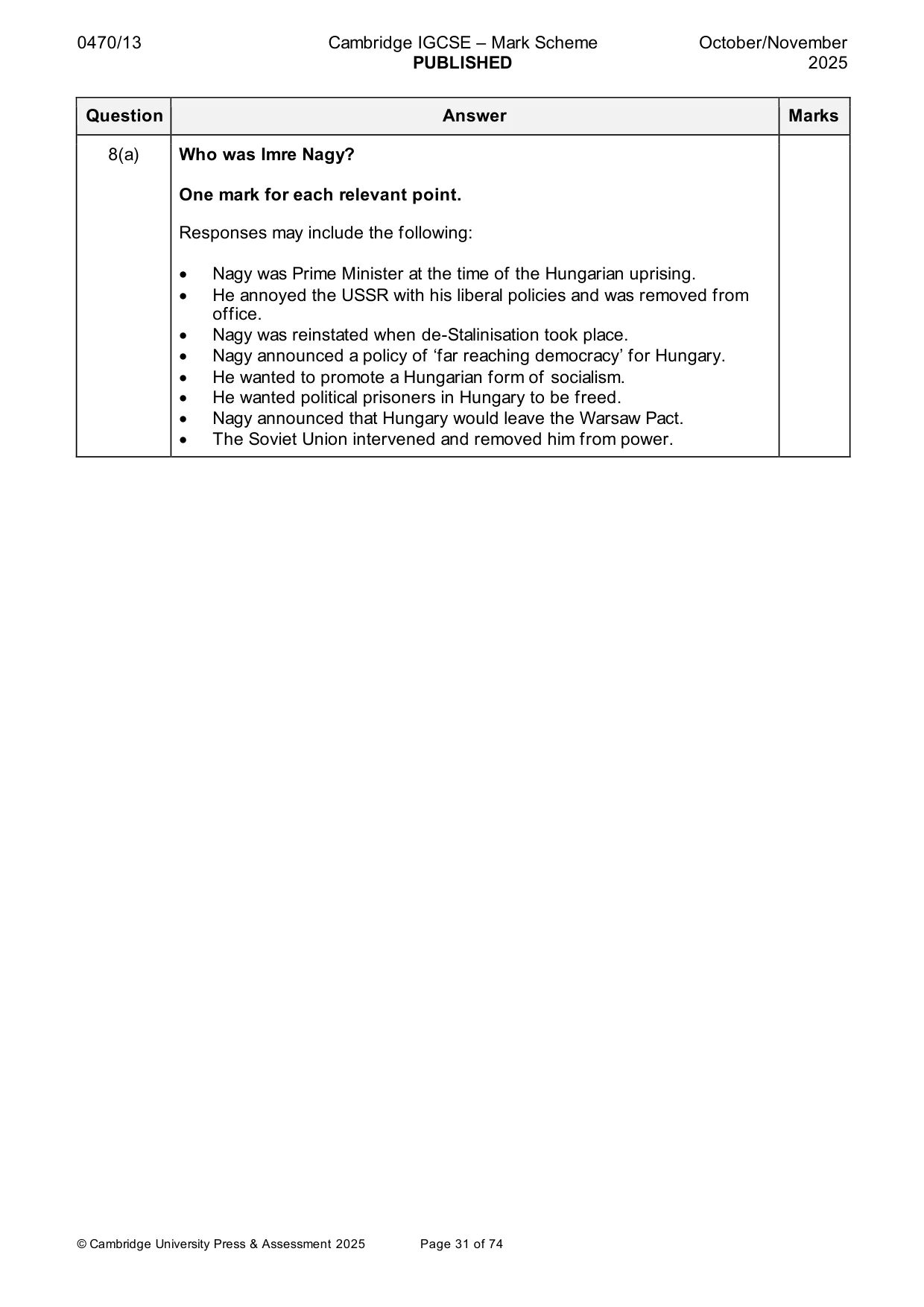
0470/13 Cambridge IGCSE – Mark Scheme PUBLISHED October/November 2025 © Cambridge University Press & Assessment 2025 Page 31 of 74 Question Answer Marks 8(a) Who was Imre Nagy? One mark for each relevant point. Responses may include the following: • Nagy was Prime Minister at the time of the Hungarian uprising. • He annoyed the USSR with his liberal policies and was removed from office. • Nagy was reinstated when de-Stalinisation took place. • Nagy announced a policy of ‘far reaching democracy’ for Hungary. • He wanted to promote a Hungarian form of socialism. • He wanted political prisoners in Hungary to be freed. • Nagy announced that Hungary would leave the Warsaw Pact. • The Soviet Union intervened and removed him from power.
Mark scheme, page 32
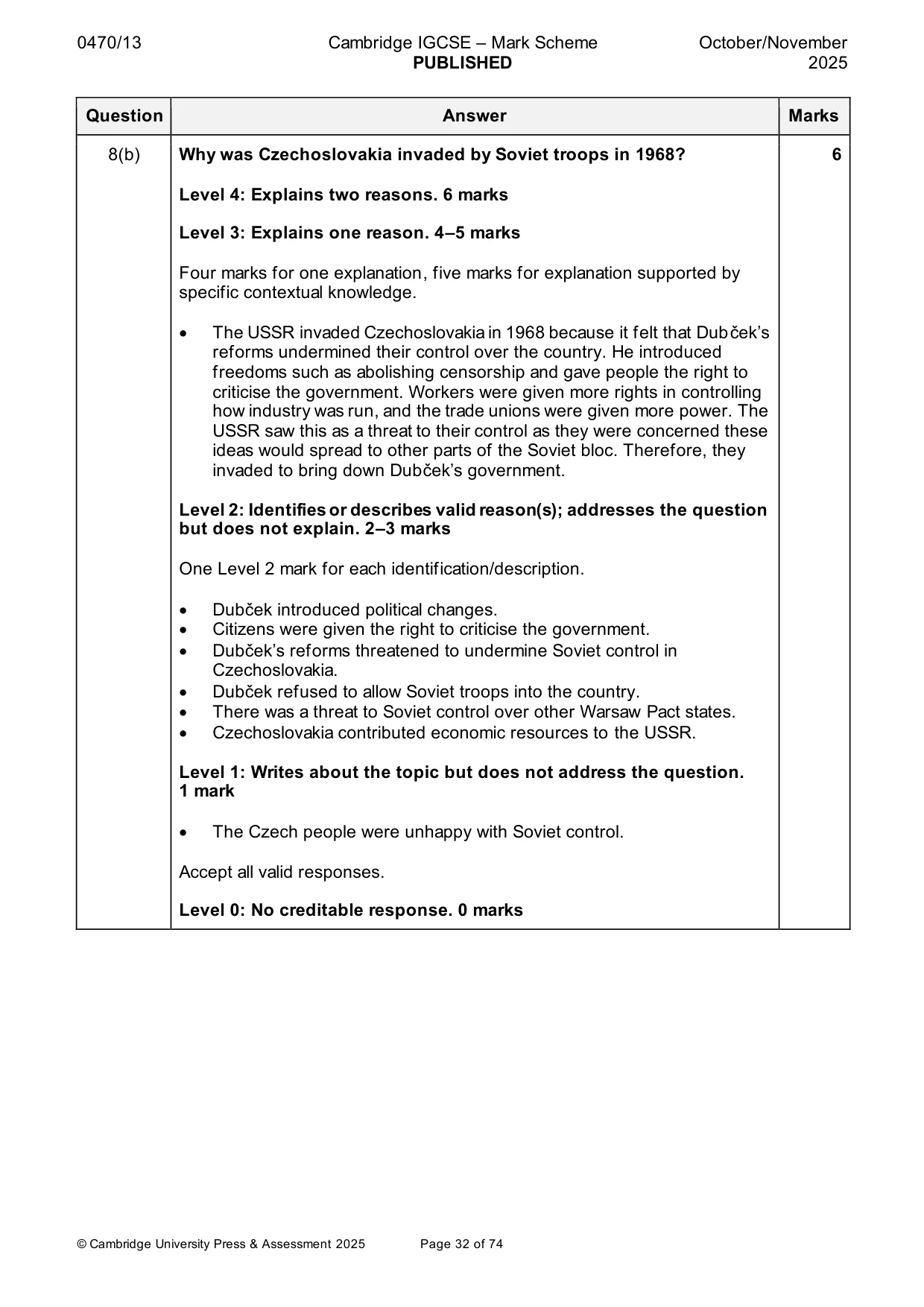
0470/13 Cambridge IGCSE – Mark Scheme PUBLISHED October/November 2025 © Cambridge University Press & Assessment 2025 Page 32 of 74 Question Answer Marks 8(b) Why was Czechoslovakia invaded by Soviet troops in 1968? Level 4: Explains two reasons. 6 marks Level 3: Explains one reason. 4–5 marks Four marks for one explanation, five marks for explanation supported by specific contextual knowledge. • The USSR invaded Czechoslovakia in 1968 because it felt that Dubček’s reforms undermined their control over the country. He introduced freedoms such as abolishing censorship and gave people the right to criticise the government. Workers were given more rights in controlling how industry was run, and the trade unions were given more power. The USSR saw this as a threat to their control as they were concerned these ideas would spread to other parts of the Soviet bloc. Therefore, they invaded to bring down Dubček’s government. Level 2: Identifies or describes valid reason(s); addresses the question but does not explain. 2–3 marks One Level 2 mark for each identification/description. • Dubček introduced political changes. • Citizens were given the right to criticise the government. • Dubček’s reforms threatened to undermine Soviet control in Czechoslovakia. • Dubček refused to allow Soviet troops into the country. • There was a threat to Soviet control over other Warsaw Pact states. • Czechoslovakia contributed economic resources to the USSR. Level 1: Writes about the topic but does not address the question. 1 mark • The Czech people were unhappy with Soviet control. Accept all valid responses. Level 0: No creditable response. 0 marks 6
Mark scheme, page 33
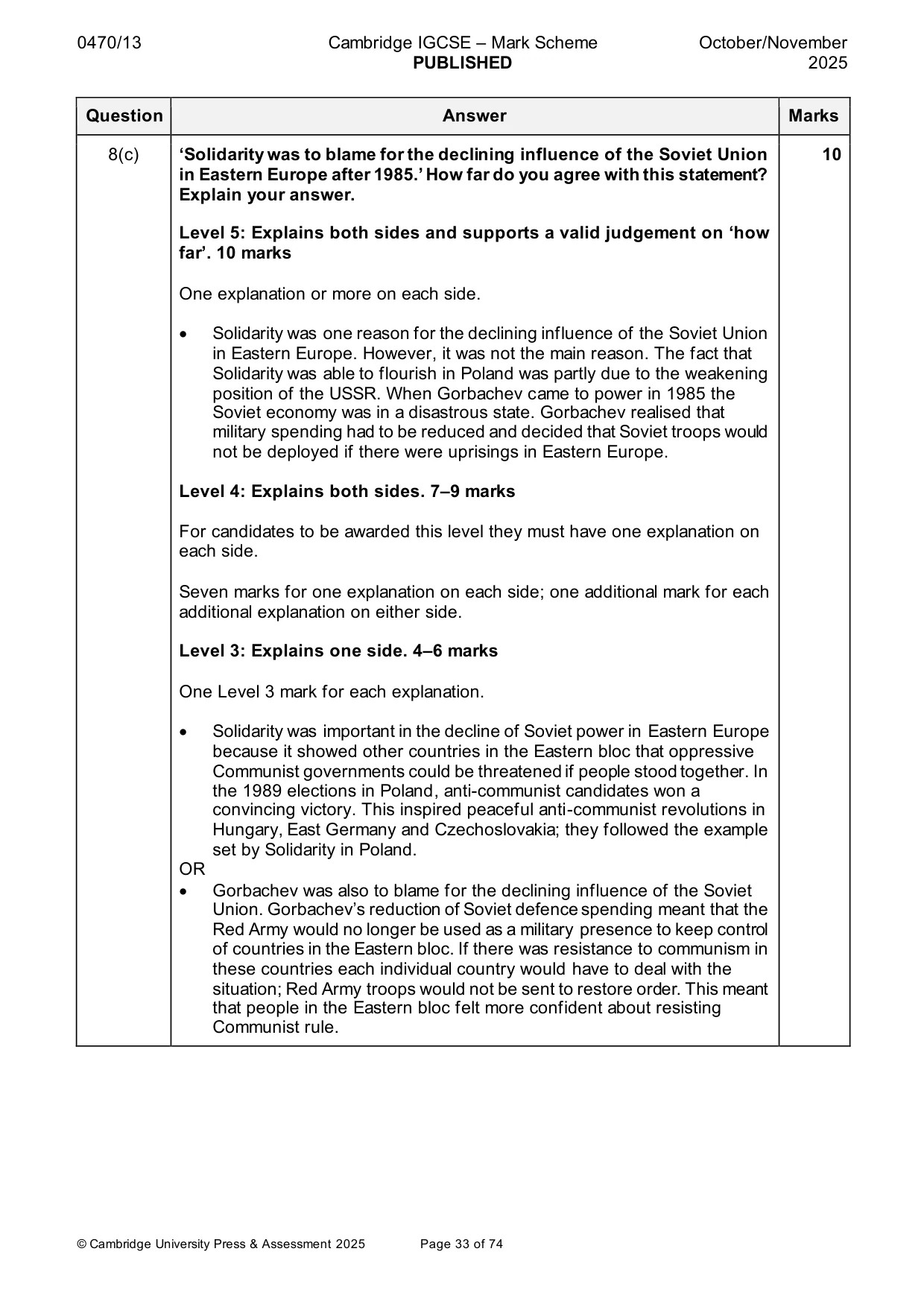
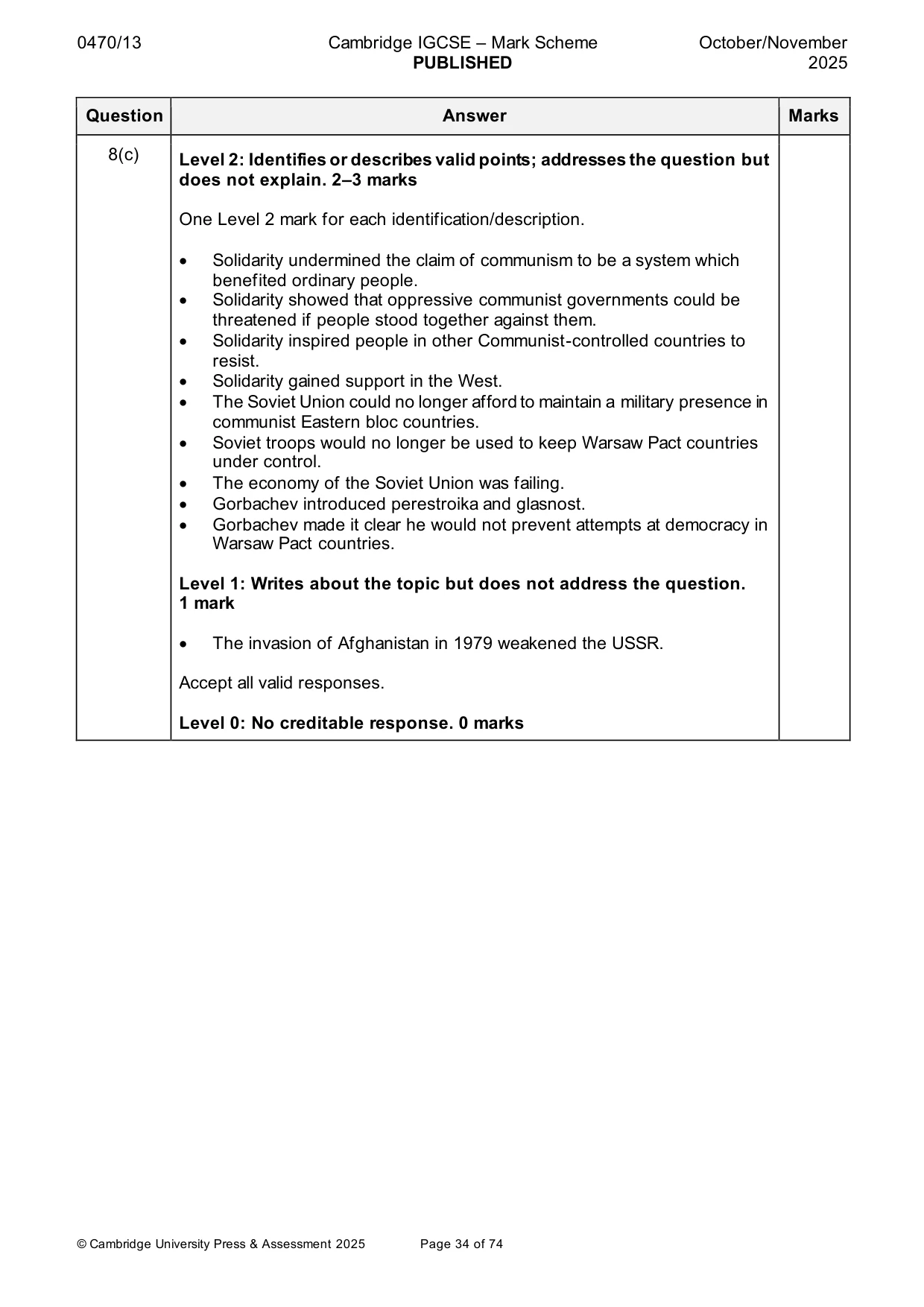
0470/13 Cambridge IGCSE – Mark Scheme PUBLISHED October/November 2025 © Cambridge University Press & Assessment 2025 Page 33 of 74 Question Answer Marks 8(c) ‘Solidarity was to blame for the declining influence of the Soviet Union in Eastern Europe after 1985.’ How far do you agree with this statement? Explain your answer. Level 5: Explains both sides and supports a valid judgement on ‘how far’. 10 marks One explanation or more on each side. • Solidarity was one reason for the declining influence of the Soviet Union in Eastern Europe. However, it was not the main reason. The fact that Solidarity was able to flourish in Poland was partly due to the weakening position of the USSR. When Gorbachev came to power in 1985 the Soviet economy was in a disastrous state. Gorbachev realised that military spending had to be reduced and decided that Soviet troops would not be deployed if there were uprisings in Eastern Europe. Level 4: Explains both sides. 7–9 marks For candidates to be awarded this level they must have one explanation on each side. Seven marks for one explanation on each side; one additional mark for each additional explanation on either side. Level 3: Explains one side. 4–6 marks One Level 3 mark for each explanation. • Solidarity was important in the decline of Soviet power in Eastern Europe because it showed other countries in the Eastern bloc that oppressive Communist governments could be threatened if people stood together. In the 1989 elections in Poland, anti-communist candidates won a convincing victory. This inspired peaceful anti-communist revolutions in Hungary, East Germany and Czechoslovakia; they followed the example set by Solidarity in Poland. OR • Gorbachev was also to blame for the declining influence of the Soviet Union. Gorbachev’s reduction of Soviet defence spending meant that the Red Army would no longer be used as a military presence to keep control of countries in the Eastern bloc. If there was resistance to communism in these countries each individual country would have to deal with the situation; Red Army troops would not be sent to restore order. This meant that people in the Eastern bloc felt more confident about resisting Communist rule. 10
Mark scheme, page 34
0470/13 Cambridge IGCSE – Mark Scheme PUBLISHED October/November 2025 © Cambridge University Press & Assessment 2025 Page 34 of 74 Question Answer Marks 8(c) Level 2: Identifies or describes valid points; addresses the question but does not explain. 2–3 marks One Level 2 mark for each identification/description. • Solidarity undermined the claim of communism to be a system which benefited ordinary people. • Solidarity showed that oppressive communist governments could be threatened if people stood together against them. • Solidarity inspired people in other Communist-controlled countries to resist. • Solidarity gained support in the West. • The Soviet Union could no longer afford to maintain a military presence in communist Eastern bloc countries. • Soviet troops would no longer be used to keep Warsaw Pact countries under control. • The economy of the Soviet Union was failing. • Gorbachev introduced perestroika and glasnost. • Gorbachev made it clear he would not prevent attempts at democracy in Warsaw Pact countries. Level 1: Writes about the topic but does not address the question. 1 mark • The invasion of Afghanistan in 1979 weakened the USSR. Accept all valid responses. Level 0: No creditable response. 0 marks
Mark scheme, page 35
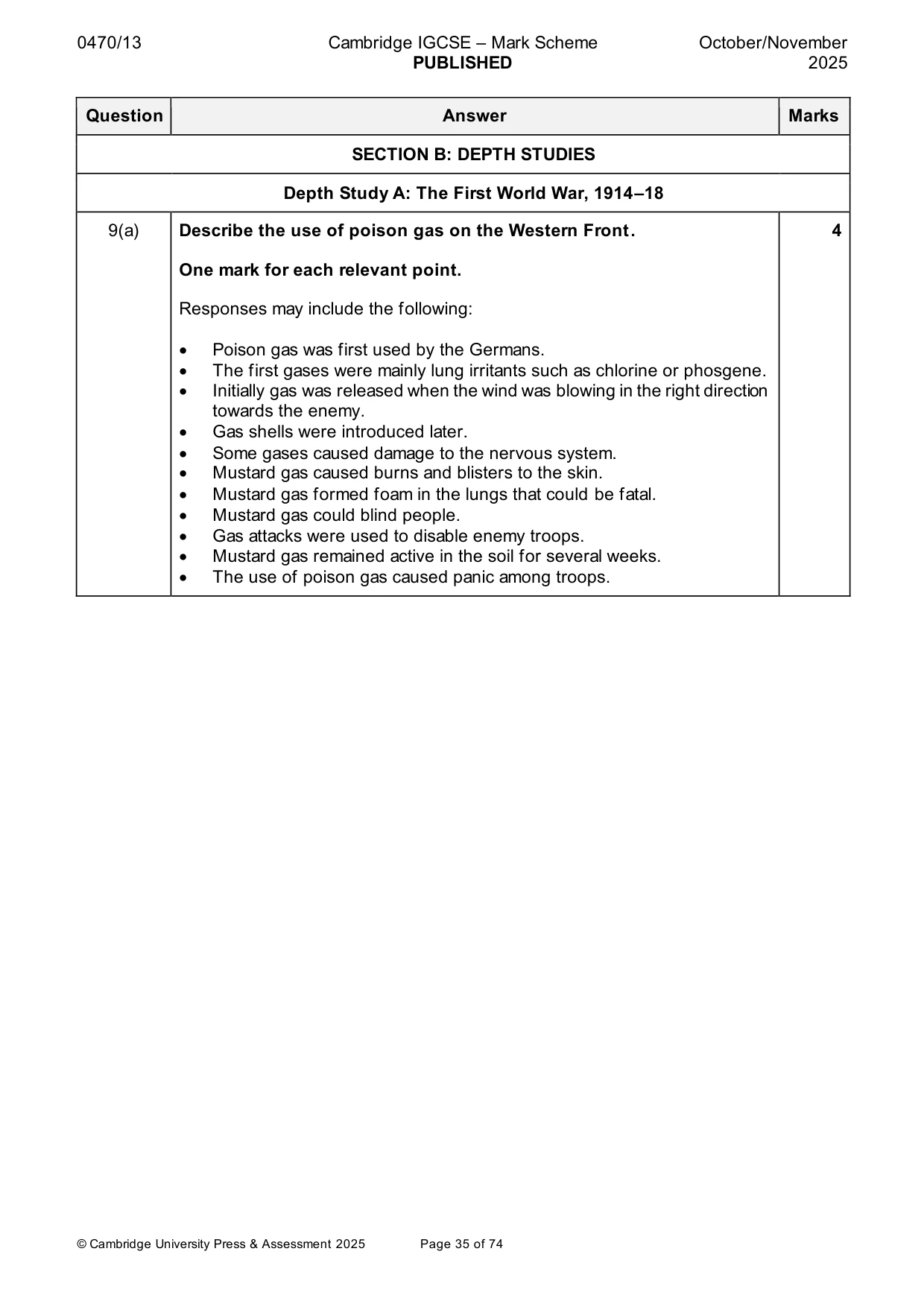
0470/13 Cambridge IGCSE – Mark Scheme PUBLISHED October/November 2025 © Cambridge University Press & Assessment 2025 Page 35 of 74 Question Answer Marks SECTION B: DEPTH STUDIES Depth Study A: The First World War, 1914–18 9(a) Describe the use of poison gas on the Western Front. One mark for each relevant point. Responses may include the following: • Poison gas was first used by the Germans. • The first gases were mainly lung irritants such as chlorine or phosgene. • Initially gas was released when the wind was blowing in the right direction towards the enemy. • Gas shells were introduced later. • Some gases caused damage to the nervous system. • Mustard gas caused burns and blisters to the skin. • Mustard gas formed foam in the lungs that could be fatal. • Mustard gas could blind people. • Gas attacks were used to disable enemy troops. • Mustard gas remained active in the soil for several weeks. • The use of poison gas caused panic among troops. 4
Mark scheme, page 36
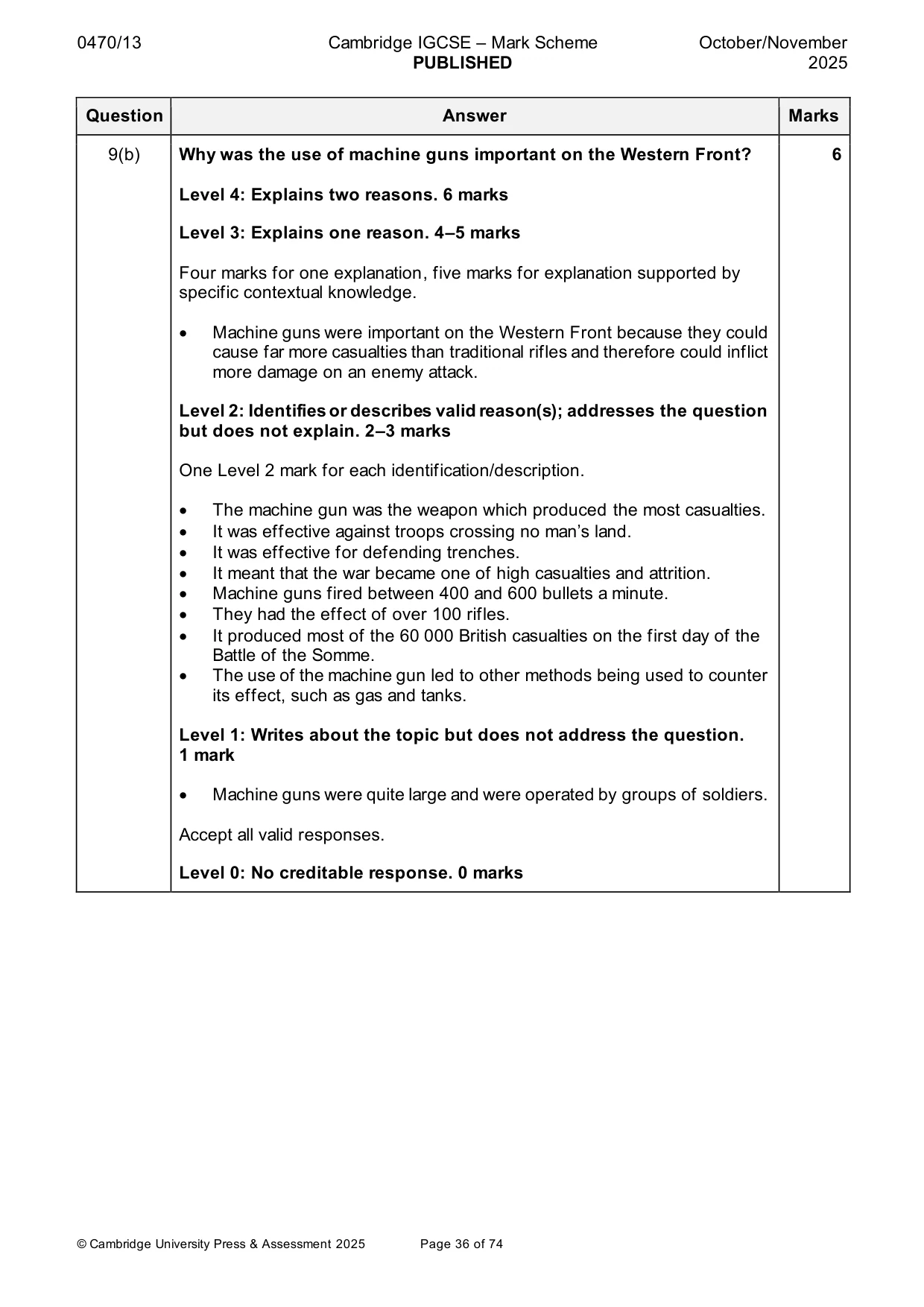
0470/13 Cambridge IGCSE – Mark Scheme PUBLISHED October/November 2025 © Cambridge University Press & Assessment 2025 Page 36 of 74 Question Answer Marks 9(b) Why was the use of machine guns important on the Western Front? Level 4: Explains two reasons. 6 marks Level 3: Explains one reason. 4–5 marks Four marks for one explanation, five marks for explanation supported by specific contextual knowledge. • Machine guns were important on the Western Front because they could cause far more casualties than traditional rifles and therefore could inflict more damage on an enemy attack. Level 2: Identifies or describes valid reason(s); addresses the question but does not explain. 2–3 marks One Level 2 mark for each identification/description. • The machine gun was the weapon which produced the most casualties. • It was effective against troops crossing no man’s land. • It was effective for defending trenches. • It meant that the war became one of high casualties and attrition. • Machine guns fired between 400 and 600 bullets a minute. • They had the effect of over 100 rifles. • It produced most of the 60 000 British casualties on the first day of the Battle of the Somme. • The use of the machine gun led to other methods being used to counter its effect, such as gas and tanks. Level 1: Writes about the topic but does not address the question. 1 mark • Machine guns were quite large and were operated by groups of soldiers. Accept all valid responses. Level 0: No creditable response. 0 marks 6
Mark scheme, page 37
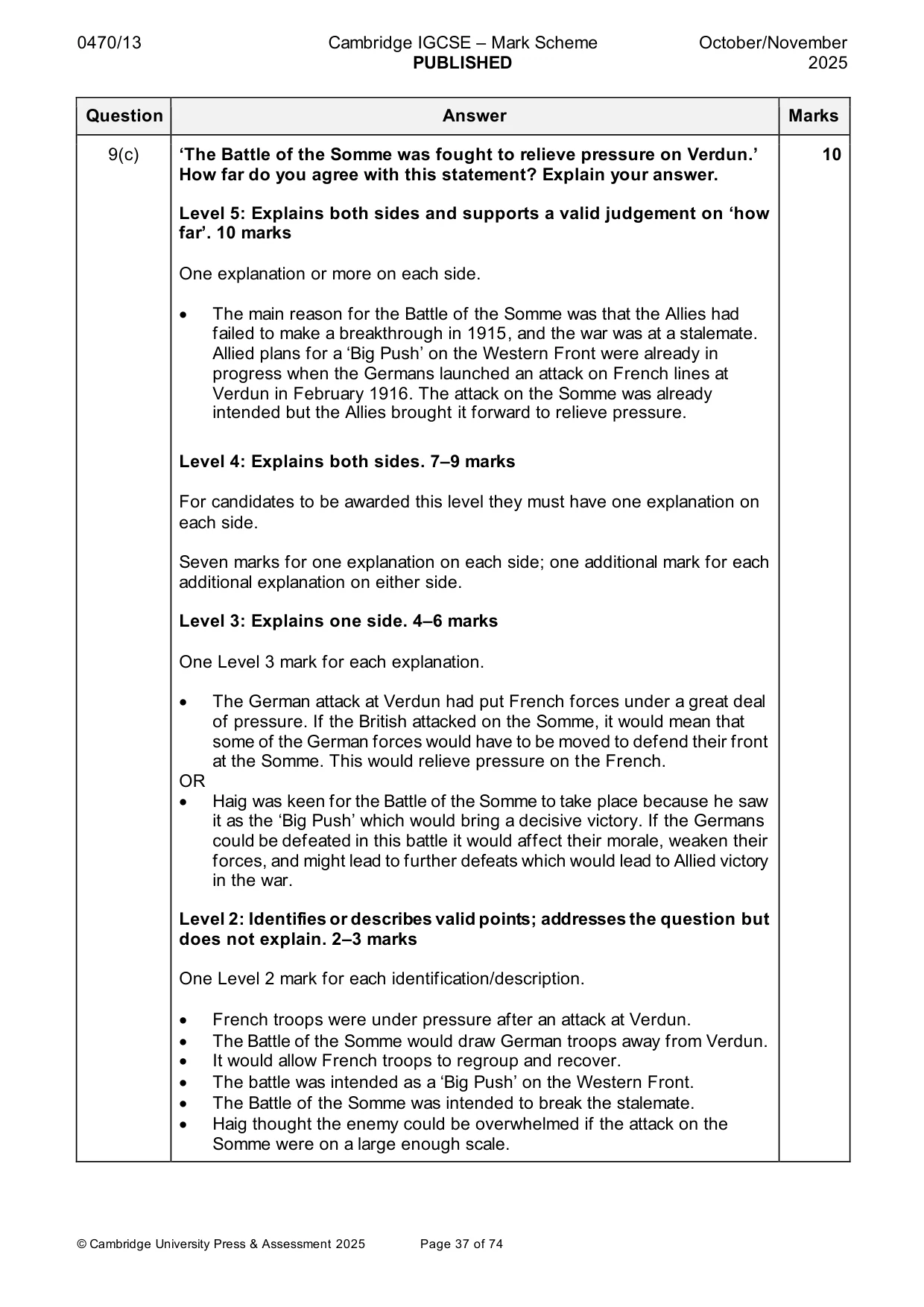
0470/13 Cambridge IGCSE – Mark Scheme PUBLISHED October/November 2025 © Cambridge University Press & Assessment 2025 Page 37 of 74 Question Answer Marks 9(c) ‘The Battle of the Somme was fought to relieve pressure on Verdun.’ How far do you agree with this statement? Explain your answer. Level 5: Explains both sides and supports a valid judgement on ‘how far’. 10 marks One explanation or more on each side. • The main reason for the Battle of the Somme was that the Allies had failed to make a breakthrough in 1915, and the war was at a stalemate. Allied plans for a ‘Big Push’ on the Western Front were already in progress when the Germans launched an attack on French lines at Verdun in February 1916. The attack on the Somme was already intended but the Allies brought it forward to relieve pressure. Level 4: Explains both sides. 7–9 marks For candidates to be awarded this level they must have one explanation on each side. Seven marks for one explanation on each side; one additional mark for each additional explanation on either side. Level 3: Explains one side. 4–6 marks One Level 3 mark for each explanation. • The German attack at Verdun had put French forces under a great deal of pressure. If the British attacked on the Somme, it would mean that some of the German forces would have to be moved to defend their front at the Somme. This would relieve pressure on the French. OR • Haig was keen for the Battle of the Somme to take place because he saw it as the ‘Big Push’ which would bring a decisive victory. If the Germans could be defeated in this battle it would affect their morale, weaken their forces, and might lead to further defeats which would lead to Allied victory in the war. Level 2: Identifies or describes valid points; addresses the question but does not explain. 2–3 marks One Level 2 mark for each identification/description. • French troops were under pressure after an attack at Verdun. • The Battle of the Somme would draw German troops away from Verdun. • It would allow French troops to regroup and recover. • The battle was intended as a ‘Big Push’ on the Western Front. • The Battle of the Somme was intended to break the stalemate. • Haig thought the enemy could be overwhelmed if the attack on the Somme were on a large enough scale. 10
Mark scheme, page 38
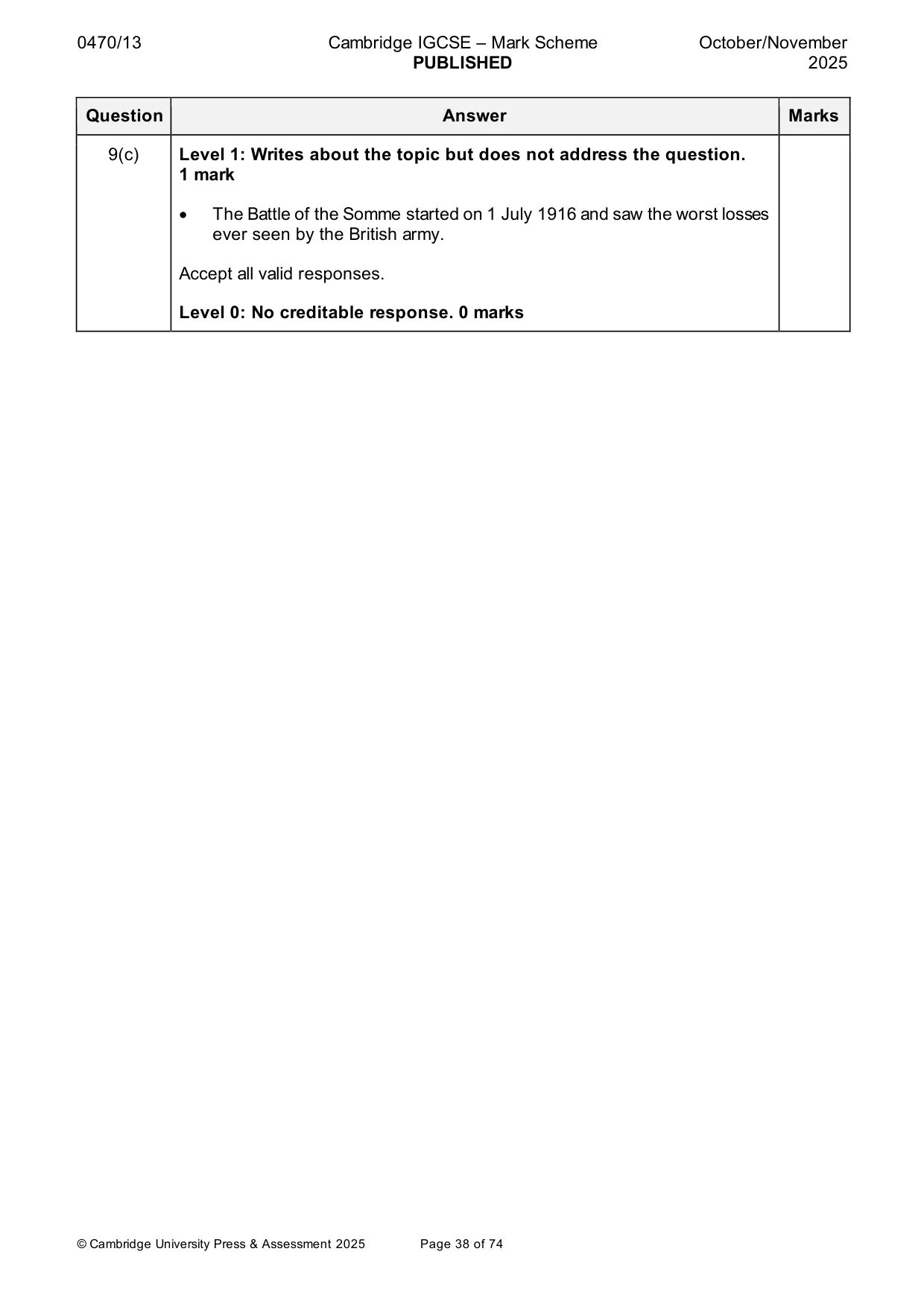
0470/13 Cambridge IGCSE – Mark Scheme PUBLISHED October/November 2025 © Cambridge University Press & Assessment 2025 Page 38 of 74 Question Answer Marks 9(c) Level 1: Writes about the topic but does not address the question. 1 mark • The Battle of the Somme started on 1 July 1916 and saw the worst losses ever seen by the British army. Accept all valid responses. Level 0: No creditable response. 0 marks
Mark scheme, page 39
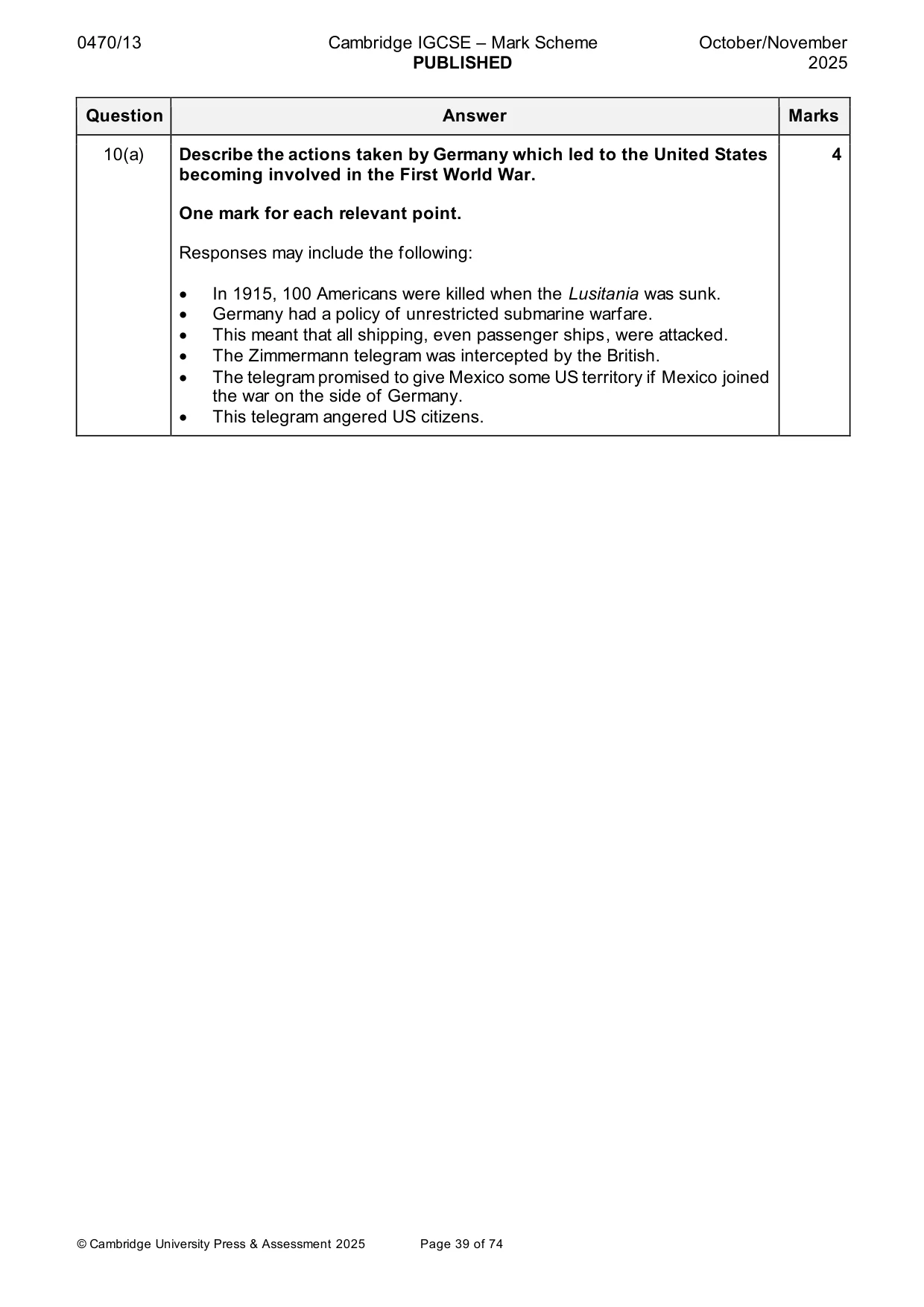
0470/13 Cambridge IGCSE – Mark Scheme PUBLISHED October/November 2025 © Cambridge University Press & Assessment 2025 Page 39 of 74 Question Answer Marks 10(a) Describe the actions taken by Germany which led to the United States becoming involved in the First World War. One mark for each relevant point. Responses may include the following: • In 1915, 100 Americans were killed when the Lusitania was sunk. • Germany had a policy of unrestricted submarine warfare. • This meant that all shipping, even passenger ships, were attacked. • The Zimmermann telegram was intercepted by the British. • The telegram promised to give Mexico some US territory if Mexico joined the war on the side of Germany. • This telegram angered US citizens. 4
Mark scheme, page 40
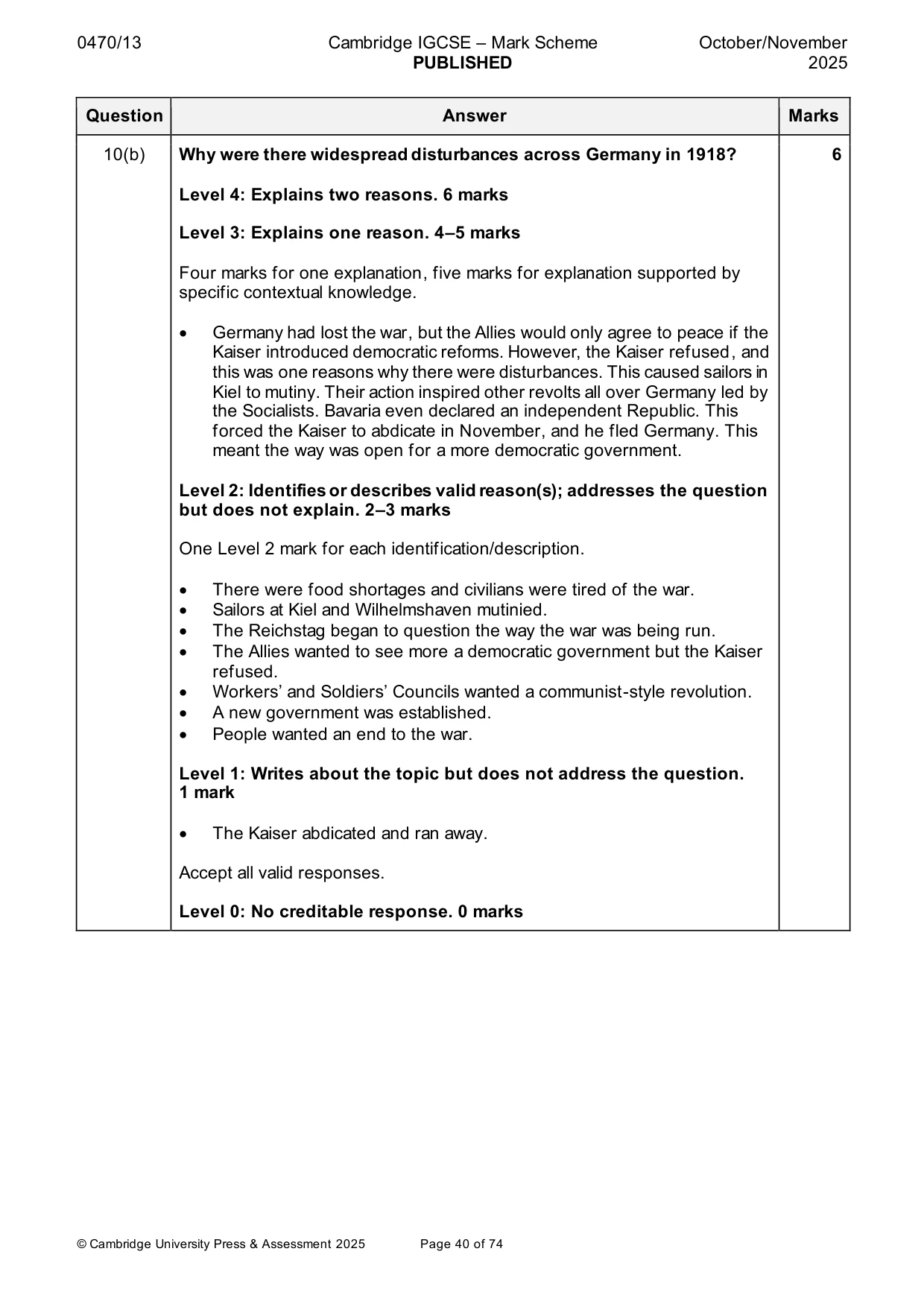
0470/13 Cambridge IGCSE – Mark Scheme PUBLISHED October/November 2025 © Cambridge University Press & Assessment 2025 Page 40 of 74 Question Answer Marks 10(b) Why were there widespread disturbances across Germany in 1918? Level 4: Explains two reasons. 6 marks Level 3: Explains one reason. 4–5 marks Four marks for one explanation, five marks for explanation supported by specific contextual knowledge. • Germany had lost the war, but the Allies would only agree to peace if the Kaiser introduced democratic reforms. However, the Kaiser refused, and this was one reasons why there were disturbances. This caused sailors in Kiel to mutiny. Their action inspired other revolts all over Germany led by the Socialists. Bavaria even declared an independent Republic. This forced the Kaiser to abdicate in November, and he fled Germany. This meant the way was open for a more democratic government. Level 2: Identifies or describes valid reason(s); addresses the question but does not explain. 2–3 marks One Level 2 mark for each identification/description. • There were food shortages and civilians were tired of the war. • Sailors at Kiel and Wilhelmshaven mutinied. • The Reichstag began to question the way the war was being run. • The Allies wanted to see more a democratic government but the Kaiser refused. • Workers’ and Soldiers’ Councils wanted a communist-style revolution. • A new government was established. • People wanted an end to the war. Level 1: Writes about the topic but does not address the question. 1 mark • The Kaiser abdicated and ran away. Accept all valid responses. Level 0: No creditable response. 0 marks 6
Mark scheme, page 41
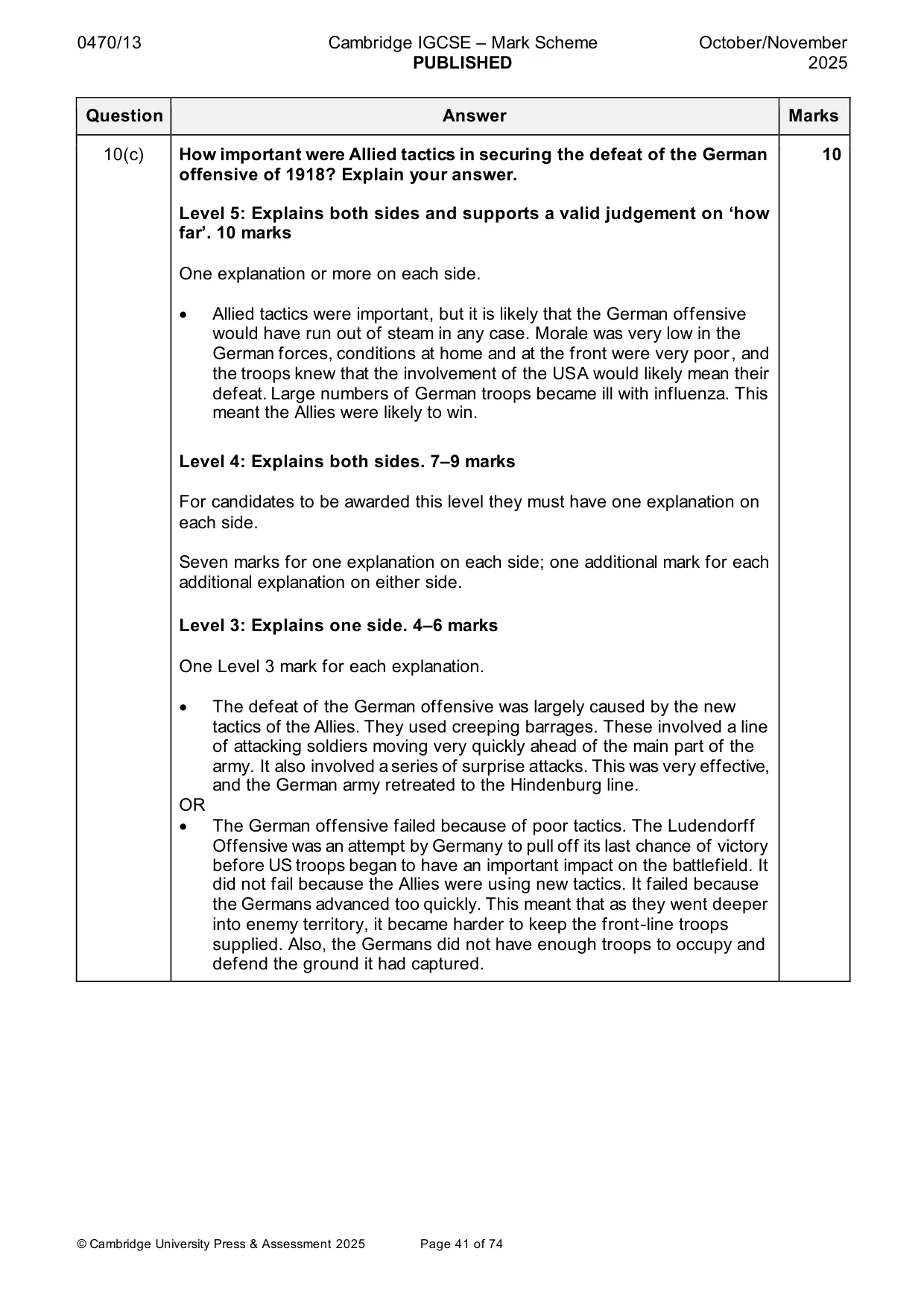
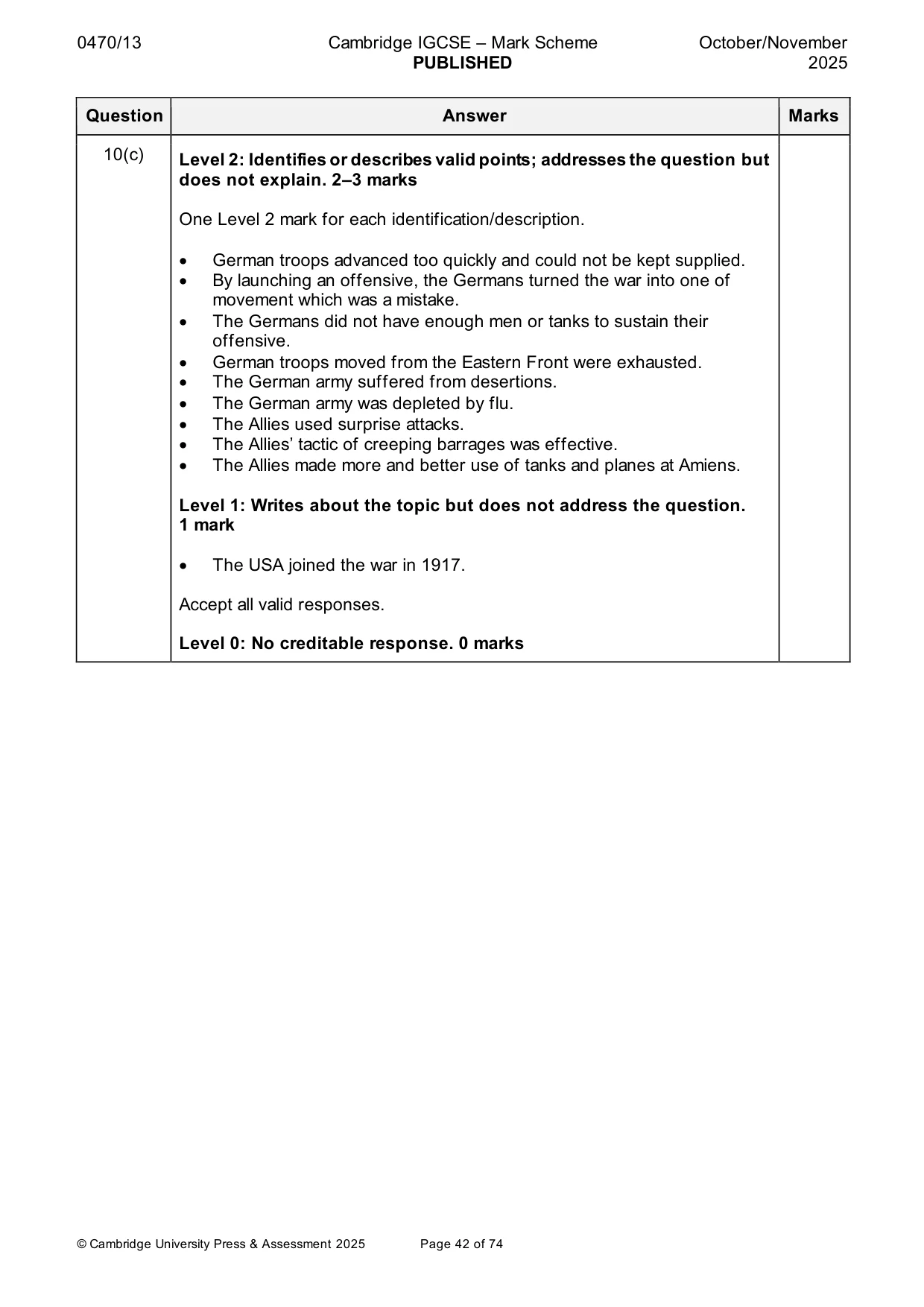
0470/13 Cambridge IGCSE – Mark Scheme PUBLISHED October/November 2025 © Cambridge University Press & Assessment 2025 Page 41 of 74 Question Answer Marks 10(c) How important were Allied tactics in securing the defeat of the German offensive of 1918? Explain your answer. Level 5: Explains both sides and supports a valid judgement on ‘how far’. 10 marks One explanation or more on each side. • Allied tactics were important, but it is likely that the German offensive would have run out of steam in any case. Morale was very low in the German forces, conditions at home and at the front were very poor, and the troops knew that the involvement of the USA would likely mean their defeat. Large numbers of German troops became ill with influenza. This meant the Allies were likely to win. Level 4: Explains both sides. 7–9 marks For candidates to be awarded this level they must have one explanation on each side. Seven marks for one explanation on each side; one additional mark for each additional explanation on either side. Level 3: Explains one side. 4–6 marks One Level 3 mark for each explanation. • The defeat of the German offensive was largely caused by the new tactics of the Allies. They used creeping barrages. These involved a line of attacking soldiers moving very quickly ahead of the main part of the army. It also involved a series of surprise attacks. This was very effective, and the German army retreated to the Hindenburg line. OR • The German offensive failed because of poor tactics. The Ludendorff Offensive was an attempt by Germany to pull off its last chance of victory before US troops began to have an important impact on the battlefield. It did not fail because the Allies were using new tactics. It failed because the Germans advanced too quickly. This meant that as they went deeper into enemy territory, it became harder to keep the front-line troops supplied. Also, the Germans did not have enough troops to occupy and defend the ground it had captured. 10
Mark scheme, page 42
0470/13 Cambridge IGCSE – Mark Scheme PUBLISHED October/November 2025 © Cambridge University Press & Assessment 2025 Page 42 of 74 Question Answer Marks 10(c) Level 2: Identifies or describes valid points; addresses the question but does not explain. 2–3 marks One Level 2 mark for each identification/description. • German troops advanced too quickly and could not be kept supplied. • By launching an offensive, the Germans turned the war into one of movement which was a mistake. • The Germans did not have enough men or tanks to sustain their offensive. • German troops moved from the Eastern Front were exhausted. • The German army suffered from desertions. • The German army was depleted by flu. • The Allies used surprise attacks. • The Allies’ tactic of creeping barrages was effective. • The Allies made more and better use of tanks and planes at Amiens. Level 1: Writes about the topic but does not address the question. 1 mark • The USA joined the war in 1917. Accept all valid responses. Level 0: No creditable response. 0 marks
Mark scheme, page 43
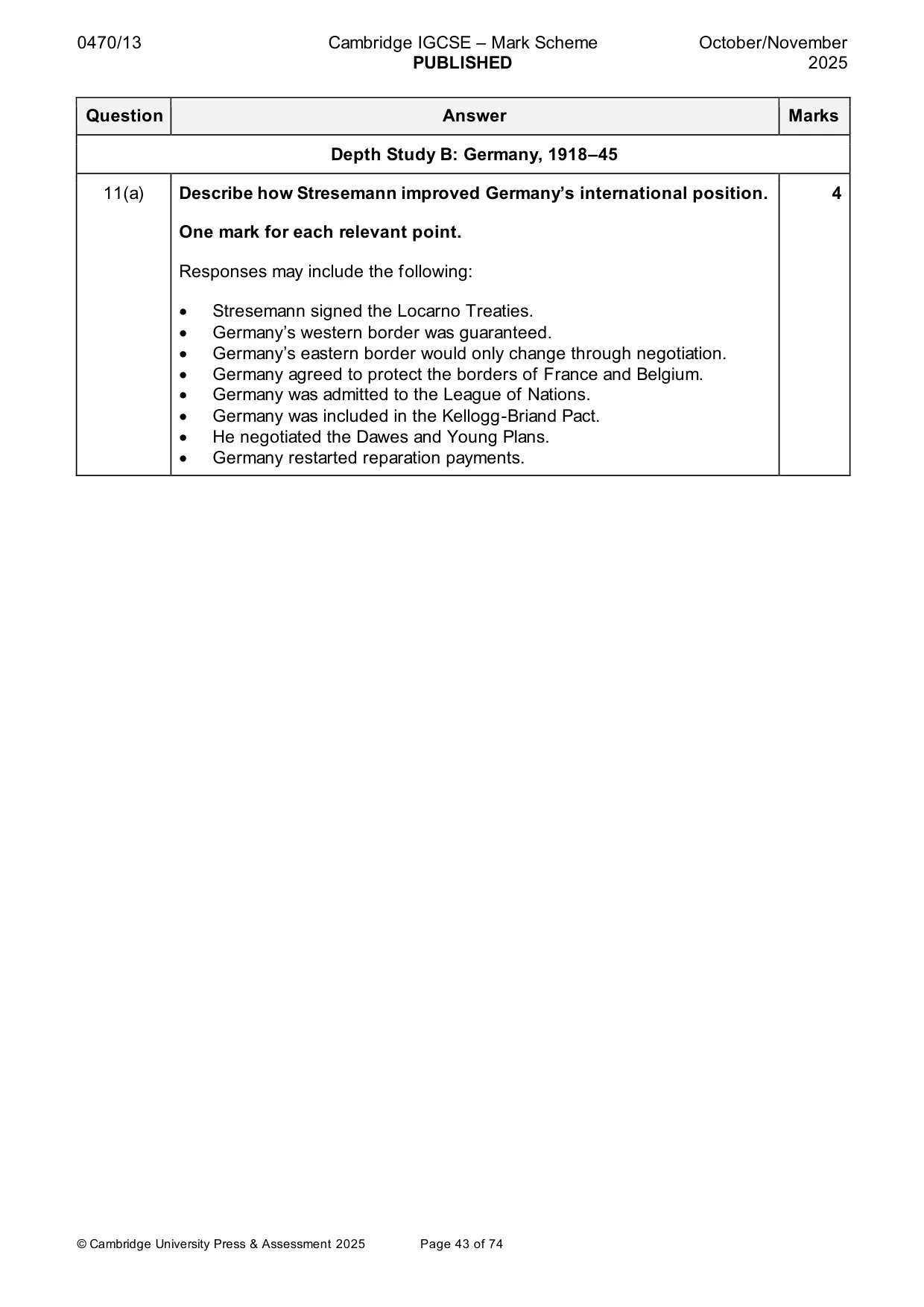
0470/13 Cambridge IGCSE – Mark Scheme PUBLISHED October/November 2025 © Cambridge University Press & Assessment 2025 Page 43 of 74 Question Answer Marks Depth Study B: Germany, 1918–45 11(a) Describe how Stresemann improved Germany’s international position. One mark for each relevant point. Responses may include the following: • Stresemann signed the Locarno Treaties. • Germany’s western border was guaranteed. • Germany’s eastern border would only change through negotiation. • Germany agreed to protect the borders of France and Belgium. • Germany was admitted to the League of Nations. • Germany was included in the Kellogg-Briand Pact. • He negotiated the Dawes and Young Plans. • Germany restarted reparation payments. 4
Mark scheme, page 44
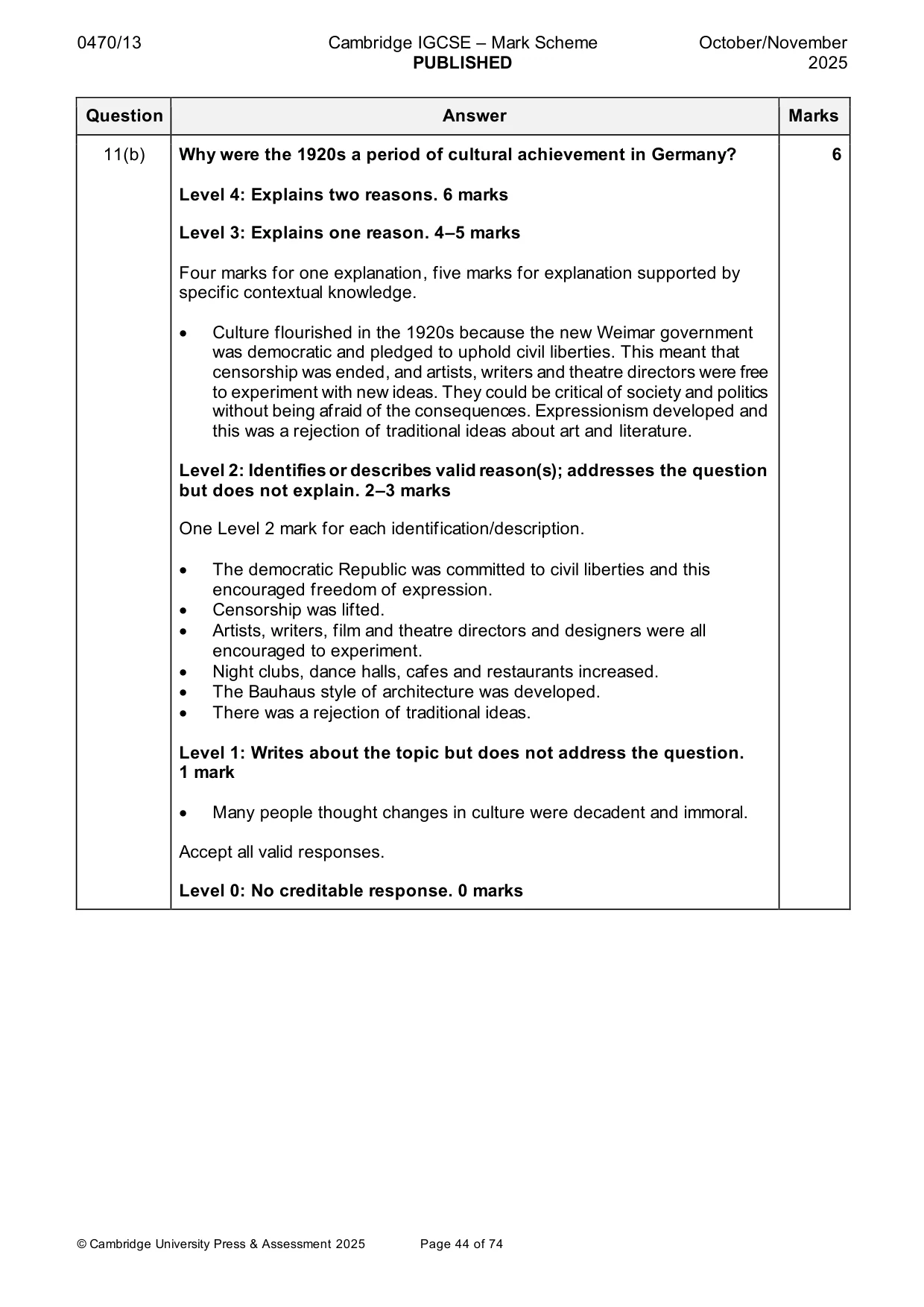
0470/13 Cambridge IGCSE – Mark Scheme PUBLISHED October/November 2025 © Cambridge University Press & Assessment 2025 Page 44 of 74 Question Answer Marks 11(b) Why were the 1920s a period of cultural achievement in Germany? Level 4: Explains two reasons. 6 marks Level 3: Explains one reason. 4–5 marks Four marks for one explanation, five marks for explanation supported by specific contextual knowledge. • Culture flourished in the 1920s because the new Weimar government was democratic and pledged to uphold civil liberties. This meant that censorship was ended, and artists, writers and theatre directors were free to experiment with new ideas. They could be critical of society and politics without being afraid of the consequences. Expressionism developed and this was a rejection of traditional ideas about art and literature. Level 2: Identifies or describes valid reason(s); addresses the question but does not explain. 2–3 marks One Level 2 mark for each identification/description. • The democratic Republic was committed to civil liberties and this encouraged freedom of expression. • Censorship was lifted. • Artists, writers, film and theatre directors and designers were all encouraged to experiment. • Night clubs, dance halls, cafes and restaurants increased. • The Bauhaus style of architecture was developed. • There was a rejection of traditional ideas. Level 1: Writes about the topic but does not address the question. 1 mark • Many people thought changes in culture were decadent and immoral. Accept all valid responses. Level 0: No creditable response. 0 marks 6
Mark scheme, page 45
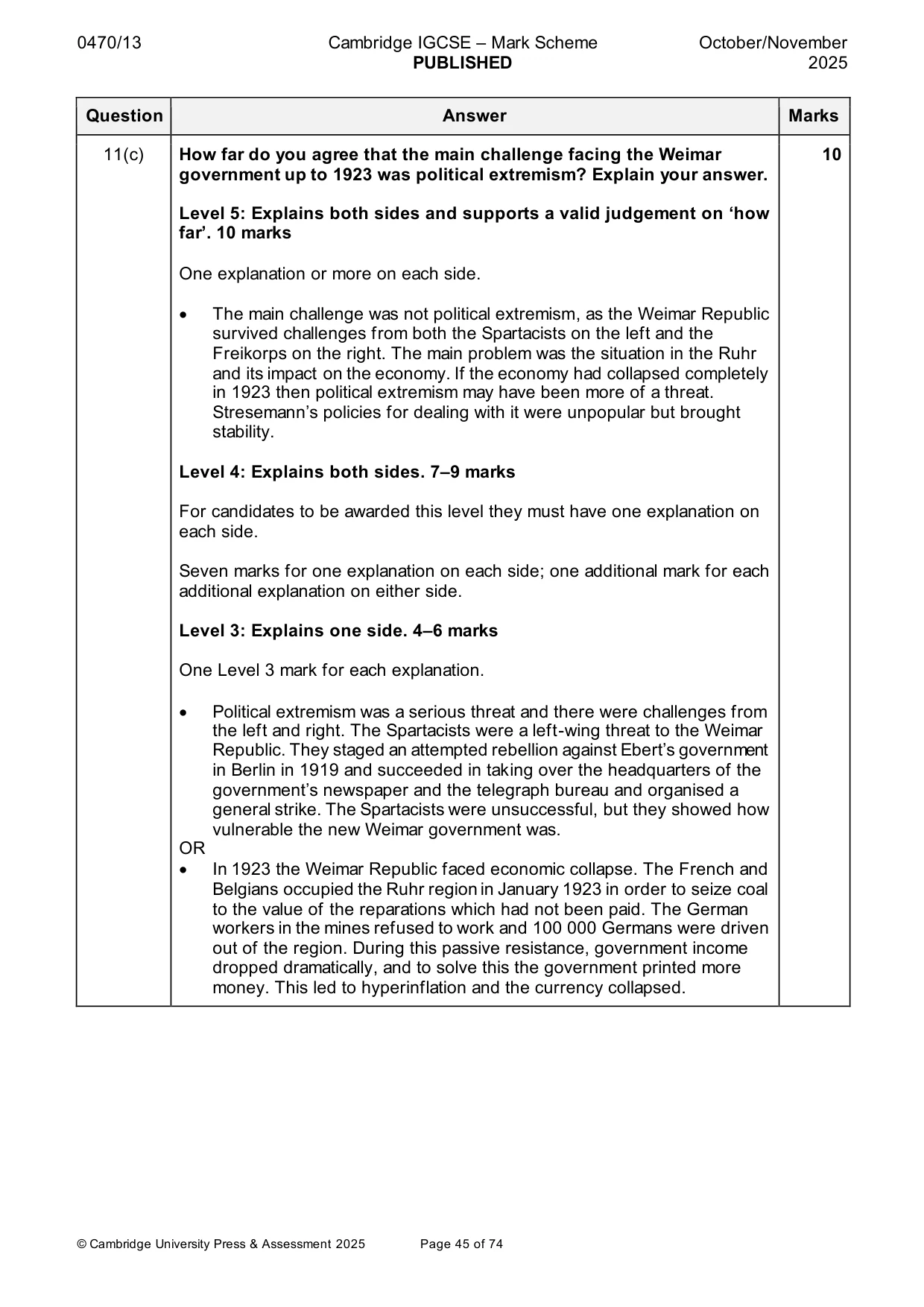
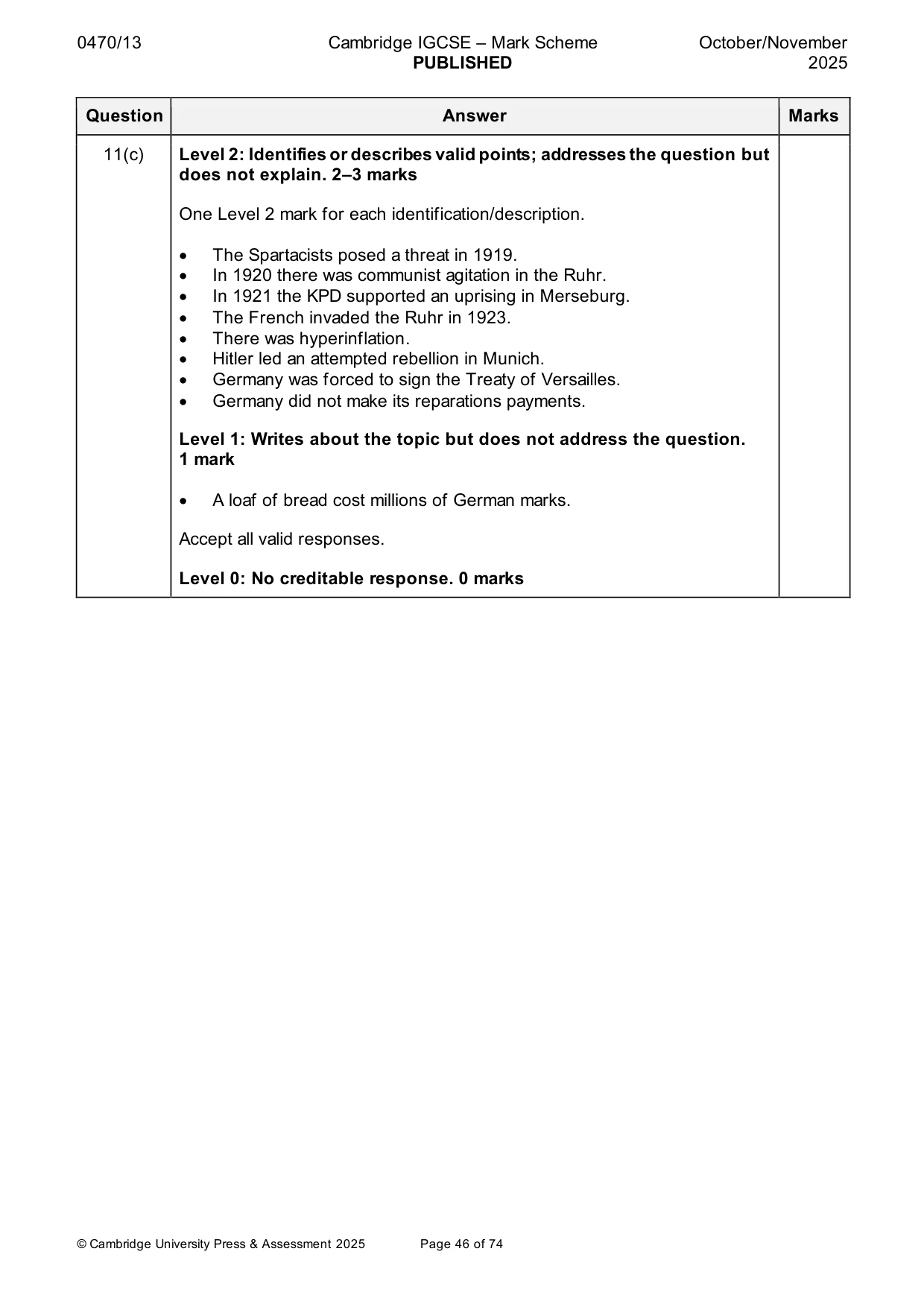
0470/13 Cambridge IGCSE – Mark Scheme PUBLISHED October/November 2025 © Cambridge University Press & Assessment 2025 Page 45 of 74 Question Answer Marks 11(c) How far do you agree that the main challenge facing the Weimar government up to 1923 was political extremism? Explain your answer. Level 5: Explains both sides and supports a valid judgement on ‘how far’. 10 marks One explanation or more on each side. • The main challenge was not political extremism, as the Weimar Republic survived challenges from both the Spartacists on the left and the Freikorps on the right. The main problem was the situation in the Ruhr and its impact on the economy. If the economy had collapsed completely in 1923 then political extremism may have been more of a threat. Stresemann’s policies for dealing with it were unpopular but brought stability. Level 4: Explains both sides. 7–9 marks For candidates to be awarded this level they must have one explanation on each side. Seven marks for one explanation on each side; one additional mark for each additional explanation on either side. Level 3: Explains one side. 4–6 marks One Level 3 mark for each explanation. • Political extremism was a serious threat and there were challenges from the left and right. The Spartacists were a left-wing threat to the Weimar Republic. They staged an attempted rebellion against Ebert’s government in Berlin in 1919 and succeeded in taking over the headquarters of the government’s newspaper and the telegraph bureau and organised a general strike. The Spartacists were unsuccessful, but they showed how vulnerable the new Weimar government was. OR • In 1923 the Weimar Republic faced economic collapse. The French and Belgians occupied the Ruhr region in January 1923 in order to seize coal to the value of the reparations which had not been paid. The German workers in the mines refused to work and 100 000 Germans were driven out of the region. During this passive resistance, government income dropped dramatically, and to solve this the government printed more money. This led to hyperinflation and the currency collapsed. 10
Mark scheme, page 46
0470/13 Cambridge IGCSE – Mark Scheme PUBLISHED October/November 2025 © Cambridge University Press & Assessment 2025 Page 46 of 74 Question Answer Marks 11(c) Level 2: Identifies or describes valid points; addresses the question but does not explain. 2–3 marks One Level 2 mark for each identification/description. • The Spartacists posed a threat in 1919. • In 1920 there was communist agitation in the Ruhr. • In 1921 the KPD supported an uprising in Merseburg. • The French invaded the Ruhr in 1923. • There was hyperinflation. • Hitler led an attempted rebellion in Munich. • Germany was forced to sign the Treaty of Versailles. • Germany did not make its reparations payments. Level 1: Writes about the topic but does not address the question. 1 mark • A loaf of bread cost millions of German marks. Accept all valid responses. Level 0: No creditable response. 0 marks
Mark scheme, page 47
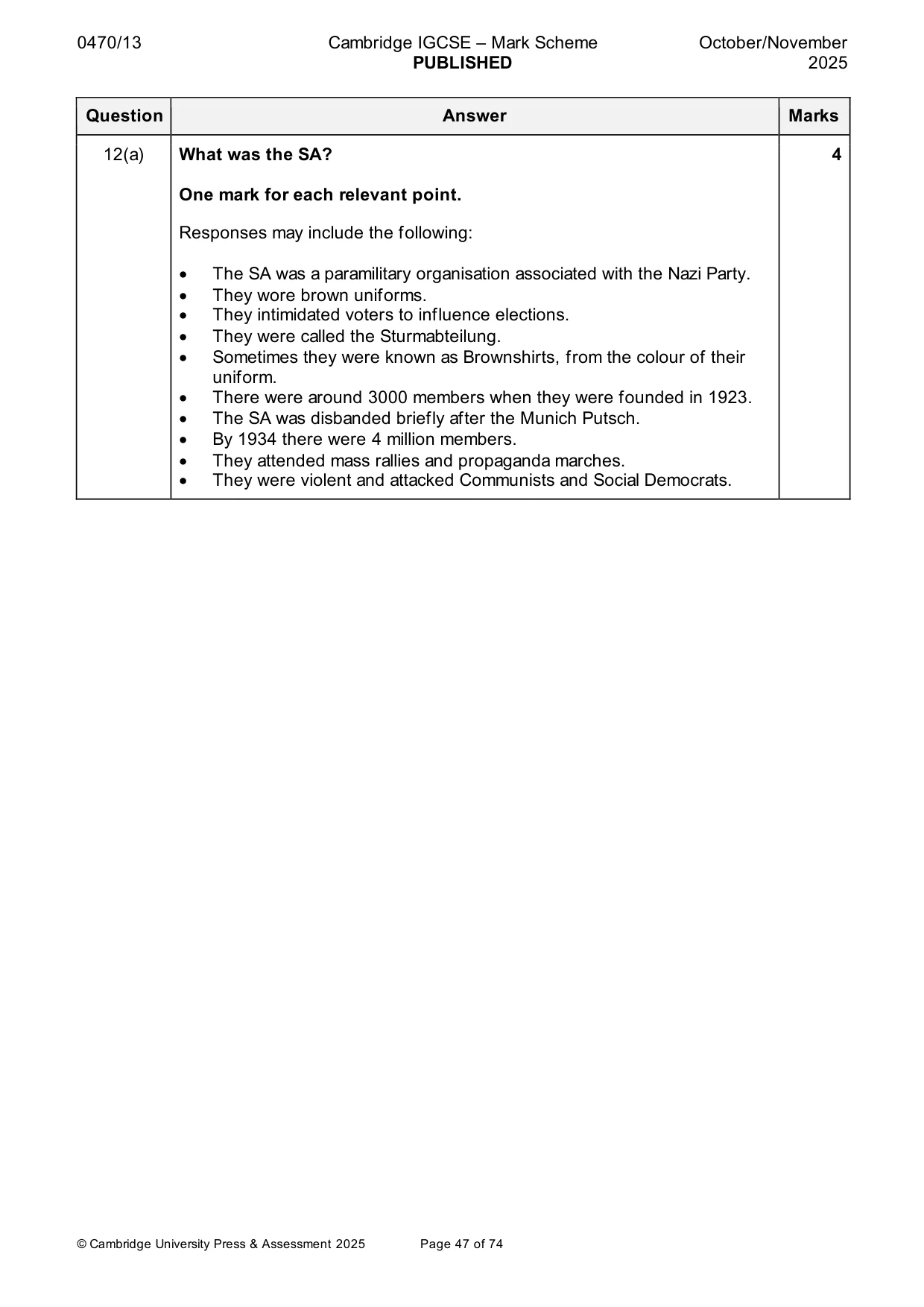
0470/13 Cambridge IGCSE – Mark Scheme PUBLISHED October/November 2025 © Cambridge University Press & Assessment 2025 Page 47 of 74 Question Answer Marks 12(a) What was the SA? One mark for each relevant point. Responses may include the following: • The SA was a paramilitary organisation associated with the Nazi Party. • They wore brown uniforms. • They intimidated voters to influence elections. • They were called the Sturmabteilung. • Sometimes they were known as Brownshirts, from the colour of their uniform. • There were around 3000 members when they were founded in 1923. • The SA was disbanded briefly after the Munich Putsch. • By 1934 there were 4 million members. • They attended mass rallies and propaganda marches. • They were violent and attacked Communists and Social Democrats. 4
Mark scheme, page 48
0470/13 Cambridge IGCSE – Mark Scheme PUBLISHED October/November 2025 © Cambridge University Press & Assessment 2025 Page 48 of 74 Question Answer Marks 12(b) Why did the Nazis become the largest party in the Reichstag in June 1932? Level 4: Explains two reasons. 6 marks Level 3: Explains one reason. 4–5 marks Four marks for one explanation, five marks for explanation supported by specific contextual knowledge. • Hitler stood for President against Hindenburg in March 1932 and, even though he did not win, it helped him to gain support and spread the Nazi message. During the presidential campaign Hitler flew to many cities in Germany to spread the Nazi message. Sometimes he visited five cities in a day. He made speeches in each city and huge crowds flocked to see him. This meant that when the July elections happened the Nazis were able to increase their share of the vote and become the largest party. Level 2: Identifies or describes valid reason(s); addresses the question but does not explain. 2–3 marks One Level 2 mark for each identification/description. • The Nazis won 37.3% of the vote. • The Nazis had increased their share of the vote much more than the Communists. • The Nazis had an effective propaganda machine run by Goebbels. • They held mass rallies to spread their message to the electorate. • Hitler ran against Hindenburg for President in March 1932. • As part of the campaign Hitler flew to many different cities in Germany to spread the Nazi message. • The Nazis promised the Germans they would provide jobs and bread. • Many people were afraid of communism. • The Weimar government did not deal with the depression effectively. Level 1: Writes about the topic but does not address the question. 1 mark • The Nazis had more seats than any other party. Accept all valid responses. Level 0: No creditable response. 0 marks 6
Mark scheme, page 49
0470/13 Cambridge IGCSE – Mark Scheme PUBLISHED October/November 2025 © Cambridge University Press & Assessment 2025 Page 49 of 74 Question Answer Marks 12(c) ‘Securing the support of the army was the most important factor in Hitler’s consolidation of power, 1933–34.’ How far do you agree with this statement? Explain your answer. Level 5: Explains both sides and supports a valid judgement on ‘how far’. 10 marks One explanation or more on each side. • The most crucial factor in Hitler’s consolidation of power was the Night of the Long Knives because Hitler would not have been able to secure the support of the army without neutralising the threat of the SA. Level 4: Explains both sides. 7–9 marks For candidates to be awarded this level they must have one explanation on each side. Seven marks for one explanation on each side; one additional mark for each additional explanation on either side. Level 3: Explains one side. 4–6 marks One Level 3 mark for each explanation. • Securing the support of the army was vital if Hitler were to establish control and remain unchallenged. Senior army generals had heard that Röhm was in favour of merging the army with the SA under his leadership. This worried them generally and they would not give Hitler their support. The army represented a potential threat to Hitler – they were powerful and commanded a great deal of respect in Germany. Winning them over would reassure others who were uncertain about Hitler’s rule and would mean Hitler was backed by powerful armed forces. OR • The Enabling Act was the most important element of Hitler’s consolidation of power, as it gave Hitler the power to pass laws for four years without consulting the Reichstag. This gave him the power and time he needed to establish a dictatorship. He was able to ban all opposition parties, and by July 1933 Germany had become a one-party state. Under the Enabling Act, Hitler was able to remove anti-Nazi politicians from state government and the civil service, ensuring there was no opposition from within the state. 10
Mark scheme, page 50
0470/13 Cambridge IGCSE – Mark Scheme PUBLISHED October/November 2025 © Cambridge University Press & Assessment 2025 Page 50 of 74 Question Answer Marks 12(c) Level 2: Identifies or describes valid points; addresses the question but does not explain. 2–3 marks One Level 2 mark for each identification/description. • The Reichstag Fire led to arrests of communists. • The Enabling Act made Hitler a legal dictator. • The banning of trade unions except the German Labour Front gave Hitler control over workers. • The Night of the Long Knives removed any rivals to Hitler. • With the death of Hindenburg, Hitler became Führer. • The German armed forces swore an oath of loyalty to Hitler. Level 1: Writes about the topic but does not address the question. 1 mark • The SA were getting out of control, so Hitler had their leaders murdered. Accept all valid responses. Level 0: No creditable response. 0 marks
Mark scheme, page 51
0470/13 Cambridge IGCSE – Mark Scheme PUBLISHED October/November 2025 © Cambridge University Press & Assessment 2025 Page 51 of 74 Question Answer Marks Depth Study C: Russia, 1905–41 13(a) Who were the ‘Whites’? 4 One mark for each relevant point. Responses may include the following: • They fought the Bolsheviks in the Russian Civil War. • They were nationalistic and wanted the Tsarist system to be reinstated. • The Cossacks joined the White Army. • The White Army was led by General Kornilov. • The Whites were made up of many different groups and were not united. • The Whites included middle-class liberals, army officers and monarchists. • The Whites were supported by foreign countries who were worried by Russia becoming communist.
Mark scheme, page 52
0470/13 Cambridge IGCSE – Mark Scheme PUBLISHED October/November 2025 © Cambridge University Press & Assessment 2025 Page 52 of 74 Question Answer Marks 13(b) Why was the policy of War Communism important? Level 4: Explains two reasons. 6 marks Level 3: Explains one reason. 4–5 marks Four marks for one explanation, five marks for explanation supported by specific contextual knowledge. • War Communism was important because it enabled the Bolsheviks to defeat the Whites. Industry was nationalised and the government ran the factories. This gave the Bolsheviks power over what was produced and over the workers who were shot if they went on strike. This meant that the Red Army could be supplied with the equipment it needed to win the Civil War. Level 2: Identifies or describes valid reason(s); addresses the question but does not explain. 2–3 marks One Level 2 mark for each identification/description. • War Communism provided an economy to meet the needs of the war. • War Communism meant a large army could be fed. • War Communism meant a large army could be equipped. • War Communism caused terrible hardship. • Under War Communism, peasants had to hand over surplus food to the government. • Under War Communism, the output of heavy industry fell. Level 1: Writes about the topic but does not address the question. 1 mark • War Communism was replaced by NEP. Accept all valid responses. Level 0: No creditable response. 0 marks 6
Mark scheme, page 53
0470/13 Cambridge IGCSE – Mark Scheme PUBLISHED October/November 2025 © Cambridge University Press & Assessment 2025 Page 53 of 74 Question Answer Marks 13(c) ‘The Provisional Government lost power because of its mistakes.’ How far do you agree with this statement? Explain your answer. Level 5: Explains both sides and supports a valid judgement on ‘how far’. 10 marks One explanation or more on each side. • The Provisional Government lost power because they made mistakes, and their biggest mistake was to continue Russia’s involvement in the First World War. This meant that when the war went badly it was associated with the Provisional Government, and they would get the blame. The decision to launch the summer offensive made the situation even worse. It was a dreadful failure and an armed uprising in Petrograd followed. The government survived but the war continued to take all the resources leaving the Russian people starving, with unemployment and inflation growing. Unrest was mounting. The Provisional Government had not sorted out the problems in Russia. Level 4: Explains both sides. 7–9 marks For candidates to be awarded this level they must have one explanation on each side. Seven marks for one explanation on each side; one additional mark for each additional explanation on either side. Level 3: Explains one side. 4–6 marks One Level 3 mark for each explanation. • The Provisional Government definitely made mistakes. One of those was during the Kornilov Revolt when they allowed the Bolsheviks to take up arms to defeat the revolt. This turned the Bolsheviks into heroes in the eyes of many and their defence of Petrograd was seen as heroic. The Provisional Government had unwittingly made the Bolsheviks more popular. OR • There were other reasons why the Provisional Government lost power. One big problem was the growing power of the Bolsheviks. They became the group that people turned to when they became increasingly unhappy with the situation at the time. Their promises to end the war, improve food supplies and pass social reforms made them very popular. They did very well in elections to the Soviets. By September 1917 they were a real threat to the Provisional Government. 10
Mark scheme, page 54
0470/13 Cambridge IGCSE – Mark Scheme PUBLISHED October/November 2025 © Cambridge University Press & Assessment 2025 Page 54 of 74 Question Answer Marks 13(c) Level 2: Identifies or describes valid points; addresses the question but does not explain. 2–3 marks One Level 2 mark for each identification/description. • The Provisional Government decided to continue Russia’s involvement in the war. • Divisions in the government led to a lack of clear policies. • It was a mistake to launch the summer offensive. • Kerensky did not capitalise on the July Days. • The Provisional Government failed to deal with problems over land ownership. • The Provisional Government failed to deal with problems caused by the war. • The government failed to deal with problems over food supplies. • Kerensky did not understand how serious a threat the Bolsheviks were. • The Bolsheviks promised things like better food supplies and social reforms, which made them popular. • The Bolsheviks did well in elections to the Soviets. Level 1: Writes about the topic but does not address the question. 1 mark • The Provisional Government’s policies were not popular with many of the people. Accept all valid responses. Level 0: No creditable response. 0 marks
Mark scheme, page 55
0470/13 Cambridge IGCSE – Mark Scheme PUBLISHED October/November 2025 © Cambridge University Press & Assessment 2025 Page 55 of 74 Question Answer Marks 14(a) What were the ‘show trials’? One mark for each relevant point. Responses may include the following: • Leading Bolsheviks were put on trial in public. • Leading Bolsheviks were made to confess to crimes against Stalin or the state. • The ‘show trials’ formed part of Stalin’s Purges. • At the ‘show trials’ charges were made that defendants had conspired with Western powers to overthrow Stalin, break up the Soviet Union and restore capitalism. • Defendants were accused of conspiring with Trotsky. • Major opponents of Stalin, such as Rykov, Bukharin and Zinoviev, were removed. • The ‘show trials’ were used for propaganda purposes to frighten people into supporting Stalin. 4
Mark scheme, page 56
0470/13 Cambridge IGCSE – Mark Scheme PUBLISHED October/November 2025 © Cambridge University Press & Assessment 2025 Page 56 of 74 Question Answer Marks 14(b) Why was the development of a personality cult important to Stalin? Level 4: Explains two reasons. 6 marks Level 3: Explains one reason. 4–5 marks Four marks for one explanation, five marks for explanation supported by specific contextual knowledge. • The cult of personality was important to Stalin because it allowed him to secure the loyalty of the Russian people. He wanted Russians to respect him and see him as a father, or even God-like, figure. He had history rewritten to make him appear as the hero of the Revolution. Posters, statues and photographs appeared all over the country showing Stalin as a hero or kindly father of the people. This positive image gained him many supporters, and many events were held to celebrate Stalin. All this helped to ensure that people were loyal to Stalin. Level 2: Identifies or describes valid reason(s); addresses the question but does not explain. 2–3 marks One Level 2 mark for each identification/description. • Stalin had towns named after him. • Stalin’s image was published everywhere. • Photographs and textbooks were edited so that people thought Lenin and Stalin were close. • Propaganda was published which showed Stalin as a kind, fatherly figure. • Stalin wanted people to think he was a God-like figure. • The personality cult encouraged people to think that Russia’s success was dependent on Stalin. Level 1: Writes about the topic but does not address the question. 1 mark • Stalin would not tolerate opposition against him. Accept all valid responses. Level 0: No creditable response. 0 marks 6
Mark scheme, page 57
0470/13 Cambridge IGCSE – Mark Scheme PUBLISHED October/November 2025 © Cambridge University Press & Assessment 2025 Page 57 of 74 Question Answer Marks 14(c) How surprising was it that Trotsky did not become leader of the Soviet Union? Explain your answer. Level 5: Explains both sides and supports a valid judgement on ‘how far’. 10 marks One explanation or more on each side. • At first it seems surprising, as Trotsky was Lenin’s favourite and should have been an obvious choice to succeed him. However, Lenin’s Testament criticised many leading Bolsheviks, including Trotsky. It is therefore not surprising that the Politburo decided not to publish the Testament. This decision had a far-reaching impact though, as it allowed Stalin to become a serious contender for power. Level 4: Explains both sides. 7–9 marks For candidates to be awarded this level they must have one explanation on each side. Seven marks for one explanation on each side; one additional mark for each additional explanation on either side. Level 3: Explains one side. 4–6 marks One Level 3 mark for each explanation. • In some ways it was not surprising, as Trotsky made mistakes and should have been more astute in his assessment of Stalin. Trotsky assumed that he would naturally be Lenin’s successor and therefore made little effort to gain support within the party. His arrogant manner offended many leading Bolsheviks, and he did not think it necessary to actively seek the support of the rank-and-file members of the party. Trotsky was missing from Lenin’s funeral and whether he was tricked by Stalin or not, this made him look bad in the eyes of the people. OR • In some ways it was surprising. Trotsky was Lenin’s natural successor; he had been very important to the October Revolution and led the army to victory during the Civil War. He was popular with the public. Lenin’s Testament made it clear that Stalin was not to be trusted. However, none of the Politburo really understood how powerful Stalin was becoming and when they agreed not to publish Lenin’s Testament, they made it easier for Stalin to rise to power. 10
Mark scheme, page 58
0470/13 Cambridge IGCSE – Mark Scheme PUBLISHED October/November 2025 © Cambridge University Press & Assessment 2025 Page 58 of 74 Question Answer Marks 14(c) Level 2: Identifies or describes valid points; addresses the question but does not explain. 2–3 marks One Level 2 mark for each identification/description. • Trotsky was arrogant. • Trotsky offended other senior party members. • Trotsky did not build up support in the ranks of the party. • Trotsky’s policy of world revolution was unpopular. • People were worried that Trotsky’s policies could involve the Soviet Union in conflict abroad. • Trotsky missed Lenin’s funeral. • Stalin used his position as General Secretary. • Stalin’s policy of ‘Socialism in One Country’ was more popular. • Stalin appeared as chief mourner at Lenin’s funeral. • Lenin’s Last Testament was suppressed. Level 1: Writes about the topic but does not address the question. 1 mark • Stalin was a sly character who manipulated people to get his own way. Accept all valid responses. Level 0: No creditable response. 0 marks
Mark scheme, page 59
0470/13 Cambridge IGCSE – Mark Scheme PUBLISHED October/November 2025 © Cambridge University Press & Assessment 2025 Page 59 of 74 Question Answer Marks Depth Study D: The United States, 1919–41 15(a) What new consumer products became available as a result of the boom? One mark for each relevant point. Responses may include the following: • Cars were more widely available and cheaper. • New materials such as rayon were used for clothing. • Washing machines were available. • Radios became more popular. • Refrigerators were developed. • Telephones were made. • Ready-to-wear clothes became widely available. • Vacuum cleaners became widely available. • Phonographs became widely available. 4
Mark scheme, page 60
0470/13 Cambridge IGCSE – Mark Scheme PUBLISHED October/November 2025 © Cambridge University Press & Assessment 2025 Page 60 of 74 Question Answer Marks 15(b) Why did some American women not benefit from the boom? Level 4: Explains two reasons. 6 marks Level 3: Explains one reason. 4–5 marks Four marks for one explanation, five marks for explanation supported by specific contextual knowledge. • Many of the workers in the cotton textile industry were women. This was a traditional industry which did not benefit from the boom. New fabrics such as rayon were more popular than cotton and so demand fell. This meant that the wages of these female workers, which had never been high, did not keep pace with those of workers in other industries. Women working the cotton textiles were often paid less than $10 a week at a time when it was thought that $48 was the minimum required to maintain a basic standard of living. Level 2: Identifies or describes valid reason(s); addresses the question but does not explain. 2–3 marks One Level 2 mark for each identification/description. • Women who worked in traditional industries such as cotton textiles did not benefit from the boom. • Those who lived in rural areas and whose families worked in farming did not benefit from the boom. • Women working in cotton textiles were paid less than $10 a week. • Most women focused on traditional roles such as being a housewife and mother. • Rural areas were often conservative and suspicious of change. • Even by 1930, less than 25% of homes had a washing machine so most women continued to wash by hand. Level 1: Writes about the topic but does not address the question. 1 mark • Flappers, who took up smoking and wore short dresses and cut their hair, were often from wealthy families. Accept all valid responses. Level 0: No creditable response. 0 marks 6
Mark scheme, page 61
0470/13 Cambridge IGCSE – Mark Scheme PUBLISHED October/November 2025 © Cambridge University Press & Assessment 2025 Page 61 of 74 Question Answer Marks 15(c) How important were Republican economic policies for the development of the boom? Explain your answer. Level 5: Explains both sides and supports a valid judgement on ‘how far’. 10 marks One explanation or more on each side. • Republican policies were important to an extent as they protected American companies from imports, and low tax rates meant people had more money to spend. However, the boom would not have taken place based on these policies alone. Technical developments such as assembly line production and the development of new products were the real cause of the boom, as products were produced so much more quickly and efficiently than before. Level 4: Explains both sides. 7–9 marks For candidates to be awarded this level they must have one explanation on each side. Seven marks for one explanation on each side; one additional mark for each additional explanation on either side. Level 3: Explains one side. 4–6 marks One Level 3 mark for each explanation. • One reason why the economy boomed was the development of the motor car industry. Much of America’s success was based on this. By 1929, one in five Americans owned a car. This was a massive increase. The car factories employed half a million workers, and they had money to spend. The increase in the number of cars also led to the building of roads, hotels and petrol stations as well as to the development of industries such as glass, steel and leather. All this led to more jobs and to people spending money which stimulated the economy and led to the boom. OR • The boom was mainly due to government policies. The Republican governments of the 1920s had policies that helped industry, such as low taxes and high tariffs. Low taxes meant companies could invest more money and expand, while high tariffs protected American industry from foreign competition. Republicans believed that government should not regulate industry but that it should be allowed to develop as it wanted. This meant there was little regulation or government intervention. All this helped industry and business boom. 10
Mark scheme, page 62
0470/13 Cambridge IGCSE – Mark Scheme PUBLISHED October/November 2025 © Cambridge University Press & Assessment 2025 Page 62 of 74 Question Answer Marks 15(c) Level 2: Identifies or describes valid points; addresses the question but does not explain. 2–3 marks One Level 2 mark for each identification/description. • Mass production made many goods cheaper. • Lower taxes gave people more money to spend. • Lower taxes gave companies more money to invest. • Little government regulation left businesses free to expand as they wanted. • The development of the car industry benefited the whole economy. • It was due to the development of new materials and products such as Bakelite. • New machinery helped the construction industry. • Advertising led to people spending more. • Hire purchase allowed people to buy goods they could not afford outright. Level 1: Writes about the topic but does not address the question. 1 mark • The boom meant that many people bought new products such as washing machines. Accept all valid responses. Level 0: No creditable response. 0 marks
Mark scheme, page 63
0470/13 Cambridge IGCSE – Mark Scheme PUBLISHED October/November 2025 © Cambridge University Press & Assessment 2025 Page 63 of 74 Question Answer Marks 16(a) What was the Emergency Banking Act? One mark for each relevant point. Responses may include the following: • The Act was passed in March 1933 to strengthen the banks. • All the banks were closed while the Act was passed. • Only solvent banks were allowed to reopen. • Government grants and advice were given to banks that reopened. • FDR went on the radio in a ‘fireside chat’ to explain the policy. • It was designed to increase confidence in the banks. • It encouraged people to put their money back in the banks. 4
Mark scheme, page 64
0470/13 Cambridge IGCSE – Mark Scheme PUBLISHED October/November 2025 © Cambridge University Press & Assessment 2025 Page 64 of 74 Question Answer Marks 16(b) Why did the Supreme Court oppose some parts of the New Deal? Level 4: Explains two reasons. 6 marks Level 3: Explains one reason. 4–5 marks Four marks for one explanation, five marks for explanation supported by specific contextual knowledge. • Some parts of the New Deal were opposed by the Supreme Court because most of the judges were Republican and they did not like some of Roosevelt’s ideas. The New Deal encouraged government intervention in a way which had never been seen before and this challenged Republican laissez-faire beliefs. For instance, they thought the National Recovery Administration was interfering too much in business and therefore they declared it to be unconstitutional. Level 2: Identifies or describes valid reason(s); addresses the question but does not explain. 2–3 marks One Level 2 mark for each identification/description. • The Supreme Court was generally opposed to the New Deal. • Most of the judges were Republicans. • The Court thought some of the laws were unconstitutional. • The Court thought the President was taking on too much power. • It considered the New Deal to be undermining states’ power. • The NRA and AAA were declared unconstitutional. • They were opposed to government intervention in business. Level 1: Writes about the topic but does not address the question. 1 mark • Roosevelt devised a plan to stop the Supreme Court from blocking legislation. Accept all valid responses. Level 0: No creditable response. 0 marks 6
Mark scheme, page 65
0470/13 Cambridge IGCSE – Mark Scheme PUBLISHED October/November 2025 © Cambridge University Press & Assessment 2025 Page 65 of 74 Question Answer Marks 16(c) ‘The New Deal was a success in helping farmers.’ How far do you agree with this statement? Explain your answer. Level 5: Explains both sides and supports a valid judgement on ‘how far’. 10 marks One explanation or more on each side. • The New Deal helped some farmers but not others. Those with a large amount of land benefited from New Deal policies but sharecroppers, who owned no land, and small farmers did not. This meant the New Deal did not really support those who needed it most in the farming community. Level 4: Explains both sides. 7–9 marks For candidates to be awarded this level they must have one explanation on each side. Seven marks for one explanation on each side; one additional mark for each additional explanation on either side. Level 3: Explains one side. 4–6 marks One Level 3 mark for each explanation. • In some ways the New Deal succeeded in helping farmers in the USA. Incomes from farming had dropped in the 1920s. Large-scale farmers benefited from the policies of the AAA which brought an increase in prices. Between 1933 and 1939 farmers’ incomes doubled. Farm workers were helped by the Farm Security Administration which was set up in 1937 to help them to buy their own land. OR • The New Deal did not do much to help small farmers and farm workers. The AAA saw prices increase but this was at the cost of ploughing up sown land and cutting back livestock production. This meant that farm workers and sharecroppers had no livelihood and many became unemployed as a result. American farming was increasingly controlled by big business and small farmers struggled to compete. 10
Mark scheme, page 66
0470/13 Cambridge IGCSE – Mark Scheme PUBLISHED October/November 2025 © Cambridge University Press & Assessment 2025 Page 66 of 74 Question Answer Marks 16(c) Level 2: Identifies or describes valid points; addresses the question but does not explain. 2–3 marks One Level 2 mark for each identification/description. • The AAA brought about price rises. • Sown land was ploughed up and livestock was destroyed. • Large-scale farmers benefited. • Sharecroppers and farm workers became unemployed. • The Farm Security Administration helped some farmers to buy land. • Farming incomes doubled. Level 1: Writes about the topic but does not address the question. 1 mark • Farming was already in a bad way before the Depression began. Accept all valid responses. Level 0: No creditable response. 0 marks
Mark scheme, page 67
0470/13 Cambridge IGCSE – Mark Scheme PUBLISHED October/November 2025 © Cambridge University Press & Assessment 2025 Page 67 of 74 Question Answer Marks Depth Study E: The Second World War in Europe and the Asia–Pacific, 1939–c.1945 17(a) Describe the invasion of the Soviet Union in 1941. One mark for each relevant point. Responses may include the following: • The invasion was codenamed Operation Barbarossa. • Three army groups of German forces attacked the Soviet Union across a broad front which stretched from the Baltic to the Black Sea. • Over 3 million German troops were involved. • German forces attacked towards Leningrad in the north and Moscow in the centre. • The Luftwaffe attacked from the air, while tank units were deployed on the ground. • At first the German forces made rapid progress, capturing or killing thousands of Soviet soldiers. • However, the attack began to slow down as the Germans had underestimated Soviet troop numbers. • The Germans were confident of victory, but their attack slowed and they were caught out by the winter. 4
Mark scheme, page 68
0470/13 Cambridge IGCSE – Mark Scheme PUBLISHED October/November 2025 © Cambridge University Press & Assessment 2025 Page 68 of 74 Question Answer Marks 17(b) Why did the British evacuate their troops from Dunkirk in 1940? Level 4: Explains two reasons. 6 marks Level 3: Explains one reason. 4–5 marks Four marks for one explanation, five marks for explanation supported by specific contextual knowledge. • The British Expeditionary Force had been despatched to France in 1939 to help defend France against attack by the German forces in 1940. Along with French forces, the BEF was stationed alongside the Belgian border. However, German forces broke through to the south and the BEF and French troops were forced to retreat to the sea at Dunkirk. The BEF numbered over 300 000 troops, but these were the only trained soldiers Britain had. Therefore, it was important to evacuate the troops rather than allow them to be captured by the German army. Level 2: Identifies or describes valid reason(s); addresses the question but does not explain. 2–3 marks One Level 2 mark for each identification/description. • Germany had invaded France. • British and French troops were forced to retreat to the port of Dunkirk. • The British Expeditionary Force was stranded on the beach at Dunkirk. • The BEF was the only trained army force the British had. • If the troops were not rescued, they would be taken prisoner by the German army. • Britain had spent money on updating the RAF and Royal Navy, but the army was very small. Level 1: Writes about the topic but does not address the question. 1 mark • Many small ships owned by civilians took part in the evacuation. Accept all valid responses. Level 0: No creditable response. 0 marks 6
Mark scheme, page 69
0470/13 Cambridge IGCSE – Mark Scheme PUBLISHED October/November 2025 © Cambridge University Press & Assessment 2025 Page 69 of 74 Question Answer Marks 17(c) How important was the Battle of Stalingrad in bringing about the defeat of Germany in the Second World War? Explain your answer. Level 5: Explains both sides and supports a valid judgement on ‘how far’. 10 marks One explanation or more on each side. • Stalingrad was particularly important in bringing about the defeat of Germany. It showed that German forces could be defeated, and this was important for the Allies in terms of their morale and realising that victory was possible. It was also significant in encouraging the Allies to open a second front in the West in 1944. Being forced to fight on two fronts meant Germany was likely to be defeated and more quickly. Level 4: Explains both sides. 7–9 marks For candidates to be awarded this level they must have one explanation on each side. Seven marks for one explanation on each side; one additional mark for each additional explanation on either side. Level 3: Explains one side. 4–6 marks One Level 3 mark for each explanation. • Stalingrad was important because it was one of the most decisive battles on the Eastern Front in the Second World War. The Soviet Union inflicted a catastrophic defeat on the German Sixth Army. Hitler had launched the attack in summer of 1942 in an attempt to capture the Caucasus oilfields. The initial advance went well and by October much of the city was occupied by German forces. However, Soviet resistance was much stronger than expected. General Zhukov launched a counterattack in November eventually forcing the Sixth Army to surrender in February 1943. This was important because it showed that the Wehrmacht could be defeated. OR • Other battles were important in bringing about the defeat of Germany. In July 1943, the Allies invaded Sicily. This led to the collapse of the Fascist regime and the fall of Mussolini, who was arrested on 25 July 1943. This meant Hitler had lost his ally in Europe and meant that German forces faced threats on two fronts. The new government signed an armistice with the Allies on 8 September 1943. The Allies invaded the south of Italy and entered Rome in October 1943. 10
Mark scheme, page 70
0470/13 Cambridge IGCSE – Mark Scheme PUBLISHED October/November 2025 © Cambridge University Press & Assessment 2025 Page 70 of 74 Question Answer Marks 17(c) Level 2: Identifies or describes valid points; addresses the question but does not explain. 2–3 marks One Level 2 mark for each identification/description. • The Russians defeated the Sixth Army after a bitter struggle. • The Germans suffered huge losses with over 500 000 men lost, including 90 000 captured. • The battle prevented Hitler from gaining access to the oilfields in the Caucasus. • This was the first time that German forces had been defeated. • The invasion of Sicily by Allied forces led to the capture of Hitler’s ally Mussolini. • The Allied invasion of Italy meant German forces had to fight on two fronts. • The D-Day landings in 1944 liberated France and led to the eventual defeat of Germany in 1945. • The Battle of Kursk showed that the German army no longer had the capability to attack on the Eastern Front. Level 1: Writes about the topic but does not address the question. 1 mark • The Battle of Kursk was the largest tank battle in history. Accept all valid responses. Level 0: No creditable response. 0 marks
Mark scheme, page 71
0470/13 Cambridge IGCSE – Mark Scheme PUBLISHED October/November 2025 © Cambridge University Press & Assessment 2025 Page 71 of 74 Question Answer Marks 18(a) Describe the activities of the French resistance. One mark for each relevant point. Responses may include the following: • The French resistance fought against the Nazi occupation of France. • They opposed the collaborationist Vichy government. • Small groups of armed men and women formed resistance cells. • Some published anti-Nazi propaganda. • They provided intelligence information to the Allied forces. • They built up an escape network to help Allied soldiers and airmen trapped behind Axis lines. • They helped the Allies to advance through France after the D-Day landings. • Information was given to the Allies about German defences and troop movements. • The resistance carried out acts of sabotage on transport and communications networks to create difficulties for the German forces. • In 1944 some of the resistance forces formed the Free French Forces of the Interior. 4
Mark scheme, page 72
0470/13 Cambridge IGCSE – Mark Scheme PUBLISHED October/November 2025 © Cambridge University Press & Assessment 2025 Page 72 of 74 Question Answer Marks 18(b) Why did the war lead to radicalisation of Nazi policies towards the Jews? Level 4: Explains two reasons. 6 marks Level 3: Explains one reason. 4–5 marks Four marks for one explanation, five marks for explanation supported by specific contextual knowledge. • One reason that Nazi policies towards the Jew grew more radical during the war was that Operation Barbarossa failed. Hitler’s original plan had been to relocate German Jews in the East. However, Russia was not conquered and this meant Jews could not be deported into Russian territory. This meant another solution to the ‘Jewish problem’ had to be found. Level 2: Identifies or describes valid reason(s); addresses the question but does not explain. 2–3 marks One Level 2 mark for each identification/description. • Operation Barbarossa failed. • Ghettos were established in occupied territories. • The capture of Russian territory in 1941 meant the Nazis gained control of millions of Russian Jewish people. • Plans for resettlement in Madagascar or the East failed. • German Jews were deported to Poland. • The Wannsee Conference was held in 1942 to decide a plan for genocide. • The American declaration of war on Germany was used by Hitler as an excuse to radicalise policy. Level 1: Writes about the topic but does not address the question. 1 mark • The Nazis hated the Bolsheviks and the Jews. Accept all valid responses. Level 0: No creditable response. 0 marks 6
Mark scheme, page 73
0470/13 Cambridge IGCSE – Mark Scheme PUBLISHED October/November 2025 © Cambridge University Press & Assessment 2025 Page 73 of 74 Question Answer Marks 18(c) ‘The most important reason for Allied bombing in 1943–45 was to damage German industry.’ How far do you agree with this statement? Explain your answer. Level 5: Explains both sides and supports a valid judgement on ‘how far’. 10 marks One explanation or more on each side. • The most important reason for Allied bombing campaigns was not to destroy industrial targets but to destroy German morale. By the time the bombing raids were at their height, it was already clear that Germany would be defeated. German forces were in retreat in the Soviet Union and from mid-1944 the Allies were advancing across western Europe. Many civilian targets, such as Dresden and Hamburg, were hit with such intensity that there were firestorms. This was about destroying morale rather than damaging Germany’s ability to fight. Level 4: Explains both sides. 7–9 marks For candidates to be awarded this level they must have one explanation on each side. Seven marks for one explanation on each side; one additional mark for each additional explanation on either side. Level 3: Explains one side. 4–6 marks One Level 3 mark for each explanation. • The bombing raids were launched against industrial targets such as ammunition factories and infrastructure such as railways. For example, there were heavy raids against German industry situated in the Ruhr valley. These were targeted to slow down Germany’s war production and to prevent the movement of supplies and soldiers to areas where there was fighting. In 1945 attacks against oil supplies meant the German army ground to a halt. OR • The raids were intended to destroy the morale of the German civilians. Intense raids were launched against cities such as Berlin, Hamburg and Cologne and over 150 000 people were killed in two days in 1945. Over 3 million homes were destroyed, and many children were evacuated. It was thought that if civilians were bombed and their homes destroyed they would stop supporting the war effort in Germany and this would put pressure on the government to end the war. 10
Mark scheme, page 74
0470/13 Cambridge IGCSE – Mark Scheme PUBLISHED October/November 2025 © Cambridge University Press & Assessment 2025 Page 74 of 74 Question Answer Marks 18(c) Level 2: Identifies or describes valid points; addresses the question but does not explain. 2–3 marks One Level 2 mark for each identification/description. • Bombing raids targeted industrial complexes which were important to the German war effort. • Transport hubs were bombed to disrupt communication. • Large cities were bombed to damage civilian morale. • Cities were targeted and over 3 million homes were destroyed. • Raids were carried out to target key points of infrastructure such as railways. • The raids were intended to destroy Germany’s ability to wage war. • The raids were intended to prevent Germany from fighting back. Level 1: Writes about the topic but does not address the question. 1 mark • Bombing raids destroyed many towns and cities in Germany. Accept all valid responses. Level 0: No creditable response. 0 marks
What you needed in this session
Cambridge’s own grade thresholds for 2025 Oct/Nov, Paper 1 · Variant 3. A higher threshold means an easier paper — the bar moves with how the cohort did.