Cambridge IGCSE History 0470 — 2024 Oct/Nov Paper 1 · Variant 1
0470/11/O/N/24 · 60 marks · 120 min
The question paper and its mark scheme, free to read here and free to download. This is Cambridge’s own paper, exactly as it was sat.
Question paper8 pages

Mark scheme76 pages
Answers below. Sit the paper first if you are practising.
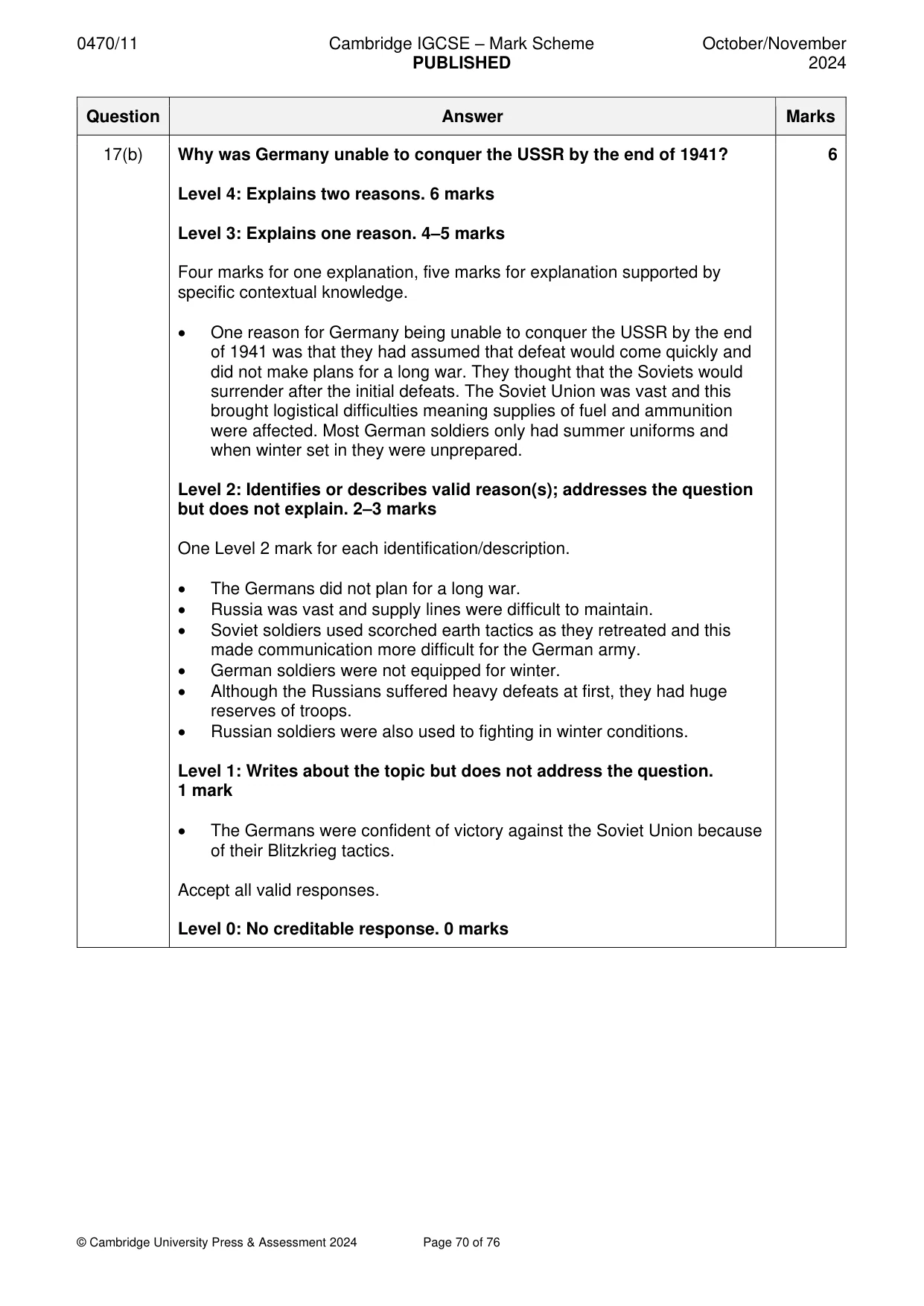
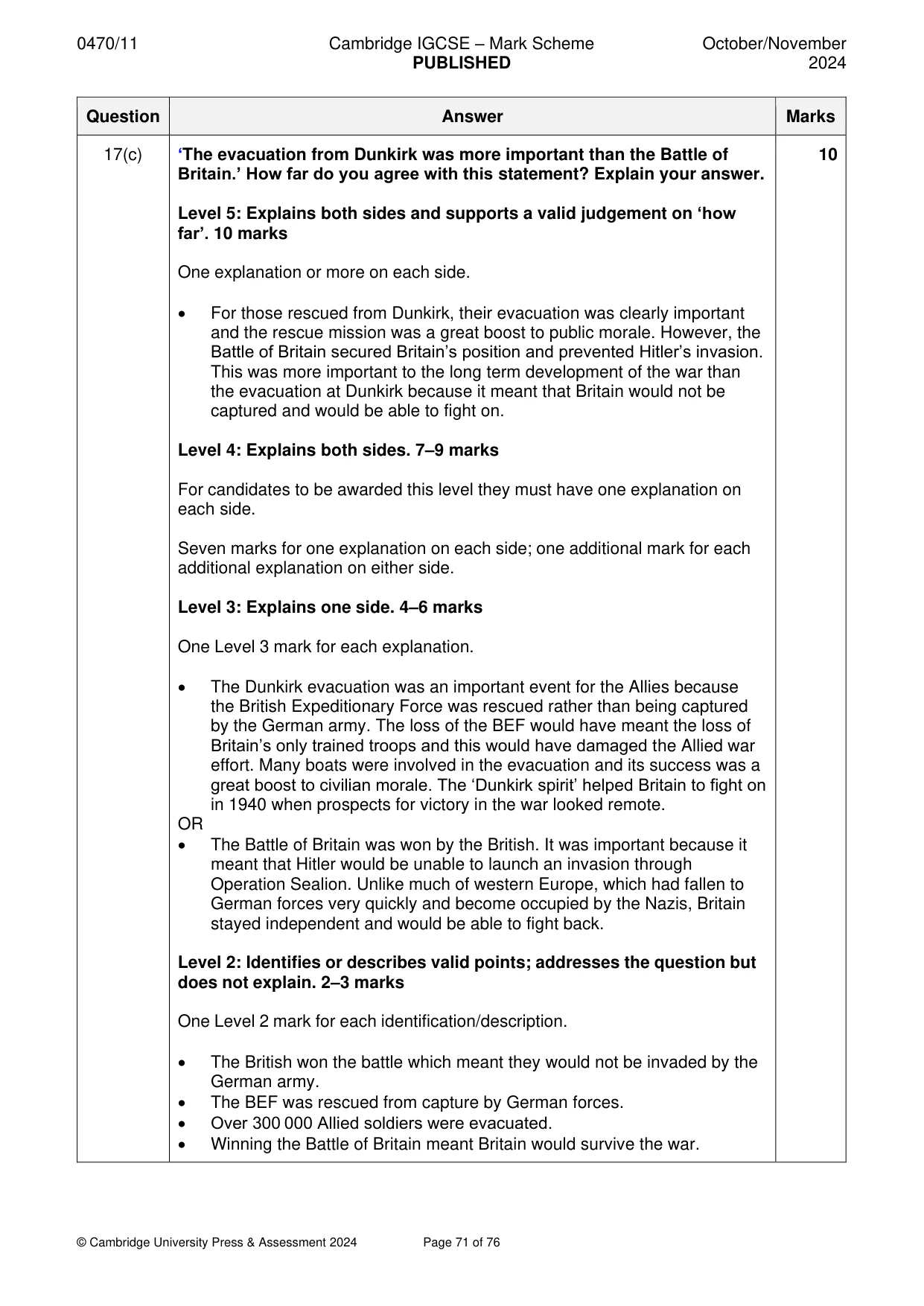
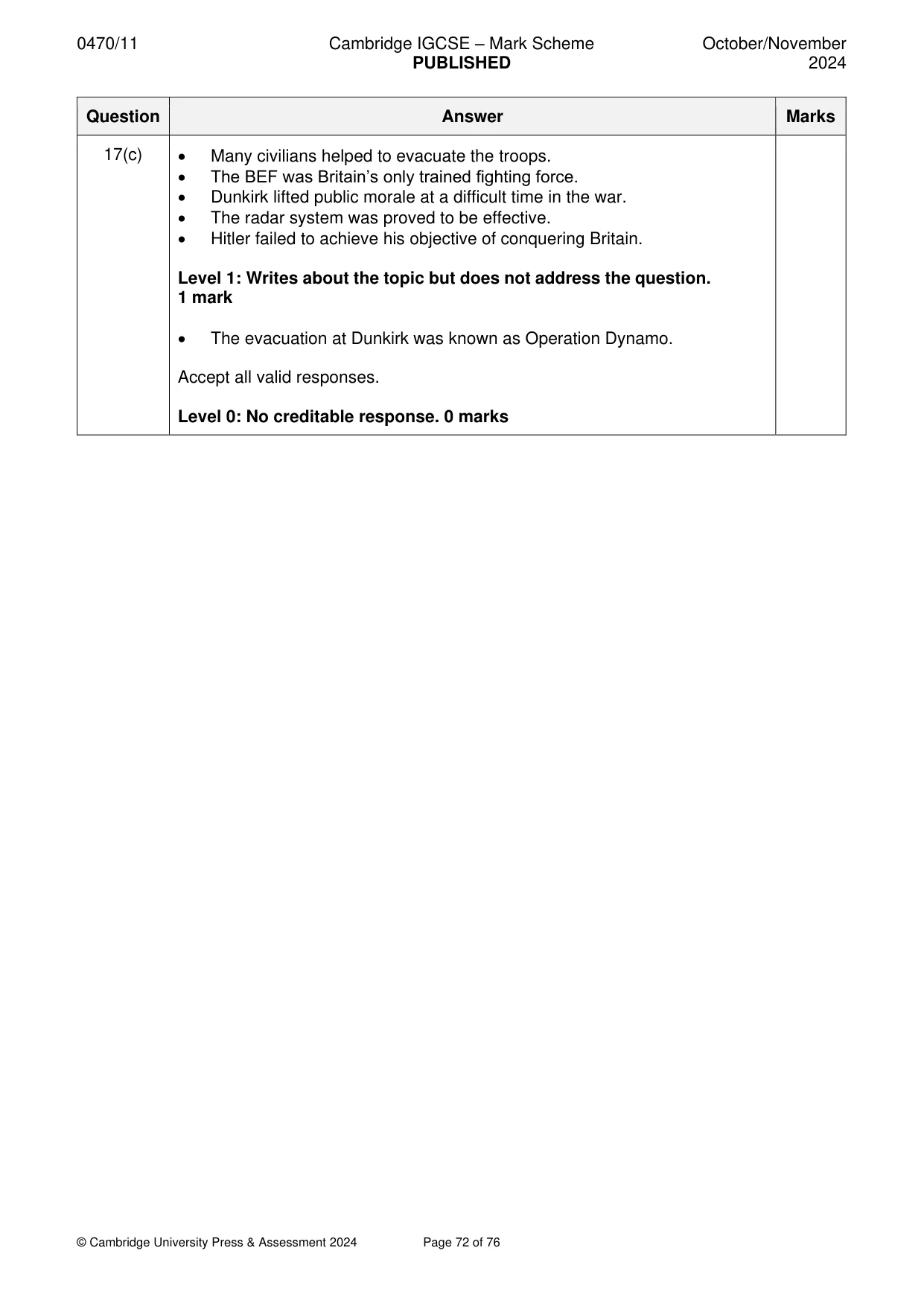
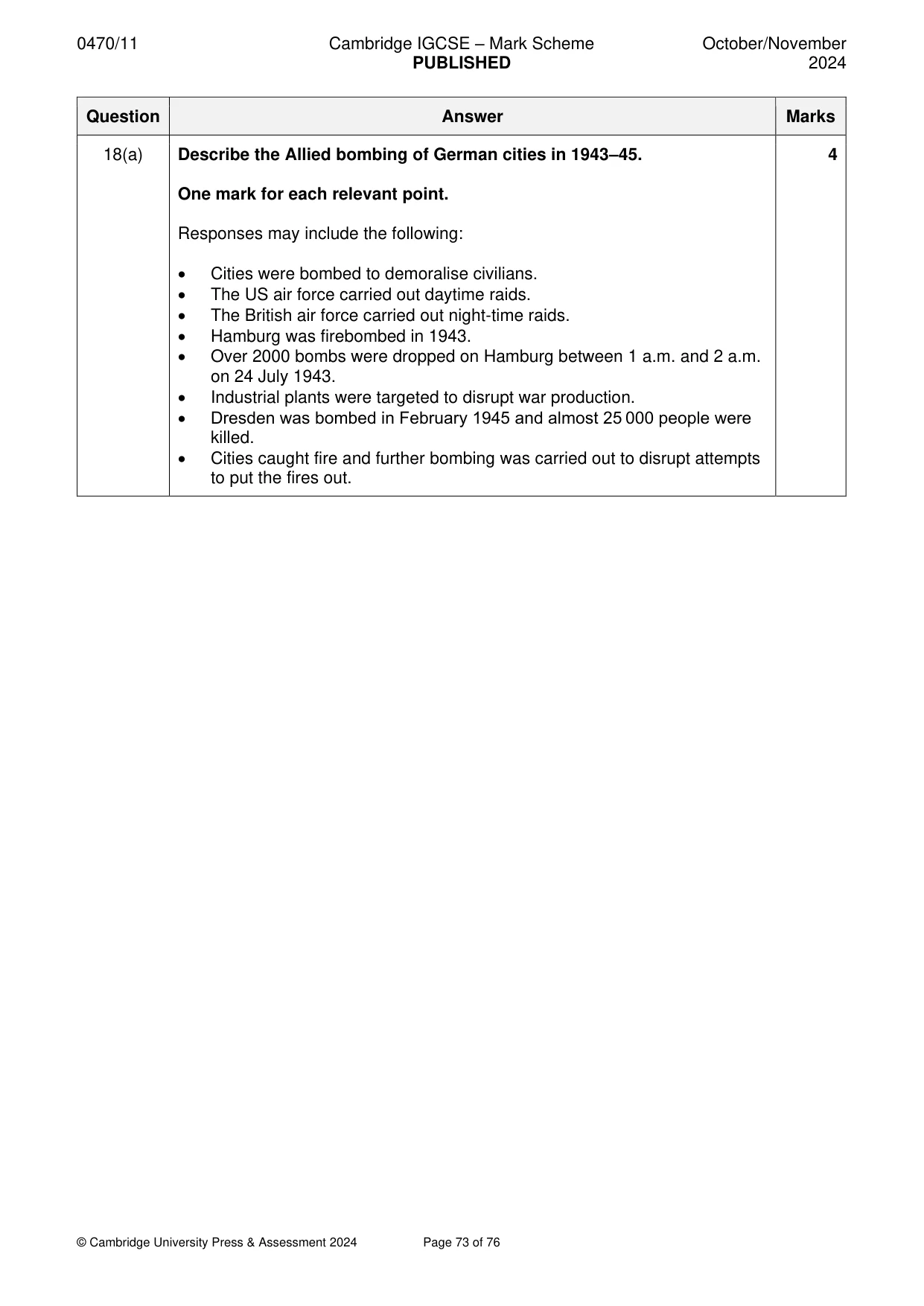
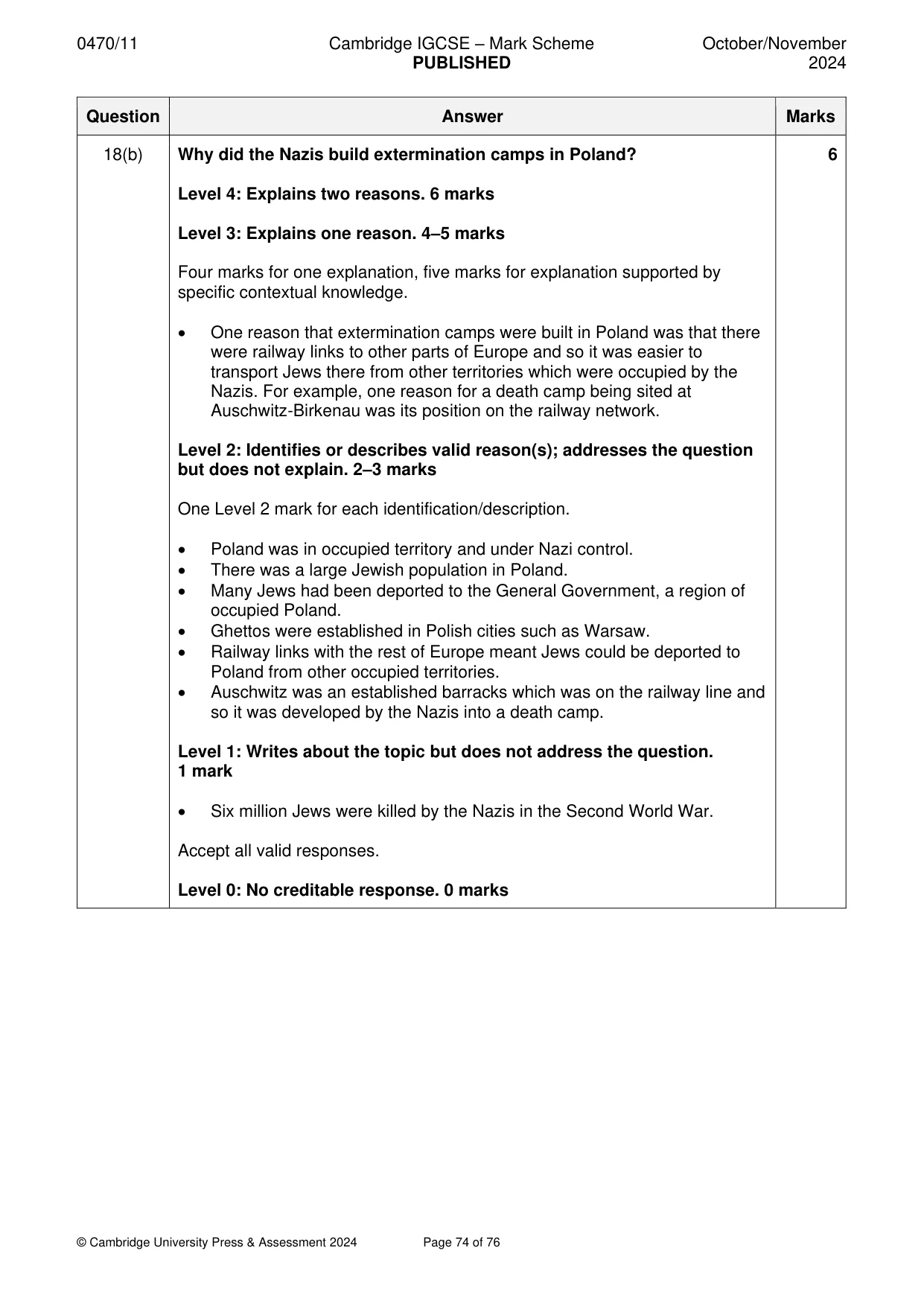
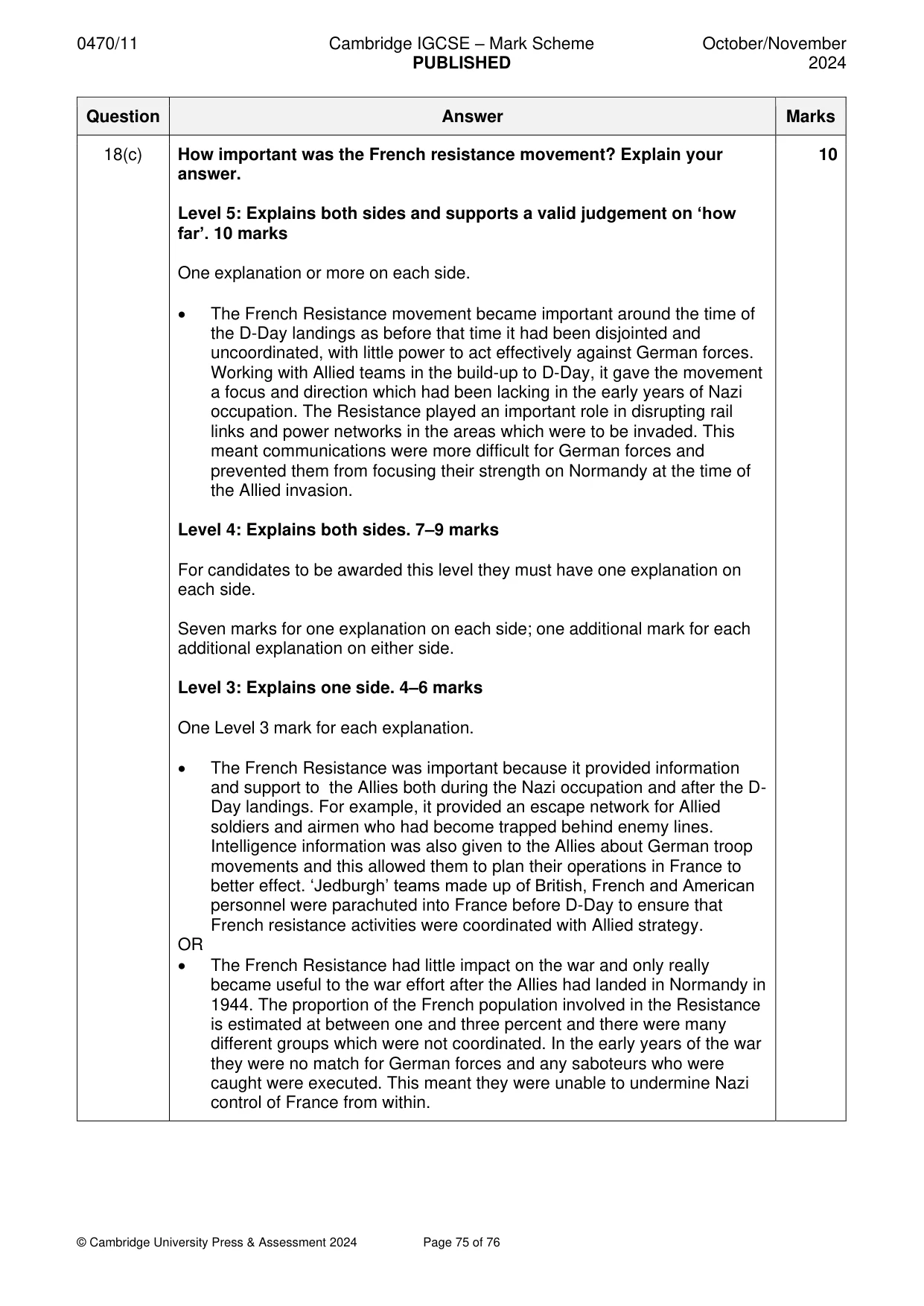
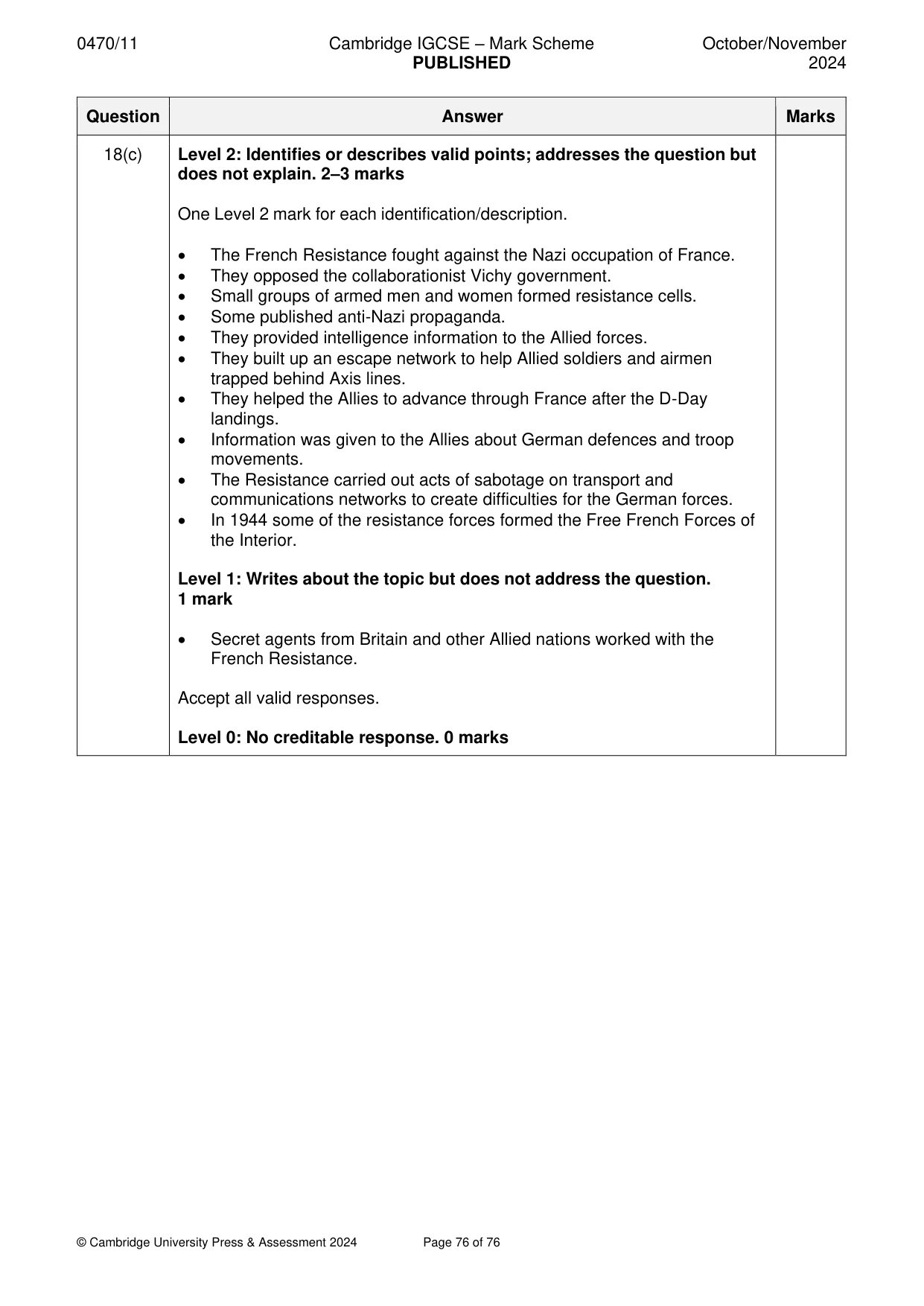
Paper as text
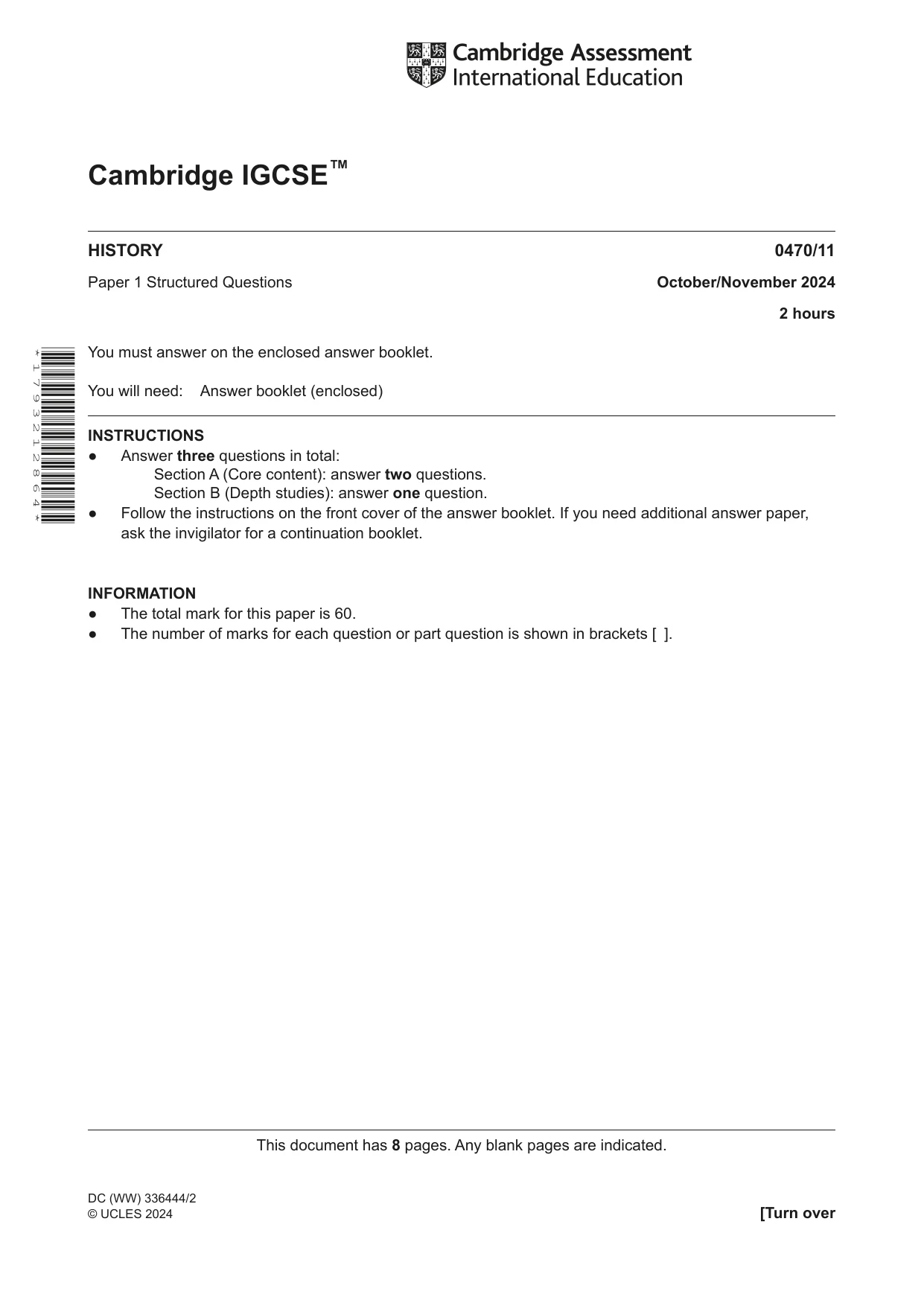
Question paper, page 1
[Turn over Cambridge IGCSE™ This document has 8 pages. Any blank pages are indicated. DC (WW) 336444/2 © UCLES 2024 HISTORY 0470/11 Paper 1 Structured Questions October/November 2024 2 hours You must answer on the enclosed answer booklet. You will need: Answer booklet (enclosed) INSTRUCTIONS ● Answer three questions in total: Section A (Core content): answer two questions. Section B (Depth studies): answer one question. ● Follow the instructions on the front cover of the answer booklet. If you need additional answer paper, ask the invigilator for a continuation booklet. INFORMATION ● The total mark for this paper is 60. ● The number of marks for each question or part question is shown in brackets [ ]. * 1 7 9 3 2 1 2 8 6 4 *
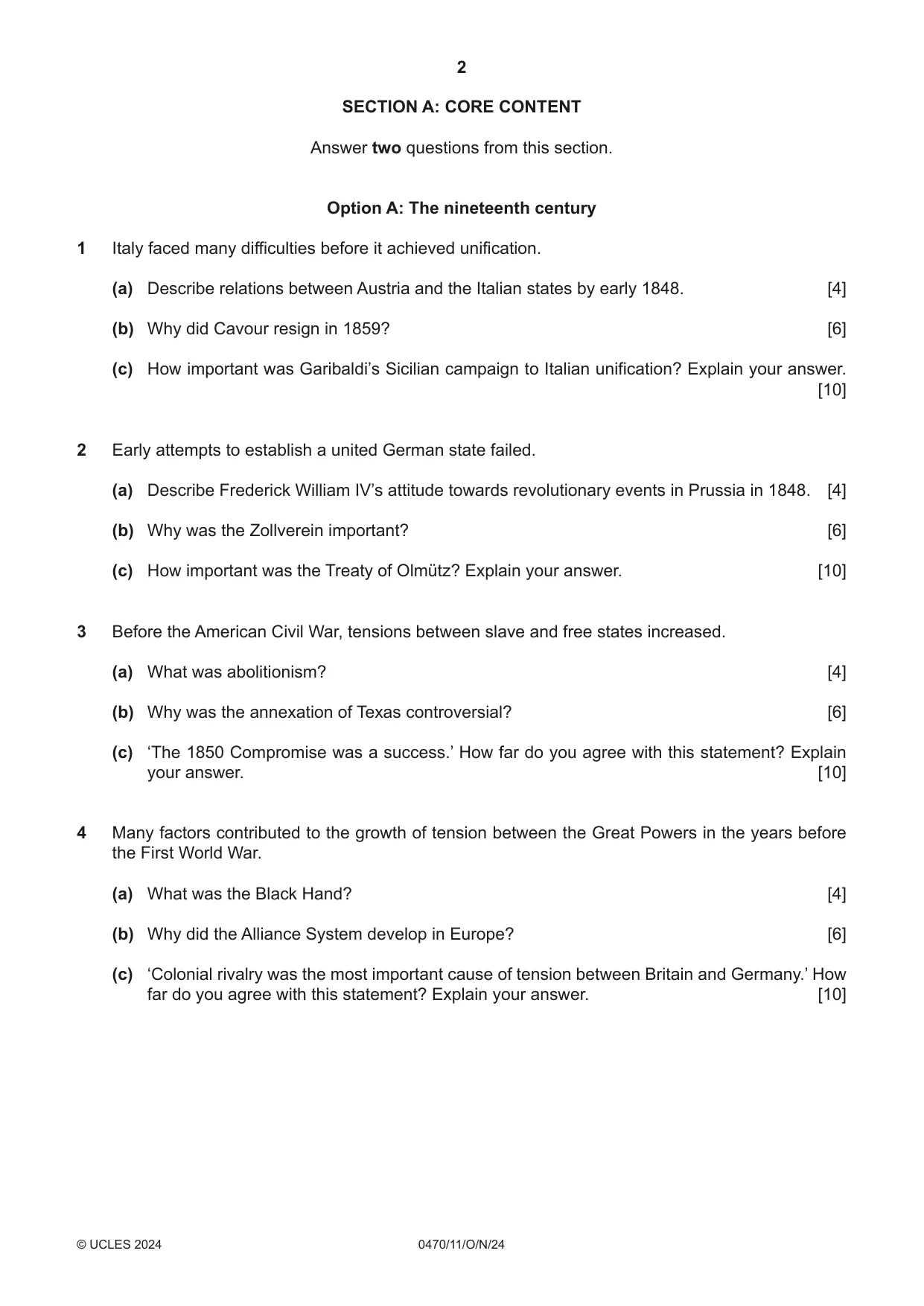
Question paper, page 2
2 0470/11/O/N/24 © UCLES 2024 SECTION A: CORE CONTENT Answer two questions from this section. Option A: The nineteenth century 1 Italy faced many difficulties before it achieved unification. (a) Describe relations between Austria and the Italian states by early 1848. [4] (b) Why did Cavour resign in 1859? [6] (c) How important was Garibaldi’s Sicilian campaign to Italian unification? Explain your answer. [10] 2 Early attempts to establish a united German state failed. (a) Describe Frederick William IV’s attitude towards revolutionary events in Prussia in 1848. [4] (b) Why was the Zollverein important? [6] (c) How important was the Treaty of Olmütz? Explain your answer. [10] 3 Before the American Civil War, tensions between slave and free states increased. (a) What was abolitionism? [4] (b) Why was the annexation of Texas controversial? [6] (c) ‘The 1850 Compromise was a success.’ How far do you agree with this statement? Explain your answer. [10] 4 Many factors contributed to the growth of tension between the Great Powers in the years before the First World War. (a) What was the Black Hand? [4] (b) Why did the Alliance System develop in Europe? [6] (c) ‘Colonial rivalry was the most important cause of tension between Britain and Germany.’ How far do you agree with this statement? Explain your answer. [10]
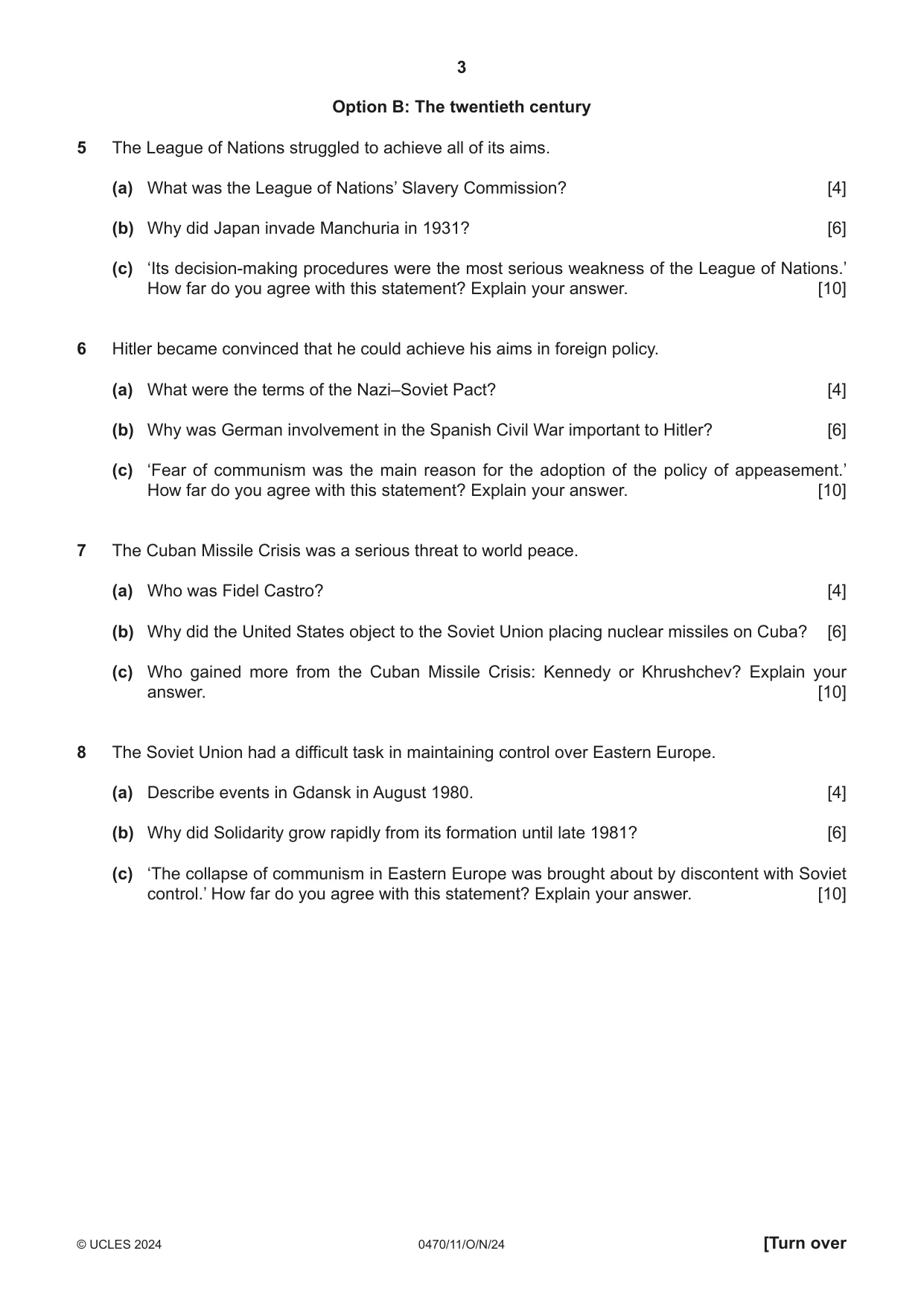
Question paper, page 3
3 0470/11/O/N/24 © UCLES 2024 [Turn over Option B: The twentieth century 5 The League of Nations struggled to achieve all of its aims. (a) What was the League of Nations’ Slavery Commission? [4] (b) Why did Japan invade Manchuria in 1931? [6] (c) ‘Its decision-making procedures were the most serious weakness of the League of Nations.’ How far do you agree with this statement? Explain your answer. [10] 6 Hitler became convinced that he could achieve his aims in foreign policy. (a) What were the terms of the Nazi–Soviet Pact? [4] (b) Why was German involvement in the Spanish Civil War important to Hitler? [6] (c) ‘Fear of communism was the main reason for the adoption of the policy of appeasement.’ How far do you agree with this statement? Explain your answer. [10] 7 The Cuban Missile Crisis was a serious threat to world peace. (a) Who was Fidel Castro? [4] (b) Why did the United States object to the Soviet Union placing nuclear missiles on Cuba? [6] (c) Who gained more from the Cuban Missile Crisis: Kennedy or Khrushchev? Explain your answer. [10] 8 The Soviet Union had a difficult task in maintaining control over Eastern Europe. (a) Describe events in Gdansk in August 1980. [4] (b) Why did Solidarity grow rapidly from its formation until late 1981? [6] (c) ‘The collapse of communism in Eastern Europe was brought about by discontent with Soviet control.’ How far do you agree with this statement? Explain your answer. [10]
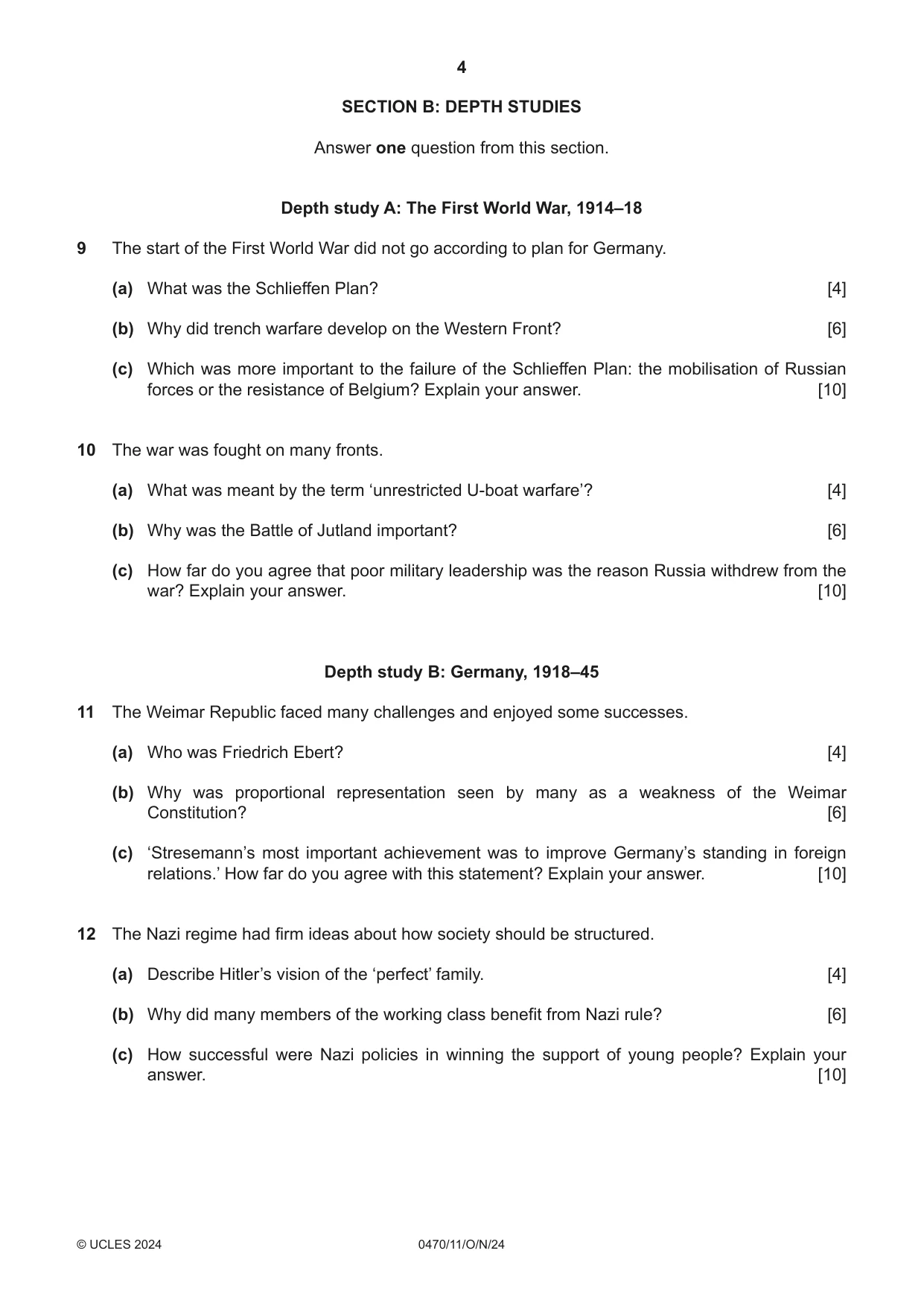
Question paper, page 4
4 0470/11/O/N/24 © UCLES 2024 SECTION B: DEPTH STUDIES Answer one question from this section. Depth study A: The First World War, 1914–18 9 The start of the First World War did not go according to plan for Germany. (a) What was the Schlieffen Plan? [4] (b) Why did trench warfare develop on the Western Front? [6] (c) Which was more important to the failure of the Schlieffen Plan: the mobilisation of Russian forces or the resistance of Belgium? Explain your answer. [10] 10 The war was fought on many fronts. (a) What was meant by the term ‘unrestricted U-boat warfare’? [4] (b) Why was the Battle of Jutland important? [6] (c) How far do you agree that poor military leadership was the reason Russia withdrew from the war? Explain your answer. [10] Depth study B: Germany, 1918–45 11 The Weimar Republic faced many challenges and enjoyed some successes. (a) Who was Friedrich Ebert? [4] (b) Why was proportional representation seen by many as a weakness of the Weimar Constitution? [6] (c) ‘Stresemann’s most important achievement was to improve Germany’s standing in foreign relations.’ How far do you agree with this statement? Explain your answer. [10] 12 The Nazi regime had firm ideas about how society should be structured. (a) Describe Hitler’s vision of the ‘perfect’ family. [4] (b) Why did many members of the working class benefit from Nazi rule? [6] (c) How successful were Nazi policies in winning the support of young people? Explain your answer. [10]
Question paper, page 5
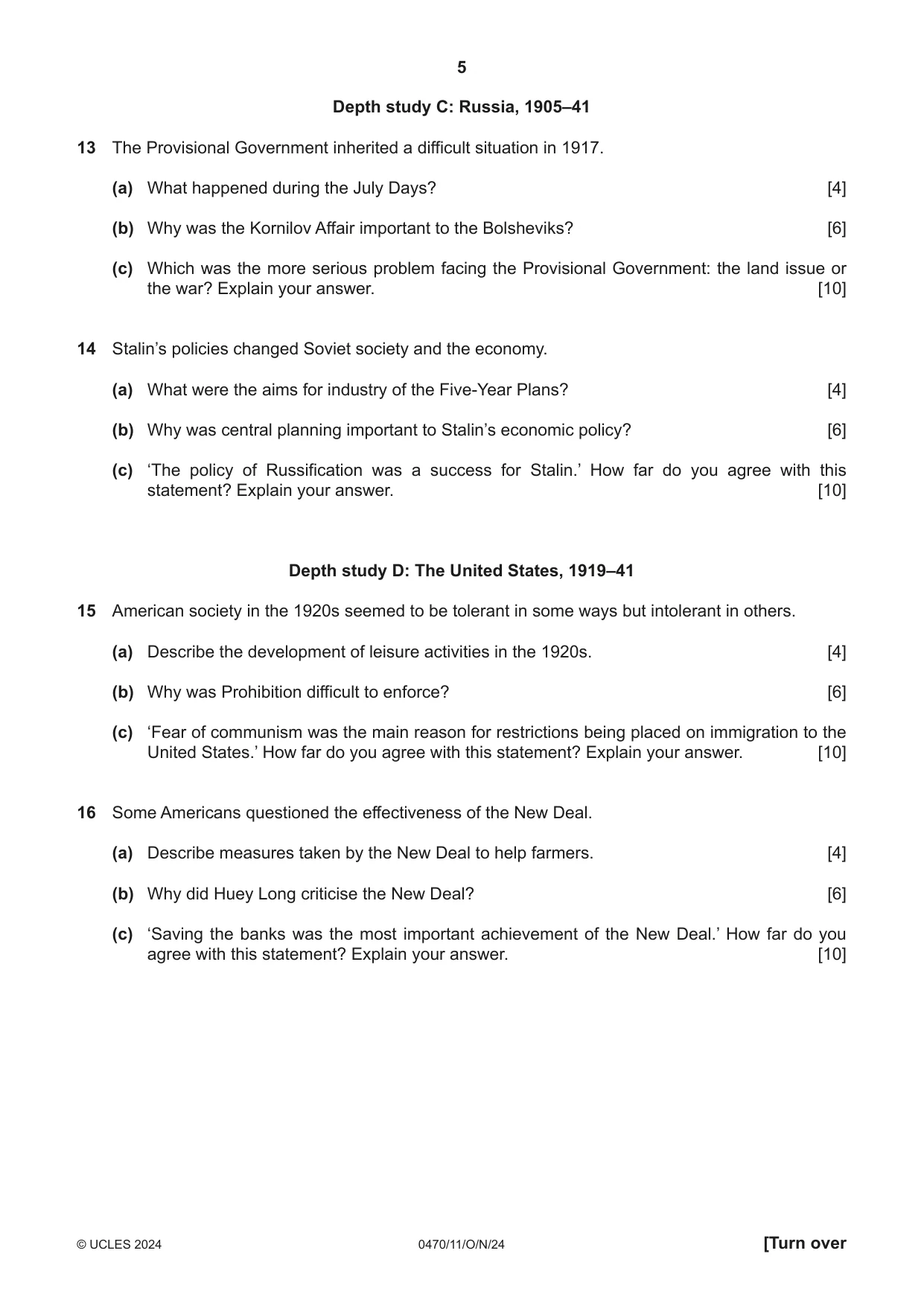
5 0470/11/O/N/24 © UCLES 2024 [Turn over Depth study C: Russia, 1905–41 13 The Provisional Government inherited a difficult situation in 1917. (a) What happened during the July Days? [4] (b) Why was the Kornilov Affair important to the Bolsheviks? [6] (c) Which was the more serious problem facing the Provisional Government: the land issue or the war? Explain your answer. [10] 14 Stalin’s policies changed Soviet society and the economy. (a) What were the aims for industry of the Five-Year Plans? [4] (b) Why was central planning important to Stalin’s economic policy? [6] (c) ‘The policy of Russification was a success for Stalin.’ How far do you agree with this statement? Explain your answer. [10] Depth study D: The United States, 1919–41 15 American society in the 1920s seemed to be tolerant in some ways but intolerant in others. (a) Describe the development of leisure activities in the 1920s. [4] (b) Why was Prohibition difficult to enforce? [6] (c) ‘Fear of communism was the main reason for restrictions being placed on immigration to the United States.’ How far do you agree with this statement? Explain your answer. [10] 16 Some Americans questioned the effectiveness of the New Deal. (a) Describe measures taken by the New Deal to help farmers. [4] (b) Why did Huey Long criticise the New Deal? [6] (c) ‘Saving the banks was the most important achievement of the New Deal.’ How far do you agree with this statement? Explain your answer. [10]
Question paper, page 6
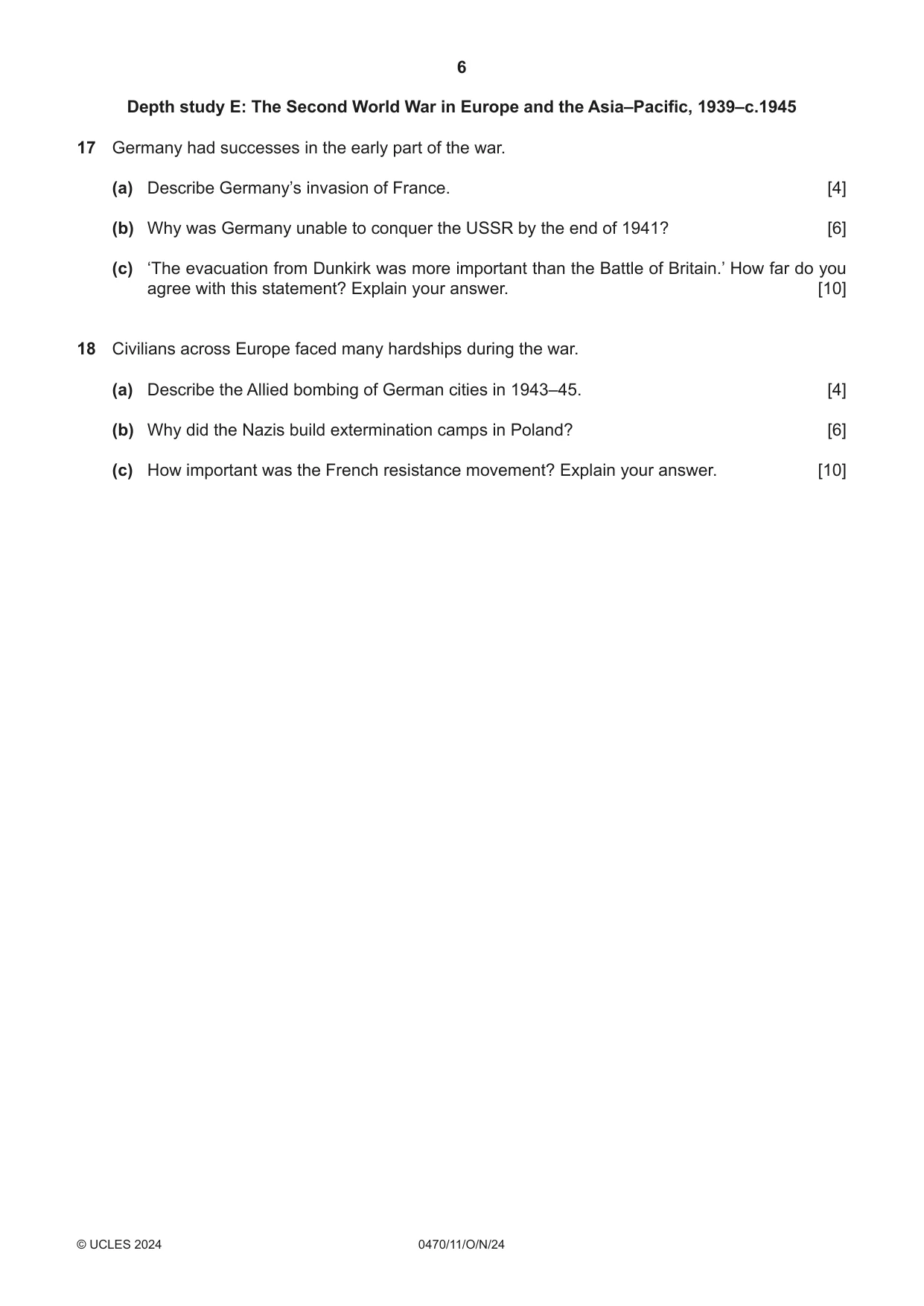
6 0470/11/O/N/24 © UCLES 2024 Depth study E: The Second World War in Europe and the Asia–Pacific, 1939–c.1945 17 Germany had successes in the early part of the war. (a) Describe Germany’s invasion of France. [4] (b) Why was Germany unable to conquer the USSR by the end of 1941? [6] (c) ‘The evacuation from Dunkirk was more important than the Battle of Britain.’ How far do you agree with this statement? Explain your answer. [10] 18 Civilians across Europe faced many hardships during the war. (a) Describe the Allied bombing of German cities in 1943–45. [4] (b) Why did the Nazis build extermination camps in Poland? [6] (c) How important was the French resistance movement? Explain your answer. [10]
Question paper, page 7
7 0470/11/O/N/24 © UCLES 2024 BLANK PAGE
Question paper, page 8
8 0470/11/O/N/24 © UCLES 2024 Permission to reproduce items where third-party owned material protected by copyright is included has been sought and cleared where possible. Every reasonable effort has been made by the publisher (UCLES) to trace copyright holders, but if any items requiring clearance have unwittingly been included, the publisher will be pleased to make amends at the earliest possible opportunity. To avoid the issue of disclosure of answer-related information to candidates, all copyright acknowledgements are reproduced online in the Cambridge Assessment International Education Copyright Acknowledgements Booklet. This is produced for each series of examinations and is freely available to download at www.cambridgeinternational.org after the live examination series. Cambridge Assessment International Education is part of Cambridge Assessment. Cambridge Assessment is the brand name of the University of Cambridge Local Examinations Syndicate (UCLES), which is a department of the University of Cambridge. BLANK PAGE
Mark scheme, page 1
This document consists of 76 printed pages. © Cambridge University Press & Assessment 2024 [Turn over Cambridge IGCSE™ HISTORY 0470/11 Paper 1 October/November 2024 MARK SCHEME Maximum Mark: 60 Published This mark scheme is published as an aid to teachers and candidates, to indicate the requirements of the examination. It shows the basis on which Examiners were instructed to award marks. It does not indicate the details of the discussions that took place at an Examiners’ meeting before marking began, which would have considered the acceptability of alternative answers. Mark schemes should be read in conjunction with the question paper and the Principal Examiner Report for Teachers. Cambridge International will not enter into discussions about these mark schemes. Cambridge International is publishing the mark schemes for the October/November 2024 series for most Cambridge IGCSE, Cambridge International A and AS Level components, and some Cambridge O Level components.
Mark scheme, page 2
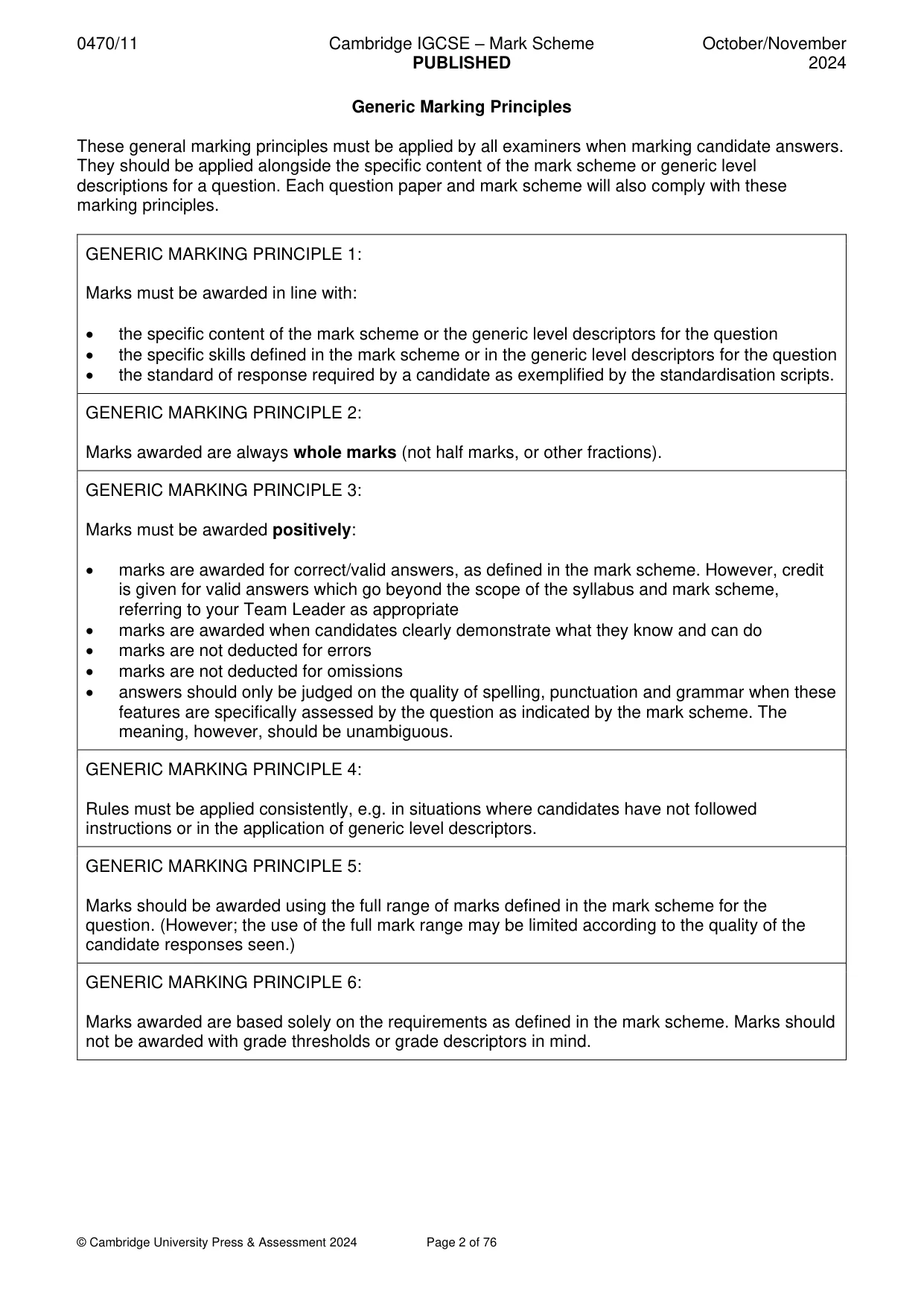
0470/11 Cambridge IGCSE – Mark Scheme PUBLISHED October/November 2024 © Cambridge University Press & Assessment 2024 Page 2 of 76 Generic Marking Principles These general marking principles must be applied by all examiners when marking candidate answers. They should be applied alongside the specific content of the mark scheme or generic level descriptions for a question. Each question paper and mark scheme will also comply with these marking principles. GENERIC MARKING PRINCIPLE 1: Marks must be awarded in line with: • the specific content of the mark scheme or the generic level descriptors for the question • the specific skills defined in the mark scheme or in the generic level descriptors for the question • the standard of response required by a candidate as exemplified by the standardisation scripts. GENERIC MARKING PRINCIPLE 2: Marks awarded are always whole marks (not half marks, or other fractions). GENERIC MARKING PRINCIPLE 3: Marks must be awarded positively: • marks are awarded for correct/valid answers, as defined in the mark scheme. However, credit is given for valid answers which go beyond the scope of the syllabus and mark scheme, referring to your Team Leader as appropriate • marks are awarded when candidates clearly demonstrate what they know and can do • marks are not deducted for errors • marks are not deducted for omissions • answers should only be judged on the quality of spelling, punctuation and grammar when these features are specifically assessed by the question as indicated by the mark scheme. The meaning, however, should be unambiguous. GENERIC MARKING PRINCIPLE 4: Rules must be applied consistently, e.g. in situations where candidates have not followed instructions or in the application of generic level descriptors. GENERIC MARKING PRINCIPLE 5: Marks should be awarded using the full range of marks defined in the mark scheme for the question. (However; the use of the full mark range may be limited according to the quality of the candidate responses seen.) GENERIC MARKING PRINCIPLE 6: Marks awarded are based solely on the requirements as defined in the mark scheme. Marks should not be awarded with grade thresholds or grade descriptors in mind.
Mark scheme, page 3
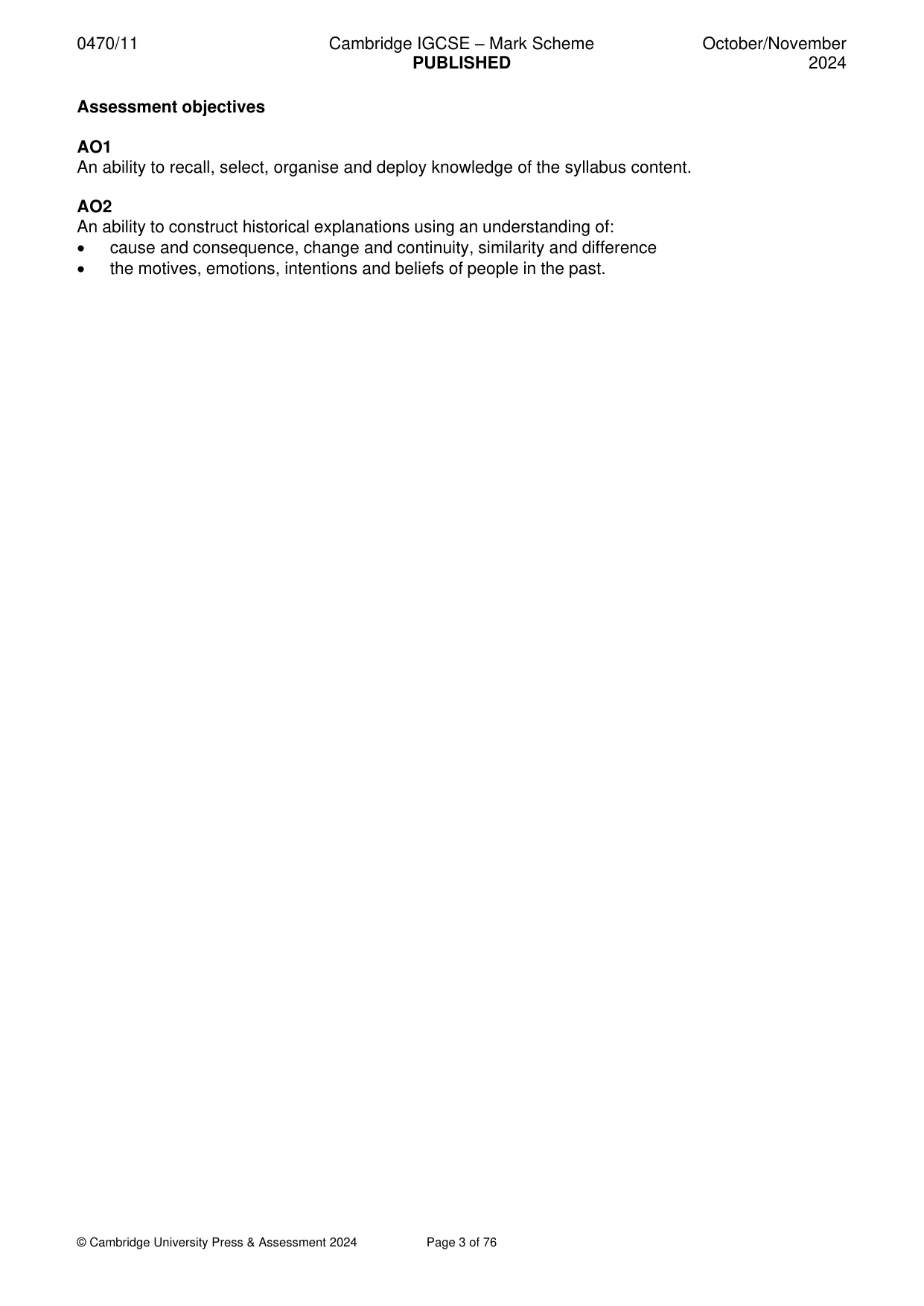
0470/11 Cambridge IGCSE – Mark Scheme PUBLISHED October/November 2024 © Cambridge University Press & Assessment 2024 Page 3 of 76 Assessment objectives AO1 An ability to recall, select, organise and deploy knowledge of the syllabus content. AO2 An ability to construct historical explanations using an understanding of: • cause and consequence, change and continuity, similarity and difference • the motives, emotions, intentions and beliefs of people in the past.
Mark scheme, page 4
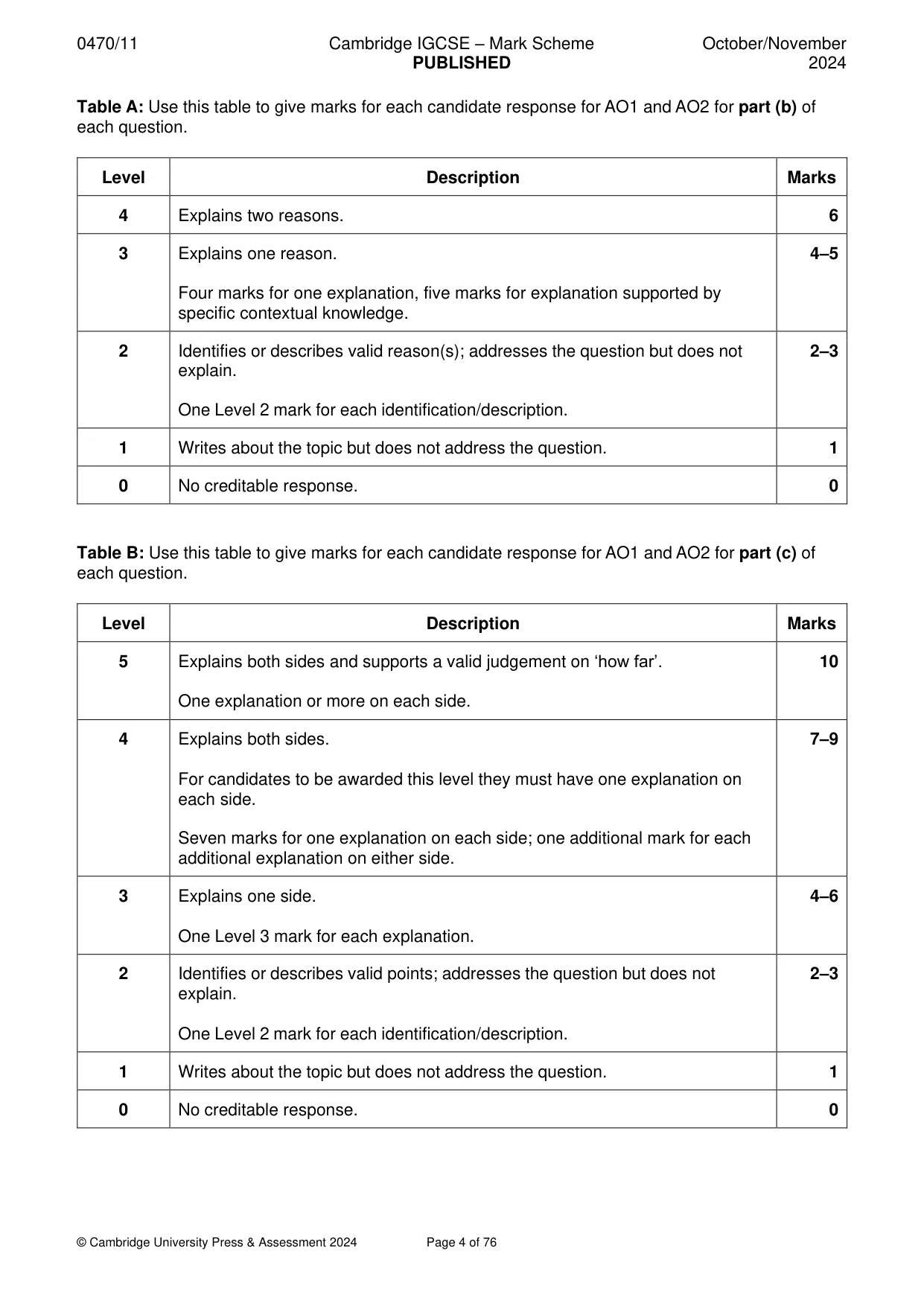
0470/11 Cambridge IGCSE – Mark Scheme PUBLISHED October/November 2024 © Cambridge University Press & Assessment 2024 Page 4 of 76 Table A: Use this table to give marks for each candidate response for AO1 and AO2 for part (b) of each question. Level Description Marks 4 Explains two reasons. 6 3 Explains one reason. Four marks for one explanation, five marks for explanation supported by specific contextual knowledge. 4–5 2 Identifies or describes valid reason(s); addresses the question but does not explain. One Level 2 mark for each identification/description. 2–3 1 Writes about the topic but does not address the question. 1 0 No creditable response. 0 Table B: Use this table to give marks for each candidate response for AO1 and AO2 for part (c) of each question. Level Description Marks 5 Explains both sides and supports a valid judgement on ‘how far’. One explanation or more on each side. 10 4 Explains both sides. For candidates to be awarded this level they must have one explanation on each side. Seven marks for one explanation on each side; one additional mark for each additional explanation on either side. 7–9 3 Explains one side. One Level 3 mark for each explanation. 4–6 2 Identifies or describes valid points; addresses the question but does not explain. One Level 2 mark for each identification/description. 2–3 1 Writes about the topic but does not address the question. 1 0 No creditable response. 0
Mark scheme, page 5
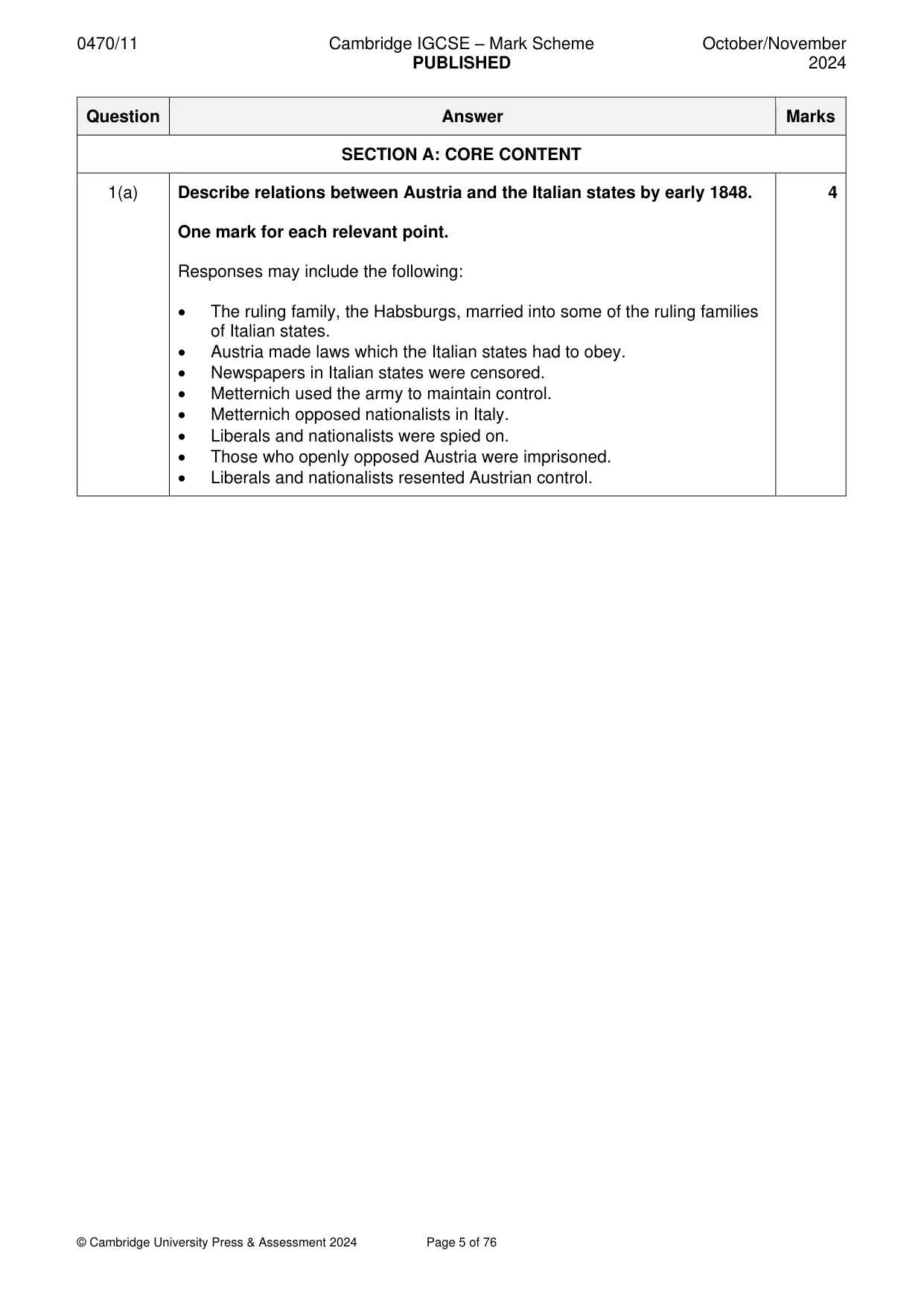
0470/11 Cambridge IGCSE – Mark Scheme PUBLISHED October/November 2024 © Cambridge University Press & Assessment 2024 Page 5 of 76 Question Answer Marks SECTION A: CORE CONTENT 1(a) Describe relations between Austria and the Italian states by early 1848. One mark for each relevant point. Responses may include the following: • The ruling family, the Habsburgs, married into some of the ruling families of Italian states. • Austria made laws which the Italian states had to obey. • Newspapers in Italian states were censored. • Metternich used the army to maintain control. • Metternich opposed nationalists in Italy. • Liberals and nationalists were spied on. • Those who openly opposed Austria were imprisoned. • Liberals and nationalists resented Austrian control. 4
Mark scheme, page 6
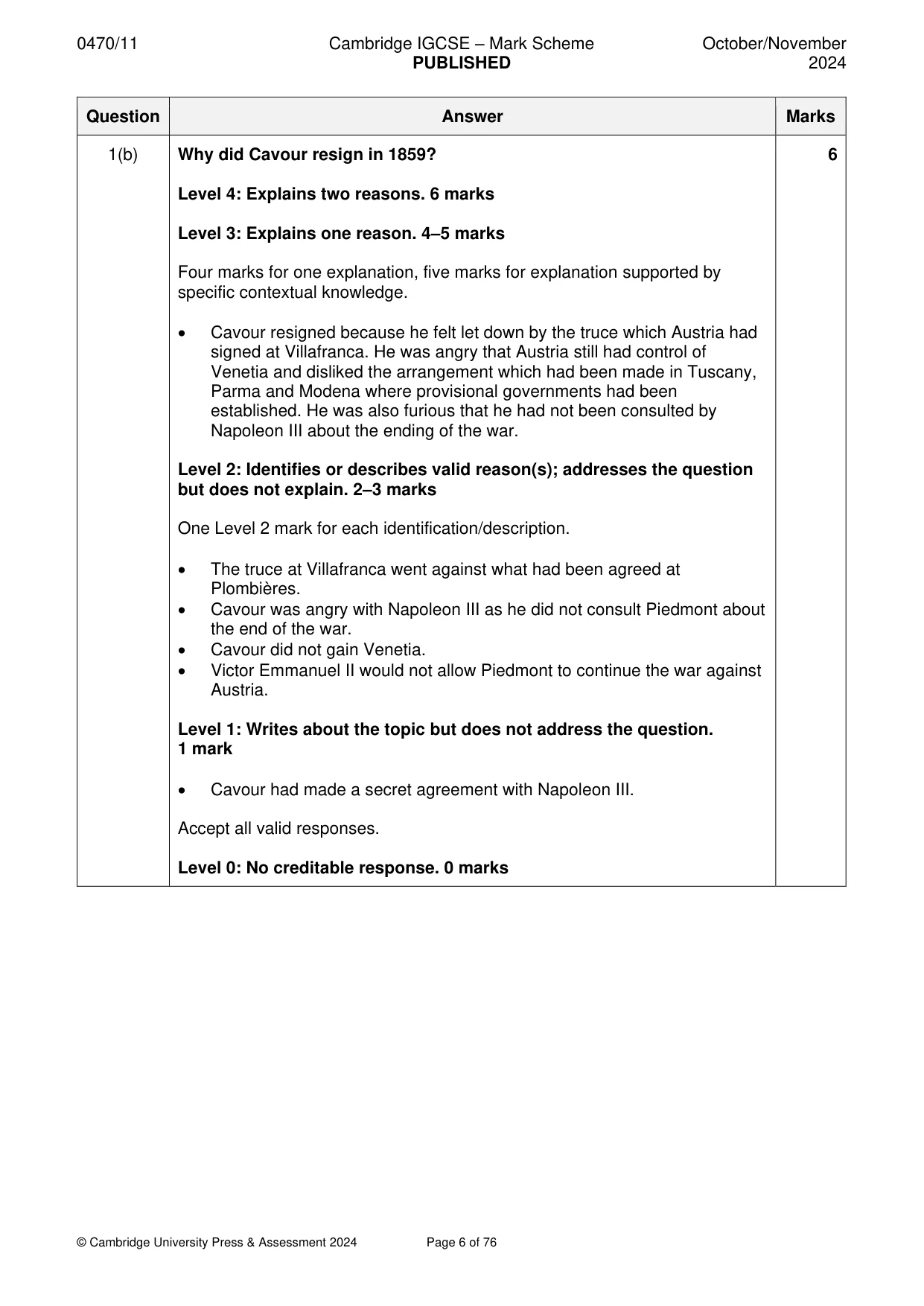
0470/11 Cambridge IGCSE – Mark Scheme PUBLISHED October/November 2024 © Cambridge University Press & Assessment 2024 Page 6 of 76 Question Answer Marks 1(b) Why did Cavour resign in 1859? Level 4: Explains two reasons. 6 marks Level 3: Explains one reason. 4–5 marks Four marks for one explanation, five marks for explanation supported by specific contextual knowledge. • Cavour resigned because he felt let down by the truce which Austria had signed at Villafranca. He was angry that Austria still had control of Venetia and disliked the arrangement which had been made in Tuscany, Parma and Modena where provisional governments had been established. He was also furious that he had not been consulted by Napoleon III about the ending of the war. Level 2: Identifies or describes valid reason(s); addresses the question but does not explain. 2–3 marks One Level 2 mark for each identification/description. • The truce at Villafranca went against what had been agreed at Plombières. • Cavour was angry with Napoleon III as he did not consult Piedmont about the end of the war. • Cavour did not gain Venetia. • Victor Emmanuel II would not allow Piedmont to continue the war against Austria. Level 1: Writes about the topic but does not address the question. 1 mark • Cavour had made a secret agreement with Napoleon III. Accept all valid responses. Level 0: No creditable response. 0 marks 6
Mark scheme, page 7
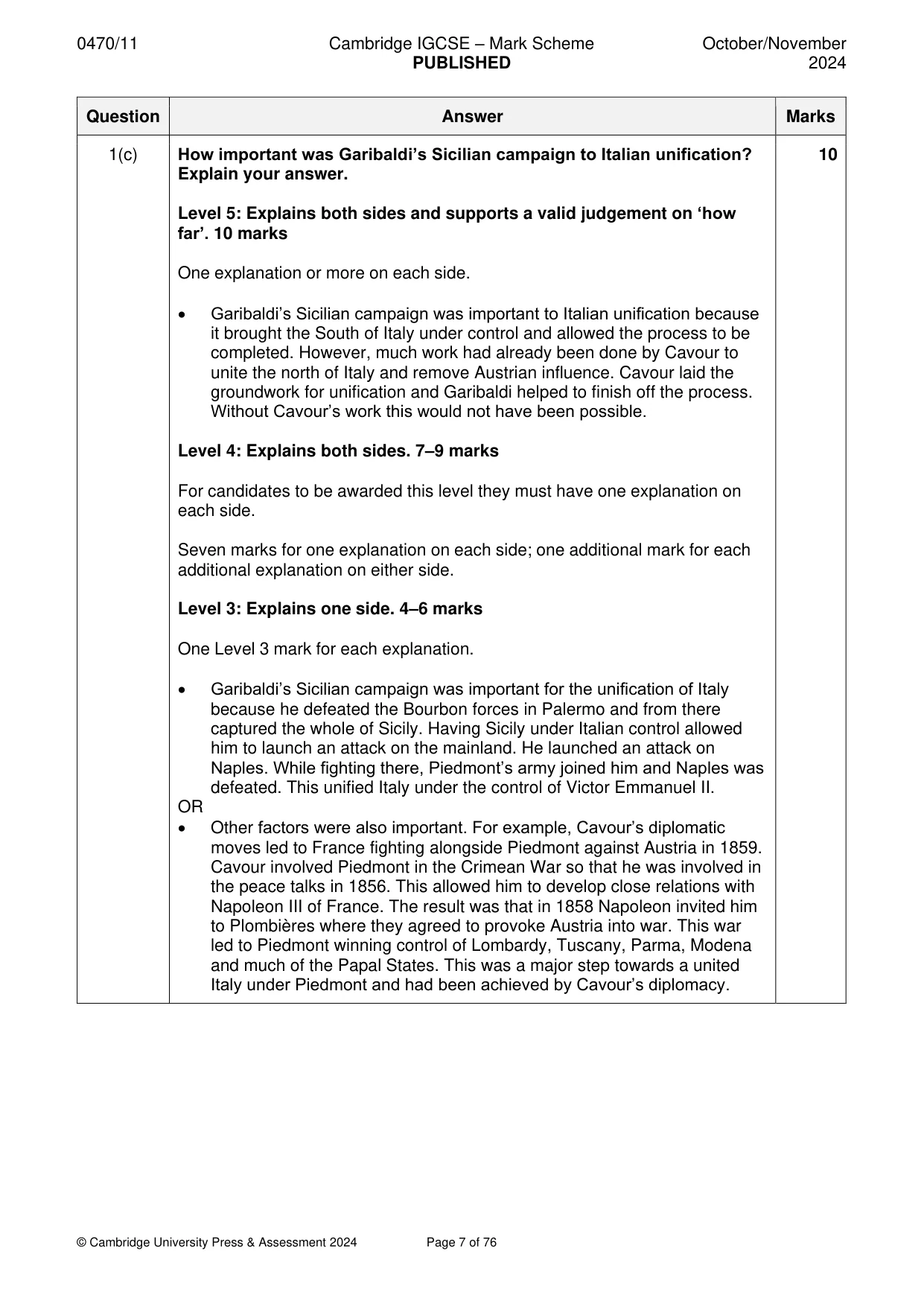
0470/11 Cambridge IGCSE – Mark Scheme PUBLISHED October/November 2024 © Cambridge University Press & Assessment 2024 Page 7 of 76 Question Answer Marks 1(c) How important was Garibaldi’s Sicilian campaign to Italian unification? Explain your answer. Level 5: Explains both sides and supports a valid judgement on ‘how far’. 10 marks One explanation or more on each side. • Garibaldi’s Sicilian campaign was important to Italian unification because it brought the South of Italy under control and allowed the process to be completed. However, much work had already been done by Cavour to unite the north of Italy and remove Austrian influence. Cavour laid the groundwork for unification and Garibaldi helped to finish off the process. Without Cavour’s work this would not have been possible. Level 4: Explains both sides. 7–9 marks For candidates to be awarded this level they must have one explanation on each side. Seven marks for one explanation on each side; one additional mark for each additional explanation on either side. Level 3: Explains one side. 4–6 marks One Level 3 mark for each explanation. • Garibaldi’s Sicilian campaign was important for the unification of Italy because he defeated the Bourbon forces in Palermo and from there captured the whole of Sicily. Having Sicily under Italian control allowed him to launch an attack on the mainland. He launched an attack on Naples. While fighting there, Piedmont’s army joined him and Naples was defeated. This unified Italy under the control of Victor Emmanuel II. OR • Other factors were also important. For example, Cavour’s diplomatic moves led to France fighting alongside Piedmont against Austria in 1859. Cavour involved Piedmont in the Crimean War so that he was involved in the peace talks in 1856. This allowed him to develop close relations with Napoleon III of France. The result was that in 1858 Napoleon invited him to Plombières where they agreed to provoke Austria into war. This war led to Piedmont winning control of Lombardy, Tuscany, Parma, Modena and much of the Papal States. This was a major step towards a united Italy under Piedmont and had been achieved by Cavour’s diplomacy. 10
Mark scheme, page 8
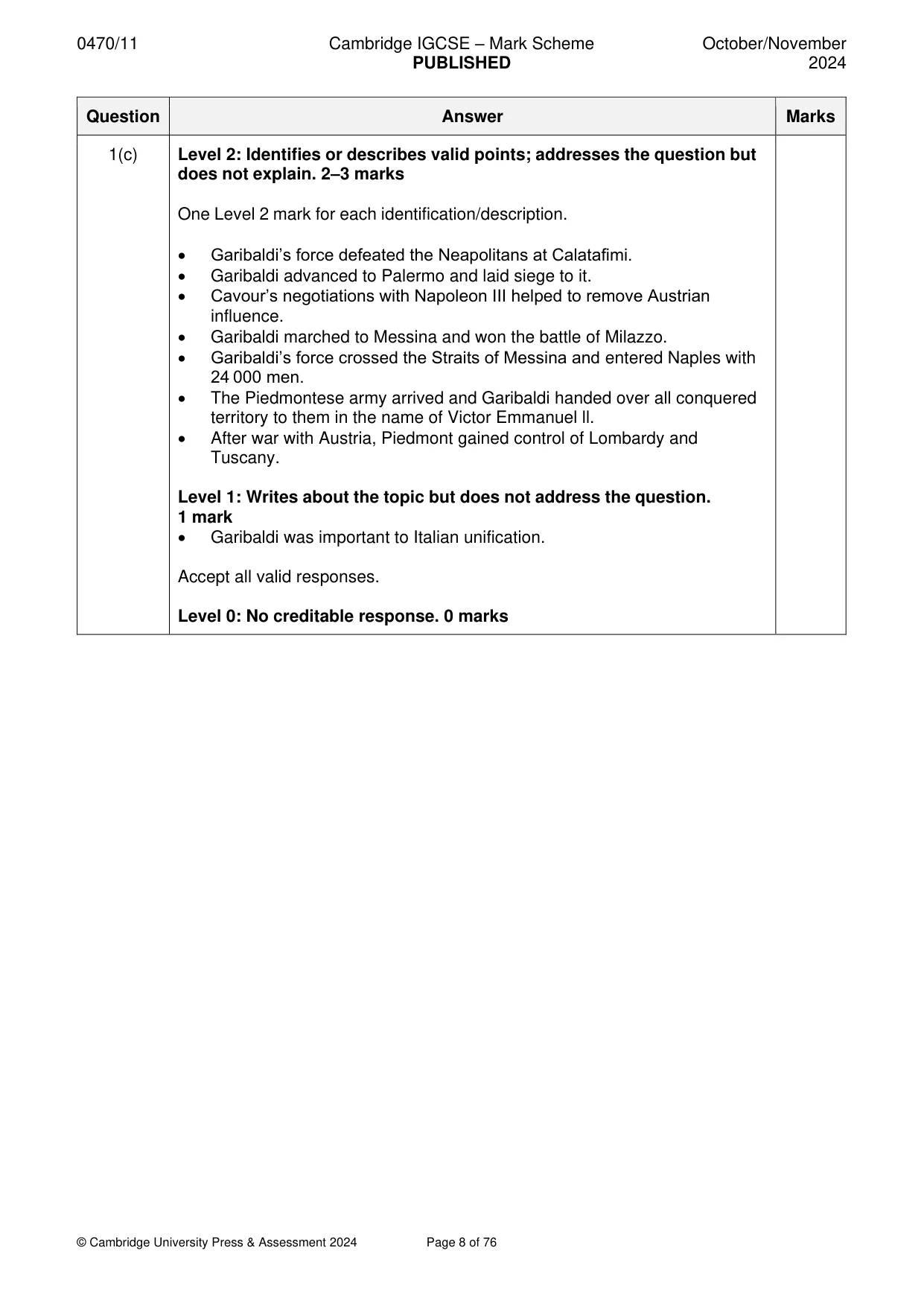
0470/11 Cambridge IGCSE – Mark Scheme PUBLISHED October/November 2024 © Cambridge University Press & Assessment 2024 Page 8 of 76 Question Answer Marks 1(c) Level 2: Identifies or describes valid points; addresses the question but does not explain. 2–3 marks One Level 2 mark for each identification/description. • Garibaldi’s force defeated the Neapolitans at Calatafimi. • Garibaldi advanced to Palermo and laid siege to it. • Cavour’s negotiations with Napoleon III helped to remove Austrian influence. • Garibaldi marched to Messina and won the battle of Milazzo. • Garibaldi’s force crossed the Straits of Messina and entered Naples with 24 000 men. • The Piedmontese army arrived and Garibaldi handed over all conquered territory to them in the name of Victor Emmanuel ll. • After war with Austria, Piedmont gained control of Lombardy and Tuscany. Level 1: Writes about the topic but does not address the question. 1 mark • Garibaldi was important to Italian unification. Accept all valid responses. Level 0: No creditable response. 0 marks
Mark scheme, page 9
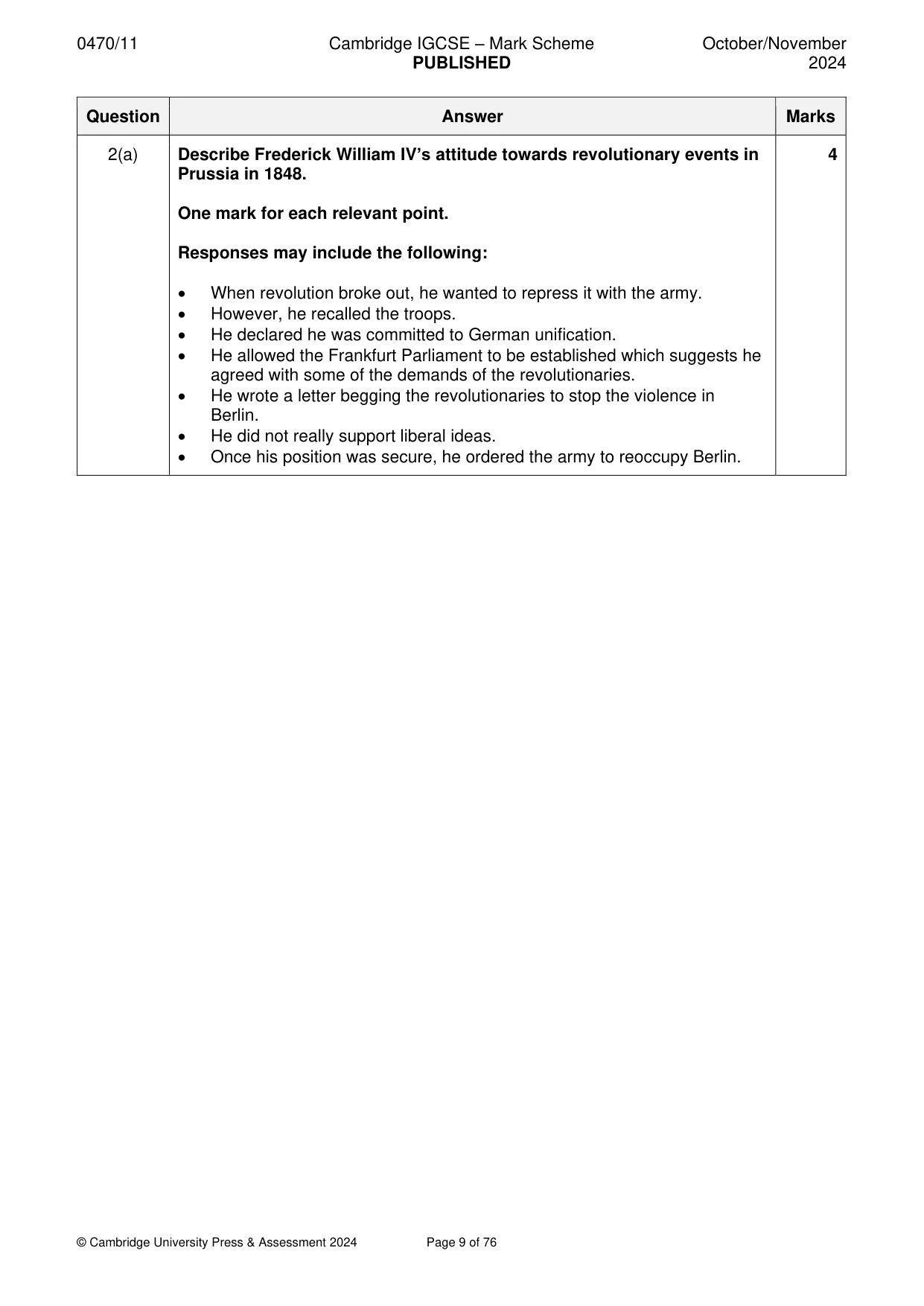
0470/11 Cambridge IGCSE – Mark Scheme PUBLISHED October/November 2024 © Cambridge University Press & Assessment 2024 Page 9 of 76 Question Answer Marks 2(a) Describe Frederick William IV’s attitude towards revolutionary events in Prussia in 1848. One mark for each relevant point. Responses may include the following: • When revolution broke out, he wanted to repress it with the army. • However, he recalled the troops. • He declared he was committed to German unification. • He allowed the Frankfurt Parliament to be established which suggests he agreed with some of the demands of the revolutionaries. • He wrote a letter begging the revolutionaries to stop the violence in Berlin. • He did not really support liberal ideas. • Once his position was secure, he ordered the army to reoccupy Berlin. 4
Mark scheme, page 10
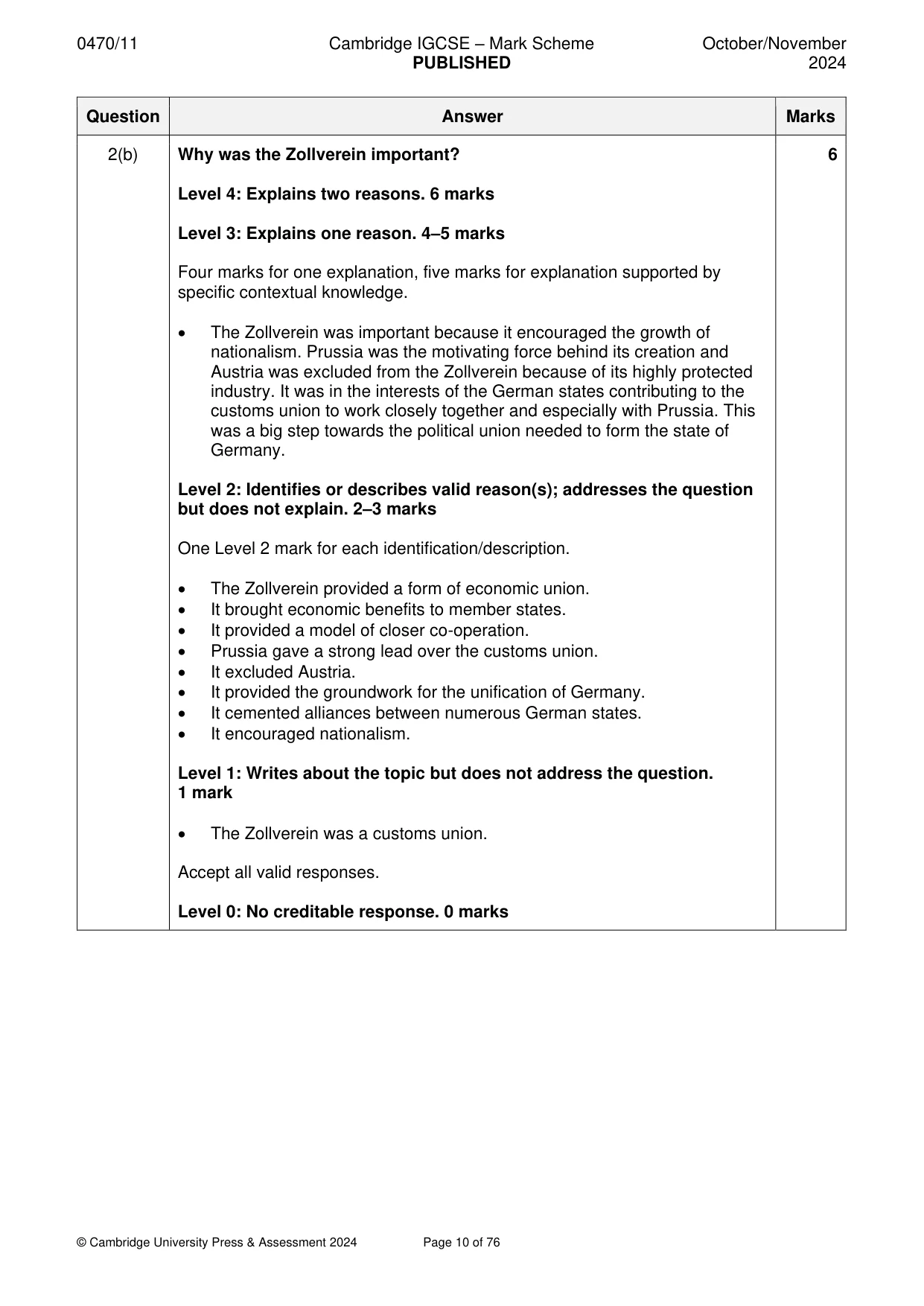
0470/11 Cambridge IGCSE – Mark Scheme PUBLISHED October/November 2024 © Cambridge University Press & Assessment 2024 Page 10 of 76 Question Answer Marks 2(b) Why was the Zollverein important? Level 4: Explains two reasons. 6 marks Level 3: Explains one reason. 4–5 marks Four marks for one explanation, five marks for explanation supported by specific contextual knowledge. • The Zollverein was important because it encouraged the growth of nationalism. Prussia was the motivating force behind its creation and Austria was excluded from the Zollverein because of its highly protected industry. It was in the interests of the German states contributing to the customs union to work closely together and especially with Prussia. This was a big step towards the political union needed to form the state of Germany. Level 2: Identifies or describes valid reason(s); addresses the question but does not explain. 2–3 marks One Level 2 mark for each identification/description. • The Zollverein provided a form of economic union. • It brought economic benefits to member states. • It provided a model of closer co-operation. • Prussia gave a strong lead over the customs union. • It excluded Austria. • It provided the groundwork for the unification of Germany. • It cemented alliances between numerous German states. • It encouraged nationalism. Level 1: Writes about the topic but does not address the question. 1 mark • The Zollverein was a customs union. Accept all valid responses. Level 0: No creditable response. 0 marks 6
Mark scheme, page 11
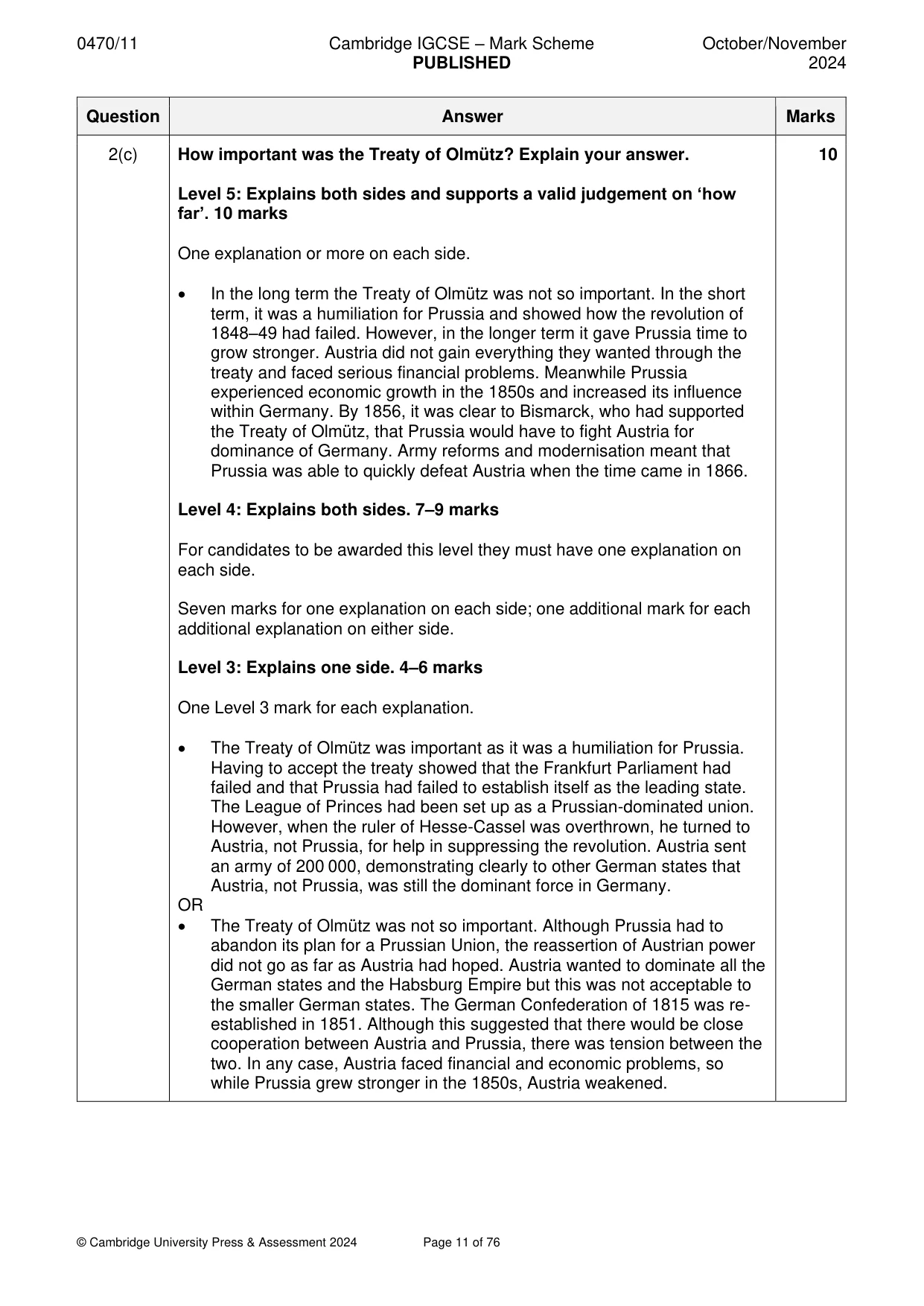
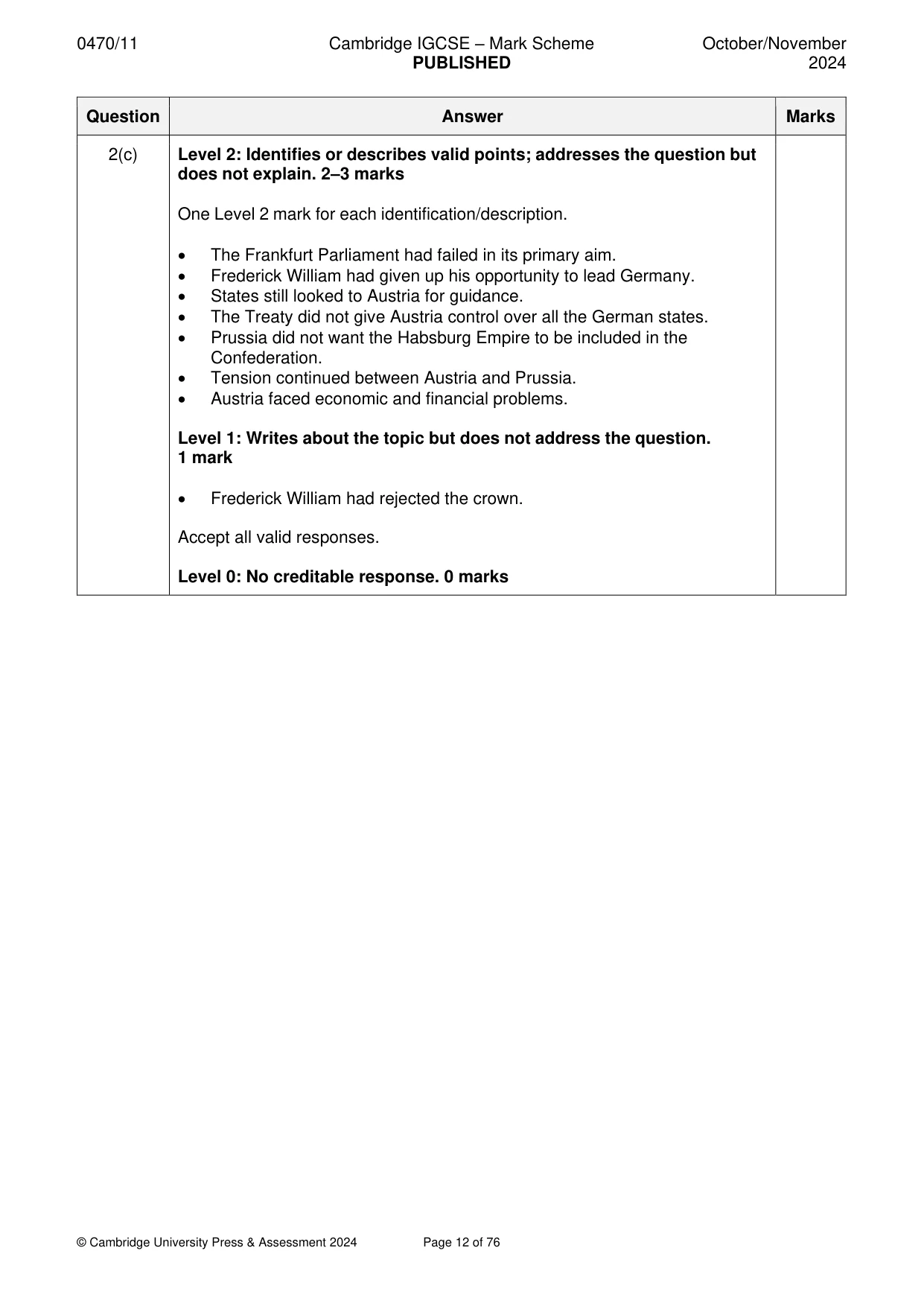
0470/11 Cambridge IGCSE – Mark Scheme PUBLISHED October/November 2024 © Cambridge University Press & Assessment 2024 Page 11 of 76 Question Answer Marks 2(c) How important was the Treaty of Olmütz? Explain your answer. Level 5: Explains both sides and supports a valid judgement on ‘how far’. 10 marks One explanation or more on each side. • In the long term the Treaty of Olmütz was not so important. In the short term, it was a humiliation for Prussia and showed how the revolution of 1848–49 had failed. However, in the longer term it gave Prussia time to grow stronger. Austria did not gain everything they wanted through the treaty and faced serious financial problems. Meanwhile Prussia experienced economic growth in the 1850s and increased its influence within Germany. By 1856, it was clear to Bismarck, who had supported the Treaty of Olmütz, that Prussia would have to fight Austria for dominance of Germany. Army reforms and modernisation meant that Prussia was able to quickly defeat Austria when the time came in 1866. Level 4: Explains both sides. 7–9 marks For candidates to be awarded this level they must have one explanation on each side. Seven marks for one explanation on each side; one additional mark for each additional explanation on either side. Level 3: Explains one side. 4–6 marks One Level 3 mark for each explanation. • The Treaty of Olmütz was important as it was a humiliation for Prussia. Having to accept the treaty showed that the Frankfurt Parliament had failed and that Prussia had failed to establish itself as the leading state. The League of Princes had been set up as a Prussian-dominated union. However, when the ruler of Hesse-Cassel was overthrown, he turned to Austria, not Prussia, for help in suppressing the revolution. Austria sent an army of 200 000, demonstrating clearly to other German states that Austria, not Prussia, was still the dominant force in Germany. OR • The Treaty of Olmütz was not so important. Although Prussia had to abandon its plan for a Prussian Union, the reassertion of Austrian power did not go as far as Austria had hoped. Austria wanted to dominate all the German states and the Habsburg Empire but this was not acceptable to the smaller German states. The German Confederation of 1815 was re- established in 1851. Although this suggested that there would be close cooperation between Austria and Prussia, there was tension between the two. In any case, Austria faced financial and economic problems, so while Prussia grew stronger in the 1850s, Austria weakened. 10
Mark scheme, page 12
0470/11 Cambridge IGCSE – Mark Scheme PUBLISHED October/November 2024 © Cambridge University Press & Assessment 2024 Page 12 of 76 Question Answer Marks 2(c) Level 2: Identifies or describes valid points; addresses the question but does not explain. 2–3 marks One Level 2 mark for each identification/description. • The Frankfurt Parliament had failed in its primary aim. • Frederick William had given up his opportunity to lead Germany. • States still looked to Austria for guidance. • The Treaty did not give Austria control over all the German states. • Prussia did not want the Habsburg Empire to be included in the Confederation. • Tension continued between Austria and Prussia. • Austria faced economic and financial problems. Level 1: Writes about the topic but does not address the question. 1 mark • Frederick William had rejected the crown. Accept all valid responses. Level 0: No creditable response. 0 marks
Mark scheme, page 13
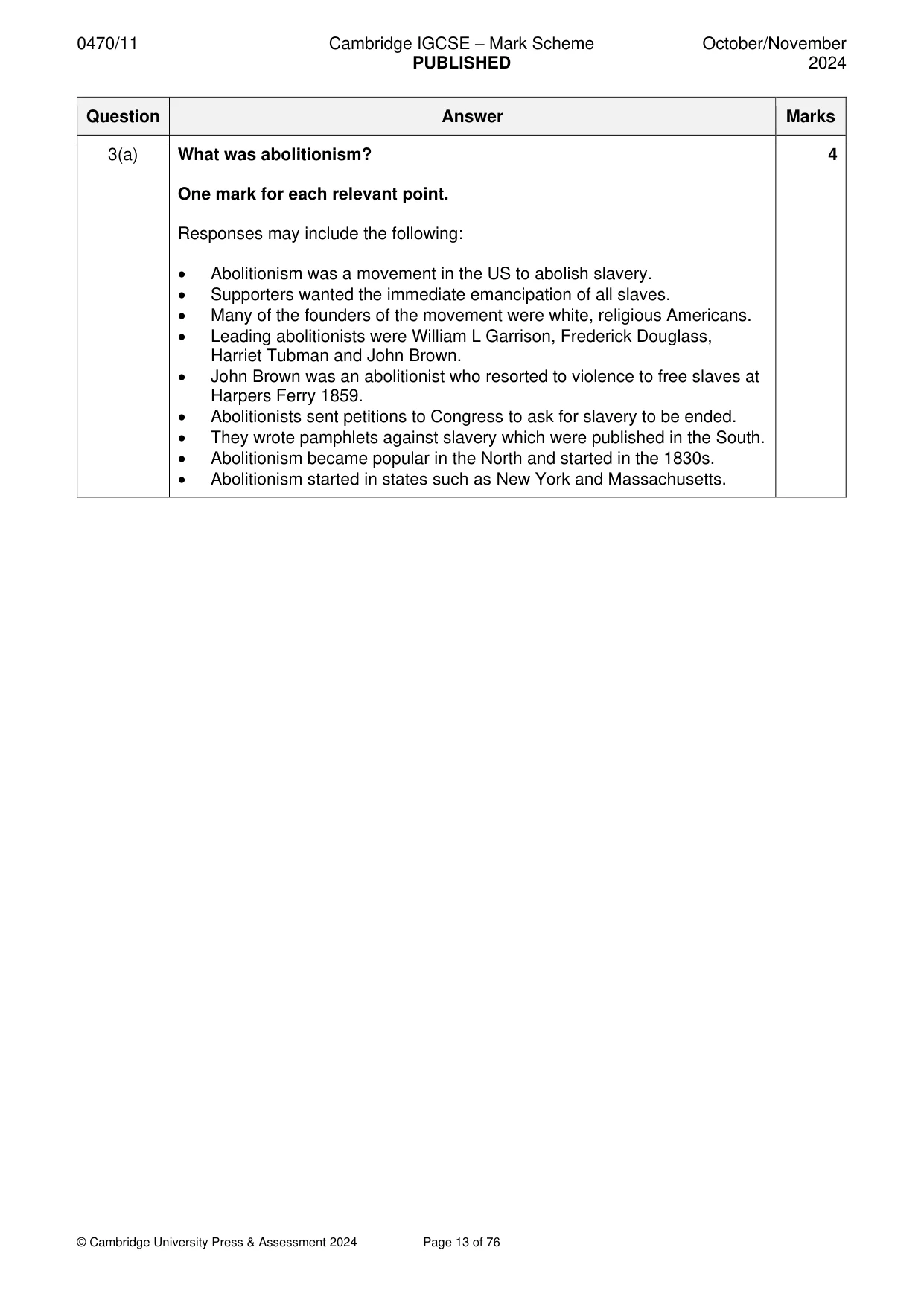
0470/11 Cambridge IGCSE – Mark Scheme PUBLISHED October/November 2024 © Cambridge University Press & Assessment 2024 Page 13 of 76 Question Answer Marks 3(a) What was abolitionism? One mark for each relevant point. Responses may include the following: • Abolitionism was a movement in the US to abolish slavery. • Supporters wanted the immediate emancipation of all slaves. • Many of the founders of the movement were white, religious Americans. • Leading abolitionists were William L Garrison, Frederick Douglass, Harriet Tubman and John Brown. • John Brown was an abolitionist who resorted to violence to free slaves at Harpers Ferry 1859. • Abolitionists sent petitions to Congress to ask for slavery to be ended. • They wrote pamphlets against slavery which were published in the South. • Abolitionism became popular in the North and started in the 1830s. • Abolitionism started in states such as New York and Massachusetts. 4
Mark scheme, page 14
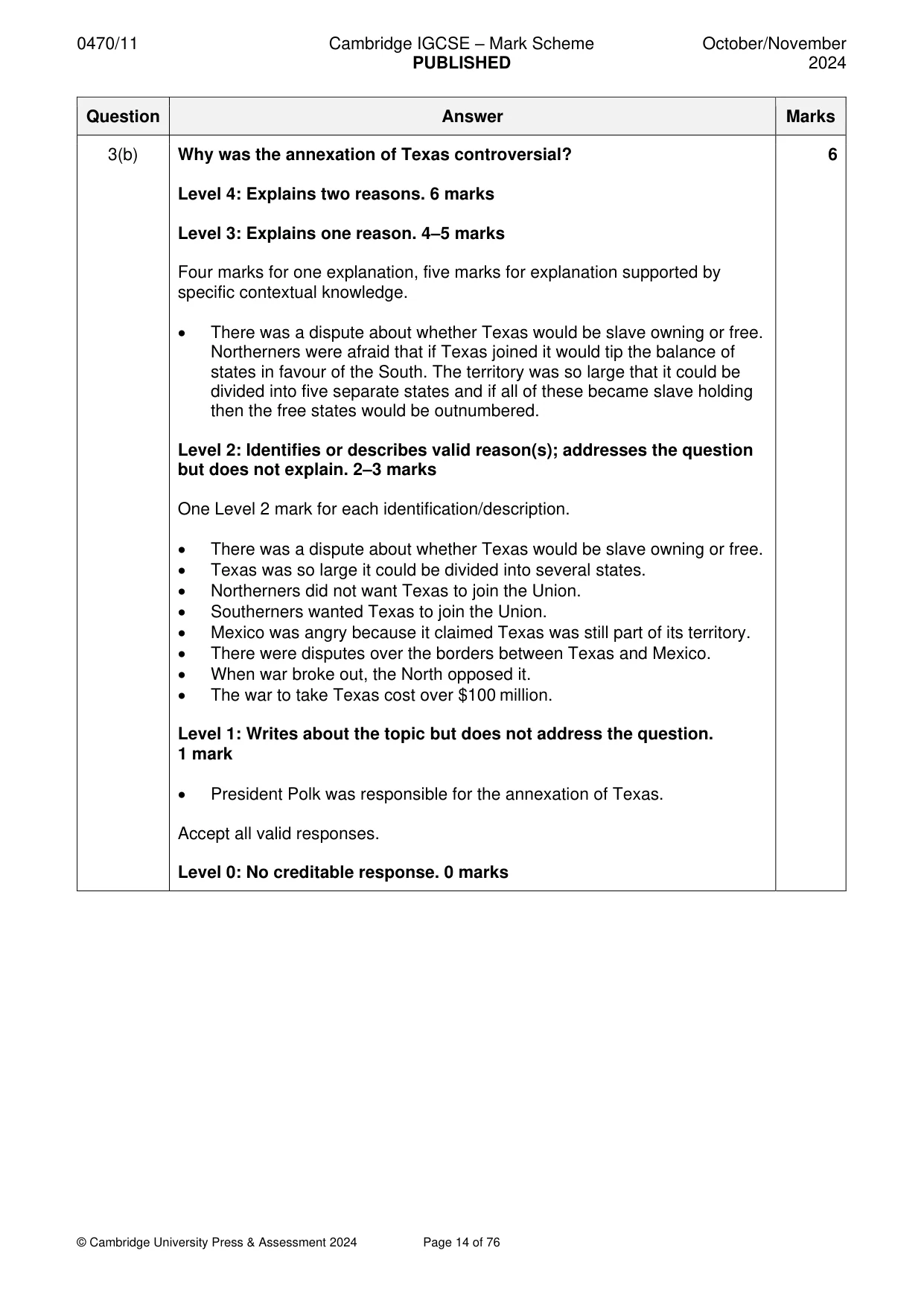
0470/11 Cambridge IGCSE – Mark Scheme PUBLISHED October/November 2024 © Cambridge University Press & Assessment 2024 Page 14 of 76 Question Answer Marks 3(b) Why was the annexation of Texas controversial? Level 4: Explains two reasons. 6 marks Level 3: Explains one reason. 4–5 marks Four marks for one explanation, five marks for explanation supported by specific contextual knowledge. • There was a dispute about whether Texas would be slave owning or free. Northerners were afraid that if Texas joined it would tip the balance of states in favour of the South. The territory was so large that it could be divided into five separate states and if all of these became slave holding then the free states would be outnumbered. Level 2: Identifies or describes valid reason(s); addresses the question but does not explain. 2–3 marks One Level 2 mark for each identification/description. • There was a dispute about whether Texas would be slave owning or free. • Texas was so large it could be divided into several states. • Northerners did not want Texas to join the Union. • Southerners wanted Texas to join the Union. • Mexico was angry because it claimed Texas was still part of its territory. • There were disputes over the borders between Texas and Mexico. • When war broke out, the North opposed it. • The war to take Texas cost over $100 million. Level 1: Writes about the topic but does not address the question. 1 mark • President Polk was responsible for the annexation of Texas. Accept all valid responses. Level 0: No creditable response. 0 marks 6
Mark scheme, page 15
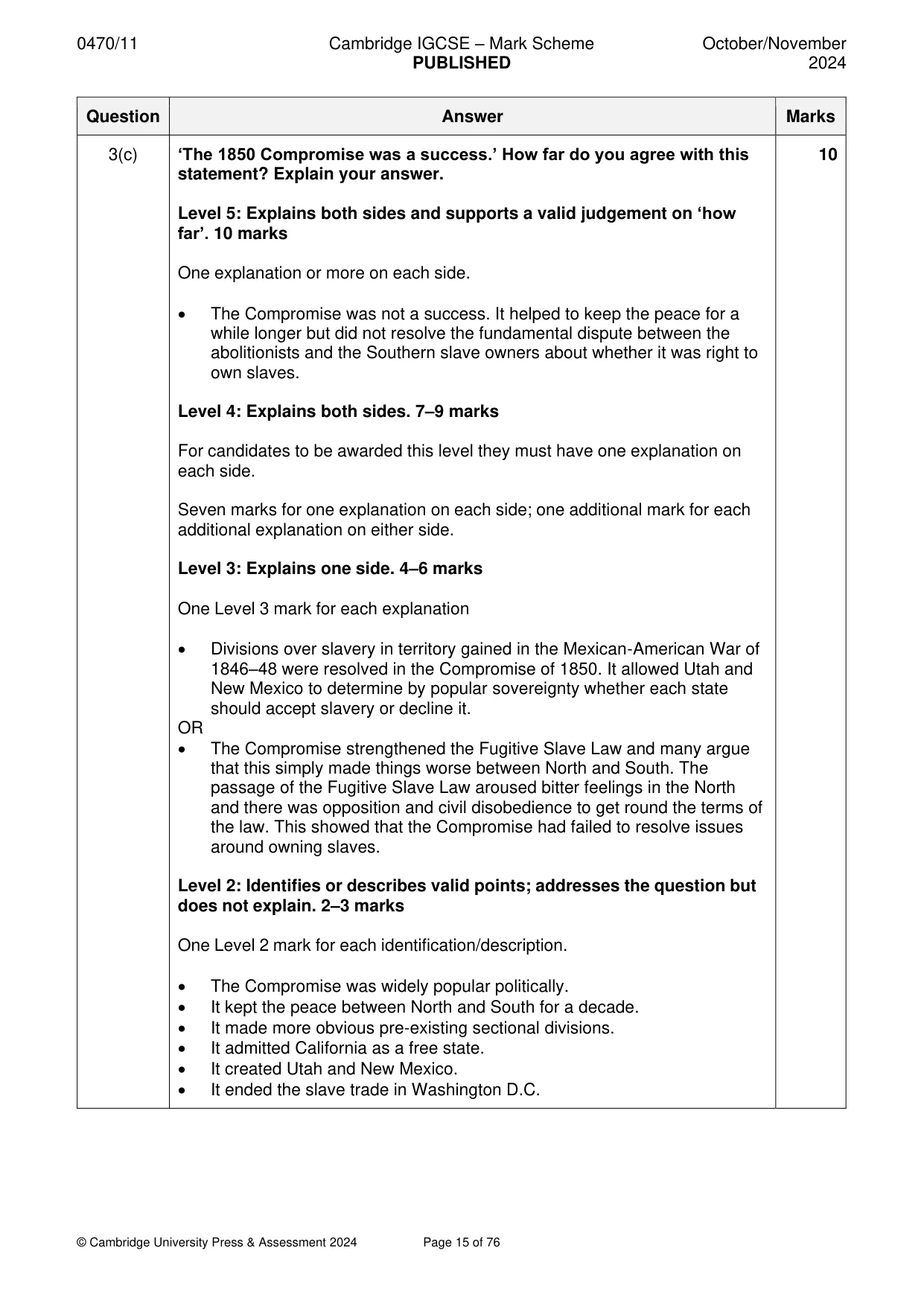
0470/11 Cambridge IGCSE – Mark Scheme PUBLISHED October/November 2024 © Cambridge University Press & Assessment 2024 Page 15 of 76 Question Answer Marks 3(c) ‘The 1850 Compromise was a success.’ How far do you agree with this statement? Explain your answer. Level 5: Explains both sides and supports a valid judgement on ‘how far’. 10 marks One explanation or more on each side. • The Compromise was not a success. It helped to keep the peace for a while longer but did not resolve the fundamental dispute between the abolitionists and the Southern slave owners about whether it was right to own slaves. Level 4: Explains both sides. 7–9 marks For candidates to be awarded this level they must have one explanation on each side. Seven marks for one explanation on each side; one additional mark for each additional explanation on either side. Level 3: Explains one side. 4–6 marks One Level 3 mark for each explanation • Divisions over slavery in territory gained in the Mexican-American War of 1846–48 were resolved in the Compromise of 1850. It allowed Utah and New Mexico to determine by popular sovereignty whether each state should accept slavery or decline it. OR • The Compromise strengthened the Fugitive Slave Law and many argue that this simply made things worse between North and South. The passage of the Fugitive Slave Law aroused bitter feelings in the North and there was opposition and civil disobedience to get round the terms of the law. This showed that the Compromise had failed to resolve issues around owning slaves. Level 2: Identifies or describes valid points; addresses the question but does not explain. 2–3 marks One Level 2 mark for each identification/description. • The Compromise was widely popular politically. • It kept the peace between North and South for a decade. • It made more obvious pre-existing sectional divisions. • It admitted California as a free state. • It created Utah and New Mexico. • It ended the slave trade in Washington D.C. 10
Mark scheme, page 16
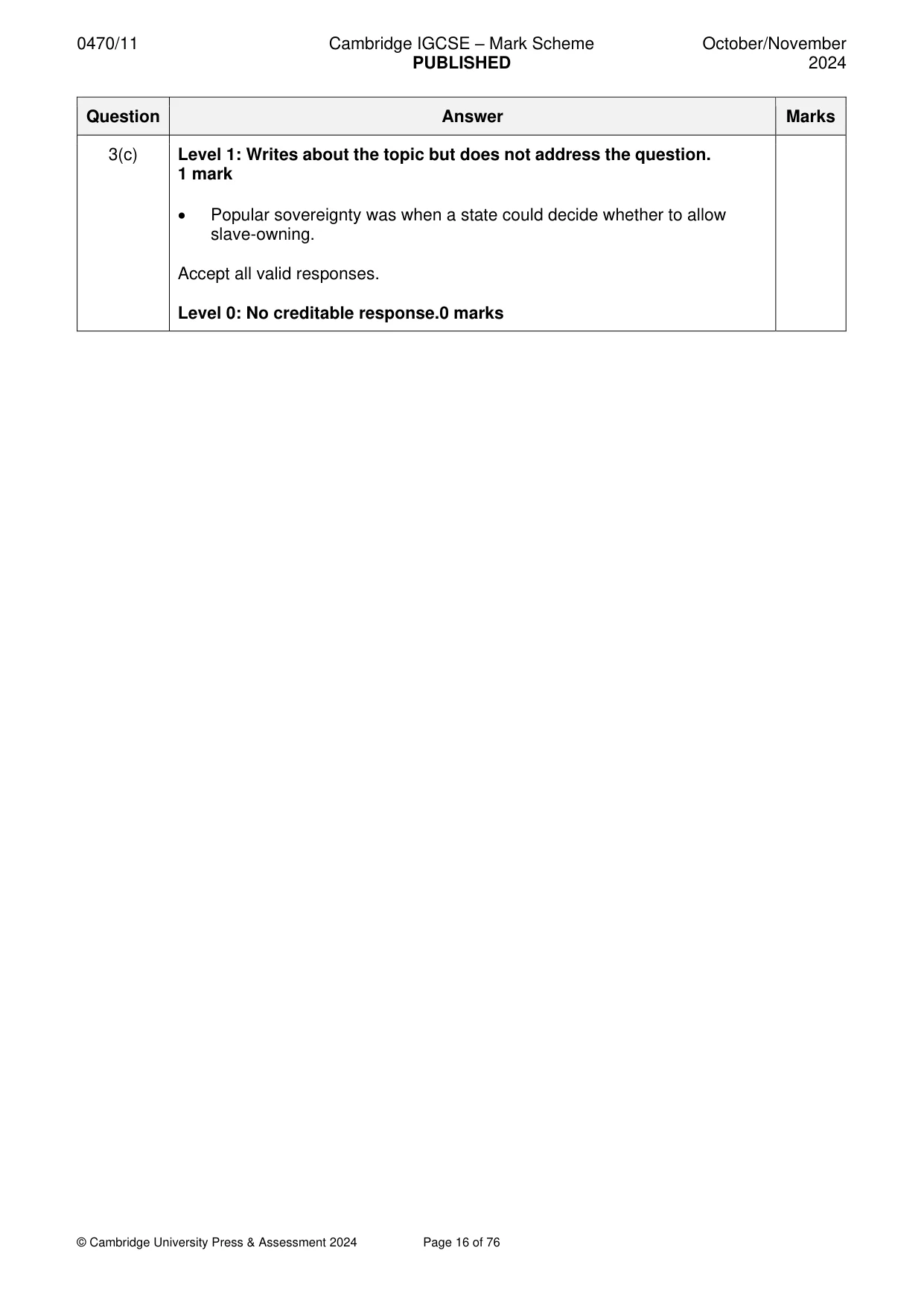
0470/11 Cambridge IGCSE – Mark Scheme PUBLISHED October/November 2024 © Cambridge University Press & Assessment 2024 Page 16 of 76 Question Answer Marks 3(c) Level 1: Writes about the topic but does not address the question. 1 mark • Popular sovereignty was when a state could decide whether to allow slave-owning. Accept all valid responses. Level 0: No creditable response.0 marks
Mark scheme, page 17
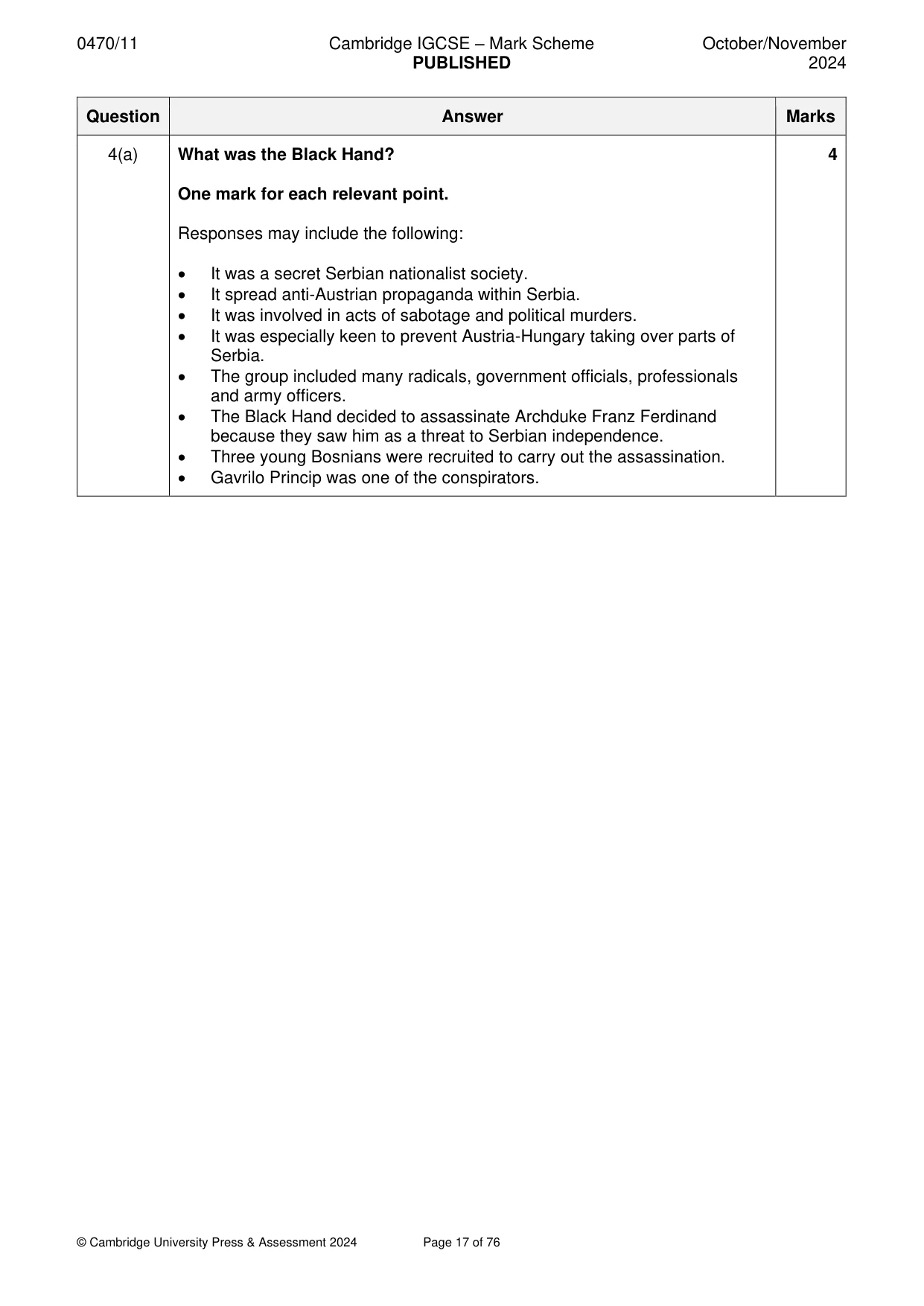
0470/11 Cambridge IGCSE – Mark Scheme PUBLISHED October/November 2024 © Cambridge University Press & Assessment 2024 Page 17 of 76 Question Answer Marks 4(a) What was the Black Hand? One mark for each relevant point. Responses may include the following: • It was a secret Serbian nationalist society. • It spread anti-Austrian propaganda within Serbia. • It was involved in acts of sabotage and political murders. • It was especially keen to prevent Austria-Hungary taking over parts of Serbia. • The group included many radicals, government officials, professionals and army officers. • The Black Hand decided to assassinate Archduke Franz Ferdinand because they saw him as a threat to Serbian independence. • Three young Bosnians were recruited to carry out the assassination. • Gavrilo Princip was one of the conspirators. 4
Mark scheme, page 18
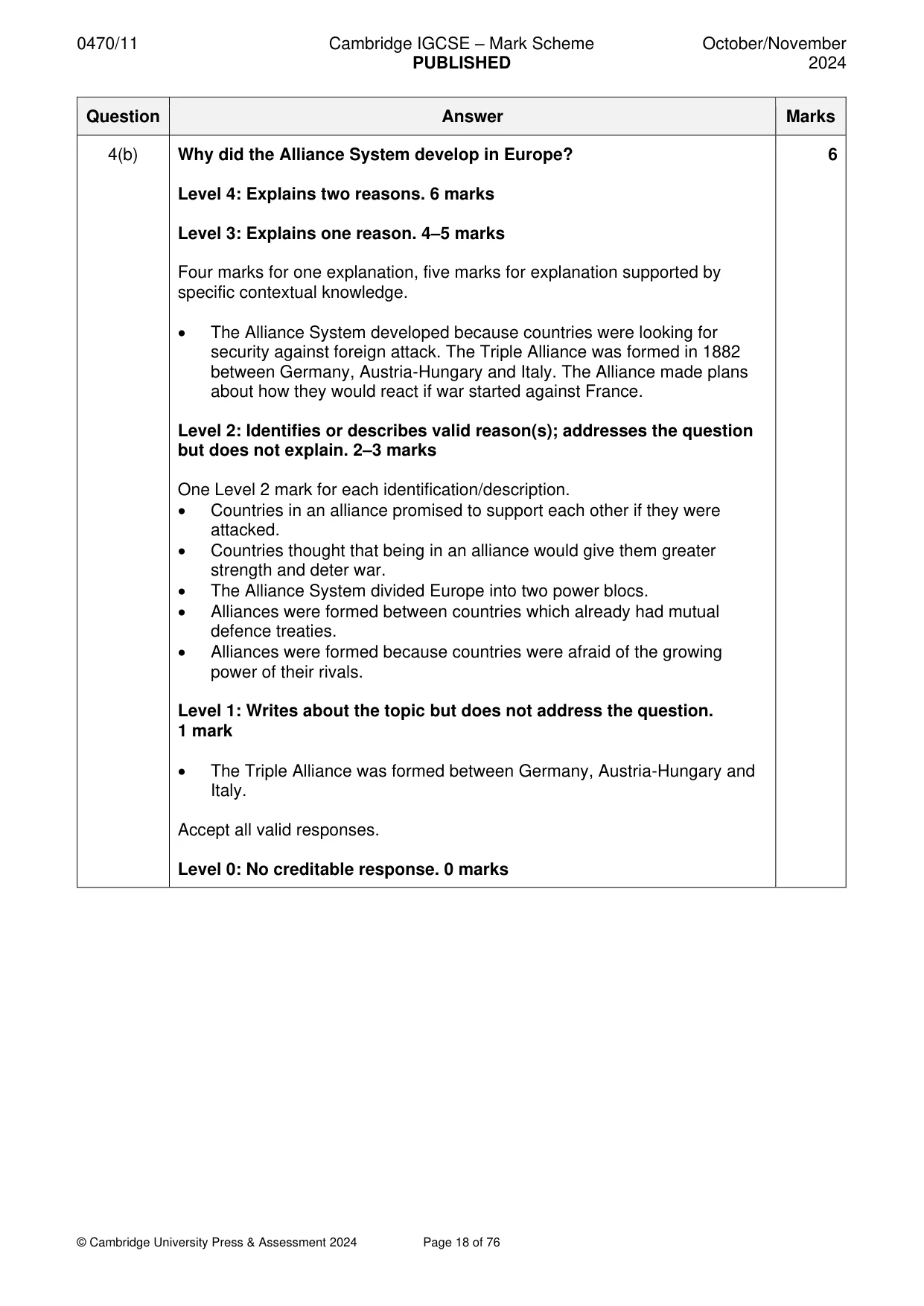
0470/11 Cambridge IGCSE – Mark Scheme PUBLISHED October/November 2024 © Cambridge University Press & Assessment 2024 Page 18 of 76 Question Answer Marks 4(b) Why did the Alliance System develop in Europe? Level 4: Explains two reasons. 6 marks Level 3: Explains one reason. 4–5 marks Four marks for one explanation, five marks for explanation supported by specific contextual knowledge. • The Alliance System developed because countries were looking for security against foreign attack. The Triple Alliance was formed in 1882 between Germany, Austria-Hungary and Italy. The Alliance made plans about how they would react if war started against France. Level 2: Identifies or describes valid reason(s); addresses the question but does not explain. 2–3 marks One Level 2 mark for each identification/description. • Countries in an alliance promised to support each other if they were attacked. • Countries thought that being in an alliance would give them greater strength and deter war. • The Alliance System divided Europe into two power blocs. • Alliances were formed between countries which already had mutual defence treaties. • Alliances were formed because countries were afraid of the growing power of their rivals. Level 1: Writes about the topic but does not address the question. 1 mark • The Triple Alliance was formed between Germany, Austria-Hungary and Italy. Accept all valid responses. Level 0: No creditable response. 0 marks 6
Mark scheme, page 19
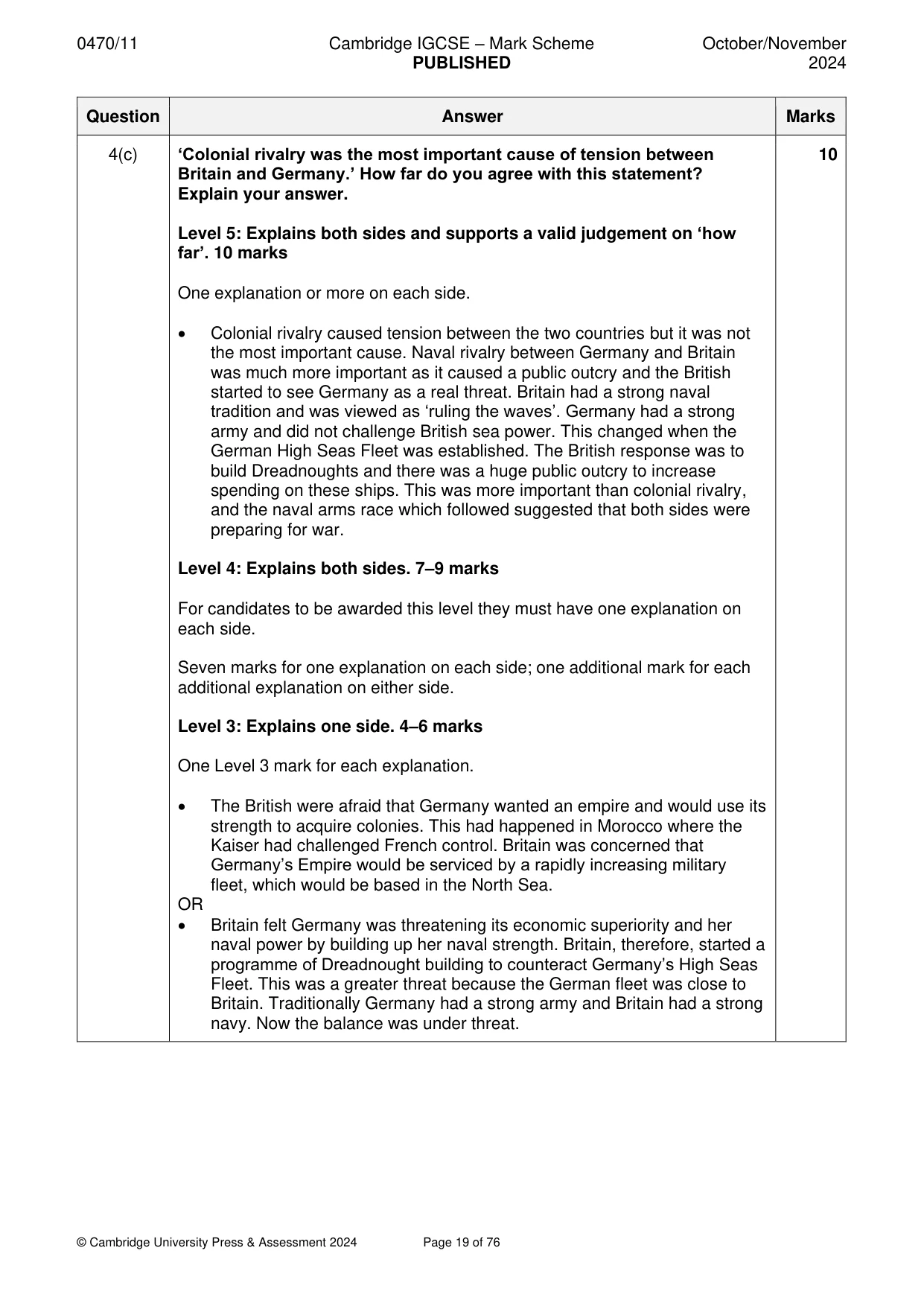
0470/11 Cambridge IGCSE – Mark Scheme PUBLISHED October/November 2024 © Cambridge University Press & Assessment 2024 Page 19 of 76 Question Answer Marks 4(c) ‘Colonial rivalry was the most important cause of tension between Britain and Germany.’ How far do you agree with this statement? Explain your answer. Level 5: Explains both sides and supports a valid judgement on ‘how far’. 10 marks One explanation or more on each side. • Colonial rivalry caused tension between the two countries but it was not the most important cause. Naval rivalry between Germany and Britain was much more important as it caused a public outcry and the British started to see Germany as a real threat. Britain had a strong naval tradition and was viewed as ‘ruling the waves’. Germany had a strong army and did not challenge British sea power. This changed when the German High Seas Fleet was established. The British response was to build Dreadnoughts and there was a huge public outcry to increase spending on these ships. This was more important than colonial rivalry, and the naval arms race which followed suggested that both sides were preparing for war. Level 4: Explains both sides. 7–9 marks For candidates to be awarded this level they must have one explanation on each side. Seven marks for one explanation on each side; one additional mark for each additional explanation on either side. Level 3: Explains one side. 4–6 marks One Level 3 mark for each explanation. • The British were afraid that Germany wanted an empire and would use its strength to acquire colonies. This had happened in Morocco where the Kaiser had challenged French control. Britain was concerned that Germany’s Empire would be serviced by a rapidly increasing military fleet, which would be based in the North Sea. OR • Britain felt Germany was threatening its economic superiority and her naval power by building up her naval strength. Britain, therefore, started a programme of Dreadnought building to counteract Germany’s High Seas Fleet. This was a greater threat because the German fleet was close to Britain. Traditionally Germany had a strong army and Britain had a strong navy. Now the balance was under threat. 10
Mark scheme, page 20
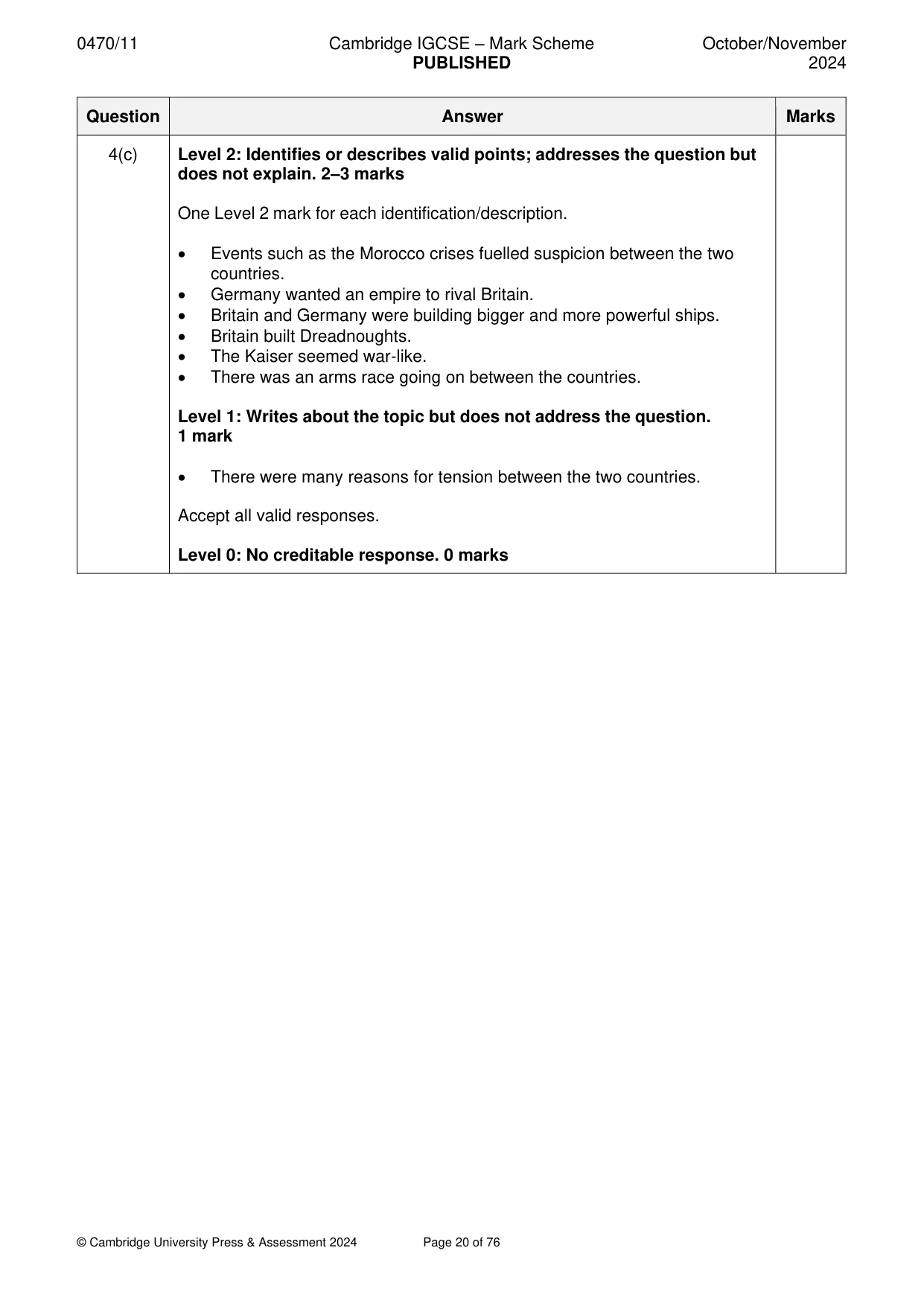
0470/11 Cambridge IGCSE – Mark Scheme PUBLISHED October/November 2024 © Cambridge University Press & Assessment 2024 Page 20 of 76 Question Answer Marks 4(c) Level 2: Identifies or describes valid points; addresses the question but does not explain. 2–3 marks One Level 2 mark for each identification/description. • Events such as the Morocco crises fuelled suspicion between the two countries. • Germany wanted an empire to rival Britain. • Britain and Germany were building bigger and more powerful ships. • Britain built Dreadnoughts. • The Kaiser seemed war-like. • There was an arms race going on between the countries. Level 1: Writes about the topic but does not address the question. 1 mark • There were many reasons for tension between the two countries. Accept all valid responses. Level 0: No creditable response. 0 marks
Mark scheme, page 21
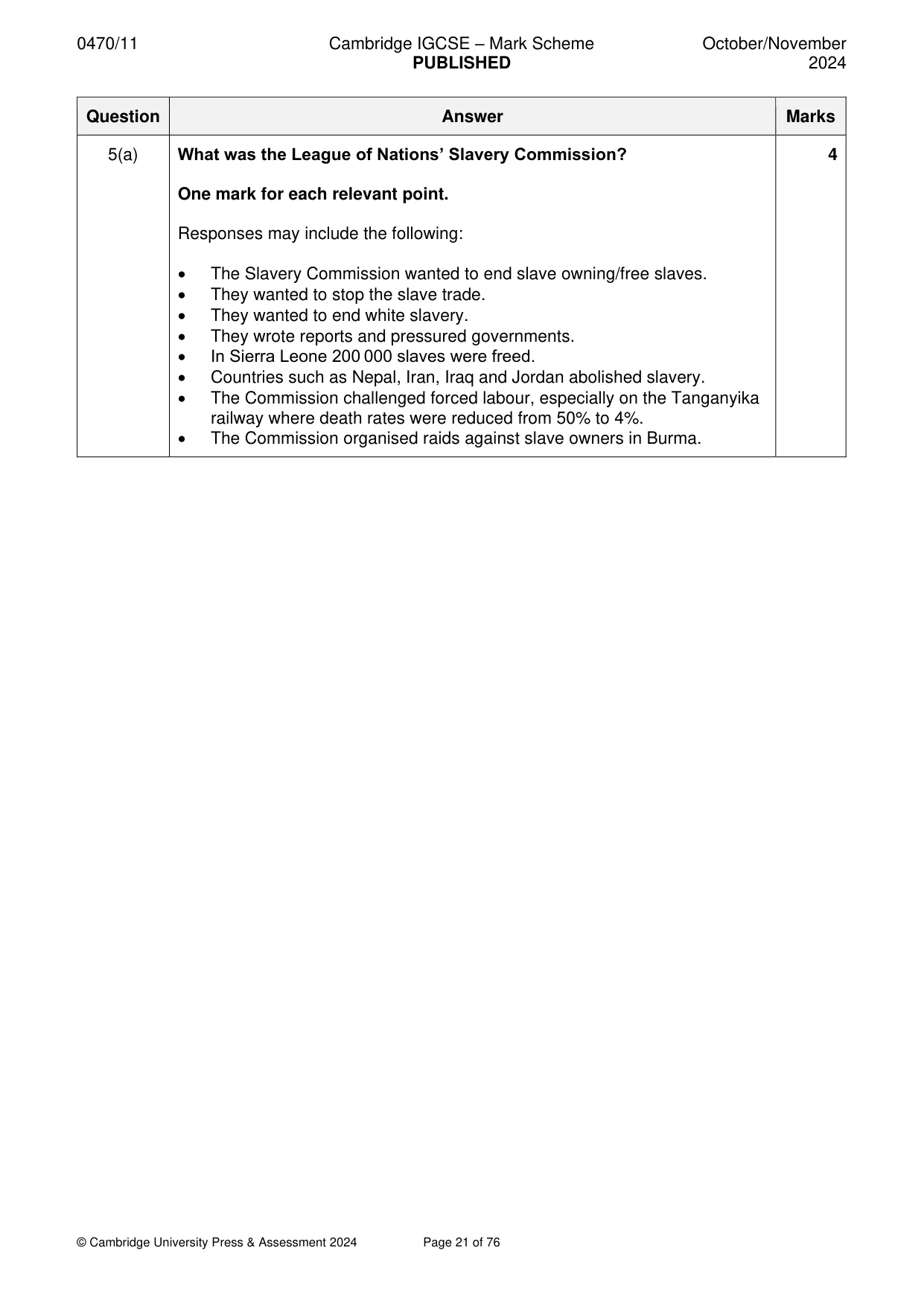
0470/11 Cambridge IGCSE – Mark Scheme PUBLISHED October/November 2024 © Cambridge University Press & Assessment 2024 Page 21 of 76 Question Answer Marks 5(a) What was the League of Nations’ Slavery Commission? One mark for each relevant point. Responses may include the following: • The Slavery Commission wanted to end slave owning/free slaves. • They wanted to stop the slave trade. • They wanted to end white slavery. • They wrote reports and pressured governments. • In Sierra Leone 200 000 slaves were freed. • Countries such as Nepal, Iran, Iraq and Jordan abolished slavery. • The Commission challenged forced labour, especially on the Tanganyika railway where death rates were reduced from 50% to 4%. • The Commission organised raids against slave owners in Burma. 4
Mark scheme, page 22
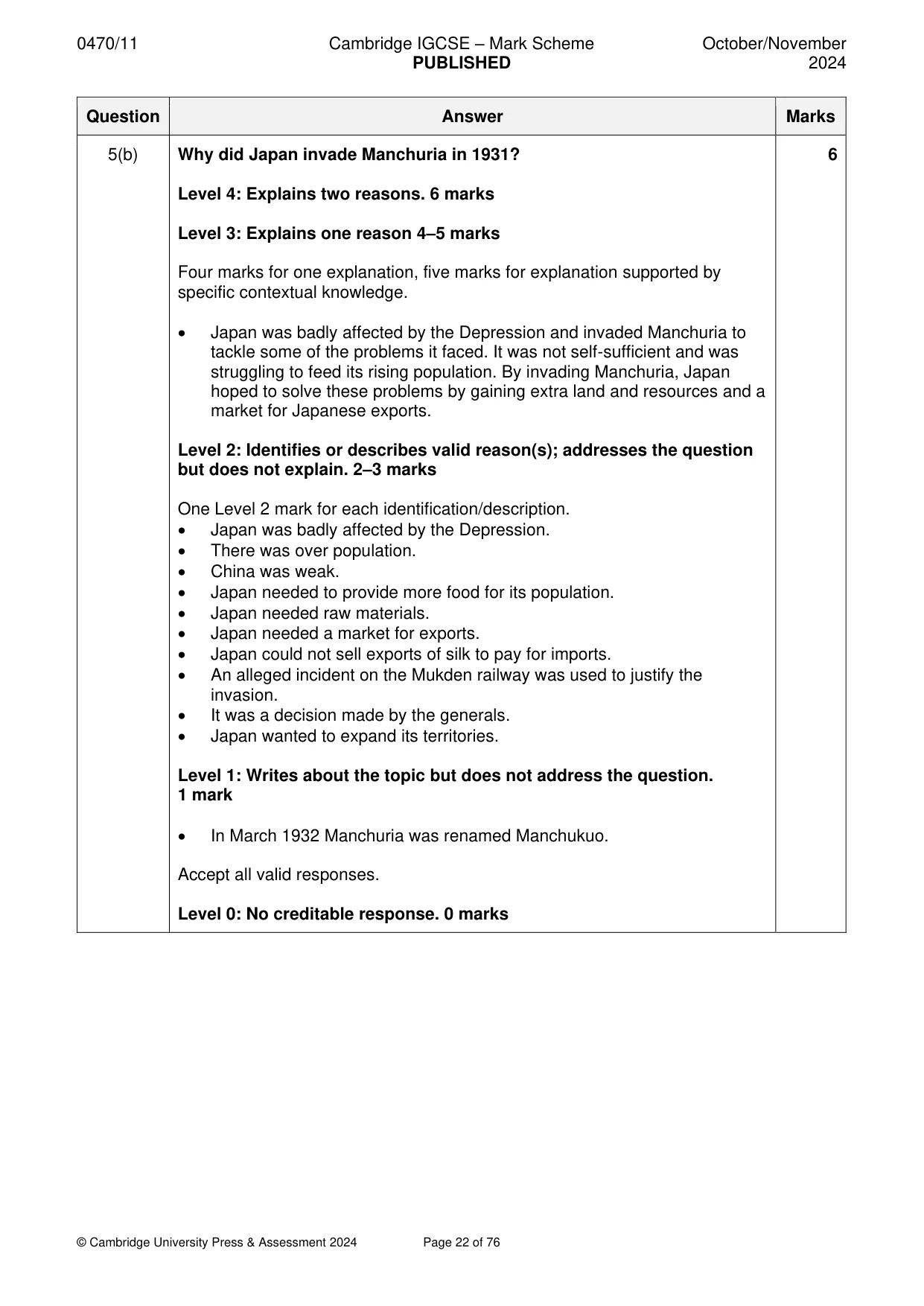
0470/11 Cambridge IGCSE – Mark Scheme PUBLISHED October/November 2024 © Cambridge University Press & Assessment 2024 Page 22 of 76 Question Answer Marks 5(b) Why did Japan invade Manchuria in 1931? Level 4: Explains two reasons. 6 marks Level 3: Explains one reason 4–5 marks Four marks for one explanation, five marks for explanation supported by specific contextual knowledge. • Japan was badly affected by the Depression and invaded Manchuria to tackle some of the problems it faced. It was not self-sufficient and was struggling to feed its rising population. By invading Manchuria, Japan hoped to solve these problems by gaining extra land and resources and a market for Japanese exports. Level 2: Identifies or describes valid reason(s); addresses the question but does not explain. 2–3 marks One Level 2 mark for each identification/description. • Japan was badly affected by the Depression. • There was over population. • China was weak. • Japan needed to provide more food for its population. • Japan needed raw materials. • Japan needed a market for exports. • Japan could not sell exports of silk to pay for imports. • An alleged incident on the Mukden railway was used to justify the invasion. • It was a decision made by the generals. • Japan wanted to expand its territories. Level 1: Writes about the topic but does not address the question. 1 mark • In March 1932 Manchuria was renamed Manchukuo. Accept all valid responses. Level 0: No creditable response. 0 marks 6
Mark scheme, page 23
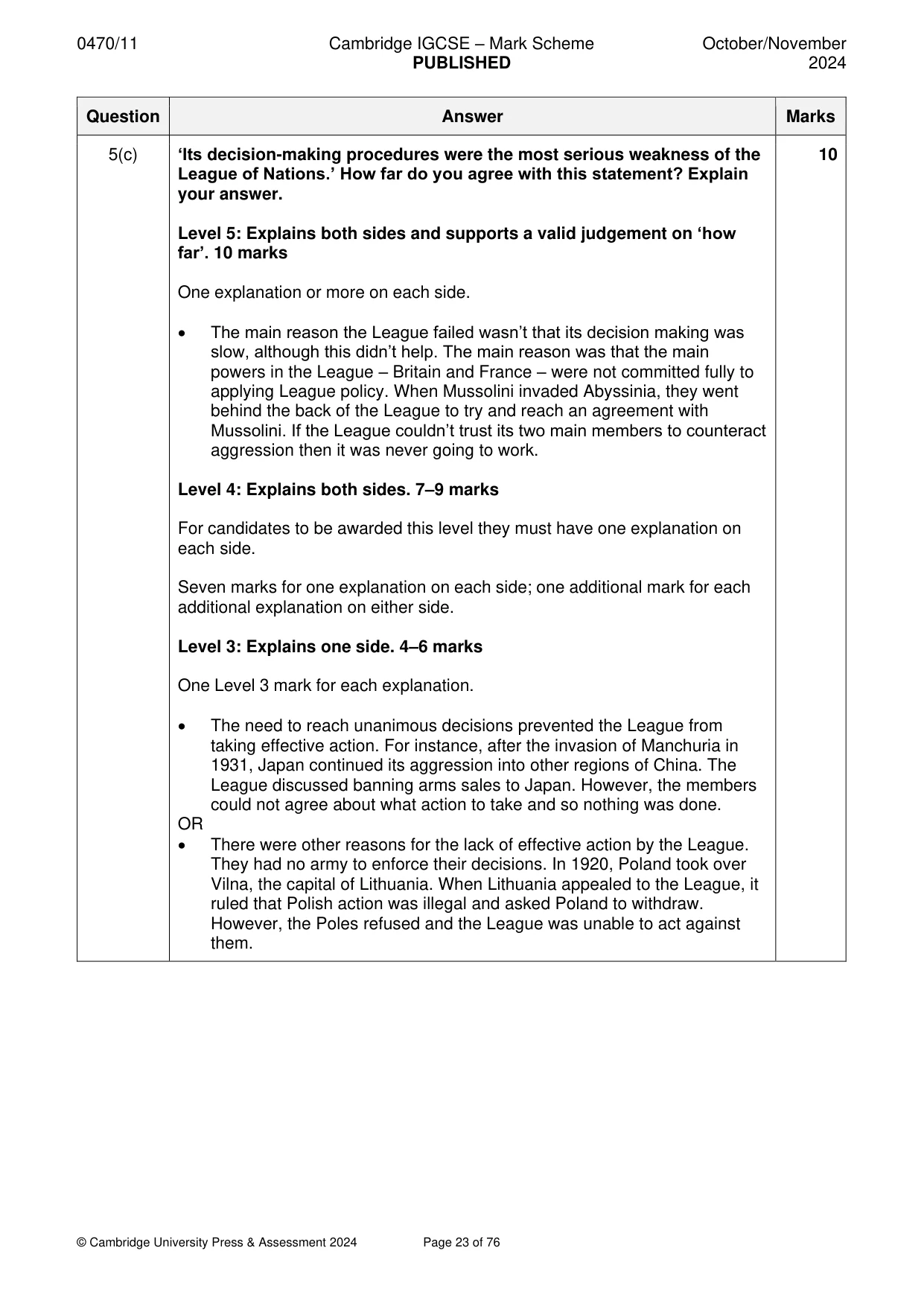
0470/11 Cambridge IGCSE – Mark Scheme PUBLISHED October/November 2024 © Cambridge University Press & Assessment 2024 Page 23 of 76 Question Answer Marks 5(c) ‘Its decision-making procedures were the most serious weakness of the League of Nations.’ How far do you agree with this statement? Explain your answer. Level 5: Explains both sides and supports a valid judgement on ‘how far’. 10 marks One explanation or more on each side. • The main reason the League failed wasn’t that its decision making was slow, although this didn’t help. The main reason was that the main powers in the League – Britain and France – were not committed fully to applying League policy. When Mussolini invaded Abyssinia, they went behind the back of the League to try and reach an agreement with Mussolini. If the League couldn’t trust its two main members to counteract aggression then it was never going to work. Level 4: Explains both sides. 7–9 marks For candidates to be awarded this level they must have one explanation on each side. Seven marks for one explanation on each side; one additional mark for each additional explanation on either side. Level 3: Explains one side. 4–6 marks One Level 3 mark for each explanation. • The need to reach unanimous decisions prevented the League from taking effective action. For instance, after the invasion of Manchuria in 1931, Japan continued its aggression into other regions of China. The League discussed banning arms sales to Japan. However, the members could not agree about what action to take and so nothing was done. OR • There were other reasons for the lack of effective action by the League. They had no army to enforce their decisions. In 1920, Poland took over Vilna, the capital of Lithuania. When Lithuania appealed to the League, it ruled that Polish action was illegal and asked Poland to withdraw. However, the Poles refused and the League was unable to act against them. 10
Mark scheme, page 24
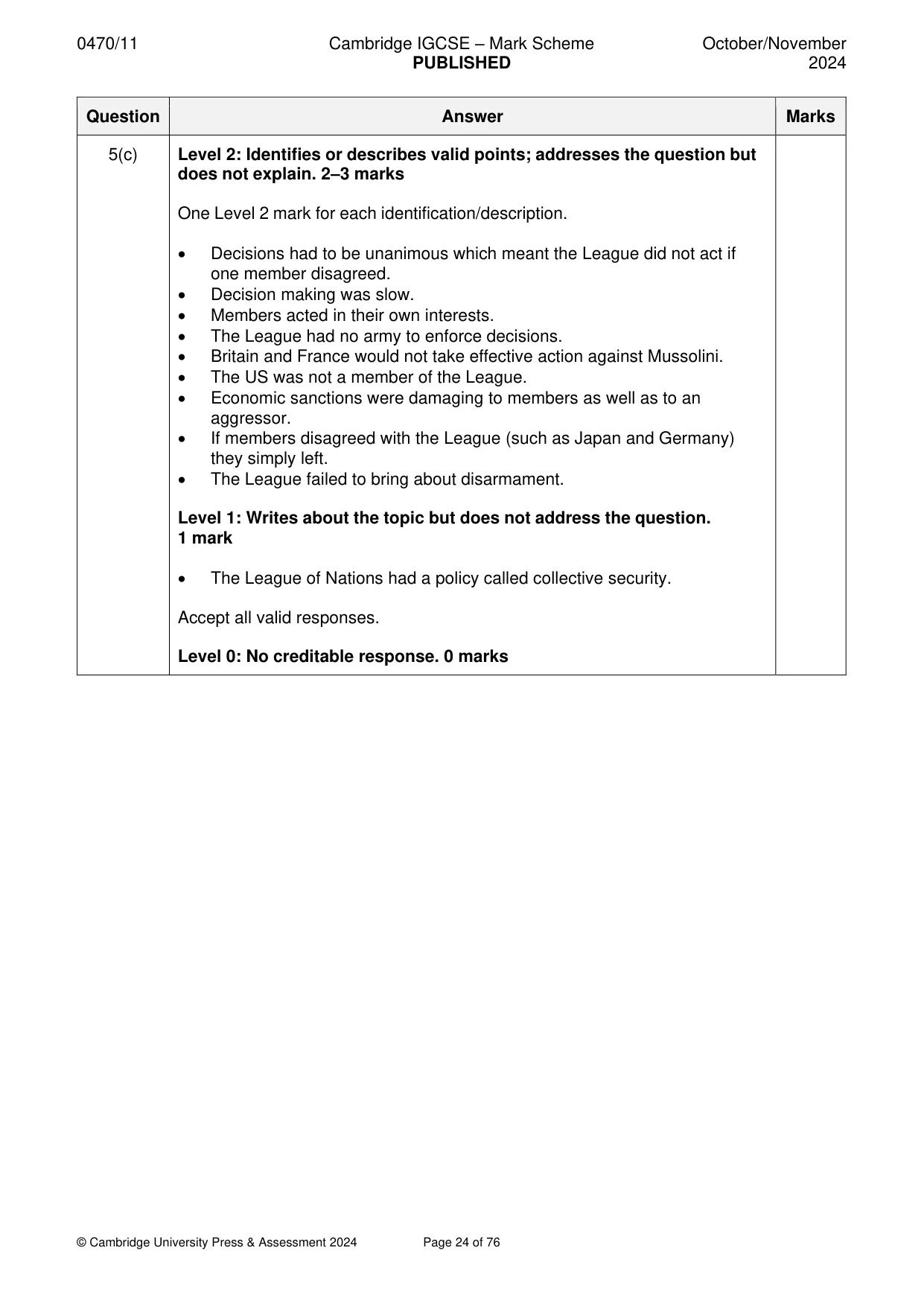
0470/11 Cambridge IGCSE – Mark Scheme PUBLISHED October/November 2024 © Cambridge University Press & Assessment 2024 Page 24 of 76 Question Answer Marks 5(c) Level 2: Identifies or describes valid points; addresses the question but does not explain. 2–3 marks One Level 2 mark for each identification/description. • Decisions had to be unanimous which meant the League did not act if one member disagreed. • Decision making was slow. • Members acted in their own interests. • The League had no army to enforce decisions. • Britain and France would not take effective action against Mussolini. • The US was not a member of the League. • Economic sanctions were damaging to members as well as to an aggressor. • If members disagreed with the League (such as Japan and Germany) they simply left. • The League failed to bring about disarmament. Level 1: Writes about the topic but does not address the question. 1 mark • The League of Nations had a policy called collective security. Accept all valid responses. Level 0: No creditable response. 0 marks
Mark scheme, page 25
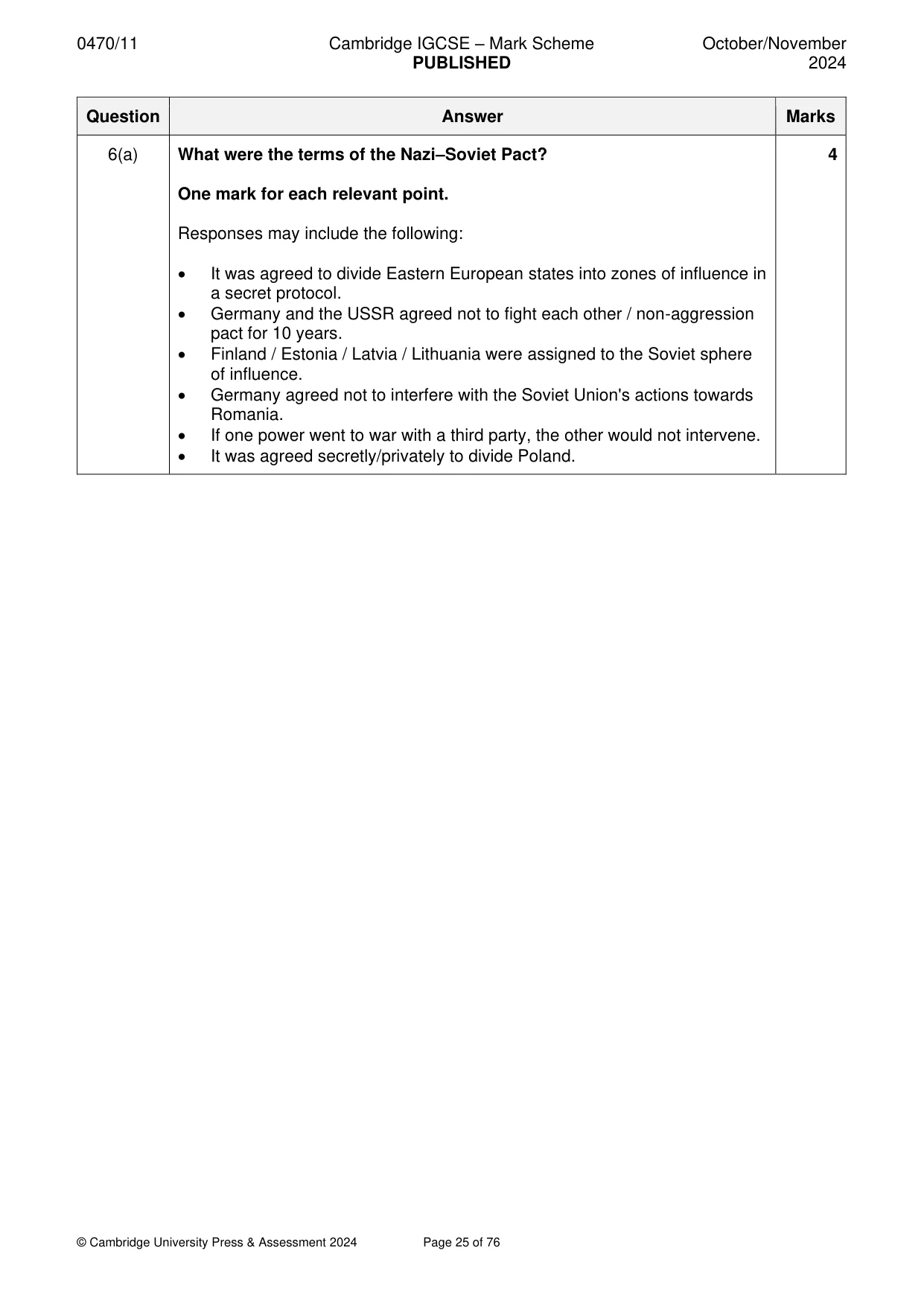
0470/11 Cambridge IGCSE – Mark Scheme PUBLISHED October/November 2024 © Cambridge University Press & Assessment 2024 Page 25 of 76 Question Answer Marks 6(a) What were the terms of the Nazi–Soviet Pact? One mark for each relevant point. Responses may include the following: • It was agreed to divide Eastern European states into zones of influence in a secret protocol. • Germany and the USSR agreed not to fight each other / non-aggression pact for 10 years. • Finland / Estonia / Latvia / Lithuania were assigned to the Soviet sphere of influence. • Germany agreed not to interfere with the Soviet Union's actions towards Romania. • If one power went to war with a third party, the other would not intervene. • It was agreed secretly/privately to divide Poland. 4
Mark scheme, page 26
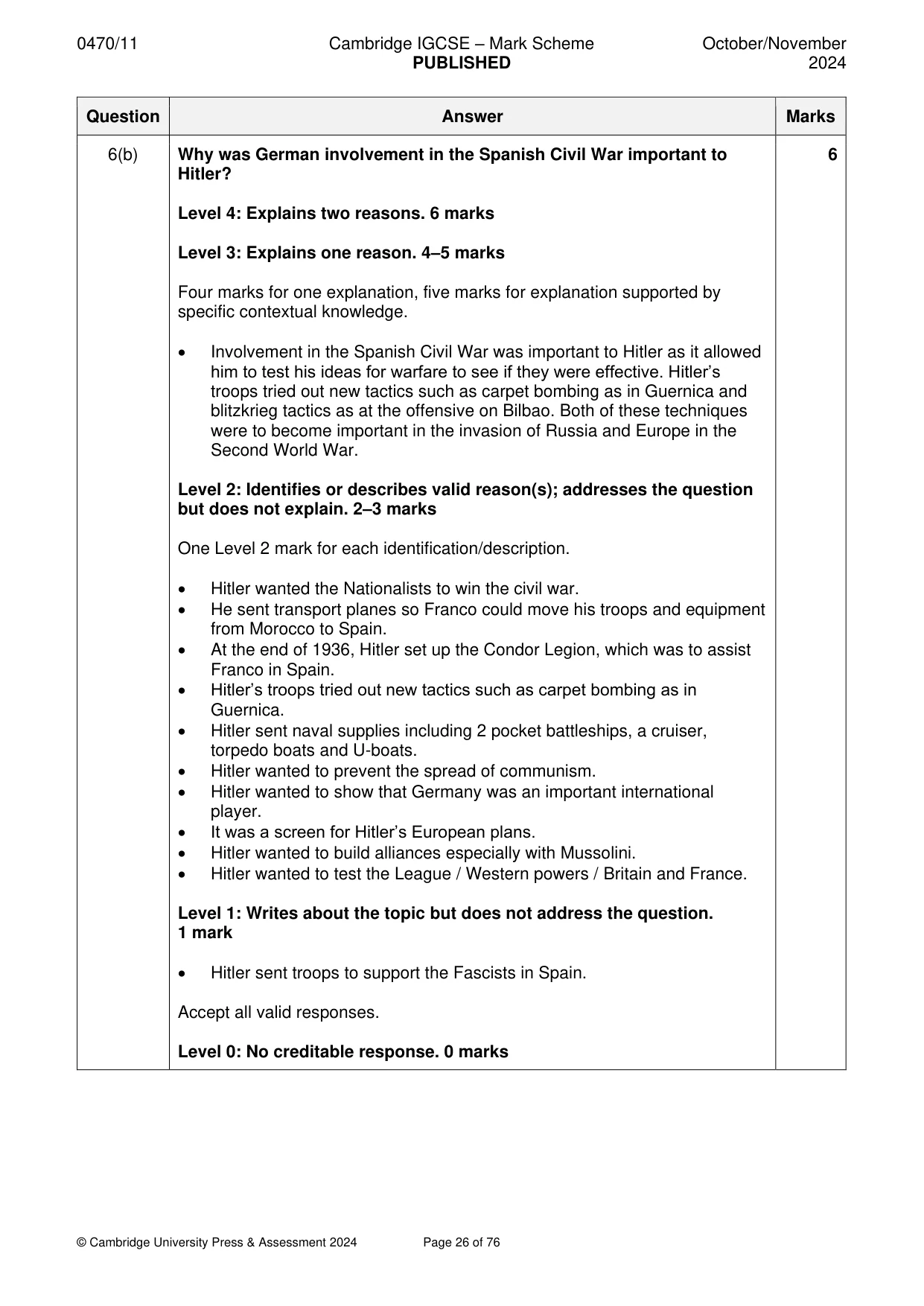
0470/11 Cambridge IGCSE – Mark Scheme PUBLISHED October/November 2024 © Cambridge University Press & Assessment 2024 Page 26 of 76 Question Answer Marks 6(b) Why was German involvement in the Spanish Civil War important to Hitler? Level 4: Explains two reasons. 6 marks Level 3: Explains one reason. 4–5 marks Four marks for one explanation, five marks for explanation supported by specific contextual knowledge. • Involvement in the Spanish Civil War was important to Hitler as it allowed him to test his ideas for warfare to see if they were effective. Hitler’s troops tried out new tactics such as carpet bombing as in Guernica and blitzkrieg tactics as at the offensive on Bilbao. Both of these techniques were to become important in the invasion of Russia and Europe in the Second World War. Level 2: Identifies or describes valid reason(s); addresses the question but does not explain. 2–3 marks One Level 2 mark for each identification/description. • Hitler wanted the Nationalists to win the civil war. • He sent transport planes so Franco could move his troops and equipment from Morocco to Spain. • At the end of 1936, Hitler set up the Condor Legion, which was to assist Franco in Spain. • Hitler’s troops tried out new tactics such as carpet bombing as in Guernica. • Hitler sent naval supplies including 2 pocket battleships, a cruiser, torpedo boats and U-boats. • Hitler wanted to prevent the spread of communism. • Hitler wanted to show that Germany was an important international player. • It was a screen for Hitler’s European plans. • Hitler wanted to build alliances especially with Mussolini. • Hitler wanted to test the League / Western powers / Britain and France. Level 1: Writes about the topic but does not address the question. 1 mark • Hitler sent troops to support the Fascists in Spain. Accept all valid responses. Level 0: No creditable response. 0 marks 6
Mark scheme, page 27
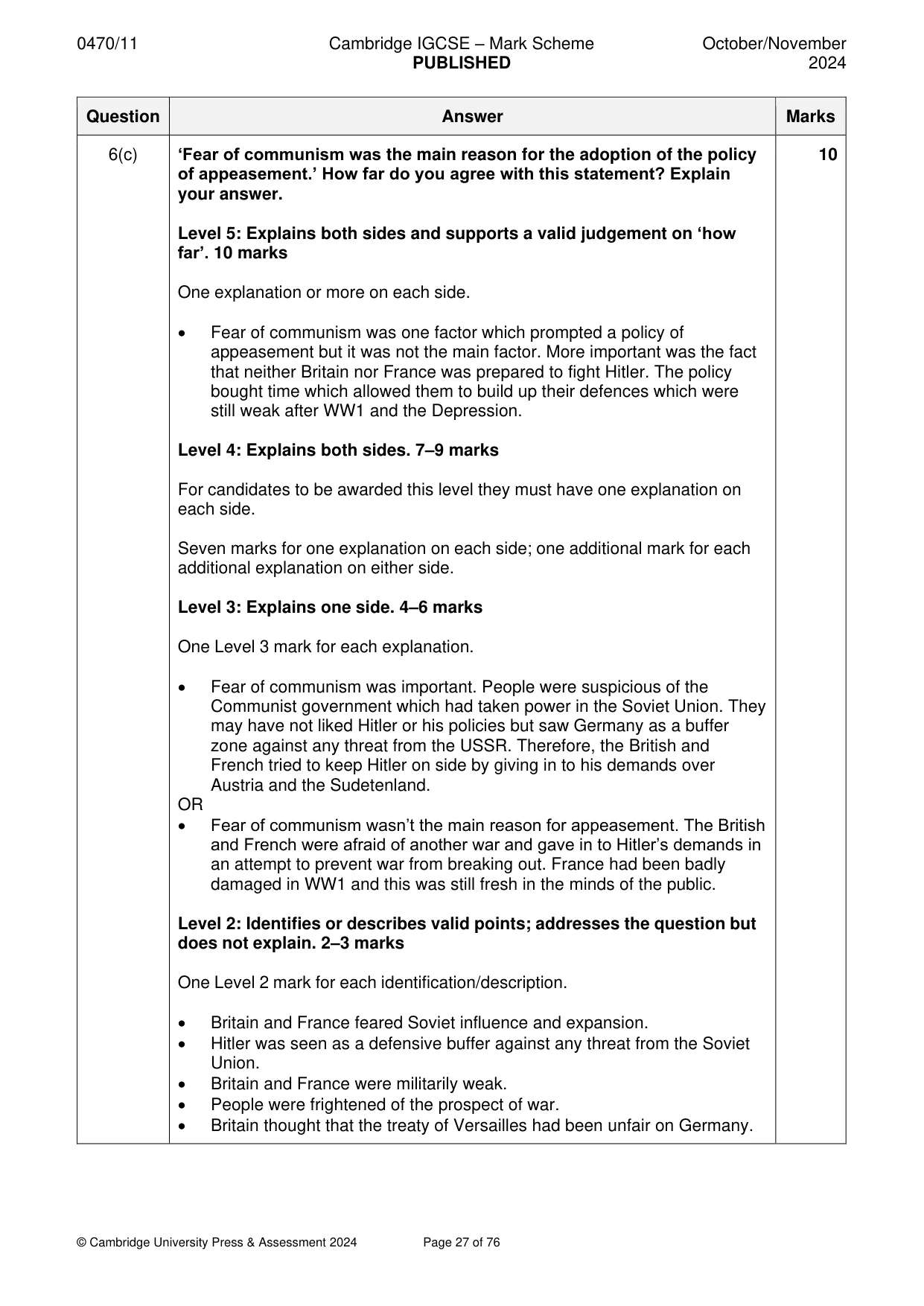
0470/11 Cambridge IGCSE – Mark Scheme PUBLISHED October/November 2024 © Cambridge University Press & Assessment 2024 Page 27 of 76 Question Answer Marks 6(c) ‘Fear of communism was the main reason for the adoption of the policy of appeasement.’ How far do you agree with this statement? Explain your answer. Level 5: Explains both sides and supports a valid judgement on ‘how far’. 10 marks One explanation or more on each side. • Fear of communism was one factor which prompted a policy of appeasement but it was not the main factor. More important was the fact that neither Britain nor France was prepared to fight Hitler. The policy bought time which allowed them to build up their defences which were still weak after WW1 and the Depression. Level 4: Explains both sides. 7–9 marks For candidates to be awarded this level they must have one explanation on each side. Seven marks for one explanation on each side; one additional mark for each additional explanation on either side. Level 3: Explains one side. 4–6 marks One Level 3 mark for each explanation. • Fear of communism was important. People were suspicious of the Communist government which had taken power in the Soviet Union. They may have not liked Hitler or his policies but saw Germany as a buffer zone against any threat from the USSR. Therefore, the British and French tried to keep Hitler on side by giving in to his demands over Austria and the Sudetenland. OR • Fear of communism wasn’t the main reason for appeasement. The British and French were afraid of another war and gave in to Hitler’s demands in an attempt to prevent war from breaking out. France had been badly damaged in WW1 and this was still fresh in the minds of the public. Level 2: Identifies or describes valid points; addresses the question but does not explain. 2–3 marks One Level 2 mark for each identification/description. • Britain and France feared Soviet influence and expansion. • Hitler was seen as a defensive buffer against any threat from the Soviet Union. • Britain and France were militarily weak. • People were frightened of the prospect of war. • Britain thought that the treaty of Versailles had been unfair on Germany. 10
Mark scheme, page 28
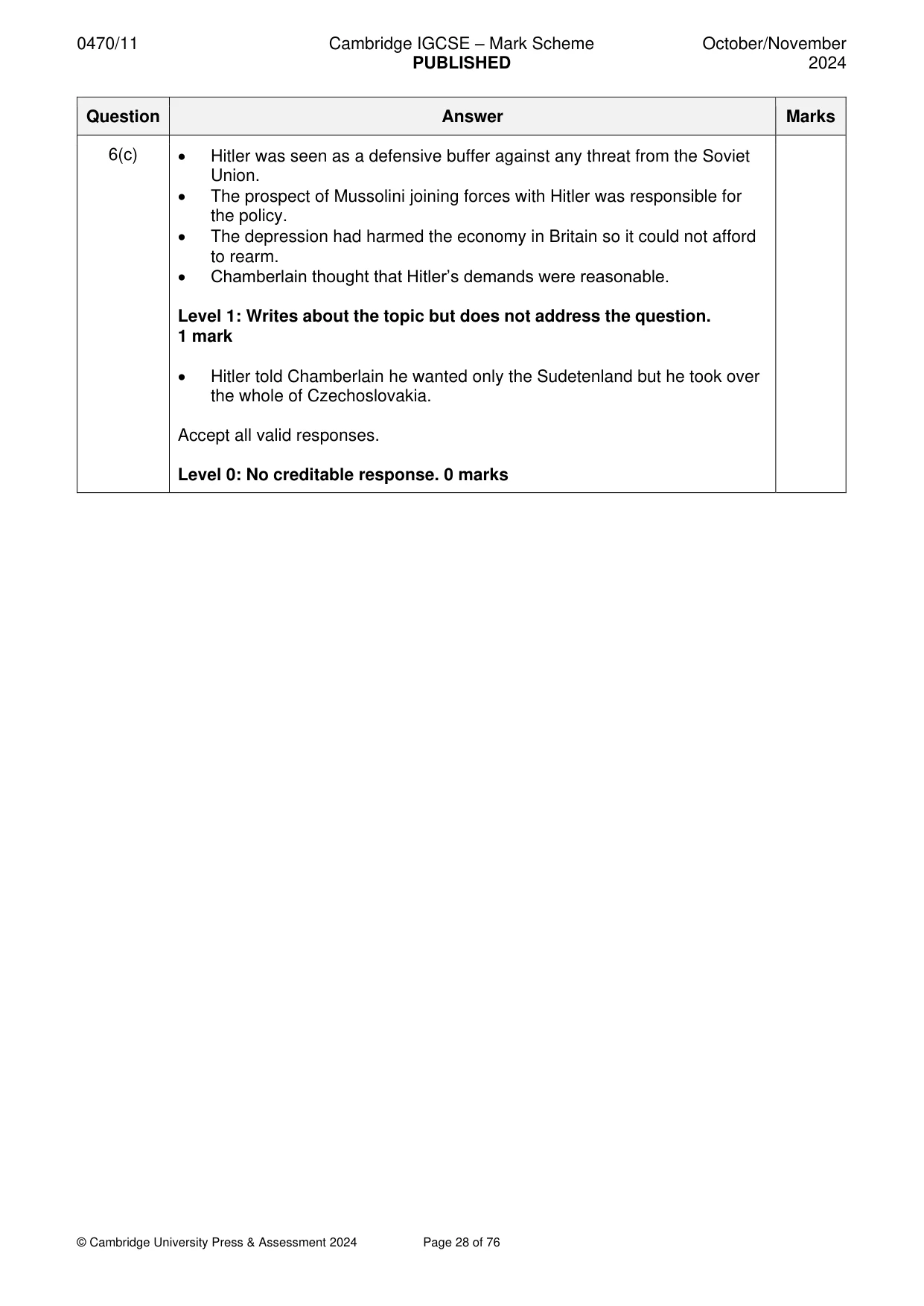
0470/11 Cambridge IGCSE – Mark Scheme PUBLISHED October/November 2024 © Cambridge University Press & Assessment 2024 Page 28 of 76 Question Answer Marks 6(c) • Hitler was seen as a defensive buffer against any threat from the Soviet Union. • The prospect of Mussolini joining forces with Hitler was responsible for the policy. • The depression had harmed the economy in Britain so it could not afford to rearm. • Chamberlain thought that Hitler’s demands were reasonable. Level 1: Writes about the topic but does not address the question. 1 mark • Hitler told Chamberlain he wanted only the Sudetenland but he took over the whole of Czechoslovakia. Accept all valid responses. Level 0: No creditable response. 0 marks
Mark scheme, page 29
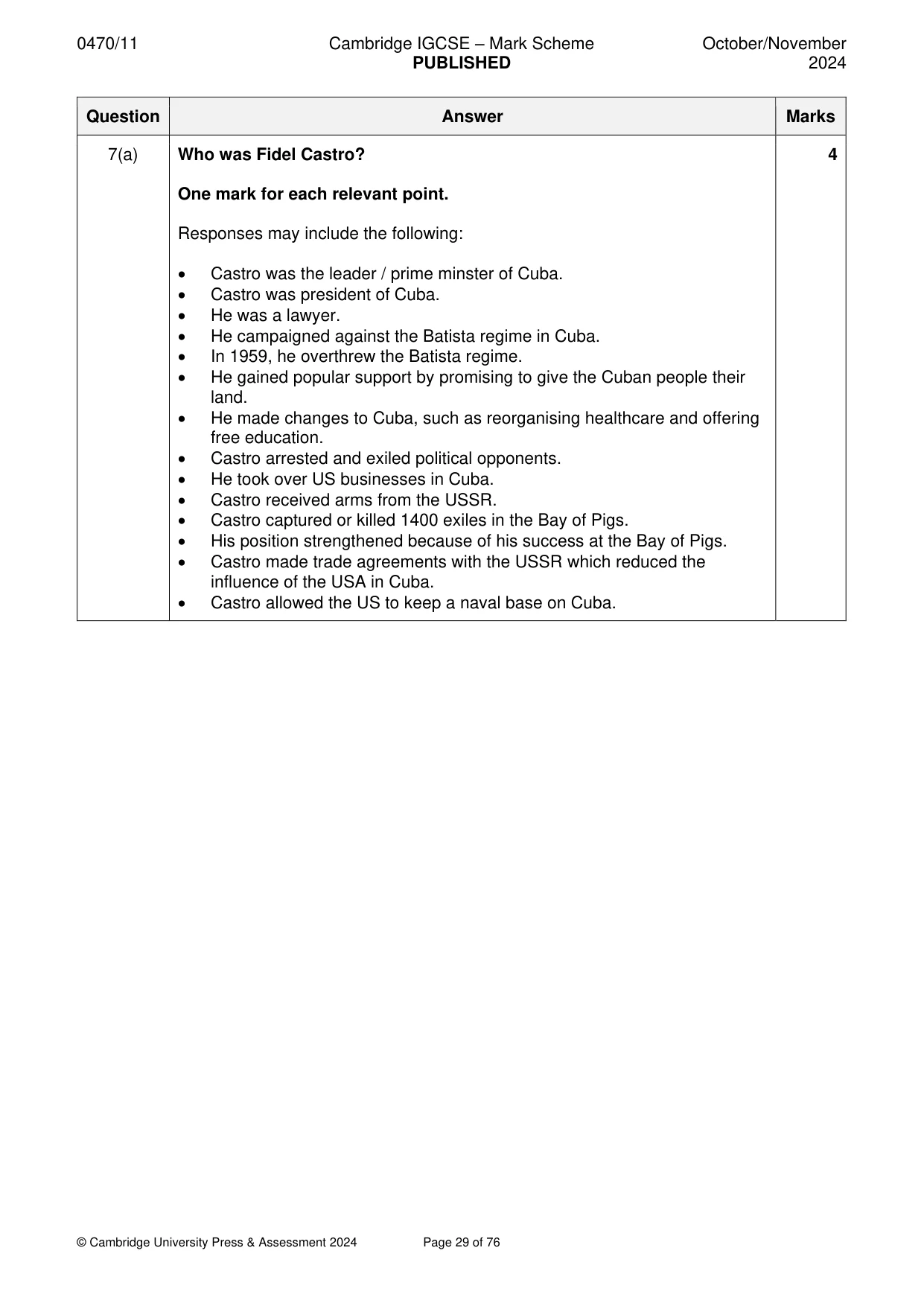
0470/11 Cambridge IGCSE – Mark Scheme PUBLISHED October/November 2024 © Cambridge University Press & Assessment 2024 Page 29 of 76 Question Answer Marks 7(a) Who was Fidel Castro? One mark for each relevant point. Responses may include the following: • Castro was the leader / prime minster of Cuba. • Castro was president of Cuba. • He was a lawyer. • He campaigned against the Batista regime in Cuba. • In 1959, he overthrew the Batista regime. • He gained popular support by promising to give the Cuban people their land. • He made changes to Cuba, such as reorganising healthcare and offering free education. • Castro arrested and exiled political opponents. • He took over US businesses in Cuba. • Castro received arms from the USSR. • Castro captured or killed 1400 exiles in the Bay of Pigs. • His position strengthened because of his success at the Bay of Pigs. • Castro made trade agreements with the USSR which reduced the influence of the USA in Cuba. • Castro allowed the US to keep a naval base on Cuba. 4
Mark scheme, page 30
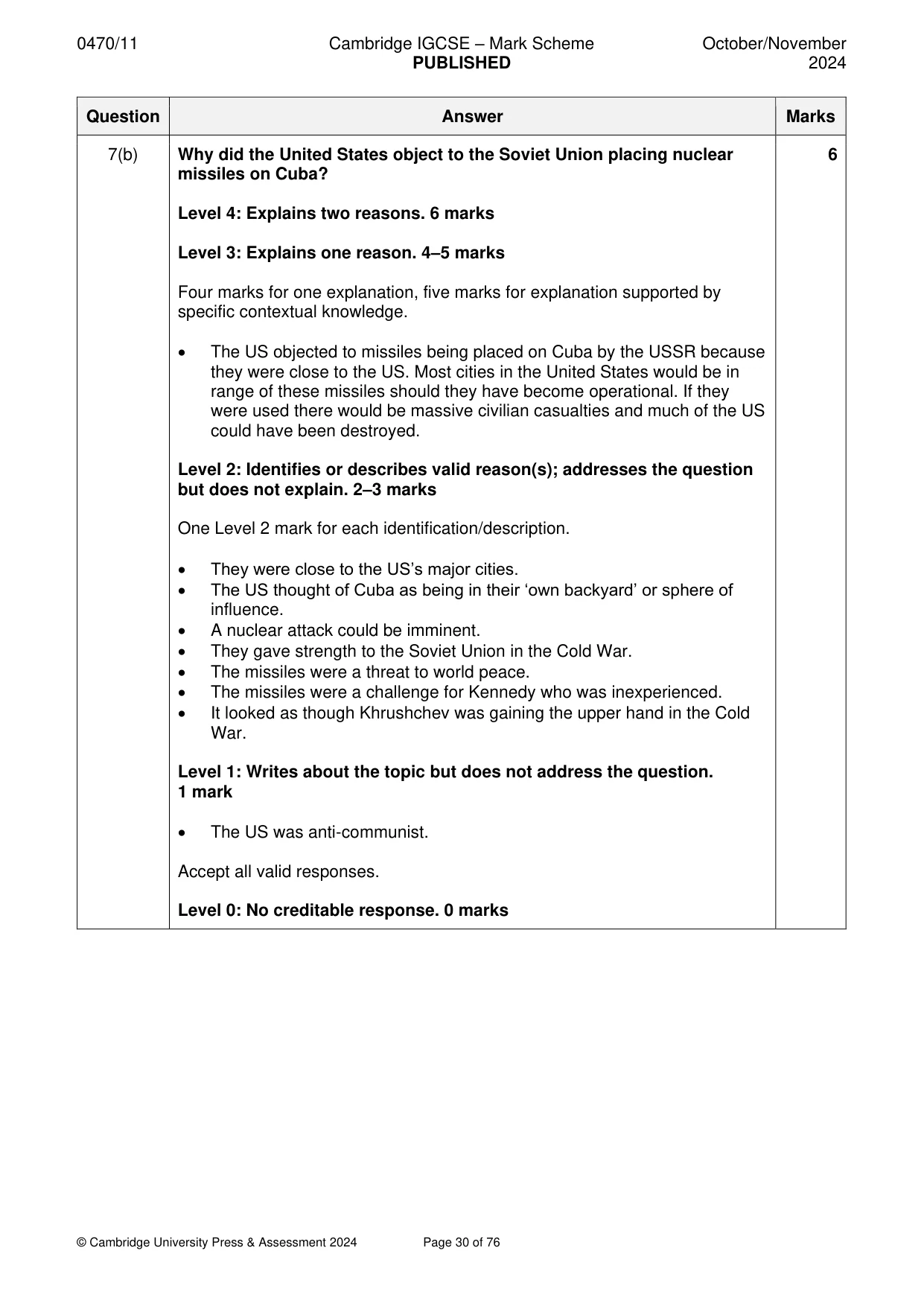
0470/11 Cambridge IGCSE – Mark Scheme PUBLISHED October/November 2024 © Cambridge University Press & Assessment 2024 Page 30 of 76 Question Answer Marks 7(b) Why did the United States object to the Soviet Union placing nuclear missiles on Cuba? Level 4: Explains two reasons. 6 marks Level 3: Explains one reason. 4–5 marks Four marks for one explanation, five marks for explanation supported by specific contextual knowledge. • The US objected to missiles being placed on Cuba by the USSR because they were close to the US. Most cities in the United States would be in range of these missiles should they have become operational. If they were used there would be massive civilian casualties and much of the US could have been destroyed. Level 2: Identifies or describes valid reason(s); addresses the question but does not explain. 2–3 marks One Level 2 mark for each identification/description. • They were close to the US’s major cities. • The US thought of Cuba as being in their ‘own backyard’ or sphere of influence. • A nuclear attack could be imminent. • They gave strength to the Soviet Union in the Cold War. • The missiles were a threat to world peace. • The missiles were a challenge for Kennedy who was inexperienced. • It looked as though Khrushchev was gaining the upper hand in the Cold War. Level 1: Writes about the topic but does not address the question. 1 mark • The US was anti-communist. Accept all valid responses. Level 0: No creditable response. 0 marks 6
Mark scheme, page 31
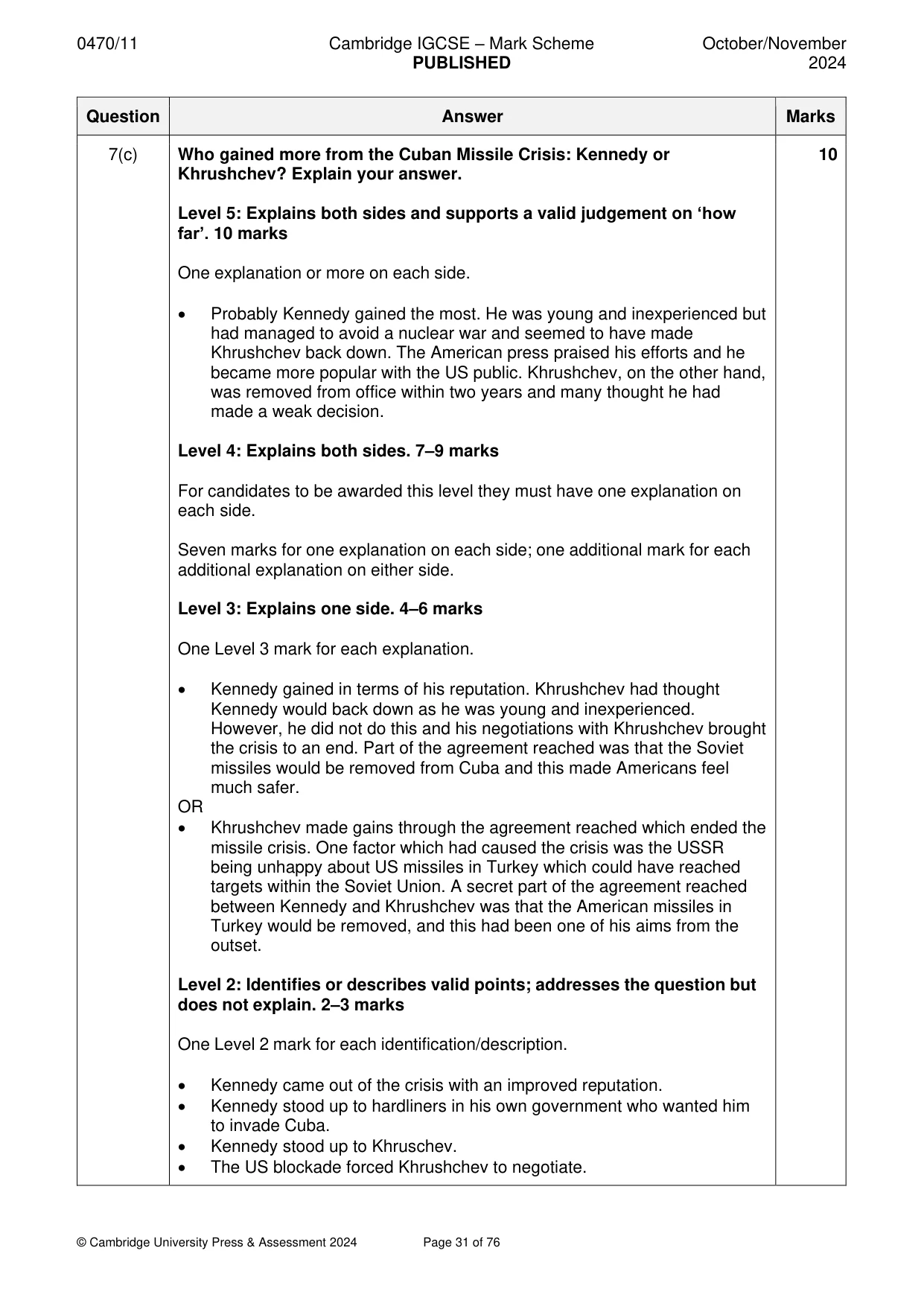
0470/11 Cambridge IGCSE – Mark Scheme PUBLISHED October/November 2024 © Cambridge University Press & Assessment 2024 Page 31 of 76 Question Answer Marks 7(c) Who gained more from the Cuban Missile Crisis: Kennedy or Khrushchev? Explain your answer. Level 5: Explains both sides and supports a valid judgement on ‘how far’. 10 marks One explanation or more on each side. • Probably Kennedy gained the most. He was young and inexperienced but had managed to avoid a nuclear war and seemed to have made Khrushchev back down. The American press praised his efforts and he became more popular with the US public. Khrushchev, on the other hand, was removed from office within two years and many thought he had made a weak decision. Level 4: Explains both sides. 7–9 marks For candidates to be awarded this level they must have one explanation on each side. Seven marks for one explanation on each side; one additional mark for each additional explanation on either side. Level 3: Explains one side. 4–6 marks One Level 3 mark for each explanation. • Kennedy gained in terms of his reputation. Khrushchev had thought Kennedy would back down as he was young and inexperienced. However, he did not do this and his negotiations with Khrushchev brought the crisis to an end. Part of the agreement reached was that the Soviet missiles would be removed from Cuba and this made Americans feel much safer. OR • Khrushchev made gains through the agreement reached which ended the missile crisis. One factor which had caused the crisis was the USSR being unhappy about US missiles in Turkey which could have reached targets within the Soviet Union. A secret part of the agreement reached between Kennedy and Khrushchev was that the American missiles in Turkey would be removed, and this had been one of his aims from the outset. Level 2: Identifies or describes valid points; addresses the question but does not explain. 2–3 marks One Level 2 mark for each identification/description. • Kennedy came out of the crisis with an improved reputation. • Kennedy stood up to hardliners in his own government who wanted him to invade Cuba. • Kennedy stood up to Khruschev. • The US blockade forced Khrushchev to negotiate. 10
Mark scheme, page 32
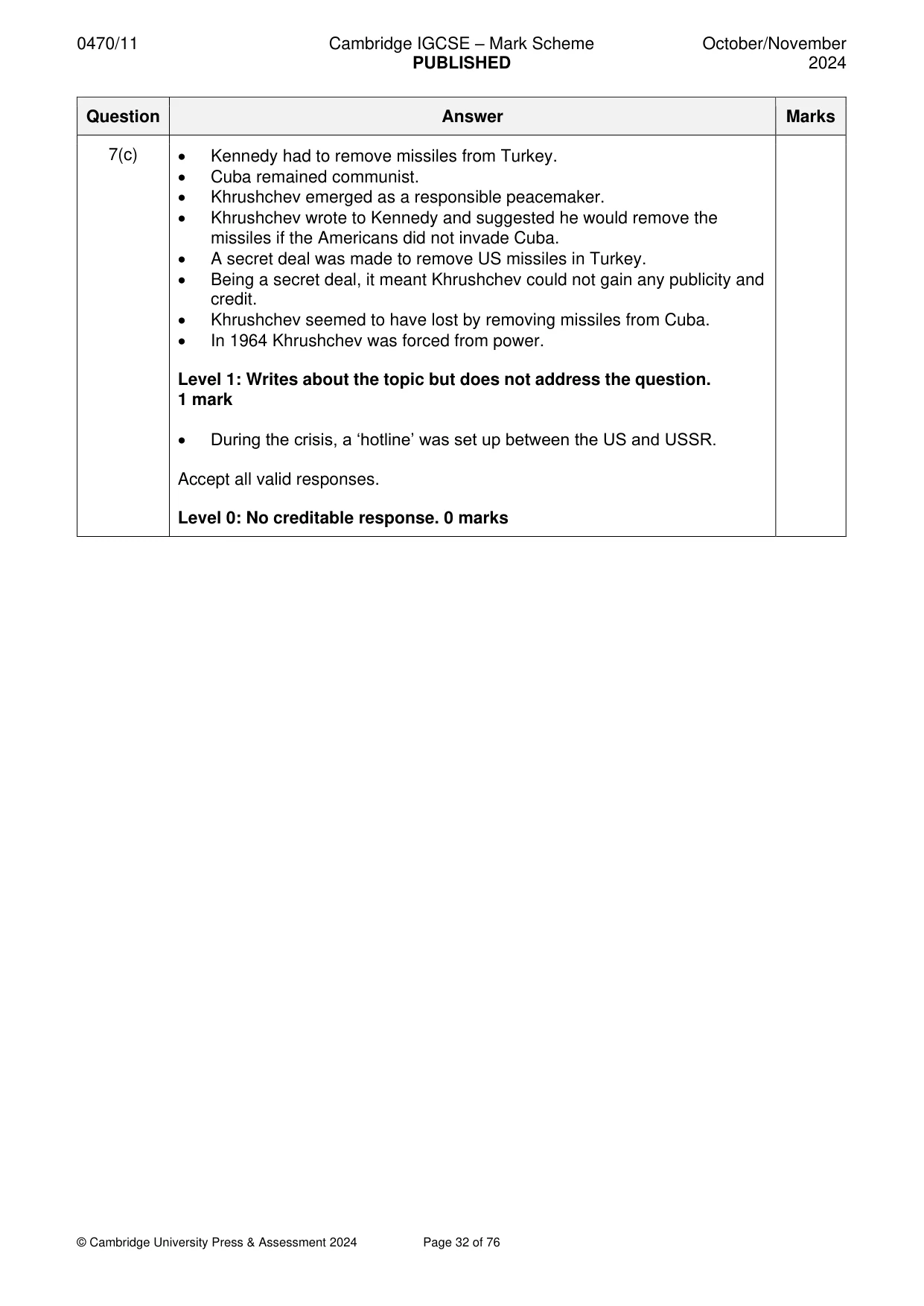
0470/11 Cambridge IGCSE – Mark Scheme PUBLISHED October/November 2024 © Cambridge University Press & Assessment 2024 Page 32 of 76 Question Answer Marks 7(c) • Kennedy had to remove missiles from Turkey. • Cuba remained communist. • Khrushchev emerged as a responsible peacemaker. • Khrushchev wrote to Kennedy and suggested he would remove the missiles if the Americans did not invade Cuba. • A secret deal was made to remove US missiles in Turkey. • Being a secret deal, it meant Khrushchev could not gain any publicity and credit. • Khrushchev seemed to have lost by removing missiles from Cuba. • In 1964 Khrushchev was forced from power. Level 1: Writes about the topic but does not address the question. 1 mark • During the crisis, a ‘hotline’ was set up between the US and USSR. Accept all valid responses. Level 0: No creditable response. 0 marks
Mark scheme, page 33
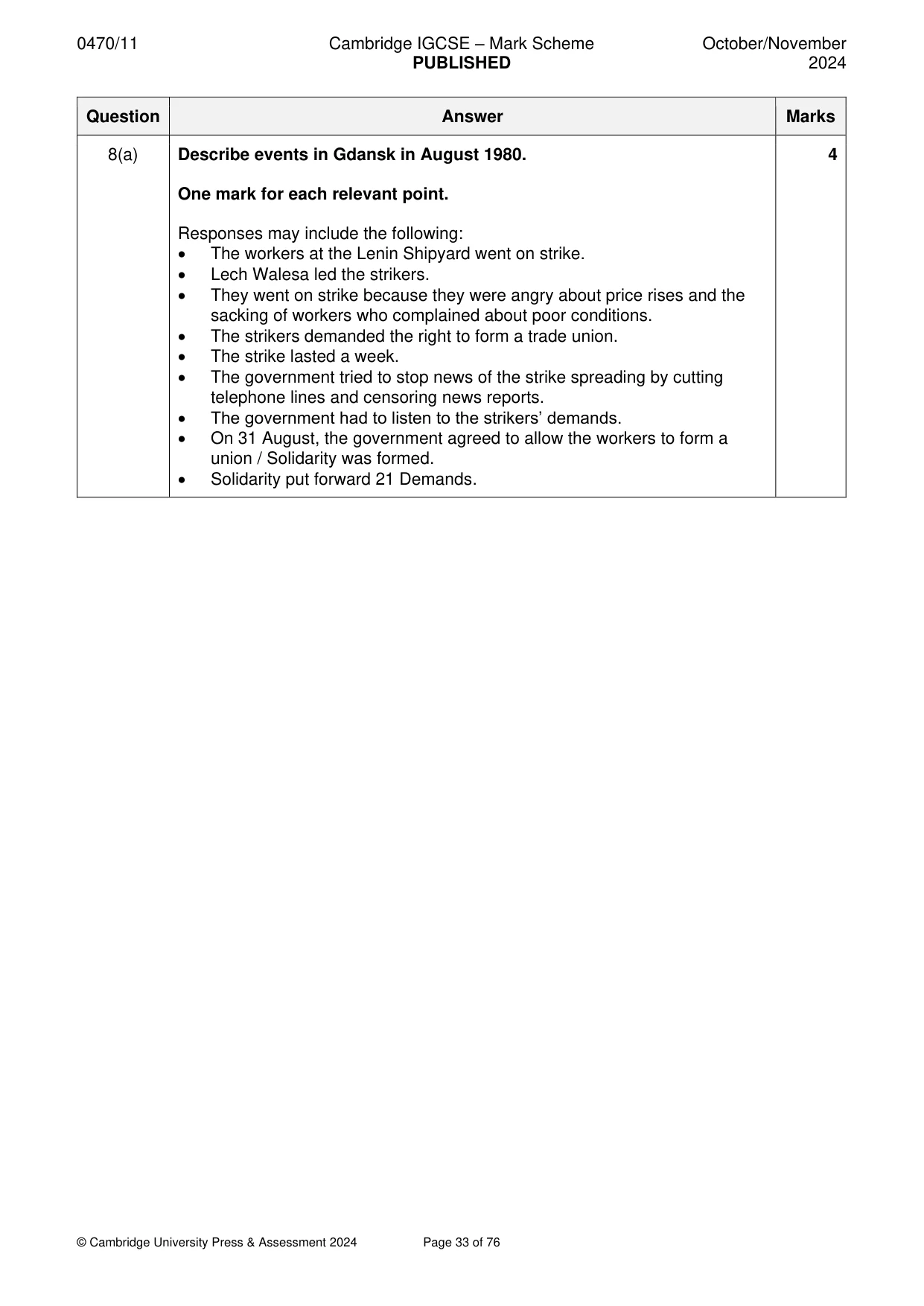
0470/11 Cambridge IGCSE – Mark Scheme PUBLISHED October/November 2024 © Cambridge University Press & Assessment 2024 Page 33 of 76 Question Answer Marks 8(a) Describe events in Gdansk in August 1980. One mark for each relevant point. Responses may include the following: • The workers at the Lenin Shipyard went on strike. • Lech Walesa led the strikers. • They went on strike because they were angry about price rises and the sacking of workers who complained about poor conditions. • The strikers demanded the right to form a trade union. • The strike lasted a week. • The government tried to stop news of the strike spreading by cutting telephone lines and censoring news reports. • The government had to listen to the strikers’ demands. • On 31 August, the government agreed to allow the workers to form a union / Solidarity was formed. • Solidarity put forward 21 Demands. 4
Mark scheme, page 34
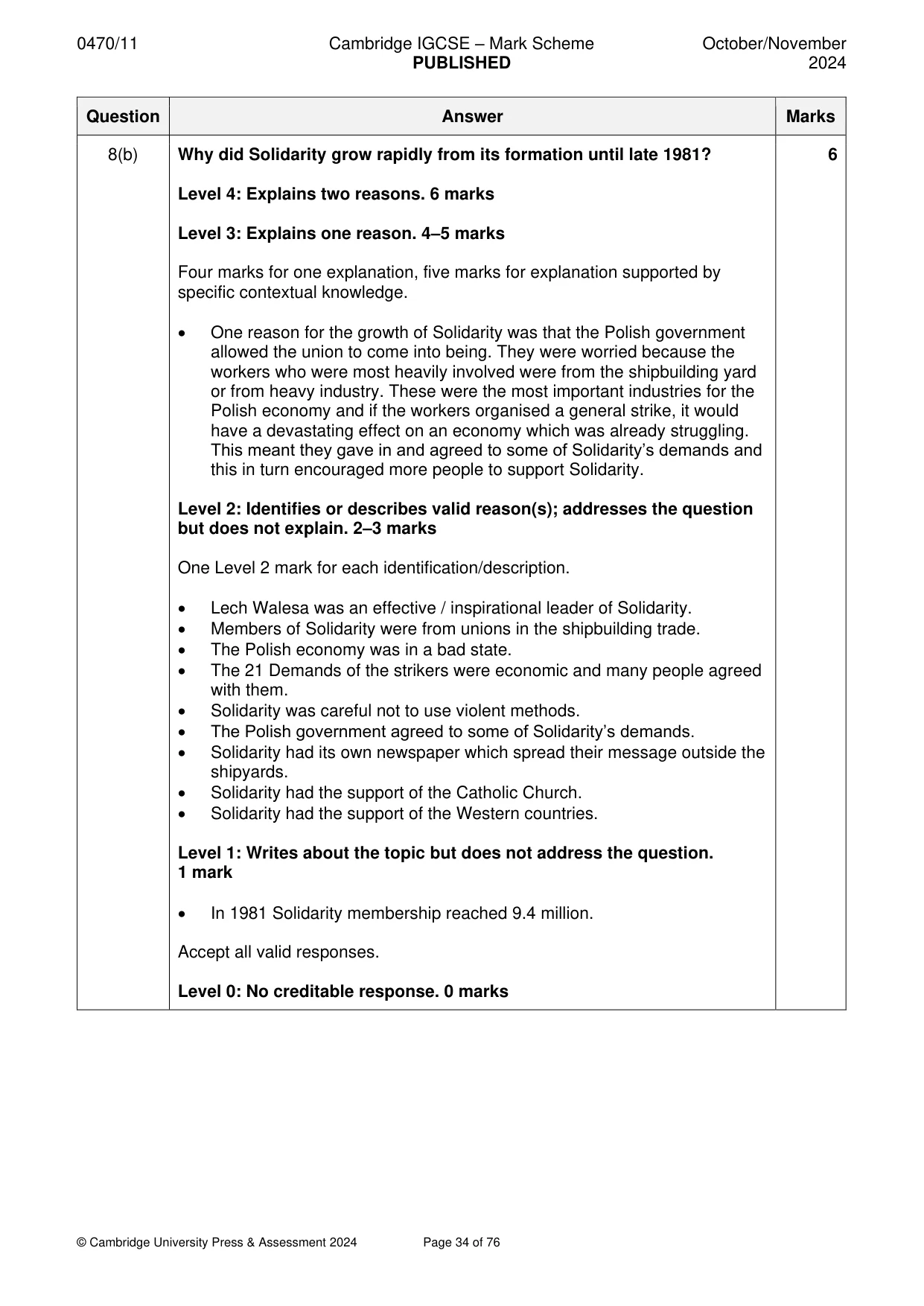
0470/11 Cambridge IGCSE – Mark Scheme PUBLISHED October/November 2024 © Cambridge University Press & Assessment 2024 Page 34 of 76 Question Answer Marks 8(b) Why did Solidarity grow rapidly from its formation until late 1981? Level 4: Explains two reasons. 6 marks Level 3: Explains one reason. 4–5 marks Four marks for one explanation, five marks for explanation supported by specific contextual knowledge. • One reason for the growth of Solidarity was that the Polish government allowed the union to come into being. They were worried because the workers who were most heavily involved were from the shipbuilding yard or from heavy industry. These were the most important industries for the Polish economy and if the workers organised a general strike, it would have a devastating effect on an economy which was already struggling. This meant they gave in and agreed to some of Solidarity’s demands and this in turn encouraged more people to support Solidarity. Level 2: Identifies or describes valid reason(s); addresses the question but does not explain. 2–3 marks One Level 2 mark for each identification/description. • Lech Walesa was an effective / inspirational leader of Solidarity. • Members of Solidarity were from unions in the shipbuilding trade. • The Polish economy was in a bad state. • The 21 Demands of the strikers were economic and many people agreed with them. • Solidarity was careful not to use violent methods. • The Polish government agreed to some of Solidarity’s demands. • Solidarity had its own newspaper which spread their message outside the shipyards. • Solidarity had the support of the Catholic Church. • Solidarity had the support of the Western countries. Level 1: Writes about the topic but does not address the question. 1 mark • In 1981 Solidarity membership reached 9.4 million. Accept all valid responses. Level 0: No creditable response. 0 marks 6
Mark scheme, page 35
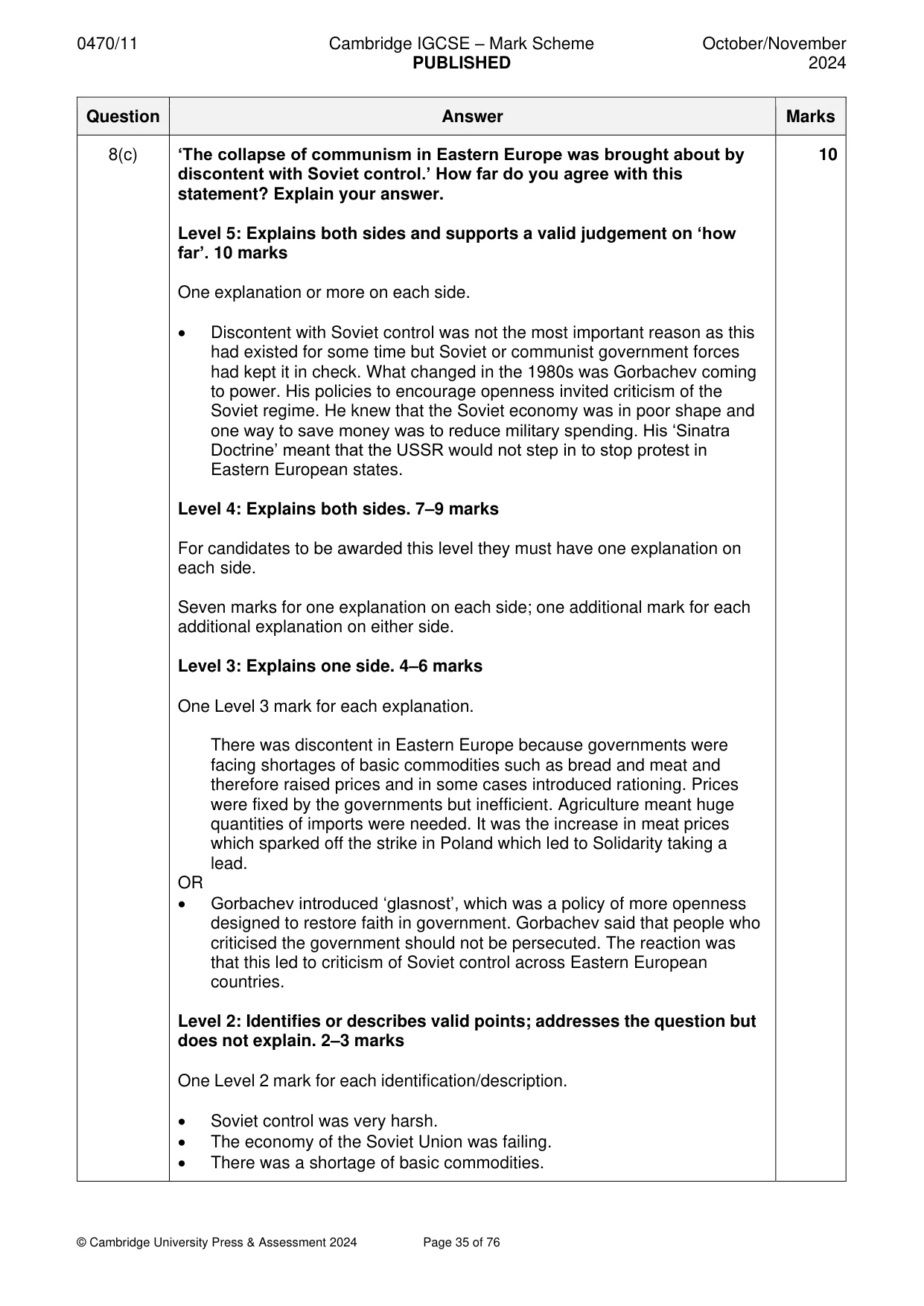
0470/11 Cambridge IGCSE – Mark Scheme PUBLISHED October/November 2024 © Cambridge University Press & Assessment 2024 Page 35 of 76 Question Answer Marks 8(c) ‘The collapse of communism in Eastern Europe was brought about by discontent with Soviet control.’ How far do you agree with this statement? Explain your answer. Level 5: Explains both sides and supports a valid judgement on ‘how far’. 10 marks One explanation or more on each side. • Discontent with Soviet control was not the most important reason as this had existed for some time but Soviet or communist government forces had kept it in check. What changed in the 1980s was Gorbachev coming to power. His policies to encourage openness invited criticism of the Soviet regime. He knew that the Soviet economy was in poor shape and one way to save money was to reduce military spending. His ‘Sinatra Doctrine’ meant that the USSR would not step in to stop protest in Eastern European states. Level 4: Explains both sides. 7–9 marks For candidates to be awarded this level they must have one explanation on each side. Seven marks for one explanation on each side; one additional mark for each additional explanation on either side. Level 3: Explains one side. 4–6 marks One Level 3 mark for each explanation. There was discontent in Eastern Europe because governments were facing shortages of basic commodities such as bread and meat and therefore raised prices and in some cases introduced rationing. Prices were fixed by the governments but inefficient. Agriculture meant huge quantities of imports were needed. It was the increase in meat prices which sparked off the strike in Poland which led to Solidarity taking a lead. OR • Gorbachev introduced ‘glasnost’, which was a policy of more openness designed to restore faith in government. Gorbachev said that people who criticised the government should not be persecuted. The reaction was that this led to criticism of Soviet control across Eastern European countries. Level 2: Identifies or describes valid points; addresses the question but does not explain. 2–3 marks One Level 2 mark for each identification/description. • Soviet control was very harsh. • The economy of the Soviet Union was failing. • There was a shortage of basic commodities. 10
Mark scheme, page 36
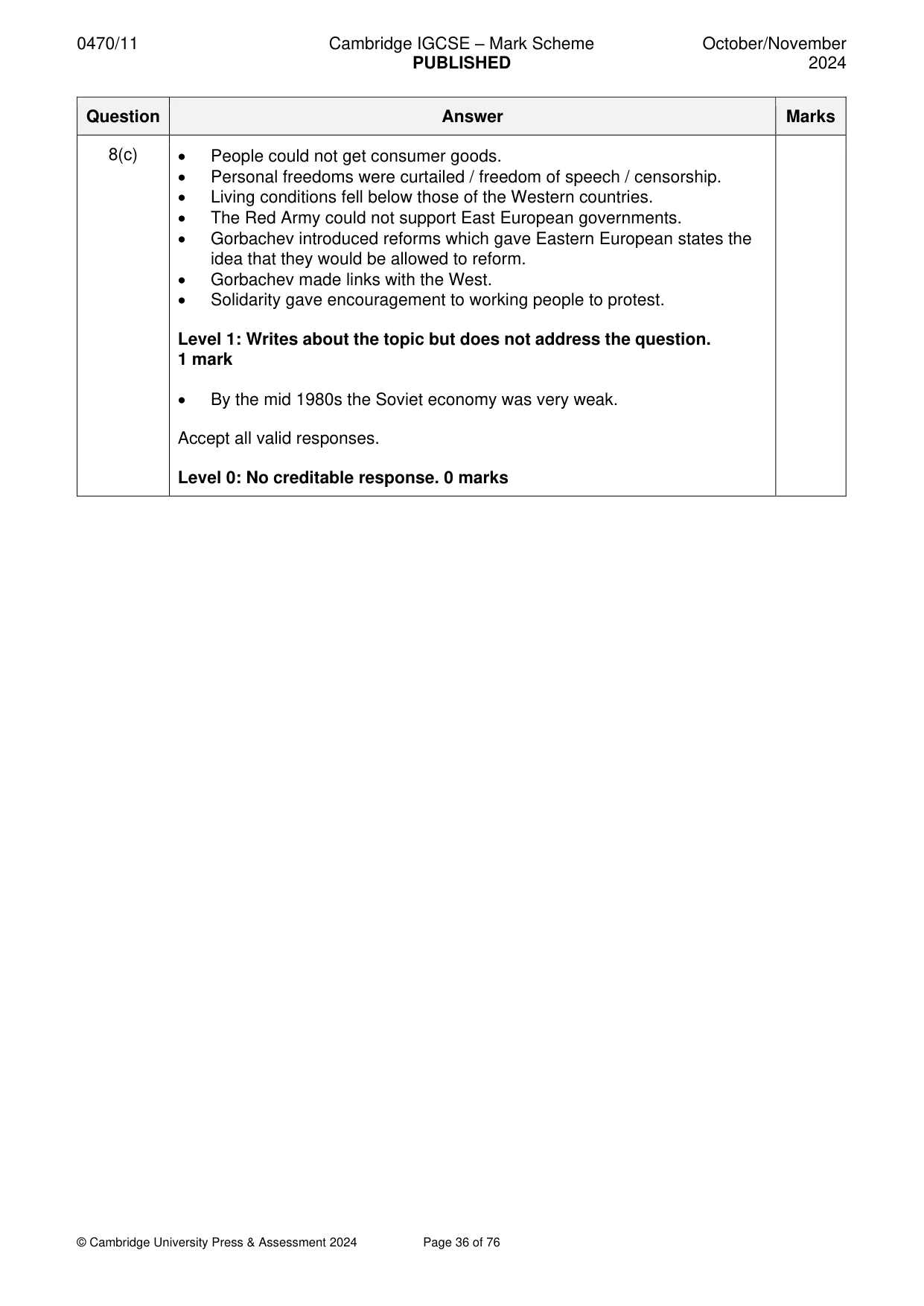
0470/11 Cambridge IGCSE – Mark Scheme PUBLISHED October/November 2024 © Cambridge University Press & Assessment 2024 Page 36 of 76 Question Answer Marks 8(c) • People could not get consumer goods. • Personal freedoms were curtailed / freedom of speech / censorship. • Living conditions fell below those of the Western countries. • The Red Army could not support East European governments. • Gorbachev introduced reforms which gave Eastern European states the idea that they would be allowed to reform. • Gorbachev made links with the West. • Solidarity gave encouragement to working people to protest. Level 1: Writes about the topic but does not address the question. 1 mark • By the mid 1980s the Soviet economy was very weak. Accept all valid responses. Level 0: No creditable response. 0 marks
Mark scheme, page 37
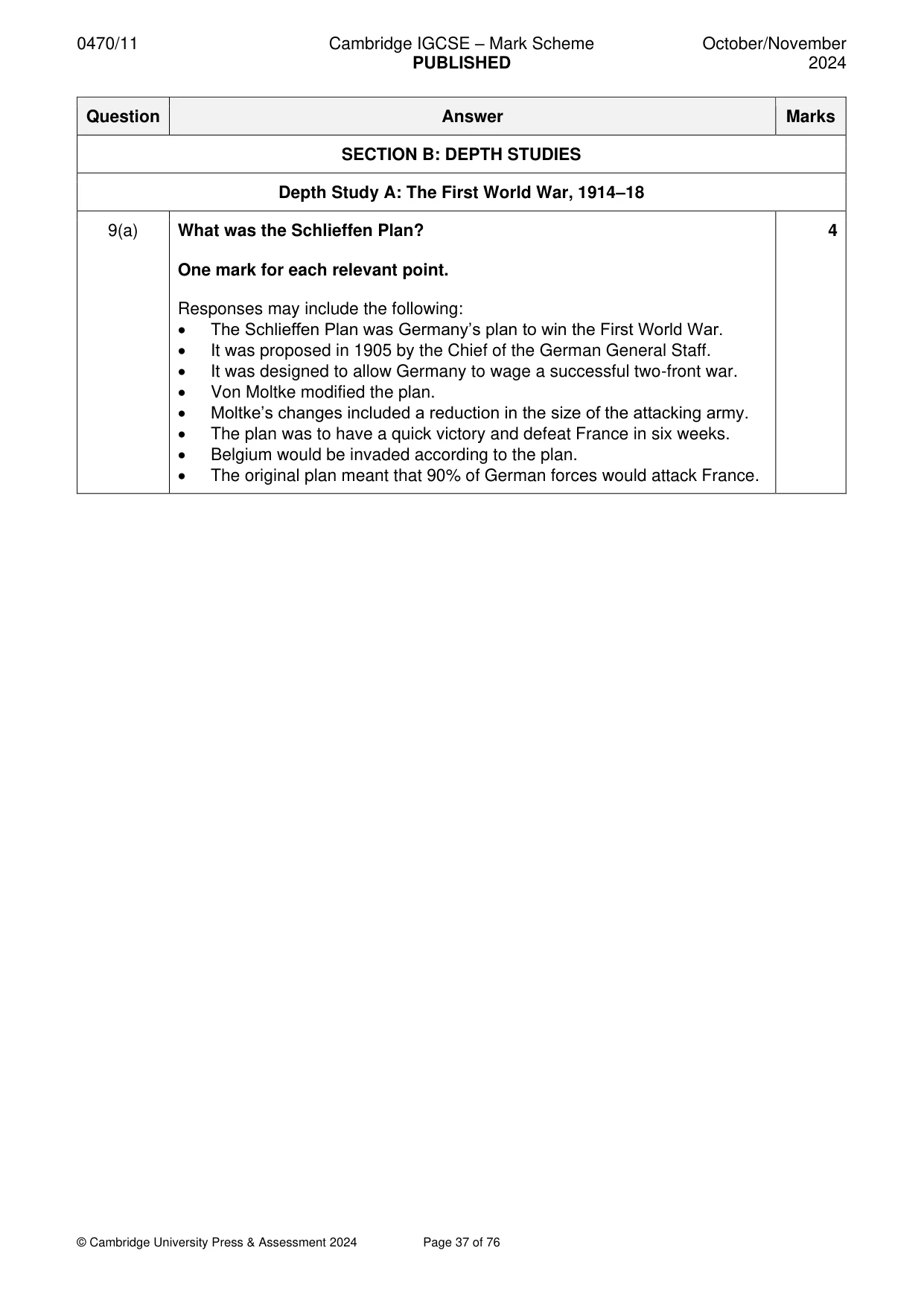
0470/11 Cambridge IGCSE – Mark Scheme PUBLISHED October/November 2024 © Cambridge University Press & Assessment 2024 Page 37 of 76 Question Answer Marks SECTION B: DEPTH STUDIES Depth Study A: The First World War, 1914–18 9(a) What was the Schlieffen Plan? One mark for each relevant point. Responses may include the following: • The Schlieffen Plan was Germany’s plan to win the First World War. • It was proposed in 1905 by the Chief of the German General Staff. • It was designed to allow Germany to wage a successful two-front war. • Von Moltke modified the plan. • Moltke’s changes included a reduction in the size of the attacking army. • The plan was to have a quick victory and defeat France in six weeks. • Belgium would be invaded according to the plan. • The original plan meant that 90% of German forces would attack France. 4
Mark scheme, page 38
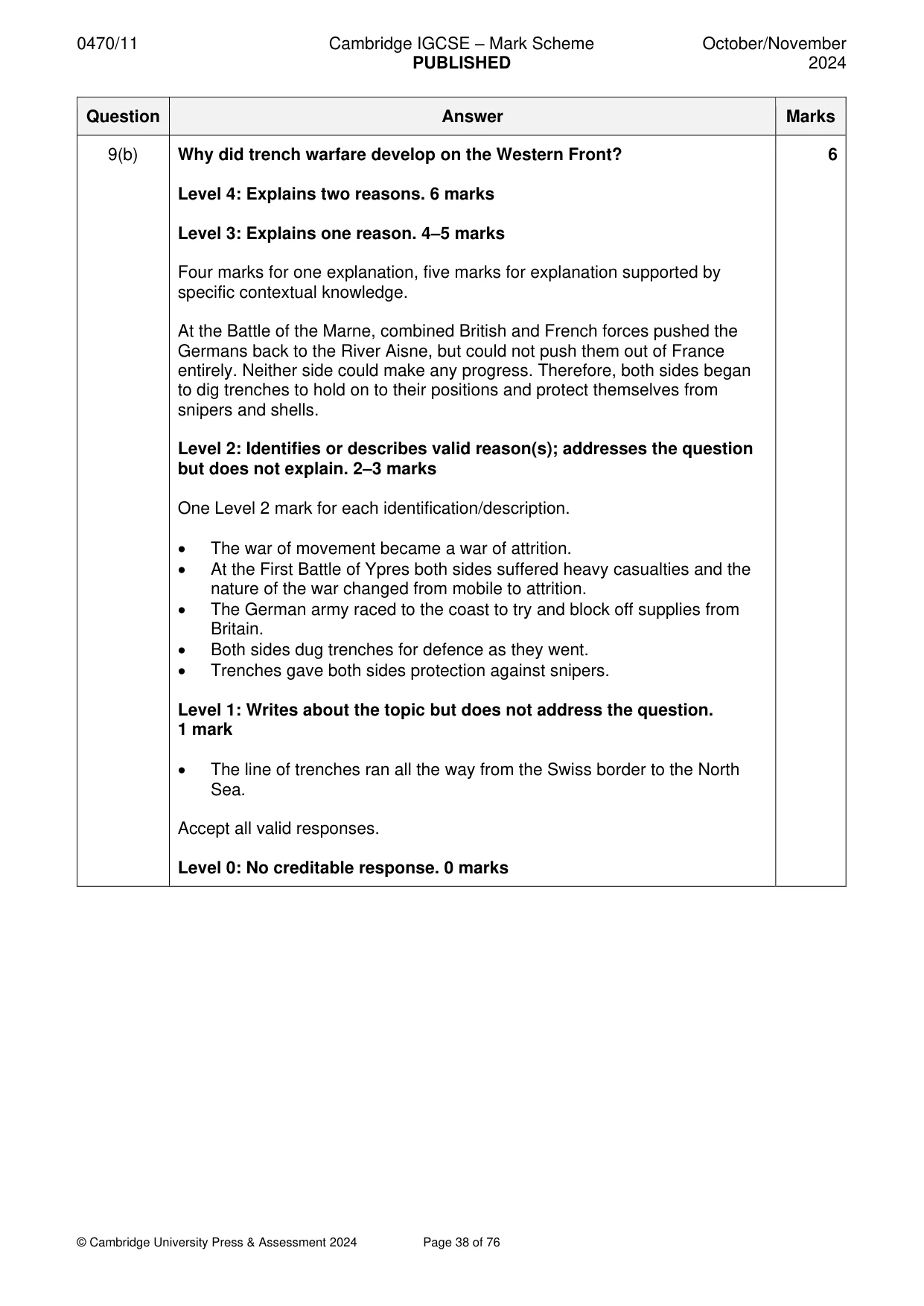
0470/11 Cambridge IGCSE – Mark Scheme PUBLISHED October/November 2024 © Cambridge University Press & Assessment 2024 Page 38 of 76 Question Answer Marks 9(b) Why did trench warfare develop on the Western Front? Level 4: Explains two reasons. 6 marks Level 3: Explains one reason. 4–5 marks Four marks for one explanation, five marks for explanation supported by specific contextual knowledge. At the Battle of the Marne, combined British and French forces pushed the Germans back to the River Aisne, but could not push them out of France entirely. Neither side could make any progress. Therefore, both sides began to dig trenches to hold on to their positions and protect themselves from snipers and shells. Level 2: Identifies or describes valid reason(s); addresses the question but does not explain. 2–3 marks One Level 2 mark for each identification/description. • The war of movement became a war of attrition. • At the First Battle of Ypres both sides suffered heavy casualties and the nature of the war changed from mobile to attrition. • The German army raced to the coast to try and block off supplies from Britain. • Both sides dug trenches for defence as they went. • Trenches gave both sides protection against snipers. Level 1: Writes about the topic but does not address the question. 1 mark • The line of trenches ran all the way from the Swiss border to the North Sea. Accept all valid responses. Level 0: No creditable response. 0 marks 6
Mark scheme, page 39
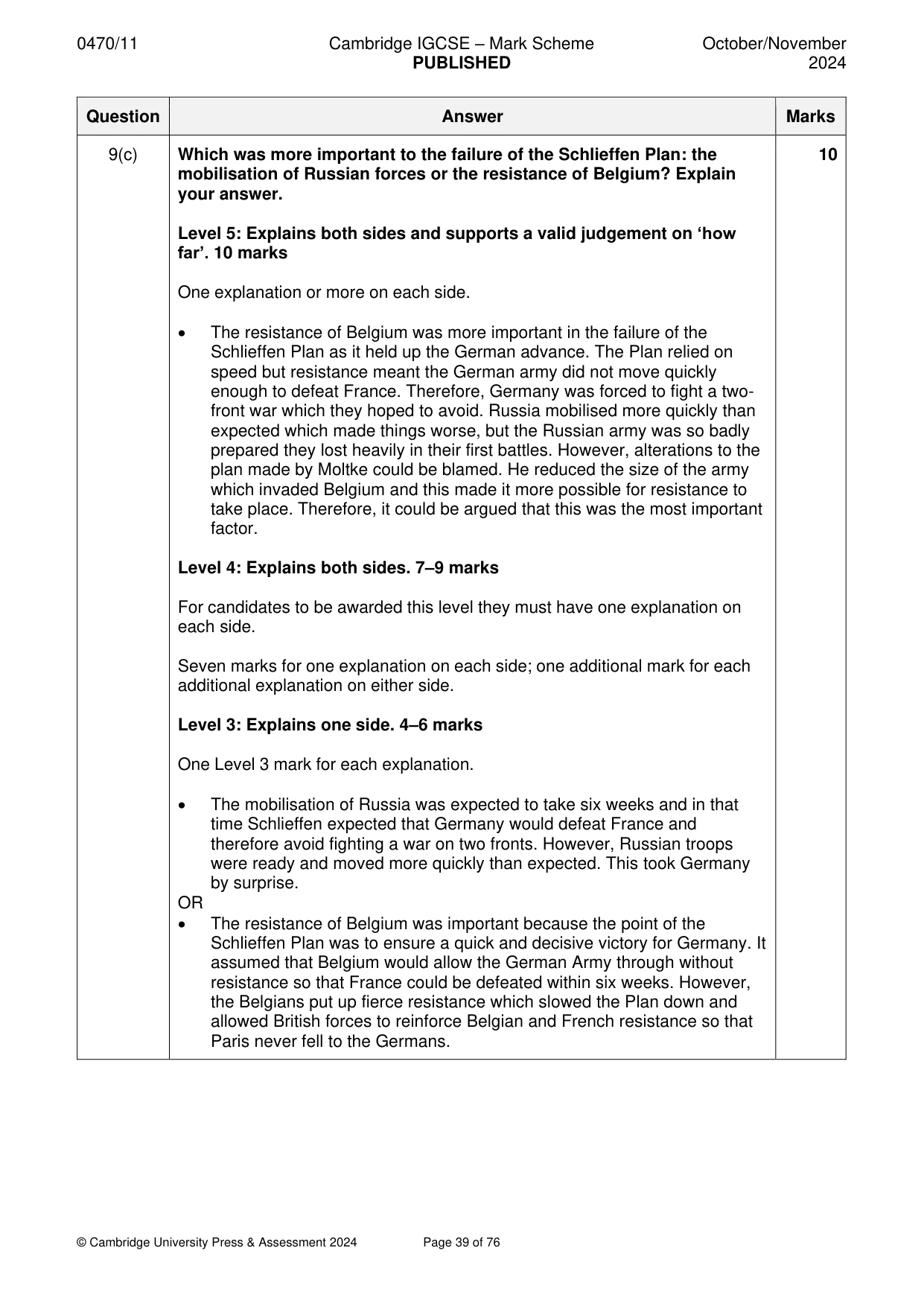
0470/11 Cambridge IGCSE – Mark Scheme PUBLISHED October/November 2024 © Cambridge University Press & Assessment 2024 Page 39 of 76 Question Answer Marks 9(c) Which was more important to the failure of the Schlieffen Plan: the mobilisation of Russian forces or the resistance of Belgium? Explain your answer. Level 5: Explains both sides and supports a valid judgement on ‘how far’. 10 marks One explanation or more on each side. • The resistance of Belgium was more important in the failure of the Schlieffen Plan as it held up the German advance. The Plan relied on speed but resistance meant the German army did not move quickly enough to defeat France. Therefore, Germany was forced to fight a two- front war which they hoped to avoid. Russia mobilised more quickly than expected which made things worse, but the Russian army was so badly prepared they lost heavily in their first battles. However, alterations to the plan made by Moltke could be blamed. He reduced the size of the army which invaded Belgium and this made it more possible for resistance to take place. Therefore, it could be argued that this was the most important factor. Level 4: Explains both sides. 7–9 marks For candidates to be awarded this level they must have one explanation on each side. Seven marks for one explanation on each side; one additional mark for each additional explanation on either side. Level 3: Explains one side. 4–6 marks One Level 3 mark for each explanation. • The mobilisation of Russia was expected to take six weeks and in that time Schlieffen expected that Germany would defeat France and therefore avoid fighting a war on two fronts. However, Russian troops were ready and moved more quickly than expected. This took Germany by surprise. OR • The resistance of Belgium was important because the point of the Schlieffen Plan was to ensure a quick and decisive victory for Germany. It assumed that Belgium would allow the German Army through without resistance so that France could be defeated within six weeks. However, the Belgians put up fierce resistance which slowed the Plan down and allowed British forces to reinforce Belgian and French resistance so that Paris never fell to the Germans. 10
Mark scheme, page 40
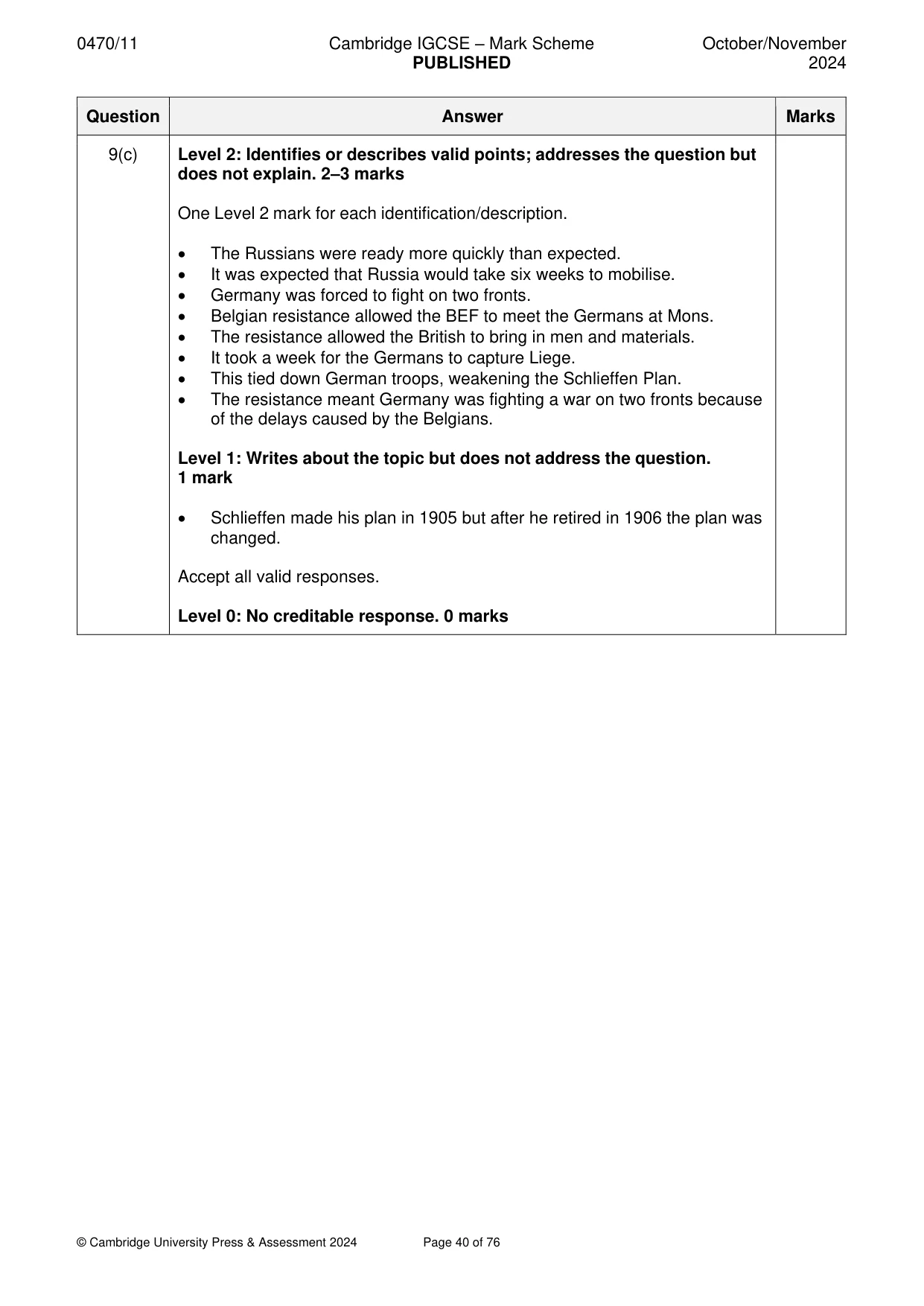
0470/11 Cambridge IGCSE – Mark Scheme PUBLISHED October/November 2024 © Cambridge University Press & Assessment 2024 Page 40 of 76 Question Answer Marks 9(c) Level 2: Identifies or describes valid points; addresses the question but does not explain. 2–3 marks One Level 2 mark for each identification/description. • The Russians were ready more quickly than expected. • It was expected that Russia would take six weeks to mobilise. • Germany was forced to fight on two fronts. • Belgian resistance allowed the BEF to meet the Germans at Mons. • The resistance allowed the British to bring in men and materials. • It took a week for the Germans to capture Liege. • This tied down German troops, weakening the Schlieffen Plan. • The resistance meant Germany was fighting a war on two fronts because of the delays caused by the Belgians. Level 1: Writes about the topic but does not address the question. 1 mark • Schlieffen made his plan in 1905 but after he retired in 1906 the plan was changed. Accept all valid responses. Level 0: No creditable response. 0 marks
Mark scheme, page 41
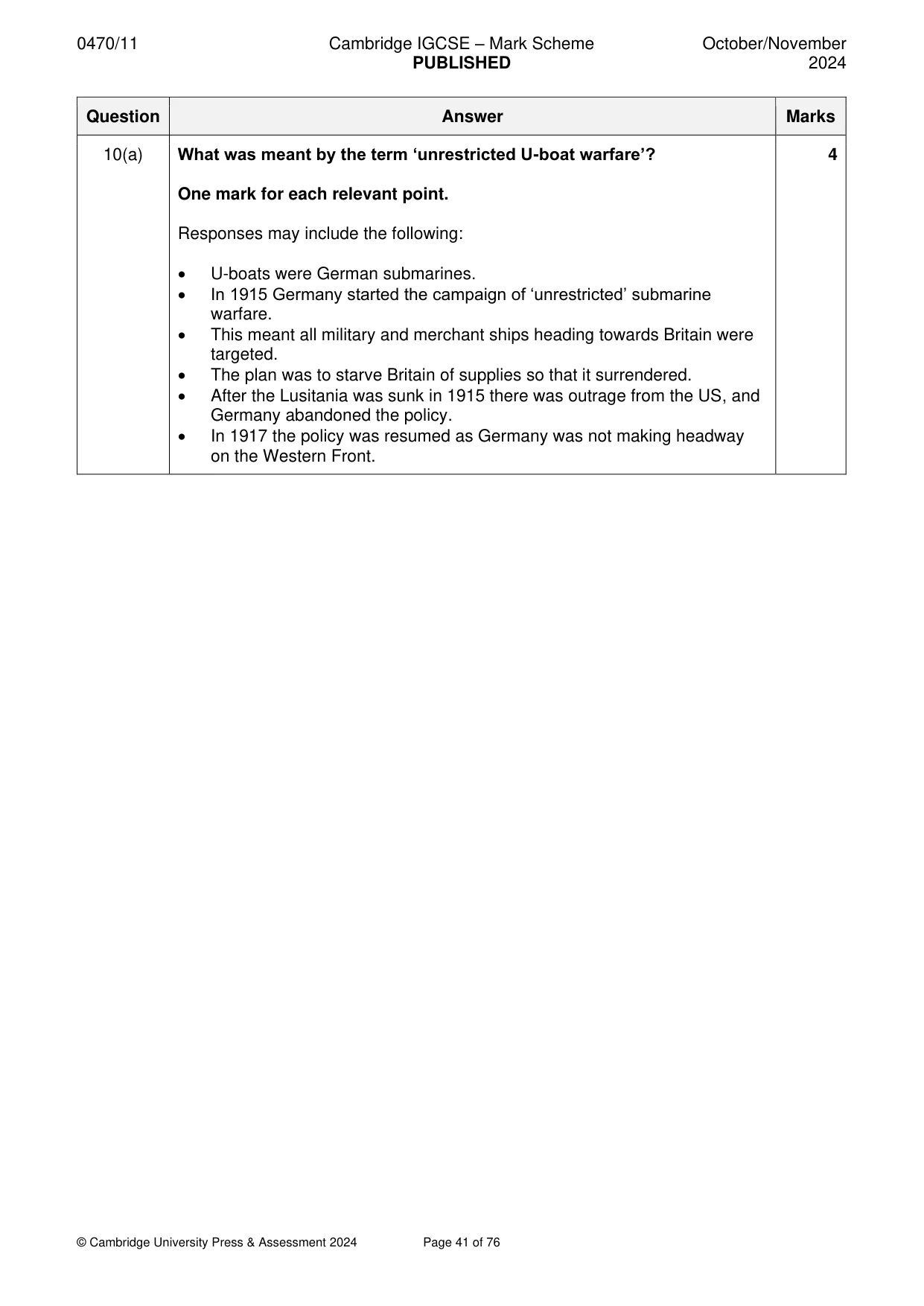
0470/11 Cambridge IGCSE – Mark Scheme PUBLISHED October/November 2024 © Cambridge University Press & Assessment 2024 Page 41 of 76 Question Answer Marks 10(a) What was meant by the term ‘unrestricted U-boat warfare’? One mark for each relevant point. Responses may include the following: • U-boats were German submarines. • In 1915 Germany started the campaign of ‘unrestricted’ submarine warfare. • This meant all military and merchant ships heading towards Britain were targeted. • The plan was to starve Britain of supplies so that it surrendered. • After the Lusitania was sunk in 1915 there was outrage from the US, and Germany abandoned the policy. • In 1917 the policy was resumed as Germany was not making headway on the Western Front. 4
Mark scheme, page 42
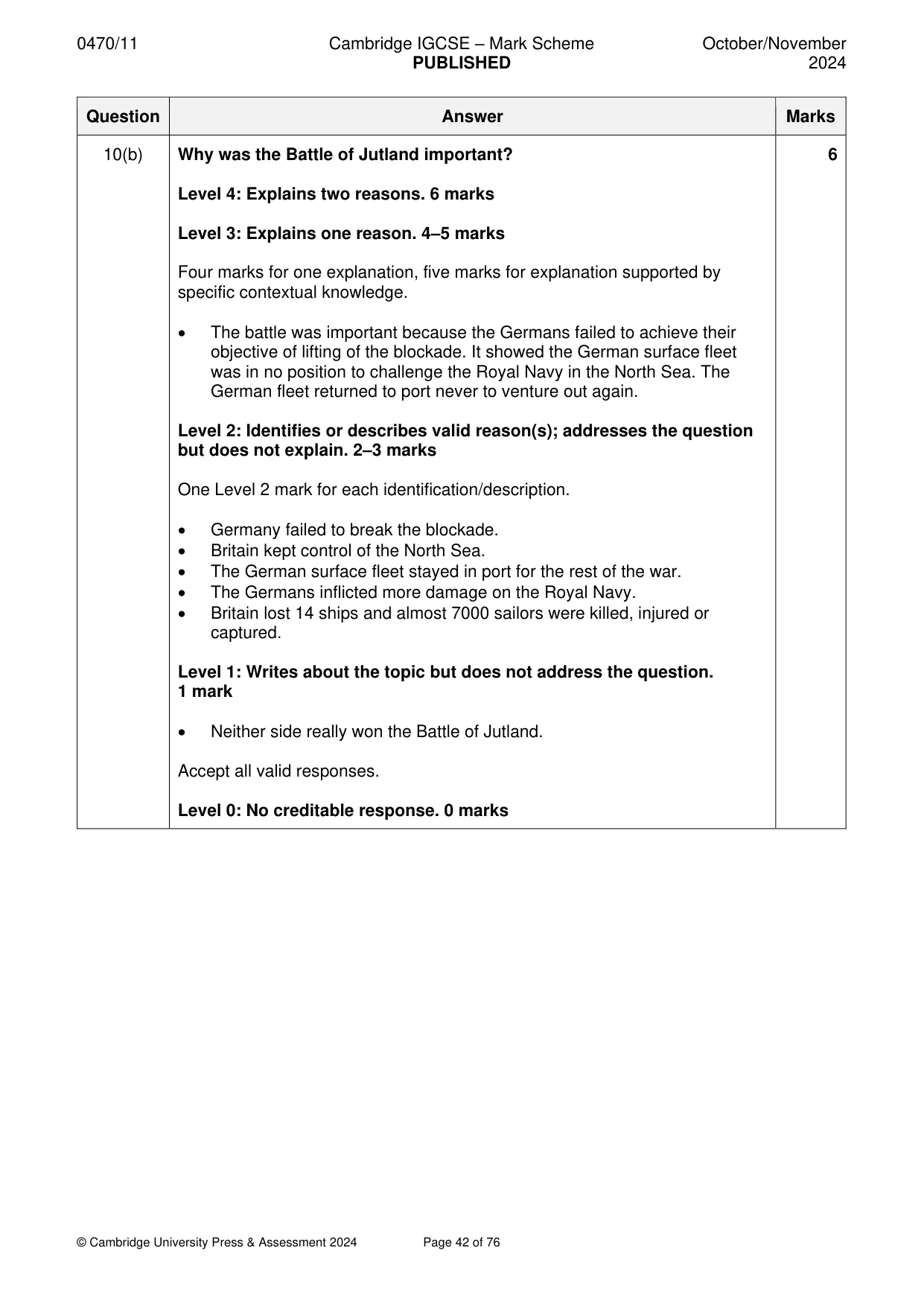
0470/11 Cambridge IGCSE – Mark Scheme PUBLISHED October/November 2024 © Cambridge University Press & Assessment 2024 Page 42 of 76 Question Answer Marks 10(b) Why was the Battle of Jutland important? Level 4: Explains two reasons. 6 marks Level 3: Explains one reason. 4–5 marks Four marks for one explanation, five marks for explanation supported by specific contextual knowledge. • The battle was important because the Germans failed to achieve their objective of lifting of the blockade. It showed the German surface fleet was in no position to challenge the Royal Navy in the North Sea. The German fleet returned to port never to venture out again. Level 2: Identifies or describes valid reason(s); addresses the question but does not explain. 2–3 marks One Level 2 mark for each identification/description. • Germany failed to break the blockade. • Britain kept control of the North Sea. • The German surface fleet stayed in port for the rest of the war. • The Germans inflicted more damage on the Royal Navy. • Britain lost 14 ships and almost 7000 sailors were killed, injured or captured. Level 1: Writes about the topic but does not address the question. 1 mark • Neither side really won the Battle of Jutland. Accept all valid responses. Level 0: No creditable response. 0 marks 6
Mark scheme, page 43
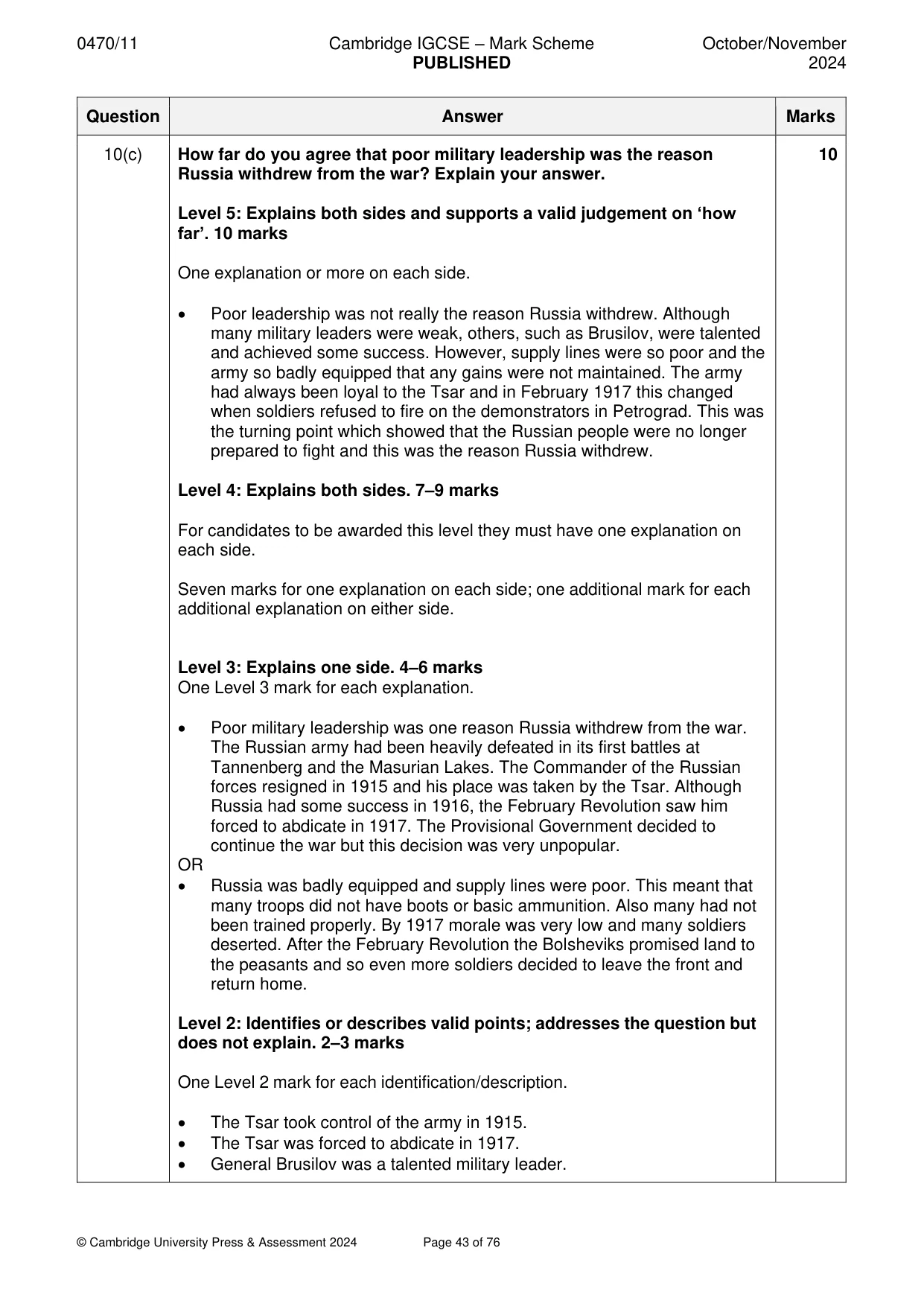
0470/11 Cambridge IGCSE – Mark Scheme PUBLISHED October/November 2024 © Cambridge University Press & Assessment 2024 Page 43 of 76 Question Answer Marks 10(c) How far do you agree that poor military leadership was the reason Russia withdrew from the war? Explain your answer. Level 5: Explains both sides and supports a valid judgement on ‘how far’. 10 marks One explanation or more on each side. • Poor leadership was not really the reason Russia withdrew. Although many military leaders were weak, others, such as Brusilov, were talented and achieved some success. However, supply lines were so poor and the army so badly equipped that any gains were not maintained. The army had always been loyal to the Tsar and in February 1917 this changed when soldiers refused to fire on the demonstrators in Petrograd. This was the turning point which showed that the Russian people were no longer prepared to fight and this was the reason Russia withdrew. Level 4: Explains both sides. 7–9 marks For candidates to be awarded this level they must have one explanation on each side. Seven marks for one explanation on each side; one additional mark for each additional explanation on either side. Level 3: Explains one side. 4–6 marks One Level 3 mark for each explanation. • Poor military leadership was one reason Russia withdrew from the war. The Russian army had been heavily defeated in its first battles at Tannenberg and the Masurian Lakes. The Commander of the Russian forces resigned in 1915 and his place was taken by the Tsar. Although Russia had some success in 1916, the February Revolution saw him forced to abdicate in 1917. The Provisional Government decided to continue the war but this decision was very unpopular. OR • Russia was badly equipped and supply lines were poor. This meant that many troops did not have boots or basic ammunition. Also many had not been trained properly. By 1917 morale was very low and many soldiers deserted. After the February Revolution the Bolsheviks promised land to the peasants and so even more soldiers decided to leave the front and return home. Level 2: Identifies or describes valid points; addresses the question but does not explain. 2–3 marks One Level 2 mark for each identification/description. • The Tsar took control of the army in 1915. • The Tsar was forced to abdicate in 1917. • General Brusilov was a talented military leader. 10
Mark scheme, page 44
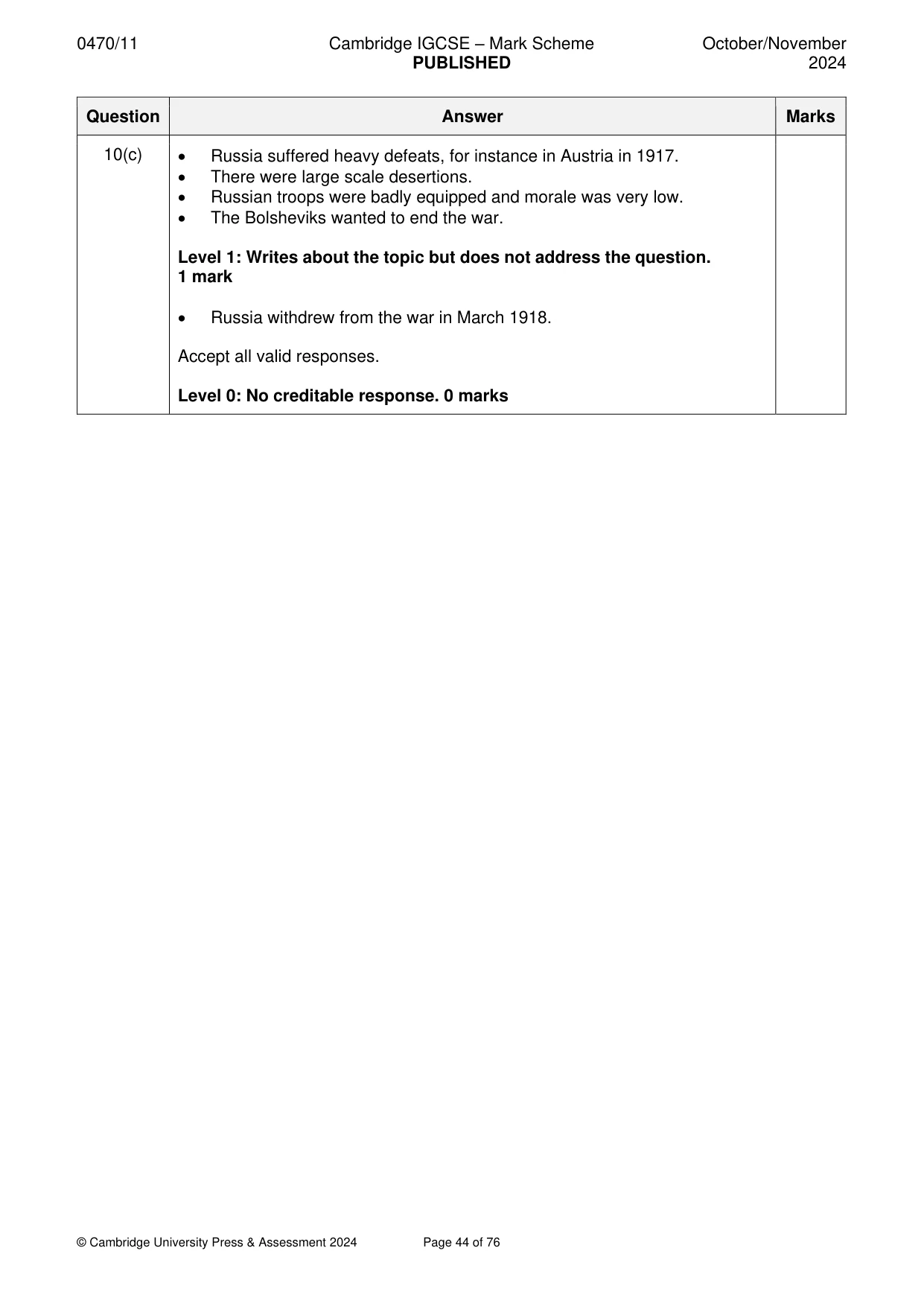
0470/11 Cambridge IGCSE – Mark Scheme PUBLISHED October/November 2024 © Cambridge University Press & Assessment 2024 Page 44 of 76 Question Answer Marks 10(c) • Russia suffered heavy defeats, for instance in Austria in 1917. • There were large scale desertions. • Russian troops were badly equipped and morale was very low. • The Bolsheviks wanted to end the war. Level 1: Writes about the topic but does not address the question. 1 mark • Russia withdrew from the war in March 1918. Accept all valid responses. Level 0: No creditable response. 0 marks
Mark scheme, page 45
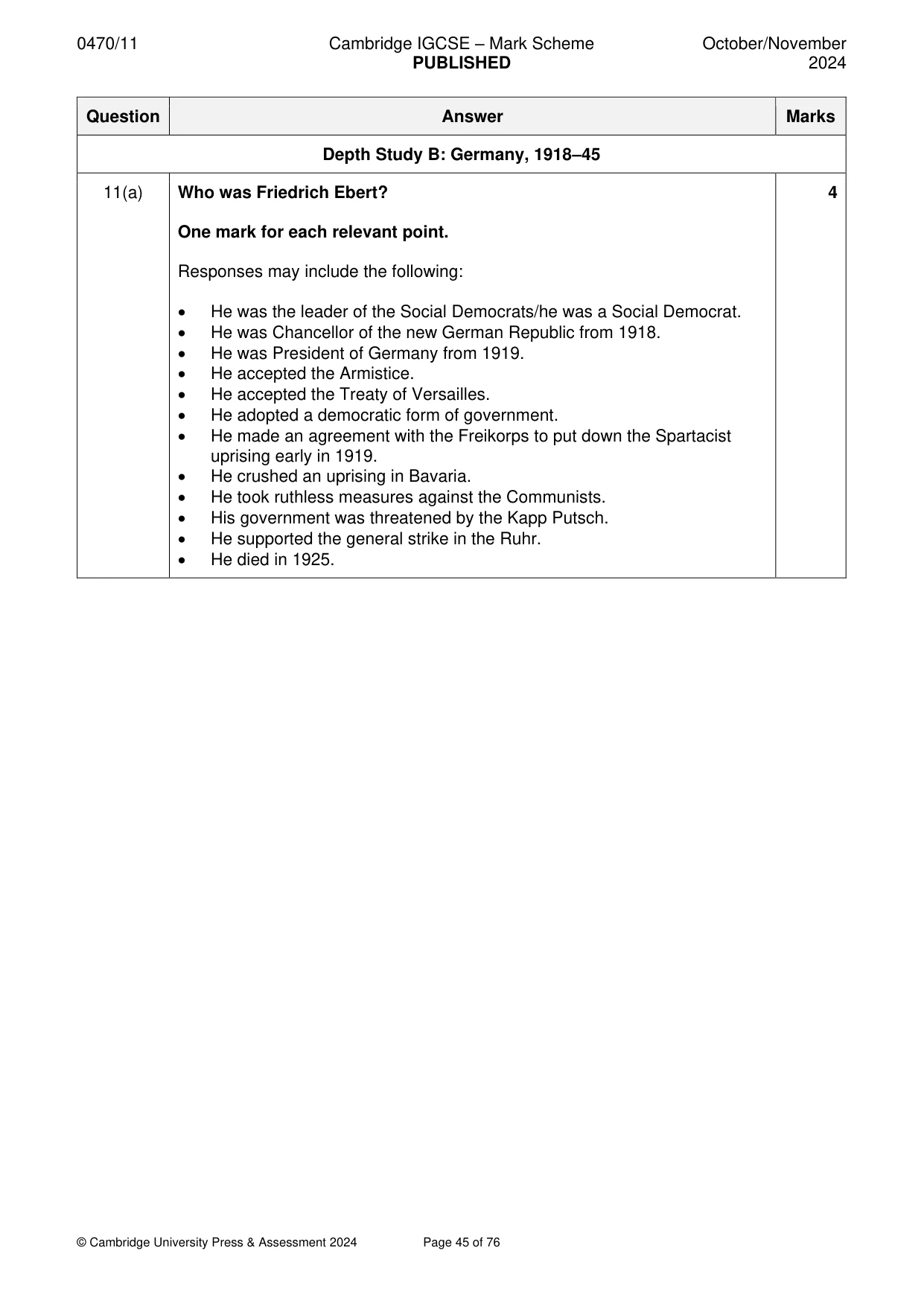
0470/11 Cambridge IGCSE – Mark Scheme PUBLISHED October/November 2024 © Cambridge University Press & Assessment 2024 Page 45 of 76 Question Answer Marks Depth Study B: Germany, 1918–45 11(a) Who was Friedrich Ebert? One mark for each relevant point. Responses may include the following: • He was the leader of the Social Democrats/he was a Social Democrat. • He was Chancellor of the new German Republic from 1918. • He was President of Germany from 1919. • He accepted the Armistice. • He accepted the Treaty of Versailles. • He adopted a democratic form of government. • He made an agreement with the Freikorps to put down the Spartacist uprising early in 1919. • He crushed an uprising in Bavaria. • He took ruthless measures against the Communists. • His government was threatened by the Kapp Putsch. • He supported the general strike in the Ruhr. • He died in 1925. 4
Mark scheme, page 46
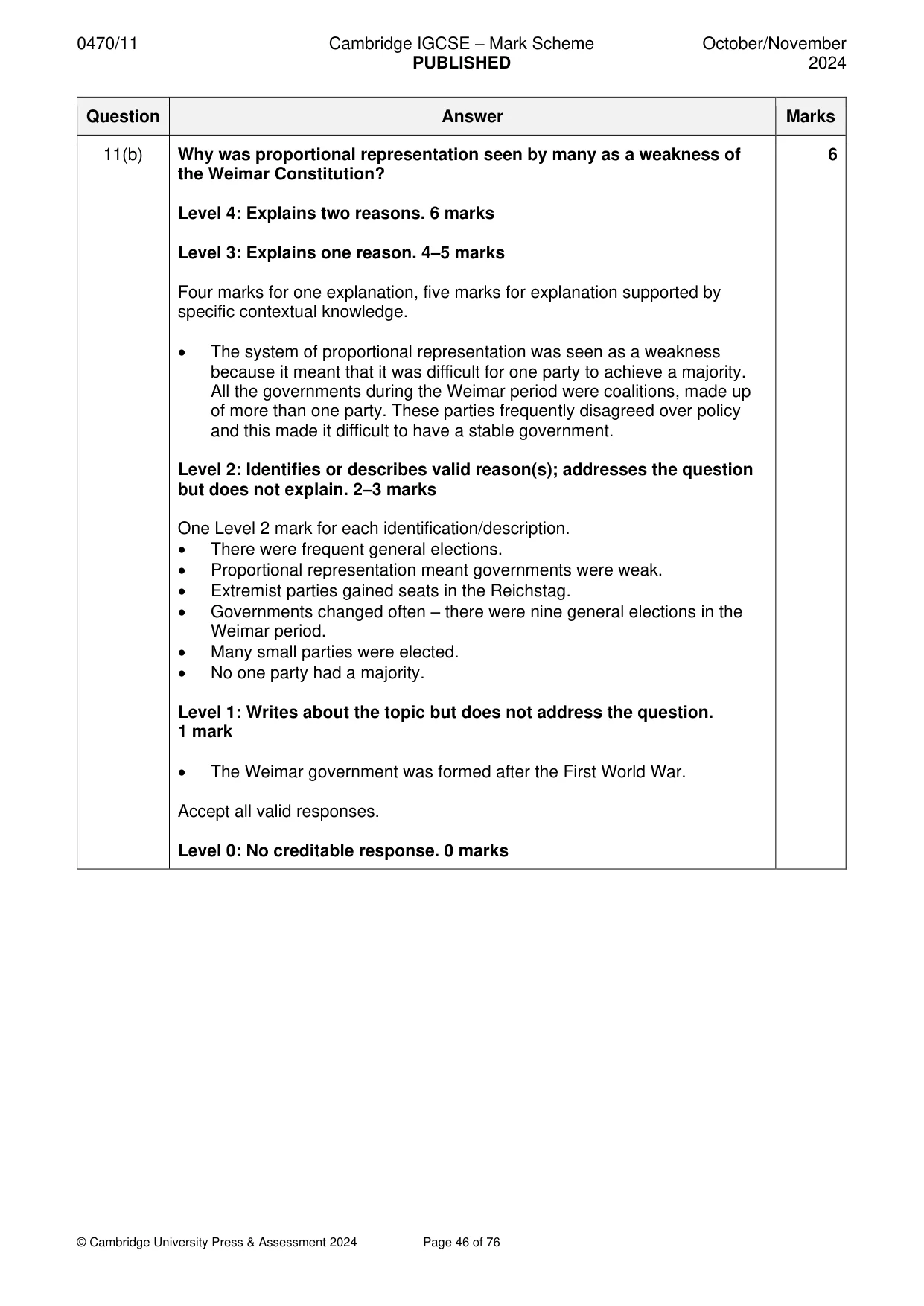
0470/11 Cambridge IGCSE – Mark Scheme PUBLISHED October/November 2024 © Cambridge University Press & Assessment 2024 Page 46 of 76 Question Answer Marks 11(b) Why was proportional representation seen by many as a weakness of the Weimar Constitution? Level 4: Explains two reasons. 6 marks Level 3: Explains one reason. 4–5 marks Four marks for one explanation, five marks for explanation supported by specific contextual knowledge. • The system of proportional representation was seen as a weakness because it meant that it was difficult for one party to achieve a majority. All the governments during the Weimar period were coalitions, made up of more than one party. These parties frequently disagreed over policy and this made it difficult to have a stable government. Level 2: Identifies or describes valid reason(s); addresses the question but does not explain. 2–3 marks One Level 2 mark for each identification/description. • There were frequent general elections. • Proportional representation meant governments were weak. • Extremist parties gained seats in the Reichstag. • Governments changed often – there were nine general elections in the Weimar period. • Many small parties were elected. • No one party had a majority. Level 1: Writes about the topic but does not address the question. 1 mark • The Weimar government was formed after the First World War. Accept all valid responses. Level 0: No creditable response. 0 marks 6
Mark scheme, page 47
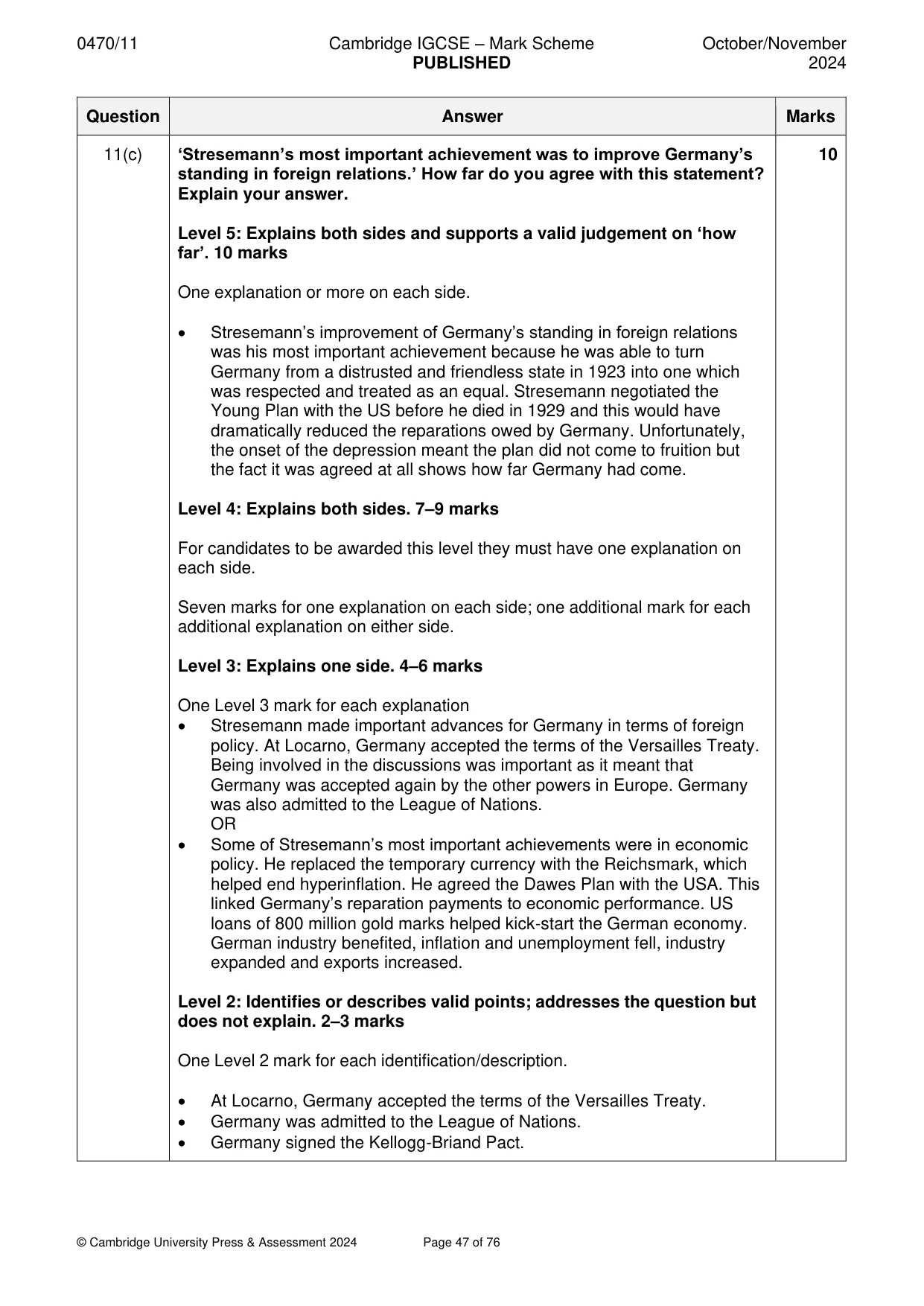
0470/11 Cambridge IGCSE – Mark Scheme PUBLISHED October/November 2024 © Cambridge University Press & Assessment 2024 Page 47 of 76 Question Answer Marks 11(c) ‘Stresemann’s most important achievement was to improve Germany’s standing in foreign relations.’ How far do you agree with this statement? Explain your answer. Level 5: Explains both sides and supports a valid judgement on ‘how far’. 10 marks One explanation or more on each side. • Stresemann’s improvement of Germany’s standing in foreign relations was his most important achievement because he was able to turn Germany from a distrusted and friendless state in 1923 into one which was respected and treated as an equal. Stresemann negotiated the Young Plan with the US before he died in 1929 and this would have dramatically reduced the reparations owed by Germany. Unfortunately, the onset of the depression meant the plan did not come to fruition but the fact it was agreed at all shows how far Germany had come. Level 4: Explains both sides. 7–9 marks For candidates to be awarded this level they must have one explanation on each side. Seven marks for one explanation on each side; one additional mark for each additional explanation on either side. Level 3: Explains one side. 4–6 marks One Level 3 mark for each explanation • Stresemann made important advances for Germany in terms of foreign policy. At Locarno, Germany accepted the terms of the Versailles Treaty. Being involved in the discussions was important as it meant that Germany was accepted again by the other powers in Europe. Germany was also admitted to the League of Nations. OR • Some of Stresemann’s most important achievements were in economic policy. He replaced the temporary currency with the Reichsmark, which helped end hyperinflation. He agreed the Dawes Plan with the USA. This linked Germany’s reparation payments to economic performance. US loans of 800 million gold marks helped kick-start the German economy. German industry benefited, inflation and unemployment fell, industry expanded and exports increased. Level 2: Identifies or describes valid points; addresses the question but does not explain. 2–3 marks One Level 2 mark for each identification/description. • At Locarno, Germany accepted the terms of the Versailles Treaty. • Germany was admitted to the League of Nations. • Germany signed the Kellogg-Briand Pact. 10
Mark scheme, page 48
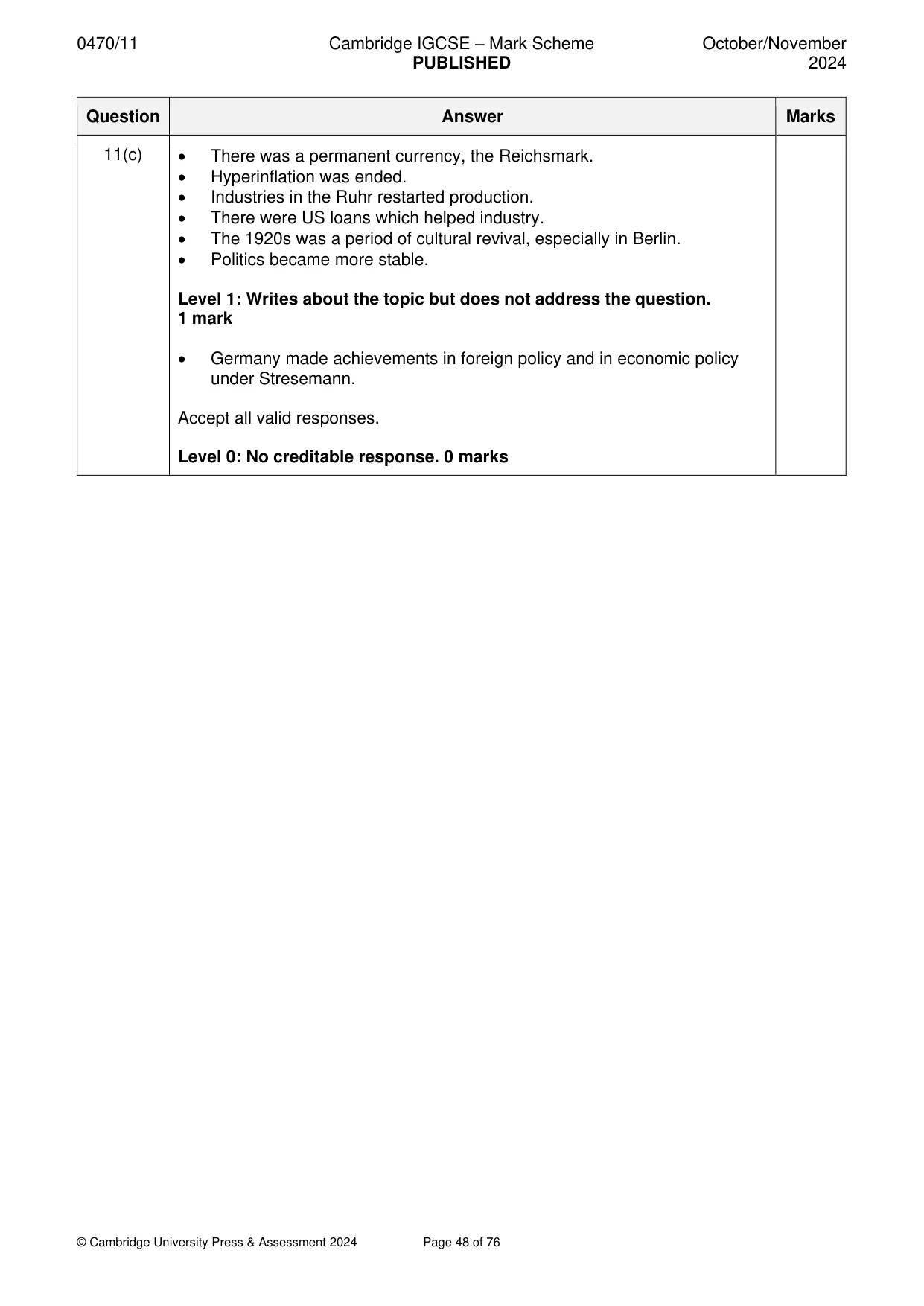
0470/11 Cambridge IGCSE – Mark Scheme PUBLISHED October/November 2024 © Cambridge University Press & Assessment 2024 Page 48 of 76 Question Answer Marks 11(c) • There was a permanent currency, the Reichsmark. • Hyperinflation was ended. • Industries in the Ruhr restarted production. • There were US loans which helped industry. • The 1920s was a period of cultural revival, especially in Berlin. • Politics became more stable. Level 1: Writes about the topic but does not address the question. 1 mark • Germany made achievements in foreign policy and in economic policy under Stresemann. Accept all valid responses. Level 0: No creditable response. 0 marks
Mark scheme, page 49
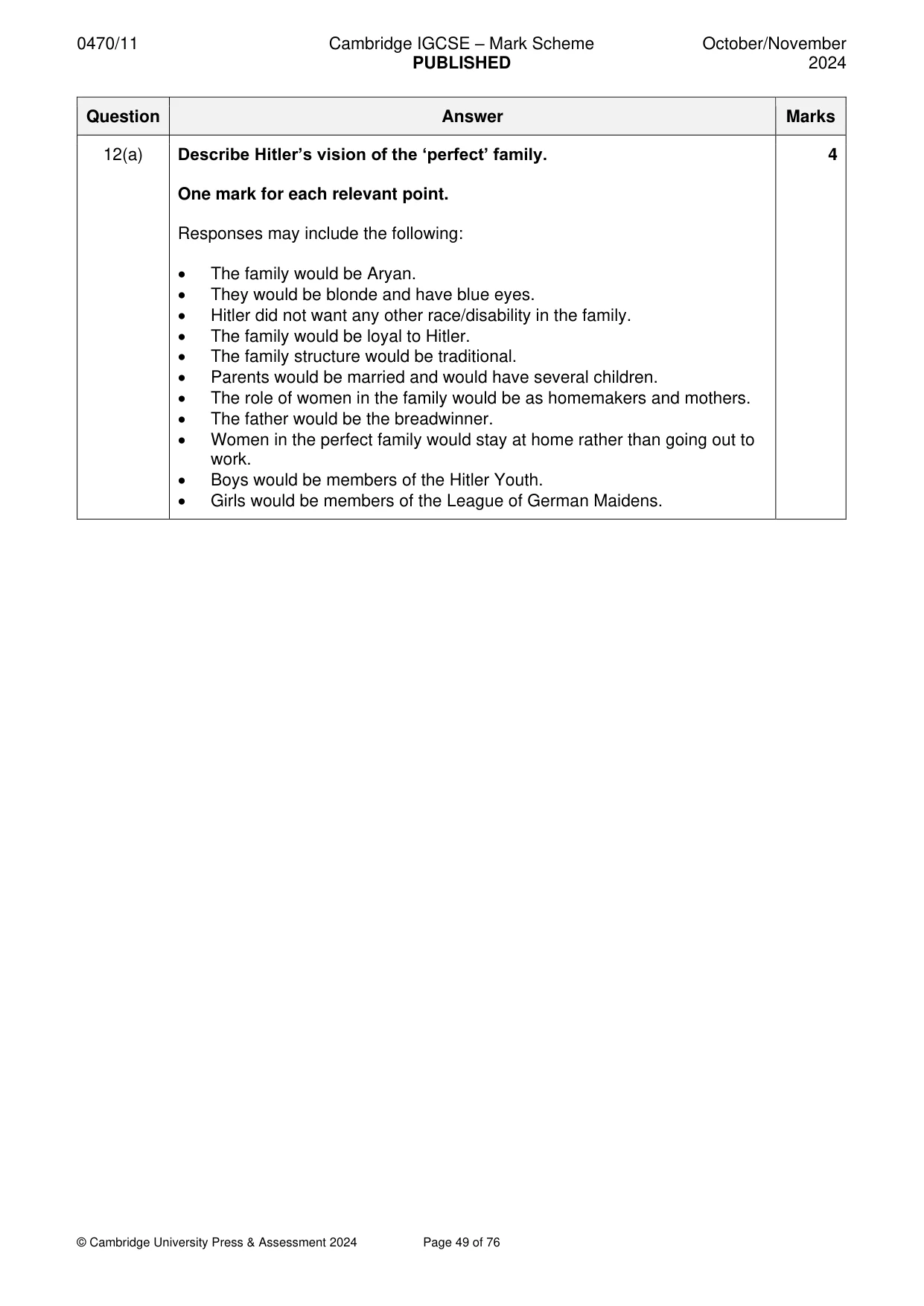
0470/11 Cambridge IGCSE – Mark Scheme PUBLISHED October/November 2024 © Cambridge University Press & Assessment 2024 Page 49 of 76 Question Answer Marks 12(a) Describe Hitler’s vision of the ‘perfect’ family. One mark for each relevant point. Responses may include the following: • The family would be Aryan. • They would be blonde and have blue eyes. • Hitler did not want any other race/disability in the family. • The family would be loyal to Hitler. • The family structure would be traditional. • Parents would be married and would have several children. • The role of women in the family would be as homemakers and mothers. • The father would be the breadwinner. • Women in the perfect family would stay at home rather than going out to work. • Boys would be members of the Hitler Youth. • Girls would be members of the League of German Maidens. 4
Mark scheme, page 50
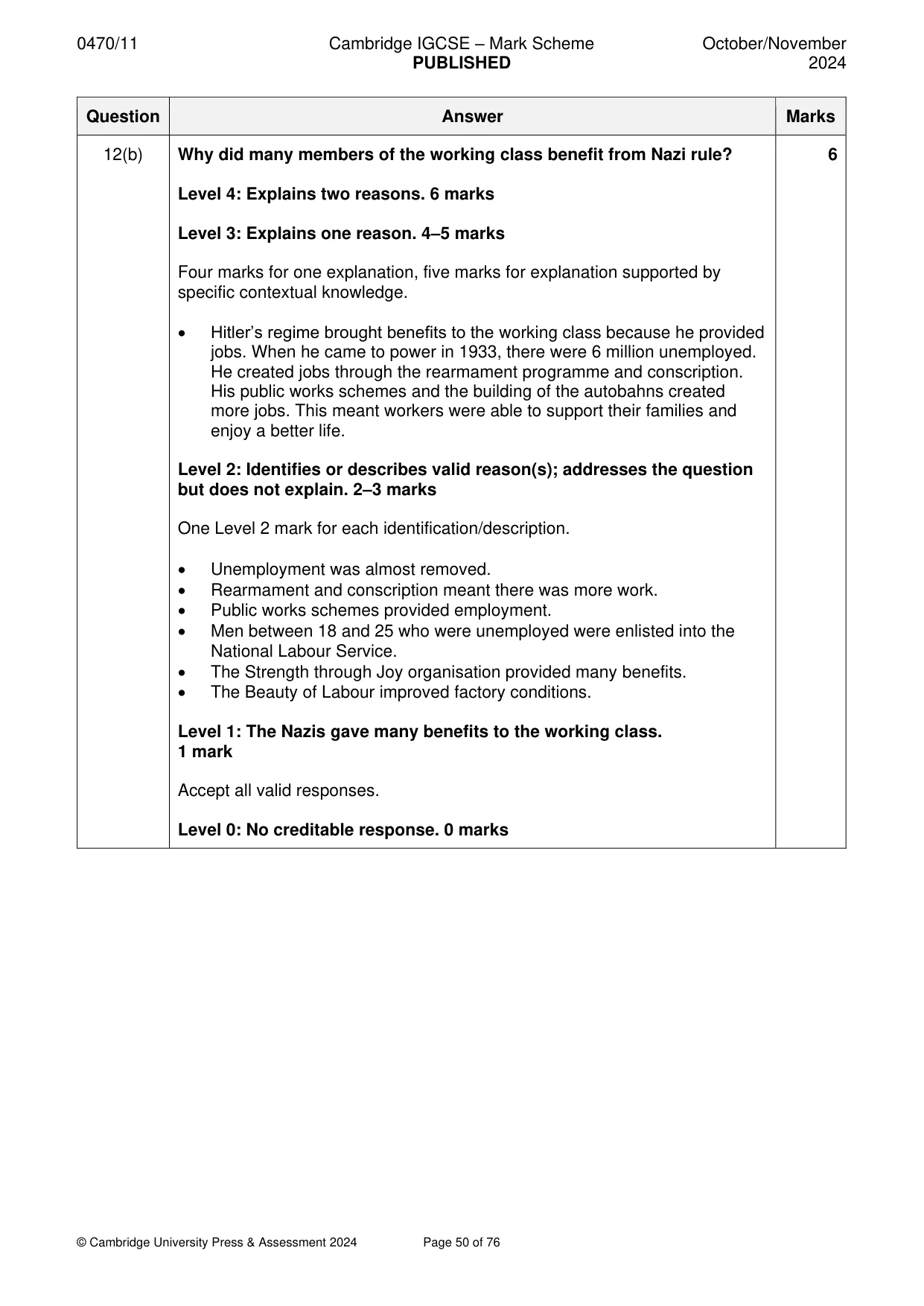
0470/11 Cambridge IGCSE – Mark Scheme PUBLISHED October/November 2024 © Cambridge University Press & Assessment 2024 Page 50 of 76 Question Answer Marks 12(b) Why did many members of the working class benefit from Nazi rule? Level 4: Explains two reasons. 6 marks Level 3: Explains one reason. 4–5 marks Four marks for one explanation, five marks for explanation supported by specific contextual knowledge. • Hitler’s regime brought benefits to the working class because he provided jobs. When he came to power in 1933, there were 6 million unemployed. He created jobs through the rearmament programme and conscription. His public works schemes and the building of the autobahns created more jobs. This meant workers were able to support their families and enjoy a better life. Level 2: Identifies or describes valid reason(s); addresses the question but does not explain. 2–3 marks One Level 2 mark for each identification/description. • Unemployment was almost removed. • Rearmament and conscription meant there was more work. • Public works schemes provided employment. • Men between 18 and 25 who were unemployed were enlisted into the National Labour Service. • The Strength through Joy organisation provided many benefits. • The Beauty of Labour improved factory conditions. Level 1: The Nazis gave many benefits to the working class. 1 mark Accept all valid responses. Level 0: No creditable response. 0 marks 6
Mark scheme, page 51
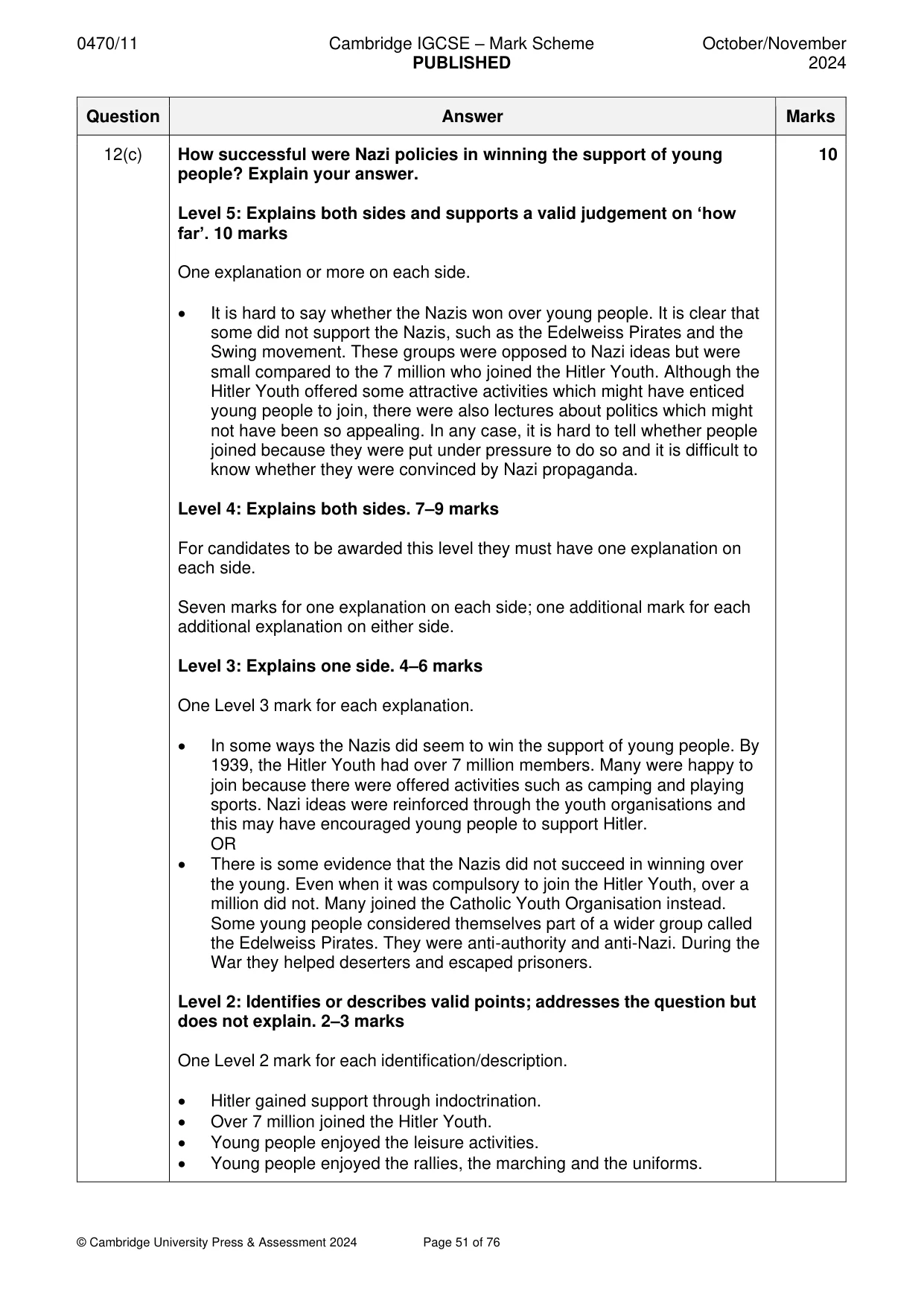
0470/11 Cambridge IGCSE – Mark Scheme PUBLISHED October/November 2024 © Cambridge University Press & Assessment 2024 Page 51 of 76 Question Answer Marks 12(c) How successful were Nazi policies in winning the support of young people? Explain your answer. Level 5: Explains both sides and supports a valid judgement on ‘how far’. 10 marks One explanation or more on each side. • It is hard to say whether the Nazis won over young people. It is clear that some did not support the Nazis, such as the Edelweiss Pirates and the Swing movement. These groups were opposed to Nazi ideas but were small compared to the 7 million who joined the Hitler Youth. Although the Hitler Youth offered some attractive activities which might have enticed young people to join, there were also lectures about politics which might not have been so appealing. In any case, it is hard to tell whether people joined because they were put under pressure to do so and it is difficult to know whether they were convinced by Nazi propaganda. Level 4: Explains both sides. 7–9 marks For candidates to be awarded this level they must have one explanation on each side. Seven marks for one explanation on each side; one additional mark for each additional explanation on either side. Level 3: Explains one side. 4–6 marks One Level 3 mark for each explanation. • In some ways the Nazis did seem to win the support of young people. By 1939, the Hitler Youth had over 7 million members. Many were happy to join because there were offered activities such as camping and playing sports. Nazi ideas were reinforced through the youth organisations and this may have encouraged young people to support Hitler. OR • There is some evidence that the Nazis did not succeed in winning over the young. Even when it was compulsory to join the Hitler Youth, over a million did not. Many joined the Catholic Youth Organisation instead. Some young people considered themselves part of a wider group called the Edelweiss Pirates. They were anti-authority and anti-Nazi. During the War they helped deserters and escaped prisoners. Level 2: Identifies or describes valid points; addresses the question but does not explain. 2–3 marks One Level 2 mark for each identification/description. • Hitler gained support through indoctrination. • Over 7 million joined the Hitler Youth. • Young people enjoyed the leisure activities. • Young people enjoyed the rallies, the marching and the uniforms. 10
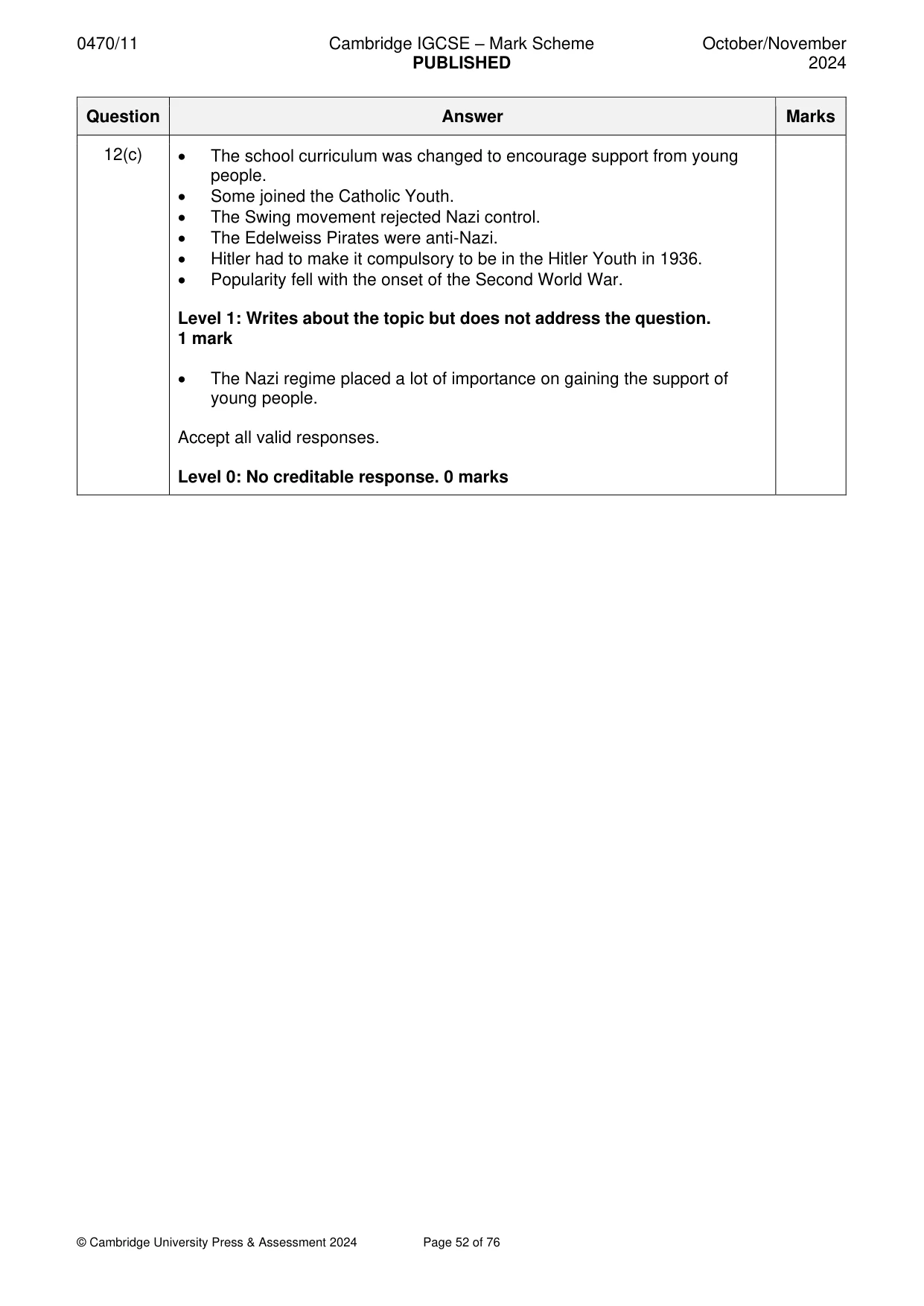
Mark scheme, page 52
0470/11 Cambridge IGCSE – Mark Scheme PUBLISHED October/November 2024 © Cambridge University Press & Assessment 2024 Page 52 of 76 Question Answer Marks 12(c) • The school curriculum was changed to encourage support from young people. • Some joined the Catholic Youth. • The Swing movement rejected Nazi control. • The Edelweiss Pirates were anti-Nazi. • Hitler had to make it compulsory to be in the Hitler Youth in 1936. • Popularity fell with the onset of the Second World War. Level 1: Writes about the topic but does not address the question. 1 mark • The Nazi regime placed a lot of importance on gaining the support of young people. Accept all valid responses. Level 0: No creditable response. 0 marks
Mark scheme, page 53
0470/11 Cambridge IGCSE – Mark Scheme PUBLISHED October/November 2024 © Cambridge University Press & Assessment 2024 Page 53 of 76 Question Answer Marks Depth Study C: Russia, 1905–41 13(a) What happened during the July Days? One mark for each relevant point. Responses may include the following: • Four Kadet ministers resigned from the government on 15 July. • Workers, soldiers and sailors rioted on the streets for the next two days. • They wanted the Soviets to take power. • There was unrest over food shortages and the continuation of the war. • The Provisional Government suggested that Lenin was a German spy. • Trotsky was arrested. • The riots lacked leadership. • Lenin fled to Finland. • The July Days showed the Bolsheviks were not ready to take power. 4
Mark scheme, page 54
0470/11 Cambridge IGCSE – Mark Scheme PUBLISHED October/November 2024 © Cambridge University Press & Assessment 2024 Page 54 of 76 Question Answer Marks 13(b) Why was the Kornilov Affair important to the Bolsheviks? Level 4: Explains two reasons. 6 marks Level 3: Explains one reason. 4–5 marks Four marks for one explanation, five marks for explanation supported by specific contextual knowledge. • The Kornilov Affair was important to the Bolsheviks because it gave them more power and support. The Provisional Government was losing support on all sides. Kerensky, Head of the Provisional Government, appointed Kornilov as the Supreme Commander of the armed forces. He authorised him to impose order in Petrograd. Kornilov marched on the capital. Kerensky panicked as he was uncertain of support from his own army generals and was forced to ask his Bolshevik opponents for help. This showed up the weakness of the Provisional Government and strengthened the position of the Bolsheviks. Level 2: Identifies or describes valid reason(s); addresses the question but does not explain. 2–3 marks One Level 2 mark for each identification/description. • Kerensky’s troops were no match for those of Kornilov. • Kerensky used the Bolsheviks to defend Petrograd against Kornilov’s troops. • Bolshevik activists persuaded Kornilov’s troops to desert. • The Bolsheviks organised an army called the Red Guard. • Kerensky armed the Bolsheviks. • The Bolsheviks kept their arms after the defeat of Kornilov. • The Bolsheviks were credited with saving Petrograd. Level 1: Writes about the topic but does not address the question. 1 mark • Kornilov tried to seize power from Kerensky. Accept all valid responses. Level 0: No creditable response. 0 marks 6
Mark scheme, page 55
0470/11 Cambridge IGCSE – Mark Scheme PUBLISHED October/November 2024 © Cambridge University Press & Assessment 2024 Page 55 of 76 Question Answer Marks 13(c) Which was the more serious problem facing the Provisional Government: the land issue or the war? Explain your answer. Level 5: Explains both sides and supports a valid judgement on ‘how far’. 10 marks One explanation or more on each side. • The war was the most serious problem as Russia did not have the supplies, ammunition or trained troops to continue fighting. This problem also affected all Russians and not just the peasants. Food was sent to the front rather than the cities and this resulted in serious shortages and inflation. The problems which had caused the February Revolution were still there and the Provisional Government was not addressing them. Level 4: Explains both sides. 7–9 marks For candidates to be awarded this level they must have one explanation on each side. Seven marks for one explanation on each side; one additional mark for each additional explanation on either side. Level 3: Explains one side. 4–6 marks One Level 3 mark for each explanation. • The Provisional Government did not address the land issue. However, the Bolsheviks, who formed the majority of the Petrograd Soviet, promised land to the peasants. Many of the peasants who deserted from the army returned home and seized land from the landlords, some of whom were killed. The Provisional Government was not against the idea of land redistribution but wanted it to take place lawfully. They failed to take control of the situation and their inability to act made them seem out of touch with the people. OR • The Provisional Government decided to continue fighting in the First World War and this was a very unpopular and disastrous decision. When Russia’s armies were ordered to take the offensive in Austria in June 1917, the response was wholesale desertion and mutiny. Almost 2 million soldiers deserted and some killed their officers. Level 2: Identifies or describes valid points; addresses the question but does not explain. 2–3 marks One Level 2 mark for each identification/description. • The Provisional Government failed to solve the land problem. • Returning soldiers simply took land from those who owned it. • There were attacks on the nobility and landowners. • They decided to continue the war. • There were widespread desertions from the army. 10
Mark scheme, page 56
0470/11 Cambridge IGCSE – Mark Scheme PUBLISHED October/November 2024 © Cambridge University Press & Assessment 2024 Page 56 of 76 Question Answer Marks 13(c) Level 1: Writes about the topic but does not address the question. 1 mark • The Provisional Government was only a temporary government and failed to take decisive steps. Accept all valid responses. Level 0: No creditable response. 0 marks
Mark scheme, page 57
0470/11 Cambridge IGCSE – Mark Scheme PUBLISHED October/November 2024 © Cambridge University Press & Assessment 2024 Page 57 of 76 Question Answer Marks 14(a) What were the aims for industry of the Five-Year Plans? One mark for each relevant point. Responses may include the following: • The first Five-Year plan aimed to increase production in heavy industry. • The aim was to catch up with western countries. • The plans aimed to increase electricity production. • New plants such as Magnitogorsk were built to industrialise Russia. • Steel and coal production were to be increased in the First Five-Year Plan. • The Second Five-Year Plan aimed to increase production in the chemical industry. • It also aimed to increase railway links between cities. • The Third Five-Year Plan was focused on rearmament. 4
Mark scheme, page 58
0470/11 Cambridge IGCSE – Mark Scheme PUBLISHED October/November 2024 © Cambridge University Press & Assessment 2024 Page 58 of 76 Question Answer Marks 14(b) Why was central planning important to Stalin’s economic policy? Level 4: Explains two reasons. 6 marks Level 3: Explains one reason. 4–5 marks Four marks for one explanation, five marks for explanation supported by specific contextual knowledge. • Central planning was important because targets were set for each industry and in each region. These targets were given to regional directors. This meant there was central control over how much was being produced and that made it possible to ensure Russia had enough coal and electricity to ensure development. Level 2: Identifies or describes valid reason(s); addresses the question but does not explain. 2–3 marks One Level 2 mark for each identification/description. • Overall targets for an industry were set centrally and given to regional directors. • Heavy industries such as coal and iron were important to Russia’s development. • Investment in industry was centrally controlled. • Each region of the USSR was given production targets. • The region set targets for each mine or factory. • It was possible to check output against targets to see where improvements were needed. Level 1: Writes about the topic but does not address the question. 1 mark • GOSPLAN was the state economic planning organisation. Accept all valid responses. Level 0: No creditable response. 0 marks 6
Mark scheme, page 59
0470/11 Cambridge IGCSE – Mark Scheme PUBLISHED October/November 2024 © Cambridge University Press & Assessment 2024 Page 59 of 76 Question Answer Marks 14(c) ‘The policy of Russification was a success for Stalin.’ How far do you agree with this statement? Explain your answer. Level 5: Explains both sides and supports a valid judgement on ‘how far’. 10 marks One explanation or more on each side. • Although Russification was not always successful in persuading people to abandon their traditional language or culture, Stalin had other ways of suppressing them which meant that he was not challenged. Large numbers were deported during collectivisation and many others from minority groups died in the famine in the 1930s. Level 4: Explains both sides. 7–9 marks For candidates to be awarded this level they must have one explanation on each side. Seven marks for one explanation on each side; one additional mark for each additional explanation on either side. Level 3: Explains one side. 4–6 marks One Level 3 mark for each explanation. • In some ways Russification was a success for Stalin. He removed millions of people from ethnic minority groups from Russia, for example deporting Ukrainian kulaks to Kazakhstan during collectivisation. That meant Stalin was able to control the areas they left and appoint his own people to positions of power there. OR • In some ways the policy was not a success. Many minority groups refused to give up their own language and culture and Stalin resorted to purges against members of minority groups who were in positions of power. In rural areas the policy was less effective and people retained their own traditions. Level 2: Identifies or describes valid points; addresses the question but does not explain. 2–3 marks One Level 2 mark for each identification/description. • Stalin discouraged differing national identities within Russia. • Ethnic minority groups were encouraged to see themselves as Soviet citizens rather than separate nationalities. • The Russian language was made a compulsory subject in the school curriculum. • Russian was made the official language of state organisations such as the army. 10
Mark scheme, page 60
0470/11 Cambridge IGCSE – Mark Scheme PUBLISHED October/November 2024 © Cambridge University Press & Assessment 2024 Page 60 of 76 Question Answer Marks 14(c) • Russians were encouraged to migrate into non-Russian areas. • Thousands of Islamic schools, hospitals and mosques were forced to close. • 1.5 million people from ethnic minorities were deported to Asia. • Many minority groups refused to give up their language. • Russification was less successful in rural areas. Level 1: Writes about the topic but does not address the question. 1 mark • Stalin was suspicious of minority groups and so introduced Russification. Accept all valid responses. Level 0: No creditable response. 0 marks
Mark scheme, page 61
0470/11 Cambridge IGCSE – Mark Scheme PUBLISHED October/November 2024 © Cambridge University Press & Assessment 2024 Page 61 of 76 Question Answer Marks Depth Study D: The United States, 1919–41 15(a) Describe the development of leisure activities in the 1920s. One mark for each relevant point. Responses may include the following: • New inventions like the radio became more popular. • People could listen to popular music. • America’s first radio station (Station KDKA) was started in 1920. • Dances such as the Charleston replaced the slow formal dances of pre- war America. • Jazz and blues became very popular. • People went to the cinema. • The first ‘talkie’ was released in 1927. • People went to sporting events. • People drove their cars for trips out or for holidays. 4
Mark scheme, page 62
0470/11 Cambridge IGCSE – Mark Scheme PUBLISHED October/November 2024 © Cambridge University Press & Assessment 2024 Page 62 of 76 Question Answer Marks 15(b) Why was prohibition difficult to enforce? Level 4: Explains two reasons. 6 marks Level 3: Explains one reason. 4–5 marks Four marks for one explanation, five marks for explanation supported by specific contextual knowledge. • Prohibition was difficult to enforce because it was not illegal to purchase or consume alcohol. Americans continued to drink behind closed doors in illegal bars called speakeasies. There were over 30 000 of these in New York alone by 1929. Others made their own illegal alcohol known as ‘moonshine’ at home. Level 2: Identifies or describes valid reason(s); addresses the question but does not explain. 2–3 marks One Level 2 mark for each identification/description. • There were illegal bars called speakeasies. • People made their own alcohol at home. • Consuming alcohol was not made illegal. • Many officials who were supposed to enforce prohibition could be bribed. • Whisky and rum were smuggled into the USA. • There weren’t enough enforcement agents. • Enforcing prohibition was difficult because of the violence of gangsters. Level 1: Writes about the topic but does not address the question. 1 mark • People liked drinking alcohol. Accept all valid responses. Level 0: No creditable response. 0 marks 6
Mark scheme, page 63
0470/11 Cambridge IGCSE – Mark Scheme PUBLISHED October/November 2024 © Cambridge University Press & Assessment 2024 Page 63 of 76 Question Answer Marks 15(c) ‘Fear of communism was the main reason for restrictions being placed on immigration to the United States.’ How far do you agree with this statement? Explain your answer. Level 5: Explains both sides and supports a valid judgement on ‘how far’. 10 marks One explanation or more on each side. • Fear of communism wasn’t the main reason for the restrictions placed on immigration. Americans wanted to maintain the supremacy of white, northern Europeans who were most like the original settlers to the US. Therefore, quotas were introduced which radically reduced numbers from South and Eastern Europe but also entirely barred immigrants of Asian origin. Level 4: Explains both sides. 7–9 marks For candidates to be awarded this level they must have one explanation on each side. Seven marks for one explanation on each side; one additional mark for each additional explanation on either side. Level 3: Explains one side. 4–6 marks One Level 3 mark for each explanation. • In some ways, fear of communism was a reason for restrictions on immigration. The Red Scare made many Americans more afraid of immigrants. The rise of communism in Russia made them worry about these ideas coming to America. They thought that immigrants from Eastern Europe were bringing these ideas into the country. These fears were made worse when there were bomb attacks in America by anarchists. This was one reason why the Emergency Quota Act restricted immigrants from Russia. OR • There were other reasons. One was that Americans were afraid that white, Anglo-Saxon supremacy would be diluted. The restrictions passed meant it was still possible for people from Northern Europe to emigrate to the US but other groups such as migrants from China and Japan were completely banned. Level 2: Identifies or describes valid points; addresses the question but does not explain. 2–3 marks One Level 2 mark for each identification/description. • People were afraid of communism because of the Red Scare. • Russian and Eastern European immigrants were viewed with suspicion. 10
Mark scheme, page 64
0470/11 Cambridge IGCSE – Mark Scheme PUBLISHED October/November 2024 © Cambridge University Press & Assessment 2024 Page 64 of 76 Question Answer Marks 15(c) • Extreme political ideas were associated with immigrants. • Americans thought immigrants would take their jobs. • It was felt that immigrants from Eastern Europe and Asia would not mix into American society and accept its values. • To make sure that white, northern Europeans stayed in a majority and were in charge. • There were racist undertones in society. Level 1: Writes about the topic but does not address the question. 1 mark • The American government discriminated against certain nationalities. Accept all valid responses. Level 0: No creditable response. 0 marks
Mark scheme, page 65
0470/11 Cambridge IGCSE – Mark Scheme PUBLISHED October/November 2024 © Cambridge University Press & Assessment 2024 Page 65 of 76 Question Answer Marks 16(a) Describe measures taken by the New Deal to help farmers. One mark for each relevant point. Responses may include the following: • The Agricultural Adjustment Administration was established in 1933. • Farmers were paid to destroy some of their crops so that prices rose. • Farmers were paid to take some of their land out of cultivation. • Millions of acres of crops were ploughed up. • The Resettlement Administration was set up in 1935. • The RA was meant to help sharecroppers and farm labourers. • It moved families to better land and houses. • The Farm Security Administration replaced the RA in 1937. • The FSA provided loans so that tenant farmers could buy their own land. 4
Mark scheme, page 66
0470/11 Cambridge IGCSE – Mark Scheme PUBLISHED October/November 2024 © Cambridge University Press & Assessment 2024 Page 66 of 76 Question Answer Marks 16(b) Why did Huey Long criticise the New Deal? Level 4: Explains two reasons. 6 marks Level 3: Explains one reason. 4–5 marks Four marks for one explanation, five marks for explanation supported by specific contextual knowledge. • Huey Long did not think the New Deal went far enough. His ‘Share our Wealth’ scheme included the confiscation of large fortunes which could then be redistributed to the poor, such as the elderly. He believed there was enough money in the United States to look after everyone but that it was not distributed fairly. He thought the New Deal should have addressed this. Level 2: Identifies or describes valid reason(s); addresses the question but does not explain. 2–3 marks One Level 2 mark for each identification/description. • Huey Long wanted to redistribute wealth. • He thought the New Deal did not go far enough. • He believed there should be a minimum wage. • He wanted to confiscate large fortunes. • He thought there should be more help for the elderly. Level 1: Writes about the topic but does not address the question. 1 mark • Huey Long had been the governor of Louisiana and wanted to run for president but he was assassinated. Accept all valid responses. Level 0: No creditable response. 0 marks 6
Mark scheme, page 67
0470/11 Cambridge IGCSE – Mark Scheme PUBLISHED October/November 2024 © Cambridge University Press & Assessment 2024 Page 67 of 76 Question Answer Marks 16(c) ‘Saving the banks was the most important achievement of the New Deal.’ How far do you agree with this statement? Explain your answer. Level 5: Explains both sides and supports a valid judgement on ‘how far’. 10 marks One explanation or more on each side. • Saving the banks was the most crucial condition for solving unemployment and social welfare. Without any effective banking system, the US government would not have enough money for the CCC and the PWA. Overall, it improved the business situation and the morale of the public. Thus, saving the banking system was the greatest achievement. Level 4: Explains both sides. 7–9 marks For candidates to be awarded this level they must have one explanation on each side. Seven marks for one explanation on each side; one additional mark for each additional explanation on either side. Level 3: Explains one side. 4–6 marks One Level 3 mark for each explanation. • Saving the banks was an important achievement because many banks had closed and people had withdrawn their money. If this continued, more banks would collapse and business would not be able to operate. Some of the banks had lent money recklessly and they were closed under the terms of the Emergency Banking Act. This helped to restore faith in the remaining banks. People began to put their money back in the banks which meant that they could invest in industry to help with recovery. OR • Providing relief for the unemployed was important. Many had lost their jobs and homes as a result of the depression and faced poverty and hunger. The Federal Emergency Relief Administration opened soup kitchens and provided clothing and beds to those most in need. Level 2: Identifies or describes valid points; addresses the question but does not explain. 2–3 marks One Level 2 mark for each identification/description. • The Emergency Banking Act stabilised the banking system and this helped business and industry. • FERA provided food and clothing to those facing poverty and hunger. • Unemployment was tackled by a range of ‘alphabet agencies’. • The CCC helped young men between the ages of 18 and 25 and found them temporary employment. 10
Mark scheme, page 68
0470/11 Cambridge IGCSE – Mark Scheme PUBLISHED October/November 2024 © Cambridge University Press & Assessment 2024 Page 68 of 76 Question Answer Marks 16(c) • The Public Works Administration started infrastructure projects which provided jobs. • Farmers were helped by the Agricultural Adjustment Act. • Pensions were introduced for the elderly. Level 1: Writes about the topic but does not address the question. 1 mark • Roosevelt’s aims for the New Deal were relief, recovery and reform. Accept all valid responses. Level 0: No creditable response. 0 marks
Mark scheme, page 69
0470/11 Cambridge IGCSE – Mark Scheme PUBLISHED October/November 2024 © Cambridge University Press & Assessment 2024 Page 69 of 76 Question Answer Marks Depth Study E: The Second World War in Europe and the Asia–Pacific, 1939–c.1945 17(a) Describe Germany’s invasion of France. One mark for each relevant point. Responses may include the following: • France thought they would fight a defensive war against Germany. • The French did not anticipate the speed of the attack. • German forces invaded France through the dense forests of the Ardennes. • They bypassed the Maginot Line. • A two-day battle at Sedan ended in defeat for the French. • German troops entered Paris on 14 June. • French forces withdrew from the city the day before and it was declared an ‘open city’ to prevent its destruction. • France fell within six weeks. 4
Mark scheme, page 70
0470/11 Cambridge IGCSE – Mark Scheme PUBLISHED October/November 2024 © Cambridge University Press & Assessment 2024 Page 70 of 76 Question Answer Marks 17(b) Why was Germany unable to conquer the USSR by the end of 1941? Level 4: Explains two reasons. 6 marks Level 3: Explains one reason. 4–5 marks Four marks for one explanation, five marks for explanation supported by specific contextual knowledge. • One reason for Germany being unable to conquer the USSR by the end of 1941 was that they had assumed that defeat would come quickly and did not make plans for a long war. They thought that the Soviets would surrender after the initial defeats. The Soviet Union was vast and this brought logistical difficulties meaning supplies of fuel and ammunition were affected. Most German soldiers only had summer uniforms and when winter set in they were unprepared. Level 2: Identifies or describes valid reason(s); addresses the question but does not explain. 2–3 marks One Level 2 mark for each identification/description. • The Germans did not plan for a long war. • Russia was vast and supply lines were difficult to maintain. • Soviet soldiers used scorched earth tactics as they retreated and this made communication more difficult for the German army. • German soldiers were not equipped for winter. • Although the Russians suffered heavy defeats at first, they had huge reserves of troops. • Russian soldiers were also used to fighting in winter conditions. Level 1: Writes about the topic but does not address the question. 1 mark • The Germans were confident of victory against the Soviet Union because of their Blitzkrieg tactics. Accept all valid responses. Level 0: No creditable response. 0 marks 6
Mark scheme, page 71
0470/11 Cambridge IGCSE – Mark Scheme PUBLISHED October/November 2024 © Cambridge University Press & Assessment 2024 Page 71 of 76 Question Answer Marks 17(c) ‘The evacuation from Dunkirk was more important than the Battle of Britain.’ How far do you agree with this statement? Explain your answer. Level 5: Explains both sides and supports a valid judgement on ‘how far’. 10 marks One explanation or more on each side. • For those rescued from Dunkirk, their evacuation was clearly important and the rescue mission was a great boost to public morale. However, the Battle of Britain secured Britain’s position and prevented Hitler’s invasion. This was more important to the long term development of the war than the evacuation at Dunkirk because it meant that Britain would not be captured and would be able to fight on. Level 4: Explains both sides. 7–9 marks For candidates to be awarded this level they must have one explanation on each side. Seven marks for one explanation on each side; one additional mark for each additional explanation on either side. Level 3: Explains one side. 4–6 marks One Level 3 mark for each explanation. • The Dunkirk evacuation was an important event for the Allies because the British Expeditionary Force was rescued rather than being captured by the German army. The loss of the BEF would have meant the loss of Britain’s only trained troops and this would have damaged the Allied war effort. Many boats were involved in the evacuation and its success was a great boost to civilian morale. The ‘Dunkirk spirit’ helped Britain to fight on in 1940 when prospects for victory in the war looked remote. OR • The Battle of Britain was won by the British. It was important because it meant that Hitler would be unable to launch an invasion through Operation Sealion. Unlike much of western Europe, which had fallen to German forces very quickly and become occupied by the Nazis, Britain stayed independent and would be able to fight back. Level 2: Identifies or describes valid points; addresses the question but does not explain. 2–3 marks One Level 2 mark for each identification/description. • The British won the battle which meant they would not be invaded by the German army. • The BEF was rescued from capture by German forces. • Over 300 000 Allied soldiers were evacuated. • Winning the Battle of Britain meant Britain would survive the war. 10
Mark scheme, page 72
0470/11 Cambridge IGCSE – Mark Scheme PUBLISHED October/November 2024 © Cambridge University Press & Assessment 2024 Page 72 of 76 Question Answer Marks 17(c) • Many civilians helped to evacuate the troops. • The BEF was Britain’s only trained fighting force. • Dunkirk lifted public morale at a difficult time in the war. • The radar system was proved to be effective. • Hitler failed to achieve his objective of conquering Britain. Level 1: Writes about the topic but does not address the question. 1 mark • The evacuation at Dunkirk was known as Operation Dynamo. Accept all valid responses. Level 0: No creditable response. 0 marks
Mark scheme, page 73
0470/11 Cambridge IGCSE – Mark Scheme PUBLISHED October/November 2024 © Cambridge University Press & Assessment 2024 Page 73 of 76 Question Answer Marks 18(a) Describe the Allied bombing of German cities in 1943–45. One mark for each relevant point. Responses may include the following: • Cities were bombed to demoralise civilians. • The US air force carried out daytime raids. • The British air force carried out night-time raids. • Hamburg was firebombed in 1943. • Over 2000 bombs were dropped on Hamburg between 1 a.m. and 2 a.m. on 24 July 1943. • Industrial plants were targeted to disrupt war production. • Dresden was bombed in February 1945 and almost 25 000 people were killed. • Cities caught fire and further bombing was carried out to disrupt attempts to put the fires out. 4
Mark scheme, page 74
0470/11 Cambridge IGCSE – Mark Scheme PUBLISHED October/November 2024 © Cambridge University Press & Assessment 2024 Page 74 of 76 Question Answer Marks 18(b) Why did the Nazis build extermination camps in Poland? Level 4: Explains two reasons. 6 marks Level 3: Explains one reason. 4–5 marks Four marks for one explanation, five marks for explanation supported by specific contextual knowledge. • One reason that extermination camps were built in Poland was that there were railway links to other parts of Europe and so it was easier to transport Jews there from other territories which were occupied by the Nazis. For example, one reason for a death camp being sited at Auschwitz-Birkenau was its position on the railway network. Level 2: Identifies or describes valid reason(s); addresses the question but does not explain. 2–3 marks One Level 2 mark for each identification/description. • Poland was in occupied territory and under Nazi control. • There was a large Jewish population in Poland. • Many Jews had been deported to the General Government, a region of occupied Poland. • Ghettos were established in Polish cities such as Warsaw. • Railway links with the rest of Europe meant Jews could be deported to Poland from other occupied territories. • Auschwitz was an established barracks which was on the railway line and so it was developed by the Nazis into a death camp. Level 1: Writes about the topic but does not address the question. 1 mark • Six million Jews were killed by the Nazis in the Second World War. Accept all valid responses. Level 0: No creditable response. 0 marks 6
Mark scheme, page 75
0470/11 Cambridge IGCSE – Mark Scheme PUBLISHED October/November 2024 © Cambridge University Press & Assessment 2024 Page 75 of 76 Question Answer Marks 18(c) How important was the French resistance movement? Explain your answer. Level 5: Explains both sides and supports a valid judgement on ‘how far’. 10 marks One explanation or more on each side. • The French Resistance movement became important around the time of the D-Day landings as before that time it had been disjointed and uncoordinated, with little power to act effectively against German forces. Working with Allied teams in the build-up to D-Day, it gave the movement a focus and direction which had been lacking in the early years of Nazi occupation. The Resistance played an important role in disrupting rail links and power networks in the areas which were to be invaded. This meant communications were more difficult for German forces and prevented them from focusing their strength on Normandy at the time of the Allied invasion. Level 4: Explains both sides. 7–9 marks For candidates to be awarded this level they must have one explanation on each side. Seven marks for one explanation on each side; one additional mark for each additional explanation on either side. Level 3: Explains one side. 4–6 marks One Level 3 mark for each explanation. • The French Resistance was important because it provided information and support to the Allies both during the Nazi occupation and after the D- Day landings. For example, it provided an escape network for Allied soldiers and airmen who had become trapped behind enemy lines. Intelligence information was also given to the Allies about German troop movements and this allowed them to plan their operations in France to better effect. ‘Jedburgh’ teams made up of British, French and American personnel were parachuted into France before D-Day to ensure that French resistance activities were coordinated with Allied strategy. OR • The French Resistance had little impact on the war and only really became useful to the war effort after the Allies had landed in Normandy in 1944. The proportion of the French population involved in the Resistance is estimated at between one and three percent and there were many different groups which were not coordinated. In the early years of the war they were no match for German forces and any saboteurs who were caught were executed. This meant they were unable to undermine Nazi control of France from within. 10
Mark scheme, page 76
0470/11 Cambridge IGCSE – Mark Scheme PUBLISHED October/November 2024 © Cambridge University Press & Assessment 2024 Page 76 of 76 Question Answer Marks 18(c) Level 2: Identifies or describes valid points; addresses the question but does not explain. 2–3 marks One Level 2 mark for each identification/description. • The French Resistance fought against the Nazi occupation of France. • They opposed the collaborationist Vichy government. • Small groups of armed men and women formed resistance cells. • Some published anti-Nazi propaganda. • They provided intelligence information to the Allied forces. • They built up an escape network to help Allied soldiers and airmen trapped behind Axis lines. • They helped the Allies to advance through France after the D-Day landings. • Information was given to the Allies about German defences and troop movements. • The Resistance carried out acts of sabotage on transport and communications networks to create difficulties for the German forces. • In 1944 some of the resistance forces formed the Free French Forces of the Interior. Level 1: Writes about the topic but does not address the question. 1 mark • Secret agents from Britain and other Allied nations worked with the French Resistance. Accept all valid responses. Level 0: No creditable response. 0 marks
What you needed in this session
Cambridge’s own grade thresholds for 2024 Oct/Nov, Paper 1 · Variant 1. A higher threshold means an easier paper — the bar moves with how the cohort did.