Cambridge IGCSE History 0470 — 2022 May/June Paper 1 · Variant 1
0470/11/M/J/22 · 60 marks · ≈68 min
The question paper and its mark scheme, free to read here and free to download. This is Cambridge’s own paper, exactly as it was sat.
Question paper12 pages

Mark scheme55 pages
Answers below. Sit the paper first if you are practising.
Paper as text
Question paper, page 1
This document has 12 pages. Any blank pages are indicated. [Turn over Cambridge IGCSE™ DC (CE) 304135/3 © UCLES 2022 HISTORY 0470/11 Paper 1 May/June 2022 2 hours You must answer on the enclosed answer booklet. You will need: Answer booklet (enclosed) INSTRUCTIONS ● Answer three questions in total: Section A (Core Content): answer two questions. Section B (Depth Studies): answer one question. ● Follow the instructions on the front cover of the answer booklet. If you need additional answer paper, ask the invigilator for a continuation booklet. INFORMATION ● The total mark for this paper is 60. ● The number of marks for each question or part question is shown in brackets [ ]. * 8 3 7 1 7 4 5 4 0 3 *
Question paper, page 2
2 0470/11/M/J/22 © UCLES 2022 SECTION A: CORE CONTENT Answer any two questions from this section. 1 The struggle for Italian unification led to the declaration of the Kingdom of Italy in 1861. (a) Describe the activities of the Young Italy movement. [4] (b) Why was Cavour suspicious of Garibaldi? [6] (c) ‘Garibaldi’s success in Sicily was the turning point in the winning of Italian unification.’ How far do you agree with this statement? Explain your answer. [10] 2 Both war and diplomacy contributed to the achievement of German unification. (a) Describe how the Zollverein worked. [4] (b) Why did the Schleswig-Holstein question present Bismarck with opportunities? [6] (c) ‘The Franco-Prussian War was more important than the Austro-Prussian War in bringing about German unification.’ How far do you agree with this statement? Explain your answer. [10] 3 European imperialism impacted the local populations in different ways. (a) Describe the work of missionaries in nineteenth-century Africa. [4] (b) Why was the Boxer Rising important for China? [6] (c) Which was more beneficial for the local population, indirect rule in Nigeria or assimilation in Senegal? Explain your answer. [10] 4 Before the First World War Austria-Hungary and Germany were two of the great European powers. (a) What was ‘Weltpolitik’? [4] (b) Why was Austria-Hungary interested in events in the Balkans? [6] (c) Which was more to blame for the arms race, Britain or Germany? Explain your answer. [10]
Question paper, page 3
3 0470/11/M/J/22 © UCLES 2022 [Turn over 5 The peace treaties of 1919 had to deal with many different issues. (a) What territorial demands did Clemenceau make during the Paris Peace Conference? [4] (b) Why was the break-up of the Austro-Hungarian Empire confirmed in the Treaty of St Germain? [6] (c) Who had to compromise more during the peace negotiations in Paris, Clemenceau or Lloyd George? Explain your answer. [10] 6 Hitler’s policies brought war closer. (a) Describe the events in February and March of 1938 that led to Anschluss. [4] (b) Why was involvement in the Spanish Civil War of benefit to Hitler? [6] (c) ‘Hitler agreed the Nazi-Soviet Pact in order to avoid war against the Soviet Union.’ How far do you agree with this statement? Explain your answer. [10] 7 After the Second World War the United States was concerned about the threat of communism in Europe. (a) What was the Truman Doctrine? [4] (b) Why was the failure of the Berlin Blockade important? [6] (c) Was it surprising that Britain and the United States agreed at Yalta that Eastern Europe should be a Soviet sphere of influence? Explain your answer. [10] 8 The United States was faced with challenges in various parts of the world. (a) Describe MacArthur’s role in the Korean War. [4] (b) Why did Kennedy go ahead with the Bay of Pigs invasion in 1961? [6] (c) ‘It was the United States’ strategy and tactics that led to its failure in Vietnam.’ How far do you agree with this statement? Explain your answer. [10]
Question paper, page 4
4 0470/11/M/J/22 © UCLES 2022 SECTION B: DEPTH STUDIES Answer any one question from this section. DEPTH STUDY A: THE FIRST WORLD WAR, 1914–18 9 Events in the first few months of the war meant that it would not be over by Christmas. (a) Describe the conduct of the German army as it advanced through Belgium. [4] (b) Why did the introduction of trenches by both sides ensure the war would not be over quickly? [6] (c) How far did the British Expeditionary Force (BEF) succeed in achieving its aims? Explain your answer. [10] 10 The tide of the war began to turn against Germany in 1917. (a) What was the Hindenburg Line? [4] (b) Why was a republic declared in Germany in November 1918? [6] (c) How decisive was the American entry into the war in 1917? Explain your answer. [10]
Question paper, page 5
5 0470/11/M/J/22 © UCLES 2022 [Turn over DEPTH STUDY B: GERMANY, 1918–45 11 It took some time for the Nazi Party to win popular support. (a) Describe the role of the SA in the Nazi Party during the 1920s. [4] (b) Why was the Nazi Party able to attract increasing support in the early 1930s? [6] (c) ‘Hitler showed little leadership quality during the Munich Putsch.’ How far do you agree with this statement? Explain your answer. [10] 12 The Nazi regime used a range of different methods to control Germany. (a) Describe how the SS controlled German society. [4] (b) Why was there some opposition to Nazi rule? [6] (c) ‘The Nazis’ economic policies were more effective than their use of the mass media in winning the support of the German people.’ How far do you agree with this statement? Explain your answer. [10]
Question paper, page 6
6 0470/11/M/J/22 © UCLES 2022 DEPTH STUDY C: RUSSIA, 1905–41 13 The years after 1905 were crucial ones for the Tsar and for Russia. (a) What was Bloody Sunday? [4] (b) Why was the Tsar’s decision in 1915 to take personal command of the Russian army important? [6] (c) ‘The 1905 Revolution led to a period of significant reform.’ How far do you agree with this statement? Explain your answer. [10] 14 Stalin was determined to achieve power, and then to hold on to it. (a) What were the ‘gulags’? [4] (b) Why did Stalin introduce the Great Purges in the mid-1930s? [6] (c) ‘Stalin’s policy ideas explain why he, and not Trotsky, emerged as leader of the USSR in the mid-1920s.’ How far do you agree with this statement? Explain your answer. [10]
Question paper, page 7
7 0470/11/M/J/22 © UCLES 2022 [Turn over DEPTH STUDY D: THE UNITED STATES, 1919–41 15 During the 1920s there were many examples of intolerance. (a) Who were Sacco and Vanzetti? [4] (b) Why did many Americans disapprove of the ‘Roaring Twenties’? [6] (c) ‘Prohibition was introduced because some people believed drinking alcohol caused poverty and neglect of families.’ How far do you agree with this statement? Explain your answer. [10] 16 The Depression changed everything in the United States. (a) What were the ‘Okies’? [4] (b) Why was Roosevelt able to win over many voters during his 1932 election campaign? [6] (c) How far were speculators on the stock market responsible for the Depression? Explain your answer. [10]
Question paper, page 8
8 0470/11/M/J/22 © UCLES 2022 DEPTH STUDY E: CHINA, c.1930–c.1990 17 Between 1930 and 1949 the Nationalists gradually became weaker. (a) What actions by the Nationalists lost them support during the Second World War? [4] (b) Why were the Communists able to survive the five extermination campaigns by the Nationalists? [6] (c) ‘The Communists won the Civil War because of their tactics.’ How far do you agree with this statement? Explain your answer. [10] 18 As China’s power grew, its relations with other countries became more important. (a) Describe the improvement in relations between China and the United States in the early 1970s. [4] (b) Why did China sign the Panchsheel Agreement of 1954? [6] (c) Which has been more important to China, Taiwan or Vietnam? Explain your answer. [10]
Question paper, page 9
9 0470/11/M/J/22 © UCLES 2022 [Turn over DEPTH STUDY F: SOUTH AFRICA, c.1940–c.1994 19 Apartheid was introduced and consolidated during the 1950s and 1960s. (a) What was the Sabotage Act of 1962? [4] (b) Why did the South African government introduce the Group Areas Act of 1950? [6] (c) ‘The Sharpeville Massacre was a turning point for South Africa.’ How far do you agree with this statement? Explain your answer. [10] 20 In the period 1966 to 1980 the South African government used a range of methods to support apartheid. (a) What was the Bureau of State Security (BOSS)? [4] (b) Why, from 1976, did the South African government claim to be giving independence to the Bantustans? [6] (c) How effective were the government’s methods of suppression in the period 1966 to 1980? Explain your answer. [10]
Question paper, page 10
10 0470/11/M/J/22 © UCLES 2022 DEPTH STUDY G: ISRAELIS AND PALESTINIANS SINCE 1945 21 War broke out between Arab states and Israel in 1967 and 1973. (a) Describe the USA’s role in the Yom Kippur War. [4] (b) Why was the Yom Kippur War important to the Arabs? [6] (c) ‘The Arab states were to blame for the Six-Day War.’ How far do you agree with this statement? Explain your answer. [10] 22 It has been impossible to resolve the issue of Palestine and the Palestinians. (a) What is the West Bank? [4] (b) Why did the emergence of Hamas make a peace settlement with Israel less likely? [6] (c) How far have the Likud and Labor parties agreed over Palestine? Explain your answer. [10]
Question paper, page 11
11 0470/11/M/J/22 © UCLES 2022 BLANK PAGE
Question paper, page 12
12 0470/11/M/J/22 © UCLES 2022 Permission to reproduce items where third-party owned material protected by copyright is included has been sought and cleared where possible. Every reasonable effort has been made by the publisher (UCLES) to trace copyright holders, but if any items requiring clearance have unwittingly been included, the publisher will be pleased to make amends at the earliest possible opportunity. To avoid the issue of disclosure of answer-related information to candidates, all copyright acknowledgements are reproduced online in the Cambridge Assessment International Education Copyright Acknowledgements Booklet. This is produced for each series of examinations and is freely available to download at www.cambridgeinternational.org after the live examination series. Cambridge Assessment International Education is part of Cambridge Assessment. Cambridge Assessment is the brand name of the University of Cambridge Local Examinations Syndicate (UCLES), which is a department of the University of Cambridge. BLANK PAGE
Mark scheme, page 1
This document consists of 55 printed pages. © UCLES 2022 [Turn over Cambridge IGCSE™ HISTORY 0470/11 Paper 1 May/June 2022 MARK SCHEME Maximum Mark: 60 Published This mark scheme is published as an aid to teachers and candidates, to indicate the requirements of the examination. It shows the basis on which Examiners were instructed to award marks. It does not indicate the details of the discussions that took place at an Examiners’ meeting before marking began, which would have considered the acceptability of alternative answers. Mark schemes should be read in conjunction with the question paper and the Principal Examiner Report for Teachers. Cambridge International will not enter into discussions about these mark schemes. Cambridge International is publishing the mark schemes for the May/June 2022 series for most Cambridge IGCSE, Cambridge International A and AS Level and Cambridge Pre-U components, and some Cambridge O Level components.
Mark scheme, page 2
0470/11 Cambridge IGCSE – Mark Scheme PUBLISHED May/June 2022 © UCLES 2022 Page 2 of 55 Generic Marking Principles These general marking principles must be applied by all examiners when marking candidate answers. They should be applied alongside the specific content of the mark scheme or generic level descriptors for a question. Each question paper and mark scheme will also comply with these marking principles. MARKING PRINCIPLE 1: be awarded in line with: cific content of the mark scheme or the generic level descriptors for the question cific skills defined in the mark scheme or in the generic level descriptors for the question ndard of response required by a candidate as exemplified by the standardisation scripts. MARKING PRINCIPLE 2: ded are always whole marks (not half marks, or other fractions). MARKING PRINCIPLE 3: be awarded positively: are awarded for correct/valid answers, as defined in the mark scheme. However, credit is given for valid answers which go b of the syllabus and mark scheme, referring to your Team Leader as appropriate are awarded when candidates clearly demonstrate what they know and can do are not deducted for errors are not deducted for omissions s should only be judged on the quality of spelling, punctuation and grammar when these features are specifically assessed n as indicated by the mark scheme. The meaning, however, should be unambiguous. MARKING PRINCIPLE 4: be applied consistently, e.g. in situations where candidates have not followed instructions or in the application of generic lev MARKING PRINCIPLE 5: ld be awarded using the full range of marks defined in the mark scheme for the question (however; the use of the full mark ccording to the quality of the candidate responses seen). MARKING PRINCIPLE 6: ded are based solely on the requirements as defined in the mark scheme. Marks should not be awarded with grade thresho iptors in mind.
Mark scheme, page 3
0470/11 Cambridge IGCSE – Mark Scheme PUBLISHED May/June 2022 © UCLES 2022 Page 3 of 55 GENERAL INSTRUCTIONS Applying the Mark Scheme When marking a response the overall criterion to be considered should be – ‘How good is this response to this question?’ The ‘Level Descriptor’ should be used to decide the Level into which the quality of the answer fits. Exhaustive lists of possible facts are not given in the mark scheme, as there is often a choice of factual knowledge that candidates may use. WHERE EXAMPLES OF RESPONSES ARE GIVEN, THESE ARE NOT PRESCRIPTIVE, BUT ARE INTENDED AS A GUIDE. It is not possible to cover every possible type of response within a levels of response mark scheme and examiners are expected to use their professional judgement at all times in ensuring that responses are placed in the correct levels and given an appropriate mark within that level. Marking must be positive. Marks must not be deducted for inaccurate or irrelevant parts of answers. In itself, poor use of historical terminology, spelling, grammar or handwriting does not affect the mark. The overall quality of the answer to the question should be judged. If a candidate reaches a particular level s/he must be rewarded with a mark within that level. It is not necessary to work through the levels. The full range of marks should be used. Do not be afraid to award full marks or no marks. Failure to do this will seriously affect the distribution of marks. Be prepared to reward candidates who show any level of understanding. The mark scheme starts from basic acceptable response. Where a band of marks is indicated for a level these marks should be used with reference to the development of the answer within that level. Assessment Objectives (a) recall, description (b) recall, explanation (c) recall, explanation and analysis
Mark scheme, page 4
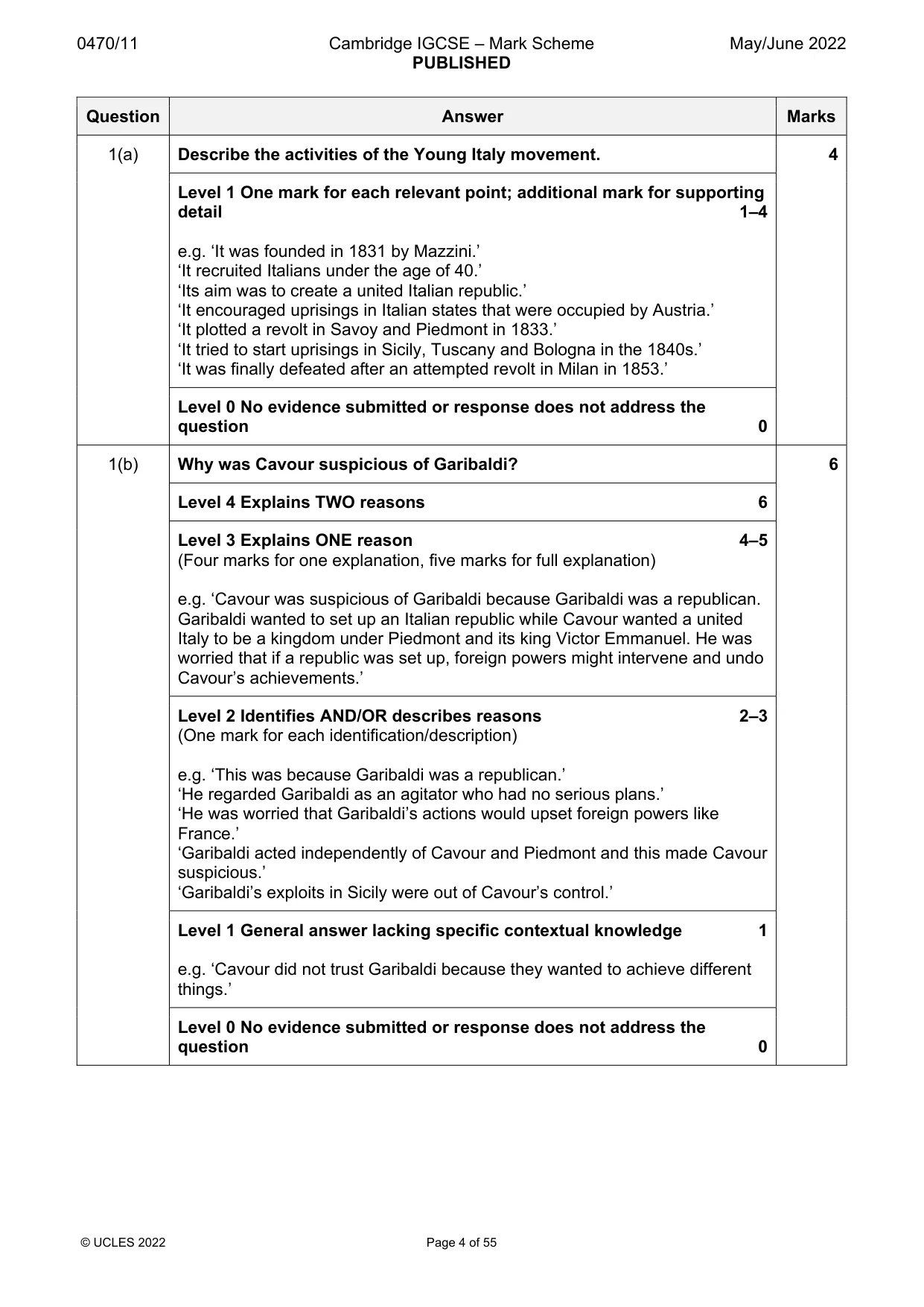
0470/11 Cambridge IGCSE – Mark Scheme PUBLISHED May/June 2022 © UCLES 2022 Page 4 of 55 Question Answer Marks 1(a) Describe the activities of the Young Italy movement. 4 Level 1 One mark for each relevant point; additional mark for supporting detail 1–4 e.g. ‘It was founded in 1831 by Mazzini.’ ‘It recruited Italians under the age of 40.’ ‘Its aim was to create a united Italian republic.’ ‘It encouraged uprisings in Italian states that were occupied by Austria.’ ‘It plotted a revolt in Savoy and Piedmont in 1833.’ ‘It tried to start uprisings in Sicily, Tuscany and Bologna in the 1840s.’ ‘It was finally defeated after an attempted revolt in Milan in 1853.’ Level 0 No evidence submitted or response does not address the question 0 1(b) Why was Cavour suspicious of Garibaldi? 6 Level 4 Explains TWO reasons 6 Level 3 Explains ONE reason 4–5 (Four marks for one explanation, five marks for full explanation) e.g. ‘Cavour was suspicious of Garibaldi because Garibaldi was a republican. Garibaldi wanted to set up an Italian republic while Cavour wanted a united Italy to be a kingdom under Piedmont and its king Victor Emmanuel. He was worried that if a republic was set up, foreign powers might intervene and undo Cavour’s achievements.’ Level 2 Identifies AND/OR describes reasons 2–3 (One mark for each identification/description) e.g. ‘This was because Garibaldi was a republican.’ ‘He regarded Garibaldi as an agitator who had no serious plans.’ ‘He was worried that Garibaldi’s actions would upset foreign powers like France.’ ‘Garibaldi acted independently of Cavour and Piedmont and this made Cavour suspicious.’ ‘Garibaldi’s exploits in Sicily were out of Cavour’s control.’ Level 1 General answer lacking specific contextual knowledge 1 e.g. ‘Cavour did not trust Garibaldi because they wanted to achieve different things.’ Level 0 No evidence submitted or response does not address the question 0
Mark scheme, page 5
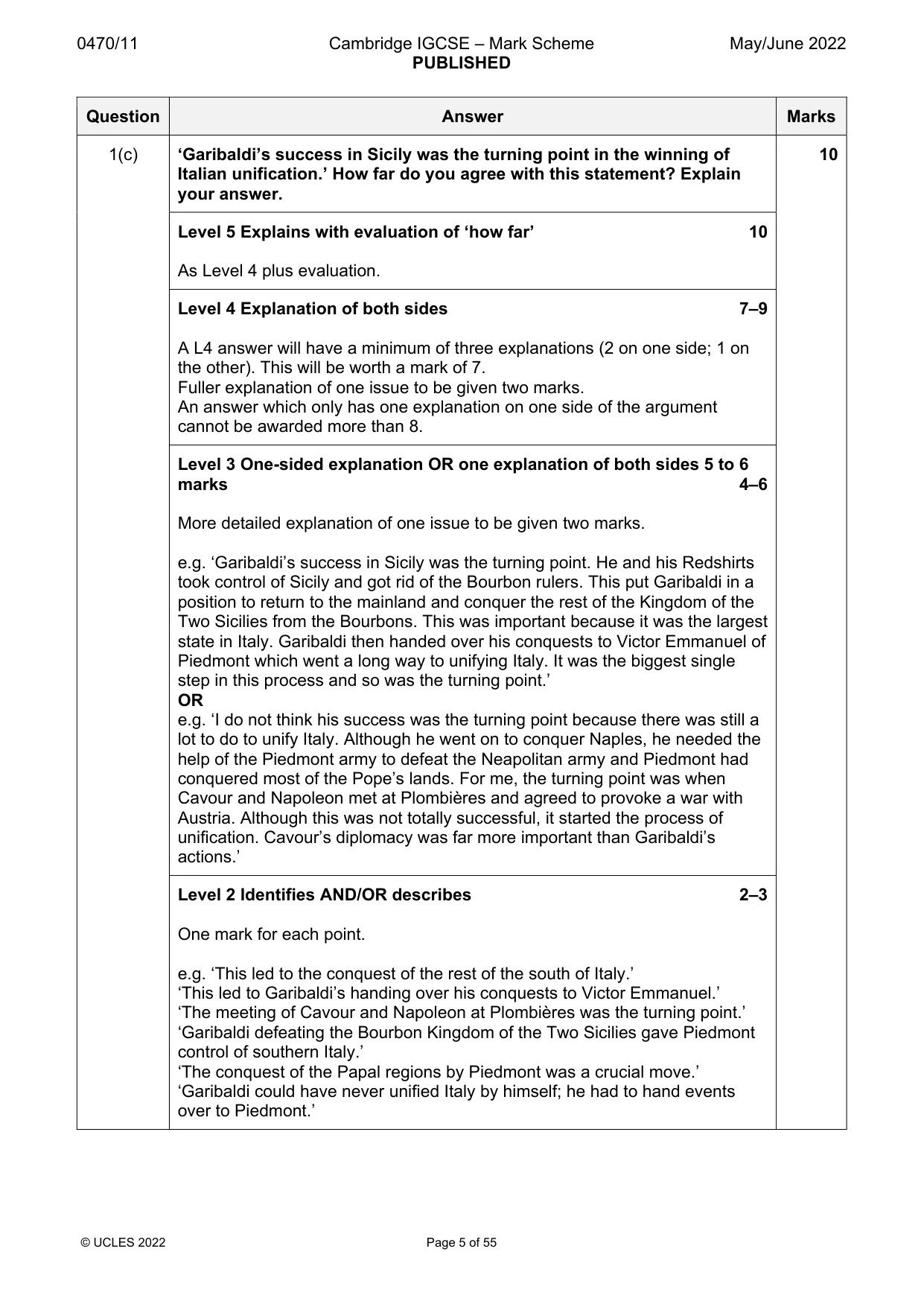
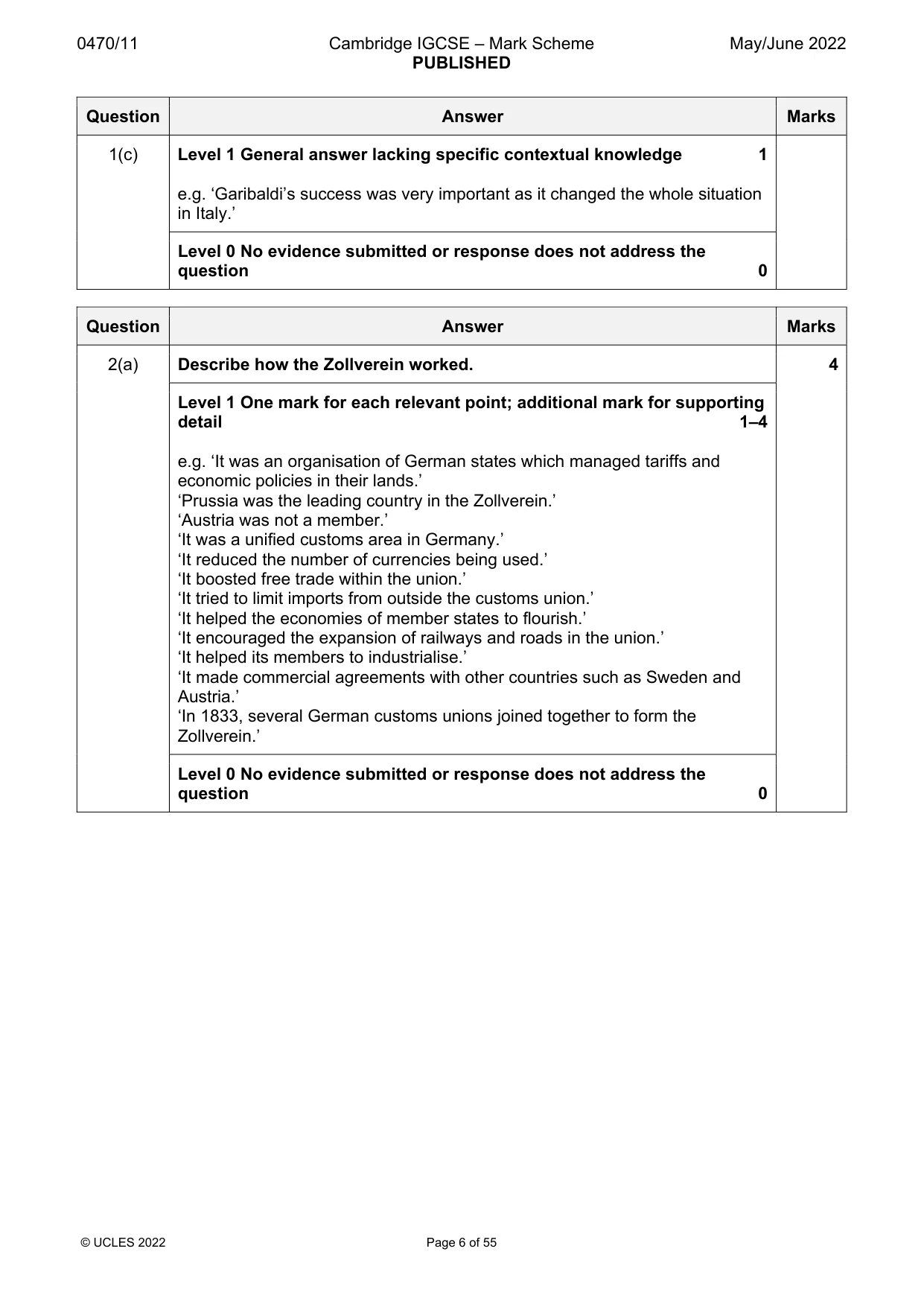
0470/11 Cambridge IGCSE – Mark Scheme PUBLISHED May/June 2022 © UCLES 2022 Page 5 of 55 Question Answer Marks 1(c) ‘Garibaldi’s success in Sicily was the turning point in the winning of Italian unification.’ How far do you agree with this statement? Explain your answer. 10 Level 5 Explains with evaluation of ‘how far’ 10 As Level 4 plus evaluation. Level 4 Explanation of both sides 7–9 A L4 answer will have a minimum of three explanations (2 on one side; 1 on the other). This will be worth a mark of 7. Fuller explanation of one issue to be given two marks. An answer which only has one explanation on one side of the argument cannot be awarded more than 8. Level 3 One-sided explanation OR one explanation of both sides 5 to 6 marks 4–6 More detailed explanation of one issue to be given two marks. e.g. ‘Garibaldi’s success in Sicily was the turning point. He and his Redshirts took control of Sicily and got rid of the Bourbon rulers. This put Garibaldi in a position to return to the mainland and conquer the rest of the Kingdom of the Two Sicilies from the Bourbons. This was important because it was the largest state in Italy. Garibaldi then handed over his conquests to Victor Emmanuel of Piedmont which went a long way to unifying Italy. It was the biggest single step in this process and so was the turning point.’ OR e.g. ‘I do not think his success was the turning point because there was still a lot to do to unify Italy. Although he went on to conquer Naples, he needed the help of the Piedmont army to defeat the Neapolitan army and Piedmont had conquered most of the Pope’s lands. For me, the turning point was when Cavour and Napoleon met at Plombières and agreed to provoke a war with Austria. Although this was not totally successful, it started the process of unification. Cavour’s diplomacy was far more important than Garibaldi’s actions.’ Level 2 Identifies AND/OR describes 2–3 One mark for each point. e.g. ‘This led to the conquest of the rest of the south of Italy.’ ‘This led to Garibaldi’s handing over his conquests to Victor Emmanuel.’ ‘The meeting of Cavour and Napoleon at Plombières was the turning point.’ ‘Garibaldi defeating the Bourbon Kingdom of the Two Sicilies gave Piedmont control of southern Italy.’ ‘The conquest of the Papal regions by Piedmont was a crucial move.’ ‘Garibaldi could have never unified Italy by himself; he had to hand events over to Piedmont.’
Mark scheme, page 6
0470/11 Cambridge IGCSE – Mark Scheme PUBLISHED May/June 2022 © UCLES 2022 Page 6 of 55 Question Answer Marks 1(c) Level 1 General answer lacking specific contextual knowledge 1 e.g. ‘Garibaldi’s success was very important as it changed the whole situation in Italy.’ Level 0 No evidence submitted or response does not address the question 0 Question Answer Marks 2(a) Describe how the Zollverein worked. 4 Level 1 One mark for each relevant point; additional mark for supporting detail 1–4 e.g. ‘It was an organisation of German states which managed tariffs and economic policies in their lands.’ ‘Prussia was the leading country in the Zollverein.’ ‘Austria was not a member.’ ‘It was a unified customs area in Germany.’ ‘It reduced the number of currencies being used.’ ‘It boosted free trade within the union.’ ‘It tried to limit imports from outside the customs union.’ ‘It helped the economies of member states to flourish.’ ‘It encouraged the expansion of railways and roads in the union.’ ‘It helped its members to industrialise.’ ‘It made commercial agreements with other countries such as Sweden and Austria.’ ‘In 1833, several German customs unions joined together to form the Zollverein.’ Level 0 No evidence submitted or response does not address the question 0
Mark scheme, page 7
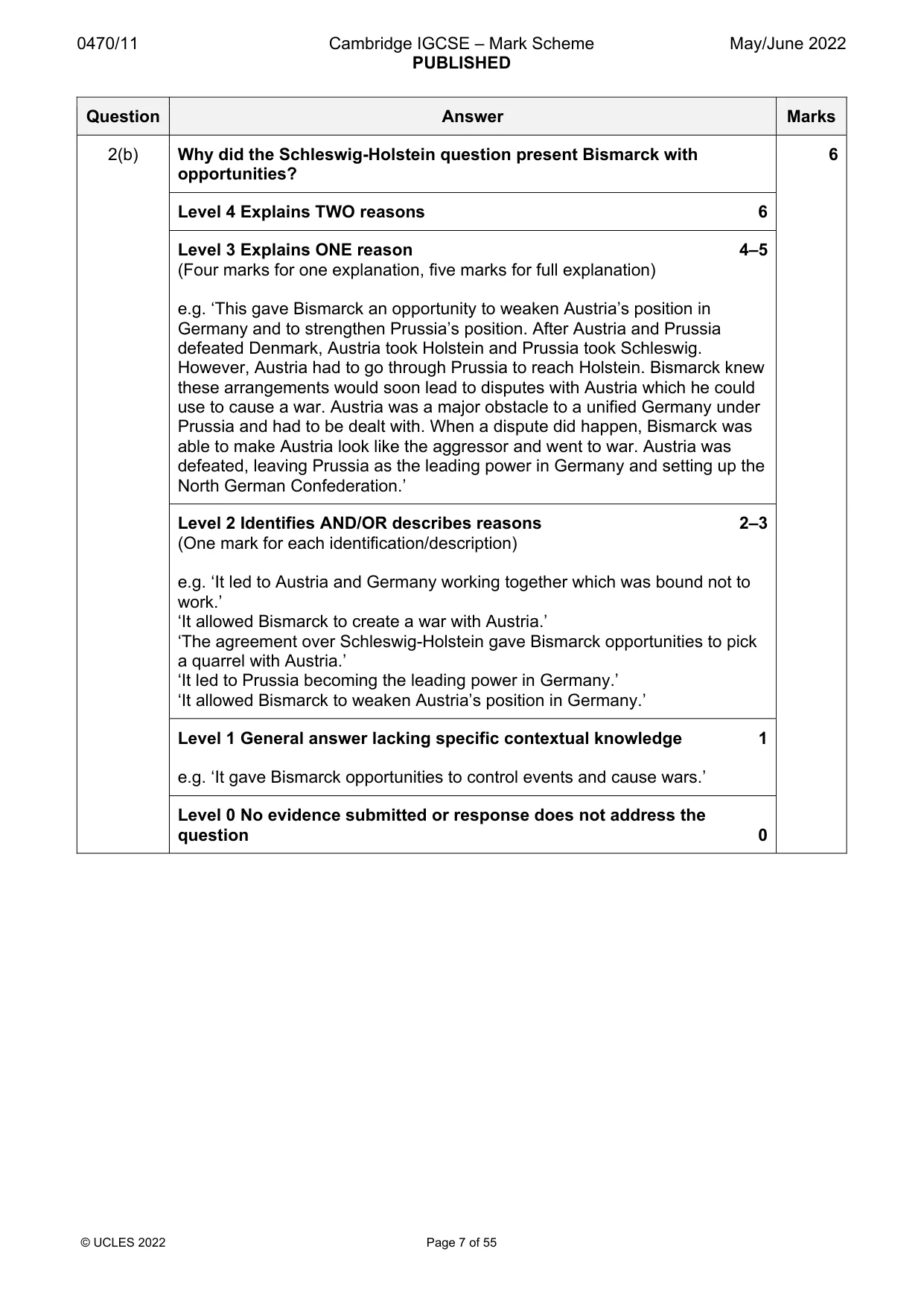
0470/11 Cambridge IGCSE – Mark Scheme PUBLISHED May/June 2022 © UCLES 2022 Page 7 of 55 Question Answer Marks 2(b) Why did the Schleswig-Holstein question present Bismarck with opportunities? 6 Level 4 Explains TWO reasons 6 Level 3 Explains ONE reason 4–5 (Four marks for one explanation, five marks for full explanation) e.g. ‘This gave Bismarck an opportunity to weaken Austria’s position in Germany and to strengthen Prussia’s position. After Austria and Prussia defeated Denmark, Austria took Holstein and Prussia took Schleswig. However, Austria had to go through Prussia to reach Holstein. Bismarck knew these arrangements would soon lead to disputes with Austria which he could use to cause a war. Austria was a major obstacle to a unified Germany under Prussia and had to be dealt with. When a dispute did happen, Bismarck was able to make Austria look like the aggressor and went to war. Austria was defeated, leaving Prussia as the leading power in Germany and setting up the North German Confederation.’ Level 2 Identifies AND/OR describes reasons 2–3 (One mark for each identification/description) e.g. ‘It led to Austria and Germany working together which was bound not to work.’ ‘It allowed Bismarck to create a war with Austria.’ ‘The agreement over Schleswig-Holstein gave Bismarck opportunities to pick a quarrel with Austria.’ ‘It led to Prussia becoming the leading power in Germany.’ ‘It allowed Bismarck to weaken Austria’s position in Germany.’ Level 1 General answer lacking specific contextual knowledge 1 e.g. ‘It gave Bismarck opportunities to control events and cause wars.’ Level 0 No evidence submitted or response does not address the question 0
Mark scheme, page 8
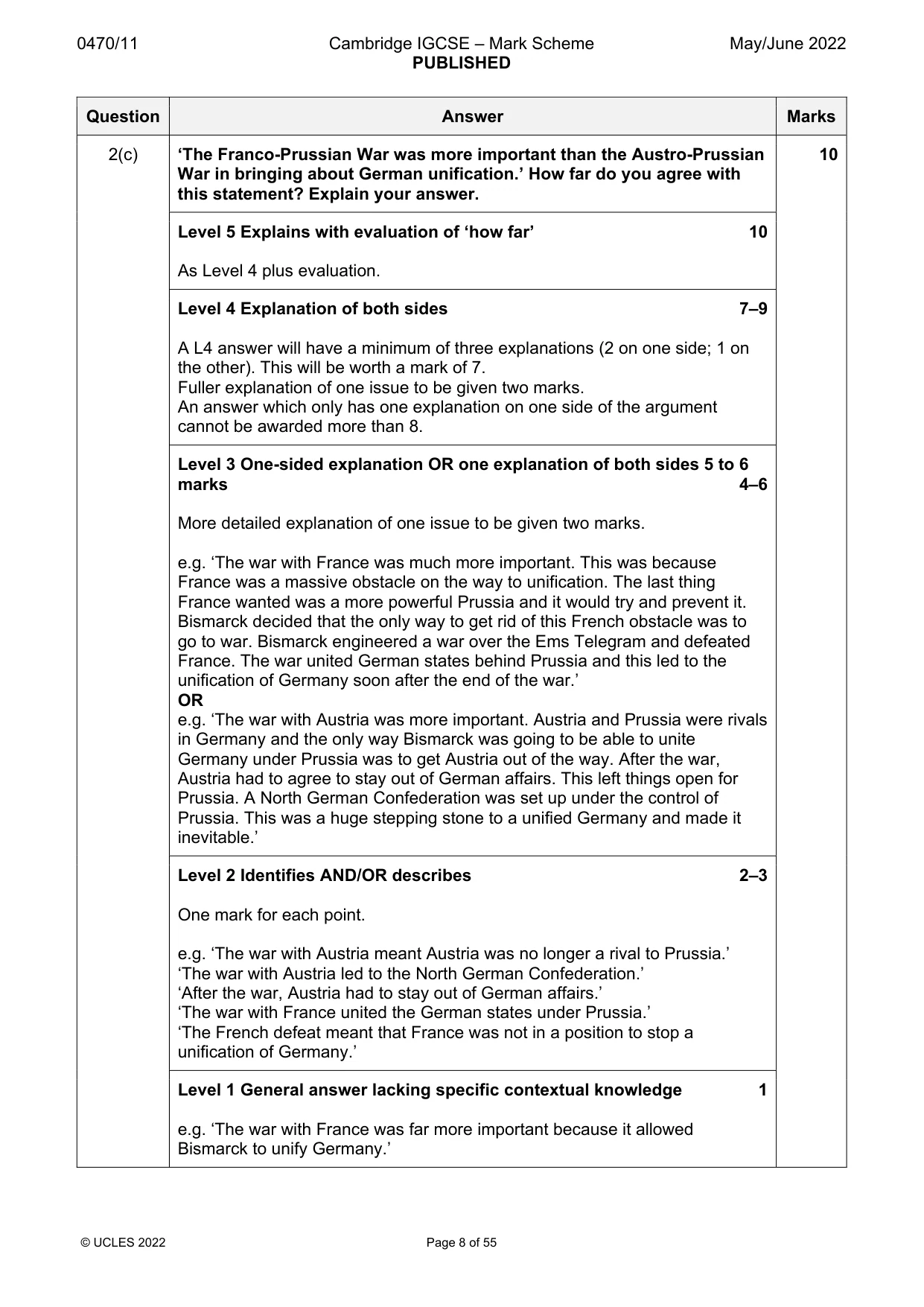
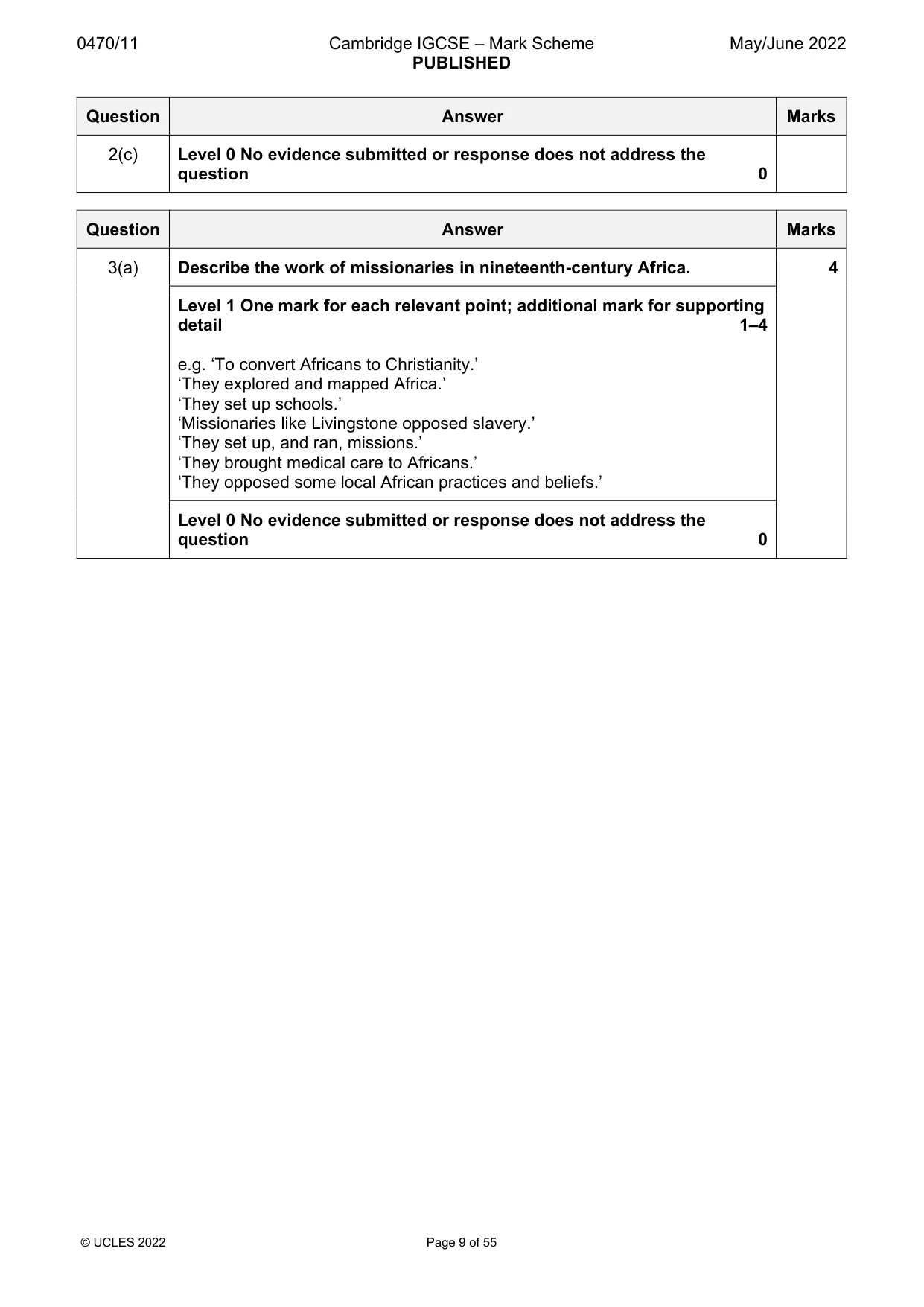
0470/11 Cambridge IGCSE – Mark Scheme PUBLISHED May/June 2022 © UCLES 2022 Page 8 of 55 Question Answer Marks 2(c) ‘The Franco-Prussian War was more important than the Austro-Prussian War in bringing about German unification.’ How far do you agree with this statement? Explain your answer. 10 Level 5 Explains with evaluation of ‘how far’ 10 As Level 4 plus evaluation. Level 4 Explanation of both sides 7–9 A L4 answer will have a minimum of three explanations (2 on one side; 1 on the other). This will be worth a mark of 7. Fuller explanation of one issue to be given two marks. An answer which only has one explanation on one side of the argument cannot be awarded more than 8. Level 3 One-sided explanation OR one explanation of both sides 5 to 6 marks 4–6 More detailed explanation of one issue to be given two marks. e.g. ‘The war with France was much more important. This was because France was a massive obstacle on the way to unification. The last thing France wanted was a more powerful Prussia and it would try and prevent it. Bismarck decided that the only way to get rid of this French obstacle was to go to war. Bismarck engineered a war over the Ems Telegram and defeated France. The war united German states behind Prussia and this led to the unification of Germany soon after the end of the war.’ OR e.g. ‘The war with Austria was more important. Austria and Prussia were rivals in Germany and the only way Bismarck was going to be able to unite Germany under Prussia was to get Austria out of the way. After the war, Austria had to agree to stay out of German affairs. This left things open for Prussia. A North German Confederation was set up under the control of Prussia. This was a huge stepping stone to a unified Germany and made it inevitable.’ Level 2 Identifies AND/OR describes 2–3 One mark for each point. e.g. ‘The war with Austria meant Austria was no longer a rival to Prussia.’ ‘The war with Austria led to the North German Confederation.’ ‘After the war, Austria had to stay out of German affairs.’ ‘The war with France united the German states under Prussia.’ ‘The French defeat meant that France was not in a position to stop a unification of Germany.’ Level 1 General answer lacking specific contextual knowledge 1 e.g. ‘The war with France was far more important because it allowed Bismarck to unify Germany.’
Mark scheme, page 9
0470/11 Cambridge IGCSE – Mark Scheme PUBLISHED May/June 2022 © UCLES 2022 Page 9 of 55 Question Answer Marks 2(c) Level 0 No evidence submitted or response does not address the question 0 Question Answer Marks 3(a) Describe the work of missionaries in nineteenth-century Africa. 4 Level 1 One mark for each relevant point; additional mark for supporting detail 1–4 e.g. ‘To convert Africans to Christianity.’ ‘They explored and mapped Africa.’ ‘They set up schools.’ ‘Missionaries like Livingstone opposed slavery.’ ‘They set up, and ran, missions.’ ‘They brought medical care to Africans.’ ‘They opposed some local African practices and beliefs.’ Level 0 No evidence submitted or response does not address the question 0
Mark scheme, page 10
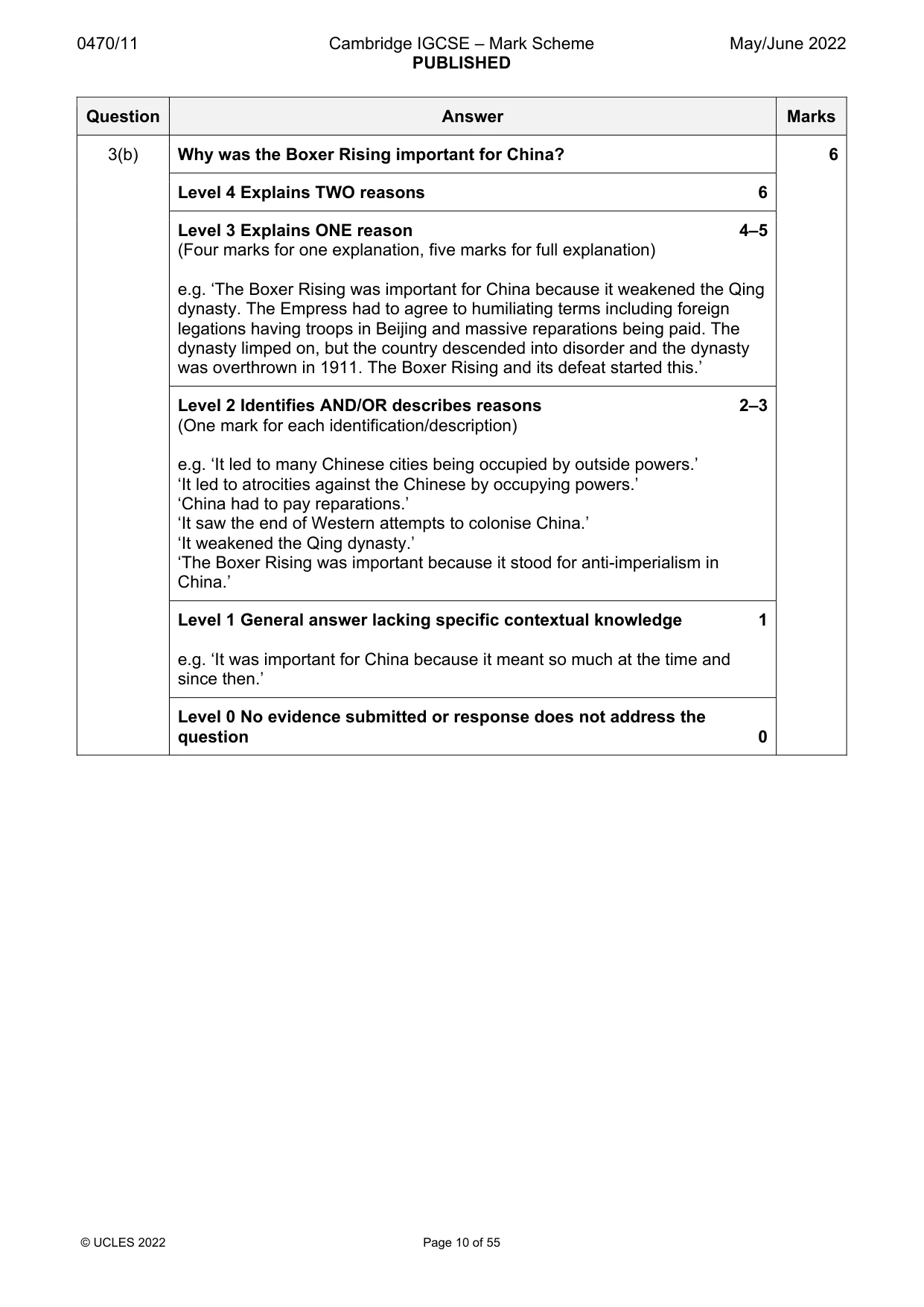
0470/11 Cambridge IGCSE – Mark Scheme PUBLISHED May/June 2022 © UCLES 2022 Page 10 of 55 Question Answer Marks 3(b) Why was the Boxer Rising important for China? 6 Level 4 Explains TWO reasons 6 Level 3 Explains ONE reason 4–5 (Four marks for one explanation, five marks for full explanation) e.g. ‘The Boxer Rising was important for China because it weakened the Qing dynasty. The Empress had to agree to humiliating terms including foreign legations having troops in Beijing and massive reparations being paid. The dynasty limped on, but the country descended into disorder and the dynasty was overthrown in 1911. The Boxer Rising and its defeat started this.’ Level 2 Identifies AND/OR describes reasons 2–3 (One mark for each identification/description) e.g. ‘It led to many Chinese cities being occupied by outside powers.’ ‘It led to atrocities against the Chinese by occupying powers.’ ‘China had to pay reparations.’ ‘It saw the end of Western attempts to colonise China.’ ‘It weakened the Qing dynasty.’ ‘The Boxer Rising was important because it stood for anti-imperialism in China.’ Level 1 General answer lacking specific contextual knowledge 1 e.g. ‘It was important for China because it meant so much at the time and since then.’ Level 0 No evidence submitted or response does not address the question 0
Mark scheme, page 11
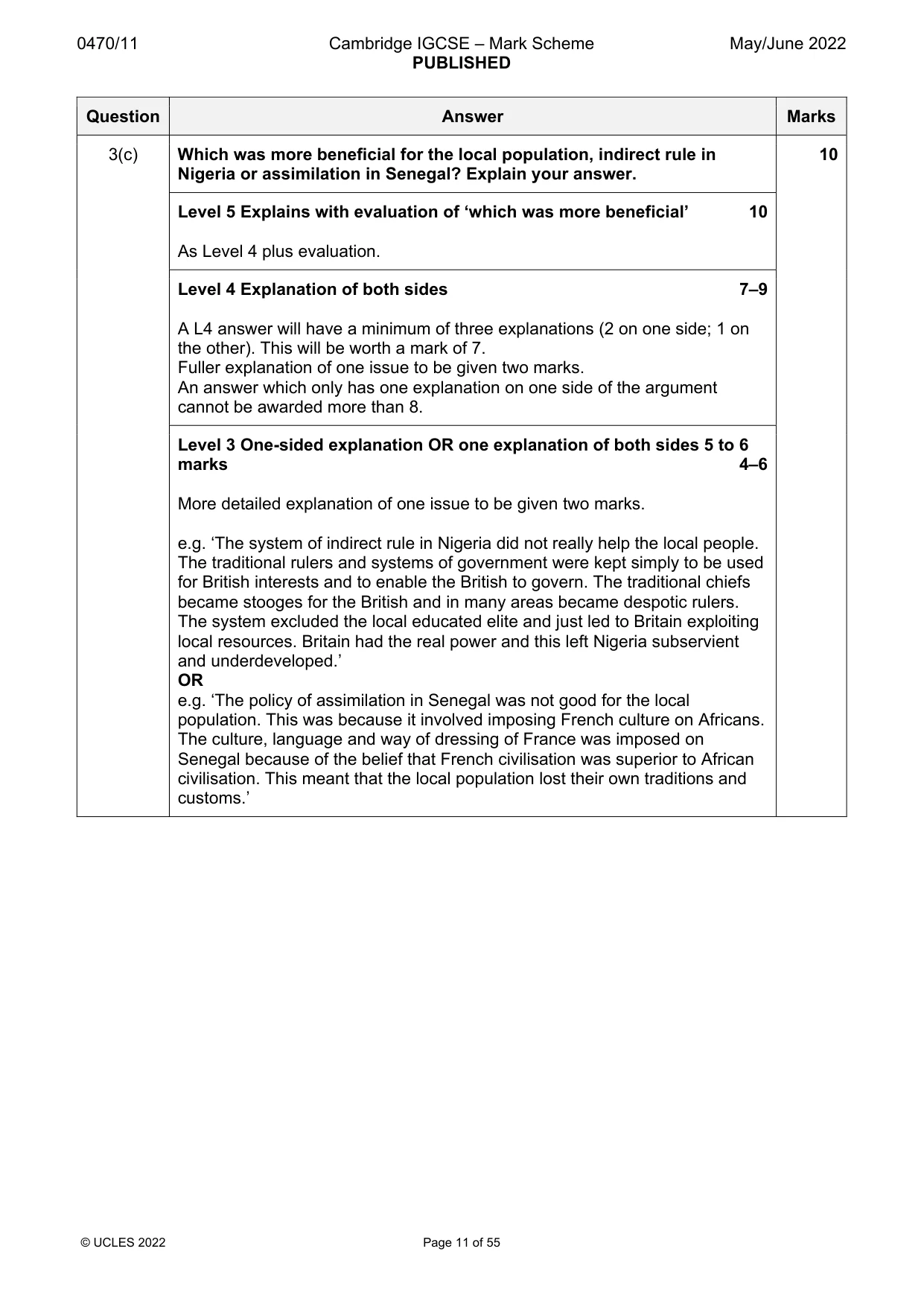
0470/11 Cambridge IGCSE – Mark Scheme PUBLISHED May/June 2022 © UCLES 2022 Page 11 of 55 Question Answer Marks 3(c) Which was more beneficial for the local population, indirect rule in Nigeria or assimilation in Senegal? Explain your answer. 10 Level 5 Explains with evaluation of ‘which was more beneficial’ 10 As Level 4 plus evaluation. Level 4 Explanation of both sides 7–9 A L4 answer will have a minimum of three explanations (2 on one side; 1 on the other). This will be worth a mark of 7. Fuller explanation of one issue to be given two marks. An answer which only has one explanation on one side of the argument cannot be awarded more than 8. Level 3 One-sided explanation OR one explanation of both sides 5 to 6 marks 4–6 More detailed explanation of one issue to be given two marks. e.g. ‘The system of indirect rule in Nigeria did not really help the local people. The traditional rulers and systems of government were kept simply to be used for British interests and to enable the British to govern. The traditional chiefs became stooges for the British and in many areas became despotic rulers. The system excluded the local educated elite and just led to Britain exploiting local resources. Britain had the real power and this left Nigeria subservient and underdeveloped.’ OR e.g. ‘The policy of assimilation in Senegal was not good for the local population. This was because it involved imposing French culture on Africans. The culture, language and way of dressing of France was imposed on Senegal because of the belief that French civilisation was superior to African civilisation. This meant that the local population lost their own traditions and customs.’
Mark scheme, page 12
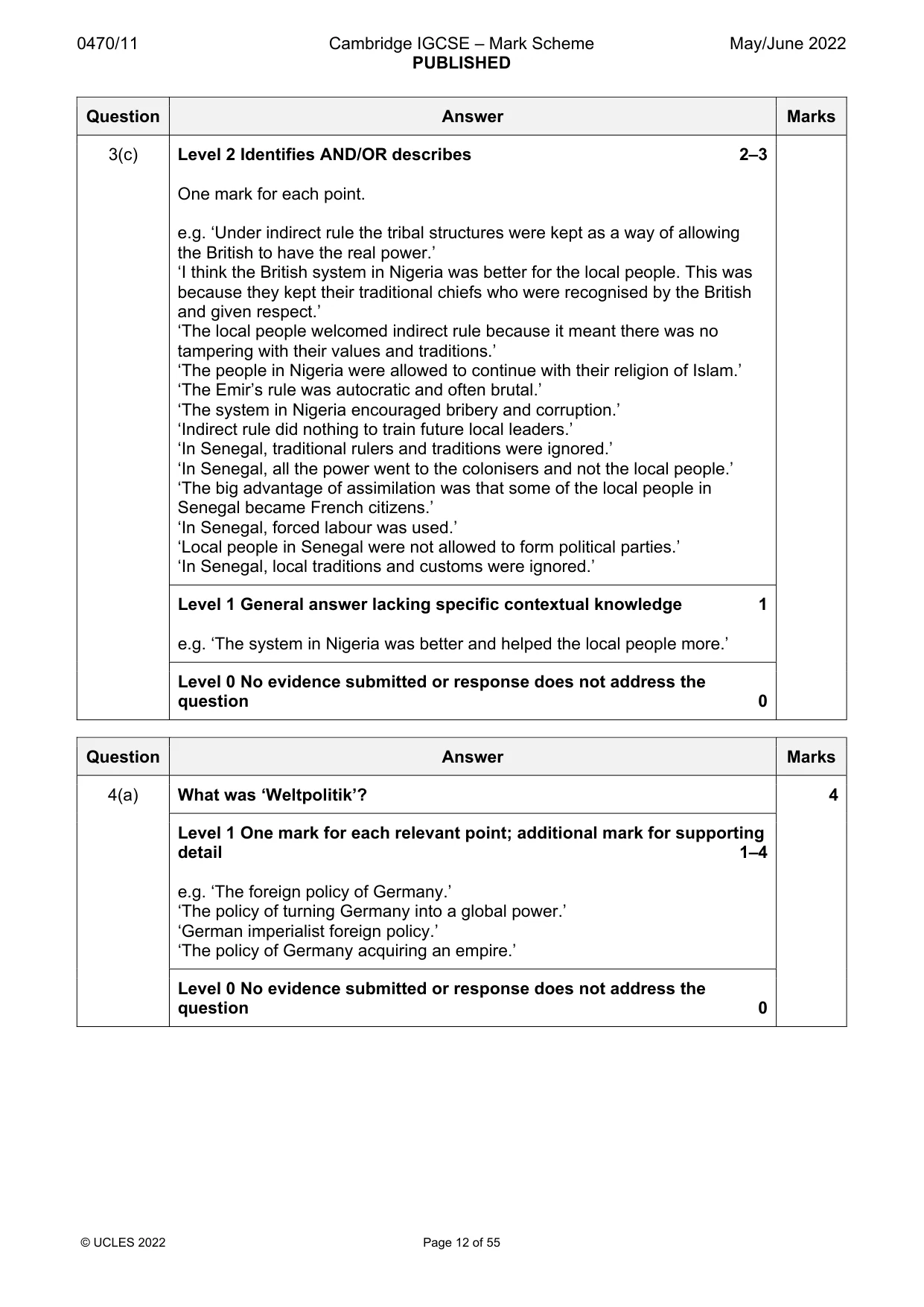
0470/11 Cambridge IGCSE – Mark Scheme PUBLISHED May/June 2022 © UCLES 2022 Page 12 of 55 Question Answer Marks 3(c) Level 2 Identifies AND/OR describes 2–3 One mark for each point. e.g. ‘Under indirect rule the tribal structures were kept as a way of allowing the British to have the real power.’ ‘I think the British system in Nigeria was better for the local people. This was because they kept their traditional chiefs who were recognised by the British and given respect.’ ‘The local people welcomed indirect rule because it meant there was no tampering with their values and traditions.’ ‘The people in Nigeria were allowed to continue with their religion of Islam.’ ‘The Emir’s rule was autocratic and often brutal.’ ‘The system in Nigeria encouraged bribery and corruption.’ ‘Indirect rule did nothing to train future local leaders.’ ‘In Senegal, traditional rulers and traditions were ignored.’ ‘In Senegal, all the power went to the colonisers and not the local people.’ ‘The big advantage of assimilation was that some of the local people in Senegal became French citizens.’ ‘In Senegal, forced labour was used.’ ‘Local people in Senegal were not allowed to form political parties.’ ‘In Senegal, local traditions and customs were ignored.’ Level 1 General answer lacking specific contextual knowledge 1 e.g. ‘The system in Nigeria was better and helped the local people more.’ Level 0 No evidence submitted or response does not address the question 0 Question Answer Marks 4(a) What was ‘Weltpolitik’? 4 Level 1 One mark for each relevant point; additional mark for supporting detail 1–4 e.g. ‘The foreign policy of Germany.’ ‘The policy of turning Germany into a global power.’ ‘German imperialist foreign policy.’ ‘The policy of Germany acquiring an empire.’ Level 0 No evidence submitted or response does not address the question 0
Mark scheme, page 13
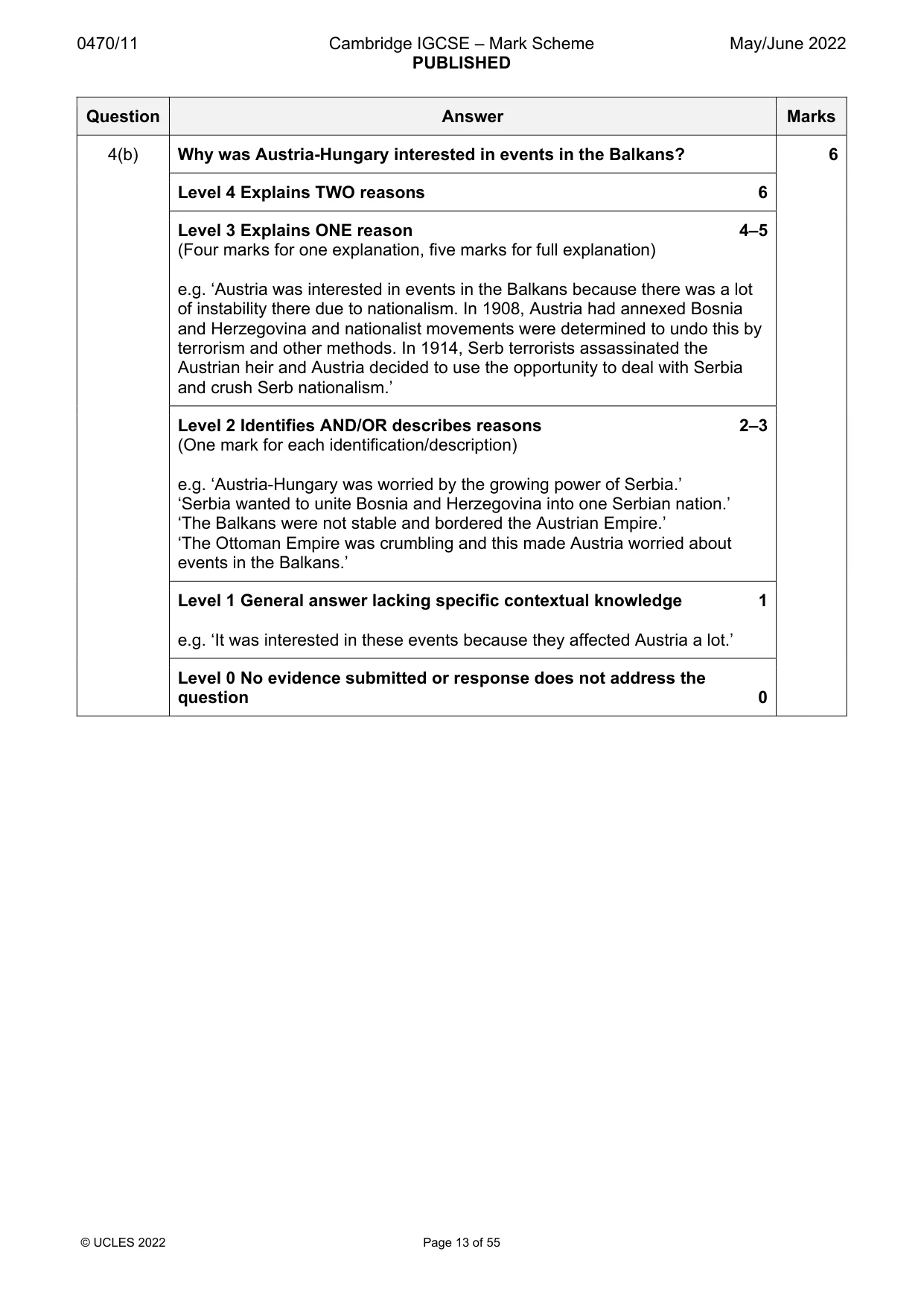
0470/11 Cambridge IGCSE – Mark Scheme PUBLISHED May/June 2022 © UCLES 2022 Page 13 of 55 Question Answer Marks 4(b) Why was Austria-Hungary interested in events in the Balkans? 6 Level 4 Explains TWO reasons 6 Level 3 Explains ONE reason 4–5 (Four marks for one explanation, five marks for full explanation) e.g. ‘Austria was interested in events in the Balkans because there was a lot of instability there due to nationalism. In 1908, Austria had annexed Bosnia and Herzegovina and nationalist movements were determined to undo this by terrorism and other methods. In 1914, Serb terrorists assassinated the Austrian heir and Austria decided to use the opportunity to deal with Serbia and crush Serb nationalism.’ Level 2 Identifies AND/OR describes reasons 2–3 (One mark for each identification/description) e.g. ‘Austria-Hungary was worried by the growing power of Serbia.’ ‘Serbia wanted to unite Bosnia and Herzegovina into one Serbian nation.’ ‘The Balkans were not stable and bordered the Austrian Empire.’ ‘The Ottoman Empire was crumbling and this made Austria worried about events in the Balkans.’ Level 1 General answer lacking specific contextual knowledge 1 e.g. ‘It was interested in these events because they affected Austria a lot.’ Level 0 No evidence submitted or response does not address the question 0
Mark scheme, page 14
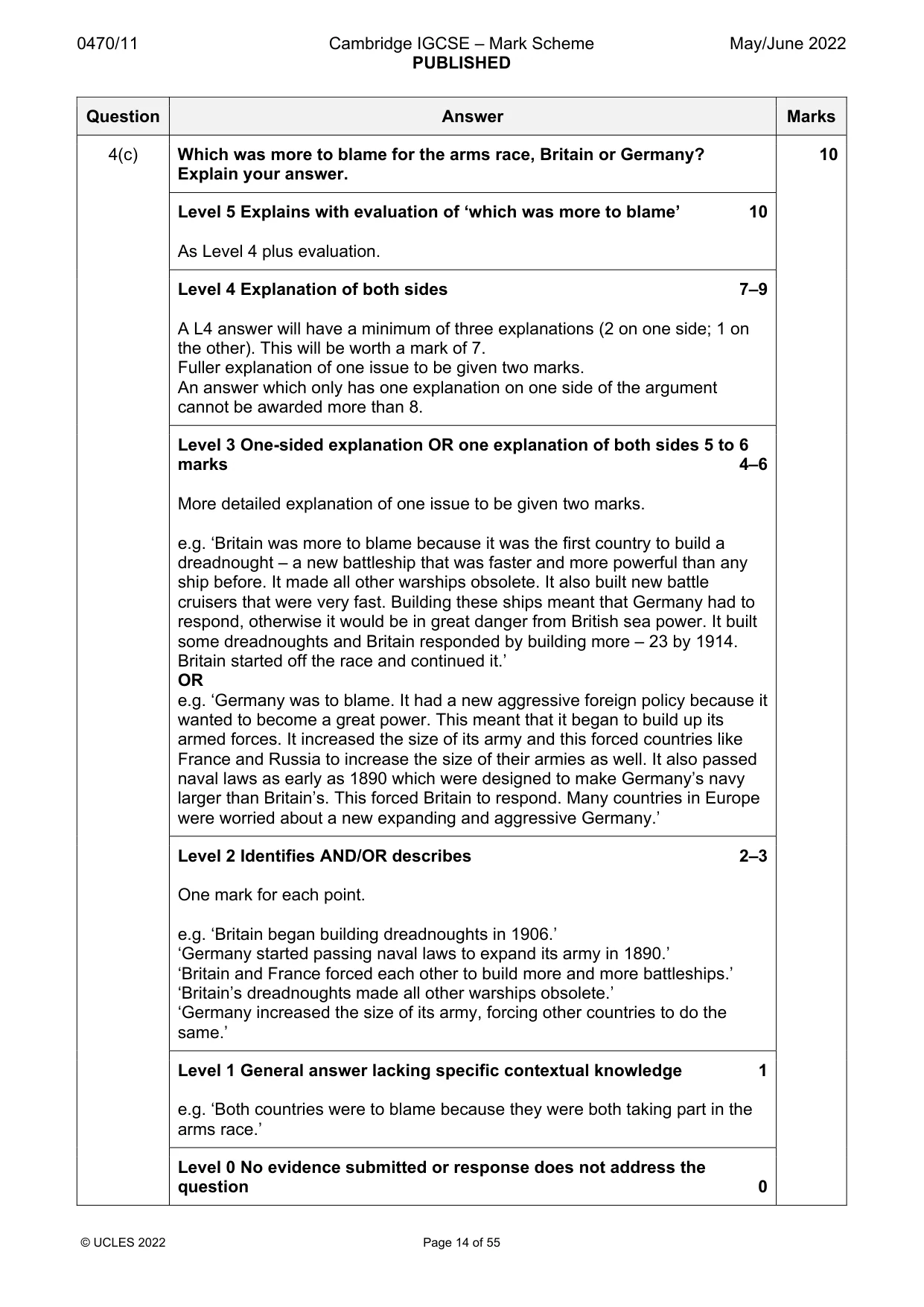
0470/11 Cambridge IGCSE – Mark Scheme PUBLISHED May/June 2022 © UCLES 2022 Page 14 of 55 Question Answer Marks 4(c) Which was more to blame for the arms race, Britain or Germany? Explain your answer. 10 Level 5 Explains with evaluation of ‘which was more to blame’ 10 As Level 4 plus evaluation. Level 4 Explanation of both sides 7–9 A L4 answer will have a minimum of three explanations (2 on one side; 1 on the other). This will be worth a mark of 7. Fuller explanation of one issue to be given two marks. An answer which only has one explanation on one side of the argument cannot be awarded more than 8. Level 3 One-sided explanation OR one explanation of both sides 5 to 6 marks 4–6 More detailed explanation of one issue to be given two marks. e.g. ‘Britain was more to blame because it was the first country to build a dreadnought – a new battleship that was faster and more powerful than any ship before. It made all other warships obsolete. It also built new battle cruisers that were very fast. Building these ships meant that Germany had to respond, otherwise it would be in great danger from British sea power. It built some dreadnoughts and Britain responded by building more – 23 by 1914. Britain started off the race and continued it.’ OR e.g. ‘Germany was to blame. It had a new aggressive foreign policy because it wanted to become a great power. This meant that it began to build up its armed forces. It increased the size of its army and this forced countries like France and Russia to increase the size of their armies as well. It also passed naval laws as early as 1890 which were designed to make Germany’s navy larger than Britain’s. This forced Britain to respond. Many countries in Europe were worried about a new expanding and aggressive Germany.’ Level 2 Identifies AND/OR describes 2–3 One mark for each point. e.g. ‘Britain began building dreadnoughts in 1906.’ ‘Germany started passing naval laws to expand its army in 1890.’ ‘Britain and France forced each other to build more and more battleships.’ ‘Britain’s dreadnoughts made all other warships obsolete.’ ‘Germany increased the size of its army, forcing other countries to do the same.’ Level 1 General answer lacking specific contextual knowledge 1 e.g. ‘Both countries were to blame because they were both taking part in the arms race.’ Level 0 No evidence submitted or response does not address the question 0
Mark scheme, page 15
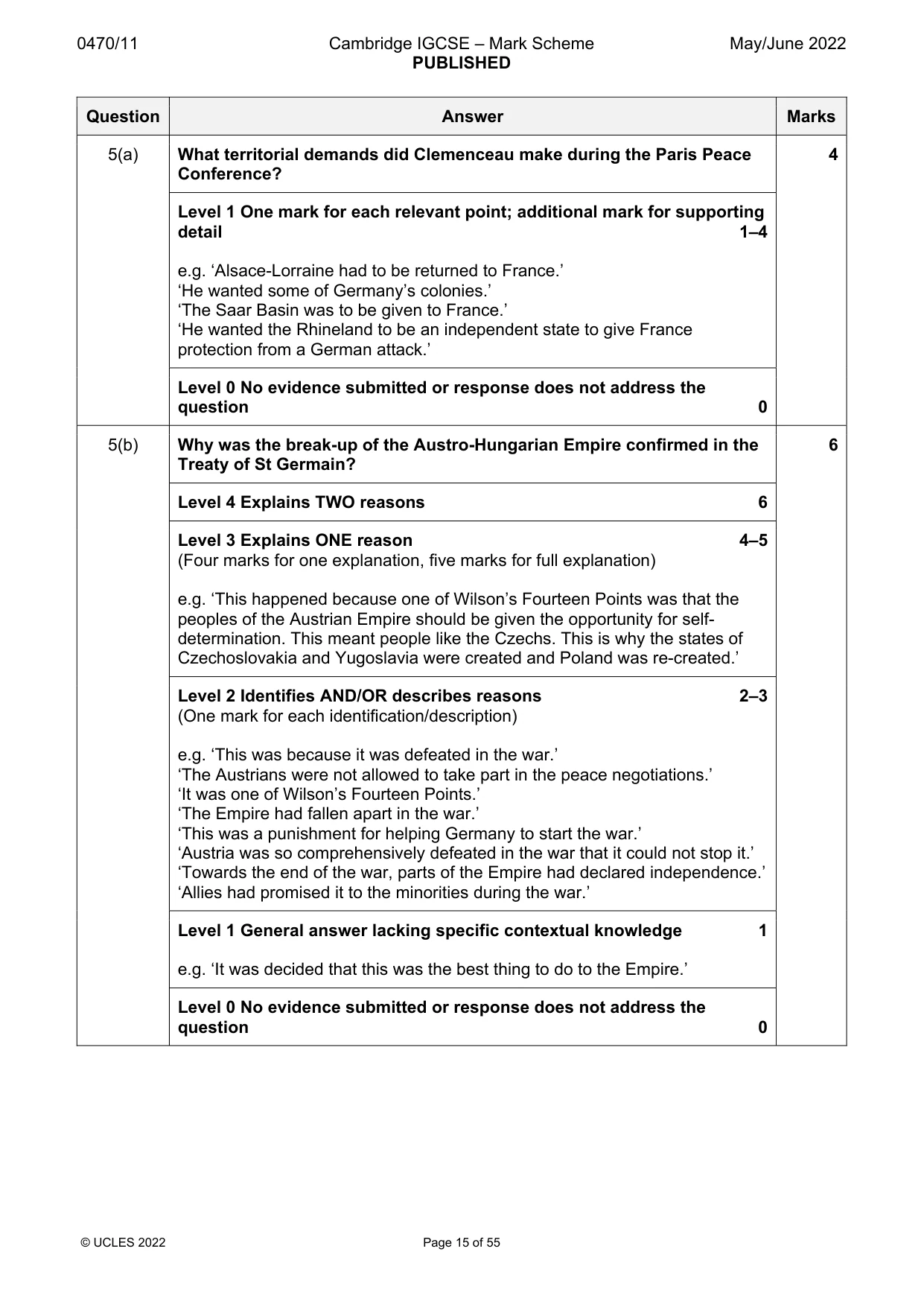
0470/11 Cambridge IGCSE – Mark Scheme PUBLISHED May/June 2022 © UCLES 2022 Page 15 of 55 Question Answer Marks 5(a) What territorial demands did Clemenceau make during the Paris Peace Conference? 4 Level 1 One mark for each relevant point; additional mark for supporting detail 1–4 e.g. ‘Alsace-Lorraine had to be returned to France.’ ‘He wanted some of Germany’s colonies.’ ‘The Saar Basin was to be given to France.’ ‘He wanted the Rhineland to be an independent state to give France protection from a German attack.’ Level 0 No evidence submitted or response does not address the question 0 5(b) Why was the break-up of the Austro-Hungarian Empire confirmed in the Treaty of St Germain? 6 Level 4 Explains TWO reasons 6 Level 3 Explains ONE reason 4–5 (Four marks for one explanation, five marks for full explanation) e.g. ‘This happened because one of Wilson’s Fourteen Points was that the peoples of the Austrian Empire should be given the opportunity for self- determination. This meant people like the Czechs. This is why the states of Czechoslovakia and Yugoslavia were created and Poland was re-created.’ Level 2 Identifies AND/OR describes reasons 2–3 (One mark for each identification/description) e.g. ‘This was because it was defeated in the war.’ ‘The Austrians were not allowed to take part in the peace negotiations.’ ‘It was one of Wilson’s Fourteen Points.’ ‘The Empire had fallen apart in the war.’ ‘This was a punishment for helping Germany to start the war.’ ‘Austria was so comprehensively defeated in the war that it could not stop it.’ ‘Towards the end of the war, parts of the Empire had declared independence.’ ‘Allies had promised it to the minorities during the war.’ Level 1 General answer lacking specific contextual knowledge 1 e.g. ‘It was decided that this was the best thing to do to the Empire.’ Level 0 No evidence submitted or response does not address the question 0
Mark scheme, page 16
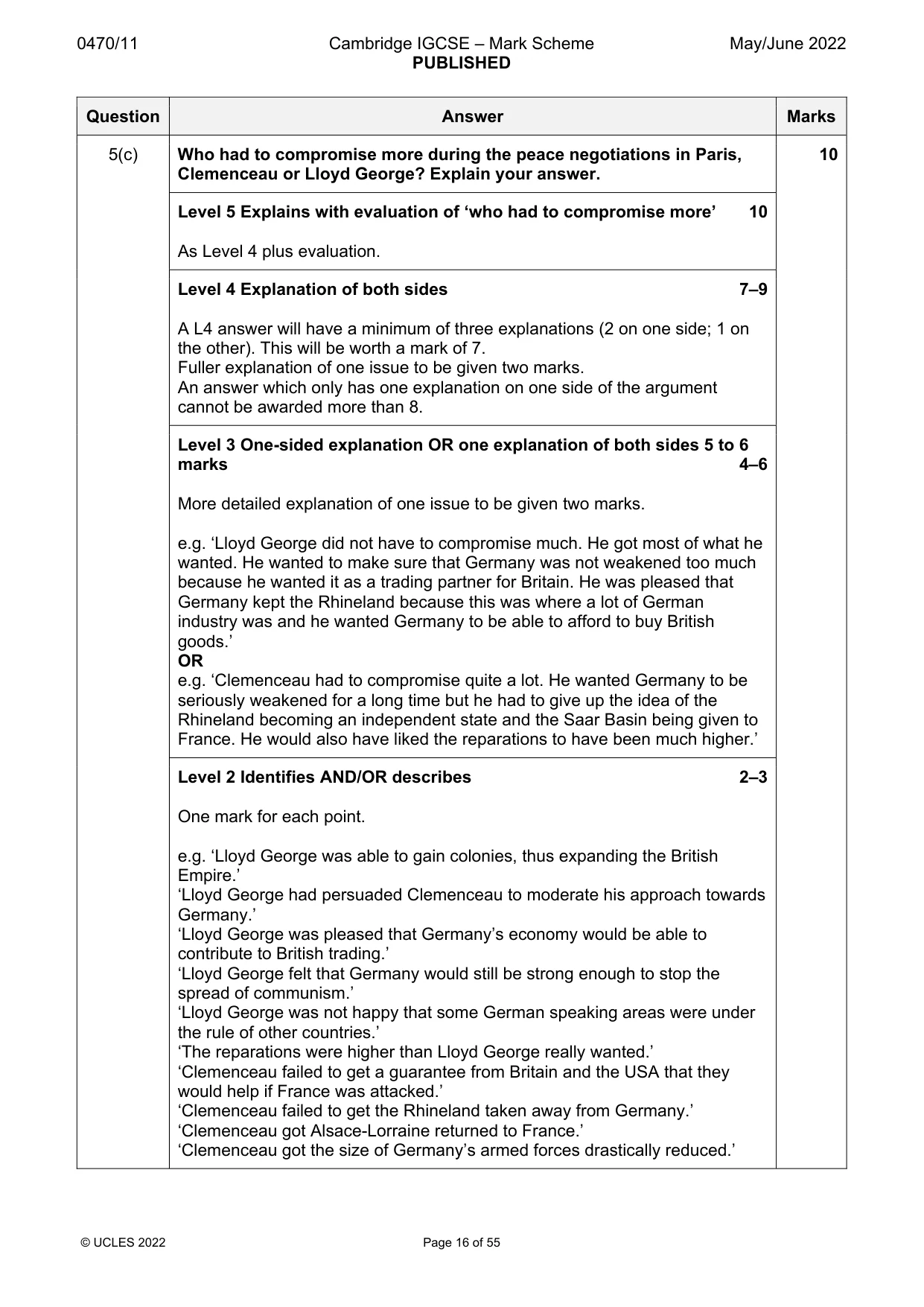
0470/11 Cambridge IGCSE – Mark Scheme PUBLISHED May/June 2022 © UCLES 2022 Page 16 of 55 Question Answer Marks 5(c) Who had to compromise more during the peace negotiations in Paris, Clemenceau or Lloyd George? Explain your answer. 10 Level 5 Explains with evaluation of ‘who had to compromise more’ 10 As Level 4 plus evaluation. Level 4 Explanation of both sides 7–9 A L4 answer will have a minimum of three explanations (2 on one side; 1 on the other). This will be worth a mark of 7. Fuller explanation of one issue to be given two marks. An answer which only has one explanation on one side of the argument cannot be awarded more than 8. Level 3 One-sided explanation OR one explanation of both sides 5 to 6 marks 4–6 More detailed explanation of one issue to be given two marks. e.g. ‘Lloyd George did not have to compromise much. He got most of what he wanted. He wanted to make sure that Germany was not weakened too much because he wanted it as a trading partner for Britain. He was pleased that Germany kept the Rhineland because this was where a lot of German industry was and he wanted Germany to be able to afford to buy British goods.’ OR e.g. ‘Clemenceau had to compromise quite a lot. He wanted Germany to be seriously weakened for a long time but he had to give up the idea of the Rhineland becoming an independent state and the Saar Basin being given to France. He would also have liked the reparations to have been much higher.’ Level 2 Identifies AND/OR describes 2–3 One mark for each point. e.g. ‘Lloyd George was able to gain colonies, thus expanding the British Empire.’ ‘Lloyd George had persuaded Clemenceau to moderate his approach towards Germany.’ ‘Lloyd George was pleased that Germany’s economy would be able to contribute to British trading.’ ‘Lloyd George felt that Germany would still be strong enough to stop the spread of communism.’ ‘Lloyd George was not happy that some German speaking areas were under the rule of other countries.’ ‘The reparations were higher than Lloyd George really wanted.’ ‘Clemenceau failed to get a guarantee from Britain and the USA that they would help if France was attacked.’ ‘Clemenceau failed to get the Rhineland taken away from Germany.’ ‘Clemenceau got Alsace-Lorraine returned to France.’ ‘Clemenceau got the size of Germany’s armed forces drastically reduced.’
Mark scheme, page 17
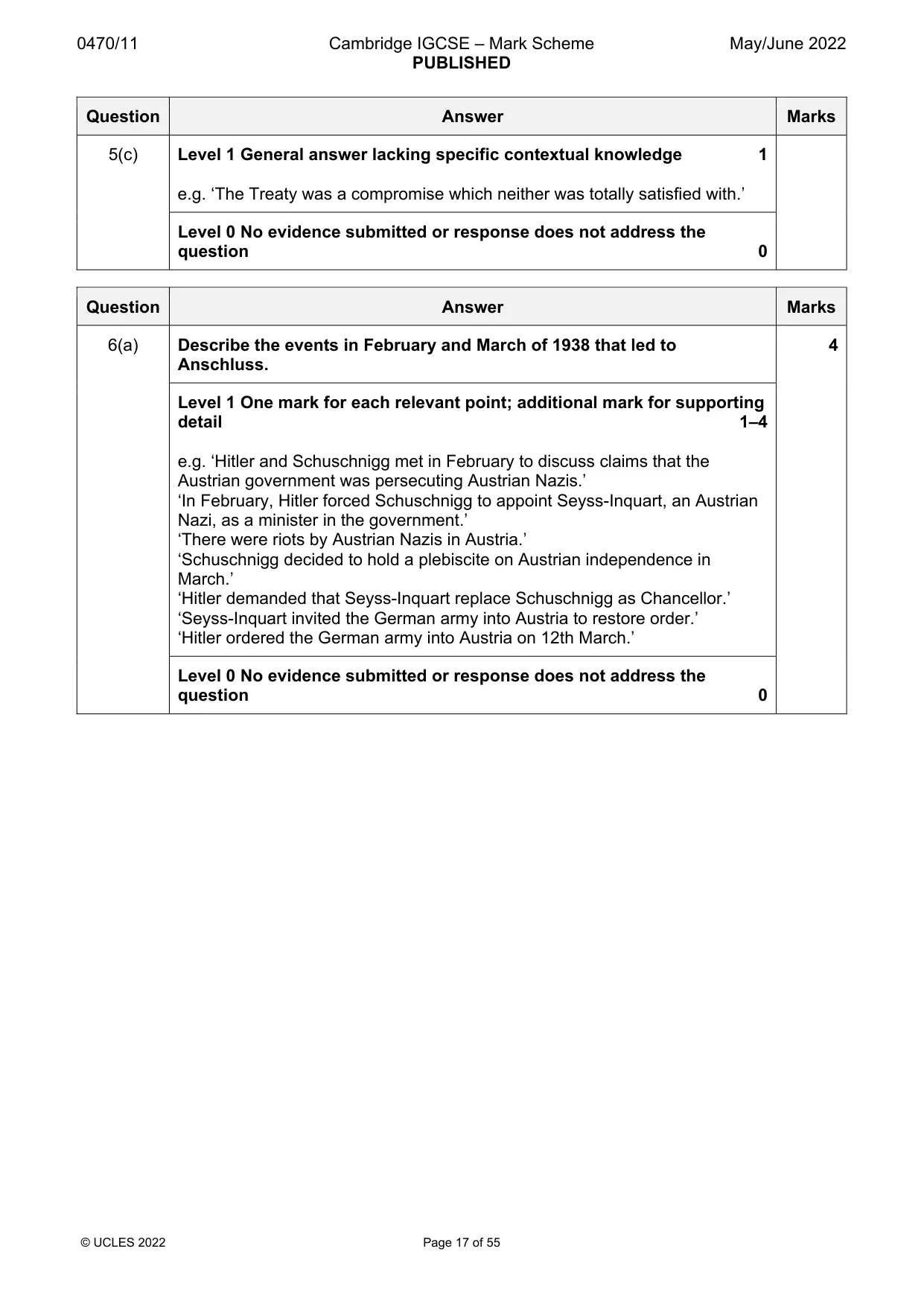
0470/11 Cambridge IGCSE – Mark Scheme PUBLISHED May/June 2022 © UCLES 2022 Page 17 of 55 Question Answer Marks 5(c) Level 1 General answer lacking specific contextual knowledge 1 e.g. ‘The Treaty was a compromise which neither was totally satisfied with.’ Level 0 No evidence submitted or response does not address the question 0 Question Answer Marks 6(a) Describe the events in February and March of 1938 that led to Anschluss. 4 Level 1 One mark for each relevant point; additional mark for supporting detail 1–4 e.g. ‘Hitler and Schuschnigg met in February to discuss claims that the Austrian government was persecuting Austrian Nazis.’ ‘In February, Hitler forced Schuschnigg to appoint Seyss-Inquart, an Austrian Nazi, as a minister in the government.’ ‘There were riots by Austrian Nazis in Austria.’ ‘Schuschnigg decided to hold a plebiscite on Austrian independence in March.’ ‘Hitler demanded that Seyss-Inquart replace Schuschnigg as Chancellor.’ ‘Seyss-Inquart invited the German army into Austria to restore order.’ ‘Hitler ordered the German army into Austria on 12th March.’ Level 0 No evidence submitted or response does not address the question 0
Mark scheme, page 18
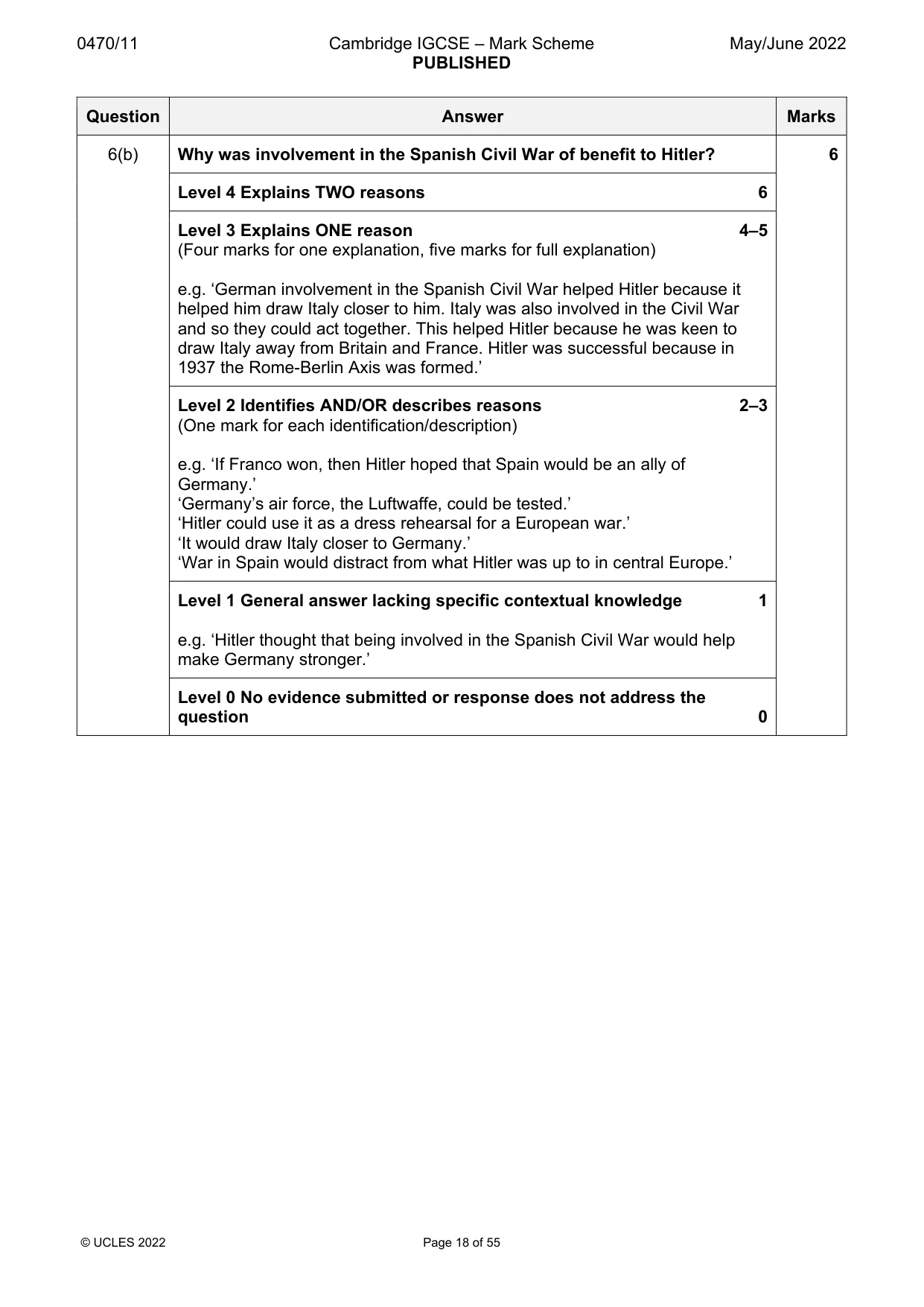
0470/11 Cambridge IGCSE – Mark Scheme PUBLISHED May/June 2022 © UCLES 2022 Page 18 of 55 Question Answer Marks 6(b) Why was involvement in the Spanish Civil War of benefit to Hitler? 6 Level 4 Explains TWO reasons 6 Level 3 Explains ONE reason 4–5 (Four marks for one explanation, five marks for full explanation) e.g. ‘German involvement in the Spanish Civil War helped Hitler because it helped him draw Italy closer to him. Italy was also involved in the Civil War and so they could act together. This helped Hitler because he was keen to draw Italy away from Britain and France. Hitler was successful because in 1937 the Rome-Berlin Axis was formed.’ Level 2 Identifies AND/OR describes reasons 2–3 (One mark for each identification/description) e.g. ‘If Franco won, then Hitler hoped that Spain would be an ally of Germany.’ ‘Germany’s air force, the Luftwaffe, could be tested.’ ‘Hitler could use it as a dress rehearsal for a European war.’ ‘It would draw Italy closer to Germany.’ ‘War in Spain would distract from what Hitler was up to in central Europe.’ Level 1 General answer lacking specific contextual knowledge 1 e.g. ‘Hitler thought that being involved in the Spanish Civil War would help make Germany stronger.’ Level 0 No evidence submitted or response does not address the question 0
Mark scheme, page 19
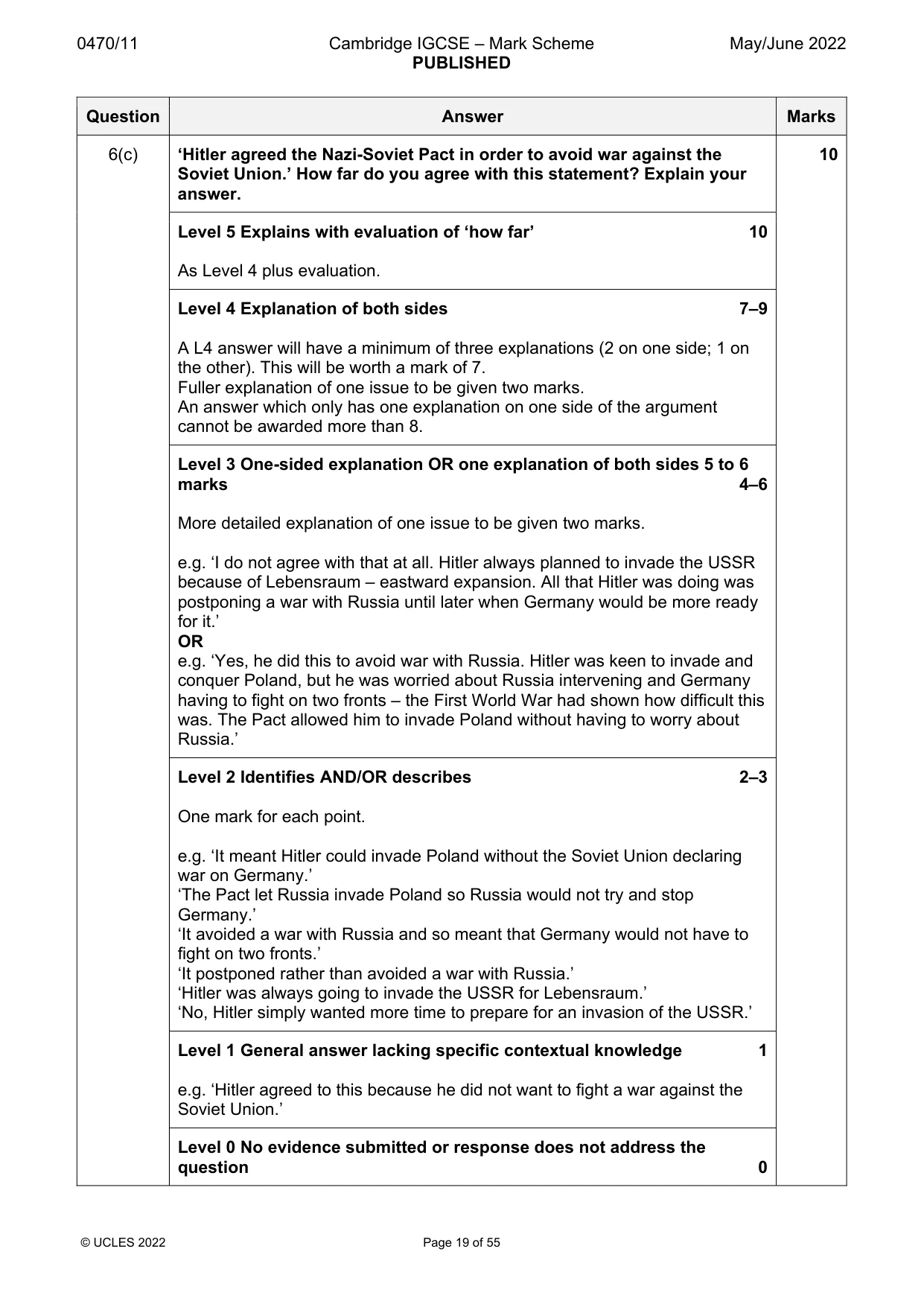
0470/11 Cambridge IGCSE – Mark Scheme PUBLISHED May/June 2022 © UCLES 2022 Page 19 of 55 Question Answer Marks 6(c) ‘Hitler agreed the Nazi-Soviet Pact in order to avoid war against the Soviet Union.’ How far do you agree with this statement? Explain your answer. 10 Level 5 Explains with evaluation of ‘how far’ 10 As Level 4 plus evaluation. Level 4 Explanation of both sides 7–9 A L4 answer will have a minimum of three explanations (2 on one side; 1 on the other). This will be worth a mark of 7. Fuller explanation of one issue to be given two marks. An answer which only has one explanation on one side of the argument cannot be awarded more than 8. Level 3 One-sided explanation OR one explanation of both sides 5 to 6 marks 4–6 More detailed explanation of one issue to be given two marks. e.g. ‘I do not agree with that at all. Hitler always planned to invade the USSR because of Lebensraum – eastward expansion. All that Hitler was doing was postponing a war with Russia until later when Germany would be more ready for it.’ OR e.g. ‘Yes, he did this to avoid war with Russia. Hitler was keen to invade and conquer Poland, but he was worried about Russia intervening and Germany having to fight on two fronts – the First World War had shown how difficult this was. The Pact allowed him to invade Poland without having to worry about Russia.’ Level 2 Identifies AND/OR describes 2–3 One mark for each point. e.g. ‘It meant Hitler could invade Poland without the Soviet Union declaring war on Germany.’ ‘The Pact let Russia invade Poland so Russia would not try and stop Germany.’ ‘It avoided a war with Russia and so meant that Germany would not have to fight on two fronts.’ ‘It postponed rather than avoided a war with Russia.’ ‘Hitler was always going to invade the USSR for Lebensraum.’ ‘No, Hitler simply wanted more time to prepare for an invasion of the USSR.’ Level 1 General answer lacking specific contextual knowledge 1 e.g. ‘Hitler agreed to this because he did not want to fight a war against the Soviet Union.’ Level 0 No evidence submitted or response does not address the question 0
Mark scheme, page 20
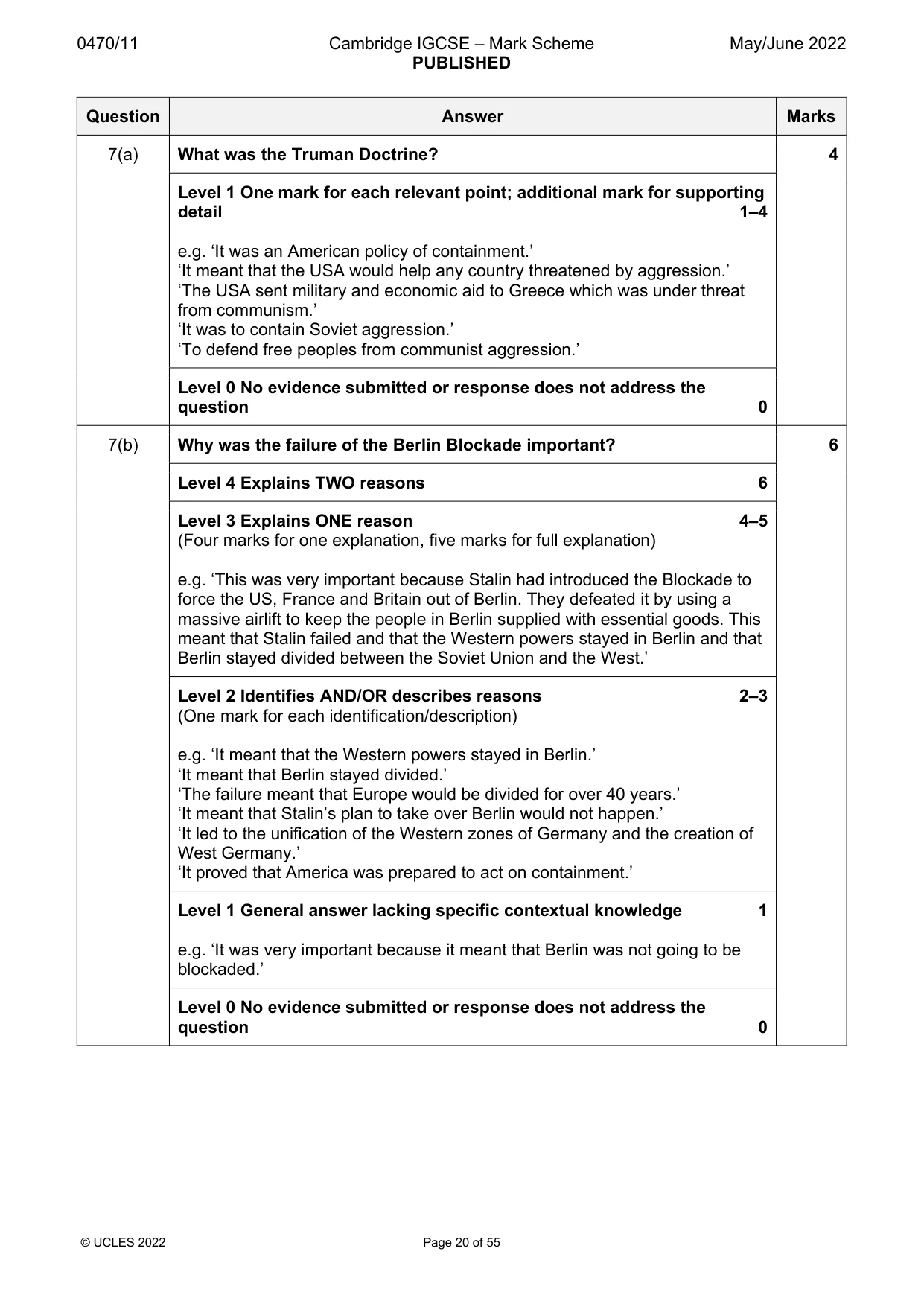
0470/11 Cambridge IGCSE – Mark Scheme PUBLISHED May/June 2022 © UCLES 2022 Page 20 of 55 Question Answer Marks 7(a) What was the Truman Doctrine? 4 Level 1 One mark for each relevant point; additional mark for supporting detail 1–4 e.g. ‘It was an American policy of containment.’ ‘It meant that the USA would help any country threatened by aggression.’ ‘The USA sent military and economic aid to Greece which was under threat from communism.’ ‘It was to contain Soviet aggression.’ ‘To defend free peoples from communist aggression.’ Level 0 No evidence submitted or response does not address the question 0 7(b) Why was the failure of the Berlin Blockade important? 6 Level 4 Explains TWO reasons 6 Level 3 Explains ONE reason 4–5 (Four marks for one explanation, five marks for full explanation) e.g. ‘This was very important because Stalin had introduced the Blockade to force the US, France and Britain out of Berlin. They defeated it by using a massive airlift to keep the people in Berlin supplied with essential goods. This meant that Stalin failed and that the Western powers stayed in Berlin and that Berlin stayed divided between the Soviet Union and the West.’ Level 2 Identifies AND/OR describes reasons 2–3 (One mark for each identification/description) e.g. ‘It meant that the Western powers stayed in Berlin.’ ‘It meant that Berlin stayed divided.’ ‘The failure meant that Europe would be divided for over 40 years.’ ‘It meant that Stalin’s plan to take over Berlin would not happen.’ ‘It led to the unification of the Western zones of Germany and the creation of West Germany.’ ‘It proved that America was prepared to act on containment.’ Level 1 General answer lacking specific contextual knowledge 1 e.g. ‘It was very important because it meant that Berlin was not going to be blockaded.’ Level 0 No evidence submitted or response does not address the question 0
Mark scheme, page 21
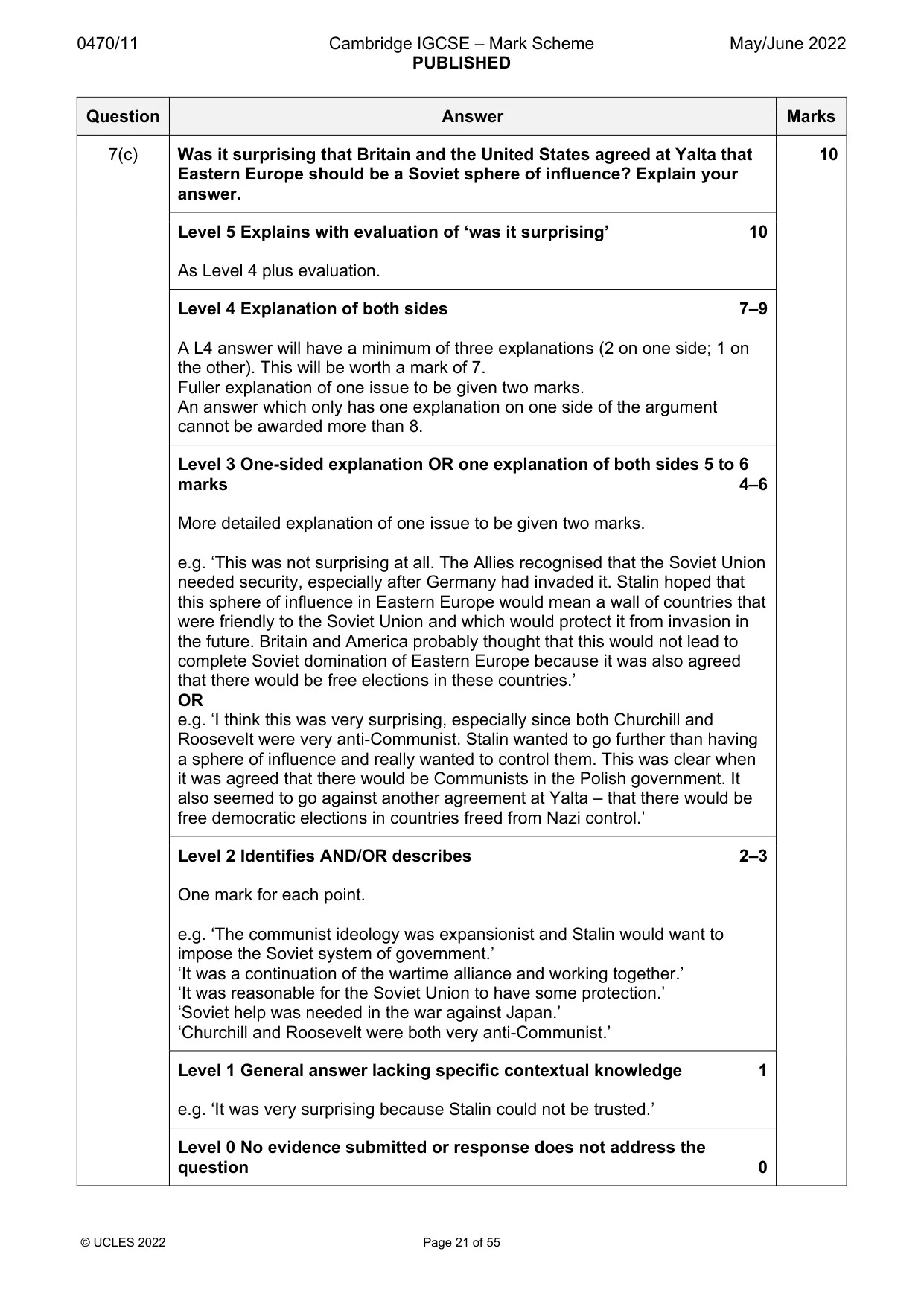
0470/11 Cambridge IGCSE – Mark Scheme PUBLISHED May/June 2022 © UCLES 2022 Page 21 of 55 Question Answer Marks 7(c) Was it surprising that Britain and the United States agreed at Yalta that Eastern Europe should be a Soviet sphere of influence? Explain your answer. 10 Level 5 Explains with evaluation of ‘was it surprising’ 10 As Level 4 plus evaluation. Level 4 Explanation of both sides 7–9 A L4 answer will have a minimum of three explanations (2 on one side; 1 on the other). This will be worth a mark of 7. Fuller explanation of one issue to be given two marks. An answer which only has one explanation on one side of the argument cannot be awarded more than 8. Level 3 One-sided explanation OR one explanation of both sides 5 to 6 marks 4–6 More detailed explanation of one issue to be given two marks. e.g. ‘This was not surprising at all. The Allies recognised that the Soviet Union needed security, especially after Germany had invaded it. Stalin hoped that this sphere of influence in Eastern Europe would mean a wall of countries that were friendly to the Soviet Union and which would protect it from invasion in the future. Britain and America probably thought that this would not lead to complete Soviet domination of Eastern Europe because it was also agreed that there would be free elections in these countries.’ OR e.g. ‘I think this was very surprising, especially since both Churchill and Roosevelt were very anti-Communist. Stalin wanted to go further than having a sphere of influence and really wanted to control them. This was clear when it was agreed that there would be Communists in the Polish government. It also seemed to go against another agreement at Yalta – that there would be free democratic elections in countries freed from Nazi control.’ Level 2 Identifies AND/OR describes 2–3 One mark for each point. e.g. ‘The communist ideology was expansionist and Stalin would want to impose the Soviet system of government.’ ‘It was a continuation of the wartime alliance and working together.’ ‘It was reasonable for the Soviet Union to have some protection.’ ‘Soviet help was needed in the war against Japan.’ ‘Churchill and Roosevelt were both very anti-Communist.’ Level 1 General answer lacking specific contextual knowledge 1 e.g. ‘It was very surprising because Stalin could not be trusted.’ Level 0 No evidence submitted or response does not address the question 0
Mark scheme, page 22
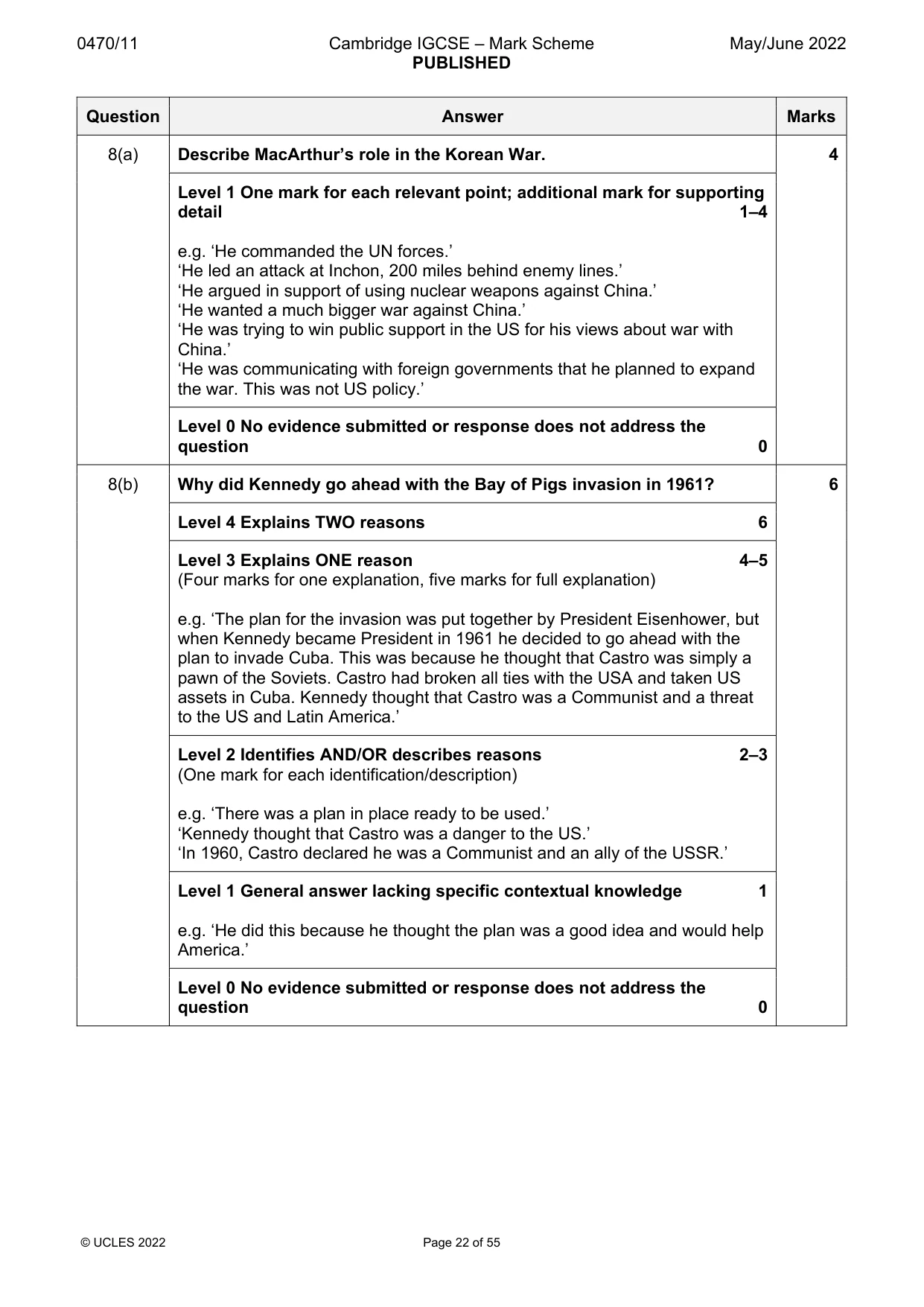
0470/11 Cambridge IGCSE – Mark Scheme PUBLISHED May/June 2022 © UCLES 2022 Page 22 of 55 Question Answer Marks 8(a) Describe MacArthur’s role in the Korean War. 4 Level 1 One mark for each relevant point; additional mark for supporting detail 1–4 e.g. ‘He commanded the UN forces.’ ‘He led an attack at Inchon, 200 miles behind enemy lines.’ ‘He argued in support of using nuclear weapons against China.’ ‘He wanted a much bigger war against China.’ ‘He was trying to win public support in the US for his views about war with China.’ ‘He was communicating with foreign governments that he planned to expand the war. This was not US policy.’ Level 0 No evidence submitted or response does not address the question 0 8(b) Why did Kennedy go ahead with the Bay of Pigs invasion in 1961? 6 Level 4 Explains TWO reasons 6 Level 3 Explains ONE reason 4–5 (Four marks for one explanation, five marks for full explanation) e.g. ‘The plan for the invasion was put together by President Eisenhower, but when Kennedy became President in 1961 he decided to go ahead with the plan to invade Cuba. This was because he thought that Castro was simply a pawn of the Soviets. Castro had broken all ties with the USA and taken US assets in Cuba. Kennedy thought that Castro was a Communist and a threat to the US and Latin America.’ Level 2 Identifies AND/OR describes reasons 2–3 (One mark for each identification/description) e.g. ‘There was a plan in place ready to be used.’ ‘Kennedy thought that Castro was a danger to the US.’ ‘In 1960, Castro declared he was a Communist and an ally of the USSR.’ Level 1 General answer lacking specific contextual knowledge 1 e.g. ‘He did this because he thought the plan was a good idea and would help America.’ Level 0 No evidence submitted or response does not address the question 0
Mark scheme, page 23
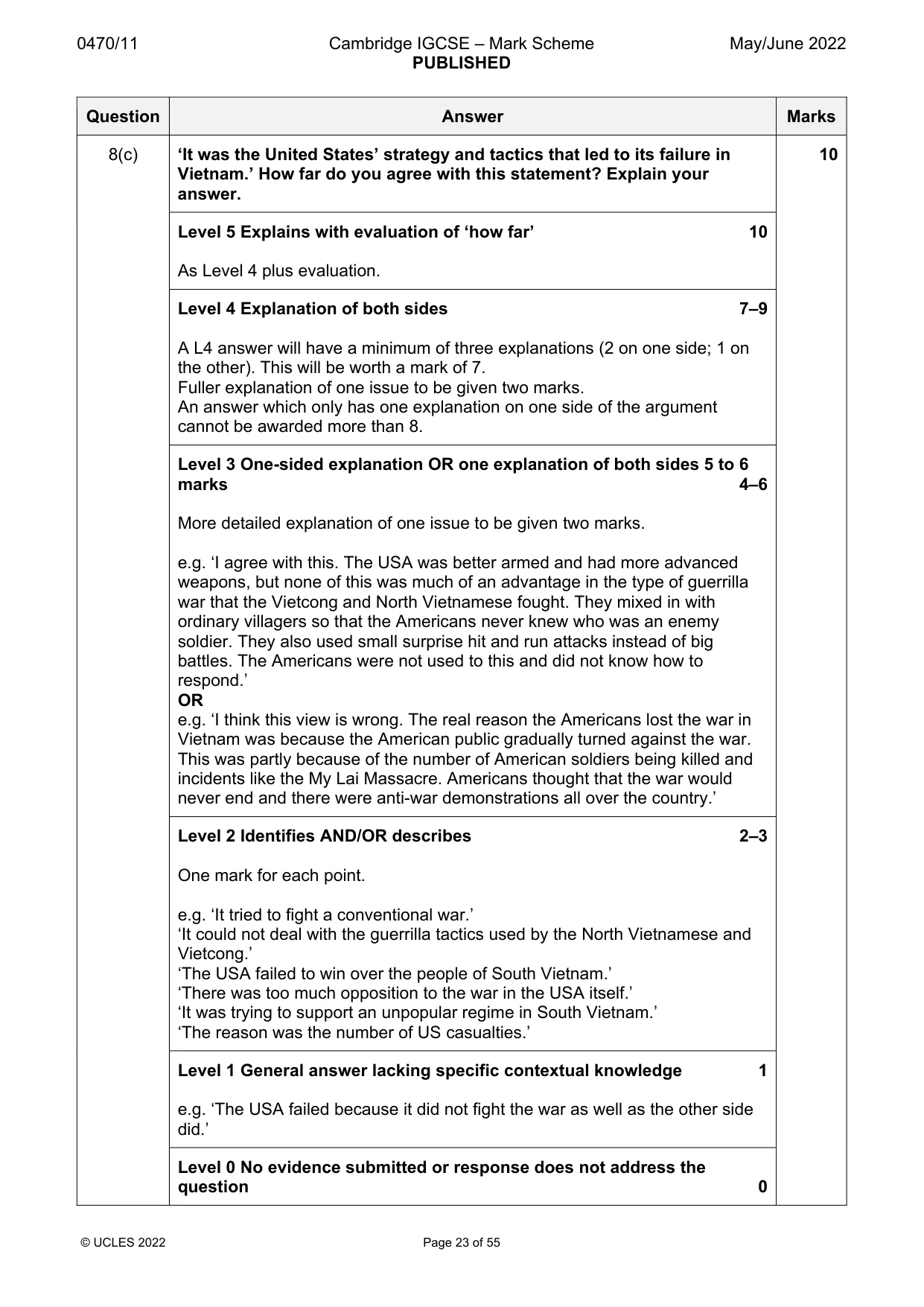
0470/11 Cambridge IGCSE – Mark Scheme PUBLISHED May/June 2022 © UCLES 2022 Page 23 of 55 Question Answer Marks 8(c) ‘It was the United States’ strategy and tactics that led to its failure in Vietnam.’ How far do you agree with this statement? Explain your answer. 10 Level 5 Explains with evaluation of ‘how far’ 10 As Level 4 plus evaluation. Level 4 Explanation of both sides 7–9 A L4 answer will have a minimum of three explanations (2 on one side; 1 on the other). This will be worth a mark of 7. Fuller explanation of one issue to be given two marks. An answer which only has one explanation on one side of the argument cannot be awarded more than 8. Level 3 One-sided explanation OR one explanation of both sides 5 to 6 marks 4–6 More detailed explanation of one issue to be given two marks. e.g. ‘I agree with this. The USA was better armed and had more advanced weapons, but none of this was much of an advantage in the type of guerrilla war that the Vietcong and North Vietnamese fought. They mixed in with ordinary villagers so that the Americans never knew who was an enemy soldier. They also used small surprise hit and run attacks instead of big battles. The Americans were not used to this and did not know how to respond.’ OR e.g. ‘I think this view is wrong. The real reason the Americans lost the war in Vietnam was because the American public gradually turned against the war. This was partly because of the number of American soldiers being killed and incidents like the My Lai Massacre. Americans thought that the war would never end and there were anti-war demonstrations all over the country.’ Level 2 Identifies AND/OR describes 2–3 One mark for each point. e.g. ‘It tried to fight a conventional war.’ ‘It could not deal with the guerrilla tactics used by the North Vietnamese and Vietcong.’ ‘The USA failed to win over the people of South Vietnam.’ ‘There was too much opposition to the war in the USA itself.’ ‘It was trying to support an unpopular regime in South Vietnam.’ ‘The reason was the number of US casualties.’ Level 1 General answer lacking specific contextual knowledge 1 e.g. ‘The USA failed because it did not fight the war as well as the other side did.’ Level 0 No evidence submitted or response does not address the question 0
Mark scheme, page 24
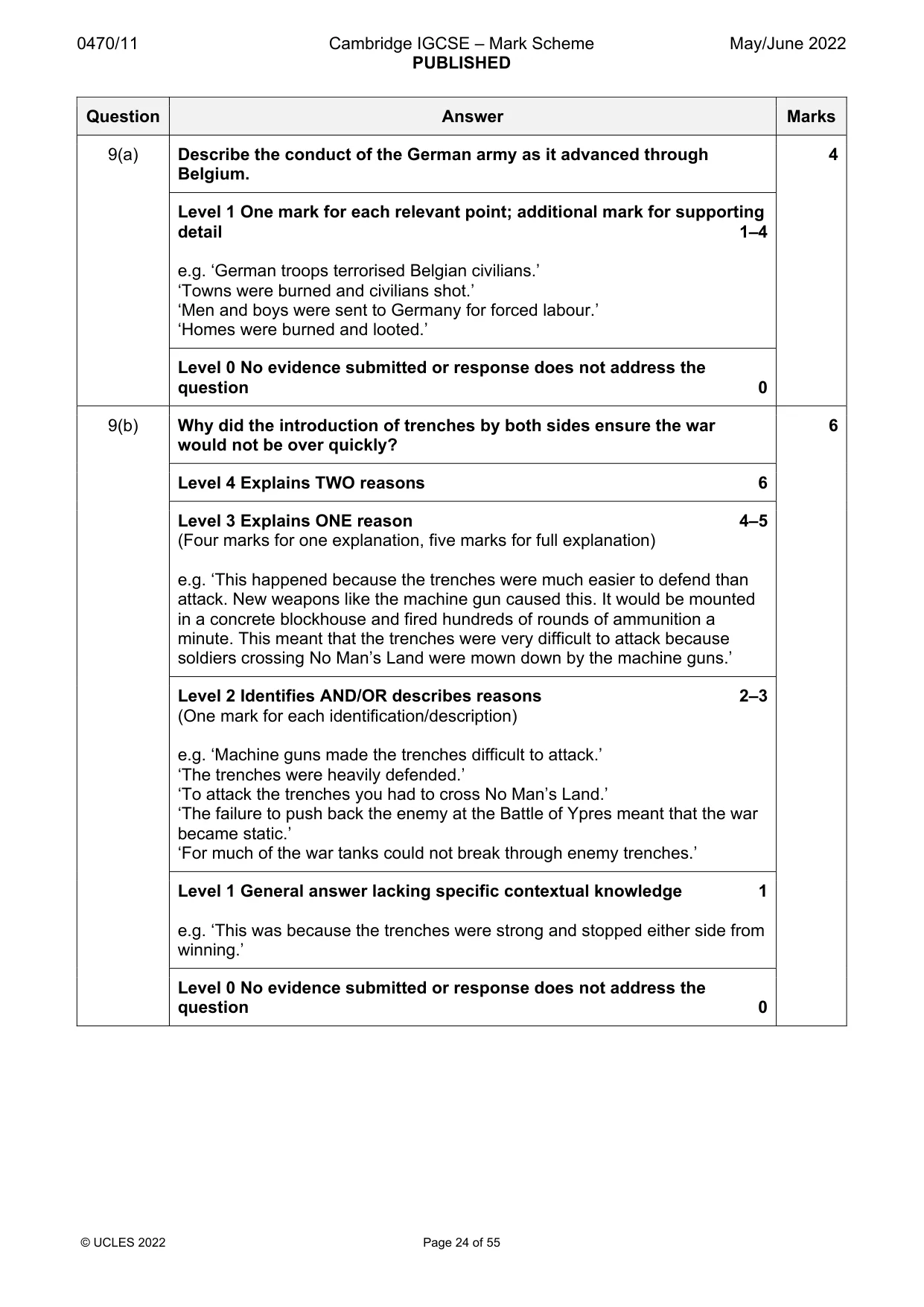
0470/11 Cambridge IGCSE – Mark Scheme PUBLISHED May/June 2022 © UCLES 2022 Page 24 of 55 Question Answer Marks 9(a) Describe the conduct of the German army as it advanced through Belgium. 4 Level 1 One mark for each relevant point; additional mark for supporting detail 1–4 e.g. ‘German troops terrorised Belgian civilians.’ ‘Towns were burned and civilians shot.’ ‘Men and boys were sent to Germany for forced labour.’ ‘Homes were burned and looted.’ Level 0 No evidence submitted or response does not address the question 0 9(b) Why did the introduction of trenches by both sides ensure the war would not be over quickly? 6 Level 4 Explains TWO reasons 6 Level 3 Explains ONE reason 4–5 (Four marks for one explanation, five marks for full explanation) e.g. ‘This happened because the trenches were much easier to defend than attack. New weapons like the machine gun caused this. It would be mounted in a concrete blockhouse and fired hundreds of rounds of ammunition a minute. This meant that the trenches were very difficult to attack because soldiers crossing No Man’s Land were mown down by the machine guns.’ Level 2 Identifies AND/OR describes reasons 2–3 (One mark for each identification/description) e.g. ‘Machine guns made the trenches difficult to attack.’ ‘The trenches were heavily defended.’ ‘To attack the trenches you had to cross No Man’s Land.’ ‘The failure to push back the enemy at the Battle of Ypres meant that the war became static.’ ‘For much of the war tanks could not break through enemy trenches.’ Level 1 General answer lacking specific contextual knowledge 1 e.g. ‘This was because the trenches were strong and stopped either side from winning.’ Level 0 No evidence submitted or response does not address the question 0
Mark scheme, page 25
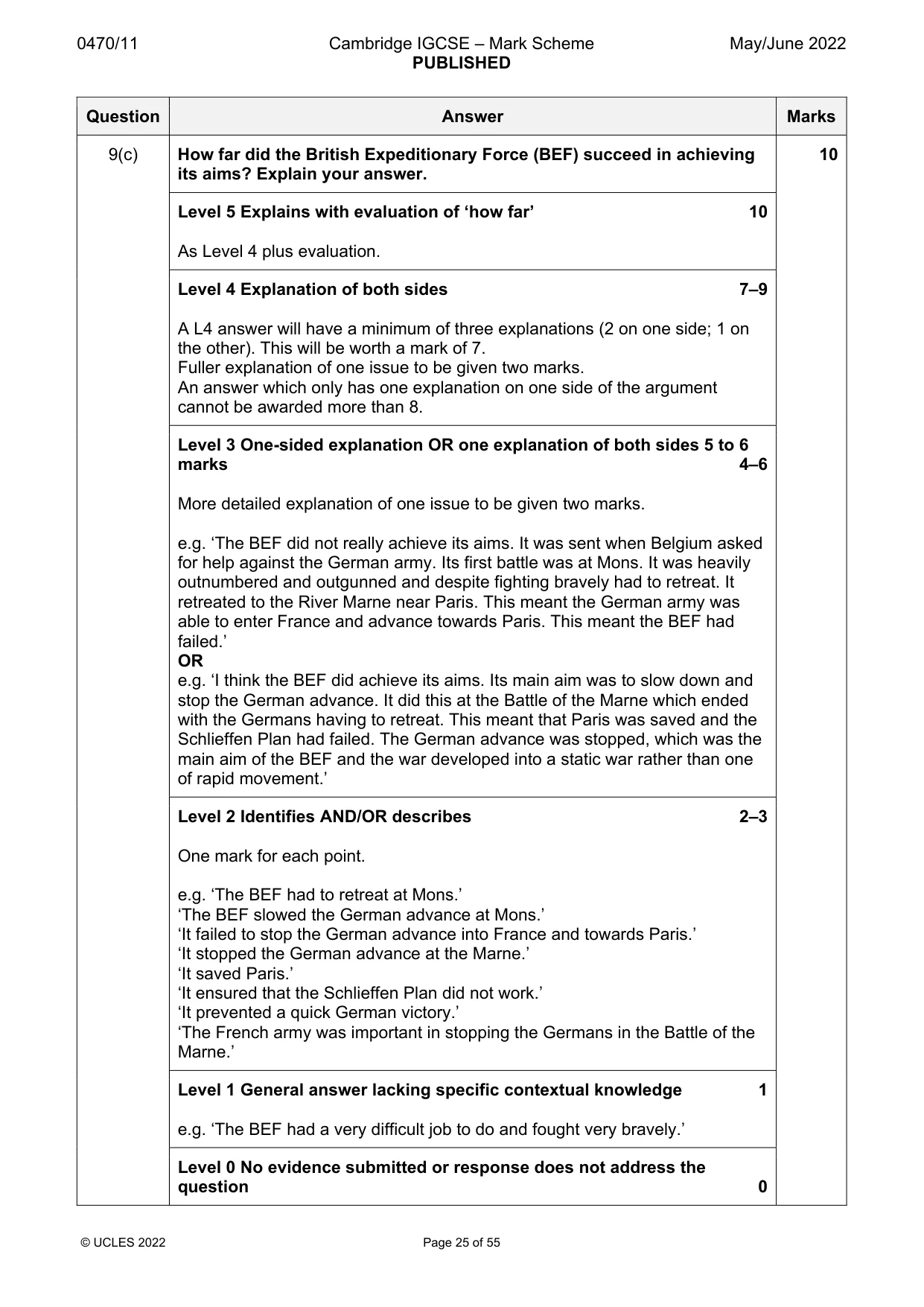
0470/11 Cambridge IGCSE – Mark Scheme PUBLISHED May/June 2022 © UCLES 2022 Page 25 of 55 Question Answer Marks 9(c) How far did the British Expeditionary Force (BEF) succeed in achieving its aims? Explain your answer. 10 Level 5 Explains with evaluation of ‘how far’ 10 As Level 4 plus evaluation. Level 4 Explanation of both sides 7–9 A L4 answer will have a minimum of three explanations (2 on one side; 1 on the other). This will be worth a mark of 7. Fuller explanation of one issue to be given two marks. An answer which only has one explanation on one side of the argument cannot be awarded more than 8. Level 3 One-sided explanation OR one explanation of both sides 5 to 6 marks 4–6 More detailed explanation of one issue to be given two marks. e.g. ‘The BEF did not really achieve its aims. It was sent when Belgium asked for help against the German army. Its first battle was at Mons. It was heavily outnumbered and outgunned and despite fighting bravely had to retreat. It retreated to the River Marne near Paris. This meant the German army was able to enter France and advance towards Paris. This meant the BEF had failed.’ OR e.g. ‘I think the BEF did achieve its aims. Its main aim was to slow down and stop the German advance. It did this at the Battle of the Marne which ended with the Germans having to retreat. This meant that Paris was saved and the Schlieffen Plan had failed. The German advance was stopped, which was the main aim of the BEF and the war developed into a static war rather than one of rapid movement.’ Level 2 Identifies AND/OR describes 2–3 One mark for each point. e.g. ‘The BEF had to retreat at Mons.’ ‘The BEF slowed the German advance at Mons.’ ‘It failed to stop the German advance into France and towards Paris.’ ‘It stopped the German advance at the Marne.’ ‘It saved Paris.’ ‘It ensured that the Schlieffen Plan did not work.’ ‘It prevented a quick German victory.’ ‘The French army was important in stopping the Germans in the Battle of the Marne.’ Level 1 General answer lacking specific contextual knowledge 1 e.g. ‘The BEF had a very difficult job to do and fought very bravely.’ Level 0 No evidence submitted or response does not address the question 0
Mark scheme, page 26
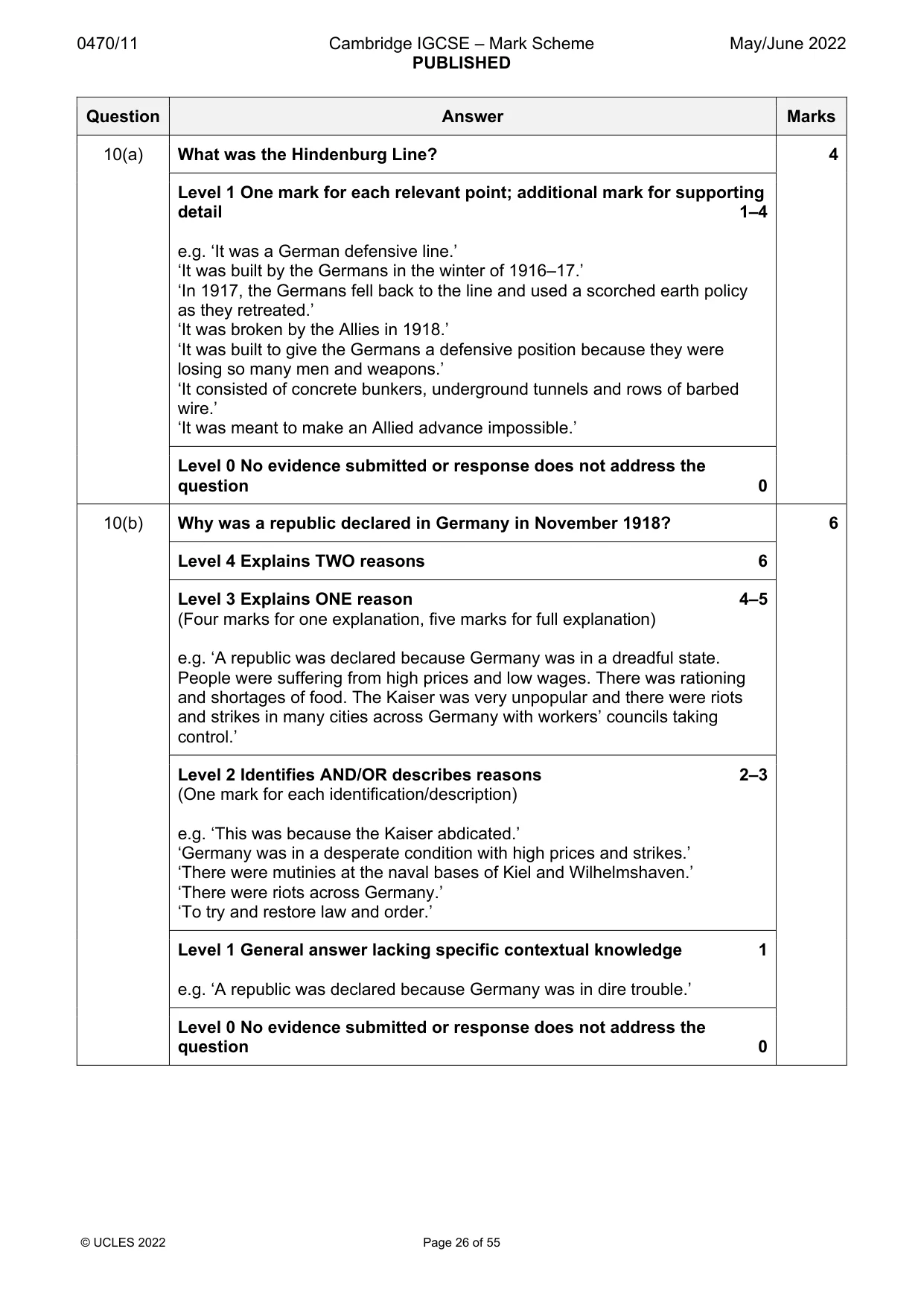
0470/11 Cambridge IGCSE – Mark Scheme PUBLISHED May/June 2022 © UCLES 2022 Page 26 of 55 Question Answer Marks 10(a) What was the Hindenburg Line? 4 Level 1 One mark for each relevant point; additional mark for supporting detail 1–4 e.g. ‘It was a German defensive line.’ ‘It was built by the Germans in the winter of 1916–17.’ ‘In 1917, the Germans fell back to the line and used a scorched earth policy as they retreated.’ ‘It was broken by the Allies in 1918.’ ‘It was built to give the Germans a defensive position because they were losing so many men and weapons.’ ‘It consisted of concrete bunkers, underground tunnels and rows of barbed wire.’ ‘It was meant to make an Allied advance impossible.’ Level 0 No evidence submitted or response does not address the question 0 10(b) Why was a republic declared in Germany in November 1918? 6 Level 4 Explains TWO reasons 6 Level 3 Explains ONE reason 4–5 (Four marks for one explanation, five marks for full explanation) e.g. ‘A republic was declared because Germany was in a dreadful state. People were suffering from high prices and low wages. There was rationing and shortages of food. The Kaiser was very unpopular and there were riots and strikes in many cities across Germany with workers’ councils taking control.’ Level 2 Identifies AND/OR describes reasons 2–3 (One mark for each identification/description) e.g. ‘This was because the Kaiser abdicated.’ ‘Germany was in a desperate condition with high prices and strikes.’ ‘There were mutinies at the naval bases of Kiel and Wilhelmshaven.’ ‘There were riots across Germany.’ ‘To try and restore law and order.’ Level 1 General answer lacking specific contextual knowledge 1 e.g. ‘A republic was declared because Germany was in dire trouble.’ Level 0 No evidence submitted or response does not address the question 0
Mark scheme, page 27
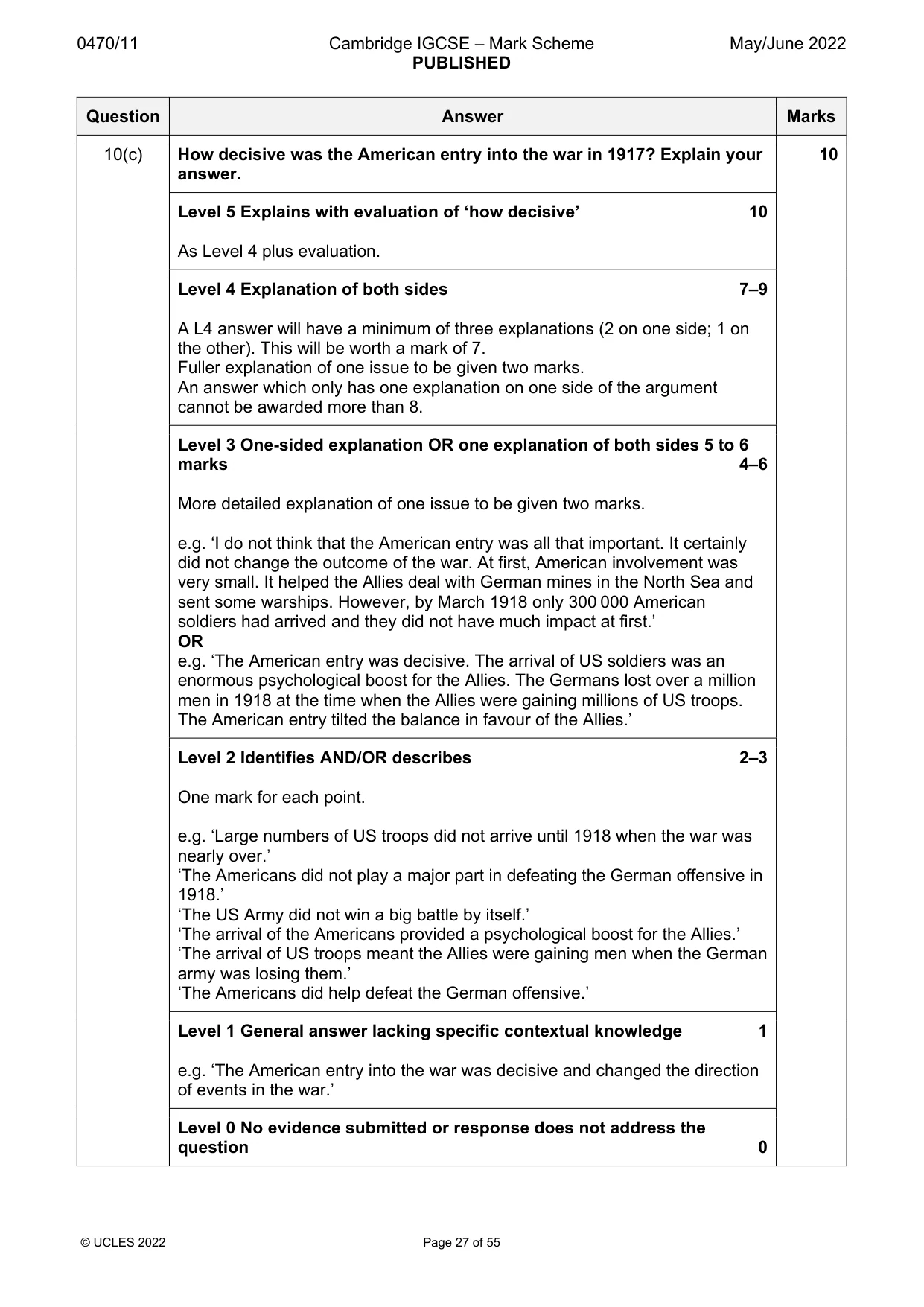
0470/11 Cambridge IGCSE – Mark Scheme PUBLISHED May/June 2022 © UCLES 2022 Page 27 of 55 Question Answer Marks 10(c) How decisive was the American entry into the war in 1917? Explain your answer. 10 Level 5 Explains with evaluation of ‘how decisive’ 10 As Level 4 plus evaluation. Level 4 Explanation of both sides 7–9 A L4 answer will have a minimum of three explanations (2 on one side; 1 on the other). This will be worth a mark of 7. Fuller explanation of one issue to be given two marks. An answer which only has one explanation on one side of the argument cannot be awarded more than 8. Level 3 One-sided explanation OR one explanation of both sides 5 to 6 marks 4–6 More detailed explanation of one issue to be given two marks. e.g. ‘I do not think that the American entry was all that important. It certainly did not change the outcome of the war. At first, American involvement was very small. It helped the Allies deal with German mines in the North Sea and sent some warships. However, by March 1918 only 300 000 American soldiers had arrived and they did not have much impact at first.’ OR e.g. ‘The American entry was decisive. The arrival of US soldiers was an enormous psychological boost for the Allies. The Germans lost over a million men in 1918 at the time when the Allies were gaining millions of US troops. The American entry tilted the balance in favour of the Allies.’ Level 2 Identifies AND/OR describes 2–3 One mark for each point. e.g. ‘Large numbers of US troops did not arrive until 1918 when the war was nearly over.’ ‘The Americans did not play a major part in defeating the German offensive in 1918.’ ‘The US Army did not win a big battle by itself.’ ‘The arrival of the Americans provided a psychological boost for the Allies.’ ‘The arrival of US troops meant the Allies were gaining men when the German army was losing them.’ ‘The Americans did help defeat the German offensive.’ Level 1 General answer lacking specific contextual knowledge 1 e.g. ‘The American entry into the war was decisive and changed the direction of events in the war.’ Level 0 No evidence submitted or response does not address the question 0
Mark scheme, page 28
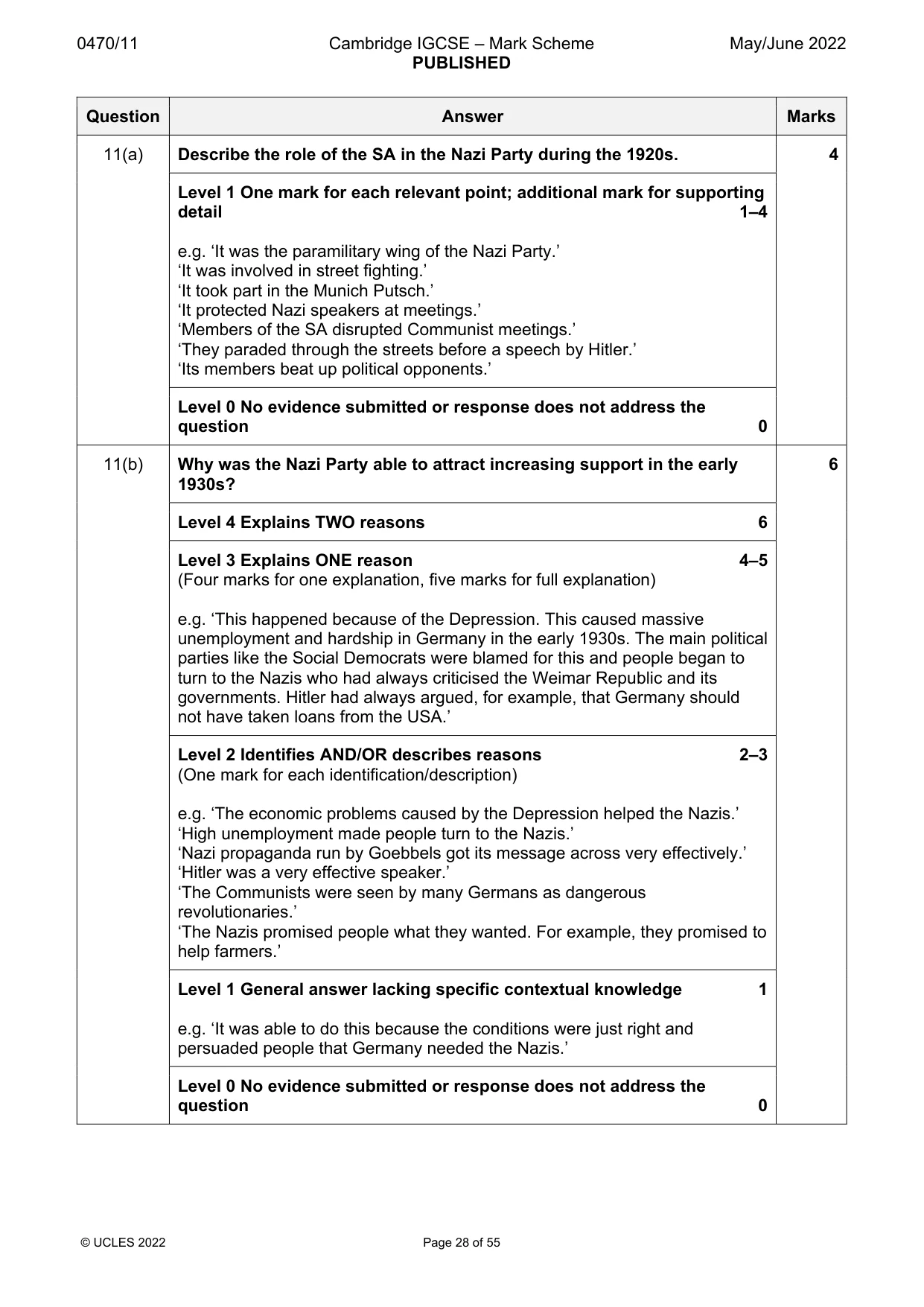
0470/11 Cambridge IGCSE – Mark Scheme PUBLISHED May/June 2022 © UCLES 2022 Page 28 of 55 Question Answer Marks 11(a) Describe the role of the SA in the Nazi Party during the 1920s. 4 Level 1 One mark for each relevant point; additional mark for supporting detail 1–4 e.g. ‘It was the paramilitary wing of the Nazi Party.’ ‘It was involved in street fighting.’ ‘It took part in the Munich Putsch.’ ‘It protected Nazi speakers at meetings.’ ‘Members of the SA disrupted Communist meetings.’ ‘They paraded through the streets before a speech by Hitler.’ ‘Its members beat up political opponents.’ Level 0 No evidence submitted or response does not address the question 0 11(b) Why was the Nazi Party able to attract increasing support in the early 1930s? 6 Level 4 Explains TWO reasons 6 Level 3 Explains ONE reason 4–5 (Four marks for one explanation, five marks for full explanation) e.g. ‘This happened because of the Depression. This caused massive unemployment and hardship in Germany in the early 1930s. The main political parties like the Social Democrats were blamed for this and people began to turn to the Nazis who had always criticised the Weimar Republic and its governments. Hitler had always argued, for example, that Germany should not have taken loans from the USA.’ Level 2 Identifies AND/OR describes reasons 2–3 (One mark for each identification/description) e.g. ‘The economic problems caused by the Depression helped the Nazis.’ ‘High unemployment made people turn to the Nazis.’ ‘Nazi propaganda run by Goebbels got its message across very effectively.’ ‘Hitler was a very effective speaker.’ ‘The Communists were seen by many Germans as dangerous revolutionaries.’ ‘The Nazis promised people what they wanted. For example, they promised to help farmers.’ Level 1 General answer lacking specific contextual knowledge 1 e.g. ‘It was able to do this because the conditions were just right and persuaded people that Germany needed the Nazis.’ Level 0 No evidence submitted or response does not address the question 0
Mark scheme, page 29
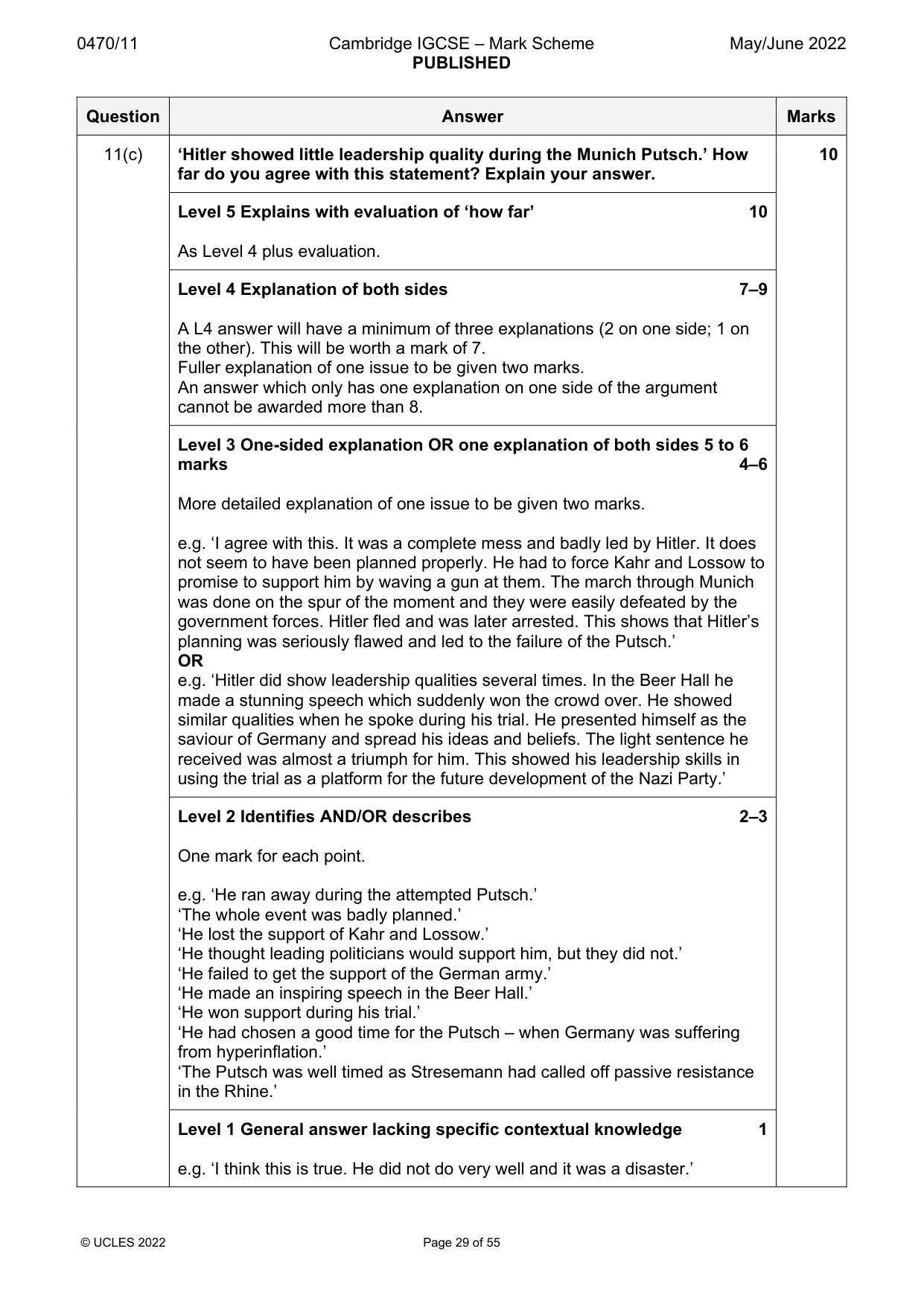
0470/11 Cambridge IGCSE – Mark Scheme PUBLISHED May/June 2022 © UCLES 2022 Page 29 of 55 Question Answer Marks 11(c) ‘Hitler showed little leadership quality during the Munich Putsch.’ How far do you agree with this statement? Explain your answer. 10 Level 5 Explains with evaluation of ‘how far’ 10 As Level 4 plus evaluation. Level 4 Explanation of both sides 7–9 A L4 answer will have a minimum of three explanations (2 on one side; 1 on the other). This will be worth a mark of 7. Fuller explanation of one issue to be given two marks. An answer which only has one explanation on one side of the argument cannot be awarded more than 8. Level 3 One-sided explanation OR one explanation of both sides 5 to 6 marks 4–6 More detailed explanation of one issue to be given two marks. e.g. ‘I agree with this. It was a complete mess and badly led by Hitler. It does not seem to have been planned properly. He had to force Kahr and Lossow to promise to support him by waving a gun at them. The march through Munich was done on the spur of the moment and they were easily defeated by the government forces. Hitler fled and was later arrested. This shows that Hitler’s planning was seriously flawed and led to the failure of the Putsch.’ OR e.g. ‘Hitler did show leadership qualities several times. In the Beer Hall he made a stunning speech which suddenly won the crowd over. He showed similar qualities when he spoke during his trial. He presented himself as the saviour of Germany and spread his ideas and beliefs. The light sentence he received was almost a triumph for him. This showed his leadership skills in using the trial as a platform for the future development of the Nazi Party.’ Level 2 Identifies AND/OR describes 2–3 One mark for each point. e.g. ‘He ran away during the attempted Putsch.’ ‘The whole event was badly planned.’ ‘He lost the support of Kahr and Lossow.’ ‘He thought leading politicians would support him, but they did not.’ ‘He failed to get the support of the German army.’ ‘He made an inspiring speech in the Beer Hall.’ ‘He won support during his trial.’ ‘He had chosen a good time for the Putsch – when Germany was suffering from hyperinflation.’ ‘The Putsch was well timed as Stresemann had called off passive resistance in the Rhine.’ Level 1 General answer lacking specific contextual knowledge 1 e.g. ‘I think this is true. He did not do very well and it was a disaster.’
Mark scheme, page 30
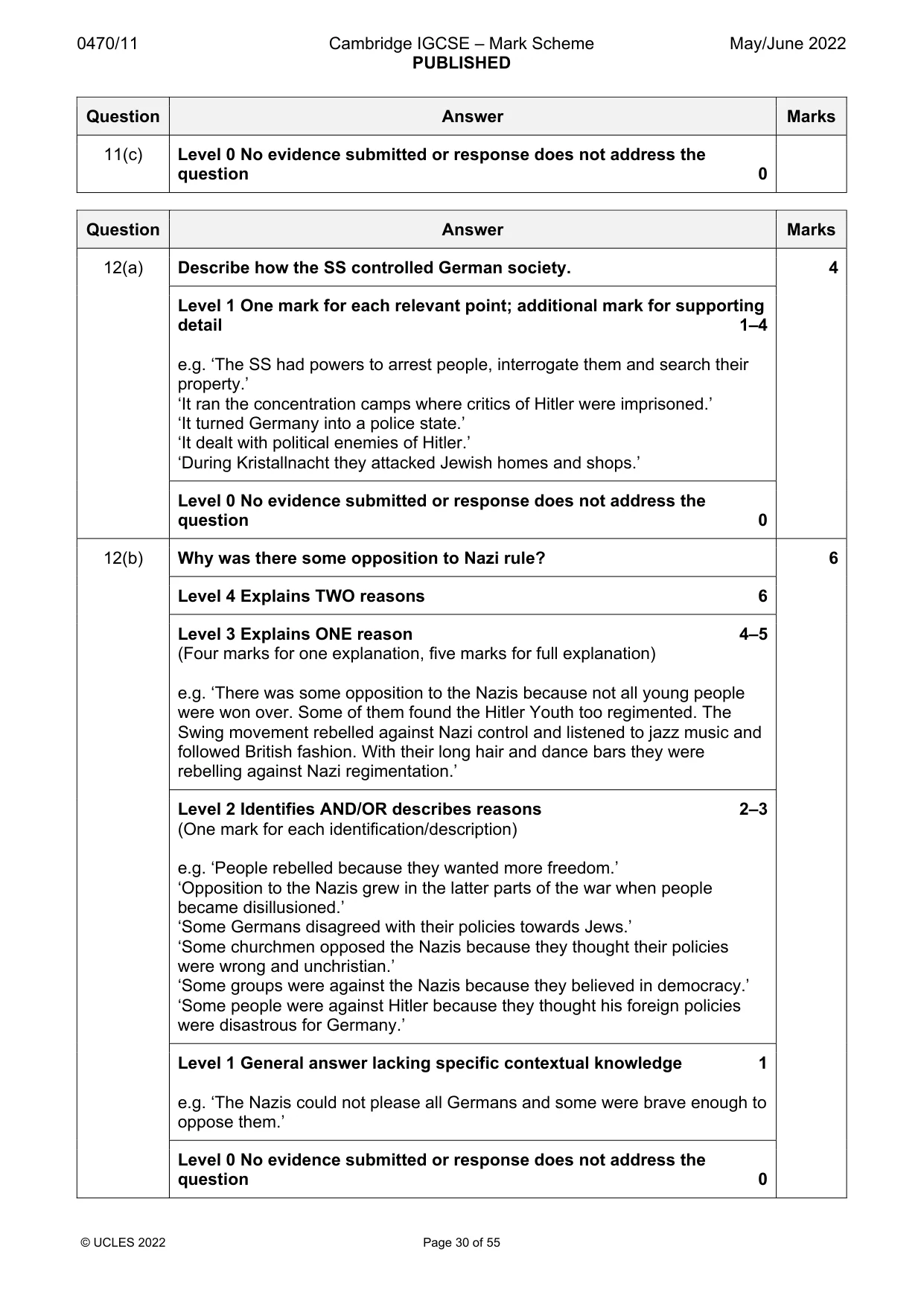
0470/11 Cambridge IGCSE – Mark Scheme PUBLISHED May/June 2022 © UCLES 2022 Page 30 of 55 Question Answer Marks 11(c) Level 0 No evidence submitted or response does not address the question 0 Question Answer Marks 12(a) Describe how the SS controlled German society. 4 Level 1 One mark for each relevant point; additional mark for supporting detail 1–4 e.g. ‘The SS had powers to arrest people, interrogate them and search their property.’ ‘It ran the concentration camps where critics of Hitler were imprisoned.’ ‘It turned Germany into a police state.’ ‘It dealt with political enemies of Hitler.’ ‘During Kristallnacht they attacked Jewish homes and shops.’ Level 0 No evidence submitted or response does not address the question 0 12(b) Why was there some opposition to Nazi rule? 6 Level 4 Explains TWO reasons 6 Level 3 Explains ONE reason 4–5 (Four marks for one explanation, five marks for full explanation) e.g. ‘There was some opposition to the Nazis because not all young people were won over. Some of them found the Hitler Youth too regimented. The Swing movement rebelled against Nazi control and listened to jazz music and followed British fashion. With their long hair and dance bars they were rebelling against Nazi regimentation.’ Level 2 Identifies AND/OR describes reasons 2–3 (One mark for each identification/description) e.g. ‘People rebelled because they wanted more freedom.’ ‘Opposition to the Nazis grew in the latter parts of the war when people became disillusioned.’ ‘Some Germans disagreed with their policies towards Jews.’ ‘Some churchmen opposed the Nazis because they thought their policies were wrong and unchristian.’ ‘Some groups were against the Nazis because they believed in democracy.’ ‘Some people were against Hitler because they thought his foreign policies were disastrous for Germany.’ Level 1 General answer lacking specific contextual knowledge 1 e.g. ‘The Nazis could not please all Germans and some were brave enough to oppose them.’ Level 0 No evidence submitted or response does not address the question 0
Mark scheme, page 31
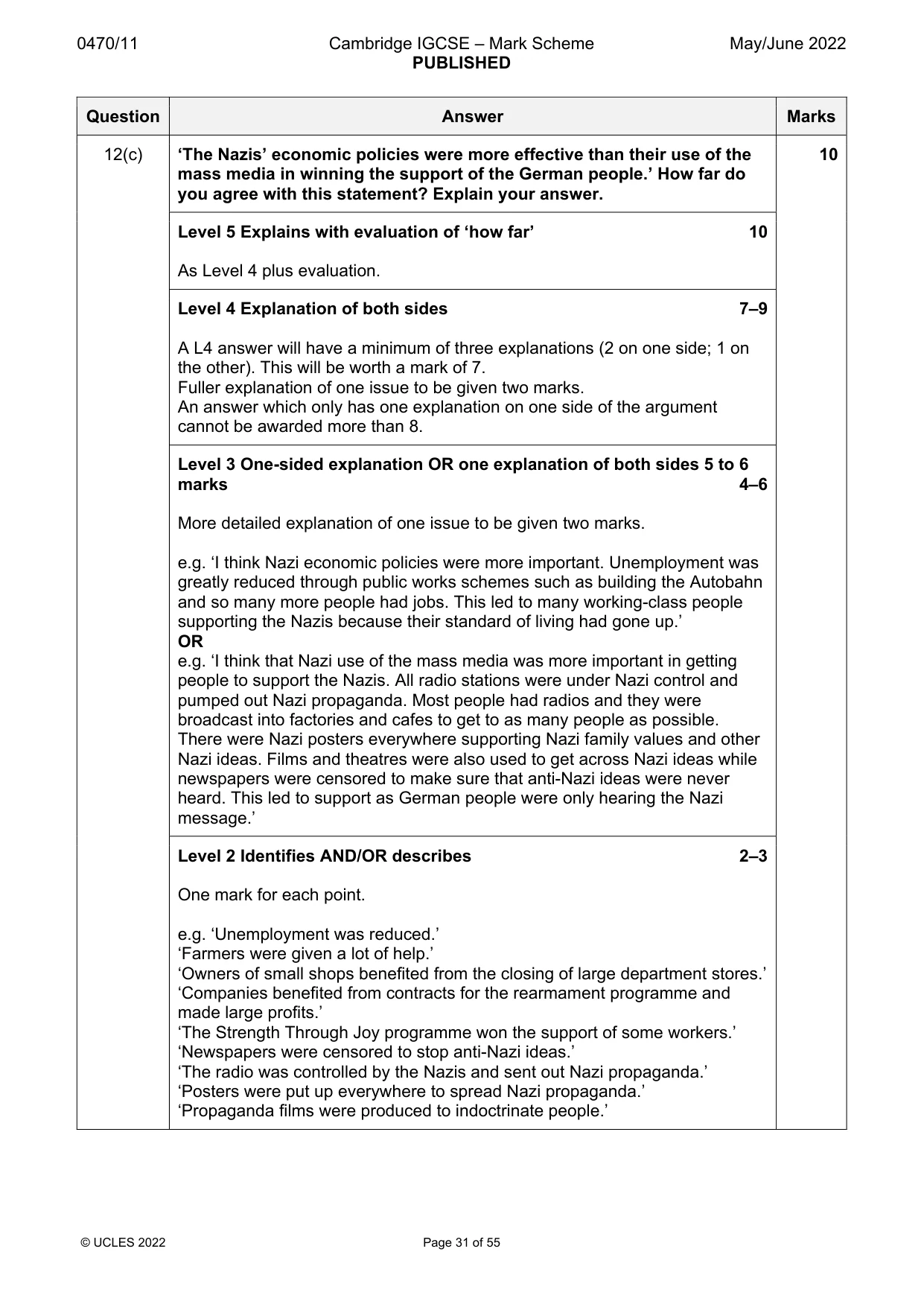
0470/11 Cambridge IGCSE – Mark Scheme PUBLISHED May/June 2022 © UCLES 2022 Page 31 of 55 Question Answer Marks 12(c) ‘The Nazis’ economic policies were more effective than their use of the mass media in winning the support of the German people.’ How far do you agree with this statement? Explain your answer. 10 Level 5 Explains with evaluation of ‘how far’ 10 As Level 4 plus evaluation. Level 4 Explanation of both sides 7–9 A L4 answer will have a minimum of three explanations (2 on one side; 1 on the other). This will be worth a mark of 7. Fuller explanation of one issue to be given two marks. An answer which only has one explanation on one side of the argument cannot be awarded more than 8. Level 3 One-sided explanation OR one explanation of both sides 5 to 6 marks 4–6 More detailed explanation of one issue to be given two marks. e.g. ‘I think Nazi economic policies were more important. Unemployment was greatly reduced through public works schemes such as building the Autobahn and so many more people had jobs. This led to many working-class people supporting the Nazis because their standard of living had gone up.’ OR e.g. ‘I think that Nazi use of the mass media was more important in getting people to support the Nazis. All radio stations were under Nazi control and pumped out Nazi propaganda. Most people had radios and they were broadcast into factories and cafes to get to as many people as possible. There were Nazi posters everywhere supporting Nazi family values and other Nazi ideas. Films and theatres were also used to get across Nazi ideas while newspapers were censored to make sure that anti-Nazi ideas were never heard. This led to support as German people were only hearing the Nazi message.’ Level 2 Identifies AND/OR describes 2–3 One mark for each point. e.g. ‘Unemployment was reduced.’ ‘Farmers were given a lot of help.’ ‘Owners of small shops benefited from the closing of large department stores.’ ‘Companies benefited from contracts for the rearmament programme and made large profits.’ ‘The Strength Through Joy programme won the support of some workers.’ ‘Newspapers were censored to stop anti-Nazi ideas.’ ‘The radio was controlled by the Nazis and sent out Nazi propaganda.’ ‘Posters were put up everywhere to spread Nazi propaganda.’ ‘Propaganda films were produced to indoctrinate people.’
Mark scheme, page 32
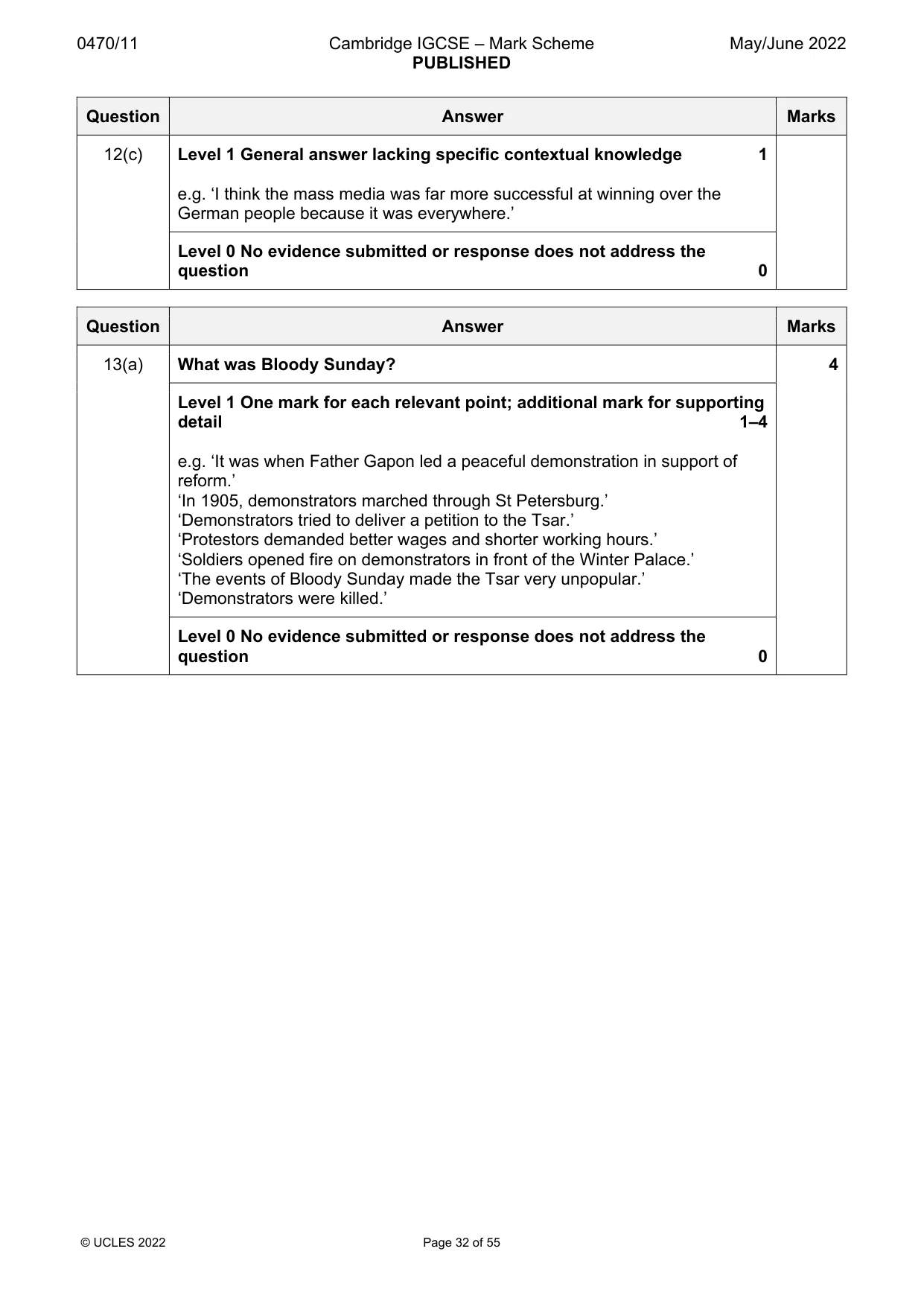
0470/11 Cambridge IGCSE – Mark Scheme PUBLISHED May/June 2022 © UCLES 2022 Page 32 of 55 Question Answer Marks 12(c) Level 1 General answer lacking specific contextual knowledge 1 e.g. ‘I think the mass media was far more successful at winning over the German people because it was everywhere.’ Level 0 No evidence submitted or response does not address the question 0 Question Answer Marks 13(a) What was Bloody Sunday? 4 Level 1 One mark for each relevant point; additional mark for supporting detail 1–4 e.g. ‘It was when Father Gapon led a peaceful demonstration in support of reform.’ ‘In 1905, demonstrators marched through St Petersburg.’ ‘Demonstrators tried to deliver a petition to the Tsar.’ ‘Protestors demanded better wages and shorter working hours.’ ‘Soldiers opened fire on demonstrators in front of the Winter Palace.’ ‘The events of Bloody Sunday made the Tsar very unpopular.’ ‘Demonstrators were killed.’ Level 0 No evidence submitted or response does not address the question 0
Mark scheme, page 33
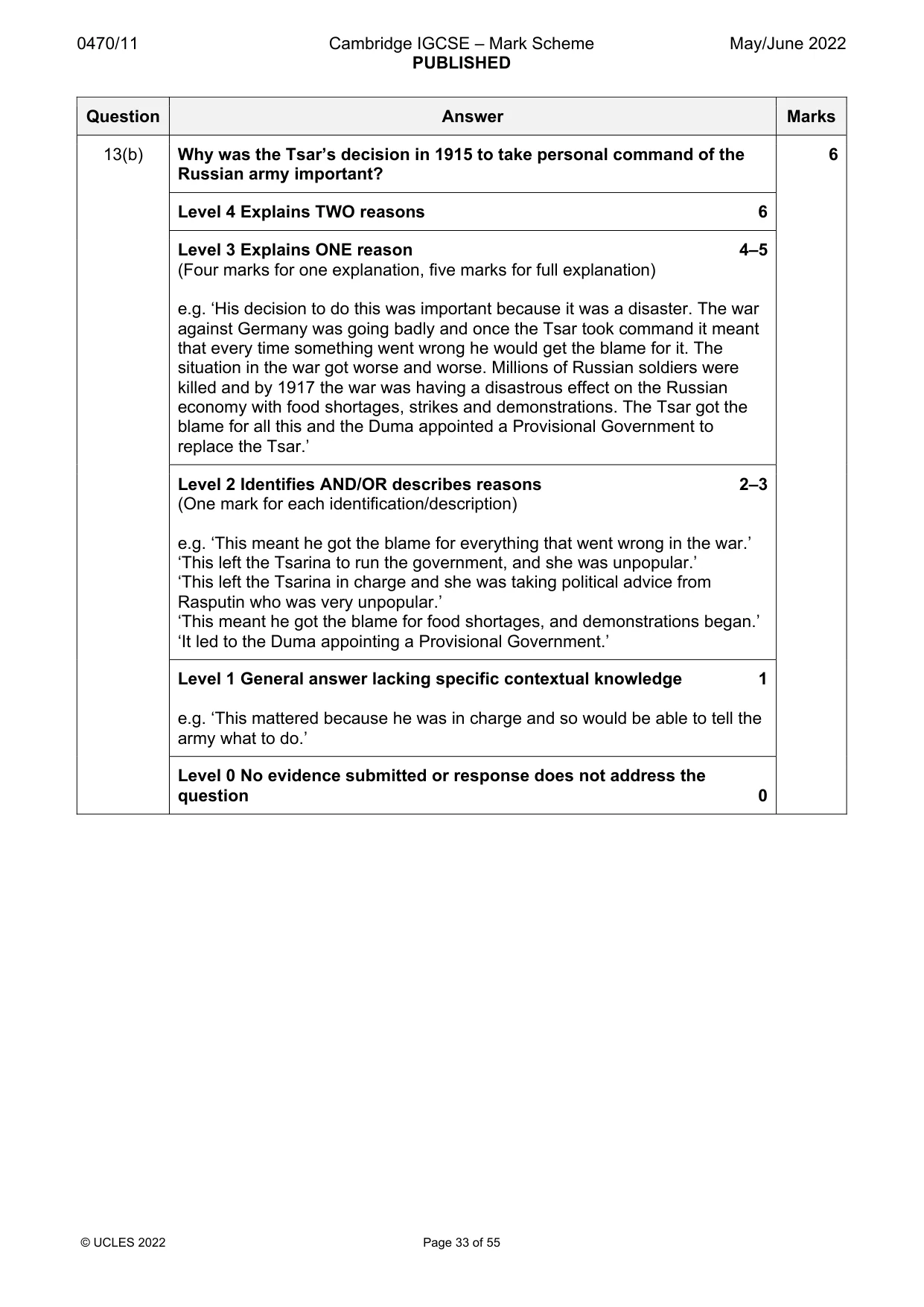
0470/11 Cambridge IGCSE – Mark Scheme PUBLISHED May/June 2022 © UCLES 2022 Page 33 of 55 Question Answer Marks 13(b) Why was the Tsar’s decision in 1915 to take personal command of the Russian army important? 6 Level 4 Explains TWO reasons 6 Level 3 Explains ONE reason 4–5 (Four marks for one explanation, five marks for full explanation) e.g. ‘His decision to do this was important because it was a disaster. The war against Germany was going badly and once the Tsar took command it meant that every time something went wrong he would get the blame for it. The situation in the war got worse and worse. Millions of Russian soldiers were killed and by 1917 the war was having a disastrous effect on the Russian economy with food shortages, strikes and demonstrations. The Tsar got the blame for all this and the Duma appointed a Provisional Government to replace the Tsar.’ Level 2 Identifies AND/OR describes reasons 2–3 (One mark for each identification/description) e.g. ‘This meant he got the blame for everything that went wrong in the war.’ ‘This left the Tsarina to run the government, and she was unpopular.’ ‘This left the Tsarina in charge and she was taking political advice from Rasputin who was very unpopular.’ ‘This meant he got the blame for food shortages, and demonstrations began.’ ‘It led to the Duma appointing a Provisional Government.’ Level 1 General answer lacking specific contextual knowledge 1 e.g. ‘This mattered because he was in charge and so would be able to tell the army what to do.’ Level 0 No evidence submitted or response does not address the question 0
Mark scheme, page 34
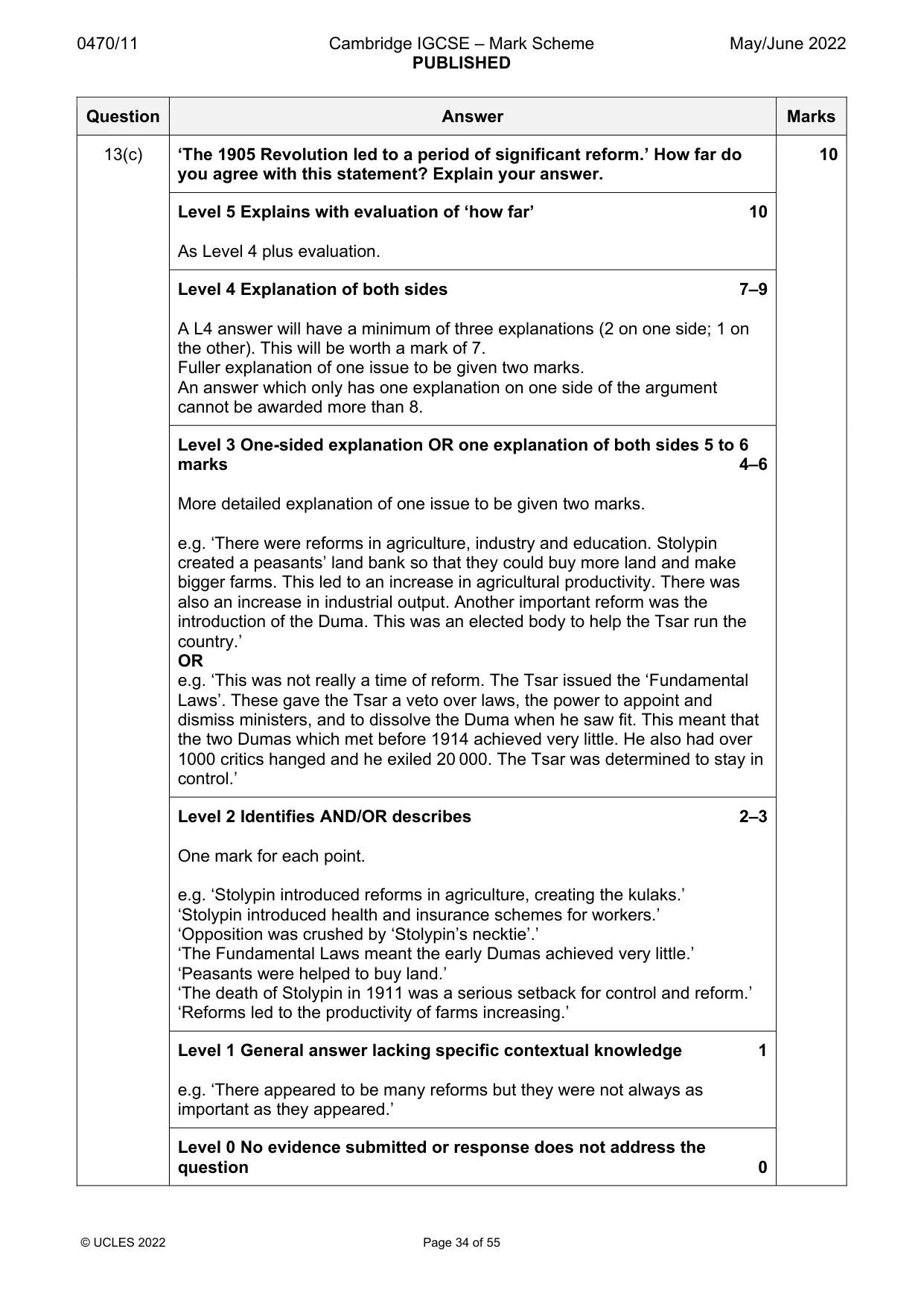
0470/11 Cambridge IGCSE – Mark Scheme PUBLISHED May/June 2022 © UCLES 2022 Page 34 of 55 Question Answer Marks 13(c) ‘The 1905 Revolution led to a period of significant reform.’ How far do you agree with this statement? Explain your answer. 10 Level 5 Explains with evaluation of ‘how far’ 10 As Level 4 plus evaluation. Level 4 Explanation of both sides 7–9 A L4 answer will have a minimum of three explanations (2 on one side; 1 on the other). This will be worth a mark of 7. Fuller explanation of one issue to be given two marks. An answer which only has one explanation on one side of the argument cannot be awarded more than 8. Level 3 One-sided explanation OR one explanation of both sides 5 to 6 marks 4–6 More detailed explanation of one issue to be given two marks. e.g. ‘There were reforms in agriculture, industry and education. Stolypin created a peasants’ land bank so that they could buy more land and make bigger farms. This led to an increase in agricultural productivity. There was also an increase in industrial output. Another important reform was the introduction of the Duma. This was an elected body to help the Tsar run the country.’ OR e.g. ‘This was not really a time of reform. The Tsar issued the ‘Fundamental Laws’. These gave the Tsar a veto over laws, the power to appoint and dismiss ministers, and to dissolve the Duma when he saw fit. This meant that the two Dumas which met before 1914 achieved very little. He also had over 1000 critics hanged and he exiled 20 000. The Tsar was determined to stay in control.’ Level 2 Identifies AND/OR describes 2–3 One mark for each point. e.g. ‘Stolypin introduced reforms in agriculture, creating the kulaks.’ ‘Stolypin introduced health and insurance schemes for workers.’ ‘Opposition was crushed by ‘Stolypin’s necktie’.’ ‘The Fundamental Laws meant the early Dumas achieved very little.’ ‘Peasants were helped to buy land.’ ‘The death of Stolypin in 1911 was a serious setback for control and reform.’ ‘Reforms led to the productivity of farms increasing.’ Level 1 General answer lacking specific contextual knowledge 1 e.g. ‘There appeared to be many reforms but they were not always as important as they appeared.’ Level 0 No evidence submitted or response does not address the question 0
Mark scheme, page 35
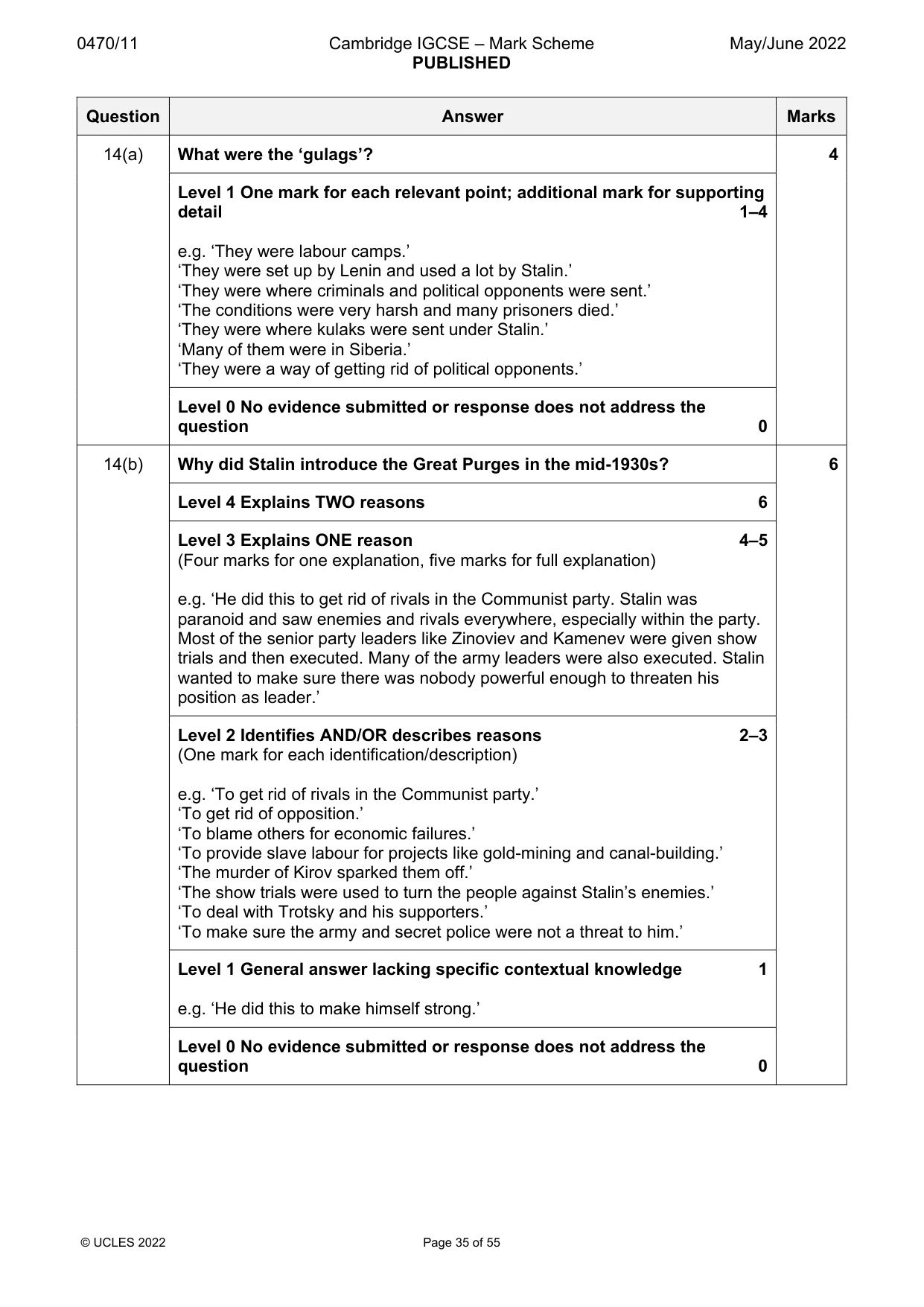
0470/11 Cambridge IGCSE – Mark Scheme PUBLISHED May/June 2022 © UCLES 2022 Page 35 of 55 Question Answer Marks 14(a) What were the ‘gulags’? 4 Level 1 One mark for each relevant point; additional mark for supporting detail 1–4 e.g. ‘They were labour camps.’ ‘They were set up by Lenin and used a lot by Stalin.’ ‘They were where criminals and political opponents were sent.’ ‘The conditions were very harsh and many prisoners died.’ ‘They were where kulaks were sent under Stalin.’ ‘Many of them were in Siberia.’ ‘They were a way of getting rid of political opponents.’ Level 0 No evidence submitted or response does not address the question 0 14(b) Why did Stalin introduce the Great Purges in the mid-1930s? 6 Level 4 Explains TWO reasons 6 Level 3 Explains ONE reason 4–5 (Four marks for one explanation, five marks for full explanation) e.g. ‘He did this to get rid of rivals in the Communist party. Stalin was paranoid and saw enemies and rivals everywhere, especially within the party. Most of the senior party leaders like Zinoviev and Kamenev were given show trials and then executed. Many of the army leaders were also executed. Stalin wanted to make sure there was nobody powerful enough to threaten his position as leader.’ Level 2 Identifies AND/OR describes reasons 2–3 (One mark for each identification/description) e.g. ‘To get rid of rivals in the Communist party.’ ‘To get rid of opposition.’ ‘To blame others for economic failures.’ ‘To provide slave labour for projects like gold-mining and canal-building.’ ‘The murder of Kirov sparked them off.’ ‘The show trials were used to turn the people against Stalin’s enemies.’ ‘To deal with Trotsky and his supporters.’ ‘To make sure the army and secret police were not a threat to him.’ Level 1 General answer lacking specific contextual knowledge 1 e.g. ‘He did this to make himself strong.’ Level 0 No evidence submitted or response does not address the question 0
Mark scheme, page 36
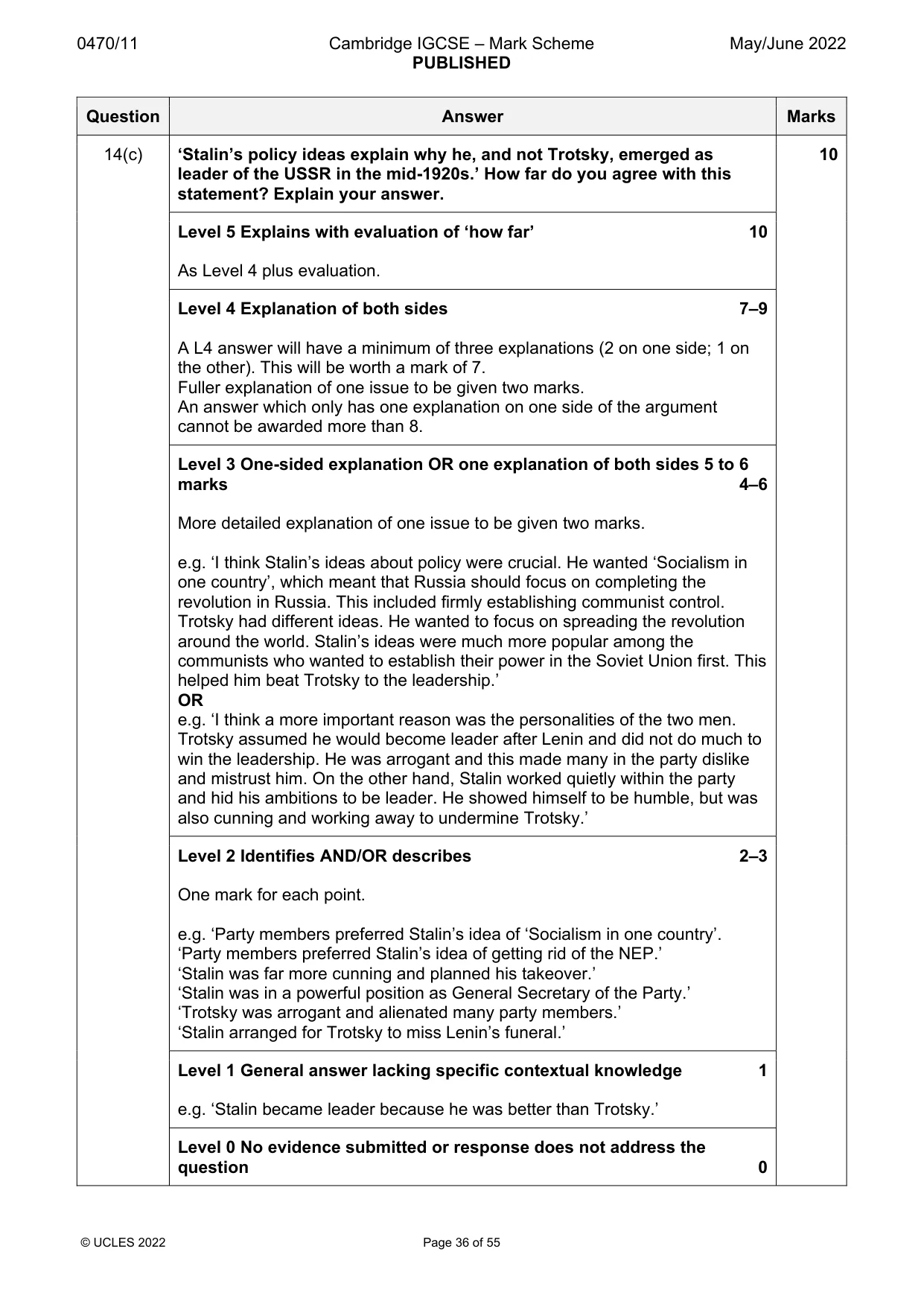
0470/11 Cambridge IGCSE – Mark Scheme PUBLISHED May/June 2022 © UCLES 2022 Page 36 of 55 Question Answer Marks 14(c) ‘Stalin’s policy ideas explain why he, and not Trotsky, emerged as leader of the USSR in the mid-1920s.’ How far do you agree with this statement? Explain your answer. 10 Level 5 Explains with evaluation of ‘how far’ 10 As Level 4 plus evaluation. Level 4 Explanation of both sides 7–9 A L4 answer will have a minimum of three explanations (2 on one side; 1 on the other). This will be worth a mark of 7. Fuller explanation of one issue to be given two marks. An answer which only has one explanation on one side of the argument cannot be awarded more than 8. Level 3 One-sided explanation OR one explanation of both sides 5 to 6 marks 4–6 More detailed explanation of one issue to be given two marks. e.g. ‘I think Stalin’s ideas about policy were crucial. He wanted ‘Socialism in one country’, which meant that Russia should focus on completing the revolution in Russia. This included firmly establishing communist control. Trotsky had different ideas. He wanted to focus on spreading the revolution around the world. Stalin’s ideas were much more popular among the communists who wanted to establish their power in the Soviet Union first. This helped him beat Trotsky to the leadership.’ OR e.g. ‘I think a more important reason was the personalities of the two men. Trotsky assumed he would become leader after Lenin and did not do much to win the leadership. He was arrogant and this made many in the party dislike and mistrust him. On the other hand, Stalin worked quietly within the party and hid his ambitions to be leader. He showed himself to be humble, but was also cunning and working away to undermine Trotsky.’ Level 2 Identifies AND/OR describes 2–3 One mark for each point. e.g. ‘Party members preferred Stalin’s idea of ‘Socialism in one country’. ‘Party members preferred Stalin’s idea of getting rid of the NEP.’ ‘Stalin was far more cunning and planned his takeover.’ ‘Stalin was in a powerful position as General Secretary of the Party.’ ‘Trotsky was arrogant and alienated many party members.’ ‘Stalin arranged for Trotsky to miss Lenin’s funeral.’ Level 1 General answer lacking specific contextual knowledge 1 e.g. ‘Stalin became leader because he was better than Trotsky.’ Level 0 No evidence submitted or response does not address the question 0
Mark scheme, page 37
0470/11 Cambridge IGCSE – Mark Scheme PUBLISHED May/June 2022 © UCLES 2022 Page 37 of 55 Question Answer Marks 15(a) Who were Sacco and Vanzetti? 4 Level 1 One mark for each relevant point; additional mark for supporting detail 1–4 e.g. ‘They were Italian immigrants.’ ‘They were anarchists.’ ‘They were accused of armed robbery and murder.’ ‘Public opinion was against them because of their political views and the fact they were immigrants.’ ‘Many witnesses said the two men were elsewhere at the time of the robbery.’ ‘The judge was prejudiced against them and they were found guilty.’ ‘There were protests against their conviction.’ ‘They lost their appeal and were executed.’ Level 0 No evidence submitted or response does not address the question 0 15(b) Why did many Americans disapprove of the ‘Roaring Twenties’? 6 Level 4 Explains TWO reasons 6 Level 3 Explains ONE reason 4–5 (Four marks for one explanation, five marks for full explanation) e.g. ‘The glitz, glamour and fun of the ‘Roaring Twenties’ were enjoyed only by a very small section of American society. They were usually young and rich people living in the big cities. In small towns across the USA and in the countryside people were not enjoying any of these things such as cocktails, nightclubs and new fashions. They looked at the excesses of the ‘Roaring Twenties’ and disapproved of what was happening because they could not share in it at all.’ Level 2 Identifies AND/OR describes reasons 2–3 (One mark for each identification/description) e.g. ‘This was because they thought much of it was immoral such as short skirts and kissing in films.’ ‘They thought jazz music was corrupting.’ ‘They disapproved of it all because they could not share in it.’ Level 1 General answer lacking specific contextual knowledge 1 e.g. ‘They disapproved because they did not like what was going on in the 1920s.’ Level 0 No evidence submitted or response does not address the question 0
Mark scheme, page 38
0470/11 Cambridge IGCSE – Mark Scheme PUBLISHED May/June 2022 © UCLES 2022 Page 38 of 55 Question Answer Marks 15(c) ‘Prohibition was introduced because some people believed drinking alcohol caused poverty and neglect of families.’ How far do you agree with this statement? Explain your answer. 10 Level 5 Explains with evaluation of ‘how far’ 10 As Level 4 plus evaluation. Level 4 Explanation of both sides 7–9 A L4 answer will have a minimum of three explanations (2 on one side; 1 on the other). This will be worth a mark of 7. Fuller explanation of one issue to be given two marks. An answer which only has one explanation on one side of the argument cannot be awarded more than 8. Level 3 One-sided explanation OR one explanation of both sides 5 to 6 marks 4–6 More detailed explanation of one issue to be given two marks. e.g. ‘I agree with this. Many people thought that drinking alcohol was damaging families. Men were spending too much money on drink and this meant that there was not enough money to feed their families. It was thought that the families were being neglected and were living in poverty. Organisations were set up like the Anti-Saloon League to put pressure on the government to ban alcohol.’ OR e.g. ‘I think the main reason for prohibition was because many of the brewers were German. The US had just fought a war against Germany and anything German was unpopular. It was claimed that alcohol was linked to German aggression and that it was anti-American to drink. Prohibition became patriotic for many Americans.’ Level 2 Identifies AND/OR describes 2–3 One mark for each point. e.g. ‘They believed men were spending their wages on drink and leaving their families in poverty.’ ‘Prohibition was introduced because many brewers were German in origin.’ ‘It was introduced because of the work of pressure groups like the Anti-Saloon League.’ ‘It was believed that drinking led to ill health and crime.’ ‘People believed that the grain should be used for making bread not alcohol.’ ‘It was believed that alcohol stopped workers working hard and efficiently.’ ‘It was introduced because politicians thought it would win them votes.’ ‘Religious groups believed that alcohol was a threat to moral standards.’ Level 1 General answer lacking specific contextual knowledge 1 e.g. ‘I agree with this. It was introduced to try and help families across America.’
Mark scheme, page 39
0470/11 Cambridge IGCSE – Mark Scheme PUBLISHED May/June 2022 © UCLES 2022 Page 39 of 55 Question Answer Marks 15(c) Level 0 No evidence submitted or response does not address the question 0 Question Answer Marks 16(a) What were the ‘Okies’? 4 Level 1 One mark for each relevant point; additional mark for supporting detail 1–4 e.g. ‘They were migrants from Oklahoma.’ ‘They were migrants coming to California looking for work.’ ‘They were people who were made poor by the Dust Bowl.’ ‘They were looking for work as farm labourers.’ ‘They were fleeing from the Great Plains.’ ‘They worked on large farms in California and lived in shanty towns.’ Level 0 No evidence submitted or response does not address the question 0
Mark scheme, page 40
0470/11 Cambridge IGCSE – Mark Scheme PUBLISHED May/June 2022 © UCLES 2022 Page 40 of 55 Question Answer Marks 16(b) Why was Roosevelt able to win over many voters during his 1932 election campaign? 6 Level 4 Explains TWO reasons 6 Level 3 Explains ONE reason 4–5 (Four marks for one explanation, five marks for full explanation) e.g. ‘He was able to do this because of the Depression. This was affecting people very badly with massive unemployment and homelessness. Roosevelt gave people hope that these problems could be dealt with by promising a ‘new deal’ for the American people. He gave the impression that his government would act immediately. This gave the poor hope that they would get jobs and it reassured the middle classes who were worried that without action the country could slide into revolution.’ Level 2 Identifies AND/OR describes reasons 2–3 (One mark for each identification/description) e.g. ‘He gave people hope that he would deal with the Depression.’ ‘He promised a ‘new deal’.’ ‘Hoover appeared not to care about how the people were suffering.’ ‘Hoover had acted against the Depression too little, too late.’ ‘Hoover got the army to forcefully clear the ‘Bonus Army’ away.’ ‘Hoover was not prepared to spend enough government money to help people in trouble.’ ‘During the election campaign Roosevelt met thousands of voters.’ ‘Roosevelt had no responsibility for the policies that brought about the Depression.’ Level 1 General answer lacking specific contextual knowledge 1 e.g. ‘He did this because he ran a very good election campaign and persuaded lots of people.’ Level 0 No evidence submitted or response does not address the question 0
Mark scheme, page 41
0470/11 Cambridge IGCSE – Mark Scheme PUBLISHED May/June 2022 © UCLES 2022 Page 41 of 55 Question Answer Marks 16(c) How far were speculators on the stock market responsible for the Depression? Explain your answer. 10 Level 5 Explains with evaluation of ‘how far’ 10 As Level 4 plus evaluation. Level 4 Explanation of both sides 7–9 A L4 answer will have a minimum of three explanations (2 on one side; 1 on the other). This will be worth a mark of 7. Fuller explanation of one issue to be given two marks. An answer which only has one explanation on one side of the argument cannot be awarded more than 8. Level 3 One-sided explanation OR one explanation of both sides 5 to 6 marks 4–6 More detailed explanation of one issue to be given two marks. e.g. ‘Speculators were responsible for the Depression. They had bought shares hoping to make a profit. This meant that share prices went up until they were overvalued. When they started to go down speculators panicked and sold their shares at massive losses. This caused banks to collapse which then led to business failures and unemployment. So the speculators started it all.’ OR e.g. ‘There were problems with US industry before the Wall Street Crash and these caused the Depression. Mass production had led to overproduction and demand for goods fell. Factories could not sell their goods and began to make people unemployed which made things worse because they did not have any money to spend on goods.’ Level 2 Identifies AND/OR describes 2–3 One mark for each point. e.g. ‘Speculation led to shares being overpriced.’ ‘Speculation led to the Wall Street Crash.’ ‘Speculators caused the Depression by suddenly selling their shares.’ ‘The banks were to blame for lending people so much money.’ ‘The US economy was already in trouble.’ ‘There was overproduction in many US industries.’ ‘Farmers were in trouble because they were producing too much.’ ‘Other countries were putting tariffs on US imports, thus reducing demand for US goods.’ Level 1 General answer lacking specific contextual knowledge 1 e.g. ‘I think that unemployment was responsible for the Depression and all the problems that people had.’ Level 0 No evidence submitted or response does not address the question 0
Mark scheme, page 42
0470/11 Cambridge IGCSE – Mark Scheme PUBLISHED May/June 2022 © UCLES 2022 Page 42 of 55 Question Answer Marks 17(a) What actions by the Nationalists lost them support during the Second World War? 4 Level 1 One mark for each relevant point; additional mark for supporting detail 1–4 e.g. ‘They failed to react to the threat from Japan.’ ‘For a long time Chiang Kai-shek refused to cooperate with the Communists against the Japanese.’ ‘They were corrupt and wasted a lot of the money they received from abroad.’ ‘Their troops often mistreated the Chinese people.’ Level 0 No evidence submitted or response does not address the question 0 17(b) Why were the Communists able to survive the five extermination campaigns by the Nationalists? 6 Level 4 Explains TWO reasons 6 Level 3 Explains ONE reason 4–5 (Four marks for one explanation, five marks for full explanation) e.g. ‘They were able to do this by going on the Long March. The Communists were facing complete destruction from the million Nationalist troops. By travelling 8000 miles they moved away from the threat from the KMT. They were able to set up a strong base at Yenan where they were safe and could recover their strength.’ Level 2 Identifies AND/OR describes reasons 2–3 (One mark for each identification/description) e.g. ‘They did this by the Long March.’ ‘The Communist armies outmanoeuvred the Nationalist forces.’ ‘They recovered and rebuilt in the north.’ ‘They had a strong base at Yenan.’ Level 1 General answer lacking specific contextual knowledge 1 e.g. ‘They were able to do this with a lot of determination and skill. They also had some luck.’ Level 0 No evidence submitted or response does not address the question 0
Mark scheme, page 43
0470/11 Cambridge IGCSE – Mark Scheme PUBLISHED May/June 2022 © UCLES 2022 Page 43 of 55 Question Answer Marks 17(c) ‘The Communists won the Civil War because of their tactics.’ How far do you agree with this statement? Explain your answer. 10 Level 5 Explains with evaluation of ‘how far’ 10 As Level 4 plus evaluation. Level 4 Explanation of both sides 7–9 A L4 answer will have a minimum of three explanations (2 on one side; 1 on the other). This will be worth a mark of 7. Fuller explanation of one issue to be given two marks. An answer which only has one explanation on one side of the argument cannot be awarded more than 8. Level 3 One-sided explanation OR one explanation of both sides 5 to 6 marks 4–6 More detailed explanation of one issue to be given two marks. e.g. ‘Tactics were very important to the Communists. They spent a lot of time winning the support of the Chinese peasants by improving their lives. This meant that they were able to use guerrilla tactics which were very successful and which the Nationalists found difficult to cope with. They avoided a large battle and picked off the Nationalist army bit by bit. They also disrupted the supply route of the Nationalists.’ OR e.g. ‘I think the Communists won because of the weaknesses of the KMT. The Nationalists were corrupt and this lost them the support of the ordinary people who thought they had failed to solve the economic problems of China. KMT troops began to desert to the Communists taking supplies and weapons with them.’ Level 2 Identifies AND/OR describes 2–3 One mark for each point. e.g. ‘KMT troops deserted.’ ‘The Nationalists were corrupt and this lost them support.’ ‘The Nationalists lost the support of the USA.’ ‘The Nationalists mistreated the peasants and lost their support.’ ‘The Communists won the support of the peasants.’ ‘The Communist guerrilla tactics worked very well.’ Level 1 General answer lacking specific contextual knowledge 1 e.g. ‘They won because they were much better at fighting.’ Level 0 No evidence submitted or response does not address the question 0
Mark scheme, page 44
0470/11 Cambridge IGCSE – Mark Scheme PUBLISHED May/June 2022 © UCLES 2022 Page 44 of 55 Question Answer Marks 18(a) Describe the improvement in relations between China and the United States in the early 1970s. 4 Level 1 One mark for each relevant point; additional mark for supporting detail 1–4 e.g. ‘In 1971 Kissinger visited China to discuss a trade deal.’ ‘The USA supported China joining the UN.’ ‘In 1972 there was a trade agreement.’ ‘In 1972 President Nixon visited China.’ ‘The two countries signed the Shanghai Communique.’ ‘The US recognised that Taiwan was part of China.’ Level 0 No evidence submitted or response does not address the question 0 18(b) Why did China sign the Panchsheel Agreement of 1954? 6 Level 4 Explains TWO reasons 6 Level 3 Explains ONE reason 4–5 (Four marks for one explanation, five marks for full explanation) e.g. ‘China signed this agreement because it wanted to get on with India better. They had a number of disagreements over areas like South Tibet. The agreement set up the 5 principles of co-existence like mutual respect to help the two countries develop economic and security cooperation.’ Level 2 Identifies AND/OR describes reasons 2–3 (One mark for each identification/description) e.g. ‘To improve relations with India.’ ‘To develop non-interference in each other’s internal affairs.’ ‘To develop peaceful relations with other countries.’ ‘To set up a code of conduct for newly independent countries.’ ‘To develop its economic relations with India.’ Level 1 General answer lacking specific contextual knowledge 1 e.g. ‘China did this because it wanted to get on with India better.’ Level 0 No evidence submitted or response does not address the question 0
Mark scheme, page 45
0470/11 Cambridge IGCSE – Mark Scheme PUBLISHED May/June 2022 © UCLES 2022 Page 45 of 55 Question Answer Marks 18(c) Which has been more important to China, Taiwan or Vietnam? Explain your answer. 10 Level 5 Explains with evaluation of ‘which had been more important’ 10 As Level 4 plus evaluation. Level 4 Explanation of both sides 7–9 A L4 answer will have a minimum of three explanations (2 on one side; 1 on the other). This will be worth a mark of 7. Fuller explanation of one issue to be given two marks. An answer which only has one explanation on one side of the argument cannot be awarded more than 8. Level 3 One-sided explanation OR one explanation of both sides 5 to 6 marks 4–6 More detailed explanation of one issue to be given two marks. e.g. ‘Taiwan was much more important to China. This was because at the end of the Civil War the KMT and millions of refugees fled there and prepared to win China back. They received weapons and supplies from the USA. Chiang declared that his government in Taiwan was the real government of China. This meant that Taiwan remained as a constant threat to China and there was the possibility of an invasion. However, as Communist China grew stronger the threat from Taiwan grew weaker. But even today, Taiwan remains a problem for China because it still claims to be the real state of China.’ OR e.g. ‘Vietnam was more important to China because it hoped that it would take on the Chinese version of communism and become like China. This would make China stronger in the region and was one of the reasons why China helped North Vietnam with weapons and supplies. China hoped that this would reduce Soviet influence in the area. However, Vietnam continued to have close relations with Russia and then invaded Cambodia. This made Vietnam a constant threat to China.’ Level 2 Identifies AND/OR describes 2–3 One mark for each point. e.g. ‘The government of Taiwan claimed to be the real government of China.’ ‘There was a threat of invasion by Taiwan.’ ‘Taiwan was backed by the USA.’ ‘Taiwan’s government was recognised by many countries as the real government of China.’ ‘Vietnam was close to the USSR.’ ‘Vietnam wanted to develop its own brand of communism, rather than China’s.’ ‘Vietnam invaded Cambodia in 1976.’ ‘Vietnam signed a treaty of friendship with the Soviet Union.’ ‘War with Vietnam broke out in 1979.’
Mark scheme, page 46
0470/11 Cambridge IGCSE – Mark Scheme PUBLISHED May/June 2022 © UCLES 2022 Page 46 of 55 Question Answer Marks 18(c) Level 1 General answer lacking specific contextual knowledge 1 e.g. ‘I think Taiwan was much more important because it was so close to China.’ Level 0 No evidence submitted or response does not address the question 0 Question Answer Marks 19(a) What was the Sabotage Act of 1962? 4 Level 1 One mark for each relevant point; additional mark for supporting detail 1–4 e.g. ‘It said strikes and trade union activity were types of sabotage.’ ‘It meant that actions like going on strike could be punished by death.’ ‘It increased the punishment for acts like trade union activity and writing slogans on walls.’ ‘The new law meant that people who were accused of things like going on strike had to prove their innocence.’ ‘Anti-government publications were heavily fined.’ ‘It allowed the government to ban people and organisations.’ ‘It allowed detention without trial.’ ‘Its aim was to wipe out opposition to apartheid.’ Level 0 No evidence submitted or response does not address the question 0
Mark scheme, page 47
0470/11 Cambridge IGCSE – Mark Scheme PUBLISHED May/June 2022 © UCLES 2022 Page 47 of 55 Question Answer Marks 19(b) Why did the South African government introduce the Group Areas Act of 1950? 6 Level 4 Explains TWO reasons 6 Level 3 Explains ONE reason 4–5 (Four marks for one explanation, five marks for full explanation) e.g. ‘It introduced this Act to help achieve its aim of keeping white people and black people separate. It divided South Africa into different racial areas where only one race could live. This meant that people living in the wrong type of area had to move, like the black people living in Sophiatown which became a ‘whites only’ area.’ Level 2 Identifies AND/OR describes reasons 2–3 (One mark for each identification/description) e.g. ‘It did this to keep the different races separate from each other.’ ‘The government thought it was wrong for different races to be living together.’ ‘The government thought that there were too many black people living in the big cities.’ ‘It was introduced to preserve the better and more developed areas for white South Africans.’ Level 1 General answer lacking specific contextual knowledge 1 e.g. ‘It did this because it thought it would help to achieve what the government wanted in South Africa.’ Level 0 No evidence submitted or response does not address the question 0
Mark scheme, page 48
0470/11 Cambridge IGCSE – Mark Scheme PUBLISHED May/June 2022 © UCLES 2022 Page 48 of 55 Question Answer Marks 19(c) ‘The Sharpeville Massacre was a turning point for South Africa.’ How far do you agree with this statement? Explain your answer. 10 Level 5 Explains with evaluation of ‘how far’ 10 As Level 4 plus evaluation. Level 4 Explanation of both sides 7–9 A L4 answer will have a minimum of three explanations (2 on one side; 1 on the other). This will be worth a mark of 7. Fuller explanation of one issue to be given two marks. An answer which only has one explanation on one side of the argument cannot be awarded more than 8. Level 3 One-sided explanation OR one explanation of both sides 5 to 6 marks 4–6 More detailed explanation of one issue to be given two marks. e.g. ‘I think it was a turning point. Things would never be the same again. This was because of the international reaction to the massacre. Many countries, and the UN, condemned it and the UN passed Resolution 134 against it. South Africa now became almost totally isolated in the world and stayed like this until apartheid and minority rule were abolished.’ OR e.g. ‘I do not think it was a turning point. It led to protests and demonstrations throughout South Africa but these had existed before. Sharpeville took place in 1960, but apartheid and minority rule lasted for more than another 30 years. The South African government passed new laws to make itself and apartheid even stronger, and a few years later Nelson Mandela was sent to prison for life. Getting rid of apartheid was as far away as ever.’ Level 2 Identifies AND/OR describes 2–3 One mark for each point. e.g. ‘It led to protests across South Africa.’ ‘It led to international condemnation and protests.’ ‘It led to South Africa being internationally isolated.’ ‘It was condemned by the United Nations.’ ‘The South African government introduced new laws to strengthen its position.’ Level 1 General answer lacking specific contextual knowledge 1 e.g. ‘I think it was a turning point because it led to lots of changes in South Africa.’ Level 0 No evidence submitted or response does not address the question 0
Mark scheme, page 49
0470/11 Cambridge IGCSE – Mark Scheme PUBLISHED May/June 2022 © UCLES 2022 Page 49 of 55 Question Answer Marks 20(a) What was the Bureau of State Security (BOSS)? 4 Level 1 One mark for each relevant point; additional mark for supporting detail 1–4 e.g. ‘It was in charge of looking after state security.’ ‘It was set up in 1969.’ ‘It gathered intelligence.’ ‘It worked closely with other minority regimes.’ ‘It plotted against African regimes like the one in Zambia.’ ‘It ordered assassinations.’ ‘It was involved in Muldergate.’ Level 0 No evidence submitted or response does not address the question 0 20(b) Why, from 1976, did the South African government claim to be giving independence to the Bantustans? 6 Level 4 Explains TWO reasons 6 Level 3 Explains ONE reason 4–5 (Four marks for one explanation, five marks for full explanation) e.g. ‘It did this because it hoped that it would make the government look like a progressive regime that was giving black South Africans the right to govern themselves. It claimed that this was what they had been asking for. Of course, this was not really the case, they had been asking for the right to be involved in the running of the whole of South Africa.’ Level 2 Identifies AND/OR describes reasons 2–3 (One mark for each identification/description) e.g. ‘To make it look as if black South Africans were able to govern themselves.’ ‘To make the government look as if it was progressive and helping black South Africans.’ ‘The leaders of these new states were willing to cooperate with the government.’ ‘Black South Africans in the new states lost their South African citizenship.’ Level 1 General answer lacking specific contextual knowledge 1 e.g. ‘It thought that this idea would win them a lot of support.’ Level 0 No evidence submitted or response does not address the question 0
Mark scheme, page 50
0470/11 Cambridge IGCSE – Mark Scheme PUBLISHED May/June 2022 © UCLES 2022 Page 50 of 55 Question Answer Marks 20(c) How effective were the government’s methods of suppression in the period 1966 to 1980? Explain your answer. 10 Level 5 Explains with evaluation of ‘how effective’ 10 As Level 4 plus evaluation. Level 4 Explanation of both sides 7–9 A L4 answer will have a minimum of three explanations (2 on one side; 1 on the other). This will be worth a mark of 7. Fuller explanation of one issue to be given two marks. An answer which only has one explanation on one side of the argument cannot be awarded more than 8. Level 3 One-sided explanation OR one explanation of both sides 5 to 6 marks 4–6 More detailed explanation of one issue to be given two marks. e.g. ‘The methods of suppression were effective. They were a total onslaught on opponents to the regime. They allowed the government to detain anyone it thought might be a threat for any length of time. Convicted terrorists could be given the death penalty. The government also banned all publications supporting the ANC and set up its own radio station and TV company to pump out propaganda. By 1980 the minority government was still in power, opposition leaders were in prison, and for a time after 1966 opposition declined. This shows its measures were effective.’ OR e.g. ‘Its measures were not effective. This is shown by the fact that opposition continued and even increased. There might have been a drop in opposition for a time after 1966 but this did not last long. In 1976 the protests in Soweto started. They then spread across the world. Many of the people involved were school children and this meant that there was a new generation of protestors. There were far too many of them for the government to deal with. In panic, the government shot some of them and this led to condemnation around the world. So, the suppression did not work.’ Level 2 Identifies AND/OR describes 2–3 One mark for each point. e.g. ‘Many opposition leaders were in prison.’ ‘The government could imprison anyone it wanted for any length of time.’ ‘There was a drop in opposition after 1966.’ ‘In the early 1970s there was an upsurge in the number of strikes by black South Africans.’ ‘The Soweto protest showed that suppression was not working.’ ‘Soweto sparked protests all over South Africa.’ ‘The government’s violent reaction to the protest created condemnation around the world.’
Mark scheme, page 51
0470/11 Cambridge IGCSE – Mark Scheme PUBLISHED May/June 2022 © UCLES 2022 Page 51 of 55 Question Answer Marks 20(c) Level 1 General answer lacking specific contextual knowledge 1 e.g. ‘Its methods of suppression were not very effective at all and did not solve its problems.’ Level 0 No evidence submitted or response does not address the question 0 Question Answer Marks 21(a) Describe the USA’s role in the Yom Kippur War. 4 Level 1 One mark for each relevant point; additional mark for supporting detail 1–4 e.g. ‘The USA sent military supplies and weapons for Israel to use.’ ‘President Nixon refused to support a ceasefire until Israel had won back its lost territory.’ ‘The USA cooperated with the USSR to bring about an end to the fighting.’ ‘The Arab states stopped supplies of oil to the USA.’ Level 0 No evidence submitted or response does not address the question 0
Mark scheme, page 52
0470/11 Cambridge IGCSE – Mark Scheme PUBLISHED May/June 2022 © UCLES 2022 Page 52 of 55 Question Answer Marks 21(b) Why was the Yom Kippur War important to the Arabs? 6 Level 4 Explains TWO reasons 6 Level 3 Explains ONE reason 4–5 (Four marks for one explanation, five marks for full explanation) e.g. ‘The Yom Kippur War was important to the Arabs because it made Israel understand that it could not get permanent security just by military victories. It had won a series of wars and yet, in 1973, the Arab countries still attacked and breached its defences. This made it move towards looking for a diplomatic solution and led to a peace process and the Camp David Accords of 1978. This showed the Arab countries that something could be achieved through diplomacy.’ Level 2 Identifies AND/OR describes reasons 2–3 (One mark for each identification/description) e.g. ‘The oil embargo was an important weapon for Arab states.’ ‘They had made advances on the Golan Heights and the Suez Canal.’ ‘They had shown that Israeli defences could be beaten.’ ‘It made Israel realise that it needed a diplomatic solution.’ Level 1 General answer lacking specific contextual knowledge 1 e.g. ‘It was important to them because it meant that they were able to achieve some of their aims.’ Level 0 No evidence submitted or response does not address the question 0
Mark scheme, page 53
0470/11 Cambridge IGCSE – Mark Scheme PUBLISHED May/June 2022 © UCLES 2022 Page 53 of 55 Question Answer Marks 21(c) ‘The Arab states were to blame for the Six-Day War.’ How far do you agree with this statement? Explain your answer. 10 Level 5 Explains with evaluation of ‘how far’ 10 As Level 4 plus evaluation. Level 4 Explanation of both sides 7–9 A L4 answer will have a minimum of three explanations (2 on one side; 1 on the other). This will be worth a mark of 7. Fuller explanation of one issue to be given two marks. An answer which only has one explanation on one side of the argument cannot be awarded more than 8. Level 3 One-sided explanation OR one explanation of both sides 5 to 6 marks 4–6 More detailed explanation of one issue to be given two marks. e.g. ‘I think the Arab states were to blame. Their actions forced Israel to act first because it became aware of what the Arab countries were planning. Syria had been threatening a war and had been supporting PLO raids against Israel. Egypt and Syria signed a mutual defence pact in 1966 and in 1967 Jordan signed. So it looked as if the Arab countries were getting ready to attack, making Israel think that it had to act first.’ OR e.g. ‘I think this is wrong because it was Israel that attacked first. It launched air strikes at Egyptian, Syrian and Jordanian airfields. These attacks completely destroyed the air forces of these countries. This meant that Israel had control of the air in the war. Israel had already mobilised its armed forces and then moved its forces into Sinai. All these moves show that Israel was to blame.’ Level 2 Identifies AND/OR describes 2–3 One mark for each point. e.g. ‘Egypt, Syria and Jordan had signed a defence pact.’ ‘Syria had been threatening a war.’ ‘Nasser felt he should be leading the Arabs against Israel.’ ‘Nasser announced the Straits of Tiran would be closed to Israeli ships.’ ‘Egypt mobilised its army on its border with Israel.’ ‘Israel launched air attacks on Arab airfields.’ ‘There were large-scale Israeli troop movements near its border with Syria.’ Level 1 General answer lacking specific contextual knowledge 1 e.g. ‘I think they were to blame because they started it all.’ Level 0 No evidence submitted or response does not address the question 0
Mark scheme, page 54
0470/11 Cambridge IGCSE – Mark Scheme PUBLISHED May/June 2022 © UCLES 2022 Page 54 of 55 Question Answer Marks 22(a) What is the West Bank? 4 Level 1 One mark for each relevant point; additional mark for supporting detail 1–4 e.g. ‘It is land on the west side of the Jordan River.’ ‘It is occupied by Israel.’ ‘Part of it is run by the Palestinian National Authority.’ ‘Part of it is controlled by Israel.’ ‘It has been occupied by Israel since the Six-Day War of 1967.’ ‘It contains Israeli settlements which are generally regarded as illegal.’ Level 0 No evidence submitted or response does not address the question 0 22(b) Why did the emergence of Hamas make a peace settlement with Israel less likely? 6 Level 4 Explains TWO reasons 6 Level 3 Explains ONE reason 4–5 (Four marks for one explanation, five marks for full explanation) e.g. ‘This was because, when it emerged in 1987, it announced that its aim was to liberate Palestine from Israeli occupation and to start an Islamic state in the area that was Israel and the West Bank. Hamas has refused to renounce violent methods and has killed Israeli civilians, including suicide bombings. This has made any peace settlement with Israel much harder to achieve.’ Level 2 Identifies AND/OR describes reasons 2–3 (One mark for each identification/description) e.g. ‘Hamas used violent methods.’ ‘Hamas wanted to establish an Islamic state where Israel is.’ ‘Hamas and Israel have been involved in lots of violence against each other.’ Level 1 General answer lacking specific contextual knowledge 1 e.g. ‘Hamas was very unpopular with Israel and so it was bound to make peace less likely.’ Level 0 No evidence submitted or response does not address the question 0
Mark scheme, page 55
0470/11 Cambridge IGCSE – Mark Scheme PUBLISHED May/June 2022 © UCLES 2022 Page 55 of 55 Question Answer Marks 22(c) How far have the Likud and Labor parties agreed over Palestine? Explain your answer. 10 Level 5 Explains with evaluation of ‘how far’ 10 As Level 4 plus evaluation. Level 4 Explanation of both sides 7–9 A L4 answer will have a minimum of three explanations (2 on one side; 1 on the other). This will be worth a mark of 7. Fuller explanation of one issue to be given two marks. An answer which only has one explanation on one side of the argument cannot be awarded more than 8. Level 3 One-sided explanation OR one explanation of both sides 5 to 6 marks 4–6 More detailed explanation of one issue to be given two marks. e.g. ‘They have agreed over the basic points and have both taken a hard line with Palestinians and Arab countries. They both disagree with the idea of Palestinian self-determination and are both against a setting up of an independent Palestinian state. For a long time they both agreed not to negotiate with the PLO.’ OR e.g. ‘I think they have disagreed over lots of things. In the 1990s, Likud supported the expansion of Jewish settlements in the occupied territories and the idea of a ‘Greater Israel’. Labor has been keener to find a peaceful settlement with the Palestinians. Also, they disagreed over the future of Jerusalem.’ Level 2 Identifies AND/OR describes 2–3 One mark for each point. e.g. ‘Likud refuses to give up Israel’s sovereignty over the West Bank and Gaza.’ ‘Labor has been more willing to negotiate with the Palestinians.’ ‘Labor has been keen on the issue of Palestinian autonomy.’ ‘Likud supports Jewish settlements in the occupied territories.’ ‘For a time they both refused to negotiate with the PLO.’ ‘They both disagree with the idea of an independent Palestinian state.’ Level 1 General answer lacking specific contextual knowledge 1 e.g. ‘I do not think they have agreed much. They have lots of disagreements over it.’ Level 0 No evidence submitted or response does not address the question 0
What you needed in this session
Cambridge’s own grade thresholds for 2022 May/June, Paper 1 · Variant 1. A higher threshold means an easier paper — the bar moves with how the cohort did.