Cambridge IGCSE History 0470 — 2023 Oct/Nov Paper 1 · Variant 1
0470/11/O/N/23 · 60 marks · ≈68 min
The question paper and its mark scheme, free to read here and free to download. This is Cambridge’s own paper, exactly as it was sat.
Question paper12 pages

Mark scheme83 pages
Answers below. Sit the paper first if you are practising.
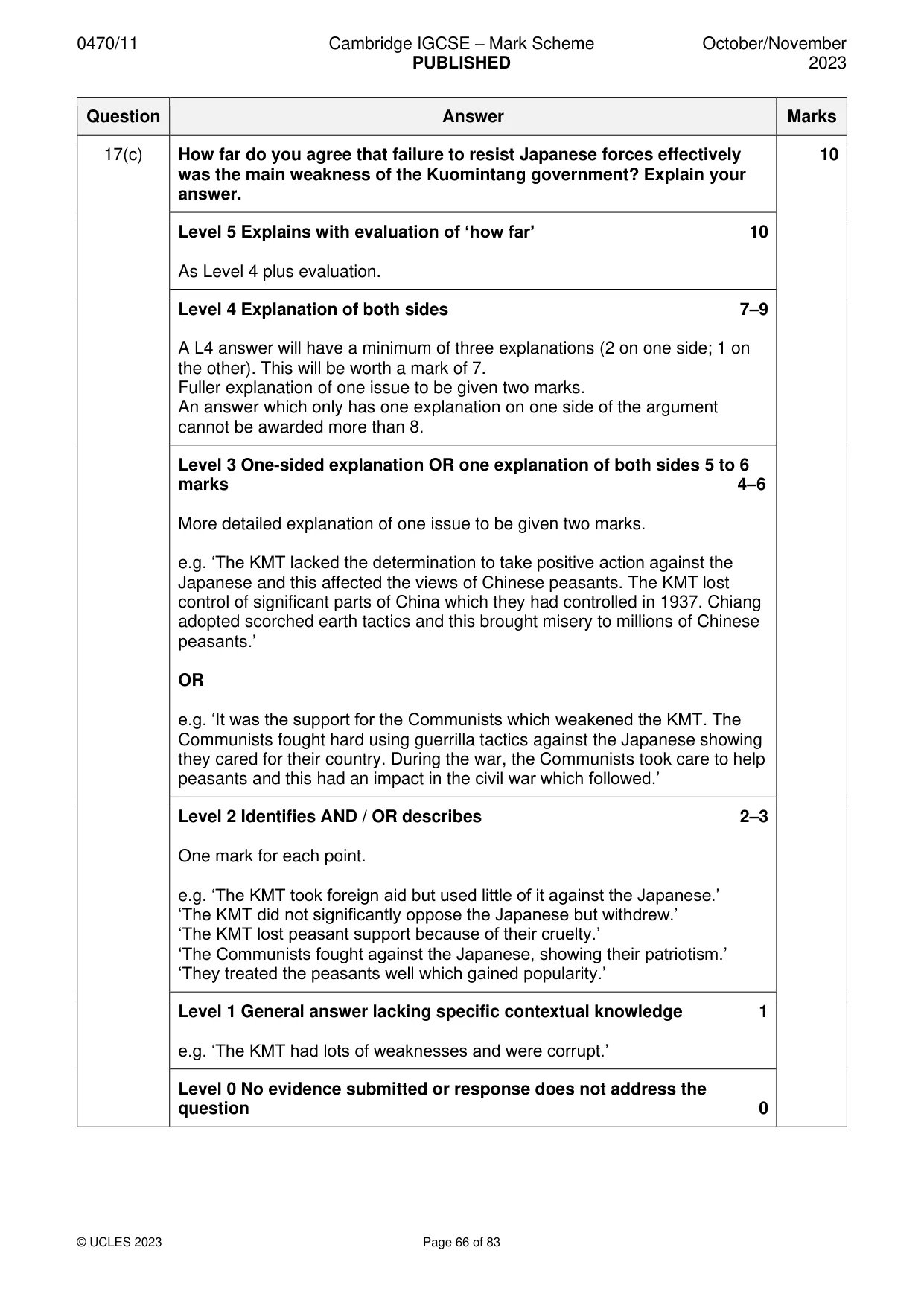
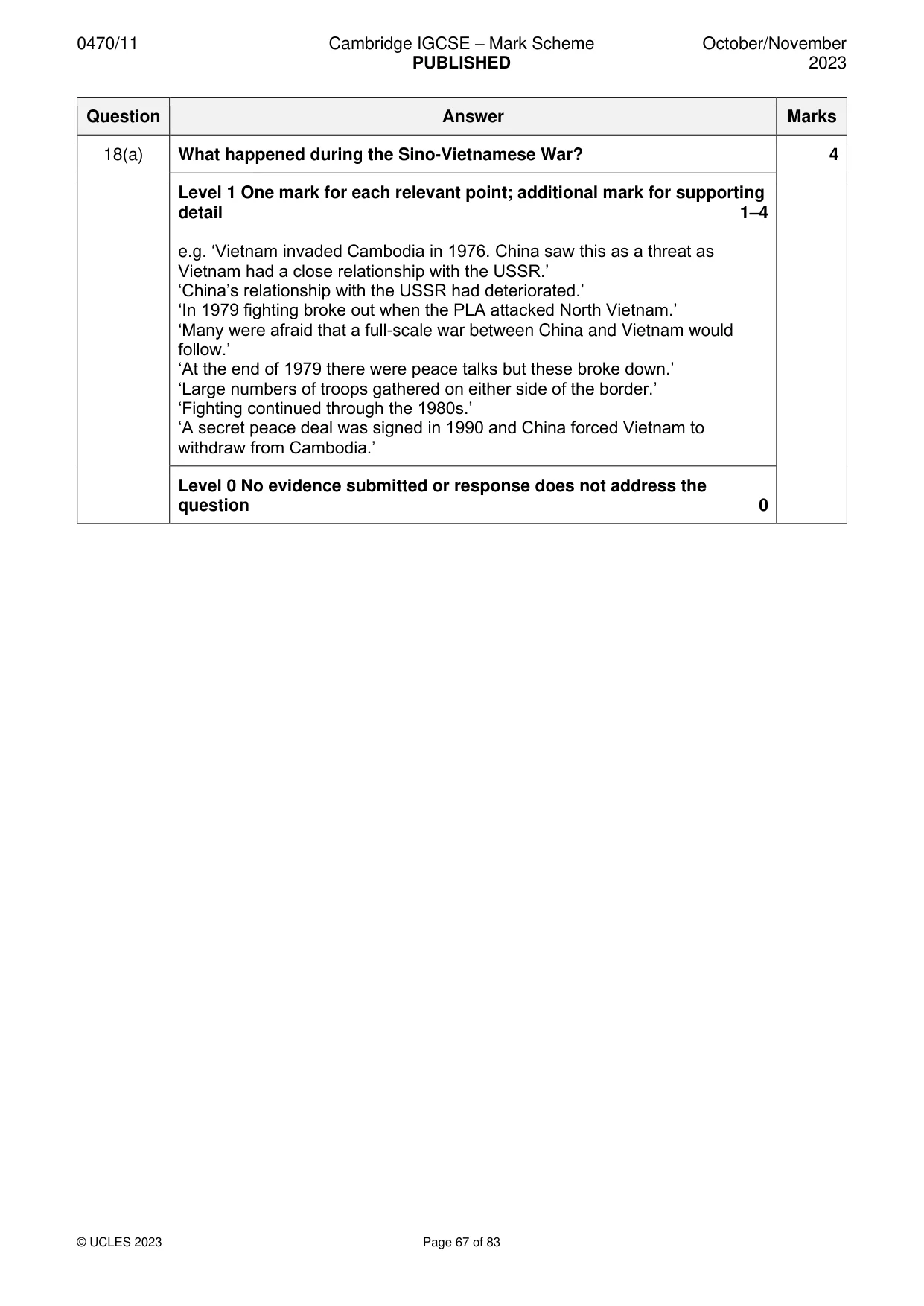
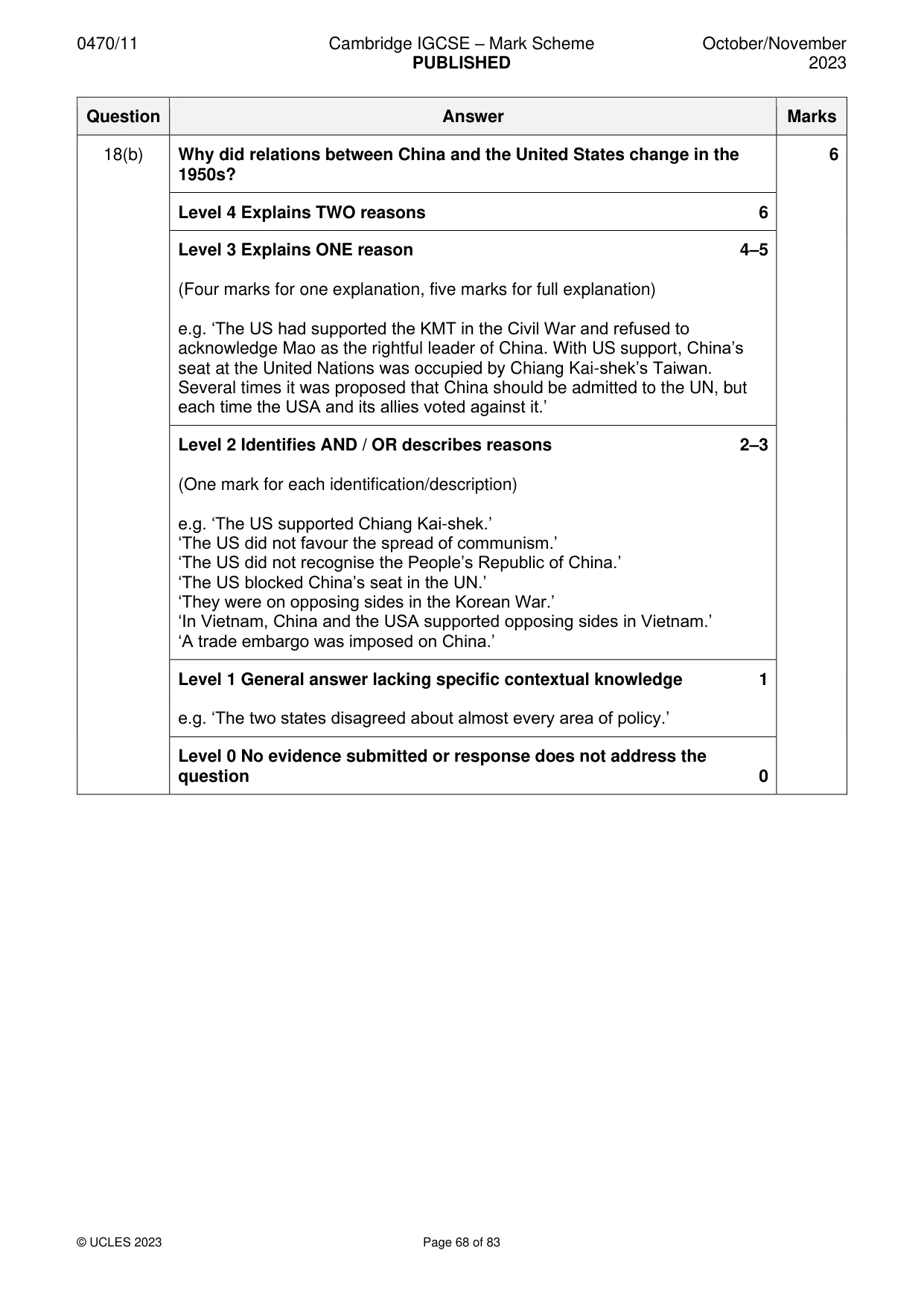
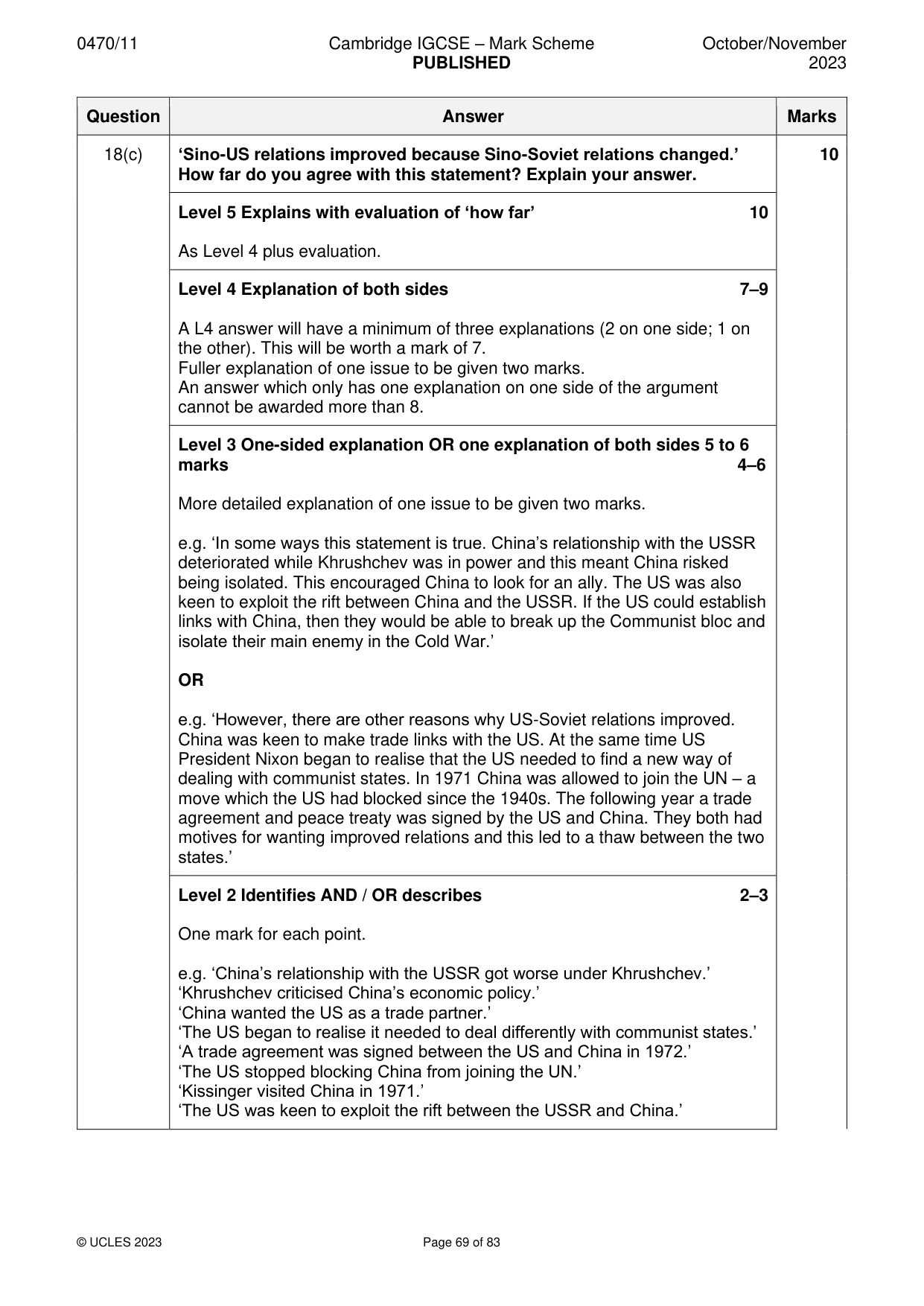
Paper as text
Question paper, page 1
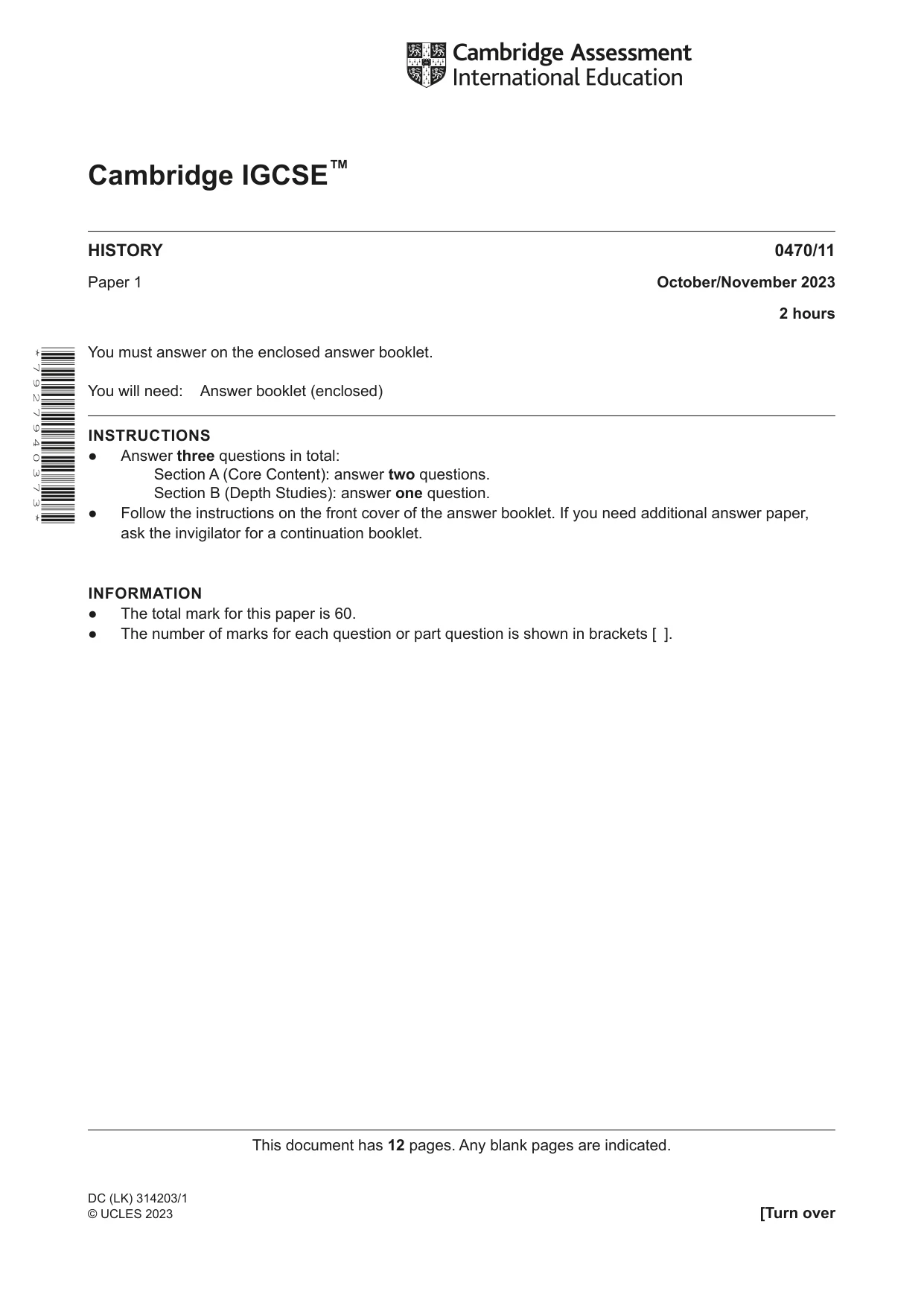
This document has 12 pages. Any blank pages are indicated. [Turn over Cambridge IGCSE™ HISTORY 0470/11 Paper 1 October/November 2023 2 hours You must answer on the enclosed answer booklet. You will need: Answer booklet (enclosed) INSTRUCTIONS ● Answer three questions in total: Section A (Core Content): answer two questions. Section B (Depth Studies): answer one question. ● Follow the instructions on the front cover of the answer booklet. If you need additional answer paper, ask the invigilator for a continuation booklet. INFORMATION ● The total mark for this paper is 60. ● The number of marks for each question or part question is shown in brackets [ ]. * 7 9 2 7 9 4 0 3 7 3 * DC (LK) 314203/1 © UCLES 2023
Question paper, page 2
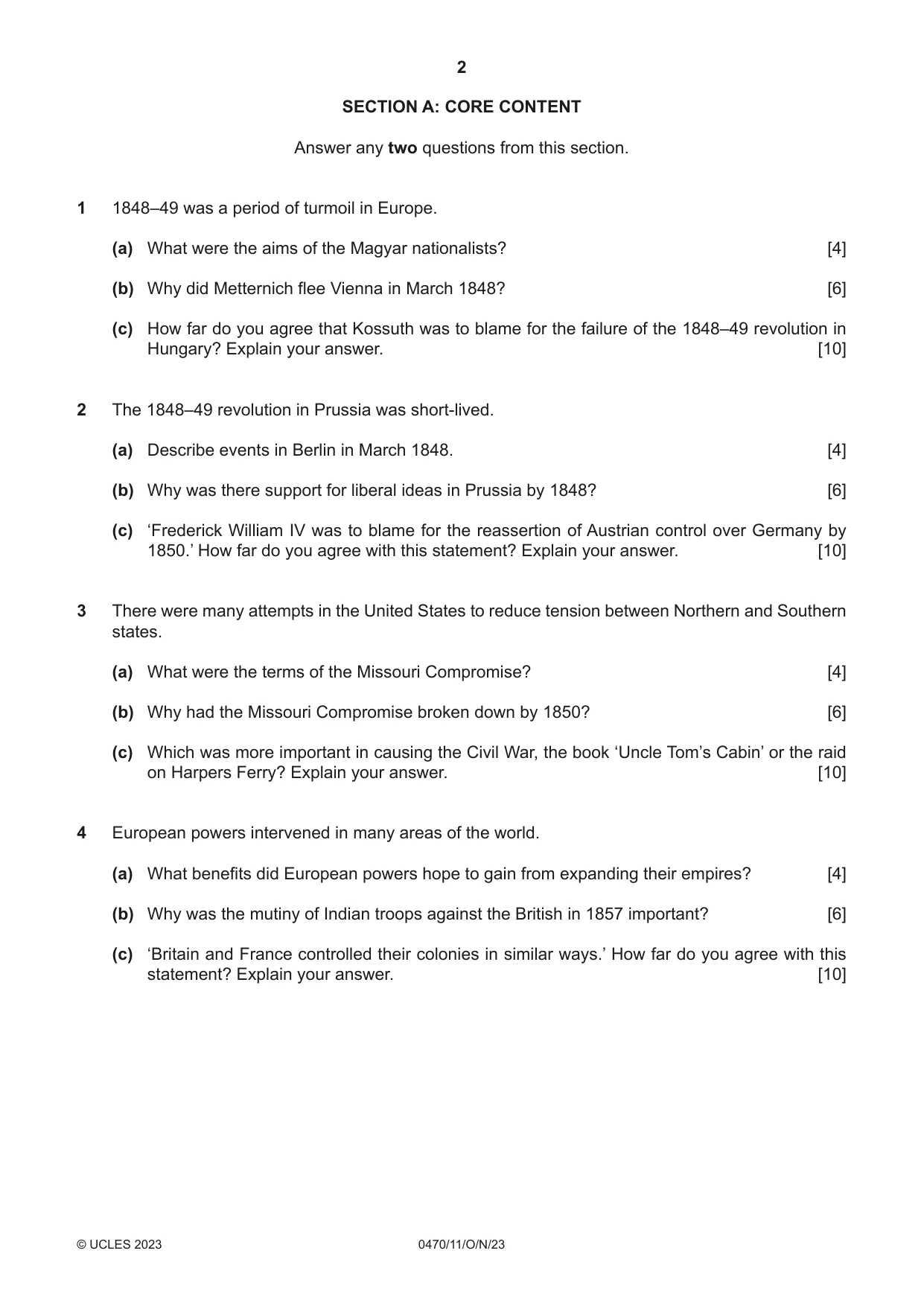
2 0470/11/O/N/23 © UCLES 2023 SECTION A: CORE CONTENT Answer any two questions from this section. 1 1848–49 was a period of turmoil in Europe. (a) What were the aims of the Magyar nationalists? [4] (b) Why did Metternich flee Vienna in March 1848? [6] (c) How far do you agree that Kossuth was to blame for the failure of the 1848–49 revolution in Hungary? Explain your answer. [10] 2 The 1848–49 revolution in Prussia was short-lived. (a) Describe events in Berlin in March 1848. [4] (b) Why was there support for liberal ideas in Prussia by 1848? [6] (c) ‘Frederick William IV was to blame for the reassertion of Austrian control over Germany by 1850.’ How far do you agree with this statement? Explain your answer. [10] 3 There were many attempts in the United States to reduce tension between Northern and Southern states. (a) What were the terms of the Missouri Compromise? [4] (b) Why had the Missouri Compromise broken down by 1850? [6] (c) Which was more important in causing the Civil War, the book ‘Uncle Tom’s Cabin’ or the raid on Harpers Ferry? Explain your answer. [10] 4 European powers intervened in many areas of the world. (a) What benefits did European powers hope to gain from expanding their empires? [4] (b) Why was the mutiny of Indian troops against the British in 1857 important? [6] (c) ‘Britain and France controlled their colonies in similar ways.’ How far do you agree with this statement? Explain your answer. [10]
Question paper, page 3
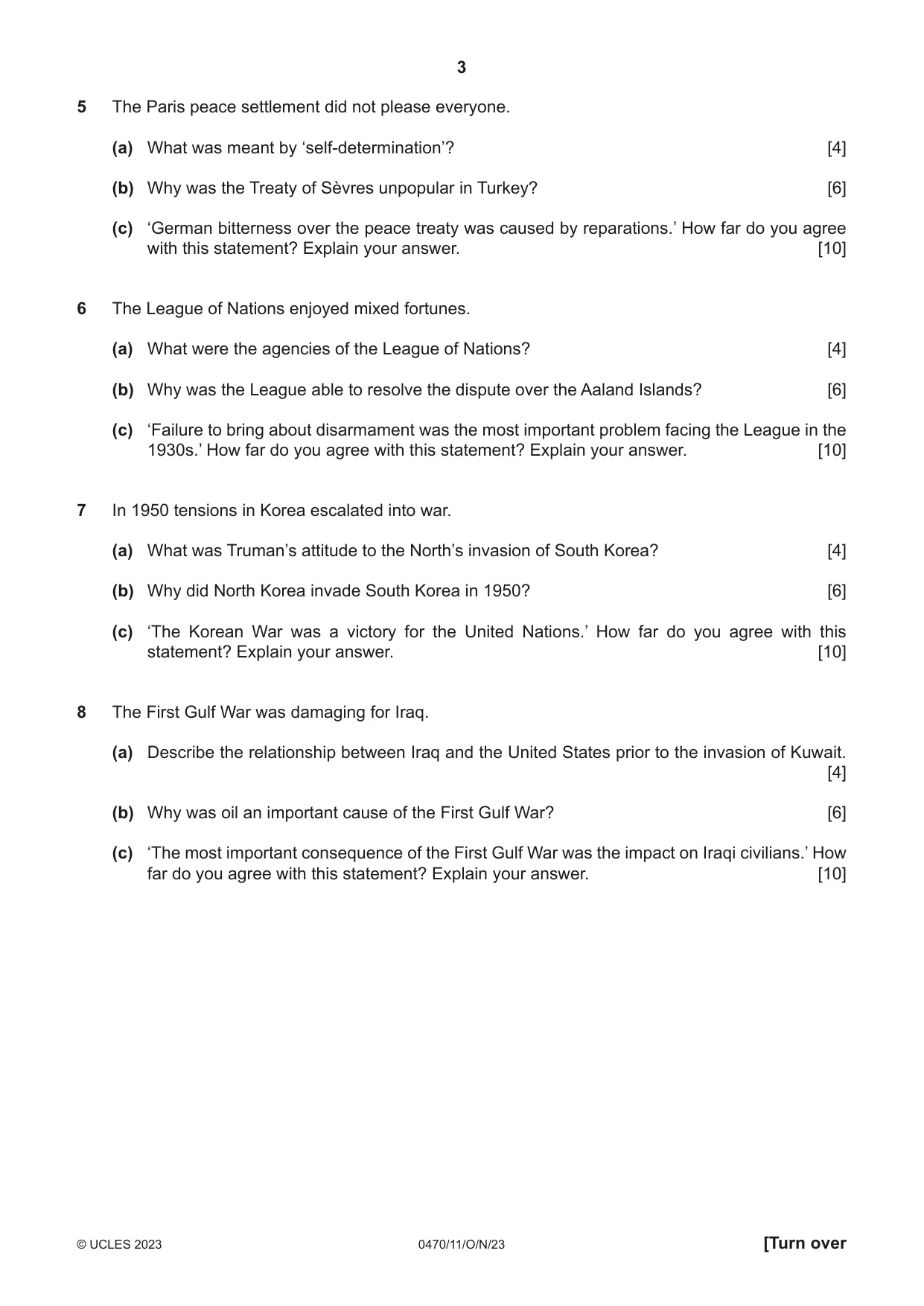
3 0470/11/O/N/23 © UCLES 2023 [Turn over 5 The Paris peace settlement did not please everyone. (a) What was meant by ‘self-determination’? [4] (b) Why was the Treaty of Sèvres unpopular in Turkey? [6] (c) ‘German bitterness over the peace treaty was caused by reparations.’ How far do you agree with this statement? Explain your answer. [10] 6 The League of Nations enjoyed mixed fortunes. (a) What were the agencies of the League of Nations? [4] (b) Why was the League able to resolve the dispute over the Aaland Islands? [6] (c) ‘Failure to bring about disarmament was the most important problem facing the League in the 1930s.’ How far do you agree with this statement? Explain your answer. [10] 7 In 1950 tensions in Korea escalated into war. (a) What was Truman’s attitude to the North’s invasion of South Korea? [4] (b) Why did North Korea invade South Korea in 1950? [6] (c) ‘The Korean War was a victory for the United Nations.’ How far do you agree with this statement? Explain your answer. [10] 8 The First Gulf War was damaging for Iraq. (a) Describe the relationship between Iraq and the United States prior to the invasion of Kuwait. [4] (b) Why was oil an important cause of the First Gulf War? [6] (c) ‘The most important consequence of the First Gulf War was the impact on Iraqi civilians.’ How far do you agree with this statement? Explain your answer. [10]
Question paper, page 4
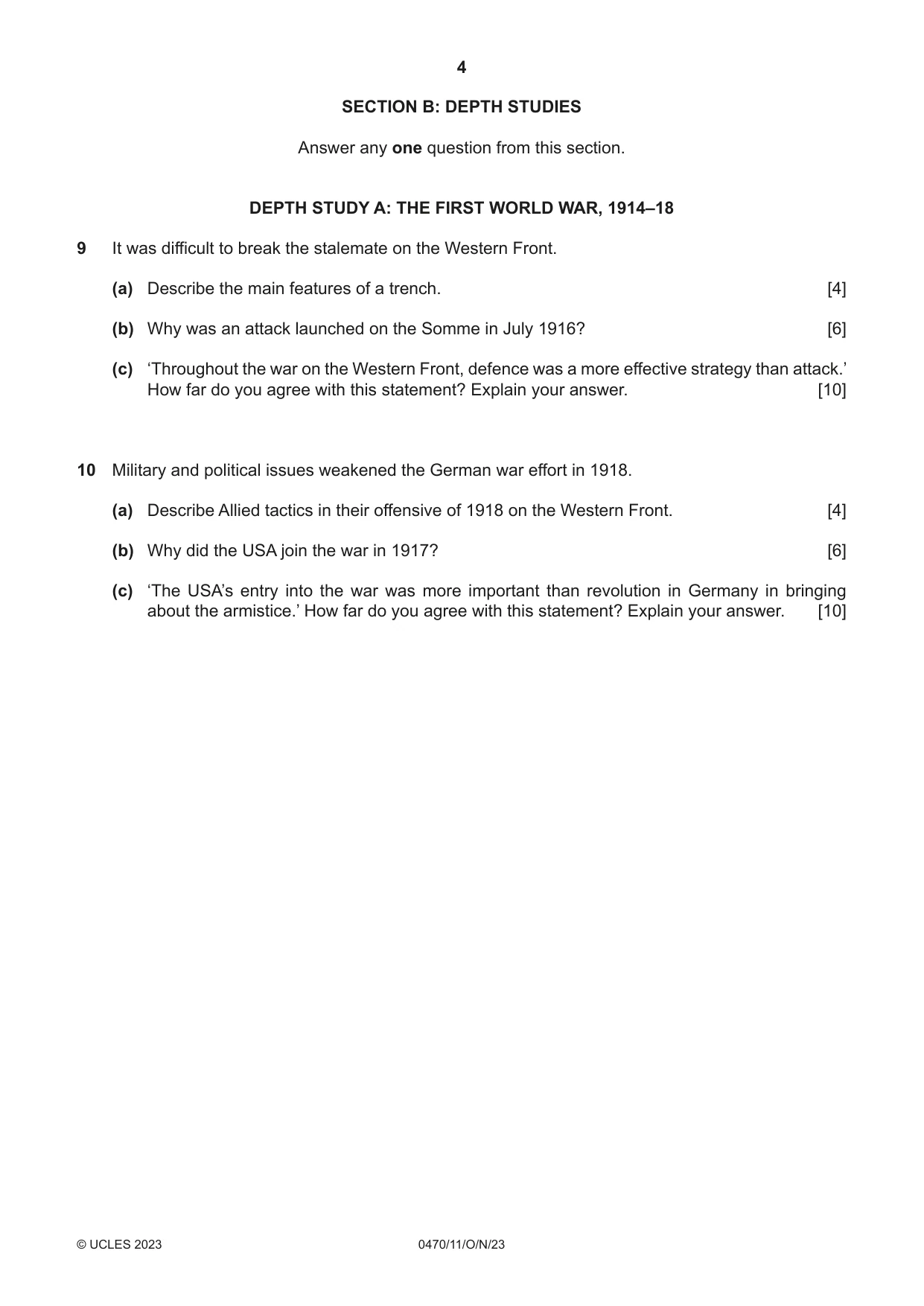
4 0470/11/O/N/23 © UCLES 2023 SECTION B: DEPTH STUDIES Answer any one question from this section. DEPTH STUDY A: THE FIRST WORLD WAR, 1914–18 9 It was difficult to break the stalemate on the Western Front. (a) Describe the main features of a trench. [4] (b) Why was an attack launched on the Somme in July 1916? [6] (c) ‘Throughout the war on the Western Front, defence was a more effective strategy than attack.’ How far do you agree with this statement? Explain your answer. [10] 10 Military and political issues weakened the German war effort in 1918. (a) Describe Allied tactics in their offensive of 1918 on the Western Front. [4] (b) Why did the USA join the war in 1917? [6] (c) ‘The USA’s entry into the war was more important than revolution in Germany in bringing about the armistice.’ How far do you agree with this statement? Explain your answer. [10]
Question paper, page 5
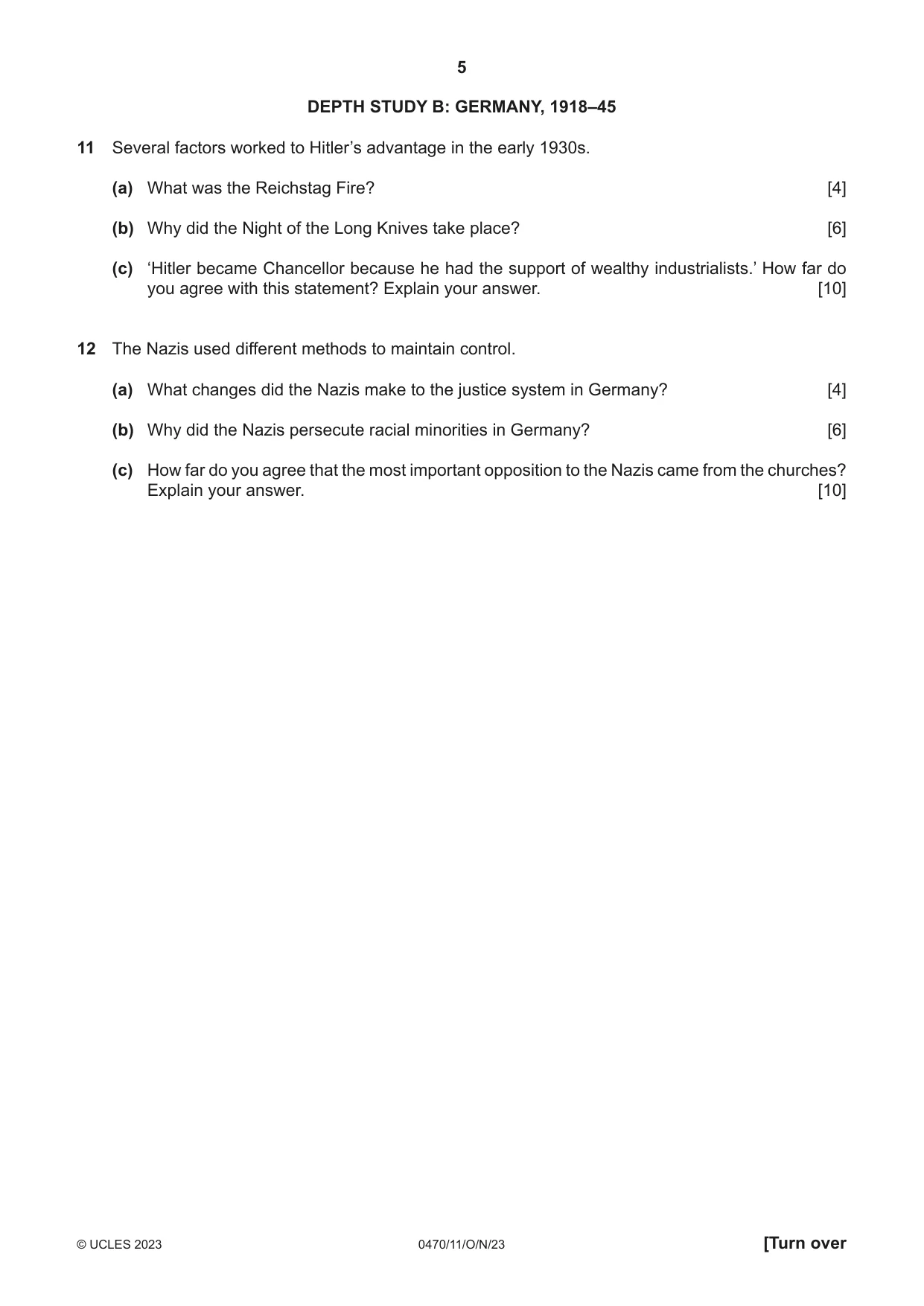
5 0470/11/O/N/23 © UCLES 2023 [Turn over DEPTH STUDY B: GERMANY, 1918–45 11 Several factors worked to Hitler’s advantage in the early 1930s. (a) What was the Reichstag Fire? [4] (b) Why did the Night of the Long Knives take place? [6] (c) ‘Hitler became Chancellor because he had the support of wealthy industrialists.’ How far do you agree with this statement? Explain your answer. [10] 12 The Nazis used different methods to maintain control. (a) What changes did the Nazis make to the justice system in Germany? [4] (b) Why did the Nazis persecute racial minorities in Germany? [6] (c) How far do you agree that the most important opposition to the Nazis came from the churches? Explain your answer. [10]
Question paper, page 6
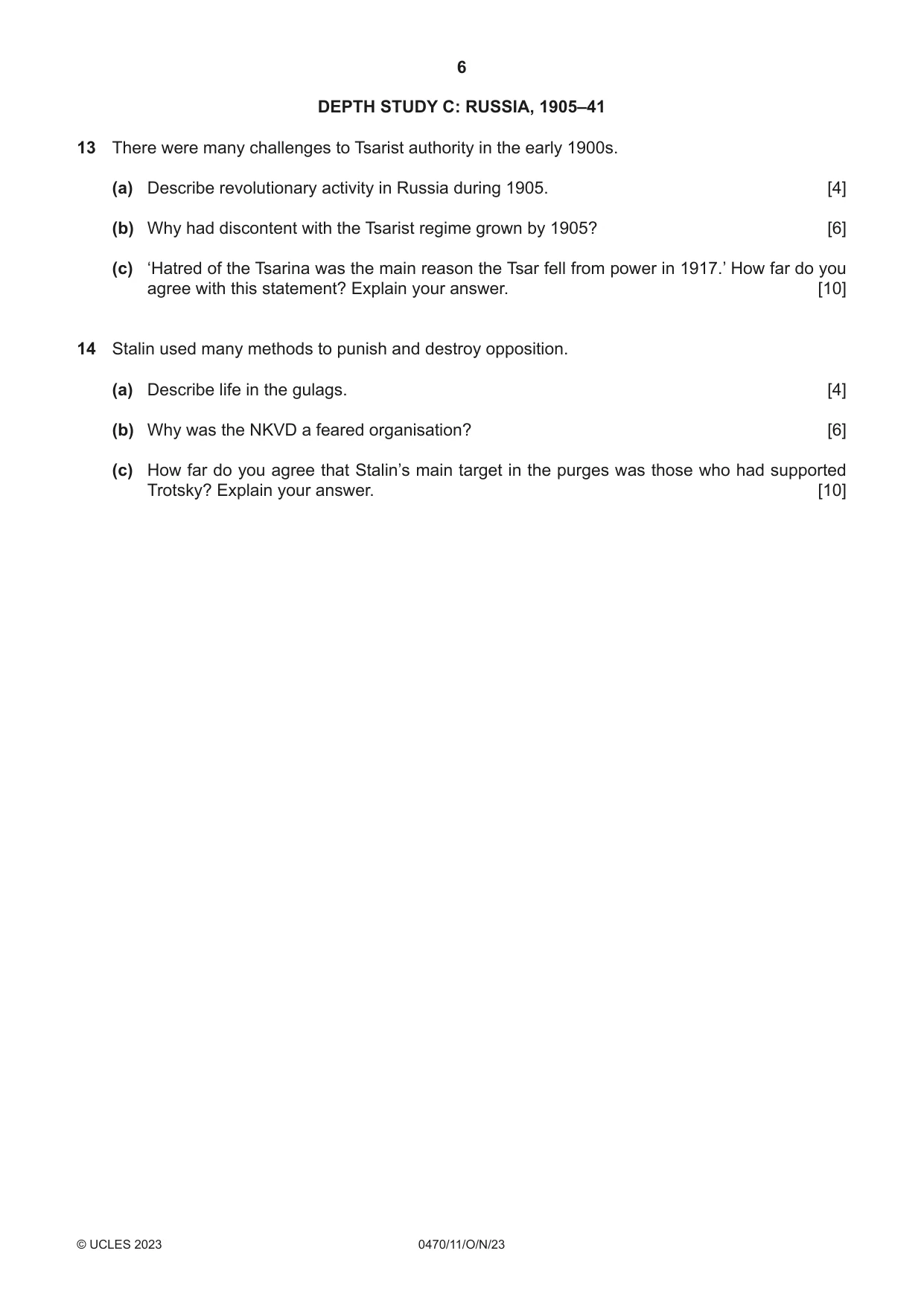
6 0470/11/O/N/23 © UCLES 2023 DEPTH STUDY C: RUSSIA, 1905–41 13 There were many challenges to Tsarist authority in the early 1900s. (a) Describe revolutionary activity in Russia during 1905. [4] (b) Why had discontent with the Tsarist regime grown by 1905? [6] (c) ‘Hatred of the Tsarina was the main reason the Tsar fell from power in 1917.’ How far do you agree with this statement? Explain your answer. [10] 14 Stalin used many methods to punish and destroy opposition. (a) Describe life in the gulags. [4] (b) Why was the NKVD a feared organisation? [6] (c) How far do you agree that Stalin’s main target in the purges was those who had supported Trotsky? Explain your answer. [10]
Question paper, page 7
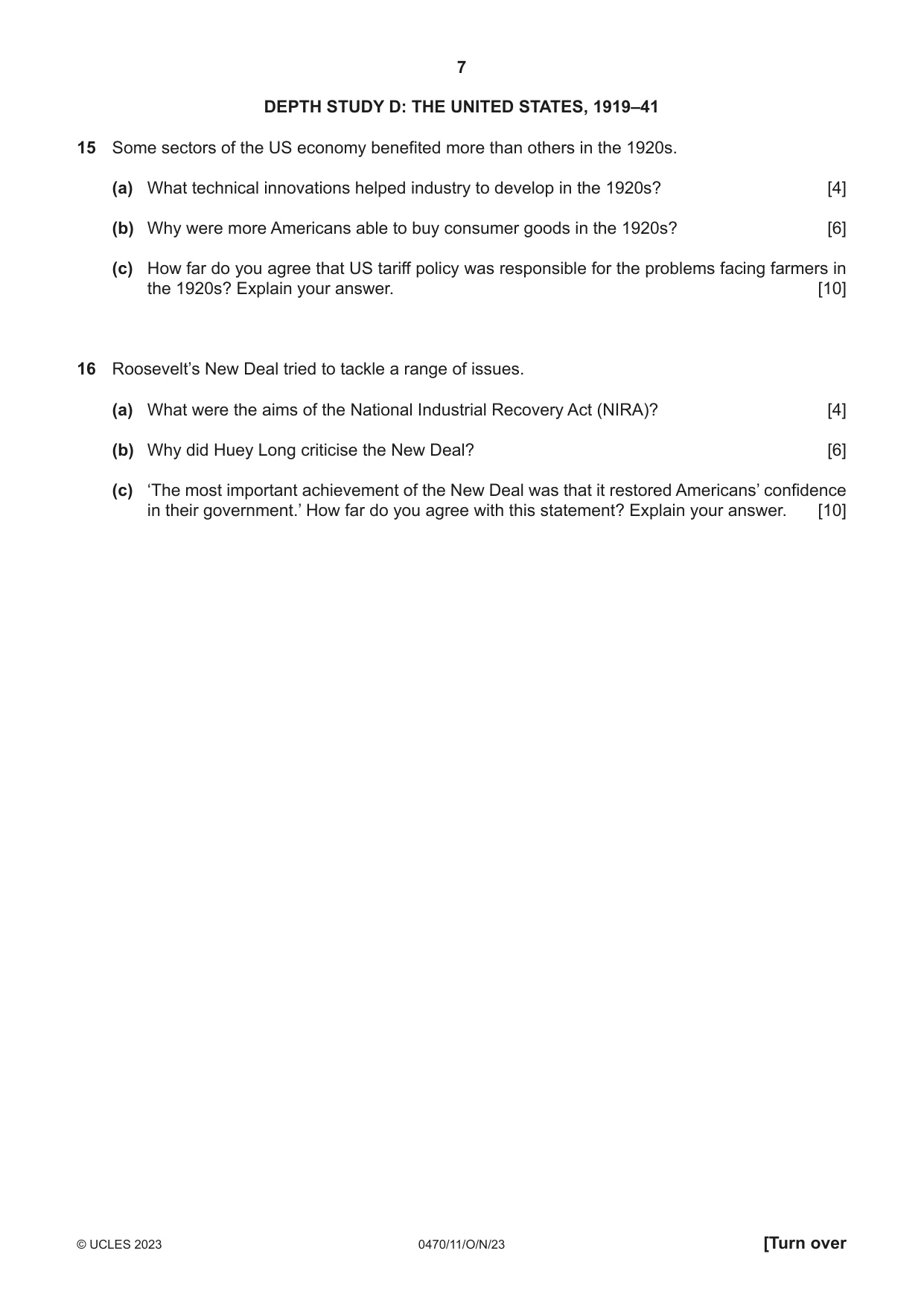
7 0470/11/O/N/23 © UCLES 2023 [Turn over DEPTH STUDY D: THE UNITED STATES, 1919–41 15 Some sectors of the US economy benefited more than others in the 1920s. (a) What technical innovations helped industry to develop in the 1920s? [4] (b) Why were more Americans able to buy consumer goods in the 1920s? [6] (c) How far do you agree that US tariff policy was responsible for the problems facing farmers in the 1920s? Explain your answer. [10] 16 Roosevelt’s New Deal tried to tackle a range of issues. (a) What were the aims of the National Industrial Recovery Act (NIRA)? [4] (b) Why did Huey Long criticise the New Deal? [6] (c) ‘The most important achievement of the New Deal was that it restored Americans’ confidence in their government.’ How far do you agree with this statement? Explain your answer. [10]
Question paper, page 8
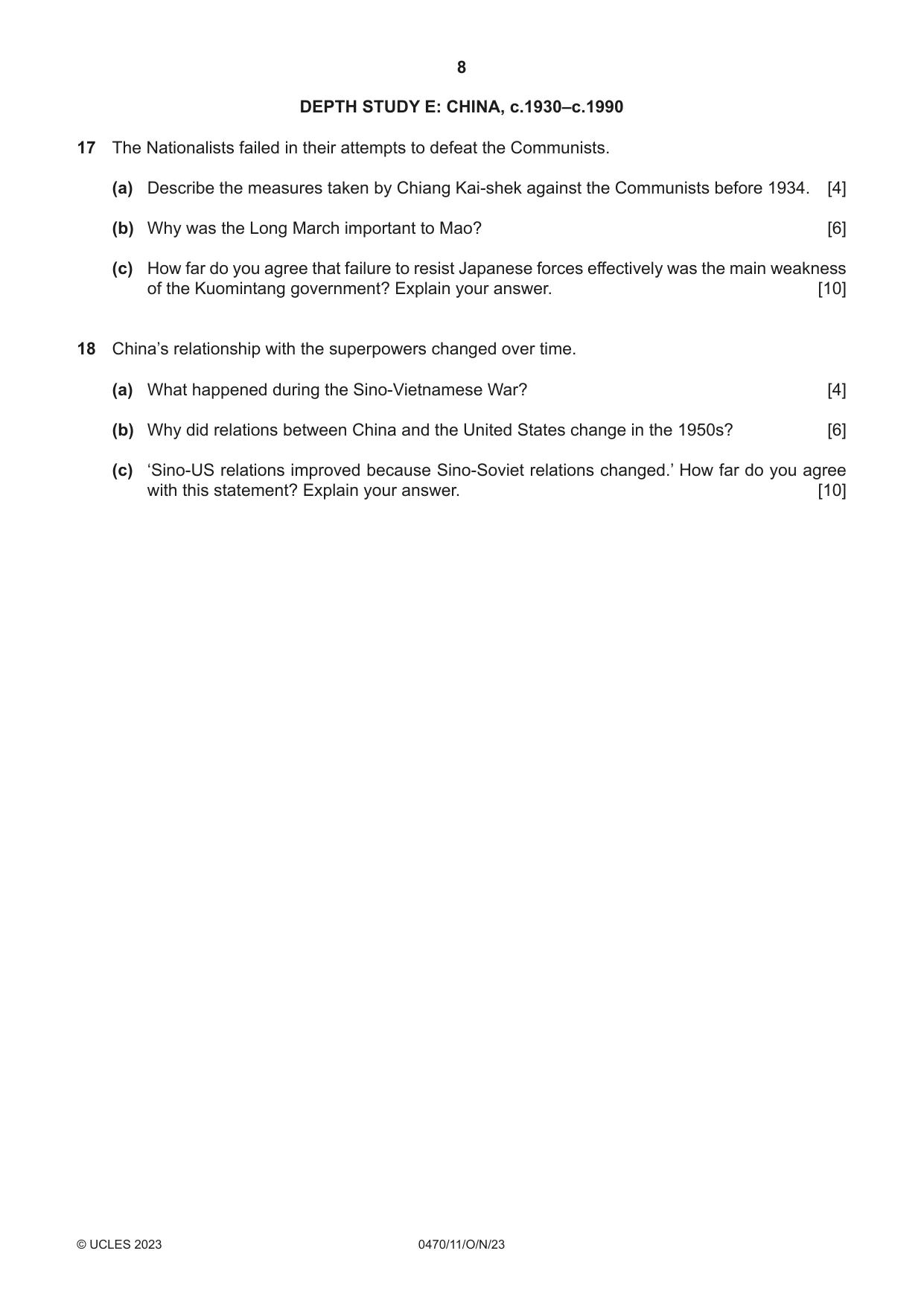
8 0470/11/O/N/23 © UCLES 2023 DEPTH STUDY E: CHINA, c.1930–c.1990 17 The Nationalists failed in their attempts to defeat the Communists. (a) Describe the measures taken by Chiang Kai-shek against the Communists before 1934. [4] (b) Why was the Long March important to Mao? [6] (c) How far do you agree that failure to resist Japanese forces effectively was the main weakness of the Kuomintang government? Explain your answer. [10] 18 China’s relationship with the superpowers changed over time. (a) What happened during the Sino-Vietnamese War? [4] (b) Why did relations between China and the United States change in the 1950s? [6] (c) ‘Sino-US relations improved because Sino-Soviet relations changed.’ How far do you agree with this statement? Explain your answer. [10]
Question paper, page 9
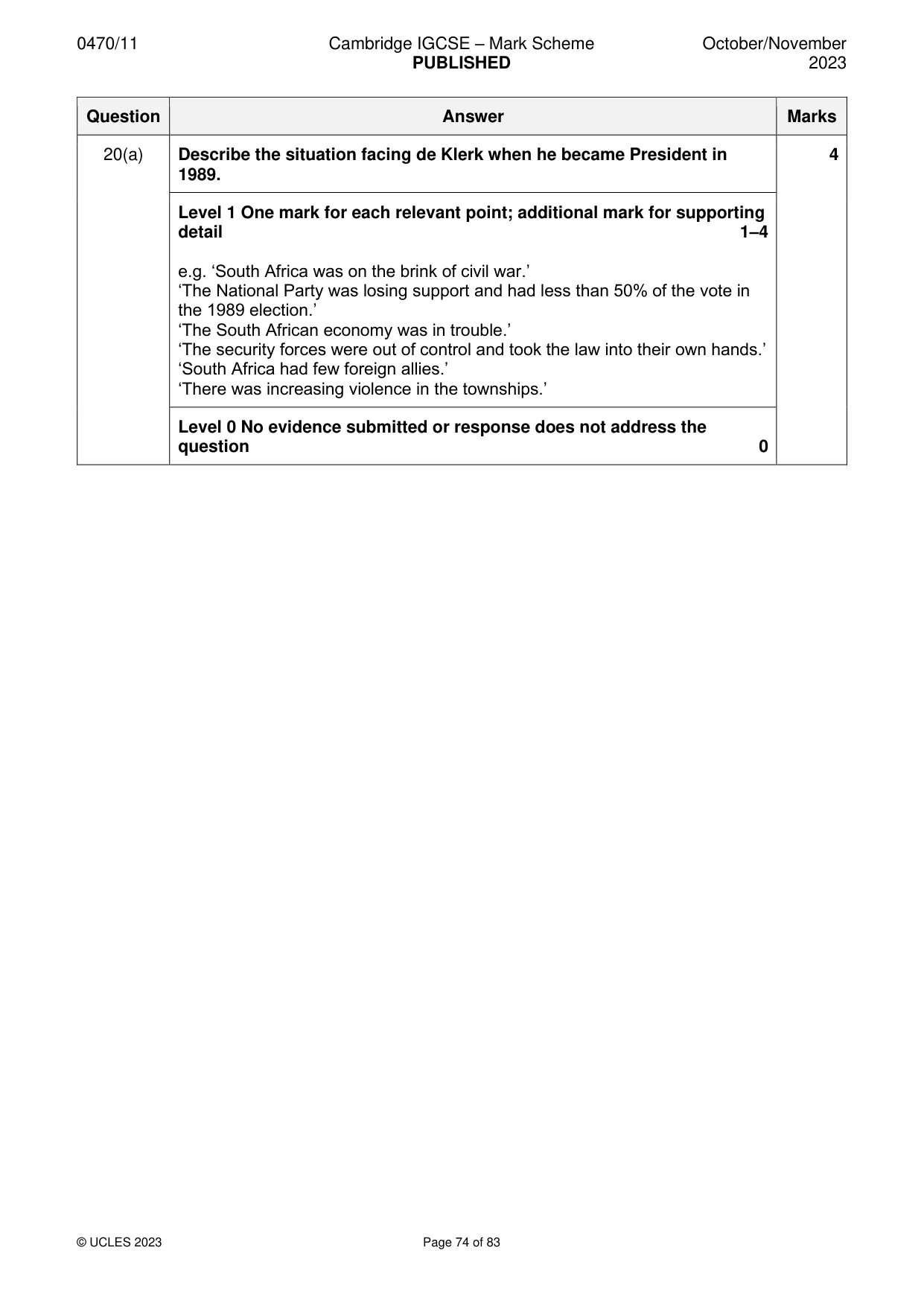
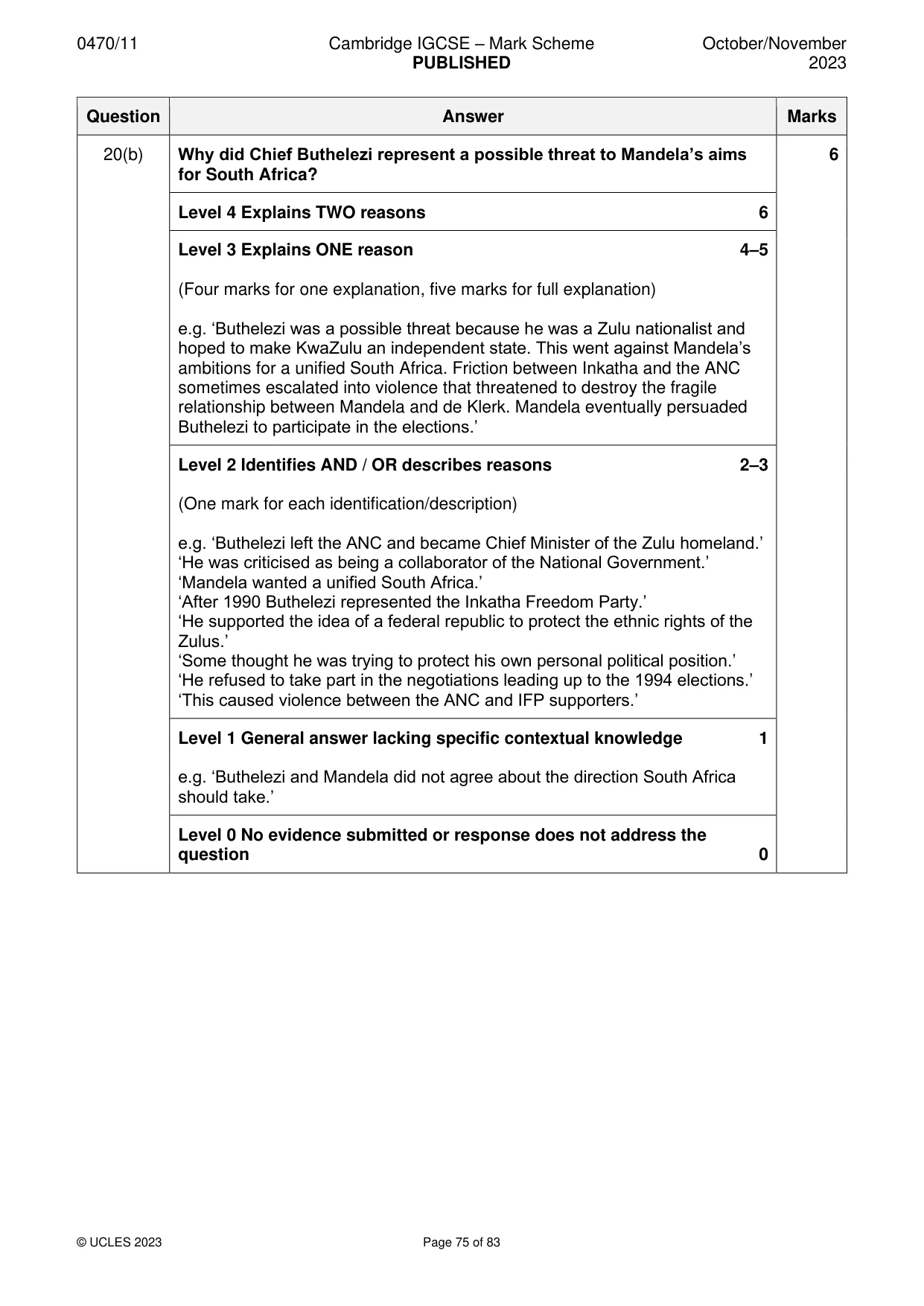
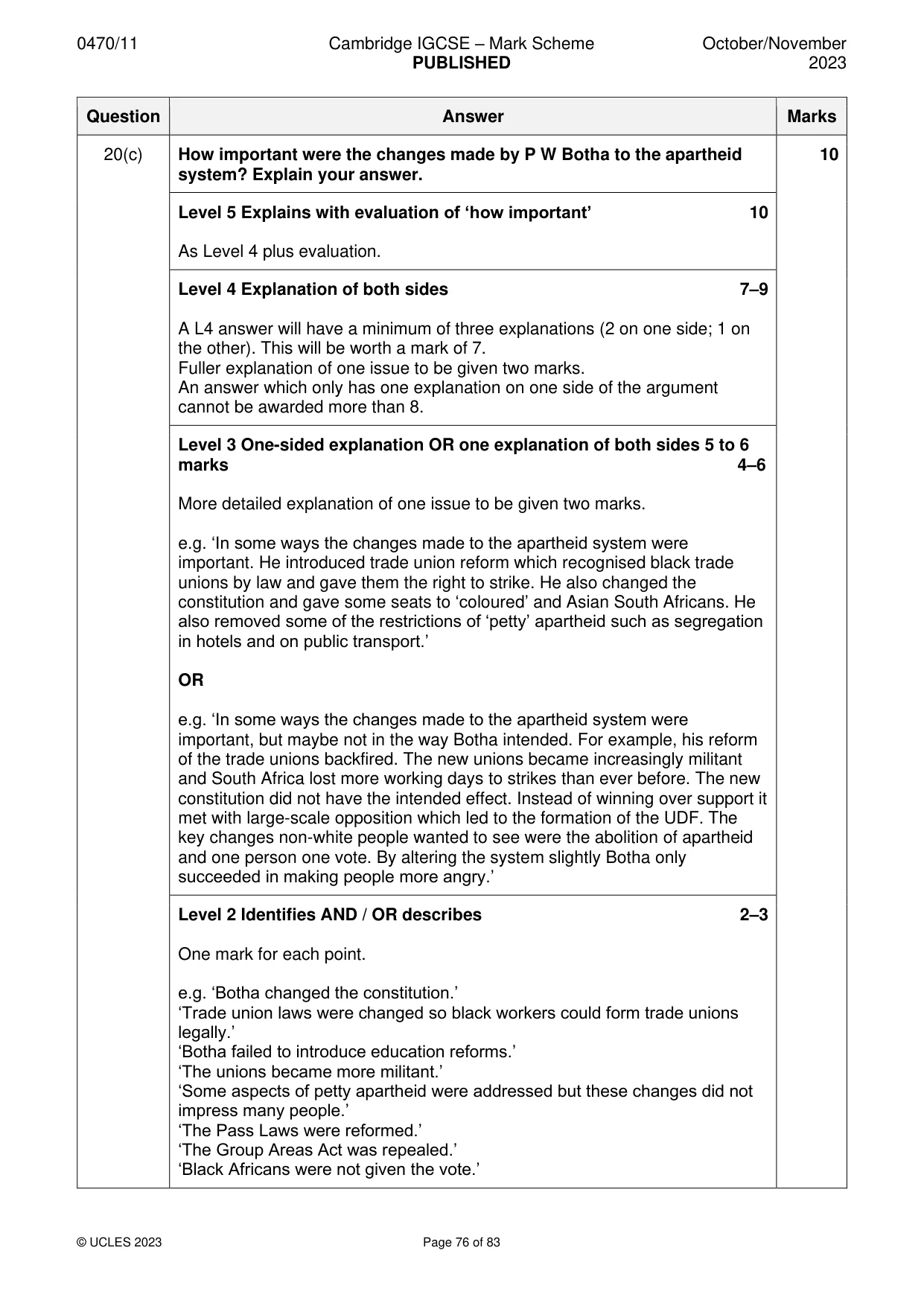
9 0470/11/O/N/23 © UCLES 2023 [Turn over DEPTH STUDY F: SOUTH AFRICA, c.1940–c.1994 19 Opponents of apartheid had a difficult task in the years up to 1966. (a) What was the Pan Africanist Congress (PAC)? [4] (b) Why was the Group Areas Act passed in 1950? [6] (c) How far do you agree that the South African government had crushed opposition to apartheid by 1966? Explain your answer. [10] 20 The ending of white minority rule was a difficult process. (a) Describe the situation facing de Klerk when he became President in 1989. [4] (b) Why did Chief Buthelezi represent a possible threat to Mandela’s aims for South Africa? [6] (c) How important were the changes made by P W Botha to the apartheid system? Explain your answer. [10]
Question paper, page 10
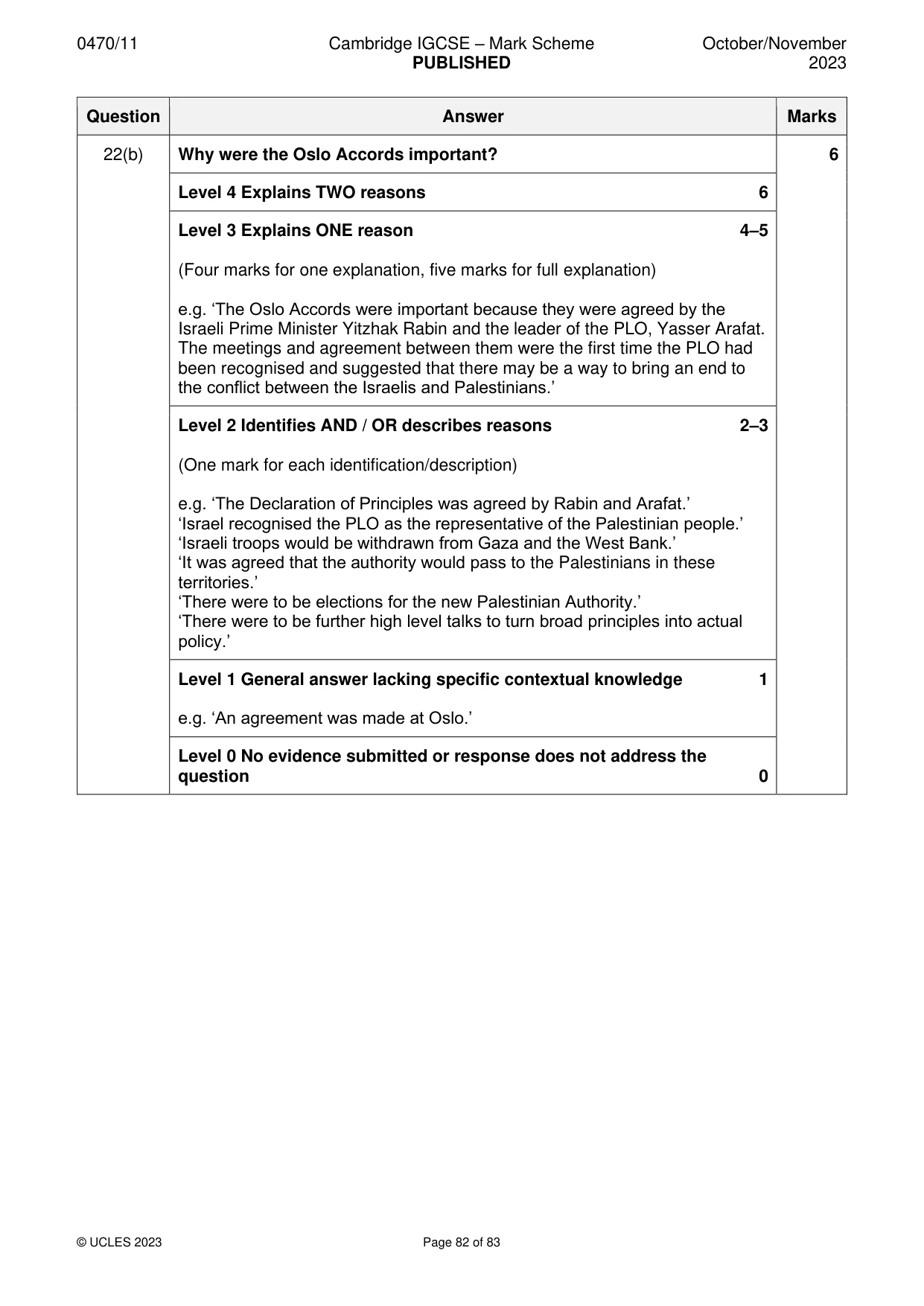
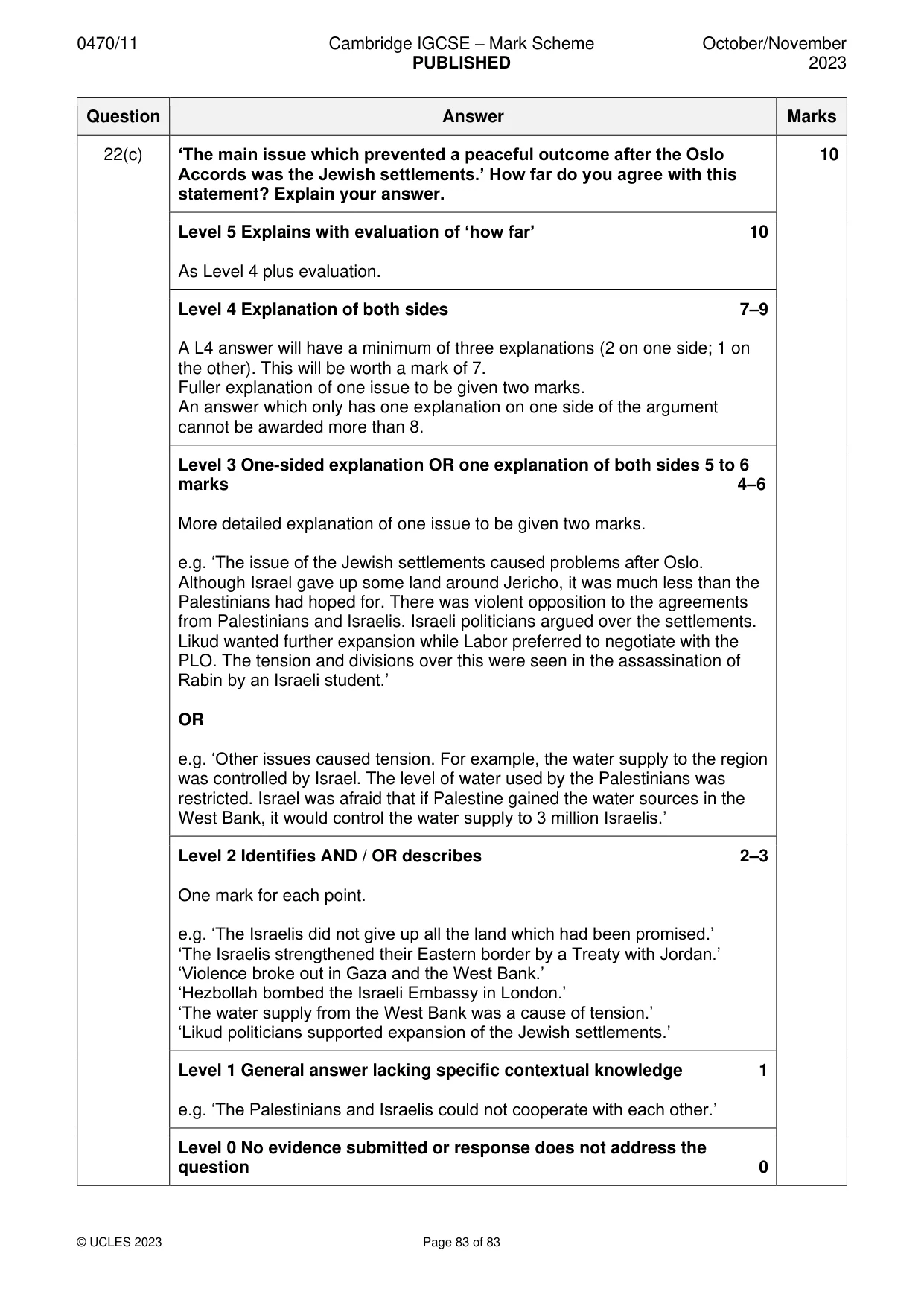
10 0470/11/O/N/23 © UCLES 2023 DEPTH STUDY G: ISRAELIS AND PALESTINIANS SINCE 1945 21 The situation in Palestine grew more tense in the late 1940s. (a) What was the Stern Gang? [4] (b) Why were events at the King David Hotel in July 1946 important? [6] (c) How surprising was the victory of Israel in the 1948–49 war? Explain your answer. [10] 22 The peace process has been difficult. (a) What is Hezbollah? [4] (b) Why were the Oslo Accords important? [6] (c) ‘The main issue which prevented a peaceful outcome after the Oslo Accords was the Jewish settlements.’ How far do you agree with this statement? Explain your answer. [10]
Question paper, page 11
11 0470/11/O/N/23 © UCLES 2023 BLANK PAGE
Question paper, page 12
12 0470/11/O/N/23 © UCLES 2023 Permission to reproduce items where third-party owned material protected by copyright is included has been sought and cleared where possible. Every reasonable effort has been made by the publisher (UCLES) to trace copyright holders, but if any items requiring clearance have unwittingly been included, the publisher will be pleased to make amends at the earliest possible opportunity. To avoid the issue of disclosure of answer-related information to candidates, all copyright acknowledgements are reproduced online in the Cambridge Assessment International Education Copyright Acknowledgements Booklet. This is produced for each series of examinations and is freely available to download at www.cambridgeinternational.org after the live examination series. Cambridge Assessment International Education is part of Cambridge Assessment. Cambridge Assessment is the brand name of the University of Cambridge Local Examinations Syndicate (UCLES), which is a department of the University of Cambridge. BLANK PAGE
Mark scheme, page 1
This document consists of 83 printed pages. © UCLES 2023 [Turn over Cambridge IGCSE™ HISTORY 0470/11 Paper 1 October/November 2023 MARK SCHEME Maximum Mark: 60 Published This mark scheme is published as an aid to teachers and candidates, to indicate the requirements of the examination. It shows the basis on which Examiners were instructed to award marks. It does not indicate the details of the discussions that took place at an Examiners’ meeting before marking began, which would have considered the acceptability of alternative answers. Mark schemes should be read in conjunction with the question paper and the Principal Examiner Report for Teachers. Cambridge International will not enter into discussions about these mark schemes. Cambridge International is publishing the mark schemes for the October/November 2023 series for most Cambridge IGCSE, Cambridge International A and AS Level components, and some Cambridge O Level components.
Mark scheme, page 2
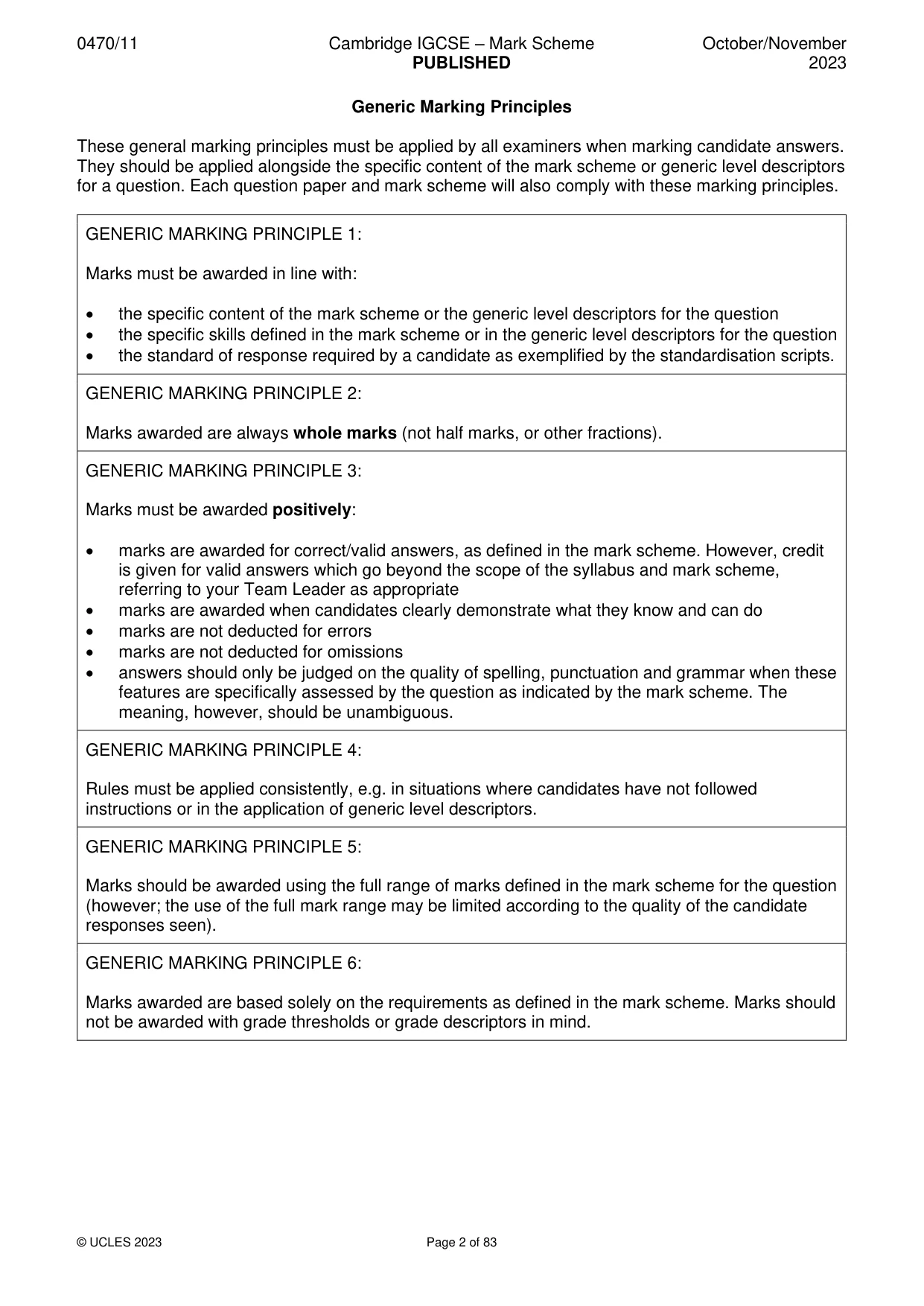
0470/11 Cambridge IGCSE – Mark Scheme PUBLISHED October/November 2023 © UCLES 2023 Page 2 of 83 Generic Marking Principles These general marking principles must be applied by all examiners when marking candidate answers. They should be applied alongside the specific content of the mark scheme or generic level descriptors for a question. Each question paper and mark scheme will also comply with these marking principles. GENERIC MARKING PRINCIPLE 1: Marks must be awarded in line with: • the specific content of the mark scheme or the generic level descriptors for the question • the specific skills defined in the mark scheme or in the generic level descriptors for the question • the standard of response required by a candidate as exemplified by the standardisation scripts. GENERIC MARKING PRINCIPLE 2: Marks awarded are always whole marks (not half marks, or other fractions). GENERIC MARKING PRINCIPLE 3: Marks must be awarded positively: • marks are awarded for correct/valid answers, as defined in the mark scheme. However, credit is given for valid answers which go beyond the scope of the syllabus and mark scheme, referring to your Team Leader as appropriate • marks are awarded when candidates clearly demonstrate what they know and can do • marks are not deducted for errors • marks are not deducted for omissions • answers should only be judged on the quality of spelling, punctuation and grammar when these features are specifically assessed by the question as indicated by the mark scheme. The meaning, however, should be unambiguous. GENERIC MARKING PRINCIPLE 4: Rules must be applied consistently, e.g. in situations where candidates have not followed instructions or in the application of generic level descriptors. GENERIC MARKING PRINCIPLE 5: Marks should be awarded using the full range of marks defined in the mark scheme for the question (however; the use of the full mark range may be limited according to the quality of the candidate responses seen). GENERIC MARKING PRINCIPLE 6: Marks awarded are based solely on the requirements as defined in the mark scheme. Marks should not be awarded with grade thresholds or grade descriptors in mind.
Mark scheme, page 3
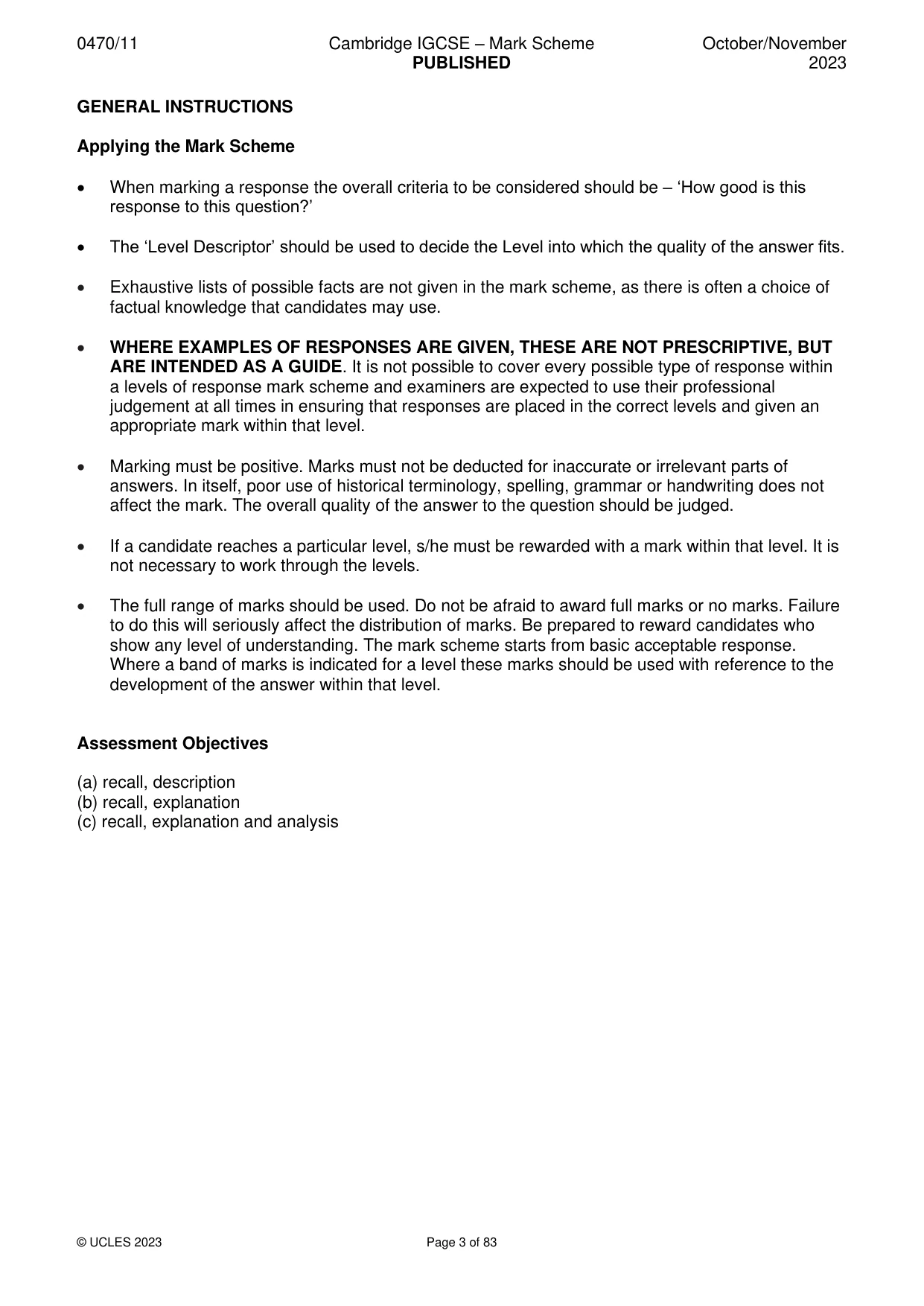
0470/11 Cambridge IGCSE – Mark Scheme PUBLISHED October/November 2023 © UCLES 2023 Page 3 of 83 GENERAL INSTRUCTIONS Applying the Mark Scheme • When marking a response the overall criteria to be considered should be – ‘How good is this response to this question?’ • The ‘Level Descriptor’ should be used to decide the Level into which the quality of the answer fits. • Exhaustive lists of possible facts are not given in the mark scheme, as there is often a choice of factual knowledge that candidates may use. • WHERE EXAMPLES OF RESPONSES ARE GIVEN, THESE ARE NOT PRESCRIPTIVE, BUT ARE INTENDED AS A GUIDE. It is not possible to cover every possible type of response within a levels of response mark scheme and examiners are expected to use their professional judgement at all times in ensuring that responses are placed in the correct levels and given an appropriate mark within that level. • Marking must be positive. Marks must not be deducted for inaccurate or irrelevant parts of answers. In itself, poor use of historical terminology, spelling, grammar or handwriting does not affect the mark. The overall quality of the answer to the question should be judged. • If a candidate reaches a particular level, s/he must be rewarded with a mark within that level. It is not necessary to work through the levels. • The full range of marks should be used. Do not be afraid to award full marks or no marks. Failure to do this will seriously affect the distribution of marks. Be prepared to reward candidates who show any level of understanding. The mark scheme starts from basic acceptable response. Where a band of marks is indicated for a level these marks should be used with reference to the development of the answer within that level. Assessment Objectives (a) recall, description (b) recall, explanation (c) recall, explanation and analysis
Mark scheme, page 4
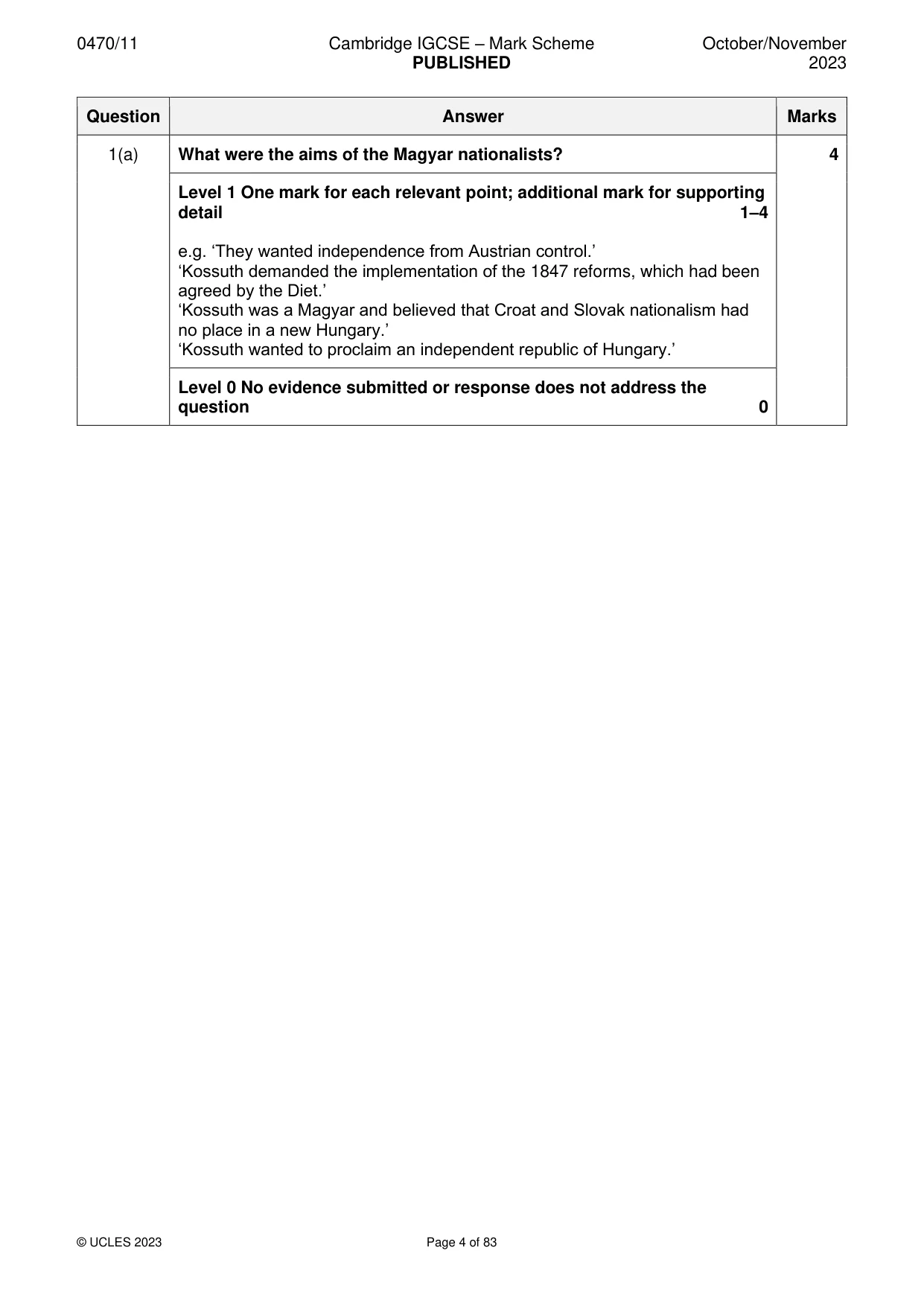
0470/11 Cambridge IGCSE – Mark Scheme PUBLISHED October/November 2023 © UCLES 2023 Page 4 of 83 Question Answer Marks 1(a) What were the aims of the Magyar nationalists? 4 Level 1 One mark for each relevant point; additional mark for supporting detail 1–4 e.g. ‘They wanted independence from Austrian control.’ ‘Kossuth demanded the implementation of the 1847 reforms, which had been agreed by the Diet.’ ‘Kossuth was a Magyar and believed that Croat and Slovak nationalism had no place in a new Hungary.’ ‘Kossuth wanted to proclaim an independent republic of Hungary.’ Level 0 No evidence submitted or response does not address the question 0
Mark scheme, page 5
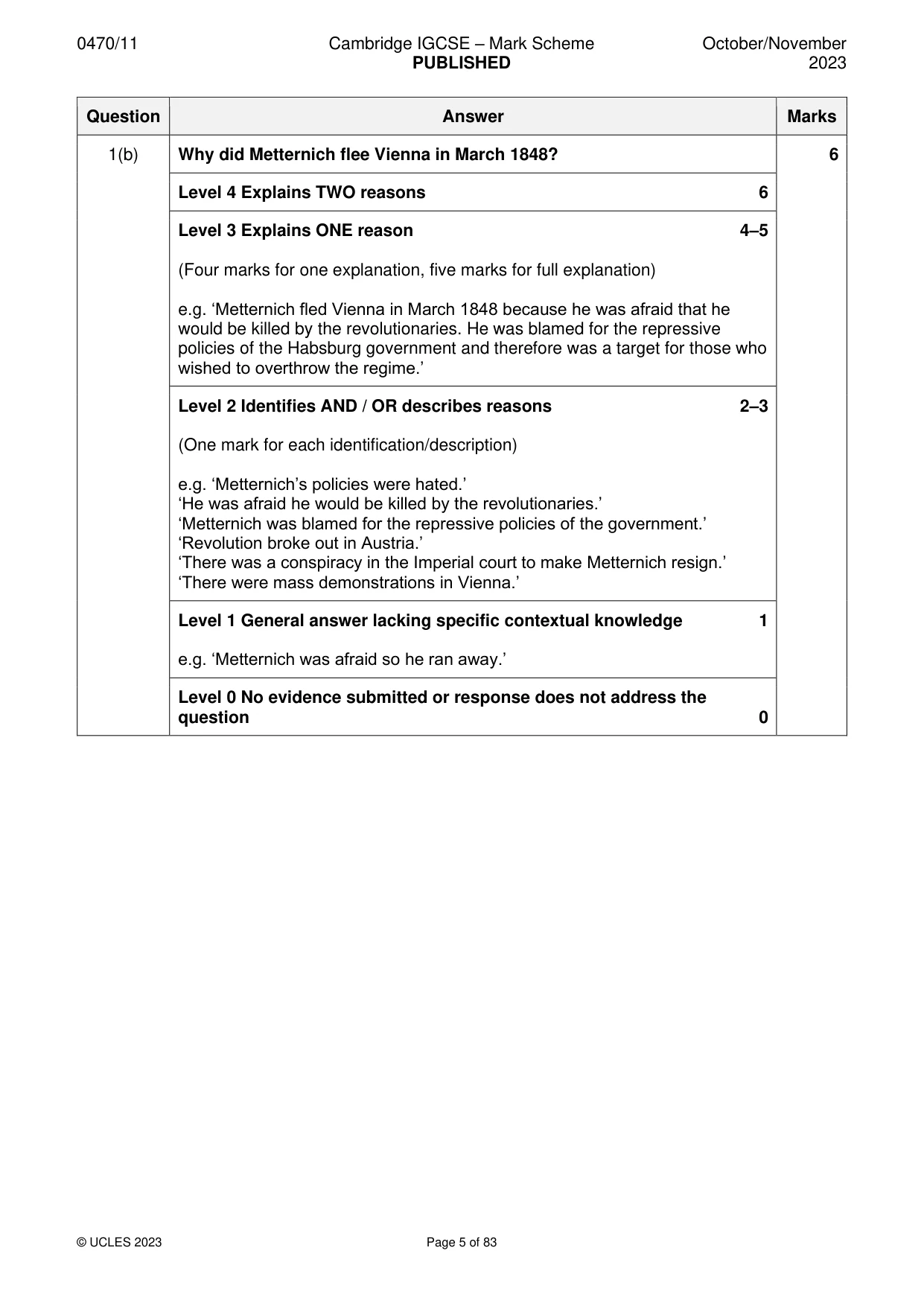
0470/11 Cambridge IGCSE – Mark Scheme PUBLISHED October/November 2023 © UCLES 2023 Page 5 of 83 Question Answer Marks 1(b) Why did Metternich flee Vienna in March 1848? 6 Level 4 Explains TWO reasons 6 Level 3 Explains ONE reason 4–5 (Four marks for one explanation, five marks for full explanation) e.g. ‘Metternich fled Vienna in March 1848 because he was afraid that he would be killed by the revolutionaries. He was blamed for the repressive policies of the Habsburg government and therefore was a target for those who wished to overthrow the regime.’ Level 2 Identifies AND / OR describes reasons 2–3 (One mark for each identification/description) e.g. ‘Metternich’s policies were hated.’ ‘He was afraid he would be killed by the revolutionaries.’ ‘Metternich was blamed for the repressive policies of the government.’ ‘Revolution broke out in Austria.’ ‘There was a conspiracy in the Imperial court to make Metternich resign.’ ‘There were mass demonstrations in Vienna.’ Level 1 General answer lacking specific contextual knowledge 1 e.g. ‘Metternich was afraid so he ran away.’ Level 0 No evidence submitted or response does not address the question 0
Mark scheme, page 6
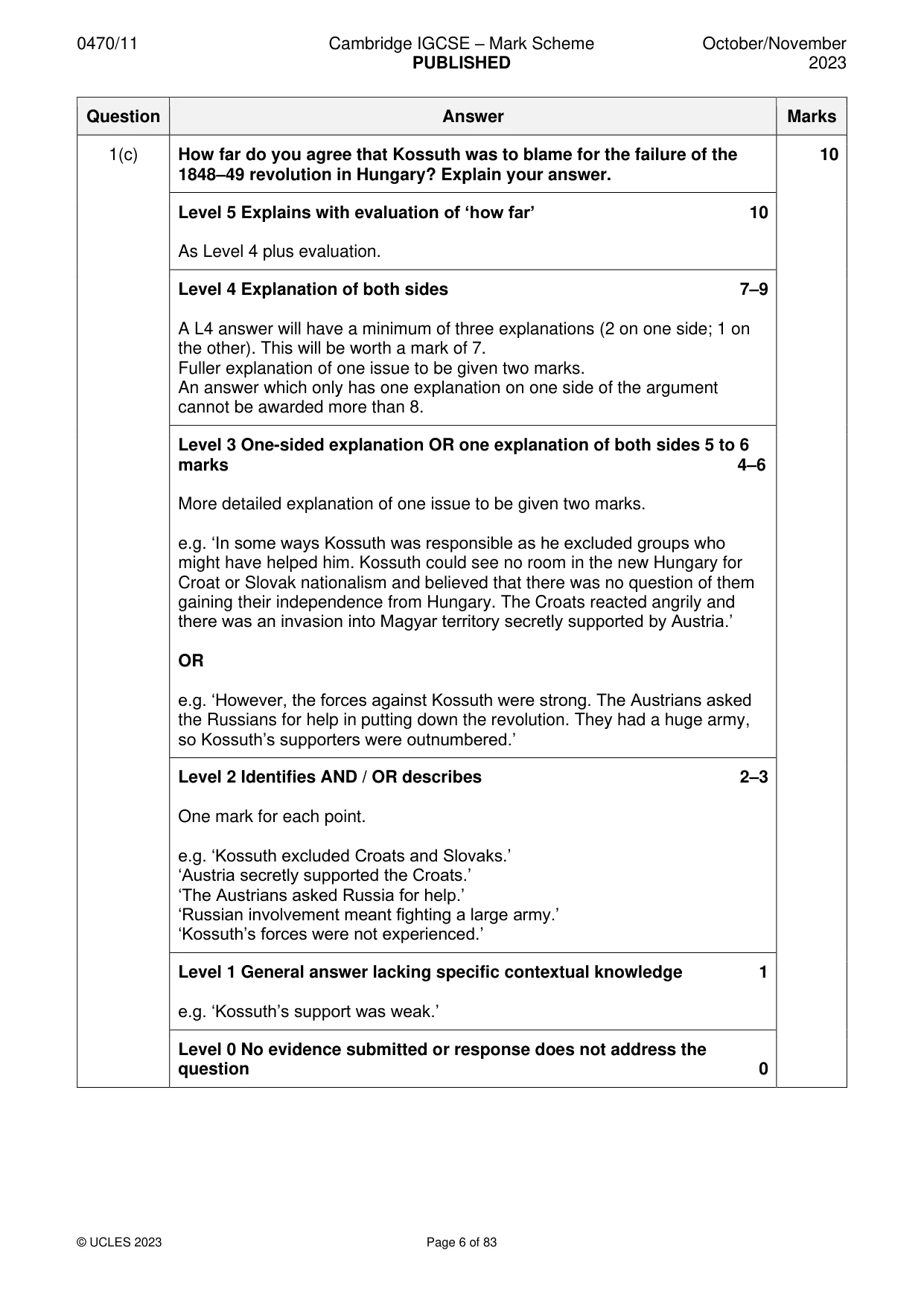
0470/11 Cambridge IGCSE – Mark Scheme PUBLISHED October/November 2023 © UCLES 2023 Page 6 of 83 Question Answer Marks 1(c) How far do you agree that Kossuth was to blame for the failure of the 1848–49 revolution in Hungary? Explain your answer. 10 Level 5 Explains with evaluation of ‘how far’ 10 As Level 4 plus evaluation. Level 4 Explanation of both sides 7–9 A L4 answer will have a minimum of three explanations (2 on one side; 1 on the other). This will be worth a mark of 7. Fuller explanation of one issue to be given two marks. An answer which only has one explanation on one side of the argument cannot be awarded more than 8. Level 3 One-sided explanation OR one explanation of both sides 5 to 6 marks 4–6 More detailed explanation of one issue to be given two marks. e.g. ‘In some ways Kossuth was responsible as he excluded groups who might have helped him. Kossuth could see no room in the new Hungary for Croat or Slovak nationalism and believed that there was no question of them gaining their independence from Hungary. The Croats reacted angrily and there was an invasion into Magyar territory secretly supported by Austria.’ OR e.g. ‘However, the forces against Kossuth were strong. The Austrians asked the Russians for help in putting down the revolution. They had a huge army, so Kossuth’s supporters were outnumbered.’ Level 2 Identifies AND / OR describes 2–3 One mark for each point. e.g. ‘Kossuth excluded Croats and Slovaks.’ ‘Austria secretly supported the Croats.’ ‘The Austrians asked Russia for help.’ ‘Russian involvement meant fighting a large army.’ ‘Kossuth’s forces were not experienced.’ Level 1 General answer lacking specific contextual knowledge 1 e.g. ‘Kossuth’s support was weak.’ Level 0 No evidence submitted or response does not address the question 0
Mark scheme, page 7
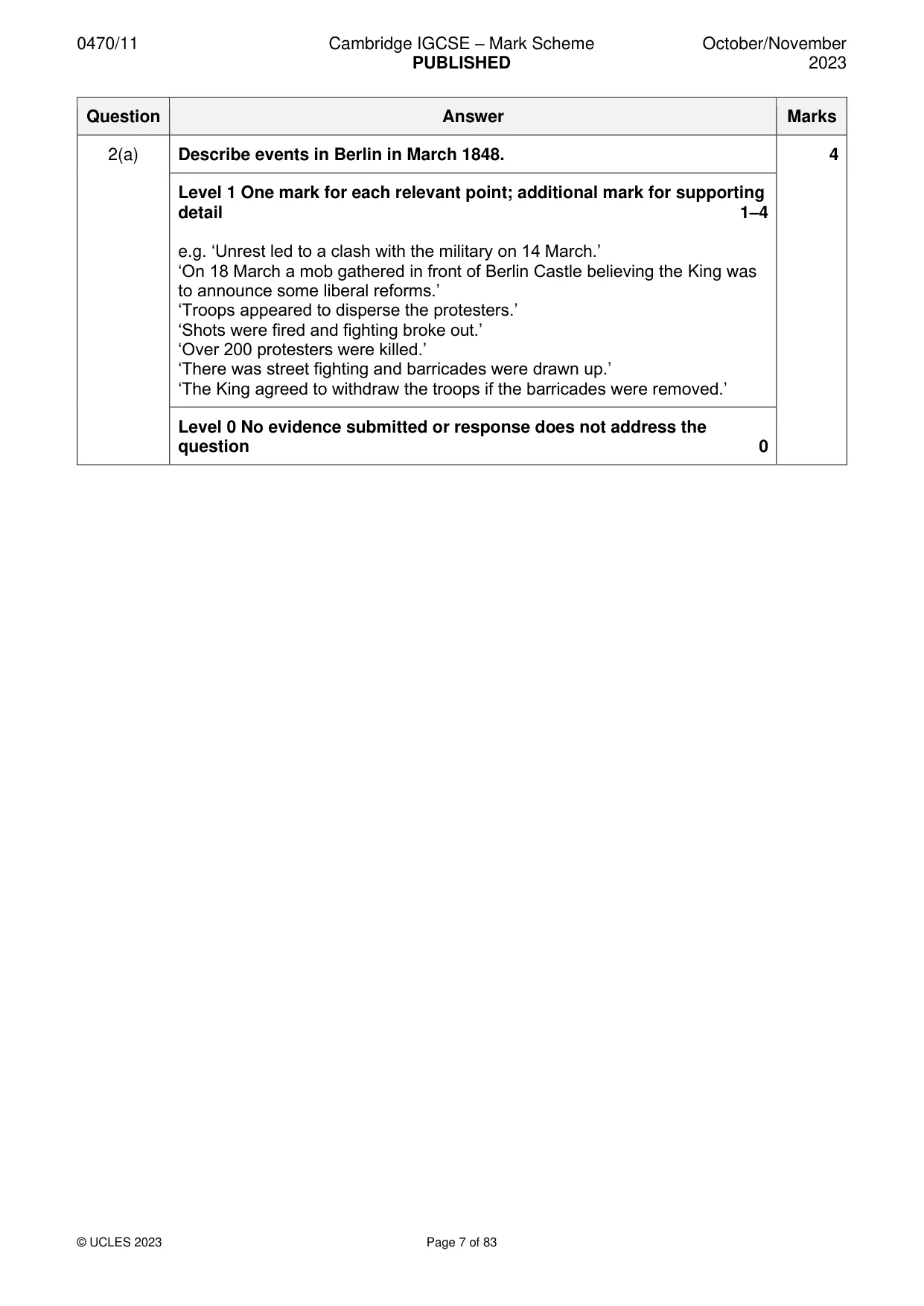
0470/11 Cambridge IGCSE – Mark Scheme PUBLISHED October/November 2023 © UCLES 2023 Page 7 of 83 Question Answer Marks 2(a) Describe events in Berlin in March 1848. 4 Level 1 One mark for each relevant point; additional mark for supporting detail 1–4 e.g. ‘Unrest led to a clash with the military on 14 March.’ ‘On 18 March a mob gathered in front of Berlin Castle believing the King was to announce some liberal reforms.’ ‘Troops appeared to disperse the protesters.’ ‘Shots were fired and fighting broke out.’ ‘Over 200 protesters were killed.’ ‘There was street fighting and barricades were drawn up.’ ‘The King agreed to withdraw the troops if the barricades were removed.’ Level 0 No evidence submitted or response does not address the question 0
Mark scheme, page 8
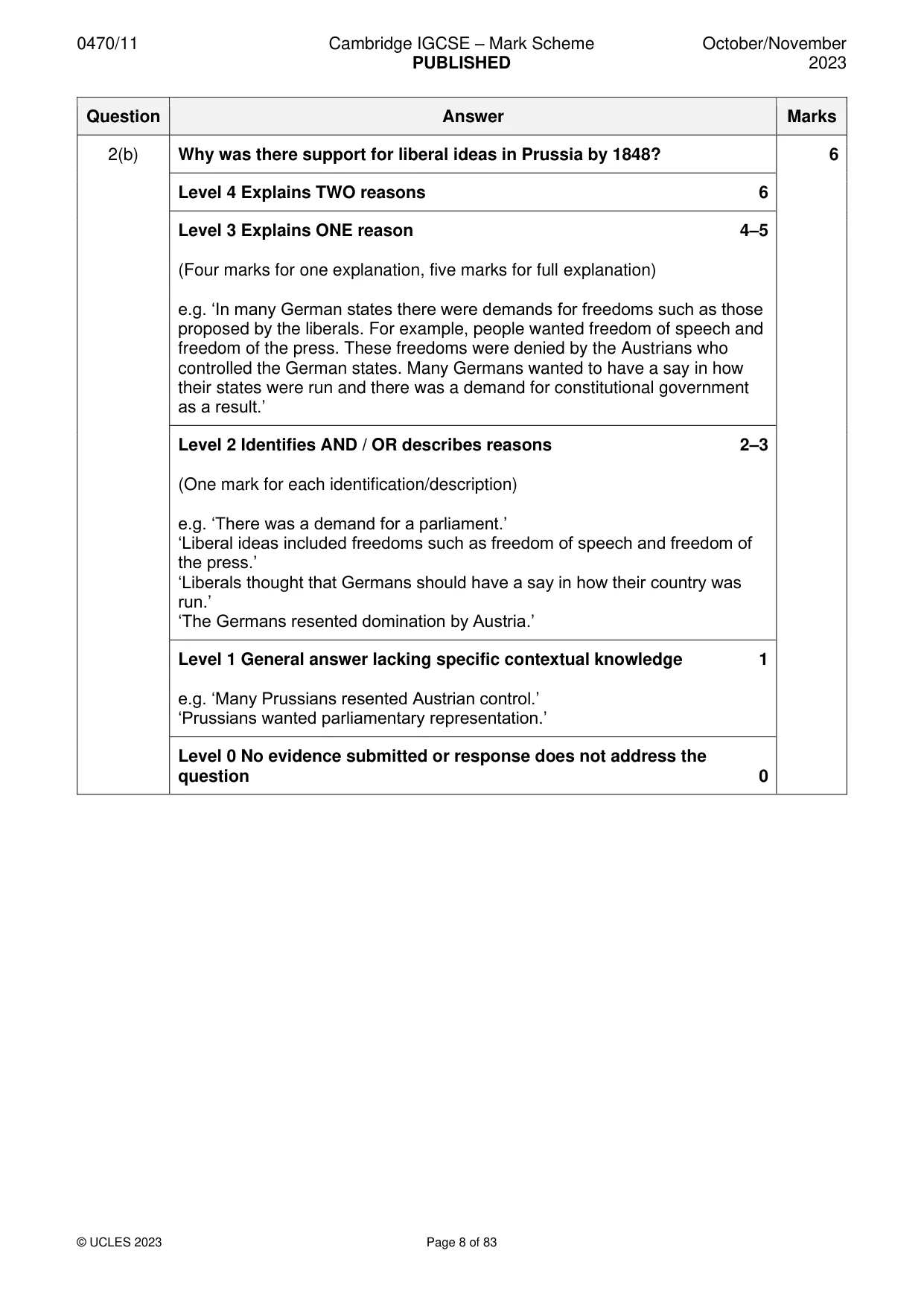
0470/11 Cambridge IGCSE – Mark Scheme PUBLISHED October/November 2023 © UCLES 2023 Page 8 of 83 Question Answer Marks 2(b) Why was there support for liberal ideas in Prussia by 1848? 6 Level 4 Explains TWO reasons 6 Level 3 Explains ONE reason 4–5 (Four marks for one explanation, five marks for full explanation) e.g. ‘In many German states there were demands for freedoms such as those proposed by the liberals. For example, people wanted freedom of speech and freedom of the press. These freedoms were denied by the Austrians who controlled the German states. Many Germans wanted to have a say in how their states were run and there was a demand for constitutional government as a result.’ Level 2 Identifies AND / OR describes reasons 2–3 (One mark for each identification/description) e.g. ‘There was a demand for a parliament.’ ‘Liberal ideas included freedoms such as freedom of speech and freedom of the press.’ ‘Liberals thought that Germans should have a say in how their country was run.’ ‘The Germans resented domination by Austria.’ Level 1 General answer lacking specific contextual knowledge 1 e.g. ‘Many Prussians resented Austrian control.’ ‘Prussians wanted parliamentary representation.’ Level 0 No evidence submitted or response does not address the question 0
Mark scheme, page 9
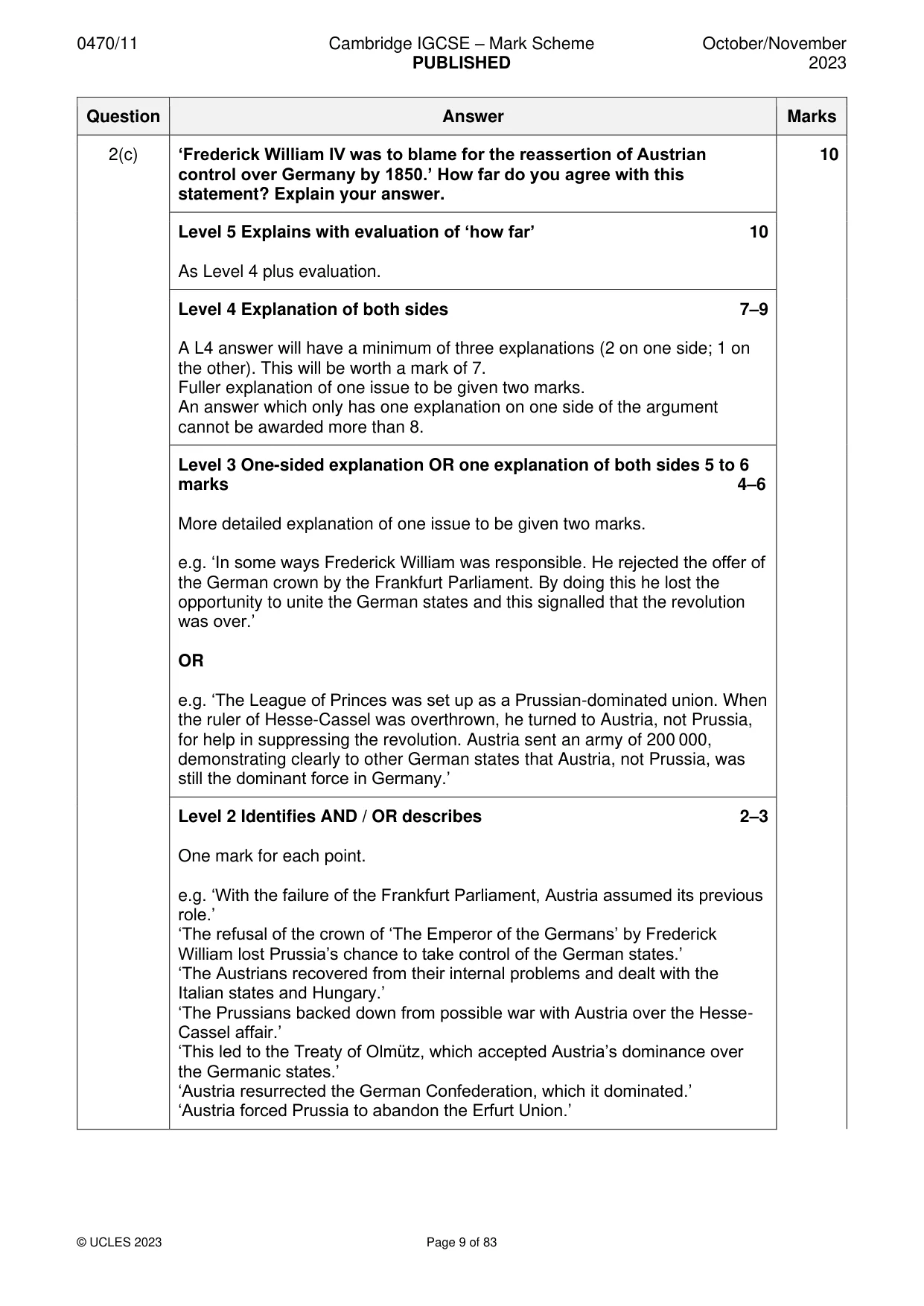
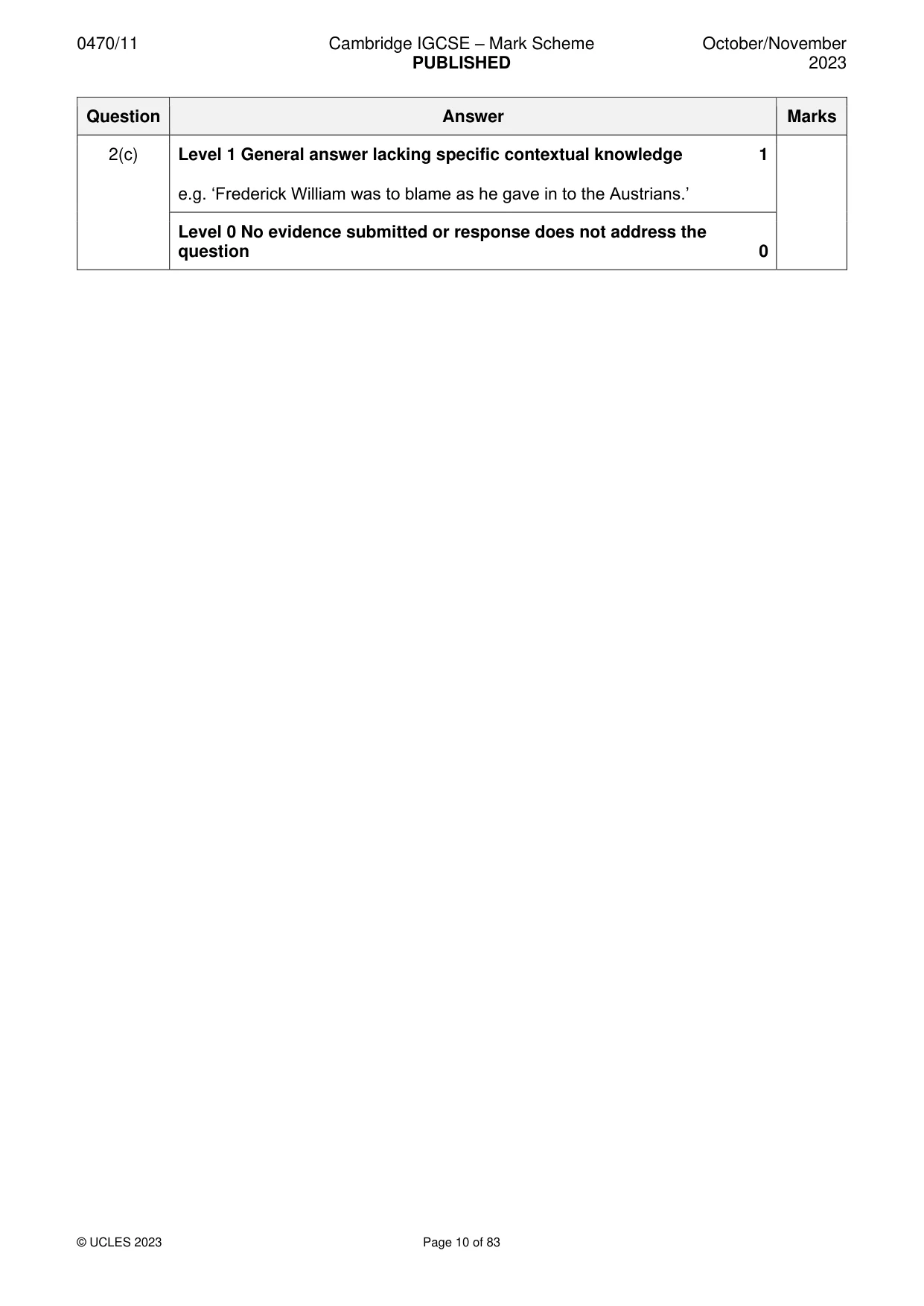
0470/11 Cambridge IGCSE – Mark Scheme PUBLISHED October/November 2023 © UCLES 2023 Page 9 of 83 Question Answer Marks 2(c) ‘Frederick William IV was to blame for the reassertion of Austrian control over Germany by 1850.’ How far do you agree with this statement? Explain your answer. 10 Level 5 Explains with evaluation of ‘how far’ 10 As Level 4 plus evaluation. Level 4 Explanation of both sides 7–9 A L4 answer will have a minimum of three explanations (2 on one side; 1 on the other). This will be worth a mark of 7. Fuller explanation of one issue to be given two marks. An answer which only has one explanation on one side of the argument cannot be awarded more than 8. Level 3 One-sided explanation OR one explanation of both sides 5 to 6 marks 4–6 More detailed explanation of one issue to be given two marks. e.g. ‘In some ways Frederick William was responsible. He rejected the offer of the German crown by the Frankfurt Parliament. By doing this he lost the opportunity to unite the German states and this signalled that the revolution was over.’ OR e.g. ‘The League of Princes was set up as a Prussian-dominated union. When the ruler of Hesse-Cassel was overthrown, he turned to Austria, not Prussia, for help in suppressing the revolution. Austria sent an army of 200 000, demonstrating clearly to other German states that Austria, not Prussia, was still the dominant force in Germany.’ Level 2 Identifies AND / OR describes 2–3 One mark for each point. e.g. ‘With the failure of the Frankfurt Parliament, Austria assumed its previous role.’ ‘The refusal of the crown of ‘The Emperor of the Germans’ by Frederick William lost Prussia’s chance to take control of the German states.’ ‘The Austrians recovered from their internal problems and dealt with the Italian states and Hungary.’ ‘The Prussians backed down from possible war with Austria over the Hesse- Cassel affair.’ ‘This led to the Treaty of Olmütz, which accepted Austria’s dominance over the Germanic states.’ ‘Austria resurrected the German Confederation, which it dominated.’ ‘Austria forced Prussia to abandon the Erfurt Union.’
Mark scheme, page 10
0470/11 Cambridge IGCSE – Mark Scheme PUBLISHED October/November 2023 © UCLES 2023 Page 10 of 83 Question Answer Marks 2(c) Level 1 General answer lacking specific contextual knowledge 1 e.g. ‘Frederick William was to blame as he gave in to the Austrians.’ Level 0 No evidence submitted or response does not address the question 0
Mark scheme, page 11
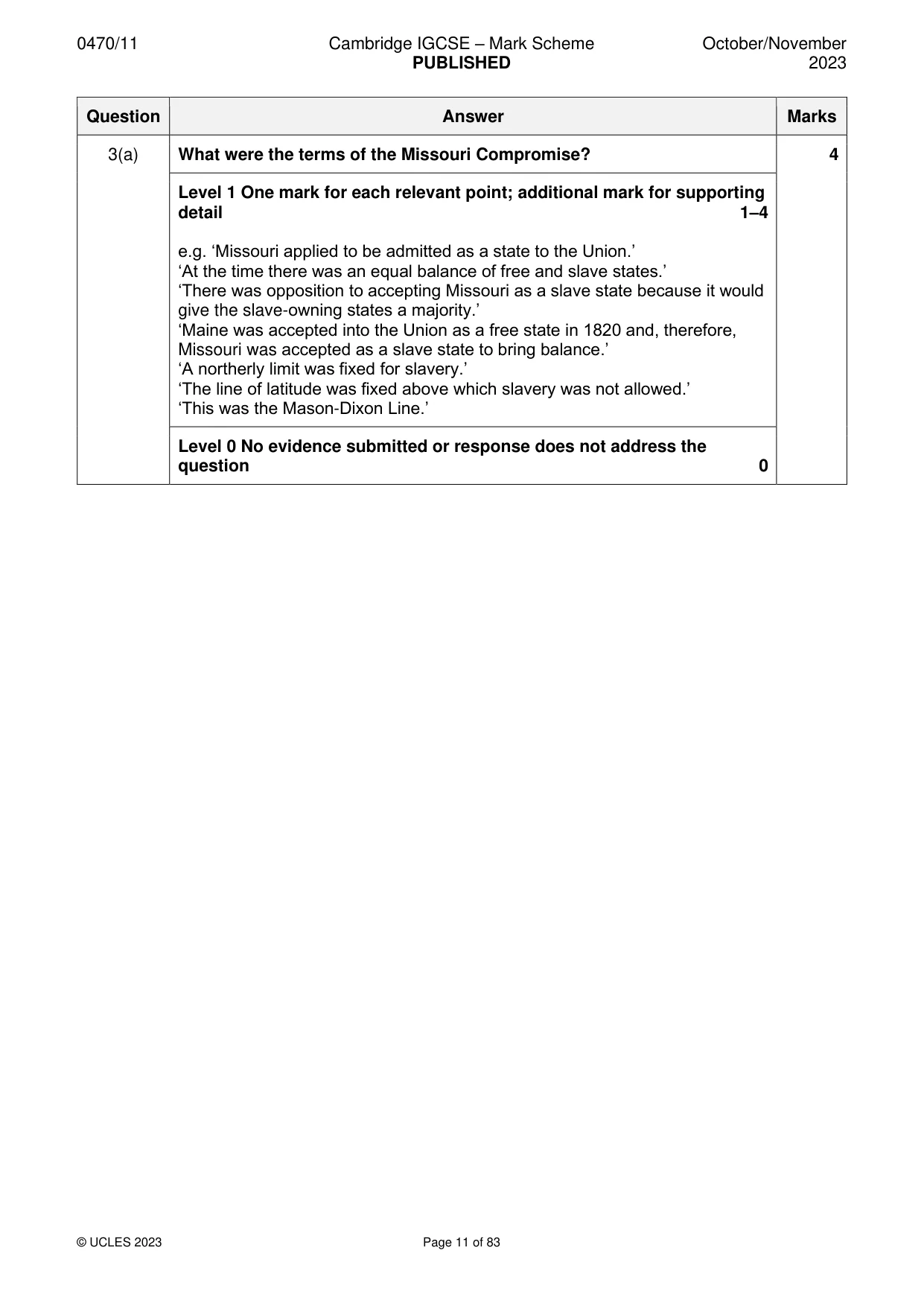
0470/11 Cambridge IGCSE – Mark Scheme PUBLISHED October/November 2023 © UCLES 2023 Page 11 of 83 Question Answer Marks 3(a) What were the terms of the Missouri Compromise? 4 Level 1 One mark for each relevant point; additional mark for supporting detail 1–4 e.g. ‘Missouri applied to be admitted as a state to the Union.’ ‘At the time there was an equal balance of free and slave states.’ ‘There was opposition to accepting Missouri as a slave state because it would give the slave-owning states a majority.’ ‘Maine was accepted into the Union as a free state in 1820 and, therefore, Missouri was accepted as a slave state to bring balance.’ ‘A northerly limit was fixed for slavery.’ ‘The line of latitude was fixed above which slavery was not allowed.’ ‘This was the Mason-Dixon Line.’ Level 0 No evidence submitted or response does not address the question 0
Mark scheme, page 12
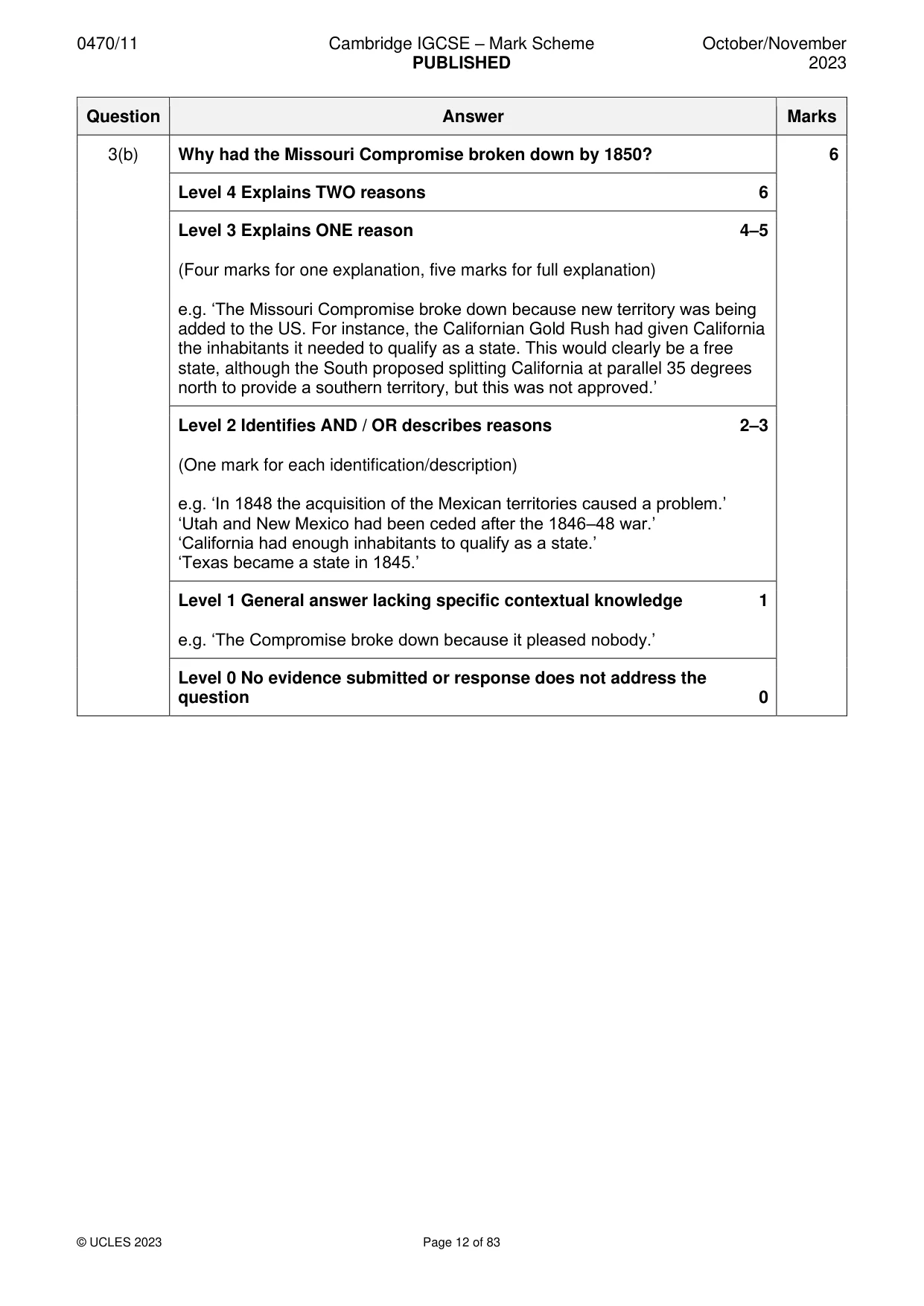
0470/11 Cambridge IGCSE – Mark Scheme PUBLISHED October/November 2023 © UCLES 2023 Page 12 of 83 Question Answer Marks 3(b) Why had the Missouri Compromise broken down by 1850? 6 Level 4 Explains TWO reasons 6 Level 3 Explains ONE reason 4–5 (Four marks for one explanation, five marks for full explanation) e.g. ‘The Missouri Compromise broke down because new territory was being added to the US. For instance, the Californian Gold Rush had given California the inhabitants it needed to qualify as a state. This would clearly be a free state, although the South proposed splitting California at parallel 35 degrees north to provide a southern territory, but this was not approved.’ Level 2 Identifies AND / OR describes reasons 2–3 (One mark for each identification/description) e.g. ‘In 1848 the acquisition of the Mexican territories caused a problem.’ ‘Utah and New Mexico had been ceded after the 1846–48 war.’ ‘California had enough inhabitants to qualify as a state.’ ‘Texas became a state in 1845.’ Level 1 General answer lacking specific contextual knowledge 1 e.g. ‘The Compromise broke down because it pleased nobody.’ Level 0 No evidence submitted or response does not address the question 0
Mark scheme, page 13
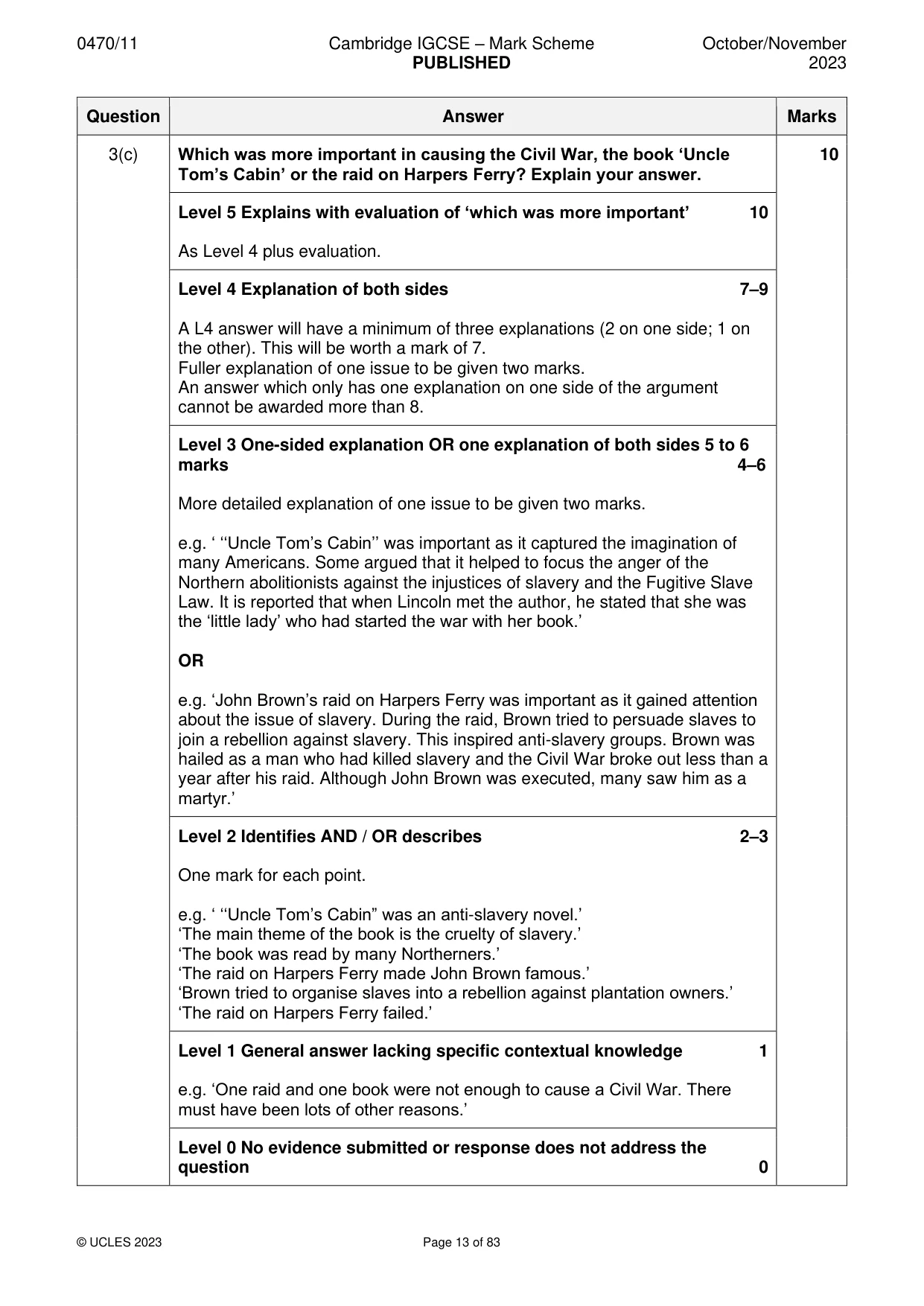
0470/11 Cambridge IGCSE – Mark Scheme PUBLISHED October/November 2023 © UCLES 2023 Page 13 of 83 Question Answer Marks 3(c) Which was more important in causing the Civil War, the book ‘Uncle Tom’s Cabin’ or the raid on Harpers Ferry? Explain your answer. 10 Level 5 Explains with evaluation of ‘which was more important’ 10 As Level 4 plus evaluation. Level 4 Explanation of both sides 7–9 A L4 answer will have a minimum of three explanations (2 on one side; 1 on the other). This will be worth a mark of 7. Fuller explanation of one issue to be given two marks. An answer which only has one explanation on one side of the argument cannot be awarded more than 8. Level 3 One-sided explanation OR one explanation of both sides 5 to 6 marks 4–6 More detailed explanation of one issue to be given two marks. e.g. ‘ ‘‘Uncle Tom’s Cabin’’ was important as it captured the imagination of many Americans. Some argued that it helped to focus the anger of the Northern abolitionists against the injustices of slavery and the Fugitive Slave Law. It is reported that when Lincoln met the author, he stated that she was the ‘little lady’ who had started the war with her book.’ OR e.g. ‘John Brown’s raid on Harpers Ferry was important as it gained attention about the issue of slavery. During the raid, Brown tried to persuade slaves to join a rebellion against slavery. This inspired anti-slavery groups. Brown was hailed as a man who had killed slavery and the Civil War broke out less than a year after his raid. Although John Brown was executed, many saw him as a martyr.’ Level 2 Identifies AND / OR describes 2–3 One mark for each point. e.g. ‘ ‘‘Uncle Tom’s Cabin” was an anti-slavery novel.’ ‘The main theme of the book is the cruelty of slavery.’ ‘The book was read by many Northerners.’ ‘The raid on Harpers Ferry made John Brown famous.’ ‘Brown tried to organise slaves into a rebellion against plantation owners.’ ‘The raid on Harpers Ferry failed.’ Level 1 General answer lacking specific contextual knowledge 1 e.g. ‘One raid and one book were not enough to cause a Civil War. There must have been lots of other reasons.’ Level 0 No evidence submitted or response does not address the question 0
Mark scheme, page 14
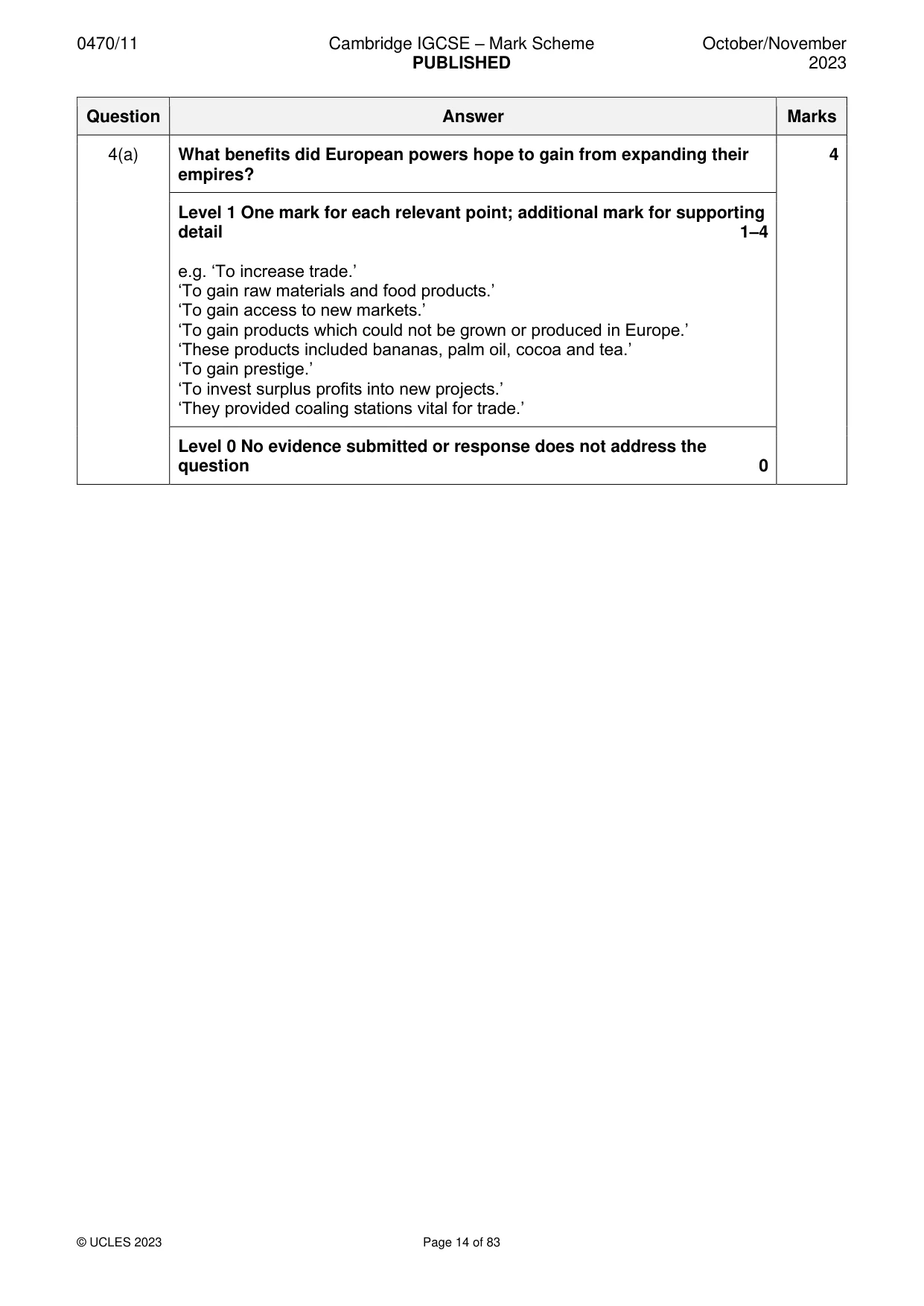
0470/11 Cambridge IGCSE – Mark Scheme PUBLISHED October/November 2023 © UCLES 2023 Page 14 of 83 Question Answer Marks 4(a) What benefits did European powers hope to gain from expanding their empires? 4 Level 1 One mark for each relevant point; additional mark for supporting detail 1–4 e.g. ‘To increase trade.’ ‘To gain raw materials and food products.’ ‘To gain access to new markets.’ ‘To gain products which could not be grown or produced in Europe.’ ‘These products included bananas, palm oil, cocoa and tea.’ ‘To gain prestige.’ ‘To invest surplus profits into new projects.’ ‘They provided coaling stations vital for trade.’ Level 0 No evidence submitted or response does not address the question 0
Mark scheme, page 15
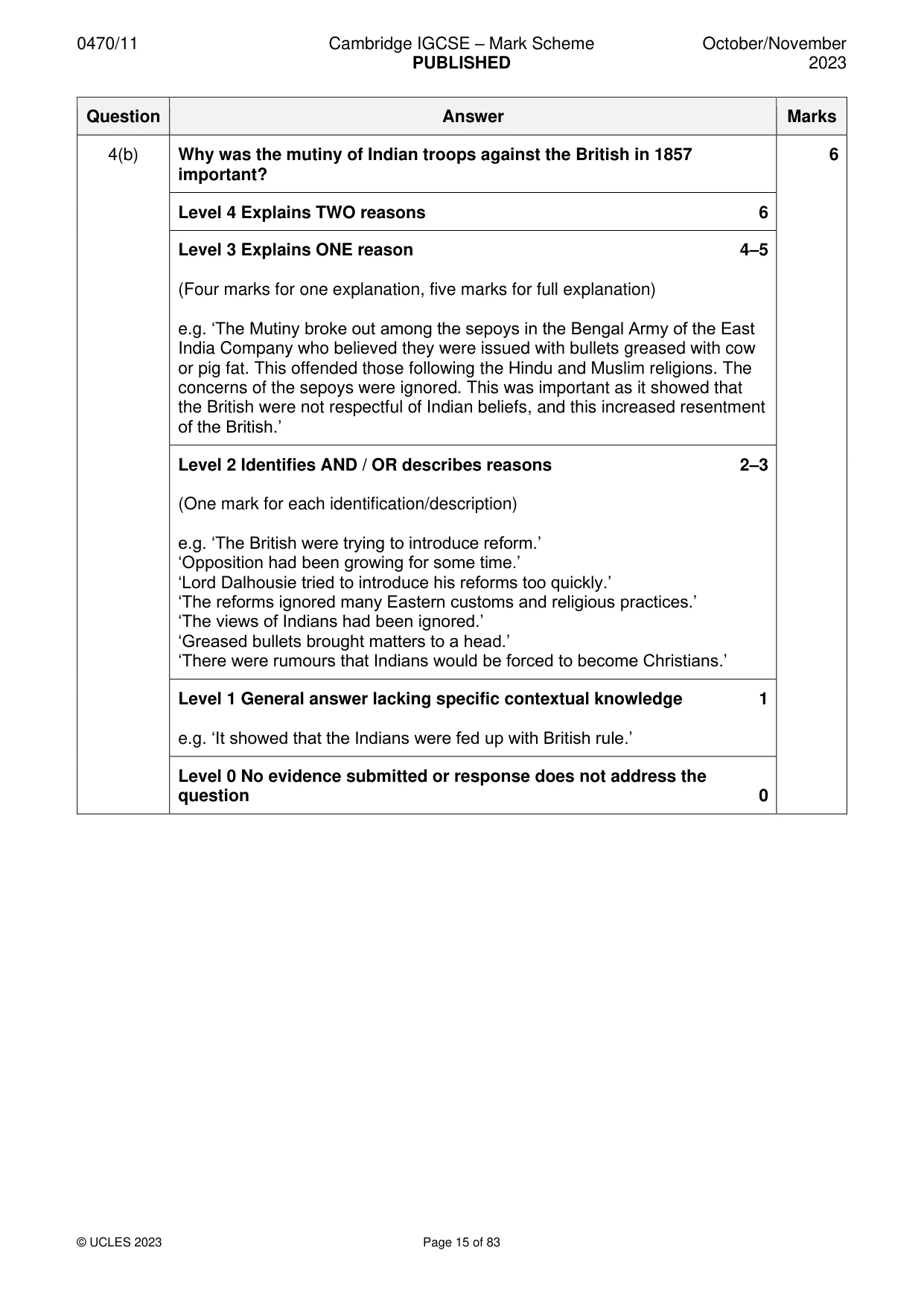
0470/11 Cambridge IGCSE – Mark Scheme PUBLISHED October/November 2023 © UCLES 2023 Page 15 of 83 Question Answer Marks 4(b) Why was the mutiny of Indian troops against the British in 1857 important? 6 Level 4 Explains TWO reasons 6 Level 3 Explains ONE reason 4–5 (Four marks for one explanation, five marks for full explanation) e.g. ‘The Mutiny broke out among the sepoys in the Bengal Army of the East India Company who believed they were issued with bullets greased with cow or pig fat. This offended those following the Hindu and Muslim religions. The concerns of the sepoys were ignored. This was important as it showed that the British were not respectful of Indian beliefs, and this increased resentment of the British.’ Level 2 Identifies AND / OR describes reasons 2–3 (One mark for each identification/description) e.g. ‘The British were trying to introduce reform.’ ‘Opposition had been growing for some time.’ ‘Lord Dalhousie tried to introduce his reforms too quickly.’ ‘The reforms ignored many Eastern customs and religious practices.’ ‘The views of Indians had been ignored.’ ‘Greased bullets brought matters to a head.’ ‘There were rumours that Indians would be forced to become Christians.’ Level 1 General answer lacking specific contextual knowledge 1 e.g. ‘It showed that the Indians were fed up with British rule.’ Level 0 No evidence submitted or response does not address the question 0
Mark scheme, page 16
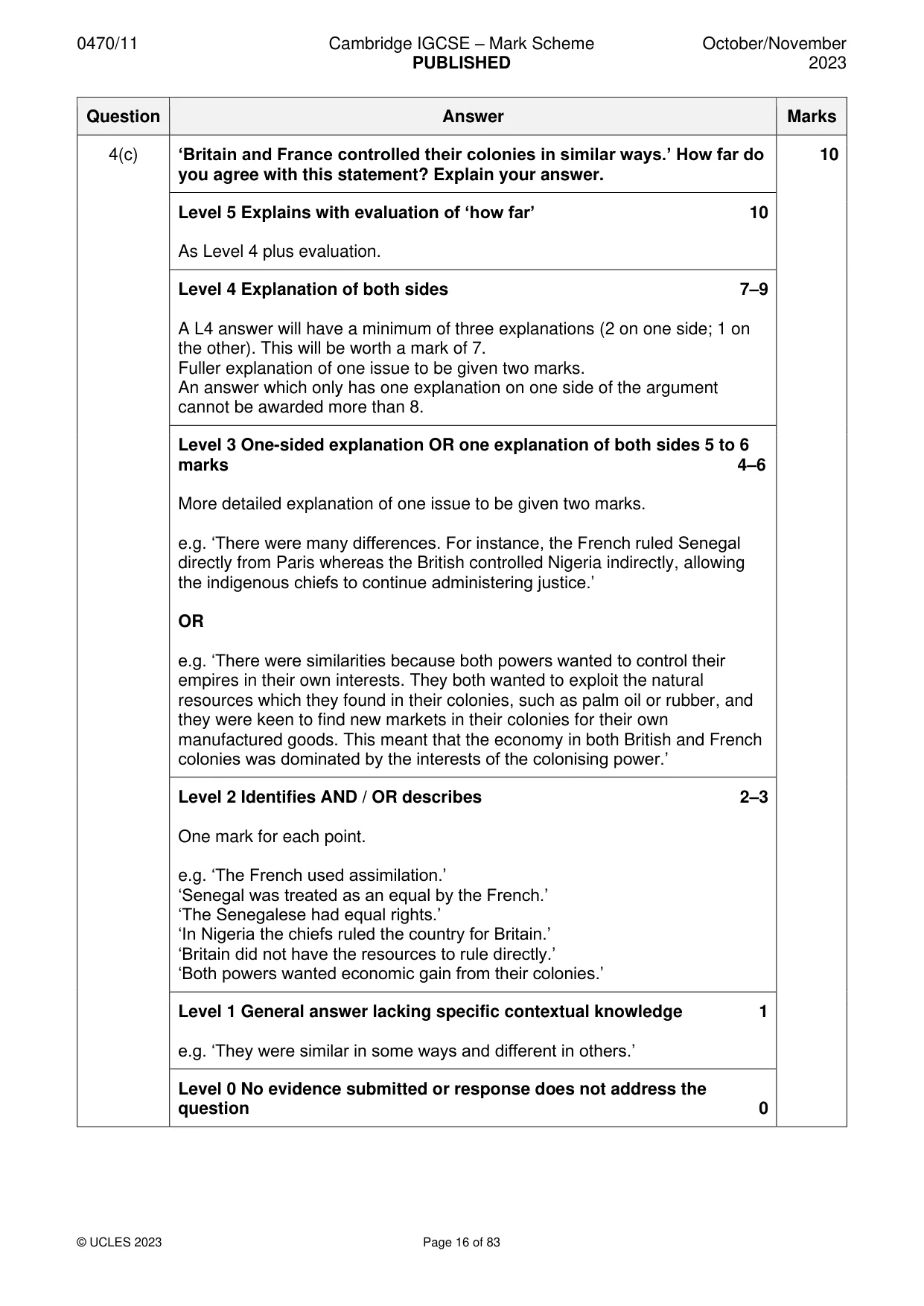
0470/11 Cambridge IGCSE – Mark Scheme PUBLISHED October/November 2023 © UCLES 2023 Page 16 of 83 Question Answer Marks 4(c) ‘Britain and France controlled their colonies in similar ways.’ How far do you agree with this statement? Explain your answer. 10 Level 5 Explains with evaluation of ‘how far’ 10 As Level 4 plus evaluation. Level 4 Explanation of both sides 7–9 A L4 answer will have a minimum of three explanations (2 on one side; 1 on the other). This will be worth a mark of 7. Fuller explanation of one issue to be given two marks. An answer which only has one explanation on one side of the argument cannot be awarded more than 8. Level 3 One-sided explanation OR one explanation of both sides 5 to 6 marks 4–6 More detailed explanation of one issue to be given two marks. e.g. ‘There were many differences. For instance, the French ruled Senegal directly from Paris whereas the British controlled Nigeria indirectly, allowing the indigenous chiefs to continue administering justice.’ OR e.g. ‘There were similarities because both powers wanted to control their empires in their own interests. They both wanted to exploit the natural resources which they found in their colonies, such as palm oil or rubber, and they were keen to find new markets in their colonies for their own manufactured goods. This meant that the economy in both British and French colonies was dominated by the interests of the colonising power.’ Level 2 Identifies AND / OR describes 2–3 One mark for each point. e.g. ‘The French used assimilation.’ ‘Senegal was treated as an equal by the French.’ ‘The Senegalese had equal rights.’ ‘In Nigeria the chiefs ruled the country for Britain.’ ‘Britain did not have the resources to rule directly.’ ‘Both powers wanted economic gain from their colonies.’ Level 1 General answer lacking specific contextual knowledge 1 e.g. ‘They were similar in some ways and different in others.’ Level 0 No evidence submitted or response does not address the question 0
Mark scheme, page 17
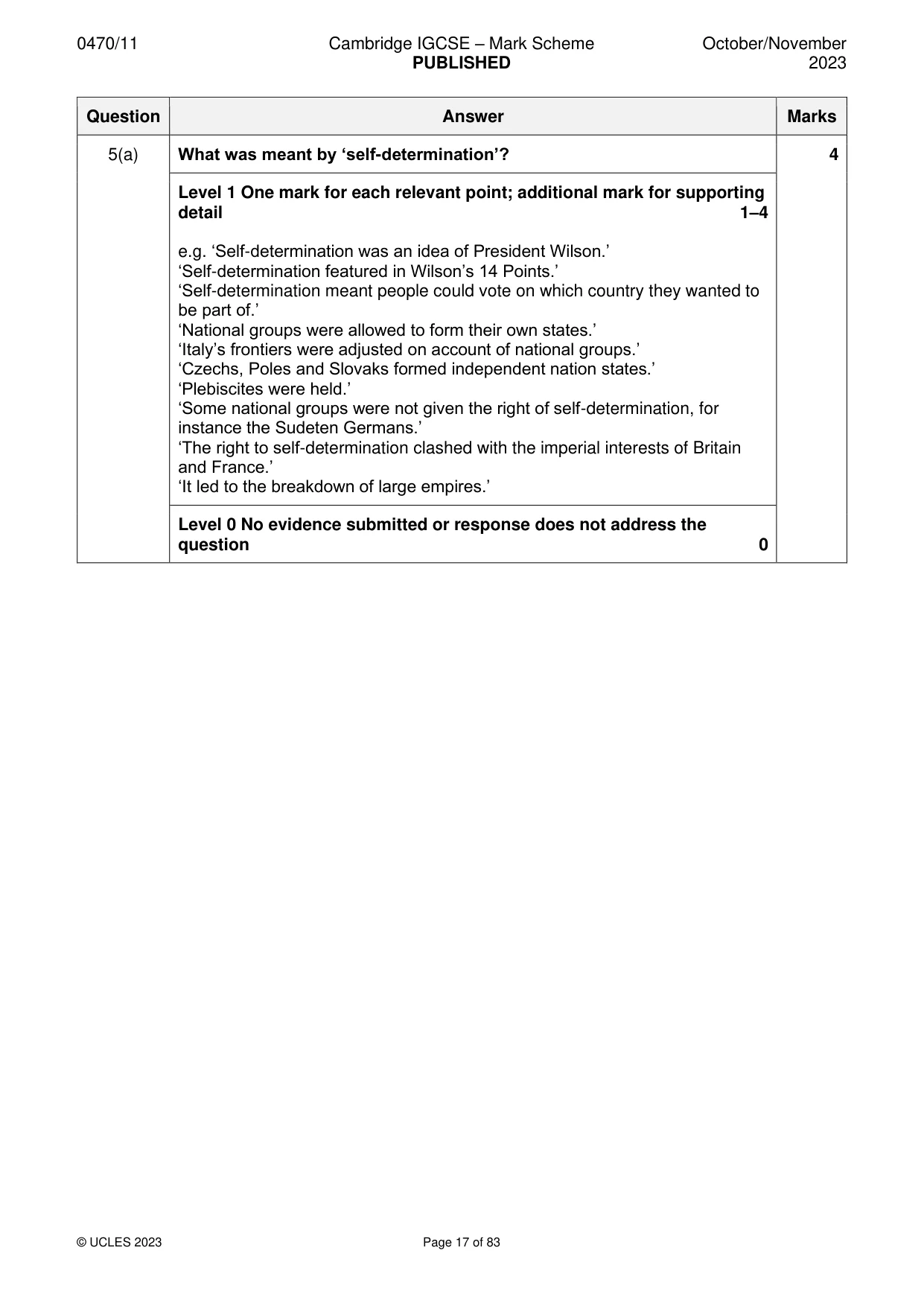
0470/11 Cambridge IGCSE – Mark Scheme PUBLISHED October/November 2023 © UCLES 2023 Page 17 of 83 Question Answer Marks 5(a) What was meant by ‘self-determination’? 4 Level 1 One mark for each relevant point; additional mark for supporting detail 1–4 e.g. ‘Self-determination was an idea of President Wilson.’ ‘Self-determination featured in Wilson’s 14 Points.’ ‘Self-determination meant people could vote on which country they wanted to be part of.’ ‘National groups were allowed to form their own states.’ ‘Italy’s frontiers were adjusted on account of national groups.’ ‘Czechs, Poles and Slovaks formed independent nation states.’ ‘Plebiscites were held.’ ‘Some national groups were not given the right of self-determination, for instance the Sudeten Germans.’ ‘The right to self-determination clashed with the imperial interests of Britain and France.’ ‘It led to the breakdown of large empires.’ Level 0 No evidence submitted or response does not address the question 0
Mark scheme, page 18
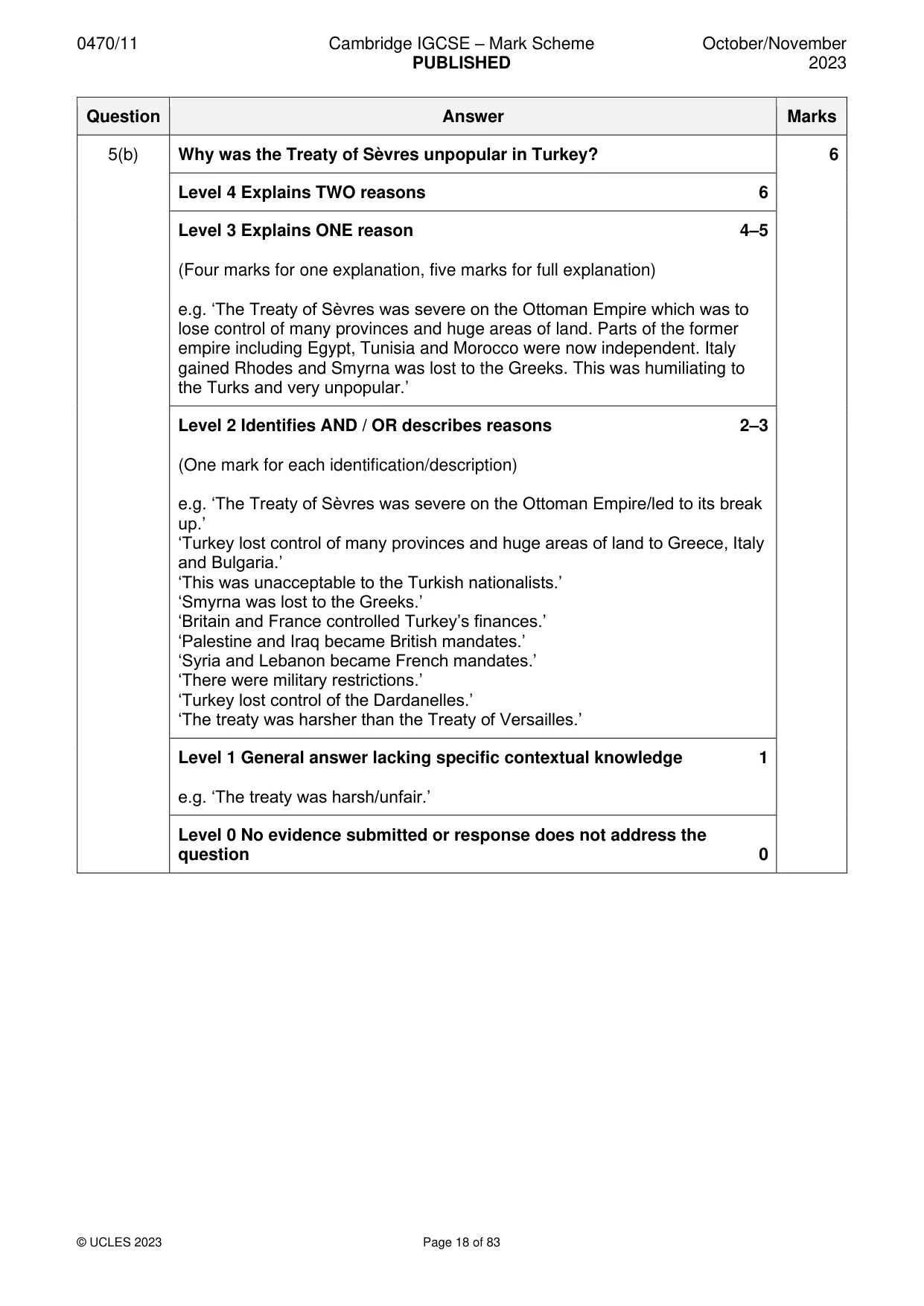
0470/11 Cambridge IGCSE – Mark Scheme PUBLISHED October/November 2023 © UCLES 2023 Page 18 of 83 Question Answer Marks 5(b) Why was the Treaty of Sèvres unpopular in Turkey? 6 Level 4 Explains TWO reasons 6 Level 3 Explains ONE reason 4–5 (Four marks for one explanation, five marks for full explanation) e.g. ‘The Treaty of Sèvres was severe on the Ottoman Empire which was to lose control of many provinces and huge areas of land. Parts of the former empire including Egypt, Tunisia and Morocco were now independent. Italy gained Rhodes and Smyrna was lost to the Greeks. This was humiliating to the Turks and very unpopular.’ Level 2 Identifies AND / OR describes reasons 2–3 (One mark for each identification/description) e.g. ‘The Treaty of Sèvres was severe on the Ottoman Empire/led to its break up.’ ‘Turkey lost control of many provinces and huge areas of land to Greece, Italy and Bulgaria.’ ‘This was unacceptable to the Turkish nationalists.’ ‘Smyrna was lost to the Greeks.’ ‘Britain and France controlled Turkey’s finances.’ ‘Palestine and Iraq became British mandates.’ ‘Syria and Lebanon became French mandates.’ ‘There were military restrictions.’ ‘Turkey lost control of the Dardanelles.’ ‘The treaty was harsher than the Treaty of Versailles.’ Level 1 General answer lacking specific contextual knowledge 1 e.g. ‘The treaty was harsh/unfair.’ Level 0 No evidence submitted or response does not address the question 0
Mark scheme, page 19
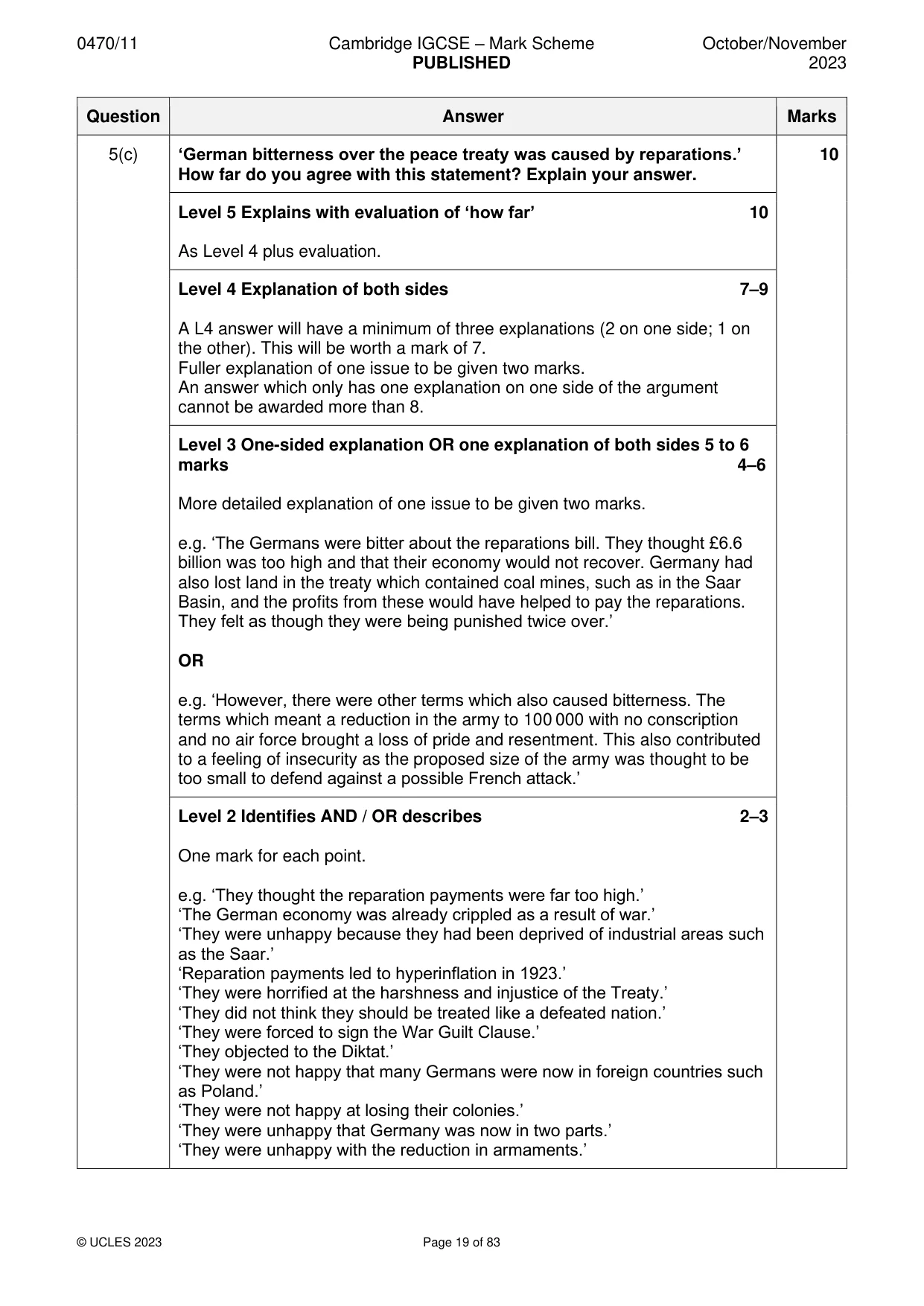
0470/11 Cambridge IGCSE – Mark Scheme PUBLISHED October/November 2023 © UCLES 2023 Page 19 of 83 Question Answer Marks 5(c) ‘German bitterness over the peace treaty was caused by reparations.’ How far do you agree with this statement? Explain your answer. 10 Level 5 Explains with evaluation of ‘how far’ 10 As Level 4 plus evaluation. Level 4 Explanation of both sides 7–9 A L4 answer will have a minimum of three explanations (2 on one side; 1 on the other). This will be worth a mark of 7. Fuller explanation of one issue to be given two marks. An answer which only has one explanation on one side of the argument cannot be awarded more than 8. Level 3 One-sided explanation OR one explanation of both sides 5 to 6 marks 4–6 More detailed explanation of one issue to be given two marks. e.g. ‘The Germans were bitter about the reparations bill. They thought £6.6 billion was too high and that their economy would not recover. Germany had also lost land in the treaty which contained coal mines, such as in the Saar Basin, and the profits from these would have helped to pay the reparations. They felt as though they were being punished twice over.’ OR e.g. ‘However, there were other terms which also caused bitterness. The terms which meant a reduction in the army to 100 000 with no conscription and no air force brought a loss of pride and resentment. This also contributed to a feeling of insecurity as the proposed size of the army was thought to be too small to defend against a possible French attack.’ Level 2 Identifies AND / OR describes 2–3 One mark for each point. e.g. ‘They thought the reparation payments were far too high.’ ‘The German economy was already crippled as a result of war.’ ‘They were unhappy because they had been deprived of industrial areas such as the Saar.’ ‘Reparation payments led to hyperinflation in 1923.’ ‘They were horrified at the harshness and injustice of the Treaty.’ ‘They did not think they should be treated like a defeated nation.’ ‘They were forced to sign the War Guilt Clause.’ ‘They objected to the Diktat.’ ‘They were not happy that many Germans were now in foreign countries such as Poland.’ ‘They were not happy at losing their colonies.’ ‘They were unhappy that Germany was now in two parts.’ ‘They were unhappy with the reduction in armaments.’
Mark scheme, page 20
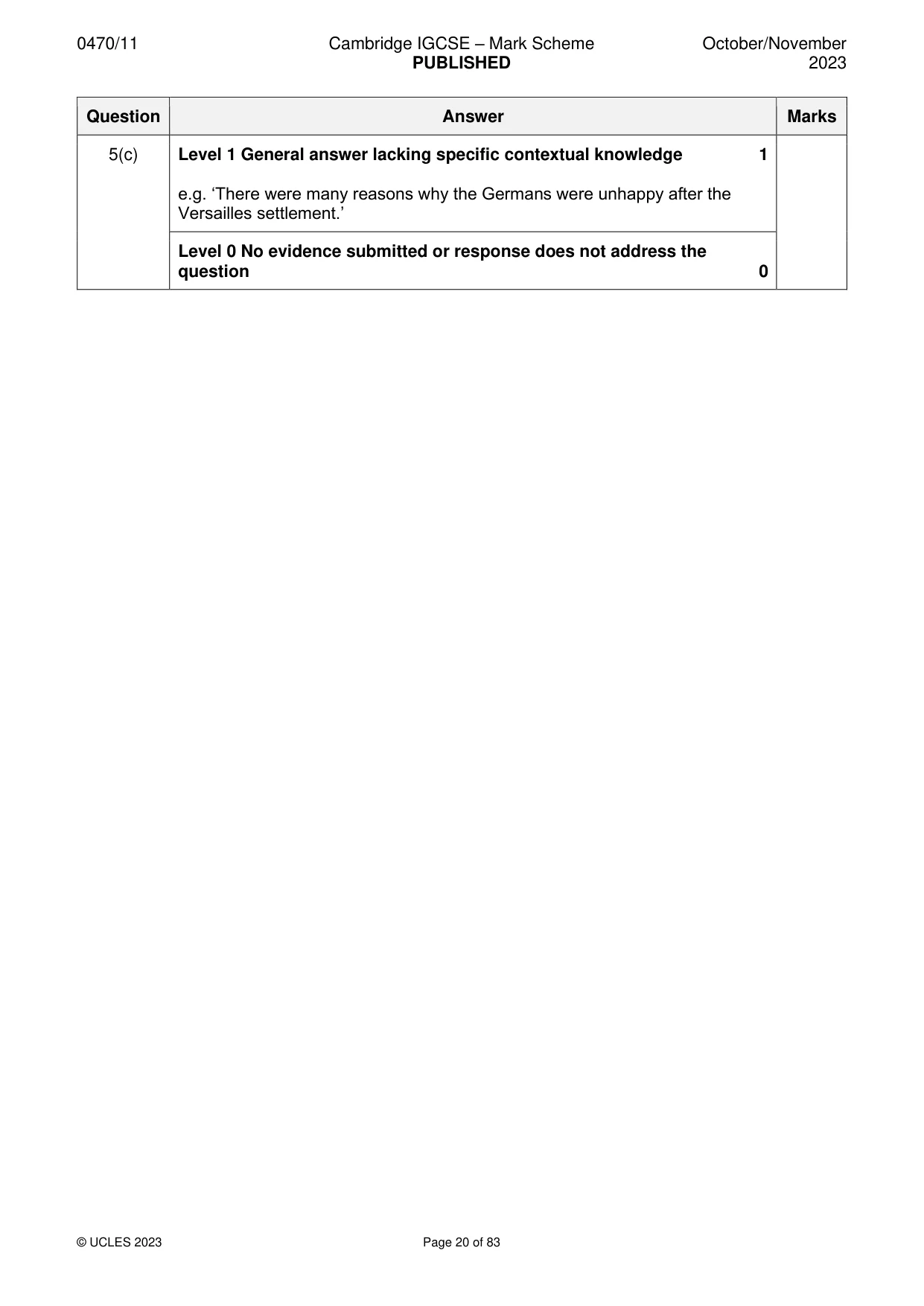
0470/11 Cambridge IGCSE – Mark Scheme PUBLISHED October/November 2023 © UCLES 2023 Page 20 of 83 Question Answer Marks 5(c) Level 1 General answer lacking specific contextual knowledge 1 e.g. ‘There were many reasons why the Germans were unhappy after the Versailles settlement.’ Level 0 No evidence submitted or response does not address the question 0
Mark scheme, page 21
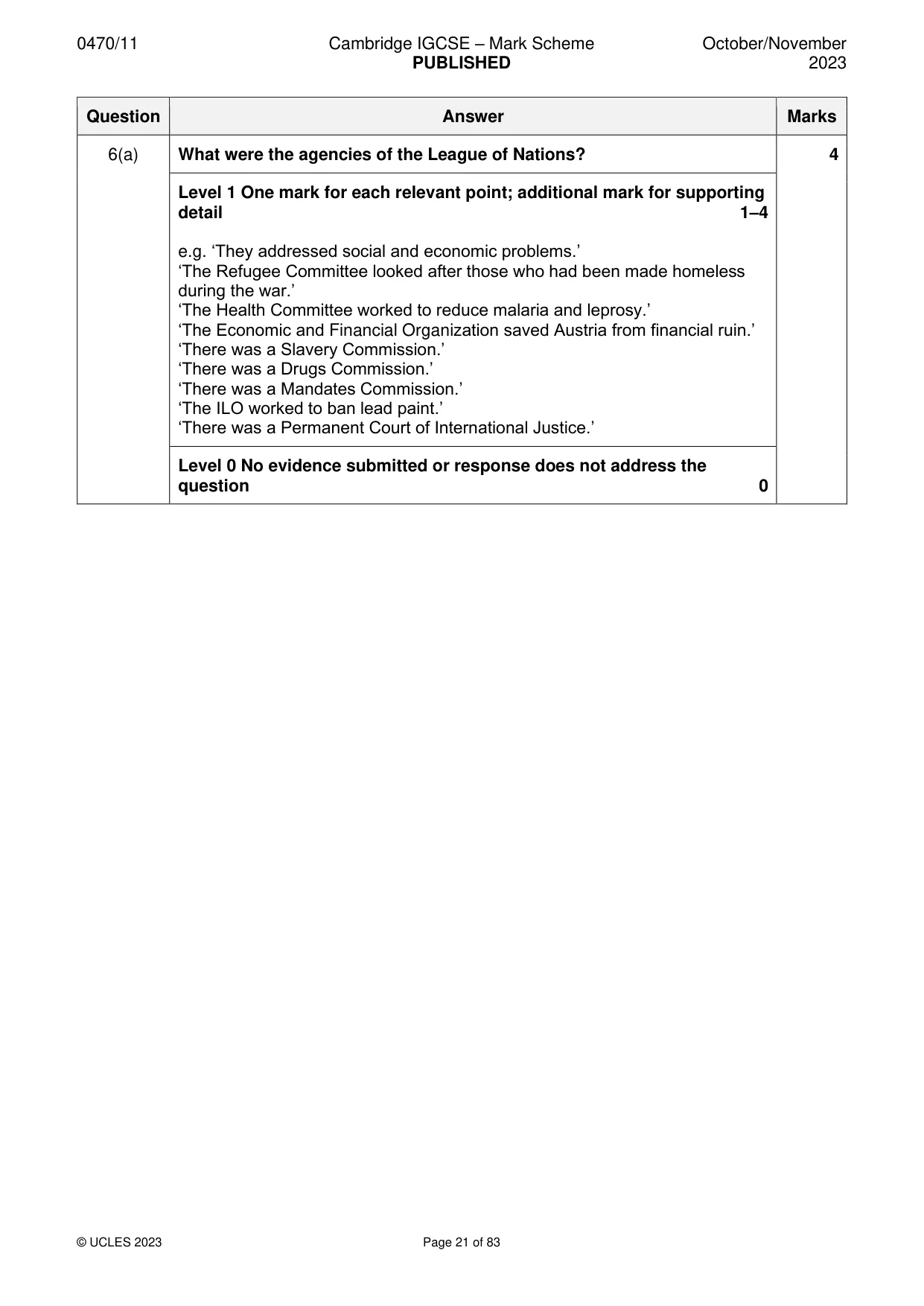
0470/11 Cambridge IGCSE – Mark Scheme PUBLISHED October/November 2023 © UCLES 2023 Page 21 of 83 Question Answer Marks 6(a) What were the agencies of the League of Nations? 4 Level 1 One mark for each relevant point; additional mark for supporting detail 1–4 e.g. ‘They addressed social and economic problems.’ ‘The Refugee Committee looked after those who had been made homeless during the war.’ ‘The Health Committee worked to reduce malaria and leprosy.’ ‘The Economic and Financial Organization saved Austria from financial ruin.’ ‘There was a Slavery Commission.’ ‘There was a Drugs Commission.’ ‘There was a Mandates Commission.’ ‘The ILO worked to ban lead paint.’ ‘There was a Permanent Court of International Justice.’ Level 0 No evidence submitted or response does not address the question 0
Mark scheme, page 22
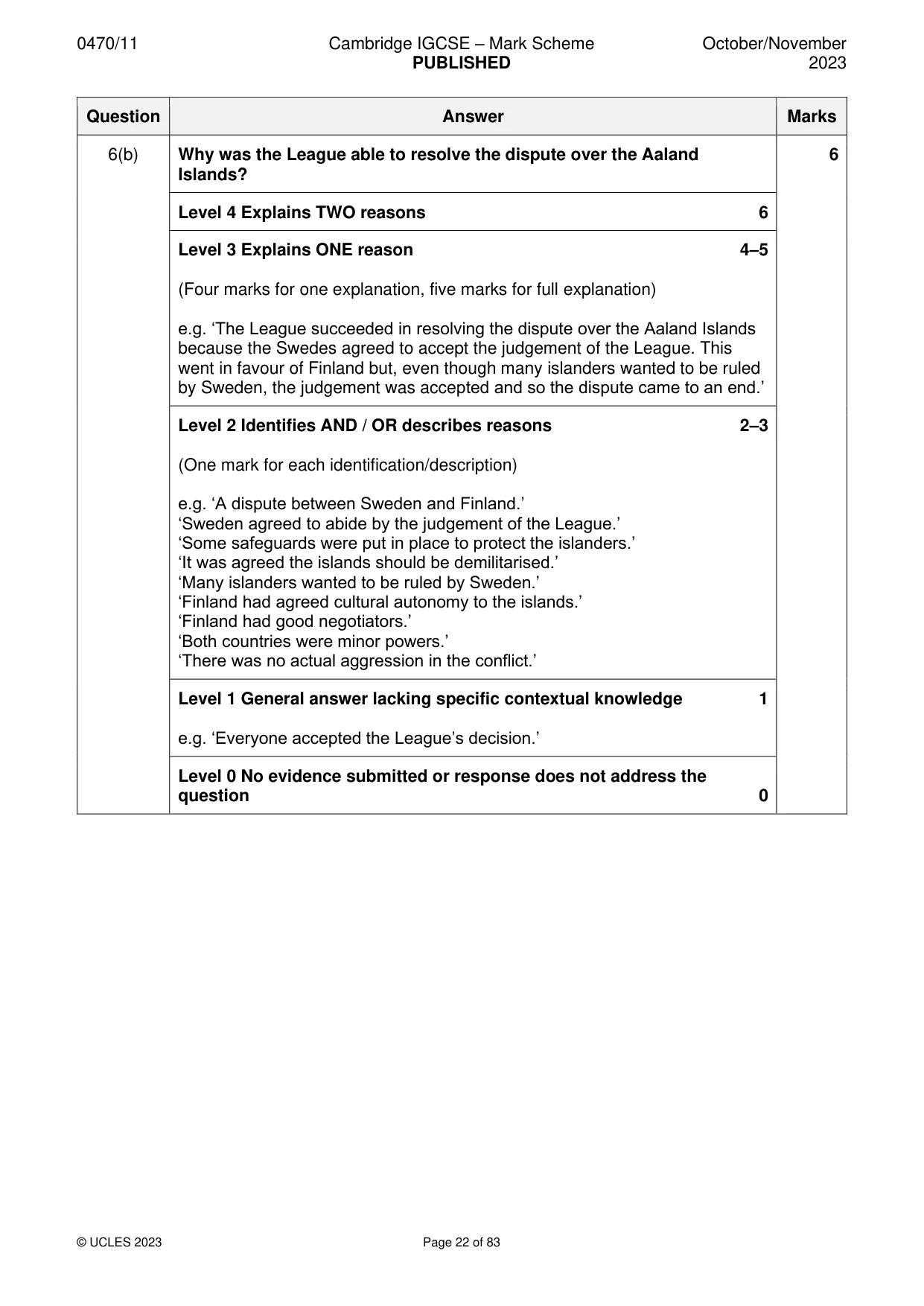
0470/11 Cambridge IGCSE – Mark Scheme PUBLISHED October/November 2023 © UCLES 2023 Page 22 of 83 Question Answer Marks 6(b) Why was the League able to resolve the dispute over the Aaland Islands? 6 Level 4 Explains TWO reasons 6 Level 3 Explains ONE reason 4–5 (Four marks for one explanation, five marks for full explanation) e.g. ‘The League succeeded in resolving the dispute over the Aaland Islands because the Swedes agreed to accept the judgement of the League. This went in favour of Finland but, even though many islanders wanted to be ruled by Sweden, the judgement was accepted and so the dispute came to an end.’ Level 2 Identifies AND / OR describes reasons 2–3 (One mark for each identification/description) e.g. ‘A dispute between Sweden and Finland.’ ‘Sweden agreed to abide by the judgement of the League.’ ‘Some safeguards were put in place to protect the islanders.’ ‘It was agreed the islands should be demilitarised.’ ‘Many islanders wanted to be ruled by Sweden.’ ‘Finland had agreed cultural autonomy to the islands.’ ‘Finland had good negotiators.’ ‘Both countries were minor powers.’ ‘There was no actual aggression in the conflict.’ Level 1 General answer lacking specific contextual knowledge 1 e.g. ‘Everyone accepted the League’s decision.’ Level 0 No evidence submitted or response does not address the question 0
Mark scheme, page 23
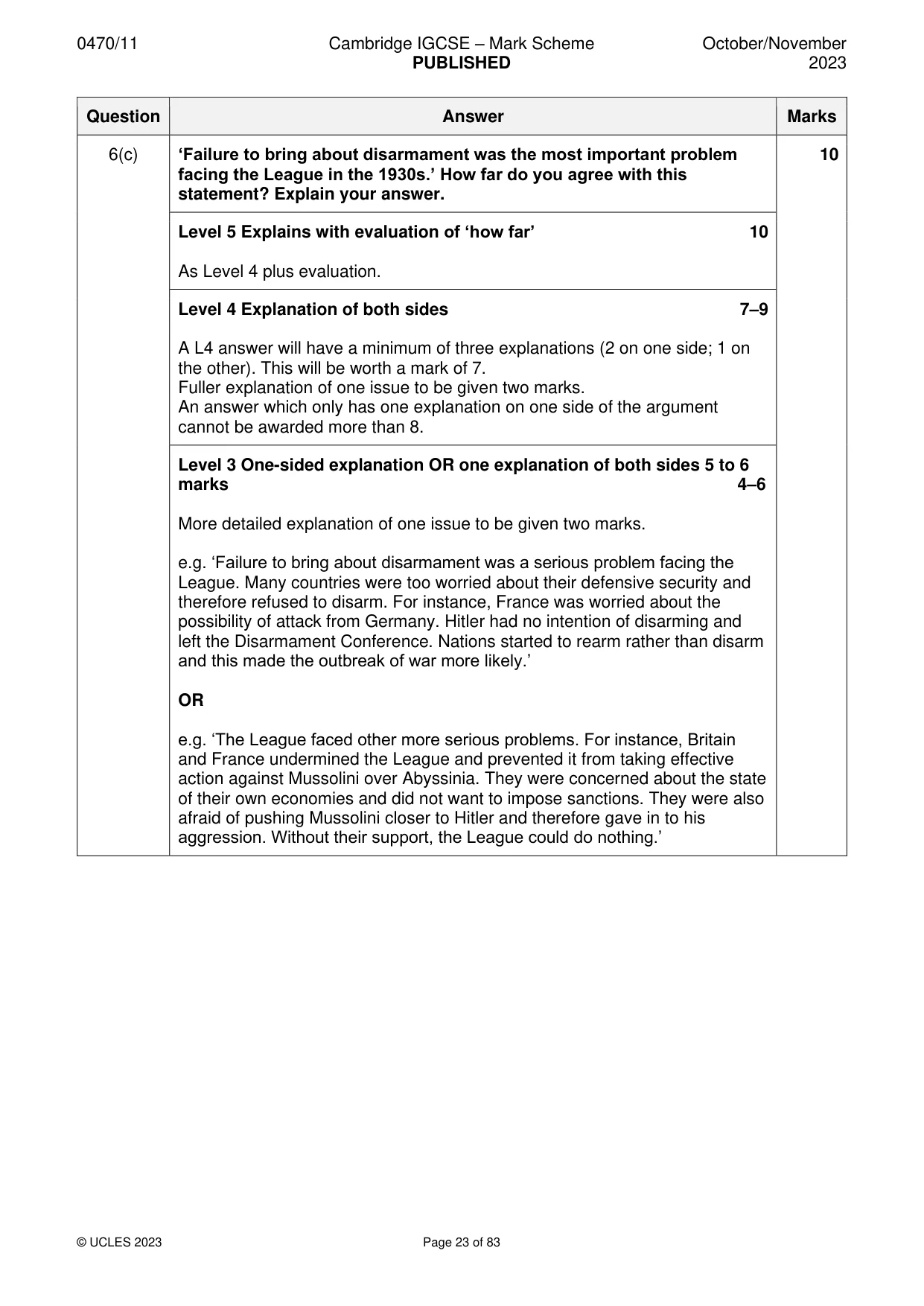
0470/11 Cambridge IGCSE – Mark Scheme PUBLISHED October/November 2023 © UCLES 2023 Page 23 of 83 Question Answer Marks 6(c) ‘Failure to bring about disarmament was the most important problem facing the League in the 1930s.’ How far do you agree with this statement? Explain your answer. 10 Level 5 Explains with evaluation of ‘how far’ 10 As Level 4 plus evaluation. Level 4 Explanation of both sides 7–9 A L4 answer will have a minimum of three explanations (2 on one side; 1 on the other). This will be worth a mark of 7. Fuller explanation of one issue to be given two marks. An answer which only has one explanation on one side of the argument cannot be awarded more than 8. Level 3 One-sided explanation OR one explanation of both sides 5 to 6 marks 4–6 More detailed explanation of one issue to be given two marks. e.g. ‘Failure to bring about disarmament was a serious problem facing the League. Many countries were too worried about their defensive security and therefore refused to disarm. For instance, France was worried about the possibility of attack from Germany. Hitler had no intention of disarming and left the Disarmament Conference. Nations started to rearm rather than disarm and this made the outbreak of war more likely.’ OR e.g. ‘The League faced other more serious problems. For instance, Britain and France undermined the League and prevented it from taking effective action against Mussolini over Abyssinia. They were concerned about the state of their own economies and did not want to impose sanctions. They were also afraid of pushing Mussolini closer to Hitler and therefore gave in to his aggression. Without their support, the League could do nothing.’
Mark scheme, page 24
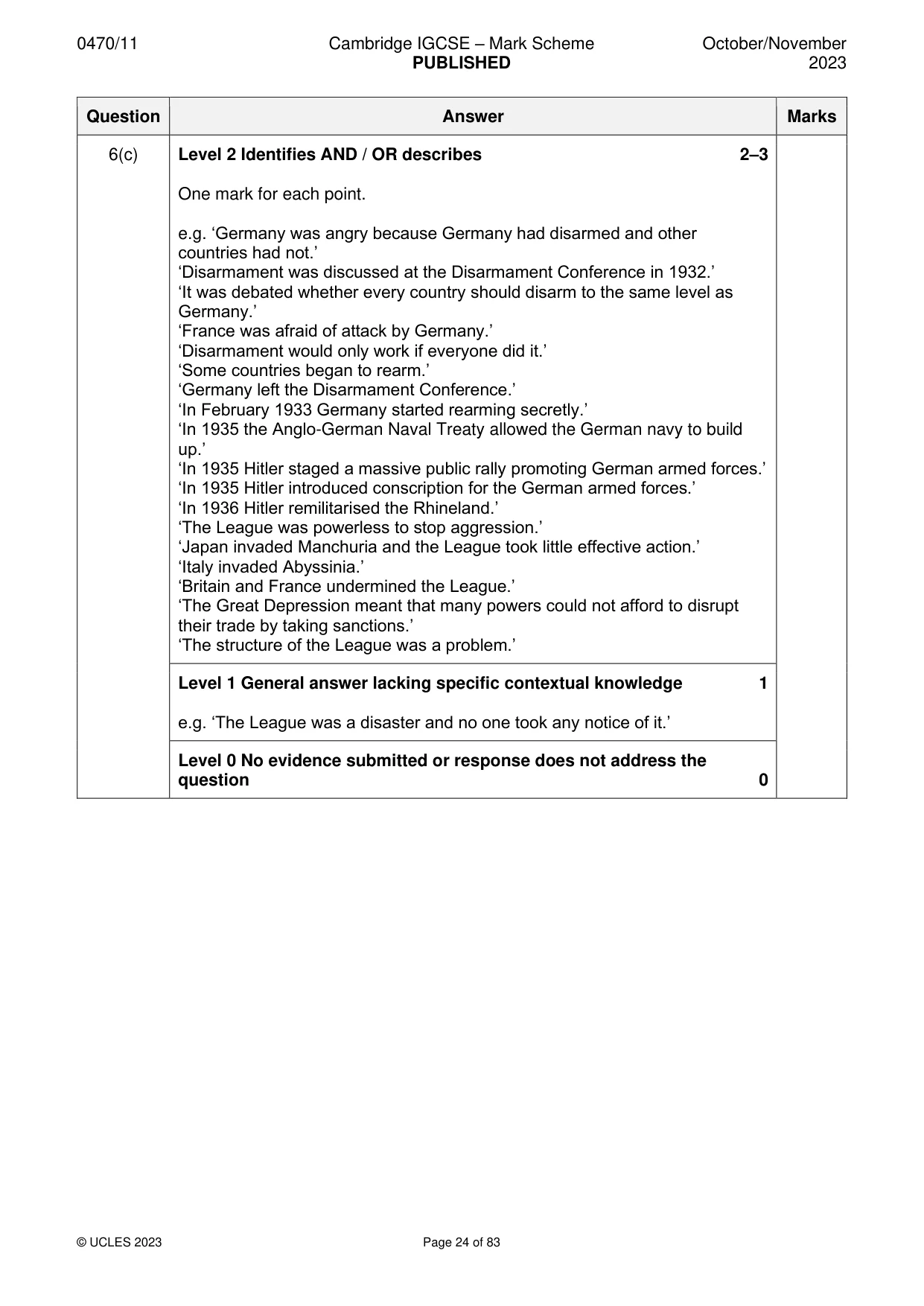
0470/11 Cambridge IGCSE – Mark Scheme PUBLISHED October/November 2023 © UCLES 2023 Page 24 of 83 Question Answer Marks 6(c) Level 2 Identifies AND / OR describes 2–3 One mark for each point. e.g. ‘Germany was angry because Germany had disarmed and other countries had not.’ ‘Disarmament was discussed at the Disarmament Conference in 1932.’ ‘It was debated whether every country should disarm to the same level as Germany.’ ‘France was afraid of attack by Germany.’ ‘Disarmament would only work if everyone did it.’ ‘Some countries began to rearm.’ ‘Germany left the Disarmament Conference.’ ‘In February 1933 Germany started rearming secretly.’ ‘In 1935 the Anglo-German Naval Treaty allowed the German navy to build up.’ ‘In 1935 Hitler staged a massive public rally promoting German armed forces.’ ‘In 1935 Hitler introduced conscription for the German armed forces.’ ‘In 1936 Hitler remilitarised the Rhineland.’ ‘The League was powerless to stop aggression.’ ‘Japan invaded Manchuria and the League took little effective action.’ ‘Italy invaded Abyssinia.’ ‘Britain and France undermined the League.’ ‘The Great Depression meant that many powers could not afford to disrupt their trade by taking sanctions.’ ‘The structure of the League was a problem.’ Level 1 General answer lacking specific contextual knowledge 1 e.g. ‘The League was a disaster and no one took any notice of it.’ Level 0 No evidence submitted or response does not address the question 0
Mark scheme, page 25
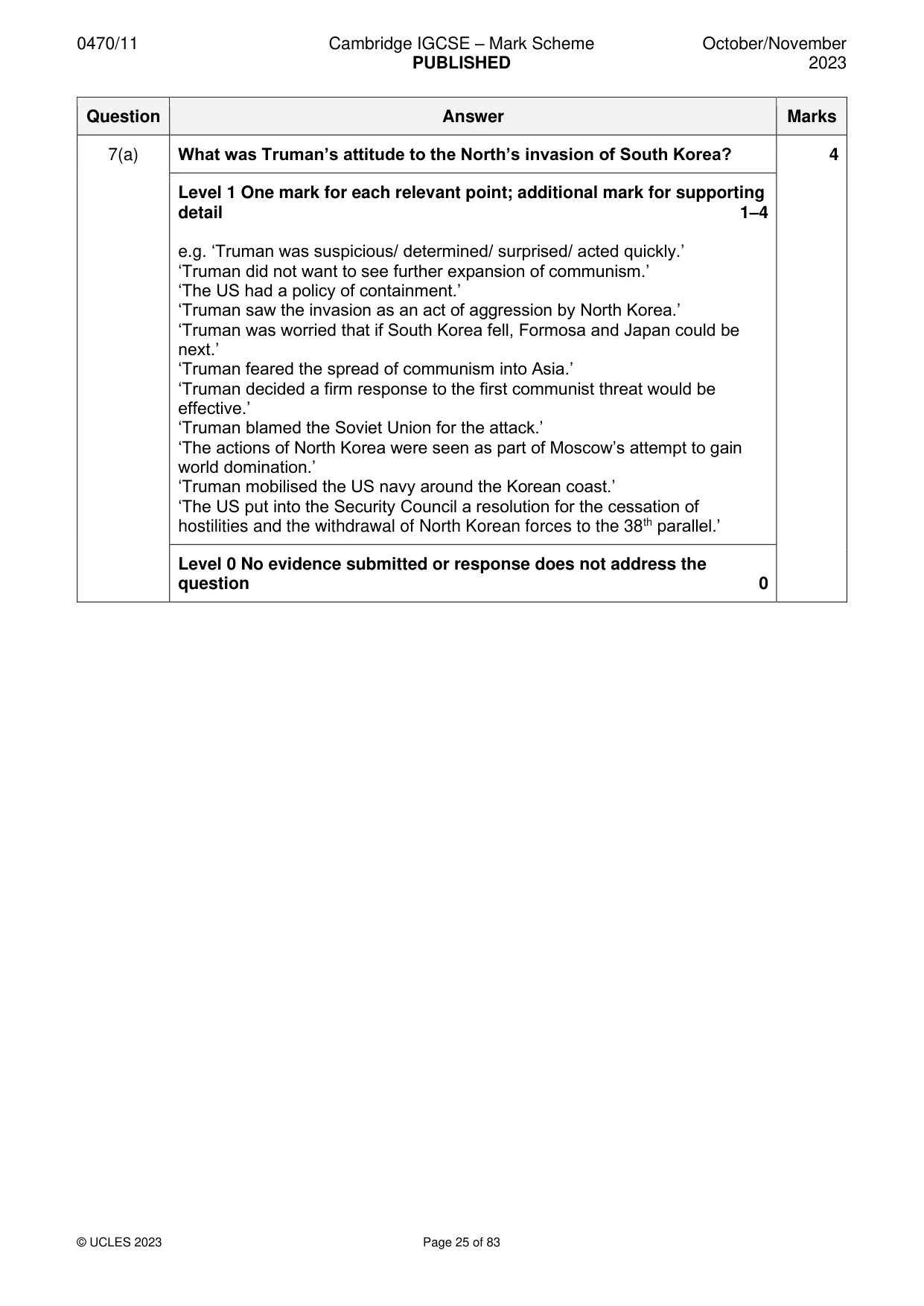
0470/11 Cambridge IGCSE – Mark Scheme PUBLISHED October/November 2023 © UCLES 2023 Page 25 of 83 Question Answer Marks 7(a) What was Truman’s attitude to the North’s invasion of South Korea? 4 Level 1 One mark for each relevant point; additional mark for supporting detail 1–4 e.g. ‘Truman was suspicious/ determined/ surprised/ acted quickly.’ ‘Truman did not want to see further expansion of communism.’ ‘The US had a policy of containment.’ ‘Truman saw the invasion as an act of aggression by North Korea.’ ‘Truman was worried that if South Korea fell, Formosa and Japan could be next.’ ‘Truman feared the spread of communism into Asia.’ ‘Truman decided a firm response to the first communist threat would be effective.’ ‘Truman blamed the Soviet Union for the attack.’ ‘The actions of North Korea were seen as part of Moscow’s attempt to gain world domination.’ ‘Truman mobilised the US navy around the Korean coast.’ ‘The US put into the Security Council a resolution for the cessation of hostilities and the withdrawal of North Korean forces to the 38th parallel.’ Level 0 No evidence submitted or response does not address the question 0
Mark scheme, page 26
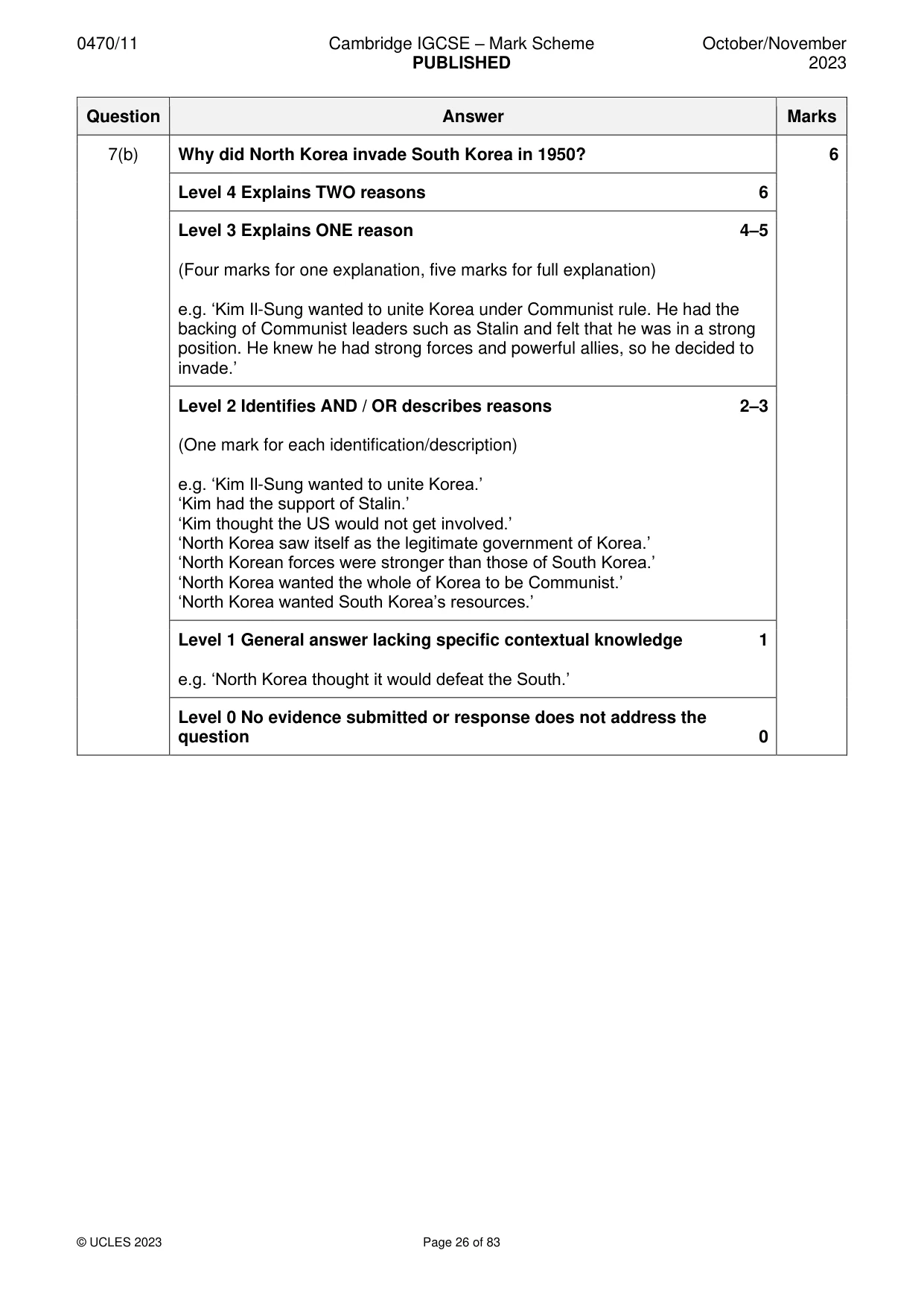
0470/11 Cambridge IGCSE – Mark Scheme PUBLISHED October/November 2023 © UCLES 2023 Page 26 of 83 Question Answer Marks 7(b) Why did North Korea invade South Korea in 1950? 6 Level 4 Explains TWO reasons 6 Level 3 Explains ONE reason 4–5 (Four marks for one explanation, five marks for full explanation) e.g. ‘Kim Il-Sung wanted to unite Korea under Communist rule. He had the backing of Communist leaders such as Stalin and felt that he was in a strong position. He knew he had strong forces and powerful allies, so he decided to invade.’ Level 2 Identifies AND / OR describes reasons 2–3 (One mark for each identification/description) e.g. ‘Kim Il-Sung wanted to unite Korea.’ ‘Kim had the support of Stalin.’ ‘Kim thought the US would not get involved.’ ‘North Korea saw itself as the legitimate government of Korea.’ ‘North Korean forces were stronger than those of South Korea.’ ‘North Korea wanted the whole of Korea to be Communist.’ ‘North Korea wanted South Korea’s resources.’ Level 1 General answer lacking specific contextual knowledge 1 e.g. ‘North Korea thought it would defeat the South.’ Level 0 No evidence submitted or response does not address the question 0
Mark scheme, page 27
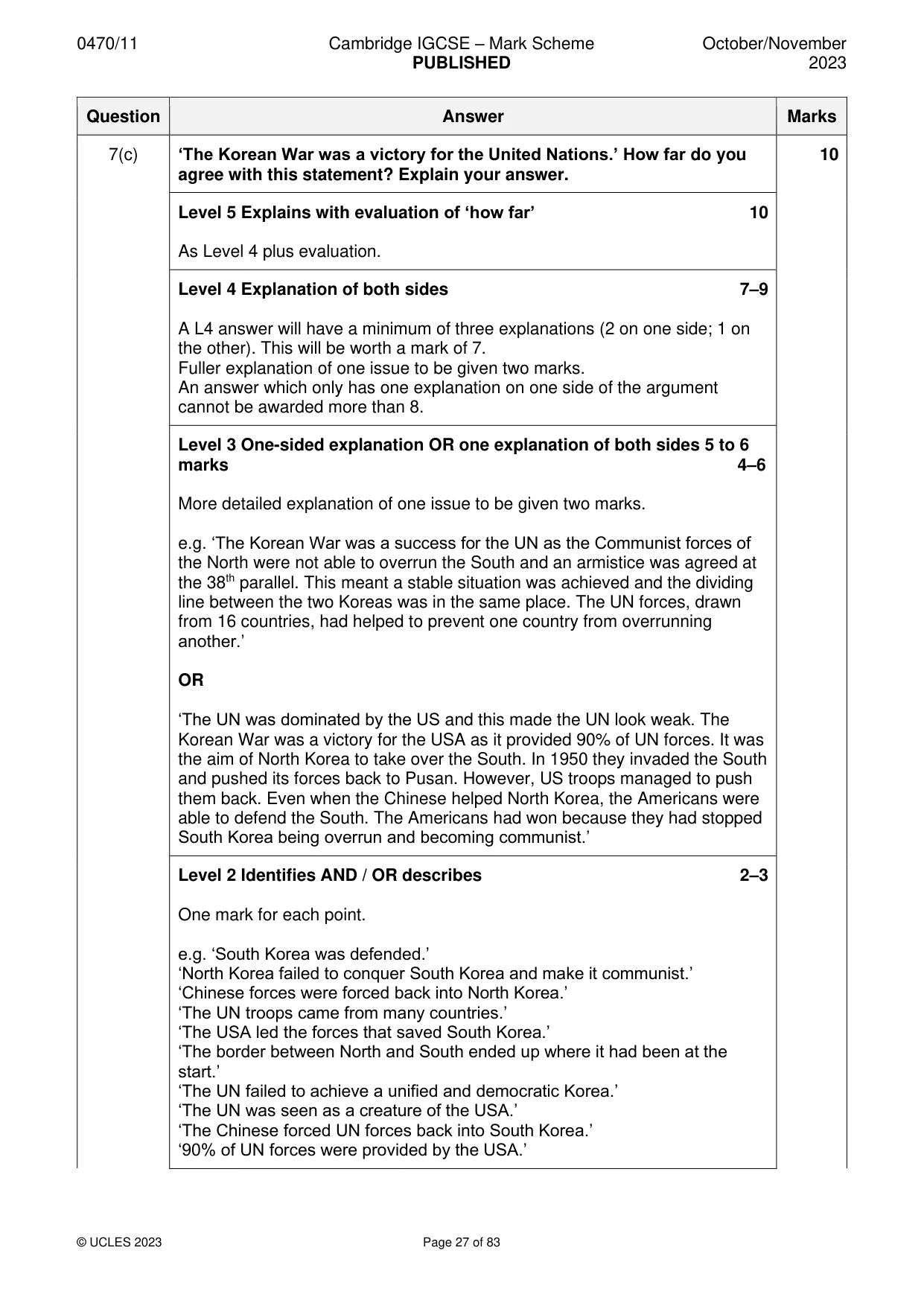
0470/11 Cambridge IGCSE – Mark Scheme PUBLISHED October/November 2023 © UCLES 2023 Page 27 of 83 Question Answer Marks 7(c) ‘The Korean War was a victory for the United Nations.’ How far do you agree with this statement? Explain your answer. 10 Level 5 Explains with evaluation of ‘how far’ 10 As Level 4 plus evaluation. Level 4 Explanation of both sides 7–9 A L4 answer will have a minimum of three explanations (2 on one side; 1 on the other). This will be worth a mark of 7. Fuller explanation of one issue to be given two marks. An answer which only has one explanation on one side of the argument cannot be awarded more than 8. Level 3 One-sided explanation OR one explanation of both sides 5 to 6 marks 4–6 More detailed explanation of one issue to be given two marks. e.g. ‘The Korean War was a success for the UN as the Communist forces of the North were not able to overrun the South and an armistice was agreed at the 38th parallel. This meant a stable situation was achieved and the dividing line between the two Koreas was in the same place. The UN forces, drawn from 16 countries, had helped to prevent one country from overrunning another.’ OR ‘The UN was dominated by the US and this made the UN look weak. The Korean War was a victory for the USA as it provided 90% of UN forces. It was the aim of North Korea to take over the South. In 1950 they invaded the South and pushed its forces back to Pusan. However, US troops managed to push them back. Even when the Chinese helped North Korea, the Americans were able to defend the South. The Americans had won because they had stopped South Korea being overrun and becoming communist.’ Level 2 Identifies AND / OR describes 2–3 One mark for each point. e.g. ‘South Korea was defended.’ ‘North Korea failed to conquer South Korea and make it communist.’ ‘Chinese forces were forced back into North Korea.’ ‘The UN troops came from many countries.’ ‘The USA led the forces that saved South Korea.’ ‘The border between North and South ended up where it had been at the start.’ ‘The UN failed to achieve a unified and democratic Korea.’ ‘The UN was seen as a creature of the USA.’ ‘The Chinese forced UN forces back into South Korea.’ ‘90% of UN forces were provided by the USA.’
Mark scheme, page 28
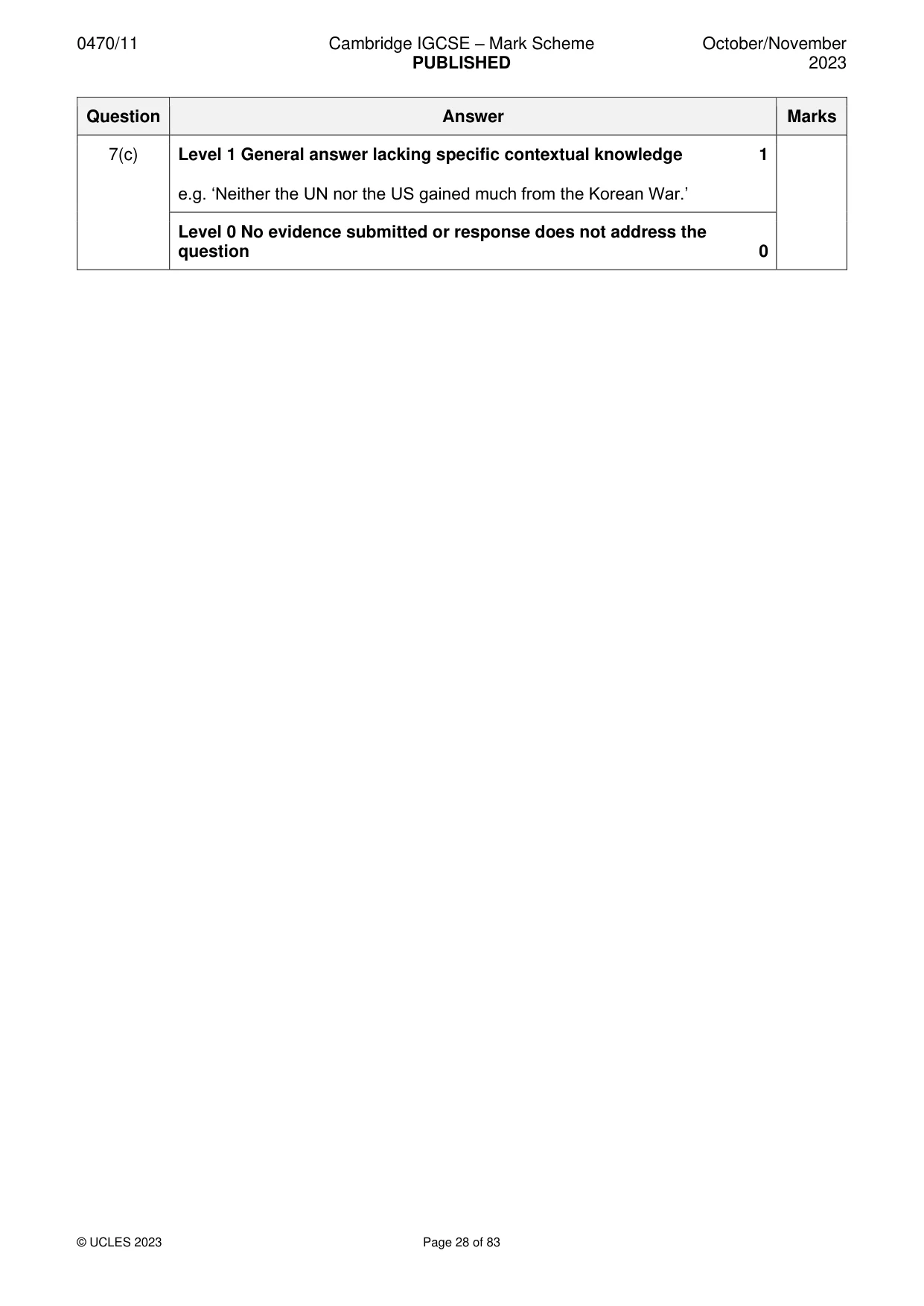
0470/11 Cambridge IGCSE – Mark Scheme PUBLISHED October/November 2023 © UCLES 2023 Page 28 of 83 Question Answer Marks 7(c) Level 1 General answer lacking specific contextual knowledge 1 e.g. ‘Neither the UN nor the US gained much from the Korean War.’ Level 0 No evidence submitted or response does not address the question 0
Mark scheme, page 29
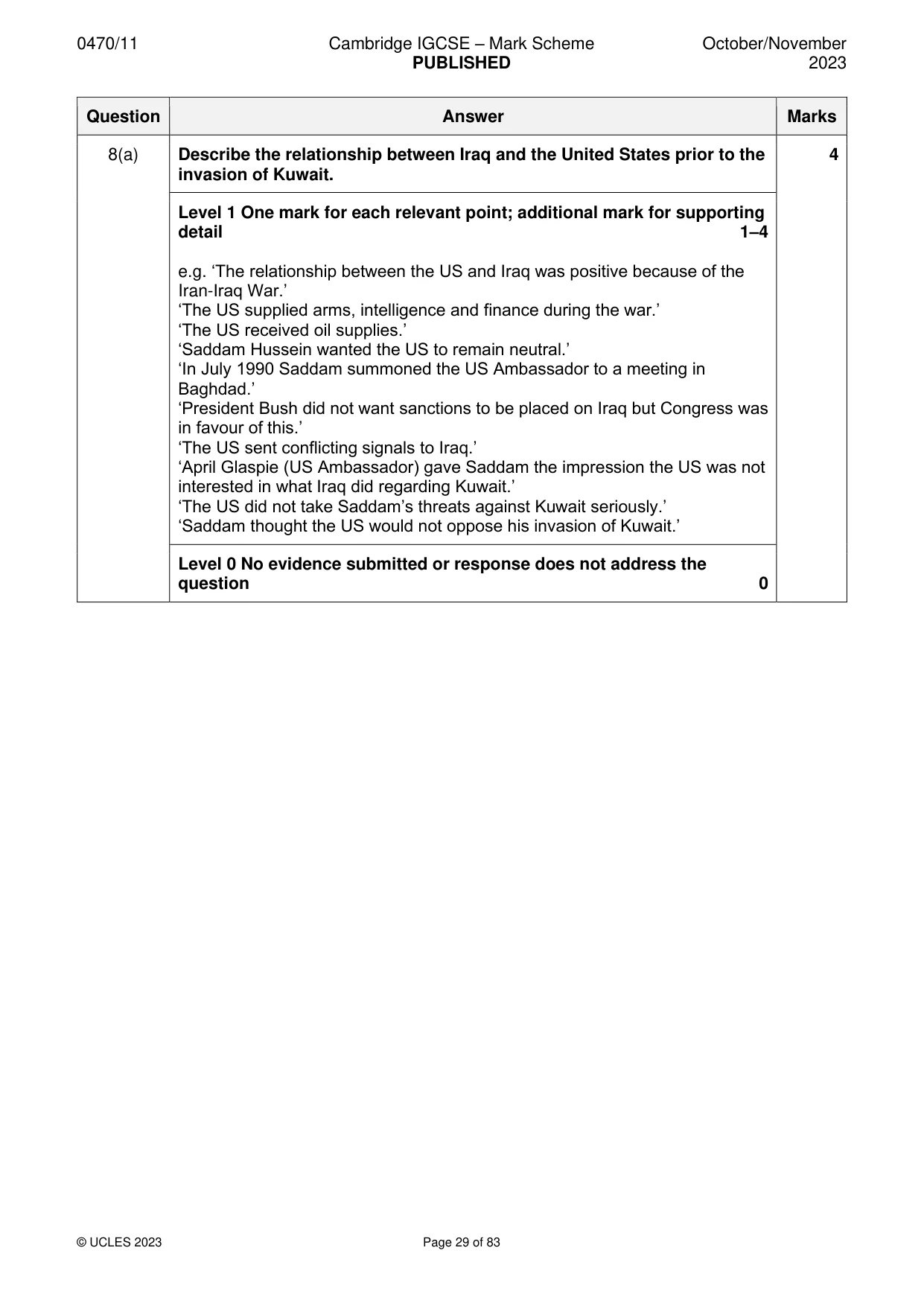
0470/11 Cambridge IGCSE – Mark Scheme PUBLISHED October/November 2023 © UCLES 2023 Page 29 of 83 Question Answer Marks 8(a) Describe the relationship between Iraq and the United States prior to the invasion of Kuwait. 4 Level 1 One mark for each relevant point; additional mark for supporting detail 1–4 e.g. ‘The relationship between the US and Iraq was positive because of the Iran-Iraq War.’ ‘The US supplied arms, intelligence and finance during the war.’ ‘The US received oil supplies.’ ‘Saddam Hussein wanted the US to remain neutral.’ ‘In July 1990 Saddam summoned the US Ambassador to a meeting in Baghdad.’ ‘President Bush did not want sanctions to be placed on Iraq but Congress was in favour of this.’ ‘The US sent conflicting signals to Iraq.’ ‘April Glaspie (US Ambassador) gave Saddam the impression the US was not interested in what Iraq did regarding Kuwait.’ ‘The US did not take Saddam’s threats against Kuwait seriously.’ ‘Saddam thought the US would not oppose his invasion of Kuwait.’ Level 0 No evidence submitted or response does not address the question 0
Mark scheme, page 30
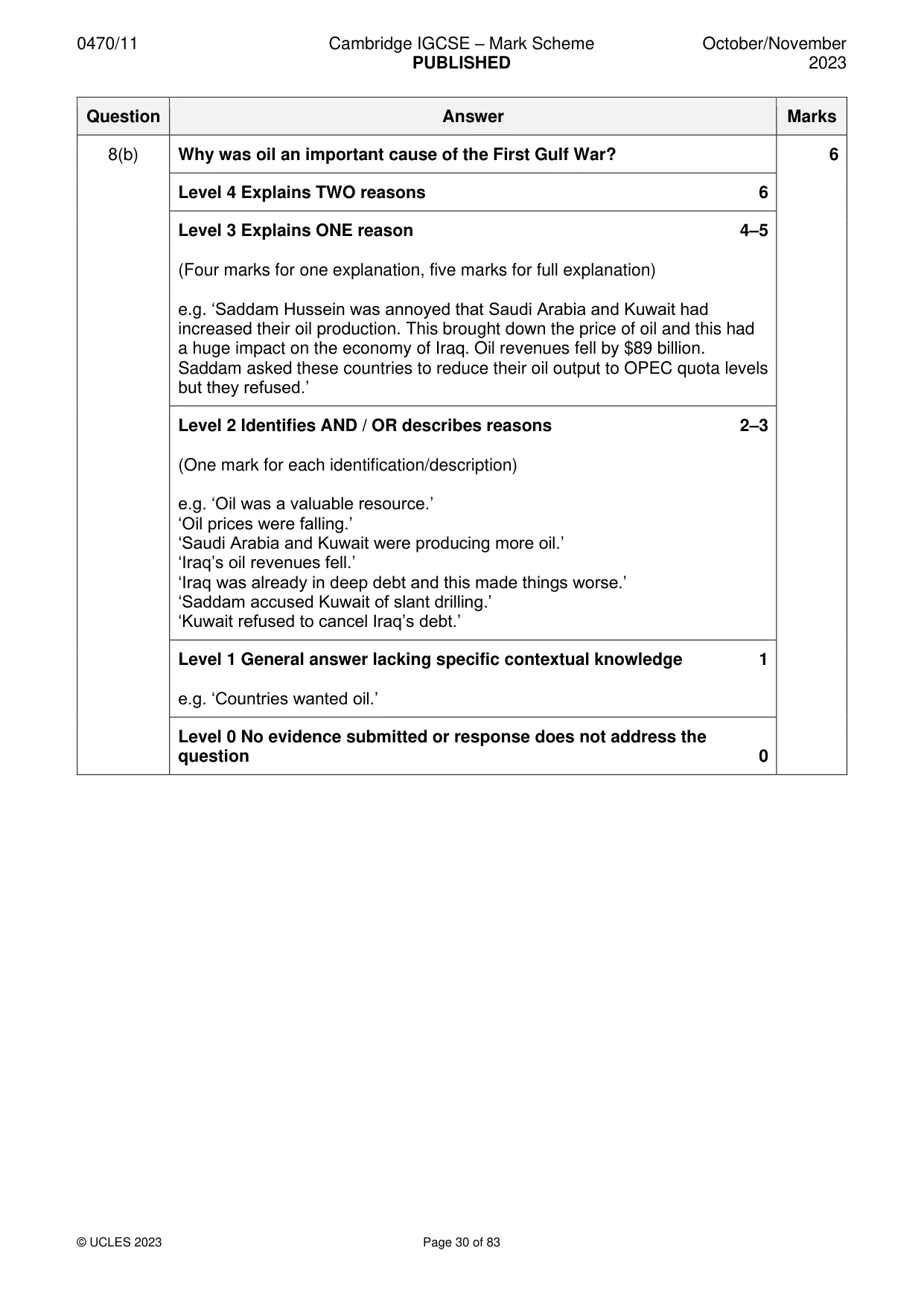
0470/11 Cambridge IGCSE – Mark Scheme PUBLISHED October/November 2023 © UCLES 2023 Page 30 of 83 Question Answer Marks 8(b) Why was oil an important cause of the First Gulf War? 6 Level 4 Explains TWO reasons 6 Level 3 Explains ONE reason 4–5 (Four marks for one explanation, five marks for full explanation) e.g. ‘Saddam Hussein was annoyed that Saudi Arabia and Kuwait had increased their oil production. This brought down the price of oil and this had a huge impact on the economy of Iraq. Oil revenues fell by $89 billion. Saddam asked these countries to reduce their oil output to OPEC quota levels but they refused.’ Level 2 Identifies AND / OR describes reasons 2–3 (One mark for each identification/description) e.g. ‘Oil was a valuable resource.’ ‘Oil prices were falling.’ ‘Saudi Arabia and Kuwait were producing more oil.’ ‘Iraq’s oil revenues fell.’ ‘Iraq was already in deep debt and this made things worse.’ ‘Saddam accused Kuwait of slant drilling.’ ‘Kuwait refused to cancel Iraq’s debt.’ Level 1 General answer lacking specific contextual knowledge 1 e.g. ‘Countries wanted oil.’ Level 0 No evidence submitted or response does not address the question 0
Mark scheme, page 31
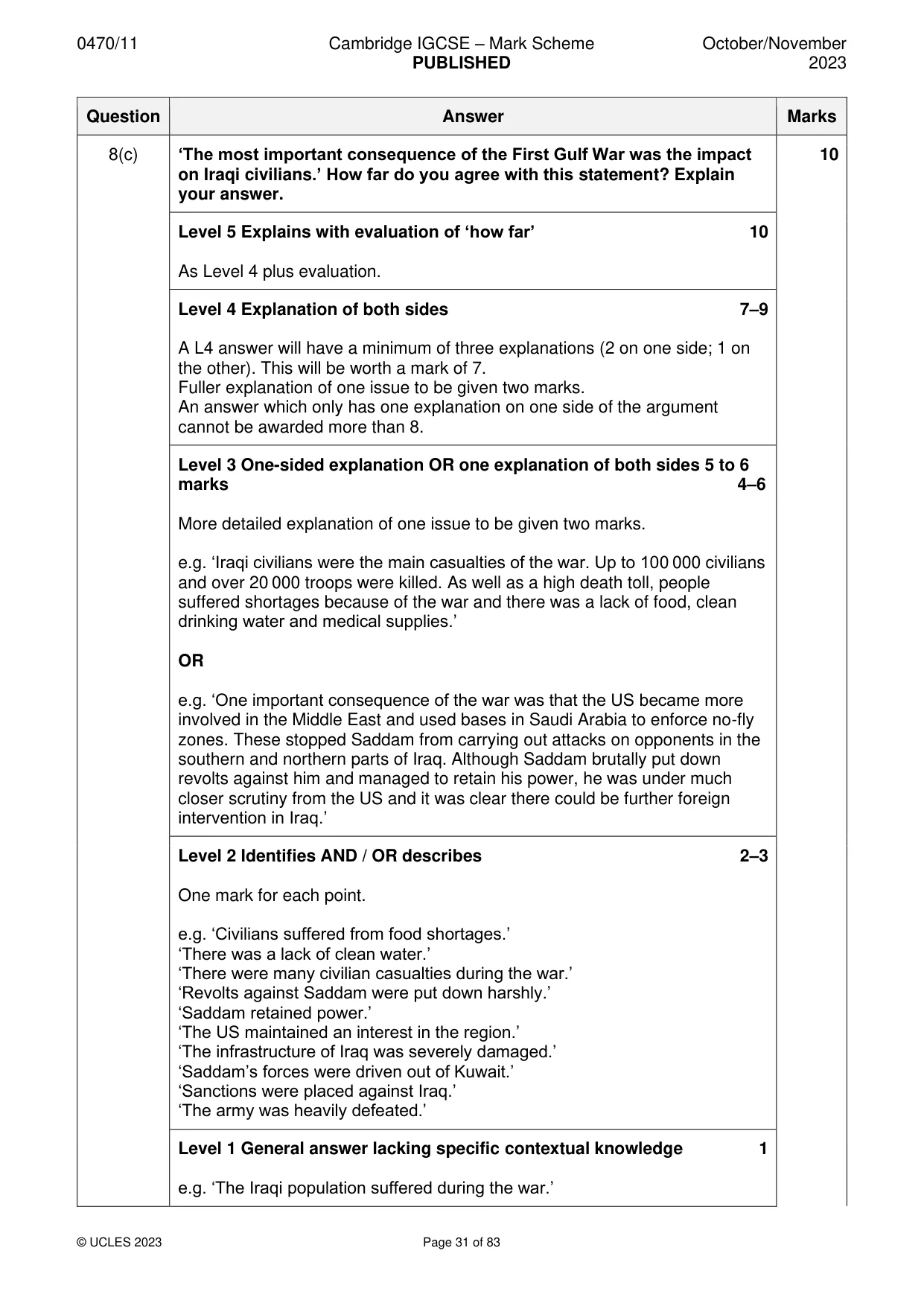
0470/11 Cambridge IGCSE – Mark Scheme PUBLISHED October/November 2023 © UCLES 2023 Page 31 of 83 Question Answer Marks 8(c) ‘The most important consequence of the First Gulf War was the impact on Iraqi civilians.’ How far do you agree with this statement? Explain your answer. 10 Level 5 Explains with evaluation of ‘how far’ 10 As Level 4 plus evaluation. Level 4 Explanation of both sides 7–9 A L4 answer will have a minimum of three explanations (2 on one side; 1 on the other). This will be worth a mark of 7. Fuller explanation of one issue to be given two marks. An answer which only has one explanation on one side of the argument cannot be awarded more than 8. Level 3 One-sided explanation OR one explanation of both sides 5 to 6 marks 4–6 More detailed explanation of one issue to be given two marks. e.g. ‘Iraqi civilians were the main casualties of the war. Up to 100 000 civilians and over 20 000 troops were killed. As well as a high death toll, people suffered shortages because of the war and there was a lack of food, clean drinking water and medical supplies.’ OR e.g. ‘One important consequence of the war was that the US became more involved in the Middle East and used bases in Saudi Arabia to enforce no-fly zones. These stopped Saddam from carrying out attacks on opponents in the southern and northern parts of Iraq. Although Saddam brutally put down revolts against him and managed to retain his power, he was under much closer scrutiny from the US and it was clear there could be further foreign intervention in Iraq.’ Level 2 Identifies AND / OR describes 2–3 One mark for each point. e.g. ‘Civilians suffered from food shortages.’ ‘There was a lack of clean water.’ ‘There were many civilian casualties during the war.’ ‘Revolts against Saddam were put down harshly.’ ‘Saddam retained power.’ ‘The US maintained an interest in the region.’ ‘The infrastructure of Iraq was severely damaged.’ ‘Saddam’s forces were driven out of Kuwait.’ ‘Sanctions were placed against Iraq.’ ‘The army was heavily defeated.’ Level 1 General answer lacking specific contextual knowledge 1 e.g. ‘The Iraqi population suffered during the war.’
Mark scheme, page 32
0470/11 Cambridge IGCSE – Mark Scheme PUBLISHED October/November 2023 © UCLES 2023 Page 32 of 83 Question Answer Marks 8(c) Level 0 No evidence submitted or response does not address the question 0
Mark scheme, page 33
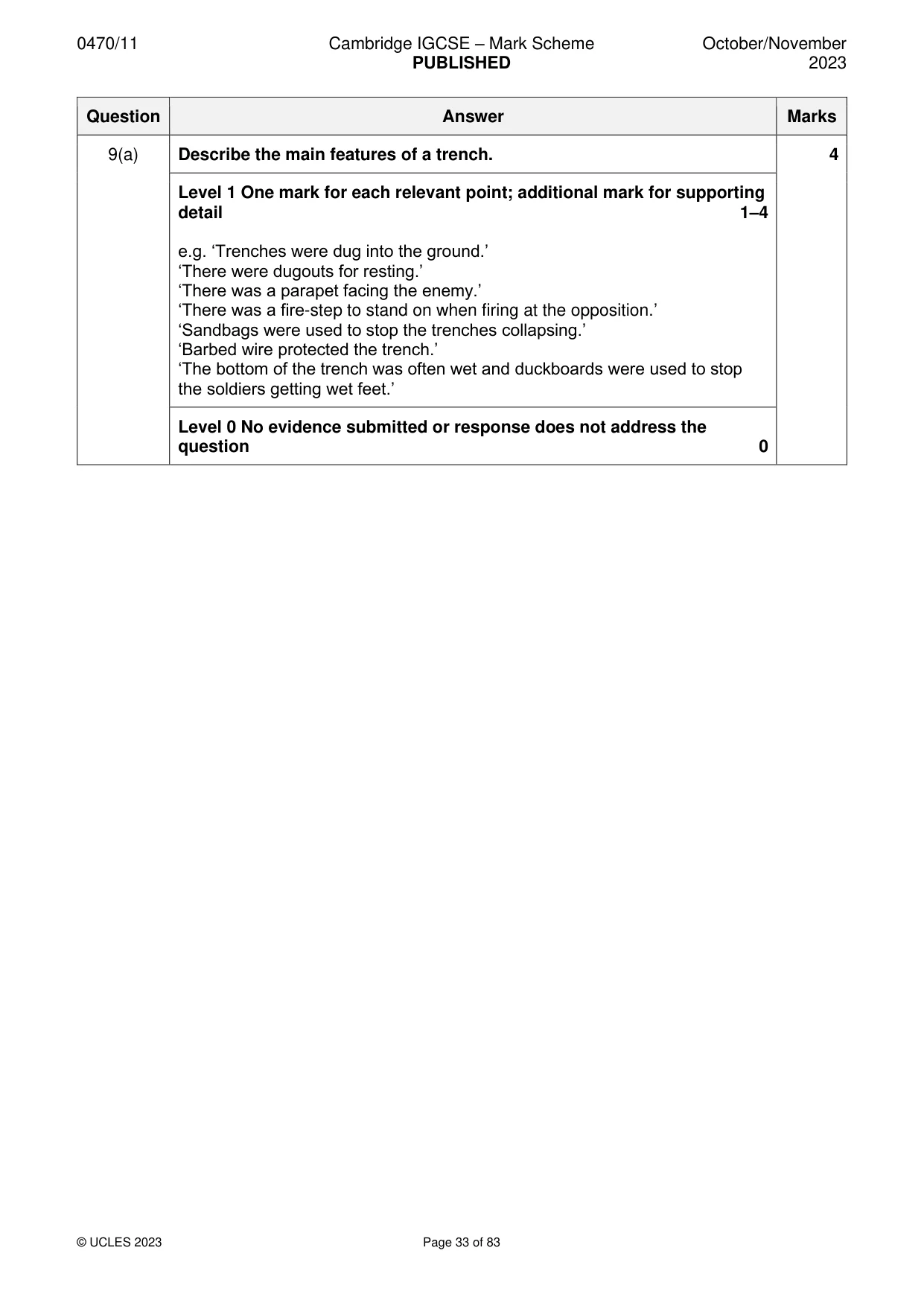
0470/11 Cambridge IGCSE – Mark Scheme PUBLISHED October/November 2023 © UCLES 2023 Page 33 of 83 Question Answer Marks 9(a) Describe the main features of a trench. 4 Level 1 One mark for each relevant point; additional mark for supporting detail 1–4 e.g. ‘Trenches were dug into the ground.’ ‘There were dugouts for resting.’ ‘There was a parapet facing the enemy.’ ‘There was a fire-step to stand on when firing at the opposition.’ ‘Sandbags were used to stop the trenches collapsing.’ ‘Barbed wire protected the trench.’ ‘The bottom of the trench was often wet and duckboards were used to stop the soldiers getting wet feet.’ Level 0 No evidence submitted or response does not address the question 0
Mark scheme, page 34
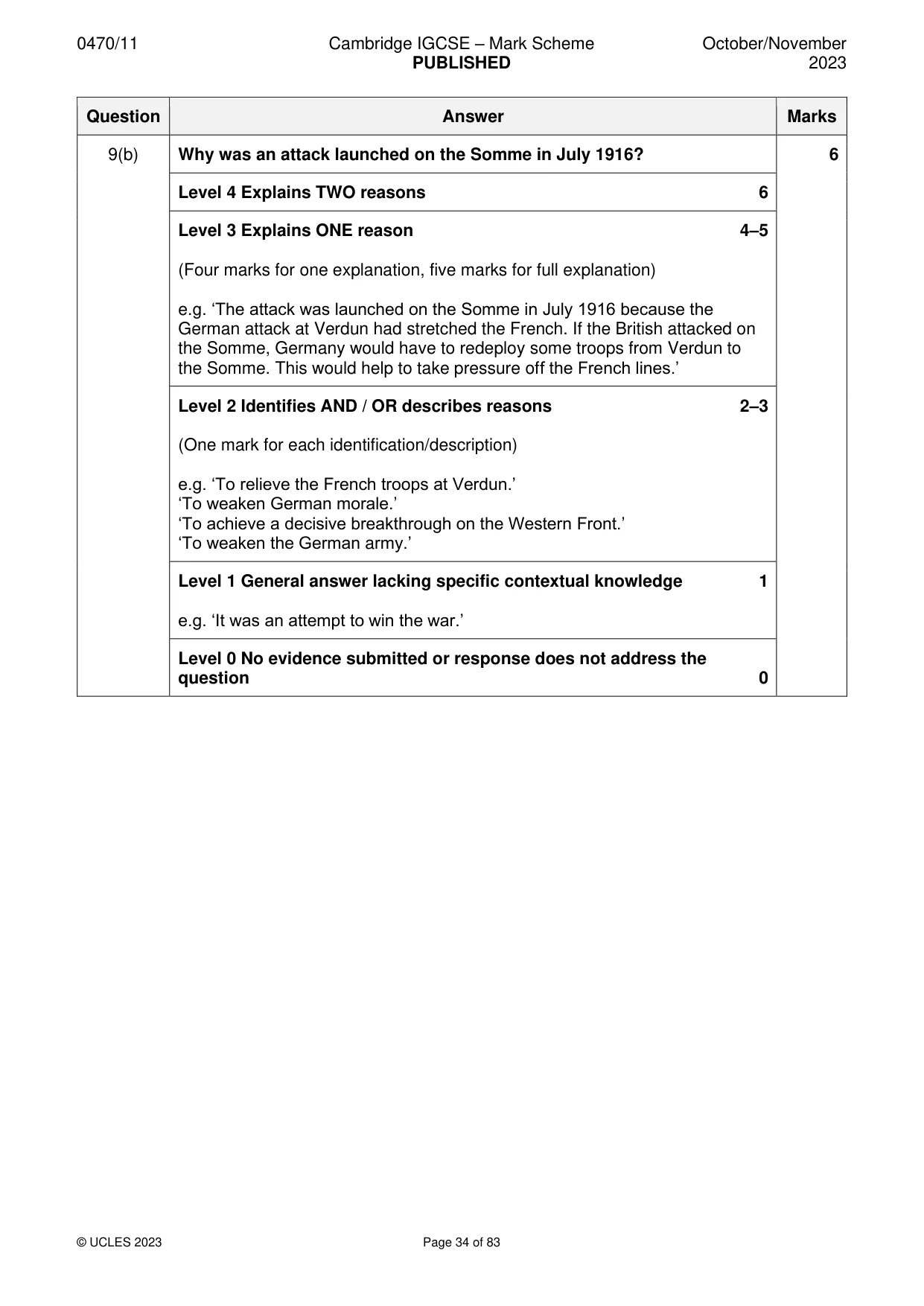
0470/11 Cambridge IGCSE – Mark Scheme PUBLISHED October/November 2023 © UCLES 2023 Page 34 of 83 Question Answer Marks 9(b) Why was an attack launched on the Somme in July 1916? 6 Level 4 Explains TWO reasons 6 Level 3 Explains ONE reason 4–5 (Four marks for one explanation, five marks for full explanation) e.g. ‘The attack was launched on the Somme in July 1916 because the German attack at Verdun had stretched the French. If the British attacked on the Somme, Germany would have to redeploy some troops from Verdun to the Somme. This would help to take pressure off the French lines.’ Level 2 Identifies AND / OR describes reasons 2–3 (One mark for each identification/description) e.g. ‘To relieve the French troops at Verdun.’ ‘To weaken German morale.’ ‘To achieve a decisive breakthrough on the Western Front.’ ‘To weaken the German army.’ Level 1 General answer lacking specific contextual knowledge 1 e.g. ‘It was an attempt to win the war.’ Level 0 No evidence submitted or response does not address the question 0
Mark scheme, page 35
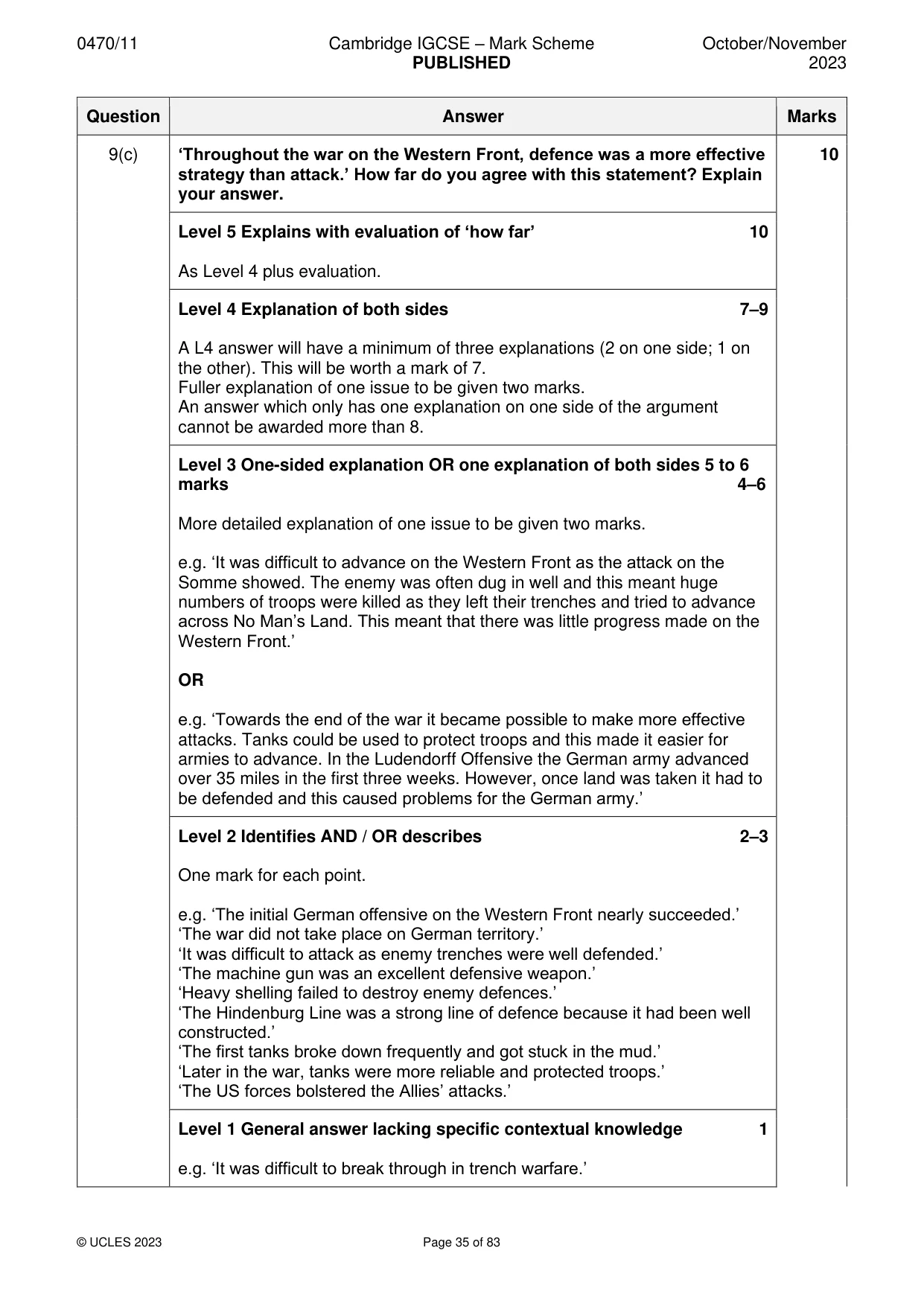
0470/11 Cambridge IGCSE – Mark Scheme PUBLISHED October/November 2023 © UCLES 2023 Page 35 of 83 Question Answer Marks 9(c) ‘Throughout the war on the Western Front, defence was a more effective strategy than attack.’ How far do you agree with this statement? Explain your answer. 10 Level 5 Explains with evaluation of ‘how far’ 10 As Level 4 plus evaluation. Level 4 Explanation of both sides 7–9 A L4 answer will have a minimum of three explanations (2 on one side; 1 on the other). This will be worth a mark of 7. Fuller explanation of one issue to be given two marks. An answer which only has one explanation on one side of the argument cannot be awarded more than 8. Level 3 One-sided explanation OR one explanation of both sides 5 to 6 marks 4–6 More detailed explanation of one issue to be given two marks. e.g. ‘It was difficult to advance on the Western Front as the attack on the Somme showed. The enemy was often dug in well and this meant huge numbers of troops were killed as they left their trenches and tried to advance across No Man’s Land. This meant that there was little progress made on the Western Front.’ OR e.g. ‘Towards the end of the war it became possible to make more effective attacks. Tanks could be used to protect troops and this made it easier for armies to advance. In the Ludendorff Offensive the German army advanced over 35 miles in the first three weeks. However, once land was taken it had to be defended and this caused problems for the German army.’ Level 2 Identifies AND / OR describes 2–3 One mark for each point. e.g. ‘The initial German offensive on the Western Front nearly succeeded.’ ‘The war did not take place on German territory.’ ‘It was difficult to attack as enemy trenches were well defended.’ ‘The machine gun was an excellent defensive weapon.’ ‘Heavy shelling failed to destroy enemy defences.’ ‘The Hindenburg Line was a strong line of defence because it had been well constructed.’ ‘The first tanks broke down frequently and got stuck in the mud.’ ‘Later in the war, tanks were more reliable and protected troops.’ ‘The US forces bolstered the Allies’ attacks.’ Level 1 General answer lacking specific contextual knowledge 1 e.g. ‘It was difficult to break through in trench warfare.’
Mark scheme, page 36
0470/11 Cambridge IGCSE – Mark Scheme PUBLISHED October/November 2023 © UCLES 2023 Page 36 of 83 Question Answer Marks 9(c) Level 0 No evidence submitted or response does not address the question 0
Mark scheme, page 37
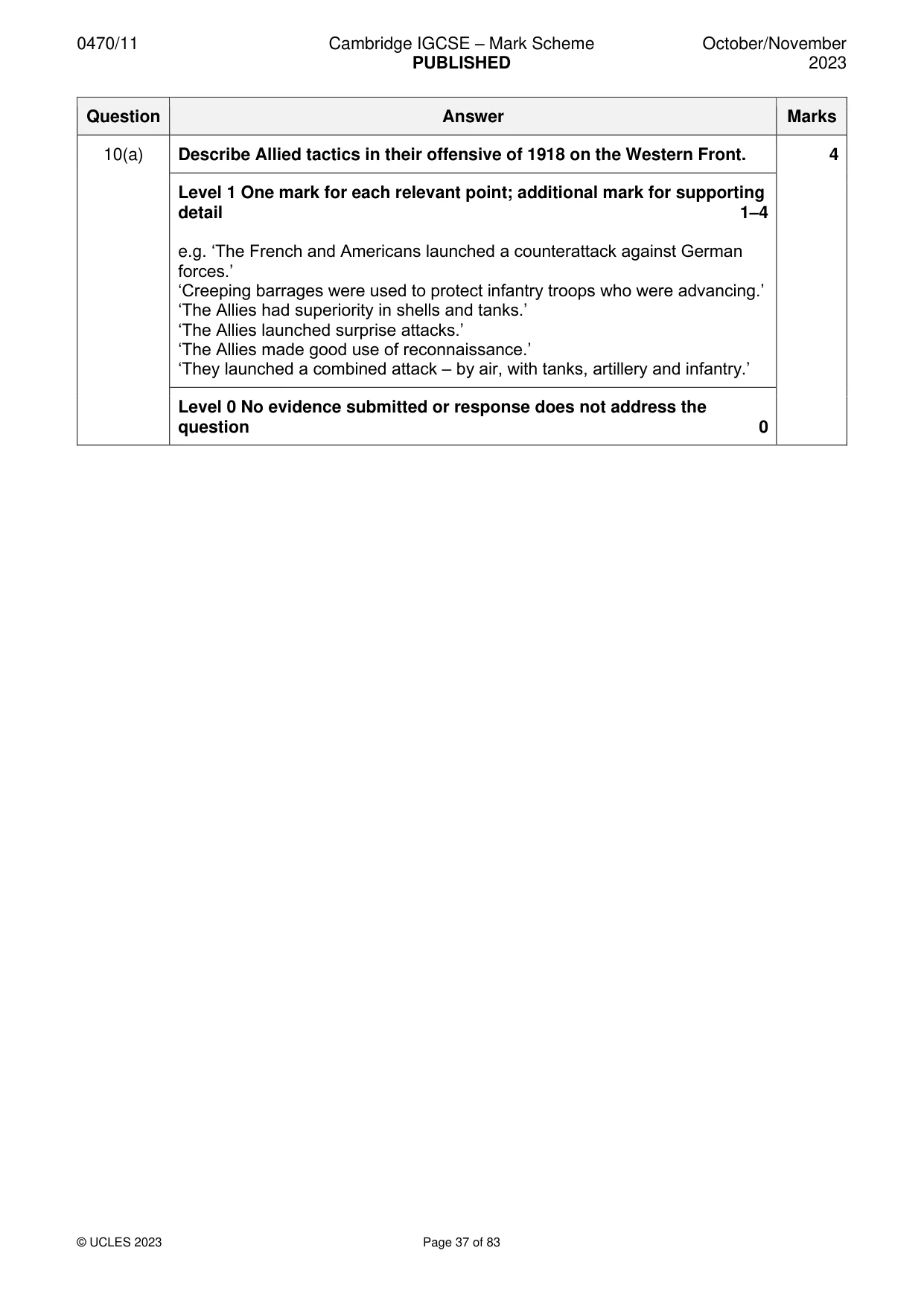
0470/11 Cambridge IGCSE – Mark Scheme PUBLISHED October/November 2023 © UCLES 2023 Page 37 of 83 Question Answer Marks 10(a) Describe Allied tactics in their offensive of 1918 on the Western Front. 4 Level 1 One mark for each relevant point; additional mark for supporting detail 1–4 e.g. ‘The French and Americans launched a counterattack against German forces.’ ‘Creeping barrages were used to protect infantry troops who were advancing.’ ‘The Allies had superiority in shells and tanks.’ ‘The Allies launched surprise attacks.’ ‘The Allies made good use of reconnaissance.’ ‘They launched a combined attack – by air, with tanks, artillery and infantry.’ Level 0 No evidence submitted or response does not address the question 0
Mark scheme, page 38
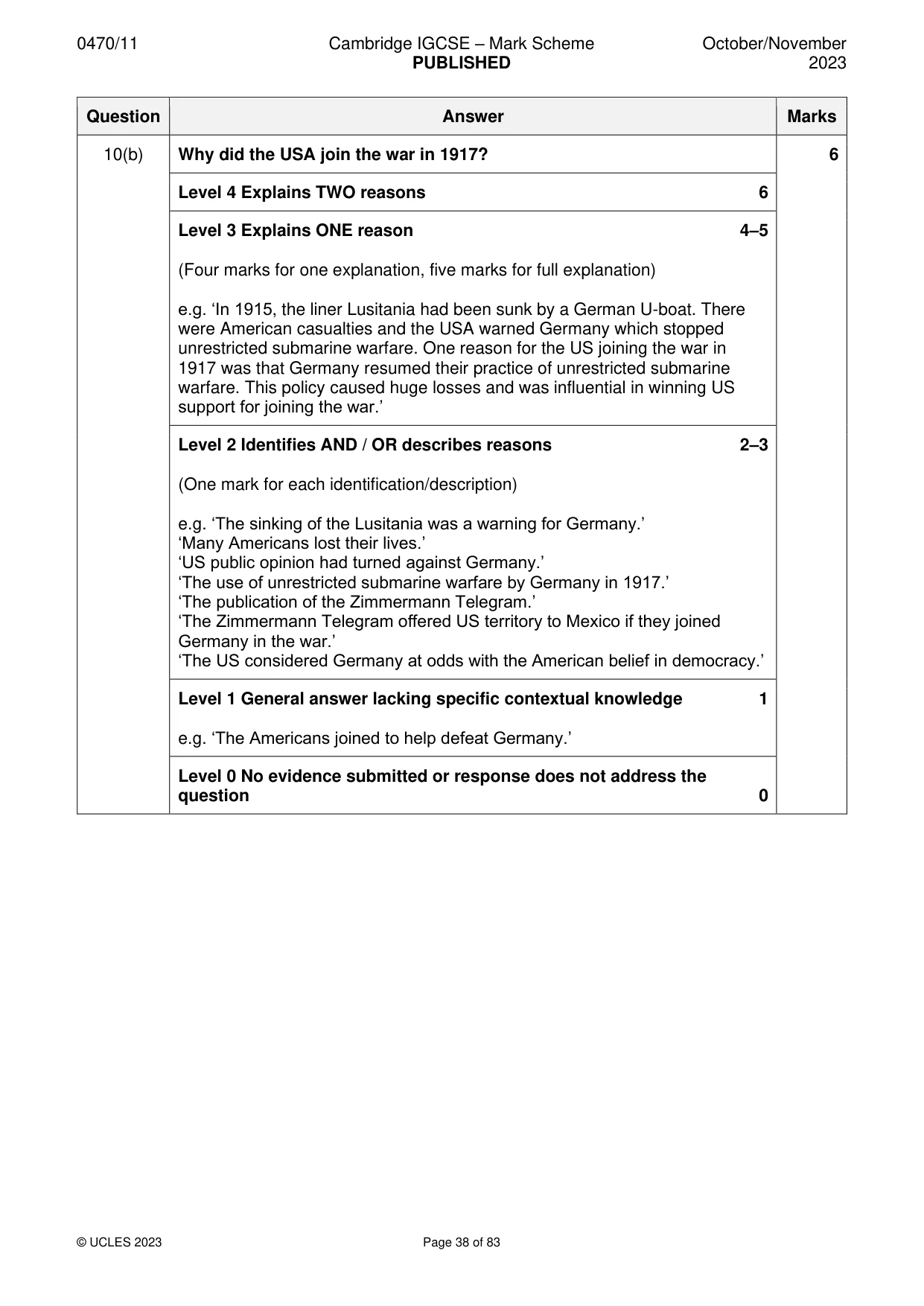
0470/11 Cambridge IGCSE – Mark Scheme PUBLISHED October/November 2023 © UCLES 2023 Page 38 of 83 Question Answer Marks 10(b) Why did the USA join the war in 1917? 6 Level 4 Explains TWO reasons 6 Level 3 Explains ONE reason 4–5 (Four marks for one explanation, five marks for full explanation) e.g. ‘In 1915, the liner Lusitania had been sunk by a German U-boat. There were American casualties and the USA warned Germany which stopped unrestricted submarine warfare. One reason for the US joining the war in 1917 was that Germany resumed their practice of unrestricted submarine warfare. This policy caused huge losses and was influential in winning US support for joining the war.’ Level 2 Identifies AND / OR describes reasons 2–3 (One mark for each identification/description) e.g. ‘The sinking of the Lusitania was a warning for Germany.’ ‘Many Americans lost their lives.’ ‘US public opinion had turned against Germany.’ ‘The use of unrestricted submarine warfare by Germany in 1917.’ ‘The publication of the Zimmermann Telegram.’ ‘The Zimmermann Telegram offered US territory to Mexico if they joined Germany in the war.’ ‘The US considered Germany at odds with the American belief in democracy.’ Level 1 General answer lacking specific contextual knowledge 1 e.g. ‘The Americans joined to help defeat Germany.’ Level 0 No evidence submitted or response does not address the question 0
Mark scheme, page 39
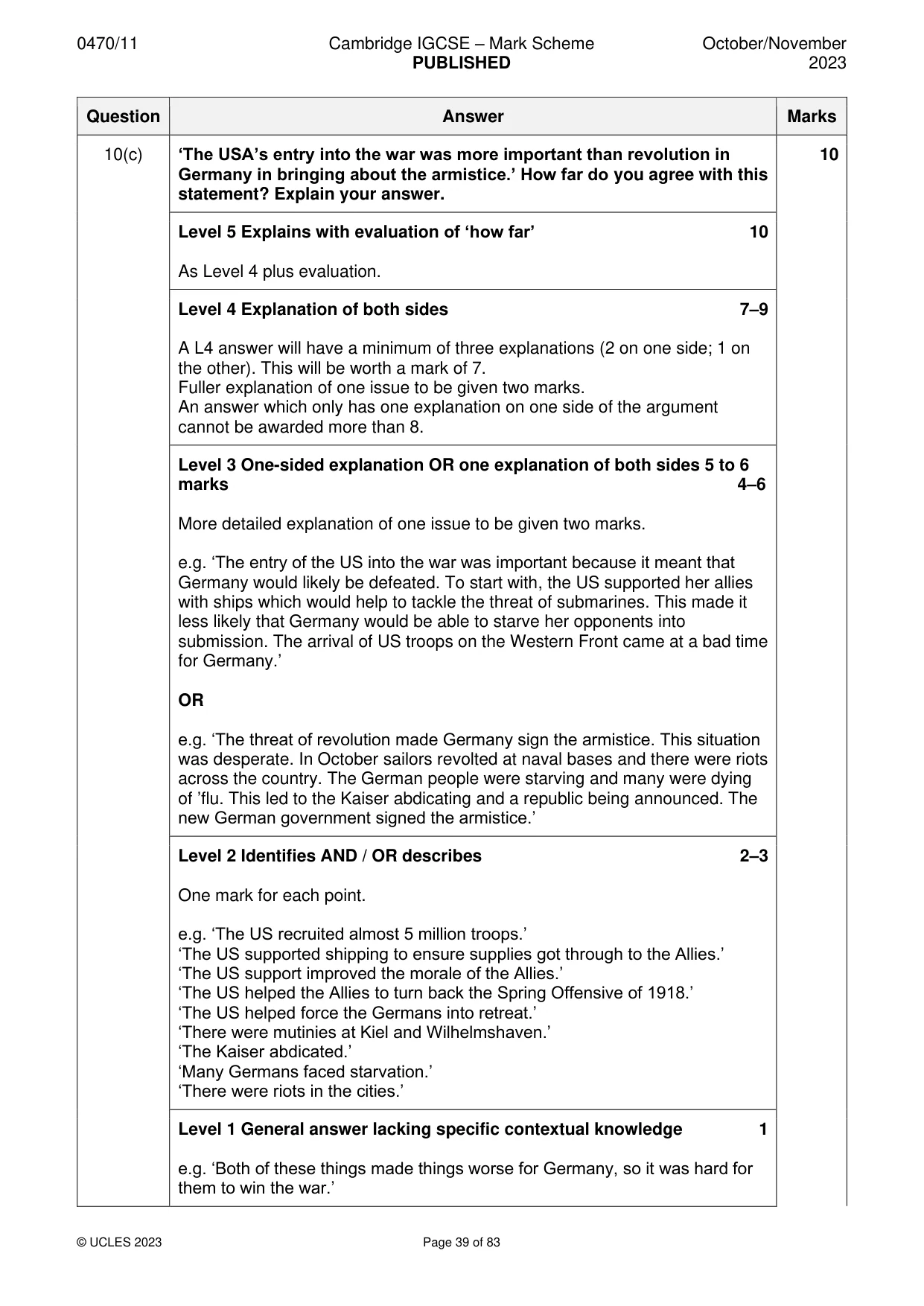
0470/11 Cambridge IGCSE – Mark Scheme PUBLISHED October/November 2023 © UCLES 2023 Page 39 of 83 Question Answer Marks 10(c) ‘The USA’s entry into the war was more important than revolution in Germany in bringing about the armistice.’ How far do you agree with this statement? Explain your answer. 10 Level 5 Explains with evaluation of ‘how far’ 10 As Level 4 plus evaluation. Level 4 Explanation of both sides 7–9 A L4 answer will have a minimum of three explanations (2 on one side; 1 on the other). This will be worth a mark of 7. Fuller explanation of one issue to be given two marks. An answer which only has one explanation on one side of the argument cannot be awarded more than 8. Level 3 One-sided explanation OR one explanation of both sides 5 to 6 marks 4–6 More detailed explanation of one issue to be given two marks. e.g. ‘The entry of the US into the war was important because it meant that Germany would likely be defeated. To start with, the US supported her allies with ships which would help to tackle the threat of submarines. This made it less likely that Germany would be able to starve her opponents into submission. The arrival of US troops on the Western Front came at a bad time for Germany.’ OR e.g. ‘The threat of revolution made Germany sign the armistice. This situation was desperate. In October sailors revolted at naval bases and there were riots across the country. The German people were starving and many were dying of ’flu. This led to the Kaiser abdicating and a republic being announced. The new German government signed the armistice.’ Level 2 Identifies AND / OR describes 2–3 One mark for each point. e.g. ‘The US recruited almost 5 million troops.’ ‘The US supported shipping to ensure supplies got through to the Allies.’ ‘The US support improved the morale of the Allies.’ ‘The US helped the Allies to turn back the Spring Offensive of 1918.’ ‘The US helped force the Germans into retreat.’ ‘There were mutinies at Kiel and Wilhelmshaven.’ ‘The Kaiser abdicated.’ ‘Many Germans faced starvation.’ ‘There were riots in the cities.’ Level 1 General answer lacking specific contextual knowledge 1 e.g. ‘Both of these things made things worse for Germany, so it was hard for them to win the war.’
Mark scheme, page 40
0470/11 Cambridge IGCSE – Mark Scheme PUBLISHED October/November 2023 © UCLES 2023 Page 40 of 83 Question Answer Marks 10(c) Level 0 No evidence submitted or response does not address the question 0
Mark scheme, page 41
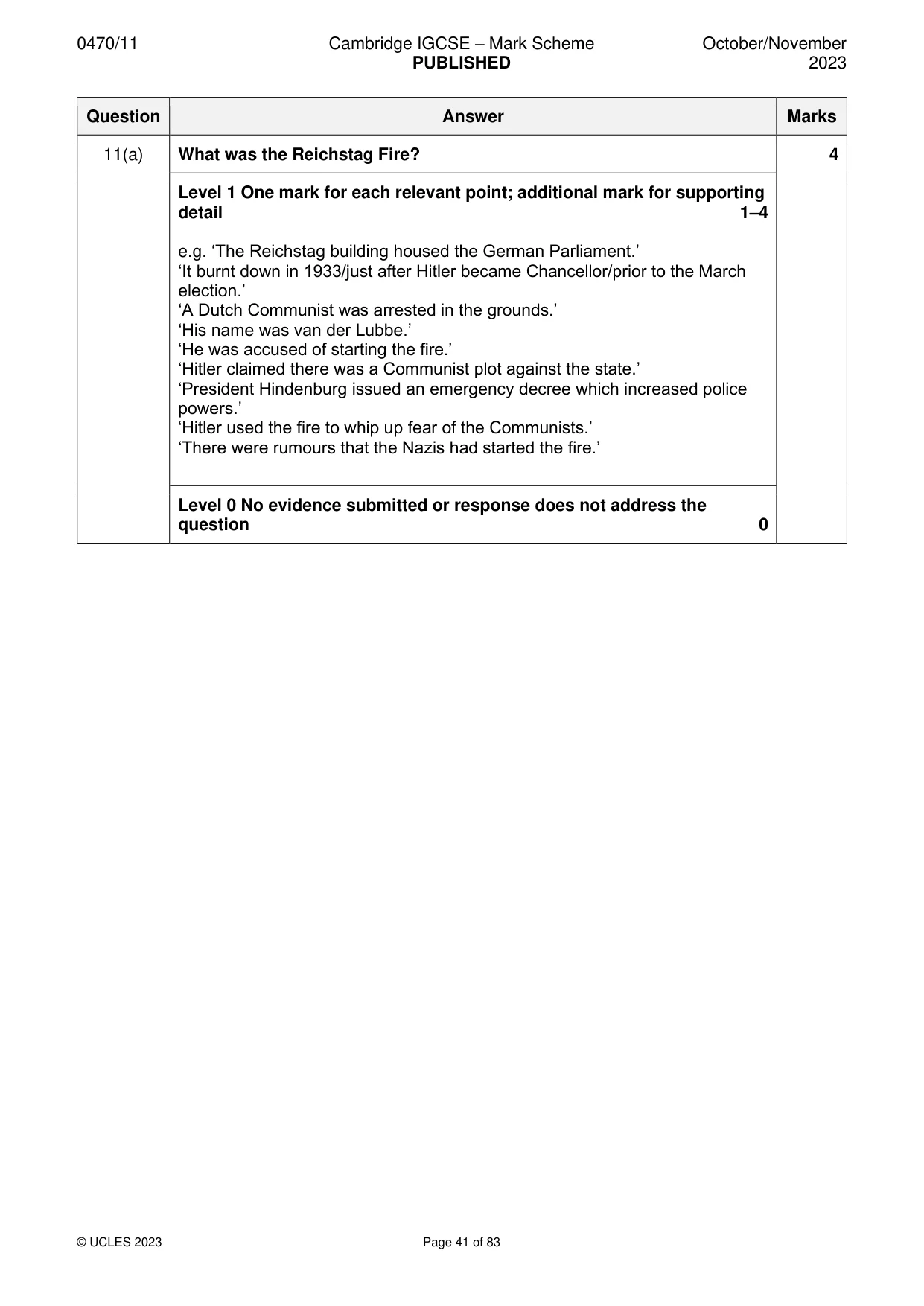
0470/11 Cambridge IGCSE – Mark Scheme PUBLISHED October/November 2023 © UCLES 2023 Page 41 of 83 Question Answer Marks 11(a) What was the Reichstag Fire? 4 Level 1 One mark for each relevant point; additional mark for supporting detail 1–4 e.g. ‘The Reichstag building housed the German Parliament.’ ‘It burnt down in 1933/just after Hitler became Chancellor/prior to the March election.’ ‘A Dutch Communist was arrested in the grounds.’ ‘His name was van der Lubbe.’ ‘He was accused of starting the fire.’ ‘Hitler claimed there was a Communist plot against the state.’ ‘President Hindenburg issued an emergency decree which increased police powers.’ ‘Hitler used the fire to whip up fear of the Communists.’ ‘There were rumours that the Nazis had started the fire.’ Level 0 No evidence submitted or response does not address the question 0
Mark scheme, page 42
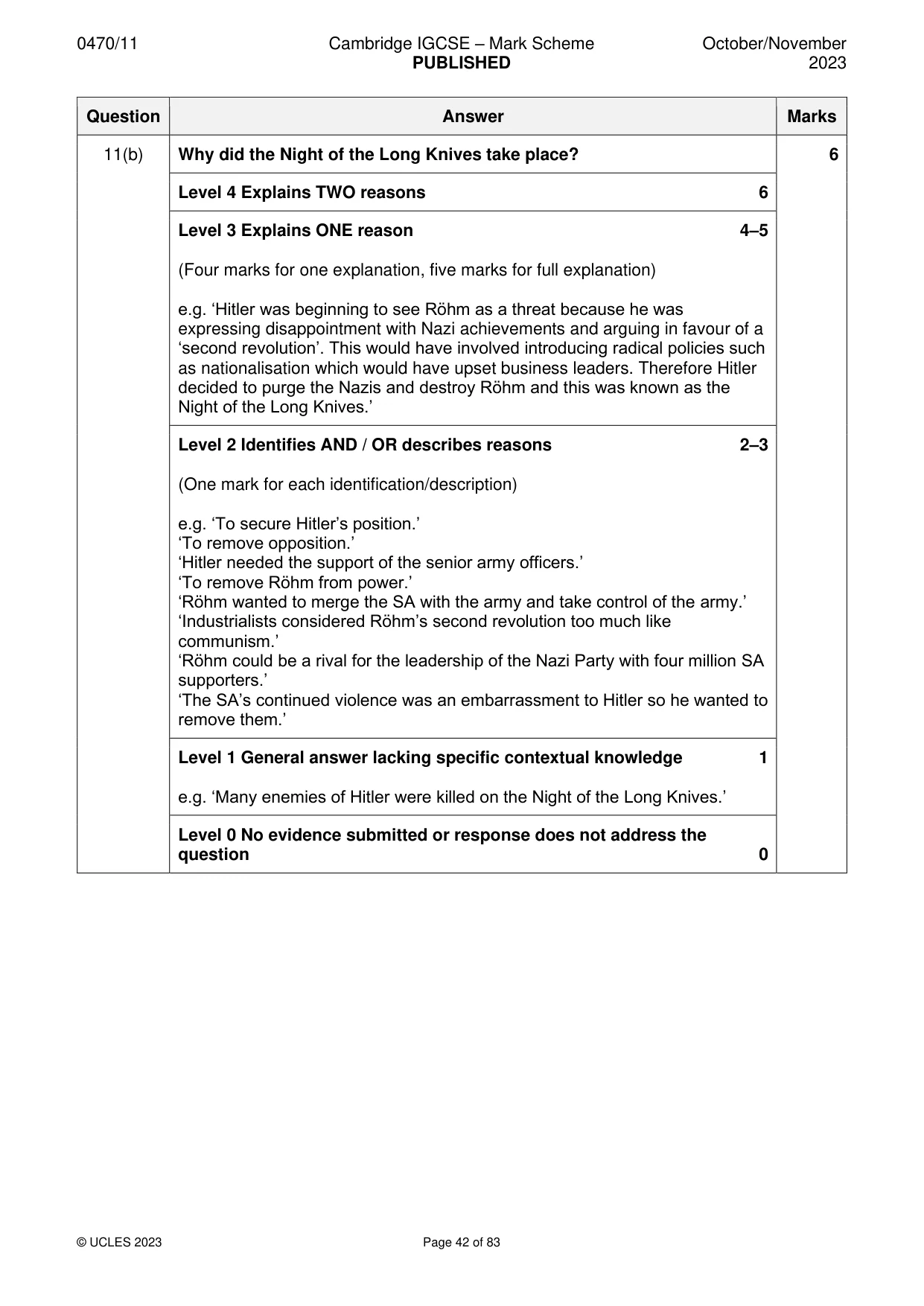
0470/11 Cambridge IGCSE – Mark Scheme PUBLISHED October/November 2023 © UCLES 2023 Page 42 of 83 Question Answer Marks 11(b) Why did the Night of the Long Knives take place? 6 Level 4 Explains TWO reasons 6 Level 3 Explains ONE reason 4–5 (Four marks for one explanation, five marks for full explanation) e.g. ‘Hitler was beginning to see Röhm as a threat because he was expressing disappointment with Nazi achievements and arguing in favour of a ‘second revolution’. This would have involved introducing radical policies such as nationalisation which would have upset business leaders. Therefore Hitler decided to purge the Nazis and destroy Rӧhm and this was known as the Night of the Long Knives.’ Level 2 Identifies AND / OR describes reasons 2–3 (One mark for each identification/description) e.g. ‘To secure Hitler’s position.’ ‘To remove opposition.’ ‘Hitler needed the support of the senior army officers.’ ‘To remove Röhm from power.’ ‘Röhm wanted to merge the SA with the army and take control of the army.’ ‘Industrialists considered Röhm’s second revolution too much like communism.’ ‘Röhm could be a rival for the leadership of the Nazi Party with four million SA supporters.’ ‘The SA’s continued violence was an embarrassment to Hitler so he wanted to remove them.’ Level 1 General answer lacking specific contextual knowledge 1 e.g. ‘Many enemies of Hitler were killed on the Night of the Long Knives.’ Level 0 No evidence submitted or response does not address the question 0
Mark scheme, page 43
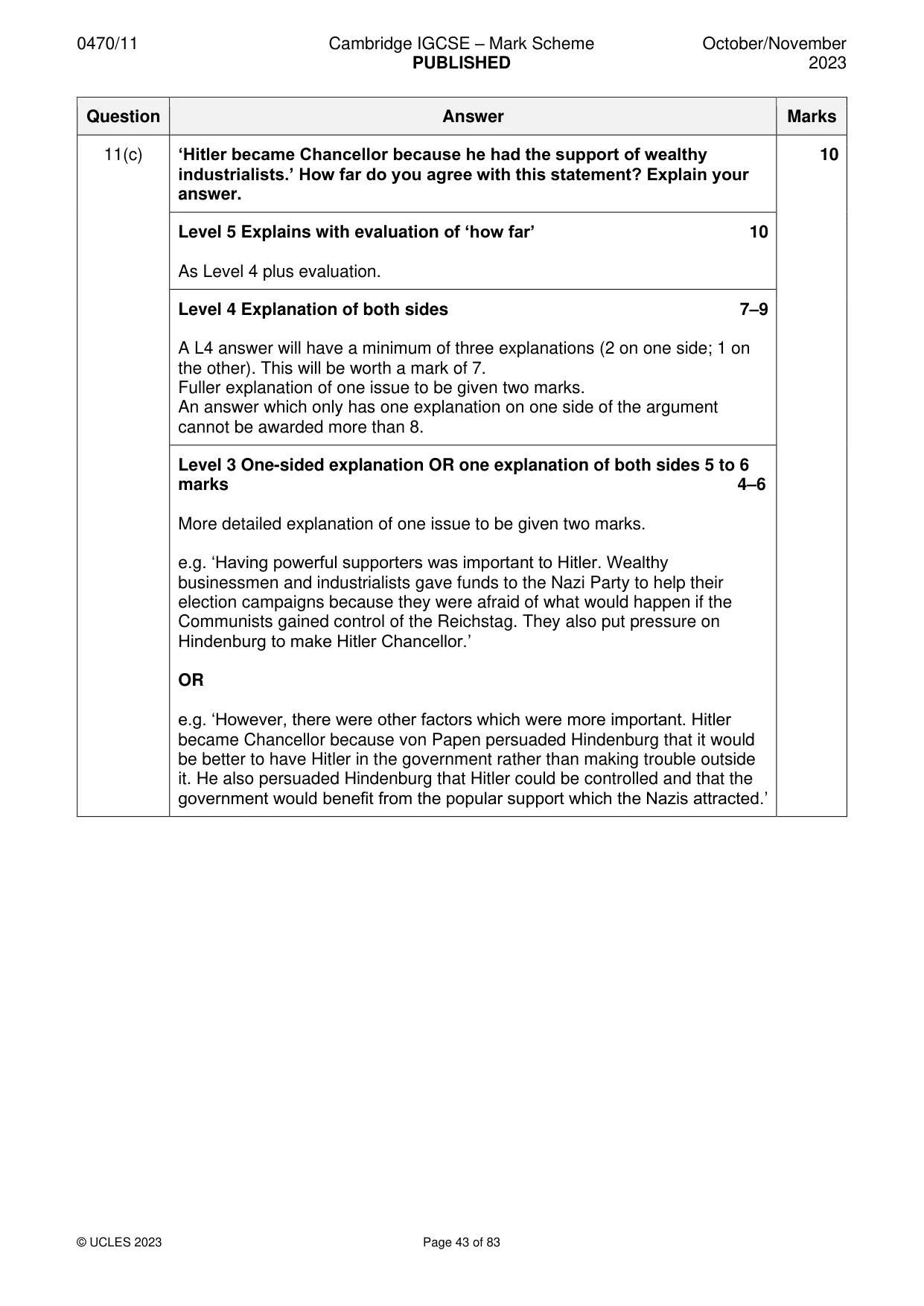
0470/11 Cambridge IGCSE – Mark Scheme PUBLISHED October/November 2023 © UCLES 2023 Page 43 of 83 Question Answer Marks 11(c) ‘Hitler became Chancellor because he had the support of wealthy industrialists.’ How far do you agree with this statement? Explain your answer. 10 Level 5 Explains with evaluation of ‘how far’ 10 As Level 4 plus evaluation. Level 4 Explanation of both sides 7–9 A L4 answer will have a minimum of three explanations (2 on one side; 1 on the other). This will be worth a mark of 7. Fuller explanation of one issue to be given two marks. An answer which only has one explanation on one side of the argument cannot be awarded more than 8. Level 3 One-sided explanation OR one explanation of both sides 5 to 6 marks 4–6 More detailed explanation of one issue to be given two marks. e.g. ‘Having powerful supporters was important to Hitler. Wealthy businessmen and industrialists gave funds to the Nazi Party to help their election campaigns because they were afraid of what would happen if the Communists gained control of the Reichstag. They also put pressure on Hindenburg to make Hitler Chancellor.’ OR e.g. ‘However, there were other factors which were more important. Hitler became Chancellor because von Papen persuaded Hindenburg that it would be better to have Hitler in the government rather than making trouble outside it. He also persuaded Hindenburg that Hitler could be controlled and that the government would benefit from the popular support which the Nazis attracted.’
Mark scheme, page 44
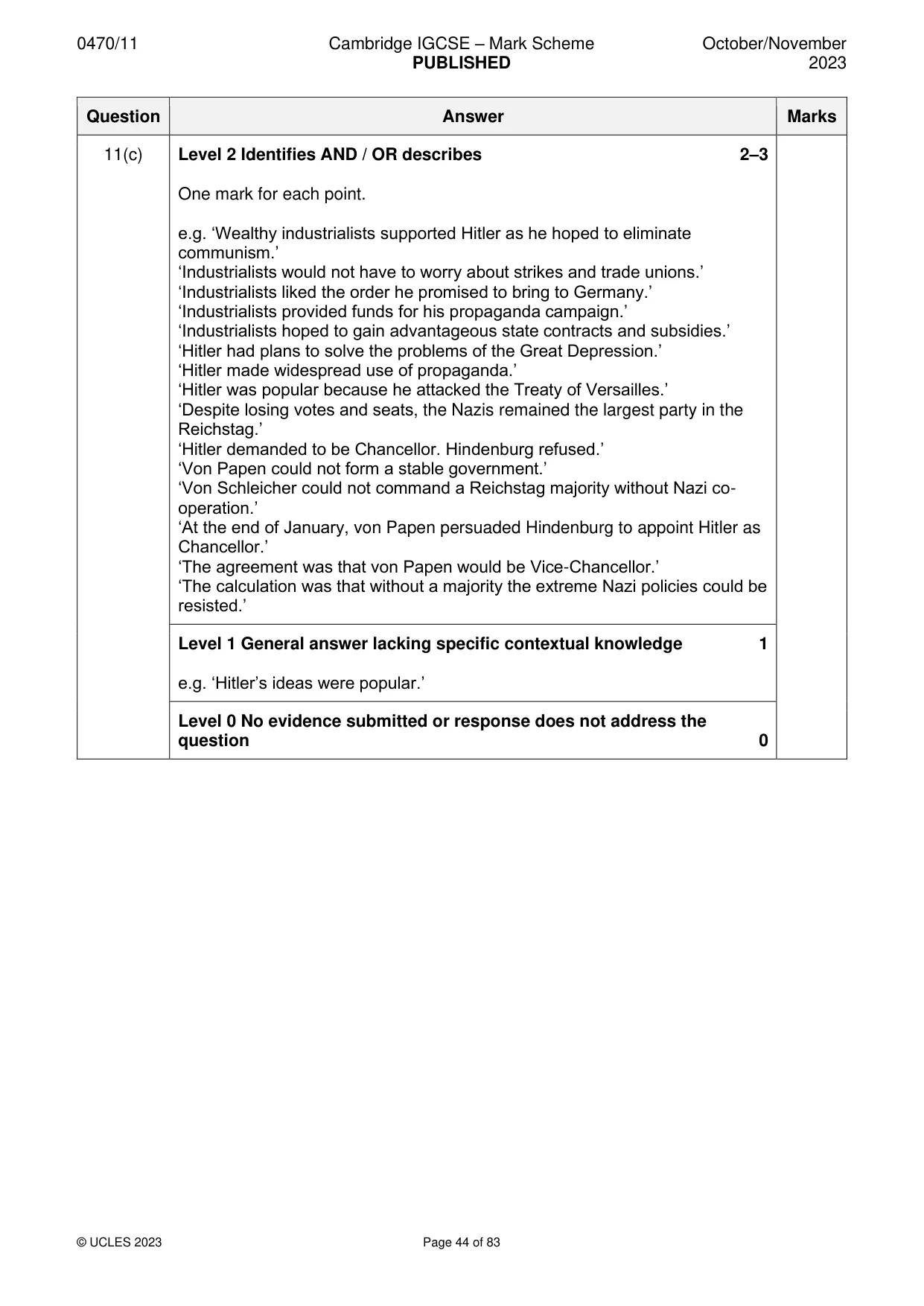
0470/11 Cambridge IGCSE – Mark Scheme PUBLISHED October/November 2023 © UCLES 2023 Page 44 of 83 Question Answer Marks 11(c) Level 2 Identifies AND / OR describes 2–3 One mark for each point. e.g. ‘Wealthy industrialists supported Hitler as he hoped to eliminate communism.’ ‘Industrialists would not have to worry about strikes and trade unions.’ ‘Industrialists liked the order he promised to bring to Germany.’ ‘Industrialists provided funds for his propaganda campaign.’ ‘Industrialists hoped to gain advantageous state contracts and subsidies.’ ‘Hitler had plans to solve the problems of the Great Depression.’ ‘Hitler made widespread use of propaganda.’ ‘Hitler was popular because he attacked the Treaty of Versailles.’ ‘Despite losing votes and seats, the Nazis remained the largest party in the Reichstag.’ ‘Hitler demanded to be Chancellor. Hindenburg refused.’ ‘Von Papen could not form a stable government.’ ‘Von Schleicher could not command a Reichstag majority without Nazi co- operation.’ ‘At the end of January, von Papen persuaded Hindenburg to appoint Hitler as Chancellor.’ ‘The agreement was that von Papen would be Vice-Chancellor.’ ‘The calculation was that without a majority the extreme Nazi policies could be resisted.’ Level 1 General answer lacking specific contextual knowledge 1 e.g. ‘Hitler’s ideas were popular.’ Level 0 No evidence submitted or response does not address the question 0
Mark scheme, page 45
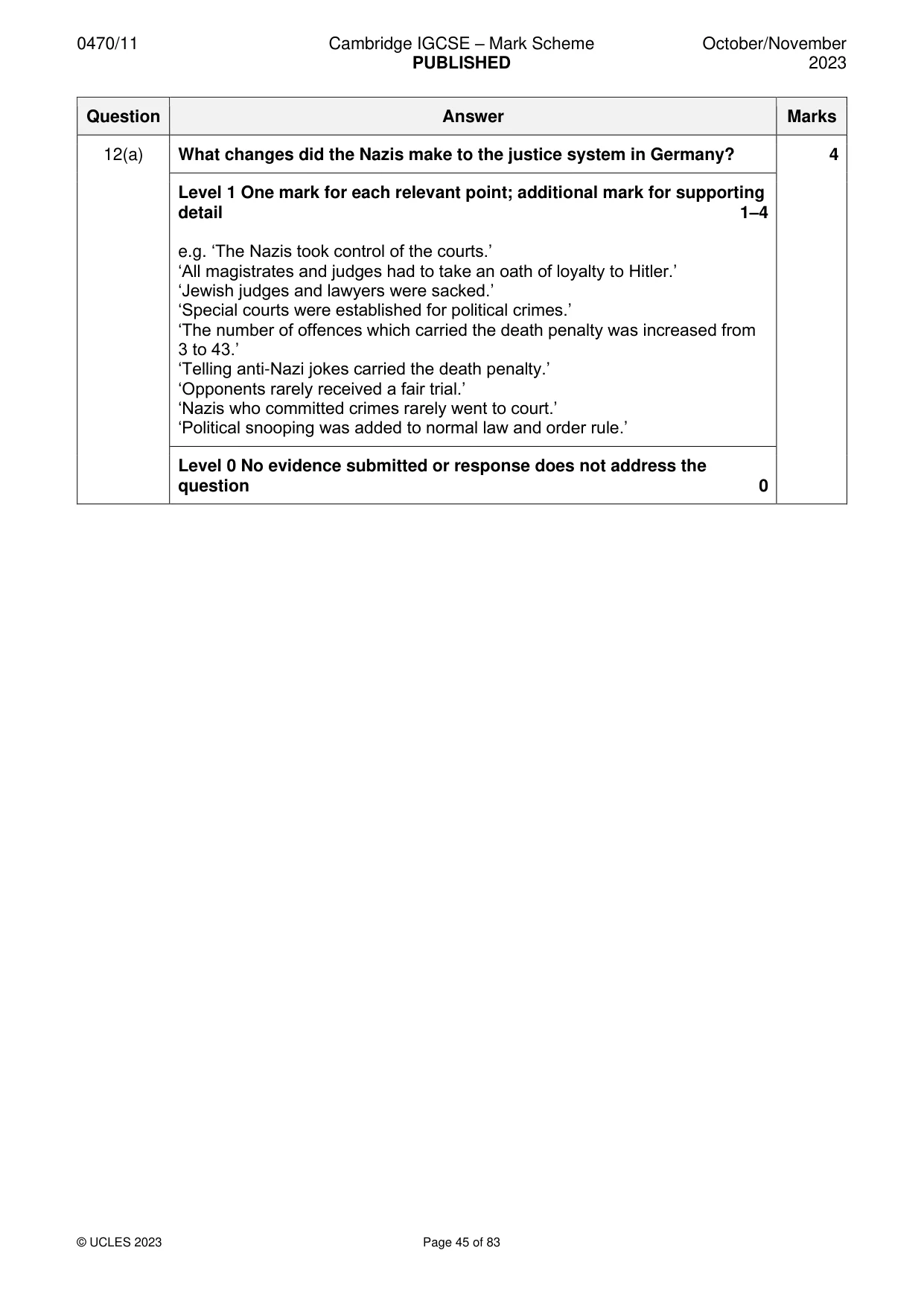
0470/11 Cambridge IGCSE – Mark Scheme PUBLISHED October/November 2023 © UCLES 2023 Page 45 of 83 Question Answer Marks 12(a) What changes did the Nazis make to the justice system in Germany? 4 Level 1 One mark for each relevant point; additional mark for supporting detail 1–4 e.g. ‘The Nazis took control of the courts.’ ‘All magistrates and judges had to take an oath of loyalty to Hitler.’ ‘Jewish judges and lawyers were sacked.’ ‘Special courts were established for political crimes.’ ‘The number of offences which carried the death penalty was increased from 3 to 43.’ ‘Telling anti-Nazi jokes carried the death penalty.’ ‘Opponents rarely received a fair trial.’ ‘Nazis who committed crimes rarely went to court.’ ‘Political snooping was added to normal law and order rule.’ Level 0 No evidence submitted or response does not address the question 0
Mark scheme, page 46
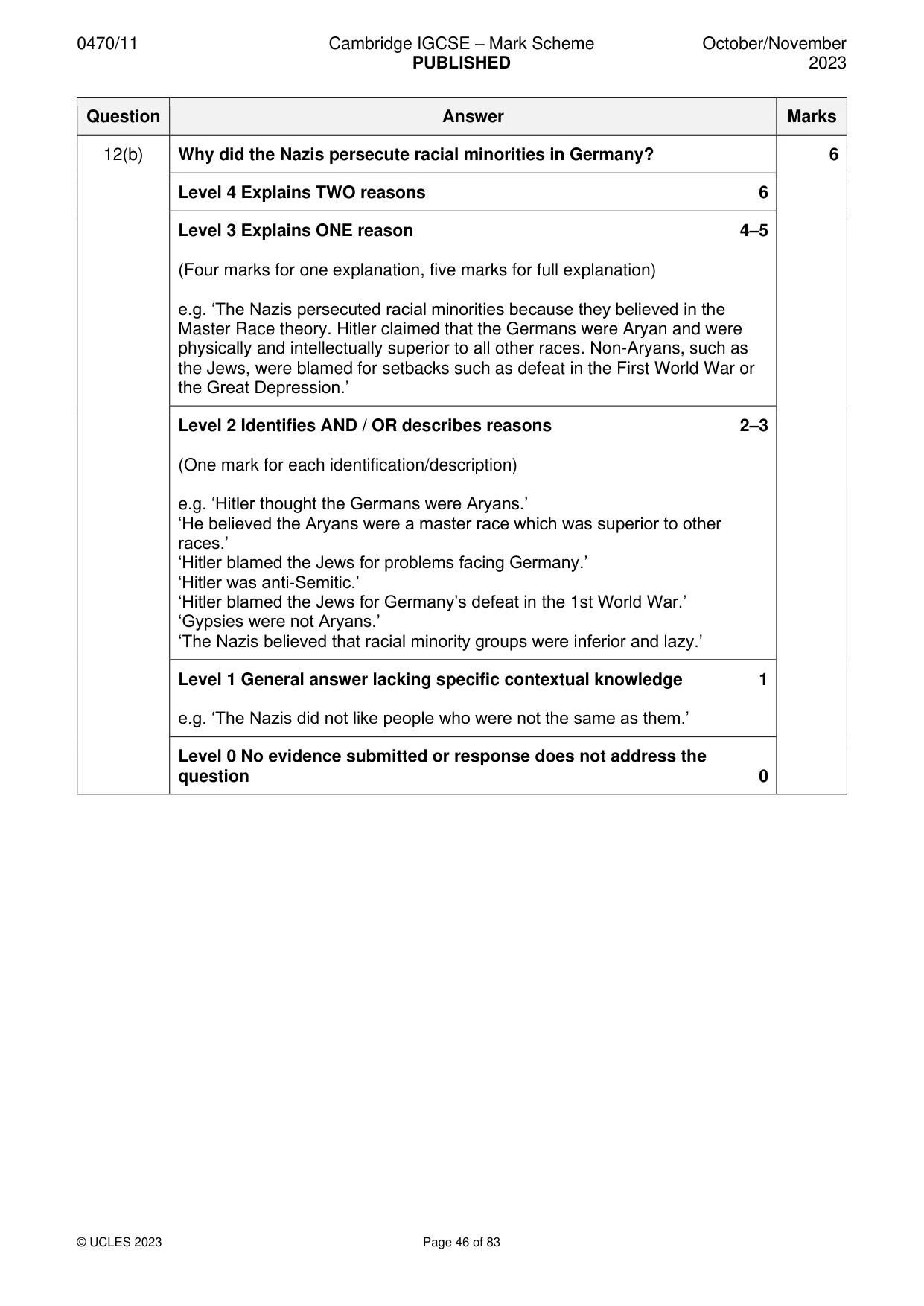
0470/11 Cambridge IGCSE – Mark Scheme PUBLISHED October/November 2023 © UCLES 2023 Page 46 of 83 Question Answer Marks 12(b) Why did the Nazis persecute racial minorities in Germany? 6 Level 4 Explains TWO reasons 6 Level 3 Explains ONE reason 4–5 (Four marks for one explanation, five marks for full explanation) e.g. ‘The Nazis persecuted racial minorities because they believed in the Master Race theory. Hitler claimed that the Germans were Aryan and were physically and intellectually superior to all other races. Non-Aryans, such as the Jews, were blamed for setbacks such as defeat in the First World War or the Great Depression.’ Level 2 Identifies AND / OR describes reasons 2–3 (One mark for each identification/description) e.g. ‘Hitler thought the Germans were Aryans.’ ‘He believed the Aryans were a master race which was superior to other races.’ ‘Hitler blamed the Jews for problems facing Germany.’ ‘Hitler was anti-Semitic.’ ‘Hitler blamed the Jews for Germany’s defeat in the 1st World War.’ ‘Gypsies were not Aryans.’ ‘The Nazis believed that racial minority groups were inferior and lazy.’ Level 1 General answer lacking specific contextual knowledge 1 e.g. ‘The Nazis did not like people who were not the same as them.’ Level 0 No evidence submitted or response does not address the question 0
Mark scheme, page 47
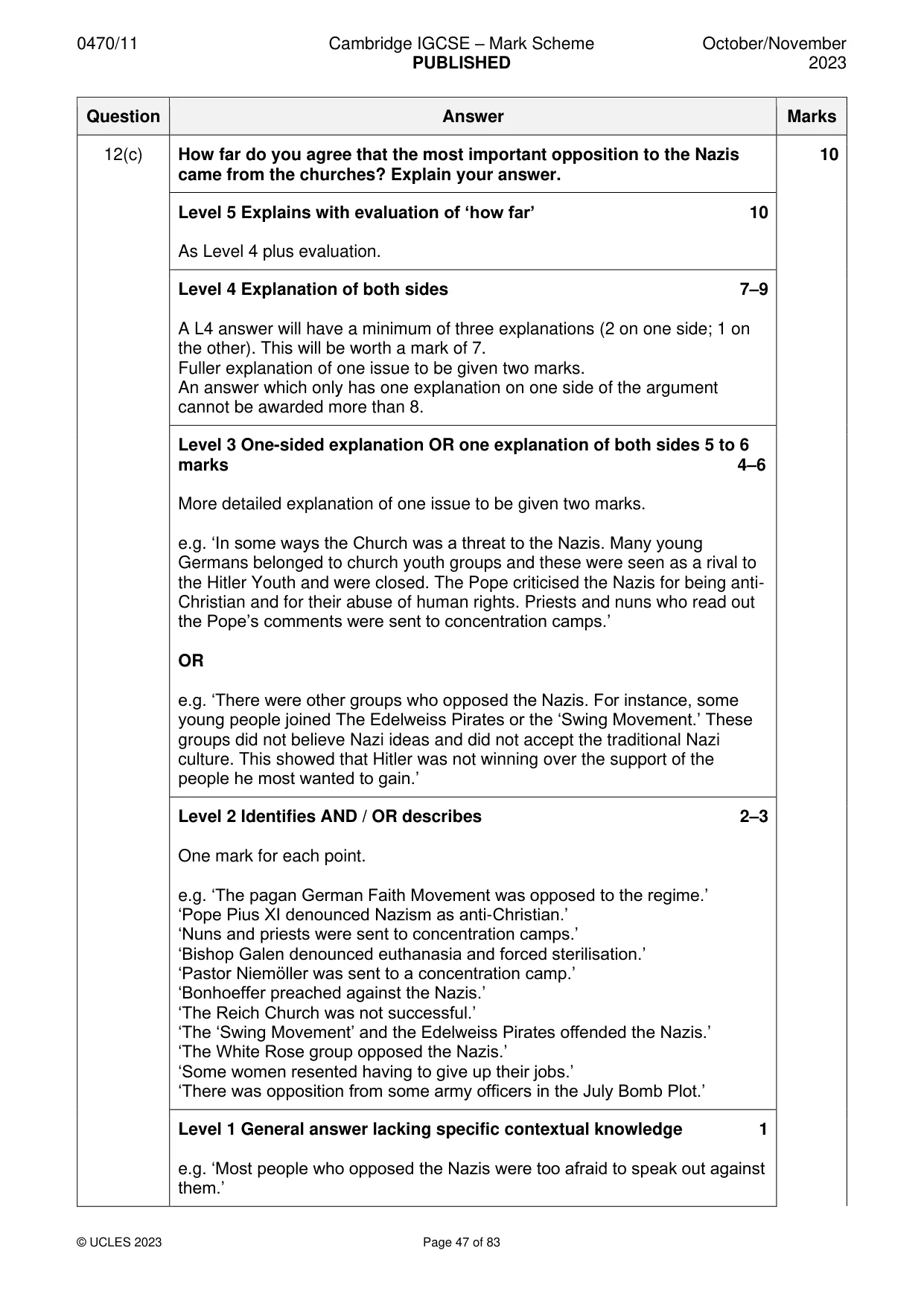
0470/11 Cambridge IGCSE – Mark Scheme PUBLISHED October/November 2023 © UCLES 2023 Page 47 of 83 Question Answer Marks 12(c) How far do you agree that the most important opposition to the Nazis came from the churches? Explain your answer. 10 Level 5 Explains with evaluation of ‘how far’ 10 As Level 4 plus evaluation. Level 4 Explanation of both sides 7–9 A L4 answer will have a minimum of three explanations (2 on one side; 1 on the other). This will be worth a mark of 7. Fuller explanation of one issue to be given two marks. An answer which only has one explanation on one side of the argument cannot be awarded more than 8. Level 3 One-sided explanation OR one explanation of both sides 5 to 6 marks 4–6 More detailed explanation of one issue to be given two marks. e.g. ‘In some ways the Church was a threat to the Nazis. Many young Germans belonged to church youth groups and these were seen as a rival to the Hitler Youth and were closed. The Pope criticised the Nazis for being anti- Christian and for their abuse of human rights. Priests and nuns who read out the Pope’s comments were sent to concentration camps.’ OR e.g. ‘There were other groups who opposed the Nazis. For instance, some young people joined The Edelweiss Pirates or the ‘Swing Movement.’ These groups did not believe Nazi ideas and did not accept the traditional Nazi culture. This showed that Hitler was not winning over the support of the people he most wanted to gain.’ Level 2 Identifies AND / OR describes 2–3 One mark for each point. e.g. ‘The pagan German Faith Movement was opposed to the regime.’ ‘Pope Pius XI denounced Nazism as anti-Christian.’ ‘Nuns and priests were sent to concentration camps.’ ‘Bishop Galen denounced euthanasia and forced sterilisation.’ ‘Pastor Niemӧller was sent to a concentration camp.’ ‘Bonhoeffer preached against the Nazis.’ ‘The Reich Church was not successful.’ ‘The ‘Swing Movement’ and the Edelweiss Pirates offended the Nazis.’ ‘The White Rose group opposed the Nazis.’ ‘Some women resented having to give up their jobs.’ ‘There was opposition from some army officers in the July Bomb Plot.’ Level 1 General answer lacking specific contextual knowledge 1 e.g. ‘Most people who opposed the Nazis were too afraid to speak out against them.’
Mark scheme, page 48
0470/11 Cambridge IGCSE – Mark Scheme PUBLISHED October/November 2023 © UCLES 2023 Page 48 of 83 Question Answer Marks 12(c) Level 0 No evidence submitted or response does not address the question 0
Mark scheme, page 49
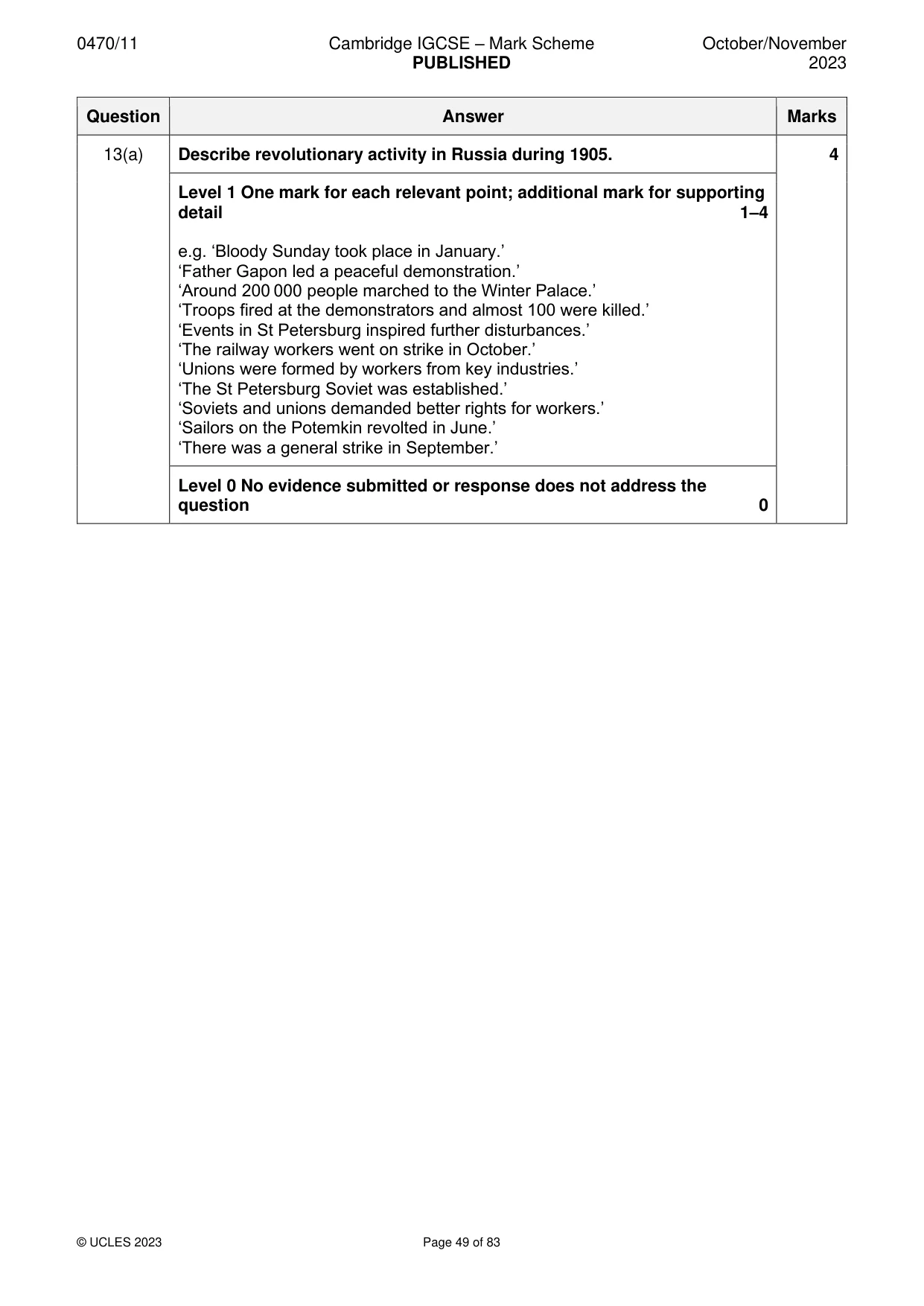
0470/11 Cambridge IGCSE – Mark Scheme PUBLISHED October/November 2023 © UCLES 2023 Page 49 of 83 Question Answer Marks 13(a) Describe revolutionary activity in Russia during 1905. 4 Level 1 One mark for each relevant point; additional mark for supporting detail 1–4 e.g. ‘Bloody Sunday took place in January.’ ‘Father Gapon led a peaceful demonstration.’ ‘Around 200 000 people marched to the Winter Palace.’ ‘Troops fired at the demonstrators and almost 100 were killed.’ ‘Events in St Petersburg inspired further disturbances.’ ‘The railway workers went on strike in October.’ ‘Unions were formed by workers from key industries.’ ‘The St Petersburg Soviet was established.’ ‘Soviets and unions demanded better rights for workers.’ ‘Sailors on the Potemkin revolted in June.’ ‘There was a general strike in September.’ Level 0 No evidence submitted or response does not address the question 0
Mark scheme, page 50
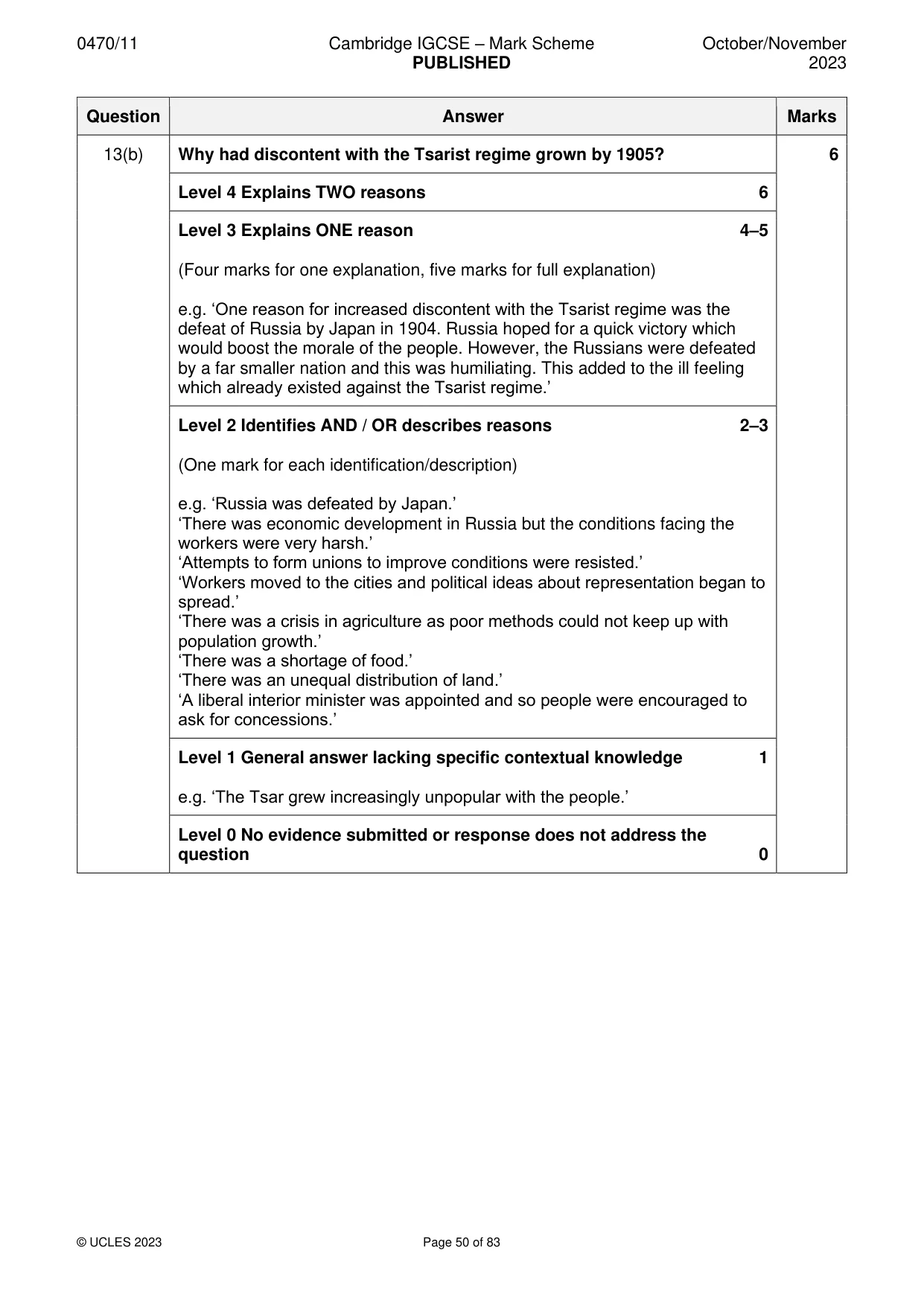
0470/11 Cambridge IGCSE – Mark Scheme PUBLISHED October/November 2023 © UCLES 2023 Page 50 of 83 Question Answer Marks 13(b) Why had discontent with the Tsarist regime grown by 1905? 6 Level 4 Explains TWO reasons 6 Level 3 Explains ONE reason 4–5 (Four marks for one explanation, five marks for full explanation) e.g. ‘One reason for increased discontent with the Tsarist regime was the defeat of Russia by Japan in 1904. Russia hoped for a quick victory which would boost the morale of the people. However, the Russians were defeated by a far smaller nation and this was humiliating. This added to the ill feeling which already existed against the Tsarist regime.’ Level 2 Identifies AND / OR describes reasons 2–3 (One mark for each identification/description) e.g. ‘Russia was defeated by Japan.’ ‘There was economic development in Russia but the conditions facing the workers were very harsh.’ ‘Attempts to form unions to improve conditions were resisted.’ ‘Workers moved to the cities and political ideas about representation began to spread.’ ‘There was a crisis in agriculture as poor methods could not keep up with population growth.’ ‘There was a shortage of food.’ ‘There was an unequal distribution of land.’ ‘A liberal interior minister was appointed and so people were encouraged to ask for concessions.’ Level 1 General answer lacking specific contextual knowledge 1 e.g. ‘The Tsar grew increasingly unpopular with the people.’ Level 0 No evidence submitted or response does not address the question 0
Mark scheme, page 51
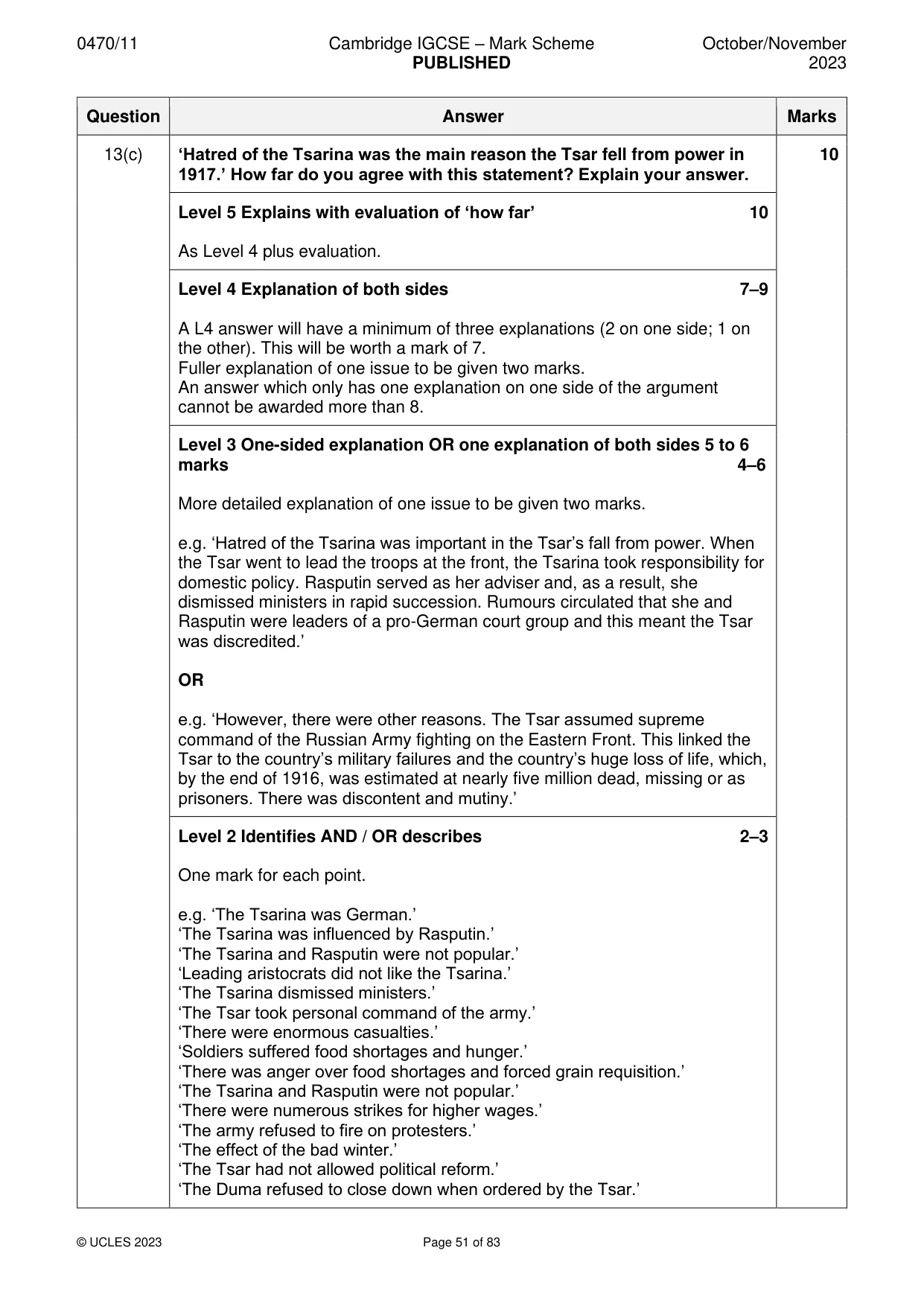
0470/11 Cambridge IGCSE – Mark Scheme PUBLISHED October/November 2023 © UCLES 2023 Page 51 of 83 Question Answer Marks 13(c) ‘Hatred of the Tsarina was the main reason the Tsar fell from power in 1917.’ How far do you agree with this statement? Explain your answer. 10 Level 5 Explains with evaluation of ‘how far’ 10 As Level 4 plus evaluation. Level 4 Explanation of both sides 7–9 A L4 answer will have a minimum of three explanations (2 on one side; 1 on the other). This will be worth a mark of 7. Fuller explanation of one issue to be given two marks. An answer which only has one explanation on one side of the argument cannot be awarded more than 8. Level 3 One-sided explanation OR one explanation of both sides 5 to 6 marks 4–6 More detailed explanation of one issue to be given two marks. e.g. ‘Hatred of the Tsarina was important in the Tsar’s fall from power. When the Tsar went to lead the troops at the front, the Tsarina took responsibility for domestic policy. Rasputin served as her adviser and, as a result, she dismissed ministers in rapid succession. Rumours circulated that she and Rasputin were leaders of a pro-German court group and this meant the Tsar was discredited.’ OR e.g. ‘However, there were other reasons. The Tsar assumed supreme command of the Russian Army fighting on the Eastern Front. This linked the Tsar to the country’s military failures and the country’s huge loss of life, which, by the end of 1916, was estimated at nearly five million dead, missing or as prisoners. There was discontent and mutiny.’ Level 2 Identifies AND / OR describes 2–3 One mark for each point. e.g. ‘The Tsarina was German.’ ‘The Tsarina was influenced by Rasputin.’ ‘The Tsarina and Rasputin were not popular.’ ‘Leading aristocrats did not like the Tsarina.’ ‘The Tsarina dismissed ministers.’ ‘The Tsar took personal command of the army.’ ‘There were enormous casualties.’ ‘Soldiers suffered food shortages and hunger.’ ‘There was anger over food shortages and forced grain requisition.’ ‘The Tsarina and Rasputin were not popular.’ ‘There were numerous strikes for higher wages.’ ‘The army refused to fire on protesters.’ ‘The effect of the bad winter.’ ‘The Tsar had not allowed political reform.’ ‘The Duma refused to close down when ordered by the Tsar.’
Mark scheme, page 52
0470/11 Cambridge IGCSE – Mark Scheme PUBLISHED October/November 2023 © UCLES 2023 Page 52 of 83 Question Answer Marks 13(c) Level 1 General answer lacking specific contextual knowledge 1 e.g. ‘The Tsar was very unpopular by 1917.’ Level 0 No evidence submitted or response does not address the question 0
Mark scheme, page 53
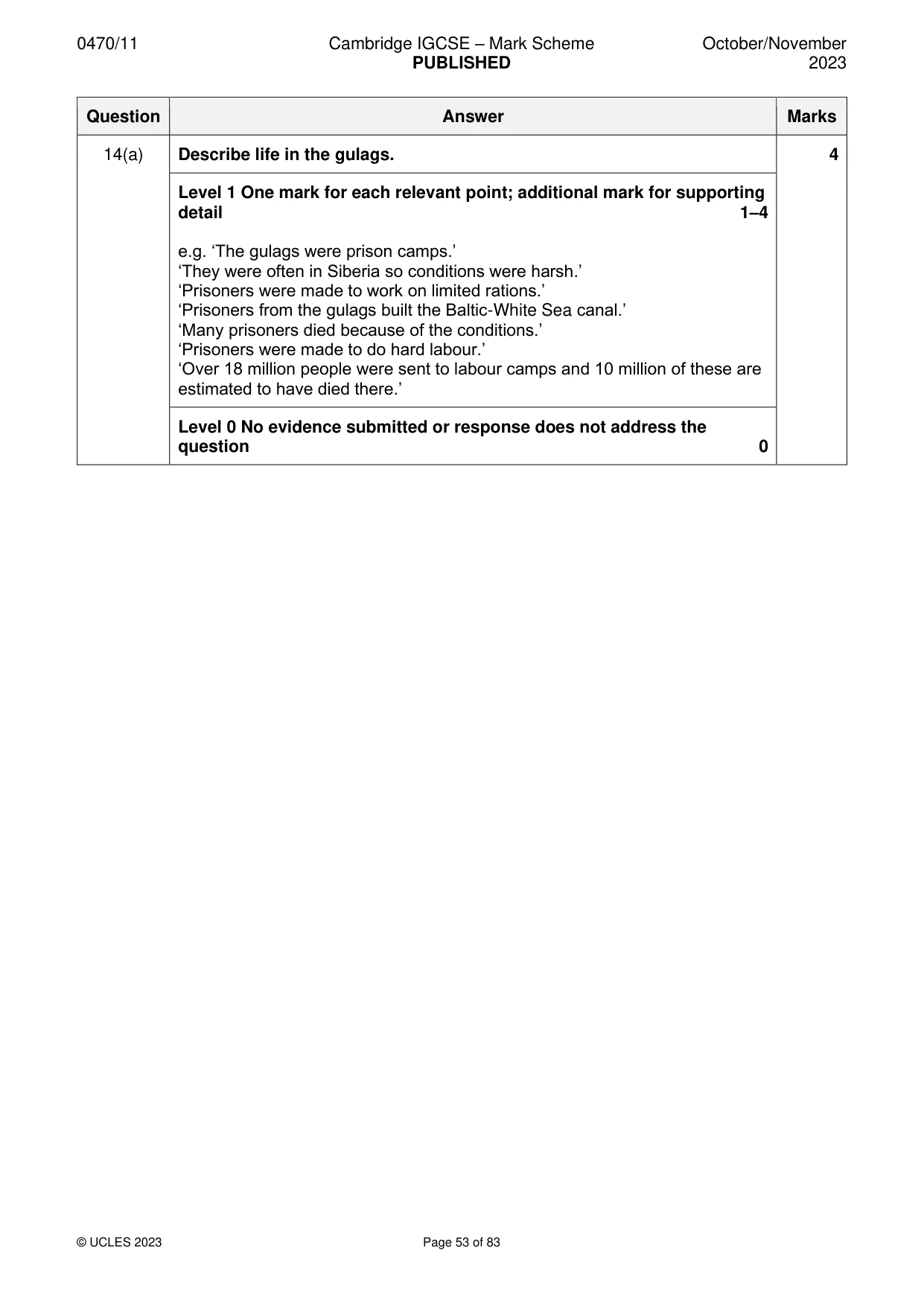
0470/11 Cambridge IGCSE – Mark Scheme PUBLISHED October/November 2023 © UCLES 2023 Page 53 of 83 Question Answer Marks 14(a) Describe life in the gulags. 4 Level 1 One mark for each relevant point; additional mark for supporting detail 1–4 e.g. ‘The gulags were prison camps.’ ‘They were often in Siberia so conditions were harsh.’ ‘Prisoners were made to work on limited rations.’ ‘Prisoners from the gulags built the Baltic-White Sea canal.’ ‘Many prisoners died because of the conditions.’ ‘Prisoners were made to do hard labour.’ ‘Over 18 million people were sent to labour camps and 10 million of these are estimated to have died there.’ Level 0 No evidence submitted or response does not address the question 0
Mark scheme, page 54
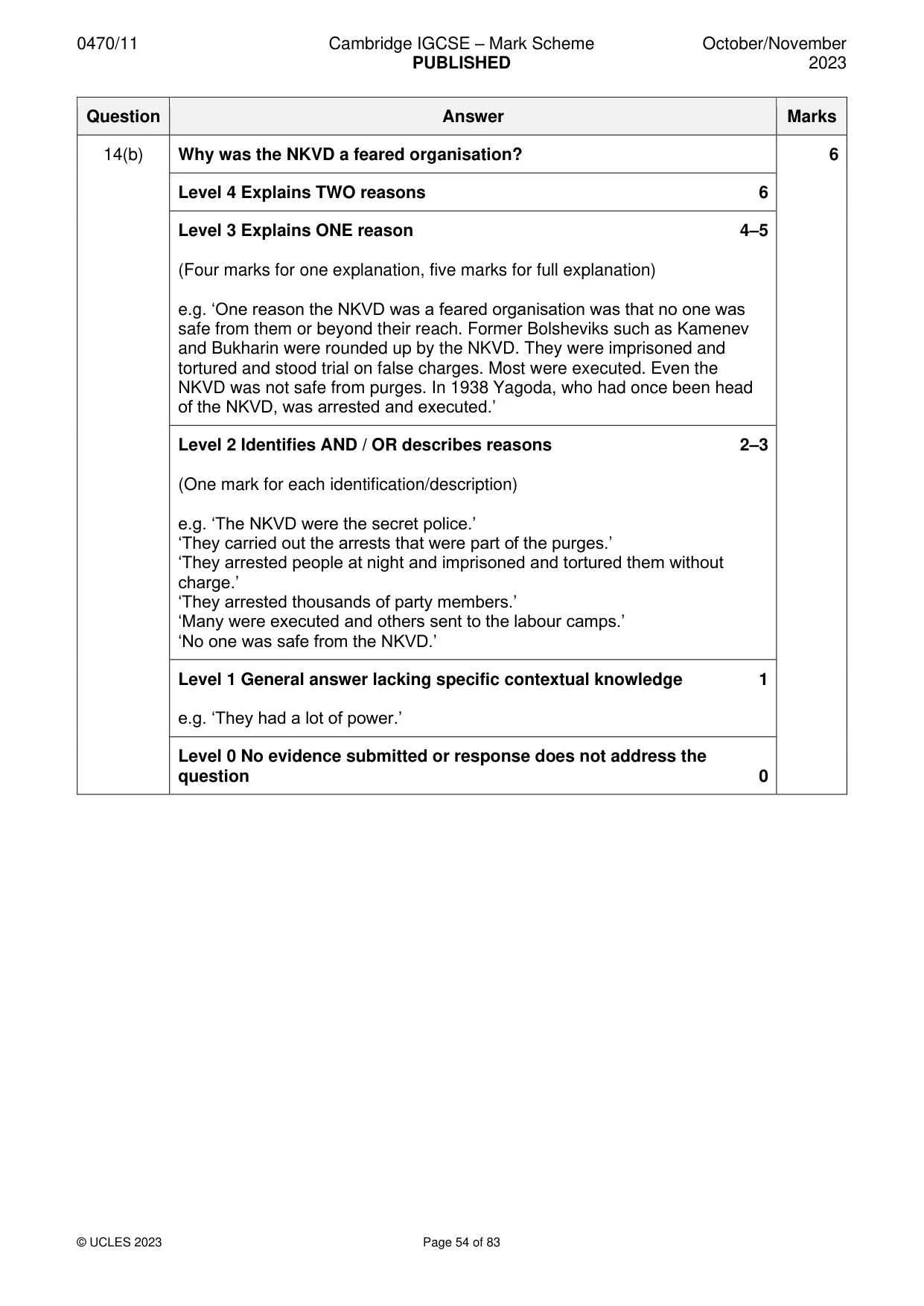
0470/11 Cambridge IGCSE – Mark Scheme PUBLISHED October/November 2023 © UCLES 2023 Page 54 of 83 Question Answer Marks 14(b) Why was the NKVD a feared organisation? 6 Level 4 Explains TWO reasons 6 Level 3 Explains ONE reason 4–5 (Four marks for one explanation, five marks for full explanation) e.g. ‘One reason the NKVD was a feared organisation was that no one was safe from them or beyond their reach. Former Bolsheviks such as Kamenev and Bukharin were rounded up by the NKVD. They were imprisoned and tortured and stood trial on false charges. Most were executed. Even the NKVD was not safe from purges. In 1938 Yagoda, who had once been head of the NKVD, was arrested and executed.’ Level 2 Identifies AND / OR describes reasons 2–3 (One mark for each identification/description) e.g. ‘The NKVD were the secret police.’ ‘They carried out the arrests that were part of the purges.’ ‘They arrested people at night and imprisoned and tortured them without charge.’ ‘They arrested thousands of party members.’ ‘Many were executed and others sent to the labour camps.’ ‘No one was safe from the NKVD.’ Level 1 General answer lacking specific contextual knowledge 1 e.g. ‘They had a lot of power.’ Level 0 No evidence submitted or response does not address the question 0
Mark scheme, page 55
0470/11 Cambridge IGCSE – Mark Scheme PUBLISHED October/November 2023 © UCLES 2023 Page 55 of 83 Question Answer Marks 14(c) How far do you agree that Stalin’s main target in the purges was those who had supported Trotsky? Explain your answer. 10 Level 5 Explains with evaluation of ‘how far’ 10 As Level 4 plus evaluation. Level 4 Explanation of both sides 7–9 A L4 answer will have a minimum of three explanations (2 on one side; 1 on the other). This will be worth a mark of 7. Fuller explanation of one issue to be given two marks. An answer which only has one explanation on one side of the argument cannot be awarded more than 8. Level 3 One-sided explanation OR one explanation of both sides 5 to 6 marks 4–6 More detailed explanation of one issue to be given two marks. e.g. ‘For a time it appeared that Stalin’s main target was those who had supported Trotsky. After the murder of Sergei Kirov in 1934 Stalin took action to remove the old Bolsheviks. In the Great Purge men like Zinoviev were accused of being Trotsky’s agents and were executed following Show Trials. Those who had supported NEP, like Bukharin, were also arrested and killed in 1938. It seemed that Stalin was determined to wipe out anyone who had any connection to Trotsky, even if they had opposed his ideas.’ OR e.g. ‘However, there were too many other targets of the purges for Trotsky’s old comrades to be the main focus. In 1937–1938 Stalin purged the Red Army. He shot or imprisoned 37 000 army officers. The NKVD itself was purged along with party officials. Stalin wanted to remove anyone who he thought could be a possible enemy or threat to his own position.’ Level 2 Identifies AND / OR describes 2–3 One mark for each point. e.g. ‘Former colleagues of Trotsky were executed.’ ‘Show trials of the old Bolsheviks were conducted.’ ‘The Red Army was purged.’ ‘Party officials were purged.’ ‘Kulaks and Nepmen were also purged with many sent to labour camps.’ Level 1 General answer lacking specific contextual knowledge 1 e.g. ‘Stalin wanted everyone to be afraid of him.’ Level 0 No evidence submitted or response does not address the question 0
Mark scheme, page 56
0470/11 Cambridge IGCSE – Mark Scheme PUBLISHED October/November 2023 © UCLES 2023 Page 56 of 83 Question Answer Marks 15(a) What technical innovations helped industry to develop in the 1920s? 4 Level 1 One mark for each relevant point; additional mark for supporting detail 1–4 e.g. ‘Advances in chemicals brought new products such as Bakelite and cellophane.’ ‘Synthetic fabrics such as rayon were introduced.’ ‘The widespread availability of electricity meant homes and businesses had an efficient power source.’ ‘Mass production techniques increased productivity and reduced prices.’ ‘Henry Ford used assembly lines to produce cars.’ ‘The assembly line method was adopted by other industries such as the manufacture of washing machines/fridges/hoovers.’ Level 0 No evidence submitted or response does not address the question 0
Mark scheme, page 57
0470/11 Cambridge IGCSE – Mark Scheme PUBLISHED October/November 2023 © UCLES 2023 Page 57 of 83 Question Answer Marks 15(b) Why were more Americans able to buy consumer goods in the 1920s? 6 Level 4 Explains TWO reasons 6 Level 3 Explains ONE reason 4–5 (Four marks for one explanation, five marks for full explanation) e.g. ‘One of the main reasons Americans could buy consumer goods in the 1920s was that hire purchase was introduced. This meant that workers could buy a new appliance, such as a car or a fridge, and pay for it in instalments. They did not have to pay the full price up front and this made it easier to buy an expensive item. This meant many more people were able to buy household goods.’ Level 2 Identifies AND / OR describes reasons 2–3 (One mark for each identification/description) e.g. ‘More products were available because of mass production.’ ‘Wages rose and people had more disposable income.’ ‘There was high employment in the US in the early 1920s.’ ‘Hire purchase was introduced so products were easier to afford.’ ‘Mass production meant that prices went down.’ ‘Republican policies meant less regulation for industries.’ ‘There were low taxes.’ ‘There was an increased awareness of consumer goods through advertising.’ Level 1 General answer lacking specific contextual knowledge 1 e.g. ‘More people were able to buy things.’ Level 0 No evidence submitted or response does not address the question 0
Mark scheme, page 58
0470/11 Cambridge IGCSE – Mark Scheme PUBLISHED October/November 2023 © UCLES 2023 Page 58 of 83 Question Answer Marks 15(c) How far do you agree that US tariff policy was responsible for the problems facing farmers in the 1920s? Explain your answer. 10 Level 5 Explains with evaluation of ‘how far’ 10 As Level 4 plus evaluation. Level 4 Explanation of both sides 7–9 A L4 answer will have a minimum of three explanations (2 on one side; 1 on the other). This will be worth a mark of 7. Fuller explanation of one issue to be given two marks. An answer which only has one explanation on one side of the argument cannot be awarded more than 8. Level 3 One-sided explanation OR one explanation of both sides 5 to 6 marks 4–6 More detailed explanation of one issue to be given two marks. e.g. ‘The tariff policy was a problem for farmers. The US introduced tariffs to ensure that foreign produced goods were expensive. This was supposed to encourage Americans to buy home grown products. However, it meant that foreign countries could not afford to buy US farm produce and, as US farms were overproducing anyway, this meant prices in the US dropped, therefore farmers became poorer.’ OR e.g. ‘Another problem facing US farmers was foreign competition. Canada and Argentina began to supply foreign markets with grain. They undercut the price of US produce and this meant farmers were unable to sell their surplus crops.’ Level 2 Identifies AND / OR describes 2–3 One mark for each point. e.g. ‘European nations would not take US farm products as the US had placed tariffs on imports from Europe.’ ‘Food exports to Europe were reduced.’ ‘There was overproduction of foodstuffs.’ ‘Prices fell which caused hardship for farmers.’ ‘There was competition from Canada and Argentina.’ ‘Farmers had borrowed from banks and, with lower prices, they could not pay their debts.’ ‘Banks seized farms if debts had not been paid.’ ‘In the South, there was too much reliance on one crop.’ ‘Crops were lost to pests such as the boll weevil.’ Level 1 General answer lacking specific contextual knowledge 1 e.g. ‘Farmers faced bad times in America in the 1920s.’
Mark scheme, page 59
0470/11 Cambridge IGCSE – Mark Scheme PUBLISHED October/November 2023 © UCLES 2023 Page 59 of 83 Question Answer Marks 15(c) Level 0 No evidence submitted or response does not address the question 0
Mark scheme, page 60
0470/11 Cambridge IGCSE – Mark Scheme PUBLISHED October/November 2023 © UCLES 2023 Page 60 of 83 Question Answer Marks 16(a) What were the aims of the National Industrial Recovery Act (NIRA)? 4 Level 1 One mark for each relevant point; additional mark for supporting detail 1–4 e.g. ‘The NIRA aimed to stabilise prices.’ ‘It aimed to improve working conditions.’ ‘It wanted to improve pay.’ ‘It set up the NIRA to help achieve its aims.’ ‘Consumers were urged to buy from businesses which signed up to the NIRA code to strengthen businesses which operated fairly.’ ‘It aimed to prevent child labour.’ ‘It aimed to help industries affected by the Great Depression.’ Level 0 No evidence submitted or response does not address the question 0
Mark scheme, page 61
0470/11 Cambridge IGCSE – Mark Scheme PUBLISHED October/November 2023 © UCLES 2023 Page 61 of 83 Question Answer Marks 16(b) Why did Huey Long criticise the New Deal? 6 Level 4 Explains TWO reasons 6 Level 3 Explains ONE reason 4–5 (Four marks for one explanation, five marks for full explanation) e.g. ‘One reason that Huey Long criticised the New Deal was that he thought that wealth was not spread equally in American society and that the New Deal should address this. He argued that vast fortunes should be confiscated from the rich and used to benefit society. He argued that redistributing wealth in this way would help to stimulate the economy and benefit all Americans.’ Level 2 Identifies AND / OR describes reasons 2–3 (One mark for each identification/description) e.g. ‘Huey Long thought the New Deal did not go far enough.’ ‘He thought that wealth should be redistributed among the American people.’ ‘He believed that minimum wages should be introduced to protect the standard of living of workers.’ ‘He thought that old people were not treated fairly and should be given pensions.’ ‘Long thought that all Americans should have access to free education.’ ‘Long thought that too few Americans controlled too much of the country’s wealth.’ Level 1 General answer lacking specific contextual knowledge 1 e.g. ‘Huey Long had many reasons for disliking the New Deal.’ Level 0 No evidence submitted or response does not address the question 0
Mark scheme, page 62
0470/11 Cambridge IGCSE – Mark Scheme PUBLISHED October/November 2023 © UCLES 2023 Page 62 of 83 Question Answer Marks 16(c) ‘The most important achievement of the New Deal was that it restored Americans’ confidence in their government.’ How far do you agree with this statement? Explain your answer. 10 Level 5 Explains with evaluation of ‘how far’ 10 As Level 4 plus evaluation. Level 4 Explanation of both sides 7–9 A L4 answer will have a minimum of three explanations (2 on one side; 1 on the other). This will be worth a mark of 7. Fuller explanation of one issue to be given two marks. An answer which only has one explanation on one side of the argument cannot be awarded more than 8. Level 3 One-sided explanation OR one explanation of both sides 5 to 6 marks 4–6 More detailed explanation of one issue to be given two marks. e.g. ‘To a large extent it is true that the New Deal restored American confidence in their government. Many had lost faith in the government following the Wall Street Crash and the collapse of the banks. They thought Hoover’s government did not do enough to help them. FDR aimed to change this and spoke to the people through his fireside chats. He encouraged them to reinvest in the banks and introduced a huge range of agencies in the first few weeks of his administration to show people how he was prepared to help them. This was an important achievement of the New Deal.’ OR e.g. ‘However, it could be argued that the New Deal was more important for getting America back on its feet financially. Without a viable banking system it would be impossible for the US economy to recover and this was the most important element of the New Deal. The Emergency Banking Act closed the unsound banks and those which remained were given government advice and grants. This made it possible to keep the economy viable and therefore economic recovery was possible.’ Level 2 Identifies AND / OR describes 2–3 One mark for each point. e.g. ‘The fireside chats gave people confidence in FDR.’ ‘The First Hundred Days showed FDR was prepared to take action.’ ‘FDR compared favourably to Hoover.’ ‘The New Deal helped the unemployed.’ ‘The New Deal gave emergency support to those who were hungry and homeless.’ ‘Restoring the banks was an important element of the New Deal.’
Mark scheme, page 63
0470/11 Cambridge IGCSE – Mark Scheme PUBLISHED October/November 2023 © UCLES 2023 Page 63 of 83 Question Answer Marks 16(c) Level 1 General answer lacking specific contextual knowledge 1 e.g. ‘The New Deal did many things to help Americans.’ Level 0 No evidence submitted or response does not address the question 0
Mark scheme, page 64
0470/11 Cambridge IGCSE – Mark Scheme PUBLISHED October/November 2023 © UCLES 2023 Page 64 of 83 Question Answer Marks 17(a) Describe the measures taken by Chiang Kai-shek against the Communists before 1934. 4 Level 1 One mark for each relevant point; additional mark for supporting detail 1–4 e.g. ‘From 1927 he ordered attacks on Communists.’ ‘The army attacked the Communists in Shanghai.’ ‘Thousands were arrested and killed.’ ‘The extermination campaigns took place.’ ‘An attack was launched on the Communists at Jiangxi in 1931.’ ‘Communists were attacked in many cities.’ ‘Over 300 000 Communists were killed.’ Level 0 No evidence submitted or response does not address the question 0
Mark scheme, page 65
0470/11 Cambridge IGCSE – Mark Scheme PUBLISHED October/November 2023 © UCLES 2023 Page 65 of 83 Question Answer Marks 17(b) Why was the Long March important to Mao? 6 Level 4 Explains TWO reasons 6 Level 3 Explains ONE reason 4–5 (Four marks for one explanation, five marks for full explanation) e.g. ‘By travelling to rural China, the CCP was able to live and work alongside the Chinese peasantry. Often overlooked by the KMT, these peasants grew to support the Communists due to their hard work and cooperation with them. The Communists re-distributed land to the peasants and armed them with captured Kuomintang weapons.’ Level 2 Identifies AND / OR describes reasons 2–3 (One mark for each identification/description) e.g. ‘The Long March secured Mao’s position as leader.’ ‘It meant the Communists were safe from extermination at Jiangxi.’ ‘It was great propaganda for the Communists.’ ‘It gave the Communists time to recover and rebuild.’ ‘Travelling to rural China meant the Communists lived and worked alongside the Chinese peasants. This gave them a chance to win their support.’ Level 1 General answer lacking specific contextual knowledge 1 e.g. ‘The Long March was a dangerous undertaking.’ Level 0 No evidence submitted or response does not address the question 0
Mark scheme, page 66
0470/11 Cambridge IGCSE – Mark Scheme PUBLISHED October/November 2023 © UCLES 2023 Page 66 of 83 Question Answer Marks 17(c) How far do you agree that failure to resist Japanese forces effectively was the main weakness of the Kuomintang government? Explain your answer. 10 Level 5 Explains with evaluation of ‘how far’ 10 As Level 4 plus evaluation. Level 4 Explanation of both sides 7–9 A L4 answer will have a minimum of three explanations (2 on one side; 1 on the other). This will be worth a mark of 7. Fuller explanation of one issue to be given two marks. An answer which only has one explanation on one side of the argument cannot be awarded more than 8. Level 3 One-sided explanation OR one explanation of both sides 5 to 6 marks 4–6 More detailed explanation of one issue to be given two marks. e.g. ‘The KMT lacked the determination to take positive action against the Japanese and this affected the views of Chinese peasants. The KMT lost control of significant parts of China which they had controlled in 1937. Chiang adopted scorched earth tactics and this brought misery to millions of Chinese peasants.’ OR e.g. ‘It was the support for the Communists which weakened the KMT. The Communists fought hard using guerrilla tactics against the Japanese showing they cared for their country. During the war, the Communists took care to help peasants and this had an impact in the civil war which followed.’ Level 2 Identifies AND / OR describes 2–3 One mark for each point. e.g. ‘The KMT took foreign aid but used little of it against the Japanese.’ ‘The KMT did not significantly oppose the Japanese but withdrew.’ ‘The KMT lost peasant support because of their cruelty.’ ‘The Communists fought against the Japanese, showing their patriotism.’ ‘They treated the peasants well which gained popularity.’ Level 1 General answer lacking specific contextual knowledge 1 e.g. ‘The KMT had lots of weaknesses and were corrupt.’ Level 0 No evidence submitted or response does not address the question 0
Mark scheme, page 67
0470/11 Cambridge IGCSE – Mark Scheme PUBLISHED October/November 2023 © UCLES 2023 Page 67 of 83 Question Answer Marks 18(a) What happened during the Sino-Vietnamese War? 4 Level 1 One mark for each relevant point; additional mark for supporting detail 1–4 e.g. ‘Vietnam invaded Cambodia in 1976. China saw this as a threat as Vietnam had a close relationship with the USSR.’ ‘China’s relationship with the USSR had deteriorated.’ ‘In 1979 fighting broke out when the PLA attacked North Vietnam.’ ‘Many were afraid that a full-scale war between China and Vietnam would follow.’ ‘At the end of 1979 there were peace talks but these broke down.’ ‘Large numbers of troops gathered on either side of the border.’ ‘Fighting continued through the 1980s.’ ‘A secret peace deal was signed in 1990 and China forced Vietnam to withdraw from Cambodia.’ Level 0 No evidence submitted or response does not address the question 0
Mark scheme, page 68
0470/11 Cambridge IGCSE – Mark Scheme PUBLISHED October/November 2023 © UCLES 2023 Page 68 of 83 Question Answer Marks 18(b) Why did relations between China and the United States change in the 1950s? 6 Level 4 Explains TWO reasons 6 Level 3 Explains ONE reason 4–5 (Four marks for one explanation, five marks for full explanation) e.g. ‘The US had supported the KMT in the Civil War and refused to acknowledge Mao as the rightful leader of China. With US support, China’s seat at the United Nations was occupied by Chiang Kai-shek’s Taiwan. Several times it was proposed that China should be admitted to the UN, but each time the USA and its allies voted against it.’ Level 2 Identifies AND / OR describes reasons 2–3 (One mark for each identification/description) e.g. ‘The US supported Chiang Kai-shek.’ ‘The US did not favour the spread of communism.’ ‘The US did not recognise the People’s Republic of China.’ ‘The US blocked China’s seat in the UN.’ ‘They were on opposing sides in the Korean War.’ ‘In Vietnam, China and the USA supported opposing sides in Vietnam.’ ‘A trade embargo was imposed on China.’ Level 1 General answer lacking specific contextual knowledge 1 e.g. ‘The two states disagreed about almost every area of policy.’ Level 0 No evidence submitted or response does not address the question 0
Mark scheme, page 69
0470/11 Cambridge IGCSE – Mark Scheme PUBLISHED October/November 2023 © UCLES 2023 Page 69 of 83 Question Answer Marks 18(c) ‘Sino-US relations improved because Sino-Soviet relations changed.’ How far do you agree with this statement? Explain your answer. 10 Level 5 Explains with evaluation of ‘how far’ 10 As Level 4 plus evaluation. Level 4 Explanation of both sides 7–9 A L4 answer will have a minimum of three explanations (2 on one side; 1 on the other). This will be worth a mark of 7. Fuller explanation of one issue to be given two marks. An answer which only has one explanation on one side of the argument cannot be awarded more than 8. Level 3 One-sided explanation OR one explanation of both sides 5 to 6 marks 4–6 More detailed explanation of one issue to be given two marks. e.g. ‘In some ways this statement is true. China’s relationship with the USSR deteriorated while Khrushchev was in power and this meant China risked being isolated. This encouraged China to look for an ally. The US was also keen to exploit the rift between China and the USSR. If the US could establish links with China, then they would be able to break up the Communist bloc and isolate their main enemy in the Cold War.’ OR e.g. ‘However, there are other reasons why US-Soviet relations improved. China was keen to make trade links with the US. At the same time US President Nixon began to realise that the US needed to find a new way of dealing with communist states. In 1971 China was allowed to join the UN – a move which the US had blocked since the 1940s. The following year a trade agreement and peace treaty was signed by the US and China. They both had motives for wanting improved relations and this led to a thaw between the two states.’ Level 2 Identifies AND / OR describes 2–3 One mark for each point. e.g. ‘China’s relationship with the USSR got worse under Khrushchev.’ ‘Khrushchev criticised China’s economic policy.’ ‘China wanted the US as a trade partner.’ ‘The US began to realise it needed to deal differently with communist states.’ ‘A trade agreement was signed between the US and China in 1972.’ ‘The US stopped blocking China from joining the UN.’ ‘Kissinger visited China in 1971.’ ‘The US was keen to exploit the rift between the USSR and China.’
Mark scheme, page 70
0470/11 Cambridge IGCSE – Mark Scheme PUBLISHED October/November 2023 © UCLES 2023 Page 70 of 83 Question Answer Marks 18(c) Level 1 General answer lacking specific contextual knowledge 1 e.g. ‘There were many reasons on both sides for improved relations between China and the US.’ Level 0 No evidence submitted or response does not address the question 0
Mark scheme, page 71
0470/11 Cambridge IGCSE – Mark Scheme PUBLISHED October/November 2023 © UCLES 2023 Page 71 of 83 Question Answer Marks 19(a) What was the Pan Africanist Congress (PAC)? 4 Level 1 One mark for each relevant point; additional mark for supporting detail 1–4 e.g. ‘The PAC was a breakaway organisation from the ANC.’ ‘It was led by Robert Sobukwe.’ ‘In 1960 the PAC began a campaign against the Pass Laws.’ ‘The PAC did not support the Freedom Charter.’ ‘The PAC thought that black people should work on their own to achieve rights.’ Level 0 No evidence submitted or response does not address the question 0
Mark scheme, page 72
0470/11 Cambridge IGCSE – Mark Scheme PUBLISHED October/November 2023 © UCLES 2023 Page 72 of 83 Question Answer Marks 19(b) Why was the Group Areas Act passed in 1950? 6 Level 4 Explains TWO reasons 6 Level 3 Explains ONE reason 4–5 (Four marks for one explanation, five marks for full explanation) e.g. ‘One reason for the Group Areas Act was to ensure that white South Africans had the best land and neighbourhoods in South Africa and that they were exclusively white. For example, Sophiatown was an area of Johannesburg where black people had owned or rented houses for many years. It was a popular community with a strong identity. It was declared a ‘white’ area and the people who lived there were forcibly removed to Soweto. This was so the suburb became white.’ Level 2 Identifies AND / OR describes reasons 2–3 (One mark for each identification/description) e.g. ‘White people, black people and ‘coloureds’ were to live in separate racial areas.’ ‘The whole of South Africa was to be divided into racial areas.’ ‘The law was to exclude non-white people from living in the most developed areas.’ ‘The law reinforced the policy of apartheid.’ ‘The white minority gained control of most of the country.’ ‘The movement of non-white people was controlled as they had to carry pass books to enter ‘white’ parts of the country.’ Level 1 General answer lacking specific contextual knowledge 1 e.g. ‘The Act made divisions in South African society greater than before.’ Level 0 No evidence submitted or response does not address the question 0
Mark scheme, page 73
0470/11 Cambridge IGCSE – Mark Scheme PUBLISHED October/November 2023 © UCLES 2023 Page 73 of 83 Question Answer Marks 19(c) How far do you agree that the South African government had crushed opposition to apartheid by 1966? Explain your answer. 10 Level 5 Explains with evaluation of ‘how far’ 10 As Level 4 plus evaluation. Level 4 Explanation of both sides 7–9 A L4 answer will have a minimum of three explanations (2 on one side; 1 on the other). This will be worth a mark of 7. Fuller explanation of one issue to be given two marks. An answer which only has one explanation on one side of the argument cannot be awarded more than 8. Level 3 One-sided explanation OR one explanation of both sides 5 to 6 marks 4–6 More detailed explanation of one issue to be given two marks. e.g. ‘Opposition was ineffective because government policies were repressive and deprived opposition groups of their leadership. The National Government had passed the Suppression of Communism Act in 1950. It was able to label many opposition leaders as communists and charge them with high treason. Between 1955 and 1956, 156 leaders were arrested under this legislation including leaders of the ANC.’ OR e.g. ‘Despite tough legislation and the harsh implications of the legislation, membership of protest groups increased rapidly. The ANC’s membership increased from 7000 to 100 000 from 1950 to 1952.’ Level 2 Identifies AND / OR describes 2–3 One mark for each point. e.g. ‘ANC membership increased.’ ‘The government charged leaders with high treason.’ ‘There were bus boycotts.’ ‘School protests were quashed.’ ‘Tougher legislation followed after 1965.’ ‘ANC leaders were arrested and put in prison.’ Level 1 General answer lacking specific contextual knowledge 1 e.g. ‘The government took many actions to crush opposition.’ Level 0 No evidence submitted or response does not address the question 0
Mark scheme, page 74
0470/11 Cambridge IGCSE – Mark Scheme PUBLISHED October/November 2023 © UCLES 2023 Page 74 of 83 Question Answer Marks 20(a) Describe the situation facing de Klerk when he became President in 1989. 4 Level 1 One mark for each relevant point; additional mark for supporting detail 1–4 e.g. ‘South Africa was on the brink of civil war.’ ‘The National Party was losing support and had less than 50% of the vote in the 1989 election.’ ‘The South African economy was in trouble.’ ‘The security forces were out of control and took the law into their own hands.’ ‘South Africa had few foreign allies.’ ‘There was increasing violence in the townships.’ Level 0 No evidence submitted or response does not address the question 0
Mark scheme, page 75
0470/11 Cambridge IGCSE – Mark Scheme PUBLISHED October/November 2023 © UCLES 2023 Page 75 of 83 Question Answer Marks 20(b) Why did Chief Buthelezi represent a possible threat to Mandela’s aims for South Africa? 6 Level 4 Explains TWO reasons 6 Level 3 Explains ONE reason 4–5 (Four marks for one explanation, five marks for full explanation) e.g. ‘Buthelezi was a possible threat because he was a Zulu nationalist and hoped to make KwaZulu an independent state. This went against Mandela’s ambitions for a unified South Africa. Friction between Inkatha and the ANC sometimes escalated into violence that threatened to destroy the fragile relationship between Mandela and de Klerk. Mandela eventually persuaded Buthelezi to participate in the elections.’ Level 2 Identifies AND / OR describes reasons 2–3 (One mark for each identification/description) e.g. ‘Buthelezi left the ANC and became Chief Minister of the Zulu homeland.’ ‘He was criticised as being a collaborator of the National Government.’ ‘Mandela wanted a unified South Africa.’ ‘After 1990 Buthelezi represented the Inkatha Freedom Party.’ ‘He supported the idea of a federal republic to protect the ethnic rights of the Zulus.’ ‘Some thought he was trying to protect his own personal political position.’ ‘He refused to take part in the negotiations leading up to the 1994 elections.’ ‘This caused violence between the ANC and IFP supporters.’ Level 1 General answer lacking specific contextual knowledge 1 e.g. ‘Buthelezi and Mandela did not agree about the direction South Africa should take.’ Level 0 No evidence submitted or response does not address the question 0
Mark scheme, page 76
0470/11 Cambridge IGCSE – Mark Scheme PUBLISHED October/November 2023 © UCLES 2023 Page 76 of 83 Question Answer Marks 20(c) How important were the changes made by P W Botha to the apartheid system? Explain your answer. 10 Level 5 Explains with evaluation of ‘how important’ 10 As Level 4 plus evaluation. Level 4 Explanation of both sides 7–9 A L4 answer will have a minimum of three explanations (2 on one side; 1 on the other). This will be worth a mark of 7. Fuller explanation of one issue to be given two marks. An answer which only has one explanation on one side of the argument cannot be awarded more than 8. Level 3 One-sided explanation OR one explanation of both sides 5 to 6 marks 4–6 More detailed explanation of one issue to be given two marks. e.g. ‘In some ways the changes made to the apartheid system were important. He introduced trade union reform which recognised black trade unions by law and gave them the right to strike. He also changed the constitution and gave some seats to ‘coloured’ and Asian South Africans. He also removed some of the restrictions of ‘petty’ apartheid such as segregation in hotels and on public transport.’ OR e.g. ‘In some ways the changes made to the apartheid system were important, but maybe not in the way Botha intended. For example, his reform of the trade unions backfired. The new unions became increasingly militant and South Africa lost more working days to strikes than ever before. The new constitution did not have the intended effect. Instead of winning over support it met with large-scale opposition which led to the formation of the UDF. The key changes non-white people wanted to see were the abolition of apartheid and one person one vote. By altering the system slightly Botha only succeeded in making people more angry.’ Level 2 Identifies AND / OR describes 2–3 One mark for each point. e.g. ‘Botha changed the constitution.’ ‘Trade union laws were changed so black workers could form trade unions legally.’ ‘Botha failed to introduce education reforms.’ ‘The unions became more militant.’ ‘Some aspects of petty apartheid were addressed but these changes did not impress many people.’ ‘The Pass Laws were reformed.’ ‘The Group Areas Act was repealed.’ ‘Black Africans were not given the vote.’
Mark scheme, page 77
0470/11 Cambridge IGCSE – Mark Scheme PUBLISHED October/November 2023 © UCLES 2023 Page 77 of 83 Question Answer Marks 20(c) Level 1 General answer lacking specific contextual knowledge 1 e.g. ‘Botha made some reforms.’ Level 0 No evidence submitted or response does not address the question 0
Mark scheme, page 78
0470/11 Cambridge IGCSE – Mark Scheme PUBLISHED October/November 2023 © UCLES 2023 Page 78 of 83 Question Answer Marks 21(a) What was the Stern Gang? 4 Level 1 One mark for each relevant point; additional mark for supporting detail 1–4 e.g. ‘The Stern Gang was founded by Avraham Stern.’ ‘Stern was killed by the British in 1942.’ ‘Stern wanted to drive the British out of Palestine.’ ‘Stern created the Leh’i which carried out attacks against the British.’ ‘In April 1946 seven British soldiers were killed in Tel Aviv.’ ‘In February 1946 20 planes were destroyed in attacks on 3 airfields.’ Level 0 No evidence submitted or response does not address the question 0
Mark scheme, page 79
0470/11 Cambridge IGCSE – Mark Scheme PUBLISHED October/November 2023 © UCLES 2023 Page 79 of 83 Question Answer Marks 21(b) Why were events at the King David Hotel in July 1946 important? 6 Level 4 Explains TWO reasons 6 Level 3 Explains ONE reason 4–5 (Four marks for one explanation, five marks for full explanation) e.g. ‘In July 1946, Irgun attacked the King David Hotel in Jerusalem. It was targeted because it was the British military headquarters in Palestine. Irgun brought down a whole wing of the hotel killing 92 people. This was important because it was one of the events which convinced the British that they could not stay in Palestine.’ Level 2 Identifies AND / OR describes reasons 2–3 (One mark for each identification/description) e.g. ‘In July 1946, Irgun attacked the King David Hotel in Jerusalem.’ ‘It was targeted because it was the British military headquarters in Palestine.’ ‘Irgun brought down a whole wing of the hotel killing 92 people.’ ‘It damaged British morale.’ ‘It showed the British were not fully in control of Palestine.’ Level 1 General answer lacking specific contextual knowledge 1 e.g. ‘The King David Hotel was important to the British forces.’ Level 0 No evidence submitted or response does not address the question 0
Mark scheme, page 80
0470/11 Cambridge IGCSE – Mark Scheme PUBLISHED October/November 2023 © UCLES 2023 Page 80 of 83 Question Answer Marks 21(c) How surprising was the victory of Israel in the 1948–49 war? Explain your answer. 10 Level 5 Explains with evaluation of ‘how surprising’ 10 As Level 4 plus evaluation. Level 4 Explanation of both sides 7–9 A L4 answer will have a minimum of three explanations (2 on one side; 1 on the other). This will be worth a mark of 7. Fuller explanation of one issue to be given two marks. An answer which only has one explanation on one side of the argument cannot be awarded more than 8. Level 3 One-sided explanation OR one explanation of both sides 5 to 6 marks 4–6 More detailed explanation of one issue to be given two marks. e.g. ‘The victory was surprising in some ways. In May 1948 Israel was invaded by a coalition of six Arab states. The Israelis were invaded from all sides and this meant they had to fight on several fronts. By June, the Arabs had occupied almost a third of Israel, including the Jewish quarter of Jerusalem. This was a bad start and it looked as though the Arabs were in a strong position.’ OR e.g. ‘In other ways the victory was not a surprise. Israel was provided with financial support from allies in the US and Europe. This meant the Israeli army was equipped with the most up-to-date weapons. They had strong military leadership and were better organised and led than the Arab forces. They outnumbered the Arab forces and were more strongly united.’ Level 2 Identifies AND / OR describes 2–3 One mark for each point. e.g. ‘Six Arab states attacked Israel at the same time.’ ‘The Arabs were divided and outnumbered.’ ‘The Israelis had strong military leadership.’ ‘The US supported Israel.’ ‘By June 1948, the Jewish Quarter of Jerusalem had been overrun by Arab forces.’ Level 1 General answer lacking specific contextual knowledge 1 e.g. ‘Israel was a new state and was attacked in 1948.’ Level 0 No evidence submitted or response does not address the question 0
Mark scheme, page 81
0470/11 Cambridge IGCSE – Mark Scheme PUBLISHED October/November 2023 © UCLES 2023 Page 81 of 83 Question Answer Marks 22(a) What is Hezbollah? 4 Level 1 One mark for each relevant point; additional mark for supporting detail 1–4 e.g. ‘Hezbollah does not recognise the state of Israel.’ ‘Hezbollah launch missile attacks on Israeli towns.’ ‘Hezbollah have a strong military presence within Lebanon.’ ‘Hezbollah was formed in 1982.’ ‘It aimed to drive Israeli forces out of Lebanon.’ Level 0 No evidence submitted or response does not address the question 0
Mark scheme, page 82
0470/11 Cambridge IGCSE – Mark Scheme PUBLISHED October/November 2023 © UCLES 2023 Page 82 of 83 Question Answer Marks 22(b) Why were the Oslo Accords important? 6 Level 4 Explains TWO reasons 6 Level 3 Explains ONE reason 4–5 (Four marks for one explanation, five marks for full explanation) e.g. ‘The Oslo Accords were important because they were agreed by the Israeli Prime Minister Yitzhak Rabin and the leader of the PLO, Yasser Arafat. The meetings and agreement between them were the first time the PLO had been recognised and suggested that there may be a way to bring an end to the conflict between the Israelis and Palestinians.’ Level 2 Identifies AND / OR describes reasons 2–3 (One mark for each identification/description) e.g. ‘The Declaration of Principles was agreed by Rabin and Arafat.’ ‘Israel recognised the PLO as the representative of the Palestinian people.’ ‘Israeli troops would be withdrawn from Gaza and the West Bank.’ ‘It was agreed that the authority would pass to the Palestinians in these territories.’ ‘There were to be elections for the new Palestinian Authority.’ ‘There were to be further high level talks to turn broad principles into actual policy.’ Level 1 General answer lacking specific contextual knowledge 1 e.g. ‘An agreement was made at Oslo.’ Level 0 No evidence submitted or response does not address the question 0
Mark scheme, page 83
0470/11 Cambridge IGCSE – Mark Scheme PUBLISHED October/November 2023 © UCLES 2023 Page 83 of 83 Question Answer Marks 22(c) ‘The main issue which prevented a peaceful outcome after the Oslo Accords was the Jewish settlements.’ How far do you agree with this statement? Explain your answer. 10 Level 5 Explains with evaluation of ‘how far’ 10 As Level 4 plus evaluation. Level 4 Explanation of both sides 7–9 A L4 answer will have a minimum of three explanations (2 on one side; 1 on the other). This will be worth a mark of 7. Fuller explanation of one issue to be given two marks. An answer which only has one explanation on one side of the argument cannot be awarded more than 8. Level 3 One-sided explanation OR one explanation of both sides 5 to 6 marks 4–6 More detailed explanation of one issue to be given two marks. e.g. ‘The issue of the Jewish settlements caused problems after Oslo. Although Israel gave up some land around Jericho, it was much less than the Palestinians had hoped for. There was violent opposition to the agreements from Palestinians and Israelis. Israeli politicians argued over the settlements. Likud wanted further expansion while Labor preferred to negotiate with the PLO. The tension and divisions over this were seen in the assassination of Rabin by an Israeli student.’ OR e.g. ‘Other issues caused tension. For example, the water supply to the region was controlled by Israel. The level of water used by the Palestinians was restricted. Israel was afraid that if Palestine gained the water sources in the West Bank, it would control the water supply to 3 million Israelis.’ Level 2 Identifies AND / OR describes 2–3 One mark for each point. e.g. ‘The Israelis did not give up all the land which had been promised.’ ‘The Israelis strengthened their Eastern border by a Treaty with Jordan.’ ‘Violence broke out in Gaza and the West Bank.’ ‘Hezbollah bombed the Israeli Embassy in London.’ ‘The water supply from the West Bank was a cause of tension.’ ‘Likud politicians supported expansion of the Jewish settlements.’ Level 1 General answer lacking specific contextual knowledge 1 e.g. ‘The Palestinians and Israelis could not cooperate with each other.’ Level 0 No evidence submitted or response does not address the question 0
What you needed in this session
Cambridge’s own grade thresholds for 2023 Oct/Nov, Paper 1 · Variant 1. A higher threshold means an easier paper — the bar moves with how the cohort did.