Cambridge IGCSE History 0470 — 2025 Oct/Nov Paper 1 · Variant 2
0470/12/O/N/25 · 60 marks · 120 min
The question paper and its mark scheme, free to read here and free to download. This is Cambridge’s own paper, exactly as it was sat.
Question paper8 pages

Mark scheme77 pages
Answers below. Sit the paper first if you are practising.
Paper as text
Question paper, page 1
[Turn over Cambridge IGCSE™ This document has 8 pages. Any blank pages are indicated. * 3 2 1 2 9 3 8 9 5 9 * DC (WW) 343270/2 © UCLES 2025 HISTORY 0470/12 Paper 1 Structured Questions October/November 2025 2 hours You must answer on the enclosed answer booklet. You will need: Answer booklet (enclosed) INSTRUCTIONS ● Answer three questions in total: Section A (Core content): answer two questions. Section B (Depth studies): answer one question. ● Follow the instructions on the front cover of the answer booklet. If you need additional answer paper, ask the invigilator for a continuation booklet. INFORMATION ● The total mark for this paper is 60. ● The number of marks for each question or part question is shown in brackets [ ].
Question paper, page 2
2 0470/12/O/N/25 © UCLES 2025 SECTION A: CORE CONTENT Answer two questions from this section. Option A: The nineteenth century 1 It took many years to achieve Italian unification. (a) What was the Young Italy movement? [4] (b) Why was Rome important to Italian unification? [6] (c) Who was more important to Italian unification: Victor Emmanuel or Cavour? Explain your answer. [10] 2 The Franco-Prussian War (1870–71) was important to German unification. (a) What were the consequences of the Franco-Prussian War for Germany? [4] (b) Why was Prussia able to defeat France? [6] (c) How far was Bismarck responsible for the outbreak of war between France and Prussia? Explain your answer. [10] 3 Imperial expansion had different causes and inspired a range of reactions. (a) Describe the main events of the Philippine–American War. [4] (b) Why was war against Spain in 1898 controversial in the United States? [6] (c) ‘European imperialism was motivated by strategic considerations.’ How far do you agree with this statement? Explain your answer. [10] 4 By 1914 there was a great deal of tension between European powers. (a) What happened in Sarajevo on 28 June 1914? [4] (b) Why was the Alliance System important in the July crisis of 1914? [6] (c) How far do you agree that Germany was responsible for raising international tensions in the years before 1914? Explain your answer. [10]
Question paper, page 3
3 0470/12/O/N/25 © UCLES 2025 [Turn over Option B: The twentieth century 5 The Treaty of Versailles had important consequences for Europe. (a) What happened in the Ruhr as a consequence of the Treaty of Versailles? [4] (b) Why did Wilson’s policy of ‘self-determination’ have an important impact on Germany? [6] (c) How far do you agree that the Big Three were satisfied by the outcomes of the Treaty of Versailles? Explain your answer. [10] 6 The League had some successes but also faced serious challenges beyond its control. (a) Describe how the League campaigned to end slavery. [4] (b) Why did the Depression make it difficult for the League to keep the peace? [6] (c) ‘The League was a success in the 1920s.’ How far do you agree with this statement? Explain your answer. [10] 7 Tensions between the wartime Allies developed quickly from 1945. (a) What did the Allies disagree about at Potsdam? [4] (b) Why was Marshall Aid introduced? [6] (c) ‘The Soviet Union established communist control of Eastern Europe by crushing opposition parties.’ How far do you agree with this statement? Explain your answer. [10] 8 The United States attempted to contain communism with varying degrees of success. (a) Describe the involvement of the United States in the Korean War. [4] (b) Why was Vietnamisation important? [6] (c) How far do you agree that the Cuban Missile Crisis was a disaster for Khrushchev? Explain your answer. [10]
Question paper, page 4
4 0470/12/O/N/25 © UCLES 2025 SECTION B: DEPTH STUDIES Answer one question from this section. Depth study A: The First World War, 1914–18 9 Many areas of the world were involved in the First World War. (a) What was the role of South African troops in the East Africa campaign? [4] (b) Why was the siege of Tsingtao important? [6] (c) ‘The main reason for the Arab Revolt was the rise of Arab nationalism.’ How far do you agree with this statement? Explain your answer. [10] 10 The Germans faced a difficult situation on the home front and on the battlefield in 1918. (a) Describe Hindenburg’s role in the First World War. [4] (b) Why did the United States join the war against Germany in April 1917? [6] (c) ‘Germany asked for an armistice in 1918 because of the failure of the Ludendorff Offensive.’ How far do you agree with this statement? Explain your answer. [10] Depth study B: Germany, 1918–45 11 Hitler acted quickly to consolidate his position. (a) What did Hitler gain from the Enabling Act? [4] (b) Why was securing the support of the army important to Hitler? [6] (c) ‘Hitler became Chancellor in 1933 because of the electoral success of the Nazis.’ How far do you agree with this statement? Explain your answer. [10] 12 The Nazi regime was characterised by persecution. (a) Describe Nazi measures against the Jews between 1933 and 1935. [4] (b) Why were the Berlin Olympics of 1936 important to the Nazis? [6] (c) How far do you agree that there was significant opposition to the Nazis? Explain your answer. [10]
Question paper, page 5
5 0470/12/O/N/25 © UCLES 2025 [Turn over Depth study C: Russia, 1905–41 13 The Provisional Government struggled to establish control in 1917. (a) What were Lenin’s April Theses? [4] (b) Why were the July Days important? [6] (c) ‘The main reason the Provisional Government fell from power was because it did not withdraw Russia from the war.’ How far do you agree with this statement? Explain your answer. [10] 14 Stalin’s social and economic policies changed the Soviet Union. (a) What was Stalin’s approach to ethnic minorities? [4] (b) Why did Stalin introduce Five-Year Plans for industry? [6] (c) How far do you agree that the policy of collectivisation was a success? Explain your answer. [10] Depth study D: The United States, 1919–41 15 American society changed in the 1920s. (a) Describe restrictions placed on immigration in the 1920s. [4] (b) Why was prohibition introduced? [6] (c) ‘Gangsterism posed a greater threat to American society in the 1920s than the Ku Klux Klan.’ How far do you agree with this statement? Explain your answer. [10] 16 The Depression came as a major shock to most Americans. (a) Describe the impact of the Wall Street Crash on the US economy. [4] (b) Why was Hoover criticised for his response to the Depression? [6] (c) How far do you agree that speculation was the main cause of the Wall Street Crash? Explain your answer. [10]
Question paper, page 6
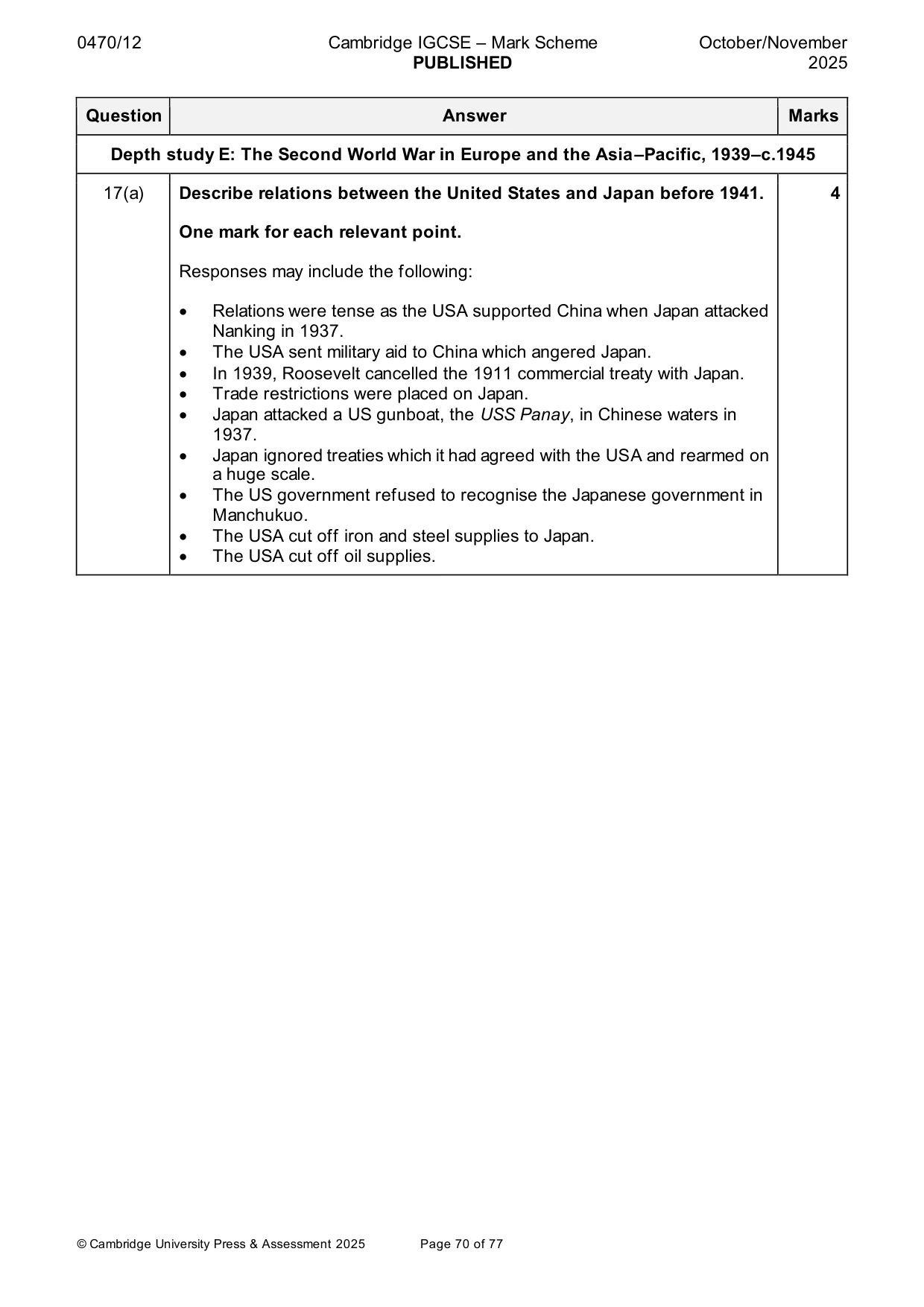
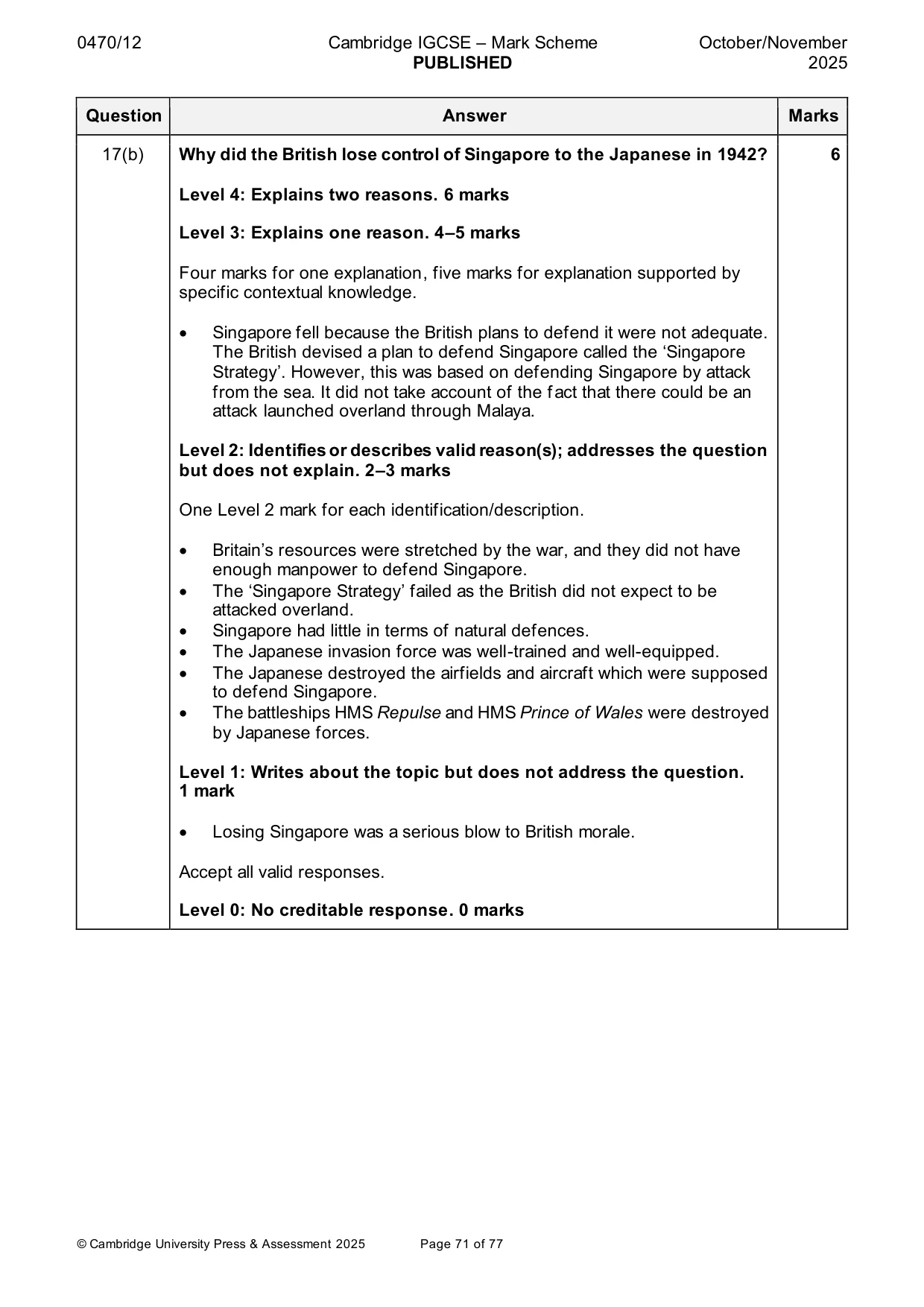
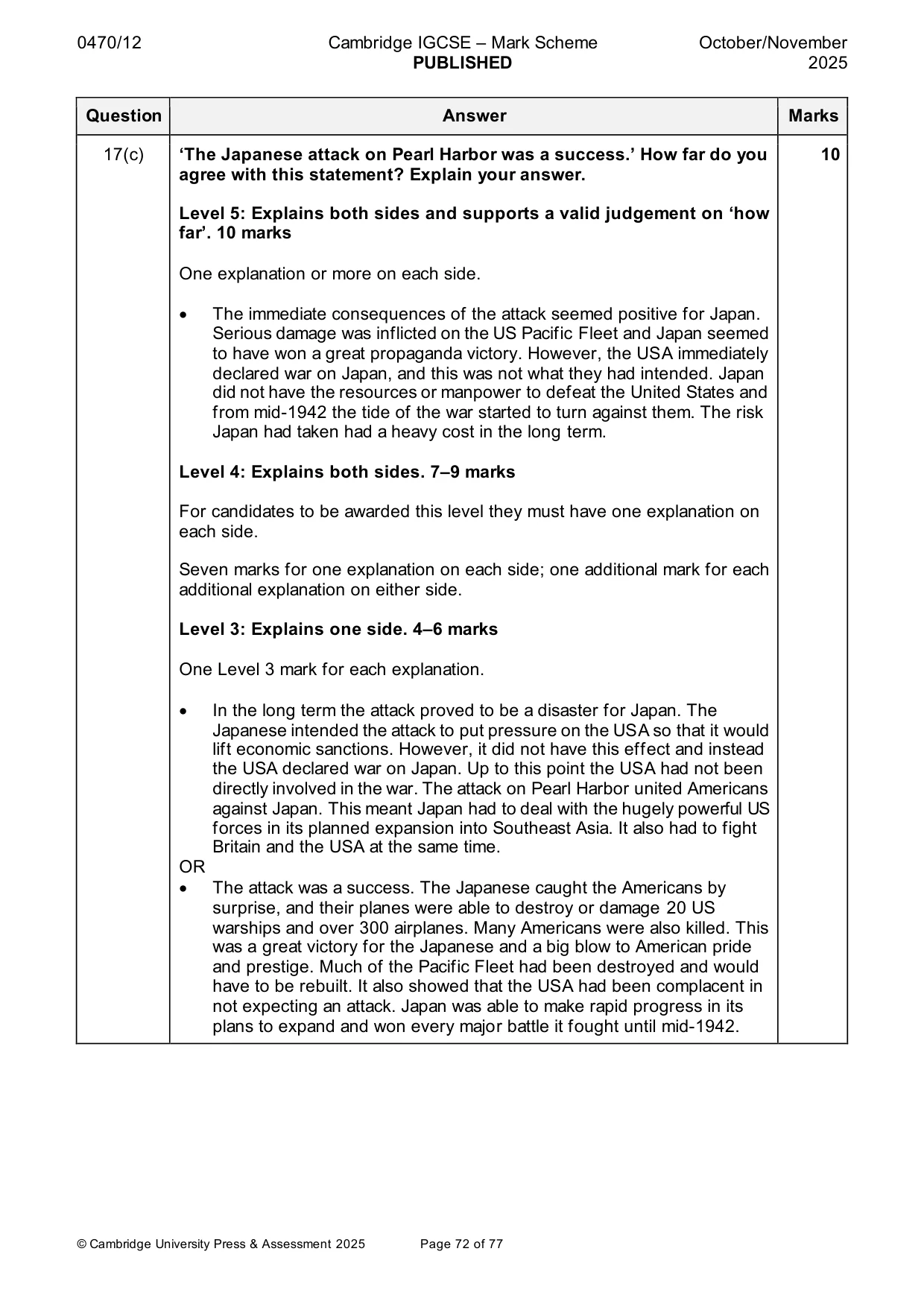
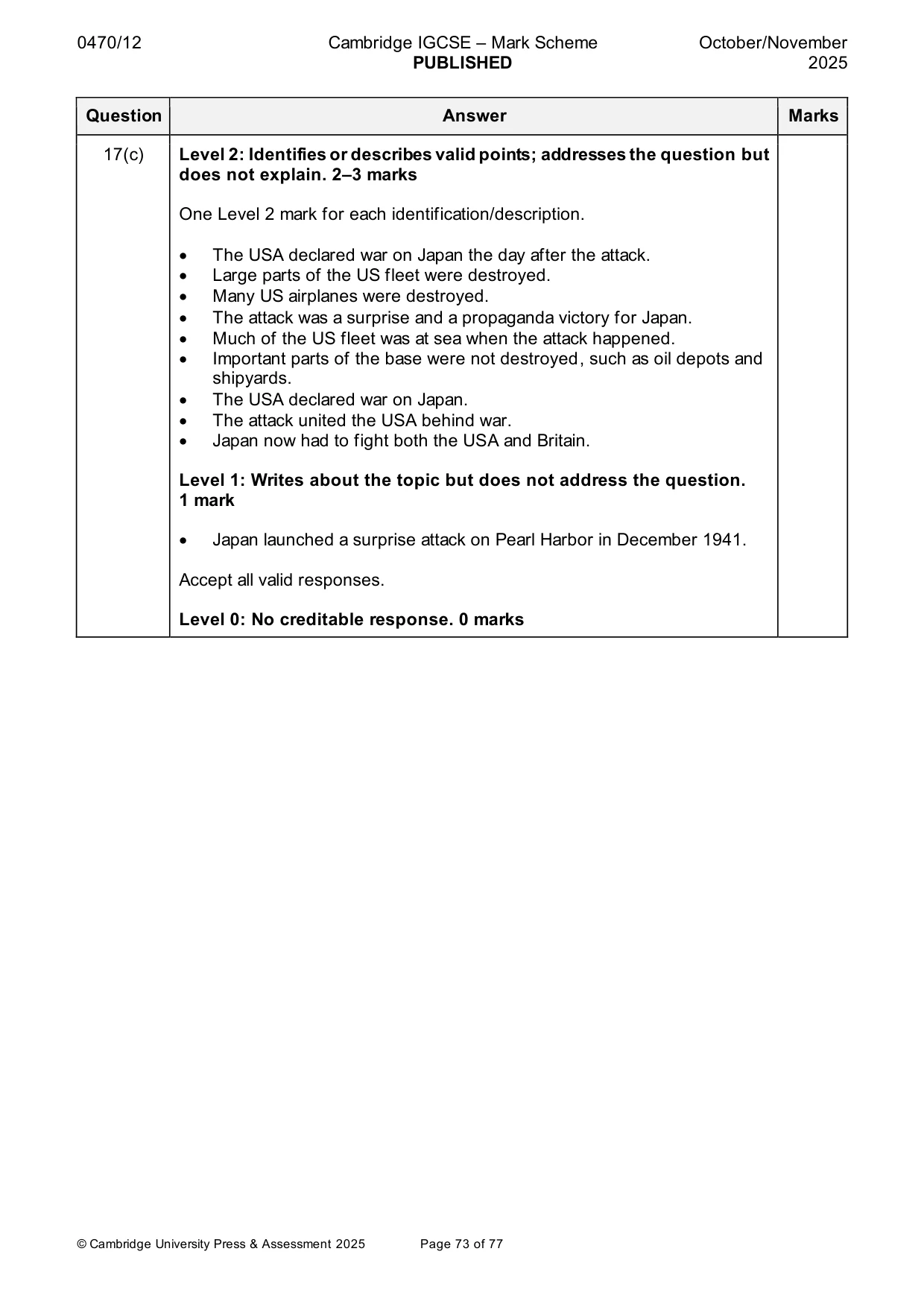
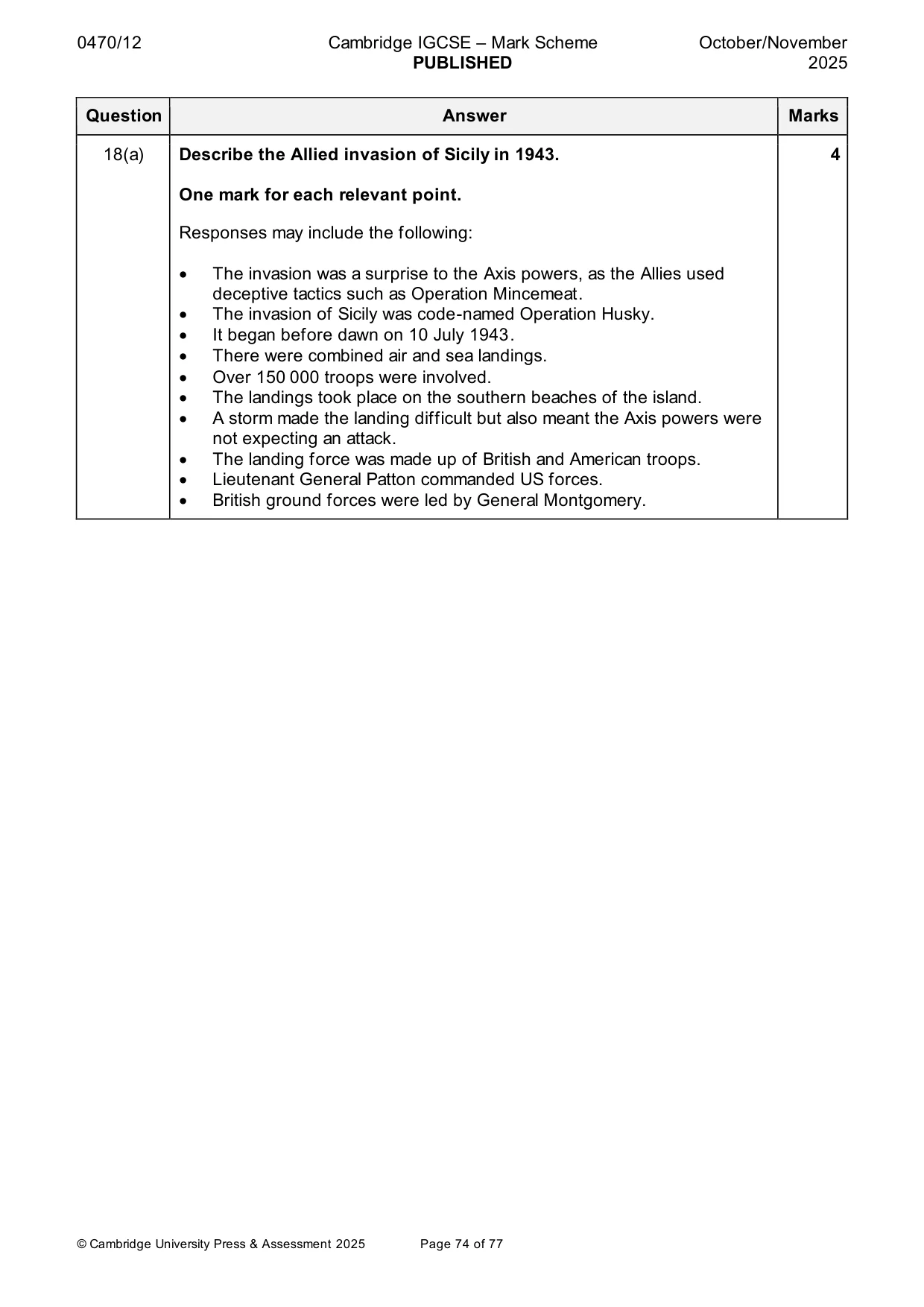
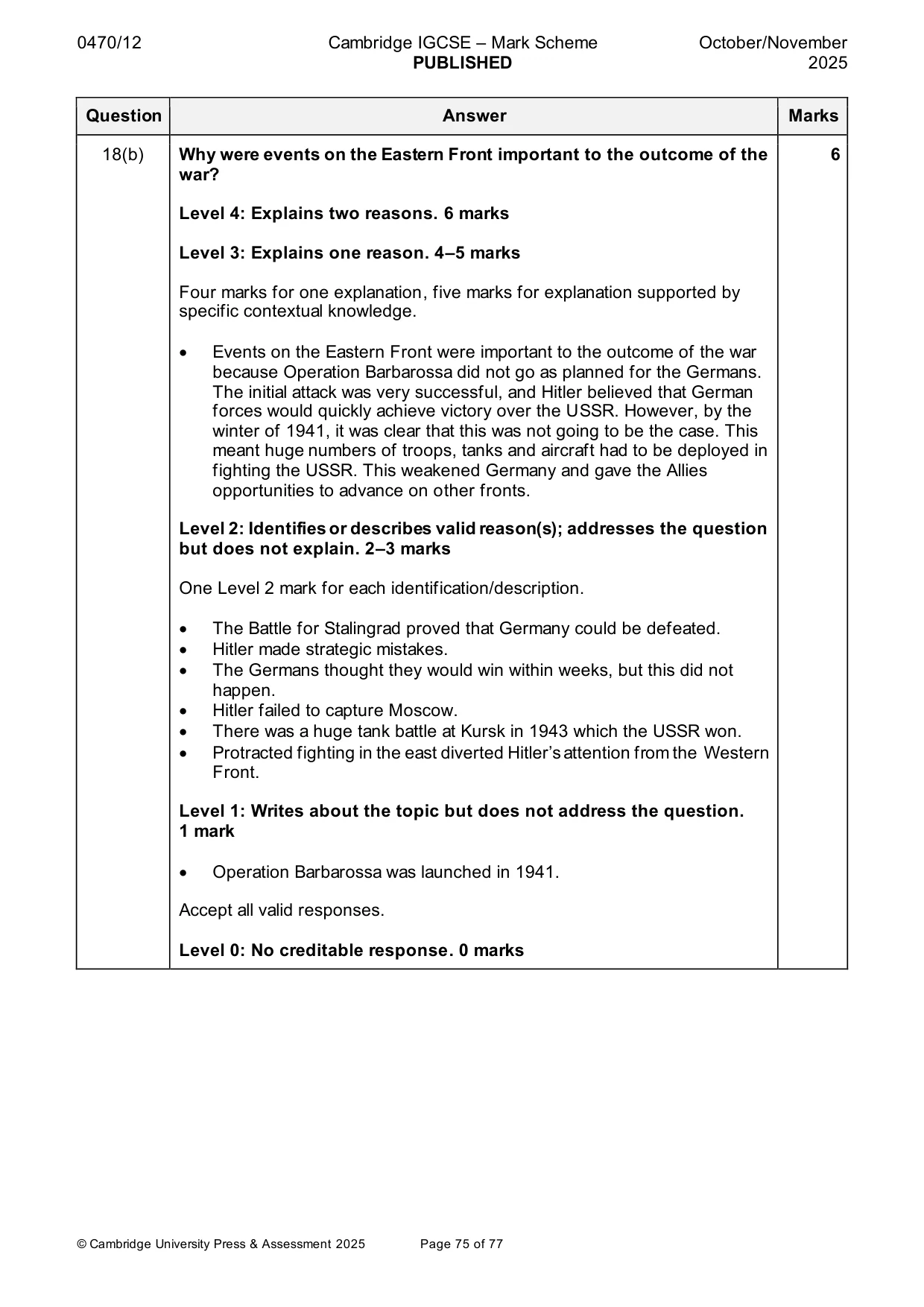
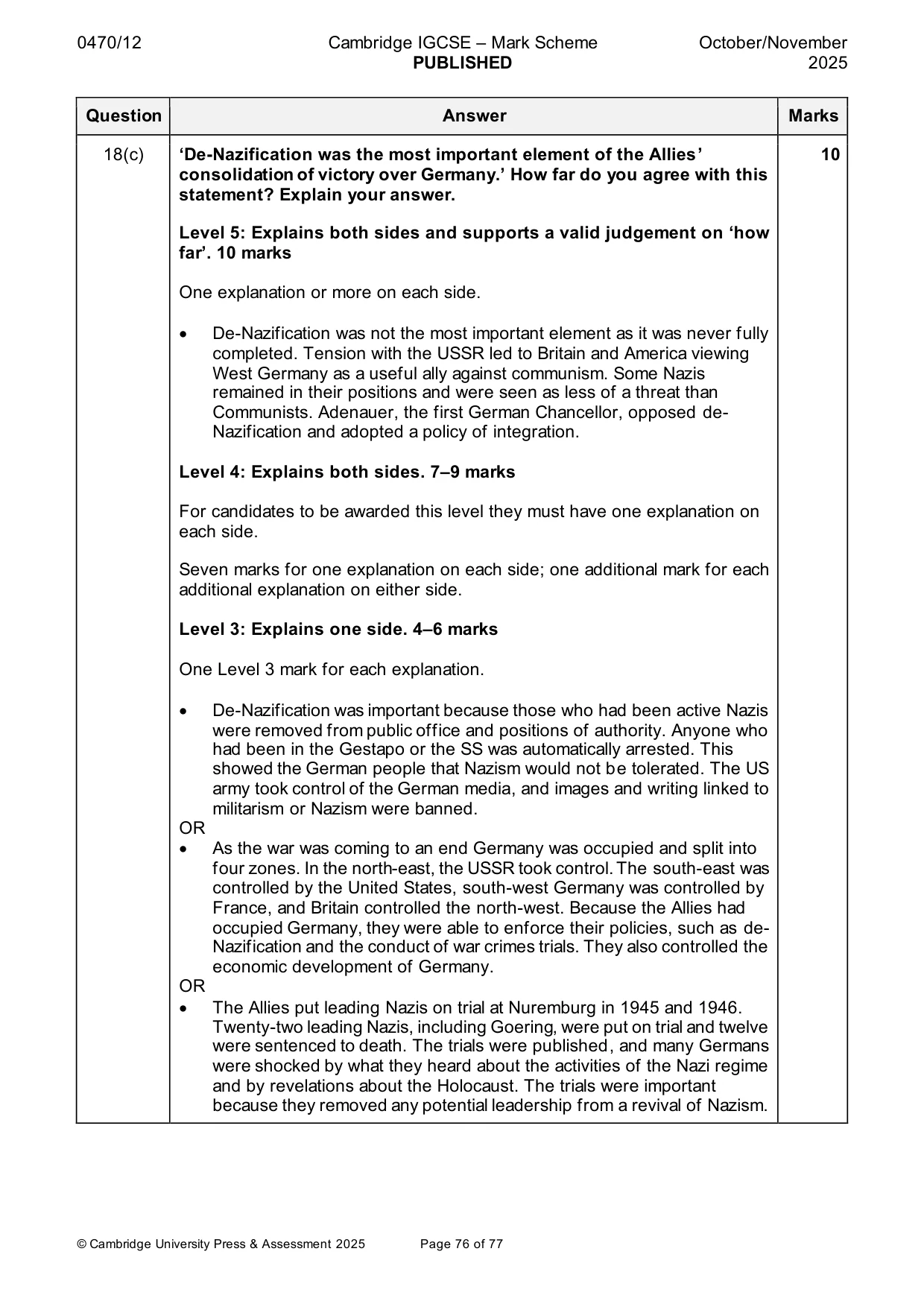
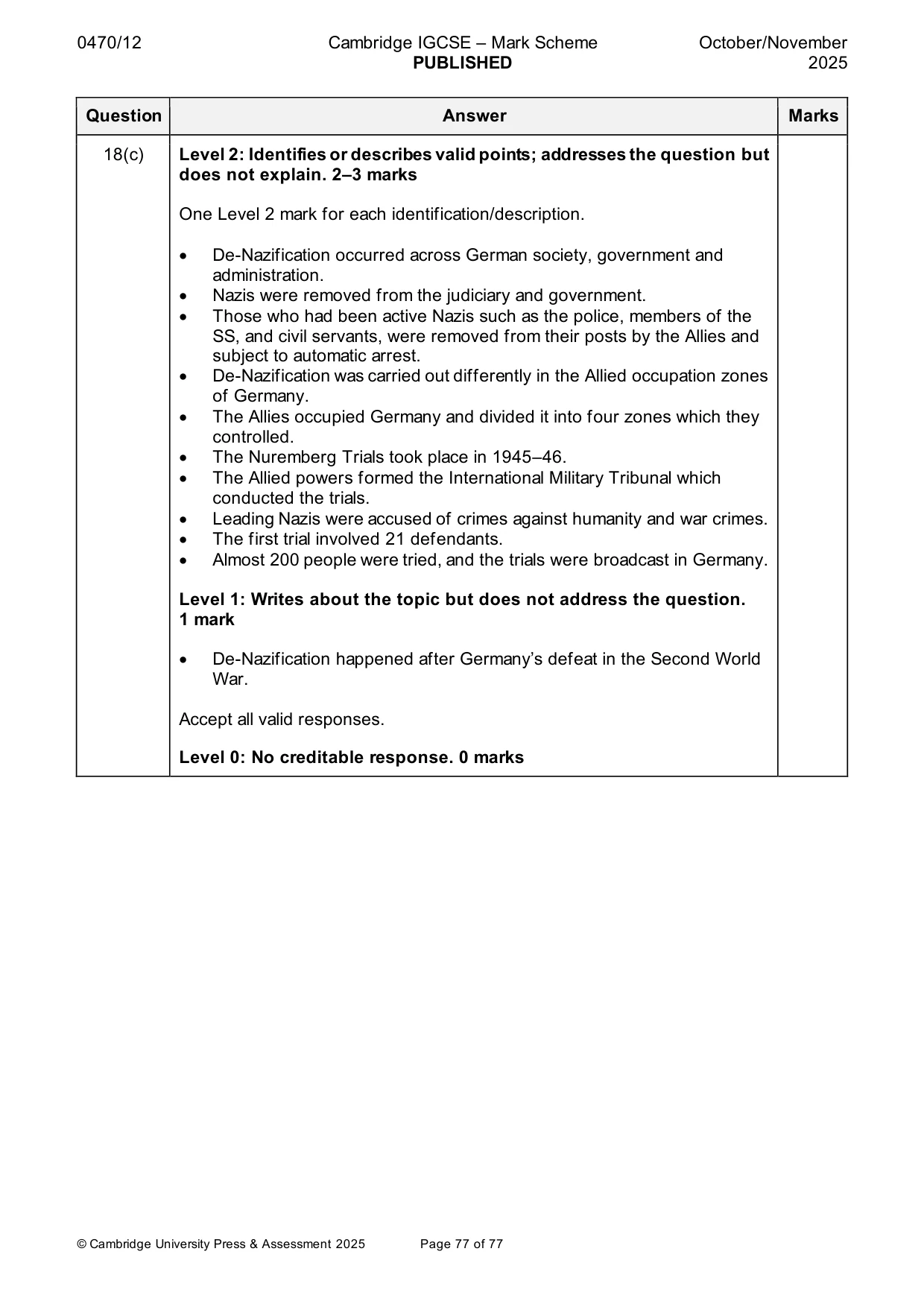
6 0470/12/O/N/25 © UCLES 2025 Depth study E: The Second World War in Europe and the Asia–Pacific, 1939–c.1945 17 Japan took control of much of Southeast Asia in 1941–42. (a) Describe relations between the United States and Japan before 1941. [4] (b) Why did the British lose control of Singapore to the Japanese in 1942? [6] (c) ‘The Japanese attack on Pearl Harbor was a success.’ How far do you agree with this statement? Explain your answer. [10] 18 From 1943, the Allies began to secure victory against the Axis powers. (a) Describe the Allied invasion of Sicily in 1943. [4] (b) Why were events on the Eastern Front important to the outcome of the war? [6] (c) ‘De-Nazification was the most important element of the Allies’ consolidation of victory over Germany.’ How far do you agree with this statement? Explain your answer. [10]
Question paper, page 7
7 0470/12/O/N/25 © UCLES 2025 BLANK PAGE
Question paper, page 8
8 0470/12/O/N/25 © UCLES 2025 Permission to reproduce items where third-party owned material protected by copyright is included has been sought and cleared where possible. Every reasonable effort has been made by the publisher (UCLES) to trace copyright holders, but if any items requiring clearance have unwittingly been included, the publisher will be pleased to make amends at the earliest possible opportunity. To avoid the issue of disclosure of answer-related information to candidates, all copyright acknowledgements are reproduced online in the Cambridge Assessment International Education Copyright Acknowledgements Booklet. This is produced for each series of examinations and is freely available to download at www.cambridgeinternational.org after the live examination series. Cambridge Assessment International Education is part of Cambridge Assessment. Cambridge Assessment is the brand name of the University of Cambridge Local Examinations Syndicate (UCLES), which is a department of the University of Cambridge. BLANK PAGE
Mark scheme, page 1
This document consists of 77 printed pages. © Cambridge University Press & Assessment 2025 [Turn over Cambridge IGCSE™ HISTORY 0470/12 Paper 1 October/November 2025 MARK SCHEME Maximum Mark: 60 Published This mark scheme is published as an aid to teachers and candidates, to indicate the requirements of the examination. It shows the basis on which Examiners were instructed to award marks. It does not indicate the details of the discussions that took place at an Examiners’ meeting before marking began, which would have considered the acceptability of alternative answers. Mark schemes should be read in conjunction with the question paper and the Principal Examiner Report for Teachers. Cambridge International will not enter into discussions about these mark schemes. Cambridge International is publishing the mark schemes for the October/November 2025 series for most Cambridge IGCSE, Cambridge International A and AS Level components, and some Cambridge O Level components.
Mark scheme, page 2
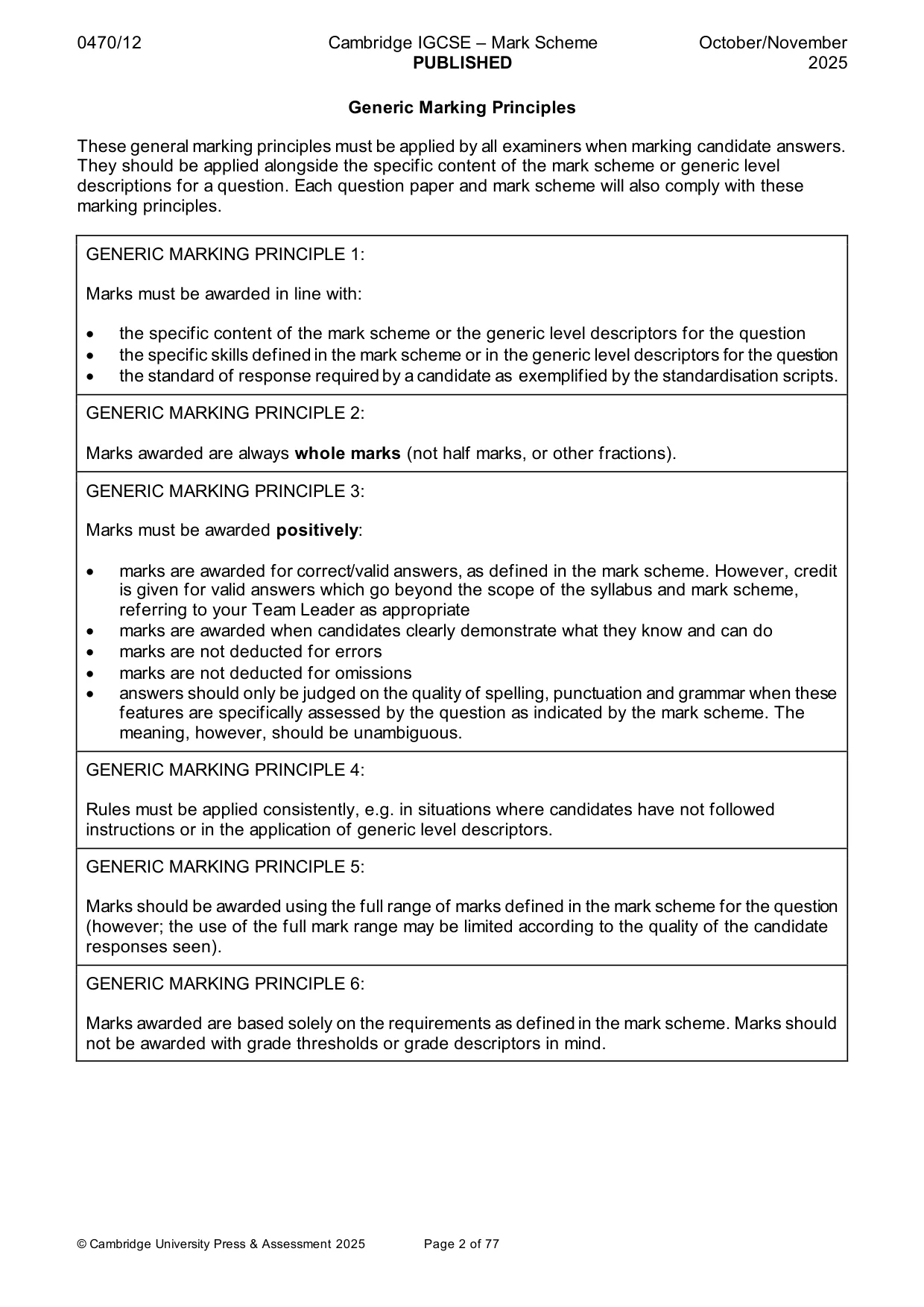
0470/12 Cambridge IGCSE – Mark Scheme PUBLISHED October/November 2025 © Cambridge University Press & Assessment 2025 Page 2 of 77 Generic Marking Principles These general marking principles must be applied by all examiners when marking candidate answers. They should be applied alongside the specific content of the mark scheme or generic level descriptions for a question. Each question paper and mark scheme will also comply with these marking principles. GENERIC MARKING PRINCIPLE 1: Marks must be awarded in line with: • the specific content of the mark scheme or the generic level descriptors for the question • the specific skills defined in the mark scheme or in the generic level descriptors for the question • the standard of response required by a candidate as exemplified by the standardisation scripts. GENERIC MARKING PRINCIPLE 2: Marks awarded are always whole marks (not half marks, or other fractions). GENERIC MARKING PRINCIPLE 3: Marks must be awarded positively: • marks are awarded for correct/valid answers, as defined in the mark scheme. However, credit is given for valid answers which go beyond the scope of the syllabus and mark scheme, referring to your Team Leader as appropriate • marks are awarded when candidates clearly demonstrate what they know and can do • marks are not deducted for errors • marks are not deducted for omissions • answers should only be judged on the quality of spelling, punctuation and grammar when these features are specifically assessed by the question as indicated by the mark scheme. The meaning, however, should be unambiguous. GENERIC MARKING PRINCIPLE 4: Rules must be applied consistently, e.g. in situations where candidates have not followed instructions or in the application of generic level descriptors. GENERIC MARKING PRINCIPLE 5: Marks should be awarded using the full range of marks defined in the mark scheme for the question (however; the use of the full mark range may be limited according to the quality of the candidate responses seen). GENERIC MARKING PRINCIPLE 6: Marks awarded are based solely on the requirements as defined in the mark scheme. Marks should not be awarded with grade thresholds or grade descriptors in mind.
Mark scheme, page 3
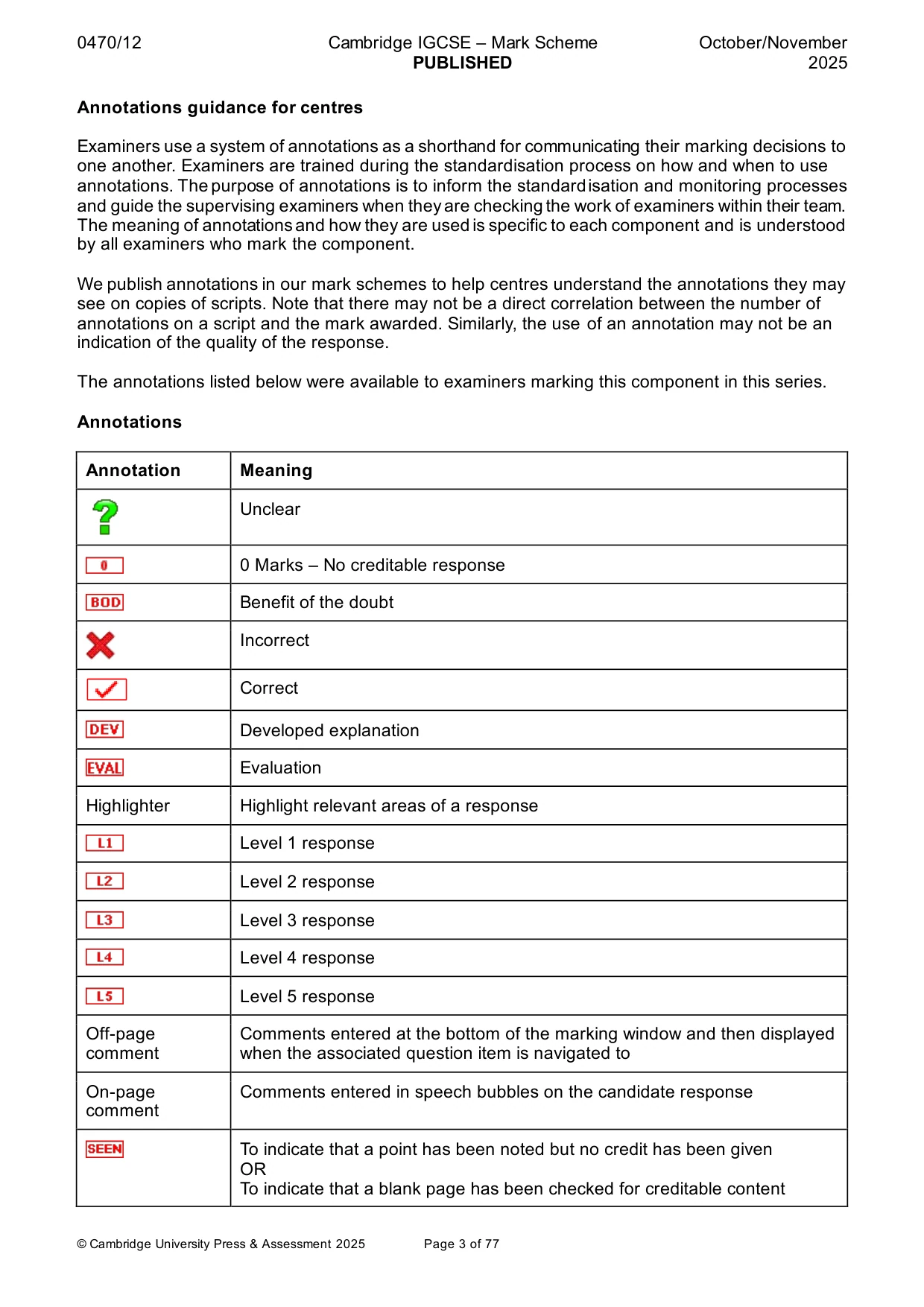
0470/12 Cambridge IGCSE – Mark Scheme PUBLISHED October/November 2025 © Cambridge University Press & Assessment 2025 Page 3 of 77 Annotations guidance for centres Examiners use a system of annotations as a shorthand for communicating their marking decisions to one another. Examiners are trained during the standardisation process on how and when to use annotations. The purpose of annotations is to inform the standardisation and monitoring processes and guide the supervising examiners when they are checking the work of examiners within their team. The meaning of annotations and how they are used is specific to each component and is understood by all examiners who mark the component. We publish annotations in our mark schemes to help centres understand the annotations they may see on copies of scripts. Note that there may not be a direct correlation between the number of annotations on a script and the mark awarded. Similarly, the use of an annotation may not be an indication of the quality of the response. The annotations listed below were available to examiners marking this component in this series. Annotations Annotation Meaning Unclear 0 Marks – No creditable response Benefit of the doubt Incorrect Correct Developed explanation Evaluation Highlighter Highlight relevant areas of a response Level 1 response Level 2 response Level 3 response Level 4 response Level 5 response Off-page comment Comments entered at the bottom of the marking window and then displayed when the associated question item is navigated to On-page comment Comments entered in speech bubbles on the candidate response To indicate that a point has been noted but no credit has been given OR To indicate that a blank page has been checked for creditable content
Mark scheme, page 4
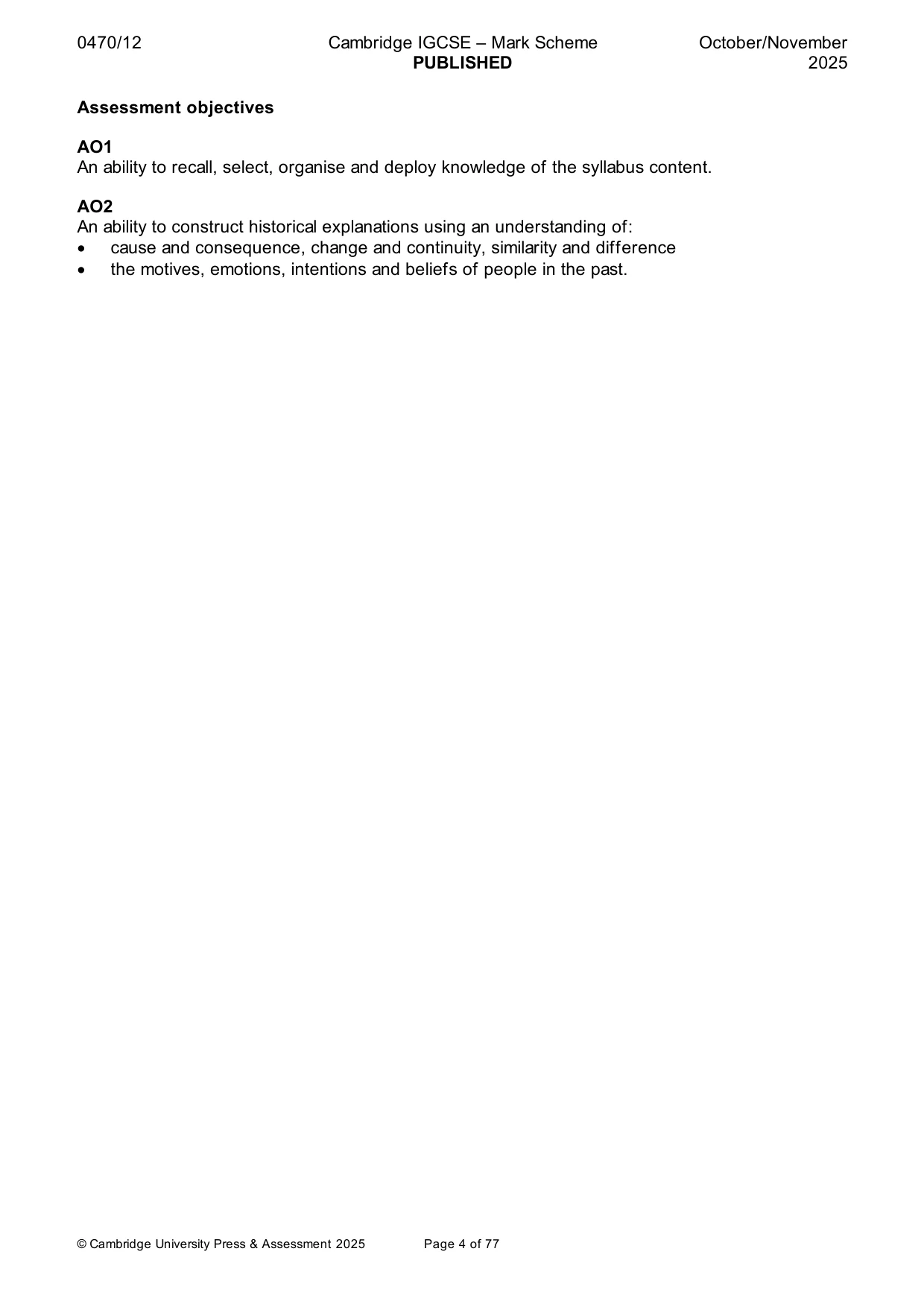
0470/12 Cambridge IGCSE – Mark Scheme PUBLISHED October/November 2025 © Cambridge University Press & Assessment 2025 Page 4 of 77 Assessment objectives AO1 An ability to recall, select, organise and deploy knowledge of the syllabus content. AO2 An ability to construct historical explanations using an understanding of: • cause and consequence, change and continuity, similarity and difference • the motives, emotions, intentions and beliefs of people in the past.
Mark scheme, page 5
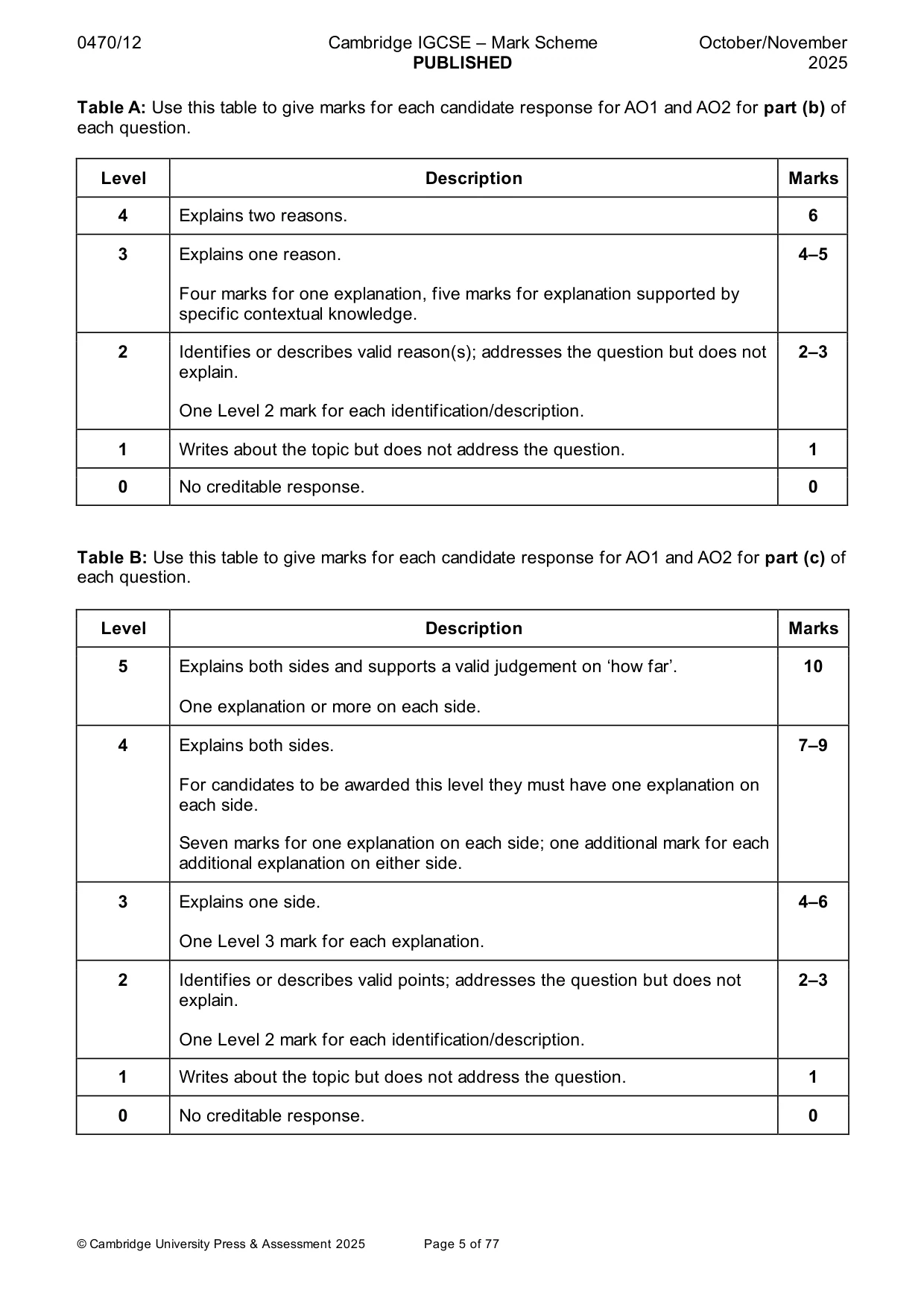
0470/12 Cambridge IGCSE – Mark Scheme PUBLISHED October/November 2025 © Cambridge University Press & Assessment 2025 Page 5 of 77 Table A: Use this table to give marks for each candidate response for AO1 and AO2 for part (b) of each question. Level Description Marks 4 Explains two reasons. 6 3 Explains one reason. Four marks for one explanation, five marks for explanation supported by specific contextual knowledge. 4–5 2 Identifies or describes valid reason(s); addresses the question but does not explain. One Level 2 mark for each identification/description. 2–3 1 Writes about the topic but does not address the question. 1 0 No creditable response. 0 Table B: Use this table to give marks for each candidate response for AO1 and AO2 for part (c) of each question. Level Description Marks 5 Explains both sides and supports a valid judgement on ‘how far’. One explanation or more on each side. 10 4 Explains both sides. For candidates to be awarded this level they must have one explanation on each side. Seven marks for one explanation on each side; one additional mark for each additional explanation on either side. 7–9 3 Explains one side. One Level 3 mark for each explanation. 4–6 2 Identifies or describes valid points; addresses the question but does not explain. One Level 2 mark for each identification/description. 2–3 1 Writes about the topic but does not address the question. 1 0 No creditable response. 0
Mark scheme, page 6
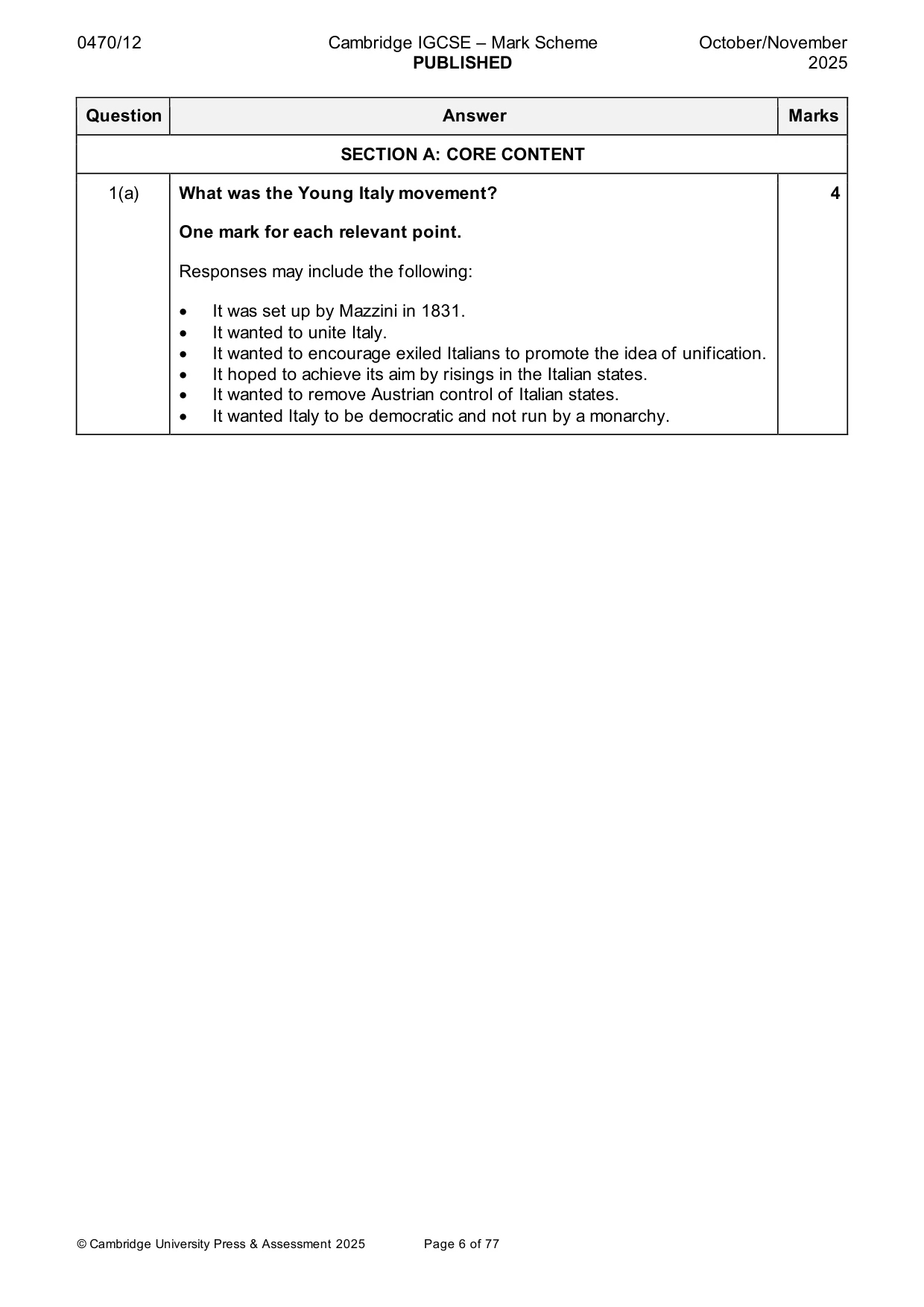
0470/12 Cambridge IGCSE – Mark Scheme PUBLISHED October/November 2025 © Cambridge University Press & Assessment 2025 Page 6 of 77 Question Answer Marks SECTION A: CORE CONTENT 1(a) What was the Young Italy movement? One mark for each relevant point. Responses may include the following: • It was set up by Mazzini in 1831. • It wanted to unite Italy. • It wanted to encourage exiled Italians to promote the idea of unification. • It hoped to achieve its aim by risings in the Italian states. • It wanted to remove Austrian control of Italian states. • It wanted Italy to be democratic and not run by a monarchy. 4
Mark scheme, page 7
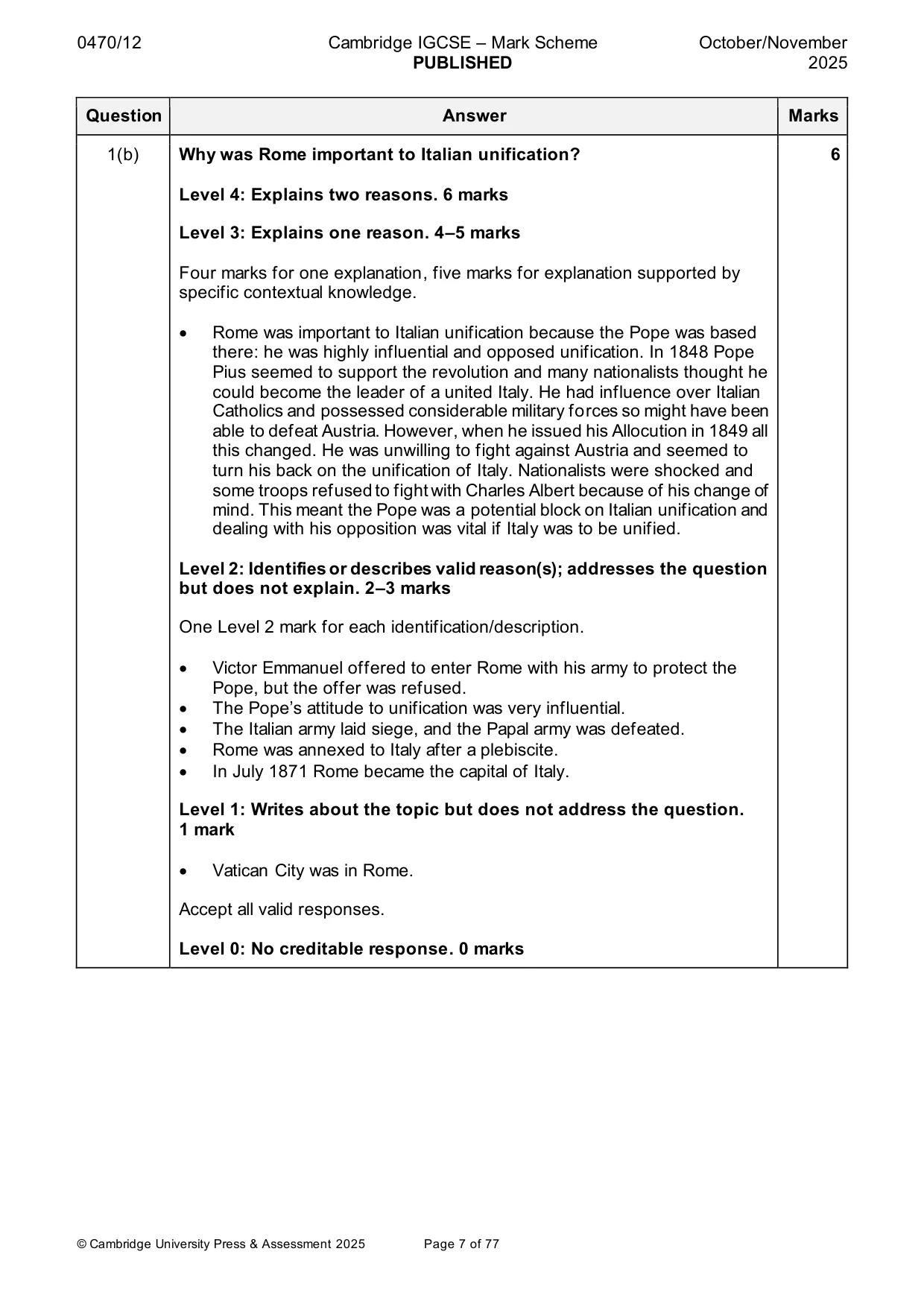
0470/12 Cambridge IGCSE – Mark Scheme PUBLISHED October/November 2025 © Cambridge University Press & Assessment 2025 Page 7 of 77 Question Answer Marks 1(b) Why was Rome important to Italian unification? Level 4: Explains two reasons. 6 marks Level 3: Explains one reason. 4–5 marks Four marks for one explanation, five marks for explanation supported by specific contextual knowledge. • Rome was important to Italian unification because the Pope was based there: he was highly influential and opposed unification. In 1848 Pope Pius seemed to support the revolution and many nationalists thought he could become the leader of a united Italy. He had influence over Italian Catholics and possessed considerable military forces so might have been able to defeat Austria. However, when he issued his Allocution in 1849 all this changed. He was unwilling to fight against Austria and seemed to turn his back on the unification of Italy. Nationalists were shocked and some troops refused to fight with Charles Albert because of his change of mind. This meant the Pope was a potential block on Italian unification and dealing with his opposition was vital if Italy was to be unified. Level 2: Identifies or describes valid reason(s); addresses the question but does not explain. 2–3 marks One Level 2 mark for each identification/description. • Victor Emmanuel offered to enter Rome with his army to protect the Pope, but the offer was refused. • The Pope’s attitude to unification was very influential. • The Italian army laid siege, and the Papal army was defeated. • Rome was annexed to Italy after a plebiscite. • In July 1871 Rome became the capital of Italy. Level 1: Writes about the topic but does not address the question. 1 mark • Vatican City was in Rome. Accept all valid responses. Level 0: No creditable response. 0 marks 6
Mark scheme, page 8
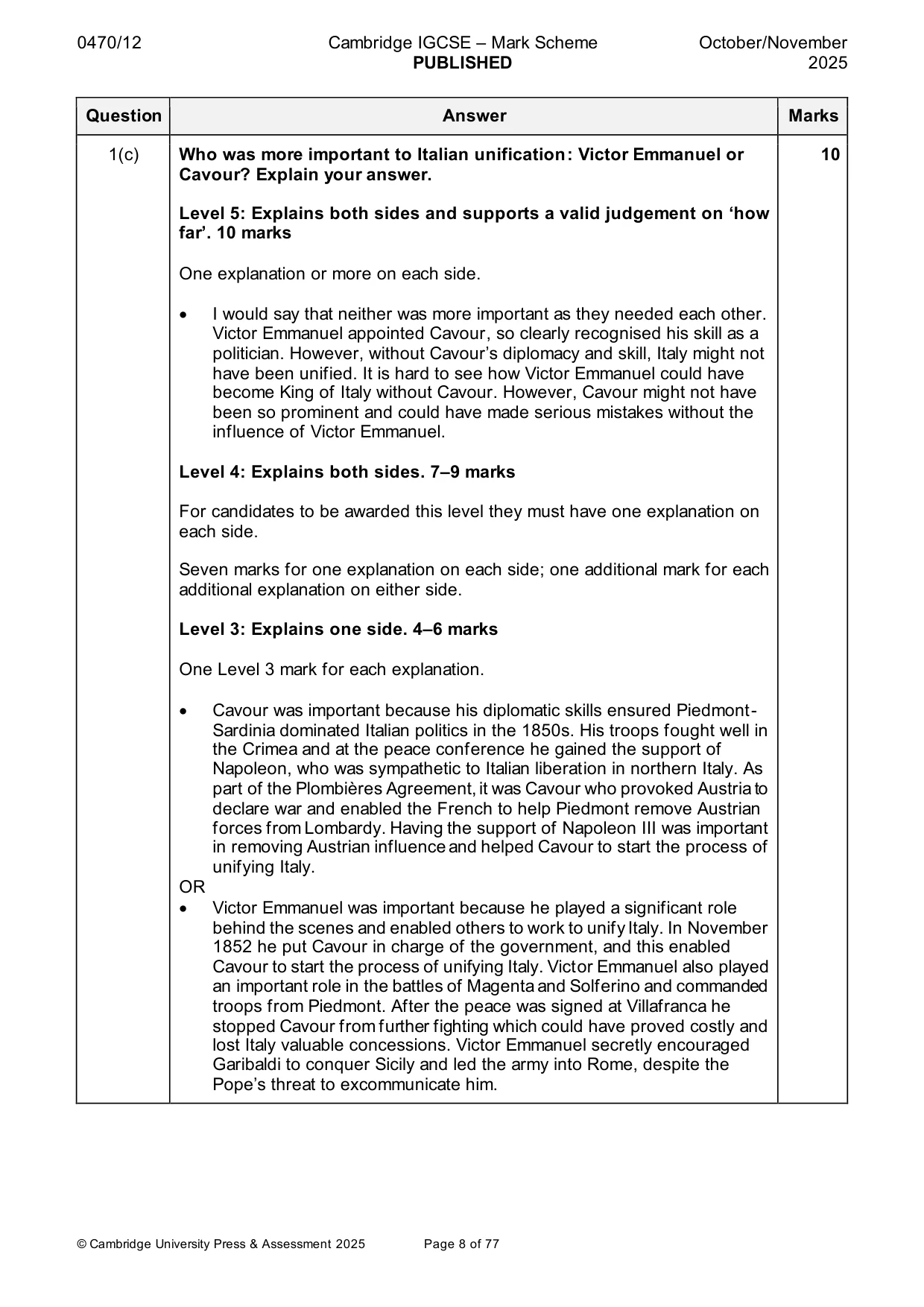
0470/12 Cambridge IGCSE – Mark Scheme PUBLISHED October/November 2025 © Cambridge University Press & Assessment 2025 Page 8 of 77 Question Answer Marks 1(c) Who was more important to Italian unification: Victor Emmanuel or Cavour? Explain your answer. Level 5: Explains both sides and supports a valid judgement on ‘how far’. 10 marks One explanation or more on each side. • I would say that neither was more important as they needed each other. Victor Emmanuel appointed Cavour, so clearly recognised his skill as a politician. However, without Cavour’s diplomacy and skill, Italy might not have been unified. It is hard to see how Victor Emmanuel could have become King of Italy without Cavour. However, Cavour might not have been so prominent and could have made serious mistakes without the influence of Victor Emmanuel. Level 4: Explains both sides. 7–9 marks For candidates to be awarded this level they must have one explanation on each side. Seven marks for one explanation on each side; one additional mark for each additional explanation on either side. Level 3: Explains one side. 4–6 marks One Level 3 mark for each explanation. • Cavour was important because his diplomatic skills ensured Piedmont- Sardinia dominated Italian politics in the 1850s. His troops fought well in the Crimea and at the peace conference he gained the support of Napoleon, who was sympathetic to Italian liberation in northern Italy. As part of the Plombières Agreement, it was Cavour who provoked Austria to declare war and enabled the French to help Piedmont remove Austrian forces from Lombardy. Having the support of Napoleon III was important in removing Austrian influence and helped Cavour to start the process of unifying Italy. OR • Victor Emmanuel was important because he played a significant role behind the scenes and enabled others to work to unify Italy. In November 1852 he put Cavour in charge of the government, and this enabled Cavour to start the process of unifying Italy. Victor Emmanuel also played an important role in the battles of Magenta and Solferino and commanded troops from Piedmont. After the peace was signed at Villafranca he stopped Cavour from further fighting which could have proved costly and lost Italy valuable concessions. Victor Emmanuel secretly encouraged Garibaldi to conquer Sicily and led the army into Rome, despite the Pope’s threat to excommunicate him. 10
Mark scheme, page 9
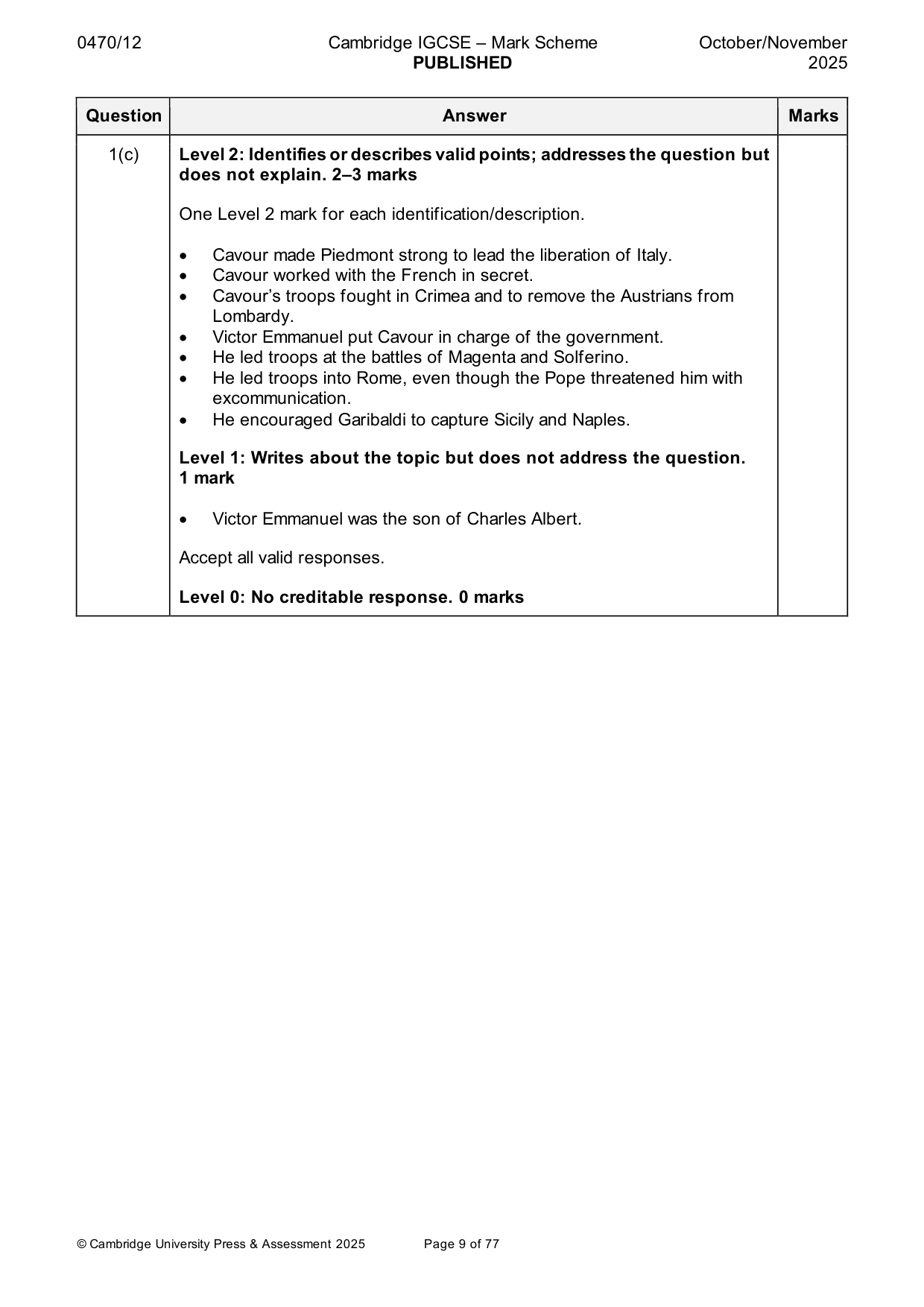
0470/12 Cambridge IGCSE – Mark Scheme PUBLISHED October/November 2025 © Cambridge University Press & Assessment 2025 Page 9 of 77 Question Answer Marks 1(c) Level 2: Identifies or describes valid points; addresses the question but does not explain. 2–3 marks One Level 2 mark for each identification/description. • Cavour made Piedmont strong to lead the liberation of Italy. • Cavour worked with the French in secret. • Cavour’s troops fought in Crimea and to remove the Austrians from Lombardy. • Victor Emmanuel put Cavour in charge of the government. • He led troops at the battles of Magenta and Solferino. • He led troops into Rome, even though the Pope threatened him with excommunication. • He encouraged Garibaldi to capture Sicily and Naples. Level 1: Writes about the topic but does not address the question. 1 mark • Victor Emmanuel was the son of Charles Albert. Accept all valid responses. Level 0: No creditable response. 0 marks
Mark scheme, page 10
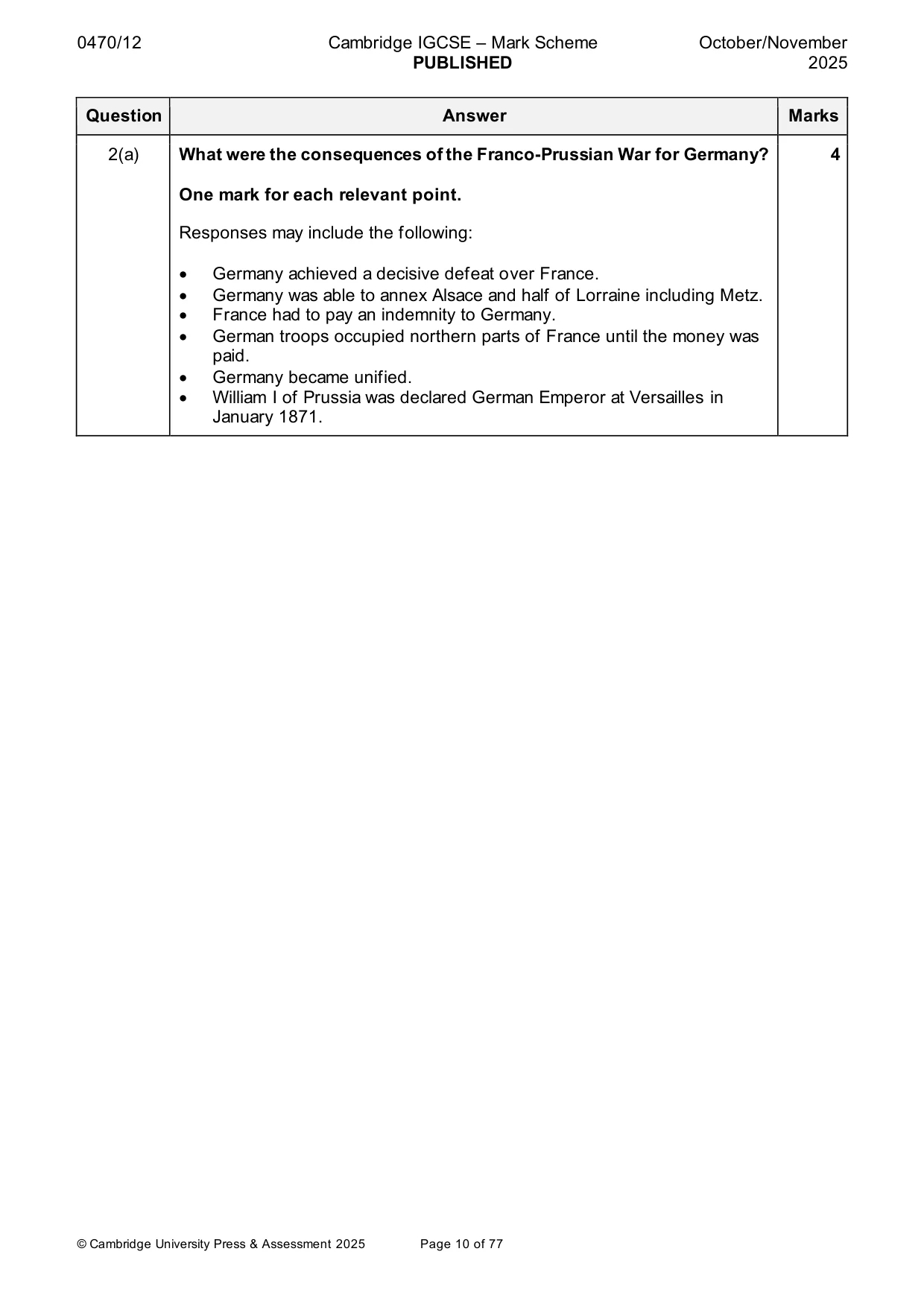
0470/12 Cambridge IGCSE – Mark Scheme PUBLISHED October/November 2025 © Cambridge University Press & Assessment 2025 Page 10 of 77 Question Answer Marks 2(a) What were the consequences of the Franco-Prussian War for Germany? One mark for each relevant point. Responses may include the following: • Germany achieved a decisive defeat over France. • Germany was able to annex Alsace and half of Lorraine including Metz. • France had to pay an indemnity to Germany. • German troops occupied northern parts of France until the money was paid. • Germany became unified. • William I of Prussia was declared German Emperor at Versailles in January 1871. 4
Mark scheme, page 11
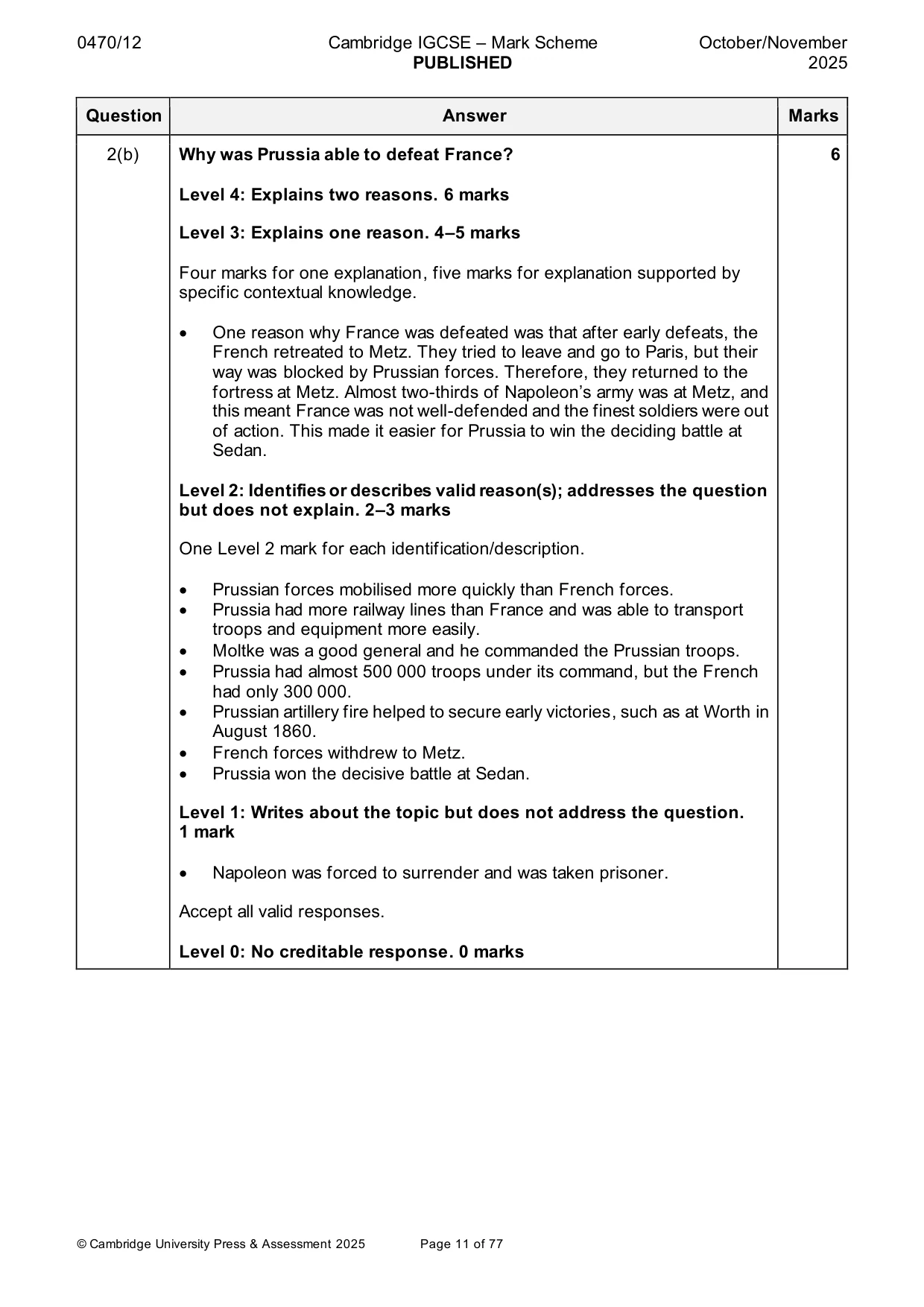
0470/12 Cambridge IGCSE – Mark Scheme PUBLISHED October/November 2025 © Cambridge University Press & Assessment 2025 Page 11 of 77 Question Answer Marks 2(b) Why was Prussia able to defeat France? Level 4: Explains two reasons. 6 marks Level 3: Explains one reason. 4–5 marks Four marks for one explanation, five marks for explanation supported by specific contextual knowledge. • One reason why France was defeated was that after early defeats, the French retreated to Metz. They tried to leave and go to Paris, but their way was blocked by Prussian forces. Therefore, they returned to the fortress at Metz. Almost two-thirds of Napoleon’s army was at Metz, and this meant France was not well-defended and the finest soldiers were out of action. This made it easier for Prussia to win the deciding battle at Sedan. Level 2: Identifies or describes valid reason(s); addresses the question but does not explain. 2–3 marks One Level 2 mark for each identification/description. • Prussian forces mobilised more quickly than French forces. • Prussia had more railway lines than France and was able to transport troops and equipment more easily. • Moltke was a good general and he commanded the Prussian troops. • Prussia had almost 500 000 troops under its command, but the French had only 300 000. • Prussian artillery fire helped to secure early victories, such as at Worth in August 1860. • French forces withdrew to Metz. • Prussia won the decisive battle at Sedan. Level 1: Writes about the topic but does not address the question. 1 mark • Napoleon was forced to surrender and was taken prisoner. Accept all valid responses. Level 0: No creditable response. 0 marks 6
Mark scheme, page 12
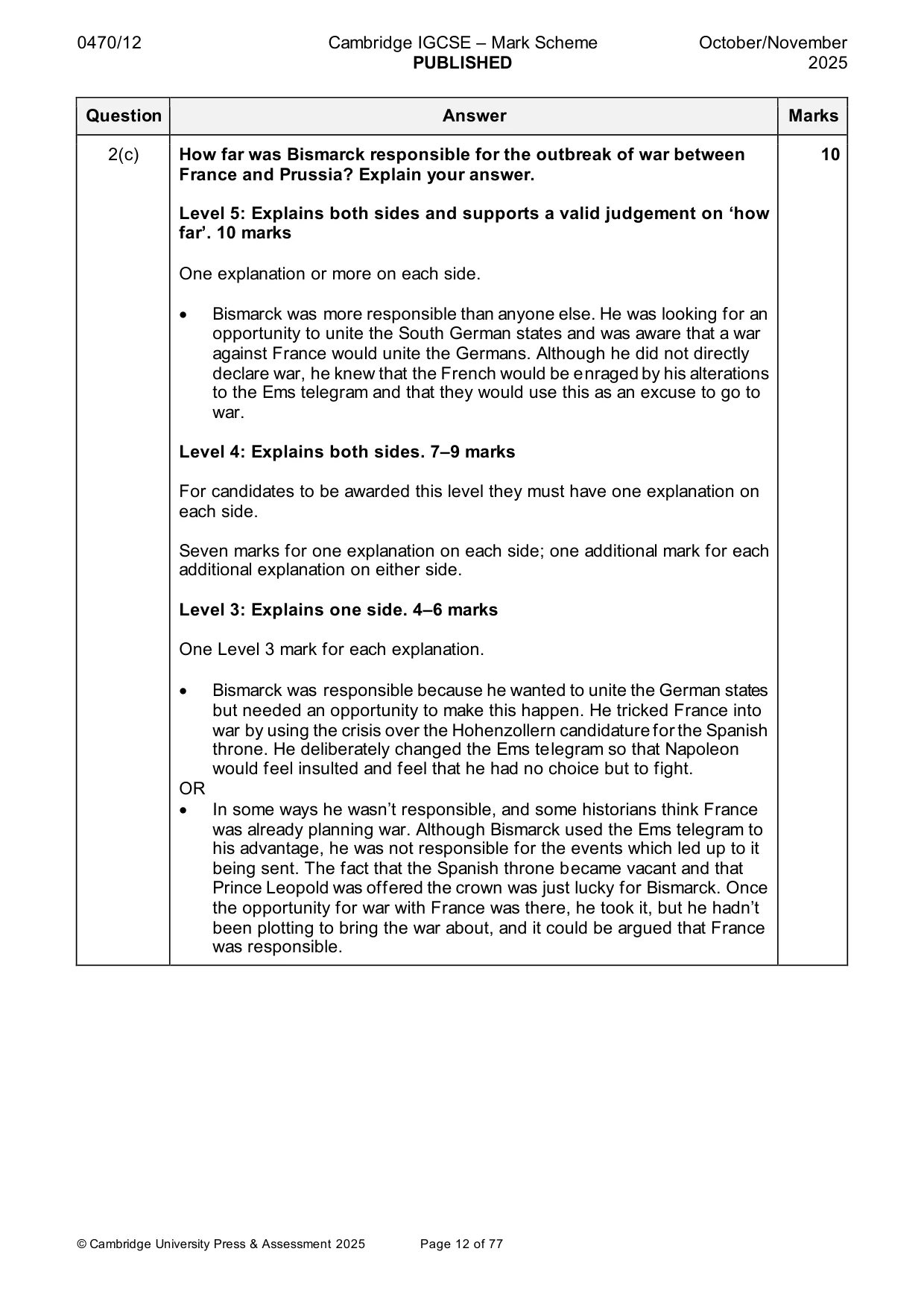
0470/12 Cambridge IGCSE – Mark Scheme PUBLISHED October/November 2025 © Cambridge University Press & Assessment 2025 Page 12 of 77 Question Answer Marks 2(c) How far was Bismarck responsible for the outbreak of war between France and Prussia? Explain your answer. Level 5: Explains both sides and supports a valid judgement on ‘how far’. 10 marks One explanation or more on each side. • Bismarck was more responsible than anyone else. He was looking for an opportunity to unite the South German states and was aware that a war against France would unite the Germans. Although he did not directly declare war, he knew that the French would be enraged by his alterations to the Ems telegram and that they would use this as an excuse to go to war. Level 4: Explains both sides. 7–9 marks For candidates to be awarded this level they must have one explanation on each side. Seven marks for one explanation on each side; one additional mark for each additional explanation on either side. Level 3: Explains one side. 4–6 marks One Level 3 mark for each explanation. • Bismarck was responsible because he wanted to unite the German states but needed an opportunity to make this happen. He tricked France into war by using the crisis over the Hohenzollern candidature for the Spanish throne. He deliberately changed the Ems telegram so that Napoleon would feel insulted and feel that he had no choice but to fight. OR • In some ways he wasn’t responsible, and some historians think France was already planning war. Although Bismarck used the Ems telegram to his advantage, he was not responsible for the events which led up to it being sent. The fact that the Spanish throne became vacant and that Prince Leopold was offered the crown was just lucky for Bismarck. Once the opportunity for war with France was there, he took it, but he hadn’t been plotting to bring the war about, and it could be argued that France was responsible. 10
Mark scheme, page 13
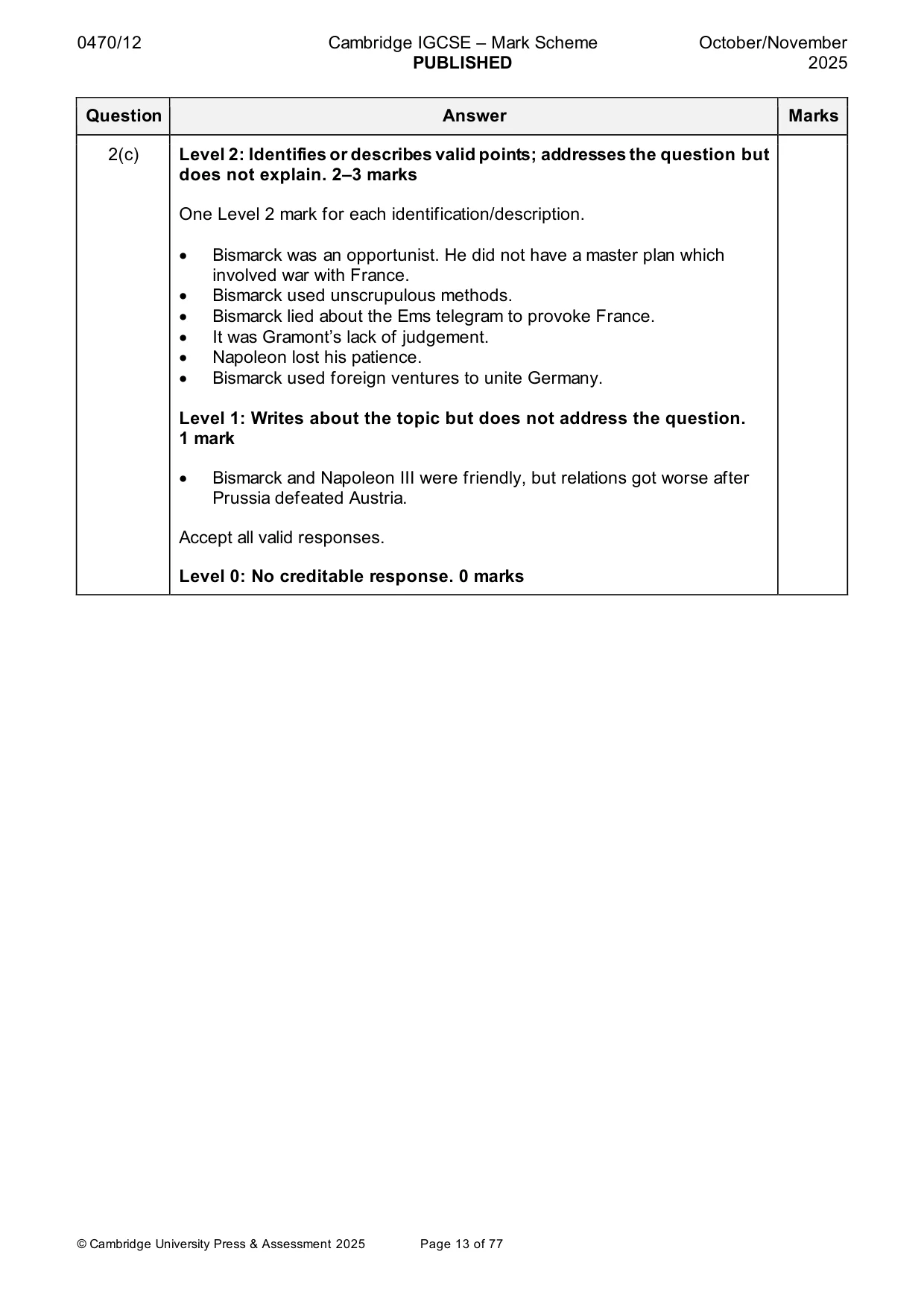
0470/12 Cambridge IGCSE – Mark Scheme PUBLISHED October/November 2025 © Cambridge University Press & Assessment 2025 Page 13 of 77 Question Answer Marks 2(c) Level 2: Identifies or describes valid points; addresses the question but does not explain. 2–3 marks One Level 2 mark for each identification/description. • Bismarck was an opportunist. He did not have a master plan which involved war with France. • Bismarck used unscrupulous methods. • Bismarck lied about the Ems telegram to provoke France. • It was Gramont’s lack of judgement. • Napoleon lost his patience. • Bismarck used foreign ventures to unite Germany. Level 1: Writes about the topic but does not address the question. 1 mark • Bismarck and Napoleon III were friendly, but relations got worse after Prussia defeated Austria. Accept all valid responses. Level 0: No creditable response. 0 marks
Mark scheme, page 14
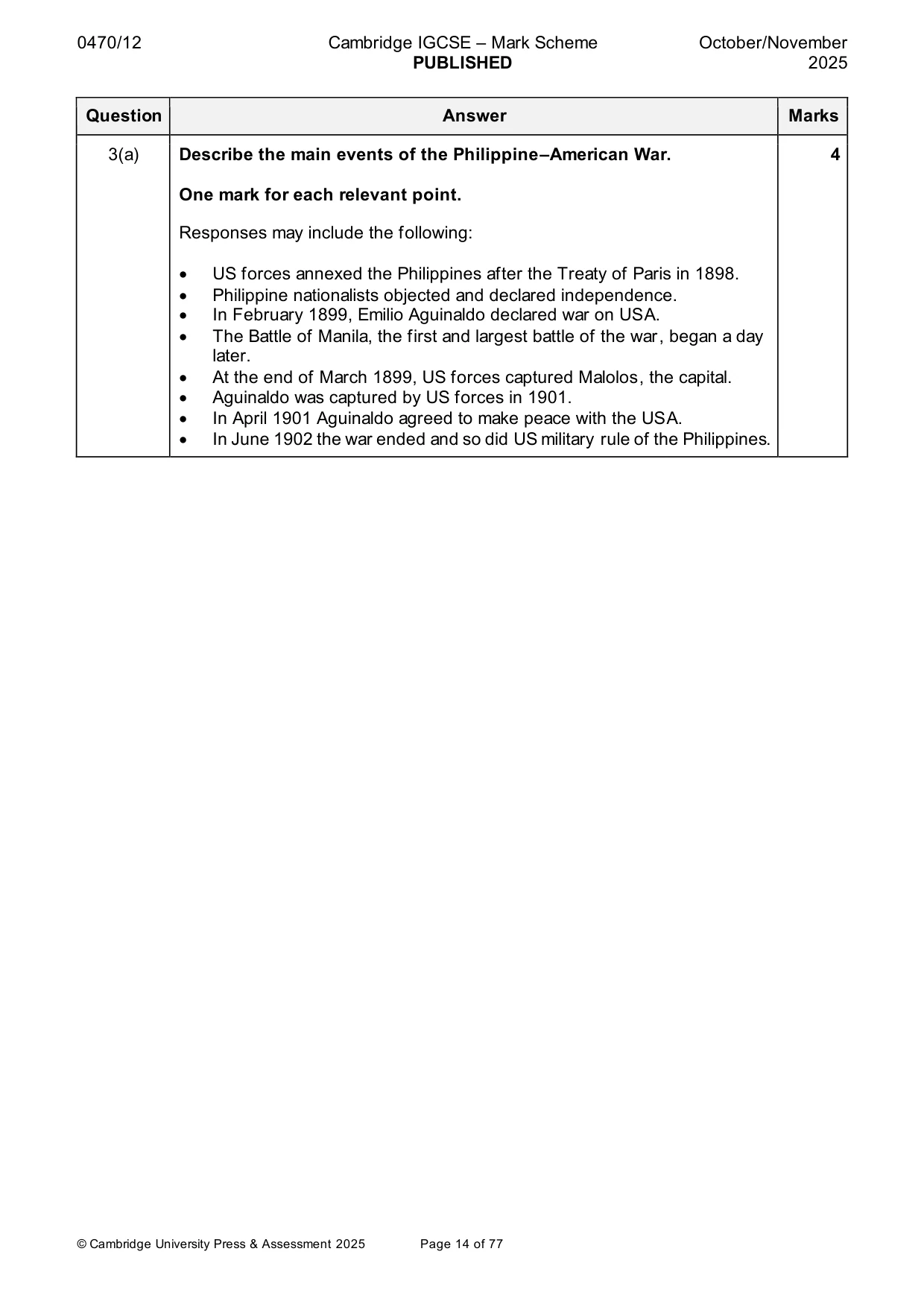
0470/12 Cambridge IGCSE – Mark Scheme PUBLISHED October/November 2025 © Cambridge University Press & Assessment 2025 Page 14 of 77 Question Answer Marks 3(a) Describe the main events of the Philippine–American War. One mark for each relevant point. Responses may include the following: • US forces annexed the Philippines after the Treaty of Paris in 1898. • Philippine nationalists objected and declared independence. • In February 1899, Emilio Aguinaldo declared war on USA. • The Battle of Manila, the first and largest battle of the war, began a day later. • At the end of March 1899, US forces captured Malolos, the capital. • Aguinaldo was captured by US forces in 1901. • In April 1901 Aguinaldo agreed to make peace with the USA. • In June 1902 the war ended and so did US military rule of the Philippines. 4
Mark scheme, page 15
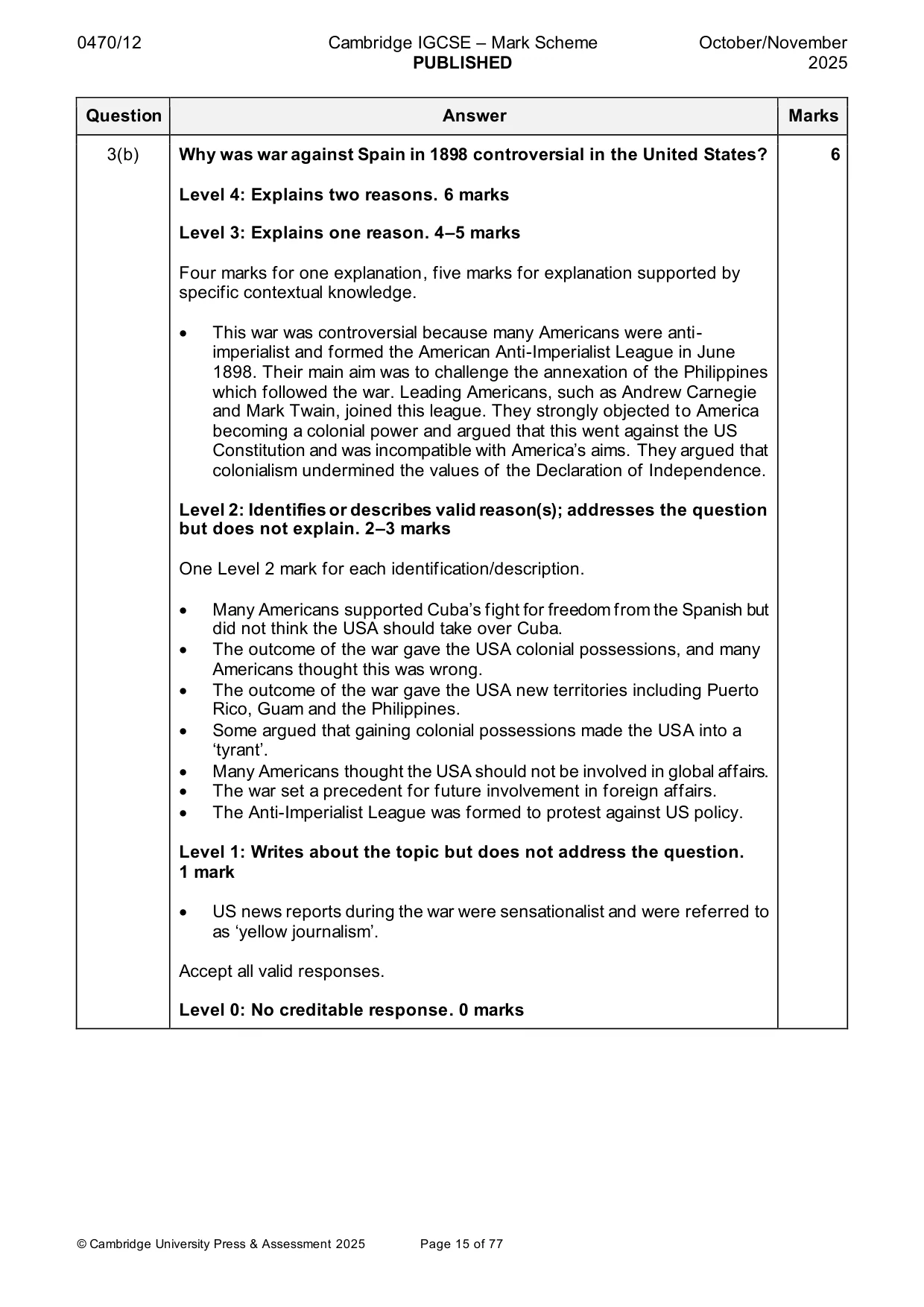
0470/12 Cambridge IGCSE – Mark Scheme PUBLISHED October/November 2025 © Cambridge University Press & Assessment 2025 Page 15 of 77 Question Answer Marks 3(b) Why was war against Spain in 1898 controversial in the United States? Level 4: Explains two reasons. 6 marks Level 3: Explains one reason. 4–5 marks Four marks for one explanation, five marks for explanation supported by specific contextual knowledge. • This war was controversial because many Americans were anti- imperialist and formed the American Anti-Imperialist League in June 1898. Their main aim was to challenge the annexation of the Philippines which followed the war. Leading Americans, such as Andrew Carnegie and Mark Twain, joined this league. They strongly objected to America becoming a colonial power and argued that this went against the US Constitution and was incompatible with America’s aims. They argued that colonialism undermined the values of the Declaration of Independence. Level 2: Identifies or describes valid reason(s); addresses the question but does not explain. 2–3 marks One Level 2 mark for each identification/description. • Many Americans supported Cuba’s fight for freedom from the Spanish but did not think the USA should take over Cuba. • The outcome of the war gave the USA colonial possessions, and many Americans thought this was wrong. • The outcome of the war gave the USA new territories including Puerto Rico, Guam and the Philippines. • Some argued that gaining colonial possessions made the USA into a ‘tyrant’. • Many Americans thought the USA should not be involved in global affairs. • The war set a precedent for future involvement in foreign affairs. • The Anti-Imperialist League was formed to protest against US policy. Level 1: Writes about the topic but does not address the question. 1 mark • US news reports during the war were sensationalist and were referred to as ‘yellow journalism’. Accept all valid responses. Level 0: No creditable response. 0 marks 6
Mark scheme, page 16
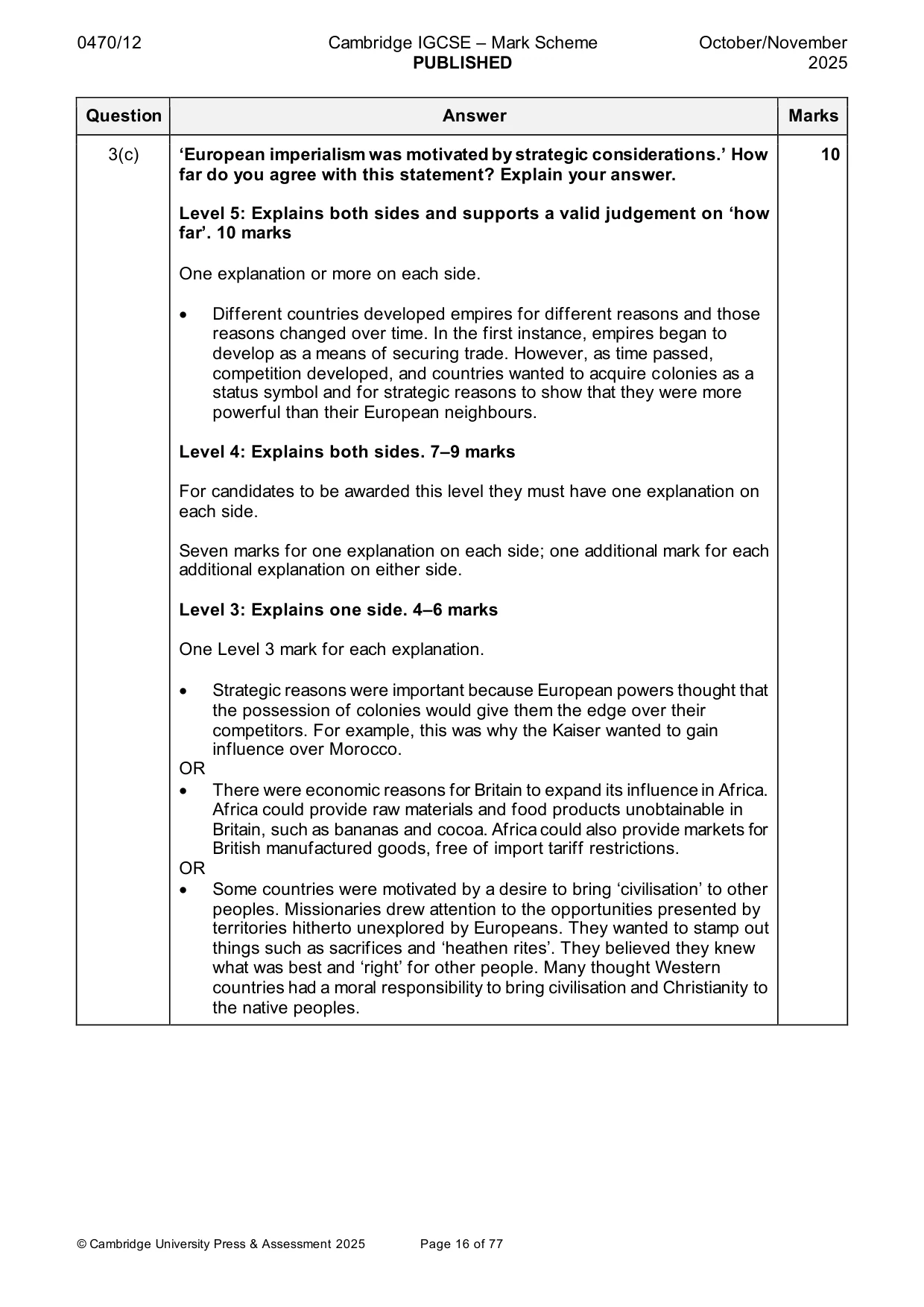
0470/12 Cambridge IGCSE – Mark Scheme PUBLISHED October/November 2025 © Cambridge University Press & Assessment 2025 Page 16 of 77 Question Answer Marks 3(c) ‘European imperialism was motivated by strategic considerations.’ How far do you agree with this statement? Explain your answer. Level 5: Explains both sides and supports a valid judgement on ‘how far’. 10 marks One explanation or more on each side. • Different countries developed empires for different reasons and those reasons changed over time. In the first instance, empires began to develop as a means of securing trade. However, as time passed, competition developed, and countries wanted to acquire colonies as a status symbol and for strategic reasons to show that they were more powerful than their European neighbours. Level 4: Explains both sides. 7–9 marks For candidates to be awarded this level they must have one explanation on each side. Seven marks for one explanation on each side; one additional mark for each additional explanation on either side. Level 3: Explains one side. 4–6 marks One Level 3 mark for each explanation. • Strategic reasons were important because European powers thought that the possession of colonies would give them the edge over their competitors. For example, this was why the Kaiser wanted to gain influence over Morocco. OR • There were economic reasons for Britain to expand its influence in Africa. Africa could provide raw materials and food products unobtainable in Britain, such as bananas and cocoa. Africa could also provide markets for British manufactured goods, free of import tariff restrictions. OR • Some countries were motivated by a desire to bring ‘civilisation’ to other peoples. Missionaries drew attention to the opportunities presented by territories hitherto unexplored by Europeans. They wanted to stamp out things such as sacrifices and ‘heathen rites’. They believed they knew what was best and ‘right’ for other people. Many thought Western countries had a moral responsibility to bring civilisation and Christianity to the native peoples. 10
Mark scheme, page 17
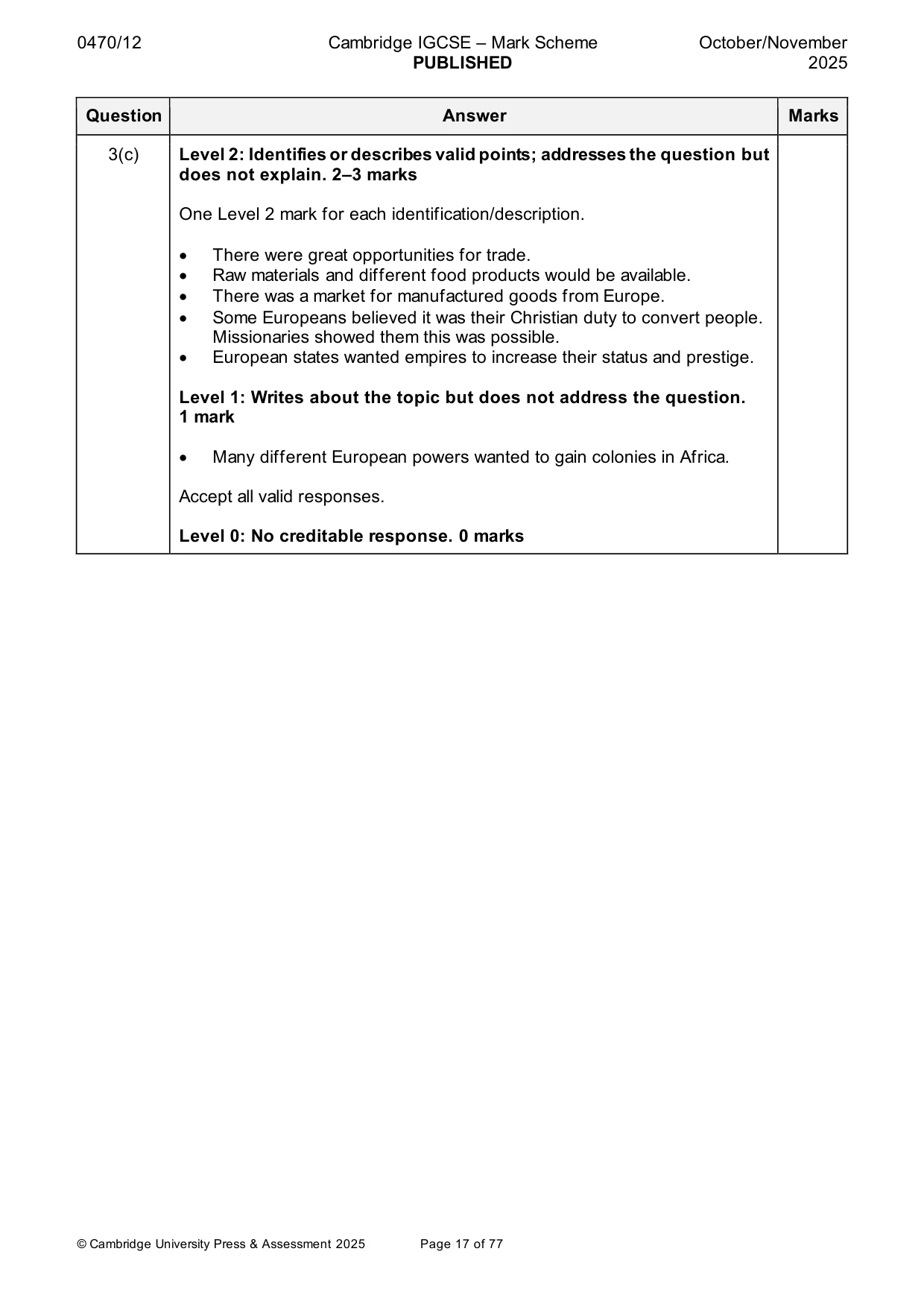
0470/12 Cambridge IGCSE – Mark Scheme PUBLISHED October/November 2025 © Cambridge University Press & Assessment 2025 Page 17 of 77 Question Answer Marks 3(c) Level 2: Identifies or describes valid points; addresses the question but does not explain. 2–3 marks One Level 2 mark for each identification/description. • There were great opportunities for trade. • Raw materials and different food products would be available. • There was a market for manufactured goods from Europe. • Some Europeans believed it was their Christian duty to convert people. Missionaries showed them this was possible. • European states wanted empires to increase their status and prestige. Level 1: Writes about the topic but does not address the question. 1 mark • Many different European powers wanted to gain colonies in Africa. Accept all valid responses. Level 0: No creditable response. 0 marks
Mark scheme, page 18
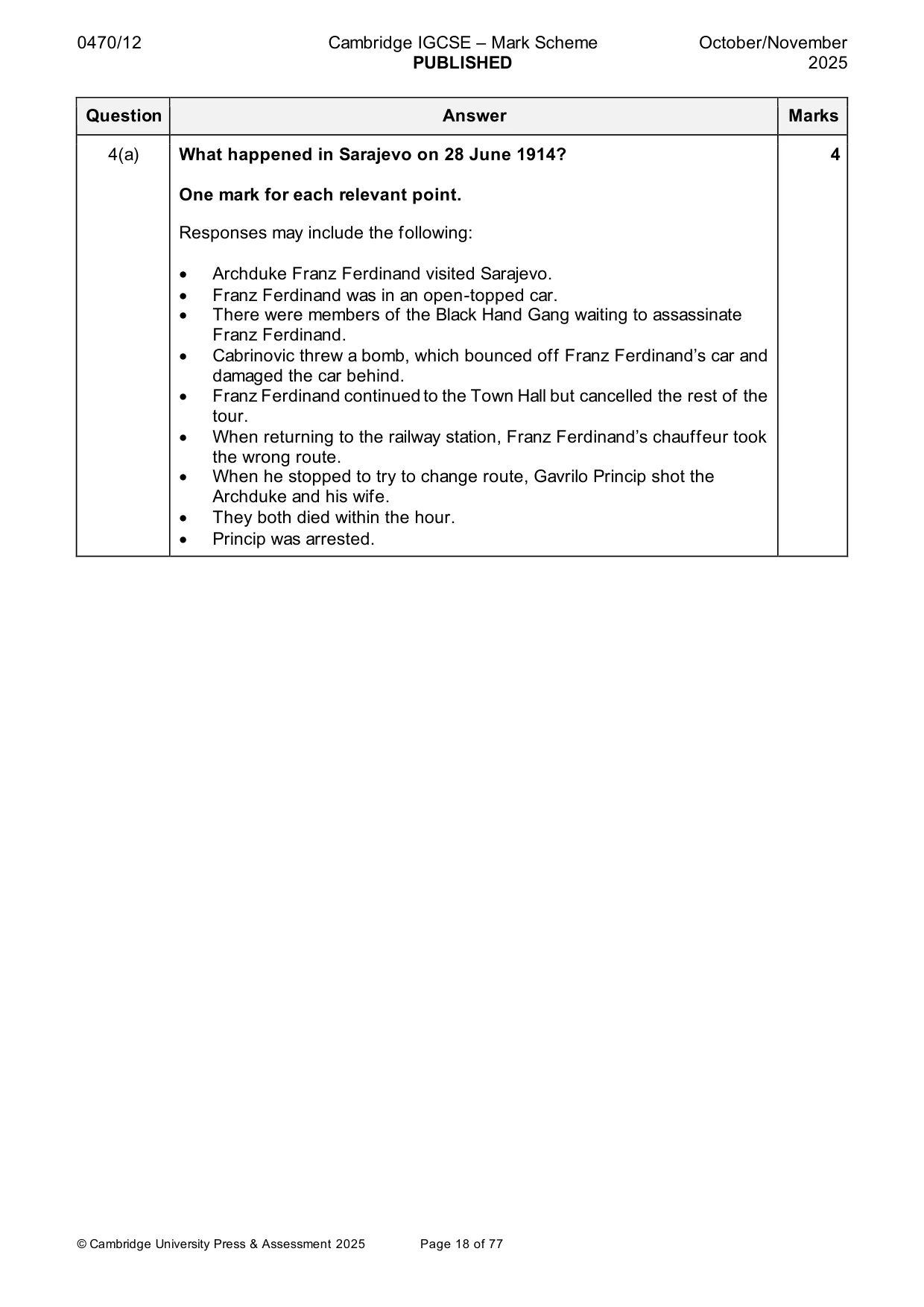
0470/12 Cambridge IGCSE – Mark Scheme PUBLISHED October/November 2025 © Cambridge University Press & Assessment 2025 Page 18 of 77 Question Answer Marks 4(a) What happened in Sarajevo on 28 June 1914? One mark for each relevant point. Responses may include the following: • Archduke Franz Ferdinand visited Sarajevo. • Franz Ferdinand was in an open-topped car. • There were members of the Black Hand Gang waiting to assassinate Franz Ferdinand. • Cabrinovic threw a bomb, which bounced off Franz Ferdinand’s car and damaged the car behind. • Franz Ferdinand continued to the Town Hall but cancelled the rest of the tour. • When returning to the railway station, Franz Ferdinand’s chauffeur took the wrong route. • When he stopped to try to change route, Gavrilo Princip shot the Archduke and his wife. • They both died within the hour. • Princip was arrested. 4
Mark scheme, page 19
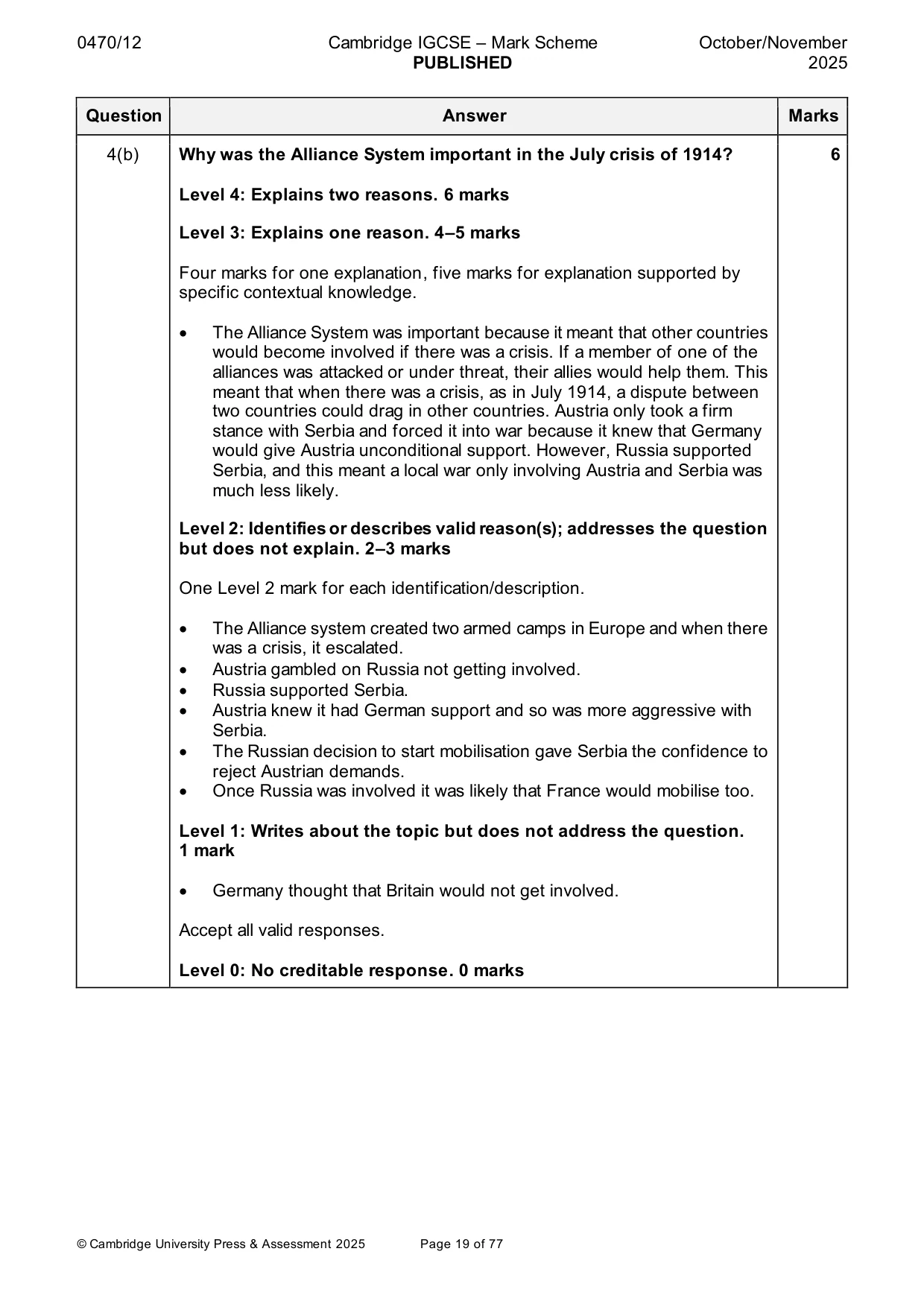
0470/12 Cambridge IGCSE – Mark Scheme PUBLISHED October/November 2025 © Cambridge University Press & Assessment 2025 Page 19 of 77 Question Answer Marks 4(b) Why was the Alliance System important in the July crisis of 1914? Level 4: Explains two reasons. 6 marks Level 3: Explains one reason. 4–5 marks Four marks for one explanation, five marks for explanation supported by specific contextual knowledge. • The Alliance System was important because it meant that other countries would become involved if there was a crisis. If a member of one of the alliances was attacked or under threat, their allies would help them. This meant that when there was a crisis, as in July 1914, a dispute between two countries could drag in other countries. Austria only took a firm stance with Serbia and forced it into war because it knew that Germany would give Austria unconditional support. However, Russia supported Serbia, and this meant a local war only involving Austria and Serbia was much less likely. Level 2: Identifies or describes valid reason(s); addresses the question but does not explain. 2–3 marks One Level 2 mark for each identification/description. • The Alliance system created two armed camps in Europe and when there was a crisis, it escalated. • Austria gambled on Russia not getting involved. • Russia supported Serbia. • Austria knew it had German support and so was more aggressive with Serbia. • The Russian decision to start mobilisation gave Serbia the confidence to reject Austrian demands. • Once Russia was involved it was likely that France would mobilise too. Level 1: Writes about the topic but does not address the question. 1 mark • Germany thought that Britain would not get involved. Accept all valid responses. Level 0: No creditable response. 0 marks 6
Mark scheme, page 20
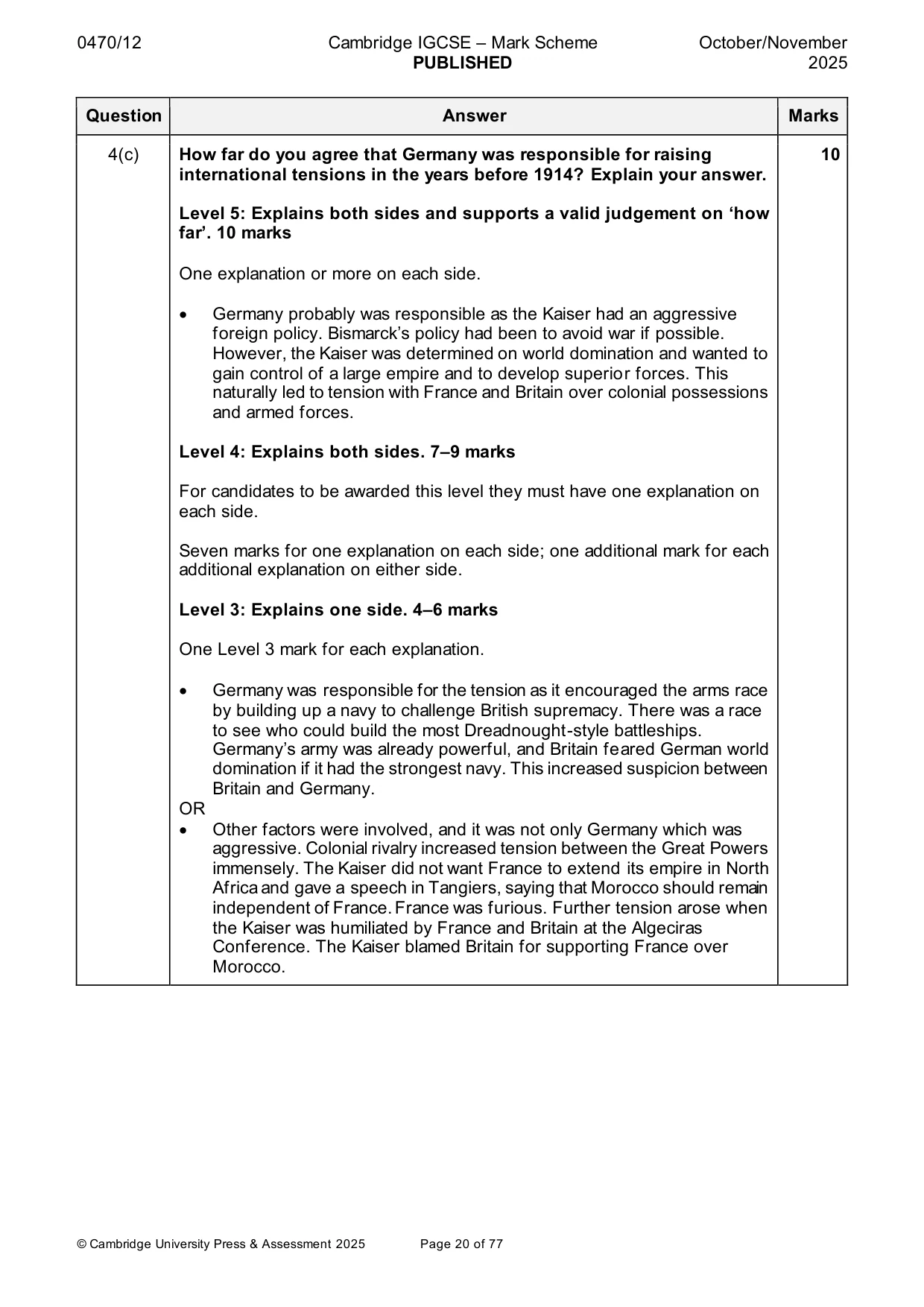
0470/12 Cambridge IGCSE – Mark Scheme PUBLISHED October/November 2025 © Cambridge University Press & Assessment 2025 Page 20 of 77 Question Answer Marks 4(c) How far do you agree that Germany was responsible for raising international tensions in the years before 1914? Explain your answer. Level 5: Explains both sides and supports a valid judgement on ‘how far’. 10 marks One explanation or more on each side. • Germany probably was responsible as the Kaiser had an aggressive foreign policy. Bismarck’s policy had been to avoid war if possible. However, the Kaiser was determined on world domination and wanted to gain control of a large empire and to develop superior forces. This naturally led to tension with France and Britain over colonial possessions and armed forces. Level 4: Explains both sides. 7–9 marks For candidates to be awarded this level they must have one explanation on each side. Seven marks for one explanation on each side; one additional mark for each additional explanation on either side. Level 3: Explains one side. 4–6 marks One Level 3 mark for each explanation. • Germany was responsible for the tension as it encouraged the arms race by building up a navy to challenge British supremacy. There was a race to see who could build the most Dreadnought-style battleships. Germany’s army was already powerful, and Britain feared German world domination if it had the strongest navy. This increased suspicion between Britain and Germany. OR • Other factors were involved, and it was not only Germany which was aggressive. Colonial rivalry increased tension between the Great Powers immensely. The Kaiser did not want France to extend its empire in North Africa and gave a speech in Tangiers, saying that Morocco should remain independent of France. France was furious. Further tension arose when the Kaiser was humiliated by France and Britain at the Algeciras Conference. The Kaiser blamed Britain for supporting France over Morocco. 10
Mark scheme, page 21
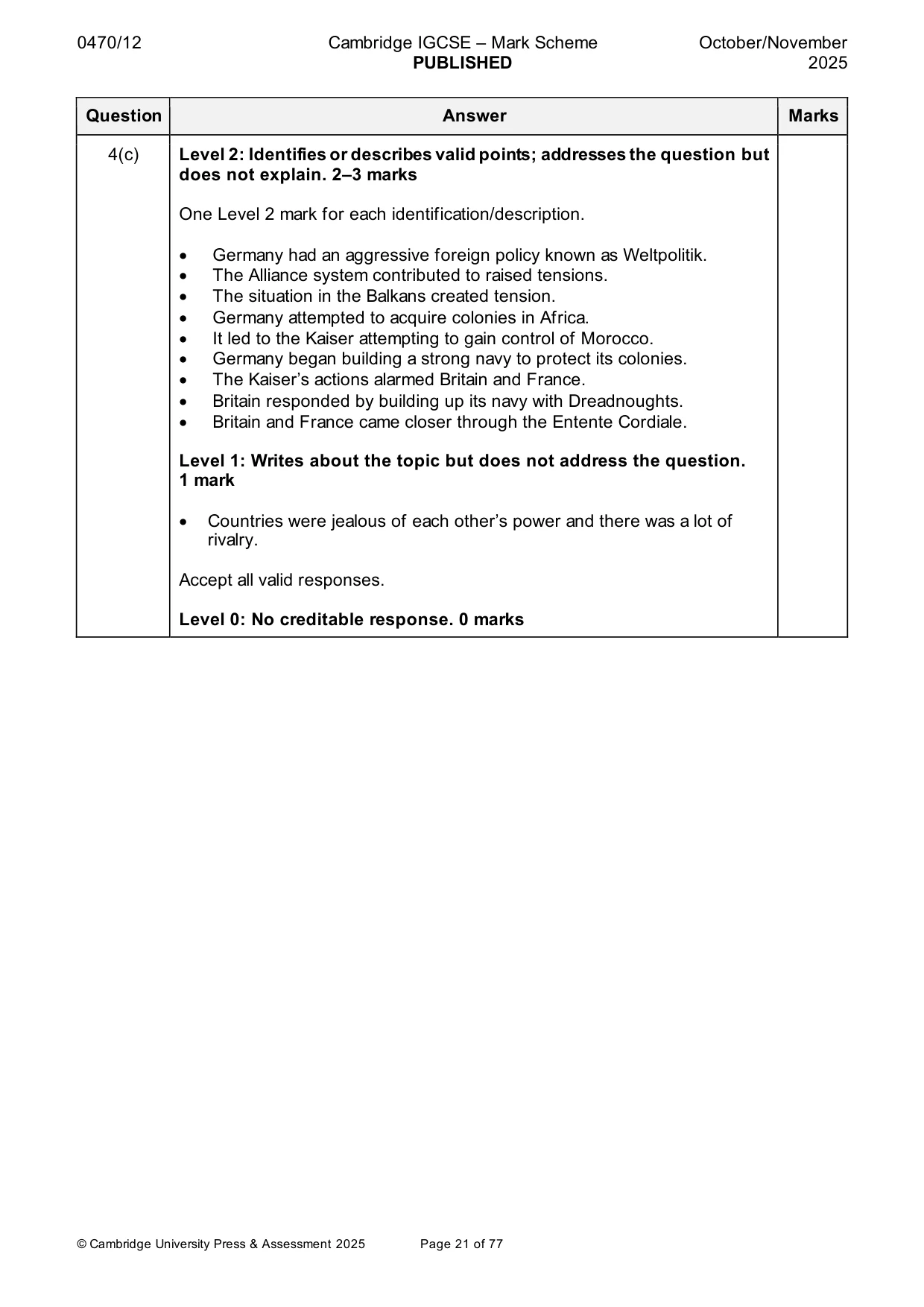
0470/12 Cambridge IGCSE – Mark Scheme PUBLISHED October/November 2025 © Cambridge University Press & Assessment 2025 Page 21 of 77 Question Answer Marks 4(c) Level 2: Identifies or describes valid points; addresses the question but does not explain. 2–3 marks One Level 2 mark for each identification/description. • Germany had an aggressive foreign policy known as Weltpolitik. • The Alliance system contributed to raised tensions. • The situation in the Balkans created tension. • Germany attempted to acquire colonies in Africa. • It led to the Kaiser attempting to gain control of Morocco. • Germany began building a strong navy to protect its colonies. • The Kaiser’s actions alarmed Britain and France. • Britain responded by building up its navy with Dreadnoughts. • Britain and France came closer through the Entente Cordiale. Level 1: Writes about the topic but does not address the question. 1 mark • Countries were jealous of each other’s power and there was a lot of rivalry. Accept all valid responses. Level 0: No creditable response. 0 marks
Mark scheme, page 22
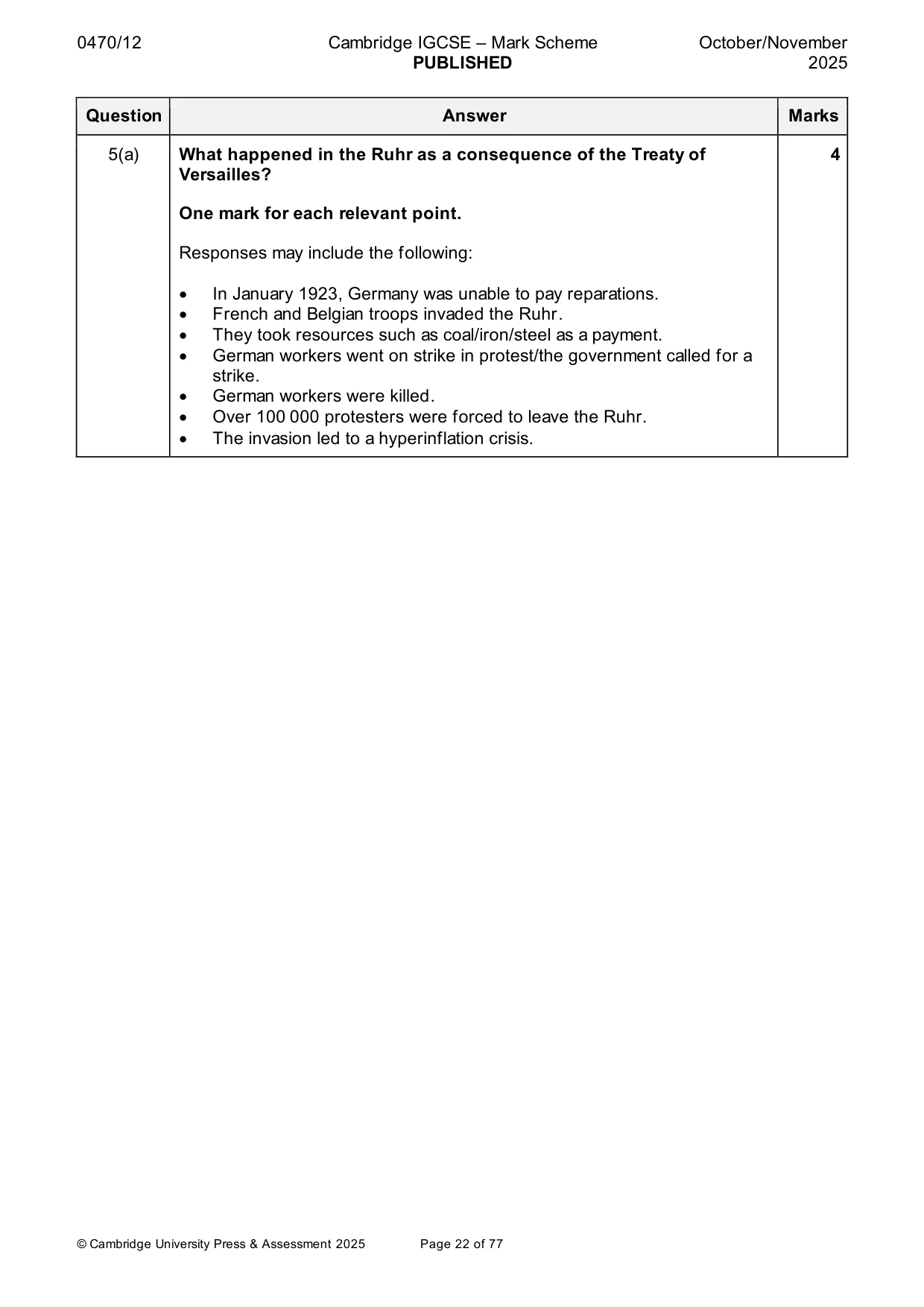
0470/12 Cambridge IGCSE – Mark Scheme PUBLISHED October/November 2025 © Cambridge University Press & Assessment 2025 Page 22 of 77 Question Answer Marks 5(a) What happened in the Ruhr as a consequence of the Treaty of Versailles? One mark for each relevant point. Responses may include the following: • In January 1923, Germany was unable to pay reparations. • French and Belgian troops invaded the Ruhr. • They took resources such as coal/iron/steel as a payment. • German workers went on strike in protest/the government called for a strike. • German workers were killed. • Over 100 000 protesters were forced to leave the Ruhr. • The invasion led to a hyperinflation crisis. 4
Mark scheme, page 23
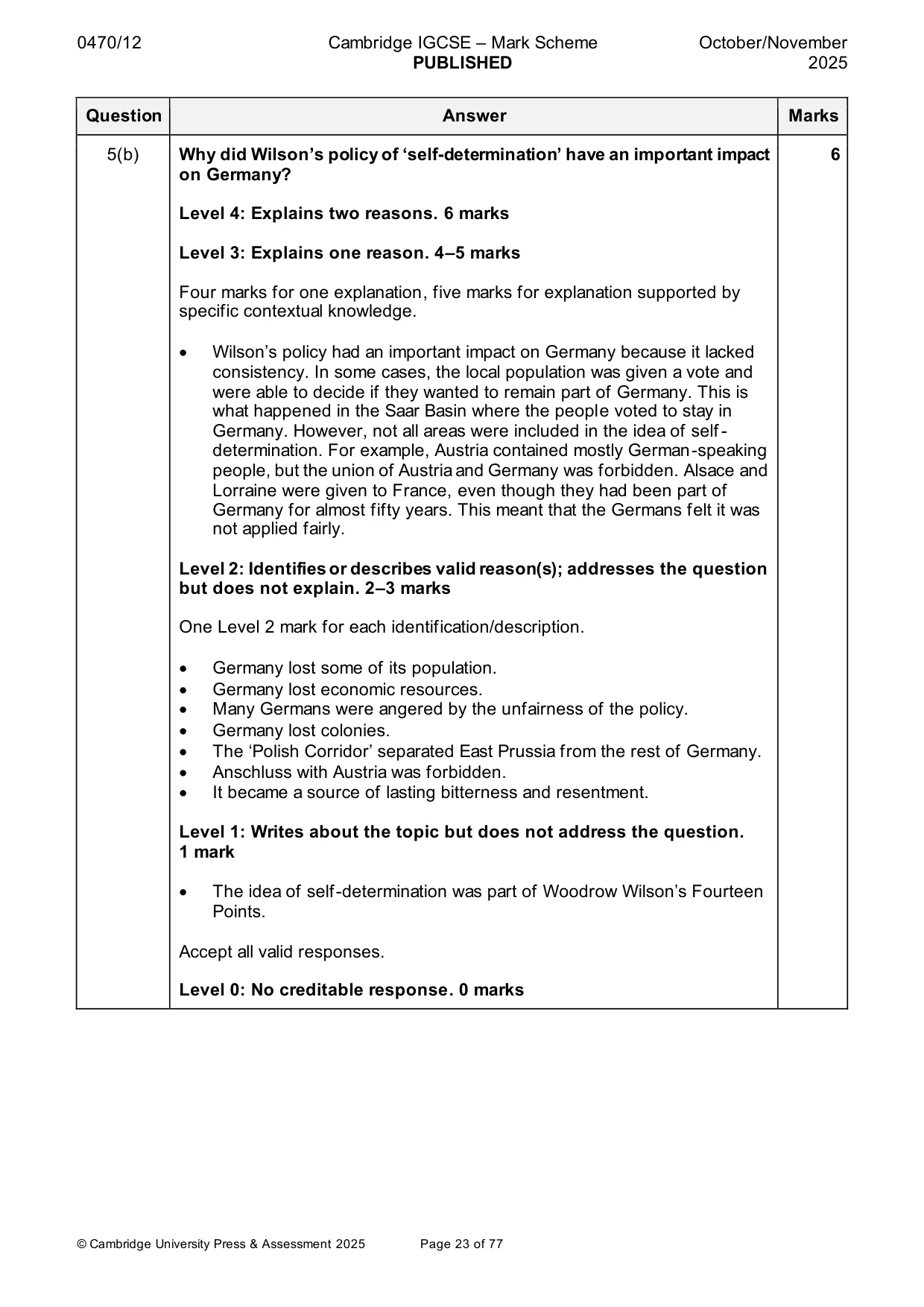
0470/12 Cambridge IGCSE – Mark Scheme PUBLISHED October/November 2025 © Cambridge University Press & Assessment 2025 Page 23 of 77 Question Answer Marks 5(b) Why did Wilson’s policy of ‘self-determination’ have an important impact on Germany? Level 4: Explains two reasons. 6 marks Level 3: Explains one reason. 4–5 marks Four marks for one explanation, five marks for explanation supported by specific contextual knowledge. • Wilson’s policy had an important impact on Germany because it lacked consistency. In some cases, the local population was given a vote and were able to decide if they wanted to remain part of Germany. This is what happened in the Saar Basin where the people voted to stay in Germany. However, not all areas were included in the idea of self - determination. For example, Austria contained mostly German-speaking people, but the union of Austria and Germany was forbidden. Alsace and Lorraine were given to France, even though they had been part of Germany for almost fifty years. This meant that the Germans felt it was not applied fairly. Level 2: Identifies or describes valid reason(s); addresses the question but does not explain. 2–3 marks One Level 2 mark for each identification/description. • Germany lost some of its population. • Germany lost economic resources. • Many Germans were angered by the unfairness of the policy. • Germany lost colonies. • The ‘Polish Corridor’ separated East Prussia from the rest of Germany. • Anschluss with Austria was forbidden. • It became a source of lasting bitterness and resentment. Level 1: Writes about the topic but does not address the question. 1 mark • The idea of self-determination was part of Woodrow Wilson’s Fourteen Points. Accept all valid responses. Level 0: No creditable response. 0 marks 6
Mark scheme, page 24
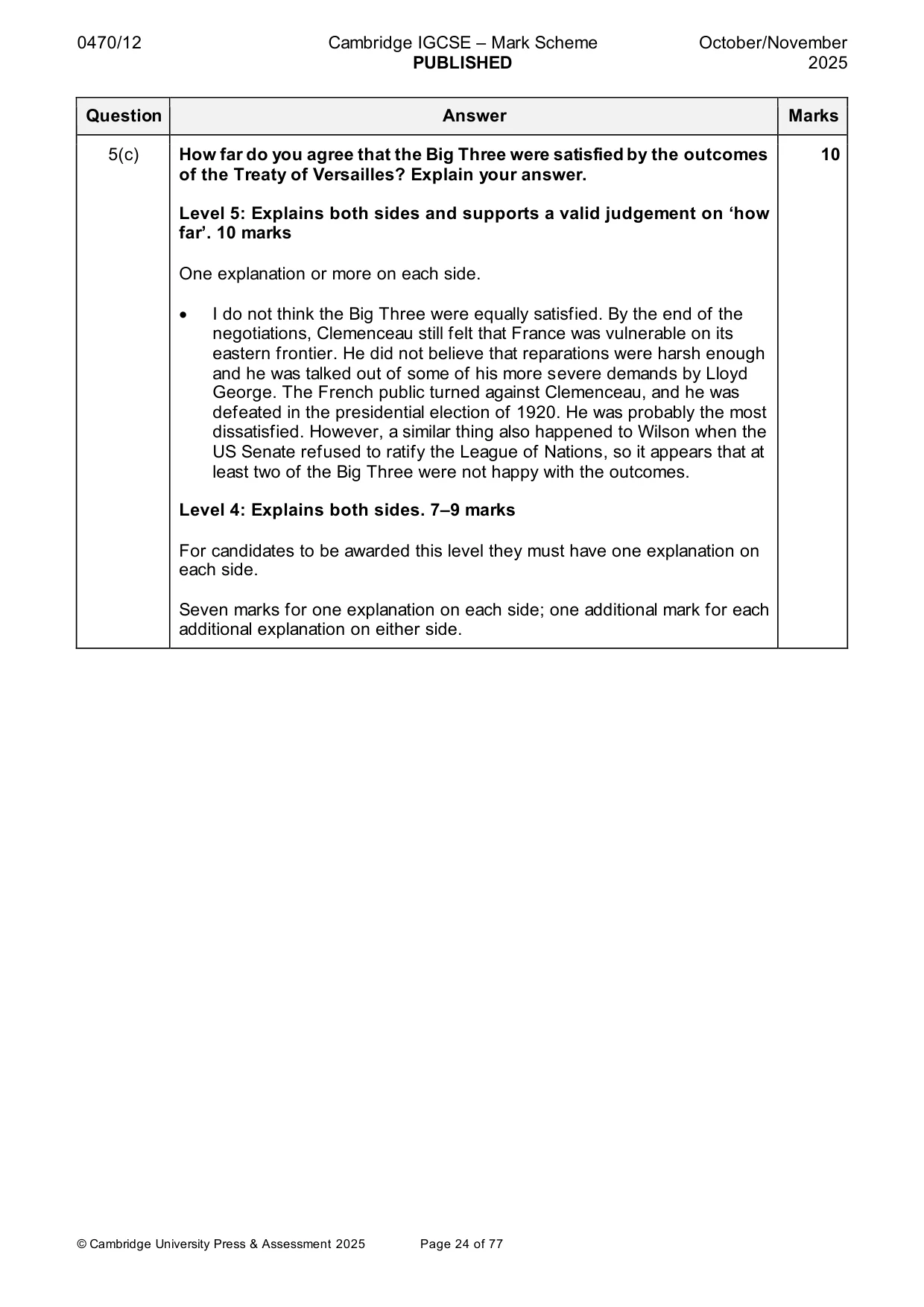
0470/12 Cambridge IGCSE – Mark Scheme PUBLISHED October/November 2025 © Cambridge University Press & Assessment 2025 Page 24 of 77 Question Answer Marks 5(c) How far do you agree that the Big Three were satisfied by the outcomes of the Treaty of Versailles? Explain your answer. Level 5: Explains both sides and supports a valid judgement on ‘how far’. 10 marks One explanation or more on each side. • I do not think the Big Three were equally satisfied. By the end of the negotiations, Clemenceau still felt that France was vulnerable on its eastern frontier. He did not believe that reparations were harsh enough and he was talked out of some of his more severe demands by Lloyd George. The French public turned against Clemenceau, and he was defeated in the presidential election of 1920. He was probably the most dissatisfied. However, a similar thing also happened to Wilson when the US Senate refused to ratify the League of Nations, so it appears that at least two of the Big Three were not happy with the outcomes. Level 4: Explains both sides. 7–9 marks For candidates to be awarded this level they must have one explanation on each side. Seven marks for one explanation on each side; one additional mark for each additional explanation on either side. 10
Mark scheme, page 25
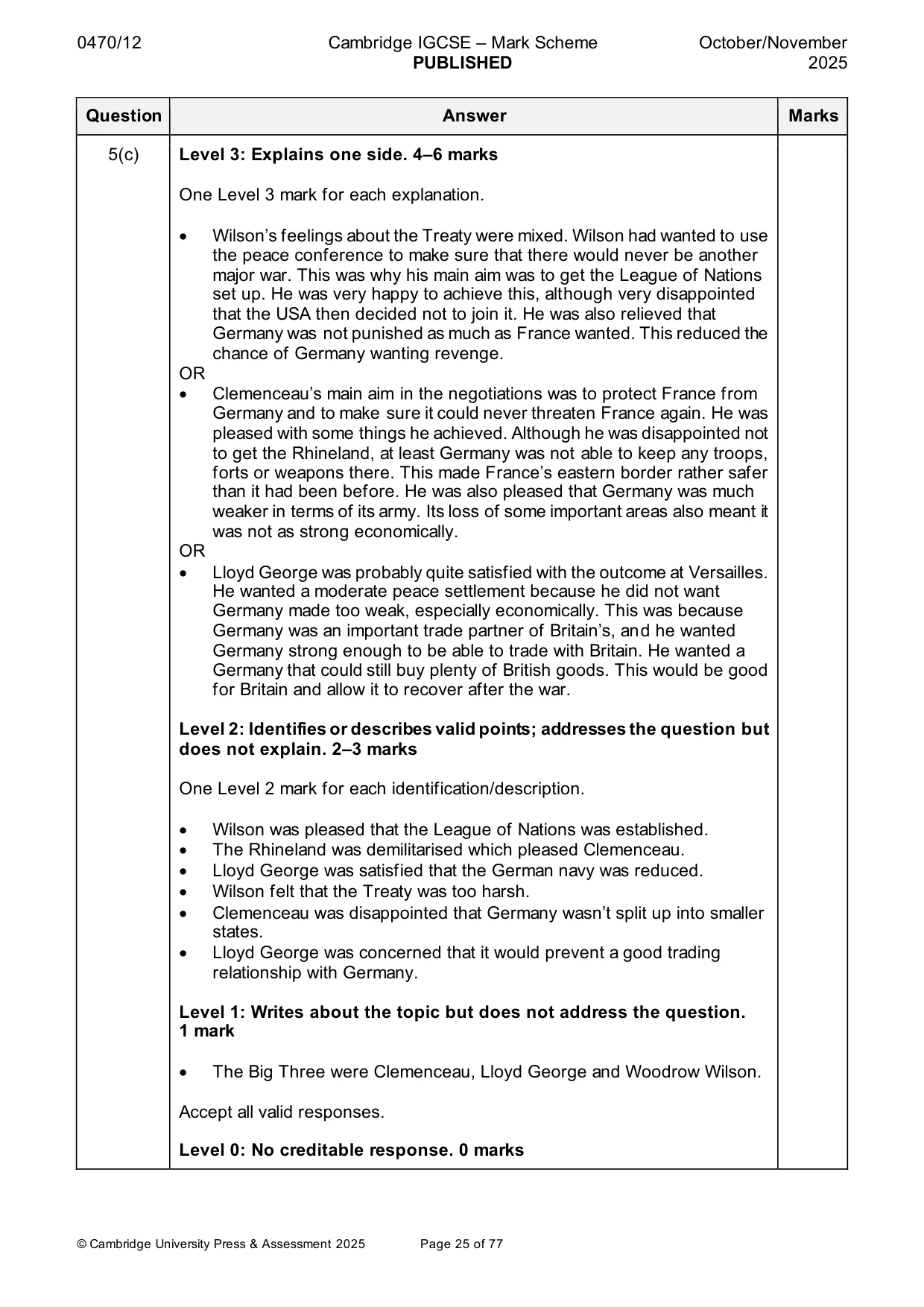
0470/12 Cambridge IGCSE – Mark Scheme PUBLISHED October/November 2025 © Cambridge University Press & Assessment 2025 Page 25 of 77 Question Answer Marks 5(c) Level 3: Explains one side. 4–6 marks One Level 3 mark for each explanation. • Wilson’s feelings about the Treaty were mixed. Wilson had wanted to use the peace conference to make sure that there would never be another major war. This was why his main aim was to get the League of Nations set up. He was very happy to achieve this, although very disappointed that the USA then decided not to join it. He was also relieved that Germany was not punished as much as France wanted. This reduced the chance of Germany wanting revenge. OR • Clemenceau’s main aim in the negotiations was to protect France from Germany and to make sure it could never threaten France again. He was pleased with some things he achieved. Although he was disappointed not to get the Rhineland, at least Germany was not able to keep any troops, forts or weapons there. This made France’s eastern border rather safer than it had been before. He was also pleased that Germany was much weaker in terms of its army. Its loss of some important areas also meant it was not as strong economically. OR • Lloyd George was probably quite satisfied with the outcome at Versailles. He wanted a moderate peace settlement because he did not want Germany made too weak, especially economically. This was because Germany was an important trade partner of Britain’s, and he wanted Germany strong enough to be able to trade with Britain. He wanted a Germany that could still buy plenty of British goods. This would be good for Britain and allow it to recover after the war. Level 2: Identifies or describes valid points; addresses the question but does not explain. 2–3 marks One Level 2 mark for each identification/description. • Wilson was pleased that the League of Nations was established. • The Rhineland was demilitarised which pleased Clemenceau. • Lloyd George was satisfied that the German navy was reduced. • Wilson felt that the Treaty was too harsh. • Clemenceau was disappointed that Germany wasn’t split up into smaller states. • Lloyd George was concerned that it would prevent a good trading relationship with Germany. Level 1: Writes about the topic but does not address the question. 1 mark • The Big Three were Clemenceau, Lloyd George and Woodrow Wilson. Accept all valid responses. Level 0: No creditable response. 0 marks
Mark scheme, page 26
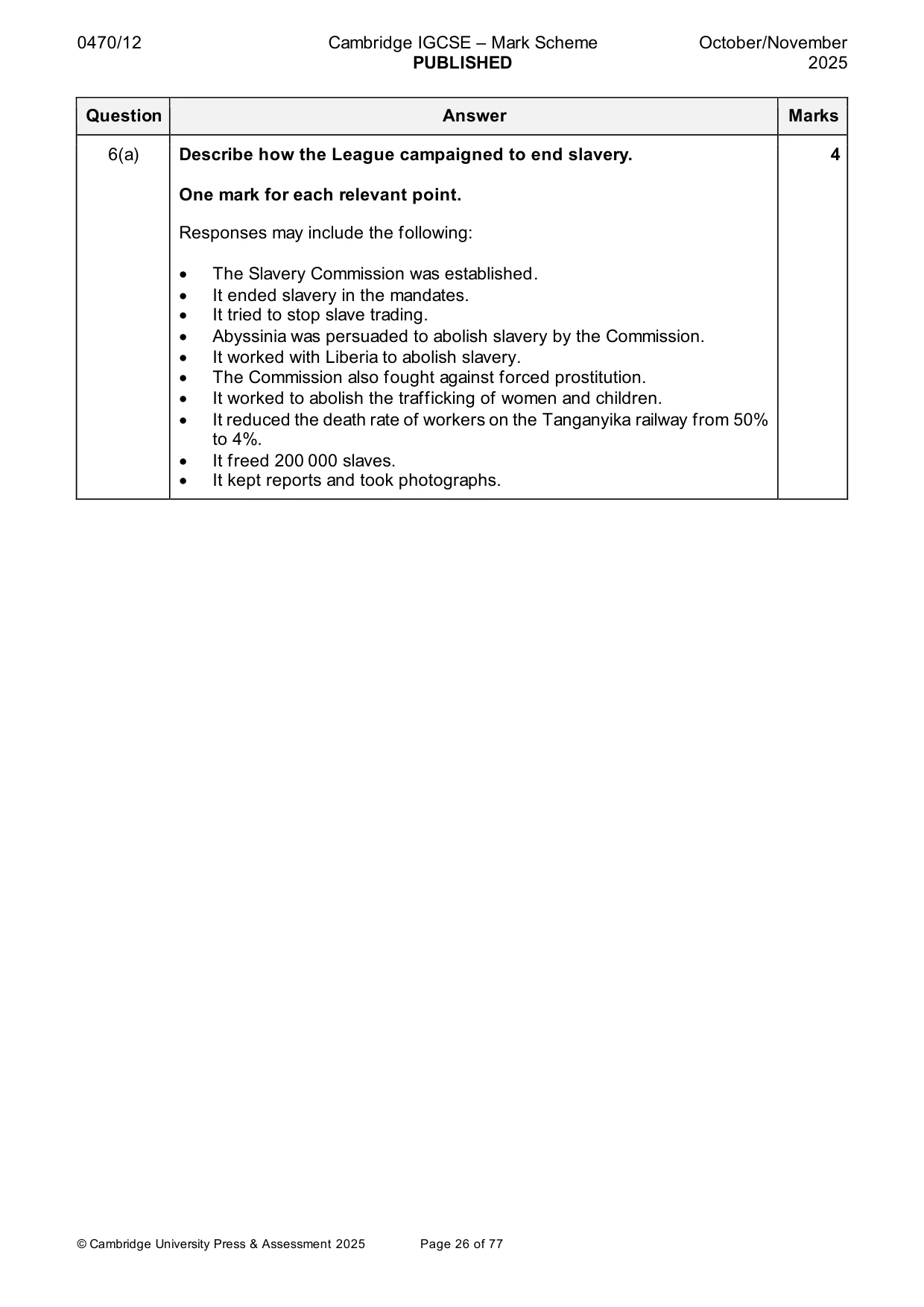
0470/12 Cambridge IGCSE – Mark Scheme PUBLISHED October/November 2025 © Cambridge University Press & Assessment 2025 Page 26 of 77 Question Answer Marks 6(a) Describe how the League campaigned to end slavery. One mark for each relevant point. Responses may include the following: • The Slavery Commission was established. • It ended slavery in the mandates. • It tried to stop slave trading. • Abyssinia was persuaded to abolish slavery by the Commission. • It worked with Liberia to abolish slavery. • The Commission also fought against forced prostitution. • It worked to abolish the trafficking of women and children. • It reduced the death rate of workers on the Tanganyika railway from 50% to 4%. • It freed 200 000 slaves. • It kept reports and took photographs. 4
Mark scheme, page 27
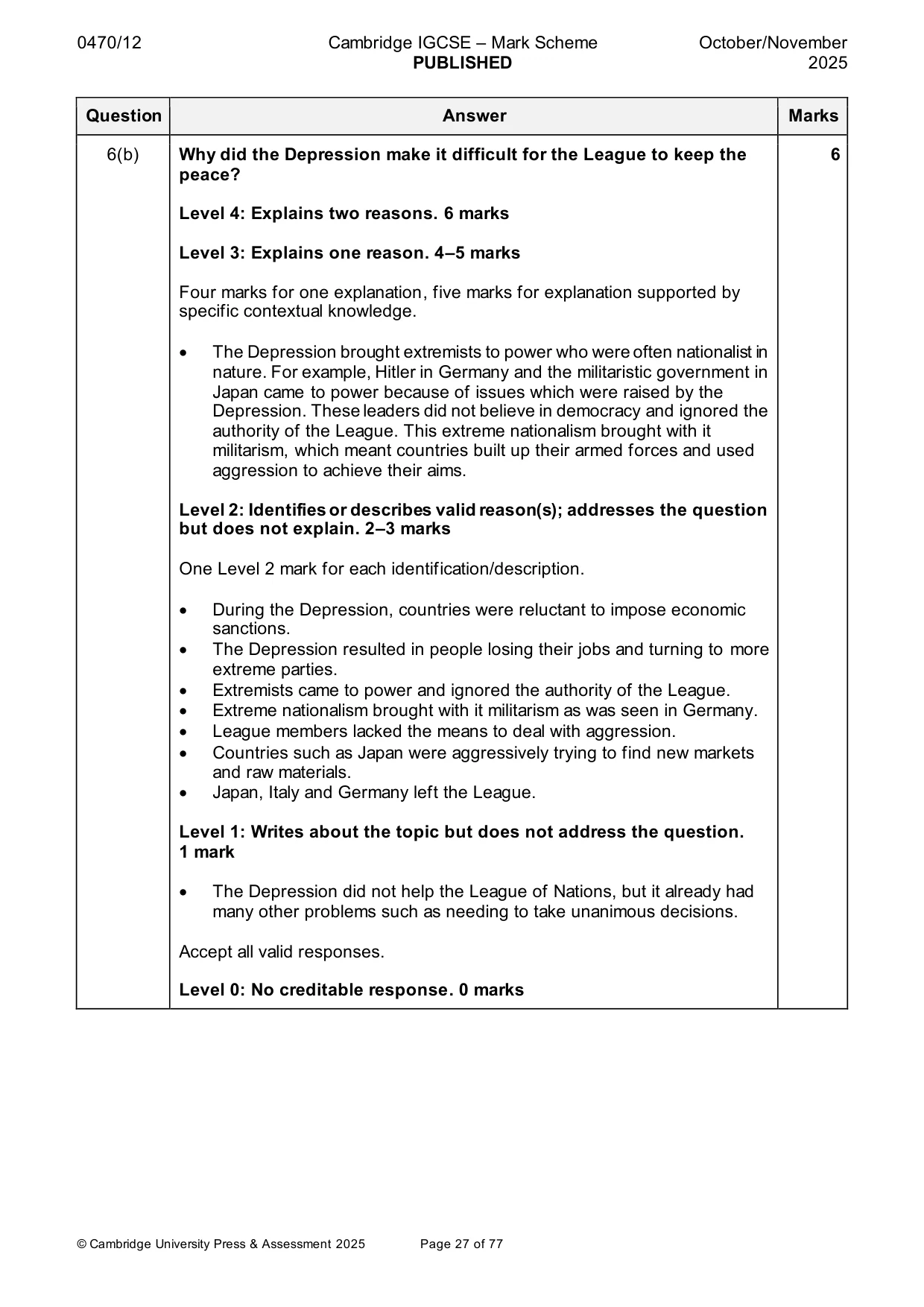
0470/12 Cambridge IGCSE – Mark Scheme PUBLISHED October/November 2025 © Cambridge University Press & Assessment 2025 Page 27 of 77 Question Answer Marks 6(b) Why did the Depression make it difficult for the League to keep the peace? Level 4: Explains two reasons. 6 marks Level 3: Explains one reason. 4–5 marks Four marks for one explanation, five marks for explanation supported by specific contextual knowledge. • The Depression brought extremists to power who were often nationalist in nature. For example, Hitler in Germany and the militaristic government in Japan came to power because of issues which were raised by the Depression. These leaders did not believe in democracy and ignored the authority of the League. This extreme nationalism brought with it militarism, which meant countries built up their armed forces and used aggression to achieve their aims. Level 2: Identifies or describes valid reason(s); addresses the question but does not explain. 2–3 marks One Level 2 mark for each identification/description. • During the Depression, countries were reluctant to impose economic sanctions. • The Depression resulted in people losing their jobs and turning to more extreme parties. • Extremists came to power and ignored the authority of the League. • Extreme nationalism brought with it militarism as was seen in Germany. • League members lacked the means to deal with aggression. • Countries such as Japan were aggressively trying to find new markets and raw materials. • Japan, Italy and Germany left the League. Level 1: Writes about the topic but does not address the question. 1 mark • The Depression did not help the League of Nations, but it already had many other problems such as needing to take unanimous decisions. Accept all valid responses. Level 0: No creditable response. 0 marks 6
Mark scheme, page 28
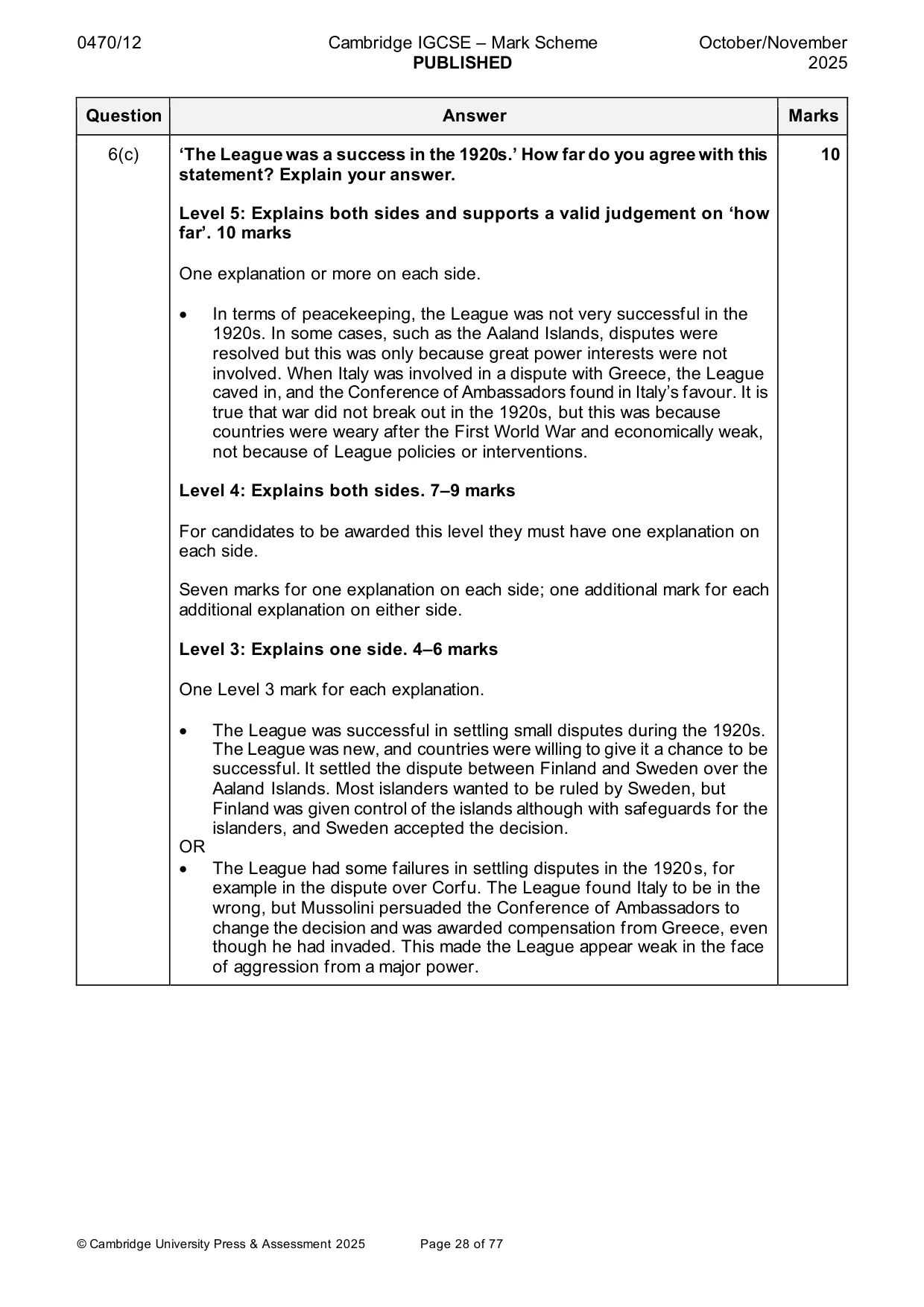
0470/12 Cambridge IGCSE – Mark Scheme PUBLISHED October/November 2025 © Cambridge University Press & Assessment 2025 Page 28 of 77 Question Answer Marks 6(c) ‘The League was a success in the 1920s.’ How far do you agree with this statement? Explain your answer. Level 5: Explains both sides and supports a valid judgement on ‘how far’. 10 marks One explanation or more on each side. • In terms of peacekeeping, the League was not very successful in the 1920s. In some cases, such as the Aaland Islands, disputes were resolved but this was only because great power interests were not involved. When Italy was involved in a dispute with Greece, the League caved in, and the Conference of Ambassadors found in Italy’s favour. It is true that war did not break out in the 1920s, but this was because countries were weary after the First World War and economically weak, not because of League policies or interventions. Level 4: Explains both sides. 7–9 marks For candidates to be awarded this level they must have one explanation on each side. Seven marks for one explanation on each side; one additional mark for each additional explanation on either side. Level 3: Explains one side. 4–6 marks One Level 3 mark for each explanation. • The League was successful in settling small disputes during the 1920s. The League was new, and countries were willing to give it a chance to be successful. It settled the dispute between Finland and Sweden over the Aaland Islands. Most islanders wanted to be ruled by Sweden, but Finland was given control of the islands although with safeguards for the islanders, and Sweden accepted the decision. OR • The League had some failures in settling disputes in the 1920s, for example in the dispute over Corfu. The League found Italy to be in the wrong, but Mussolini persuaded the Conference of Ambassadors to change the decision and was awarded compensation from Greece, even though he had invaded. This made the League appear weak in the face of aggression from a major power. 10
Mark scheme, page 29
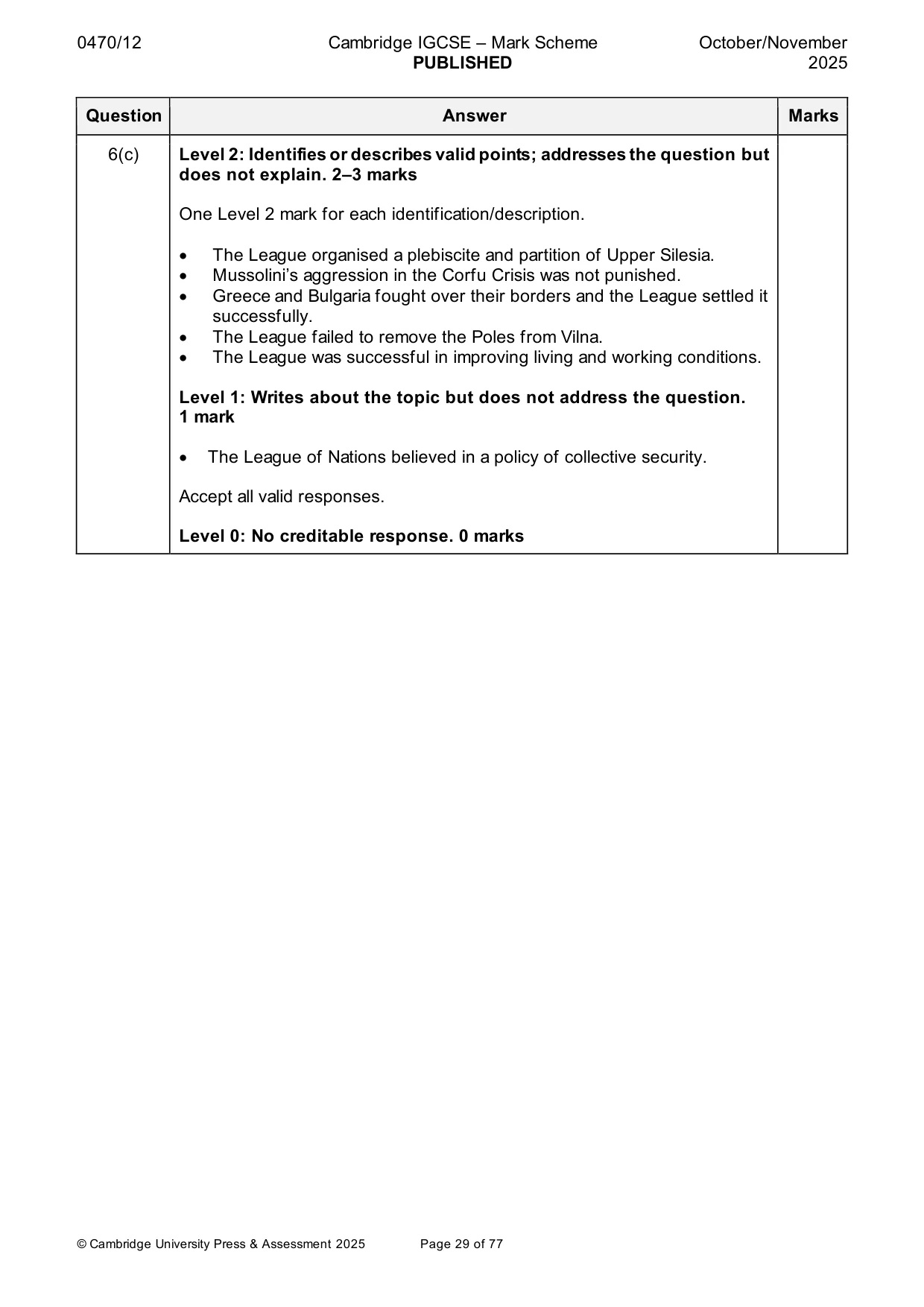
0470/12 Cambridge IGCSE – Mark Scheme PUBLISHED October/November 2025 © Cambridge University Press & Assessment 2025 Page 29 of 77 Question Answer Marks 6(c) Level 2: Identifies or describes valid points; addresses the question but does not explain. 2–3 marks One Level 2 mark for each identification/description. • The League organised a plebiscite and partition of Upper Silesia. • Mussolini’s aggression in the Corfu Crisis was not punished. • Greece and Bulgaria fought over their borders and the League settled it successfully. • The League failed to remove the Poles from Vilna. • The League was successful in improving living and working conditions. Level 1: Writes about the topic but does not address the question. 1 mark • The League of Nations believed in a policy of collective security. Accept all valid responses. Level 0: No creditable response. 0 marks
Mark scheme, page 30
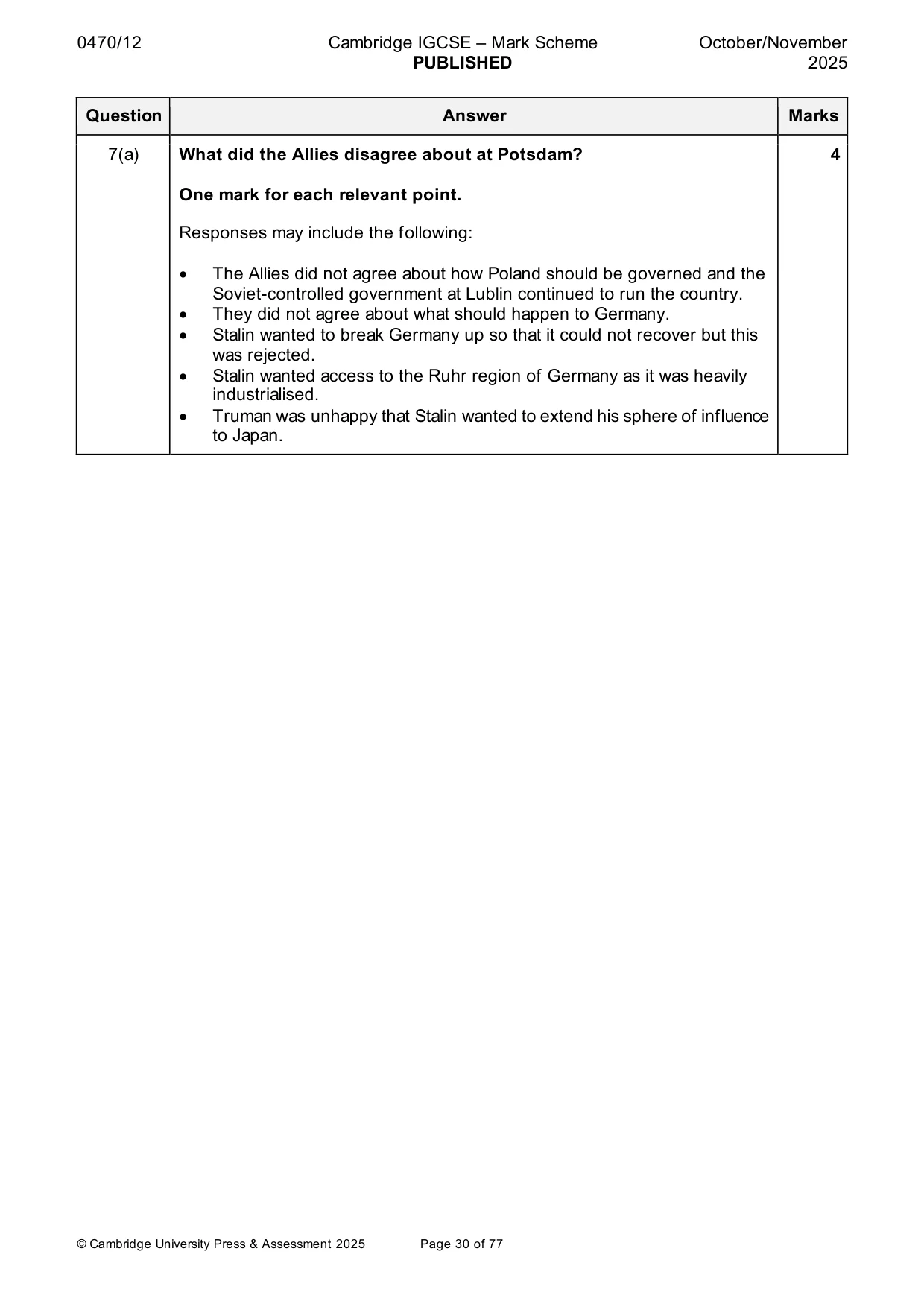
0470/12 Cambridge IGCSE – Mark Scheme PUBLISHED October/November 2025 © Cambridge University Press & Assessment 2025 Page 30 of 77 Question Answer Marks 7(a) What did the Allies disagree about at Potsdam? One mark for each relevant point. Responses may include the following: • The Allies did not agree about how Poland should be governed and the Soviet-controlled government at Lublin continued to run the country. • They did not agree about what should happen to Germany. • Stalin wanted to break Germany up so that it could not recover but this was rejected. • Stalin wanted access to the Ruhr region of Germany as it was heavily industrialised. • Truman was unhappy that Stalin wanted to extend his sphere of influence to Japan. 4
Mark scheme, page 31
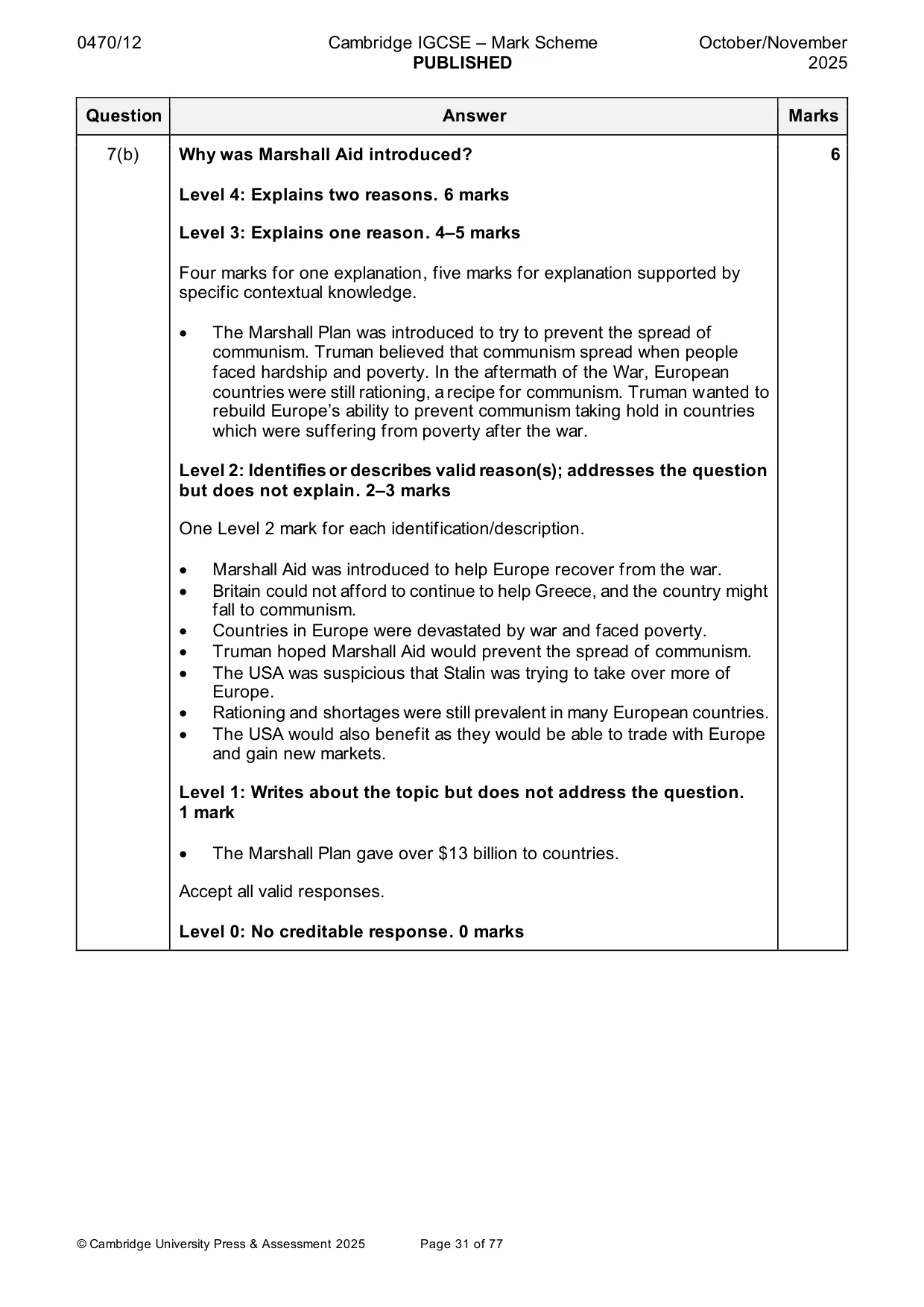
0470/12 Cambridge IGCSE – Mark Scheme PUBLISHED October/November 2025 © Cambridge University Press & Assessment 2025 Page 31 of 77 Question Answer Marks 7(b) Why was Marshall Aid introduced? Level 4: Explains two reasons. 6 marks Level 3: Explains one reason. 4–5 marks Four marks for one explanation, five marks for explanation supported by specific contextual knowledge. • The Marshall Plan was introduced to try to prevent the spread of communism. Truman believed that communism spread when people faced hardship and poverty. In the aftermath of the War, European countries were still rationing, a recipe for communism. Truman wanted to rebuild Europe’s ability to prevent communism taking hold in countries which were suffering from poverty after the war. Level 2: Identifies or describes valid reason(s); addresses the question but does not explain. 2–3 marks One Level 2 mark for each identification/description. • Marshall Aid was introduced to help Europe recover from the war. • Britain could not afford to continue to help Greece, and the country might fall to communism. • Countries in Europe were devastated by war and faced poverty. • Truman hoped Marshall Aid would prevent the spread of communism. • The USA was suspicious that Stalin was trying to take over more of Europe. • Rationing and shortages were still prevalent in many European countries. • The USA would also benefit as they would be able to trade with Europe and gain new markets. Level 1: Writes about the topic but does not address the question. 1 mark • The Marshall Plan gave over $13 billion to countries. Accept all valid responses. Level 0: No creditable response. 0 marks 6
Mark scheme, page 32
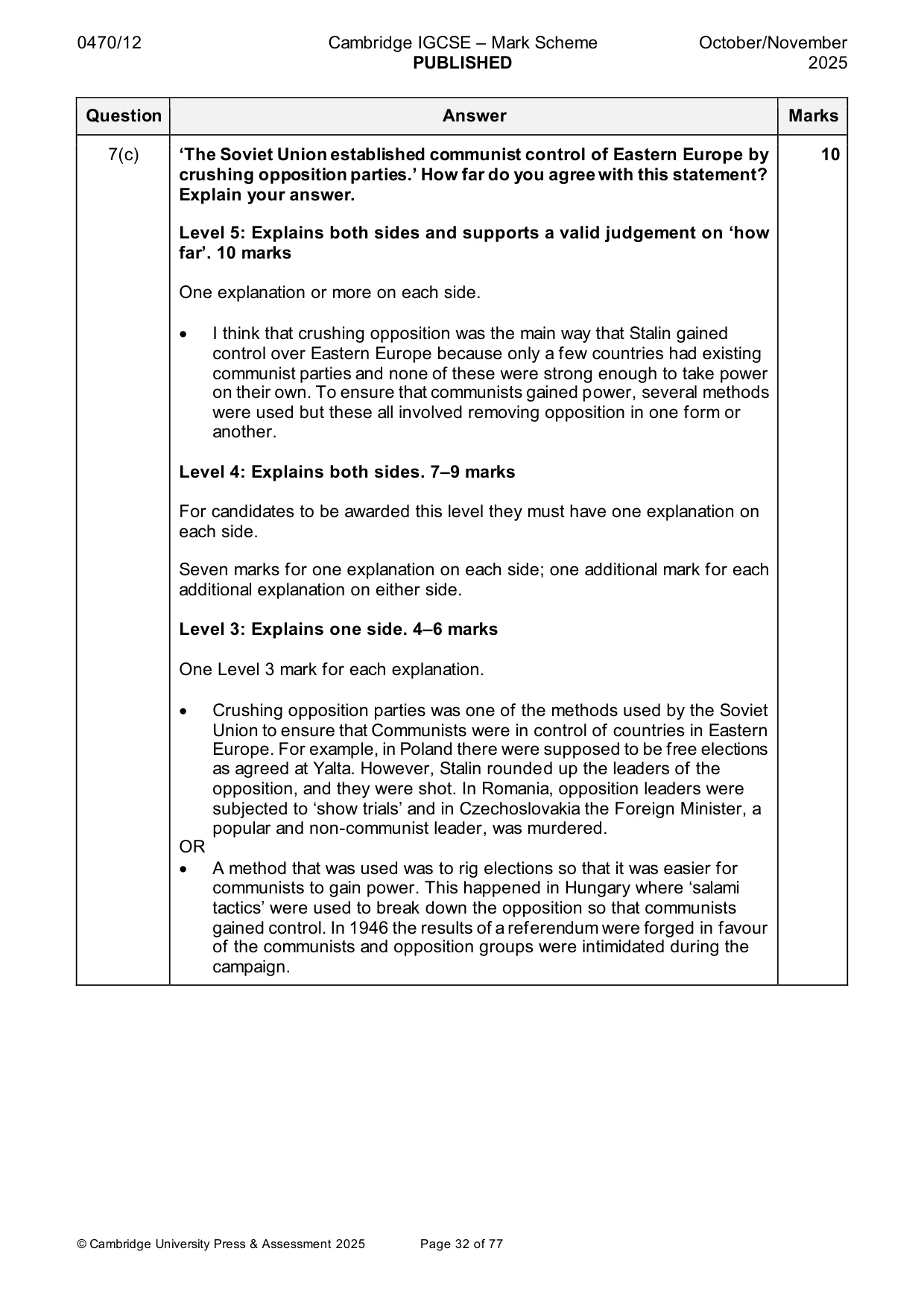
0470/12 Cambridge IGCSE – Mark Scheme PUBLISHED October/November 2025 © Cambridge University Press & Assessment 2025 Page 32 of 77 Question Answer Marks 7(c) ‘The Soviet Union established communist control of Eastern Europe by crushing opposition parties.’ How far do you agree with this statement? Explain your answer. Level 5: Explains both sides and supports a valid judgement on ‘how far’. 10 marks One explanation or more on each side. • I think that crushing opposition was the main way that Stalin gained control over Eastern Europe because only a few countries had existing communist parties and none of these were strong enough to take power on their own. To ensure that communists gained power, several methods were used but these all involved removing opposition in one form or another. Level 4: Explains both sides. 7–9 marks For candidates to be awarded this level they must have one explanation on each side. Seven marks for one explanation on each side; one additional mark for each additional explanation on either side. Level 3: Explains one side. 4–6 marks One Level 3 mark for each explanation. • Crushing opposition parties was one of the methods used by the Soviet Union to ensure that Communists were in control of countries in Eastern Europe. For example, in Poland there were supposed to be free elections as agreed at Yalta. However, Stalin rounded up the leaders of the opposition, and they were shot. In Romania, opposition leaders were subjected to ‘show trials’ and in Czechoslovakia the Foreign Minister, a popular and non-communist leader, was murdered. OR • A method that was used was to rig elections so that it was easier for communists to gain power. This happened in Hungary where ‘salami tactics’ were used to break down the opposition so that communists gained control. In 1946 the results of a referendum were forged in favour of the communists and opposition groups were intimidated during the campaign. 10
Mark scheme, page 33
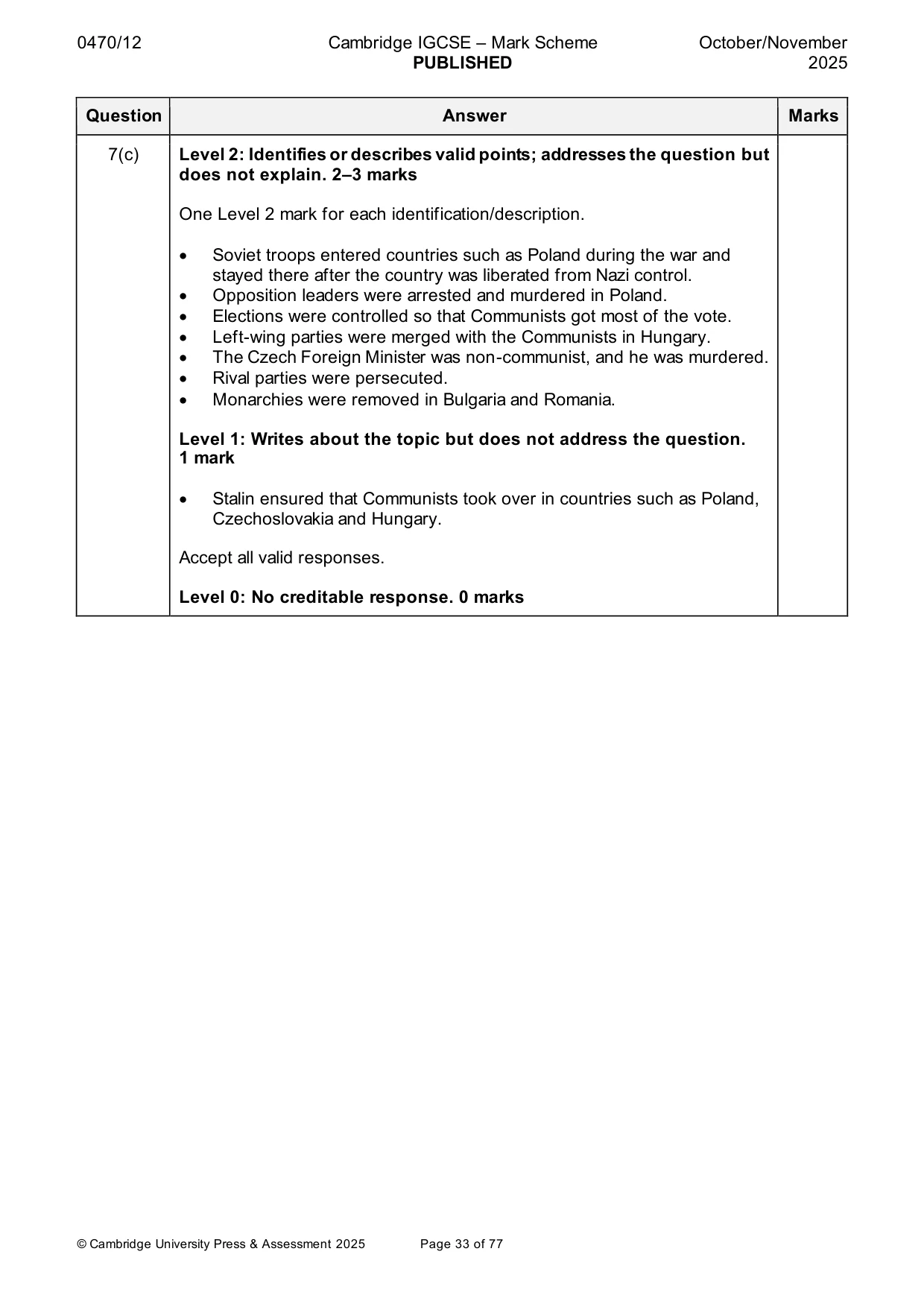
0470/12 Cambridge IGCSE – Mark Scheme PUBLISHED October/November 2025 © Cambridge University Press & Assessment 2025 Page 33 of 77 Question Answer Marks 7(c) Level 2: Identifies or describes valid points; addresses the question but does not explain. 2–3 marks One Level 2 mark for each identification/description. • Soviet troops entered countries such as Poland during the war and stayed there after the country was liberated from Nazi control. • Opposition leaders were arrested and murdered in Poland. • Elections were controlled so that Communists got most of the vote. • Left-wing parties were merged with the Communists in Hungary. • The Czech Foreign Minister was non-communist, and he was murdered. • Rival parties were persecuted. • Monarchies were removed in Bulgaria and Romania. Level 1: Writes about the topic but does not address the question. 1 mark • Stalin ensured that Communists took over in countries such as Poland, Czechoslovakia and Hungary. Accept all valid responses. Level 0: No creditable response. 0 marks
Mark scheme, page 34
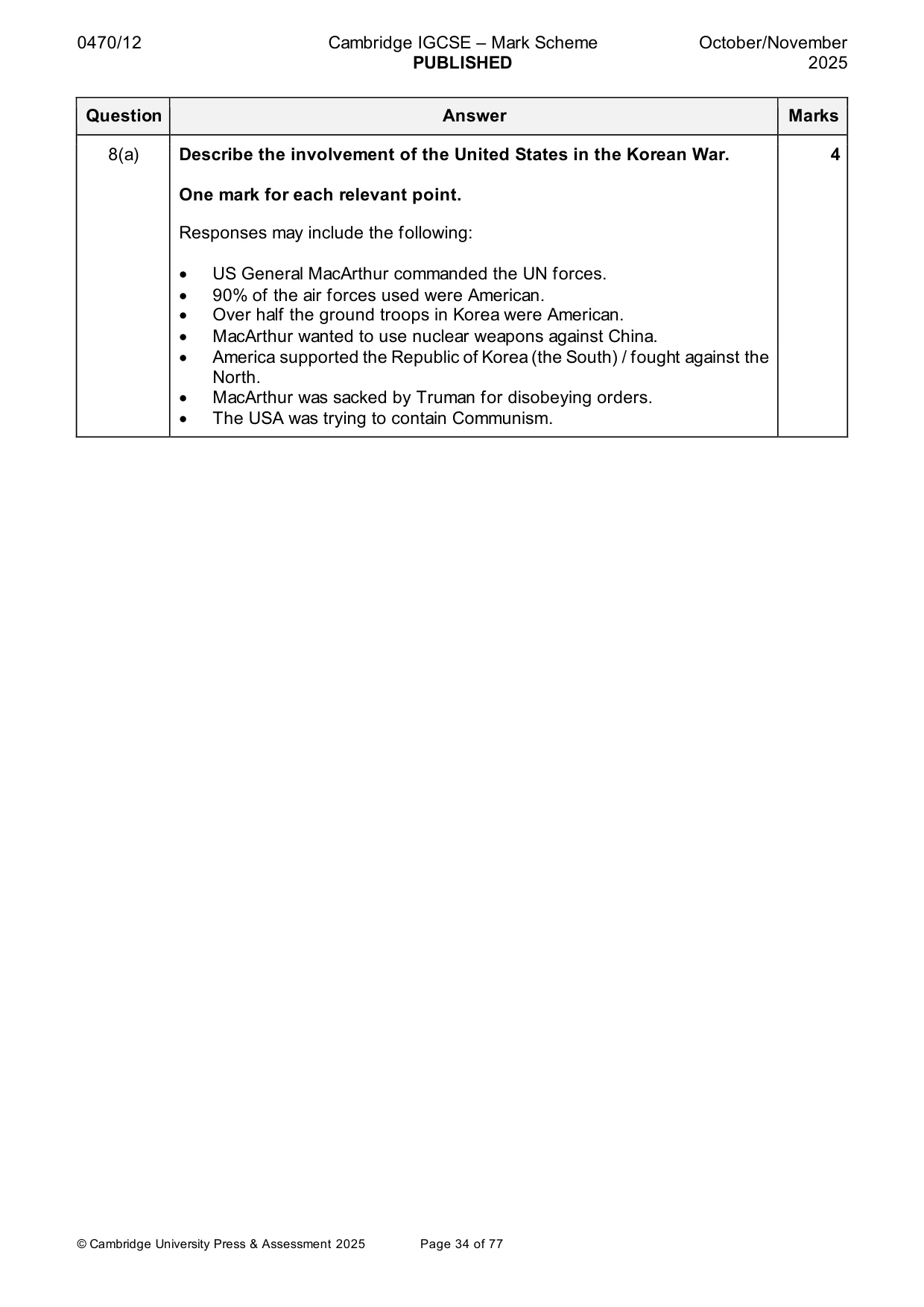
0470/12 Cambridge IGCSE – Mark Scheme PUBLISHED October/November 2025 © Cambridge University Press & Assessment 2025 Page 34 of 77 Question Answer Marks 8(a) Describe the involvement of the United States in the Korean War. One mark for each relevant point. Responses may include the following: • US General MacArthur commanded the UN forces. • 90% of the air forces used were American. • Over half the ground troops in Korea were American. • MacArthur wanted to use nuclear weapons against China. • America supported the Republic of Korea (the South) / fought against the North. • MacArthur was sacked by Truman for disobeying orders. • The USA was trying to contain Communism. 4
Mark scheme, page 35
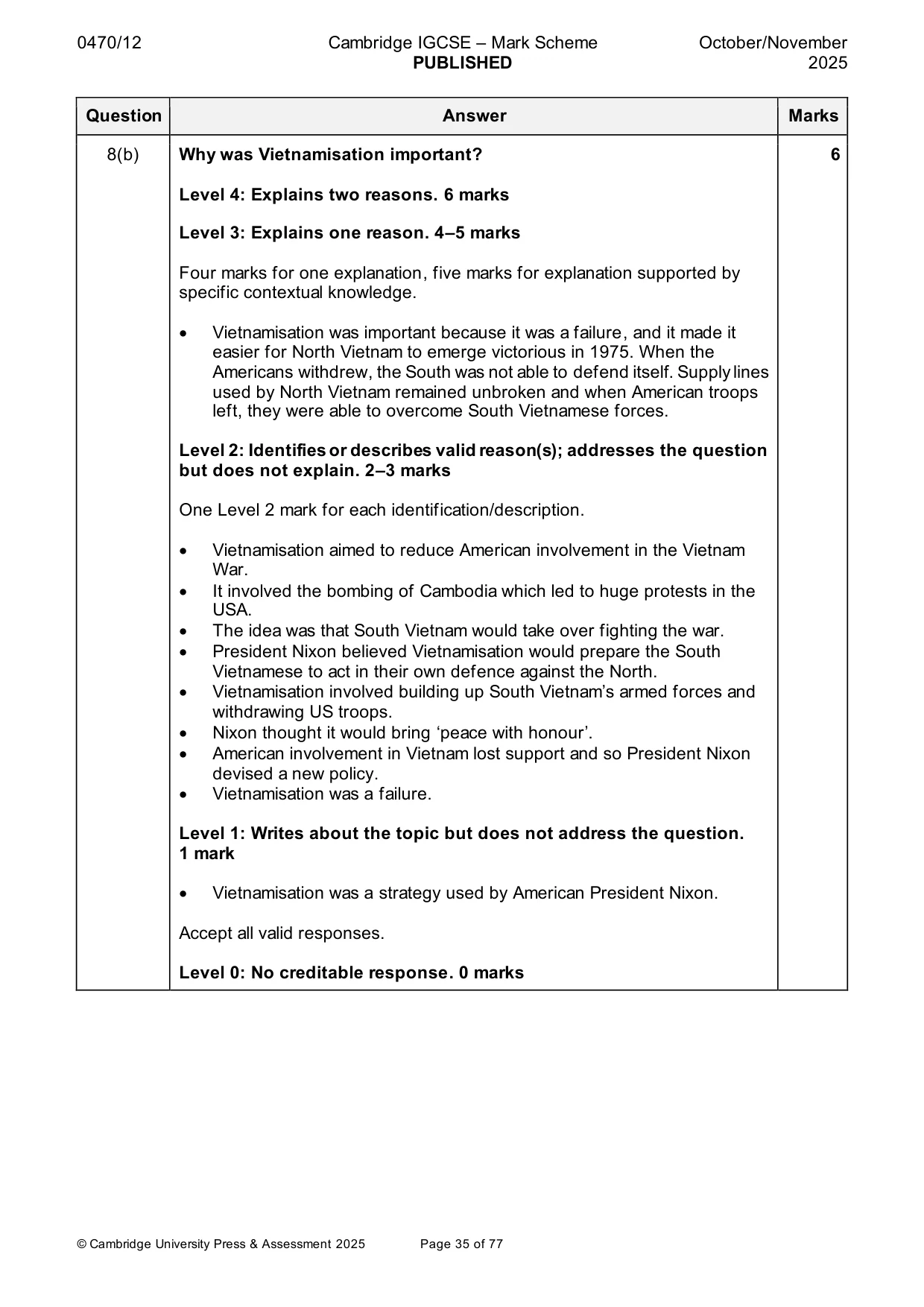
0470/12 Cambridge IGCSE – Mark Scheme PUBLISHED October/November 2025 © Cambridge University Press & Assessment 2025 Page 35 of 77 Question Answer Marks 8(b) Why was Vietnamisation important? Level 4: Explains two reasons. 6 marks Level 3: Explains one reason. 4–5 marks Four marks for one explanation, five marks for explanation supported by specific contextual knowledge. • Vietnamisation was important because it was a failure, and it made it easier for North Vietnam to emerge victorious in 1975. When the Americans withdrew, the South was not able to defend itself. Supply lines used by North Vietnam remained unbroken and when American troops left, they were able to overcome South Vietnamese forces. Level 2: Identifies or describes valid reason(s); addresses the question but does not explain. 2–3 marks One Level 2 mark for each identification/description. • Vietnamisation aimed to reduce American involvement in the Vietnam War. • It involved the bombing of Cambodia which led to huge protests in the USA. • The idea was that South Vietnam would take over fighting the war. • President Nixon believed Vietnamisation would prepare the South Vietnamese to act in their own defence against the North. • Vietnamisation involved building up South Vietnam’s armed forces and withdrawing US troops. • Nixon thought it would bring ‘peace with honour’. • American involvement in Vietnam lost support and so President Nixon devised a new policy. • Vietnamisation was a failure. Level 1: Writes about the topic but does not address the question. 1 mark • Vietnamisation was a strategy used by American President Nixon. Accept all valid responses. Level 0: No creditable response. 0 marks 6
Mark scheme, page 36
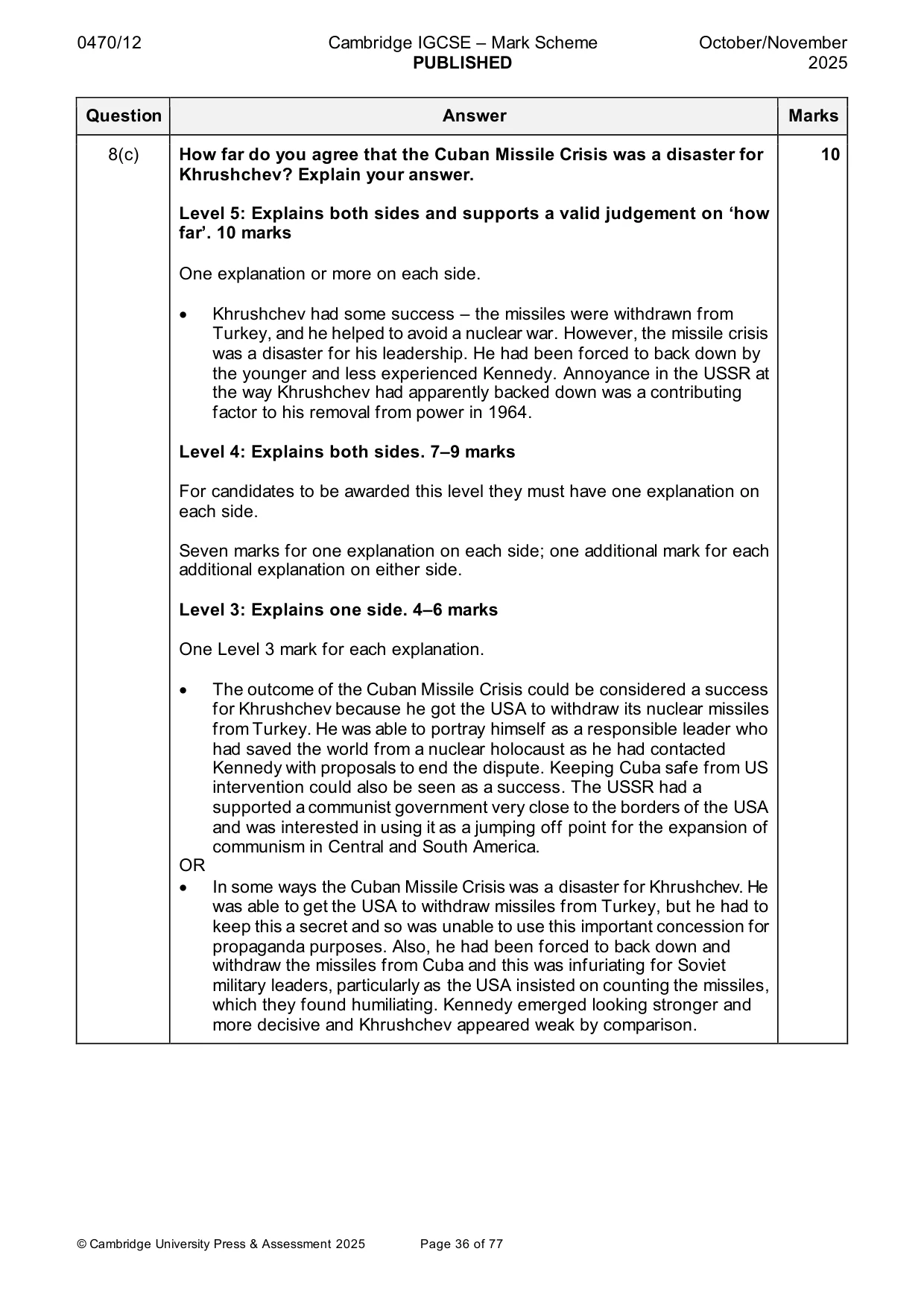
0470/12 Cambridge IGCSE – Mark Scheme PUBLISHED October/November 2025 © Cambridge University Press & Assessment 2025 Page 36 of 77 Question Answer Marks 8(c) How far do you agree that the Cuban Missile Crisis was a disaster for Khrushchev? Explain your answer. Level 5: Explains both sides and supports a valid judgement on ‘how far’. 10 marks One explanation or more on each side. • Khrushchev had some success – the missiles were withdrawn from Turkey, and he helped to avoid a nuclear war. However, the missile crisis was a disaster for his leadership. He had been forced to back down by the younger and less experienced Kennedy. Annoyance in the USSR at the way Khrushchev had apparently backed down was a contributing factor to his removal from power in 1964. Level 4: Explains both sides. 7–9 marks For candidates to be awarded this level they must have one explanation on each side. Seven marks for one explanation on each side; one additional mark for each additional explanation on either side. Level 3: Explains one side. 4–6 marks One Level 3 mark for each explanation. • The outcome of the Cuban Missile Crisis could be considered a success for Khrushchev because he got the USA to withdraw its nuclear missiles from Turkey. He was able to portray himself as a responsible leader who had saved the world from a nuclear holocaust as he had contacted Kennedy with proposals to end the dispute. Keeping Cuba safe from US intervention could also be seen as a success. The USSR had a supported a communist government very close to the borders of the USA and was interested in using it as a jumping off point for the expansion of communism in Central and South America. OR • In some ways the Cuban Missile Crisis was a disaster for Khrushchev. He was able to get the USA to withdraw missiles from Turkey, but he had to keep this a secret and so was unable to use this important concession for propaganda purposes. Also, he had been forced to back down and withdraw the missiles from Cuba and this was infuriating for Soviet military leaders, particularly as the USA insisted on counting the missiles, which they found humiliating. Kennedy emerged looking stronger and more decisive and Khrushchev appeared weak by comparison. 10
Mark scheme, page 37
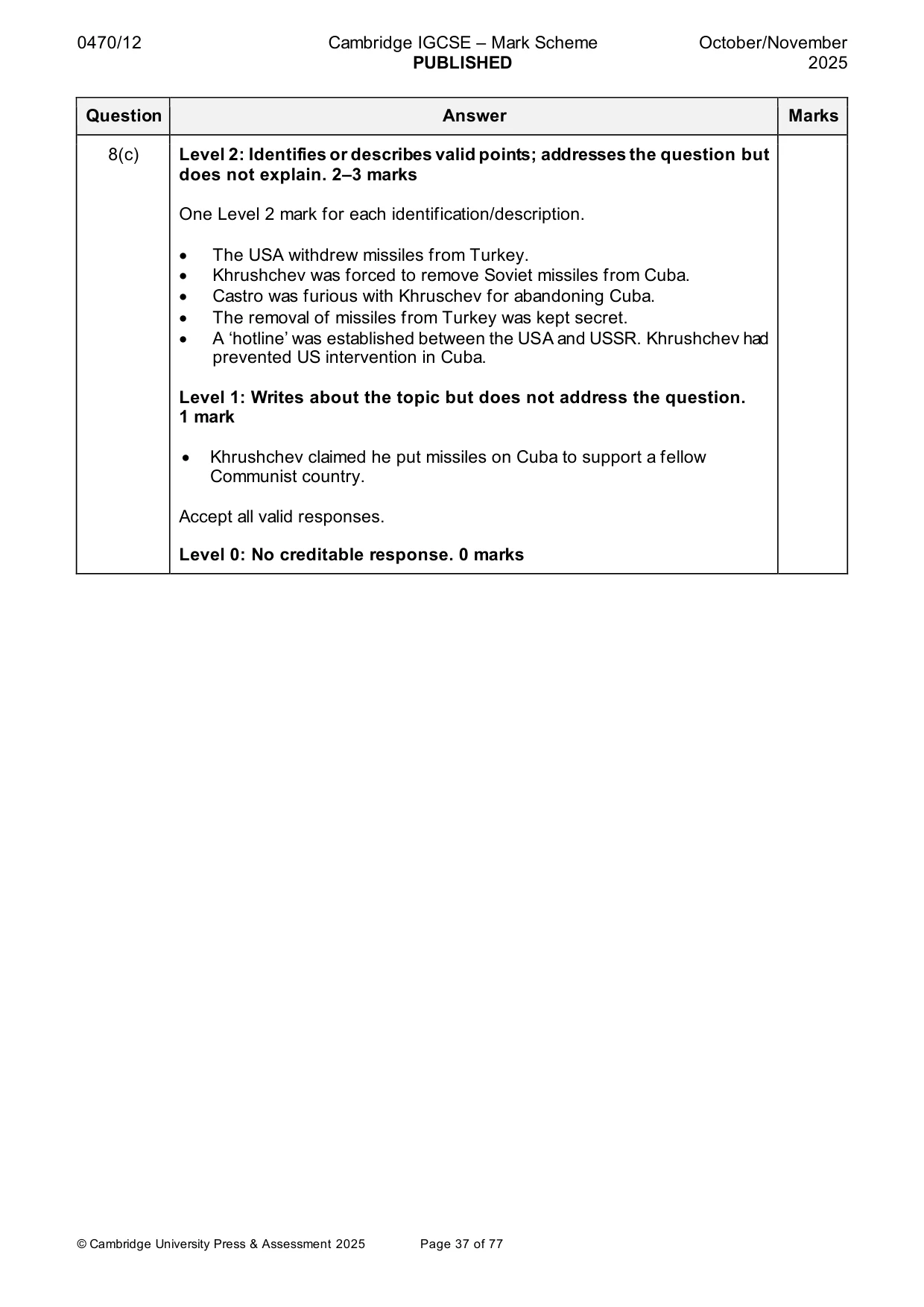
0470/12 Cambridge IGCSE – Mark Scheme PUBLISHED October/November 2025 © Cambridge University Press & Assessment 2025 Page 37 of 77 Question Answer Marks 8(c) Level 2: Identifies or describes valid points; addresses the question but does not explain. 2–3 marks One Level 2 mark for each identification/description. • The USA withdrew missiles from Turkey. • Khrushchev was forced to remove Soviet missiles from Cuba. • Castro was furious with Khruschev for abandoning Cuba. • The removal of missiles from Turkey was kept secret. • A ‘hotline’ was established between the USA and USSR. Khrushchev had prevented US intervention in Cuba. Level 1: Writes about the topic but does not address the question. 1 mark • Khrushchev claimed he put missiles on Cuba to support a fellow Communist country. Accept all valid responses. Level 0: No creditable response. 0 marks
Mark scheme, page 38
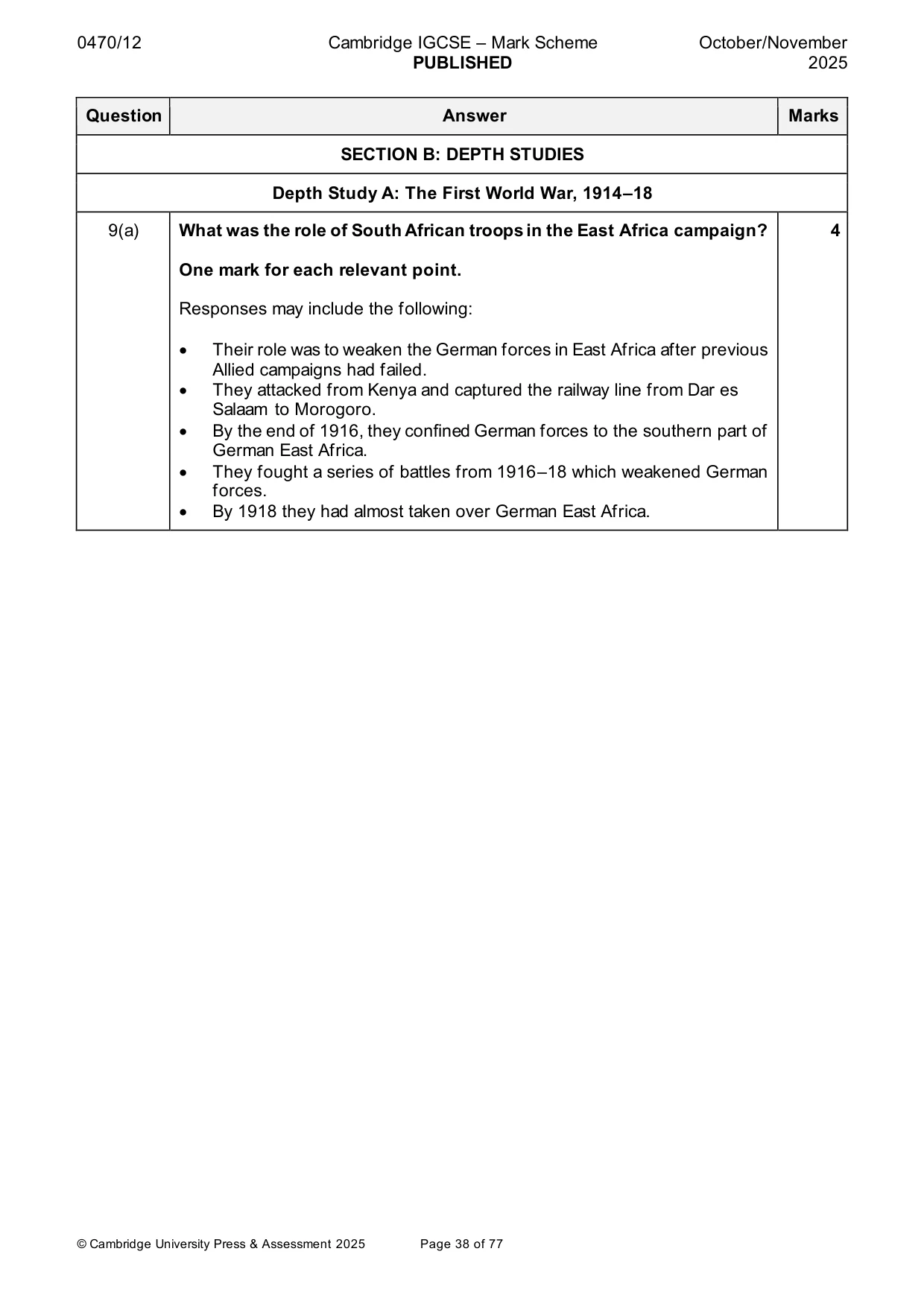
0470/12 Cambridge IGCSE – Mark Scheme PUBLISHED October/November 2025 © Cambridge University Press & Assessment 2025 Page 38 of 77 Question Answer Marks SECTION B: DEPTH STUDIES Depth Study A: The First World War, 1914–18 9(a) What was the role of South African troops in the East Africa campaign? One mark for each relevant point. Responses may include the following: • Their role was to weaken the German forces in East Africa after previous Allied campaigns had failed. • They attacked from Kenya and captured the railway line from Dar es Salaam to Morogoro. • By the end of 1916, they confined German forces to the southern part of German East Africa. • They fought a series of battles from 1916–18 which weakened German forces. • By 1918 they had almost taken over German East Africa. 4
Mark scheme, page 39
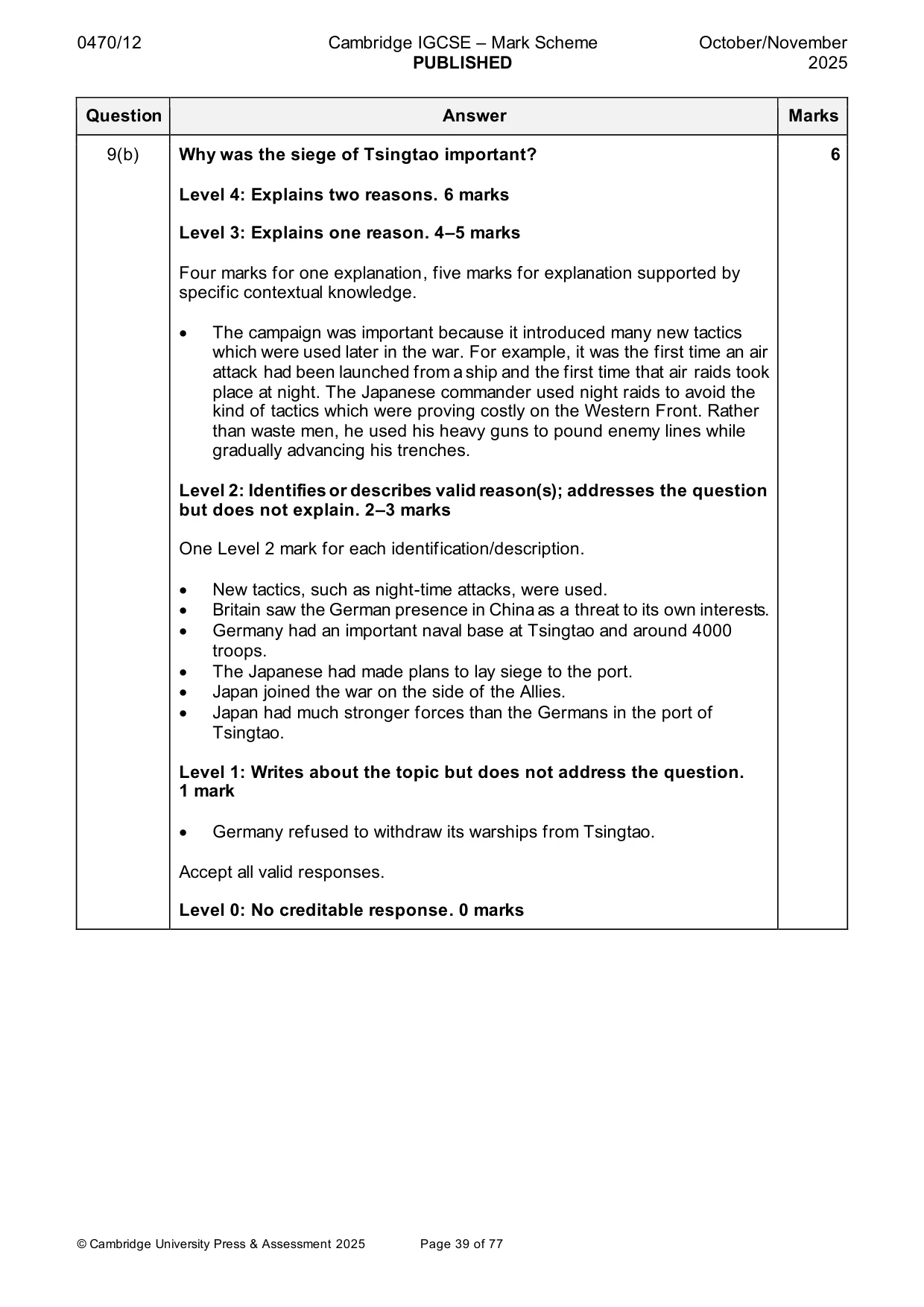
0470/12 Cambridge IGCSE – Mark Scheme PUBLISHED October/November 2025 © Cambridge University Press & Assessment 2025 Page 39 of 77 Question Answer Marks 9(b) Why was the siege of Tsingtao important? Level 4: Explains two reasons. 6 marks Level 3: Explains one reason. 4–5 marks Four marks for one explanation, five marks for explanation supported by specific contextual knowledge. • The campaign was important because it introduced many new tactics which were used later in the war. For example, it was the first time an air attack had been launched from a ship and the first time that air raids took place at night. The Japanese commander used night raids to avoid the kind of tactics which were proving costly on the Western Front. Rather than waste men, he used his heavy guns to pound enemy lines while gradually advancing his trenches. Level 2: Identifies or describes valid reason(s); addresses the question but does not explain. 2–3 marks One Level 2 mark for each identification/description. • New tactics, such as night-time attacks, were used. • Britain saw the German presence in China as a threat to its own interests. • Germany had an important naval base at Tsingtao and around 4000 troops. • The Japanese had made plans to lay siege to the port. • Japan joined the war on the side of the Allies. • Japan had much stronger forces than the Germans in the port of Tsingtao. Level 1: Writes about the topic but does not address the question. 1 mark • Germany refused to withdraw its warships from Tsingtao. Accept all valid responses. Level 0: No creditable response. 0 marks 6
Mark scheme, page 40
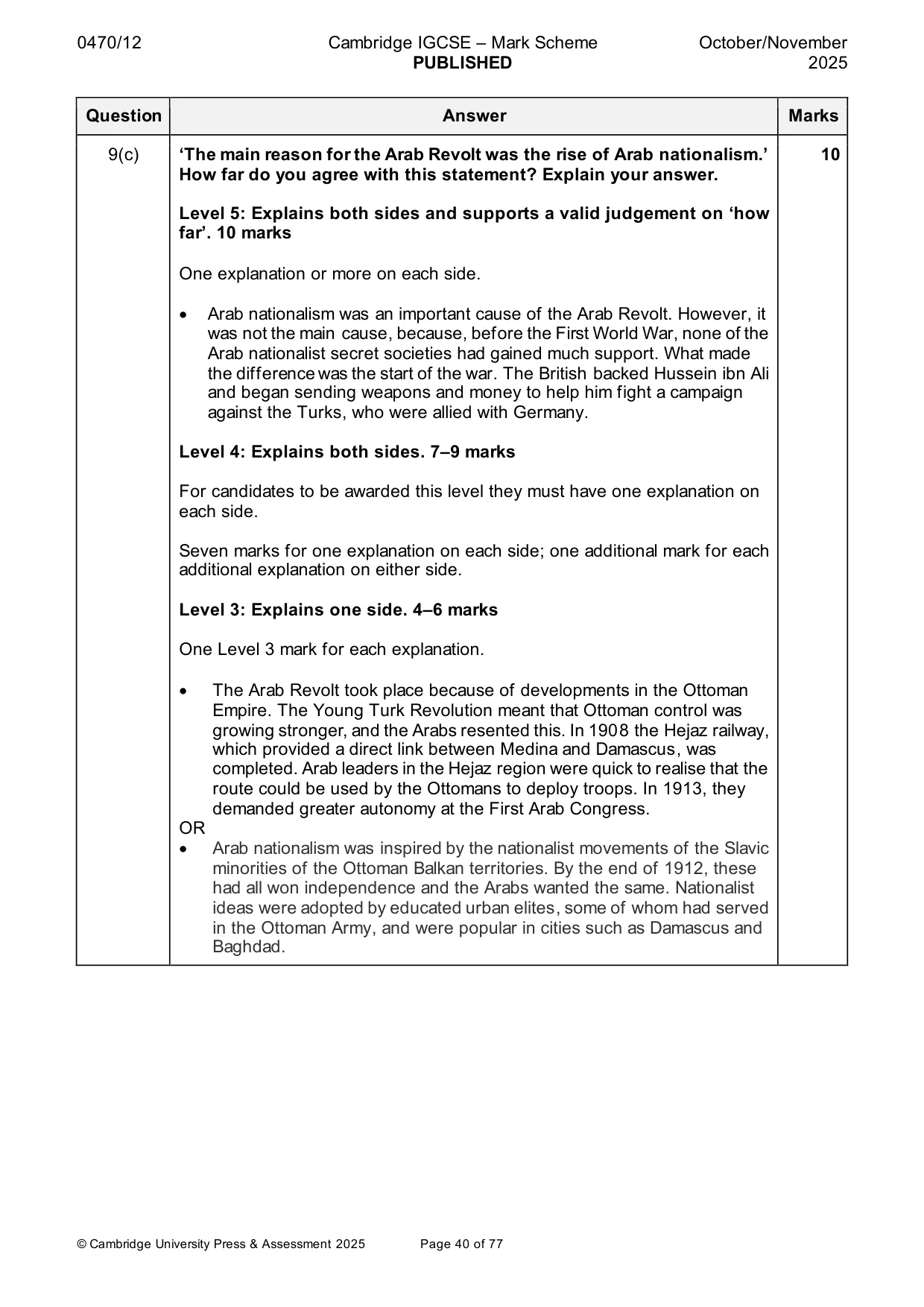
0470/12 Cambridge IGCSE – Mark Scheme PUBLISHED October/November 2025 © Cambridge University Press & Assessment 2025 Page 40 of 77 Question Answer Marks 9(c) ‘The main reason for the Arab Revolt was the rise of Arab nationalism.’ How far do you agree with this statement? Explain your answer. Level 5: Explains both sides and supports a valid judgement on ‘how far’. 10 marks One explanation or more on each side. • Arab nationalism was an important cause of the Arab Revolt. However, it was not the main cause, because, before the First World War, none of the Arab nationalist secret societies had gained much support. What made the difference was the start of the war. The British backed Hussein ibn Ali and began sending weapons and money to help him fight a campaign against the Turks, who were allied with Germany. Level 4: Explains both sides. 7–9 marks For candidates to be awarded this level they must have one explanation on each side. Seven marks for one explanation on each side; one additional mark for each additional explanation on either side. Level 3: Explains one side. 4–6 marks One Level 3 mark for each explanation. • The Arab Revolt took place because of developments in the Ottoman Empire. The Young Turk Revolution meant that Ottoman control was growing stronger, and the Arabs resented this. In 1908 the Hejaz railway, which provided a direct link between Medina and Damascus, was completed. Arab leaders in the Hejaz region were quick to realise that the route could be used by the Ottomans to deploy troops. In 1913, they demanded greater autonomy at the First Arab Congress. OR • Arab nationalism was inspired by the nationalist movements of the Slavic minorities of the Ottoman Balkan territories. By the end of 1912, these had all won independence and the Arabs wanted the same. Nationalist ideas were adopted by educated urban elites, some of whom had served in the Ottoman Army, and were popular in cities such as Damascus and Baghdad. 10
Mark scheme, page 41
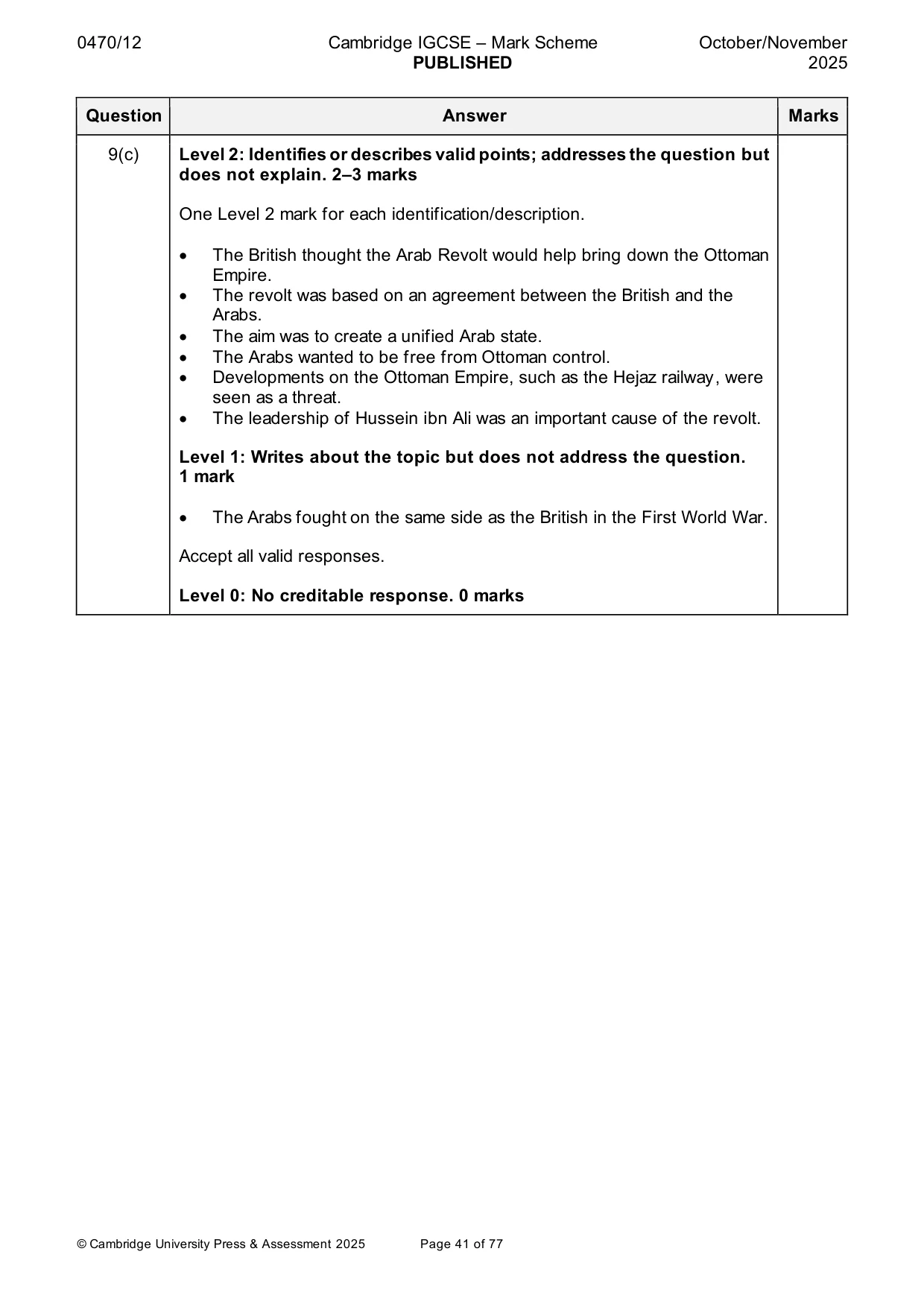
0470/12 Cambridge IGCSE – Mark Scheme PUBLISHED October/November 2025 © Cambridge University Press & Assessment 2025 Page 41 of 77 Question Answer Marks 9(c) Level 2: Identifies or describes valid points; addresses the question but does not explain. 2–3 marks One Level 2 mark for each identification/description. • The British thought the Arab Revolt would help bring down the Ottoman Empire. • The revolt was based on an agreement between the British and the Arabs. • The aim was to create a unified Arab state. • The Arabs wanted to be free from Ottoman control. • Developments on the Ottoman Empire, such as the Hejaz railway, were seen as a threat. • The leadership of Hussein ibn Ali was an important cause of the revolt. Level 1: Writes about the topic but does not address the question. 1 mark • The Arabs fought on the same side as the British in the First World War. Accept all valid responses. Level 0: No creditable response. 0 marks
Mark scheme, page 42
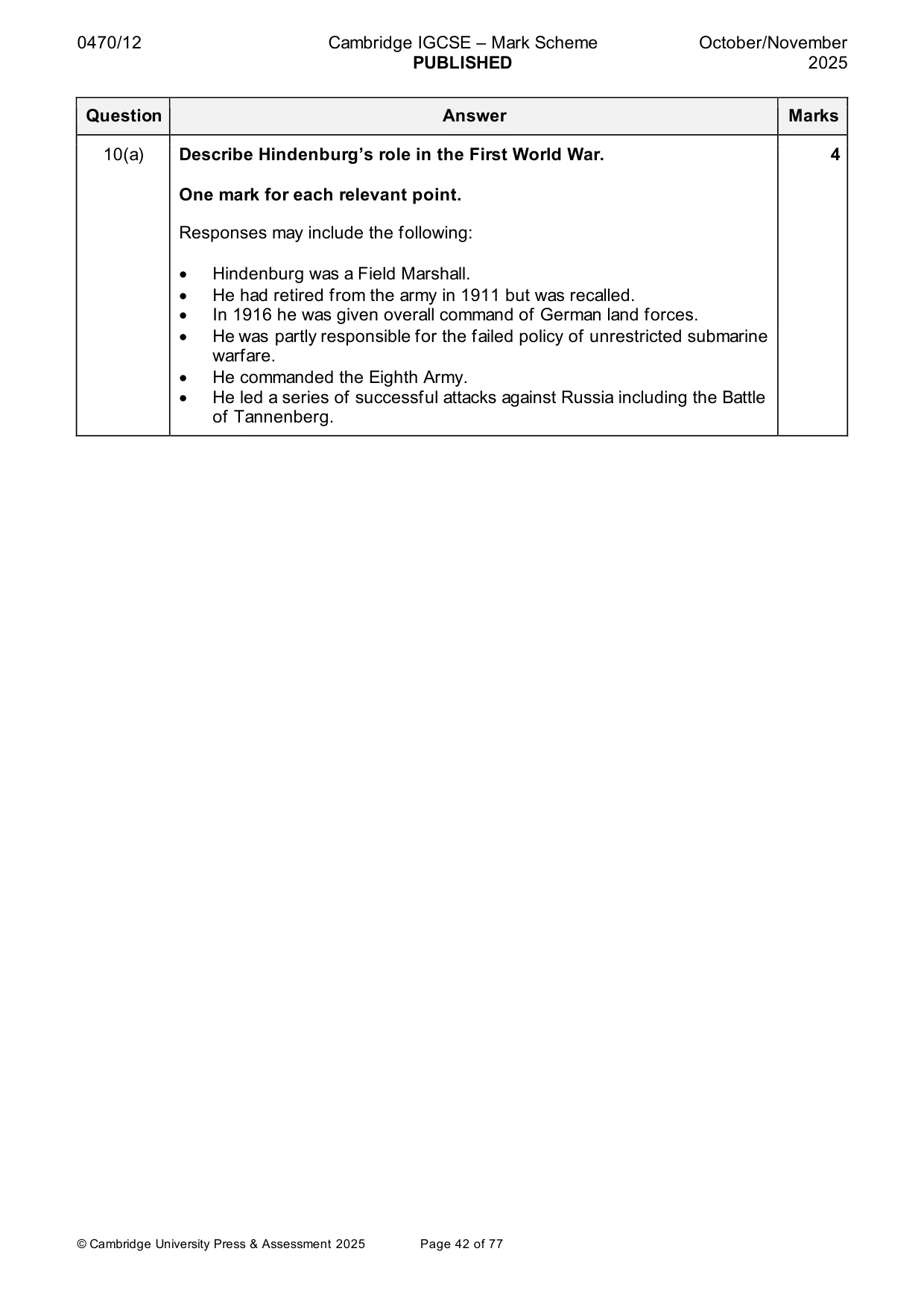
0470/12 Cambridge IGCSE – Mark Scheme PUBLISHED October/November 2025 © Cambridge University Press & Assessment 2025 Page 42 of 77 Question Answer Marks 10(a) Describe Hindenburg’s role in the First World War. One mark for each relevant point. Responses may include the following: • Hindenburg was a Field Marshall. • He had retired from the army in 1911 but was recalled. • In 1916 he was given overall command of German land forces. • He was partly responsible for the failed policy of unrestricted submarine warfare. • He commanded the Eighth Army. • He led a series of successful attacks against Russia including the Battle of Tannenberg. 4
Mark scheme, page 43
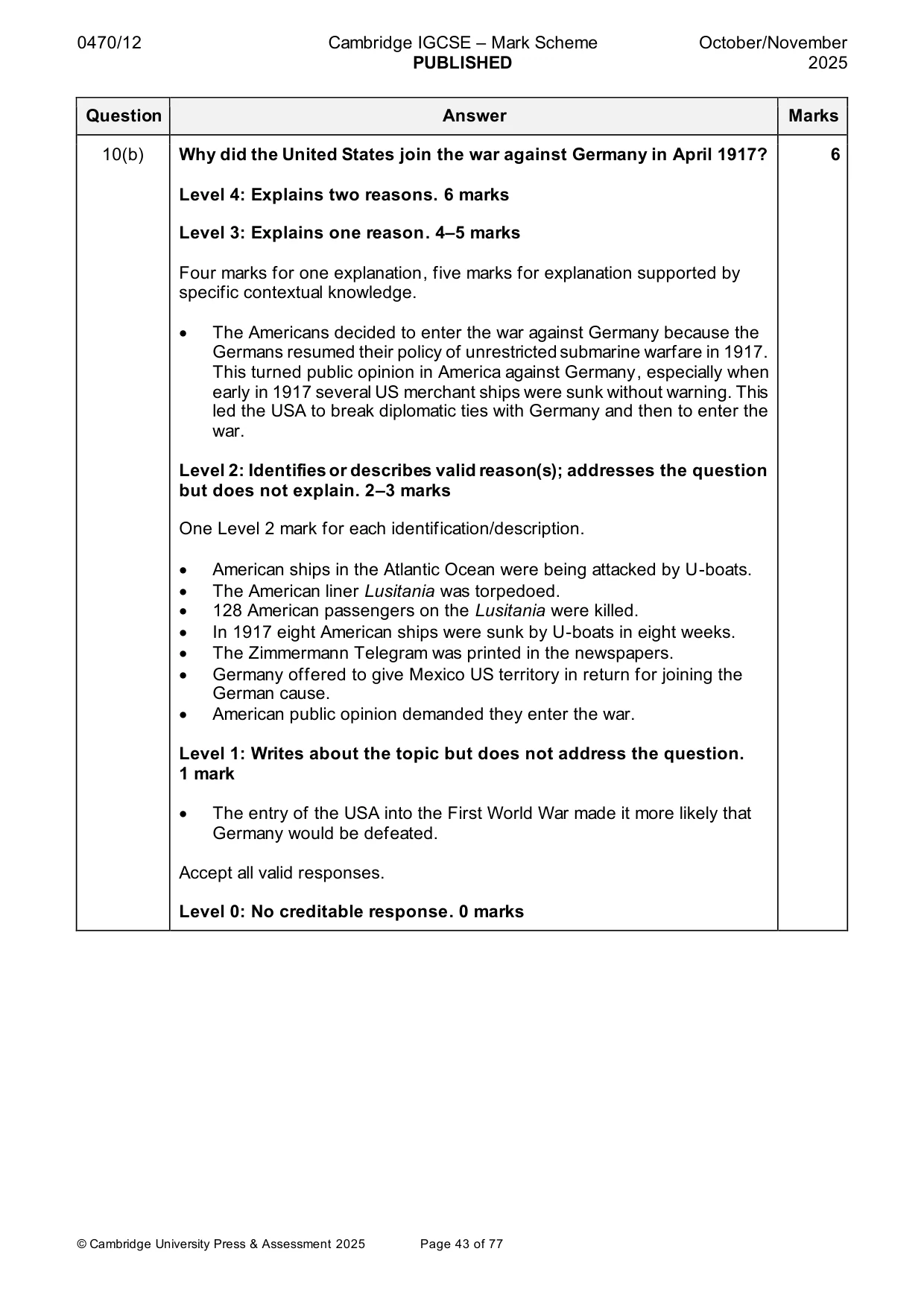
0470/12 Cambridge IGCSE – Mark Scheme PUBLISHED October/November 2025 © Cambridge University Press & Assessment 2025 Page 43 of 77 Question Answer Marks 10(b) Why did the United States join the war against Germany in April 1917? Level 4: Explains two reasons. 6 marks Level 3: Explains one reason. 4–5 marks Four marks for one explanation, five marks for explanation supported by specific contextual knowledge. • The Americans decided to enter the war against Germany because the Germans resumed their policy of unrestricted submarine warfare in 1917. This turned public opinion in America against Germany, especially when early in 1917 several US merchant ships were sunk without warning. This led the USA to break diplomatic ties with Germany and then to enter the war. Level 2: Identifies or describes valid reason(s); addresses the question but does not explain. 2–3 marks One Level 2 mark for each identification/description. • American ships in the Atlantic Ocean were being attacked by U-boats. • The American liner Lusitania was torpedoed. • 128 American passengers on the Lusitania were killed. • In 1917 eight American ships were sunk by U-boats in eight weeks. • The Zimmermann Telegram was printed in the newspapers. • Germany offered to give Mexico US territory in return for joining the German cause. • American public opinion demanded they enter the war. Level 1: Writes about the topic but does not address the question. 1 mark • The entry of the USA into the First World War made it more likely that Germany would be defeated. Accept all valid responses. Level 0: No creditable response. 0 marks 6
Mark scheme, page 44
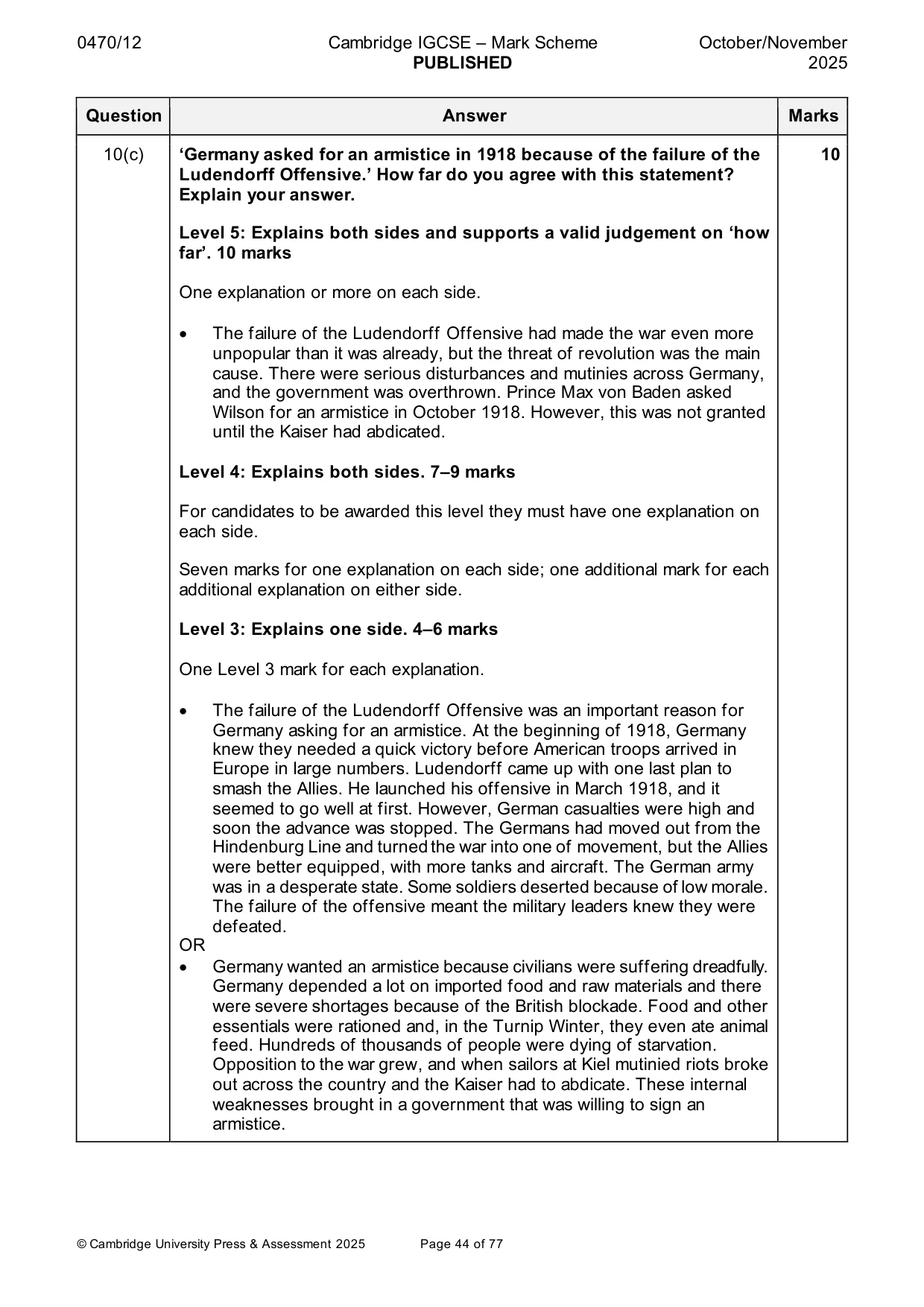
0470/12 Cambridge IGCSE – Mark Scheme PUBLISHED October/November 2025 © Cambridge University Press & Assessment 2025 Page 44 of 77 Question Answer Marks 10(c) ‘Germany asked for an armistice in 1918 because of the failure of the Ludendorff Offensive.’ How far do you agree with this statement? Explain your answer. Level 5: Explains both sides and supports a valid judgement on ‘how far’. 10 marks One explanation or more on each side. • The failure of the Ludendorff Offensive had made the war even more unpopular than it was already, but the threat of revolution was the main cause. There were serious disturbances and mutinies across Germany, and the government was overthrown. Prince Max von Baden asked Wilson for an armistice in October 1918. However, this was not granted until the Kaiser had abdicated. Level 4: Explains both sides. 7–9 marks For candidates to be awarded this level they must have one explanation on each side. Seven marks for one explanation on each side; one additional mark for each additional explanation on either side. Level 3: Explains one side. 4–6 marks One Level 3 mark for each explanation. • The failure of the Ludendorff Offensive was an important reason for Germany asking for an armistice. At the beginning of 1918, Germany knew they needed a quick victory before American troops arrived in Europe in large numbers. Ludendorff came up with one last plan to smash the Allies. He launched his offensive in March 1918, and it seemed to go well at first. However, German casualties were high and soon the advance was stopped. The Germans had moved out from the Hindenburg Line and turned the war into one of movement, but the Allies were better equipped, with more tanks and aircraft. The German army was in a desperate state. Some soldiers deserted because of low morale. The failure of the offensive meant the military leaders knew they were defeated. OR • Germany wanted an armistice because civilians were suffering dreadfully. Germany depended a lot on imported food and raw materials and there were severe shortages because of the British blockade. Food and other essentials were rationed and, in the Turnip Winter, they even ate animal feed. Hundreds of thousands of people were dying of starvation. Opposition to the war grew, and when sailors at Kiel mutinied riots broke out across the country and the Kaiser had to abdicate. These internal weaknesses brought in a government that was willing to sign an armistice. 10
Mark scheme, page 45
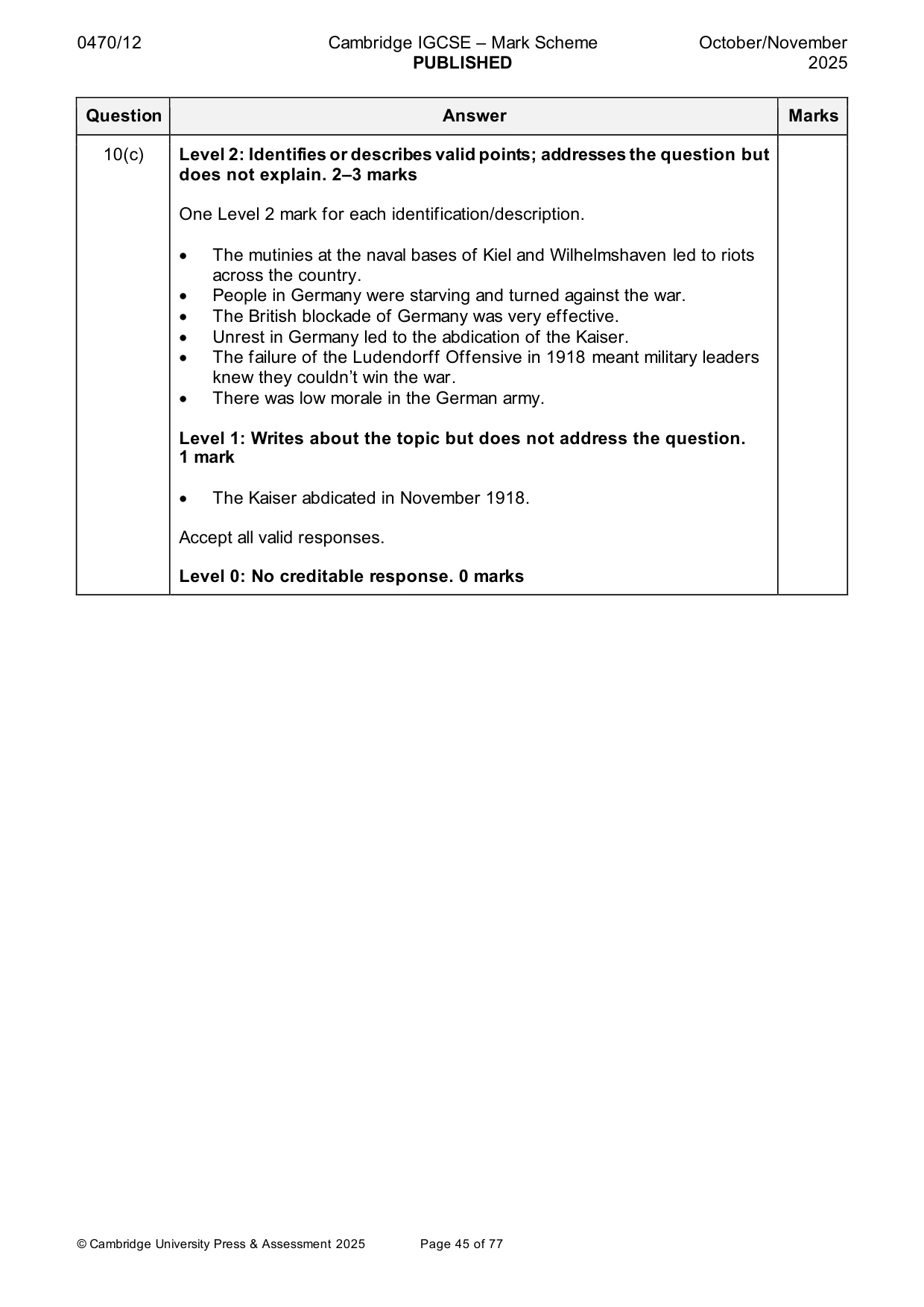
0470/12 Cambridge IGCSE – Mark Scheme PUBLISHED October/November 2025 © Cambridge University Press & Assessment 2025 Page 45 of 77 Question Answer Marks 10(c) Level 2: Identifies or describes valid points; addresses the question but does not explain. 2–3 marks One Level 2 mark for each identification/description. • The mutinies at the naval bases of Kiel and Wilhelmshaven led to riots across the country. • People in Germany were starving and turned against the war. • The British blockade of Germany was very effective. • Unrest in Germany led to the abdication of the Kaiser. • The failure of the Ludendorff Offensive in 1918 meant military leaders knew they couldn’t win the war. • There was low morale in the German army. Level 1: Writes about the topic but does not address the question. 1 mark • The Kaiser abdicated in November 1918. Accept all valid responses. Level 0: No creditable response. 0 marks
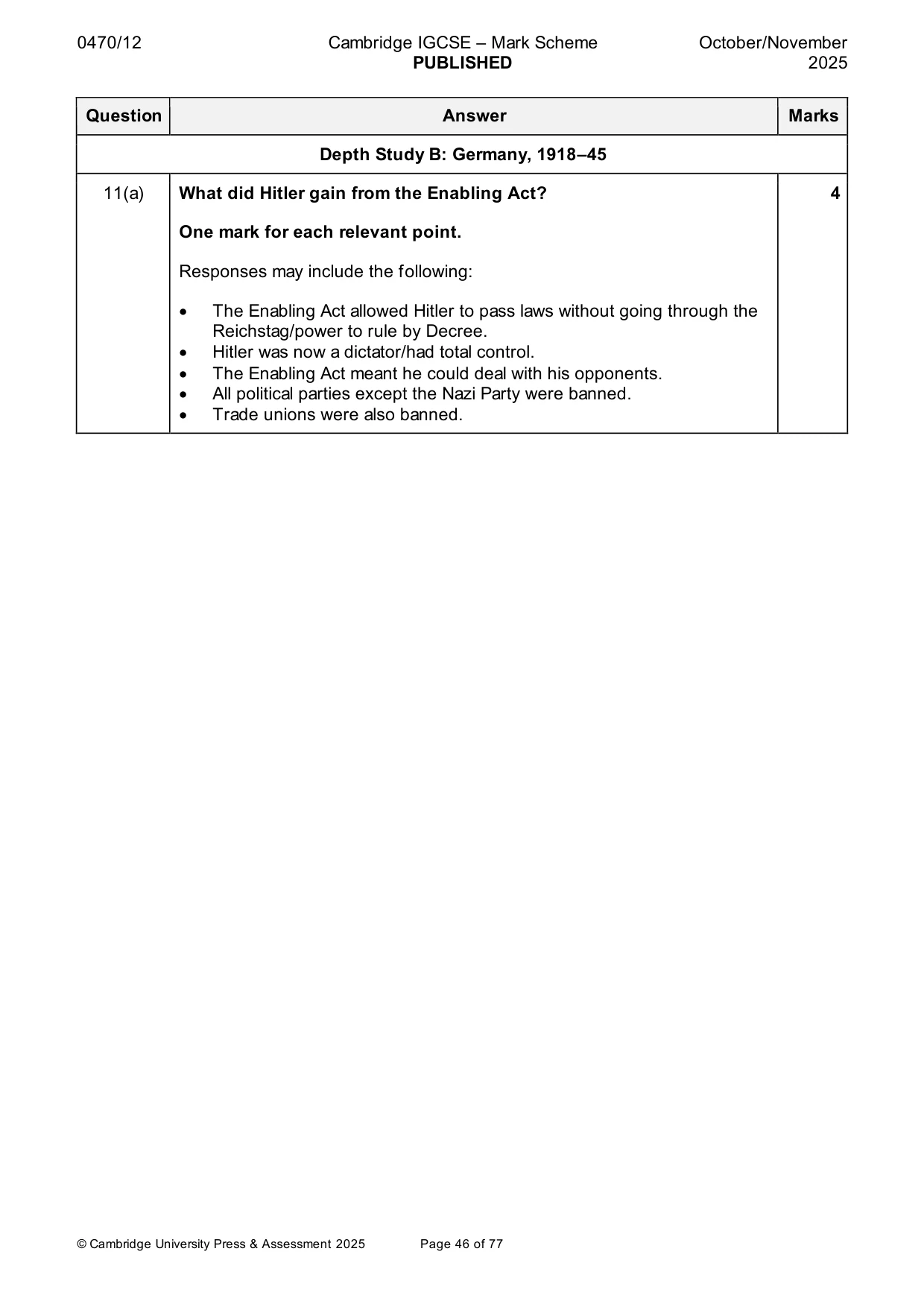
Mark scheme, page 46
0470/12 Cambridge IGCSE – Mark Scheme PUBLISHED October/November 2025 © Cambridge University Press & Assessment 2025 Page 46 of 77 Question Answer Marks Depth Study B: Germany, 1918–45 11(a) What did Hitler gain from the Enabling Act? One mark for each relevant point. Responses may include the following: • The Enabling Act allowed Hitler to pass laws without going through the Reichstag/power to rule by Decree. • Hitler was now a dictator/had total control. • The Enabling Act meant he could deal with his opponents. • All political parties except the Nazi Party were banned. • Trade unions were also banned. 4
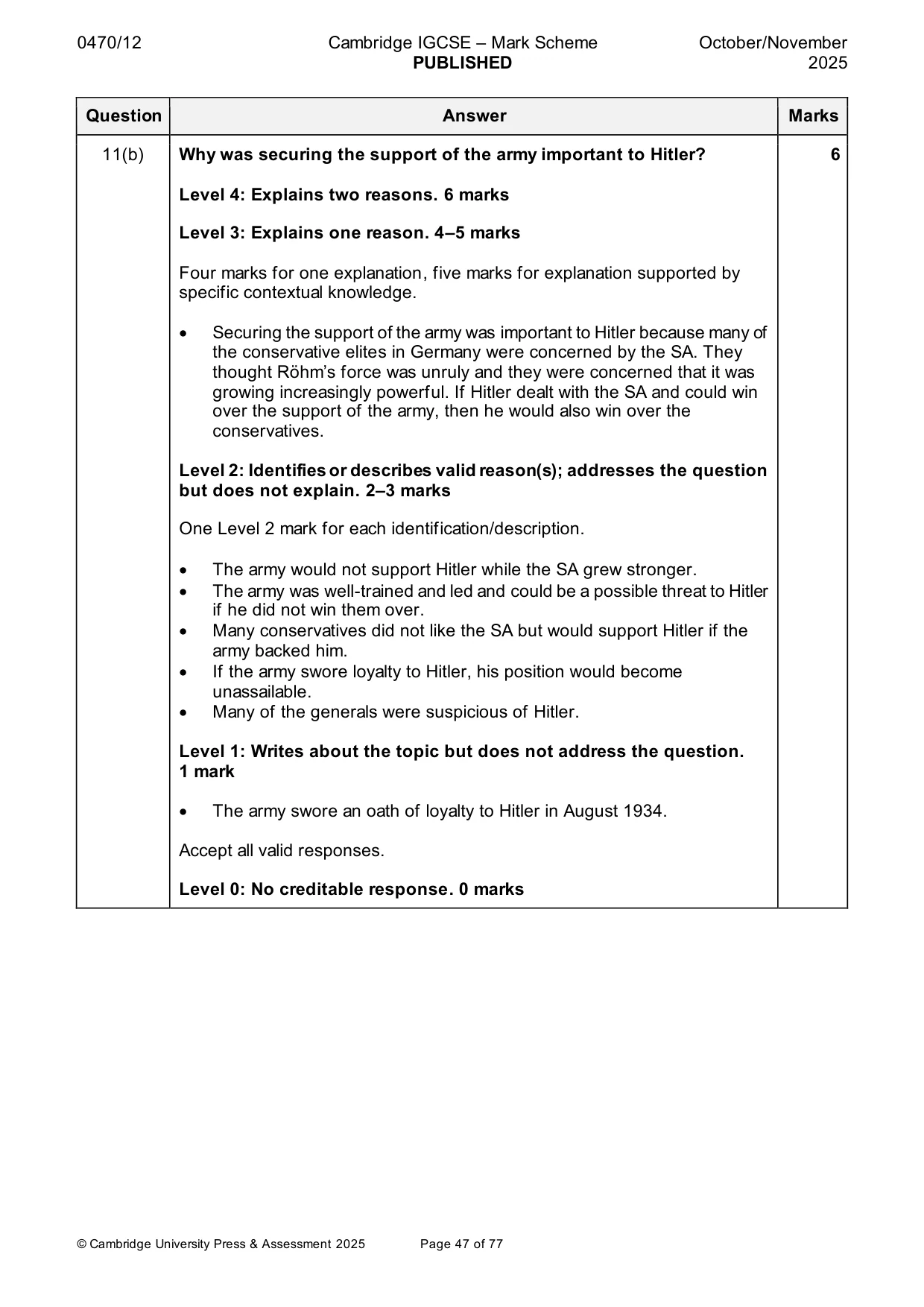
Mark scheme, page 47
0470/12 Cambridge IGCSE – Mark Scheme PUBLISHED October/November 2025 © Cambridge University Press & Assessment 2025 Page 47 of 77 Question Answer Marks 11(b) Why was securing the support of the army important to Hitler? Level 4: Explains two reasons. 6 marks Level 3: Explains one reason. 4–5 marks Four marks for one explanation, five marks for explanation supported by specific contextual knowledge. • Securing the support of the army was important to Hitler because many of the conservative elites in Germany were concerned by the SA. They thought Röhm’s force was unruly and they were concerned that it was growing increasingly powerful. If Hitler dealt with the SA and could win over the support of the army, then he would also win over the conservatives. Level 2: Identifies or describes valid reason(s); addresses the question but does not explain. 2–3 marks One Level 2 mark for each identification/description. • The army would not support Hitler while the SA grew stronger. • The army was well-trained and led and could be a possible threat to Hitler if he did not win them over. • Many conservatives did not like the SA but would support Hitler if the army backed him. • If the army swore loyalty to Hitler, his position would become unassailable. • Many of the generals were suspicious of Hitler. Level 1: Writes about the topic but does not address the question. 1 mark • The army swore an oath of loyalty to Hitler in August 1934. Accept all valid responses. Level 0: No creditable response. 0 marks 6
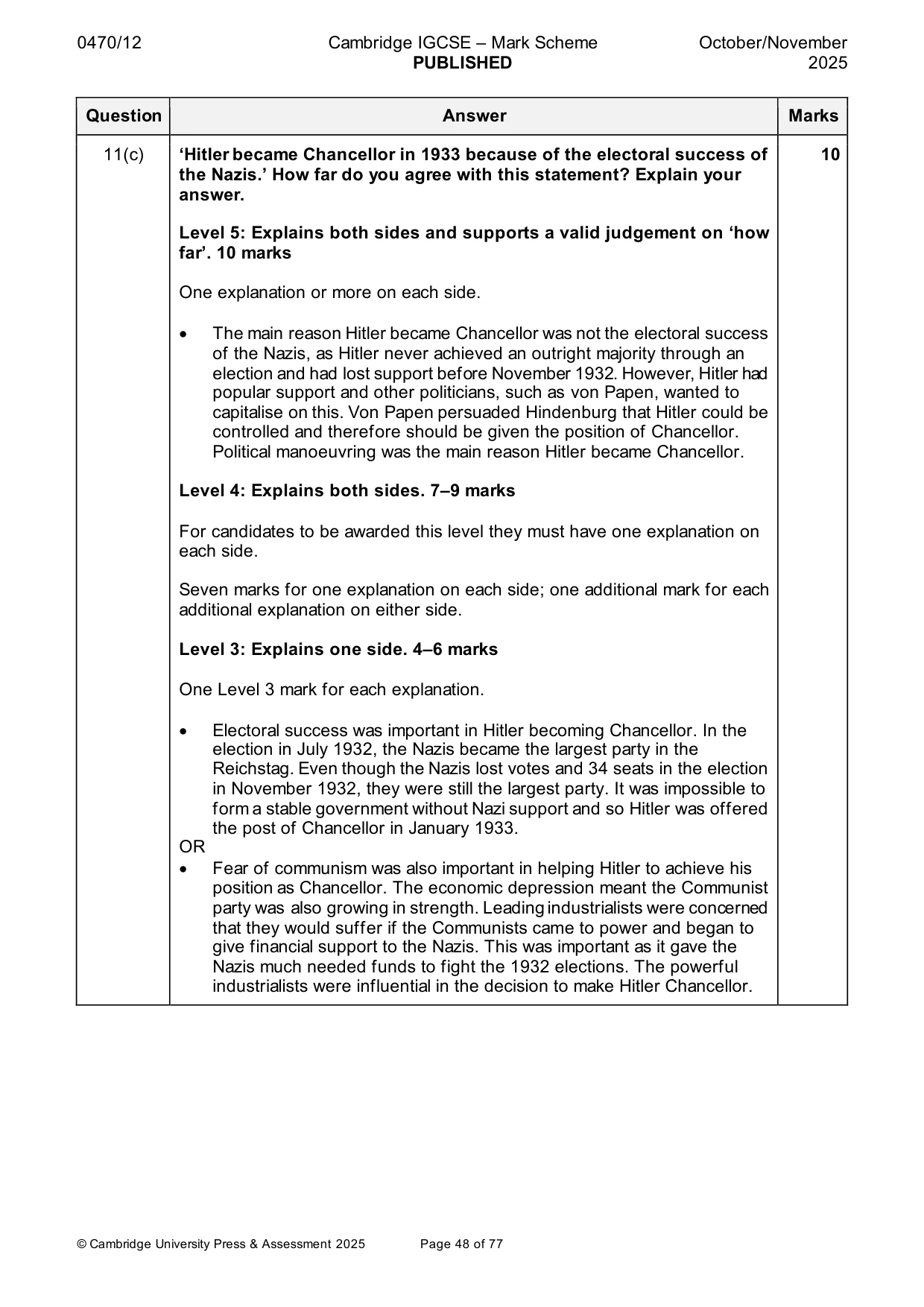
Mark scheme, page 48
0470/12 Cambridge IGCSE – Mark Scheme PUBLISHED October/November 2025 © Cambridge University Press & Assessment 2025 Page 48 of 77 Question Answer Marks 11(c) ‘Hitler became Chancellor in 1933 because of the electoral success of the Nazis.’ How far do you agree with this statement? Explain your answer. Level 5: Explains both sides and supports a valid judgement on ‘how far’. 10 marks One explanation or more on each side. • The main reason Hitler became Chancellor was not the electoral success of the Nazis, as Hitler never achieved an outright majority through an election and had lost support before November 1932. However, Hitler had popular support and other politicians, such as von Papen, wanted to capitalise on this. Von Papen persuaded Hindenburg that Hitler could be controlled and therefore should be given the position of Chancellor. Political manoeuvring was the main reason Hitler became Chancellor. Level 4: Explains both sides. 7–9 marks For candidates to be awarded this level they must have one explanation on each side. Seven marks for one explanation on each side; one additional mark for each additional explanation on either side. Level 3: Explains one side. 4–6 marks One Level 3 mark for each explanation. • Electoral success was important in Hitler becoming Chancellor. In the election in July 1932, the Nazis became the largest party in the Reichstag. Even though the Nazis lost votes and 34 seats in the election in November 1932, they were still the largest party. It was impossible to form a stable government without Nazi support and so Hitler was offered the post of Chancellor in January 1933. OR • Fear of communism was also important in helping Hitler to achieve his position as Chancellor. The economic depression meant the Communist party was also growing in strength. Leading industrialists were concerned that they would suffer if the Communists came to power and began to give financial support to the Nazis. This was important as it gave the Nazis much needed funds to fight the 1932 elections. The powerful industrialists were influential in the decision to make Hitler Chancellor. 10
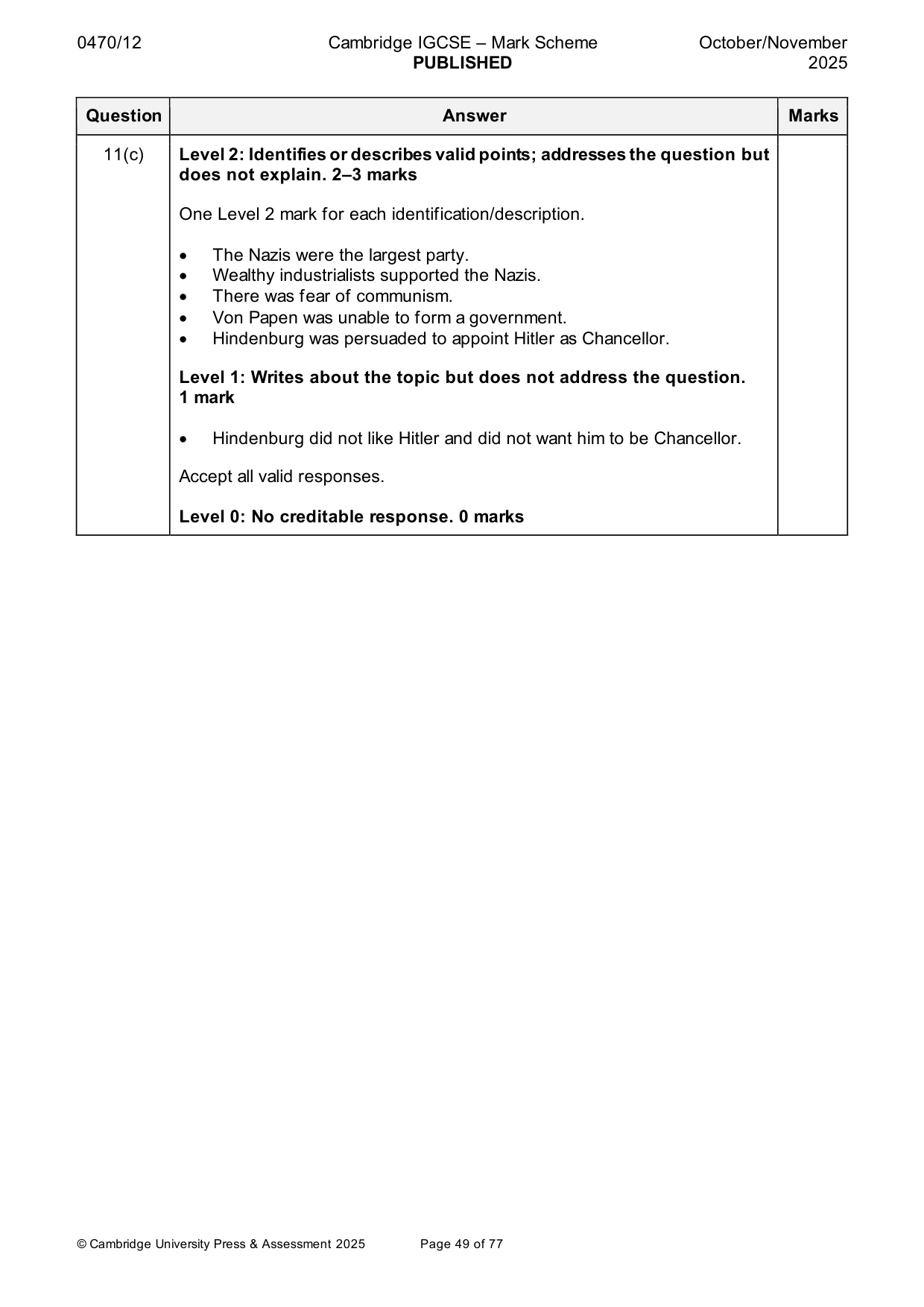
Mark scheme, page 49
0470/12 Cambridge IGCSE – Mark Scheme PUBLISHED October/November 2025 © Cambridge University Press & Assessment 2025 Page 49 of 77 Question Answer Marks 11(c) Level 2: Identifies or describes valid points; addresses the question but does not explain. 2–3 marks One Level 2 mark for each identification/description. • The Nazis were the largest party. • Wealthy industrialists supported the Nazis. • There was fear of communism. • Von Papen was unable to form a government. • Hindenburg was persuaded to appoint Hitler as Chancellor. Level 1: Writes about the topic but does not address the question. 1 mark • Hindenburg did not like Hitler and did not want him to be Chancellor. Accept all valid responses. Level 0: No creditable response. 0 marks
Mark scheme, page 50
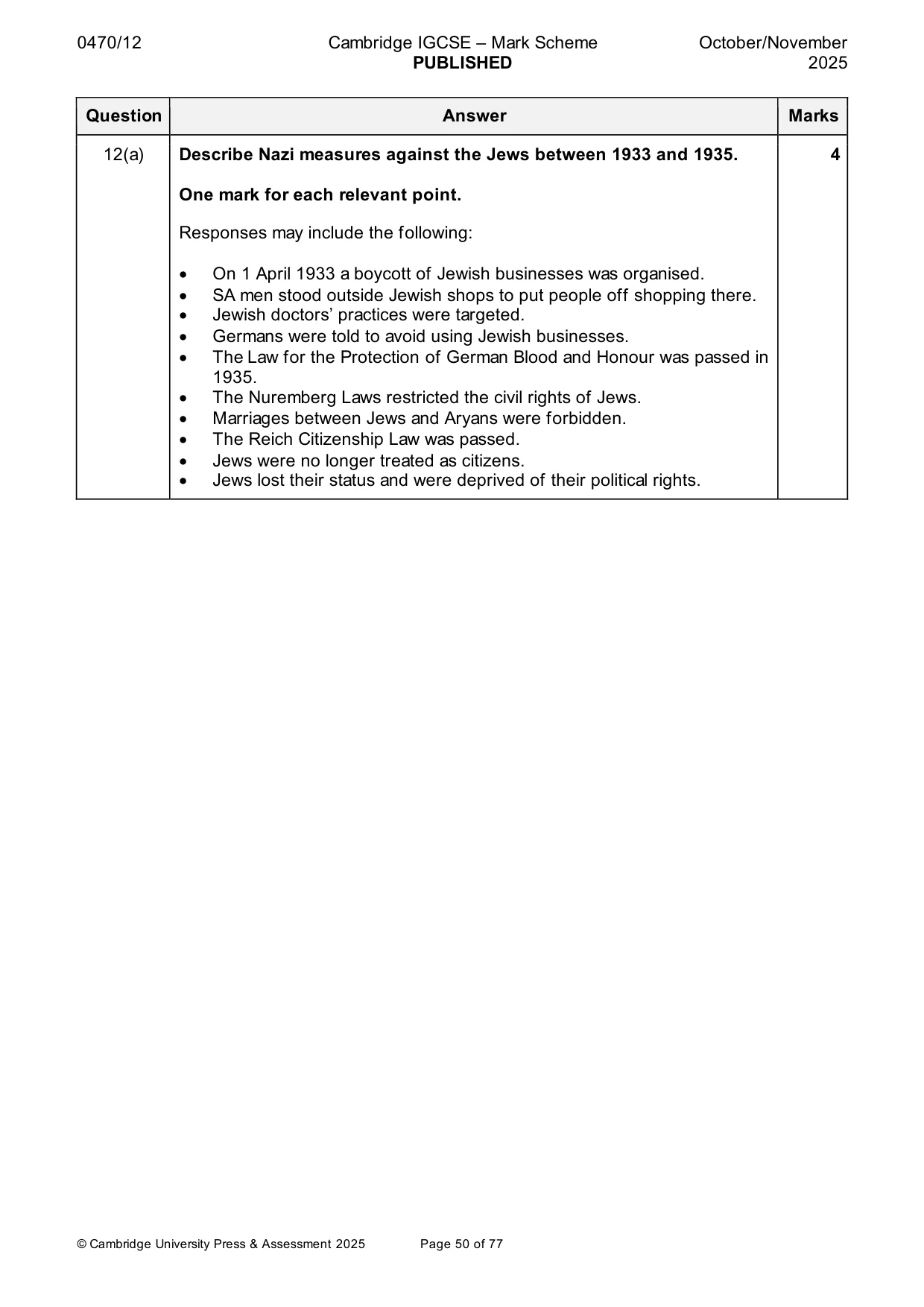
0470/12 Cambridge IGCSE – Mark Scheme PUBLISHED October/November 2025 © Cambridge University Press & Assessment 2025 Page 50 of 77 Question Answer Marks 12(a) Describe Nazi measures against the Jews between 1933 and 1935. One mark for each relevant point. Responses may include the following: • On 1 April 1933 a boycott of Jewish businesses was organised. • SA men stood outside Jewish shops to put people off shopping there. • Jewish doctors’ practices were targeted. • Germans were told to avoid using Jewish businesses. • The Law for the Protection of German Blood and Honour was passed in 1935. • The Nuremberg Laws restricted the civil rights of Jews. • Marriages between Jews and Aryans were forbidden. • The Reich Citizenship Law was passed. • Jews were no longer treated as citizens. • Jews lost their status and were deprived of their political rights. 4
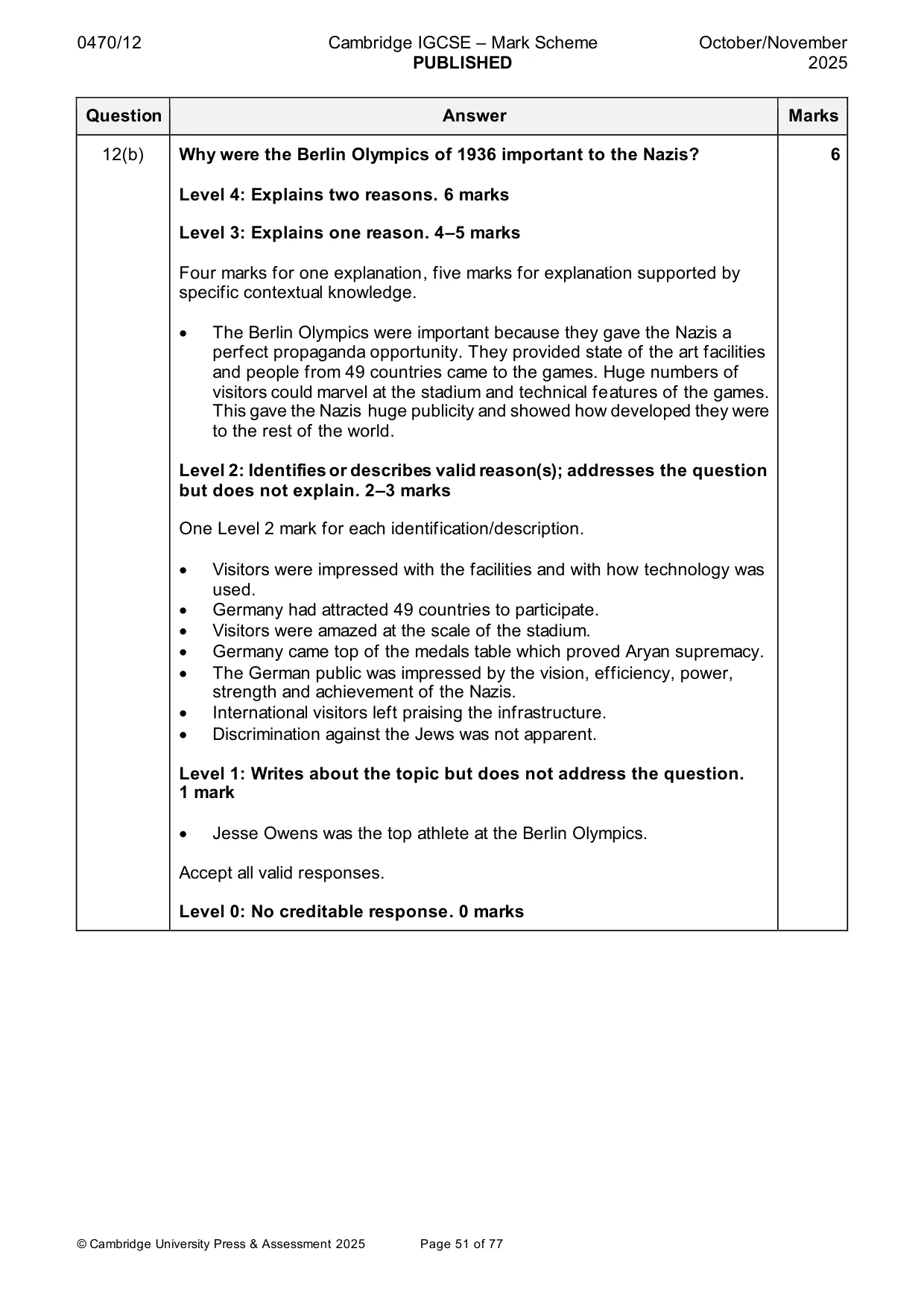
Mark scheme, page 51
0470/12 Cambridge IGCSE – Mark Scheme PUBLISHED October/November 2025 © Cambridge University Press & Assessment 2025 Page 51 of 77 Question Answer Marks 12(b) Why were the Berlin Olympics of 1936 important to the Nazis? Level 4: Explains two reasons. 6 marks Level 3: Explains one reason. 4–5 marks Four marks for one explanation, five marks for explanation supported by specific contextual knowledge. • The Berlin Olympics were important because they gave the Nazis a perfect propaganda opportunity. They provided state of the art facilities and people from 49 countries came to the games. Huge numbers of visitors could marvel at the stadium and technical features of the games. This gave the Nazis huge publicity and showed how developed they were to the rest of the world. Level 2: Identifies or describes valid reason(s); addresses the question but does not explain. 2–3 marks One Level 2 mark for each identification/description. • Visitors were impressed with the facilities and with how technology was used. • Germany had attracted 49 countries to participate. • Visitors were amazed at the scale of the stadium. • Germany came top of the medals table which proved Aryan supremacy. • The German public was impressed by the vision, efficiency, power, strength and achievement of the Nazis. • International visitors left praising the infrastructure. • Discrimination against the Jews was not apparent. Level 1: Writes about the topic but does not address the question. 1 mark • Jesse Owens was the top athlete at the Berlin Olympics. Accept all valid responses. Level 0: No creditable response. 0 marks 6
Mark scheme, page 52
0470/12 Cambridge IGCSE – Mark Scheme PUBLISHED October/November 2025 © Cambridge University Press & Assessment 2025 Page 52 of 77 Question Answer Marks 12(c) How far do you agree that there was significant opposition to the Nazis? Explain your answer. Level 5: Explains both sides and supports a valid judgement on ‘how far’. 10 marks One explanation or more on each side. • There was little significant opposition to the Nazis. Even though the T4 euthanasia programme was opposed and stopped, the widespread mistreatment of Jewish people and other minorities continued. Opponents were arrested and executed, even when they were only teenagers, and this was an important deterrent to others. Level 4: Explains both sides. 7–9 marks For candidates to be awarded this level they must have one explanation on each side. Seven marks for one explanation on each side; one additional mark for each additional explanation on either side. Level 3: Explains one side. 4–6 marks One Level 3 mark for each explanation. • There was some opposition, and it had an impact so must have been significant. For example, when the T4 programme was discovered, there was opposition, and it was stopped. Opposition grew more noticeable among young people and especially during the war. The Edelweiss Pirates carried out acts of sabotage and hid army deserters. They distributed Allied war leaflets. Another group, the White Rose, included university students who opposed the Nazi slaughter of Jews and tried to get people to oppose the German war effort. The Nazis must have thought this opposition was dangerous as they executed the leaders in 1944. OR • Opposition was not very significant. Many people supported the Nazis and thought their economic policies were beneficial. They had no reason to oppose the Nazis. Others might have privately questioned Nazi policies but were too afraid to say so publicly The Gestapo tapped telephones and spied on people. If anyone was suspected of not supporting Hitler, they were arrested. The SS frightened the German people into obedience. They could arrest anyone they wanted and put them in concentration camps where they were tortured and made to do hard labour. People were simply too afraid to oppose the regime. 10
Mark scheme, page 53
0470/12 Cambridge IGCSE – Mark Scheme PUBLISHED October/November 2025 © Cambridge University Press & Assessment 2025 Page 53 of 77 Question Answer Marks 12(c) Level 2: Identifies or describes valid points; addresses the question but does not explain. 2–3 marks One Level 2 mark for each identification/description. • Church leaders led opposition to the T4 programme, and it was stopped. • Members of the ‘Swing’ movement resisted the Nazi attempt to control their lives. • The Edelweiss Pirates did not like the regimentation of the Hitler Youth. • Opposition increased during the war, especially from the Edelweiss Pirates. • During the war more young people refused to join the Hitler Youth. • Some religious leaders like Dietrich Bonhoeffer opposed the Nazis. • The Bomb Plot was an attempt by army leaders to assassinate Hitler in 1944. • A lot of the opposition to the Nazis was passive – people told anti-Nazi jokes. • Communists were rounded up and sent to concentration camps. • Members of other political parties like the Social Democrats were arrested. • Nazi propaganda indoctrinated a lot of people. • The SS and the Gestapo intimidated a lot of people into obedience. • People were too afraid to oppose the regime because of all the spies and informers. • The Kreisau Circle opposed Hitler, but they achieved little and were arrested. Level 1: Writes about the topic but does not address the question. 1 mark • The Nazis had a lot of popular support. Accept all valid responses. Level 0: No creditable response. 0 marks
Mark scheme, page 54
0470/12 Cambridge IGCSE – Mark Scheme PUBLISHED October/November 2025 © Cambridge University Press & Assessment 2025 Page 54 of 77 Question Answer Marks Depth Study C: Russia, 1905–41 13(a) What were Lenin’s April Theses? One mark for each relevant point. Responses may include the following: • The April Theses were a series of demands issued when Lenin returned to Russia. • He called for Soviets to seize power. • He called on the Bolsheviks not to support the Provisional Government. • He condemned continued involvement in the First World War. • Lenin called for all landed estates to be confiscated. • He said that the banks should be nationalised. • Lenin said that power should belong to the workers and the peasants. 4
Mark scheme, page 55
0470/12 Cambridge IGCSE – Mark Scheme PUBLISHED October/November 2025 © Cambridge University Press & Assessment 2025 Page 55 of 77 Question Answer Marks 13(b) Why were the July Days important? Level 4: Explains two reasons. 6 marks Level 3: Explains one reason. 4–5 marks Four marks for one explanation, five marks for explanation supported by specific contextual knowledge. • The July Days were important because they showed that the Bolshevik leadership was under-prepared for the levels of discontent shown by numerous groups against the government. Because of the lack of Bolshevik leadership, most strikers went home, and the soldiers and sailors returned to barracks. The Bolshevik leadership was fortunate to survive as many were arrested while Lenin fled to Finland. This was important because it showed the need for planning and that the Provisional Government still had some strength. Level 2: Identifies or describes valid reason(s); addresses the question but does not explain. 2–3 marks One Level 2 mark for each identification/description. • The workers and soldiers showed their strength of feeling against the war. • Military units refused to go to the front line. • It showed the Bolsheviks were not yet ready to take over. • Kerensky was appointed prime minister. • It led to the appointment of Kornilov. • Some Bolsheviks were forced to flee or were imprisoned. • The July Days showed the Provisional Government still had influence. Level 1: Writes about the topic but does not address the question. 1 mark • The July Days was a period of rioting and demonstrations in Petrograd. Accept all valid responses. Level 0: No creditable response. 0 marks 6
Mark scheme, page 56
0470/12 Cambridge IGCSE – Mark Scheme PUBLISHED October/November 2025 © Cambridge University Press & Assessment 2025 Page 56 of 77 Question Answer Marks 13(c) ‘The main reason the Provisional Government fell from power was because it did not withdraw Russia from the war.’ How far do agree with this statement? Explain your answer. Level 5: Explains both sides and supports a valid judgement on ‘how far’. 10 marks One explanation or more on each side. • The main reason that the Provisional Government fell was sharing power with the Soviets. They continually undermined the Provisional Government and during the Kornilov Revolt, the Provisional Government had to depend on the Bolsheviks for support. This showed the Provisional Government was too weak to control the situation facing Russia. Level 4: Explains both sides. 7–9 marks For candidates to be awarded this level they must have one explanation on each side. Seven marks for one explanation on each side; one additional mark for each additional explanation on either side. Level 3: Explains one side. 4–6 marks One Level 3 mark for each explanation. • In 1917, the Tsar fell from power because of problems that stemmed from the war. There were serious food shortages, troops were not properly equipped, and defeats meant a loss of morale. By keeping Russia in the war, the Provisional Government allowed all these problems to continue. The Kerensky Offensive failed, and 2 million soldiers had run away from the front line and many turned on their officers. There was a demand to leave the war from the soldiers and the people at home, who were suffering from food and fuel shortages. OR • The Provisional Government did not address the demand for land from the peasants. They did not approve of peasants and returning soldiers seizing land from the nobility and wealthy landlords. The government wanted land reform to be orderly, but they were unable to control the peasants or organise rapid reform. Therefore, the Provisional Government appeared not to respond to the needs of the people and, at the same time, appeared weak. 10
Mark scheme, page 57
0470/12 Cambridge IGCSE – Mark Scheme PUBLISHED October/November 2025 © Cambridge University Press & Assessment 2025 Page 57 of 77 Question Answer Marks 13(c) Level 2: Identifies or describes valid points; addresses the question but does not explain. 2–3 marks One Level 2 mark for each identification/description. • The Provisional Government decided to continue with the war. • Offensives at the front failed and there was mass desertion. • The Petrograd Soviet undermined the Provisional Government. • The Soviet had control over the railways, power supplies, factories and the troops. • The Provisional Government did not redistribute the land to the peasants. • Food shortages and high prices continued. • The Government continued with grain seizures to feed the troops at the front. • Civilians demanded an end to the war because of food shortages. Level 1: Writes about the topic but does not address the question. 1 mark • The Provisional Government was led by Kerensky. Accept all valid responses. Level 0: No creditable response. 0 marks
Mark scheme, page 58
0470/12 Cambridge IGCSE – Mark Scheme PUBLISHED October/November 2025 © Cambridge University Press & Assessment 2025 Page 58 of 77 Question Answer Marks 14(a) What was Stalin’s approach to ethnic minorities? One mark for each relevant point. Responses may include the following: • Stalin introduced a policy of Russification. • All Polish schools were made to teach in Russian. • In the late 1930s every school student had to learn Russian. • Stalin had groups deported to Siberia, such as Crimean Tatars and Chechens. • There were purges in areas such as Ukraine. • Around 1.5 million people from ethnic minorities were deported to Asia. • Some minorities lost their separate identities and languages. 4
Mark scheme, page 59
0470/12 Cambridge IGCSE – Mark Scheme PUBLISHED October/November 2025 © Cambridge University Press & Assessment 2025 Page 59 of 77 Question Answer Marks 14(b) Why did Stalin introduce Five-Year Plans for industry? Level 4: Explains two reasons. 6 marks Level 3: Explains one reason. 4–5 marks Four marks for one explanation, five marks for explanation supported by specific contextual knowledge. • Stalin introduced Five-Year Plans for industry because he wanted to rival the economies of the USA and other capitalist countries. When Stalin took power, much of Russia’s industrial equipment had to be imported. Stalin wanted to make the USSR self-sufficient so that it could make everything it needed for itself. Stalin also wanted to improve standards of living in Russia so that people would value Communist rule. Level 2: Identifies or describes valid reason(s); addresses the question but does not explain. 2–3 marks One Level 2 mark for each identification/description. • He wanted to increase the USSR’s military strength. • The USSR needed industries to produce weapons and other equipment for war. • Stalin wanted to make the USSR self-sufficient. • He wanted to improve his peoples’ standard of living. • Stalin wanted to increase food supplies. • Stalin needed to reorganise farming methods. • Stalin wanted to sell grain abroad to buy industrial equipment. • Stalin wanted to create a true Communist society. • Stalin wanted to prove to be a great leader by bringing about great changes. • Stalin believed the USSR was 50 to 100 years behind the other advanced countries. Level 1: Writes about the topic but does not address the question. 1 mark • The Five-Year Plans set massive targets for industry. Accept all valid responses. Level 0: No creditable response. 0 marks 6
Mark scheme, page 60
0470/12 Cambridge IGCSE – Mark Scheme PUBLISHED October/November 2025 © Cambridge University Press & Assessment 2025 Page 60 of 77 Question Answer Marks 14(c) How far do you agree that the policy of collectivisation was a success? Explain your answer. Level 5: Explains both sides and supports a valid judgement on ‘how far’. 10 marks One explanation or more on each side. • How far collectivisation was a success depends on which point of view it is considered from. From Stalin’s perspective, collectivisation probably was a success. He achieved his aims of destroying the kulaks and turning farms into factories. However, from a human perspective it was a disaster. Millions died needlessly and many of the most able farmers were deported. Level 4: Explains both sides. 7–9 marks For candidates to be awarded this level they must have one explanation on each side. Seven marks for one explanation on each side; one additional mark for each additional explanation on either side. Level 3: Explains one side. 4–6 marks One Level 3 mark for each explanation. • The policy of collectivisation was a disaster because it had a devastating effect in the countryside and created a famine. There was a lot of opposition to collectivisation in the countryside because it meant that peasants lost their own land. Many peasants had to be forced to give up their land, which they had fought for in the revolution. This caused enormous disruption and the production of food fell. This led to a famine in 1932–33. Yet the government still exported grain. Millions of peasants starved to death. OR • Stalin would have thought that collectivisation was a success for the USSR. He wanted to remove the kulaks and their resistance to this policy gave him a reason to have them deported. Many more died in the famine. He wanted the USSR to have bigger farms which were more efficient, so the government could control how much was produced. The government was able to take control and force the peasants to increase the production of grain. This was exported and the money was used for important technological imports to improve industry. 10
Mark scheme, page 61
0470/12 Cambridge IGCSE – Mark Scheme PUBLISHED October/November 2025 © Cambridge University Press & Assessment 2025 Page 61 of 77 Question Answer Marks 14(c) Level 2: Identifies or describes valid points; addresses the question but does not explain. 2–3 marks One Level 2 mark for each identification/description. • Collectivisation led to much suffering with millions dying in the famine. • Many peasants had to be killed, deported or imprisoned to enforce it. • It caused enormous disruption in the countryside and at first food production fell. • Production of grain was increased. • It gave the government more control. • Exports of grain gave the USSR currency to spend on other things. • It led to the defeat of the kulaks. • It produced the food that the increasing number of industrial workers needed. • Many peasants went to industrial regions to work instead. Level 1: Writes about the topic but does not address the question. 1 mark • Collectivisation meant merging small farms into larger ones. Accept all valid responses. Level 0: No creditable response. 0 marks
Mark scheme, page 62
0470/12 Cambridge IGCSE – Mark Scheme PUBLISHED October/November 2025 © Cambridge University Press & Assessment 2025 Page 62 of 77 Question Answer Marks Depth Study D: The United States, 1919–41 15(a) Describe restrictions placed on immigration in the 1920s. One mark for each relevant point. Responses may include the following: • The Emergency Quota Act was passed in 1921. • A quota was set which restricted immigration to 3% annually of the number from the same country living in the USA in 1910. • The number of immigrants from eastern and southern Europe was reduced by 75%. • In 1924 the National Origins Act was passed. • It reduced annual immigration to 150 000. • The quota was reduced to 2% of the 1890 figure. • Immigrants from Asia were barred. 4
Mark scheme, page 63
0470/12 Cambridge IGCSE – Mark Scheme PUBLISHED October/November 2025 © Cambridge University Press & Assessment 2025 Page 63 of 77 Question Answer Marks 15(b) Why was prohibition introduced? Level 4: Explains two reasons. 6 marks Level 3: Explains one reason. 4–5 marks Four marks for one explanation, five marks for explanation supported by specific contextual knowledge. • Prohibition was introduced because it was claimed that alcohol caused many social problems such as poverty, crime, violence and ill health. The Anti-Saloon League and Women’s Temperance Union were strong campaigners for abolition, suggesting the USA would be a better place if people did not drink. Level 2: Identifies or describes valid reason(s); addresses the question but does not explain. 2–3 marks One Level 2 mark for each identification/description. • It was claimed that alcohol caused poverty and domestic abuse. • Saloons were seen as immoral and damaging to family life. • The Protestant Church supported the cause. • Many brewers were of German descent, and the First World War had created strong anti-German feelings. • Eighteen states had introduced their own prohibition laws. • Industrialists thought it would encourage people to work harder and take less time off. • Politicians realised there was a lot of popular support for it. Level 1: Writes about the topic but does not address the question. 1 mark • Prohibition led to a rise in organised crime. Accept all valid responses. Level 0: No creditable response. 0 marks 6
Mark scheme, page 64
0470/12 Cambridge IGCSE – Mark Scheme PUBLISHED October/November 2025 © Cambridge University Press & Assessment 2025 Page 64 of 77 Question Answer Marks 15(c) ‘Gangsterism posed a greater threat to American society in the 1920s than the Ku Klux Klan.’ How far do you agree with this statement? Explain your answer. Level 5: Explains both sides and supports a valid judgement on ‘how far’. 10 marks One explanation or more on each side. • The Ku Klux Klan was a greater threat. Gangsters created problems in cities, especially during prohibition. However, rival gangs fought each other and there was limited violence towards the public. When prohibition ended, gangs were no longer so influential and some of their leaders were arrested. However, the KKK had millions of members and were rarely prosecuted for lynching African Americans and other minority groups. The KKK represented the racist ideas of many Americans, and these were far longer lasting and more influential in American society than the gangsters. Level 4: Explains both sides. 7–9 marks For candidates to be awarded this level they must have one explanation on each side. Seven marks for one explanation on each side; one additional mark for each additional explanation on either side. Level 3: Explains one side. 4–6 marks One Level 3 mark for each explanation. • Gangsterism developed in the 1920s largely because of prohibition. In big cities people were willing to still buy and drink alcohol. This gave criminals the chance to smuggle and supply illegal liquor. Gangsters like Al Capone started to do this but soon they were fighting each other for control of parts of cities. This led to the gangs having gun fights and murdering each other. Soon many cities were plagued with murders by the gangsters, which was a real problem for the authorities. In some places the mayor and even the police were in the pocket of the gangs. OR • The Ku Klux Klan believed in white supremacy. It was racist and attacked, intimidated, tortured and murdered African Americans. Thousands were murdered by lynching but hardly any members of the KKK were prosecuted for these murders. It was a serious problem because the KKK had a membership of 5 million people, including many important politicians. The organisation was also against Jews and Catholics and some groups of immigrants. 10
Mark scheme, page 65
0470/12 Cambridge IGCSE – Mark Scheme PUBLISHED October/November 2025 © Cambridge University Press & Assessment 2025 Page 65 of 77 Question Answer Marks 15(c) Level 2: Identifies or describes valid points; addresses the question but does not explain. 2–3 marks One Level 2 mark for each identification/description. • The KKK believed in white supremacy. • The KKK had support among politicians. • The KKK attacked Jews, Catholics and foreigners. • Members of the KKK were often found not guilty in Southern courts. • Thousands of African Americans were falsely accused of crimes and lynched. • The KKK operated largely in the South. • Gangsters supplied the illegal speakeasies with alcohol. • Rival gangs fought gunfights such as St Valentine’s Massacre. • Gang leaders became influential and bribed the police. • Some cities were largely controlled by the gangs. Level 1: Writes about the topic but does not address the question. 1 mark • Al Capone was a gangster in Chicago, but his brother was a prohibition agent. Accept all valid responses. Level 0: No creditable response. 0 marks
Mark scheme, page 66
0470/12 Cambridge IGCSE – Mark Scheme PUBLISHED October/November 2025 © Cambridge University Press & Assessment 2025 Page 66 of 77 Question Answer Marks 16(a) Describe the impact of the Wall Street Crash on the US economy. One mark for each relevant point. Responses may include the following: • The crash in share prices caused a lack in confidence in banks. • Many Americans were forced into bankruptcy. • There were many bank closures. • There was a fall in demand for goods at home. • Other countries cut back on buying American goods. • Businesses cut back production. 4
Mark scheme, page 67
0470/12 Cambridge IGCSE – Mark Scheme PUBLISHED October/November 2025 © Cambridge University Press & Assessment 2025 Page 67 of 77 Question Answer Marks 16(b) Why was Hoover criticised for his response to the Depression? Level 4: Explains two reasons. 6 marks Level 3: Explains one reason. 4–5 marks Four marks for one explanation, five marks for explanation supported by specific contextual knowledge. • Hoover believed that the economy would recover on its own and so made limited attempts to intervene. He did not believe government should support business or provide welfare. He believed in ‘rugged individualism’, the idea that people should work hard for themselves and not expect government help. When so many people faced poverty and hardship, this made him appear heartless and uncaring. Level 2: Identifies or describes valid reason(s); addresses the question but does not explain. 2–3 marks One Level 2 mark for each identification/description. • Hoover did not believe in state handouts. • Hoover cut taxes by $130 million but this was not enough. • He thought it was up to the individual to get work, even though there were few jobs available. • Hoover did not believe that the state should provide welfare for unemployed or homeless people. • Hoover sent troops to deal with the Bonus Marchers. Level 1: Writes about the topic but does not address the question. 1 mark • The Depression happened after the Wall Street Crash. Accept all valid responses. Level 0: No creditable response. 0 marks 6
Mark scheme, page 68
0470/12 Cambridge IGCSE – Mark Scheme PUBLISHED October/November 2025 © Cambridge University Press & Assessment 2025 Page 68 of 77 Question Answer Marks 16(c) How far do you agree that speculation was the main cause of the Wall Street Crash? Explain your answer. Level 5: Explains both sides and supports a valid judgement on ‘how far’. 10 marks One explanation or more on each side. • Speculation was one problem which caused the Wall Street Crash and may have been responsible for its timing. However, there were long-term weaknesses in the US economy which meant that companies could not continue to grow. These meant that a crash was an increasing possibility by 1929. Level 4: Explains both sides. 7–9 marks For candidates to be awarded this level they must have one explanation on each side. Seven marks for one explanation on each side; one additional mark for each additional explanation on either side. Level 3: Explains one side. 4–6 marks One Level 3 mark for each explanation. • The Wall Street Crash was caused by speculating on the stock market. Wall Street had been doing very well for years and more people bought shares, even when they could not afford to. Prices went up and up until they were too high and people began selling their shares. When others saw this, they panicked, and all rushed to sell their shares. This led to a complete financial collapse, with people losing all their money and becoming destitute. OR • Unequal distribution of wealth was a factor in bringing about the Wall Street Crash because it meant that companies could not sell their products to all Americans as some could not afford them. This meant the idea that companies would constantly grow and continue to be profitable was flawed. Share prices were inflated and did not reflect the real value of the business and this contributed to the crash in process in 1929. 10
Mark scheme, page 69
0470/12 Cambridge IGCSE – Mark Scheme PUBLISHED October/November 2025 © Cambridge University Press & Assessment 2025 Page 69 of 77 Question Answer Marks 16(c) Level 2: Identifies or describes valid points; addresses the question but does not explain. 2–3 marks One Level 2 mark for each identification/description. • Factories were overproducing consumer goods that no one could buy. • Countries abroad could not afford to buy American goods. • Farmers were overproducing food and prices fell. • Speculation on the stock exchange caused the crash. • Buying shares on the margin was the real problem. • The banks were reckless in lending money to people. • People panicked and sold their shares all at once. Level 1: Writes about the topic but does not address the question. 1 mark • The Wall Street Crash took place in October 1929, and people lost millions of dollars overnight. Accept all valid responses. Level 0: No creditable response. 0 marks
Mark scheme, page 70
0470/12 Cambridge IGCSE – Mark Scheme PUBLISHED October/November 2025 © Cambridge University Press & Assessment 2025 Page 70 of 77 Question Answer Marks Depth study E: The Second World War in Europe and the Asia–Pacific, 1939–c.1945 17(a) Describe relations between the United States and Japan before 1941. One mark for each relevant point. Responses may include the following: • Relations were tense as the USA supported China when Japan attacked Nanking in 1937. • The USA sent military aid to China which angered Japan. • In 1939, Roosevelt cancelled the 1911 commercial treaty with Japan. • Trade restrictions were placed on Japan. • Japan attacked a US gunboat, the USS Panay, in Chinese waters in 1937. • Japan ignored treaties which it had agreed with the USA and rearmed on a huge scale. • The US government refused to recognise the Japanese government in Manchukuo. • The USA cut off iron and steel supplies to Japan. • The USA cut off oil supplies. 4
Mark scheme, page 71
0470/12 Cambridge IGCSE – Mark Scheme PUBLISHED October/November 2025 © Cambridge University Press & Assessment 2025 Page 71 of 77 Question Answer Marks 17(b) Why did the British lose control of Singapore to the Japanese in 1942? Level 4: Explains two reasons. 6 marks Level 3: Explains one reason. 4–5 marks Four marks for one explanation, five marks for explanation supported by specific contextual knowledge. • Singapore fell because the British plans to defend it were not adequate. The British devised a plan to defend Singapore called the ‘Singapore Strategy’. However, this was based on defending Singapore by attack from the sea. It did not take account of the fact that there could be an attack launched overland through Malaya. Level 2: Identifies or describes valid reason(s); addresses the question but does not explain. 2–3 marks One Level 2 mark for each identification/description. • Britain’s resources were stretched by the war, and they did not have enough manpower to defend Singapore. • The ‘Singapore Strategy’ failed as the British did not expect to be attacked overland. • Singapore had little in terms of natural defences. • The Japanese invasion force was well-trained and well-equipped. • The Japanese destroyed the airfields and aircraft which were supposed to defend Singapore. • The battleships HMS Repulse and HMS Prince of Wales were destroyed by Japanese forces. Level 1: Writes about the topic but does not address the question. 1 mark • Losing Singapore was a serious blow to British morale. Accept all valid responses. Level 0: No creditable response. 0 marks 6
Mark scheme, page 72
0470/12 Cambridge IGCSE – Mark Scheme PUBLISHED October/November 2025 © Cambridge University Press & Assessment 2025 Page 72 of 77 Question Answer Marks 17(c) ‘The Japanese attack on Pearl Harbor was a success.’ How far do you agree with this statement? Explain your answer. Level 5: Explains both sides and supports a valid judgement on ‘how far’. 10 marks One explanation or more on each side. • The immediate consequences of the attack seemed positive for Japan. Serious damage was inflicted on the US Pacific Fleet and Japan seemed to have won a great propaganda victory. However, the USA immediately declared war on Japan, and this was not what they had intended. Japan did not have the resources or manpower to defeat the United States and from mid-1942 the tide of the war started to turn against them. The risk Japan had taken had a heavy cost in the long term. Level 4: Explains both sides. 7–9 marks For candidates to be awarded this level they must have one explanation on each side. Seven marks for one explanation on each side; one additional mark for each additional explanation on either side. Level 3: Explains one side. 4–6 marks One Level 3 mark for each explanation. • In the long term the attack proved to be a disaster for Japan. The Japanese intended the attack to put pressure on the USA so that it would lift economic sanctions. However, it did not have this effect and instead the USA declared war on Japan. Up to this point the USA had not been directly involved in the war. The attack on Pearl Harbor united Americans against Japan. This meant Japan had to deal with the hugely powerful US forces in its planned expansion into Southeast Asia. It also had to fight Britain and the USA at the same time. OR • The attack was a success. The Japanese caught the Americans by surprise, and their planes were able to destroy or damage 20 US warships and over 300 airplanes. Many Americans were also killed. This was a great victory for the Japanese and a big blow to American pride and prestige. Much of the Pacific Fleet had been destroyed and would have to be rebuilt. It also showed that the USA had been complacent in not expecting an attack. Japan was able to make rapid progress in its plans to expand and won every major battle it fought until mid-1942. 10
Mark scheme, page 73
0470/12 Cambridge IGCSE – Mark Scheme PUBLISHED October/November 2025 © Cambridge University Press & Assessment 2025 Page 73 of 77 Question Answer Marks 17(c) Level 2: Identifies or describes valid points; addresses the question but does not explain. 2–3 marks One Level 2 mark for each identification/description. • The USA declared war on Japan the day after the attack. • Large parts of the US fleet were destroyed. • Many US airplanes were destroyed. • The attack was a surprise and a propaganda victory for Japan. • Much of the US fleet was at sea when the attack happened. • Important parts of the base were not destroyed, such as oil depots and shipyards. • The USA declared war on Japan. • The attack united the USA behind war. • Japan now had to fight both the USA and Britain. Level 1: Writes about the topic but does not address the question. 1 mark • Japan launched a surprise attack on Pearl Harbor in December 1941. Accept all valid responses. Level 0: No creditable response. 0 marks
Mark scheme, page 74
0470/12 Cambridge IGCSE – Mark Scheme PUBLISHED October/November 2025 © Cambridge University Press & Assessment 2025 Page 74 of 77 Question Answer Marks 18(a) Describe the Allied invasion of Sicily in 1943. One mark for each relevant point. Responses may include the following: • The invasion was a surprise to the Axis powers, as the Allies used deceptive tactics such as Operation Mincemeat. • The invasion of Sicily was code-named Operation Husky. • It began before dawn on 10 July 1943. • There were combined air and sea landings. • Over 150 000 troops were involved. • The landings took place on the southern beaches of the island. • A storm made the landing difficult but also meant the Axis powers were not expecting an attack. • The landing force was made up of British and American troops. • Lieutenant General Patton commanded US forces. • British ground forces were led by General Montgomery. 4
Mark scheme, page 75
0470/12 Cambridge IGCSE – Mark Scheme PUBLISHED October/November 2025 © Cambridge University Press & Assessment 2025 Page 75 of 77 Question Answer Marks 18(b) Why were events on the Eastern Front important to the outcome of the war? Level 4: Explains two reasons. 6 marks Level 3: Explains one reason. 4–5 marks Four marks for one explanation, five marks for explanation supported by specific contextual knowledge. • Events on the Eastern Front were important to the outcome of the war because Operation Barbarossa did not go as planned for the Germans. The initial attack was very successful, and Hitler believed that German forces would quickly achieve victory over the USSR. However, by the winter of 1941, it was clear that this was not going to be the case. This meant huge numbers of troops, tanks and aircraft had to be deployed in fighting the USSR. This weakened Germany and gave the Allies opportunities to advance on other fronts. Level 2: Identifies or describes valid reason(s); addresses the question but does not explain. 2–3 marks One Level 2 mark for each identification/description. • The Battle for Stalingrad proved that Germany could be defeated. • Hitler made strategic mistakes. • The Germans thought they would win within weeks, but this did not happen. • Hitler failed to capture Moscow. • There was a huge tank battle at Kursk in 1943 which the USSR won. • Protracted fighting in the east diverted Hitler’s attention from the Western Front. Level 1: Writes about the topic but does not address the question. 1 mark • Operation Barbarossa was launched in 1941. Accept all valid responses. Level 0: No creditable response. 0 marks 6
Mark scheme, page 76
0470/12 Cambridge IGCSE – Mark Scheme PUBLISHED October/November 2025 © Cambridge University Press & Assessment 2025 Page 76 of 77 Question Answer Marks 18(c) ‘De-Nazification was the most important element of the Allies’ consolidation of victory over Germany.’ How far do you agree with this statement? Explain your answer. Level 5: Explains both sides and supports a valid judgement on ‘how far’. 10 marks One explanation or more on each side. • De-Nazification was not the most important element as it was never fully completed. Tension with the USSR led to Britain and America viewing West Germany as a useful ally against communism. Some Nazis remained in their positions and were seen as less of a threat than Communists. Adenauer, the first German Chancellor, opposed de- Nazification and adopted a policy of integration. Level 4: Explains both sides. 7–9 marks For candidates to be awarded this level they must have one explanation on each side. Seven marks for one explanation on each side; one additional mark for each additional explanation on either side. Level 3: Explains one side. 4–6 marks One Level 3 mark for each explanation. • De-Nazification was important because those who had been active Nazis were removed from public office and positions of authority. Anyone who had been in the Gestapo or the SS was automatically arrested. This showed the German people that Nazism would not be tolerated. The US army took control of the German media, and images and writing linked to militarism or Nazism were banned. OR • As the war was coming to an end Germany was occupied and split into four zones. In the north-east, the USSR took control. The south-east was controlled by the United States, south-west Germany was controlled by France, and Britain controlled the north-west. Because the Allies had occupied Germany, they were able to enforce their policies, such as de- Nazification and the conduct of war crimes trials. They also controlled the economic development of Germany. OR • The Allies put leading Nazis on trial at Nuremburg in 1945 and 1946. Twenty-two leading Nazis, including Goering, were put on trial and twelve were sentenced to death. The trials were published, and many Germans were shocked by what they heard about the activities of the Nazi regime and by revelations about the Holocaust. The trials were important because they removed any potential leadership from a revival of Nazism. 10
Mark scheme, page 77
0470/12 Cambridge IGCSE – Mark Scheme PUBLISHED October/November 2025 © Cambridge University Press & Assessment 2025 Page 77 of 77 Question Answer Marks 18(c) Level 2: Identifies or describes valid points; addresses the question but does not explain. 2–3 marks One Level 2 mark for each identification/description. • De-Nazification occurred across German society, government and administration. • Nazis were removed from the judiciary and government. • Those who had been active Nazis such as the police, members of the SS, and civil servants, were removed from their posts by the Allies and subject to automatic arrest. • De-Nazification was carried out differently in the Allied occupation zones of Germany. • The Allies occupied Germany and divided it into four zones which they controlled. • The Nuremberg Trials took place in 1945–46. • The Allied powers formed the International Military Tribunal which conducted the trials. • Leading Nazis were accused of crimes against humanity and war crimes. • The first trial involved 21 defendants. • Almost 200 people were tried, and the trials were broadcast in Germany. Level 1: Writes about the topic but does not address the question. 1 mark • De-Nazification happened after Germany’s defeat in the Second World War. Accept all valid responses. Level 0: No creditable response. 0 marks
What you needed in this session
Cambridge’s own grade thresholds for 2025 Oct/Nov, Paper 1 · Variant 2. A higher threshold means an easier paper — the bar moves with how the cohort did.