Cambridge IGCSE History 0470 — 2023 May/June Paper 1 · Variant 1
0470/11/M/J/23 · 60 marks · ≈68 min
The question paper and its mark scheme, free to read here and free to download. This is Cambridge’s own paper, exactly as it was sat.
Question paper12 pages


Mark scheme92 pages
Answers below. Sit the paper first if you are practising.
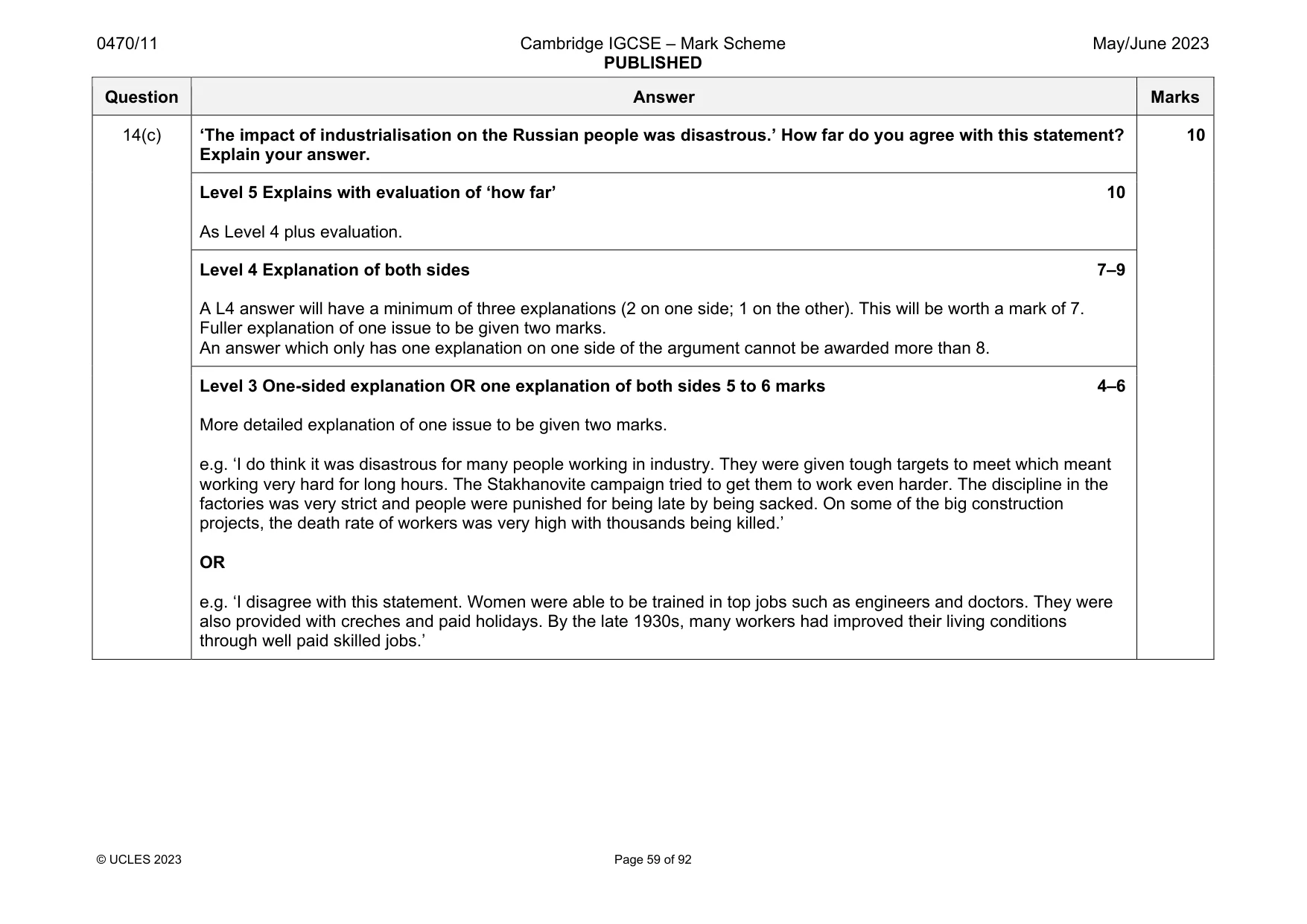
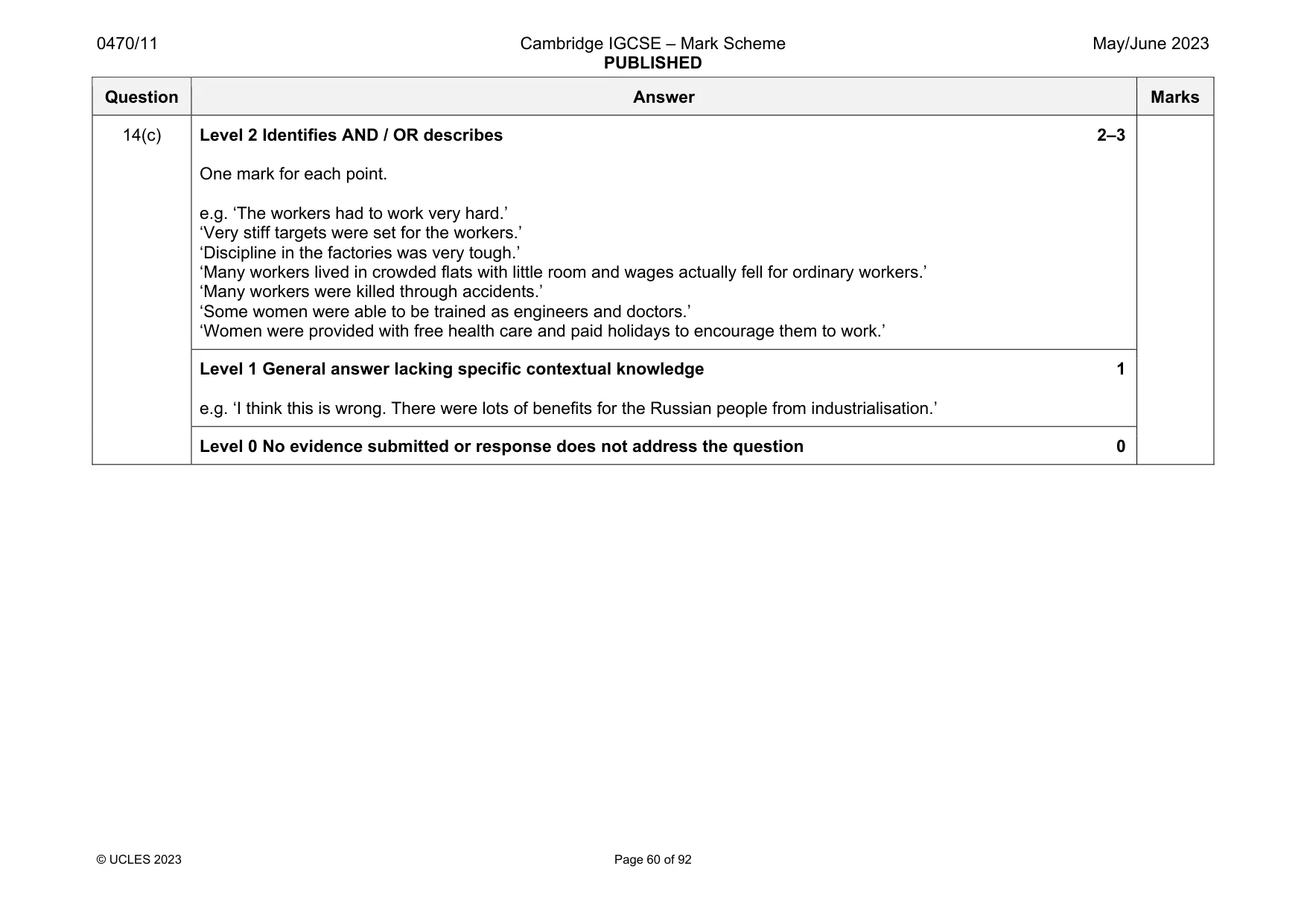
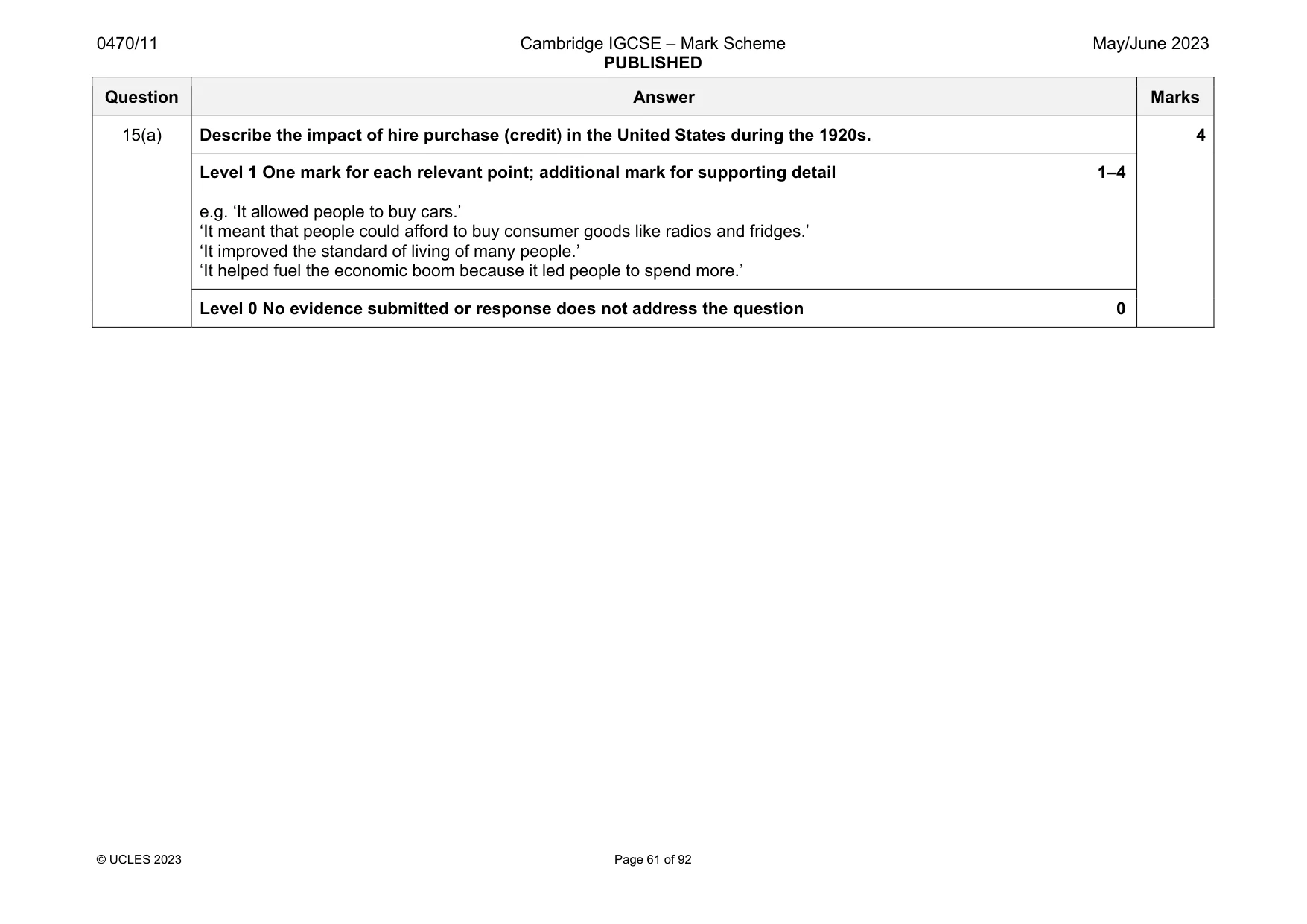
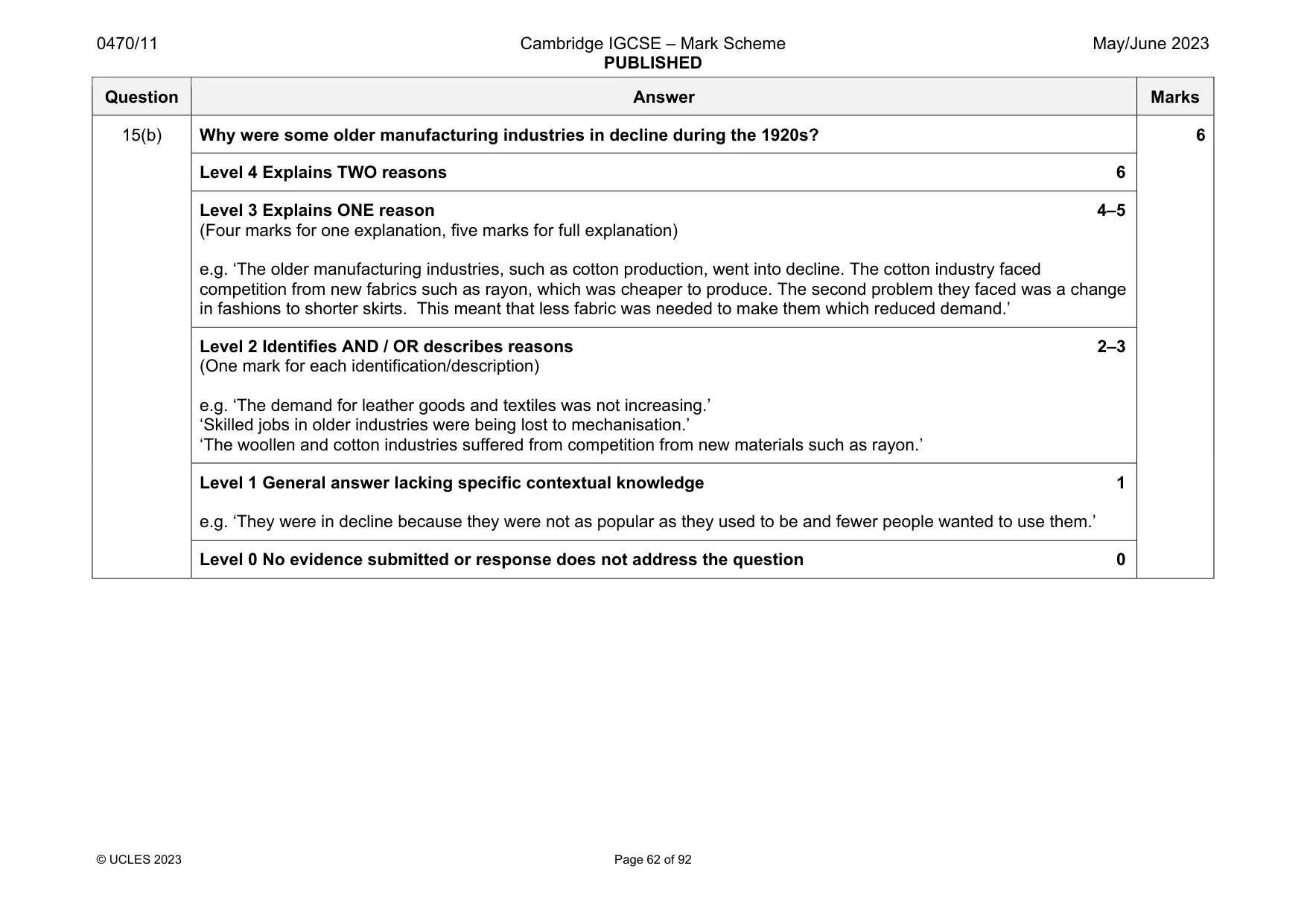
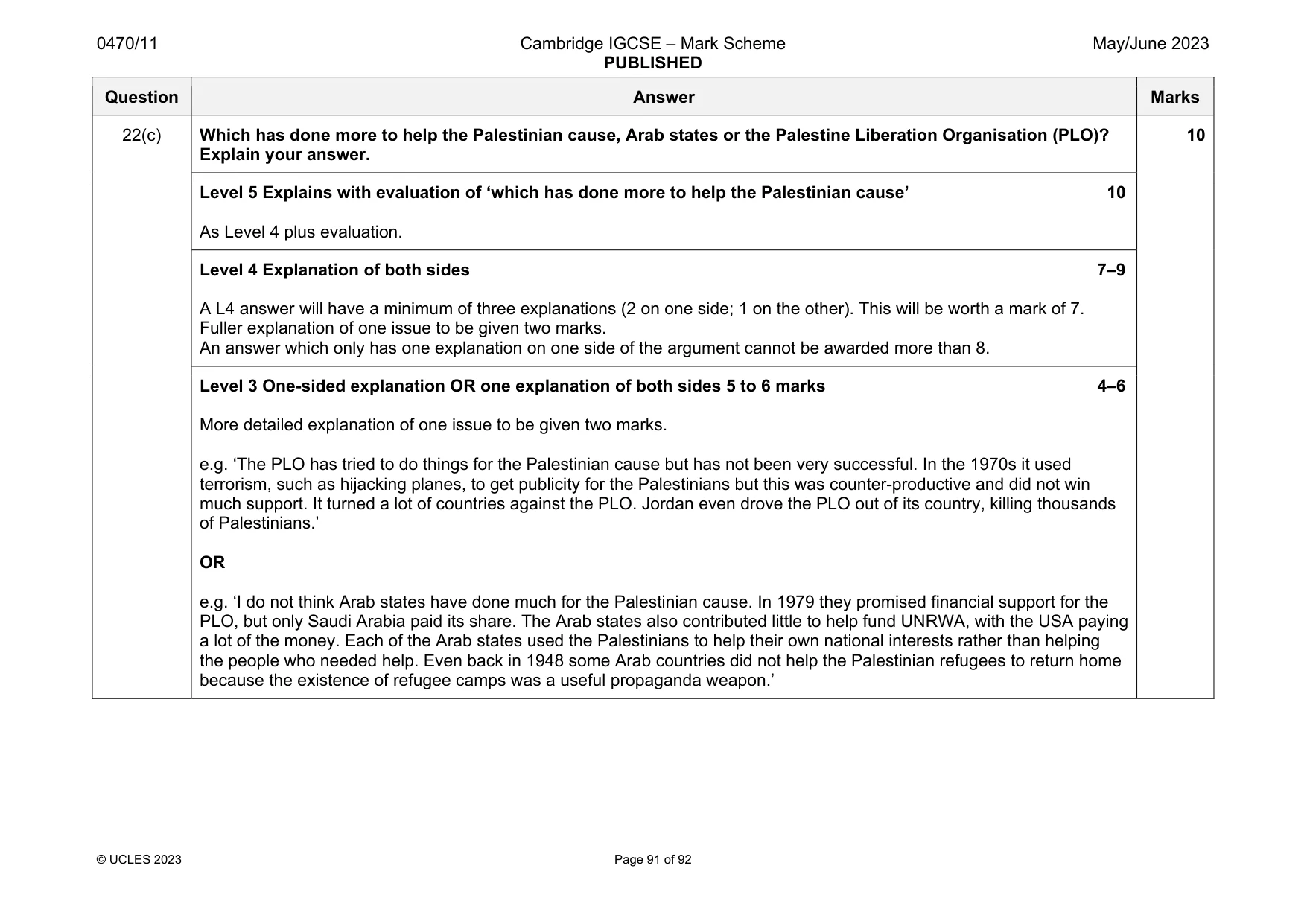
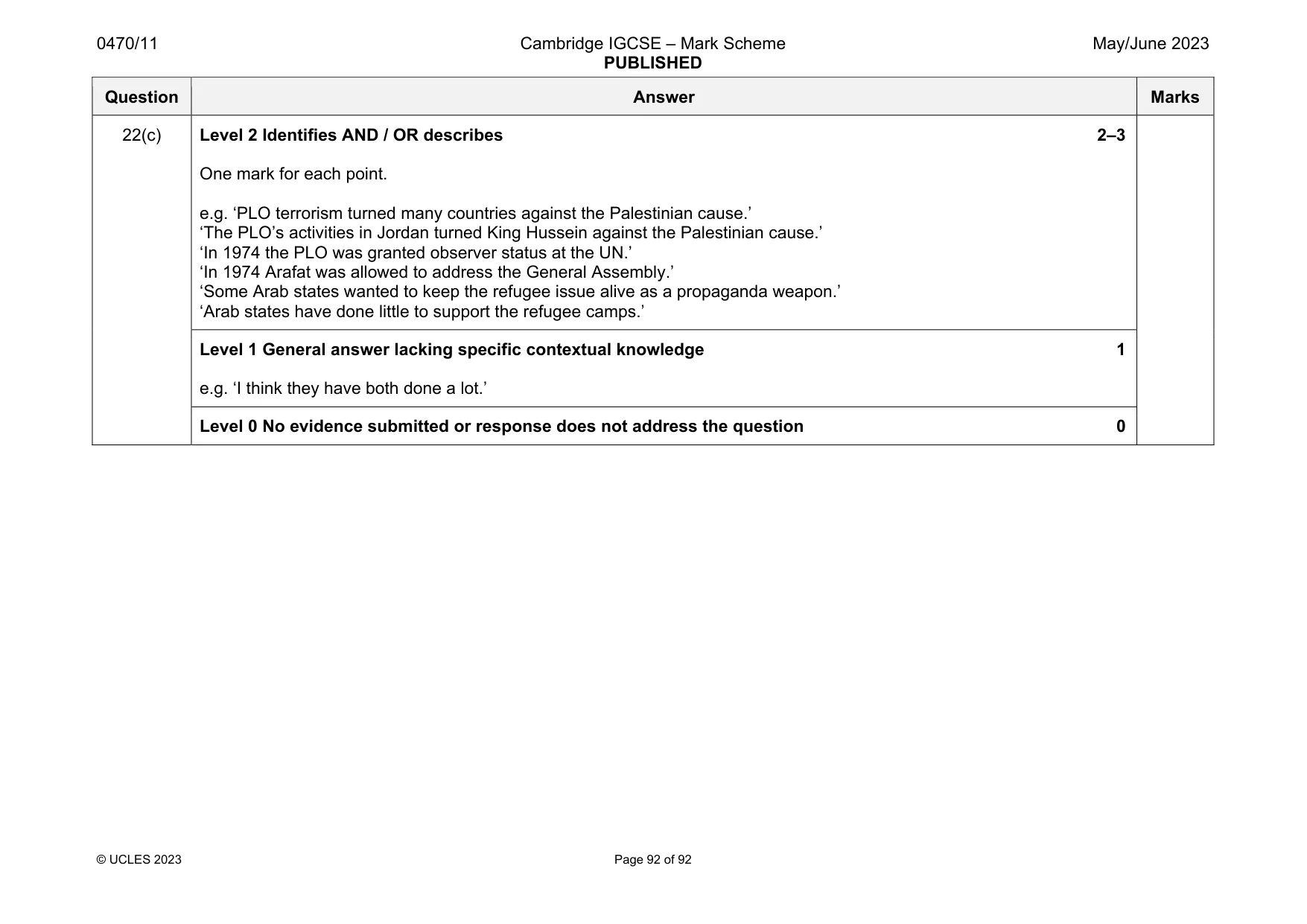
Paper as text
Question paper, page 1
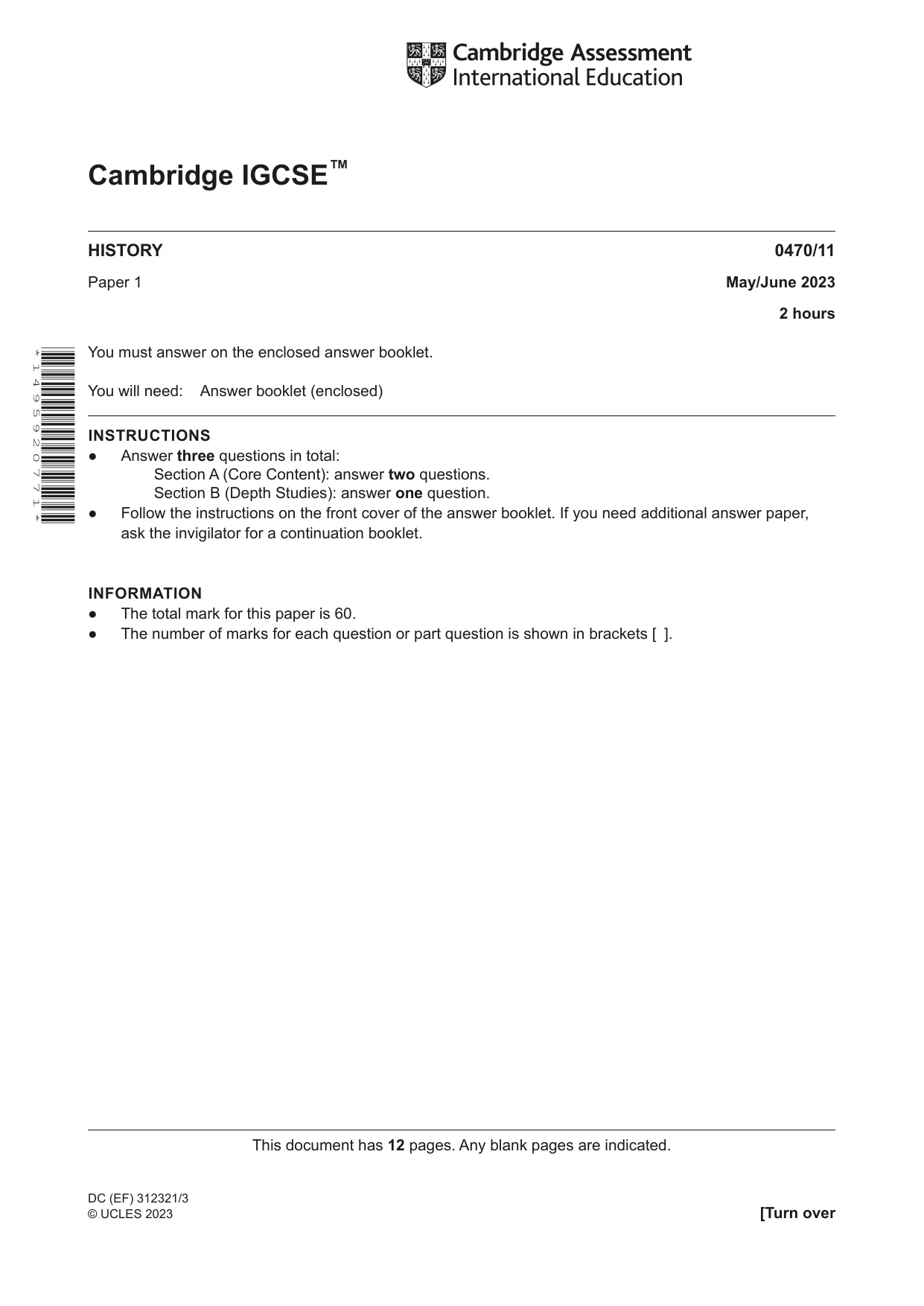
This document has 12 pages. Any blank pages are indicated. [Turn over Cambridge IGCSE™ * 1 4 9 5 9 2 0 7 7 1 * DC (EF) 312321/3 © UCLES 2023 HISTORY 0470/11 Paper 1 May/June 2023 2 hours You must answer on the enclosed answer booklet. You will need: Answer booklet (enclosed) INSTRUCTIONS ● Answer three questions in total: Section A (Core Content): answer two questions. Section B (Depth Studies): answer one question. ● Follow the instructions on the front cover of the answer booklet. If you need additional answer paper, ask the invigilator for a continuation booklet. INFORMATION ● The total mark for this paper is 60. ● The number of marks for each question or part question is shown in brackets [ ].
Question paper, page 2
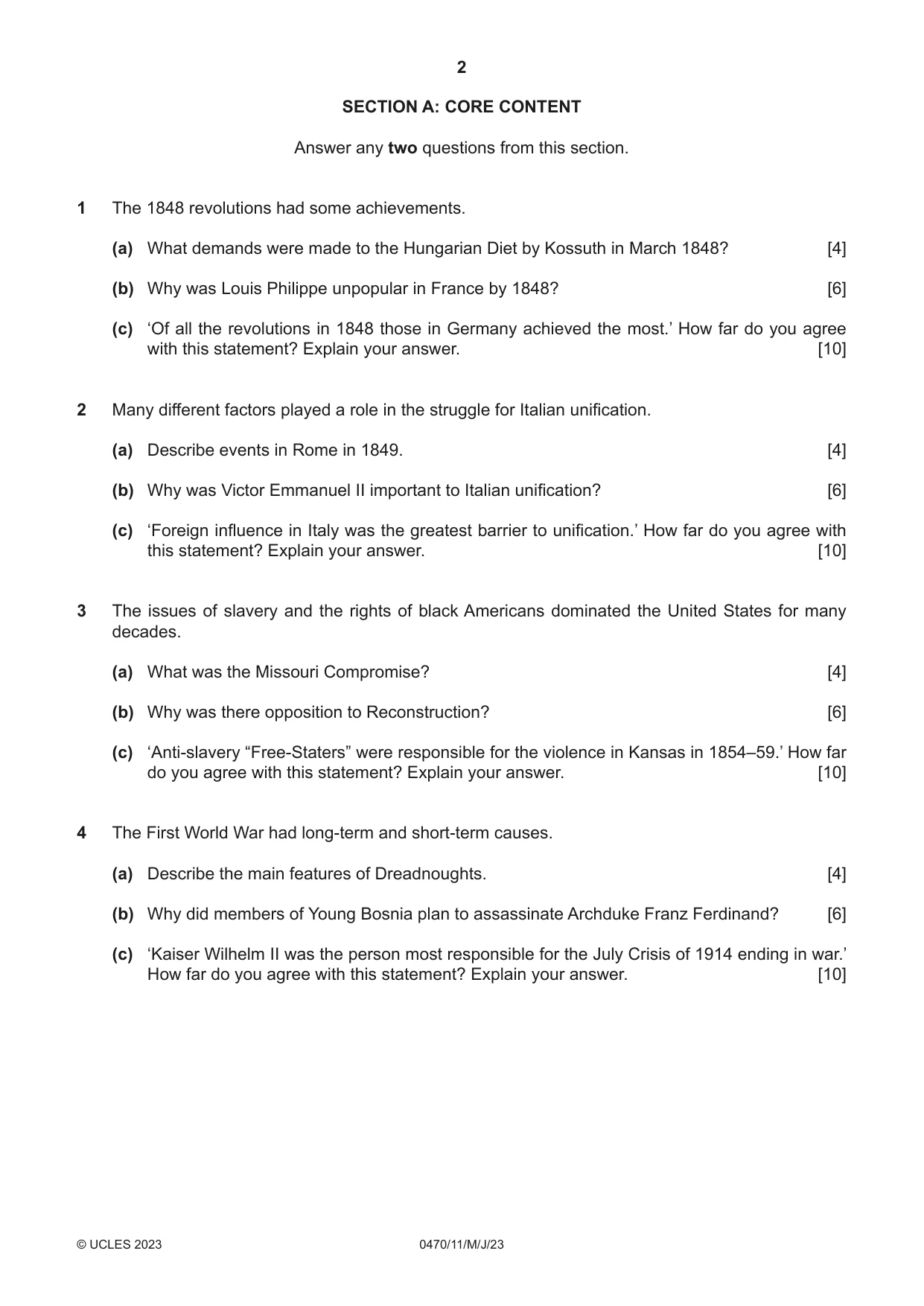
2 0470/11/M/J/23 © UCLES 2023 SECTION A: CORE CONTENT Answer any two questions from this section. 1 The 1848 revolutions had some achievements. (a) What demands were made to the Hungarian Diet by Kossuth in March 1848? [4] (b) Why was Louis Philippe unpopular in France by 1848? [6] (c) ‘Of all the revolutions in 1848 those in Germany achieved the most.’ How far do you agree with this statement? Explain your answer. [10] 2 Many different factors played a role in the struggle for Italian unification. (a) Describe events in Rome in 1849. [4] (b) Why was Victor Emmanuel II important to Italian unification? [6] (c) ‘Foreign influence in Italy was the greatest barrier to unification.’ How far do you agree with this statement? Explain your answer. [10] 3 The issues of slavery and the rights of black Americans dominated the United States for many decades. (a) What was the Missouri Compromise? [4] (b) Why was there opposition to Reconstruction? [6] (c) ‘Anti‑slavery “Free‑Staters” were responsible for the violence in Kansas in 1854–59.’ How far do you agree with this statement? Explain your answer. [10] 4 The First World War had long‑term and short‑term causes. (a) Describe the main features of Dreadnoughts. [4] (b) Why did members of Young Bosnia plan to assassinate Archduke Franz Ferdinand? [6] (c) ‘Kaiser Wilhelm II was the person most responsible for the July Crisis of 1914 ending in war.’ How far do you agree with this statement? Explain your answer. [10]
Question paper, page 3
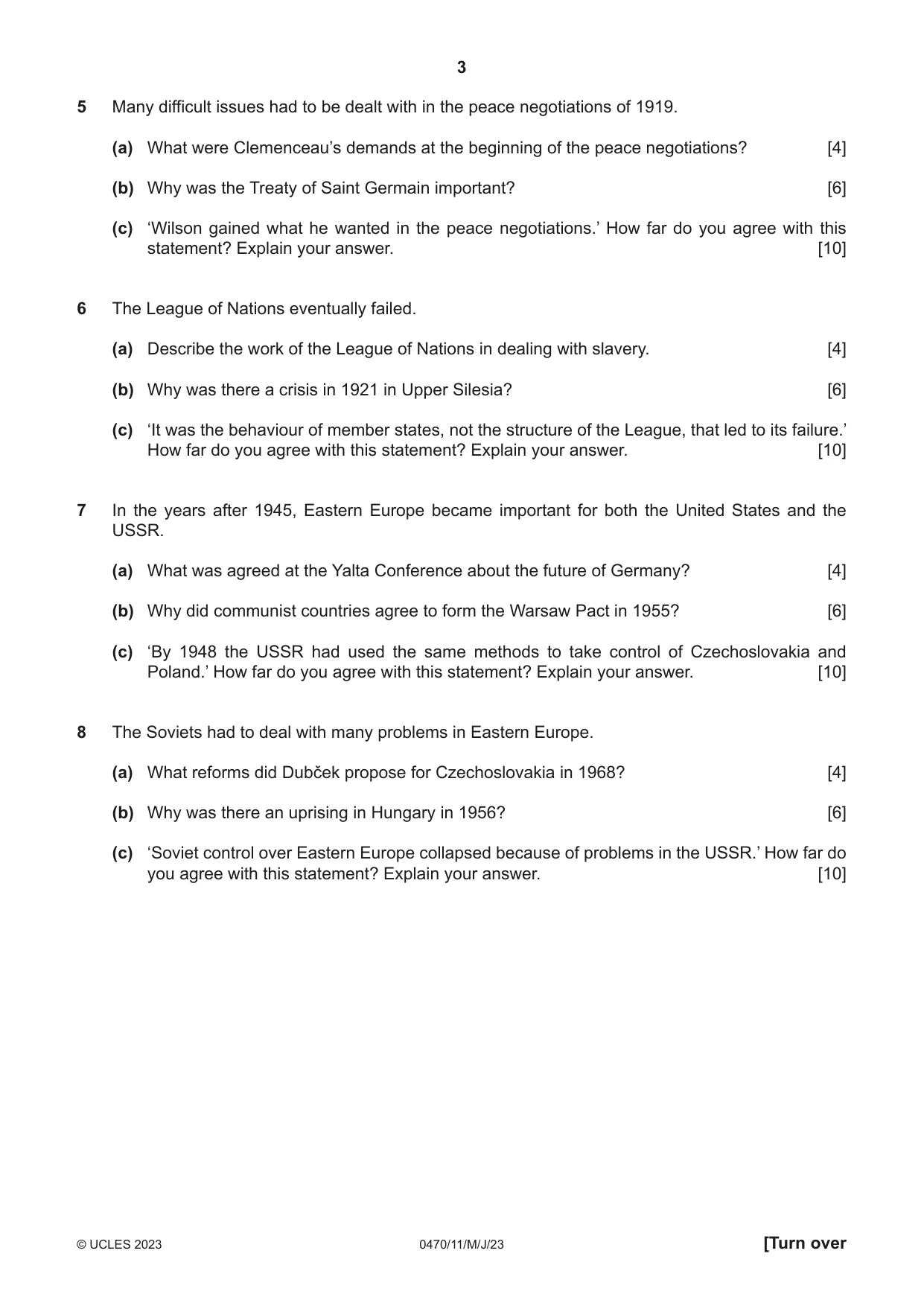
3 0470/11/M/J/23 © UCLES 2023 [Turn over 5 Many difficult issues had to be dealt with in the peace negotiations of 1919. (a) What were Clemenceau’s demands at the beginning of the peace negotiations? [4] (b) Why was the Treaty of Saint Germain important? [6] (c) ‘Wilson gained what he wanted in the peace negotiations.’ How far do you agree with this statement? Explain your answer. [10] 6 The League of Nations eventually failed. (a) Describe the work of the League of Nations in dealing with slavery. [4] (b) Why was there a crisis in 1921 in Upper Silesia? [6] (c) ‘It was the behaviour of member states, not the structure of the League, that led to its failure.’ How far do you agree with this statement? Explain your answer. [10] 7 In the years after 1945, Eastern Europe became important for both the United States and the USSR. (a) What was agreed at the Yalta Conference about the future of Germany? [4] (b) Why did communist countries agree to form the Warsaw Pact in 1955? [6] (c) ‘By 1948 the USSR had used the same methods to take control of Czechoslovakia and Poland.’ How far do you agree with this statement? Explain your answer. [10] 8 The Soviets had to deal with many problems in Eastern Europe. (a) What reforms did Dubček propose for Czechoslovakia in 1968? [4] (b) Why was there an uprising in Hungary in 1956? [6] (c) ‘Soviet control over Eastern Europe collapsed because of problems in the USSR.’ How far do you agree with this statement? Explain your answer. [10]
Question paper, page 4
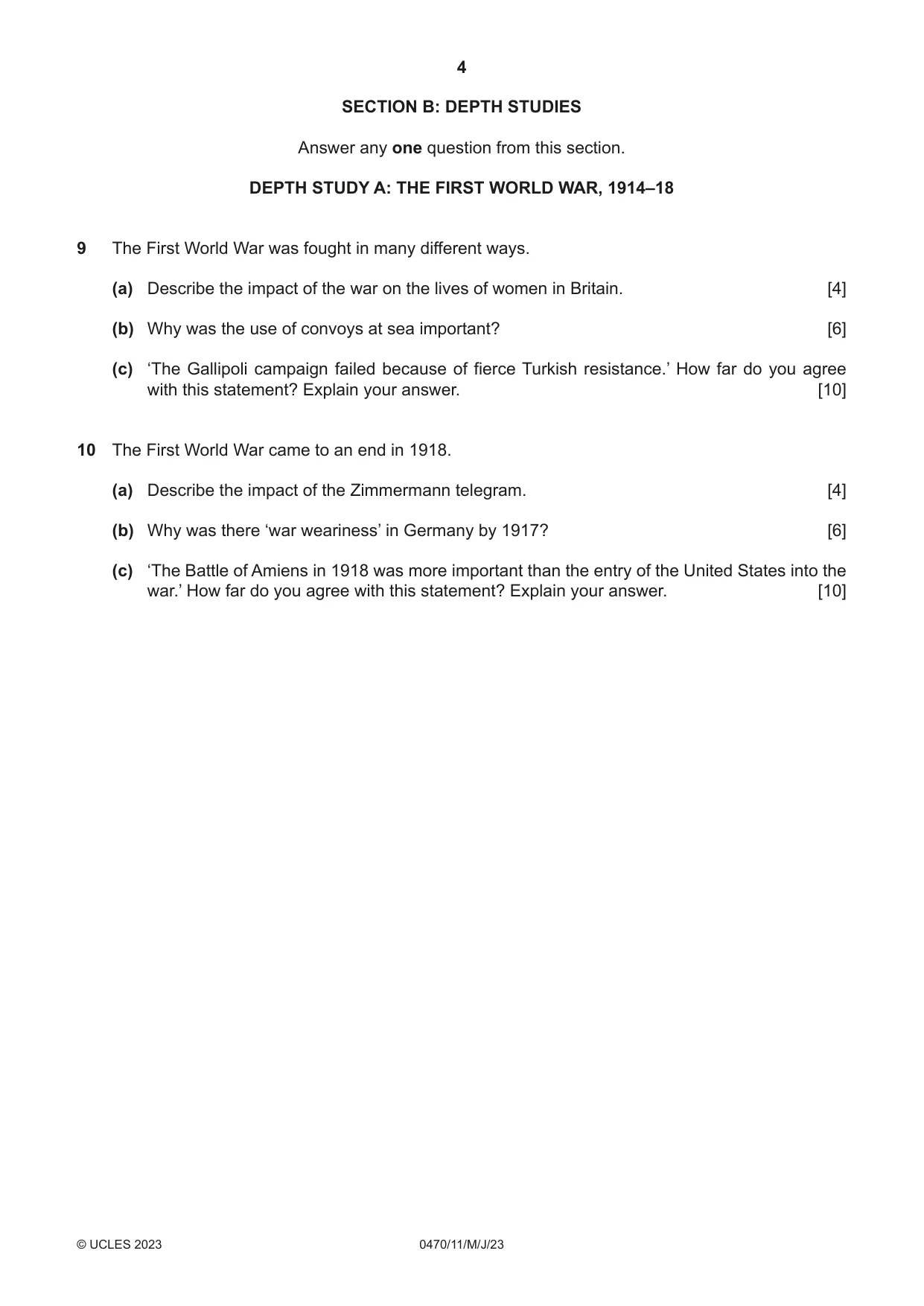
4 0470/11/M/J/23 © UCLES 2023 SECTION B: DEPTH STUDIES Answer any one question from this section. DEPTH STUDY A: THE FIRST WORLD WAR, 1914–18 9 The First World War was fought in many different ways. (a) Describe the impact of the war on the lives of women in Britain. [4] (b) Why was the use of convoys at sea important? [6] (c) ‘The Gallipoli campaign failed because of fierce Turkish resistance.’ How far do you agree with this statement? Explain your answer. [10] 10 The First World War came to an end in 1918. (a) Describe the impact of the Zimmermann telegram. [4] (b) Why was there ‘war weariness’ in Germany by 1917? [6] (c) ‘The Battle of Amiens in 1918 was more important than the entry of the United States into the war.’ How far do you agree with this statement? Explain your answer. [10]
Question paper, page 5
5 0470/11/M/J/23 © UCLES 2023 [Turn over DEPTH STUDY B: GERMANY, 1918–45 11 The road to power was a long one for Hitler. (a) Describe Hitler’s actions during the Munich Putsch. [4] (b) Why did the Night of the Long Knives take place? [6] (c) Which was more important to Hitler, the Reichstag Fire or the Enabling Act? Explain your answer. [10] 12 Different groups had different experiences in Nazi Germany. (a) Describe how the Nazi regime treated minorities other than the Jews. [4] (b) Why were young people important to the Nazis? [6] (c) How far did life in Germany change after the start of the Second World War? Explain your answer. [10]
Question paper, page 6
6 0470/11/M/J/23 © UCLES 2023 DEPTH STUDY C: RUSSIA, 1905–41 13 Much changed in Russia during the years 1917 to 1921. (a) What were the main features of the New Economic Policy (NEP)? [4] (b) Why was the Petrograd Soviet important in 1917? [6] (c) ‘The Whites were to blame for their defeat in the Civil War.’ How far do you agree with this statement? Explain your answer. [10] 14 Stalin introduced big changes to Soviet agriculture and industry. (a) Describe the Stakhanovite movement. [4] (b) Why was it important to Stalin to modernise Soviet agriculture? [6] (c) ‘The impact of industrialisation on the Russian people was disastrous.’ How far do you agree with this statement? Explain your answer. [10]
Question paper, page 7
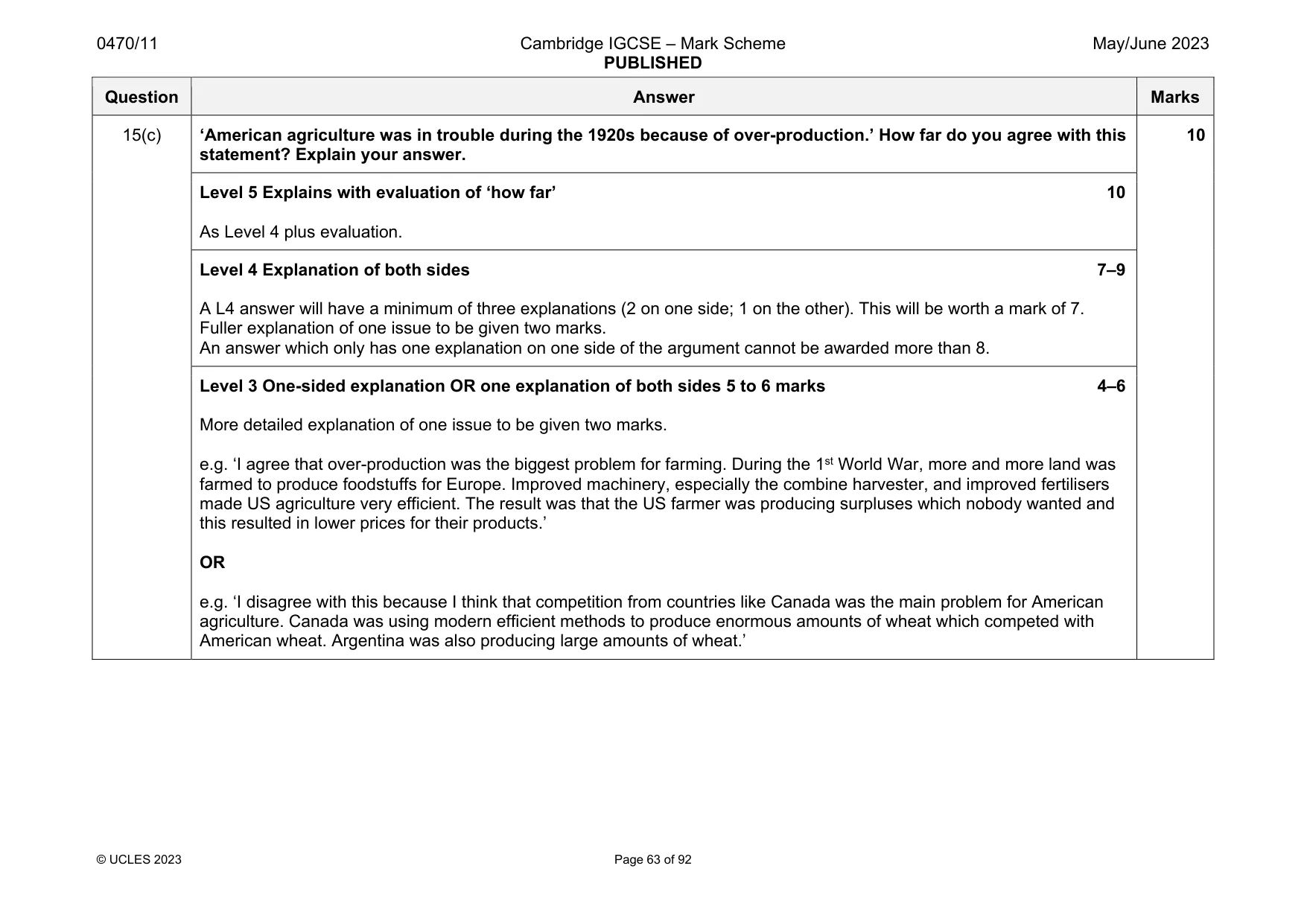
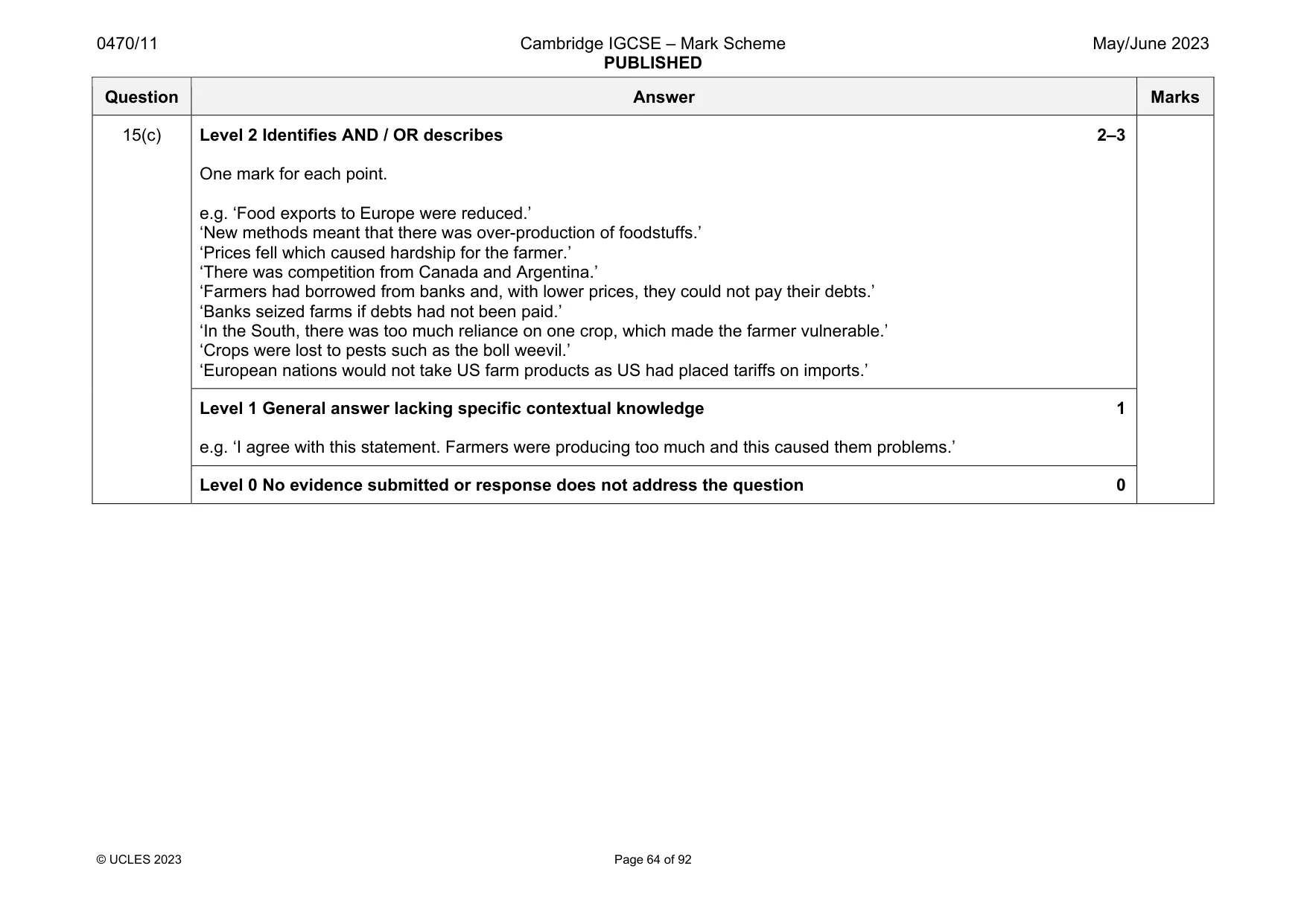
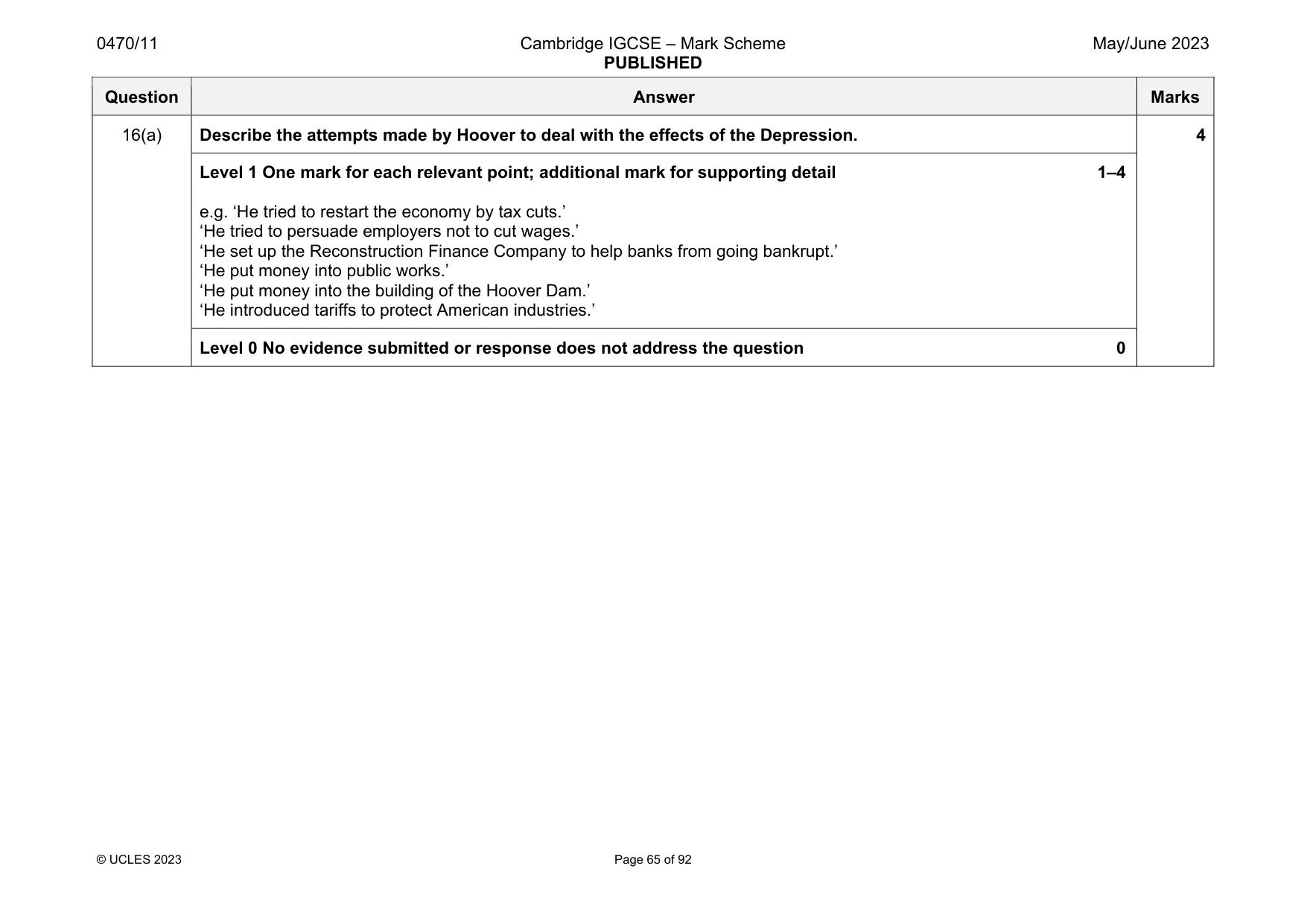
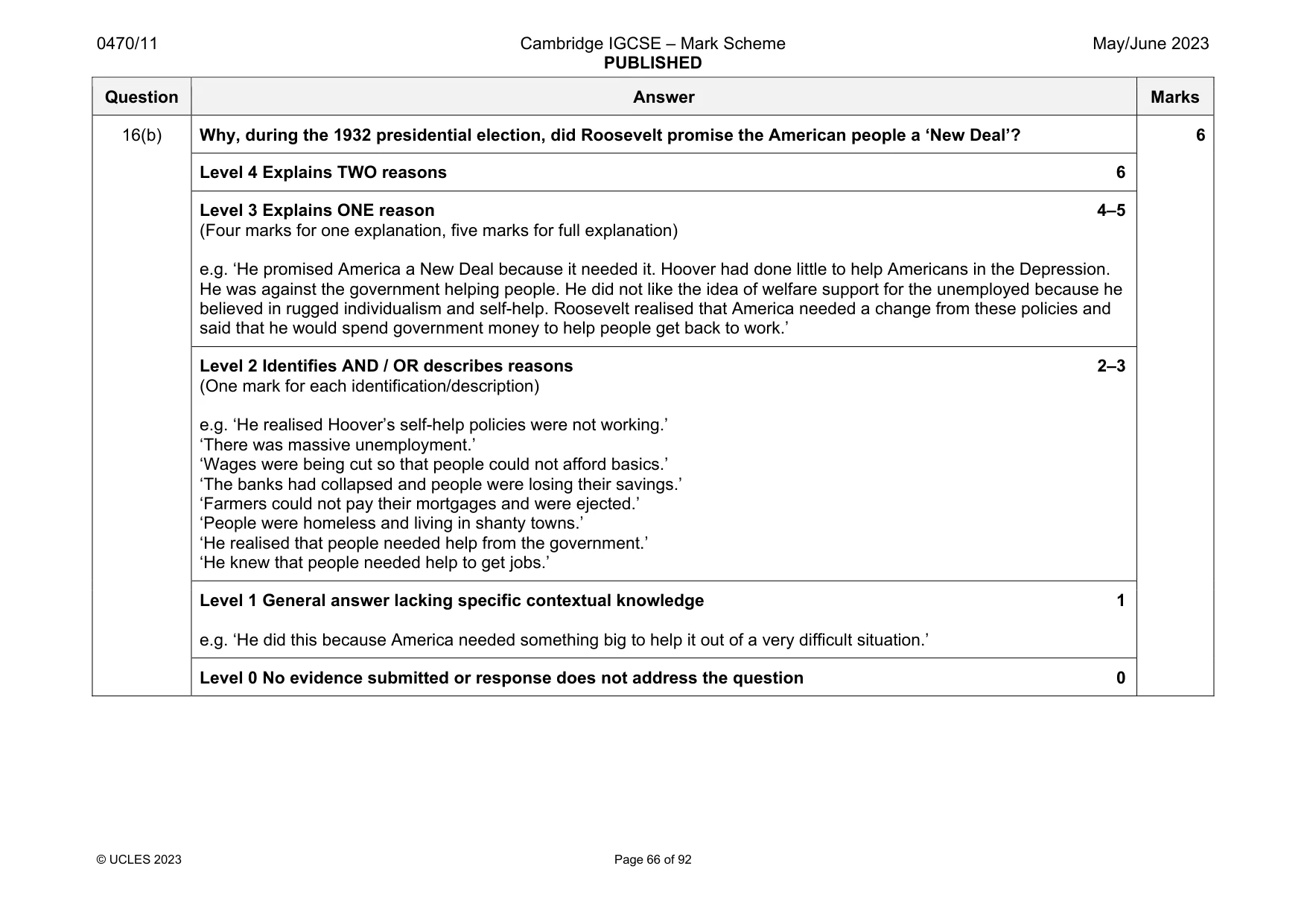
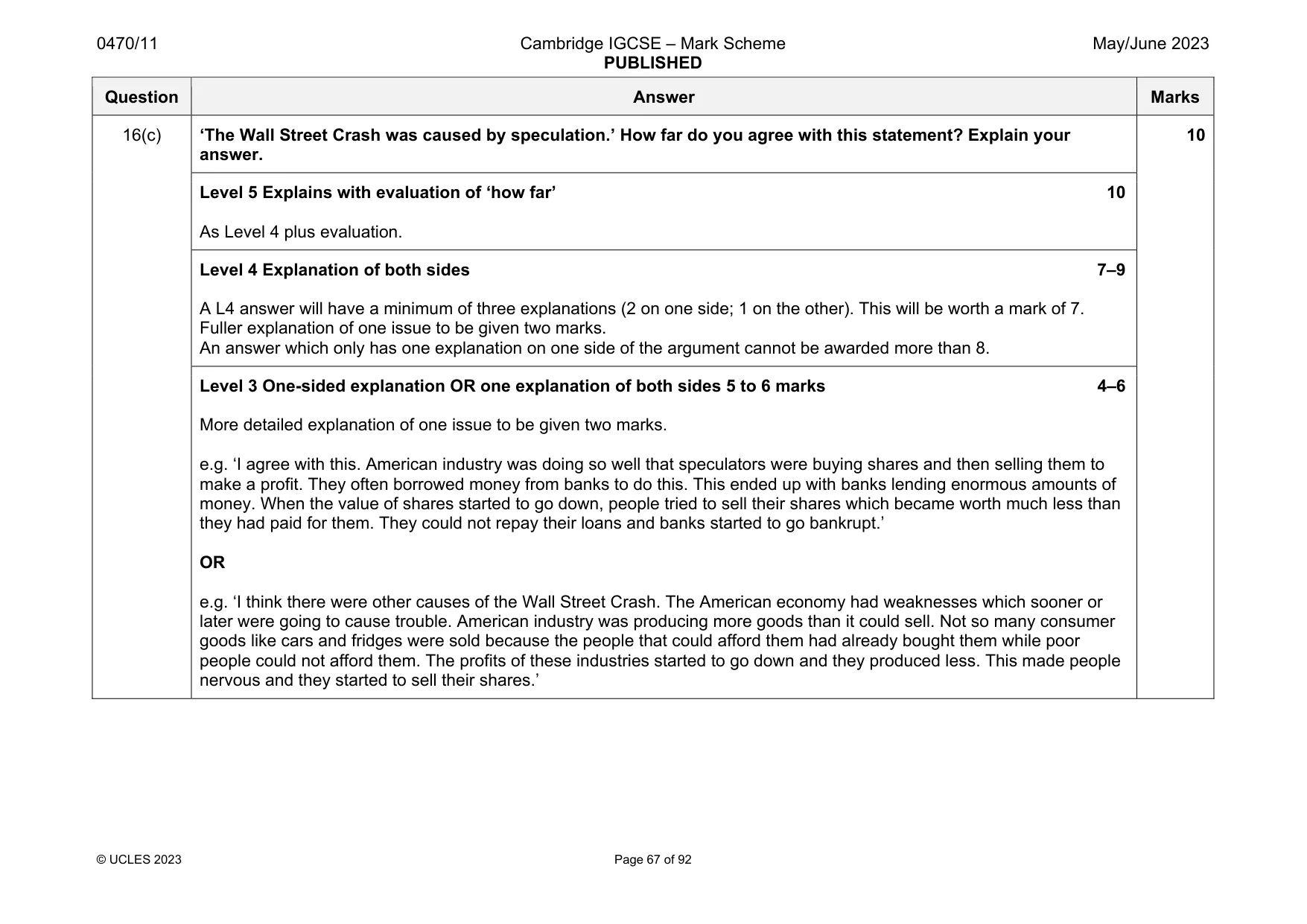
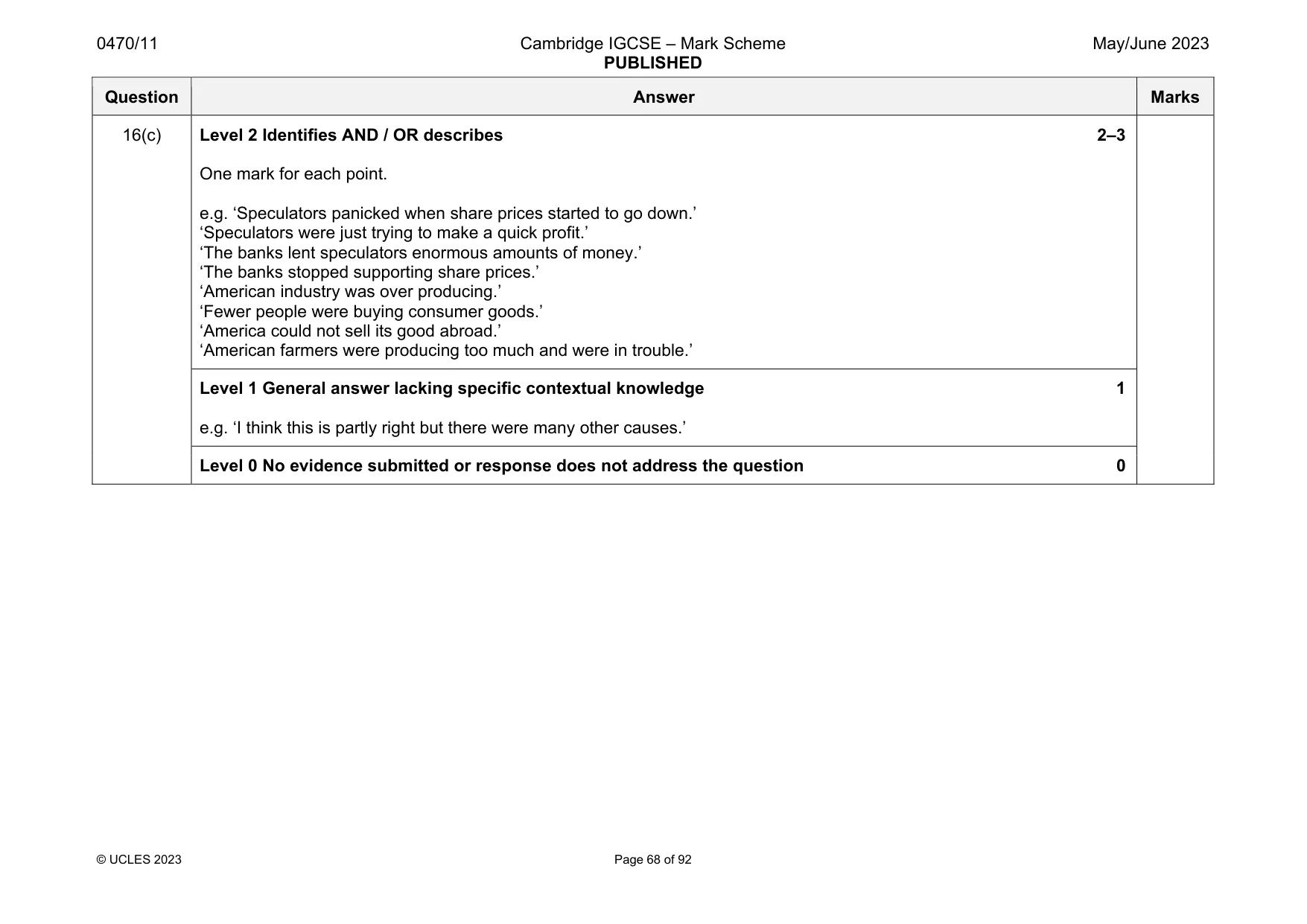
7 0470/11/M/J/23 © UCLES 2023 [Turn over DEPTH STUDY D: THE UNITED STATES, 1919–41 15 There were many problems in the United States during the 1920s. (a) Describe the impact of hire purchase (credit) in the United States during the 1920s. [4] (b) Why were some older manufacturing industries in decline during the 1920s? [6] (c) ‘American agriculture was in trouble during the 1920s because of over‑production.’ How far do you agree with this statement? Explain your answer. [10] 16 Politicians disagreed about how to react to the Depression. (a) Describe the attempts made by Hoover to deal with the effects of the Depression. [4] (b) Why, during the 1932 presidential election, did Roosevelt promise the American people a ‘New Deal’? [6] (c) ‘The Wall Street Crash was caused by speculation.’ How far do you agree with this statement? Explain your answer. [10]
Question paper, page 8
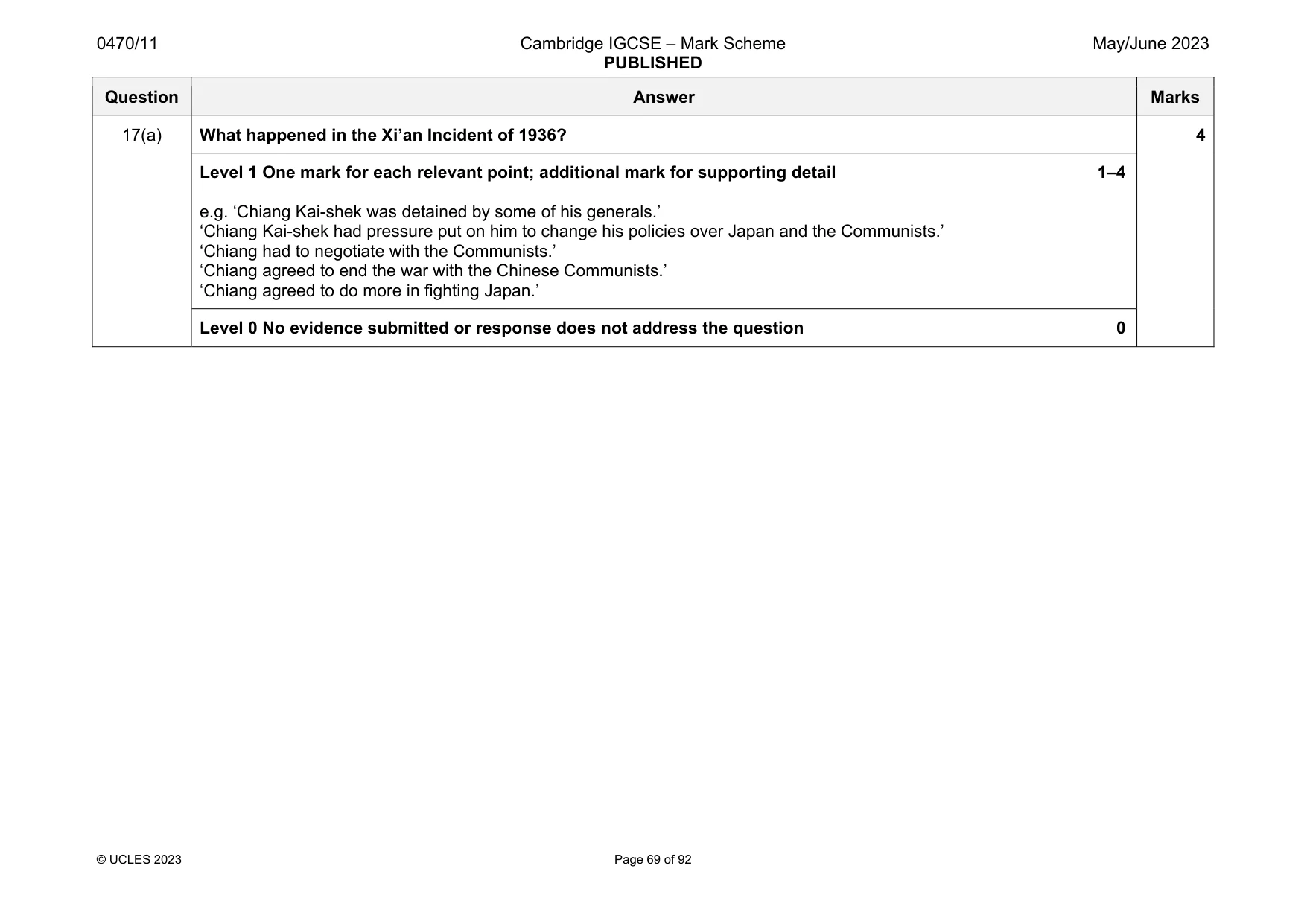
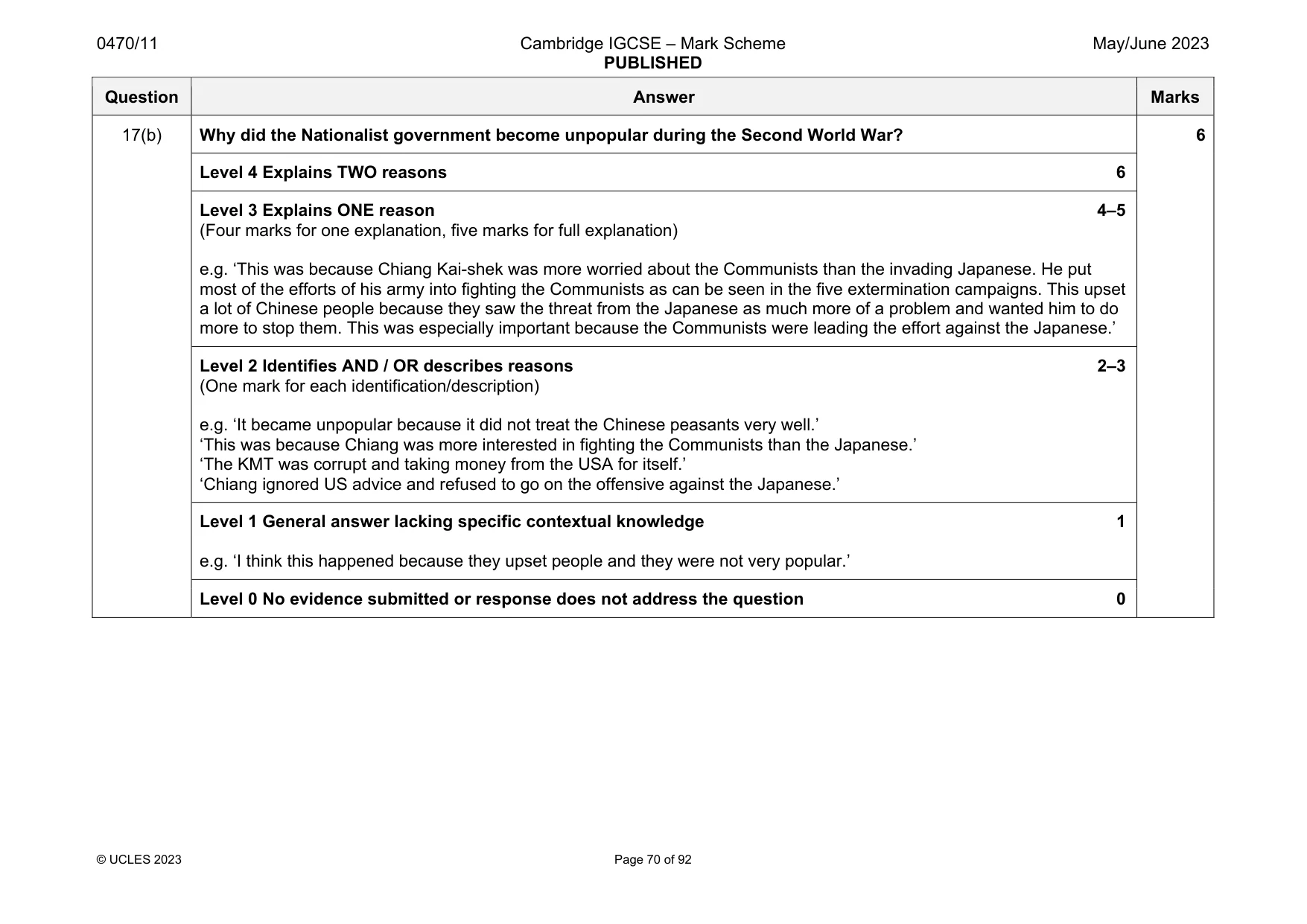
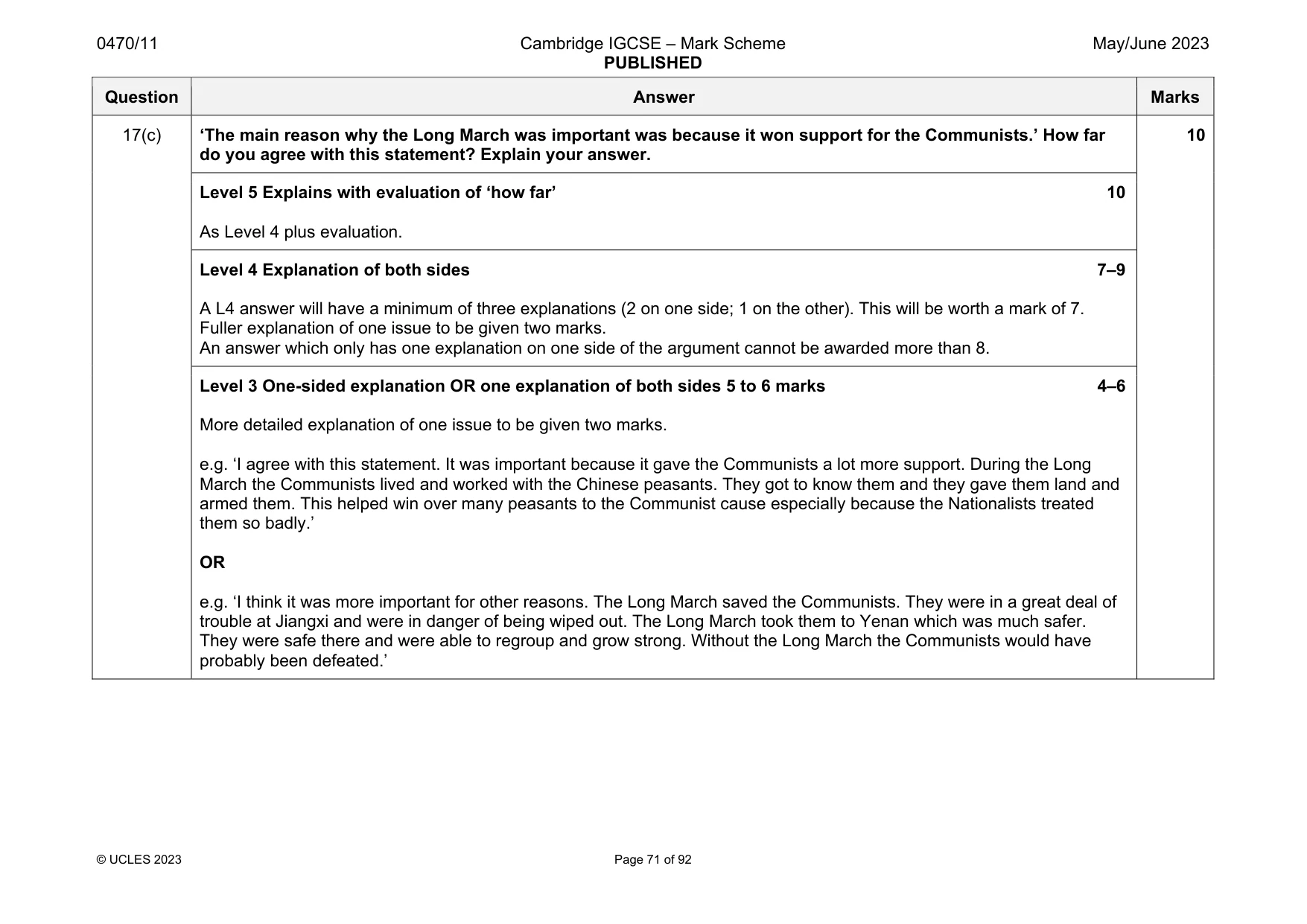
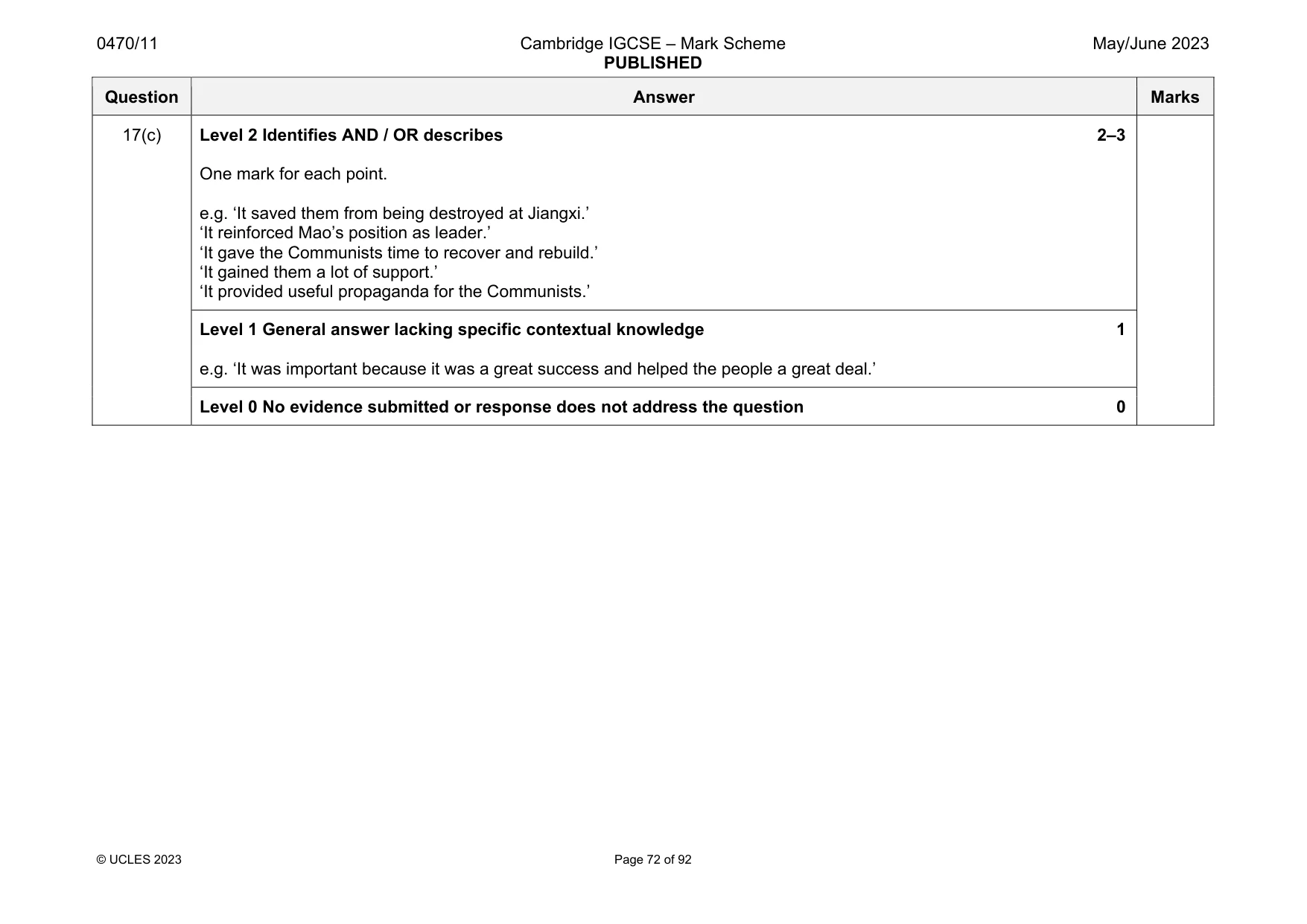
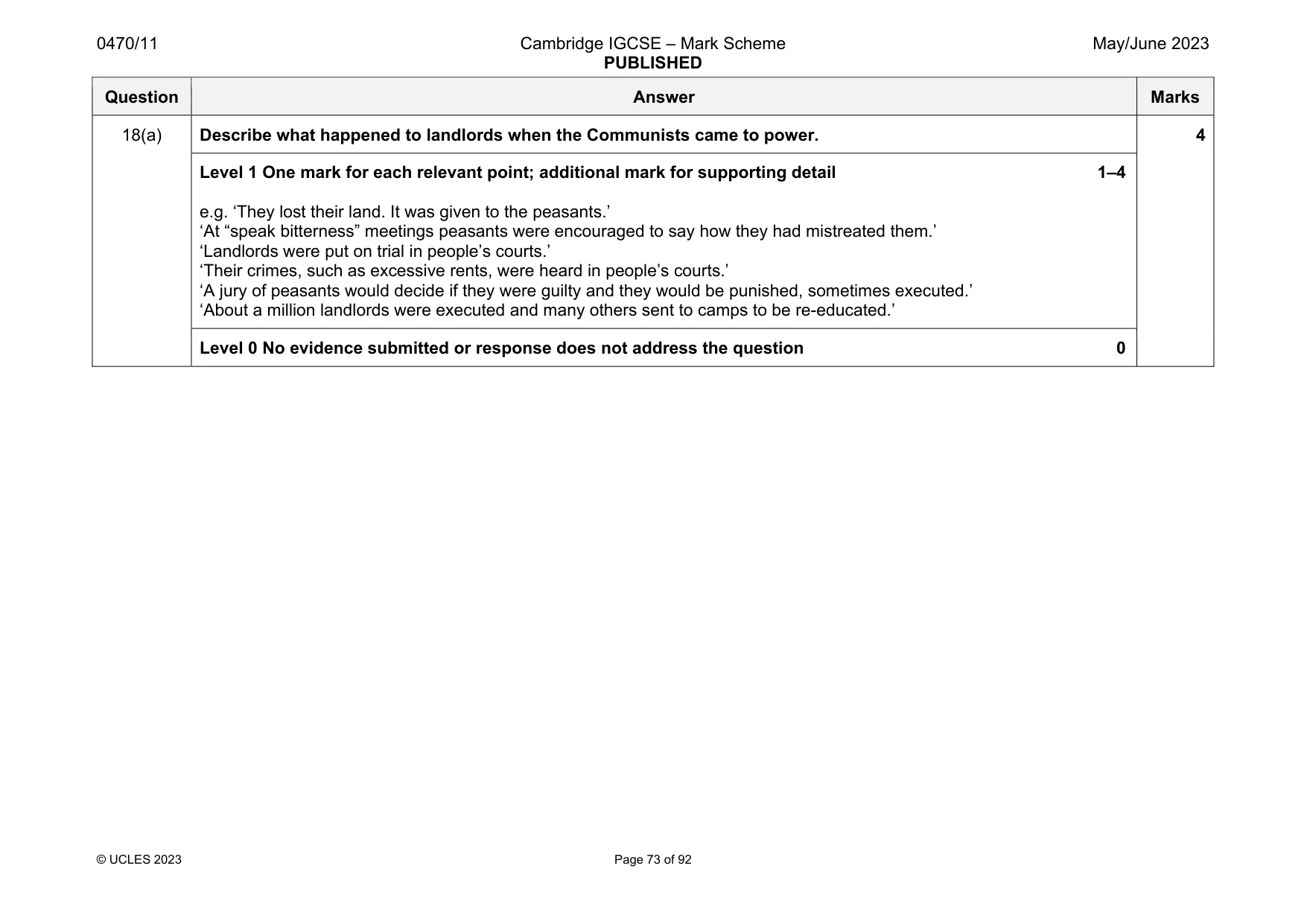
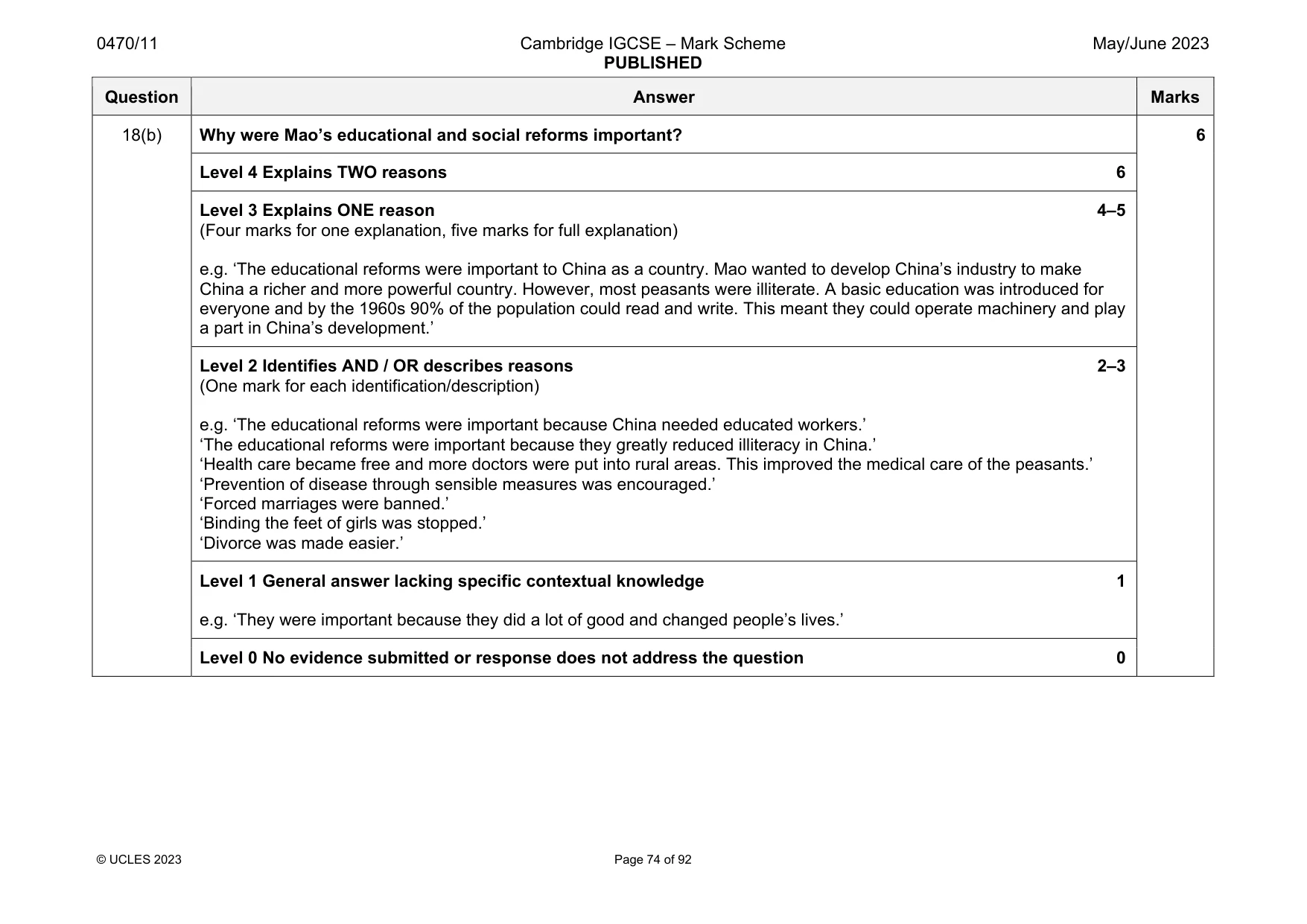
8 0470/11/M/J/23 © UCLES 2023 DEPTH STUDY E: CHINA, c.1930–c.1990 17 The fortunes of the Communists changed between 1936 and 1949. (a) What happened in the Xi’an Incident of 1936? [4] (b) Why did the Nationalist government become unpopular during the Second World War? [6] (c) ‘The main reason why the Long March was important was because it won support for the Communists.’ How far do you agree with this statement? Explain your answer. [10] 18 Many aspects of life in China changed over the years. (a) Describe what happened to landlords when the Communists came to power. [4] (b) Why were Mao’s educational and social reforms important? [6] (c) ‘The introduction of communes benefited the Chinese people.’ How far do you agree with this statement? Explain your answer. [10]
Question paper, page 9
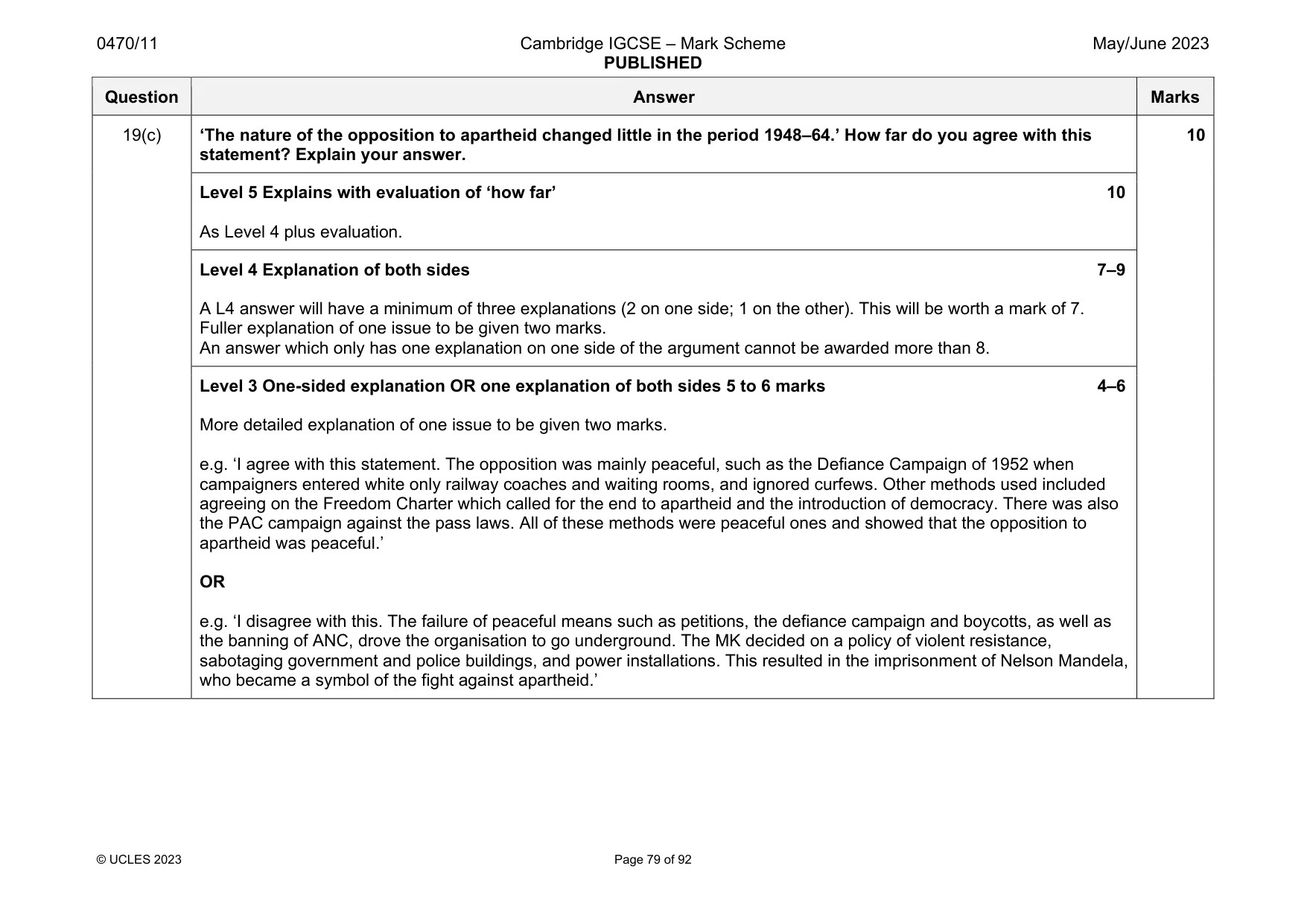
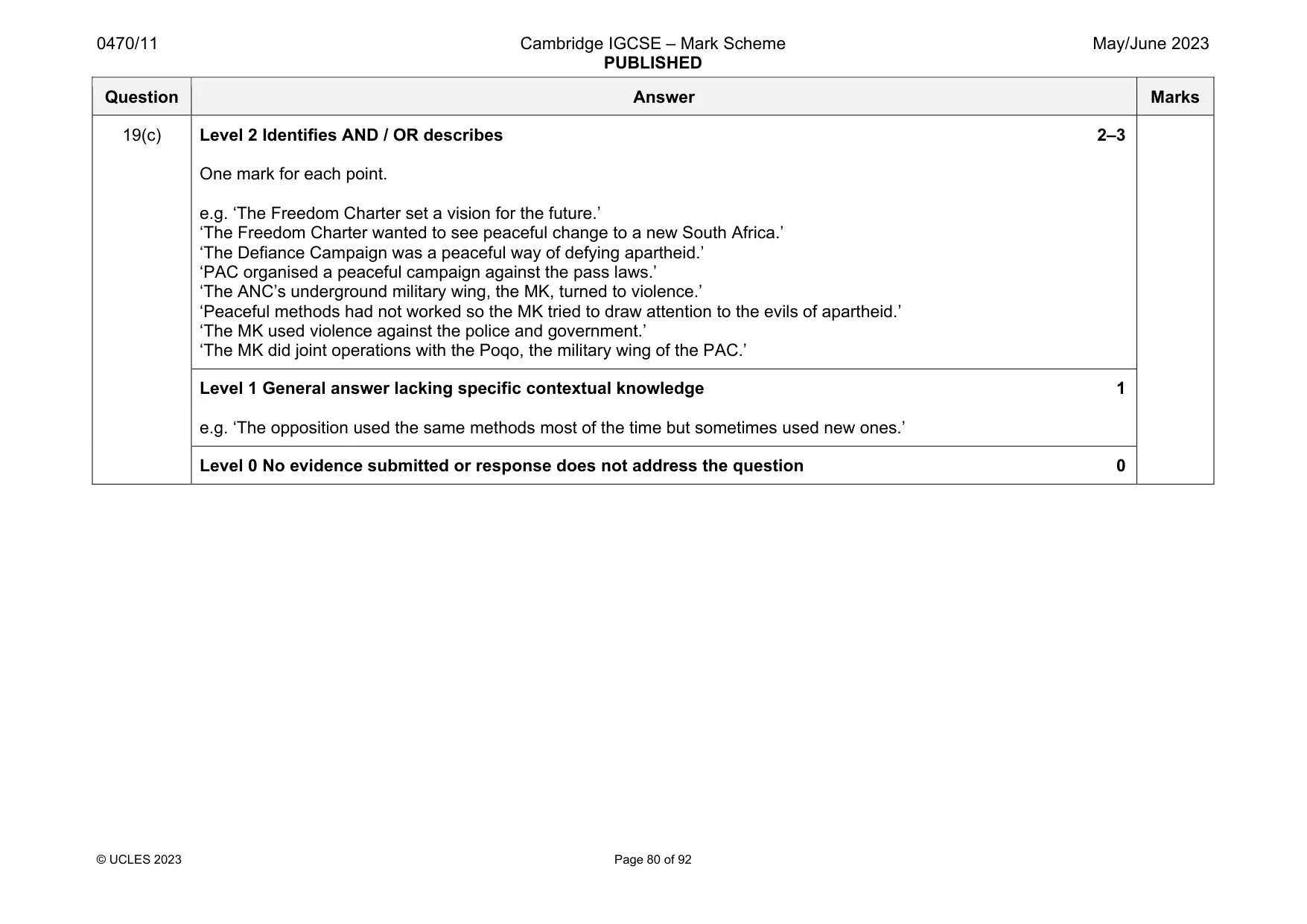
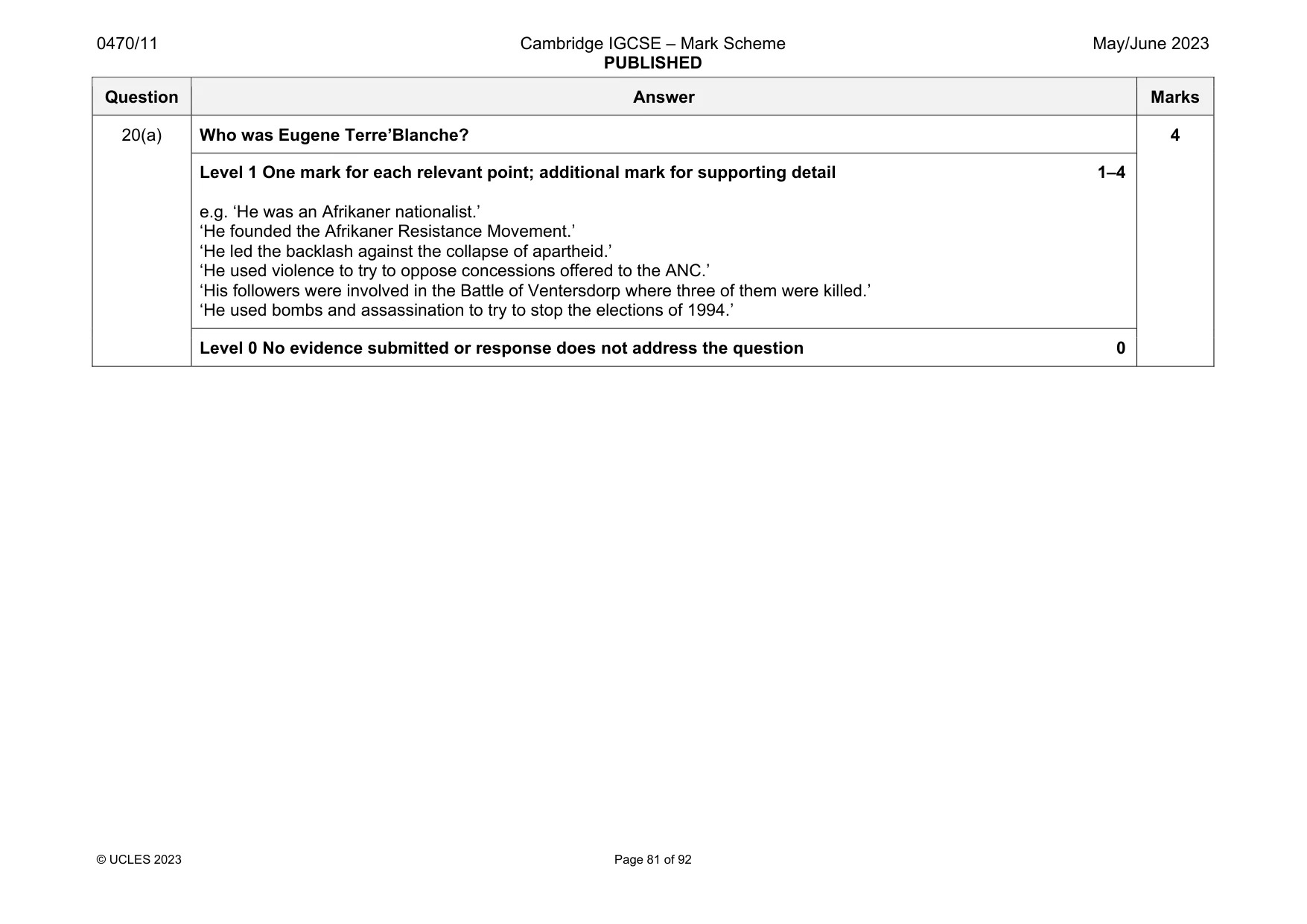
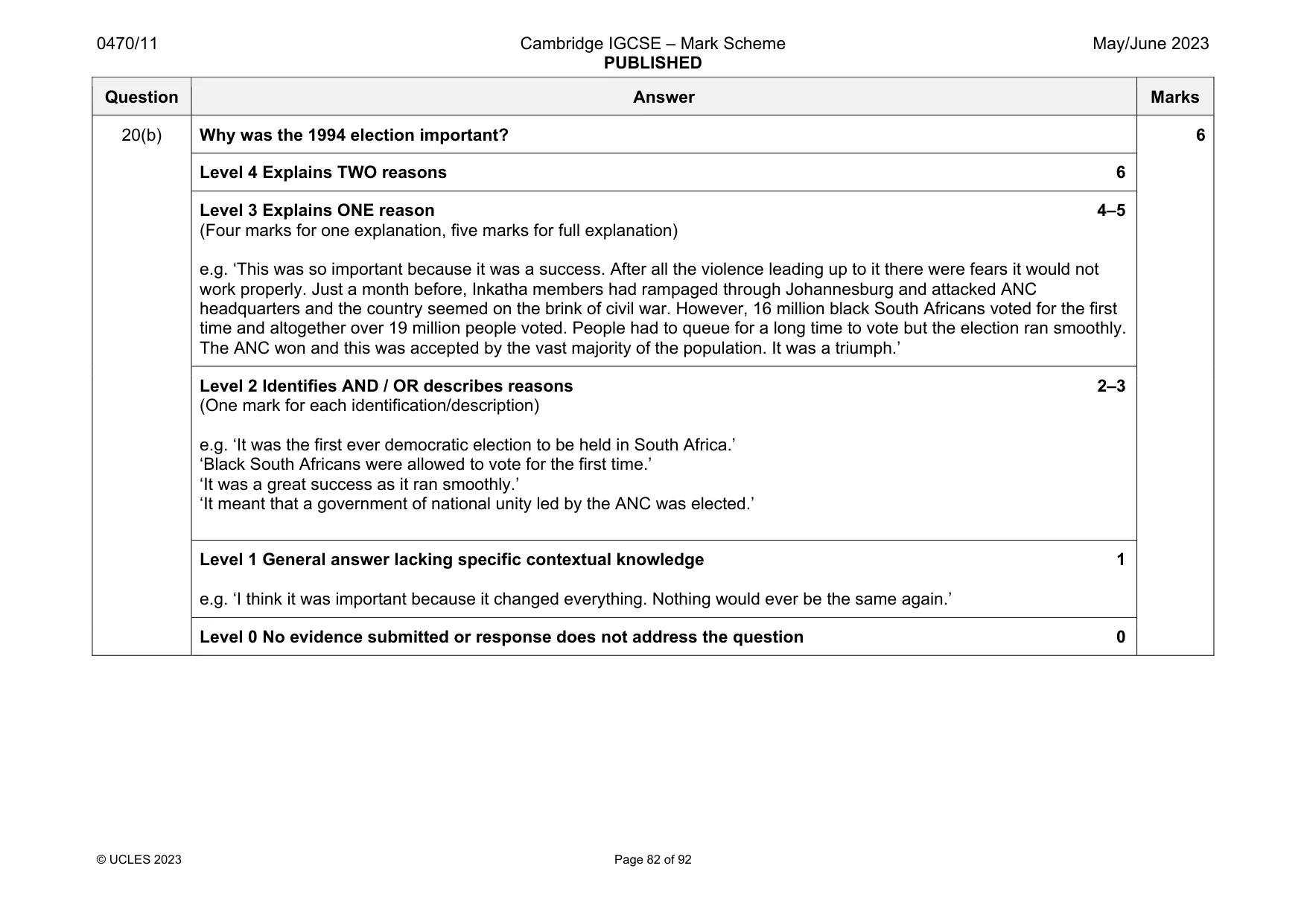
9 0470/11/M/J/23 © UCLES 2023 [Turn over DEPTH STUDY F: SOUTH AFRICA, c.1940–c.1994 19 As soon as apartheid was established, it was opposed. (a) What were the terms of the Population Registration Act of 1950? [4] (b) Why was the Group Areas Act of 1950 important? [6] (c) ‘The nature of the opposition to apartheid changed little in the period 1948–64.’ How far do you agree with this statement? Explain your answer. [10] 20 Apartheid and white minority rule were both defended long after their downfall was inevitable. (a) Who was Eugene Terre’Blanche? [4] (b) Why was the 1994 election important? [6] (c) ‘The policies of P W Botha during the late 1970s and the 1980s were repressive.’ How far do you agree with this statement? Explain your answer. [10]
Question paper, page 10
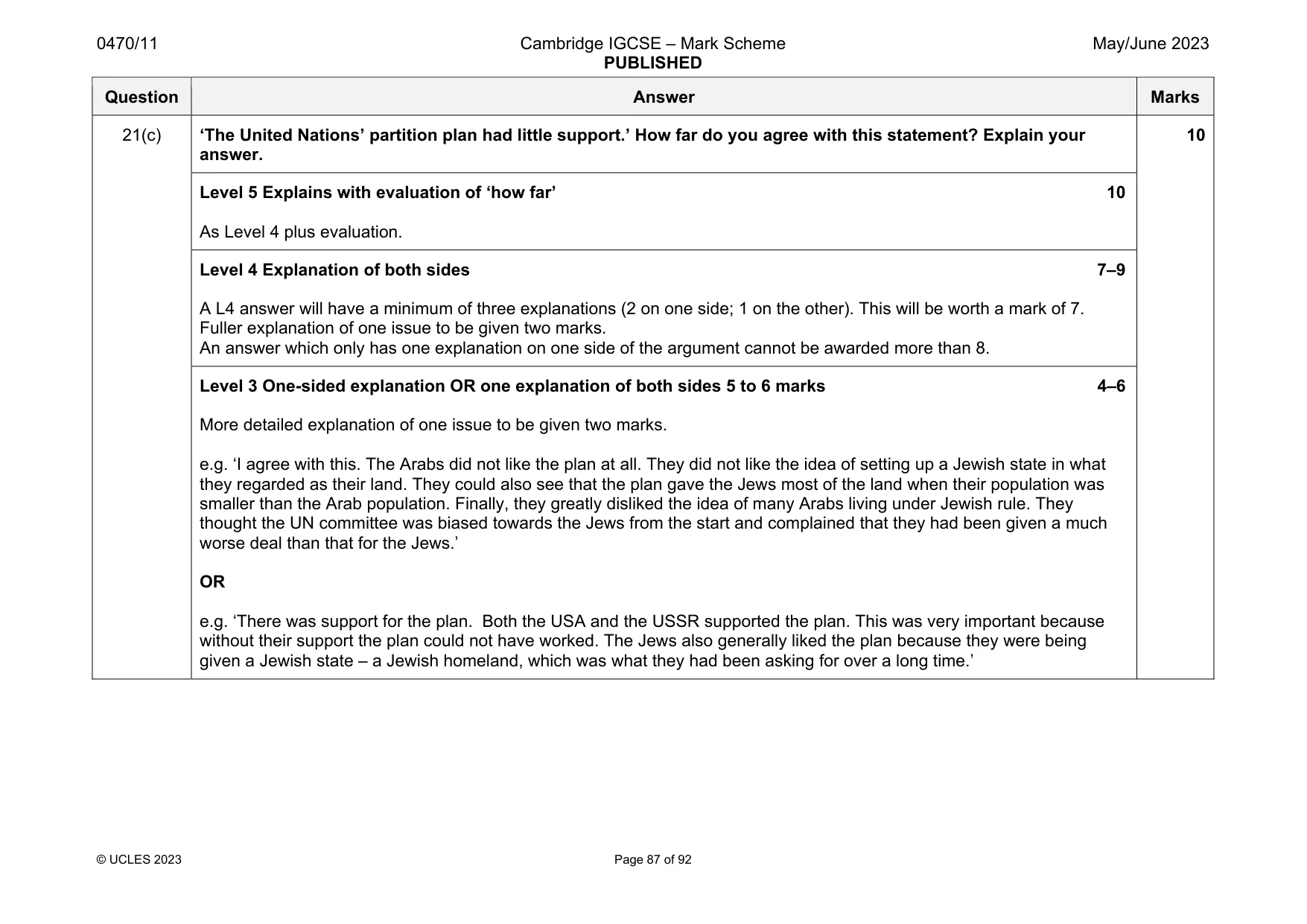
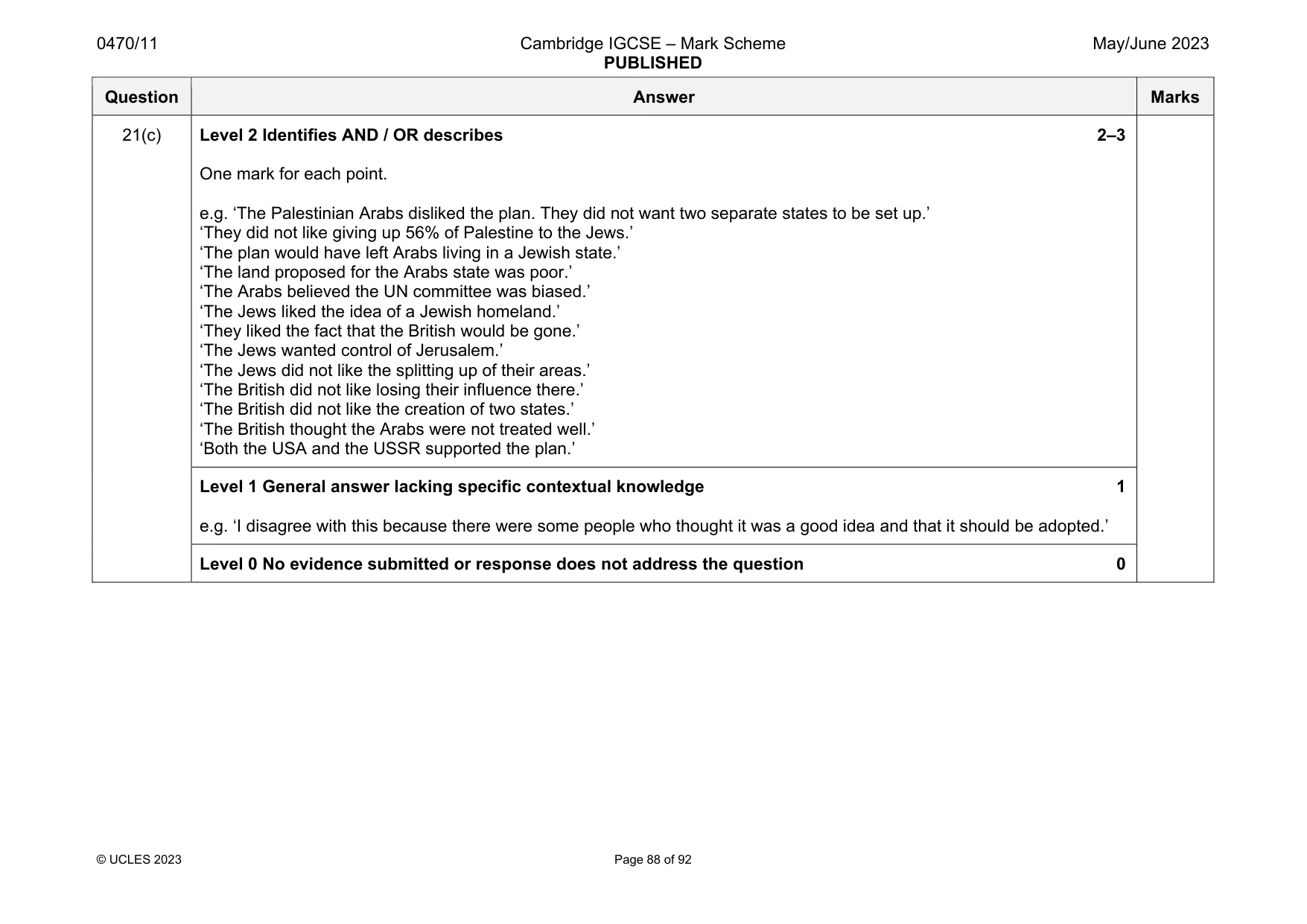
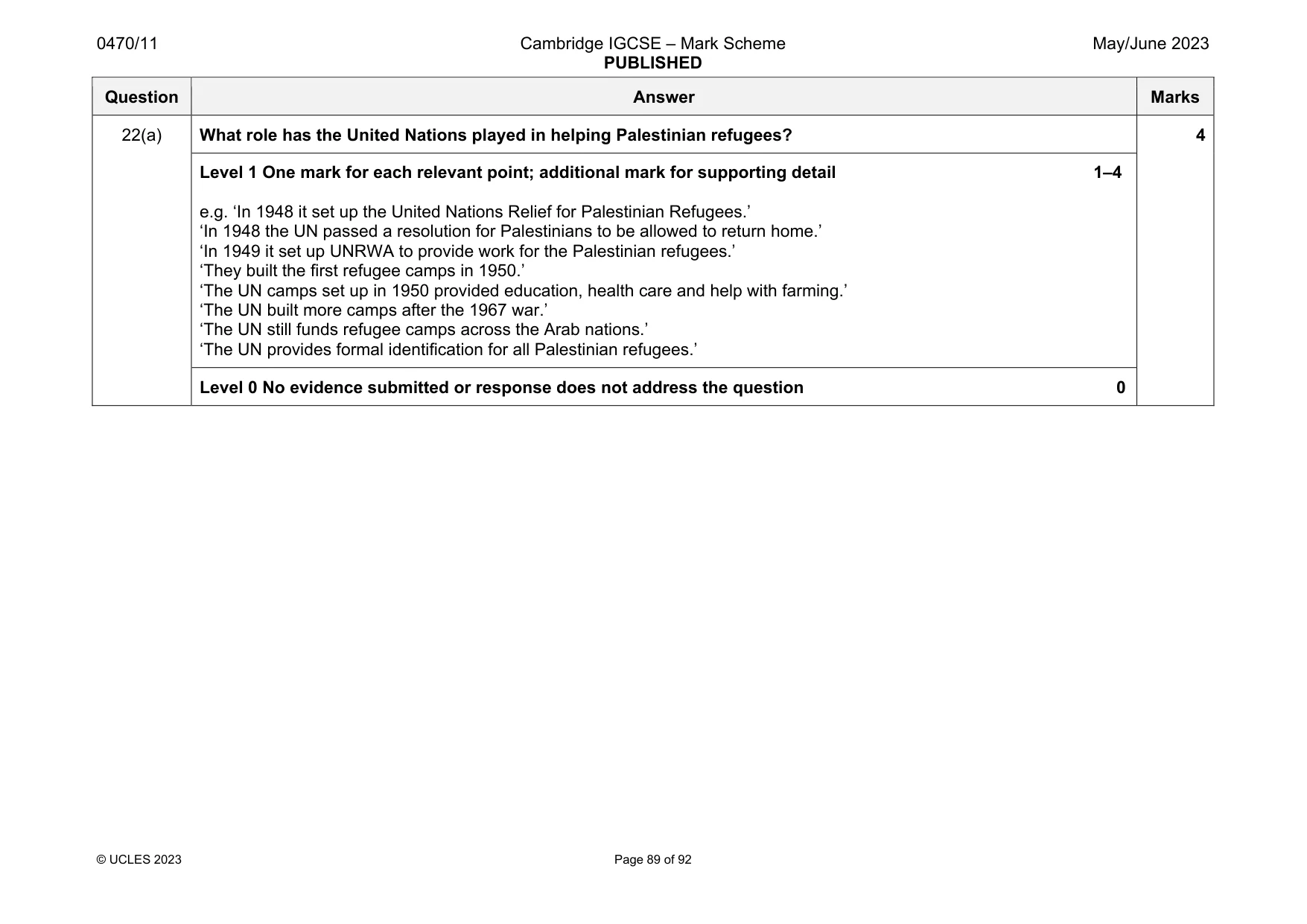
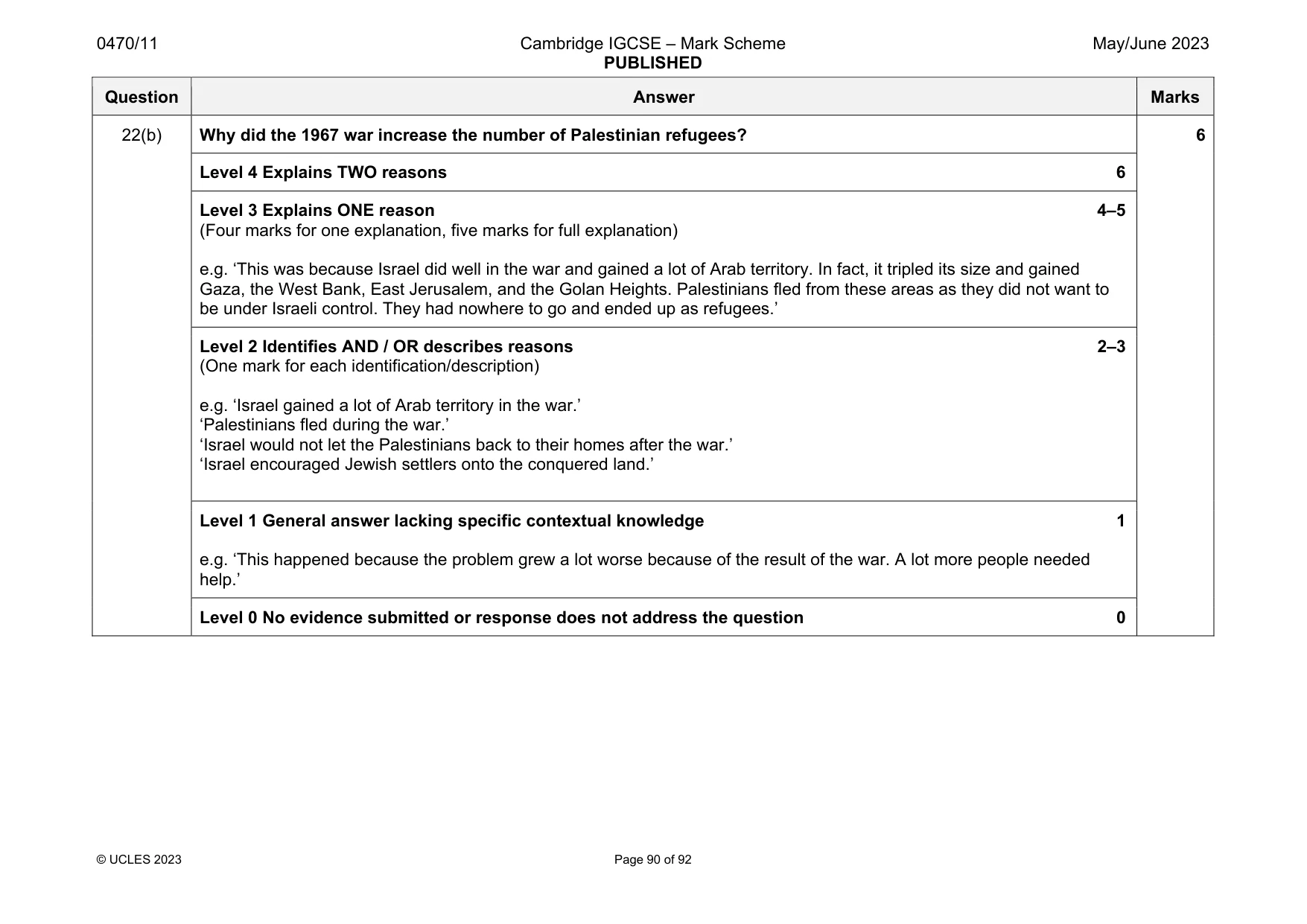
10 0470/11/M/J/23 © UCLES 2023 DEPTH STUDY G: ISRAELIS AND PALESTINIANS SINCE 1945 21 Palestine posed many problems after the Second World War. (a) Describe British reactions to Jewish immigration after the Second World War. [4] (b) Why was the 1948–49 war important? [6] (c) ‘The United Nations’ partition plan had little support.’ How far do you agree with this statement? Explain your answer. [10] 22 Events in the Middle East have had a big impact on Palestinians. (a) What role has the United Nations played in helping Palestinian refugees? [4] (b) Why did the 1967 war increase the number of Palestinian refugees? [6] (c) Which has done more to help the Palestinian cause, Arab states or the Palestine Liberation Organisation (PLO)? Explain your answer. [10]
Question paper, page 11
11 0470/11/M/J/23 © UCLES 2023 BLANK PAGE
Question paper, page 12
12 0470/11/M/J/23 © UCLES 2023 Permission to reproduce items where third‑party owned material protected by copyright is included has been sought and cleared where possible. Every reasonable effort has been made by the publisher (UCLES) to trace copyright holders, but if any items requiring clearance have unwittingly been included, the publisher will be pleased to make amends at the earliest possible opportunity. To avoid the issue of disclosure of answer‑related information to candidates, all copyright acknowledgements are reproduced online in the Cambridge Assessment International Education Copyright Acknowledgements Booklet. This is produced for each series of examinations and is freely available to download at www.cambridgeinternational.org after the live examination series. Cambridge Assessment International Education is part of Cambridge Assessment. Cambridge Assessment is the brand name of the University of Cambridge Local Examinations Syndicate (UCLES), which is a department of the University of Cambridge. BLANK PAGE
Mark scheme, page 1
This document consists of 92 printed pages. © UCLES 2023 [Turn over Cambridge IGCSE™ HISTORY 0470/11 Paper 1 May/June 2023 MARK SCHEME Maximum Mark: 60 Published This mark scheme is published as an aid to teachers and candidates, to indicate the requirements of the examination. It shows the basis on which Examiners were instructed to award marks. It does not indicate the details of the discussions that took place at an Examiners’ meeting before marking began, which would have considered the acceptability of alternative answers. Mark schemes should be read in conjunction with the question paper and the Principal Examiner Report for Teachers. Cambridge International will not enter into discussions about these mark schemes. Cambridge International is publishing the mark schemes for the May/June 2023 series for most Cambridge IGCSE, Cambridge International A and AS Level and Cambridge Pre-U components, and some Cambridge O Level components.
Mark scheme, page 2
0470/11 Cambridge IGCSE – Mark Scheme PUBLISHED May/June 2023 © UCLES 2023 Page 2 of 92 Generic Marking Principles These general marking principles must be applied by all examiners when marking candidate answers. They should be applied alongside the specific content of the mark scheme or generic level descriptors for a question. Each question paper and mark scheme will also comply with these marking principles. GENERIC MARKING PRINCIPLE 1: Marks must be awarded in line with: the specific content of the mark scheme or the generic level descriptors for the question the specific skills defined in the mark scheme or in the generic level descriptors for the question the standard of response required by a candidate as exemplified by the standardisation scripts. GENERIC MARKING PRINCIPLE 2: Marks awarded are always whole marks (not half marks, or other fractions). GENERIC MARKING PRINCIPLE 3: Marks must be awarded positively: marks are awarded for correct/valid answers, as defined in the mark scheme. However, credit is given for valid answers which go beyond the scope of the syllabus and mark scheme, referring to your Team Leader as appropriate marks are awarded when candidates clearly demonstrate what they know and can do marks are not deducted for errors marks are not deducted for omissions answers should only be judged on the quality of spelling, punctuation and grammar when these features are specifically assessed by the question as indicated by the mark scheme. The meaning, however, should be unambiguous. GENERIC MARKING PRINCIPLE 4: Rules must be applied consistently, e.g. in situations where candidates have not followed instructions or in the application of generic level descriptors.
Mark scheme, page 3
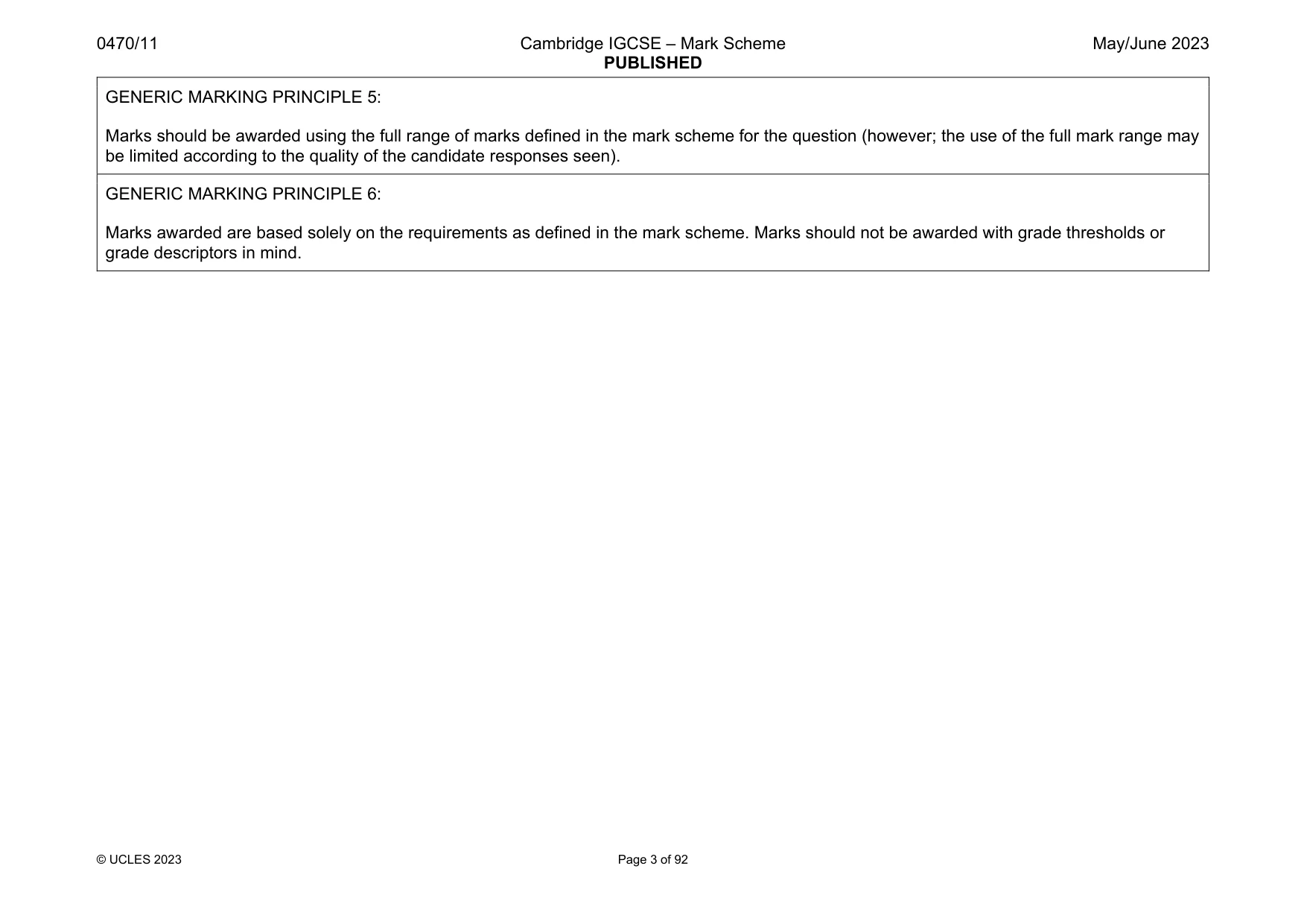
0470/11 Cambridge IGCSE – Mark Scheme PUBLISHED May/June 2023 © UCLES 2023 Page 3 of 92 GENERIC MARKING PRINCIPLE 5: Marks should be awarded using the full range of marks defined in the mark scheme for the question (however; the use of the full mark range may be limited according to the quality of the candidate responses seen). GENERIC MARKING PRINCIPLE 6: Marks awarded are based solely on the requirements as defined in the mark scheme. Marks should not be awarded with grade thresholds or grade descriptors in mind.
Mark scheme, page 4
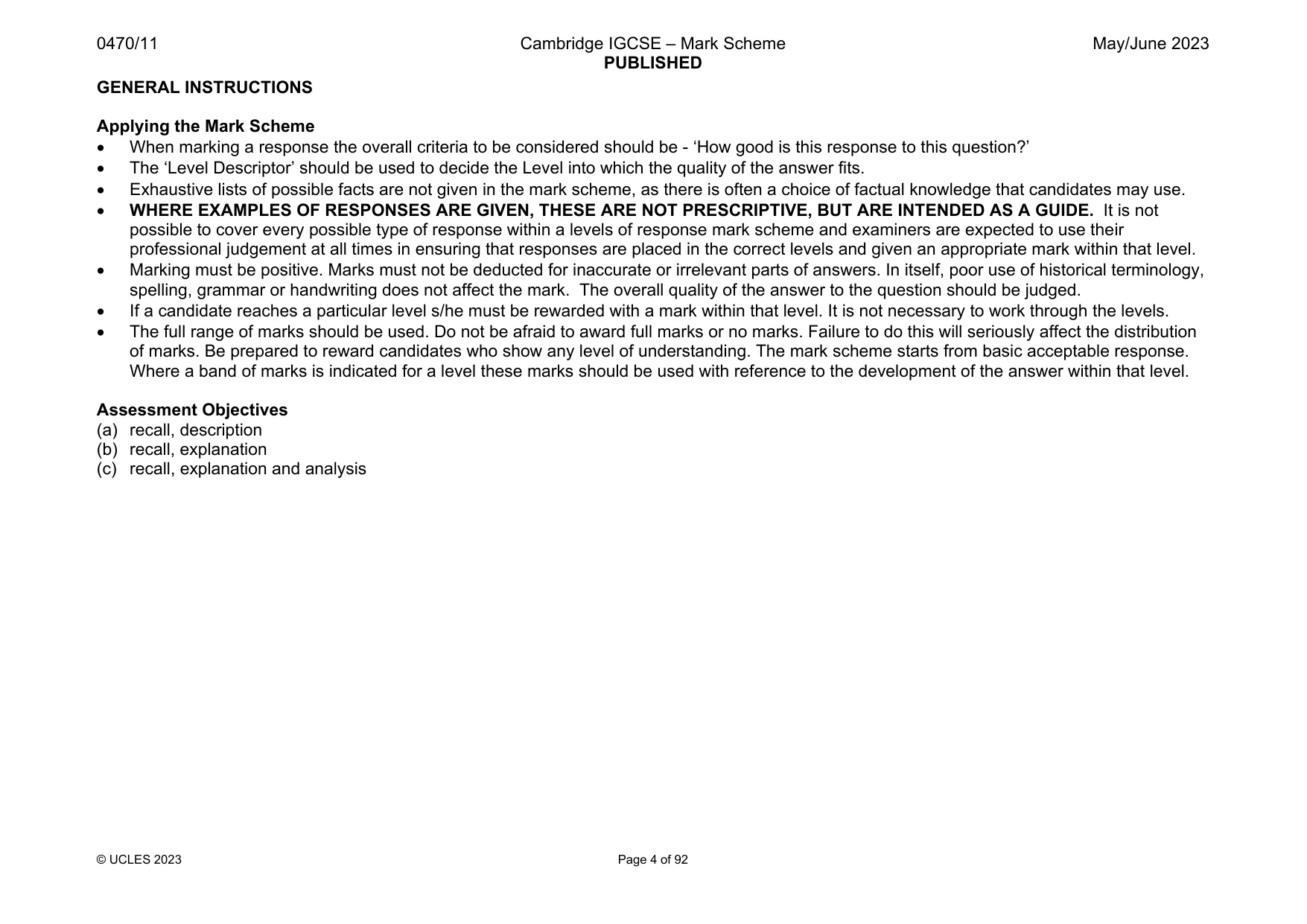
0470/11 Cambridge IGCSE – Mark Scheme PUBLISHED May/June 2023 © UCLES 2023 Page 4 of 92 GENERAL INSTRUCTIONS Applying the Mark Scheme When marking a response the overall criteria to be considered should be - ‘How good is this response to this question?’ The ‘Level Descriptor’ should be used to decide the Level into which the quality of the answer fits. Exhaustive lists of possible facts are not given in the mark scheme, as there is often a choice of factual knowledge that candidates may use. WHERE EXAMPLES OF RESPONSES ARE GIVEN, THESE ARE NOT PRESCRIPTIVE, BUT ARE INTENDED AS A GUIDE. It is not possible to cover every possible type of response within a levels of response mark scheme and examiners are expected to use their professional judgement at all times in ensuring that responses are placed in the correct levels and given an appropriate mark within that level. Marking must be positive. Marks must not be deducted for inaccurate or irrelevant parts of answers. In itself, poor use of historical terminology, spelling, grammar or handwriting does not affect the mark. The overall quality of the answer to the question should be judged. If a candidate reaches a particular level s/he must be rewarded with a mark within that level. It is not necessary to work through the levels. The full range of marks should be used. Do not be afraid to award full marks or no marks. Failure to do this will seriously affect the distribution of marks. Be prepared to reward candidates who show any level of understanding. The mark scheme starts from basic acceptable response. Where a band of marks is indicated for a level these marks should be used with reference to the development of the answer within that level. Assessment Objectives (a) recall, description (b) recall, explanation (c) recall, explanation and analysis
Mark scheme, page 5
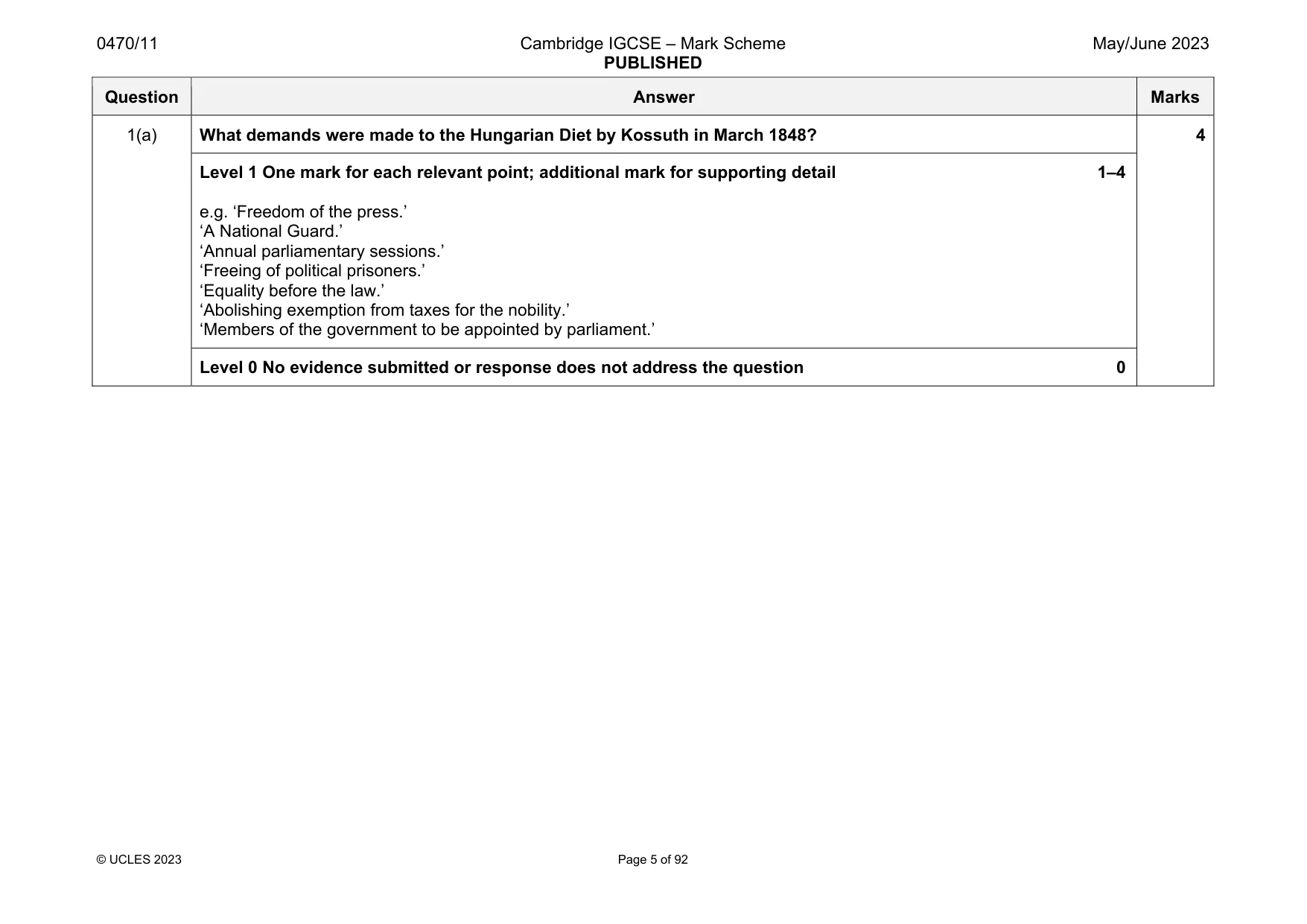
0470/11 Cambridge IGCSE – Mark Scheme PUBLISHED May/June 2023 © UCLES 2023 Page 5 of 92 Question Answer Marks 1(a) What demands were made to the Hungarian Diet by Kossuth in March 1848? 4 Level 1 One mark for each relevant point; additional mark for supporting detail 1–4 e.g. ‘Freedom of the press.’ ‘A National Guard.’ ‘Annual parliamentary sessions.’ ‘Freeing of political prisoners.’ ‘Equality before the law.’ ‘Abolishing exemption from taxes for the nobility.’ ‘Members of the government to be appointed by parliament.’ Level 0 No evidence submitted or response does not address the question 0
Mark scheme, page 6
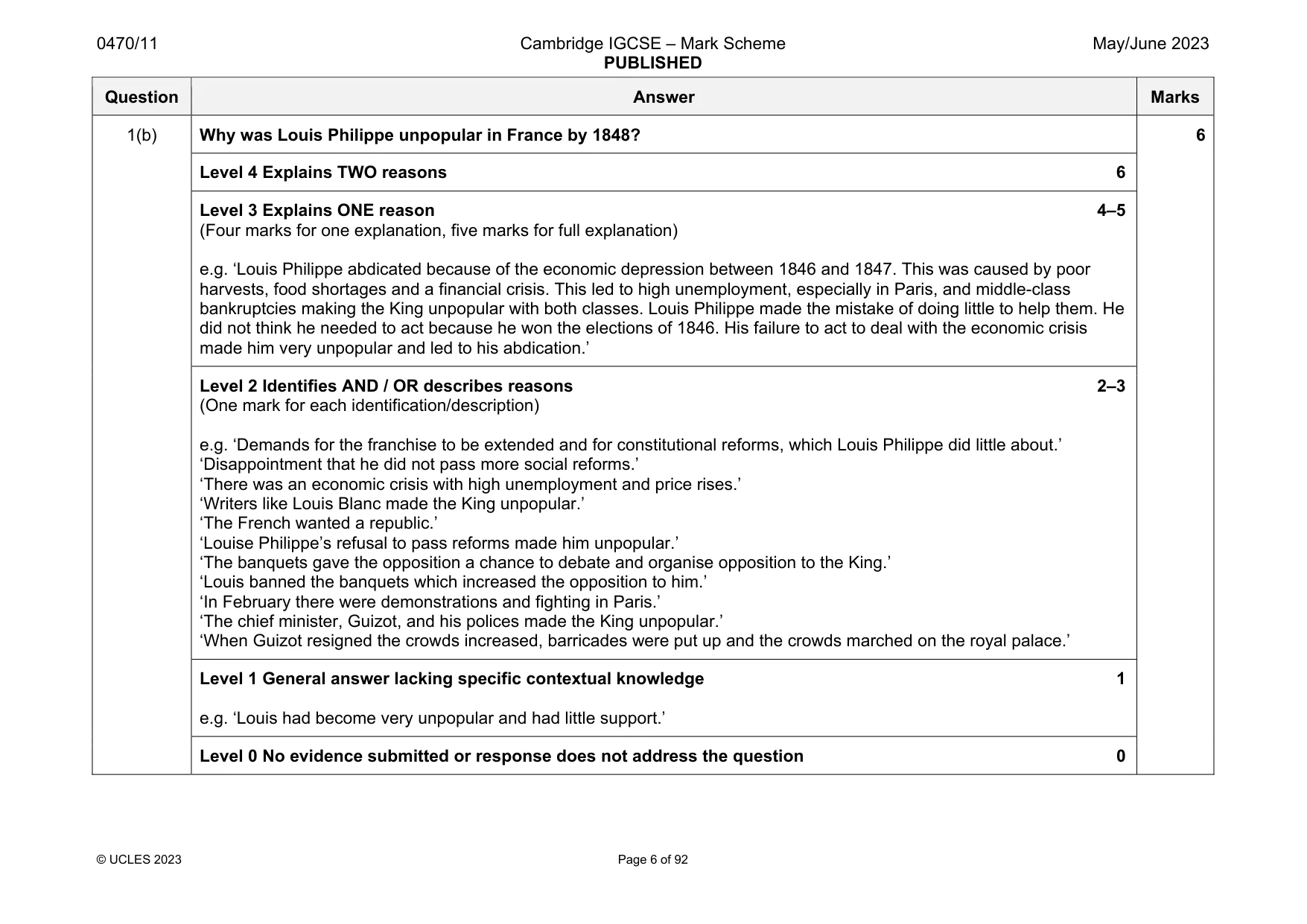
0470/11 Cambridge IGCSE – Mark Scheme PUBLISHED May/June 2023 © UCLES 2023 Page 6 of 92 Question Answer Marks 1(b) Why was Louis Philippe unpopular in France by 1848? 6 Level 4 Explains TWO reasons 6 Level 3 Explains ONE reason 4–5 (Four marks for one explanation, five marks for full explanation) e.g. ‘Louis Philippe abdicated because of the economic depression between 1846 and 1847. This was caused by poor harvests, food shortages and a financial crisis. This led to high unemployment, especially in Paris, and middle-class bankruptcies making the King unpopular with both classes. Louis Philippe made the mistake of doing little to help them. He did not think he needed to act because he won the elections of 1846. His failure to act to deal with the economic crisis made him very unpopular and led to his abdication.’ Level 2 Identifies AND / OR describes reasons 2–3 (One mark for each identification/description) e.g. ‘Demands for the franchise to be extended and for constitutional reforms, which Louis Philippe did little about.’ ‘Disappointment that he did not pass more social reforms.’ ‘There was an economic crisis with high unemployment and price rises.’ ‘Writers like Louis Blanc made the King unpopular.’ ‘The French wanted a republic.’ ‘Louise Philippe’s refusal to pass reforms made him unpopular.’ ‘The banquets gave the opposition a chance to debate and organise opposition to the King.’ ‘Louis banned the banquets which increased the opposition to him.’ ‘In February there were demonstrations and fighting in Paris.’ ‘The chief minister, Guizot, and his polices made the King unpopular.’ ‘When Guizot resigned the crowds increased, barricades were put up and the crowds marched on the royal palace.’ Level 1 General answer lacking specific contextual knowledge 1 e.g. ‘Louis had become very unpopular and had little support.’ Level 0 No evidence submitted or response does not address the question 0
Mark scheme, page 7
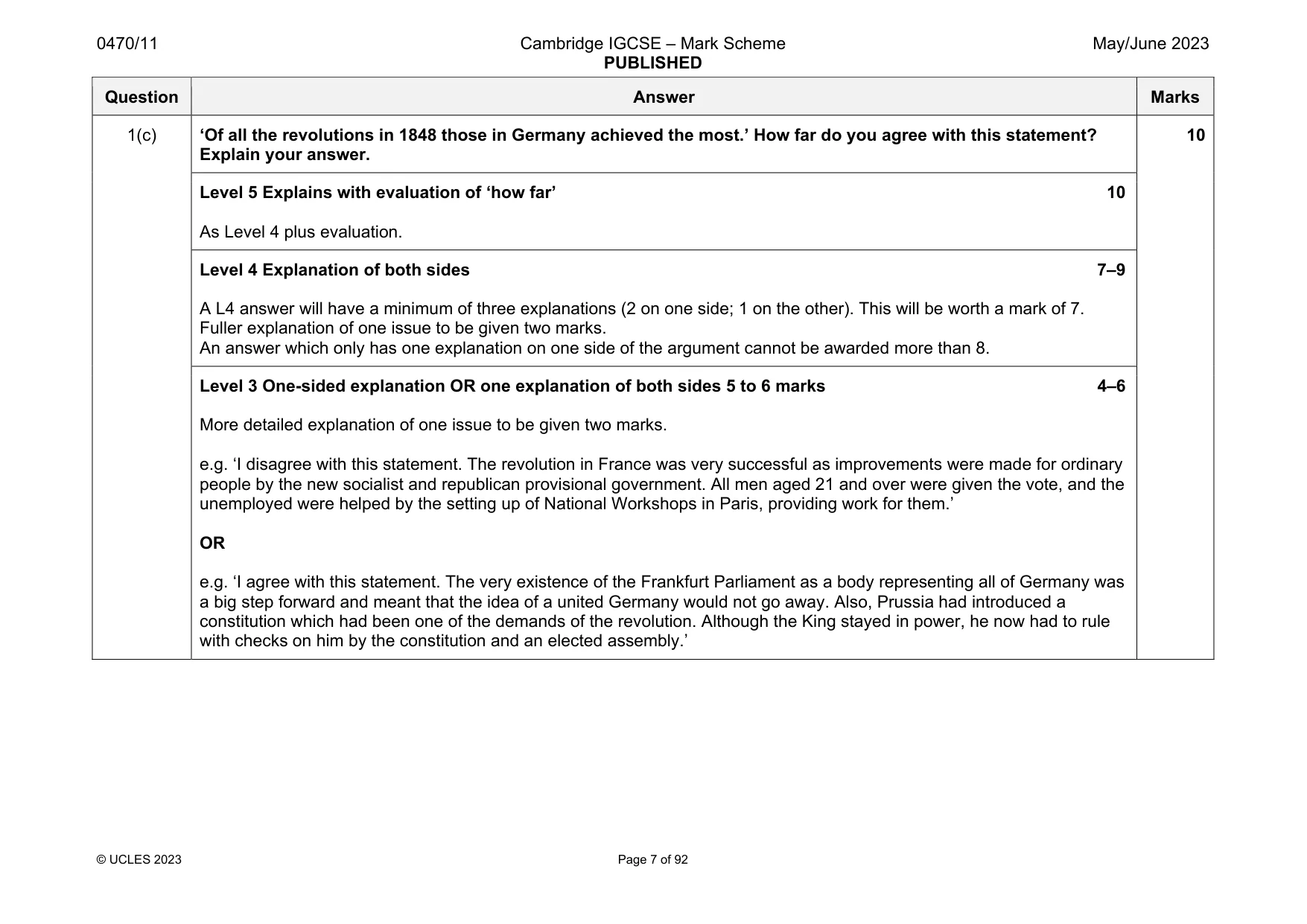
0470/11 Cambridge IGCSE – Mark Scheme PUBLISHED May/June 2023 © UCLES 2023 Page 7 of 92 Question Answer Marks 1(c) ‘Of all the revolutions in 1848 those in Germany achieved the most.’ How far do you agree with this statement? Explain your answer. 10 Level 5 Explains with evaluation of ‘how far’ 10 As Level 4 plus evaluation. Level 4 Explanation of both sides 7–9 A L4 answer will have a minimum of three explanations (2 on one side; 1 on the other). This will be worth a mark of 7. Fuller explanation of one issue to be given two marks. An answer which only has one explanation on one side of the argument cannot be awarded more than 8. Level 3 One-sided explanation OR one explanation of both sides 5 to 6 marks 4–6 More detailed explanation of one issue to be given two marks. e.g. ‘I disagree with this statement. The revolution in France was very successful as improvements were made for ordinary people by the new socialist and republican provisional government. All men aged 21 and over were given the vote, and the unemployed were helped by the setting up of National Workshops in Paris, providing work for them.’ OR e.g. ‘I agree with this statement. The very existence of the Frankfurt Parliament as a body representing all of Germany was a big step forward and meant that the idea of a united Germany would not go away. Also, Prussia had introduced a constitution which had been one of the demands of the revolution. Although the King stayed in power, he now had to rule with checks on him by the constitution and an elected assembly.’
Mark scheme, page 8
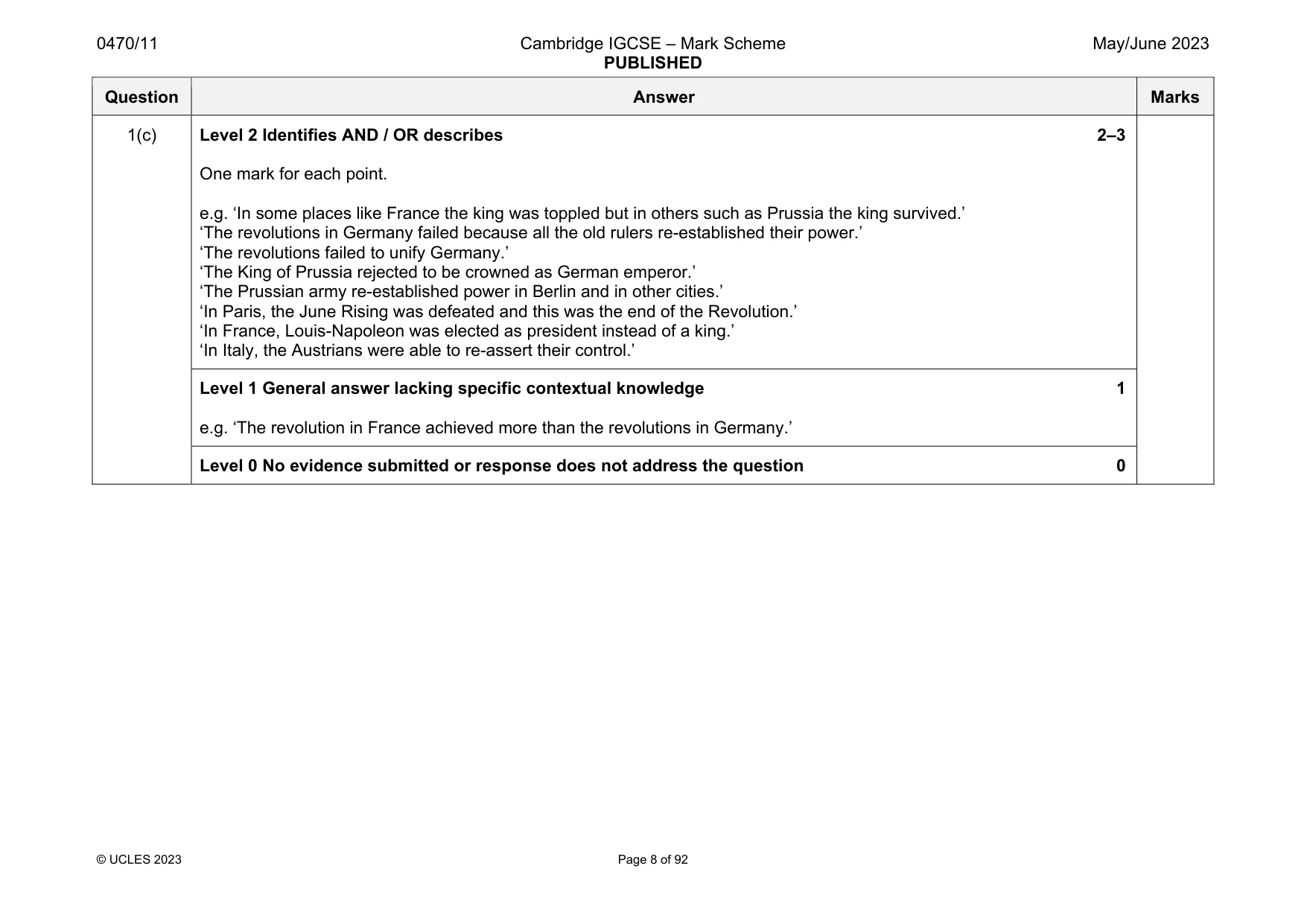
0470/11 Cambridge IGCSE – Mark Scheme PUBLISHED May/June 2023 © UCLES 2023 Page 8 of 92 Question Answer Marks 1(c) Level 2 Identifies AND / OR describes 2–3 One mark for each point. e.g. ‘In some places like France the king was toppled but in others such as Prussia the king survived.’ ‘The revolutions in Germany failed because all the old rulers re-established their power.’ ‘The revolutions failed to unify Germany.’ ‘The King of Prussia rejected to be crowned as German emperor.’ ‘The Prussian army re-established power in Berlin and in other cities.’ ‘In Paris, the June Rising was defeated and this was the end of the Revolution.’ ‘In France, Louis-Napoleon was elected as president instead of a king.’ ‘In Italy, the Austrians were able to re-assert their control.’ Level 1 General answer lacking specific contextual knowledge 1 e.g. ‘The revolution in France achieved more than the revolutions in Germany.’ Level 0 No evidence submitted or response does not address the question 0
Mark scheme, page 9
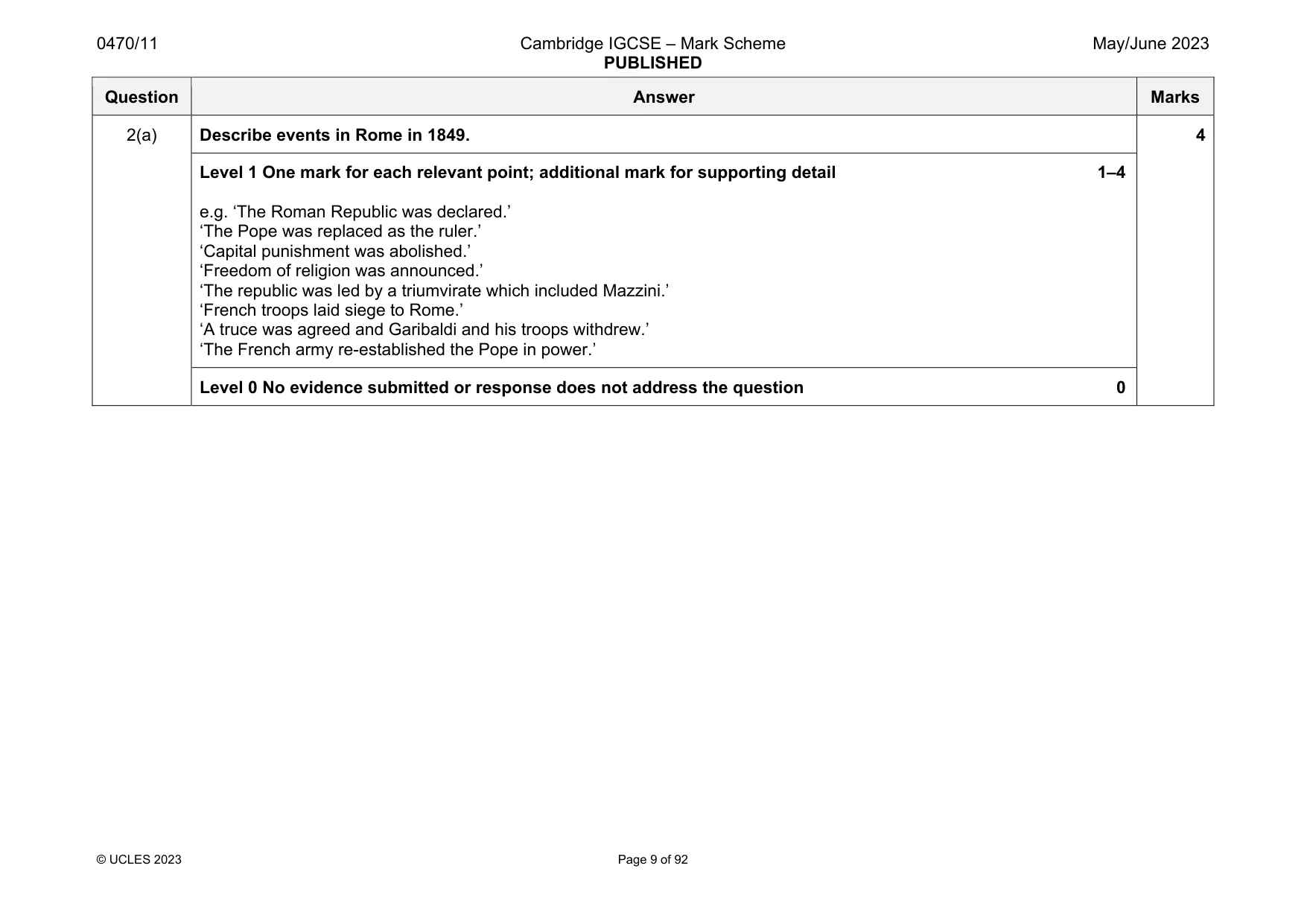
0470/11 Cambridge IGCSE – Mark Scheme PUBLISHED May/June 2023 © UCLES 2023 Page 9 of 92 Question Answer Marks 2(a) Describe events in Rome in 1849. 4 Level 1 One mark for each relevant point; additional mark for supporting detail 1–4 e.g. ‘The Roman Republic was declared.’ ‘The Pope was replaced as the ruler.’ ‘Capital punishment was abolished.’ ‘Freedom of religion was announced.’ ‘The republic was led by a triumvirate which included Mazzini.’ ‘French troops laid siege to Rome.’ ‘A truce was agreed and Garibaldi and his troops withdrew.’ ‘The French army re-established the Pope in power.’ Level 0 No evidence submitted or response does not address the question 0
Mark scheme, page 10
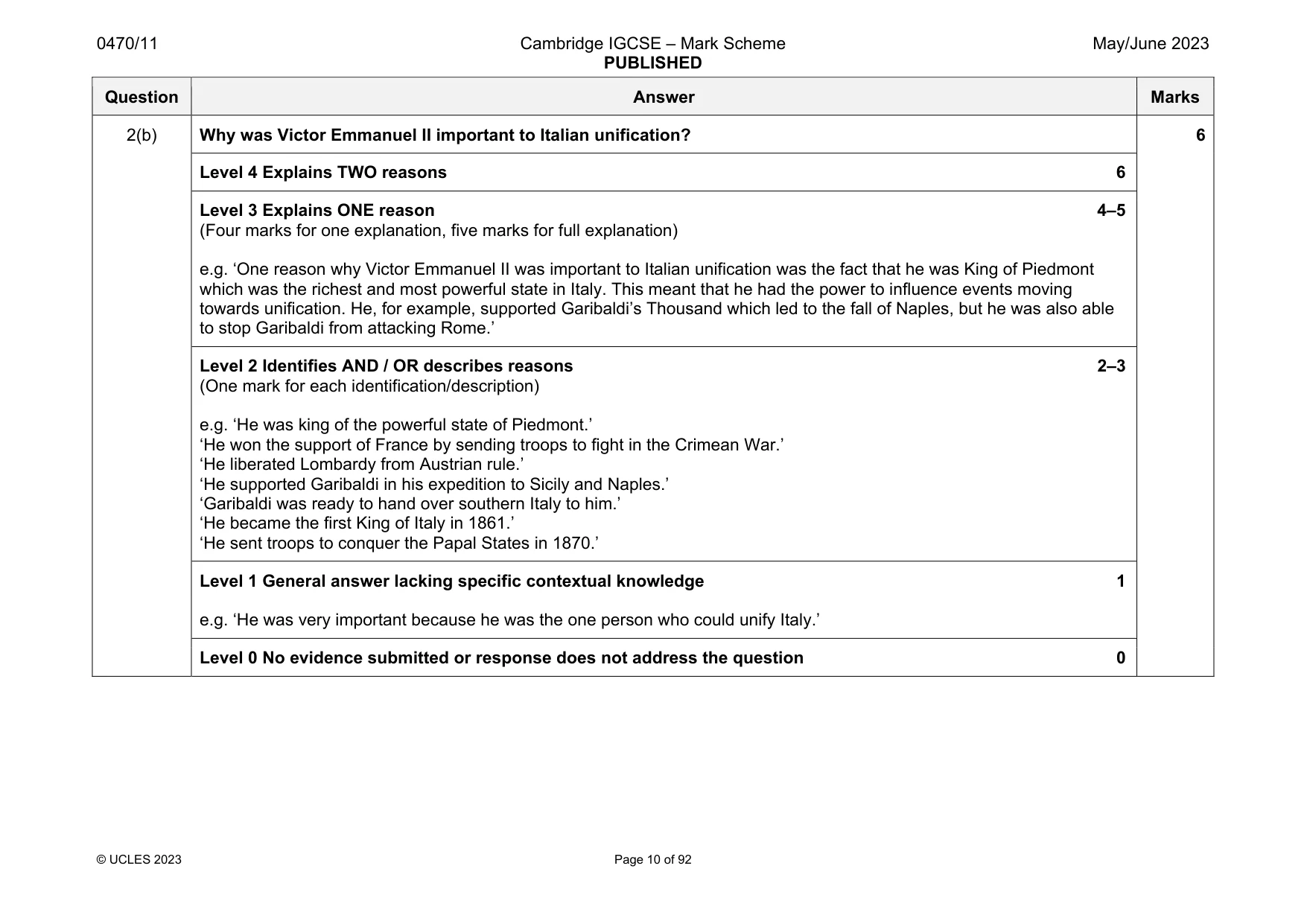
0470/11 Cambridge IGCSE – Mark Scheme PUBLISHED May/June 2023 © UCLES 2023 Page 10 of 92 Question Answer Marks 2(b) Why was Victor Emmanuel II important to Italian unification? 6 Level 4 Explains TWO reasons 6 Level 3 Explains ONE reason 4–5 (Four marks for one explanation, five marks for full explanation) e.g. ‘One reason why Victor Emmanuel II was important to Italian unification was the fact that he was King of Piedmont which was the richest and most powerful state in Italy. This meant that he had the power to influence events moving towards unification. He, for example, supported Garibaldi’s Thousand which led to the fall of Naples, but he was also able to stop Garibaldi from attacking Rome.’ Level 2 Identifies AND / OR describes reasons 2–3 (One mark for each identification/description) e.g. ‘He was king of the powerful state of Piedmont.’ ‘He won the support of France by sending troops to fight in the Crimean War.’ ‘He liberated Lombardy from Austrian rule.’ ‘He supported Garibaldi in his expedition to Sicily and Naples.’ ‘Garibaldi was ready to hand over southern Italy to him.’ ‘He became the first King of Italy in 1861.’ ‘He sent troops to conquer the Papal States in 1870.’ Level 1 General answer lacking specific contextual knowledge 1 e.g. ‘He was very important because he was the one person who could unify Italy.’ Level 0 No evidence submitted or response does not address the question 0
Mark scheme, page 11
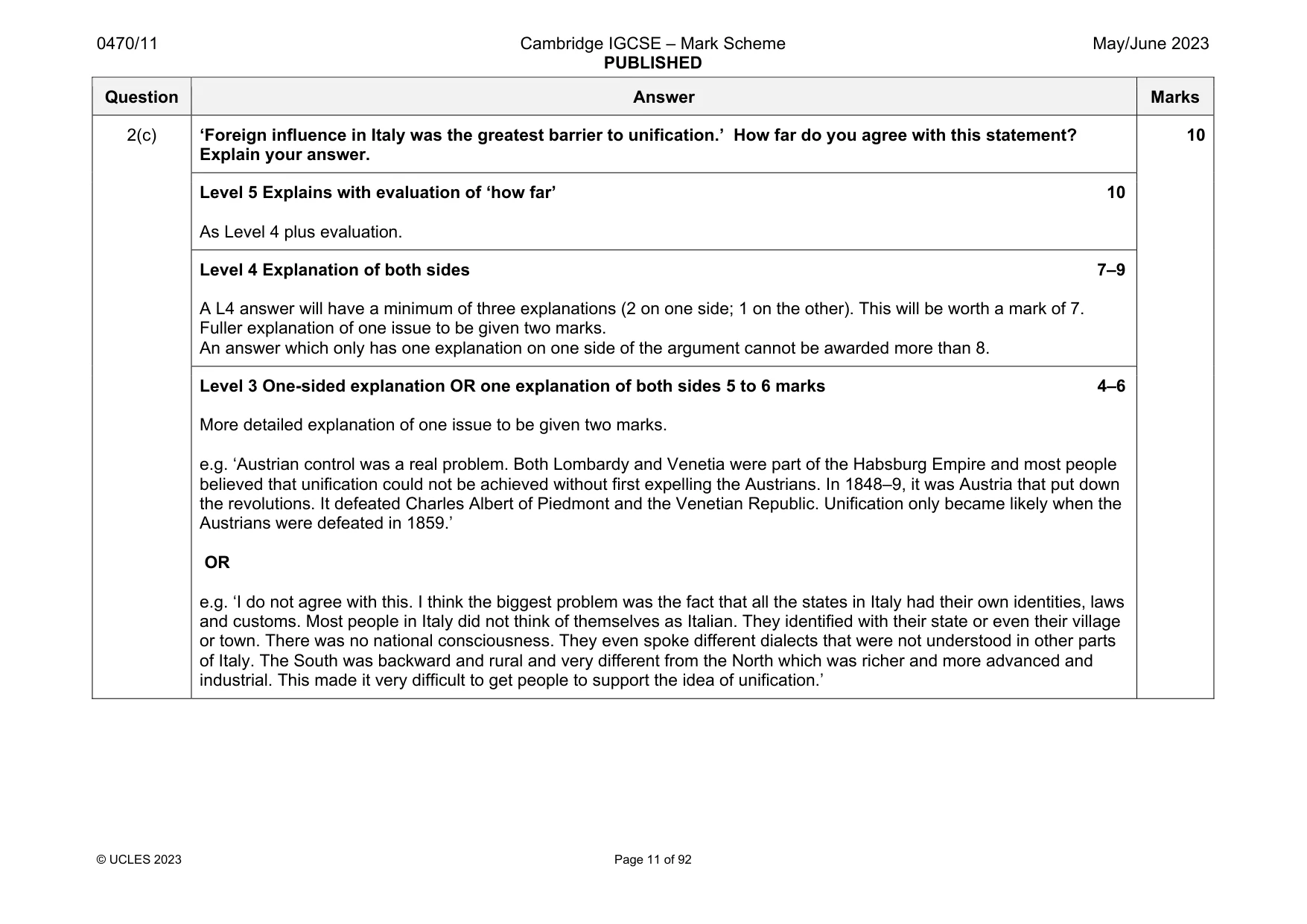
0470/11 Cambridge IGCSE – Mark Scheme PUBLISHED May/June 2023 © UCLES 2023 Page 11 of 92 Question Answer Marks 2(c) ‘Foreign influence in Italy was the greatest barrier to unification.’ How far do you agree with this statement? Explain your answer. 10 Level 5 Explains with evaluation of ‘how far’ 10 As Level 4 plus evaluation. Level 4 Explanation of both sides 7–9 A L4 answer will have a minimum of three explanations (2 on one side; 1 on the other). This will be worth a mark of 7. Fuller explanation of one issue to be given two marks. An answer which only has one explanation on one side of the argument cannot be awarded more than 8. Level 3 One-sided explanation OR one explanation of both sides 5 to 6 marks 4–6 More detailed explanation of one issue to be given two marks. e.g. ‘Austrian control was a real problem. Both Lombardy and Venetia were part of the Habsburg Empire and most people believed that unification could not be achieved without first expelling the Austrians. In 1848–9, it was Austria that put down the revolutions. It defeated Charles Albert of Piedmont and the Venetian Republic. Unification only became likely when the Austrians were defeated in 1859.’ OR e.g. ‘I do not agree with this. I think the biggest problem was the fact that all the states in Italy had their own identities, laws and customs. Most people in Italy did not think of themselves as Italian. They identified with their state or even their village or town. There was no national consciousness. They even spoke different dialects that were not understood in other parts of Italy. The South was backward and rural and very different from the North which was richer and more advanced and industrial. This made it very difficult to get people to support the idea of unification.’
Mark scheme, page 12
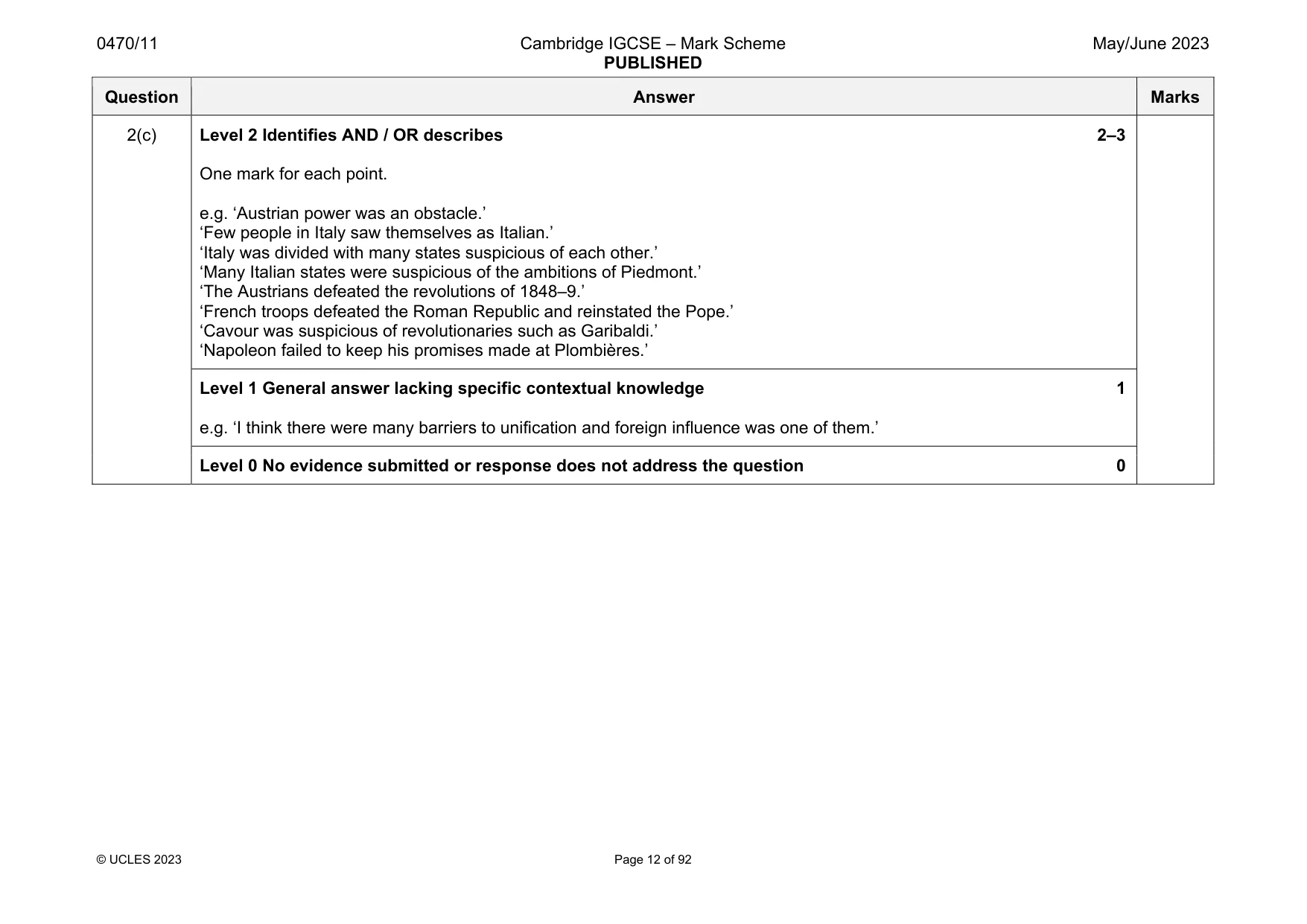
0470/11 Cambridge IGCSE – Mark Scheme PUBLISHED May/June 2023 © UCLES 2023 Page 12 of 92 Question Answer Marks 2(c) Level 2 Identifies AND / OR describes 2–3 One mark for each point. e.g. ‘Austrian power was an obstacle.’ ‘Few people in Italy saw themselves as Italian.’ ‘Italy was divided with many states suspicious of each other.’ ‘Many Italian states were suspicious of the ambitions of Piedmont.’ ‘The Austrians defeated the revolutions of 1848–9.’ ‘French troops defeated the Roman Republic and reinstated the Pope.’ ‘Cavour was suspicious of revolutionaries such as Garibaldi.’ ‘Napoleon failed to keep his promises made at Plombières.’ Level 1 General answer lacking specific contextual knowledge 1 e.g. ‘I think there were many barriers to unification and foreign influence was one of them.’ Level 0 No evidence submitted or response does not address the question 0
Mark scheme, page 13
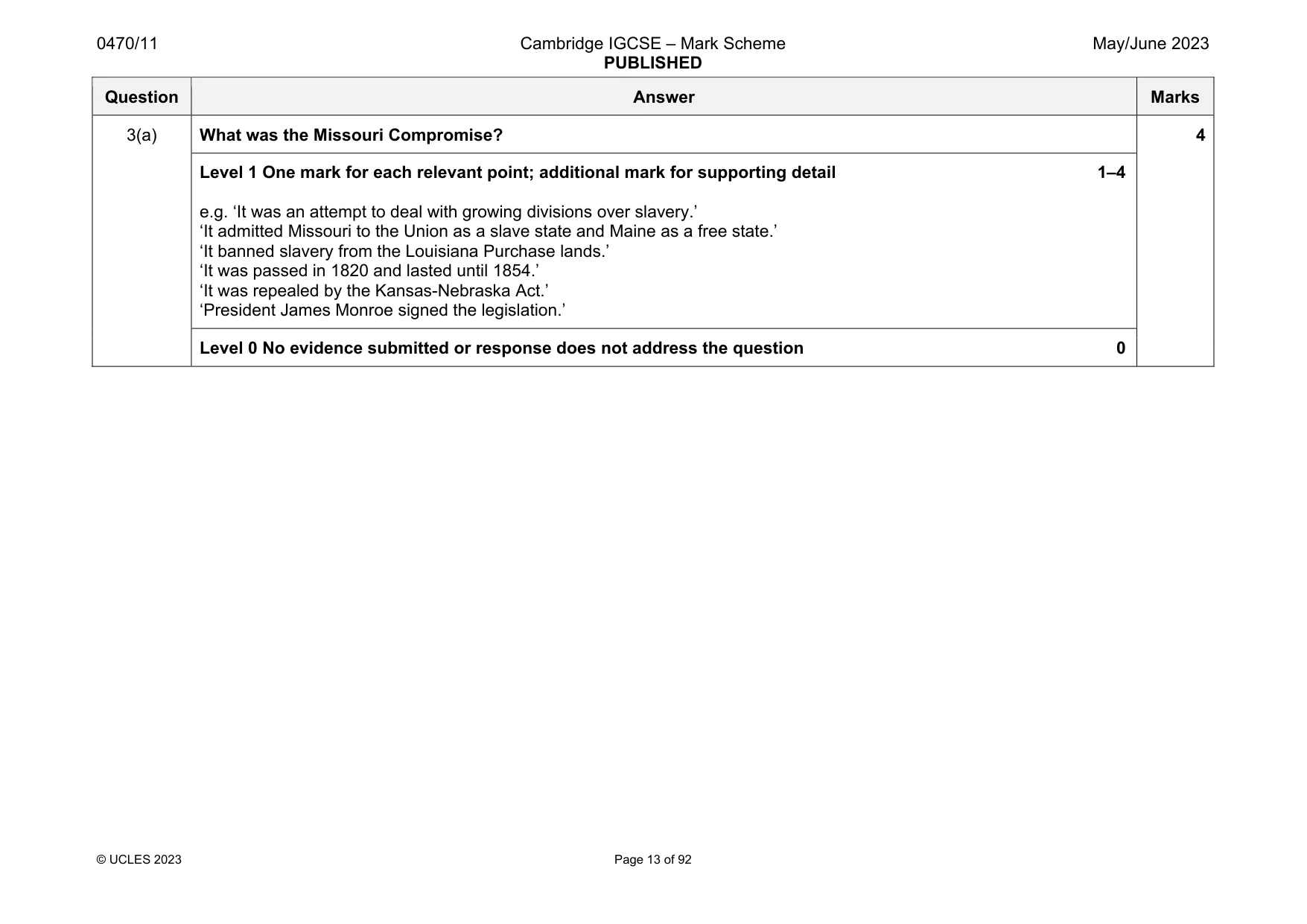
0470/11 Cambridge IGCSE – Mark Scheme PUBLISHED May/June 2023 © UCLES 2023 Page 13 of 92 Question Answer Marks 3(a) What was the Missouri Compromise? 4 Level 1 One mark for each relevant point; additional mark for supporting detail 1–4 e.g. ‘It was an attempt to deal with growing divisions over slavery.’ ‘It admitted Missouri to the Union as a slave state and Maine as a free state.’ ‘It banned slavery from the Louisiana Purchase lands.’ ‘It was passed in 1820 and lasted until 1854.’ ‘It was repealed by the Kansas-Nebraska Act.’ ‘President James Monroe signed the legislation.’ Level 0 No evidence submitted or response does not address the question 0
Mark scheme, page 14
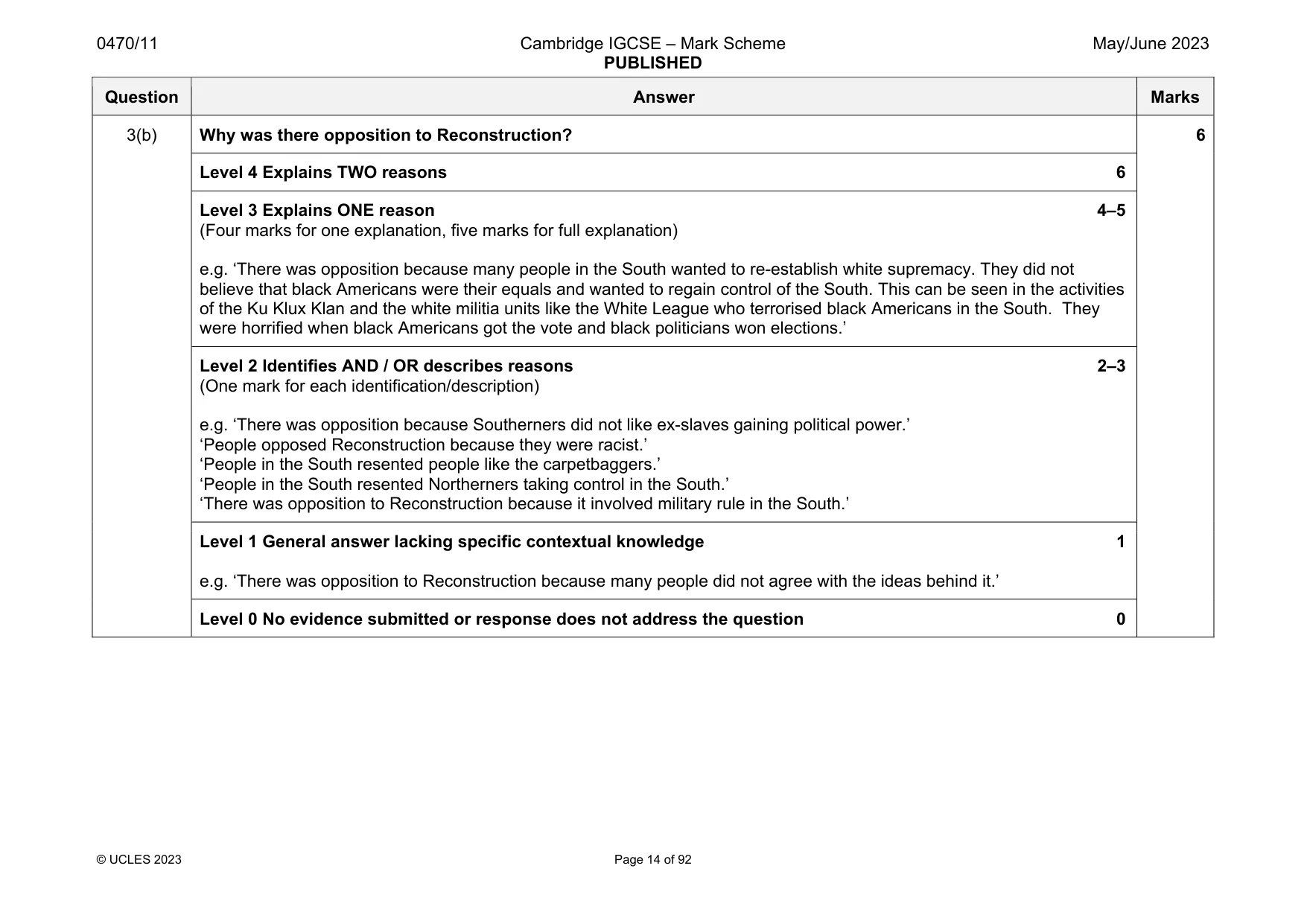
0470/11 Cambridge IGCSE – Mark Scheme PUBLISHED May/June 2023 © UCLES 2023 Page 14 of 92 Question Answer Marks 3(b) Why was there opposition to Reconstruction? 6 Level 4 Explains TWO reasons 6 Level 3 Explains ONE reason 4–5 (Four marks for one explanation, five marks for full explanation) e.g. ‘There was opposition because many people in the South wanted to re-establish white supremacy. They did not believe that black Americans were their equals and wanted to regain control of the South. This can be seen in the activities of the Ku Klux Klan and the white militia units like the White League who terrorised black Americans in the South. They were horrified when black Americans got the vote and black politicians won elections.’ Level 2 Identifies AND / OR describes reasons 2–3 (One mark for each identification/description) e.g. ‘There was opposition because Southerners did not like ex-slaves gaining political power.’ ‘People opposed Reconstruction because they were racist.’ ‘People in the South resented people like the carpetbaggers.’ ‘People in the South resented Northerners taking control in the South.’ ‘There was opposition to Reconstruction because it involved military rule in the South.’ Level 1 General answer lacking specific contextual knowledge 1 e.g. ‘There was opposition to Reconstruction because many people did not agree with the ideas behind it.’ Level 0 No evidence submitted or response does not address the question 0
Mark scheme, page 15
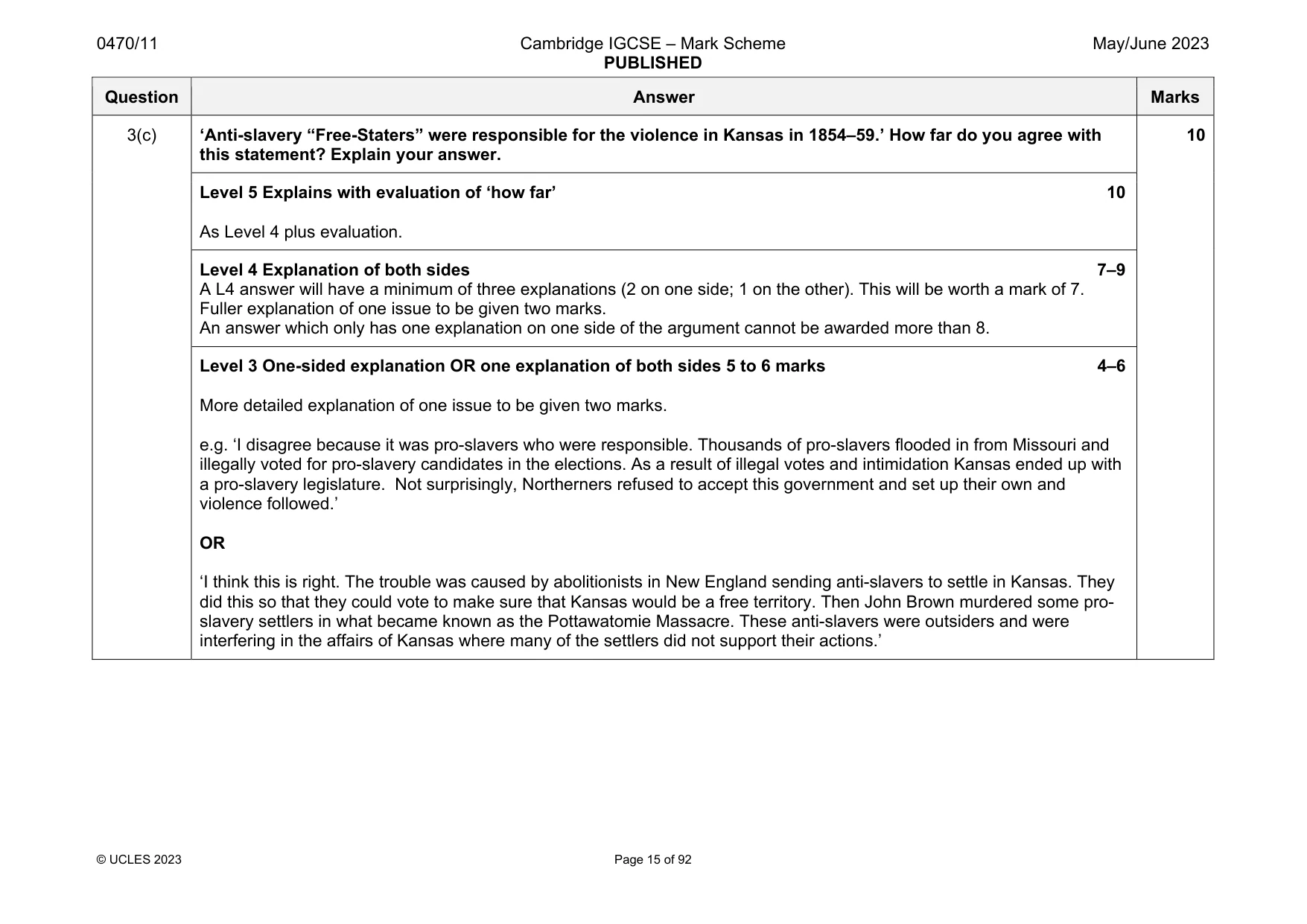
0470/11 Cambridge IGCSE – Mark Scheme PUBLISHED May/June 2023 © UCLES 2023 Page 15 of 92 Question Answer Marks 3(c) ‘Anti-slavery “Free-Staters” were responsible for the violence in Kansas in 1854–59.’ How far do you agree with this statement? Explain your answer. 10 Level 5 Explains with evaluation of ‘how far’ 10 As Level 4 plus evaluation. Level 4 Explanation of both sides 7–9 A L4 answer will have a minimum of three explanations (2 on one side; 1 on the other). This will be worth a mark of 7. Fuller explanation of one issue to be given two marks. An answer which only has one explanation on one side of the argument cannot be awarded more than 8. Level 3 One-sided explanation OR one explanation of both sides 5 to 6 marks 4–6 More detailed explanation of one issue to be given two marks. e.g. ‘I disagree because it was pro-slavers who were responsible. Thousands of pro-slavers flooded in from Missouri and illegally voted for pro-slavery candidates in the elections. As a result of illegal votes and intimidation Kansas ended up with a pro-slavery legislature. Not surprisingly, Northerners refused to accept this government and set up their own and violence followed.’ OR ‘I think this is right. The trouble was caused by abolitionists in New England sending anti-slavers to settle in Kansas. They did this so that they could vote to make sure that Kansas would be a free territory. Then John Brown murdered some pro- slavery settlers in what became known as the Pottawatomie Massacre. These anti-slavers were outsiders and were interfering in the affairs of Kansas where many of the settlers did not support their actions.’
Mark scheme, page 16
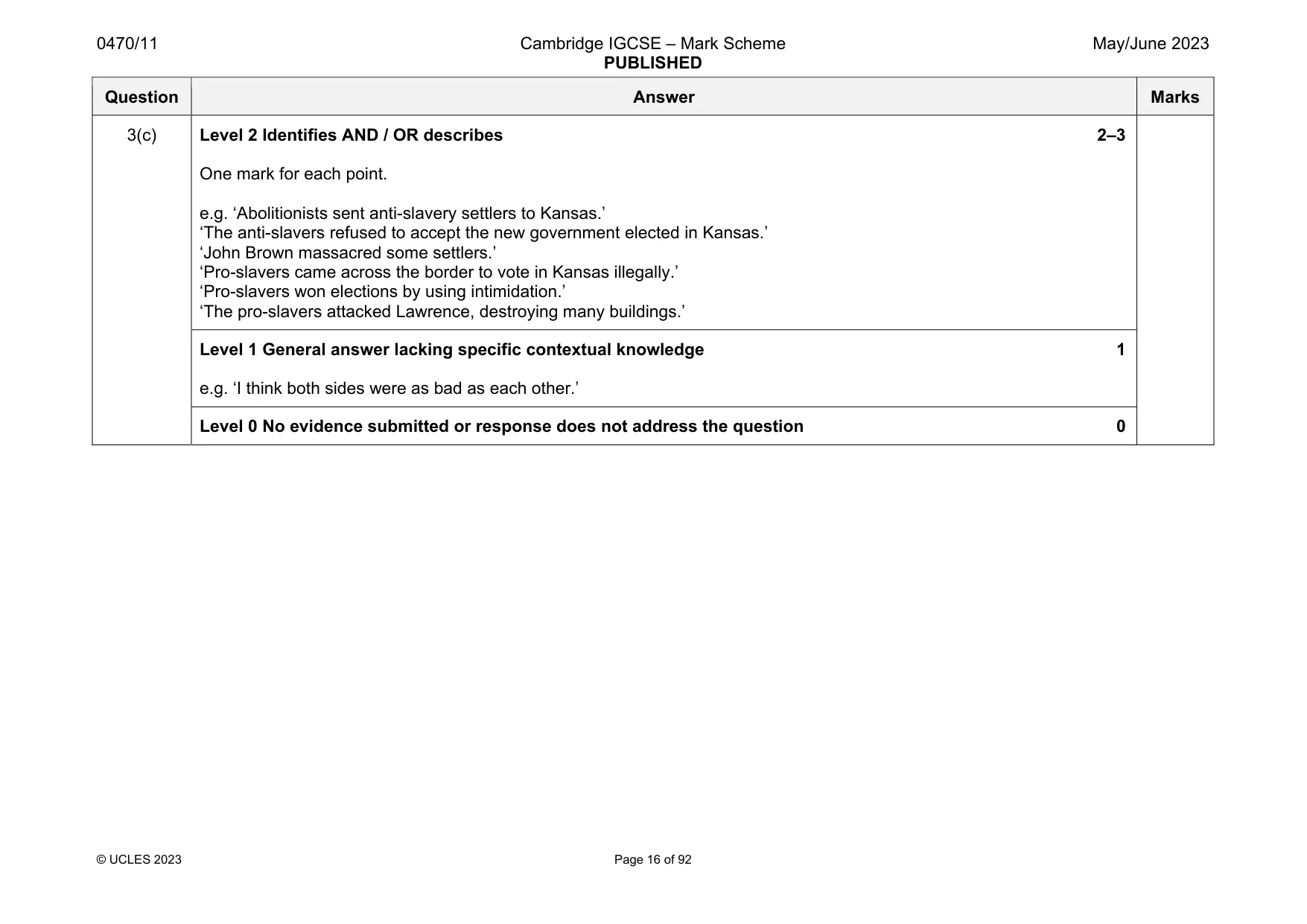
0470/11 Cambridge IGCSE – Mark Scheme PUBLISHED May/June 2023 © UCLES 2023 Page 16 of 92 Question Answer Marks 3(c) Level 2 Identifies AND / OR describes 2–3 One mark for each point. e.g. ‘Abolitionists sent anti-slavery settlers to Kansas.’ ‘The anti-slavers refused to accept the new government elected in Kansas.’ ‘John Brown massacred some settlers.’ ‘Pro-slavers came across the border to vote in Kansas illegally.’ ‘Pro-slavers won elections by using intimidation.’ ‘The pro-slavers attacked Lawrence, destroying many buildings.’ Level 1 General answer lacking specific contextual knowledge 1 e.g. ‘I think both sides were as bad as each other.’ Level 0 No evidence submitted or response does not address the question 0
Mark scheme, page 17
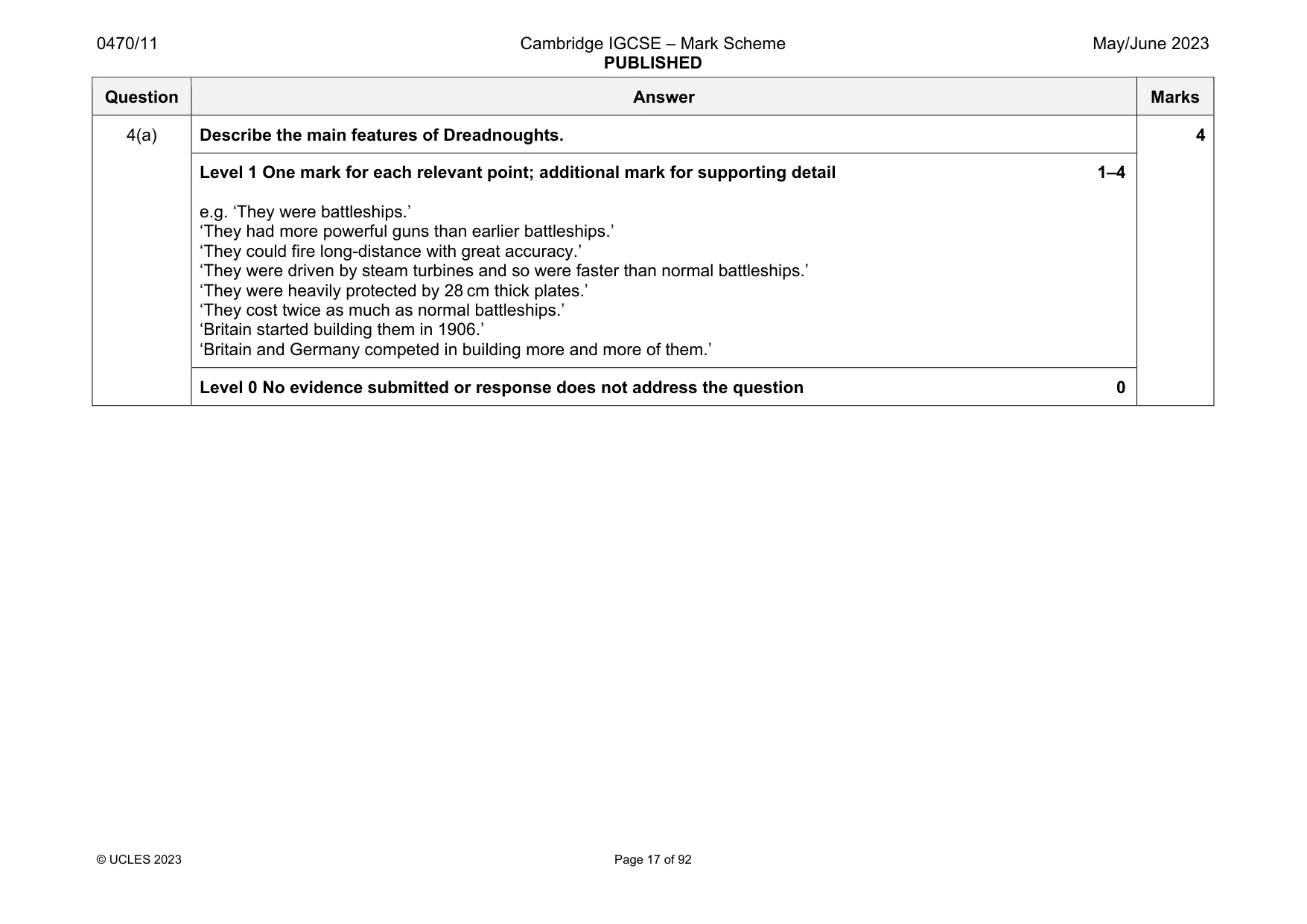
0470/11 Cambridge IGCSE – Mark Scheme PUBLISHED May/June 2023 © UCLES 2023 Page 17 of 92 Question Answer Marks 4(a) Describe the main features of Dreadnoughts. 4 Level 1 One mark for each relevant point; additional mark for supporting detail 1–4 e.g. ‘They were battleships.’ ‘They had more powerful guns than earlier battleships.’ ‘They could fire long-distance with great accuracy.’ ‘They were driven by steam turbines and so were faster than normal battleships.’ ‘They were heavily protected by 28 cm thick plates.’ ‘They cost twice as much as normal battleships.’ ‘Britain started building them in 1906.’ ‘Britain and Germany competed in building more and more of them.’ Level 0 No evidence submitted or response does not address the question 0
Mark scheme, page 18
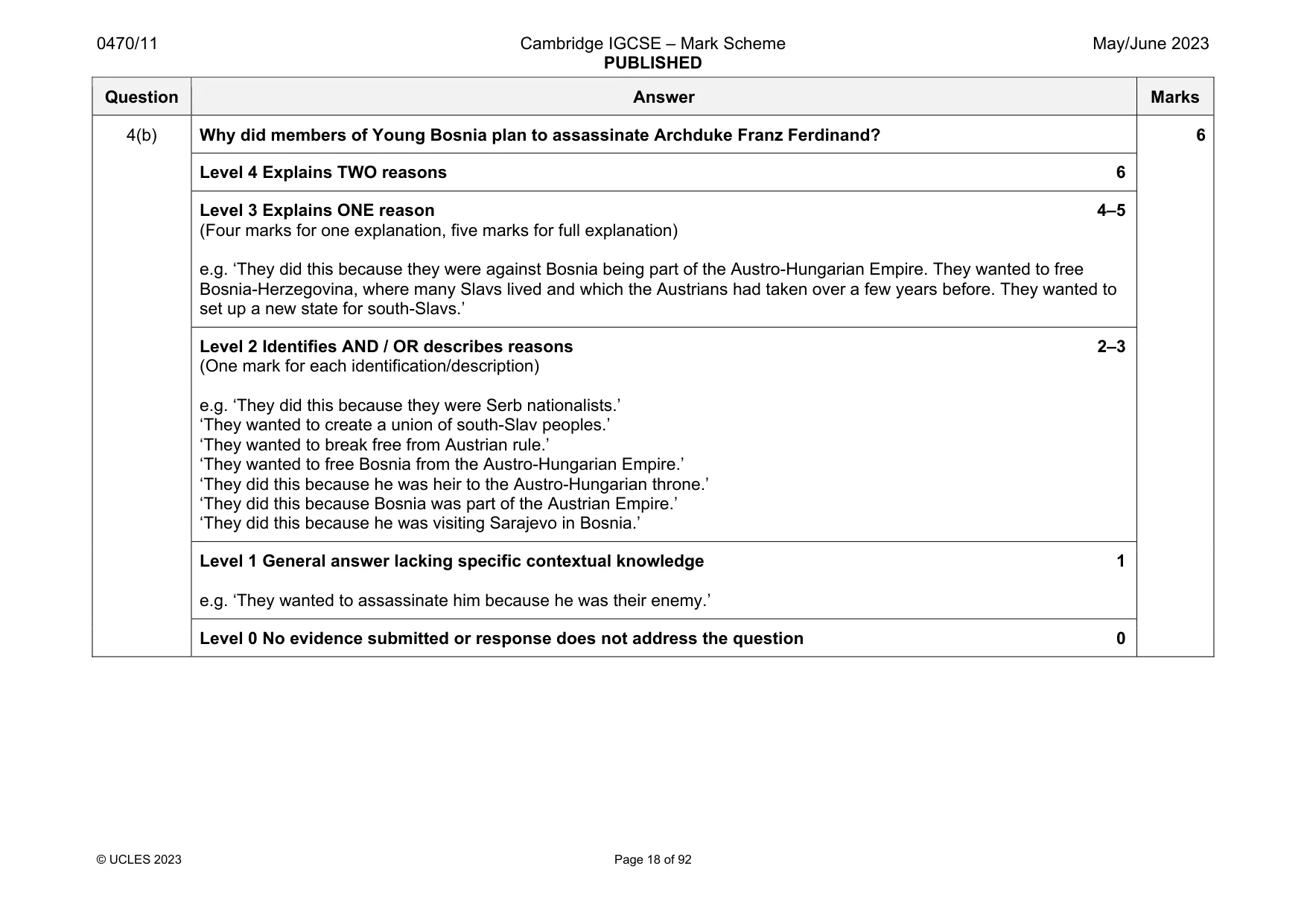
0470/11 Cambridge IGCSE – Mark Scheme PUBLISHED May/June 2023 © UCLES 2023 Page 18 of 92 Question Answer Marks 4(b) Why did members of Young Bosnia plan to assassinate Archduke Franz Ferdinand? 6 Level 4 Explains TWO reasons 6 Level 3 Explains ONE reason 4–5 (Four marks for one explanation, five marks for full explanation) e.g. ‘They did this because they were against Bosnia being part of the Austro-Hungarian Empire. They wanted to free Bosnia-Herzegovina, where many Slavs lived and which the Austrians had taken over a few years before. They wanted to set up a new state for south-Slavs.’ Level 2 Identifies AND / OR describes reasons 2–3 (One mark for each identification/description) e.g. ‘They did this because they were Serb nationalists.’ ‘They wanted to create a union of south-Slav peoples.’ ‘They wanted to break free from Austrian rule.’ ‘They wanted to free Bosnia from the Austro-Hungarian Empire.’ ‘They did this because he was heir to the Austro-Hungarian throne.’ ‘They did this because Bosnia was part of the Austrian Empire.’ ‘They did this because he was visiting Sarajevo in Bosnia.’ Level 1 General answer lacking specific contextual knowledge 1 e.g. ‘They wanted to assassinate him because he was their enemy.’ Level 0 No evidence submitted or response does not address the question 0
Mark scheme, page 19
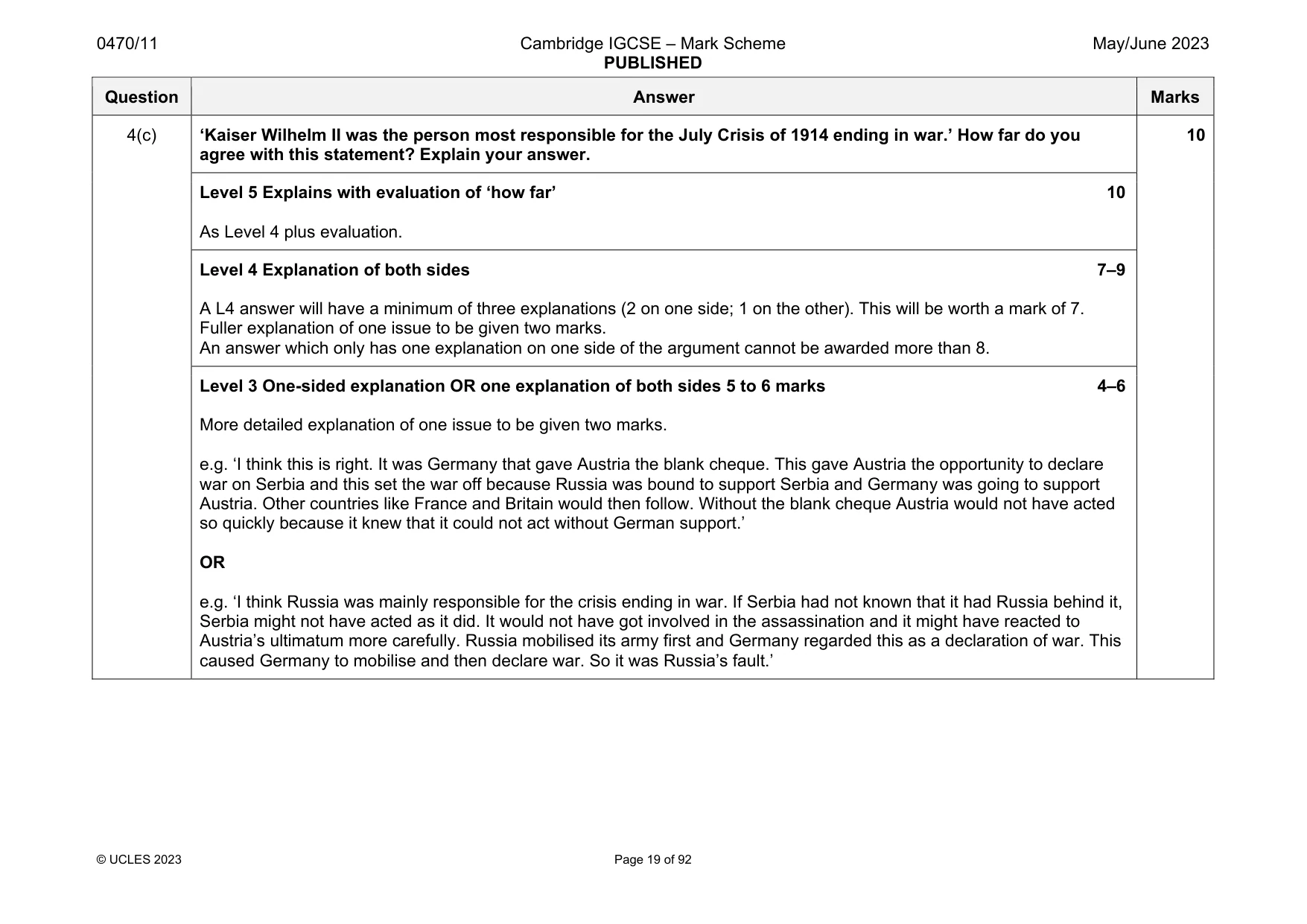
0470/11 Cambridge IGCSE – Mark Scheme PUBLISHED May/June 2023 © UCLES 2023 Page 19 of 92 Question Answer Marks 4(c) ‘Kaiser Wilhelm II was the person most responsible for the July Crisis of 1914 ending in war.’ How far do you agree with this statement? Explain your answer. 10 Level 5 Explains with evaluation of ‘how far’ 10 As Level 4 plus evaluation. Level 4 Explanation of both sides 7–9 A L4 answer will have a minimum of three explanations (2 on one side; 1 on the other). This will be worth a mark of 7. Fuller explanation of one issue to be given two marks. An answer which only has one explanation on one side of the argument cannot be awarded more than 8. Level 3 One-sided explanation OR one explanation of both sides 5 to 6 marks 4–6 More detailed explanation of one issue to be given two marks. e.g. ‘I think this is right. It was Germany that gave Austria the blank cheque. This gave Austria the opportunity to declare war on Serbia and this set the war off because Russia was bound to support Serbia and Germany was going to support Austria. Other countries like France and Britain would then follow. Without the blank cheque Austria would not have acted so quickly because it knew that it could not act without German support.’ OR e.g. ‘I think Russia was mainly responsible for the crisis ending in war. If Serbia had not known that it had Russia behind it, Serbia might not have acted as it did. It would not have got involved in the assassination and it might have reacted to Austria’s ultimatum more carefully. Russia mobilised its army first and Germany regarded this as a declaration of war. This caused Germany to mobilise and then declare war. So it was Russia’s fault.’
Mark scheme, page 20
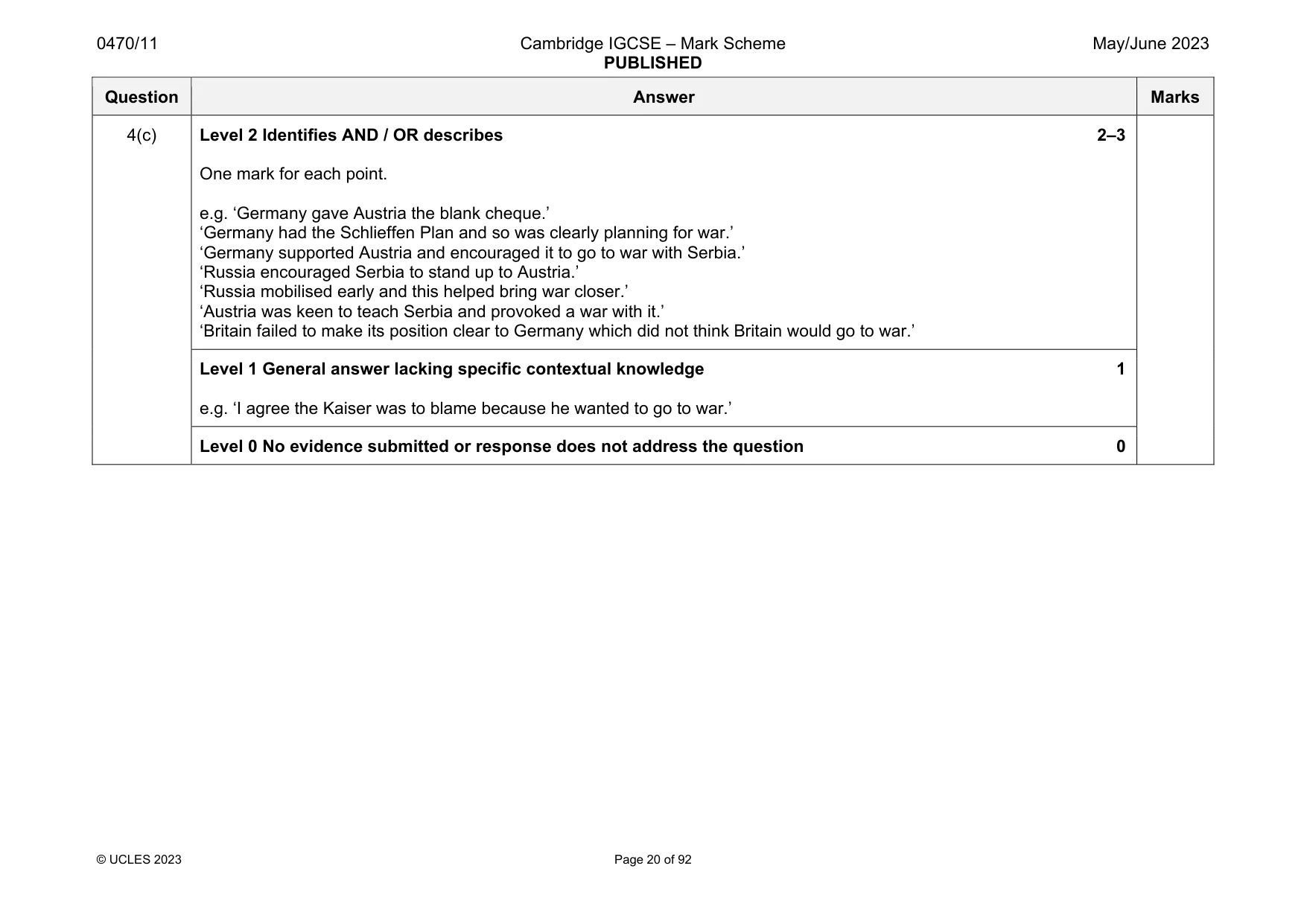
0470/11 Cambridge IGCSE – Mark Scheme PUBLISHED May/June 2023 © UCLES 2023 Page 20 of 92 Question Answer Marks 4(c) Level 2 Identifies AND / OR describes 2–3 One mark for each point. e.g. ‘Germany gave Austria the blank cheque.’ ‘Germany had the Schlieffen Plan and so was clearly planning for war.’ ‘Germany supported Austria and encouraged it to go to war with Serbia.’ ‘Russia encouraged Serbia to stand up to Austria.’ ‘Russia mobilised early and this helped bring war closer.’ ‘Austria was keen to teach Serbia and provoked a war with it.’ ‘Britain failed to make its position clear to Germany which did not think Britain would go to war.’ Level 1 General answer lacking specific contextual knowledge 1 e.g. ‘I agree the Kaiser was to blame because he wanted to go to war.’ Level 0 No evidence submitted or response does not address the question 0
Mark scheme, page 21
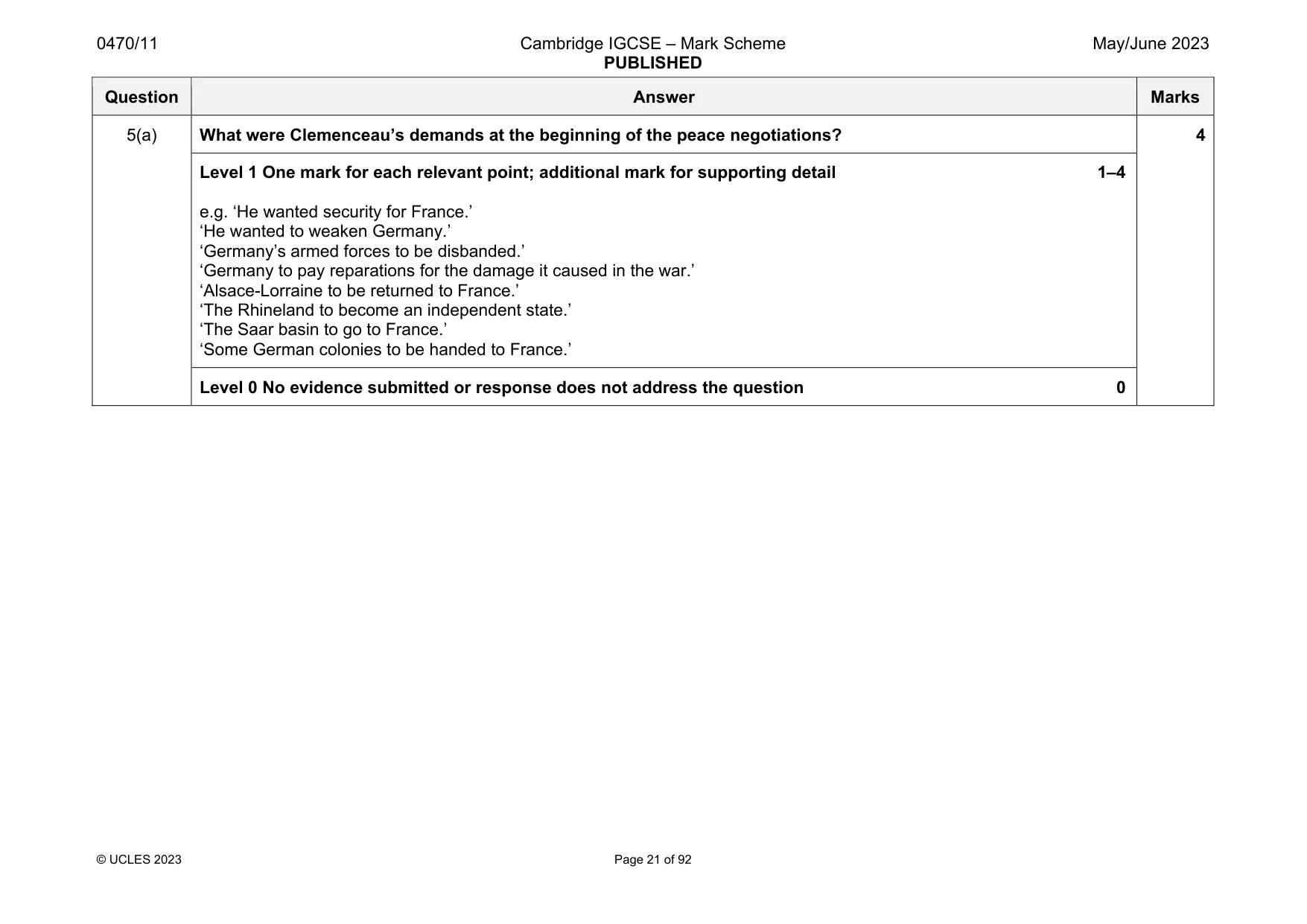
0470/11 Cambridge IGCSE – Mark Scheme PUBLISHED May/June 2023 © UCLES 2023 Page 21 of 92 Question Answer Marks 5(a) What were Clemenceau’s demands at the beginning of the peace negotiations? 4 Level 1 One mark for each relevant point; additional mark for supporting detail 1–4 e.g. ‘He wanted security for France.’ ‘He wanted to weaken Germany.’ ‘Germany’s armed forces to be disbanded.’ ‘Germany to pay reparations for the damage it caused in the war.’ ‘Alsace-Lorraine to be returned to France.’ ‘The Rhineland to become an independent state.’ ‘The Saar basin to go to France.’ ‘Some German colonies to be handed to France.’ Level 0 No evidence submitted or response does not address the question 0
Mark scheme, page 22
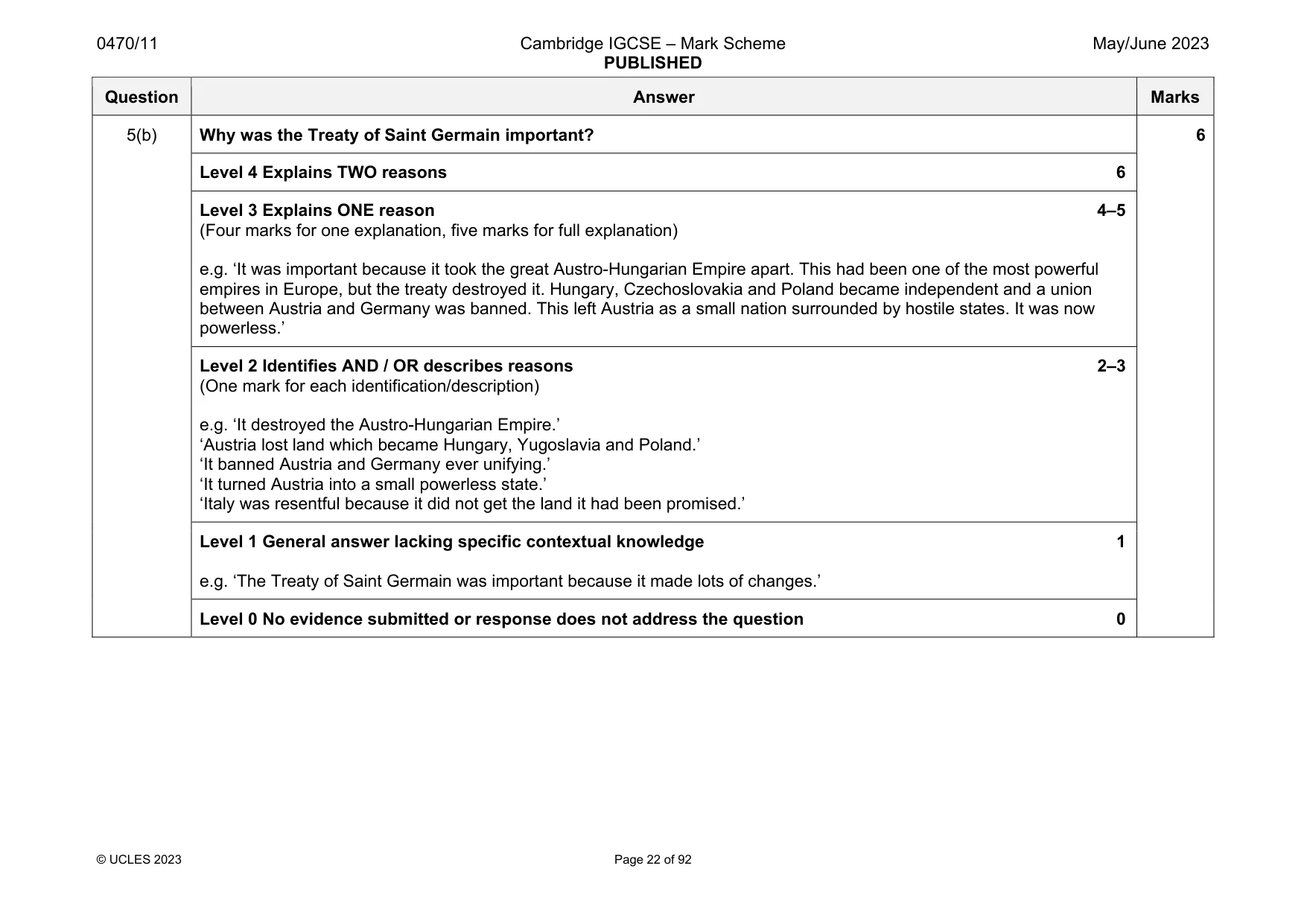
0470/11 Cambridge IGCSE – Mark Scheme PUBLISHED May/June 2023 © UCLES 2023 Page 22 of 92 Question Answer Marks 5(b) Why was the Treaty of Saint Germain important? 6 Level 4 Explains TWO reasons 6 Level 3 Explains ONE reason 4–5 (Four marks for one explanation, five marks for full explanation) e.g. ‘It was important because it took the great Austro-Hungarian Empire apart. This had been one of the most powerful empires in Europe, but the treaty destroyed it. Hungary, Czechoslovakia and Poland became independent and a union between Austria and Germany was banned. This left Austria as a small nation surrounded by hostile states. It was now powerless.’ Level 2 Identifies AND / OR describes reasons 2–3 (One mark for each identification/description) e.g. ‘It destroyed the Austro-Hungarian Empire.’ ‘Austria lost land which became Hungary, Yugoslavia and Poland.’ ‘It banned Austria and Germany ever unifying.’ ‘It turned Austria into a small powerless state.’ ‘Italy was resentful because it did not get the land it had been promised.’ Level 1 General answer lacking specific contextual knowledge 1 e.g. ‘The Treaty of Saint Germain was important because it made lots of changes.’ Level 0 No evidence submitted or response does not address the question 0
Mark scheme, page 23
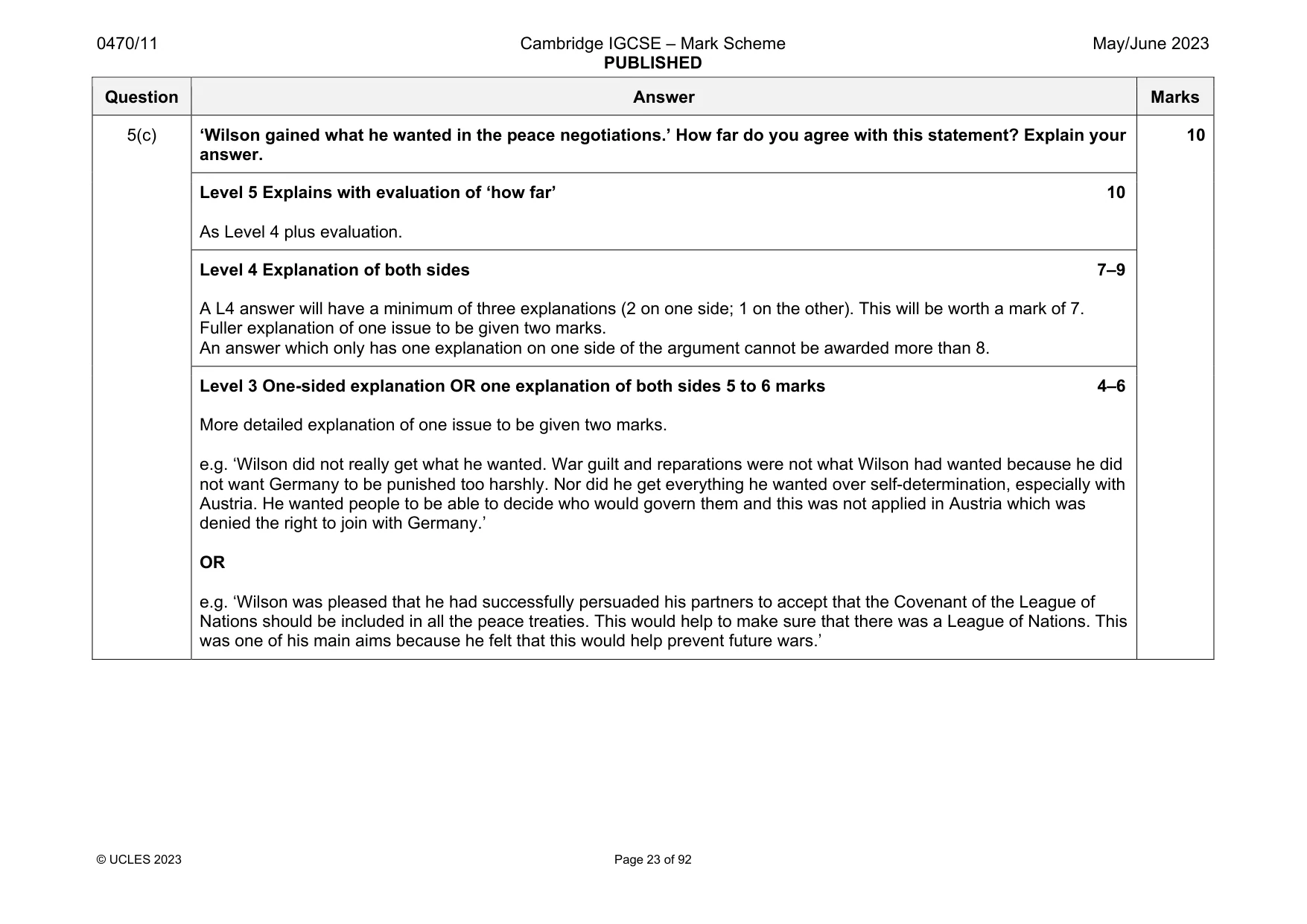
0470/11 Cambridge IGCSE – Mark Scheme PUBLISHED May/June 2023 © UCLES 2023 Page 23 of 92 Question Answer Marks 5(c) ‘Wilson gained what he wanted in the peace negotiations.’ How far do you agree with this statement? Explain your answer. 10 Level 5 Explains with evaluation of ‘how far’ 10 As Level 4 plus evaluation. Level 4 Explanation of both sides 7–9 A L4 answer will have a minimum of three explanations (2 on one side; 1 on the other). This will be worth a mark of 7. Fuller explanation of one issue to be given two marks. An answer which only has one explanation on one side of the argument cannot be awarded more than 8. Level 3 One-sided explanation OR one explanation of both sides 5 to 6 marks 4–6 More detailed explanation of one issue to be given two marks. e.g. ‘Wilson did not really get what he wanted. War guilt and reparations were not what Wilson had wanted because he did not want Germany to be punished too harshly. Nor did he get everything he wanted over self-determination, especially with Austria. He wanted people to be able to decide who would govern them and this was not applied in Austria which was denied the right to join with Germany.’ OR e.g. ‘Wilson was pleased that he had successfully persuaded his partners to accept that the Covenant of the League of Nations should be included in all the peace treaties. This would help to make sure that there was a League of Nations. This was one of his main aims because he felt that this would help prevent future wars.’
Mark scheme, page 24
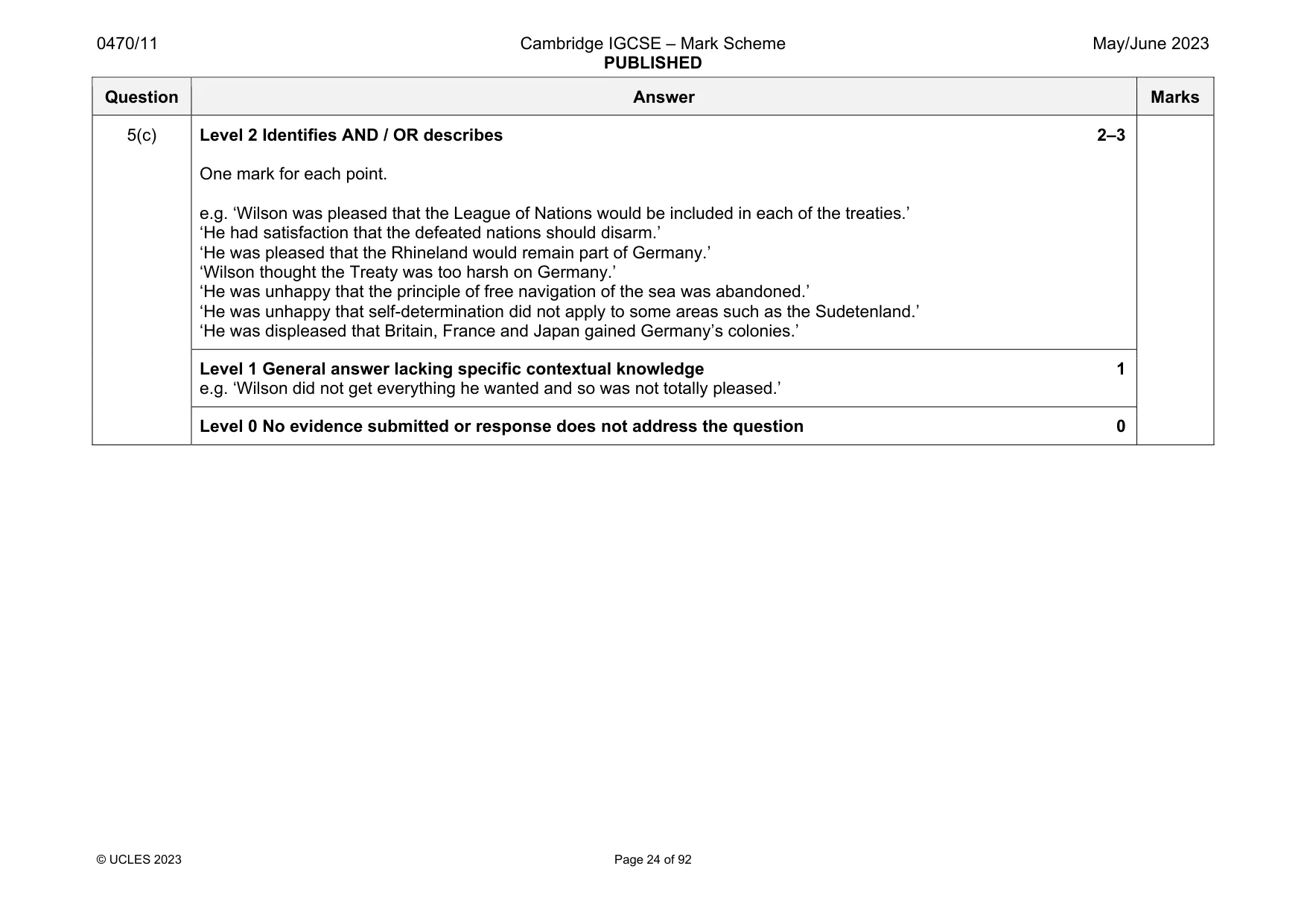
0470/11 Cambridge IGCSE – Mark Scheme PUBLISHED May/June 2023 © UCLES 2023 Page 24 of 92 Question Answer Marks 5(c) Level 2 Identifies AND / OR describes 2–3 One mark for each point. e.g. ‘Wilson was pleased that the League of Nations would be included in each of the treaties.’ ‘He had satisfaction that the defeated nations should disarm.’ ‘He was pleased that the Rhineland would remain part of Germany.’ ‘Wilson thought the Treaty was too harsh on Germany.’ ‘He was unhappy that the principle of free navigation of the sea was abandoned.’ ‘He was unhappy that self-determination did not apply to some areas such as the Sudetenland.’ ‘He was displeased that Britain, France and Japan gained Germany’s colonies.’ Level 1 General answer lacking specific contextual knowledge 1 e.g. ‘Wilson did not get everything he wanted and so was not totally pleased.’ Level 0 No evidence submitted or response does not address the question 0
Mark scheme, page 25
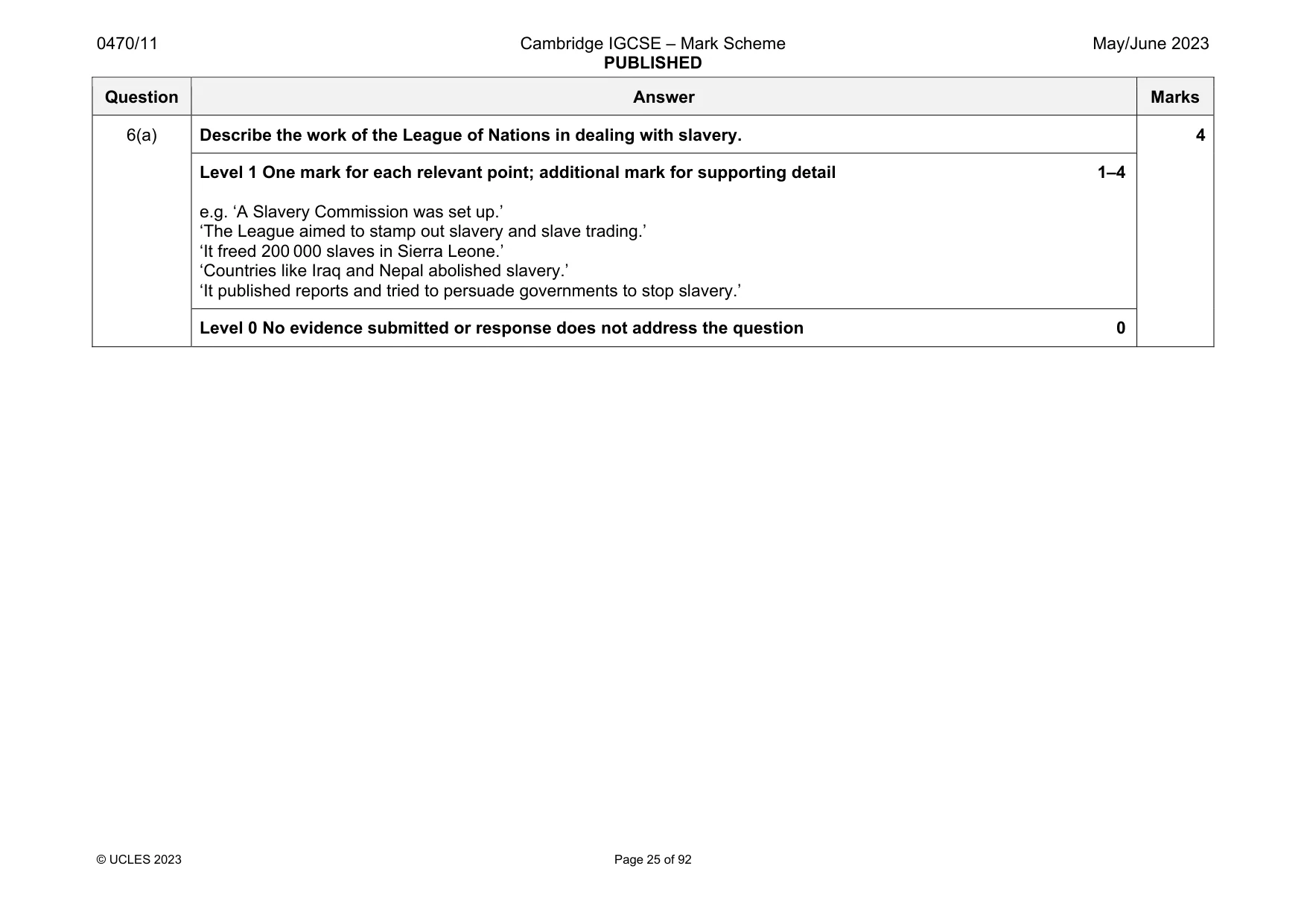
0470/11 Cambridge IGCSE – Mark Scheme PUBLISHED May/June 2023 © UCLES 2023 Page 25 of 92 Question Answer Marks 6(a) Describe the work of the League of Nations in dealing with slavery. 4 Level 1 One mark for each relevant point; additional mark for supporting detail 1–4 e.g. ‘A Slavery Commission was set up.’ ‘The League aimed to stamp out slavery and slave trading.’ ‘It freed 200 000 slaves in Sierra Leone.’ ‘Countries like Iraq and Nepal abolished slavery.’ ‘It published reports and tried to persuade governments to stop slavery.’ Level 0 No evidence submitted or response does not address the question 0
Mark scheme, page 26
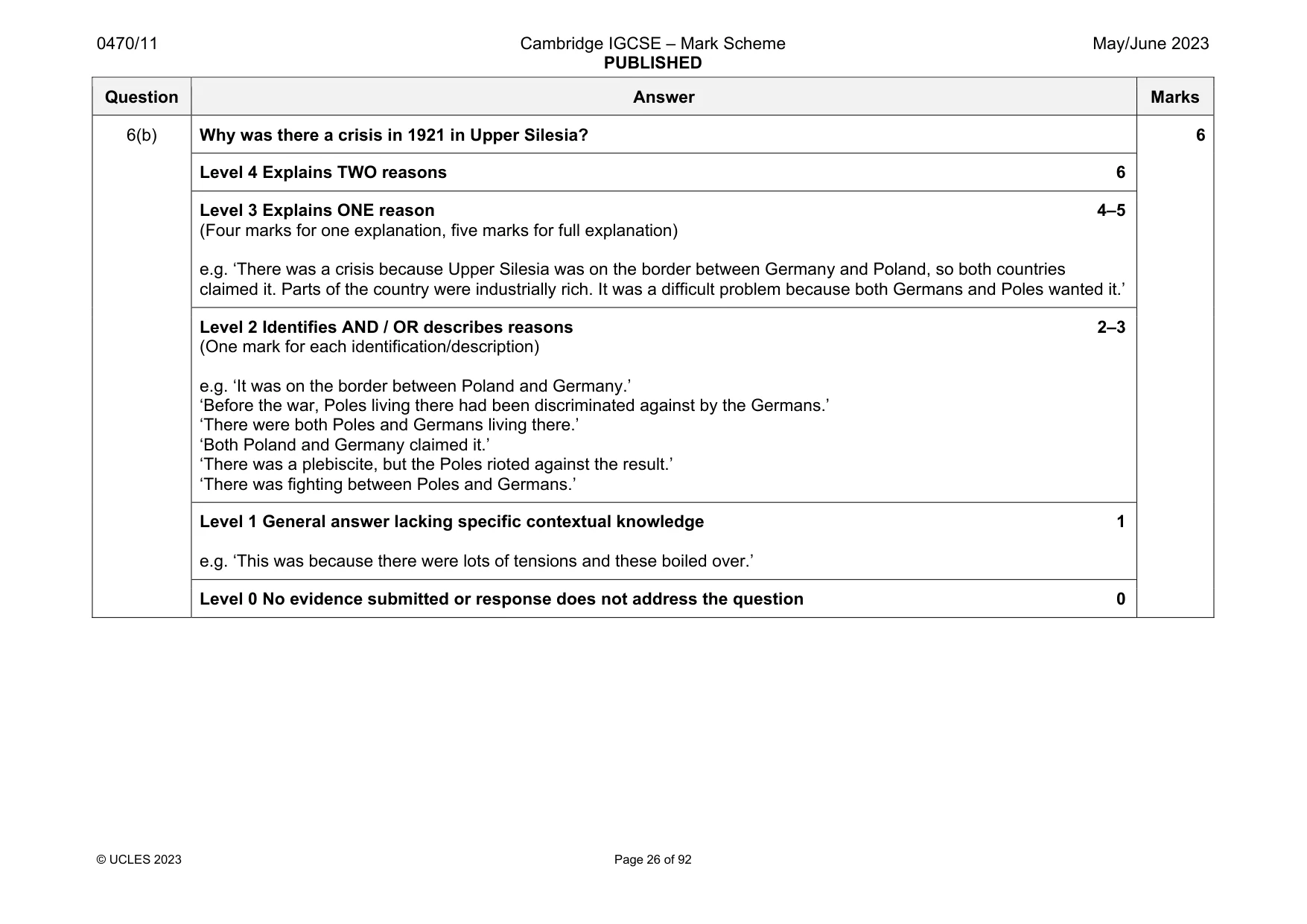
0470/11 Cambridge IGCSE – Mark Scheme PUBLISHED May/June 2023 © UCLES 2023 Page 26 of 92 Question Answer Marks 6(b) Why was there a crisis in 1921 in Upper Silesia? 6 Level 4 Explains TWO reasons 6 Level 3 Explains ONE reason 4–5 (Four marks for one explanation, five marks for full explanation) e.g. ‘There was a crisis because Upper Silesia was on the border between Germany and Poland, so both countries claimed it. Parts of the country were industrially rich. It was a difficult problem because both Germans and Poles wanted it.’ Level 2 Identifies AND / OR describes reasons 2–3 (One mark for each identification/description) e.g. ‘It was on the border between Poland and Germany.’ ‘Before the war, Poles living there had been discriminated against by the Germans.’ ‘There were both Poles and Germans living there.’ ‘Both Poland and Germany claimed it.’ ‘There was a plebiscite, but the Poles rioted against the result.’ ‘There was fighting between Poles and Germans.’ Level 1 General answer lacking specific contextual knowledge 1 e.g. ‘This was because there were lots of tensions and these boiled over.’ Level 0 No evidence submitted or response does not address the question 0
Mark scheme, page 27
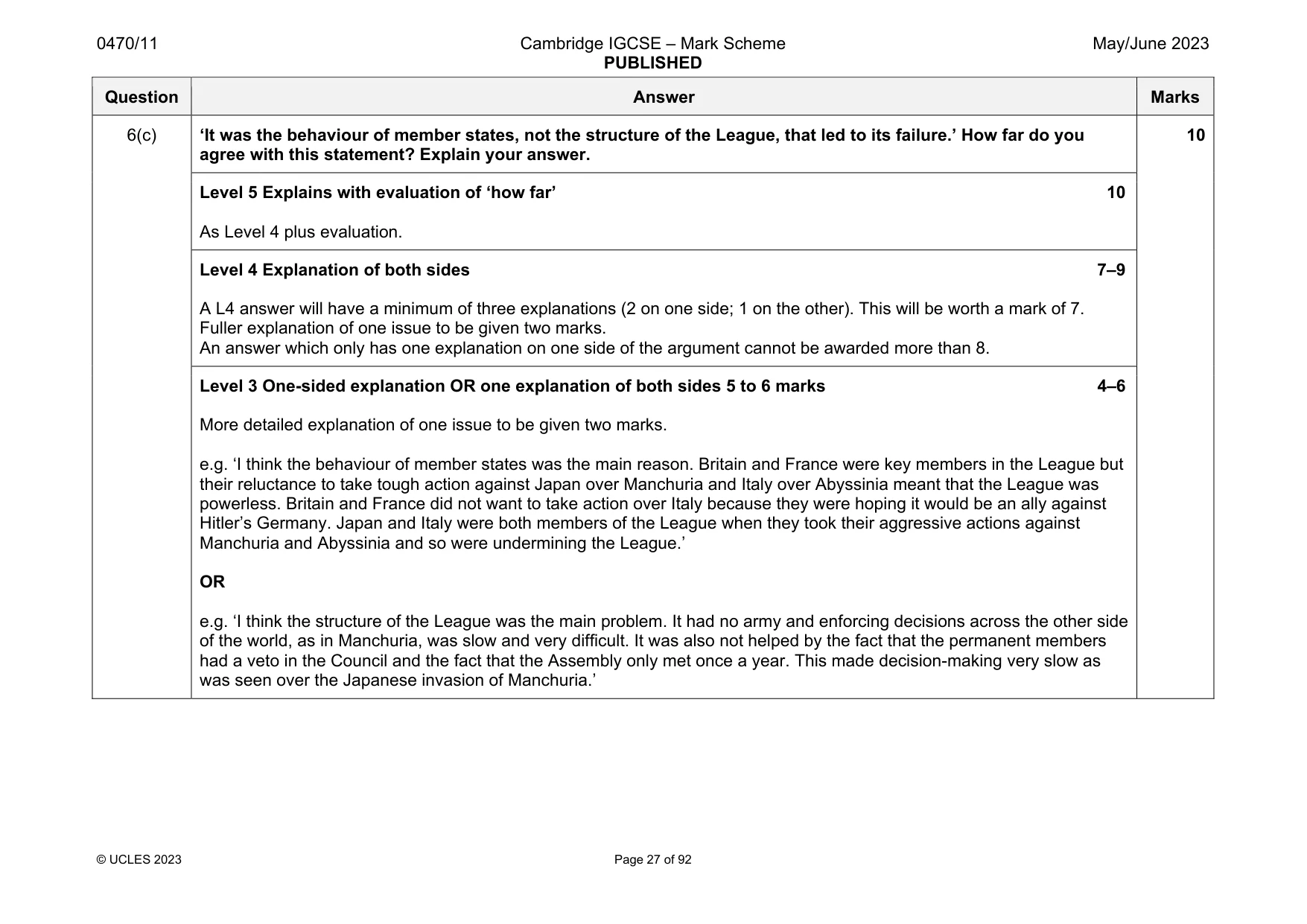
0470/11 Cambridge IGCSE – Mark Scheme PUBLISHED May/June 2023 © UCLES 2023 Page 27 of 92 Question Answer Marks 6(c) ‘It was the behaviour of member states, not the structure of the League, that led to its failure.’ How far do you agree with this statement? Explain your answer. 10 Level 5 Explains with evaluation of ‘how far’ 10 As Level 4 plus evaluation. Level 4 Explanation of both sides 7–9 A L4 answer will have a minimum of three explanations (2 on one side; 1 on the other). This will be worth a mark of 7. Fuller explanation of one issue to be given two marks. An answer which only has one explanation on one side of the argument cannot be awarded more than 8. Level 3 One-sided explanation OR one explanation of both sides 5 to 6 marks 4–6 More detailed explanation of one issue to be given two marks. e.g. ‘I think the behaviour of member states was the main reason. Britain and France were key members in the League but their reluctance to take tough action against Japan over Manchuria and Italy over Abyssinia meant that the League was powerless. Britain and France did not want to take action over Italy because they were hoping it would be an ally against Hitler’s Germany. Japan and Italy were both members of the League when they took their aggressive actions against Manchuria and Abyssinia and so were undermining the League.’ OR e.g. ‘I think the structure of the League was the main problem. It had no army and enforcing decisions across the other side of the world, as in Manchuria, was slow and very difficult. It was also not helped by the fact that the permanent members had a veto in the Council and the fact that the Assembly only met once a year. This made decision-making very slow as was seen over the Japanese invasion of Manchuria.’
Mark scheme, page 28
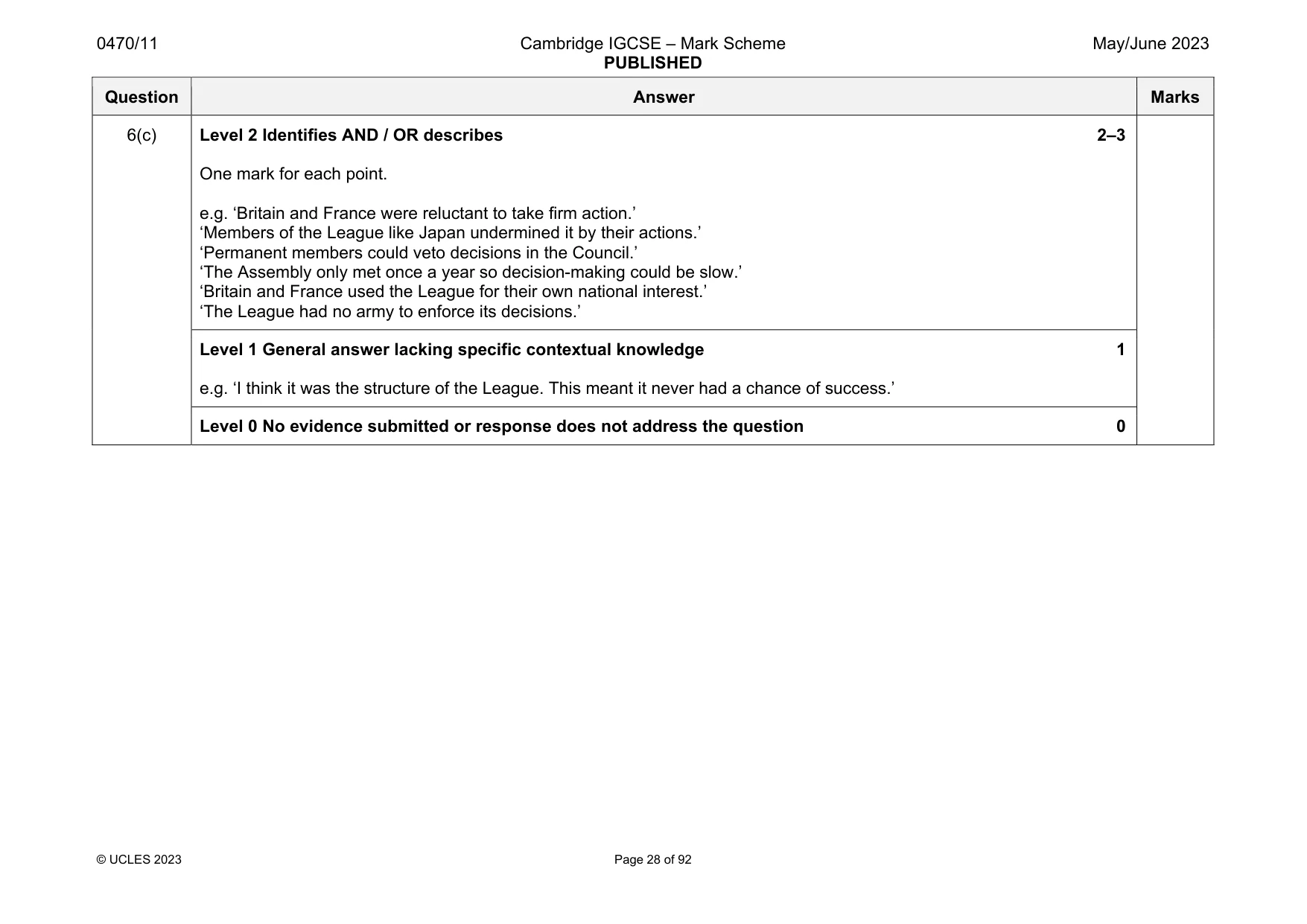
0470/11 Cambridge IGCSE – Mark Scheme PUBLISHED May/June 2023 © UCLES 2023 Page 28 of 92 Question Answer Marks 6(c) Level 2 Identifies AND / OR describes 2–3 One mark for each point. e.g. ‘Britain and France were reluctant to take firm action.’ ‘Members of the League like Japan undermined it by their actions.’ ‘Permanent members could veto decisions in the Council.’ ‘The Assembly only met once a year so decision-making could be slow.’ ‘Britain and France used the League for their own national interest.’ ‘The League had no army to enforce its decisions.’ Level 1 General answer lacking specific contextual knowledge 1 e.g. ‘I think it was the structure of the League. This meant it never had a chance of success.’ Level 0 No evidence submitted or response does not address the question 0
Mark scheme, page 29
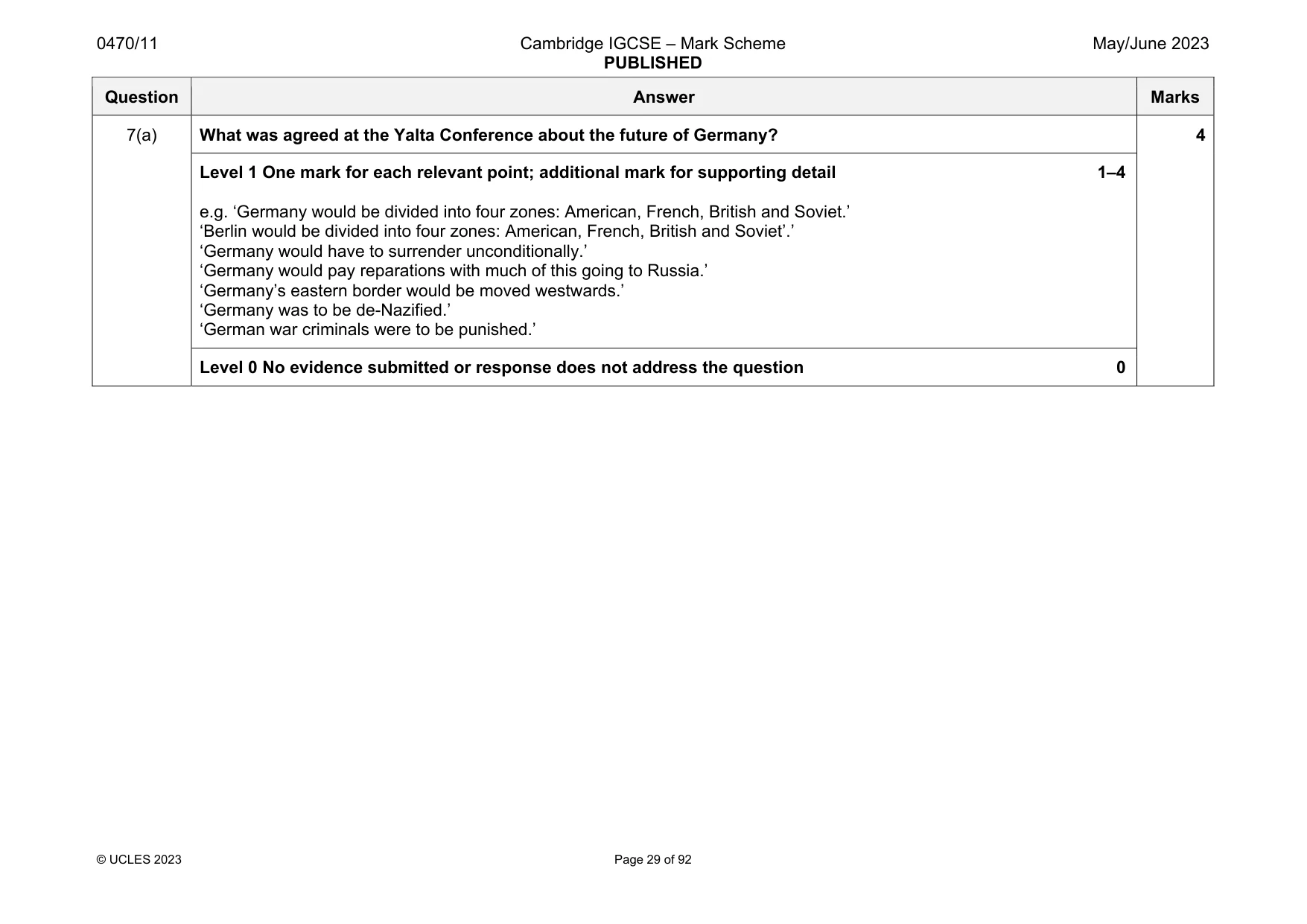
0470/11 Cambridge IGCSE – Mark Scheme PUBLISHED May/June 2023 © UCLES 2023 Page 29 of 92 Question Answer Marks 7(a) What was agreed at the Yalta Conference about the future of Germany? 4 Level 1 One mark for each relevant point; additional mark for supporting detail 1–4 e.g. ‘Germany would be divided into four zones: American, French, British and Soviet.’ ‘Berlin would be divided into four zones: American, French, British and Soviet’.’ ‘Germany would have to surrender unconditionally.’ ‘Germany would pay reparations with much of this going to Russia.’ ‘Germany’s eastern border would be moved westwards.’ ‘Germany was to be de-Nazified.’ ‘German war criminals were to be punished.’ Level 0 No evidence submitted or response does not address the question 0
Mark scheme, page 30
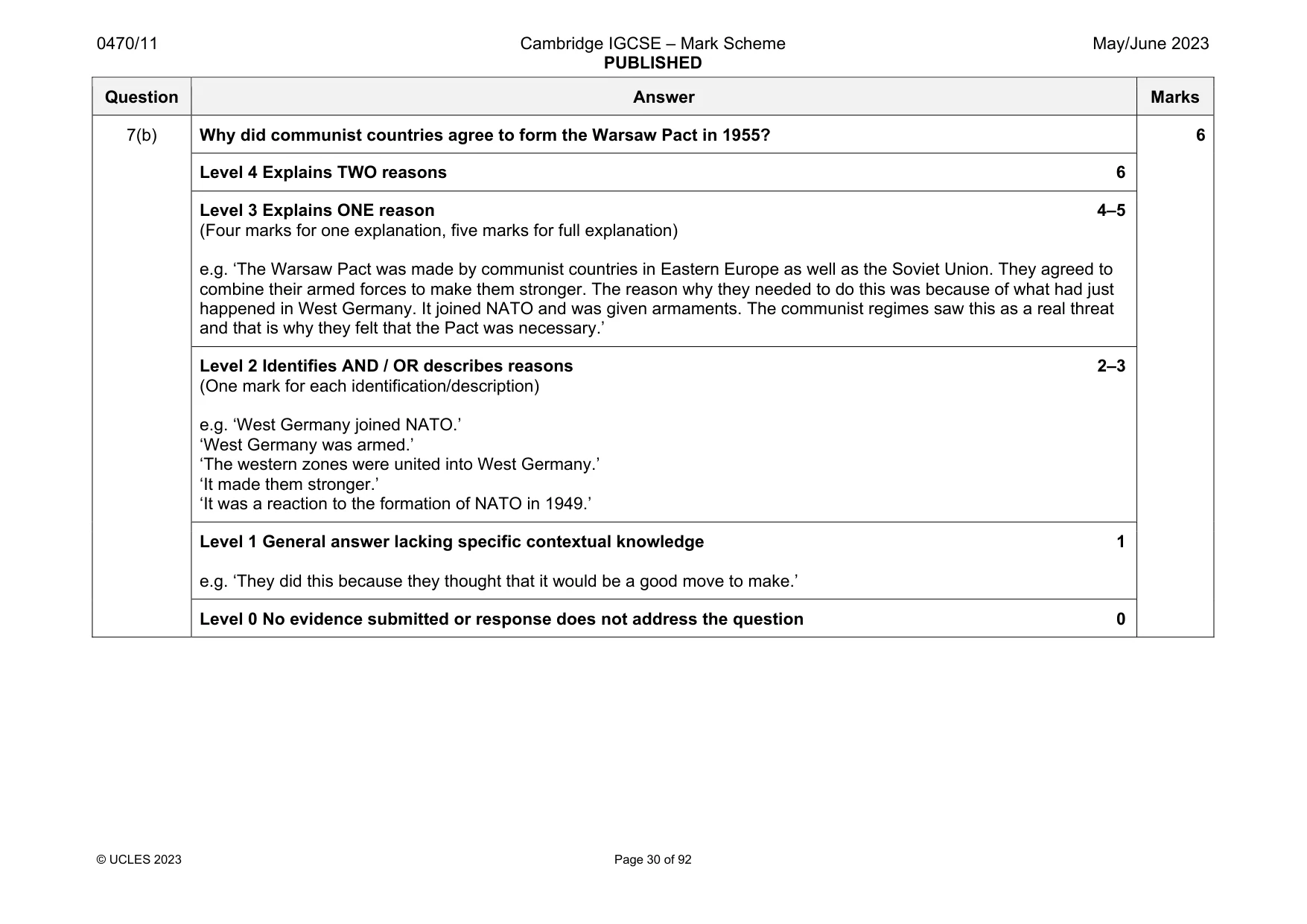
0470/11 Cambridge IGCSE – Mark Scheme PUBLISHED May/June 2023 © UCLES 2023 Page 30 of 92 Question Answer Marks 7(b) Why did communist countries agree to form the Warsaw Pact in 1955? 6 Level 4 Explains TWO reasons 6 Level 3 Explains ONE reason 4–5 (Four marks for one explanation, five marks for full explanation) e.g. ‘The Warsaw Pact was made by communist countries in Eastern Europe as well as the Soviet Union. They agreed to combine their armed forces to make them stronger. The reason why they needed to do this was because of what had just happened in West Germany. It joined NATO and was given armaments. The communist regimes saw this as a real threat and that is why they felt that the Pact was necessary.’ Level 2 Identifies AND / OR describes reasons 2–3 (One mark for each identification/description) e.g. ‘West Germany joined NATO.’ ‘West Germany was armed.’ ‘The western zones were united into West Germany.’ ‘It made them stronger.’ ‘It was a reaction to the formation of NATO in 1949.’ Level 1 General answer lacking specific contextual knowledge 1 e.g. ‘They did this because they thought that it would be a good move to make.’ Level 0 No evidence submitted or response does not address the question 0
Mark scheme, page 31
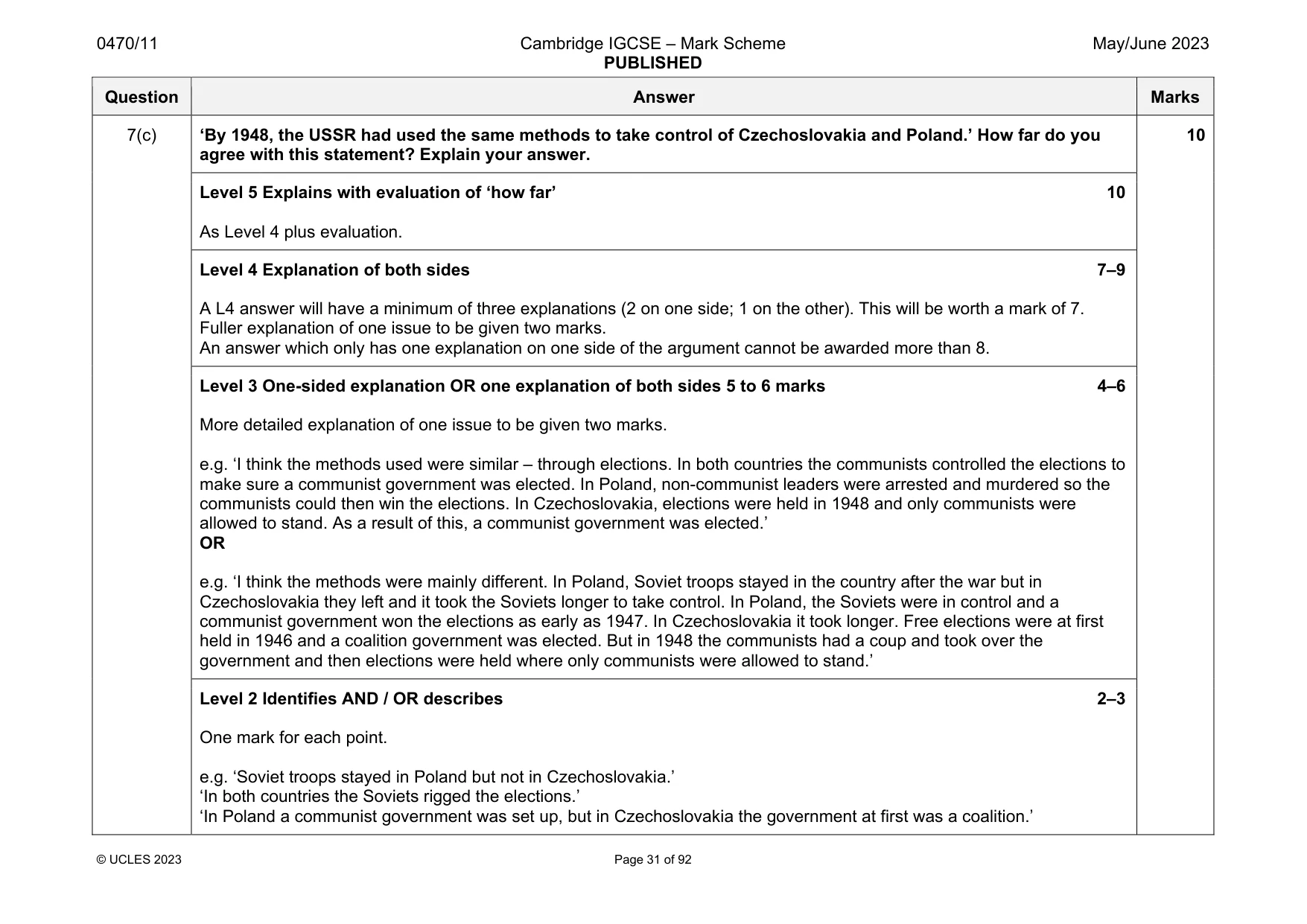
0470/11 Cambridge IGCSE – Mark Scheme PUBLISHED May/June 2023 © UCLES 2023 Page 31 of 92 Question Answer Marks 7(c) ‘By 1948, the USSR had used the same methods to take control of Czechoslovakia and Poland.’ How far do you agree with this statement? Explain your answer. 10 Level 5 Explains with evaluation of ‘how far’ 10 As Level 4 plus evaluation. Level 4 Explanation of both sides 7–9 A L4 answer will have a minimum of three explanations (2 on one side; 1 on the other). This will be worth a mark of 7. Fuller explanation of one issue to be given two marks. An answer which only has one explanation on one side of the argument cannot be awarded more than 8. Level 3 One-sided explanation OR one explanation of both sides 5 to 6 marks 4–6 More detailed explanation of one issue to be given two marks. e.g. ‘I think the methods used were similar – through elections. In both countries the communists controlled the elections to make sure a communist government was elected. In Poland, non-communist leaders were arrested and murdered so the communists could then win the elections. In Czechoslovakia, elections were held in 1948 and only communists were allowed to stand. As a result of this, a communist government was elected.’ OR e.g. ‘I think the methods were mainly different. In Poland, Soviet troops stayed in the country after the war but in Czechoslovakia they left and it took the Soviets longer to take control. In Poland, the Soviets were in control and a communist government won the elections as early as 1947. In Czechoslovakia it took longer. Free elections were at first held in 1946 and a coalition government was elected. But in 1948 the communists had a coup and took over the government and then elections were held where only communists were allowed to stand.’ Level 2 Identifies AND / OR describes 2–3 One mark for each point. e.g. ‘Soviet troops stayed in Poland but not in Czechoslovakia.’ ‘In both countries the Soviets rigged the elections.’ ‘In Poland a communist government was set up, but in Czechoslovakia the government at first was a coalition.’
Mark scheme, page 32
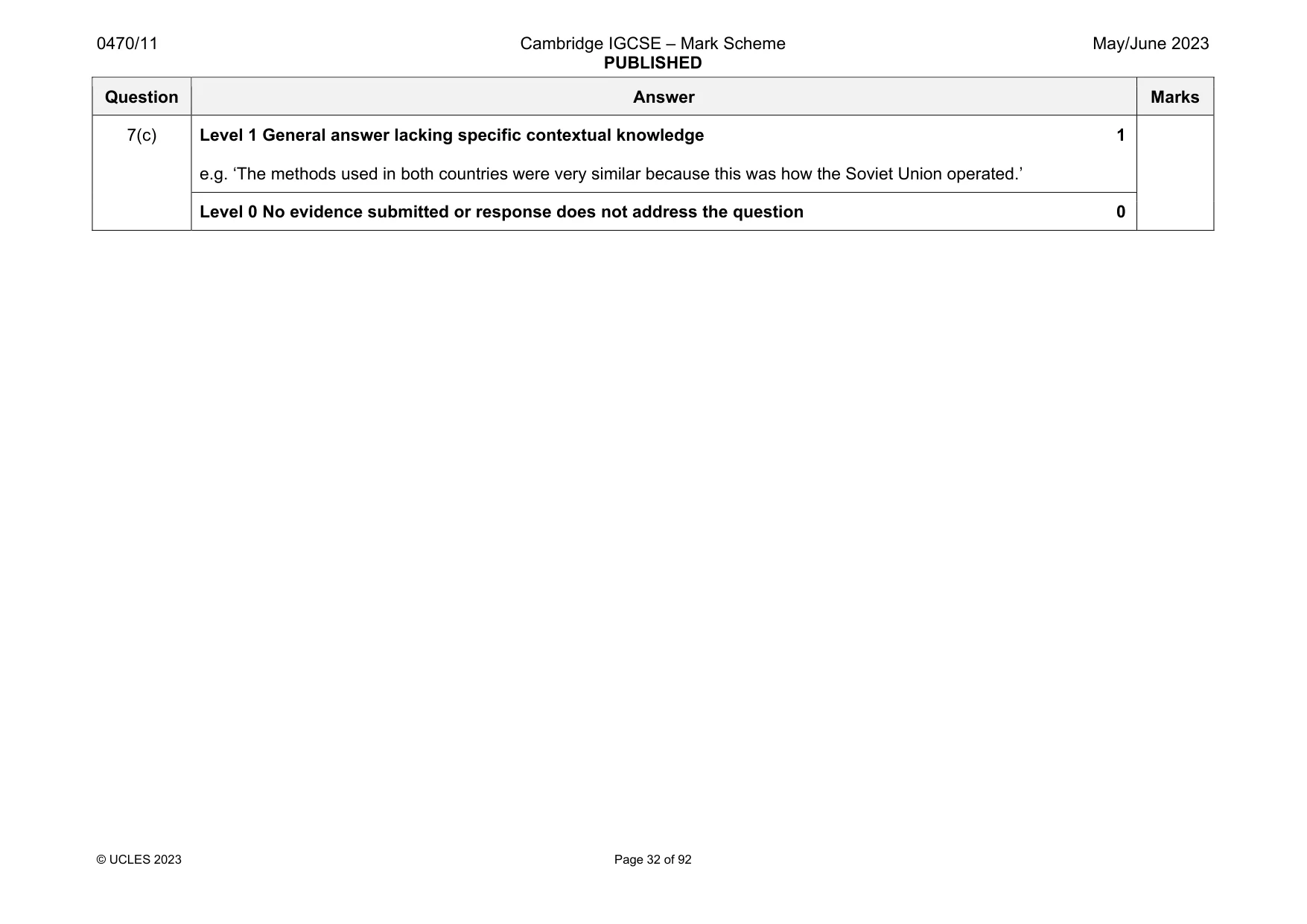
0470/11 Cambridge IGCSE – Mark Scheme PUBLISHED May/June 2023 © UCLES 2023 Page 32 of 92 Question Answer Marks 7(c) Level 1 General answer lacking specific contextual knowledge 1 e.g. ‘The methods used in both countries were very similar because this was how the Soviet Union operated.’ Level 0 No evidence submitted or response does not address the question 0
Mark scheme, page 33
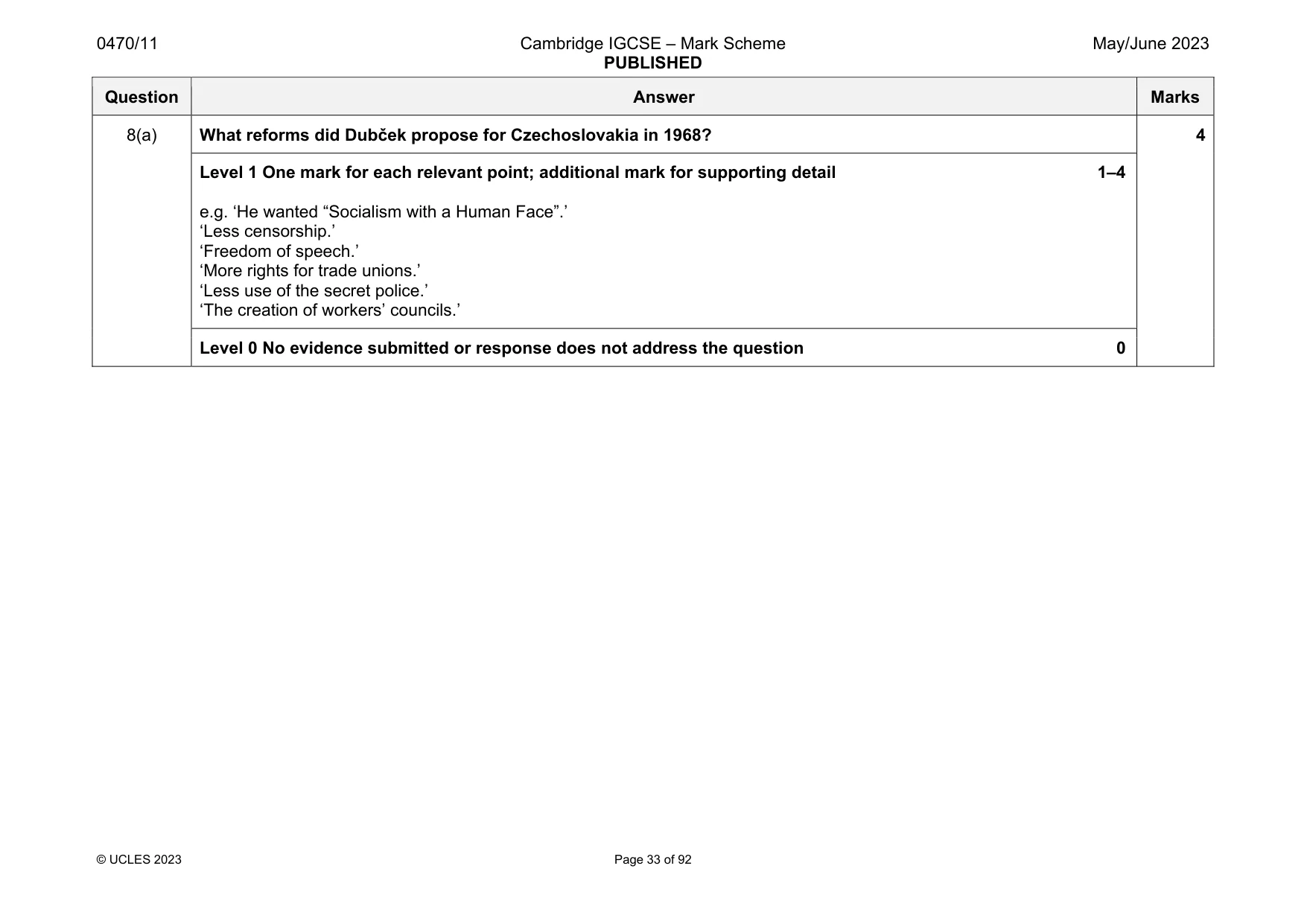
0470/11 Cambridge IGCSE – Mark Scheme PUBLISHED May/June 2023 © UCLES 2023 Page 33 of 92 Question Answer Marks 8(a) What reforms did Dubček propose for Czechoslovakia in 1968? 4 Level 1 One mark for each relevant point; additional mark for supporting detail 1–4 e.g. ‘He wanted “Socialism with a Human Face”.’ ‘Less censorship.’ ‘Freedom of speech.’ ‘More rights for trade unions.’ ‘Less use of the secret police.’ ‘The creation of workers’ councils.’ Level 0 No evidence submitted or response does not address the question 0
Mark scheme, page 34
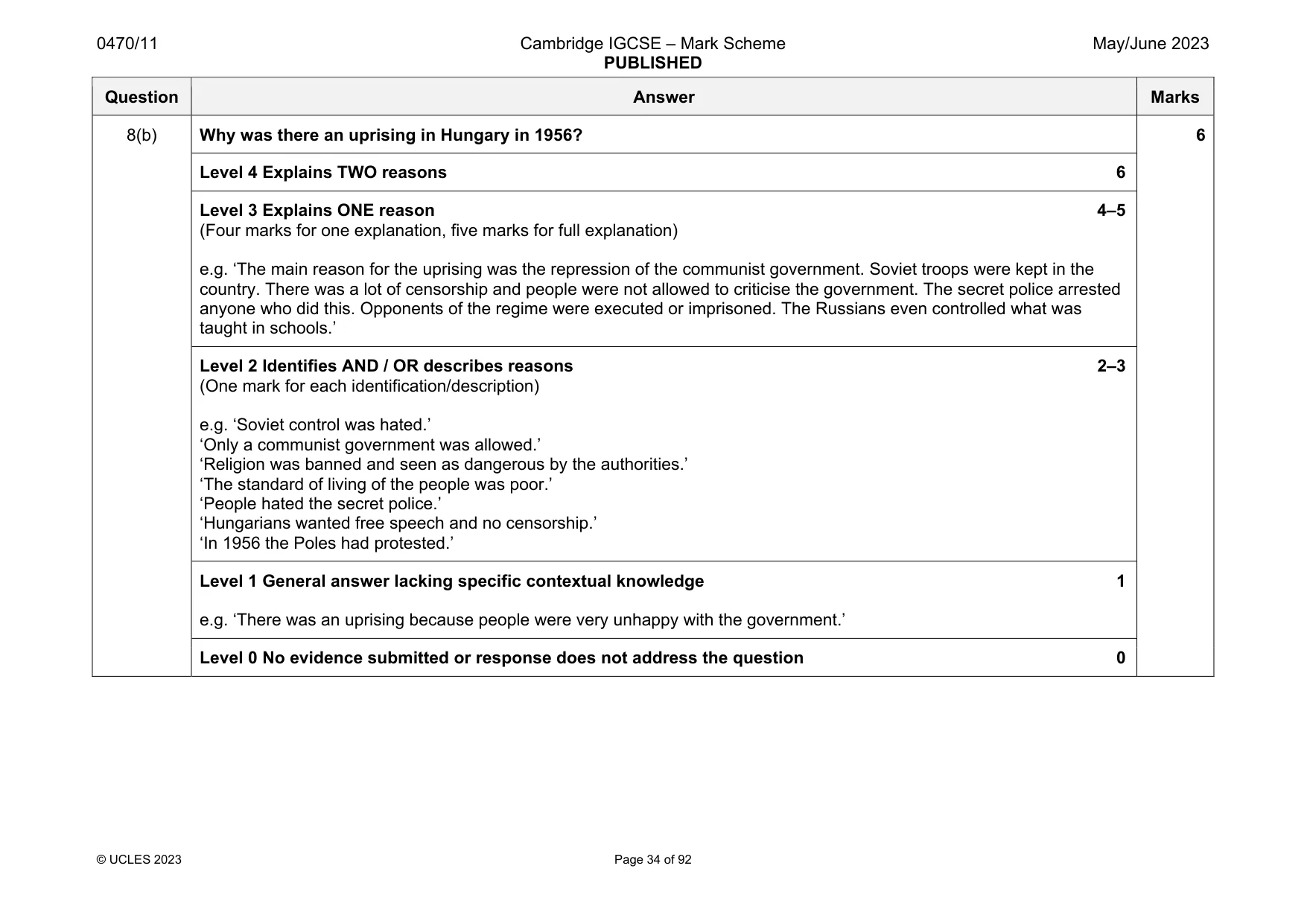
0470/11 Cambridge IGCSE – Mark Scheme PUBLISHED May/June 2023 © UCLES 2023 Page 34 of 92 Question Answer Marks 8(b) Why was there an uprising in Hungary in 1956? 6 Level 4 Explains TWO reasons 6 Level 3 Explains ONE reason 4–5 (Four marks for one explanation, five marks for full explanation) e.g. ‘The main reason for the uprising was the repression of the communist government. Soviet troops were kept in the country. There was a lot of censorship and people were not allowed to criticise the government. The secret police arrested anyone who did this. Opponents of the regime were executed or imprisoned. The Russians even controlled what was taught in schools.’ Level 2 Identifies AND / OR describes reasons 2–3 (One mark for each identification/description) e.g. ‘Soviet control was hated.’ ‘Only a communist government was allowed.’ ‘Religion was banned and seen as dangerous by the authorities.’ ‘The standard of living of the people was poor.’ ‘People hated the secret police.’ ‘Hungarians wanted free speech and no censorship.’ ‘In 1956 the Poles had protested.’ Level 1 General answer lacking specific contextual knowledge 1 e.g. ‘There was an uprising because people were very unhappy with the government.’ Level 0 No evidence submitted or response does not address the question 0
Mark scheme, page 35
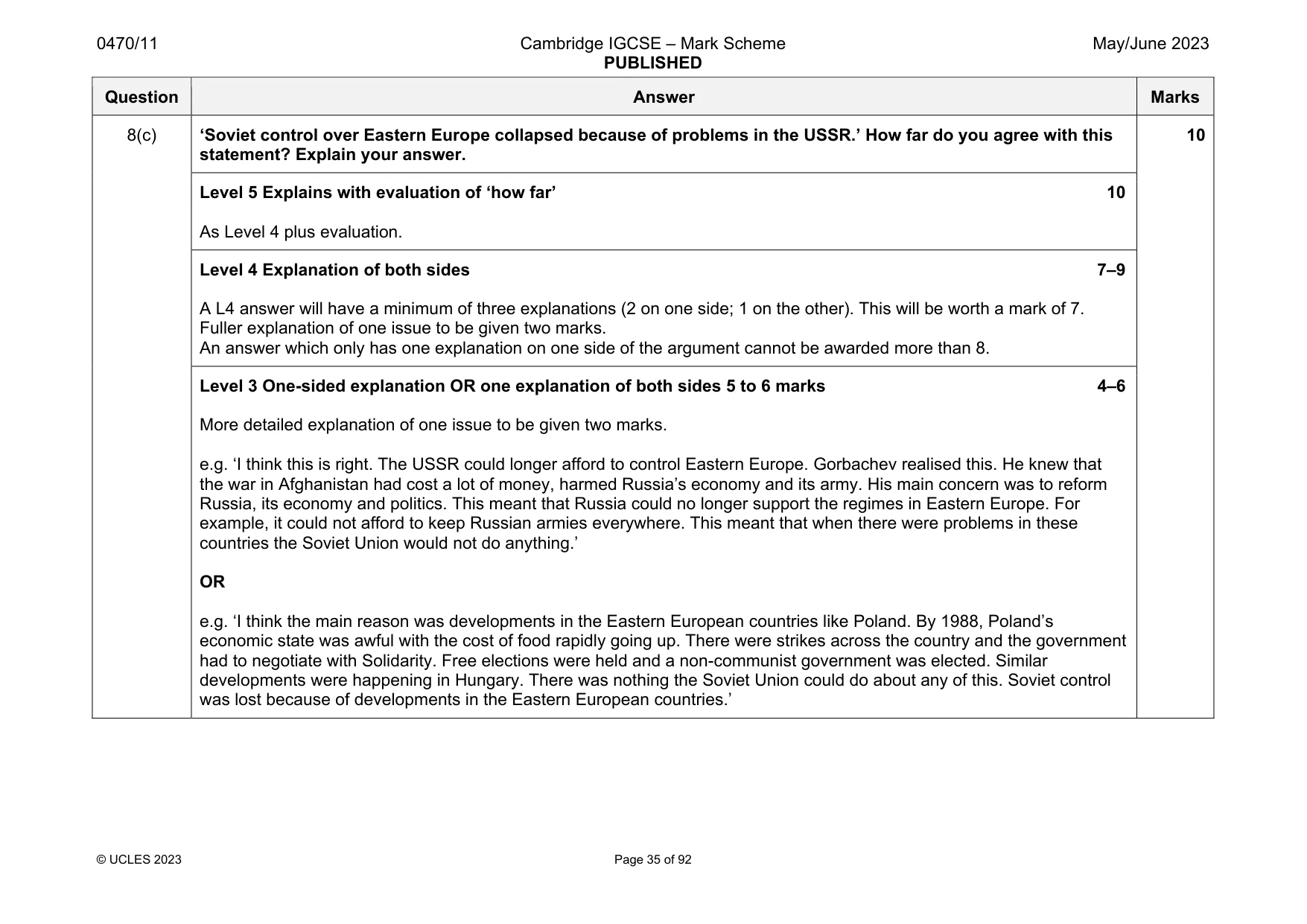
0470/11 Cambridge IGCSE – Mark Scheme PUBLISHED May/June 2023 © UCLES 2023 Page 35 of 92 Question Answer Marks 8(c) ‘Soviet control over Eastern Europe collapsed because of problems in the USSR.’ How far do you agree with this statement? Explain your answer. 10 Level 5 Explains with evaluation of ‘how far’ 10 As Level 4 plus evaluation. Level 4 Explanation of both sides 7–9 A L4 answer will have a minimum of three explanations (2 on one side; 1 on the other). This will be worth a mark of 7. Fuller explanation of one issue to be given two marks. An answer which only has one explanation on one side of the argument cannot be awarded more than 8. Level 3 One-sided explanation OR one explanation of both sides 5 to 6 marks 4–6 More detailed explanation of one issue to be given two marks. e.g. ‘I think this is right. The USSR could longer afford to control Eastern Europe. Gorbachev realised this. He knew that the war in Afghanistan had cost a lot of money, harmed Russia’s economy and its army. His main concern was to reform Russia, its economy and politics. This meant that Russia could no longer support the regimes in Eastern Europe. For example, it could not afford to keep Russian armies everywhere. This meant that when there were problems in these countries the Soviet Union would not do anything.’ OR e.g. ‘I think the main reason was developments in the Eastern European countries like Poland. By 1988, Poland’s economic state was awful with the cost of food rapidly going up. There were strikes across the country and the government had to negotiate with Solidarity. Free elections were held and a non-communist government was elected. Similar developments were happening in Hungary. There was nothing the Soviet Union could do about any of this. Soviet control was lost because of developments in the Eastern European countries.’
Mark scheme, page 36
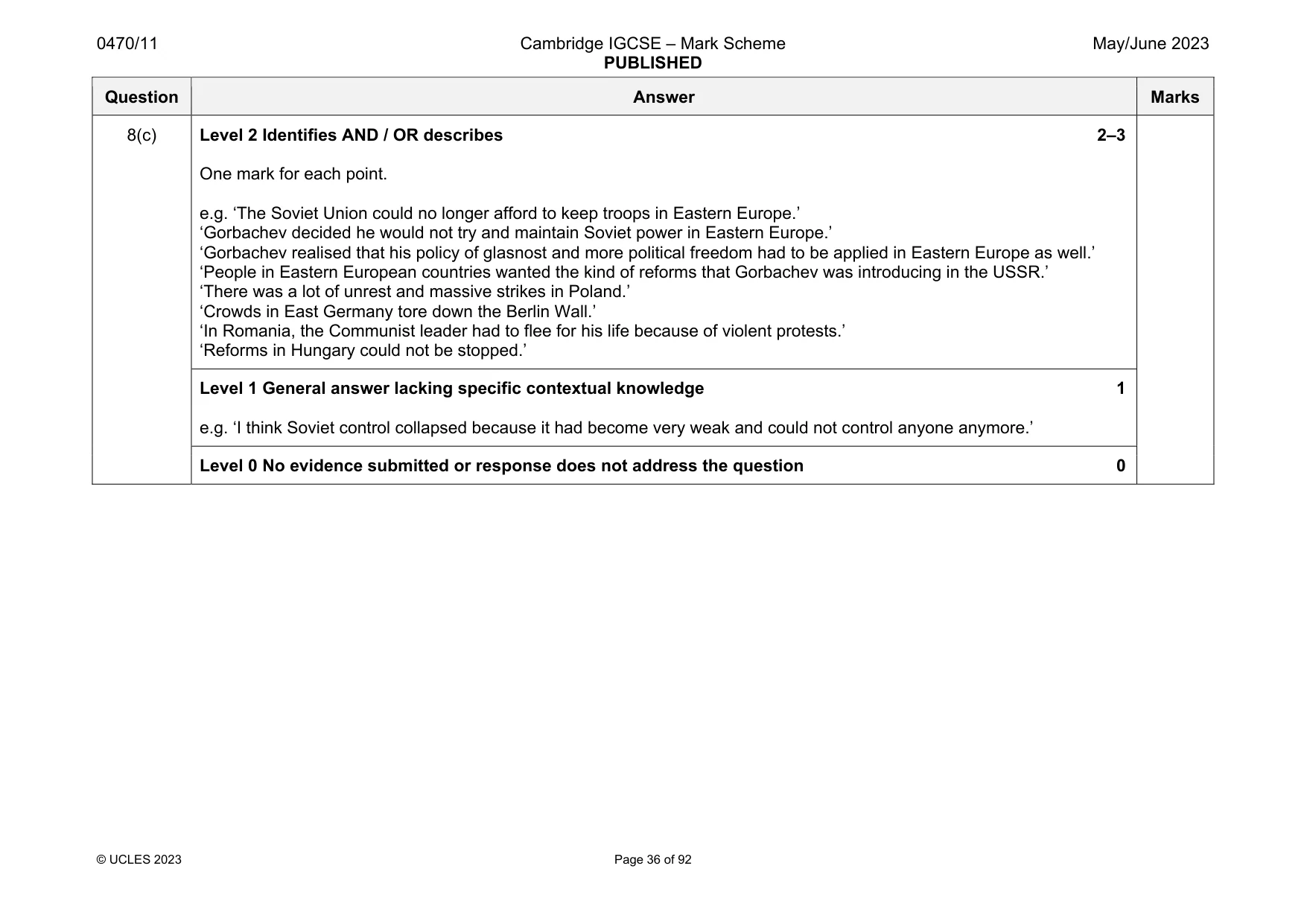
0470/11 Cambridge IGCSE – Mark Scheme PUBLISHED May/June 2023 © UCLES 2023 Page 36 of 92 Question Answer Marks 8(c) Level 2 Identifies AND / OR describes 2–3 One mark for each point. e.g. ‘The Soviet Union could no longer afford to keep troops in Eastern Europe.’ ‘Gorbachev decided he would not try and maintain Soviet power in Eastern Europe.’ ‘Gorbachev realised that his policy of glasnost and more political freedom had to be applied in Eastern Europe as well.’ ‘People in Eastern European countries wanted the kind of reforms that Gorbachev was introducing in the USSR.’ ‘There was a lot of unrest and massive strikes in Poland.’ ‘Crowds in East Germany tore down the Berlin Wall.’ ‘In Romania, the Communist leader had to flee for his life because of violent protests.’ ‘Reforms in Hungary could not be stopped.’ Level 1 General answer lacking specific contextual knowledge 1 e.g. ‘I think Soviet control collapsed because it had become very weak and could not control anyone anymore.’ Level 0 No evidence submitted or response does not address the question 0
Mark scheme, page 37
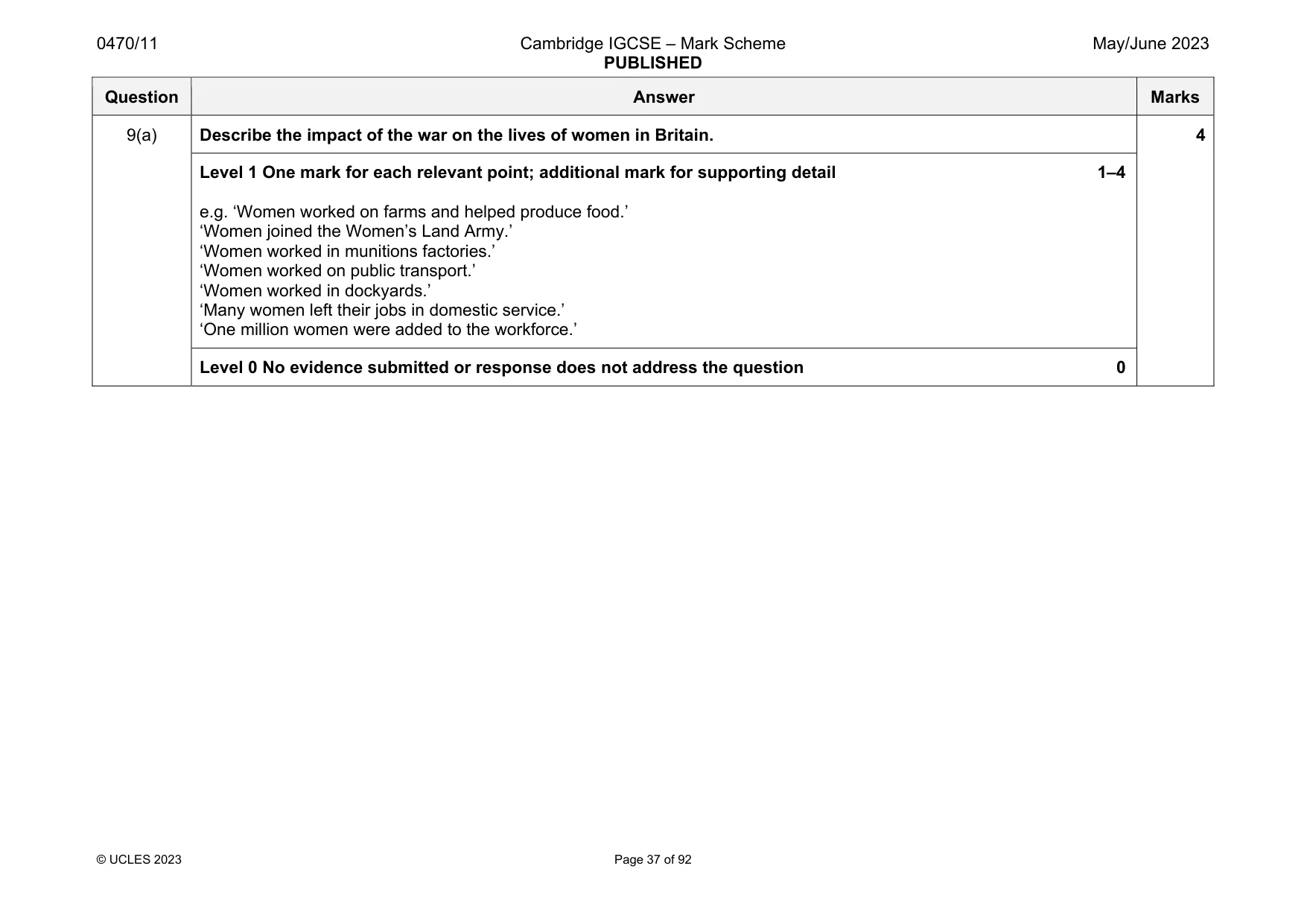
0470/11 Cambridge IGCSE – Mark Scheme PUBLISHED May/June 2023 © UCLES 2023 Page 37 of 92 Question Answer Marks 9(a) Describe the impact of the war on the lives of women in Britain. 4 Level 1 One mark for each relevant point; additional mark for supporting detail 1–4 e.g. ‘Women worked on farms and helped produce food.’ ‘Women joined the Women’s Land Army.’ ‘Women worked in munitions factories.’ ‘Women worked on public transport.’ ‘Women worked in dockyards.’ ‘Many women left their jobs in domestic service.’ ‘One million women were added to the workforce.’ Level 0 No evidence submitted or response does not address the question 0
Mark scheme, page 38
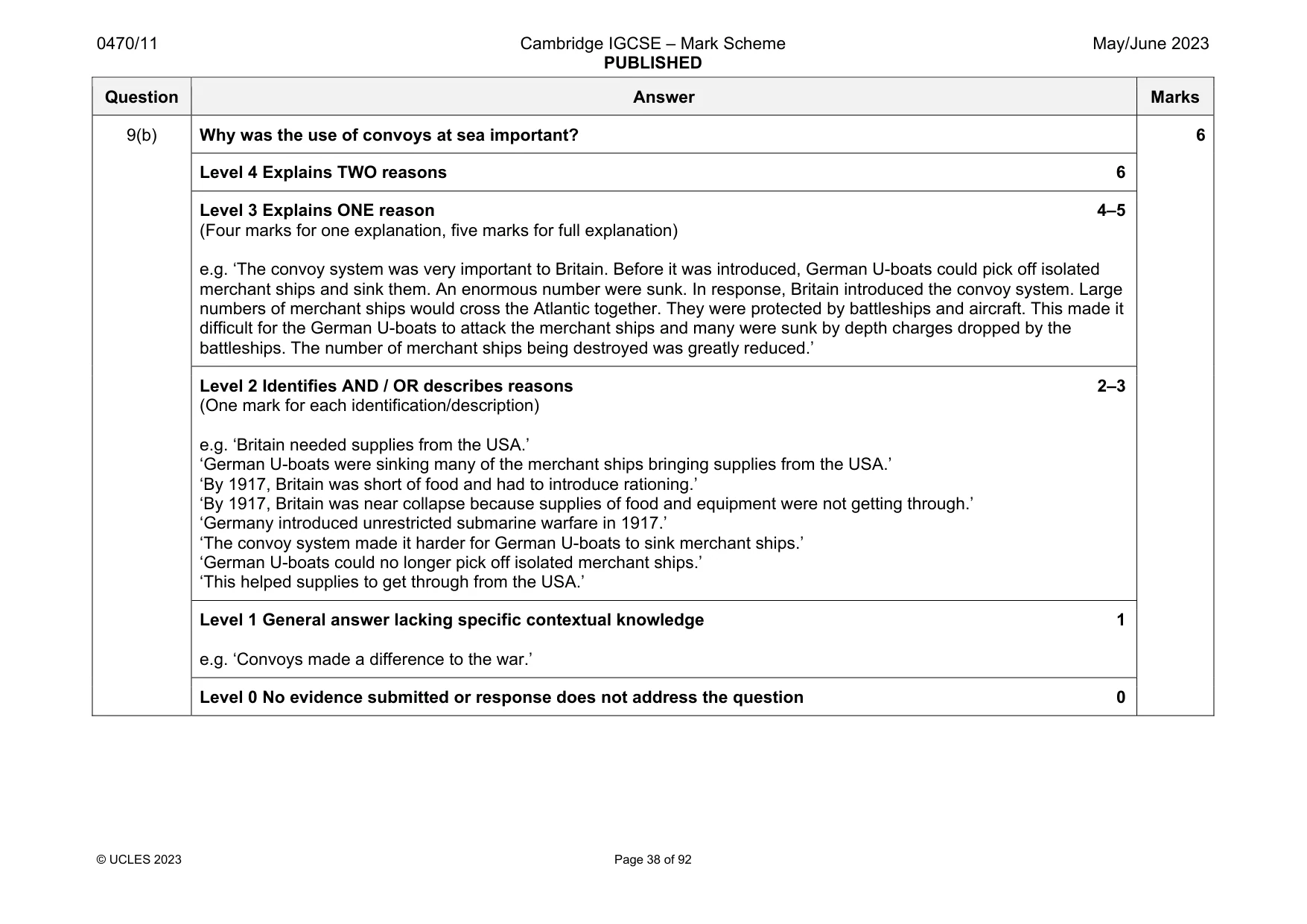
0470/11 Cambridge IGCSE – Mark Scheme PUBLISHED May/June 2023 © UCLES 2023 Page 38 of 92 Question Answer Marks 9(b) Why was the use of convoys at sea important? 6 Level 4 Explains TWO reasons 6 Level 3 Explains ONE reason 4–5 (Four marks for one explanation, five marks for full explanation) e.g. ‘The convoy system was very important to Britain. Before it was introduced, German U-boats could pick off isolated merchant ships and sink them. An enormous number were sunk. In response, Britain introduced the convoy system. Large numbers of merchant ships would cross the Atlantic together. They were protected by battleships and aircraft. This made it difficult for the German U-boats to attack the merchant ships and many were sunk by depth charges dropped by the battleships. The number of merchant ships being destroyed was greatly reduced.’ Level 2 Identifies AND / OR describes reasons 2–3 (One mark for each identification/description) e.g. ‘Britain needed supplies from the USA.’ ‘German U-boats were sinking many of the merchant ships bringing supplies from the USA.’ ‘By 1917, Britain was short of food and had to introduce rationing.’ ‘By 1917, Britain was near collapse because supplies of food and equipment were not getting through.’ ‘Germany introduced unrestricted submarine warfare in 1917.’ ‘The convoy system made it harder for German U-boats to sink merchant ships.’ ‘German U-boats could no longer pick off isolated merchant ships.’ ‘This helped supplies to get through from the USA.’ Level 1 General answer lacking specific contextual knowledge 1 e.g. ‘Convoys made a difference to the war.’ Level 0 No evidence submitted or response does not address the question 0
Mark scheme, page 39
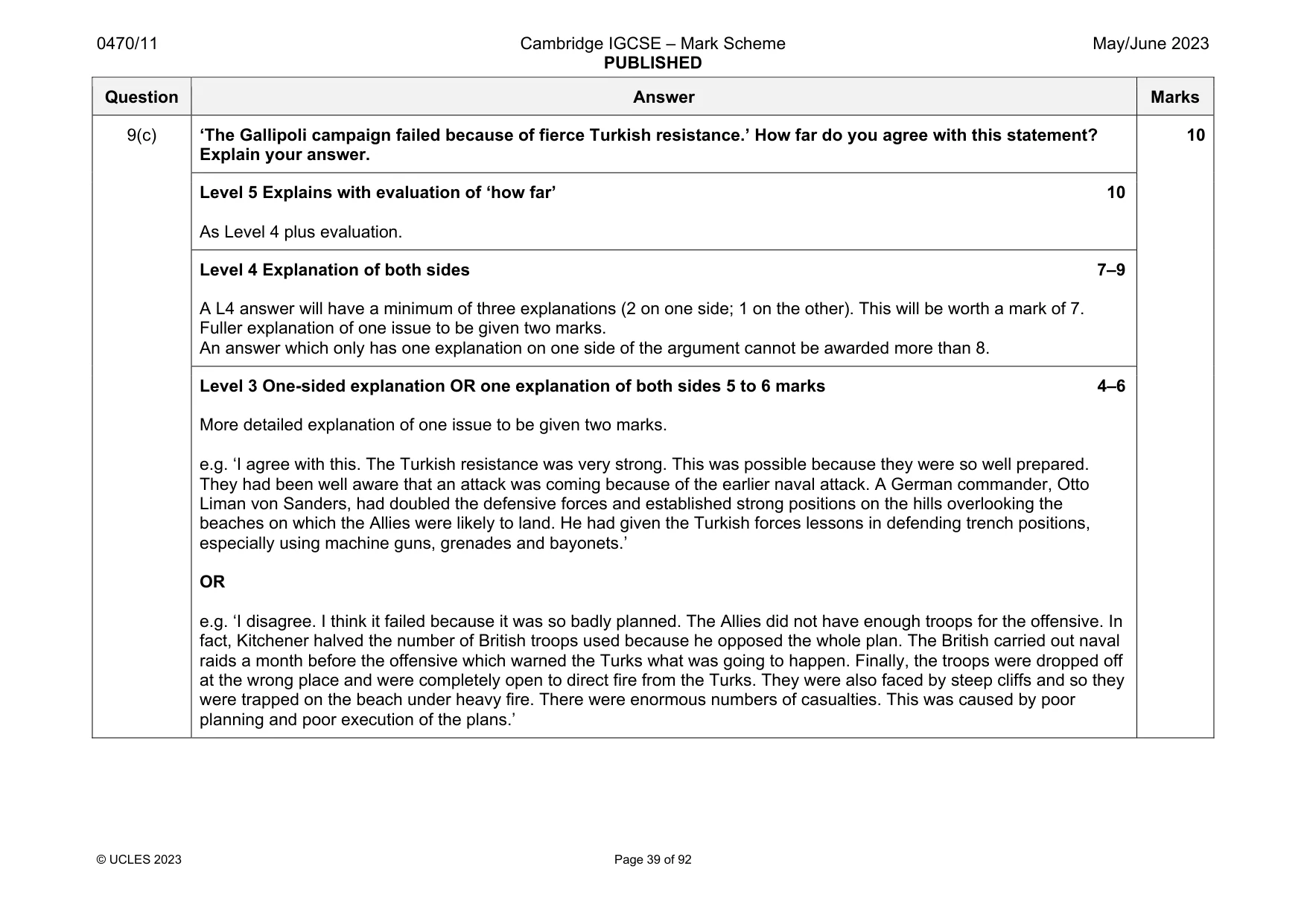
0470/11 Cambridge IGCSE – Mark Scheme PUBLISHED May/June 2023 © UCLES 2023 Page 39 of 92 Question Answer Marks 9(c) ‘The Gallipoli campaign failed because of fierce Turkish resistance.’ How far do you agree with this statement? Explain your answer. 10 Level 5 Explains with evaluation of ‘how far’ 10 As Level 4 plus evaluation. Level 4 Explanation of both sides 7–9 A L4 answer will have a minimum of three explanations (2 on one side; 1 on the other). This will be worth a mark of 7. Fuller explanation of one issue to be given two marks. An answer which only has one explanation on one side of the argument cannot be awarded more than 8. Level 3 One-sided explanation OR one explanation of both sides 5 to 6 marks 4–6 More detailed explanation of one issue to be given two marks. e.g. ‘I agree with this. The Turkish resistance was very strong. This was possible because they were so well prepared. They had been well aware that an attack was coming because of the earlier naval attack. A German commander, Otto Liman von Sanders, had doubled the defensive forces and established strong positions on the hills overlooking the beaches on which the Allies were likely to land. He had given the Turkish forces lessons in defending trench positions, especially using machine guns, grenades and bayonets.’ OR e.g. ‘I disagree. I think it failed because it was so badly planned. The Allies did not have enough troops for the offensive. In fact, Kitchener halved the number of British troops used because he opposed the whole plan. The British carried out naval raids a month before the offensive which warned the Turks what was going to happen. Finally, the troops were dropped off at the wrong place and were completely open to direct fire from the Turks. They were also faced by steep cliffs and so they were trapped on the beach under heavy fire. There were enormous numbers of casualties. This was caused by poor planning and poor execution of the plans.’
Mark scheme, page 40
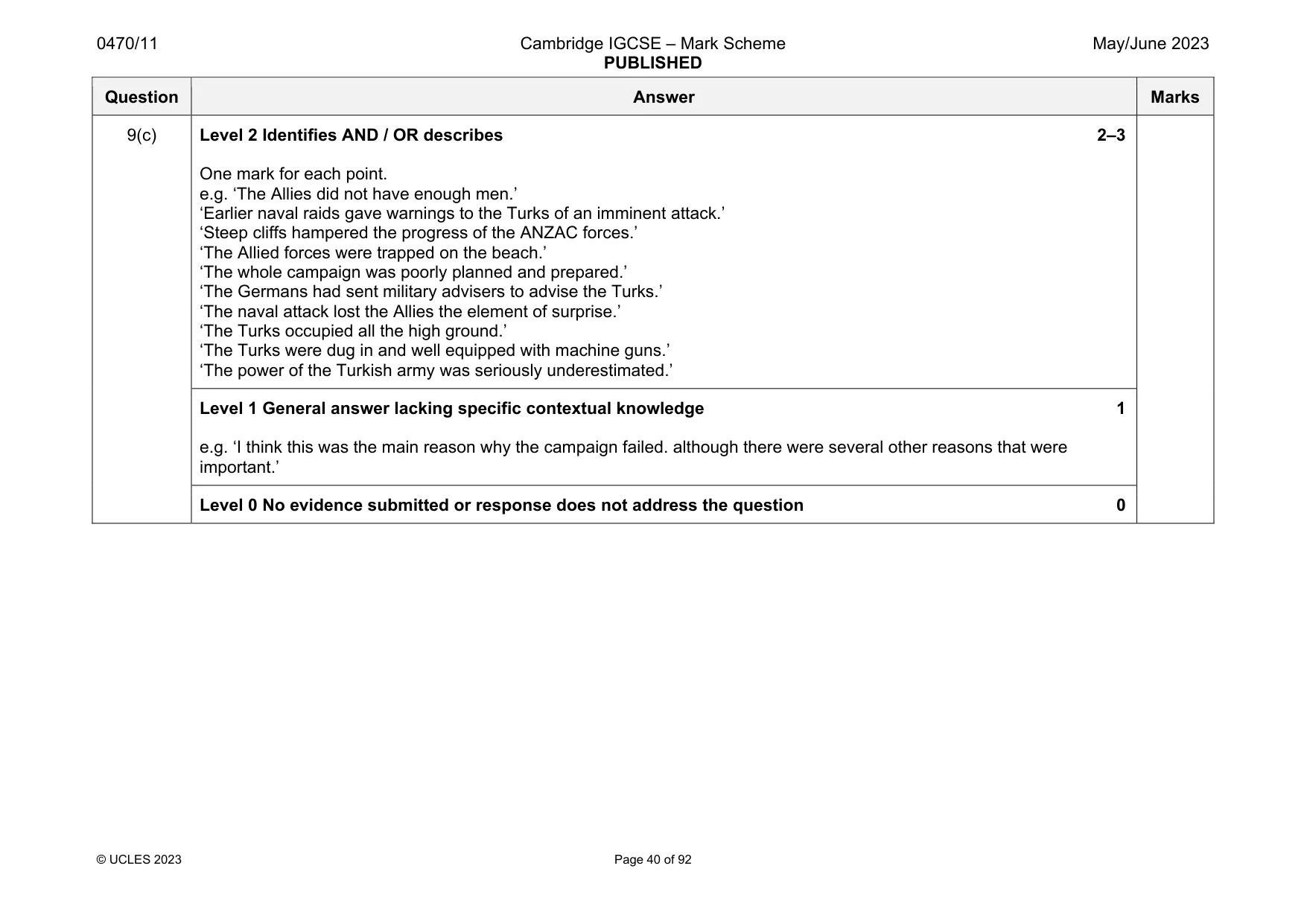
0470/11 Cambridge IGCSE – Mark Scheme PUBLISHED May/June 2023 © UCLES 2023 Page 40 of 92 Question Answer Marks 9(c) Level 2 Identifies AND / OR describes 2–3 One mark for each point. e.g. ‘The Allies did not have enough men.’ ‘Earlier naval raids gave warnings to the Turks of an imminent attack.’ ‘Steep cliffs hampered the progress of the ANZAC forces.’ ‘The Allied forces were trapped on the beach.’ ‘The whole campaign was poorly planned and prepared.’ ‘The Germans had sent military advisers to advise the Turks.’ ‘The naval attack lost the Allies the element of surprise.’ ‘The Turks occupied all the high ground.’ ‘The Turks were dug in and well equipped with machine guns.’ ‘The power of the Turkish army was seriously underestimated.’ Level 1 General answer lacking specific contextual knowledge 1 e.g. ‘I think this was the main reason why the campaign failed. although there were several other reasons that were important.’ Level 0 No evidence submitted or response does not address the question 0
Mark scheme, page 41
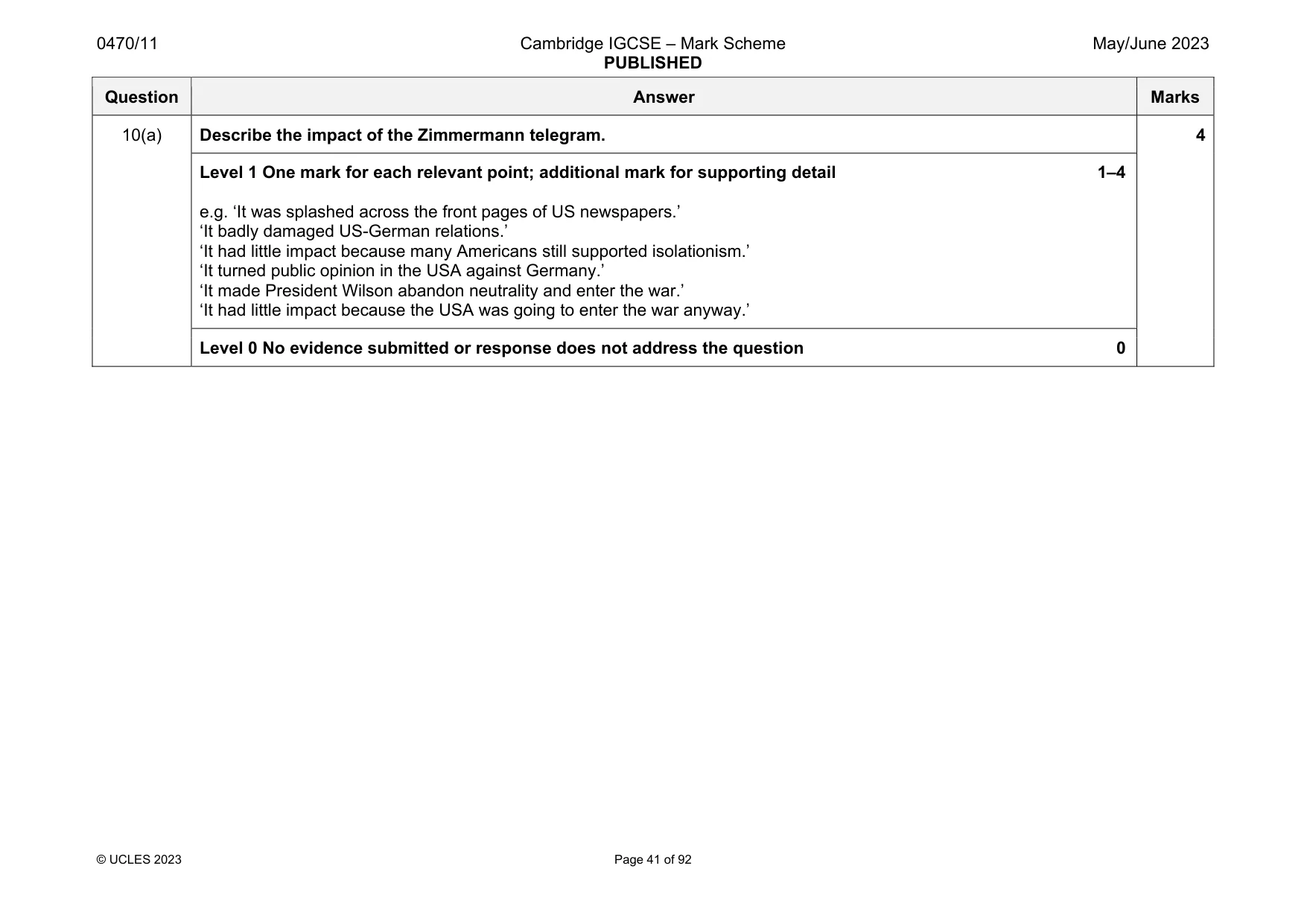
0470/11 Cambridge IGCSE – Mark Scheme PUBLISHED May/June 2023 © UCLES 2023 Page 41 of 92 Question Answer Marks 10(a) Describe the impact of the Zimmermann telegram. 4 Level 1 One mark for each relevant point; additional mark for supporting detail 1–4 e.g. ‘It was splashed across the front pages of US newspapers.’ ‘It badly damaged US-German relations.’ ‘It had little impact because many Americans still supported isolationism.’ ‘It turned public opinion in the USA against Germany.’ ‘It made President Wilson abandon neutrality and enter the war.’ ‘It had little impact because the USA was going to enter the war anyway.’ Level 0 No evidence submitted or response does not address the question 0
Mark scheme, page 42
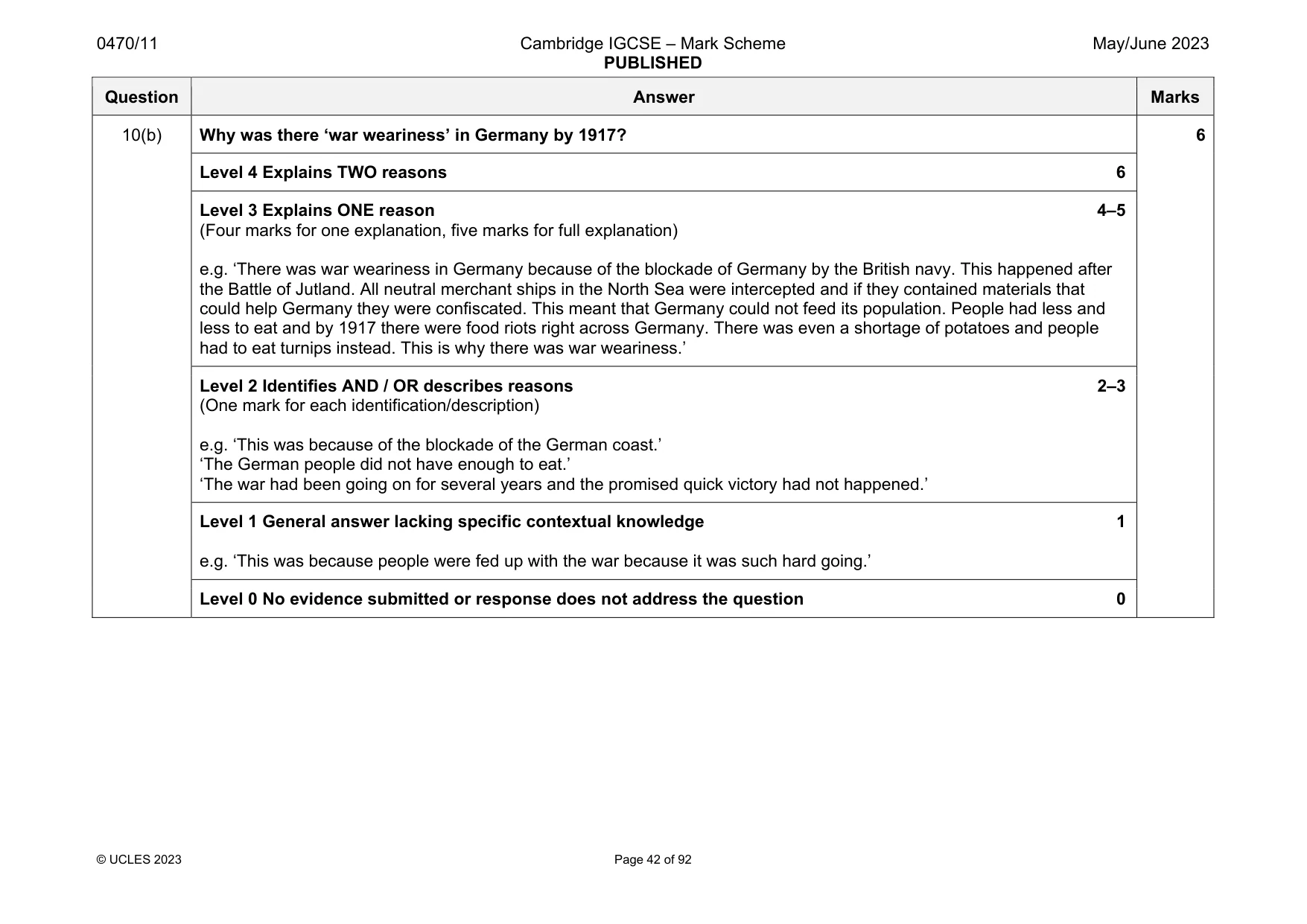
0470/11 Cambridge IGCSE – Mark Scheme PUBLISHED May/June 2023 © UCLES 2023 Page 42 of 92 Question Answer Marks 10(b) Why was there ‘war weariness’ in Germany by 1917? 6 Level 4 Explains TWO reasons 6 Level 3 Explains ONE reason 4–5 (Four marks for one explanation, five marks for full explanation) e.g. ‘There was war weariness in Germany because of the blockade of Germany by the British navy. This happened after the Battle of Jutland. All neutral merchant ships in the North Sea were intercepted and if they contained materials that could help Germany they were confiscated. This meant that Germany could not feed its population. People had less and less to eat and by 1917 there were food riots right across Germany. There was even a shortage of potatoes and people had to eat turnips instead. This is why there was war weariness.’ Level 2 Identifies AND / OR describes reasons 2–3 (One mark for each identification/description) e.g. ‘This was because of the blockade of the German coast.’ ‘The German people did not have enough to eat.’ ‘The war had been going on for several years and the promised quick victory had not happened.’ Level 1 General answer lacking specific contextual knowledge 1 e.g. ‘This was because people were fed up with the war because it was such hard going.’ Level 0 No evidence submitted or response does not address the question 0
Mark scheme, page 43
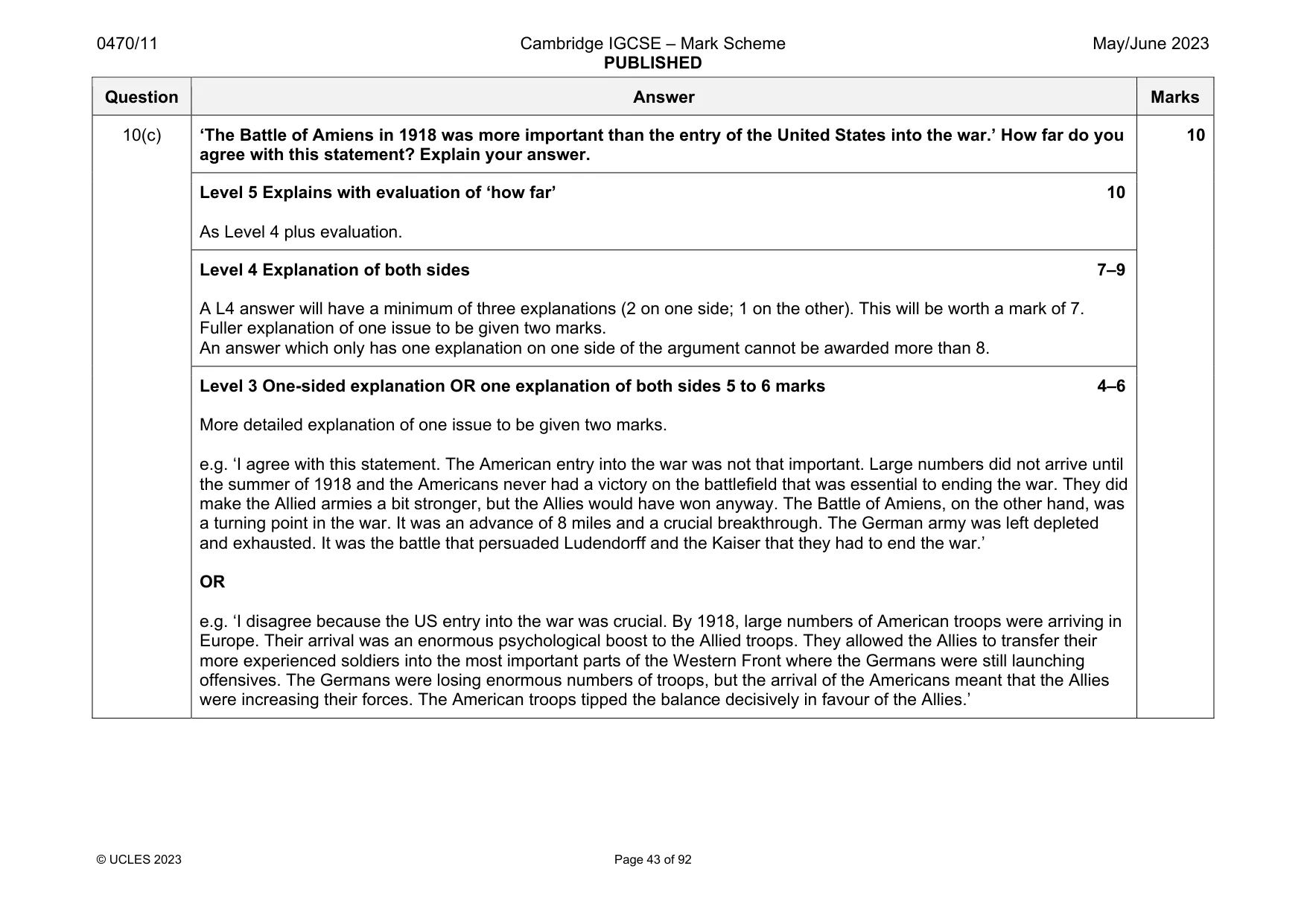
0470/11 Cambridge IGCSE – Mark Scheme PUBLISHED May/June 2023 © UCLES 2023 Page 43 of 92 Question Answer Marks 10(c) ‘The Battle of Amiens in 1918 was more important than the entry of the United States into the war.’ How far do you agree with this statement? Explain your answer. 10 Level 5 Explains with evaluation of ‘how far’ 10 As Level 4 plus evaluation. Level 4 Explanation of both sides 7–9 A L4 answer will have a minimum of three explanations (2 on one side; 1 on the other). This will be worth a mark of 7. Fuller explanation of one issue to be given two marks. An answer which only has one explanation on one side of the argument cannot be awarded more than 8. Level 3 One-sided explanation OR one explanation of both sides 5 to 6 marks 4–6 More detailed explanation of one issue to be given two marks. e.g. ‘I agree with this statement. The American entry into the war was not that important. Large numbers did not arrive until the summer of 1918 and the Americans never had a victory on the battlefield that was essential to ending the war. They did make the Allied armies a bit stronger, but the Allies would have won anyway. The Battle of Amiens, on the other hand, was a turning point in the war. It was an advance of 8 miles and a crucial breakthrough. The German army was left depleted and exhausted. It was the battle that persuaded Ludendorff and the Kaiser that they had to end the war.’ OR e.g. ‘I disagree because the US entry into the war was crucial. By 1918, large numbers of American troops were arriving in Europe. Their arrival was an enormous psychological boost to the Allied troops. They allowed the Allies to transfer their more experienced soldiers into the most important parts of the Western Front where the Germans were still launching offensives. The Germans were losing enormous numbers of troops, but the arrival of the Americans meant that the Allies were increasing their forces. The American troops tipped the balance decisively in favour of the Allies.’
Mark scheme, page 44
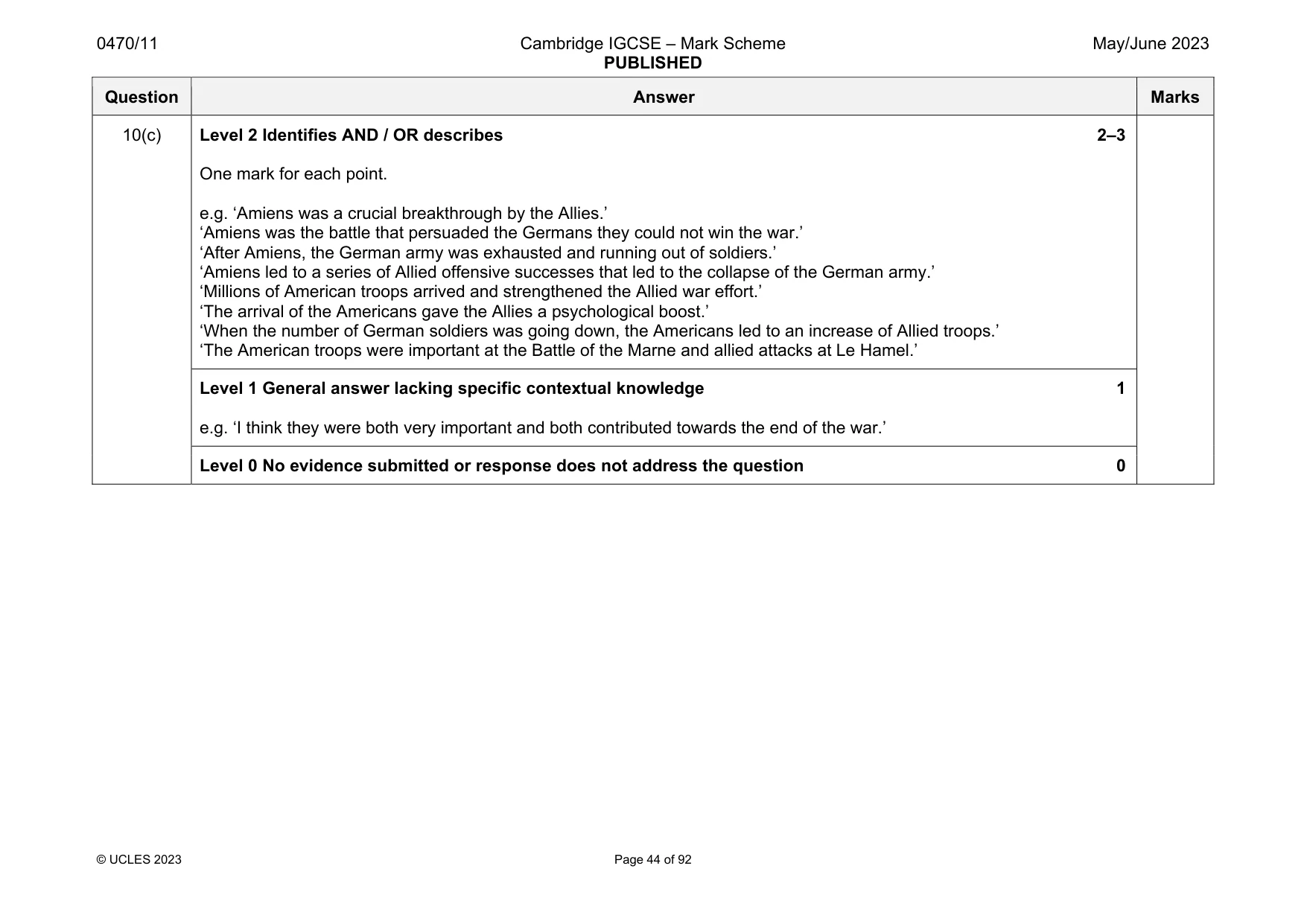
0470/11 Cambridge IGCSE – Mark Scheme PUBLISHED May/June 2023 © UCLES 2023 Page 44 of 92 Question Answer Marks 10(c) Level 2 Identifies AND / OR describes 2–3 One mark for each point. e.g. ‘Amiens was a crucial breakthrough by the Allies.’ ‘Amiens was the battle that persuaded the Germans they could not win the war.’ ‘After Amiens, the German army was exhausted and running out of soldiers.’ ‘Amiens led to a series of Allied offensive successes that led to the collapse of the German army.’ ‘Millions of American troops arrived and strengthened the Allied war effort.’ ‘The arrival of the Americans gave the Allies a psychological boost.’ ‘When the number of German soldiers was going down, the Americans led to an increase of Allied troops.’ ‘The American troops were important at the Battle of the Marne and allied attacks at Le Hamel.’ Level 1 General answer lacking specific contextual knowledge 1 e.g. ‘I think they were both very important and both contributed towards the end of the war.’ Level 0 No evidence submitted or response does not address the question 0
Mark scheme, page 45
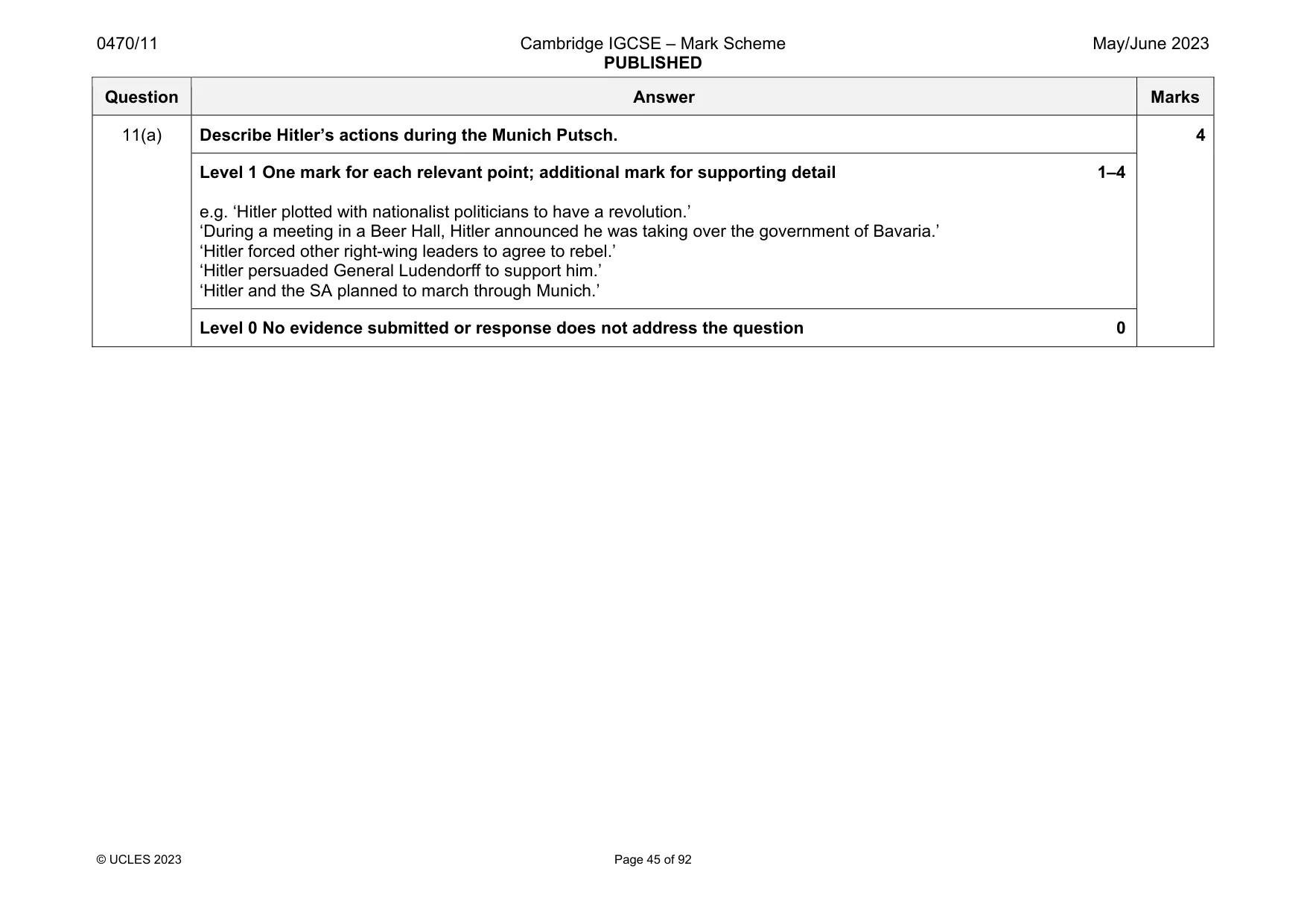
0470/11 Cambridge IGCSE – Mark Scheme PUBLISHED May/June 2023 © UCLES 2023 Page 45 of 92 Question Answer Marks 11(a) Describe Hitler’s actions during the Munich Putsch. 4 Level 1 One mark for each relevant point; additional mark for supporting detail 1–4 e.g. ‘Hitler plotted with nationalist politicians to have a revolution.’ ‘During a meeting in a Beer Hall, Hitler announced he was taking over the government of Bavaria.’ ‘Hitler forced other right-wing leaders to agree to rebel.’ ‘Hitler persuaded General Ludendorff to support him.’ ‘Hitler and the SA planned to march through Munich.’ Level 0 No evidence submitted or response does not address the question 0
Mark scheme, page 46
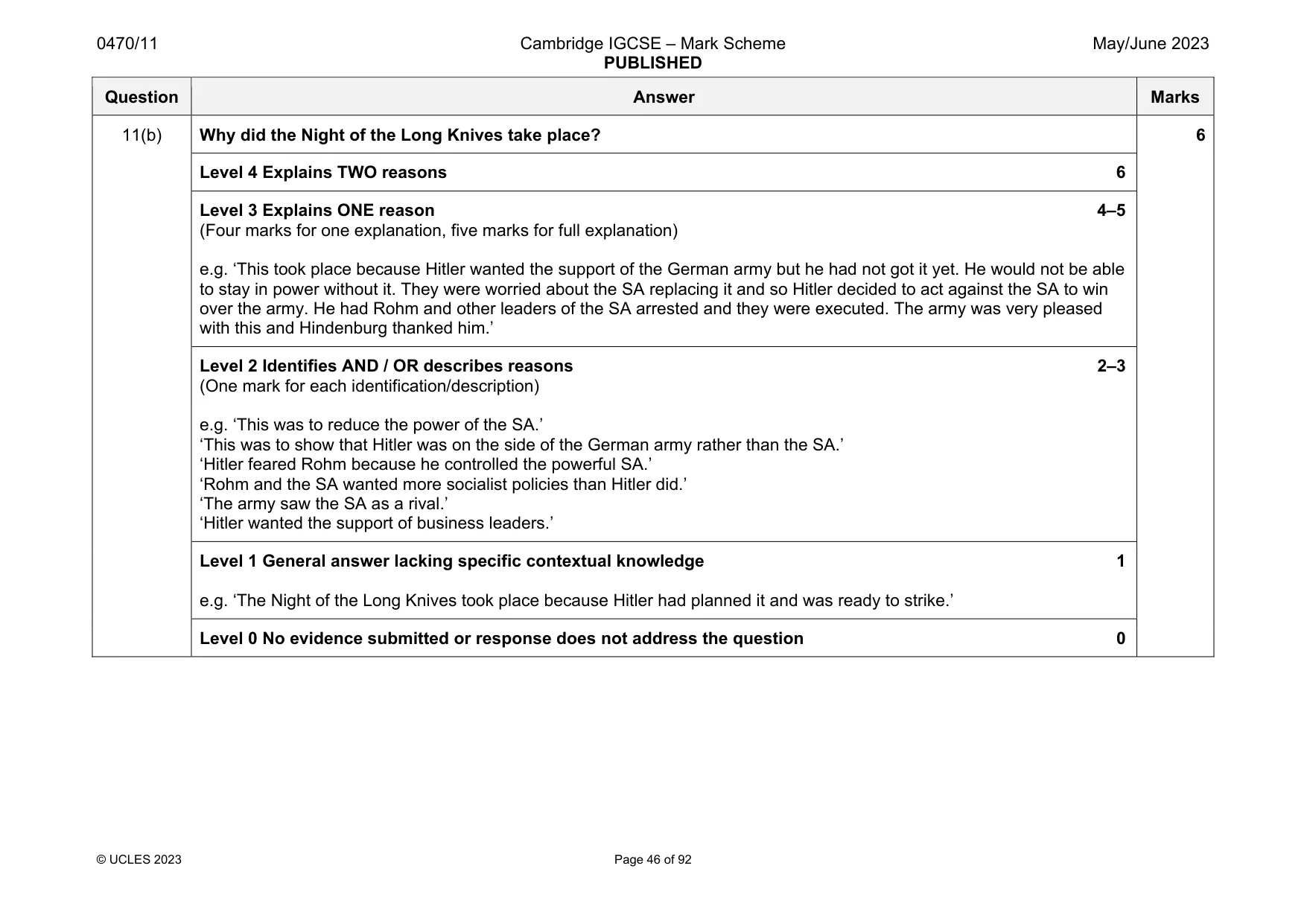
0470/11 Cambridge IGCSE – Mark Scheme PUBLISHED May/June 2023 © UCLES 2023 Page 46 of 92 Question Answer Marks 11(b) Why did the Night of the Long Knives take place? 6 Level 4 Explains TWO reasons 6 Level 3 Explains ONE reason 4–5 (Four marks for one explanation, five marks for full explanation) e.g. ‘This took place because Hitler wanted the support of the German army but he had not got it yet. He would not be able to stay in power without it. They were worried about the SA replacing it and so Hitler decided to act against the SA to win over the army. He had Rohm and other leaders of the SA arrested and they were executed. The army was very pleased with this and Hindenburg thanked him.’ Level 2 Identifies AND / OR describes reasons 2–3 (One mark for each identification/description) e.g. ‘This was to reduce the power of the SA.’ ‘This was to show that Hitler was on the side of the German army rather than the SA.’ ‘Hitler feared Rohm because he controlled the powerful SA.’ ‘Rohm and the SA wanted more socialist policies than Hitler did.’ ‘The army saw the SA as a rival.’ ‘Hitler wanted the support of business leaders.’ Level 1 General answer lacking specific contextual knowledge 1 e.g. ‘The Night of the Long Knives took place because Hitler had planned it and was ready to strike.’ Level 0 No evidence submitted or response does not address the question 0
Mark scheme, page 47
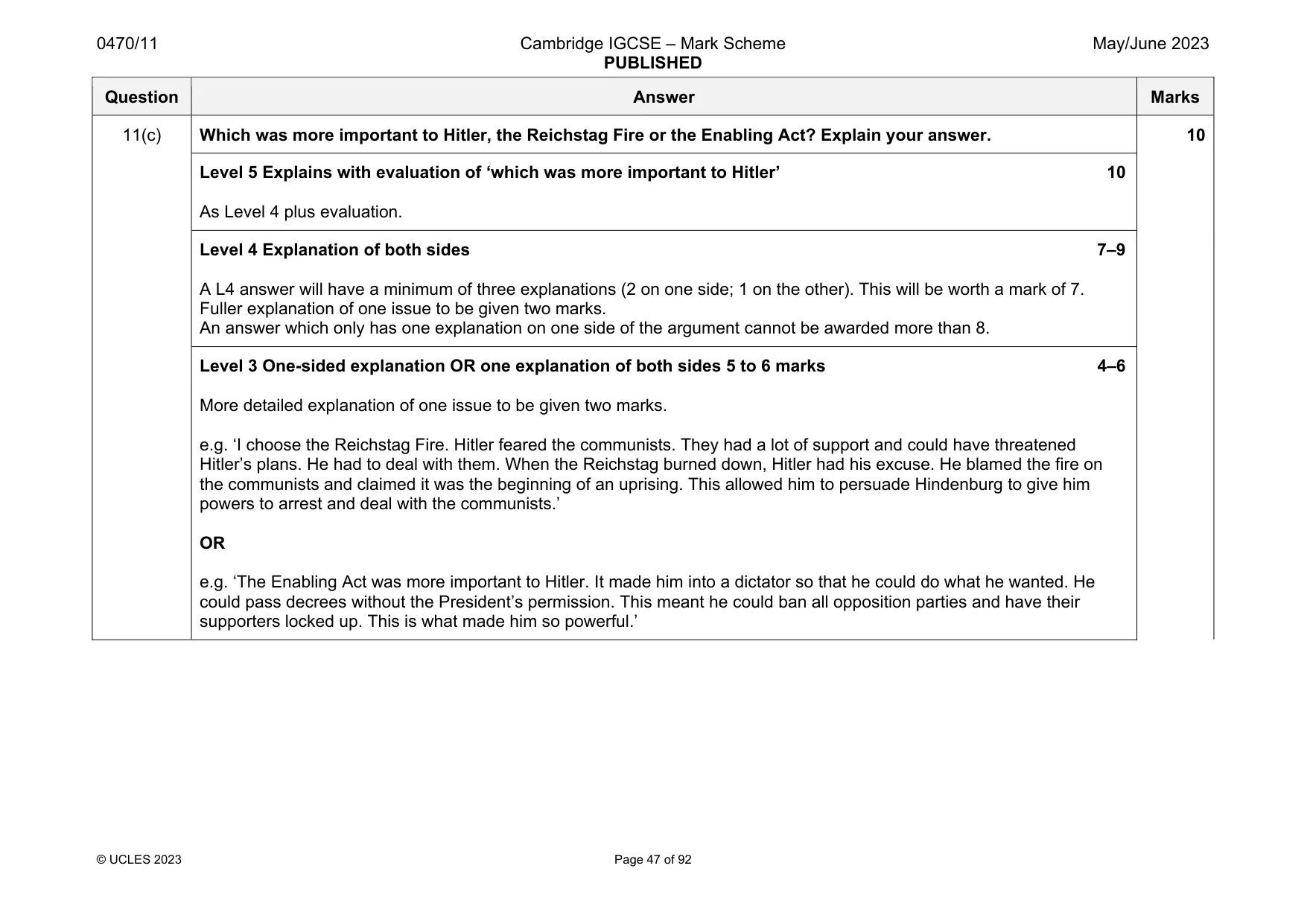
0470/11 Cambridge IGCSE – Mark Scheme PUBLISHED May/June 2023 © UCLES 2023 Page 47 of 92 Question Answer Marks 11(c) Which was more important to Hitler, the Reichstag Fire or the Enabling Act? Explain your answer. 10 Level 5 Explains with evaluation of ‘which was more important to Hitler’ 10 As Level 4 plus evaluation. Level 4 Explanation of both sides 7–9 A L4 answer will have a minimum of three explanations (2 on one side; 1 on the other). This will be worth a mark of 7. Fuller explanation of one issue to be given two marks. An answer which only has one explanation on one side of the argument cannot be awarded more than 8. Level 3 One-sided explanation OR one explanation of both sides 5 to 6 marks 4–6 More detailed explanation of one issue to be given two marks. e.g. ‘I choose the Reichstag Fire. Hitler feared the communists. They had a lot of support and could have threatened Hitler’s plans. He had to deal with them. When the Reichstag burned down, Hitler had his excuse. He blamed the fire on the communists and claimed it was the beginning of an uprising. This allowed him to persuade Hindenburg to give him powers to arrest and deal with the communists.’ OR e.g. ‘The Enabling Act was more important to Hitler. It made him into a dictator so that he could do what he wanted. He could pass decrees without the President’s permission. This meant he could ban all opposition parties and have their supporters locked up. This is what made him so powerful.’
Mark scheme, page 48
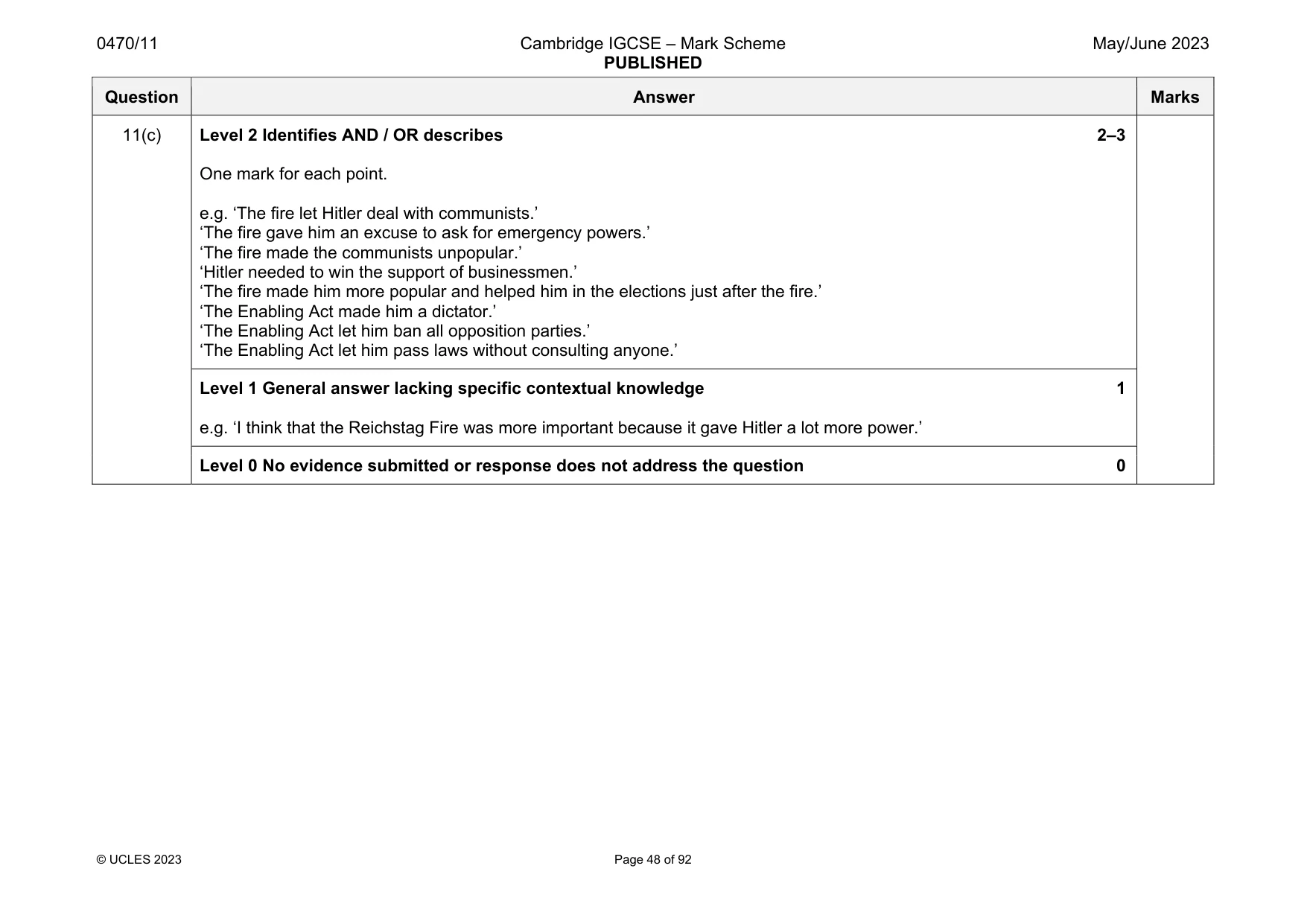
0470/11 Cambridge IGCSE – Mark Scheme PUBLISHED May/June 2023 © UCLES 2023 Page 48 of 92 Question Answer Marks 11(c) Level 2 Identifies AND / OR describes 2–3 One mark for each point. e.g. ‘The fire let Hitler deal with communists.’ ‘The fire gave him an excuse to ask for emergency powers.’ ‘The fire made the communists unpopular.’ ‘Hitler needed to win the support of businessmen.’ ‘The fire made him more popular and helped him in the elections just after the fire.’ ‘The Enabling Act made him a dictator.’ ‘The Enabling Act let him ban all opposition parties.’ ‘The Enabling Act let him pass laws without consulting anyone.’ Level 1 General answer lacking specific contextual knowledge 1 e.g. ‘I think that the Reichstag Fire was more important because it gave Hitler a lot more power.’ Level 0 No evidence submitted or response does not address the question 0
Mark scheme, page 49
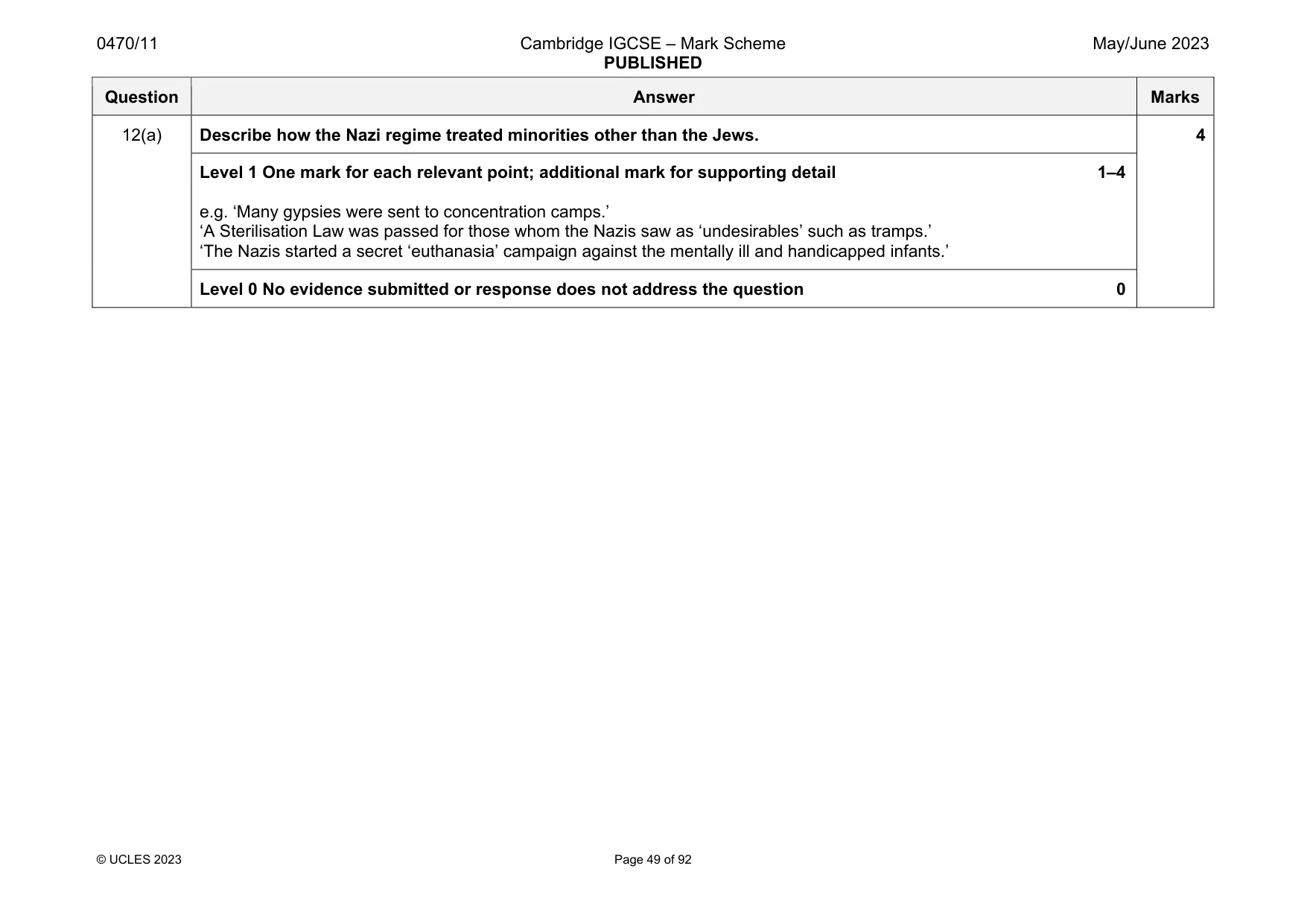
0470/11 Cambridge IGCSE – Mark Scheme PUBLISHED May/June 2023 © UCLES 2023 Page 49 of 92 Question Answer Marks 12(a) Describe how the Nazi regime treated minorities other than the Jews. 4 Level 1 One mark for each relevant point; additional mark for supporting detail 1–4 e.g. ‘Many gypsies were sent to concentration camps.’ ‘A Sterilisation Law was passed for those whom the Nazis saw as ‘undesirables’ such as tramps.’ ‘The Nazis started a secret ‘euthanasia’ campaign against the mentally ill and handicapped infants.’ Level 0 No evidence submitted or response does not address the question 0
Mark scheme, page 50
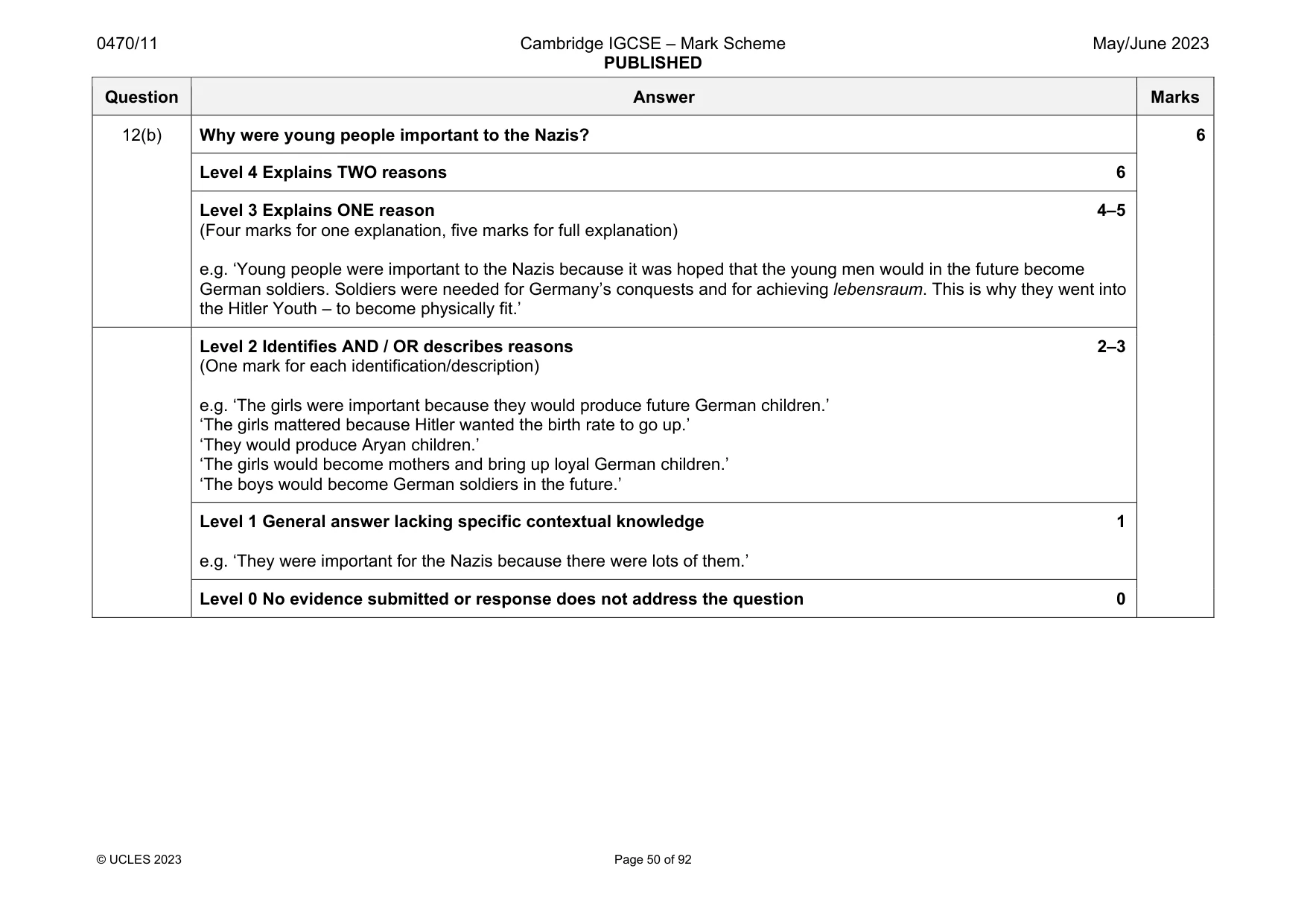
0470/11 Cambridge IGCSE – Mark Scheme PUBLISHED May/June 2023 © UCLES 2023 Page 50 of 92 Question Answer Marks 12(b) Why were young people important to the Nazis? 6 Level 4 Explains TWO reasons 6 Level 3 Explains ONE reason 4–5 (Four marks for one explanation, five marks for full explanation) e.g. ‘Young people were important to the Nazis because it was hoped that the young men would in the future become German soldiers. Soldiers were needed for Germany’s conquests and for achieving lebensraum. This is why they went into the Hitler Youth – to become physically fit.’ Level 2 Identifies AND / OR describes reasons 2–3 (One mark for each identification/description) e.g. ‘The girls were important because they would produce future German children.’ ‘The girls mattered because Hitler wanted the birth rate to go up.’ ‘They would produce Aryan children.’ ‘The girls would become mothers and bring up loyal German children.’ ‘The boys would become German soldiers in the future.’ Level 1 General answer lacking specific contextual knowledge 1 e.g. ‘They were important for the Nazis because there were lots of them.’ Level 0 No evidence submitted or response does not address the question 0
Mark scheme, page 51
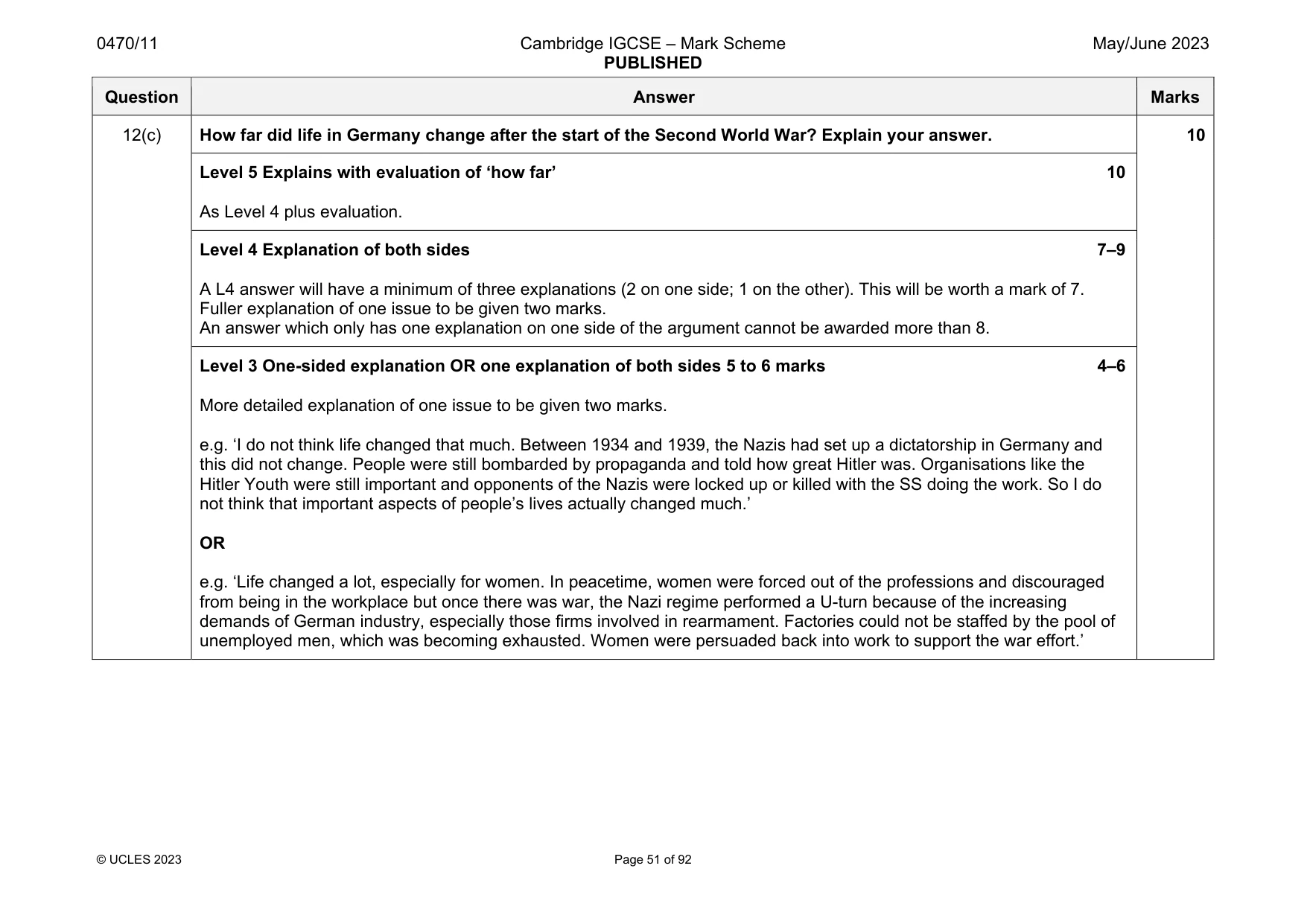
0470/11 Cambridge IGCSE – Mark Scheme PUBLISHED May/June 2023 © UCLES 2023 Page 51 of 92 Question Answer Marks 12(c) How far did life in Germany change after the start of the Second World War? Explain your answer. 10 Level 5 Explains with evaluation of ‘how far’ 10 As Level 4 plus evaluation. Level 4 Explanation of both sides 7–9 A L4 answer will have a minimum of three explanations (2 on one side; 1 on the other). This will be worth a mark of 7. Fuller explanation of one issue to be given two marks. An answer which only has one explanation on one side of the argument cannot be awarded more than 8. Level 3 One-sided explanation OR one explanation of both sides 5 to 6 marks 4–6 More detailed explanation of one issue to be given two marks. e.g. ‘I do not think life changed that much. Between 1934 and 1939, the Nazis had set up a dictatorship in Germany and this did not change. People were still bombarded by propaganda and told how great Hitler was. Organisations like the Hitler Youth were still important and opponents of the Nazis were locked up or killed with the SS doing the work. So I do not think that important aspects of people’s lives actually changed much.’ OR e.g. ‘Life changed a lot, especially for women. In peacetime, women were forced out of the professions and discouraged from being in the workplace but once there was war, the Nazi regime performed a U-turn because of the increasing demands of German industry, especially those firms involved in rearmament. Factories could not be staffed by the pool of unemployed men, which was becoming exhausted. Women were persuaded back into work to support the war effort.’
Mark scheme, page 52
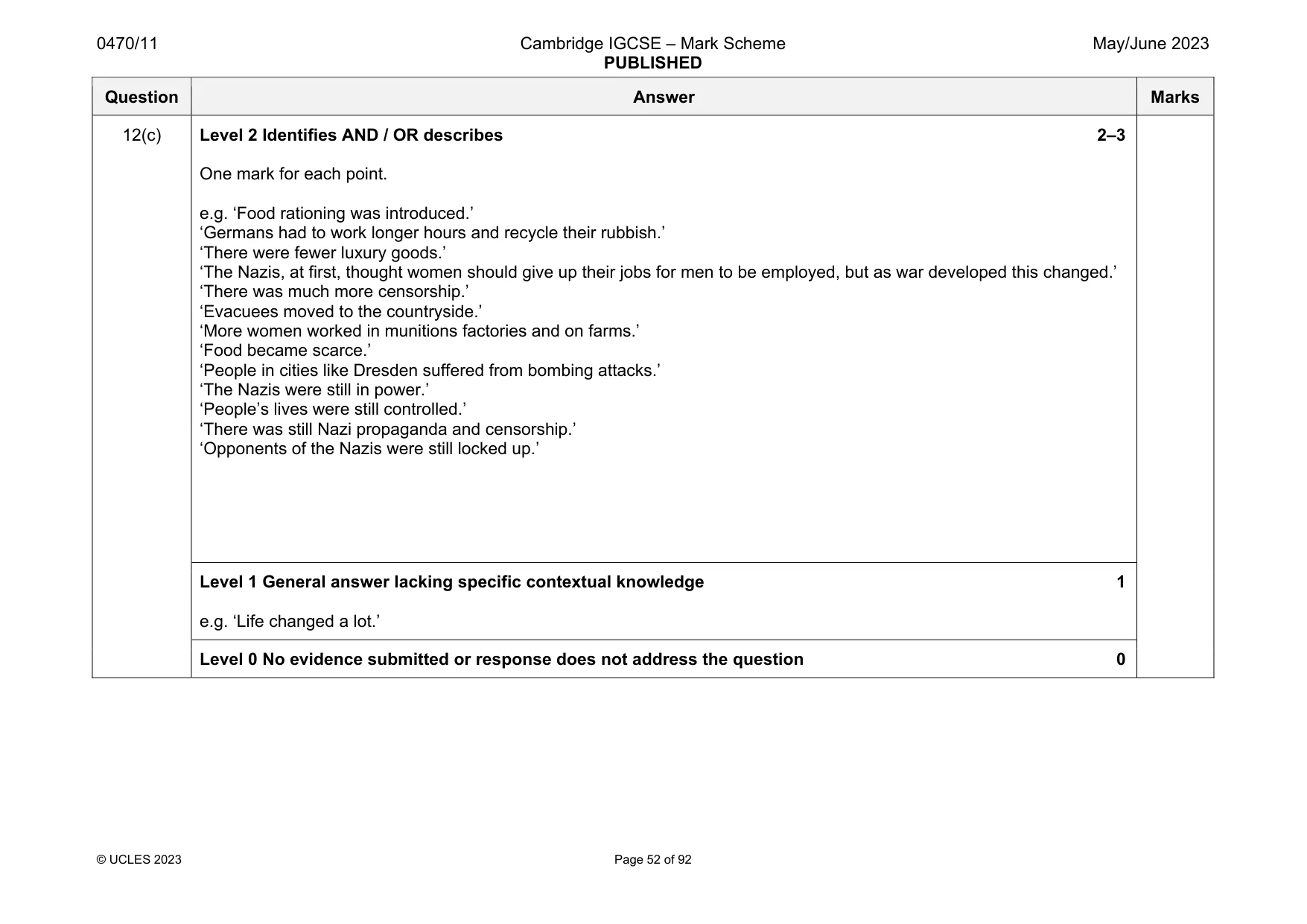
0470/11 Cambridge IGCSE – Mark Scheme PUBLISHED May/June 2023 © UCLES 2023 Page 52 of 92 Question Answer Marks 12(c) Level 2 Identifies AND / OR describes 2–3 One mark for each point. e.g. ‘Food rationing was introduced.’ ‘Germans had to work longer hours and recycle their rubbish.’ ‘There were fewer luxury goods.’ ‘The Nazis, at first, thought women should give up their jobs for men to be employed, but as war developed this changed.’ ‘There was much more censorship.’ ‘Evacuees moved to the countryside.’ ‘More women worked in munitions factories and on farms.’ ‘Food became scarce.’ ‘People in cities like Dresden suffered from bombing attacks.’ ‘The Nazis were still in power.’ ‘People’s lives were still controlled.’ ‘There was still Nazi propaganda and censorship.’ ‘Opponents of the Nazis were still locked up.’ Level 1 General answer lacking specific contextual knowledge 1 e.g. ‘Life changed a lot.’ Level 0 No evidence submitted or response does not address the question 0
Mark scheme, page 53
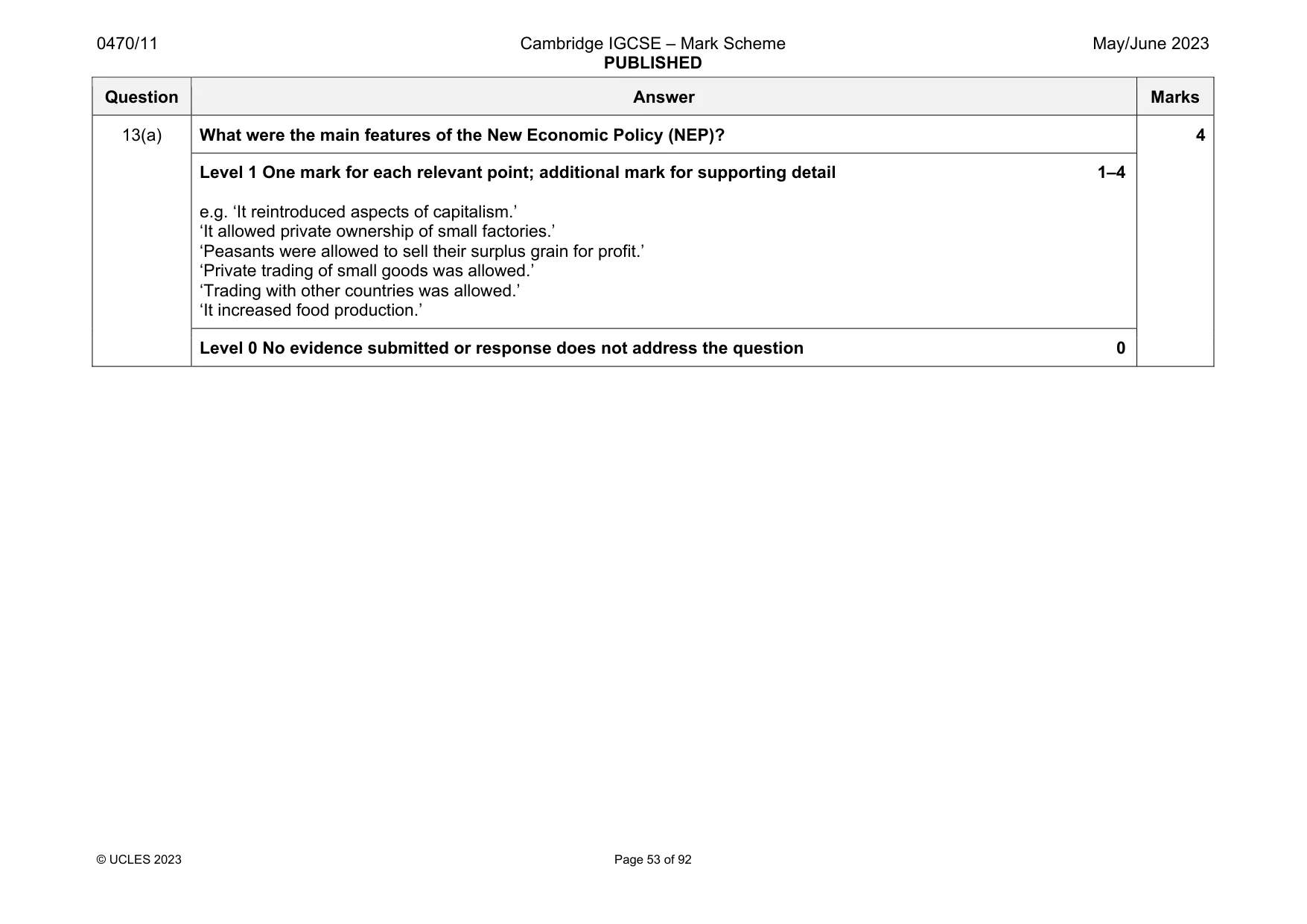
0470/11 Cambridge IGCSE – Mark Scheme PUBLISHED May/June 2023 © UCLES 2023 Page 53 of 92 Question Answer Marks 13(a) What were the main features of the New Economic Policy (NEP)? 4 Level 1 One mark for each relevant point; additional mark for supporting detail 1–4 e.g. ‘It reintroduced aspects of capitalism.’ ‘It allowed private ownership of small factories.’ ‘Peasants were allowed to sell their surplus grain for profit.’ ‘Private trading of small goods was allowed.’ ‘Trading with other countries was allowed.’ ‘It increased food production.’ Level 0 No evidence submitted or response does not address the question 0
Mark scheme, page 54
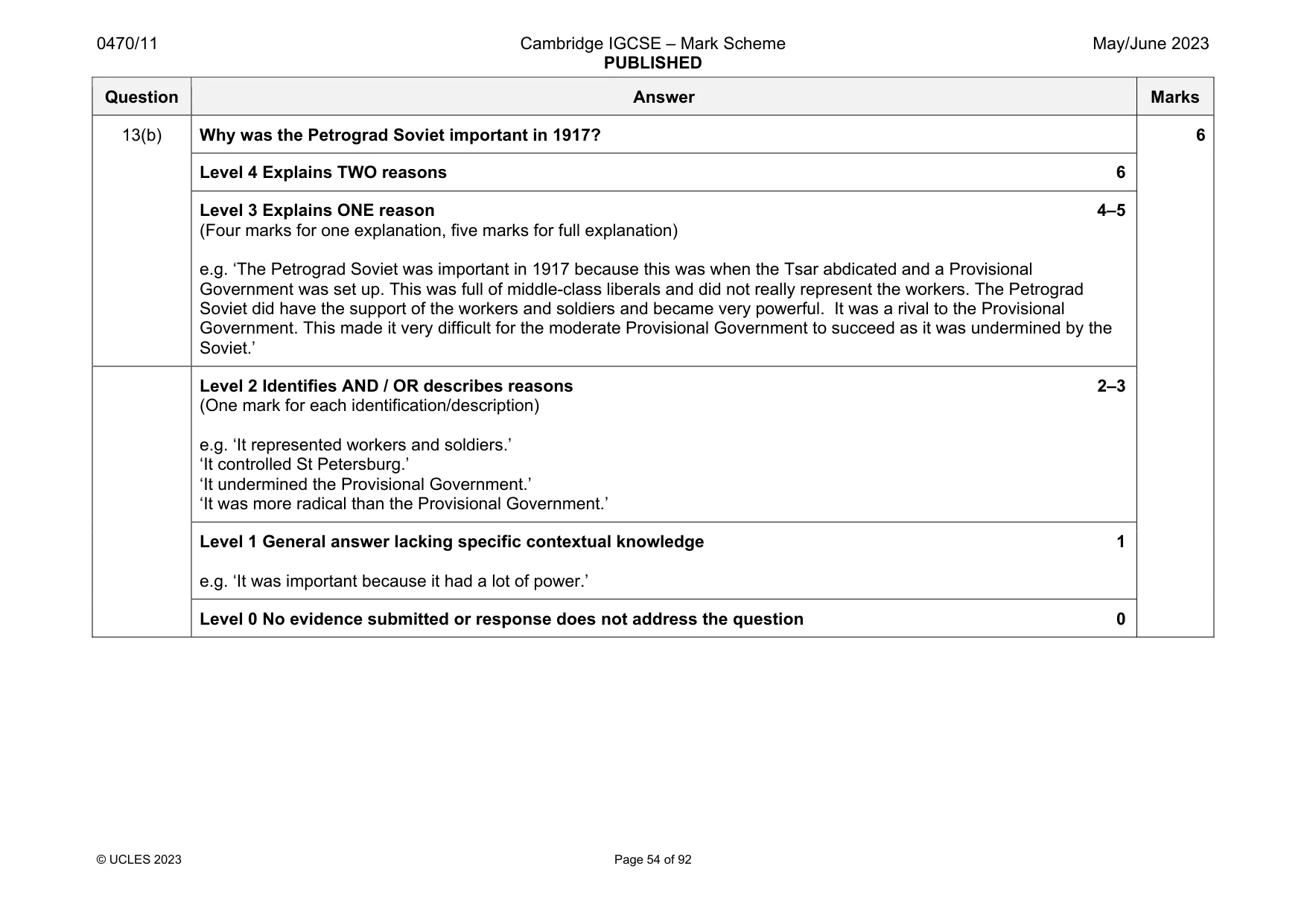
0470/11 Cambridge IGCSE – Mark Scheme PUBLISHED May/June 2023 © UCLES 2023 Page 54 of 92 Question Answer Marks 13(b) Why was the Petrograd Soviet important in 1917? 6 Level 4 Explains TWO reasons 6 Level 3 Explains ONE reason 4–5 (Four marks for one explanation, five marks for full explanation) e.g. ‘The Petrograd Soviet was important in 1917 because this was when the Tsar abdicated and a Provisional Government was set up. This was full of middle-class liberals and did not really represent the workers. The Petrograd Soviet did have the support of the workers and soldiers and became very powerful. It was a rival to the Provisional Government. This made it very difficult for the moderate Provisional Government to succeed as it was undermined by the Soviet.’ Level 2 Identifies AND / OR describes reasons 2–3 (One mark for each identification/description) e.g. ‘It represented workers and soldiers.’ ‘It controlled St Petersburg.’ ‘It undermined the Provisional Government.’ ‘It was more radical than the Provisional Government.’ Level 1 General answer lacking specific contextual knowledge 1 e.g. ‘It was important because it had a lot of power.’ Level 0 No evidence submitted or response does not address the question 0
Mark scheme, page 55
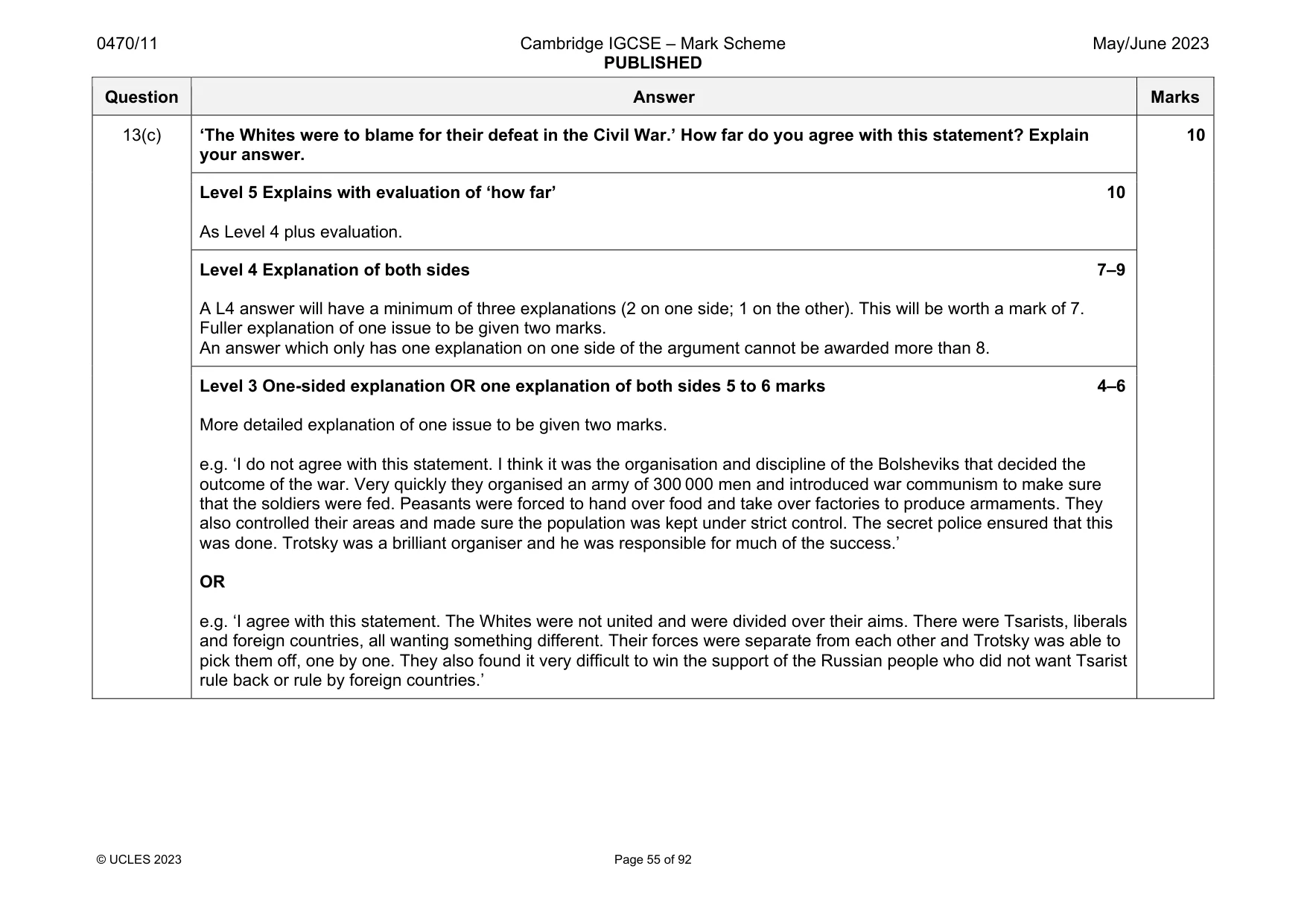
0470/11 Cambridge IGCSE – Mark Scheme PUBLISHED May/June 2023 © UCLES 2023 Page 55 of 92 Question Answer Marks 13(c) ‘The Whites were to blame for their defeat in the Civil War.’ How far do you agree with this statement? Explain your answer. 10 Level 5 Explains with evaluation of ‘how far’ 10 As Level 4 plus evaluation. Level 4 Explanation of both sides 7–9 A L4 answer will have a minimum of three explanations (2 on one side; 1 on the other). This will be worth a mark of 7. Fuller explanation of one issue to be given two marks. An answer which only has one explanation on one side of the argument cannot be awarded more than 8. Level 3 One-sided explanation OR one explanation of both sides 5 to 6 marks 4–6 More detailed explanation of one issue to be given two marks. e.g. ‘I do not agree with this statement. I think it was the organisation and discipline of the Bolsheviks that decided the outcome of the war. Very quickly they organised an army of 300 000 men and introduced war communism to make sure that the soldiers were fed. Peasants were forced to hand over food and take over factories to produce armaments. They also controlled their areas and made sure the population was kept under strict control. The secret police ensured that this was done. Trotsky was a brilliant organiser and he was responsible for much of the success.’ OR e.g. ‘I agree with this statement. The Whites were not united and were divided over their aims. There were Tsarists, liberals and foreign countries, all wanting something different. Their forces were separate from each other and Trotsky was able to pick them off, one by one. They also found it very difficult to win the support of the Russian people who did not want Tsarist rule back or rule by foreign countries.’
Mark scheme, page 56
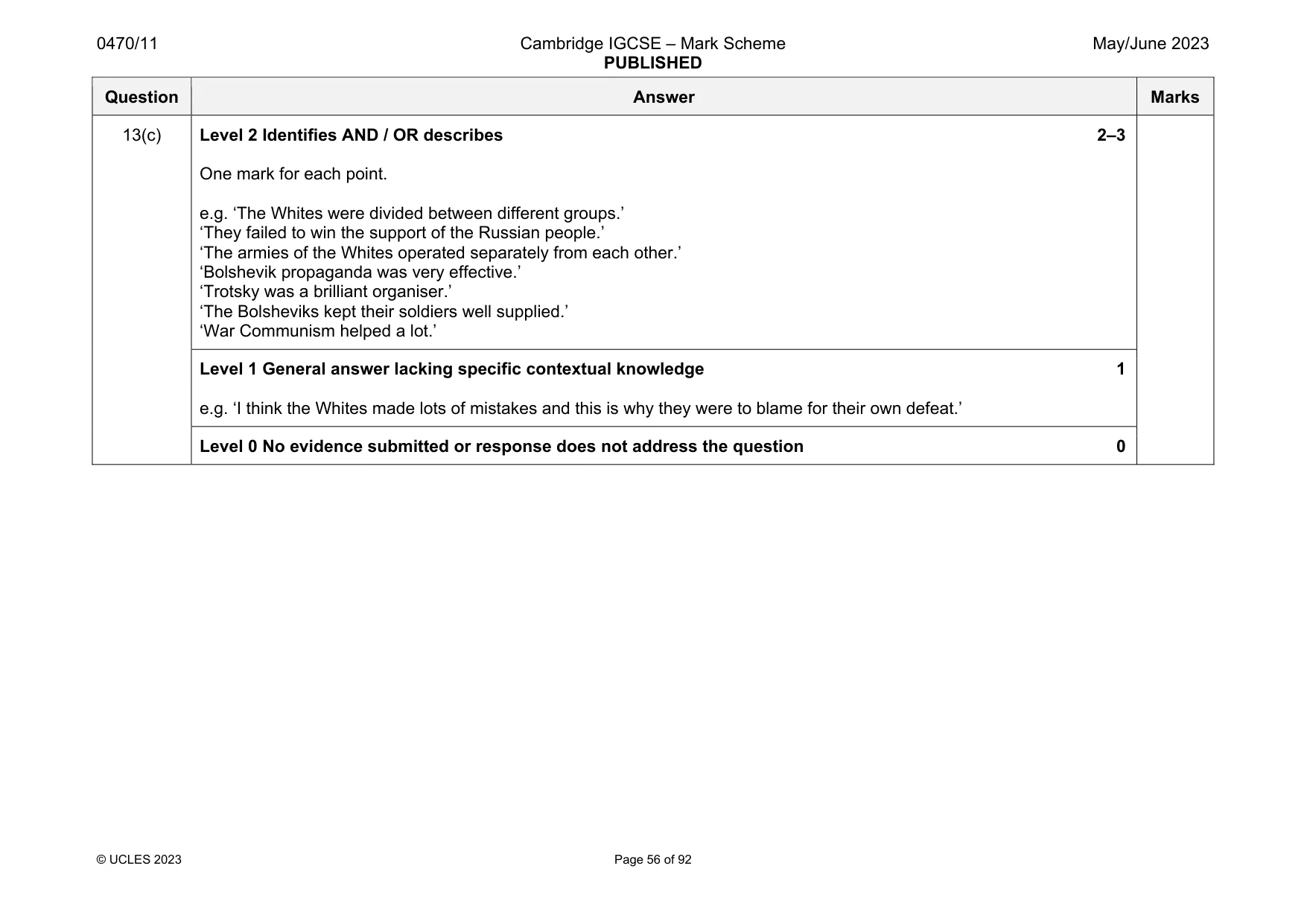
0470/11 Cambridge IGCSE – Mark Scheme PUBLISHED May/June 2023 © UCLES 2023 Page 56 of 92 Question Answer Marks 13(c) Level 2 Identifies AND / OR describes 2–3 One mark for each point. e.g. ‘The Whites were divided between different groups.’ ‘They failed to win the support of the Russian people.’ ‘The armies of the Whites operated separately from each other.’ ‘Bolshevik propaganda was very effective.’ ‘Trotsky was a brilliant organiser.’ ‘The Bolsheviks kept their soldiers well supplied.’ ‘War Communism helped a lot.’ Level 1 General answer lacking specific contextual knowledge 1 e.g. ‘I think the Whites made lots of mistakes and this is why they were to blame for their own defeat.’ Level 0 No evidence submitted or response does not address the question 0
Mark scheme, page 57
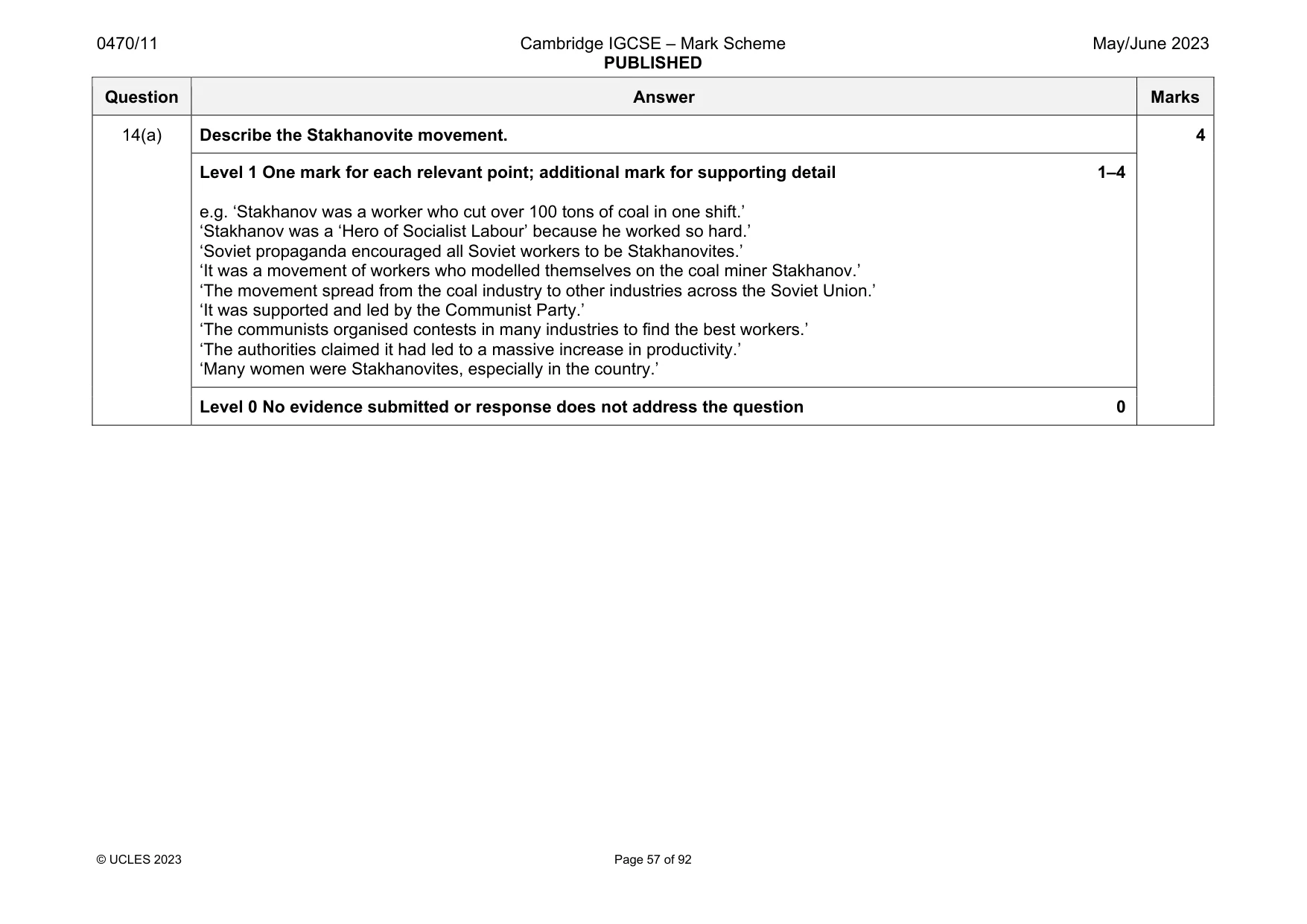
0470/11 Cambridge IGCSE – Mark Scheme PUBLISHED May/June 2023 © UCLES 2023 Page 57 of 92 Question Answer Marks 14(a) Describe the Stakhanovite movement. 4 Level 1 One mark for each relevant point; additional mark for supporting detail 1–4 e.g. ‘Stakhanov was a worker who cut over 100 tons of coal in one shift.’ ‘Stakhanov was a ‘Hero of Socialist Labour’ because he worked so hard.’ ‘Soviet propaganda encouraged all Soviet workers to be Stakhanovites.’ ‘It was a movement of workers who modelled themselves on the coal miner Stakhanov.’ ‘The movement spread from the coal industry to other industries across the Soviet Union.’ ‘It was supported and led by the Communist Party.’ ‘The communists organised contests in many industries to find the best workers.’ ‘The authorities claimed it had led to a massive increase in productivity.’ ‘Many women were Stakhanovites, especially in the country.’ Level 0 No evidence submitted or response does not address the question 0
Mark scheme, page 58
0470/11 Cambridge IGCSE – Mark Scheme PUBLISHED May/June 2023 © UCLES 2023 Page 58 of 92 Question Answer Marks 14(b) Why was it important to Stalin to modernise Soviet agriculture? 6 Level 4 Explains TWO reasons 6 Level 3 Explains ONE reason 4–5 (Four marks for one explanation, five marks for full explanation) e.g. ‘This was important for Stalin because of his ambitions to change Russia into a modern industrialised country. If more people were going to work in cities in industry, then they needed to be fed. To increase the amount of food being produced, Stalin introduced collectivisation. This meant peasants’ holdings being put together. This would let them make better use of their equipment such as tractors and introduce new farming methods. The produce would be sold to the state which could be used to feed the growing industrial population.’ Level 2 Identifies AND / OR describes reasons 2–3 (One mark for each identification/description) e.g. ‘To increase production.’ ‘More food was needed to feed the growing industrial population.’ ‘Russia was not producing enough food.’ ‘They sold the surplus abroad and raised money.’ ‘It would allow his Five-Year Plan to succeed.’ Level 1 General answer lacking specific contextual knowledge 1 e.g. ‘This was important because nothing had been done to improve agriculture for years and so it needed reform.’ Level 0 No evidence submitted or response does not address the question 0
Mark scheme, page 59
0470/11 Cambridge IGCSE – Mark Scheme PUBLISHED May/June 2023 © UCLES 2023 Page 59 of 92 Question Answer Marks 14(c) ‘The impact of industrialisation on the Russian people was disastrous.’ How far do you agree with this statement? Explain your answer. 10 Level 5 Explains with evaluation of ‘how far’ 10 As Level 4 plus evaluation. Level 4 Explanation of both sides 7–9 A L4 answer will have a minimum of three explanations (2 on one side; 1 on the other). This will be worth a mark of 7. Fuller explanation of one issue to be given two marks. An answer which only has one explanation on one side of the argument cannot be awarded more than 8. Level 3 One-sided explanation OR one explanation of both sides 5 to 6 marks 4–6 More detailed explanation of one issue to be given two marks. e.g. ‘I do think it was disastrous for many people working in industry. They were given tough targets to meet which meant working very hard for long hours. The Stakhanovite campaign tried to get them to work even harder. The discipline in the factories was very strict and people were punished for being late by being sacked. On some of the big construction projects, the death rate of workers was very high with thousands being killed.’ OR e.g. ‘I disagree with this statement. Women were able to be trained in top jobs such as engineers and doctors. They were also provided with creches and paid holidays. By the late 1930s, many workers had improved their living conditions through well paid skilled jobs.’
Mark scheme, page 60
0470/11 Cambridge IGCSE – Mark Scheme PUBLISHED May/June 2023 © UCLES 2023 Page 60 of 92 Question Answer Marks 14(c) Level 2 Identifies AND / OR describes 2–3 One mark for each point. e.g. ‘The workers had to work very hard.’ ‘Very stiff targets were set for the workers.’ ‘Discipline in the factories was very tough.’ ‘Many workers lived in crowded flats with little room and wages actually fell for ordinary workers.’ ‘Many workers were killed through accidents.’ ‘Some women were able to be trained as engineers and doctors.’ ‘Women were provided with free health care and paid holidays to encourage them to work.’ Level 1 General answer lacking specific contextual knowledge 1 e.g. ‘I think this is wrong. There were lots of benefits for the Russian people from industrialisation.’ Level 0 No evidence submitted or response does not address the question 0
Mark scheme, page 61
0470/11 Cambridge IGCSE – Mark Scheme PUBLISHED May/June 2023 © UCLES 2023 Page 61 of 92 Question Answer Marks 15(a) Describe the impact of hire purchase (credit) in the United States during the 1920s. 4 Level 1 One mark for each relevant point; additional mark for supporting detail 1–4 e.g. ‘It allowed people to buy cars.’ ‘It meant that people could afford to buy consumer goods like radios and fridges.’ ‘It improved the standard of living of many people.’ ‘It helped fuel the economic boom because it led people to spend more.’ Level 0 No evidence submitted or response does not address the question 0
Mark scheme, page 62
0470/11 Cambridge IGCSE – Mark Scheme PUBLISHED May/June 2023 © UCLES 2023 Page 62 of 92 Question Answer Marks 15(b) Why were some older manufacturing industries in decline during the 1920s? 6 Level 4 Explains TWO reasons 6 Level 3 Explains ONE reason 4–5 (Four marks for one explanation, five marks for full explanation) e.g. ‘The older manufacturing industries, such as cotton production, went into decline. The cotton industry faced competition from new fabrics such as rayon, which was cheaper to produce. The second problem they faced was a change in fashions to shorter skirts. This meant that less fabric was needed to make them which reduced demand.’ Level 2 Identifies AND / OR describes reasons 2–3 (One mark for each identification/description) e.g. ‘The demand for leather goods and textiles was not increasing.’ ‘Skilled jobs in older industries were being lost to mechanisation.’ ‘The woollen and cotton industries suffered from competition from new materials such as rayon.’ Level 1 General answer lacking specific contextual knowledge 1 e.g. ‘They were in decline because they were not as popular as they used to be and fewer people wanted to use them.’ Level 0 No evidence submitted or response does not address the question 0
Mark scheme, page 63
0470/11 Cambridge IGCSE – Mark Scheme PUBLISHED May/June 2023 © UCLES 2023 Page 63 of 92 Question Answer Marks 15(c) ‘American agriculture was in trouble during the 1920s because of over-production.’ How far do you agree with this statement? Explain your answer. 10 Level 5 Explains with evaluation of ‘how far’ 10 As Level 4 plus evaluation. Level 4 Explanation of both sides 7–9 A L4 answer will have a minimum of three explanations (2 on one side; 1 on the other). This will be worth a mark of 7. Fuller explanation of one issue to be given two marks. An answer which only has one explanation on one side of the argument cannot be awarded more than 8. Level 3 One-sided explanation OR one explanation of both sides 5 to 6 marks 4–6 More detailed explanation of one issue to be given two marks. e.g. ‘I agree that over-production was the biggest problem for farming. During the 1st World War, more and more land was farmed to produce foodstuffs for Europe. Improved machinery, especially the combine harvester, and improved fertilisers made US agriculture very efficient. The result was that the US farmer was producing surpluses which nobody wanted and this resulted in lower prices for their products.’ OR e.g. ‘I disagree with this because I think that competition from countries like Canada was the main problem for American agriculture. Canada was using modern efficient methods to produce enormous amounts of wheat which competed with American wheat. Argentina was also producing large amounts of wheat.’
Mark scheme, page 64
0470/11 Cambridge IGCSE – Mark Scheme PUBLISHED May/June 2023 © UCLES 2023 Page 64 of 92 Question Answer Marks 15(c) Level 2 Identifies AND / OR describes 2–3 One mark for each point. e.g. ‘Food exports to Europe were reduced.’ ‘New methods meant that there was over-production of foodstuffs.’ ‘Prices fell which caused hardship for the farmer.’ ‘There was competition from Canada and Argentina.’ ‘Farmers had borrowed from banks and, with lower prices, they could not pay their debts.’ ‘Banks seized farms if debts had not been paid.’ ‘In the South, there was too much reliance on one crop, which made the farmer vulnerable.’ ‘Crops were lost to pests such as the boll weevil.’ ‘European nations would not take US farm products as US had placed tariffs on imports.’ Level 1 General answer lacking specific contextual knowledge 1 e.g. ‘I agree with this statement. Farmers were producing too much and this caused them problems.’ Level 0 No evidence submitted or response does not address the question 0
Mark scheme, page 65
0470/11 Cambridge IGCSE – Mark Scheme PUBLISHED May/June 2023 © UCLES 2023 Page 65 of 92 Question Answer Marks 16(a) Describe the attempts made by Hoover to deal with the effects of the Depression. 4 Level 1 One mark for each relevant point; additional mark for supporting detail 1–4 e.g. ‘He tried to restart the economy by tax cuts.’ ‘He tried to persuade employers not to cut wages.’ ‘He set up the Reconstruction Finance Company to help banks from going bankrupt.’ ‘He put money into public works.’ ‘He put money into the building of the Hoover Dam.’ ‘He introduced tariffs to protect American industries.’ Level 0 No evidence submitted or response does not address the question 0
Mark scheme, page 66
0470/11 Cambridge IGCSE – Mark Scheme PUBLISHED May/June 2023 © UCLES 2023 Page 66 of 92 Question Answer Marks 16(b) Why, during the 1932 presidential election, did Roosevelt promise the American people a ‘New Deal’? 6 Level 4 Explains TWO reasons 6 Level 3 Explains ONE reason 4–5 (Four marks for one explanation, five marks for full explanation) e.g. ‘He promised America a New Deal because it needed it. Hoover had done little to help Americans in the Depression. He was against the government helping people. He did not like the idea of welfare support for the unemployed because he believed in rugged individualism and self-help. Roosevelt realised that America needed a change from these policies and said that he would spend government money to help people get back to work.’ Level 2 Identifies AND / OR describes reasons 2–3 (One mark for each identification/description) e.g. ‘He realised Hoover’s self-help policies were not working.’ ‘There was massive unemployment.’ ‘Wages were being cut so that people could not afford basics.’ ‘The banks had collapsed and people were losing their savings.’ ‘Farmers could not pay their mortgages and were ejected.’ ‘People were homeless and living in shanty towns.’ ‘He realised that people needed help from the government.’ ‘He knew that people needed help to get jobs.’ Level 1 General answer lacking specific contextual knowledge 1 e.g. ‘He did this because America needed something big to help it out of a very difficult situation.’ Level 0 No evidence submitted or response does not address the question 0
Mark scheme, page 67
0470/11 Cambridge IGCSE – Mark Scheme PUBLISHED May/June 2023 © UCLES 2023 Page 67 of 92 Question Answer Marks 16(c) ‘The Wall Street Crash was caused by speculation.’ How far do you agree with this statement? Explain your answer. 10 Level 5 Explains with evaluation of ‘how far’ 10 As Level 4 plus evaluation. Level 4 Explanation of both sides 7–9 A L4 answer will have a minimum of three explanations (2 on one side; 1 on the other). This will be worth a mark of 7. Fuller explanation of one issue to be given two marks. An answer which only has one explanation on one side of the argument cannot be awarded more than 8. Level 3 One-sided explanation OR one explanation of both sides 5 to 6 marks 4–6 More detailed explanation of one issue to be given two marks. e.g. ‘I agree with this. American industry was doing so well that speculators were buying shares and then selling them to make a profit. They often borrowed money from banks to do this. This ended up with banks lending enormous amounts of money. When the value of shares started to go down, people tried to sell their shares which became worth much less than they had paid for them. They could not repay their loans and banks started to go bankrupt.’ OR e.g. ‘I think there were other causes of the Wall Street Crash. The American economy had weaknesses which sooner or later were going to cause trouble. American industry was producing more goods than it could sell. Not so many consumer goods like cars and fridges were sold because the people that could afford them had already bought them while poor people could not afford them. The profits of these industries started to go down and they produced less. This made people nervous and they started to sell their shares.’
Mark scheme, page 68
0470/11 Cambridge IGCSE – Mark Scheme PUBLISHED May/June 2023 © UCLES 2023 Page 68 of 92 Question Answer Marks 16(c) Level 2 Identifies AND / OR describes 2–3 One mark for each point. e.g. ‘Speculators panicked when share prices started to go down.’ ‘Speculators were just trying to make a quick profit.’ ‘The banks lent speculators enormous amounts of money.’ ‘The banks stopped supporting share prices.’ ‘American industry was over producing.’ ‘Fewer people were buying consumer goods.’ ‘America could not sell its good abroad.’ ‘American farmers were producing too much and were in trouble.’ Level 1 General answer lacking specific contextual knowledge 1 e.g. ‘I think this is partly right but there were many other causes.’ Level 0 No evidence submitted or response does not address the question 0
Mark scheme, page 69
0470/11 Cambridge IGCSE – Mark Scheme PUBLISHED May/June 2023 © UCLES 2023 Page 69 of 92 Question Answer Marks 17(a) What happened in the Xi’an Incident of 1936? 4 Level 1 One mark for each relevant point; additional mark for supporting detail 1–4 e.g. ‘Chiang Kai-shek was detained by some of his generals.’ ‘Chiang Kai-shek had pressure put on him to change his policies over Japan and the Communists.’ ‘Chiang had to negotiate with the Communists.’ ‘Chiang agreed to end the war with the Chinese Communists.’ ‘Chiang agreed to do more in fighting Japan.’ Level 0 No evidence submitted or response does not address the question 0
Mark scheme, page 70
0470/11 Cambridge IGCSE – Mark Scheme PUBLISHED May/June 2023 © UCLES 2023 Page 70 of 92 Question Answer Marks 17(b) Why did the Nationalist government become unpopular during the Second World War? 6 Level 4 Explains TWO reasons 6 Level 3 Explains ONE reason 4–5 (Four marks for one explanation, five marks for full explanation) e.g. ‘This was because Chiang Kai-shek was more worried about the Communists than the invading Japanese. He put most of the efforts of his army into fighting the Communists as can be seen in the five extermination campaigns. This upset a lot of Chinese people because they saw the threat from the Japanese as much more of a problem and wanted him to do more to stop them. This was especially important because the Communists were leading the effort against the Japanese.’ Level 2 Identifies AND / OR describes reasons 2–3 (One mark for each identification/description) e.g. ‘It became unpopular because it did not treat the Chinese peasants very well.’ ‘This was because Chiang was more interested in fighting the Communists than the Japanese.’ ‘The KMT was corrupt and taking money from the USA for itself.’ ‘Chiang ignored US advice and refused to go on the offensive against the Japanese.’ Level 1 General answer lacking specific contextual knowledge 1 e.g. ‘I think this happened because they upset people and they were not very popular.’ Level 0 No evidence submitted or response does not address the question 0
Mark scheme, page 71
0470/11 Cambridge IGCSE – Mark Scheme PUBLISHED May/June 2023 © UCLES 2023 Page 71 of 92 Question Answer Marks 17(c) ‘The main reason why the Long March was important was because it won support for the Communists.’ How far do you agree with this statement? Explain your answer. 10 Level 5 Explains with evaluation of ‘how far’ 10 As Level 4 plus evaluation. Level 4 Explanation of both sides 7–9 A L4 answer will have a minimum of three explanations (2 on one side; 1 on the other). This will be worth a mark of 7. Fuller explanation of one issue to be given two marks. An answer which only has one explanation on one side of the argument cannot be awarded more than 8. Level 3 One-sided explanation OR one explanation of both sides 5 to 6 marks 4–6 More detailed explanation of one issue to be given two marks. e.g. ‘I agree with this statement. It was important because it gave the Communists a lot more support. During the Long March the Communists lived and worked with the Chinese peasants. They got to know them and they gave them land and armed them. This helped win over many peasants to the Communist cause especially because the Nationalists treated them so badly.’ OR e.g. ‘I think it was more important for other reasons. The Long March saved the Communists. They were in a great deal of trouble at Jiangxi and were in danger of being wiped out. The Long March took them to Yenan which was much safer. They were safe there and were able to regroup and grow strong. Without the Long March the Communists would have probably been defeated.’
Mark scheme, page 72
0470/11 Cambridge IGCSE – Mark Scheme PUBLISHED May/June 2023 © UCLES 2023 Page 72 of 92 Question Answer Marks 17(c) Level 2 Identifies AND / OR describes 2–3 One mark for each point. e.g. ‘It saved them from being destroyed at Jiangxi.’ ‘It reinforced Mao’s position as leader.’ ‘It gave the Communists time to recover and rebuild.’ ‘It gained them a lot of support.’ ‘It provided useful propaganda for the Communists.’ Level 1 General answer lacking specific contextual knowledge 1 e.g. ‘It was important because it was a great success and helped the people a great deal.’ Level 0 No evidence submitted or response does not address the question 0
Mark scheme, page 73
0470/11 Cambridge IGCSE – Mark Scheme PUBLISHED May/June 2023 © UCLES 2023 Page 73 of 92 Question Answer Marks 18(a) Describe what happened to landlords when the Communists came to power. 4 Level 1 One mark for each relevant point; additional mark for supporting detail 1–4 e.g. ‘They lost their land. It was given to the peasants.’ ‘At “speak bitterness” meetings peasants were encouraged to say how they had mistreated them.’ ‘Landlords were put on trial in people’s courts.’ ‘Their crimes, such as excessive rents, were heard in people’s courts.’ ‘A jury of peasants would decide if they were guilty and they would be punished, sometimes executed.’ ‘About a million landlords were executed and many others sent to camps to be re-educated.’ Level 0 No evidence submitted or response does not address the question 0
Mark scheme, page 74
0470/11 Cambridge IGCSE – Mark Scheme PUBLISHED May/June 2023 © UCLES 2023 Page 74 of 92 Question Answer Marks 18(b) Why were Mao’s educational and social reforms important? 6 Level 4 Explains TWO reasons 6 Level 3 Explains ONE reason 4–5 (Four marks for one explanation, five marks for full explanation) e.g. ‘The educational reforms were important to China as a country. Mao wanted to develop China’s industry to make China a richer and more powerful country. However, most peasants were illiterate. A basic education was introduced for everyone and by the 1960s 90% of the population could read and write. This meant they could operate machinery and play a part in China’s development.’ Level 2 Identifies AND / OR describes reasons 2–3 (One mark for each identification/description) e.g. ‘The educational reforms were important because China needed educated workers.’ ‘The educational reforms were important because they greatly reduced illiteracy in China.’ ‘Health care became free and more doctors were put into rural areas. This improved the medical care of the peasants.’ ‘Prevention of disease through sensible measures was encouraged.’ ‘Forced marriages were banned.’ ‘Binding the feet of girls was stopped.’ ‘Divorce was made easier.’ Level 1 General answer lacking specific contextual knowledge 1 e.g. ‘They were important because they did a lot of good and changed people’s lives.’ Level 0 No evidence submitted or response does not address the question 0
Mark scheme, page 75
0470/11 Cambridge IGCSE – Mark Scheme PUBLISHED May/June 2023 © UCLES 2023 Page 75 of 92 Question Answer Marks 18(c) ‘The introduction of communes benefited the Chinese people.’ How far do you agree with this statement? Explain your answer. 10 Level 5 Explains with evaluation of ‘how far’ 10 As Level 4 plus evaluation. Level 4 Explanation of both sides 7–9 A L4 answer will have a minimum of three explanations (2 on one side; 1 on the other). This will be worth a mark of 7. Fuller explanation of one issue to be given two marks. An answer which only has one explanation on one side of the argument cannot be awarded more than 8. Level 3 One-sided explanation OR one explanation of both sides 5 to 6 marks 4–6 More detailed explanation of one issue to be given two marks. e.g. ‘I do not agree with this statement. There was not much freedom in the communes. They were run by a militia which was in charge of discipline in the commune. They made sure the commune people had the right political attitudes, worked hard and did as they were told. They had to eat in communal halls and could not work for themselves to earn some extra money.’ OR e.g. ‘There were many benefits. The communes supplied all the members with free goods and food. Education and childcare services were also provided free. There were few examples of resistance to life in communes because they provided people with their basic needs and many were better off compared to their lives before when they lived under cruel landlords.’
Mark scheme, page 76
0470/11 Cambridge IGCSE – Mark Scheme PUBLISHED May/June 2023 © UCLES 2023 Page 76 of 92 Question Answer Marks 18(c) Level 2 Identifies AND / OR describes 2–3 One mark for each point. e.g. ‘People had little freedom in communes.’ ‘People had to work and live as directed by the commune militia in charge of the commune.’ ‘They were not allowed to run small private enterprises.’ ‘Sometimes they were directed to work on non-agricultural work which often meant a lack of food and even famine.’ ‘Later, private household plots were allowed.’ ‘They were given free education and childcare.’ ‘Food was provided for commune members.’ Level 1 General answer lacking specific contextual knowledge 1 e.g. ‘I agree with this. The communes helped make people’s lives better and they were much happier.’ Level 0 No evidence submitted or response does not address the question 0
Mark scheme, page 77
0470/11 Cambridge IGCSE – Mark Scheme PUBLISHED May/June 2023 © UCLES 2023 Page 77 of 92 Question Answer Marks 19(a) What were the terms of the Population Registration Act of 1950? 4 Level 1 One mark for each relevant point; additional mark for supporting detail 1–4 e.g. ‘It tried to classify every South African as white, black or “Coloured”.’ ‘Racial groups were determined by the community into which individuals had first been accepted, their outward appearance and their social standing.’ ‘The law ran into difficulties over, for example, children of mixed marriages.’ ‘Political, educational and social rights were determined by the group to which an individual belonged.’ Level 0 No evidence submitted or response does not address the question 0
Mark scheme, page 78
0470/11 Cambridge IGCSE – Mark Scheme PUBLISHED May/June 2023 © UCLES 2023 Page 78 of 92 Question Answer Marks 19(b) Why was the Group Areas Act of 1950 important? 6 Level 4 Explains TWO reasons 6 Level 3 Explains ONE reason 4–5 (Four marks for one explanation, five marks for full explanation) e.g. ‘It was important because it uprooted so many non-white people. South Africa was divided into racial areas where only one race was allowed to live. If people were living in the wrong area they were moved, sometimes forcibly as in Sophiatown where black people had been living for decades. This caused much resentment and bitterness and made apartheid even more unpopular.’ Level 2 Identifies AND / OR describes reasons 2–3 (One mark for each identification/description) e.g. ‘It was important because people (mostly non-white people) had to move.’ ‘Over 3.5 million people were moved out of their homes to other areas.’ ‘It tried to ensure that different groups of people lived separately from each other.’ ‘It was responsible for the forcible ejection of people from Sophiatown.’ Level 1 General answer lacking specific contextual knowledge 1 e.g. ‘It was important because it changed the lives of many people.’ Level 0 No evidence submitted or response does not address the question 0
Mark scheme, page 79
0470/11 Cambridge IGCSE – Mark Scheme PUBLISHED May/June 2023 © UCLES 2023 Page 79 of 92 Question Answer Marks 19(c) ‘The nature of the opposition to apartheid changed little in the period 1948–64.’ How far do you agree with this statement? Explain your answer. 10 Level 5 Explains with evaluation of ‘how far’ 10 As Level 4 plus evaluation. Level 4 Explanation of both sides 7–9 A L4 answer will have a minimum of three explanations (2 on one side; 1 on the other). This will be worth a mark of 7. Fuller explanation of one issue to be given two marks. An answer which only has one explanation on one side of the argument cannot be awarded more than 8. Level 3 One-sided explanation OR one explanation of both sides 5 to 6 marks 4–6 More detailed explanation of one issue to be given two marks. e.g. ‘I agree with this statement. The opposition was mainly peaceful, such as the Defiance Campaign of 1952 when campaigners entered white only railway coaches and waiting rooms, and ignored curfews. Other methods used included agreeing on the Freedom Charter which called for the end to apartheid and the introduction of democracy. There was also the PAC campaign against the pass laws. All of these methods were peaceful ones and showed that the opposition to apartheid was peaceful.’ OR e.g. ‘I disagree with this. The failure of peaceful means such as petitions, the defiance campaign and boycotts, as well as the banning of ANC, drove the organisation to go underground. The MK decided on a policy of violent resistance, sabotaging government and police buildings, and power installations. This resulted in the imprisonment of Nelson Mandela, who became a symbol of the fight against apartheid.’
Mark scheme, page 80
0470/11 Cambridge IGCSE – Mark Scheme PUBLISHED May/June 2023 © UCLES 2023 Page 80 of 92 Question Answer Marks 19(c) Level 2 Identifies AND / OR describes 2–3 One mark for each point. e.g. ‘The Freedom Charter set a vision for the future.’ ‘The Freedom Charter wanted to see peaceful change to a new South Africa.’ ‘The Defiance Campaign was a peaceful way of defying apartheid.’ ‘PAC organised a peaceful campaign against the pass laws.’ ‘The ANC’s underground military wing, the MK, turned to violence.’ ‘Peaceful methods had not worked so the MK tried to draw attention to the evils of apartheid.’ ‘The MK used violence against the police and government.’ ‘The MK did joint operations with the Poqo, the military wing of the PAC.’ Level 1 General answer lacking specific contextual knowledge 1 e.g. ‘The opposition used the same methods most of the time but sometimes used new ones.’ Level 0 No evidence submitted or response does not address the question 0
Mark scheme, page 81
0470/11 Cambridge IGCSE – Mark Scheme PUBLISHED May/June 2023 © UCLES 2023 Page 81 of 92 Question Answer Marks 20(a) Who was Eugene Terre’Blanche? 4 Level 1 One mark for each relevant point; additional mark for supporting detail 1–4 e.g. ‘He was an Afrikaner nationalist.’ ‘He founded the Afrikaner Resistance Movement.’ ‘He led the backlash against the collapse of apartheid.’ ‘He used violence to try to oppose concessions offered to the ANC.’ ‘His followers were involved in the Battle of Ventersdorp where three of them were killed.’ ‘He used bombs and assassination to try to stop the elections of 1994.’ Level 0 No evidence submitted or response does not address the question 0
Mark scheme, page 82
0470/11 Cambridge IGCSE – Mark Scheme PUBLISHED May/June 2023 © UCLES 2023 Page 82 of 92 Question Answer Marks 20(b) Why was the 1994 election important? 6 Level 4 Explains TWO reasons 6 Level 3 Explains ONE reason 4–5 (Four marks for one explanation, five marks for full explanation) e.g. ‘This was so important because it was a success. After all the violence leading up to it there were fears it would not work properly. Just a month before, Inkatha members had rampaged through Johannesburg and attacked ANC headquarters and the country seemed on the brink of civil war. However, 16 million black South Africans voted for the first time and altogether over 19 million people voted. People had to queue for a long time to vote but the election ran smoothly. The ANC won and this was accepted by the vast majority of the population. It was a triumph.’ Level 2 Identifies AND / OR describes reasons 2–3 (One mark for each identification/description) e.g. ‘It was the first ever democratic election to be held in South Africa.’ ‘Black South Africans were allowed to vote for the first time.’ ‘It was a great success as it ran smoothly.’ ‘It meant that a government of national unity led by the ANC was elected.’ Level 1 General answer lacking specific contextual knowledge 1 e.g. ‘I think it was important because it changed everything. Nothing would ever be the same again.’ Level 0 No evidence submitted or response does not address the question 0
Mark scheme, page 83
0470/11 Cambridge IGCSE – Mark Scheme PUBLISHED May/June 2023 © UCLES 2023 Page 83 of 92 Question Answer Marks 20(c) ‘The policies of P W Botha during the late 1970s and the 1980s were repressive.’ How far do you agree with this statement? Explain your answer. 10 Level 5 Explains with evaluation of ‘how far’ 10 As Level 4 plus evaluation. Level 4 Explanation of both sides 7–9 A L4 answer will have a minimum of three explanations (2 on one side; 1 on the other). This will be worth a mark of 7. Fuller explanation of one issue to be given two marks. An answer which only has one explanation on one side of the argument cannot be awarded more than 8. Level 3 One-sided explanation OR one explanation of both sides 5 to 6 marks 4–6 More detailed explanation of one issue to be given two marks. e.g. ‘I think that Botha’s policies were ones of repression. He was determined not to allow black South Africans any part in the political process. In 1985 he introduced a State of Emergency which gave the government sweeping powers. People could be arrested without warrants and detained without trial. Torture was used on prisoners. The police shot and killed people at funerals and protest marches. Botha was determined to repress any sign of dissent.’ OR e.g. ‘I disagree. Botha did realise that reforms were needed. He got rid of some of the segregation laws such as those about marriage, hotels and sports fixtures. He also introduced a new constitution that gave more representation to Asians. He also realised that he could not stop black people moving from the Homelands to cities and so repealed the pass laws. Bit by bit apartheid was beginning to come apart.’
Mark scheme, page 84
0470/11 Cambridge IGCSE – Mark Scheme PUBLISHED May/June 2023 © UCLES 2023 Page 84 of 92 Question Answer Marks 20(c) Level 2 Identifies AND / OR describes 2–3 One mark for each point. e.g. ‘Black trade unions were recognised by law.’ ‘A new constitution gave ‘Coloureds’ and Asians representation.’ ‘The pass laws were repealed.’ ‘The permit system allowing Asians and black people to live in white suburbs was extended.’ ‘Spending on schools for non-white people was increased.’ ‘Ban on interracial sex and marriage was repealed.’ ‘Many hotels and sports fixtures were desegregated.’ ‘Black Africans were not given the vote in the new constitution.’ ‘Some segregation laws remained.’ ‘Botha declared a state of emergency in 1985.’ ‘Police killings increased – there were shootings and killings at funerals and protest marches.’ ‘Restrictions on the press and civil liberties were suspended.’ ‘Widespread torture and violence by the security forces.’ Level 1 General answer lacking specific contextual knowledge 1 e.g. ‘I think that many of his policies were repressive, although he tried to cover this up.’ Level 0 No evidence submitted or response does not address the question 0
Mark scheme, page 85
0470/11 Cambridge IGCSE – Mark Scheme PUBLISHED May/June 2023 © UCLES 2023 Page 85 of 92 Question Answer Marks 21(a) Describe British reactions to Jewish immigration after the Second World War. 4 Level 1 One mark for each relevant point; additional mark for supporting detail 1–4 e.g. ‘Britain rejected Ben Gurion’s plea that 100 000 Holocaust survivors should be allowed to enter Palestine.’ ‘It transported illegal immigrants in Palestine back to Europe.’ ‘It interned thousands of illegal immigrants in detention camps in Cyprus.’ ‘The USA persuaded Britain to lift its limits on Jewish immigration.’ ‘Britain was against Jewish immigration because it did not want to upset Arab Palestinians.’ ‘Britain tried to intercept the ships carrying the immigrants.’ Level 0 No evidence submitted or response does not address the question 0
Mark scheme, page 86
0470/11 Cambridge IGCSE – Mark Scheme PUBLISHED May/June 2023 © UCLES 2023 Page 86 of 92 Question Answer Marks 21(b) Why was the 1948–49 war important? 6 Level 4 Explains TWO reasons 6 Level 3 Explains ONE reason 4–5 (Four marks for one explanation, five marks for full explanation) e.g. ‘It was important because it started the existence of Palestinian refugees. During the war, Israeli soldiers drove Palestinians from their homes and there was a massive flight of people. They were never able to come back to their villages and so they became refugees. Israel would not let them return and so they ended up in camps. In 1950, the UN set up camps across the Arab states and this seemed to show that the refugee issue would be permanent.’ Level 2 Identifies AND / OR describes reasons 2–3 (One mark for each identification/description) e.g. ‘Israel increased its territory.’ ‘Israel gained defendable boundaries.’ ‘It showed that Israel could defend itself and defeat Arab armies.’ ‘Hopes for a Palestinian state were crushed.’ ‘Palestinians were driven from their homes and became refugees.’ ‘Refugee camps were set up by the UN.’ Level 1 General answer lacking specific contextual knowledge 1 e.g. ‘I think it was very important because it changed the situation enormously.’ Level 0 No evidence submitted or response does not address the question 0
Mark scheme, page 87
0470/11 Cambridge IGCSE – Mark Scheme PUBLISHED May/June 2023 © UCLES 2023 Page 87 of 92 Question Answer Marks 21(c) ‘The United Nations’ partition plan had little support.’ How far do you agree with this statement? Explain your answer. 10 Level 5 Explains with evaluation of ‘how far’ 10 As Level 4 plus evaluation. Level 4 Explanation of both sides 7–9 A L4 answer will have a minimum of three explanations (2 on one side; 1 on the other). This will be worth a mark of 7. Fuller explanation of one issue to be given two marks. An answer which only has one explanation on one side of the argument cannot be awarded more than 8. Level 3 One-sided explanation OR one explanation of both sides 5 to 6 marks 4–6 More detailed explanation of one issue to be given two marks. e.g. ‘I agree with this. The Arabs did not like the plan at all. They did not like the idea of setting up a Jewish state in what they regarded as their land. They could also see that the plan gave the Jews most of the land when their population was smaller than the Arab population. Finally, they greatly disliked the idea of many Arabs living under Jewish rule. They thought the UN committee was biased towards the Jews from the start and complained that they had been given a much worse deal than that for the Jews.’ OR e.g. ‘There was support for the plan. Both the USA and the USSR supported the plan. This was very important because without their support the plan could not have worked. The Jews also generally liked the plan because they were being given a Jewish state – a Jewish homeland, which was what they had been asking for over a long time.’
Mark scheme, page 88
0470/11 Cambridge IGCSE – Mark Scheme PUBLISHED May/June 2023 © UCLES 2023 Page 88 of 92 Question Answer Marks 21(c) Level 2 Identifies AND / OR describes 2–3 One mark for each point. e.g. ‘The Palestinian Arabs disliked the plan. They did not want two separate states to be set up.’ ‘They did not like giving up 56% of Palestine to the Jews.’ ‘The plan would have left Arabs living in a Jewish state.’ ‘The land proposed for the Arabs state was poor.’ ‘The Arabs believed the UN committee was biased.’ ‘The Jews liked the idea of a Jewish homeland.’ ‘They liked the fact that the British would be gone.’ ‘The Jews wanted control of Jerusalem.’ ‘The Jews did not like the splitting up of their areas.’ ‘The British did not like losing their influence there.’ ‘The British did not like the creation of two states.’ ‘The British thought the Arabs were not treated well.’ ‘Both the USA and the USSR supported the plan.’ Level 1 General answer lacking specific contextual knowledge 1 e.g. ‘I disagree with this because there were some people who thought it was a good idea and that it should be adopted.’ Level 0 No evidence submitted or response does not address the question 0
Mark scheme, page 89
0470/11 Cambridge IGCSE – Mark Scheme PUBLISHED May/June 2023 © UCLES 2023 Page 89 of 92 Question Answer Marks 22(a) What role has the United Nations played in helping Palestinian refugees? 4 Level 1 One mark for each relevant point; additional mark for supporting detail 1–4 e.g. ‘In 1948 it set up the United Nations Relief for Palestinian Refugees.’ ‘In 1948 the UN passed a resolution for Palestinians to be allowed to return home.’ ‘In 1949 it set up UNRWA to provide work for the Palestinian refugees.’ ‘They built the first refugee camps in 1950.’ ‘The UN camps set up in 1950 provided education, health care and help with farming.’ ‘The UN built more camps after the 1967 war.’ ‘The UN still funds refugee camps across the Arab nations.’ ‘The UN provides formal identification for all Palestinian refugees.’ Level 0 No evidence submitted or response does not address the question 0
Mark scheme, page 90
0470/11 Cambridge IGCSE – Mark Scheme PUBLISHED May/June 2023 © UCLES 2023 Page 90 of 92 Question Answer Marks 22(b) Why did the 1967 war increase the number of Palestinian refugees? 6 Level 4 Explains TWO reasons 6 Level 3 Explains ONE reason 4–5 (Four marks for one explanation, five marks for full explanation) e.g. ‘This was because Israel did well in the war and gained a lot of Arab territory. In fact, it tripled its size and gained Gaza, the West Bank, East Jerusalem, and the Golan Heights. Palestinians fled from these areas as they did not want to be under Israeli control. They had nowhere to go and ended up as refugees.’ Level 2 Identifies AND / OR describes reasons 2–3 (One mark for each identification/description) e.g. ‘Israel gained a lot of Arab territory in the war.’ ‘Palestinians fled during the war.’ ‘Israel would not let the Palestinians back to their homes after the war.’ ‘Israel encouraged Jewish settlers onto the conquered land.’ Level 1 General answer lacking specific contextual knowledge 1 e.g. ‘This happened because the problem grew a lot worse because of the result of the war. A lot more people needed help.’ Level 0 No evidence submitted or response does not address the question 0
Mark scheme, page 91
0470/11 Cambridge IGCSE – Mark Scheme PUBLISHED May/June 2023 © UCLES 2023 Page 91 of 92 Question Answer Marks 22(c) Which has done more to help the Palestinian cause, Arab states or the Palestine Liberation Organisation (PLO)? Explain your answer. 10 Level 5 Explains with evaluation of ‘which has done more to help the Palestinian cause’ 10 As Level 4 plus evaluation. Level 4 Explanation of both sides 7–9 A L4 answer will have a minimum of three explanations (2 on one side; 1 on the other). This will be worth a mark of 7. Fuller explanation of one issue to be given two marks. An answer which only has one explanation on one side of the argument cannot be awarded more than 8. Level 3 One-sided explanation OR one explanation of both sides 5 to 6 marks 4–6 More detailed explanation of one issue to be given two marks. e.g. ‘The PLO has tried to do things for the Palestinian cause but has not been very successful. In the 1970s it used terrorism, such as hijacking planes, to get publicity for the Palestinians but this was counter-productive and did not win much support. It turned a lot of countries against the PLO. Jordan even drove the PLO out of its country, killing thousands of Palestinians.’ OR e.g. ‘I do not think Arab states have done much for the Palestinian cause. In 1979 they promised financial support for the PLO, but only Saudi Arabia paid its share. The Arab states also contributed little to help fund UNRWA, with the USA paying a lot of the money. Each of the Arab states used the Palestinians to help their own national interests rather than helping the people who needed help. Even back in 1948 some Arab countries did not help the Palestinian refugees to return home because the existence of refugee camps was a useful propaganda weapon.’
Mark scheme, page 92
0470/11 Cambridge IGCSE – Mark Scheme PUBLISHED May/June 2023 © UCLES 2023 Page 92 of 92 Question Answer Marks 22(c) Level 2 Identifies AND / OR describes 2–3 One mark for each point. e.g. ‘PLO terrorism turned many countries against the Palestinian cause.’ ‘The PLO’s activities in Jordan turned King Hussein against the Palestinian cause.’ ‘In 1974 the PLO was granted observer status at the UN.’ ‘In 1974 Arafat was allowed to address the General Assembly.’ ‘Some Arab states wanted to keep the refugee issue alive as a propaganda weapon.’ ‘Arab states have done little to support the refugee camps.’ Level 1 General answer lacking specific contextual knowledge 1 e.g. ‘I think they have both done a lot.’ Level 0 No evidence submitted or response does not address the question 0
What you needed in this session
Cambridge’s own grade thresholds for 2023 May/June, Paper 1 · Variant 1. A higher threshold means an easier paper — the bar moves with how the cohort did.