Cambridge IGCSE History 0470 — 2025 May/June Paper 1 · Variant 2
0470/12/M/J/25 · 60 marks · 120 min
The question paper and its mark scheme, free to read here and free to download. This is Cambridge’s own paper, exactly as it was sat.
Question paper8 pages

Mark scheme77 pages
Answers below. Sit the paper first if you are practising.
Paper as text
Question paper, page 1
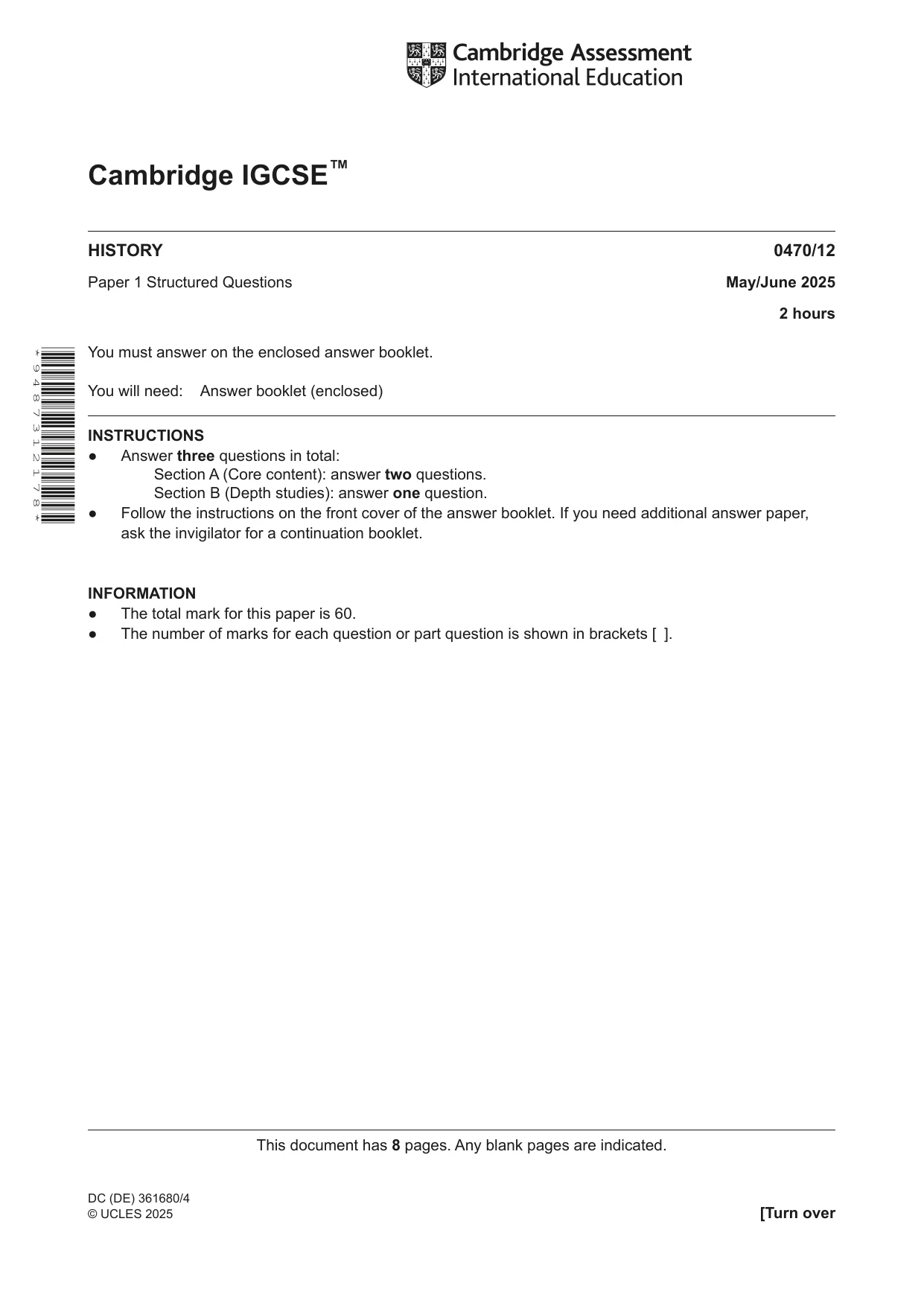
This document has 8 pages. Any blank pages are indicated. [Turn over Cambridge IGCSE™ * 9 4 8 7 3 1 2 1 7 8 * HISTORY 0470/12 Paper 1 Structured Questions May/June 2025 2 hours You must answer on the enclosed answer booklet. You will need: Answer booklet (enclosed) INSTRUCTIONS ● Answer three questions in total: Section A (Core content): answer two questions. Section B (Depth studies): answer one question. ● Follow the instructions on the front cover of the answer booklet. If you need additional answer paper, ask the invigilator for a continuation booklet. INFORMATION ● The total mark for this paper is 60. ● The number of marks for each question or part question is shown in brackets [ ]. DC (DE) 361680/4 © UCLES 2025
Question paper, page 2
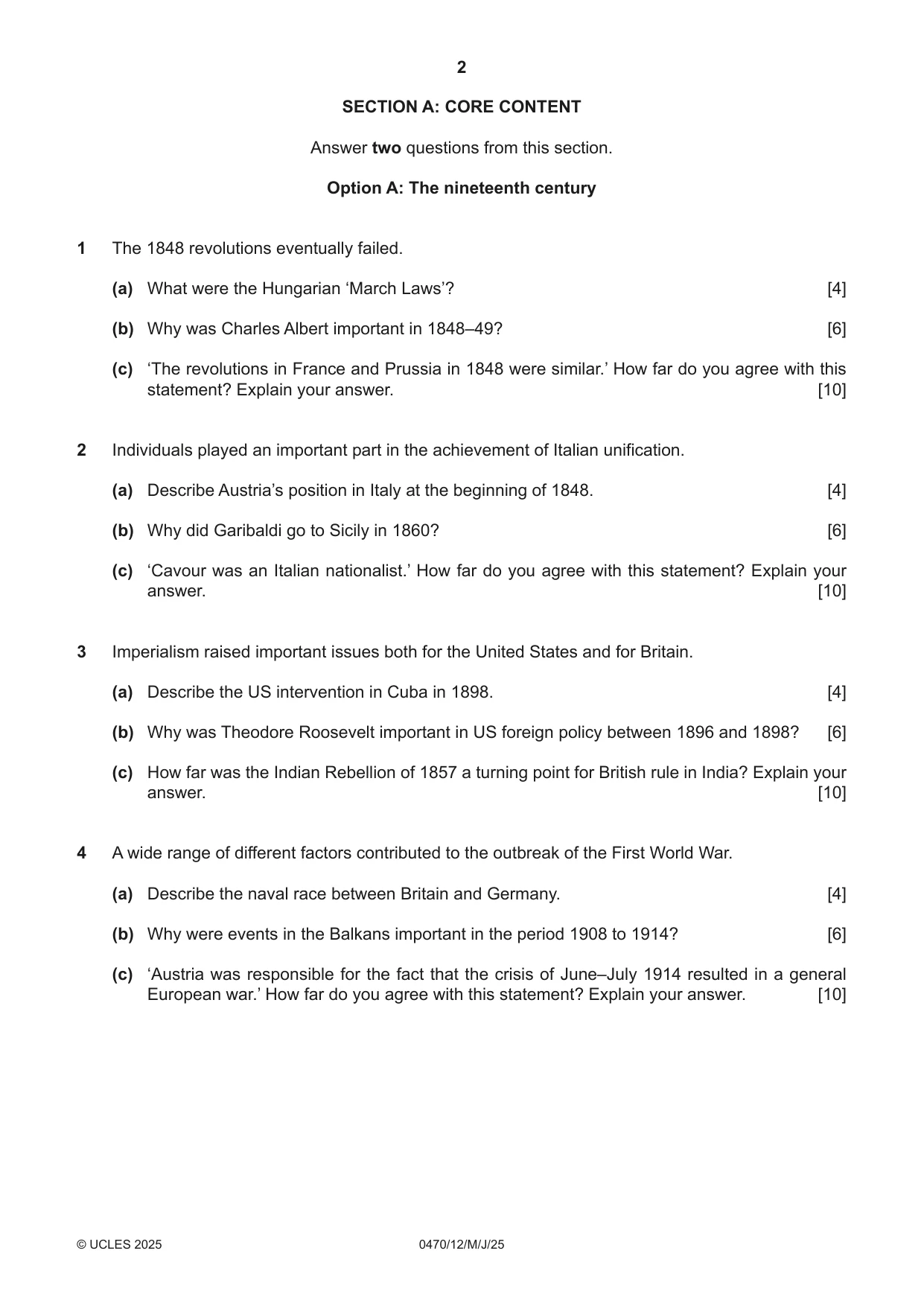
2 0470/12/M/J/25 © UCLES 2025 SECTION A: CORE CONTENT Answer two questions from this section. Option A: The nineteenth century 1 The 1848 revolutions eventually failed. (a) What were the Hungarian ‘March Laws’? [4] (b) Why was Charles Albert important in 1848–49? [6] (c) ‘The revolutions in France and Prussia in 1848 were similar.’ How far do you agree with this statement? Explain your answer. [10] 2 Individuals played an important part in the achievement of Italian unification. (a) Describe Austria’s position in Italy at the beginning of 1848. [4] (b) Why did Garibaldi go to Sicily in 1860? [6] (c) ‘Cavour was an Italian nationalist.’ How far do you agree with this statement? Explain your answer. [10] 3 Imperialism raised important issues both for the United States and for Britain. (a) Describe the US intervention in Cuba in 1898. [4] (b) Why was Theodore Roosevelt important in US foreign policy between 1896 and 1898? [6] (c) How far was the Indian Rebellion of 1857 a turning point for British rule in India? Explain your answer. [10] 4 A wide range of different factors contributed to the outbreak of the First World War. (a) Describe the naval race between Britain and Germany. [4] (b) Why were events in the Balkans important in the period 1908 to 1914? [6] (c) ‘Austria was responsible for the fact that the crisis of June–July 1914 resulted in a general European war.’ How far do you agree with this statement? Explain your answer. [10]
Question paper, page 3
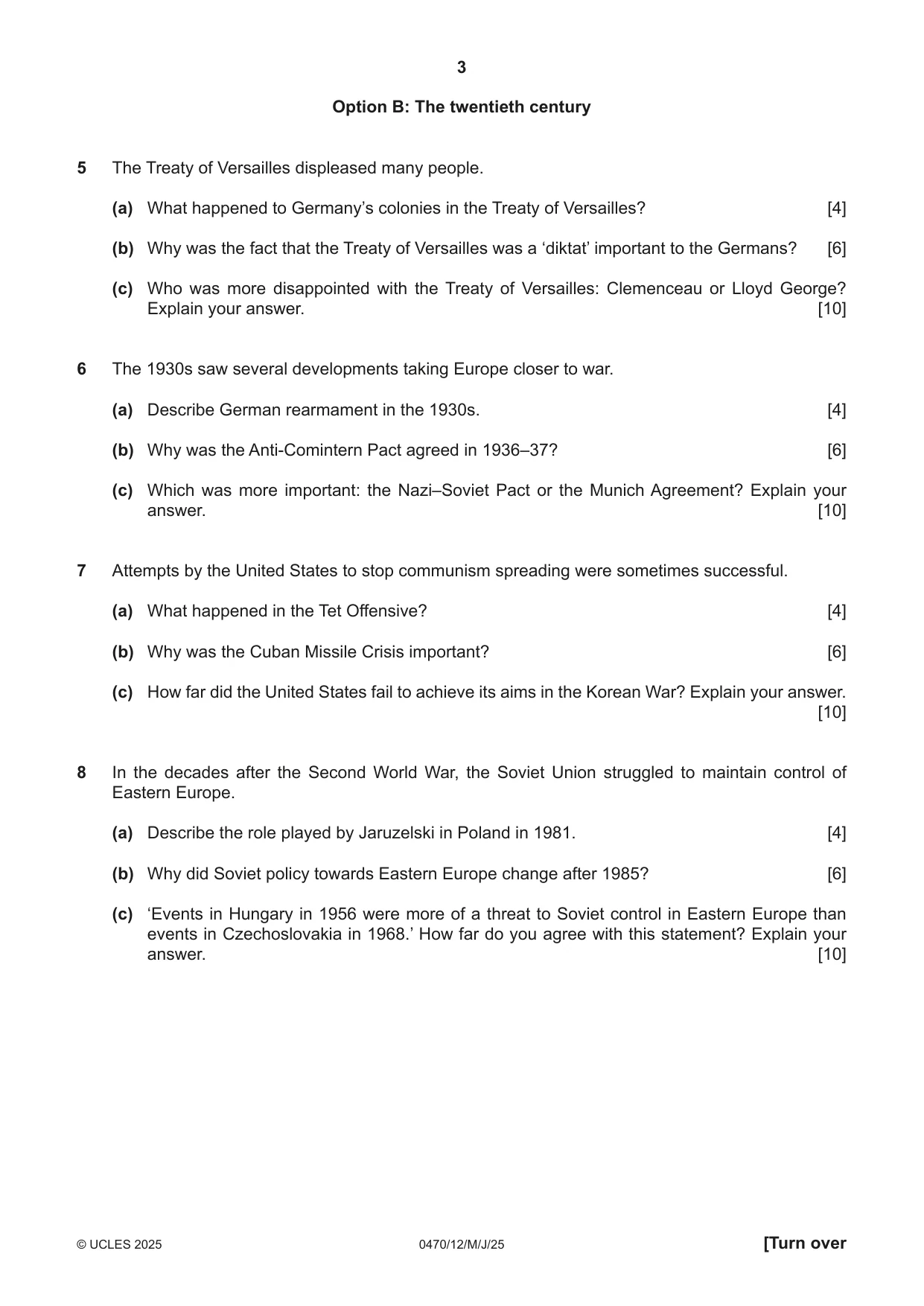
3 0470/12/M/J/25 © UCLES 2025 [Turn over Option B: The twentieth century 5 The Treaty of Versailles displeased many people. (a) What happened to Germany’s colonies in the Treaty of Versailles? [4] (b) Why was the fact that the Treaty of Versailles was a ‘diktat’ important to the Germans? [6] (c) Who was more disappointed with the Treaty of Versailles: Clemenceau or Lloyd George? Explain your answer. [10] 6 The 1930s saw several developments taking Europe closer to war. (a) Describe German rearmament in the 1930s. [4] (b) Why was the Anti-Comintern Pact agreed in 1936–37? [6] (c) Which was more important: the Nazi–Soviet Pact or the Munich Agreement? Explain your answer. [10] 7 Attempts by the United States to stop communism spreading were sometimes successful. (a) What happened in the Tet Offensive? [4] (b) Why was the Cuban Missile Crisis important? [6] (c) How far did the United States fail to achieve its aims in the Korean War? Explain your answer. [10] 8 In the decades after the Second World War, the Soviet Union struggled to maintain control of Eastern Europe. (a) Describe the role played by Jaruzelski in Poland in 1981. [4] (b) Why did Soviet policy towards Eastern Europe change after 1985? [6] (c) ‘Events in Hungary in 1956 were more of a threat to Soviet control in Eastern Europe than events in Czechoslovakia in 1968.’ How far do you agree with this statement? Explain your answer. [10]
Question paper, page 4
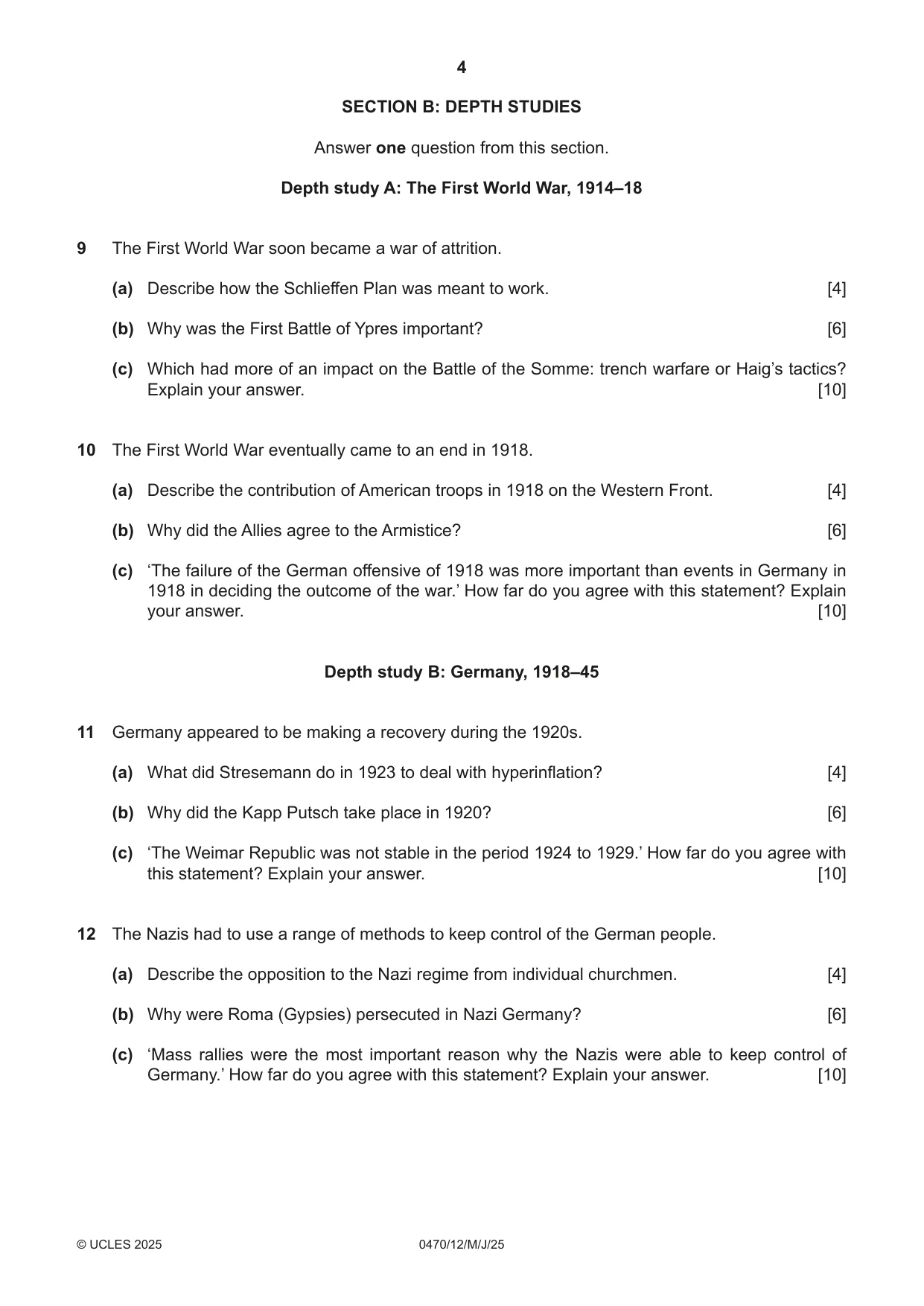
4 0470/12/M/J/25 © UCLES 2025 SECTION B: DEPTH STUDIES Answer one question from this section. Depth study A: The First World War, 1914–18 9 The First World War soon became a war of attrition. (a) Describe how the Schlieffen Plan was meant to work. [4] (b) Why was the First Battle of Ypres important? [6] (c) Which had more of an impact on the Battle of the Somme: trench warfare or Haig’s tactics? Explain your answer. [10] 10 The First World War eventually came to an end in 1918. (a) Describe the contribution of American troops in 1918 on the Western Front. [4] (b) Why did the Allies agree to the Armistice? [6] (c) ‘The failure of the German offensive of 1918 was more important than events in Germany in 1918 in deciding the outcome of the war.’ How far do you agree with this statement? Explain your answer. [10] Depth study B: Germany, 1918–45 11 Germany appeared to be making a recovery during the 1920s. (a) What did Stresemann do in 1923 to deal with hyperinflation? [4] (b) Why did the Kapp Putsch take place in 1920? [6] (c) ‘The Weimar Republic was not stable in the period 1924 to 1929.’ How far do you agree with this statement? Explain your answer. [10] 12 The Nazis had to use a range of methods to keep control of the German people. (a) Describe the opposition to the Nazi regime from individual churchmen. [4] (b) Why were Roma (Gypsies) persecuted in Nazi Germany? [6] (c) ‘Mass rallies were the most important reason why the Nazis were able to keep control of Germany.’ How far do you agree with this statement? Explain your answer. [10]
Question paper, page 5
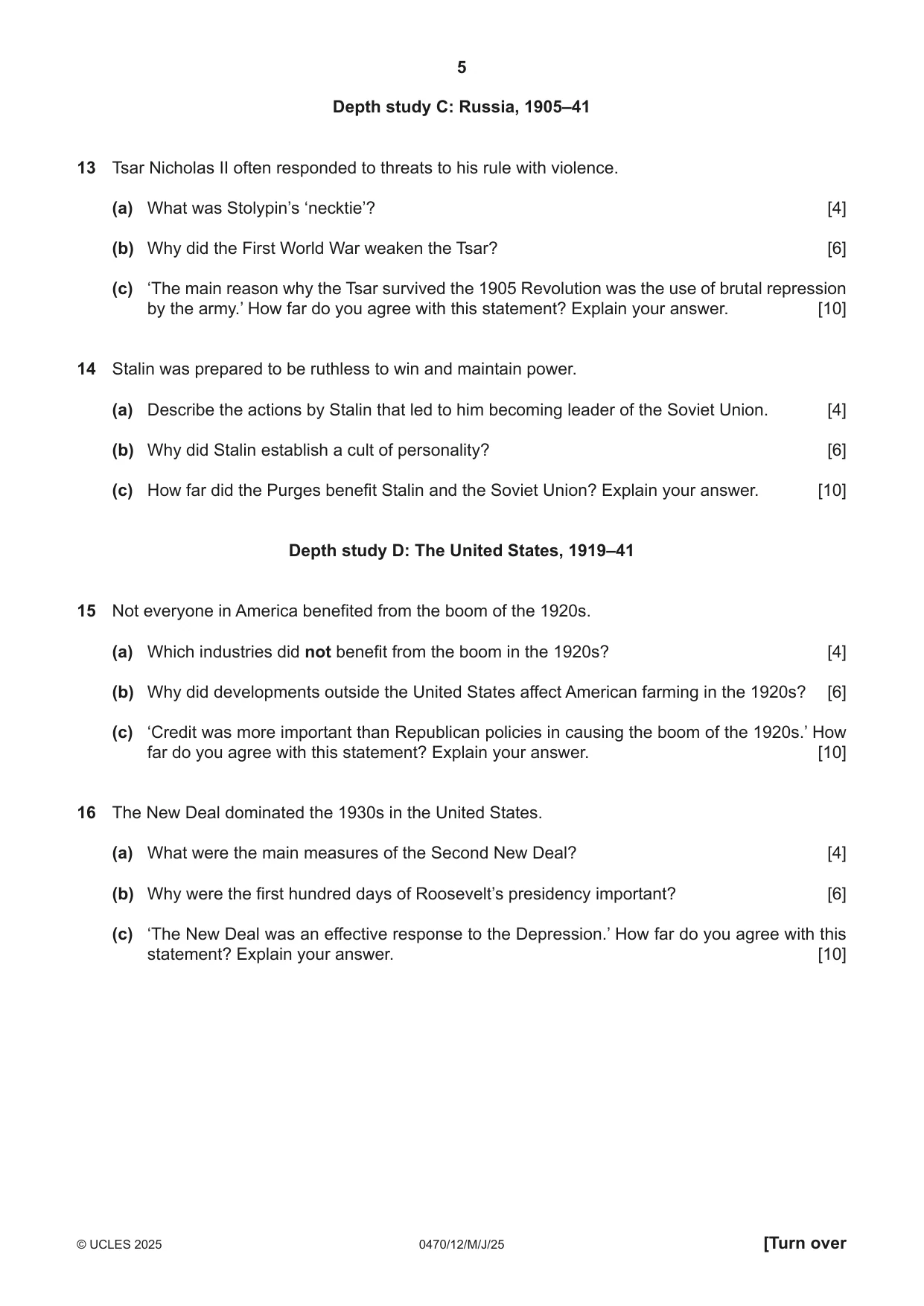
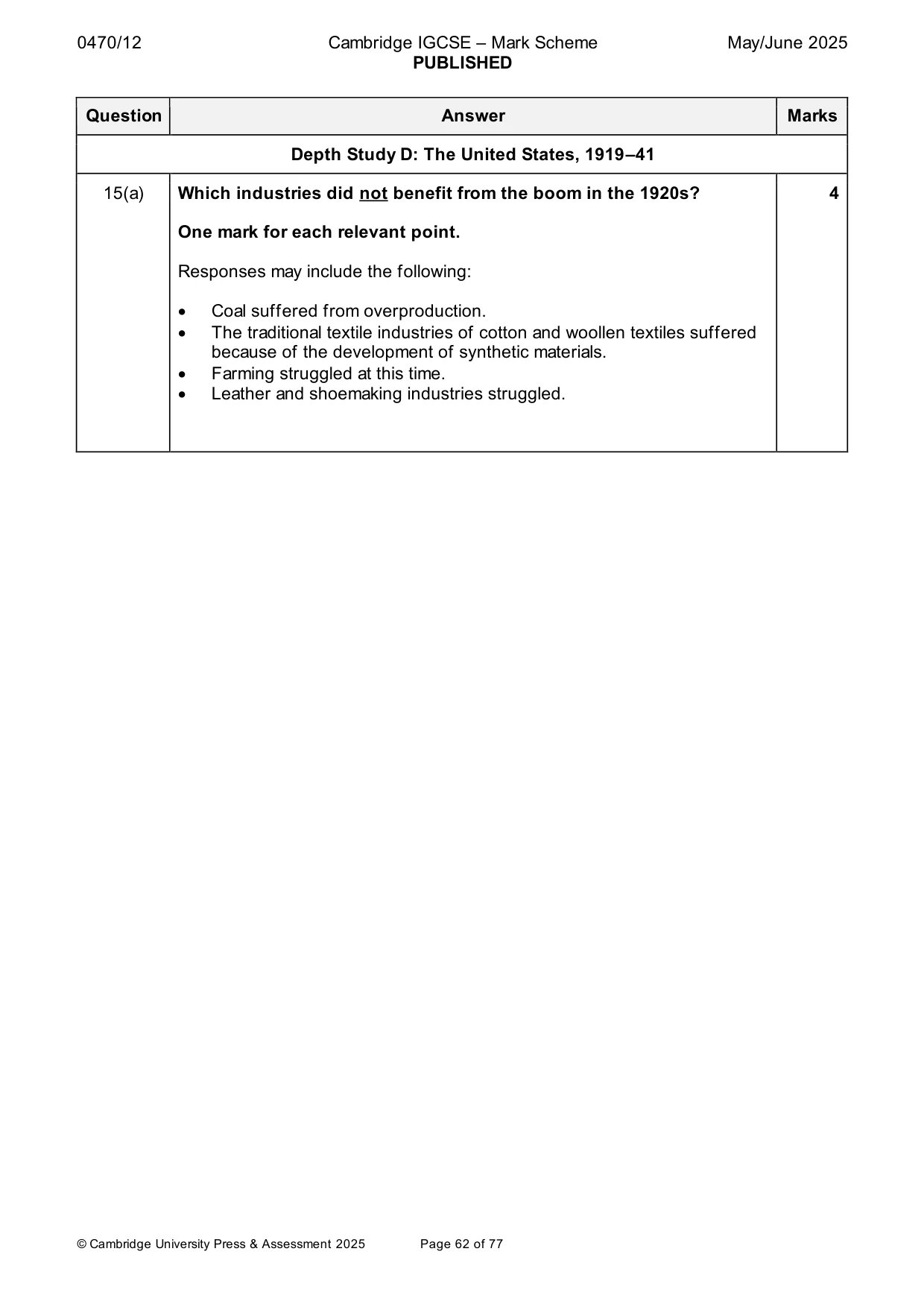
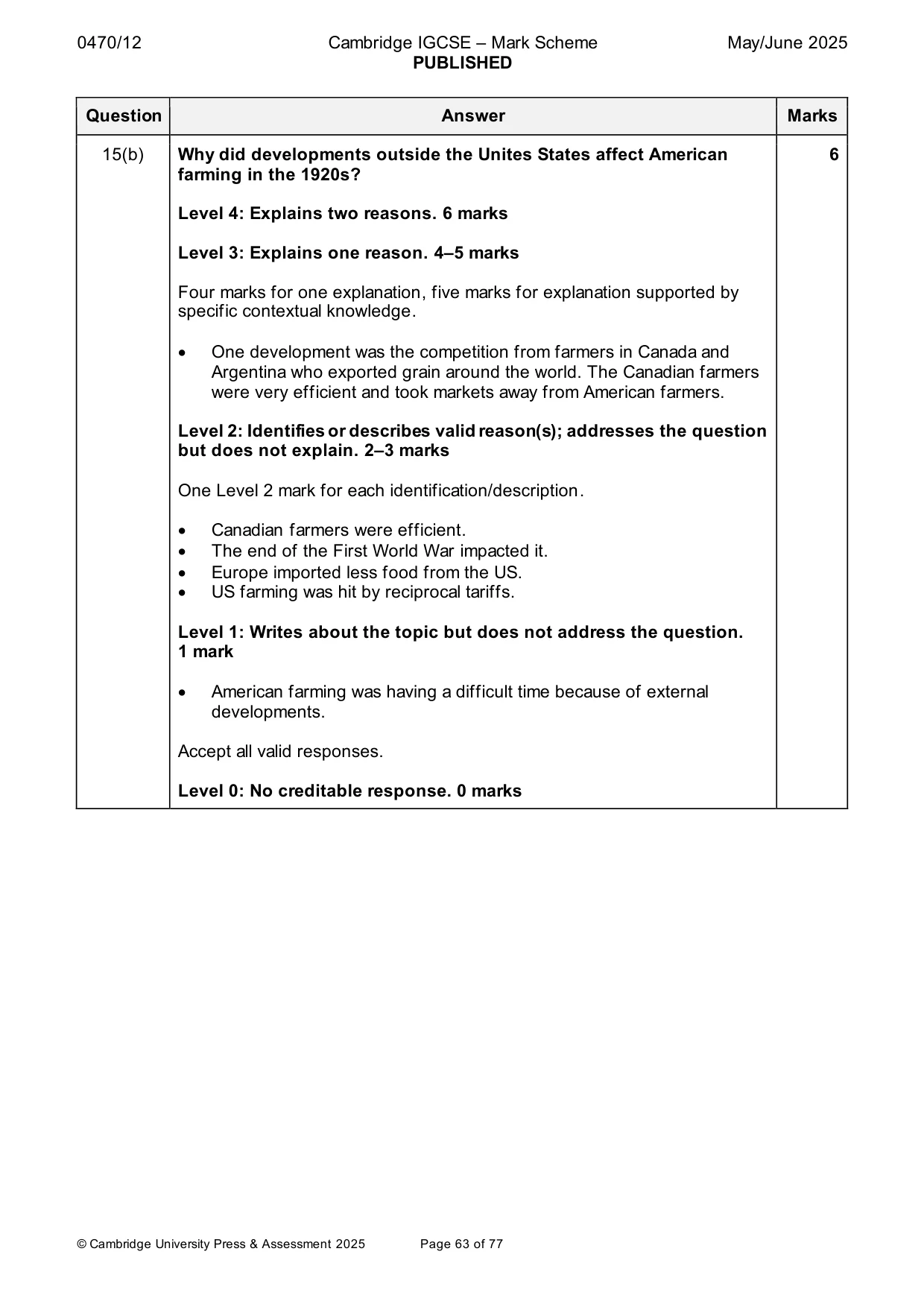
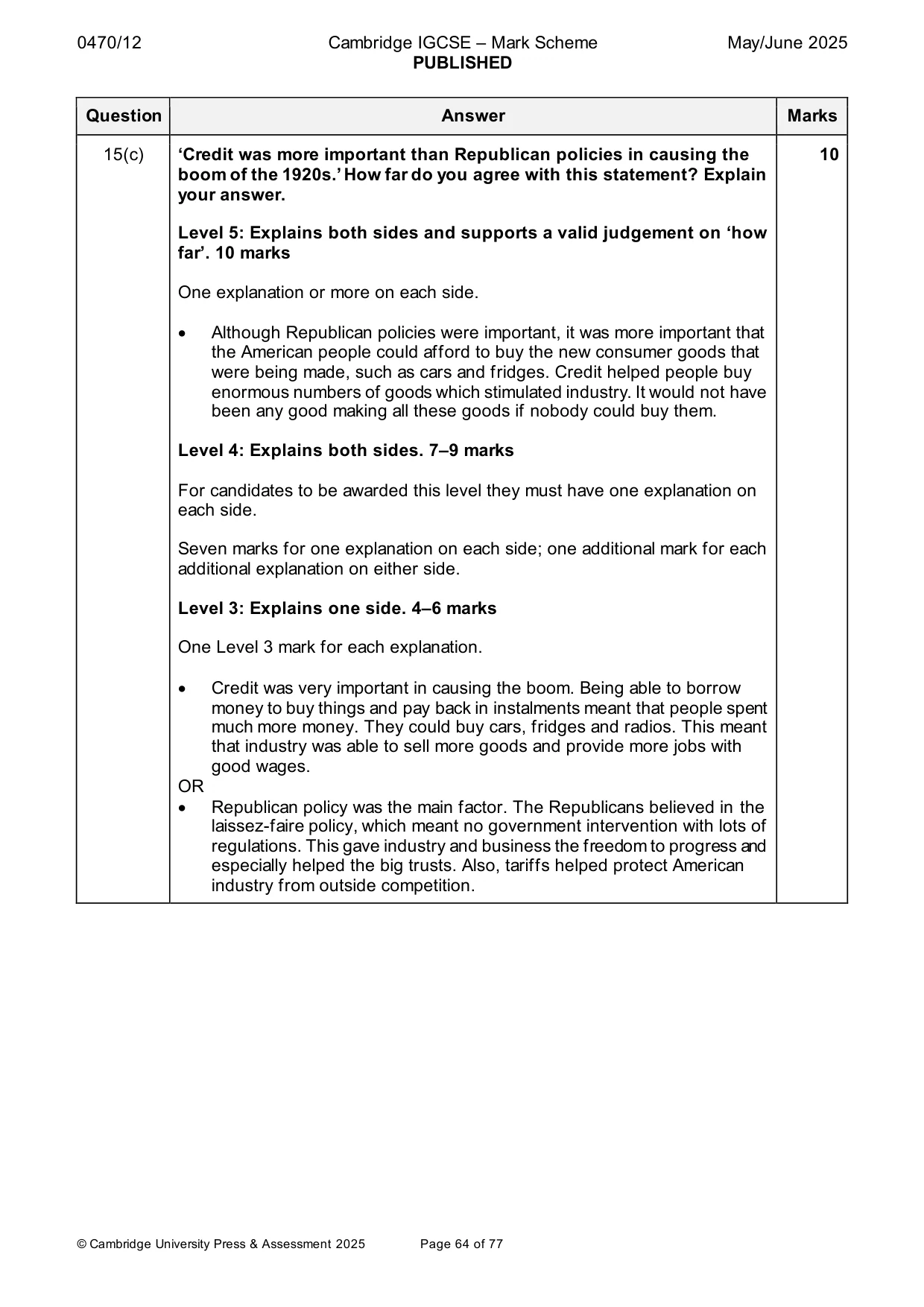
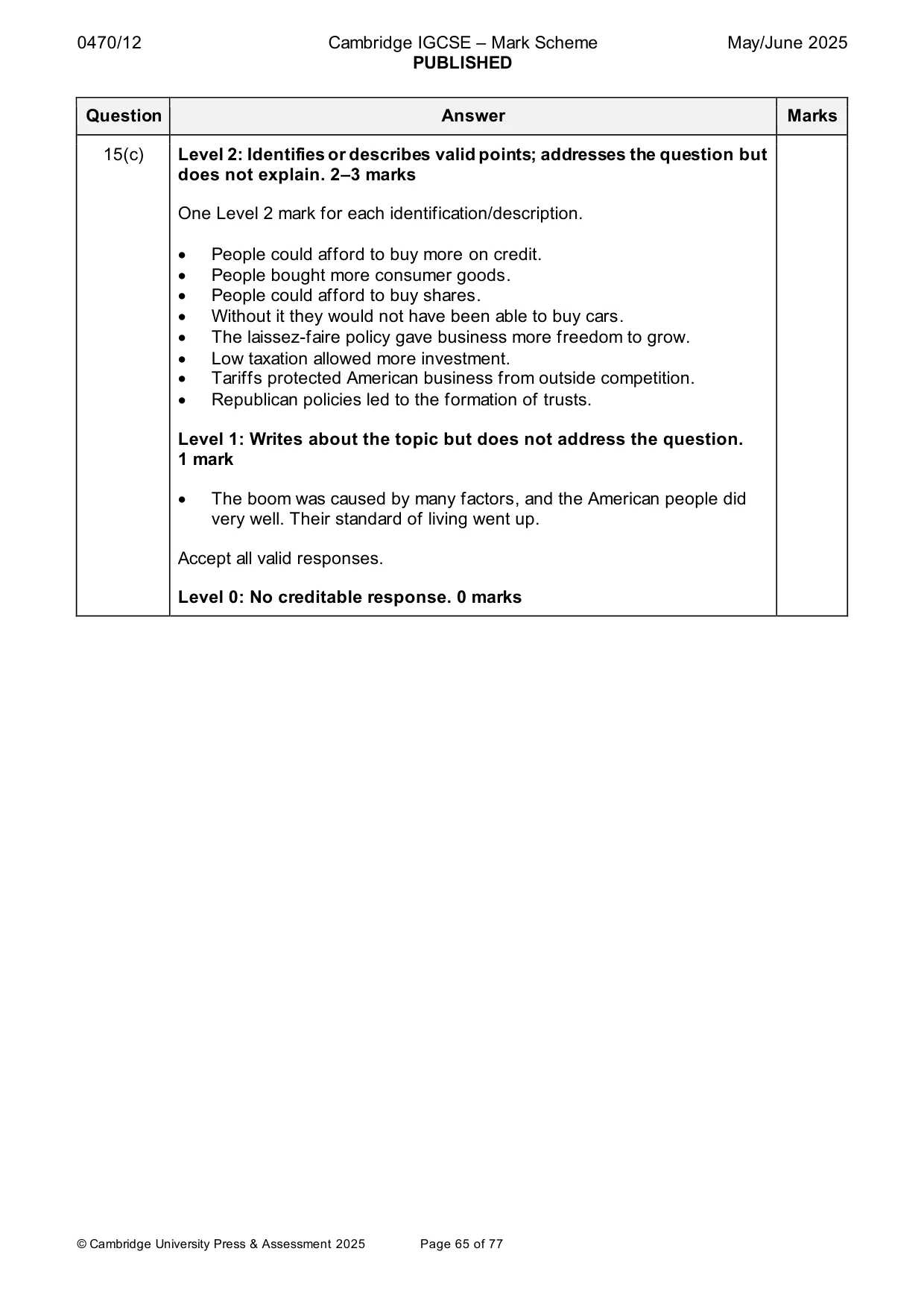
5 0470/12/M/J/25 © UCLES 2025 [Turn over Depth study C: Russia, 1905–41 13 Tsar Nicholas II often responded to threats to his rule with violence. (a) What was Stolypin’s ‘necktie’? [4] (b) Why did the First World War weaken the Tsar? [6] (c) ‘The main reason why the Tsar survived the 1905 Revolution was the use of brutal repression by the army.’ How far do you agree with this statement? Explain your answer. [10] 14 Stalin was prepared to be ruthless to win and maintain power. (a) Describe the actions by Stalin that led to him becoming leader of the Soviet Union. [4] (b) Why did Stalin establish a cult of personality? [6] (c) How far did the Purges benefit Stalin and the Soviet Union? Explain your answer. [10] Depth study D: The United States, 1919–41 15 Not everyone in America benefited from the boom of the 1920s. (a) Which industries did not benefit from the boom in the 1920s? [4] (b) Why did developments outside the United States affect American farming in the 1920s? [6] (c) ‘Credit was more important than Republican policies in causing the boom of the 1920s.’ How far do you agree with this statement? Explain your answer. [10] 16 The New Deal dominated the 1930s in the United States. (a) What were the main measures of the Second New Deal? [4] (b) Why were the first hundred days of Roosevelt’s presidency important? [6] (c) ‘The New Deal was an effective response to the Depression.’ How far do you agree with this statement? Explain your answer. [10]
Question paper, page 6
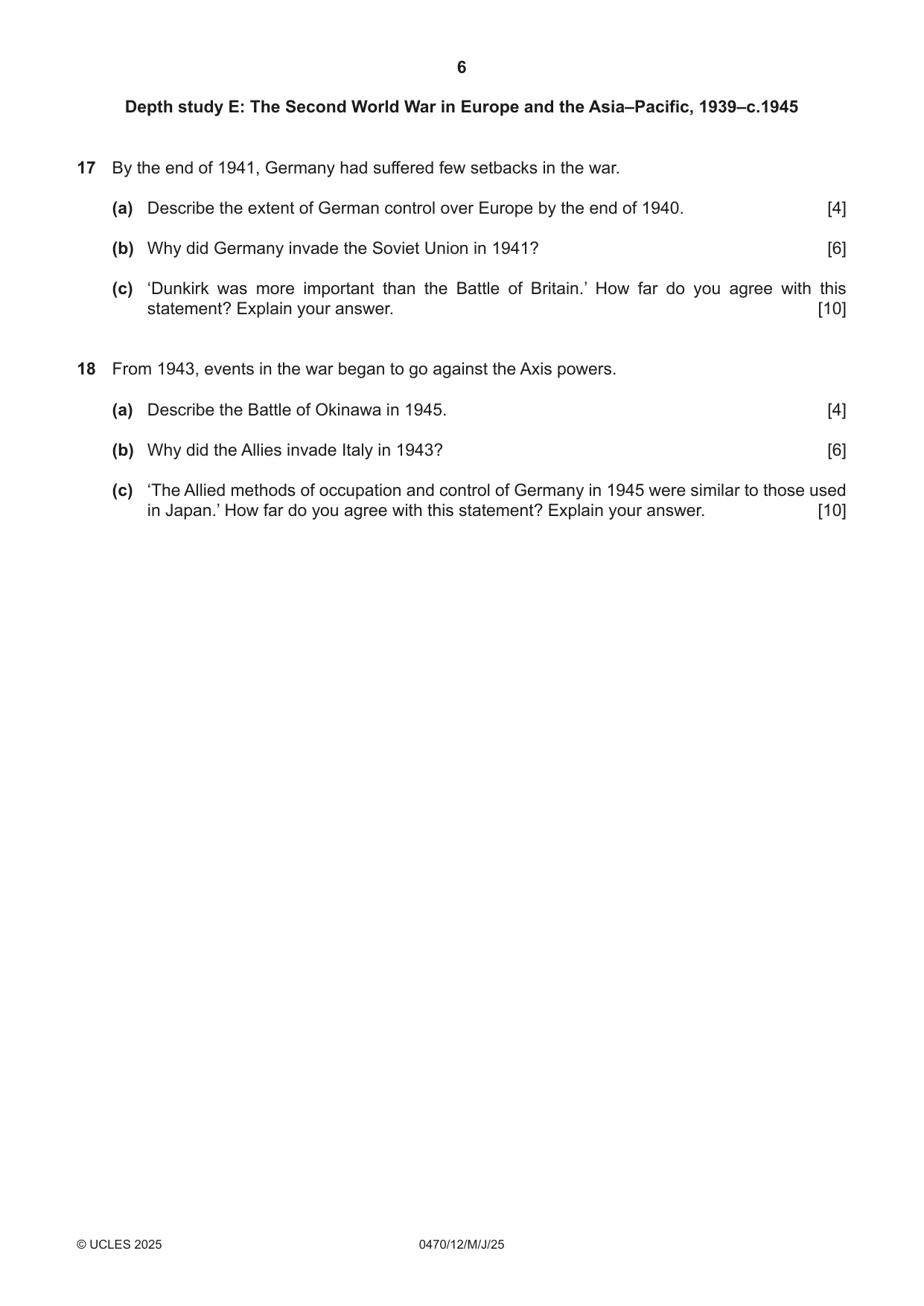
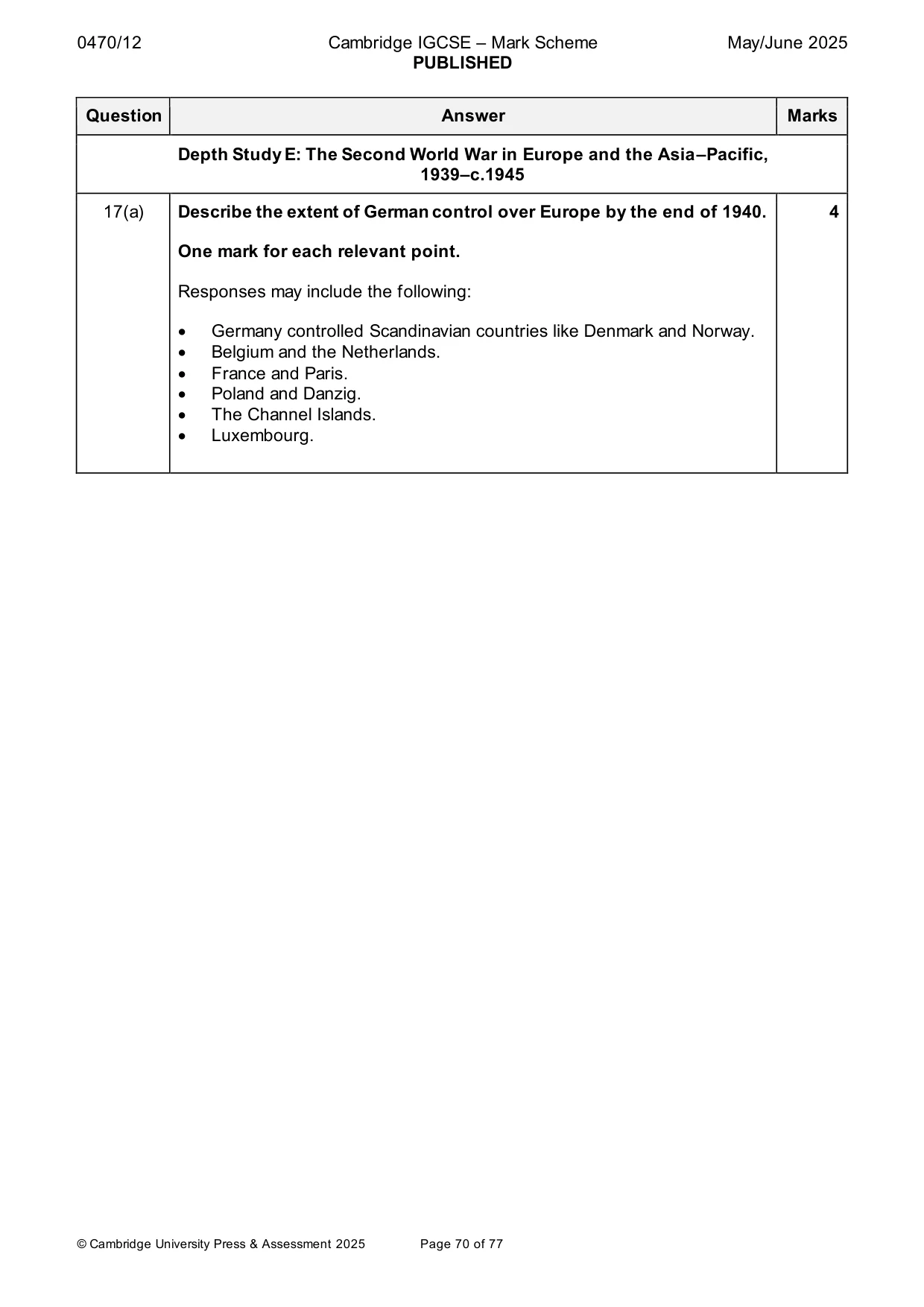
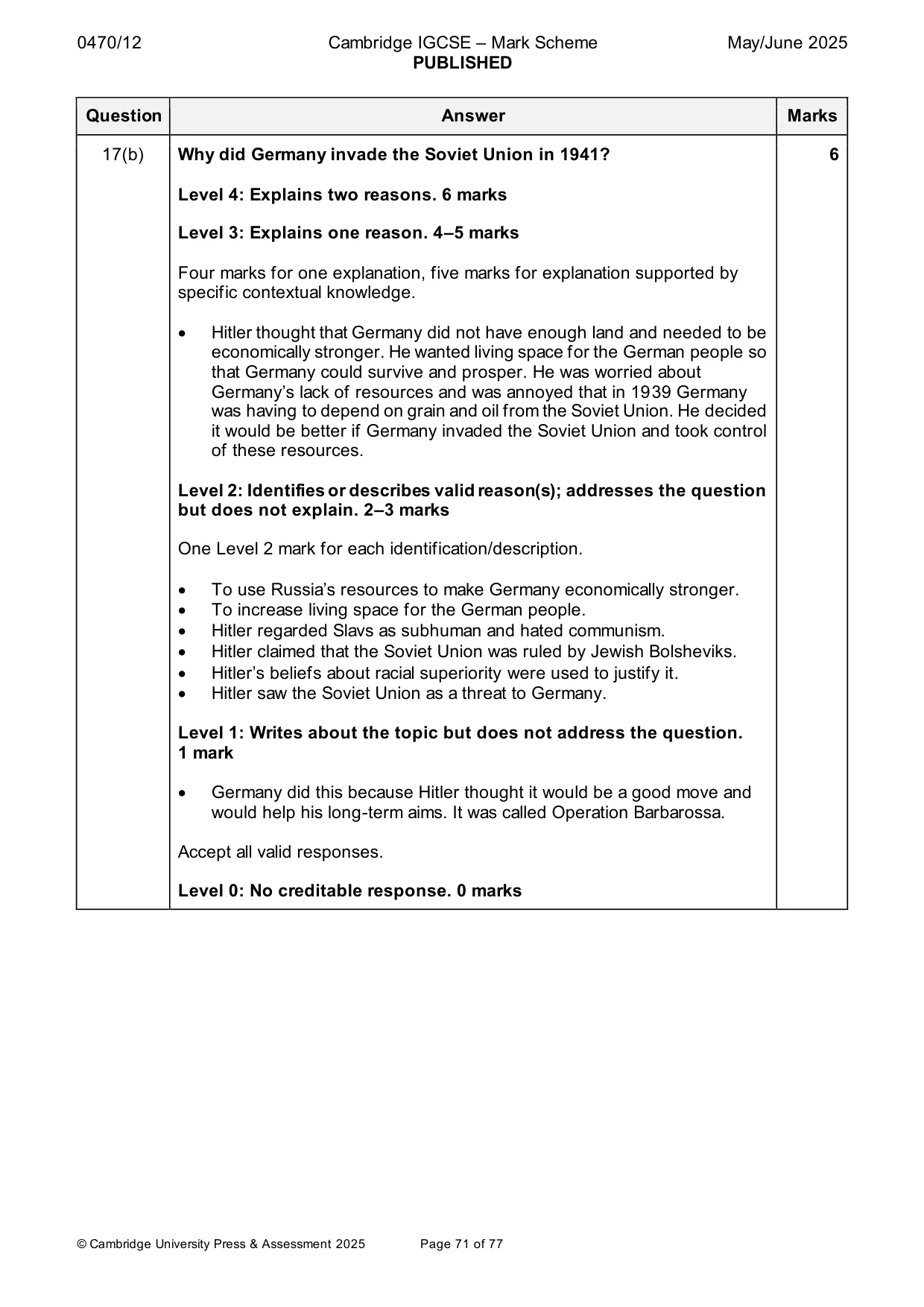
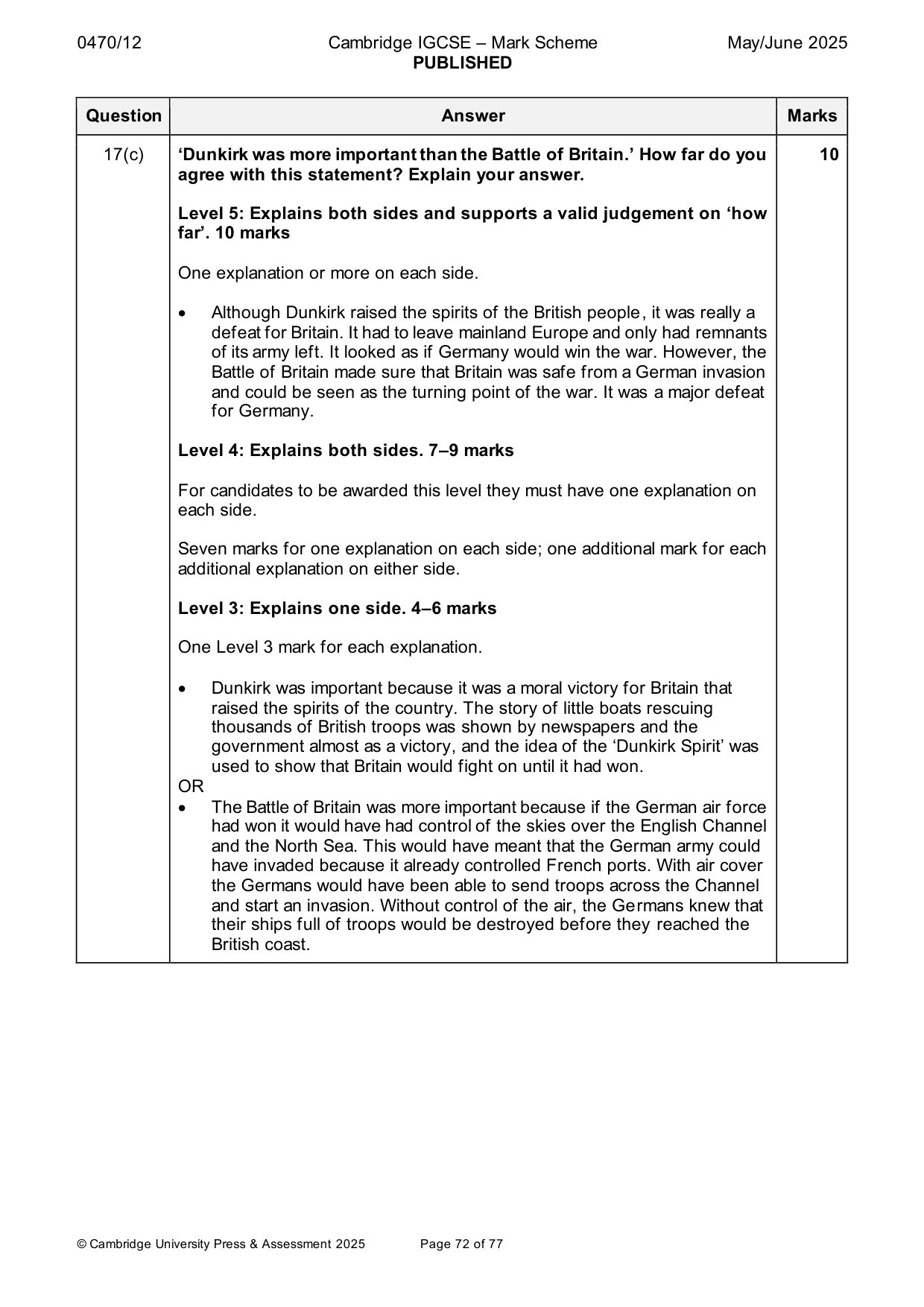
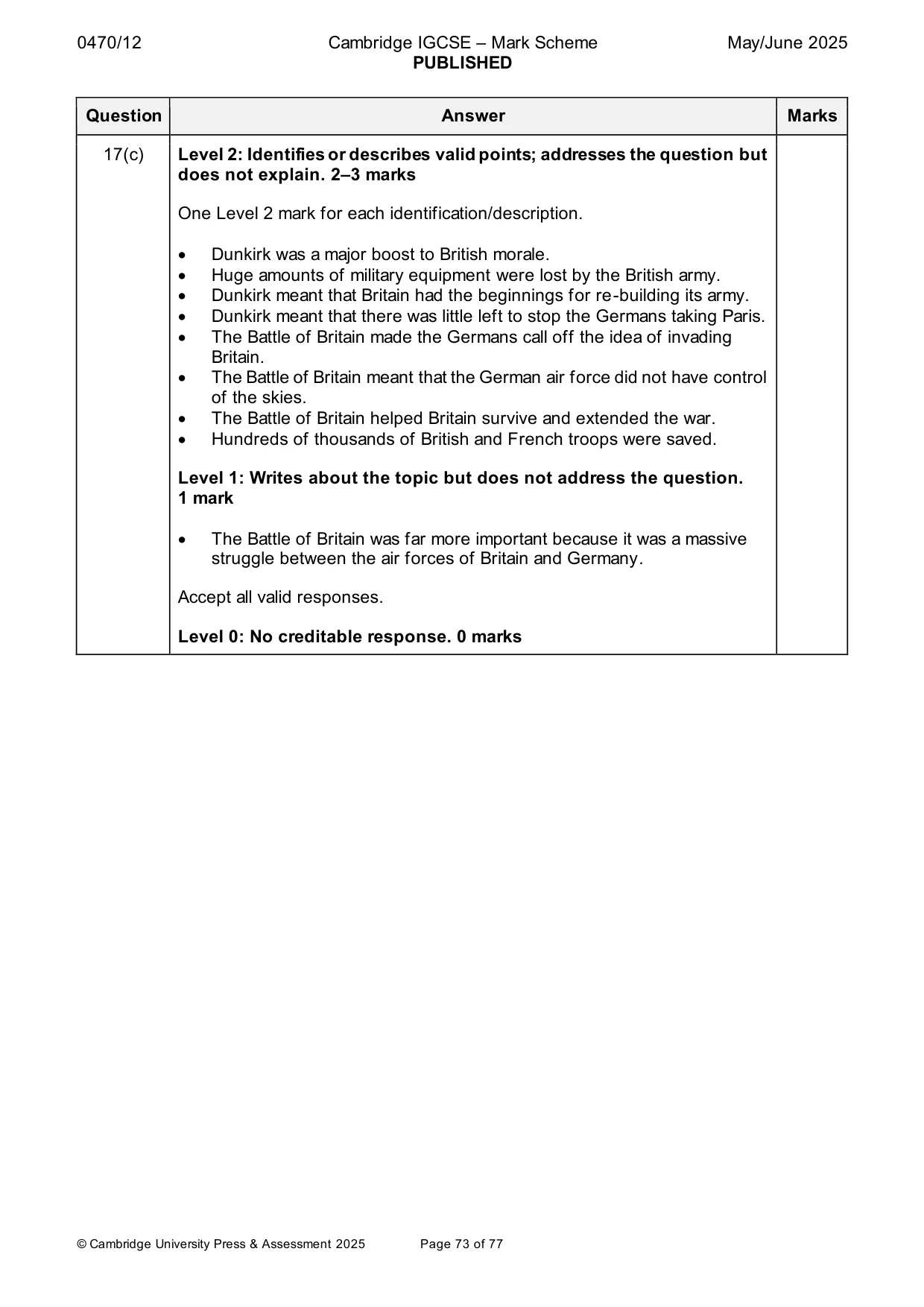
6 0470/12/M/J/25 © UCLES 2025 Depth study E: The Second World War in Europe and the Asia–Pacific, 1939–c.1945 17 By the end of 1941, Germany had suffered few setbacks in the war. (a) Describe the extent of German control over Europe by the end of 1940. [4] (b) Why did Germany invade the Soviet Union in 1941? [6] (c) ‘Dunkirk was more important than the Battle of Britain.’ How far do you agree with this statement? Explain your answer. [10] 18 From 1943, events in the war began to go against the Axis powers. (a) Describe the Battle of Okinawa in 1945. [4] (b) Why did the Allies invade Italy in 1943? [6] (c) ‘The Allied methods of occupation and control of Germany in 1945 were similar to those used in Japan.’ How far do you agree with this statement? Explain your answer. [10]
Question paper, page 7
7 0470/12/M/J/25 © UCLES 2025 BLANK PAGE
Question paper, page 8
8 0470/12/M/J/25 © UCLES 2025 Permission to reproduce items where third-party owned material protected by copyright is included has been sought and cleared where possible. Every reasonable effort has been made by the publisher (UCLES) to trace copyright holders, but if any items requiring clearance have unwittingly been included, the publisher will be pleased to make amends at the earliest possible opportunity. To avoid the issue of disclosure of answer-related information to candidates, all copyright acknowledgements are reproduced online in the Cambridge Assessment International Education Copyright Acknowledgements Booklet. This is produced for each series of examinations and is freely available to download at www.cambridgeinternational.org after the live examination series. Cambridge Assessment International Education is part of Cambridge Assessment. Cambridge Assessment is the brand name of the University of Cambridge Local Examinations Syndicate (UCLES), which is a department of the University of Cambridge. BLANK PAGE
Mark scheme, page 1
This document consists of 77 printed pages. © Cambridge University Press & Assessment 2025 [Turn over Cambridge IGCSE™ HISTORY 0470/12 Paper 1 Structured Questions May/June 2025 MARK SCHEME Maximum Mark: 60 Published This mark scheme is published as an aid to teachers and candidates, to indicate the requirements of the examination. It shows the basis on which Examiners were instructed to award marks. It does not indicate the details of the discussions that took place at an Examiners’ meeting before marking began, which would have considered the acceptability of alternative answers. Mark schemes should be read in conjunction with the question paper and the Principal Examiner Report for Teachers. Cambridge International will not enter into discussions about these mark schemes. Cambridge International is publishing the mark schemes for the May/June 2025 series for most Cambridge IGCSE, Cambridge International A and AS Level components, and some Cambridge O Level components.
Mark scheme, page 2
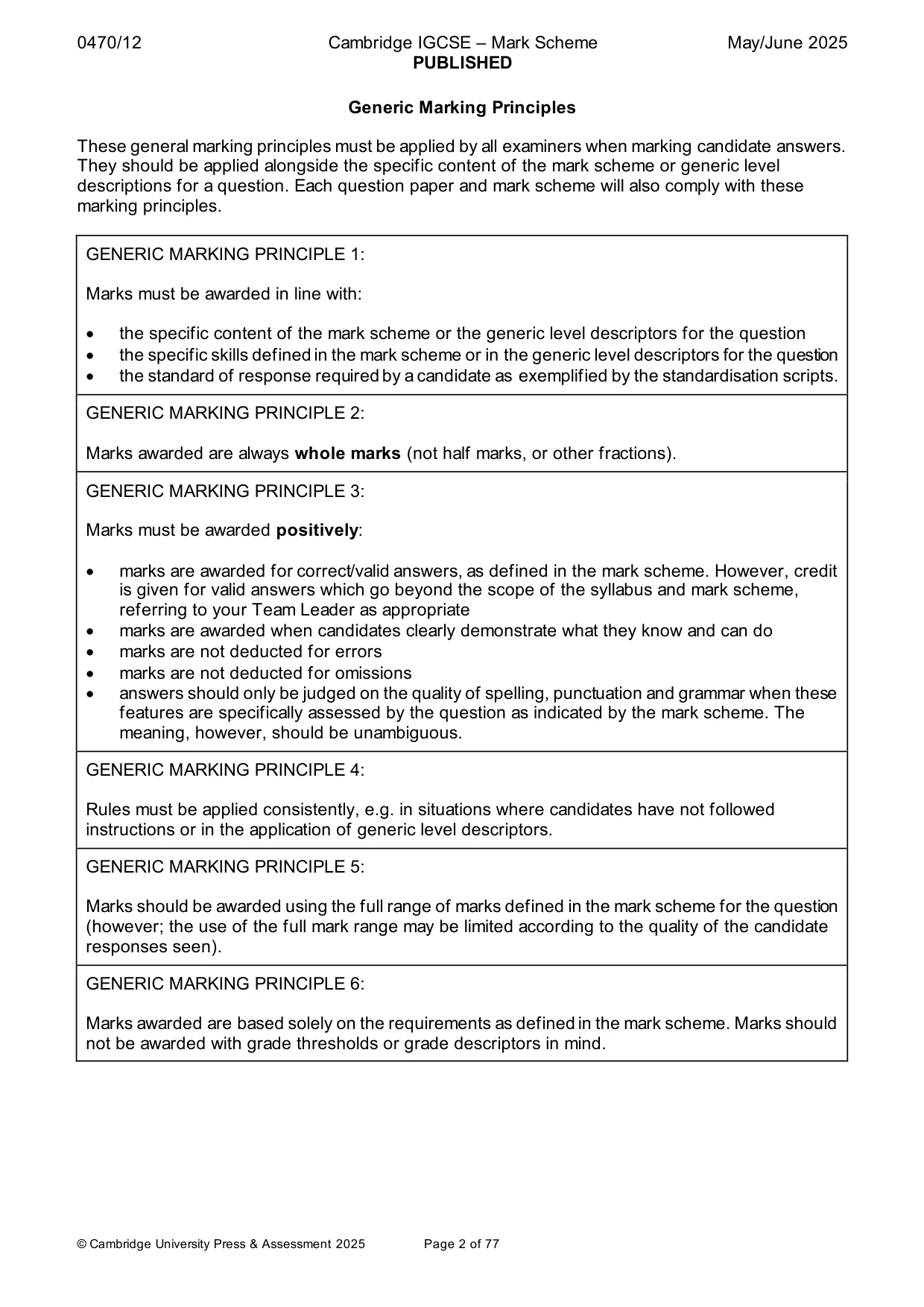
0470/12 Cambridge IGCSE – Mark Scheme PUBLISHED May/June 2025 © Cambridge University Press & Assessment 2025 Page 2 of 77 Generic Marking Principles These general marking principles must be applied by all examiners when marking candidate answers. They should be applied alongside the specific content of the mark scheme or generic level descriptions for a question. Each question paper and mark scheme will also comply with these marking principles. GENERIC MARKING PRINCIPLE 1: Marks must be awarded in line with: • the specific content of the mark scheme or the generic level descriptors for the question • the specific skills defined in the mark scheme or in the generic level descriptors for the question • the standard of response required by a candidate as exemplified by the standardisation scripts. GENERIC MARKING PRINCIPLE 2: Marks awarded are always whole marks (not half marks, or other fractions). GENERIC MARKING PRINCIPLE 3: Marks must be awarded positively: • marks are awarded for correct/valid answers, as defined in the mark scheme. However, credit is given for valid answers which go beyond the scope of the syllabus and mark scheme, referring to your Team Leader as appropriate • marks are awarded when candidates clearly demonstrate what they know and can do • marks are not deducted for errors • marks are not deducted for omissions • answers should only be judged on the quality of spelling, punctuation and grammar when these features are specifically assessed by the question as indicated by the mark scheme. The meaning, however, should be unambiguous. GENERIC MARKING PRINCIPLE 4: Rules must be applied consistently, e.g. in situations where candidates have not followed instructions or in the application of generic level descriptors. GENERIC MARKING PRINCIPLE 5: Marks should be awarded using the full range of marks defined in the mark scheme for the question (however; the use of the full mark range may be limited according to the quality of the candidate responses seen). GENERIC MARKING PRINCIPLE 6: Marks awarded are based solely on the requirements as defined in the mark scheme. Marks should not be awarded with grade thresholds or grade descriptors in mind.
Mark scheme, page 3
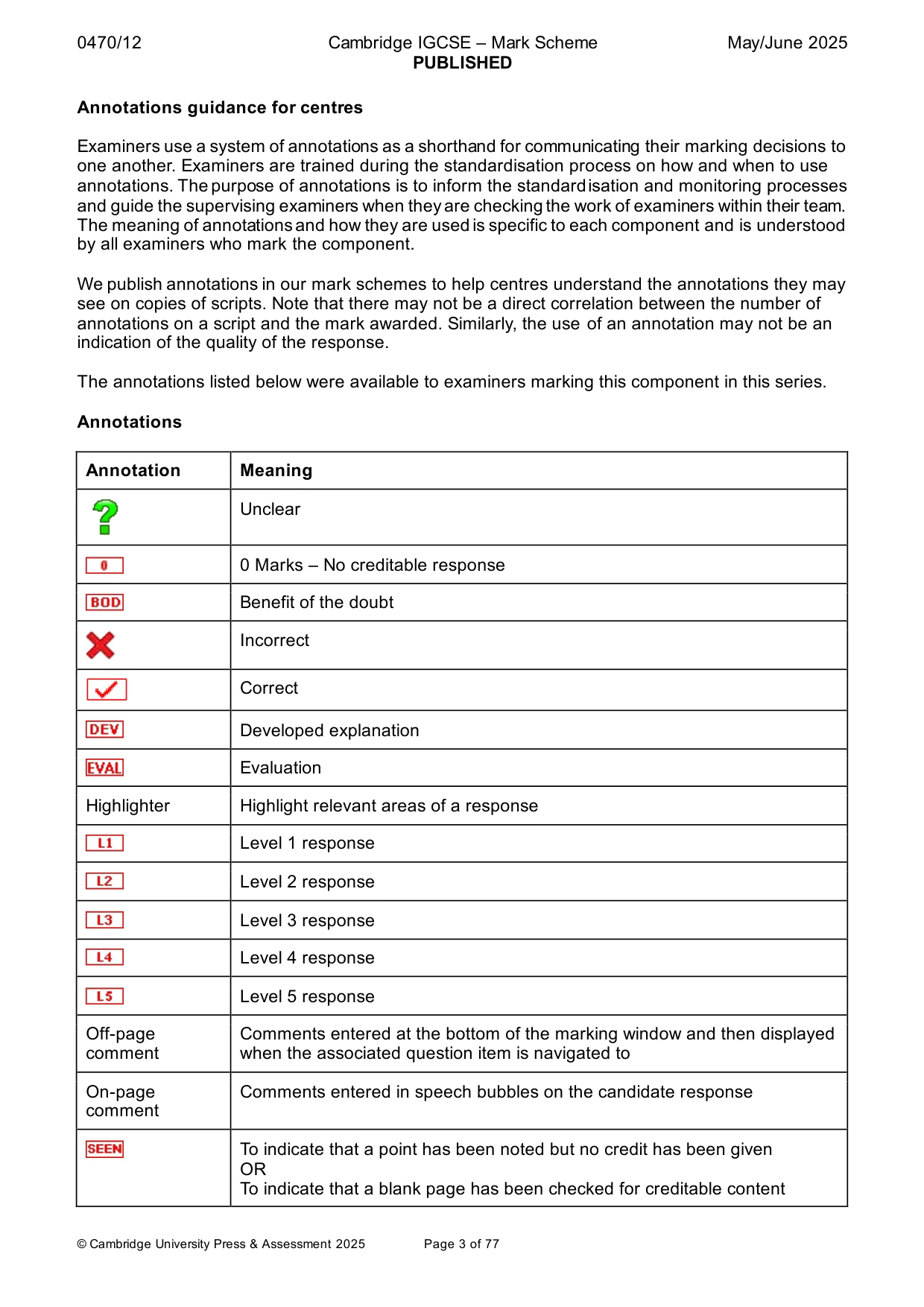
0470/12 Cambridge IGCSE – Mark Scheme PUBLISHED May/June 2025 © Cambridge University Press & Assessment 2025 Page 3 of 77 Annotations guidance for centres Examiners use a system of annotations as a shorthand for communicating their marking decisions to one another. Examiners are trained during the standardisation process on how and when to use annotations. The purpose of annotations is to inform the standardisation and monitoring processes and guide the supervising examiners when they are checking the work of examiners within their team. The meaning of annotations and how they are used is specific to each component and is understood by all examiners who mark the component. We publish annotations in our mark schemes to help centres understand the annotations they may see on copies of scripts. Note that there may not be a direct correlation between the number of annotations on a script and the mark awarded. Similarly, the use of an annotation may not be an indication of the quality of the response. The annotations listed below were available to examiners marking this component in this series. Annotations Annotation Meaning Unclear 0 Marks – No creditable response Benefit of the doubt Incorrect Correct Developed explanation Evaluation Highlighter Highlight relevant areas of a response Level 1 response Level 2 response Level 3 response Level 4 response Level 5 response Off-page comment Comments entered at the bottom of the marking window and then displayed when the associated question item is navigated to On-page comment Comments entered in speech bubbles on the candidate response To indicate that a point has been noted but no credit has been given OR To indicate that a blank page has been checked for creditable content
Mark scheme, page 4
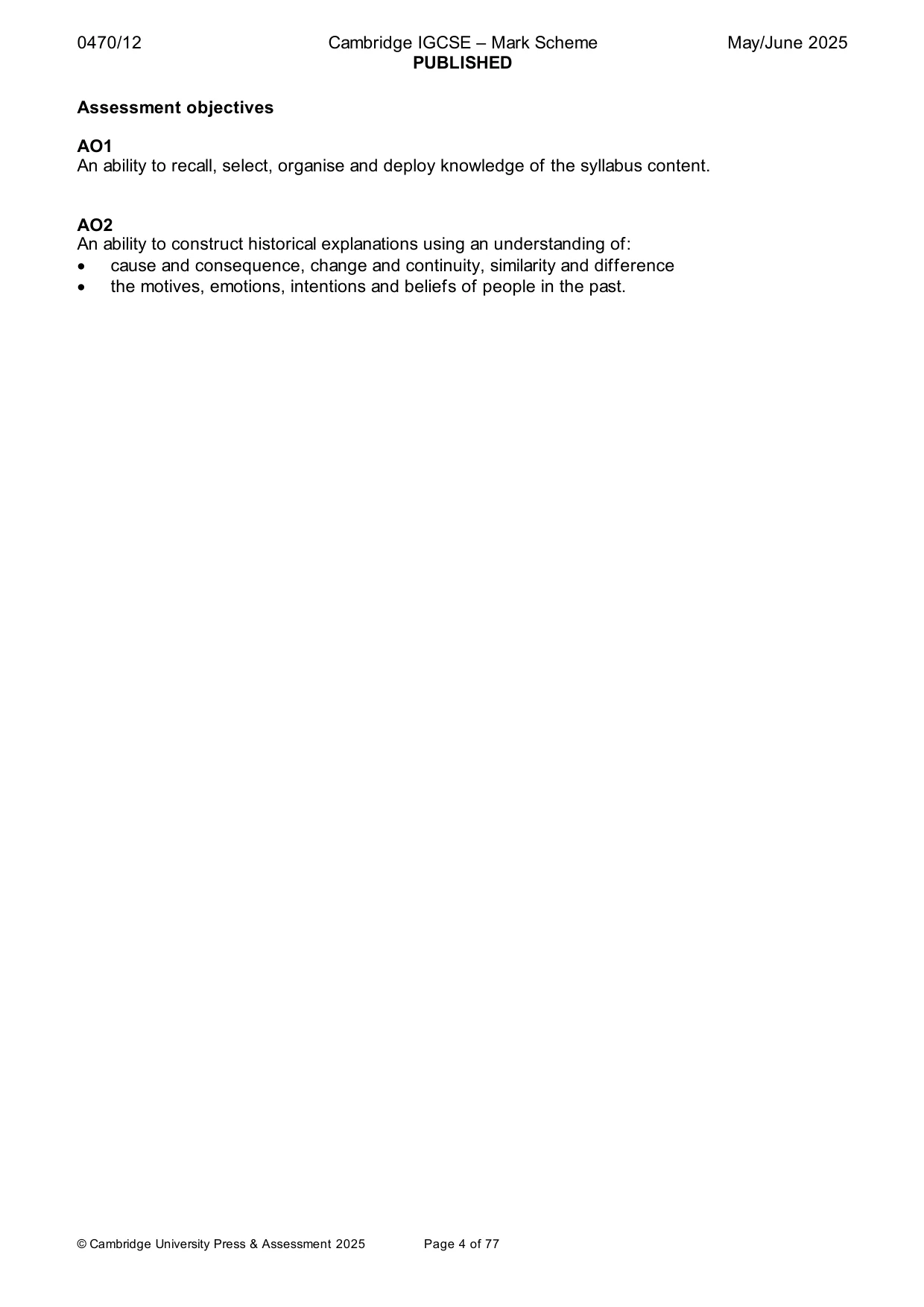
0470/12 Cambridge IGCSE – Mark Scheme PUBLISHED May/June 2025 © Cambridge University Press & Assessment 2025 Page 4 of 77 Assessment objectives AO1 An ability to recall, select, organise and deploy knowledge of the syllabus content. AO2 An ability to construct historical explanations using an understanding of: • cause and consequence, change and continuity, similarity and difference • the motives, emotions, intentions and beliefs of people in the past.
Mark scheme, page 5
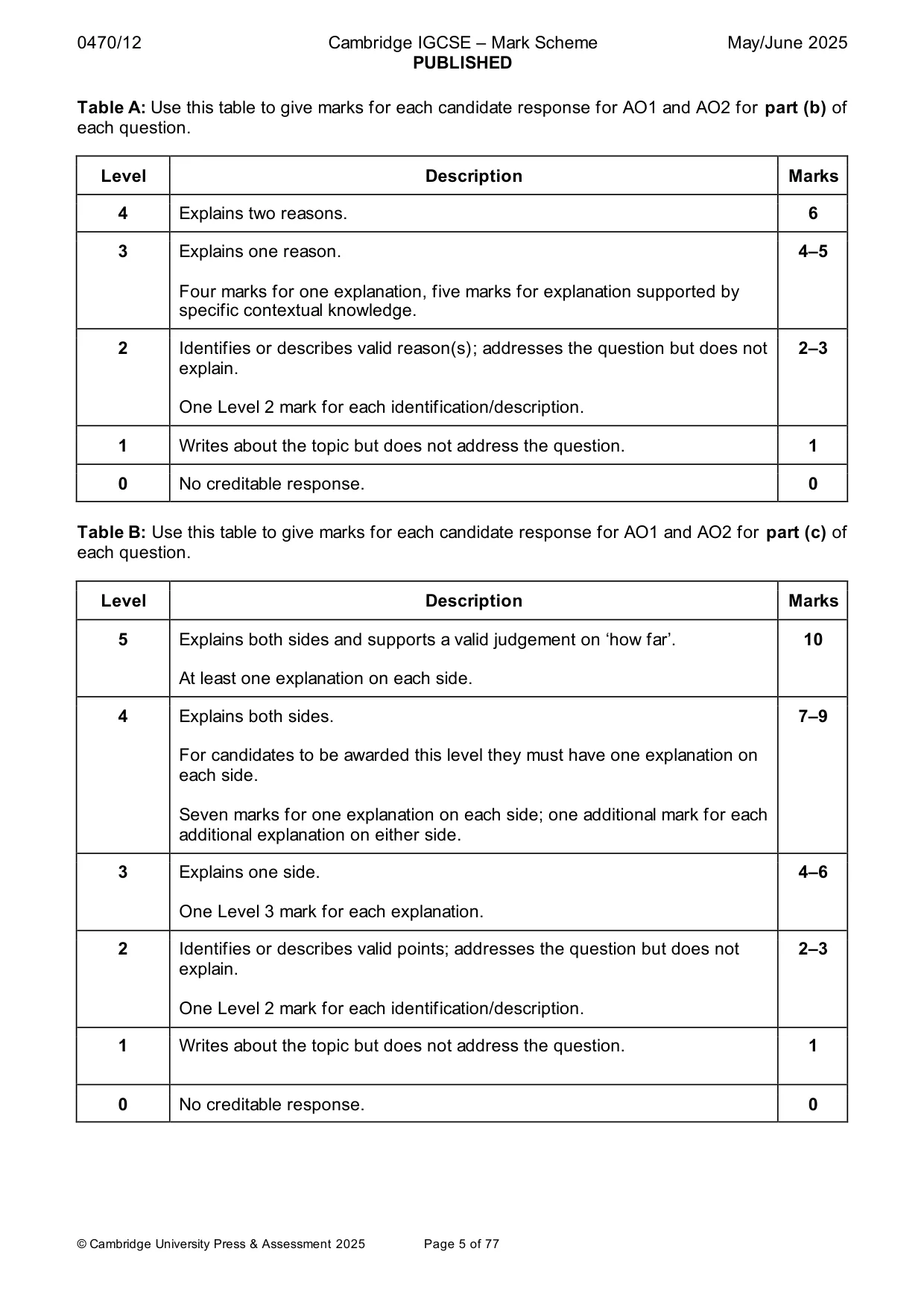
0470/12 Cambridge IGCSE – Mark Scheme PUBLISHED May/June 2025 © Cambridge University Press & Assessment 2025 Page 5 of 77 Table A: Use this table to give marks for each candidate response for AO1 and AO2 for part (b) of each question. Level Description Marks 4 Explains two reasons. 6 3 Explains one reason. Four marks for one explanation, five marks for explanation supported by specific contextual knowledge. 4–5 2 Identifies or describes valid reason(s); addresses the question but does not explain. One Level 2 mark for each identification/description. 2–3 1 Writes about the topic but does not address the question. 1 0 No creditable response. 0 Table B: Use this table to give marks for each candidate response for AO1 and AO2 for part (c) of each question. Level Description Marks 5 Explains both sides and supports a valid judgement on ‘how far’. At least one explanation on each side. 10 4 Explains both sides. For candidates to be awarded this level they must have one explanation on each side. Seven marks for one explanation on each side; one additional mark for each additional explanation on either side. 7–9 3 Explains one side. One Level 3 mark for each explanation. 4–6 2 Identifies or describes valid points; addresses the question but does not explain. One Level 2 mark for each identification/description. 2–3 1 Writes about the topic but does not address the question. 1 0 No creditable response. 0
Mark scheme, page 6
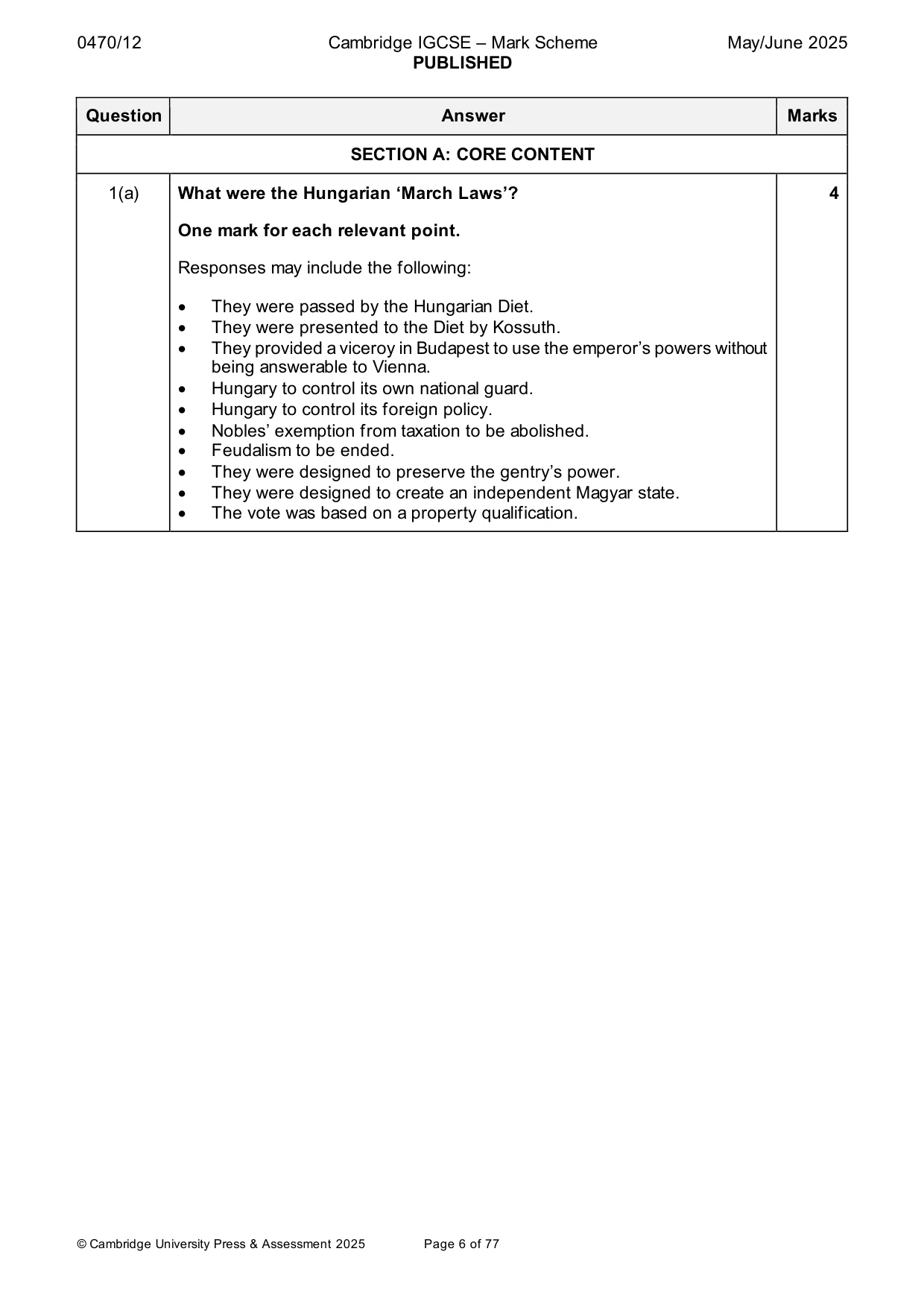
0470/12 Cambridge IGCSE – Mark Scheme PUBLISHED May/June 2025 © Cambridge University Press & Assessment 2025 Page 6 of 77 Question Answer Marks SECTION A: CORE CONTENT 1(a) What were the Hungarian ‘March Laws’? One mark for each relevant point. Responses may include the following: • They were passed by the Hungarian Diet. • They were presented to the Diet by Kossuth. • They provided a viceroy in Budapest to use the emperor’s powers without being answerable to Vienna. • Hungary to control its own national guard. • Hungary to control its foreign policy. • Nobles’ exemption from taxation to be abolished. • Feudalism to be ended. • They were designed to preserve the gentry’s power. • They were designed to create an independent Magyar state. • The vote was based on a property qualification. 4
Mark scheme, page 7
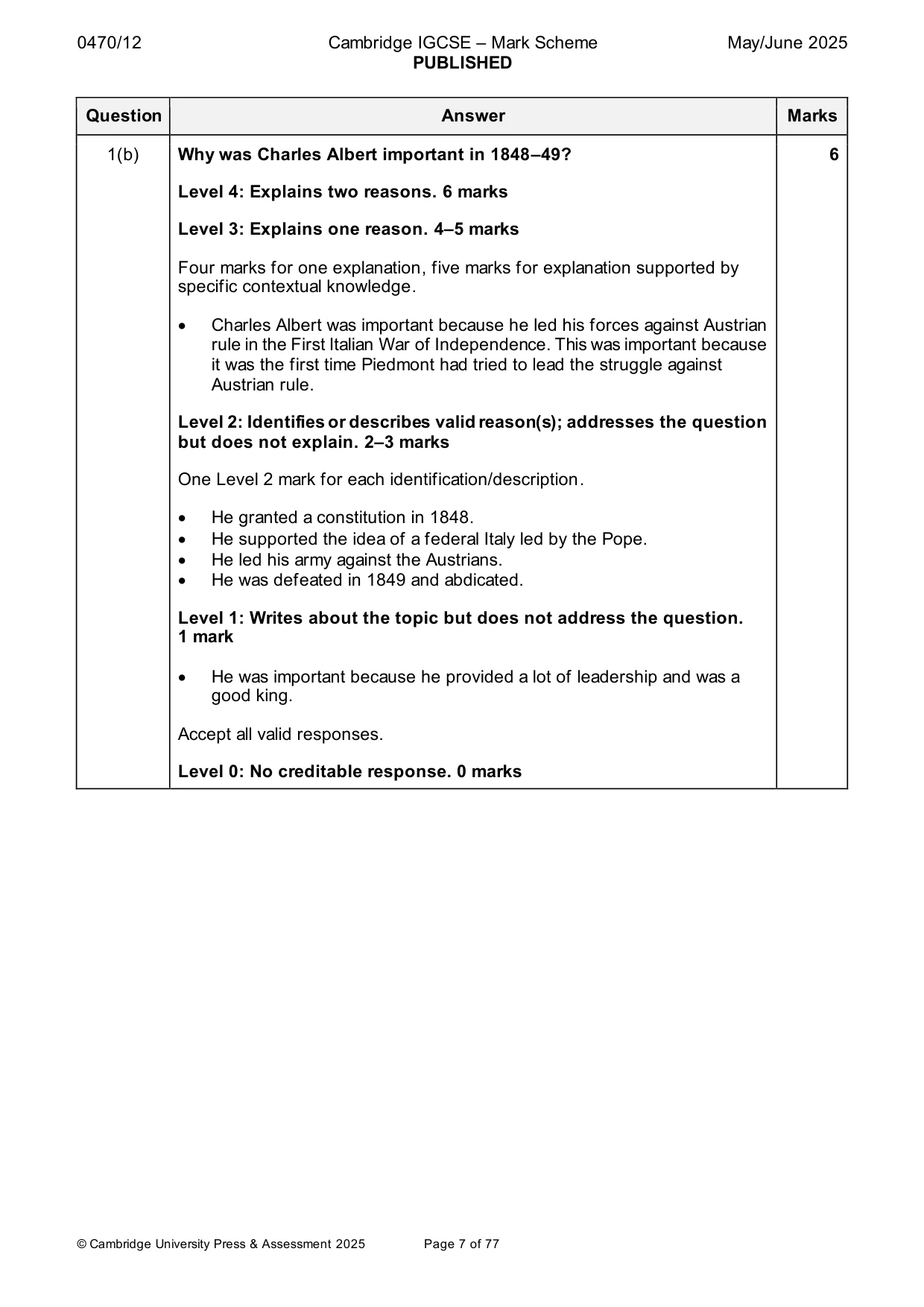
0470/12 Cambridge IGCSE – Mark Scheme PUBLISHED May/June 2025 © Cambridge University Press & Assessment 2025 Page 7 of 77 Question Answer Marks 1(b) Why was Charles Albert important in 1848–49? Level 4: Explains two reasons. 6 marks Level 3: Explains one reason. 4–5 marks Four marks for one explanation, five marks for explanation supported by specific contextual knowledge. • Charles Albert was important because he led his forces against Austrian rule in the First Italian War of Independence. This was important because it was the first time Piedmont had tried to lead the struggle against Austrian rule. Level 2: Identifies or describes valid reason(s); addresses the question but does not explain. 2–3 marks One Level 2 mark for each identification/description. • He granted a constitution in 1848. • He supported the idea of a federal Italy led by the Pope. • He led his army against the Austrians. • He was defeated in 1849 and abdicated. Level 1: Writes about the topic but does not address the question. 1 mark • He was important because he provided a lot of leadership and was a good king. Accept all valid responses. Level 0: No creditable response. 0 marks 6
Mark scheme, page 8
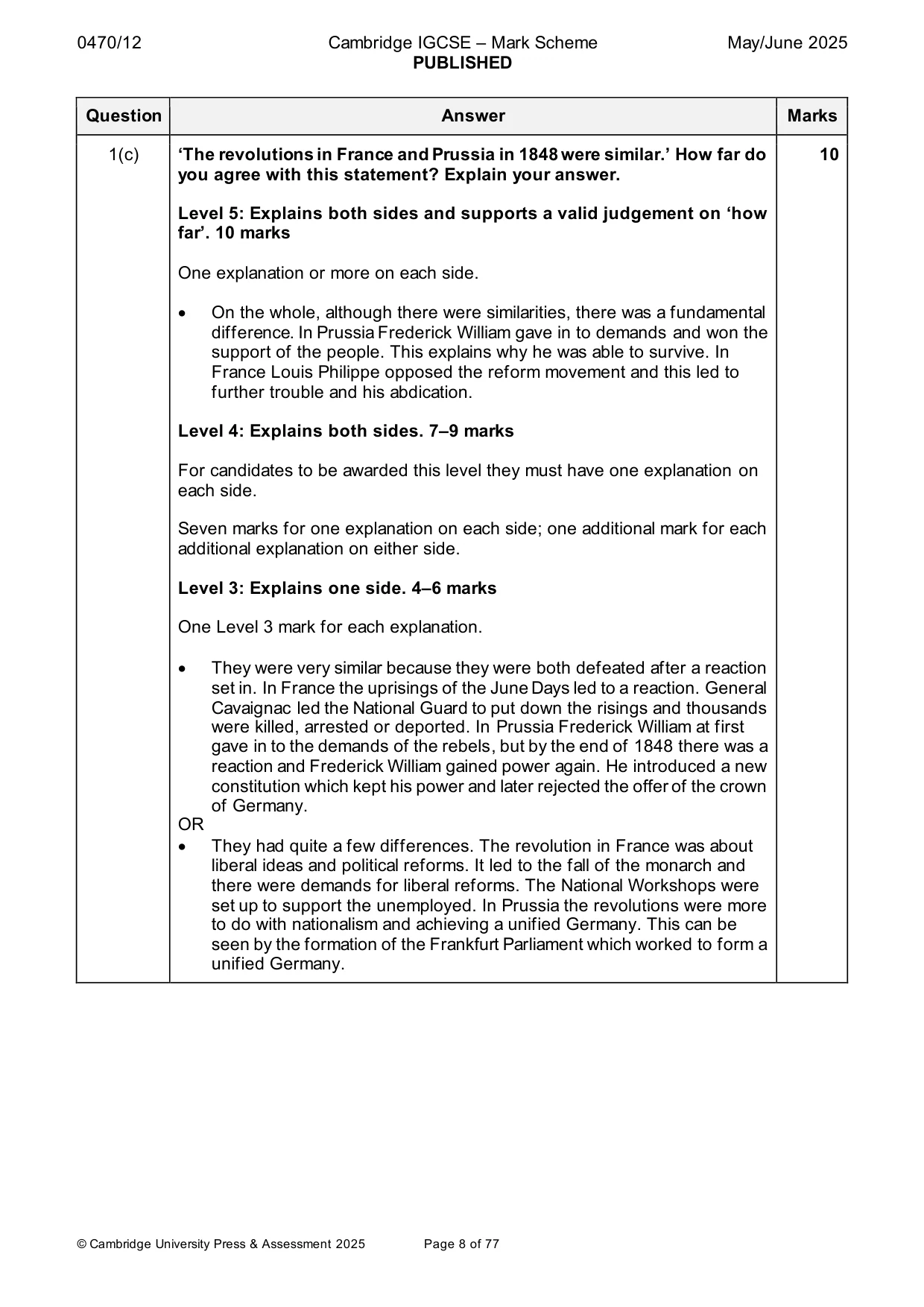
0470/12 Cambridge IGCSE – Mark Scheme PUBLISHED May/June 2025 © Cambridge University Press & Assessment 2025 Page 8 of 77 Question Answer Marks 1(c) ‘The revolutions in France and Prussia in 1848 were similar.’ How far do you agree with this statement? Explain your answer. Level 5: Explains both sides and supports a valid judgement on ‘how far’. 10 marks One explanation or more on each side. • On the whole, although there were similarities, there was a fundamental difference. In Prussia Frederick William gave in to demands and won the support of the people. This explains why he was able to survive. In France Louis Philippe opposed the reform movement and this led to further trouble and his abdication. Level 4: Explains both sides. 7–9 marks For candidates to be awarded this level they must have one explanation on each side. Seven marks for one explanation on each side; one additional mark for each additional explanation on either side. Level 3: Explains one side. 4–6 marks One Level 3 mark for each explanation. • They were very similar because they were both defeated after a reaction set in. In France the uprisings of the June Days led to a reaction. General Cavaignac led the National Guard to put down the risings and thousands were killed, arrested or deported. In Prussia Frederick William at first gave in to the demands of the rebels, but by the end of 1848 there was a reaction and Frederick William gained power again. He introduced a new constitution which kept his power and later rejected the offer of the crown of Germany. OR • They had quite a few differences. The revolution in France was about liberal ideas and political reforms. It led to the fall of the monarch and there were demands for liberal reforms. The National Workshops were set up to support the unemployed. In Prussia the revolutions were more to do with nationalism and achieving a unified Germany. This can be seen by the formation of the Frankfurt Parliament which worked to form a unified Germany. 10
Mark scheme, page 9
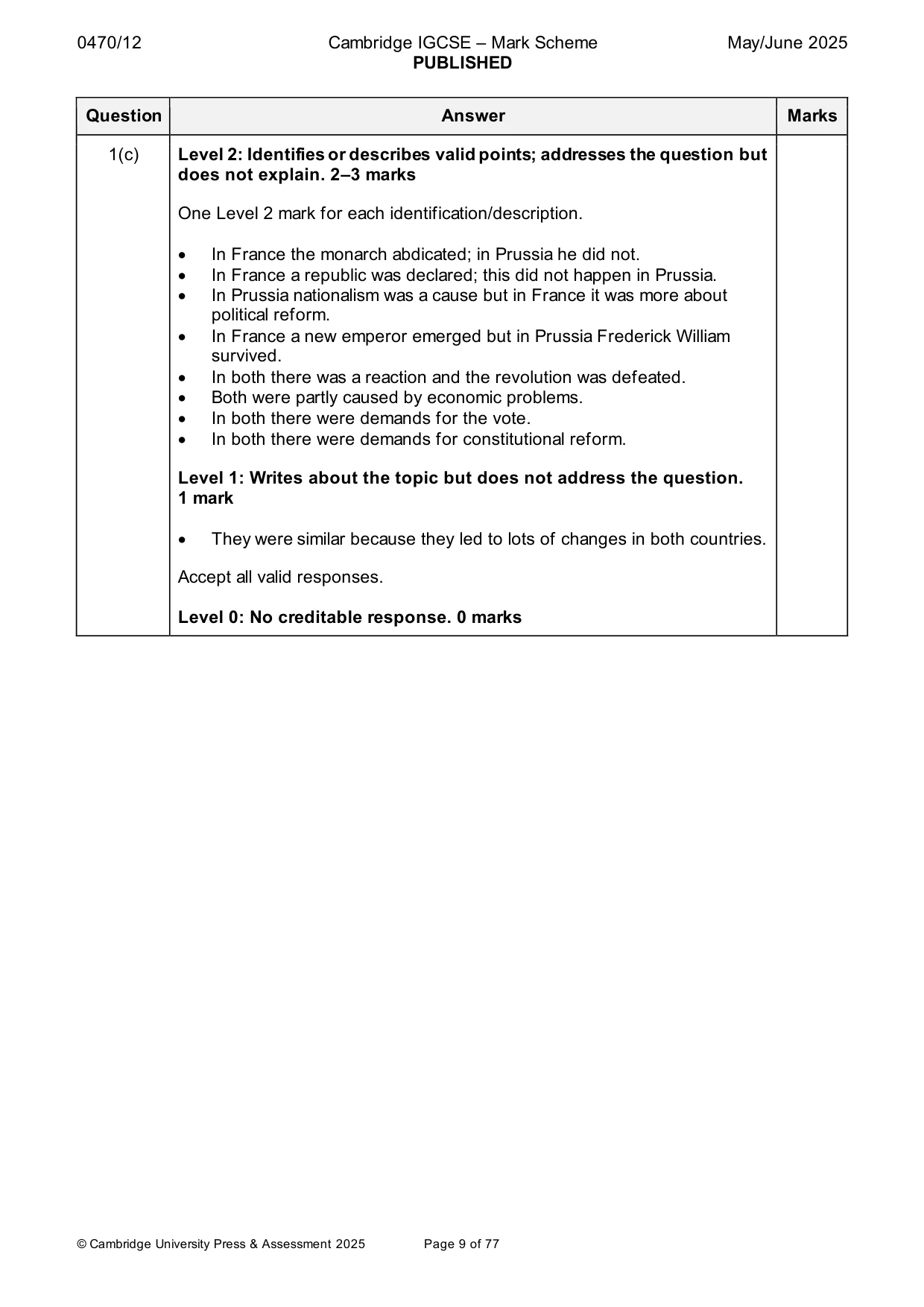
0470/12 Cambridge IGCSE – Mark Scheme PUBLISHED May/June 2025 © Cambridge University Press & Assessment 2025 Page 9 of 77 Question Answer Marks 1(c) Level 2: Identifies or describes valid points; addresses the question but does not explain. 2–3 marks One Level 2 mark for each identification/description. • In France the monarch abdicated; in Prussia he did not. • In France a republic was declared; this did not happen in Prussia. • In Prussia nationalism was a cause but in France it was more about political reform. • In France a new emperor emerged but in Prussia Frederick William survived. • In both there was a reaction and the revolution was defeated. • Both were partly caused by economic problems. • In both there were demands for the vote. • In both there were demands for constitutional reform. Level 1: Writes about the topic but does not address the question. 1 mark • They were similar because they led to lots of changes in both countries. Accept all valid responses. Level 0: No creditable response. 0 marks
Mark scheme, page 10
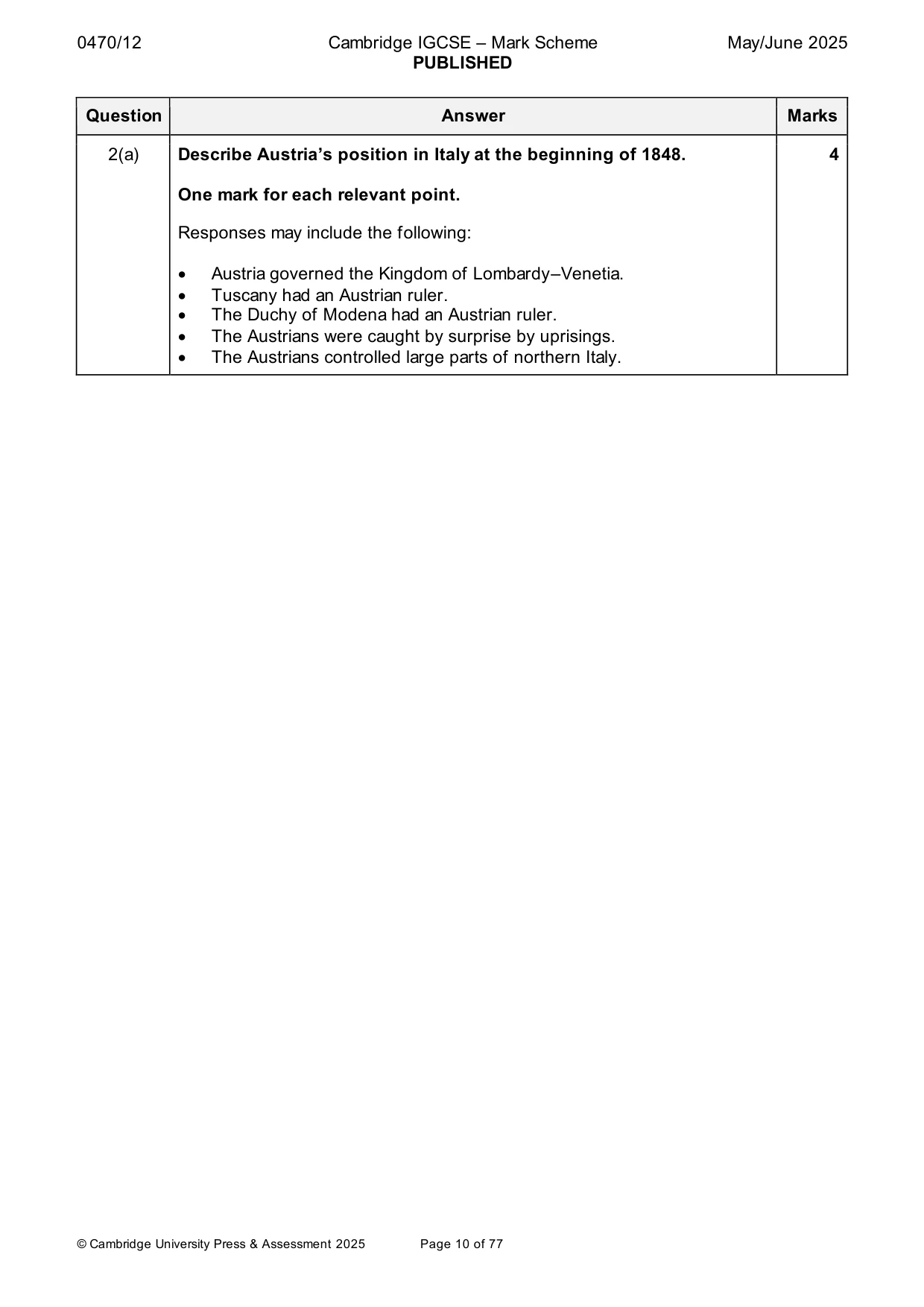
0470/12 Cambridge IGCSE – Mark Scheme PUBLISHED May/June 2025 © Cambridge University Press & Assessment 2025 Page 10 of 77 Question Answer Marks 2(a) Describe Austria’s position in Italy at the beginning of 1848. One mark for each relevant point. Responses may include the following: • Austria governed the Kingdom of Lombardy–Venetia. • Tuscany had an Austrian ruler. • The Duchy of Modena had an Austrian ruler. • The Austrians were caught by surprise by uprisings. • The Austrians controlled large parts of northern Italy. 4
Mark scheme, page 11
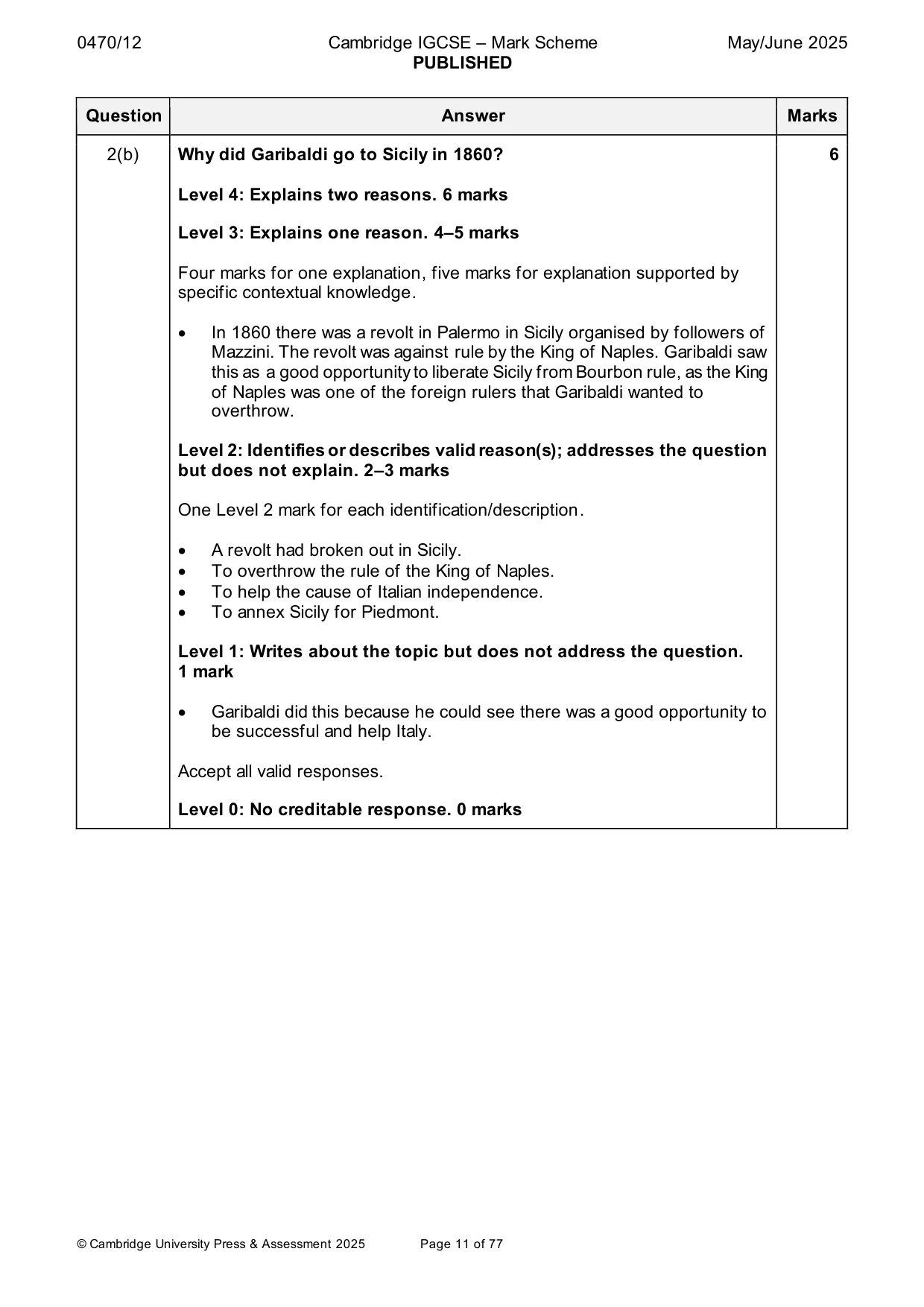
0470/12 Cambridge IGCSE – Mark Scheme PUBLISHED May/June 2025 © Cambridge University Press & Assessment 2025 Page 11 of 77 Question Answer Marks 2(b) Why did Garibaldi go to Sicily in 1860? Level 4: Explains two reasons. 6 marks Level 3: Explains one reason. 4–5 marks Four marks for one explanation, five marks for explanation supported by specific contextual knowledge. • In 1860 there was a revolt in Palermo in Sicily organised by followers of Mazzini. The revolt was against rule by the King of Naples. Garibaldi saw this as a good opportunity to liberate Sicily from Bourbon rule, as the King of Naples was one of the foreign rulers that Garibaldi wanted to overthrow. Level 2: Identifies or describes valid reason(s); addresses the question but does not explain. 2–3 marks One Level 2 mark for each identification/description. • A revolt had broken out in Sicily. • To overthrow the rule of the King of Naples. • To help the cause of Italian independence. • To annex Sicily for Piedmont. Level 1: Writes about the topic but does not address the question. 1 mark • Garibaldi did this because he could see there was a good opportunity to be successful and help Italy. Accept all valid responses. Level 0: No creditable response. 0 marks 6
Mark scheme, page 12
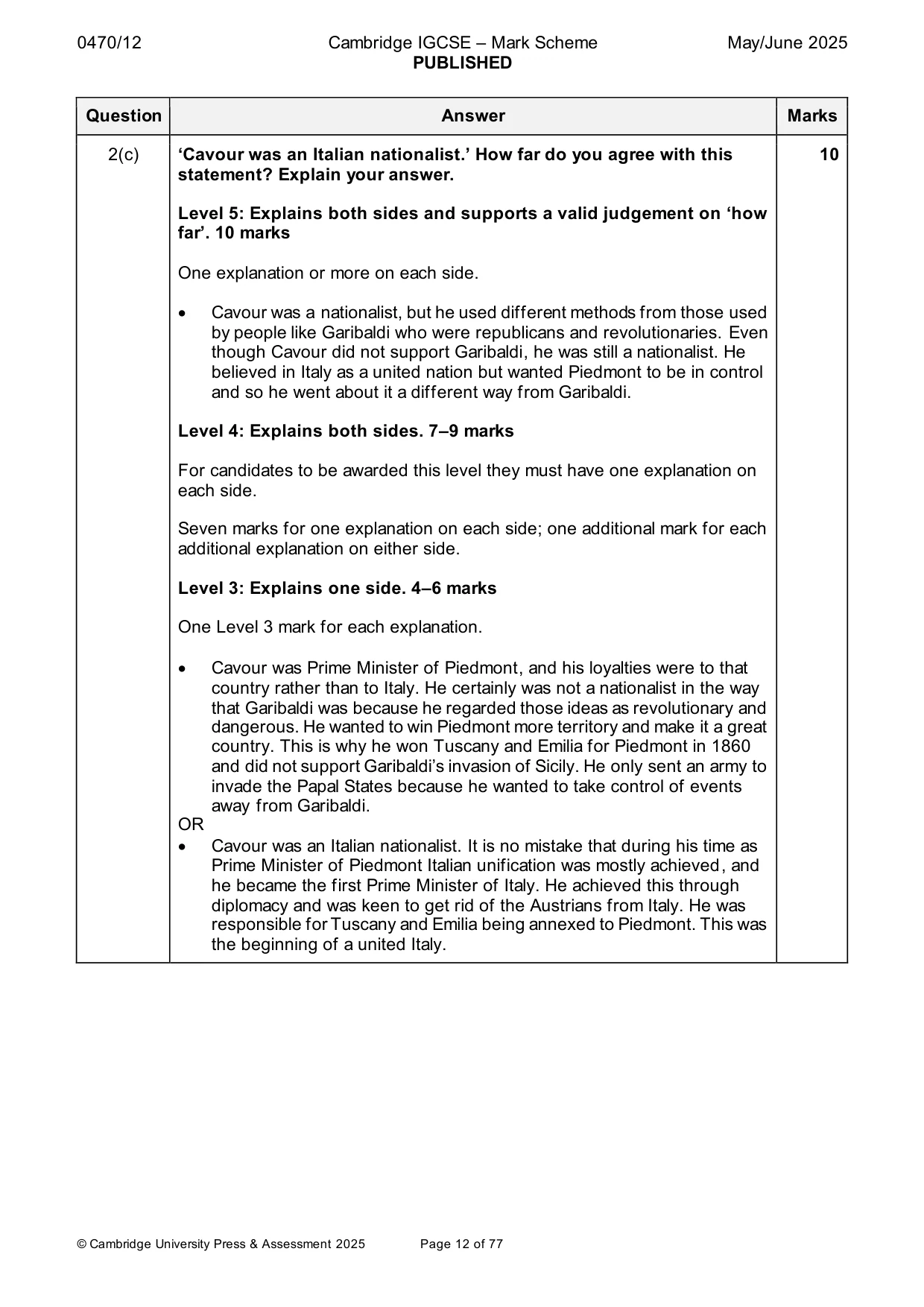
0470/12 Cambridge IGCSE – Mark Scheme PUBLISHED May/June 2025 © Cambridge University Press & Assessment 2025 Page 12 of 77 Question Answer Marks 2(c) ‘Cavour was an Italian nationalist.’ How far do you agree with this statement? Explain your answer. Level 5: Explains both sides and supports a valid judgement on ‘how far’. 10 marks One explanation or more on each side. • Cavour was a nationalist, but he used different methods from those used by people like Garibaldi who were republicans and revolutionaries. Even though Cavour did not support Garibaldi, he was still a nationalist. He believed in Italy as a united nation but wanted Piedmont to be in control and so he went about it a different way from Garibaldi. Level 4: Explains both sides. 7–9 marks For candidates to be awarded this level they must have one explanation on each side. Seven marks for one explanation on each side; one additional mark for each additional explanation on either side. Level 3: Explains one side. 4–6 marks One Level 3 mark for each explanation. • Cavour was Prime Minister of Piedmont, and his loyalties were to that country rather than to Italy. He certainly was not a nationalist in the way that Garibaldi was because he regarded those ideas as revolutionary and dangerous. He wanted to win Piedmont more territory and make it a great country. This is why he won Tuscany and Emilia for Piedmont in 1860 and did not support Garibaldi’s invasion of Sicily. He only sent an army to invade the Papal States because he wanted to take control of events away from Garibaldi. OR • Cavour was an Italian nationalist. It is no mistake that during his time as Prime Minister of Piedmont Italian unification was mostly achieved, and he became the first Prime Minister of Italy. He achieved this through diplomacy and was keen to get rid of the Austrians from Italy. He was responsible for Tuscany and Emilia being annexed to Piedmont. This was the beginning of a united Italy. 10
Mark scheme, page 13
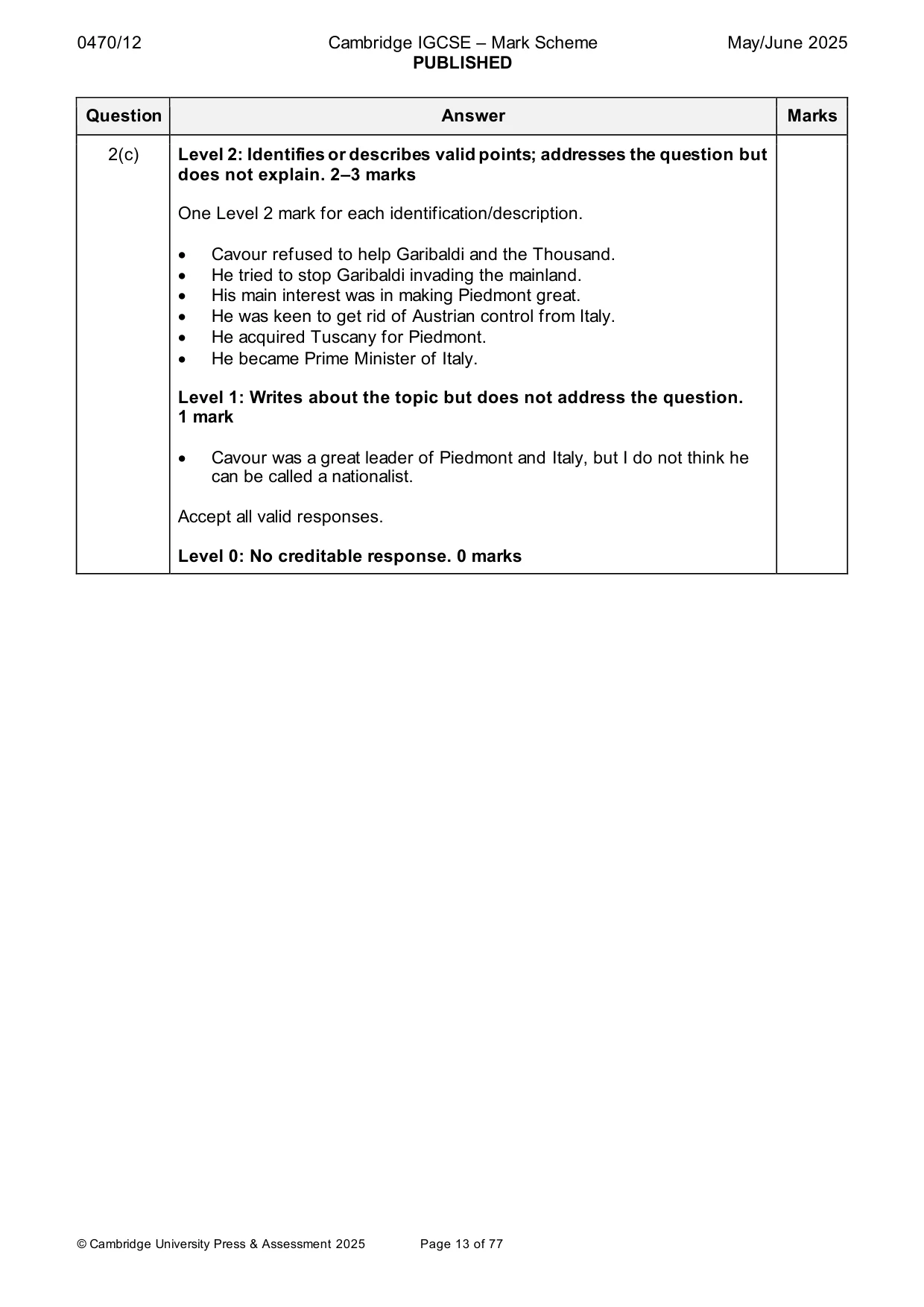
0470/12 Cambridge IGCSE – Mark Scheme PUBLISHED May/June 2025 © Cambridge University Press & Assessment 2025 Page 13 of 77 Question Answer Marks 2(c) Level 2: Identifies or describes valid points; addresses the question but does not explain. 2–3 marks One Level 2 mark for each identification/description. • Cavour refused to help Garibaldi and the Thousand. • He tried to stop Garibaldi invading the mainland. • His main interest was in making Piedmont great. • He was keen to get rid of Austrian control from Italy. • He acquired Tuscany for Piedmont. • He became Prime Minister of Italy. Level 1: Writes about the topic but does not address the question. 1 mark • Cavour was a great leader of Piedmont and Italy, but I do not think he can be called a nationalist. Accept all valid responses. Level 0: No creditable response. 0 marks
Mark scheme, page 14
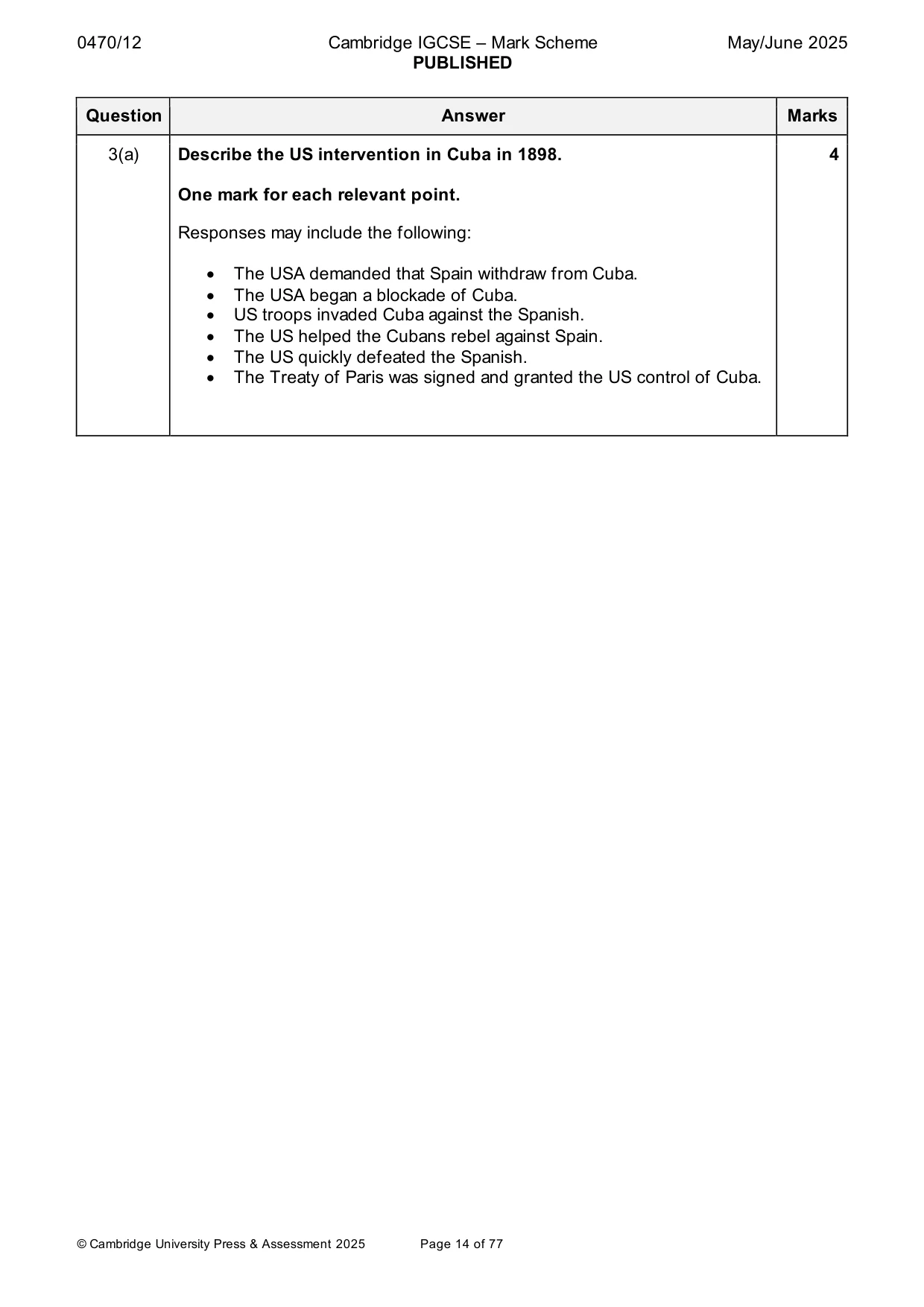
0470/12 Cambridge IGCSE – Mark Scheme PUBLISHED May/June 2025 © Cambridge University Press & Assessment 2025 Page 14 of 77 Question Answer Marks 3(a) Describe the US intervention in Cuba in 1898. One mark for each relevant point. Responses may include the following: • The USA demanded that Spain withdraw from Cuba. • The USA began a blockade of Cuba. • US troops invaded Cuba against the Spanish. • The US helped the Cubans rebel against Spain. • The US quickly defeated the Spanish. • The Treaty of Paris was signed and granted the US control of Cuba. 4
Mark scheme, page 15
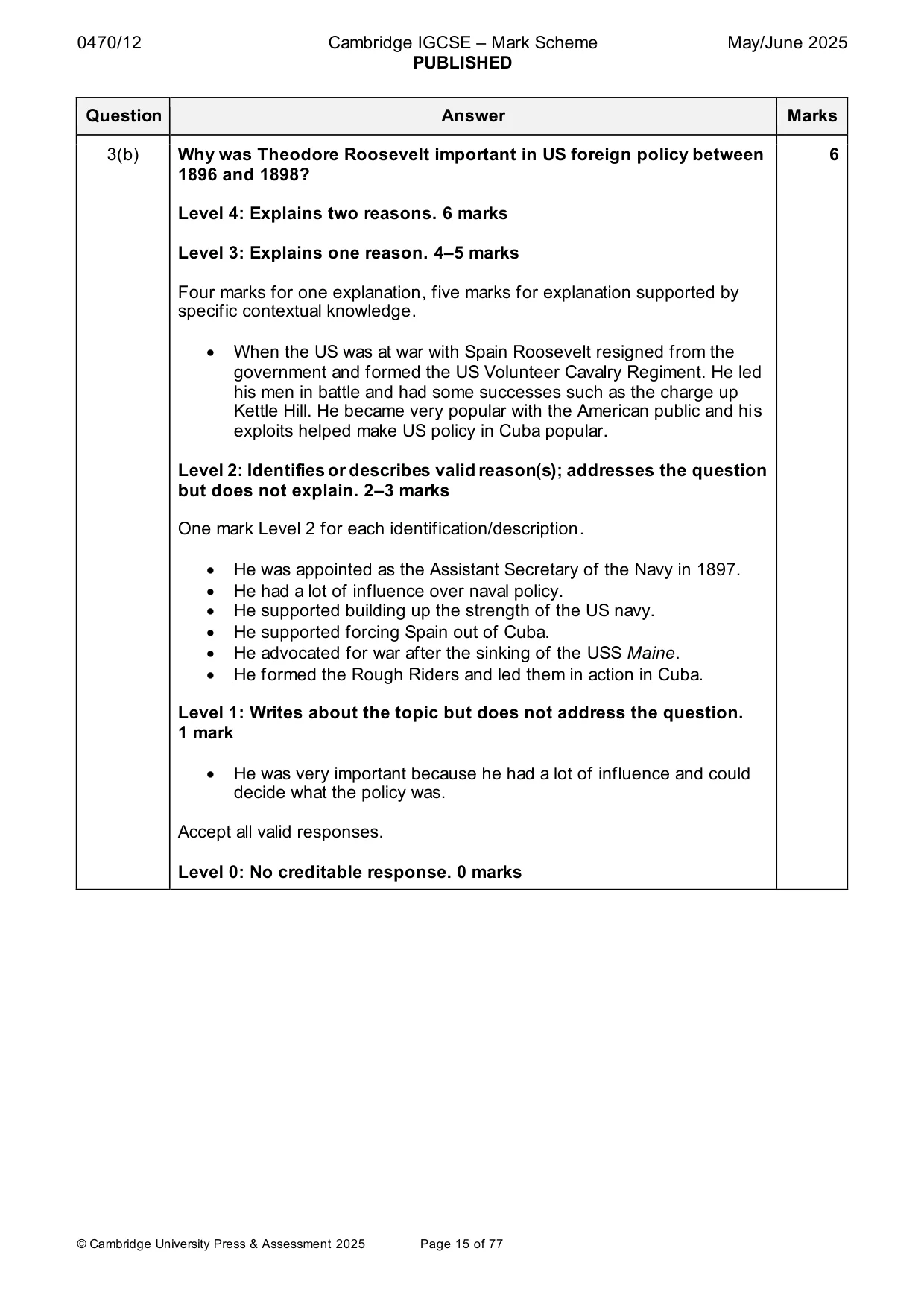
0470/12 Cambridge IGCSE – Mark Scheme PUBLISHED May/June 2025 © Cambridge University Press & Assessment 2025 Page 15 of 77 Question Answer Marks 3(b) Why was Theodore Roosevelt important in US foreign policy between 1896 and 1898? Level 4: Explains two reasons. 6 marks Level 3: Explains one reason. 4–5 marks Four marks for one explanation, five marks for explanation supported by specific contextual knowledge. • When the US was at war with Spain Roosevelt resigned from the government and formed the US Volunteer Cavalry Regiment. He led his men in battle and had some successes such as the charge up Kettle Hill. He became very popular with the American public and his exploits helped make US policy in Cuba popular. Level 2: Identifies or describes valid reason(s); addresses the question but does not explain. 2–3 marks One mark Level 2 for each identification/description. • He was appointed as the Assistant Secretary of the Navy in 1897. • He had a lot of influence over naval policy. • He supported building up the strength of the US navy. • He supported forcing Spain out of Cuba. • He advocated for war after the sinking of the USS Maine. • He formed the Rough Riders and led them in action in Cuba. Level 1: Writes about the topic but does not address the question. 1 mark • He was very important because he had a lot of influence and could decide what the policy was. Accept all valid responses. Level 0: No creditable response. 0 marks 6
Mark scheme, page 16
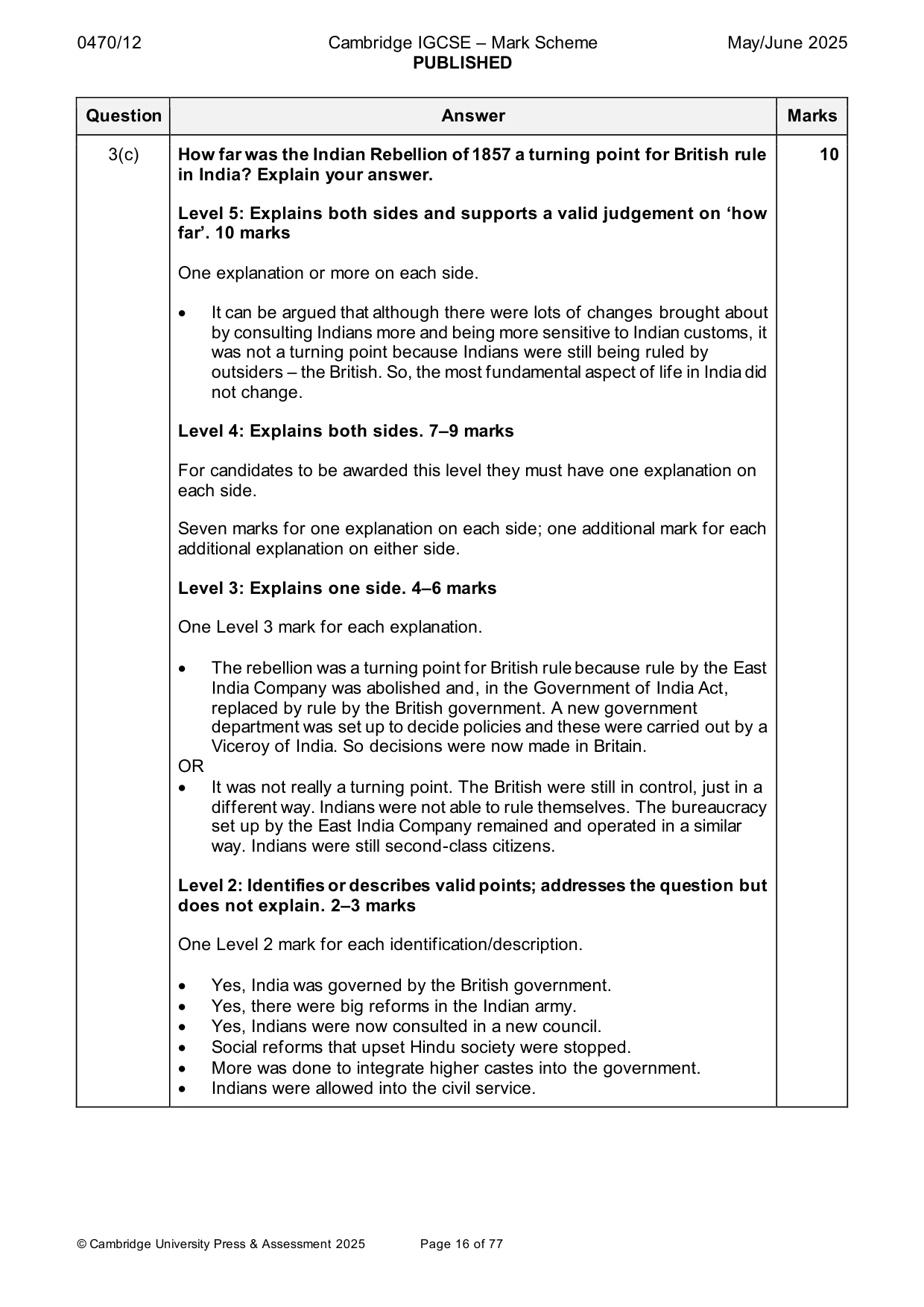
0470/12 Cambridge IGCSE – Mark Scheme PUBLISHED May/June 2025 © Cambridge University Press & Assessment 2025 Page 16 of 77 Question Answer Marks 3(c) How far was the Indian Rebellion of 1857 a turning point for British rule in India? Explain your answer. Level 5: Explains both sides and supports a valid judgement on ‘how far’. 10 marks One explanation or more on each side. • It can be argued that although there were lots of changes brought about by consulting Indians more and being more sensitive to Indian customs, it was not a turning point because Indians were still being ruled by outsiders – the British. So, the most fundamental aspect of life in India did not change. Level 4: Explains both sides. 7–9 marks For candidates to be awarded this level they must have one explanation on each side. Seven marks for one explanation on each side; one additional mark for each additional explanation on either side. Level 3: Explains one side. 4–6 marks One Level 3 mark for each explanation. • The rebellion was a turning point for British rule because rule by the East India Company was abolished and, in the Government of India Act, replaced by rule by the British government. A new government department was set up to decide policies and these were carried out by a Viceroy of India. So decisions were now made in Britain. OR • It was not really a turning point. The British were still in control, just in a different way. Indians were not able to rule themselves. The bureaucracy set up by the East India Company remained and operated in a similar way. Indians were still second-class citizens. Level 2: Identifies or describes valid points; addresses the question but does not explain. 2–3 marks One Level 2 mark for each identification/description. • Yes, India was governed by the British government. • Yes, there were big reforms in the Indian army. • Yes, Indians were now consulted in a new council. • Social reforms that upset Hindu society were stopped. • More was done to integrate higher castes into the government. • Indians were allowed into the civil service. 10
Mark scheme, page 17
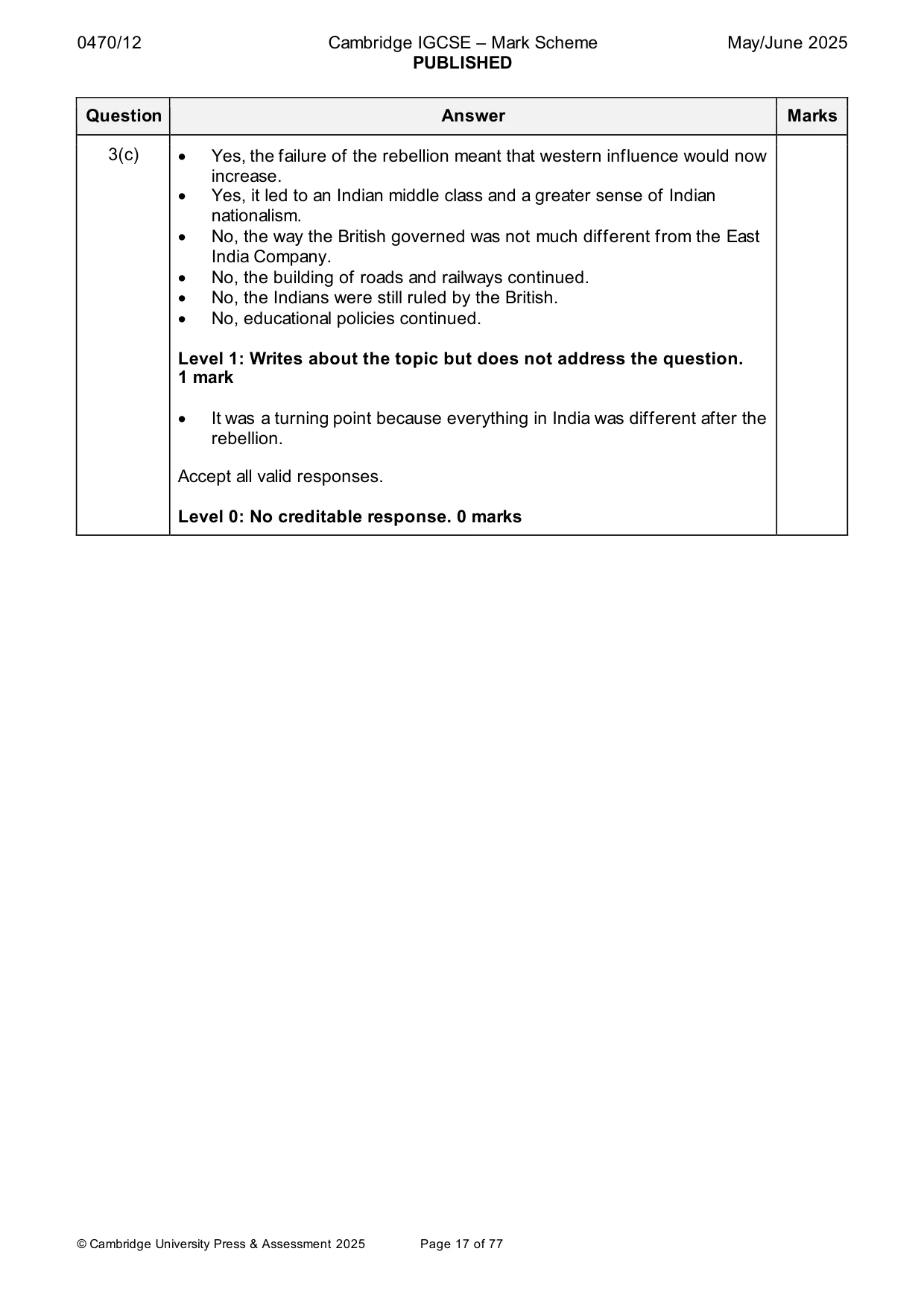
0470/12 Cambridge IGCSE – Mark Scheme PUBLISHED May/June 2025 © Cambridge University Press & Assessment 2025 Page 17 of 77 Question Answer Marks 3(c) • Yes, the failure of the rebellion meant that western influence would now increase. • Yes, it led to an Indian middle class and a greater sense of Indian nationalism. • No, the way the British governed was not much different from the East India Company. • No, the building of roads and railways continued. • No, the Indians were still ruled by the British. • No, educational policies continued. Level 1: Writes about the topic but does not address the question. 1 mark • It was a turning point because everything in India was different after the rebellion. Accept all valid responses. Level 0: No creditable response. 0 marks
Mark scheme, page 18
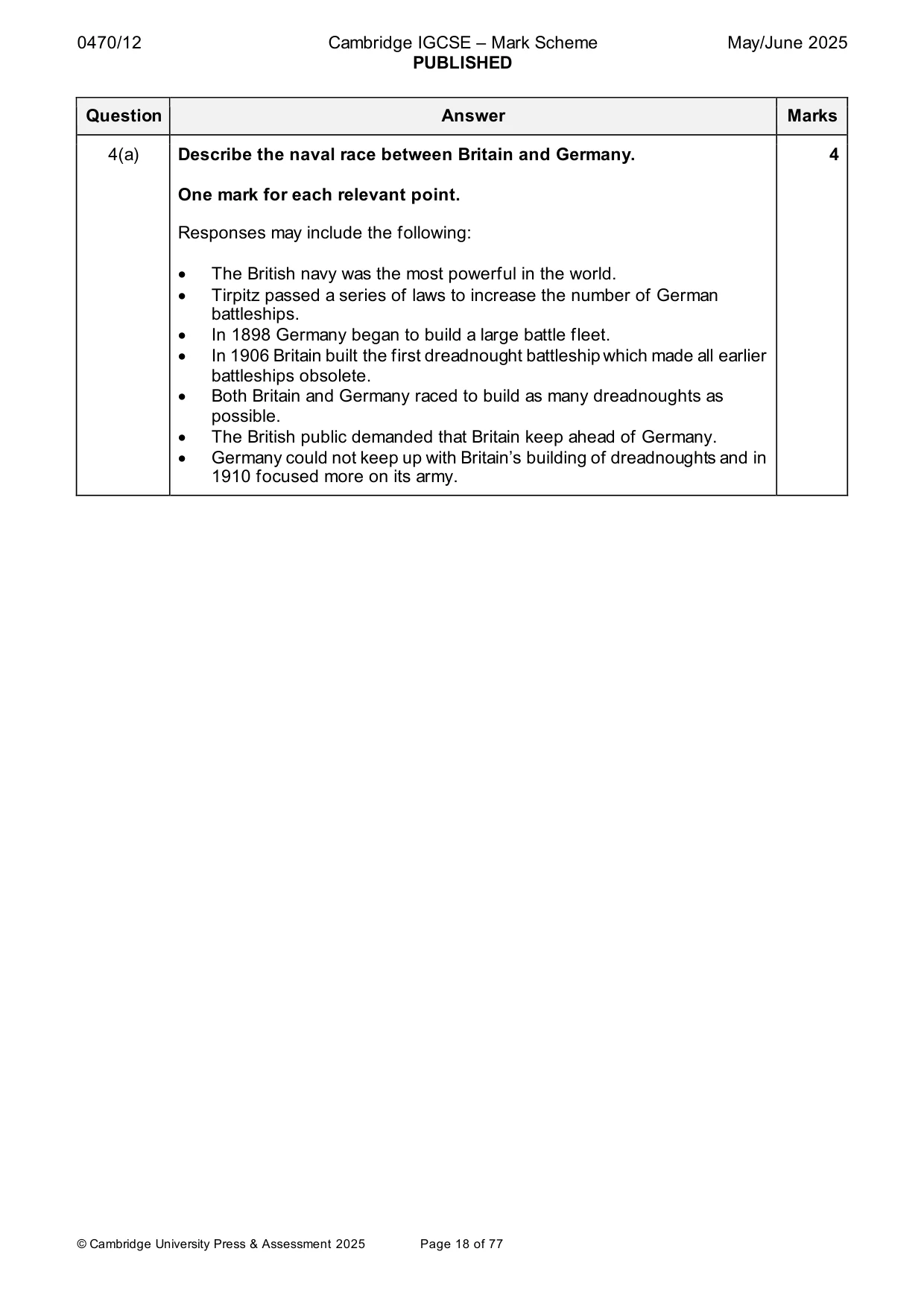
0470/12 Cambridge IGCSE – Mark Scheme PUBLISHED May/June 2025 © Cambridge University Press & Assessment 2025 Page 18 of 77 Question Answer Marks 4(a) Describe the naval race between Britain and Germany. One mark for each relevant point. Responses may include the following: • The British navy was the most powerful in the world. • Tirpitz passed a series of laws to increase the number of German battleships. • In 1898 Germany began to build a large battle fleet. • In 1906 Britain built the first dreadnought battleship which made all earlier battleships obsolete. • Both Britain and Germany raced to build as many dreadnoughts as possible. • The British public demanded that Britain keep ahead of Germany. • Germany could not keep up with Britain’s building of dreadnoughts and in 1910 focused more on its army. 4
Mark scheme, page 19
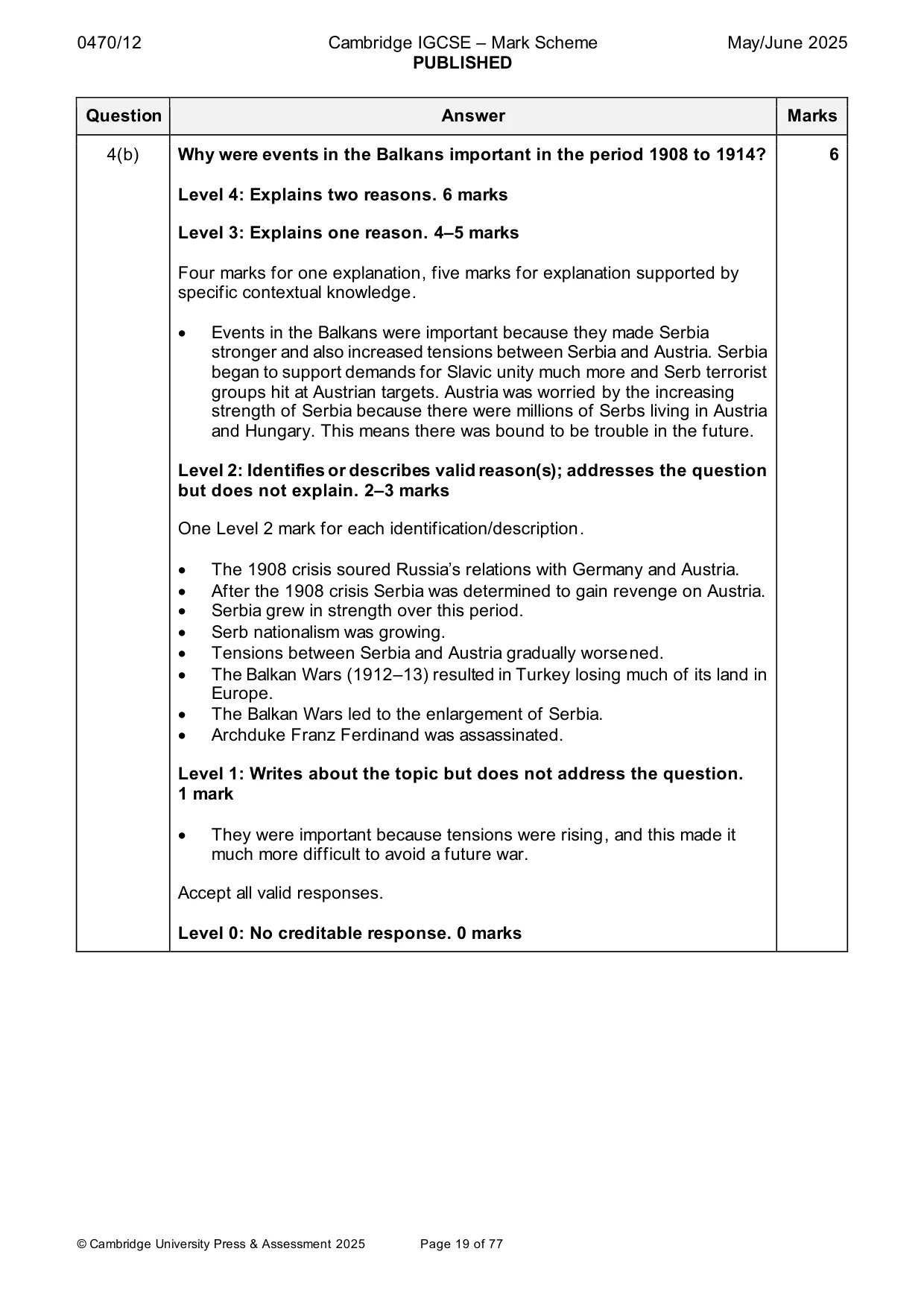
0470/12 Cambridge IGCSE – Mark Scheme PUBLISHED May/June 2025 © Cambridge University Press & Assessment 2025 Page 19 of 77 Question Answer Marks 4(b) Why were events in the Balkans important in the period 1908 to 1914? Level 4: Explains two reasons. 6 marks Level 3: Explains one reason. 4–5 marks Four marks for one explanation, five marks for explanation supported by specific contextual knowledge. • Events in the Balkans were important because they made Serbia stronger and also increased tensions between Serbia and Austria. Serbia began to support demands for Slavic unity much more and Serb terrorist groups hit at Austrian targets. Austria was worried by the increasing strength of Serbia because there were millions of Serbs living in Austria and Hungary. This means there was bound to be trouble in the future. Level 2: Identifies or describes valid reason(s); addresses the question but does not explain. 2–3 marks One Level 2 mark for each identification/description. • The 1908 crisis soured Russia’s relations with Germany and Austria. • After the 1908 crisis Serbia was determined to gain revenge on Austria. • Serbia grew in strength over this period. • Serb nationalism was growing. • Tensions between Serbia and Austria gradually worsened. • The Balkan Wars (1912–13) resulted in Turkey losing much of its land in Europe. • The Balkan Wars led to the enlargement of Serbia. • Archduke Franz Ferdinand was assassinated. Level 1: Writes about the topic but does not address the question. 1 mark • They were important because tensions were rising, and this made it much more difficult to avoid a future war. Accept all valid responses. Level 0: No creditable response. 0 marks 6
Mark scheme, page 20
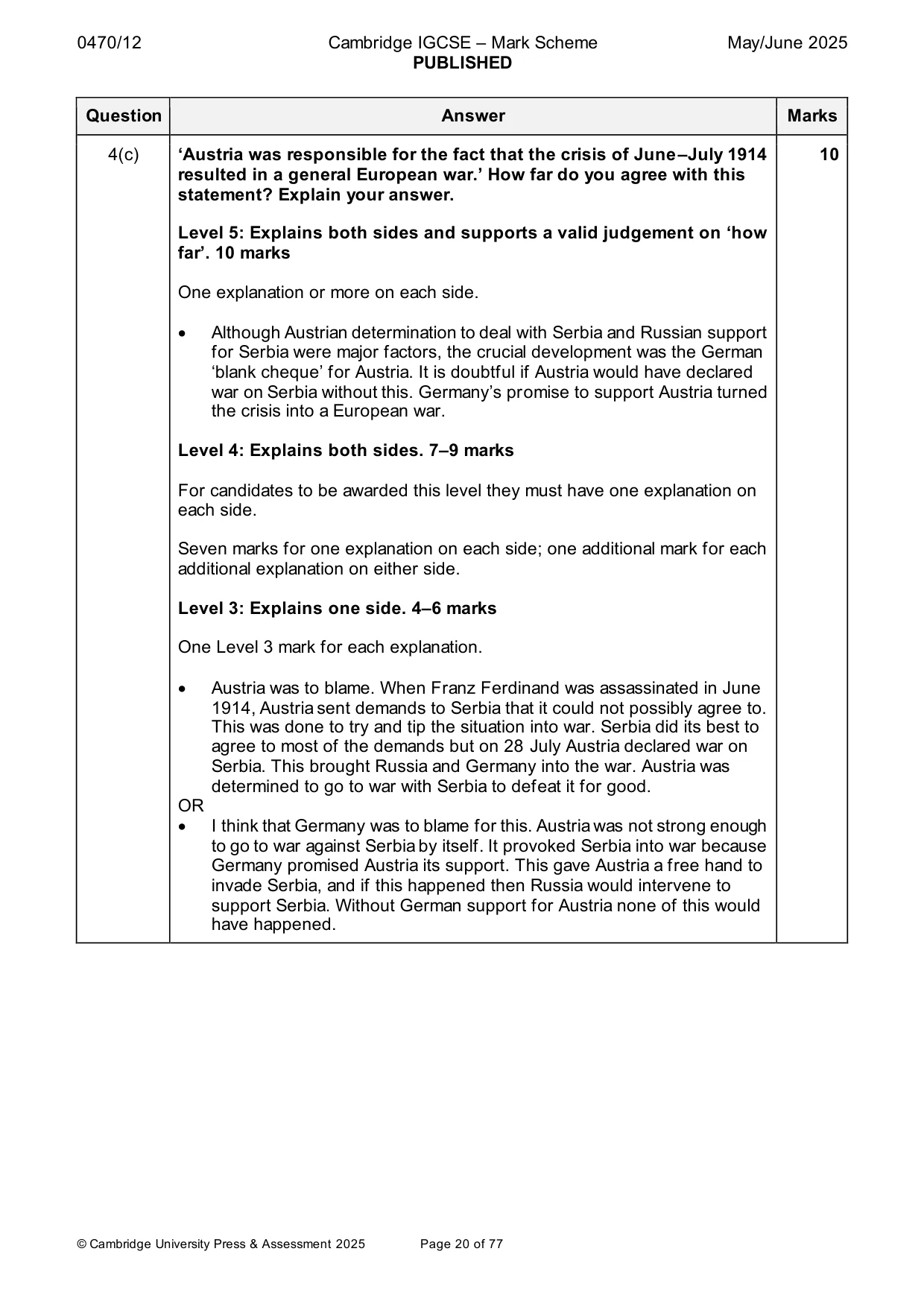
0470/12 Cambridge IGCSE – Mark Scheme PUBLISHED May/June 2025 © Cambridge University Press & Assessment 2025 Page 20 of 77 Question Answer Marks 4(c) ‘Austria was responsible for the fact that the crisis of June–July 1914 resulted in a general European war.’ How far do you agree with this statement? Explain your answer. Level 5: Explains both sides and supports a valid judgement on ‘how far’. 10 marks One explanation or more on each side. • Although Austrian determination to deal with Serbia and Russian support for Serbia were major factors, the crucial development was the German ‘blank cheque’ for Austria. It is doubtful if Austria would have declared war on Serbia without this. Germany’s promise to support Austria turned the crisis into a European war. Level 4: Explains both sides. 7–9 marks For candidates to be awarded this level they must have one explanation on each side. Seven marks for one explanation on each side; one additional mark for each additional explanation on either side. Level 3: Explains one side. 4–6 marks One Level 3 mark for each explanation. • Austria was to blame. When Franz Ferdinand was assassinated in June 1914, Austria sent demands to Serbia that it could not possibly agree to. This was done to try and tip the situation into war. Serbia did its best to agree to most of the demands but on 28 July Austria declared war on Serbia. This brought Russia and Germany into the war. Austria was determined to go to war with Serbia to defeat it for good. OR • I think that Germany was to blame for this. Austria was not strong enough to go to war against Serbia by itself. It provoked Serbia into war because Germany promised Austria its support. This gave Austria a free hand to invade Serbia, and if this happened then Russia would intervene to support Serbia. Without German support for Austria none of this would have happened. 10
Mark scheme, page 21
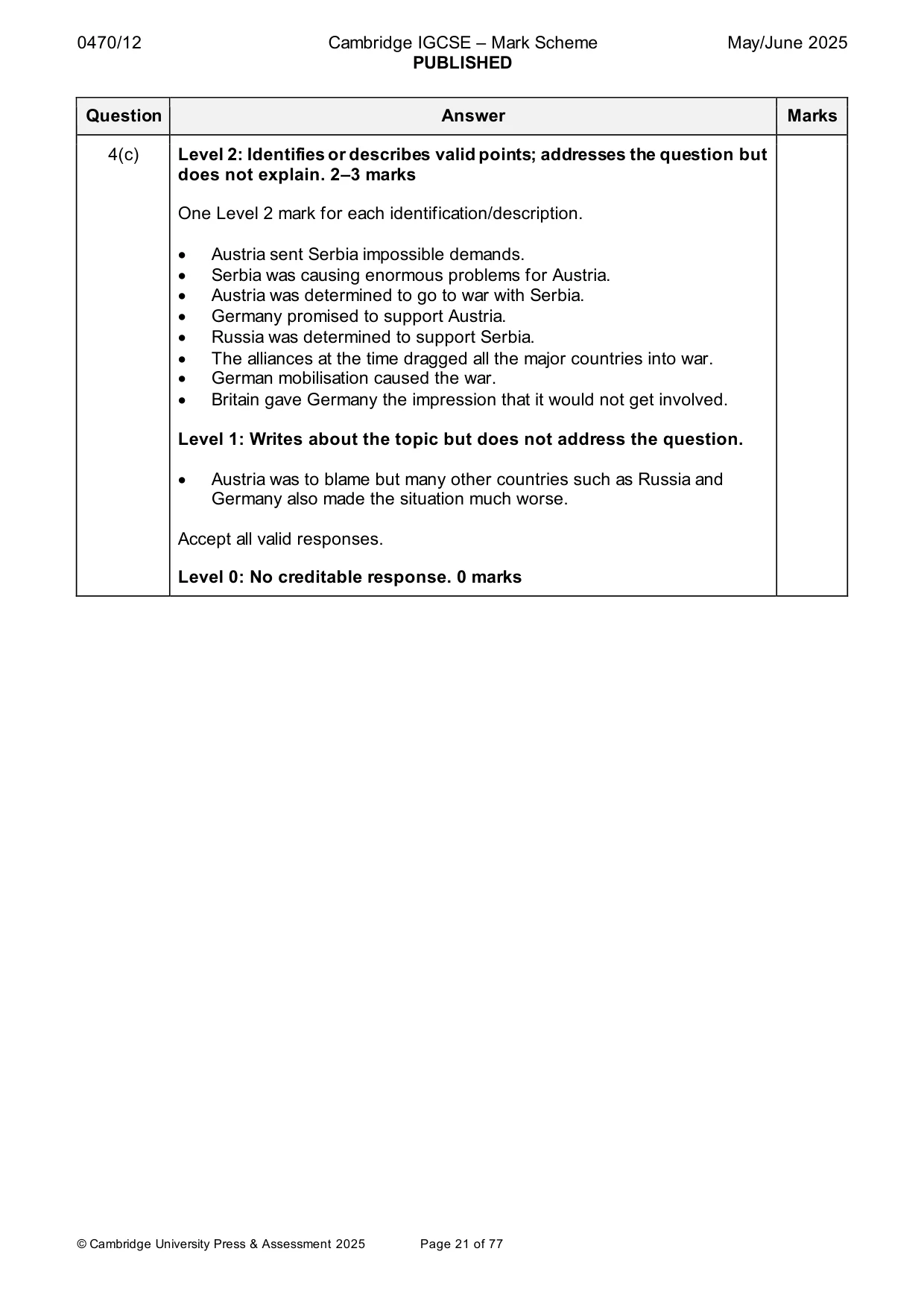
0470/12 Cambridge IGCSE – Mark Scheme PUBLISHED May/June 2025 © Cambridge University Press & Assessment 2025 Page 21 of 77 Question Answer Marks 4(c) Level 2: Identifies or describes valid points; addresses the question but does not explain. 2–3 marks One Level 2 mark for each identification/description. • Austria sent Serbia impossible demands. • Serbia was causing enormous problems for Austria. • Austria was determined to go to war with Serbia. • Germany promised to support Austria. • Russia was determined to support Serbia. • The alliances at the time dragged all the major countries into war. • German mobilisation caused the war. • Britain gave Germany the impression that it would not get involved. Level 1: Writes about the topic but does not address the question. • Austria was to blame but many other countries such as Russia and Germany also made the situation much worse. Accept all valid responses. Level 0: No creditable response. 0 marks
Mark scheme, page 22
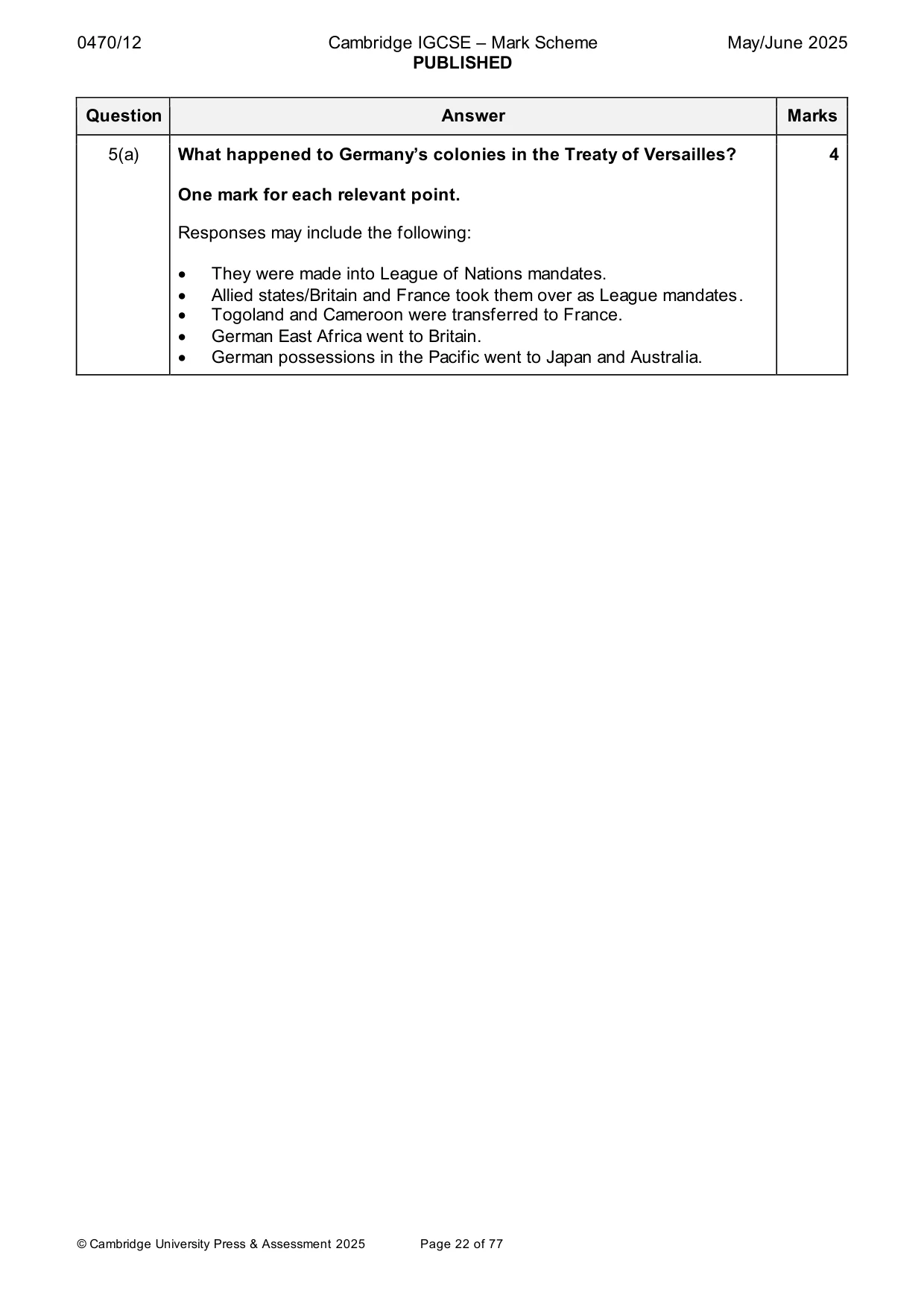
0470/12 Cambridge IGCSE – Mark Scheme PUBLISHED May/June 2025 © Cambridge University Press & Assessment 2025 Page 22 of 77 Question Answer Marks 5(a) What happened to Germany’s colonies in the Treaty of Versailles? One mark for each relevant point. Responses may include the following: • They were made into League of Nations mandates. • Allied states/Britain and France took them over as League mandates. • Togoland and Cameroon were transferred to France. • German East Africa went to Britain. • German possessions in the Pacific went to Japan and Australia. 4
Mark scheme, page 23
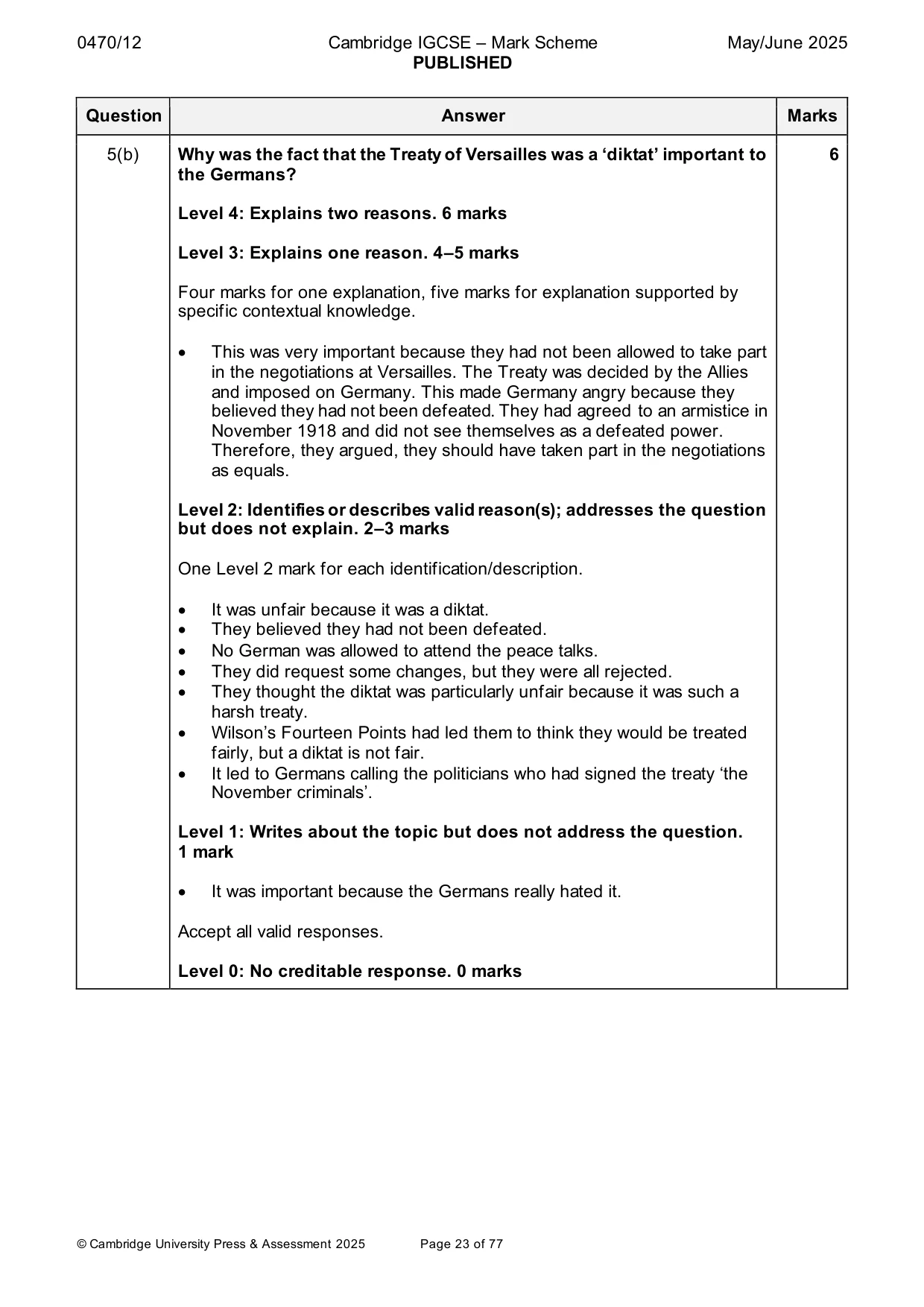
0470/12 Cambridge IGCSE – Mark Scheme PUBLISHED May/June 2025 © Cambridge University Press & Assessment 2025 Page 23 of 77 Question Answer Marks 5(b) Why was the fact that the Treaty of Versailles was a ‘diktat’ important to the Germans? Level 4: Explains two reasons. 6 marks Level 3: Explains one reason. 4–5 marks Four marks for one explanation, five marks for explanation supported by specific contextual knowledge. • This was very important because they had not been allowed to take part in the negotiations at Versailles. The Treaty was decided by the Allies and imposed on Germany. This made Germany angry because they believed they had not been defeated. They had agreed to an armistice in November 1918 and did not see themselves as a defeated power. Therefore, they argued, they should have taken part in the negotiations as equals. Level 2: Identifies or describes valid reason(s); addresses the question but does not explain. 2–3 marks One Level 2 mark for each identification/description. • It was unfair because it was a diktat. • They believed they had not been defeated. • No German was allowed to attend the peace talks. • They did request some changes, but they were all rejected. • They thought the diktat was particularly unfair because it was such a harsh treaty. • Wilson’s Fourteen Points had led them to think they would be treated fairly, but a diktat is not fair. • It led to Germans calling the politicians who had signed the treaty ‘the November criminals’. Level 1: Writes about the topic but does not address the question. 1 mark • It was important because the Germans really hated it. Accept all valid responses. Level 0: No creditable response. 0 marks 6
Mark scheme, page 24
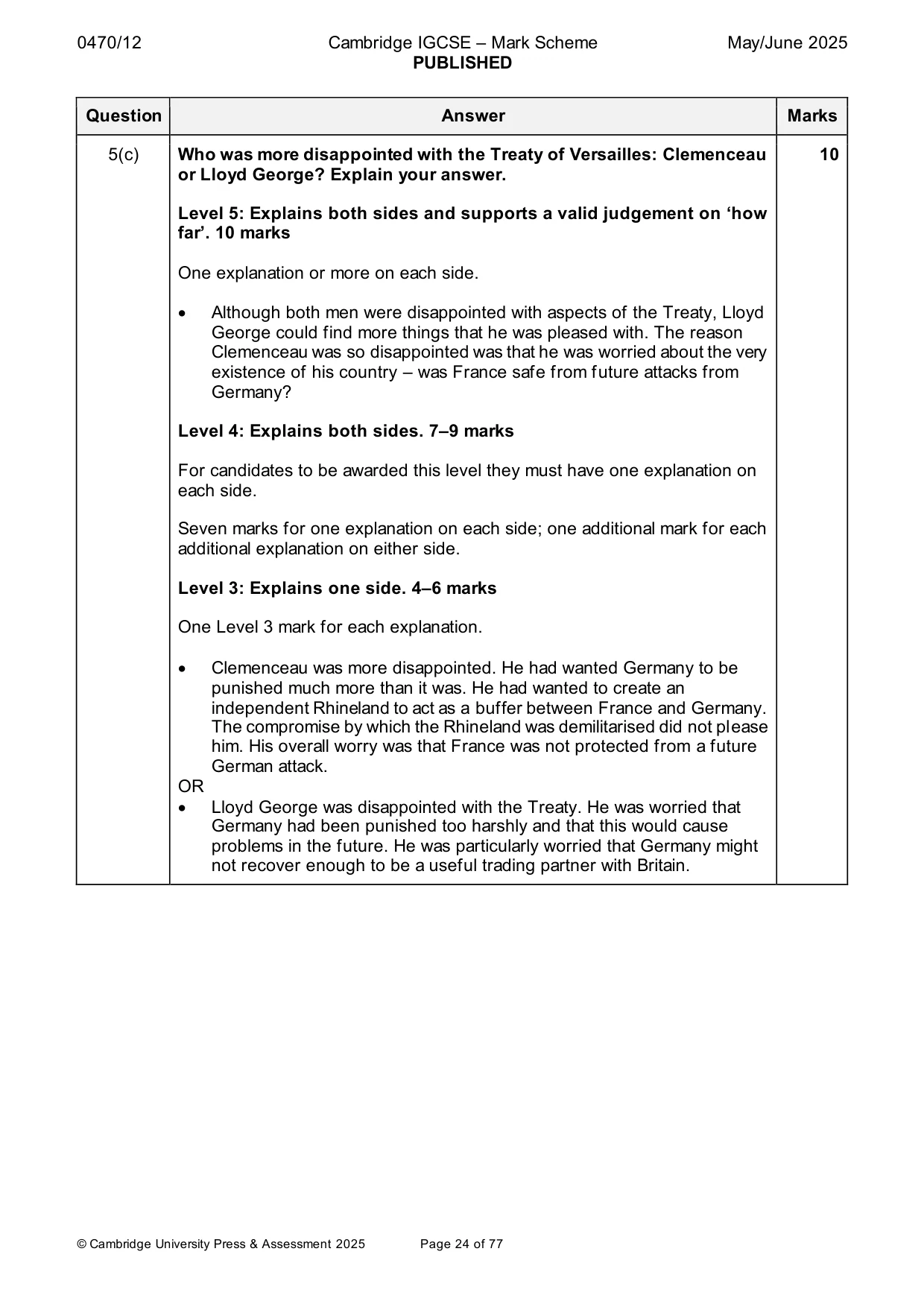
0470/12 Cambridge IGCSE – Mark Scheme PUBLISHED May/June 2025 © Cambridge University Press & Assessment 2025 Page 24 of 77 Question Answer Marks 5(c) Who was more disappointed with the Treaty of Versailles: Clemenceau or Lloyd George? Explain your answer. Level 5: Explains both sides and supports a valid judgement on ‘how far’. 10 marks One explanation or more on each side. • Although both men were disappointed with aspects of the Treaty, Lloyd George could find more things that he was pleased with. The reason Clemenceau was so disappointed was that he was worried about the very existence of his country – was France safe from future attacks from Germany? Level 4: Explains both sides. 7–9 marks For candidates to be awarded this level they must have one explanation on each side. Seven marks for one explanation on each side; one additional mark for each additional explanation on either side. Level 3: Explains one side. 4–6 marks One Level 3 mark for each explanation. • Clemenceau was more disappointed. He had wanted Germany to be punished much more than it was. He had wanted to create an independent Rhineland to act as a buffer between France and Germany. The compromise by which the Rhineland was demilitarised did not please him. His overall worry was that France was not protected from a future German attack. OR • Lloyd George was disappointed with the Treaty. He was worried that Germany had been punished too harshly and that this would cause problems in the future. He was particularly worried that Germany might not recover enough to be a useful trading partner with Britain. 10
Mark scheme, page 25
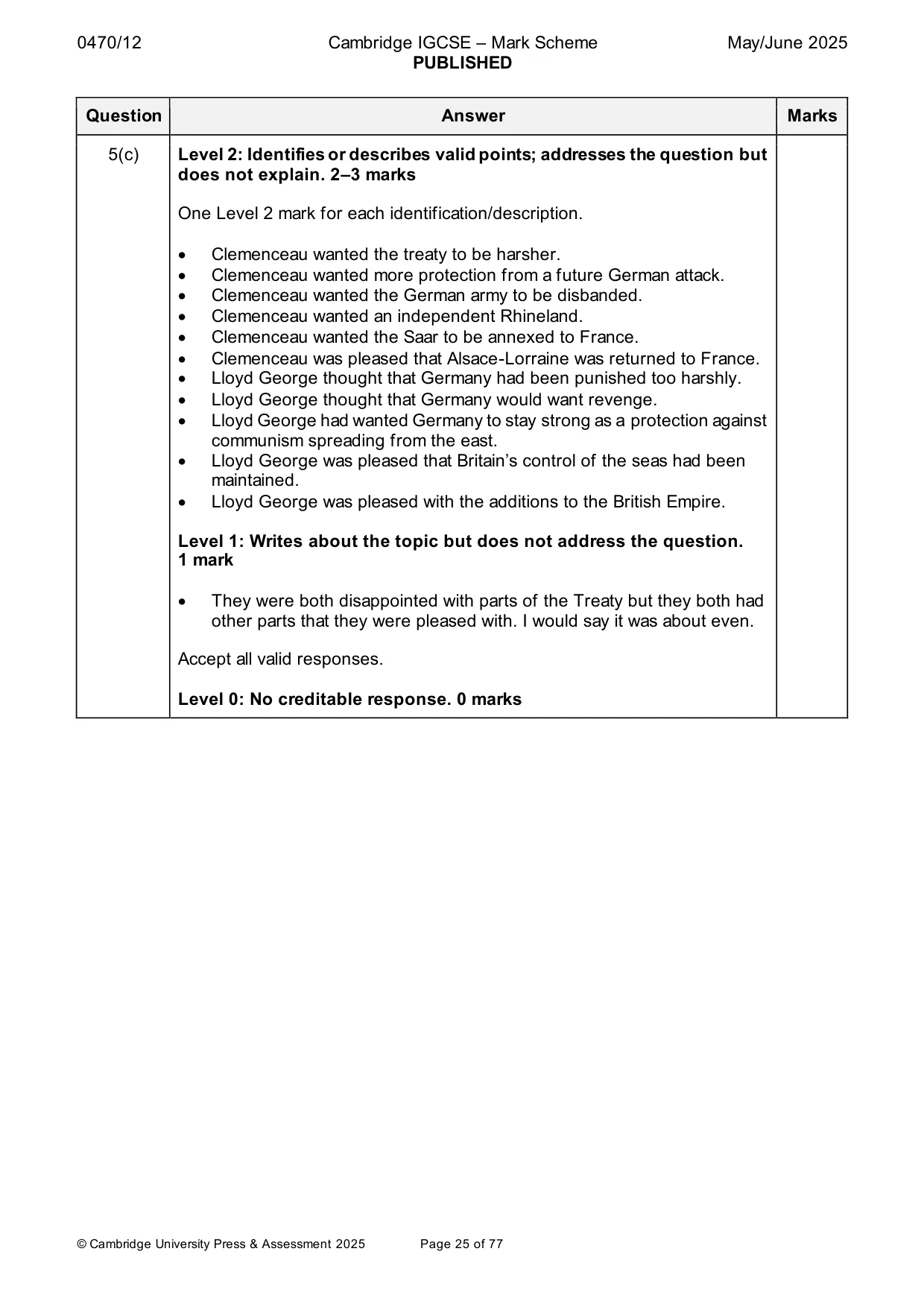
0470/12 Cambridge IGCSE – Mark Scheme PUBLISHED May/June 2025 © Cambridge University Press & Assessment 2025 Page 25 of 77 Question Answer Marks 5(c) Level 2: Identifies or describes valid points; addresses the question but does not explain. 2–3 marks One Level 2 mark for each identification/description. • Clemenceau wanted the treaty to be harsher. • Clemenceau wanted more protection from a future German attack. • Clemenceau wanted the German army to be disbanded. • Clemenceau wanted an independent Rhineland. • Clemenceau wanted the Saar to be annexed to France. • Clemenceau was pleased that Alsace-Lorraine was returned to France. • Lloyd George thought that Germany had been punished too harshly. • Lloyd George thought that Germany would want revenge. • Lloyd George had wanted Germany to stay strong as a protection against communism spreading from the east. • Lloyd George was pleased that Britain’s control of the seas had been maintained. • Lloyd George was pleased with the additions to the British Empire. Level 1: Writes about the topic but does not address the question. 1 mark • They were both disappointed with parts of the Treaty but they both had other parts that they were pleased with. I would say it was about even. Accept all valid responses. Level 0: No creditable response. 0 marks
Mark scheme, page 26
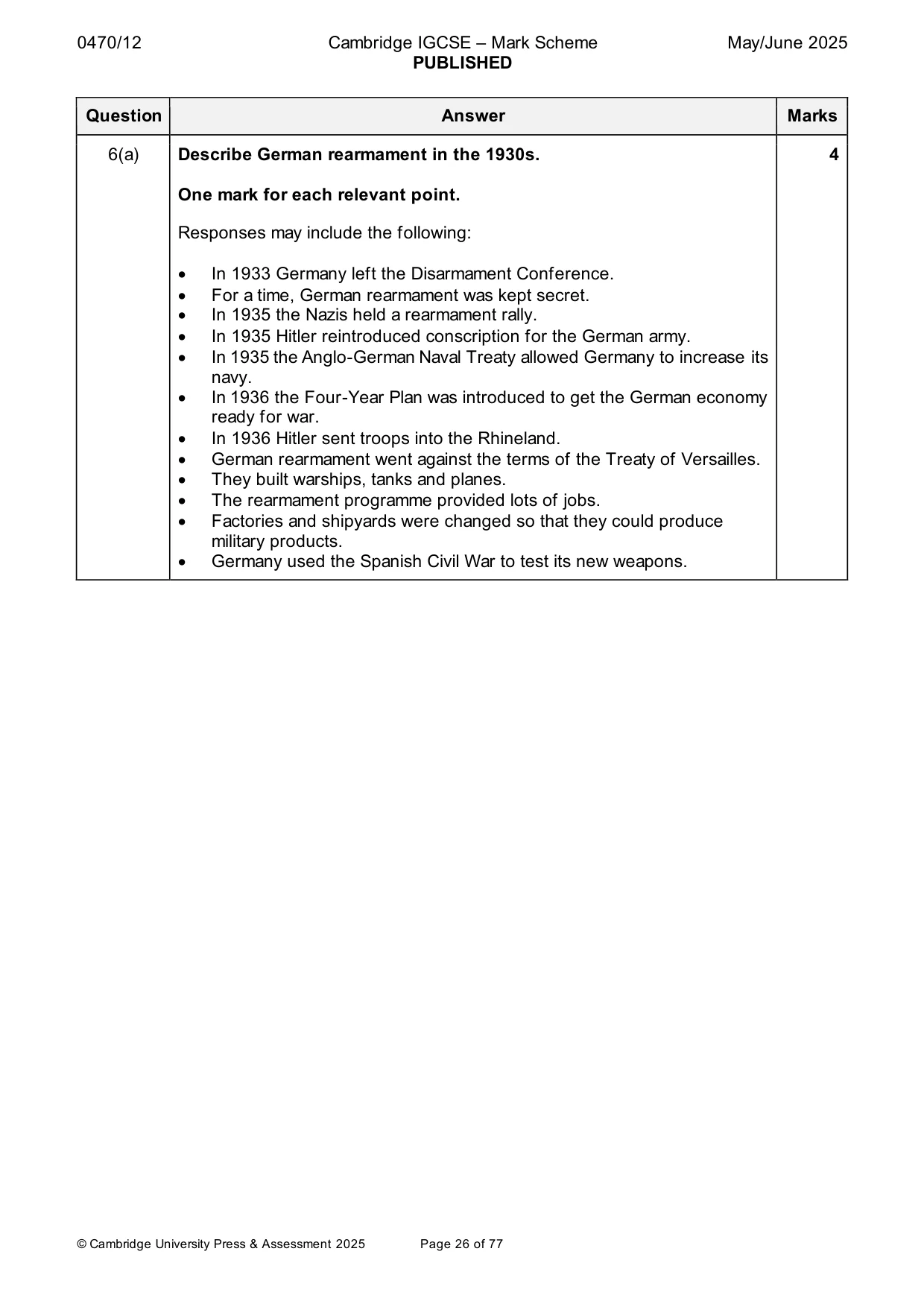
0470/12 Cambridge IGCSE – Mark Scheme PUBLISHED May/June 2025 © Cambridge University Press & Assessment 2025 Page 26 of 77 Question Answer Marks 6(a) Describe German rearmament in the 1930s. One mark for each relevant point. Responses may include the following: • In 1933 Germany left the Disarmament Conference. • For a time, German rearmament was kept secret. • In 1935 the Nazis held a rearmament rally. • In 1935 Hitler reintroduced conscription for the German army. • In 1935 the Anglo-German Naval Treaty allowed Germany to increase its navy. • In 1936 the Four-Year Plan was introduced to get the German economy ready for war. • In 1936 Hitler sent troops into the Rhineland. • German rearmament went against the terms of the Treaty of Versailles. • They built warships, tanks and planes. • The rearmament programme provided lots of jobs. • Factories and shipyards were changed so that they could produce military products. • Germany used the Spanish Civil War to test its new weapons. 4
Mark scheme, page 27
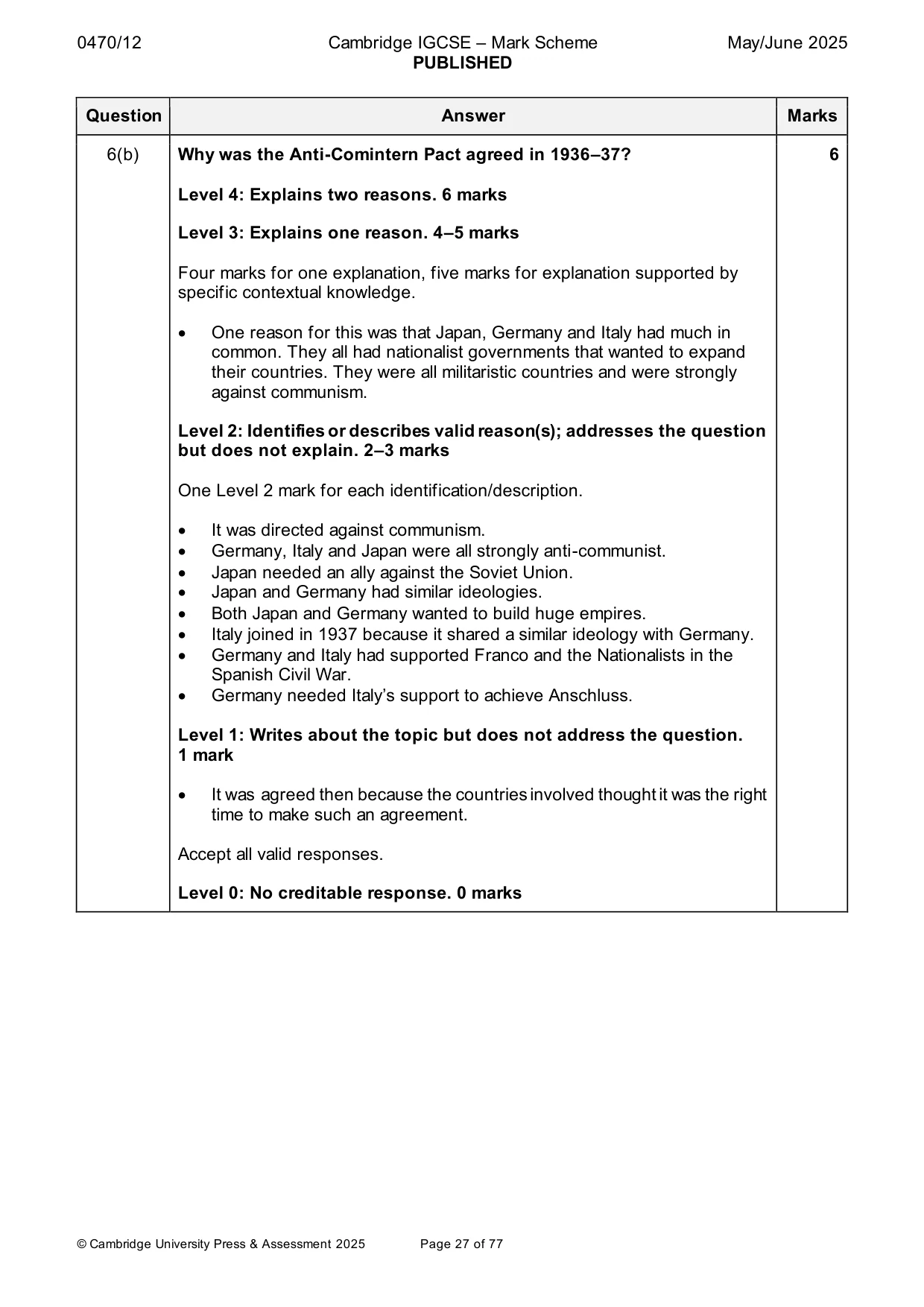
0470/12 Cambridge IGCSE – Mark Scheme PUBLISHED May/June 2025 © Cambridge University Press & Assessment 2025 Page 27 of 77 Question Answer Marks 6(b) Why was the Anti-Comintern Pact agreed in 1936–37? Level 4: Explains two reasons. 6 marks Level 3: Explains one reason. 4–5 marks Four marks for one explanation, five marks for explanation supported by specific contextual knowledge. • One reason for this was that Japan, Germany and Italy had much in common. They all had nationalist governments that wanted to expand their countries. They were all militaristic countries and were strongly against communism. Level 2: Identifies or describes valid reason(s); addresses the question but does not explain. 2–3 marks One Level 2 mark for each identification/description. • It was directed against communism. • Germany, Italy and Japan were all strongly anti-communist. • Japan needed an ally against the Soviet Union. • Japan and Germany had similar ideologies. • Both Japan and Germany wanted to build huge empires. • Italy joined in 1937 because it shared a similar ideology with Germany. • Germany and Italy had supported Franco and the Nationalists in the Spanish Civil War. • Germany needed Italy’s support to achieve Anschluss. Level 1: Writes about the topic but does not address the question. 1 mark • It was agreed then because the countries involved thought it was the right time to make such an agreement. Accept all valid responses. Level 0: No creditable response. 0 marks 6
Mark scheme, page 28
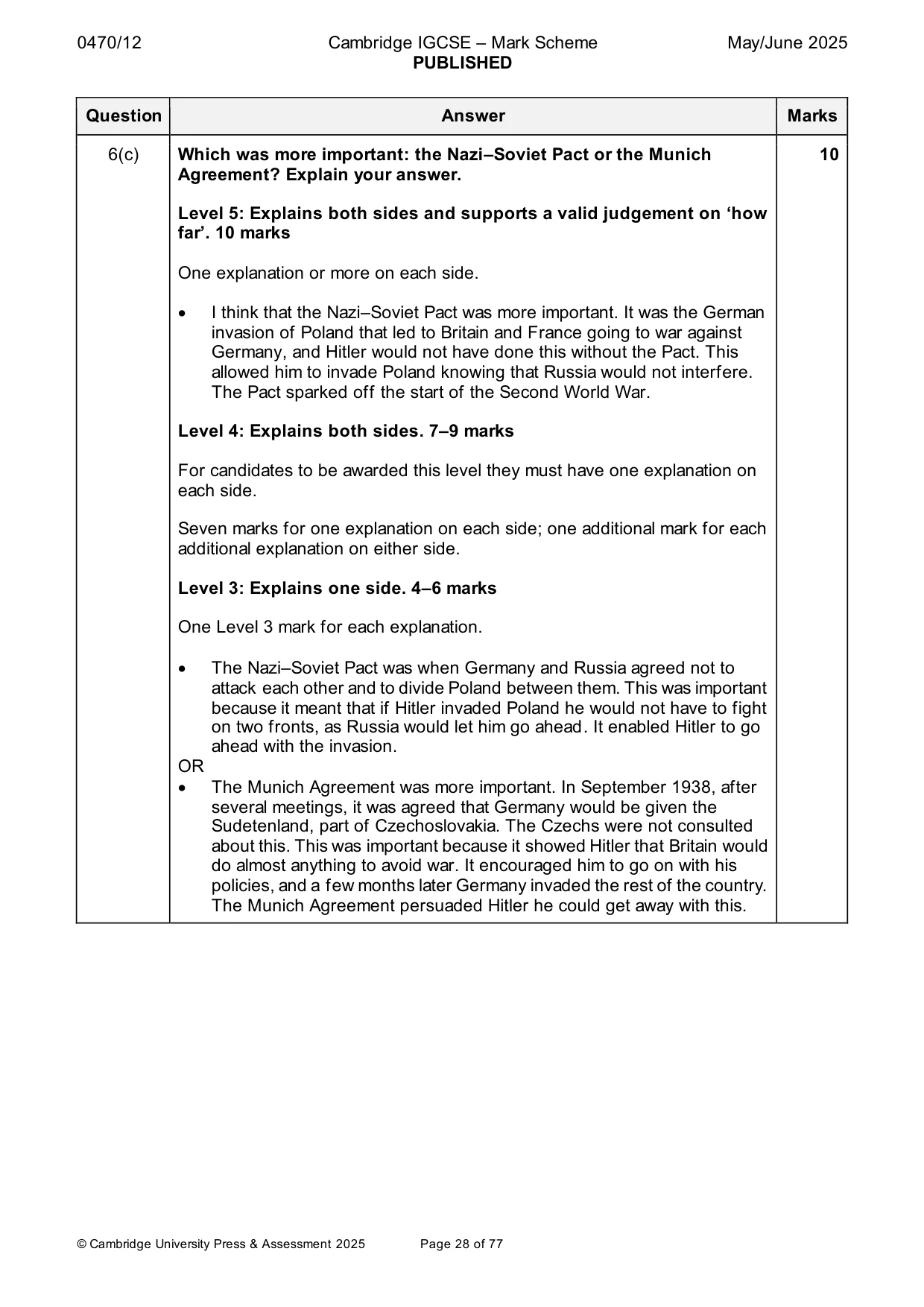
0470/12 Cambridge IGCSE – Mark Scheme PUBLISHED May/June 2025 © Cambridge University Press & Assessment 2025 Page 28 of 77 Question Answer Marks 6(c) Which was more important: the Nazi–Soviet Pact or the Munich Agreement? Explain your answer. Level 5: Explains both sides and supports a valid judgement on ‘how far’. 10 marks One explanation or more on each side. • I think that the Nazi–Soviet Pact was more important. It was the German invasion of Poland that led to Britain and France going to war against Germany, and Hitler would not have done this without the Pact. This allowed him to invade Poland knowing that Russia would not interfere. The Pact sparked off the start of the Second World War. Level 4: Explains both sides. 7–9 marks For candidates to be awarded this level they must have one explanation on each side. Seven marks for one explanation on each side; one additional mark for each additional explanation on either side. Level 3: Explains one side. 4–6 marks One Level 3 mark for each explanation. • The Nazi–Soviet Pact was when Germany and Russia agreed not to attack each other and to divide Poland between them. This was important because it meant that if Hitler invaded Poland he would not have to fight on two fronts, as Russia would let him go ahead. It enabled Hitler to go ahead with the invasion. OR • The Munich Agreement was more important. In September 1938, after several meetings, it was agreed that Germany would be given the Sudetenland, part of Czechoslovakia. The Czechs were not consulted about this. This was important because it showed Hitler that Britain would do almost anything to avoid war. It encouraged him to go on with his policies, and a few months later Germany invaded the rest of the country. The Munich Agreement persuaded Hitler he could get away with this. 10
Mark scheme, page 29
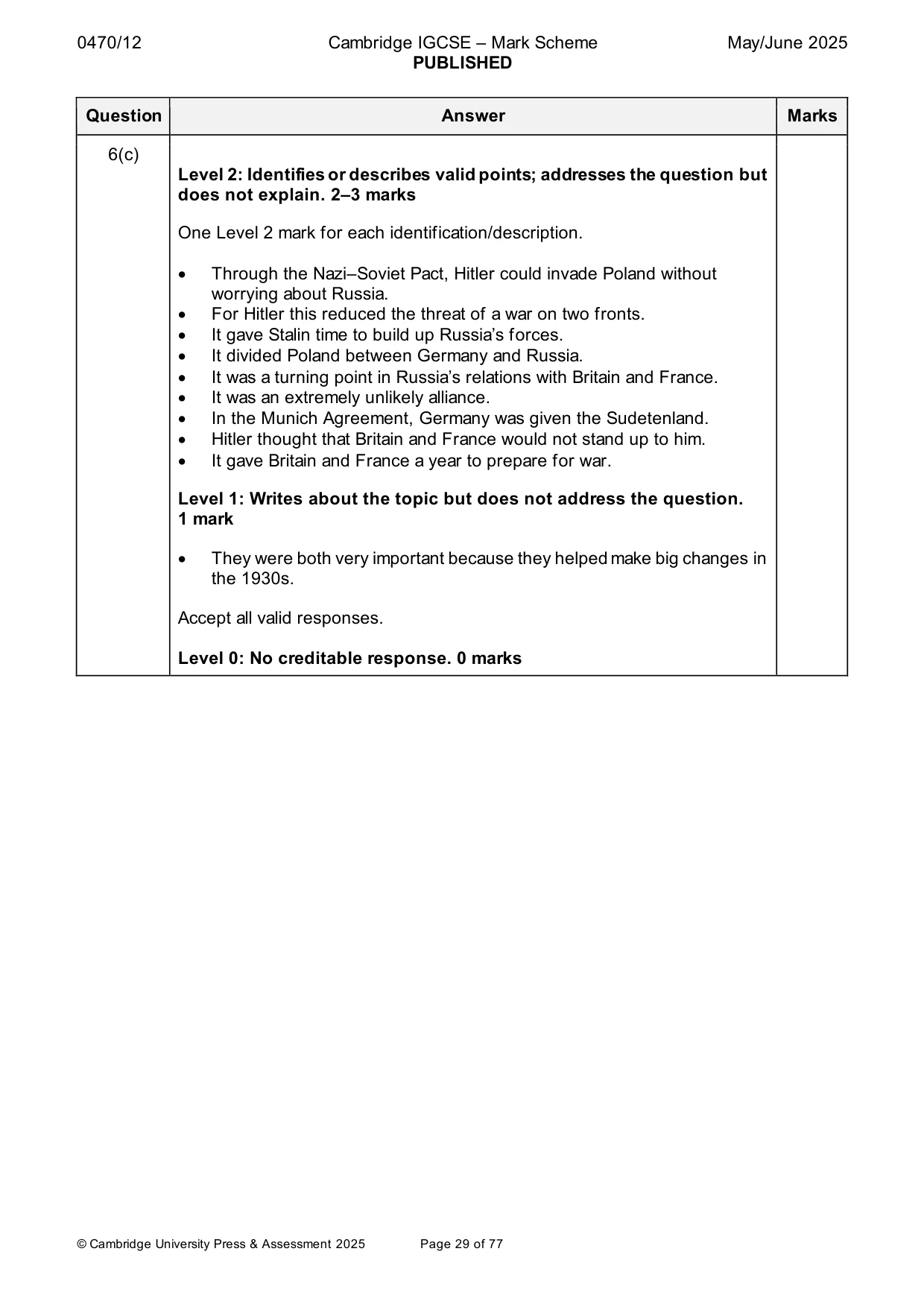
0470/12 Cambridge IGCSE – Mark Scheme PUBLISHED May/June 2025 © Cambridge University Press & Assessment 2025 Page 29 of 77 Question Answer Marks 6(c) Level 2: Identifies or describes valid points; addresses the question but does not explain. 2–3 marks One Level 2 mark for each identification/description. • Through the Nazi–Soviet Pact, Hitler could invade Poland without worrying about Russia. • For Hitler this reduced the threat of a war on two fronts. • It gave Stalin time to build up Russia’s forces. • It divided Poland between Germany and Russia. • It was a turning point in Russia’s relations with Britain and France. • It was an extremely unlikely alliance. • In the Munich Agreement, Germany was given the Sudetenland. • Hitler thought that Britain and France would not stand up to him. • It gave Britain and France a year to prepare for war. Level 1: Writes about the topic but does not address the question. 1 mark • They were both very important because they helped make big changes in the 1930s. Accept all valid responses. Level 0: No creditable response. 0 marks
Mark scheme, page 30
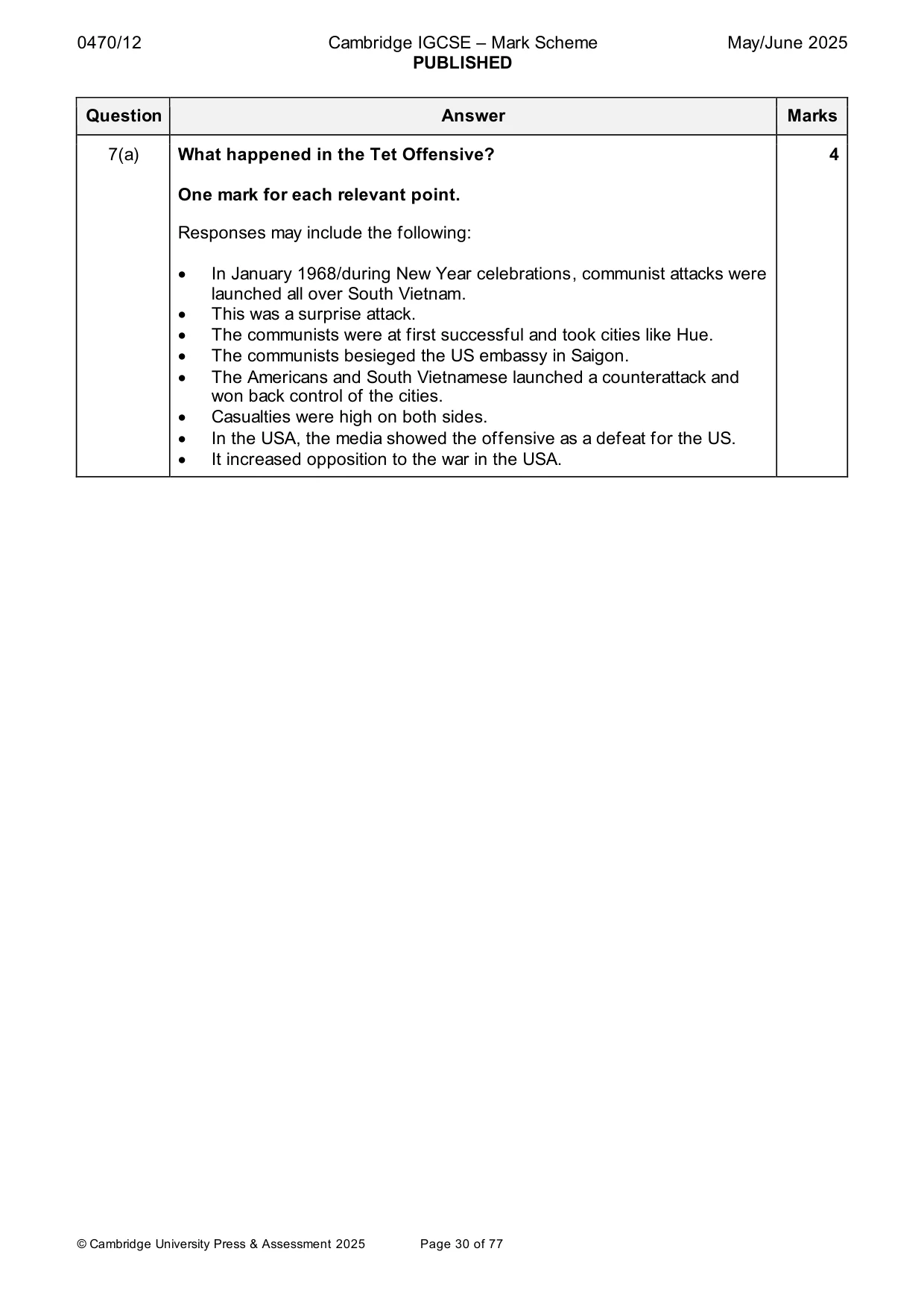
0470/12 Cambridge IGCSE – Mark Scheme PUBLISHED May/June 2025 © Cambridge University Press & Assessment 2025 Page 30 of 77 Question Answer Marks 7(a) What happened in the Tet Offensive? One mark for each relevant point. Responses may include the following: • In January 1968/during New Year celebrations, communist attacks were launched all over South Vietnam. • This was a surprise attack. • The communists were at first successful and took cities like Hue. • The communists besieged the US embassy in Saigon. • The Americans and South Vietnamese launched a counterattack and won back control of the cities. • Casualties were high on both sides. • In the USA, the media showed the offensive as a defeat for the US. • It increased opposition to the war in the USA. 4
Mark scheme, page 31
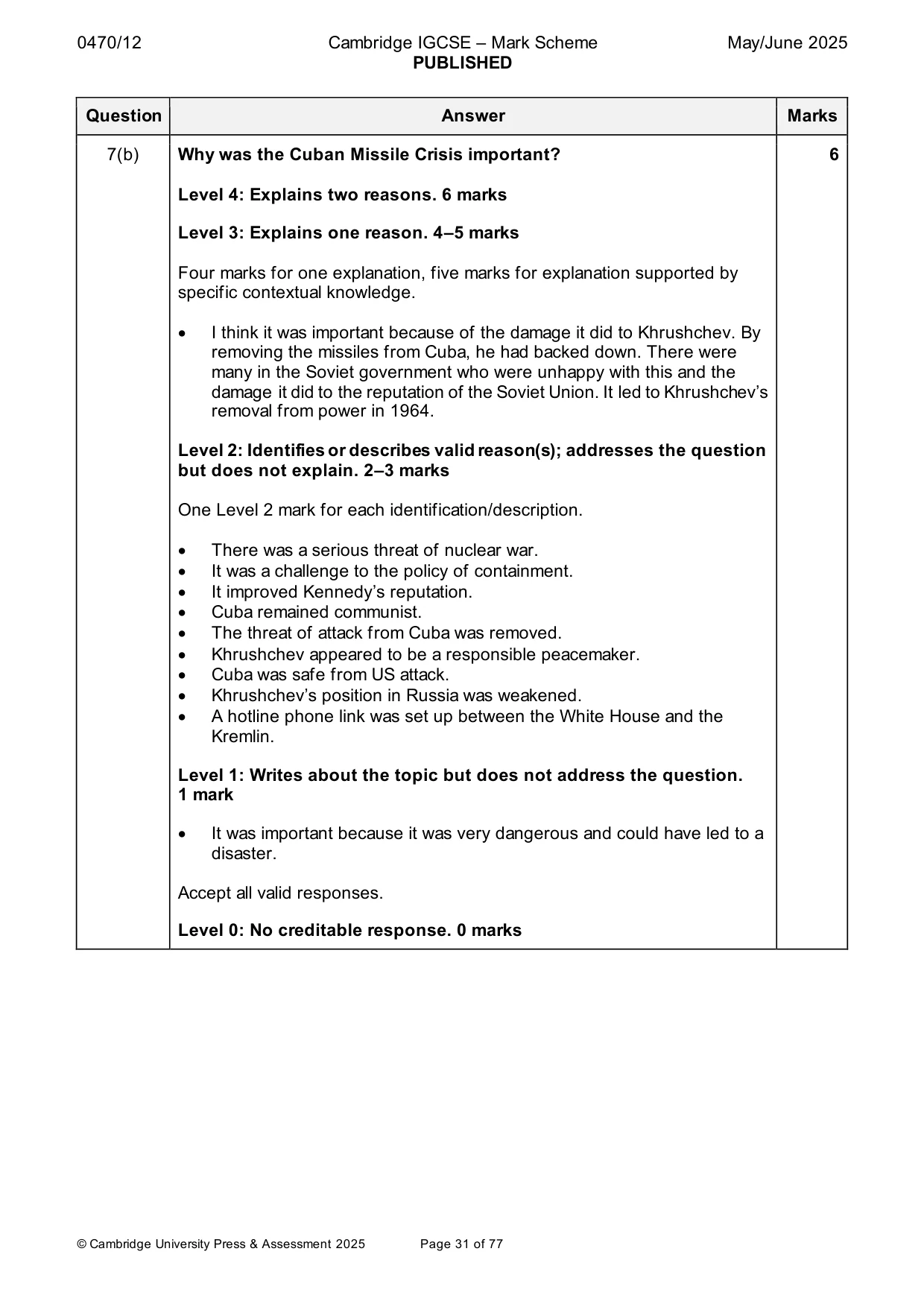
0470/12 Cambridge IGCSE – Mark Scheme PUBLISHED May/June 2025 © Cambridge University Press & Assessment 2025 Page 31 of 77 Question Answer Marks 7(b) Why was the Cuban Missile Crisis important? Level 4: Explains two reasons. 6 marks Level 3: Explains one reason. 4–5 marks Four marks for one explanation, five marks for explanation supported by specific contextual knowledge. • I think it was important because of the damage it did to Khrushchev. By removing the missiles from Cuba, he had backed down. There were many in the Soviet government who were unhappy with this and the damage it did to the reputation of the Soviet Union. It led to Khrushchev’s removal from power in 1964. Level 2: Identifies or describes valid reason(s); addresses the question but does not explain. 2–3 marks One Level 2 mark for each identification/description. • There was a serious threat of nuclear war. • It was a challenge to the policy of containment. • It improved Kennedy’s reputation. • Cuba remained communist. • The threat of attack from Cuba was removed. • Khrushchev appeared to be a responsible peacemaker. • Cuba was safe from US attack. • Khrushchev’s position in Russia was weakened. • A hotline phone link was set up between the White House and the Kremlin. Level 1: Writes about the topic but does not address the question. 1 mark • It was important because it was very dangerous and could have led to a disaster. Accept all valid responses. Level 0: No creditable response. 0 marks 6
Mark scheme, page 32
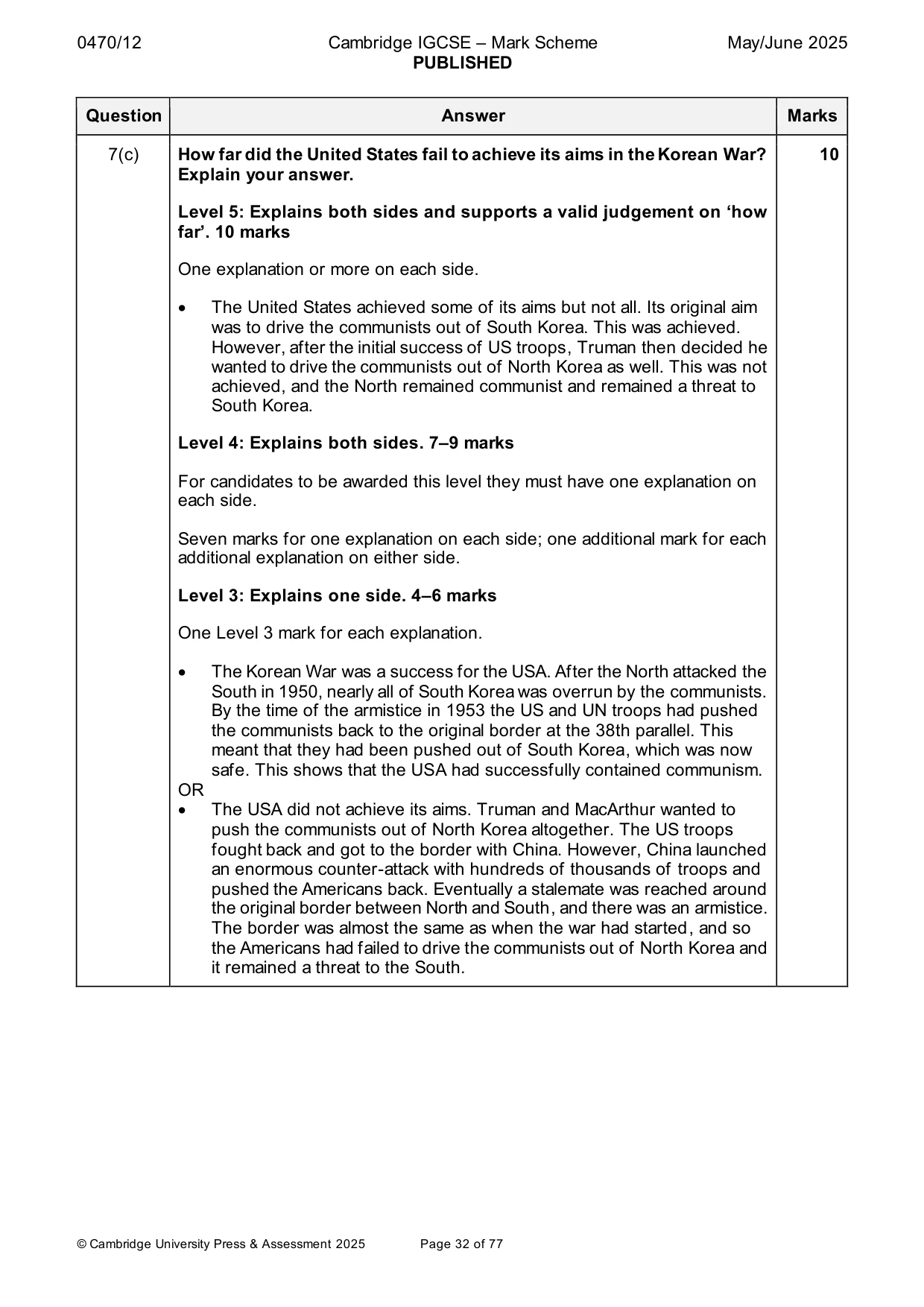
0470/12 Cambridge IGCSE – Mark Scheme PUBLISHED May/June 2025 © Cambridge University Press & Assessment 2025 Page 32 of 77 Question Answer Marks 7(c) How far did the United States fail to achieve its aims in the Korean War? Explain your answer. Level 5: Explains both sides and supports a valid judgement on ‘how far’. 10 marks One explanation or more on each side. • The United States achieved some of its aims but not all. Its original aim was to drive the communists out of South Korea. This was achieved. However, after the initial success of US troops, Truman then decided he wanted to drive the communists out of North Korea as well. This was not achieved, and the North remained communist and remained a threat to South Korea. Level 4: Explains both sides. 7–9 marks For candidates to be awarded this level they must have one explanation on each side. Seven marks for one explanation on each side; one additional mark for each additional explanation on either side. Level 3: Explains one side. 4–6 marks One Level 3 mark for each explanation. • The Korean War was a success for the USA. After the North attacked the South in 1950, nearly all of South Korea was overrun by the communists. By the time of the armistice in 1953 the US and UN troops had pushed the communists back to the original border at the 38th parallel. This meant that they had been pushed out of South Korea, which was now safe. This shows that the USA had successfully contained communism. OR • The USA did not achieve its aims. Truman and MacArthur wanted to push the communists out of North Korea altogether. The US troops fought back and got to the border with China. However, China launched an enormous counter-attack with hundreds of thousands of troops and pushed the Americans back. Eventually a stalemate was reached around the original border between North and South, and there was an armistice. The border was almost the same as when the war had started, and so the Americans had failed to drive the communists out of North Korea and it remained a threat to the South. 10
Mark scheme, page 33
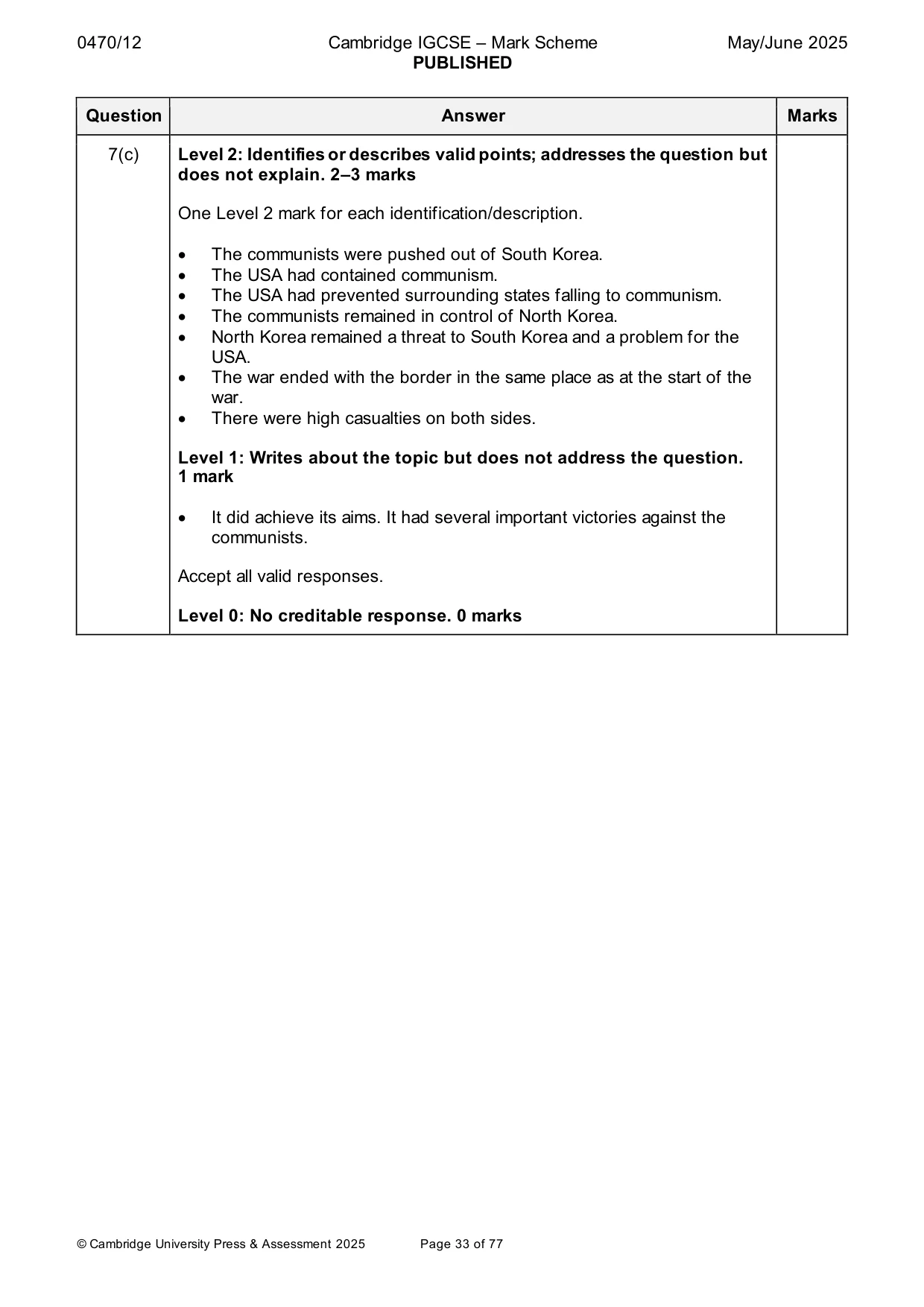
0470/12 Cambridge IGCSE – Mark Scheme PUBLISHED May/June 2025 © Cambridge University Press & Assessment 2025 Page 33 of 77 Question Answer Marks 7(c) Level 2: Identifies or describes valid points; addresses the question but does not explain. 2–3 marks One Level 2 mark for each identification/description. • The communists were pushed out of South Korea. • The USA had contained communism. • The USA had prevented surrounding states falling to communism. • The communists remained in control of North Korea. • North Korea remained a threat to South Korea and a problem for the USA. • The war ended with the border in the same place as at the start of the war. • There were high casualties on both sides. Level 1: Writes about the topic but does not address the question. 1 mark • It did achieve its aims. It had several important victories against the communists. Accept all valid responses. Level 0: No creditable response. 0 marks
Mark scheme, page 34
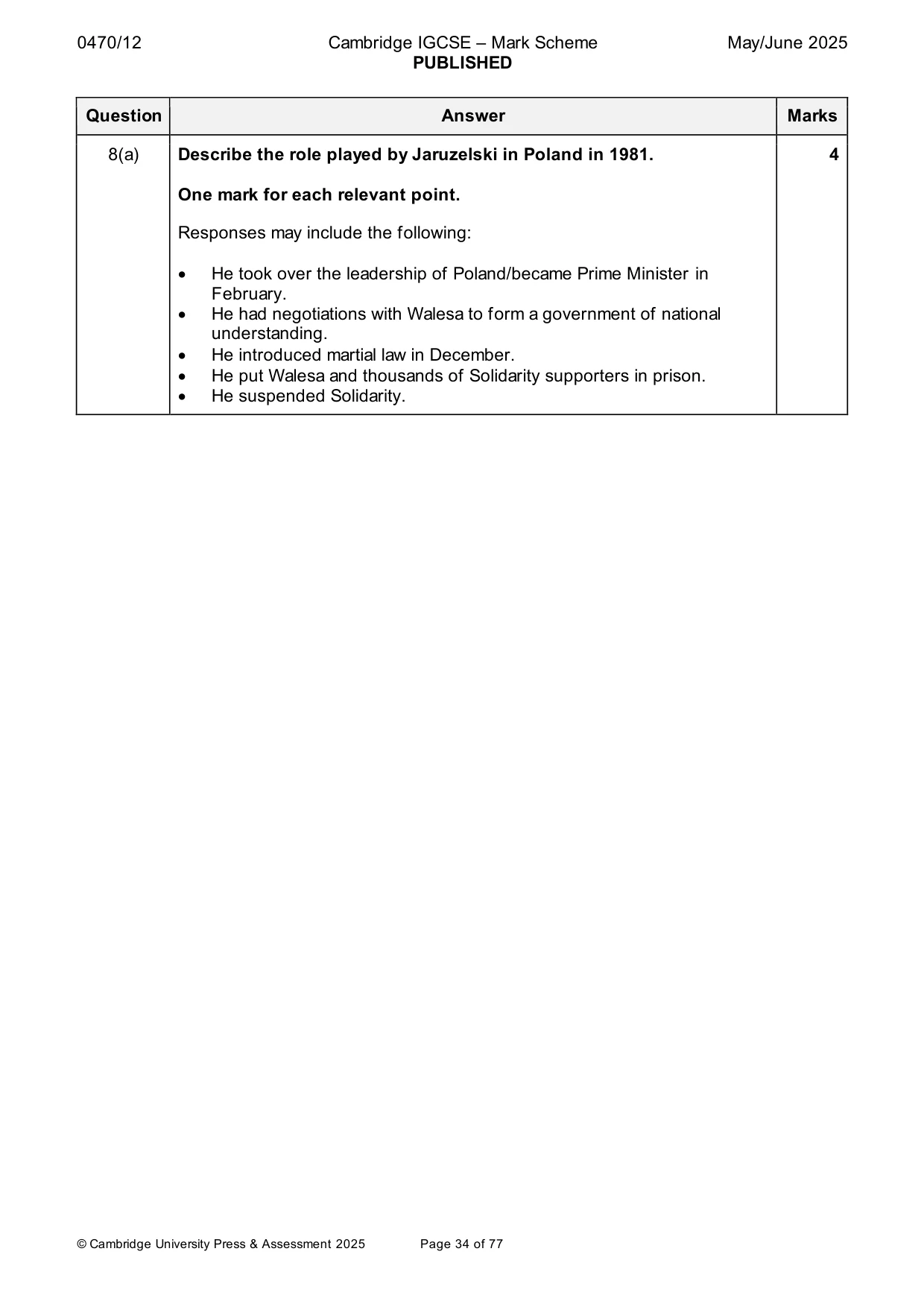
0470/12 Cambridge IGCSE – Mark Scheme PUBLISHED May/June 2025 © Cambridge University Press & Assessment 2025 Page 34 of 77 Question Answer Marks 8(a) Describe the role played by Jaruzelski in Poland in 1981. One mark for each relevant point. Responses may include the following: • He took over the leadership of Poland/became Prime Minister in February. • He had negotiations with Walesa to form a government of national understanding. • He introduced martial law in December. • He put Walesa and thousands of Solidarity supporters in prison. • He suspended Solidarity. 4
Mark scheme, page 35
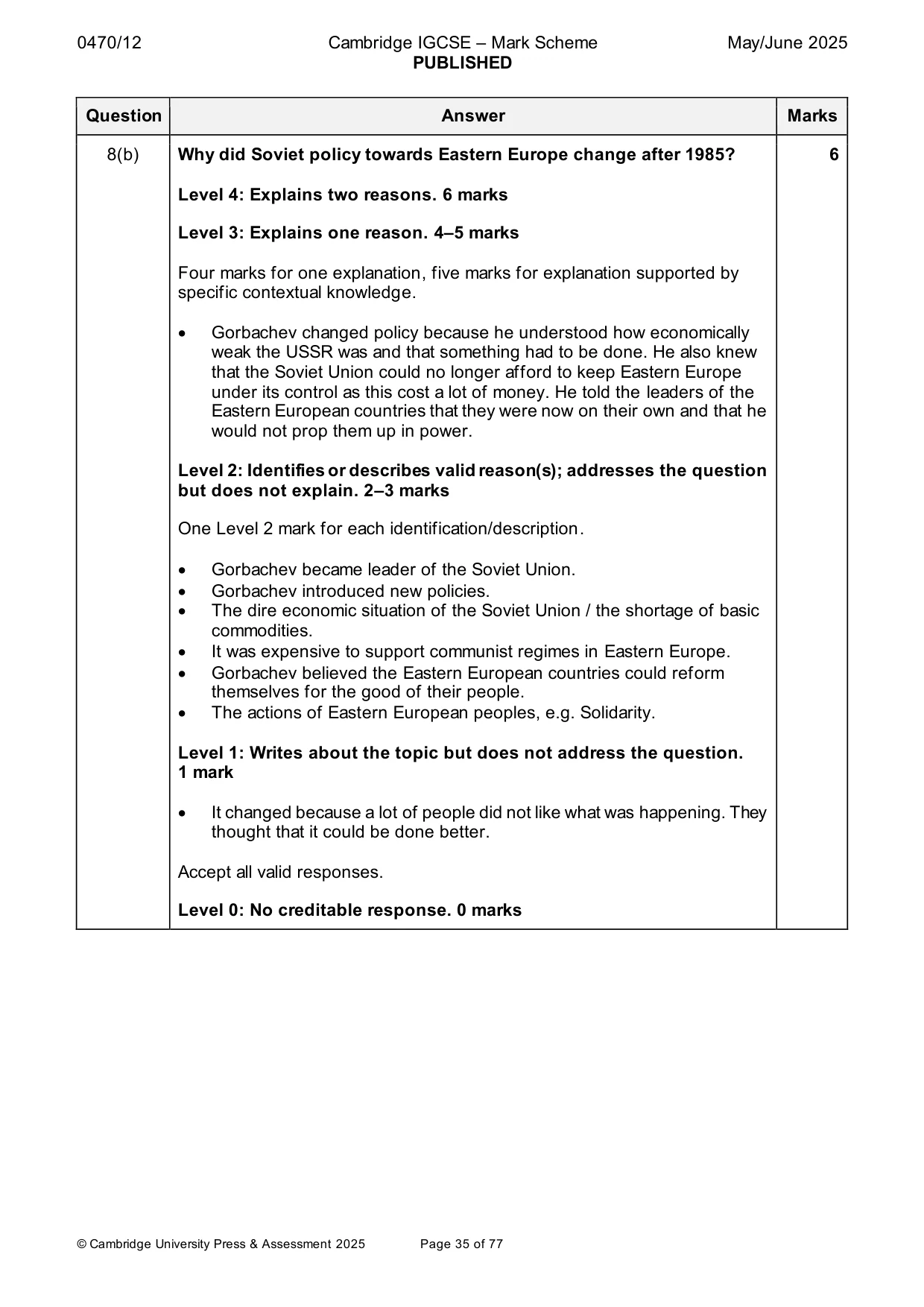
0470/12 Cambridge IGCSE – Mark Scheme PUBLISHED May/June 2025 © Cambridge University Press & Assessment 2025 Page 35 of 77 Question Answer Marks 8(b) Why did Soviet policy towards Eastern Europe change after 1985? Level 4: Explains two reasons. 6 marks Level 3: Explains one reason. 4–5 marks Four marks for one explanation, five marks for explanation supported by specific contextual knowledge. • Gorbachev changed policy because he understood how economically weak the USSR was and that something had to be done. He also knew that the Soviet Union could no longer afford to keep Eastern Europe under its control as this cost a lot of money. He told the leaders of the Eastern European countries that they were now on their own and that he would not prop them up in power. Level 2: Identifies or describes valid reason(s); addresses the question but does not explain. 2–3 marks One Level 2 mark for each identification/description. • Gorbachev became leader of the Soviet Union. • Gorbachev introduced new policies. • The dire economic situation of the Soviet Union / the shortage of basic commodities. • It was expensive to support communist regimes in Eastern Europe. • Gorbachev believed the Eastern European countries could reform themselves for the good of their people. • The actions of Eastern European peoples, e.g. Solidarity. Level 1: Writes about the topic but does not address the question. 1 mark • It changed because a lot of people did not like what was happening. They thought that it could be done better. Accept all valid responses. Level 0: No creditable response. 0 marks 6
Mark scheme, page 36
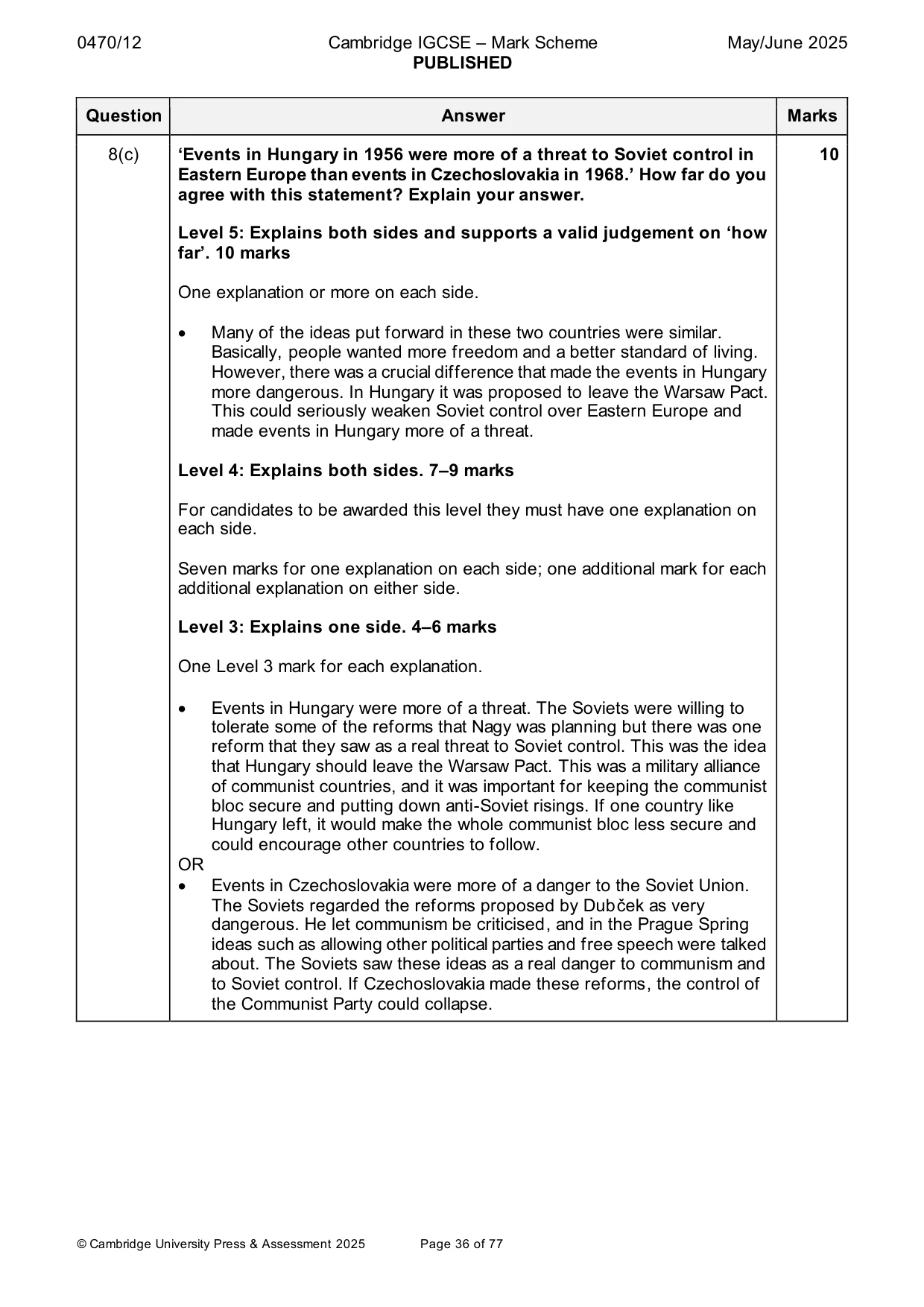
0470/12 Cambridge IGCSE – Mark Scheme PUBLISHED May/June 2025 © Cambridge University Press & Assessment 2025 Page 36 of 77 Question Answer Marks 8(c) ‘Events in Hungary in 1956 were more of a threat to Soviet control in Eastern Europe than events in Czechoslovakia in 1968.’ How far do you agree with this statement? Explain your answer. Level 5: Explains both sides and supports a valid judgement on ‘how far’. 10 marks One explanation or more on each side. • Many of the ideas put forward in these two countries were similar. Basically, people wanted more freedom and a better standard of living. However, there was a crucial difference that made the events in Hungary more dangerous. In Hungary it was proposed to leave the Warsaw Pact. This could seriously weaken Soviet control over Eastern Europe and made events in Hungary more of a threat. Level 4: Explains both sides. 7–9 marks For candidates to be awarded this level they must have one explanation on each side. Seven marks for one explanation on each side; one additional mark for each additional explanation on either side. Level 3: Explains one side. 4–6 marks One Level 3 mark for each explanation. • Events in Hungary were more of a threat. The Soviets were willing to tolerate some of the reforms that Nagy was planning but there was one reform that they saw as a real threat to Soviet control. This was the idea that Hungary should leave the Warsaw Pact. This was a military alliance of communist countries, and it was important for keeping the communist bloc secure and putting down anti-Soviet risings. If one country like Hungary left, it would make the whole communist bloc less secure and could encourage other countries to follow. OR • Events in Czechoslovakia were more of a danger to the Soviet Union. The Soviets regarded the reforms proposed by Dubček as very dangerous. He let communism be criticised, and in the Prague Spring ideas such as allowing other political parties and free speech were talked about. The Soviets saw these ideas as a real danger to communism and to Soviet control. If Czechoslovakia made these reforms, the control of the Communist Party could collapse. 10
Mark scheme, page 37
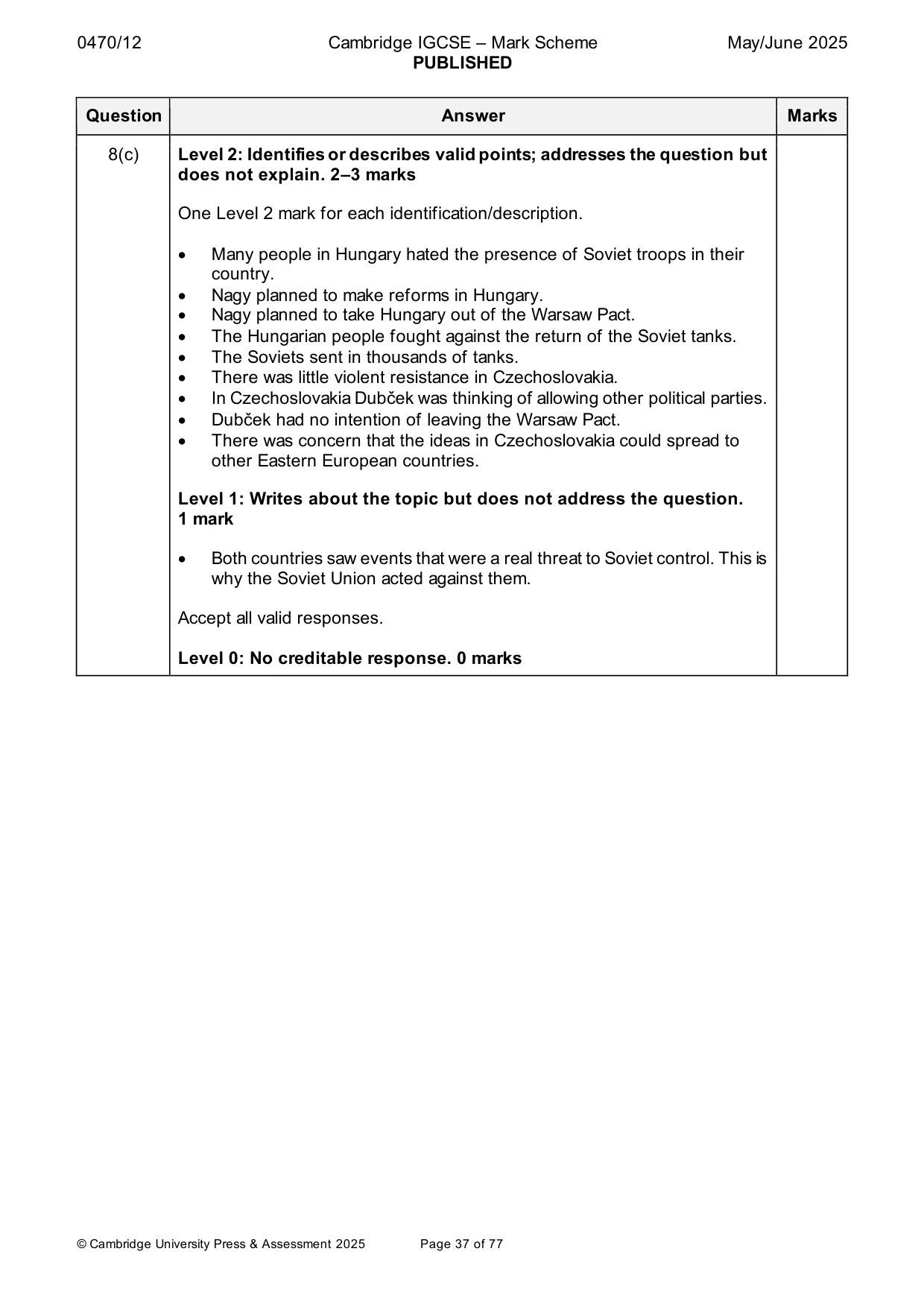
0470/12 Cambridge IGCSE – Mark Scheme PUBLISHED May/June 2025 © Cambridge University Press & Assessment 2025 Page 37 of 77 Question Answer Marks 8(c) Level 2: Identifies or describes valid points; addresses the question but does not explain. 2–3 marks One Level 2 mark for each identification/description. • Many people in Hungary hated the presence of Soviet troops in their country. • Nagy planned to make reforms in Hungary. • Nagy planned to take Hungary out of the Warsaw Pact. • The Hungarian people fought against the return of the Soviet tanks. • The Soviets sent in thousands of tanks. • There was little violent resistance in Czechoslovakia. • In Czechoslovakia Dubček was thinking of allowing other political parties. • Dubček had no intention of leaving the Warsaw Pact. • There was concern that the ideas in Czechoslovakia could spread to other Eastern European countries. Level 1: Writes about the topic but does not address the question. 1 mark • Both countries saw events that were a real threat to Soviet control. This is why the Soviet Union acted against them. Accept all valid responses. Level 0: No creditable response. 0 marks
Mark scheme, page 38
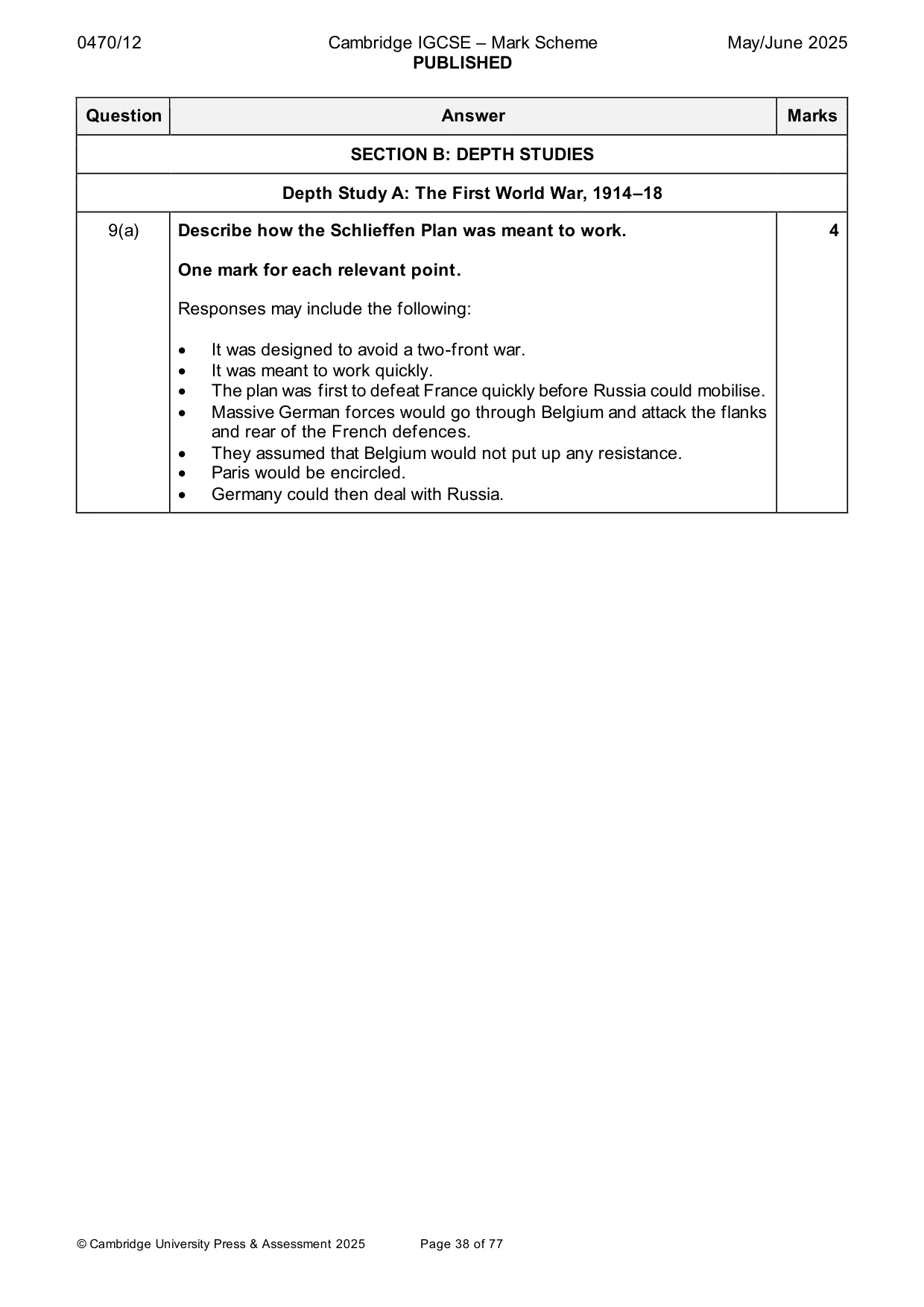
0470/12 Cambridge IGCSE – Mark Scheme PUBLISHED May/June 2025 © Cambridge University Press & Assessment 2025 Page 38 of 77 Question Answer Marks SECTION B: DEPTH STUDIES Depth Study A: The First World War, 1914–18 9(a) Describe how the Schlieffen Plan was meant to work. One mark for each relevant point. Responses may include the following: • It was designed to avoid a two-front war. • It was meant to work quickly. • The plan was first to defeat France quickly before Russia could mobilise. • Massive German forces would go through Belgium and attack the flanks and rear of the French defences. • They assumed that Belgium would not put up any resistance. • Paris would be encircled. • Germany could then deal with Russia. 4
Mark scheme, page 39
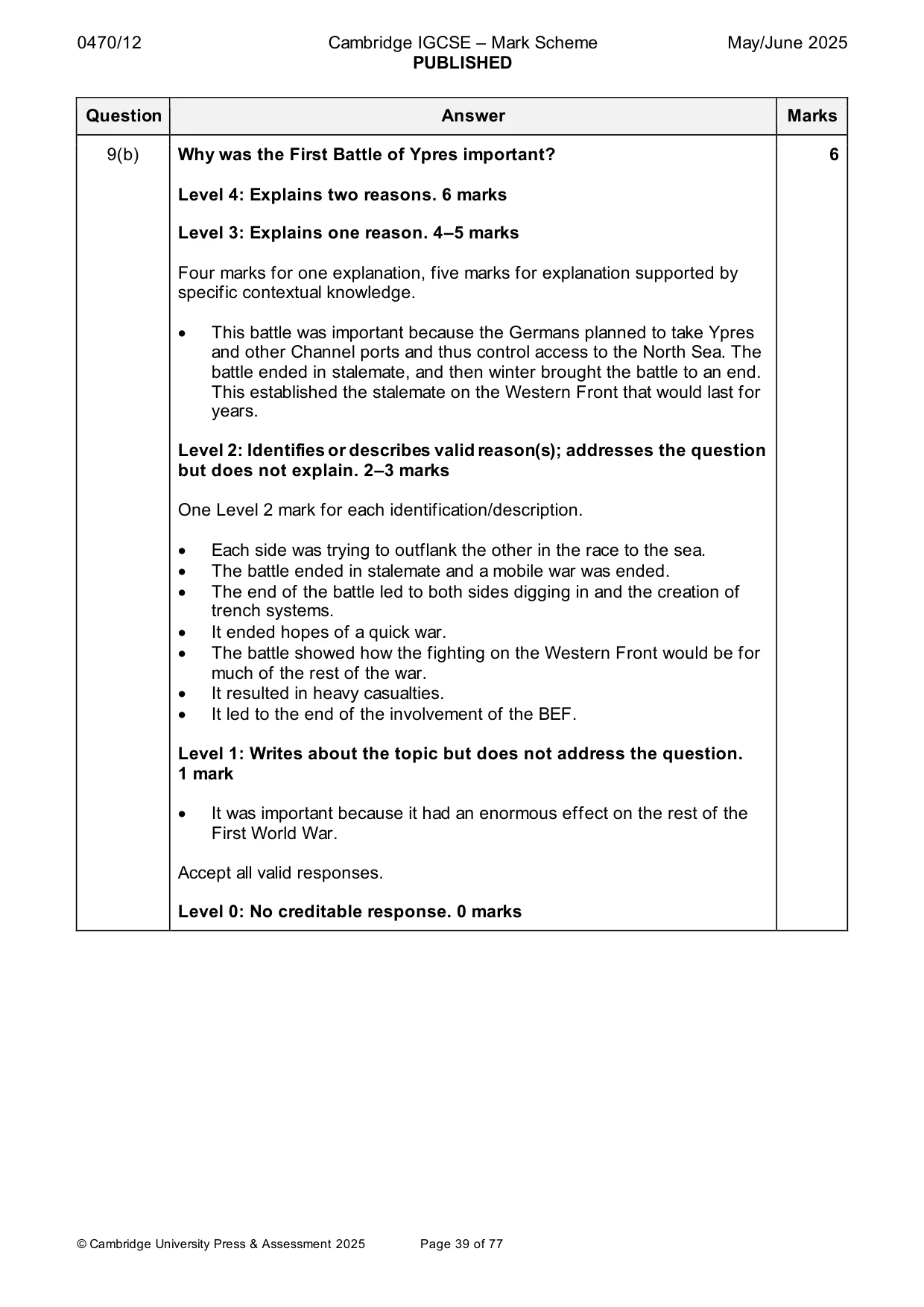
0470/12 Cambridge IGCSE – Mark Scheme PUBLISHED May/June 2025 © Cambridge University Press & Assessment 2025 Page 39 of 77 Question Answer Marks 9(b) Why was the First Battle of Ypres important? Level 4: Explains two reasons. 6 marks Level 3: Explains one reason. 4–5 marks Four marks for one explanation, five marks for explanation supported by specific contextual knowledge. • This battle was important because the Germans planned to take Ypres and other Channel ports and thus control access to the North Sea. The battle ended in stalemate, and then winter brought the battle to an end. This established the stalemate on the Western Front that would last for years. Level 2: Identifies or describes valid reason(s); addresses the question but does not explain. 2–3 marks One Level 2 mark for each identification/description. • Each side was trying to outflank the other in the race to the sea. • The battle ended in stalemate and a mobile war was ended. • The end of the battle led to both sides digging in and the creation of trench systems. • It ended hopes of a quick war. • The battle showed how the fighting on the Western Front would be for much of the rest of the war. • It resulted in heavy casualties. • It led to the end of the involvement of the BEF. Level 1: Writes about the topic but does not address the question. 1 mark • It was important because it had an enormous effect on the rest of the First World War. Accept all valid responses. Level 0: No creditable response. 0 marks 6
Mark scheme, page 40
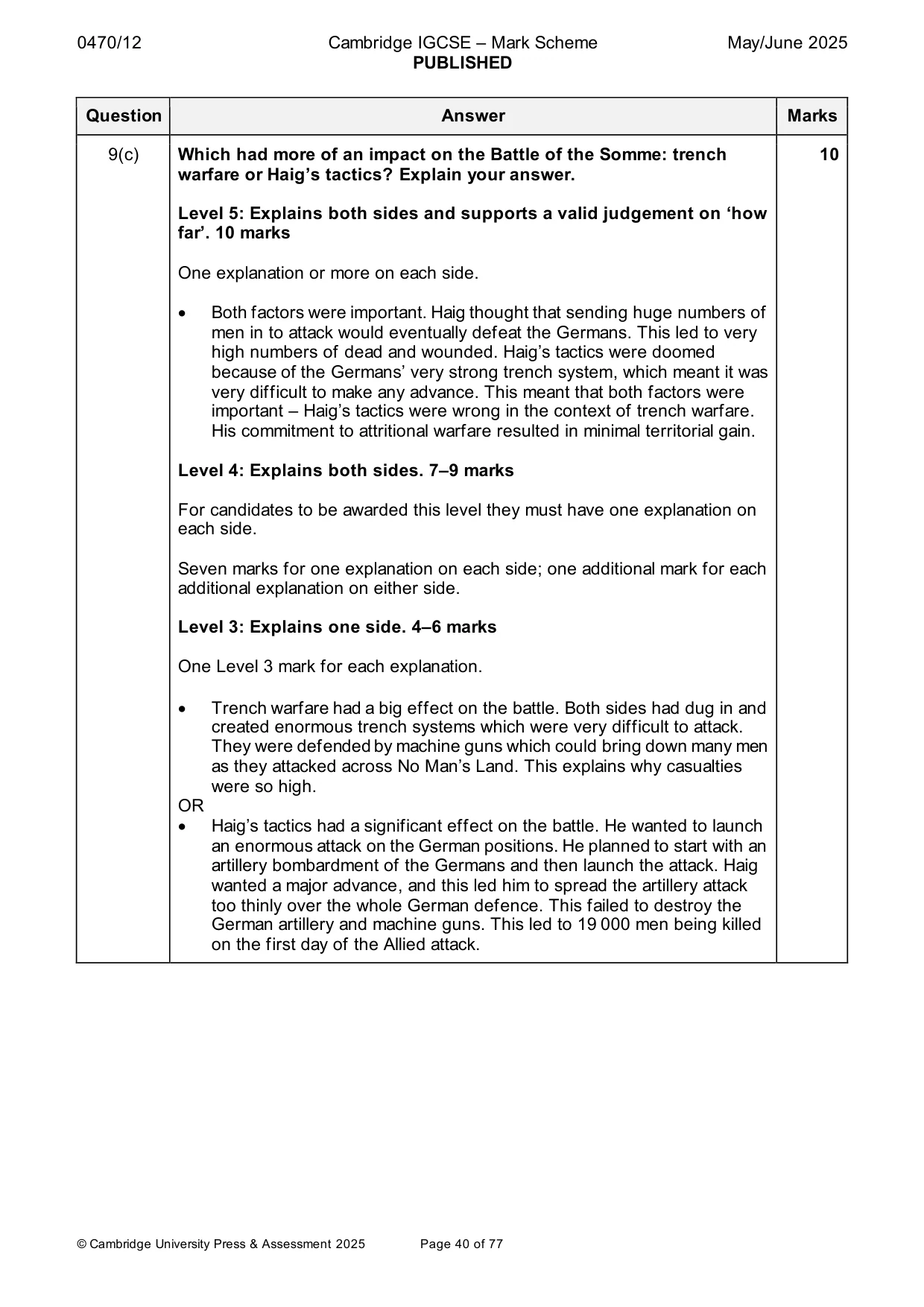
0470/12 Cambridge IGCSE – Mark Scheme PUBLISHED May/June 2025 © Cambridge University Press & Assessment 2025 Page 40 of 77 Question Answer Marks 9(c) Which had more of an impact on the Battle of the Somme: trench warfare or Haig’s tactics? Explain your answer. Level 5: Explains both sides and supports a valid judgement on ‘how far’. 10 marks One explanation or more on each side. • Both factors were important. Haig thought that sending huge numbers of men in to attack would eventually defeat the Germans. This led to very high numbers of dead and wounded. Haig’s tactics were doomed because of the Germans’ very strong trench system, which meant it was very difficult to make any advance. This meant that both factors were important – Haig’s tactics were wrong in the context of trench warfare. His commitment to attritional warfare resulted in minimal territorial gain. Level 4: Explains both sides. 7–9 marks For candidates to be awarded this level they must have one explanation on each side. Seven marks for one explanation on each side; one additional mark for each additional explanation on either side. Level 3: Explains one side. 4–6 marks One Level 3 mark for each explanation. • Trench warfare had a big effect on the battle. Both sides had dug in and created enormous trench systems which were very difficult to attack. They were defended by machine guns which could bring down many men as they attacked across No Man’s Land. This explains why casualties were so high. OR • Haig’s tactics had a significant effect on the battle. He wanted to launch an enormous attack on the German positions. He planned to start with an artillery bombardment of the Germans and then launch the attack. Haig wanted a major advance, and this led him to spread the artillery attack too thinly over the whole German defence. This failed to destroy the German artillery and machine guns. This led to 19 000 men being killed on the first day of the Allied attack. 10
Mark scheme, page 41
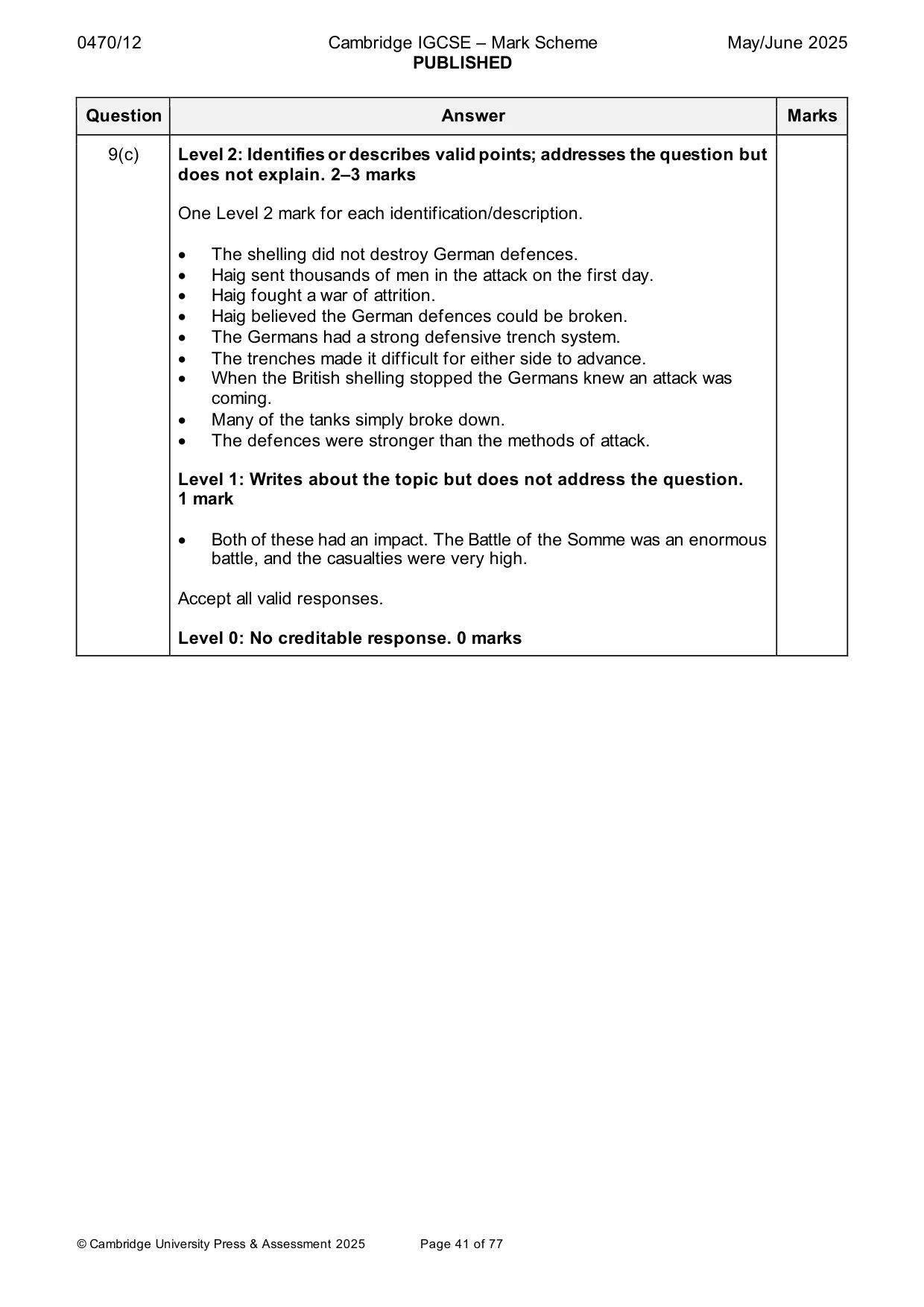
0470/12 Cambridge IGCSE – Mark Scheme PUBLISHED May/June 2025 © Cambridge University Press & Assessment 2025 Page 41 of 77 Question Answer Marks 9(c) Level 2: Identifies or describes valid points; addresses the question but does not explain. 2–3 marks One Level 2 mark for each identification/description. • The shelling did not destroy German defences. • Haig sent thousands of men in the attack on the first day. • Haig fought a war of attrition. • Haig believed the German defences could be broken. • The Germans had a strong defensive trench system. • The trenches made it difficult for either side to advance. • When the British shelling stopped the Germans knew an attack was coming. • Many of the tanks simply broke down. • The defences were stronger than the methods of attack. Level 1: Writes about the topic but does not address the question. 1 mark • Both of these had an impact. The Battle of the Somme was an enormous battle, and the casualties were very high. Accept all valid responses. Level 0: No creditable response. 0 marks
Mark scheme, page 42
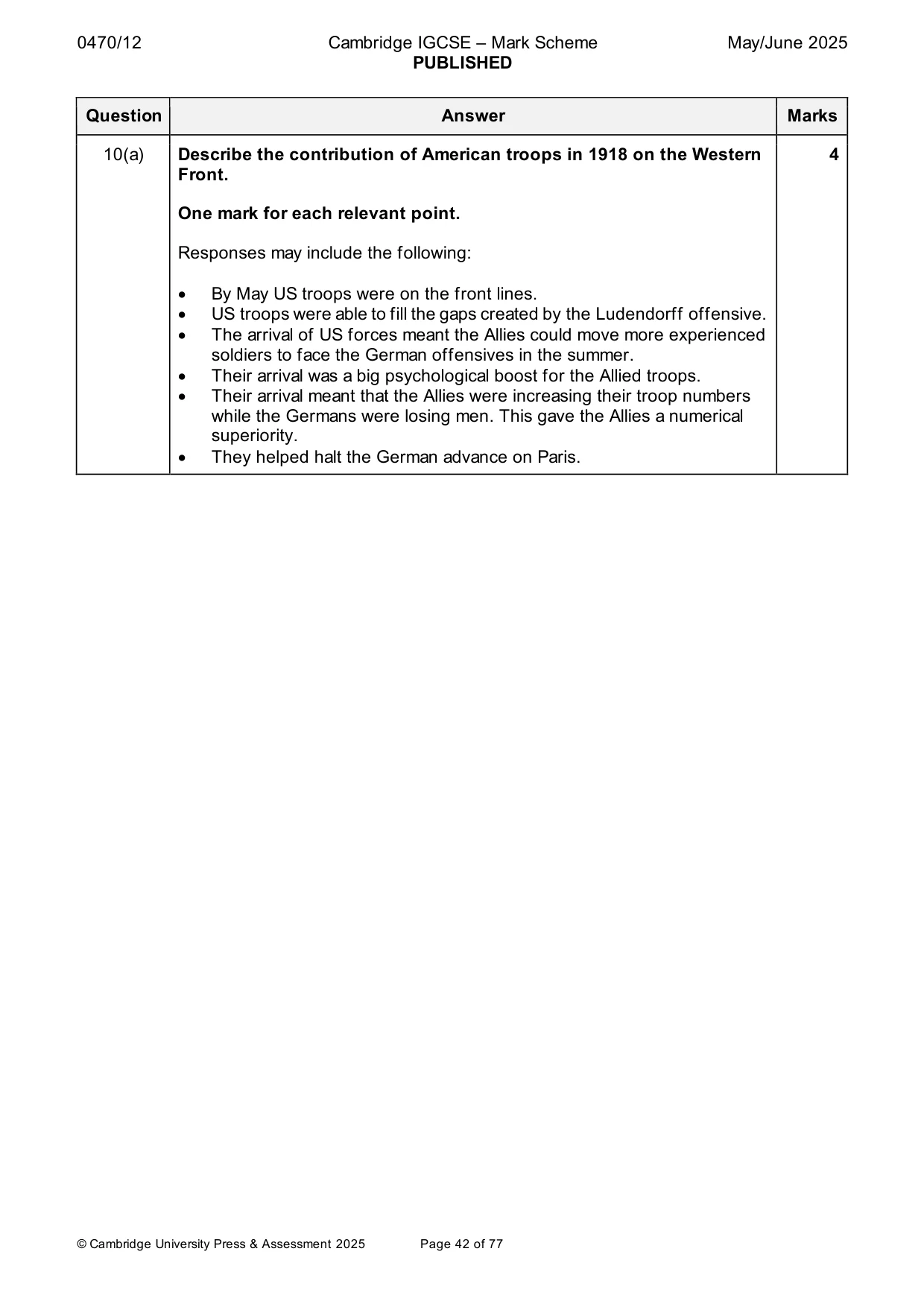
0470/12 Cambridge IGCSE – Mark Scheme PUBLISHED May/June 2025 © Cambridge University Press & Assessment 2025 Page 42 of 77 Question Answer Marks 10(a) Describe the contribution of American troops in 1918 on the Western Front. One mark for each relevant point. Responses may include the following: • By May US troops were on the front lines. • US troops were able to fill the gaps created by the Ludendorff offensive. • The arrival of US forces meant the Allies could move more experienced soldiers to face the German offensives in the summer. • Their arrival was a big psychological boost for the Allied troops. • Their arrival meant that the Allies were increasing their troop numbers while the Germans were losing men. This gave the Allies a numerical superiority. • They helped halt the German advance on Paris. 4
Mark scheme, page 43
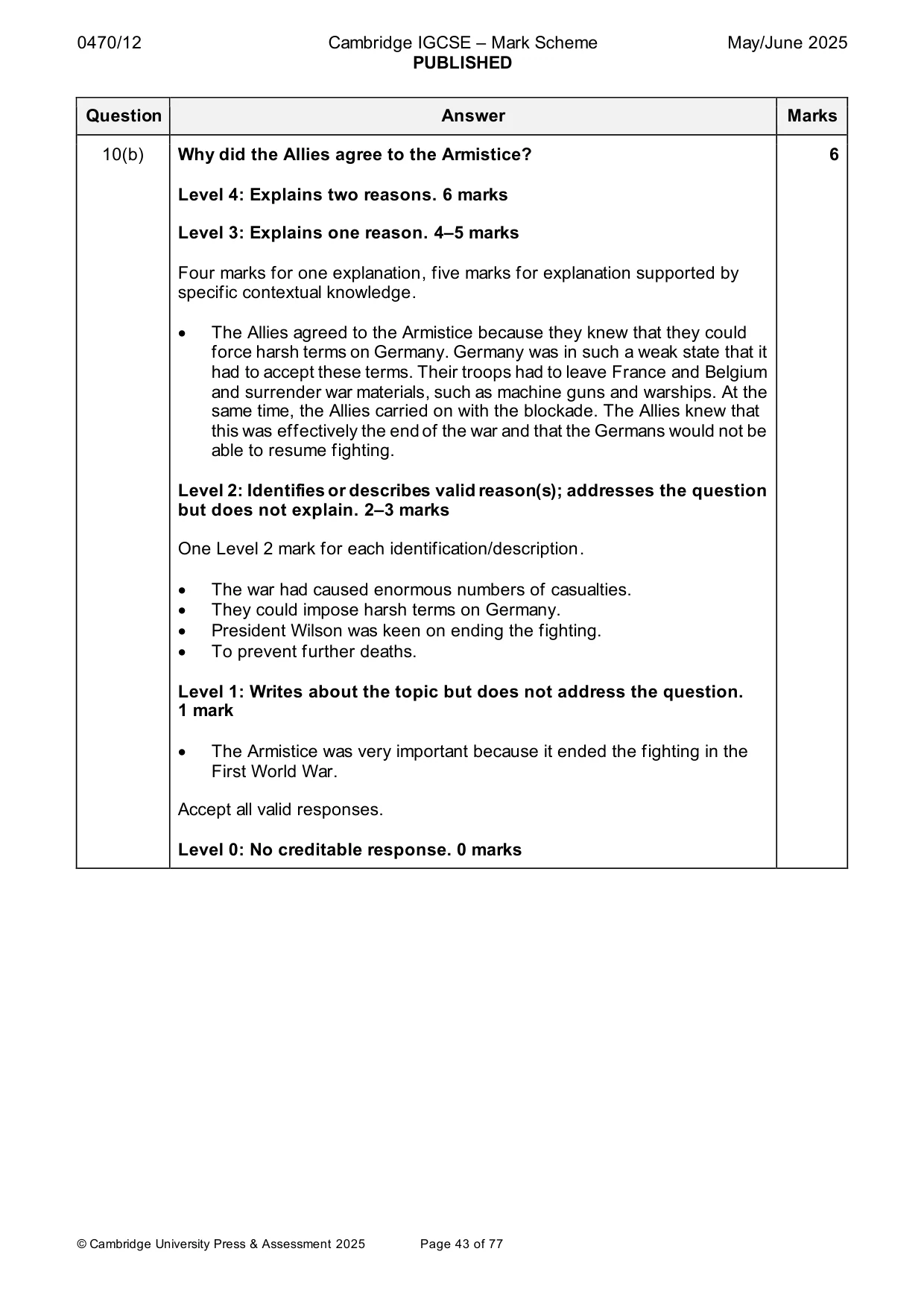
0470/12 Cambridge IGCSE – Mark Scheme PUBLISHED May/June 2025 © Cambridge University Press & Assessment 2025 Page 43 of 77 Question Answer Marks 10(b) Why did the Allies agree to the Armistice? Level 4: Explains two reasons. 6 marks Level 3: Explains one reason. 4–5 marks Four marks for one explanation, five marks for explanation supported by specific contextual knowledge. • The Allies agreed to the Armistice because they knew that they could force harsh terms on Germany. Germany was in such a weak state that it had to accept these terms. Their troops had to leave France and Belgium and surrender war materials, such as machine guns and warships. At the same time, the Allies carried on with the blockade. The Allies knew that this was effectively the end of the war and that the Germans would not be able to resume fighting. Level 2: Identifies or describes valid reason(s); addresses the question but does not explain. 2–3 marks One Level 2 mark for each identification/description. • The war had caused enormous numbers of casualties. • They could impose harsh terms on Germany. • President Wilson was keen on ending the fighting. • To prevent further deaths. Level 1: Writes about the topic but does not address the question. 1 mark • The Armistice was very important because it ended the fighting in the First World War. Accept all valid responses. Level 0: No creditable response. 0 marks 6
Mark scheme, page 44
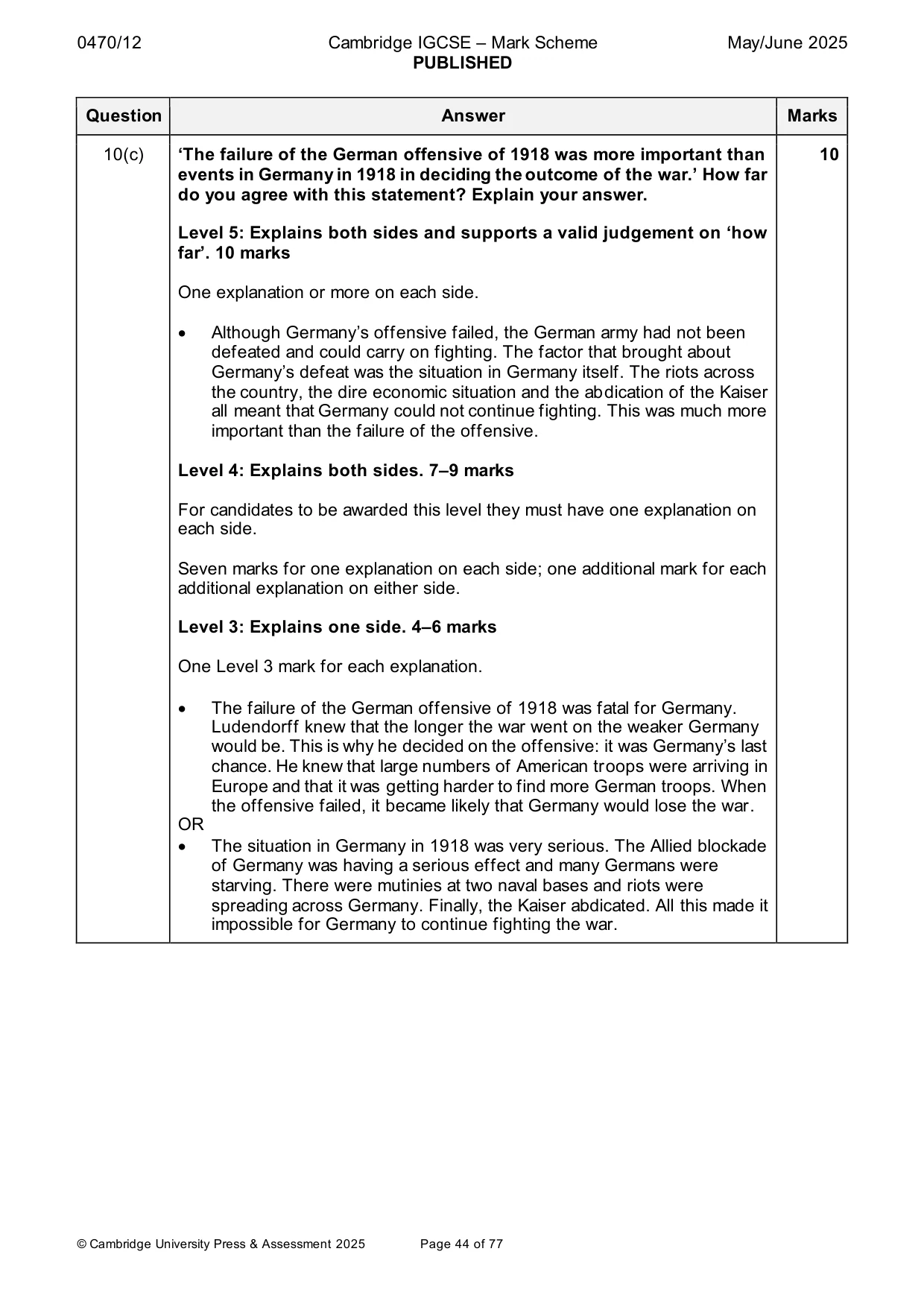
0470/12 Cambridge IGCSE – Mark Scheme PUBLISHED May/June 2025 © Cambridge University Press & Assessment 2025 Page 44 of 77 Question Answer Marks 10(c) ‘The failure of the German offensive of 1918 was more important than events in Germany in 1918 in deciding the outcome of the war.’ How far do you agree with this statement? Explain your answer. Level 5: Explains both sides and supports a valid judgement on ‘how far’. 10 marks One explanation or more on each side. • Although Germany’s offensive failed, the German army had not been defeated and could carry on fighting. The factor that brought about Germany’s defeat was the situation in Germany itself. The riots across the country, the dire economic situation and the abdication of the Kaiser all meant that Germany could not continue fighting. This was much more important than the failure of the offensive. Level 4: Explains both sides. 7–9 marks For candidates to be awarded this level they must have one explanation on each side. Seven marks for one explanation on each side; one additional mark for each additional explanation on either side. Level 3: Explains one side. 4–6 marks One Level 3 mark for each explanation. • The failure of the German offensive of 1918 was fatal for Germany. Ludendorff knew that the longer the war went on the weaker Germany would be. This is why he decided on the offensive: it was Germany’s last chance. He knew that large numbers of American troops were arriving in Europe and that it was getting harder to find more German troops. When the offensive failed, it became likely that Germany would lose the war. OR • The situation in Germany in 1918 was very serious. The Allied blockade of Germany was having a serious effect and many Germans were starving. There were mutinies at two naval bases and riots were spreading across Germany. Finally, the Kaiser abdicated. All this made it impossible for Germany to continue fighting the war. 10
Mark scheme, page 45
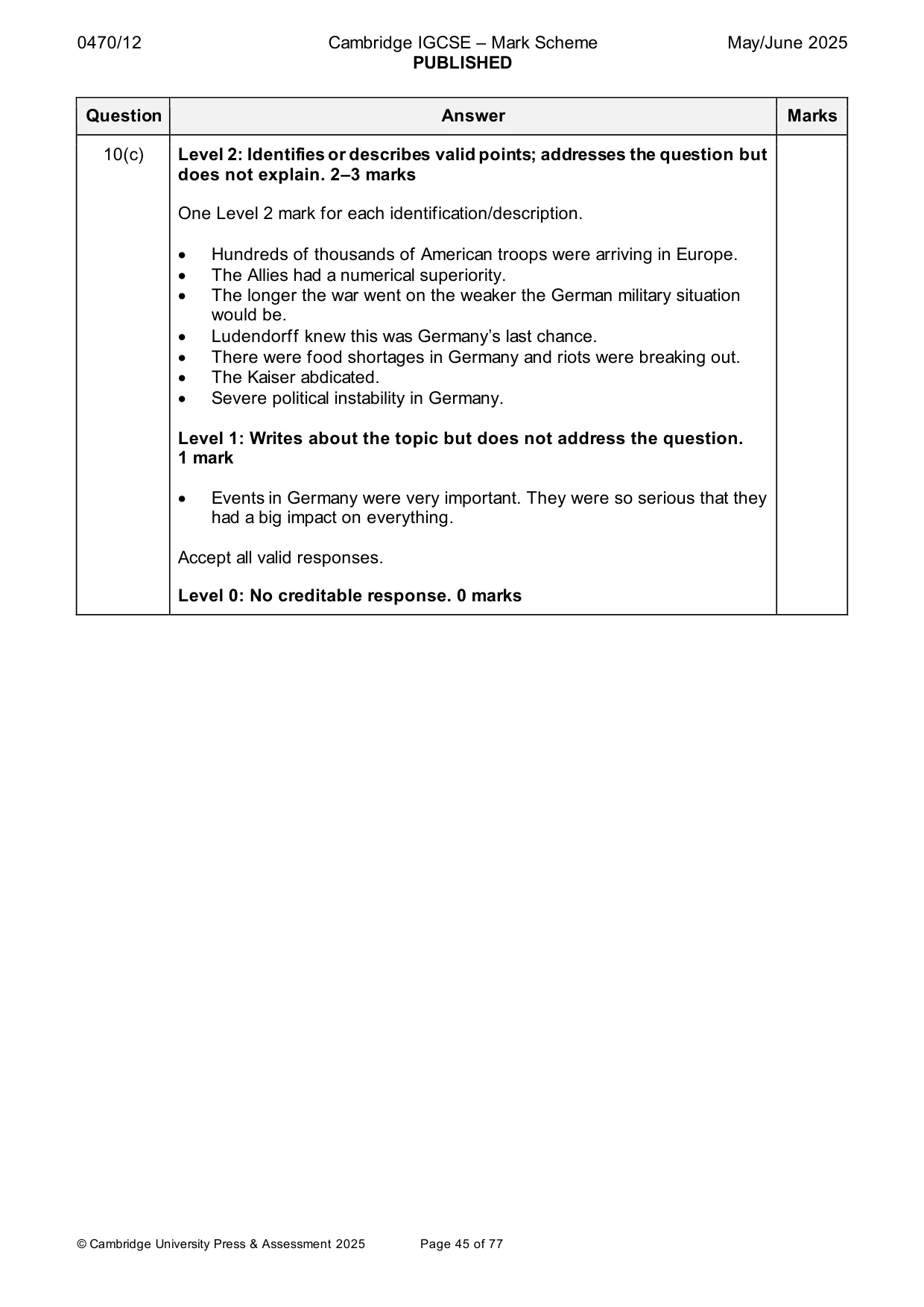
0470/12 Cambridge IGCSE – Mark Scheme PUBLISHED May/June 2025 © Cambridge University Press & Assessment 2025 Page 45 of 77 Question Answer Marks 10(c) Level 2: Identifies or describes valid points; addresses the question but does not explain. 2–3 marks One Level 2 mark for each identification/description. • Hundreds of thousands of American troops were arriving in Europe. • The Allies had a numerical superiority. • The longer the war went on the weaker the German military situation would be. • Ludendorff knew this was Germany’s last chance. • There were food shortages in Germany and riots were breaking out. • The Kaiser abdicated. • Severe political instability in Germany. Level 1: Writes about the topic but does not address the question. 1 mark • Events in Germany were very important. They were so serious that they had a big impact on everything. Accept all valid responses. Level 0: No creditable response. 0 marks
Mark scheme, page 46
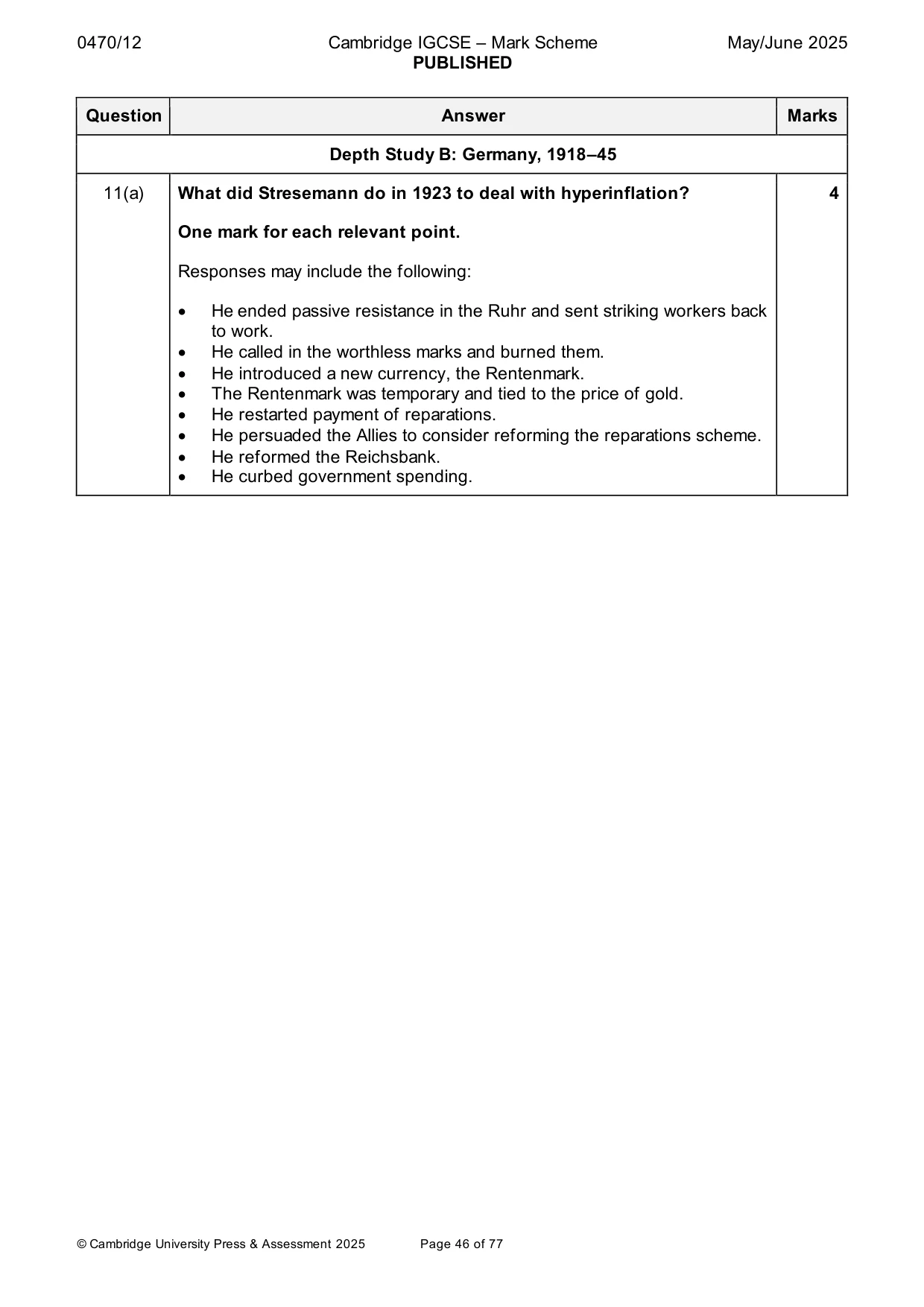
0470/12 Cambridge IGCSE – Mark Scheme PUBLISHED May/June 2025 © Cambridge University Press & Assessment 2025 Page 46 of 77 Question Answer Marks Depth Study B: Germany, 1918–45 11(a) What did Stresemann do in 1923 to deal with hyperinflation? One mark for each relevant point. Responses may include the following: • He ended passive resistance in the Ruhr and sent striking workers back to work. • He called in the worthless marks and burned them. • He introduced a new currency, the Rentenmark. • The Rentenmark was temporary and tied to the price of gold. • He restarted payment of reparations. • He persuaded the Allies to consider reforming the reparations scheme. • He reformed the Reichsbank. • He curbed government spending. 4
Mark scheme, page 47
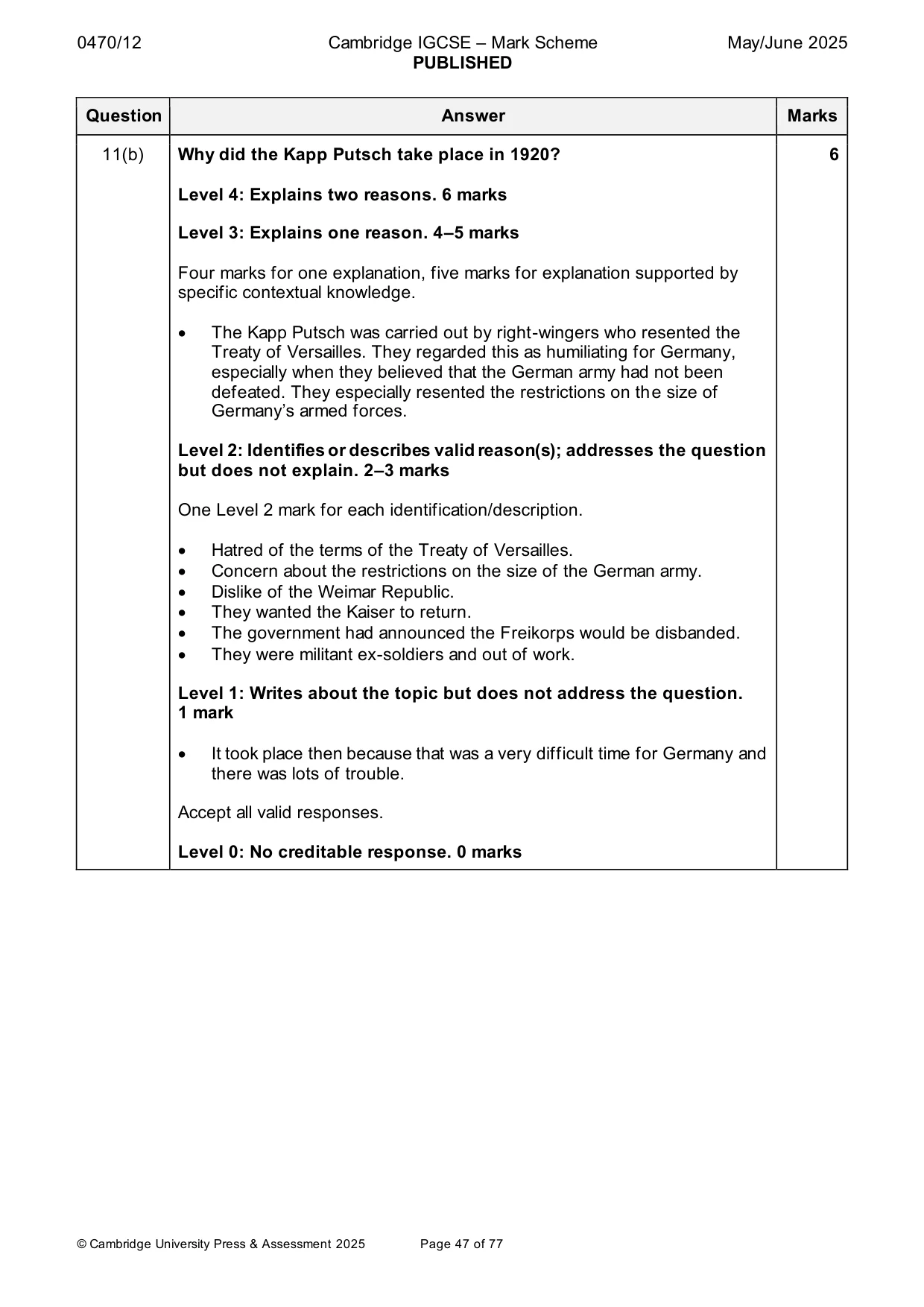
0470/12 Cambridge IGCSE – Mark Scheme PUBLISHED May/June 2025 © Cambridge University Press & Assessment 2025 Page 47 of 77 Question Answer Marks 11(b) Why did the Kapp Putsch take place in 1920? Level 4: Explains two reasons. 6 marks Level 3: Explains one reason. 4–5 marks Four marks for one explanation, five marks for explanation supported by specific contextual knowledge. • The Kapp Putsch was carried out by right-wingers who resented the Treaty of Versailles. They regarded this as humiliating for Germany, especially when they believed that the German army had not been defeated. They especially resented the restrictions on the size of Germany’s armed forces. Level 2: Identifies or describes valid reason(s); addresses the question but does not explain. 2–3 marks One Level 2 mark for each identification/description. • Hatred of the terms of the Treaty of Versailles. • Concern about the restrictions on the size of the German army. • Dislike of the Weimar Republic. • They wanted the Kaiser to return. • The government had announced the Freikorps would be disbanded. • They were militant ex-soldiers and out of work. Level 1: Writes about the topic but does not address the question. 1 mark • It took place then because that was a very difficult time for Germany and there was lots of trouble. Accept all valid responses. Level 0: No creditable response. 0 marks 6
Mark scheme, page 48
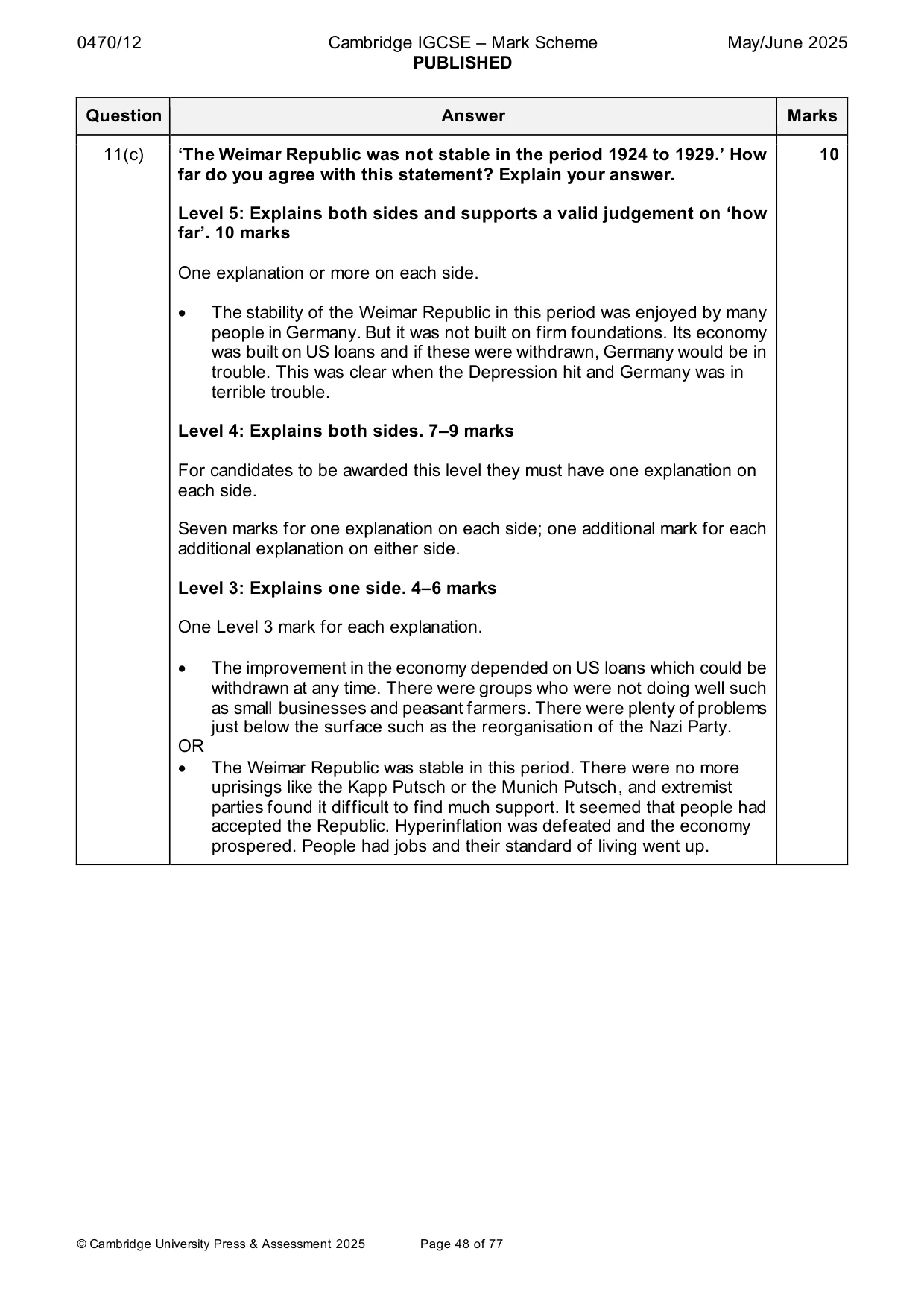
0470/12 Cambridge IGCSE – Mark Scheme PUBLISHED May/June 2025 © Cambridge University Press & Assessment 2025 Page 48 of 77 Question Answer Marks 11(c) ‘The Weimar Republic was not stable in the period 1924 to 1929.’ How far do you agree with this statement? Explain your answer. Level 5: Explains both sides and supports a valid judgement on ‘how far’. 10 marks One explanation or more on each side. • The stability of the Weimar Republic in this period was enjoyed by many people in Germany. But it was not built on firm foundations. Its economy was built on US loans and if these were withdrawn, Germany would be in trouble. This was clear when the Depression hit and Germany was in terrible trouble. Level 4: Explains both sides. 7–9 marks For candidates to be awarded this level they must have one explanation on each side. Seven marks for one explanation on each side; one additional mark for each additional explanation on either side. Level 3: Explains one side. 4–6 marks One Level 3 mark for each explanation. • The improvement in the economy depended on US loans which could be withdrawn at any time. There were groups who were not doing well such as small businesses and peasant farmers. There were plenty of problems just below the surface such as the reorganisation of the Nazi Party. OR • The Weimar Republic was stable in this period. There were no more uprisings like the Kapp Putsch or the Munich Putsch, and extremist parties found it difficult to find much support. It seemed that people had accepted the Republic. Hyperinflation was defeated and the economy prospered. People had jobs and their standard of living went up. 10
Mark scheme, page 49
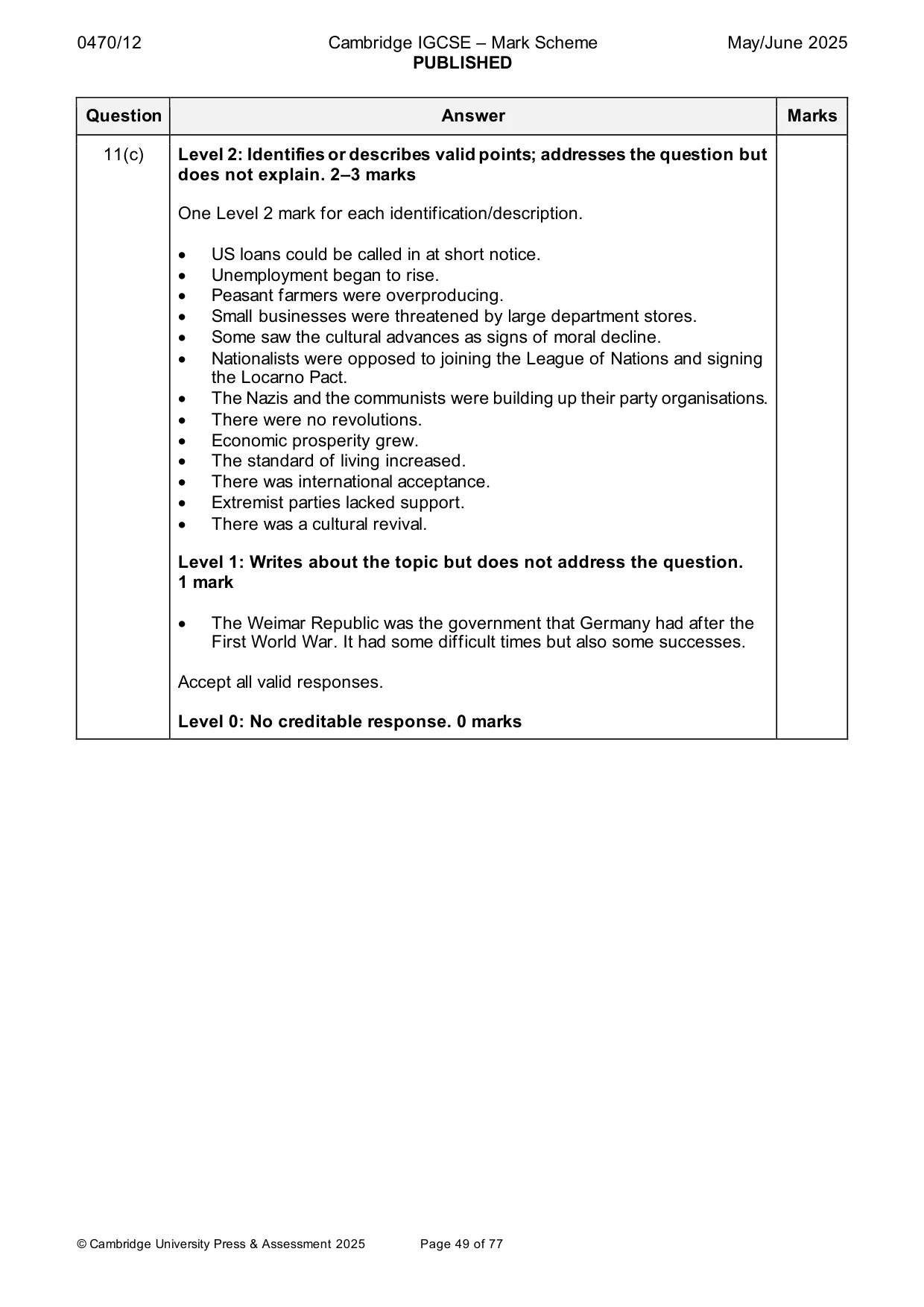
0470/12 Cambridge IGCSE – Mark Scheme PUBLISHED May/June 2025 © Cambridge University Press & Assessment 2025 Page 49 of 77 Question Answer Marks 11(c) Level 2: Identifies or describes valid points; addresses the question but does not explain. 2–3 marks One Level 2 mark for each identification/description. • US loans could be called in at short notice. • Unemployment began to rise. • Peasant farmers were overproducing. • Small businesses were threatened by large department stores. • Some saw the cultural advances as signs of moral decline. • Nationalists were opposed to joining the League of Nations and signing the Locarno Pact. • The Nazis and the communists were building up their party organisations. • There were no revolutions. • Economic prosperity grew. • The standard of living increased. • There was international acceptance. • Extremist parties lacked support. • There was a cultural revival. Level 1: Writes about the topic but does not address the question. 1 mark • The Weimar Republic was the government that Germany had after the First World War. It had some difficult times but also some successes. Accept all valid responses. Level 0: No creditable response. 0 marks
Mark scheme, page 50
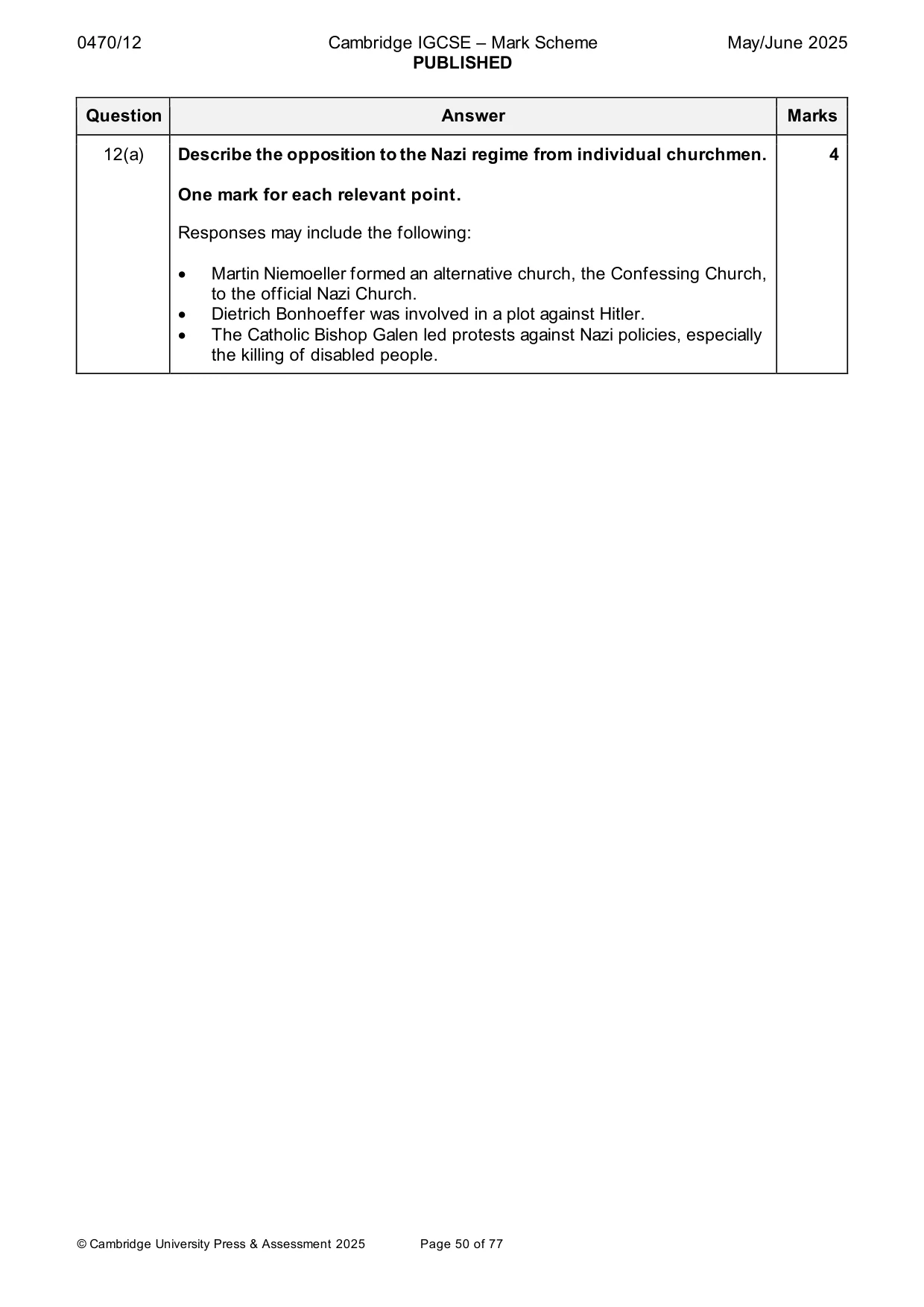
0470/12 Cambridge IGCSE – Mark Scheme PUBLISHED May/June 2025 © Cambridge University Press & Assessment 2025 Page 50 of 77 Question Answer Marks 12(a) Describe the opposition to the Nazi regime from individual churchmen. One mark for each relevant point. Responses may include the following: • Martin Niemoeller formed an alternative church, the Confessing Church, to the official Nazi Church. • Dietrich Bonhoeffer was involved in a plot against Hitler. • The Catholic Bishop Galen led protests against Nazi policies, especially the killing of disabled people. 4
Mark scheme, page 51
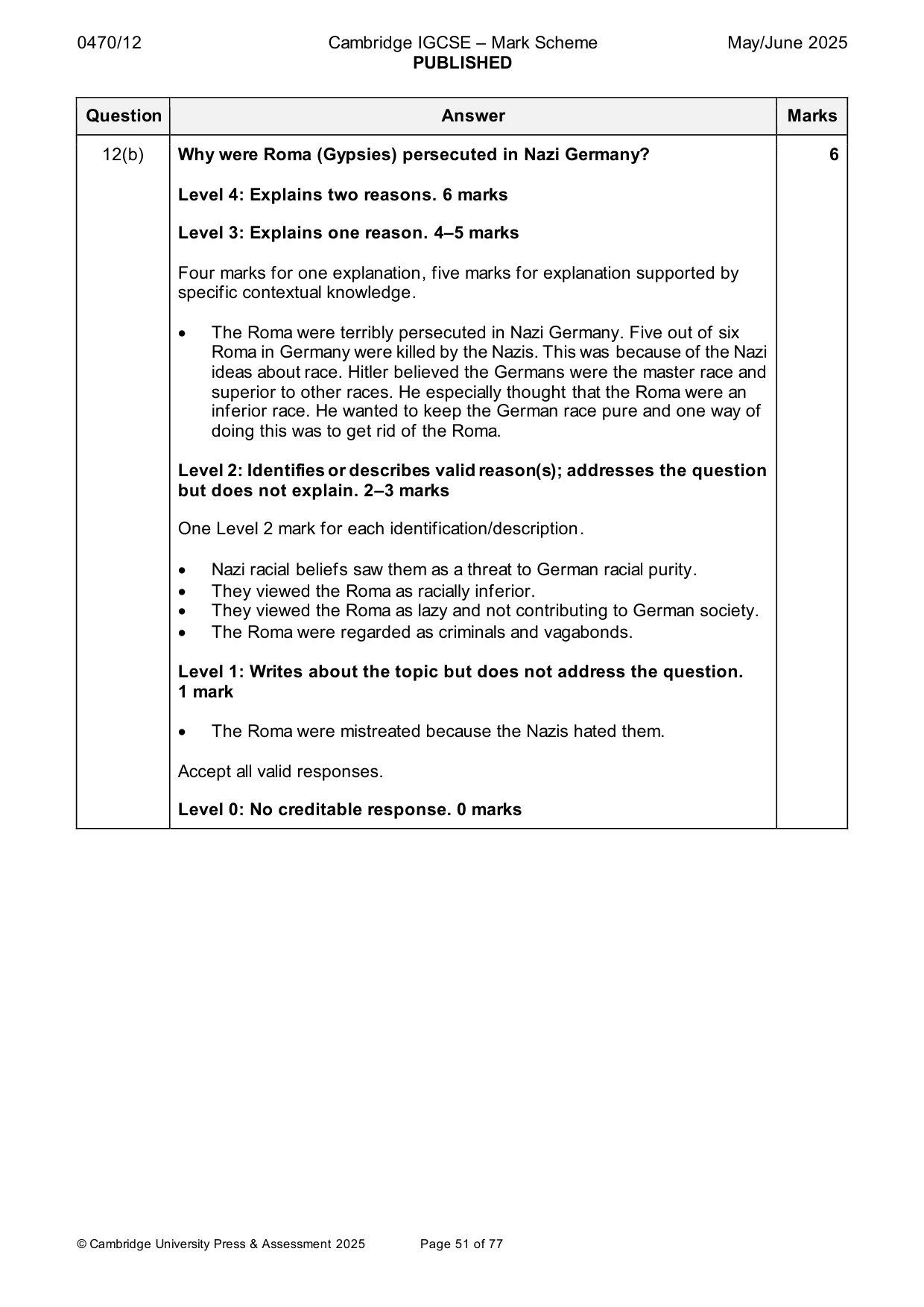
0470/12 Cambridge IGCSE – Mark Scheme PUBLISHED May/June 2025 © Cambridge University Press & Assessment 2025 Page 51 of 77 Question Answer Marks 12(b) Why were Roma (Gypsies) persecuted in Nazi Germany? Level 4: Explains two reasons. 6 marks Level 3: Explains one reason. 4–5 marks Four marks for one explanation, five marks for explanation supported by specific contextual knowledge. • The Roma were terribly persecuted in Nazi Germany. Five out of six Roma in Germany were killed by the Nazis. This was because of the Nazi ideas about race. Hitler believed the Germans were the master race and superior to other races. He especially thought that the Roma were an inferior race. He wanted to keep the German race pure and one way of doing this was to get rid of the Roma. Level 2: Identifies or describes valid reason(s); addresses the question but does not explain. 2–3 marks One Level 2 mark for each identification/description. • Nazi racial beliefs saw them as a threat to German racial purity. • They viewed the Roma as racially inferior. • They viewed the Roma as lazy and not contributing to German society. • The Roma were regarded as criminals and vagabonds. Level 1: Writes about the topic but does not address the question. 1 mark • The Roma were mistreated because the Nazis hated them. Accept all valid responses. Level 0: No creditable response. 0 marks 6
Mark scheme, page 52
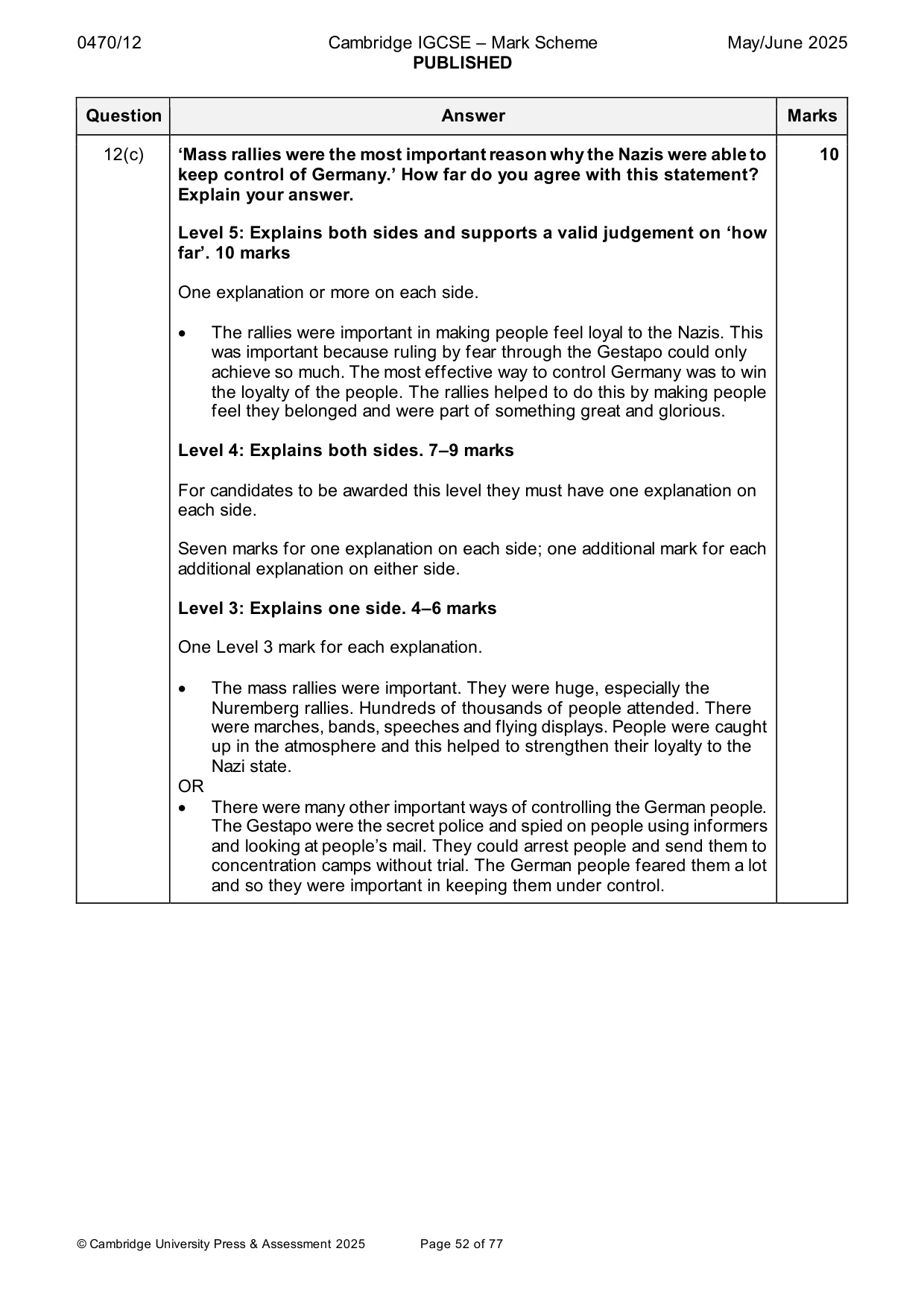
0470/12 Cambridge IGCSE – Mark Scheme PUBLISHED May/June 2025 © Cambridge University Press & Assessment 2025 Page 52 of 77 Question Answer Marks 12(c) ‘Mass rallies were the most important reason why the Nazis were able to keep control of Germany.’ How far do you agree with this statement? Explain your answer. Level 5: Explains both sides and supports a valid judgement on ‘how far’. 10 marks One explanation or more on each side. • The rallies were important in making people feel loyal to the Nazis. This was important because ruling by fear through the Gestapo could only achieve so much. The most effective way to control Germany was to win the loyalty of the people. The rallies helped to do this by making people feel they belonged and were part of something great and glorious. Level 4: Explains both sides. 7–9 marks For candidates to be awarded this level they must have one explanation on each side. Seven marks for one explanation on each side; one additional mark for each additional explanation on either side. Level 3: Explains one side. 4–6 marks One Level 3 mark for each explanation. • The mass rallies were important. They were huge, especially the Nuremberg rallies. Hundreds of thousands of people attended. There were marches, bands, speeches and flying displays. People were caught up in the atmosphere and this helped to strengthen their loyalty to the Nazi state. OR • There were many other important ways of controlling the German people. The Gestapo were the secret police and spied on people using informers and looking at people’s mail. They could arrest people and send them to concentration camps without trial. The German people feared them a lot and so they were important in keeping them under control. 10
Mark scheme, page 53
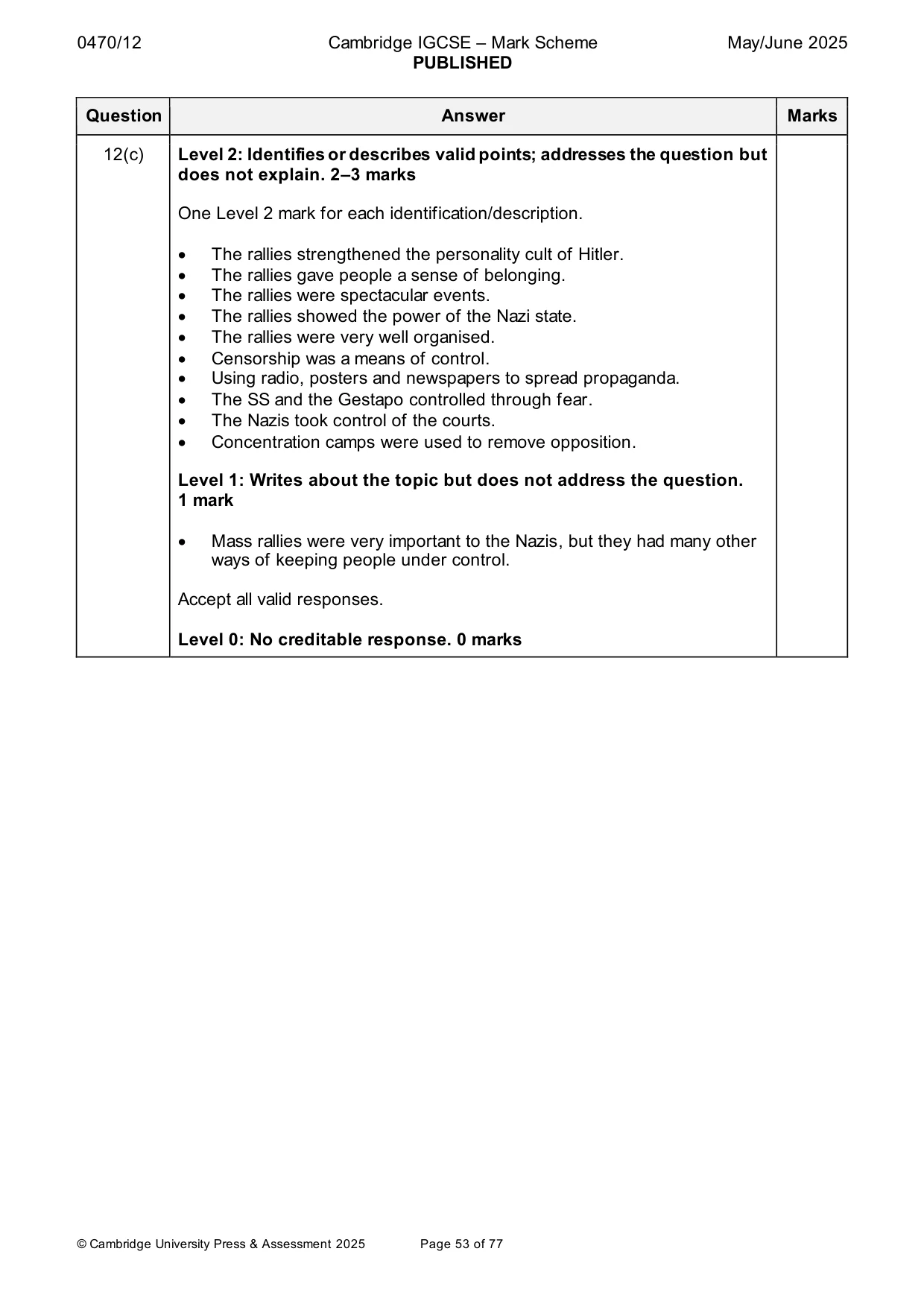
0470/12 Cambridge IGCSE – Mark Scheme PUBLISHED May/June 2025 © Cambridge University Press & Assessment 2025 Page 53 of 77 Question Answer Marks 12(c) Level 2: Identifies or describes valid points; addresses the question but does not explain. 2–3 marks One Level 2 mark for each identification/description. • The rallies strengthened the personality cult of Hitler. • The rallies gave people a sense of belonging. • The rallies were spectacular events. • The rallies showed the power of the Nazi state. • The rallies were very well organised. • Censorship was a means of control. • Using radio, posters and newspapers to spread propaganda. • The SS and the Gestapo controlled through fear. • The Nazis took control of the courts. • Concentration camps were used to remove opposition. Level 1: Writes about the topic but does not address the question. 1 mark • Mass rallies were very important to the Nazis, but they had many other ways of keeping people under control. Accept all valid responses. Level 0: No creditable response. 0 marks
Mark scheme, page 54
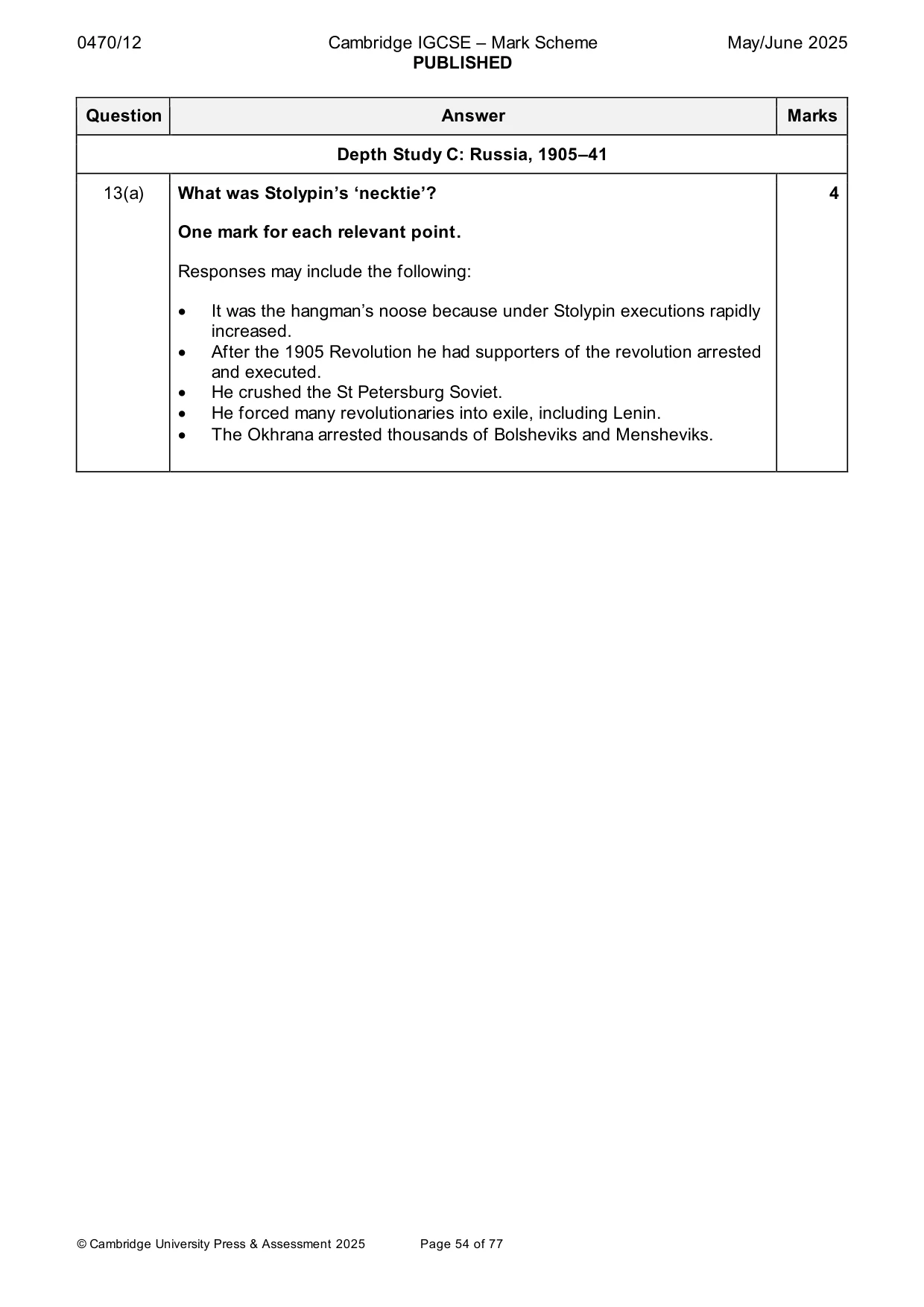
0470/12 Cambridge IGCSE – Mark Scheme PUBLISHED May/June 2025 © Cambridge University Press & Assessment 2025 Page 54 of 77 Question Answer Marks Depth Study C: Russia, 1905–41 13(a) What was Stolypin’s ‘necktie’? One mark for each relevant point. Responses may include the following: • It was the hangman’s noose because under Stolypin executions rapidly increased. • After the 1905 Revolution he had supporters of the revolution arrested and executed. • He crushed the St Petersburg Soviet. • He forced many revolutionaries into exile, including Lenin. • The Okhrana arrested thousands of Bolsheviks and Mensheviks. 4
Mark scheme, page 55
0470/12 Cambridge IGCSE – Mark Scheme PUBLISHED May/June 2025 © Cambridge University Press & Assessment 2025 Page 55 of 77 Question Answer Marks 13(b) Why did the First World War weaken the Tsar? Level 4: Explains two reasons. 6 marks Level 3: Explains one reason. 4–5 marks Four marks for one explanation, five marks for explanation supported by specific contextual knowledge. • The war weakened the Tsar because he took personal command of the war. This meant that when the war went badly in 1916, he was seen to be personally responsible. This made him more and more unpopular. It also meant that he had to leave his unpopular wife in charge of the government. Level 2: Identifies or describes valid reason(s); addresses the question but does not explain. 2–3 marks One Level 2 mark for each identification/description. • The Tsar took personal control of the army. • The Tsar was not an able commander. • There were huge numbers of casualties running into millions. • The Tsar was blamed for Russia’s defeats in the war. • The Tsar left his wife in control of the country. • There were fuel and food shortages in the cities. • There were strikes because of low wages and little food. • The Russian army was facing defeat after defeat and there were many desertions. Level 1: Writes about the topic but does not address the question. 1 mark • The war was a terrible event where many people died. The Tsar was involved in the war. Accept all valid responses. Level 0: No creditable response. 0 marks 6
Mark scheme, page 56
0470/12 Cambridge IGCSE – Mark Scheme PUBLISHED May/June 2025 © Cambridge University Press & Assessment 2025 Page 56 of 77 Question Answer Marks 13(c) ‘The main reason why the Tsar survived the 1905 Revolution was the use of brutal repression by the army.’ How far do you agree with this statement? Explain your answer. Level 5: Explains both sides and supports a valid judgement on ‘how far’. 10 marks One explanation or more on each side. • Although the October Manifesto did promise reforms, it only impressed the middle classes; it did not impress the revolutionaries and working classes. They continued to riot, and the only way the Tsar could deal with them was by using the army to repress them. Level 4: Explains both sides. 7–9 marks For candidates to be awarded this level they must have one explanation on each side. Seven marks for one explanation on each side; one additional mark for each additional explanation on either side. Level 3: Explains one side. 4–6 marks One Level 3 mark for each explanation. • The Tsar was able to stay in power through repression. He brought the army back from the war with Japan. He then used the soldiers to attack the revolutionaries. Leaders like Trotsky were rounded up and arrested. In cities across the country the army repressed the workers. This also happened in the countryside where troops were sent out to crush the peasants. OR • I do not agree with this. The main reason he was able to survive was the October Manifesto. This offered the people some reforms – an elected Parliament, free speech and political parties. This pleased the middle classes who wanted this kind of reform. They did not like the violence and disorder and gave the Tsar their support. 10
Mark scheme, page 57
0470/12 Cambridge IGCSE – Mark Scheme PUBLISHED May/June 2025 © Cambridge University Press & Assessment 2025 Page 57 of 77 Question Answer Marks 13(c) Level 2: Identifies or describes valid points; addresses the question but does not explain. 2–3 marks One Level 2 mark for each identification/description. • The army was brought back from Japan. • The army arrested the revolutionary leaders. • The army repressed the workers in the big cities and in the countryside. • The October Manifesto offered some reforms. • In November 1905 he made concessions and gave financial help to the peasants. • The middle classes liked the reforms the Tsar promised. • The St Petersburg Soviet rejected the October Manifesto. Level 1: Writes about the topic but does not address the question. 1 mark • There was a revolution in 1905, and the Tsar was lucky to survive it. He used all his power to survive. Accept all valid responses. Level 0: No creditable response. 0 marks
Mark scheme, page 58
0470/12 Cambridge IGCSE – Mark Scheme PUBLISHED May/June 2025 © Cambridge University Press & Assessment 2025 Page 58 of 77 Question Answer Marks 14(a) Describe the actions by Stalin that led to him becoming leader of the Soviet Union. One mark for each relevant point. Responses may include the following: • He became General Secretary of the party in 1922. • He made sure Trotsky missed Lenin’s funeral, while he attended. • He put his own supporters in positions of power in the party organisation. • He supported ‘Socialism in One Country’. • Stalin presented himself as a humble ordinary peasant. • He associated himself very closely with Lenin. • He managed to outmanoeuvre other leaders such as Trotsky and Bukharin. 4
Mark scheme, page 59
0470/12 Cambridge IGCSE – Mark Scheme PUBLISHED May/June 2025 © Cambridge University Press & Assessment 2025 Page 59 of 77 Question Answer Marks 14(b) Why did Stalin establish a cult of personality? Level 4: Explains two reasons. 6 marks Level 3: Explains one reason. 4–5 marks Four marks for one explanation, five marks for explanation supported by specific contextual knowledge. • Stalin set up a cult of personality by having his image everywhere – pictures, statues and posters. He did this because he wanted to identify himself with Russia. He wanted people to see himself and Russia as the same thing. People’s loyalty to Russia would then get transferred to him, and to be disloyal to him meant being disloyal to the country. Level 2: Identifies or describes valid reason(s); addresses the question but does not explain. 2–3 marks One Level 2 mark for each identification/description. • It was used to keep himself in power. • To make himself look good. • To consolidate his position and remove independent thinking. • To show that Russia and Stalin were the same thing. • To win the loyalty of the Russian people. • To make himself god-like. Level 1: Writes about the topic but does not address the question. 1 mark • Stalin had his pictures everywhere and places were named after him. Accept all valid responses. Level 0: No creditable response. 0 marks 6
Mark scheme, page 60
0470/12 Cambridge IGCSE – Mark Scheme PUBLISHED May/June 2025 © Cambridge University Press & Assessment 2025 Page 60 of 77 Question Answer Marks 14(c) How far did the Purges benefit Stalin and the Soviet Union? Explain your answer. Level 5: Explains both sides and supports a valid judgement on ‘how far’. 10 marks One explanation or more on each side. • The Purges might have benefited Stalin and helped him to get rid of anyone that was a danger to him, but they did not benefit the Soviet Union. So many people were purged in the army and in industry that Russia lost many able people who could have contributed to the country. Level 4: Explains both sides. 7–9 marks For candidates to be awarded this level they must have one explanation on each side. Seven marks for one explanation on each side; one additional mark for each additional explanation on either side. Level 3: Explains one side. 4–6 marks One Level 3 mark for each explanation. • The Purges did benefit Stalin. He was always worried about rivals in the Party, and he used the Purges to get rid of them and keep his own position safe. Some rivals were murdered and hundreds of thousands of people were arrested and put in labour camps. Important people who could threaten Stalin like Bukharin and Kamenev went on trial. These were show trials and there was no chance of them being found not guilty. Their purpose was to show everybody what happened to you if you threatened Stalin. OR • There were ways in which the Purges did not benefit the Soviet Union. Stalin purged so many officers in the army that when the Second World War started it did not have enough leaders. In areas like universities, industry and business the large number of people purged took away thousands of intelligent people who could have benefited the country. Level 2: Identifies or describes valid points; addresses the question but does not explain. 2–3 marks One Level 2 mark for each identification/description. • Stalin got rid of his rivals. • Stalin was able to show how powerful he was. • People did not dare to oppose Stalin. • Slave labour in the gulags contributed to the Soviet economy. • The army lost many officers. • Industry and business lost many capable people. • People with independent thinking and intelligent minds were lost to the country. 10
Mark scheme, page 61
0470/12 Cambridge IGCSE – Mark Scheme PUBLISHED May/June 2025 © Cambridge University Press & Assessment 2025 Page 61 of 77 Question Answer Marks 14(c) Level 1: Writes about the topic but does not address the question. 1 mark • The Purges were very vicious, and Stalin turned on a lot of people that he had worked with. Accept all valid responses. Level 0: No creditable response. 0 marks
Mark scheme, page 62
0470/12 Cambridge IGCSE – Mark Scheme PUBLISHED May/June 2025 © Cambridge University Press & Assessment 2025 Page 62 of 77 Question Answer Marks Depth Study D: The United States, 1919–41 15(a) Which industries did not benefit from the boom in the 1920s? One mark for each relevant point. Responses may include the following: • Coal suffered from overproduction. • The traditional textile industries of cotton and woollen textiles suffered because of the development of synthetic materials. • Farming struggled at this time. • Leather and shoemaking industries struggled. 4
Mark scheme, page 63
0470/12 Cambridge IGCSE – Mark Scheme PUBLISHED May/June 2025 © Cambridge University Press & Assessment 2025 Page 63 of 77 Question Answer Marks 15(b) Why did developments outside the Unites States affect American farming in the 1920s? Level 4: Explains two reasons. 6 marks Level 3: Explains one reason. 4–5 marks Four marks for one explanation, five marks for explanation supported by specific contextual knowledge. • One development was the competition from farmers in Canada and Argentina who exported grain around the world. The Canadian farmers were very efficient and took markets away from American farmers. Level 2: Identifies or describes valid reason(s); addresses the question but does not explain. 2–3 marks One Level 2 mark for each identification/description. • Canadian farmers were efficient. • The end of the First World War impacted it. • Europe imported less food from the US. • US farming was hit by reciprocal tariffs. Level 1: Writes about the topic but does not address the question. 1 mark • American farming was having a difficult time because of external developments. Accept all valid responses. Level 0: No creditable response. 0 marks 6
Mark scheme, page 64
0470/12 Cambridge IGCSE – Mark Scheme PUBLISHED May/June 2025 © Cambridge University Press & Assessment 2025 Page 64 of 77 Question Answer Marks 15(c) ‘Credit was more important than Republican policies in causing the boom of the 1920s.’ How far do you agree with this statement? Explain your answer. Level 5: Explains both sides and supports a valid judgement on ‘how far’. 10 marks One explanation or more on each side. • Although Republican policies were important, it was more important that the American people could afford to buy the new consumer goods that were being made, such as cars and fridges. Credit helped people buy enormous numbers of goods which stimulated industry. It would not have been any good making all these goods if nobody could buy them. Level 4: Explains both sides. 7–9 marks For candidates to be awarded this level they must have one explanation on each side. Seven marks for one explanation on each side; one additional mark for each additional explanation on either side. Level 3: Explains one side. 4–6 marks One Level 3 mark for each explanation. • Credit was very important in causing the boom. Being able to borrow money to buy things and pay back in instalments meant that people spent much more money. They could buy cars, fridges and radios. This meant that industry was able to sell more goods and provide more jobs with good wages. OR • Republican policy was the main factor. The Republicans believed in the laissez-faire policy, which meant no government intervention with lots of regulations. This gave industry and business the freedom to progress and especially helped the big trusts. Also, tariffs helped protect American industry from outside competition. 10
Mark scheme, page 65
0470/12 Cambridge IGCSE – Mark Scheme PUBLISHED May/June 2025 © Cambridge University Press & Assessment 2025 Page 65 of 77 Question Answer Marks 15(c) Level 2: Identifies or describes valid points; addresses the question but does not explain. 2–3 marks One Level 2 mark for each identification/description. • People could afford to buy more on credit. • People bought more consumer goods. • People could afford to buy shares. • Without it they would not have been able to buy cars. • The laissez-faire policy gave business more freedom to grow. • Low taxation allowed more investment. • Tariffs protected American business from outside competition. • Republican policies led to the formation of trusts. Level 1: Writes about the topic but does not address the question. 1 mark • The boom was caused by many factors, and the American people did very well. Their standard of living went up. Accept all valid responses. Level 0: No creditable response. 0 marks
Mark scheme, page 66
0470/12 Cambridge IGCSE – Mark Scheme PUBLISHED May/June 2025 © Cambridge University Press & Assessment 2025 Page 66 of 77 Question Answer Marks 16(a) What were the main measures of the Second New Deal? One mark for each relevant point. Responses may include the following: • The Wagner Act forced employers to allow trade unions and to let them negotiate pay and conditions. • The Social Security Act provided state pensions for the elderly and widows and help for the sick and disabled. • A system of unemployment insurance was set up. • Under the Resettlement Act smallholders and tenant farmers were moved to better land. • The Works Progress Administration created jobs beyond building projects. 4
Mark scheme, page 67
0470/12 Cambridge IGCSE – Mark Scheme PUBLISHED May/June 2025 © Cambridge University Press & Assessment 2025 Page 67 of 77 Question Answer Marks 16(b) Why were the first hundred days of Roosevelt’s presidency important? Level 4: Explains two reasons. 6 marks Level 3: Explains one reason. 4–5 marks Four marks for one explanation, five marks for explanation supported by specific contextual knowledge. • The main reason they were important was that they restored confidence in the American banking system. People had lost confidence and were taking all their savings out of the banks. If the system collapsed, the disaster would have been even greater. Roosevelt restored confidence by closing the banks for four days. This gave him time to pass the Emergency Banking Act. Banks in real trouble were closed down, while other banks were helped with government grants. When they reopened, confidence had been restored and people put their money back in. Level 2: Identifies or describes valid reason(s); addresses the question but does not explain. 2–3 marks One Level 2 mark for each identification/description. • Roosevelt’s ‘fireside chats’ helped increase the hope of the American people. • He restored confidence in the banks. • Jobs were provided by the Civilian Conservation Corps and other government organisations. • Soup kitchens were set up and clothing was provided for the poor. • Farmers were helped and production was reduced. • Pay and working conditions were improved. • Public money was used to start building schools and roads. • The confidence of the American people returned. • Roosevelt communicated his plan for the New Deal. Level 1: Writes about the topic but does not address the question. 1 mark • These were important because this was when Roosevelt did a lot of his important work and helped people. Accept all valid responses. Level 0: No creditable response. 0 marks 6
Mark scheme, page 68
0470/12 Cambridge IGCSE – Mark Scheme PUBLISHED May/June 2025 © Cambridge University Press & Assessment 2025 Page 68 of 77 Question Answer Marks 16(c) ‘The New Deal was an effective response to the Depression.’ How far do you agree with this statement? Explain your answer. Level 5: Explains both sides and supports a valid judgement on ‘how far’. 10 marks One explanation or more on each side. • I think it was an effective response. It did not solve every problem, but it did a lot. Americans were very suspicious of government interference and the New Deal was heavily criticised for this. It was probably impossible for the New Deal to go any further, so I think it did as much as could be expected and much more than Hoover did. Level 4: Explains both sides. 7–9 marks For candidates to be awarded this level they must have one explanation on each side. Seven marks for one explanation on each side; one additional mark for each additional explanation on either side. Level 3: Explains one side. 4–6 marks One Level 3 mark for each explanation. • It was a very effective response. It created millions of jobs and made the banking system stable. The projects it set up provided the US with new schools, roads and dams and improved living standards in deprived parts of the country such as the Tennessee Valley. OR • I do not think that the New Deal was an effective response. This is because it did not solve the problem of unemployment. By the end of the 1930s there were still 5 million people unemployed. This was because businesses were trying to be more efficient and so employed fewer workers. Also, most people were on low wages and so they could not afford to spend much, which meant that industry was not stimulated. It was the Second World War that solved the problem. 10
Mark scheme, page 69
0470/12 Cambridge IGCSE – Mark Scheme PUBLISHED May/June 2025 © Cambridge University Press & Assessment 2025 Page 69 of 77 Question Answer Marks 16(c) Level 2: Identifies or describes valid points; addresses the question but does not explain. 2–3 marks One Level 2 mark for each identification/description. • The banking system was stabilised. • The New Deal reduced unemployment. • It restored confidence in the government. • It gave the workers trade unions. • It did not help women workers much. • Critics like Huey Long said it was not doing enough. • Unemployment remained high. • Wages remained low. • Before the Second World War the recovery of industry was still very slow. • The New Deal did not do enough to help Black Americans. • The country went back into recession in 1937. Level 1: Writes about the topic but does not address the question. 1 mark • The New Deal was very successful and tackled the great problems that the USA was facing. It helped thousands of people. Accept all valid responses. Level 0: No creditable response. 0 marks
Mark scheme, page 70
0470/12 Cambridge IGCSE – Mark Scheme PUBLISHED May/June 2025 © Cambridge University Press & Assessment 2025 Page 70 of 77 Question Answer Marks Depth Study E: The Second World War in Europe and the Asia–Pacific, 1939–c.1945 17(a) Describe the extent of German control over Europe by the end of 1940. One mark for each relevant point. Responses may include the following: • Germany controlled Scandinavian countries like Denmark and Norway. • Belgium and the Netherlands. • France and Paris. • Poland and Danzig. • The Channel Islands. • Luxembourg. 4
Mark scheme, page 71
0470/12 Cambridge IGCSE – Mark Scheme PUBLISHED May/June 2025 © Cambridge University Press & Assessment 2025 Page 71 of 77 Question Answer Marks 17(b) Why did Germany invade the Soviet Union in 1941? Level 4: Explains two reasons. 6 marks Level 3: Explains one reason. 4–5 marks Four marks for one explanation, five marks for explanation supported by specific contextual knowledge. • Hitler thought that Germany did not have enough land and needed to be economically stronger. He wanted living space for the German people so that Germany could survive and prosper. He was worried about Germany’s lack of resources and was annoyed that in 1939 Germany was having to depend on grain and oil from the Soviet Union. He decided it would be better if Germany invaded the Soviet Union and took control of these resources. Level 2: Identifies or describes valid reason(s); addresses the question but does not explain. 2–3 marks One Level 2 mark for each identification/description. • To use Russia’s resources to make Germany economically stronger. • To increase living space for the German people. • Hitler regarded Slavs as subhuman and hated communism. • Hitler claimed that the Soviet Union was ruled by Jewish Bolsheviks. • Hitler’s beliefs about racial superiority were used to justify it. • Hitler saw the Soviet Union as a threat to Germany. Level 1: Writes about the topic but does not address the question. 1 mark • Germany did this because Hitler thought it would be a good move and would help his long-term aims. It was called Operation Barbarossa. Accept all valid responses. Level 0: No creditable response. 0 marks 6
Mark scheme, page 72
0470/12 Cambridge IGCSE – Mark Scheme PUBLISHED May/June 2025 © Cambridge University Press & Assessment 2025 Page 72 of 77 Question Answer Marks 17(c) ‘Dunkirk was more important than the Battle of Britain.’ How far do you agree with this statement? Explain your answer. Level 5: Explains both sides and supports a valid judgement on ‘how far’. 10 marks One explanation or more on each side. • Although Dunkirk raised the spirits of the British people, it was really a defeat for Britain. It had to leave mainland Europe and only had remnants of its army left. It looked as if Germany would win the war. However, the Battle of Britain made sure that Britain was safe from a German invasion and could be seen as the turning point of the war. It was a major defeat for Germany. Level 4: Explains both sides. 7–9 marks For candidates to be awarded this level they must have one explanation on each side. Seven marks for one explanation on each side; one additional mark for each additional explanation on either side. Level 3: Explains one side. 4–6 marks One Level 3 mark for each explanation. • Dunkirk was important because it was a moral victory for Britain that raised the spirits of the country. The story of little boats rescuing thousands of British troops was shown by newspapers and the government almost as a victory, and the idea of the ‘Dunkirk Spirit’ was used to show that Britain would fight on until it had won. OR • The Battle of Britain was more important because if the German air force had won it would have had control of the skies over the English Channel and the North Sea. This would have meant that the German army could have invaded because it already controlled French ports. With air cover the Germans would have been able to send troops across the Channel and start an invasion. Without control of the air, the Germans knew that their ships full of troops would be destroyed before they reached the British coast. 10
Mark scheme, page 73
0470/12 Cambridge IGCSE – Mark Scheme PUBLISHED May/June 2025 © Cambridge University Press & Assessment 2025 Page 73 of 77 Question Answer Marks 17(c) Level 2: Identifies or describes valid points; addresses the question but does not explain. 2–3 marks One Level 2 mark for each identification/description. • Dunkirk was a major boost to British morale. • Huge amounts of military equipment were lost by the British army. • Dunkirk meant that Britain had the beginnings for re-building its army. • Dunkirk meant that there was little left to stop the Germans taking Paris. • The Battle of Britain made the Germans call off the idea of invading Britain. • The Battle of Britain meant that the German air force did not have control of the skies. • The Battle of Britain helped Britain survive and extended the war. • Hundreds of thousands of British and French troops were saved. Level 1: Writes about the topic but does not address the question. 1 mark • The Battle of Britain was far more important because it was a massive struggle between the air forces of Britain and Germany. Accept all valid responses. Level 0: No creditable response. 0 marks
Mark scheme, page 74
0470/12 Cambridge IGCSE – Mark Scheme PUBLISHED May/June 2025 © Cambridge University Press & Assessment 2025 Page 74 of 77 Question Answer Marks 18(a) Describe the Battle of Okinawa in 1945. One mark for each relevant point. Responses may include the following: • It was fought between US and Japanese forces. • The Allies started with a massive bombardment that destroyed many Japanese planes. • US troops launched an invasion of Okinawa. • US troops managed to cut the island in half. • Japan responded with kamikaze planes. • Japan’s battleship Yamato was sunk. • After ferocious fighting and heavy bombardments Japanese resistance was overcome in June. • The casualties on both sides were very high. • The US victory meant that an invasion of Japan was possible. 4
Mark scheme, page 75
0470/12 Cambridge IGCSE – Mark Scheme PUBLISHED May/June 2025 © Cambridge University Press & Assessment 2025 Page 75 of 77 Question Answer Marks 18(b) Why did the Allies invade Italy in 1943? Level 4: Explains two reasons. 6 marks Level 3: Explains one reason. 4–5 marks Four marks for one explanation, five marks for explanation supported by specific contextual knowledge. • They wanted to open a second front that would relieve pressure on the Russians in the east. The Russians had been asking for this. They hoped that the enemy would have to take troops away from the Russian Front and from France where the Allies hoped to land in 1944. Level 2: Identifies or describes valid reason(s); addresses the question but does not explain. 2–3 marks One Level 2 mark for each identification/description. • It was done to open a second front and relieve pressure in the east. • The North African campaign had ended successfully. • In 1943 an invasion of France was not possible. • To aim at the ‘soft underbelly of the Third Reich’. • To respond to Russian demands. • It would give the Allies new airfields from which to bomb Germany. Level 1: Writes about the topic but does not address the question. 1 mark • The invasion started with taking Sicily. Then the Italian mainland was invaded. Accept all valid responses. Level 0: No creditable response. 0 marks 6
Mark scheme, page 76
0470/12 Cambridge IGCSE – Mark Scheme PUBLISHED May/June 2025 © Cambridge University Press & Assessment 2025 Page 76 of 77 Question Answer Marks 18(c) ‘The Allied methods of occupation and control of Germany in 1945 were similar to those used in Japan.’ How far do you agree with this statement? Explain your answer. Level 5: Explains both sides and supports a valid judgement on ‘how far’. 10 marks One explanation or more on each side. • While there were structural differences – for example, Japan was not divided up, nor was it directly ruled by the military – the overall attitude and approach was similar: to get rid of the power and influence of the old regimes and their main supporters. In both countries there was hope that democracy could be introduced. This similarity was more important than any differences. Level 4: Explains both sides. 7–9 marks For candidates to be awarded this level they must have one explanation on each side. Seven marks for one explanation on each side; one additional mark for each additional explanation on either side. Level 3: Explains one side. 4–6 marks One Level 3 mark for each explanation. • In both countries the old form of government, its beliefs and supporters were swept away. The aim was to eliminate the beliefs and ideas of the old regimes and to start again. In both countries the eventual aim was to create democracy and to make sure the old regimes could not return. In both countries the main supporters of the old regimes were removed from their jobs and lost their influence. OR • Germany was divided between the Allies. The eastern part was put under Russian control while the western part was divided between the USA, France and Britain. Each ran their zones of occupation differently. In Japan, the USA was the leading occupying power with Britain helping. The Soviet Union had no influence in Japan, while it did in Germany. 10
Mark scheme, page 77
0470/12 Cambridge IGCSE – Mark Scheme PUBLISHED May/June 2025 © Cambridge University Press & Assessment 2025 Page 77 of 77 Question Answer Marks 18(c) Level 2: Identifies or describes valid points; addresses the question but does not explain. 2–3 marks One Level 2 mark for each identification/description. • Suspected Nazis were rounded up in Germany, as were extreme nationalists in Japan. • War crimes trials were held in both countries. • There was de-Nazification in Germany, and ‘rightists’ were banned from public office in Japan and nationalist organisations abolished. • Attempts were made at re-starting economic life in both countries. • Democracy was later introduced into both countries. • Germany was stripped of its sovereignty; Japan was not. • There was military occupation in both countries. • Germany was governed directly by the military; Japan was not. • Germany was divided amongst the Allies; Japan was not. • There was land reform in Japan, but there was no such reform in Germany. Level 1: Writes about the topic but does not address the question. 1 mark • Both countries were defeated in the war and so both were occupied. The methods used in Germany were slightly different from those used in Japan, but in both there was a great deal of control. Accept all valid responses. Level 0: No creditable response. 0 marks
What you needed in this session
Cambridge’s own grade thresholds for 2025 May/June, Paper 1 · Variant 2. A higher threshold means an easier paper — the bar moves with how the cohort did.