Cambridge IGCSE History 0470 — 2025 May/June Paper 1 · Variant 3
0470/13/M/J/25 · 60 marks · 120 min
The question paper and its mark scheme, free to read here and free to download. This is Cambridge’s own paper, exactly as it was sat.
Question paper8 pages

Mark scheme76 pages
Answers below. Sit the paper first if you are practising.
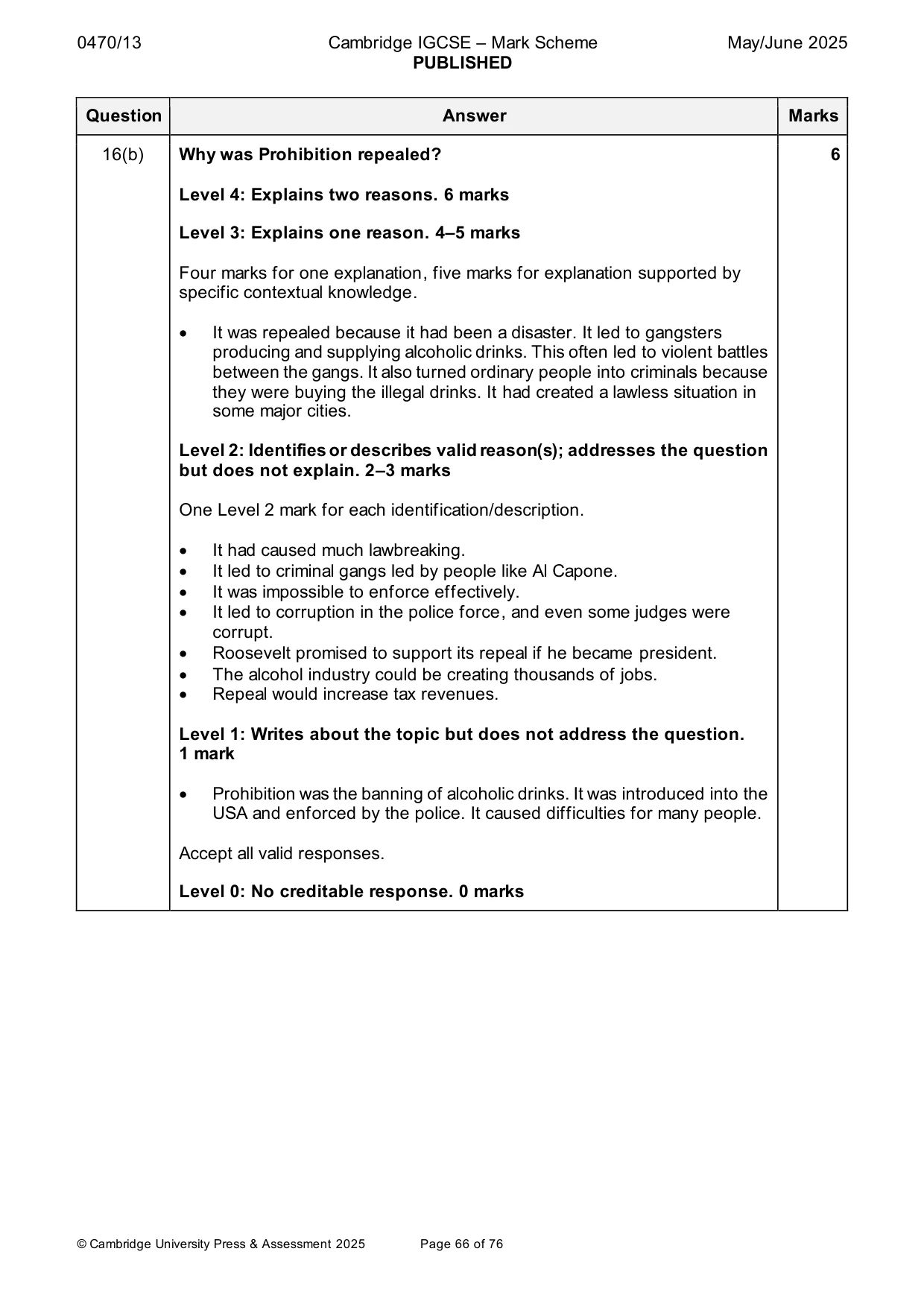
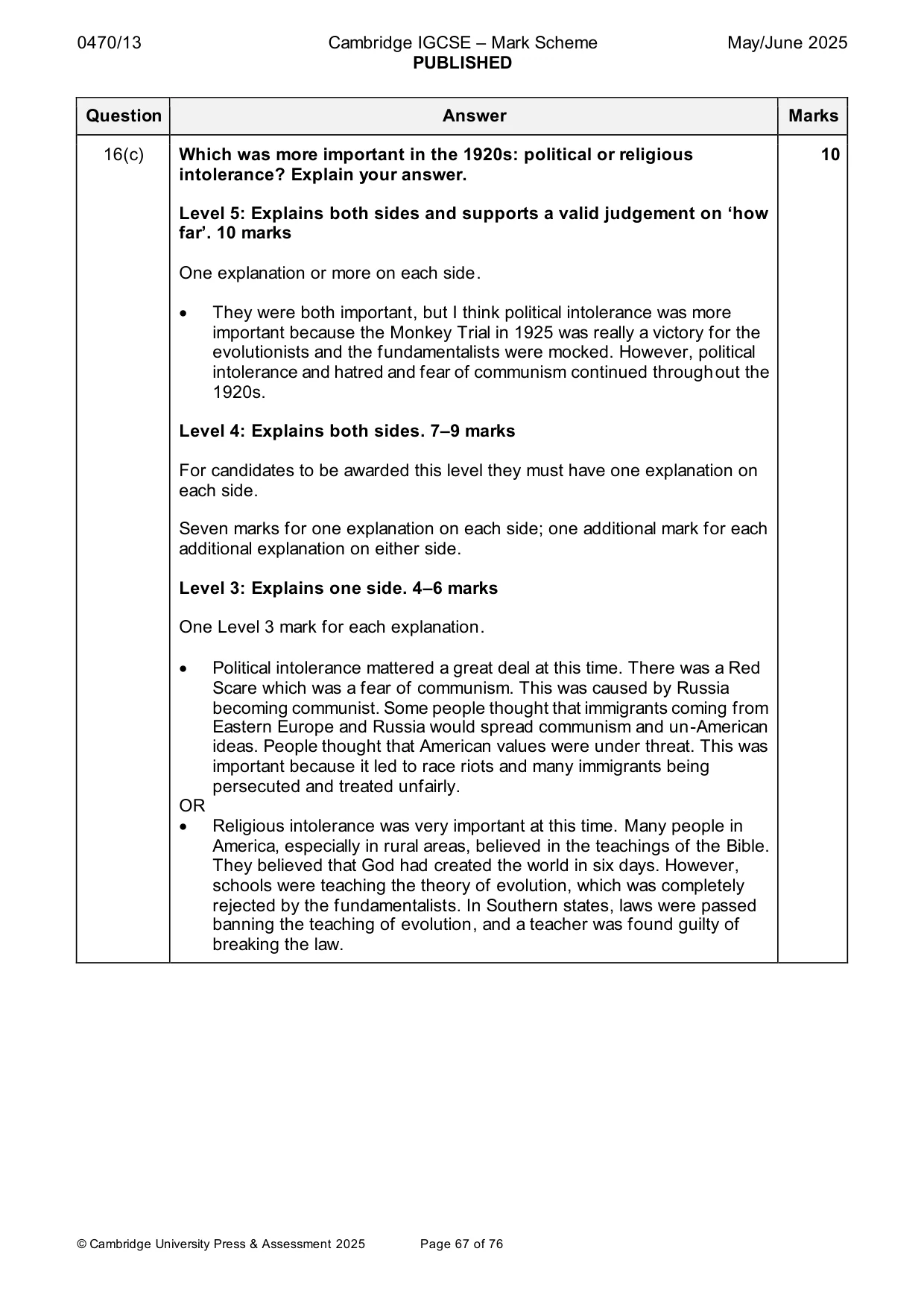
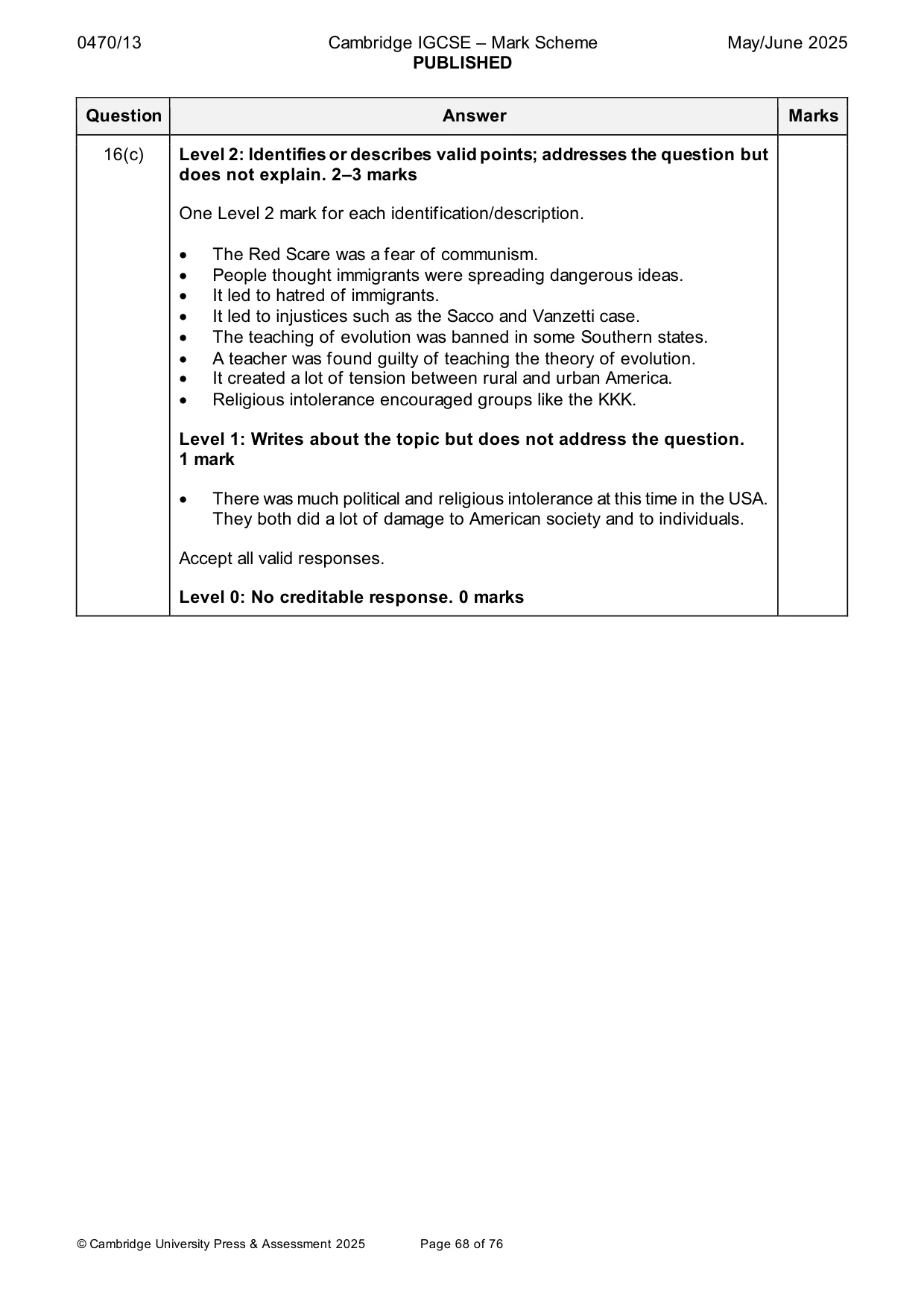
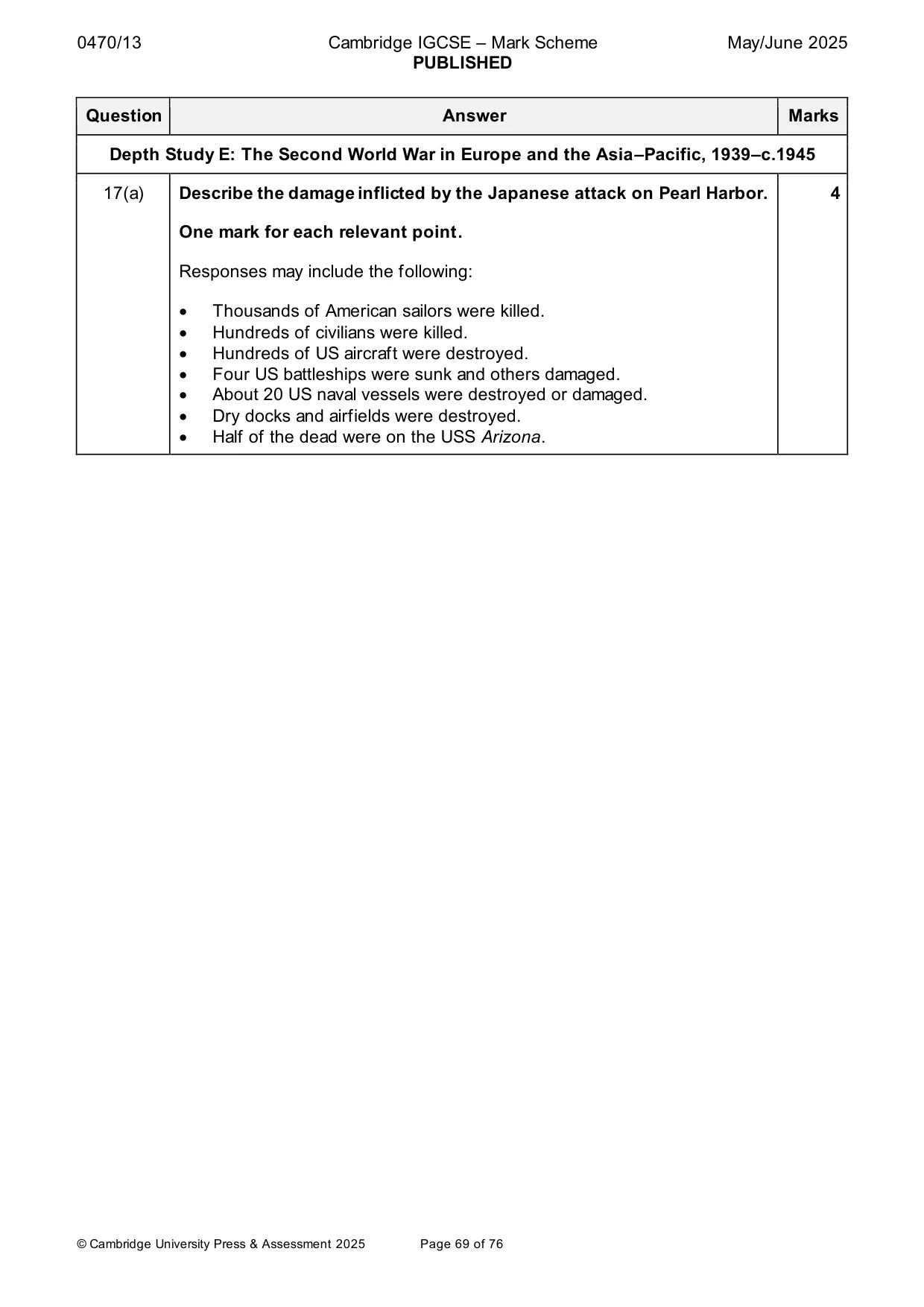
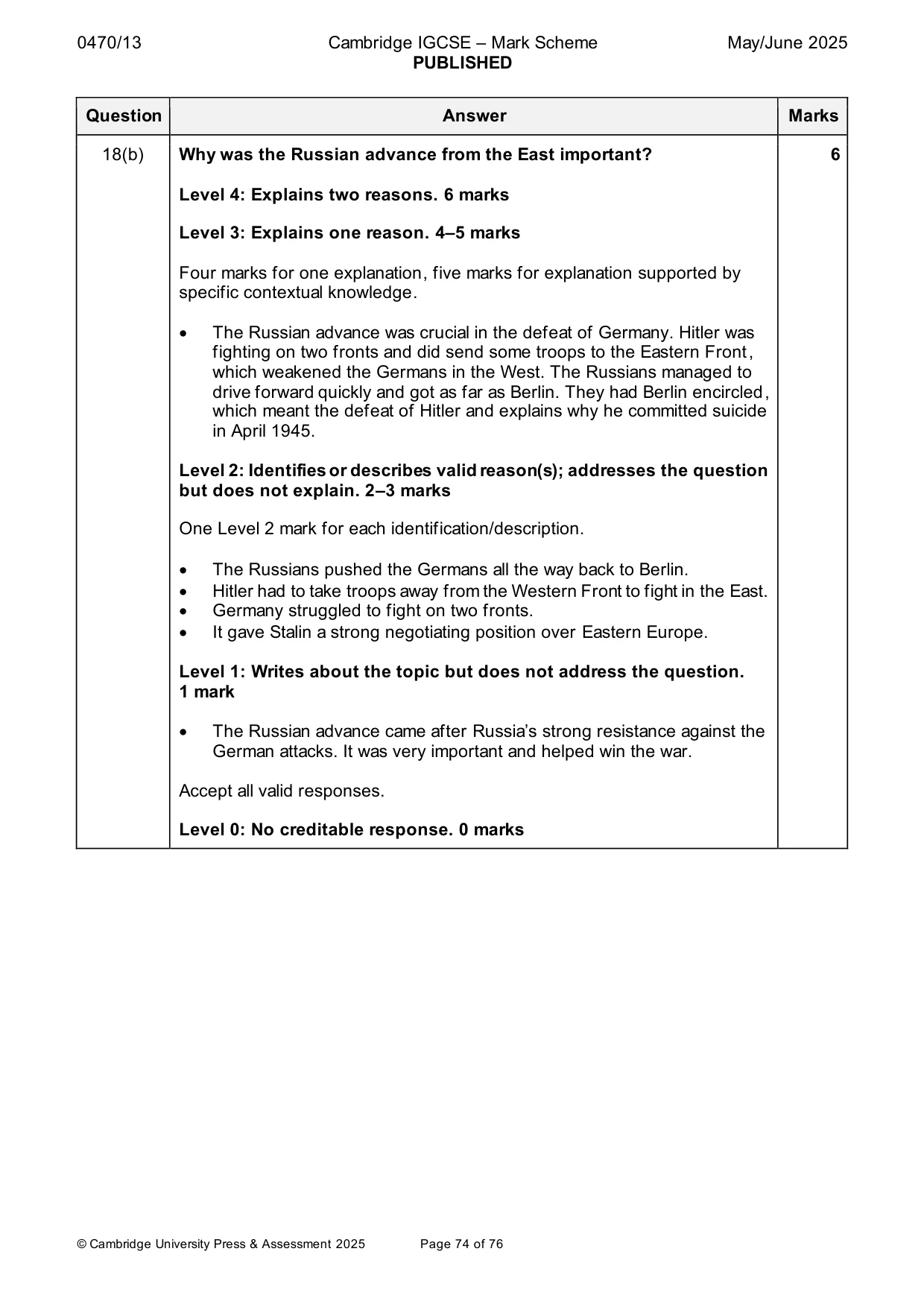
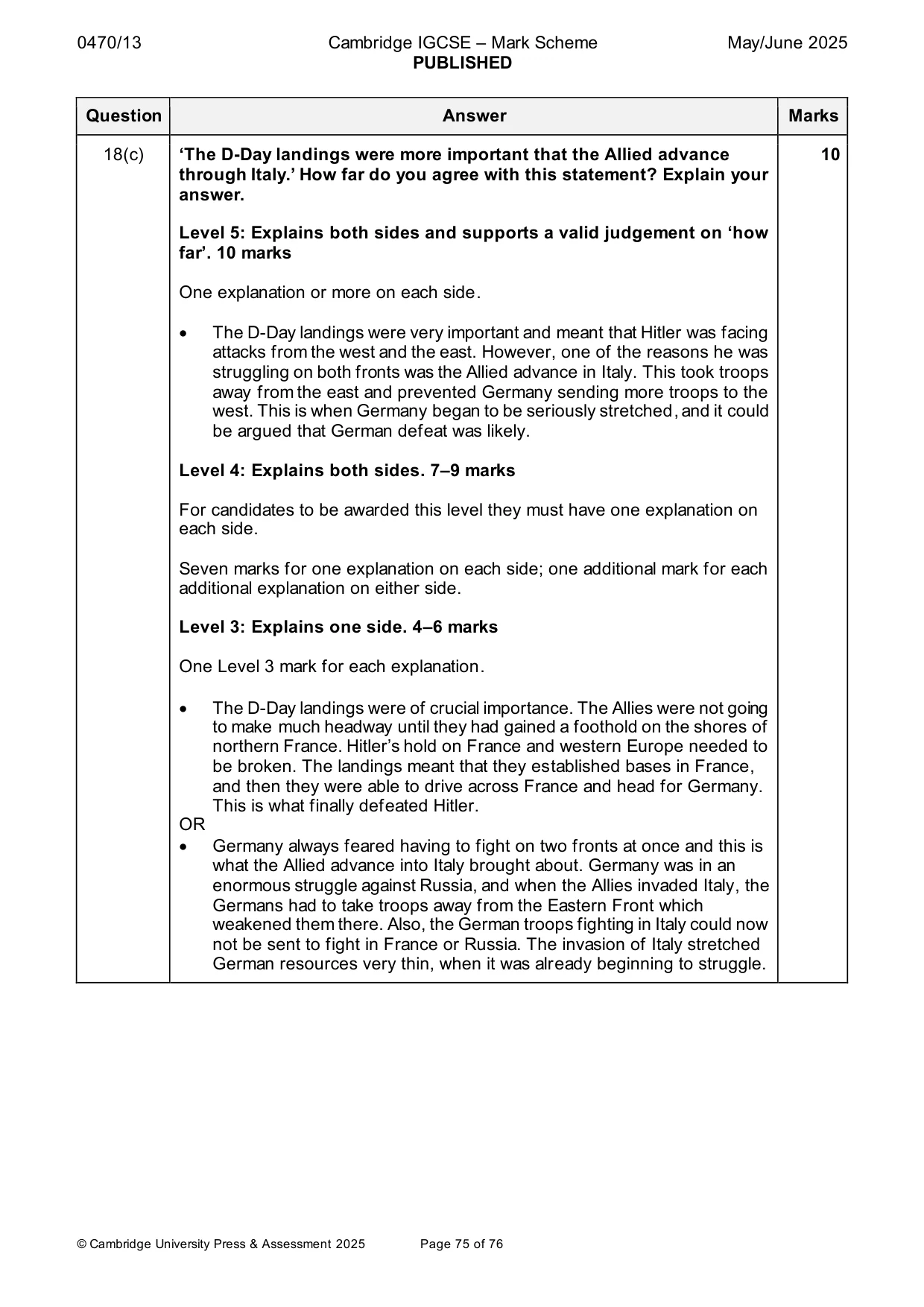
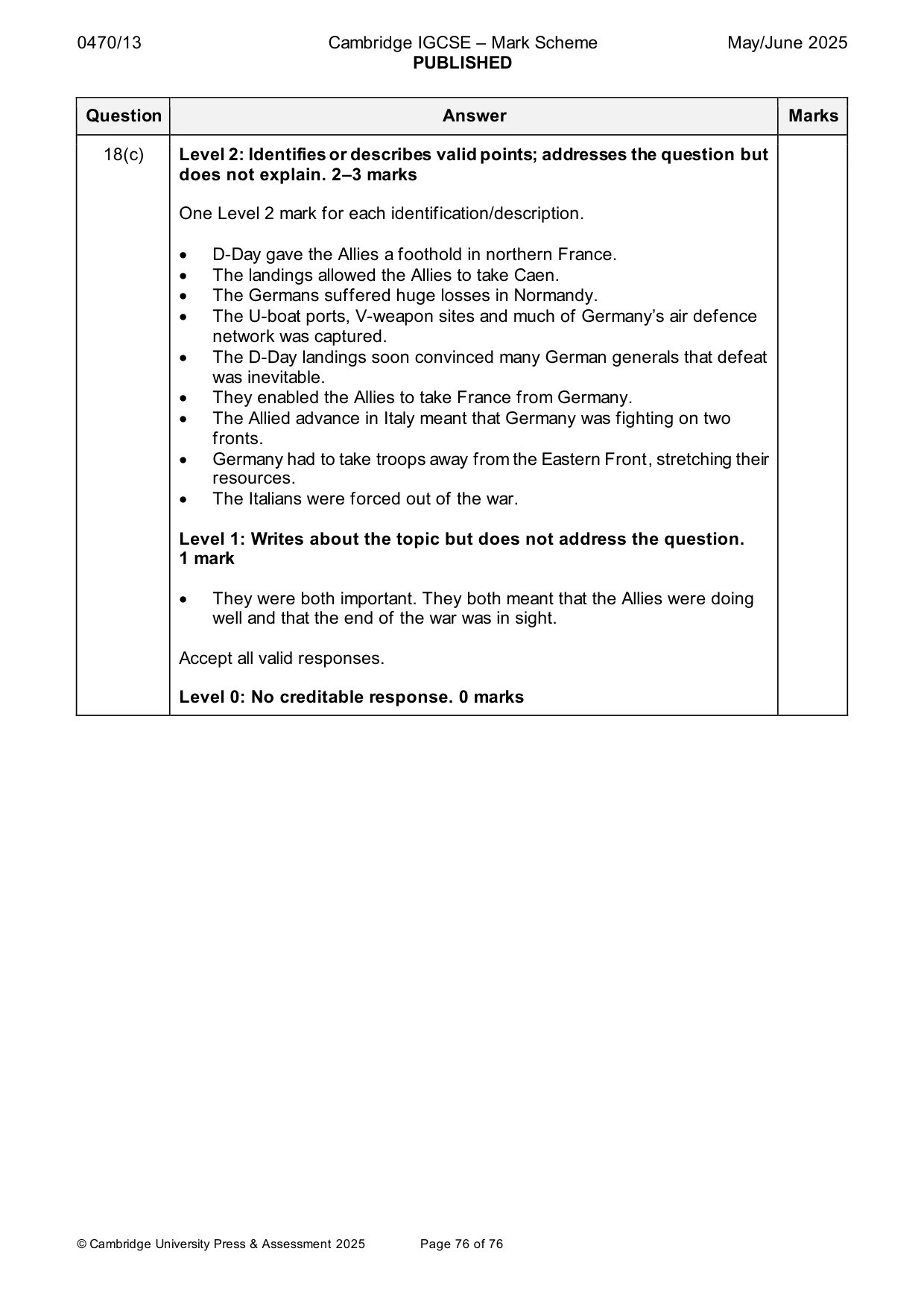
Paper as text
Question paper, page 1
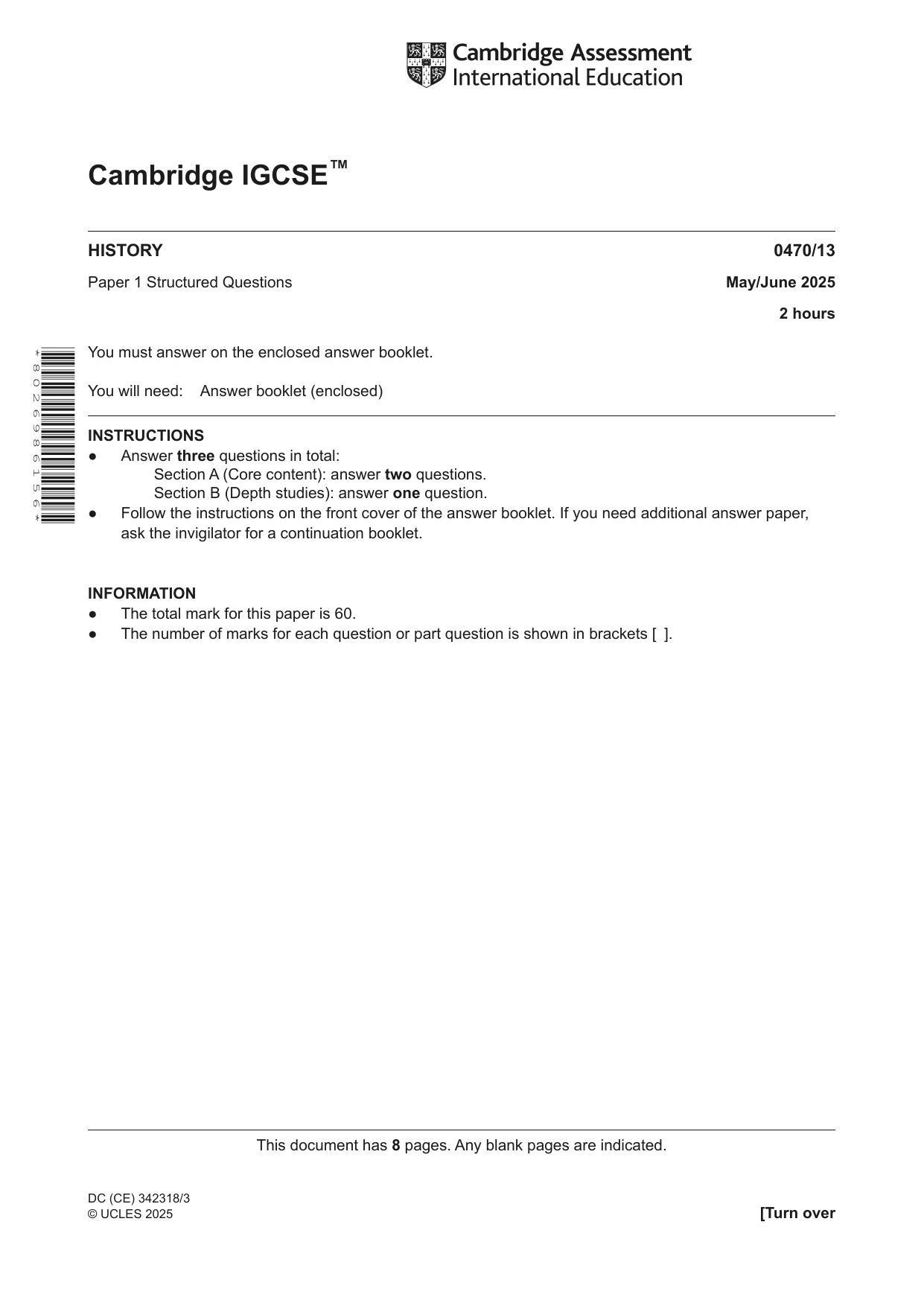
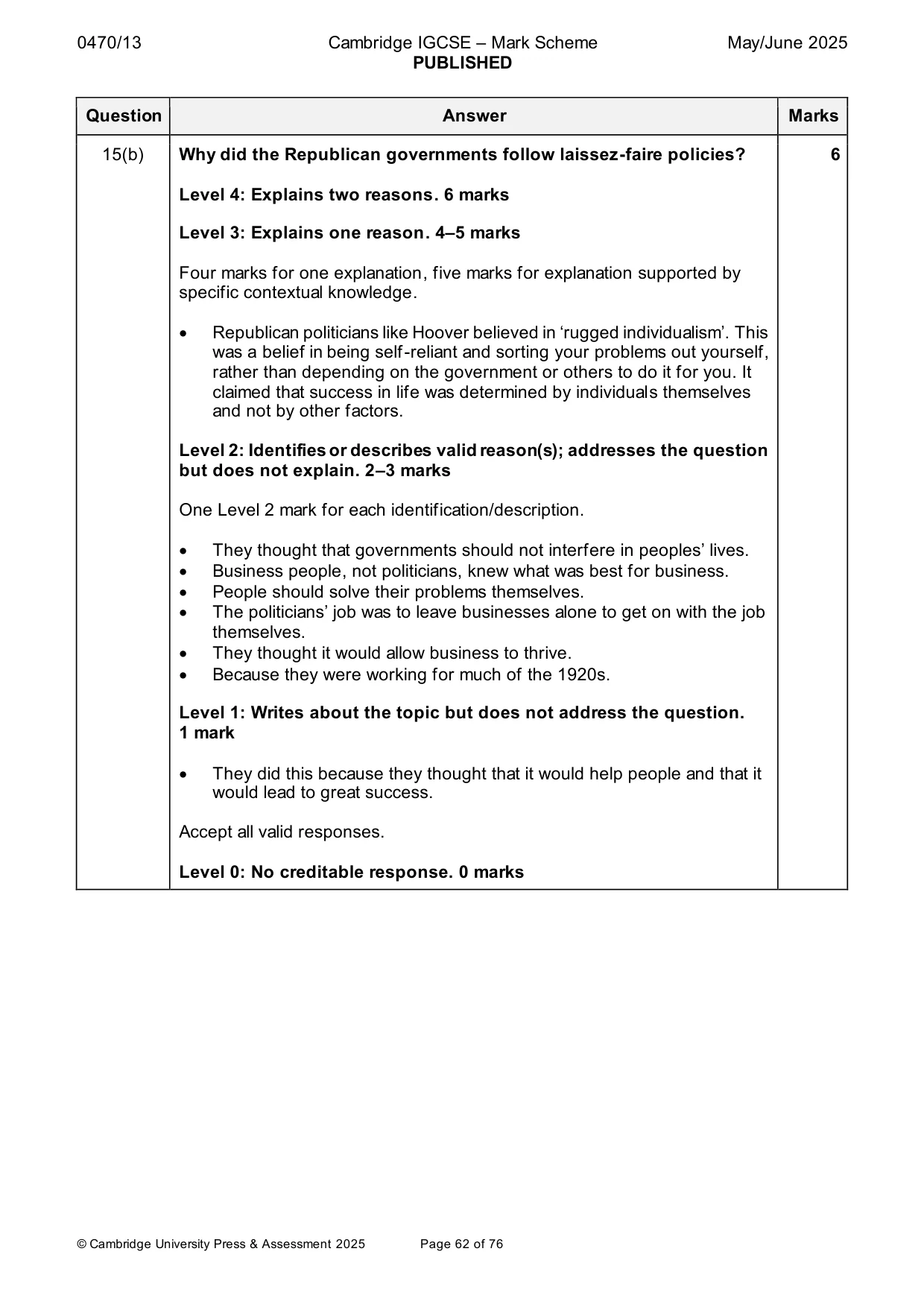
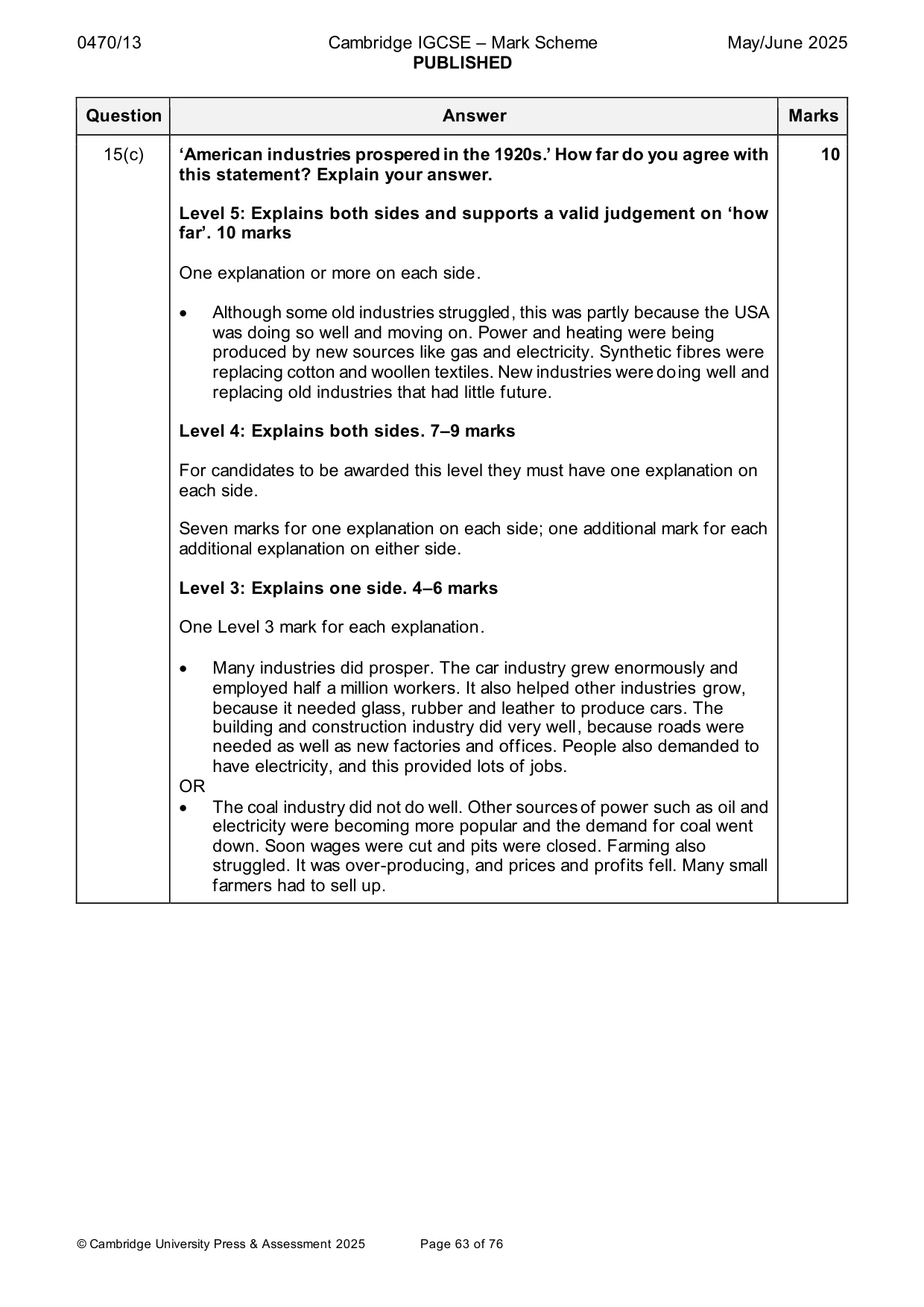
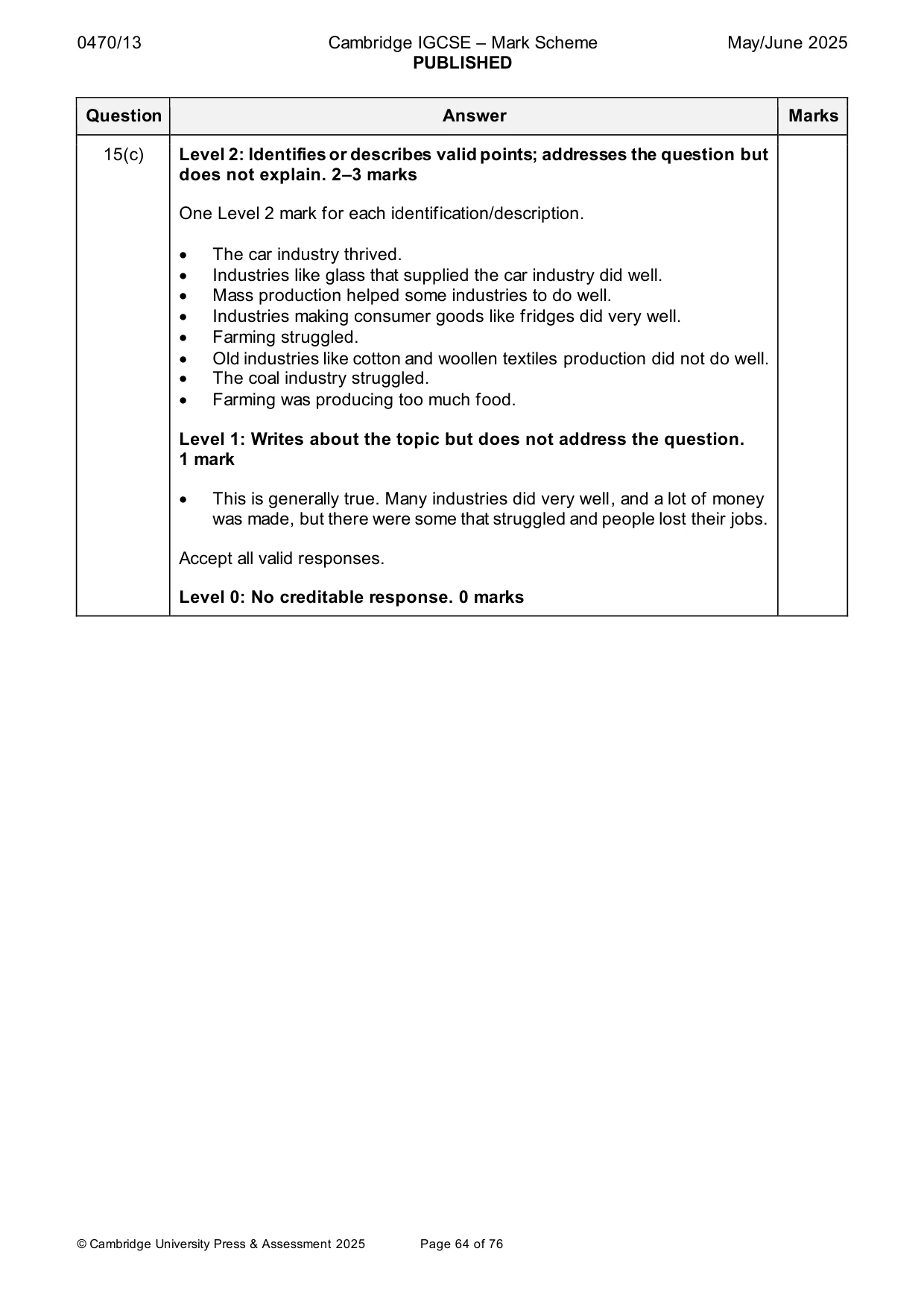
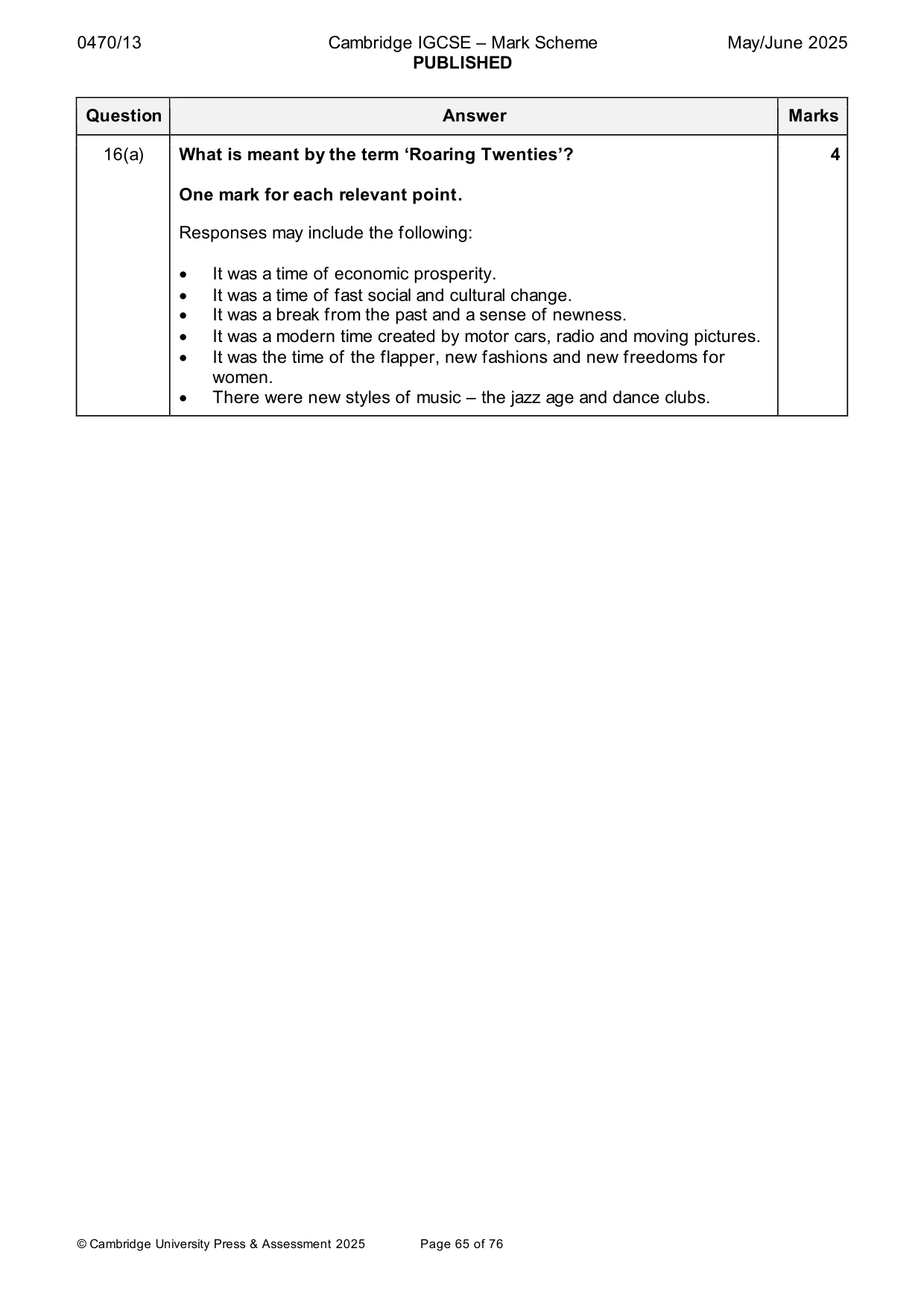
This document has 8 pages. Any blank pages are indicated. [Turn over Cambridge IGCSE™ DC (CE) 342318/3 © UCLES 2025 * 8 0 2 6 9 8 6 1 5 6 * HISTORY 0470/13 Paper 1 Structured Questions May/June 2025 2 hours You must answer on the enclosed answer booklet. You will need: Answer booklet (enclosed) INSTRUCTIONS ● Answer three questions in total: Section A (Core content): answer two questions. Section B (Depth studies): answer one question. ● Follow the instructions on the front cover of the answer booklet. If you need additional answer paper, ask the invigilator for a continuation booklet. INFORMATION ● The total mark for this paper is 60. ● The number of marks for each question or part question is shown in brackets [ ].
Question paper, page 2
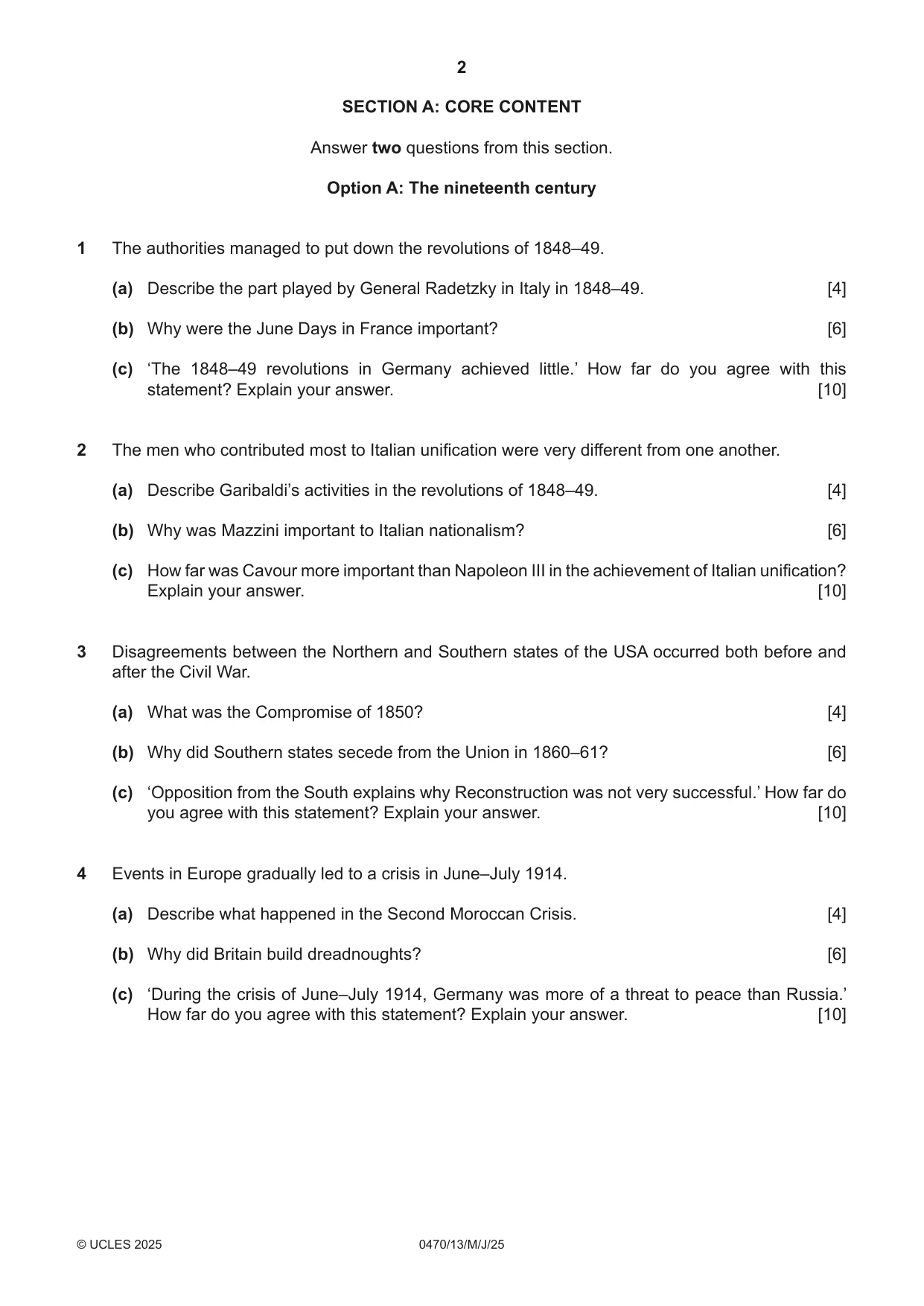
2 0470/13/M/J/25 © UCLES 2025 SECTION A: CORE CONTENT Answer two questions from this section. Option A: The nineteenth century 1 The authorities managed to put down the revolutions of 1848–49. (a) Describe the part played by General Radetzky in Italy in 1848–49. [4] (b) Why were the June Days in France important? [6] (c) ‘The 1848–49 revolutions in Germany achieved little.’ How far do you agree with this statement? Explain your answer. [10] 2 The men who contributed most to Italian unification were very different from one another. (a) Describe Garibaldi’s activities in the revolutions of 1848–49. [4] (b) Why was Mazzini important to Italian nationalism? [6] (c) How far was Cavour more important than Napoleon III in the achievement of Italian unification? Explain your answer. [10] 3 Disagreements between the Northern and Southern states of the USA occurred both before and after the Civil War. (a) What was the Compromise of 1850? [4] (b) Why did Southern states secede from the Union in 1860–61? [6] (c) ‘Opposition from the South explains why Reconstruction was not very successful.’ How far do you agree with this statement? Explain your answer. [10] 4 Events in Europe gradually led to a crisis in June–July 1914. (a) Describe what happened in the Second Moroccan Crisis. [4] (b) Why did Britain build dreadnoughts? [6] (c) ‘During the crisis of June–July 1914, Germany was more of a threat to peace than Russia.’ How far do you agree with this statement? Explain your answer. [10]
Question paper, page 3
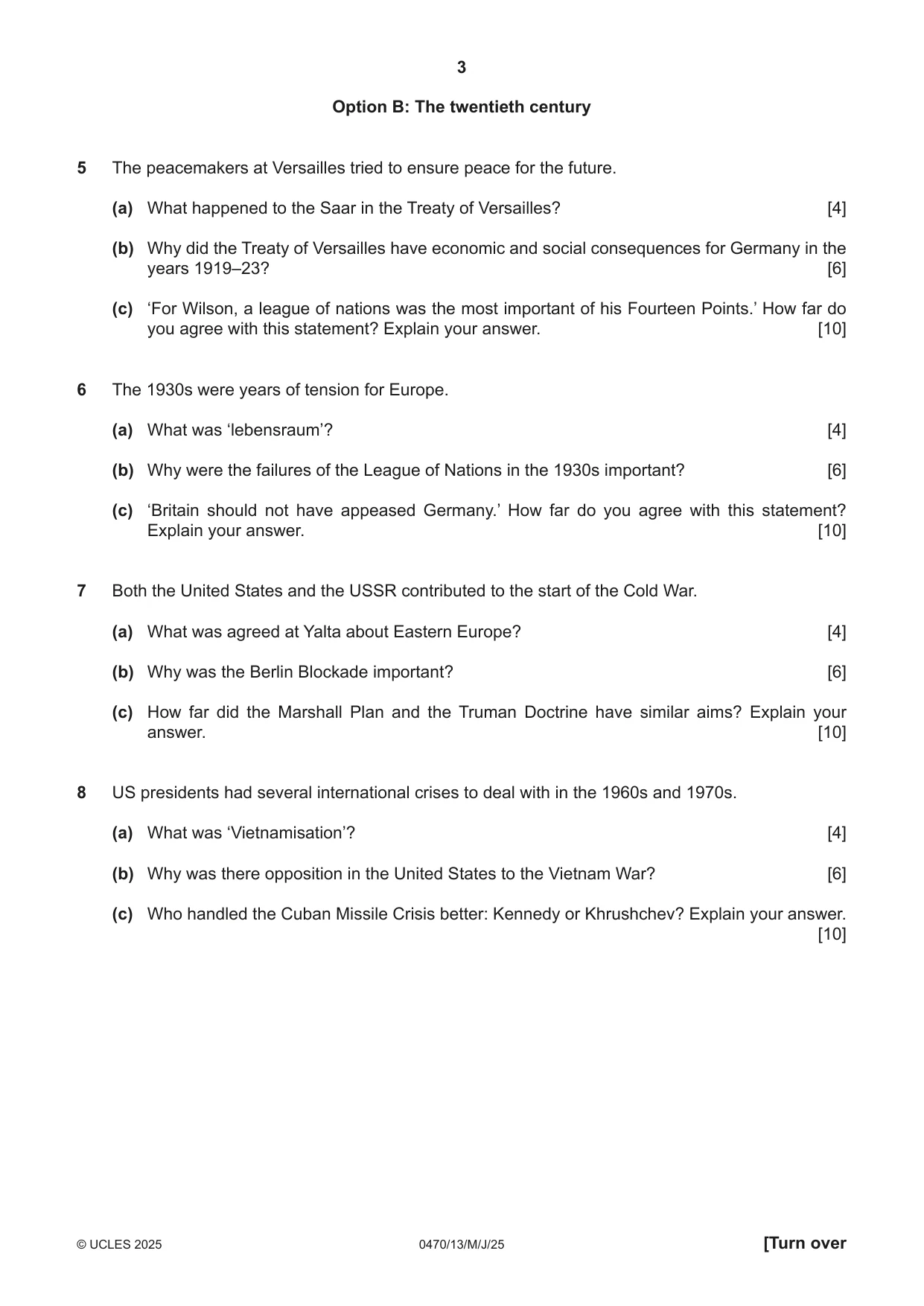
3 0470/13/M/J/25 © UCLES 2025 [Turn over Option B: The twentieth century 5 The peacemakers at Versailles tried to ensure peace for the future. (a) What happened to the Saar in the Treaty of Versailles? [4] (b) Why did the Treaty of Versailles have economic and social consequences for Germany in the years 1919–23? [6] (c) ‘For Wilson, a league of nations was the most important of his Fourteen Points.’ How far do you agree with this statement? Explain your answer. [10] 6 The 1930s were years of tension for Europe. (a) What was ‘lebensraum’? [4] (b) Why were the failures of the League of Nations in the 1930s important? [6] (c) ‘Britain should not have appeased Germany.’ How far do you agree with this statement? Explain your answer. [10] 7 Both the United States and the USSR contributed to the start of the Cold War. (a) What was agreed at Yalta about Eastern Europe? [4] (b) Why was the Berlin Blockade important? [6] (c) How far did the Marshall Plan and the Truman Doctrine have similar aims? Explain your answer. [10] 8 US presidents had several international crises to deal with in the 1960s and 1970s. (a) What was ‘Vietnamisation’? [4] (b) Why was there opposition in the United States to the Vietnam War? [6] (c) Who handled the Cuban Missile Crisis better: Kennedy or Khrushchev? Explain your answer. [10]
Question paper, page 4
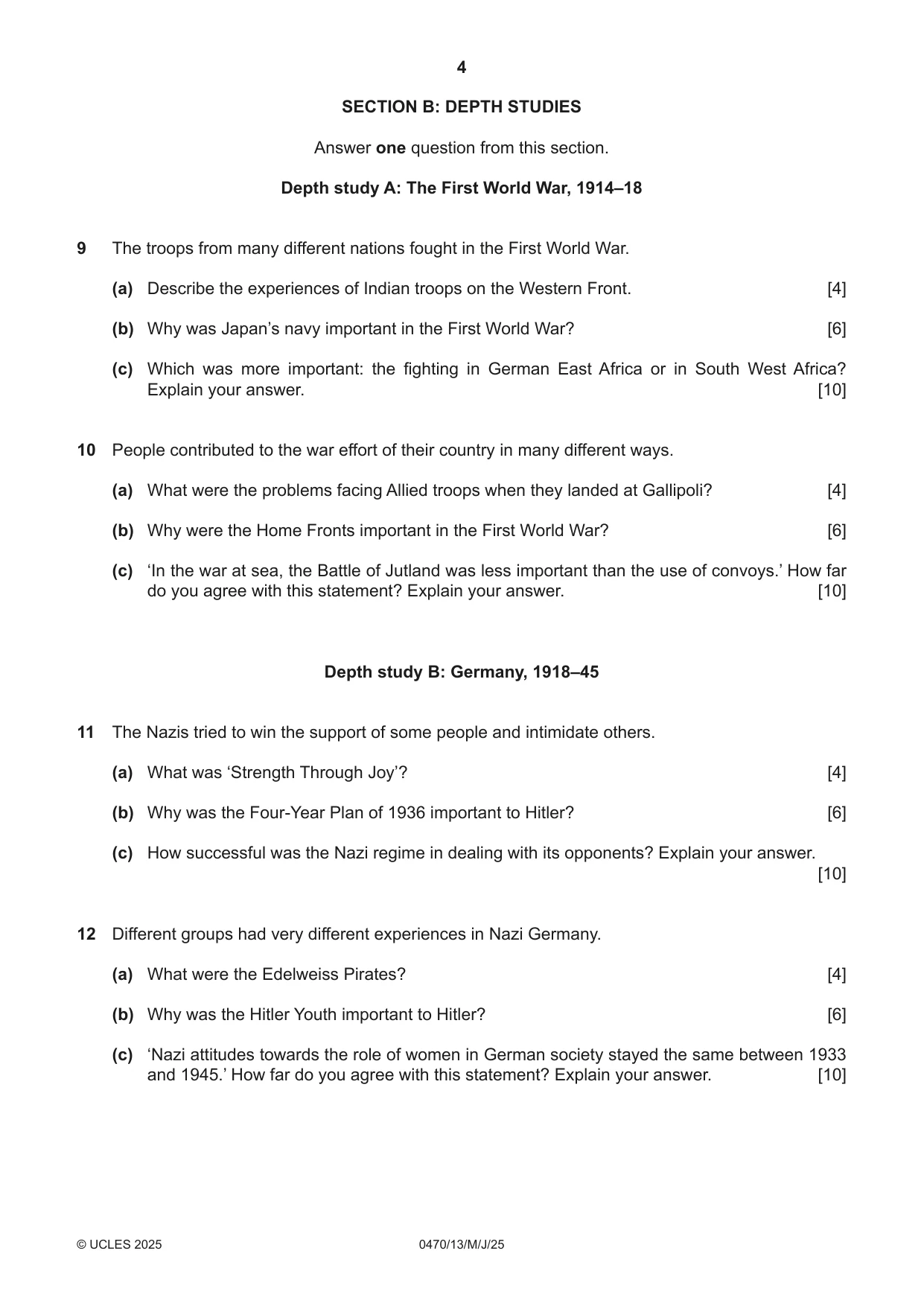
4 0470/13/M/J/25 © UCLES 2025 SECTION B: DEPTH STUDIES Answer one question from this section. Depth study A: The First World War, 1914–18 9 The troops from many different nations fought in the First World War. (a) Describe the experiences of Indian troops on the Western Front. [4] (b) Why was Japan’s navy important in the First World War? [6] (c) Which was more important: the fighting in German East Africa or in South West Africa? Explain your answer. [10] 10 People contributed to the war effort of their country in many different ways. (a) What were the problems facing Allied troops when they landed at Gallipoli? [4] (b) Why were the Home Fronts important in the First World War? [6] (c) ‘In the war at sea, the Battle of Jutland was less important than the use of convoys.’ How far do you agree with this statement? Explain your answer. [10] Depth study B: Germany, 1918–45 11 The Nazis tried to win the support of some people and intimidate others. (a) What was ‘Strength Through Joy’? [4] (b) Why was the Four-Year Plan of 1936 important to Hitler? [6] (c) How successful was the Nazi regime in dealing with its opponents? Explain your answer. [10] 12 Different groups had very different experiences in Nazi Germany. (a) What were the Edelweiss Pirates? [4] (b) Why was the Hitler Youth important to Hitler? [6] (c) ‘Nazi attitudes towards the role of women in German society stayed the same between 1933 and 1945.’ How far do you agree with this statement? Explain your answer. [10]
Question paper, page 5
5 0470/13/M/J/25 © UCLES 2025 [Turn over Depth study C: Russia, 1905–41 13 The collapse of the Tsarist regime led to many changes. (a) What were the Soviets? [4] (b) Why did Lenin withdraw Russia from the First World War? [6] (c) ‘The Whites lost the Civil War because they were divided.’ How far do you agree with this statement? Explain your answer. [10] 14 Stalin had clear ideas about what he wanted to achieve in the Soviet Union. (a) Describe the experiences of industrial workers in the Soviet Union under Stalin. [4] (b) Why did Stalin regard the different nationalities in the Soviet Union with suspicion? [6] (c) Which was more important to Stalin: industrial or agricultural reform? Explain your answer. [10] Depth study D: The United States, 1919–41 15 For much of the 1920s, the United States had Republican governments. (a) What were the tariffs introduced in the 1920s? [4] (b) Why did the Republican governments follow laissez-faire policies? [6] (c) ‘American industries prospered in the 1920s.’ How far do you agree with this statement? Explain your answer. [10] 16 There were deep divisions in American society. (a) What is meant by the term ‘Roaring Twenties’? [4] (b) Why was Prohibition repealed? [6] (c) Which was more important in the 1920s: political or religious intolerance? Explain your answer. [10]
Question paper, page 6
6 0470/13/M/J/25 © UCLES 2025 Depth study E: The Second World War in Europe and the Asia–Pacific, 1939–c.1945 17 Japan’s fortunes in the war gradually changed. (a) Describe the damage inflicted by the Japanese attack on Pearl Harbor. [4] (b) Why did Japan invade Malaya? [6] (c) How far was Japan’s defeat in the Second World War caused by the Battle of Midway? Explain your answer. [10] 18 From 1942 the direction of the war began to change. (a) Describe how the Allies controlled Germany in 1945 after its surrender. [4] (b) Why was the Russian advance from the East important? [6] (c) ‘The D-Day landings were more important than the Allied advance through Italy.’ How far do you agree with this statement? Explain your answer. [10]
Question paper, page 7
7 0470/13/M/J/25 © UCLES 2025 BLANK PAGE
Question paper, page 8
8 0470/13/M/J/25 © UCLES 2025 Permission to reproduce items where third-party owned material protected by copyright is included has been sought and cleared where possible. Every reasonable effort has been made by the publisher (UCLES) to trace copyright holders, but if any items requiring clearance have unwittingly been included, the publisher will be pleased to make amends at the earliest possible opportunity. To avoid the issue of disclosure of answer-related information to candidates, all copyright acknowledgements are reproduced online in the Cambridge Assessment International Education Copyright Acknowledgements Booklet. This is produced for each series of examinations and is freely available to download at www.cambridgeinternational.org after the live examination series. Cambridge Assessment International Education is part of Cambridge Assessment. Cambridge Assessment is the brand name of the University of Cambridge Local Examinations Syndicate (UCLES), which is a department of the University of Cambridge. BLANK PAGE
Mark scheme, page 1
This document consists of 76 printed pages. © Cambridge University Press & Assessment 2025 [Turn over Cambridge IGCSE™ HISTORY 0470/13 Paper 1 Structured Questions May/June 2025 MARK SCHEME Maximum Mark: 60 Published This mark scheme is published as an aid to teachers and candidates, to indicate the requirements of the examination. It shows the basis on which Examiners were instructed to award marks. It does not indicate the details of the discussions that took place at an Examiners’ meeting before marking began, which would have considered the acceptability of alternative answers. Mark schemes should be read in conjunction with the question paper and the Principal Examiner Report for Teachers. Cambridge International will not enter into discussions about these mark schemes. Cambridge International is publishing the mark schemes for the May/June 2025 series for most Cambridge IGCSE, Cambridge International A and AS Level components, and some Cambridge O Level components.
Mark scheme, page 2
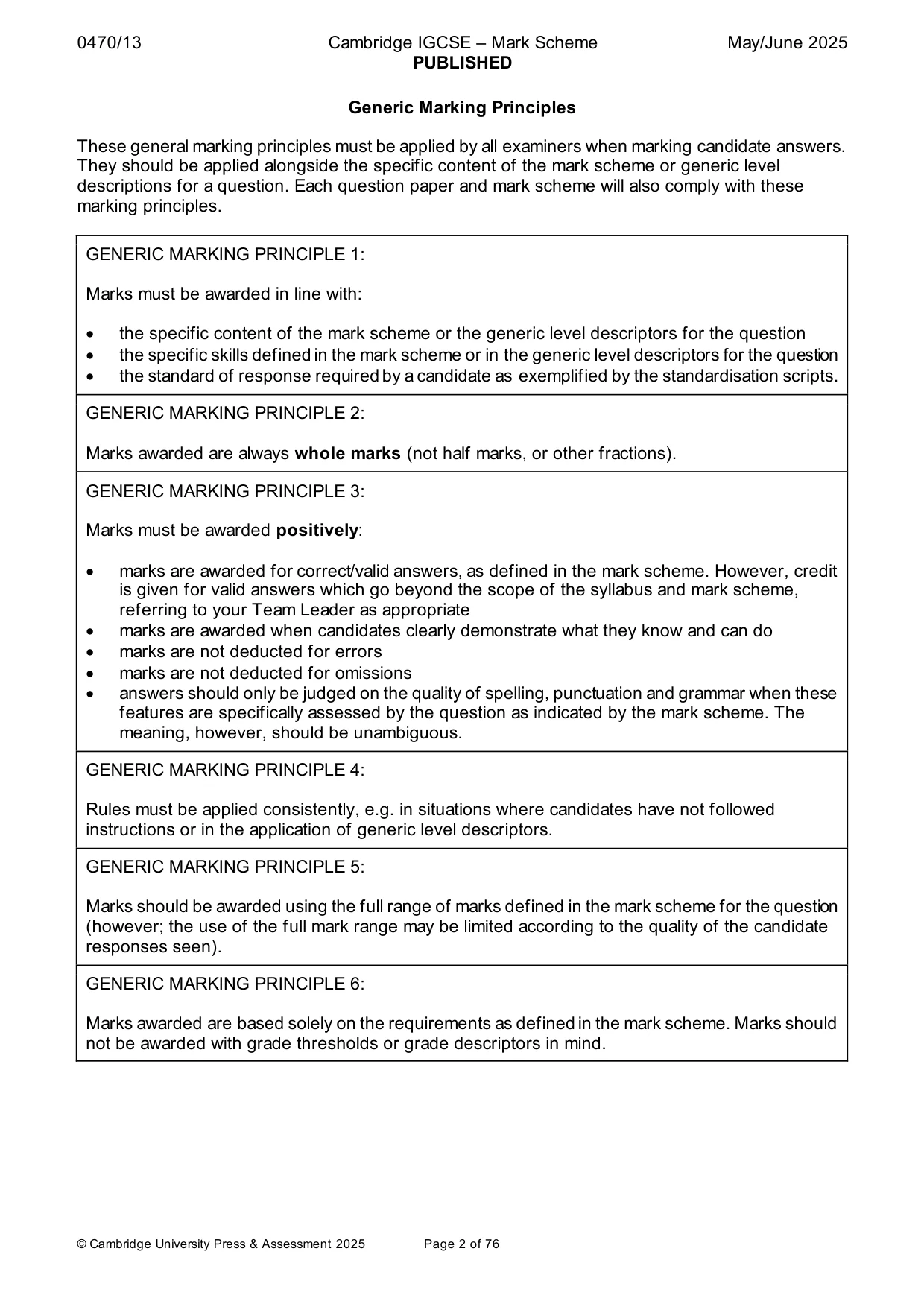
0470/13 Cambridge IGCSE – Mark Scheme PUBLISHED May/June 2025 © Cambridge University Press & Assessment 2025 Page 2 of 76 Generic Marking Principles These general marking principles must be applied by all examiners when marking candidate answers. They should be applied alongside the specific content of the mark scheme or generic level descriptions for a question. Each question paper and mark scheme will also comply with these marking principles. GENERIC MARKING PRINCIPLE 1: Marks must be awarded in line with: • the specific content of the mark scheme or the generic level descriptors for the question • the specific skills defined in the mark scheme or in the generic level descriptors for the question • the standard of response required by a candidate as exemplified by the standardisation scripts. GENERIC MARKING PRINCIPLE 2: Marks awarded are always whole marks (not half marks, or other fractions). GENERIC MARKING PRINCIPLE 3: Marks must be awarded positively: • marks are awarded for correct/valid answers, as defined in the mark scheme. However, credit is given for valid answers which go beyond the scope of the syllabus and mark scheme, referring to your Team Leader as appropriate • marks are awarded when candidates clearly demonstrate what they know and can do • marks are not deducted for errors • marks are not deducted for omissions • answers should only be judged on the quality of spelling, punctuation and grammar when these features are specifically assessed by the question as indicated by the mark scheme. The meaning, however, should be unambiguous. GENERIC MARKING PRINCIPLE 4: Rules must be applied consistently, e.g. in situations where candidates have not followed instructions or in the application of generic level descriptors. GENERIC MARKING PRINCIPLE 5: Marks should be awarded using the full range of marks defined in the mark scheme for the question (however; the use of the full mark range may be limited according to the quality of the candidate responses seen). GENERIC MARKING PRINCIPLE 6: Marks awarded are based solely on the requirements as defined in the mark scheme. Marks should not be awarded with grade thresholds or grade descriptors in mind.
Mark scheme, page 3
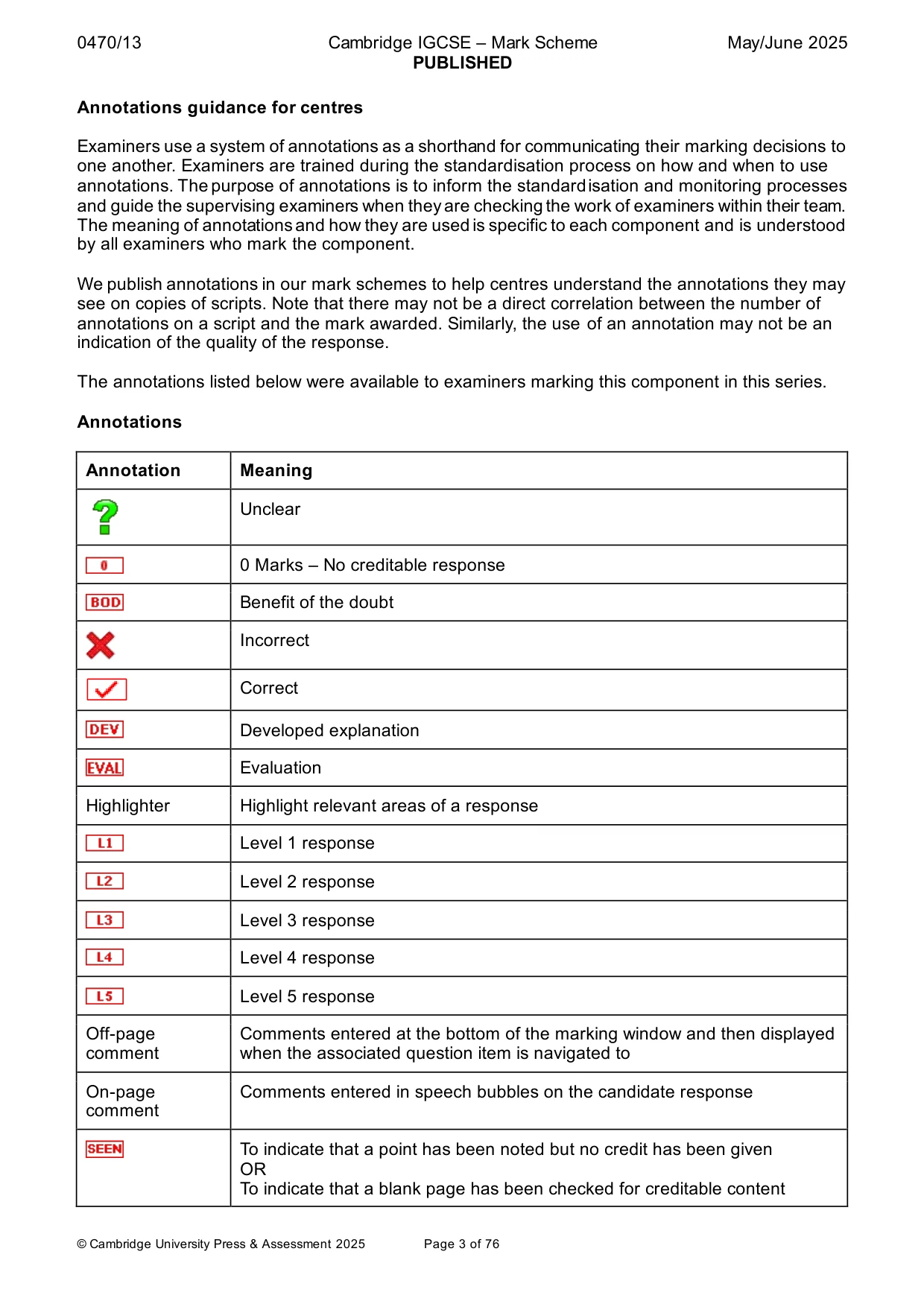
0470/13 Cambridge IGCSE – Mark Scheme PUBLISHED May/June 2025 © Cambridge University Press & Assessment 2025 Page 3 of 76 Annotations guidance for centres Examiners use a system of annotations as a shorthand for communicating their marking decisions to one another. Examiners are trained during the standardisation process on how and when to use annotations. The purpose of annotations is to inform the standardisation and monitoring processes and guide the supervising examiners when they are checking the work of examiners within their team. The meaning of annotations and how they are used is specific to each component and is understood by all examiners who mark the component. We publish annotations in our mark schemes to help centres understand the annotations they may see on copies of scripts. Note that there may not be a direct correlation between the number of annotations on a script and the mark awarded. Similarly, the use of an annotation may not be an indication of the quality of the response. The annotations listed below were available to examiners marking this component in this series. Annotations Annotation Meaning Unclear 0 Marks – No creditable response Benefit of the doubt Incorrect Correct Developed explanation Evaluation Highlighter Highlight relevant areas of a response Level 1 response Level 2 response Level 3 response Level 4 response Level 5 response Off-page comment Comments entered at the bottom of the marking window and then displayed when the associated question item is navigated to On-page comment Comments entered in speech bubbles on the candidate response To indicate that a point has been noted but no credit has been given OR To indicate that a blank page has been checked for creditable content
Mark scheme, page 4
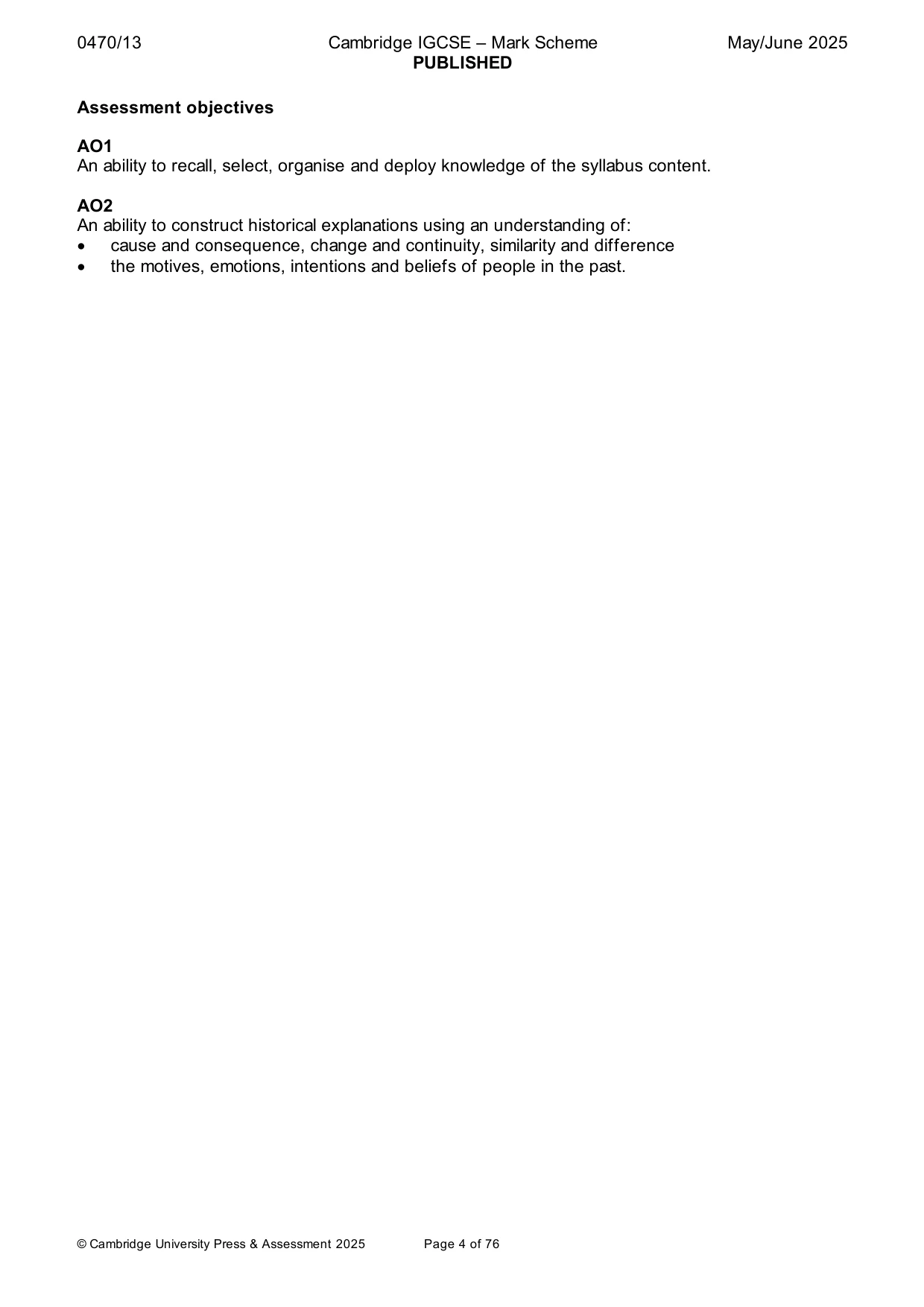
0470/13 Cambridge IGCSE – Mark Scheme PUBLISHED May/June 2025 © Cambridge University Press & Assessment 2025 Page 4 of 76 Assessment objectives AO1 An ability to recall, select, organise and deploy knowledge of the syllabus content. AO2 An ability to construct historical explanations using an understanding of: • cause and consequence, change and continuity, similarity and difference • the motives, emotions, intentions and beliefs of people in the past.
Mark scheme, page 5
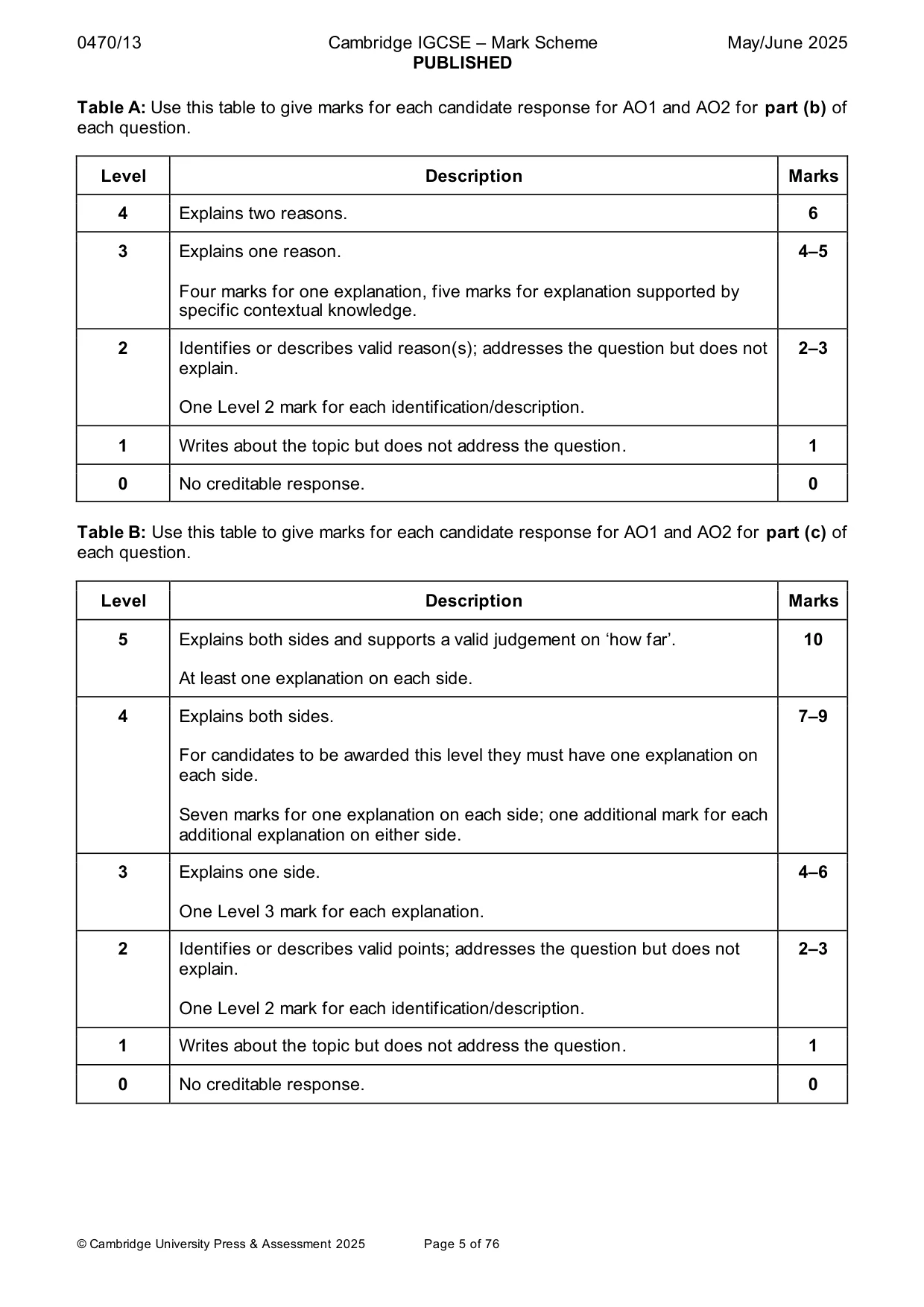
0470/13 Cambridge IGCSE – Mark Scheme PUBLISHED May/June 2025 © Cambridge University Press & Assessment 2025 Page 5 of 76 Table A: Use this table to give marks for each candidate response for AO1 and AO2 for part (b) of each question. Level Description Marks 4 Explains two reasons. 6 3 Explains one reason. Four marks for one explanation, five marks for explanation supported by specific contextual knowledge. 4–5 2 Identifies or describes valid reason(s); addresses the question but does not explain. One Level 2 mark for each identification/description. 2–3 1 Writes about the topic but does not address the question. 1 0 No creditable response. 0 Table B: Use this table to give marks for each candidate response for AO1 and AO2 for part (c) of each question. Level Description Marks 5 Explains both sides and supports a valid judgement on ‘how far’. At least one explanation on each side. 10 4 Explains both sides. For candidates to be awarded this level they must have one explanation on each side. Seven marks for one explanation on each side; one additional mark for each additional explanation on either side. 7–9 3 Explains one side. One Level 3 mark for each explanation. 4–6 2 Identifies or describes valid points; addresses the question but does not explain. One Level 2 mark for each identification/description. 2–3 1 Writes about the topic but does not address the question. 1 0 No creditable response. 0
Mark scheme, page 6
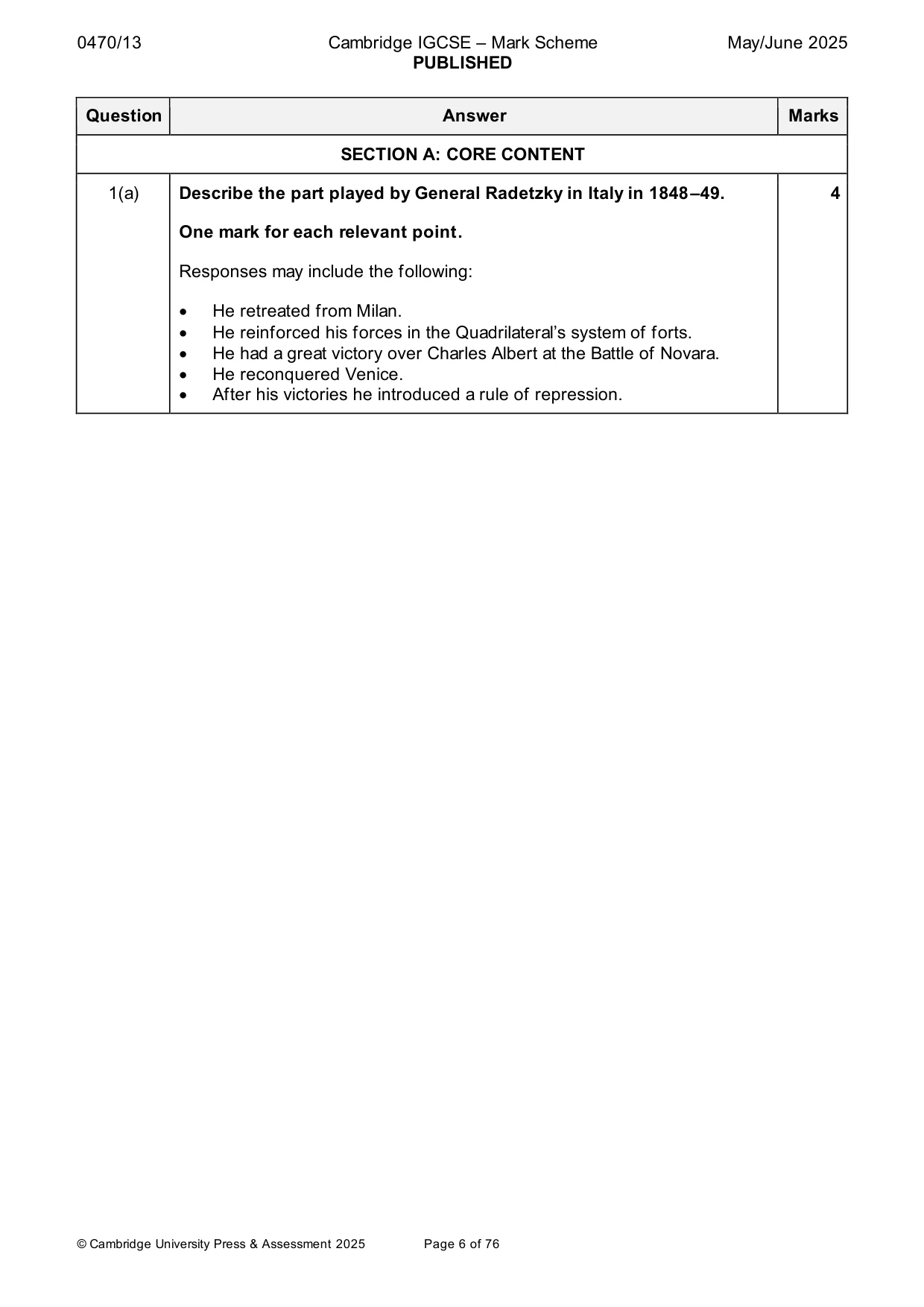
0470/13 Cambridge IGCSE – Mark Scheme PUBLISHED May/June 2025 © Cambridge University Press & Assessment 2025 Page 6 of 76 Question Answer Marks SECTION A: CORE CONTENT 1(a) Describe the part played by General Radetzky in Italy in 1848–49. One mark for each relevant point. Responses may include the following: • He retreated from Milan. • He reinforced his forces in the Quadrilateral’s system of forts. • He had a great victory over Charles Albert at the Battle of Novara. • He reconquered Venice. • After his victories he introduced a rule of repression. 4
Mark scheme, page 7
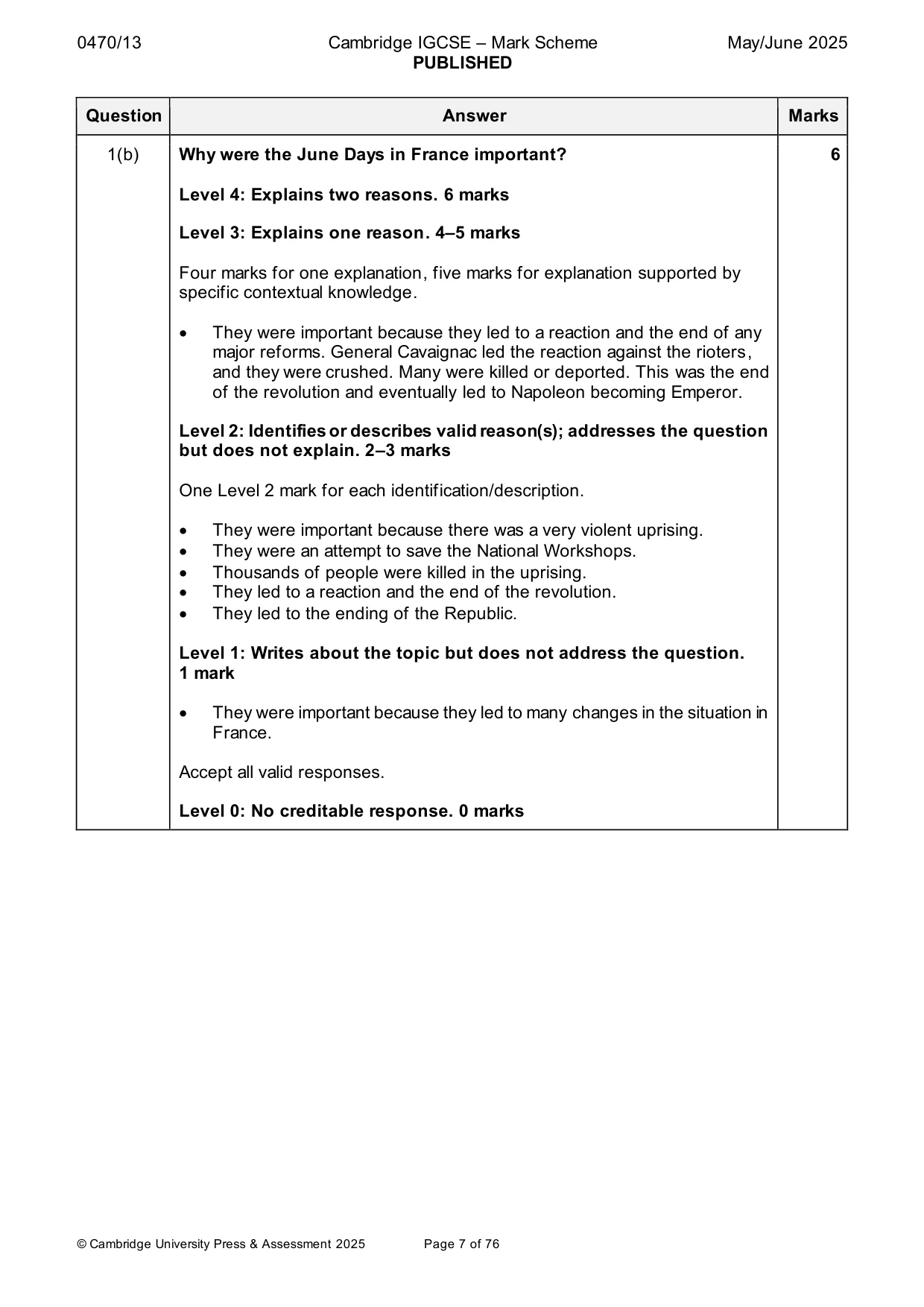
0470/13 Cambridge IGCSE – Mark Scheme PUBLISHED May/June 2025 © Cambridge University Press & Assessment 2025 Page 7 of 76 Question Answer Marks 1(b) Why were the June Days in France important? Level 4: Explains two reasons. 6 marks Level 3: Explains one reason. 4–5 marks Four marks for one explanation, five marks for explanation supported by specific contextual knowledge. • They were important because they led to a reaction and the end of any major reforms. General Cavaignac led the reaction against the rioters, and they were crushed. Many were killed or deported. This was the end of the revolution and eventually led to Napoleon becoming Emperor. Level 2: Identifies or describes valid reason(s); addresses the question but does not explain. 2–3 marks One Level 2 mark for each identification/description. • They were important because there was a very violent uprising. • They were an attempt to save the National Workshops. • Thousands of people were killed in the uprising. • They led to a reaction and the end of the revolution. • They led to the ending of the Republic. Level 1: Writes about the topic but does not address the question. 1 mark • They were important because they led to many changes in the situation in France. Accept all valid responses. Level 0: No creditable response. 0 marks 6
Mark scheme, page 8
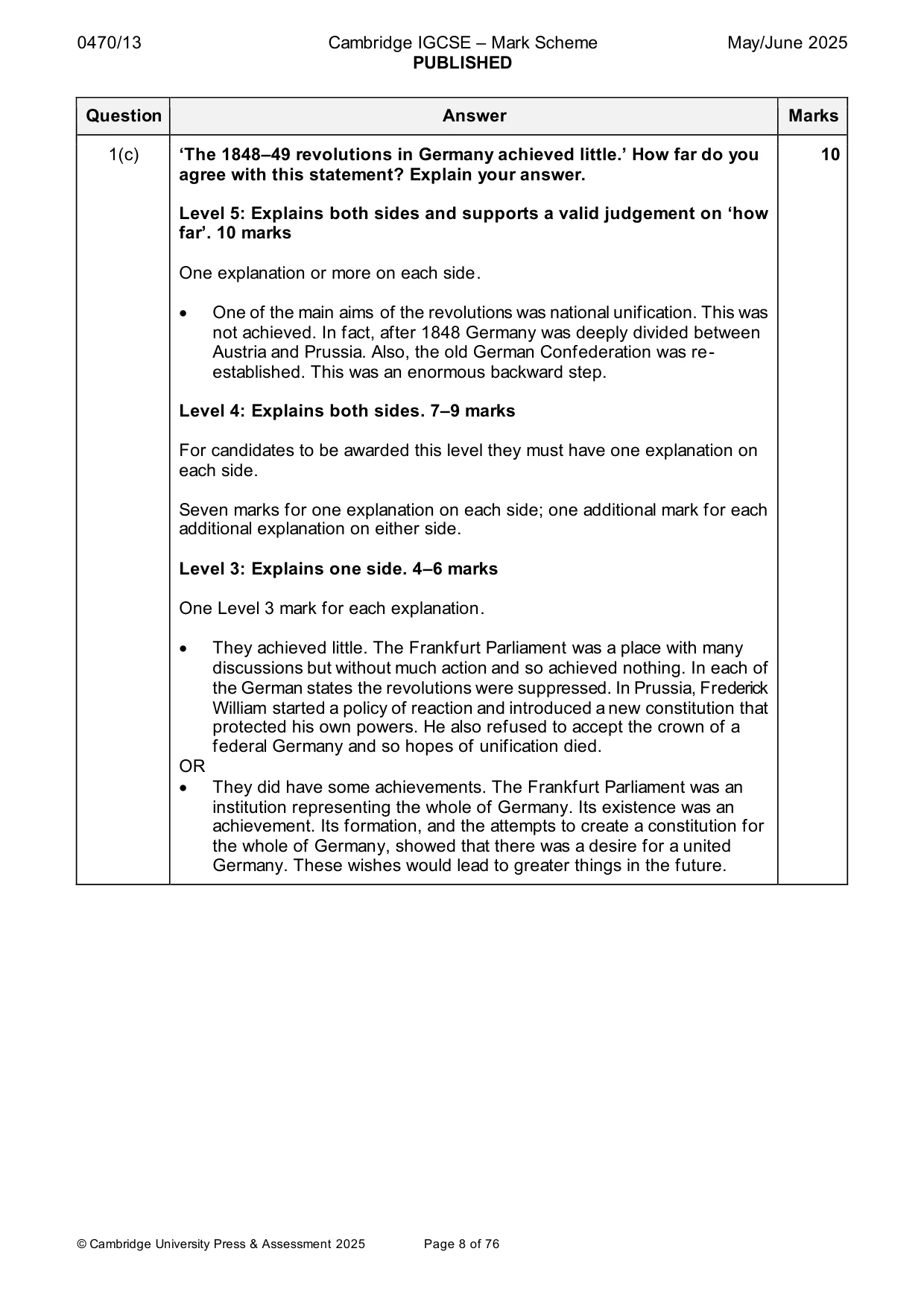
0470/13 Cambridge IGCSE – Mark Scheme PUBLISHED May/June 2025 © Cambridge University Press & Assessment 2025 Page 8 of 76 Question Answer Marks 1(c) ‘The 1848–49 revolutions in Germany achieved little.’ How far do you agree with this statement? Explain your answer. Level 5: Explains both sides and supports a valid judgement on ‘how far’. 10 marks One explanation or more on each side. • One of the main aims of the revolutions was national unification. This was not achieved. In fact, after 1848 Germany was deeply divided between Austria and Prussia. Also, the old German Confederation was re- established. This was an enormous backward step. Level 4: Explains both sides. 7–9 marks For candidates to be awarded this level they must have one explanation on each side. Seven marks for one explanation on each side; one additional mark for each additional explanation on either side. Level 3: Explains one side. 4–6 marks One Level 3 mark for each explanation. • They achieved little. The Frankfurt Parliament was a place with many discussions but without much action and so achieved nothing. In each of the German states the revolutions were suppressed. In Prussia, Frederick William started a policy of reaction and introduced a new constitution that protected his own powers. He also refused to accept the crown of a federal Germany and so hopes of unification died. OR • They did have some achievements. The Frankfurt Parliament was an institution representing the whole of Germany. Its existence was an achievement. Its formation, and the attempts to create a constitution for the whole of Germany, showed that there was a desire for a united Germany. These wishes would lead to greater things in the future. 10
Mark scheme, page 9
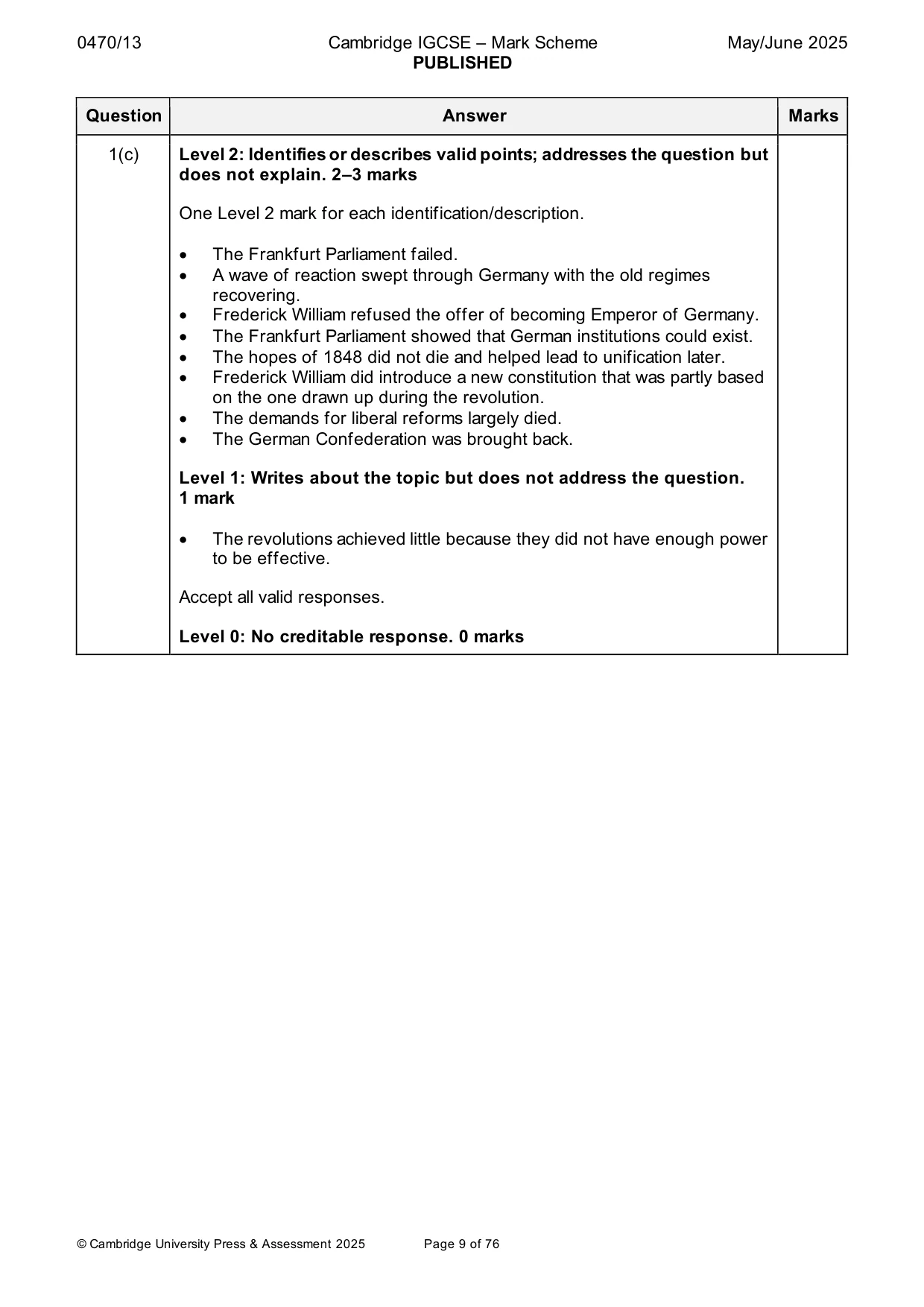
0470/13 Cambridge IGCSE – Mark Scheme PUBLISHED May/June 2025 © Cambridge University Press & Assessment 2025 Page 9 of 76 Question Answer Marks 1(c) Level 2: Identifies or describes valid points; addresses the question but does not explain. 2–3 marks One Level 2 mark for each identification/description. • The Frankfurt Parliament failed. • A wave of reaction swept through Germany with the old regimes recovering. • Frederick William refused the offer of becoming Emperor of Germany. • The Frankfurt Parliament showed that German institutions could exist. • The hopes of 1848 did not die and helped lead to unification later. • Frederick William did introduce a new constitution that was partly based on the one drawn up during the revolution. • The demands for liberal reforms largely died. • The German Confederation was brought back. Level 1: Writes about the topic but does not address the question. 1 mark • The revolutions achieved little because they did not have enough power to be effective. Accept all valid responses. Level 0: No creditable response. 0 marks
Mark scheme, page 10
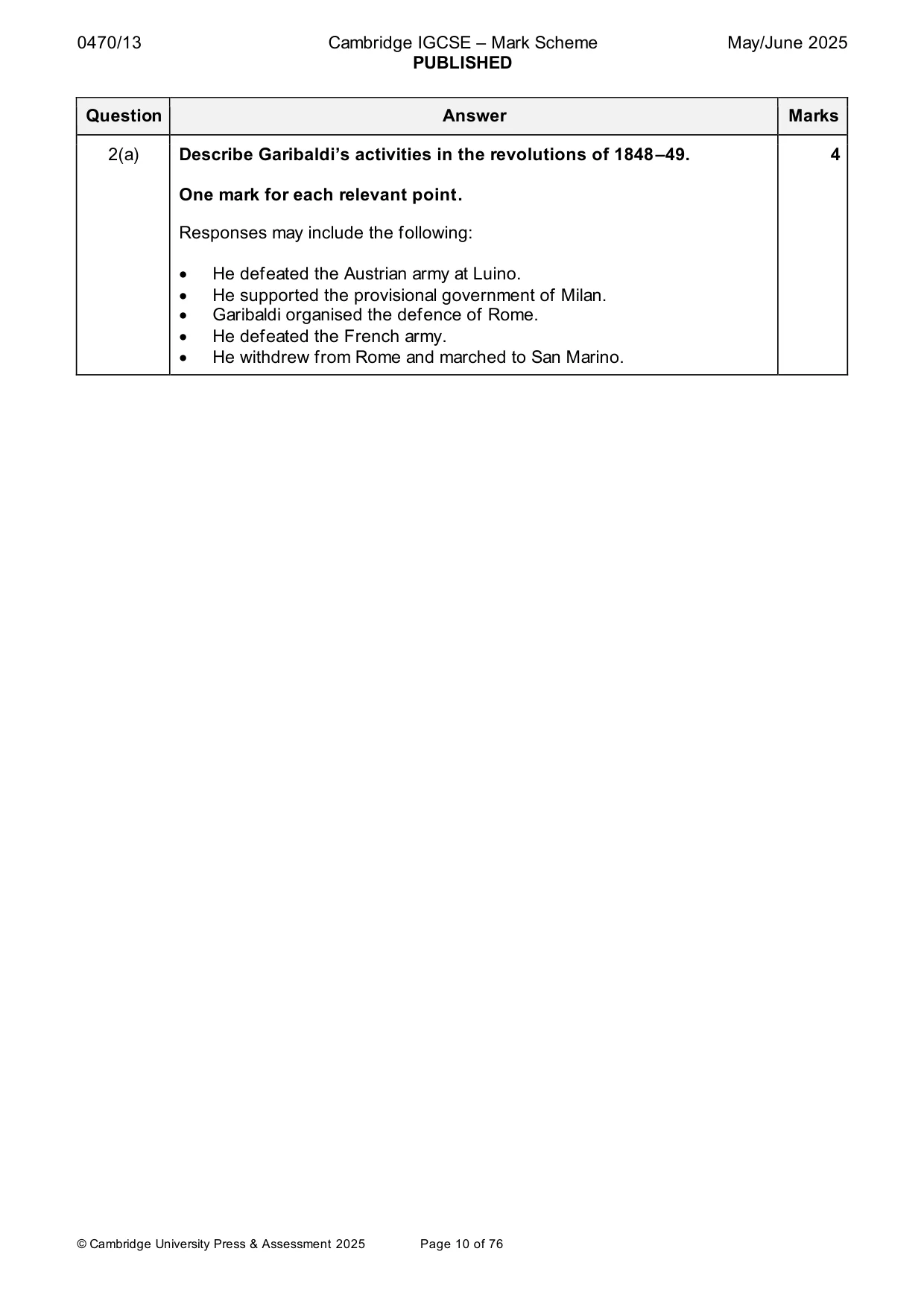
0470/13 Cambridge IGCSE – Mark Scheme PUBLISHED May/June 2025 © Cambridge University Press & Assessment 2025 Page 10 of 76 Question Answer Marks 2(a) Describe Garibaldi’s activities in the revolutions of 1848–49. One mark for each relevant point. Responses may include the following: • He defeated the Austrian army at Luino. • He supported the provisional government of Milan. • Garibaldi organised the defence of Rome. • He defeated the French army. • He withdrew from Rome and marched to San Marino. 4
Mark scheme, page 11
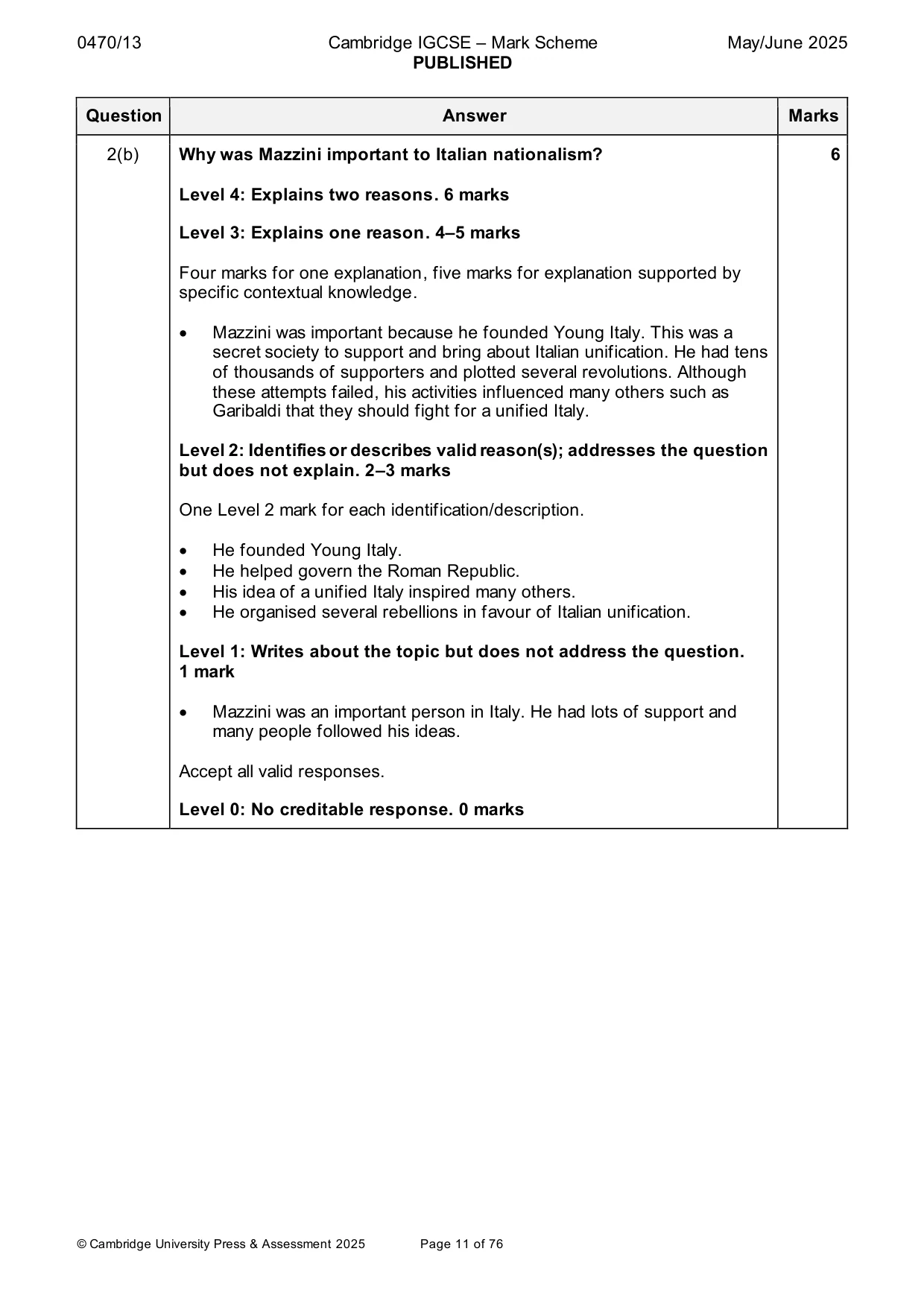
0470/13 Cambridge IGCSE – Mark Scheme PUBLISHED May/June 2025 © Cambridge University Press & Assessment 2025 Page 11 of 76 Question Answer Marks 2(b) Why was Mazzini important to Italian nationalism? Level 4: Explains two reasons. 6 marks Level 3: Explains one reason. 4–5 marks Four marks for one explanation, five marks for explanation supported by specific contextual knowledge. • Mazzini was important because he founded Young Italy. This was a secret society to support and bring about Italian unification. He had tens of thousands of supporters and plotted several revolutions. Although these attempts failed, his activities influenced many others such as Garibaldi that they should fight for a unified Italy. Level 2: Identifies or describes valid reason(s); addresses the question but does not explain. 2–3 marks One Level 2 mark for each identification/description. • He founded Young Italy. • He helped govern the Roman Republic. • His idea of a unified Italy inspired many others. • He organised several rebellions in favour of Italian unification. Level 1: Writes about the topic but does not address the question. 1 mark • Mazzini was an important person in Italy. He had lots of support and many people followed his ideas. Accept all valid responses. Level 0: No creditable response. 0 marks 6
Mark scheme, page 12
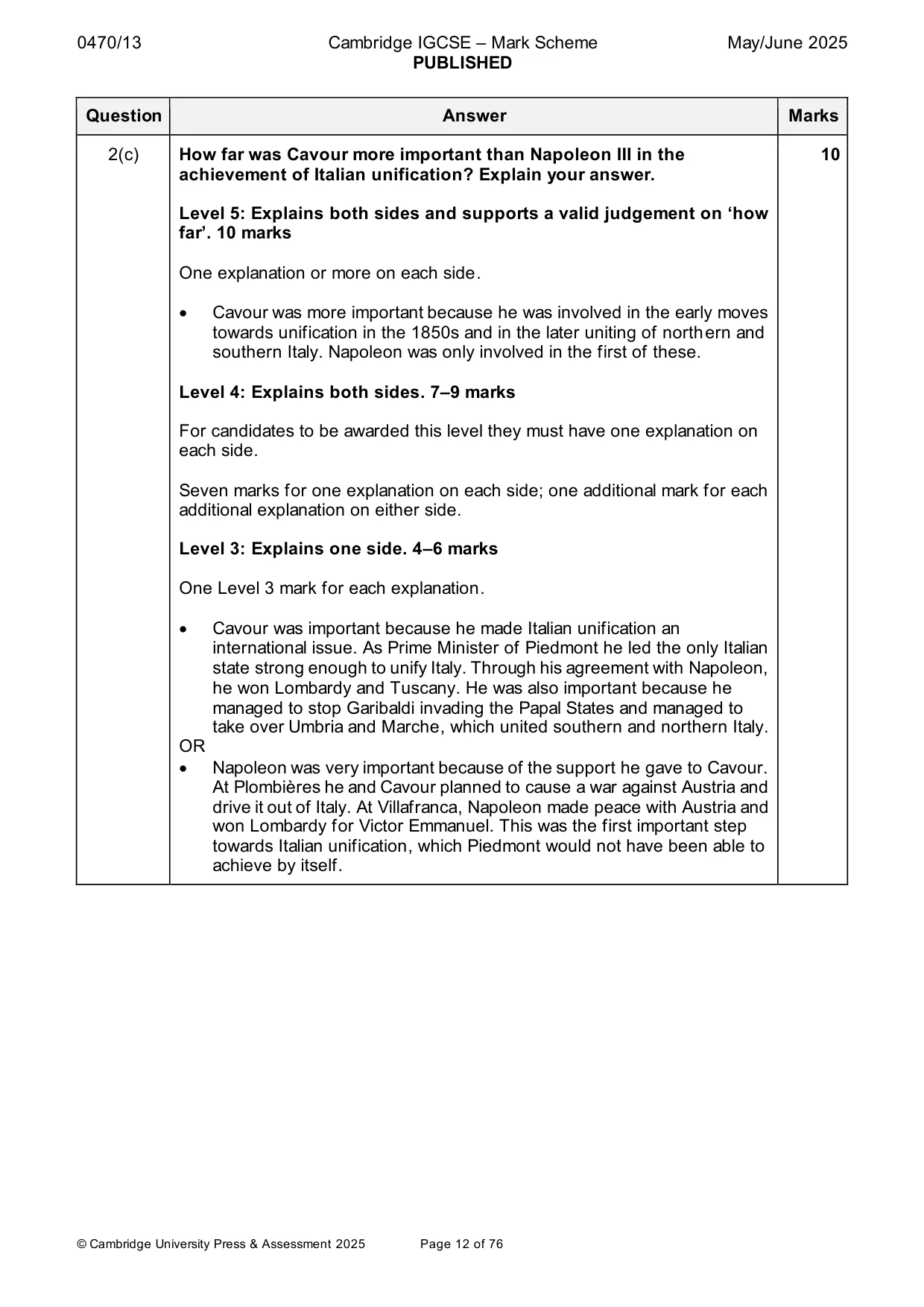
0470/13 Cambridge IGCSE – Mark Scheme PUBLISHED May/June 2025 © Cambridge University Press & Assessment 2025 Page 12 of 76 Question Answer Marks 2(c) How far was Cavour more important than Napoleon III in the achievement of Italian unification? Explain your answer. Level 5: Explains both sides and supports a valid judgement on ‘how far’. 10 marks One explanation or more on each side. • Cavour was more important because he was involved in the early moves towards unification in the 1850s and in the later uniting of northern and southern Italy. Napoleon was only involved in the first of these. Level 4: Explains both sides. 7–9 marks For candidates to be awarded this level they must have one explanation on each side. Seven marks for one explanation on each side; one additional mark for each additional explanation on either side. Level 3: Explains one side. 4–6 marks One Level 3 mark for each explanation. • Cavour was important because he made Italian unification an international issue. As Prime Minister of Piedmont he led the only Italian state strong enough to unify Italy. Through his agreement with Napoleon, he won Lombardy and Tuscany. He was also important because he managed to stop Garibaldi invading the Papal States and managed to take over Umbria and Marche, which united southern and northern Italy. OR • Napoleon was very important because of the support he gave to Cavour. At Plombières he and Cavour planned to cause a war against Austria and drive it out of Italy. At Villafranca, Napoleon made peace with Austria and won Lombardy for Victor Emmanuel. This was the first important step towards Italian unification, which Piedmont would not have been able to achieve by itself. 10
Mark scheme, page 13
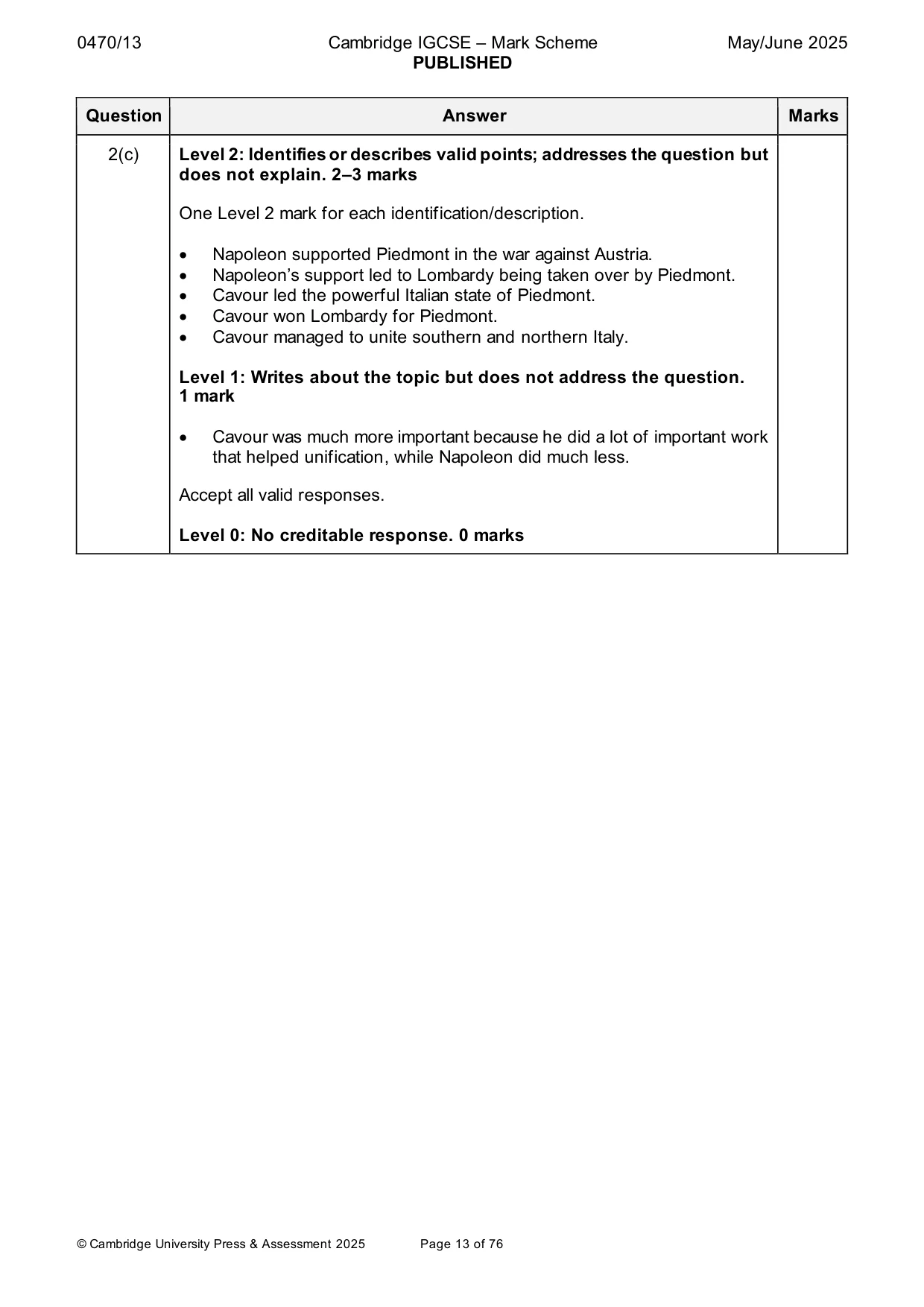
0470/13 Cambridge IGCSE – Mark Scheme PUBLISHED May/June 2025 © Cambridge University Press & Assessment 2025 Page 13 of 76 Question Answer Marks 2(c) Level 2: Identifies or describes valid points; addresses the question but does not explain. 2–3 marks One Level 2 mark for each identification/description. • Napoleon supported Piedmont in the war against Austria. • Napoleon’s support led to Lombardy being taken over by Piedmont. • Cavour led the powerful Italian state of Piedmont. • Cavour won Lombardy for Piedmont. • Cavour managed to unite southern and northern Italy. Level 1: Writes about the topic but does not address the question. 1 mark • Cavour was much more important because he did a lot of important work that helped unification, while Napoleon did much less. Accept all valid responses. Level 0: No creditable response. 0 marks
Mark scheme, page 14
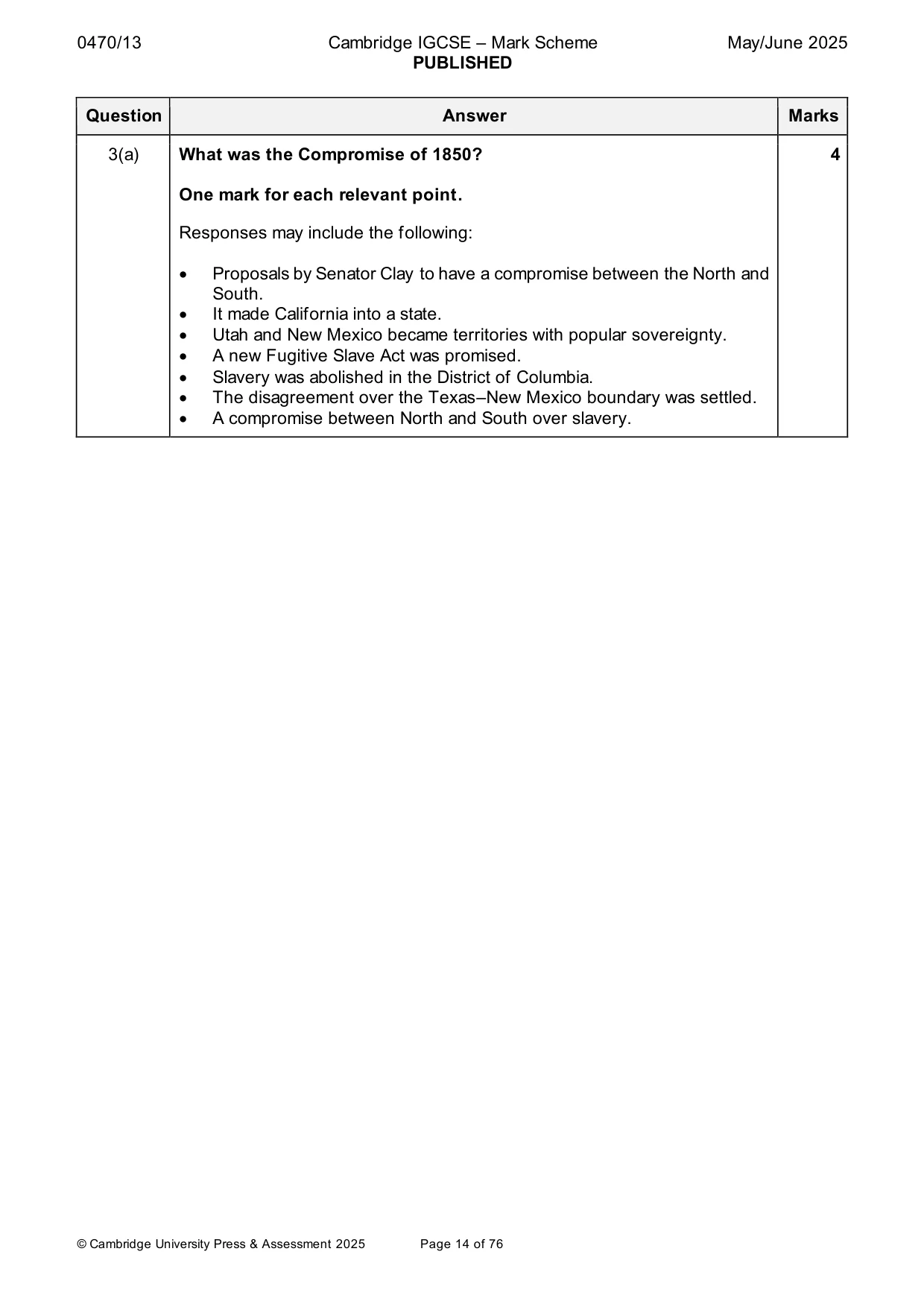
0470/13 Cambridge IGCSE – Mark Scheme PUBLISHED May/June 2025 © Cambridge University Press & Assessment 2025 Page 14 of 76 Question Answer Marks 3(a) What was the Compromise of 1850? One mark for each relevant point. Responses may include the following: • Proposals by Senator Clay to have a compromise between the North and South. • It made California into a state. • Utah and New Mexico became territories with popular sovereignty. • A new Fugitive Slave Act was promised. • Slavery was abolished in the District of Columbia. • The disagreement over the Texas–New Mexico boundary was settled. • A compromise between North and South over slavery. 4
Mark scheme, page 15
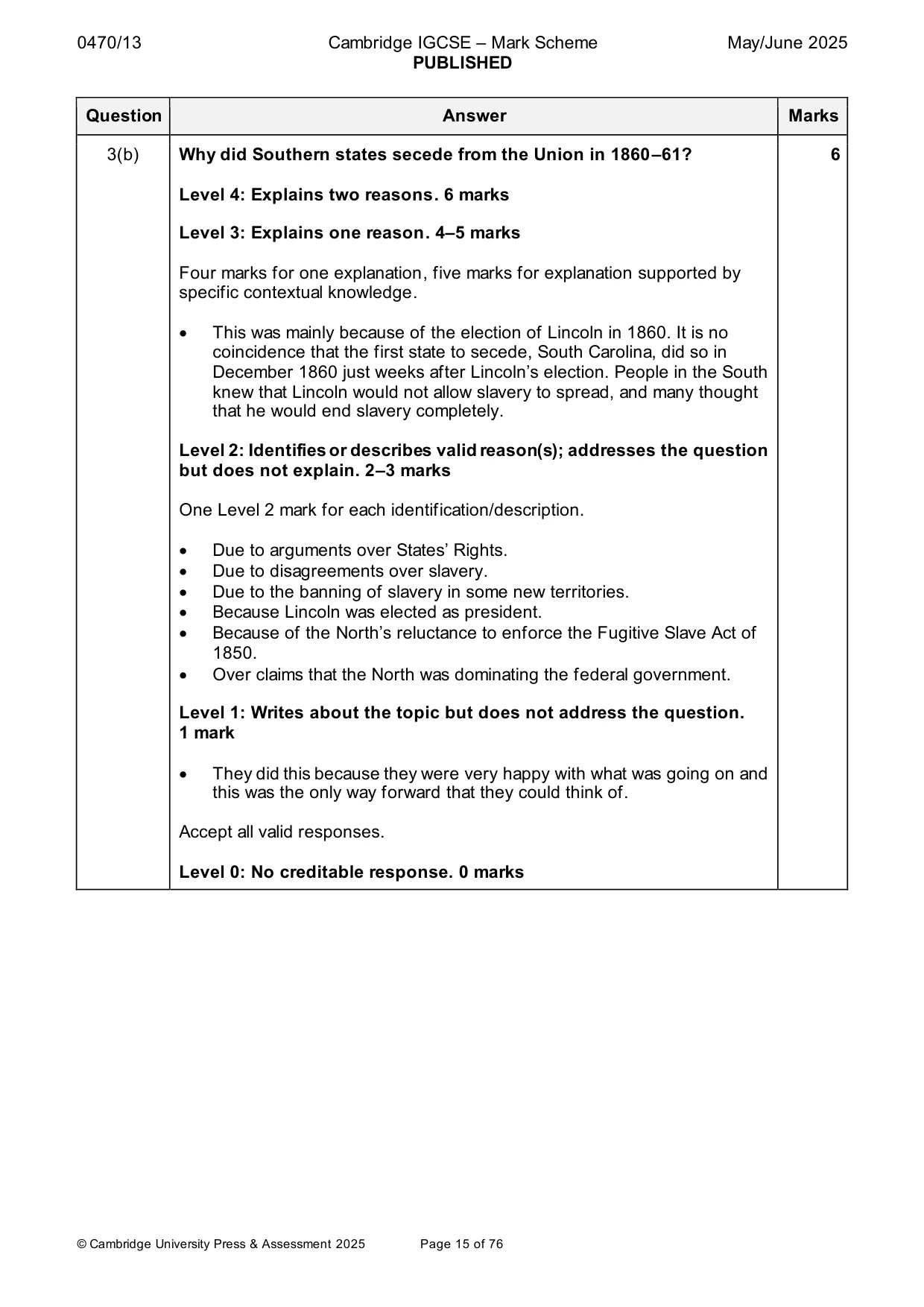
0470/13 Cambridge IGCSE – Mark Scheme PUBLISHED May/June 2025 © Cambridge University Press & Assessment 2025 Page 15 of 76 Question Answer Marks 3(b) Why did Southern states secede from the Union in 1860–61? Level 4: Explains two reasons. 6 marks Level 3: Explains one reason. 4–5 marks Four marks for one explanation, five marks for explanation supported by specific contextual knowledge. • This was mainly because of the election of Lincoln in 1860. It is no coincidence that the first state to secede, South Carolina, did so in December 1860 just weeks after Lincoln’s election. People in the South knew that Lincoln would not allow slavery to spread, and many thought that he would end slavery completely. Level 2: Identifies or describes valid reason(s); addresses the question but does not explain. 2–3 marks One Level 2 mark for each identification/description. • Due to arguments over States’ Rights. • Due to disagreements over slavery. • Due to the banning of slavery in some new territories. • Because Lincoln was elected as president. • Because of the North’s reluctance to enforce the Fugitive Slave Act of 1850. • Over claims that the North was dominating the federal government. Level 1: Writes about the topic but does not address the question. 1 mark • They did this because they were very happy with what was going on and this was the only way forward that they could think of. Accept all valid responses. Level 0: No creditable response. 0 marks 6
Mark scheme, page 16
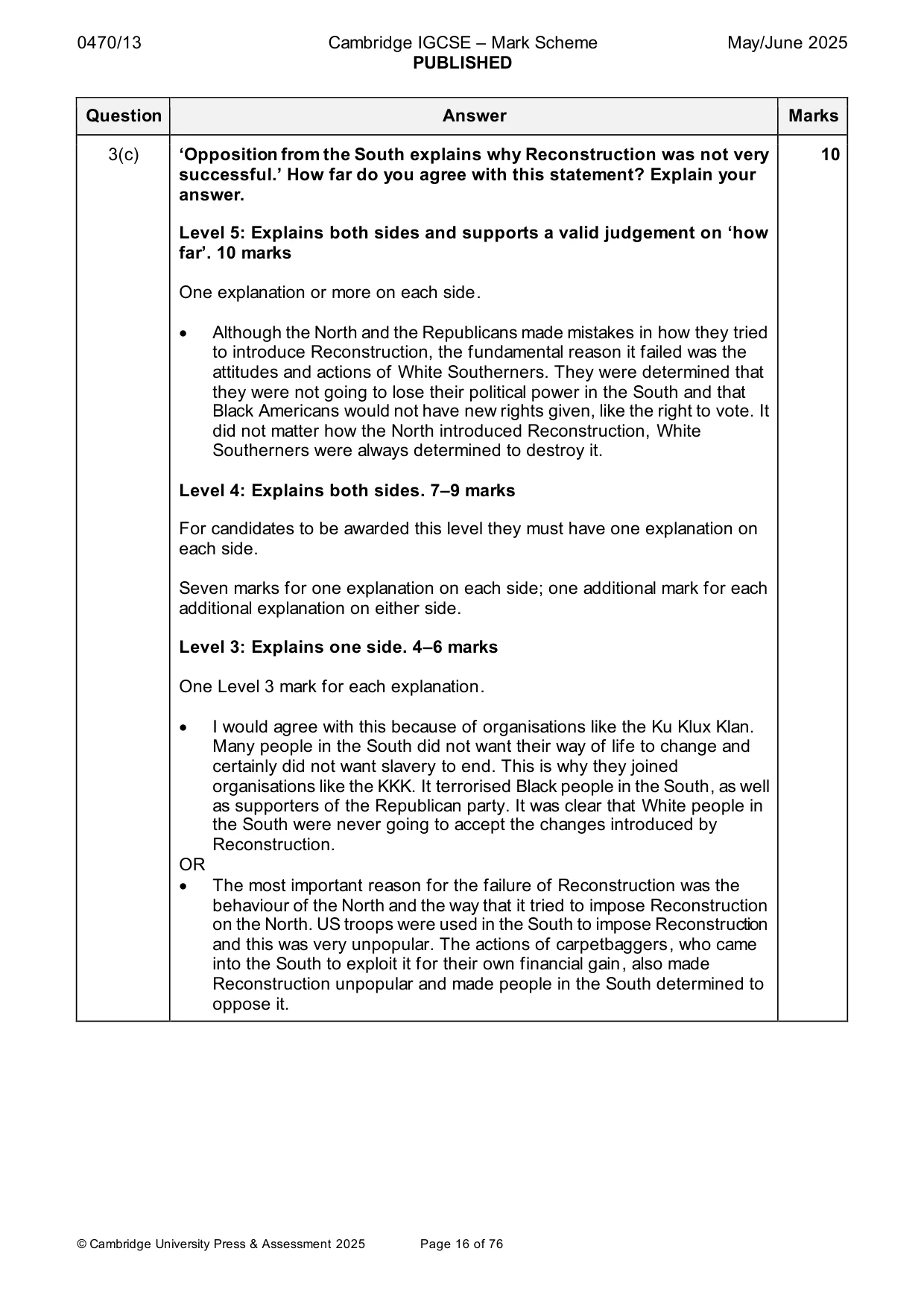
0470/13 Cambridge IGCSE – Mark Scheme PUBLISHED May/June 2025 © Cambridge University Press & Assessment 2025 Page 16 of 76 Question Answer Marks 3(c) ‘Opposition from the South explains why Reconstruction was not very successful.’ How far do you agree with this statement? Explain your answer. Level 5: Explains both sides and supports a valid judgement on ‘how far’. 10 marks One explanation or more on each side. • Although the North and the Republicans made mistakes in how they tried to introduce Reconstruction, the fundamental reason it failed was the attitudes and actions of White Southerners. They were determined that they were not going to lose their political power in the South and that Black Americans would not have new rights given, like the right to vote. It did not matter how the North introduced Reconstruction, White Southerners were always determined to destroy it. Level 4: Explains both sides. 7–9 marks For candidates to be awarded this level they must have one explanation on each side. Seven marks for one explanation on each side; one additional mark for each additional explanation on either side. Level 3: Explains one side. 4–6 marks One Level 3 mark for each explanation. • I would agree with this because of organisations like the Ku Klux Klan. Many people in the South did not want their way of life to change and certainly did not want slavery to end. This is why they joined organisations like the KKK. It terrorised Black people in the South, as well as supporters of the Republican party. It was clear that White people in the South were never going to accept the changes introduced by Reconstruction. OR • The most important reason for the failure of Reconstruction was the behaviour of the North and the way that it tried to impose Reconstruction on the North. US troops were used in the South to impose Reconstruction and this was very unpopular. The actions of carpetbaggers, who came into the South to exploit it for their own financial gain, also made Reconstruction unpopular and made people in the South determined to oppose it. 10
Mark scheme, page 17
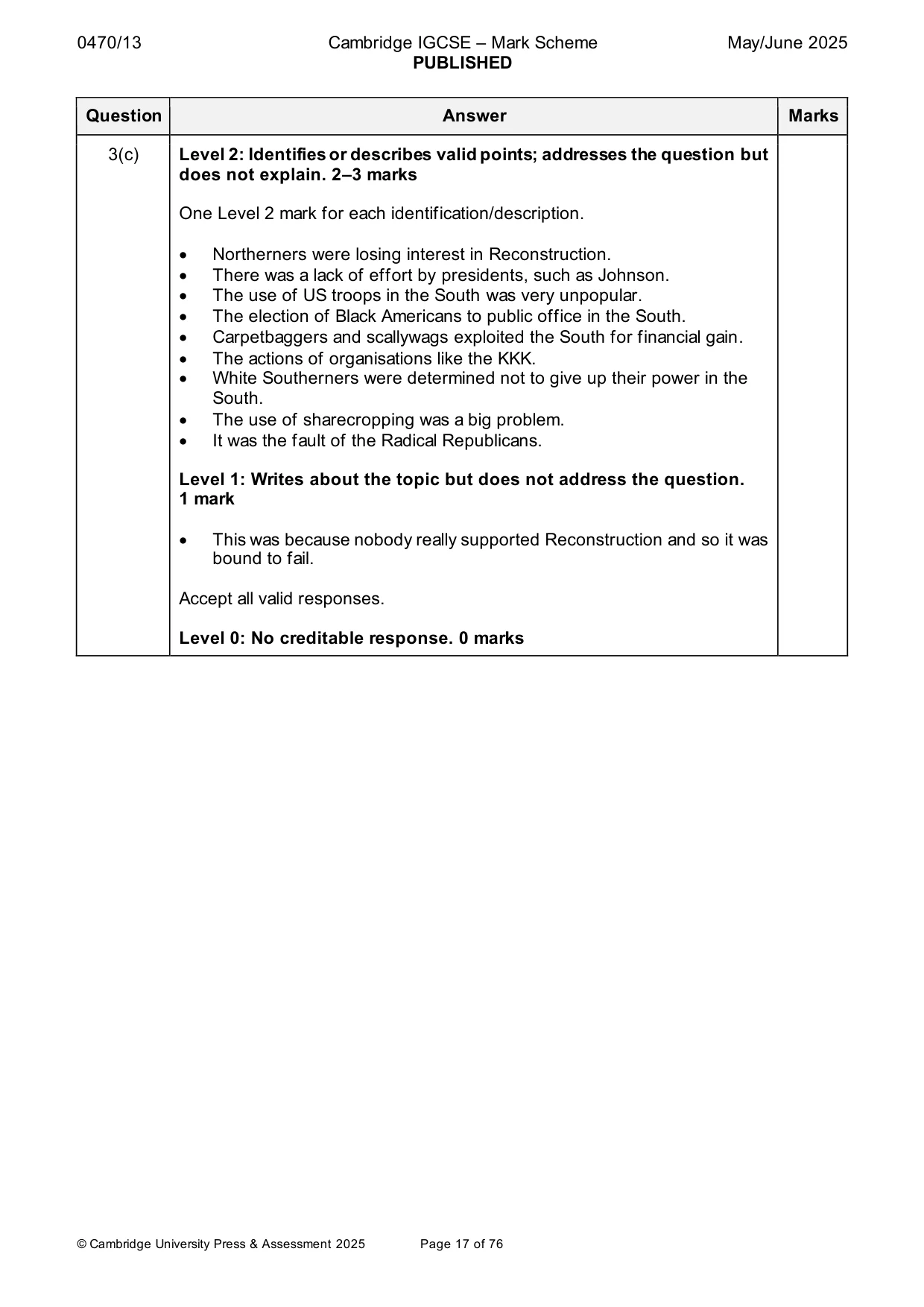
0470/13 Cambridge IGCSE – Mark Scheme PUBLISHED May/June 2025 © Cambridge University Press & Assessment 2025 Page 17 of 76 Question Answer Marks 3(c) Level 2: Identifies or describes valid points; addresses the question but does not explain. 2–3 marks One Level 2 mark for each identification/description. • Northerners were losing interest in Reconstruction. • There was a lack of effort by presidents, such as Johnson. • The use of US troops in the South was very unpopular. • The election of Black Americans to public office in the South. • Carpetbaggers and scallywags exploited the South for financial gain. • The actions of organisations like the KKK. • White Southerners were determined not to give up their power in the South. • The use of sharecropping was a big problem. • It was the fault of the Radical Republicans. Level 1: Writes about the topic but does not address the question. 1 mark • This was because nobody really supported Reconstruction and so it was bound to fail. Accept all valid responses. Level 0: No creditable response. 0 marks
Mark scheme, page 18
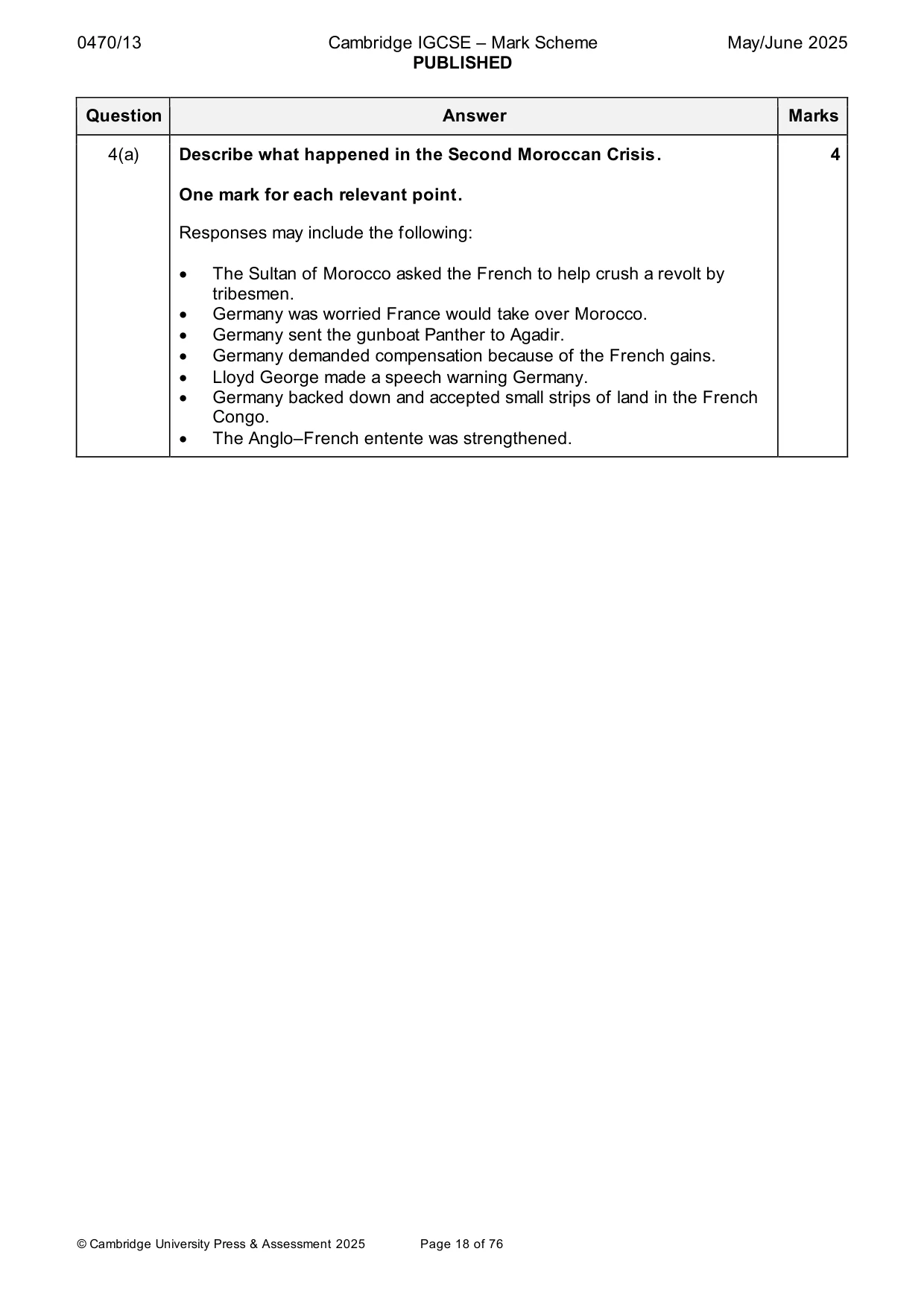
0470/13 Cambridge IGCSE – Mark Scheme PUBLISHED May/June 2025 © Cambridge University Press & Assessment 2025 Page 18 of 76 Question Answer Marks 4(a) Describe what happened in the Second Moroccan Crisis. One mark for each relevant point. Responses may include the following: • The Sultan of Morocco asked the French to help crush a revolt by tribesmen. • Germany was worried France would take over Morocco. • Germany sent the gunboat Panther to Agadir. • Germany demanded compensation because of the French gains. • Lloyd George made a speech warning Germany. • Germany backed down and accepted small strips of land in the French Congo. • The Anglo–French entente was strengthened. 4
Mark scheme, page 19
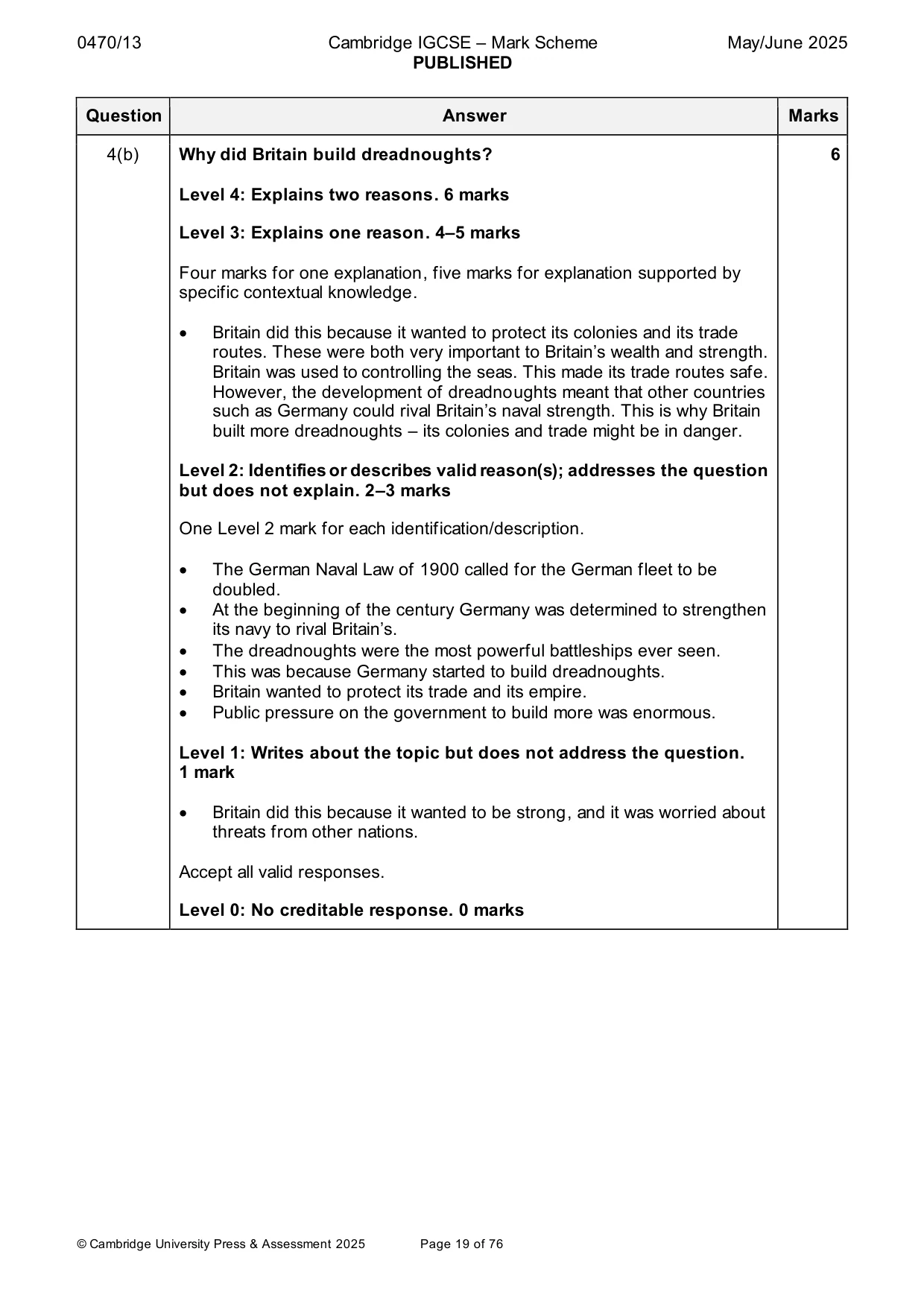
0470/13 Cambridge IGCSE – Mark Scheme PUBLISHED May/June 2025 © Cambridge University Press & Assessment 2025 Page 19 of 76 Question Answer Marks 4(b) Why did Britain build dreadnoughts? Level 4: Explains two reasons. 6 marks Level 3: Explains one reason. 4–5 marks Four marks for one explanation, five marks for explanation supported by specific contextual knowledge. • Britain did this because it wanted to protect its colonies and its trade routes. These were both very important to Britain’s wealth and strength. Britain was used to controlling the seas. This made its trade routes safe. However, the development of dreadnoughts meant that other countries such as Germany could rival Britain’s naval strength. This is why Britain built more dreadnoughts – its colonies and trade might be in danger. Level 2: Identifies or describes valid reason(s); addresses the question but does not explain. 2–3 marks One Level 2 mark for each identification/description. • The German Naval Law of 1900 called for the German fleet to be doubled. • At the beginning of the century Germany was determined to strengthen its navy to rival Britain’s. • The dreadnoughts were the most powerful battleships ever seen. • This was because Germany started to build dreadnoughts. • Britain wanted to protect its trade and its empire. • Public pressure on the government to build more was enormous. Level 1: Writes about the topic but does not address the question. 1 mark • Britain did this because it wanted to be strong, and it was worried about threats from other nations. Accept all valid responses. Level 0: No creditable response. 0 marks 6
Mark scheme, page 20
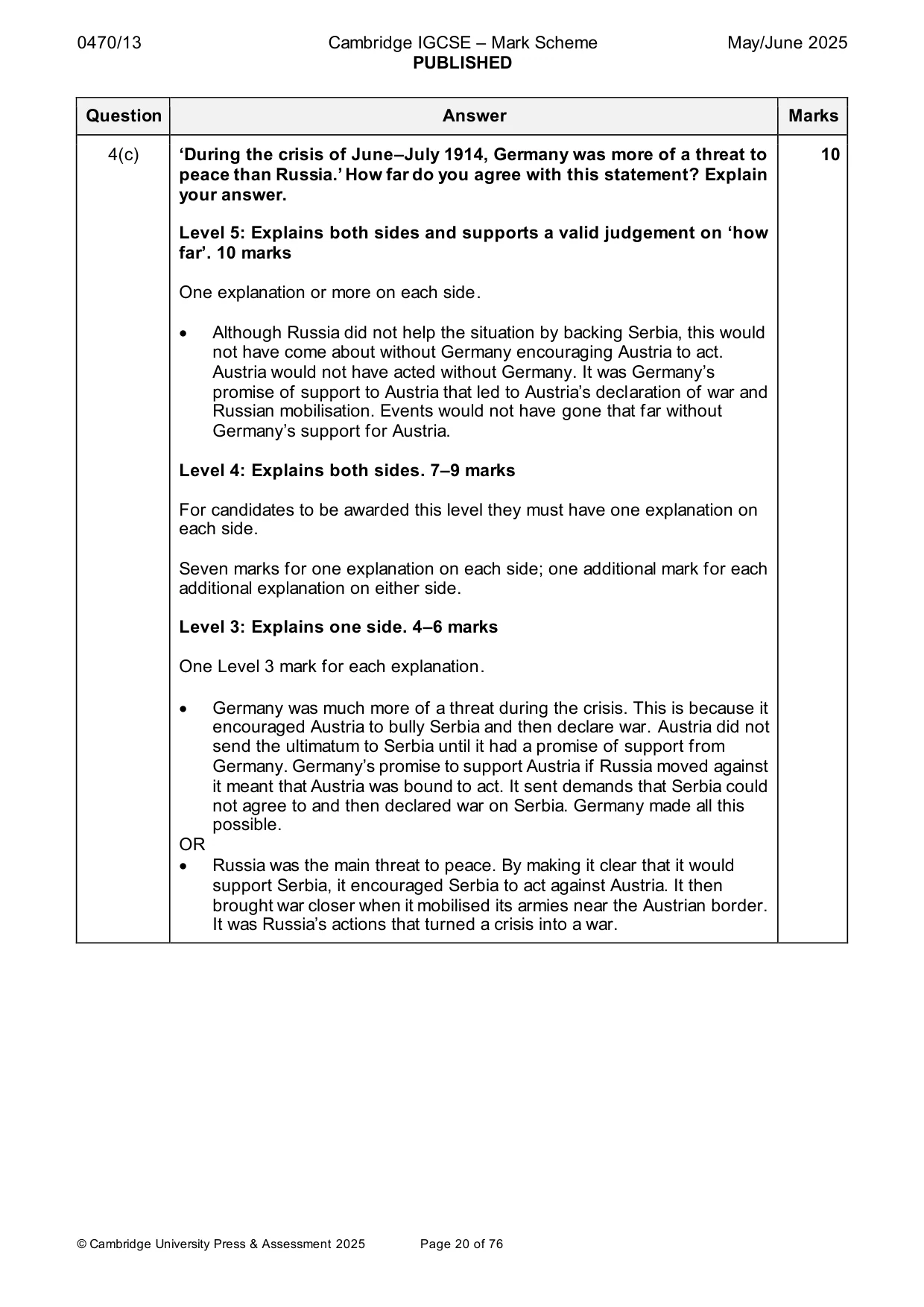
0470/13 Cambridge IGCSE – Mark Scheme PUBLISHED May/June 2025 © Cambridge University Press & Assessment 2025 Page 20 of 76 Question Answer Marks 4(c) ‘During the crisis of June–July 1914, Germany was more of a threat to peace than Russia.’ How far do you agree with this statement? Explain your answer. Level 5: Explains both sides and supports a valid judgement on ‘how far’. 10 marks One explanation or more on each side. • Although Russia did not help the situation by backing Serbia, this would not have come about without Germany encouraging Austria to act. Austria would not have acted without Germany. It was Germany’s promise of support to Austria that led to Austria’s declaration of war and Russian mobilisation. Events would not have gone that far without Germany’s support for Austria. Level 4: Explains both sides. 7–9 marks For candidates to be awarded this level they must have one explanation on each side. Seven marks for one explanation on each side; one additional mark for each additional explanation on either side. Level 3: Explains one side. 4–6 marks One Level 3 mark for each explanation. • Germany was much more of a threat during the crisis. This is because it encouraged Austria to bully Serbia and then declare war. Austria did not send the ultimatum to Serbia until it had a promise of support from Germany. Germany’s promise to support Austria if Russia moved against it meant that Austria was bound to act. It sent demands that Serbia could not agree to and then declared war on Serbia. Germany made all this possible. OR • Russia was the main threat to peace. By making it clear that it would support Serbia, it encouraged Serbia to act against Austria. It then brought war closer when it mobilised its armies near the Austrian border. It was Russia’s actions that turned a crisis into a war. 10
Mark scheme, page 21
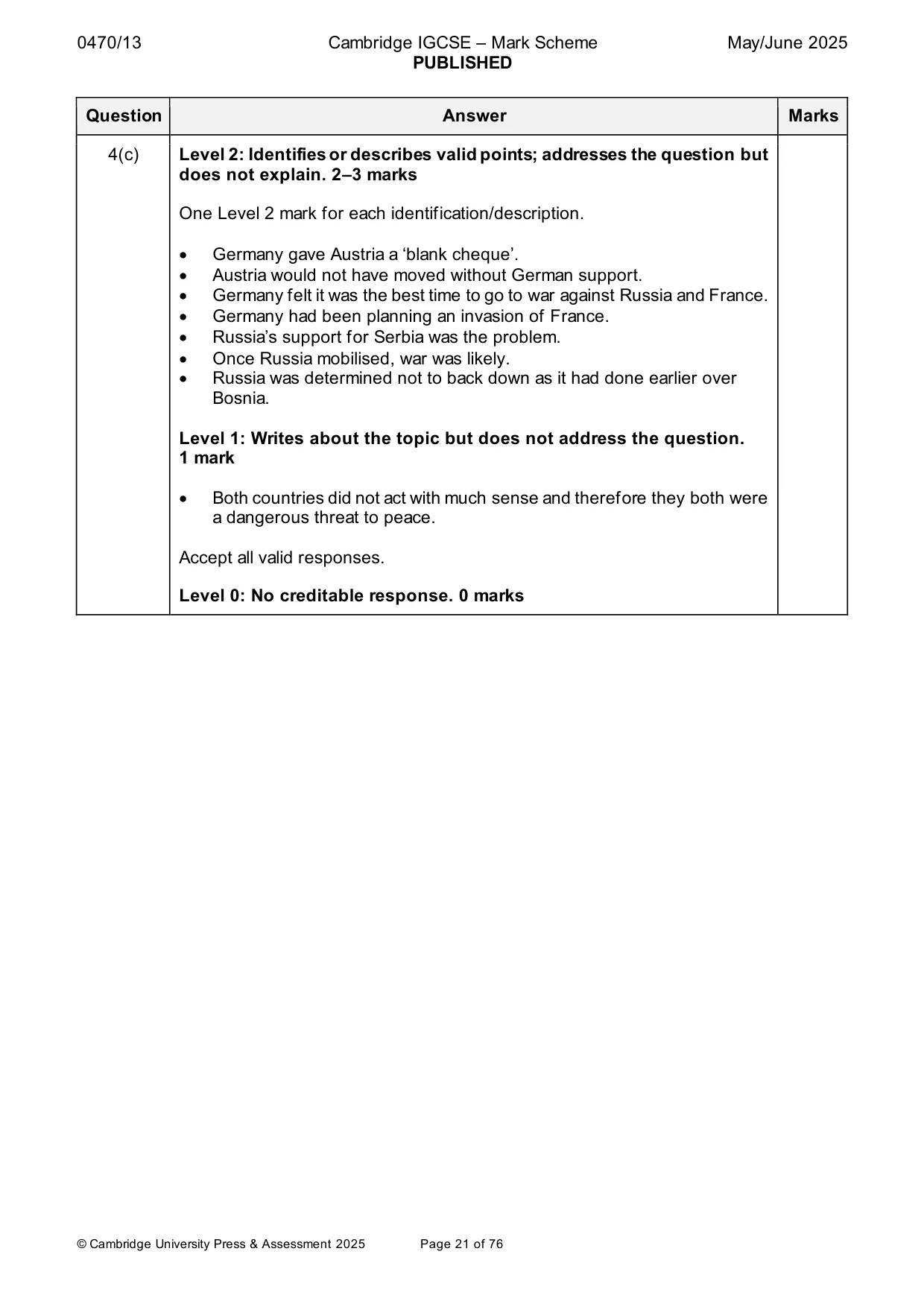
0470/13 Cambridge IGCSE – Mark Scheme PUBLISHED May/June 2025 © Cambridge University Press & Assessment 2025 Page 21 of 76 Question Answer Marks 4(c) Level 2: Identifies or describes valid points; addresses the question but does not explain. 2–3 marks One Level 2 mark for each identification/description. • Germany gave Austria a ‘blank cheque’. • Austria would not have moved without German support. • Germany felt it was the best time to go to war against Russia and France. • Germany had been planning an invasion of France. • Russia’s support for Serbia was the problem. • Once Russia mobilised, war was likely. • Russia was determined not to back down as it had done earlier over Bosnia. Level 1: Writes about the topic but does not address the question. 1 mark • Both countries did not act with much sense and therefore they both were a dangerous threat to peace. Accept all valid responses. Level 0: No creditable response. 0 marks
Mark scheme, page 22
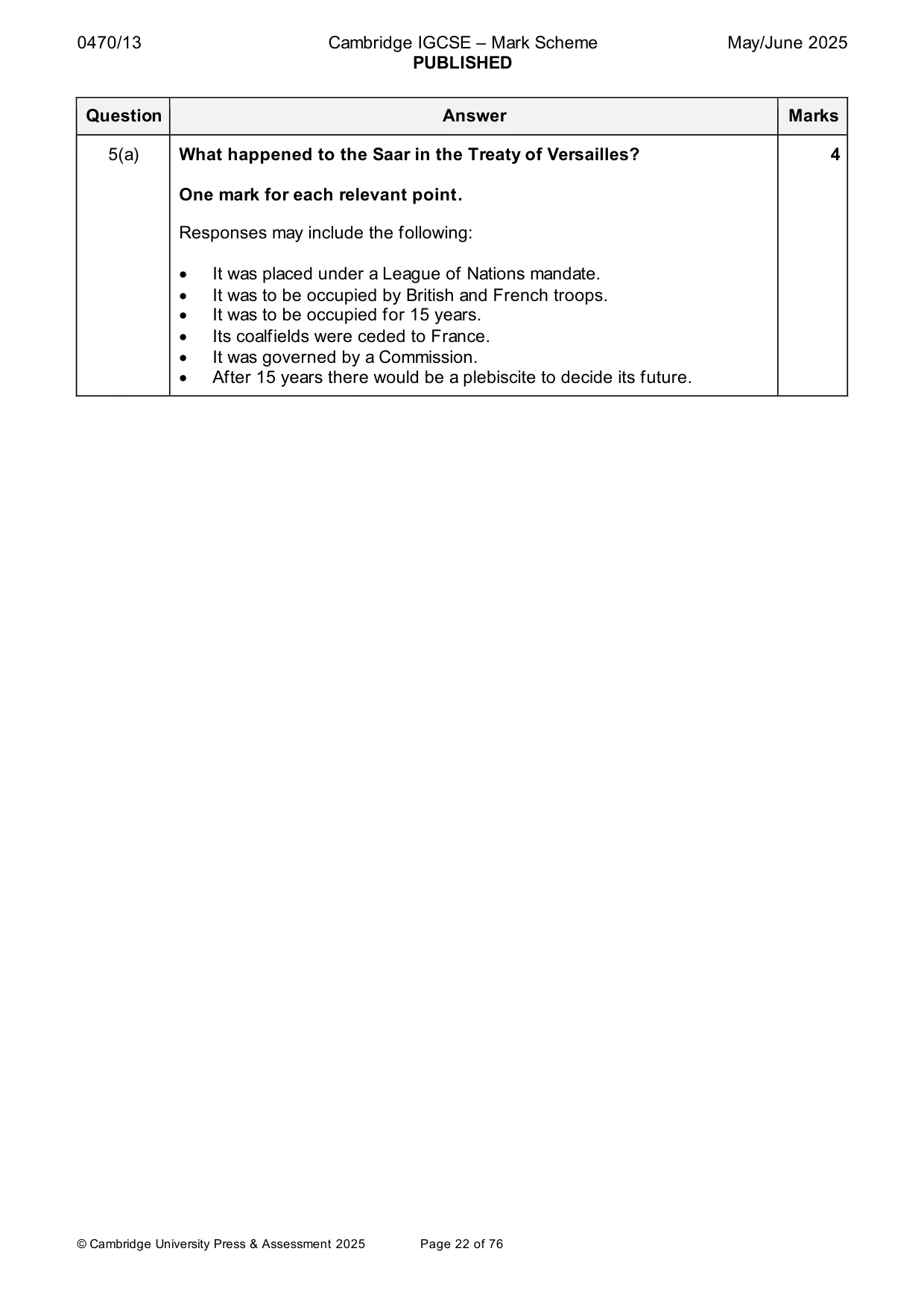
0470/13 Cambridge IGCSE – Mark Scheme PUBLISHED May/June 2025 © Cambridge University Press & Assessment 2025 Page 22 of 76 Question Answer Marks 5(a) What happened to the Saar in the Treaty of Versailles? One mark for each relevant point. Responses may include the following: • It was placed under a League of Nations mandate. • It was to be occupied by British and French troops. • It was to be occupied for 15 years. • Its coalfields were ceded to France. • It was governed by a Commission. • After 15 years there would be a plebiscite to decide its future. 4
Mark scheme, page 23
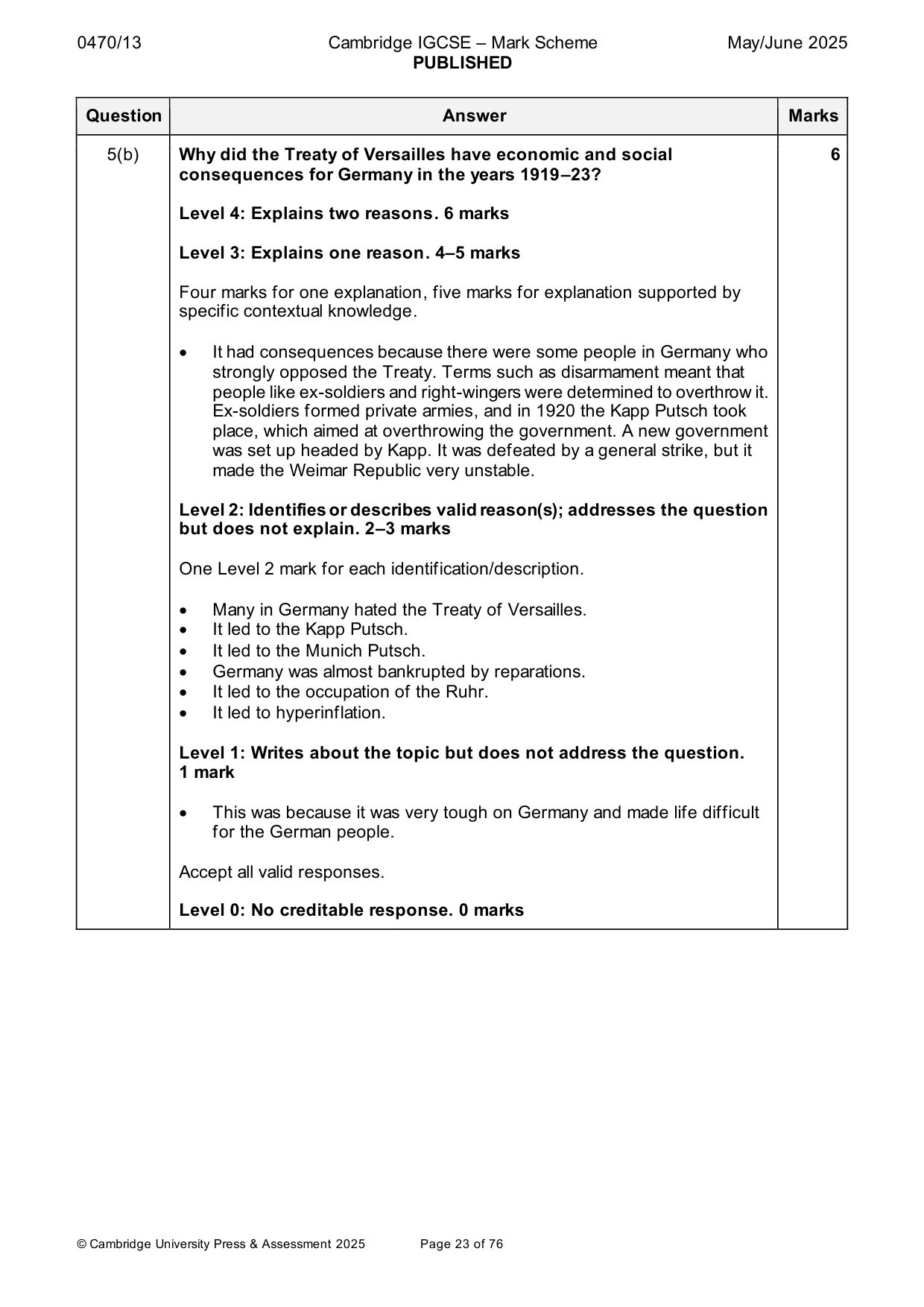
0470/13 Cambridge IGCSE – Mark Scheme PUBLISHED May/June 2025 © Cambridge University Press & Assessment 2025 Page 23 of 76 Question Answer Marks 5(b) Why did the Treaty of Versailles have economic and social consequences for Germany in the years 1919–23? Level 4: Explains two reasons. 6 marks Level 3: Explains one reason. 4–5 marks Four marks for one explanation, five marks for explanation supported by specific contextual knowledge. • It had consequences because there were some people in Germany who strongly opposed the Treaty. Terms such as disarmament meant that people like ex-soldiers and right-wingers were determined to overthrow it. Ex-soldiers formed private armies, and in 1920 the Kapp Putsch took place, which aimed at overthrowing the government. A new government was set up headed by Kapp. It was defeated by a general strike, but it made the Weimar Republic very unstable. Level 2: Identifies or describes valid reason(s); addresses the question but does not explain. 2–3 marks One Level 2 mark for each identification/description. • Many in Germany hated the Treaty of Versailles. • It led to the Kapp Putsch. • It led to the Munich Putsch. • Germany was almost bankrupted by reparations. • It led to the occupation of the Ruhr. • It led to hyperinflation. Level 1: Writes about the topic but does not address the question. 1 mark • This was because it was very tough on Germany and made life difficult for the German people. Accept all valid responses. Level 0: No creditable response. 0 marks 6
Mark scheme, page 24
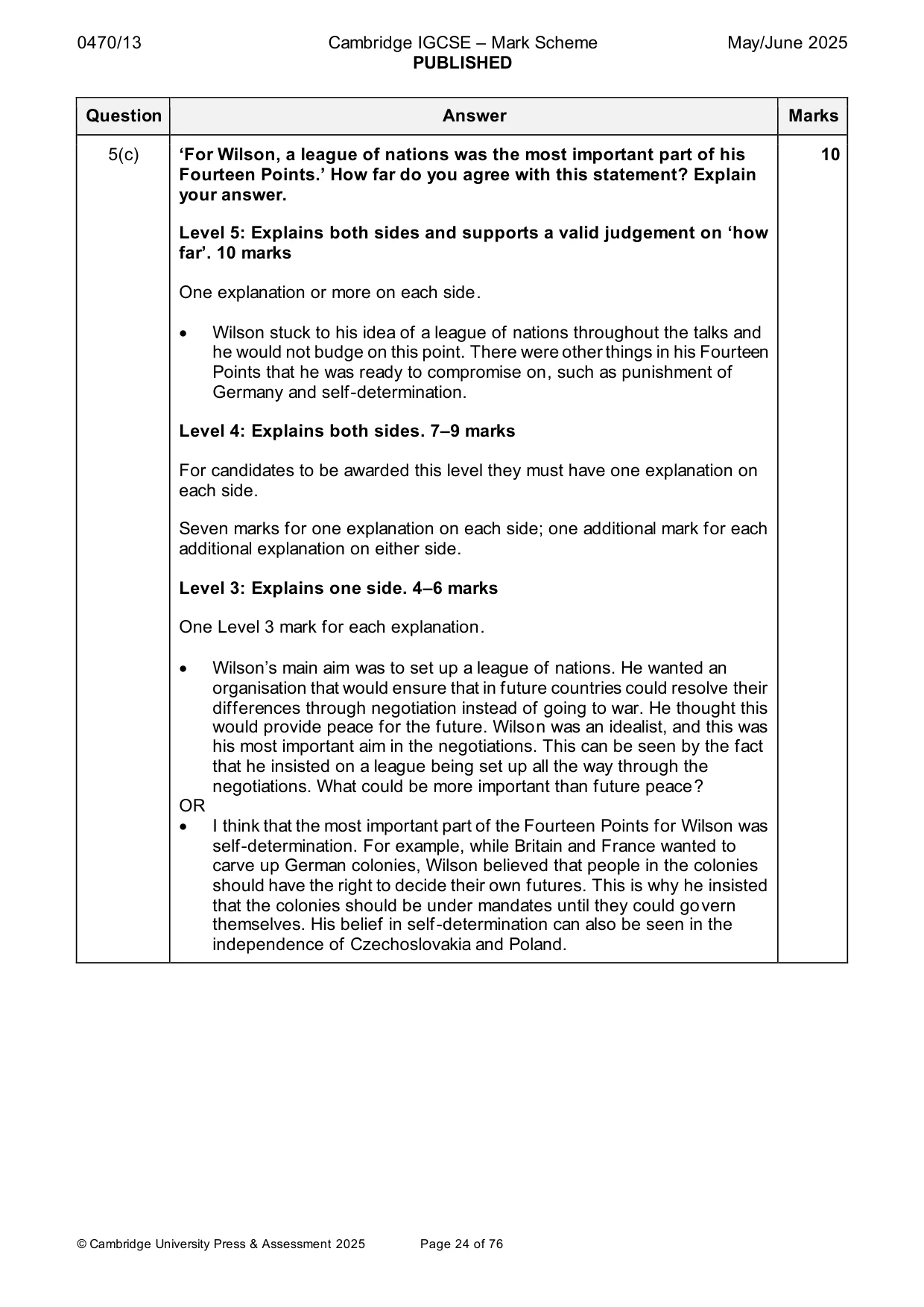
0470/13 Cambridge IGCSE – Mark Scheme PUBLISHED May/June 2025 © Cambridge University Press & Assessment 2025 Page 24 of 76 Question Answer Marks 5(c) ‘For Wilson, a league of nations was the most important part of his Fourteen Points.’ How far do you agree with this statement? Explain your answer. Level 5: Explains both sides and supports a valid judgement on ‘how far’. 10 marks One explanation or more on each side. • Wilson stuck to his idea of a league of nations throughout the talks and he would not budge on this point. There were other things in his Fourteen Points that he was ready to compromise on, such as punishment of Germany and self-determination. Level 4: Explains both sides. 7–9 marks For candidates to be awarded this level they must have one explanation on each side. Seven marks for one explanation on each side; one additional mark for each additional explanation on either side. Level 3: Explains one side. 4–6 marks One Level 3 mark for each explanation. • Wilson’s main aim was to set up a league of nations. He wanted an organisation that would ensure that in future countries could resolve their differences through negotiation instead of going to war. He thought this would provide peace for the future. Wilson was an idealist, and this was his most important aim in the negotiations. This can be seen by the fact that he insisted on a league being set up all the way through the negotiations. What could be more important than future peace? OR • I think that the most important part of the Fourteen Points for Wilson was self-determination. For example, while Britain and France wanted to carve up German colonies, Wilson believed that people in the colonies should have the right to decide their own futures. This is why he insisted that the colonies should be under mandates until they could govern themselves. His belief in self-determination can also be seen in the independence of Czechoslovakia and Poland. 10
Mark scheme, page 25
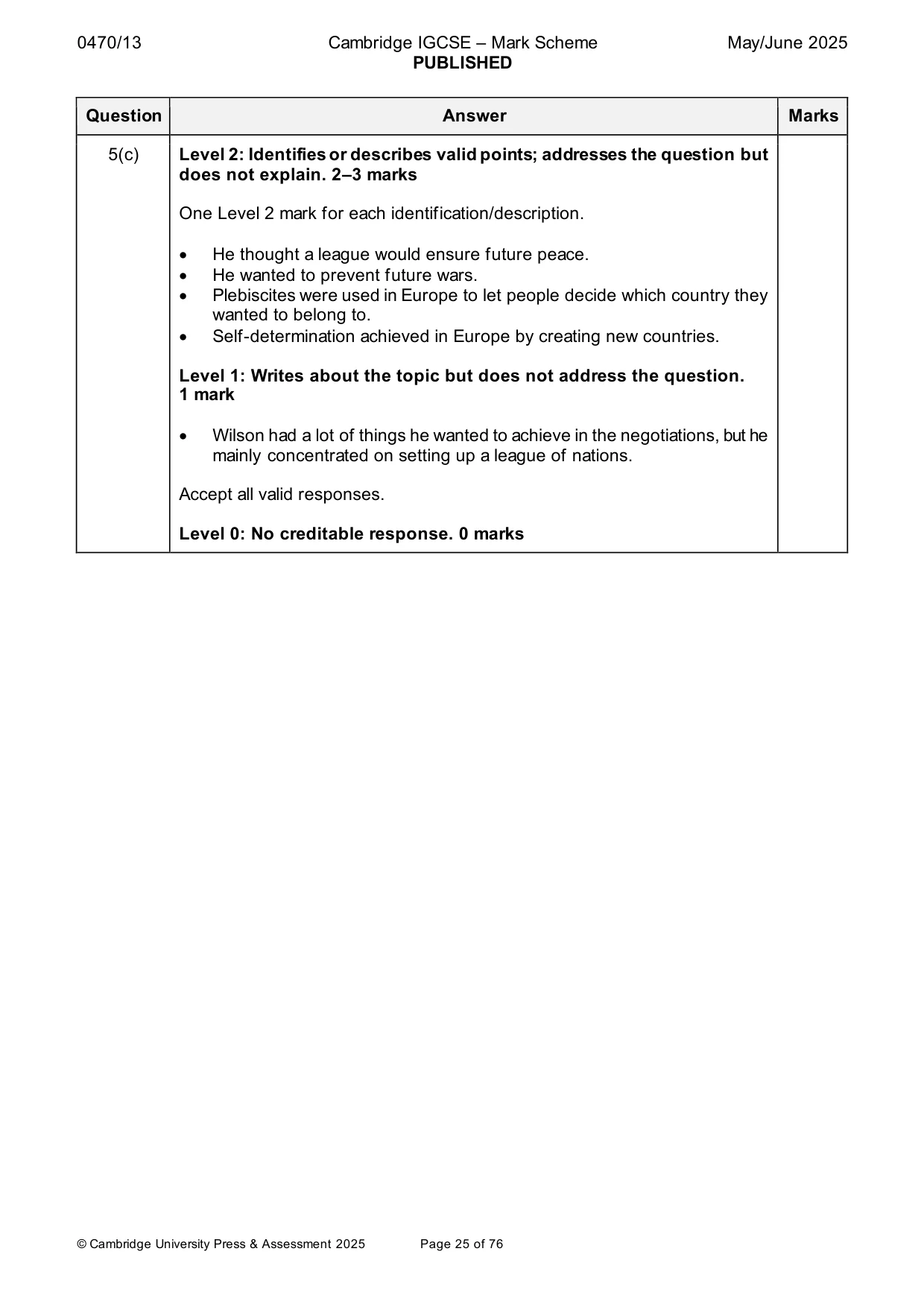
0470/13 Cambridge IGCSE – Mark Scheme PUBLISHED May/June 2025 © Cambridge University Press & Assessment 2025 Page 25 of 76 Question Answer Marks 5(c) Level 2: Identifies or describes valid points; addresses the question but does not explain. 2–3 marks One Level 2 mark for each identification/description. • He thought a league would ensure future peace. • He wanted to prevent future wars. • Plebiscites were used in Europe to let people decide which country they wanted to belong to. • Self-determination achieved in Europe by creating new countries. Level 1: Writes about the topic but does not address the question. 1 mark • Wilson had a lot of things he wanted to achieve in the negotiations, but he mainly concentrated on setting up a league of nations. Accept all valid responses. Level 0: No creditable response. 0 marks
Mark scheme, page 26
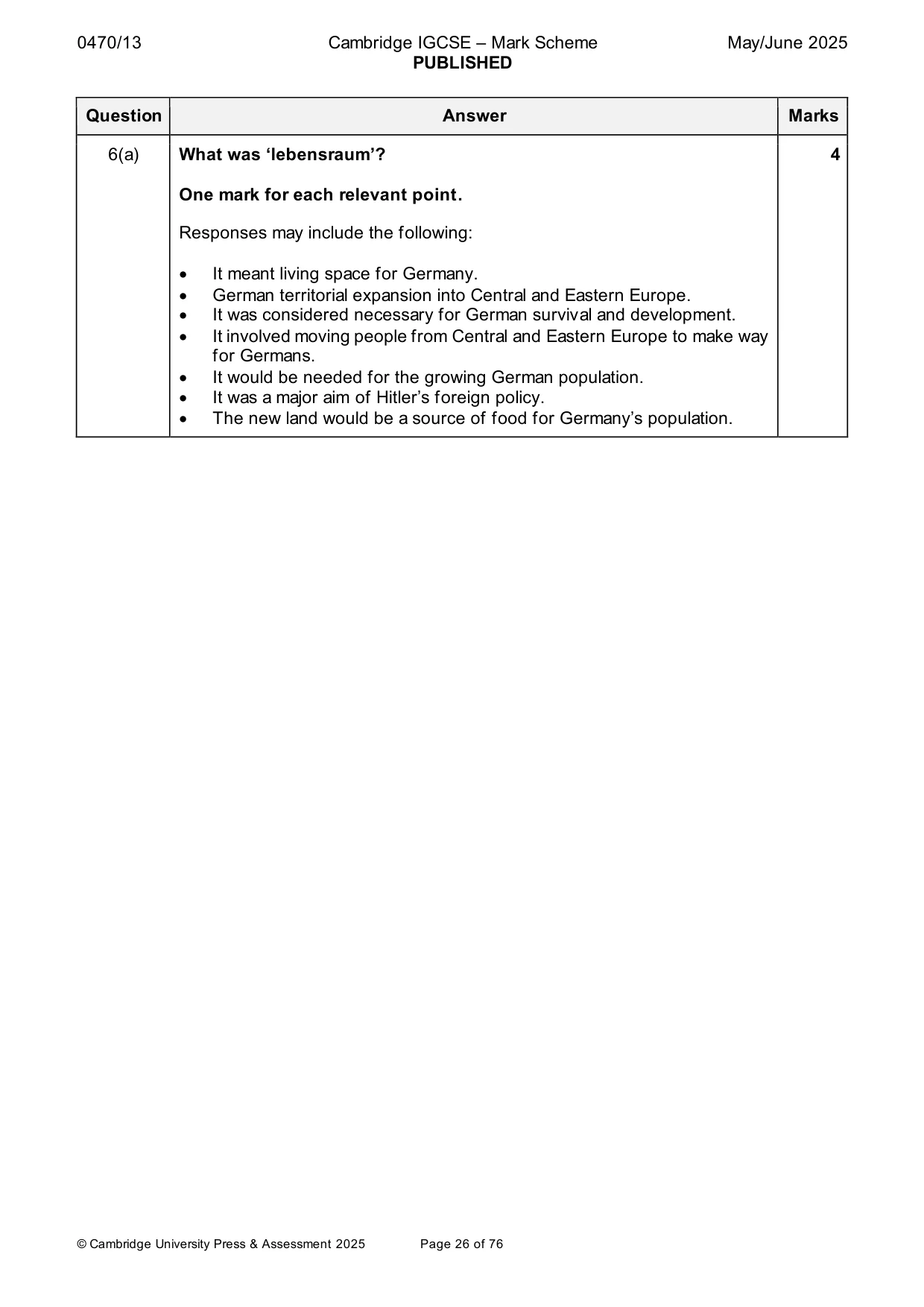
0470/13 Cambridge IGCSE – Mark Scheme PUBLISHED May/June 2025 © Cambridge University Press & Assessment 2025 Page 26 of 76 Question Answer Marks 6(a) What was ‘lebensraum’? One mark for each relevant point. Responses may include the following: • It meant living space for Germany. • German territorial expansion into Central and Eastern Europe. • It was considered necessary for German survival and development. • It involved moving people from Central and Eastern Europe to make way for Germans. • It would be needed for the growing German population. • It was a major aim of Hitler’s foreign policy. • The new land would be a source of food for Germany’s population. 4
Mark scheme, page 27
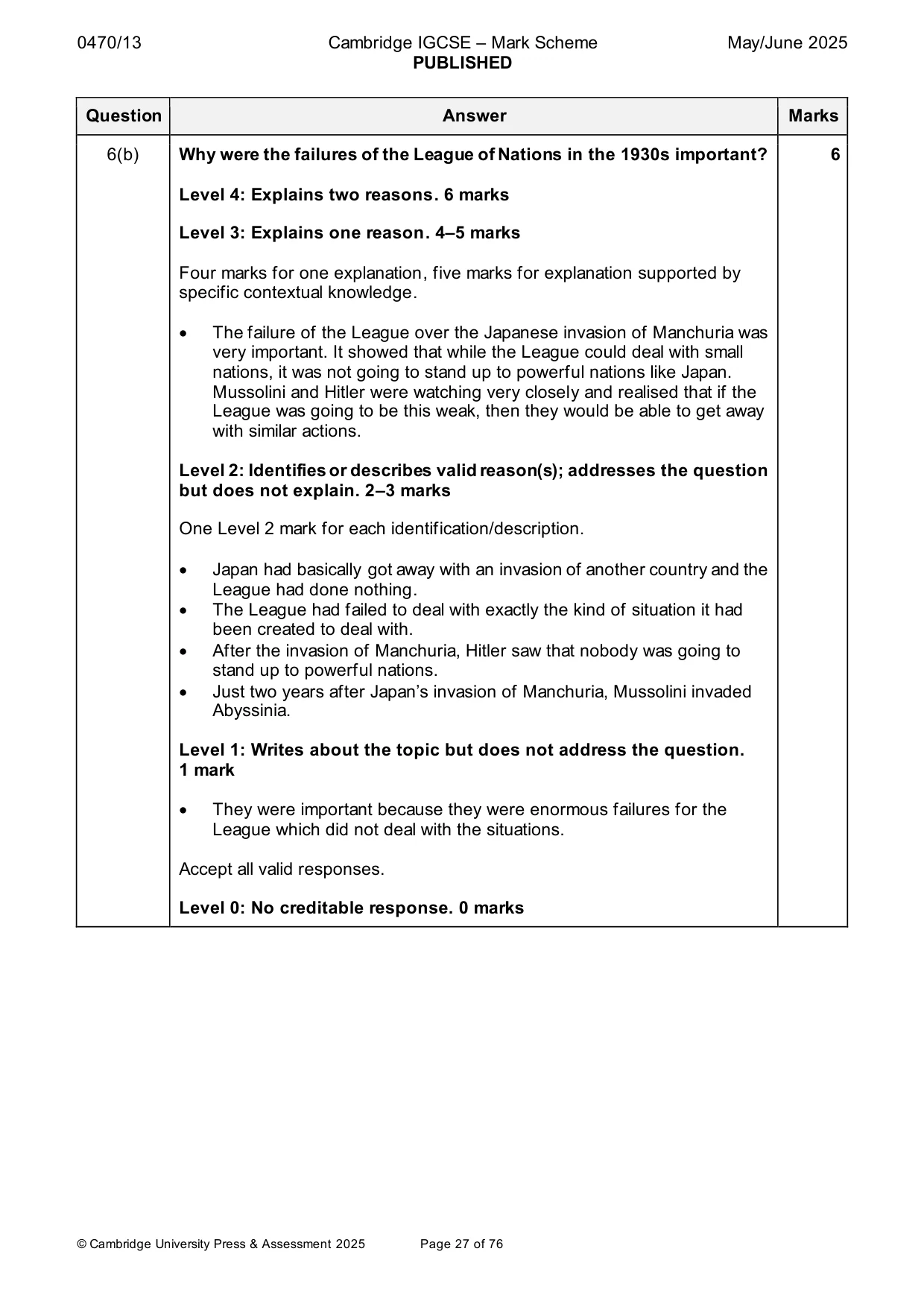
0470/13 Cambridge IGCSE – Mark Scheme PUBLISHED May/June 2025 © Cambridge University Press & Assessment 2025 Page 27 of 76 Question Answer Marks 6(b) Why were the failures of the League of Nations in the 1930s important? Level 4: Explains two reasons. 6 marks Level 3: Explains one reason. 4–5 marks Four marks for one explanation, five marks for explanation supported by specific contextual knowledge. • The failure of the League over the Japanese invasion of Manchuria was very important. It showed that while the League could deal with small nations, it was not going to stand up to powerful nations like Japan. Mussolini and Hitler were watching very closely and realised that if the League was going to be this weak, then they would be able to get away with similar actions. Level 2: Identifies or describes valid reason(s); addresses the question but does not explain. 2–3 marks One Level 2 mark for each identification/description. • Japan had basically got away with an invasion of another country and the League had done nothing. • The League had failed to deal with exactly the kind of situation it had been created to deal with. • After the invasion of Manchuria, Hitler saw that nobody was going to stand up to powerful nations. • Just two years after Japan’s invasion of Manchuria, Mussolini invaded Abyssinia. Level 1: Writes about the topic but does not address the question. 1 mark • They were important because they were enormous failures for the League which did not deal with the situations. Accept all valid responses. Level 0: No creditable response. 0 marks 6
Mark scheme, page 28
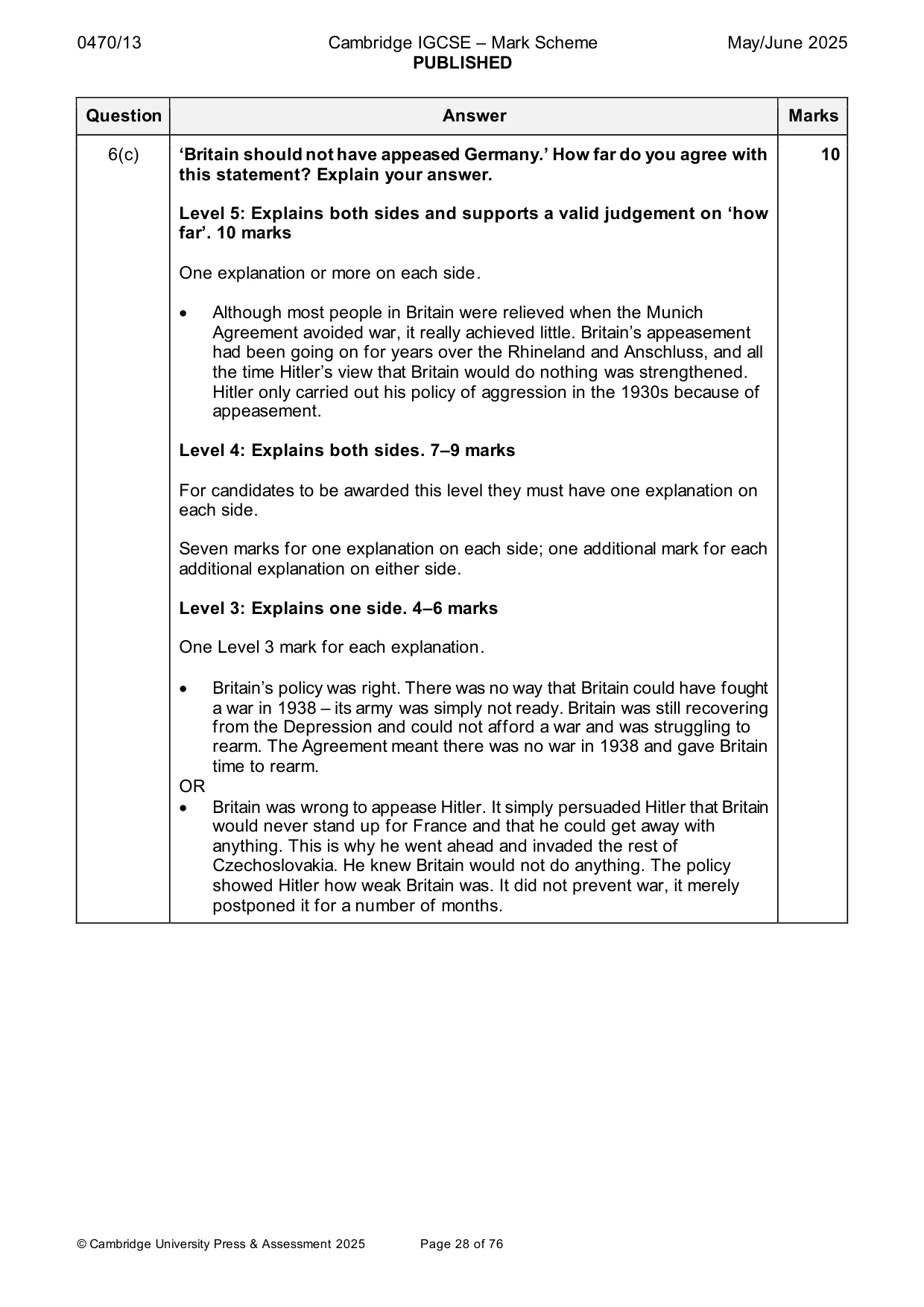
0470/13 Cambridge IGCSE – Mark Scheme PUBLISHED May/June 2025 © Cambridge University Press & Assessment 2025 Page 28 of 76 Question Answer Marks 6(c) ‘Britain should not have appeased Germany.’ How far do you agree with this statement? Explain your answer. Level 5: Explains both sides and supports a valid judgement on ‘how far’. 10 marks One explanation or more on each side. • Although most people in Britain were relieved when the Munich Agreement avoided war, it really achieved little. Britain’s appeasement had been going on for years over the Rhineland and Anschluss, and all the time Hitler’s view that Britain would do nothing was strengthened. Hitler only carried out his policy of aggression in the 1930s because of appeasement. Level 4: Explains both sides. 7–9 marks For candidates to be awarded this level they must have one explanation on each side. Seven marks for one explanation on each side; one additional mark for each additional explanation on either side. Level 3: Explains one side. 4–6 marks One Level 3 mark for each explanation. • Britain’s policy was right. There was no way that Britain could have fought a war in 1938 – its army was simply not ready. Britain was still recovering from the Depression and could not afford a war and was struggling to rearm. The Agreement meant there was no war in 1938 and gave Britain time to rearm. OR • Britain was wrong to appease Hitler. It simply persuaded Hitler that Britain would never stand up for France and that he could get away with anything. This is why he went ahead and invaded the rest of Czechoslovakia. He knew Britain would not do anything. The policy showed Hitler how weak Britain was. It did not prevent war, it merely postponed it for a number of months. 10
Mark scheme, page 29
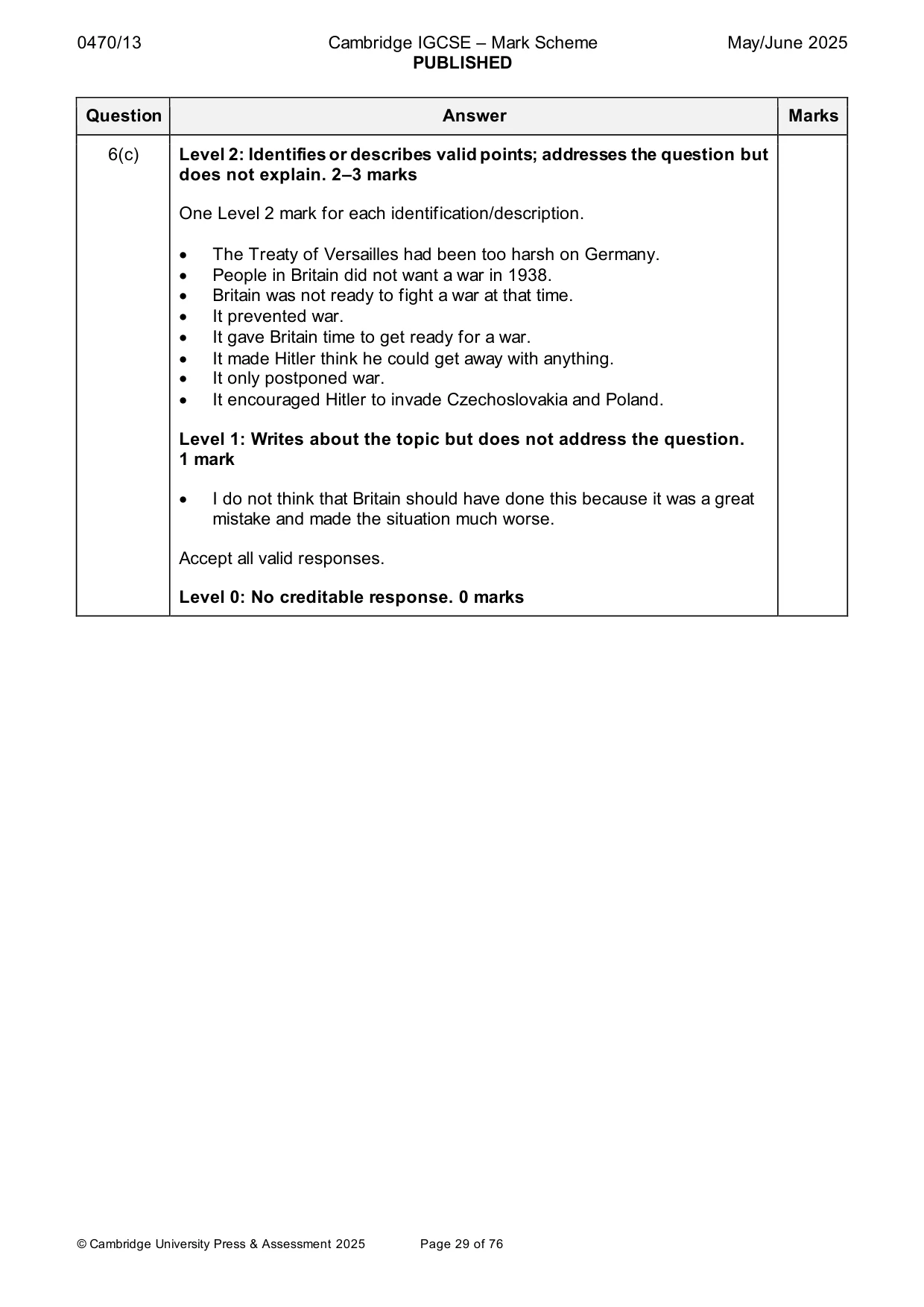
0470/13 Cambridge IGCSE – Mark Scheme PUBLISHED May/June 2025 © Cambridge University Press & Assessment 2025 Page 29 of 76 Question Answer Marks 6(c) Level 2: Identifies or describes valid points; addresses the question but does not explain. 2–3 marks One Level 2 mark for each identification/description. • The Treaty of Versailles had been too harsh on Germany. • People in Britain did not want a war in 1938. • Britain was not ready to fight a war at that time. • It prevented war. • It gave Britain time to get ready for a war. • It made Hitler think he could get away with anything. • It only postponed war. • It encouraged Hitler to invade Czechoslovakia and Poland. Level 1: Writes about the topic but does not address the question. 1 mark • I do not think that Britain should have done this because it was a great mistake and made the situation much worse. Accept all valid responses. Level 0: No creditable response. 0 marks
Mark scheme, page 30
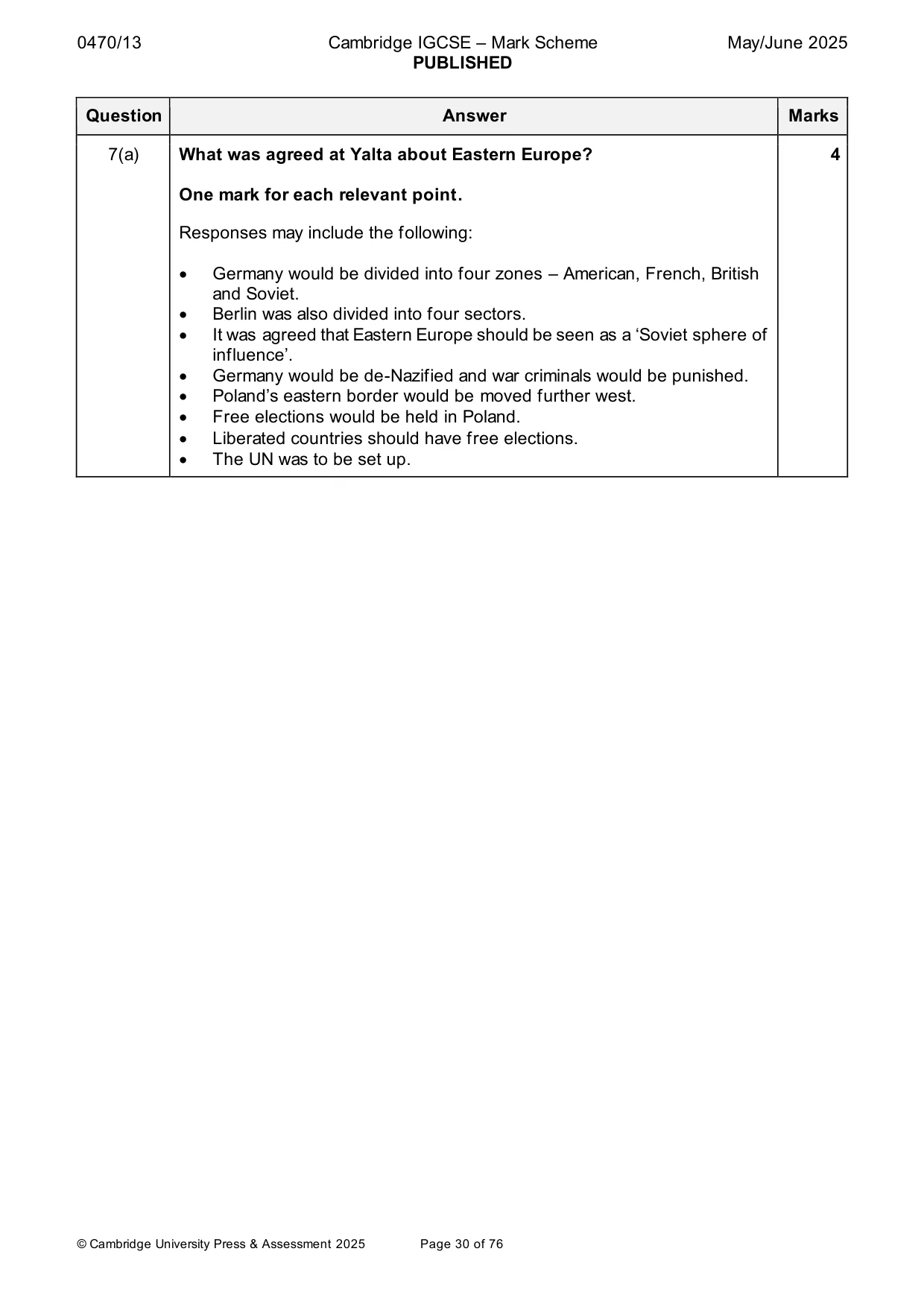
0470/13 Cambridge IGCSE – Mark Scheme PUBLISHED May/June 2025 © Cambridge University Press & Assessment 2025 Page 30 of 76 Question Answer Marks 7(a) What was agreed at Yalta about Eastern Europe? One mark for each relevant point. Responses may include the following: • Germany would be divided into four zones – American, French, British and Soviet. • Berlin was also divided into four sectors. • It was agreed that Eastern Europe should be seen as a ‘Soviet sphere of influence’. • Germany would be de-Nazified and war criminals would be punished. • Poland’s eastern border would be moved further west. • Free elections would be held in Poland. • Liberated countries should have free elections. • The UN was to be set up. 4
Mark scheme, page 31
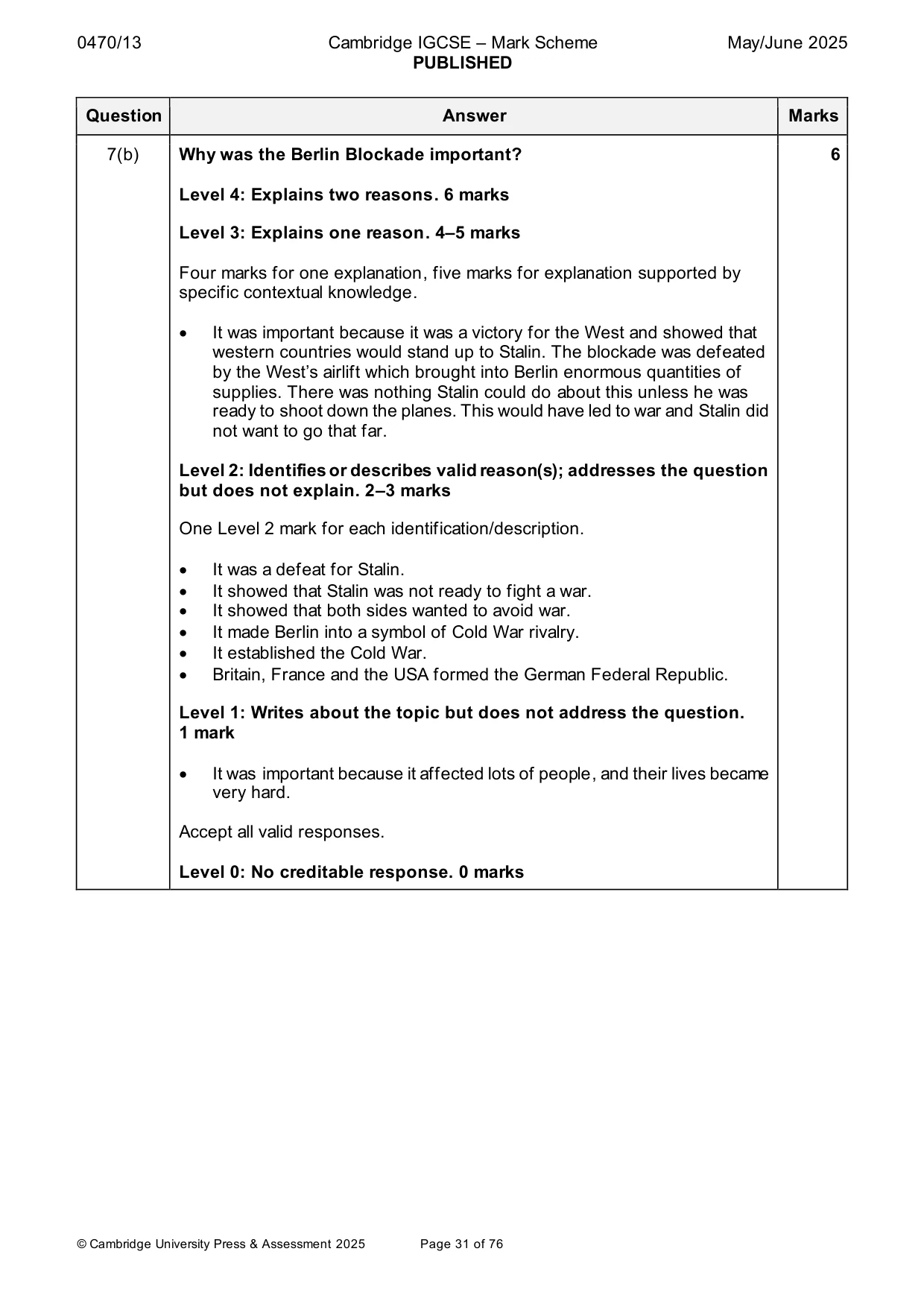
0470/13 Cambridge IGCSE – Mark Scheme PUBLISHED May/June 2025 © Cambridge University Press & Assessment 2025 Page 31 of 76 Question Answer Marks 7(b) Why was the Berlin Blockade important? Level 4: Explains two reasons. 6 marks Level 3: Explains one reason. 4–5 marks Four marks for one explanation, five marks for explanation supported by specific contextual knowledge. • It was important because it was a victory for the West and showed that western countries would stand up to Stalin. The blockade was defeated by the West’s airlift which brought into Berlin enormous quantities of supplies. There was nothing Stalin could do about this unless he was ready to shoot down the planes. This would have led to war and Stalin did not want to go that far. Level 2: Identifies or describes valid reason(s); addresses the question but does not explain. 2–3 marks One Level 2 mark for each identification/description. • It was a defeat for Stalin. • It showed that Stalin was not ready to fight a war. • It showed that both sides wanted to avoid war. • It made Berlin into a symbol of Cold War rivalry. • It established the Cold War. • Britain, France and the USA formed the German Federal Republic. Level 1: Writes about the topic but does not address the question. 1 mark • It was important because it affected lots of people, and their lives became very hard. Accept all valid responses. Level 0: No creditable response. 0 marks 6
Mark scheme, page 32
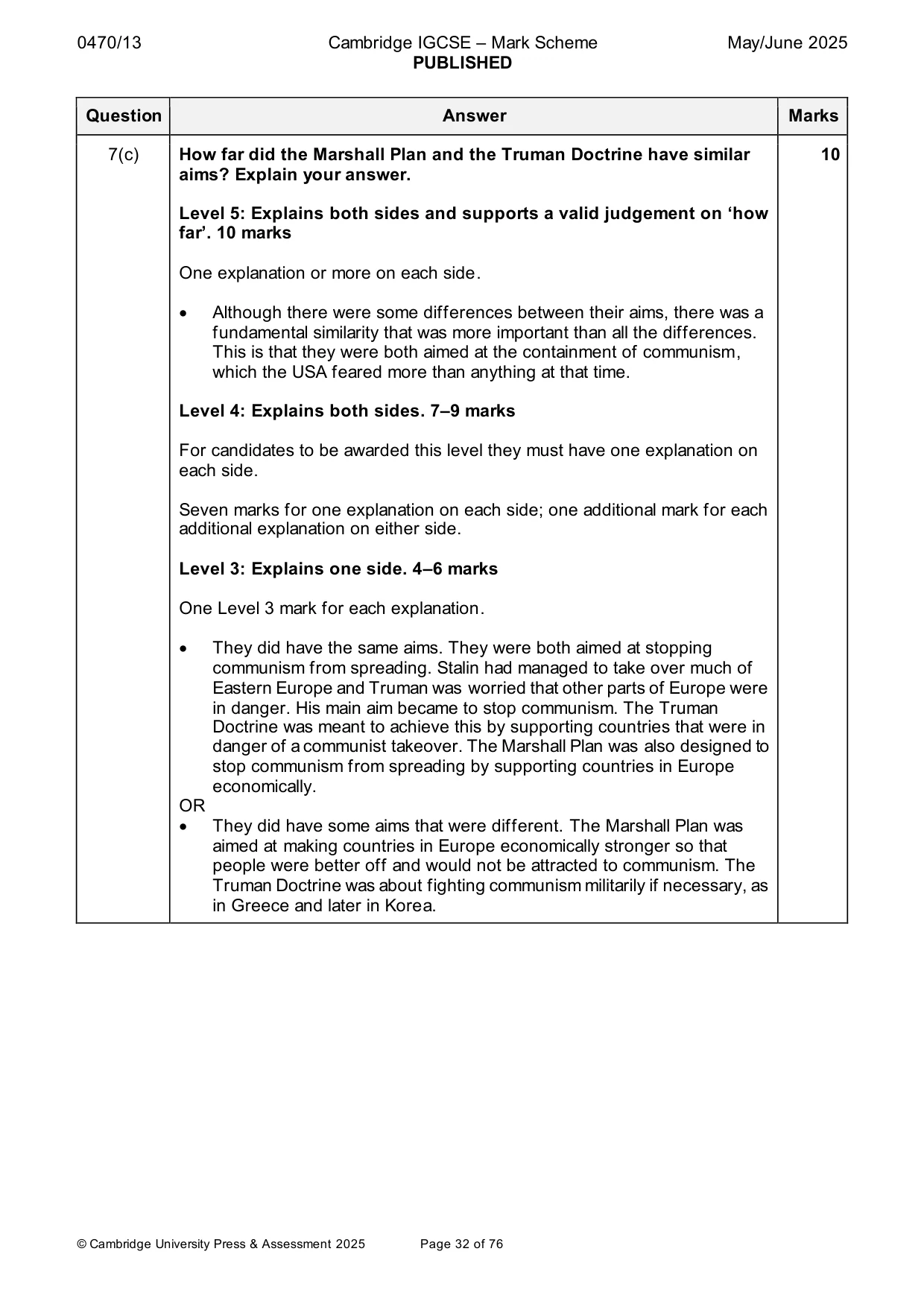
0470/13 Cambridge IGCSE – Mark Scheme PUBLISHED May/June 2025 © Cambridge University Press & Assessment 2025 Page 32 of 76 Question Answer Marks 7(c) How far did the Marshall Plan and the Truman Doctrine have similar aims? Explain your answer. Level 5: Explains both sides and supports a valid judgement on ‘how far’. 10 marks One explanation or more on each side. • Although there were some differences between their aims, there was a fundamental similarity that was more important than all the differences. This is that they were both aimed at the containment of communism, which the USA feared more than anything at that time. Level 4: Explains both sides. 7–9 marks For candidates to be awarded this level they must have one explanation on each side. Seven marks for one explanation on each side; one additional mark for each additional explanation on either side. Level 3: Explains one side. 4–6 marks One Level 3 mark for each explanation. • They did have the same aims. They were both aimed at stopping communism from spreading. Stalin had managed to take over much of Eastern Europe and Truman was worried that other parts of Europe were in danger. His main aim became to stop communism. The Truman Doctrine was meant to achieve this by supporting countries that were in danger of a communist takeover. The Marshall Plan was also designed to stop communism from spreading by supporting countries in Europe economically. OR • They did have some aims that were different. The Marshall Plan was aimed at making countries in Europe economically stronger so that people were better off and would not be attracted to communism. The Truman Doctrine was about fighting communism militarily if necessary, as in Greece and later in Korea. 10
Mark scheme, page 33
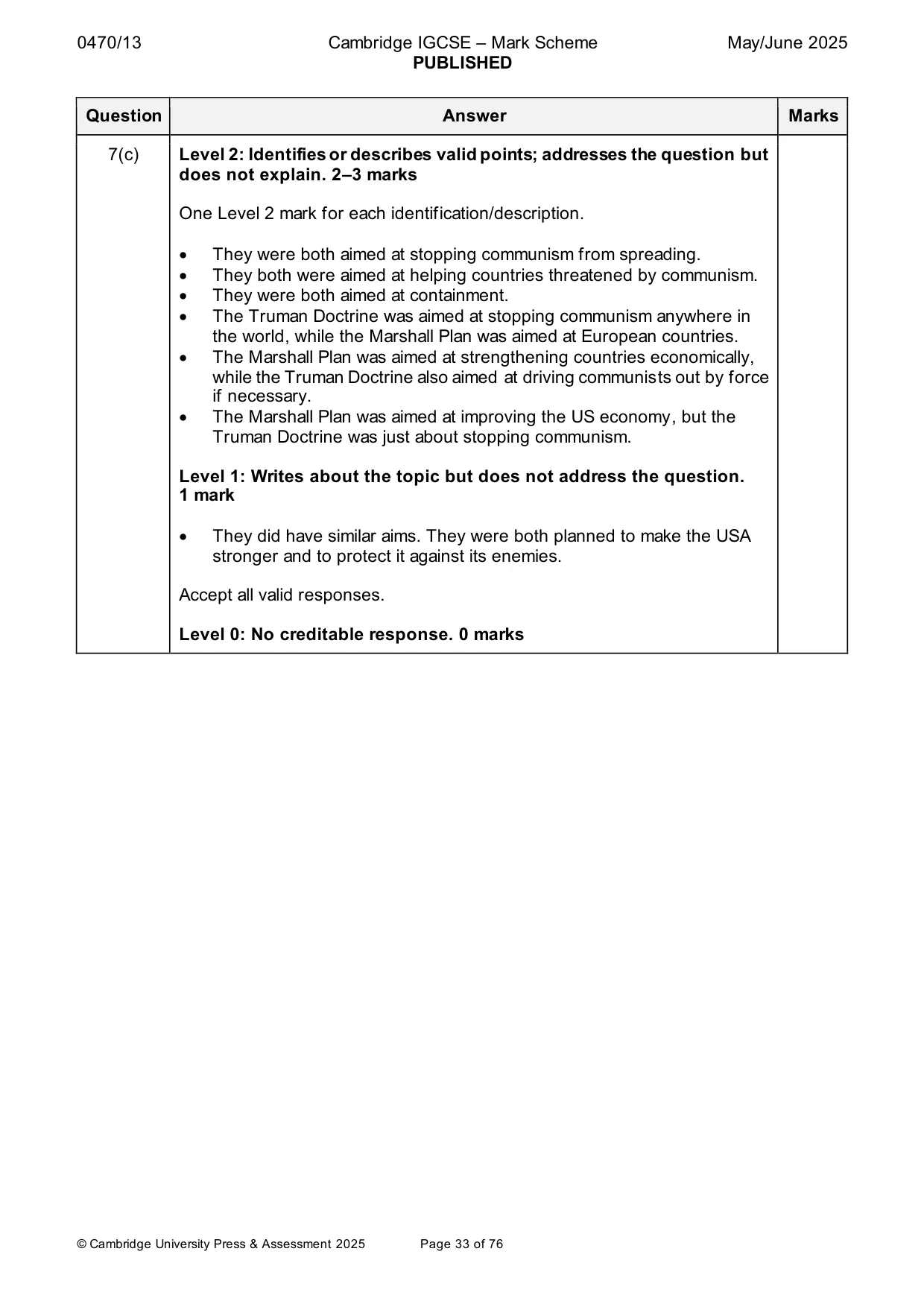
0470/13 Cambridge IGCSE – Mark Scheme PUBLISHED May/June 2025 © Cambridge University Press & Assessment 2025 Page 33 of 76 Question Answer Marks 7(c) Level 2: Identifies or describes valid points; addresses the question but does not explain. 2–3 marks One Level 2 mark for each identification/description. • They were both aimed at stopping communism from spreading. • They both were aimed at helping countries threatened by communism. • They were both aimed at containment. • The Truman Doctrine was aimed at stopping communism anywhere in the world, while the Marshall Plan was aimed at European countries. • The Marshall Plan was aimed at strengthening countries economically, while the Truman Doctrine also aimed at driving communists out by force if necessary. • The Marshall Plan was aimed at improving the US economy, but the Truman Doctrine was just about stopping communism. Level 1: Writes about the topic but does not address the question. 1 mark • They did have similar aims. They were both planned to make the USA stronger and to protect it against its enemies. Accept all valid responses. Level 0: No creditable response. 0 marks
Mark scheme, page 34
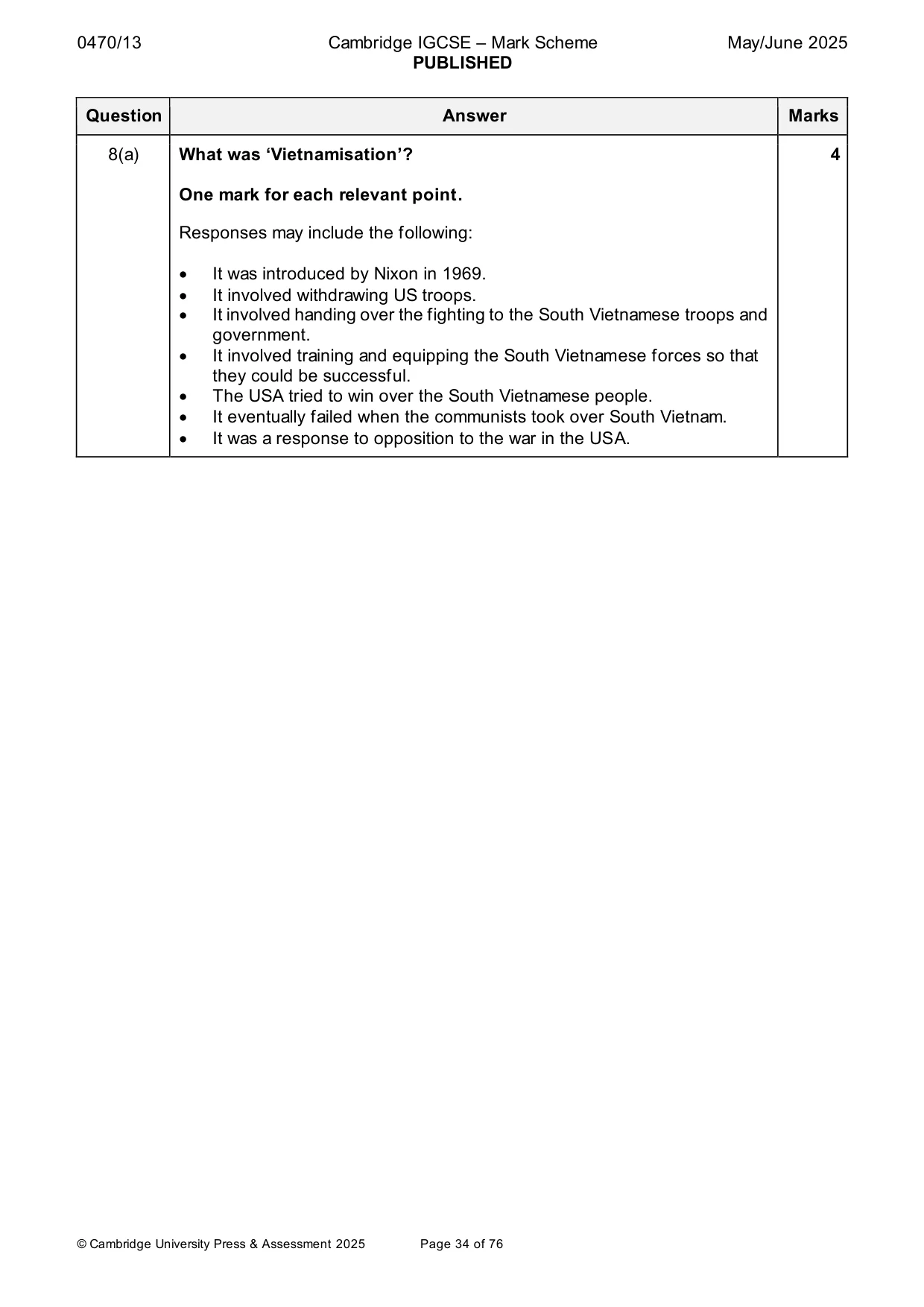
0470/13 Cambridge IGCSE – Mark Scheme PUBLISHED May/June 2025 © Cambridge University Press & Assessment 2025 Page 34 of 76 Question Answer Marks 8(a) What was ‘Vietnamisation’? One mark for each relevant point. Responses may include the following: • It was introduced by Nixon in 1969. • It involved withdrawing US troops. • It involved handing over the fighting to the South Vietnamese troops and government. • It involved training and equipping the South Vietnamese forces so that they could be successful. • The USA tried to win over the South Vietnamese people. • It eventually failed when the communists took over South Vietnam. • It was a response to opposition to the war in the USA. 4
Mark scheme, page 35
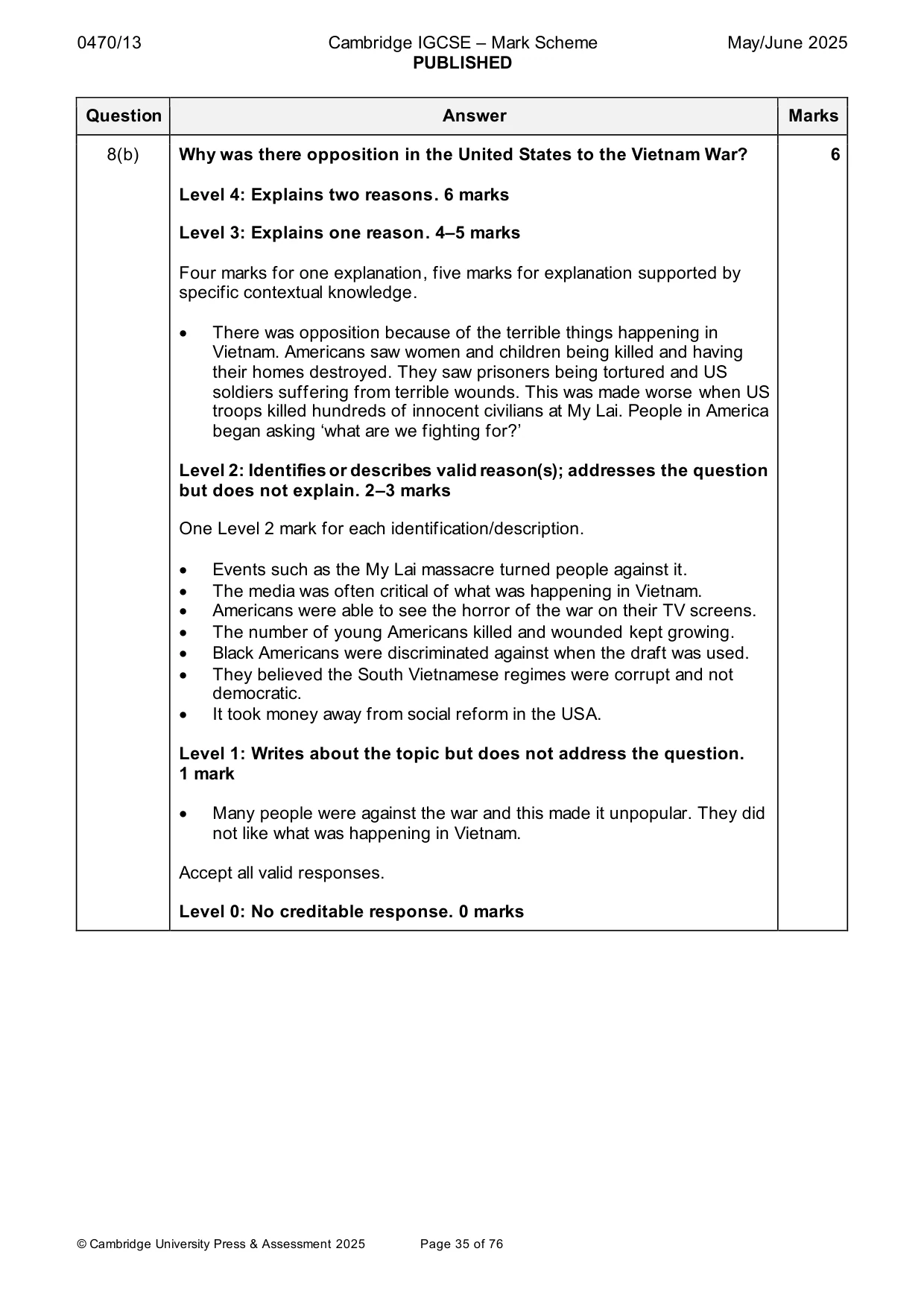
0470/13 Cambridge IGCSE – Mark Scheme PUBLISHED May/June 2025 © Cambridge University Press & Assessment 2025 Page 35 of 76 Question Answer Marks 8(b) Why was there opposition in the United States to the Vietnam War? Level 4: Explains two reasons. 6 marks Level 3: Explains one reason. 4–5 marks Four marks for one explanation, five marks for explanation supported by specific contextual knowledge. • There was opposition because of the terrible things happening in Vietnam. Americans saw women and children being killed and having their homes destroyed. They saw prisoners being tortured and US soldiers suffering from terrible wounds. This was made worse when US troops killed hundreds of innocent civilians at My Lai. People in America began asking ‘what are we fighting for?’ Level 2: Identifies or describes valid reason(s); addresses the question but does not explain. 2–3 marks One Level 2 mark for each identification/description. • Events such as the My Lai massacre turned people against it. • The media was often critical of what was happening in Vietnam. • Americans were able to see the horror of the war on their TV screens. • The number of young Americans killed and wounded kept growing. • Black Americans were discriminated against when the draft was used. • They believed the South Vietnamese regimes were corrupt and not democratic. • It took money away from social reform in the USA. Level 1: Writes about the topic but does not address the question. 1 mark • Many people were against the war and this made it unpopular. They did not like what was happening in Vietnam. Accept all valid responses. Level 0: No creditable response. 0 marks 6
Mark scheme, page 36
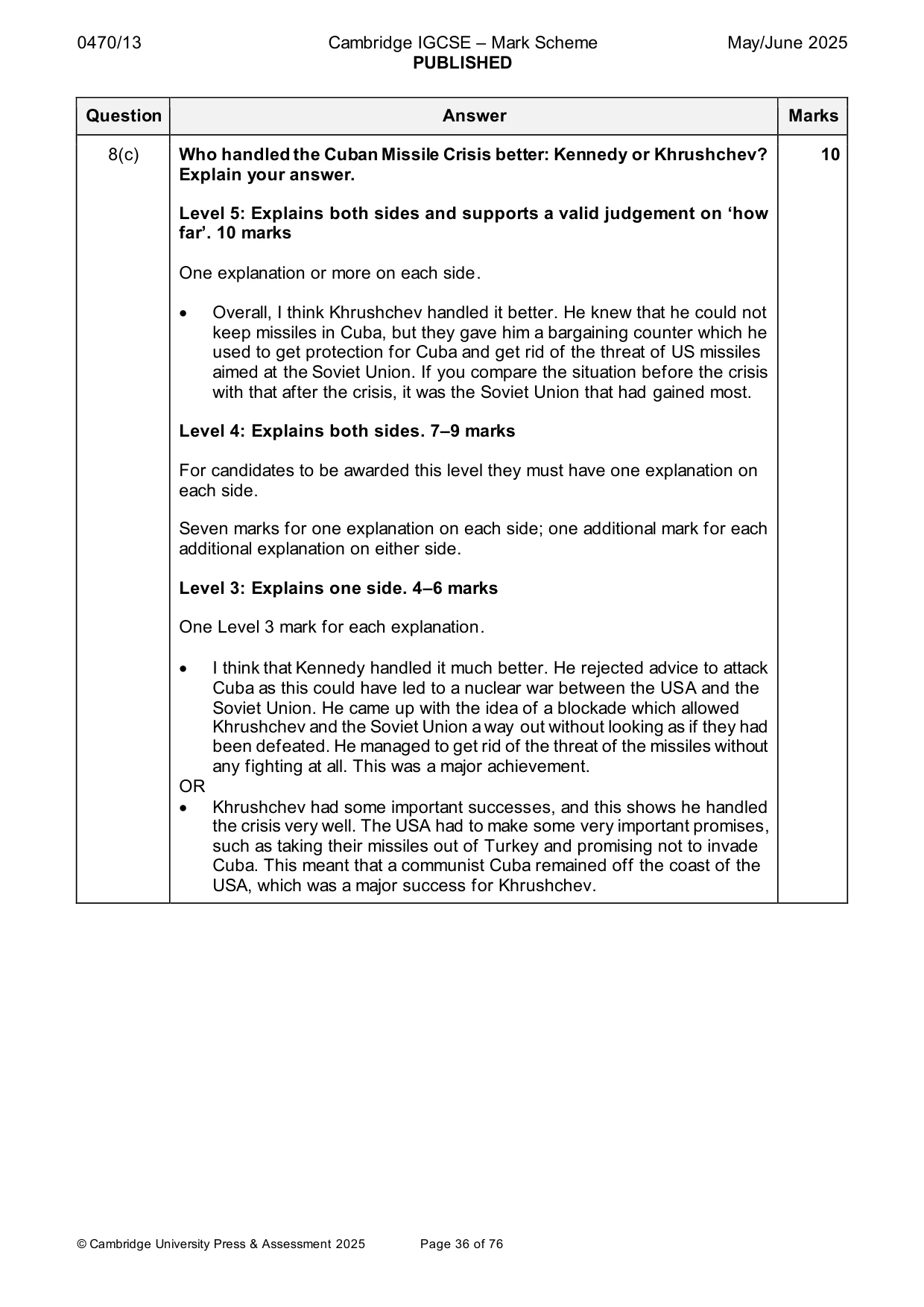
0470/13 Cambridge IGCSE – Mark Scheme PUBLISHED May/June 2025 © Cambridge University Press & Assessment 2025 Page 36 of 76 Question Answer Marks 8(c) Who handled the Cuban Missile Crisis better: Kennedy or Khrushchev? Explain your answer. Level 5: Explains both sides and supports a valid judgement on ‘how far’. 10 marks One explanation or more on each side. • Overall, I think Khrushchev handled it better. He knew that he could not keep missiles in Cuba, but they gave him a bargaining counter which he used to get protection for Cuba and get rid of the threat of US missiles aimed at the Soviet Union. If you compare the situation before the crisis with that after the crisis, it was the Soviet Union that had gained most. Level 4: Explains both sides. 7–9 marks For candidates to be awarded this level they must have one explanation on each side. Seven marks for one explanation on each side; one additional mark for each additional explanation on either side. Level 3: Explains one side. 4–6 marks One Level 3 mark for each explanation. • I think that Kennedy handled it much better. He rejected advice to attack Cuba as this could have led to a nuclear war between the USA and the Soviet Union. He came up with the idea of a blockade which allowed Khrushchev and the Soviet Union a way out without looking as if they had been defeated. He managed to get rid of the threat of the missiles without any fighting at all. This was a major achievement. OR • Khrushchev had some important successes, and this shows he handled the crisis very well. The USA had to make some very important promises, such as taking their missiles out of Turkey and promising not to invade Cuba. This meant that a communist Cuba remained off the coast of the USA, which was a major success for Khrushchev. 10
Mark scheme, page 37
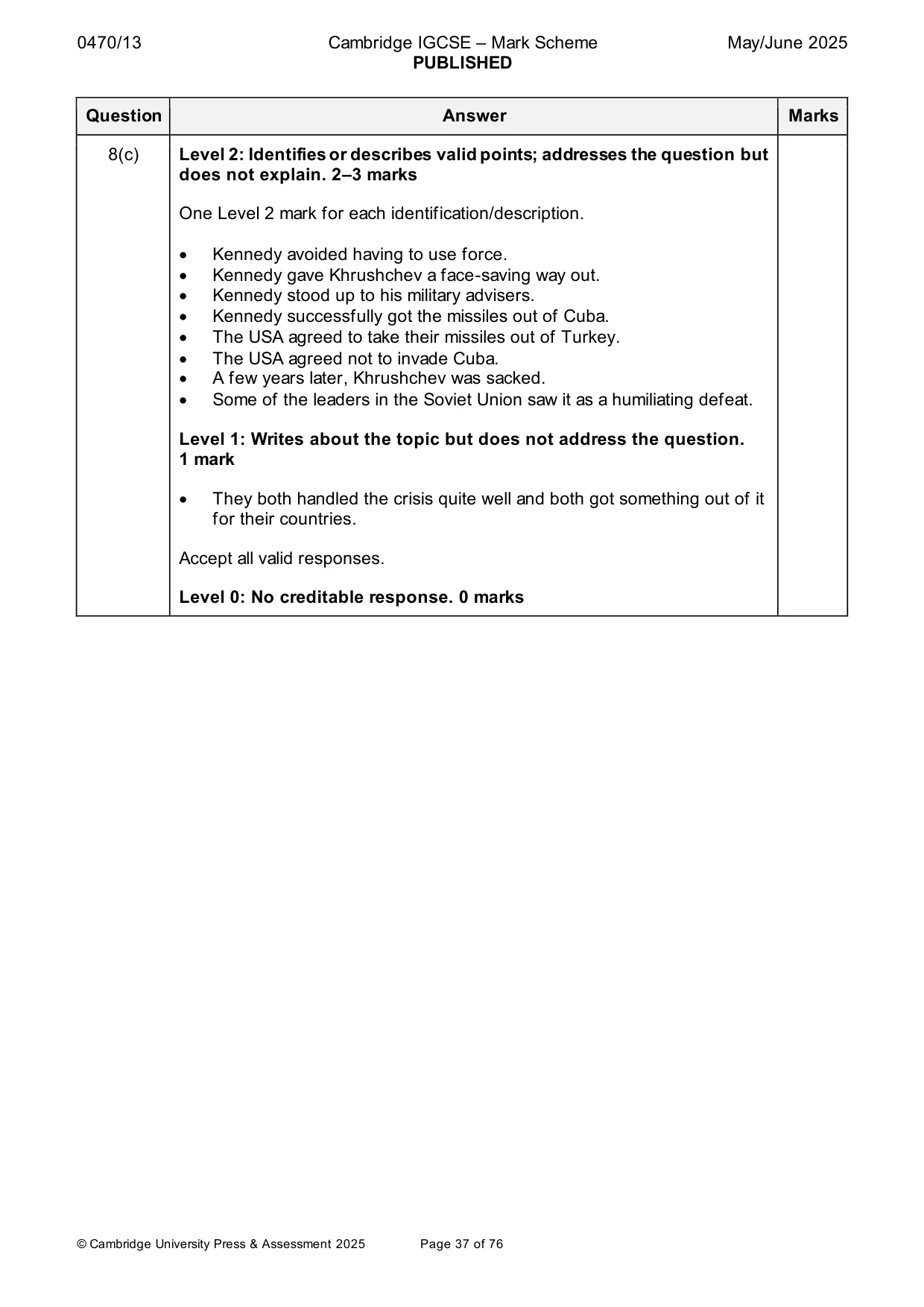
0470/13 Cambridge IGCSE – Mark Scheme PUBLISHED May/June 2025 © Cambridge University Press & Assessment 2025 Page 37 of 76 Question Answer Marks 8(c) Level 2: Identifies or describes valid points; addresses the question but does not explain. 2–3 marks One Level 2 mark for each identification/description. • Kennedy avoided having to use force. • Kennedy gave Khrushchev a face-saving way out. • Kennedy stood up to his military advisers. • Kennedy successfully got the missiles out of Cuba. • The USA agreed to take their missiles out of Turkey. • The USA agreed not to invade Cuba. • A few years later, Khrushchev was sacked. • Some of the leaders in the Soviet Union saw it as a humiliating defeat. Level 1: Writes about the topic but does not address the question. 1 mark • They both handled the crisis quite well and both got something out of it for their countries. Accept all valid responses. Level 0: No creditable response. 0 marks
Mark scheme, page 38
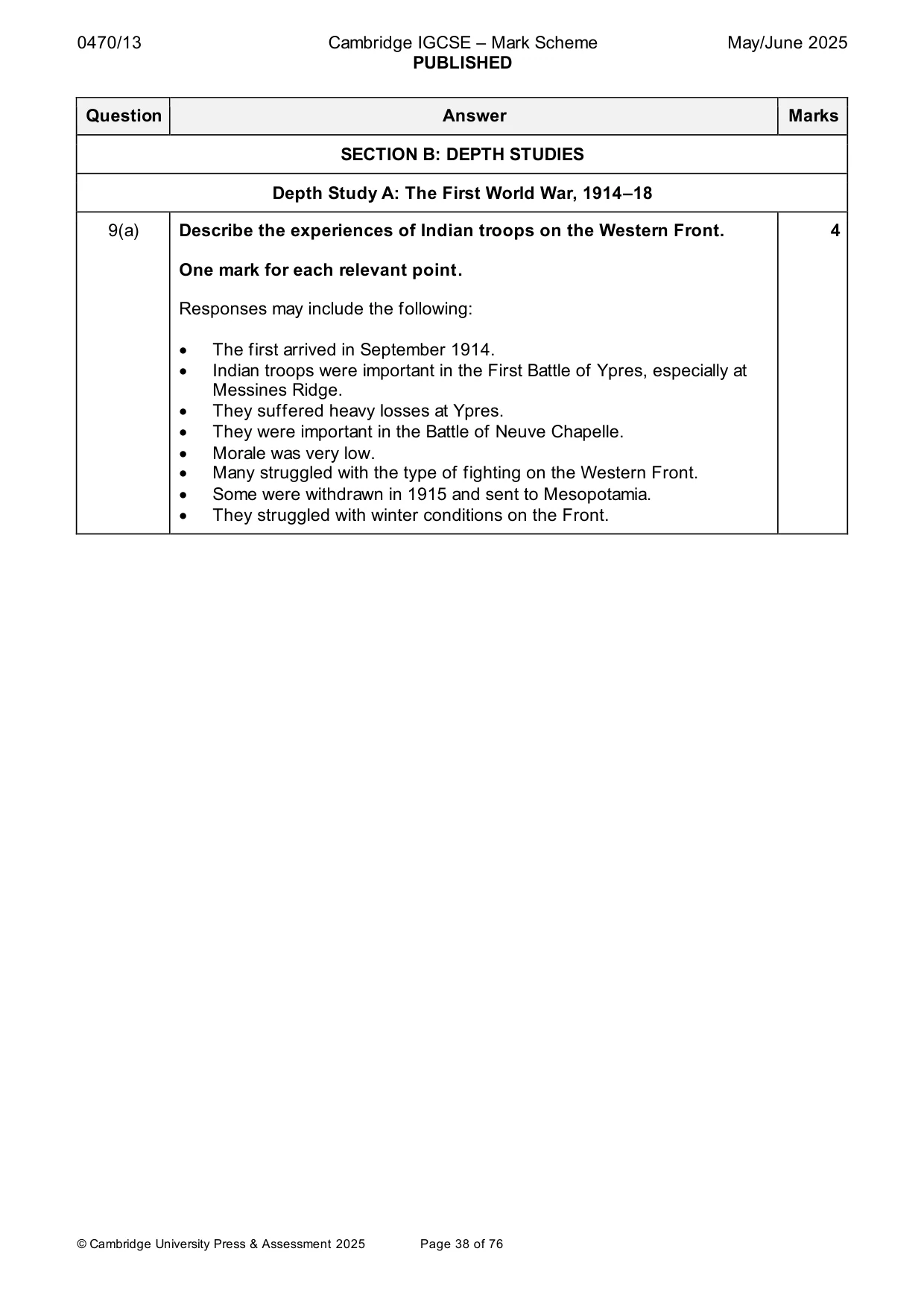
0470/13 Cambridge IGCSE – Mark Scheme PUBLISHED May/June 2025 © Cambridge University Press & Assessment 2025 Page 38 of 76 Question Answer Marks SECTION B: DEPTH STUDIES Depth Study A: The First World War, 1914–18 9(a) Describe the experiences of Indian troops on the Western Front. One mark for each relevant point. Responses may include the following: • The first arrived in September 1914. • Indian troops were important in the First Battle of Ypres, especially at Messines Ridge. • They suffered heavy losses at Ypres. • They were important in the Battle of Neuve Chapelle. • Morale was very low. • Many struggled with the type of fighting on the Western Front. • Some were withdrawn in 1915 and sent to Mesopotamia. • They struggled with winter conditions on the Front. 4
Mark scheme, page 39
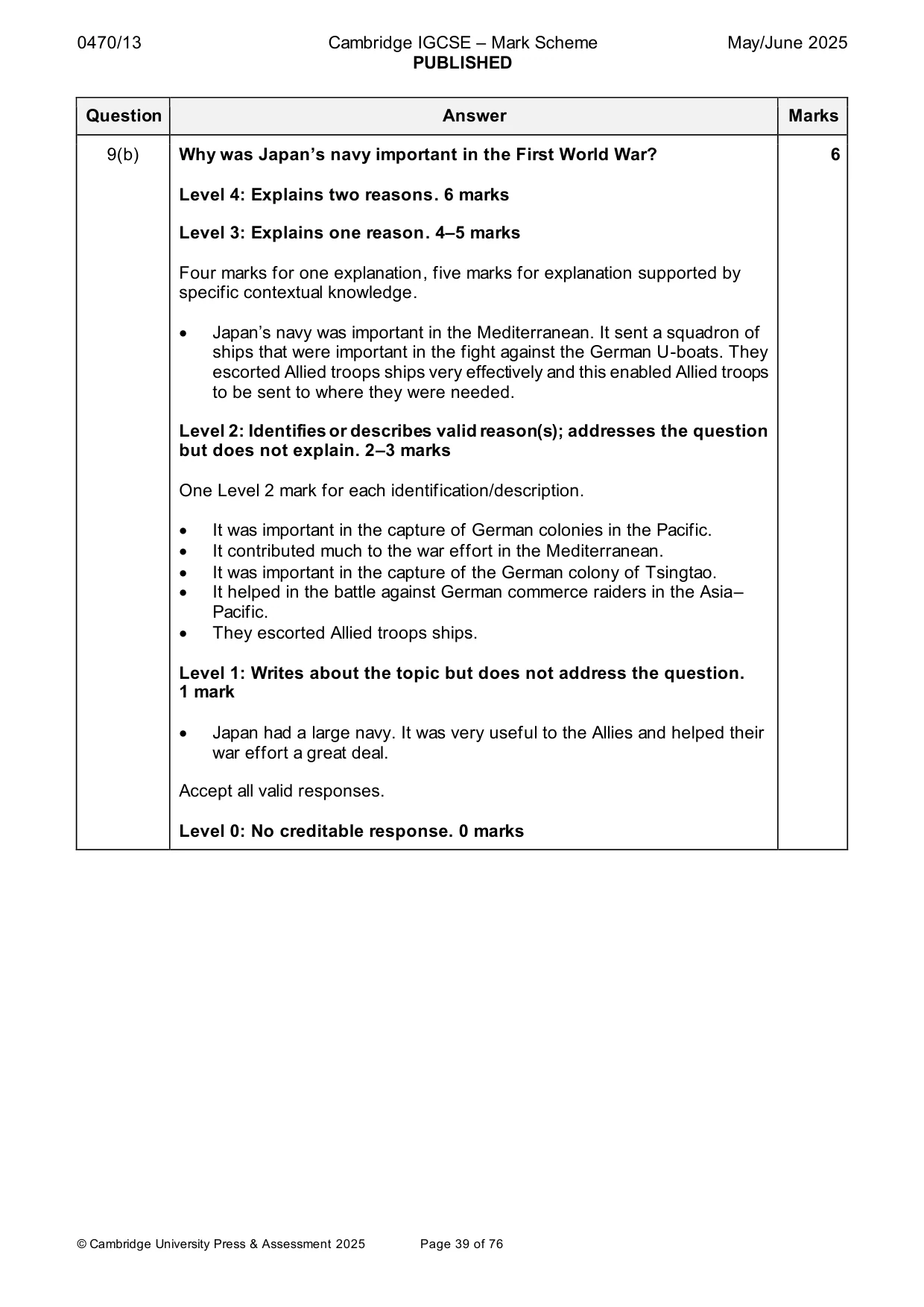
0470/13 Cambridge IGCSE – Mark Scheme PUBLISHED May/June 2025 © Cambridge University Press & Assessment 2025 Page 39 of 76 Question Answer Marks 9(b) Why was Japan’s navy important in the First World War? Level 4: Explains two reasons. 6 marks Level 3: Explains one reason. 4–5 marks Four marks for one explanation, five marks for explanation supported by specific contextual knowledge. • Japan’s navy was important in the Mediterranean. It sent a squadron of ships that were important in the fight against the German U-boats. They escorted Allied troops ships very effectively and this enabled Allied troops to be sent to where they were needed. Level 2: Identifies or describes valid reason(s); addresses the question but does not explain. 2–3 marks One Level 2 mark for each identification/description. • It was important in the capture of German colonies in the Pacific. • It contributed much to the war effort in the Mediterranean. • It was important in the capture of the German colony of Tsingtao. • It helped in the battle against German commerce raiders in the Asia– Pacific. • They escorted Allied troops ships. Level 1: Writes about the topic but does not address the question. 1 mark • Japan had a large navy. It was very useful to the Allies and helped their war effort a great deal. Accept all valid responses. Level 0: No creditable response. 0 marks 6
Mark scheme, page 40
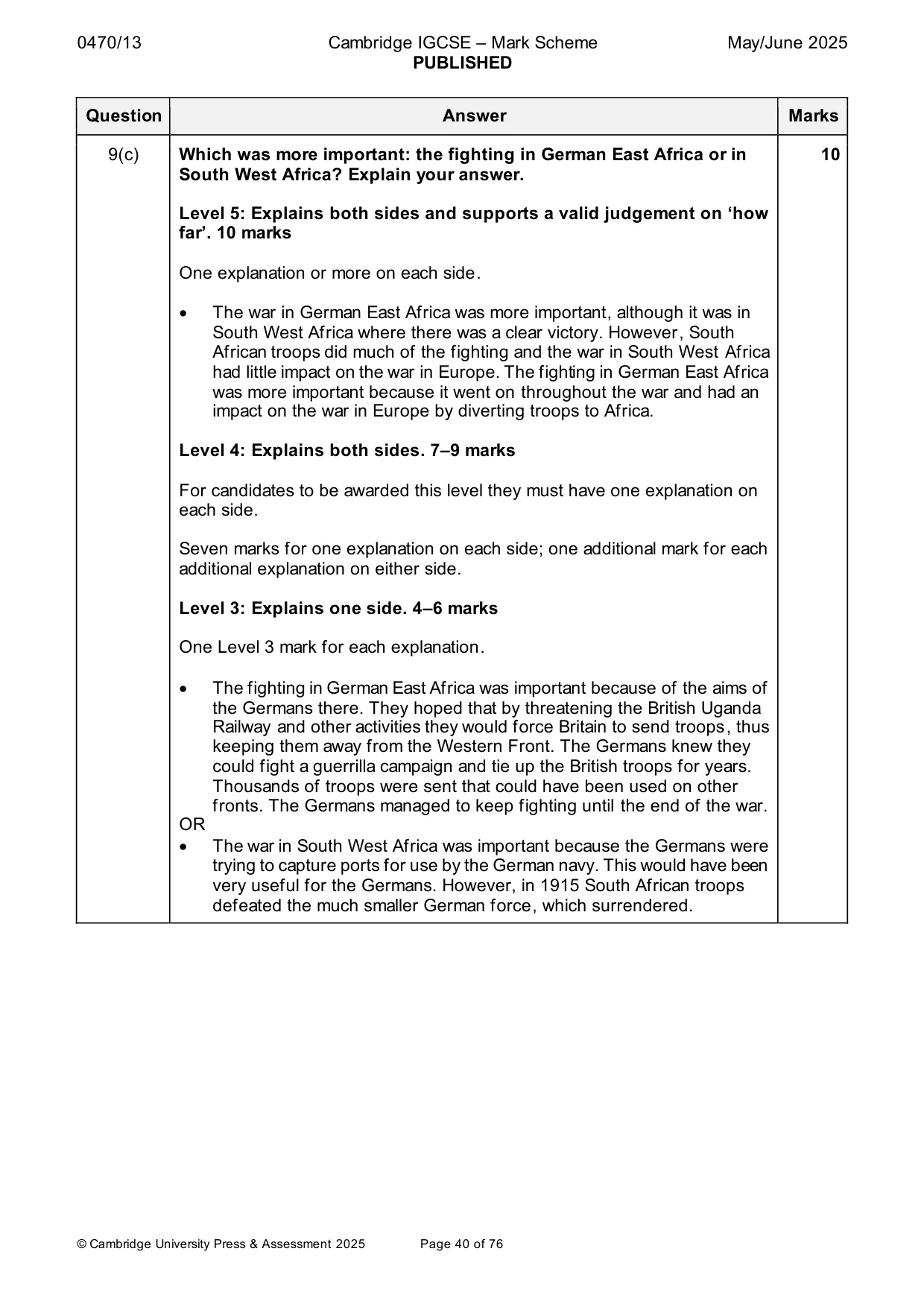
0470/13 Cambridge IGCSE – Mark Scheme PUBLISHED May/June 2025 © Cambridge University Press & Assessment 2025 Page 40 of 76 Question Answer Marks 9(c) Which was more important: the fighting in German East Africa or in South West Africa? Explain your answer. Level 5: Explains both sides and supports a valid judgement on ‘how far’. 10 marks One explanation or more on each side. • The war in German East Africa was more important, although it was in South West Africa where there was a clear victory. However, South African troops did much of the fighting and the war in South West Africa had little impact on the war in Europe. The fighting in German East Africa was more important because it went on throughout the war and had an impact on the war in Europe by diverting troops to Africa. Level 4: Explains both sides. 7–9 marks For candidates to be awarded this level they must have one explanation on each side. Seven marks for one explanation on each side; one additional mark for each additional explanation on either side. Level 3: Explains one side. 4–6 marks One Level 3 mark for each explanation. • The fighting in German East Africa was important because of the aims of the Germans there. They hoped that by threatening the British Uganda Railway and other activities they would force Britain to send troops, thus keeping them away from the Western Front. The Germans knew they could fight a guerrilla campaign and tie up the British troops for years. Thousands of troops were sent that could have been used on other fronts. The Germans managed to keep fighting until the end of the war. OR • The war in South West Africa was important because the Germans were trying to capture ports for use by the German navy. This would have been very useful for the Germans. However, in 1915 South African troops defeated the much smaller German force, which surrendered. 10
Mark scheme, page 41
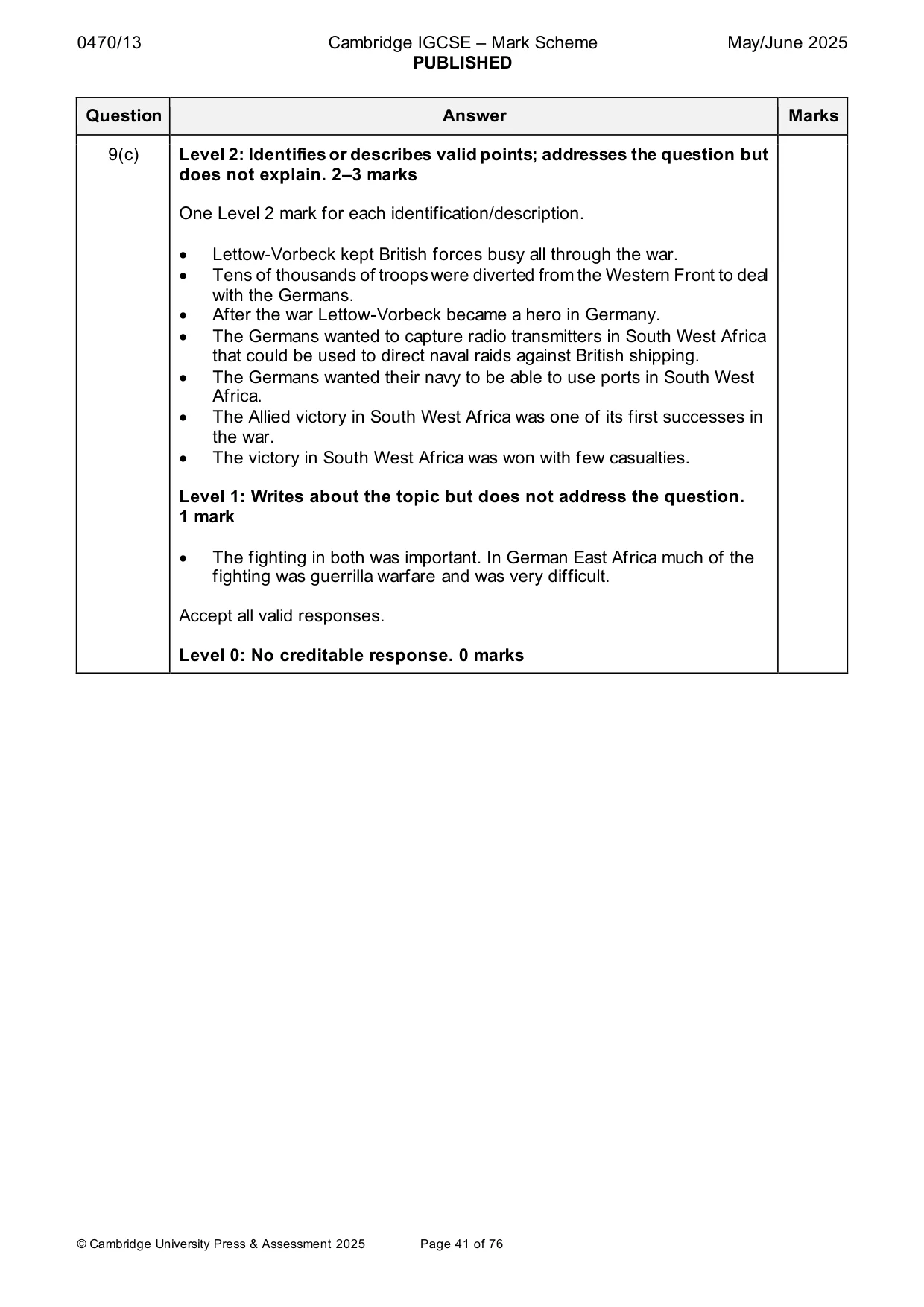
0470/13 Cambridge IGCSE – Mark Scheme PUBLISHED May/June 2025 © Cambridge University Press & Assessment 2025 Page 41 of 76 Question Answer Marks 9(c) Level 2: Identifies or describes valid points; addresses the question but does not explain. 2–3 marks One Level 2 mark for each identification/description. • Lettow-Vorbeck kept British forces busy all through the war. • Tens of thousands of troops were diverted from the Western Front to deal with the Germans. • After the war Lettow-Vorbeck became a hero in Germany. • The Germans wanted to capture radio transmitters in South West Africa that could be used to direct naval raids against British shipping. • The Germans wanted their navy to be able to use ports in South West Africa. • The Allied victory in South West Africa was one of its first successes in the war. • The victory in South West Africa was won with few casualties. Level 1: Writes about the topic but does not address the question. 1 mark • The fighting in both was important. In German East Africa much of the fighting was guerrilla warfare and was very difficult. Accept all valid responses. Level 0: No creditable response. 0 marks
Mark scheme, page 42
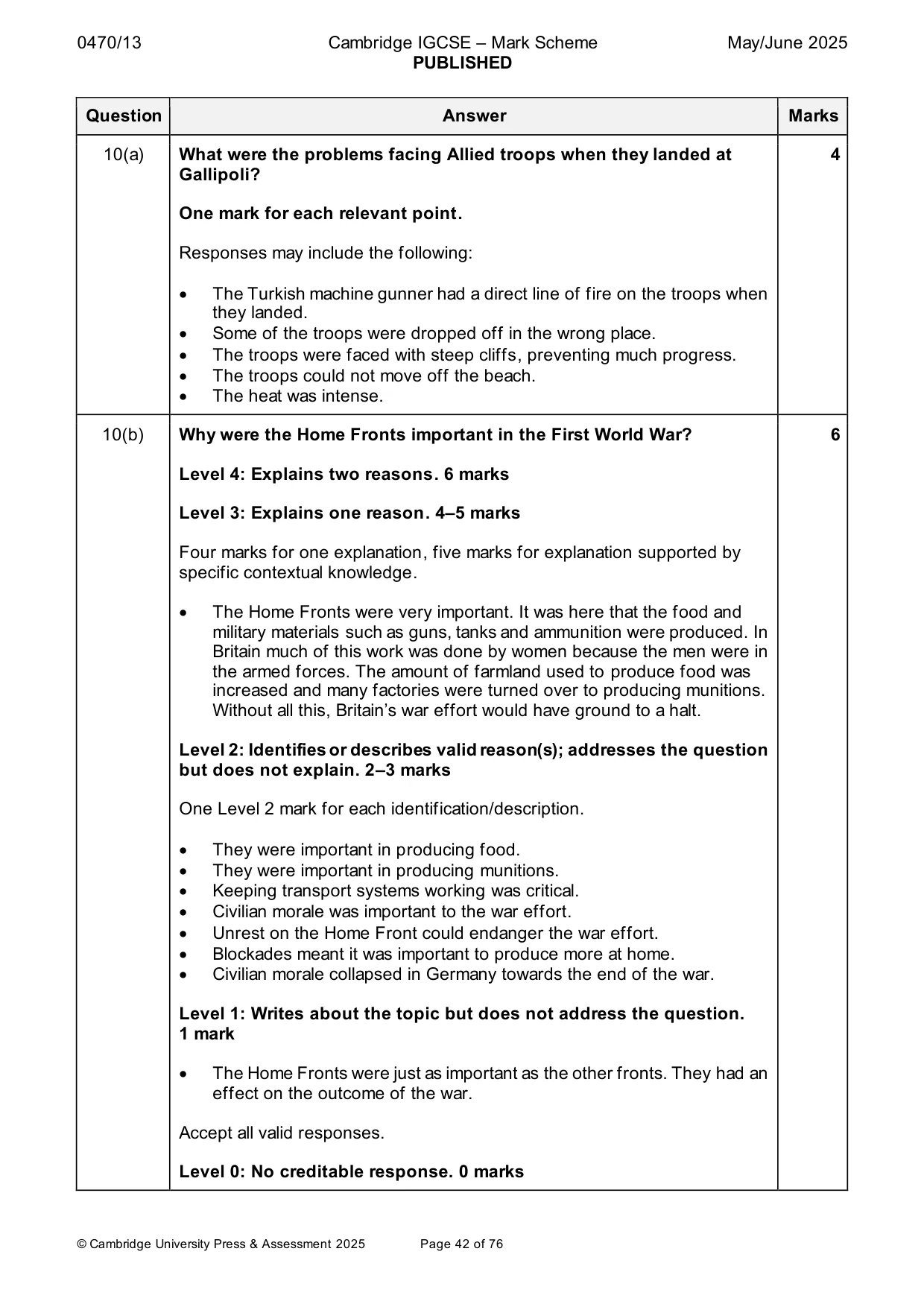
0470/13 Cambridge IGCSE – Mark Scheme PUBLISHED May/June 2025 © Cambridge University Press & Assessment 2025 Page 42 of 76 Question Answer Marks 10(a) What were the problems facing Allied troops when they landed at Gallipoli? One mark for each relevant point. Responses may include the following: • The Turkish machine gunner had a direct line of fire on the troops when they landed. • Some of the troops were dropped off in the wrong place. • The troops were faced with steep cliffs, preventing much progress. • The troops could not move off the beach. • The heat was intense. 4 10(b) Why were the Home Fronts important in the First World War? Level 4: Explains two reasons. 6 marks Level 3: Explains one reason. 4–5 marks Four marks for one explanation, five marks for explanation supported by specific contextual knowledge. • The Home Fronts were very important. It was here that the food and military materials such as guns, tanks and ammunition were produced. In Britain much of this work was done by women because the men were in the armed forces. The amount of farmland used to produce food was increased and many factories were turned over to producing munitions. Without all this, Britain’s war effort would have ground to a halt. Level 2: Identifies or describes valid reason(s); addresses the question but does not explain. 2–3 marks One Level 2 mark for each identification/description. • They were important in producing food. • They were important in producing munitions. • Keeping transport systems working was critical. • Civilian morale was important to the war effort. • Unrest on the Home Front could endanger the war effort. • Blockades meant it was important to produce more at home. • Civilian morale collapsed in Germany towards the end of the war. Level 1: Writes about the topic but does not address the question. 1 mark • The Home Fronts were just as important as the other fronts. They had an effect on the outcome of the war. Accept all valid responses. Level 0: No creditable response. 0 marks 6
Mark scheme, page 43
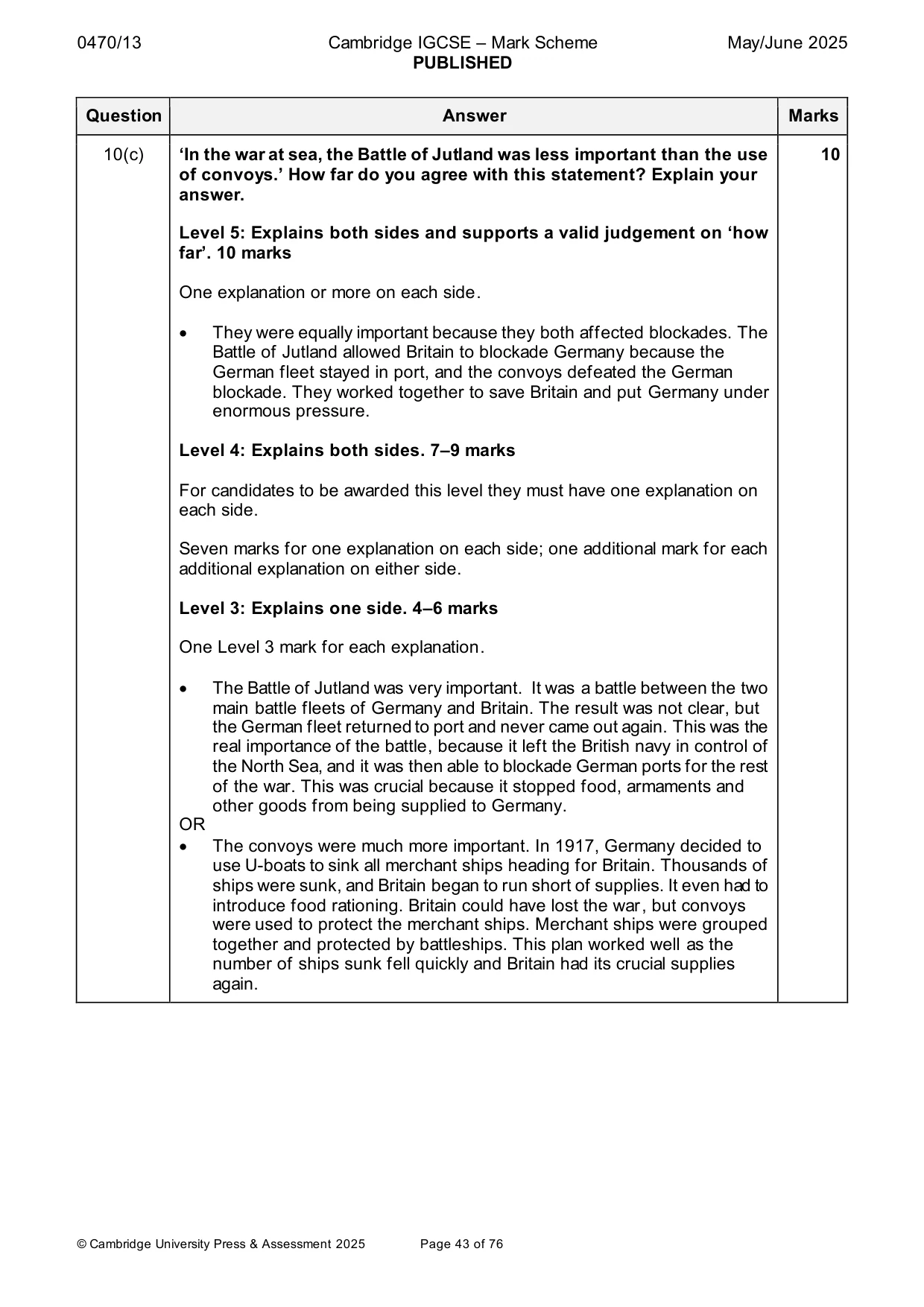
0470/13 Cambridge IGCSE – Mark Scheme PUBLISHED May/June 2025 © Cambridge University Press & Assessment 2025 Page 43 of 76 Question Answer Marks 10(c) ‘In the war at sea, the Battle of Jutland was less important than the use of convoys.’ How far do you agree with this statement? Explain your answer. Level 5: Explains both sides and supports a valid judgement on ‘how far’. 10 marks One explanation or more on each side. • They were equally important because they both affected blockades. The Battle of Jutland allowed Britain to blockade Germany because the German fleet stayed in port, and the convoys defeated the German blockade. They worked together to save Britain and put Germany under enormous pressure. Level 4: Explains both sides. 7–9 marks For candidates to be awarded this level they must have one explanation on each side. Seven marks for one explanation on each side; one additional mark for each additional explanation on either side. Level 3: Explains one side. 4–6 marks One Level 3 mark for each explanation. • The Battle of Jutland was very important. It was a battle between the two main battle fleets of Germany and Britain. The result was not clear, but the German fleet returned to port and never came out again. This was the real importance of the battle, because it left the British navy in control of the North Sea, and it was then able to blockade German ports for the rest of the war. This was crucial because it stopped food, armaments and other goods from being supplied to Germany. OR • The convoys were much more important. In 1917, Germany decided to use U-boats to sink all merchant ships heading for Britain. Thousands of ships were sunk, and Britain began to run short of supplies. It even had to introduce food rationing. Britain could have lost the war, but convoys were used to protect the merchant ships. Merchant ships were grouped together and protected by battleships. This plan worked well as the number of ships sunk fell quickly and Britain had its crucial supplies again. 10
Mark scheme, page 44
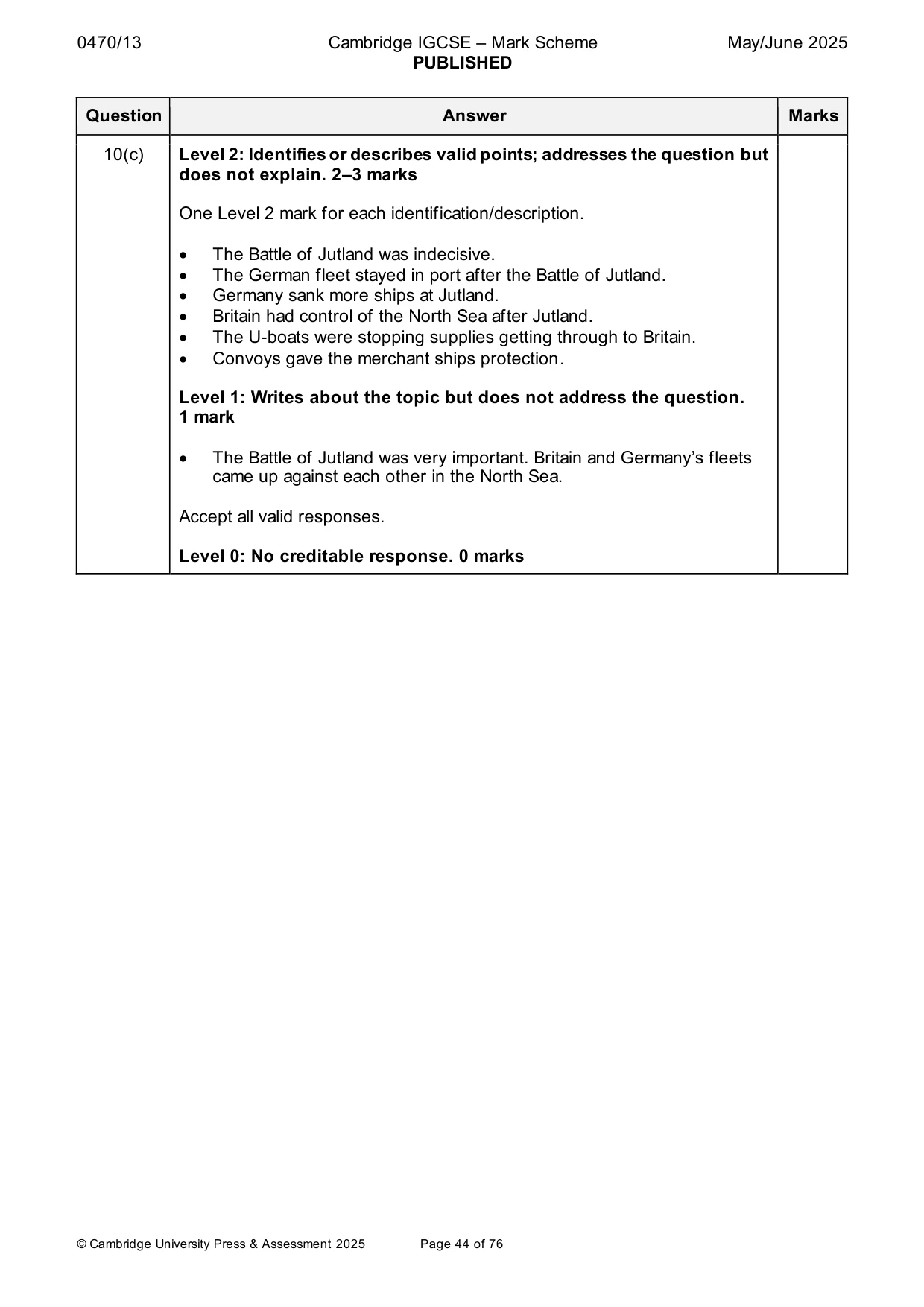
0470/13 Cambridge IGCSE – Mark Scheme PUBLISHED May/June 2025 © Cambridge University Press & Assessment 2025 Page 44 of 76 Question Answer Marks 10(c) Level 2: Identifies or describes valid points; addresses the question but does not explain. 2–3 marks One Level 2 mark for each identification/description. • The Battle of Jutland was indecisive. • The German fleet stayed in port after the Battle of Jutland. • Germany sank more ships at Jutland. • Britain had control of the North Sea after Jutland. • The U-boats were stopping supplies getting through to Britain. • Convoys gave the merchant ships protection. Level 1: Writes about the topic but does not address the question. 1 mark • The Battle of Jutland was very important. Britain and Germany’s fleets came up against each other in the North Sea. Accept all valid responses. Level 0: No creditable response. 0 marks
Mark scheme, page 45
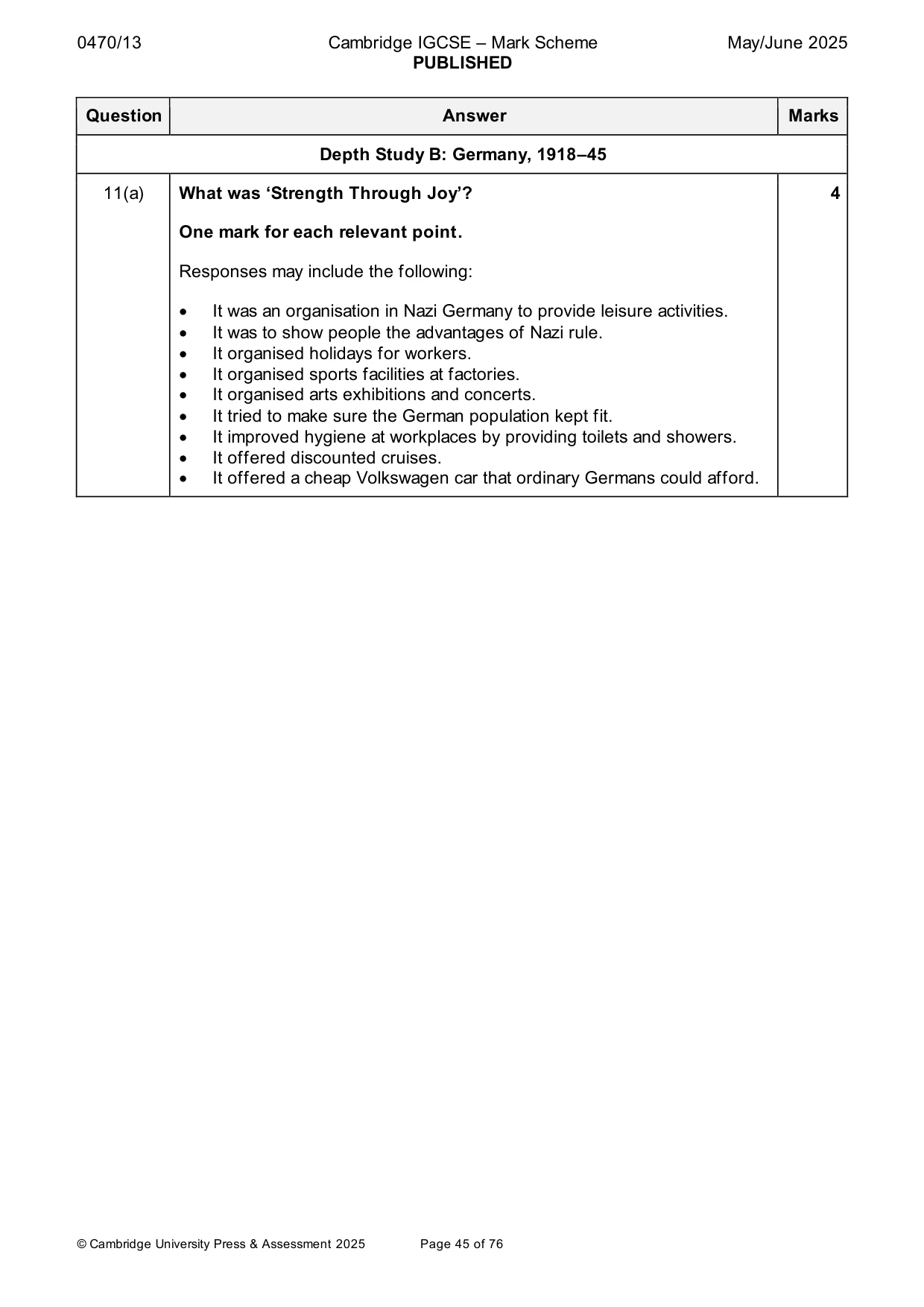
0470/13 Cambridge IGCSE – Mark Scheme PUBLISHED May/June 2025 © Cambridge University Press & Assessment 2025 Page 45 of 76 Question Answer Marks Depth Study B: Germany, 1918–45 11(a) What was ‘Strength Through Joy’? One mark for each relevant point. Responses may include the following: • It was an organisation in Nazi Germany to provide leisure activities. • It was to show people the advantages of Nazi rule. • It organised holidays for workers. • It organised sports facilities at factories. • It organised arts exhibitions and concerts. • It tried to make sure the German population kept fit. • It improved hygiene at workplaces by providing toilets and showers. • It offered discounted cruises. • It offered a cheap Volkswagen car that ordinary Germans could afford. 4
Mark scheme, page 46
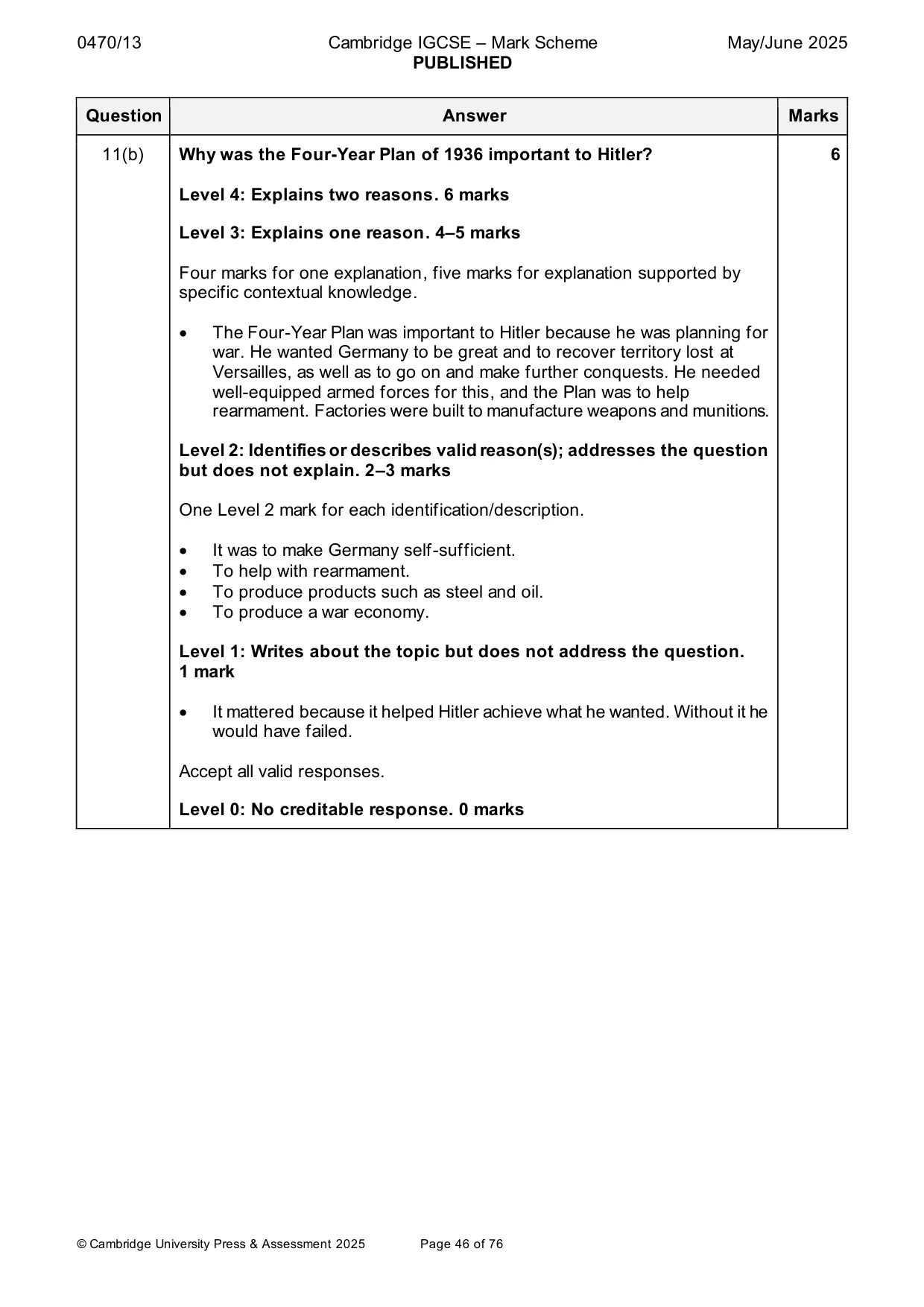
0470/13 Cambridge IGCSE – Mark Scheme PUBLISHED May/June 2025 © Cambridge University Press & Assessment 2025 Page 46 of 76 Question Answer Marks 11(b) Why was the Four-Year Plan of 1936 important to Hitler? Level 4: Explains two reasons. 6 marks Level 3: Explains one reason. 4–5 marks Four marks for one explanation, five marks for explanation supported by specific contextual knowledge. • The Four-Year Plan was important to Hitler because he was planning for war. He wanted Germany to be great and to recover territory lost at Versailles, as well as to go on and make further conquests. He needed well-equipped armed forces for this, and the Plan was to help rearmament. Factories were built to manufacture weapons and munitions. Level 2: Identifies or describes valid reason(s); addresses the question but does not explain. 2–3 marks One Level 2 mark for each identification/description. • It was to make Germany self-sufficient. • To help with rearmament. • To produce products such as steel and oil. • To produce a war economy. Level 1: Writes about the topic but does not address the question. 1 mark • It mattered because it helped Hitler achieve what he wanted. Without it he would have failed. Accept all valid responses. Level 0: No creditable response. 0 marks 6
Mark scheme, page 47
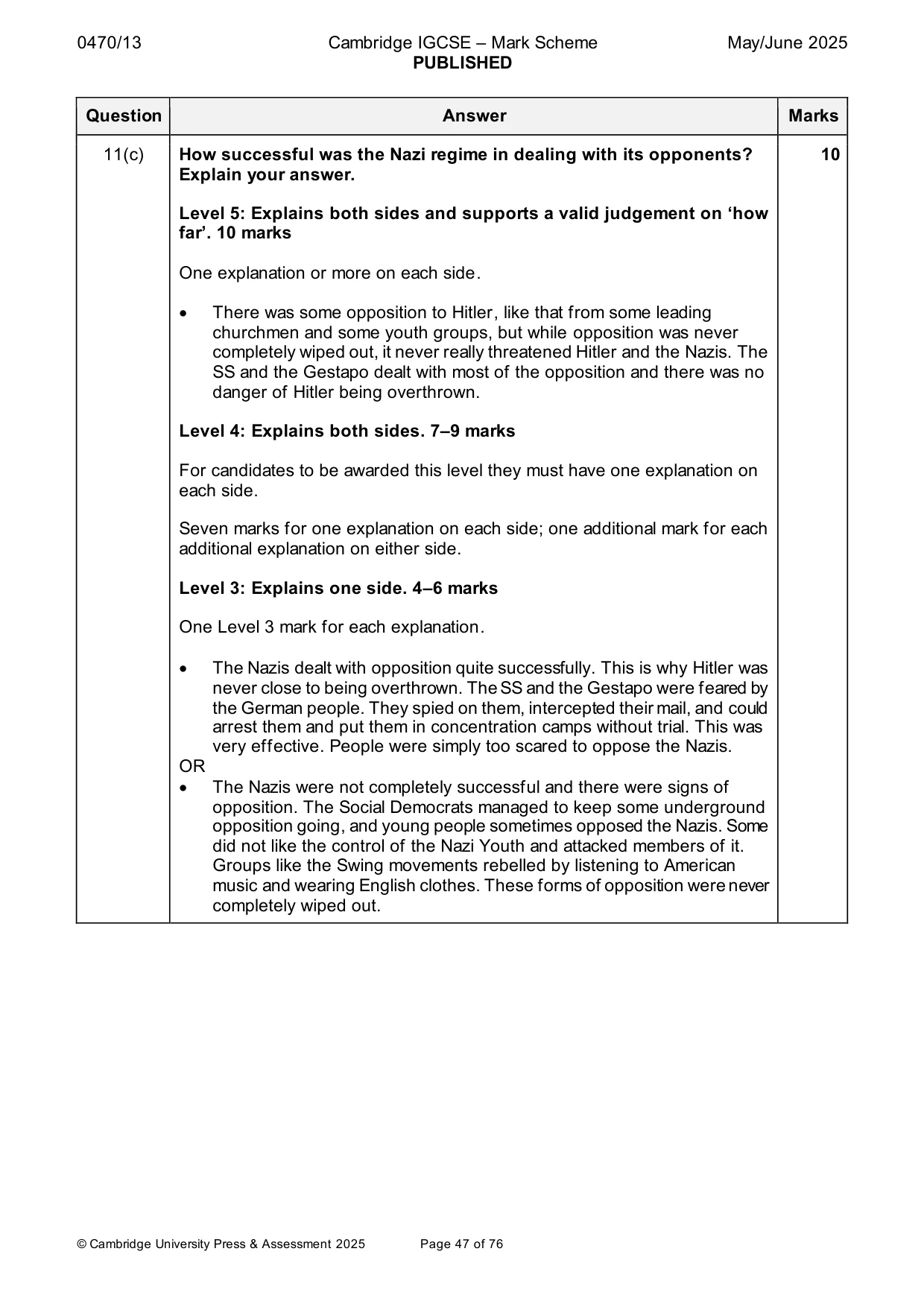
0470/13 Cambridge IGCSE – Mark Scheme PUBLISHED May/June 2025 © Cambridge University Press & Assessment 2025 Page 47 of 76 Question Answer Marks 11(c) How successful was the Nazi regime in dealing with its opponents? Explain your answer. Level 5: Explains both sides and supports a valid judgement on ‘how far’. 10 marks One explanation or more on each side. • There was some opposition to Hitler, like that from some leading churchmen and some youth groups, but while opposition was never completely wiped out, it never really threatened Hitler and the Nazis. The SS and the Gestapo dealt with most of the opposition and there was no danger of Hitler being overthrown. Level 4: Explains both sides. 7–9 marks For candidates to be awarded this level they must have one explanation on each side. Seven marks for one explanation on each side; one additional mark for each additional explanation on either side. Level 3: Explains one side. 4–6 marks One Level 3 mark for each explanation. • The Nazis dealt with opposition quite successfully. This is why Hitler was never close to being overthrown. The SS and the Gestapo were feared by the German people. They spied on them, intercepted their mail, and could arrest them and put them in concentration camps without trial. This was very effective. People were simply too scared to oppose the Nazis. OR • The Nazis were not completely successful and there were signs of opposition. The Social Democrats managed to keep some underground opposition going, and young people sometimes opposed the Nazis. Some did not like the control of the Nazi Youth and attacked members of it. Groups like the Swing movements rebelled by listening to American music and wearing English clothes. These forms of opposition were never completely wiped out. 10
Mark scheme, page 48
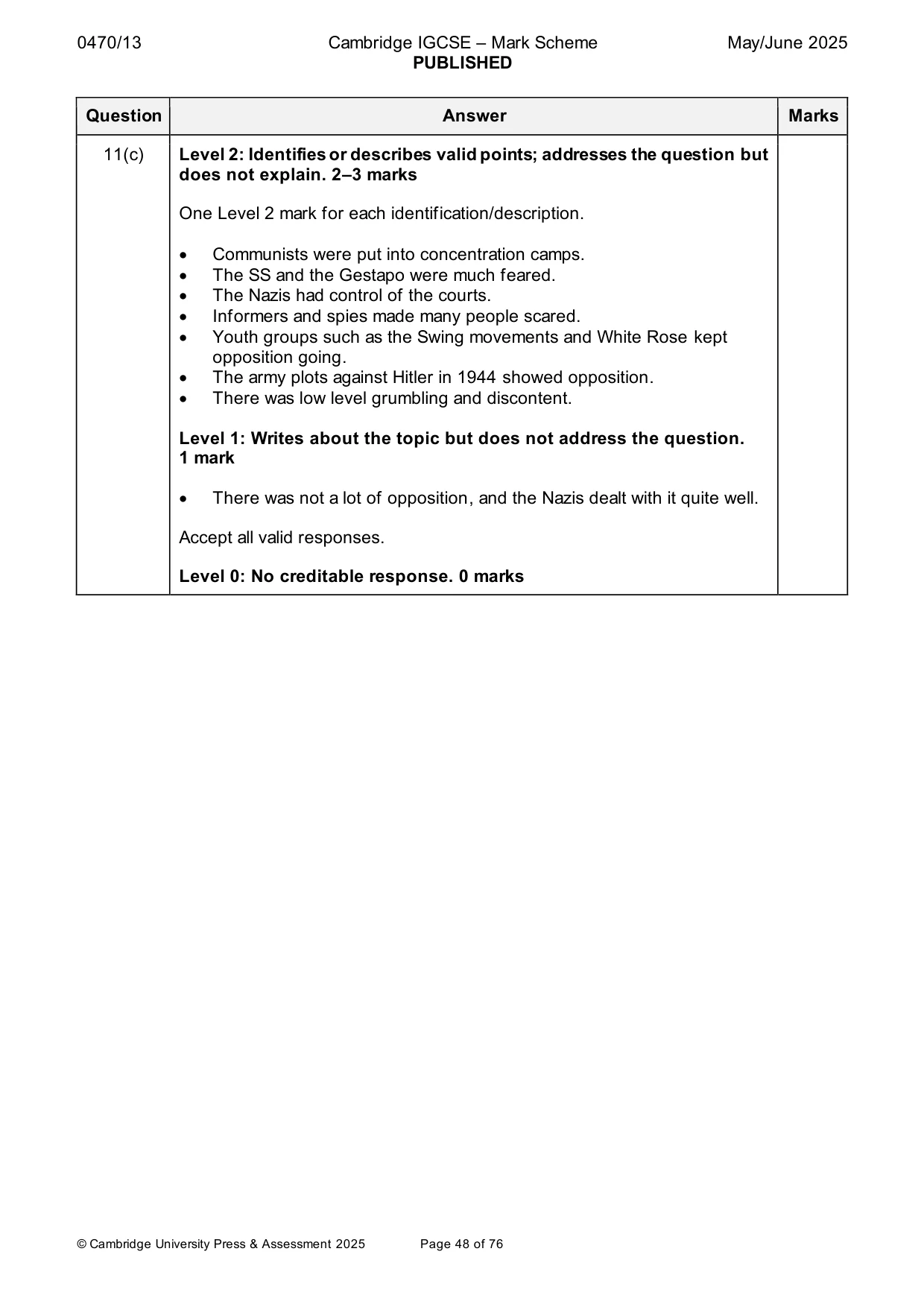
0470/13 Cambridge IGCSE – Mark Scheme PUBLISHED May/June 2025 © Cambridge University Press & Assessment 2025 Page 48 of 76 Question Answer Marks 11(c) Level 2: Identifies or describes valid points; addresses the question but does not explain. 2–3 marks One Level 2 mark for each identification/description. • Communists were put into concentration camps. • The SS and the Gestapo were much feared. • The Nazis had control of the courts. • Informers and spies made many people scared. • Youth groups such as the Swing movements and White Rose kept opposition going. • The army plots against Hitler in 1944 showed opposition. • There was low level grumbling and discontent. Level 1: Writes about the topic but does not address the question. 1 mark • There was not a lot of opposition, and the Nazis dealt with it quite well. Accept all valid responses. Level 0: No creditable response. 0 marks
Mark scheme, page 49
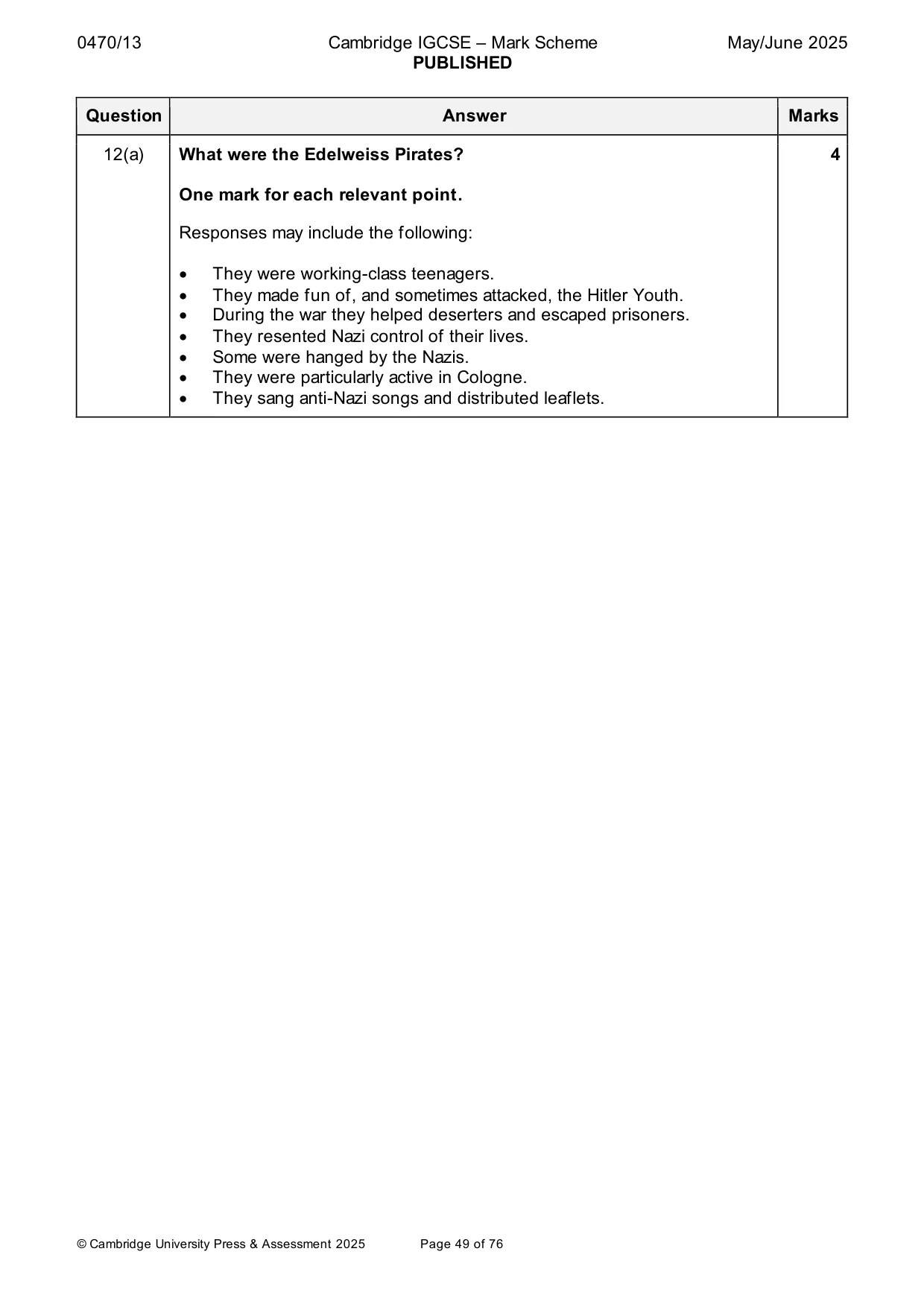
0470/13 Cambridge IGCSE – Mark Scheme PUBLISHED May/June 2025 © Cambridge University Press & Assessment 2025 Page 49 of 76 Question Answer Marks 12(a) What were the Edelweiss Pirates? One mark for each relevant point. Responses may include the following: • They were working-class teenagers. • They made fun of, and sometimes attacked, the Hitler Youth. • During the war they helped deserters and escaped prisoners. • They resented Nazi control of their lives. • Some were hanged by the Nazis. • They were particularly active in Cologne. • They sang anti-Nazi songs and distributed leaflets. 4
Mark scheme, page 50
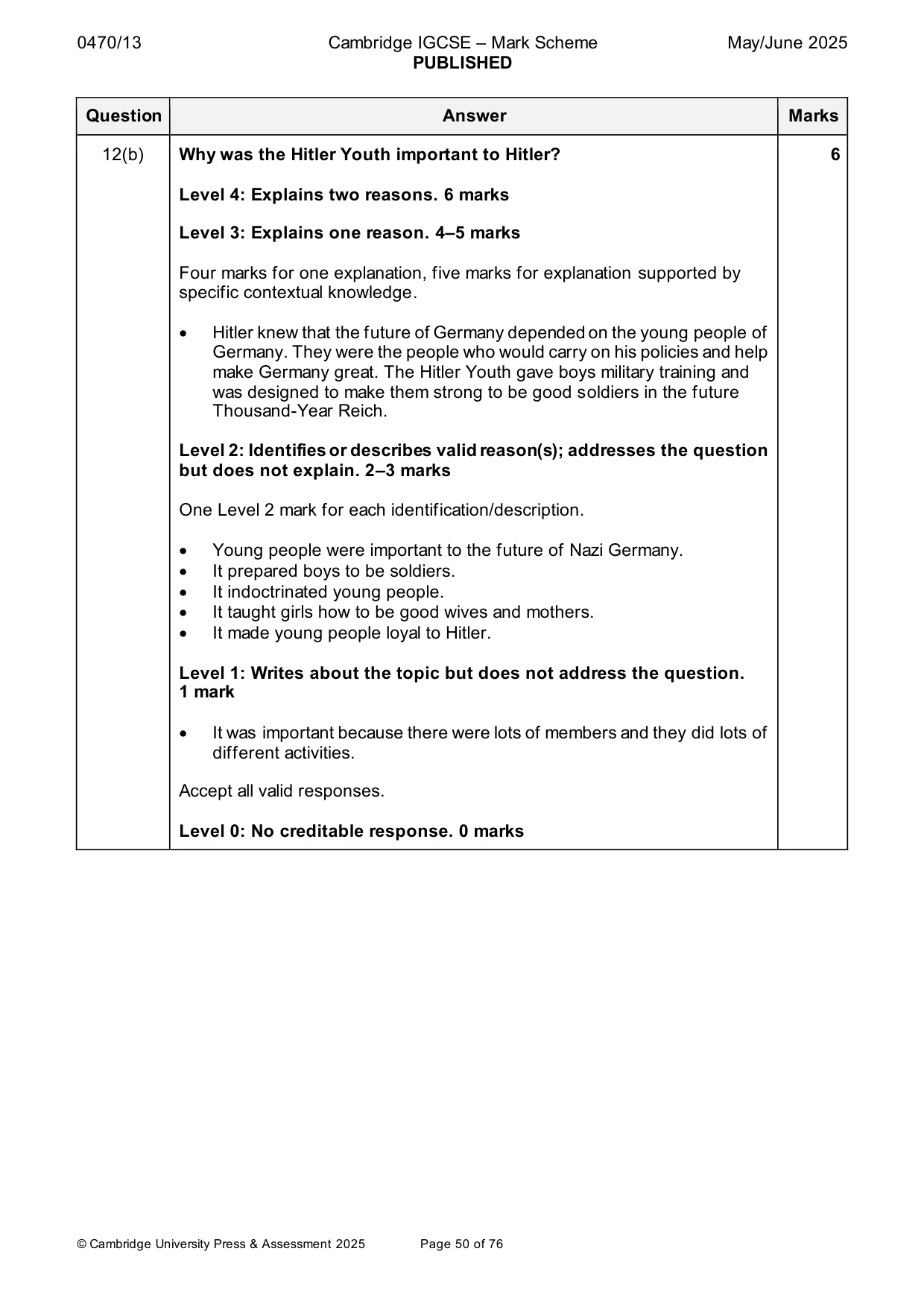
0470/13 Cambridge IGCSE – Mark Scheme PUBLISHED May/June 2025 © Cambridge University Press & Assessment 2025 Page 50 of 76 Question Answer Marks 12(b) Why was the Hitler Youth important to Hitler? Level 4: Explains two reasons. 6 marks Level 3: Explains one reason. 4–5 marks Four marks for one explanation, five marks for explanation supported by specific contextual knowledge. • Hitler knew that the future of Germany depended on the young people of Germany. They were the people who would carry on his policies and help make Germany great. The Hitler Youth gave boys military training and was designed to make them strong to be good soldiers in the future Thousand-Year Reich. Level 2: Identifies or describes valid reason(s); addresses the question but does not explain. 2–3 marks One Level 2 mark for each identification/description. • Young people were important to the future of Nazi Germany. • It prepared boys to be soldiers. • It indoctrinated young people. • It taught girls how to be good wives and mothers. • It made young people loyal to Hitler. Level 1: Writes about the topic but does not address the question. 1 mark • It was important because there were lots of members and they did lots of different activities. Accept all valid responses. Level 0: No creditable response. 0 marks 6
Mark scheme, page 51
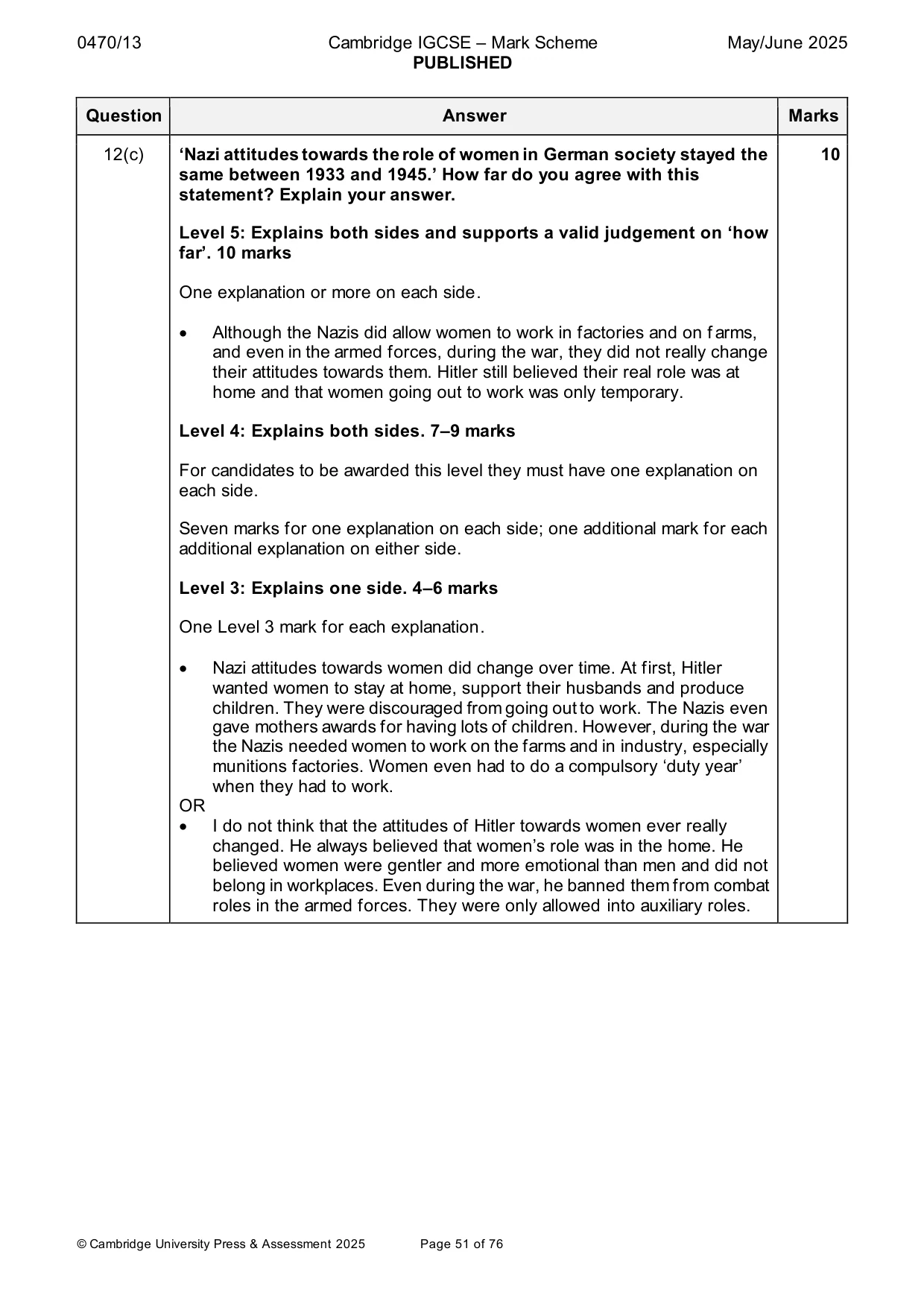
0470/13 Cambridge IGCSE – Mark Scheme PUBLISHED May/June 2025 © Cambridge University Press & Assessment 2025 Page 51 of 76 Question Answer Marks 12(c) ‘Nazi attitudes towards the role of women in German society stayed the same between 1933 and 1945.’ How far do you agree with this statement? Explain your answer. Level 5: Explains both sides and supports a valid judgement on ‘how far’. 10 marks One explanation or more on each side. • Although the Nazis did allow women to work in factories and on f arms, and even in the armed forces, during the war, they did not really change their attitudes towards them. Hitler still believed their real role was at home and that women going out to work was only temporary. Level 4: Explains both sides. 7–9 marks For candidates to be awarded this level they must have one explanation on each side. Seven marks for one explanation on each side; one additional mark for each additional explanation on either side. Level 3: Explains one side. 4–6 marks One Level 3 mark for each explanation. • Nazi attitudes towards women did change over time. At first, Hitler wanted women to stay at home, support their husbands and produce children. They were discouraged from going out to work. The Nazis even gave mothers awards for having lots of children. However, during the war the Nazis needed women to work on the farms and in industry, especially munitions factories. Women even had to do a compulsory ‘duty year’ when they had to work. OR • I do not think that the attitudes of Hitler towards women ever really changed. He always believed that women’s role was in the home. He believed women were gentler and more emotional than men and did not belong in workplaces. Even during the war, he banned them from combat roles in the armed forces. They were only allowed into auxiliary roles. 10
Mark scheme, page 52
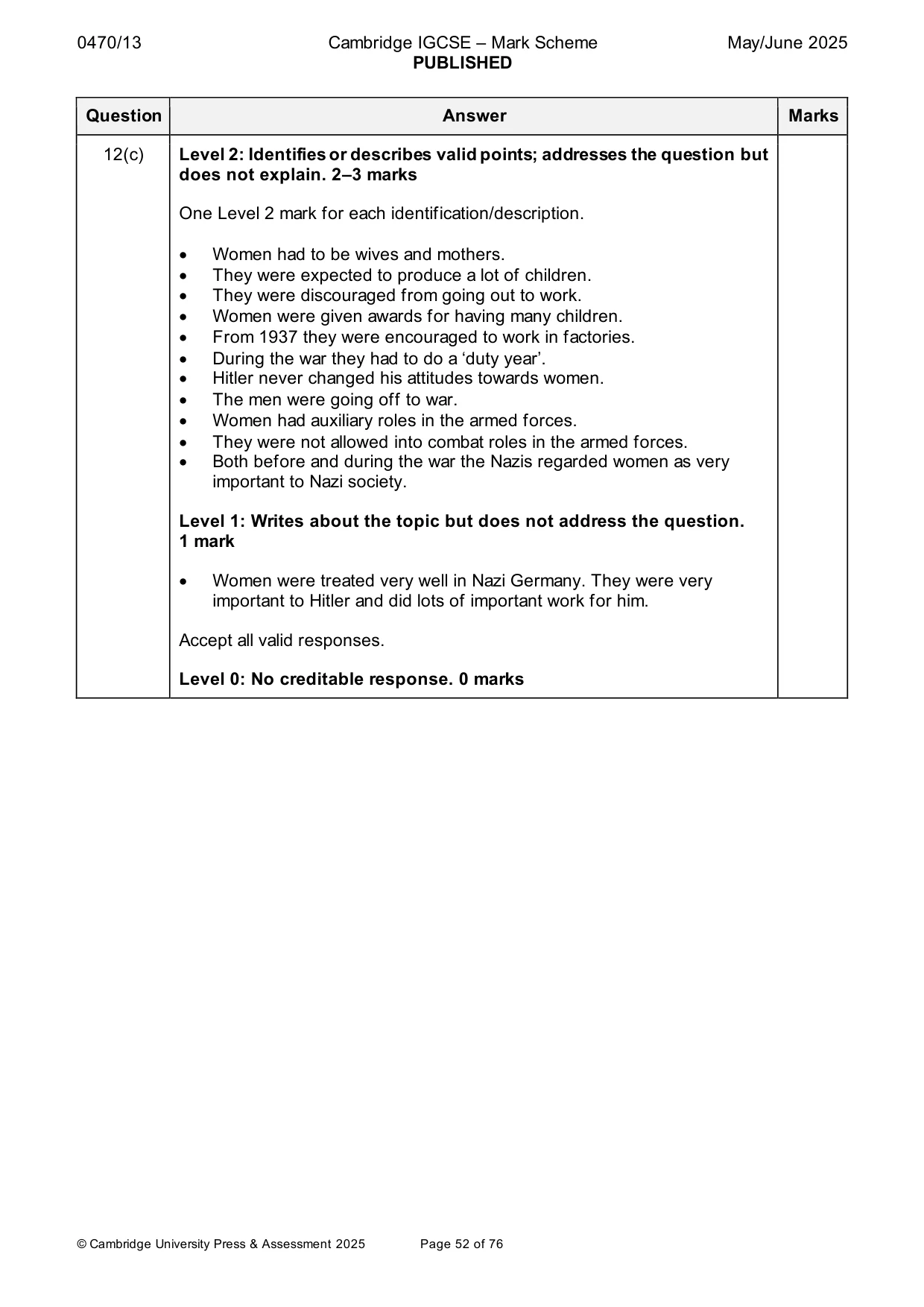
0470/13 Cambridge IGCSE – Mark Scheme PUBLISHED May/June 2025 © Cambridge University Press & Assessment 2025 Page 52 of 76 Question Answer Marks 12(c) Level 2: Identifies or describes valid points; addresses the question but does not explain. 2–3 marks One Level 2 mark for each identification/description. • Women had to be wives and mothers. • They were expected to produce a lot of children. • They were discouraged from going out to work. • Women were given awards for having many children. • From 1937 they were encouraged to work in factories. • During the war they had to do a ‘duty year’. • Hitler never changed his attitudes towards women. • The men were going off to war. • Women had auxiliary roles in the armed forces. • They were not allowed into combat roles in the armed forces. • Both before and during the war the Nazis regarded women as very important to Nazi society. Level 1: Writes about the topic but does not address the question. 1 mark • Women were treated very well in Nazi Germany. They were very important to Hitler and did lots of important work for him. Accept all valid responses. Level 0: No creditable response. 0 marks
Mark scheme, page 53
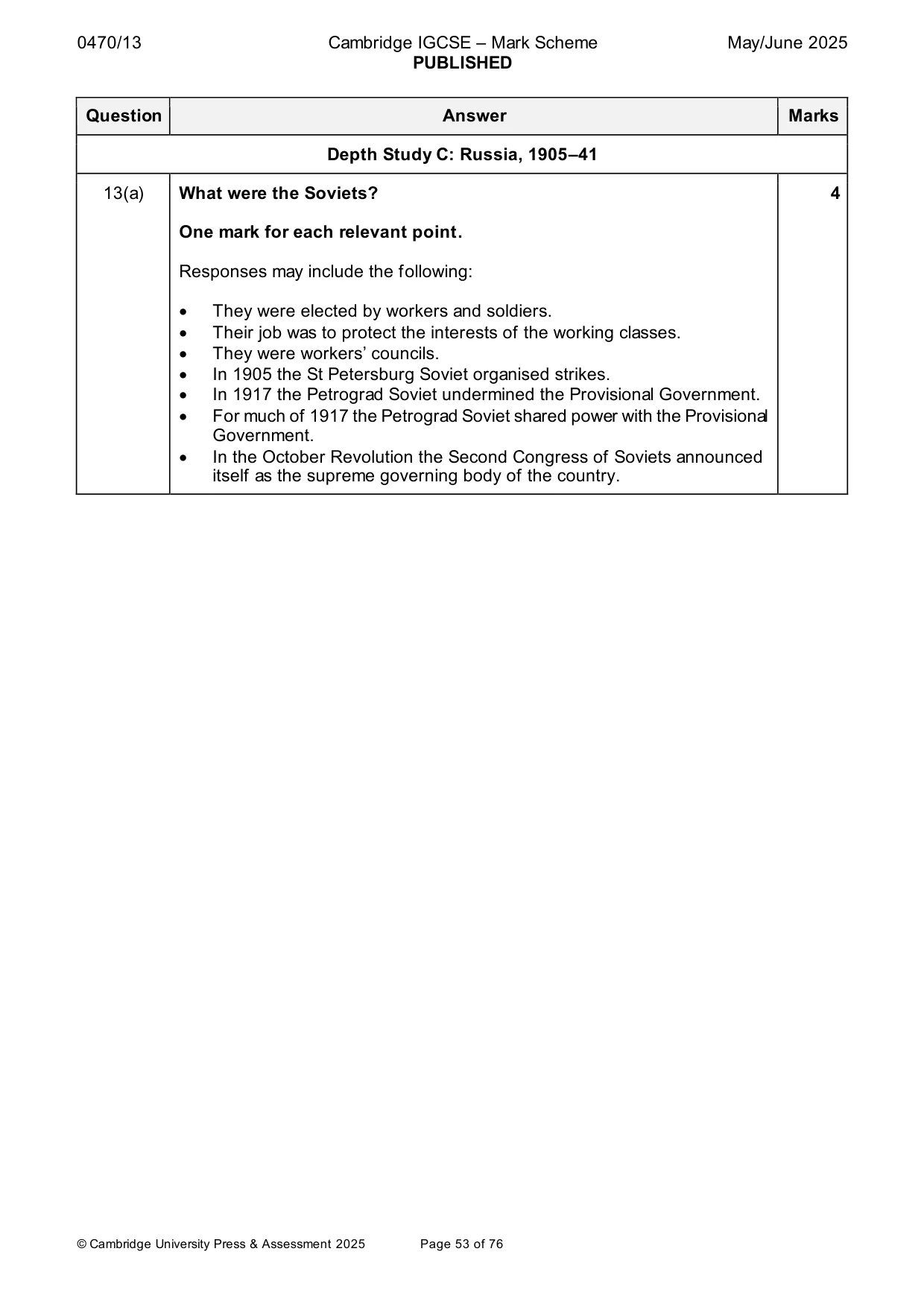
0470/13 Cambridge IGCSE – Mark Scheme PUBLISHED May/June 2025 © Cambridge University Press & Assessment 2025 Page 53 of 76 Question Answer Marks Depth Study C: Russia, 1905–41 13(a) What were the Soviets? One mark for each relevant point. Responses may include the following: • They were elected by workers and soldiers. • Their job was to protect the interests of the working classes. • They were workers’ councils. • In 1905 the St Petersburg Soviet organised strikes. • In 1917 the Petrograd Soviet undermined the Provisional Government. • For much of 1917 the Petrograd Soviet shared power with the Provisional Government. • In the October Revolution the Second Congress of Soviets announced itself as the supreme governing body of the country. 4
Mark scheme, page 54
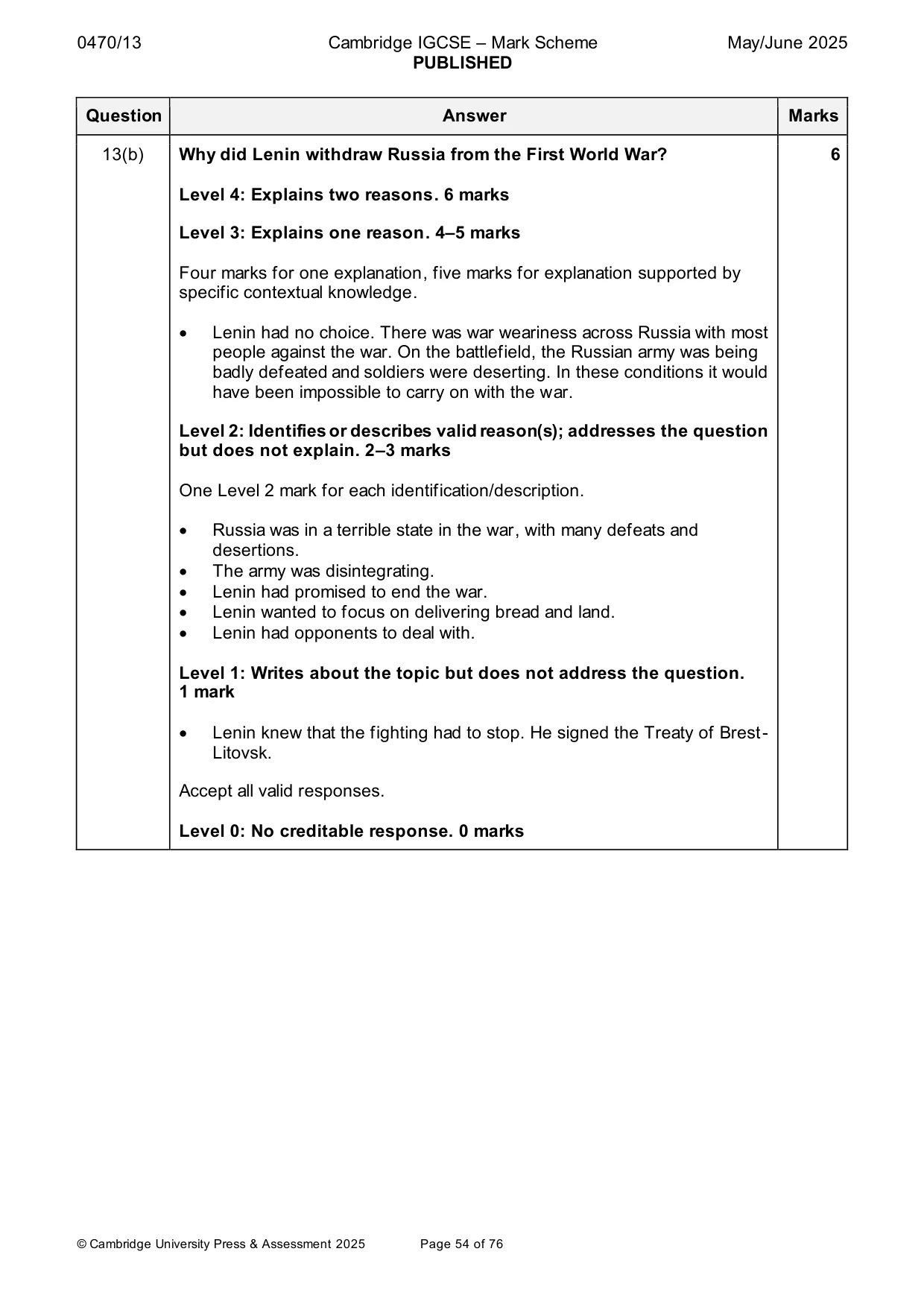
0470/13 Cambridge IGCSE – Mark Scheme PUBLISHED May/June 2025 © Cambridge University Press & Assessment 2025 Page 54 of 76 Question Answer Marks 13(b) Why did Lenin withdraw Russia from the First World War? Level 4: Explains two reasons. 6 marks Level 3: Explains one reason. 4–5 marks Four marks for one explanation, five marks for explanation supported by specific contextual knowledge. • Lenin had no choice. There was war weariness across Russia with most people against the war. On the battlefield, the Russian army was being badly defeated and soldiers were deserting. In these conditions it would have been impossible to carry on with the war. Level 2: Identifies or describes valid reason(s); addresses the question but does not explain. 2–3 marks One Level 2 mark for each identification/description. • Russia was in a terrible state in the war, with many defeats and desertions. • The army was disintegrating. • Lenin had promised to end the war. • Lenin wanted to focus on delivering bread and land. • Lenin had opponents to deal with. Level 1: Writes about the topic but does not address the question. 1 mark • Lenin knew that the fighting had to stop. He signed the Treaty of Brest- Litovsk. Accept all valid responses. Level 0: No creditable response. 0 marks 6
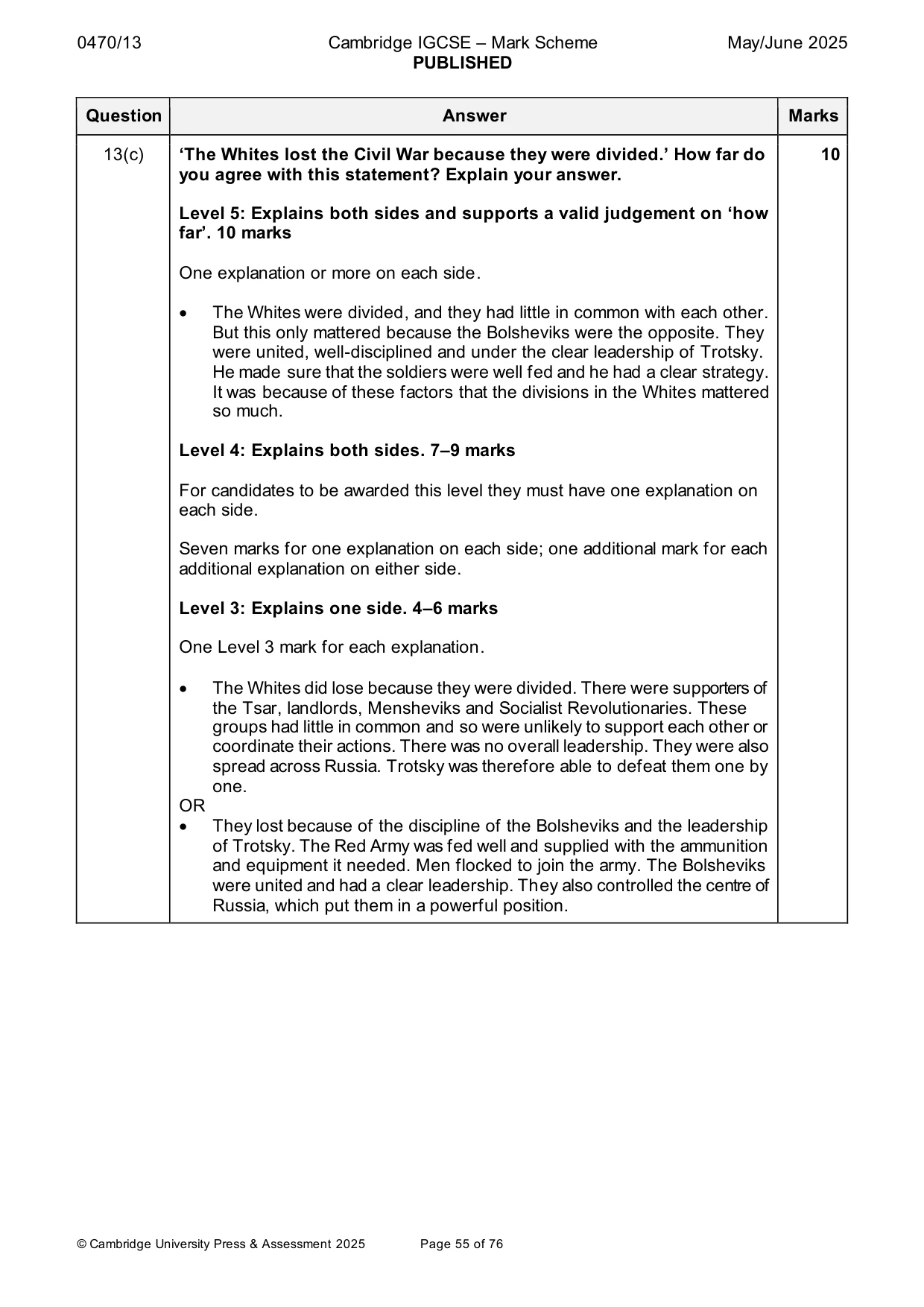
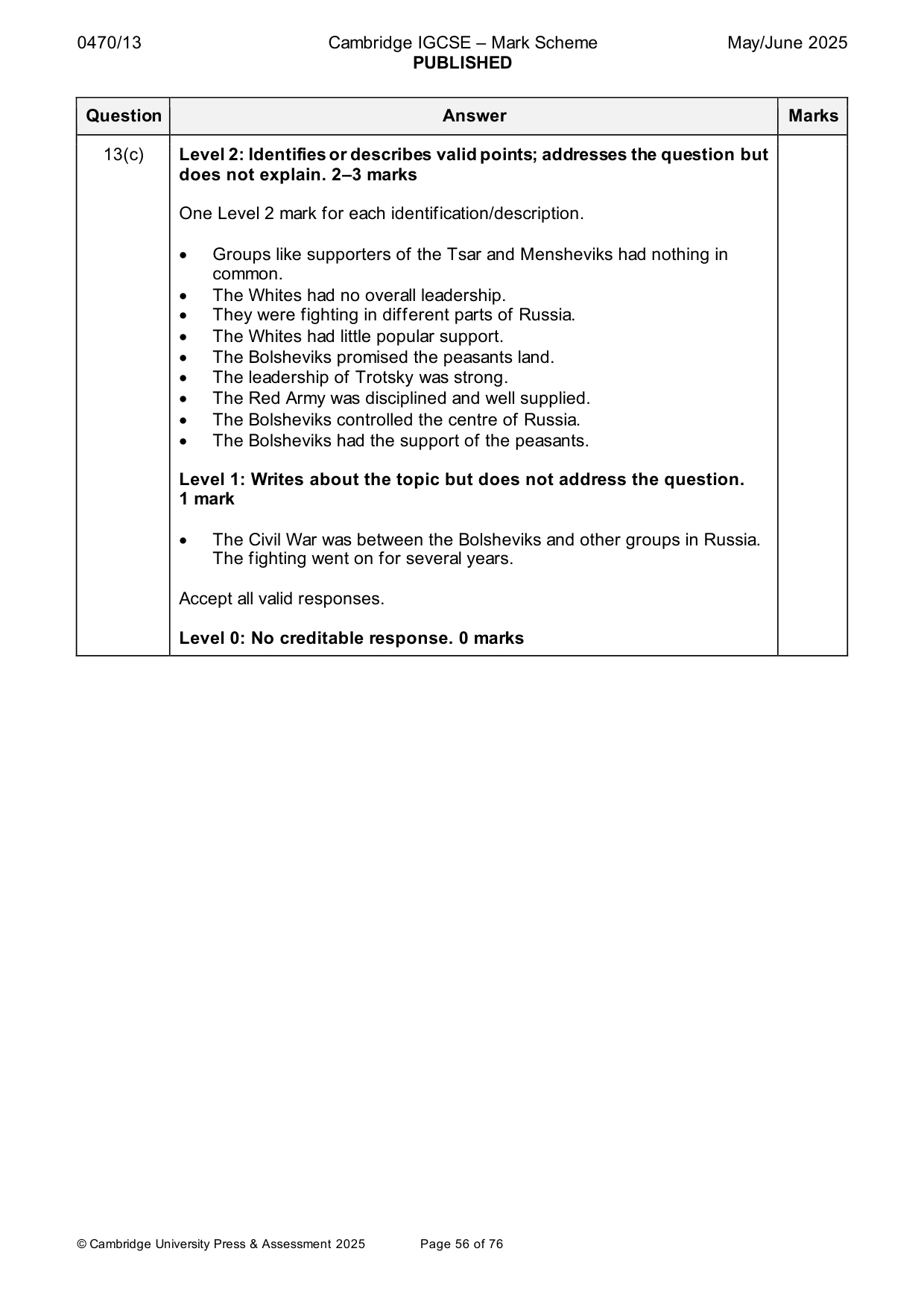
Mark scheme, page 55
0470/13 Cambridge IGCSE – Mark Scheme PUBLISHED May/June 2025 © Cambridge University Press & Assessment 2025 Page 55 of 76 Question Answer Marks 13(c) ‘The Whites lost the Civil War because they were divided.’ How far do you agree with this statement? Explain your answer. Level 5: Explains both sides and supports a valid judgement on ‘how far’. 10 marks One explanation or more on each side. • The Whites were divided, and they had little in common with each other. But this only mattered because the Bolsheviks were the opposite. They were united, well-disciplined and under the clear leadership of Trotsky. He made sure that the soldiers were well fed and he had a clear strategy. It was because of these factors that the divisions in the Whites mattered so much. Level 4: Explains both sides. 7–9 marks For candidates to be awarded this level they must have one explanation on each side. Seven marks for one explanation on each side; one additional mark for each additional explanation on either side. Level 3: Explains one side. 4–6 marks One Level 3 mark for each explanation. • The Whites did lose because they were divided. There were supporters of the Tsar, landlords, Mensheviks and Socialist Revolutionaries. These groups had little in common and so were unlikely to support each other or coordinate their actions. There was no overall leadership. They were also spread across Russia. Trotsky was therefore able to defeat them one by one. OR • They lost because of the discipline of the Bolsheviks and the leadership of Trotsky. The Red Army was fed well and supplied with the ammunition and equipment it needed. Men flocked to join the army. The Bolsheviks were united and had a clear leadership. They also controlled the centre of Russia, which put them in a powerful position. 10
Mark scheme, page 56
0470/13 Cambridge IGCSE – Mark Scheme PUBLISHED May/June 2025 © Cambridge University Press & Assessment 2025 Page 56 of 76 Question Answer Marks 13(c) Level 2: Identifies or describes valid points; addresses the question but does not explain. 2–3 marks One Level 2 mark for each identification/description. • Groups like supporters of the Tsar and Mensheviks had nothing in common. • The Whites had no overall leadership. • They were fighting in different parts of Russia. • The Whites had little popular support. • The Bolsheviks promised the peasants land. • The leadership of Trotsky was strong. • The Red Army was disciplined and well supplied. • The Bolsheviks controlled the centre of Russia. • The Bolsheviks had the support of the peasants. Level 1: Writes about the topic but does not address the question. 1 mark • The Civil War was between the Bolsheviks and other groups in Russia. The fighting went on for several years. Accept all valid responses. Level 0: No creditable response. 0 marks
Mark scheme, page 57
0470/13 Cambridge IGCSE – Mark Scheme PUBLISHED May/June 2025 © Cambridge University Press & Assessment 2025 Page 57 of 76 Question Answer Marks 14(a) Describe the experiences of industrial workers in the Soviet Union under Stalin. One mark for each relevant point. Responses may include the following: • They had to work very hard with long hours. • Factory discipline was harsh. Workers who were late were sacked. • The workers were bombarded with propaganda. • Workers were encouraged to work like Stakhanov. • The workers were housed in overcrowded and poor-quality houses. • Some of the workers were criminals who were badly treated. • There were many accidents and deaths at work. 4
Mark scheme, page 58
0470/13 Cambridge IGCSE – Mark Scheme PUBLISHED May/June 2025 © Cambridge University Press & Assessment 2025 Page 58 of 76 Question Answer Marks 14(b) Why did Stalin regard the different nationalities in the Soviet Union with suspicion? Level 4: Explains two reasons. 6 marks Level 3: Explains one reason. 4–5 marks Four marks for one explanation, five marks for explanation supported by specific contextual knowledge. • One of Stalin’s most important aims was to create a united Soviet Union. He saw the many different nationalities as a threat to this aim. There were many different nationalities such as Latvians and Finns. He tried to achieve ‘Russification’ and made the teaching of the Russian language compulsory everywhere. He wanted all the people to see themselves as Russian. Level 2: Identifies or describes valid reason(s); addresses the question but does not explain. 2–3 marks One Level 2 mark for each identification/description. • He wanted to unify the people in the Soviet Union. • All the different nationalities had their own language and customs. • He did not think they would be loyal if they thought of themselves as Estonians and Poles. Level 1: Writes about the topic but does not address the question. 1 mark • There were lots of nationalities in the Soviet Union and Stalin did not treat them very well. Accept all valid responses. Level 0: No creditable response. 0 marks 6
Mark scheme, page 59
0470/13 Cambridge IGCSE – Mark Scheme PUBLISHED May/June 2025 © Cambridge University Press & Assessment 2025 Page 59 of 76 Question Answer Marks 14(c) Which was more important to Stalin: industrial or agricultural reform? Explain your answer. Level 5: Explains both sides and supports a valid judgement on ‘how far’. 10 marks One explanation or more on each side. • Although Stalin’s main interest was to increase industrial production to make Russia a powerful and modern state, this could not be done without producing much more food for the increasing number of industrial workers. Industrial advance depended on farming being reformed. This is why I think that industrial reform was more important to Stalin, because the agricultural reforms were to make industry bigger. Level 4: Explains both sides. 7–9 marks For candidates to be awarded this level they must have one explanation on each side. Seven marks for one explanation on each side; one additional mark for each additional explanation on either side. Level 3: Explains one side. 4–6 marks One Level 3 mark for each explanation. • Agricultural reform was very important to Stalin. If Soviet industry was to be improved and expanded, it needed enormous numbers of workers. These workers in the cities had to be fed, and so agriculture had to be reformed so enough food could be produced. To do this he introduced collectivisation. This would allow farmers and peasants to produce more food. OR • Stalin wanted to turn Russia into a modern and powerful state so that it could stand alongside countries like the USA and so that it could defend itself. Russia was faced with many countries that were not friendly. If it was to defend itself, then it needed to industrialise so that it could produce weapons and other equipment. The factories needed coal and electricity to do this. To produce all this Stalin knew that modernisation was necessary. 10
Mark scheme, page 60
0470/13 Cambridge IGCSE – Mark Scheme PUBLISHED May/June 2025 © Cambridge University Press & Assessment 2025 Page 60 of 76 Question Answer Marks 14(c) Level 2: Identifies or describes valid points; addresses the question but does not explain. 2–3 marks One Level 2 mark for each identification/description. • Food was needed for industrial workers. • Russia was having to import food. • Having to import food was not good for Russia’s image. • Industrial reform would make Russia a powerful country. • Stalin wanted Russia to be able to defend itself. • He wanted to improve the standard of living of the Russian people. • Russian industry was a long way behind that of other countries. • Making Russia into a modern country would be a good advertisement for communism. Level 1: Writes about the topic but does not address the question. 1 mark • Stalin wanted to make Soviet industry better, but he also needed to reform agriculture and this is what he did. Accept all valid responses. Level 0: No creditable response. 0 marks
Mark scheme, page 61
0470/13 Cambridge IGCSE – Mark Scheme PUBLISHED May/June 2025 © Cambridge University Press & Assessment 2025 Page 61 of 76 Question Answer Marks Depth Study D: The United States, 1919–41 15(a) What were the tariffs introduced in the 1920s? One mark for each relevant point. Responses may include the following: • Tariffs were taxes placed on good imported into the country. • Republicans were keen on introducing tariffs. • They were used to protect American industry and let it grow. • In 1922 the Fordney-McCumber Tariff made imported foods more expensive. • In 1930 the Smoot-Hawley Tariff Act raised America’s tariffs. • The tariffs helped American prosperity. 4
Mark scheme, page 62
0470/13 Cambridge IGCSE – Mark Scheme PUBLISHED May/June 2025 © Cambridge University Press & Assessment 2025 Page 62 of 76 Question Answer Marks 15(b) Why did the Republican governments follow laissez-faire policies? Level 4: Explains two reasons. 6 marks Level 3: Explains one reason. 4–5 marks Four marks for one explanation, five marks for explanation supported by specific contextual knowledge. • Republican politicians like Hoover believed in ‘rugged individualism’. This was a belief in being self-reliant and sorting your problems out yourself, rather than depending on the government or others to do it for you. It claimed that success in life was determined by individuals themselves and not by other factors. Level 2: Identifies or describes valid reason(s); addresses the question but does not explain. 2–3 marks One Level 2 mark for each identification/description. • They thought that governments should not interfere in peoples’ lives. • Business people, not politicians, knew what was best for business. • People should solve their problems themselves. • The politicians’ job was to leave businesses alone to get on with the job themselves. • They thought it would allow business to thrive. • Because they were working for much of the 1920s. Level 1: Writes about the topic but does not address the question. 1 mark • They did this because they thought that it would help people and that it would lead to great success. Accept all valid responses. Level 0: No creditable response. 0 marks 6
Mark scheme, page 63
0470/13 Cambridge IGCSE – Mark Scheme PUBLISHED May/June 2025 © Cambridge University Press & Assessment 2025 Page 63 of 76 Question Answer Marks 15(c) ‘American industries prospered in the 1920s.’ How far do you agree with this statement? Explain your answer. Level 5: Explains both sides and supports a valid judgement on ‘how far’. 10 marks One explanation or more on each side. • Although some old industries struggled, this was partly because the USA was doing so well and moving on. Power and heating were being produced by new sources like gas and electricity. Synthetic fibres were replacing cotton and woollen textiles. New industries were doing well and replacing old industries that had little future. Level 4: Explains both sides. 7–9 marks For candidates to be awarded this level they must have one explanation on each side. Seven marks for one explanation on each side; one additional mark for each additional explanation on either side. Level 3: Explains one side. 4–6 marks One Level 3 mark for each explanation. • Many industries did prosper. The car industry grew enormously and employed half a million workers. It also helped other industries grow, because it needed glass, rubber and leather to produce cars. The building and construction industry did very well, because roads were needed as well as new factories and offices. People also demanded to have electricity, and this provided lots of jobs. OR • The coal industry did not do well. Other sources of power such as oil and electricity were becoming more popular and the demand for coal went down. Soon wages were cut and pits were closed. Farming also struggled. It was over-producing, and prices and profits fell. Many small farmers had to sell up. 10
Mark scheme, page 64
0470/13 Cambridge IGCSE – Mark Scheme PUBLISHED May/June 2025 © Cambridge University Press & Assessment 2025 Page 64 of 76 Question Answer Marks 15(c) Level 2: Identifies or describes valid points; addresses the question but does not explain. 2–3 marks One Level 2 mark for each identification/description. • The car industry thrived. • Industries like glass that supplied the car industry did well. • Mass production helped some industries to do well. • Industries making consumer goods like fridges did very well. • Farming struggled. • Old industries like cotton and woollen textiles production did not do well. • The coal industry struggled. • Farming was producing too much food. Level 1: Writes about the topic but does not address the question. 1 mark • This is generally true. Many industries did very well, and a lot of money was made, but there were some that struggled and people lost their jobs. Accept all valid responses. Level 0: No creditable response. 0 marks
Mark scheme, page 65
0470/13 Cambridge IGCSE – Mark Scheme PUBLISHED May/June 2025 © Cambridge University Press & Assessment 2025 Page 65 of 76 Question Answer Marks 16(a) What is meant by the term ‘Roaring Twenties’? One mark for each relevant point. Responses may include the following: • It was a time of economic prosperity. • It was a time of fast social and cultural change. • It was a break from the past and a sense of newness. • It was a modern time created by motor cars, radio and moving pictures. • It was the time of the flapper, new fashions and new freedoms for women. • There were new styles of music – the jazz age and dance clubs. 4
Mark scheme, page 66
0470/13 Cambridge IGCSE – Mark Scheme PUBLISHED May/June 2025 © Cambridge University Press & Assessment 2025 Page 66 of 76 Question Answer Marks 16(b) Why was Prohibition repealed? Level 4: Explains two reasons. 6 marks Level 3: Explains one reason. 4–5 marks Four marks for one explanation, five marks for explanation supported by specific contextual knowledge. • It was repealed because it had been a disaster. It led to gangsters producing and supplying alcoholic drinks. This often led to violent battles between the gangs. It also turned ordinary people into criminals because they were buying the illegal drinks. It had created a lawless situation in some major cities. Level 2: Identifies or describes valid reason(s); addresses the question but does not explain. 2–3 marks One Level 2 mark for each identification/description. • It had caused much lawbreaking. • It led to criminal gangs led by people like Al Capone. • It was impossible to enforce effectively. • It led to corruption in the police force, and even some judges were corrupt. • Roosevelt promised to support its repeal if he became president. • The alcohol industry could be creating thousands of jobs. • Repeal would increase tax revenues. Level 1: Writes about the topic but does not address the question. 1 mark • Prohibition was the banning of alcoholic drinks. It was introduced into the USA and enforced by the police. It caused difficulties for many people. Accept all valid responses. Level 0: No creditable response. 0 marks 6
Mark scheme, page 67
0470/13 Cambridge IGCSE – Mark Scheme PUBLISHED May/June 2025 © Cambridge University Press & Assessment 2025 Page 67 of 76 Question Answer Marks 16(c) Which was more important in the 1920s: political or religious intolerance? Explain your answer. Level 5: Explains both sides and supports a valid judgement on ‘how far’. 10 marks One explanation or more on each side. • They were both important, but I think political intolerance was more important because the Monkey Trial in 1925 was really a victory for the evolutionists and the fundamentalists were mocked. However, political intolerance and hatred and fear of communism continued throughout the 1920s. Level 4: Explains both sides. 7–9 marks For candidates to be awarded this level they must have one explanation on each side. Seven marks for one explanation on each side; one additional mark for each additional explanation on either side. Level 3: Explains one side. 4–6 marks One Level 3 mark for each explanation. • Political intolerance mattered a great deal at this time. There was a Red Scare which was a fear of communism. This was caused by Russia becoming communist. Some people thought that immigrants coming from Eastern Europe and Russia would spread communism and un-American ideas. People thought that American values were under threat. This was important because it led to race riots and many immigrants being persecuted and treated unfairly. OR • Religious intolerance was very important at this time. Many people in America, especially in rural areas, believed in the teachings of the Bible. They believed that God had created the world in six days. However, schools were teaching the theory of evolution, which was completely rejected by the fundamentalists. In Southern states, laws were passed banning the teaching of evolution, and a teacher was found guilty of breaking the law. 10
Mark scheme, page 68
0470/13 Cambridge IGCSE – Mark Scheme PUBLISHED May/June 2025 © Cambridge University Press & Assessment 2025 Page 68 of 76 Question Answer Marks 16(c) Level 2: Identifies or describes valid points; addresses the question but does not explain. 2–3 marks One Level 2 mark for each identification/description. • The Red Scare was a fear of communism. • People thought immigrants were spreading dangerous ideas. • It led to hatred of immigrants. • It led to injustices such as the Sacco and Vanzetti case. • The teaching of evolution was banned in some Southern states. • A teacher was found guilty of teaching the theory of evolution. • It created a lot of tension between rural and urban America. • Religious intolerance encouraged groups like the KKK. Level 1: Writes about the topic but does not address the question. 1 mark • There was much political and religious intolerance at this time in the USA. They both did a lot of damage to American society and to individuals. Accept all valid responses. Level 0: No creditable response. 0 marks
Mark scheme, page 69
0470/13 Cambridge IGCSE – Mark Scheme PUBLISHED May/June 2025 © Cambridge University Press & Assessment 2025 Page 69 of 76 Question Answer Marks Depth Study E: The Second World War in Europe and the Asia–Pacific, 1939–c.1945 17(a) Describe the damage inflicted by the Japanese attack on Pearl Harbor. One mark for each relevant point. Responses may include the following: • Thousands of American sailors were killed. • Hundreds of civilians were killed. • Hundreds of US aircraft were destroyed. • Four US battleships were sunk and others damaged. • About 20 US naval vessels were destroyed or damaged. • Dry docks and airfields were destroyed. • Half of the dead were on the USS Arizona. 4
Mark scheme, page 70
0470/13 Cambridge IGCSE – Mark Scheme PUBLISHED May/June 2025 © Cambridge University Press & Assessment 2025 Page 70 of 76 Question Answer Marks 17(b) Why did Japan invade Malaya? Level 4: Explains two reasons. 6 marks Level 3: Explains one reason. 4–5 marks Four marks for one explanation, five marks for explanation supported by specific contextual knowledge. • Japan wanted to create a Co-Prosperity Sphere. It would be in the Asia– Pacific region under Japanese control. It would be only for Asians, and Japan claimed it would lead to co-prosperity for Asian countries which, under the friendly leadership of Japan, would be free from Western colonisation and control. However, it would really be a Japanese empire. The invasion of Malaya was a step towards achieving this. Level 2: Identifies or describes valid reason(s); addresses the question but does not explain. 2–3 marks One Level 2 mark for each identification/description. • Japan wanted to build an empire. • It was to create a Co-Prosperity Sphere. • It was part of a Japanese plan to attack across the Pacific and Southeast Asia, including the Philippines, Singapore, Burma and Thailand. • Malaya had large amounts of raw resources such as tin and rubber. • It provided a defensive barrier for an advance on Singapore. Level 1: Writes about the topic but does not address the question. 1 mark • It did this because it wanted to be a great and strong power, and conquering Malaya would help in this. Accept all valid responses. Level 0: No creditable response. 0 marks 6
Mark scheme, page 71
0470/13 Cambridge IGCSE – Mark Scheme PUBLISHED May/June 2025 © Cambridge University Press & Assessment 2025 Page 71 of 76 Question Answer Marks 17(c) How far was Japan’s defeat in the Second World War caused by the Battle of Midway? Explain your answer. Level 5: Explains both sides and supports a valid judgement on ‘how far’. 10 marks One explanation or more on each side. • Although there was still much to be done after the Battle of the Midway as Japan was far from being defeated, the battle did turn the tide. Until then Japan had the upper hand and was making gains, but after the battle the USA went on the offensive and Japan was on the back foot. However, there was still much to do, and Japan itself still had to be invaded or bombed into submission, so I do not think that Midway decided the war. Level 4: Explains both sides. 7–9 marks For candidates to be awarded this level they must have one explanation on each side. Seven marks for one explanation on each side; one additional mark for each additional explanation on either side. Level 3: Explains one side. 4–6 marks One Level 3 mark for each explanation. • The Battle of Midway was decisive. It was a turning point and a real setback for Japan. They had suffered enormous losses to their navy and air force. This meant that they had to cancel their plans to invade New Caledonia, Fiji and Samoa. OR • The Battle of Midway did not by itself mean that Japan was defeated. The USA went on the offensive but still had to defeat Japan. The Battle of Guadalcanal was very important. Losses on both sides were large, and the Japanese did a lot of damage to the Americans, but its attempt to take the island failed. The victory meant that the Americans had finally stopped the Japanese drive south. This was a crucial battle and meant that Japan was now on the defensive. 10
Mark scheme, page 72
0470/13 Cambridge IGCSE – Mark Scheme PUBLISHED May/June 2025 © Cambridge University Press & Assessment 2025 Page 72 of 76 Question Answer Marks 17(c) Level 2: Identifies or describes valid points; addresses the question but does not explain. 2–3 marks One Level 2 mark for each identification/description. • Japan lost four carriers and over 300 planes. • Over 3000 Japanese sailors and airmen were killed. • The battle meant that Japan lost its earlier strategic initiative. • Midway Island was a crucial base for the USA. • Japan lost all hope of having naval and air superiority in the Pacific. • The battle gave the Americans a lot of confidence. • It was a turning point. Up until then, Japan had been having lots of victories. • The Japanese lost their best pilots. • The Battle of Guadalcanal was a turning point for the Allies. • The Allies captured Papua. • Allied victories in the Solomons and New Guinea were important. • The US invasion of the Philippines. • The bombing of Japan, and the use of the atom bombs. Level 1: Writes about the topic but does not address the question. 1 mark • I think that the Battle of Midway was important in the Second World War. The American airplanes and ships defeated the Japanese. This was an important point in the war. Accept all valid responses. Level 0: No creditable response. 0 marks
Mark scheme, page 73
0470/13 Cambridge IGCSE – Mark Scheme PUBLISHED May/June 2025 © Cambridge University Press & Assessment 2025 Page 73 of 76 Question Answer Marks 18(a) Describe how the Allies controlled Germany in 1945 after its surrender. One mark for each relevant point. Responses may include the following: • Germany was stripped of its sovereignty. • There was military occupation. • Germany was governed directly by the military. • Germany was divided between the Allies. • Suspected Nazis were rounded up in Germany. • War crimes trials were held. • There was de-Nazification in Germany, with leading Nazis being removed from public office. 4
Mark scheme, page 74
0470/13 Cambridge IGCSE – Mark Scheme PUBLISHED May/June 2025 © Cambridge University Press & Assessment 2025 Page 74 of 76 Question Answer Marks 18(b) Why was the Russian advance from the East important? Level 4: Explains two reasons. 6 marks Level 3: Explains one reason. 4–5 marks Four marks for one explanation, five marks for explanation supported by specific contextual knowledge. • The Russian advance was crucial in the defeat of Germany. Hitler was fighting on two fronts and did send some troops to the Eastern Front, which weakened the Germans in the West. The Russians managed to drive forward quickly and got as far as Berlin. They had Berlin encircled, which meant the defeat of Hitler and explains why he committed suicide in April 1945. Level 2: Identifies or describes valid reason(s); addresses the question but does not explain. 2–3 marks One Level 2 mark for each identification/description. • The Russians pushed the Germans all the way back to Berlin. • Hitler had to take troops away from the Western Front to fight in the East. • Germany struggled to fight on two fronts. • It gave Stalin a strong negotiating position over Eastern Europe. Level 1: Writes about the topic but does not address the question. 1 mark • The Russian advance came after Russia’s strong resistance against the German attacks. It was very important and helped win the war. Accept all valid responses. Level 0: No creditable response. 0 marks 6
Mark scheme, page 75
0470/13 Cambridge IGCSE – Mark Scheme PUBLISHED May/June 2025 © Cambridge University Press & Assessment 2025 Page 75 of 76 Question Answer Marks 18(c) ‘The D-Day landings were more important that the Allied advance through Italy.’ How far do you agree with this statement? Explain your answer. Level 5: Explains both sides and supports a valid judgement on ‘how far’. 10 marks One explanation or more on each side. • The D-Day landings were very important and meant that Hitler was facing attacks from the west and the east. However, one of the reasons he was struggling on both fronts was the Allied advance in Italy. This took troops away from the east and prevented Germany sending more troops to the west. This is when Germany began to be seriously stretched, and it could be argued that German defeat was likely. Level 4: Explains both sides. 7–9 marks For candidates to be awarded this level they must have one explanation on each side. Seven marks for one explanation on each side; one additional mark for each additional explanation on either side. Level 3: Explains one side. 4–6 marks One Level 3 mark for each explanation. • The D-Day landings were of crucial importance. The Allies were not going to make much headway until they had gained a foothold on the shores of northern France. Hitler’s hold on France and western Europe needed to be broken. The landings meant that they established bases in France, and then they were able to drive across France and head for Germany. This is what finally defeated Hitler. OR • Germany always feared having to fight on two fronts at once and this is what the Allied advance into Italy brought about. Germany was in an enormous struggle against Russia, and when the Allies invaded Italy, the Germans had to take troops away from the Eastern Front which weakened them there. Also, the German troops fighting in Italy could now not be sent to fight in France or Russia. The invasion of Italy stretched German resources very thin, when it was already beginning to struggle. 10
Mark scheme, page 76
0470/13 Cambridge IGCSE – Mark Scheme PUBLISHED May/June 2025 © Cambridge University Press & Assessment 2025 Page 76 of 76 Question Answer Marks 18(c) Level 2: Identifies or describes valid points; addresses the question but does not explain. 2–3 marks One Level 2 mark for each identification/description. • D-Day gave the Allies a foothold in northern France. • The landings allowed the Allies to take Caen. • The Germans suffered huge losses in Normandy. • The U-boat ports, V-weapon sites and much of Germany’s air defence network was captured. • The D-Day landings soon convinced many German generals that defeat was inevitable. • They enabled the Allies to take France from Germany. • The Allied advance in Italy meant that Germany was fighting on two fronts. • Germany had to take troops away from the Eastern Front, stretching their resources. • The Italians were forced out of the war. Level 1: Writes about the topic but does not address the question. 1 mark • They were both important. They both meant that the Allies were doing well and that the end of the war was in sight. Accept all valid responses. Level 0: No creditable response. 0 marks
What you needed in this session
Cambridge’s own grade thresholds for 2025 May/June, Paper 1 · Variant 3. A higher threshold means an easier paper — the bar moves with how the cohort did.