Cambridge IGCSE History 0470 — 2024 Oct/Nov Paper 1 · Variant 2
0470/12/O/N/24 · 60 marks · 120 min
The question paper and its mark scheme, free to read here and free to download. This is Cambridge’s own paper, exactly as it was sat.
Question paper8 pages

Mark scheme76 pages
Answers below. Sit the paper first if you are practising.
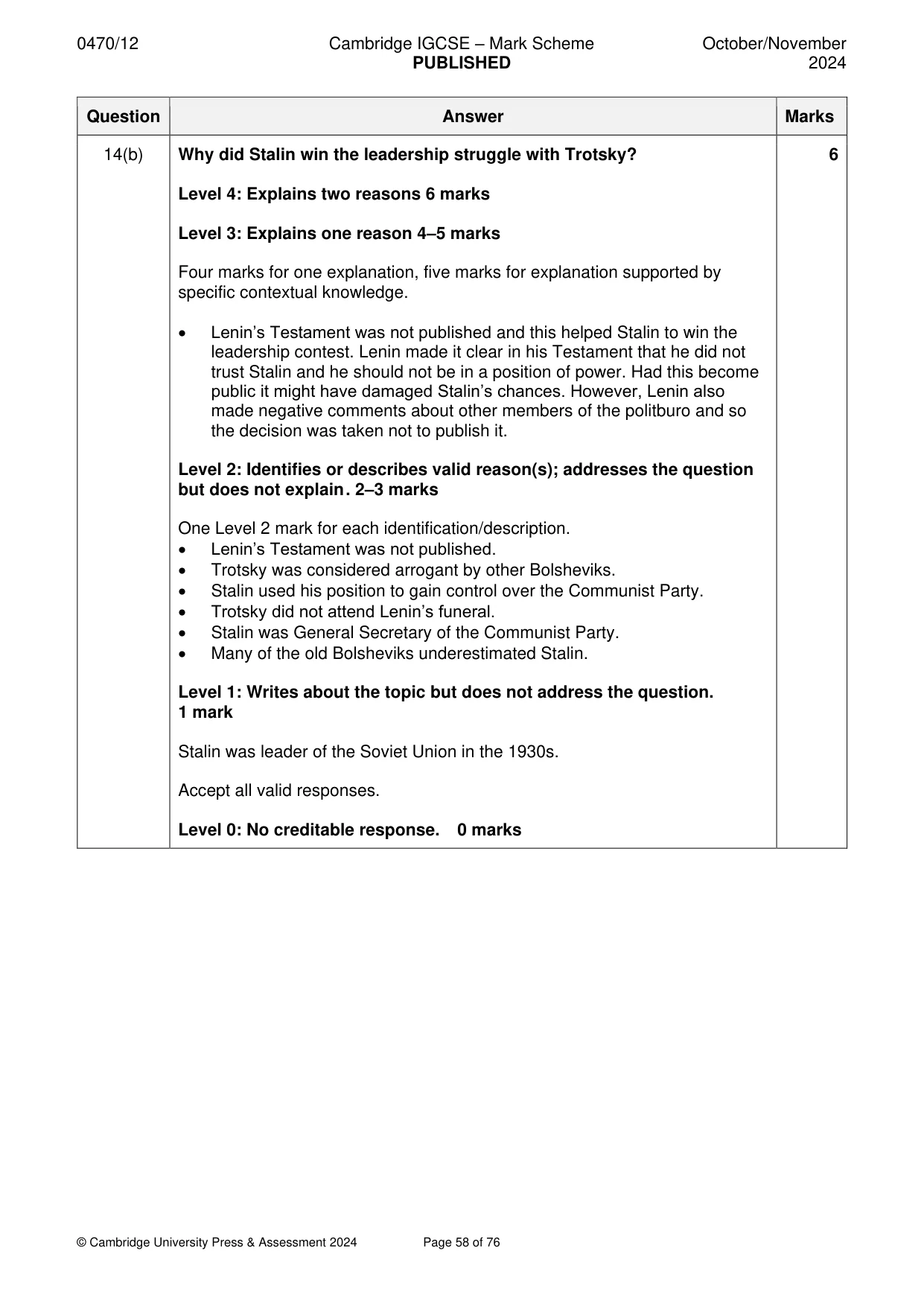
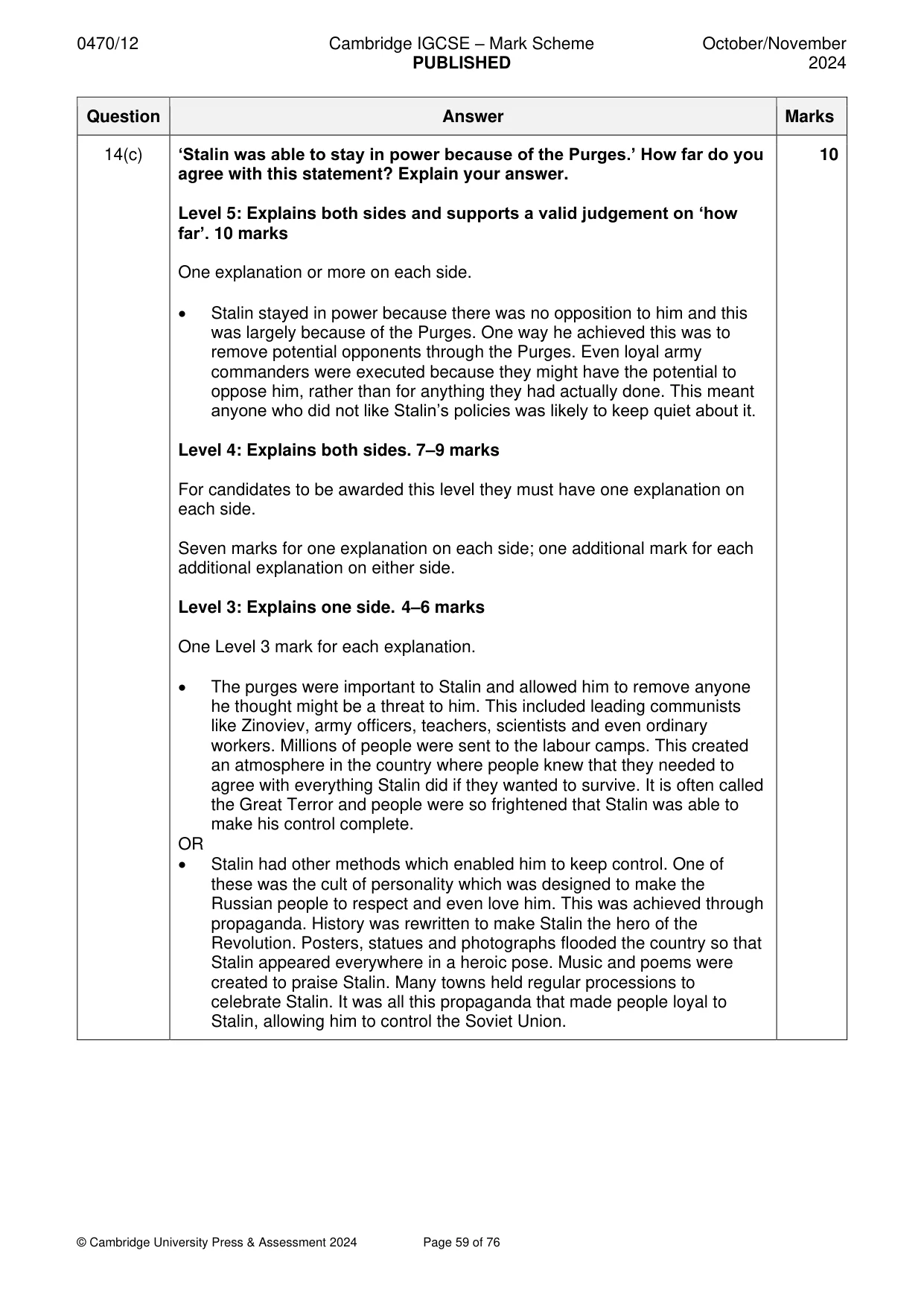
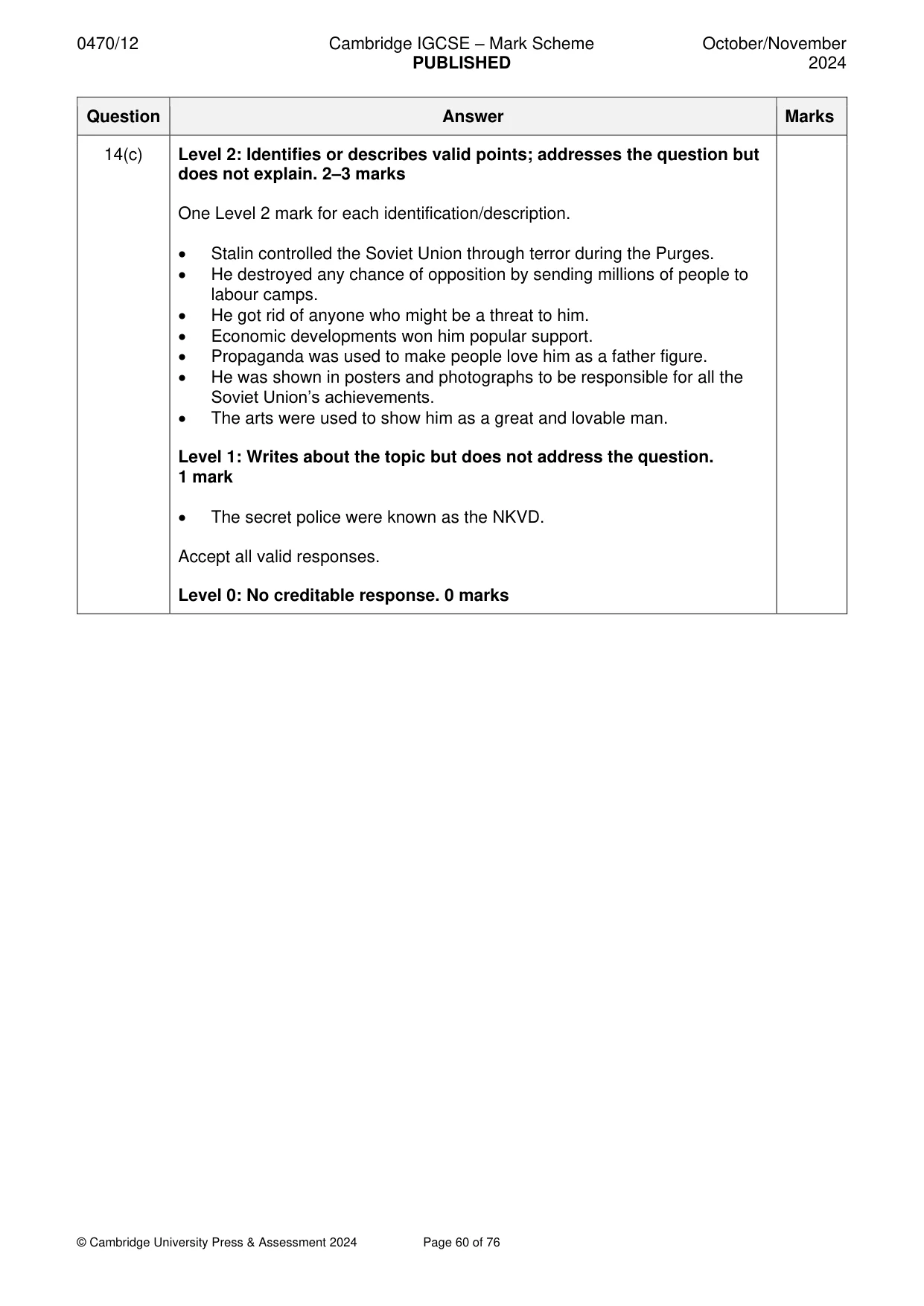
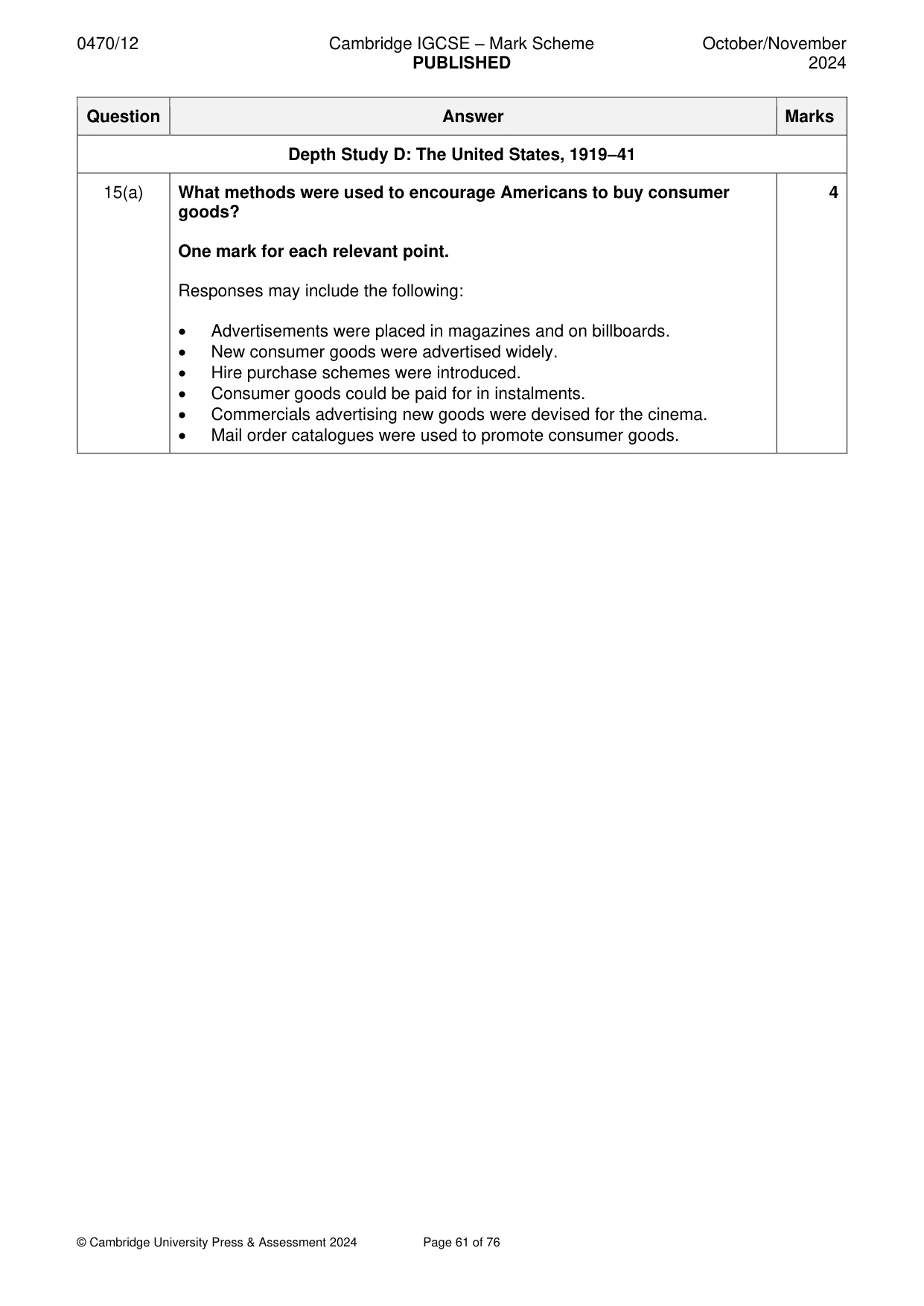
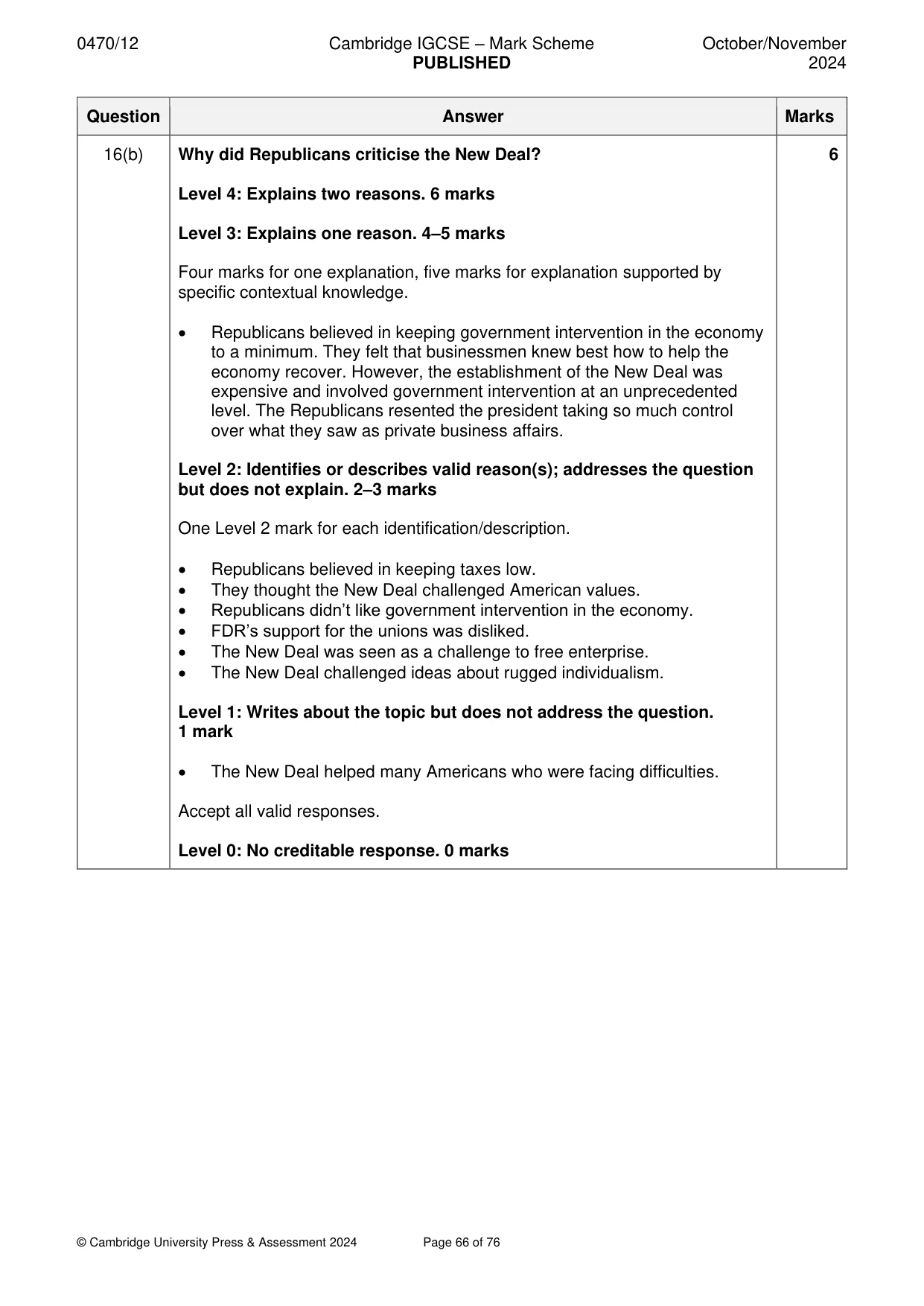
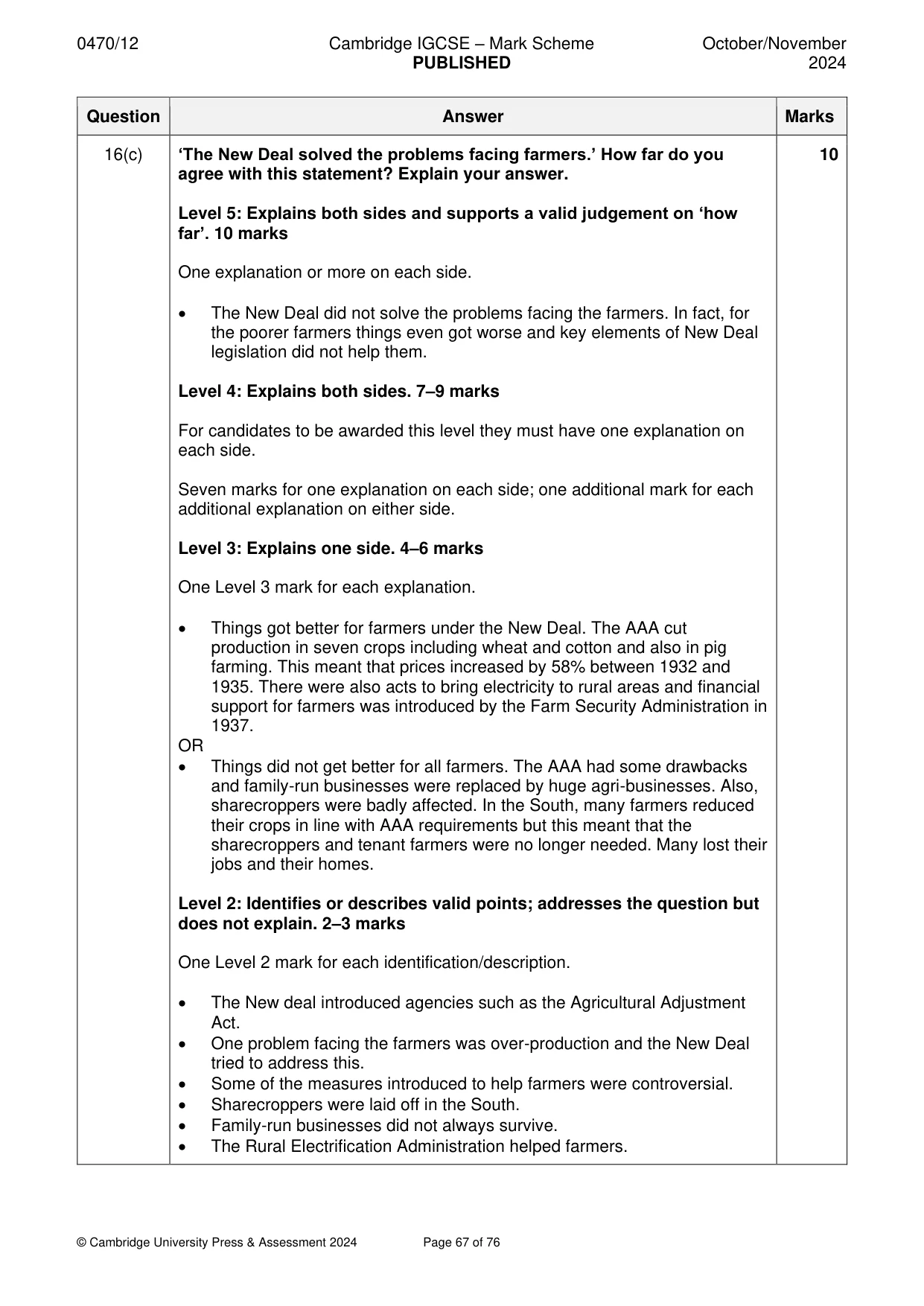
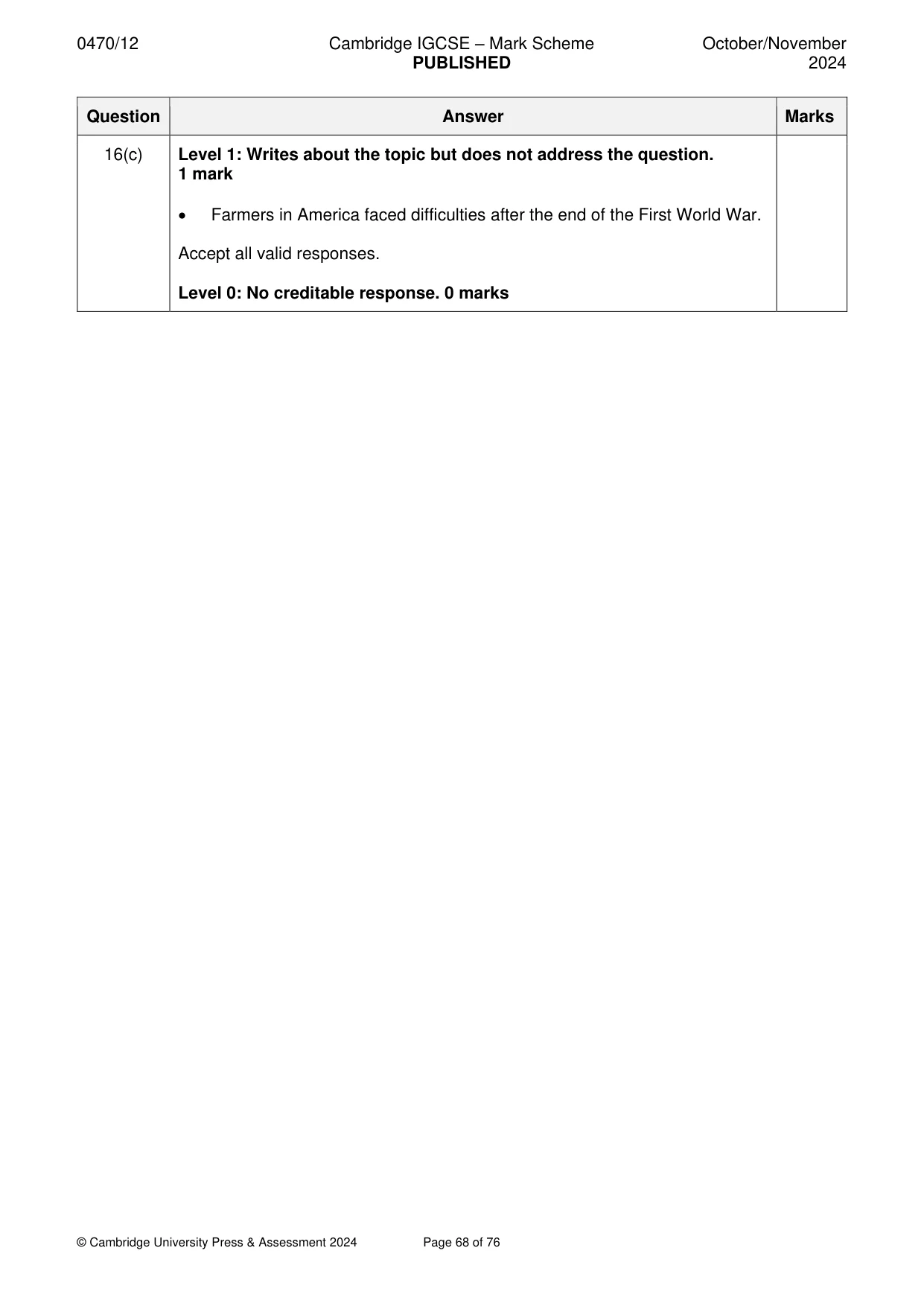
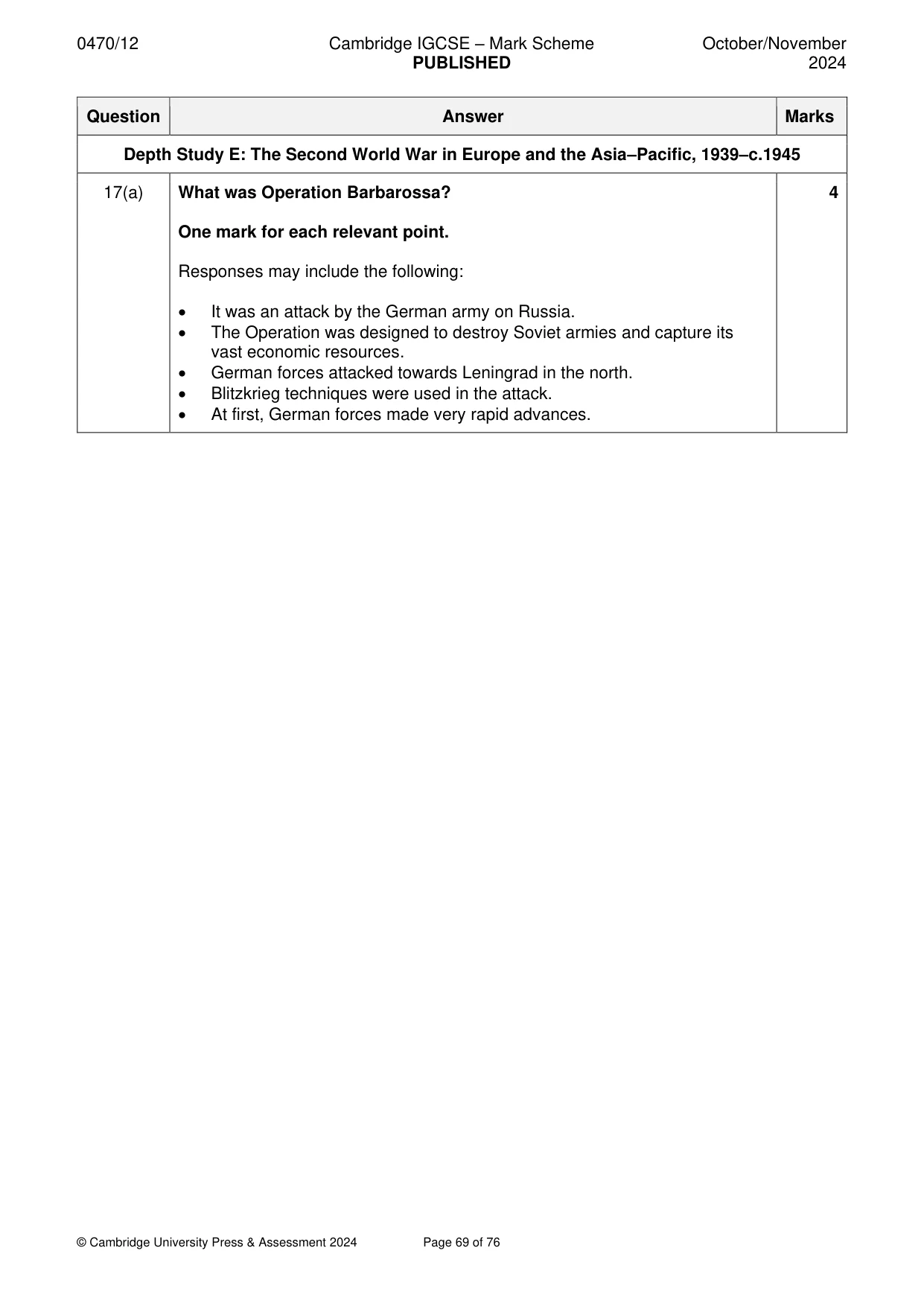
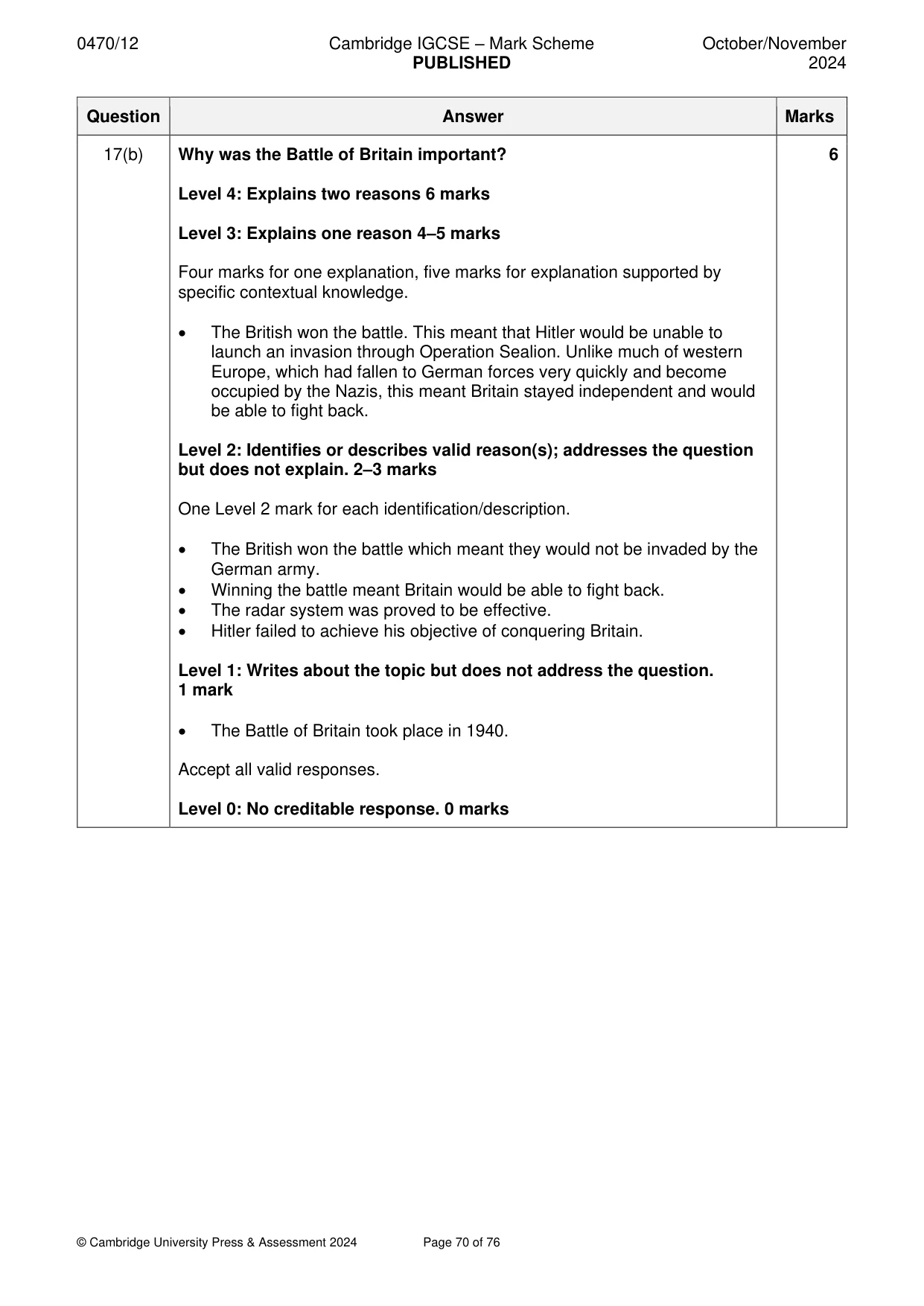
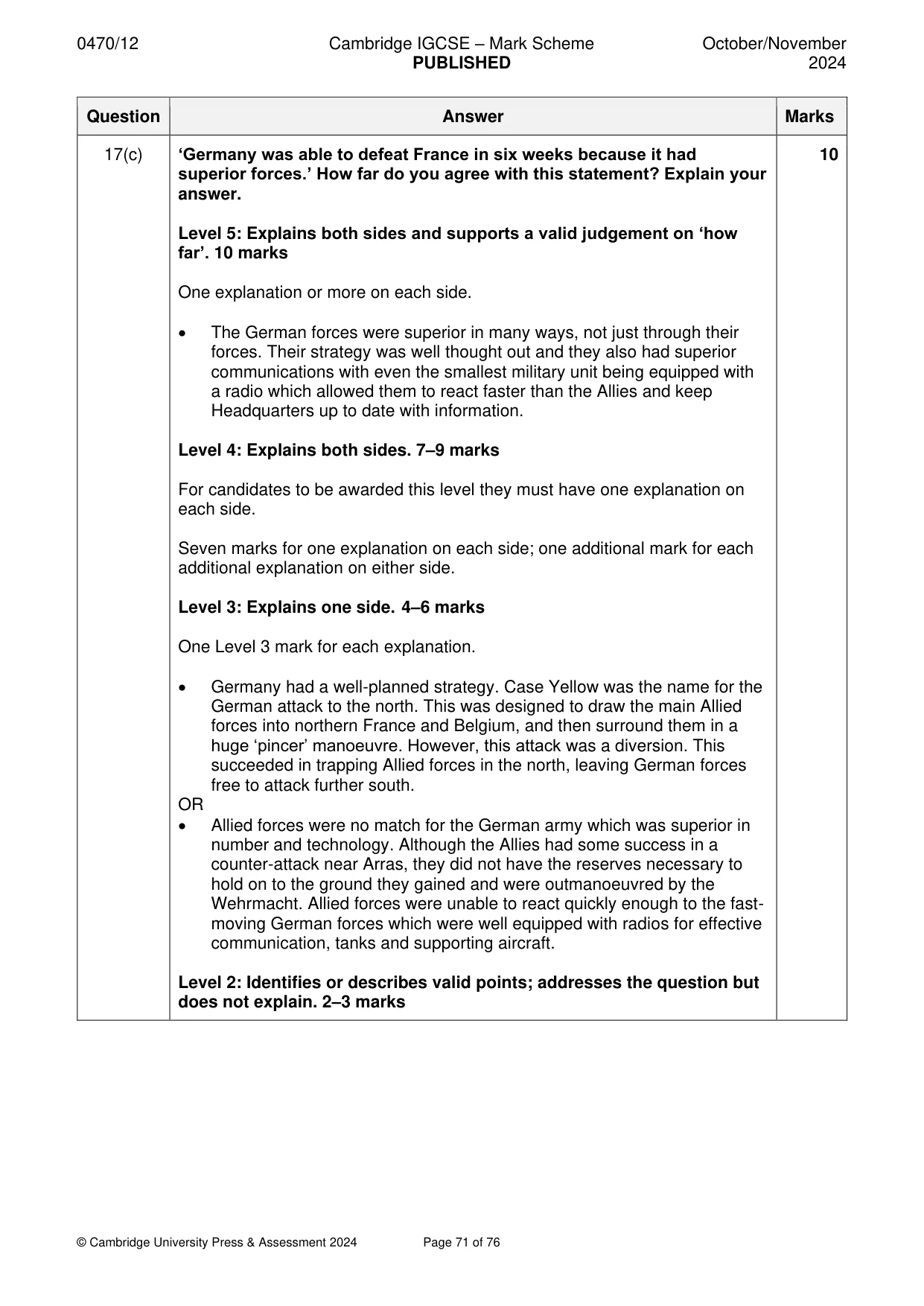
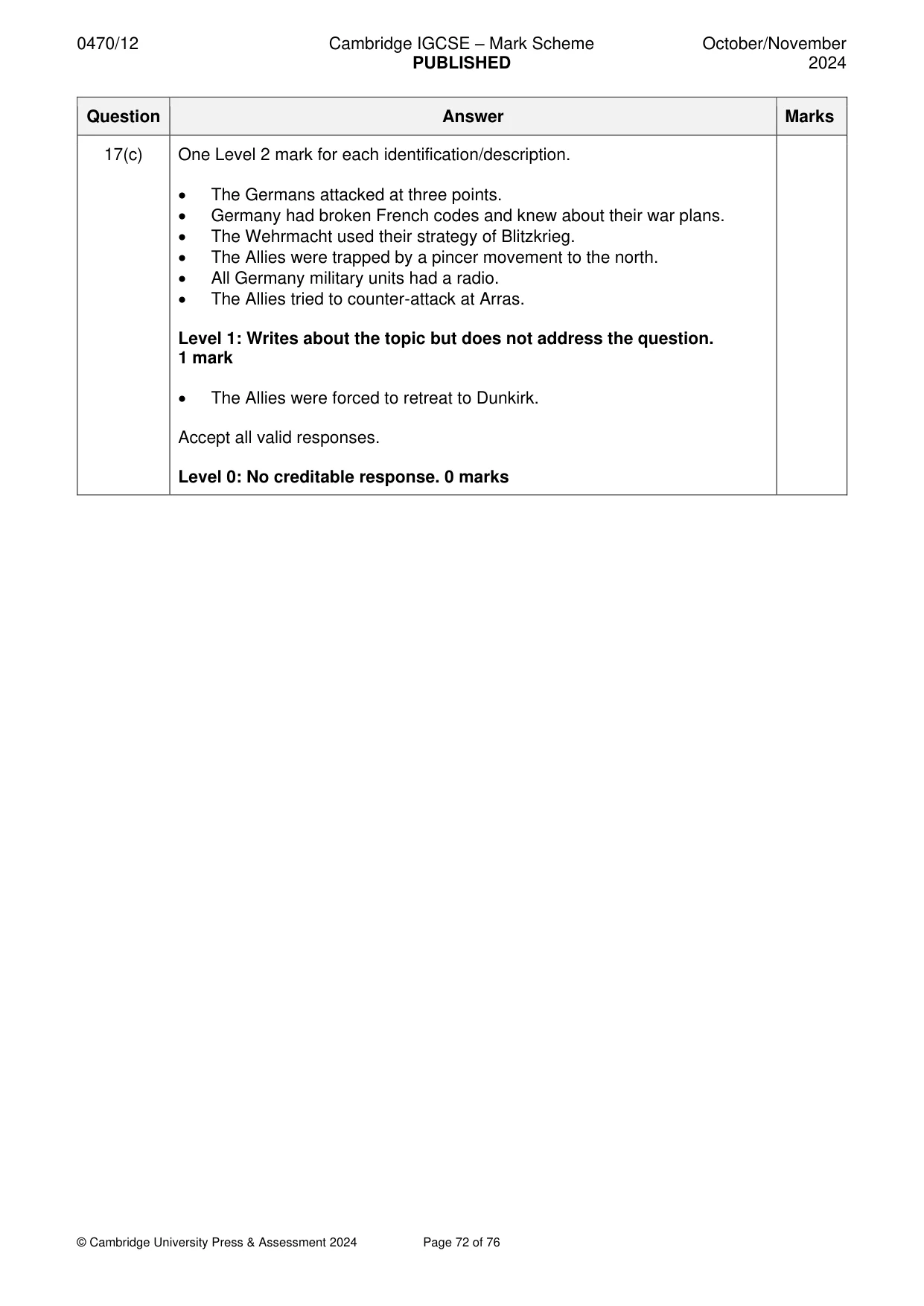
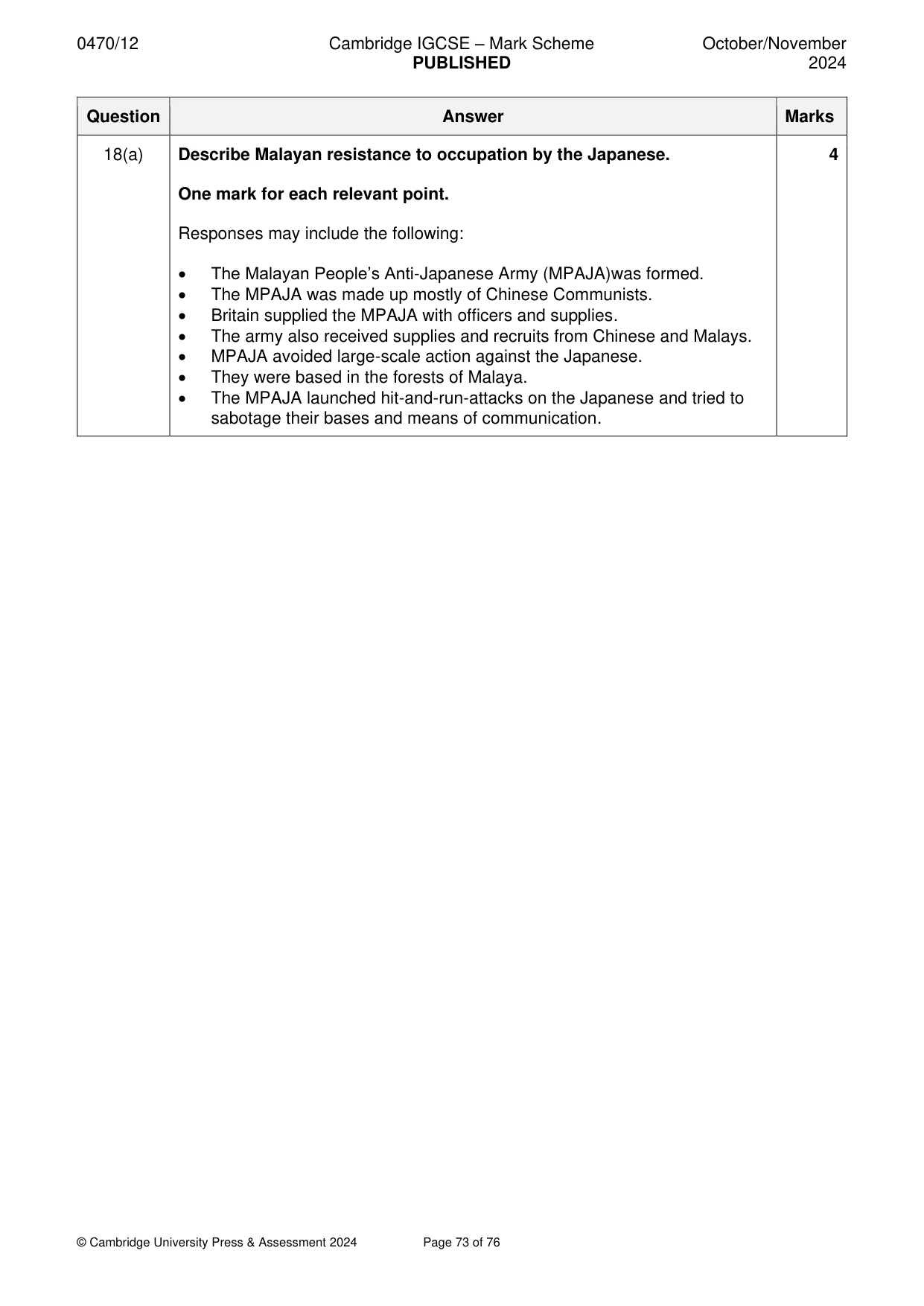
Paper as text
Question paper, page 1
[Turn over Cambridge IGCSE™ This document has 8 pages. Any blank pages are indicated. * 8 4 6 0 2 1 2 4 5 4 * DC (WW) 336448/3 © UCLES 2024 HISTORY 0470/12 Paper 1 Structured Questions October/November 2024 2 hours You must answer on the enclosed answer booklet. You will need: Answer booklet (enclosed) INSTRUCTIONS ● Answer three questions in total: Section A (Core content): answer two questions. Section B (Depth studies): answer one question. ● Follow the instructions on the front cover of the answer booklet. If you need additional answer paper, ask the invigilator for a continuation booklet. INFORMATION ● The total mark for this paper is 60. ● The number of marks for each question or part question is shown in brackets [ ].
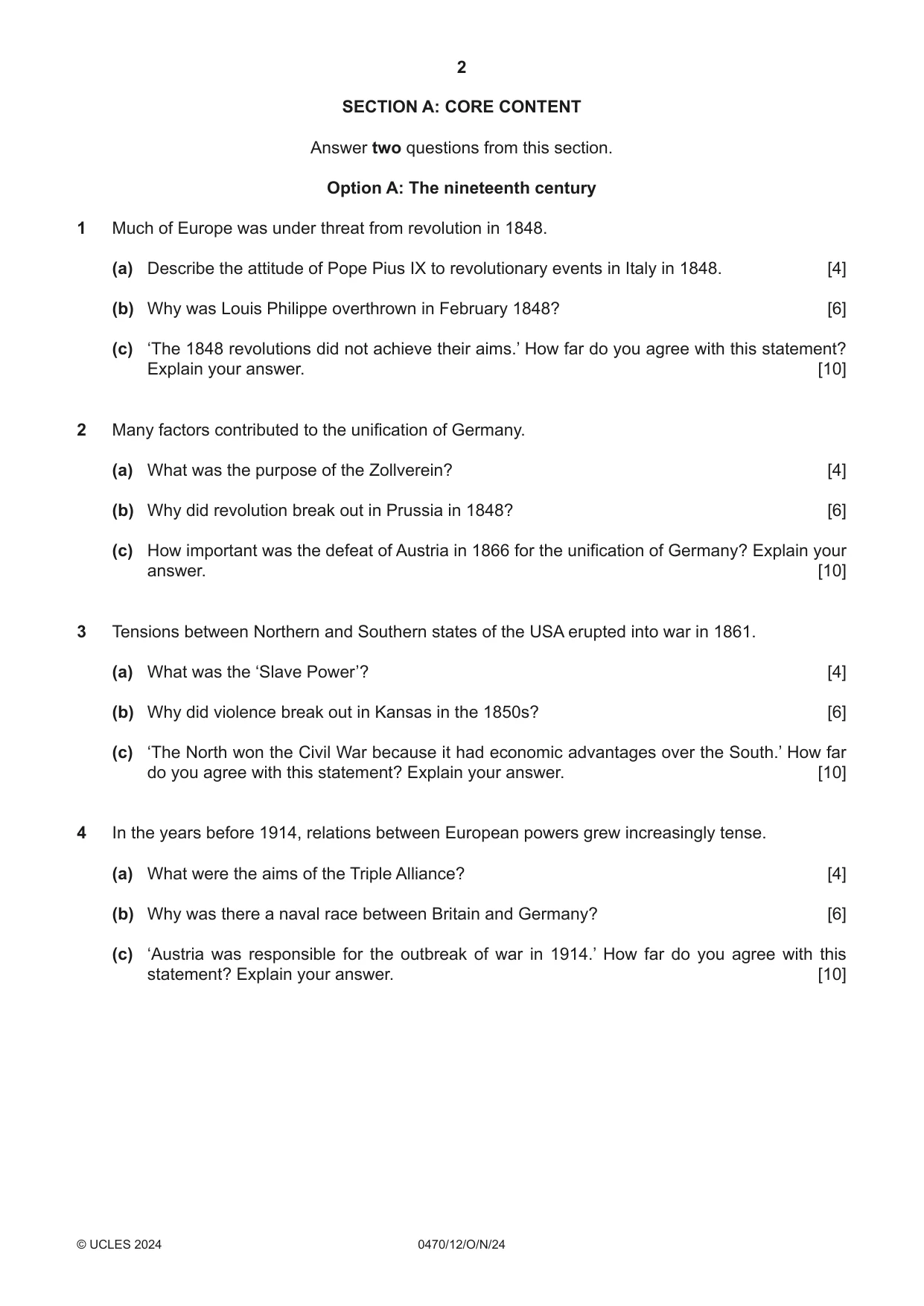
Question paper, page 2
2 0470/12/O/N/24 © UCLES 2024 SECTION A: CORE CONTENT Answer two questions from this section. Option A: The nineteenth century 1 Much of Europe was under threat from revolution in 1848. (a) Describe the attitude of Pope Pius IX to revolutionary events in Italy in 1848. [4] (b) Why was Louis Philippe overthrown in February 1848? [6] (c) ‘The 1848 revolutions did not achieve their aims.’ How far do you agree with this statement? Explain your answer. [10] 2 Many factors contributed to the unification of Germany. (a) What was the purpose of the Zollverein? [4] (b) Why did revolution break out in Prussia in 1848? [6] (c) How important was the defeat of Austria in 1866 for the unification of Germany? Explain your answer. [10] 3 Tensions between Northern and Southern states of the USA erupted into war in 1861. (a) What was the ‘Slave Power’? [4] (b) Why did violence break out in Kansas in the 1850s? [6] (c) ‘The North won the Civil War because it had economic advantages over the South.’ How far do you agree with this statement? Explain your answer. [10] 4 In the years before 1914, relations between European powers grew increasingly tense. (a) What were the aims of the Triple Alliance? [4] (b) Why was there a naval race between Britain and Germany? [6] (c) ‘Austria was responsible for the outbreak of war in 1914.’ How far do you agree with this statement? Explain your answer. [10]
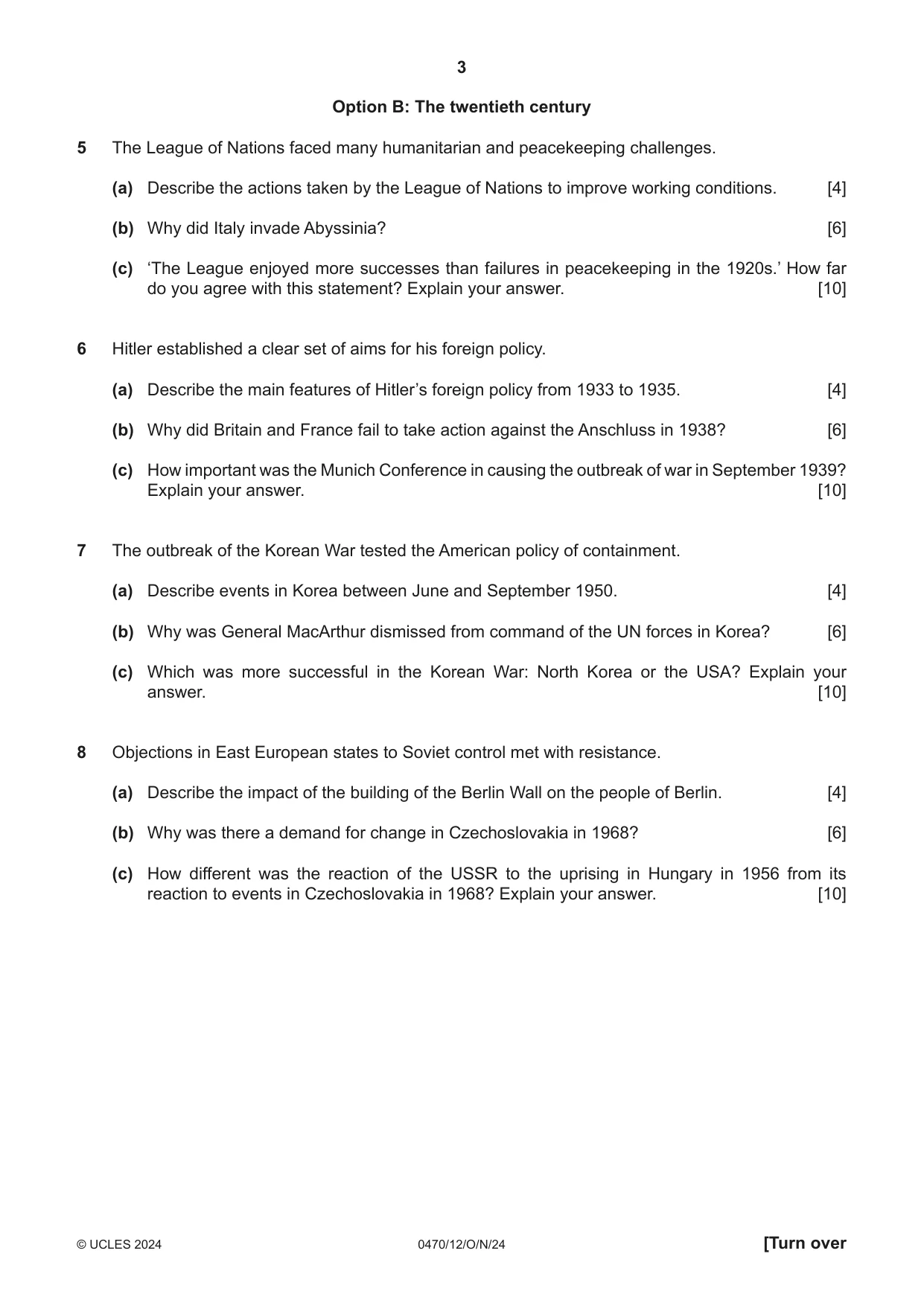
Question paper, page 3
3 0470/12/O/N/24 © UCLES 2024 [Turn over Option B: The twentieth century 5 The League of Nations faced many humanitarian and peacekeeping challenges. (a) Describe the actions taken by the League of Nations to improve working conditions. [4] (b) Why did Italy invade Abyssinia? [6] (c) ‘The League enjoyed more successes than failures in peacekeeping in the 1920s.’ How far do you agree with this statement? Explain your answer. [10] 6 Hitler established a clear set of aims for his foreign policy. (a) Describe the main features of Hitler’s foreign policy from 1933 to 1935. [4] (b) Why did Britain and France fail to take action against the Anschluss in 1938? [6] (c) How important was the Munich Conference in causing the outbreak of war in September 1939? Explain your answer. [10] 7 The outbreak of the Korean War tested the American policy of containment. (a) Describe events in Korea between June and September 1950. [4] (b) Why was General MacArthur dismissed from command of the UN forces in Korea? [6] (c) Which was more successful in the Korean War: North Korea or the USA? Explain your answer. [10] 8 Objections in East European states to Soviet control met with resistance. (a) Describe the impact of the building of the Berlin Wall on the people of Berlin. [4] (b) Why was there a demand for change in Czechoslovakia in 1968? [6] (c) How different was the reaction of the USSR to the uprising in Hungary in 1956 from its reaction to events in Czechoslovakia in 1968? Explain your answer. [10]
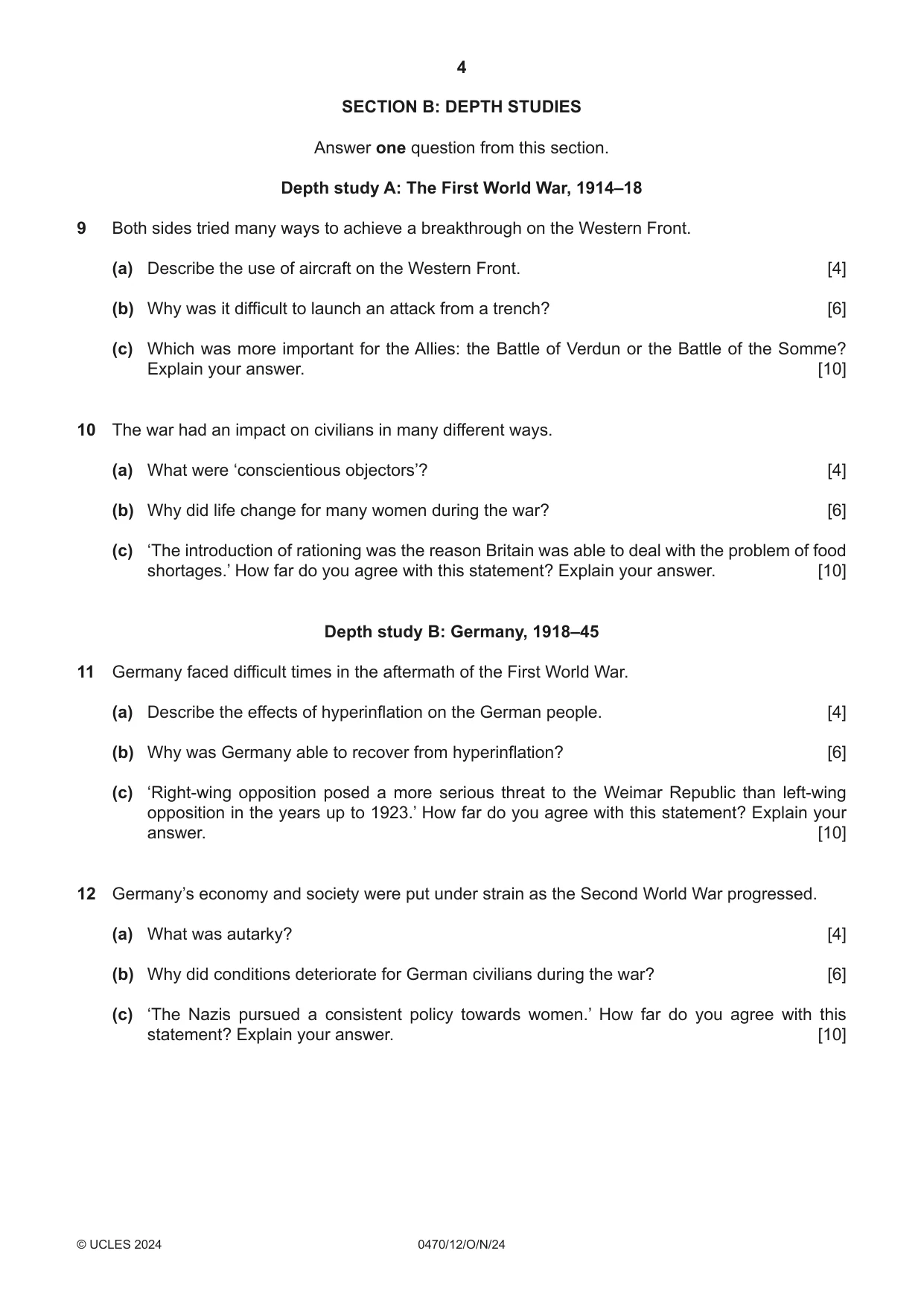
Question paper, page 4
4 0470/12/O/N/24 © UCLES 2024 SECTION B: DEPTH STUDIES Answer one question from this section. Depth study A: The First World War, 1914–18 9 Both sides tried many ways to achieve a breakthrough on the Western Front. (a) Describe the use of aircraft on the Western Front. [4] (b) Why was it difficult to launch an attack from a trench? [6] (c) Which was more important for the Allies: the Battle of Verdun or the Battle of the Somme? Explain your answer. [10] 10 The war had an impact on civilians in many different ways. (a) What were ‘conscientious objectors’? [4] (b) Why did life change for many women during the war? [6] (c) ‘The introduction of rationing was the reason Britain was able to deal with the problem of food shortages.’ How far do you agree with this statement? Explain your answer. [10] Depth study B: Germany, 1918–45 11 Germany faced difficult times in the aftermath of the First World War. (a) Describe the effects of hyperinflation on the German people. [4] (b) Why was Germany able to recover from hyperinflation? [6] (c) ‘Right-wing opposition posed a more serious threat to the Weimar Republic than left-wing opposition in the years up to 1923.’ How far do you agree with this statement? Explain your answer. [10] 12 Germany’s economy and society were put under strain as the Second World War progressed. (a) What was autarky? [4] (b) Why did conditions deteriorate for German civilians during the war? [6] (c) ‘The Nazis pursued a consistent policy towards women.’ How far do you agree with this statement? Explain your answer. [10]
Question paper, page 5
5 0470/12/O/N/24 © UCLES 2024 [Turn over Depth study C: Russia, 1905–41 13 Despite rising discontent in the years up to 1905, the Tsarist regime survived. (a) What happened on the battleship Potemkin in 1905? [4] (b) Why was discontent with the Tsarist regime widespread by the beginning of 1905? [6] (c) ‘The October Manifesto was more important than repression to the survival of the Tsarist regime up to 1914.’ How far do you agree with this statement? Explain your answer. [10] 14 Many factors contributed to Stalin’s ability to achieve and maintain control over the USSR. (a) What was Trotsky’s idea of Permanent Revolution? [4] (b) Why did Stalin win the leadership struggle with Trotsky? [6] (c) ‘Stalin was able to stay in power because of the Purges.’ How far do you agree with this statement? Explain your answer. [10] Depth study D: The United States, 1919–41 15 The boom brought advantages for some Americans but did not benefit all. (a) What methods were used to encourage Americans to buy consumer goods? [4] (b) Why did the boom bring changes to the lives of many women? [6] (c) Which suffered more in the 1920s: farming or traditional industries? Explain your answer. [10] 16 Although the New Deal attempted to address many problems, it faced criticism. (a) Describe measures introduced by the New Deal to help the unemployed. [4] (b) Why did Republicans criticise the New Deal? [6] (c) ‘The New Deal solved the problems facing farmers.’ How far do you agree with this statement? Explain your answer. [10]
Question paper, page 6
6 0470/12/O/N/24 © UCLES 2024 Depth study E: The Second World War in Europe and the Asia–Pacific, 1939–c.1945 17 Hitler’s conquest of most of mainland Europe was rapid. (a) What was Operation Barbarossa? [4] (b) Why was the Battle of Britain important? [6] (c) ‘Germany was able to defeat France in six weeks because it had superior forces.’ How far do you agree with this statement? Explain your answer. [10] 18 Civilians across the world suffered as a result of war. (a) Describe Malayan resistance to occupation by the Japanese. [4] (b) Why did an uprising against the Nazis break out in Warsaw in August 1944? [6] (c) ‘German bombing raids on Britain were designed to destroy civilian morale.’ How far do you agree with this statement? Explain your answer. [10]
Question paper, page 7
7 0470/12/O/N/24 © UCLES 2024 BLANK PAGE
Question paper, page 8
8 0470/12/O/N/24 © UCLES 2024 BLANK PAGE Permission to reproduce items where third-party owned material protected by copyright is included has been sought and cleared where possible. Every reasonable effort has been made by the publisher (UCLES) to trace copyright holders, but if any items requiring clearance have unwittingly been included, the publisher will be pleased to make amends at the earliest possible opportunity. To avoid the issue of disclosure of answer-related information to candidates, all copyright acknowledgements are reproduced online in the Cambridge Assessment International Education Copyright Acknowledgements Booklet. This is produced for each series of examinations and is freely available to download at www.cambridgeinternational.org after the live examination series. Cambridge Assessment International Education is part of Cambridge Assessment. Cambridge Assessment is the brand name of the University of Cambridge Local Examinations Syndicate (UCLES), which is a department of the University of Cambridge.
Mark scheme, page 1
This document consists of 76 printed pages. © Cambridge University Press & Assessment 2024 [Turn over Cambridge IGCSE™ HISTORY 0470/12 Paper 1 October/November 2024 MARK SCHEME Maximum Mark: 60 Published This mark scheme is published as an aid to teachers and candidates, to indicate the requirements of the examination. It shows the basis on which Examiners were instructed to award marks. It does not indicate the details of the discussions that took place at an Examiners’ meeting before marking began, which would have considered the acceptability of alternative answers. Mark schemes should be read in conjunction with the question paper and the Principal Examiner Report for Teachers. Cambridge International will not enter into discussions about these mark schemes. Cambridge International is publishing the mark schemes for the October/November 2024 series for most Cambridge IGCSE, Cambridge International A and AS Level components, and some Cambridge O Level components.
Mark scheme, page 2
0470/12 Cambridge IGCSE – Mark Scheme PUBLISHED October/November 2024 © Cambridge University Press & Assessment 2024 Page 2 of 76 Generic Marking Principles These general marking principles must be applied by all examiners when marking candidate answers. They should be applied alongside the specific content of the mark scheme or generic level descriptions for a question. Each question paper and mark scheme will also comply with these marking principles. GENERIC MARKING PRINCIPLE 1: Marks must be awarded in line with: • the specific content of the mark scheme or the generic level descriptors for the question • the specific skills defined in the mark scheme or in the generic level descriptors for the question • the standard of response required by a candidate as exemplified by the standardisation scripts. GENERIC MARKING PRINCIPLE 2: Marks awarded are always whole marks (not half marks, or other fractions). GENERIC MARKING PRINCIPLE 3: Marks must be awarded positively: • marks are awarded for correct/valid answers, as defined in the mark scheme. However, credit is given for valid answers which go beyond the scope of the syllabus and mark scheme, referring to your Team Leader as appropriate • marks are awarded when candidates clearly demonstrate what they know and can do • marks are not deducted for errors • marks are not deducted for omissions • answers should only be judged on the quality of spelling, punctuation and grammar when these features are specifically assessed by the question as indicated by the mark scheme. The meaning, however, should be unambiguous. GENERIC MARKING PRINCIPLE 4: Rules must be applied consistently, e.g. in situations where candidates have not followed instructions or in the application of generic level descriptors. GENERIC MARKING PRINCIPLE 5: Marks should be awarded using the full range of marks defined in the mark scheme for the question. (However, the use of the full mark range may be limited according to the quality of the candidate responses seen.) GENERIC MARKING PRINCIPLE 6: Marks awarded are based solely on the requirements as defined in the mark scheme. Marks should not be awarded with grade thresholds or grade descriptors in mind.
Mark scheme, page 3
0470/12 Cambridge IGCSE – Mark Scheme PUBLISHED October/November 2024 © Cambridge University Press & Assessment 2024 Page 3 of 76 Assessment objectives AO1 An ability to recall, select, organise and deploy knowledge of the syllabus content. AO2 An ability to construct historical explanations using an understanding of: • cause and consequence, change and continuity, similarity and difference • the motives, emotions, intentions and beliefs of people in the past.
Mark scheme, page 4
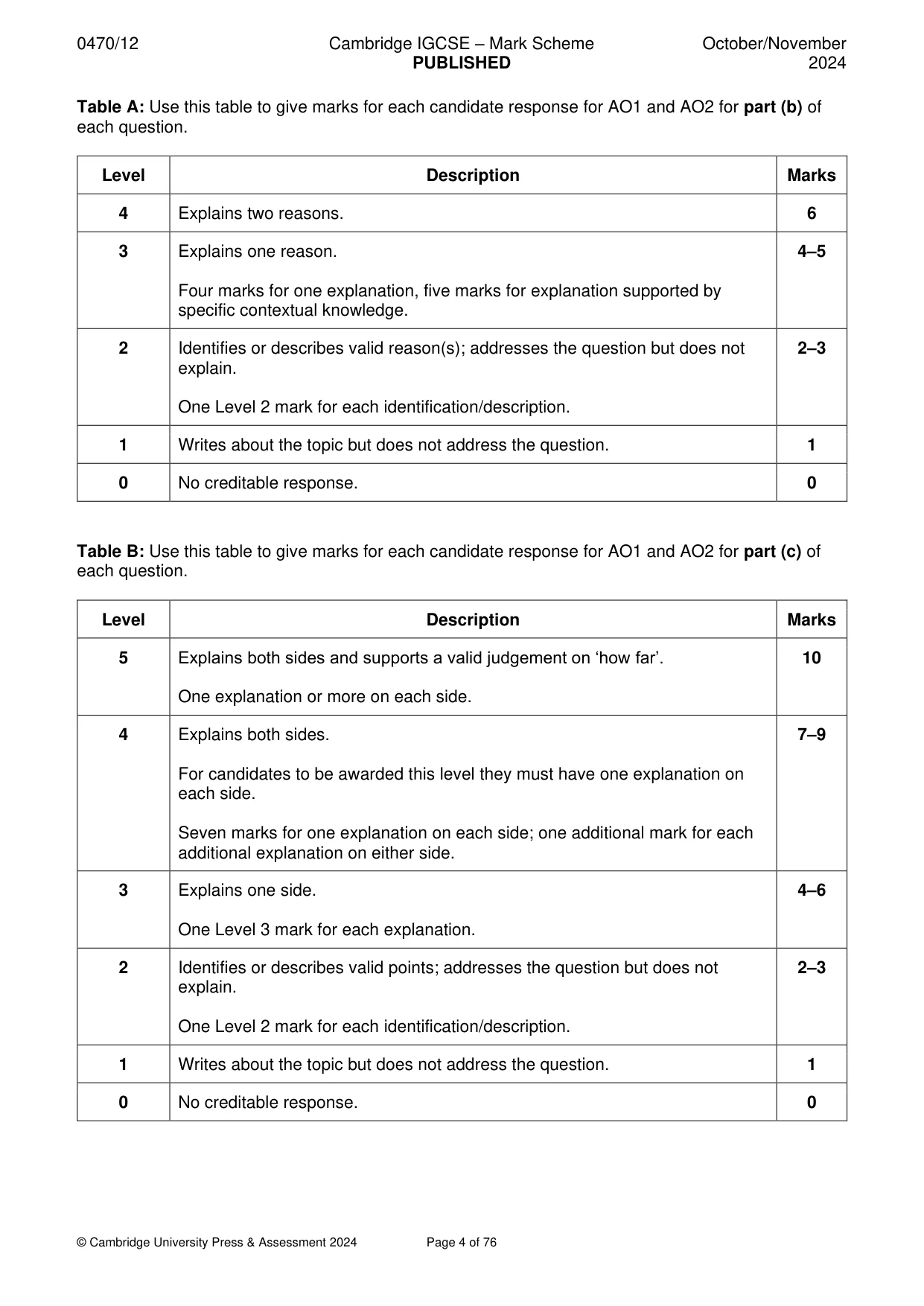
0470/12 Cambridge IGCSE – Mark Scheme PUBLISHED October/November 2024 © Cambridge University Press & Assessment 2024 Page 4 of 76 Table A: Use this table to give marks for each candidate response for AO1 and AO2 for part (b) of each question. Level Description Marks 4 Explains two reasons. 6 3 Explains one reason. Four marks for one explanation, five marks for explanation supported by specific contextual knowledge. 4–5 2 Identifies or describes valid reason(s); addresses the question but does not explain. One Level 2 mark for each identification/description. 2–3 1 Writes about the topic but does not address the question. 1 0 No creditable response. 0 Table B: Use this table to give marks for each candidate response for AO1 and AO2 for part (c) of each question. Level Description Marks 5 Explains both sides and supports a valid judgement on ‘how far’. One explanation or more on each side. 10 4 Explains both sides. For candidates to be awarded this level they must have one explanation on each side. Seven marks for one explanation on each side; one additional mark for each additional explanation on either side. 7–9 3 Explains one side. One Level 3 mark for each explanation. 4–6 2 Identifies or describes valid points; addresses the question but does not explain. One Level 2 mark for each identification/description. 2–3 1 Writes about the topic but does not address the question. 1 0 No creditable response. 0
Mark scheme, page 5
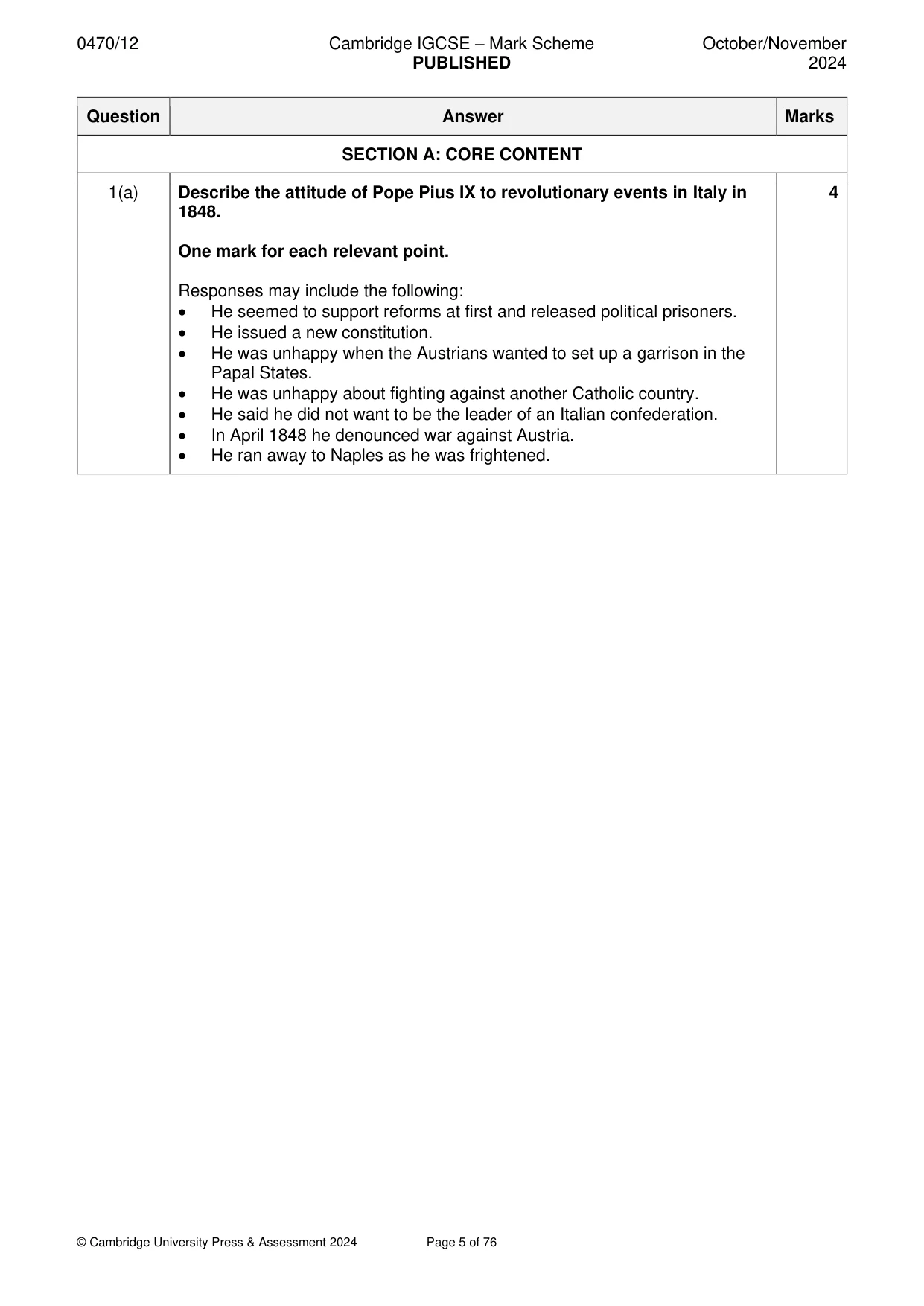
0470/12 Cambridge IGCSE – Mark Scheme PUBLISHED October/November 2024 © Cambridge University Press & Assessment 2024 Page 5 of 76 Question Answer Marks SECTION A: CORE CONTENT 1(a) Describe the attitude of Pope Pius IX to revolutionary events in Italy in 1848. One mark for each relevant point. Responses may include the following: • He seemed to support reforms at first and released political prisoners. • He issued a new constitution. • He was unhappy when the Austrians wanted to set up a garrison in the Papal States. • He was unhappy about fighting against another Catholic country. • He said he did not want to be the leader of an Italian confederation. • In April 1848 he denounced war against Austria. • He ran away to Naples as he was frightened. 4
Mark scheme, page 6
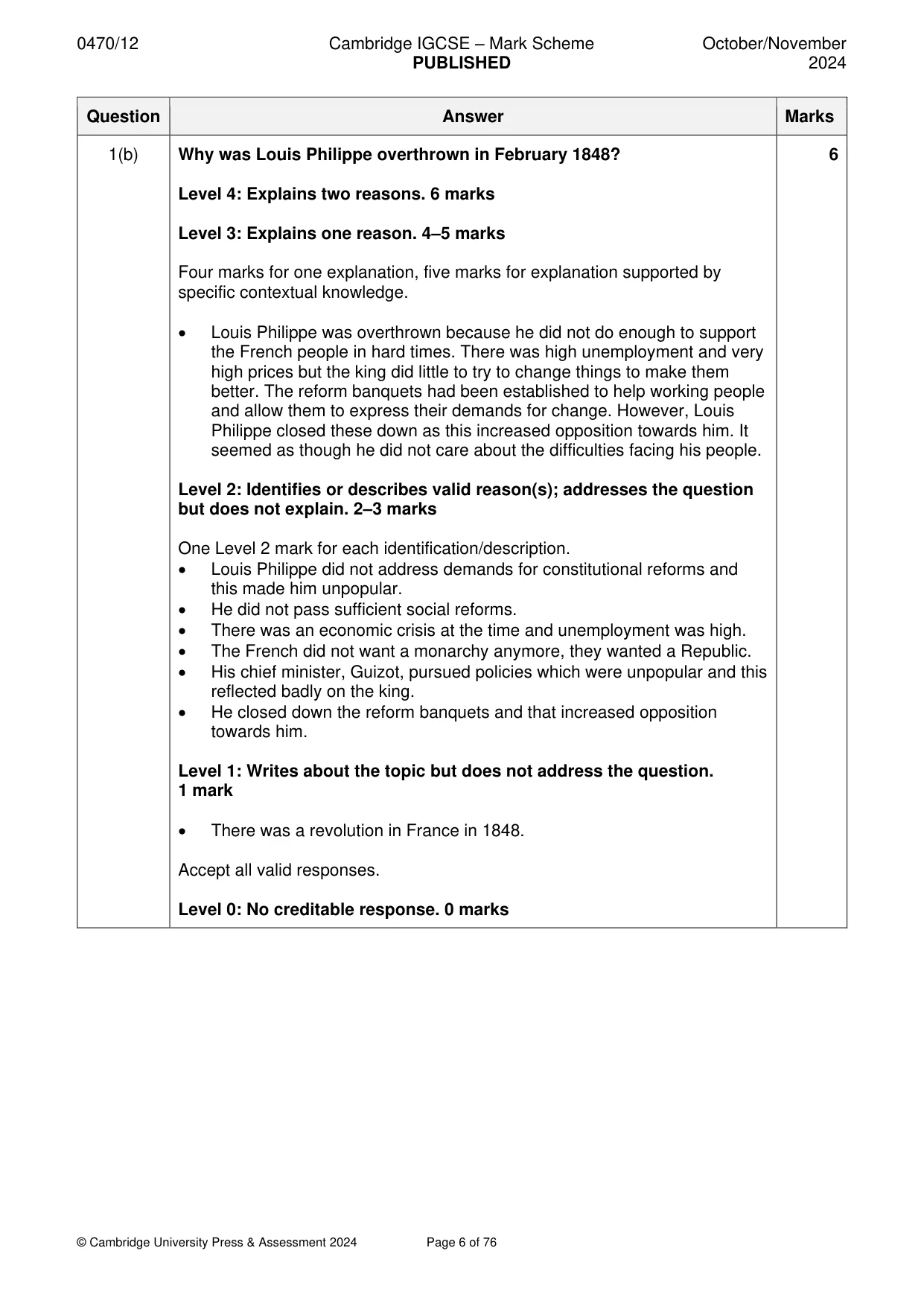
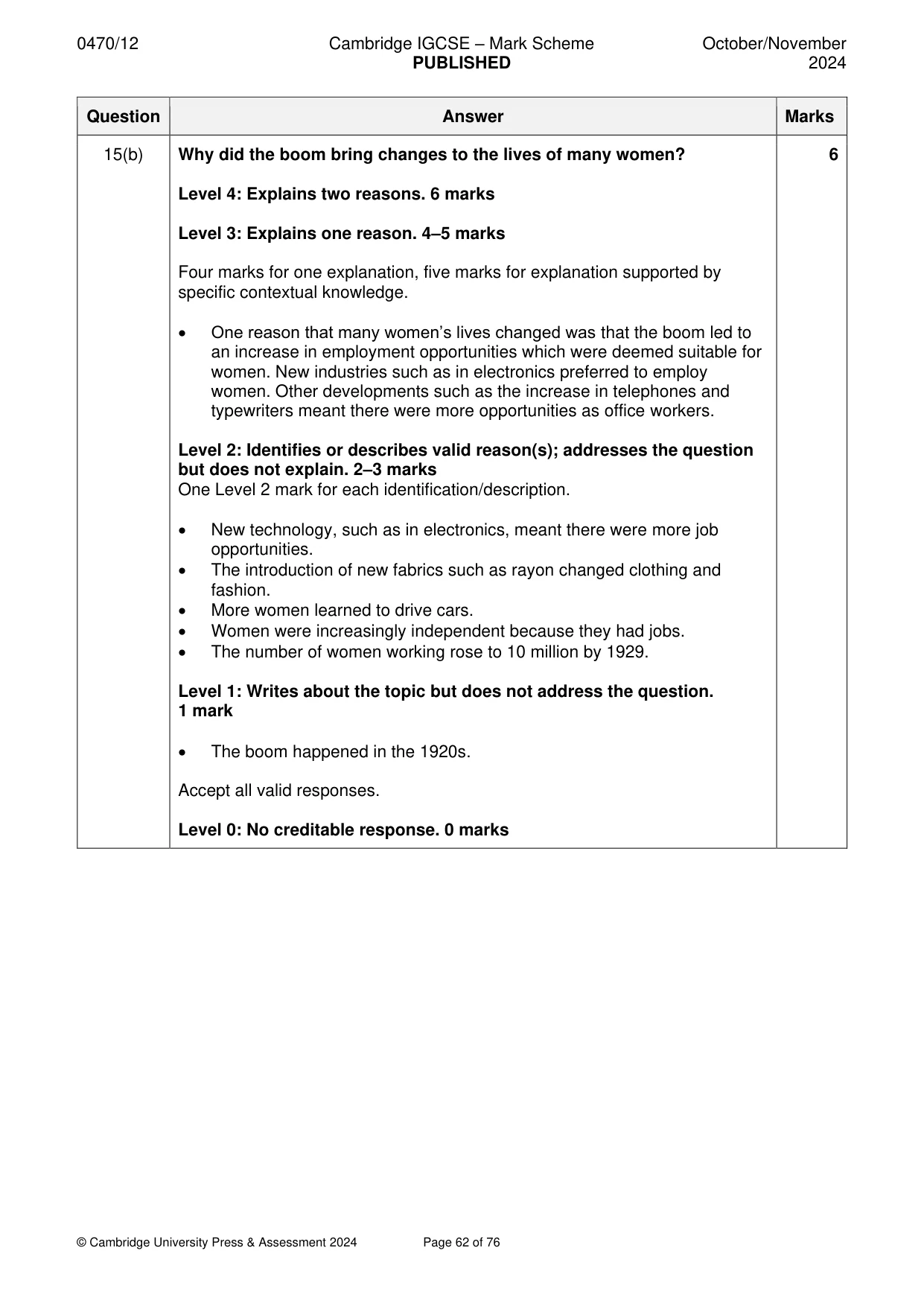
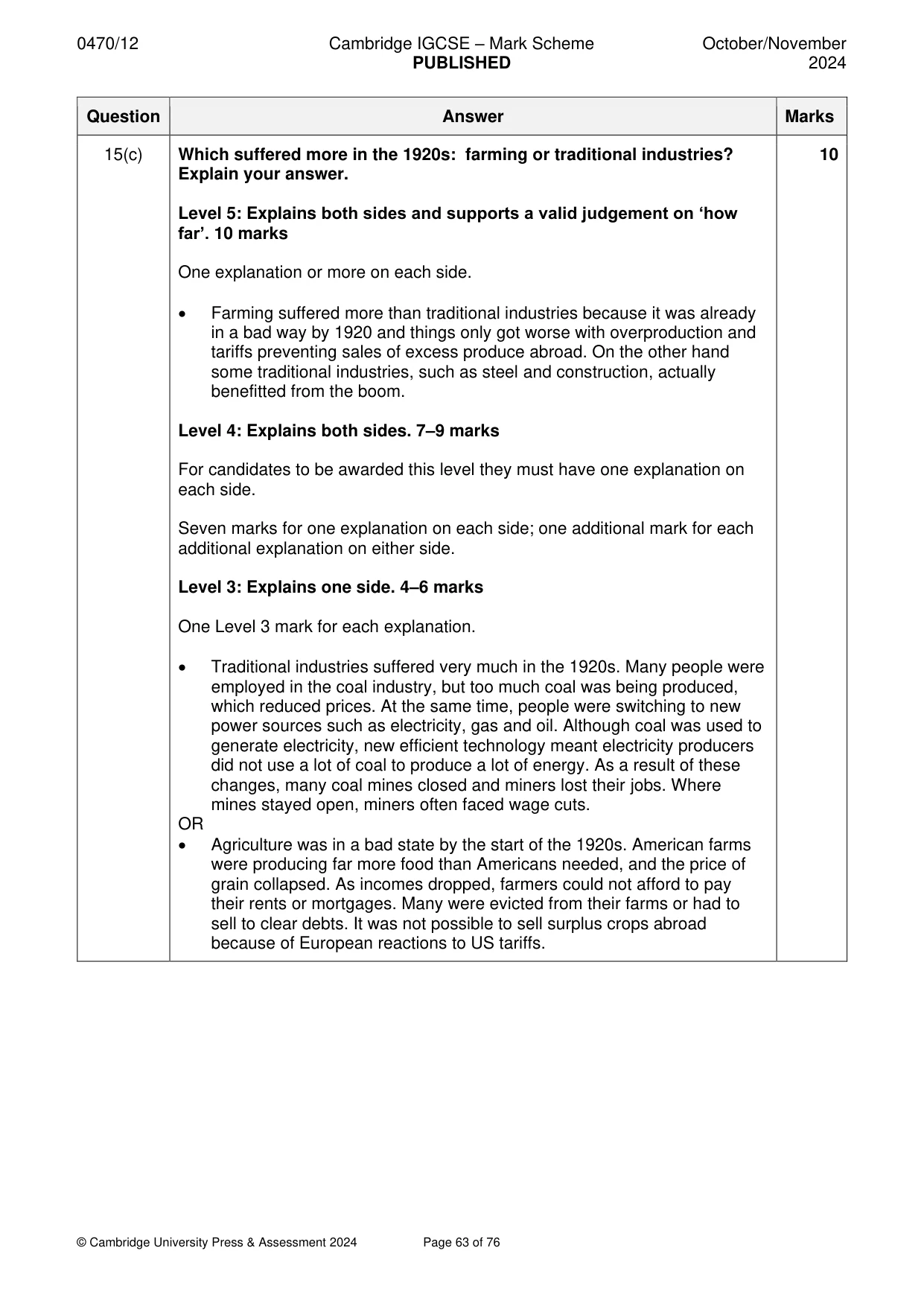
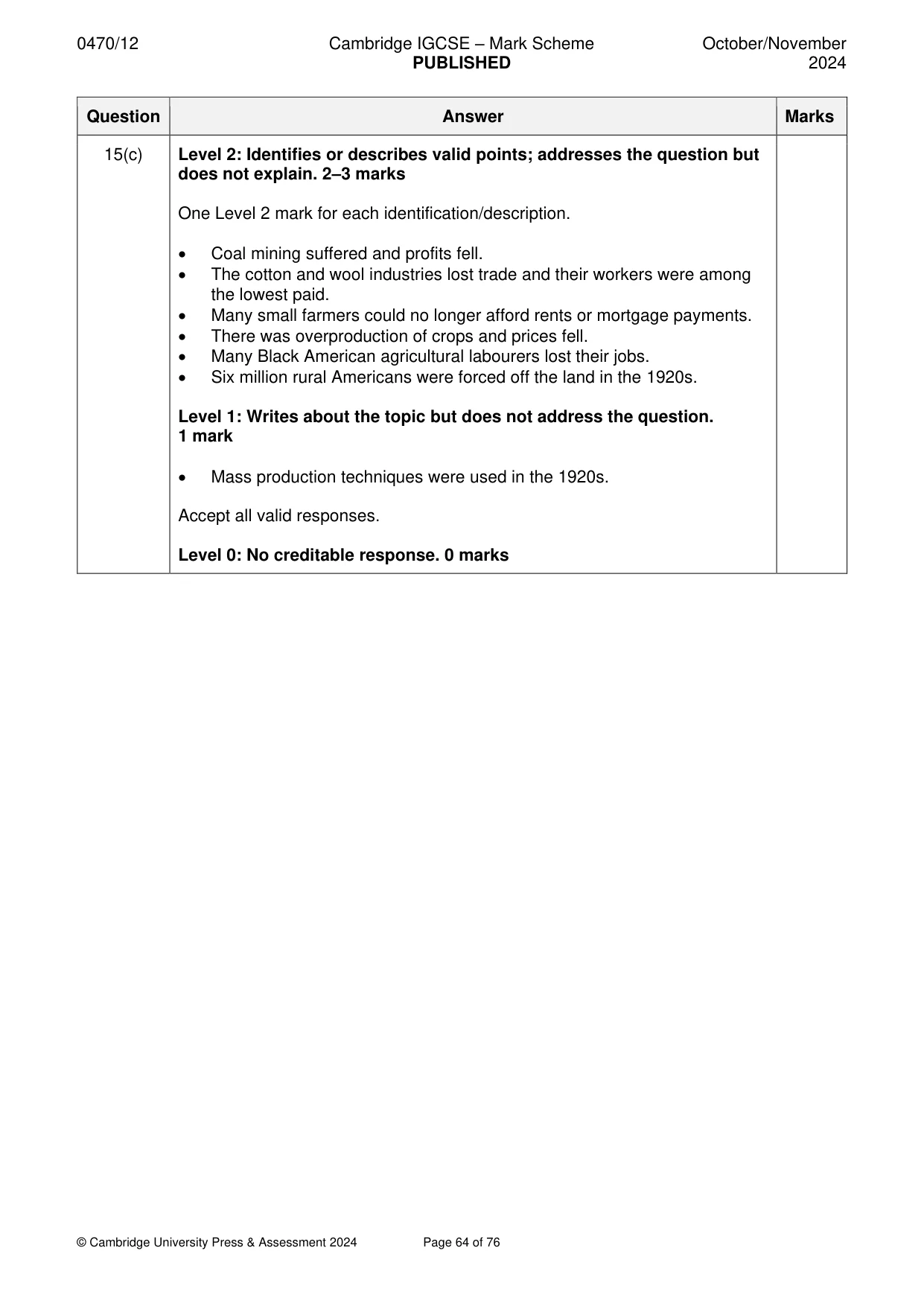
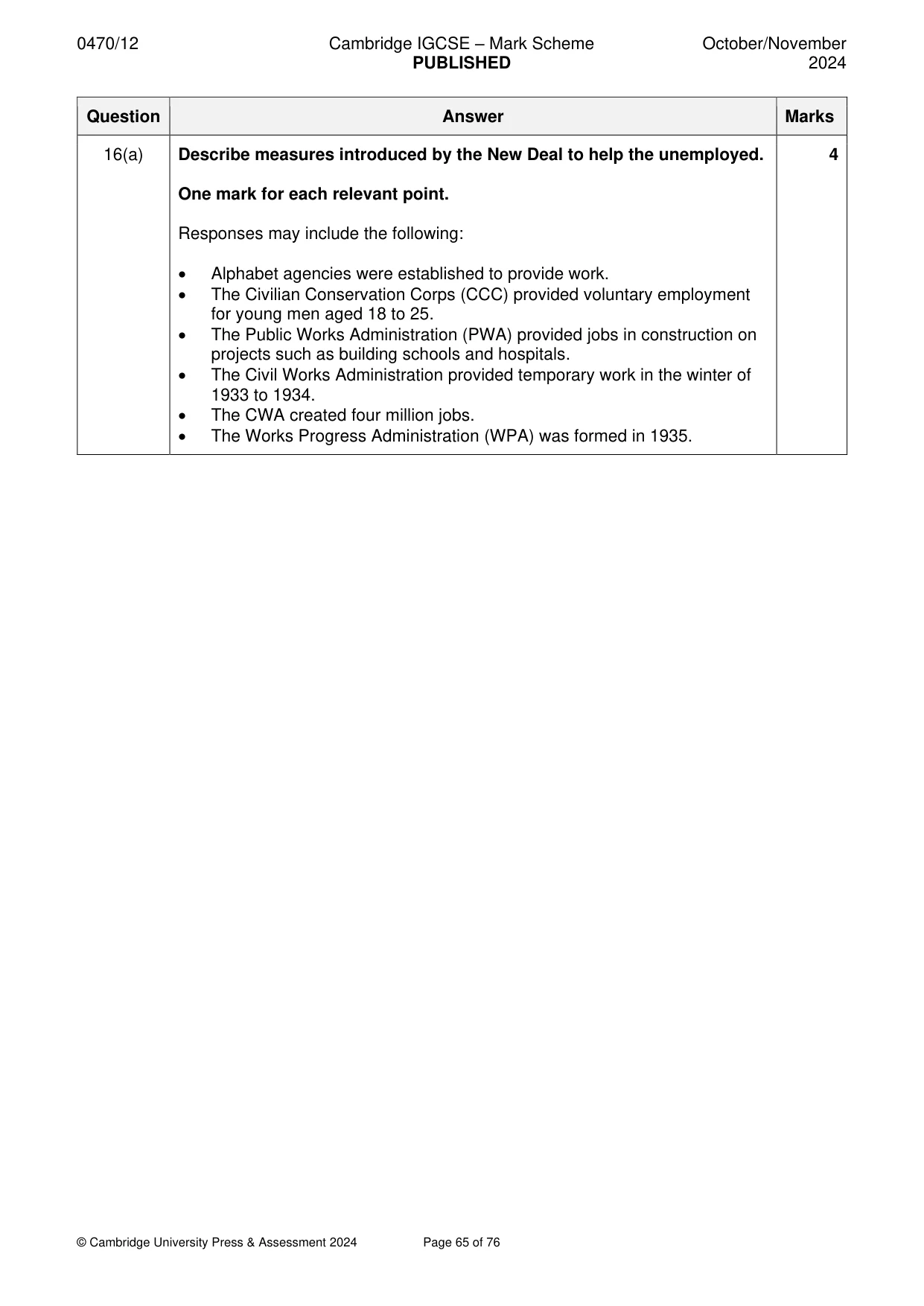
0470/12 Cambridge IGCSE – Mark Scheme PUBLISHED October/November 2024 © Cambridge University Press & Assessment 2024 Page 6 of 76 Question Answer Marks 1(b) Why was Louis Philippe overthrown in February 1848? Level 4: Explains two reasons. 6 marks Level 3: Explains one reason. 4–5 marks Four marks for one explanation, five marks for explanation supported by specific contextual knowledge. • Louis Philippe was overthrown because he did not do enough to support the French people in hard times. There was high unemployment and very high prices but the king did little to try to change things to make them better. The reform banquets had been established to help working people and allow them to express their demands for change. However, Louis Philippe closed these down as this increased opposition towards him. It seemed as though he did not care about the difficulties facing his people. Level 2: Identifies or describes valid reason(s); addresses the question but does not explain. 2–3 marks One Level 2 mark for each identification/description. • Louis Philippe did not address demands for constitutional reforms and this made him unpopular. • He did not pass sufficient social reforms. • There was an economic crisis at the time and unemployment was high. • The French did not want a monarchy anymore, they wanted a Republic. • His chief minister, Guizot, pursued policies which were unpopular and this reflected badly on the king. • He closed down the reform banquets and that increased opposition towards him. Level 1: Writes about the topic but does not address the question. 1 mark • There was a revolution in France in 1848. Accept all valid responses. Level 0: No creditable response. 0 marks 6
Mark scheme, page 7
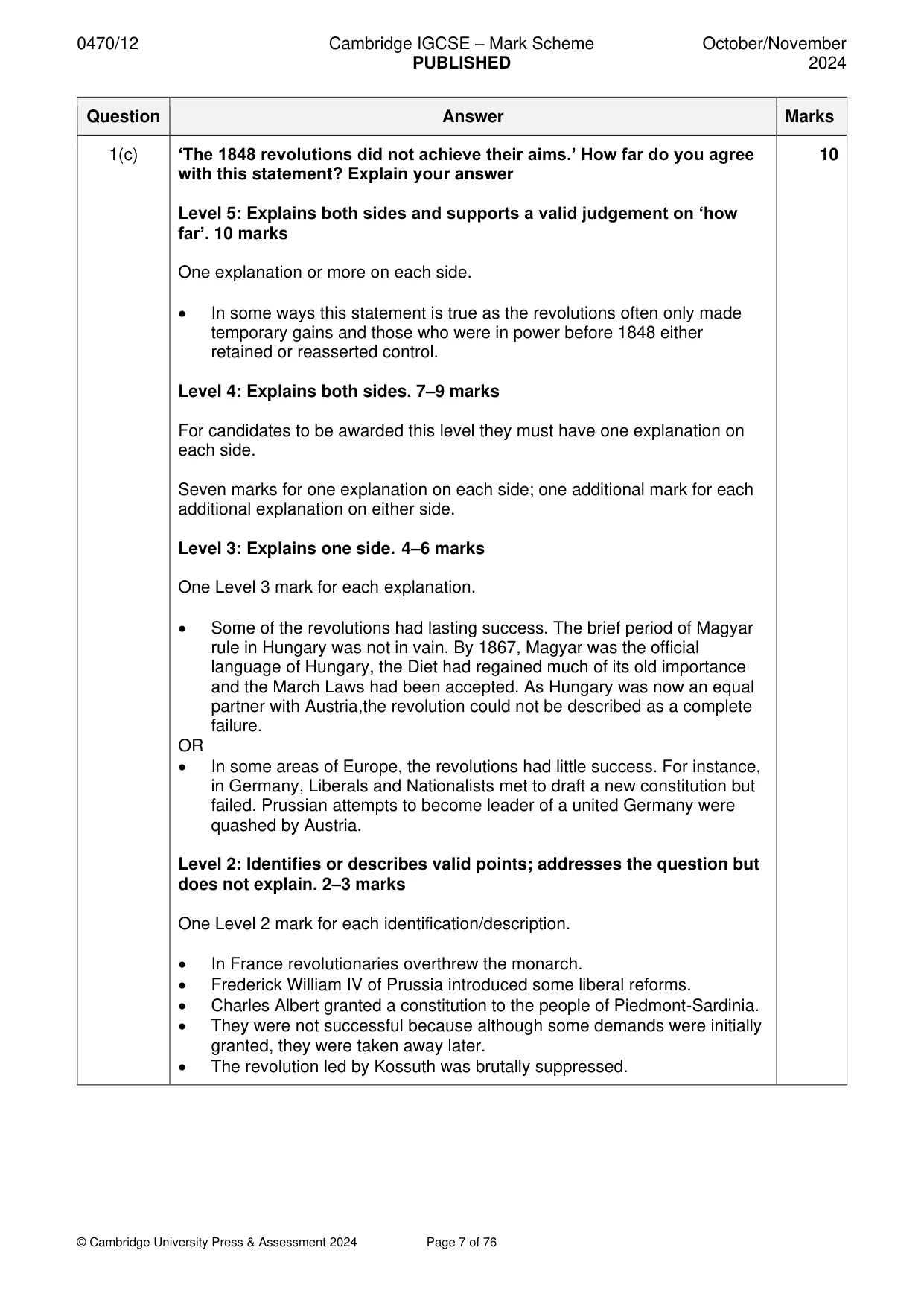
0470/12 Cambridge IGCSE – Mark Scheme PUBLISHED October/November 2024 © Cambridge University Press & Assessment 2024 Page 7 of 76 Question Answer Marks 1(c) ‘The 1848 revolutions did not achieve their aims.’ How far do you agree with this statement? Explain your answer Level 5: Explains both sides and supports a valid judgement on ‘how far’. 10 marks One explanation or more on each side. • In some ways this statement is true as the revolutions often only made temporary gains and those who were in power before 1848 either retained or reasserted control. Level 4: Explains both sides. 7–9 marks For candidates to be awarded this level they must have one explanation on each side. Seven marks for one explanation on each side; one additional mark for each additional explanation on either side. Level 3: Explains one side. 4–6 marks One Level 3 mark for each explanation. • Some of the revolutions had lasting success. The brief period of Magyar rule in Hungary was not in vain. By 1867, Magyar was the official language of Hungary, the Diet had regained much of its old importance and the March Laws had been accepted. As Hungary was now an equal partner with Austria,the revolution could not be described as a complete failure. OR • In some areas of Europe, the revolutions had little success. For instance, in Germany, Liberals and Nationalists met to draft a new constitution but failed. Prussian attempts to become leader of a united Germany were quashed by Austria. Level 2: Identifies or describes valid points; addresses the question but does not explain. 2–3 marks One Level 2 mark for each identification/description. • In France revolutionaries overthrew the monarch. • Frederick William IV of Prussia introduced some liberal reforms. • Charles Albert granted a constitution to the people of Piedmont-Sardinia. • They were not successful because although some demands were initially granted, they were taken away later. • The revolution led by Kossuth was brutally suppressed. 10
Mark scheme, page 8
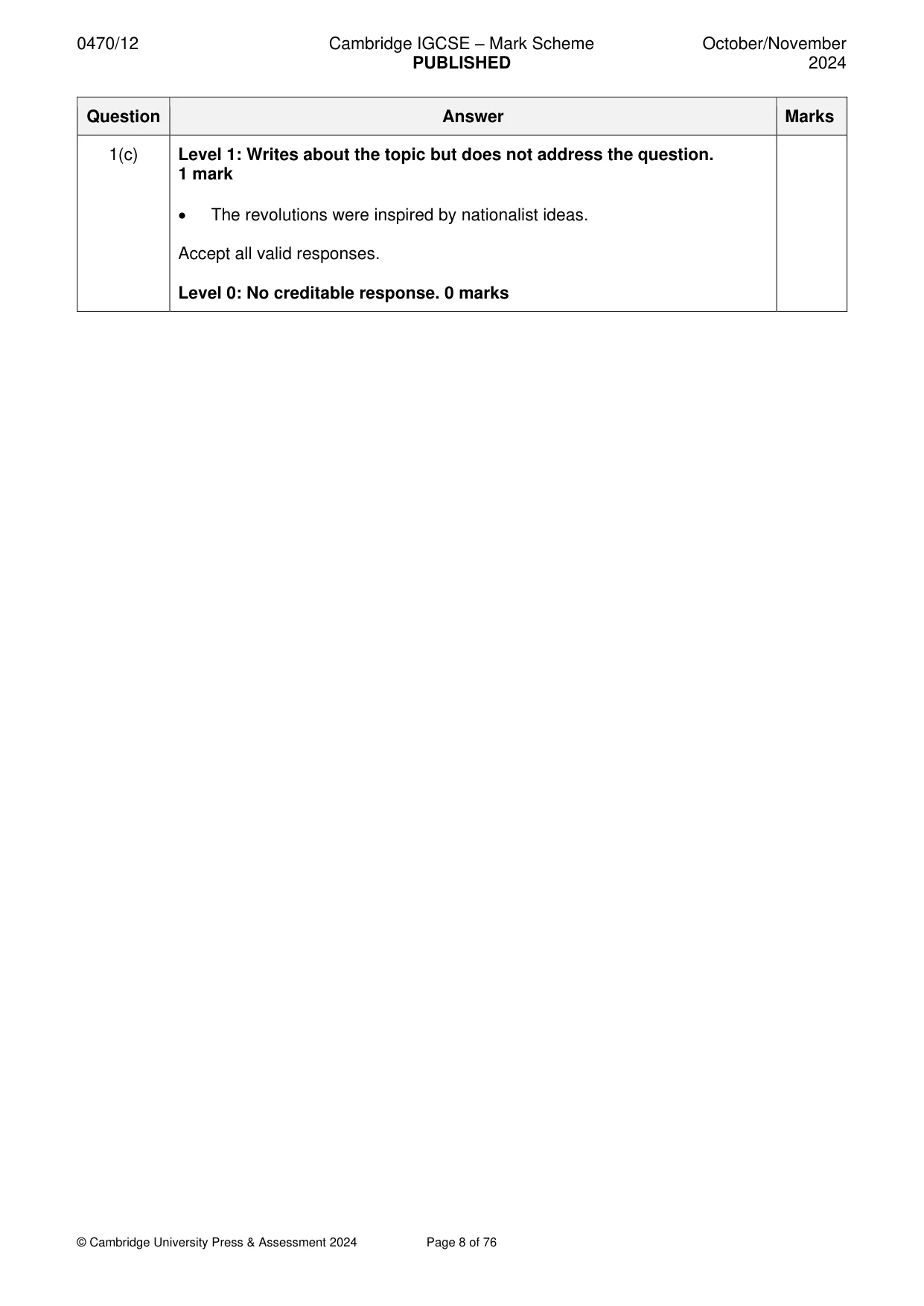
0470/12 Cambridge IGCSE – Mark Scheme PUBLISHED October/November 2024 © Cambridge University Press & Assessment 2024 Page 8 of 76 Question Answer Marks 1(c) Level 1: Writes about the topic but does not address the question. 1 mark • The revolutions were inspired by nationalist ideas. Accept all valid responses. Level 0: No creditable response. 0 marks
Mark scheme, page 9
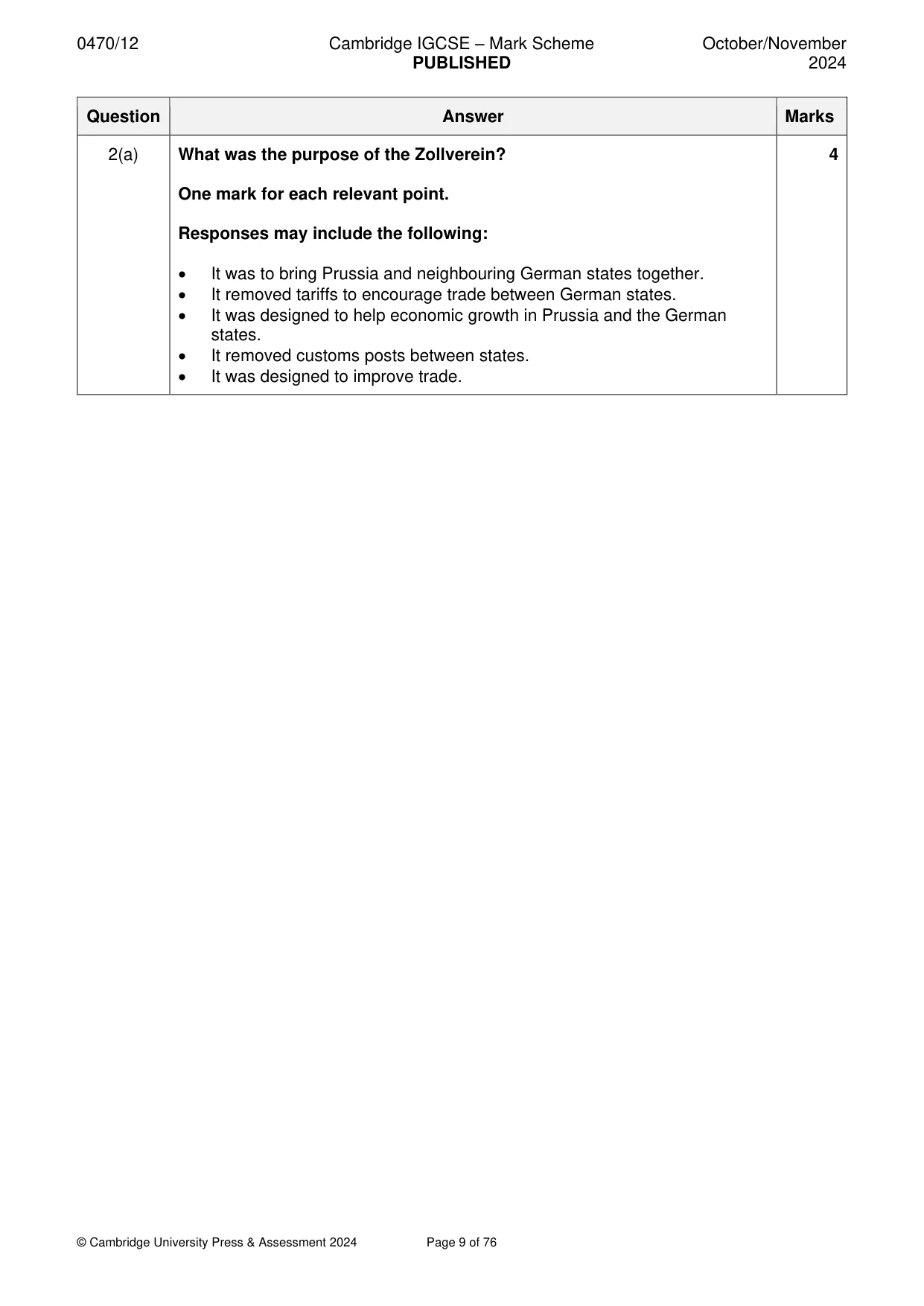
0470/12 Cambridge IGCSE – Mark Scheme PUBLISHED October/November 2024 © Cambridge University Press & Assessment 2024 Page 9 of 76 Question Answer Marks 2(a) What was the purpose of the Zollverein? One mark for each relevant point. Responses may include the following: • It was to bring Prussia and neighbouring German states together. • It removed tariffs to encourage trade between German states. • It was designed to help economic growth in Prussia and the German states. • It removed customs posts between states. • It was designed to improve trade. 4
Mark scheme, page 10
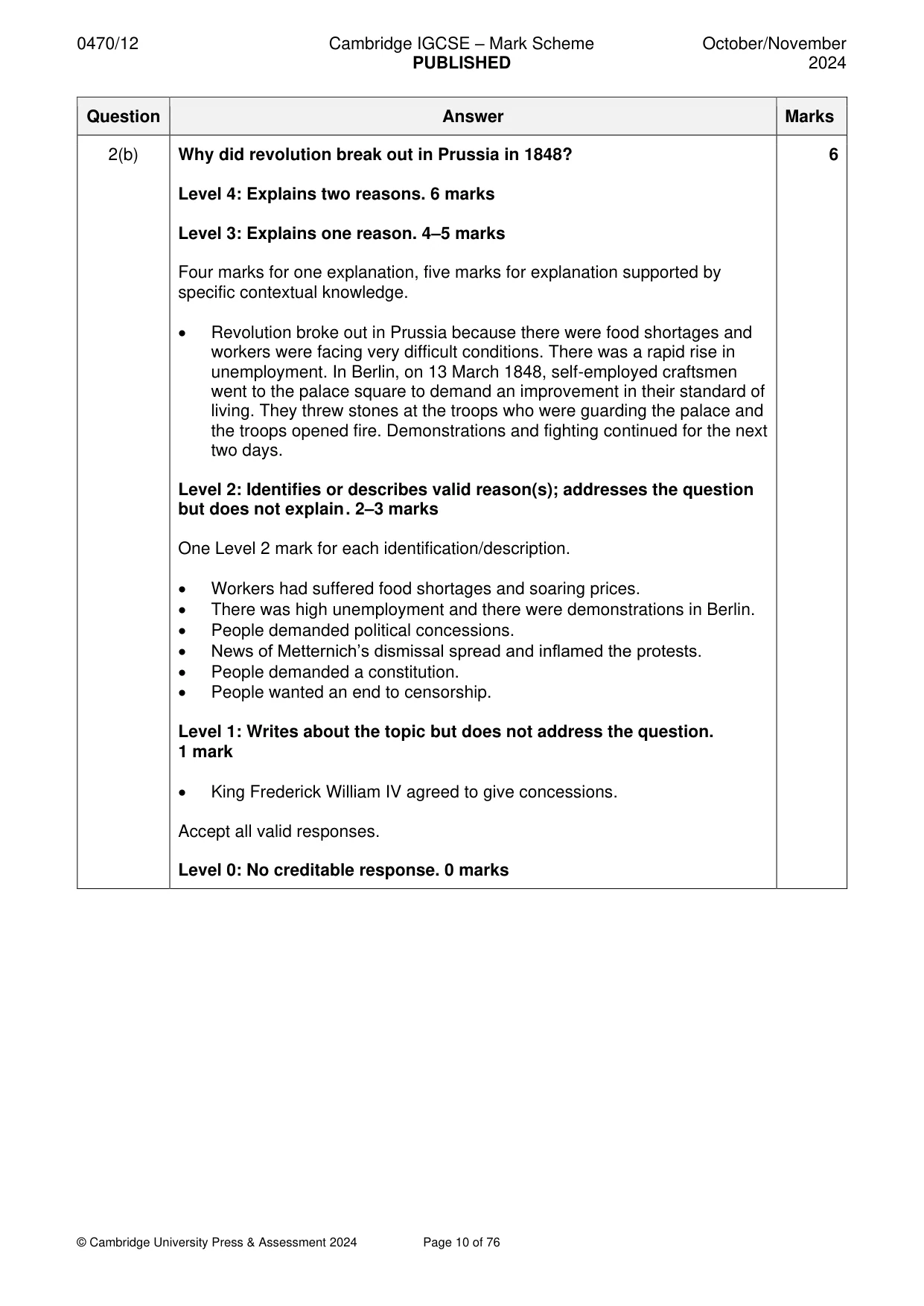
0470/12 Cambridge IGCSE – Mark Scheme PUBLISHED October/November 2024 © Cambridge University Press & Assessment 2024 Page 10 of 76 Question Answer Marks 2(b) Why did revolution break out in Prussia in 1848? Level 4: Explains two reasons. 6 marks Level 3: Explains one reason. 4–5 marks Four marks for one explanation, five marks for explanation supported by specific contextual knowledge. • Revolution broke out in Prussia because there were food shortages and workers were facing very difficult conditions. There was a rapid rise in unemployment. In Berlin, on 13 March 1848, self-employed craftsmen went to the palace square to demand an improvement in their standard of living. They threw stones at the troops who were guarding the palace and the troops opened fire. Demonstrations and fighting continued for the next two days. Level 2: Identifies or describes valid reason(s); addresses the question but does not explain . 2–3 marks One Level 2 mark for each identification/description. • Workers had suffered food shortages and soaring prices. • There was high unemployment and there were demonstrations in Berlin. • People demanded political concessions. • News of Metternich’s dismissal spread and inflamed the protests. • People demanded a constitution. • People wanted an end to censorship. Level 1: Writes about the topic but does not address the question. 1 mark • King Frederick William IV agreed to give concessions. Accept all valid responses. Level 0: No creditable response. 0 marks 6
Mark scheme, page 11
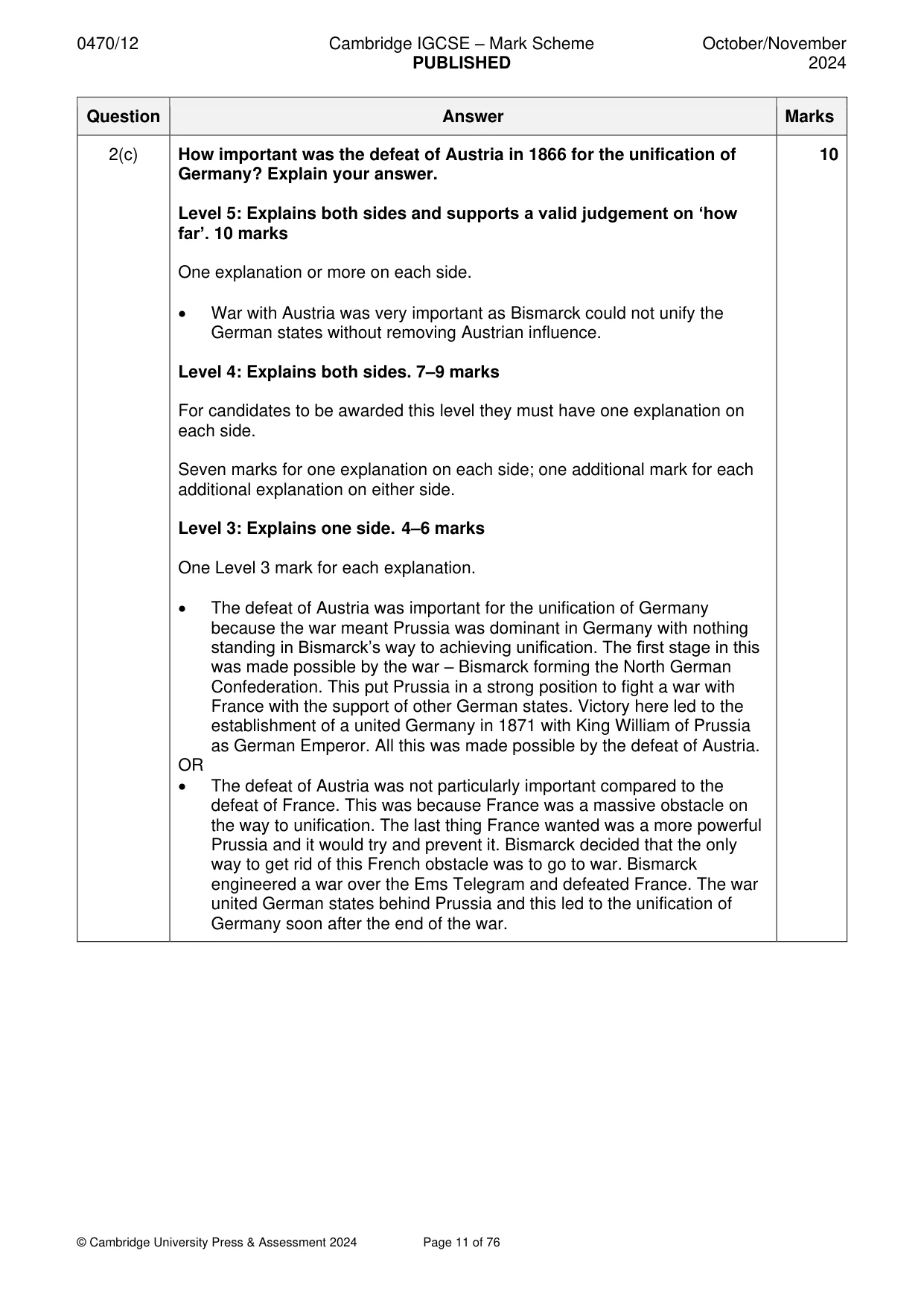
0470/12 Cambridge IGCSE – Mark Scheme PUBLISHED October/November 2024 © Cambridge University Press & Assessment 2024 Page 11 of 76 Question Answer Marks 2(c) How important was the defeat of Austria in 1866 for the unification of Germany? Explain your answer. Level 5: Explains both sides and supports a valid judgement on ‘how far’. 10 marks One explanation or more on each side. • War with Austria was very important as Bismarck could not unify the German states without removing Austrian influence. Level 4: Explains both sides. 7–9 marks For candidates to be awarded this level they must have one explanation on each side. Seven marks for one explanation on each side; one additional mark for each additional explanation on either side. Level 3: Explains one side. 4–6 marks One Level 3 mark for each explanation. • The defeat of Austria was important for the unification of Germany because the war meant Prussia was dominant in Germany with nothing standing in Bismarck’s way to achieving unification. The first stage in this was made possible by the war – Bismarck forming the North German Confederation. This put Prussia in a strong position to fight a war with France with the support of other German states. Victory here led to the establishment of a united Germany in 1871 with King William of Prussia as German Emperor. All this was made possible by the defeat of Austria. OR • The defeat of Austria was not particularly important compared to the defeat of France. This was because France was a massive obstacle on the way to unification. The last thing France wanted was a more powerful Prussia and it would try and prevent it. Bismarck decided that the only way to get rid of this French obstacle was to go to war. Bismarck engineered a war over the Ems Telegram and defeated France. The war united German states behind Prussia and this led to the unification of Germany soon after the end of the war. 10
Mark scheme, page 12
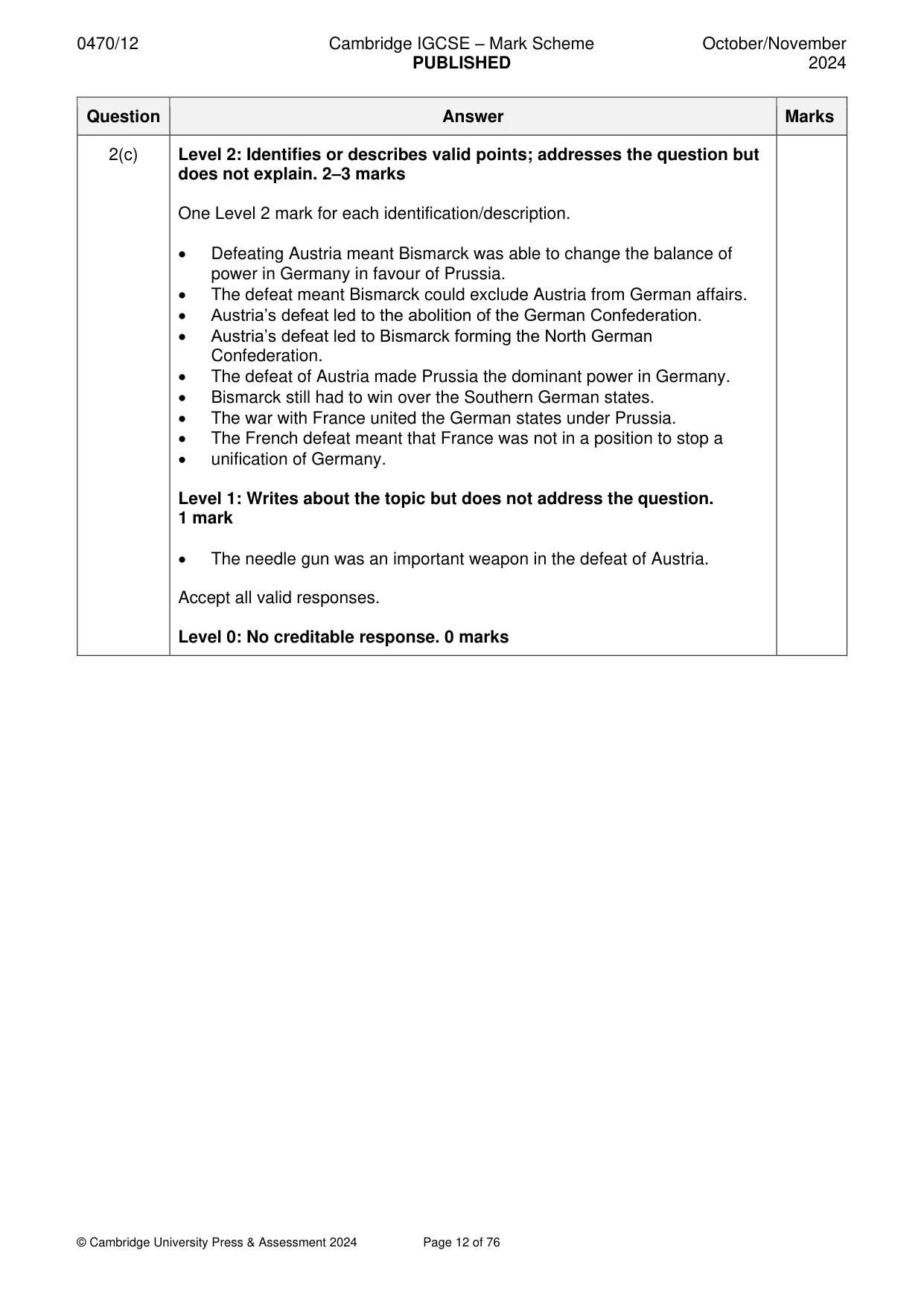
0470/12 Cambridge IGCSE – Mark Scheme PUBLISHED October/November 2024 © Cambridge University Press & Assessment 2024 Page 12 of 76 Question Answer Marks 2(c) Level 2: Identifies or describes valid points; addresses the question but does not explain. 2–3 marks One Level 2 mark for each identification/description. • Defeating Austria meant Bismarck was able to change the balance of power in Germany in favour of Prussia. • The defeat meant Bismarck could exclude Austria from German affairs. • Austria’s defeat led to the abolition of the German Confederation. • Austria’s defeat led to Bismarck forming the North German Confederation. • The defeat of Austria made Prussia the dominant power in Germany. • Bismarck still had to win over the Southern German states. • The war with France united the German states under Prussia. • The French defeat meant that France was not in a position to stop a • unification of Germany. Level 1: Writes about the topic but does not address the question. 1 mark • The needle gun was an important weapon in the defeat of Austria. Accept all valid responses. Level 0: No creditable response. 0 marks
Mark scheme, page 13
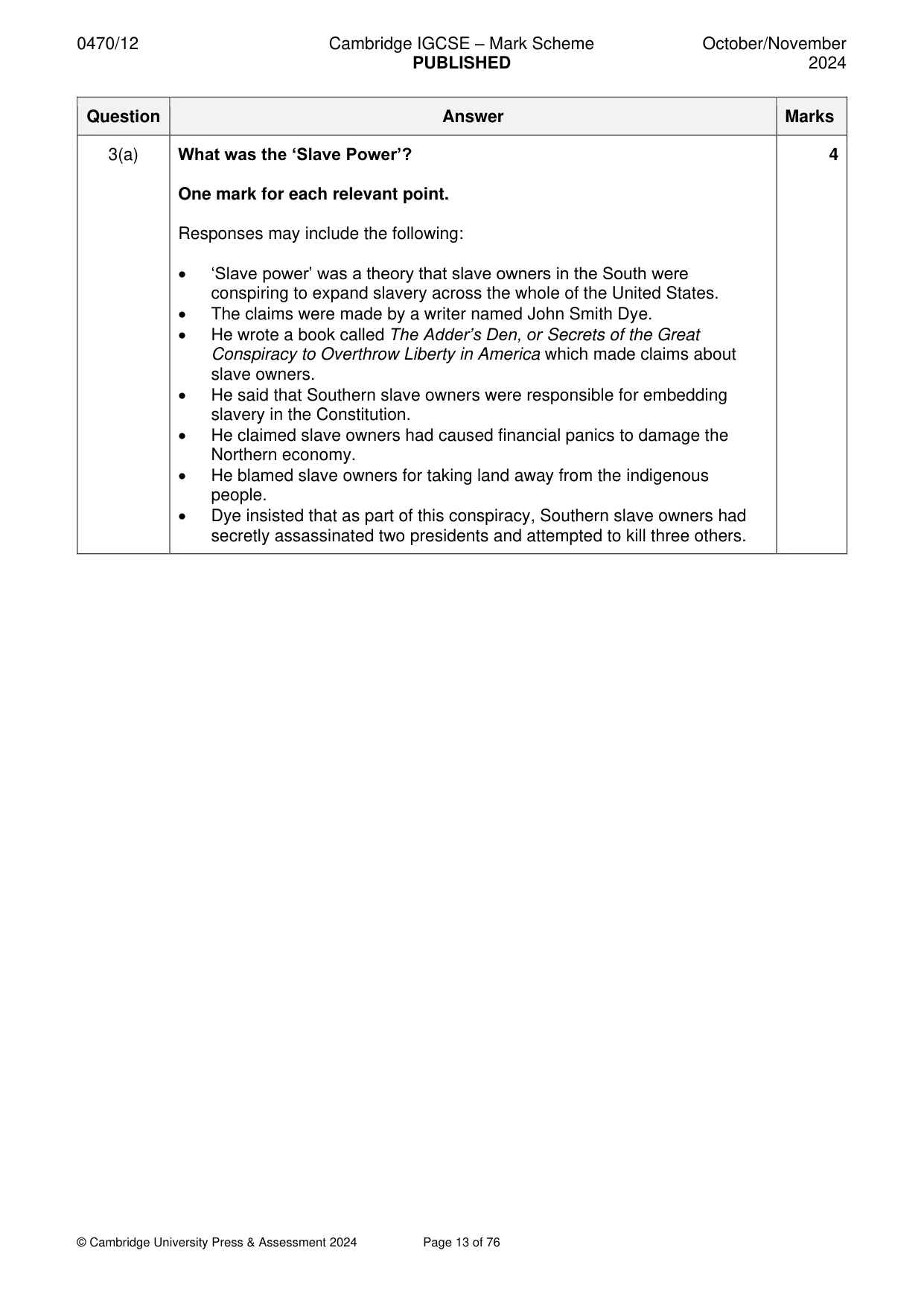
0470/12 Cambridge IGCSE – Mark Scheme PUBLISHED October/November 2024 © Cambridge University Press & Assessment 2024 Page 13 of 76 Question Answer Marks 3(a) What was the ‘Slave Power’? One mark for each relevant point. Responses may include the following: • ‘Slave power’ was a theory that slave owners in the South were conspiring to expand slavery across the whole of the United States. • The claims were made by a writer named John Smith Dye. • He wrote a book called The Adder’s Den, or Secrets of the Great Conspiracy to Overthrow Liberty in America which made claims about slave owners. • He said that Southern slave owners were responsible for embedding slavery in the Constitution. • He claimed slave owners had caused financial panics to damage the Northern economy. • He blamed slave owners for taking land away from the indigenous people. • Dye insisted that as part of this conspiracy, Southern slave owners had secretly assassinated two presidents and attempted to kill three others. 4
Mark scheme, page 14
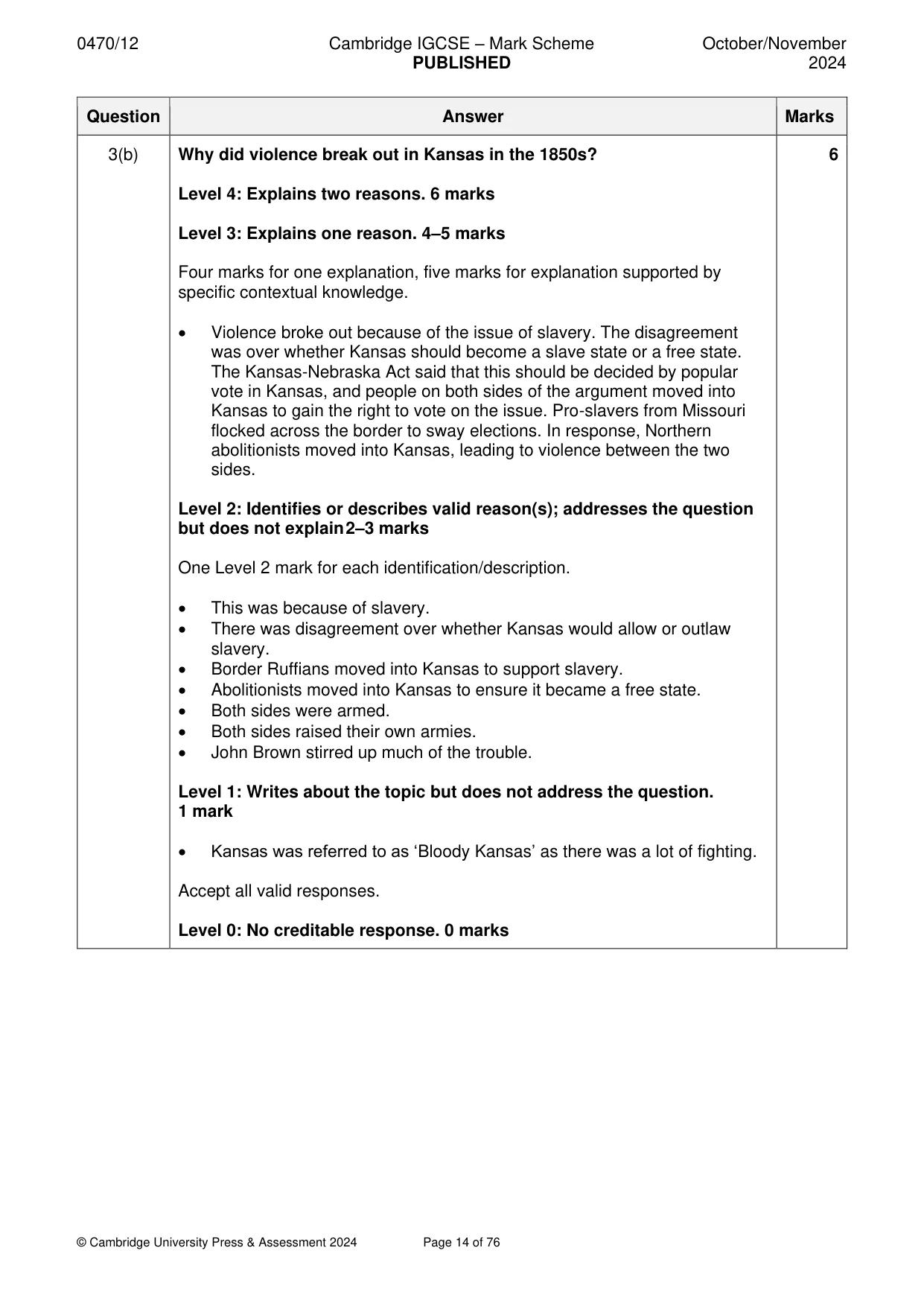
0470/12 Cambridge IGCSE – Mark Scheme PUBLISHED October/November 2024 © Cambridge University Press & Assessment 2024 Page 14 of 76 Question Answer Marks 3(b) Why did violence break out in Kansas in the 1850s? Level 4: Explains two reasons. 6 marks Level 3: Explains one reason. 4–5 marks Four marks for one explanation, five marks for explanation supported by specific contextual knowledge. • Violence broke out because of the issue of slavery. The disagreement was over whether Kansas should become a slave state or a free state. The Kansas-Nebraska Act said that this should be decided by popular vote in Kansas, and people on both sides of the argument moved into Kansas to gain the right to vote on the issue. Pro-slavers from Missouri flocked across the border to sway elections. In response, Northern abolitionists moved into Kansas, leading to violence between the two sides. Level 2: Identifies or describes valid reason(s); addresses the question but does not explain 2–3 marks One Level 2 mark for each identification/description. • This was because of slavery. • There was disagreement over whether Kansas would allow or outlaw slavery. • Border Ruffians moved into Kansas to support slavery. • Abolitionists moved into Kansas to ensure it became a free state. • Both sides were armed. • Both sides raised their own armies. • John Brown stirred up much of the trouble. Level 1: Writes about the topic but does not address the question. 1 mark • Kansas was referred to as ‘Bloody Kansas’ as there was a lot of fighting. Accept all valid responses. Level 0: No creditable response. 0 marks 6
Mark scheme, page 15
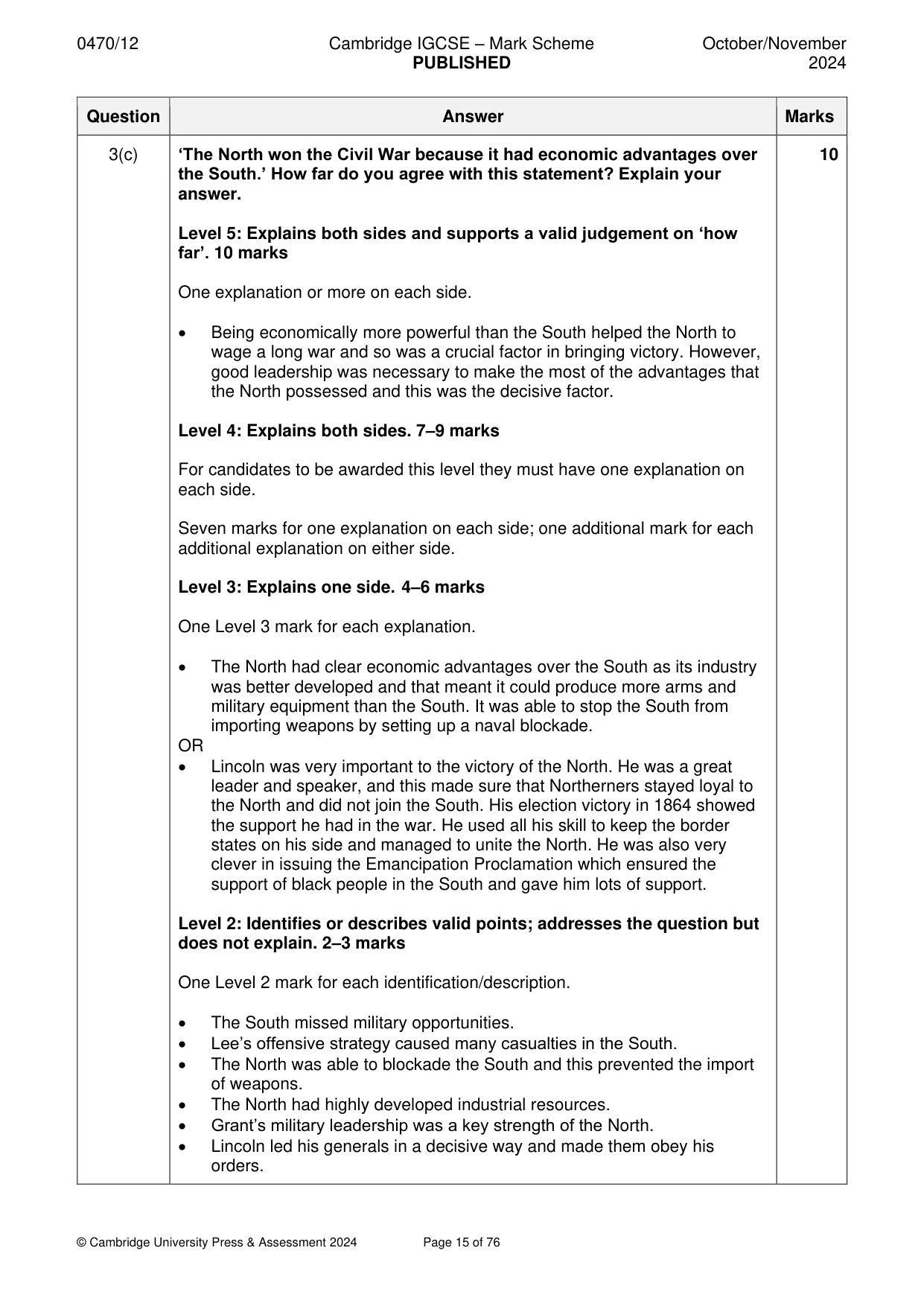
0470/12 Cambridge IGCSE – Mark Scheme PUBLISHED October/November 2024 © Cambridge University Press & Assessment 2024 Page 15 of 76 Question Answer Marks 3(c) ‘The North won the Civil War because it had economic advantages over the South.’ How far do you agree with this statement? Explain your answer. Level 5: Explains both sides and supports a valid judgement on ‘how far’. 10 marks One explanation or more on each side. • Being economically more powerful than the South helped the North to wage a long war and so was a crucial factor in bringing victory. However, good leadership was necessary to make the most of the advantages that the North possessed and this was the decisive factor. Level 4: Explains both sides. 7–9 marks For candidates to be awarded this level they must have one explanation on each side. Seven marks for one explanation on each side; one additional mark for each additional explanation on either side. Level 3: Explains one side. 4–6 marks One Level 3 mark for each explanation. • The North had clear economic advantages over the South as its industry was better developed and that meant it could produce more arms and military equipment than the South. It was able to stop the South from importing weapons by setting up a naval blockade. OR • Lincoln was very important to the victory of the North. He was a great leader and speaker, and this made sure that Northerners stayed loyal to the North and did not join the South. His election victory in 1864 showed the support he had in the war. He used all his skill to keep the border states on his side and managed to unite the North. He was also very clever in issuing the Emancipation Proclamation which ensured the support of black people in the South and gave him lots of support. Level 2: Identifies or describes valid points; addresses the question but does not explain. 2–3 marks One Level 2 mark for each identification/description. • The South missed military opportunities. • Lee’s offensive strategy caused many casualties in the South. • The North was able to blockade the South and this prevented the import of weapons. • The North had highly developed industrial resources. • Grant’s military leadership was a key strength of the North. • Lincoln led his generals in a decisive way and made them obey his orders. 10
Mark scheme, page 16
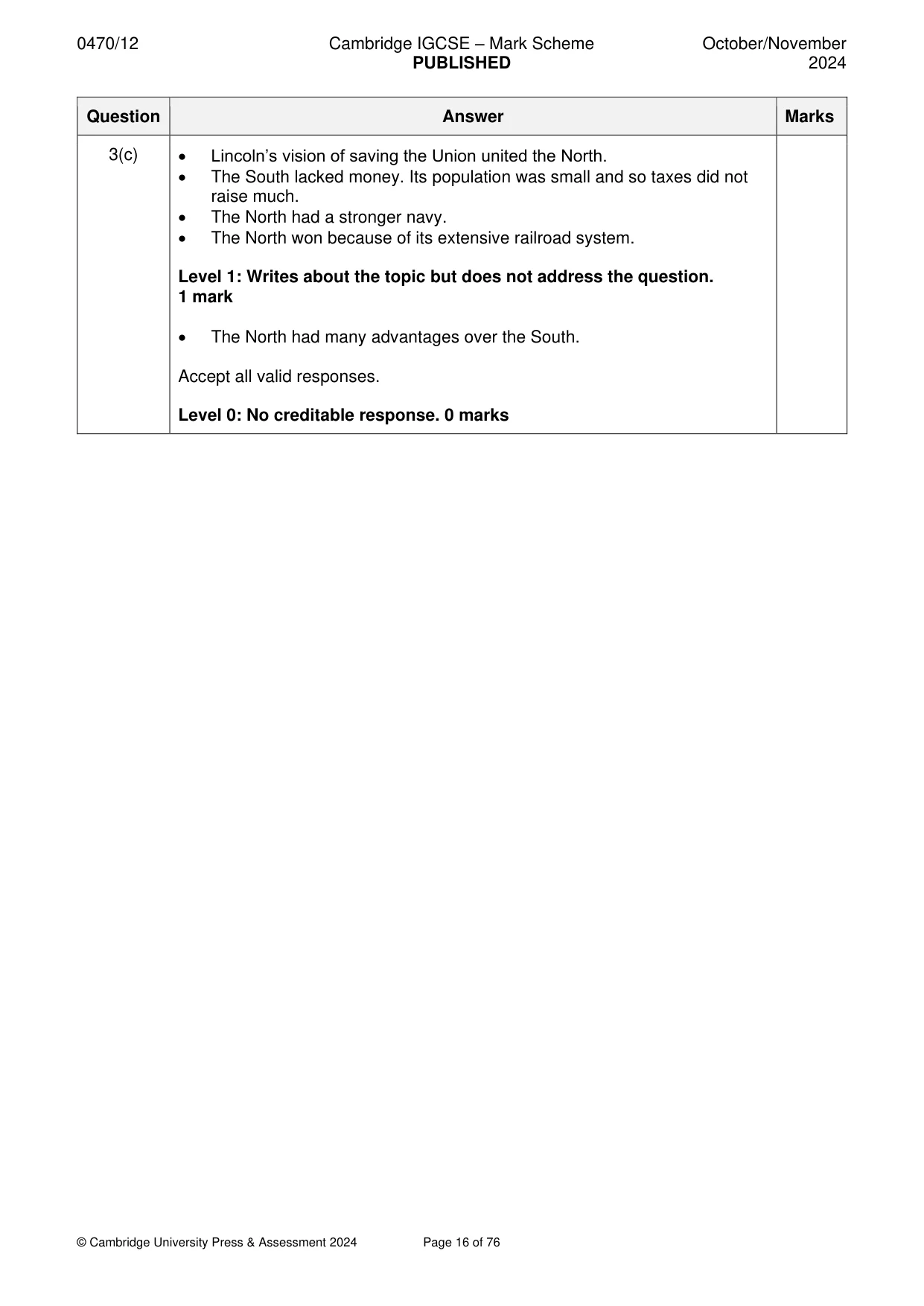
0470/12 Cambridge IGCSE – Mark Scheme PUBLISHED October/November 2024 © Cambridge University Press & Assessment 2024 Page 16 of 76 Question Answer Marks 3(c) • Lincoln’s vision of saving the Union united the North. • The South lacked money. Its population was small and so taxes did not raise much. • The North had a stronger navy. • The North won because of its extensive railroad system. Level 1: Writes about the topic but does not address the question. 1 mark • The North had many advantages over the South. Accept all valid responses. Level 0: No creditable response. 0 marks
Mark scheme, page 17
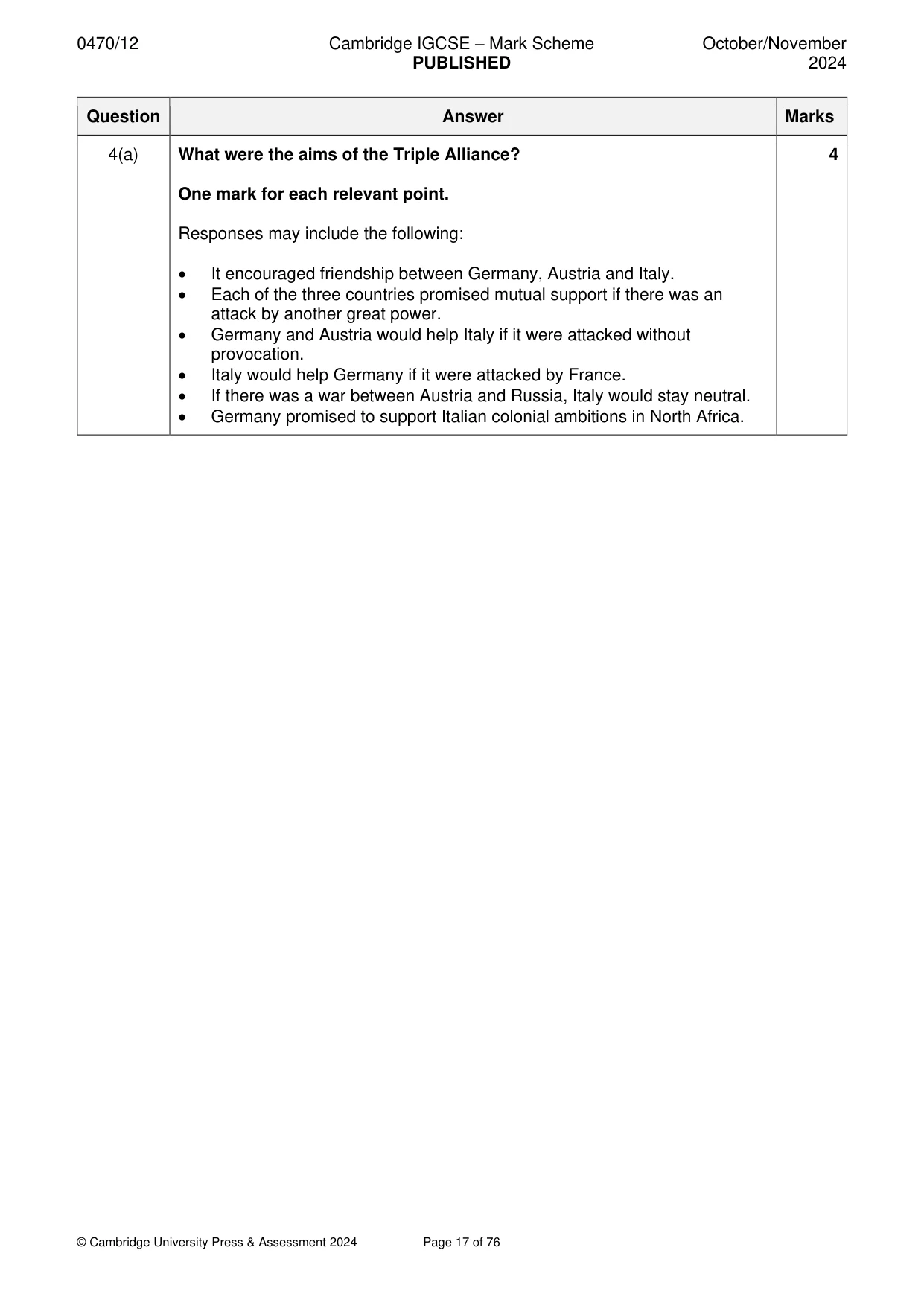
0470/12 Cambridge IGCSE – Mark Scheme PUBLISHED October/November 2024 © Cambridge University Press & Assessment 2024 Page 17 of 76 Question Answer Marks 4(a) What were the aims of the Triple Alliance? One mark for each relevant point. Responses may include the following: • It encouraged friendship between Germany, Austria and Italy. • Each of the three countries promised mutual support if there was an attack by another great power. • Germany and Austria would help Italy if it were attacked without provocation. • Italy would help Germany if it were attacked by France. • If there was a war between Austria and Russia, Italy would stay neutral. • Germany promised to support Italian colonial ambitions in North Africa. 4
Mark scheme, page 18
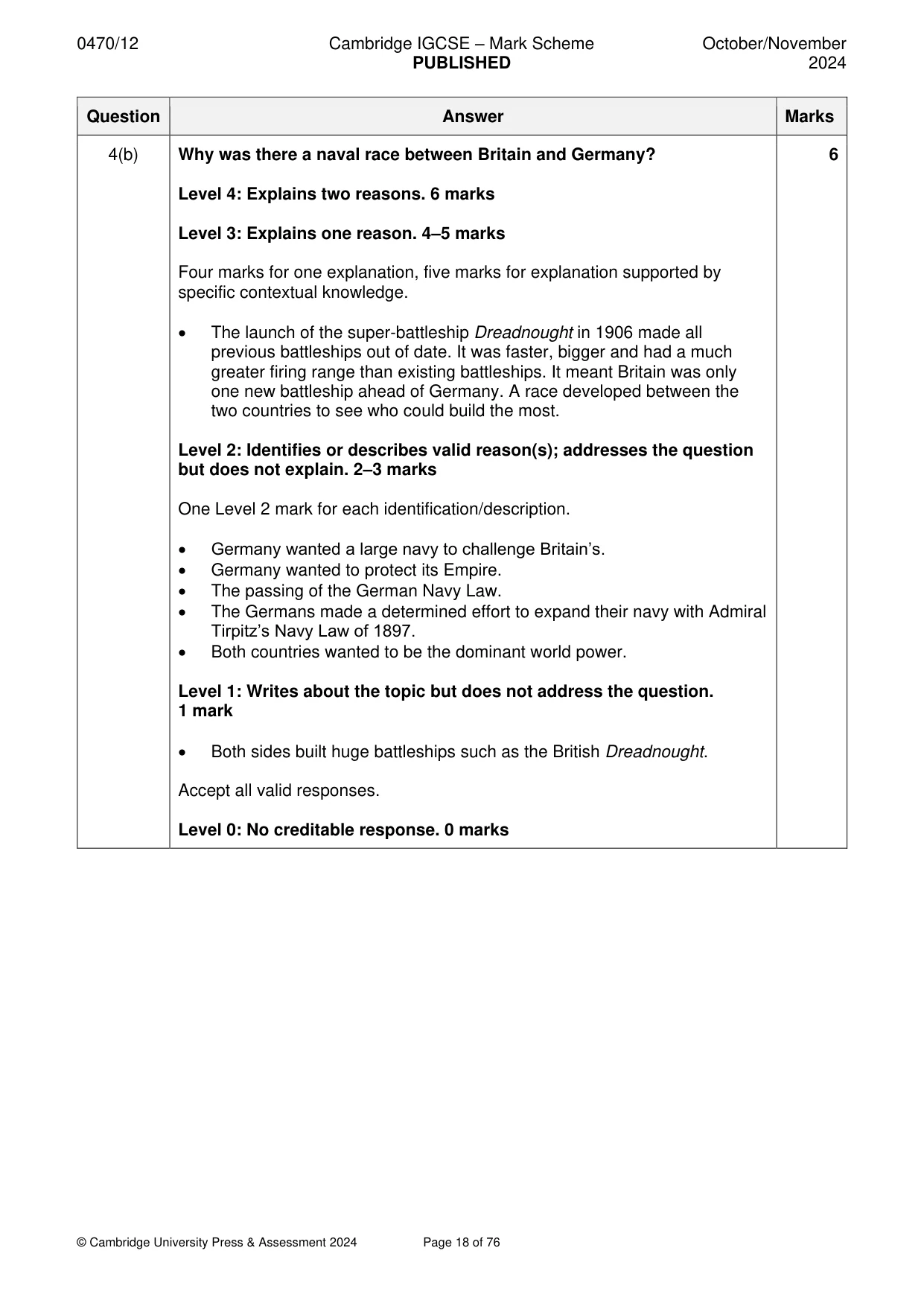
0470/12 Cambridge IGCSE – Mark Scheme PUBLISHED October/November 2024 © Cambridge University Press & Assessment 2024 Page 18 of 76 Question Answer Marks 4(b) Why was there a naval race between Britain and Germany? Level 4: Explains two reasons. 6 marks Level 3: Explains one reason. 4–5 marks Four marks for one explanation, five marks for explanation supported by specific contextual knowledge. • The launch of the super-battleship Dreadnought in 1906 made all previous battleships out of date. It was faster, bigger and had a much greater firing range than existing battleships. It meant Britain was only one new battleship ahead of Germany. A race developed between the two countries to see who could build the most. Level 2: Identifies or describes valid reason(s); addresses the question but does not explain. 2–3 marks One Level 2 mark for each identification/description. • Germany wanted a large navy to challenge Britain’s. • Germany wanted to protect its Empire. • The passing of the German Navy Law. • The Germans made a determined effort to expand their navy with Admiral Tirpitz’s Navy Law of 1897. • Both countries wanted to be the dominant world power. Level 1: Writes about the topic but does not address the question. 1 mark • Both sides built huge battleships such as the British Dreadnought. Accept all valid responses. Level 0: No creditable response. 0 marks 6
Mark scheme, page 19
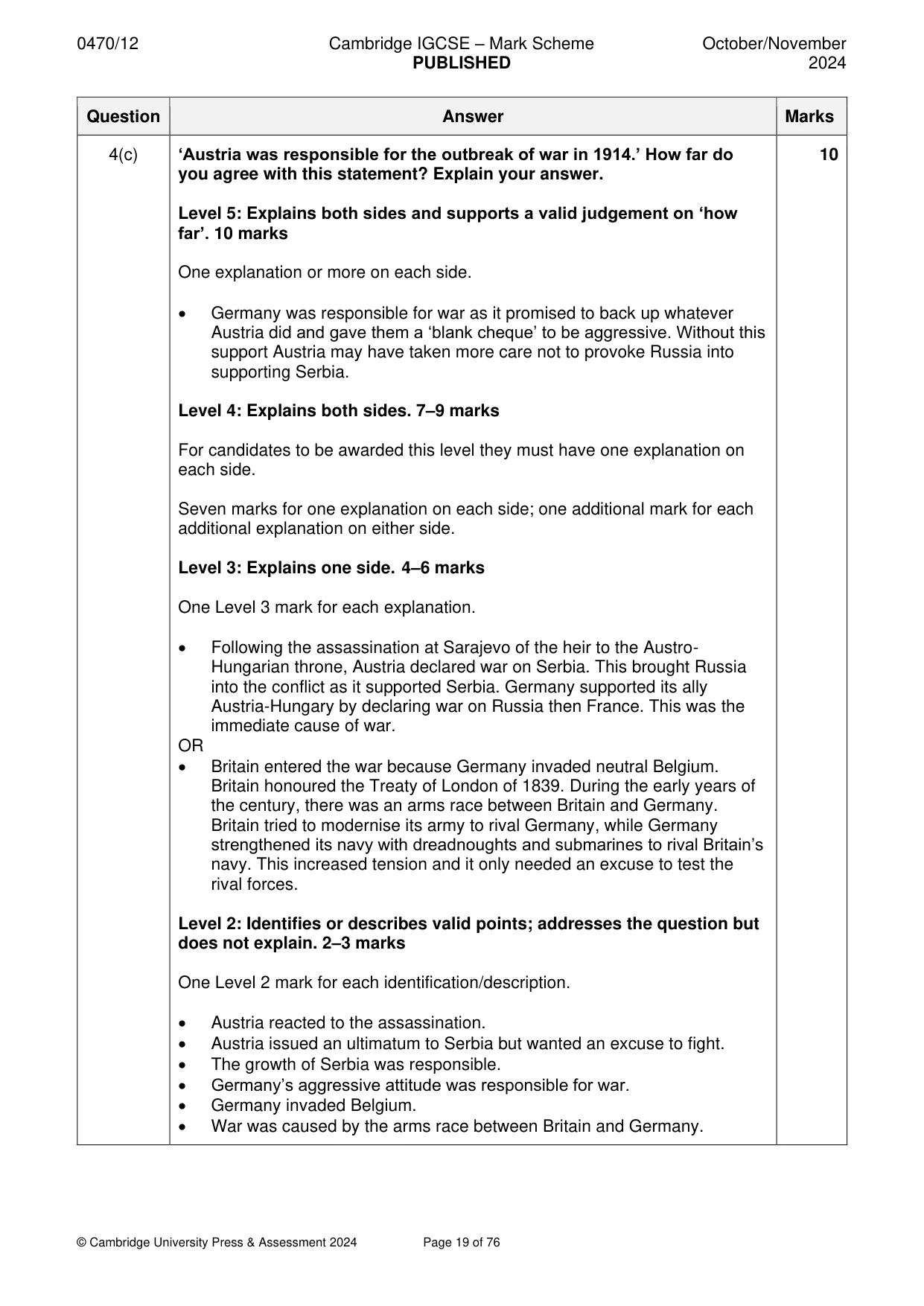
0470/12 Cambridge IGCSE – Mark Scheme PUBLISHED October/November 2024 © Cambridge University Press & Assessment 2024 Page 19 of 76 Question Answer Marks 4(c) ‘Austria was responsible for the outbreak of war in 1914.’ How far do you agree with this statement? Explain your answer. Level 5: Explains both sides and supports a valid judgement on ‘how far’. 10 marks One explanation or more on each side. • Germany was responsible for war as it promised to back up whatever Austria did and gave them a ‘blank cheque’ to be aggressive. Without this support Austria may have taken more care not to provoke Russia into supporting Serbia. Level 4: Explains both sides. 7–9 marks For candidates to be awarded this level they must have one explanation on each side. Seven marks for one explanation on each side; one additional mark for each additional explanation on either side. Level 3: Explains one side. 4–6 marks One Level 3 mark for each explanation. • Following the assassination at Sarajevo of the heir to the Austro- Hungarian throne, Austria declared war on Serbia. This brought Russia into the conflict as it supported Serbia. Germany supported its ally Austria-Hungary by declaring war on Russia then France. This was the immediate cause of war. OR • Britain entered the war because Germany invaded neutral Belgium. Britain honoured the Treaty of London of 1839. During the early years of the century, there was an arms race between Britain and Germany. Britain tried to modernise its army to rival Germany, while Germany strengthened its navy with dreadnoughts and submarines to rival Britain’s navy. This increased tension and it only needed an excuse to test the rival forces. Level 2: Identifies or describes valid points; addresses the question but does not explain. 2–3 marks One Level 2 mark for each identification/description. • Austria reacted to the assassination. • Austria issued an ultimatum to Serbia but wanted an excuse to fight. • The growth of Serbia was responsible. • Germany’s aggressive attitude was responsible for war. • Germany invaded Belgium. • War was caused by the arms race between Britain and Germany. 10
Mark scheme, page 20
0470/12 Cambridge IGCSE – Mark Scheme PUBLISHED October/November 2024 © Cambridge University Press & Assessment 2024 Page 20 of 76 Question Answer Marks 4(c) Level 1: Writes about the topic but does not address the question. 1 mark • The Archduke Franz Ferdinand was assassinated. Accept all valid responses. Level 0: No creditable response. 0 marks
Mark scheme, page 21
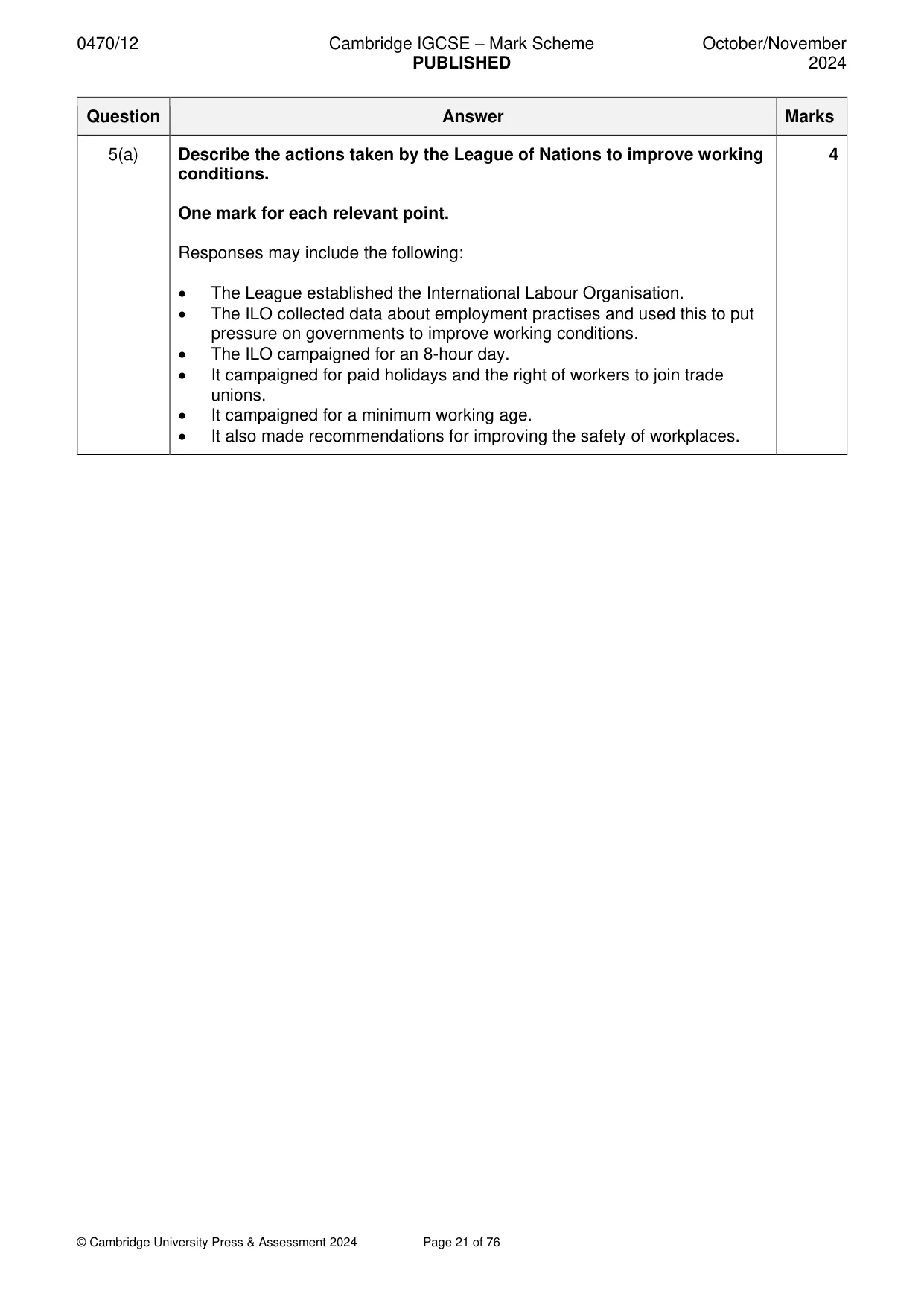
0470/12 Cambridge IGCSE – Mark Scheme PUBLISHED October/November 2024 © Cambridge University Press & Assessment 2024 Page 21 of 76 Question Answer Marks 5(a) Describe the actions taken by the League of Nations to improve working conditions. One mark for each relevant point. Responses may include the following: • The League established the International Labour Organisation. • The ILO collected data about employment practises and used this to put pressure on governments to improve working conditions. • The ILO campaigned for an 8-hour day. • It campaigned for paid holidays and the right of workers to join trade unions. • It campaigned for a minimum working age. • It also made recommendations for improving the safety of workplaces. 4
Mark scheme, page 22
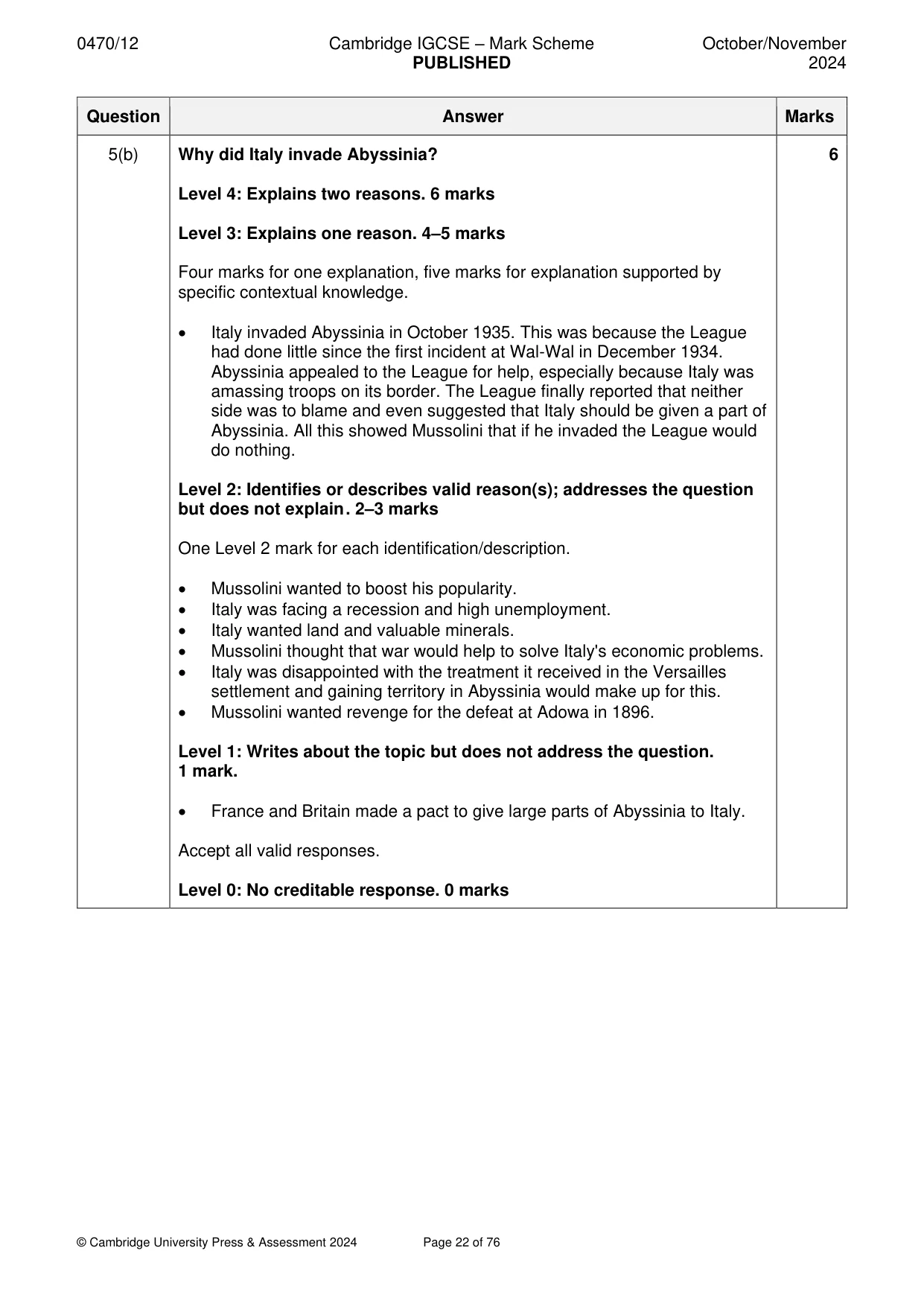
0470/12 Cambridge IGCSE – Mark Scheme PUBLISHED October/November 2024 © Cambridge University Press & Assessment 2024 Page 22 of 76 Question Answer Marks 5(b) Why did Italy invade Abyssinia? Level 4: Explains two reasons. 6 marks Level 3: Explains one reason. 4–5 marks Four marks for one explanation, five marks for explanation supported by specific contextual knowledge. • Italy invaded Abyssinia in October 1935. This was because the League had done little since the first incident at Wal-Wal in December 1934. Abyssinia appealed to the League for help, especially because Italy was amassing troops on its border. The League finally reported that neither side was to blame and even suggested that Italy should be given a part of Abyssinia. All this showed Mussolini that if he invaded the League would do nothing. Level 2: Identifies or describes valid reason(s); addresses the question but does not explain . 2–3 marks One Level 2 mark for each identification/description. • Mussolini wanted to boost his popularity. • Italy was facing a recession and high unemployment. • Italy wanted land and valuable minerals. • Mussolini thought that war would help to solve Italy's economic problems. • Italy was disappointed with the treatment it received in the Versailles settlement and gaining territory in Abyssinia would make up for this. • Mussolini wanted revenge for the defeat at Adowa in 1896. Level 1: Writes about the topic but does not address the question. 1 mark. • France and Britain made a pact to give large parts of Abyssinia to Italy. Accept all valid responses. Level 0: No creditable response. 0 marks 6
Mark scheme, page 23
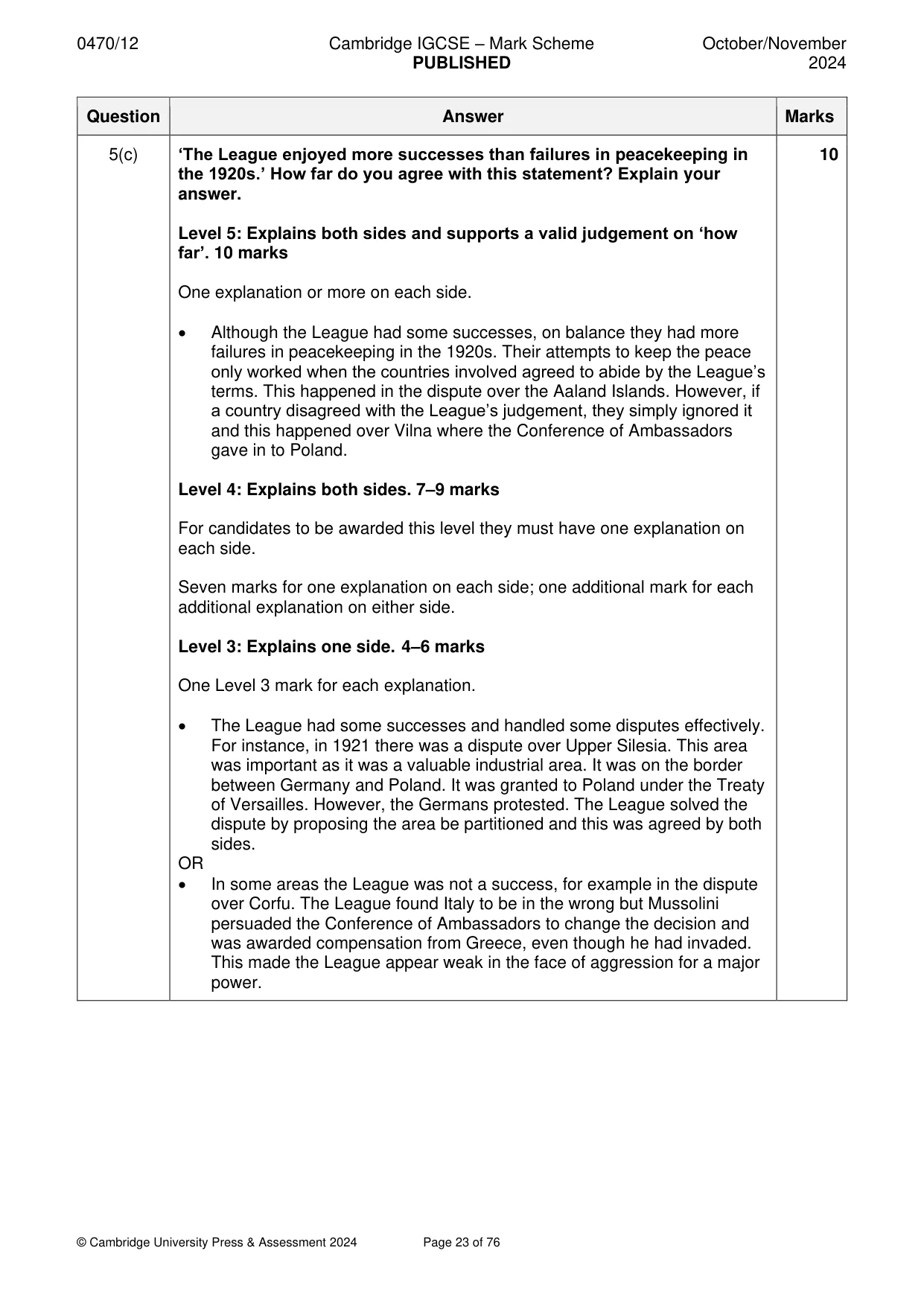
0470/12 Cambridge IGCSE – Mark Scheme PUBLISHED October/November 2024 © Cambridge University Press & Assessment 2024 Page 23 of 76 Question Answer Marks 5(c) ‘The League enjoyed more successes than failures in peacekeeping in the 1920s.’ How far do you agree with this statement? Explain your answer. Level 5: Explains both sides and supports a valid judgement on ‘how far’. 10 marks One explanation or more on each side. • Although the League had some successes, on balance they had more failures in peacekeeping in the 1920s. Their attempts to keep the peace only worked when the countries involved agreed to abide by the League’s terms. This happened in the dispute over the Aaland Islands. However, if a country disagreed with the League’s judgement, they simply ignored it and this happened over Vilna where the Conference of Ambassadors gave in to Poland. Level 4: Explains both sides. 7–9 marks For candidates to be awarded this level they must have one explanation on each side. Seven marks for one explanation on each side; one additional mark for each additional explanation on either side. Level 3: Explains one side. 4–6 marks One Level 3 mark for each explanation. • The League had some successes and handled some disputes effectively. For instance, in 1921 there was a dispute over Upper Silesia. This area was important as it was a valuable industrial area. It was on the border between Germany and Poland. It was granted to Poland under the Treaty of Versailles. However, the Germans protested. The League solved the dispute by proposing the area be partitioned and this was agreed by both sides. OR • In some areas the League was not a success, for example in the dispute over Corfu. The League found Italy to be in the wrong but Mussolini persuaded the Conference of Ambassadors to change the decision and was awarded compensation from Greece, even though he had invaded. This made the League appear weak in the face of aggression for a major power. 10
Mark scheme, page 24
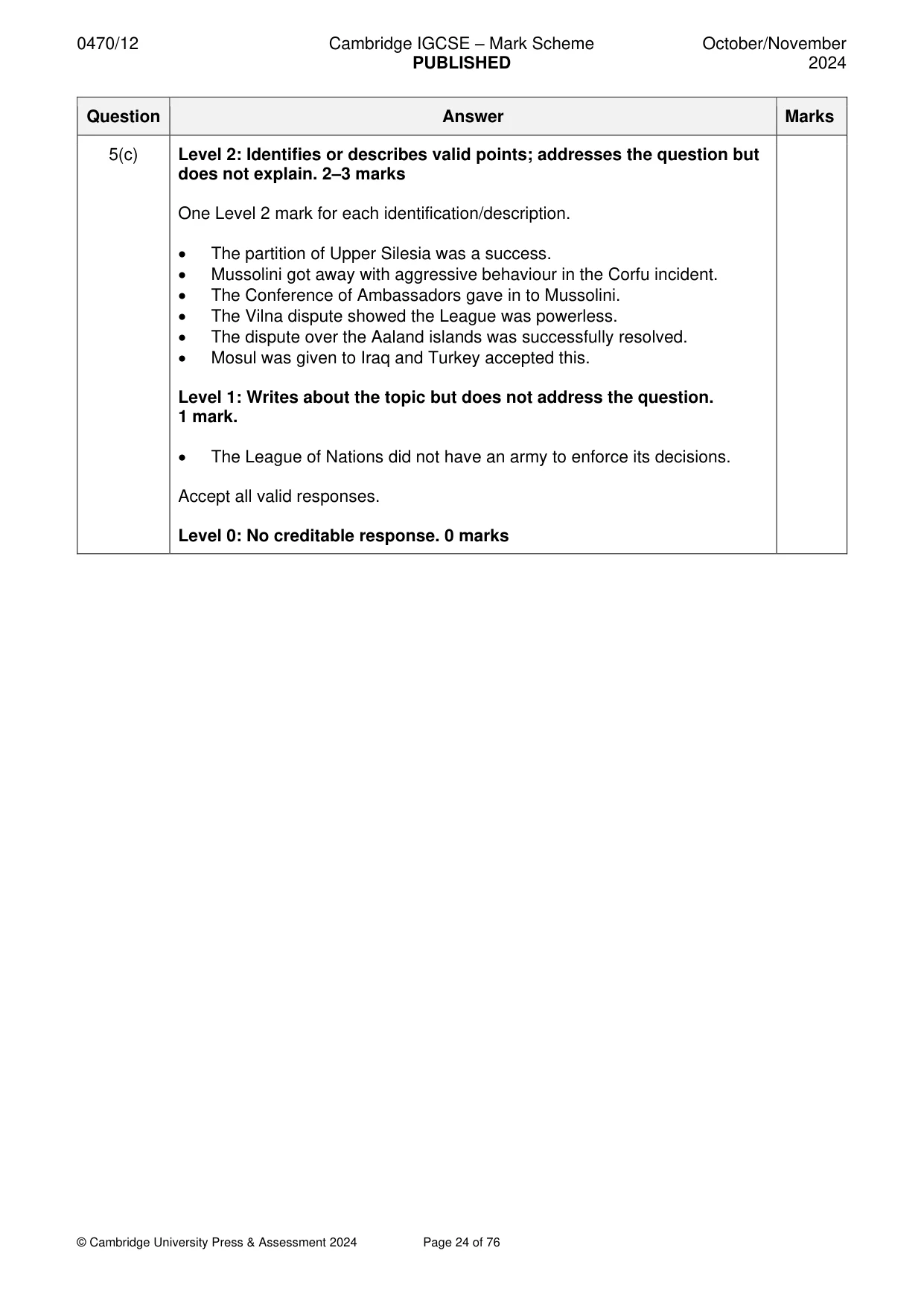
0470/12 Cambridge IGCSE – Mark Scheme PUBLISHED October/November 2024 © Cambridge University Press & Assessment 2024 Page 24 of 76 Question Answer Marks 5(c) Level 2: Identifies or describes valid points; addresses the question but does not explain. 2–3 marks One Level 2 mark for each identification/description. • The partition of Upper Silesia was a success. • Mussolini got away with aggressive behaviour in the Corfu incident. • The Conference of Ambassadors gave in to Mussolini. • The Vilna dispute showed the League was powerless. • The dispute over the Aaland islands was successfully resolved. • Mosul was given to Iraq and Turkey accepted this. Level 1: Writes about the topic but does not address the question. 1 mark. • The League of Nations did not have an army to enforce its decisions. Accept all valid responses. Level 0: No creditable response. 0 marks
Mark scheme, page 25
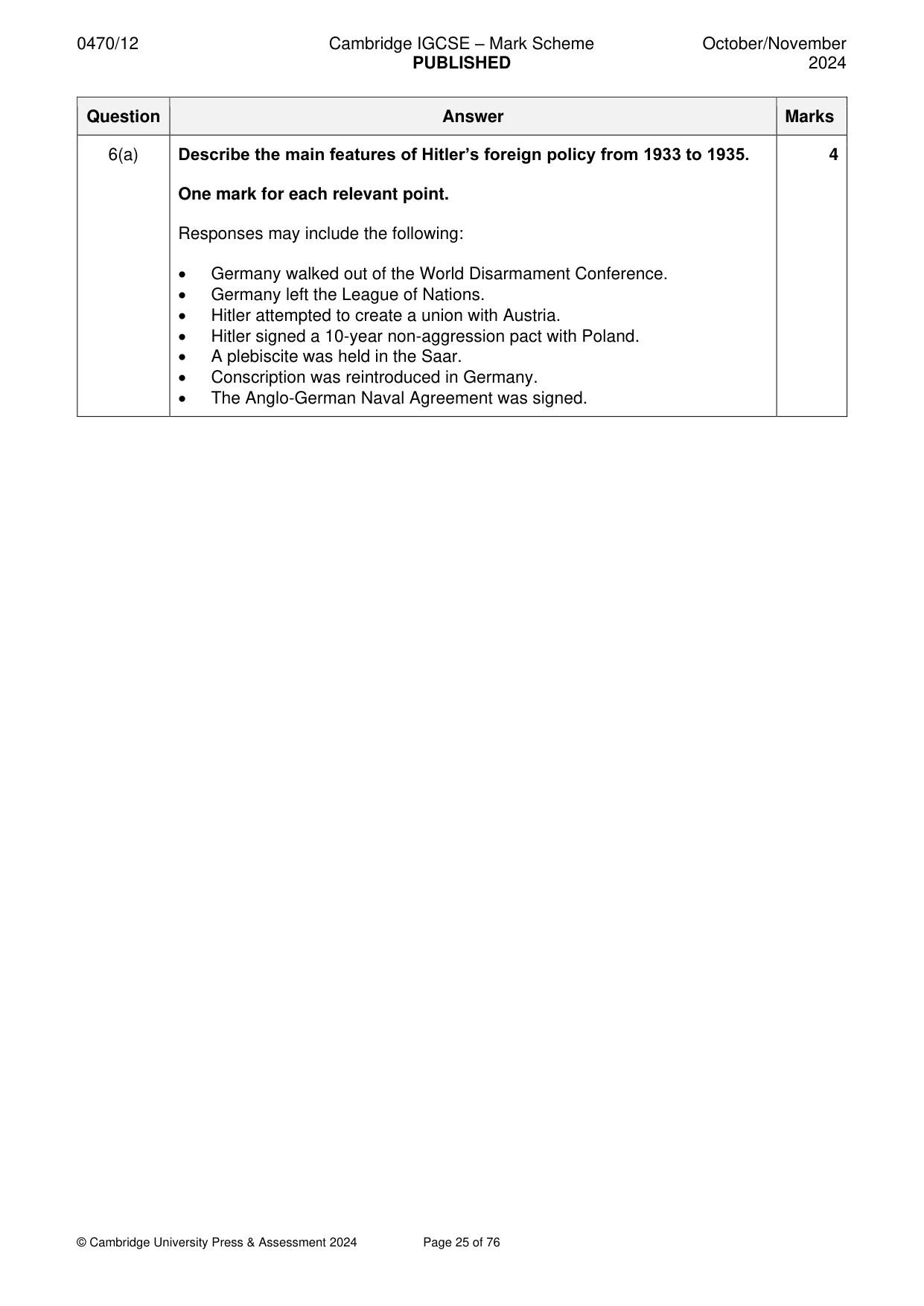
0470/12 Cambridge IGCSE – Mark Scheme PUBLISHED October/November 2024 © Cambridge University Press & Assessment 2024 Page 25 of 76 Question Answer Marks 6(a) Describe the main features of Hitler’s foreign policy from 1933 to 1935. One mark for each relevant point. Responses may include the following: • Germany walked out of the World Disarmament Conference. • Germany left the League of Nations. • Hitler attempted to create a union with Austria. • Hitler signed a 10-year non-aggression pact with Poland. • A plebiscite was held in the Saar. • Conscription was reintroduced in Germany. • The Anglo-German Naval Agreement was signed. 4
Mark scheme, page 26
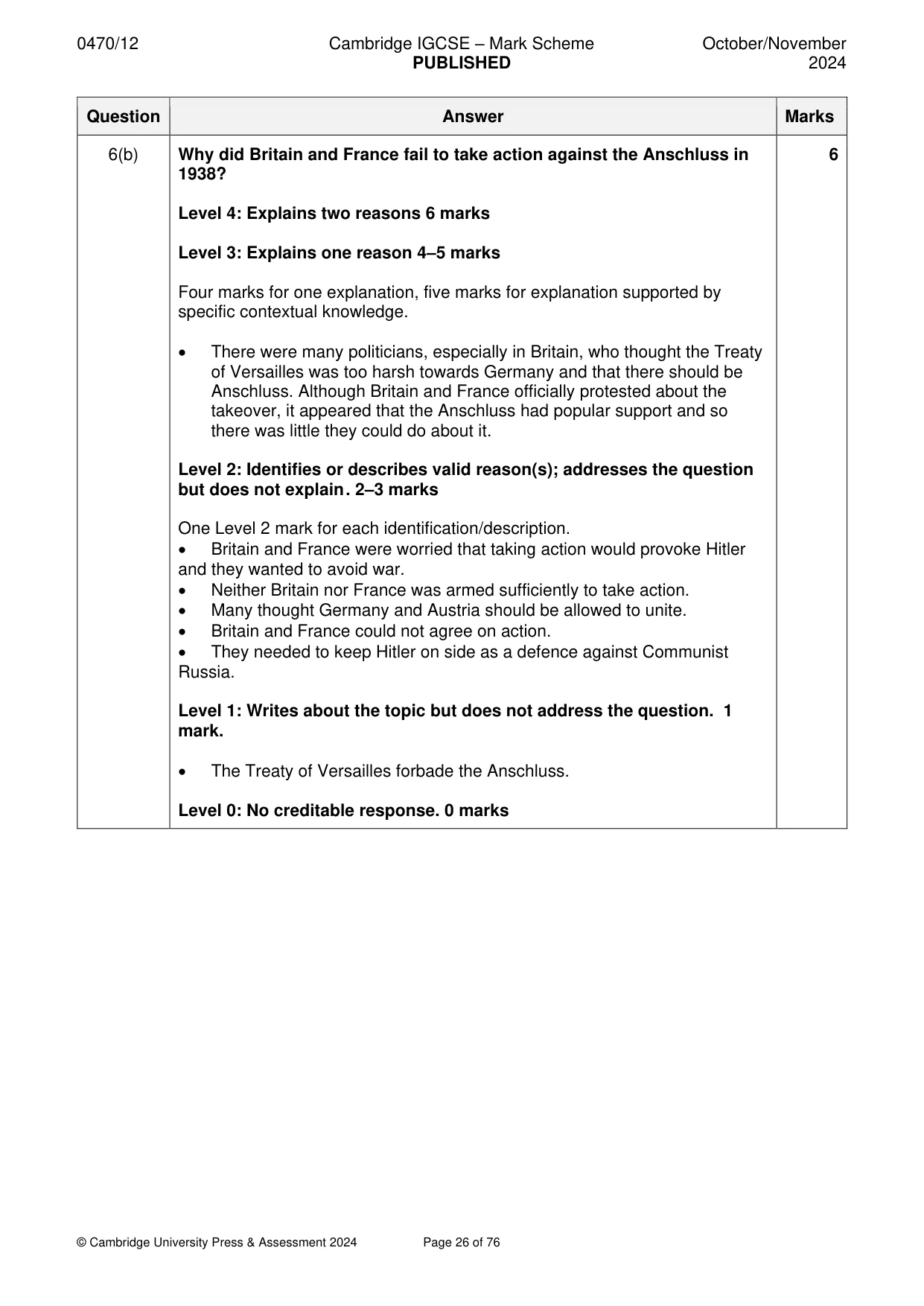
0470/12 Cambridge IGCSE – Mark Scheme PUBLISHED October/November 2024 © Cambridge University Press & Assessment 2024 Page 26 of 76 Question Answer Marks 6(b) Why did Britain and France fail to take action against the Anschluss in 1938? Level 4: Explains two reasons 6 marks Level 3: Explains one reason 4–5 marks Four marks for one explanation, five marks for explanation supported by specific contextual knowledge. • There were many politicians, especially in Britain, who thought the Treaty of Versailles was too harsh towards Germany and that there should be Anschluss. Although Britain and France officially protested about the takeover, it appeared that the Anschluss had popular support and so there was little they could do about it. Level 2: Identifies or describes valid reason(s); addresses the question but does not explain . 2–3 marks One Level 2 mark for each identification/description. • Britain and France were worried that taking action would provoke Hitler and they wanted to avoid war. • Neither Britain nor France was armed sufficiently to take action. • Many thought Germany and Austria should be allowed to unite. • Britain and France could not agree on action. • They needed to keep Hitler on side as a defence against Communist Russia. Level 1: Writes about the topic but does not address the question. 1 mark. • The Treaty of Versailles forbade the Anschluss. Level 0: No creditable response. 0 marks 6
Mark scheme, page 27
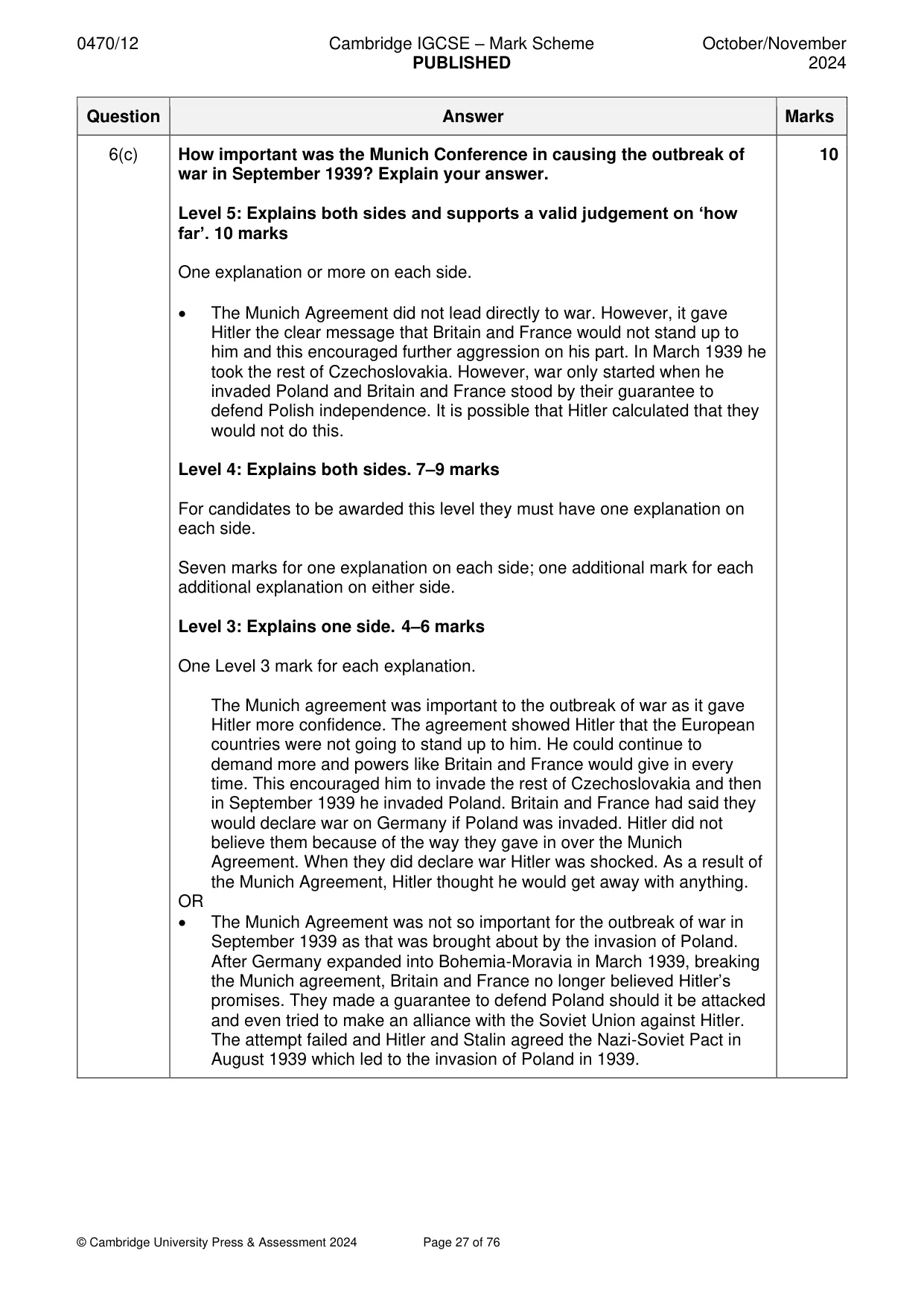
0470/12 Cambridge IGCSE – Mark Scheme PUBLISHED October/November 2024 © Cambridge University Press & Assessment 2024 Page 27 of 76 Question Answer Marks 6(c) How important was the Munich Conference in causing the outbreak of war in September 1939? Explain your answer. Level 5: Explains both sides and supports a valid judgement on ‘how far’. 10 marks One explanation or more on each side. • The Munich Agreement did not lead directly to war. However, it gave Hitler the clear message that Britain and France would not stand up to him and this encouraged further aggression on his part. In March 1939 he took the rest of Czechoslovakia. However, war only started when he invaded Poland and Britain and France stood by their guarantee to defend Polish independence. It is possible that Hitler calculated that they would not do this. Level 4: Explains both sides. 7–9 marks For candidates to be awarded this level they must have one explanation on each side. Seven marks for one explanation on each side; one additional mark for each additional explanation on either side. Level 3: Explains one side. 4–6 marks One Level 3 mark for each explanation. The Munich agreement was important to the outbreak of war as it gave Hitler more confidence. The agreement showed Hitler that the European countries were not going to stand up to him. He could continue to demand more and powers like Britain and France would give in every time. This encouraged him to invade the rest of Czechoslovakia and then in September 1939 he invaded Poland. Britain and France had said they would declare war on Germany if Poland was invaded. Hitler did not believe them because of the way they gave in over the Munich Agreement. When they did declare war Hitler was shocked. As a result of the Munich Agreement, Hitler thought he would get away with anything. OR • The Munich Agreement was not so important for the outbreak of war in September 1939 as that was brought about by the invasion of Poland. After Germany expanded into Bohemia-Moravia in March 1939, breaking the Munich agreement, Britain and France no longer believed Hitler’s promises. They made a guarantee to defend Poland should it be attacked and even tried to make an alliance with the Soviet Union against Hitler. The attempt failed and Hitler and Stalin agreed the Nazi-Soviet Pact in August 1939 which led to the invasion of Poland in 1939. 10
Mark scheme, page 28
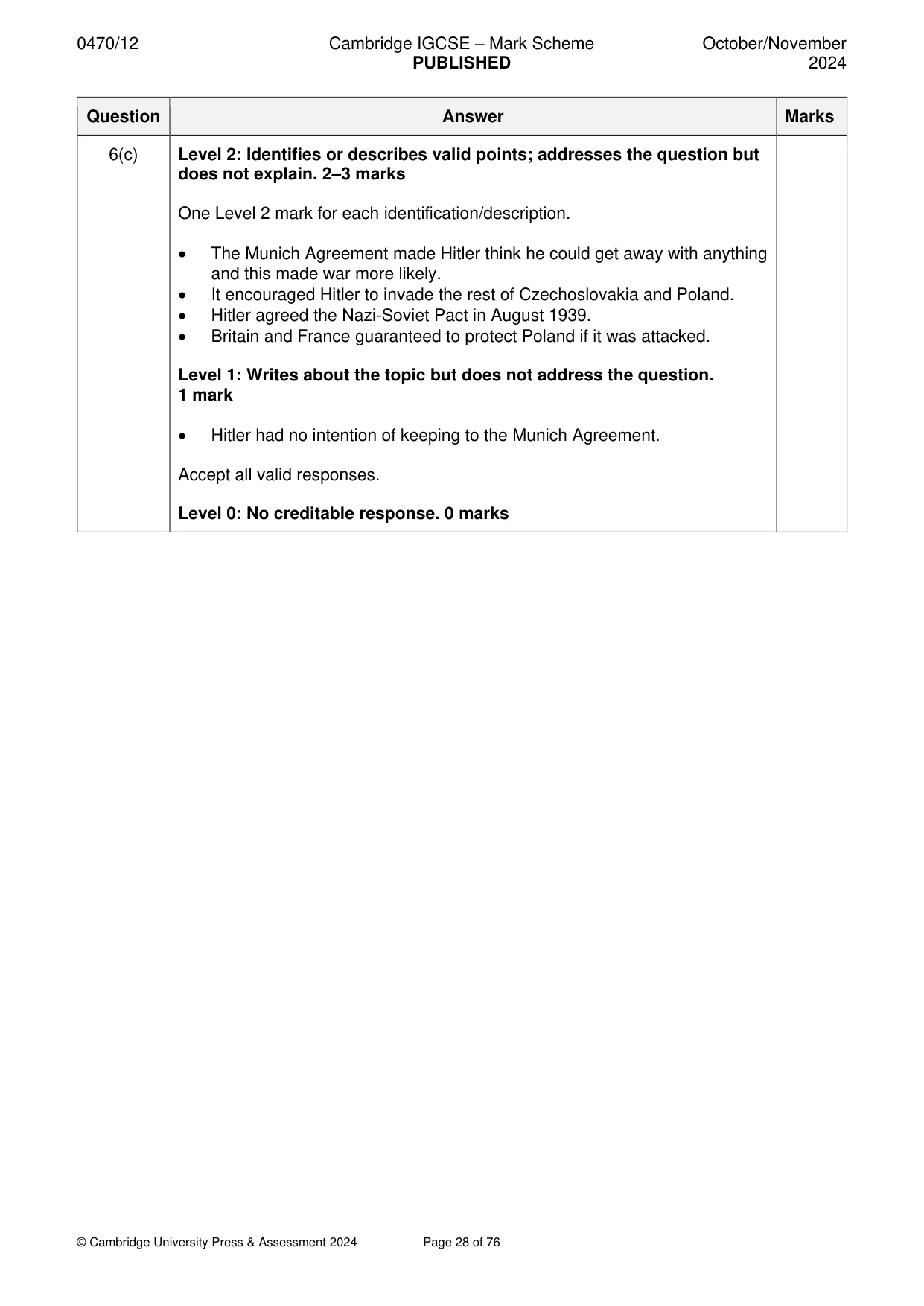
0470/12 Cambridge IGCSE – Mark Scheme PUBLISHED October/November 2024 © Cambridge University Press & Assessment 2024 Page 28 of 76 Question Answer Marks 6(c) Level 2: Identifies or describes valid points; addresses the question but does not explain. 2–3 marks One Level 2 mark for each identification/description. • The Munich Agreement made Hitler think he could get away with anything and this made war more likely. • It encouraged Hitler to invade the rest of Czechoslovakia and Poland. • Hitler agreed the Nazi-Soviet Pact in August 1939. • Britain and France guaranteed to protect Poland if it was attacked. Level 1: Writes about the topic but does not address the question. 1 mark • Hitler had no intention of keeping to the Munich Agreement. Accept all valid responses. Level 0: No creditable response. 0 marks
Mark scheme, page 29
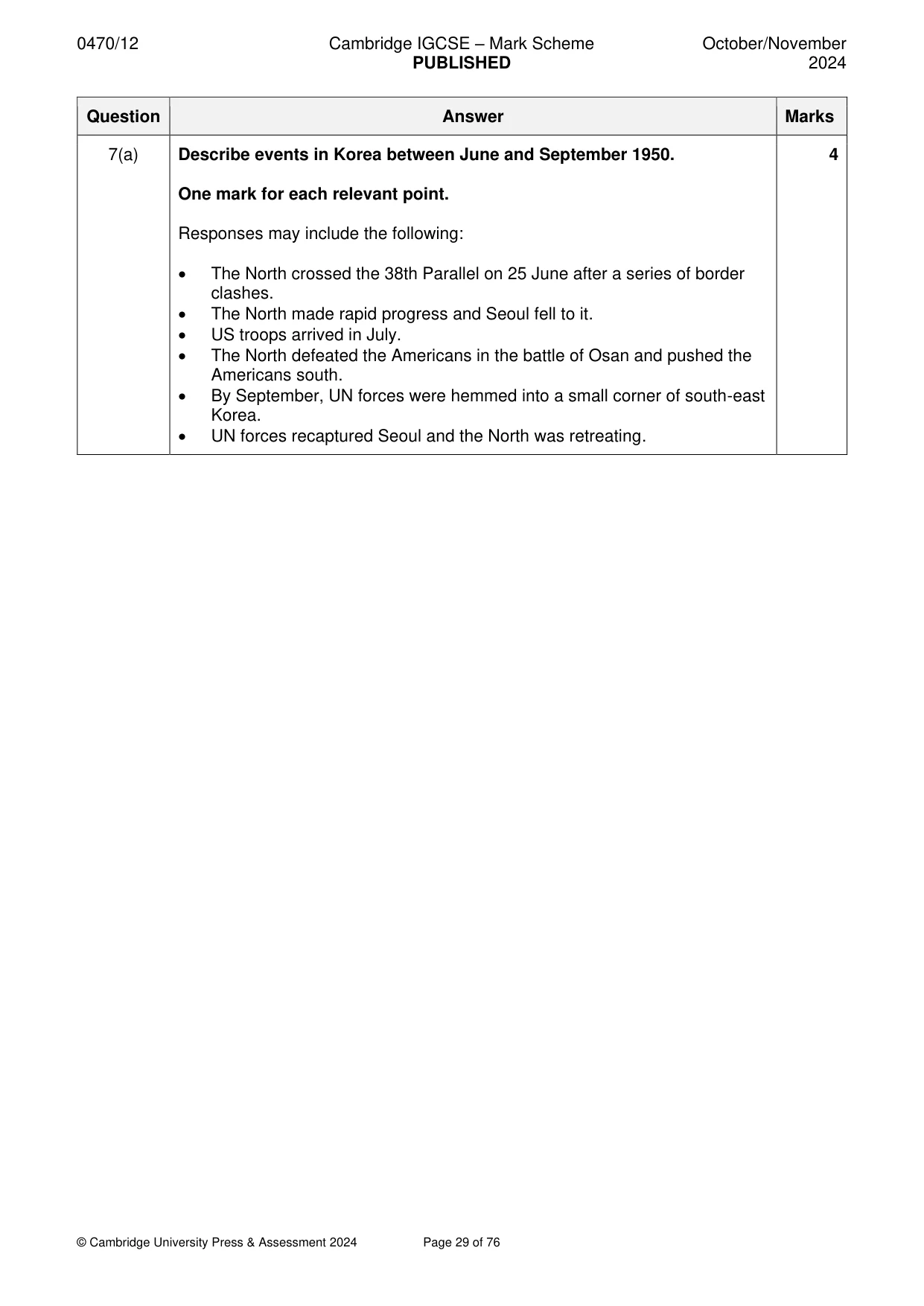
0470/12 Cambridge IGCSE – Mark Scheme PUBLISHED October/November 2024 © Cambridge University Press & Assessment 2024 Page 29 of 76 Question Answer Marks 7(a) Describe events in Korea between June and September 1950. One mark for each relevant point. Responses may include the following: • The North crossed the 38th Parallel on 25 June after a series of border clashes. • The North made rapid progress and Seoul fell to it. • US troops arrived in July. • The North defeated the Americans in the battle of Osan and pushed the Americans south. • By September, UN forces were hemmed into a small corner of south-east Korea. • UN forces recaptured Seoul and the North was retreating. 4
Mark scheme, page 30
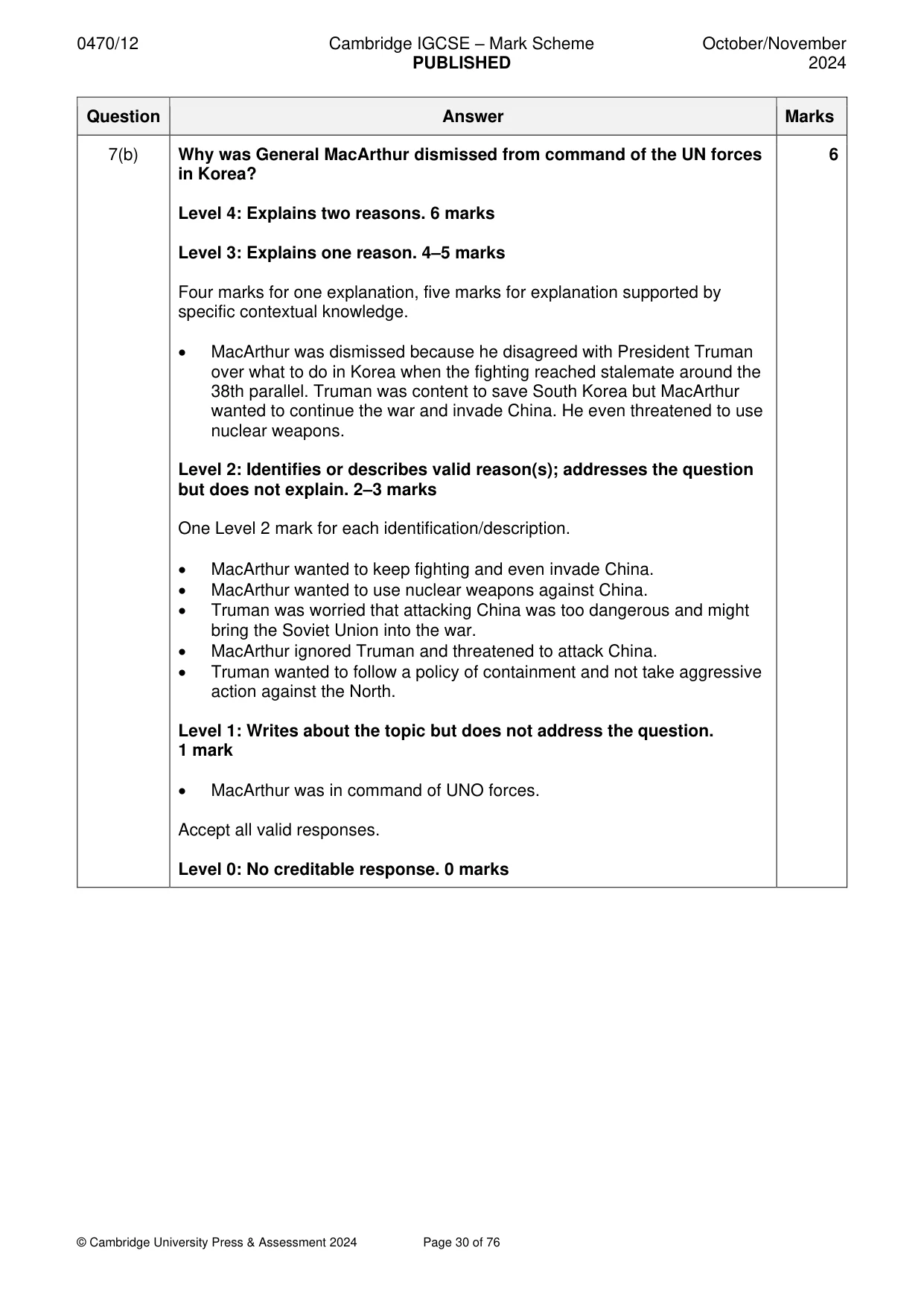
0470/12 Cambridge IGCSE – Mark Scheme PUBLISHED October/November 2024 © Cambridge University Press & Assessment 2024 Page 30 of 76 Question Answer Marks 7(b) Why was General MacArthur dismissed from command of the UN forces in Korea? Level 4: Explains two reasons. 6 marks Level 3: Explains one reason. 4–5 marks Four marks for one explanation, five marks for explanation supported by specific contextual knowledge. • MacArthur was dismissed because he disagreed with President Truman over what to do in Korea when the fighting reached stalemate around the 38th parallel. Truman was content to save South Korea but MacArthur wanted to continue the war and invade China. He even threatened to use nuclear weapons. Level 2: Identifies or describes valid reason(s); addresses the question but does not explain. 2–3 marks One Level 2 mark for each identification/description. • MacArthur wanted to keep fighting and even invade China. • MacArthur wanted to use nuclear weapons against China. • Truman was worried that attacking China was too dangerous and might bring the Soviet Union into the war. • MacArthur ignored Truman and threatened to attack China. • Truman wanted to follow a policy of containment and not take aggressive action against the North. Level 1: Writes about the topic but does not address the question. 1 mark • MacArthur was in command of UNO forces. Accept all valid responses. Level 0: No creditable response. 0 marks 6
Mark scheme, page 31
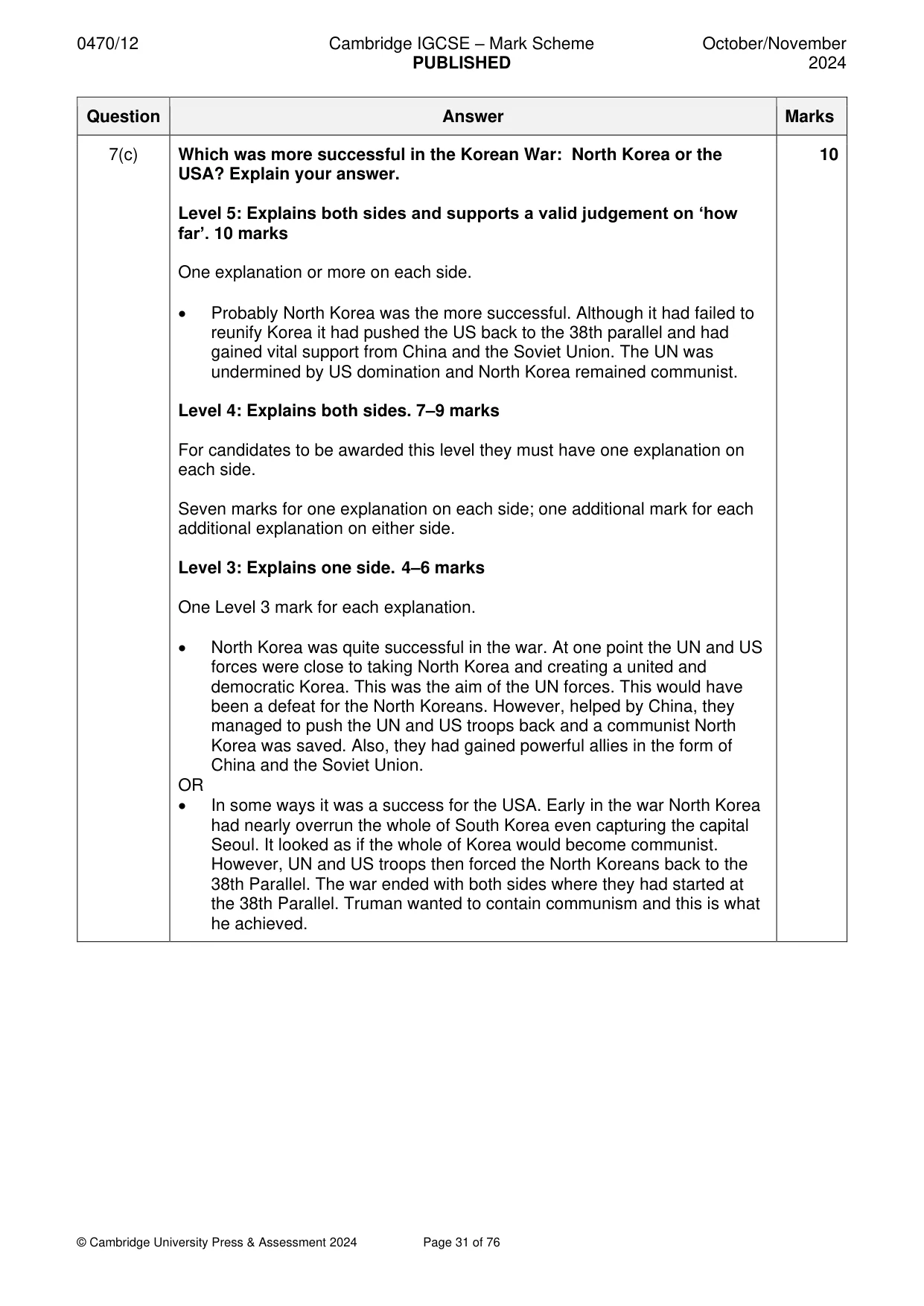
0470/12 Cambridge IGCSE – Mark Scheme PUBLISHED October/November 2024 © Cambridge University Press & Assessment 2024 Page 31 of 76 Question Answer Marks 7(c) Which was more successful in the Korean War: North Korea or the USA? Explain your answer. Level 5: Explains both sides and supports a valid judgement on ‘how far’. 10 marks One explanation or more on each side. • Probably North Korea was the more successful. Although it had failed to reunify Korea it had pushed the US back to the 38th parallel and had gained vital support from China and the Soviet Union. The UN was undermined by US domination and North Korea remained communist. Level 4: Explains both sides. 7–9 marks For candidates to be awarded this level they must have one explanation on each side. Seven marks for one explanation on each side; one additional mark for each additional explanation on either side. Level 3: Explains one side. 4–6 marks One Level 3 mark for each explanation. • North Korea was quite successful in the war. At one point the UN and US forces were close to taking North Korea and creating a united and democratic Korea. This was the aim of the UN forces. This would have been a defeat for the North Koreans. However, helped by China, they managed to push the UN and US troops back and a communist North Korea was saved. Also, they had gained powerful allies in the form of China and the Soviet Union. OR • In some ways it was a success for the USA. Early in the war North Korea had nearly overrun the whole of South Korea even capturing the capital Seoul. It looked as if the whole of Korea would become communist. However, UN and US troops then forced the North Koreans back to the 38th Parallel. The war ended with both sides where they had started at the 38th Parallel. Truman wanted to contain communism and this is what he achieved. 10
Mark scheme, page 32
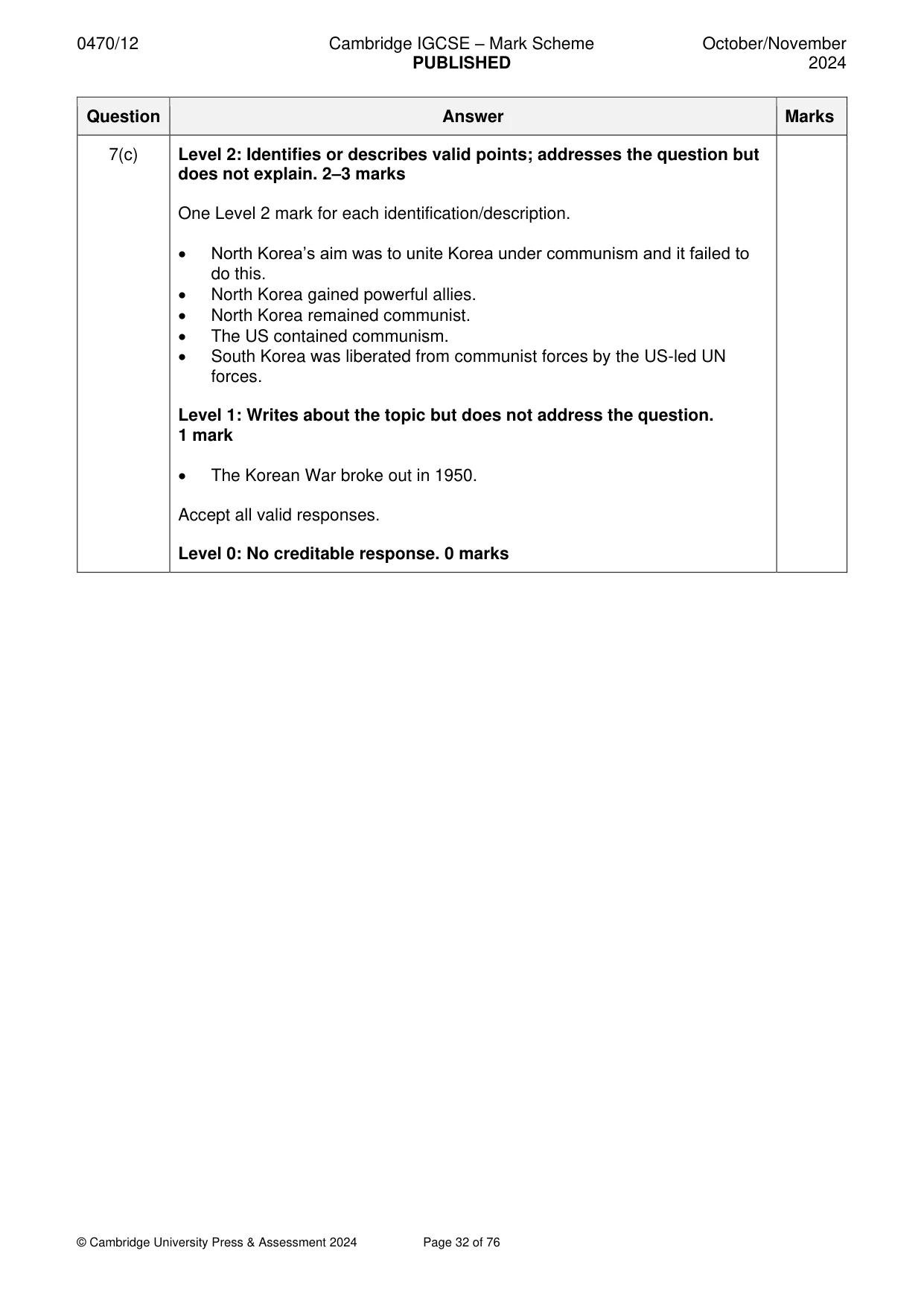
0470/12 Cambridge IGCSE – Mark Scheme PUBLISHED October/November 2024 © Cambridge University Press & Assessment 2024 Page 32 of 76 Question Answer Marks 7(c) Level 2: Identifies or describes valid points; addresses the question but does not explain. 2–3 marks One Level 2 mark for each identification/description. • North Korea’s aim was to unite Korea under communism and it failed to do this. • North Korea gained powerful allies. • North Korea remained communist. • The US contained communism. • South Korea was liberated from communist forces by the US-led UN forces. Level 1: Writes about the topic but does not address the question. 1 mark • The Korean War broke out in 1950. Accept all valid responses. Level 0: No creditable response. 0 marks
Mark scheme, page 33
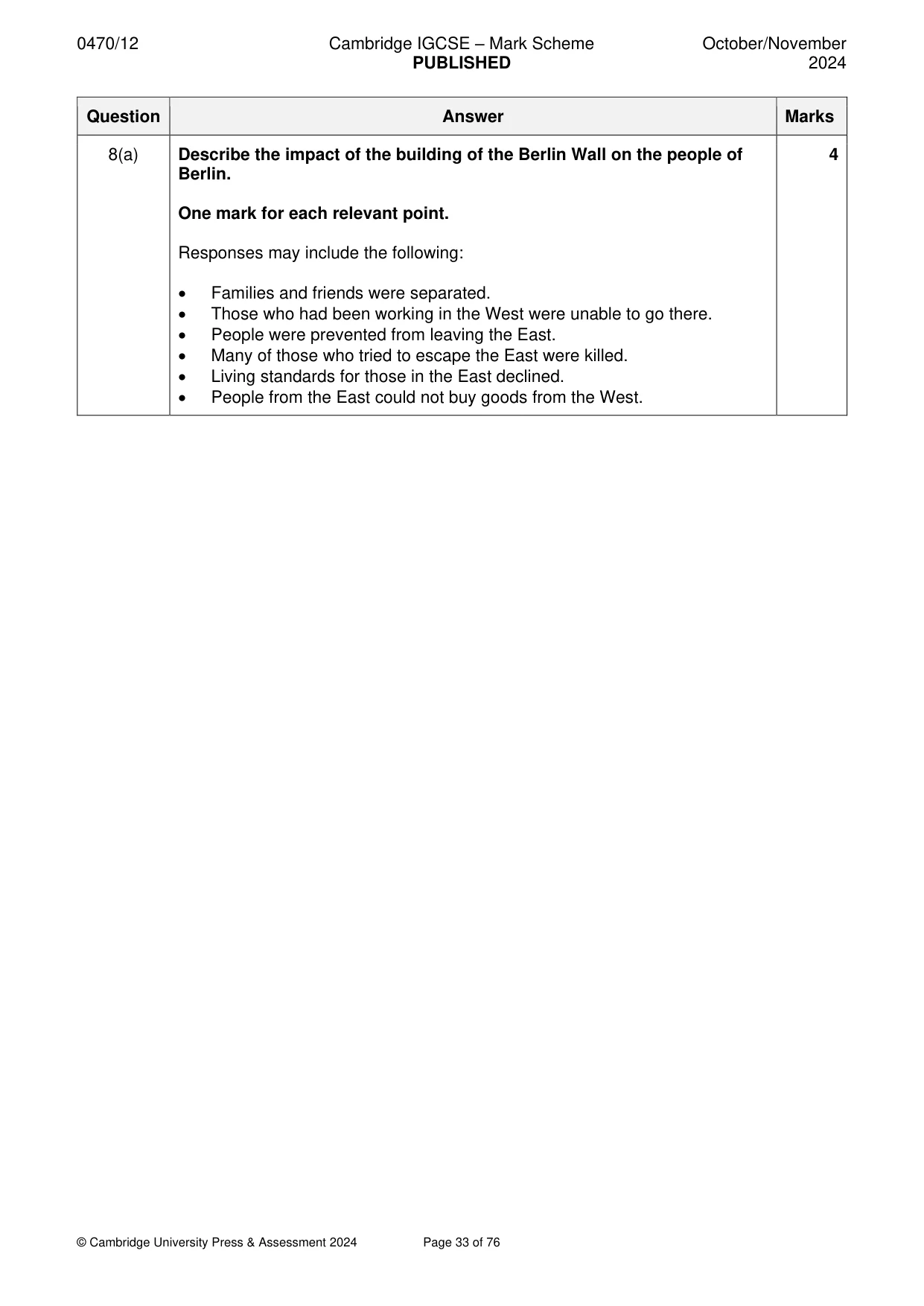
0470/12 Cambridge IGCSE – Mark Scheme PUBLISHED October/November 2024 © Cambridge University Press & Assessment 2024 Page 33 of 76 Question Answer Marks 8(a) Describe the impact of the building of the Berlin Wall on the people of Berlin. One mark for each relevant point. Responses may include the following: • Families and friends were separated. • Those who had been working in the West were unable to go there. • People were prevented from leaving the East. • Many of those who tried to escape the East were killed. • Living standards for those in the East declined. • People from the East could not buy goods from the West. 4
Mark scheme, page 34
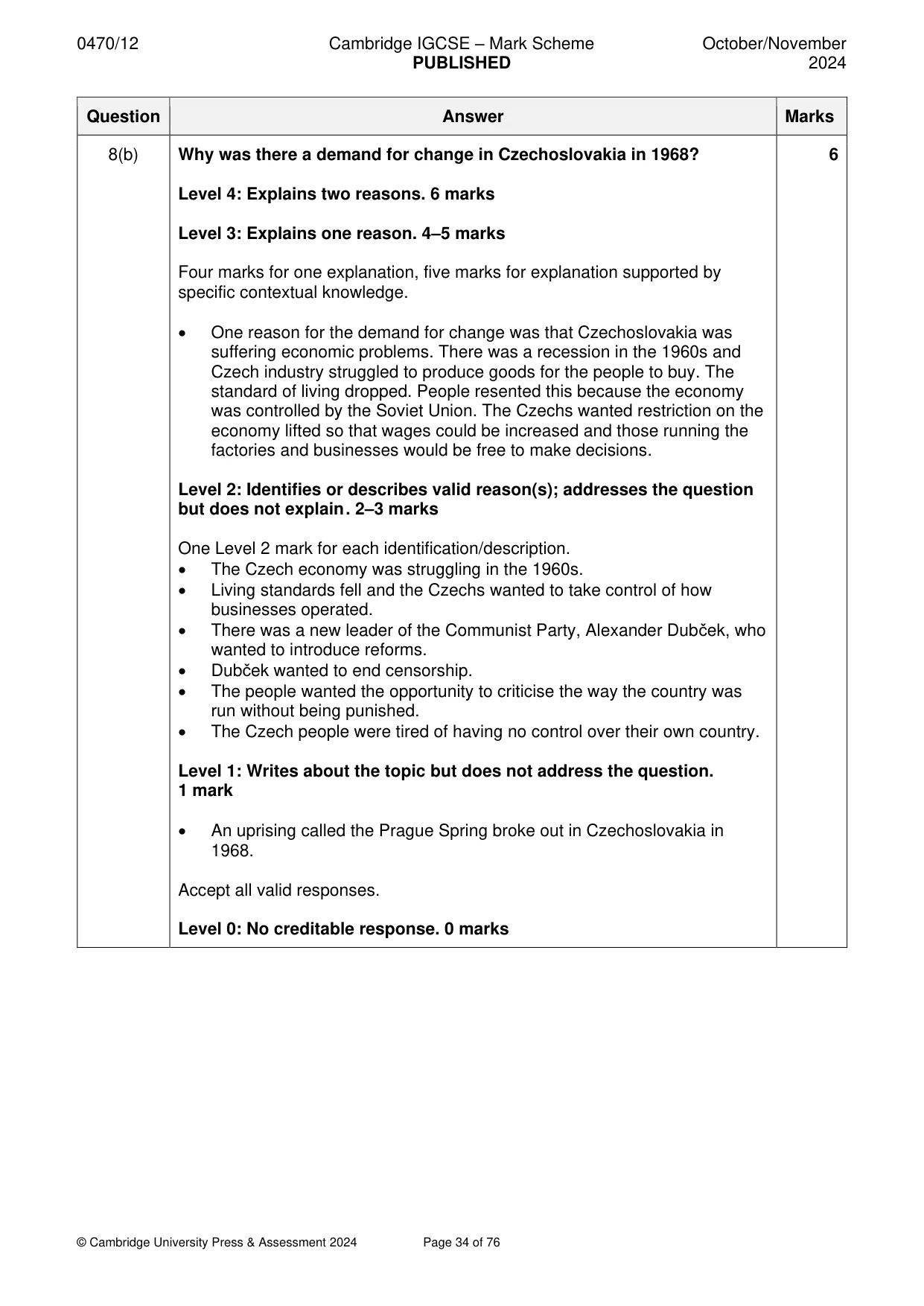
0470/12 Cambridge IGCSE – Mark Scheme PUBLISHED October/November 2024 © Cambridge University Press & Assessment 2024 Page 34 of 76 Question Answer Marks 8(b) Why was there a demand for change in Czechoslovakia in 1968? Level 4: Explains two reasons. 6 marks Level 3: Explains one reason. 4–5 marks Four marks for one explanation, five marks for explanation supported by specific contextual knowledge. • One reason for the demand for change was that Czechoslovakia was suffering economic problems. There was a recession in the 1960s and Czech industry struggled to produce goods for the people to buy. The standard of living dropped. People resented this because the economy was controlled by the Soviet Union. The Czechs wanted restriction on the economy lifted so that wages could be increased and those running the factories and businesses would be free to make decisions. Level 2: Identifies or describes valid reason(s); addresses the question but does not explain . 2–3 marks One Level 2 mark for each identification/description. • The Czech economy was struggling in the 1960s. • Living standards fell and the Czechs wanted to take control of how businesses operated. • There was a new leader of the Communist Party, Alexander Dubček, who wanted to introduce reforms. • Dubček wanted to end censorship. • The people wanted the opportunity to criticise the way the country was run without being punished. • The Czech people were tired of having no control over their own country. Level 1: Writes about the topic but does not address the question. 1 mark • An uprising called the Prague Spring broke out in Czechoslovakia in 1968. Accept all valid responses. Level 0: No creditable response. 0 marks 6
Mark scheme, page 35
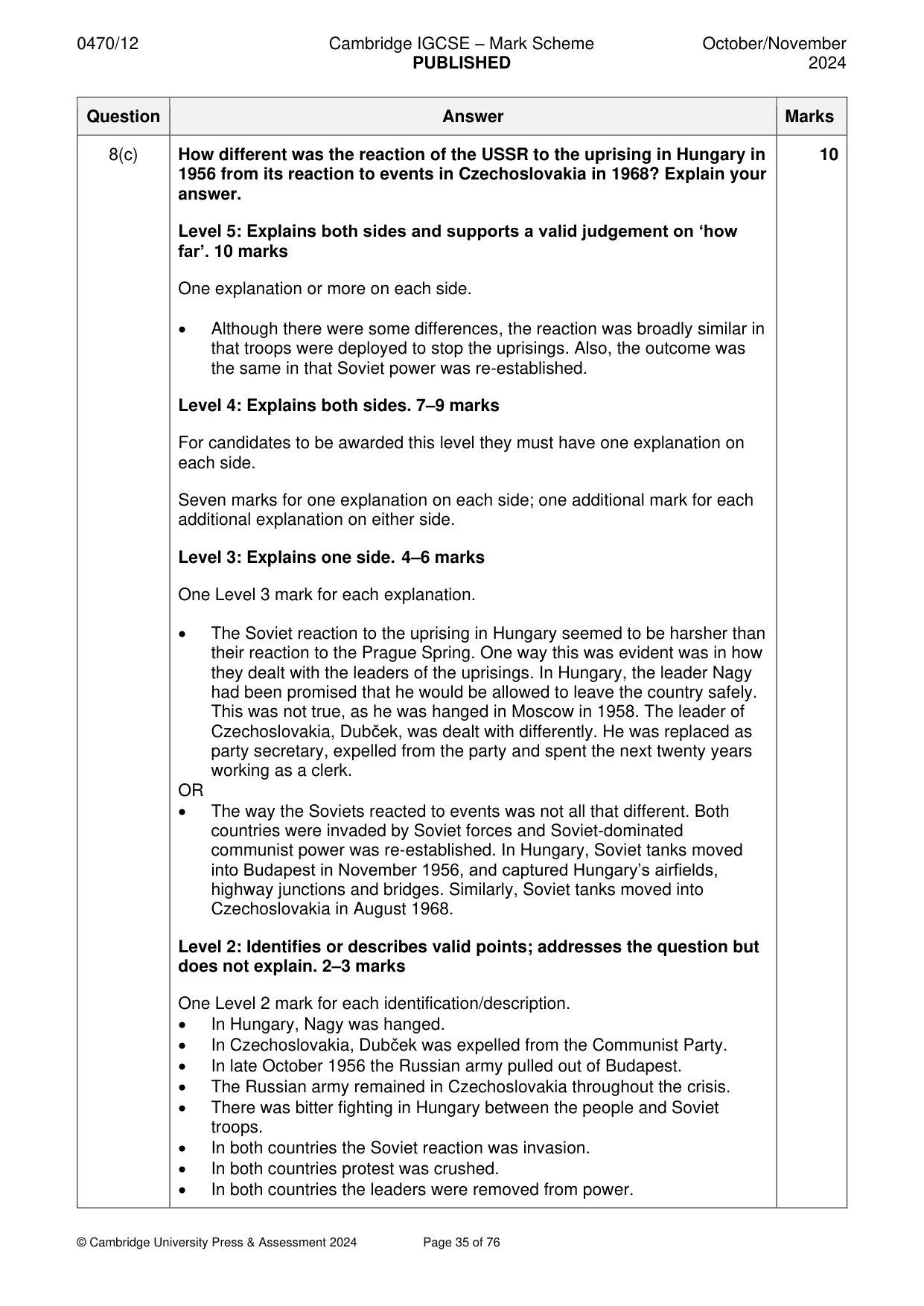
0470/12 Cambridge IGCSE – Mark Scheme PUBLISHED October/November 2024 © Cambridge University Press & Assessment 2024 Page 35 of 76 Question Answer Marks 8(c) How different was the reaction of the USSR to the uprising in Hungary in 1956 from its reaction to events in Czechoslovakia in 1968? Explain your answer. Level 5: Explains both sides and supports a valid judgement on ‘how far’. 10 marks One explanation or more on each side. • Although there were some differences, the reaction was broadly similar in that troops were deployed to stop the uprisings. Also, the outcome was the same in that Soviet power was re-established. Level 4: Explains both sides. 7–9 marks For candidates to be awarded this level they must have one explanation on each side. Seven marks for one explanation on each side; one additional mark for each additional explanation on either side. Level 3: Explains one side. 4–6 marks One Level 3 mark for each explanation. • The Soviet reaction to the uprising in Hungary seemed to be harsher than their reaction to the Prague Spring. One way this was evident was in how they dealt with the leaders of the uprisings. In Hungary, the leader Nagy had been promised that he would be allowed to leave the country safely. This was not true, as he was hanged in Moscow in 1958. The leader of Czechoslovakia, Dubček, was dealt with differently. He was replaced as party secretary, expelled from the party and spent the next twenty years working as a clerk. OR • The way the Soviets reacted to events was not all that different. Both countries were invaded by Soviet forces and Soviet-dominated communist power was re-established. In Hungary, Soviet tanks moved into Budapest in November 1956, and captured Hungary’s airfields, highway junctions and bridges. Similarly, Soviet tanks moved into Czechoslovakia in August 1968. Level 2: Identifies or describes valid points; addresses the question but does not explain. 2–3 marks One Level 2 mark for each identification/description. • In Hungary, Nagy was hanged. • In Czechoslovakia, Dubček was expelled from the Communist Party. • In late October 1956 the Russian army pulled out of Budapest. • The Russian army remained in Czechoslovakia throughout the crisis. • There was bitter fighting in Hungary between the people and Soviet troops. • In both countries the Soviet reaction was invasion. • In both countries protest was crushed. • In both countries the leaders were removed from power. 10
Mark scheme, page 36
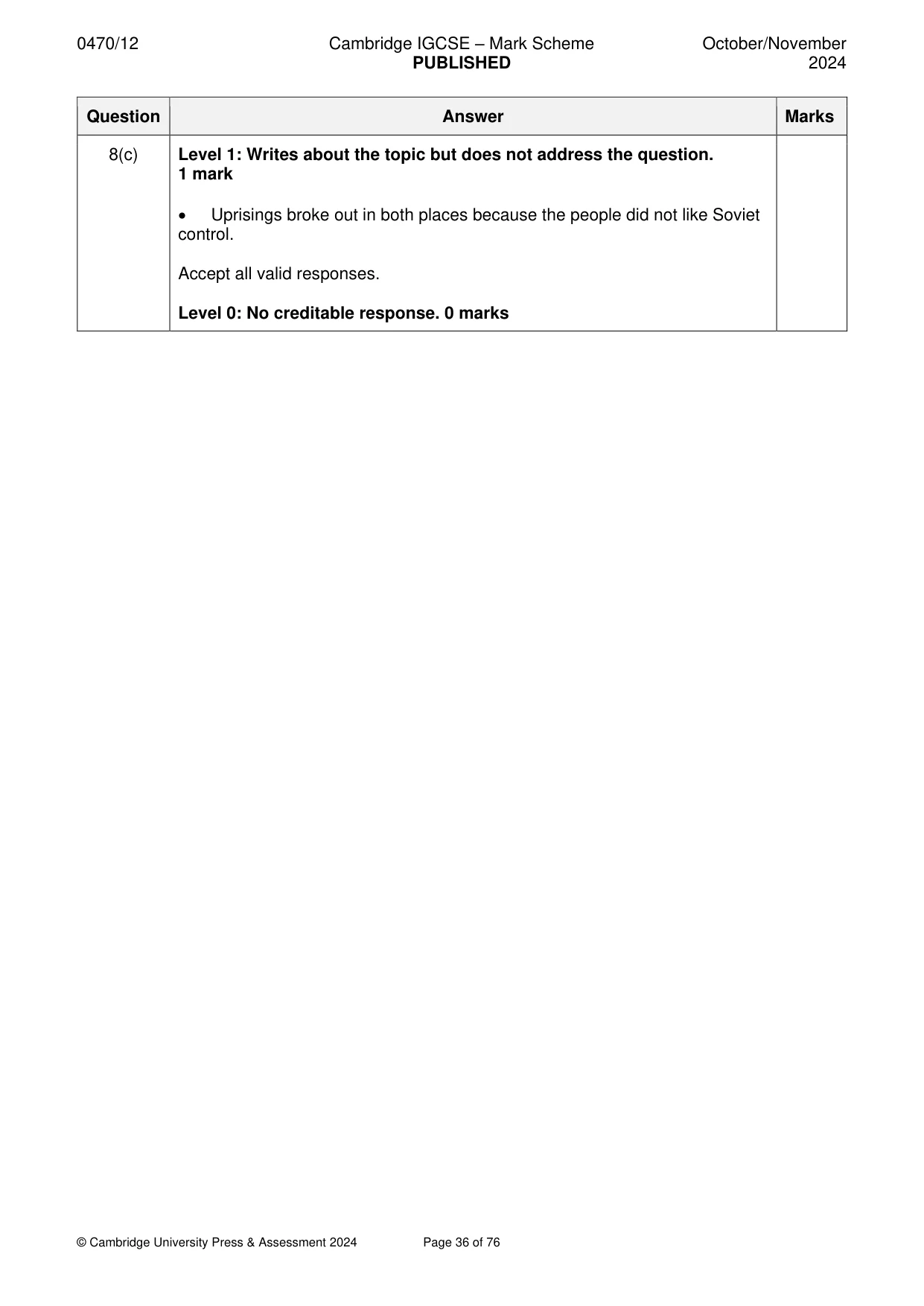
0470/12 Cambridge IGCSE – Mark Scheme PUBLISHED October/November 2024 © Cambridge University Press & Assessment 2024 Page 36 of 76 Question Answer Marks 8(c) Level 1: Writes about the topic but does not address the question. 1 mark • Uprisings broke out in both places because the people did not like Soviet control. Accept all valid responses. Level 0: No creditable response. 0 marks
Mark scheme, page 37
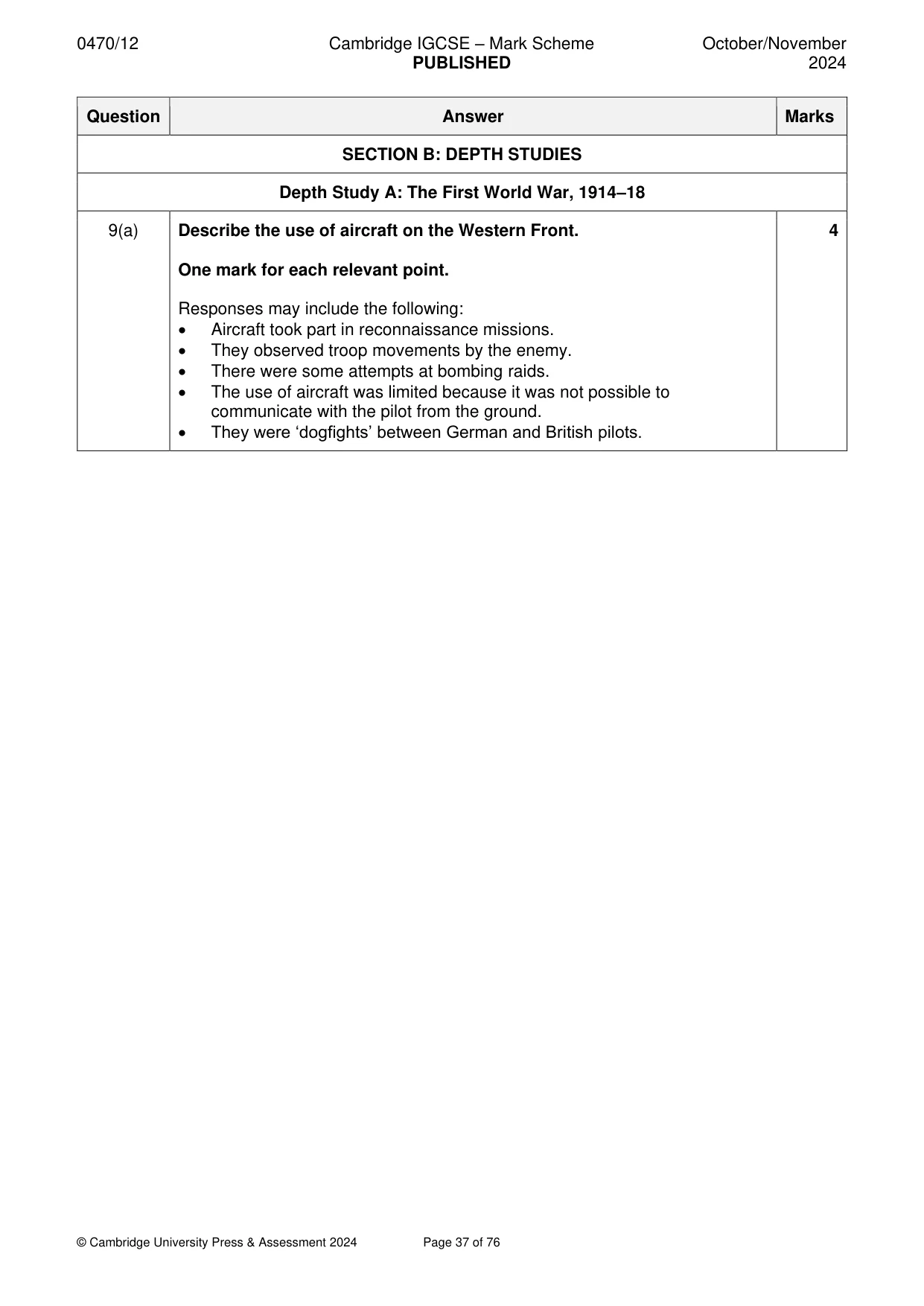
0470/12 Cambridge IGCSE – Mark Scheme PUBLISHED October/November 2024 © Cambridge University Press & Assessment 2024 Page 37 of 76 Question Answer Marks SECTION B: DEPTH STUDIES Depth Study A: The First World War, 1914–18 9(a) Describe the use of aircraft on the Western Front. One mark for each relevant point. Responses may include the following: • Aircraft took part in reconnaissance missions. • They observed troop movements by the enemy. • There were some attempts at bombing raids. • The use of aircraft was limited because it was not possible to communicate with the pilot from the ground. • They were ‘dogfights’ between German and British pilots. 4
Mark scheme, page 38
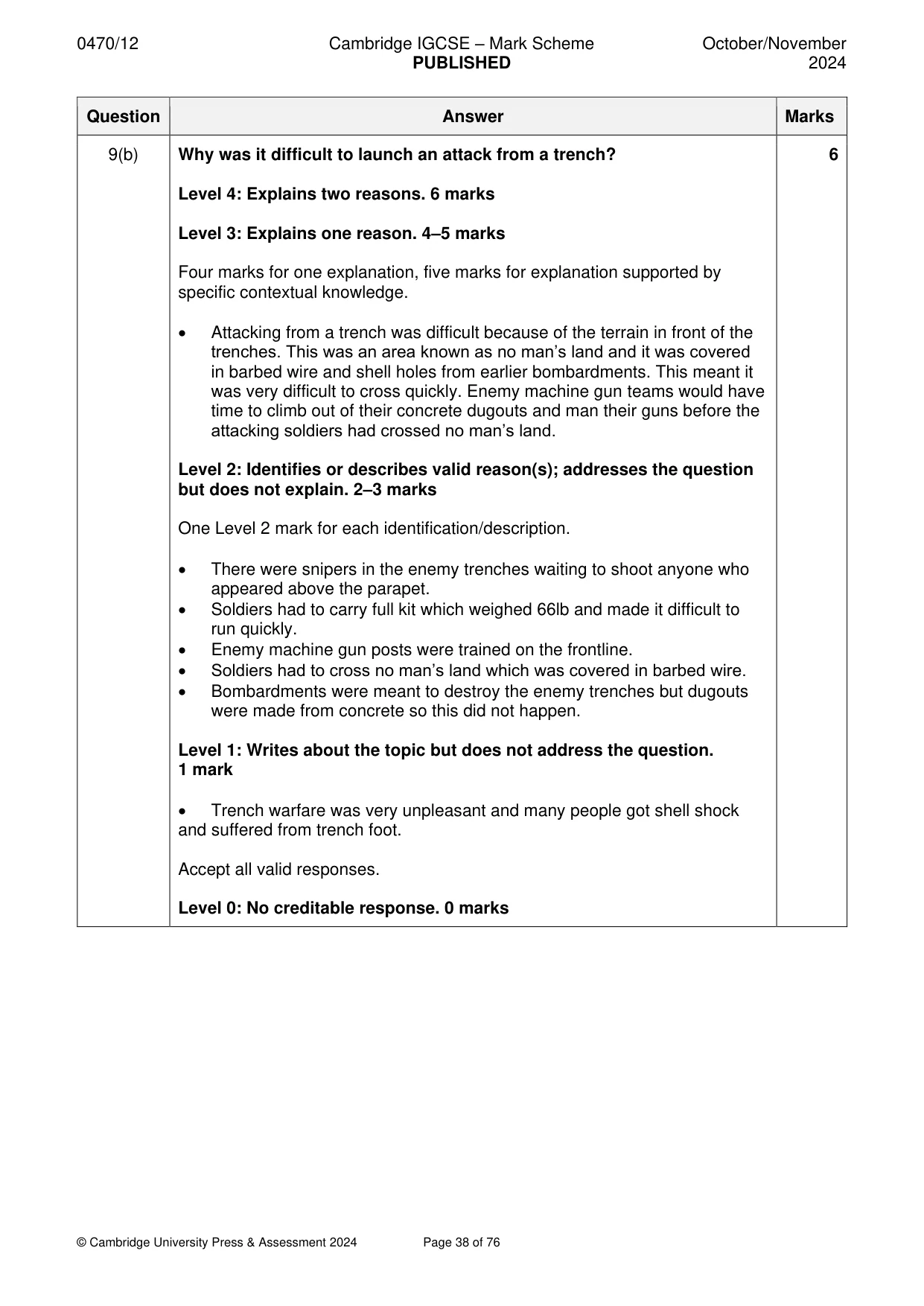
0470/12 Cambridge IGCSE – Mark Scheme PUBLISHED October/November 2024 © Cambridge University Press & Assessment 2024 Page 38 of 76 Question Answer Marks 9(b) Why was it difficult to launch an attack from a trench? Level 4: Explains two reasons. 6 marks Level 3: Explains one reason. 4–5 marks Four marks for one explanation, five marks for explanation supported by specific contextual knowledge. • Attacking from a trench was difficult because of the terrain in front of the trenches. This was an area known as no man’s land and it was covered in barbed wire and shell holes from earlier bombardments. This meant it was very difficult to cross quickly. Enemy machine gun teams would have time to climb out of their concrete dugouts and man their guns before the attacking soldiers had crossed no man’s land. Level 2: Identifies or describes valid reason(s); addresses the question but does not explain. 2–3 marks One Level 2 mark for each identification/description. • There were snipers in the enemy trenches waiting to shoot anyone who appeared above the parapet. • Soldiers had to carry full kit which weighed 66lb and made it difficult to run quickly. • Enemy machine gun posts were trained on the frontline. • Soldiers had to cross no man’s land which was covered in barbed wire. • Bombardments were meant to destroy the enemy trenches but dugouts were made from concrete so this did not happen. Level 1: Writes about the topic but does not address the question. 1 mark • Trench warfare was very unpleasant and many people got shell shock and suffered from trench foot. Accept all valid responses. Level 0: No creditable response. 0 marks 6
Mark scheme, page 39
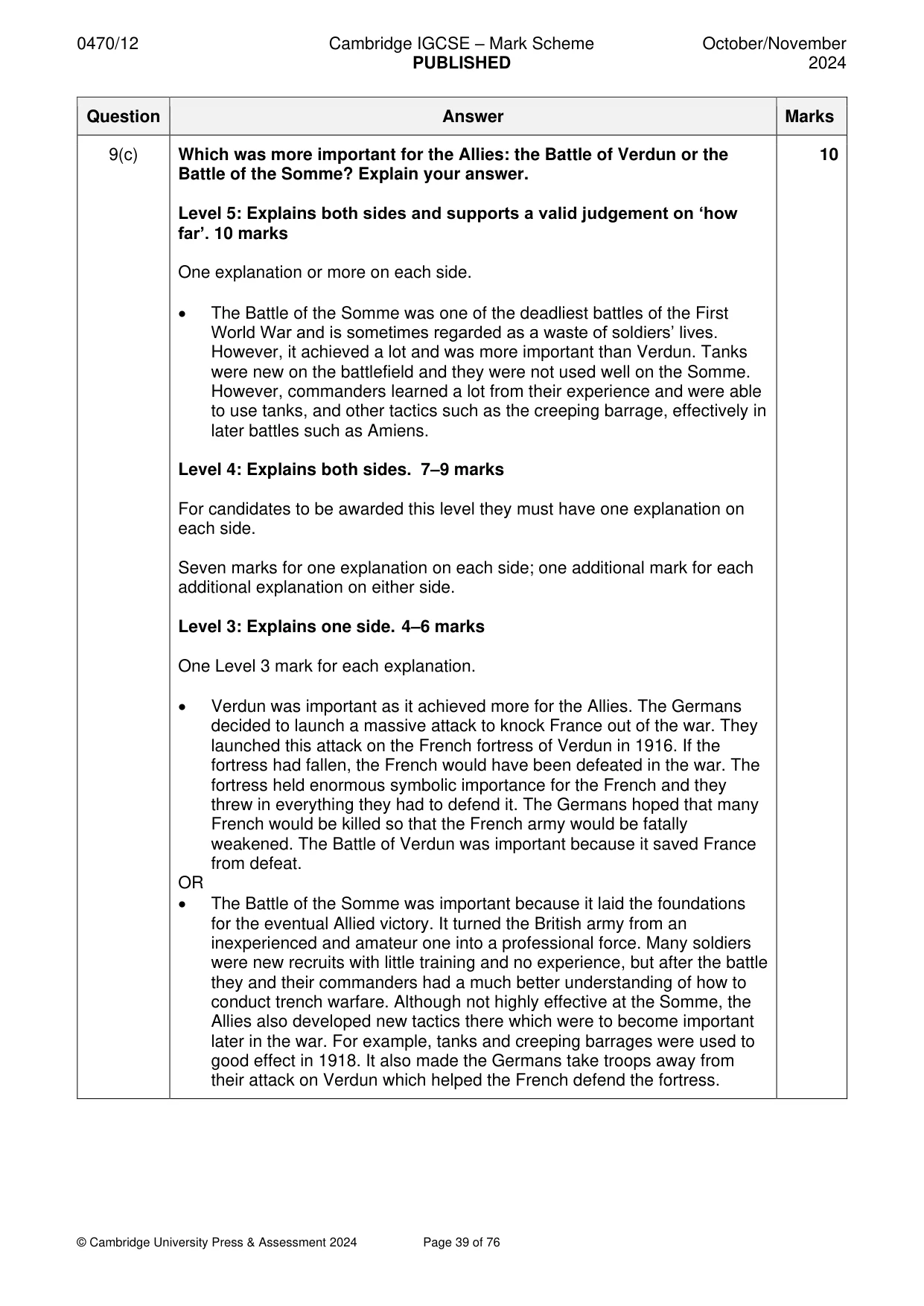
0470/12 Cambridge IGCSE – Mark Scheme PUBLISHED October/November 2024 © Cambridge University Press & Assessment 2024 Page 39 of 76 Question Answer Marks 9(c) Which was more important for the Allies: the Battle of Verdun or the Battle of the Somme? Explain your answer. Level 5: Explains both sides and supports a valid judgement on ‘how far’. 10 marks One explanation or more on each side. • The Battle of the Somme was one of the deadliest battles of the First World War and is sometimes regarded as a waste of soldiers’ lives. However, it achieved a lot and was more important than Verdun. Tanks were new on the battlefield and they were not used well on the Somme. However, commanders learned a lot from their experience and were able to use tanks, and other tactics such as the creeping barrage, effectively in later battles such as Amiens. Level 4: Explains both sides. 7–9 marks For candidates to be awarded this level they must have one explanation on each side. Seven marks for one explanation on each side; one additional mark for each additional explanation on either side. Level 3: Explains one side. 4–6 marks One Level 3 mark for each explanation. • Verdun was important as it achieved more for the Allies. The Germans decided to launch a massive attack to knock France out of the war. They launched this attack on the French fortress of Verdun in 1916. If the fortress had fallen, the French would have been defeated in the war. The fortress held enormous symbolic importance for the French and they threw in everything they had to defend it. The Germans hoped that many French would be killed so that the French army would be fatally weakened. The Battle of Verdun was important because it saved France from defeat. OR • The Battle of the Somme was important because it laid the foundations for the eventual Allied victory. It turned the British army from an inexperienced and amateur one into a professional force. Many soldiers were new recruits with little training and no experience, but after the battle they and their commanders had a much better understanding of how to conduct trench warfare. Although not highly effective at the Somme, the Allies also developed new tactics there which were to become important later in the war. For example, tanks and creeping barrages were used to good effect in 1918. It also made the Germans take troops away from their attack on Verdun which helped the French defend the fortress. 10
Mark scheme, page 40
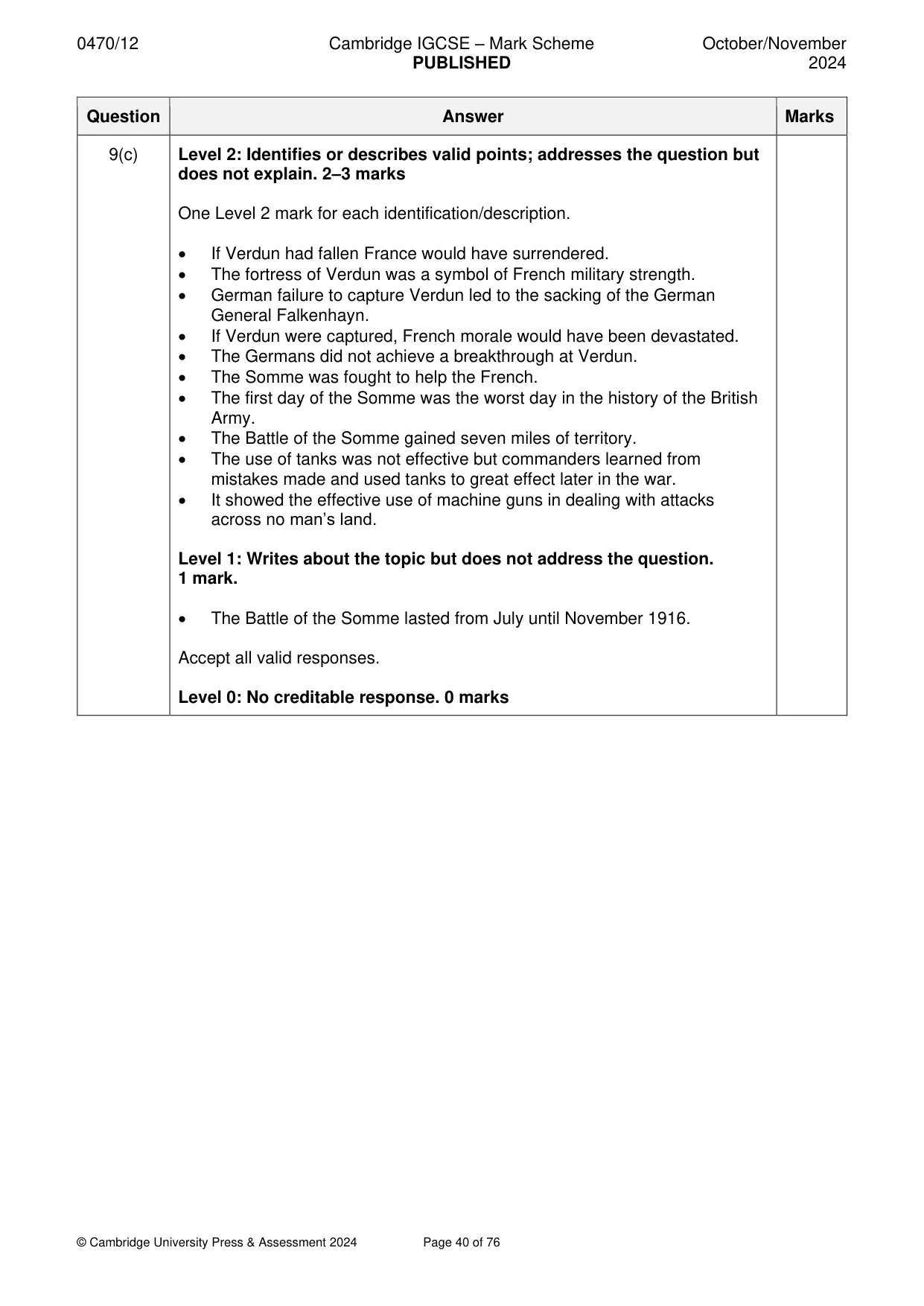
0470/12 Cambridge IGCSE – Mark Scheme PUBLISHED October/November 2024 © Cambridge University Press & Assessment 2024 Page 40 of 76 Question Answer Marks 9(c) Level 2: Identifies or describes valid points; addresses the question but does not explain. 2–3 marks One Level 2 mark for each identification/description. • If Verdun had fallen France would have surrendered. • The fortress of Verdun was a symbol of French military strength. • German failure to capture Verdun led to the sacking of the German General Falkenhayn. • If Verdun were captured, French morale would have been devastated. • The Germans did not achieve a breakthrough at Verdun. • The Somme was fought to help the French. • The first day of the Somme was the worst day in the history of the British Army. • The Battle of the Somme gained seven miles of territory. • The use of tanks was not effective but commanders learned from mistakes made and used tanks to great effect later in the war. • It showed the effective use of machine guns in dealing with attacks across no man’s land. Level 1: Writes about the topic but does not address the question. 1 mark. • The Battle of the Somme lasted from July until November 1916. Accept all valid responses. Level 0: No creditable response. 0 marks
Mark scheme, page 41
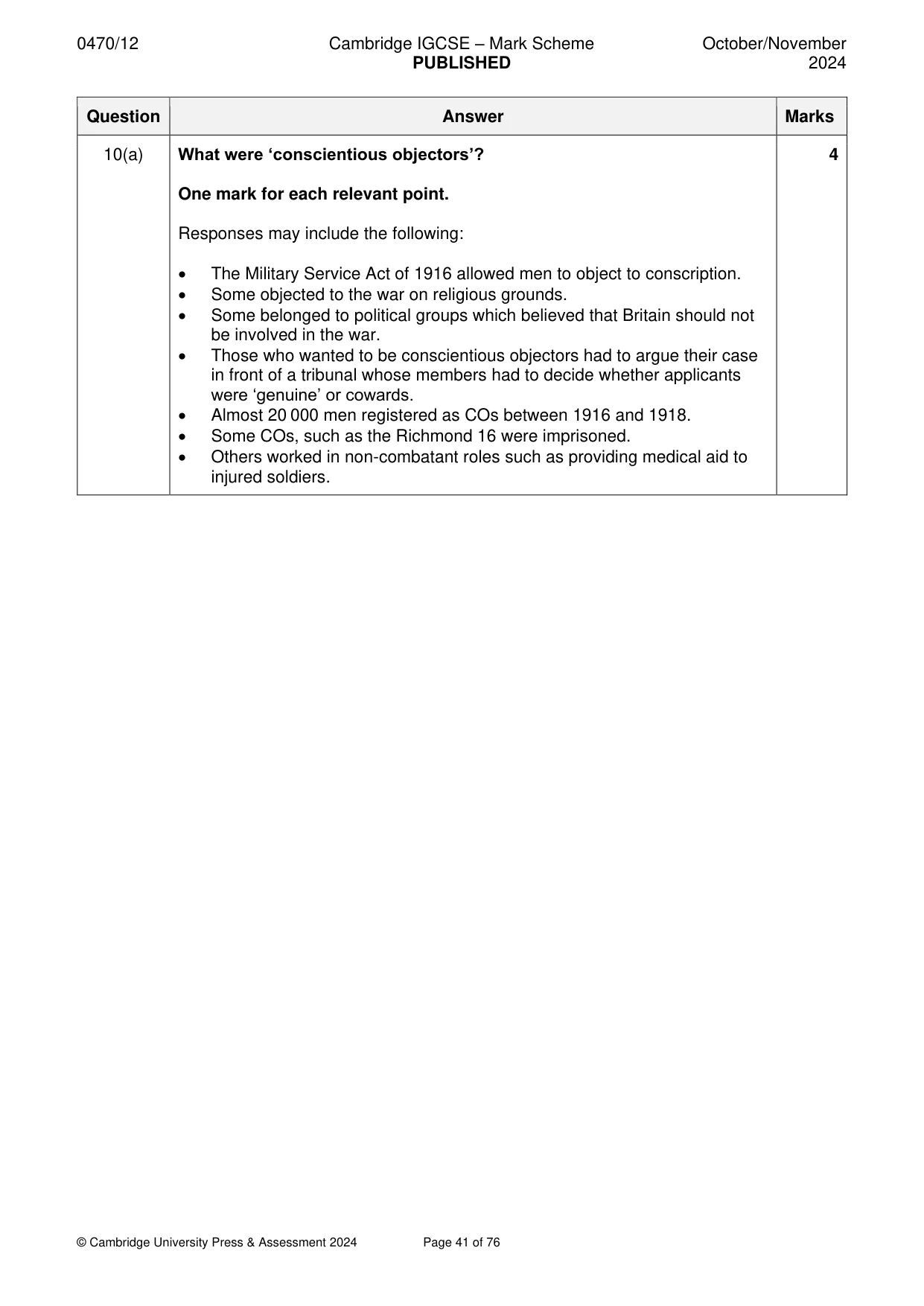
0470/12 Cambridge IGCSE – Mark Scheme PUBLISHED October/November 2024 © Cambridge University Press & Assessment 2024 Page 41 of 76 Question Answer Marks 10(a) What were ‘conscientious objectors’? One mark for each relevant point. Responses may include the following: • The Military Service Act of 1916 allowed men to object to conscription. • Some objected to the war on religious grounds. • Some belonged to political groups which believed that Britain should not be involved in the war. • Those who wanted to be conscientious objectors had to argue their case in front of a tribunal whose members had to decide whether applicants were ‘genuine’ or cowards. • Almost 20 000 men registered as COs between 1916 and 1918. • Some COs, such as the Richmond 16 were imprisoned. • Others worked in non-combatant roles such as providing medical aid to injured soldiers. 4
Mark scheme, page 42
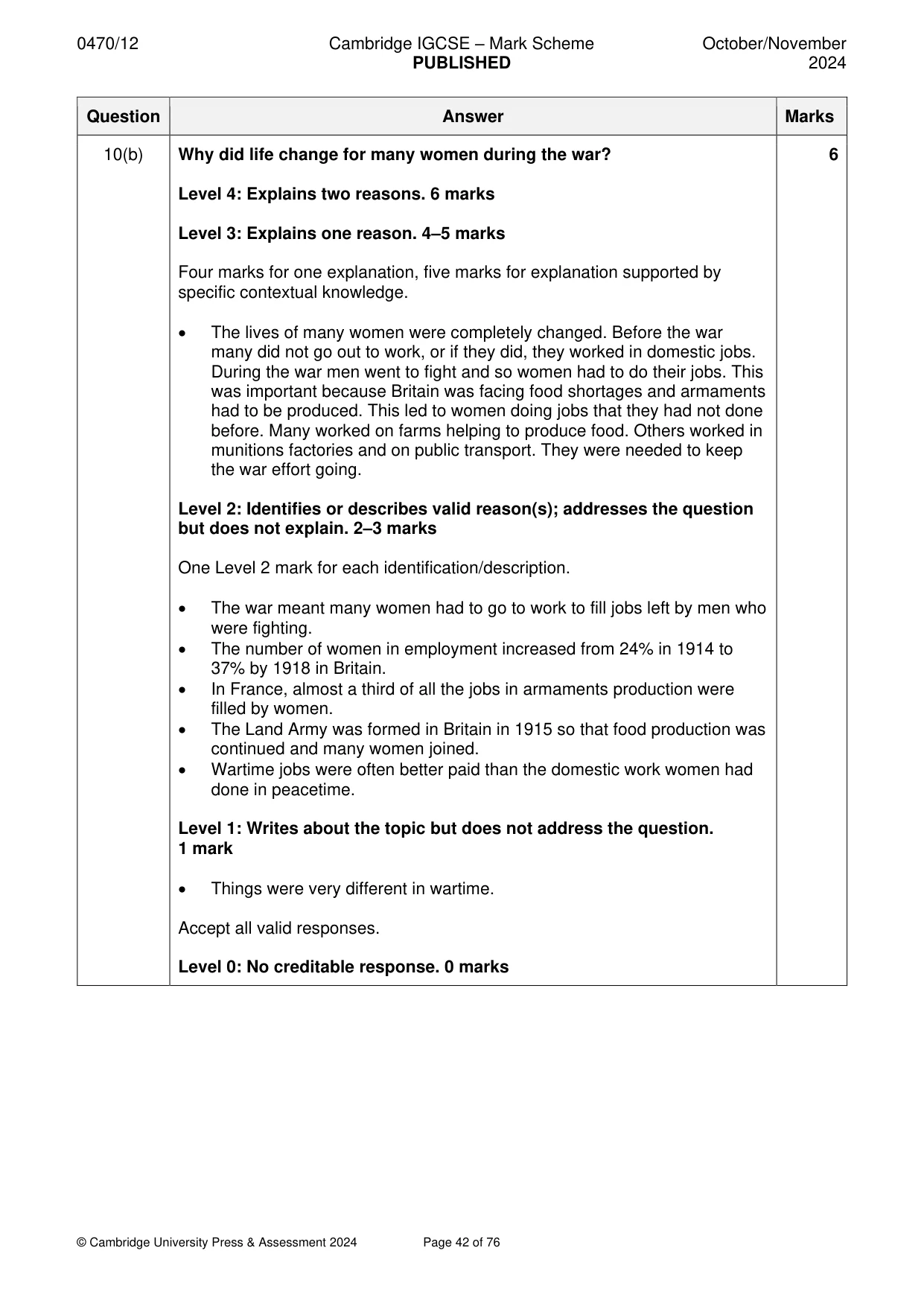
0470/12 Cambridge IGCSE – Mark Scheme PUBLISHED October/November 2024 © Cambridge University Press & Assessment 2024 Page 42 of 76 Question Answer Marks 10(b) Why did life change for many women during the war? Level 4: Explains two reasons. 6 marks Level 3: Explains one reason. 4–5 marks Four marks for one explanation, five marks for explanation supported by specific contextual knowledge. • The lives of many women were completely changed. Before the war many did not go out to work, or if they did, they worked in domestic jobs. During the war men went to fight and so women had to do their jobs. This was important because Britain was facing food shortages and armaments had to be produced. This led to women doing jobs that they had not done before. Many worked on farms helping to produce food. Others worked in munitions factories and on public transport. They were needed to keep the war effort going. Level 2: Identifies or describes valid reason(s); addresses the question but does not explain. 2–3 marks One Level 2 mark for each identification/description. • The war meant many women had to go to work to fill jobs left by men who were fighting. • The number of women in employment increased from 24% in 1914 to 37% by 1918 in Britain. • In France, almost a third of all the jobs in armaments production were filled by women. • The Land Army was formed in Britain in 1915 so that food production was continued and many women joined. • Wartime jobs were often better paid than the domestic work women had done in peacetime. Level 1: Writes about the topic but does not address the question. 1 mark • Things were very different in wartime. Accept all valid responses. Level 0: No creditable response. 0 marks 6
Mark scheme, page 43
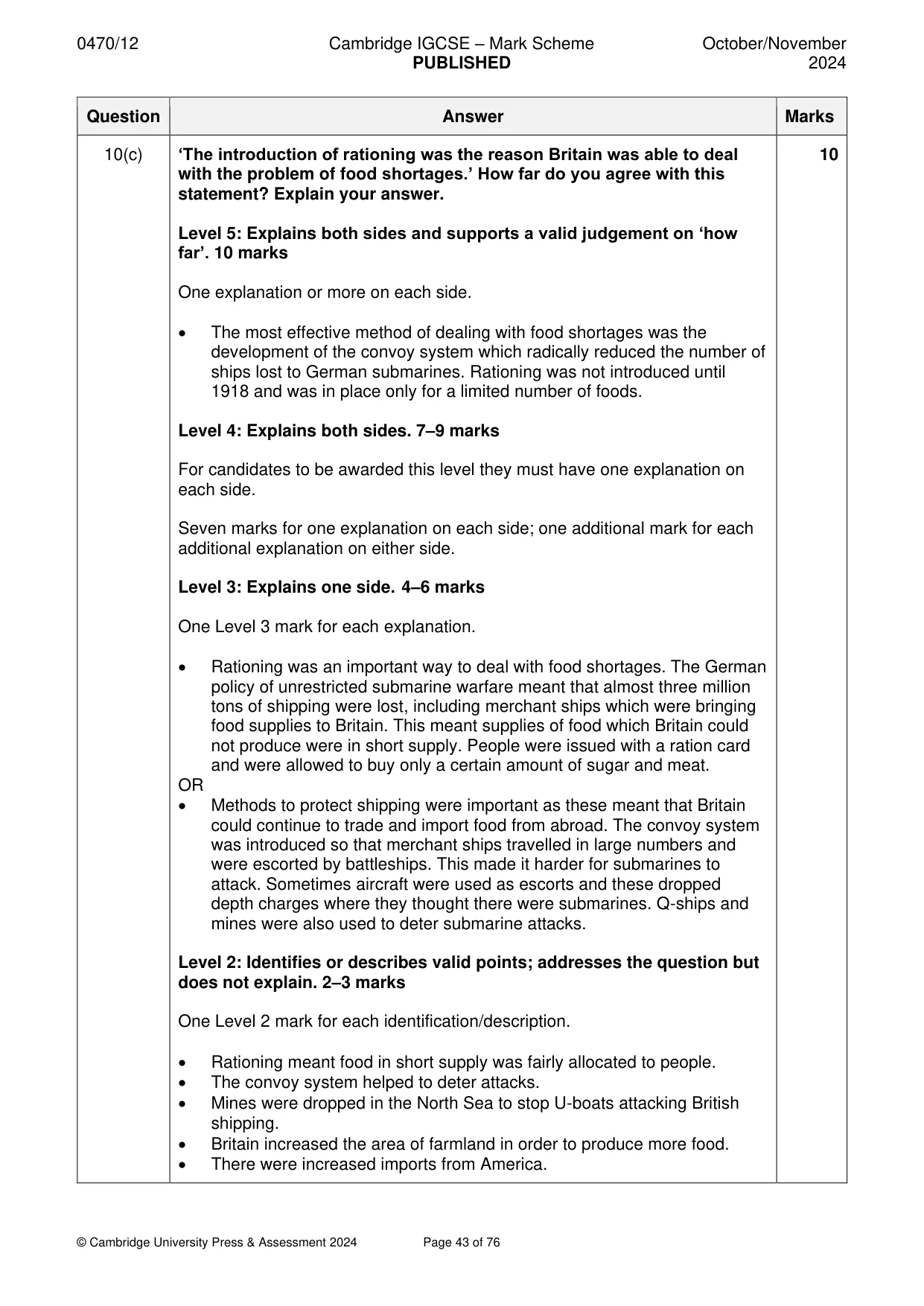
0470/12 Cambridge IGCSE – Mark Scheme PUBLISHED October/November 2024 © Cambridge University Press & Assessment 2024 Page 43 of 76 Question Answer Marks 10(c) ‘The introduction of rationing was the reason Britain was able to deal with the problem of food shortages.’ How far do you agree with this statement? Explain your answer. Level 5: Explains both sides and supports a valid judgement on ‘how far’. 10 marks One explanation or more on each side. • The most effective method of dealing with food shortages was the development of the convoy system which radically reduced the number of ships lost to German submarines. Rationing was not introduced until 1918 and was in place only for a limited number of foods. Level 4: Explains both sides. 7–9 marks For candidates to be awarded this level they must have one explanation on each side. Seven marks for one explanation on each side; one additional mark for each additional explanation on either side. Level 3: Explains one side. 4–6 marks One Level 3 mark for each explanation. • Rationing was an important way to deal with food shortages. The German policy of unrestricted submarine warfare meant that almost three million tons of shipping were lost, including merchant ships which were bringing food supplies to Britain. This meant supplies of food which Britain could not produce were in short supply. People were issued with a ration card and were allowed to buy only a certain amount of sugar and meat. OR • Methods to protect shipping were important as these meant that Britain could continue to trade and import food from abroad. The convoy system was introduced so that merchant ships travelled in large numbers and were escorted by battleships. This made it harder for submarines to attack. Sometimes aircraft were used as escorts and these dropped depth charges where they thought there were submarines. Q-ships and mines were also used to deter submarine attacks. Level 2: Identifies or describes valid points; addresses the question but does not explain. 2–3 marks One Level 2 mark for each identification/description. • Rationing meant food in short supply was fairly allocated to people. • The convoy system helped to deter attacks. • Mines were dropped in the North Sea to stop U-boats attacking British shipping. • Britain increased the area of farmland in order to produce more food. • There were increased imports from America. 10
Mark scheme, page 44
0470/12 Cambridge IGCSE – Mark Scheme PUBLISHED October/November 2024 © Cambridge University Press & Assessment 2024 Page 44 of 76 Question Answer Marks 10(c) Level 1: Writes about the topic but does not address the question. 1 mark • Civilians were given a ration card to show how much they could buy. Accept all valid responses. Level 0: No creditable response. 0 marks
Mark scheme, page 45
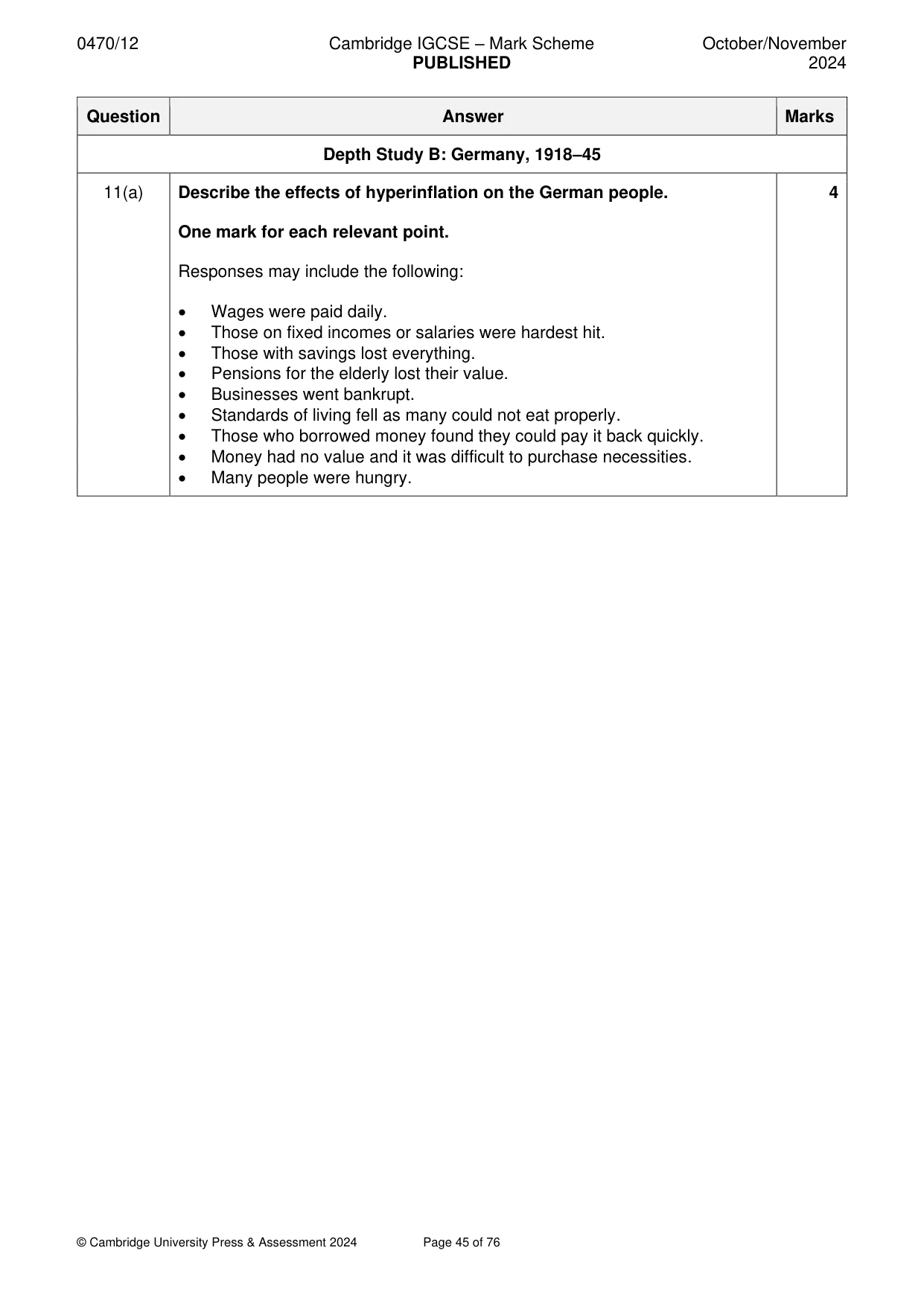
0470/12 Cambridge IGCSE – Mark Scheme PUBLISHED October/November 2024 © Cambridge University Press & Assessment 2024 Page 45 of 76 Question Answer Marks Depth Study B: Germany, 1918–45 11(a) Describe the effects of hyperinflation on the German people. One mark for each relevant point. Responses may include the following: • Wages were paid daily. • Those on fixed incomes or salaries were hardest hit. • Those with savings lost everything. • Pensions for the elderly lost their value. • Businesses went bankrupt. • Standards of living fell as many could not eat properly. • Those who borrowed money found they could pay it back quickly. • Money had no value and it was difficult to purchase necessities. • Many people were hungry. 4
Mark scheme, page 46
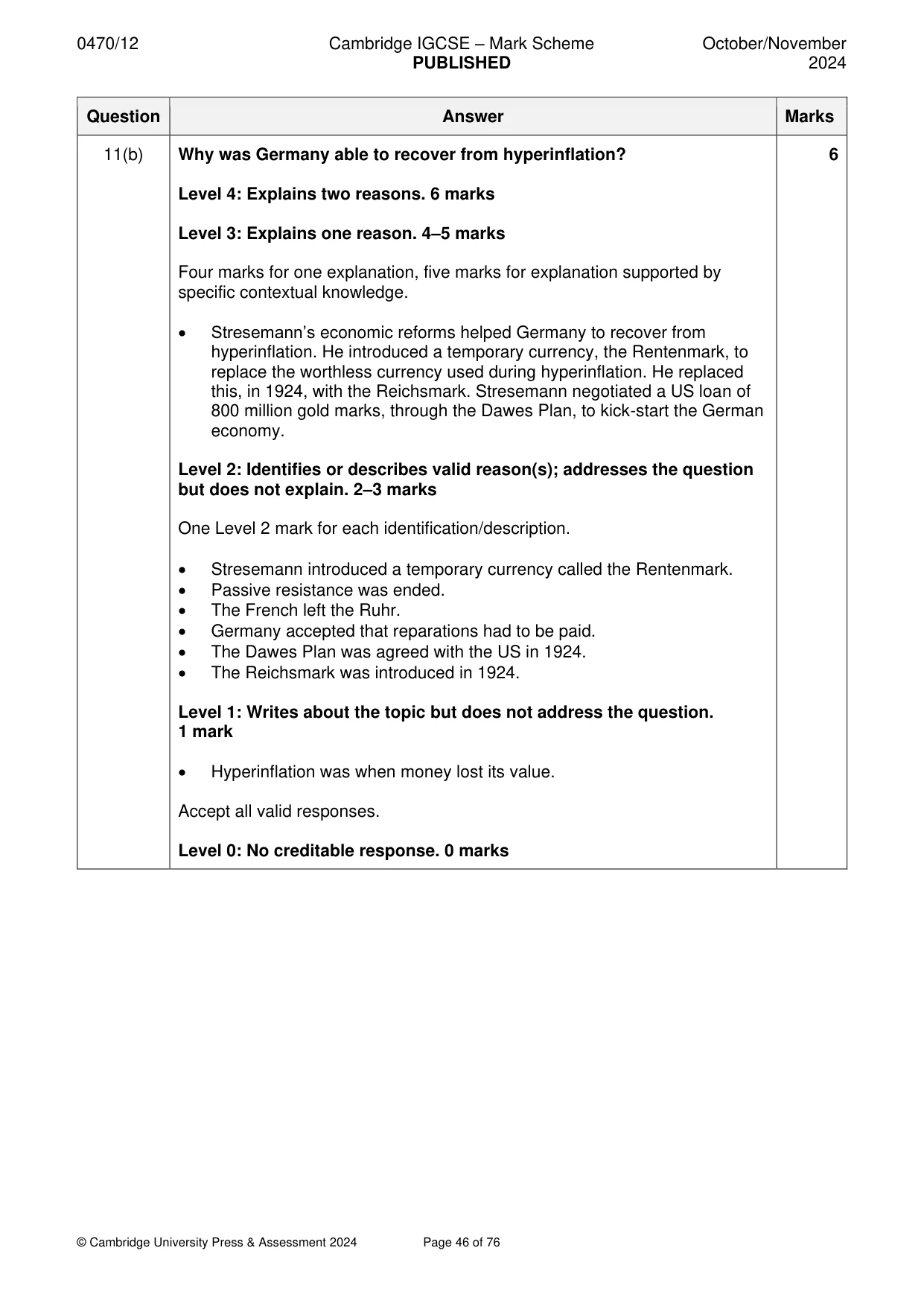
0470/12 Cambridge IGCSE – Mark Scheme PUBLISHED October/November 2024 © Cambridge University Press & Assessment 2024 Page 46 of 76 Question Answer Marks 11(b) Why was Germany able to recover from hyperinflation? Level 4: Explains two reasons. 6 marks Level 3: Explains one reason. 4–5 marks Four marks for one explanation, five marks for explanation supported by specific contextual knowledge. • Stresemann’s economic reforms helped Germany to recover from hyperinflation. He introduced a temporary currency, the Rentenmark, to replace the worthless currency used during hyperinflation. He replaced this, in 1924, with the Reichsmark. Stresemann negotiated a US loan of 800 million gold marks, through the Dawes Plan, to kick-start the German economy. Level 2: Identifies or describes valid reason(s); addresses the question but does not explain. 2–3 marks One Level 2 mark for each identification/description. • Stresemann introduced a temporary currency called the Rentenmark. • Passive resistance was ended. • The French left the Ruhr. • Germany accepted that reparations had to be paid. • The Dawes Plan was agreed with the US in 1924. • The Reichsmark was introduced in 1924. Level 1: Writes about the topic but does not address the question. 1 mark • Hyperinflation was when money lost its value. Accept all valid responses. Level 0: No creditable response. 0 marks 6
Mark scheme, page 47
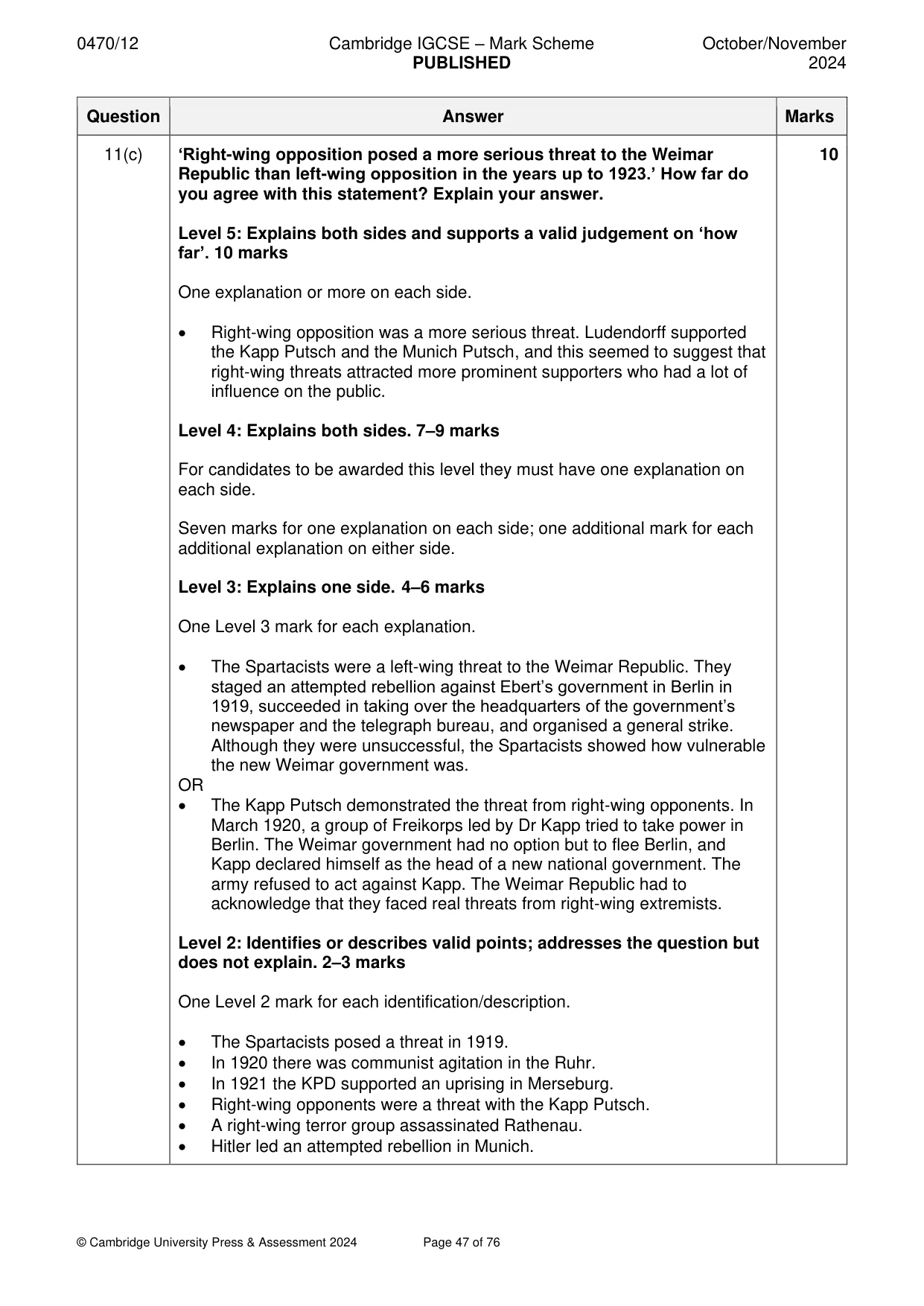
0470/12 Cambridge IGCSE – Mark Scheme PUBLISHED October/November 2024 © Cambridge University Press & Assessment 2024 Page 47 of 76 Question Answer Marks 11(c) ‘Right-wing opposition posed a more serious threat to the Weimar Republic than left-wing opposition in the years up to 1923.’ How far do you agree with this statement? Explain your answer. Level 5: Explains both sides and supports a valid judgement on ‘how far’. 10 marks One explanation or more on each side. • Right-wing opposition was a more serious threat. Ludendorff supported the Kapp Putsch and the Munich Putsch, and this seemed to suggest that right-wing threats attracted more prominent supporters who had a lot of influence on the public. Level 4: Explains both sides. 7–9 marks For candidates to be awarded this level they must have one explanation on each side. Seven marks for one explanation on each side; one additional mark for each additional explanation on either side. Level 3: Explains one side. 4–6 marks One Level 3 mark for each explanation. • The Spartacists were a left-wing threat to the Weimar Republic. They staged an attempted rebellion against Ebert’s government in Berlin in 1919, succeeded in taking over the headquarters of the government’s newspaper and the telegraph bureau, and organised a general strike. Although they were unsuccessful, the Spartacists showed how vulnerable the new Weimar government was. OR • The Kapp Putsch demonstrated the threat from right-wing opponents. In March 1920, a group of Freikorps led by Dr Kapp tried to take power in Berlin. The Weimar government had no option but to flee Berlin, and Kapp declared himself as the head of a new national government. The army refused to act against Kapp. The Weimar Republic had to acknowledge that they faced real threats from right-wing extremists. Level 2: Identifies or describes valid points; addresses the question but does not explain. 2–3 marks One Level 2 mark for each identification/description. • The Spartacists posed a threat in 1919. • In 1920 there was communist agitation in the Ruhr. • In 1921 the KPD supported an uprising in Merseburg. • Right-wing opponents were a threat with the Kapp Putsch. • A right-wing terror group assassinated Rathenau. • Hitler led an attempted rebellion in Munich. 10
Mark scheme, page 48
0470/12 Cambridge IGCSE – Mark Scheme PUBLISHED October/November 2024 © Cambridge University Press & Assessment 2024 Page 48 of 76 Question Answer Marks 11(c) Level 1: Writes about the topic but does not address the question. 1 mark • Rosa Luxemburg was one of the leaders of the Spartacists. Accept all valid responses. Level 0: No creditable response. 0 marks
Mark scheme, page 49
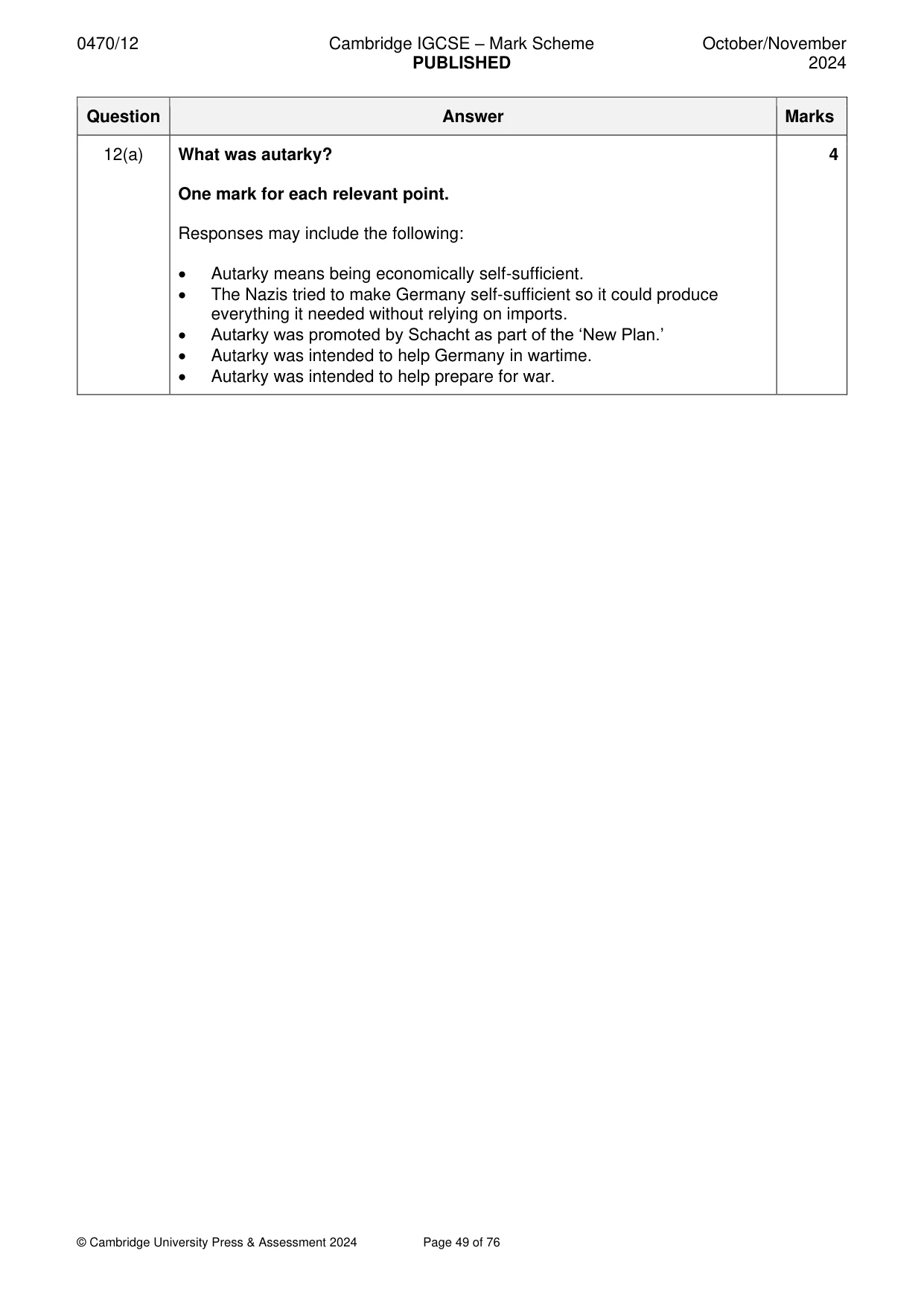
0470/12 Cambridge IGCSE – Mark Scheme PUBLISHED October/November 2024 © Cambridge University Press & Assessment 2024 Page 49 of 76 Question Answer Marks 12(a) What was autarky? One mark for each relevant point. Responses may include the following: • Autarky means being economically self-sufficient. • The Nazis tried to make Germany self-sufficient so it could produce everything it needed without relying on imports. • Autarky was promoted by Schacht as part of the ‘New Plan.’ • Autarky was intended to help Germany in wartime. • Autarky was intended to help prepare for war. 4
Mark scheme, page 50
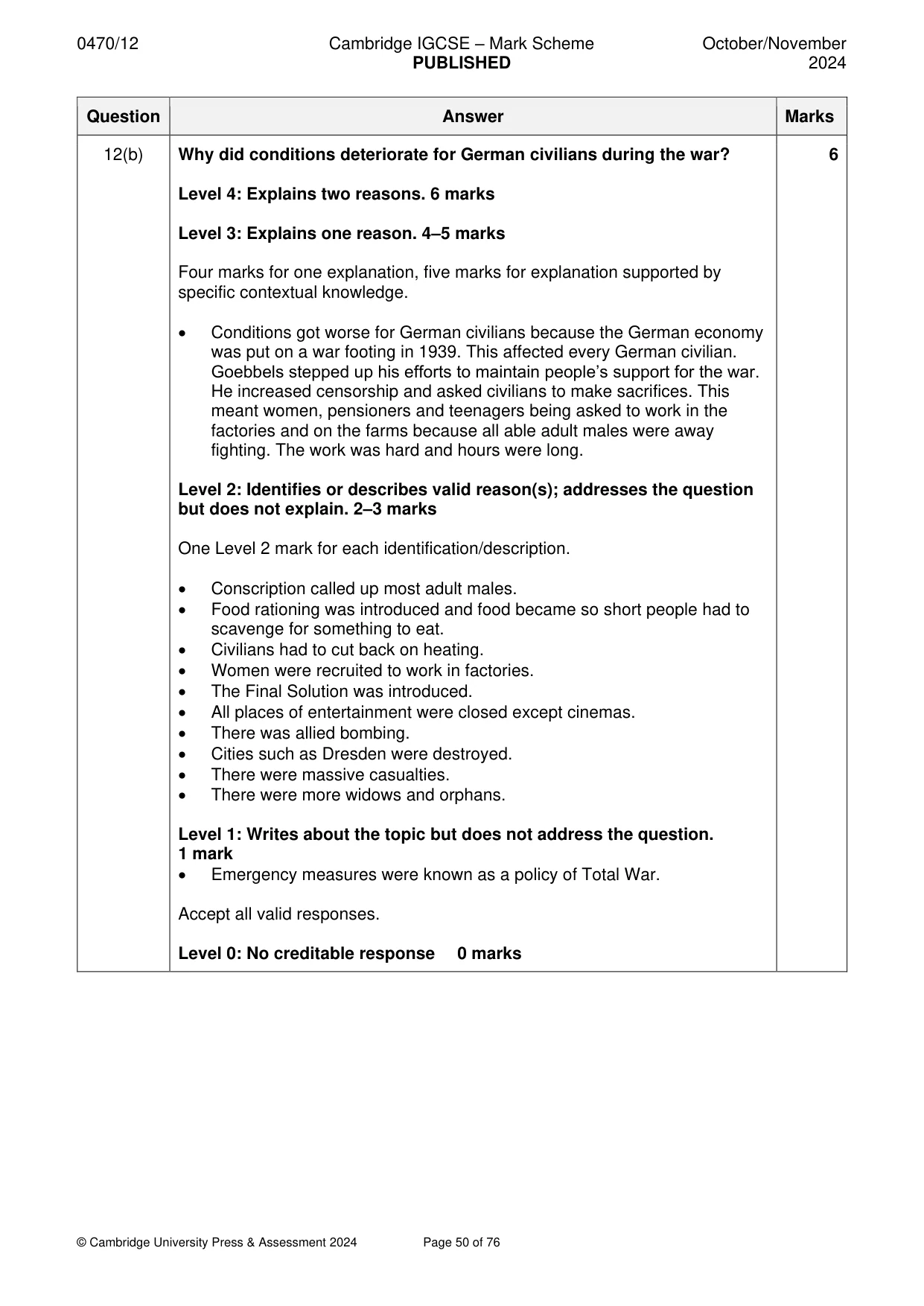
0470/12 Cambridge IGCSE – Mark Scheme PUBLISHED October/November 2024 © Cambridge University Press & Assessment 2024 Page 50 of 76 Question Answer Marks 12(b) Why did conditions deteriorate for German civilians during the war? Level 4: Explains two reasons. 6 marks Level 3: Explains one reason. 4–5 marks Four marks for one explanation, five marks for explanation supported by specific contextual knowledge. • Conditions got worse for German civilians because the German economy was put on a war footing in 1939. This affected every German civilian. Goebbels stepped up his efforts to maintain people’s support for the war. He increased censorship and asked civilians to make sacrifices. This meant women, pensioners and teenagers being asked to work in the factories and on the farms because all able adult males were away fighting. The work was hard and hours were long. Level 2: Identifies or describes valid reason(s); addresses the question but does not explain. 2–3 marks One Level 2 mark for each identification/description. • Conscription called up most adult males. • Food rationing was introduced and food became so short people had to scavenge for something to eat. • Civilians had to cut back on heating. • Women were recruited to work in factories. • The Final Solution was introduced. • All places of entertainment were closed except cinemas. • There was allied bombing. • Cities such as Dresden were destroyed. • There were massive casualties. • There were more widows and orphans. Level 1: Writes about the topic but does not address the question. 1 mark • Emergency measures were known as a policy of Total War. Accept all valid responses. Level 0: No creditable response 0 marks 6
Mark scheme, page 51
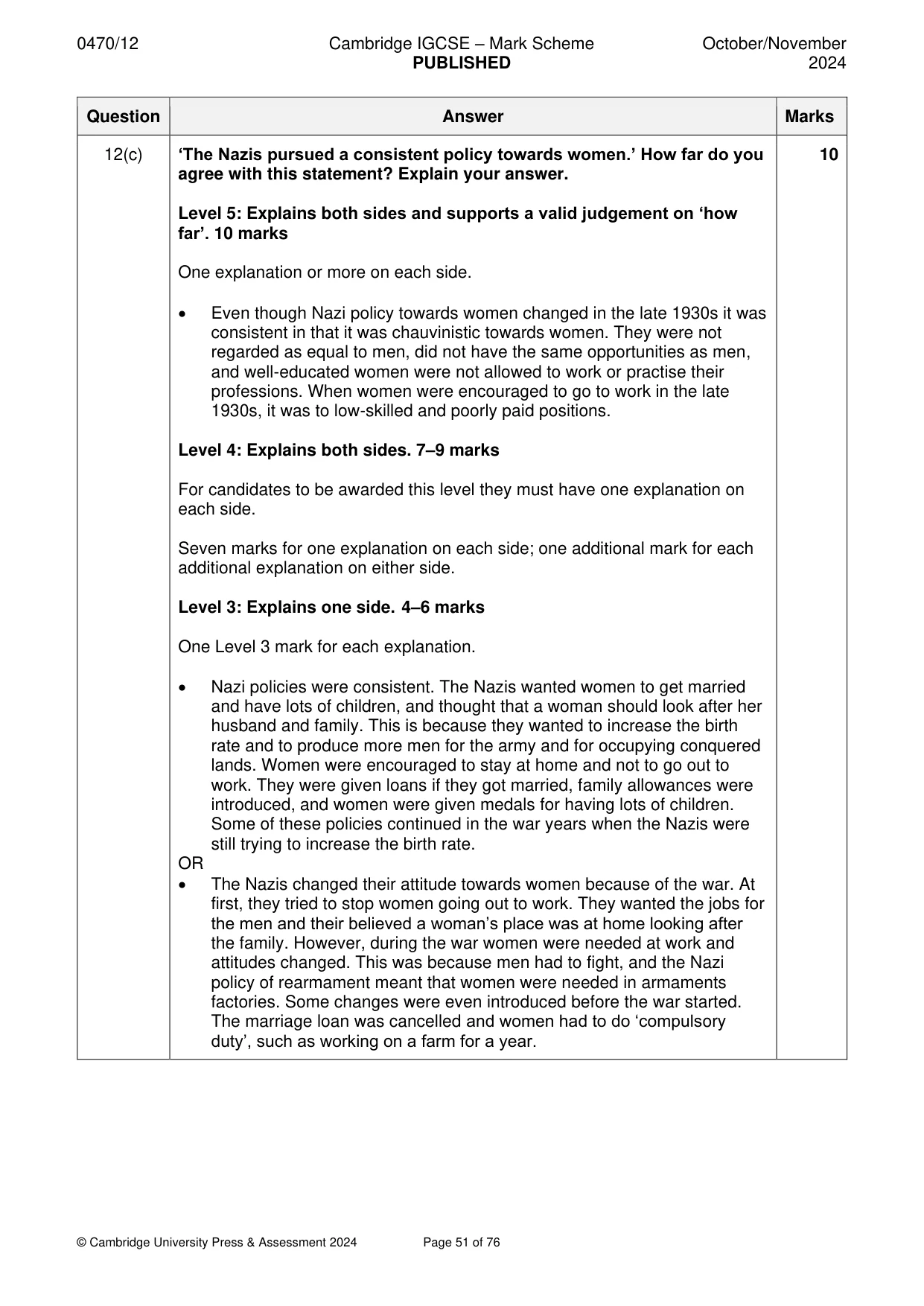
0470/12 Cambridge IGCSE – Mark Scheme PUBLISHED October/November 2024 © Cambridge University Press & Assessment 2024 Page 51 of 76 Question Answer Marks 12(c) ‘The Nazis pursued a consistent policy towards women.’ How far do you agree with this statement? Explain your answer. Level 5: Explains both sides and supports a valid judgement on ‘how far’. 10 marks One explanation or more on each side. • Even though Nazi policy towards women changed in the late 1930s it was consistent in that it was chauvinistic towards women. They were not regarded as equal to men, did not have the same opportunities as men, and well-educated women were not allowed to work or practise their professions. When women were encouraged to go to work in the late 1930s, it was to low-skilled and poorly paid positions. Level 4: Explains both sides. 7–9 marks For candidates to be awarded this level they must have one explanation on each side. Seven marks for one explanation on each side; one additional mark for each additional explanation on either side. Level 3: Explains one side. 4–6 marks One Level 3 mark for each explanation. • Nazi policies were consistent. The Nazis wanted women to get married and have lots of children, and thought that a woman should look after her husband and family. This is because they wanted to increase the birth rate and to produce more men for the army and for occupying conquered lands. Women were encouraged to stay at home and not to go out to work. They were given loans if they got married, family allowances were introduced, and women were given medals for having lots of children. Some of these policies continued in the war years when the Nazis were still trying to increase the birth rate. OR • The Nazis changed their attitude towards women because of the war. At first, they tried to stop women going out to work. They wanted the jobs for the men and their believed a woman’s place was at home looking after the family. However, during the war women were needed at work and attitudes changed. This was because men had to fight, and the Nazi policy of rearmament meant that women were needed in armaments factories. Some changes were even introduced before the war started. The marriage loan was cancelled and women had to do ‘compulsory duty’, such as working on a farm for a year. 10
Mark scheme, page 52
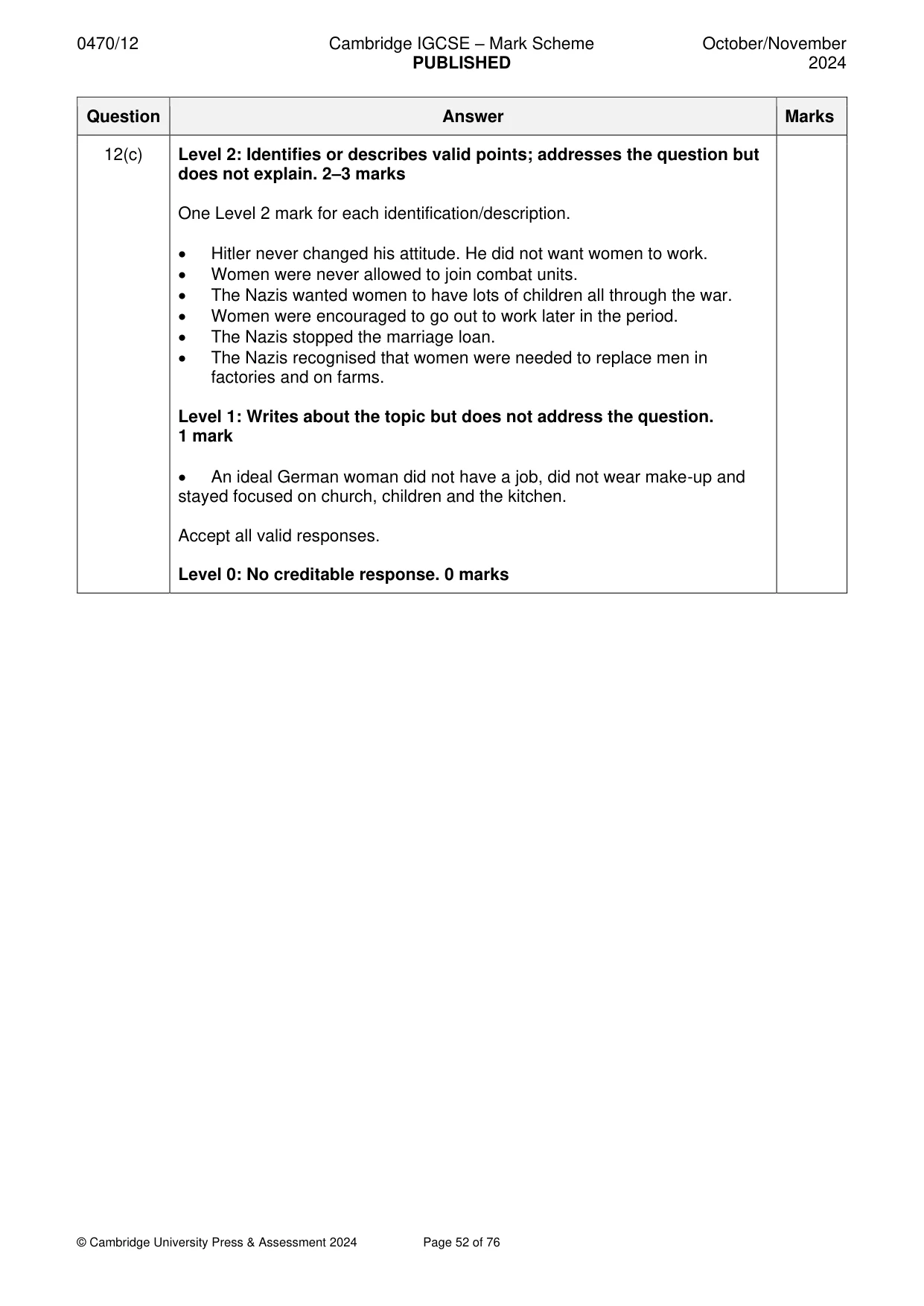
0470/12 Cambridge IGCSE – Mark Scheme PUBLISHED October/November 2024 © Cambridge University Press & Assessment 2024 Page 52 of 76 Question Answer Marks 12(c) Level 2: Identifies or describes valid points; addresses the question but does not explain. 2–3 marks One Level 2 mark for each identification/description. • Hitler never changed his attitude. He did not want women to work. • Women were never allowed to join combat units. • The Nazis wanted women to have lots of children all through the war. • Women were encouraged to go out to work later in the period. • The Nazis stopped the marriage loan. • The Nazis recognised that women were needed to replace men in factories and on farms. Level 1: Writes about the topic but does not address the question. 1 mark • An ideal German woman did not have a job, did not wear make-up and stayed focused on church, children and the kitchen. Accept all valid responses. Level 0: No creditable response. 0 marks
Mark scheme, page 53
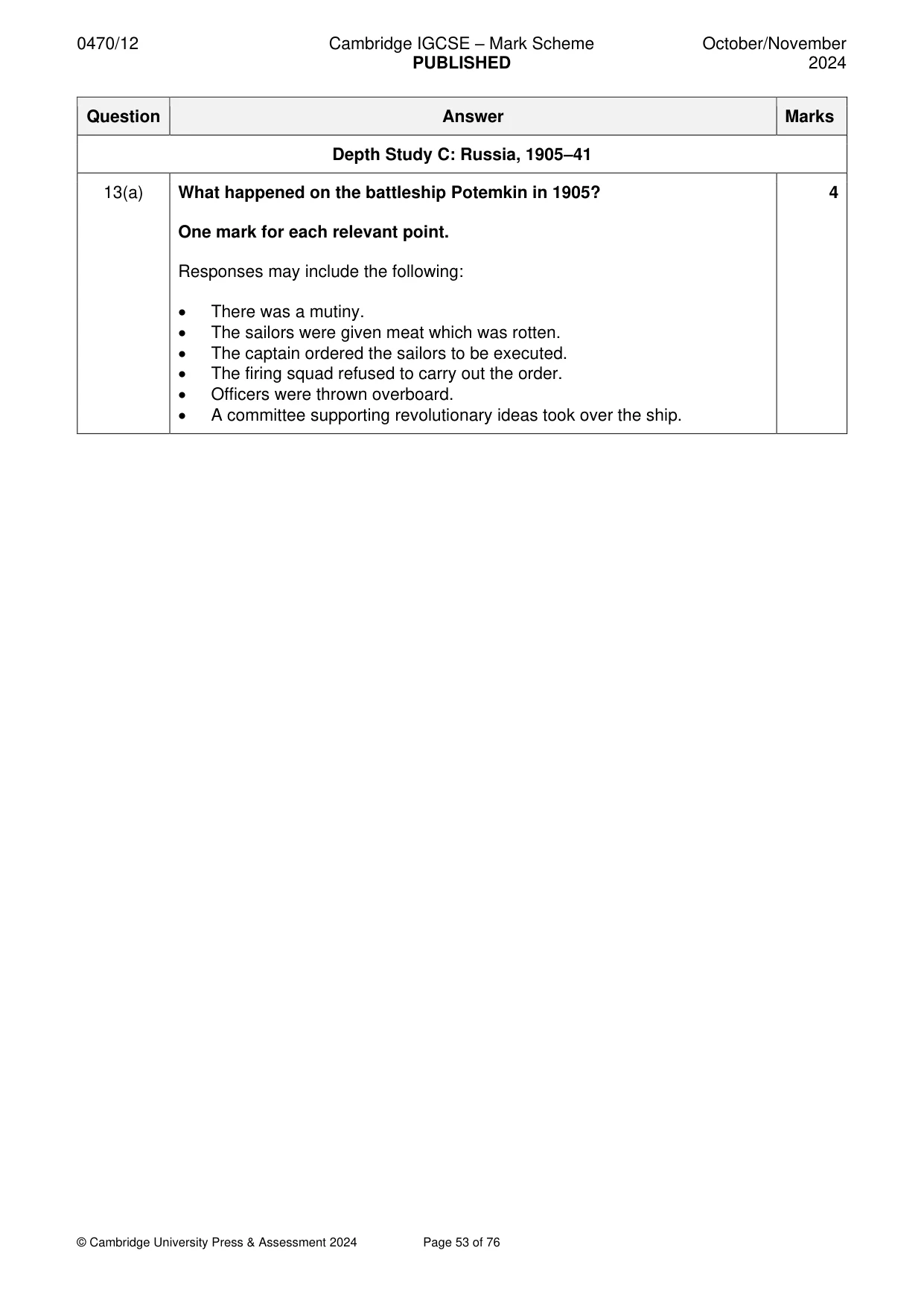
0470/12 Cambridge IGCSE – Mark Scheme PUBLISHED October/November 2024 © Cambridge University Press & Assessment 2024 Page 53 of 76 Question Answer Marks Depth Study C: Russia, 1905–41 13(a) What happened on the battleship Potemkin in 1905? One mark for each relevant point. Responses may include the following: • There was a mutiny. • The sailors were given meat which was rotten. • The captain ordered the sailors to be executed. • The firing squad refused to carry out the order. • Officers were thrown overboard. • A committee supporting revolutionary ideas took over the ship. 4
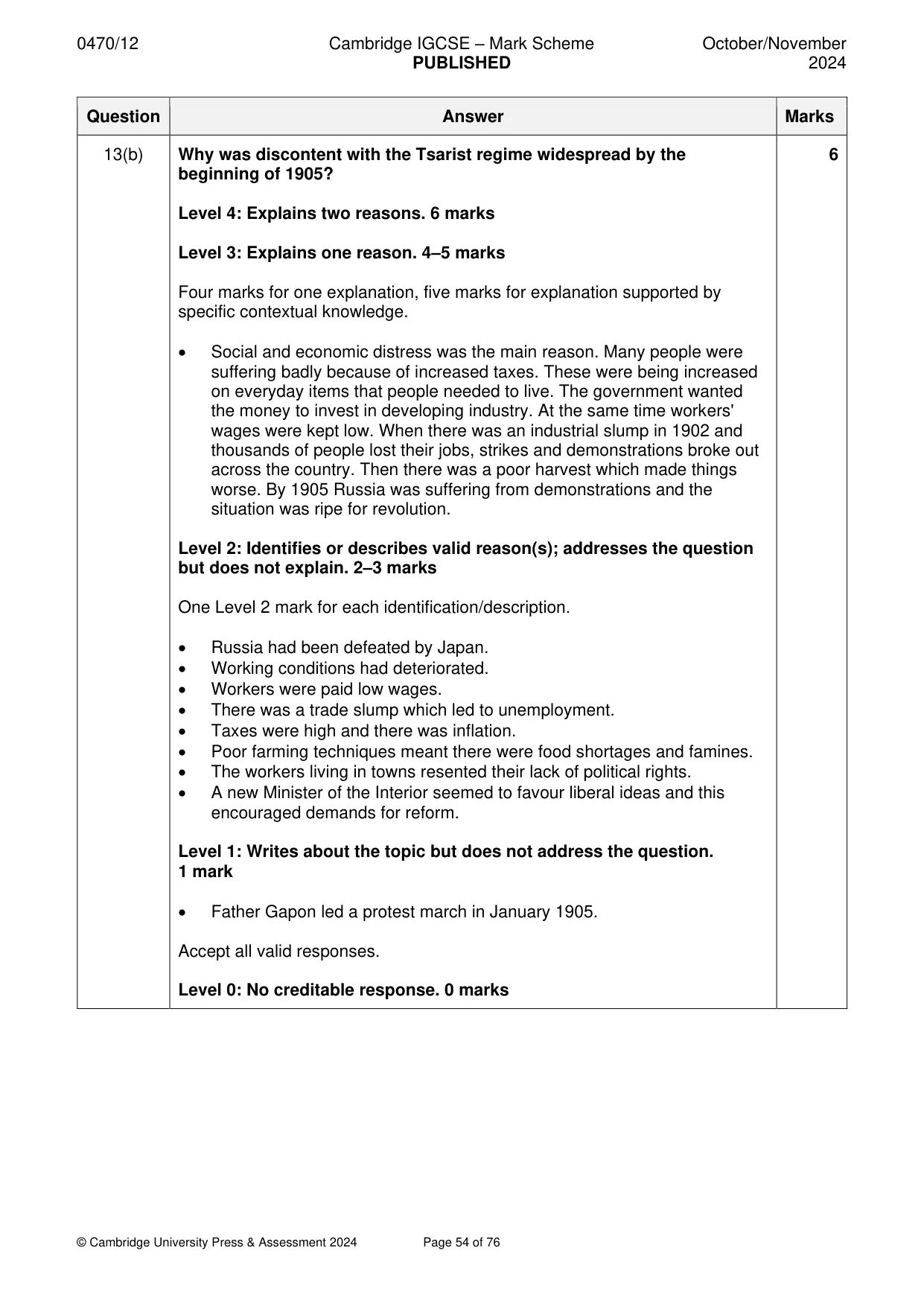
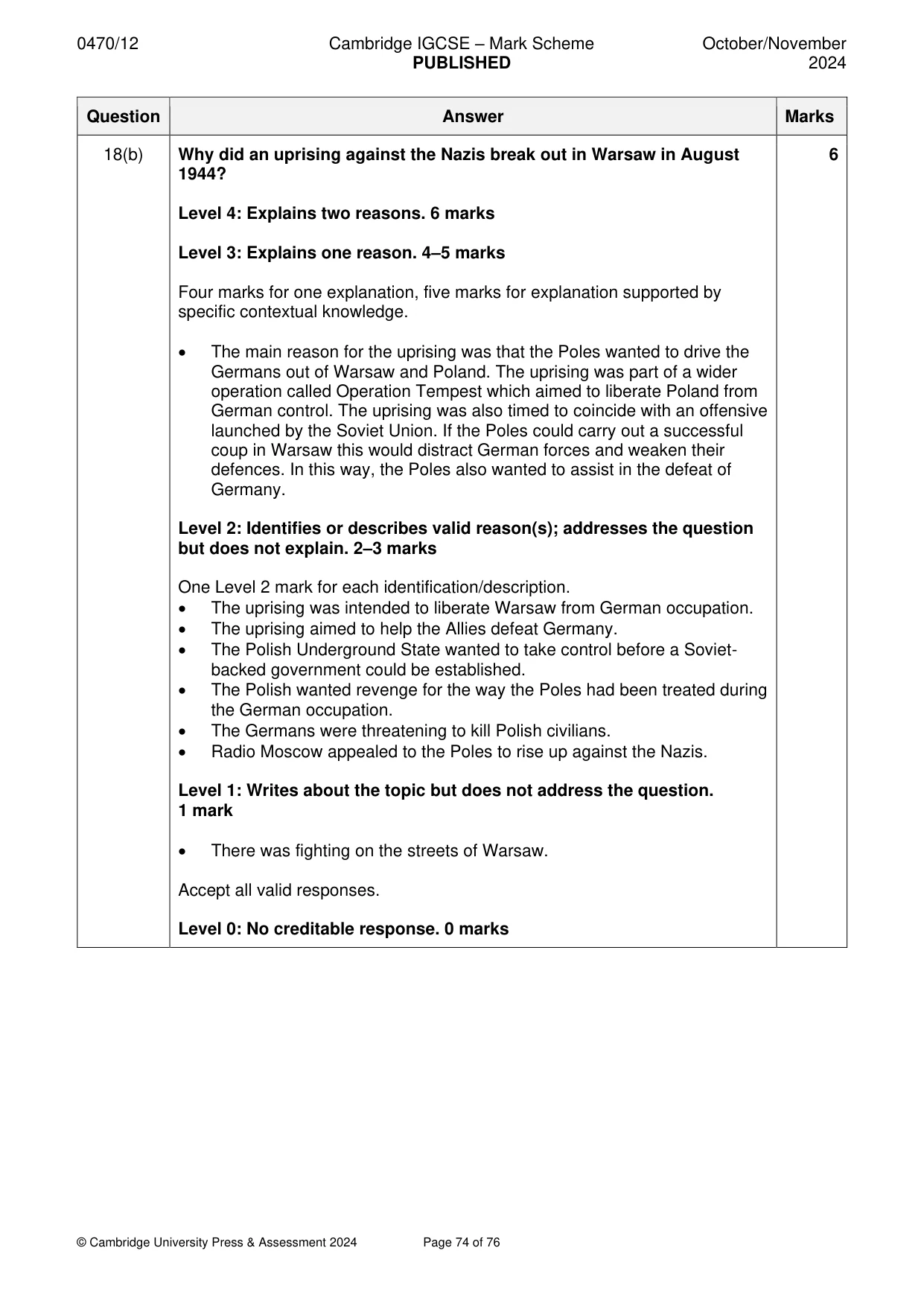
Mark scheme, page 54
0470/12 Cambridge IGCSE – Mark Scheme PUBLISHED October/November 2024 © Cambridge University Press & Assessment 2024 Page 54 of 76 Question Answer Marks 13(b) Why was discontent with the Tsarist regime widespread by the beginning of 1905? Level 4: Explains two reasons. 6 marks Level 3: Explains one reason. 4–5 marks Four marks for one explanation, five marks for explanation supported by specific contextual knowledge. • Social and economic distress was the main reason. Many people were suffering badly because of increased taxes. These were being increased on everyday items that people needed to live. The government wanted the money to invest in developing industry. At the same time workers' wages were kept low. When there was an industrial slump in 1902 and thousands of people lost their jobs, strikes and demonstrations broke out across the country. Then there was a poor harvest which made things worse. By 1905 Russia was suffering from demonstrations and the situation was ripe for revolution. Level 2: Identifies or describes valid reason(s); addresses the question but does not explain. 2–3 marks One Level 2 mark for each identification/description. • Russia had been defeated by Japan. • Working conditions had deteriorated. • Workers were paid low wages. • There was a trade slump which led to unemployment. • Taxes were high and there was inflation. • Poor farming techniques meant there were food shortages and famines. • The workers living in towns resented their lack of political rights. • A new Minister of the Interior seemed to favour liberal ideas and this encouraged demands for reform. Level 1: Writes about the topic but does not address the question. 1 mark • Father Gapon led a protest march in January 1905. Accept all valid responses. Level 0: No creditable response. 0 marks 6
Mark scheme, page 55
0470/12 Cambridge IGCSE – Mark Scheme PUBLISHED October/November 2024 © Cambridge University Press & Assessment 2024 Page 55 of 76 Question Answer Marks 13(c) ‘The October Manifesto was more important than repression to the survival of the Tsarist regime up to 1914.’ How far do you agree with this statement? Explain your answer. Level 5: Explains both sides and supports a valid judgement on ‘how far’. 10 marks One explanation or more on each side. • Repression was more important than the October Manifesto which was introduced to stop the rioting and strikes only in the autumn of 1905. When the Tsar introduced the Fundamental Laws in 1906, he made it clear that the Duma would have no power. This shows the October Manifesto was only for show, and the real reason the Tsar stayed in power was repression by the army and the secret police. Level 4: Explains both sides. 7–9 marks For candidates to be awarded this level they must have one explanation on each side. Seven marks for one explanation on each side; one additional mark for each additional explanation on either side. Level 3: Explains one side. 4–6 marks One Level 3 mark for each explanation. • The October Manifesto was important because it showed that the Tsar had been listening to the people and wanted to bring an end to the disturbances across Russia in a peaceful way. Through the Manifesto he gave people an elected Duma, free speech and the right to form political parties. These were some of the things that middle class liberals had been calling for, so this shows the Tsar was responding to their demands and this helped the regime to survive. OR • Repression was more important than the October Manifesto in ensuring the survival of the Tsarist regime. After the Tsar made peace with Japan, he used his returning army to crush the revolution. Leaders of St Petersburg and Moscow Soviets were arrested and exiled to Siberia. Further demonstrations were then crushed and by 1906 all the leaders of the revolution were either dead or in exile. He then made sure that the Duma he had promised had important limits placed on its powers. The Duma turned out to be ineffective because whenever it started to criticise the government, the Tsar closed it down. 10
Mark scheme, page 56
0470/12 Cambridge IGCSE – Mark Scheme PUBLISHED October/November 2024 © Cambridge University Press & Assessment 2024 Page 56 of 76 Question Answer Marks 13(c) Level 2: Identifies or describes valid points; addresses the question but does not explain. 2–3 marks One Level 2 mark for each identification/description. • The Tsar used the army to crush any trouble. • The leaders of the 1905 revolution were killed or exiled. • The Tsar made sure the Duma had no real power. • The Tsar passed the Fundamental Laws. • The Tsar gave them an elected Duma as a concession. • The Tsar issued the October Manifesto which gave the people free speech. Level 1: Writes about the topic but does not address the question. 1 mark • Strikes and demonstrations stopped when the Manifesto was issued. Accept all valid responses. Level 0: No creditable response. 0 marks
Mark scheme, page 57
0470/12 Cambridge IGCSE – Mark Scheme PUBLISHED October/November 2024 © Cambridge University Press & Assessment 2024 Page 57 of 76 Question Answer Marks 14(a) What was Trotsky’s idea of Permanent Revolution? One mark for each relevant point. Responses may include the following: • Trotsky’s theory was based on the idea of a world economy. • National economic development was affected by the world market. • To be successful, the Russian Revolution, would encourage revolutions in other countries, particularly in western Europe. • His theory also emphasized the importance of the working class. • The workers were seen as most important because of their position in industry. 4
Mark scheme, page 58
0470/12 Cambridge IGCSE – Mark Scheme PUBLISHED October/November 2024 © Cambridge University Press & Assessment 2024 Page 58 of 76 Question Answer Marks 14(b) Why did Stalin win the leadership struggle with Trotsky? Level 4: Explains two reasons 6 marks Level 3: Explains one reason 4–5 marks Four marks for one explanation, five marks for explanation supported by specific contextual knowledge. • Lenin’s Testament was not published and this helped Stalin to win the leadership contest. Lenin made it clear in his Testament that he did not trust Stalin and he should not be in a position of power. Had this become public it might have damaged Stalin’s chances. However, Lenin also made negative comments about other members of the politburo and so the decision was taken not to publish it. Level 2: Identifies or describes valid reason(s); addresses the question but does not explain . 2–3 marks One Level 2 mark for each identification/description. • Lenin’s Testament was not published. • Trotsky was considered arrogant by other Bolsheviks. • Stalin used his position to gain control over the Communist Party. • Trotsky did not attend Lenin’s funeral. • Stalin was General Secretary of the Communist Party. • Many of the old Bolsheviks underestimated Stalin. Level 1: Writes about the topic but does not address the question. 1 mark Stalin was leader of the Soviet Union in the 1930s. Accept all valid responses. Level 0: No creditable response. 0 marks 6
Mark scheme, page 59
0470/12 Cambridge IGCSE – Mark Scheme PUBLISHED October/November 2024 © Cambridge University Press & Assessment 2024 Page 59 of 76 Question Answer Marks 14(c) ‘Stalin was able to stay in power because of the Purges.’ How far do you agree with this statement? Explain your answer. Level 5: Explains both sides and supports a valid judgement on ‘how far’. 10 marks One explanation or more on each side. • Stalin stayed in power because there was no opposition to him and this was largely because of the Purges. One way he achieved this was to remove potential opponents through the Purges. Even loyal army commanders were executed because they might have the potential to oppose him, rather than for anything they had actually done. This meant anyone who did not like Stalin’s policies was likely to keep quiet about it. Level 4: Explains both sides. 7–9 marks For candidates to be awarded this level they must have one explanation on each side. Seven marks for one explanation on each side; one additional mark for each additional explanation on either side. Level 3: Explains one side. 4–6 marks One Level 3 mark for each explanation. • The purges were important to Stalin and allowed him to remove anyone he thought might be a threat to him. This included leading communists like Zinoviev, army officers, teachers, scientists and even ordinary workers. Millions of people were sent to the labour camps. This created an atmosphere in the country where people knew that they needed to agree with everything Stalin did if they wanted to survive. It is often called the Great Terror and people were so frightened that Stalin was able to make his control complete. OR • Stalin had other methods which enabled him to keep control. One of these was the cult of personality which was designed to make the Russian people to respect and even love him. This was achieved through propaganda. History was rewritten to make Stalin the hero of the Revolution. Posters, statues and photographs flooded the country so that Stalin appeared everywhere in a heroic pose. Music and poems were created to praise Stalin. Many towns held regular processions to celebrate Stalin. It was all this propaganda that made people loyal to Stalin, allowing him to control the Soviet Union. 10
Mark scheme, page 60
0470/12 Cambridge IGCSE – Mark Scheme PUBLISHED October/November 2024 © Cambridge University Press & Assessment 2024 Page 60 of 76 Question Answer Marks 14(c) Level 2: Identifies or describes valid points; addresses the question but does not explain. 2–3 marks One Level 2 mark for each identification/description. • Stalin controlled the Soviet Union through terror during the Purges. • He destroyed any chance of opposition by sending millions of people to labour camps. • He got rid of anyone who might be a threat to him. • Economic developments won him popular support. • Propaganda was used to make people love him as a father figure. • He was shown in posters and photographs to be responsible for all the Soviet Union’s achievements. • The arts were used to show him as a great and lovable man. Level 1: Writes about the topic but does not address the question. 1 mark • The secret police were known as the NKVD. Accept all valid responses. Level 0: No creditable response. 0 marks
Mark scheme, page 61
0470/12 Cambridge IGCSE – Mark Scheme PUBLISHED October/November 2024 © Cambridge University Press & Assessment 2024 Page 61 of 76 Question Answer Marks Depth Study D: The United States, 1919–41 15(a) What methods were used to encourage Americans to buy consumer goods? One mark for each relevant point. Responses may include the following: • Advertisements were placed in magazines and on billboards. • New consumer goods were advertised widely. • Hire purchase schemes were introduced. • Consumer goods could be paid for in instalments. • Commercials advertising new goods were devised for the cinema. • Mail order catalogues were used to promote consumer goods. 4
Mark scheme, page 62
0470/12 Cambridge IGCSE – Mark Scheme PUBLISHED October/November 2024 © Cambridge University Press & Assessment 2024 Page 62 of 76 Question Answer Marks 15(b) Why did the boom bring changes to the lives of many women? Level 4: Explains two reasons. 6 marks Level 3: Explains one reason. 4–5 marks Four marks for one explanation, five marks for explanation supported by specific contextual knowledge. • One reason that many women’s lives changed was that the boom led to an increase in employment opportunities which were deemed suitable for women. New industries such as in electronics preferred to employ women. Other developments such as the increase in telephones and typewriters meant there were more opportunities as office workers. Level 2: Identifies or describes valid reason(s); addresses the question but does not explain. 2–3 marks One Level 2 mark for each identification/description. • New technology, such as in electronics, meant there were more job opportunities. • The introduction of new fabrics such as rayon changed clothing and fashion. • More women learned to drive cars. • Women were increasingly independent because they had jobs. • The number of women working rose to 10 million by 1929. Level 1: Writes about the topic but does not address the question. 1 mark • The boom happened in the 1920s. Accept all valid responses. Level 0: No creditable response. 0 marks 6
Mark scheme, page 63
0470/12 Cambridge IGCSE – Mark Scheme PUBLISHED October/November 2024 © Cambridge University Press & Assessment 2024 Page 63 of 76 Question Answer Marks 15(c) Which suffered more in the 1920s: farming or traditional industries? Explain your answer. Level 5: Explains both sides and supports a valid judgement on ‘how far’. 10 marks One explanation or more on each side. • Farming suffered more than traditional industries because it was already in a bad way by 1920 and things only got worse with overproduction and tariffs preventing sales of excess produce abroad. On the other hand some traditional industries, such as steel and construction, actually benefitted from the boom. Level 4: Explains both sides. 7–9 marks For candidates to be awarded this level they must have one explanation on each side. Seven marks for one explanation on each side; one additional mark for each additional explanation on either side. Level 3: Explains one side. 4–6 marks One Level 3 mark for each explanation. • Traditional industries suffered very much in the 1920s. Many people were employed in the coal industry, but too much coal was being produced, which reduced prices. At the same time, people were switching to new power sources such as electricity, gas and oil. Although coal was used to generate electricity, new efficient technology meant electricity producers did not use a lot of coal to produce a lot of energy. As a result of these changes, many coal mines closed and miners lost their jobs. Where mines stayed open, miners often faced wage cuts. OR • Agriculture was in a bad state by the start of the 1920s. American farms were producing far more food than Americans needed, and the price of grain collapsed. As incomes dropped, farmers could not afford to pay their rents or mortgages. Many were evicted from their farms or had to sell to clear debts. It was not possible to sell surplus crops abroad because of European reactions to US tariffs. 10
Mark scheme, page 64
0470/12 Cambridge IGCSE – Mark Scheme PUBLISHED October/November 2024 © Cambridge University Press & Assessment 2024 Page 64 of 76 Question Answer Marks 15(c) Level 2: Identifies or describes valid points; addresses the question but does not explain. 2–3 marks One Level 2 mark for each identification/description. • Coal mining suffered and profits fell. • The cotton and wool industries lost trade and their workers were among the lowest paid. • Many small farmers could no longer afford rents or mortgage payments. • There was overproduction of crops and prices fell. • Many Black American agricultural labourers lost their jobs. • Six million rural Americans were forced off the land in the 1920s. Level 1: Writes about the topic but does not address the question. 1 mark • Mass production techniques were used in the 1920s. Accept all valid responses. Level 0: No creditable response. 0 marks
Mark scheme, page 65
0470/12 Cambridge IGCSE – Mark Scheme PUBLISHED October/November 2024 © Cambridge University Press & Assessment 2024 Page 65 of 76 Question Answer Marks 16(a) Describe measures introduced by the New Deal to help the unemployed. One mark for each relevant point. Responses may include the following: • Alphabet agencies were established to provide work. • The Civilian Conservation Corps (CCC) provided voluntary employment for young men aged 18 to 25. • The Public Works Administration (PWA) provided jobs in construction on projects such as building schools and hospitals. • The Civil Works Administration provided temporary work in the winter of 1933 to 1934. • The CWA created four million jobs. • The Works Progress Administration (WPA) was formed in 1935. 4
Mark scheme, page 66
0470/12 Cambridge IGCSE – Mark Scheme PUBLISHED October/November 2024 © Cambridge University Press & Assessment 2024 Page 66 of 76 Question Answer Marks 16(b) Why did Republicans criticise the New Deal? Level 4: Explains two reasons. 6 marks Level 3: Explains one reason. 4–5 marks Four marks for one explanation, five marks for explanation supported by specific contextual knowledge. • Republicans believed in keeping government intervention in the economy to a minimum. They felt that businessmen knew best how to help the economy recover. However, the establishment of the New Deal was expensive and involved government intervention at an unprecedented level. The Republicans resented the president taking so much control over what they saw as private business affairs. Level 2: Identifies or describes valid reason(s); addresses the question but does not explain. 2–3 marks One Level 2 mark for each identification/description. • Republicans believed in keeping taxes low. • They thought the New Deal challenged American values. • Republicans didn’t like government intervention in the economy. • FDR’s support for the unions was disliked. • The New Deal was seen as a challenge to free enterprise. • The New Deal challenged ideas about rugged individualism. Level 1: Writes about the topic but does not address the question. 1 mark • The New Deal helped many Americans who were facing difficulties. Accept all valid responses. Level 0: No creditable response. 0 marks 6
Mark scheme, page 67
0470/12 Cambridge IGCSE – Mark Scheme PUBLISHED October/November 2024 © Cambridge University Press & Assessment 2024 Page 67 of 76 Question Answer Marks 16(c) ‘The New Deal solved the problems facing farmers.’ How far do you agree with this statement? Explain your answer. Level 5: Explains both sides and supports a valid judgement on ‘how far’. 10 marks One explanation or more on each side. • The New Deal did not solve the problems facing the farmers. In fact, for the poorer farmers things even got worse and key elements of New Deal legislation did not help them. Level 4: Explains both sides. 7–9 marks For candidates to be awarded this level they must have one explanation on each side. Seven marks for one explanation on each side; one additional mark for each additional explanation on either side. Level 3: Explains one side. 4–6 marks One Level 3 mark for each explanation. • Things got better for farmers under the New Deal. The AAA cut production in seven crops including wheat and cotton and also in pig farming. This meant that prices increased by 58% between 1932 and 1935. There were also acts to bring electricity to rural areas and financial support for farmers was introduced by the Farm Security Administration in 1937. OR • Things did not get better for all farmers. The AAA had some drawbacks and family-run businesses were replaced by huge agri-businesses. Also, sharecroppers were badly affected. In the South, many farmers reduced their crops in line with AAA requirements but this meant that the sharecroppers and tenant farmers were no longer needed. Many lost their jobs and their homes. Level 2: Identifies or describes valid points; addresses the question but does not explain. 2–3 marks One Level 2 mark for each identification/description. • The New deal introduced agencies such as the Agricultural Adjustment Act. • One problem facing the farmers was over-production and the New Deal tried to address this. • Some of the measures introduced to help farmers were controversial. • Sharecroppers were laid off in the South. • Family-run businesses did not always survive. • The Rural Electrification Administration helped farmers. 10
Mark scheme, page 68
0470/12 Cambridge IGCSE – Mark Scheme PUBLISHED October/November 2024 © Cambridge University Press & Assessment 2024 Page 68 of 76 Question Answer Marks 16(c) Level 1: Writes about the topic but does not address the question. 1 mark • Farmers in America faced difficulties after the end of the First World War. Accept all valid responses. Level 0: No creditable response. 0 marks
Mark scheme, page 69
0470/12 Cambridge IGCSE – Mark Scheme PUBLISHED October/November 2024 © Cambridge University Press & Assessment 2024 Page 69 of 76 Question Answer Marks Depth Study E: The Second World War in Europe and the Asia–Pacific, 1939–c.1945 17(a) What was Operation Barbarossa? One mark for each relevant point. Responses may include the following: • It was an attack by the German army on Russia. • The Operation was designed to destroy Soviet armies and capture its vast economic resources. • German forces attacked towards Leningrad in the north. • Blitzkrieg techniques were used in the attack. • At first, German forces made very rapid advances. 4
Mark scheme, page 70
0470/12 Cambridge IGCSE – Mark Scheme PUBLISHED October/November 2024 © Cambridge University Press & Assessment 2024 Page 70 of 76 Question Answer Marks 17(b) Why was the Battle of Britain important? Level 4: Explains two reasons 6 marks Level 3: Explains one reason 4–5 marks Four marks for one explanation, five marks for explanation supported by specific contextual knowledge. • The British won the battle. This meant that Hitler would be unable to launch an invasion through Operation Sealion. Unlike much of western Europe, which had fallen to German forces very quickly and become occupied by the Nazis, this meant Britain stayed independent and would be able to fight back. Level 2: Identifies or describes valid reason(s); addresses the question but does not explain. 2–3 marks One Level 2 mark for each identification/description. • The British won the battle which meant they would not be invaded by the German army. • Winning the battle meant Britain would be able to fight back. • The radar system was proved to be effective. • Hitler failed to achieve his objective of conquering Britain. Level 1: Writes about the topic but does not address the question. 1 mark • The Battle of Britain took place in 1940. Accept all valid responses. Level 0: No creditable response. 0 marks 6
Mark scheme, page 71
0470/12 Cambridge IGCSE – Mark Scheme PUBLISHED October/November 2024 © Cambridge University Press & Assessment 2024 Page 71 of 76 Question Answer Marks 17(c) ‘Germany was able to defeat France in six weeks because it had superior forces.’ How far do you agree with this statement? Explain your answer. Level 5: Explains both sides and supports a valid judgement on ‘how far’. 10 marks One explanation or more on each side. • The German forces were superior in many ways, not just through their forces. Their strategy was well thought out and they also had superior communications with even the smallest military unit being equipped with a radio which allowed them to react faster than the Allies and keep Headquarters up to date with information. Level 4: Explains both sides. 7–9 marks For candidates to be awarded this level they must have one explanation on each side. Seven marks for one explanation on each side; one additional mark for each additional explanation on either side. Level 3: Explains one side. 4–6 marks One Level 3 mark for each explanation. • Germany had a well-planned strategy. Case Yellow was the name for the German attack to the north. This was designed to draw the main Allied forces into northern France and Belgium, and then surround them in a huge ‘pincer’ manoeuvre. However, this attack was a diversion. This succeeded in trapping Allied forces in the north, leaving German forces free to attack further south. OR • Allied forces were no match for the German army which was superior in number and technology. Although the Allies had some success in a counter-attack near Arras, they did not have the reserves necessary to hold on to the ground they gained and were outmanoeuvred by the Wehrmacht. Allied forces were unable to react quickly enough to the fast- moving German forces which were well equipped with radios for effective communication, tanks and supporting aircraft. Level 2: Identifies or describes valid points; addresses the question but does not explain. 2–3 marks 10
Mark scheme, page 72
0470/12 Cambridge IGCSE – Mark Scheme PUBLISHED October/November 2024 © Cambridge University Press & Assessment 2024 Page 72 of 76 Question Answer Marks 17(c) One Level 2 mark for each identification/description. • The Germans attacked at three points. • Germany had broken French codes and knew about their war plans. • The Wehrmacht used their strategy of Blitzkrieg. • The Allies were trapped by a pincer movement to the north. • All Germany military units had a radio. • The Allies tried to counter-attack at Arras. Level 1: Writes about the topic but does not address the question. 1 mark • The Allies were forced to retreat to Dunkirk. Accept all valid responses. Level 0: No creditable response. 0 marks
Mark scheme, page 73
0470/12 Cambridge IGCSE – Mark Scheme PUBLISHED October/November 2024 © Cambridge University Press & Assessment 2024 Page 73 of 76 Question Answer Marks 18(a) Describe Malayan resistance to occupation by the Japanese. One mark for each relevant point. Responses may include the following: • The Malayan People’s Anti-Japanese Army (MPAJA)was formed. • The MPAJA was made up mostly of Chinese Communists. • Britain supplied the MPAJA with officers and supplies. • The army also received supplies and recruits from Chinese and Malays. • MPAJA avoided large-scale action against the Japanese. • They were based in the forests of Malaya. • The MPAJA launched hit-and-run-attacks on the Japanese and tried to sabotage their bases and means of communication. 4
Mark scheme, page 74
0470/12 Cambridge IGCSE – Mark Scheme PUBLISHED October/November 2024 © Cambridge University Press & Assessment 2024 Page 74 of 76 Question Answer Marks 18(b) Why did an uprising against the Nazis break out in Warsaw in August 1944? Level 4: Explains two reasons. 6 marks Level 3: Explains one reason. 4–5 marks Four marks for one explanation, five marks for explanation supported by specific contextual knowledge. • The main reason for the uprising was that the Poles wanted to drive the Germans out of Warsaw and Poland. The uprising was part of a wider operation called Operation Tempest which aimed to liberate Poland from German control. The uprising was also timed to coincide with an offensive launched by the Soviet Union. If the Poles could carry out a successful coup in Warsaw this would distract German forces and weaken their defences. In this way, the Poles also wanted to assist in the defeat of Germany. Level 2: Identifies or describes valid reason(s); addresses the question but does not explain. 2–3 marks One Level 2 mark for each identification/description. • The uprising was intended to liberate Warsaw from German occupation. • The uprising aimed to help the Allies defeat Germany. • The Polish Underground State wanted to take control before a Soviet- backed government could be established. • The Polish wanted revenge for the way the Poles had been treated during the German occupation. • The Germans were threatening to kill Polish civilians. • Radio Moscow appealed to the Poles to rise up against the Nazis. Level 1: Writes about the topic but does not address the question. 1 mark • There was fighting on the streets of Warsaw. Accept all valid responses. Level 0: No creditable response. 0 marks 6
Mark scheme, page 75
0470/12 Cambridge IGCSE – Mark Scheme PUBLISHED October/November 2024 © Cambridge University Press & Assessment 2024 Page 75 of 76 Question Answer Marks 18(c) ‘German bombing raids on Britain were designed to destroy civilian morale.’ How far do you agree with this statement? Explain your answer. Level 5: Explains both sides and supports a valid judgement on ‘how far’. 10 marks One explanation or more on each side. • The raids were intended to destroy the morale of British civilians. The first raids were planned using a Baedeker Guide and attacked cities such as Exeter and York which had no strategic significance but were considered by the British to be beautiful, ancient cities which represented Britain’s glorious history. Level 4: Explains both sides. 7–9 marks For candidates to be awarded this level they must have one explanation on each side. Seven marks for one explanation on each side; one additional mark for each additional explanation on either side. Level 3: Explains one side. 4–6 marks One Level 3 mark for each explanation. • Destroying civilian morale was an important focus of the bombing raids. In 1940, Germany launched the Blitz against British cities with the intention of undermining morale. London was bombed for 57 consecutive nights. Although some industrial cities were targeted, these attacks were not so effective as industrial production increased between 1940 and 1941. OR • However, some cities were targeted because they were of strategic importance. For example, Coventry, which was an important armaments production and engineering centre, was heavily bombed on 14-15 November 1940. Other strategically important targets included Birmingham and Bristol which were attacked to destroy their small arms and aircraft factories and the docks at Avonmouth. Docks were bombed at Liverpool, Hull, Clydebank and Plymouth in an attempt to disrupt military operations and also prevent supplies reaching Britain. 10
Mark scheme, page 76
0470/12 Cambridge IGCSE – Mark Scheme PUBLISHED October/November 2024 © Cambridge University Press & Assessment 2024 Page 76 of 76 Question Answer Marks Level 2: Identifies or describes valid points; addresses the question but does not explain. 2–3 marks One Level 2 mark for each identification/description. • Strategic targets such as armaments factories were targeted to disrupt war production. • Coventry was bombed as it was a centre for the engineering industry. • The docks in Plymouth were bombed. • Ancient cities such as York and Exeter were bombed. • London was bombed for 57 consecutive nights in the Blitz in an attempt to destroy civilian morale. • Doodlebugs (V1 bombs) were launched with the intention of taking revenge on civilians and causing mass casualties. Level 1: Writes about the topic but does not address the question. 1 mark • The Blitz took place in 1940. Accept all valid responses. Level 0: No creditable response. 0 marks
What you needed in this session
Cambridge’s own grade thresholds for 2024 Oct/Nov, Paper 1 · Variant 2. A higher threshold means an easier paper — the bar moves with how the cohort did.