Cambridge IGCSE History 0470 — 2024 Oct/Nov Paper 1 · Variant 3
0470/13/O/N/24 · 60 marks · 120 min
The question paper and its mark scheme, free to read here and free to download. This is Cambridge’s own paper, exactly as it was sat.
Question paper8 pages

Mark scheme76 pages
Answers below. Sit the paper first if you are practising.
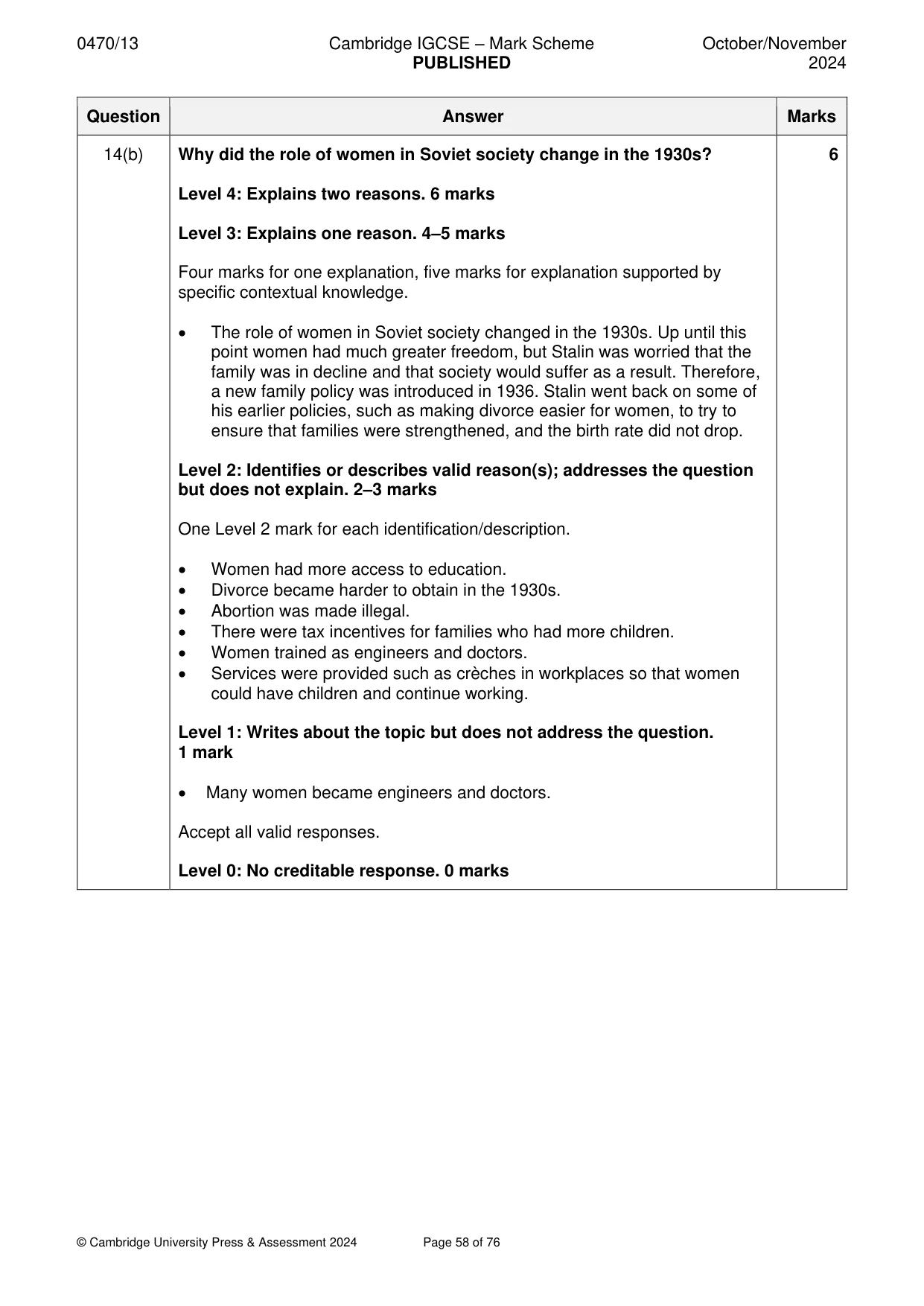
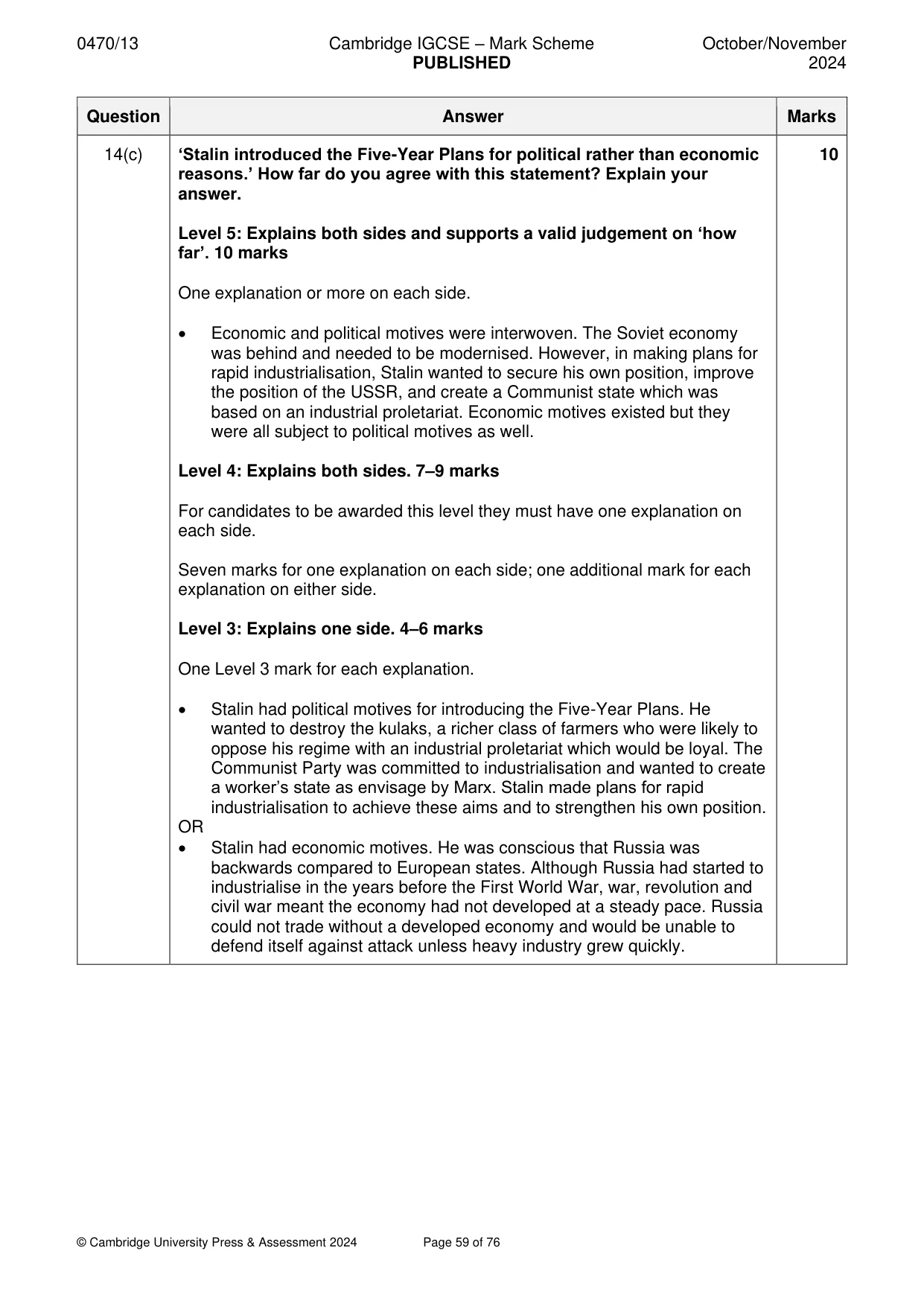
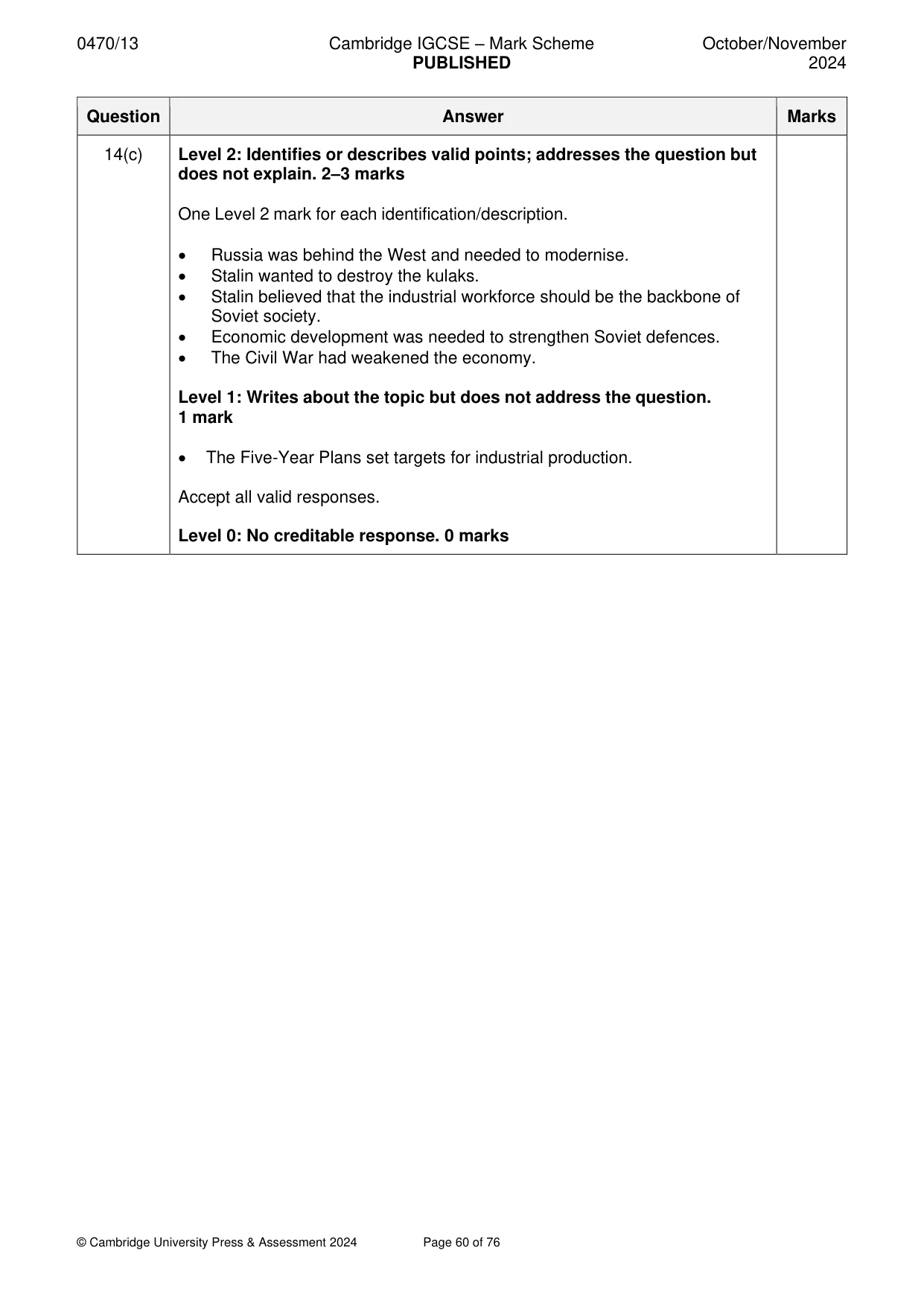
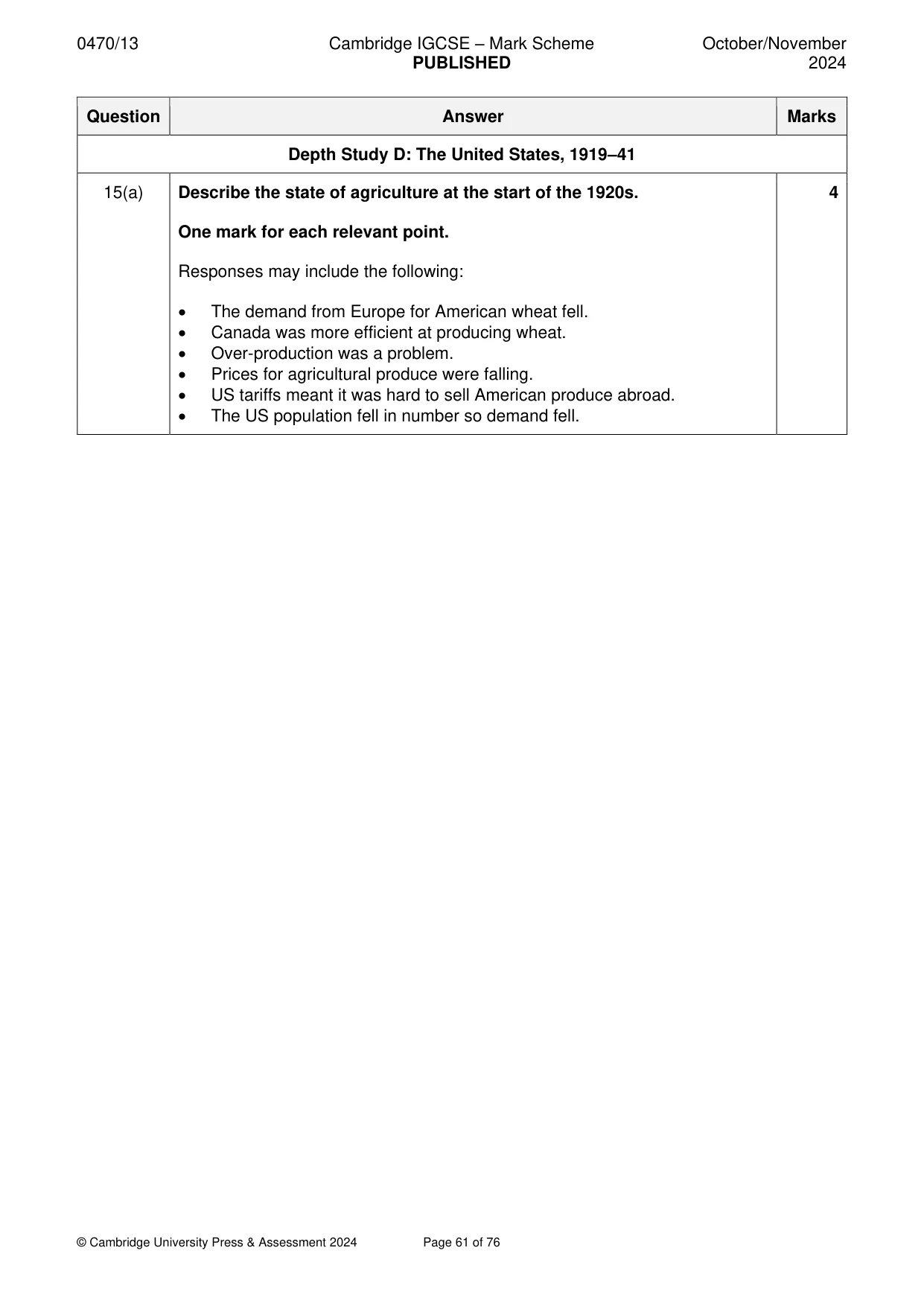
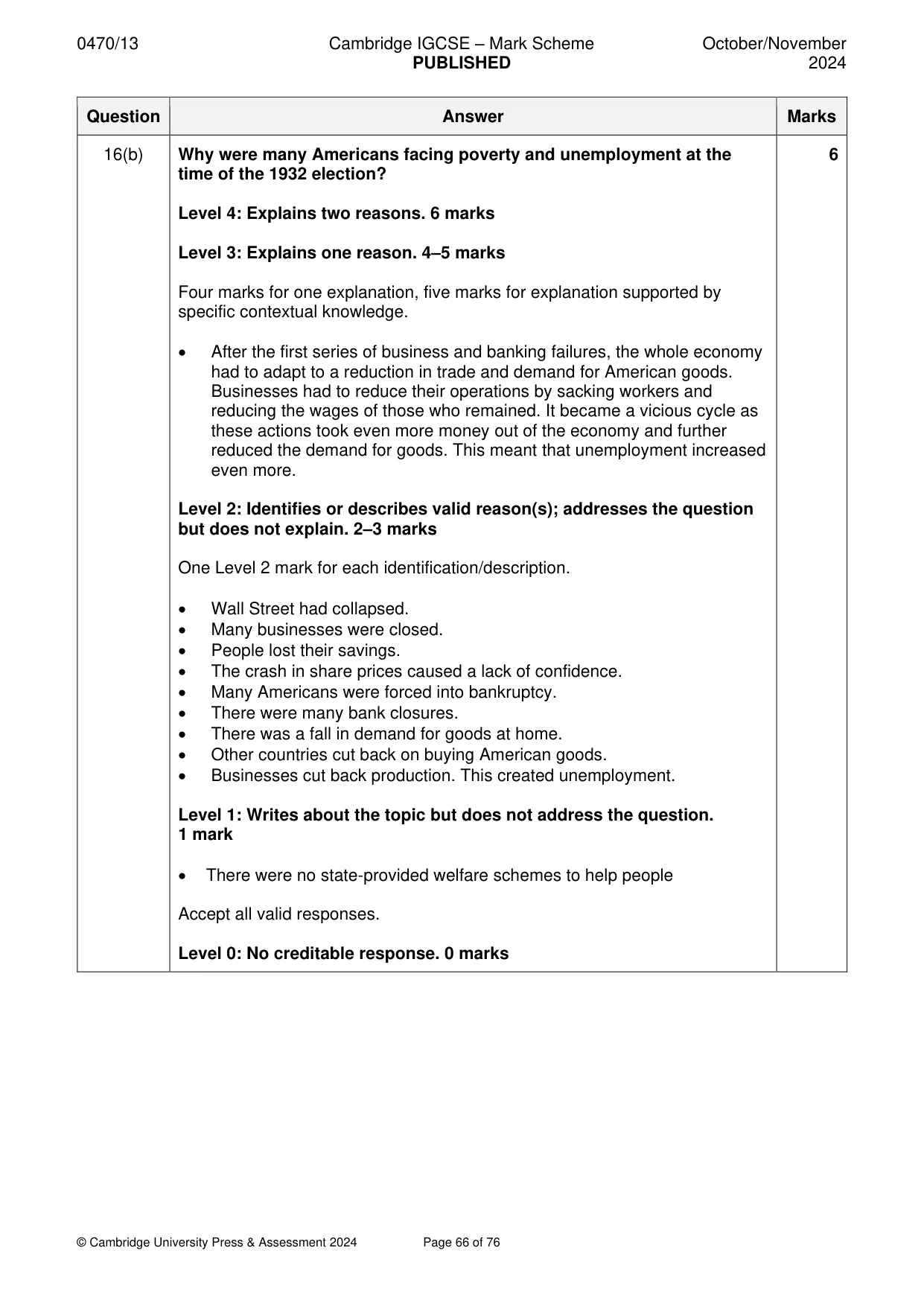
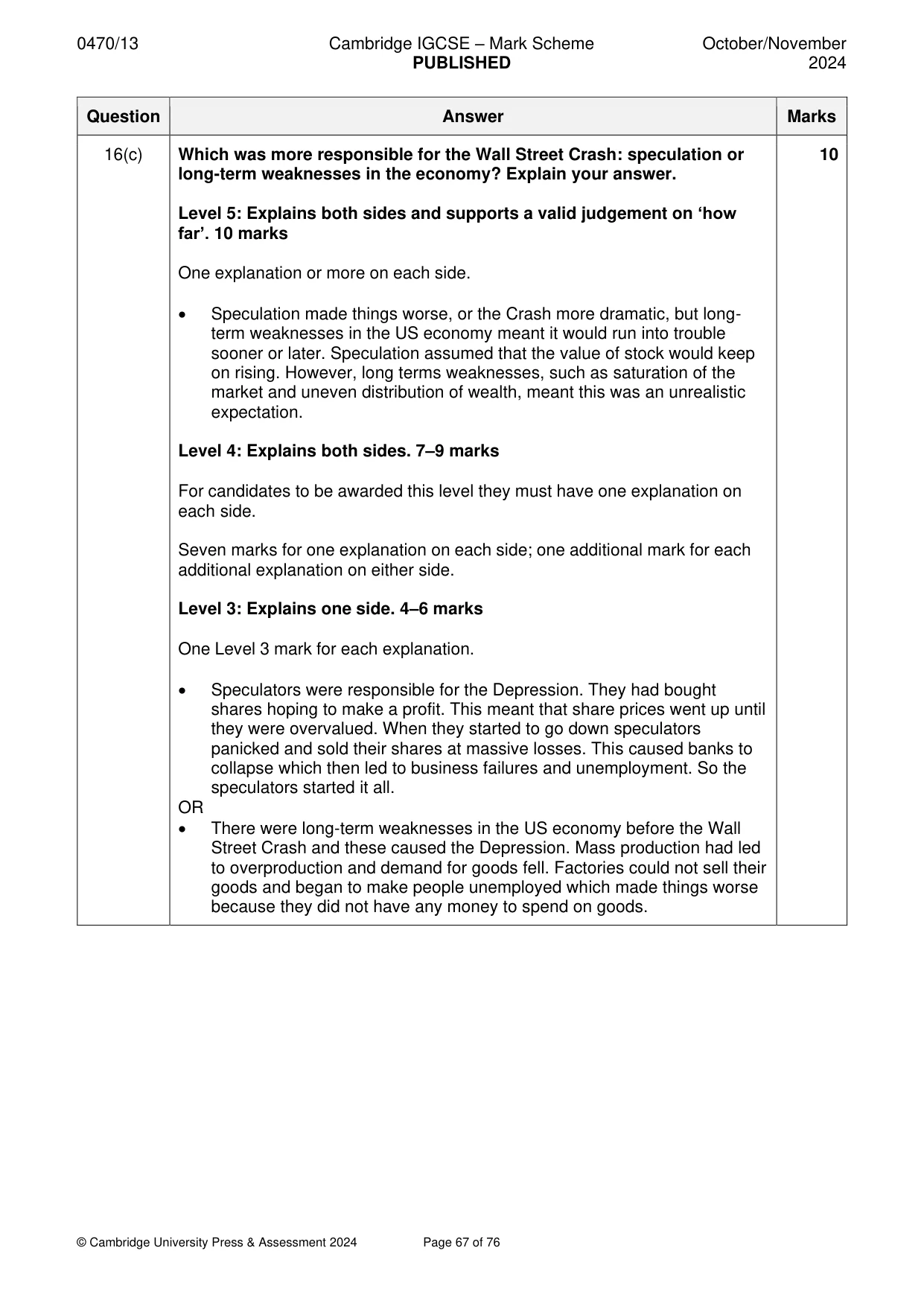
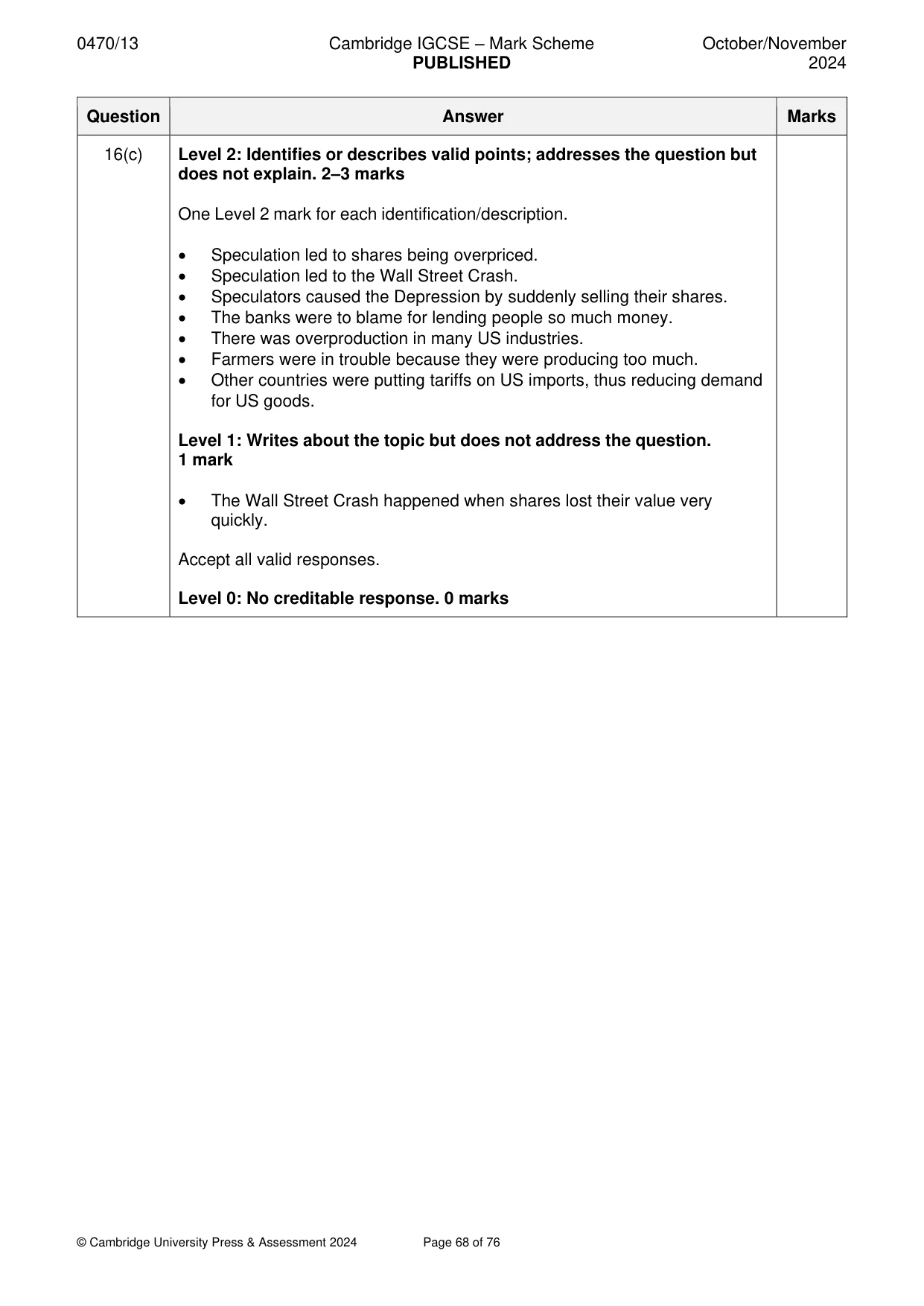
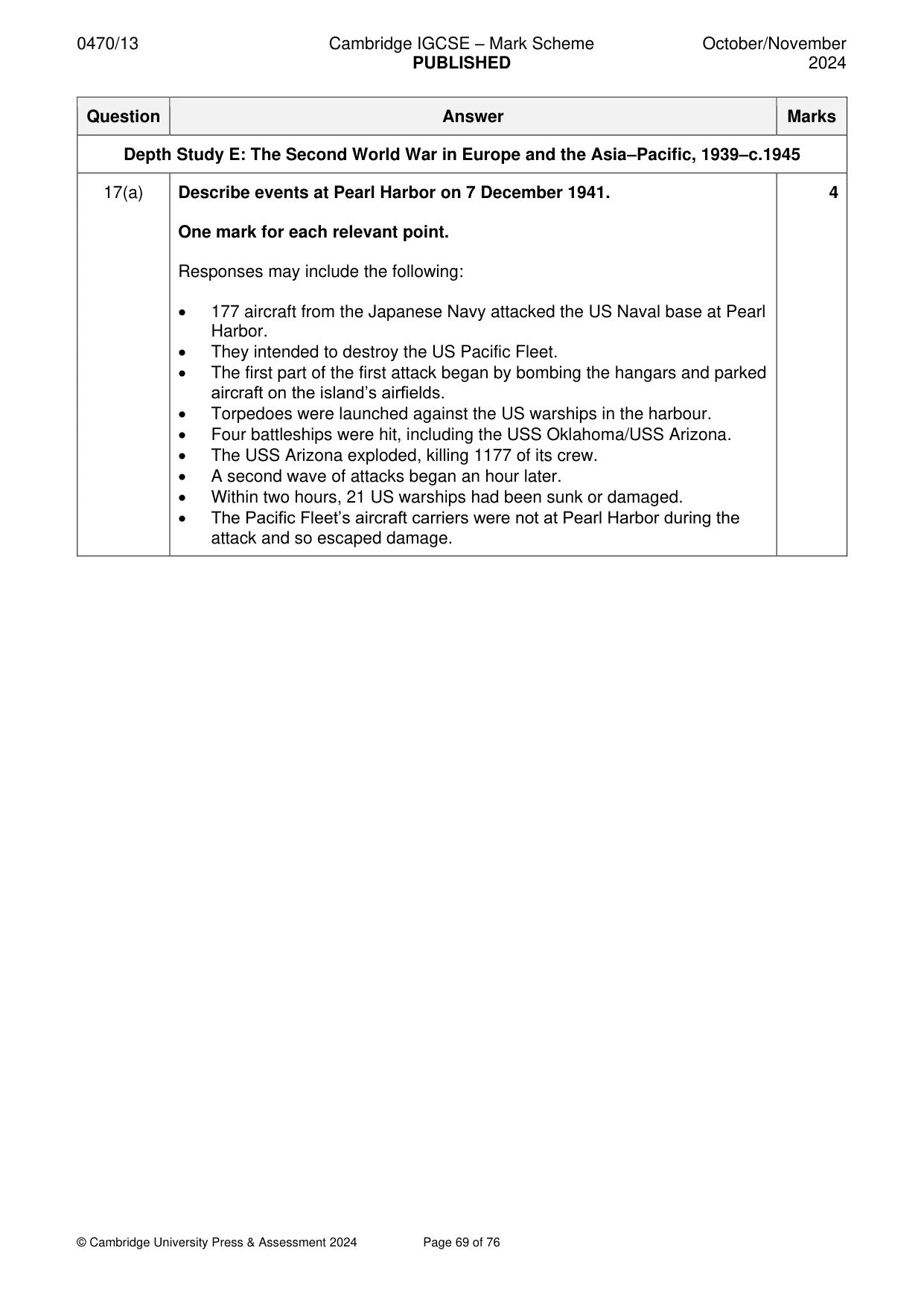
Paper as text
Question paper, page 1
This document has 8 pages. Any blank pages are indicated. [Turn over Cambridge IGCSE™ * 1 5 4 4 6 5 1 2 9 9 * DC (CE) 337704/2 © UCLES 2024 HISTORY 0470/13 Paper 1 Structured Questions October/November 2024 2 hours You must answer on the enclosed answer booklet. You will need: Answer booklet (enclosed) INSTRUCTIONS ● Answer three questions in total: Section A (Core content): answer two questions. Section B (Depth studies): answer one question. ● Follow the instructions on the front cover of the answer booklet. If you need additional answer paper, ask the invigilator for a continuation booklet. INFORMATION ● The total mark for this paper is 60. ● The number of marks for each question or part question is shown in brackets [ ].
Question paper, page 2
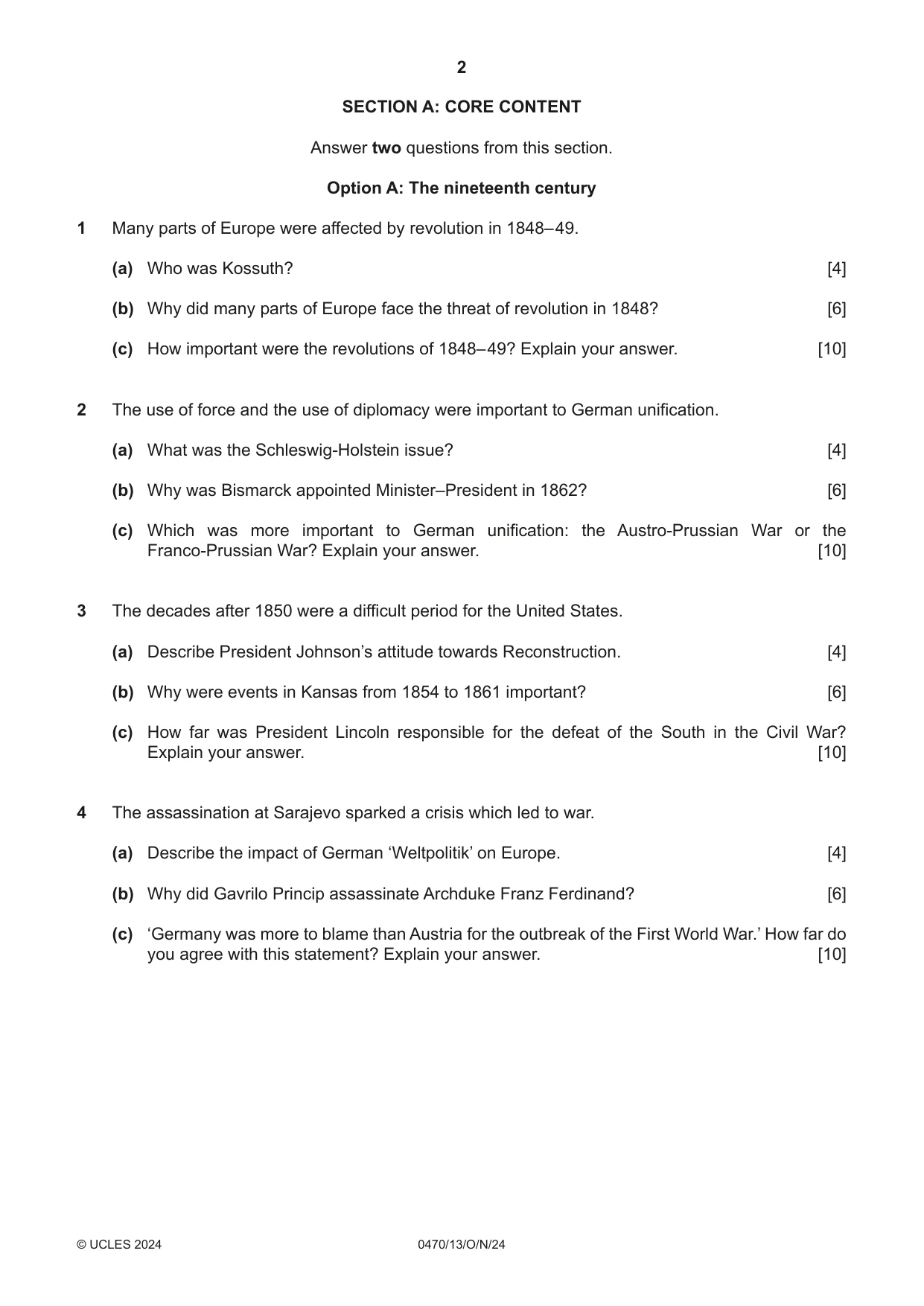
2 0470/13/O/N/24 © UCLES 2024 SECTION A: CORE CONTENT Answer two questions from this section. Option A: The nineteenth century 1 Many parts of Europe were affected by revolution in 1848– 49. (a) Who was Kossuth? [4] (b) Why did many parts of Europe face the threat of revolution in 1848? [6] (c) How important were the revolutions of 1848– 49? Explain your answer. [10] 2 The use of force and the use of diplomacy were important to German unification. (a) What was the Schleswig-Holstein issue? [4] (b) Why was Bismarck appointed Minister–President in 1862? [6] (c) Which was more important to German unification: the Austro-Prussian War or the Franco-Prussian War? Explain your answer. [10] 3 The decades after 1850 were a difficult period for the United States. (a) Describe President Johnson’s attitude towards Reconstruction. [4] (b) Why were events in Kansas from 1854 to 1861 important? [6] (c) How far was President Lincoln responsible for the defeat of the South in the Civil War? Explain your answer. [10] 4 The assassination at Sarajevo sparked a crisis which led to war. (a) Describe the impact of German ‘Weltpolitik’ on Europe. [4] (b) Why did Gavrilo Princip assassinate Archduke Franz Ferdinand? [6] (c) ‘Germany was more to blame than Austria for the outbreak of the First World War.’ How far do you agree with this statement? Explain your answer. [10]
Question paper, page 3
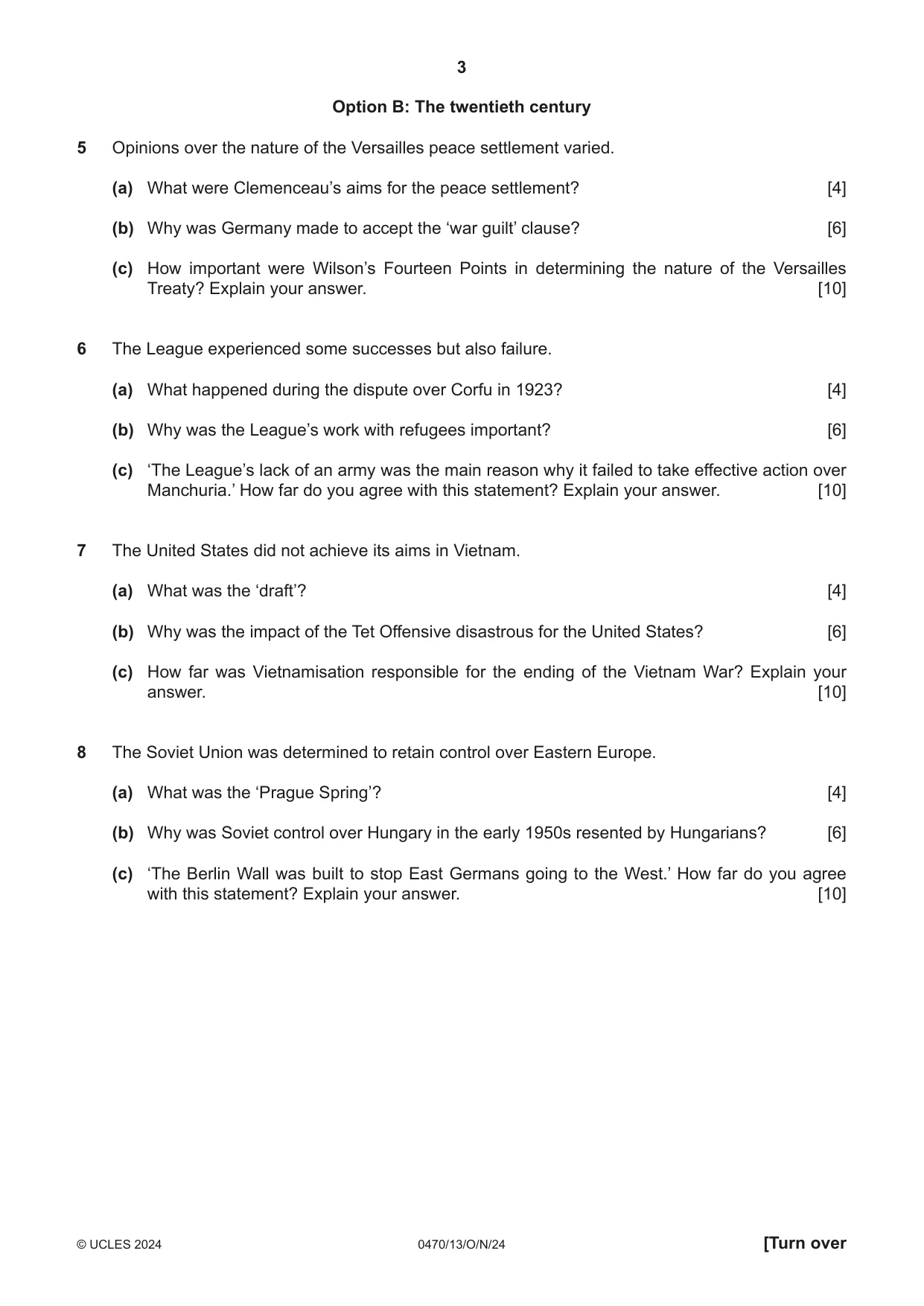
3 0470/13/O/N/24 © UCLES 2024 [Turn over Option B: The twentieth century 5 Opinions over the nature of the Versailles peace settlement varied. (a) What were Clemenceau’s aims for the peace settlement? [4] (b) Why was Germany made to accept the ‘war guilt’ clause? [6] (c) How important were Wilson’s Fourteen Points in determining the nature of the Versailles Treaty? Explain your answer. [10] 6 The League experienced some successes but also failure. (a) What happened during the dispute over Corfu in 1923? [4] (b) Why was the League’s work with refugees important? [6] (c) ‘The League’s lack of an army was the main reason why it failed to take effective action over Manchuria.’ How far do you agree with this statement? Explain your answer. [10] 7 The United States did not achieve its aims in Vietnam. (a) What was the ‘draft’? [4] (b) Why was the impact of the Tet Offensive disastrous for the United States? [6] (c) How far was Vietnamisation responsible for the ending of the Vietnam War? Explain your answer. [10] 8 The Soviet Union was determined to retain control over Eastern Europe. (a) What was the ‘Prague Spring’? [4] (b) Why was Soviet control over Hungary in the early 1950s resented by Hungarians? [6] (c) ‘The Berlin Wall was built to stop East Germans going to the West.’ How far do you agree with this statement? Explain your answer. [10]
Question paper, page 4
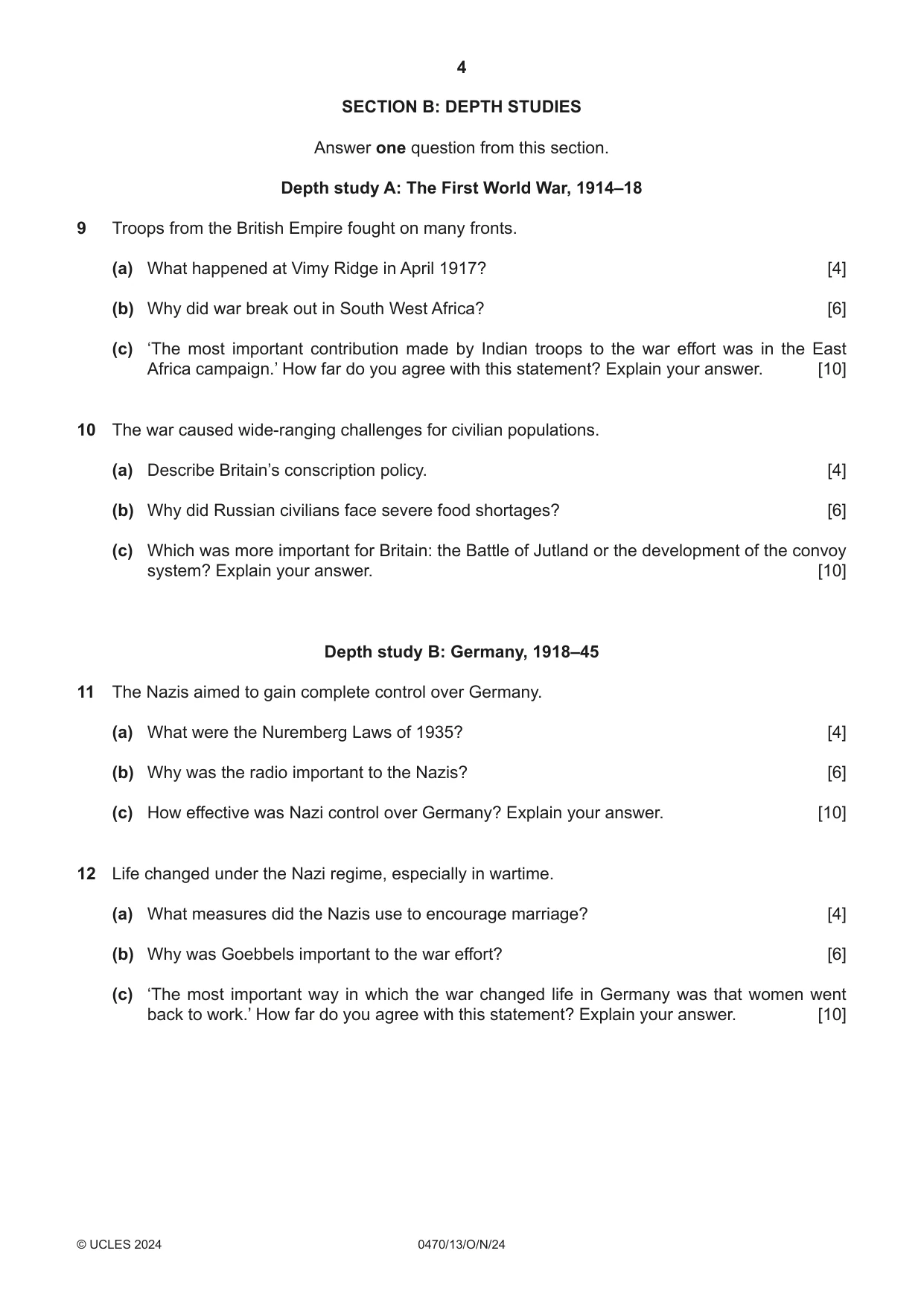
4 0470/13/O/N/24 © UCLES 2024 SECTION B: DEPTH STUDIES Answer one question from this section. Depth study A: The First World War, 1914–18 9 Troops from the British Empire fought on many fronts. (a) What happened at Vimy Ridge in April 1917? [4] (b) Why did war break out in South West Africa? [6] (c) ‘The most important contribution made by Indian troops to the war effort was in the East Africa campaign.’ How far do you agree with this statement? Explain your answer. [10] 10 The war caused wide-ranging challenges for civilian populations. (a) Describe Britain’s conscription policy. [4] (b) Why did Russian civilians face severe food shortages? [6] (c) Which was more important for Britain: the Battle of Jutland or the development of the convoy system? Explain your answer. [10] Depth study B: Germany, 1918–45 11 The Nazis aimed to gain complete control over Germany. (a) What were the Nuremberg Laws of 1935? [4] (b) Why was the radio important to the Nazis? [6] (c) How effective was Nazi control over Germany? Explain your answer. [10] 12 Life changed under the Nazi regime, especially in wartime. (a) What measures did the Nazis use to encourage marriage? [4] (b) Why was Goebbels important to the war effort? [6] (c) ‘The most important way in which the war changed life in Germany was that women went back to work.’ How far do you agree with this statement? Explain your answer. [10]
Question paper, page 5
5 0470/13/O/N/24 © UCLES 2024 [Turn over Depth study C: Russia, 1905–41 13 The Provisional Government struggled to control events after coming to power in 1917. (a) What reforms were introduced by the Provisional Government in 1917? [4] (b) Why were the July Days a problem for the Bolsheviks? [6] (c) Who was more important in the failure of the Provisional Government: Kerensky or Lenin? Explain your answer. [10] 14 Stalin’s regime brought sweeping changes to the Soviet Union. (a) Who were the kulaks? [4] (b) Why did the role of women in Soviet society change in the 1930s? [6] (c) ‘Stalin introduced the Five-Year Plans for political rather than economic reasons.’ How far do you agree with this statement? Explain your answer. [10] Depth study D: The United States, 1919–41 15 The boom had a significant impact on many sections of the economy. (a) Describe the state of agriculture at the start of the 1920s. [4] (b) Why did some traditional industries fail to benefit from the boom? [6] (c) ‘Technical advances were more important than tariff policies in bringing about the boom in the 1920s.’ How far do you agree with this statement? Explain your answer. [10] 16 The collapse of the economy was felt across the United States. (a) Describe Roosevelt’s campaign for the 1932 presidential election. [4] (b) Why were many Americans facing poverty and unemployment at the time of the 1932 election? [6] (c) Which was more responsible for the Wall Street Crash: speculation or long-term weaknesses in the economy? Explain your answer. [10]
Question paper, page 6
6 0470/13/O/N/24 © UCLES 2024 Depth study E: The Second World War in Europe and the Asia–Pacific, 1939–c.1945 17 War in the Asia–Pacific developed rapidly and Japan made early gains. (a) Describe events at Pearl Harbor on 7 December 1941. [4] (b) Why did relations between the United States and Japan deteriorate before the outbreak of war? [6] (c) How far do you agree that the main reason for Japanese military success in the Asia–Pacific in 1942 was the weakness of British forces? Explain your answer. [10] 18 The Allies secured victory over Germany. (a) What were the Nuremberg Trials? [4] (b) Why was the defeat of Italy important? [6] (c) ‘The D-Day landings were more important than events on the Eastern Front in securing the defeat of Germany.’ How far do you agree with this statement? Explain your answer. [10]
Question paper, page 7
7 0470/13/O/N/24 © UCLES 2024 BLANK PAGE
Question paper, page 8
8 0470/13/O/N/24 © UCLES 2024 Permission to reproduce items where third-party owned material protected by copyright is included has been sought and cleared where possible. Every reasonable effort has been made by the publisher (UCLES) to trace copyright holders, but if any items requiring clearance have unwittingly been included, the publisher will be pleased to make amends at the earliest possible opportunity. To avoid the issue of disclosure of answer-related information to candidates, all copyright acknowledgements are reproduced online in the Cambridge Assessment International Education Copyright Acknowledgements Booklet. This is produced for each series of examinations and is freely available to download at www.cambridgeinternational.org after the live examination series. Cambridge Assessment International Education is part of Cambridge Assessment. Cambridge Assessment is the brand name of the University of Cambridge Local Examinations Syndicate (UCLES), which is a department of the University of Cambridge. BLANK PAGE
Mark scheme, page 1
This document consists of 76 printed pages. © Cambridge University Press & Assessment 2024 [Turn over Cambridge IGCSE™ HISTORY 0470/13 Paper 1 October/November 2024 MARK SCHEME Maximum Mark: 60 Published This mark scheme is published as an aid to teachers and candidates, to indicate the requirements of the examination. It shows the basis on which Examiners were instructed to award marks. It does not indicate the details of the discussions that took place at an Examiners’ meeting before marking began, which would have considered the acceptability of alternative answers. Mark schemes should be read in conjunction with the question paper and the Principal Examiner Report for Teachers. Cambridge International will not enter into discussions about these mark schemes. Cambridge International is publishing the mark schemes for the October/November 2024 series for most Cambridge IGCSE, Cambridge International A and AS Level components, and some Cambridge O Level components.
Mark scheme, page 2
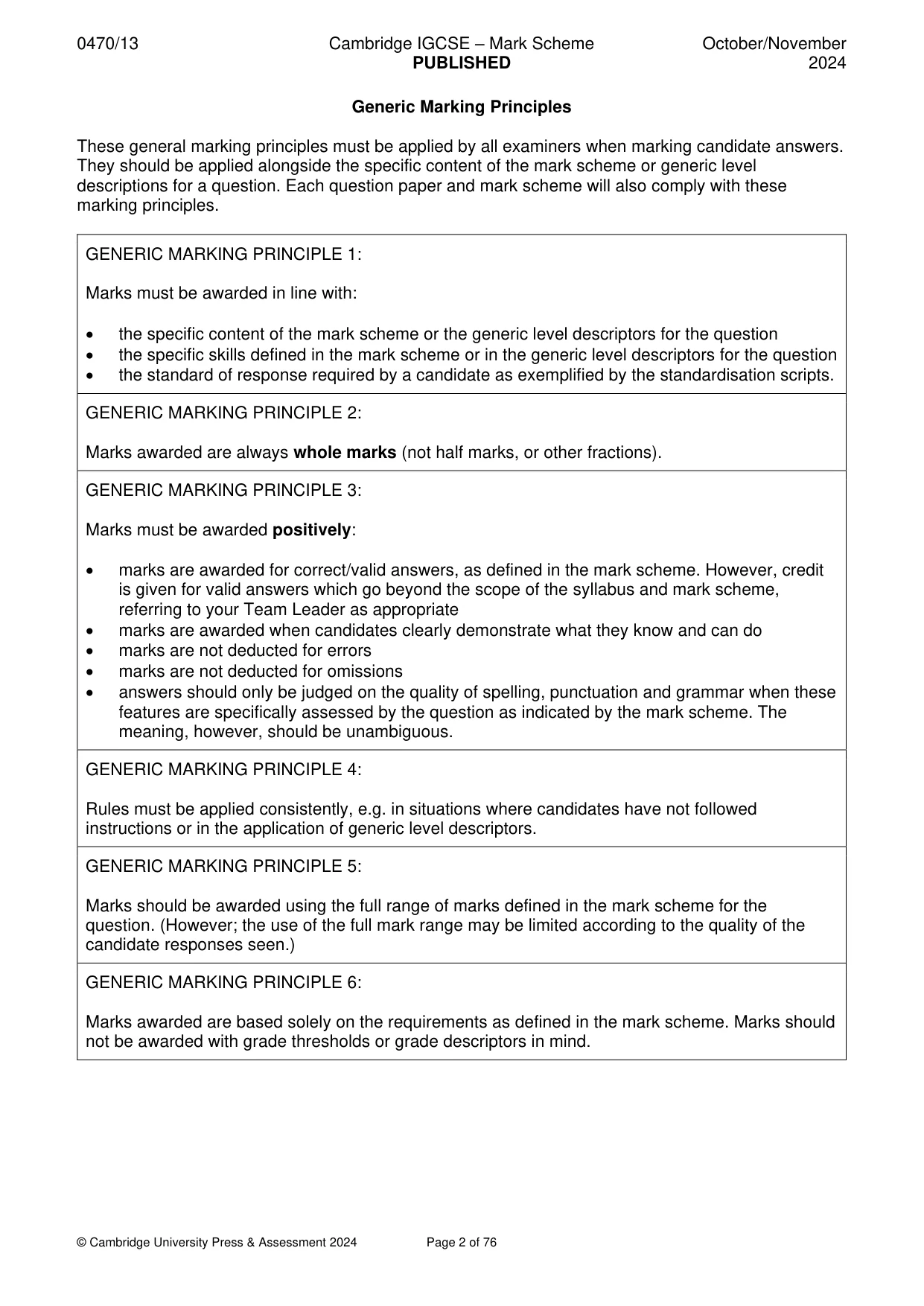
0470/13 Cambridge IGCSE – Mark Scheme PUBLISHED October/November 2024 © Cambridge University Press & Assessment 2024 Page 2 of 76 Generic Marking Principles These general marking principles must be applied by all examiners when marking candidate answers. They should be applied alongside the specific content of the mark scheme or generic level descriptions for a question. Each question paper and mark scheme will also comply with these marking principles. GENERIC MARKING PRINCIPLE 1: Marks must be awarded in line with: • the specific content of the mark scheme or the generic level descriptors for the question • the specific skills defined in the mark scheme or in the generic level descriptors for the question • the standard of response required by a candidate as exemplified by the standardisation scripts. GENERIC MARKING PRINCIPLE 2: Marks awarded are always whole marks (not half marks, or other fractions). GENERIC MARKING PRINCIPLE 3: Marks must be awarded positively: • marks are awarded for correct/valid answers, as defined in the mark scheme. However, credit is given for valid answers which go beyond the scope of the syllabus and mark scheme, referring to your Team Leader as appropriate • marks are awarded when candidates clearly demonstrate what they know and can do • marks are not deducted for errors • marks are not deducted for omissions • answers should only be judged on the quality of spelling, punctuation and grammar when these features are specifically assessed by the question as indicated by the mark scheme. The meaning, however, should be unambiguous. GENERIC MARKING PRINCIPLE 4: Rules must be applied consistently, e.g. in situations where candidates have not followed instructions or in the application of generic level descriptors. GENERIC MARKING PRINCIPLE 5: Marks should be awarded using the full range of marks defined in the mark scheme for the question. (However; the use of the full mark range may be limited according to the quality of the candidate responses seen.) GENERIC MARKING PRINCIPLE 6: Marks awarded are based solely on the requirements as defined in the mark scheme. Marks should not be awarded with grade thresholds or grade descriptors in mind.
Mark scheme, page 3
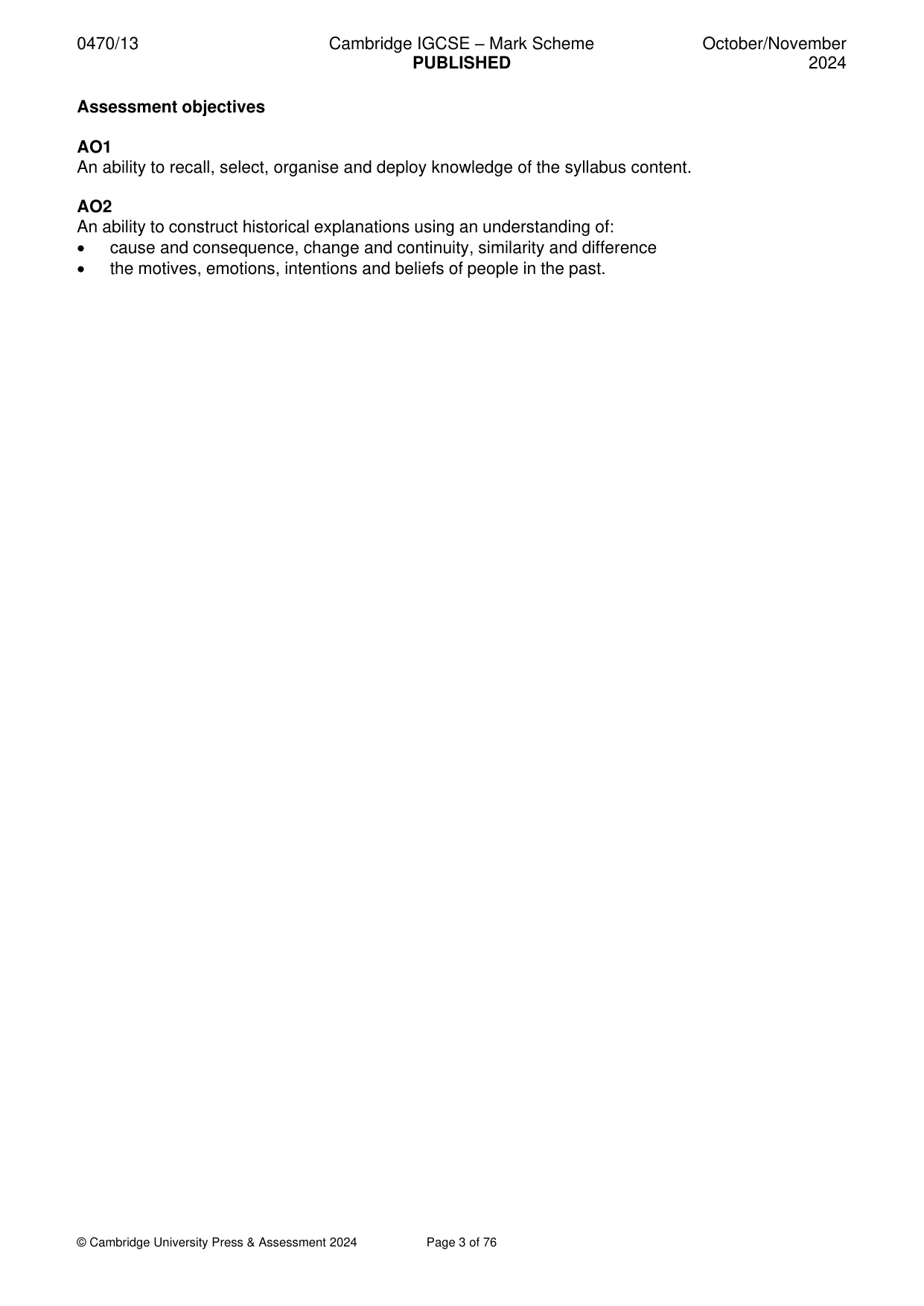
0470/13 Cambridge IGCSE – Mark Scheme PUBLISHED October/November 2024 © Cambridge University Press & Assessment 2024 Page 3 of 76 Assessment objectives AO1 An ability to recall, select, organise and deploy knowledge of the syllabus content. AO2 An ability to construct historical explanations using an understanding of: • cause and consequence, change and continuity, similarity and difference • the motives, emotions, intentions and beliefs of people in the past.
Mark scheme, page 4
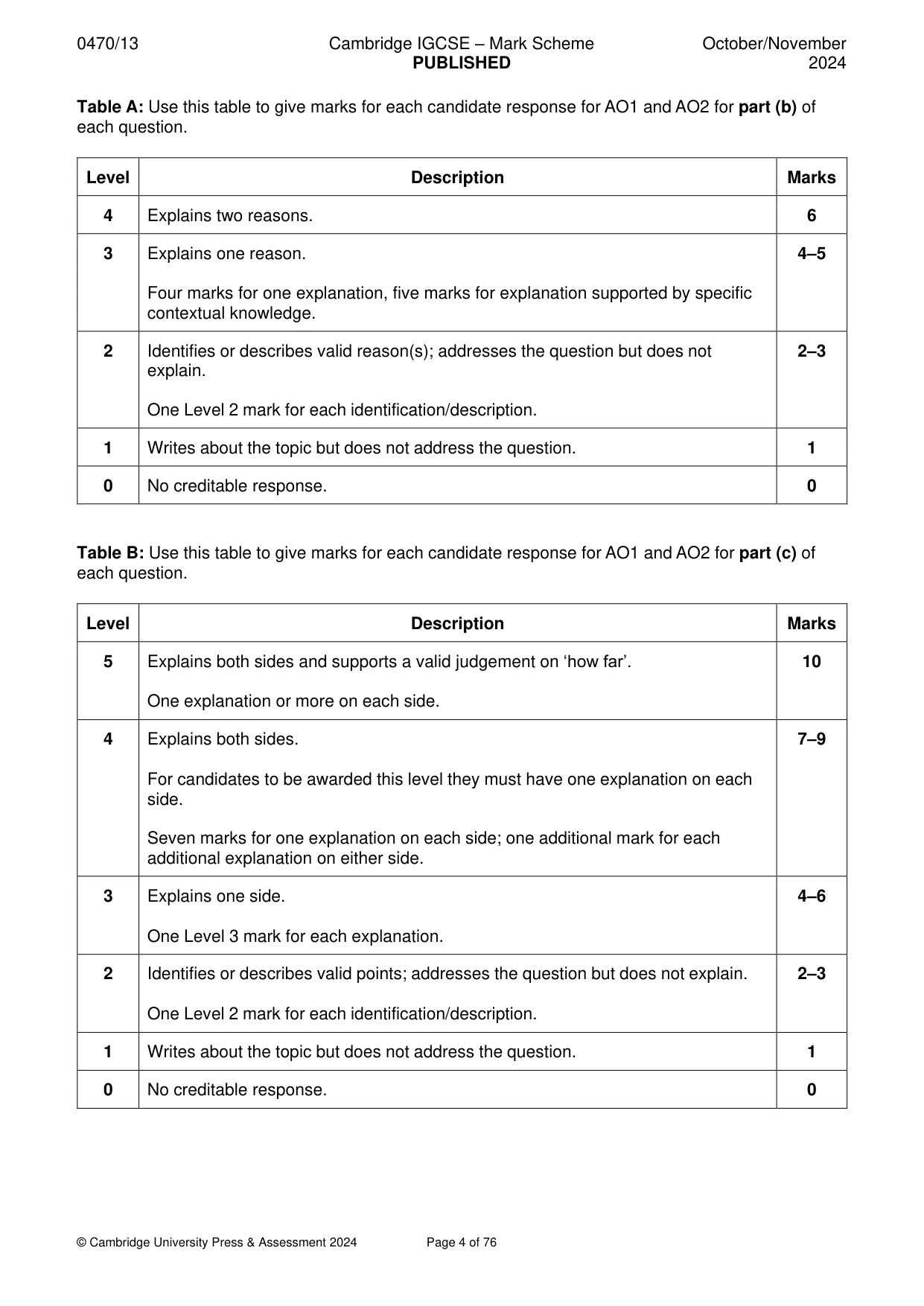
0470/13 Cambridge IGCSE – Mark Scheme PUBLISHED October/November 2024 © Cambridge University Press & Assessment 2024 Page 4 of 76 Table A: Use this table to give marks for each candidate response for AO1 and AO2 for part (b) of each question. Level Description Marks 4 Explains two reasons. 6 3 Explains one reason. Four marks for one explanation, five marks for explanation supported by specific contextual knowledge. 4–5 2 Identifies or describes valid reason(s); addresses the question but does not explain. One Level 2 mark for each identification/description. 2–3 1 Writes about the topic but does not address the question. 1 0 No creditable response. 0 Table B: Use this table to give marks for each candidate response for AO1 and AO2 for part (c) of each question. Level Description Marks 5 Explains both sides and supports a valid judgement on ‘how far’. One explanation or more on each side. 10 4 Explains both sides. For candidates to be awarded this level they must have one explanation on each side. Seven marks for one explanation on each side; one additional mark for each additional explanation on either side. 7–9 3 Explains one side. One Level 3 mark for each explanation. 4–6 2 Identifies or describes valid points; addresses the question but does not explain. One Level 2 mark for each identification/description. 2–3 1 Writes about the topic but does not address the question. 1 0 No creditable response. 0
Mark scheme, page 5
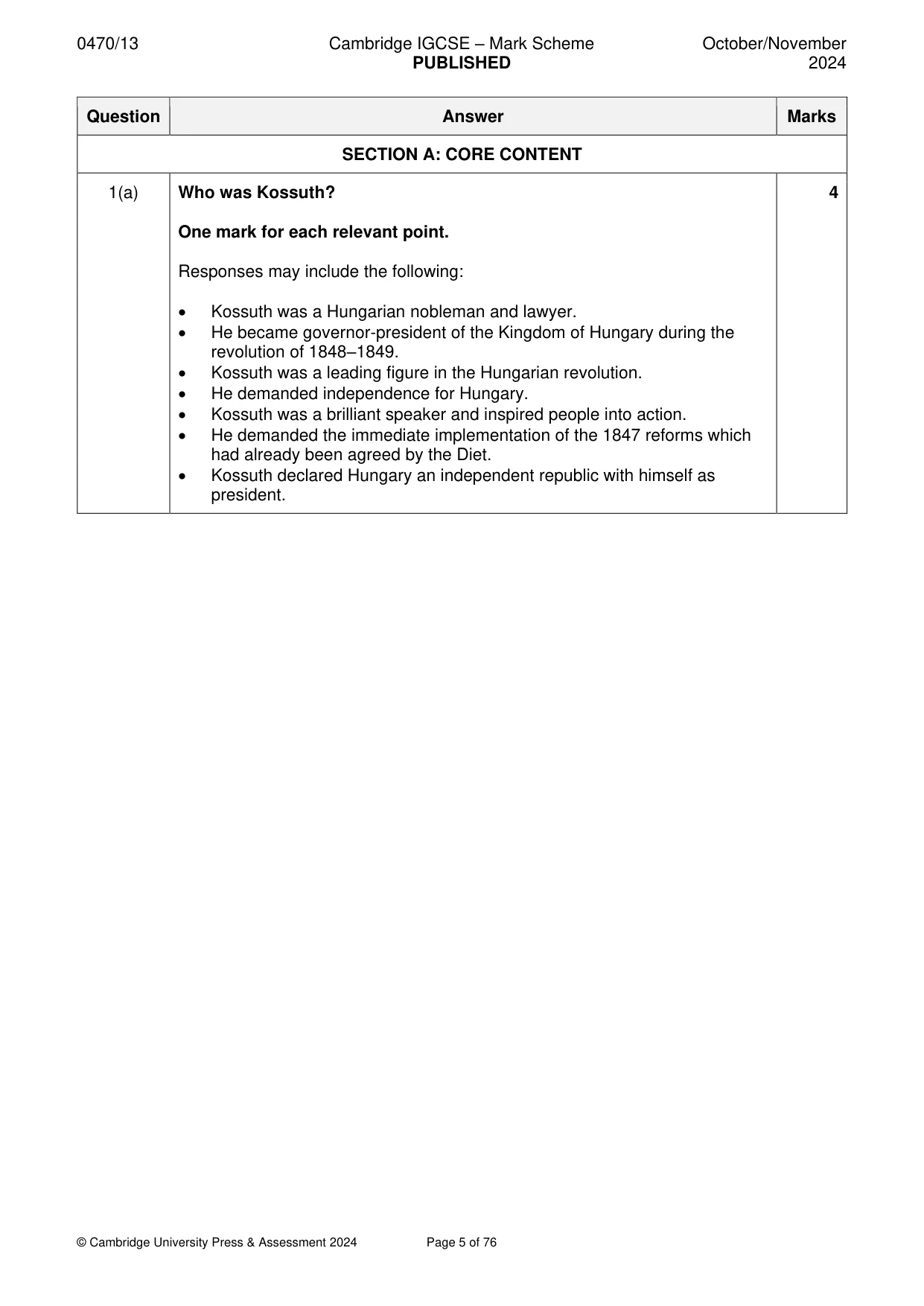
0470/13 Cambridge IGCSE – Mark Scheme PUBLISHED October/November 2024 © Cambridge University Press & Assessment 2024 Page 5 of 76 Question Answer Marks SECTION A: CORE CONTENT 1(a) Who was Kossuth? One mark for each relevant point. Responses may include the following: • Kossuth was a Hungarian nobleman and lawyer. • He became governor-president of the Kingdom of Hungary during the revolution of 1848–1849. • Kossuth was a leading figure in the Hungarian revolution. • He demanded independence for Hungary. • Kossuth was a brilliant speaker and inspired people into action. • He demanded the immediate implementation of the 1847 reforms which had already been agreed by the Diet. • Kossuth declared Hungary an independent republic with himself as president. 4
Mark scheme, page 6
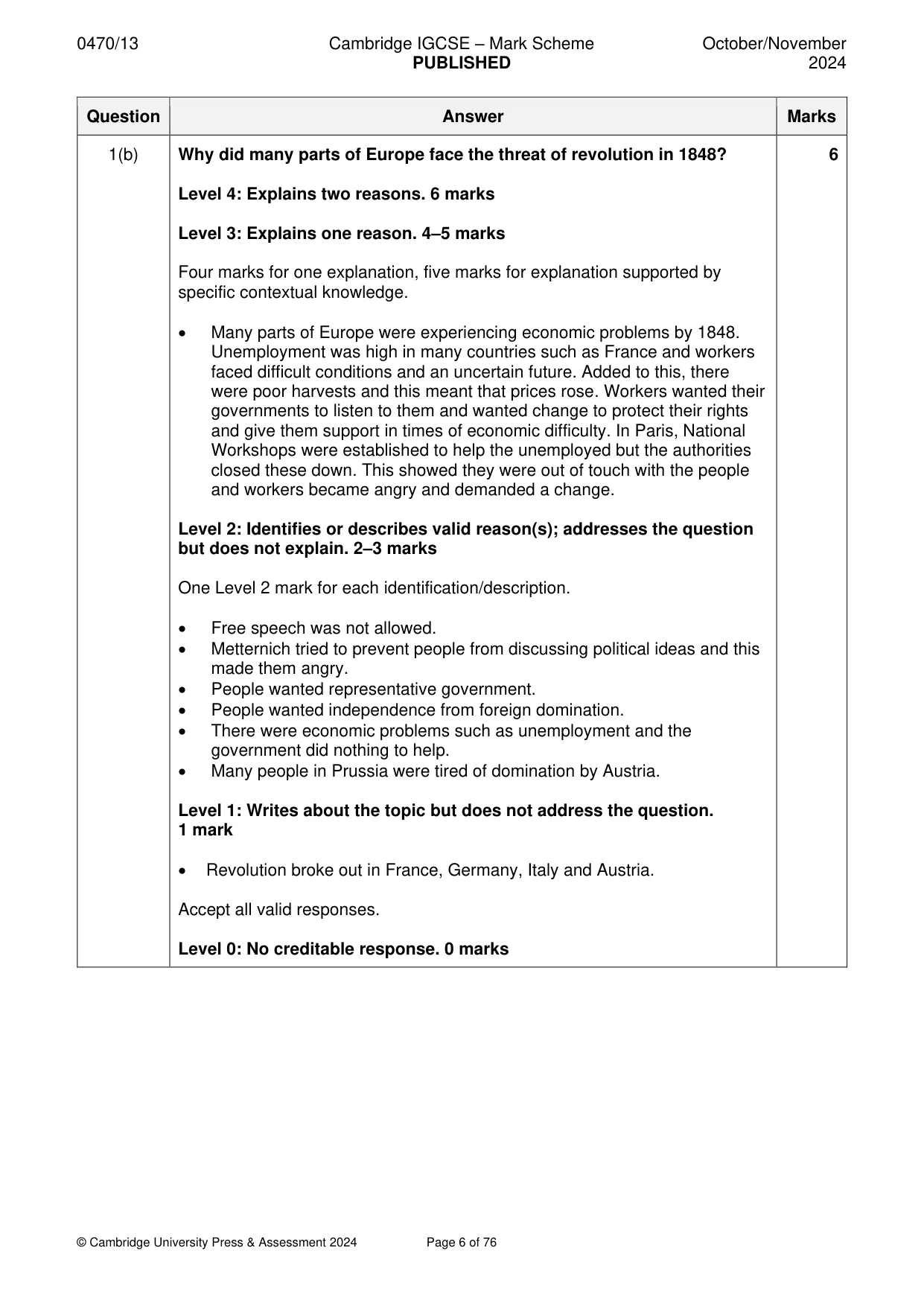
0470/13 Cambridge IGCSE – Mark Scheme PUBLISHED October/November 2024 © Cambridge University Press & Assessment 2024 Page 6 of 76 Question Answer Marks 1(b) Why did many parts of Europe face the threat of revolution in 1848? Level 4: Explains two reasons. 6 marks Level 3: Explains one reason. 4–5 marks Four marks for one explanation, five marks for explanation supported by specific contextual knowledge. • Many parts of Europe were experiencing economic problems by 1848. Unemployment was high in many countries such as France and workers faced difficult conditions and an uncertain future. Added to this, there were poor harvests and this meant that prices rose. Workers wanted their governments to listen to them and wanted change to protect their rights and give them support in times of economic difficulty. In Paris, National Workshops were established to help the unemployed but the authorities closed these down. This showed they were out of touch with the people and workers became angry and demanded a change. Level 2: Identifies or describes valid reason(s); addresses the question but does not explain. 2–3 marks One Level 2 mark for each identification/description. • Free speech was not allowed. • Metternich tried to prevent people from discussing political ideas and this made them angry. • People wanted representative government. • People wanted independence from foreign domination. • There were economic problems such as unemployment and the government did nothing to help. • Many people in Prussia were tired of domination by Austria. Level 1: Writes about the topic but does not address the question. 1 mark • Revolution broke out in France, Germany, Italy and Austria. Accept all valid responses. Level 0: No creditable response. 0 marks 6
Mark scheme, page 7
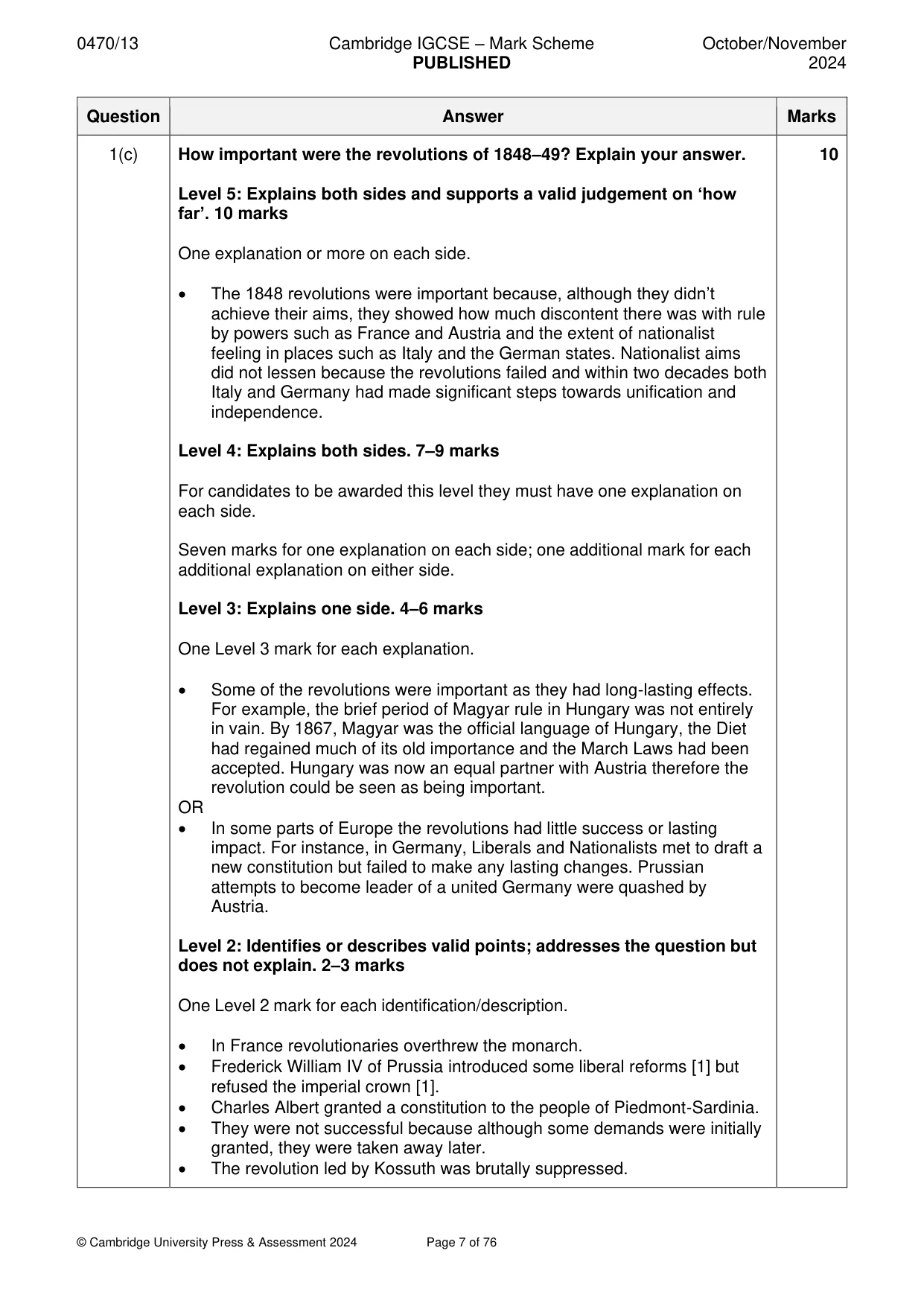
0470/13 Cambridge IGCSE – Mark Scheme PUBLISHED October/November 2024 © Cambridge University Press & Assessment 2024 Page 7 of 76 Question Answer Marks 1(c) How important were the revolutions of 1848–49? Explain your answer. Level 5: Explains both sides and supports a valid judgement on ‘how far’. 10 marks One explanation or more on each side. • The 1848 revolutions were important because, although they didn’t achieve their aims, they showed how much discontent there was with rule by powers such as France and Austria and the extent of nationalist feeling in places such as Italy and the German states. Nationalist aims did not lessen because the revolutions failed and within two decades both Italy and Germany had made significant steps towards unification and independence. Level 4: Explains both sides. 7–9 marks For candidates to be awarded this level they must have one explanation on each side. Seven marks for one explanation on each side; one additional mark for each additional explanation on either side. Level 3: Explains one side. 4–6 marks One Level 3 mark for each explanation. • Some of the revolutions were important as they had long-lasting effects. For example, the brief period of Magyar rule in Hungary was not entirely in vain. By 1867, Magyar was the official language of Hungary, the Diet had regained much of its old importance and the March Laws had been accepted. Hungary was now an equal partner with Austria therefore the revolution could be seen as being important. OR • In some parts of Europe the revolutions had little success or lasting impact. For instance, in Germany, Liberals and Nationalists met to draft a new constitution but failed to make any lasting changes. Prussian attempts to become leader of a united Germany were quashed by Austria. Level 2: Identifies or describes valid points; addresses the question but does not explain. 2–3 marks One Level 2 mark for each identification/description. • In France revolutionaries overthrew the monarch. • Frederick William IV of Prussia introduced some liberal reforms [1] but refused the imperial crown [1]. • Charles Albert granted a constitution to the people of Piedmont-Sardinia. • They were not successful because although some demands were initially granted, they were taken away later. • The revolution led by Kossuth was brutally suppressed. 10
Mark scheme, page 8
0470/13 Cambridge IGCSE – Mark Scheme PUBLISHED October/November 2024 © Cambridge University Press & Assessment 2024 Page 8 of 76 Question Answer Marks 1(c) Level 1: Writes about the topic but does not address the question. 1 mark Accept all valid responses. • Revolutions broke out across Europe in 1848. Level 0: No creditable response. 0 marks
Mark scheme, page 9
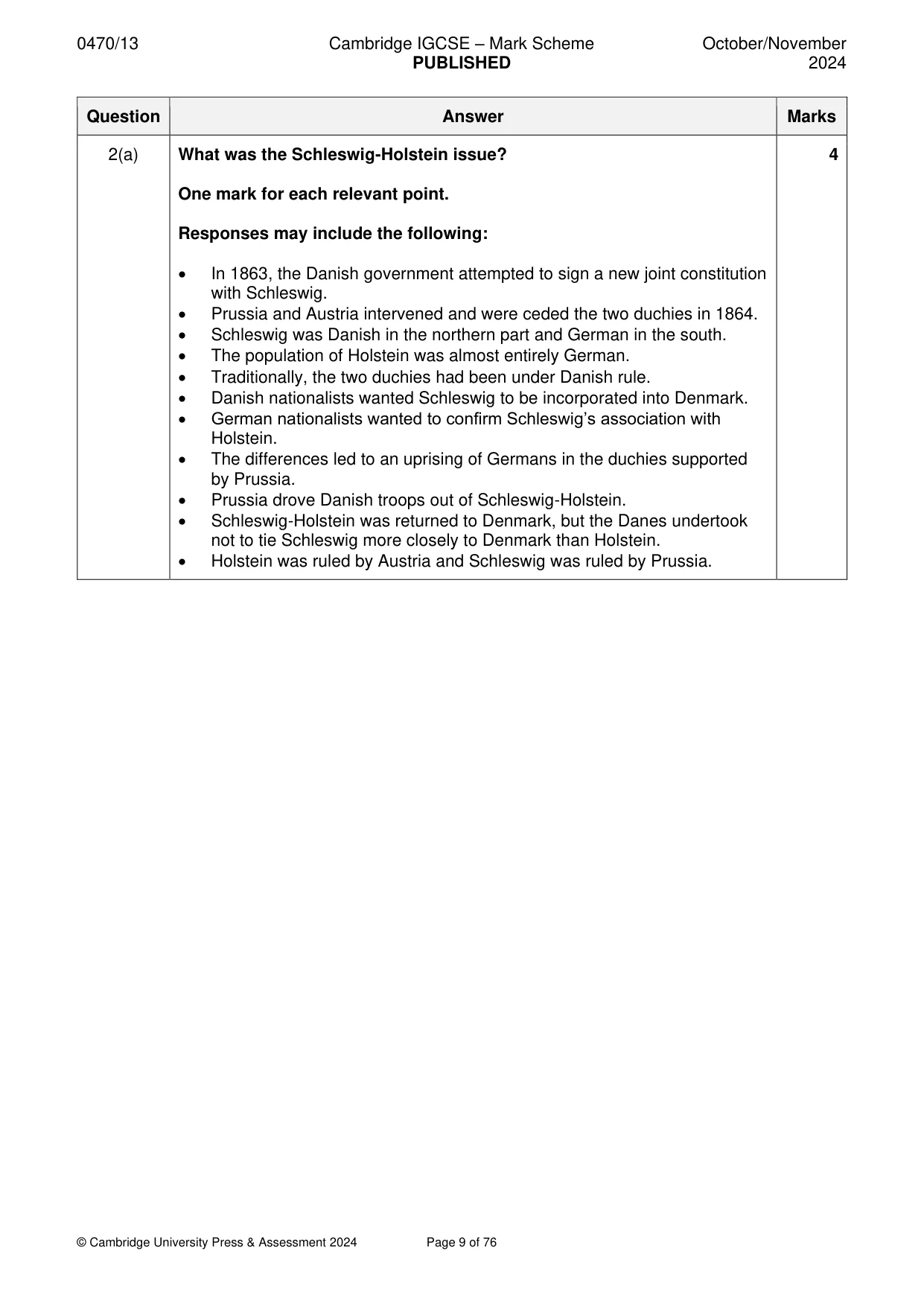
0470/13 Cambridge IGCSE – Mark Scheme PUBLISHED October/November 2024 © Cambridge University Press & Assessment 2024 Page 9 of 76 Question Answer Marks 2(a) What was the Schleswig-Holstein issue? One mark for each relevant point. Responses may include the following: • In 1863, the Danish government attempted to sign a new joint constitution with Schleswig. • Prussia and Austria intervened and were ceded the two duchies in 1864. • Schleswig was Danish in the northern part and German in the south. • The population of Holstein was almost entirely German. • Traditionally, the two duchies had been under Danish rule. • Danish nationalists wanted Schleswig to be incorporated into Denmark. • German nationalists wanted to confirm Schleswig’s association with Holstein. • The differences led to an uprising of Germans in the duchies supported by Prussia. • Prussia drove Danish troops out of Schleswig-Holstein. • Schleswig-Holstein was returned to Denmark, but the Danes undertook not to tie Schleswig more closely to Denmark than Holstein. • Holstein was ruled by Austria and Schleswig was ruled by Prussia. 4
Mark scheme, page 10
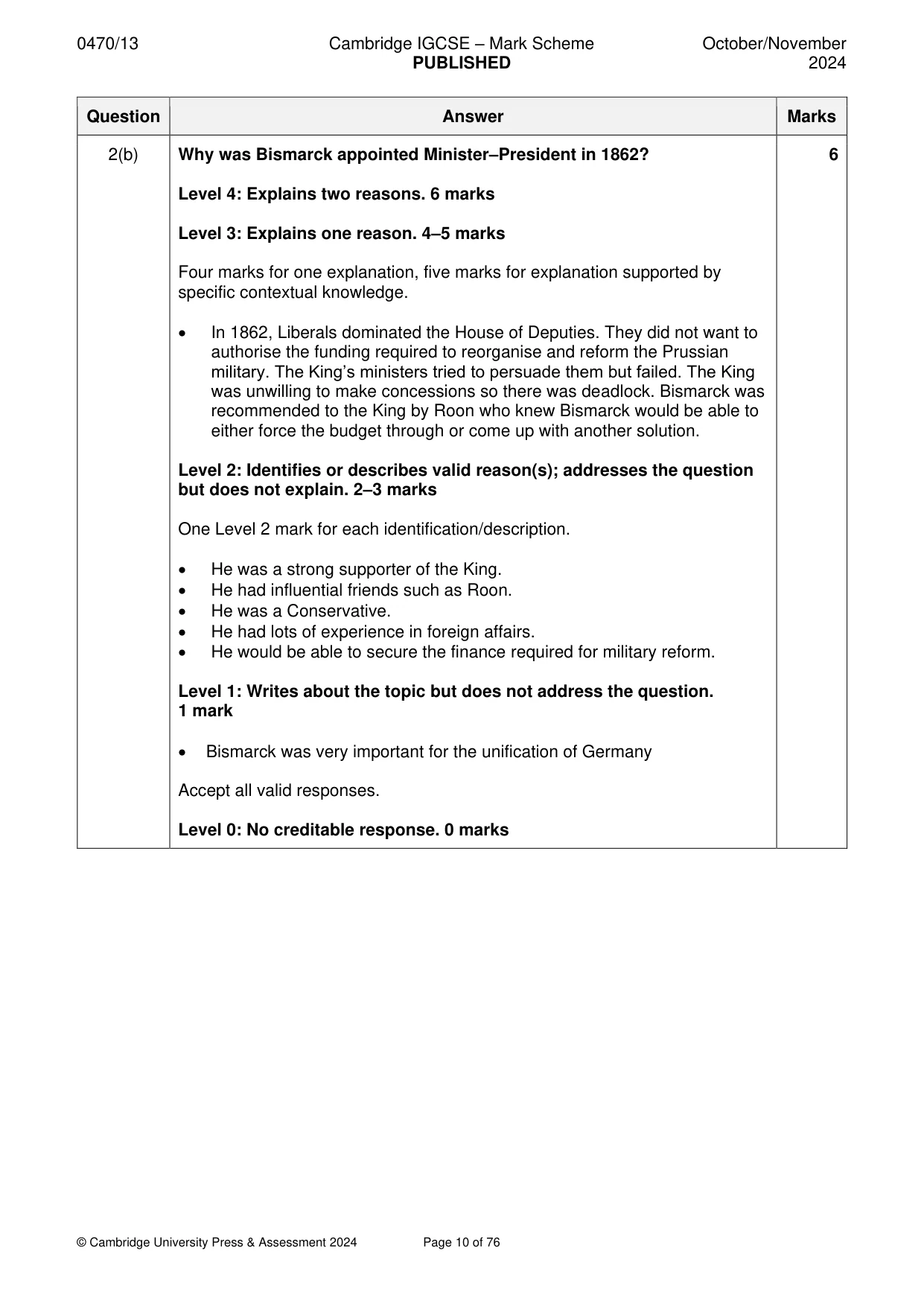
0470/13 Cambridge IGCSE – Mark Scheme PUBLISHED October/November 2024 © Cambridge University Press & Assessment 2024 Page 10 of 76 Question Answer Marks 2(b) Why was Bismarck appointed Minister–President in 1862? Level 4: Explains two reasons. 6 marks Level 3: Explains one reason. 4–5 marks Four marks for one explanation, five marks for explanation supported by specific contextual knowledge. • In 1862, Liberals dominated the House of Deputies. They did not want to authorise the funding required to reorganise and reform the Prussian military. The King’s ministers tried to persuade them but failed. The King was unwilling to make concessions so there was deadlock. Bismarck was recommended to the King by Roon who knew Bismarck would be able to either force the budget through or come up with another solution. Level 2: Identifies or describes valid reason(s); addresses the question but does not explain. 2–3 marks One Level 2 mark for each identification/description. • He was a strong supporter of the King. • He had influential friends such as Roon. • He was a Conservative. • He had lots of experience in foreign affairs. • He would be able to secure the finance required for military reform. Level 1: Writes about the topic but does not address the question. 1 mark • Bismarck was very important for the unification of Germany Accept all valid responses. Level 0: No creditable response. 0 marks 6
Mark scheme, page 11
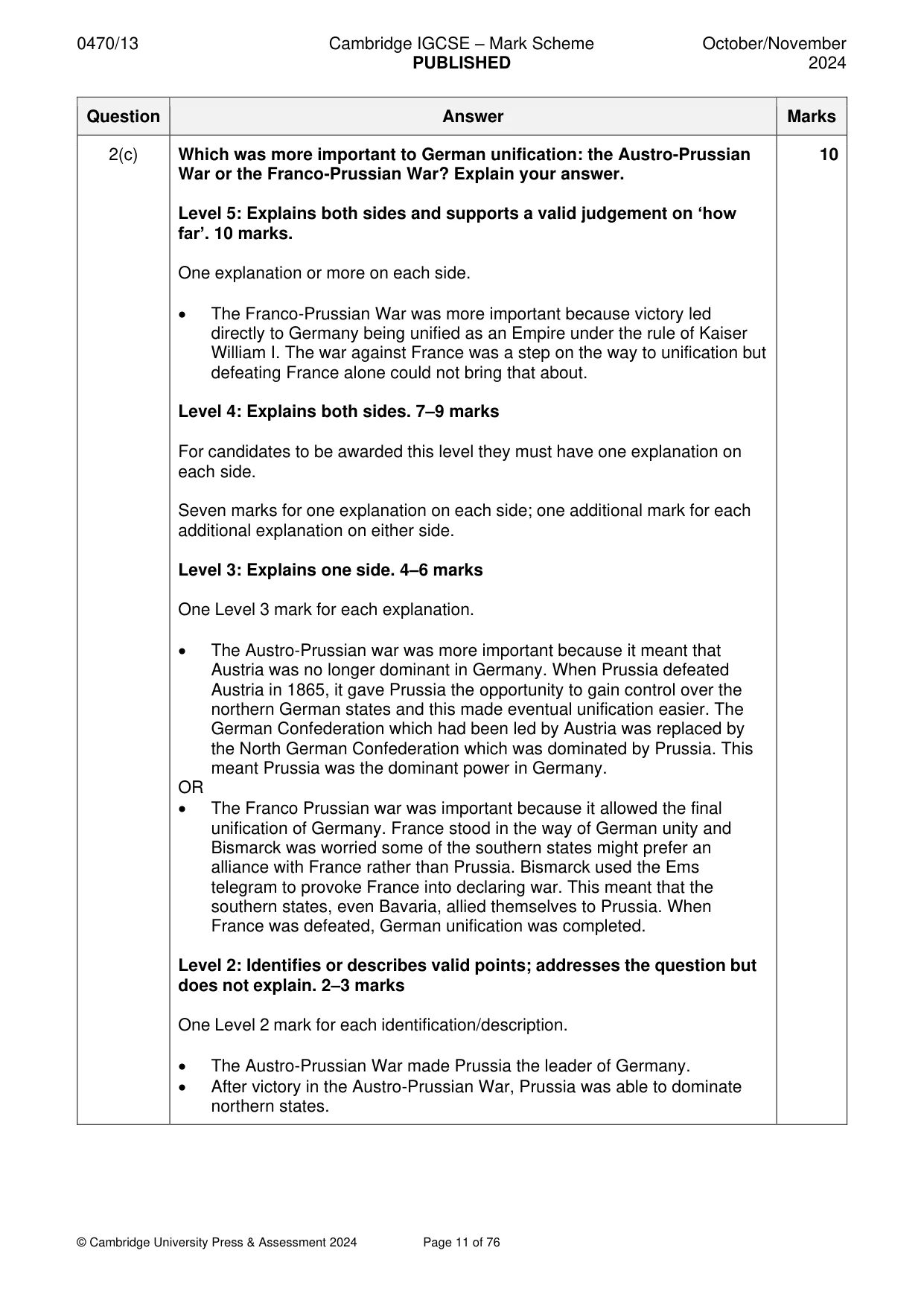
0470/13 Cambridge IGCSE – Mark Scheme PUBLISHED October/November 2024 © Cambridge University Press & Assessment 2024 Page 11 of 76 Question Answer Marks 2(c) Which was more important to German unification: the Austro-Prussian War or the Franco-Prussian War? Explain your answer. Level 5: Explains both sides and supports a valid judgement on ‘how far’. 10 marks. One explanation or more on each side. • The Franco-Prussian War was more important because victory led directly to Germany being unified as an Empire under the rule of Kaiser William I. The war against France was a step on the way to unification but defeating France alone could not bring that about. Level 4: Explains both sides. 7–9 marks For candidates to be awarded this level they must have one explanation on each side. Seven marks for one explanation on each side; one additional mark for each additional explanation on either side. Level 3: Explains one side. 4–6 marks One Level 3 mark for each explanation. • The Austro-Prussian war was more important because it meant that Austria was no longer dominant in Germany. When Prussia defeated Austria in 1865, it gave Prussia the opportunity to gain control over the northern German states and this made eventual unification easier. The German Confederation which had been led by Austria was replaced by the North German Confederation which was dominated by Prussia. This meant Prussia was the dominant power in Germany. OR • The Franco Prussian war was important because it allowed the final unification of Germany. France stood in the way of German unity and Bismarck was worried some of the southern states might prefer an alliance with France rather than Prussia. Bismarck used the Ems telegram to provoke France into declaring war. This meant that the southern states, even Bavaria, allied themselves to Prussia. When France was defeated, German unification was completed. Level 2: Identifies or describes valid points; addresses the question but does not explain. 2–3 marks One Level 2 mark for each identification/description. • The Austro-Prussian War made Prussia the leader of Germany. • After victory in the Austro-Prussian War, Prussia was able to dominate northern states. 10
Mark scheme, page 12
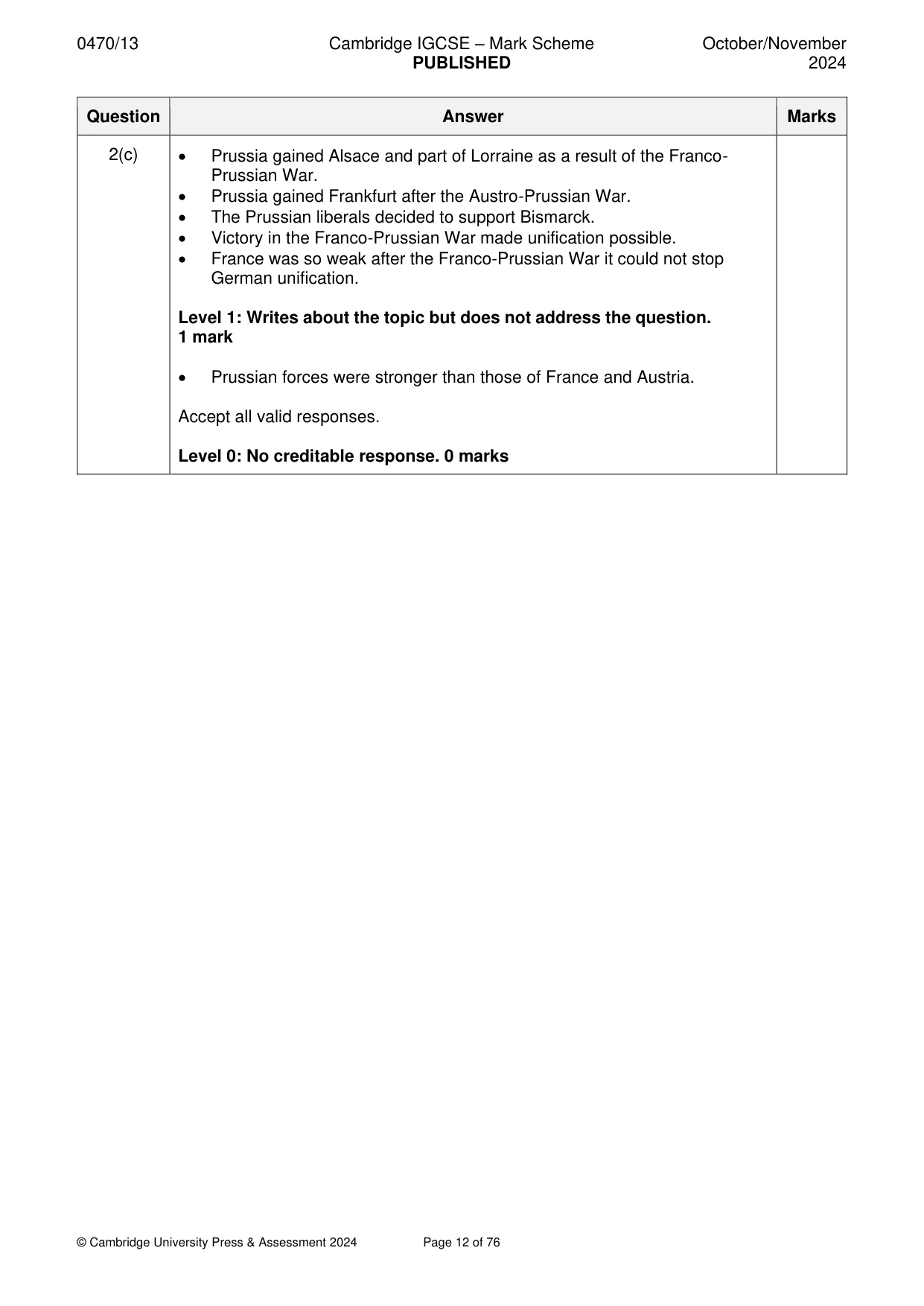
0470/13 Cambridge IGCSE – Mark Scheme PUBLISHED October/November 2024 © Cambridge University Press & Assessment 2024 Page 12 of 76 Question Answer Marks 2(c) • Prussia gained Alsace and part of Lorraine as a result of the Franco- Prussian War. • Prussia gained Frankfurt after the Austro-Prussian War. • The Prussian liberals decided to support Bismarck. • Victory in the Franco-Prussian War made unification possible. • France was so weak after the Franco-Prussian War it could not stop German unification. Level 1: Writes about the topic but does not address the question. 1 mark • Prussian forces were stronger than those of France and Austria. Accept all valid responses. Level 0: No creditable response. 0 marks
Mark scheme, page 13
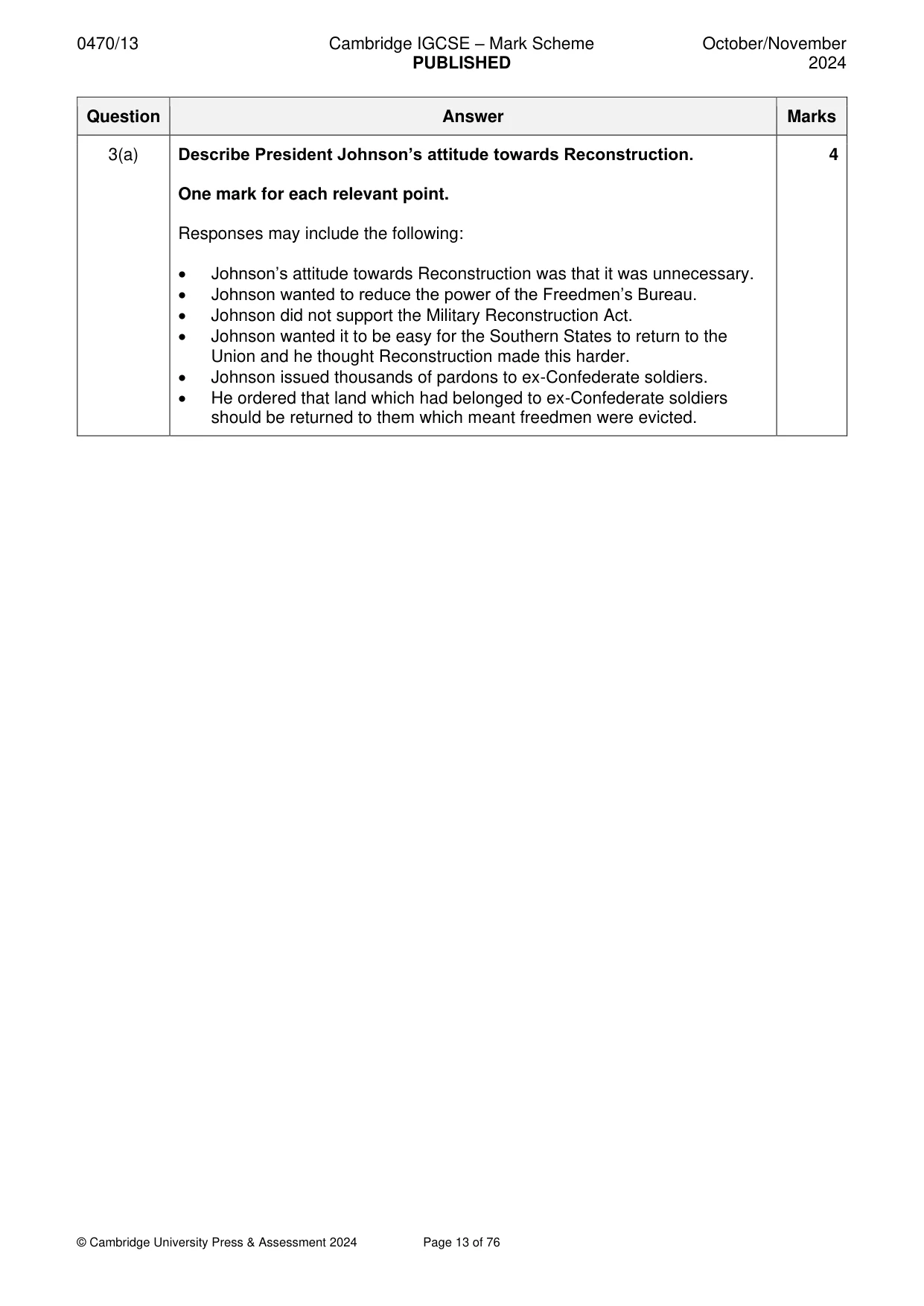
0470/13 Cambridge IGCSE – Mark Scheme PUBLISHED October/November 2024 © Cambridge University Press & Assessment 2024 Page 13 of 76 Question Answer Marks 3(a) Describe President Johnson’s attitude towards Reconstruction. One mark for each relevant point. Responses may include the following: • Johnson’s attitude towards Reconstruction was that it was unnecessary. • Johnson wanted to reduce the power of the Freedmen’s Bureau. • Johnson did not support the Military Reconstruction Act. • Johnson wanted it to be easy for the Southern States to return to the Union and he thought Reconstruction made this harder. • Johnson issued thousands of pardons to ex-Confederate soldiers. • He ordered that land which had belonged to ex-Confederate soldiers should be returned to them which meant freedmen were evicted. 4
Mark scheme, page 14
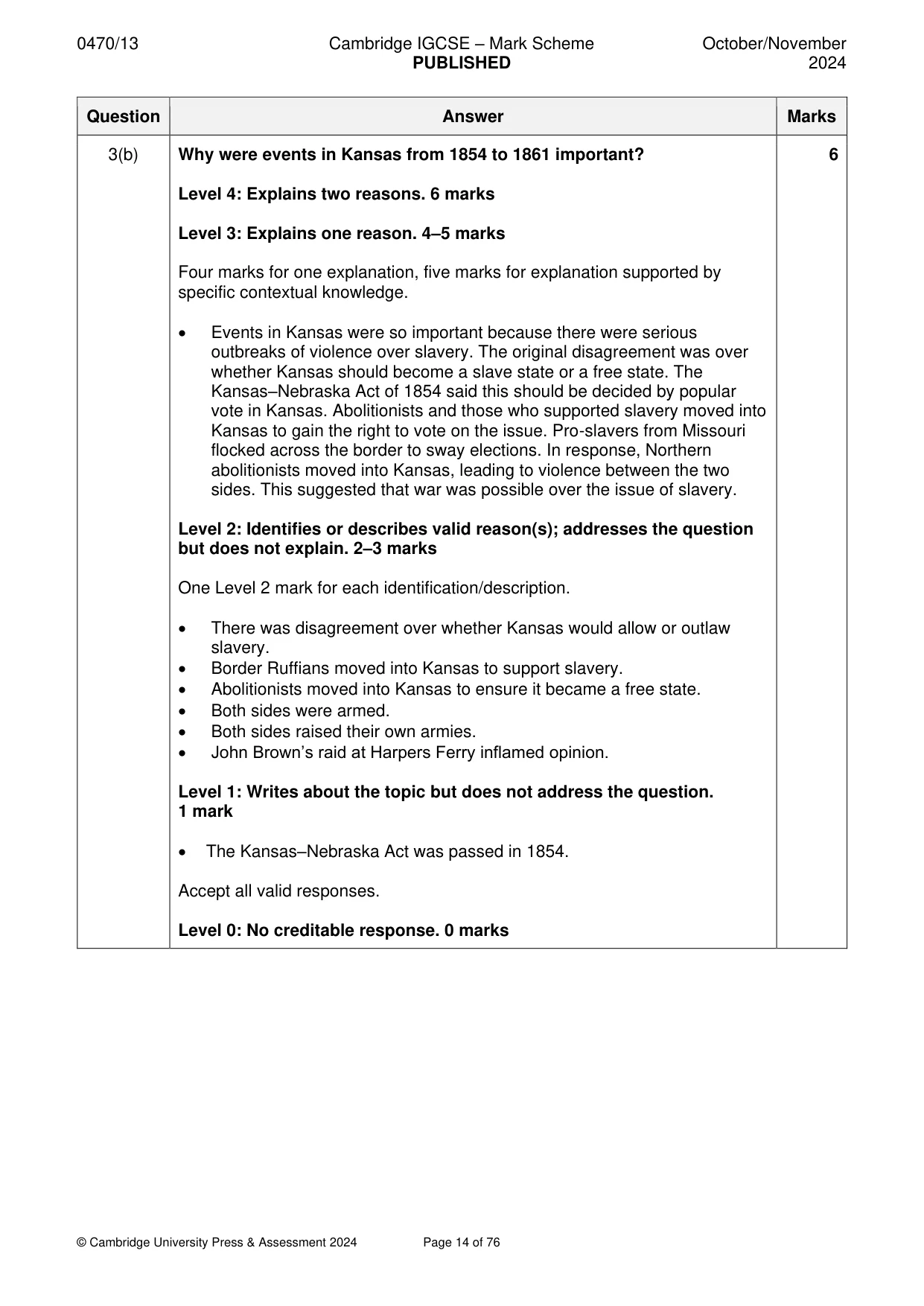
0470/13 Cambridge IGCSE – Mark Scheme PUBLISHED October/November 2024 © Cambridge University Press & Assessment 2024 Page 14 of 76 Question Answer Marks 3(b) Why were events in Kansas from 1854 to 1861 important? Level 4: Explains two reasons. 6 marks Level 3: Explains one reason. 4–5 marks Four marks for one explanation, five marks for explanation supported by specific contextual knowledge. • Events in Kansas were so important because there were serious outbreaks of violence over slavery. The original disagreement was over whether Kansas should become a slave state or a free state. The Kansas–Nebraska Act of 1854 said this should be decided by popular vote in Kansas. Abolitionists and those who supported slavery moved into Kansas to gain the right to vote on the issue. Pro-slavers from Missouri flocked across the border to sway elections. In response, Northern abolitionists moved into Kansas, leading to violence between the two sides. This suggested that war was possible over the issue of slavery. Level 2: Identifies or describes valid reason(s); addresses the question but does not explain. 2–3 marks One Level 2 mark for each identification/description. • There was disagreement over whether Kansas would allow or outlaw slavery. • Border Ruffians moved into Kansas to support slavery. • Abolitionists moved into Kansas to ensure it became a free state. • Both sides were armed. • Both sides raised their own armies. • John Brown’s raid at Harpers Ferry inflamed opinion. Level 1: Writes about the topic but does not address the question. 1 mark • The Kansas–Nebraska Act was passed in 1854. Accept all valid responses. Level 0: No creditable response. 0 marks 6
Mark scheme, page 15
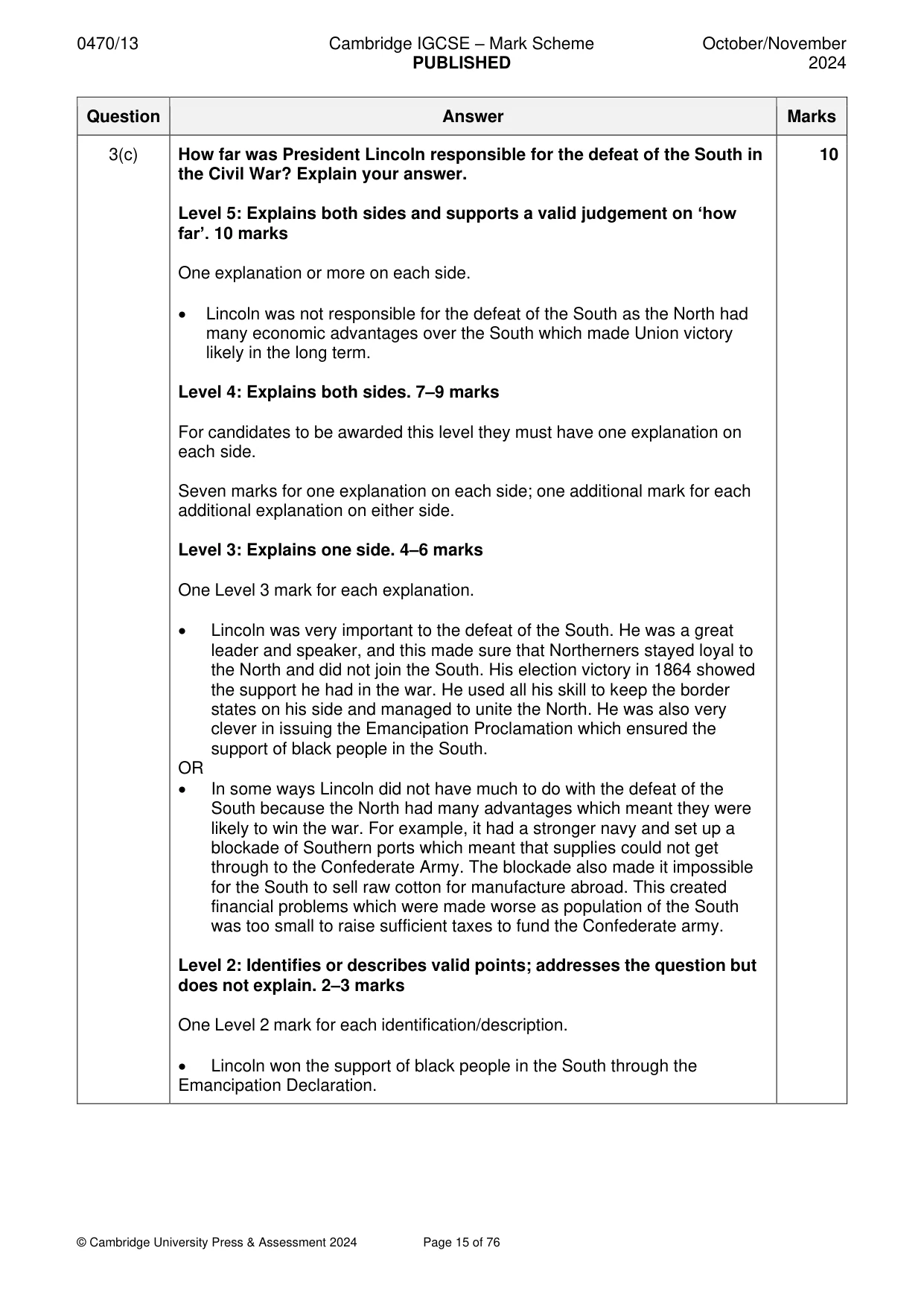
0470/13 Cambridge IGCSE – Mark Scheme PUBLISHED October/November 2024 © Cambridge University Press & Assessment 2024 Page 15 of 76 Question Answer Marks 3(c) How far was President Lincoln responsible for the defeat of the South in the Civil War? Explain your answer. Level 5: Explains both sides and supports a valid judgement on ‘how far’. 10 marks One explanation or more on each side. • Lincoln was not responsible for the defeat of the South as the North had many economic advantages over the South which made Union victory likely in the long term. Level 4: Explains both sides. 7–9 marks For candidates to be awarded this level they must have one explanation on each side. Seven marks for one explanation on each side; one additional mark for each additional explanation on either side. Level 3: Explains one side. 4–6 marks One Level 3 mark for each explanation. • Lincoln was very important to the defeat of the South. He was a great leader and speaker, and this made sure that Northerners stayed loyal to the North and did not join the South. His election victory in 1864 showed the support he had in the war. He used all his skill to keep the border states on his side and managed to unite the North. He was also very clever in issuing the Emancipation Proclamation which ensured the support of black people in the South. OR • In some ways Lincoln did not have much to do with the defeat of the South because the North had many advantages which meant they were likely to win the war. For example, it had a stronger navy and set up a blockade of Southern ports which meant that supplies could not get through to the Confederate Army. The blockade also made it impossible for the South to sell raw cotton for manufacture abroad. This created financial problems which were made worse as population of the South was too small to raise sufficient taxes to fund the Confederate army. Level 2: Identifies or describes valid points; addresses the question but does not explain. 2–3 marks One Level 2 mark for each identification/description. • Lincoln won the support of black people in the South through the Emancipation Declaration. 10
Mark scheme, page 16
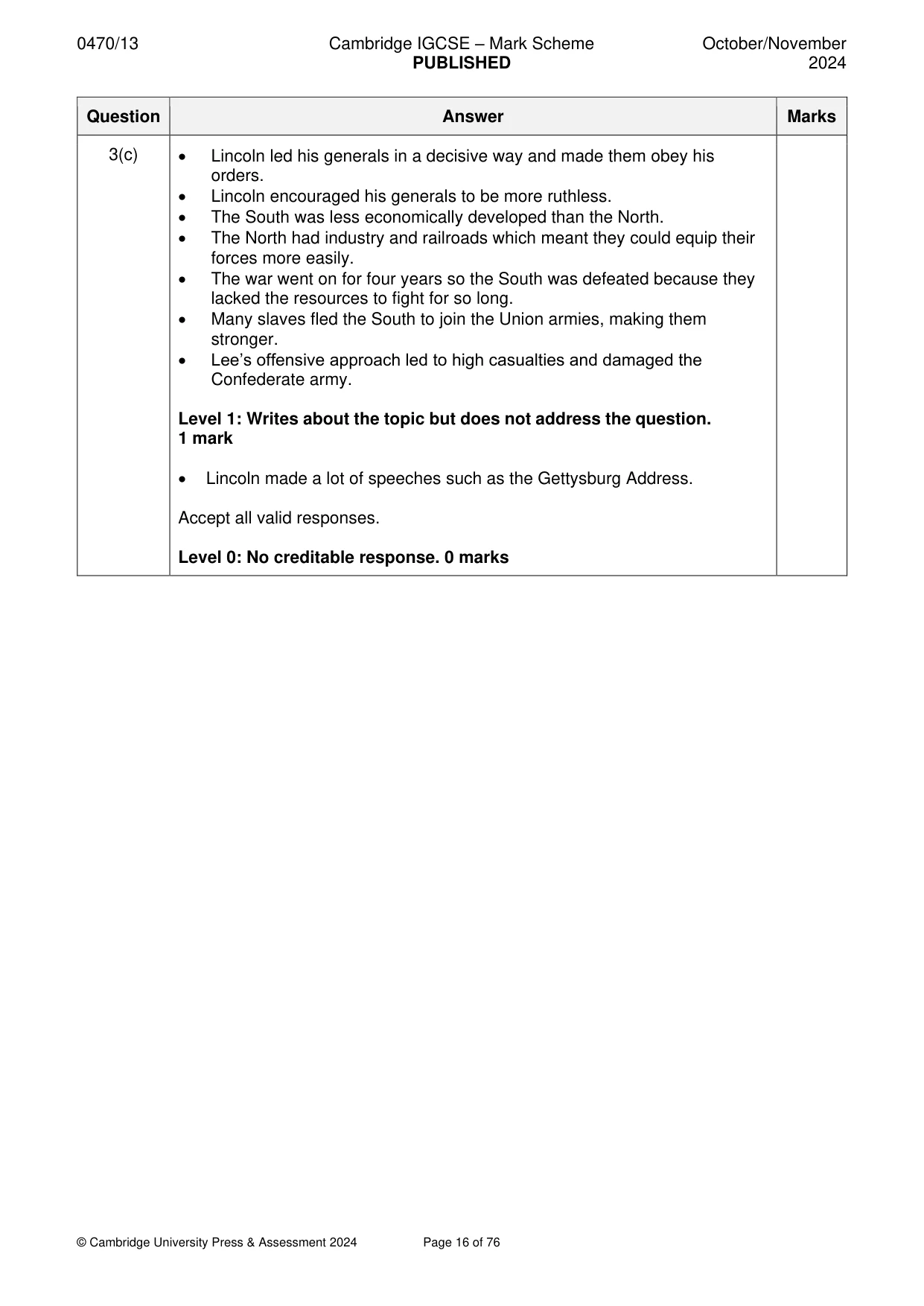
0470/13 Cambridge IGCSE – Mark Scheme PUBLISHED October/November 2024 © Cambridge University Press & Assessment 2024 Page 16 of 76 Question Answer Marks 3(c) • Lincoln led his generals in a decisive way and made them obey his orders. • Lincoln encouraged his generals to be more ruthless. • The South was less economically developed than the North. • The North had industry and railroads which meant they could equip their forces more easily. • The war went on for four years so the South was defeated because they lacked the resources to fight for so long. • Many slaves fled the South to join the Union armies, making them stronger. • Lee’s offensive approach led to high casualties and damaged the Confederate army. Level 1: Writes about the topic but does not address the question. 1 mark • Lincoln made a lot of speeches such as the Gettysburg Address. Accept all valid responses. Level 0: No creditable response. 0 marks
Mark scheme, page 17
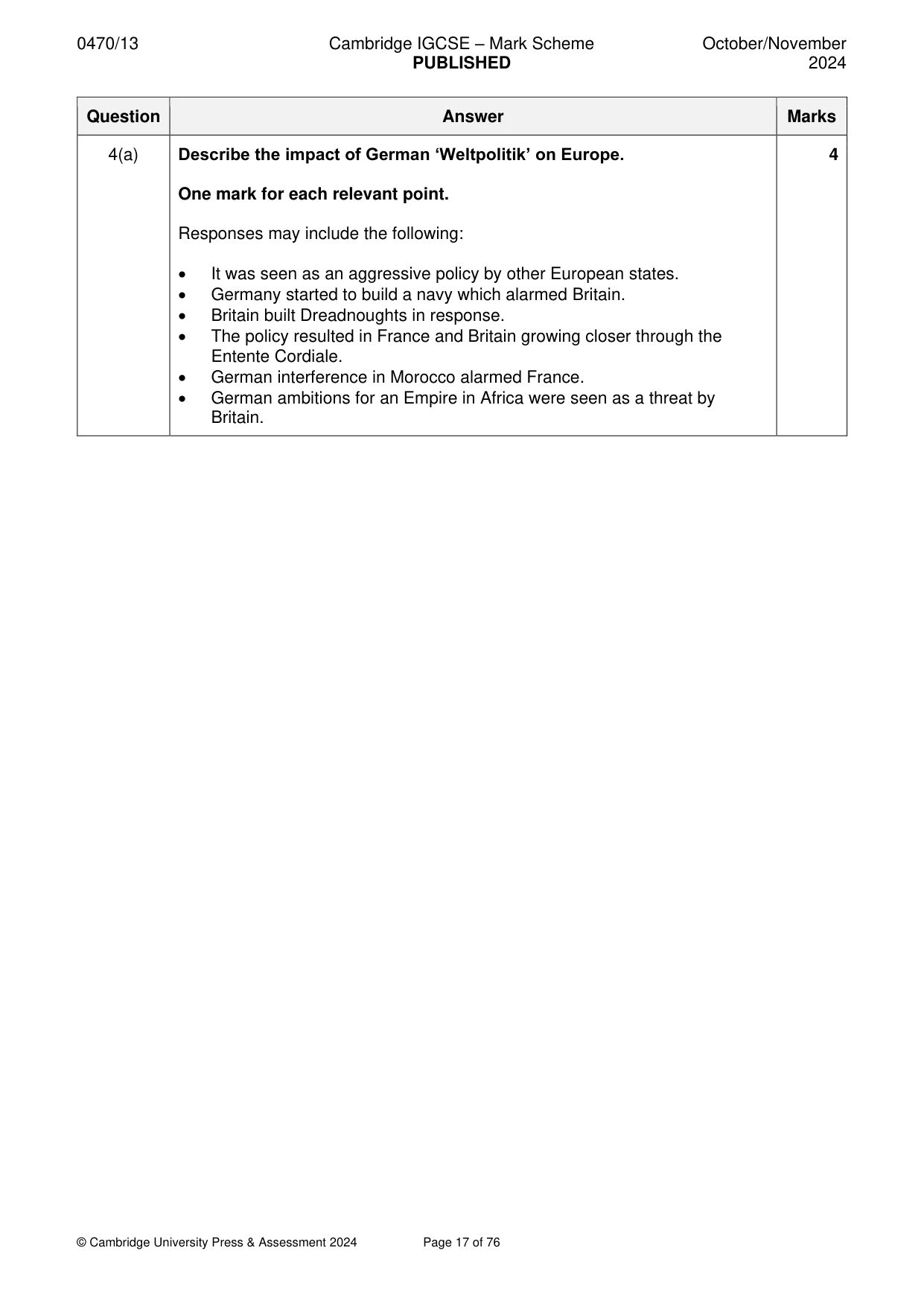
0470/13 Cambridge IGCSE – Mark Scheme PUBLISHED October/November 2024 © Cambridge University Press & Assessment 2024 Page 17 of 76 Question Answer Marks 4(a) Describe the impact of German ‘Weltpolitik’ on Europe. One mark for each relevant point. Responses may include the following: • It was seen as an aggressive policy by other European states. • Germany started to build a navy which alarmed Britain. • Britain built Dreadnoughts in response. • The policy resulted in France and Britain growing closer through the Entente Cordiale. • German interference in Morocco alarmed France. • German ambitions for an Empire in Africa were seen as a threat by Britain. 4
Mark scheme, page 18
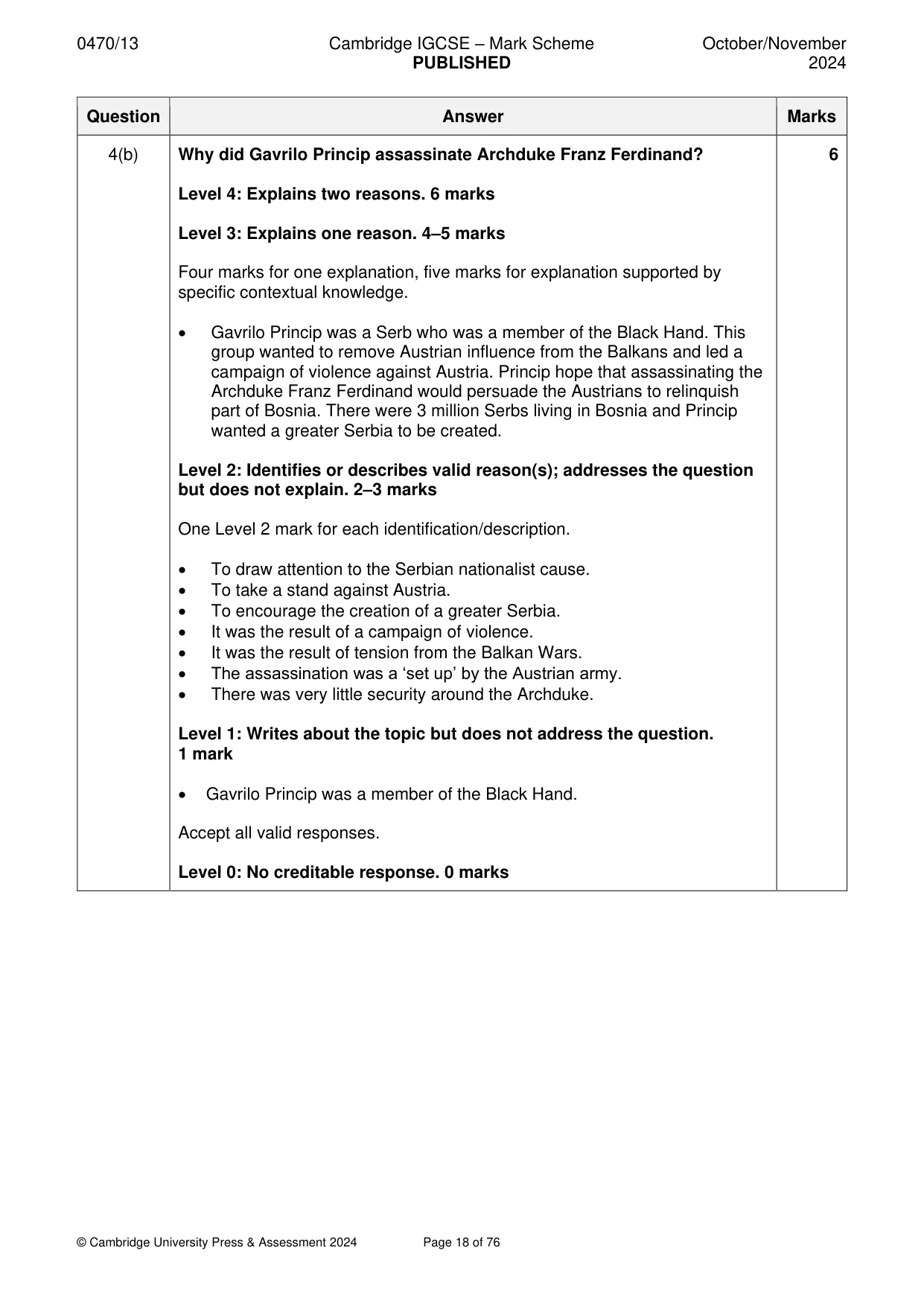
0470/13 Cambridge IGCSE – Mark Scheme PUBLISHED October/November 2024 © Cambridge University Press & Assessment 2024 Page 18 of 76 Question Answer Marks 4(b) Why did Gavrilo Princip assassinate Archduke Franz Ferdinand? Level 4: Explains two reasons. 6 marks Level 3: Explains one reason. 4–5 marks Four marks for one explanation, five marks for explanation supported by specific contextual knowledge. • Gavrilo Princip was a Serb who was a member of the Black Hand. This group wanted to remove Austrian influence from the Balkans and led a campaign of violence against Austria. Princip hope that assassinating the Archduke Franz Ferdinand would persuade the Austrians to relinquish part of Bosnia. There were 3 million Serbs living in Bosnia and Princip wanted a greater Serbia to be created. Level 2: Identifies or describes valid reason(s); addresses the question but does not explain. 2–3 marks One Level 2 mark for each identification/description. • To draw attention to the Serbian nationalist cause. • To take a stand against Austria. • To encourage the creation of a greater Serbia. • It was the result of a campaign of violence. • It was the result of tension from the Balkan Wars. • The assassination was a ‘set up’ by the Austrian army. • There was very little security around the Archduke. Level 1: Writes about the topic but does not address the question. 1 mark • Gavrilo Princip was a member of the Black Hand. Accept all valid responses. Level 0: No creditable response. 0 marks 6
Mark scheme, page 19
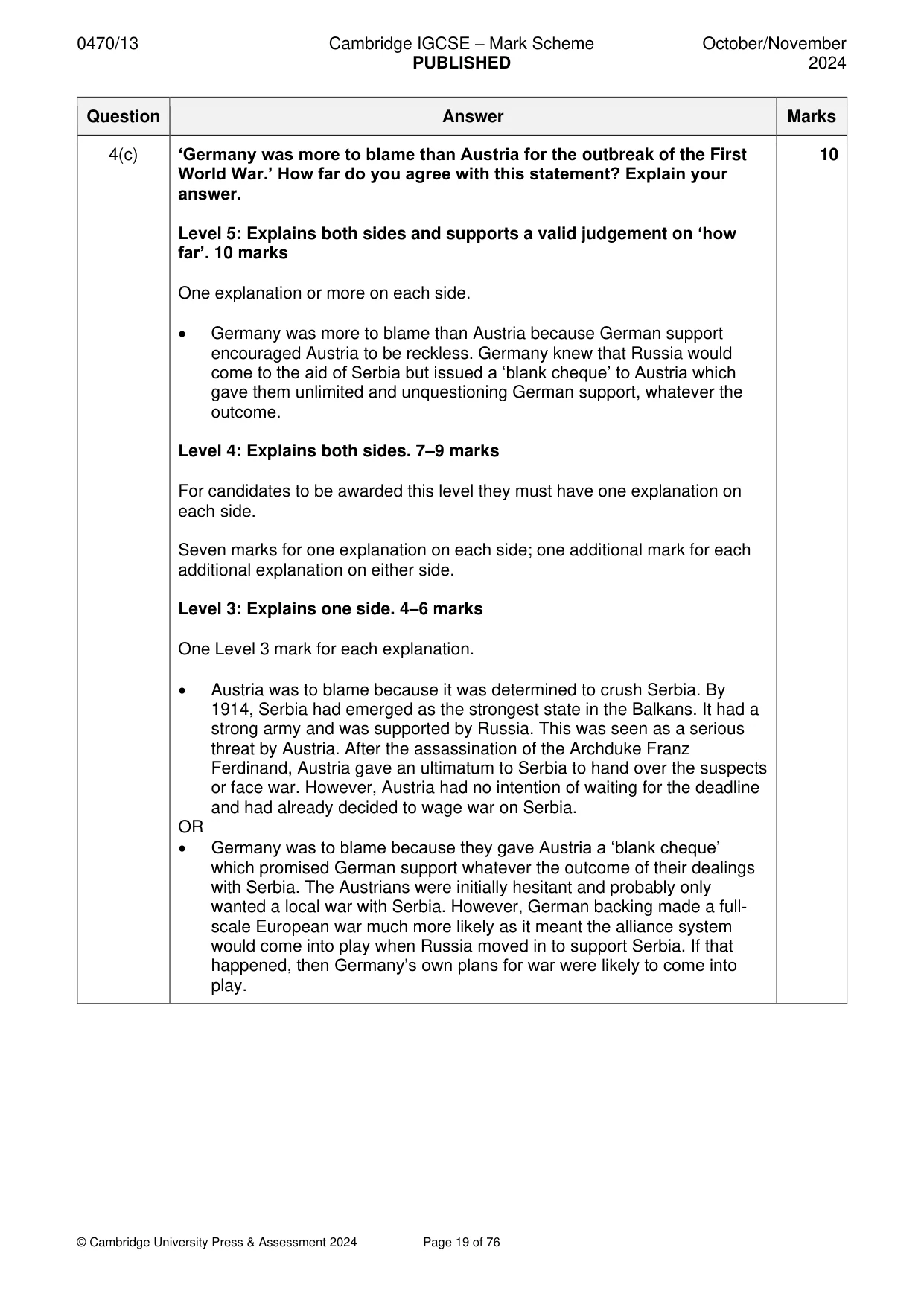
0470/13 Cambridge IGCSE – Mark Scheme PUBLISHED October/November 2024 © Cambridge University Press & Assessment 2024 Page 19 of 76 Question Answer Marks 4(c) ‘Germany was more to blame than Austria for the outbreak of the First World War.’ How far do you agree with this statement? Explain your answer. Level 5: Explains both sides and supports a valid judgement on ‘how far’. 10 marks One explanation or more on each side. • Germany was more to blame than Austria because German support encouraged Austria to be reckless. Germany knew that Russia would come to the aid of Serbia but issued a ‘blank cheque’ to Austria which gave them unlimited and unquestioning German support, whatever the outcome. Level 4: Explains both sides. 7–9 marks For candidates to be awarded this level they must have one explanation on each side. Seven marks for one explanation on each side; one additional mark for each additional explanation on either side. Level 3: Explains one side. 4–6 marks One Level 3 mark for each explanation. • Austria was to blame because it was determined to crush Serbia. By 1914, Serbia had emerged as the strongest state in the Balkans. It had a strong army and was supported by Russia. This was seen as a serious threat by Austria. After the assassination of the Archduke Franz Ferdinand, Austria gave an ultimatum to Serbia to hand over the suspects or face war. However, Austria had no intention of waiting for the deadline and had already decided to wage war on Serbia. OR • Germany was to blame because they gave Austria a ‘blank cheque’ which promised German support whatever the outcome of their dealings with Serbia. The Austrians were initially hesitant and probably only wanted a local war with Serbia. However, German backing made a full- scale European war much more likely as it meant the alliance system would come into play when Russia moved in to support Serbia. If that happened, then Germany’s own plans for war were likely to come into play. 10
Mark scheme, page 20
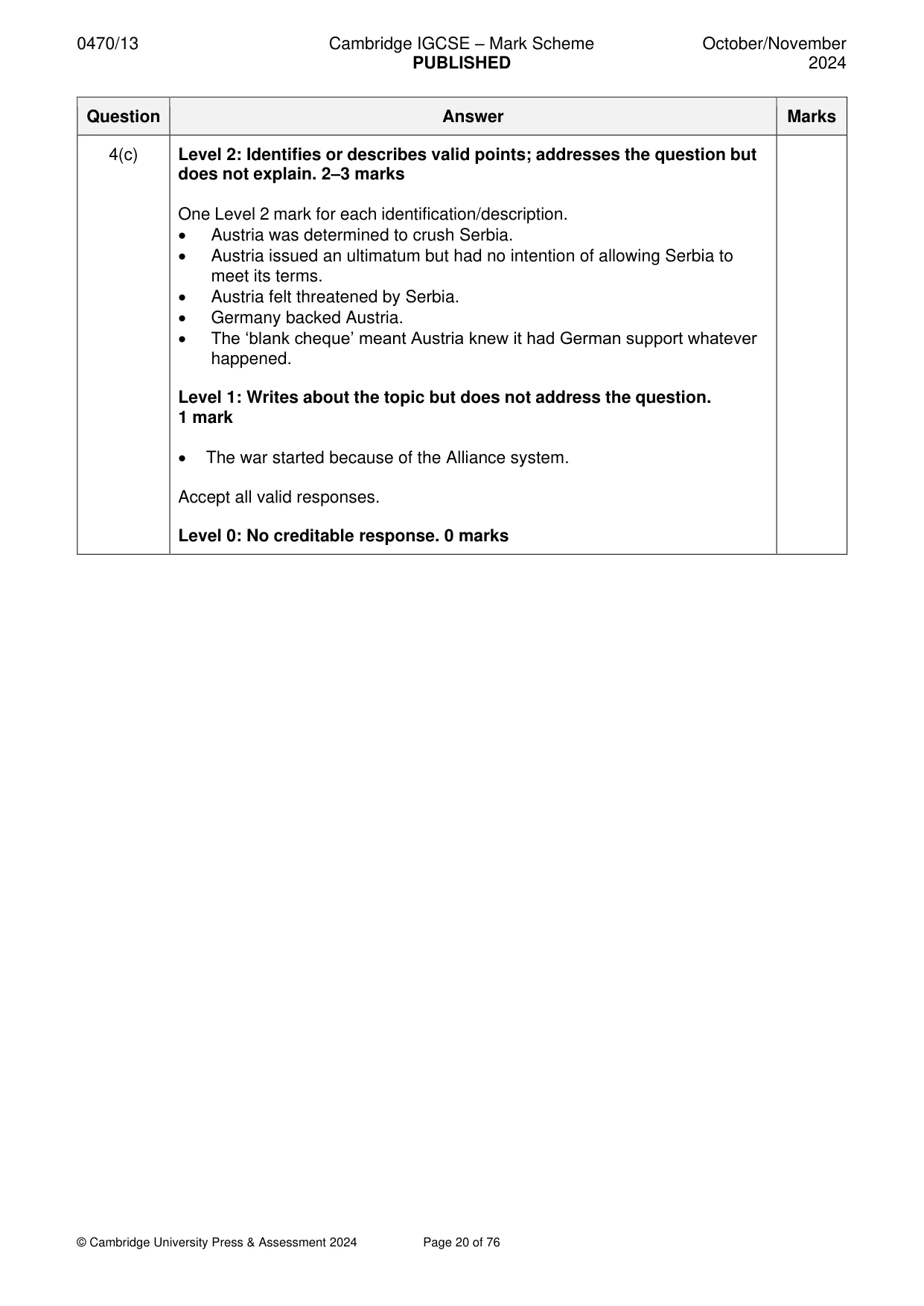
0470/13 Cambridge IGCSE – Mark Scheme PUBLISHED October/November 2024 © Cambridge University Press & Assessment 2024 Page 20 of 76 Question Answer Marks 4(c) Level 2: Identifies or describes valid points; addresses the question but does not explain. 2–3 marks One Level 2 mark for each identification/description. • Austria was determined to crush Serbia. • Austria issued an ultimatum but had no intention of allowing Serbia to meet its terms. • Austria felt threatened by Serbia. • Germany backed Austria. • The ‘blank cheque’ meant Austria knew it had German support whatever happened. Level 1: Writes about the topic but does not address the question. 1 mark • The war started because of the Alliance system. Accept all valid responses. Level 0: No creditable response. 0 marks
Mark scheme, page 21
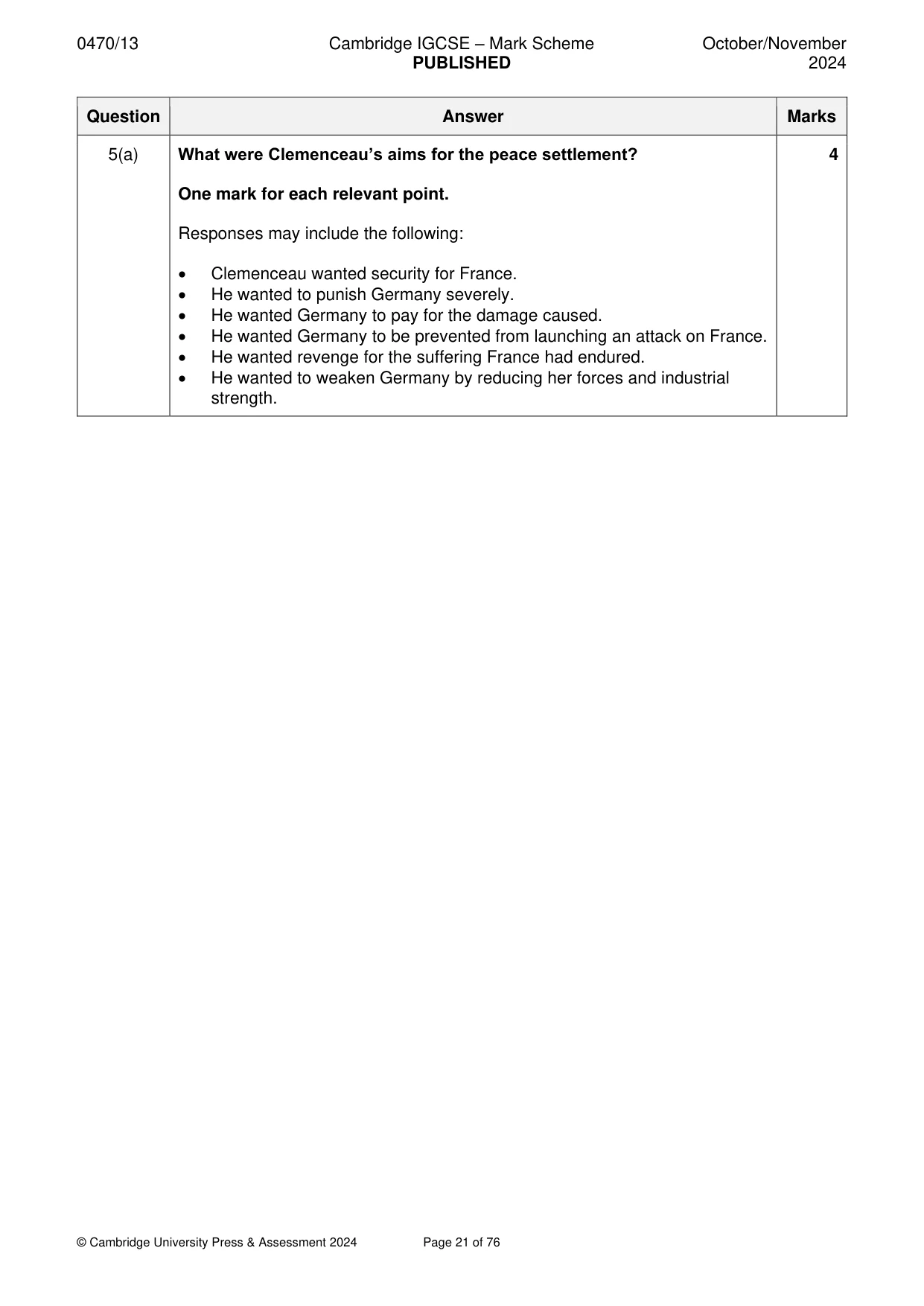
0470/13 Cambridge IGCSE – Mark Scheme PUBLISHED October/November 2024 © Cambridge University Press & Assessment 2024 Page 21 of 76 Question Answer Marks 5(a) What were Clemenceau’s aims for the peace settlement? One mark for each relevant point. Responses may include the following: • Clemenceau wanted security for France. • He wanted to punish Germany severely. • He wanted Germany to pay for the damage caused. • He wanted Germany to be prevented from launching an attack on France. • He wanted revenge for the suffering France had endured. • He wanted to weaken Germany by reducing her forces and industrial strength. 4
Mark scheme, page 22
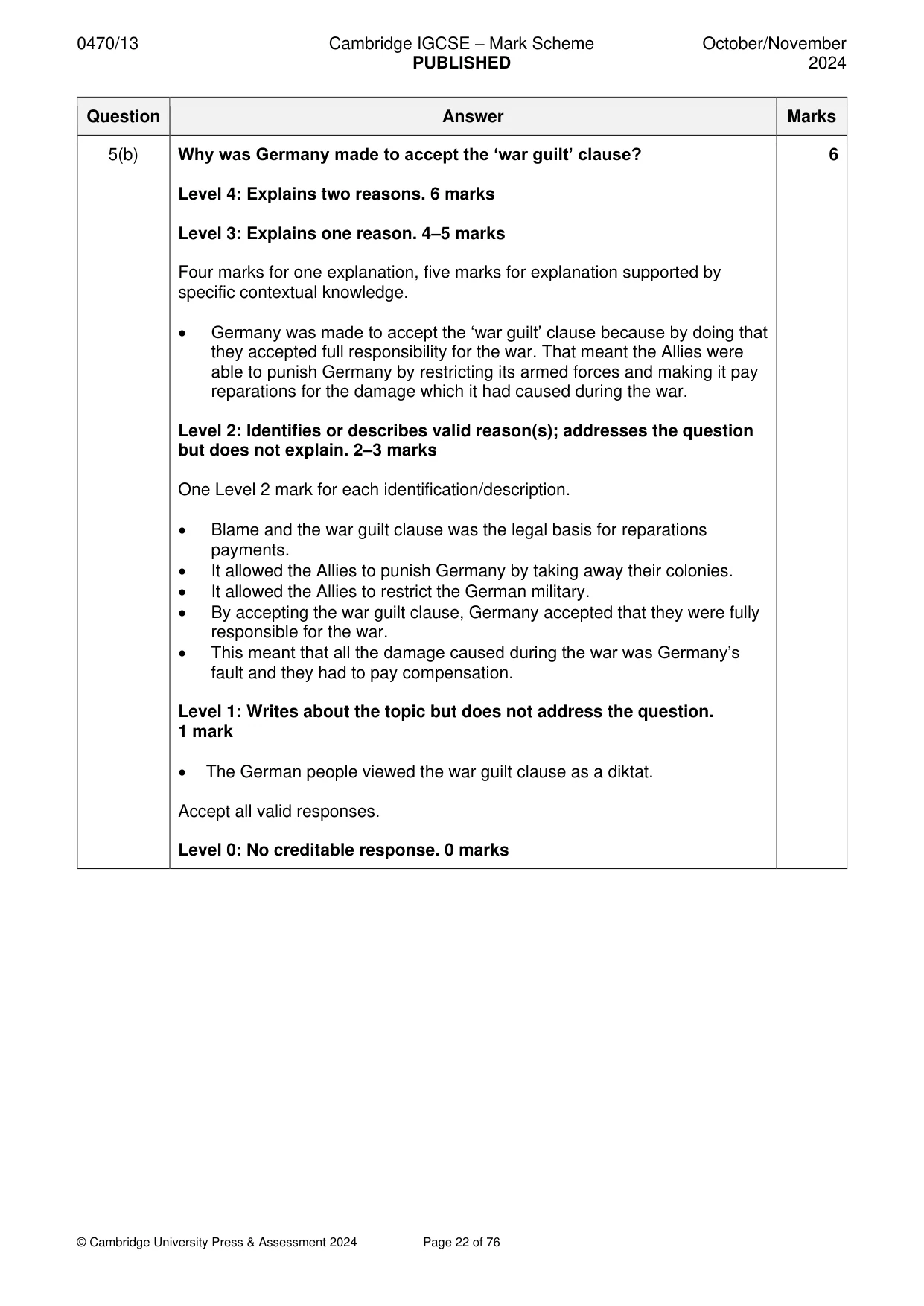
0470/13 Cambridge IGCSE – Mark Scheme PUBLISHED October/November 2024 © Cambridge University Press & Assessment 2024 Page 22 of 76 Question Answer Marks 5(b) Why was Germany made to accept the ‘war guilt’ clause? Level 4: Explains two reasons. 6 marks Level 3: Explains one reason. 4–5 marks Four marks for one explanation, five marks for explanation supported by specific contextual knowledge. • Germany was made to accept the ‘war guilt’ clause because by doing that they accepted full responsibility for the war. That meant the Allies were able to punish Germany by restricting its armed forces and making it pay reparations for the damage which it had caused during the war. Level 2: Identifies or describes valid reason(s); addresses the question but does not explain. 2–3 marks One Level 2 mark for each identification/description. • Blame and the war guilt clause was the legal basis for reparations payments. • It allowed the Allies to punish Germany by taking away their colonies. • It allowed the Allies to restrict the German military. • By accepting the war guilt clause, Germany accepted that they were fully responsible for the war. • This meant that all the damage caused during the war was Germany’s fault and they had to pay compensation. Level 1: Writes about the topic but does not address the question. 1 mark • The German people viewed the war guilt clause as a diktat. Accept all valid responses. Level 0: No creditable response. 0 marks 6
Mark scheme, page 23
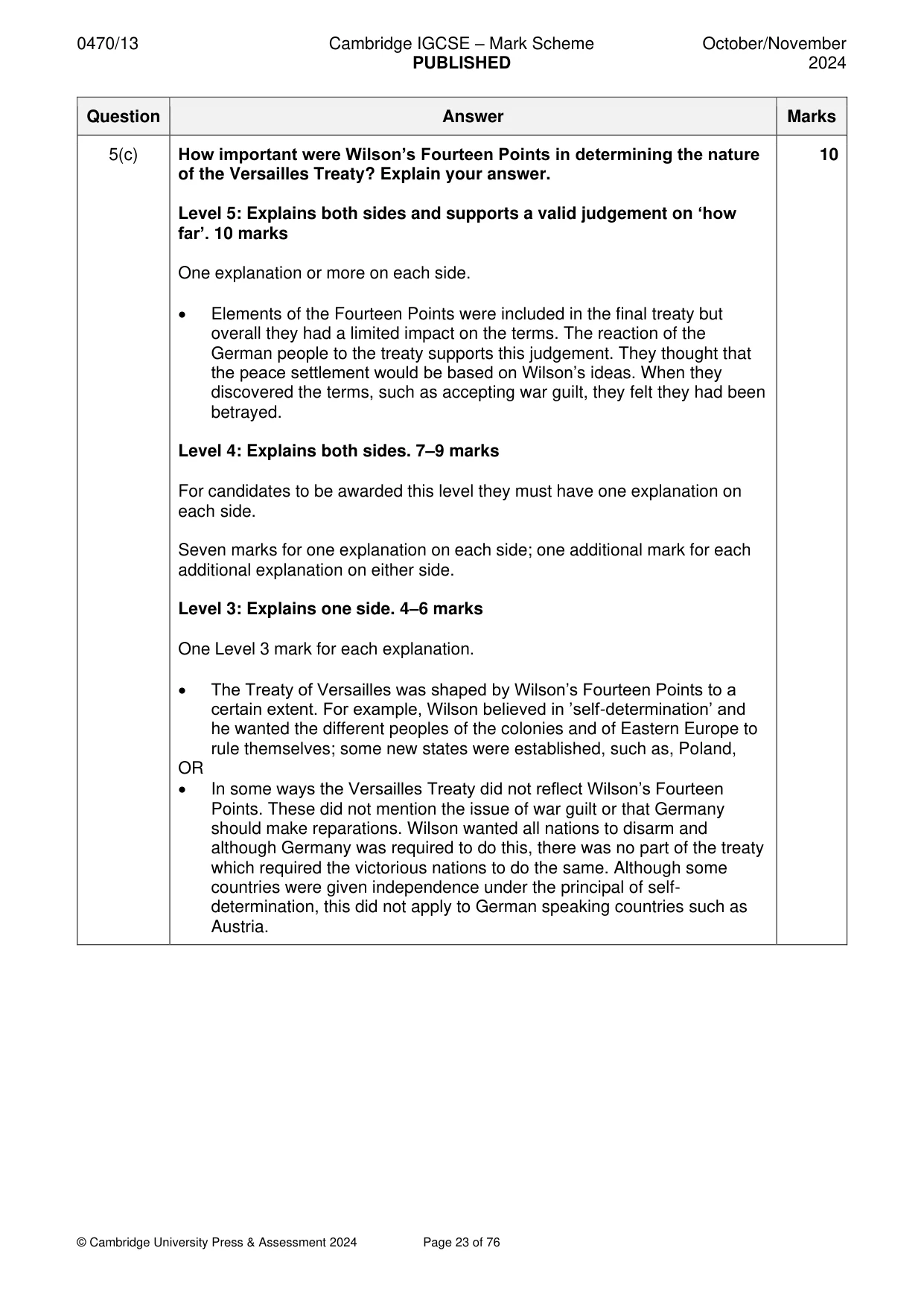
0470/13 Cambridge IGCSE – Mark Scheme PUBLISHED October/November 2024 © Cambridge University Press & Assessment 2024 Page 23 of 76 Question Answer Marks 5(c) How important were Wilson’s Fourteen Points in determining the nature of the Versailles Treaty? Explain your answer. Level 5: Explains both sides and supports a valid judgement on ‘how far’. 10 marks One explanation or more on each side. • Elements of the Fourteen Points were included in the final treaty but overall they had a limited impact on the terms. The reaction of the German people to the treaty supports this judgement. They thought that the peace settlement would be based on Wilson’s ideas. When they discovered the terms, such as accepting war guilt, they felt they had been betrayed. Level 4: Explains both sides. 7–9 marks For candidates to be awarded this level they must have one explanation on each side. Seven marks for one explanation on each side; one additional mark for each additional explanation on either side. Level 3: Explains one side. 4–6 marks One Level 3 mark for each explanation. • The Treaty of Versailles was shaped by Wilson’s Fourteen Points to a certain extent. For example, Wilson believed in ’self-determination’ and he wanted the different peoples of the colonies and of Eastern Europe to rule themselves; some new states were established, such as, Poland, OR • In some ways the Versailles Treaty did not reflect Wilson’s Fourteen Points. These did not mention the issue of war guilt or that Germany should make reparations. Wilson wanted all nations to disarm and although Germany was required to do this, there was no part of the treaty which required the victorious nations to do the same. Although some countries were given independence under the principal of self- determination, this did not apply to German speaking countries such as Austria. 10
Mark scheme, page 24
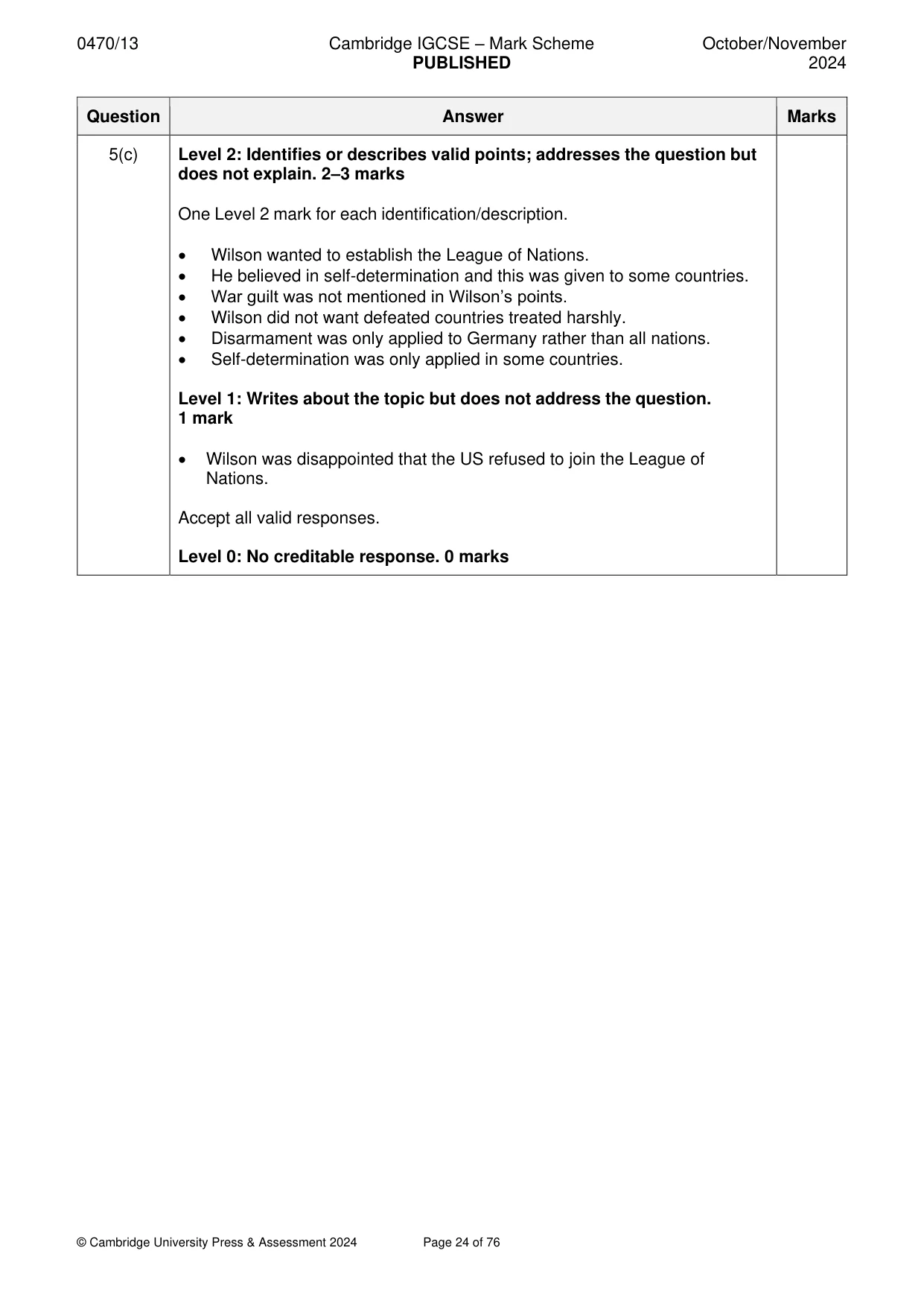
0470/13 Cambridge IGCSE – Mark Scheme PUBLISHED October/November 2024 © Cambridge University Press & Assessment 2024 Page 24 of 76 Question Answer Marks 5(c) Level 2: Identifies or describes valid points; addresses the question but does not explain. 2–3 marks One Level 2 mark for each identification/description. • Wilson wanted to establish the League of Nations. • He believed in self-determination and this was given to some countries. • War guilt was not mentioned in Wilson’s points. • Wilson did not want defeated countries treated harshly. • Disarmament was only applied to Germany rather than all nations. • Self-determination was only applied in some countries. Level 1: Writes about the topic but does not address the question. 1 mark • Wilson was disappointed that the US refused to join the League of Nations. Accept all valid responses. Level 0: No creditable response. 0 marks
Mark scheme, page 25
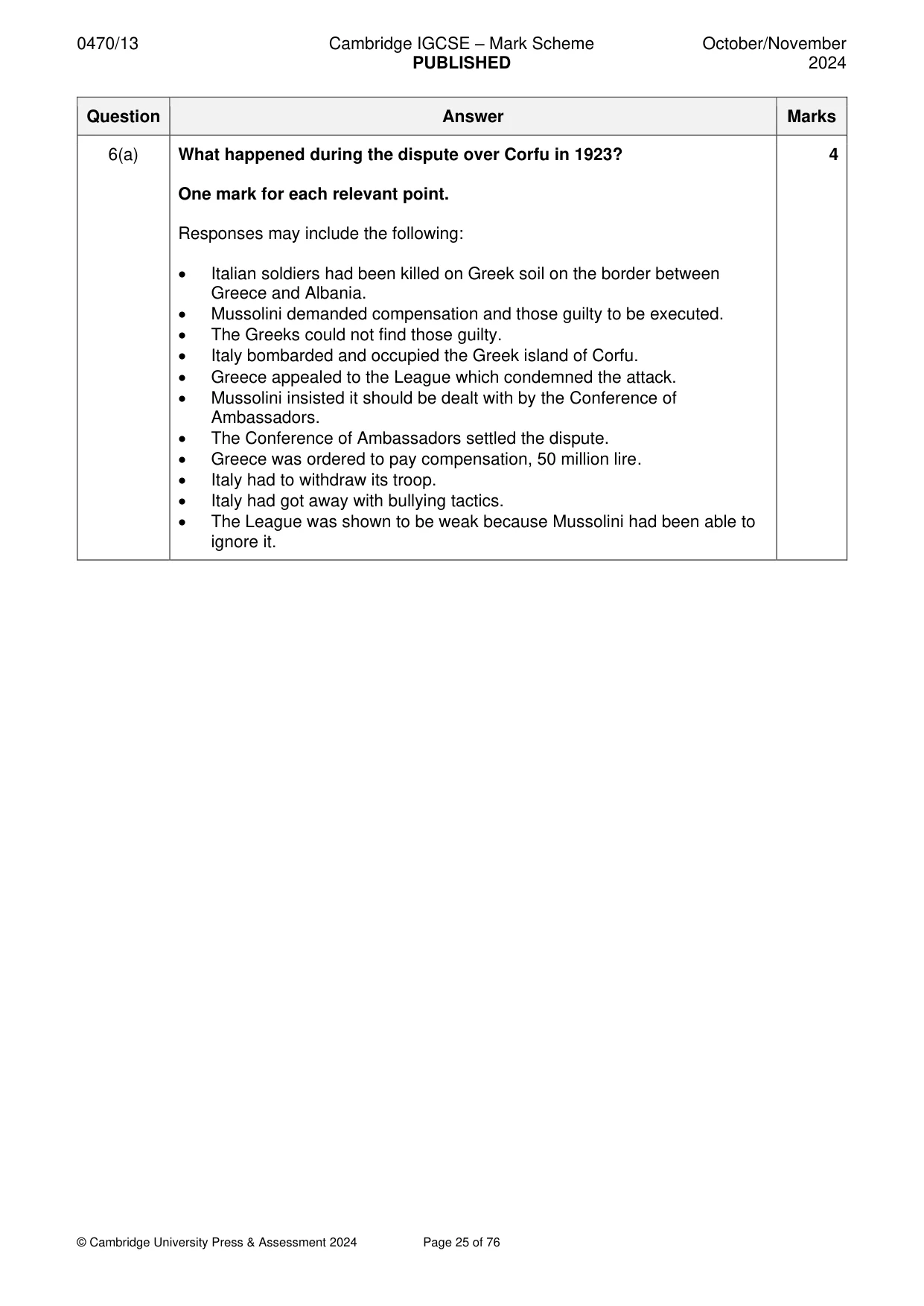
0470/13 Cambridge IGCSE – Mark Scheme PUBLISHED October/November 2024 © Cambridge University Press & Assessment 2024 Page 25 of 76 Question Answer Marks 6(a) What happened during the dispute over Corfu in 1923? One mark for each relevant point. Responses may include the following: • Italian soldiers had been killed on Greek soil on the border between Greece and Albania. • Mussolini demanded compensation and those guilty to be executed. • The Greeks could not find those guilty. • Italy bombarded and occupied the Greek island of Corfu. • Greece appealed to the League which condemned the attack. • Mussolini insisted it should be dealt with by the Conference of Ambassadors. • The Conference of Ambassadors settled the dispute. • Greece was ordered to pay compensation, 50 million lire. • Italy had to withdraw its troop. • Italy had got away with bullying tactics. • The League was shown to be weak because Mussolini had been able to ignore it. 4
Mark scheme, page 26
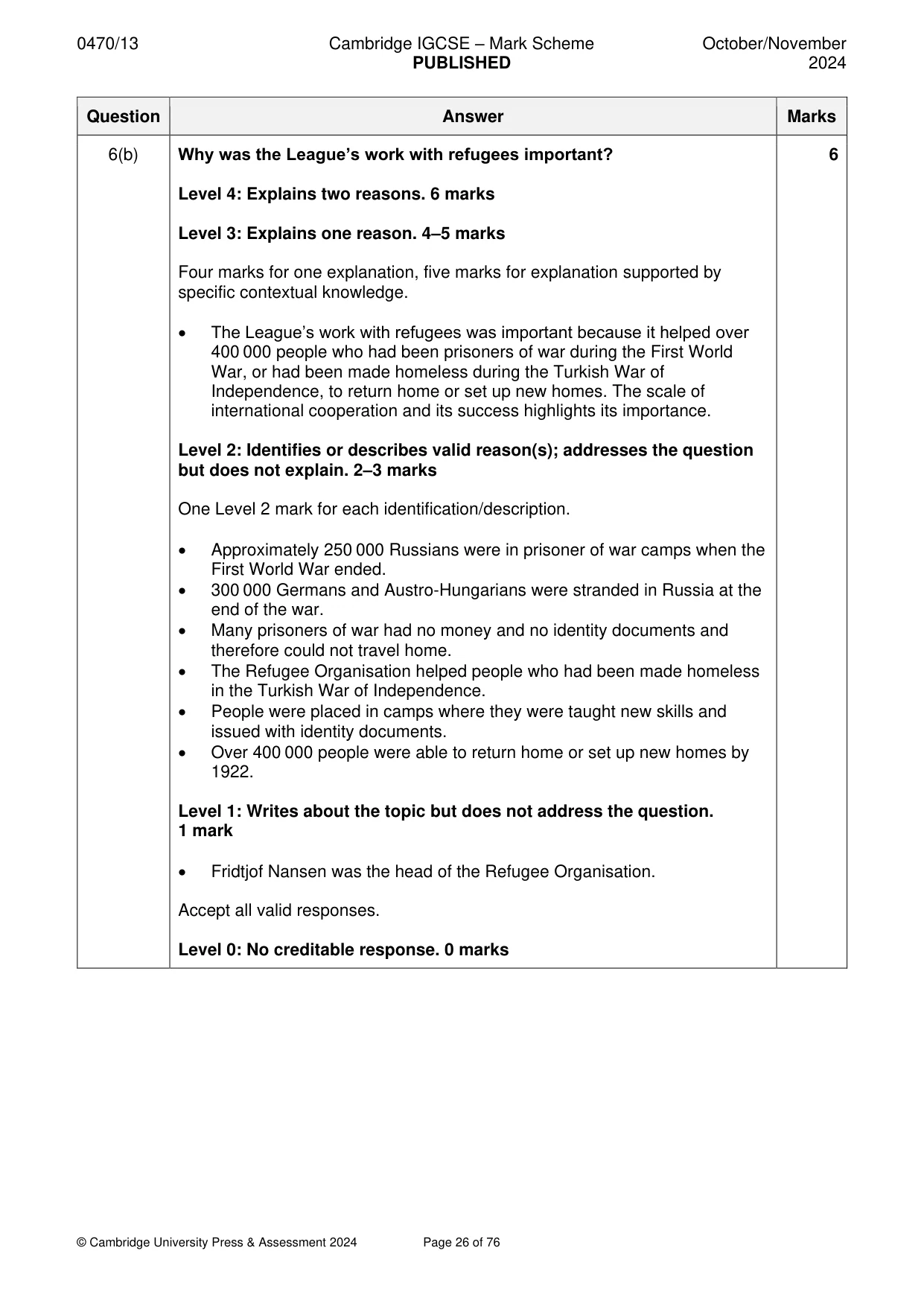
0470/13 Cambridge IGCSE – Mark Scheme PUBLISHED October/November 2024 © Cambridge University Press & Assessment 2024 Page 26 of 76 Question Answer Marks 6(b) Why was the League’s work with refugees important? Level 4: Explains two reasons. 6 marks Level 3: Explains one reason. 4–5 marks Four marks for one explanation, five marks for explanation supported by specific contextual knowledge. • The League’s work with refugees was important because it helped over 400 000 people who had been prisoners of war during the First World War, or had been made homeless during the Turkish War of Independence, to return home or set up new homes. The scale of international cooperation and its success highlights its importance. Level 2: Identifies or describes valid reason(s); addresses the question but does not explain. 2–3 marks One Level 2 mark for each identification/description. • Approximately 250 000 Russians were in prisoner of war camps when the First World War ended. • 300 000 Germans and Austro-Hungarians were stranded in Russia at the end of the war. • Many prisoners of war had no money and no identity documents and therefore could not travel home. • The Refugee Organisation helped people who had been made homeless in the Turkish War of Independence. • People were placed in camps where they were taught new skills and issued with identity documents. • Over 400 000 people were able to return home or set up new homes by 1922. Level 1: Writes about the topic but does not address the question. 1 mark • Fridtjof Nansen was the head of the Refugee Organisation. Accept all valid responses. Level 0: No creditable response. 0 marks 6
Mark scheme, page 27
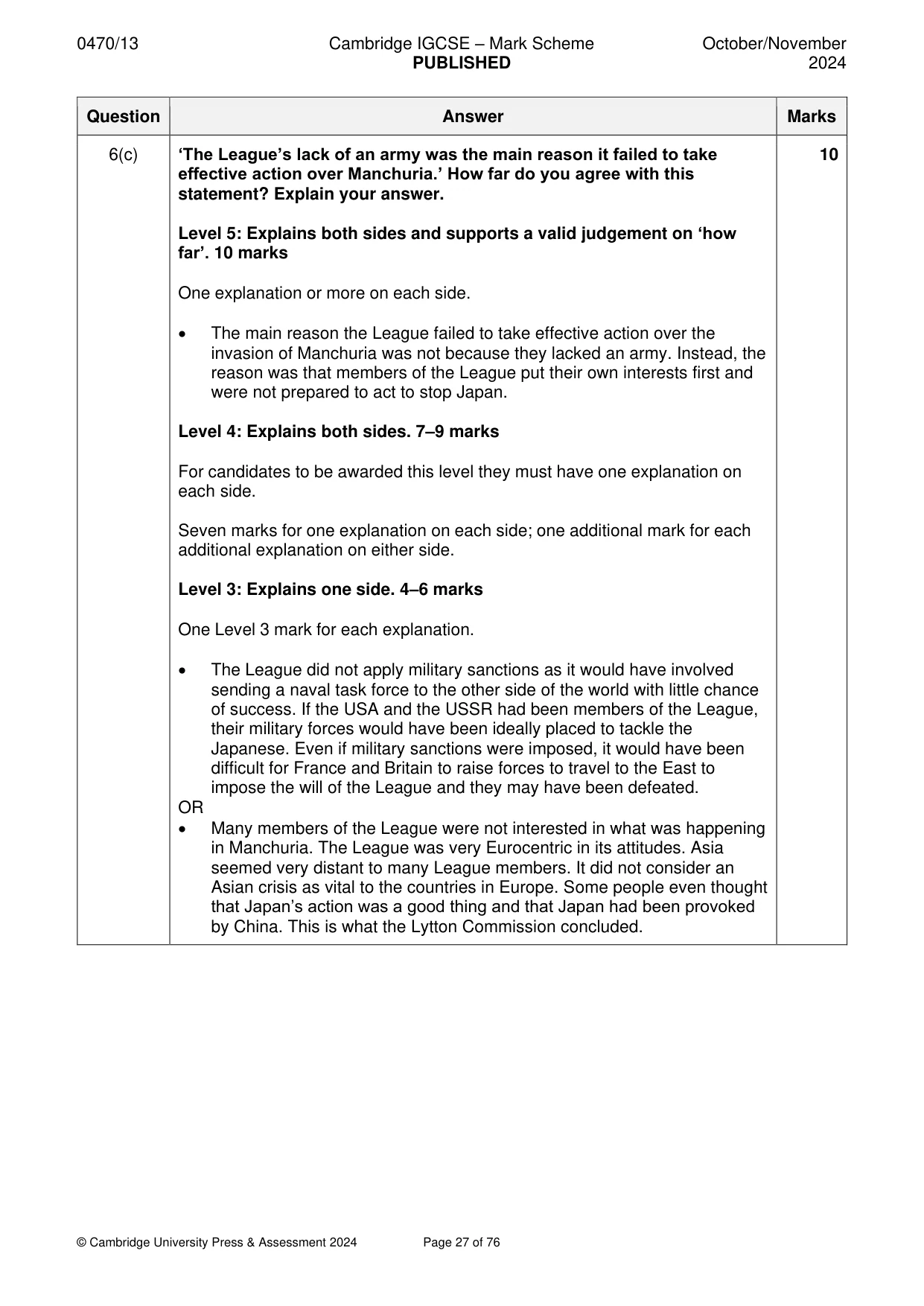
0470/13 Cambridge IGCSE – Mark Scheme PUBLISHED October/November 2024 © Cambridge University Press & Assessment 2024 Page 27 of 76 Question Answer Marks 6(c) ‘The League’s lack of an army was the main reason it failed to take effective action over Manchuria.’ How far do you agree with this statement? Explain your answer. Level 5: Explains both sides and supports a valid judgement on ‘how far’. 10 marks One explanation or more on each side. • The main reason the League failed to take effective action over the invasion of Manchuria was not because they lacked an army. Instead, the reason was that members of the League put their own interests first and were not prepared to act to stop Japan. Level 4: Explains both sides. 7–9 marks For candidates to be awarded this level they must have one explanation on each side. Seven marks for one explanation on each side; one additional mark for each additional explanation on either side. Level 3: Explains one side. 4–6 marks One Level 3 mark for each explanation. • The League did not apply military sanctions as it would have involved sending a naval task force to the other side of the world with little chance of success. If the USA and the USSR had been members of the League, their military forces would have been ideally placed to tackle the Japanese. Even if military sanctions were imposed, it would have been difficult for France and Britain to raise forces to travel to the East to impose the will of the League and they may have been defeated. OR • Many members of the League were not interested in what was happening in Manchuria. The League was very Eurocentric in its attitudes. Asia seemed very distant to many League members. It did not consider an Asian crisis as vital to the countries in Europe. Some people even thought that Japan’s action was a good thing and that Japan had been provoked by China. This is what the Lytton Commission concluded. 10
Mark scheme, page 28
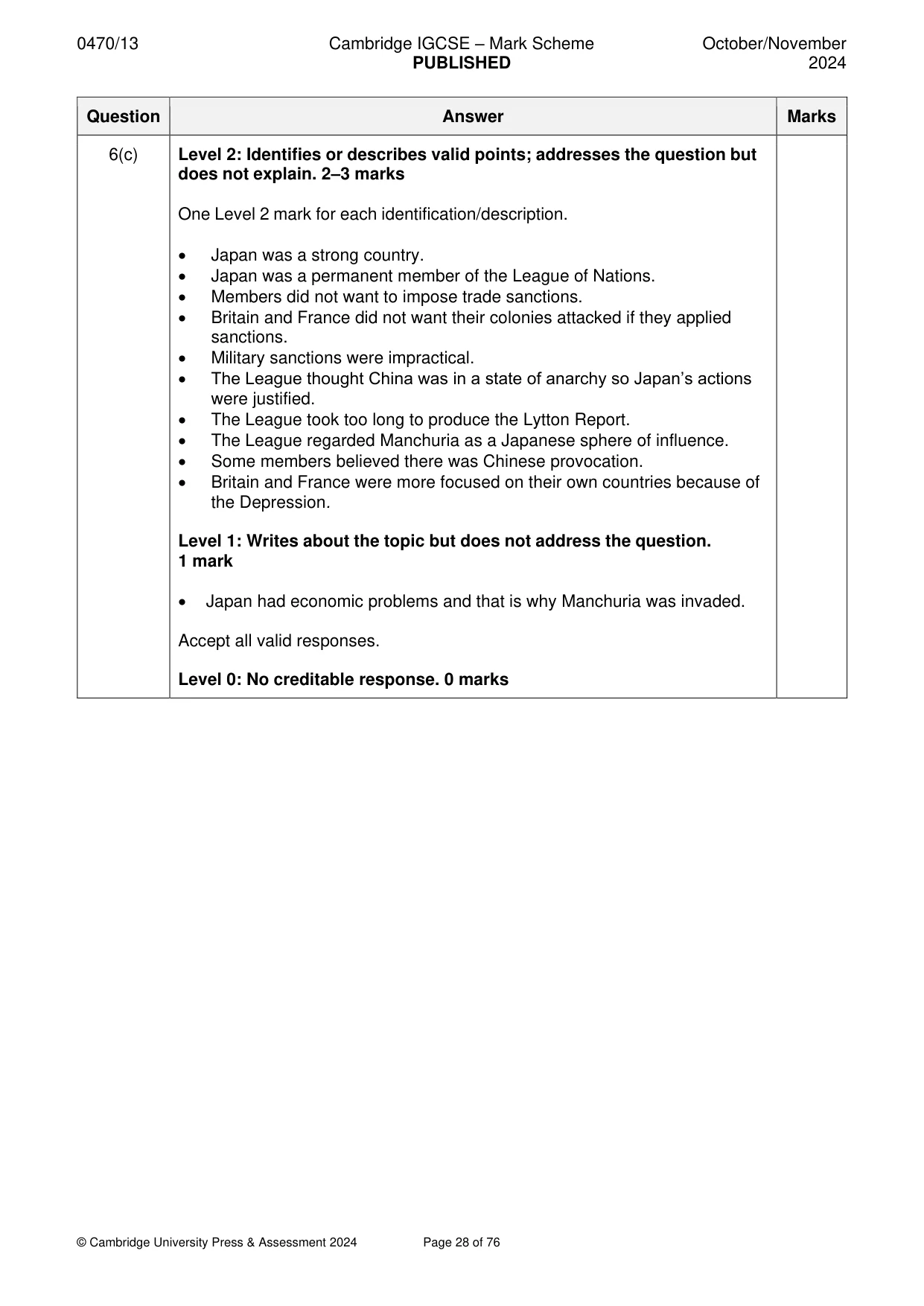
0470/13 Cambridge IGCSE – Mark Scheme PUBLISHED October/November 2024 © Cambridge University Press & Assessment 2024 Page 28 of 76 Question Answer Marks 6(c) Level 2: Identifies or describes valid points; addresses the question but does not explain. 2–3 marks One Level 2 mark for each identification/description. • Japan was a strong country. • Japan was a permanent member of the League of Nations. • Members did not want to impose trade sanctions. • Britain and France did not want their colonies attacked if they applied sanctions. • Military sanctions were impractical. • The League thought China was in a state of anarchy so Japan’s actions were justified. • The League took too long to produce the Lytton Report. • The League regarded Manchuria as a Japanese sphere of influence. • Some members believed there was Chinese provocation. • Britain and France were more focused on their own countries because of the Depression. Level 1: Writes about the topic but does not address the question. 1 mark • Japan had economic problems and that is why Manchuria was invaded. Accept all valid responses. Level 0: No creditable response. 0 marks
Mark scheme, page 29
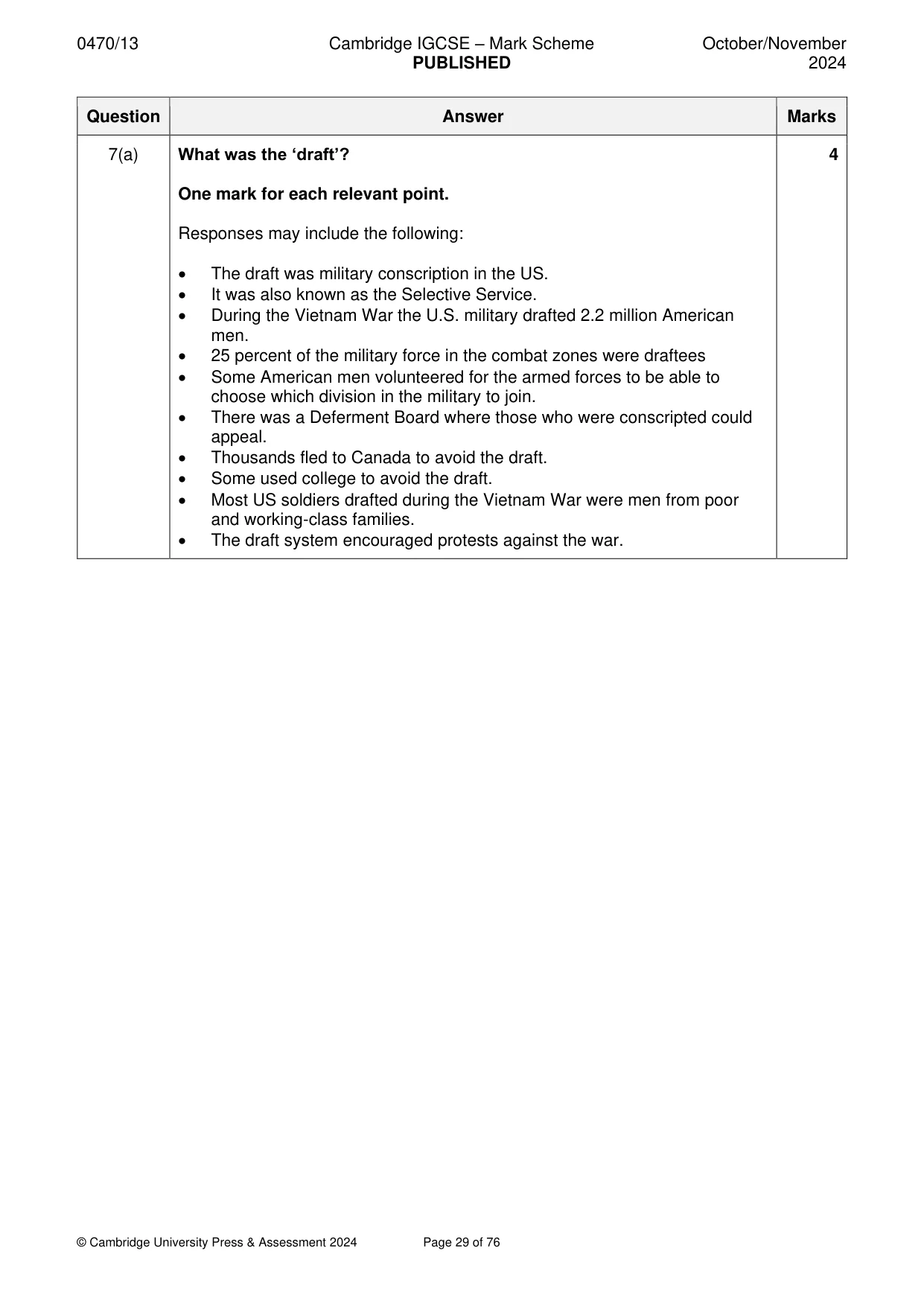
0470/13 Cambridge IGCSE – Mark Scheme PUBLISHED October/November 2024 © Cambridge University Press & Assessment 2024 Page 29 of 76 Question Answer Marks 7(a) What was the ‘draft’? One mark for each relevant point. Responses may include the following: • The draft was military conscription in the US. • It was also known as the Selective Service. • During the Vietnam War the U.S. military drafted 2.2 million American men. • 25 percent of the military force in the combat zones were draftees • Some American men volunteered for the armed forces to be able to choose which division in the military to join. • There was a Deferment Board where those who were conscripted could appeal. • Thousands fled to Canada to avoid the draft. • Some used college to avoid the draft. • Most US soldiers drafted during the Vietnam War were men from poor and working-class families. • The draft system encouraged protests against the war. 4
Mark scheme, page 30
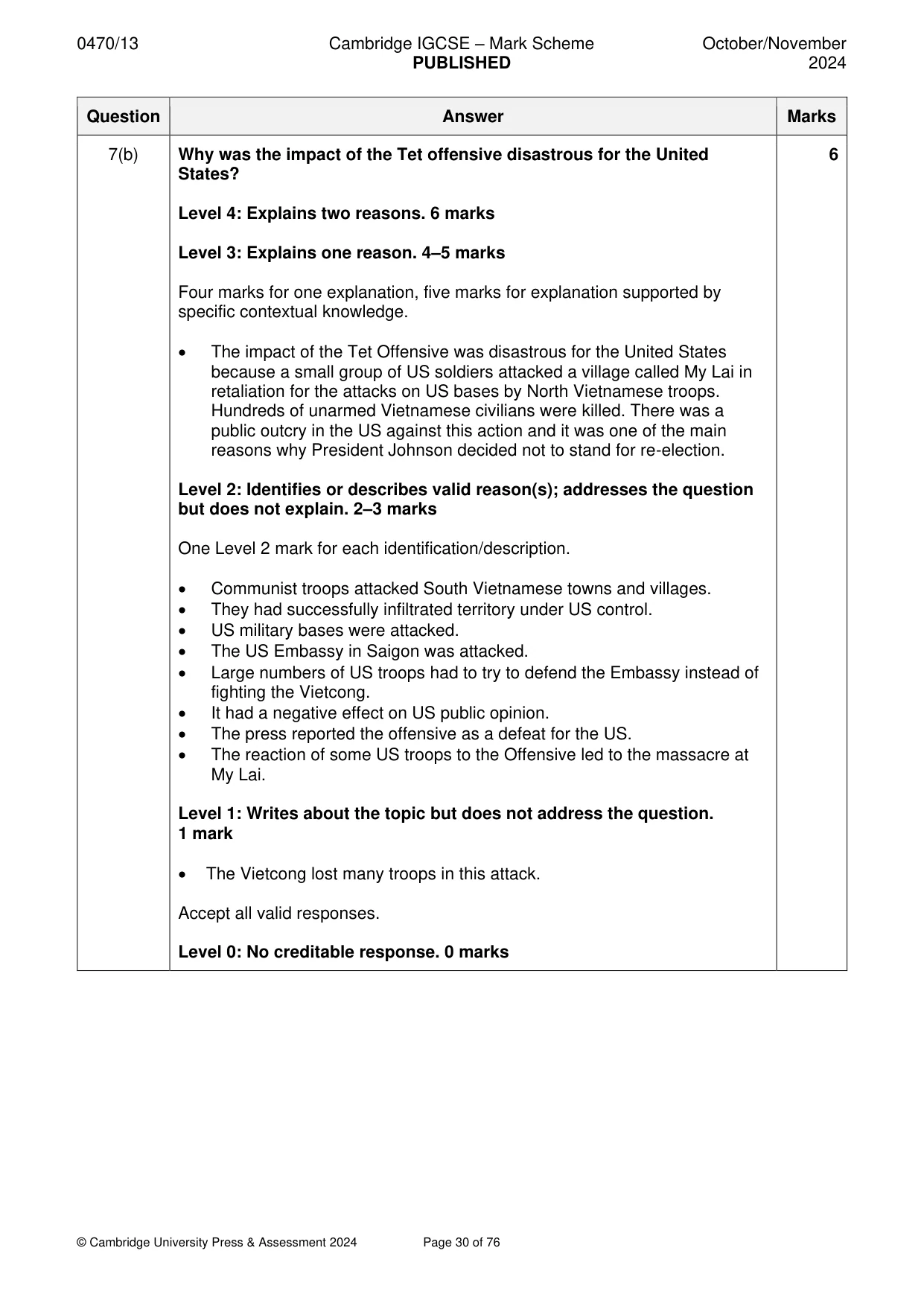
0470/13 Cambridge IGCSE – Mark Scheme PUBLISHED October/November 2024 © Cambridge University Press & Assessment 2024 Page 30 of 76 Question Answer Marks 7(b) Why was the impact of the Tet offensive disastrous for the United States? Level 4: Explains two reasons. 6 marks Level 3: Explains one reason. 4–5 marks Four marks for one explanation, five marks for explanation supported by specific contextual knowledge. • The impact of the Tet Offensive was disastrous for the United States because a small group of US soldiers attacked a village called My Lai in retaliation for the attacks on US bases by North Vietnamese troops. Hundreds of unarmed Vietnamese civilians were killed. There was a public outcry in the US against this action and it was one of the main reasons why President Johnson decided not to stand for re-election. Level 2: Identifies or describes valid reason(s); addresses the question but does not explain. 2–3 marks One Level 2 mark for each identification/description. • Communist troops attacked South Vietnamese towns and villages. • They had successfully infiltrated territory under US control. • US military bases were attacked. • The US Embassy in Saigon was attacked. • Large numbers of US troops had to try to defend the Embassy instead of fighting the Vietcong. • It had a negative effect on US public opinion. • The press reported the offensive as a defeat for the US. • The reaction of some US troops to the Offensive led to the massacre at My Lai. Level 1: Writes about the topic but does not address the question. 1 mark • The Vietcong lost many troops in this attack. Accept all valid responses. Level 0: No creditable response. 0 marks 6
Mark scheme, page 31
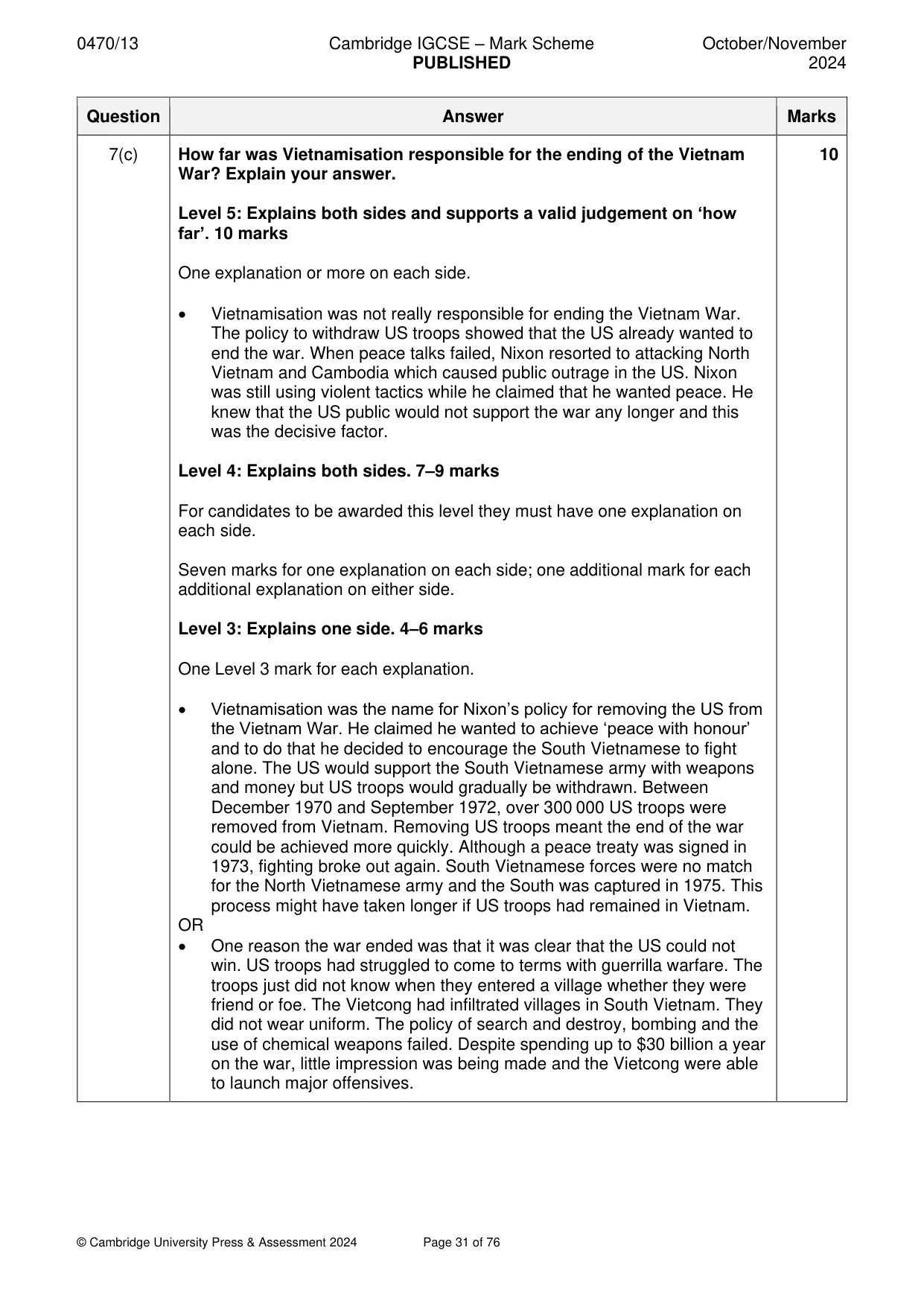
0470/13 Cambridge IGCSE – Mark Scheme PUBLISHED October/November 2024 © Cambridge University Press & Assessment 2024 Page 31 of 76 Question Answer Marks 7(c) How far was Vietnamisation responsible for the ending of the Vietnam War? Explain your answer. Level 5: Explains both sides and supports a valid judgement on ‘how far’. 10 marks One explanation or more on each side. • Vietnamisation was not really responsible for ending the Vietnam War. The policy to withdraw US troops showed that the US already wanted to end the war. When peace talks failed, Nixon resorted to attacking North Vietnam and Cambodia which caused public outrage in the US. Nixon was still using violent tactics while he claimed that he wanted peace. He knew that the US public would not support the war any longer and this was the decisive factor. Level 4: Explains both sides. 7–9 marks For candidates to be awarded this level they must have one explanation on each side. Seven marks for one explanation on each side; one additional mark for each additional explanation on either side. Level 3: Explains one side. 4–6 marks One Level 3 mark for each explanation. • Vietnamisation was the name for Nixon’s policy for removing the US from the Vietnam War. He claimed he wanted to achieve ‘peace with honour’ and to do that he decided to encourage the South Vietnamese to fight alone. The US would support the South Vietnamese army with weapons and money but US troops would gradually be withdrawn. Between December 1970 and September 1972, over 300 000 US troops were removed from Vietnam. Removing US troops meant the end of the war could be achieved more quickly. Although a peace treaty was signed in 1973, fighting broke out again. South Vietnamese forces were no match for the North Vietnamese army and the South was captured in 1975. This process might have taken longer if US troops had remained in Vietnam. OR • One reason the war ended was that it was clear that the US could not win. US troops had struggled to come to terms with guerrilla warfare. The troops just did not know when they entered a village whether they were friend or foe. The Vietcong had infiltrated villages in South Vietnam. They did not wear uniform. The policy of search and destroy, bombing and the use of chemical weapons failed. Despite spending up to $30 billion a year on the war, little impression was being made and the Vietcong were able to launch major offensives. 10
Mark scheme, page 32
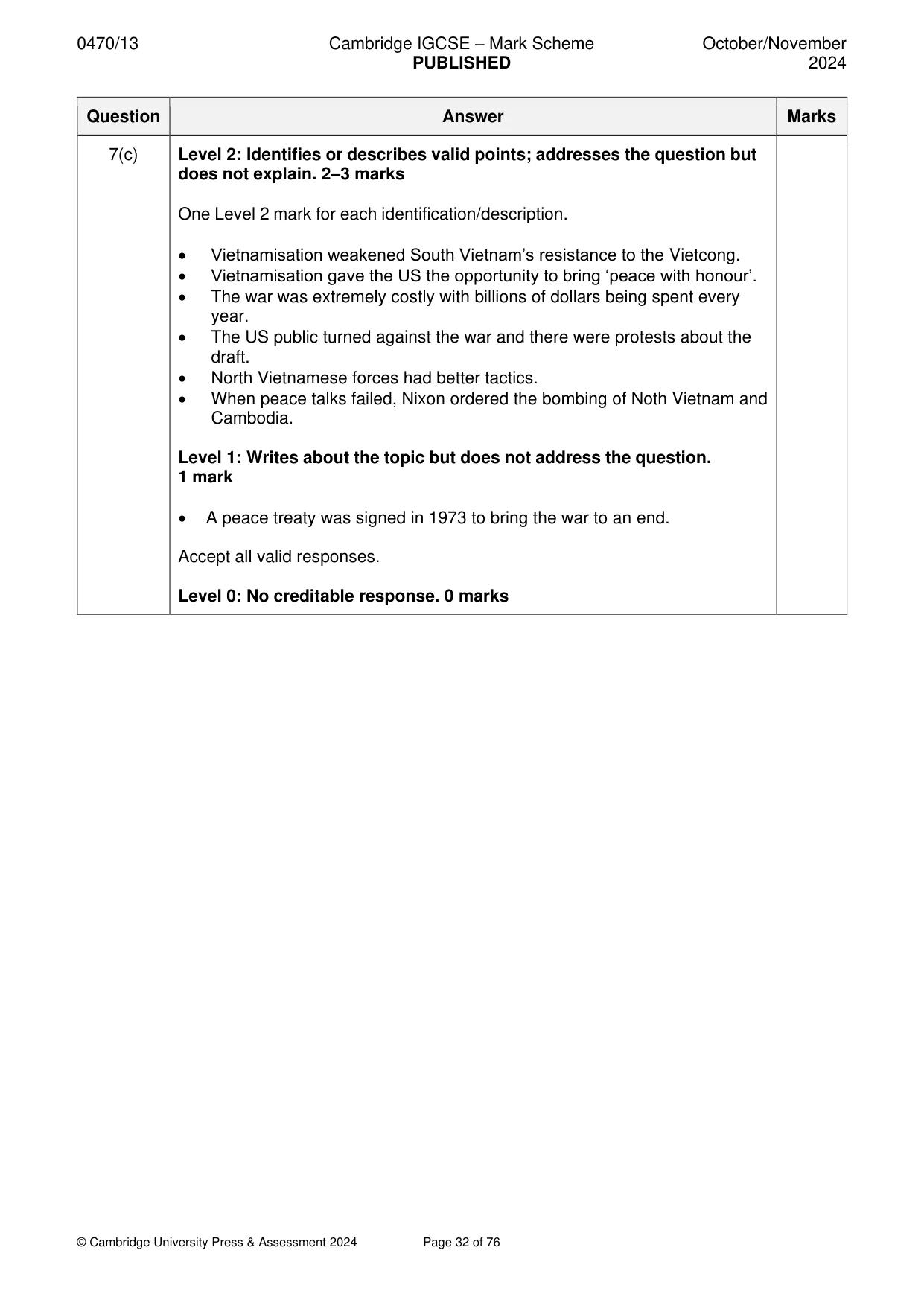
0470/13 Cambridge IGCSE – Mark Scheme PUBLISHED October/November 2024 © Cambridge University Press & Assessment 2024 Page 32 of 76 Question Answer Marks 7(c) Level 2: Identifies or describes valid points; addresses the question but does not explain. 2–3 marks One Level 2 mark for each identification/description. • Vietnamisation weakened South Vietnam’s resistance to the Vietcong. • Vietnamisation gave the US the opportunity to bring ‘peace with honour’. • The war was extremely costly with billions of dollars being spent every year. • The US public turned against the war and there were protests about the draft. • North Vietnamese forces had better tactics. • When peace talks failed, Nixon ordered the bombing of Noth Vietnam and Cambodia. Level 1: Writes about the topic but does not address the question. 1 mark • A peace treaty was signed in 1973 to bring the war to an end. Accept all valid responses. Level 0: No creditable response. 0 marks
Mark scheme, page 33
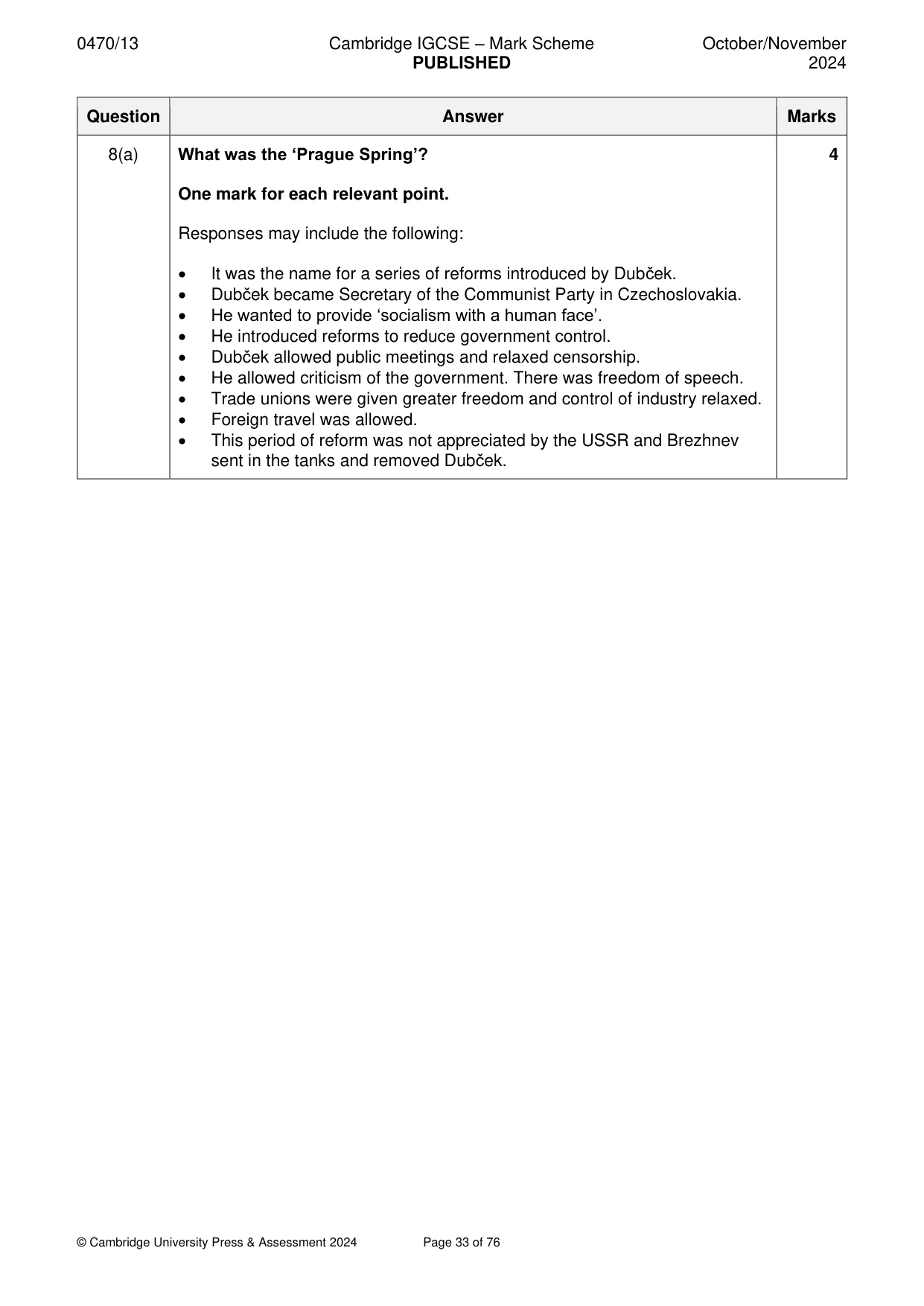
0470/13 Cambridge IGCSE – Mark Scheme PUBLISHED October/November 2024 © Cambridge University Press & Assessment 2024 Page 33 of 76 Question Answer Marks 8(a) What was the ‘Prague Spring’? One mark for each relevant point. Responses may include the following: • It was the name for a series of reforms introduced by Dubček. • Dubček became Secretary of the Communist Party in Czechoslovakia. • He wanted to provide ‘socialism with a human face’. • He introduced reforms to reduce government control. • Dubček allowed public meetings and relaxed censorship. • He allowed criticism of the government. There was freedom of speech. • Trade unions were given greater freedom and control of industry relaxed. • Foreign travel was allowed. • This period of reform was not appreciated by the USSR and Brezhnev sent in the tanks and removed Dubček. 4
Mark scheme, page 34
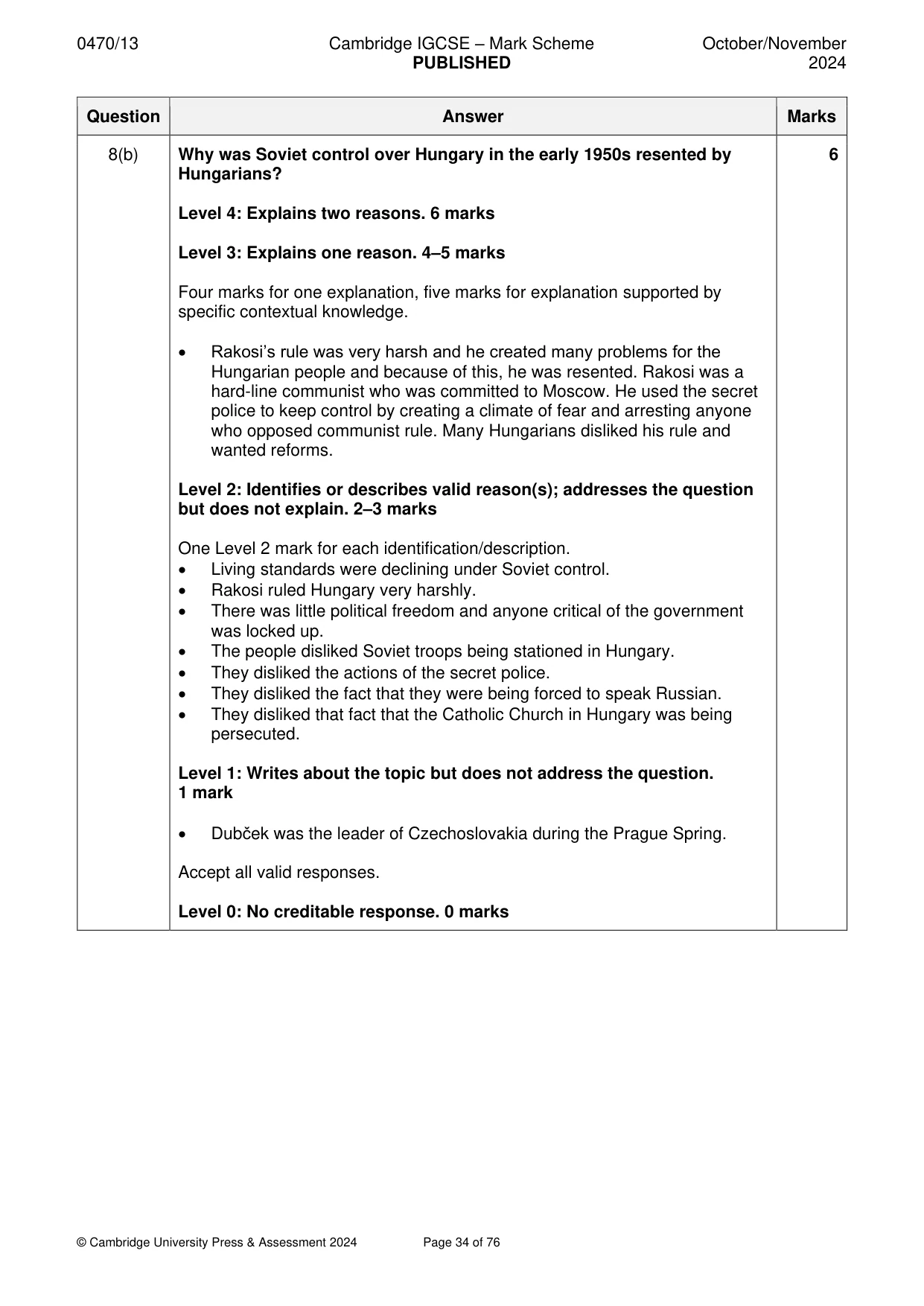
0470/13 Cambridge IGCSE – Mark Scheme PUBLISHED October/November 2024 © Cambridge University Press & Assessment 2024 Page 34 of 76 Question Answer Marks 8(b) Why was Soviet control over Hungary in the early 1950s resented by Hungarians? Level 4: Explains two reasons. 6 marks Level 3: Explains one reason. 4–5 marks Four marks for one explanation, five marks for explanation supported by specific contextual knowledge. • Rakosi’s rule was very harsh and he created many problems for the Hungarian people and because of this, he was resented. Rakosi was a hard-line communist who was committed to Moscow. He used the secret police to keep control by creating a climate of fear and arresting anyone who opposed communist rule. Many Hungarians disliked his rule and wanted reforms. Level 2: Identifies or describes valid reason(s); addresses the question but does not explain. 2–3 marks One Level 2 mark for each identification/description. • Living standards were declining under Soviet control. • Rakosi ruled Hungary very harshly. • There was little political freedom and anyone critical of the government was locked up. • The people disliked Soviet troops being stationed in Hungary. • They disliked the actions of the secret police. • They disliked the fact that they were being forced to speak Russian. • They disliked that fact that the Catholic Church in Hungary was being persecuted. Level 1: Writes about the topic but does not address the question. 1 mark • Dubček was the leader of Czechoslovakia during the Prague Spring. Accept all valid responses. Level 0: No creditable response. 0 marks 6
Mark scheme, page 35
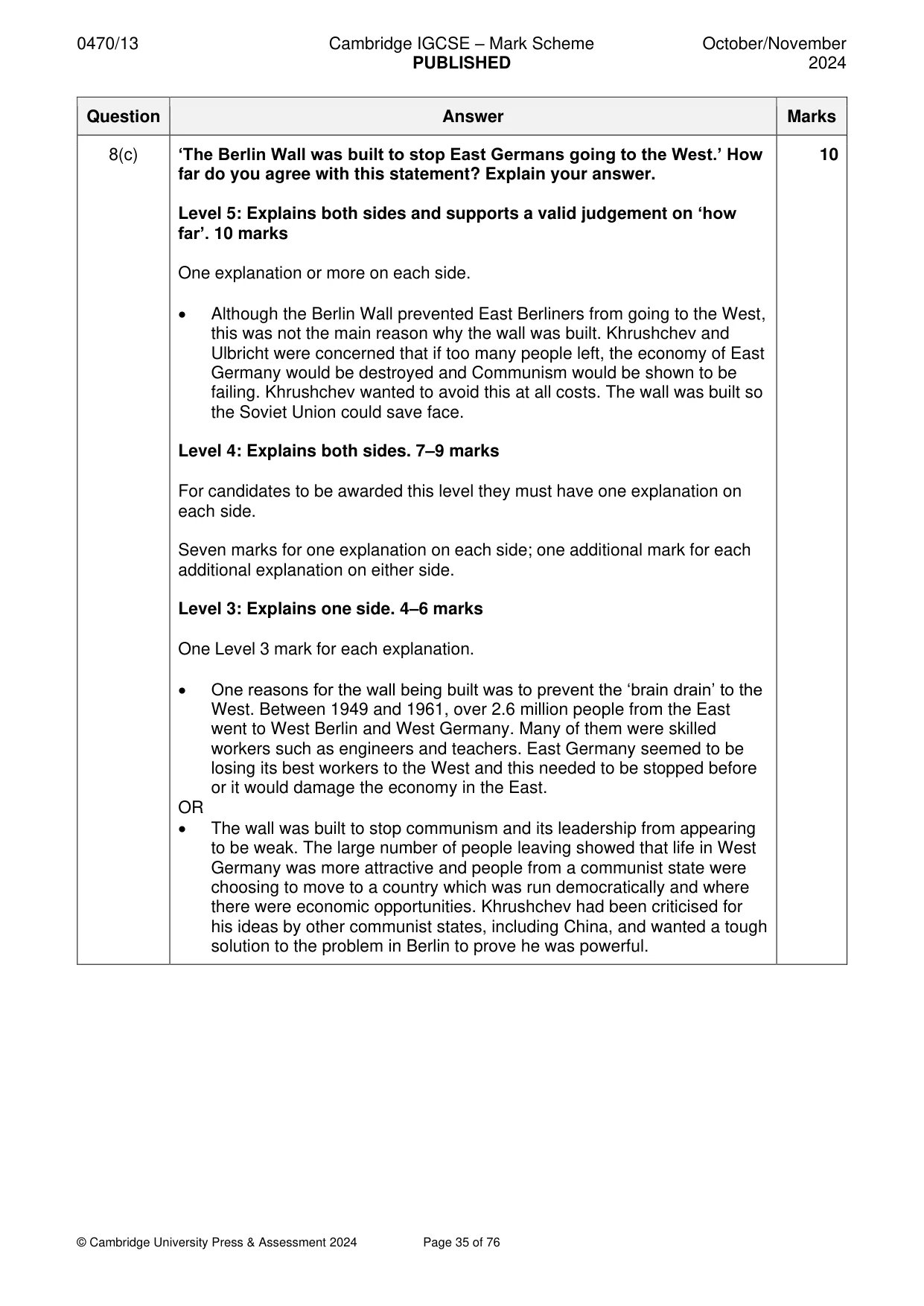
0470/13 Cambridge IGCSE – Mark Scheme PUBLISHED October/November 2024 © Cambridge University Press & Assessment 2024 Page 35 of 76 Question Answer Marks 8(c) ‘The Berlin Wall was built to stop East Germans going to the West.’ How far do you agree with this statement? Explain your answer. Level 5: Explains both sides and supports a valid judgement on ‘how far’. 10 marks One explanation or more on each side. • Although the Berlin Wall prevented East Berliners from going to the West, this was not the main reason why the wall was built. Khrushchev and Ulbricht were concerned that if too many people left, the economy of East Germany would be destroyed and Communism would be shown to be failing. Khrushchev wanted to avoid this at all costs. The wall was built so the Soviet Union could save face. Level 4: Explains both sides. 7–9 marks For candidates to be awarded this level they must have one explanation on each side. Seven marks for one explanation on each side; one additional mark for each additional explanation on either side. Level 3: Explains one side. 4–6 marks One Level 3 mark for each explanation. • One reasons for the wall being built was to prevent the ‘brain drain’ to the West. Between 1949 and 1961, over 2.6 million people from the East went to West Berlin and West Germany. Many of them were skilled workers such as engineers and teachers. East Germany seemed to be losing its best workers to the West and this needed to be stopped before or it would damage the economy in the East. OR • The wall was built to stop communism and its leadership from appearing to be weak. The large number of people leaving showed that life in West Germany was more attractive and people from a communist state were choosing to move to a country which was run democratically and where there were economic opportunities. Khrushchev had been criticised for his ideas by other communist states, including China, and wanted a tough solution to the problem in Berlin to prove he was powerful. 10
Mark scheme, page 36
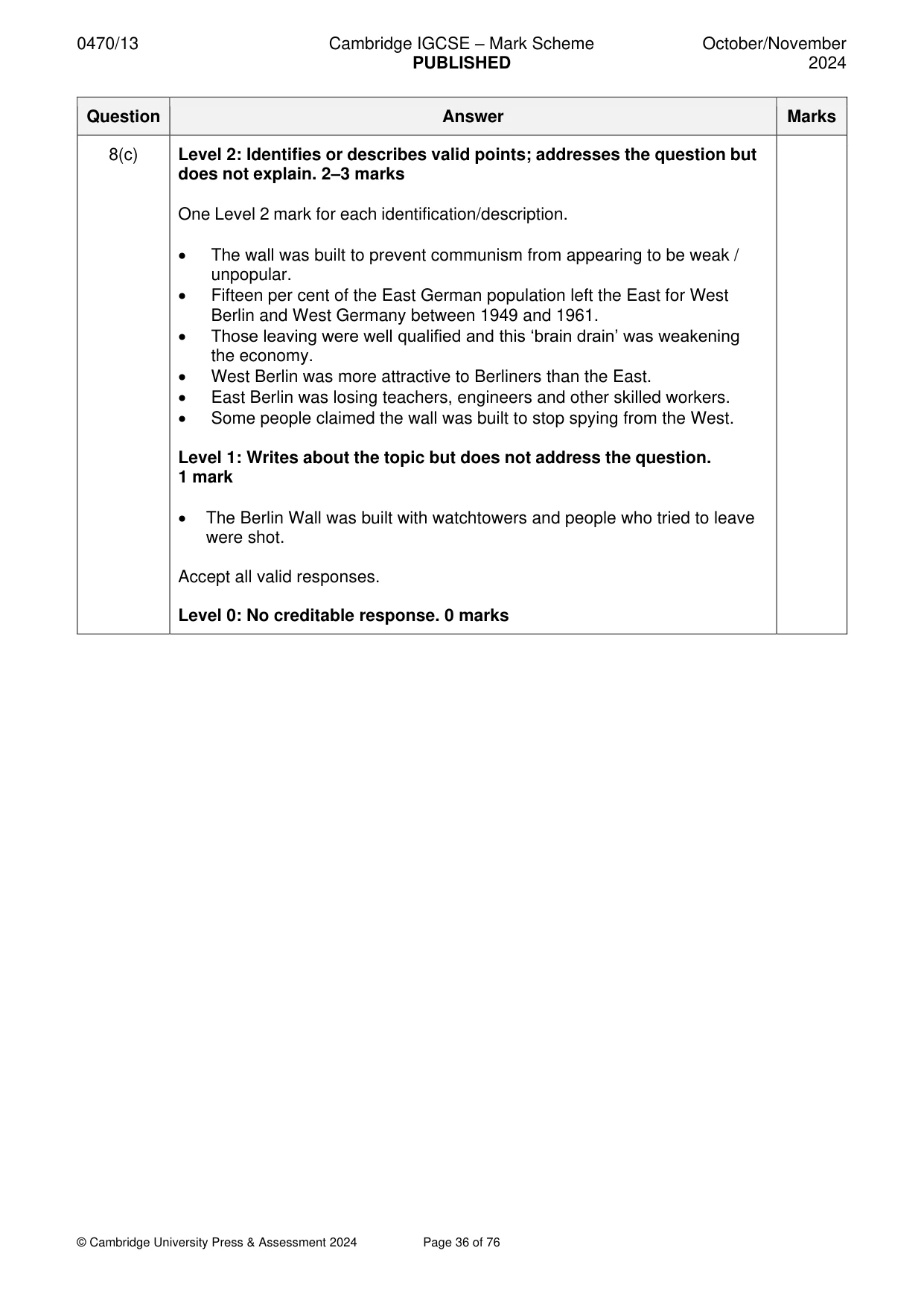
0470/13 Cambridge IGCSE – Mark Scheme PUBLISHED October/November 2024 © Cambridge University Press & Assessment 2024 Page 36 of 76 Question Answer Marks 8(c) Level 2: Identifies or describes valid points; addresses the question but does not explain. 2–3 marks One Level 2 mark for each identification/description. • The wall was built to prevent communism from appearing to be weak / unpopular. • Fifteen per cent of the East German population left the East for West Berlin and West Germany between 1949 and 1961. • Those leaving were well qualified and this ‘brain drain’ was weakening the economy. • West Berlin was more attractive to Berliners than the East. • East Berlin was losing teachers, engineers and other skilled workers. • Some people claimed the wall was built to stop spying from the West. Level 1: Writes about the topic but does not address the question. 1 mark • The Berlin Wall was built with watchtowers and people who tried to leave were shot. Accept all valid responses. Level 0: No creditable response. 0 marks
Mark scheme, page 37
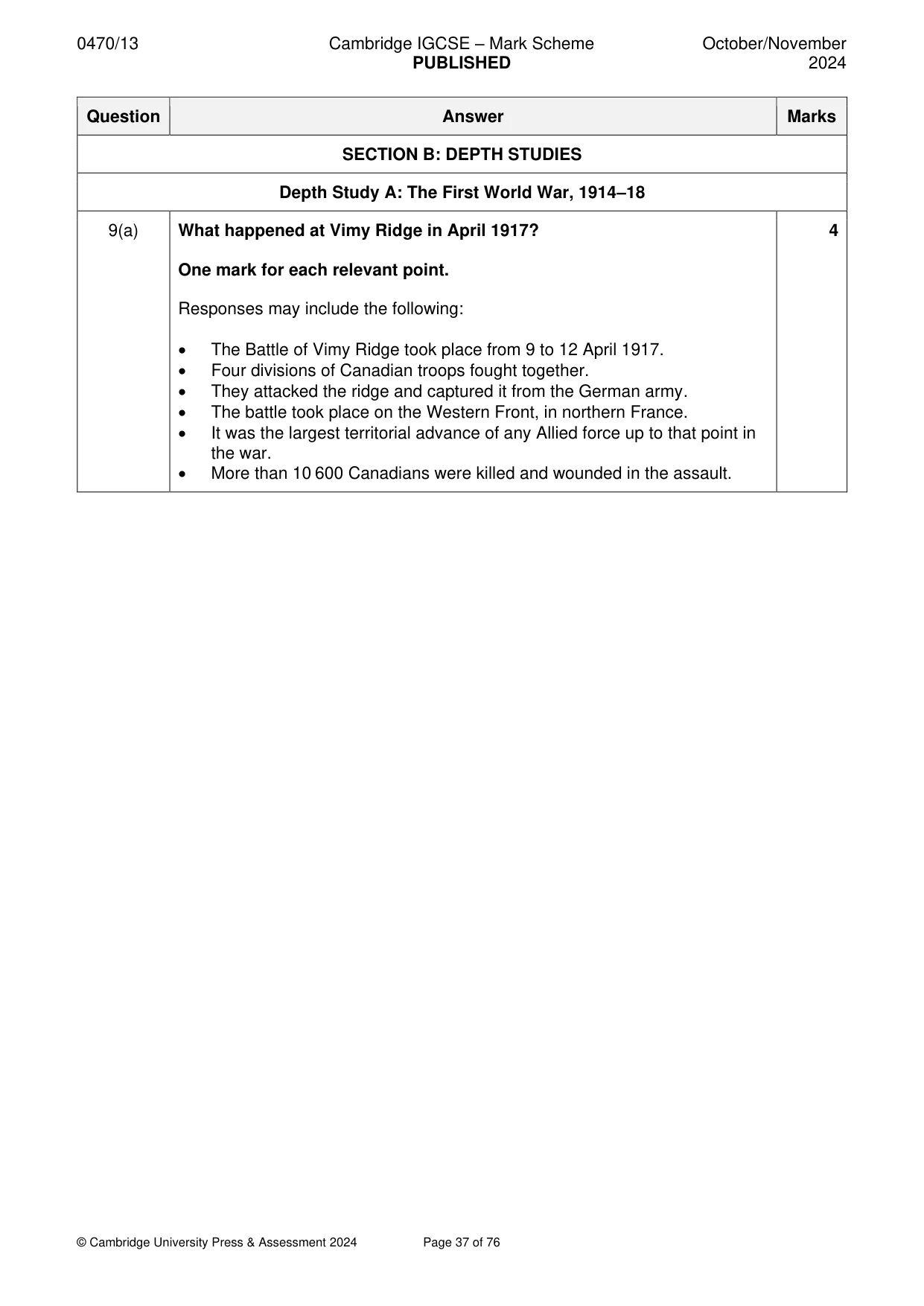
0470/13 Cambridge IGCSE – Mark Scheme PUBLISHED October/November 2024 © Cambridge University Press & Assessment 2024 Page 37 of 76 Question Answer Marks SECTION B: DEPTH STUDIES Depth Study A: The First World War, 1914–18 9(a) What happened at Vimy Ridge in April 1917? One mark for each relevant point. Responses may include the following: • The Battle of Vimy Ridge took place from 9 to 12 April 1917. • Four divisions of Canadian troops fought together. • They attacked the ridge and captured it from the German army. • The battle took place on the Western Front, in northern France. • It was the largest territorial advance of any Allied force up to that point in the war. • More than 10 600 Canadians were killed and wounded in the assault. 4
Mark scheme, page 38
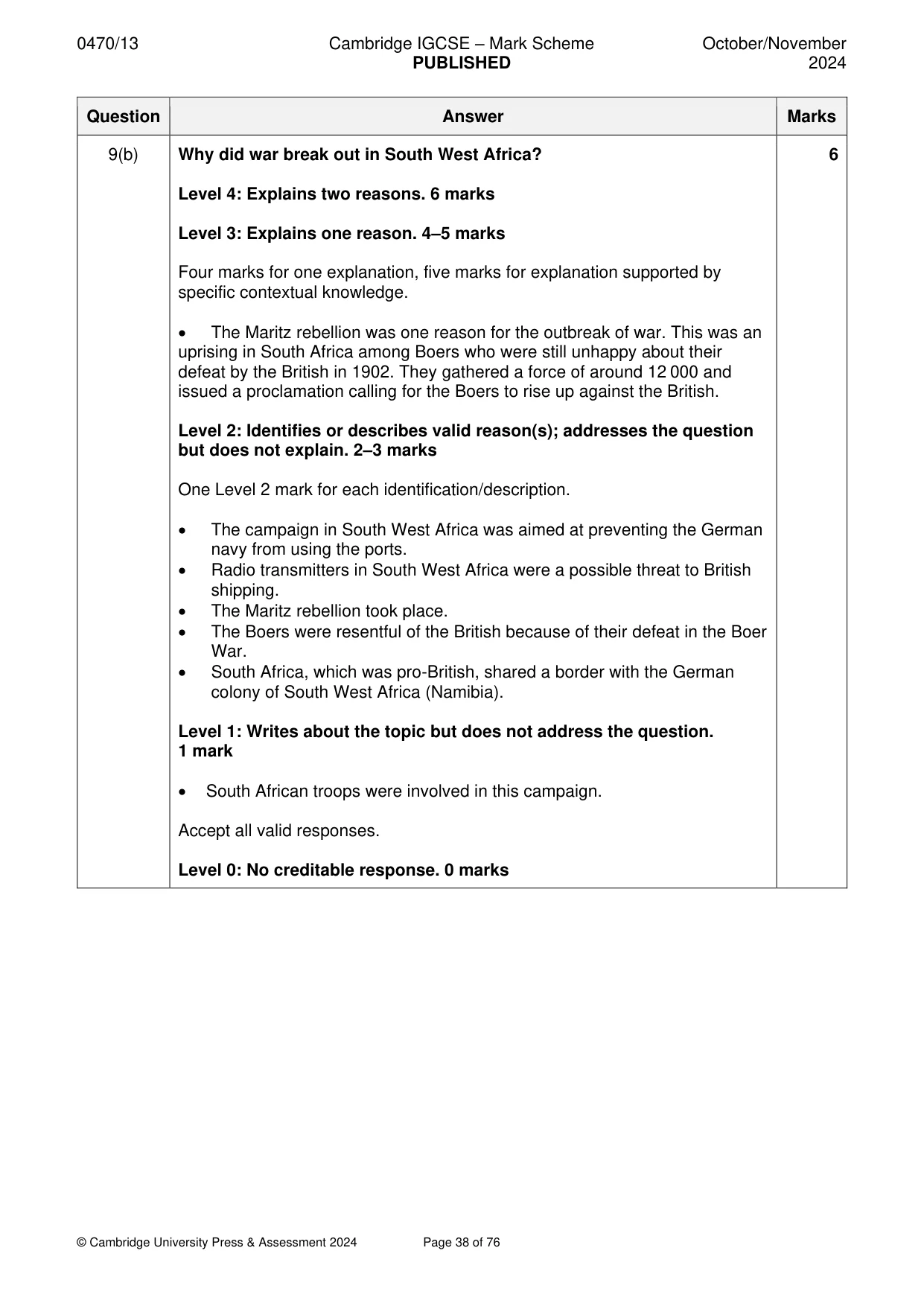
0470/13 Cambridge IGCSE – Mark Scheme PUBLISHED October/November 2024 © Cambridge University Press & Assessment 2024 Page 38 of 76 Question Answer Marks 9(b) Why did war break out in South West Africa? Level 4: Explains two reasons. 6 marks Level 3: Explains one reason. 4–5 marks Four marks for one explanation, five marks for explanation supported by specific contextual knowledge. • The Maritz rebellion was one reason for the outbreak of war. This was an uprising in South Africa among Boers who were still unhappy about their defeat by the British in 1902. They gathered a force of around 12 000 and issued a proclamation calling for the Boers to rise up against the British. Level 2: Identifies or describes valid reason(s); addresses the question but does not explain. 2–3 marks One Level 2 mark for each identification/description. • The campaign in South West Africa was aimed at preventing the German navy from using the ports. • Radio transmitters in South West Africa were a possible threat to British shipping. • The Maritz rebellion took place. • The Boers were resentful of the British because of their defeat in the Boer War. • South Africa, which was pro-British, shared a border with the German colony of South West Africa (Namibia). Level 1: Writes about the topic but does not address the question. 1 mark • South African troops were involved in this campaign. Accept all valid responses. Level 0: No creditable response. 0 marks 6
Mark scheme, page 39
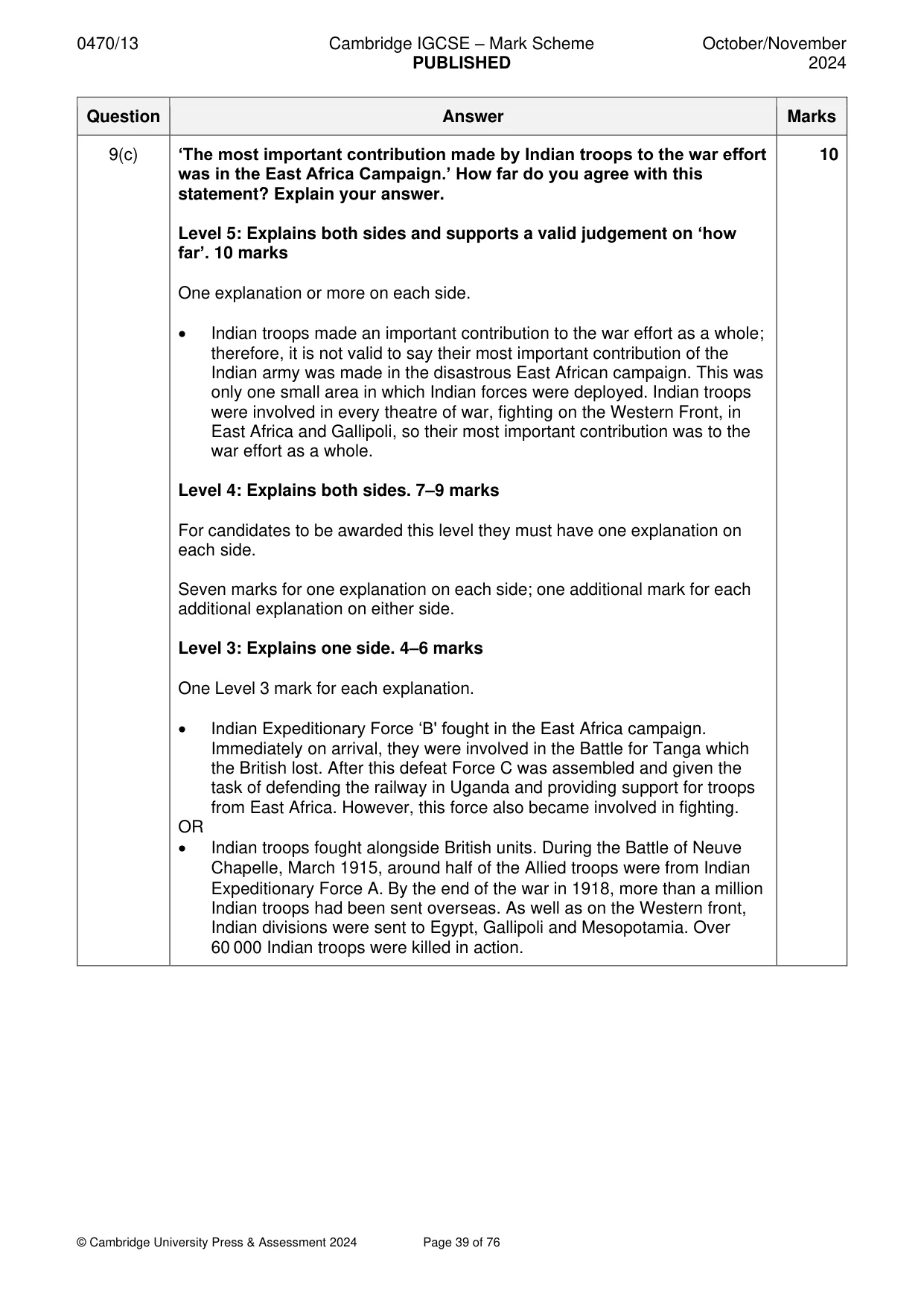
0470/13 Cambridge IGCSE – Mark Scheme PUBLISHED October/November 2024 © Cambridge University Press & Assessment 2024 Page 39 of 76 Question Answer Marks 9(c) ‘The most important contribution made by Indian troops to the war effort was in the East Africa Campaign.’ How far do you agree with this statement? Explain your answer. Level 5: Explains both sides and supports a valid judgement on ‘how far’. 10 marks One explanation or more on each side. • Indian troops made an important contribution to the war effort as a whole; therefore, it is not valid to say their most important contribution of the Indian army was made in the disastrous East African campaign. This was only one small area in which Indian forces were deployed. Indian troops were involved in every theatre of war, fighting on the Western Front, in East Africa and Gallipoli, so their most important contribution was to the war effort as a whole. Level 4: Explains both sides. 7–9 marks For candidates to be awarded this level they must have one explanation on each side. Seven marks for one explanation on each side; one additional mark for each additional explanation on either side. Level 3: Explains one side. 4–6 marks One Level 3 mark for each explanation. • Indian Expeditionary Force ‘B' fought in the East Africa campaign. Immediately on arrival, they were involved in the Battle for Tanga which the British lost. After this defeat Force C was assembled and given the task of defending the railway in Uganda and providing support for troops from East Africa. However, this force also became involved in fighting. OR • Indian troops fought alongside British units. During the Battle of Neuve Chapelle, March 1915, around half of the Allied troops were from Indian Expeditionary Force A. By the end of the war in 1918, more than a million Indian troops had been sent overseas. As well as on the Western front, Indian divisions were sent to Egypt, Gallipoli and Mesopotamia. Over 60 000 Indian troops were killed in action. 10
Mark scheme, page 40
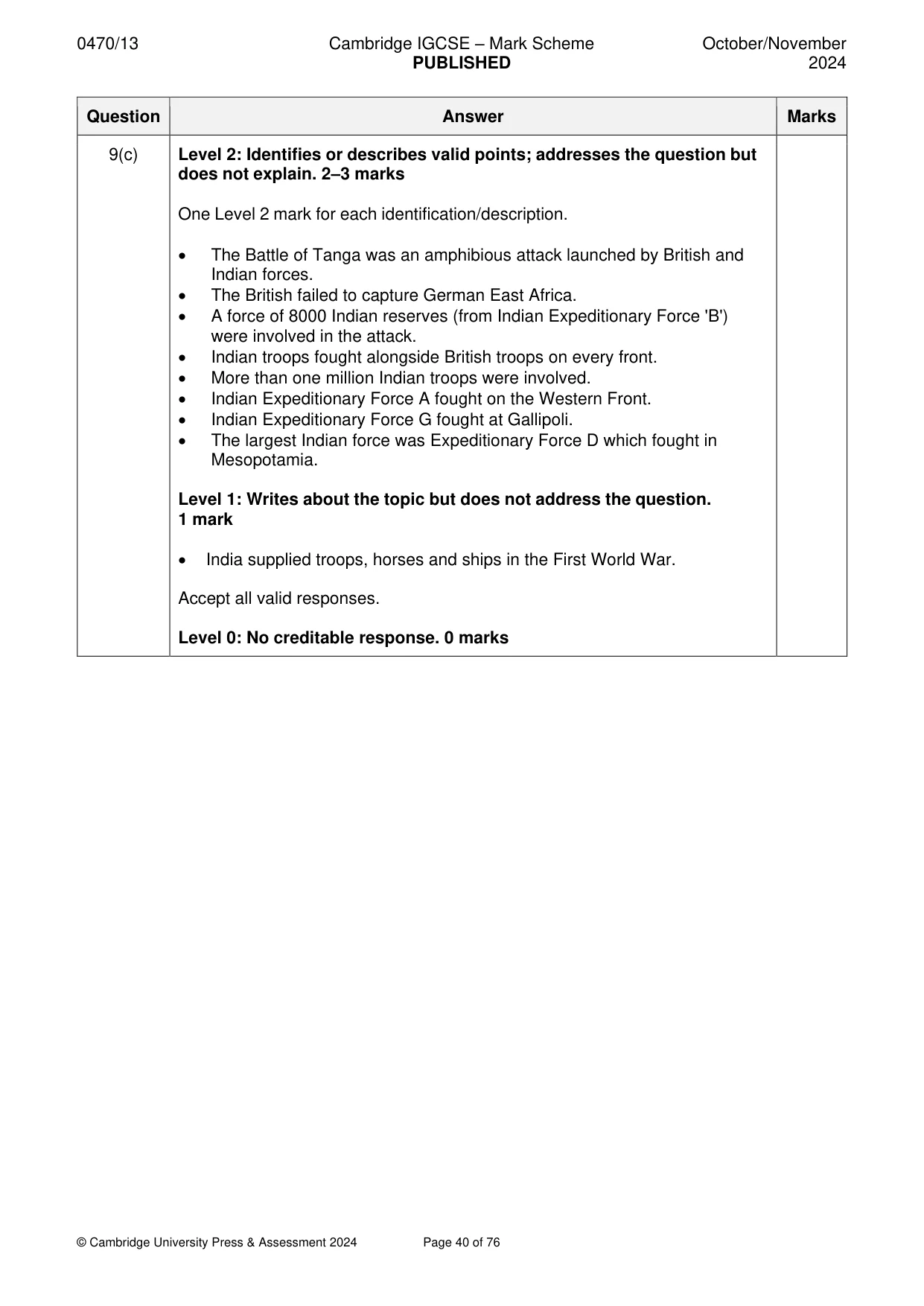
0470/13 Cambridge IGCSE – Mark Scheme PUBLISHED October/November 2024 © Cambridge University Press & Assessment 2024 Page 40 of 76 Question Answer Marks 9(c) Level 2: Identifies or describes valid points; addresses the question but does not explain. 2–3 marks One Level 2 mark for each identification/description. • The Battle of Tanga was an amphibious attack launched by British and Indian forces. • The British failed to capture German East Africa. • A force of 8000 Indian reserves (from Indian Expeditionary Force 'B') were involved in the attack. • Indian troops fought alongside British troops on every front. • More than one million Indian troops were involved. • Indian Expeditionary Force A fought on the Western Front. • Indian Expeditionary Force G fought at Gallipoli. • The largest Indian force was Expeditionary Force D which fought in Mesopotamia. Level 1: Writes about the topic but does not address the question. 1 mark • India supplied troops, horses and ships in the First World War. Accept all valid responses. Level 0: No creditable response. 0 marks
Mark scheme, page 41
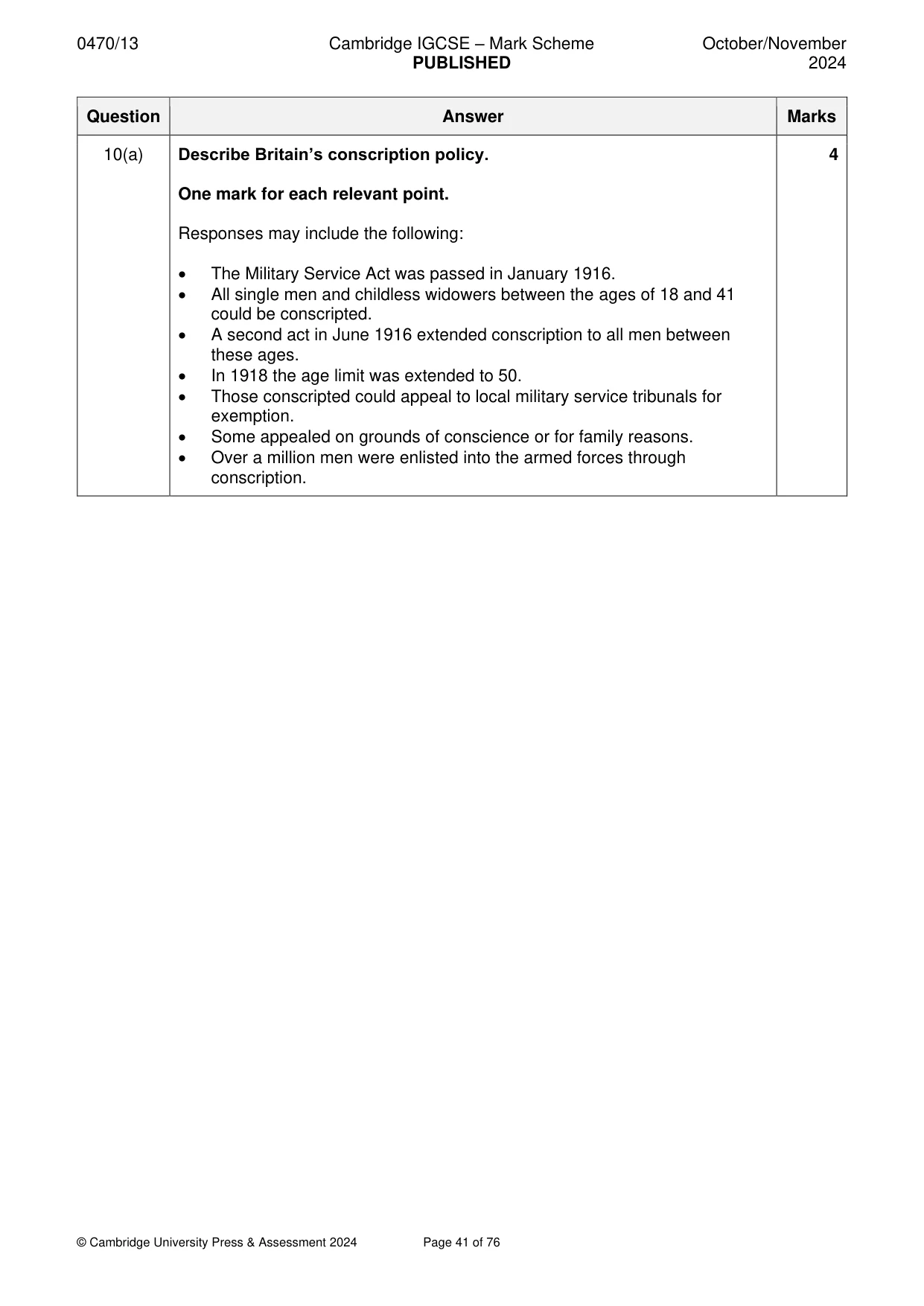
0470/13 Cambridge IGCSE – Mark Scheme PUBLISHED October/November 2024 © Cambridge University Press & Assessment 2024 Page 41 of 76 Question Answer Marks 10(a) Describe Britain’s conscription policy. One mark for each relevant point. Responses may include the following: • The Military Service Act was passed in January 1916. • All single men and childless widowers between the ages of 18 and 41 could be conscripted. • A second act in June 1916 extended conscription to all men between these ages. • In 1918 the age limit was extended to 50. • Those conscripted could appeal to local military service tribunals for exemption. • Some appealed on grounds of conscience or for family reasons. • Over a million men were enlisted into the armed forces through conscription. 4
Mark scheme, page 42
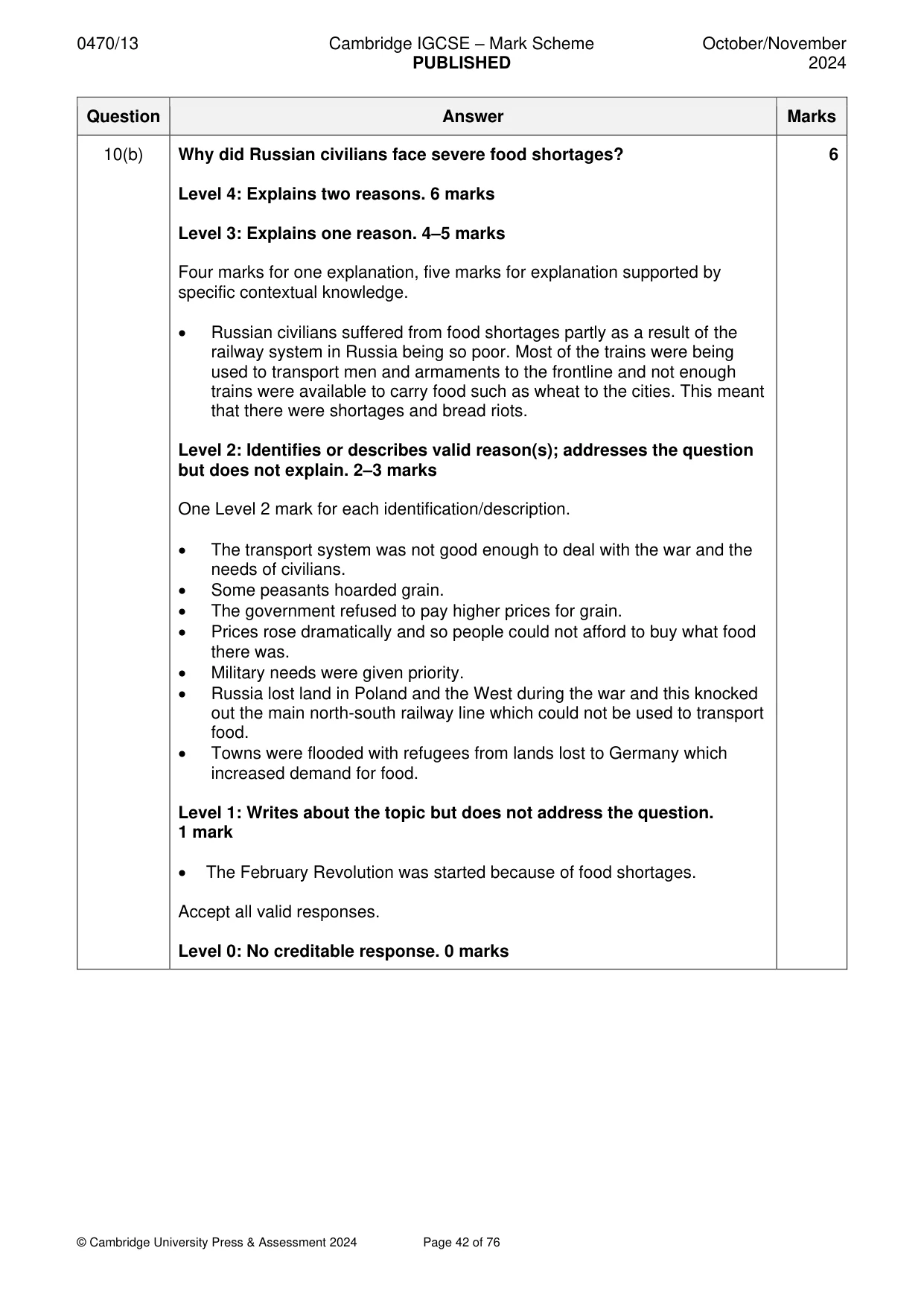
0470/13 Cambridge IGCSE – Mark Scheme PUBLISHED October/November 2024 © Cambridge University Press & Assessment 2024 Page 42 of 76 Question Answer Marks 10(b) Why did Russian civilians face severe food shortages? Level 4: Explains two reasons. 6 marks Level 3: Explains one reason. 4–5 marks Four marks for one explanation, five marks for explanation supported by specific contextual knowledge. • Russian civilians suffered from food shortages partly as a result of the railway system in Russia being so poor. Most of the trains were being used to transport men and armaments to the frontline and not enough trains were available to carry food such as wheat to the cities. This meant that there were shortages and bread riots. Level 2: Identifies or describes valid reason(s); addresses the question but does not explain. 2–3 marks One Level 2 mark for each identification/description. • The transport system was not good enough to deal with the war and the needs of civilians. • Some peasants hoarded grain. • The government refused to pay higher prices for grain. • Prices rose dramatically and so people could not afford to buy what food there was. • Military needs were given priority. • Russia lost land in Poland and the West during the war and this knocked out the main north-south railway line which could not be used to transport food. • Towns were flooded with refugees from lands lost to Germany which increased demand for food. Level 1: Writes about the topic but does not address the question. 1 mark • The February Revolution was started because of food shortages. Accept all valid responses. Level 0: No creditable response. 0 marks 6
Mark scheme, page 43
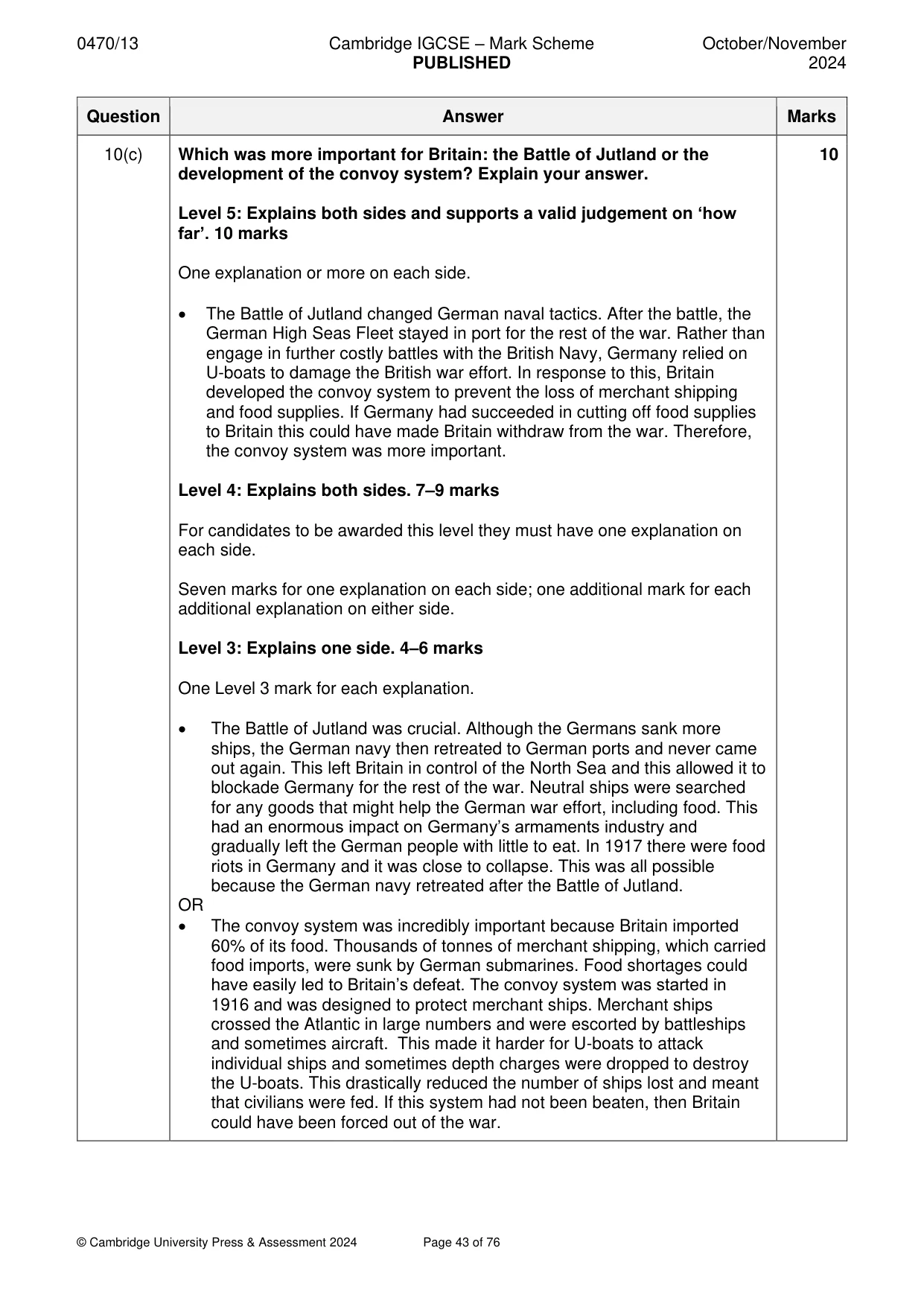
0470/13 Cambridge IGCSE – Mark Scheme PUBLISHED October/November 2024 © Cambridge University Press & Assessment 2024 Page 43 of 76 Question Answer Marks 10(c) Which was more important for Britain: the Battle of Jutland or the development of the convoy system? Explain your answer. Level 5: Explains both sides and supports a valid judgement on ‘how far’. 10 marks One explanation or more on each side. • The Battle of Jutland changed German naval tactics. After the battle, the German High Seas Fleet stayed in port for the rest of the war. Rather than engage in further costly battles with the British Navy, Germany relied on U-boats to damage the British war effort. In response to this, Britain developed the convoy system to prevent the loss of merchant shipping and food supplies. If Germany had succeeded in cutting off food supplies to Britain this could have made Britain withdraw from the war. Therefore, the convoy system was more important. Level 4: Explains both sides. 7–9 marks For candidates to be awarded this level they must have one explanation on each side. Seven marks for one explanation on each side; one additional mark for each additional explanation on either side. Level 3: Explains one side. 4–6 marks One Level 3 mark for each explanation. • The Battle of Jutland was crucial. Although the Germans sank more ships, the German navy then retreated to German ports and never came out again. This left Britain in control of the North Sea and this allowed it to blockade Germany for the rest of the war. Neutral ships were searched for any goods that might help the German war effort, including food. This had an enormous impact on Germany’s armaments industry and gradually left the German people with little to eat. In 1917 there were food riots in Germany and it was close to collapse. This was all possible because the German navy retreated after the Battle of Jutland. OR • The convoy system was incredibly important because Britain imported 60% of its food. Thousands of tonnes of merchant shipping, which carried food imports, were sunk by German submarines. Food shortages could have easily led to Britain’s defeat. The convoy system was started in 1916 and was designed to protect merchant ships. Merchant ships crossed the Atlantic in large numbers and were escorted by battleships and sometimes aircraft. This made it harder for U-boats to attack individual ships and sometimes depth charges were dropped to destroy the U-boats. This drastically reduced the number of ships lost and meant that civilians were fed. If this system had not been beaten, then Britain could have been forced out of the war. 10
Mark scheme, page 44
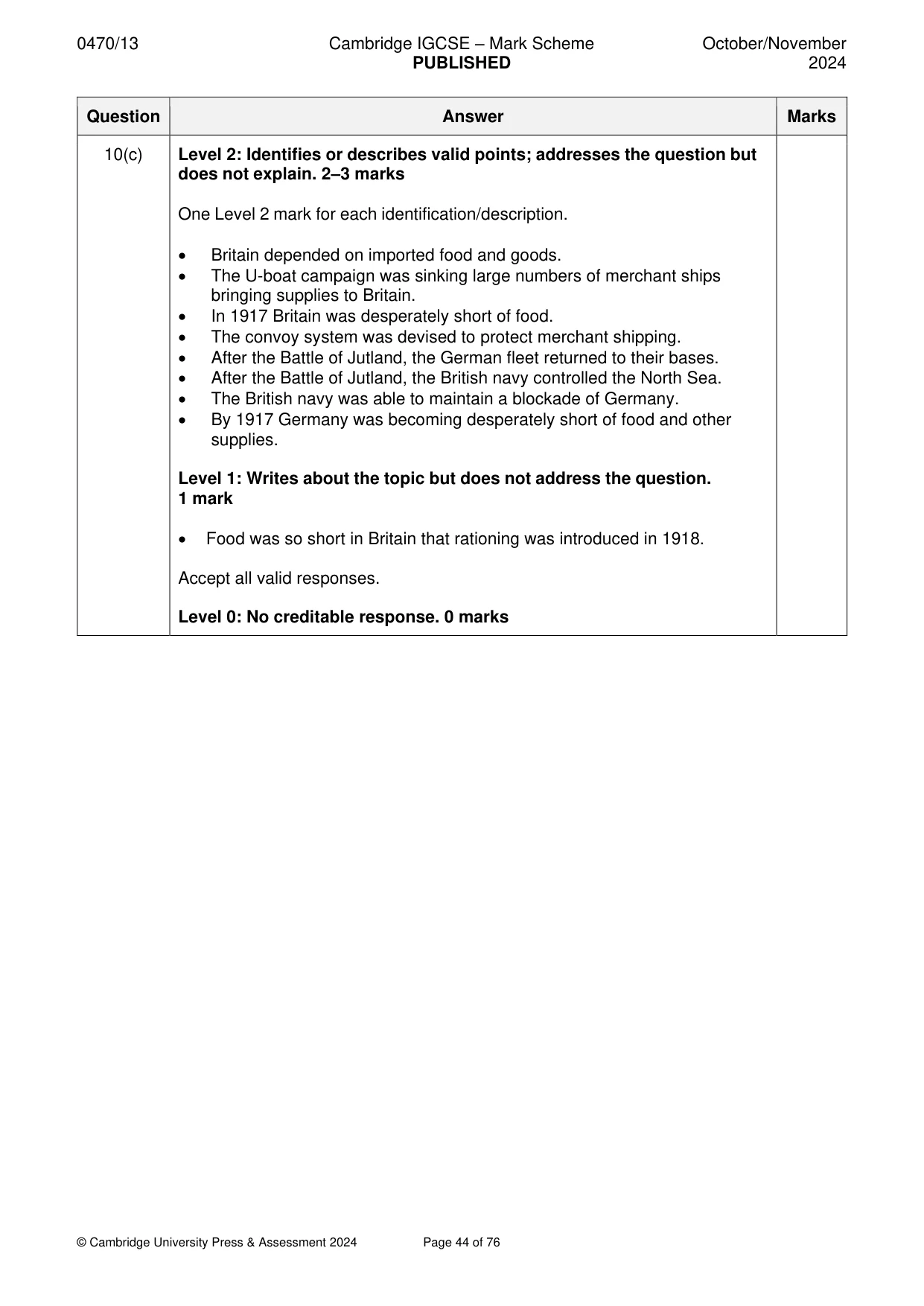
0470/13 Cambridge IGCSE – Mark Scheme PUBLISHED October/November 2024 © Cambridge University Press & Assessment 2024 Page 44 of 76 Question Answer Marks 10(c) Level 2: Identifies or describes valid points; addresses the question but does not explain. 2–3 marks One Level 2 mark for each identification/description. • Britain depended on imported food and goods. • The U-boat campaign was sinking large numbers of merchant ships bringing supplies to Britain. • In 1917 Britain was desperately short of food. • The convoy system was devised to protect merchant shipping. • After the Battle of Jutland, the German fleet returned to their bases. • After the Battle of Jutland, the British navy controlled the North Sea. • The British navy was able to maintain a blockade of Germany. • By 1917 Germany was becoming desperately short of food and other supplies. Level 1: Writes about the topic but does not address the question. 1 mark • Food was so short in Britain that rationing was introduced in 1918. Accept all valid responses. Level 0: No creditable response. 0 marks
Mark scheme, page 45
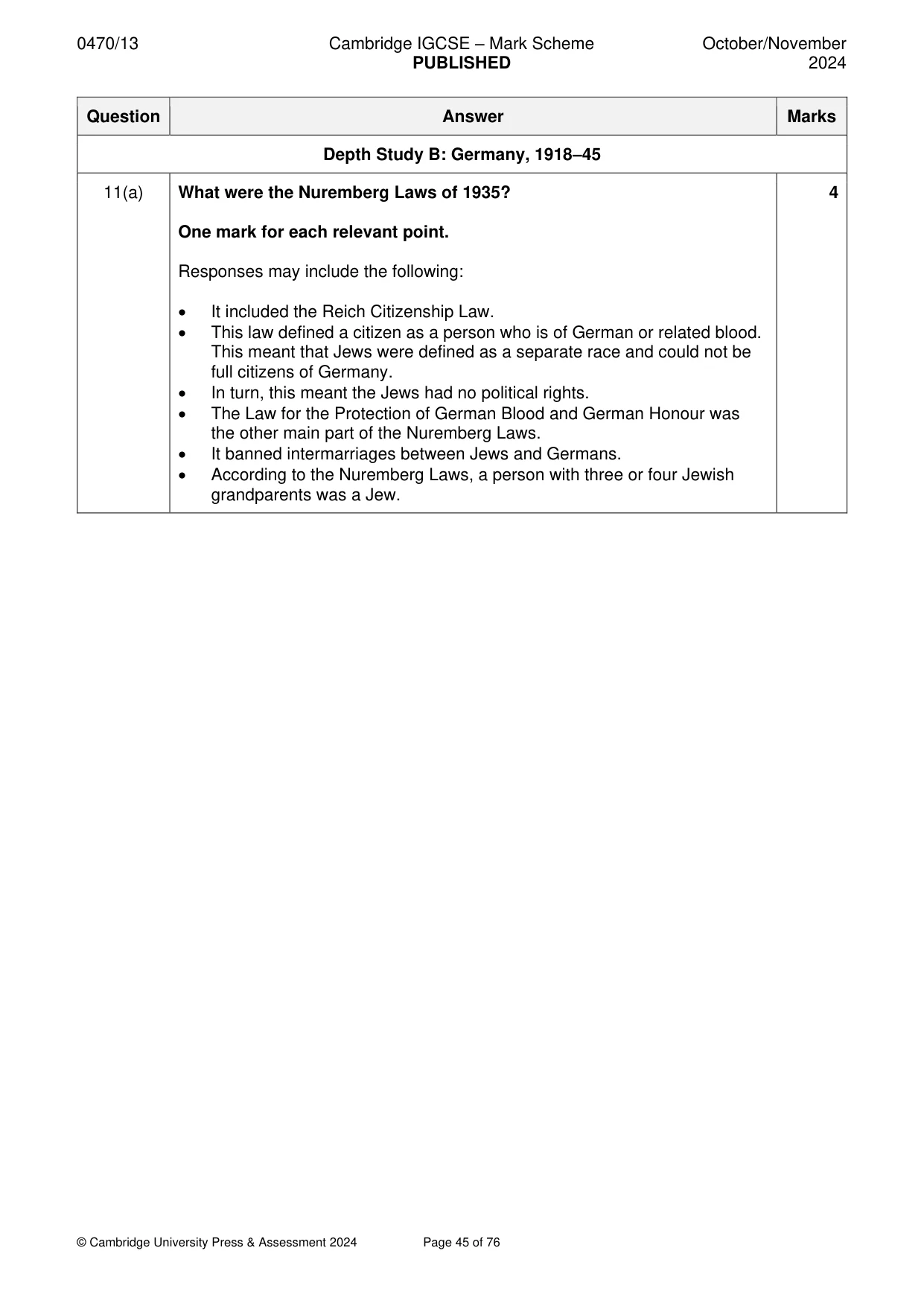
0470/13 Cambridge IGCSE – Mark Scheme PUBLISHED October/November 2024 © Cambridge University Press & Assessment 2024 Page 45 of 76 Question Answer Marks Depth Study B: Germany, 1918–45 11(a) What were the Nuremberg Laws of 1935? One mark for each relevant point. Responses may include the following: • It included the Reich Citizenship Law. • This law defined a citizen as a person who is of German or related blood. This meant that Jews were defined as a separate race and could not be full citizens of Germany. • In turn, this meant the Jews had no political rights. • The Law for the Protection of German Blood and German Honour was the other main part of the Nuremberg Laws. • It banned intermarriages between Jews and Germans. • According to the Nuremberg Laws, a person with three or four Jewish grandparents was a Jew. 4
Mark scheme, page 46
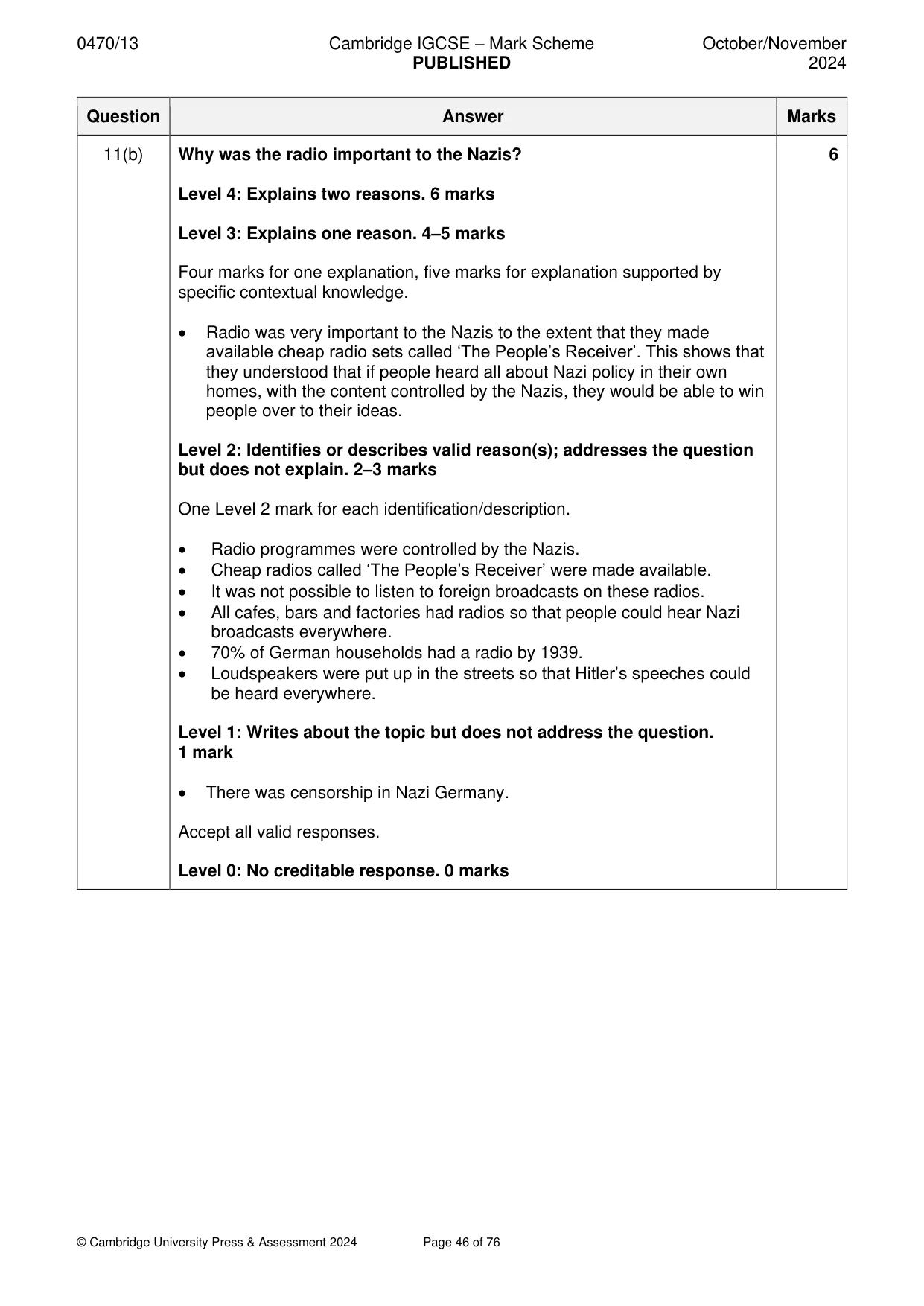
0470/13 Cambridge IGCSE – Mark Scheme PUBLISHED October/November 2024 © Cambridge University Press & Assessment 2024 Page 46 of 76 Question Answer Marks 11(b) Why was the radio important to the Nazis? Level 4: Explains two reasons. 6 marks Level 3: Explains one reason. 4–5 marks Four marks for one explanation, five marks for explanation supported by specific contextual knowledge. • Radio was very important to the Nazis to the extent that they made available cheap radio sets called ‘The People’s Receiver’. This shows that they understood that if people heard all about Nazi policy in their own homes, with the content controlled by the Nazis, they would be able to win people over to their ideas. Level 2: Identifies or describes valid reason(s); addresses the question but does not explain. 2–3 marks One Level 2 mark for each identification/description. • Radio programmes were controlled by the Nazis. • Cheap radios called ‘The People’s Receiver’ were made available. • It was not possible to listen to foreign broadcasts on these radios. • All cafes, bars and factories had radios so that people could hear Nazi broadcasts everywhere. • 70% of German households had a radio by 1939. • Loudspeakers were put up in the streets so that Hitler’s speeches could be heard everywhere. Level 1: Writes about the topic but does not address the question. 1 mark • There was censorship in Nazi Germany. Accept all valid responses. Level 0: No creditable response. 0 marks 6
Mark scheme, page 47
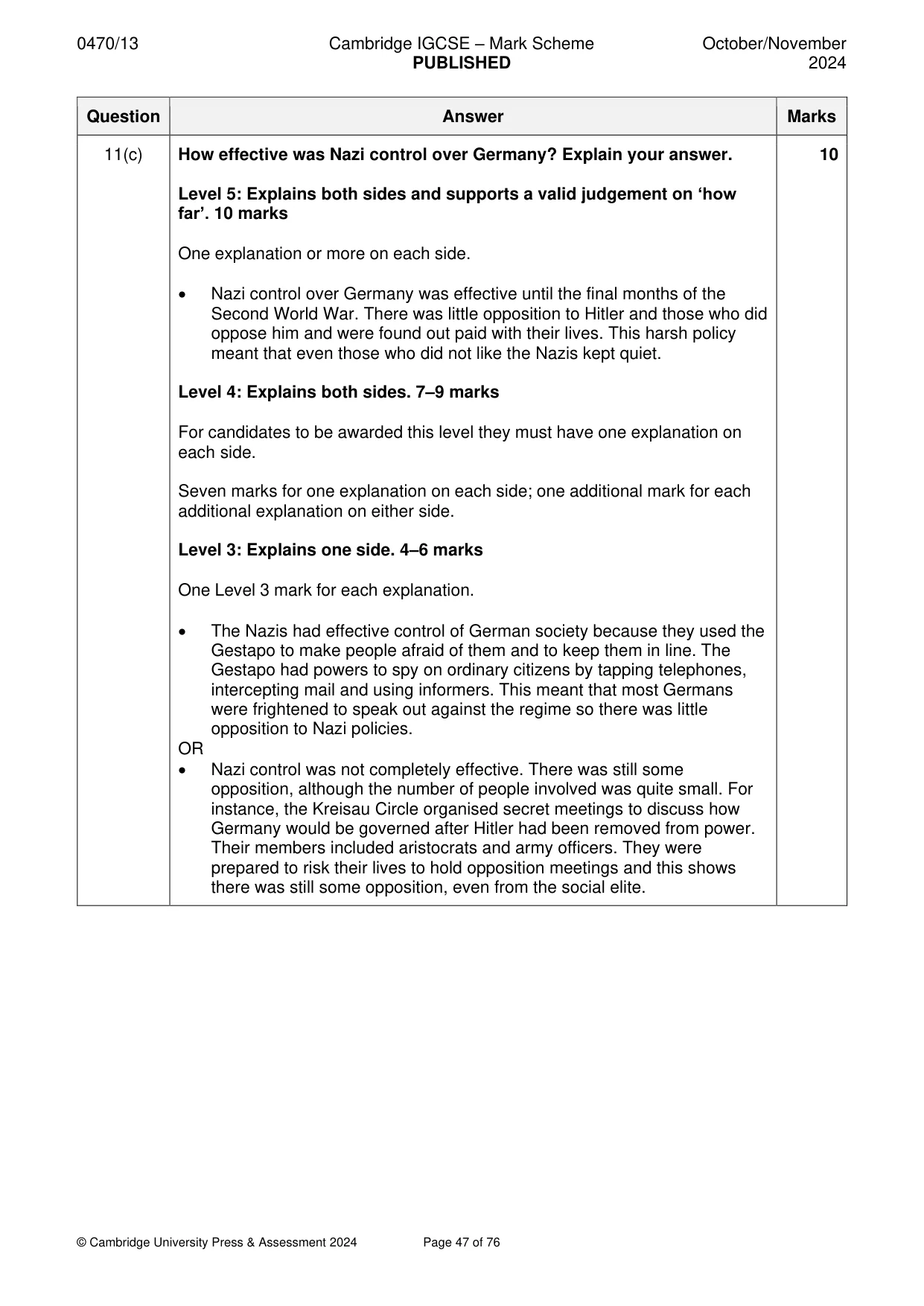
0470/13 Cambridge IGCSE – Mark Scheme PUBLISHED October/November 2024 © Cambridge University Press & Assessment 2024 Page 47 of 76 Question Answer Marks 11(c) How effective was Nazi control over Germany? Explain your answer. Level 5: Explains both sides and supports a valid judgement on ‘how far’. 10 marks One explanation or more on each side. • Nazi control over Germany was effective until the final months of the Second World War. There was little opposition to Hitler and those who did oppose him and were found out paid with their lives. This harsh policy meant that even those who did not like the Nazis kept quiet. Level 4: Explains both sides. 7–9 marks For candidates to be awarded this level they must have one explanation on each side. Seven marks for one explanation on each side; one additional mark for each additional explanation on either side. Level 3: Explains one side. 4–6 marks One Level 3 mark for each explanation. • The Nazis had effective control of German society because they used the Gestapo to make people afraid of them and to keep them in line. The Gestapo had powers to spy on ordinary citizens by tapping telephones, intercepting mail and using informers. This meant that most Germans were frightened to speak out against the regime so there was little opposition to Nazi policies. OR • Nazi control was not completely effective. There was still some opposition, although the number of people involved was quite small. For instance, the Kreisau Circle organised secret meetings to discuss how Germany would be governed after Hitler had been removed from power. Their members included aristocrats and army officers. They were prepared to risk their lives to hold opposition meetings and this shows there was still some opposition, even from the social elite. 10
Mark scheme, page 48
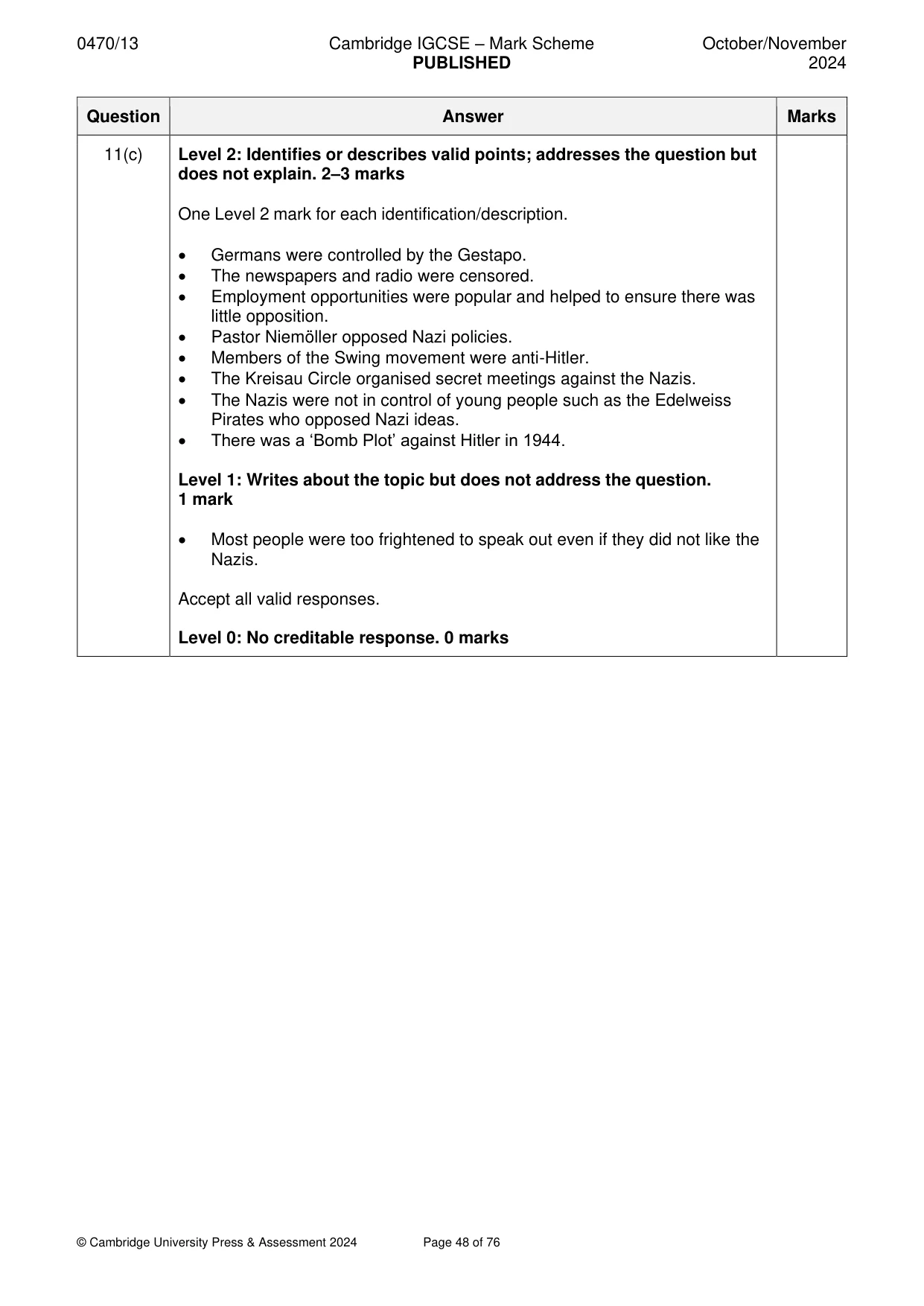
0470/13 Cambridge IGCSE – Mark Scheme PUBLISHED October/November 2024 © Cambridge University Press & Assessment 2024 Page 48 of 76 Question Answer Marks 11(c) Level 2: Identifies or describes valid points; addresses the question but does not explain. 2–3 marks One Level 2 mark for each identification/description. • Germans were controlled by the Gestapo. • The newspapers and radio were censored. • Employment opportunities were popular and helped to ensure there was little opposition. • Pastor Niemöller opposed Nazi policies. • Members of the Swing movement were anti-Hitler. • The Kreisau Circle organised secret meetings against the Nazis. • The Nazis were not in control of young people such as the Edelweiss Pirates who opposed Nazi ideas. • There was a ‘Bomb Plot’ against Hitler in 1944. Level 1: Writes about the topic but does not address the question. 1 mark • Most people were too frightened to speak out even if they did not like the Nazis. Accept all valid responses. Level 0: No creditable response. 0 marks
Mark scheme, page 49
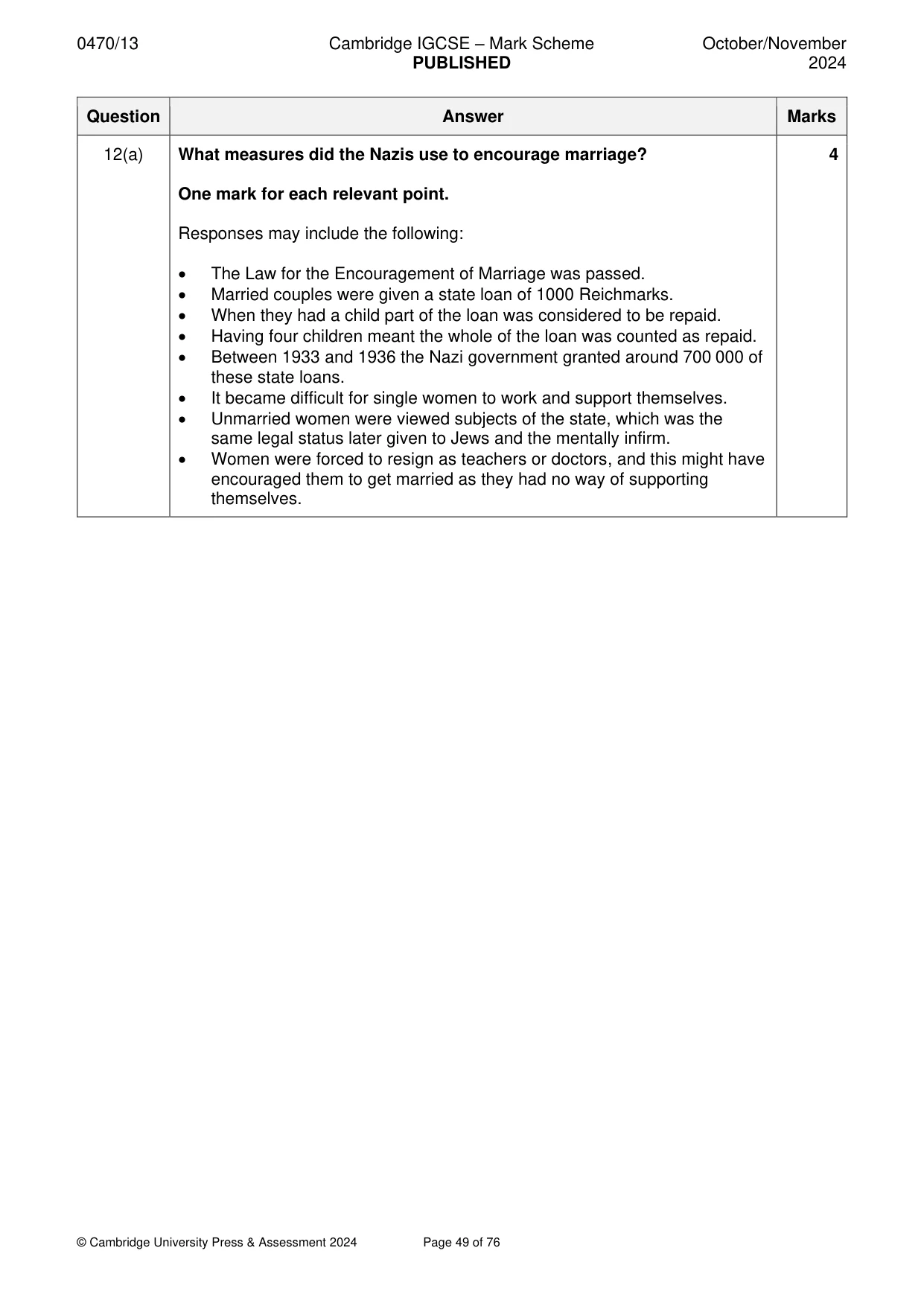
0470/13 Cambridge IGCSE – Mark Scheme PUBLISHED October/November 2024 © Cambridge University Press & Assessment 2024 Page 49 of 76 Question Answer Marks 12(a) What measures did the Nazis use to encourage marriage? One mark for each relevant point. Responses may include the following: • The Law for the Encouragement of Marriage was passed. • Married couples were given a state loan of 1000 Reichmarks. • When they had a child part of the loan was considered to be repaid. • Having four children meant the whole of the loan was counted as repaid. • Between 1933 and 1936 the Nazi government granted around 700 000 of these state loans. • It became difficult for single women to work and support themselves. • Unmarried women were viewed subjects of the state, which was the same legal status later given to Jews and the mentally infirm. • Women were forced to resign as teachers or doctors, and this might have encouraged them to get married as they had no way of supporting themselves. 4
Mark scheme, page 50
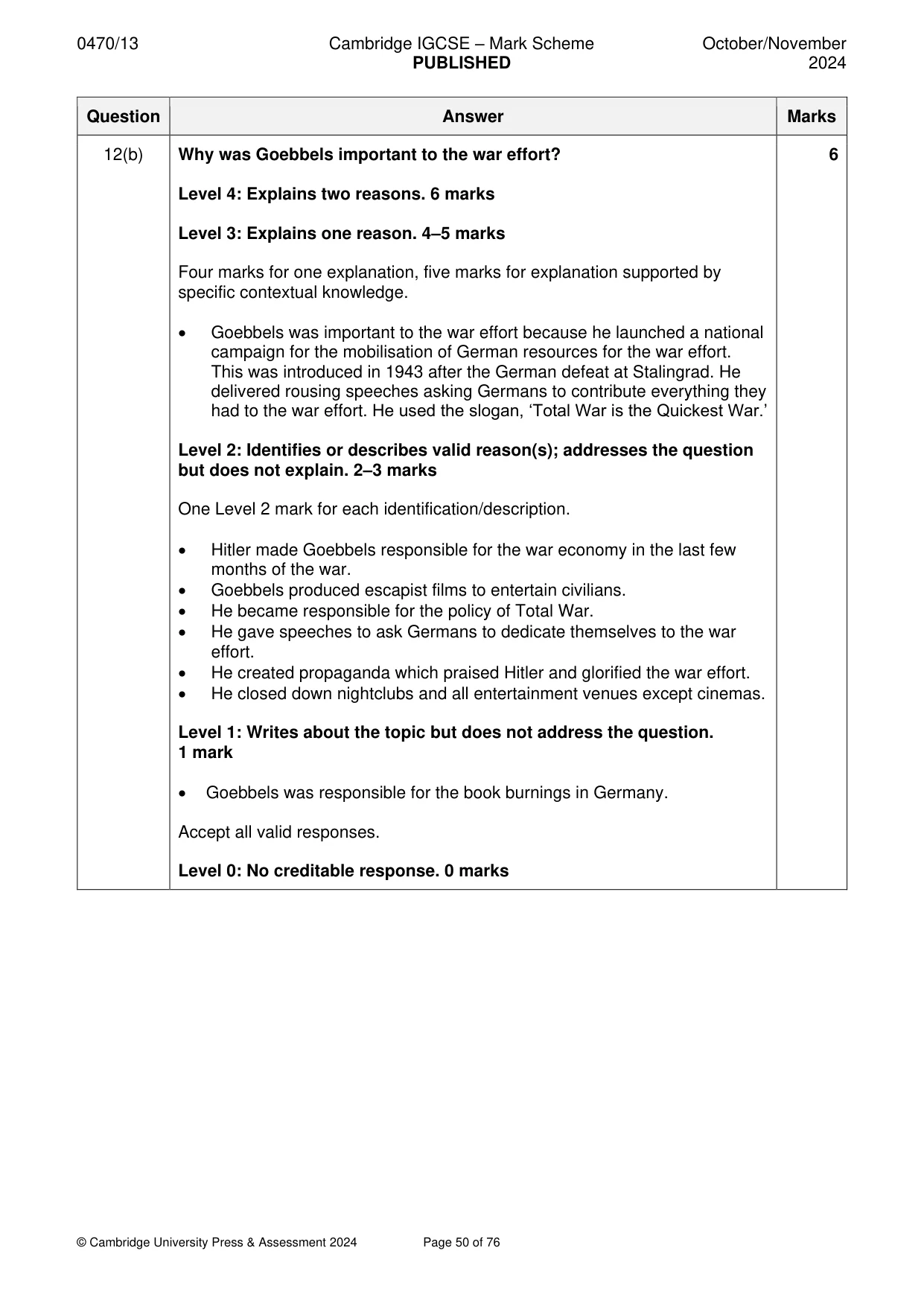
0470/13 Cambridge IGCSE – Mark Scheme PUBLISHED October/November 2024 © Cambridge University Press & Assessment 2024 Page 50 of 76 Question Answer Marks 12(b) Why was Goebbels important to the war effort? Level 4: Explains two reasons. 6 marks Level 3: Explains one reason. 4–5 marks Four marks for one explanation, five marks for explanation supported by specific contextual knowledge. • Goebbels was important to the war effort because he launched a national campaign for the mobilisation of German resources for the war effort. This was introduced in 1943 after the German defeat at Stalingrad. He delivered rousing speeches asking Germans to contribute everything they had to the war effort. He used the slogan, ‘Total War is the Quickest War.’ Level 2: Identifies or describes valid reason(s); addresses the question but does not explain. 2–3 marks One Level 2 mark for each identification/description. • Hitler made Goebbels responsible for the war economy in the last few months of the war. • Goebbels produced escapist films to entertain civilians. • He became responsible for the policy of Total War. • He gave speeches to ask Germans to dedicate themselves to the war effort. • He created propaganda which praised Hitler and glorified the war effort. • He closed down nightclubs and all entertainment venues except cinemas. Level 1: Writes about the topic but does not address the question. 1 mark • Goebbels was responsible for the book burnings in Germany. Accept all valid responses. Level 0: No creditable response. 0 marks 6
Mark scheme, page 51
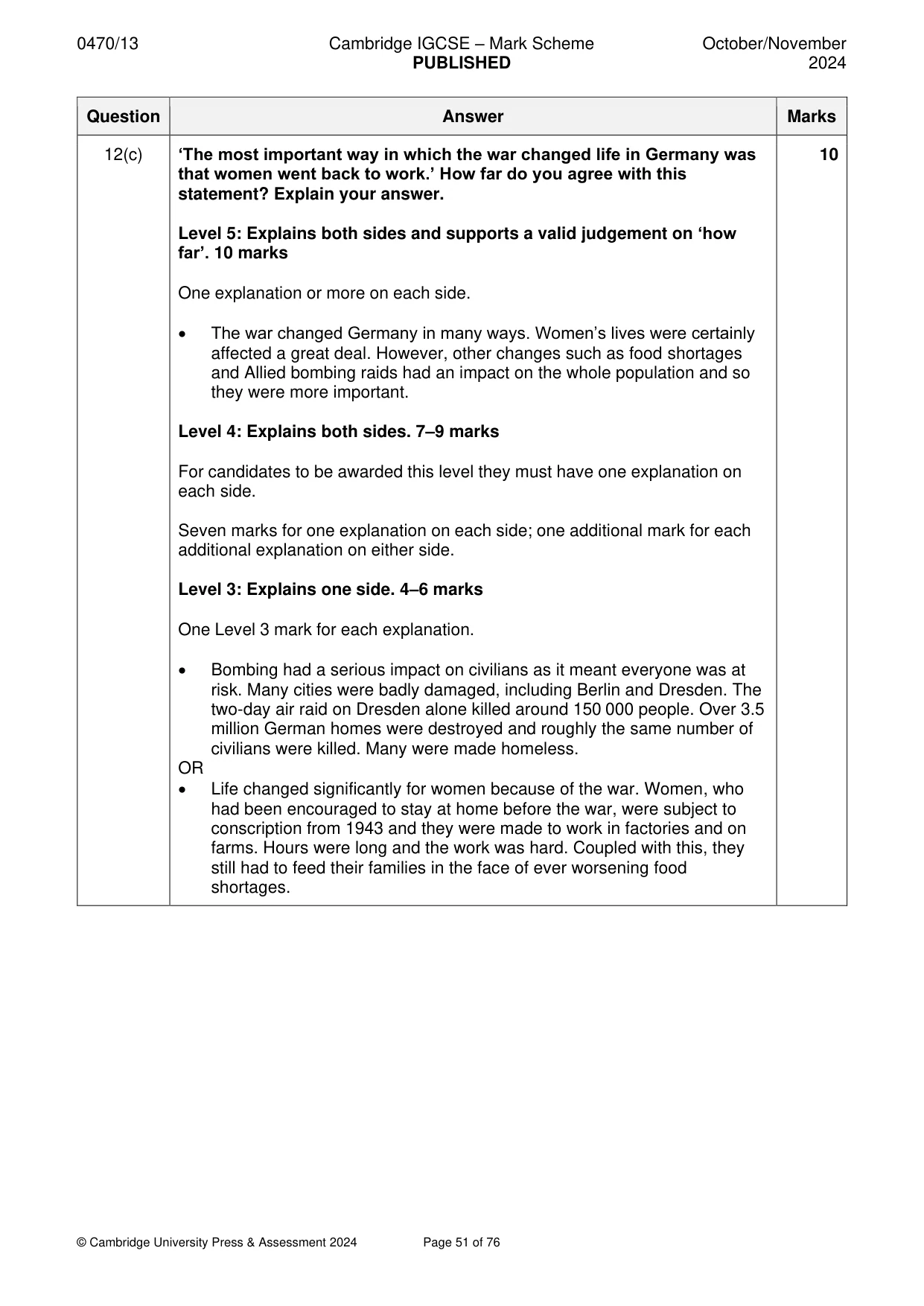
0470/13 Cambridge IGCSE – Mark Scheme PUBLISHED October/November 2024 © Cambridge University Press & Assessment 2024 Page 51 of 76 Question Answer Marks 12(c) ‘The most important way in which the war changed life in Germany was that women went back to work.’ How far do you agree with this statement? Explain your answer. Level 5: Explains both sides and supports a valid judgement on ‘how far’. 10 marks One explanation or more on each side. • The war changed Germany in many ways. Women’s lives were certainly affected a great deal. However, other changes such as food shortages and Allied bombing raids had an impact on the whole population and so they were more important. Level 4: Explains both sides. 7–9 marks For candidates to be awarded this level they must have one explanation on each side. Seven marks for one explanation on each side; one additional mark for each additional explanation on either side. Level 3: Explains one side. 4–6 marks One Level 3 mark for each explanation. • Bombing had a serious impact on civilians as it meant everyone was at risk. Many cities were badly damaged, including Berlin and Dresden. The two-day air raid on Dresden alone killed around 150 000 people. Over 3.5 million German homes were destroyed and roughly the same number of civilians were killed. Many were made homeless. OR • Life changed significantly for women because of the war. Women, who had been encouraged to stay at home before the war, were subject to conscription from 1943 and they were made to work in factories and on farms. Hours were long and the work was hard. Coupled with this, they still had to feed their families in the face of ever worsening food shortages. 10
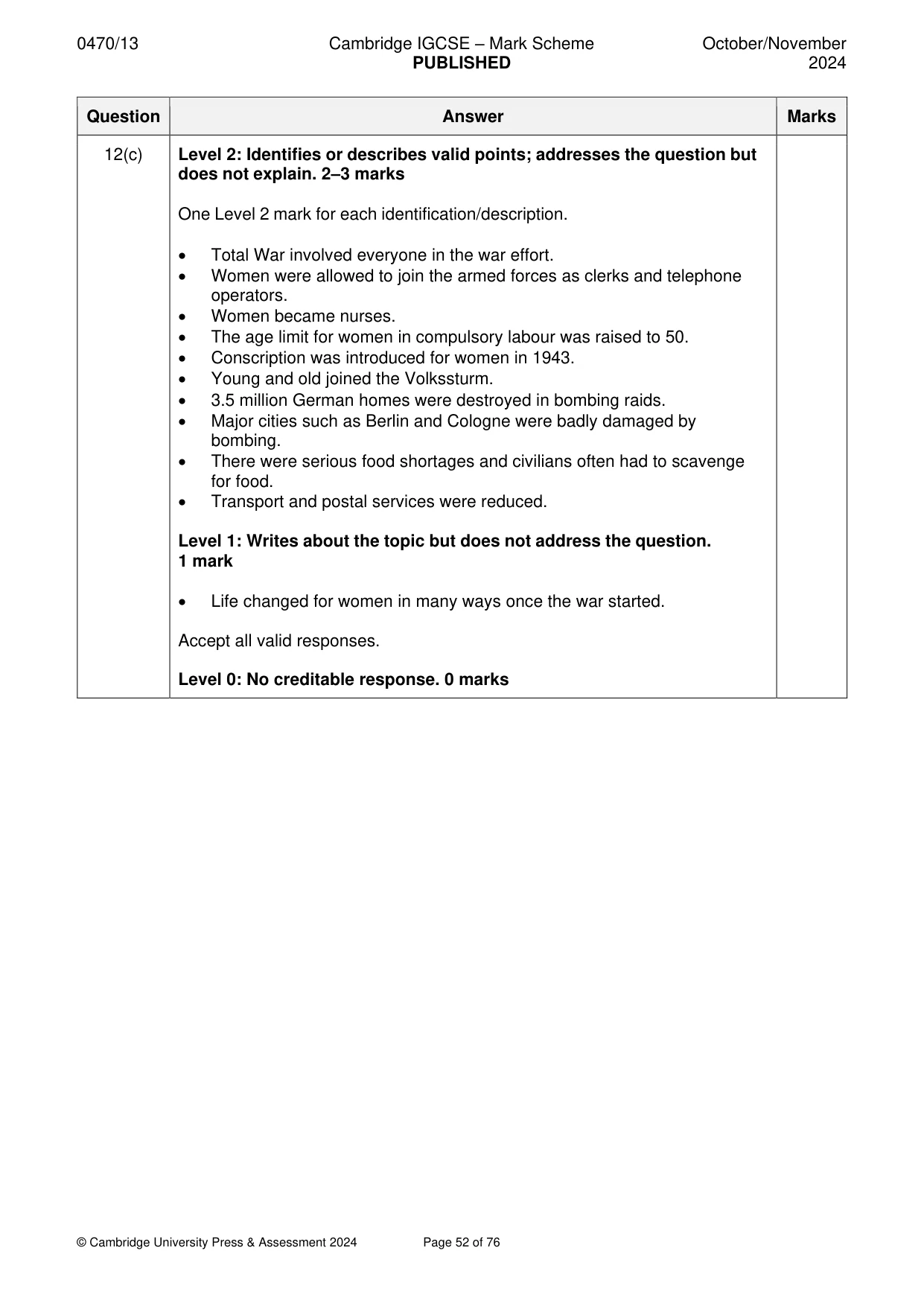
Mark scheme, page 52
0470/13 Cambridge IGCSE – Mark Scheme PUBLISHED October/November 2024 © Cambridge University Press & Assessment 2024 Page 52 of 76 Question Answer Marks 12(c) Level 2: Identifies or describes valid points; addresses the question but does not explain. 2–3 marks One Level 2 mark for each identification/description. • Total War involved everyone in the war effort. • Women were allowed to join the armed forces as clerks and telephone operators. • Women became nurses. • The age limit for women in compulsory labour was raised to 50. • Conscription was introduced for women in 1943. • Young and old joined the Volkssturm. • 3.5 million German homes were destroyed in bombing raids. • Major cities such as Berlin and Cologne were badly damaged by bombing. • There were serious food shortages and civilians often had to scavenge for food. • Transport and postal services were reduced. Level 1: Writes about the topic but does not address the question. 1 mark • Life changed for women in many ways once the war started. Accept all valid responses. Level 0: No creditable response. 0 marks
Mark scheme, page 53
0470/13 Cambridge IGCSE – Mark Scheme PUBLISHED October/November 2024 © Cambridge University Press & Assessment 2024 Page 53 of 76 Question Answer Marks Depth Study C: Russia, 1905–41 13(a) What reforms were introduced by the Provisional Government in 1917? One mark for each relevant point. Responses may include the following: • The Provisional Government introduced free speech. • Poland was made independent. • The death penalty was revoked. • Freedom of religion was granted. • The press was no longer censored. • Strikes were allowed. • Unions were legalised. • All people were declared to be equal before the law. • The regions in the Russian Empire were given more freedom. 4
Mark scheme, page 54
0470/13 Cambridge IGCSE – Mark Scheme PUBLISHED October/November 2024 © Cambridge University Press & Assessment 2024 Page 54 of 76 Question Answer Marks 13(b) Why were the July Days a problem for the Bolsheviks? Level 4: Explains two reasons. 6 marks Level 3: Explains one reason. 4–5 marks Four marks for one explanation, five marks for explanation supported by specific contextual knowledge. • The July Days were a problem for the Bolsheviks at this time because Lenin was declared a German agent. He was forced to flee to Finland to avoid being arrested. Meanwhile Trotsky was arrested. The Bolsheviks were labelled as traitors by the Provisional Government and the armed forces stayed loyal to the Provisional Government. This showed that the Bolsheviks had some weaknesses. Level 2: Identifies or describes valid reason(s); addresses the question but does not explain. 2–3 marks One Level 2 mark for each identification/description. • The Bolsheviks were not ready to seize power. • Most troops stayed loyal to the Provisional Government. • On 18 July, Lenin was declared a German agent. • He fled to Finland to avoid being arrested. • The Bolsheviks were labelled as traitors by the Provisional Government. • Kerensky reintroduced the death penalty. • Many Bolsheviks were imprisoned. Level 1: Writes about the topic but does not address the question. 1 mark • The July Days went badly for the Bolsheviks. Accept all valid responses. Level 0: No creditable response. 0 marks 6
Mark scheme, page 55
0470/13 Cambridge IGCSE – Mark Scheme PUBLISHED October/November 2024 © Cambridge University Press & Assessment 2024 Page 55 of 76 Question Answer Marks 13(c) Who was more important in the failure of the Provisional Government: Kerensky or Lenin? Explain your answer. Level 5: Explains both sides and supports a valid judgement on ‘how far’. 10 marks One explanation or more on each side. • Lenin was probably more important in bringing about the failure of the Provisional Government. Kerensky’s insistence on carrying on the war was a disastrous decision. However, Kerensky knew he was in a temporary position until elections could be held late in 1917. Lenin understood that the Bolsheviks must gain power before the elections took place and on 7 November they seized power. Level 4: Explains both sides. 7–9 marks For candidates to be awarded this level they must have one explanation on each side. Seven marks for one explanation on each side; one additional mark for each additional explanation on either side. Level 3: Explains one side. 4–6 marks One Level 3 mark for each explanation. • Kerensky visited troops on the front line and made the decision to continue fighting in the First World War. This was an unpopular and disastrous decision. When Russia’s armies were ordered to take the offensive in June, the response was wholesale desertion and mutiny. By comparison, Lenin promised peace and this was more attractive to most Russians. Therefore, Kerensky was more to blame for the failure of the Provisional Government. OR • Lenin was to blame for the failure of the Provisional Government. He returned to Russia in April 1917 and immediately began to make promises to the people about land and peace. These were both issues which the Kerensky failed to address. Lenin also began to plan for a revolution. Although things were difficult in July 1917 and Lenin was forced to flee to Finland. The Bolsheviks regained the initiative after the Kornilov revolt and Kerensky lost what little popular support he had. 10
Mark scheme, page 56
0470/13 Cambridge IGCSE – Mark Scheme PUBLISHED October/November 2024 © Cambridge University Press & Assessment 2024 Page 56 of 76 Question Answer Marks 13(c) Level 2: Identifies or describes valid points; addresses the question but does not explain. 2–3 marks One Level 2 mark for each identification/description. • Kerensky failed to solve the food and land problems. • He visited the front and decided to continue the war. • Lenin’s promises were more attractive than Provisional Government policies. • Lenin promised ‘Bread, Peace and Land’. • The Petrograd Soviet undermined Kerensky’s authority. • Support moved to the Bolsheviks and the Petrograd Soviet. • Kerensky failed to deal with Kornilov and this strengthened Lenin’s position. Level 1: Writes about the topic but does not address the question. 1 mark • Lenin was the leader of the Bolsheviks. Accept all valid responses. Level 0: No creditable response. 0 marks
Mark scheme, page 57
0470/13 Cambridge IGCSE – Mark Scheme PUBLISHED October/November 2024 © Cambridge University Press & Assessment 2024 Page 57 of 76 Question Answer Marks 14(a) Who were the kulaks? One mark for each relevant point. Responses may include the following: • The were peasants who were successful farmers. • They were thought to be wealthy. • They owned land. • They sometimes were rich enough to employ workers. • Often, they were opposed to communism. • They made up around 20% of all those who worked on farms. 4
Mark scheme, page 58
0470/13 Cambridge IGCSE – Mark Scheme PUBLISHED October/November 2024 © Cambridge University Press & Assessment 2024 Page 58 of 76 Question Answer Marks 14(b) Why did the role of women in Soviet society change in the 1930s? Level 4: Explains two reasons. 6 marks Level 3: Explains one reason. 4–5 marks Four marks for one explanation, five marks for explanation supported by specific contextual knowledge. • The role of women in Soviet society changed in the 1930s. Up until this point women had much greater freedom, but Stalin was worried that the family was in decline and that society would suffer as a result. Therefore, a new family policy was introduced in 1936. Stalin went back on some of his earlier policies, such as making divorce easier for women, to try to ensure that families were strengthened, and the birth rate did not drop. Level 2: Identifies or describes valid reason(s); addresses the question but does not explain. 2–3 marks One Level 2 mark for each identification/description. • Women had more access to education. • Divorce became harder to obtain in the 1930s. • Abortion was made illegal. • There were tax incentives for families who had more children. • Women trained as engineers and doctors. • Services were provided such as crèches in workplaces so that women could have children and continue working. Level 1: Writes about the topic but does not address the question. 1 mark • Many women became engineers and doctors. Accept all valid responses. Level 0: No creditable response. 0 marks 6
Mark scheme, page 59
0470/13 Cambridge IGCSE – Mark Scheme PUBLISHED October/November 2024 © Cambridge University Press & Assessment 2024 Page 59 of 76 Question Answer Marks 14(c) ‘Stalin introduced the Five-Year Plans for political rather than economic reasons.’ How far do you agree with this statement? Explain your answer. Level 5: Explains both sides and supports a valid judgement on ‘how far’. 10 marks One explanation or more on each side. • Economic and political motives were interwoven. The Soviet economy was behind and needed to be modernised. However, in making plans for rapid industrialisation, Stalin wanted to secure his own position, improve the position of the USSR, and create a Communist state which was based on an industrial proletariat. Economic motives existed but they were all subject to political motives as well. Level 4: Explains both sides. 7–9 marks For candidates to be awarded this level they must have one explanation on each side. Seven marks for one explanation on each side; one additional mark for each explanation on either side. Level 3: Explains one side. 4–6 marks One Level 3 mark for each explanation. • Stalin had political motives for introducing the Five-Year Plans. He wanted to destroy the kulaks, a richer class of farmers who were likely to oppose his regime with an industrial proletariat which would be loyal. The Communist Party was committed to industrialisation and wanted to create a worker’s state as envisage by Marx. Stalin made plans for rapid industrialisation to achieve these aims and to strengthen his own position. OR • Stalin had economic motives. He was conscious that Russia was backwards compared to European states. Although Russia had started to industrialise in the years before the First World War, war, revolution and civil war meant the economy had not developed at a steady pace. Russia could not trade without a developed economy and would be unable to defend itself against attack unless heavy industry grew quickly. 10
Mark scheme, page 60
0470/13 Cambridge IGCSE – Mark Scheme PUBLISHED October/November 2024 © Cambridge University Press & Assessment 2024 Page 60 of 76 Question Answer Marks 14(c) Level 2: Identifies or describes valid points; addresses the question but does not explain. 2–3 marks One Level 2 mark for each identification/description. • Russia was behind the West and needed to modernise. • Stalin wanted to destroy the kulaks. • Stalin believed that the industrial workforce should be the backbone of Soviet society. • Economic development was needed to strengthen Soviet defences. • The Civil War had weakened the economy. Level 1: Writes about the topic but does not address the question. 1 mark • The Five-Year Plans set targets for industrial production. Accept all valid responses. Level 0: No creditable response. 0 marks
Mark scheme, page 61
0470/13 Cambridge IGCSE – Mark Scheme PUBLISHED October/November 2024 © Cambridge University Press & Assessment 2024 Page 61 of 76 Question Answer Marks Depth Study D: The United States, 1919–41 15(a) Describe the state of agriculture at the start of the 1920s. One mark for each relevant point. Responses may include the following: • The demand from Europe for American wheat fell. • Canada was more efficient at producing wheat. • Over-production was a problem. • Prices for agricultural produce were falling. • US tariffs meant it was hard to sell American produce abroad. • The US population fell in number so demand fell. 4
Mark scheme, page 62
0470/13 Cambridge IGCSE – Mark Scheme PUBLISHED October/November 2024 © Cambridge University Press & Assessment 2024 Page 62 of 76 Question Answer Marks 15(b) Why did some traditional industries fail to benefit from the boom? Level 4: Explains two reasons. 6 marks Level 3: Explains one reason. 4–5 marks Four marks for one explanation, five marks for explanation supported by specific contextual knowledge. • Some traditional industries did not prosper during the 1920s. For instance, cotton textiles did not increase their sales despite the increased demand for clothing. New synthetic fabrics such as rayon were more desirable and new clothing styles meant less material was needed. This meant the demand for cotton cloth went down and those who worked in the industry faced unemployment or lower wages. Level 2: Identifies or describes valid reason(s); addresses the question but does not explain. 2–3 marks One Level 2 mark for each identification/description. • There was a growth in new products such as rayon. • Cotton textiles did not prosper. • The coal industry suffered. • Oil and gas were used instead of coal so demand fell. • Woollen textiles were no longer popular. • Fashion changed and this reduced demand for fabric. Level 1: Writes about the topic but does not address the question. 1 mark • Modern industries did better than traditional ones. Accept all valid responses. Level 0: No creditable response. 0 marks 6
Mark scheme, page 63
0470/13 Cambridge IGCSE – Mark Scheme PUBLISHED October/November 2024 © Cambridge University Press & Assessment 2024 Page 63 of 76 Question Answer Marks 15(c) ‘Technical advances were more important than tariff policies in bringing about the boom in the 1920s.’ How far do you agree with this statement? Explain your answer. Level 5: Explains both sides and supports a valid judgement on ‘how far’. 10 marks One explanation or more on each side. • Technical advances were more important than tariff policies in causing the boom. High tariffs meant that people in the US were encouraged to buy US goods rather than imports. However, there would have been fewer products to buy had it not been for technical developments and innovation such as mass production. These advances meant that output increased dramatically and this fuelled the boom. Level 4: Explains both sides. 7–9 marks For candidates to be awarded this level they must have one explanation on each side. Seven marks for one explanation on each side; one additional mark for each additional explanation on either side. Level 3: Explains one side. 4–6 marks One Level 3 mark for each explanation. • Technical advances were important for the boom. Many of these were made in the car industry. This used new production techniques such as the assembly line. This meant cars were made more quickly and therefore they became cheaper. Being less expensive meant there was an increase in demand. It also had a knock-on effect on other industries. For instance, cars needed rubber tyres and so the demand for rubber increased too. OR • High tariffs were important for the boom. Tariffs, such as Fordney– McCumber, meant it was difficult for European companies to export their goods to the US. This meant that Americans were much more likely to buy home-produced goods rather than imports. In turn, this increased demand for American products, creating jobs and more wealth for Americans at the same time. 10
Mark scheme, page 64
0470/13 Cambridge IGCSE – Mark Scheme PUBLISHED October/November 2024 © Cambridge University Press & Assessment 2024 Page 64 of 76 Question Answer Marks 15(c) Level 2: Identifies or describes valid points; addresses the question but does not explain. 2–3 marks One Level 2 mark for each identification/description. • Mass production made goods cheaper. • Techniques used in the car industry helped other businesses. • There were high tariffs on goods from Europe. • Americans bought US-produced goods rather than imports. • New products such as Bakelite were developed. • There was a large domestic market for new goods. • The assembly line made products cheaper. Level 1: Writes about the topic but does not address the question. 1 mark • The American economy went through a boom in the 1920s. Accept all valid responses. Level 0: No creditable response. 0 marks
Mark scheme, page 65
0470/13 Cambridge IGCSE – Mark Scheme PUBLISHED October/November 2024 © Cambridge University Press & Assessment 2024 Page 65 of 76 Question Answer Marks 16(a) Describe Roosevelt’s campaign for the 1932 presidential election. One mark for each relevant point. Responses may include the following: • Roosevelt’s campaign was optimistic and gave people hope. • On the campaign trail Roosvelt promised people a ‘new deal’. • He travelled widely across the US so people felt they knew him. • Roosevelt told people he wanted to help the poor and the elderly. • Roosevelt had a campaign song called ‘Happy Days Are Here Again’. • He promised to get rid of Prohibition. • Roosevelt made speeches explaining that he wanted to protect people’s savings and property. 4
Mark scheme, page 66
0470/13 Cambridge IGCSE – Mark Scheme PUBLISHED October/November 2024 © Cambridge University Press & Assessment 2024 Page 66 of 76 Question Answer Marks 16(b) Why were many Americans facing poverty and unemployment at the time of the 1932 election? Level 4: Explains two reasons. 6 marks Level 3: Explains one reason. 4–5 marks Four marks for one explanation, five marks for explanation supported by specific contextual knowledge. • After the first series of business and banking failures, the whole economy had to adapt to a reduction in trade and demand for American goods. Businesses had to reduce their operations by sacking workers and reducing the wages of those who remained. It became a vicious cycle as these actions took even more money out of the economy and further reduced the demand for goods. This meant that unemployment increased even more. Level 2: Identifies or describes valid reason(s); addresses the question but does not explain. 2–3 marks One Level 2 mark for each identification/description. • Wall Street had collapsed. • Many businesses were closed. • People lost their savings. • The crash in share prices caused a lack of confidence. • Many Americans were forced into bankruptcy. • There were many bank closures. • There was a fall in demand for goods at home. • Other countries cut back on buying American goods. • Businesses cut back production. This created unemployment. Level 1: Writes about the topic but does not address the question. 1 mark • There were no state-provided welfare schemes to help people Accept all valid responses. Level 0: No creditable response. 0 marks 6
Mark scheme, page 67
0470/13 Cambridge IGCSE – Mark Scheme PUBLISHED October/November 2024 © Cambridge University Press & Assessment 2024 Page 67 of 76 Question Answer Marks 16(c) Which was more responsible for the Wall Street Crash: speculation or long-term weaknesses in the economy? Explain your answer. Level 5: Explains both sides and supports a valid judgement on ‘how far’. 10 marks One explanation or more on each side. • Speculation made things worse, or the Crash more dramatic, but long- term weaknesses in the US economy meant it would run into trouble sooner or later. Speculation assumed that the value of stock would keep on rising. However, long terms weaknesses, such as saturation of the market and uneven distribution of wealth, meant this was an unrealistic expectation. Level 4: Explains both sides. 7–9 marks For candidates to be awarded this level they must have one explanation on each side. Seven marks for one explanation on each side; one additional mark for each additional explanation on either side. Level 3: Explains one side. 4–6 marks One Level 3 mark for each explanation. • Speculators were responsible for the Depression. They had bought shares hoping to make a profit. This meant that share prices went up until they were overvalued. When they started to go down speculators panicked and sold their shares at massive losses. This caused banks to collapse which then led to business failures and unemployment. So the speculators started it all. OR • There were long-term weaknesses in the US economy before the Wall Street Crash and these caused the Depression. Mass production had led to overproduction and demand for goods fell. Factories could not sell their goods and began to make people unemployed which made things worse because they did not have any money to spend on goods. 10
Mark scheme, page 68
0470/13 Cambridge IGCSE – Mark Scheme PUBLISHED October/November 2024 © Cambridge University Press & Assessment 2024 Page 68 of 76 Question Answer Marks 16(c) Level 2: Identifies or describes valid points; addresses the question but does not explain. 2–3 marks One Level 2 mark for each identification/description. • Speculation led to shares being overpriced. • Speculation led to the Wall Street Crash. • Speculators caused the Depression by suddenly selling their shares. • The banks were to blame for lending people so much money. • There was overproduction in many US industries. • Farmers were in trouble because they were producing too much. • Other countries were putting tariffs on US imports, thus reducing demand for US goods. Level 1: Writes about the topic but does not address the question. 1 mark • The Wall Street Crash happened when shares lost their value very quickly. Accept all valid responses. Level 0: No creditable response. 0 marks
Mark scheme, page 69
0470/13 Cambridge IGCSE – Mark Scheme PUBLISHED October/November 2024 © Cambridge University Press & Assessment 2024 Page 69 of 76 Question Answer Marks Depth Study E: The Second World War in Europe and the Asia–Pacific, 1939–c.1945 17(a) Describe events at Pearl Harbor on 7 December 1941. One mark for each relevant point. Responses may include the following: • 177 aircraft from the Japanese Navy attacked the US Naval base at Pearl Harbor. • They intended to destroy the US Pacific Fleet. • The first part of the first attack began by bombing the hangars and parked aircraft on the island’s airfields. • Torpedoes were launched against the US warships in the harbour. • Four battleships were hit, including the USS Oklahoma/USS Arizona. • The USS Arizona exploded, killing 1177 of its crew. • A second wave of attacks began an hour later. • Within two hours, 21 US warships had been sunk or damaged. • The Pacific Fleet’s aircraft carriers were not at Pearl Harbor during the attack and so escaped damage. 4
Mark scheme, page 70
0470/13 Cambridge IGCSE – Mark Scheme PUBLISHED October/November 2024 © Cambridge University Press & Assessment 2024 Page 70 of 76 Question Answer Marks 17(b) Why did relations between the United States and Japan deteriorate before the outbreak of war? Level 4: Explains two reasons. 6 marks Level 3: Explains one reason. 4–5 marks Four marks for one explanation, five marks for explanation supported by specific contextual knowledge. • One reason for the deterioration was that President Roosevelt cut off shipments of scrap iron, steel, and aviation fuel to Japan in July 1940. Japan needed resources and invaded French Indochina. In July 1941, Japan moved into southern Indochina, looking to launch an attack on British Malaya and the Dutch East Indies. In response, Roosevelt cut off oil supplies to Japan from the US. Level 2: Identifies or describes valid reason(s); addresses the question but does not explain. 2–3 marks One Level 2 mark for each identification/description. • The US gave aid to China. • Both the US and Japan were interested in developing trade in China and East Asia. • Japan attacked a US gunboat, the USS Panay, in Chinese waters in 1937. • Japan ignored the naval treaties and rearmed on a huge scale. • The US government refused to recognise the Japanese government in Manchukuo. • In 1940 the US cut off iron and steel supplies to Japan. • In 1941 the US cut off oil supplies. Level 1: Writes about the topic but does not address the question. 1 mark • Japan was part of the Axis powers with Germany and Italy. Accept all valid responses. Level 0: No creditable response. 0 marks 6
Mark scheme, page 71
0470/13 Cambridge IGCSE – Mark Scheme PUBLISHED October/November 2024 © Cambridge University Press & Assessment 2024 Page 71 of 76 Question Answer Marks 17(c) How far do you agree that the main reason for Japanese military success in the Asia-Pacific in 1942 was the weakness of British forces? Explain your answer. Level 5: Explains both sides and supports a valid judgement on ‘how far’. 10 marks One explanation or more on each side. • The weakness of British forces definitely contributed to the success of Japan in the Asia-Pacific in 1942. However, it was not the main reason as other countries were invaded by Japan in 1941, such as Indonesia and Thailand, and these were not part of the British Empire. These countries were easily overwhelmed by Japan which made it much easier to occupy British colonies in 1942. Level 4: Explains both sides. 7–9 marks For candidates to be awarded this level they must have one explanation on each side. Seven marks for one explanation on each side; one additional mark for each additional explanation on either side. Level 3: Explains one side. 4–6 marks One Level 3 mark for each explanation. • The weakness of British forces was important to Japan’s success in the Asia-Pacific region in 1942. Britain was focused on the war in Europe and the forces left to defend Malaya and Singapore were weak and poorly trained. Also the attack on Singapore took the British by surprise as they were expecting that it would come from the south rather than from Malaya in the north. OR • Other forces were weak and Japan had taken over other countries in the region by the end of 1941. France and the Netherlands were occupied by Nazi Germany and so it was easy for Japan to defeat Dutch territory such as Indonesia. The attack on Pearl Harbour weakened the US forces which were supposed to defend the Philippines. Thailand surrendered to Japan a day after the invasion and this allowed Japanese troops to attack Burma in the north and Malaya to the south. 10
Mark scheme, page 72
0470/13 Cambridge IGCSE – Mark Scheme PUBLISHED October/November 2024 © Cambridge University Press & Assessment 2024 Page 72 of 76 Question Answer Marks 17(c) Level 2: Identifies or describes valid points; addresses the question but does not explain. 2–3 marks One Level 2 mark for each identification/description. • Malaya was poorly defended. • Thailand resisted for a day and then surrendered. • British forces had been diverted to fighting in Europe. • The British thought Singapore might be attacked from the south. • Indonesia was ruled by the Dutch but the Netherlands was under Nazi control. • British forces were poorly trained and ill-equipped. • Japan had many more aircraft carriers than the Allies in the Asia-Pacific. • The US was weakened by the attack on Pearl Harbor. Level 1: Writes about the topic but does not address the question. 1 mark • Japan was surprised by how quickly they were able to defeat British forces. Accept all valid responses. Level 0: No creditable response. 0 marks
Mark scheme, page 73
0470/13 Cambridge IGCSE – Mark Scheme PUBLISHED October/November 2024 © Cambridge University Press & Assessment 2024 Page 73 of 76 Question Answer Marks 18(a) What were the Nuremberg Trials? One mark for each relevant point. Responses may include the following: • The Nuremberg trials took place in 1945–46. • The Allied powers formed the International Military Tribunal which conducted the trials. • Leading Nazis were tried. • They were accused of crimes against humanity and war crimes. • There were four main judges. • The first trial involved 21 defendants. • Almost 200 people were tried. • Goering was tried at Nuremberg. 4
Mark scheme, page 74
0470/13 Cambridge IGCSE – Mark Scheme PUBLISHED October/November 2024 © Cambridge University Press & Assessment 2024 Page 74 of 76 Question Answer Marks 18(b) Why was the defeat of Italy important? Level 4: Explains two reasons. 6 marks Level 3: Explains one reason. 4–5 marks Four marks for one explanation, five marks for explanation supported by specific contextual knowledge • The defeat of Italy was important as the campaign led to the fall of Mussolini and the surrender of the Italian government. The Allies invaded Sicily in July 1943. This led to the collapse of the Fascist regime and the fall of Mussolini, who was arrested on 25 July 1943. This meant Hitler had lost his ally in Europe and that German forces faced threats on two fronts. Level 2: Identifies or describes valid reason(s); addresses the question but does not explain. 2–3 marks One Level 2 mark for each identification/description. • Hitler lost his ally Mussolini. • Italy surrendered to the Allies. • The German army in Italy was destroyed. • The Allies thought they would defeat Italy quickly but that was not the case. • German forces had to be diverted from the Eastern Front and France. • The Germans disarmed the Italian forces after the government surrendered and had to take up positions further south than they intended. • The campaign was costly for the Allies and maybe their troops would have been better deployed elsewhere. • Germany only surrendered in Italy after the fall of Berlin in 1945. Level 1: Writes about the topic but does not address the question. 1 mark • A dreadful battle was fought at Monte Cassino. Accept all valid responses. Level 0: No creditable response. 0 marks 6
Mark scheme, page 75
0470/13 Cambridge IGCSE – Mark Scheme PUBLISHED October/November 2024 © Cambridge University Press & Assessment 2024 Page 75 of 76 Question Answer Marks 18(c) ‘The D-Day landings were more important than events on the Eastern Front in securing the defeat of Germany.’ How far do you agree with this statement? Explain your answer. Level 5: Explains both sides and supports a valid judgement on ‘how far’. 10 marks One explanation or more on each side. • Both of these events were very important in the defeat of Germany. The Allies had talked about opening a second front throughout the war but planning for the D-Day landings only really started to take shape towards the end of 1943, after the Soviet victories at Stalingrad and Kursk. The Soviets had proved that Hitler could be defeated and this encourage the Allies to plan Operation Overlord. Level 4: Explains both sides. 7–9 marks For candidates to be awarded this level they must have one explanation on each side. Seven marks for one explanation on each side; one additional mark for each additional explanation on either side. Level 3: Explains one side. 4–6 marks One Level 3 mark for each explanation. • The D-Day landings were important because they opened another front in the war which would weaken Hitler’s position. Once the Allies had landed in Normandy it was possible to bring in large numbers of US troops. The landings also liberated France which also had the effect of weakening German defences. OR • Events on the Eastern Front were important because the Soviet Union inflicted a catastrophic defeat on the German Sixth Army at Stalingrad in 1943. Both sides suffered heavy casualties but German forces were surrounded and eventually surrendered. This was important because it showed that the Wehrmacht could be defeated. Soviet forces pushed back and there were huge tank battles such as at Kursk in July 1943. The German army was forced into retreat. 10
Mark scheme, page 76
0470/13 Cambridge IGCSE – Mark Scheme PUBLISHED October/November 2024 © Cambridge University Press & Assessment 2024 Page 76 of 76 Question Answer Marks 18(c) Level 2: Identifies or describes valid points; addresses the question but does not explain. 2–3 marks One Level 2 mark for each identification/description. • The German army was defeated at Stalingrad in February 1943. • German forces suffered huge losses and surrendered. • The Soviet Union prevailed in the massive tank battle at Kursk in July 1943. • The Soviet Union proved that Germany could be beaten. • Stalin wanted the Allies to open a Second Front in Europe to take pressure off Soviet forces. • The D-Day landings meant Hitler’s forces had to fight on two fronts. • German troops were redeployed to fight in France and this weakened their resistance on the Eastern Front. Level 1: Writes about the topic but does not address the question. 1 mark • The codename for the D-Day landings was Operation Overlord. Accept all valid responses. Level 0: No creditable response. 0 marks
What you needed in this session
Cambridge’s own grade thresholds for 2024 Oct/Nov, Paper 1 · Variant 3. A higher threshold means an easier paper — the bar moves with how the cohort did.