Cambridge IGCSE History 0470 — 2024 May/June Paper 1 · Variant 2
0470/12/M/J/24 · 60 marks · 120 min
The question paper and its mark scheme, free to read here and free to download. This is Cambridge’s own paper, exactly as it was sat.
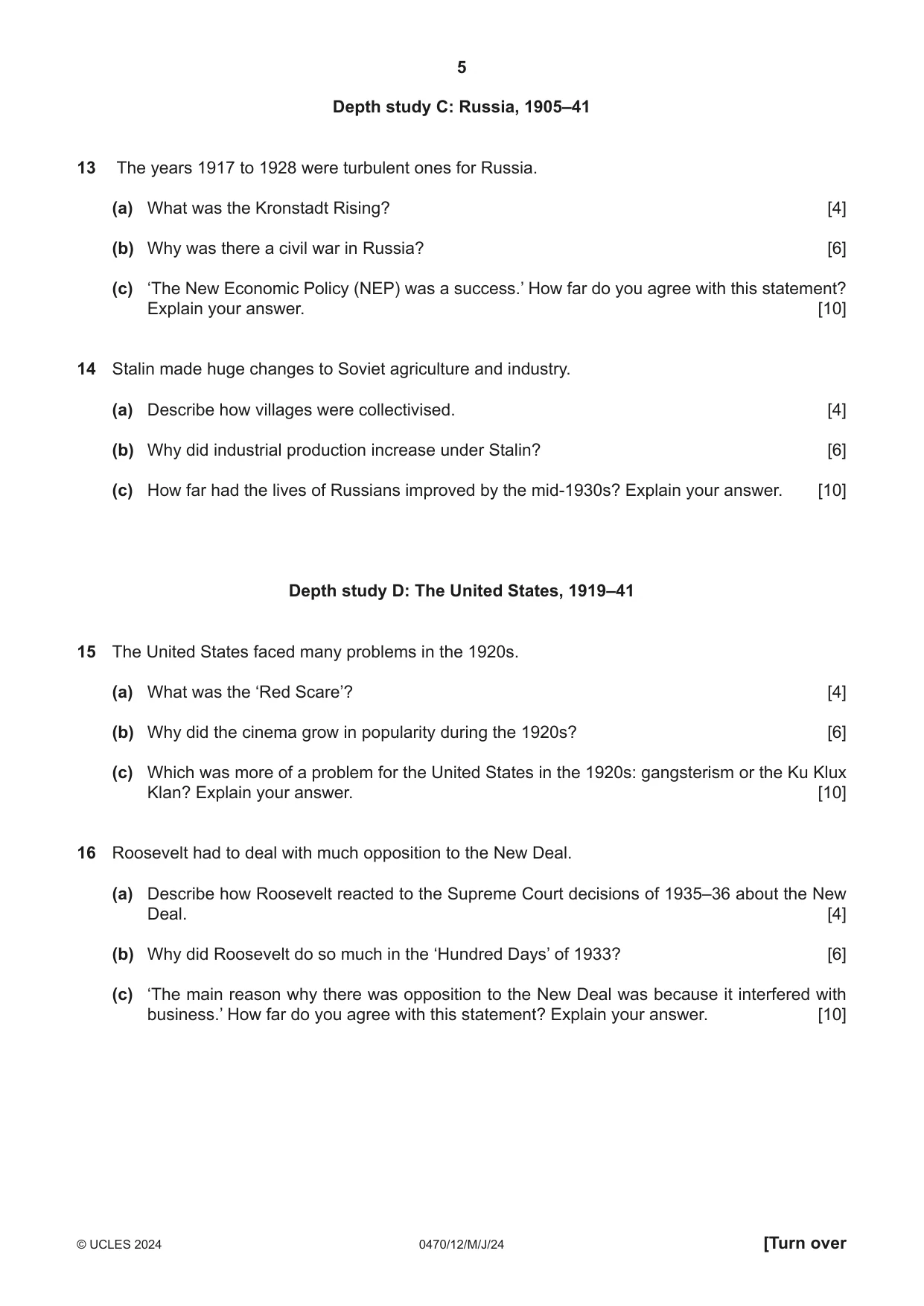
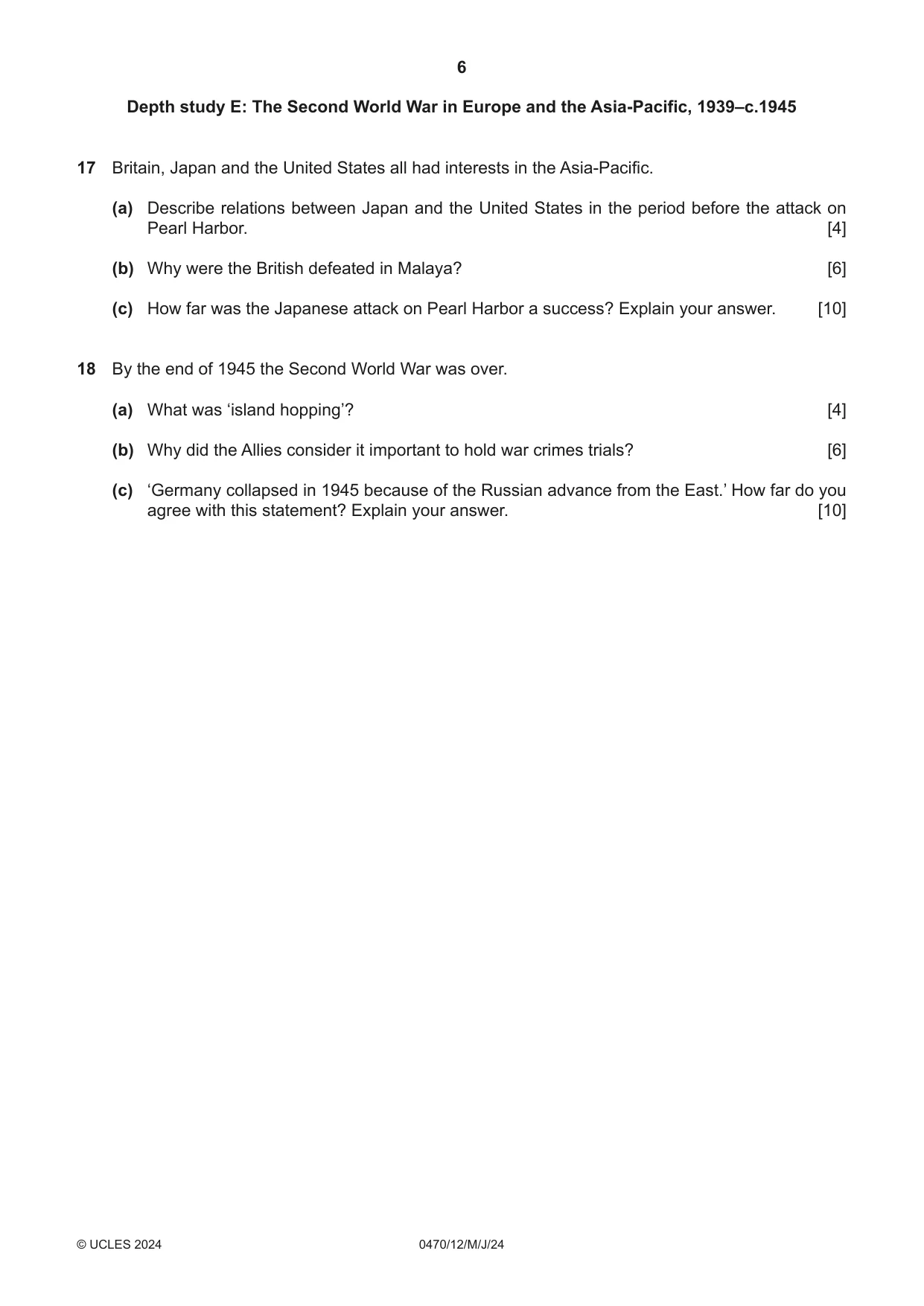
Question paper8 pages

Mark scheme76 pages
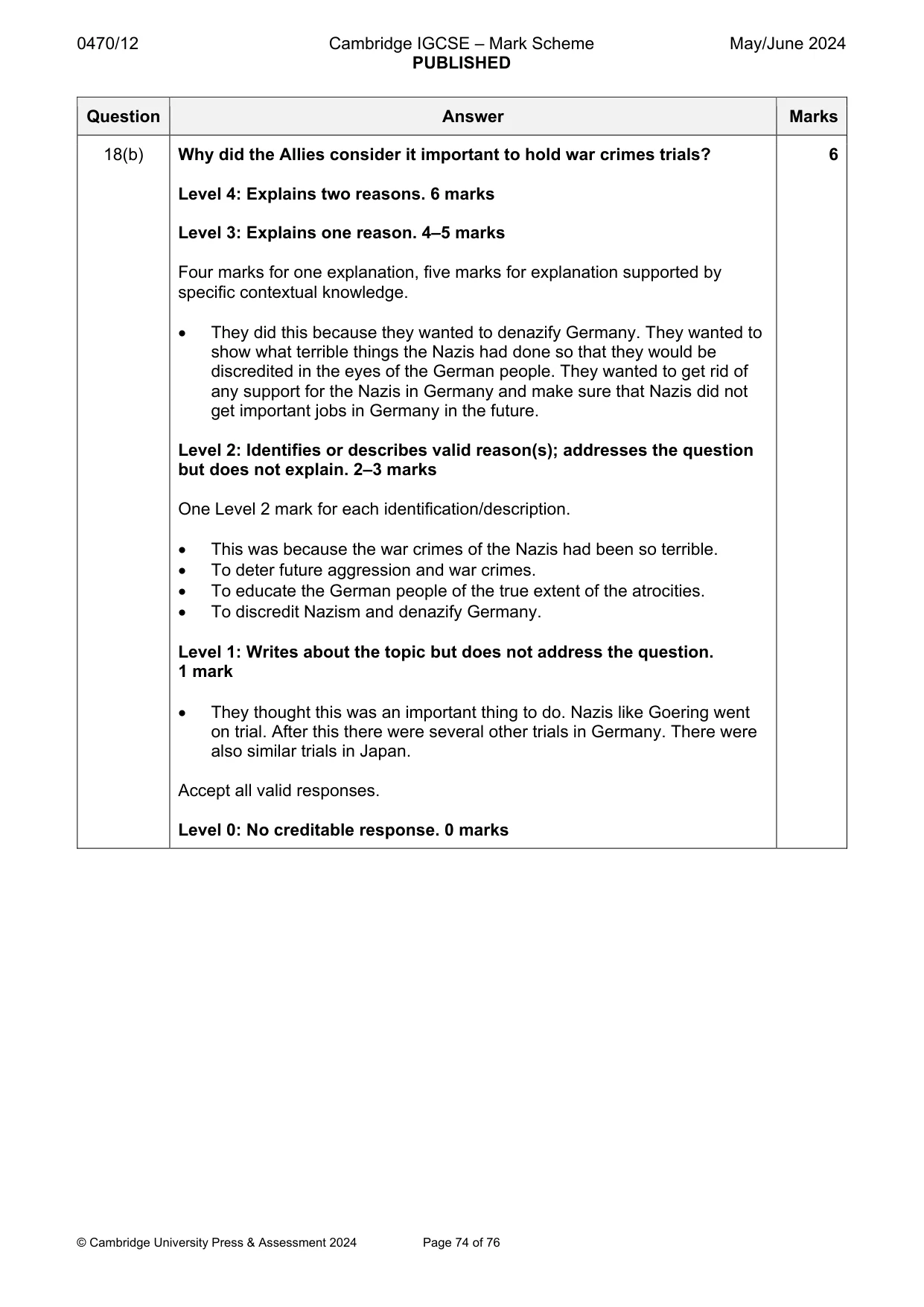
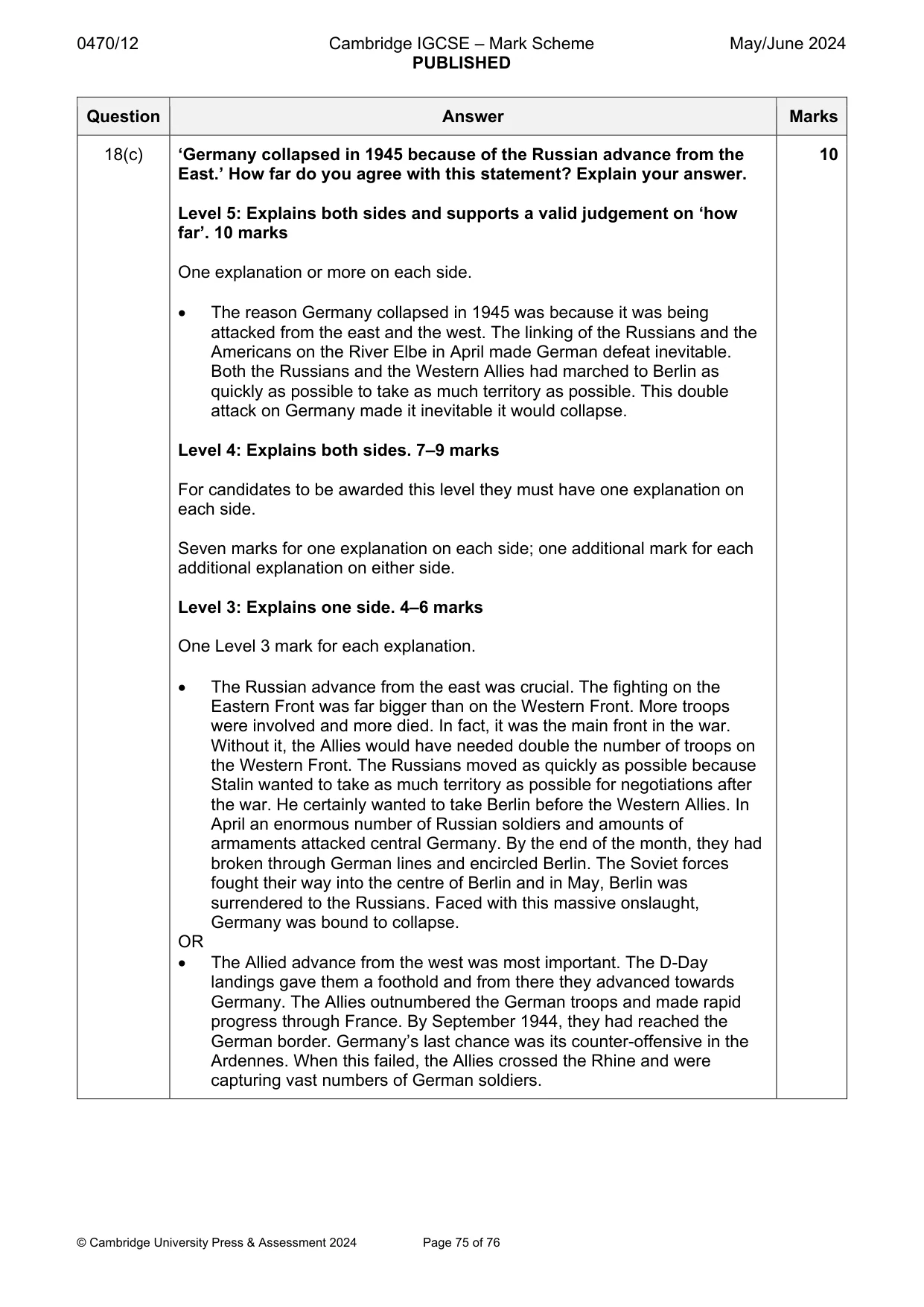
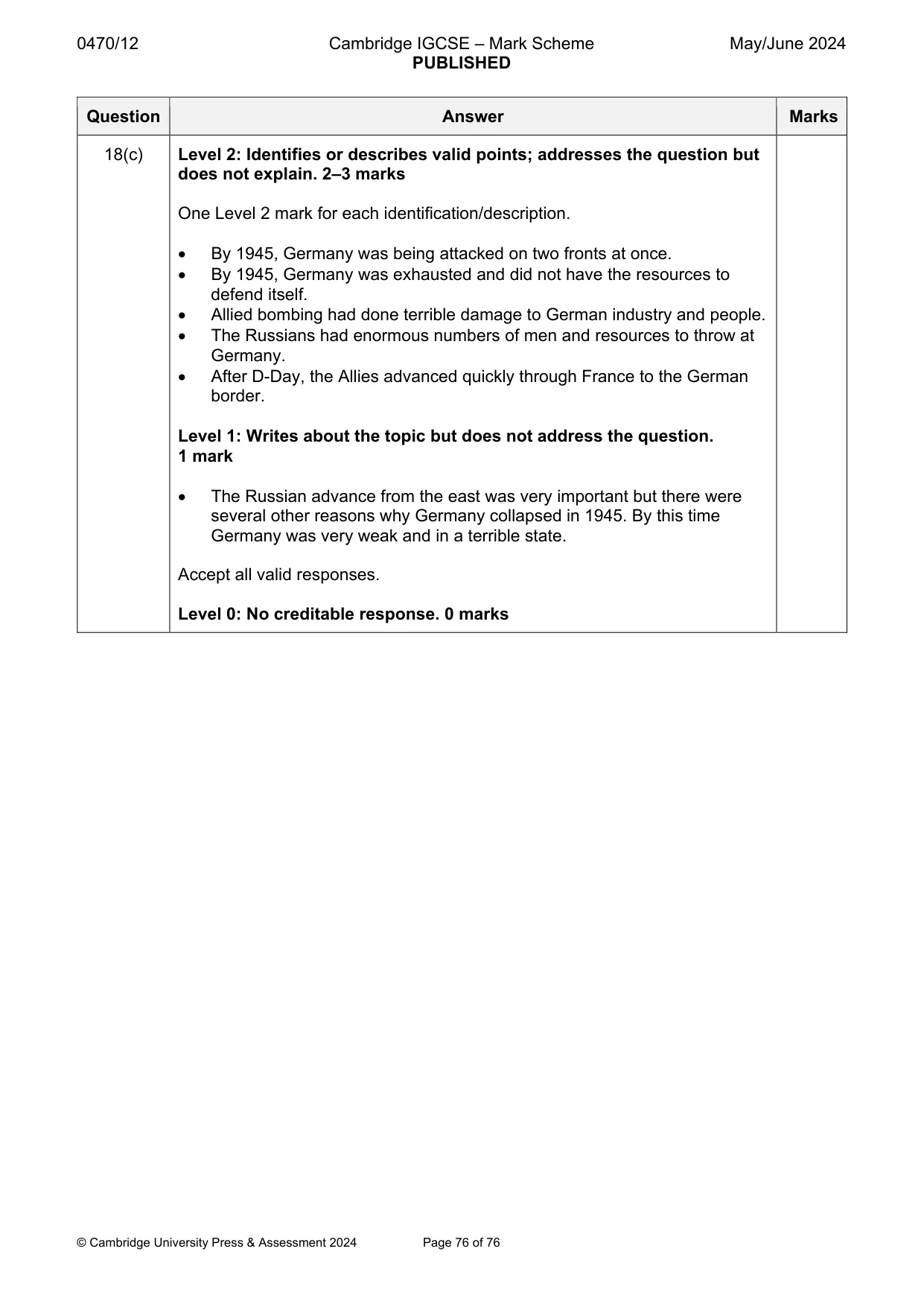
Answers below. Sit the paper first if you are practising.
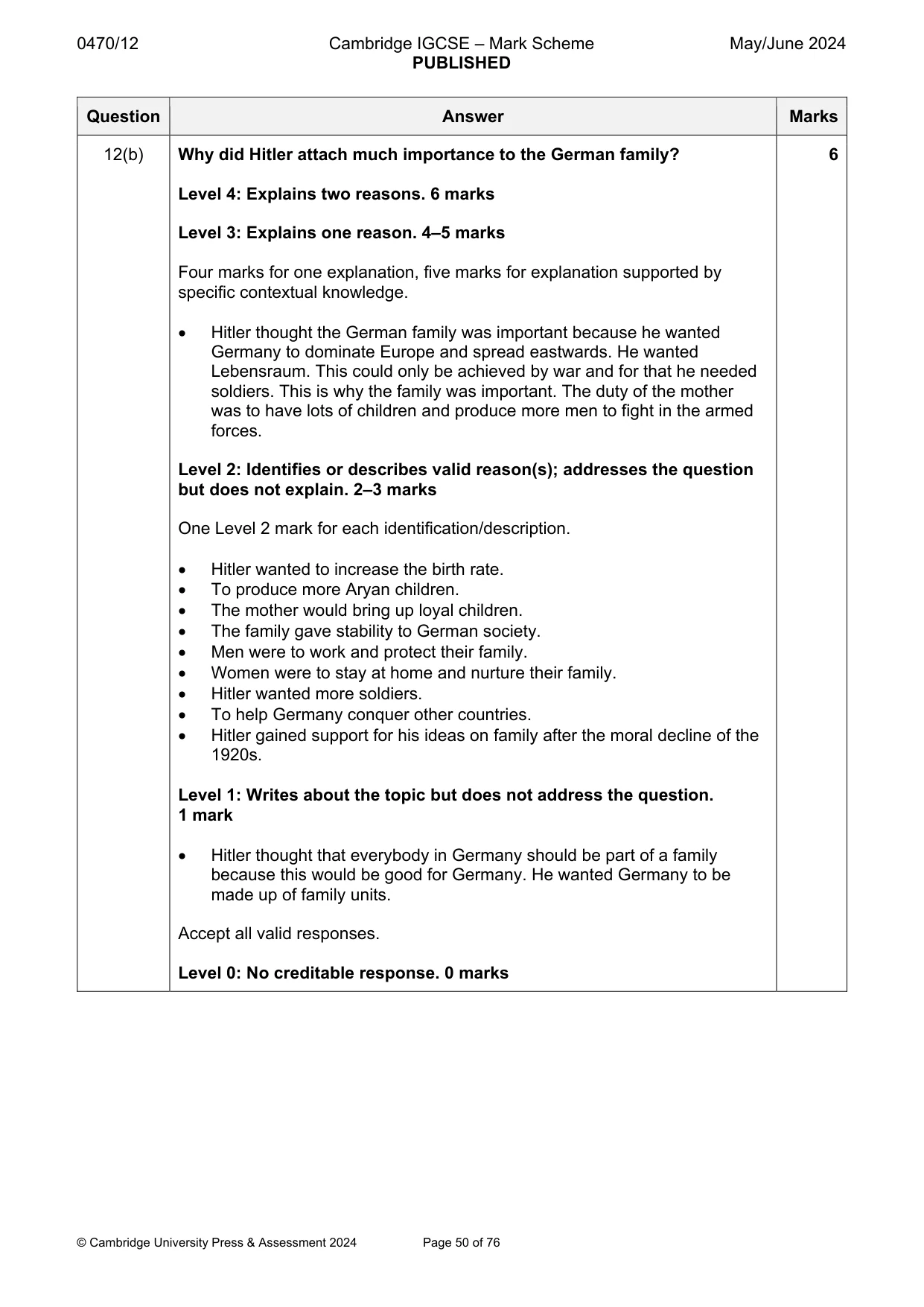
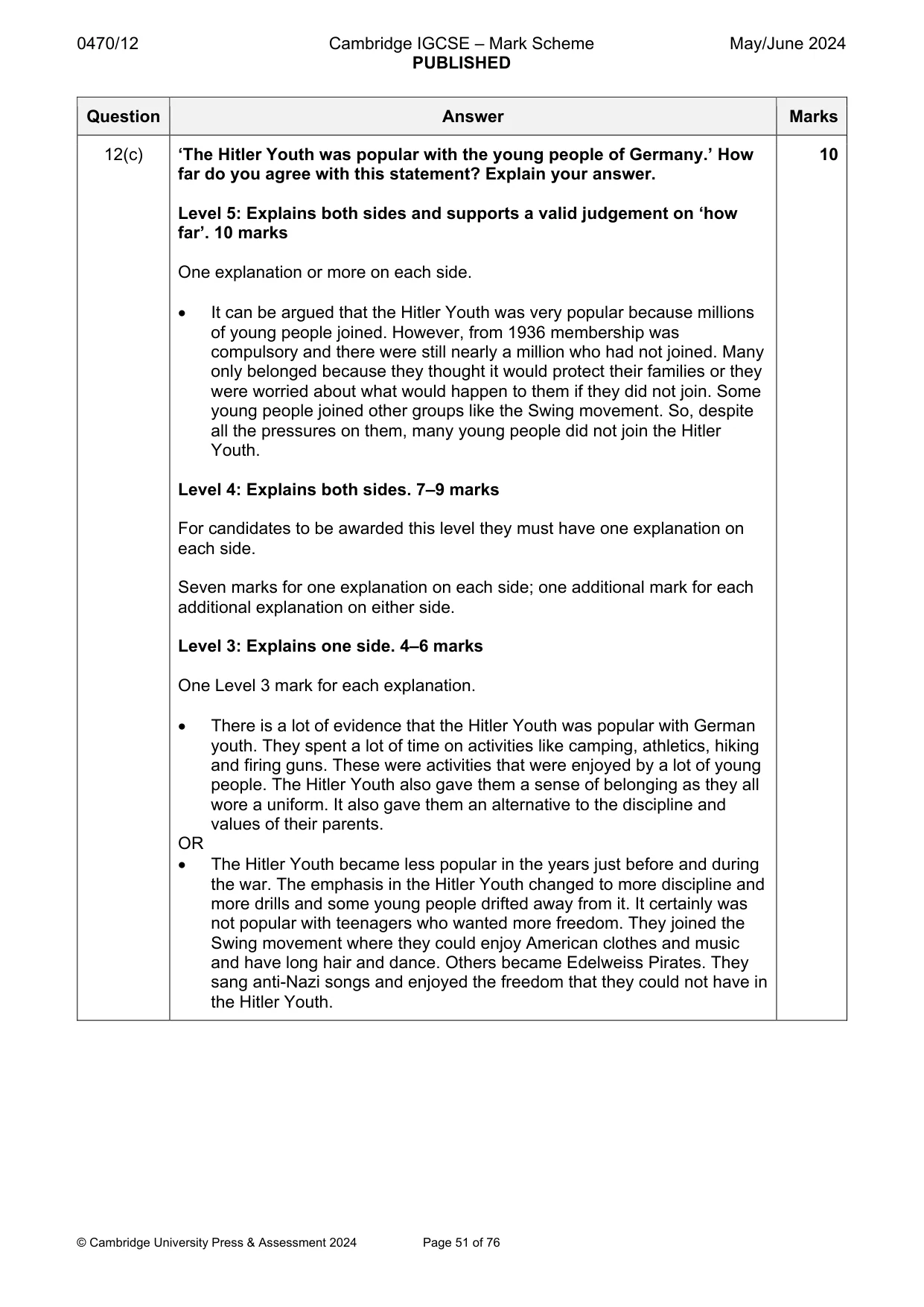
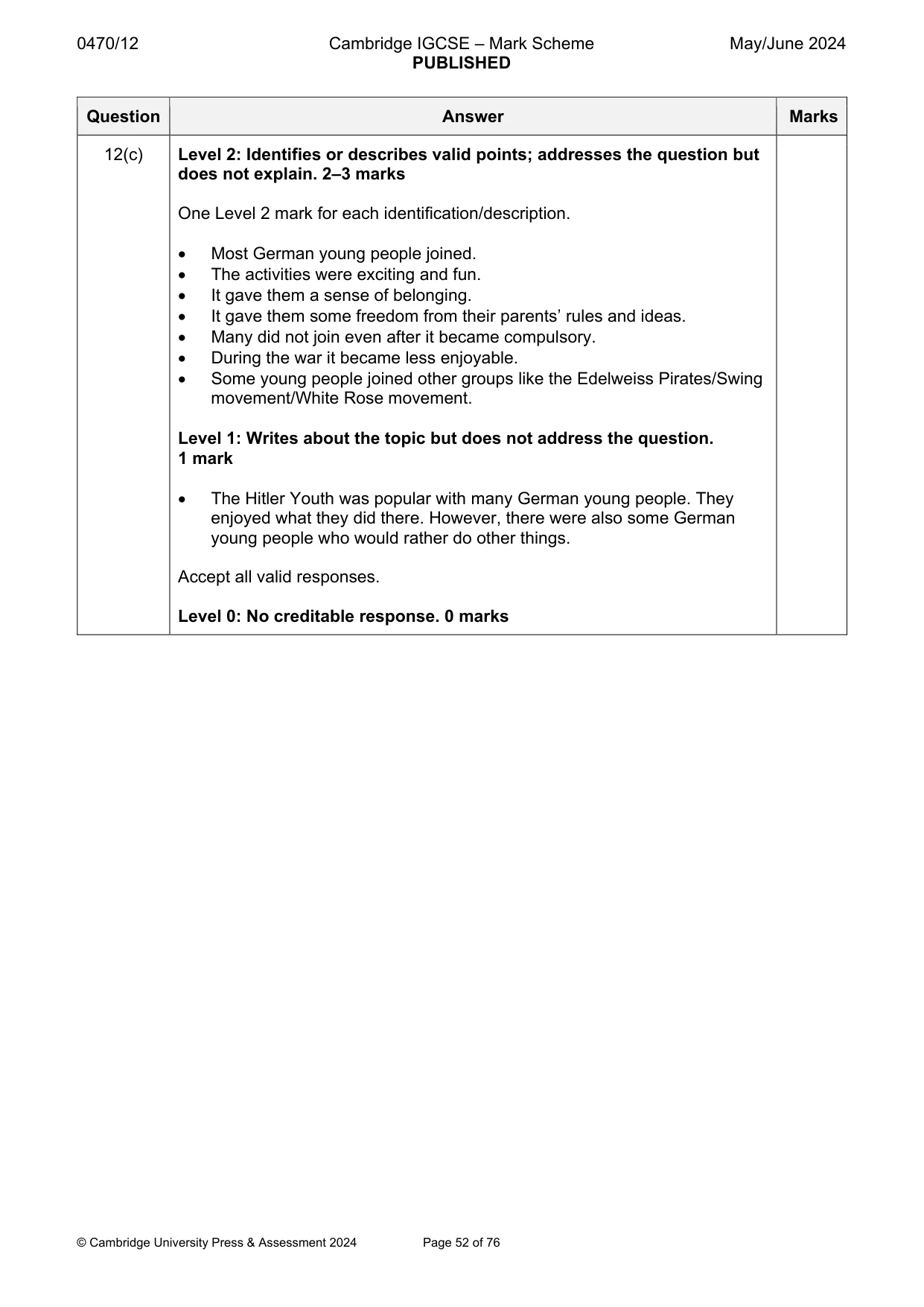
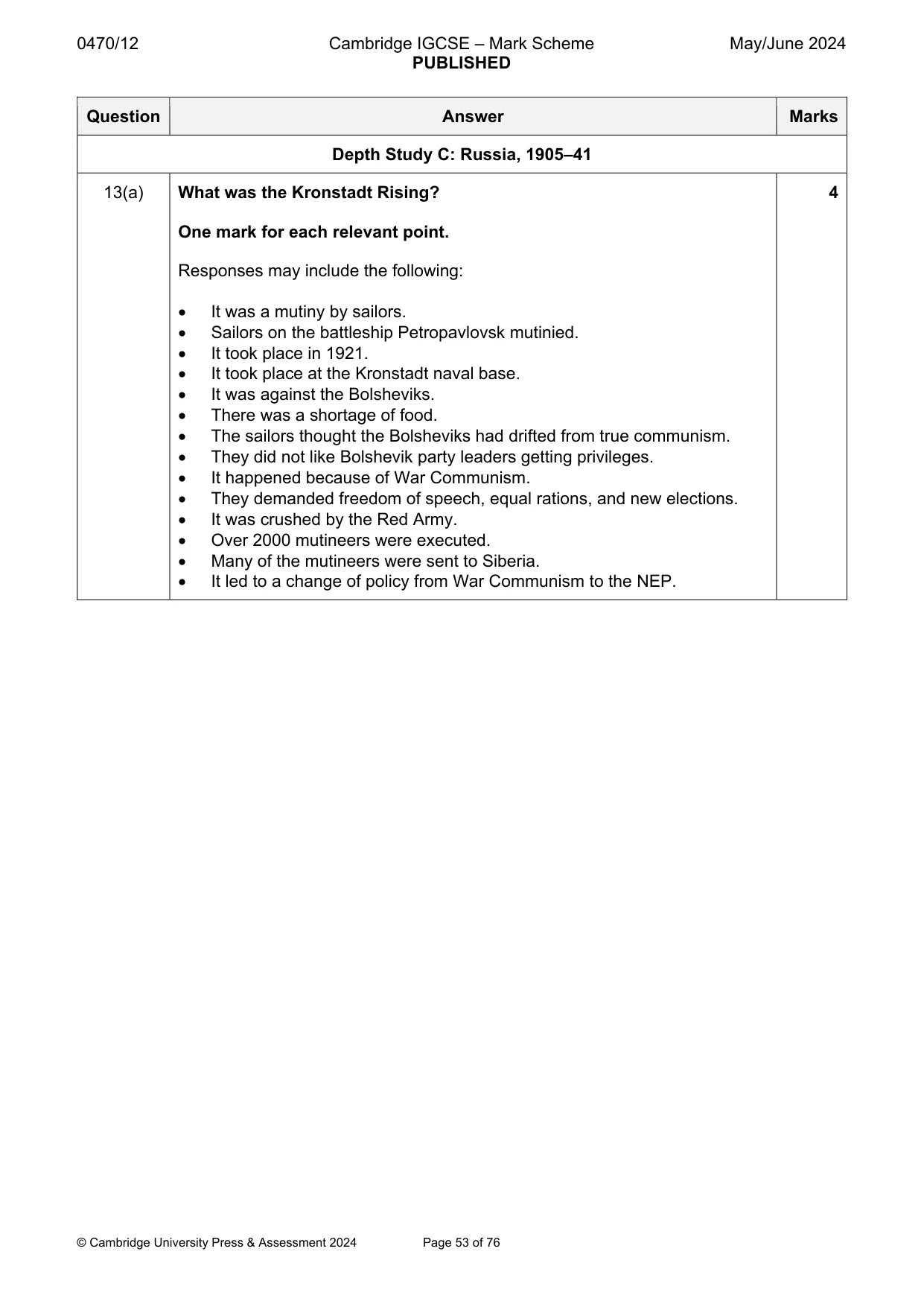
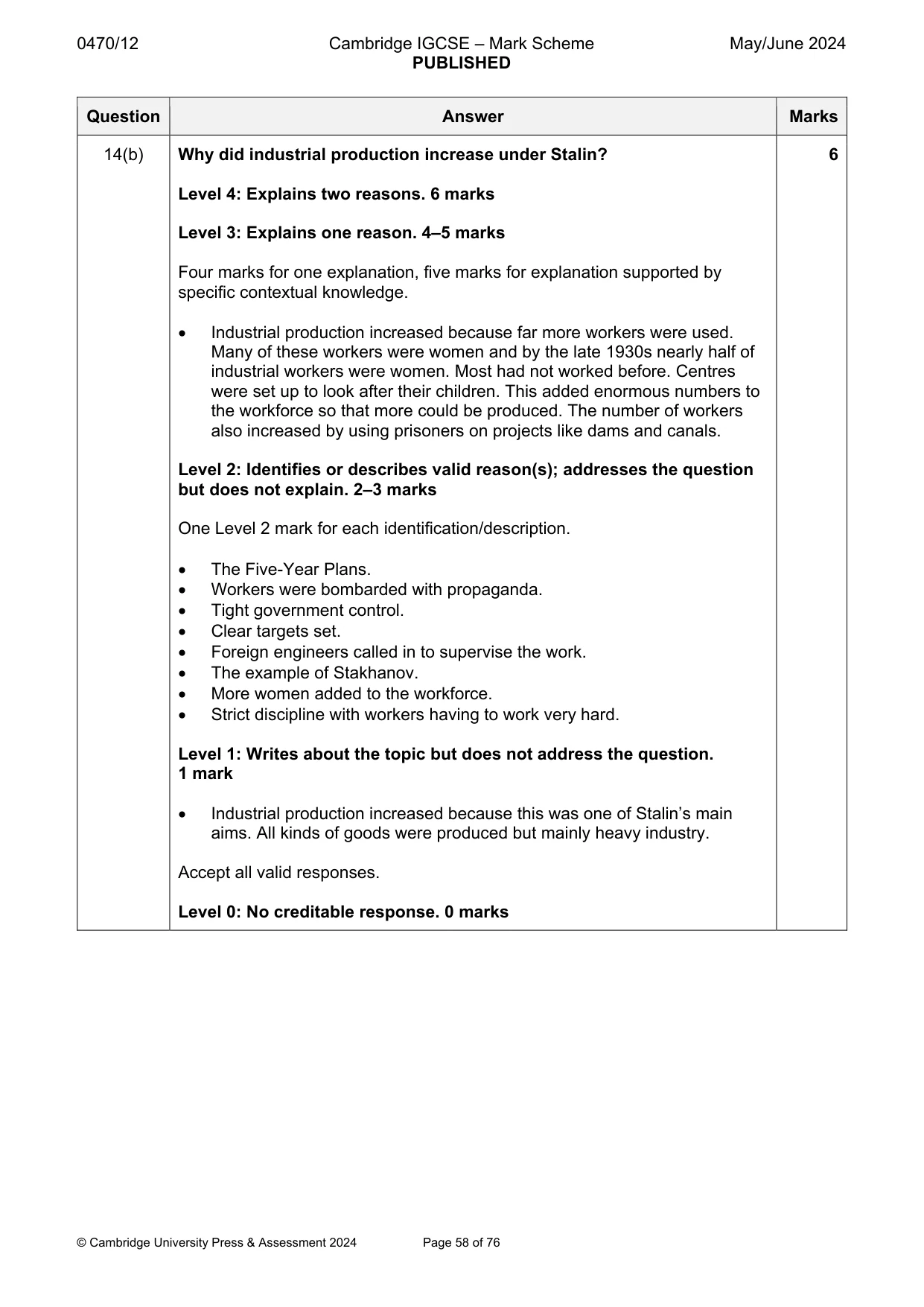
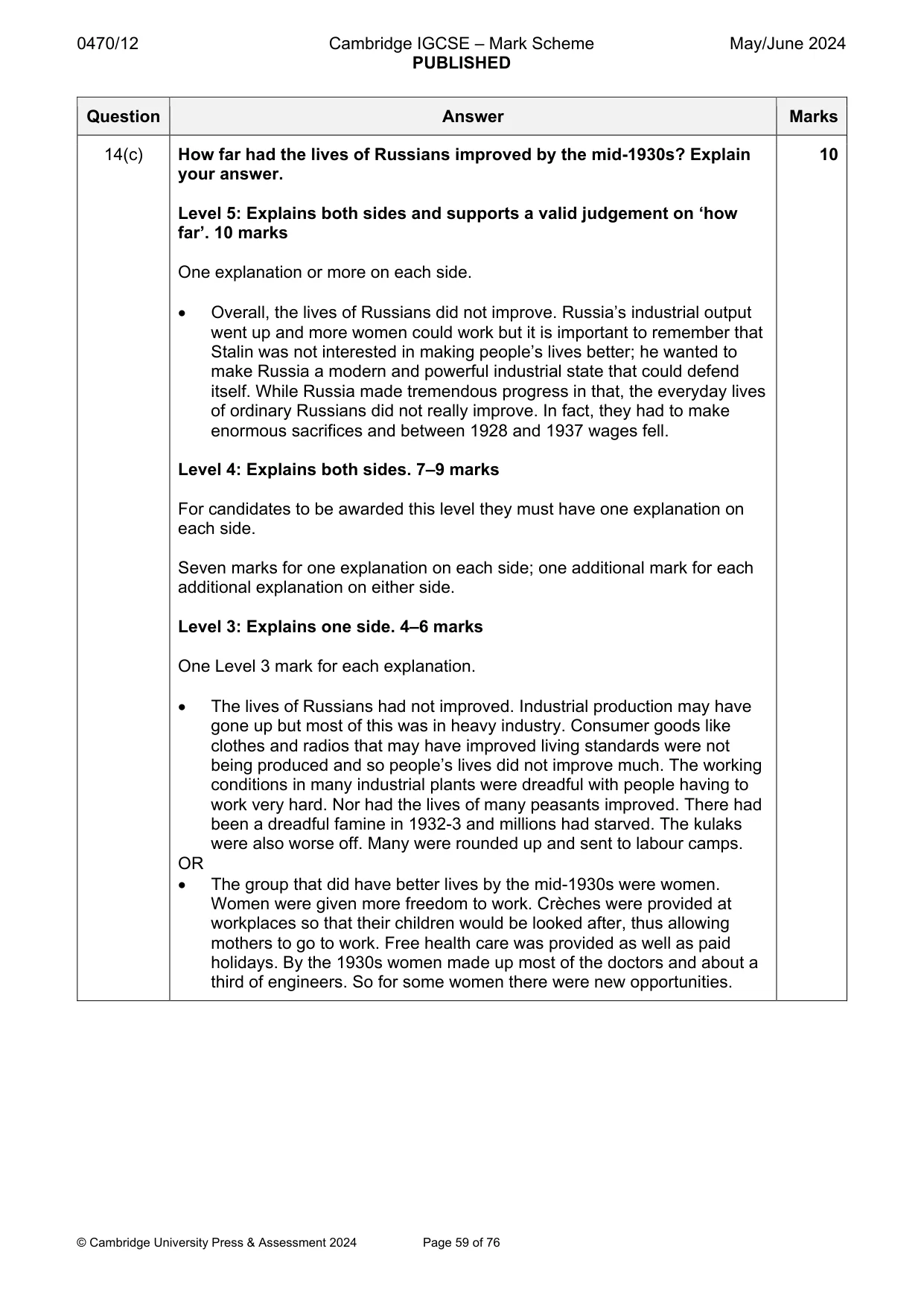
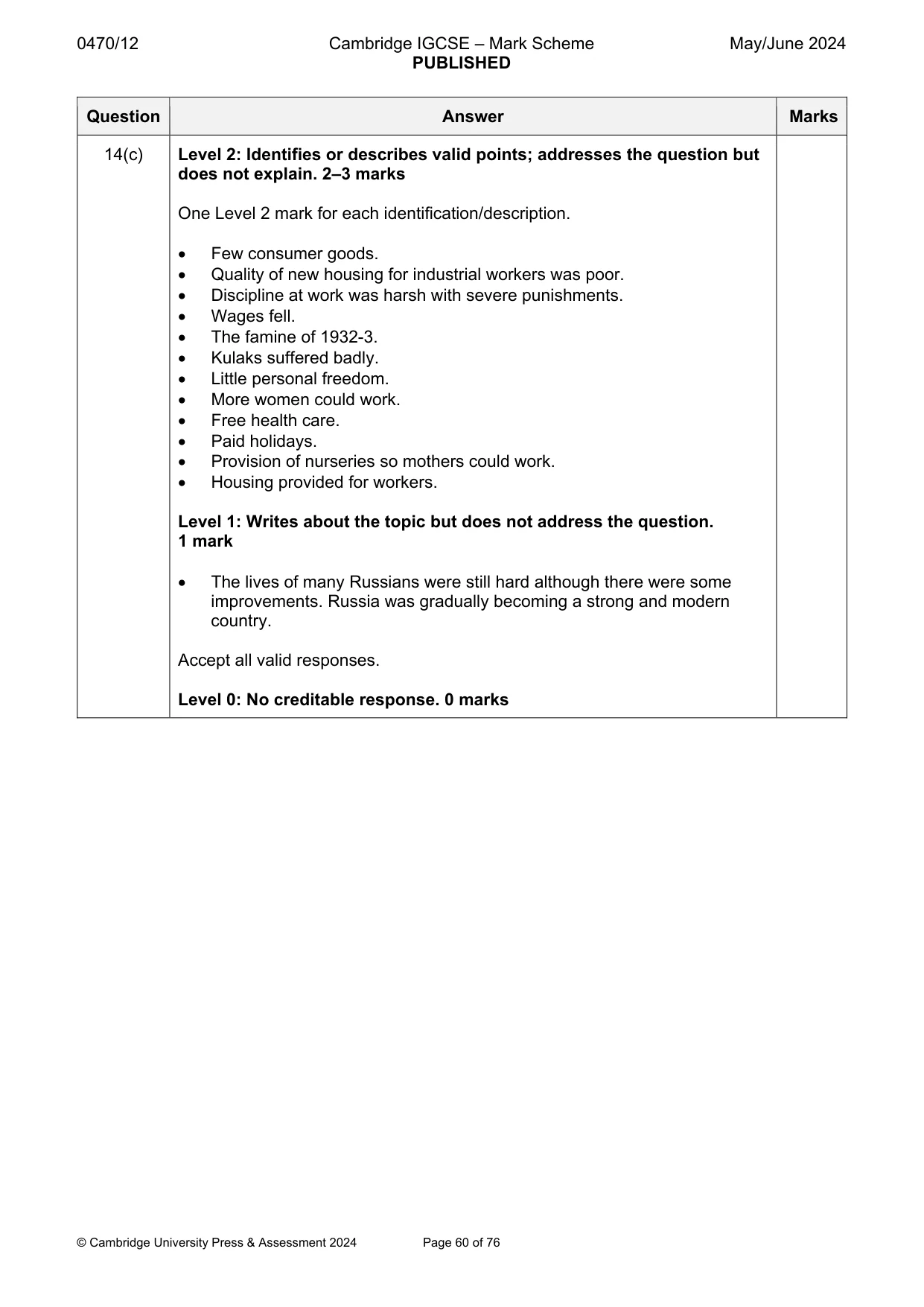
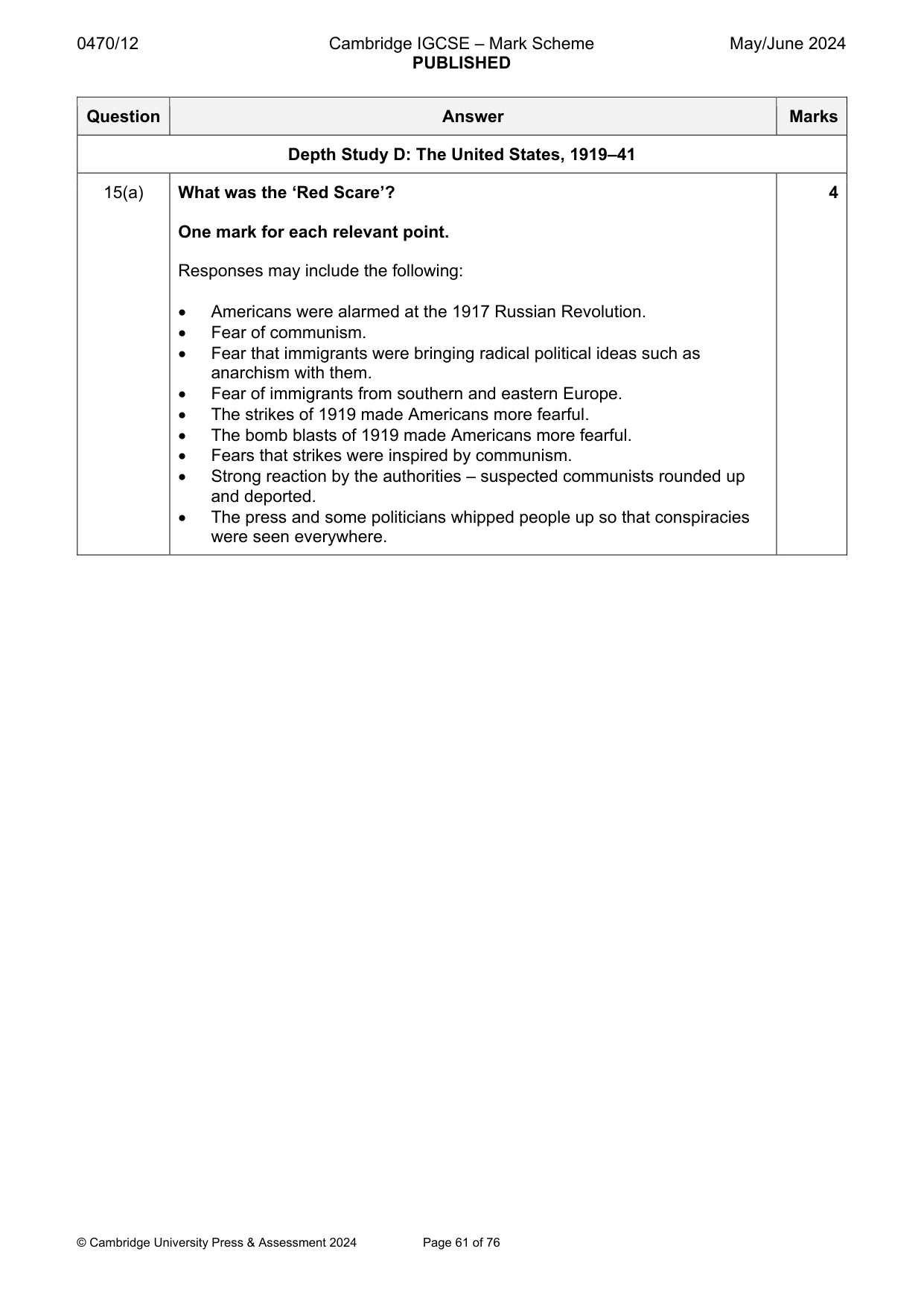
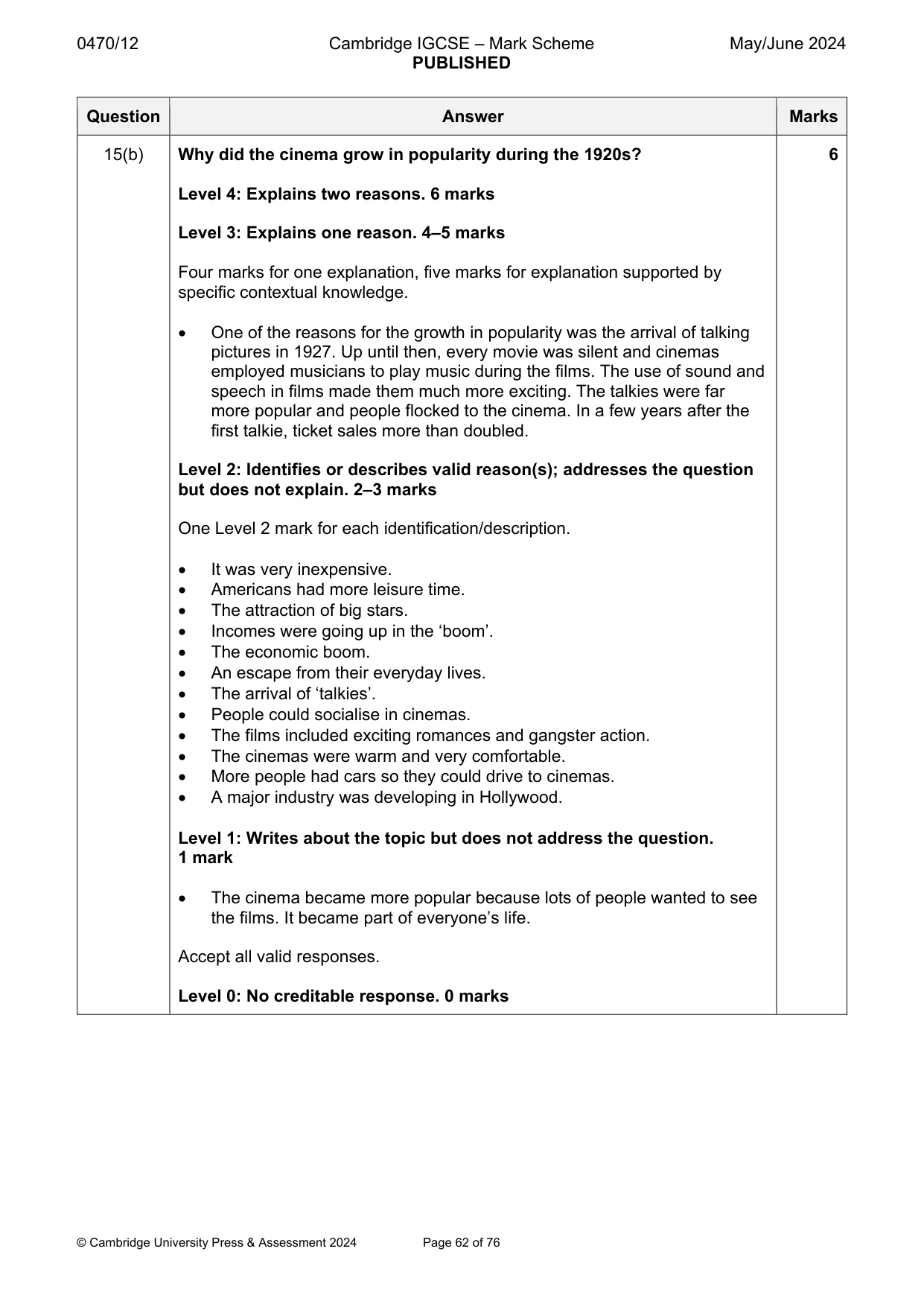
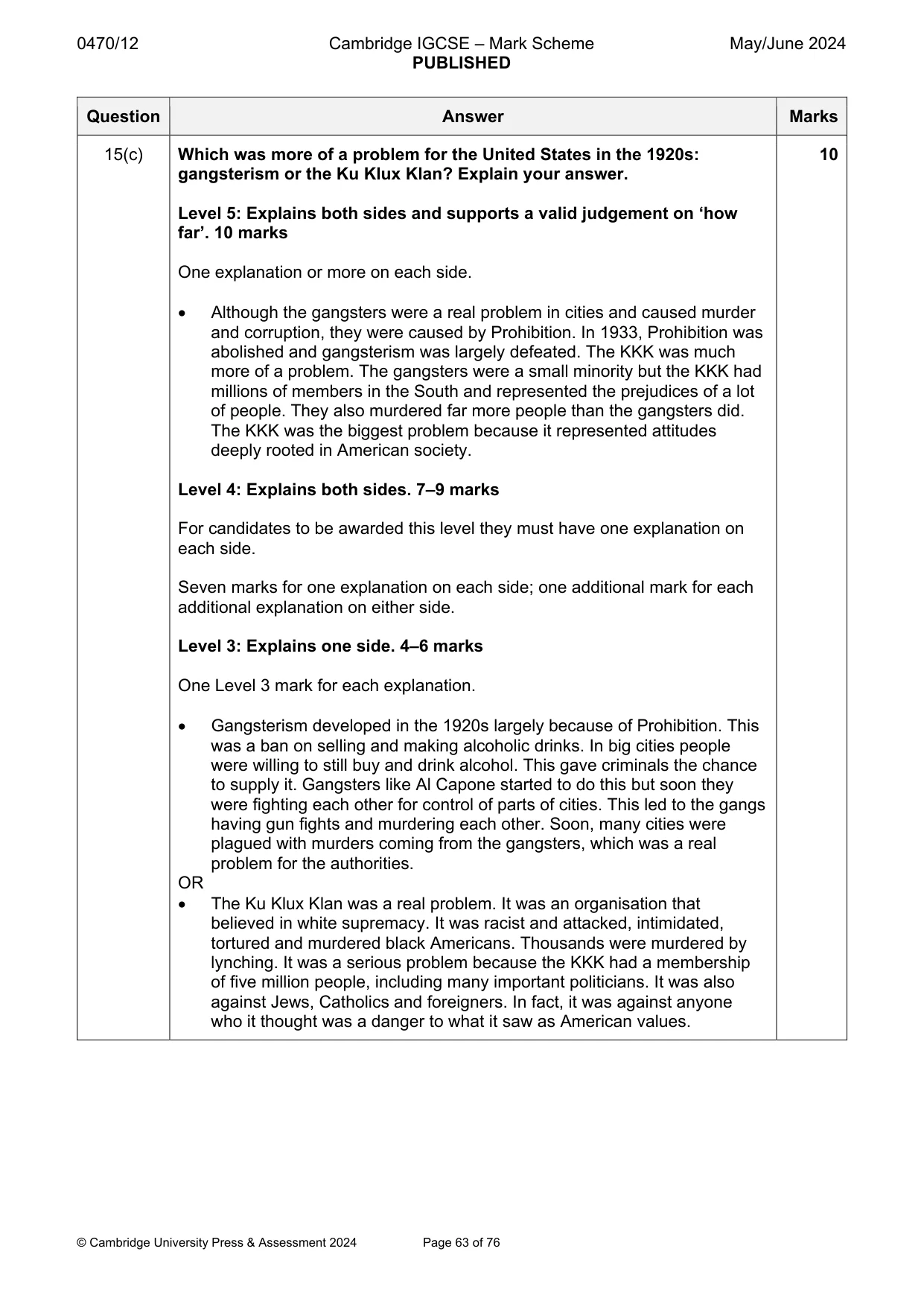
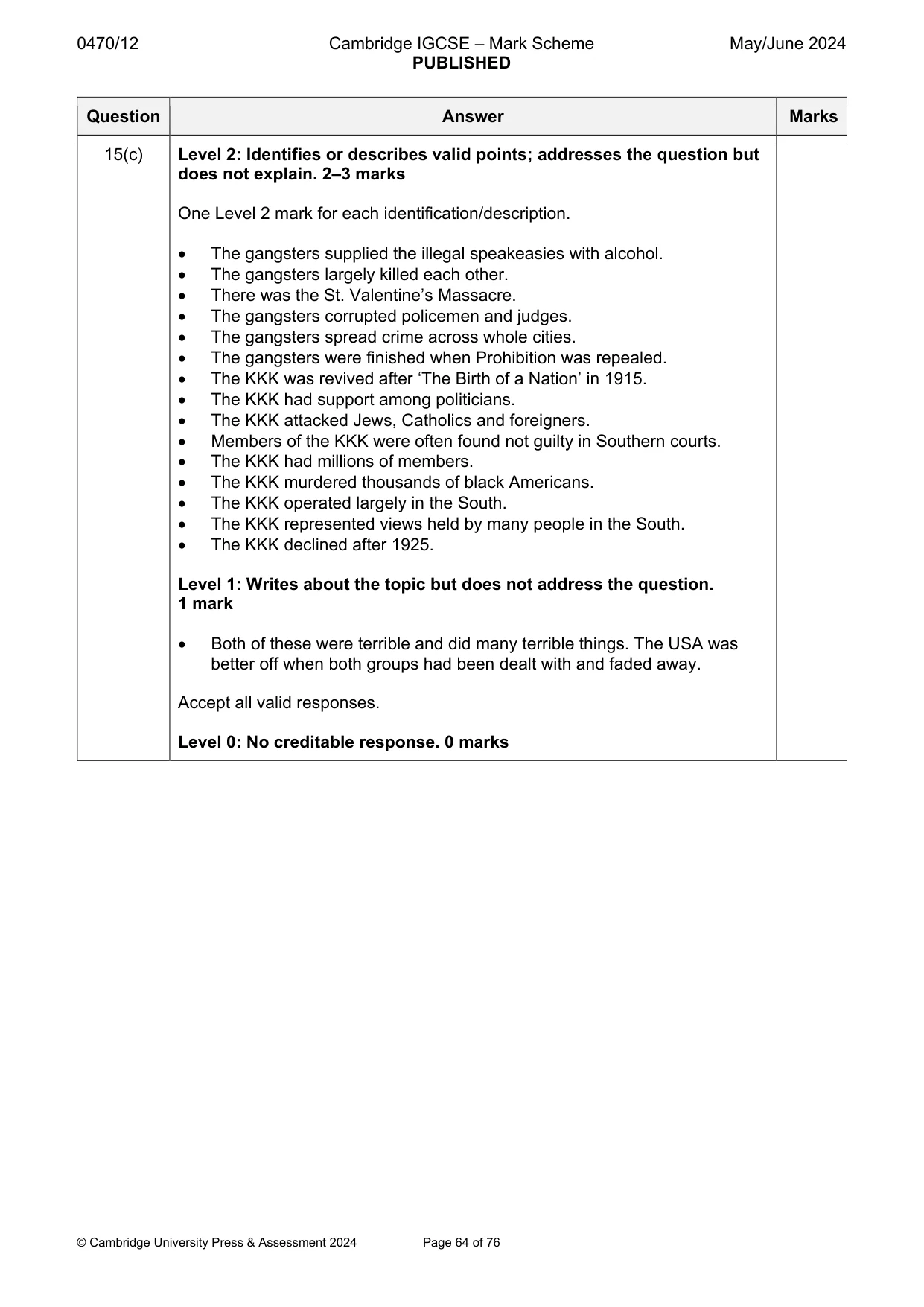
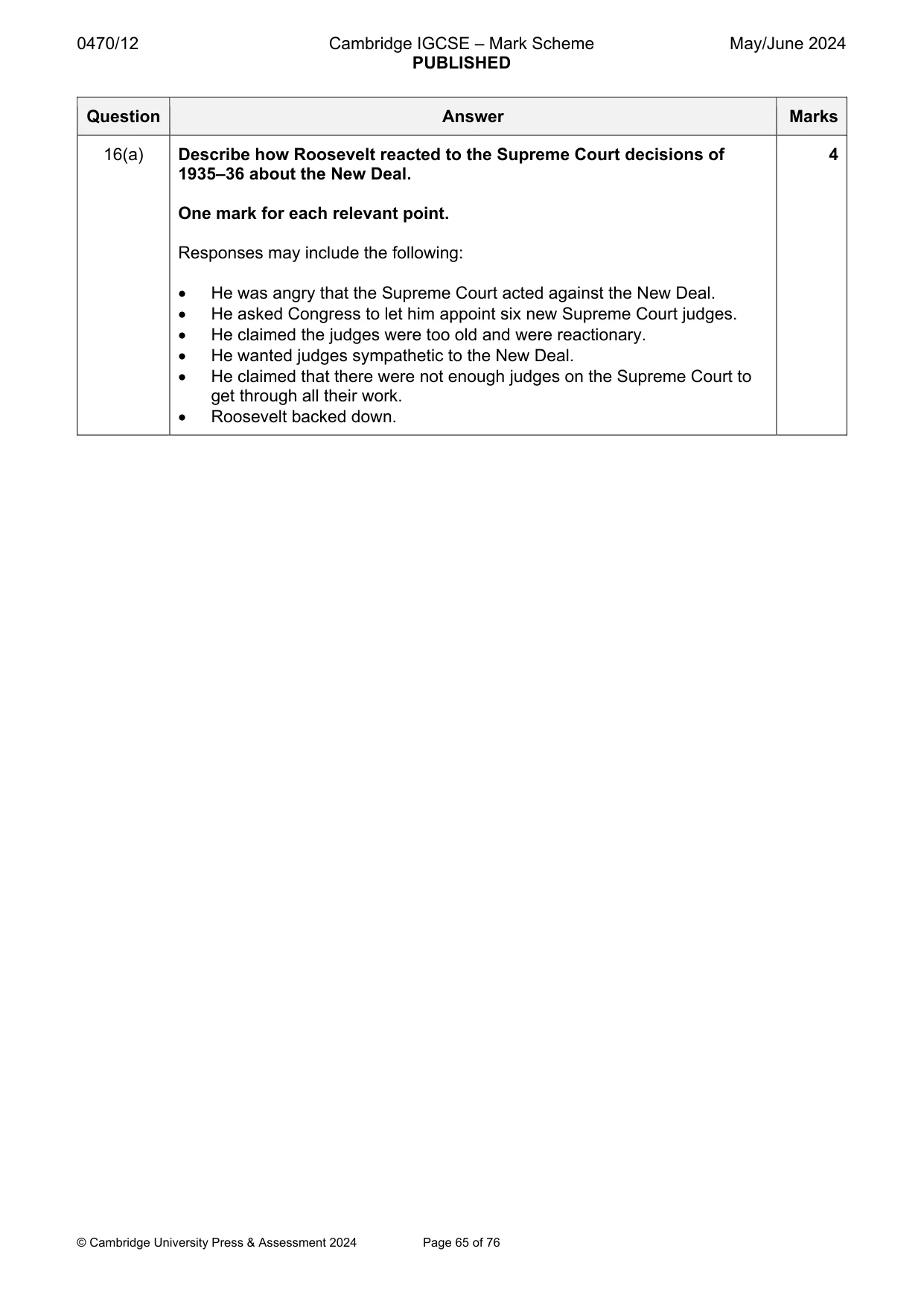
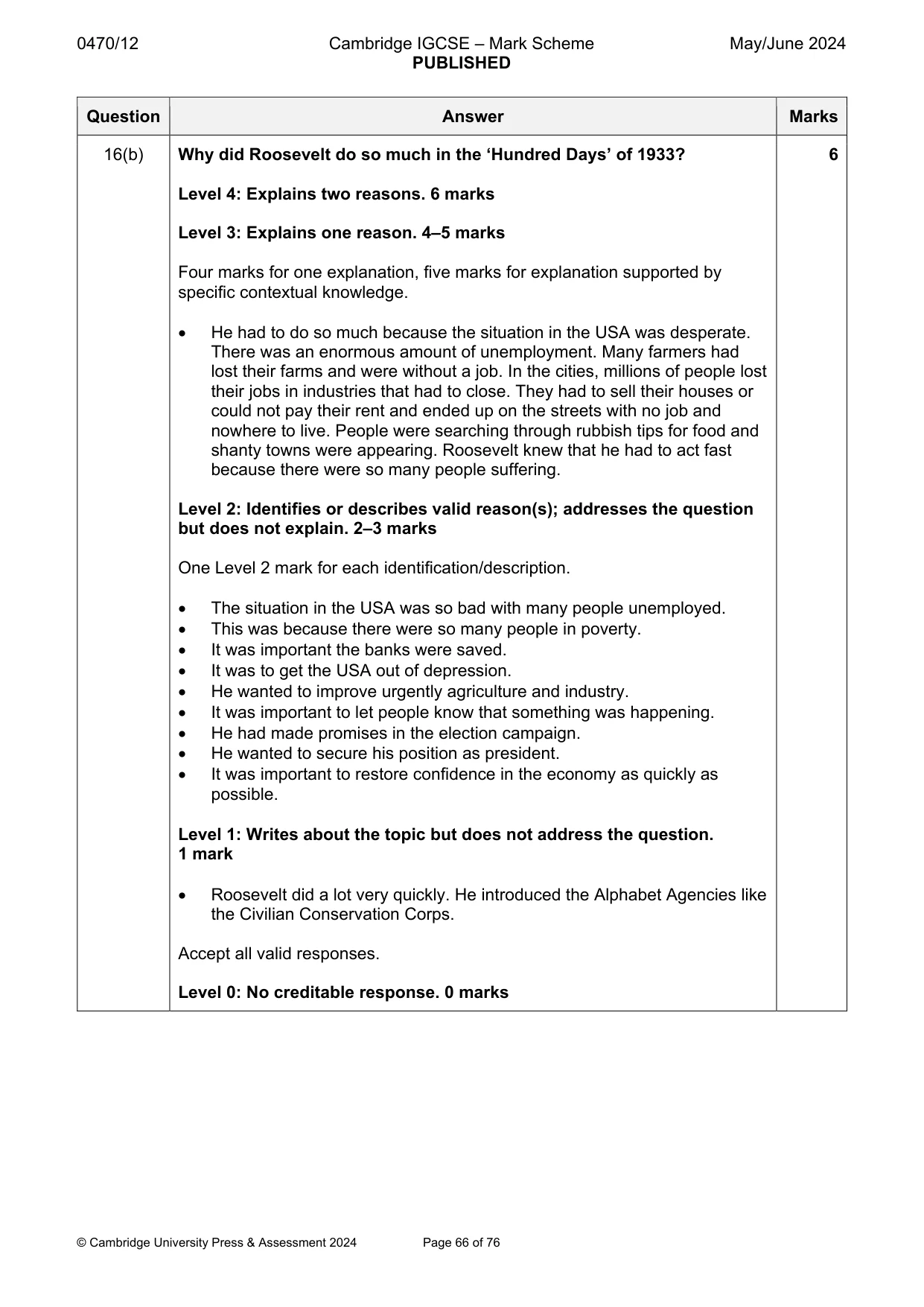
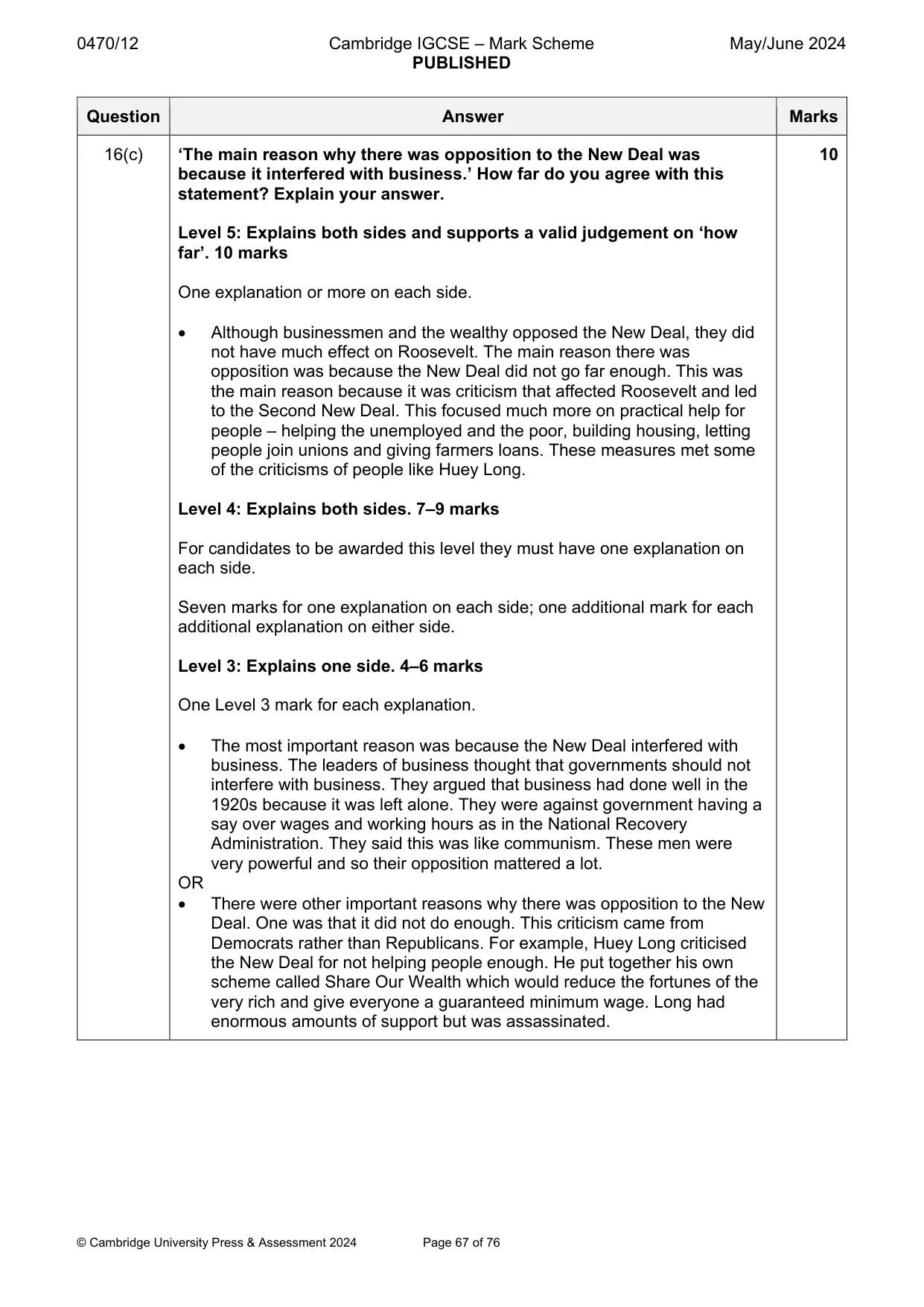
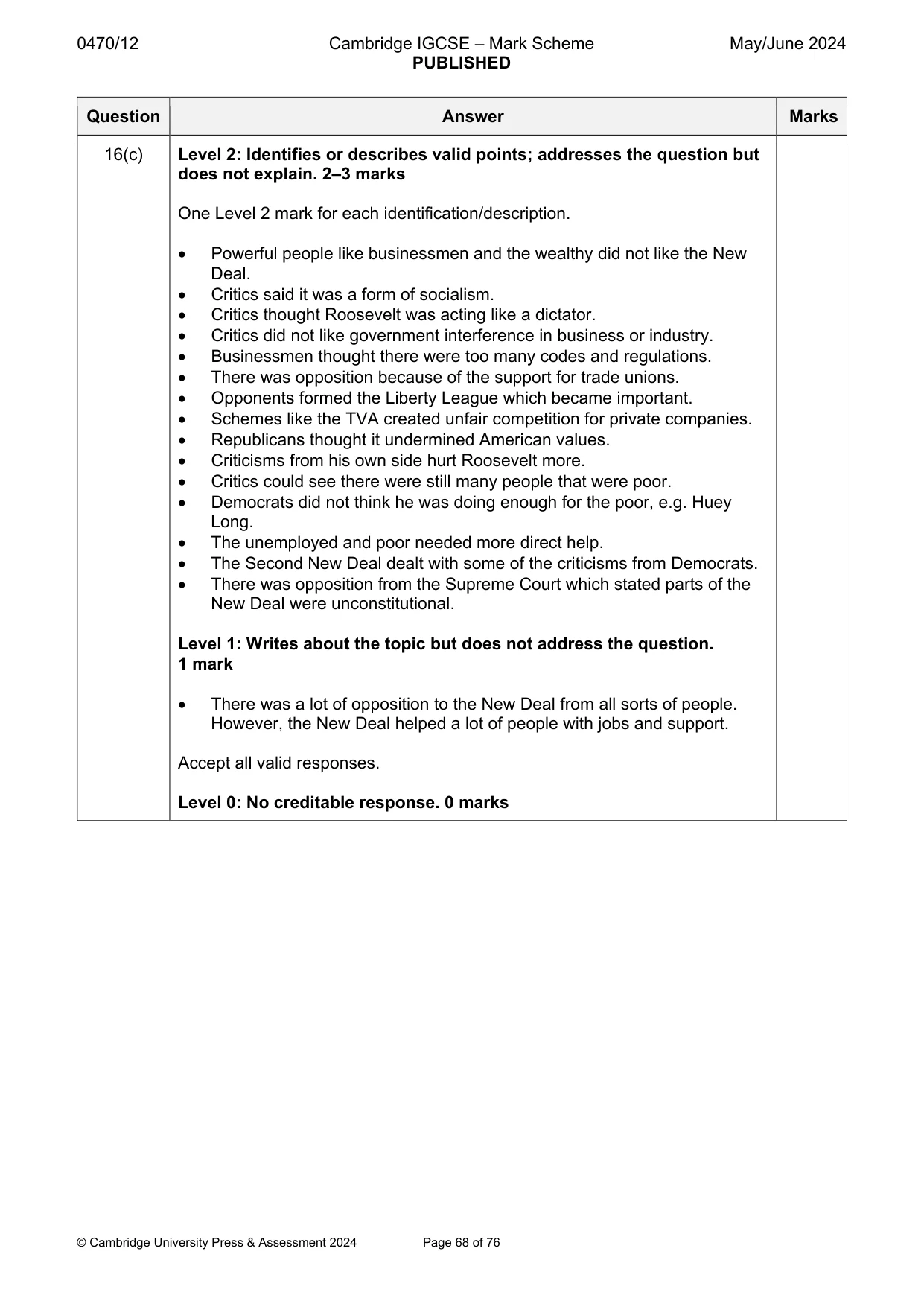
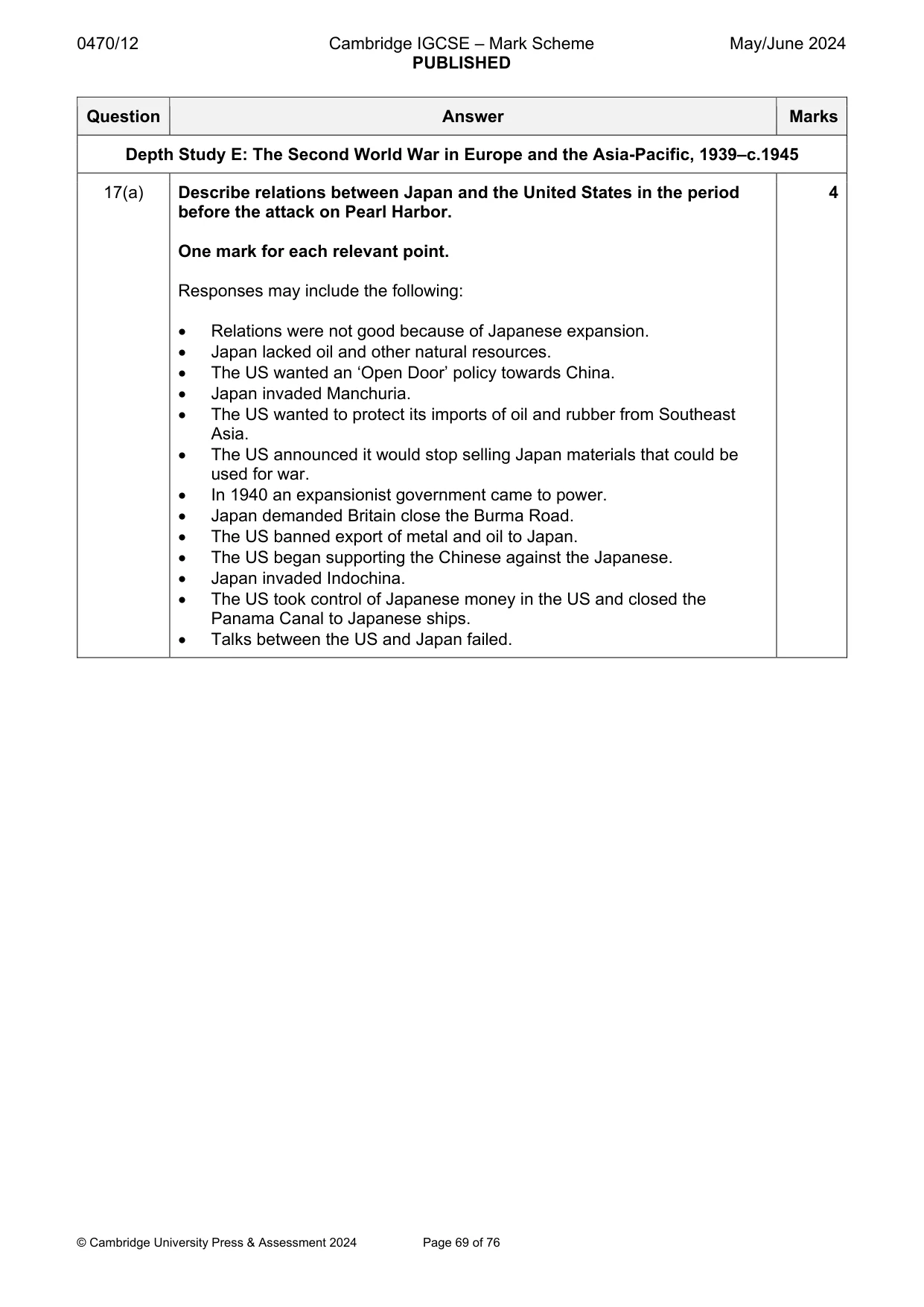
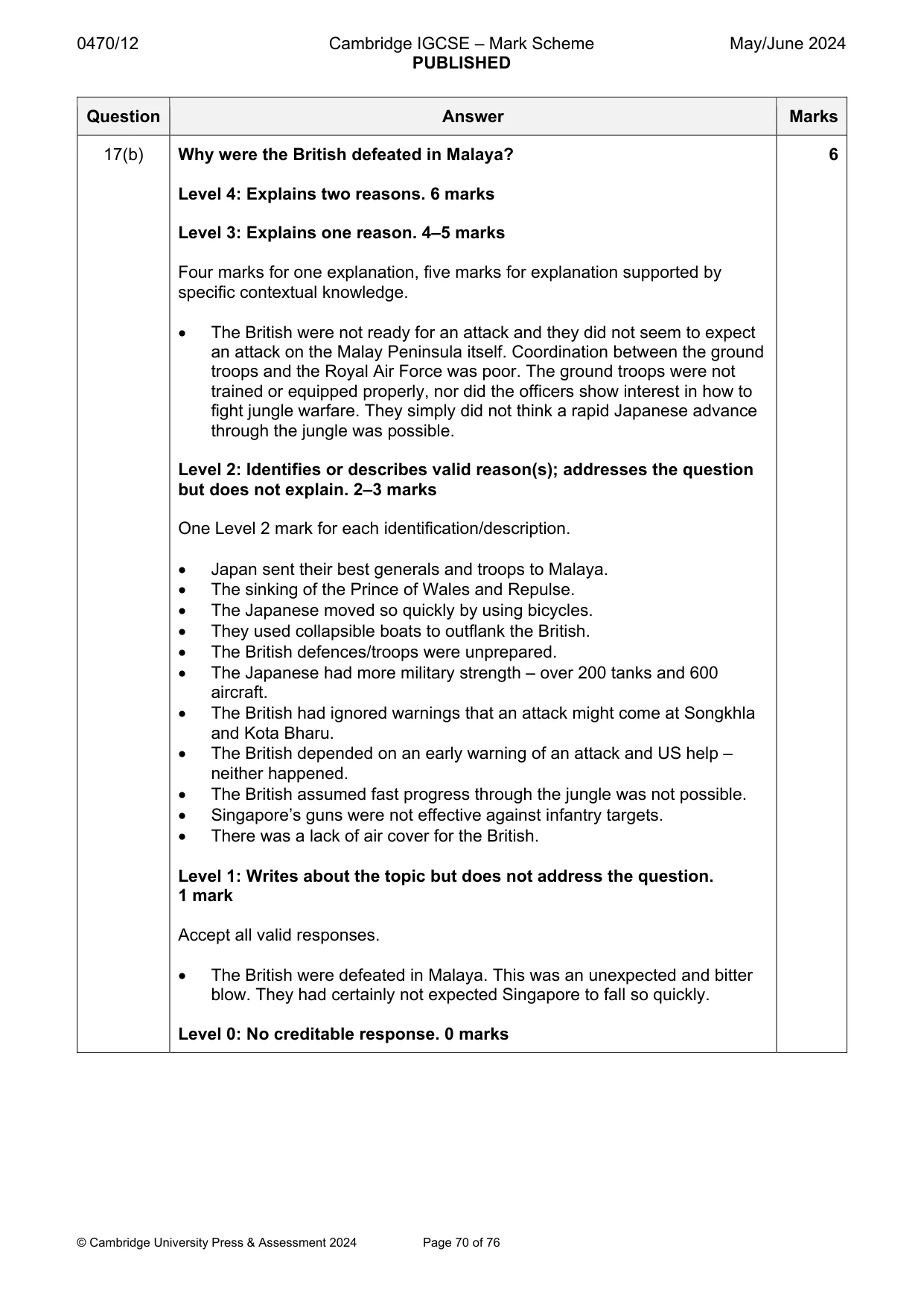
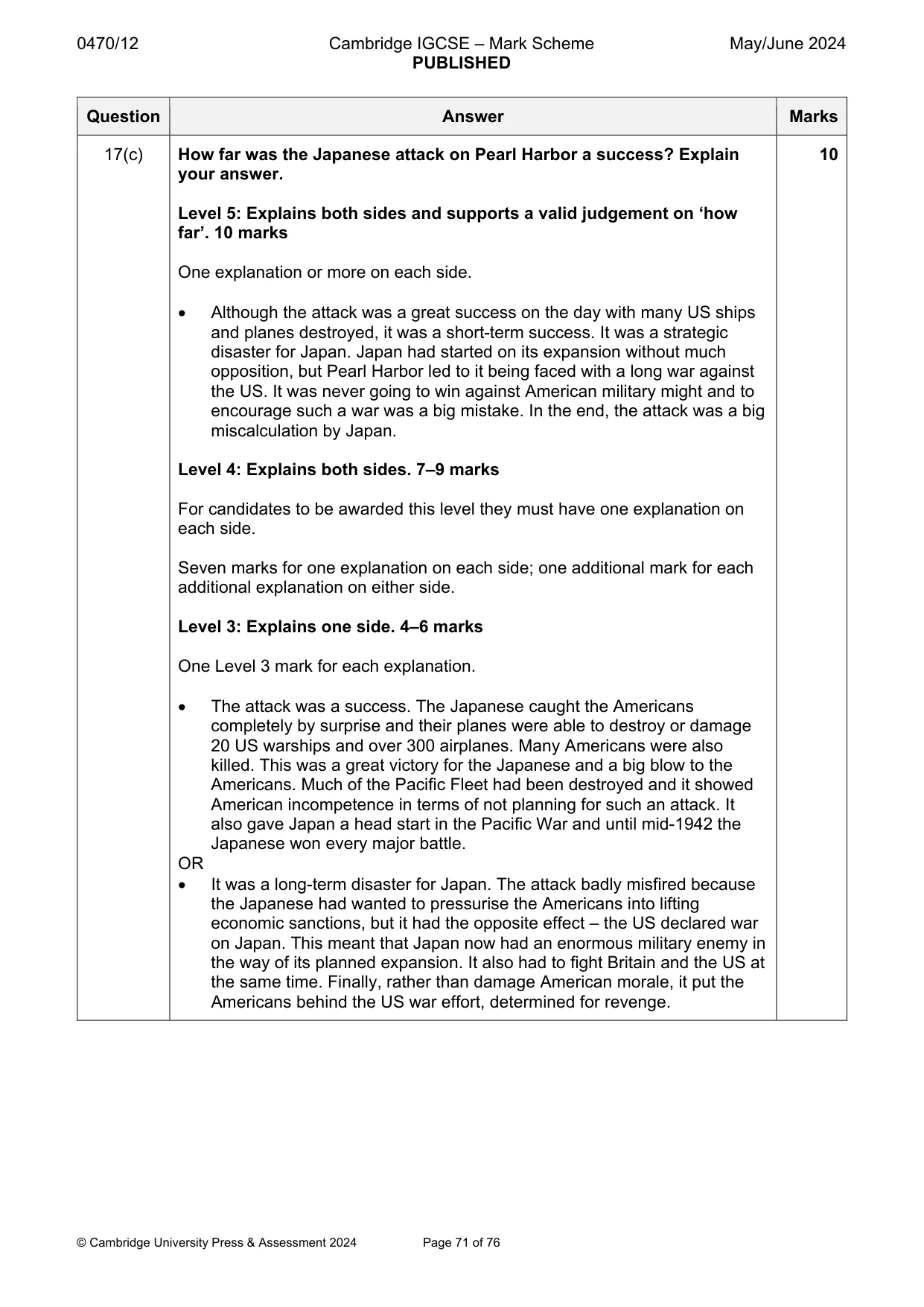
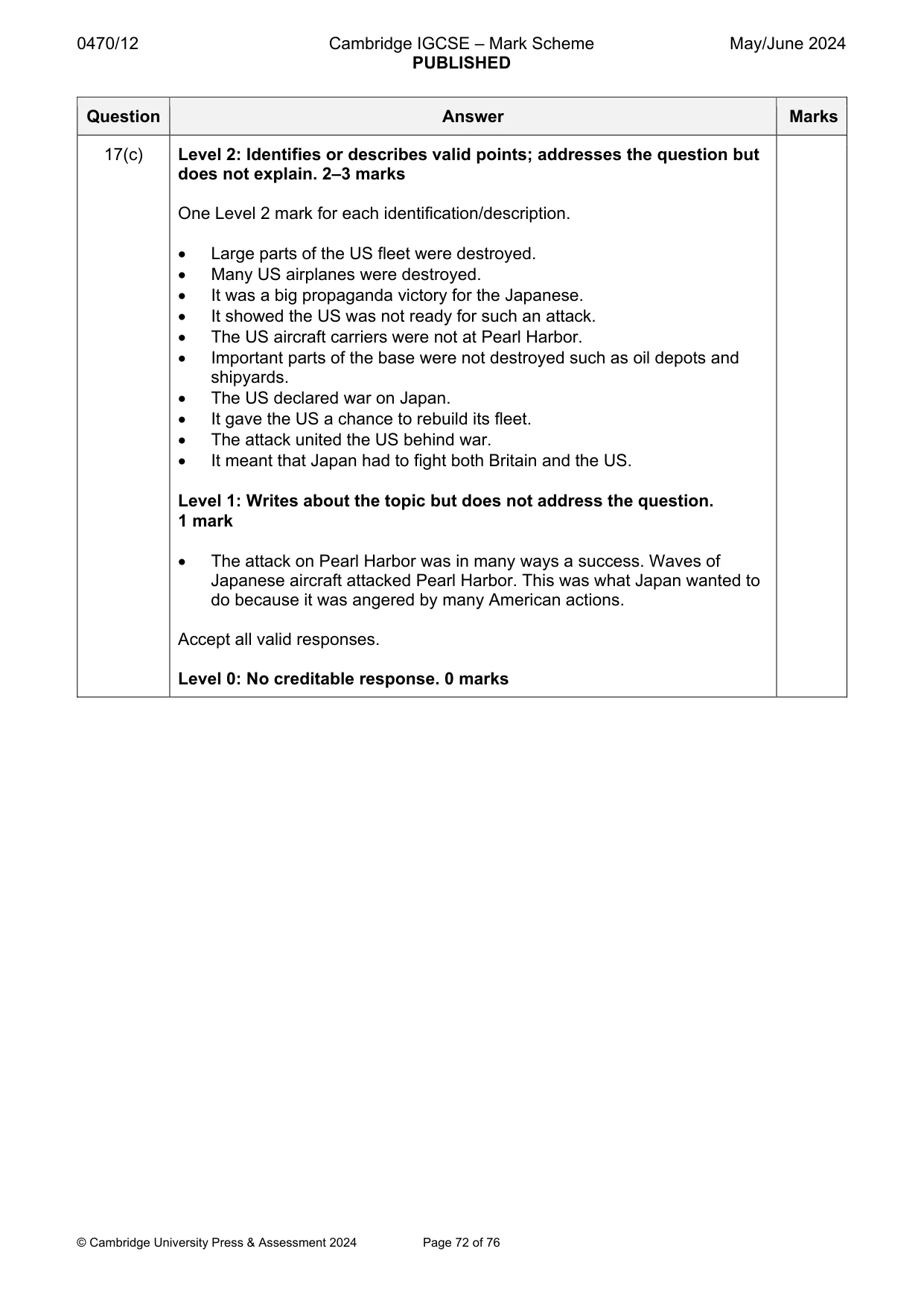
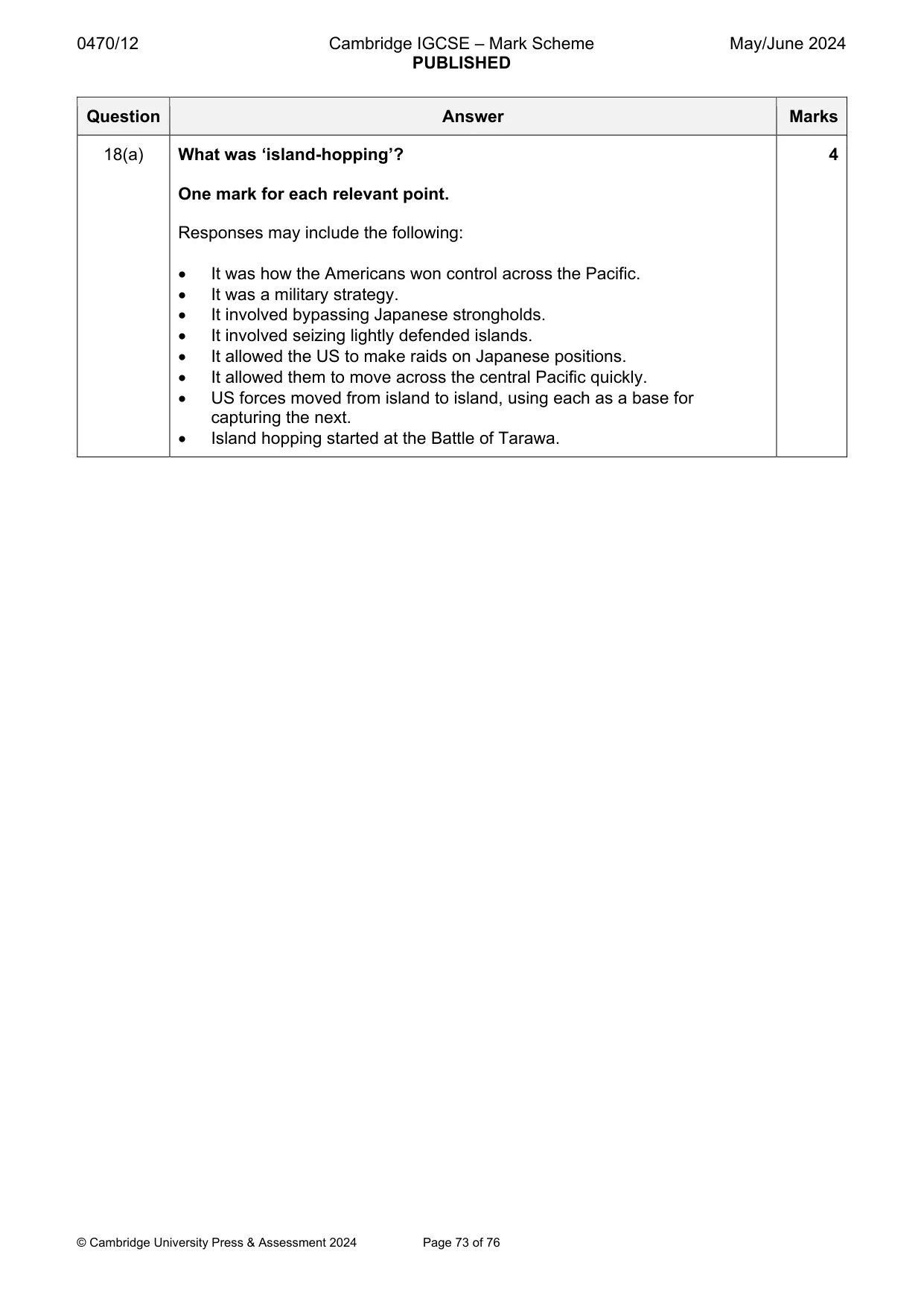
Paper as text
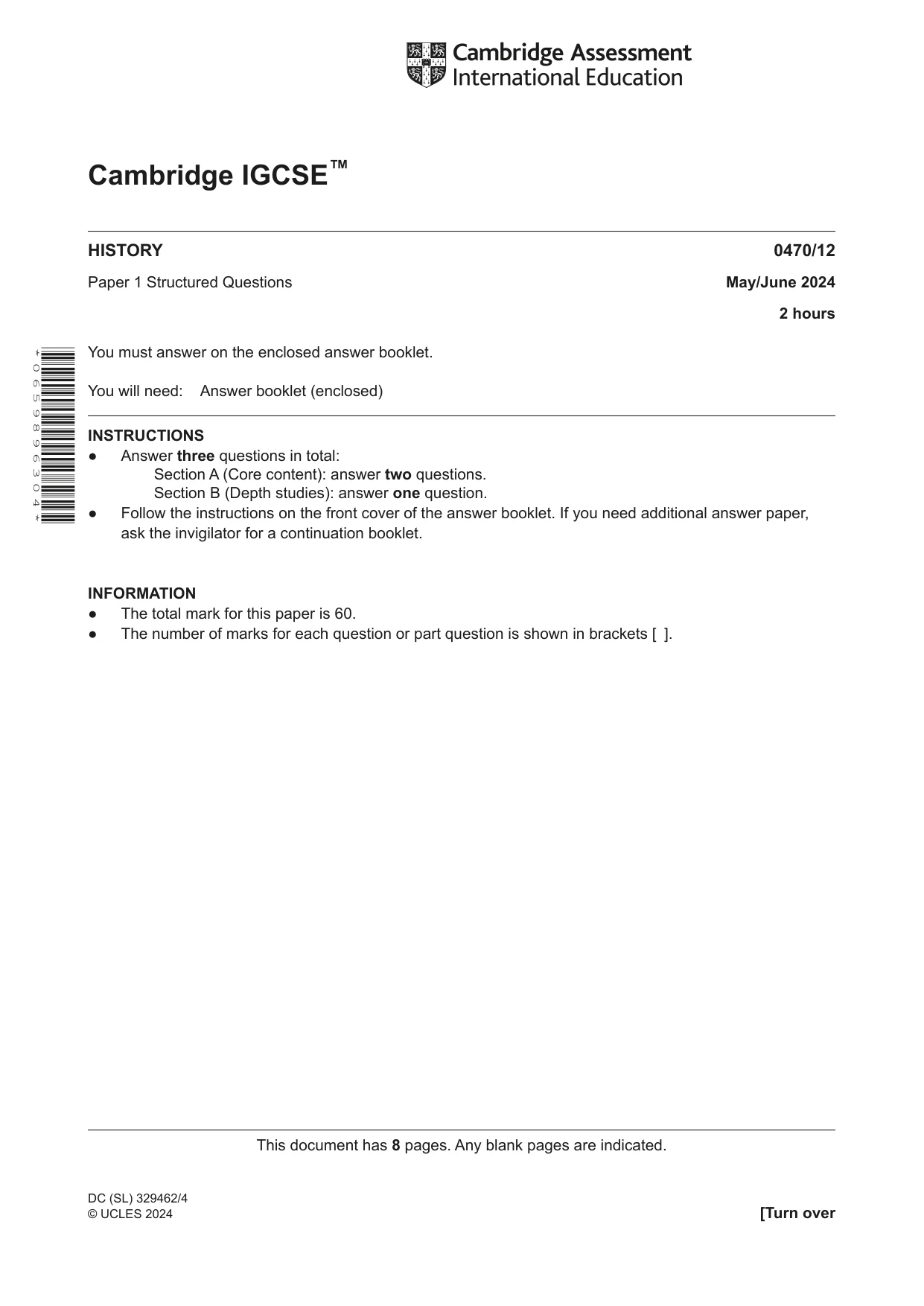
Question paper, page 1
This document has 8 pages. Any blank pages are indicated. [Turn over Cambridge IGCSE™ HISTORY 0470/12 Paper 1 Structured Questions May/June 2024 2 hours You must answer on the enclosed answer booklet. You will need: Answer booklet (enclosed) INSTRUCTIONS ● Answer three questions in total: Section A (Core content): answer two questions. Section B (Depth studies): answer one question. ● Follow the instructions on the front cover of the answer booklet. If you need additional answer paper, ask the invigilator for a continuation booklet. INFORMATION ● The total mark for this paper is 60. ● The number of marks for each question or part question is shown in brackets [ ]. * 0 6 5 9 8 9 6 3 0 4 * DC (SL) 329462/4 © UCLES 2024
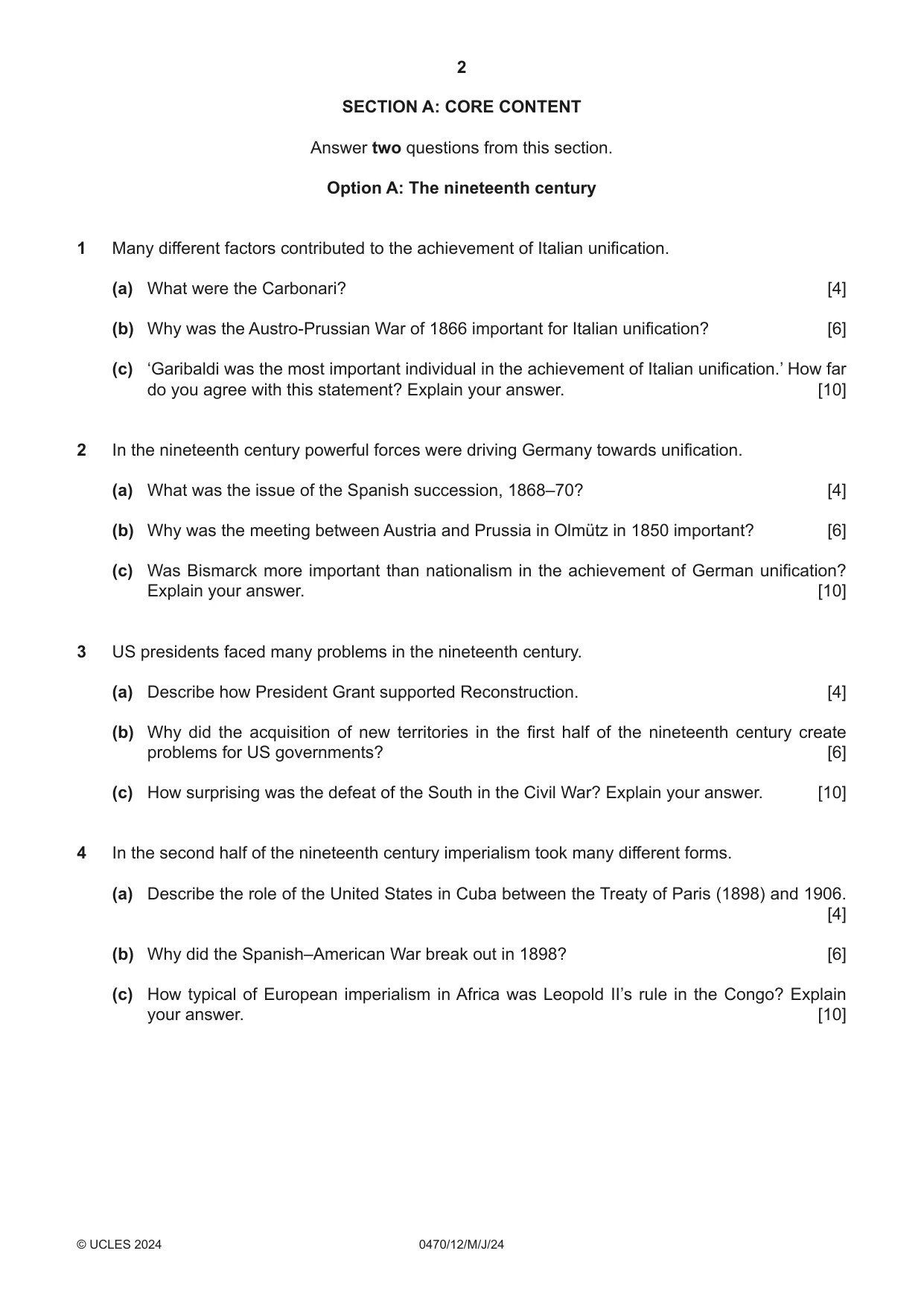
Question paper, page 2
2 0470/12/M/J/24 © UCLES 2024 SECTION A: CORE CONTENT Answer two questions from this section. Option A: The nineteenth century 1 Many different factors contributed to the achievement of Italian unification. (a) What were the Carbonari? [4] (b) Why was the Austro-Prussian War of 1866 important for Italian unification? [6] (c) ‘Garibaldi was the most important individual in the achievement of Italian unification.’ How far do you agree with this statement? Explain your answer. [10] 2 In the nineteenth century powerful forces were driving Germany towards unification. (a) What was the issue of the Spanish succession, 1868–70? [4] (b) Why was the meeting between Austria and Prussia in Olmütz in 1850 important? [6] (c) Was Bismarck more important than nationalism in the achievement of German unification? Explain your answer. [10] 3 US presidents faced many problems in the nineteenth century. (a) Describe how President Grant supported Reconstruction. [4] (b) Why did the acquisition of new territories in the first half of the nineteenth century create problems for US governments? [6] (c) How surprising was the defeat of the South in the Civil War? Explain your answer. [10] 4 In the second half of the nineteenth century imperialism took many different forms. (a) Describe the role of the United States in Cuba between the Treaty of Paris (1898) and 1906. [4] (b) Why did the Spanish–American War break out in 1898? [6] (c) How typical of European imperialism in Africa was Leopold II’s rule in the Congo? Explain your answer. [10]
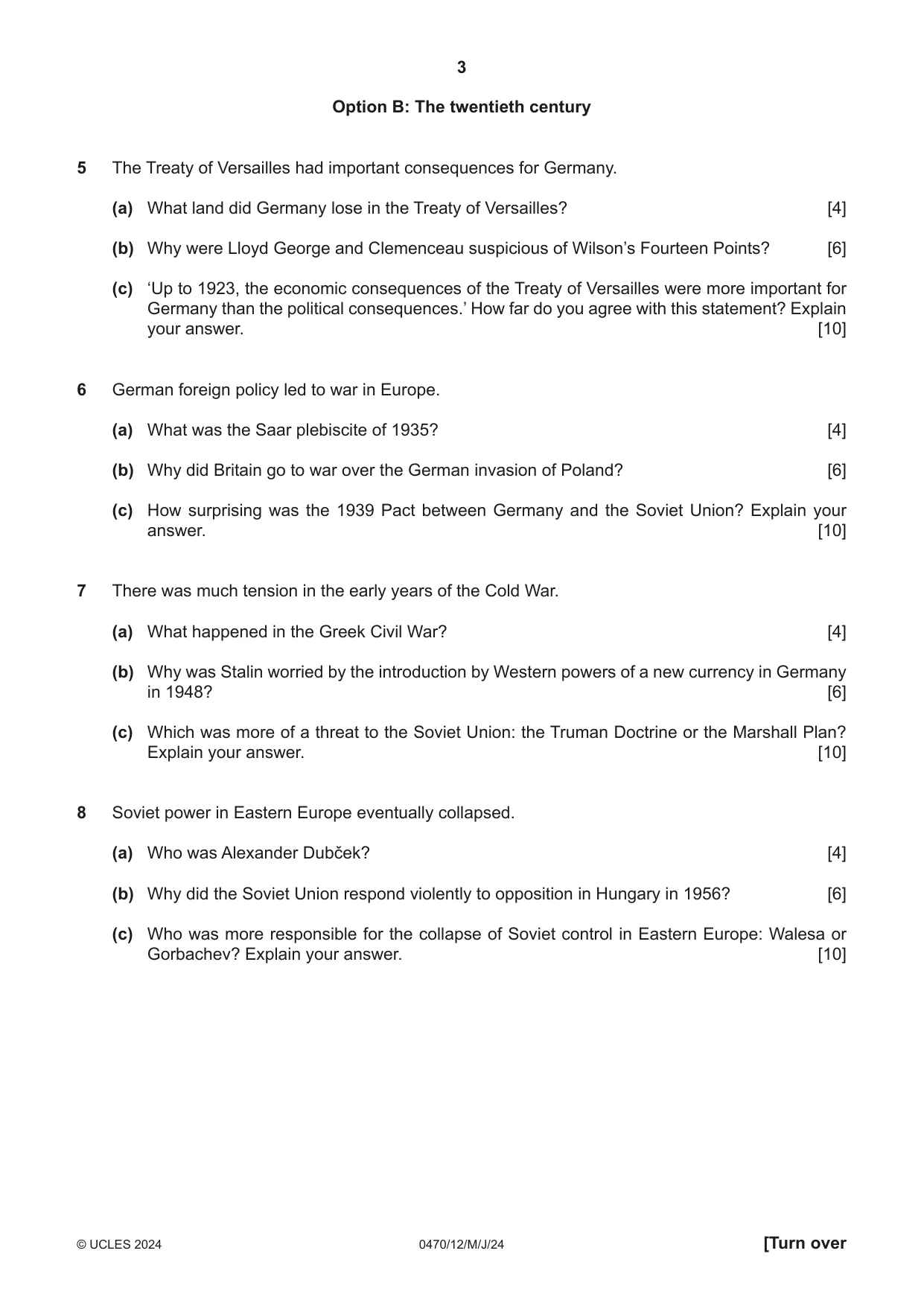
Question paper, page 3
3 0470/12/M/J/24 © UCLES 2024 [Turn over Option B: The twentieth century 5 The Treaty of Versailles had important consequences for Germany. (a) What land did Germany lose in the Treaty of Versailles? [4] (b) Why were Lloyd George and Clemenceau suspicious of Wilson’s Fourteen Points? [6] (c) ‘Up to 1923, the economic consequences of the Treaty of Versailles were more important for Germany than the political consequences.’ How far do you agree with this statement? Explain your answer. [10] 6 German foreign policy led to war in Europe. (a) What was the Saar plebiscite of 1935? [4] (b) Why did Britain go to war over the German invasion of Poland? [6] (c) How surprising was the 1939 Pact between Germany and the Soviet Union? Explain your answer. [10] 7 There was much tension in the early years of the Cold War. (a) What happened in the Greek Civil War? [4] (b) Why was Stalin worried by the introduction by Western powers of a new currency in Germany in 1948? [6] (c) Which was more of a threat to the Soviet Union: the Truman Doctrine or the Marshall Plan? Explain your answer. [10] 8 Soviet power in Eastern Europe eventually collapsed. (a) Who was Alexander Dubček? [4] (b) Why did the Soviet Union respond violently to opposition in Hungary in 1956? [6] (c) Who was more responsible for the collapse of Soviet control in Eastern Europe: Walesa or Gorbachev? Explain your answer. [10]
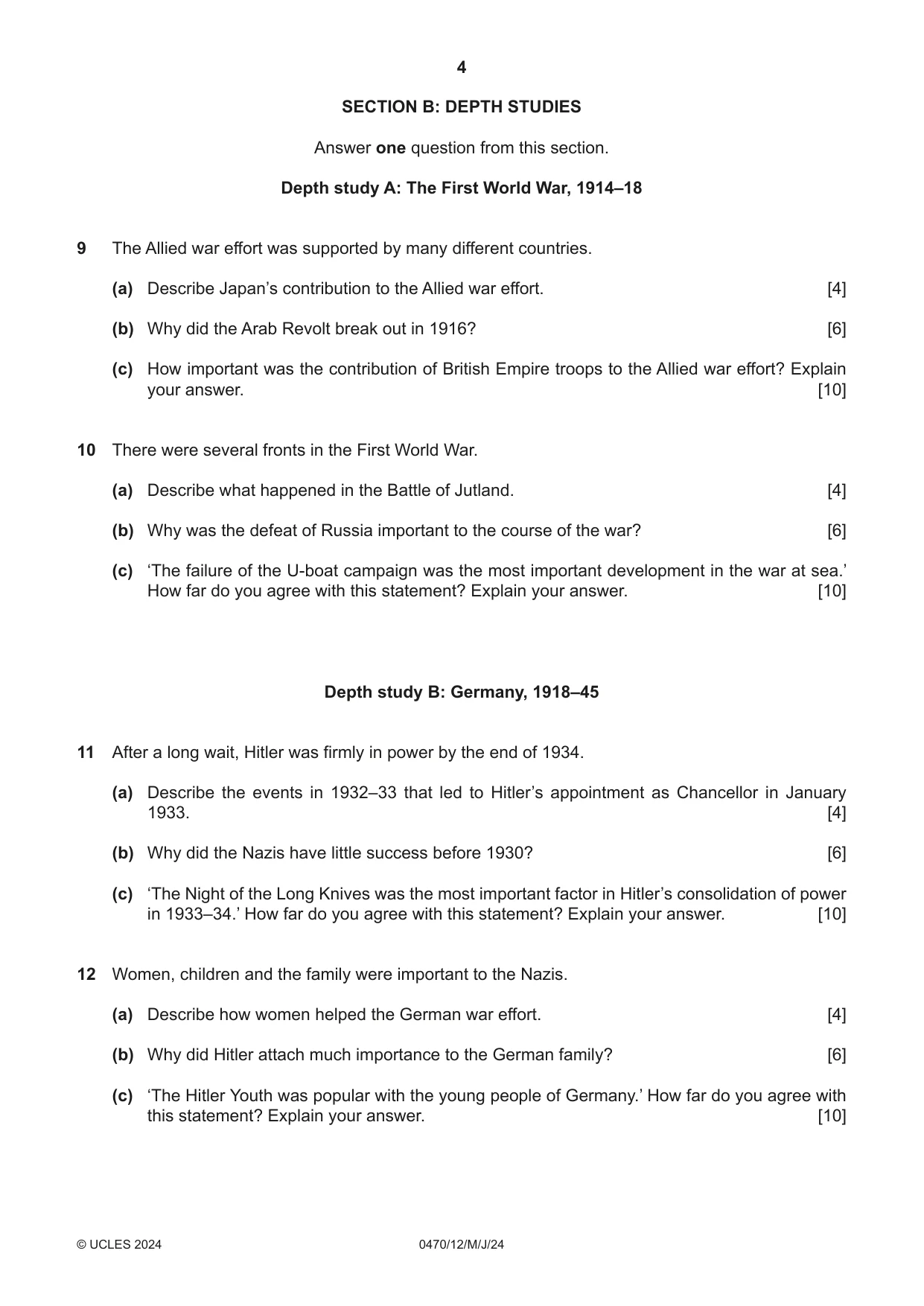
Question paper, page 4
4 0470/12/M/J/24 © UCLES 2024 SECTION B: DEPTH STUDIES Answer one question from this section. Depth study A: The First World War, 1914–18 9 The Allied war effort was supported by many different countries. (a) Describe Japan’s contribution to the Allied war effort. [4] (b) Why did the Arab Revolt break out in 1916? [6] (c) How important was the contribution of British Empire troops to the Allied war effort? Explain your answer. [10] 10 There were several fronts in the First World War. (a) Describe what happened in the Battle of Jutland. [4] (b) Why was the defeat of Russia important to the course of the war? [6] (c) ‘The failure of the U-boat campaign was the most important development in the war at sea.’ How far do you agree with this statement? Explain your answer. [10] Depth study B: Germany, 1918–45 11 After a long wait, Hitler was firmly in power by the end of 1934. (a) Describe the events in 1932–33 that led to Hitler’s appointment as Chancellor in January 1933. [4] (b) Why did the Nazis have little success before 1930? [6] (c) ‘The Night of the Long Knives was the most important factor in Hitler’s consolidation of power in 1933–34.’ How far do you agree with this statement? Explain your answer. [10] 12 Women, children and the family were important to the Nazis. (a) Describe how women helped the German war effort. [4] (b) Why did Hitler attach much importance to the German family? [6] (c) ‘The Hitler Youth was popular with the young people of Germany.’ How far do you agree with this statement? Explain your answer. [10]
Question paper, page 5
5 0470/12/M/J/24 © UCLES 2024 [Turn over Depth study C: Russia, 1905–41 13 The years 1917 to 1928 were turbulent ones for Russia. (a) What was the Kronstadt Rising? [4] (b) Why was there a civil war in Russia? [6] (c) ‘The New Economic Policy (NEP) was a success.’ How far do you agree with this statement? Explain your answer. [10] 14 Stalin made huge changes to Soviet agriculture and industry. (a) Describe how villages were collectivised. [4] (b) Why did industrial production increase under Stalin? [6] (c) How far had the lives of Russians improved by the mid-1930s? Explain your answer. [10] Depth study D: The United States, 1919–41 15 The United States faced many problems in the 1920s. (a) What was the ‘Red Scare’? [4] (b) Why did the cinema grow in popularity during the 1920s? [6] (c) Which was more of a problem for the United States in the 1920s: gangsterism or the Ku Klux Klan? Explain your answer. [10] 16 Roosevelt had to deal with much opposition to the New Deal. (a) Describe how Roosevelt reacted to the Supreme Court decisions of 1935–36 about the New Deal. [4] (b) Why did Roosevelt do so much in the ‘Hundred Days’ of 1933? [6] (c) ‘The main reason why there was opposition to the New Deal was because it interfered with business.’ How far do you agree with this statement? Explain your answer. [10]
Question paper, page 6
6 0470/12/M/J/24 © UCLES 2024 Depth study E: The Second World War in Europe and the Asia-Pacific, 1939–c.1945 17 Britain, Japan and the United States all had interests in the Asia-Pacific. (a) Describe relations between Japan and the United States in the period before the attack on Pearl Harbor. [4] (b) Why were the British defeated in Malaya? [6] (c) How far was the Japanese attack on Pearl Harbor a success? Explain your answer. [10] 18 By the end of 1945 the Second World War was over. (a) What was ‘island hopping’? [4] (b) Why did the Allies consider it important to hold war crimes trials? [6] (c) ‘Germany collapsed in 1945 because of the Russian advance from the East.’ How far do you agree with this statement? Explain your answer. [10]
Question paper, page 7
7 0470/12/M/J/24 © UCLES 2024 BLANK PAGE
Question paper, page 8
8 0470/12/M/J/24 © UCLES 2024 Permission to reproduce items where third-party owned material protected by copyright is included has been sought and cleared where possible. Every reasonable effort has been made by the publisher (UCLES) to trace copyright holders, but if any items requiring clearance have unwittingly been included, the publisher will be pleased to make amends at the earliest possible opportunity. To avoid the issue of disclosure of answer-related information to candidates, all copyright acknowledgements are reproduced online in the Cambridge Assessment International Education Copyright Acknowledgements Booklet. This is produced for each series of examinations and is freely available to download at www.cambridgeinternational.org after the live examination series. Cambridge Assessment International Education is part of Cambridge Assessment. Cambridge Assessment is the brand name of the University of Cambridge Local Examinations Syndicate (UCLES), which is a department of the University of Cambridge. BLANK PAGE
Mark scheme, page 1
This document consists of 76 printed pages. © Cambridge University Press & Assessment 2024 [Turn over Cambridge IGCSE™ HISTORY 0470/12 Paper 1 May/June 2024 MARK SCHEME Maximum Mark: 60 Published This mark scheme is published as an aid to teachers and candidates, to indicate the requirements of the examination. It shows the basis on which Examiners were instructed to award marks. It does not indicate the details of the discussions that took place at an Examiners’ meeting before marking began, which would have considered the acceptability of alternative answers. Mark schemes should be read in conjunction with the question paper and the Principal Examiner Report for Teachers. Cambridge International will not enter into discussions about these mark schemes. Cambridge International is publishing the mark schemes for the May/June 2024 series for most Cambridge IGCSE, Cambridge International A and AS Level and Cambridge Pre-U components, and some Cambridge O Level components.
Mark scheme, page 2
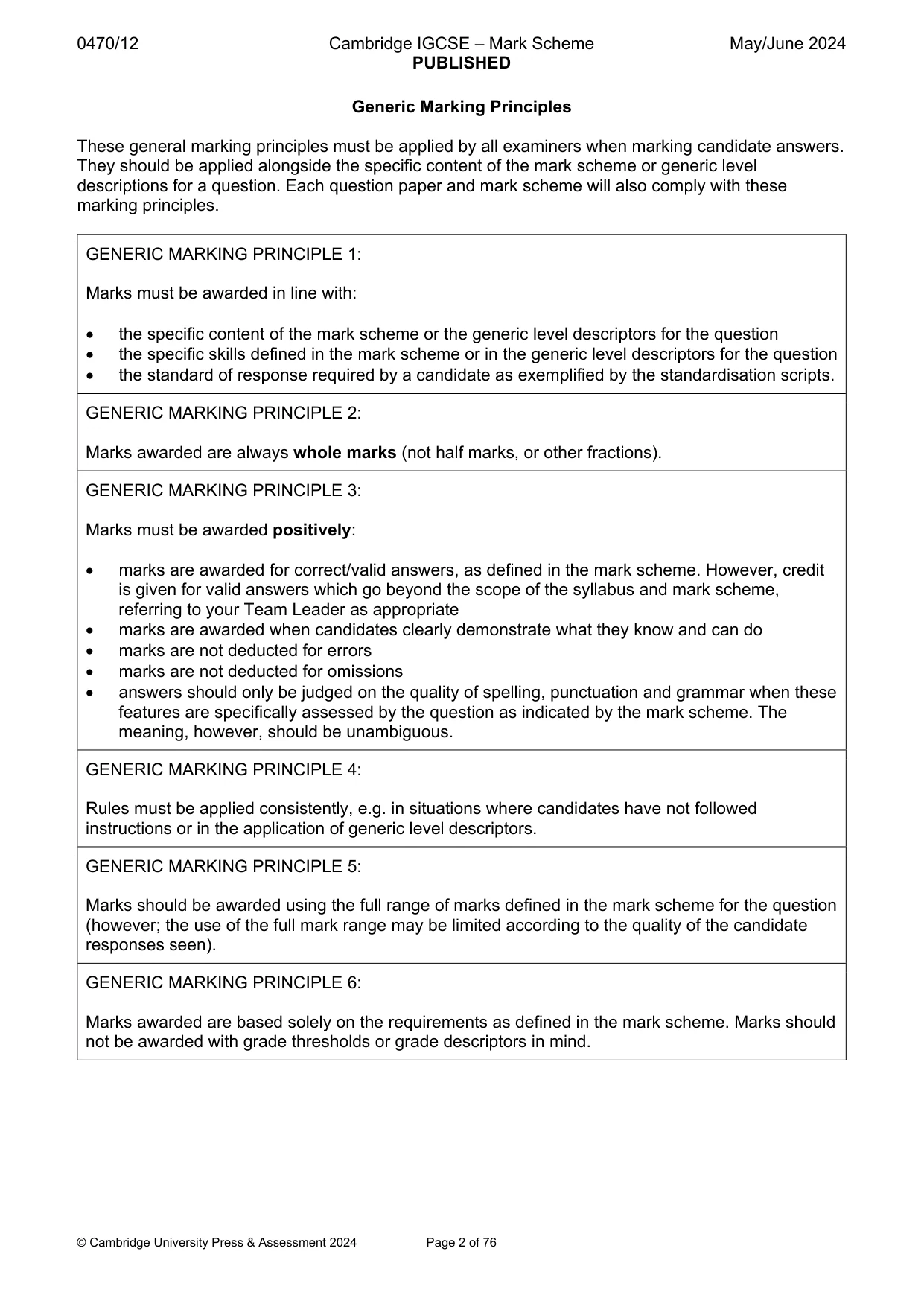
0470/12 Cambridge IGCSE – Mark Scheme PUBLISHED May/June 2024 © Cambridge University Press & Assessment 2024 Page 2 of 76 Generic Marking Principles These general marking principles must be applied by all examiners when marking candidate answers. They should be applied alongside the specific content of the mark scheme or generic level descriptions for a question. Each question paper and mark scheme will also comply with these marking principles. GENERIC MARKING PRINCIPLE 1: Marks must be awarded in line with: the specific content of the mark scheme or the generic level descriptors for the question the specific skills defined in the mark scheme or in the generic level descriptors for the question the standard of response required by a candidate as exemplified by the standardisation scripts. GENERIC MARKING PRINCIPLE 2: Marks awarded are always whole marks (not half marks, or other fractions). GENERIC MARKING PRINCIPLE 3: Marks must be awarded positively: marks are awarded for correct/valid answers, as defined in the mark scheme. However, credit is given for valid answers which go beyond the scope of the syllabus and mark scheme, referring to your Team Leader as appropriate marks are awarded when candidates clearly demonstrate what they know and can do marks are not deducted for errors marks are not deducted for omissions answers should only be judged on the quality of spelling, punctuation and grammar when these features are specifically assessed by the question as indicated by the mark scheme. The meaning, however, should be unambiguous. GENERIC MARKING PRINCIPLE 4: Rules must be applied consistently, e.g. in situations where candidates have not followed instructions or in the application of generic level descriptors. GENERIC MARKING PRINCIPLE 5: Marks should be awarded using the full range of marks defined in the mark scheme for the question (however; the use of the full mark range may be limited according to the quality of the candidate responses seen). GENERIC MARKING PRINCIPLE 6: Marks awarded are based solely on the requirements as defined in the mark scheme. Marks should not be awarded with grade thresholds or grade descriptors in mind.
Mark scheme, page 3
0470/12 Cambridge IGCSE – Mark Scheme PUBLISHED May/June 2024 © Cambridge University Press & Assessment 2024 Page 3 of 76 Assessment objectives AO1 An ability to recall, select, organise and deploy knowledge of the syllabus content. AO2 An ability to construct historical explanations using an understanding of: cause and consequence, change and continuity, similarity and difference. the motives, emotions, intentions and beliefs of people in the past.
Mark scheme, page 4
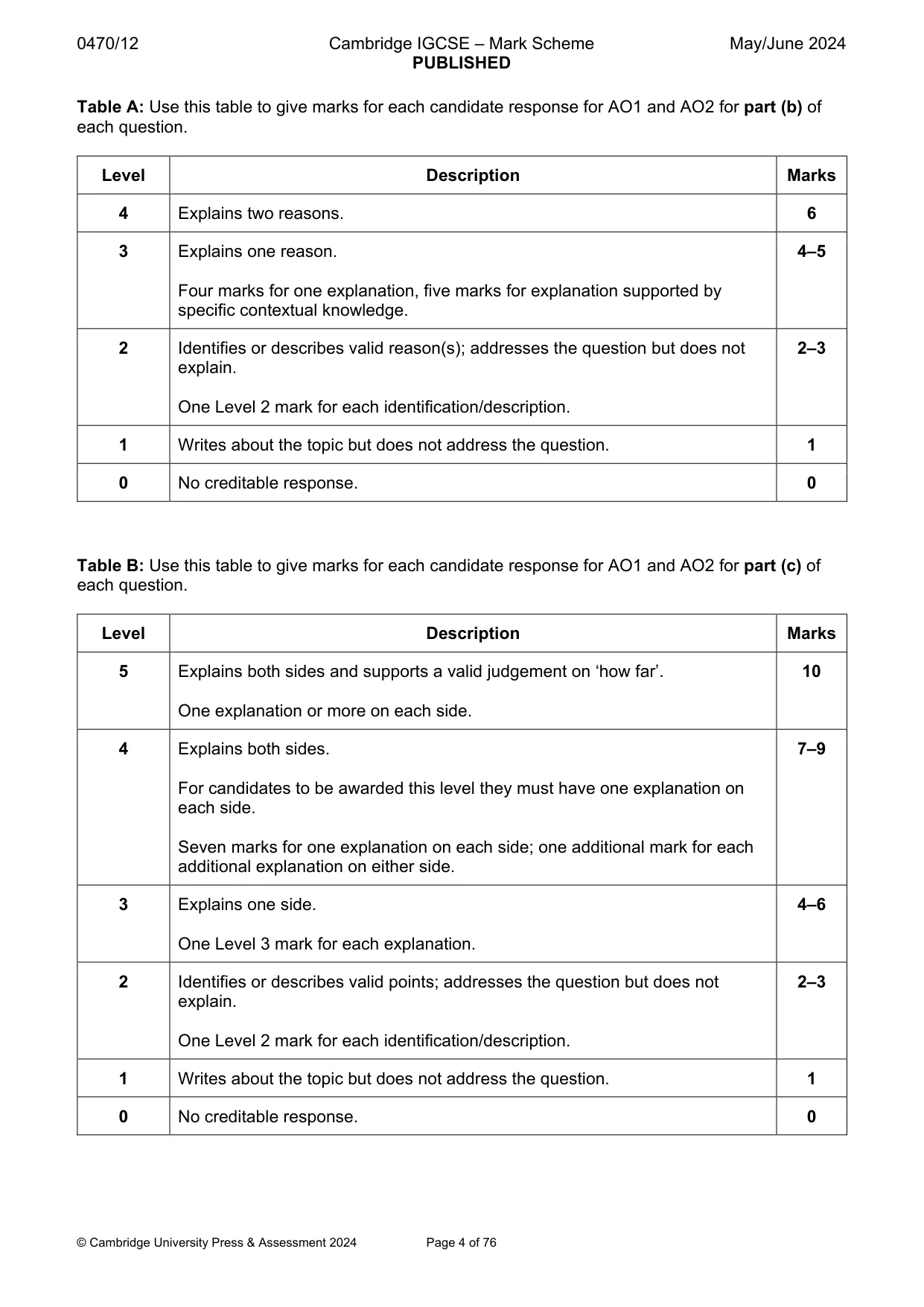
0470/12 Cambridge IGCSE – Mark Scheme PUBLISHED May/June 2024 © Cambridge University Press & Assessment 2024 Page 4 of 76 Table A: Use this table to give marks for each candidate response for AO1 and AO2 for part (b) of each question. Level Description Marks 4 Explains two reasons. 6 3 Explains one reason. Four marks for one explanation, five marks for explanation supported by specific contextual knowledge. 4–5 2 Identifies or describes valid reason(s); addresses the question but does not explain. One Level 2 mark for each identification/description. 2–3 1 Writes about the topic but does not address the question. 1 0 No creditable response. 0 Table B: Use this table to give marks for each candidate response for AO1 and AO2 for part (c) of each question. Level Description Marks 5 Explains both sides and supports a valid judgement on ‘how far’. One explanation or more on each side. 10 4 Explains both sides. For candidates to be awarded this level they must have one explanation on each side. Seven marks for one explanation on each side; one additional mark for each additional explanation on either side. 7–9 3 Explains one side. One Level 3 mark for each explanation. 4–6 2 Identifies or describes valid points; addresses the question but does not explain. One Level 2 mark for each identification/description. 2–3 1 Writes about the topic but does not address the question. 1 0 No creditable response. 0
Mark scheme, page 5
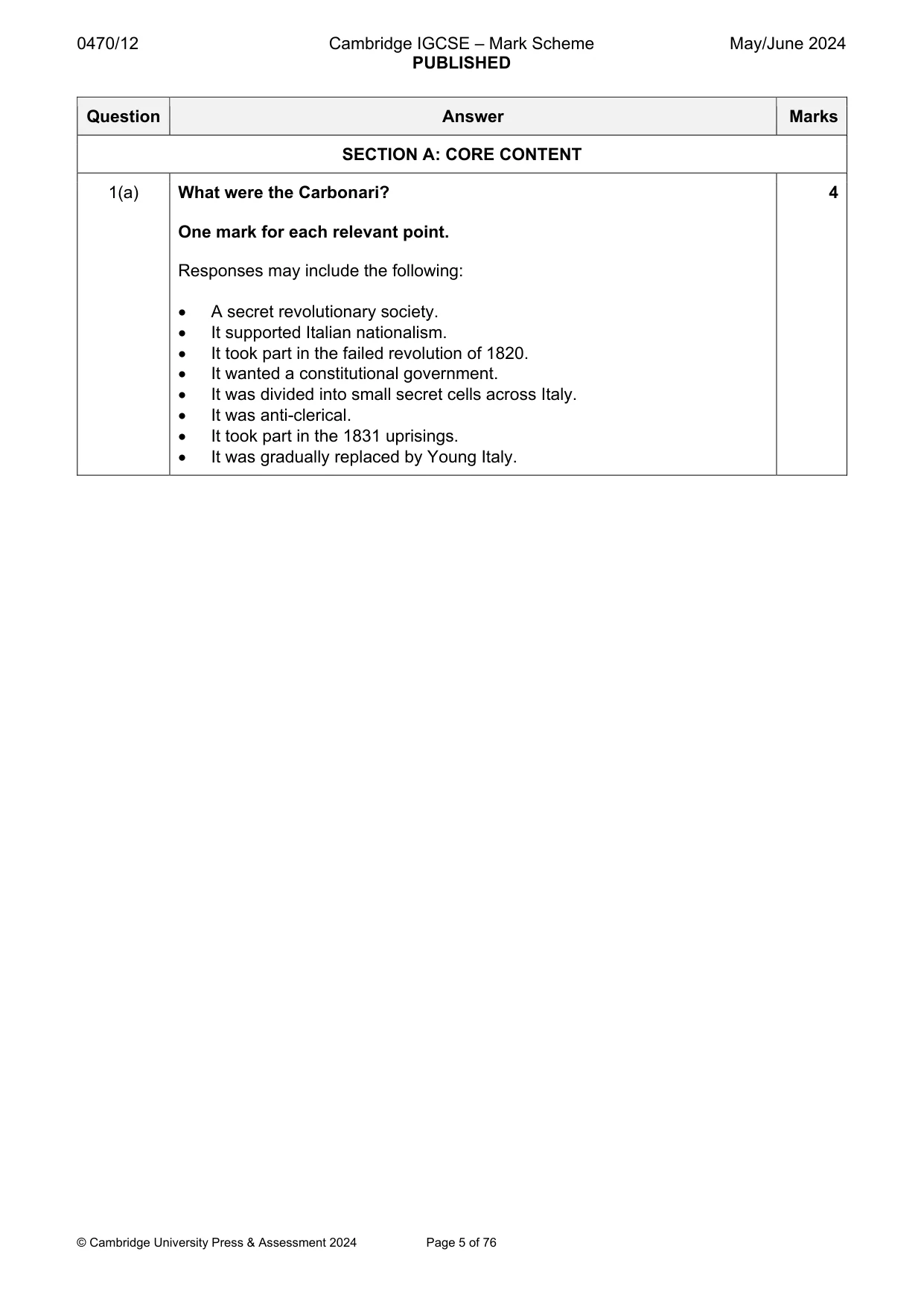
0470/12 Cambridge IGCSE – Mark Scheme PUBLISHED May/June 2024 © Cambridge University Press & Assessment 2024 Page 5 of 76 Question Answer Marks SECTION A: CORE CONTENT 1(a) What were the Carbonari? One mark for each relevant point. Responses may include the following: A secret revolutionary society. It supported Italian nationalism. It took part in the failed revolution of 1820. It wanted a constitutional government. It was divided into small secret cells across Italy. It was anti-clerical. It took part in the 1831 uprisings. It was gradually replaced by Young Italy. 4
Mark scheme, page 6
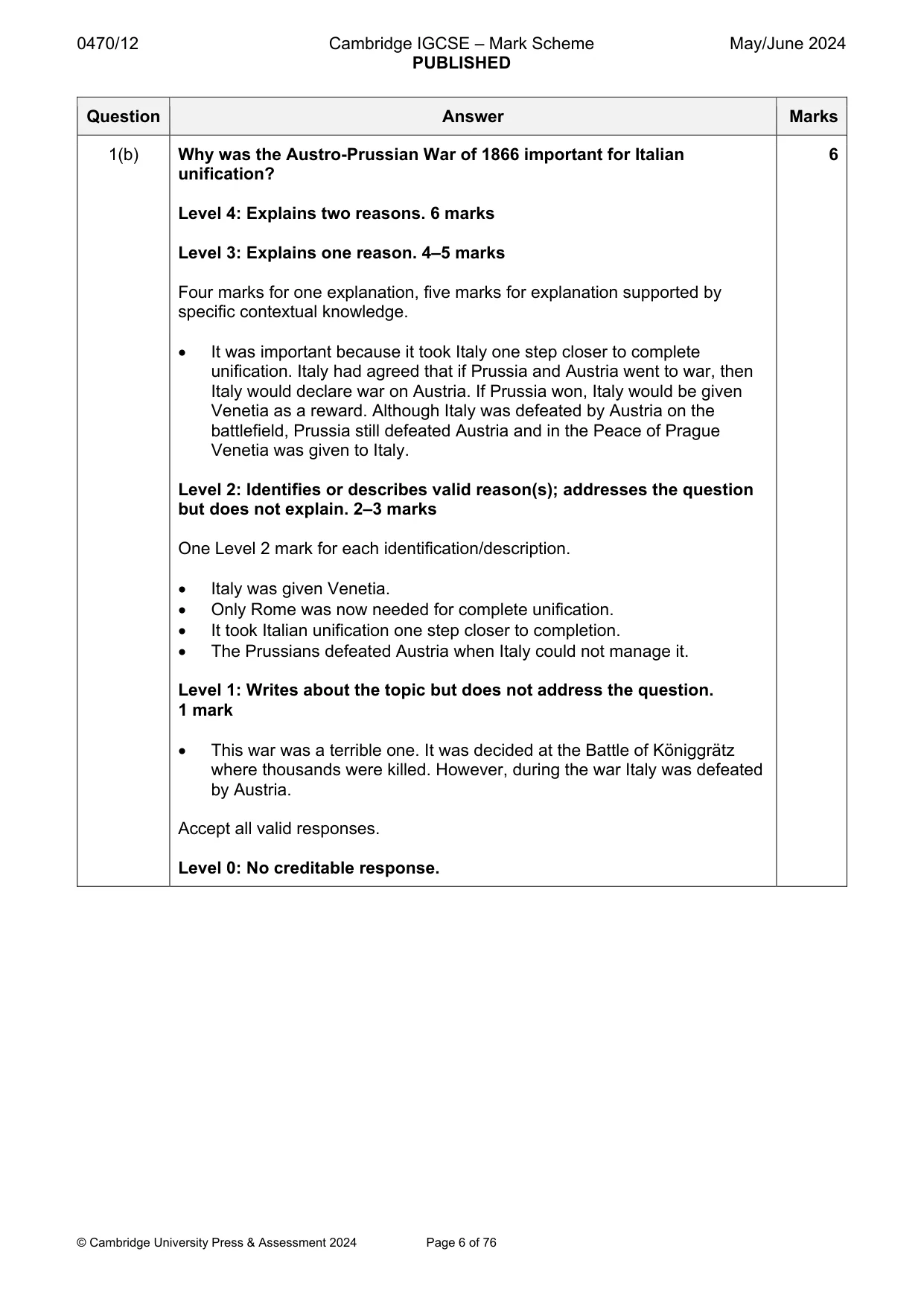
0470/12 Cambridge IGCSE – Mark Scheme PUBLISHED May/June 2024 © Cambridge University Press & Assessment 2024 Page 6 of 76 Question Answer Marks 1(b) Why was the Austro-Prussian War of 1866 important for Italian unification? Level 4: Explains two reasons. 6 marks Level 3: Explains one reason. 4–5 marks Four marks for one explanation, five marks for explanation supported by specific contextual knowledge. It was important because it took Italy one step closer to complete unification. Italy had agreed that if Prussia and Austria went to war, then Italy would declare war on Austria. If Prussia won, Italy would be given Venetia as a reward. Although Italy was defeated by Austria on the battlefield, Prussia still defeated Austria and in the Peace of Prague Venetia was given to Italy. Level 2: Identifies or describes valid reason(s); addresses the question but does not explain. 2–3 marks One Level 2 mark for each identification/description. Italy was given Venetia. Only Rome was now needed for complete unification. It took Italian unification one step closer to completion. The Prussians defeated Austria when Italy could not manage it. Level 1: Writes about the topic but does not address the question. 1 mark This war was a terrible one. It was decided at the Battle of Königgrätz where thousands were killed. However, during the war Italy was defeated by Austria. Accept all valid responses. Level 0: No creditable response. 6
Mark scheme, page 7
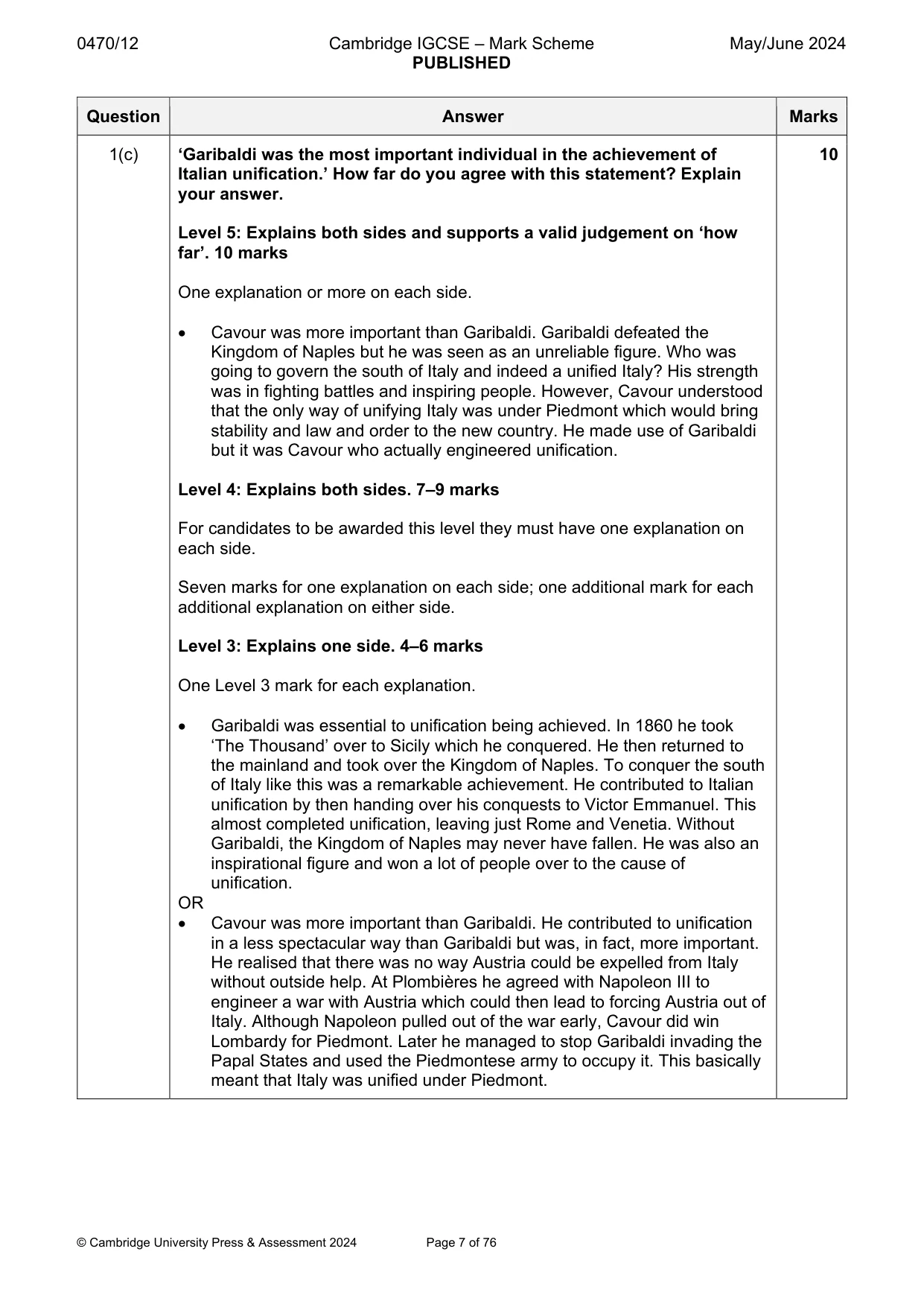
0470/12 Cambridge IGCSE – Mark Scheme PUBLISHED May/June 2024 © Cambridge University Press & Assessment 2024 Page 7 of 76 Question Answer Marks 1(c) ‘Garibaldi was the most important individual in the achievement of Italian unification.’ How far do you agree with this statement? Explain your answer. Level 5: Explains both sides and supports a valid judgement on ‘how far’. 10 marks One explanation or more on each side. Cavour was more important than Garibaldi. Garibaldi defeated the Kingdom of Naples but he was seen as an unreliable figure. Who was going to govern the south of Italy and indeed a unified Italy? His strength was in fighting battles and inspiring people. However, Cavour understood that the only way of unifying Italy was under Piedmont which would bring stability and law and order to the new country. He made use of Garibaldi but it was Cavour who actually engineered unification. Level 4: Explains both sides. 7–9 marks For candidates to be awarded this level they must have one explanation on each side. Seven marks for one explanation on each side; one additional mark for each additional explanation on either side. Level 3: Explains one side. 4–6 marks One Level 3 mark for each explanation. Garibaldi was essential to unification being achieved. In 1860 he took ‘The Thousand’ over to Sicily which he conquered. He then returned to the mainland and took over the Kingdom of Naples. To conquer the south of Italy like this was a remarkable achievement. He contributed to Italian unification by then handing over his conquests to Victor Emmanuel. This almost completed unification, leaving just Rome and Venetia. Without Garibaldi, the Kingdom of Naples may never have fallen. He was also an inspirational figure and won a lot of people over to the cause of unification. OR Cavour was more important than Garibaldi. He contributed to unification in a less spectacular way than Garibaldi but was, in fact, more important. He realised that there was no way Austria could be expelled from Italy without outside help. At Plombières he agreed with Napoleon III to engineer a war with Austria which could then lead to forcing Austria out of Italy. Although Napoleon pulled out of the war early, Cavour did win Lombardy for Piedmont. Later he managed to stop Garibaldi invading the Papal States and used the Piedmontese army to occupy it. This basically meant that Italy was unified under Piedmont. 10
Mark scheme, page 8
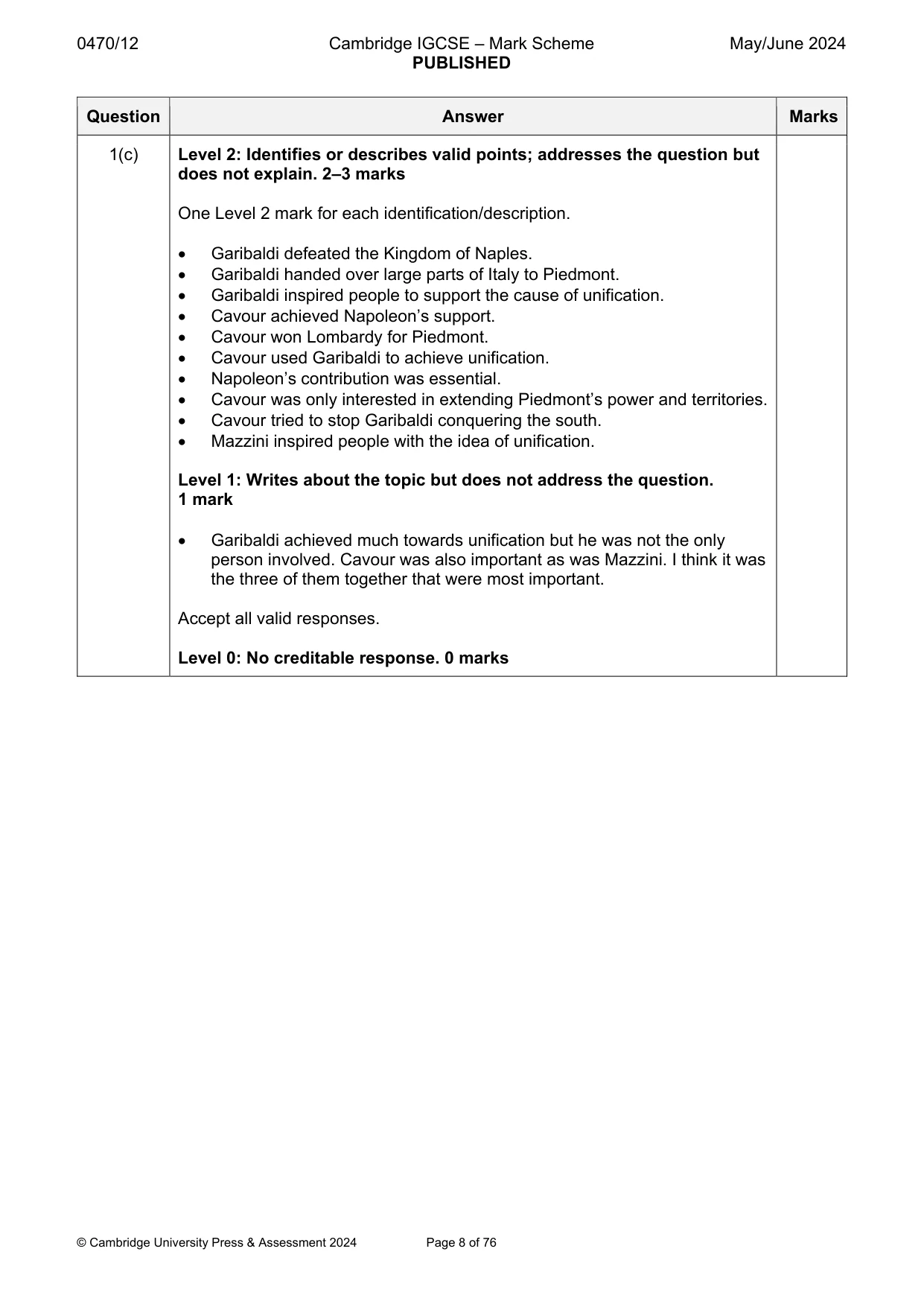
0470/12 Cambridge IGCSE – Mark Scheme PUBLISHED May/June 2024 © Cambridge University Press & Assessment 2024 Page 8 of 76 Question Answer Marks 1(c) Level 2: Identifies or describes valid points; addresses the question but does not explain. 2–3 marks One Level 2 mark for each identification/description. Garibaldi defeated the Kingdom of Naples. Garibaldi handed over large parts of Italy to Piedmont. Garibaldi inspired people to support the cause of unification. Cavour achieved Napoleon’s support. Cavour won Lombardy for Piedmont. Cavour used Garibaldi to achieve unification. Napoleon’s contribution was essential. Cavour was only interested in extending Piedmont’s power and territories. Cavour tried to stop Garibaldi conquering the south. Mazzini inspired people with the idea of unification. Level 1: Writes about the topic but does not address the question. 1 mark Garibaldi achieved much towards unification but he was not the only person involved. Cavour was also important as was Mazzini. I think it was the three of them together that were most important. Accept all valid responses. Level 0: No creditable response. 0 marks
Mark scheme, page 9
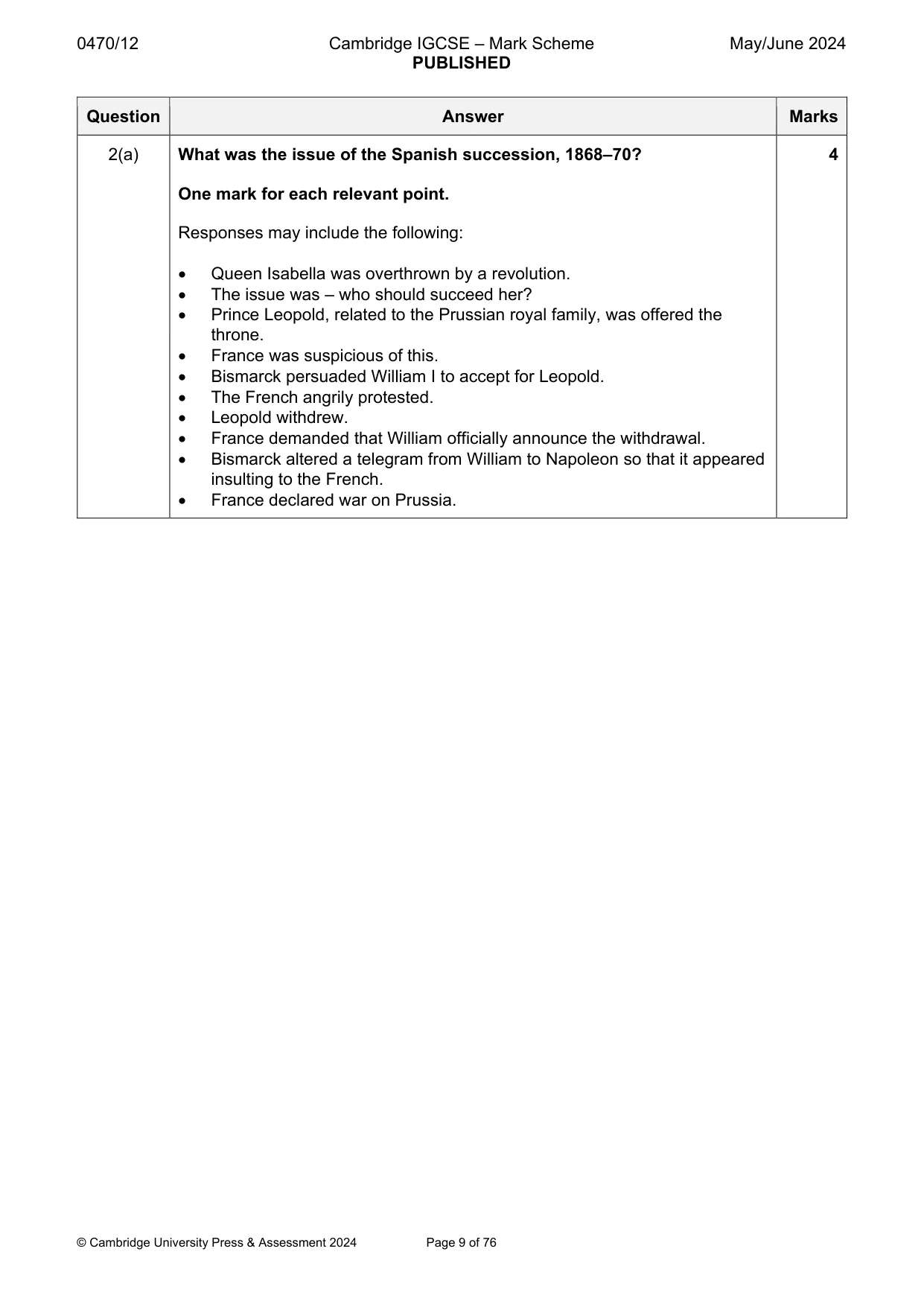
0470/12 Cambridge IGCSE – Mark Scheme PUBLISHED May/June 2024 © Cambridge University Press & Assessment 2024 Page 9 of 76 Question Answer Marks 2(a) What was the issue of the Spanish succession, 1868–70? One mark for each relevant point. Responses may include the following: Queen Isabella was overthrown by a revolution. The issue was – who should succeed her? Prince Leopold, related to the Prussian royal family, was offered the throne. France was suspicious of this. Bismarck persuaded William I to accept for Leopold. The French angrily protested. Leopold withdrew. France demanded that William officially announce the withdrawal. Bismarck altered a telegram from William to Napoleon so that it appeared insulting to the French. France declared war on Prussia. 4
Mark scheme, page 10
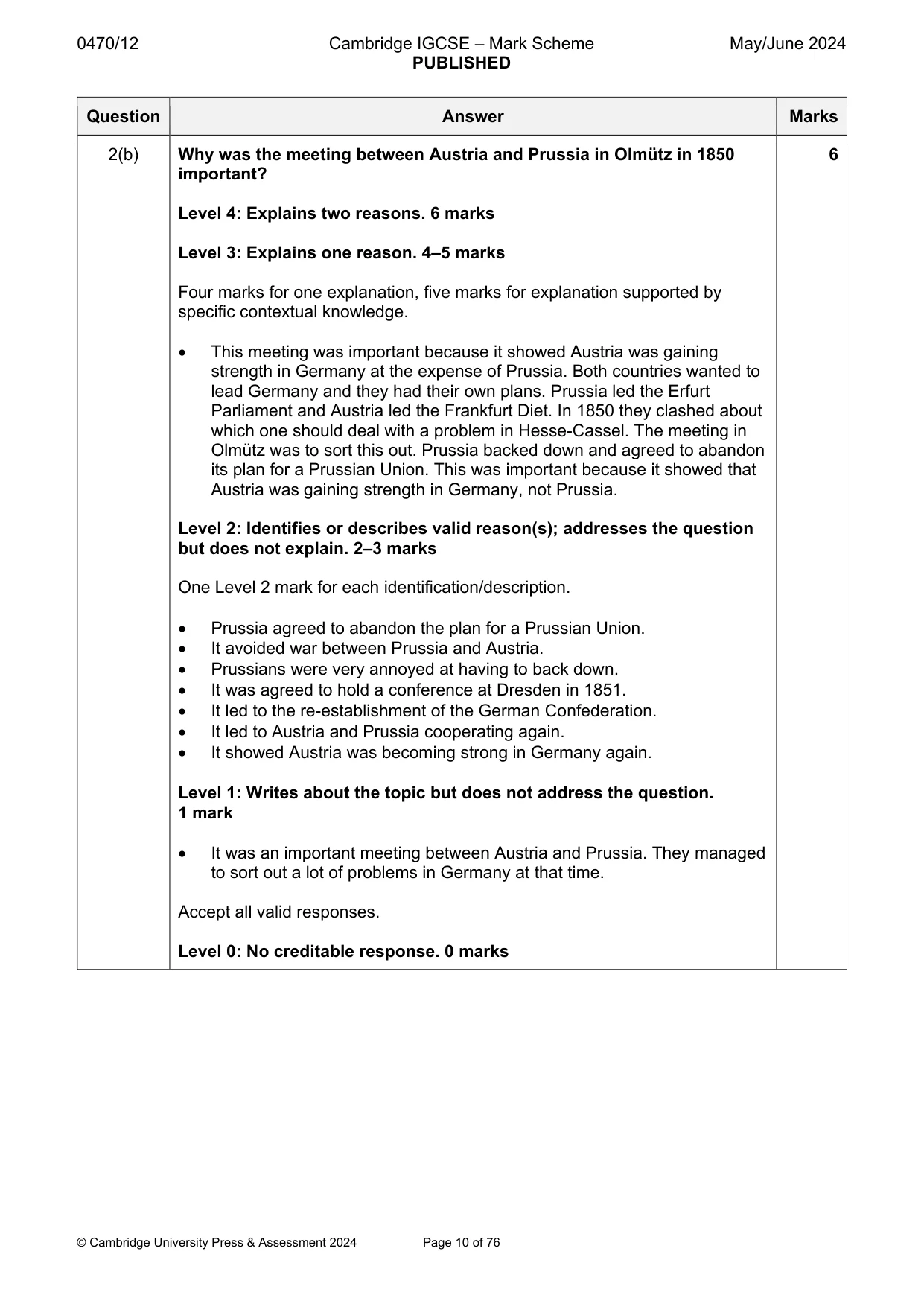
0470/12 Cambridge IGCSE – Mark Scheme PUBLISHED May/June 2024 © Cambridge University Press & Assessment 2024 Page 10 of 76 Question Answer Marks 2(b) Why was the meeting between Austria and Prussia in Olmütz in 1850 important? Level 4: Explains two reasons. 6 marks Level 3: Explains one reason. 4–5 marks Four marks for one explanation, five marks for explanation supported by specific contextual knowledge. This meeting was important because it showed Austria was gaining strength in Germany at the expense of Prussia. Both countries wanted to lead Germany and they had their own plans. Prussia led the Erfurt Parliament and Austria led the Frankfurt Diet. In 1850 they clashed about which one should deal with a problem in Hesse-Cassel. The meeting in Olmütz was to sort this out. Prussia backed down and agreed to abandon its plan for a Prussian Union. This was important because it showed that Austria was gaining strength in Germany, not Prussia. Level 2: Identifies or describes valid reason(s); addresses the question but does not explain. 2–3 marks One Level 2 mark for each identification/description. Prussia agreed to abandon the plan for a Prussian Union. It avoided war between Prussia and Austria. Prussians were very annoyed at having to back down. It was agreed to hold a conference at Dresden in 1851. It led to the re-establishment of the German Confederation. It led to Austria and Prussia cooperating again. It showed Austria was becoming strong in Germany again. Level 1: Writes about the topic but does not address the question. 1 mark It was an important meeting between Austria and Prussia. They managed to sort out a lot of problems in Germany at that time. Accept all valid responses. Level 0: No creditable response. 0 marks 6
Mark scheme, page 11
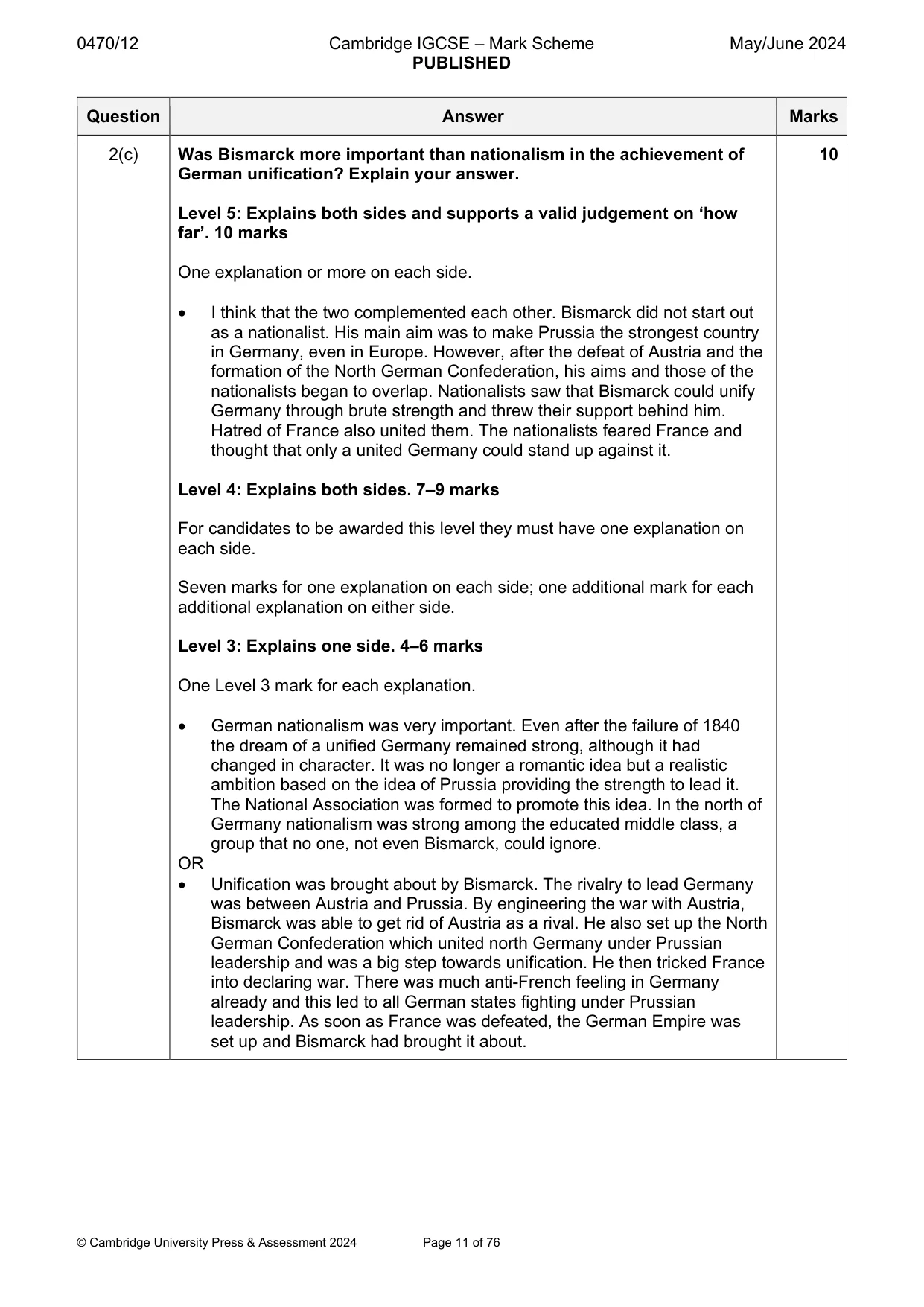
0470/12 Cambridge IGCSE – Mark Scheme PUBLISHED May/June 2024 © Cambridge University Press & Assessment 2024 Page 11 of 76 Question Answer Marks 2(c) Was Bismarck more important than nationalism in the achievement of German unification? Explain your answer. Level 5: Explains both sides and supports a valid judgement on ‘how far’. 10 marks One explanation or more on each side. I think that the two complemented each other. Bismarck did not start out as a nationalist. His main aim was to make Prussia the strongest country in Germany, even in Europe. However, after the defeat of Austria and the formation of the North German Confederation, his aims and those of the nationalists began to overlap. Nationalists saw that Bismarck could unify Germany through brute strength and threw their support behind him. Hatred of France also united them. The nationalists feared France and thought that only a united Germany could stand up against it. Level 4: Explains both sides. 7–9 marks For candidates to be awarded this level they must have one explanation on each side. Seven marks for one explanation on each side; one additional mark for each additional explanation on either side. Level 3: Explains one side. 4–6 marks One Level 3 mark for each explanation. German nationalism was very important. Even after the failure of 1840 the dream of a unified Germany remained strong, although it had changed in character. It was no longer a romantic idea but a realistic ambition based on the idea of Prussia providing the strength to lead it. The National Association was formed to promote this idea. In the north of Germany nationalism was strong among the educated middle class, a group that no one, not even Bismarck, could ignore. OR Unification was brought about by Bismarck. The rivalry to lead Germany was between Austria and Prussia. By engineering the war with Austria, Bismarck was able to get rid of Austria as a rival. He also set up the North German Confederation which united north Germany under Prussian leadership and was a big step towards unification. He then tricked France into declaring war. There was much anti-French feeling in Germany already and this led to all German states fighting under Prussian leadership. As soon as France was defeated, the German Empire was set up and Bismarck had brought it about. 10
Mark scheme, page 12
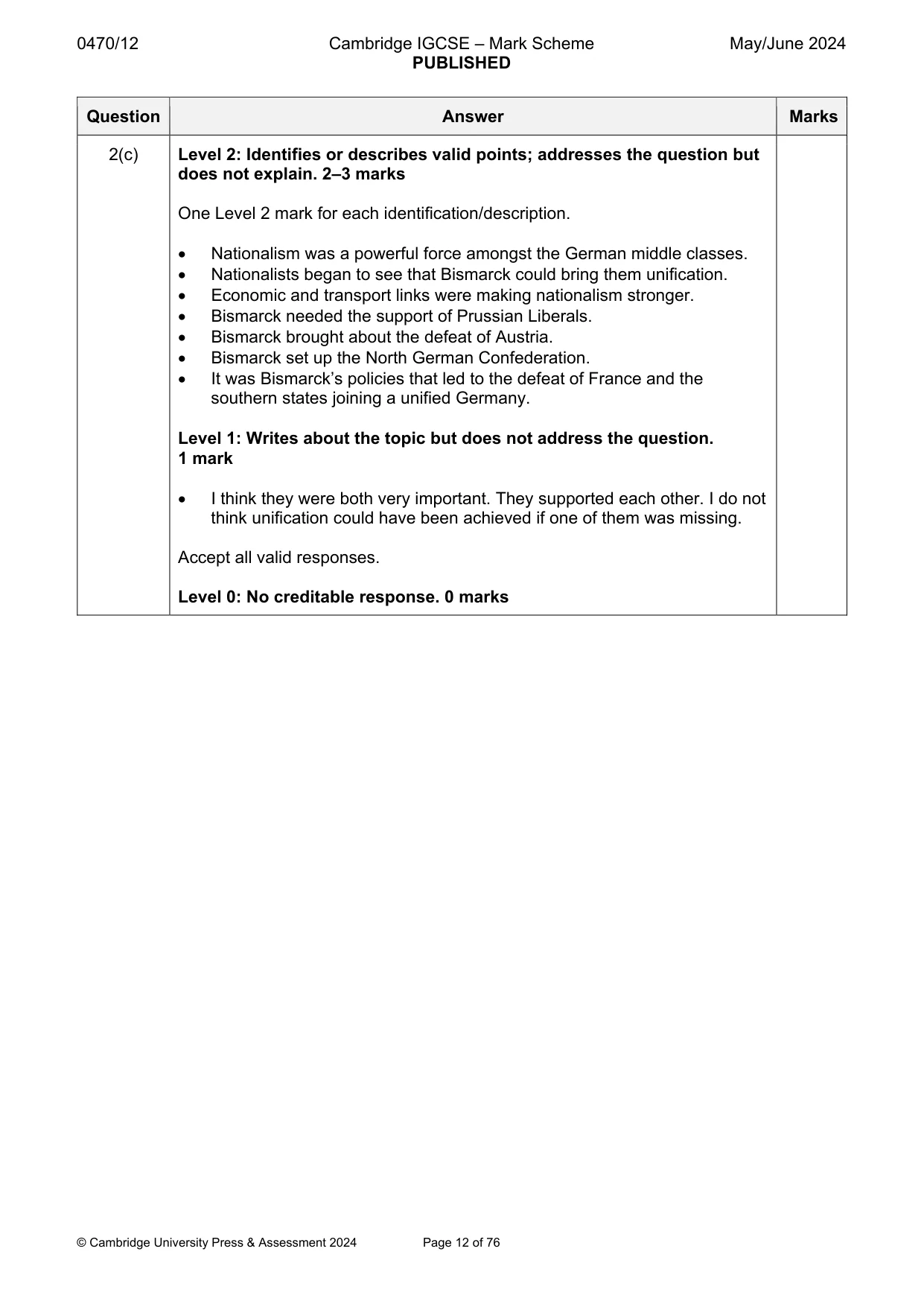
0470/12 Cambridge IGCSE – Mark Scheme PUBLISHED May/June 2024 © Cambridge University Press & Assessment 2024 Page 12 of 76 Question Answer Marks 2(c) Level 2: Identifies or describes valid points; addresses the question but does not explain. 2–3 marks One Level 2 mark for each identification/description. Nationalism was a powerful force amongst the German middle classes. Nationalists began to see that Bismarck could bring them unification. Economic and transport links were making nationalism stronger. Bismarck needed the support of Prussian Liberals. Bismarck brought about the defeat of Austria. Bismarck set up the North German Confederation. It was Bismarck’s policies that led to the defeat of France and the southern states joining a unified Germany. Level 1: Writes about the topic but does not address the question. 1 mark I think they were both very important. They supported each other. I do not think unification could have been achieved if one of them was missing. Accept all valid responses. Level 0: No creditable response. 0 marks
Mark scheme, page 13
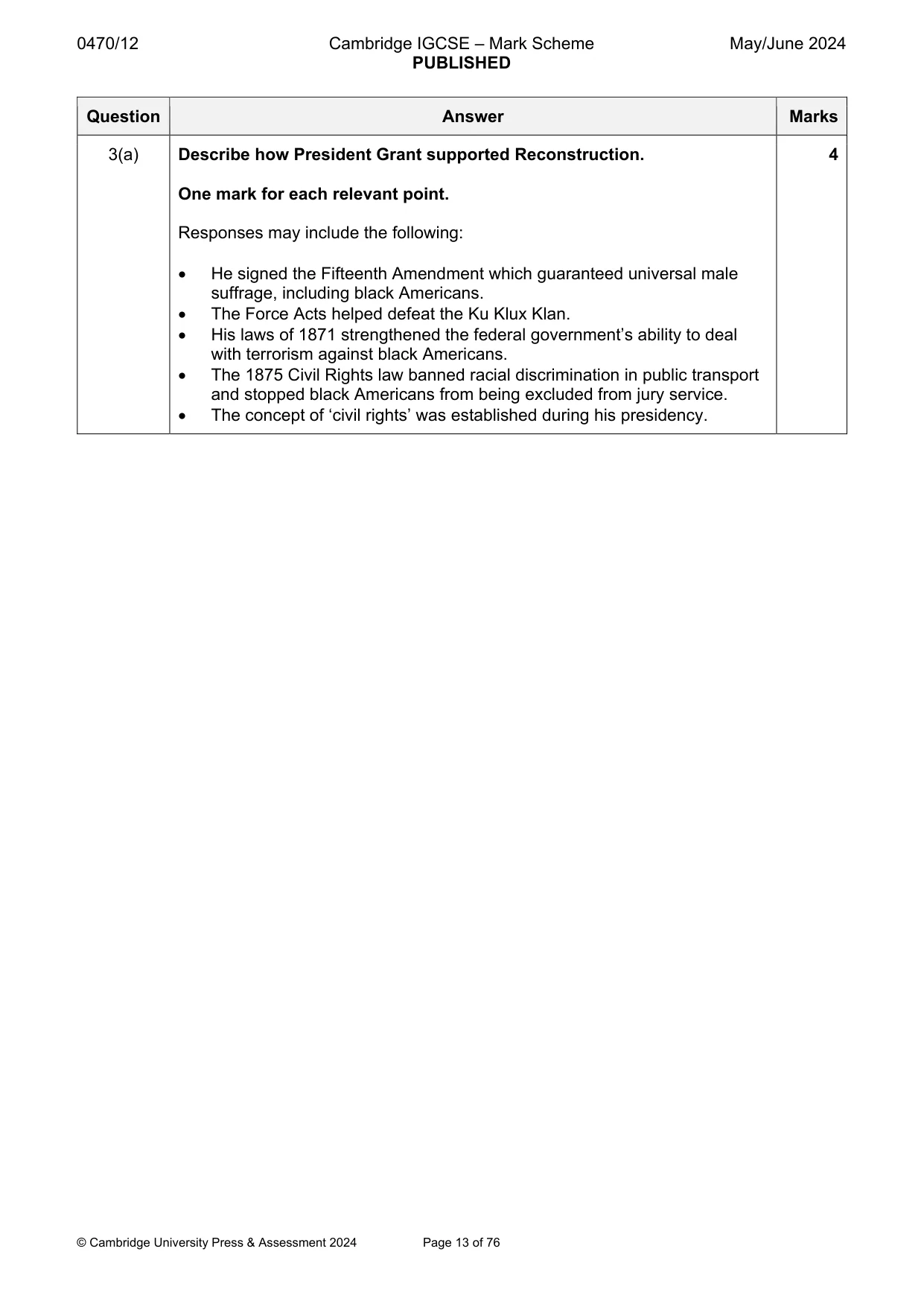
0470/12 Cambridge IGCSE – Mark Scheme PUBLISHED May/June 2024 © Cambridge University Press & Assessment 2024 Page 13 of 76 Question Answer Marks 3(a) Describe how President Grant supported Reconstruction. One mark for each relevant point. Responses may include the following: He signed the Fifteenth Amendment which guaranteed universal male suffrage, including black Americans. The Force Acts helped defeat the Ku Klux Klan. His laws of 1871 strengthened the federal government’s ability to deal with terrorism against black Americans. The 1875 Civil Rights law banned racial discrimination in public transport and stopped black Americans from being excluded from jury service. The concept of ‘civil rights’ was established during his presidency. 4
Mark scheme, page 14
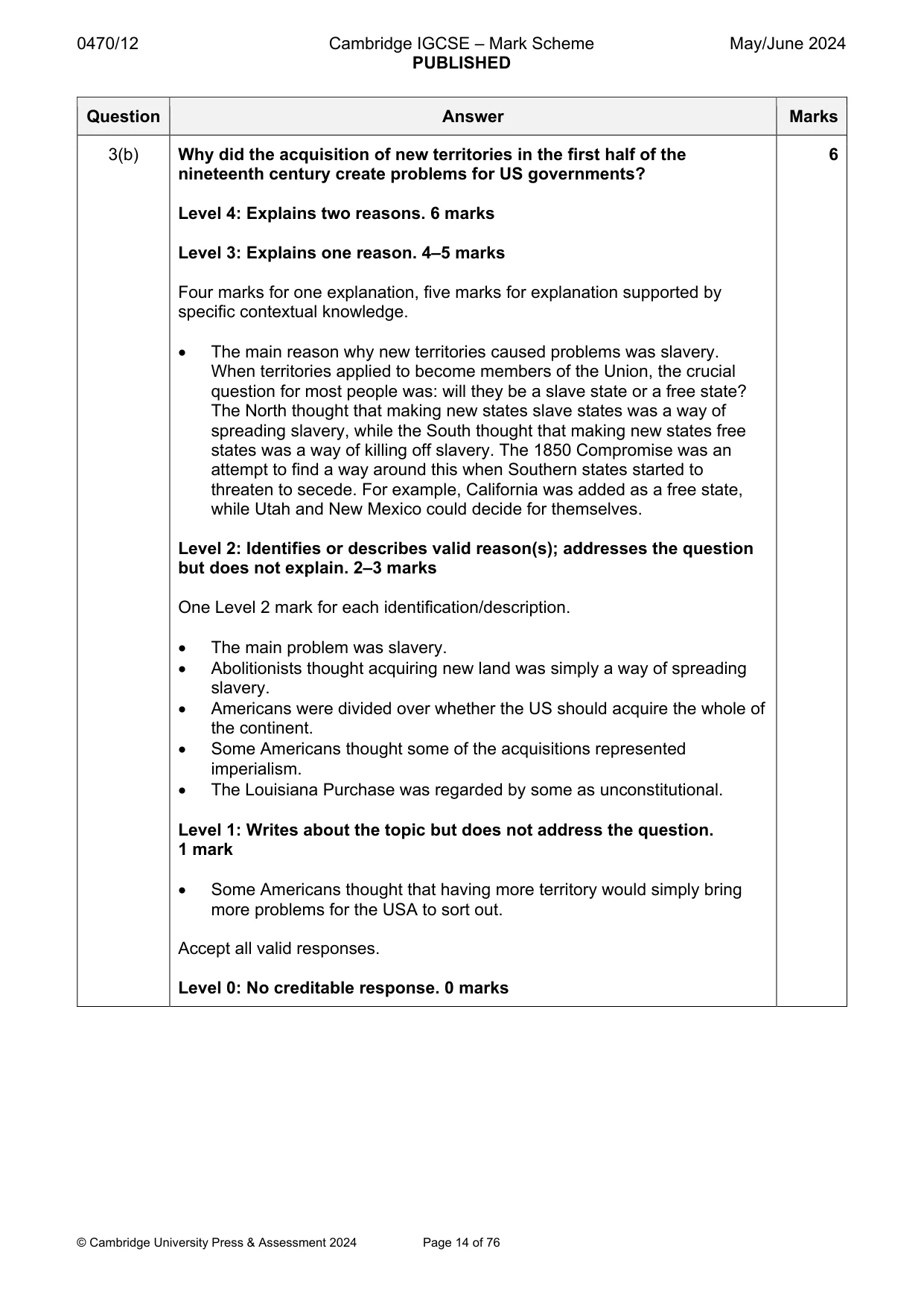
0470/12 Cambridge IGCSE – Mark Scheme PUBLISHED May/June 2024 © Cambridge University Press & Assessment 2024 Page 14 of 76 Question Answer Marks 3(b) Why did the acquisition of new territories in the first half of the nineteenth century create problems for US governments? Level 4: Explains two reasons. 6 marks Level 3: Explains one reason. 4–5 marks Four marks for one explanation, five marks for explanation supported by specific contextual knowledge. The main reason why new territories caused problems was slavery. When territories applied to become members of the Union, the crucial question for most people was: will they be a slave state or a free state? The North thought that making new states slave states was a way of spreading slavery, while the South thought that making new states free states was a way of killing off slavery. The 1850 Compromise was an attempt to find a way around this when Southern states started to threaten to secede. For example, California was added as a free state, while Utah and New Mexico could decide for themselves. Level 2: Identifies or describes valid reason(s); addresses the question but does not explain. 2–3 marks One Level 2 mark for each identification/description. The main problem was slavery. Abolitionists thought acquiring new land was simply a way of spreading slavery. Americans were divided over whether the US should acquire the whole of the continent. Some Americans thought some of the acquisitions represented imperialism. The Louisiana Purchase was regarded by some as unconstitutional. Level 1: Writes about the topic but does not address the question. 1 mark Some Americans thought that having more territory would simply bring more problems for the USA to sort out. Accept all valid responses. Level 0: No creditable response. 0 marks 6
Mark scheme, page 15
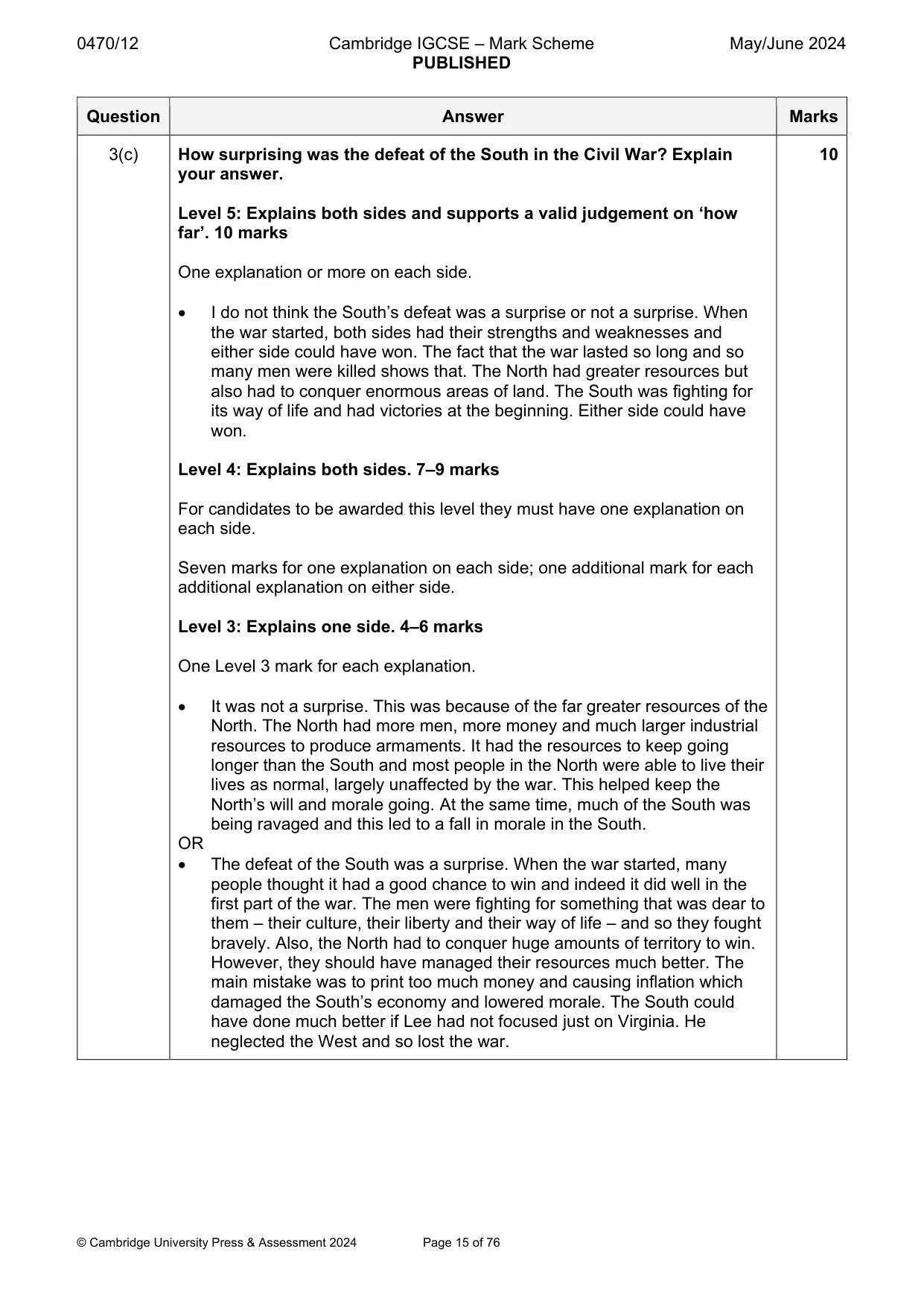
0470/12 Cambridge IGCSE – Mark Scheme PUBLISHED May/June 2024 © Cambridge University Press & Assessment 2024 Page 15 of 76 Question Answer Marks 3(c) How surprising was the defeat of the South in the Civil War? Explain your answer. Level 5: Explains both sides and supports a valid judgement on ‘how far’. 10 marks One explanation or more on each side. I do not think the South’s defeat was a surprise or not a surprise. When the war started, both sides had their strengths and weaknesses and either side could have won. The fact that the war lasted so long and so many men were killed shows that. The North had greater resources but also had to conquer enormous areas of land. The South was fighting for its way of life and had victories at the beginning. Either side could have won. Level 4: Explains both sides. 7–9 marks For candidates to be awarded this level they must have one explanation on each side. Seven marks for one explanation on each side; one additional mark for each additional explanation on either side. Level 3: Explains one side. 4–6 marks One Level 3 mark for each explanation. It was not a surprise. This was because of the far greater resources of the North. The North had more men, more money and much larger industrial resources to produce armaments. It had the resources to keep going longer than the South and most people in the North were able to live their lives as normal, largely unaffected by the war. This helped keep the North’s will and morale going. At the same time, much of the South was being ravaged and this led to a fall in morale in the South. OR The defeat of the South was a surprise. When the war started, many people thought it had a good chance to win and indeed it did well in the first part of the war. The men were fighting for something that was dear to them – their culture, their liberty and their way of life – and so they fought bravely. Also, the North had to conquer huge amounts of territory to win. However, they should have managed their resources much better. The main mistake was to print too much money and causing inflation which damaged the South’s economy and lowered morale. The South could have done much better if Lee had not focused just on Virginia. He neglected the West and so lost the war. 10
Mark scheme, page 16
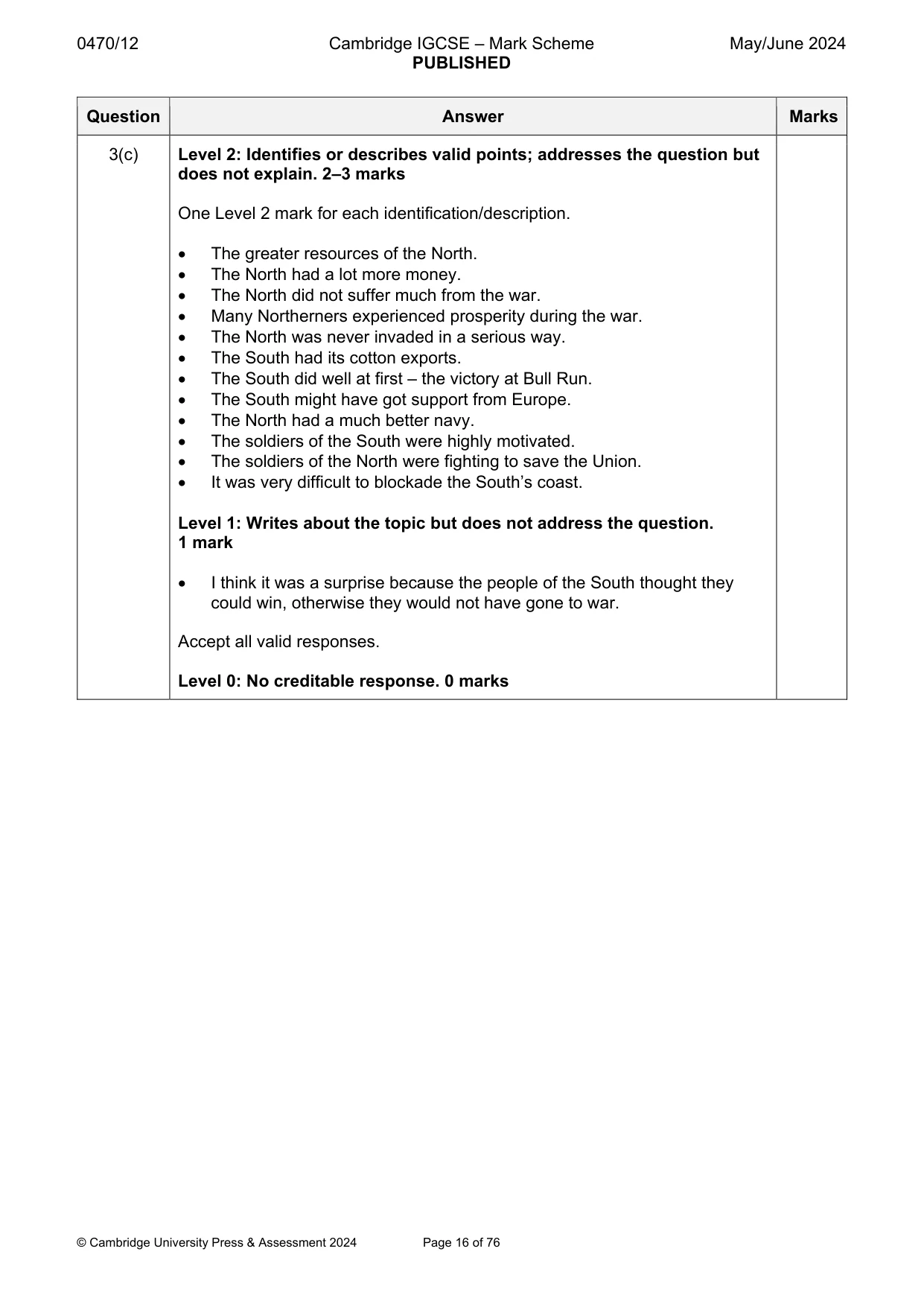
0470/12 Cambridge IGCSE – Mark Scheme PUBLISHED May/June 2024 © Cambridge University Press & Assessment 2024 Page 16 of 76 Question Answer Marks 3(c) Level 2: Identifies or describes valid points; addresses the question but does not explain. 2–3 marks One Level 2 mark for each identification/description. The greater resources of the North. The North had a lot more money. The North did not suffer much from the war. Many Northerners experienced prosperity during the war. The North was never invaded in a serious way. The South had its cotton exports. The South did well at first – the victory at Bull Run. The South might have got support from Europe. The North had a much better navy. The soldiers of the South were highly motivated. The soldiers of the North were fighting to save the Union. It was very difficult to blockade the South’s coast. Level 1: Writes about the topic but does not address the question. 1 mark I think it was a surprise because the people of the South thought they could win, otherwise they would not have gone to war. Accept all valid responses. Level 0: No creditable response. 0 marks
Mark scheme, page 17
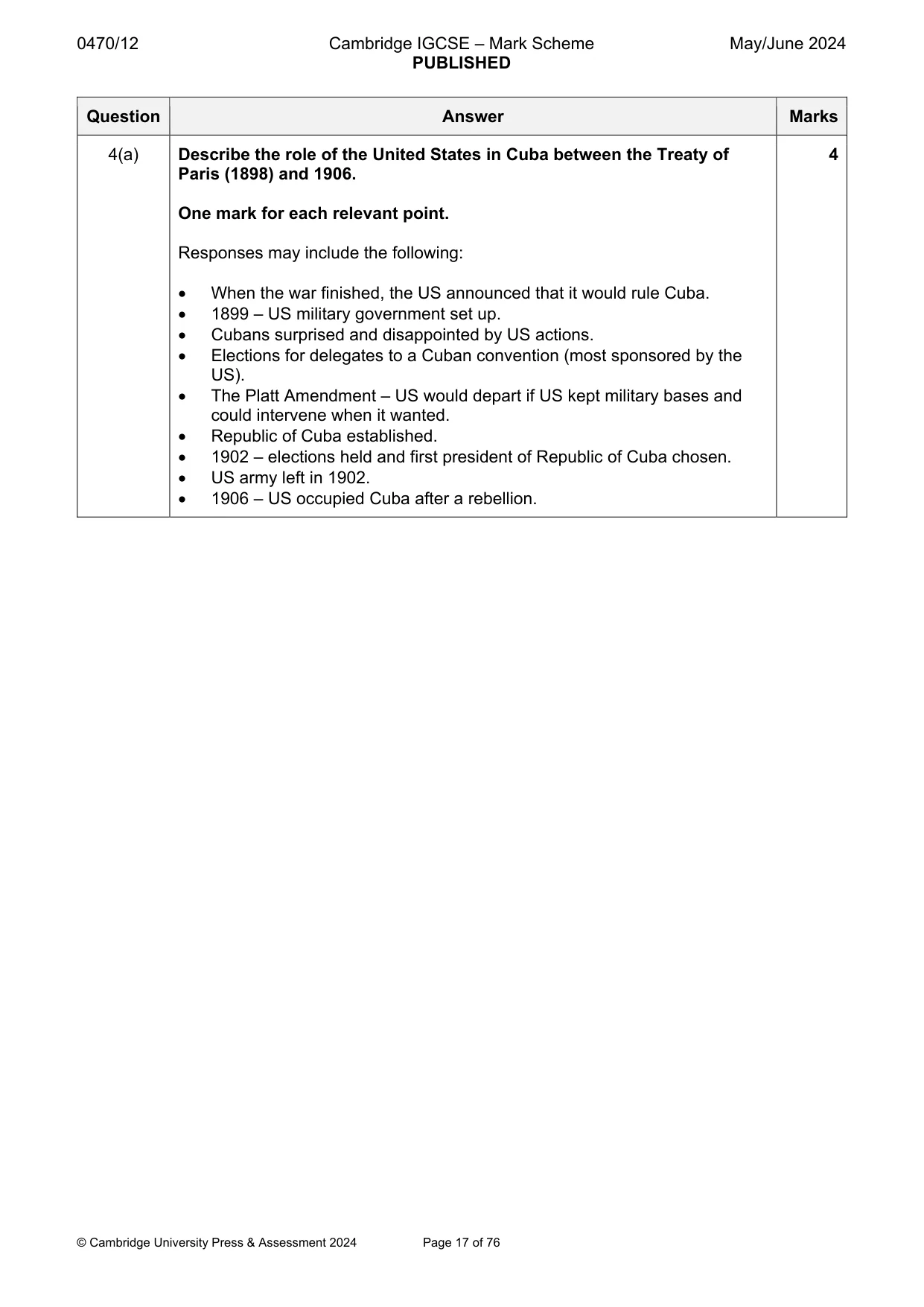
0470/12 Cambridge IGCSE – Mark Scheme PUBLISHED May/June 2024 © Cambridge University Press & Assessment 2024 Page 17 of 76 Question Answer Marks 4(a) Describe the role of the United States in Cuba between the Treaty of Paris (1898) and 1906. One mark for each relevant point. Responses may include the following: When the war finished, the US announced that it would rule Cuba. 1899 – US military government set up. Cubans surprised and disappointed by US actions. Elections for delegates to a Cuban convention (most sponsored by the US). The Platt Amendment – US would depart if US kept military bases and could intervene when it wanted. Republic of Cuba established. 1902 – elections held and first president of Republic of Cuba chosen. US army left in 1902. 1906 – US occupied Cuba after a rebellion. 4
Mark scheme, page 18
0470/12 Cambridge IGCSE – Mark Scheme PUBLISHED May/June 2024 © Cambridge University Press & Assessment 2024 Page 18 of 76 Question Answer Marks 4(b) Why did the Spanish-American War break out in 1898? Level 4: Explains two reasons. 6 marks Level 3: Explains one reason. 4–5 marks Four marks for one explanation, five marks for explanation supported by specific contextual knowledge. This war broke out because of the sinking of the USS Maine. This was a US battleship that was in Havana harbour. It had been sent to protect US citizens and property. US newspapers claimed that the Spanish blew up the battleship and this put a lot of pressure on US President McKinley to go to war against Spain. Level 2: Identifies or describes valid reason(s); addresses the question but does not explain. 2–3 marks One Level 2 mark for each identification/description. Spain’s repressive behaviour towards Cubans. Reporting of Spanish repression in US newspapers. Cuban struggle for independence. Popular demand for US intervention. The sinking of the USS Maine. US demanded withdrawal of Spanish troops from Cuba. Level 1: Writes about the topic but does not address the question. 1 mark The war did not last long. It was all over in a few months and was very one-sided. The US got what it wanted from the war. Accept all valid responses. Level 0: No creditable response. 0 marks 6
Mark scheme, page 19
0470/12 Cambridge IGCSE – Mark Scheme PUBLISHED May/June 2024 © Cambridge University Press & Assessment 2024 Page 19 of 76 Question Answer Marks 4(c) How typical of European imperialism in Africa was Leopold II’s rule in the Congo? Explain your answer. Level 5: Explains both sides and supports a valid judgement on ‘how far’. 10 marks One explanation or more on each side. Although Leopold treated the Congo in a similar way that European countries treated their territories in terms of exploiting the natural resources, they were not similar overall. Leopold’s motives were simply to make a fortune, strip everything he could from the Congo and put nothing back. Other countries, although they regarded themselves as superior to Africans, did think they had a duty to put something back and provided education and medical care for Africans. Leopold’s attitude was fundamentally different. Level 4: Explains both sides. 7–9 marks For candidates to be awarded this level they must have one explanation on each side. Seven marks for one explanation on each side; one additional mark for each additional explanation on either side. Level 3: Explains one side. 4–6 marks One Level 3 mark for each explanation. Leopold owned the Congo Free State as a private individual. His treatment of the Africans was terrible. They worked for him producing rubber, but if they did not produce their quota they were mutilated or murdered. Leopold just sucked the Congo dry by taking ivory and rubber and by putting nothing back. Millions of Congolese were killed or mutilated. His rule was not typical of European imperialism at the time. Not all imperialism was about exploitation. Some Europeans had good motives: for example, missionaries and others who set up hospitals for Africans as well as schools which started to bring education to Africa. They also brought industry to Africa which sometimes improved the standard of living of Africans as well as introducing things such as banking. OR Leopold’s rule was typical in some ways. He exploited the Congo and made a fortune by taking ivory and rubber. Other European countries also took Africa’s natural resources to make themselves rich. They took raw materials from Africa very cheaply and then exported the finished products at expensive prices. In fact, Europe made a fortune out of the natural resources of Africa just like Leopold did. 10
Mark scheme, page 20
0470/12 Cambridge IGCSE – Mark Scheme PUBLISHED May/June 2024 © Cambridge University Press & Assessment 2024 Page 20 of 76 Question Answer Marks 4(c) Level 2: Identifies or describes valid points; addresses the question but does not explain. 2–3 marks One Level 2 mark for each identification/description. Both exploited Africa. Both regarded Africans as inferior. Both thought they had a right to take over parts of Africa. Both wanted to make money out of Africa. Leopold put nothing back; other Europeans did. Other Europeans felt a duty towards Africans. Other Europeans spread Christianity. Other Europeans built transport systems and schools. Level 1: Writes about the topic but does not address the question. 1 mark Leopold’s treatment of the Africans in the Congo was terrible. It caused an international outcry. He was not typical of European countries and how they ruled their land in Africa. Accept all valid responses. Level 0: No creditable response. 0 marks
Mark scheme, page 21
0470/12 Cambridge IGCSE – Mark Scheme PUBLISHED May/June 2024 © Cambridge University Press & Assessment 2024 Page 21 of 76 Question Answer Marks 5(a) What land did Germany lose in the Treaty of Versailles? One mark for each relevant point. Responses may include the following: Upper Silesia. West Prussia, Posen, Polish Corridor. Memel. Danzig. North Schleswig. Alsace-Lorraine. Saarland. Eupen, Malmedy, Moresnet. Hultschin. Estonia, Latvia, Lithuania. Overseas colonies. 4
Mark scheme, page 22
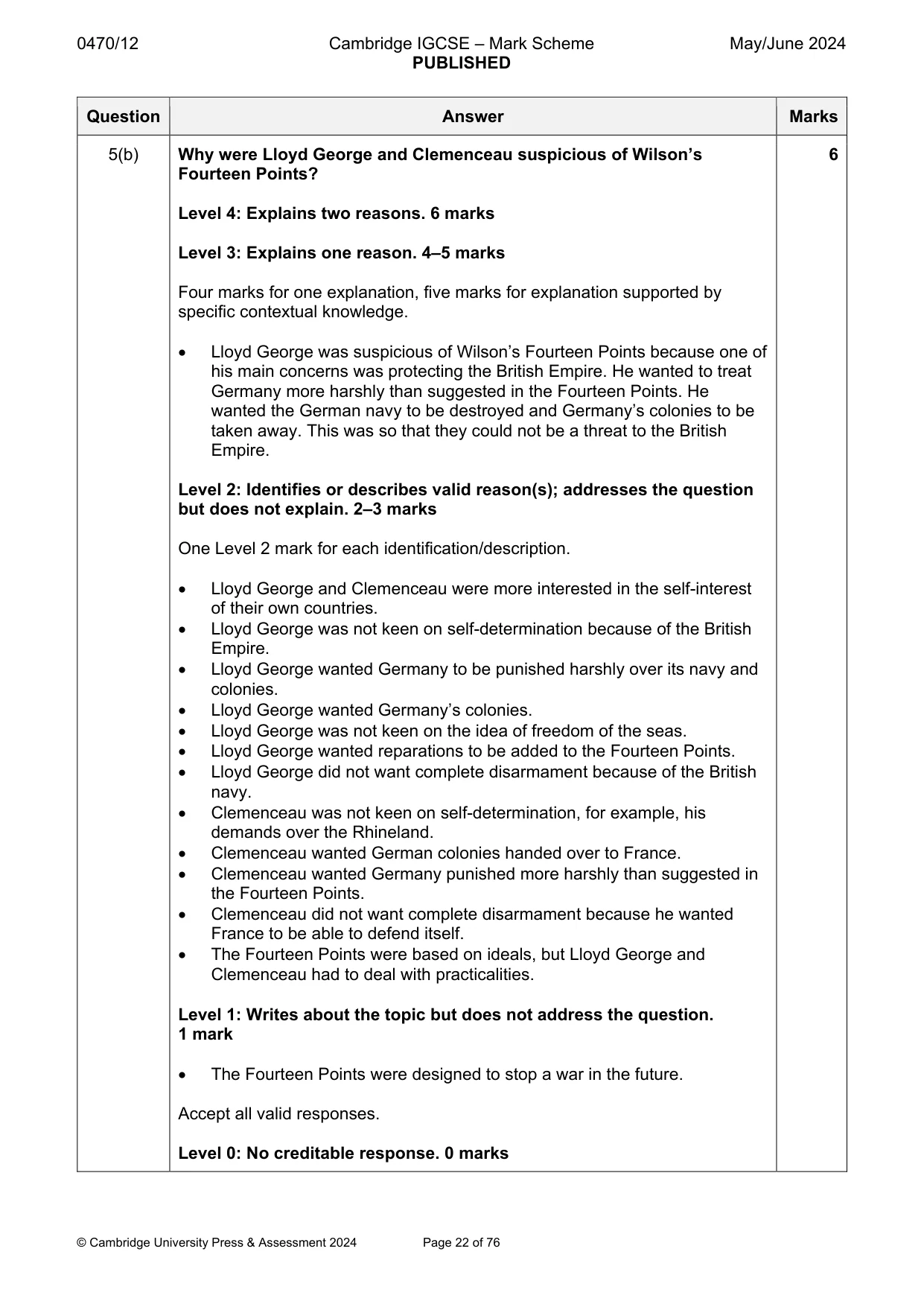
0470/12 Cambridge IGCSE – Mark Scheme PUBLISHED May/June 2024 © Cambridge University Press & Assessment 2024 Page 22 of 76 Question Answer Marks 5(b) Why were Lloyd George and Clemenceau suspicious of Wilson’s Fourteen Points? Level 4: Explains two reasons. 6 marks Level 3: Explains one reason. 4–5 marks Four marks for one explanation, five marks for explanation supported by specific contextual knowledge. Lloyd George was suspicious of Wilson’s Fourteen Points because one of his main concerns was protecting the British Empire. He wanted to treat Germany more harshly than suggested in the Fourteen Points. He wanted the German navy to be destroyed and Germany’s colonies to be taken away. This was so that they could not be a threat to the British Empire. Level 2: Identifies or describes valid reason(s); addresses the question but does not explain. 2–3 marks One Level 2 mark for each identification/description. Lloyd George and Clemenceau were more interested in the self-interest of their own countries. Lloyd George was not keen on self-determination because of the British Empire. Lloyd George wanted Germany to be punished harshly over its navy and colonies. Lloyd George wanted Germany’s colonies. Lloyd George was not keen on the idea of freedom of the seas. Lloyd George wanted reparations to be added to the Fourteen Points. Lloyd George did not want complete disarmament because of the British navy. Clemenceau was not keen on self-determination, for example, his demands over the Rhineland. Clemenceau wanted German colonies handed over to France. Clemenceau wanted Germany punished more harshly than suggested in the Fourteen Points. Clemenceau did not want complete disarmament because he wanted France to be able to defend itself. The Fourteen Points were based on ideals, but Lloyd George and Clemenceau had to deal with practicalities. Level 1: Writes about the topic but does not address the question. 1 mark The Fourteen Points were designed to stop a war in the future. Accept all valid responses. Level 0: No creditable response. 0 marks 6
Mark scheme, page 23
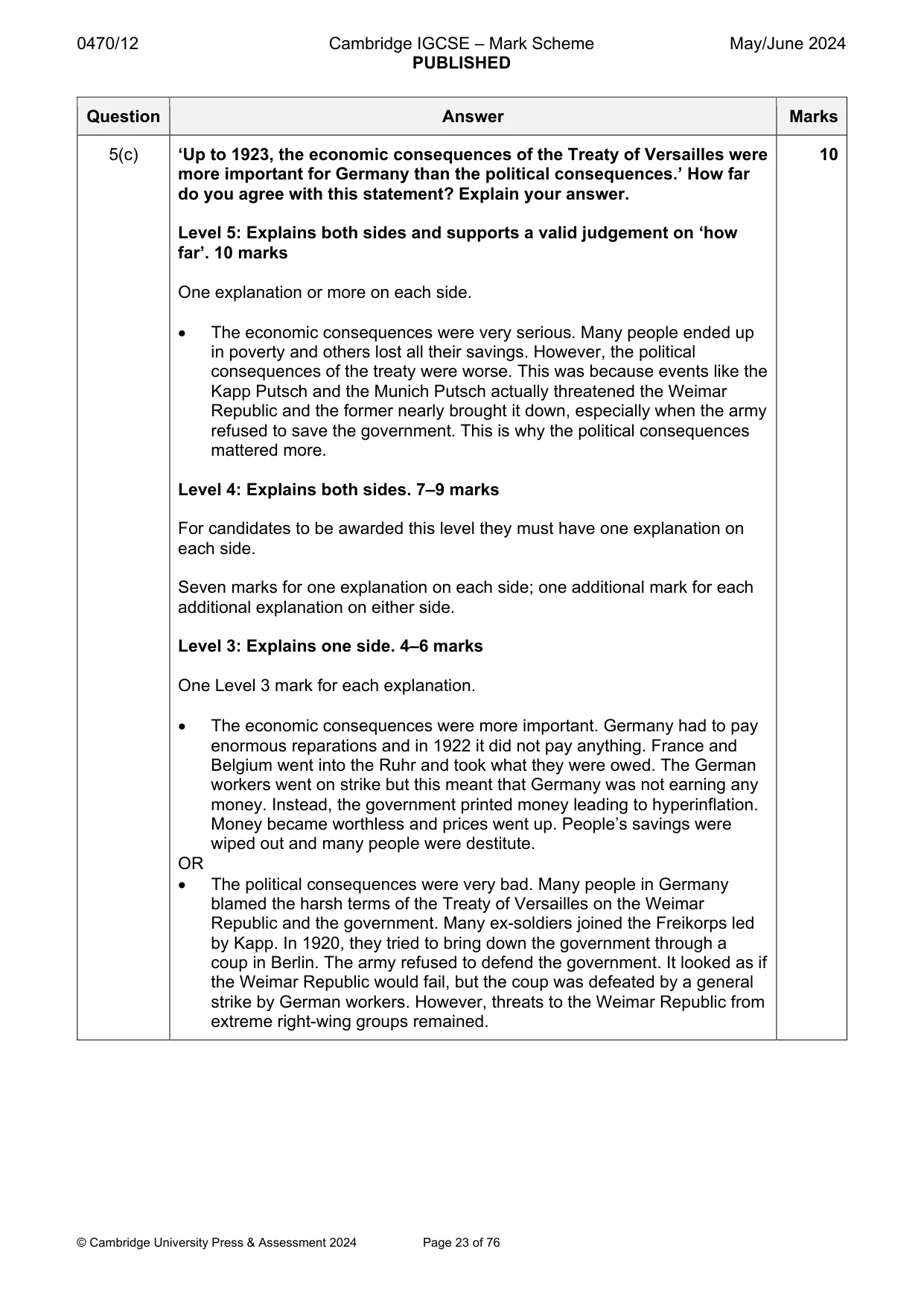
0470/12 Cambridge IGCSE – Mark Scheme PUBLISHED May/June 2024 © Cambridge University Press & Assessment 2024 Page 23 of 76 Question Answer Marks 5(c) ‘Up to 1923, the economic consequences of the Treaty of Versailles were more important for Germany than the political consequences.’ How far do you agree with this statement? Explain your answer. Level 5: Explains both sides and supports a valid judgement on ‘how far’. 10 marks One explanation or more on each side. The economic consequences were very serious. Many people ended up in poverty and others lost all their savings. However, the political consequences of the treaty were worse. This was because events like the Kapp Putsch and the Munich Putsch actually threatened the Weimar Republic and the former nearly brought it down, especially when the army refused to save the government. This is why the political consequences mattered more. Level 4: Explains both sides. 7–9 marks For candidates to be awarded this level they must have one explanation on each side. Seven marks for one explanation on each side; one additional mark for each additional explanation on either side. Level 3: Explains one side. 4–6 marks One Level 3 mark for each explanation. The economic consequences were more important. Germany had to pay enormous reparations and in 1922 it did not pay anything. France and Belgium went into the Ruhr and took what they were owed. The German workers went on strike but this meant that Germany was not earning any money. Instead, the government printed money leading to hyperinflation. Money became worthless and prices went up. People’s savings were wiped out and many people were destitute. OR The political consequences were very bad. Many people in Germany blamed the harsh terms of the Treaty of Versailles on the Weimar Republic and the government. Many ex-soldiers joined the Freikorps led by Kapp. In 1920, they tried to bring down the government through a coup in Berlin. The army refused to defend the government. It looked as if the Weimar Republic would fail, but the coup was defeated by a general strike by German workers. However, threats to the Weimar Republic from extreme right-wing groups remained. 10
Mark scheme, page 24
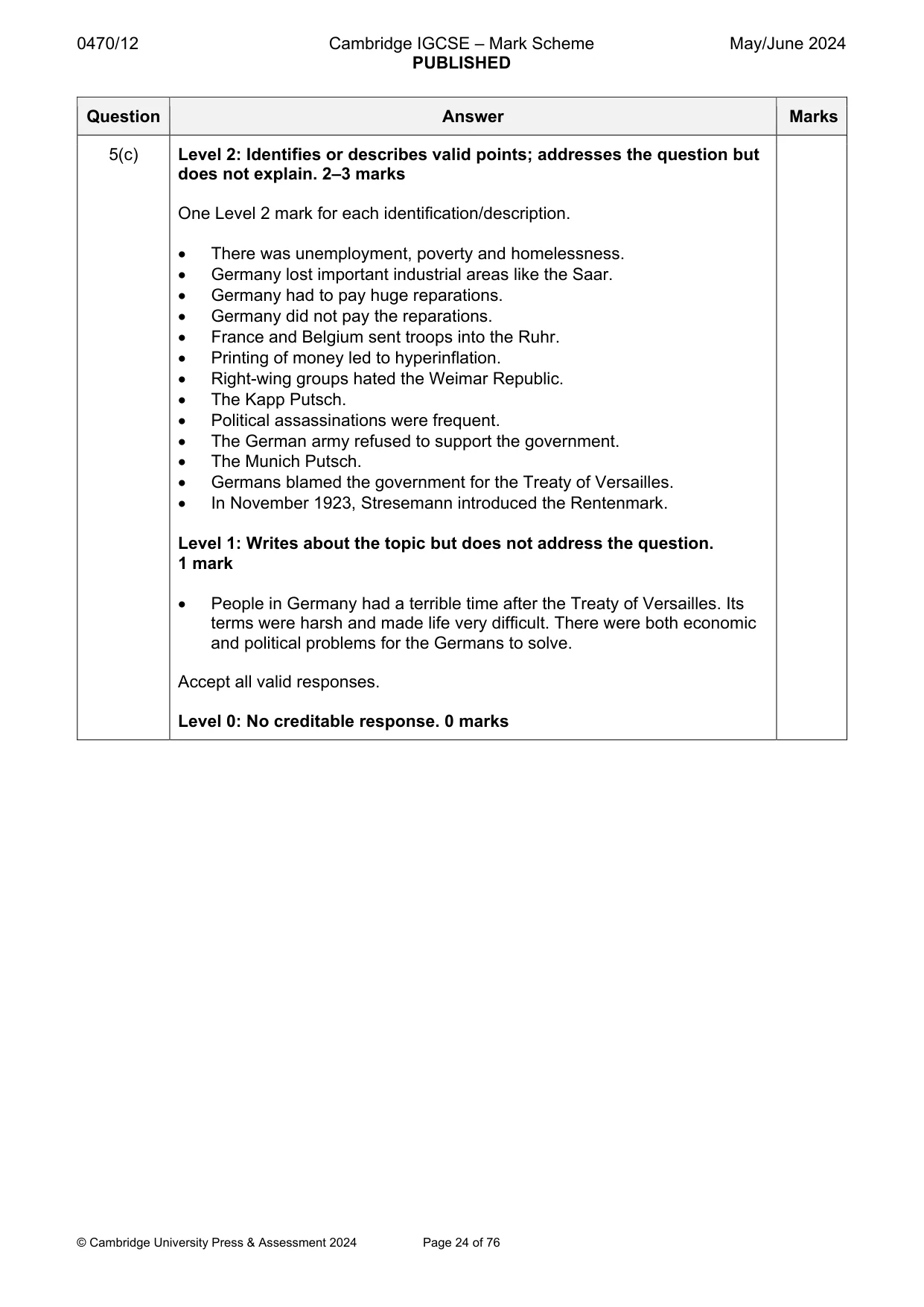
0470/12 Cambridge IGCSE – Mark Scheme PUBLISHED May/June 2024 © Cambridge University Press & Assessment 2024 Page 24 of 76 Question Answer Marks 5(c) Level 2: Identifies or describes valid points; addresses the question but does not explain. 2–3 marks One Level 2 mark for each identification/description. There was unemployment, poverty and homelessness. Germany lost important industrial areas like the Saar. Germany had to pay huge reparations. Germany did not pay the reparations. France and Belgium sent troops into the Ruhr. Printing of money led to hyperinflation. Right-wing groups hated the Weimar Republic. The Kapp Putsch. Political assassinations were frequent. The German army refused to support the government. The Munich Putsch. Germans blamed the government for the Treaty of Versailles. In November 1923, Stresemann introduced the Rentenmark. Level 1: Writes about the topic but does not address the question. 1 mark People in Germany had a terrible time after the Treaty of Versailles. Its terms were harsh and made life very difficult. There were both economic and political problems for the Germans to solve. Accept all valid responses. Level 0: No creditable response. 0 marks
Mark scheme, page 25
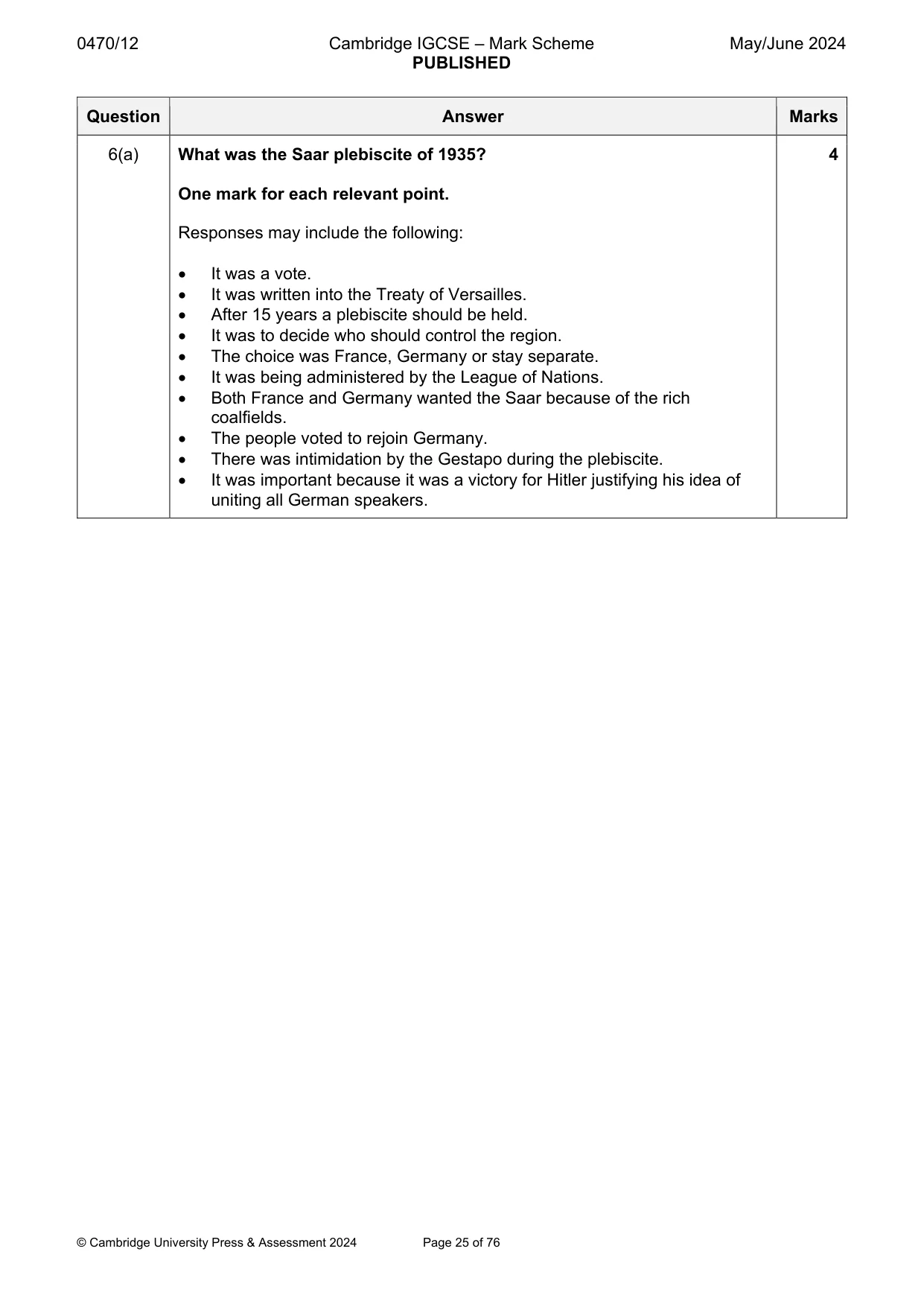
0470/12 Cambridge IGCSE – Mark Scheme PUBLISHED May/June 2024 © Cambridge University Press & Assessment 2024 Page 25 of 76 Question Answer Marks 6(a) What was the Saar plebiscite of 1935? One mark for each relevant point. Responses may include the following: It was a vote. It was written into the Treaty of Versailles. After 15 years a plebiscite should be held. It was to decide who should control the region. The choice was France, Germany or stay separate. It was being administered by the League of Nations. Both France and Germany wanted the Saar because of the rich coalfields. The people voted to rejoin Germany. There was intimidation by the Gestapo during the plebiscite. It was important because it was a victory for Hitler justifying his idea of uniting all German speakers. 4
Mark scheme, page 26
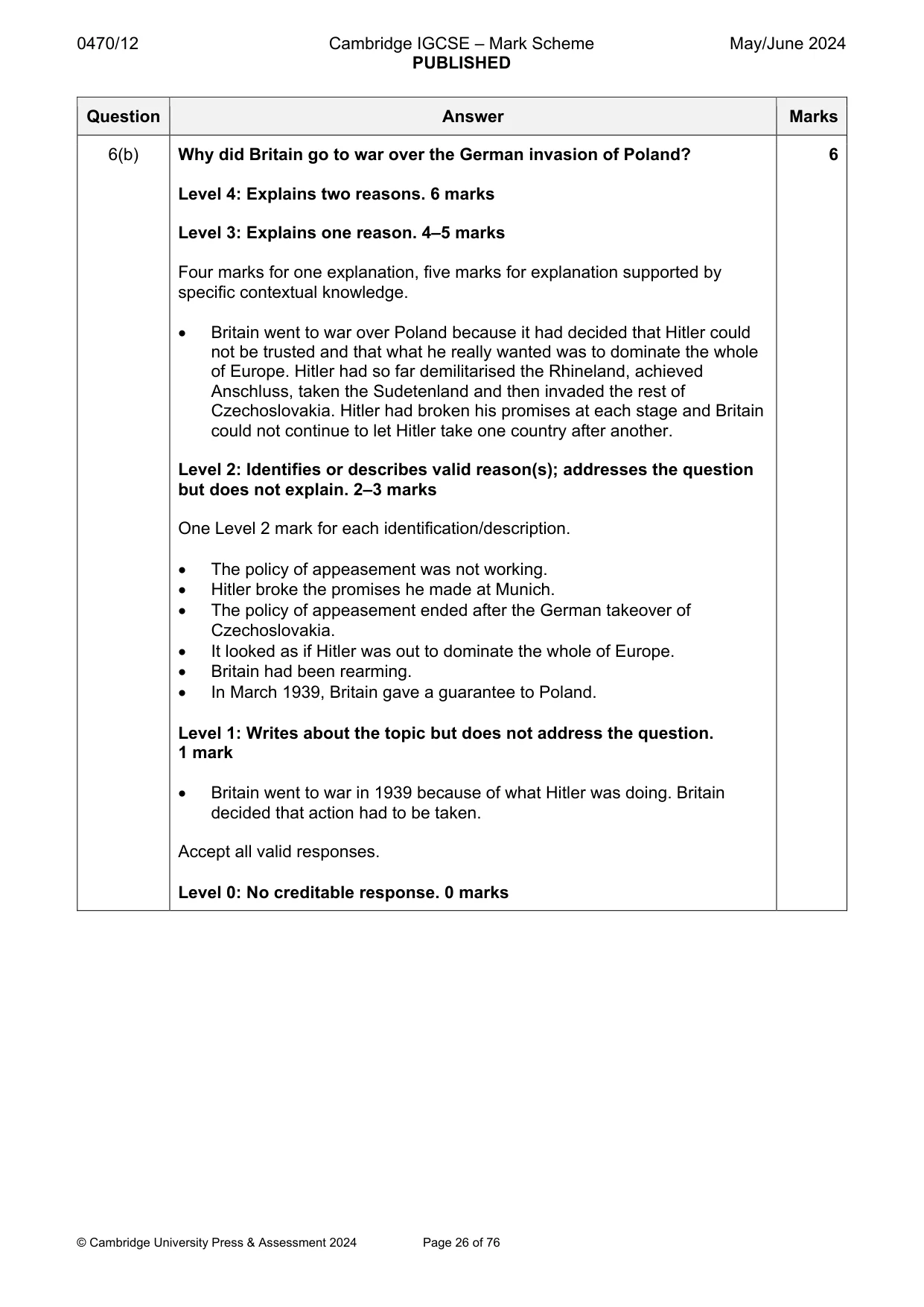
0470/12 Cambridge IGCSE – Mark Scheme PUBLISHED May/June 2024 © Cambridge University Press & Assessment 2024 Page 26 of 76 Question Answer Marks 6(b) Why did Britain go to war over the German invasion of Poland? Level 4: Explains two reasons. 6 marks Level 3: Explains one reason. 4–5 marks Four marks for one explanation, five marks for explanation supported by specific contextual knowledge. Britain went to war over Poland because it had decided that Hitler could not be trusted and that what he really wanted was to dominate the whole of Europe. Hitler had so far demilitarised the Rhineland, achieved Anschluss, taken the Sudetenland and then invaded the rest of Czechoslovakia. Hitler had broken his promises at each stage and Britain could not continue to let Hitler take one country after another. Level 2: Identifies or describes valid reason(s); addresses the question but does not explain. 2–3 marks One Level 2 mark for each identification/description. The policy of appeasement was not working. Hitler broke the promises he made at Munich. The policy of appeasement ended after the German takeover of Czechoslovakia. It looked as if Hitler was out to dominate the whole of Europe. Britain had been rearming. In March 1939, Britain gave a guarantee to Poland. Level 1: Writes about the topic but does not address the question. 1 mark Britain went to war in 1939 because of what Hitler was doing. Britain decided that action had to be taken. Accept all valid responses. Level 0: No creditable response. 0 marks 6
Mark scheme, page 27
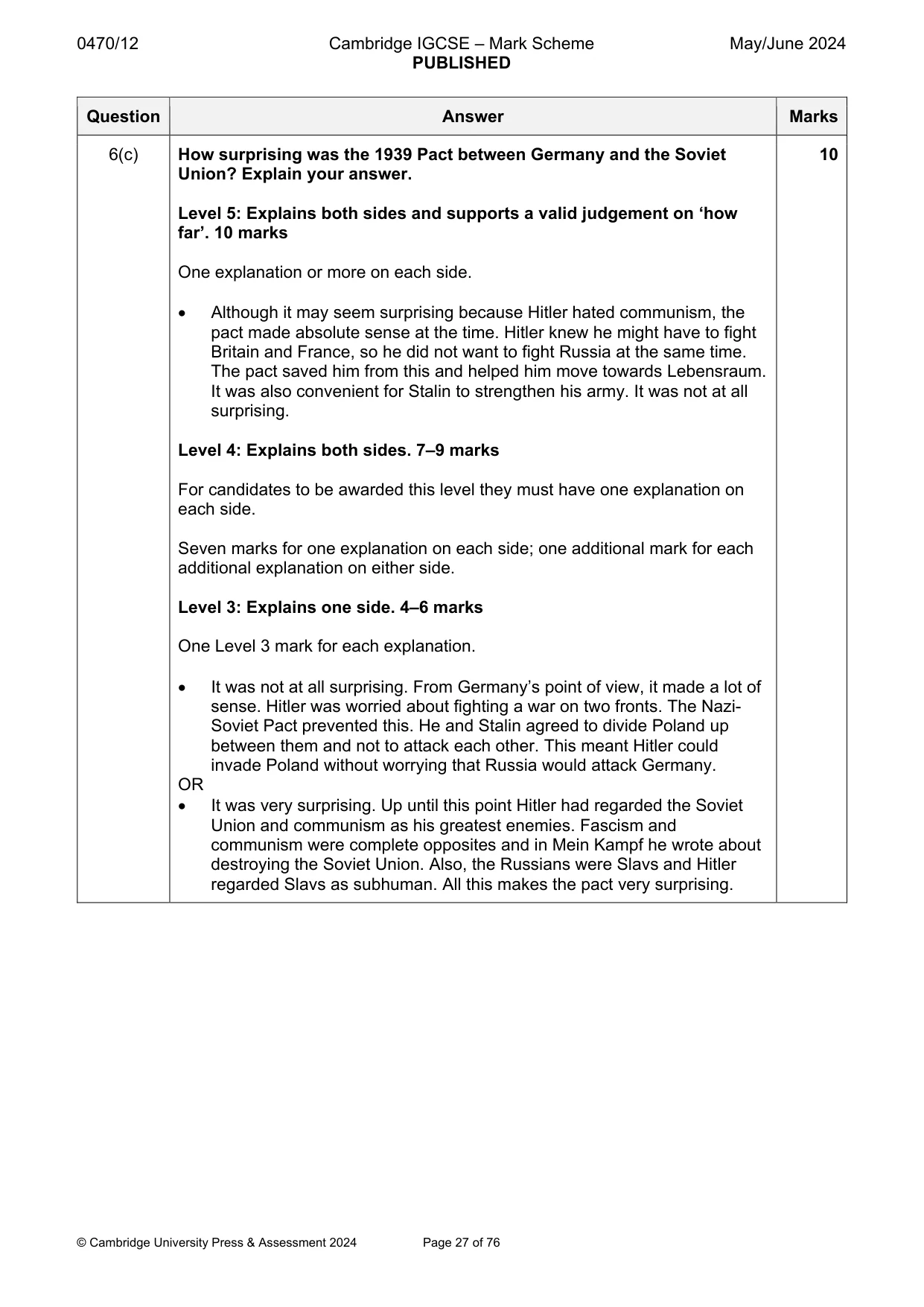
0470/12 Cambridge IGCSE – Mark Scheme PUBLISHED May/June 2024 © Cambridge University Press & Assessment 2024 Page 27 of 76 Question Answer Marks 6(c) How surprising was the 1939 Pact between Germany and the Soviet Union? Explain your answer. Level 5: Explains both sides and supports a valid judgement on ‘how far’. 10 marks One explanation or more on each side. Although it may seem surprising because Hitler hated communism, the pact made absolute sense at the time. Hitler knew he might have to fight Britain and France, so he did not want to fight Russia at the same time. The pact saved him from this and helped him move towards Lebensraum. It was also convenient for Stalin to strengthen his army. It was not at all surprising. Level 4: Explains both sides. 7–9 marks For candidates to be awarded this level they must have one explanation on each side. Seven marks for one explanation on each side; one additional mark for each additional explanation on either side. Level 3: Explains one side. 4–6 marks One Level 3 mark for each explanation. It was not at all surprising. From Germany’s point of view, it made a lot of sense. Hitler was worried about fighting a war on two fronts. The Nazi- Soviet Pact prevented this. He and Stalin agreed to divide Poland up between them and not to attack each other. This meant Hitler could invade Poland without worrying that Russia would attack Germany. OR It was very surprising. Up until this point Hitler had regarded the Soviet Union and communism as his greatest enemies. Fascism and communism were complete opposites and in Mein Kampf he wrote about destroying the Soviet Union. Also, the Russians were Slavs and Hitler regarded Slavs as subhuman. All this makes the pact very surprising. 10
Mark scheme, page 28
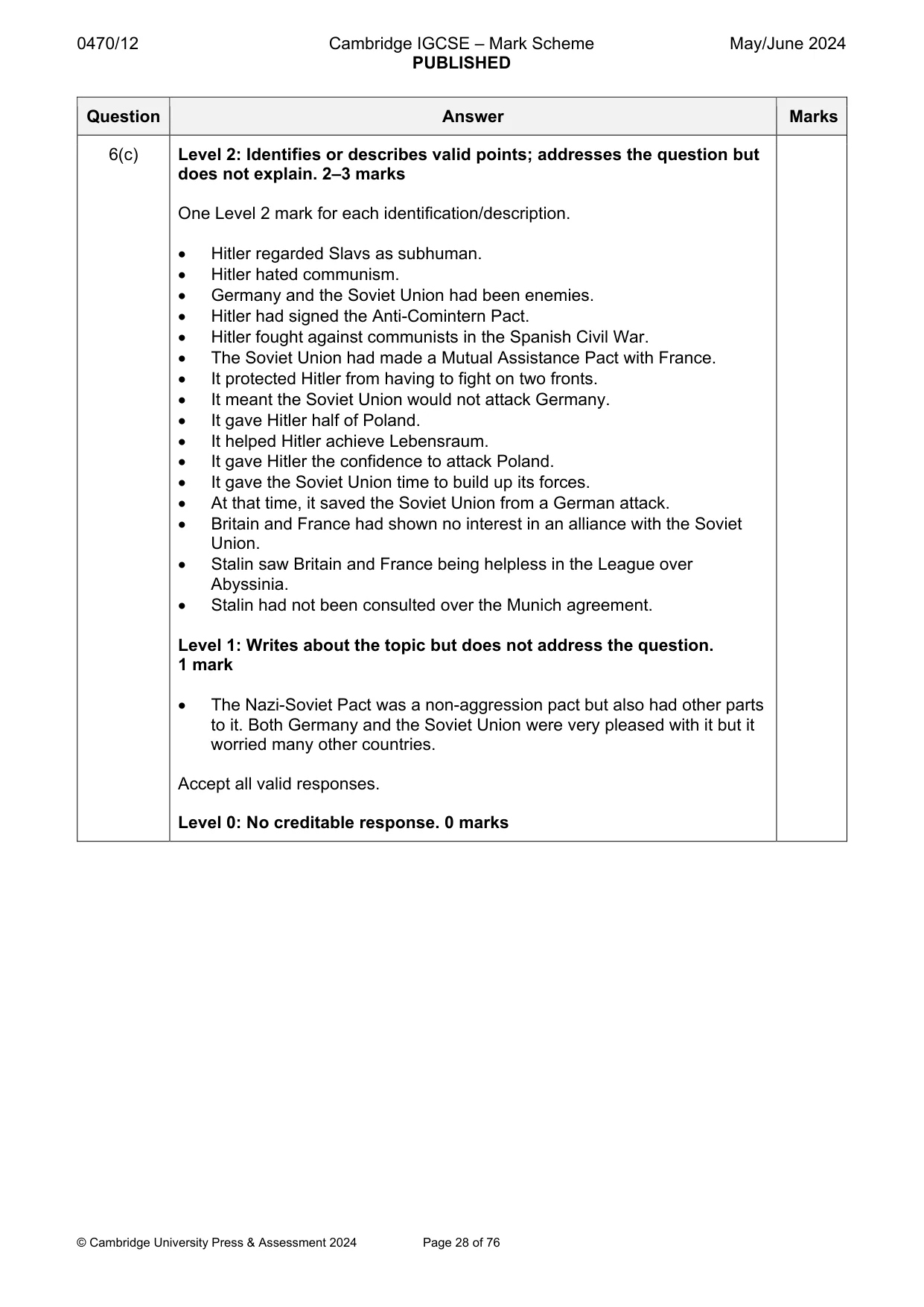
0470/12 Cambridge IGCSE – Mark Scheme PUBLISHED May/June 2024 © Cambridge University Press & Assessment 2024 Page 28 of 76 Question Answer Marks 6(c) Level 2: Identifies or describes valid points; addresses the question but does not explain. 2–3 marks One Level 2 mark for each identification/description. Hitler regarded Slavs as subhuman. Hitler hated communism. Germany and the Soviet Union had been enemies. Hitler had signed the Anti-Comintern Pact. Hitler fought against communists in the Spanish Civil War. The Soviet Union had made a Mutual Assistance Pact with France. It protected Hitler from having to fight on two fronts. It meant the Soviet Union would not attack Germany. It gave Hitler half of Poland. It helped Hitler achieve Lebensraum. It gave Hitler the confidence to attack Poland. It gave the Soviet Union time to build up its forces. At that time, it saved the Soviet Union from a German attack. Britain and France had shown no interest in an alliance with the Soviet Union. Stalin saw Britain and France being helpless in the League over Abyssinia. Stalin had not been consulted over the Munich agreement. Level 1: Writes about the topic but does not address the question. 1 mark The Nazi-Soviet Pact was a non-aggression pact but also had other parts to it. Both Germany and the Soviet Union were very pleased with it but it worried many other countries. Accept all valid responses. Level 0: No creditable response. 0 marks
Mark scheme, page 29
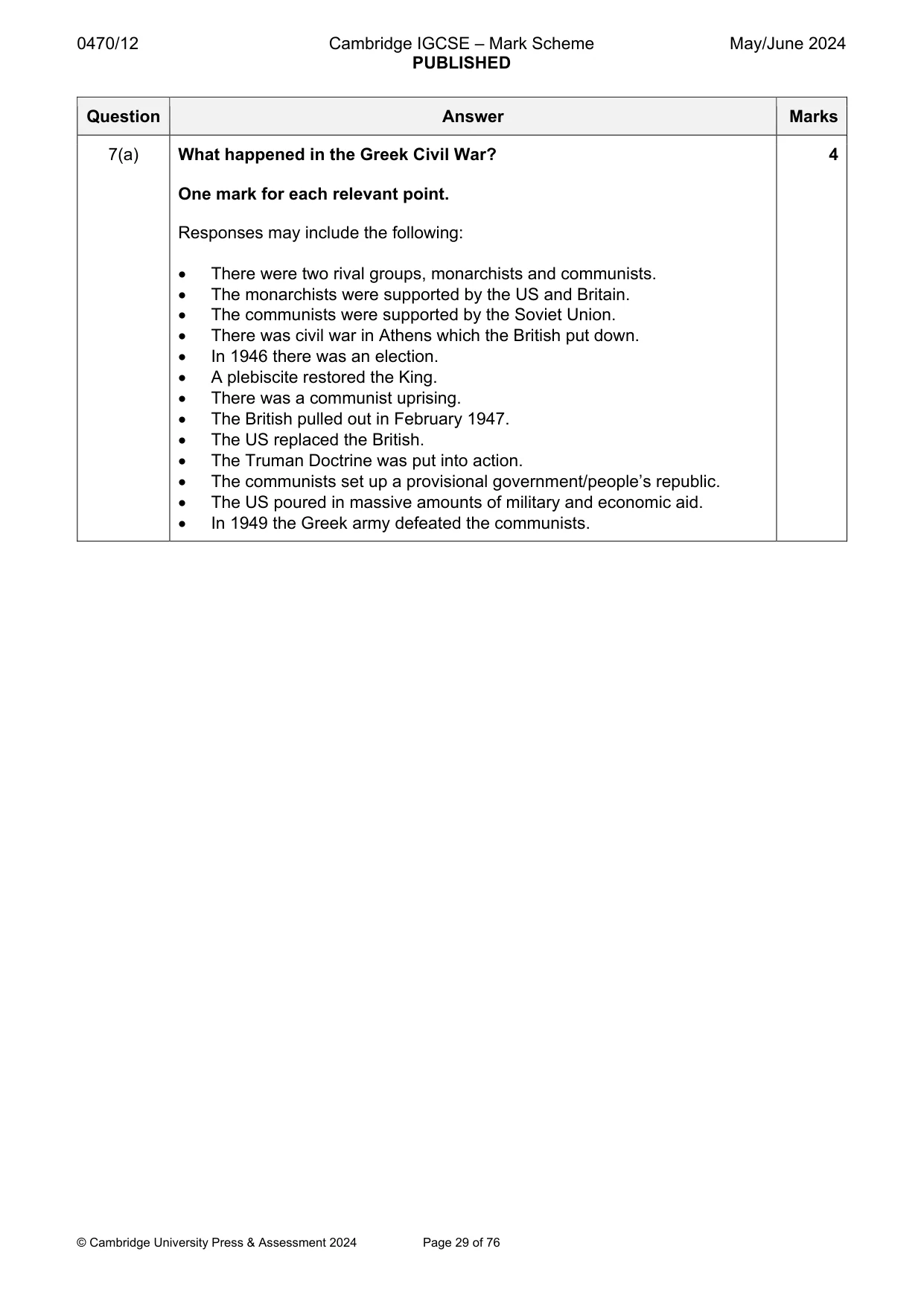
0470/12 Cambridge IGCSE – Mark Scheme PUBLISHED May/June 2024 © Cambridge University Press & Assessment 2024 Page 29 of 76 Question Answer Marks 7(a) What happened in the Greek Civil War? One mark for each relevant point. Responses may include the following: There were two rival groups, monarchists and communists. The monarchists were supported by the US and Britain. The communists were supported by the Soviet Union. There was civil war in Athens which the British put down. In 1946 there was an election. A plebiscite restored the King. There was a communist uprising. The British pulled out in February 1947. The US replaced the British. The Truman Doctrine was put into action. The communists set up a provisional government/people’s republic. The US poured in massive amounts of military and economic aid. In 1949 the Greek army defeated the communists. 4
Mark scheme, page 30
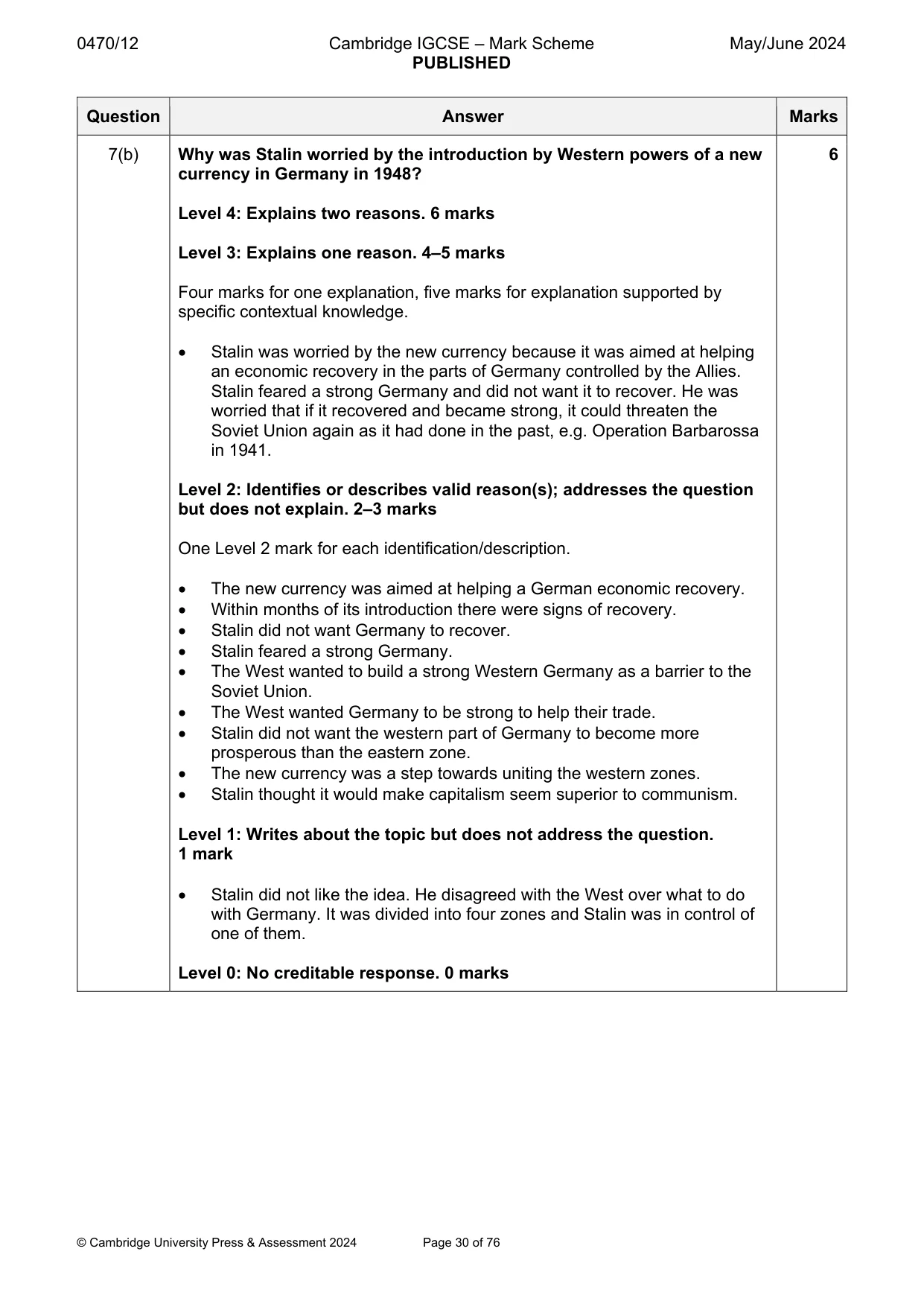
0470/12 Cambridge IGCSE – Mark Scheme PUBLISHED May/June 2024 © Cambridge University Press & Assessment 2024 Page 30 of 76 Question Answer Marks 7(b) Why was Stalin worried by the introduction by Western powers of a new currency in Germany in 1948? Level 4: Explains two reasons. 6 marks Level 3: Explains one reason. 4–5 marks Four marks for one explanation, five marks for explanation supported by specific contextual knowledge. Stalin was worried by the new currency because it was aimed at helping an economic recovery in the parts of Germany controlled by the Allies. Stalin feared a strong Germany and did not want it to recover. He was worried that if it recovered and became strong, it could threaten the Soviet Union again as it had done in the past, e.g. Operation Barbarossa in 1941. Level 2: Identifies or describes valid reason(s); addresses the question but does not explain. 2–3 marks One Level 2 mark for each identification/description. The new currency was aimed at helping a German economic recovery. Within months of its introduction there were signs of recovery. Stalin did not want Germany to recover. Stalin feared a strong Germany. The West wanted to build a strong Western Germany as a barrier to the Soviet Union. The West wanted Germany to be strong to help their trade. Stalin did not want the western part of Germany to become more prosperous than the eastern zone. The new currency was a step towards uniting the western zones. Stalin thought it would make capitalism seem superior to communism. Level 1: Writes about the topic but does not address the question. 1 mark Stalin did not like the idea. He disagreed with the West over what to do with Germany. It was divided into four zones and Stalin was in control of one of them. Level 0: No creditable response. 0 marks 6
Mark scheme, page 31
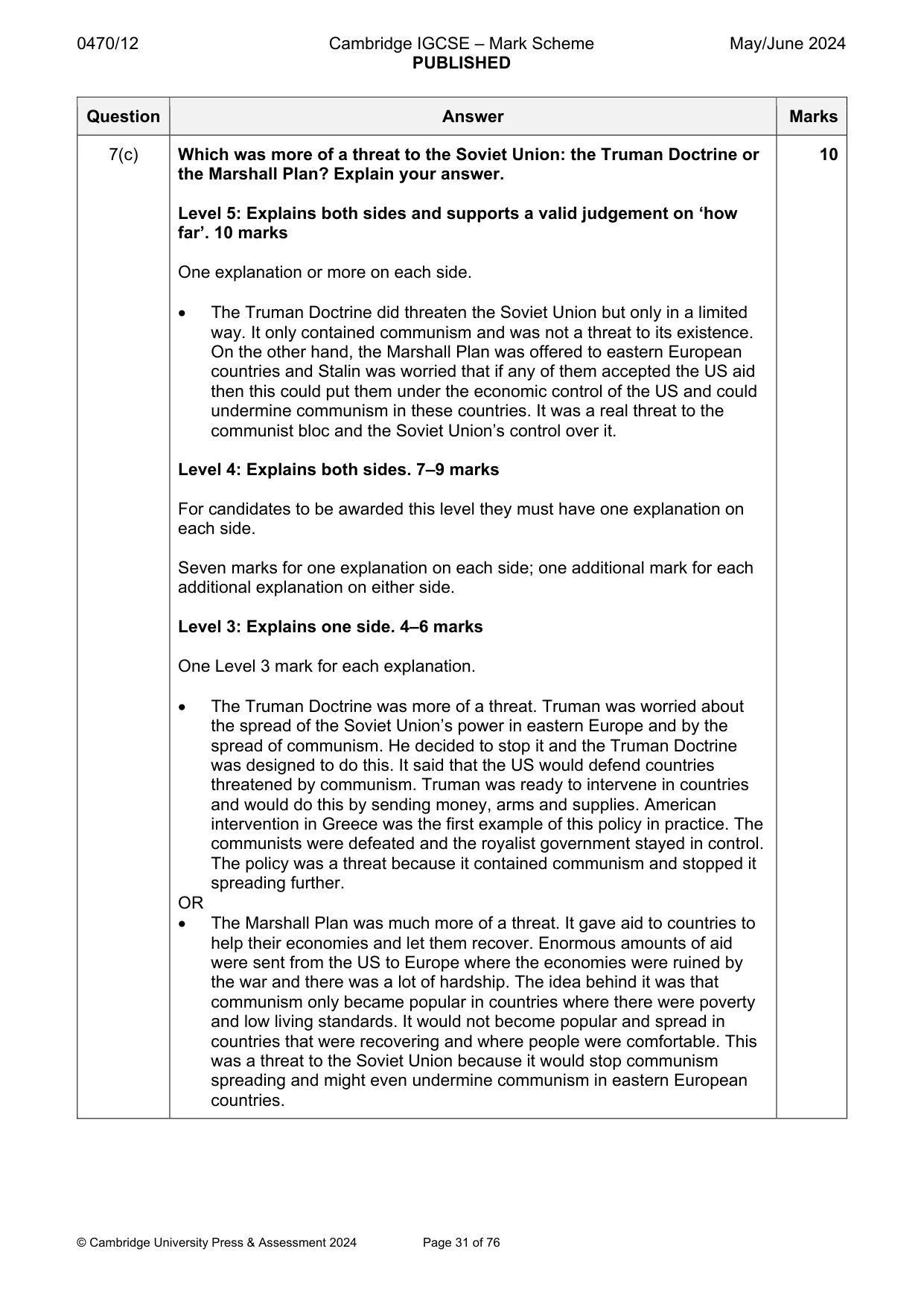
0470/12 Cambridge IGCSE – Mark Scheme PUBLISHED May/June 2024 © Cambridge University Press & Assessment 2024 Page 31 of 76 Question Answer Marks 7(c) Which was more of a threat to the Soviet Union: the Truman Doctrine or the Marshall Plan? Explain your answer. Level 5: Explains both sides and supports a valid judgement on ‘how far’. 10 marks One explanation or more on each side. The Truman Doctrine did threaten the Soviet Union but only in a limited way. It only contained communism and was not a threat to its existence. On the other hand, the Marshall Plan was offered to eastern European countries and Stalin was worried that if any of them accepted the US aid then this could put them under the economic control of the US and could undermine communism in these countries. It was a real threat to the communist bloc and the Soviet Union’s control over it. Level 4: Explains both sides. 7–9 marks For candidates to be awarded this level they must have one explanation on each side. Seven marks for one explanation on each side; one additional mark for each additional explanation on either side. Level 3: Explains one side. 4–6 marks One Level 3 mark for each explanation. The Truman Doctrine was more of a threat. Truman was worried about the spread of the Soviet Union’s power in eastern Europe and by the spread of communism. He decided to stop it and the Truman Doctrine was designed to do this. It said that the US would defend countries threatened by communism. Truman was ready to intervene in countries and would do this by sending money, arms and supplies. American intervention in Greece was the first example of this policy in practice. The communists were defeated and the royalist government stayed in control. The policy was a threat because it contained communism and stopped it spreading further. OR The Marshall Plan was much more of a threat. It gave aid to countries to help their economies and let them recover. Enormous amounts of aid were sent from the US to Europe where the economies were ruined by the war and there was a lot of hardship. The idea behind it was that communism only became popular in countries where there were poverty and low living standards. It would not become popular and spread in countries that were recovering and where people were comfortable. This was a threat to the Soviet Union because it would stop communism spreading and might even undermine communism in eastern European countries. 10
Mark scheme, page 32
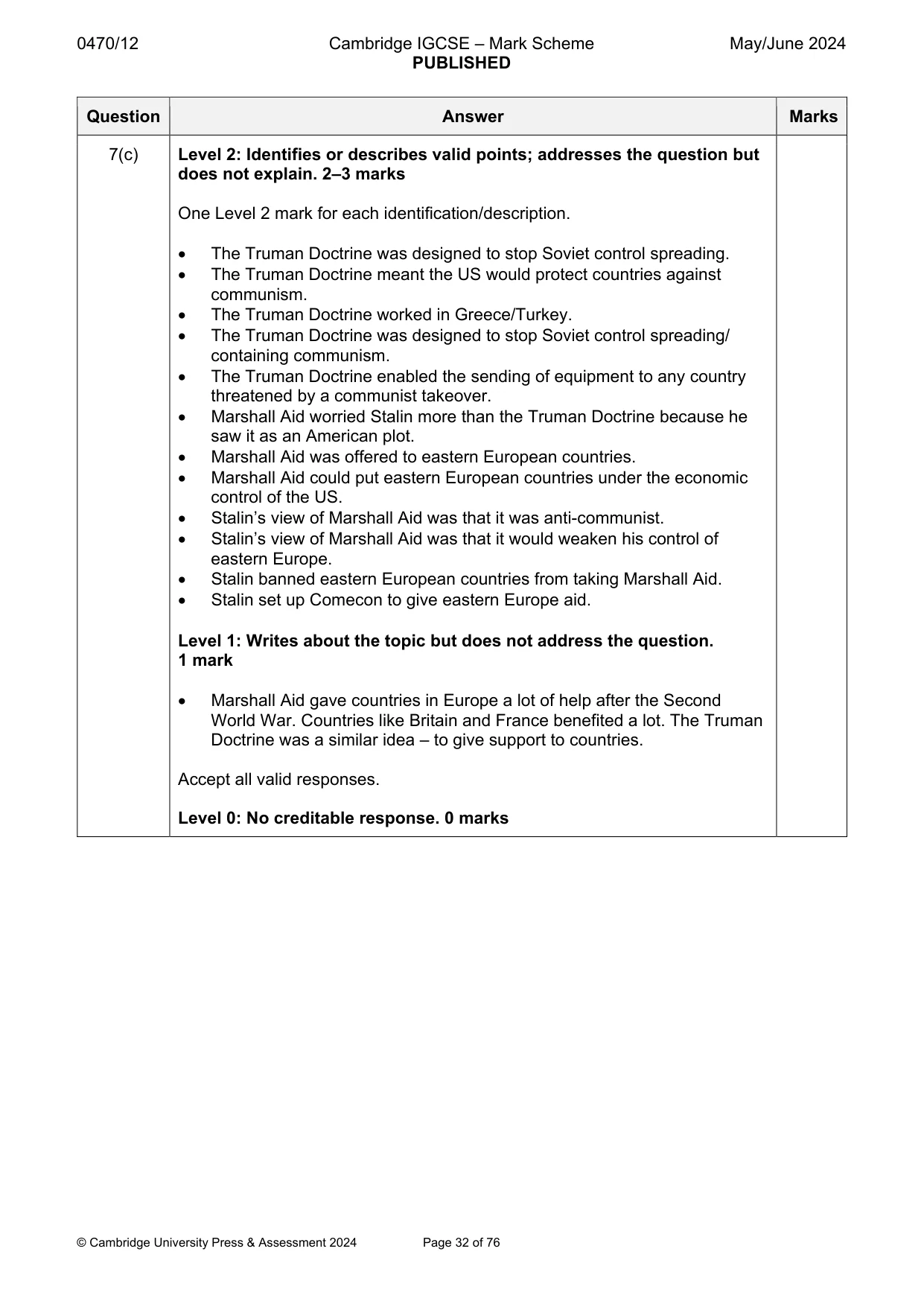
0470/12 Cambridge IGCSE – Mark Scheme PUBLISHED May/June 2024 © Cambridge University Press & Assessment 2024 Page 32 of 76 Question Answer Marks 7(c) Level 2: Identifies or describes valid points; addresses the question but does not explain. 2–3 marks One Level 2 mark for each identification/description. The Truman Doctrine was designed to stop Soviet control spreading. The Truman Doctrine meant the US would protect countries against communism. The Truman Doctrine worked in Greece/Turkey. The Truman Doctrine was designed to stop Soviet control spreading/ containing communism. The Truman Doctrine enabled the sending of equipment to any country threatened by a communist takeover. Marshall Aid worried Stalin more than the Truman Doctrine because he saw it as an American plot. Marshall Aid was offered to eastern European countries. Marshall Aid could put eastern European countries under the economic control of the US. Stalin’s view of Marshall Aid was that it was anti-communist. Stalin’s view of Marshall Aid was that it would weaken his control of eastern Europe. Stalin banned eastern European countries from taking Marshall Aid. Stalin set up Comecon to give eastern Europe aid. Level 1: Writes about the topic but does not address the question. 1 mark Marshall Aid gave countries in Europe a lot of help after the Second World War. Countries like Britain and France benefited a lot. The Truman Doctrine was a similar idea – to give support to countries. Accept all valid responses. Level 0: No creditable response. 0 marks
Mark scheme, page 33
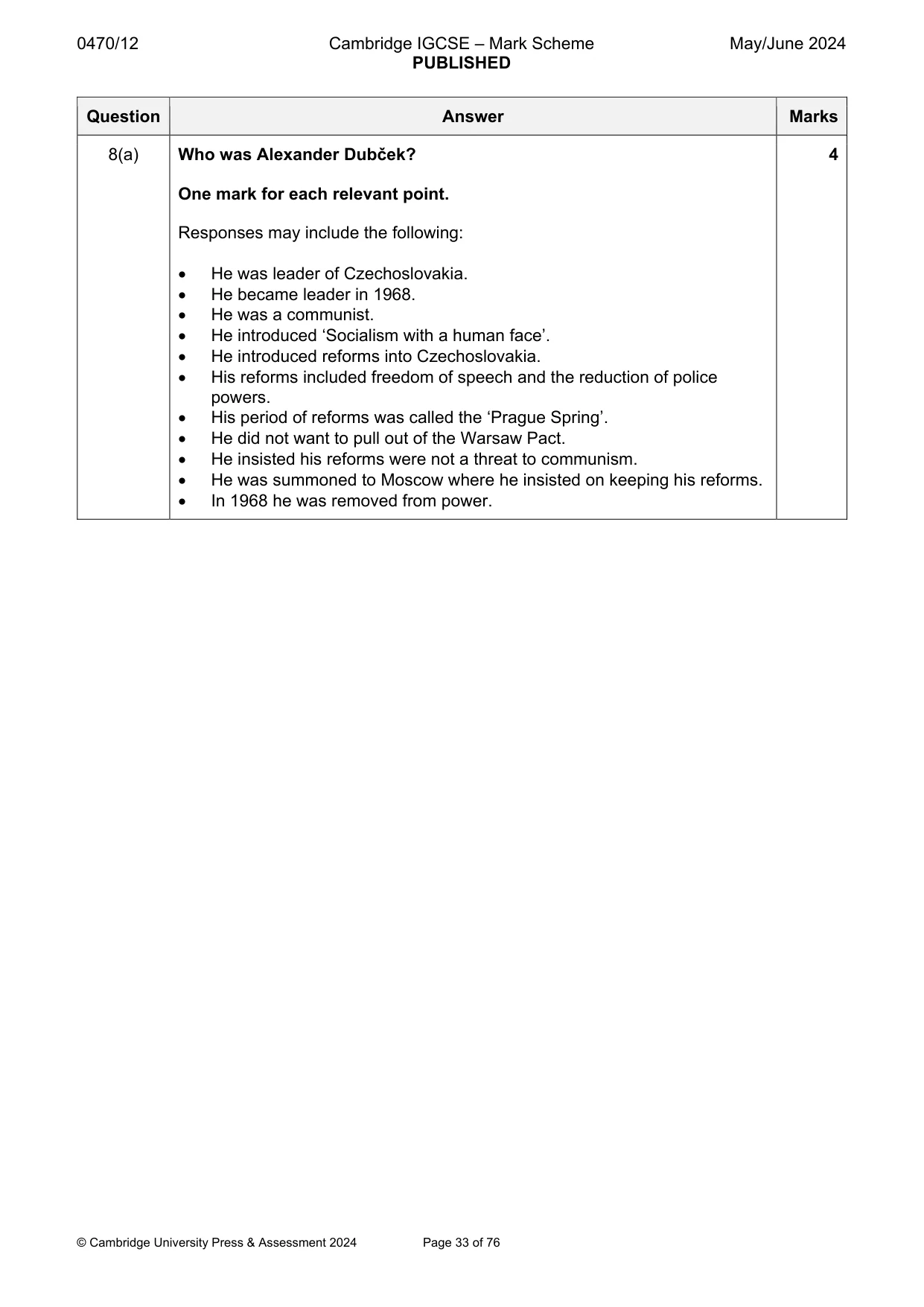
0470/12 Cambridge IGCSE – Mark Scheme PUBLISHED May/June 2024 © Cambridge University Press & Assessment 2024 Page 33 of 76 Question Answer Marks 8(a) Who was Alexander Dubček? One mark for each relevant point. Responses may include the following: He was leader of Czechoslovakia. He became leader in 1968. He was a communist. He introduced ‘Socialism with a human face’. He introduced reforms into Czechoslovakia. His reforms included freedom of speech and the reduction of police powers. His period of reforms was called the ‘Prague Spring’. He did not want to pull out of the Warsaw Pact. He insisted his reforms were not a threat to communism. He was summoned to Moscow where he insisted on keeping his reforms. In 1968 he was removed from power. 4
Mark scheme, page 34
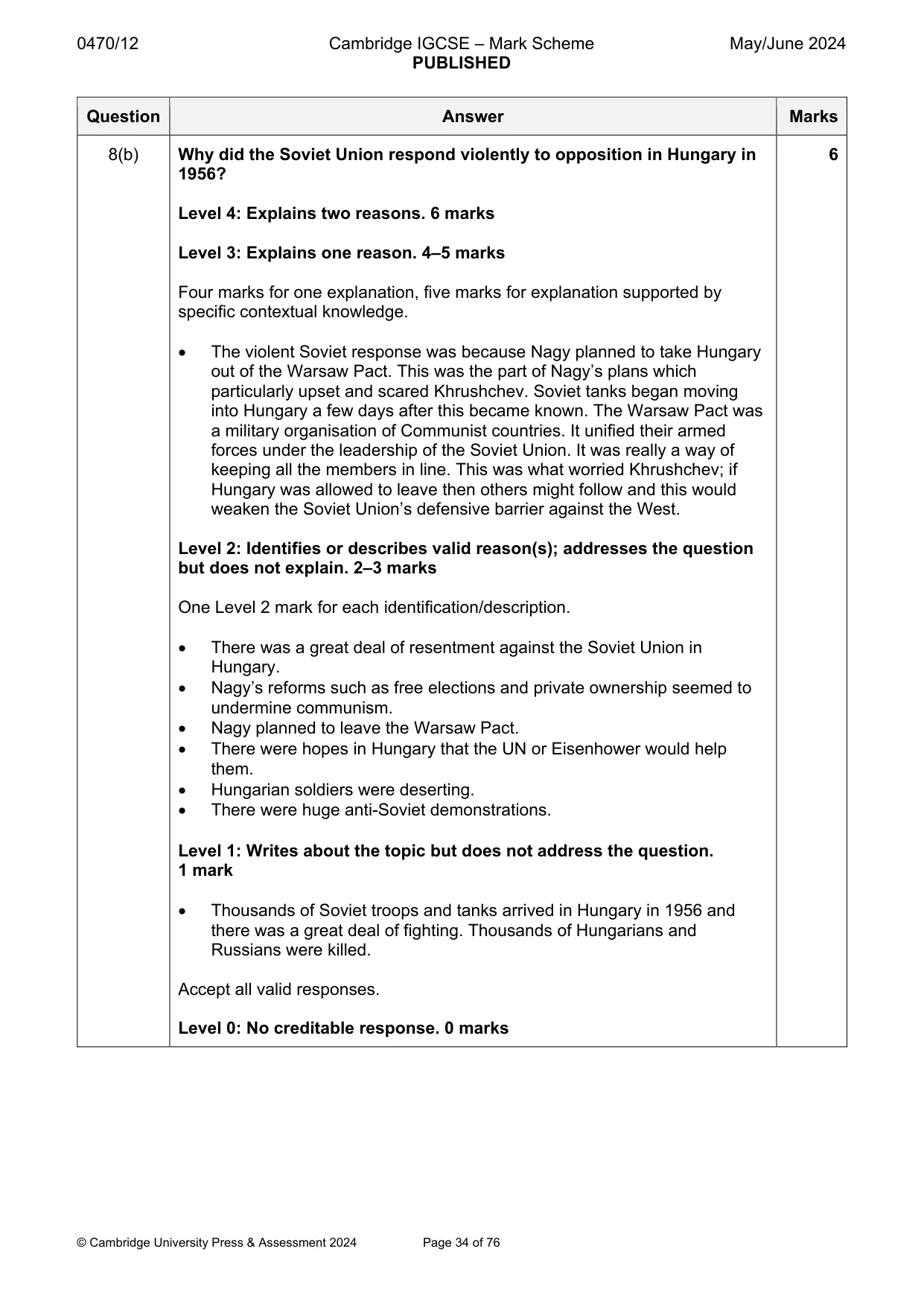
0470/12 Cambridge IGCSE – Mark Scheme PUBLISHED May/June 2024 © Cambridge University Press & Assessment 2024 Page 34 of 76 Question Answer Marks 8(b) Why did the Soviet Union respond violently to opposition in Hungary in 1956? Level 4: Explains two reasons. 6 marks Level 3: Explains one reason. 4–5 marks Four marks for one explanation, five marks for explanation supported by specific contextual knowledge. The violent Soviet response was because Nagy planned to take Hungary out of the Warsaw Pact. This was the part of Nagy’s plans which particularly upset and scared Khrushchev. Soviet tanks began moving into Hungary a few days after this became known. The Warsaw Pact was a military organisation of Communist countries. It unified their armed forces under the leadership of the Soviet Union. It was really a way of keeping all the members in line. This was what worried Khrushchev; if Hungary was allowed to leave then others might follow and this would weaken the Soviet Union’s defensive barrier against the West. Level 2: Identifies or describes valid reason(s); addresses the question but does not explain. 2–3 marks One Level 2 mark for each identification/description. There was a great deal of resentment against the Soviet Union in Hungary. Nagy’s reforms such as free elections and private ownership seemed to undermine communism. Nagy planned to leave the Warsaw Pact. There were hopes in Hungary that the UN or Eisenhower would help them. Hungarian soldiers were deserting. There were huge anti-Soviet demonstrations. Level 1: Writes about the topic but does not address the question. 1 mark Thousands of Soviet troops and tanks arrived in Hungary in 1956 and there was a great deal of fighting. Thousands of Hungarians and Russians were killed. Accept all valid responses. Level 0: No creditable response. 0 marks 6
Mark scheme, page 35
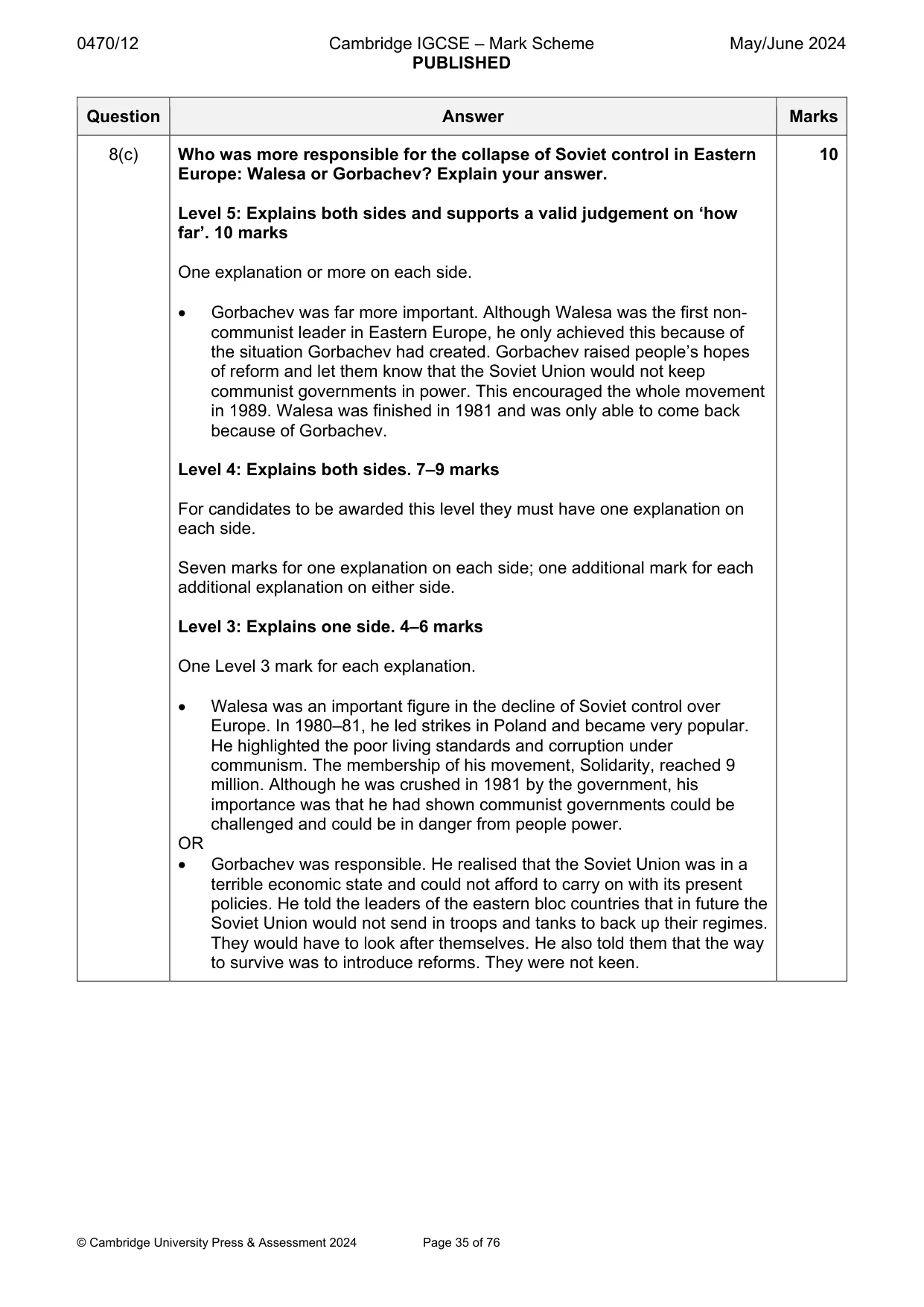
0470/12 Cambridge IGCSE – Mark Scheme PUBLISHED May/June 2024 © Cambridge University Press & Assessment 2024 Page 35 of 76 Question Answer Marks 8(c) Who was more responsible for the collapse of Soviet control in Eastern Europe: Walesa or Gorbachev? Explain your answer. Level 5: Explains both sides and supports a valid judgement on ‘how far’. 10 marks One explanation or more on each side. Gorbachev was far more important. Although Walesa was the first non- communist leader in Eastern Europe, he only achieved this because of the situation Gorbachev had created. Gorbachev raised people’s hopes of reform and let them know that the Soviet Union would not keep communist governments in power. This encouraged the whole movement in 1989. Walesa was finished in 1981 and was only able to come back because of Gorbachev. Level 4: Explains both sides. 7–9 marks For candidates to be awarded this level they must have one explanation on each side. Seven marks for one explanation on each side; one additional mark for each additional explanation on either side. Level 3: Explains one side. 4–6 marks One Level 3 mark for each explanation. Walesa was an important figure in the decline of Soviet control over Europe. In 1980–81, he led strikes in Poland and became very popular. He highlighted the poor living standards and corruption under communism. The membership of his movement, Solidarity, reached 9 million. Although he was crushed in 1981 by the government, his importance was that he had shown communist governments could be challenged and could be in danger from people power. OR Gorbachev was responsible. He realised that the Soviet Union was in a terrible economic state and could not afford to carry on with its present policies. He told the leaders of the eastern bloc countries that in future the Soviet Union would not send in troops and tanks to back up their regimes. They would have to look after themselves. He also told them that the way to survive was to introduce reforms. They were not keen. 10
Mark scheme, page 36
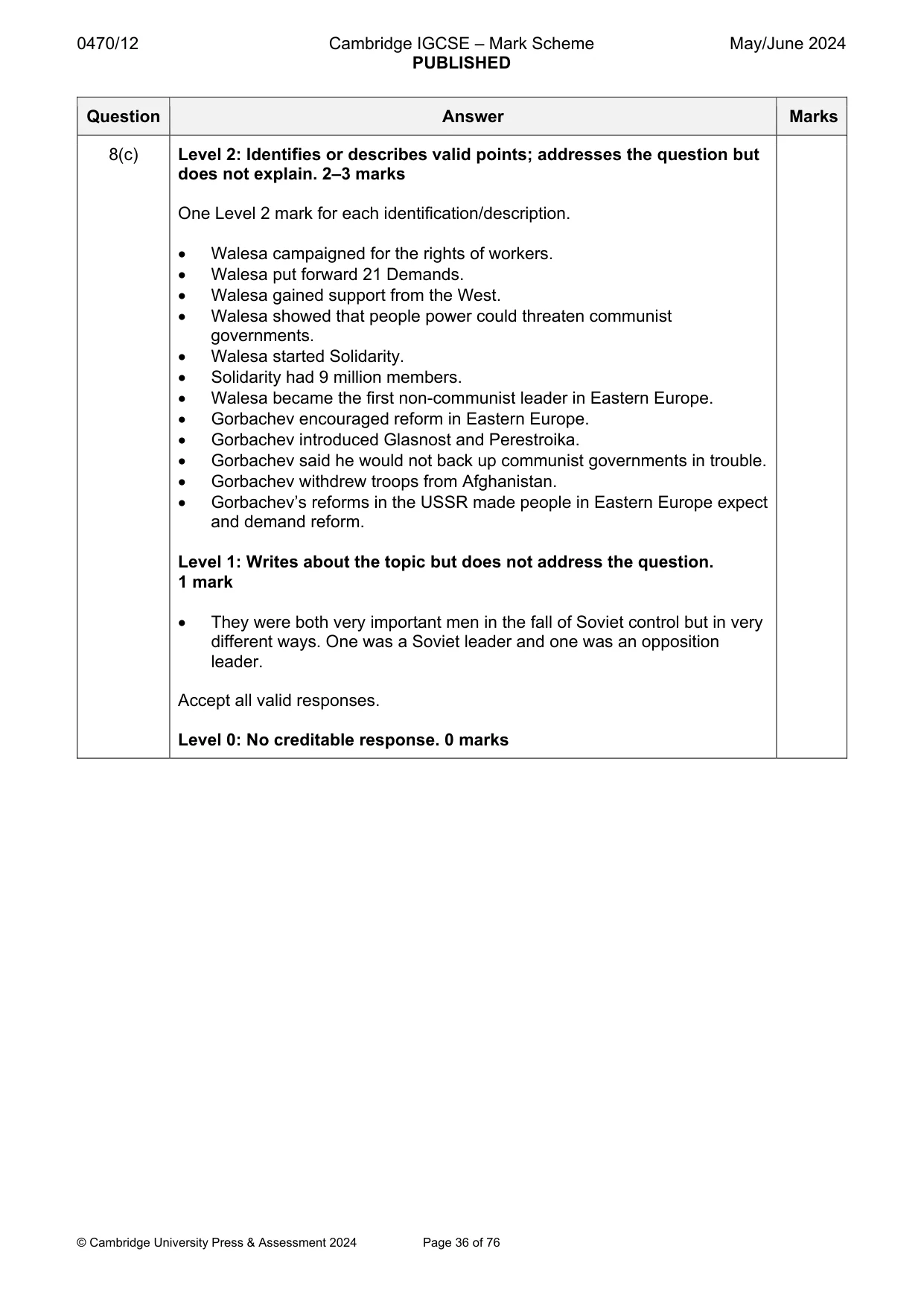
0470/12 Cambridge IGCSE – Mark Scheme PUBLISHED May/June 2024 © Cambridge University Press & Assessment 2024 Page 36 of 76 Question Answer Marks 8(c) Level 2: Identifies or describes valid points; addresses the question but does not explain. 2–3 marks One Level 2 mark for each identification/description. Walesa campaigned for the rights of workers. Walesa put forward 21 Demands. Walesa gained support from the West. Walesa showed that people power could threaten communist governments. Walesa started Solidarity. Solidarity had 9 million members. Walesa became the first non-communist leader in Eastern Europe. Gorbachev encouraged reform in Eastern Europe. Gorbachev introduced Glasnost and Perestroika. Gorbachev said he would not back up communist governments in trouble. Gorbachev withdrew troops from Afghanistan. Gorbachev’s reforms in the USSR made people in Eastern Europe expect and demand reform. Level 1: Writes about the topic but does not address the question. 1 mark They were both very important men in the fall of Soviet control but in very different ways. One was a Soviet leader and one was an opposition leader. Accept all valid responses. Level 0: No creditable response. 0 marks
Mark scheme, page 37
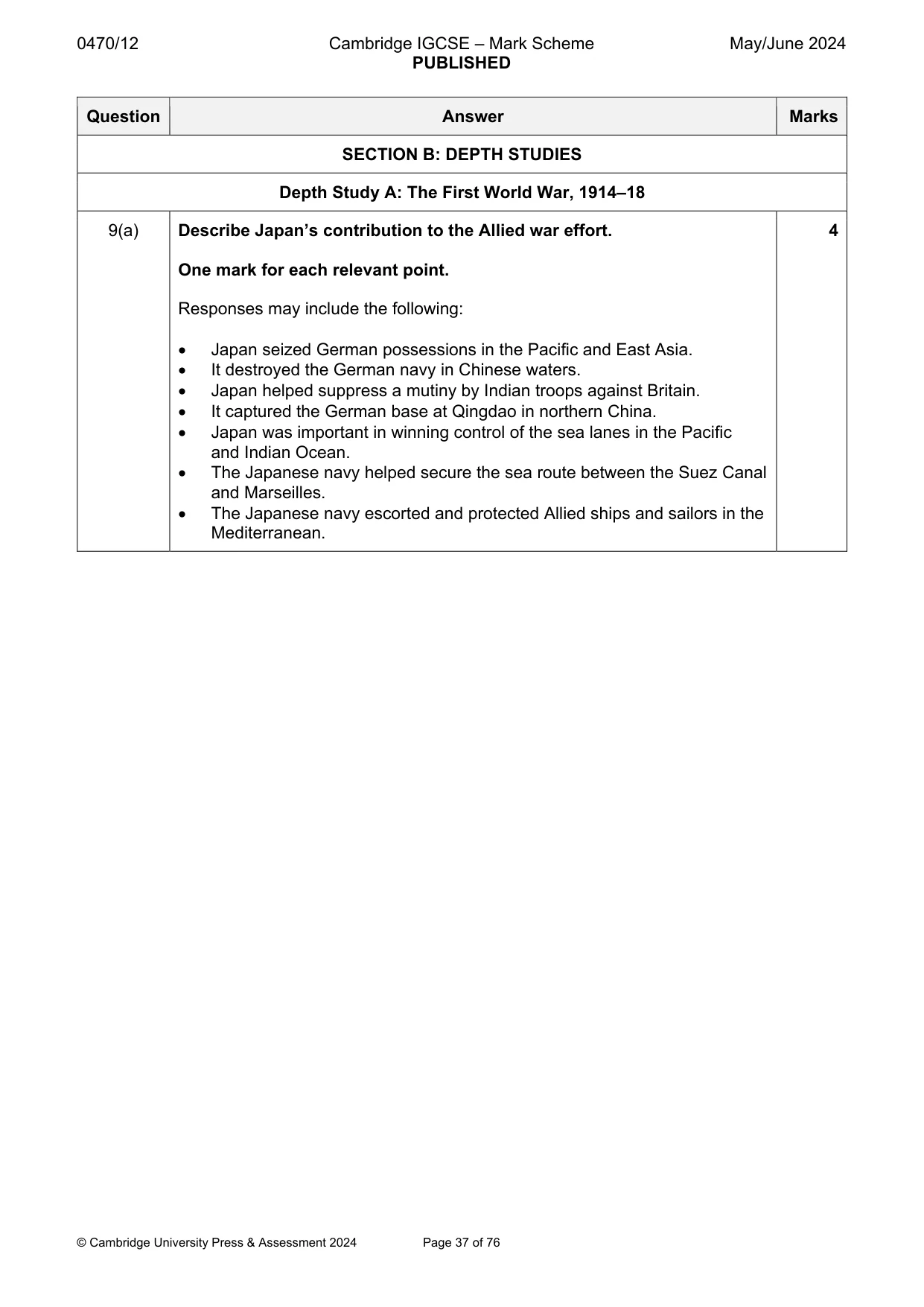
0470/12 Cambridge IGCSE – Mark Scheme PUBLISHED May/June 2024 © Cambridge University Press & Assessment 2024 Page 37 of 76 Question Answer Marks SECTION B: DEPTH STUDIES Depth Study A: The First World War, 1914–18 9(a) Describe Japan’s contribution to the Allied war effort. One mark for each relevant point. Responses may include the following: Japan seized German possessions in the Pacific and East Asia. It destroyed the German navy in Chinese waters. Japan helped suppress a mutiny by Indian troops against Britain. It captured the German base at Qingdao in northern China. Japan was important in winning control of the sea lanes in the Pacific and Indian Ocean. The Japanese navy helped secure the sea route between the Suez Canal and Marseilles. The Japanese navy escorted and protected Allied ships and sailors in the Mediterranean. 4
Mark scheme, page 38
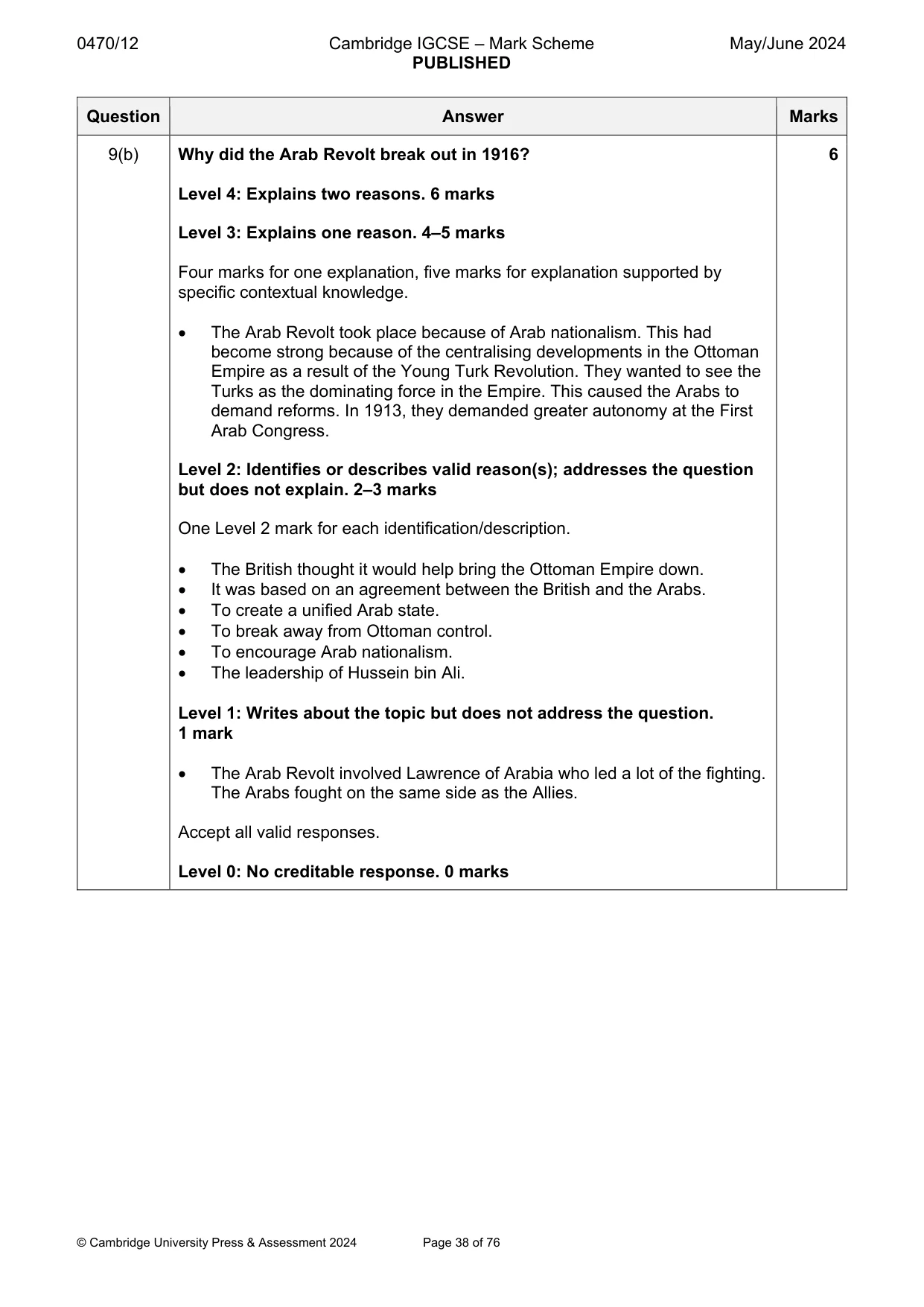
0470/12 Cambridge IGCSE – Mark Scheme PUBLISHED May/June 2024 © Cambridge University Press & Assessment 2024 Page 38 of 76 Question Answer Marks 9(b) Why did the Arab Revolt break out in 1916? Level 4: Explains two reasons. 6 marks Level 3: Explains one reason. 4–5 marks Four marks for one explanation, five marks for explanation supported by specific contextual knowledge. The Arab Revolt took place because of Arab nationalism. This had become strong because of the centralising developments in the Ottoman Empire as a result of the Young Turk Revolution. They wanted to see the Turks as the dominating force in the Empire. This caused the Arabs to demand reforms. In 1913, they demanded greater autonomy at the First Arab Congress. Level 2: Identifies or describes valid reason(s); addresses the question but does not explain. 2–3 marks One Level 2 mark for each identification/description. The British thought it would help bring the Ottoman Empire down. It was based on an agreement between the British and the Arabs. To create a unified Arab state. To break away from Ottoman control. To encourage Arab nationalism. The leadership of Hussein bin Ali. Level 1: Writes about the topic but does not address the question. 1 mark The Arab Revolt involved Lawrence of Arabia who led a lot of the fighting. The Arabs fought on the same side as the Allies. Accept all valid responses. Level 0: No creditable response. 0 marks 6
Mark scheme, page 39
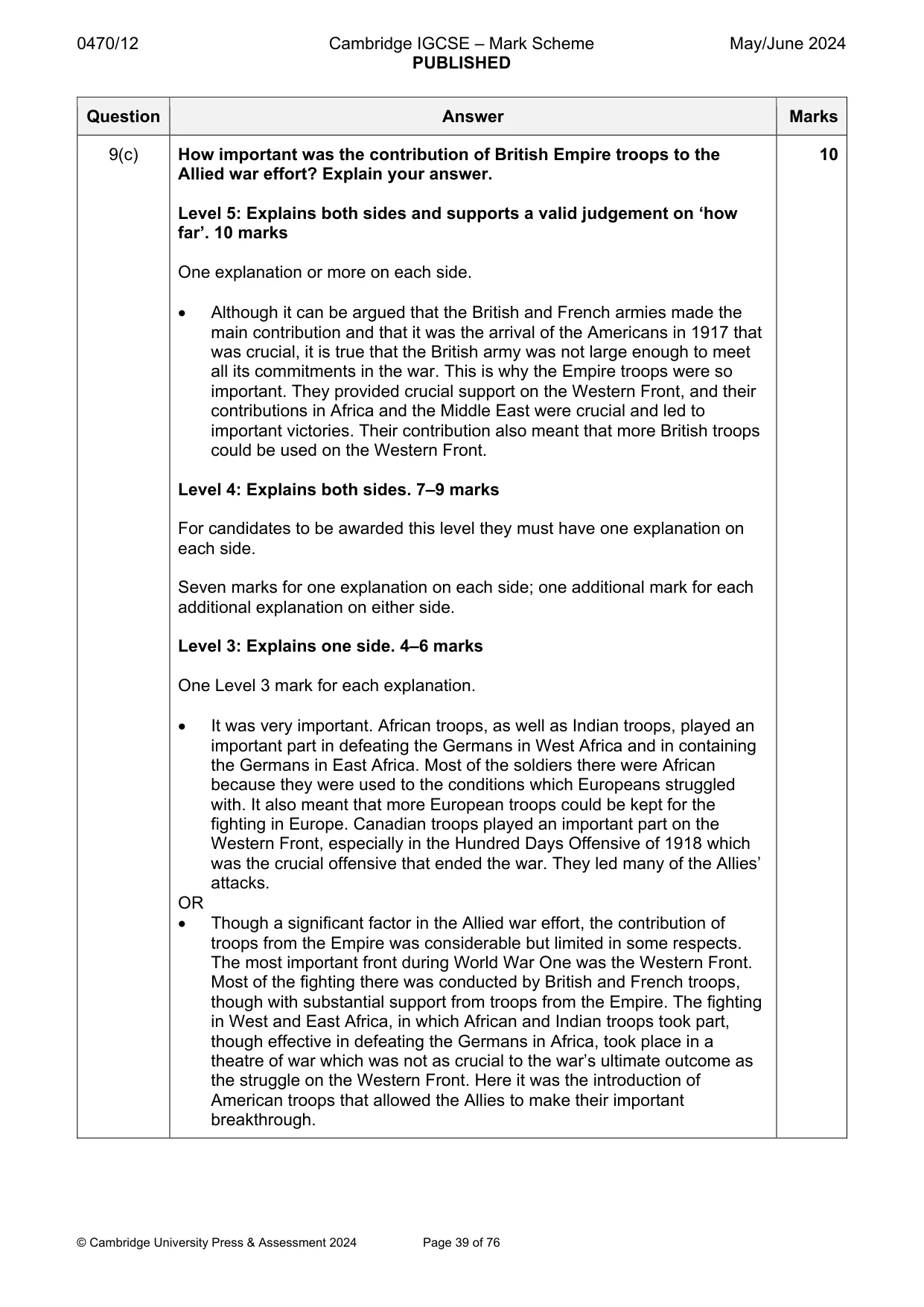
0470/12 Cambridge IGCSE – Mark Scheme PUBLISHED May/June 2024 © Cambridge University Press & Assessment 2024 Page 39 of 76 Question Answer Marks 9(c) How important was the contribution of British Empire troops to the Allied war effort? Explain your answer. Level 5: Explains both sides and supports a valid judgement on ‘how far’. 10 marks One explanation or more on each side. Although it can be argued that the British and French armies made the main contribution and that it was the arrival of the Americans in 1917 that was crucial, it is true that the British army was not large enough to meet all its commitments in the war. This is why the Empire troops were so important. They provided crucial support on the Western Front, and their contributions in Africa and the Middle East were crucial and led to important victories. Their contribution also meant that more British troops could be used on the Western Front. Level 4: Explains both sides. 7–9 marks For candidates to be awarded this level they must have one explanation on each side. Seven marks for one explanation on each side; one additional mark for each additional explanation on either side. Level 3: Explains one side. 4–6 marks One Level 3 mark for each explanation. It was very important. African troops, as well as Indian troops, played an important part in defeating the Germans in West Africa and in containing the Germans in East Africa. Most of the soldiers there were African because they were used to the conditions which Europeans struggled with. It also meant that more European troops could be kept for the fighting in Europe. Canadian troops played an important part on the Western Front, especially in the Hundred Days Offensive of 1918 which was the crucial offensive that ended the war. They led many of the Allies’ attacks. OR Though a significant factor in the Allied war effort, the contribution of troops from the Empire was considerable but limited in some respects. The most important front during World War One was the Western Front. Most of the fighting there was conducted by British and French troops, though with substantial support from troops from the Empire. The fighting in West and East Africa, in which African and Indian troops took part, though effective in defeating the Germans in Africa, took place in a theatre of war which was not as crucial to the war’s ultimate outcome as the struggle on the Western Front. Here it was the introduction of American troops that allowed the Allies to make their important breakthrough. 10
Mark scheme, page 40
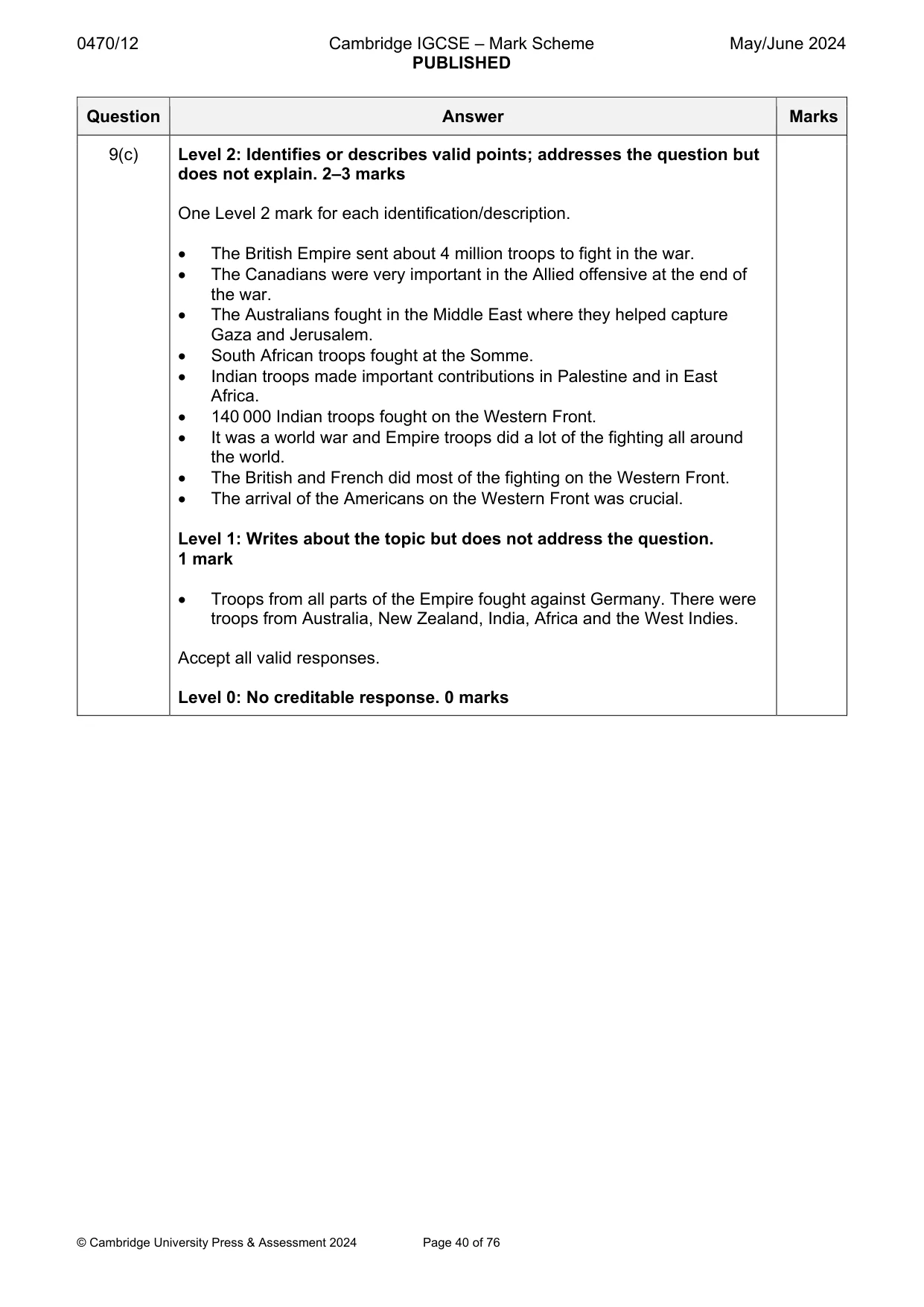
0470/12 Cambridge IGCSE – Mark Scheme PUBLISHED May/June 2024 © Cambridge University Press & Assessment 2024 Page 40 of 76 Question Answer Marks 9(c) Level 2: Identifies or describes valid points; addresses the question but does not explain. 2–3 marks One Level 2 mark for each identification/description. The British Empire sent about 4 million troops to fight in the war. The Canadians were very important in the Allied offensive at the end of the war. The Australians fought in the Middle East where they helped capture Gaza and Jerusalem. South African troops fought at the Somme. Indian troops made important contributions in Palestine and in East Africa. 140 000 Indian troops fought on the Western Front. It was a world war and Empire troops did a lot of the fighting all around the world. The British and French did most of the fighting on the Western Front. The arrival of the Americans on the Western Front was crucial. Level 1: Writes about the topic but does not address the question. 1 mark Troops from all parts of the Empire fought against Germany. There were troops from Australia, New Zealand, India, Africa and the West Indies. Accept all valid responses. Level 0: No creditable response. 0 marks
Mark scheme, page 41
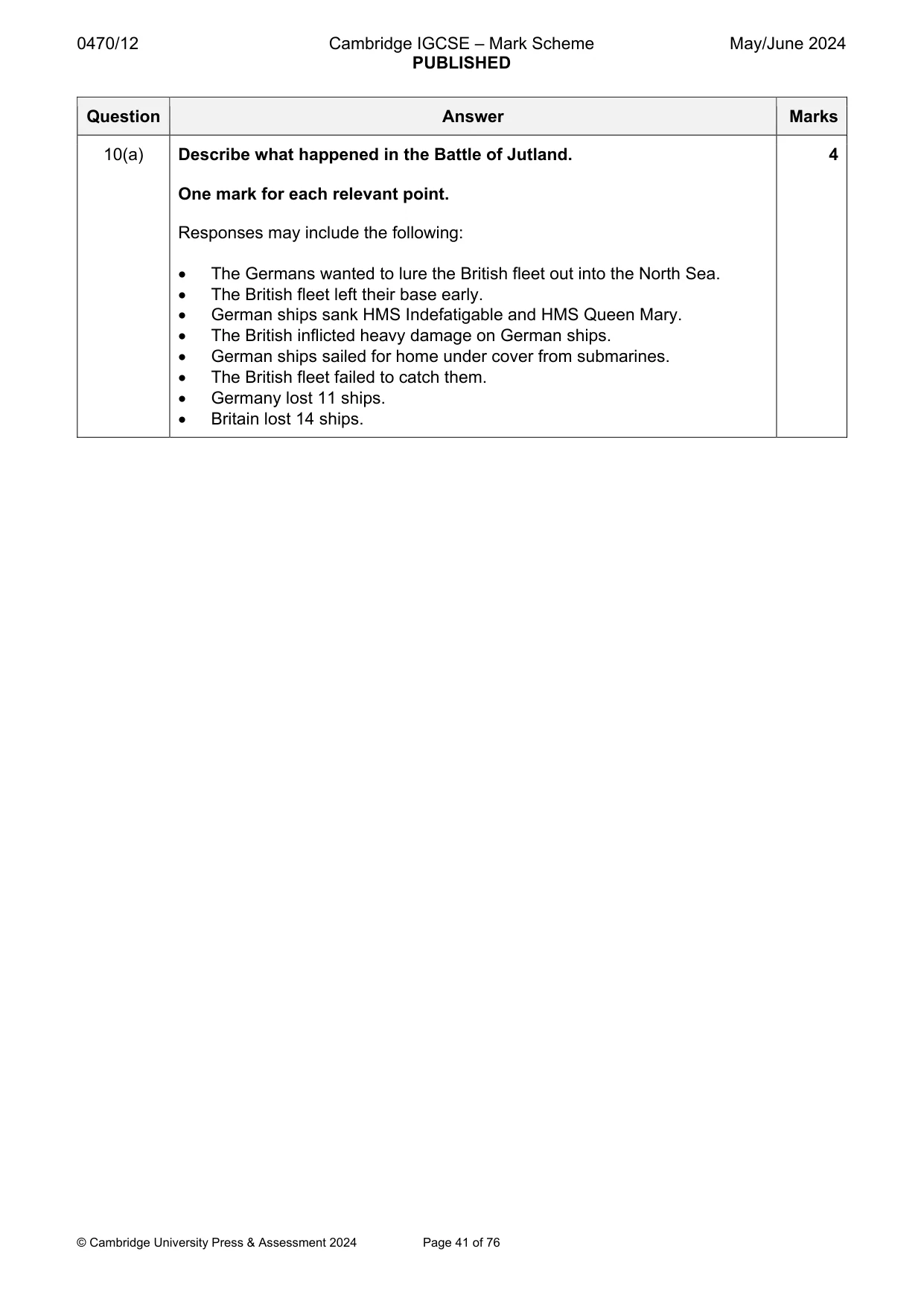
0470/12 Cambridge IGCSE – Mark Scheme PUBLISHED May/June 2024 © Cambridge University Press & Assessment 2024 Page 41 of 76 Question Answer Marks 10(a) Describe what happened in the Battle of Jutland. One mark for each relevant point. Responses may include the following: The Germans wanted to lure the British fleet out into the North Sea. The British fleet left their base early. German ships sank HMS Indefatigable and HMS Queen Mary. The British inflicted heavy damage on German ships. German ships sailed for home under cover from submarines. The British fleet failed to catch them. Germany lost 11 ships. Britain lost 14 ships. 4
Mark scheme, page 42
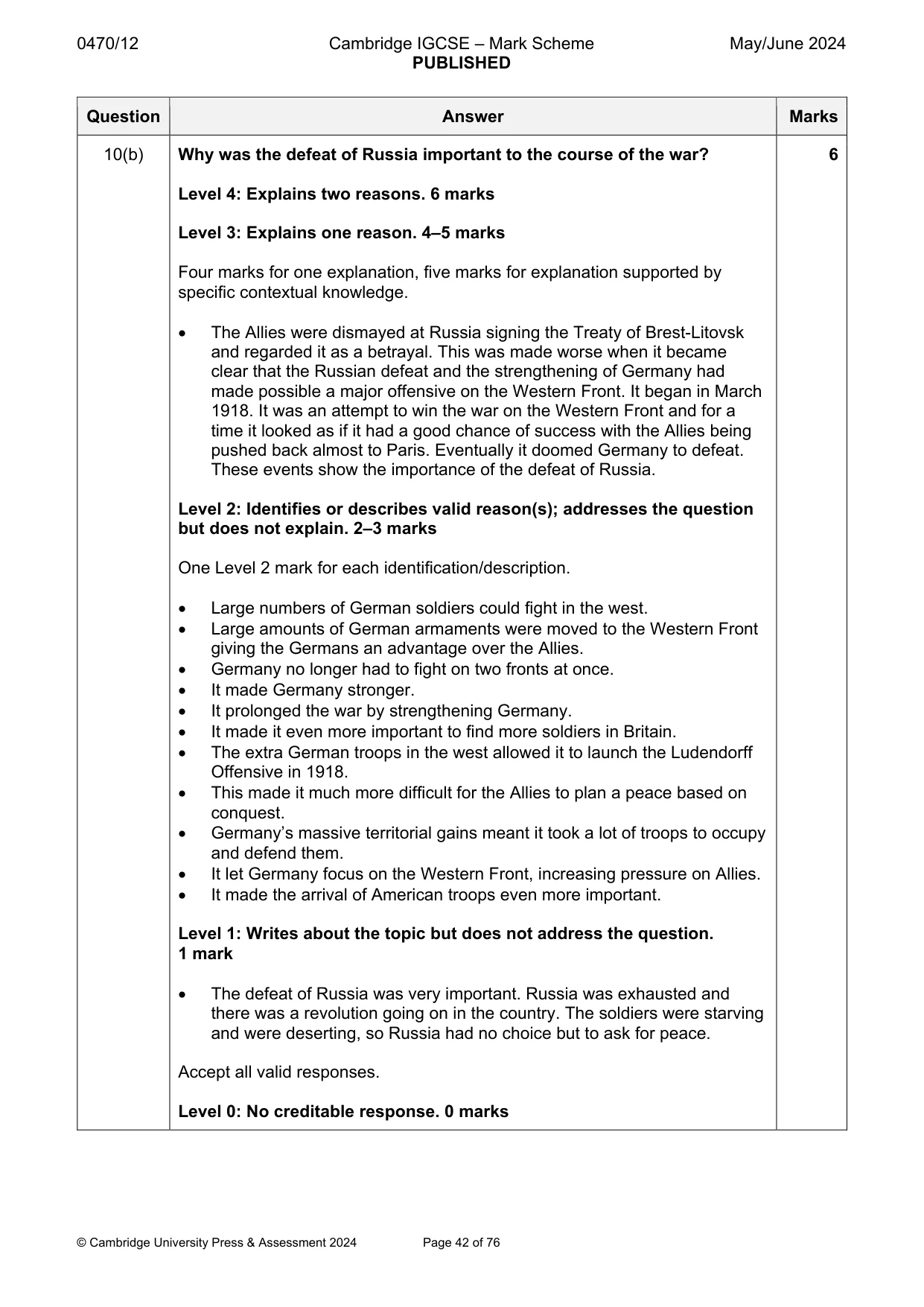
0470/12 Cambridge IGCSE – Mark Scheme PUBLISHED May/June 2024 © Cambridge University Press & Assessment 2024 Page 42 of 76 Question Answer Marks 10(b) Why was the defeat of Russia important to the course of the war? Level 4: Explains two reasons. 6 marks Level 3: Explains one reason. 4–5 marks Four marks for one explanation, five marks for explanation supported by specific contextual knowledge. The Allies were dismayed at Russia signing the Treaty of Brest-Litovsk and regarded it as a betrayal. This was made worse when it became clear that the Russian defeat and the strengthening of Germany had made possible a major offensive on the Western Front. It began in March 1918. It was an attempt to win the war on the Western Front and for a time it looked as if it had a good chance of success with the Allies being pushed back almost to Paris. Eventually it doomed Germany to defeat. These events show the importance of the defeat of Russia. Level 2: Identifies or describes valid reason(s); addresses the question but does not explain. 2–3 marks One Level 2 mark for each identification/description. Large numbers of German soldiers could fight in the west. Large amounts of German armaments were moved to the Western Front giving the Germans an advantage over the Allies. Germany no longer had to fight on two fronts at once. It made Germany stronger. It prolonged the war by strengthening Germany. It made it even more important to find more soldiers in Britain. The extra German troops in the west allowed it to launch the Ludendorff Offensive in 1918. This made it much more difficult for the Allies to plan a peace based on conquest. Germany’s massive territorial gains meant it took a lot of troops to occupy and defend them. It let Germany focus on the Western Front, increasing pressure on Allies. It made the arrival of American troops even more important. Level 1: Writes about the topic but does not address the question. 1 mark The defeat of Russia was very important. Russia was exhausted and there was a revolution going on in the country. The soldiers were starving and were deserting, so Russia had no choice but to ask for peace. Accept all valid responses. Level 0: No creditable response. 0 marks 6
Mark scheme, page 43
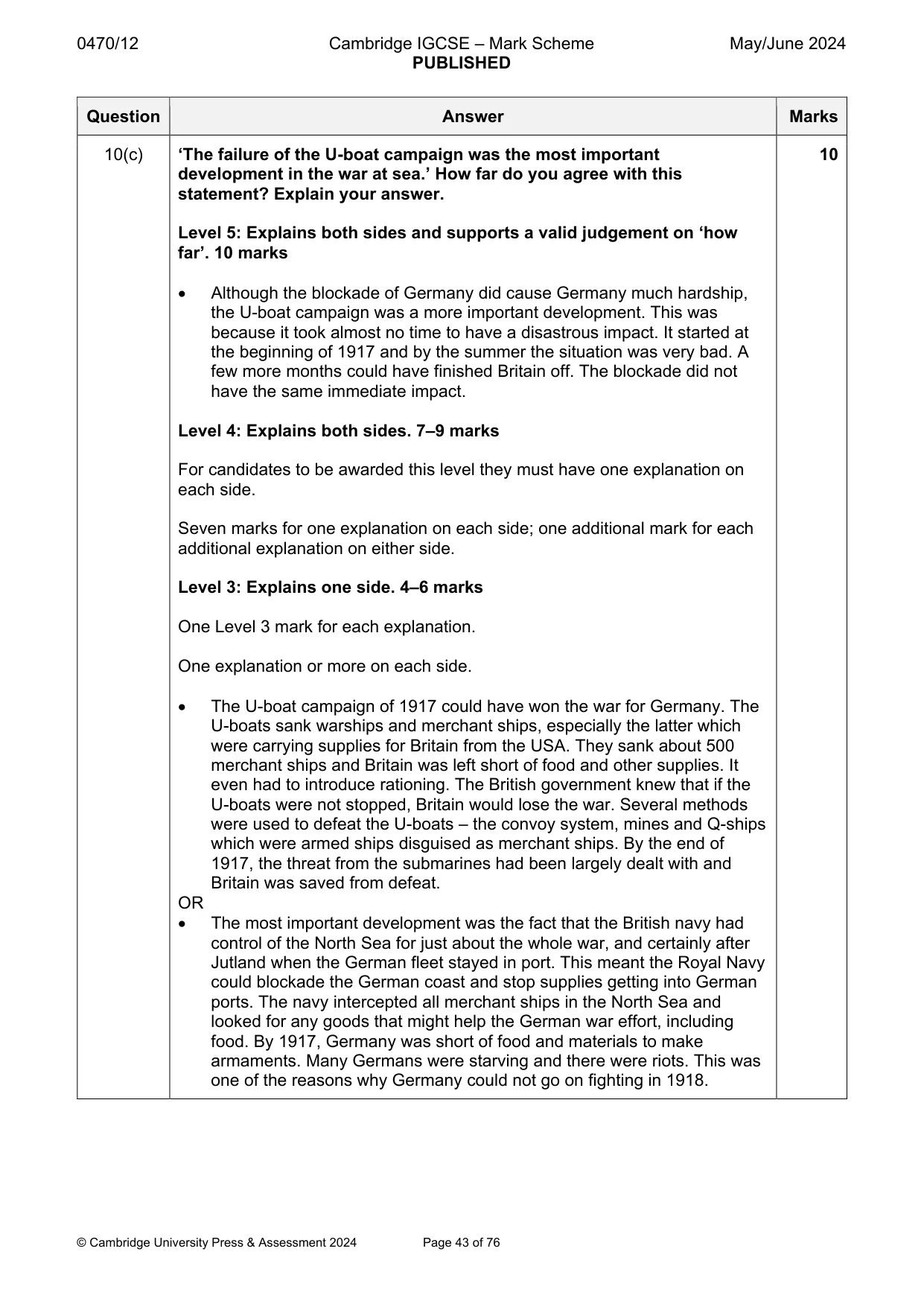
0470/12 Cambridge IGCSE – Mark Scheme PUBLISHED May/June 2024 © Cambridge University Press & Assessment 2024 Page 43 of 76 Question Answer Marks 10(c) ‘The failure of the U-boat campaign was the most important development in the war at sea.’ How far do you agree with this statement? Explain your answer. Level 5: Explains both sides and supports a valid judgement on ‘how far’. 10 marks Although the blockade of Germany did cause Germany much hardship, the U-boat campaign was a more important development. This was because it took almost no time to have a disastrous impact. It started at the beginning of 1917 and by the summer the situation was very bad. A few more months could have finished Britain off. The blockade did not have the same immediate impact. Level 4: Explains both sides. 7–9 marks For candidates to be awarded this level they must have one explanation on each side. Seven marks for one explanation on each side; one additional mark for each additional explanation on either side. Level 3: Explains one side. 4–6 marks One Level 3 mark for each explanation. One explanation or more on each side. The U-boat campaign of 1917 could have won the war for Germany. The U-boats sank warships and merchant ships, especially the latter which were carrying supplies for Britain from the USA. They sank about 500 merchant ships and Britain was left short of food and other supplies. It even had to introduce rationing. The British government knew that if the U-boats were not stopped, Britain would lose the war. Several methods were used to defeat the U-boats – the convoy system, mines and Q-ships which were armed ships disguised as merchant ships. By the end of 1917, the threat from the submarines had been largely dealt with and Britain was saved from defeat. OR The most important development was the fact that the British navy had control of the North Sea for just about the whole war, and certainly after Jutland when the German fleet stayed in port. This meant the Royal Navy could blockade the German coast and stop supplies getting into German ports. The navy intercepted all merchant ships in the North Sea and looked for any goods that might help the German war effort, including food. By 1917, Germany was short of food and materials to make armaments. Many Germans were starving and there were riots. This was one of the reasons why Germany could not go on fighting in 1918. 10
Mark scheme, page 44
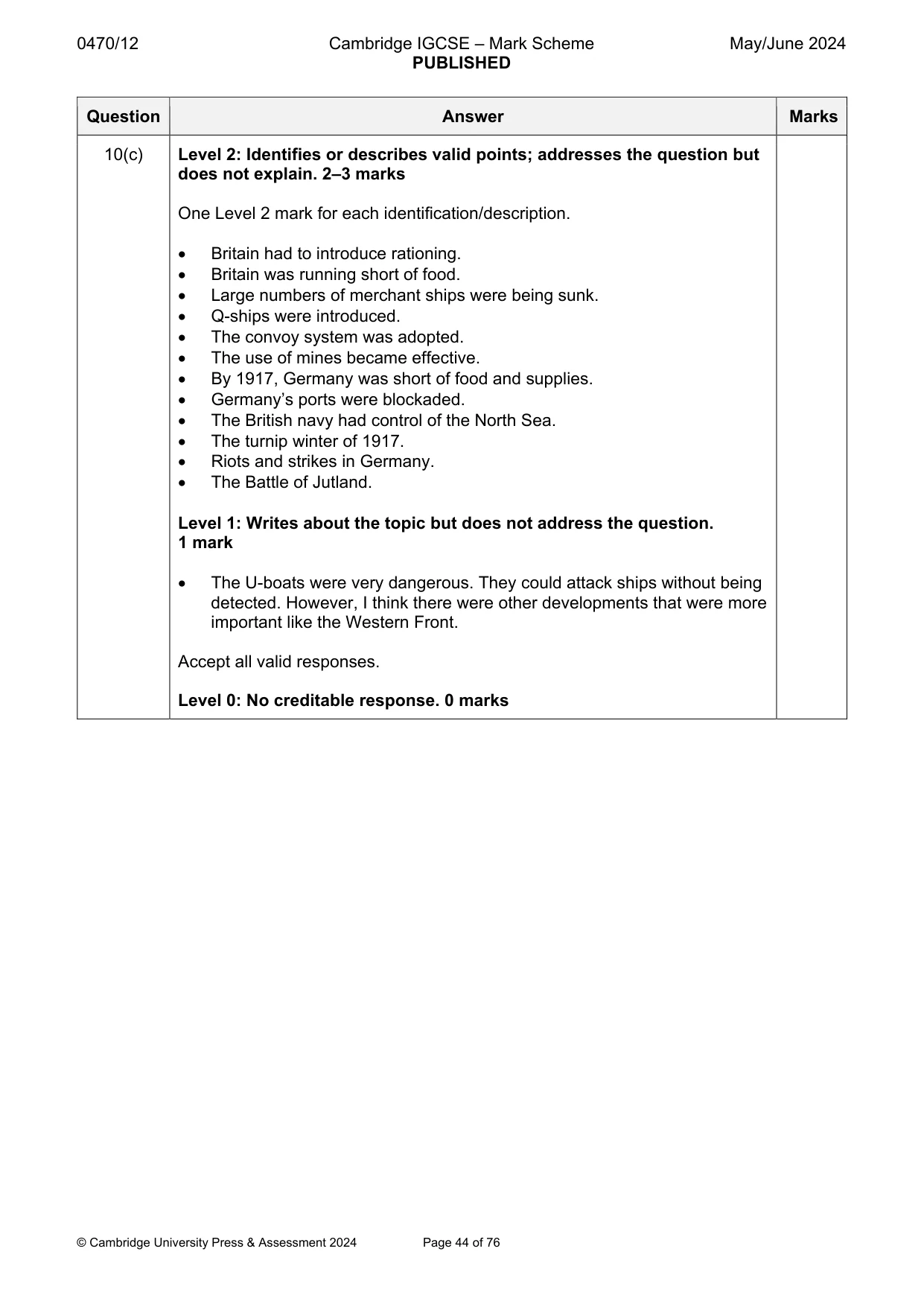
0470/12 Cambridge IGCSE – Mark Scheme PUBLISHED May/June 2024 © Cambridge University Press & Assessment 2024 Page 44 of 76 Question Answer Marks 10(c) Level 2: Identifies or describes valid points; addresses the question but does not explain. 2–3 marks One Level 2 mark for each identification/description. Britain had to introduce rationing. Britain was running short of food. Large numbers of merchant ships were being sunk. Q-ships were introduced. The convoy system was adopted. The use of mines became effective. By 1917, Germany was short of food and supplies. Germany’s ports were blockaded. The British navy had control of the North Sea. The turnip winter of 1917. Riots and strikes in Germany. The Battle of Jutland. Level 1: Writes about the topic but does not address the question. 1 mark The U-boats were very dangerous. They could attack ships without being detected. However, I think there were other developments that were more important like the Western Front. Accept all valid responses. Level 0: No creditable response. 0 marks
Mark scheme, page 45
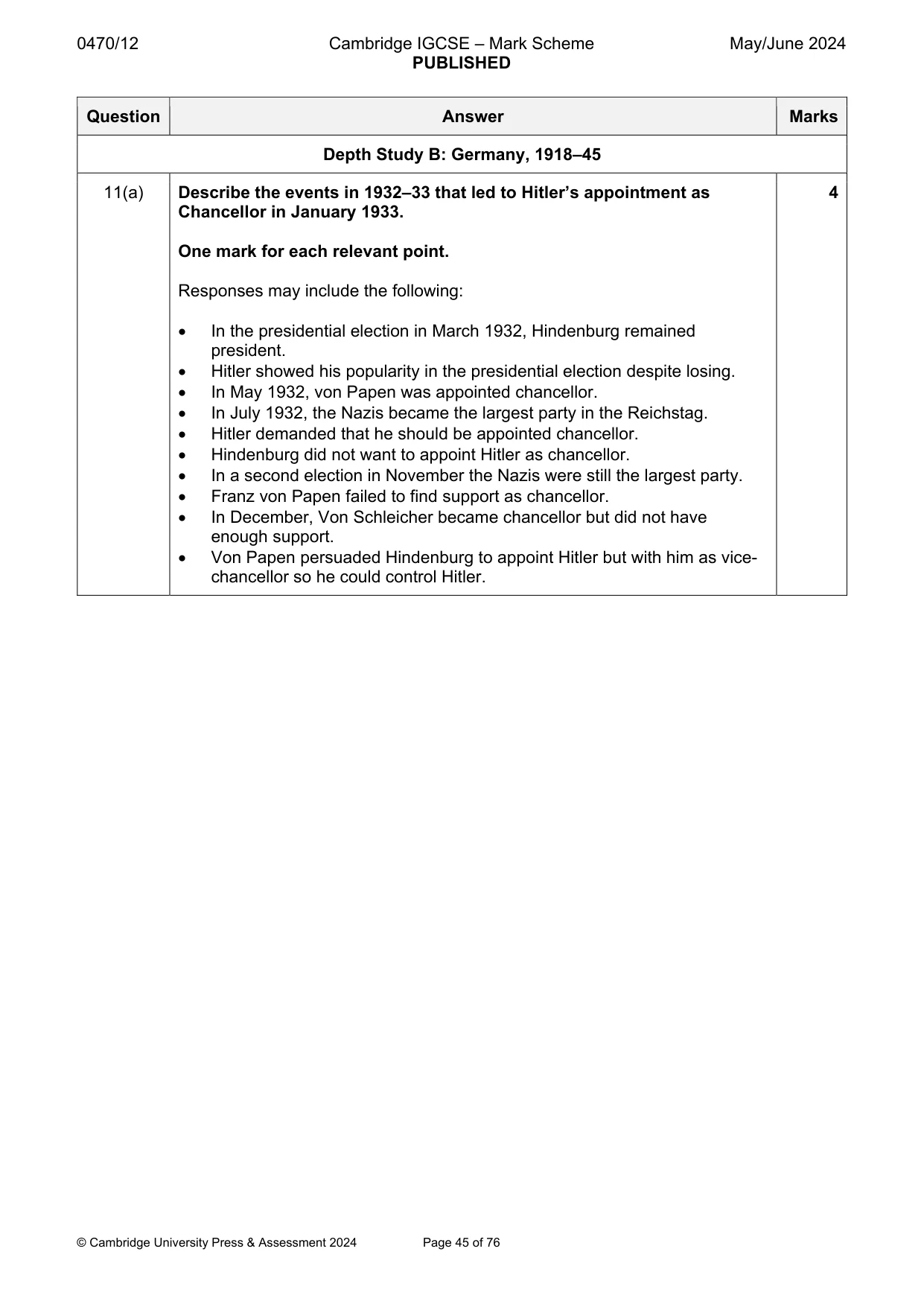
0470/12 Cambridge IGCSE – Mark Scheme PUBLISHED May/June 2024 © Cambridge University Press & Assessment 2024 Page 45 of 76 Question Answer Marks Depth Study B: Germany, 1918–45 11(a) Describe the events in 1932–33 that led to Hitler’s appointment as Chancellor in January 1933. One mark for each relevant point. Responses may include the following: In the presidential election in March 1932, Hindenburg remained president. Hitler showed his popularity in the presidential election despite losing. In May 1932, von Papen was appointed chancellor. In July 1932, the Nazis became the largest party in the Reichstag. Hitler demanded that he should be appointed chancellor. Hindenburg did not want to appoint Hitler as chancellor. In a second election in November the Nazis were still the largest party. Franz von Papen failed to find support as chancellor. In December, Von Schleicher became chancellor but did not have enough support. Von Papen persuaded Hindenburg to appoint Hitler but with him as vice- chancellor so he could control Hitler. 4
Mark scheme, page 46
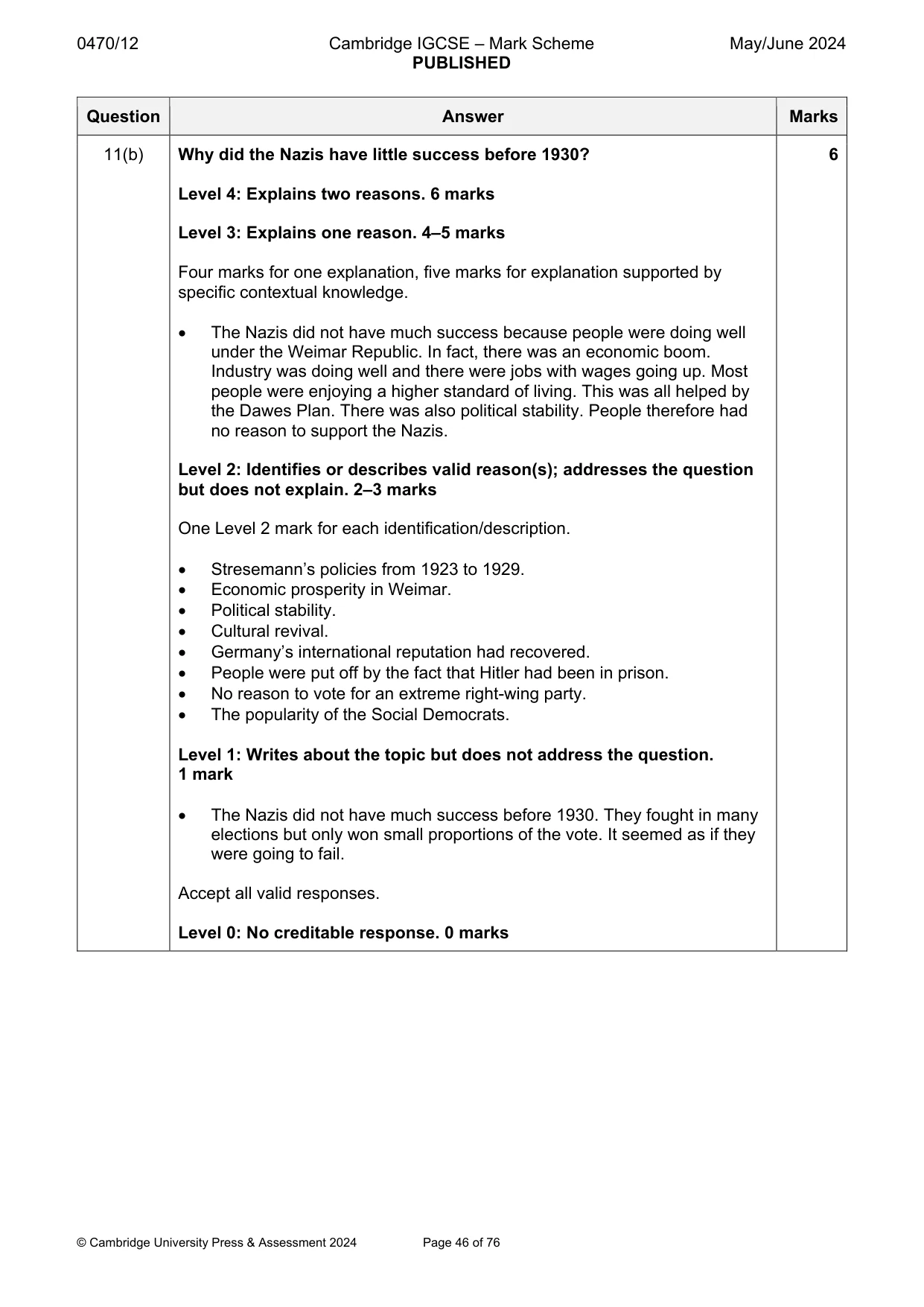
0470/12 Cambridge IGCSE – Mark Scheme PUBLISHED May/June 2024 © Cambridge University Press & Assessment 2024 Page 46 of 76 Question Answer Marks 11(b) Why did the Nazis have little success before 1930? Level 4: Explains two reasons. 6 marks Level 3: Explains one reason. 4–5 marks Four marks for one explanation, five marks for explanation supported by specific contextual knowledge. The Nazis did not have much success because people were doing well under the Weimar Republic. In fact, there was an economic boom. Industry was doing well and there were jobs with wages going up. Most people were enjoying a higher standard of living. This was all helped by the Dawes Plan. There was also political stability. People therefore had no reason to support the Nazis. Level 2: Identifies or describes valid reason(s); addresses the question but does not explain. 2–3 marks One Level 2 mark for each identification/description. Stresemann’s policies from 1923 to 1929. Economic prosperity in Weimar. Political stability. Cultural revival. Germany’s international reputation had recovered. People were put off by the fact that Hitler had been in prison. No reason to vote for an extreme right-wing party. The popularity of the Social Democrats. Level 1: Writes about the topic but does not address the question. 1 mark The Nazis did not have much success before 1930. They fought in many elections but only won small proportions of the vote. It seemed as if they were going to fail. Accept all valid responses. Level 0: No creditable response. 0 marks 6
Mark scheme, page 47
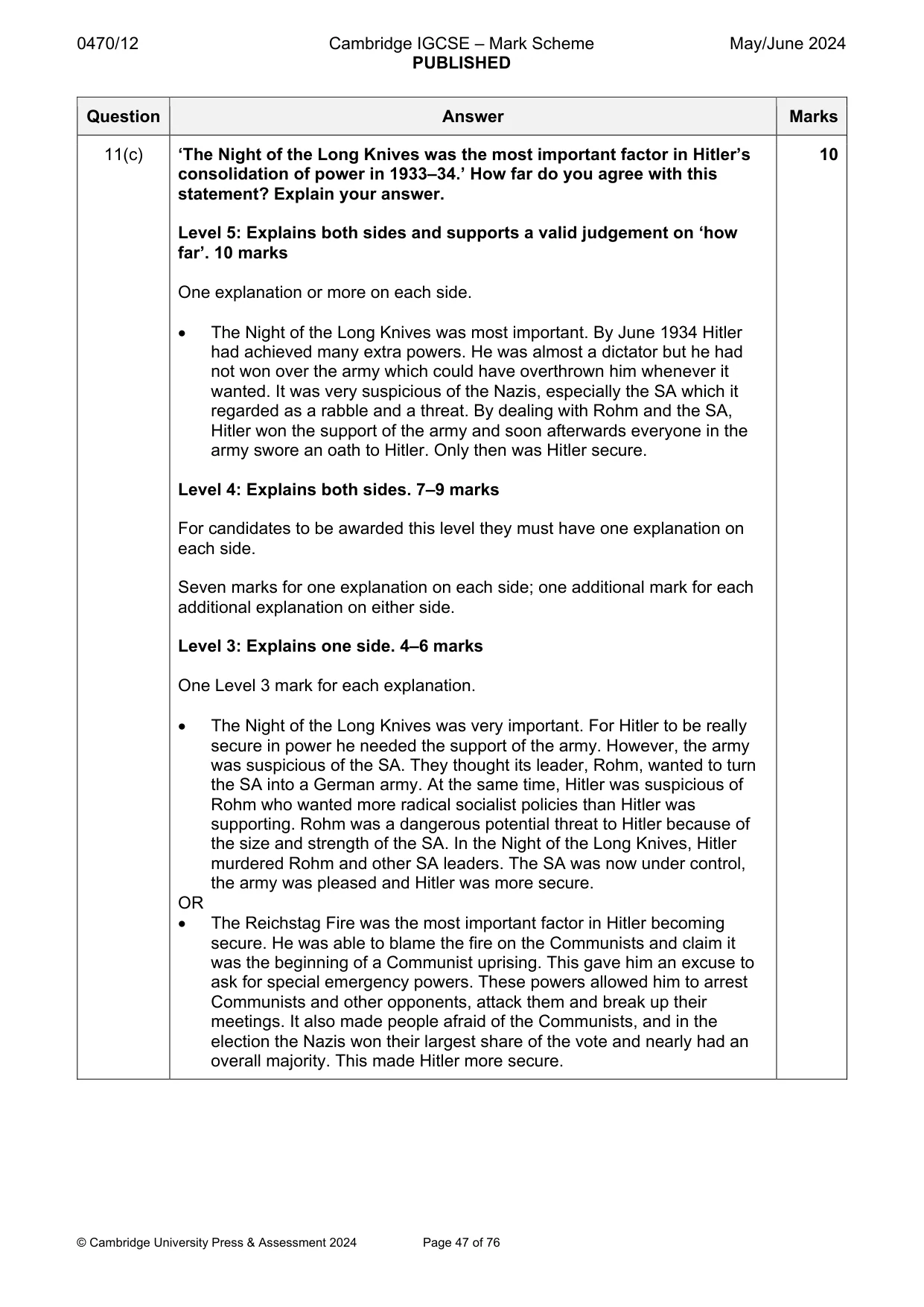
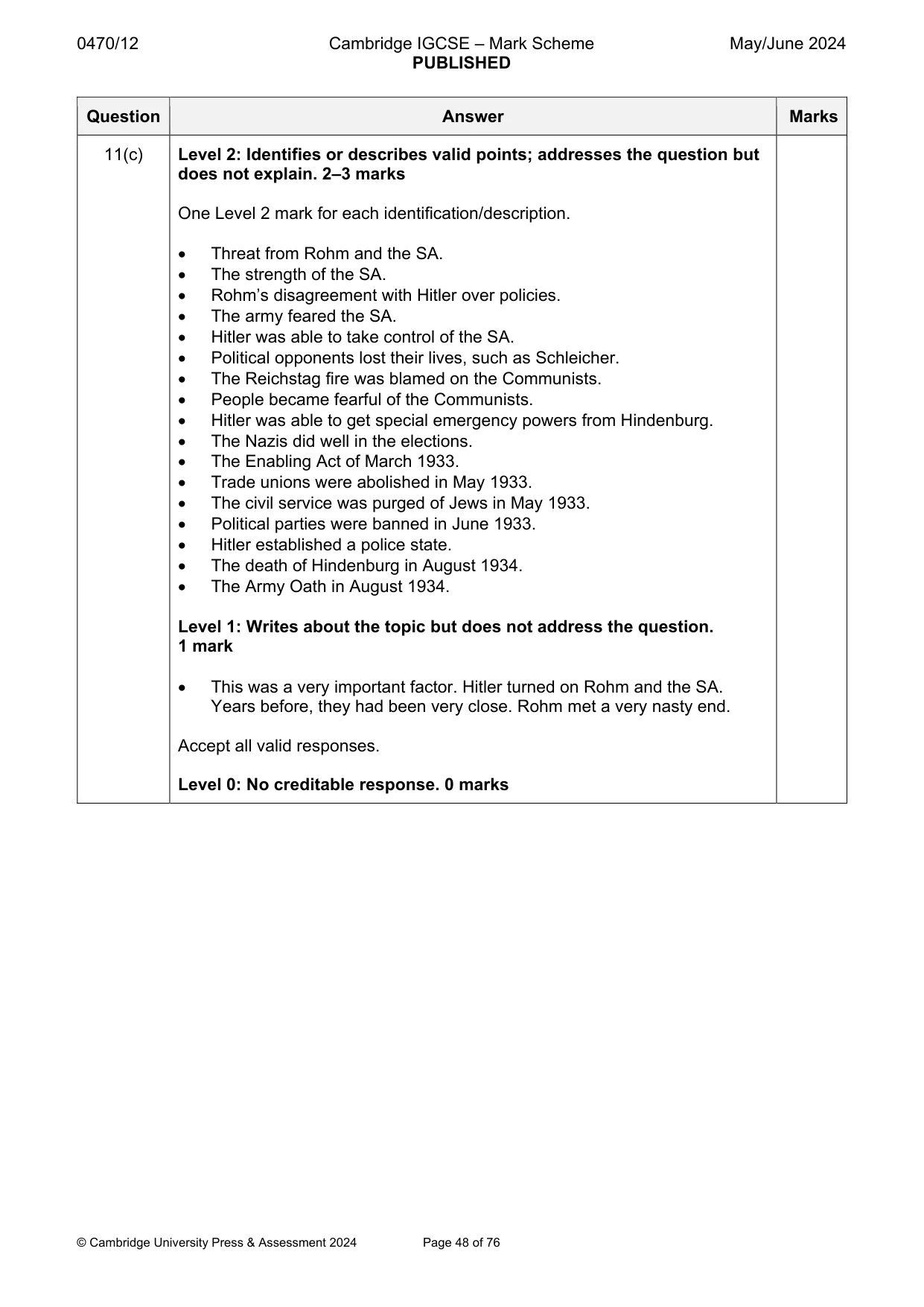
0470/12 Cambridge IGCSE – Mark Scheme PUBLISHED May/June 2024 © Cambridge University Press & Assessment 2024 Page 47 of 76 Question Answer Marks 11(c) ‘The Night of the Long Knives was the most important factor in Hitler’s consolidation of power in 1933–34.’ How far do you agree with this statement? Explain your answer. Level 5: Explains both sides and supports a valid judgement on ‘how far’. 10 marks One explanation or more on each side. The Night of the Long Knives was most important. By June 1934 Hitler had achieved many extra powers. He was almost a dictator but he had not won over the army which could have overthrown him whenever it wanted. It was very suspicious of the Nazis, especially the SA which it regarded as a rabble and a threat. By dealing with Rohm and the SA, Hitler won the support of the army and soon afterwards everyone in the army swore an oath to Hitler. Only then was Hitler secure. Level 4: Explains both sides. 7–9 marks For candidates to be awarded this level they must have one explanation on each side. Seven marks for one explanation on each side; one additional mark for each additional explanation on either side. Level 3: Explains one side. 4–6 marks One Level 3 mark for each explanation. The Night of the Long Knives was very important. For Hitler to be really secure in power he needed the support of the army. However, the army was suspicious of the SA. They thought its leader, Rohm, wanted to turn the SA into a German army. At the same time, Hitler was suspicious of Rohm who wanted more radical socialist policies than Hitler was supporting. Rohm was a dangerous potential threat to Hitler because of the size and strength of the SA. In the Night of the Long Knives, Hitler murdered Rohm and other SA leaders. The SA was now under control, the army was pleased and Hitler was more secure. OR The Reichstag Fire was the most important factor in Hitler becoming secure. He was able to blame the fire on the Communists and claim it was the beginning of a Communist uprising. This gave him an excuse to ask for special emergency powers. These powers allowed him to arrest Communists and other opponents, attack them and break up their meetings. It also made people afraid of the Communists, and in the election the Nazis won their largest share of the vote and nearly had an overall majority. This made Hitler more secure. 10
Mark scheme, page 48
0470/12 Cambridge IGCSE – Mark Scheme PUBLISHED May/June 2024 © Cambridge University Press & Assessment 2024 Page 48 of 76 Question Answer Marks 11(c) Level 2: Identifies or describes valid points; addresses the question but does not explain. 2–3 marks One Level 2 mark for each identification/description. Threat from Rohm and the SA. The strength of the SA. Rohm’s disagreement with Hitler over policies. The army feared the SA. Hitler was able to take control of the SA. Political opponents lost their lives, such as Schleicher. The Reichstag fire was blamed on the Communists. People became fearful of the Communists. Hitler was able to get special emergency powers from Hindenburg. The Nazis did well in the elections. The Enabling Act of March 1933. Trade unions were abolished in May 1933. The civil service was purged of Jews in May 1933. Political parties were banned in June 1933. Hitler established a police state. The death of Hindenburg in August 1934. The Army Oath in August 1934. Level 1: Writes about the topic but does not address the question. 1 mark This was a very important factor. Hitler turned on Rohm and the SA. Years before, they had been very close. Rohm met a very nasty end. Accept all valid responses. Level 0: No creditable response. 0 marks
Mark scheme, page 49
0470/12 Cambridge IGCSE – Mark Scheme PUBLISHED May/June 2024 © Cambridge University Press & Assessment 2024 Page 49 of 76 Question Answer Marks 12(a) Describe how women helped the German war effort. One mark for each relevant point. Responses may include the following: They worked in factories producing weapons. They took men’s jobs when the men went to war. They did administrative jobs in the armed forces. They worked in agriculture. As Germany prepared for war, women had to work a Duty Year on a farm or in a factory. They became nurses. They provided labour in annual summer camps. They worked as tram/train drivers. They worked as fire officers. They worked as air raid wardens. All single women had to do work in war-related industries. Nazi women worked in the concentration and extermination camps. 4
Mark scheme, page 50
0470/12 Cambridge IGCSE – Mark Scheme PUBLISHED May/June 2024 © Cambridge University Press & Assessment 2024 Page 50 of 76 Question Answer Marks 12(b) Why did Hitler attach much importance to the German family? Level 4: Explains two reasons. 6 marks Level 3: Explains one reason. 4–5 marks Four marks for one explanation, five marks for explanation supported by specific contextual knowledge. Hitler thought the German family was important because he wanted Germany to dominate Europe and spread eastwards. He wanted Lebensraum. This could only be achieved by war and for that he needed soldiers. This is why the family was important. The duty of the mother was to have lots of children and produce more men to fight in the armed forces. Level 2: Identifies or describes valid reason(s); addresses the question but does not explain. 2–3 marks One Level 2 mark for each identification/description. Hitler wanted to increase the birth rate. To produce more Aryan children. The mother would bring up loyal children. The family gave stability to German society. Men were to work and protect their family. Women were to stay at home and nurture their family. Hitler wanted more soldiers. To help Germany conquer other countries. Hitler gained support for his ideas on family after the moral decline of the 1920s. Level 1: Writes about the topic but does not address the question. 1 mark Hitler thought that everybody in Germany should be part of a family because this would be good for Germany. He wanted Germany to be made up of family units. Accept all valid responses. Level 0: No creditable response. 0 marks 6
Mark scheme, page 51
0470/12 Cambridge IGCSE – Mark Scheme PUBLISHED May/June 2024 © Cambridge University Press & Assessment 2024 Page 51 of 76 Question Answer Marks 12(c) ‘The Hitler Youth was popular with the young people of Germany.’ How far do you agree with this statement? Explain your answer. Level 5: Explains both sides and supports a valid judgement on ‘how far’. 10 marks One explanation or more on each side. It can be argued that the Hitler Youth was very popular because millions of young people joined. However, from 1936 membership was compulsory and there were still nearly a million who had not joined. Many only belonged because they thought it would protect their families or they were worried about what would happen to them if they did not join. Some young people joined other groups like the Swing movement. So, despite all the pressures on them, many young people did not join the Hitler Youth. Level 4: Explains both sides. 7–9 marks For candidates to be awarded this level they must have one explanation on each side. Seven marks for one explanation on each side; one additional mark for each additional explanation on either side. Level 3: Explains one side. 4–6 marks One Level 3 mark for each explanation. There is a lot of evidence that the Hitler Youth was popular with German youth. They spent a lot of time on activities like camping, athletics, hiking and firing guns. These were activities that were enjoyed by a lot of young people. The Hitler Youth also gave them a sense of belonging as they all wore a uniform. It also gave them an alternative to the discipline and values of their parents. OR The Hitler Youth became less popular in the years just before and during the war. The emphasis in the Hitler Youth changed to more discipline and more drills and some young people drifted away from it. It certainly was not popular with teenagers who wanted more freedom. They joined the Swing movement where they could enjoy American clothes and music and have long hair and dance. Others became Edelweiss Pirates. They sang anti-Nazi songs and enjoyed the freedom that they could not have in the Hitler Youth. 10
Mark scheme, page 52
0470/12 Cambridge IGCSE – Mark Scheme PUBLISHED May/June 2024 © Cambridge University Press & Assessment 2024 Page 52 of 76 Question Answer Marks 12(c) Level 2: Identifies or describes valid points; addresses the question but does not explain. 2–3 marks One Level 2 mark for each identification/description. Most German young people joined. The activities were exciting and fun. It gave them a sense of belonging. It gave them some freedom from their parents’ rules and ideas. Many did not join even after it became compulsory. During the war it became less enjoyable. Some young people joined other groups like the Edelweiss Pirates/Swing movement/White Rose movement. Level 1: Writes about the topic but does not address the question. 1 mark The Hitler Youth was popular with many German young people. They enjoyed what they did there. However, there were also some German young people who would rather do other things. Accept all valid responses. Level 0: No creditable response. 0 marks
Mark scheme, page 53
0470/12 Cambridge IGCSE – Mark Scheme PUBLISHED May/June 2024 © Cambridge University Press & Assessment 2024 Page 53 of 76 Question Answer Marks Depth Study C: Russia, 1905–41 13(a) What was the Kronstadt Rising? One mark for each relevant point. Responses may include the following: It was a mutiny by sailors. Sailors on the battleship Petropavlovsk mutinied. It took place in 1921. It took place at the Kronstadt naval base. It was against the Bolsheviks. There was a shortage of food. The sailors thought the Bolsheviks had drifted from true communism. They did not like Bolshevik party leaders getting privileges. It happened because of War Communism. They demanded freedom of speech, equal rations, and new elections. It was crushed by the Red Army. Over 2000 mutineers were executed. Many of the mutineers were sent to Siberia. It led to a change of policy from War Communism to the NEP. 4
Mark scheme, page 54
0470/12 Cambridge IGCSE – Mark Scheme PUBLISHED May/June 2024 © Cambridge University Press & Assessment 2024 Page 54 of 76 Question Answer Marks 13(b) Why was there a civil war in Russia? Level 4: Explains two reasons. 6 marks Level 3: Explains one reason. 4–5 marks Four marks for one explanation, five marks for explanation supported by specific contextual knowledge. One of the factors that contributed to a civil war was the actions of the Allies. They were very worried when Russia withdrew from the First World War. They were worried that this would strengthen Germany who could send troops to the Western Front and that Russia might even make an alliance with Germany. They were also against Bolshevik ideas. Countries like Britain and France sent troops and supplies to fight with the Whites against the Bolsheviks. Level 2: Identifies or describes valid reason(s); addresses the question but does not explain. 2–3 marks One Level 2 mark for each identification/description. The Allies sent troops to force Russia back into the war. Landlords and others who had lost money in the revolution wanted change. Groups opposed to Bolshevik ideas such as liberals and social democrats. Supporters of the Tsar wanted a return of the Romanovs. Some from the left opposed the Treaty of Brest-Litovsk. It was caused by the Bolshevik Revolution of 1917. Level 1: Writes about the topic but does not address the question. 1 mark The Civil War in Russia lasted from 1918 until 1920 when the Whites were defeated by the Red Army. Accept all valid responses. Level 0: No creditable response. 0 marks 6
Mark scheme, page 55
0470/12 Cambridge IGCSE – Mark Scheme PUBLISHED May/June 2024 © Cambridge University Press & Assessment 2024 Page 55 of 76 Question Answer Marks 13(c) ‘The New Economic Policy (NEP) was a success.’ How far do you agree with this statement? Explain your answer. Level 5: Explains both sides and supports a valid judgement on ‘how far’. 10 marks One explanation or more on each side. On the whole, the NEP was a success. Although there was opposition to it from some Bolsheviks it did something very important. It rescued Russia from awful starvation and famine and might even have rescued the Bolshevik Revolution. Russia was on the brink in 1920/21 with mutiny, discontent amongst peasants and industrial workers, and a dreadful shortage of food. The NEP rescued Russia and the Bolsheviks from this situation. In comparison, upsetting a few extreme Bolsheviks did not matter much. Level 4: Explains both sides. 7–9 marks For candidates to be awarded this level they must have one explanation on each side. Seven marks for one explanation on each side; one additional mark for each additional explanation on either side. Level 3: Explains one side. 4–6 marks One Level 3 mark for each explanation. The NEP was a success. Lenin introduced it because War Communism had caused enormous hardship. There were food shortages and a terrible famine and there had been a naval mutiny at Kronstadt. The NEP was designed to improve conditions and win back support from peasants and workers. It allowed peasants to sell some of their grain for a profit and small factories went back into private ownership. It led to industrial production recovering and to peasants producing more food. OR The NEP was a failure. Many Bolsheviks were horrified by it because it was a step backwards from true communism. It also led to the appearance of Nepmen who made enormous profits by exploiting the peasants. This was also against Bolshevik principles. Although Lenin argued it was only a short-term measure, it created deep divisions between the Bolsheviks and it did not even improve the lot of the industrial workers who resented the Nepmen. 10
Mark scheme, page 56
0470/12 Cambridge IGCSE – Mark Scheme PUBLISHED May/June 2024 © Cambridge University Press & Assessment 2024 Page 56 of 76 Question Answer Marks 13(c) Level 2: Identifies or describes valid points; addresses the question but does not explain. 2–3 marks One Level 2 mark for each identification/description. Grain production went up. Trade with other countries increased. There was less discontent and fewer strikes. Factory production increased. Some peasants benefited. Nepmen exploited people and became rich. Farming was not modernised. It was seen by some Bolsheviks as a move away from communist ideas. It did not help industrial workers. Growing inequality between peasants. Level 1: Writes about the topic but does not address the question. 1 mark The NEP was introduced by Lenin to try and make the situation better. It changed a lot of things, but this was necessary because Russia was in such a terrible situation in 1920. Accept all valid responses. Level 0: No creditable response. 0 marks
Mark scheme, page 57
0470/12 Cambridge IGCSE – Mark Scheme PUBLISHED May/June 2024 © Cambridge University Press & Assessment 2024 Page 57 of 76 Question Answer Marks 14(a) Describe how villages were collectivised. One mark for each relevant point. Responses may include the following: A propaganda campaign was used to explain the advantages of collectivisation. The government sent officials to force peasants to agree. Many peasants were driven from the land and even sent to Siberia. Large farms were created by putting the land of many peasants together. Peasants lost their individual plots of land that they had owned. The peasants had to work to government targets. The peasants shared equipment and resources. It allowed more modern machinery to be used. Any profits left after the state had been given what it demanded were shared among the farmers. The kulaks were eliminated as a class. 4
Mark scheme, page 58
0470/12 Cambridge IGCSE – Mark Scheme PUBLISHED May/June 2024 © Cambridge University Press & Assessment 2024 Page 58 of 76 Question Answer Marks 14(b) Why did industrial production increase under Stalin? Level 4: Explains two reasons. 6 marks Level 3: Explains one reason. 4–5 marks Four marks for one explanation, five marks for explanation supported by specific contextual knowledge. Industrial production increased because far more workers were used. Many of these workers were women and by the late 1930s nearly half of industrial workers were women. Most had not worked before. Centres were set up to look after their children. This added enormous numbers to the workforce so that more could be produced. The number of workers also increased by using prisoners on projects like dams and canals. Level 2: Identifies or describes valid reason(s); addresses the question but does not explain. 2–3 marks One Level 2 mark for each identification/description. The Five-Year Plans. Workers were bombarded with propaganda. Tight government control. Clear targets set. Foreign engineers called in to supervise the work. The example of Stakhanov. More women added to the workforce. Strict discipline with workers having to work very hard. Level 1: Writes about the topic but does not address the question. 1 mark Industrial production increased because this was one of Stalin’s main aims. All kinds of goods were produced but mainly heavy industry. Accept all valid responses. Level 0: No creditable response. 0 marks 6
Mark scheme, page 59
0470/12 Cambridge IGCSE – Mark Scheme PUBLISHED May/June 2024 © Cambridge University Press & Assessment 2024 Page 59 of 76 Question Answer Marks 14(c) How far had the lives of Russians improved by the mid-1930s? Explain your answer. Level 5: Explains both sides and supports a valid judgement on ‘how far’. 10 marks One explanation or more on each side. Overall, the lives of Russians did not improve. Russia’s industrial output went up and more women could work but it is important to remember that Stalin was not interested in making people’s lives better; he wanted to make Russia a modern and powerful industrial state that could defend itself. While Russia made tremendous progress in that, the everyday lives of ordinary Russians did not really improve. In fact, they had to make enormous sacrifices and between 1928 and 1937 wages fell. Level 4: Explains both sides. 7–9 marks For candidates to be awarded this level they must have one explanation on each side. Seven marks for one explanation on each side; one additional mark for each additional explanation on either side. Level 3: Explains one side. 4–6 marks One Level 3 mark for each explanation. The lives of Russians had not improved. Industrial production may have gone up but most of this was in heavy industry. Consumer goods like clothes and radios that may have improved living standards were not being produced and so people’s lives did not improve much. The working conditions in many industrial plants were dreadful with people having to work very hard. Nor had the lives of many peasants improved. There had been a dreadful famine in 1932-3 and millions had starved. The kulaks were also worse off. Many were rounded up and sent to labour camps. OR The group that did have better lives by the mid-1930s were women. Women were given more freedom to work. Crèches were provided at workplaces so that their children would be looked after, thus allowing mothers to go to work. Free health care was provided as well as paid holidays. By the 1930s women made up most of the doctors and about a third of engineers. So for some women there were new opportunities. 10
Mark scheme, page 60
0470/12 Cambridge IGCSE – Mark Scheme PUBLISHED May/June 2024 © Cambridge University Press & Assessment 2024 Page 60 of 76 Question Answer Marks 14(c) Level 2: Identifies or describes valid points; addresses the question but does not explain. 2–3 marks One Level 2 mark for each identification/description. Few consumer goods. Quality of new housing for industrial workers was poor. Discipline at work was harsh with severe punishments. Wages fell. The famine of 1932-3. Kulaks suffered badly. Little personal freedom. More women could work. Free health care. Paid holidays. Provision of nurseries so mothers could work. Housing provided for workers. Level 1: Writes about the topic but does not address the question. 1 mark The lives of many Russians were still hard although there were some improvements. Russia was gradually becoming a strong and modern country. Accept all valid responses. Level 0: No creditable response. 0 marks
Mark scheme, page 61
0470/12 Cambridge IGCSE – Mark Scheme PUBLISHED May/June 2024 © Cambridge University Press & Assessment 2024 Page 61 of 76 Question Answer Marks Depth Study D: The United States, 1919–41 15(a) What was the ‘Red Scare’? One mark for each relevant point. Responses may include the following: Americans were alarmed at the 1917 Russian Revolution. Fear of communism. Fear that immigrants were bringing radical political ideas such as anarchism with them. Fear of immigrants from southern and eastern Europe. The strikes of 1919 made Americans more fearful. The bomb blasts of 1919 made Americans more fearful. Fears that strikes were inspired by communism. Strong reaction by the authorities – suspected communists rounded up and deported. The press and some politicians whipped people up so that conspiracies were seen everywhere. 4
Mark scheme, page 62
0470/12 Cambridge IGCSE – Mark Scheme PUBLISHED May/June 2024 © Cambridge University Press & Assessment 2024 Page 62 of 76 Question Answer Marks 15(b) Why did the cinema grow in popularity during the 1920s? Level 4: Explains two reasons. 6 marks Level 3: Explains one reason. 4–5 marks Four marks for one explanation, five marks for explanation supported by specific contextual knowledge. One of the reasons for the growth in popularity was the arrival of talking pictures in 1927. Up until then, every movie was silent and cinemas employed musicians to play music during the films. The use of sound and speech in films made them much more exciting. The talkies were far more popular and people flocked to the cinema. In a few years after the first talkie, ticket sales more than doubled. Level 2: Identifies or describes valid reason(s); addresses the question but does not explain. 2–3 marks One Level 2 mark for each identification/description. It was very inexpensive. Americans had more leisure time. The attraction of big stars. Incomes were going up in the ‘boom’. The economic boom. An escape from their everyday lives. The arrival of ‘talkies’. People could socialise in cinemas. The films included exciting romances and gangster action. The cinemas were warm and very comfortable. More people had cars so they could drive to cinemas. A major industry was developing in Hollywood. Level 1: Writes about the topic but does not address the question. 1 mark The cinema became more popular because lots of people wanted to see the films. It became part of everyone’s life. Accept all valid responses. Level 0: No creditable response. 0 marks 6
Mark scheme, page 63
0470/12 Cambridge IGCSE – Mark Scheme PUBLISHED May/June 2024 © Cambridge University Press & Assessment 2024 Page 63 of 76 Question Answer Marks 15(c) Which was more of a problem for the United States in the 1920s: gangsterism or the Ku Klux Klan? Explain your answer. Level 5: Explains both sides and supports a valid judgement on ‘how far’. 10 marks One explanation or more on each side. Although the gangsters were a real problem in cities and caused murder and corruption, they were caused by Prohibition. In 1933, Prohibition was abolished and gangsterism was largely defeated. The KKK was much more of a problem. The gangsters were a small minority but the KKK had millions of members in the South and represented the prejudices of a lot of people. They also murdered far more people than the gangsters did. The KKK was the biggest problem because it represented attitudes deeply rooted in American society. Level 4: Explains both sides. 7–9 marks For candidates to be awarded this level they must have one explanation on each side. Seven marks for one explanation on each side; one additional mark for each additional explanation on either side. Level 3: Explains one side. 4–6 marks One Level 3 mark for each explanation. Gangsterism developed in the 1920s largely because of Prohibition. This was a ban on selling and making alcoholic drinks. In big cities people were willing to still buy and drink alcohol. This gave criminals the chance to supply it. Gangsters like Al Capone started to do this but soon they were fighting each other for control of parts of cities. This led to the gangs having gun fights and murdering each other. Soon, many cities were plagued with murders coming from the gangsters, which was a real problem for the authorities. OR The Ku Klux Klan was a real problem. It was an organisation that believed in white supremacy. It was racist and attacked, intimidated, tortured and murdered black Americans. Thousands were murdered by lynching. It was a serious problem because the KKK had a membership of five million people, including many important politicians. It was also against Jews, Catholics and foreigners. In fact, it was against anyone who it thought was a danger to what it saw as American values. 10
Mark scheme, page 64
0470/12 Cambridge IGCSE – Mark Scheme PUBLISHED May/June 2024 © Cambridge University Press & Assessment 2024 Page 64 of 76 Question Answer Marks 15(c) Level 2: Identifies or describes valid points; addresses the question but does not explain. 2–3 marks One Level 2 mark for each identification/description. The gangsters supplied the illegal speakeasies with alcohol. The gangsters largely killed each other. There was the St. Valentine’s Massacre. The gangsters corrupted policemen and judges. The gangsters spread crime across whole cities. The gangsters were finished when Prohibition was repealed. The KKK was revived after ‘The Birth of a Nation’ in 1915. The KKK had support among politicians. The KKK attacked Jews, Catholics and foreigners. Members of the KKK were often found not guilty in Southern courts. The KKK had millions of members. The KKK murdered thousands of black Americans. The KKK operated largely in the South. The KKK represented views held by many people in the South. The KKK declined after 1925. Level 1: Writes about the topic but does not address the question. 1 mark Both of these were terrible and did many terrible things. The USA was better off when both groups had been dealt with and faded away. Accept all valid responses. Level 0: No creditable response. 0 marks
Mark scheme, page 65
0470/12 Cambridge IGCSE – Mark Scheme PUBLISHED May/June 2024 © Cambridge University Press & Assessment 2024 Page 65 of 76 Question Answer Marks 16(a) Describe how Roosevelt reacted to the Supreme Court decisions of 1935–36 about the New Deal. One mark for each relevant point. Responses may include the following: He was angry that the Supreme Court acted against the New Deal. He asked Congress to let him appoint six new Supreme Court judges. He claimed the judges were too old and were reactionary. He wanted judges sympathetic to the New Deal. He claimed that there were not enough judges on the Supreme Court to get through all their work. Roosevelt backed down. 4
Mark scheme, page 66
0470/12 Cambridge IGCSE – Mark Scheme PUBLISHED May/June 2024 © Cambridge University Press & Assessment 2024 Page 66 of 76 Question Answer Marks 16(b) Why did Roosevelt do so much in the ‘Hundred Days’ of 1933? Level 4: Explains two reasons. 6 marks Level 3: Explains one reason. 4–5 marks Four marks for one explanation, five marks for explanation supported by specific contextual knowledge. He had to do so much because the situation in the USA was desperate. There was an enormous amount of unemployment. Many farmers had lost their farms and were without a job. In the cities, millions of people lost their jobs in industries that had to close. They had to sell their houses or could not pay their rent and ended up on the streets with no job and nowhere to live. People were searching through rubbish tips for food and shanty towns were appearing. Roosevelt knew that he had to act fast because there were so many people suffering. Level 2: Identifies or describes valid reason(s); addresses the question but does not explain. 2–3 marks One Level 2 mark for each identification/description. The situation in the USA was so bad with many people unemployed. This was because there were so many people in poverty. It was important the banks were saved. It was to get the USA out of depression. He wanted to improve urgently agriculture and industry. It was important to let people know that something was happening. He had made promises in the election campaign. He wanted to secure his position as president. It was important to restore confidence in the economy as quickly as possible. Level 1: Writes about the topic but does not address the question. 1 mark Roosevelt did a lot very quickly. He introduced the Alphabet Agencies like the Civilian Conservation Corps. Accept all valid responses. Level 0: No creditable response. 0 marks 6
Mark scheme, page 67
0470/12 Cambridge IGCSE – Mark Scheme PUBLISHED May/June 2024 © Cambridge University Press & Assessment 2024 Page 67 of 76 Question Answer Marks 16(c) ‘The main reason why there was opposition to the New Deal was because it interfered with business.’ How far do you agree with this statement? Explain your answer. Level 5: Explains both sides and supports a valid judgement on ‘how far’. 10 marks One explanation or more on each side. Although businessmen and the wealthy opposed the New Deal, they did not have much effect on Roosevelt. The main reason there was opposition was because the New Deal did not go far enough. This was the main reason because it was criticism that affected Roosevelt and led to the Second New Deal. This focused much more on practical help for people – helping the unemployed and the poor, building housing, letting people join unions and giving farmers loans. These measures met some of the criticisms of people like Huey Long. Level 4: Explains both sides. 7–9 marks For candidates to be awarded this level they must have one explanation on each side. Seven marks for one explanation on each side; one additional mark for each additional explanation on either side. Level 3: Explains one side. 4–6 marks One Level 3 mark for each explanation. The most important reason was because the New Deal interfered with business. The leaders of business thought that governments should not interfere with business. They argued that business had done well in the 1920s because it was left alone. They were against government having a say over wages and working hours as in the National Recovery Administration. They said this was like communism. These men were very powerful and so their opposition mattered a lot. OR There were other important reasons why there was opposition to the New Deal. One was that it did not do enough. This criticism came from Democrats rather than Republicans. For example, Huey Long criticised the New Deal for not helping people enough. He put together his own scheme called Share Our Wealth which would reduce the fortunes of the very rich and give everyone a guaranteed minimum wage. Long had enormous amounts of support but was assassinated. 10
Mark scheme, page 68
0470/12 Cambridge IGCSE – Mark Scheme PUBLISHED May/June 2024 © Cambridge University Press & Assessment 2024 Page 68 of 76 Question Answer Marks 16(c) Level 2: Identifies or describes valid points; addresses the question but does not explain. 2–3 marks One Level 2 mark for each identification/description. Powerful people like businessmen and the wealthy did not like the New Deal. Critics said it was a form of socialism. Critics thought Roosevelt was acting like a dictator. Critics did not like government interference in business or industry. Businessmen thought there were too many codes and regulations. There was opposition because of the support for trade unions. Opponents formed the Liberty League which became important. Schemes like the TVA created unfair competition for private companies. Republicans thought it undermined American values. Criticisms from his own side hurt Roosevelt more. Critics could see there were still many people that were poor. Democrats did not think he was doing enough for the poor, e.g. Huey Long. The unemployed and poor needed more direct help. The Second New Deal dealt with some of the criticisms from Democrats. There was opposition from the Supreme Court which stated parts of the New Deal were unconstitutional. Level 1: Writes about the topic but does not address the question. 1 mark There was a lot of opposition to the New Deal from all sorts of people. However, the New Deal helped a lot of people with jobs and support. Accept all valid responses. Level 0: No creditable response. 0 marks
Mark scheme, page 69
0470/12 Cambridge IGCSE – Mark Scheme PUBLISHED May/June 2024 © Cambridge University Press & Assessment 2024 Page 69 of 76 Question Answer Marks Depth Study E: The Second World War in Europe and the Asia-Pacific, 1939–c.1945 17(a) Describe relations between Japan and the United States in the period before the attack on Pearl Harbor. One mark for each relevant point. Responses may include the following: Relations were not good because of Japanese expansion. Japan lacked oil and other natural resources. The US wanted an ‘Open Door’ policy towards China. Japan invaded Manchuria. The US wanted to protect its imports of oil and rubber from Southeast Asia. The US announced it would stop selling Japan materials that could be used for war. In 1940 an expansionist government came to power. Japan demanded Britain close the Burma Road. The US banned export of metal and oil to Japan. The US began supporting the Chinese against the Japanese. Japan invaded Indochina. The US took control of Japanese money in the US and closed the Panama Canal to Japanese ships. Talks between the US and Japan failed. 4
Mark scheme, page 70
0470/12 Cambridge IGCSE – Mark Scheme PUBLISHED May/June 2024 © Cambridge University Press & Assessment 2024 Page 70 of 76 Question Answer Marks 17(b) Why were the British defeated in Malaya? Level 4: Explains two reasons. 6 marks Level 3: Explains one reason. 4–5 marks Four marks for one explanation, five marks for explanation supported by specific contextual knowledge. The British were not ready for an attack and they did not seem to expect an attack on the Malay Peninsula itself. Coordination between the ground troops and the Royal Air Force was poor. The ground troops were not trained or equipped properly, nor did the officers show interest in how to fight jungle warfare. They simply did not think a rapid Japanese advance through the jungle was possible. Level 2: Identifies or describes valid reason(s); addresses the question but does not explain. 2–3 marks One Level 2 mark for each identification/description. Japan sent their best generals and troops to Malaya. The sinking of the Prince of Wales and Repulse. The Japanese moved so quickly by using bicycles. They used collapsible boats to outflank the British. The British defences/troops were unprepared. The Japanese had more military strength – over 200 tanks and 600 aircraft. The British had ignored warnings that an attack might come at Songkhla and Kota Bharu. The British depended on an early warning of an attack and US help – neither happened. The British assumed fast progress through the jungle was not possible. Singapore’s guns were not effective against infantry targets. There was a lack of air cover for the British. Level 1: Writes about the topic but does not address the question. 1 mark Accept all valid responses. The British were defeated in Malaya. This was an unexpected and bitter blow. They had certainly not expected Singapore to fall so quickly. Level 0: No creditable response. 0 marks 6
Mark scheme, page 71
0470/12 Cambridge IGCSE – Mark Scheme PUBLISHED May/June 2024 © Cambridge University Press & Assessment 2024 Page 71 of 76 Question Answer Marks 17(c) How far was the Japanese attack on Pearl Harbor a success? Explain your answer. Level 5: Explains both sides and supports a valid judgement on ‘how far’. 10 marks One explanation or more on each side. Although the attack was a great success on the day with many US ships and planes destroyed, it was a short-term success. It was a strategic disaster for Japan. Japan had started on its expansion without much opposition, but Pearl Harbor led to it being faced with a long war against the US. It was never going to win against American military might and to encourage such a war was a big mistake. In the end, the attack was a big miscalculation by Japan. Level 4: Explains both sides. 7–9 marks For candidates to be awarded this level they must have one explanation on each side. Seven marks for one explanation on each side; one additional mark for each additional explanation on either side. Level 3: Explains one side. 4–6 marks One Level 3 mark for each explanation. The attack was a success. The Japanese caught the Americans completely by surprise and their planes were able to destroy or damage 20 US warships and over 300 airplanes. Many Americans were also killed. This was a great victory for the Japanese and a big blow to the Americans. Much of the Pacific Fleet had been destroyed and it showed American incompetence in terms of not planning for such an attack. It also gave Japan a head start in the Pacific War and until mid-1942 the Japanese won every major battle. OR It was a long-term disaster for Japan. The attack badly misfired because the Japanese had wanted to pressurise the Americans into lifting economic sanctions, but it had the opposite effect – the US declared war on Japan. This meant that Japan now had an enormous military enemy in the way of its planned expansion. It also had to fight Britain and the US at the same time. Finally, rather than damage American morale, it put the Americans behind the US war effort, determined for revenge. 10
Mark scheme, page 72
0470/12 Cambridge IGCSE – Mark Scheme PUBLISHED May/June 2024 © Cambridge University Press & Assessment 2024 Page 72 of 76 Question Answer Marks 17(c) Level 2: Identifies or describes valid points; addresses the question but does not explain. 2–3 marks One Level 2 mark for each identification/description. Large parts of the US fleet were destroyed. Many US airplanes were destroyed. It was a big propaganda victory for the Japanese. It showed the US was not ready for such an attack. The US aircraft carriers were not at Pearl Harbor. Important parts of the base were not destroyed such as oil depots and shipyards. The US declared war on Japan. It gave the US a chance to rebuild its fleet. The attack united the US behind war. It meant that Japan had to fight both Britain and the US. Level 1: Writes about the topic but does not address the question. 1 mark The attack on Pearl Harbor was in many ways a success. Waves of Japanese aircraft attacked Pearl Harbor. This was what Japan wanted to do because it was angered by many American actions. Accept all valid responses. Level 0: No creditable response. 0 marks
Mark scheme, page 73
0470/12 Cambridge IGCSE – Mark Scheme PUBLISHED May/June 2024 © Cambridge University Press & Assessment 2024 Page 73 of 76 Question Answer Marks 18(a) What was ‘island-hopping’? One mark for each relevant point. Responses may include the following: It was how the Americans won control across the Pacific. It was a military strategy. It involved bypassing Japanese strongholds. It involved seizing lightly defended islands. It allowed the US to make raids on Japanese positions. It allowed them to move across the central Pacific quickly. US forces moved from island to island, using each as a base for capturing the next. Island hopping started at the Battle of Tarawa. 4
Mark scheme, page 74
0470/12 Cambridge IGCSE – Mark Scheme PUBLISHED May/June 2024 © Cambridge University Press & Assessment 2024 Page 74 of 76 Question Answer Marks 18(b) Why did the Allies consider it important to hold war crimes trials? Level 4: Explains two reasons. 6 marks Level 3: Explains one reason. 4–5 marks Four marks for one explanation, five marks for explanation supported by specific contextual knowledge. They did this because they wanted to denazify Germany. They wanted to show what terrible things the Nazis had done so that they would be discredited in the eyes of the German people. They wanted to get rid of any support for the Nazis in Germany and make sure that Nazis did not get important jobs in Germany in the future. Level 2: Identifies or describes valid reason(s); addresses the question but does not explain. 2–3 marks One Level 2 mark for each identification/description. This was because the war crimes of the Nazis had been so terrible. To deter future aggression and war crimes. To educate the German people of the true extent of the atrocities. To discredit Nazism and denazify Germany. Level 1: Writes about the topic but does not address the question. 1 mark They thought this was an important thing to do. Nazis like Goering went on trial. After this there were several other trials in Germany. There were also similar trials in Japan. Accept all valid responses. Level 0: No creditable response. 0 marks 6
Mark scheme, page 75
0470/12 Cambridge IGCSE – Mark Scheme PUBLISHED May/June 2024 © Cambridge University Press & Assessment 2024 Page 75 of 76 Question Answer Marks 18(c) ‘Germany collapsed in 1945 because of the Russian advance from the East.’ How far do you agree with this statement? Explain your answer. Level 5: Explains both sides and supports a valid judgement on ‘how far’. 10 marks One explanation or more on each side. The reason Germany collapsed in 1945 was because it was being attacked from the east and the west. The linking of the Russians and the Americans on the River Elbe in April made German defeat inevitable. Both the Russians and the Western Allies had marched to Berlin as quickly as possible to take as much territory as possible. This double attack on Germany made it inevitable it would collapse. Level 4: Explains both sides. 7–9 marks For candidates to be awarded this level they must have one explanation on each side. Seven marks for one explanation on each side; one additional mark for each additional explanation on either side. Level 3: Explains one side. 4–6 marks One Level 3 mark for each explanation. The Russian advance from the east was crucial. The fighting on the Eastern Front was far bigger than on the Western Front. More troops were involved and more died. In fact, it was the main front in the war. Without it, the Allies would have needed double the number of troops on the Western Front. The Russians moved as quickly as possible because Stalin wanted to take as much territory as possible for negotiations after the war. He certainly wanted to take Berlin before the Western Allies. In April an enormous number of Russian soldiers and amounts of armaments attacked central Germany. By the end of the month, they had broken through German lines and encircled Berlin. The Soviet forces fought their way into the centre of Berlin and in May, Berlin was surrendered to the Russians. Faced with this massive onslaught, Germany was bound to collapse. OR The Allied advance from the west was most important. The D-Day landings gave them a foothold and from there they advanced towards Germany. The Allies outnumbered the German troops and made rapid progress through France. By September 1944, they had reached the German border. Germany’s last chance was its counter-offensive in the Ardennes. When this failed, the Allies crossed the Rhine and were capturing vast numbers of German soldiers. 10
Mark scheme, page 76
0470/12 Cambridge IGCSE – Mark Scheme PUBLISHED May/June 2024 © Cambridge University Press & Assessment 2024 Page 76 of 76 Question Answer Marks 18(c) Level 2: Identifies or describes valid points; addresses the question but does not explain. 2–3 marks One Level 2 mark for each identification/description. By 1945, Germany was being attacked on two fronts at once. By 1945, Germany was exhausted and did not have the resources to defend itself. Allied bombing had done terrible damage to German industry and people. The Russians had enormous numbers of men and resources to throw at Germany. After D-Day, the Allies advanced quickly through France to the German border. Level 1: Writes about the topic but does not address the question. 1 mark The Russian advance from the east was very important but there were several other reasons why Germany collapsed in 1945. By this time Germany was very weak and in a terrible state. Accept all valid responses. Level 0: No creditable response. 0 marks
What you needed in this session
Cambridge’s own grade thresholds for 2024 May/June, Paper 1 · Variant 2. A higher threshold means an easier paper — the bar moves with how the cohort did.