Cambridge IGCSE History 0470 — 2024 May/June Paper 1 · Variant 3
0470/13/M/J/24 · 60 marks · 120 min
The question paper and its mark scheme, free to read here and free to download. This is Cambridge’s own paper, exactly as it was sat.
Question paper8 pages

Mark scheme76 pages
Answers below. Sit the paper first if you are practising.
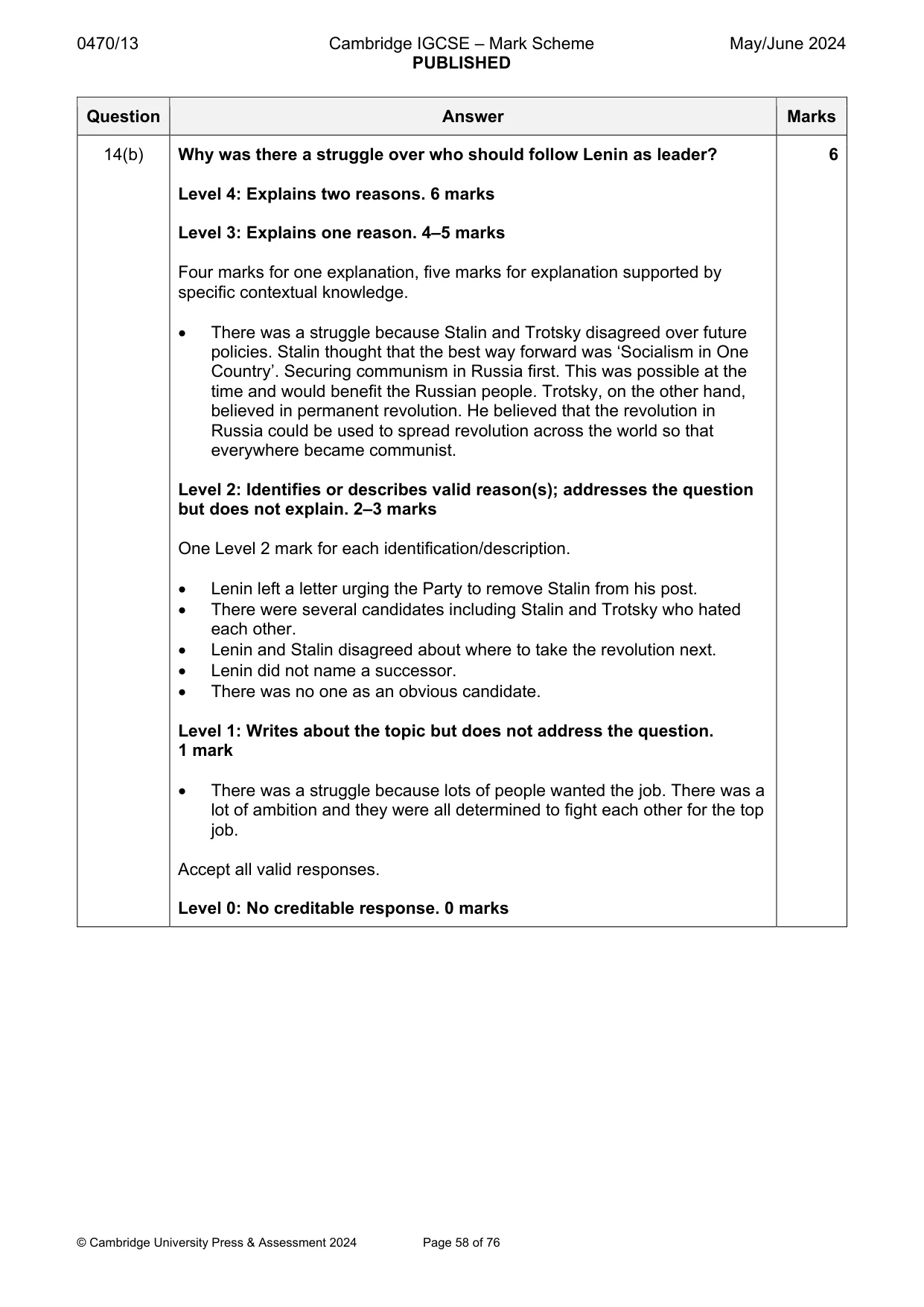
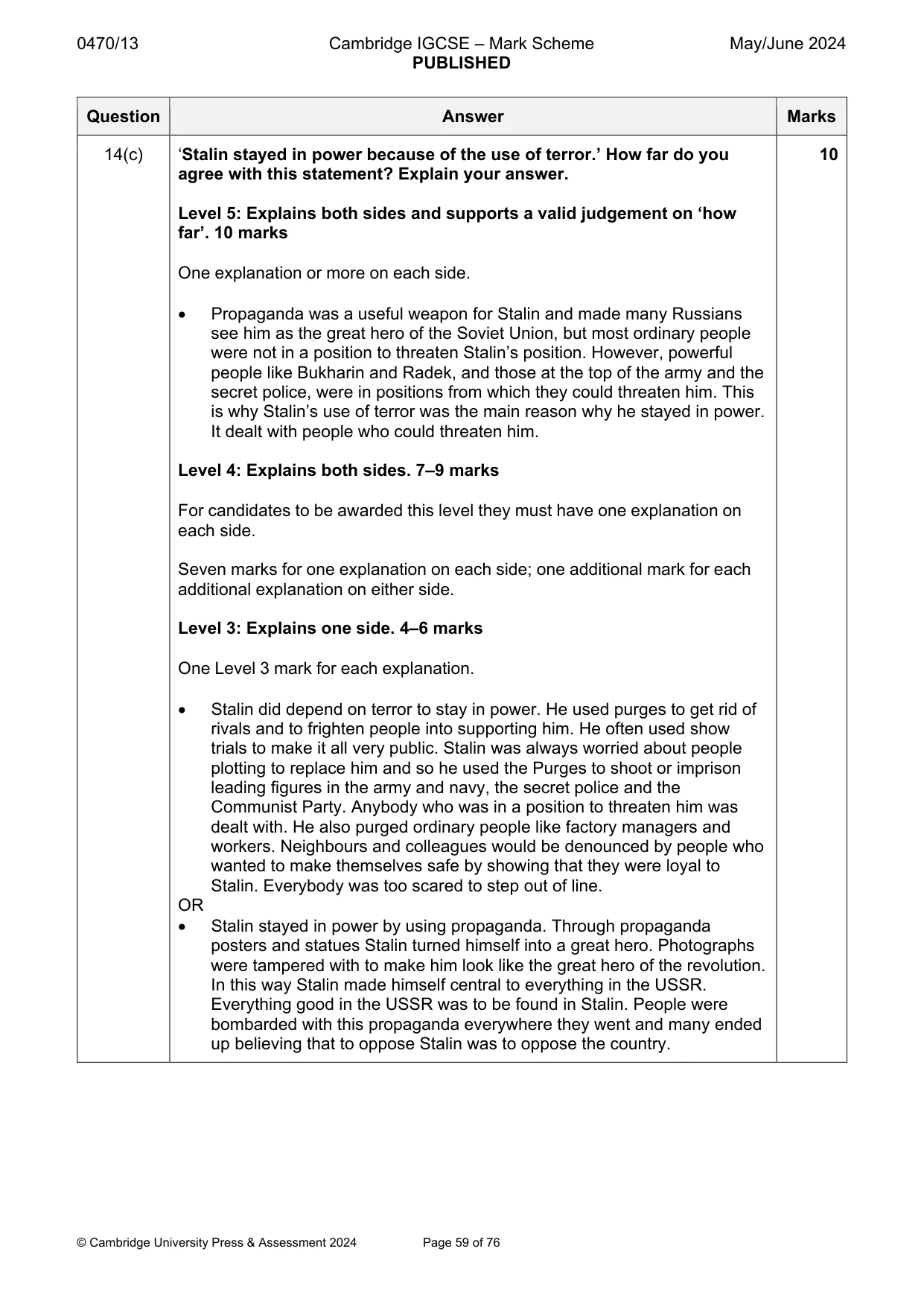
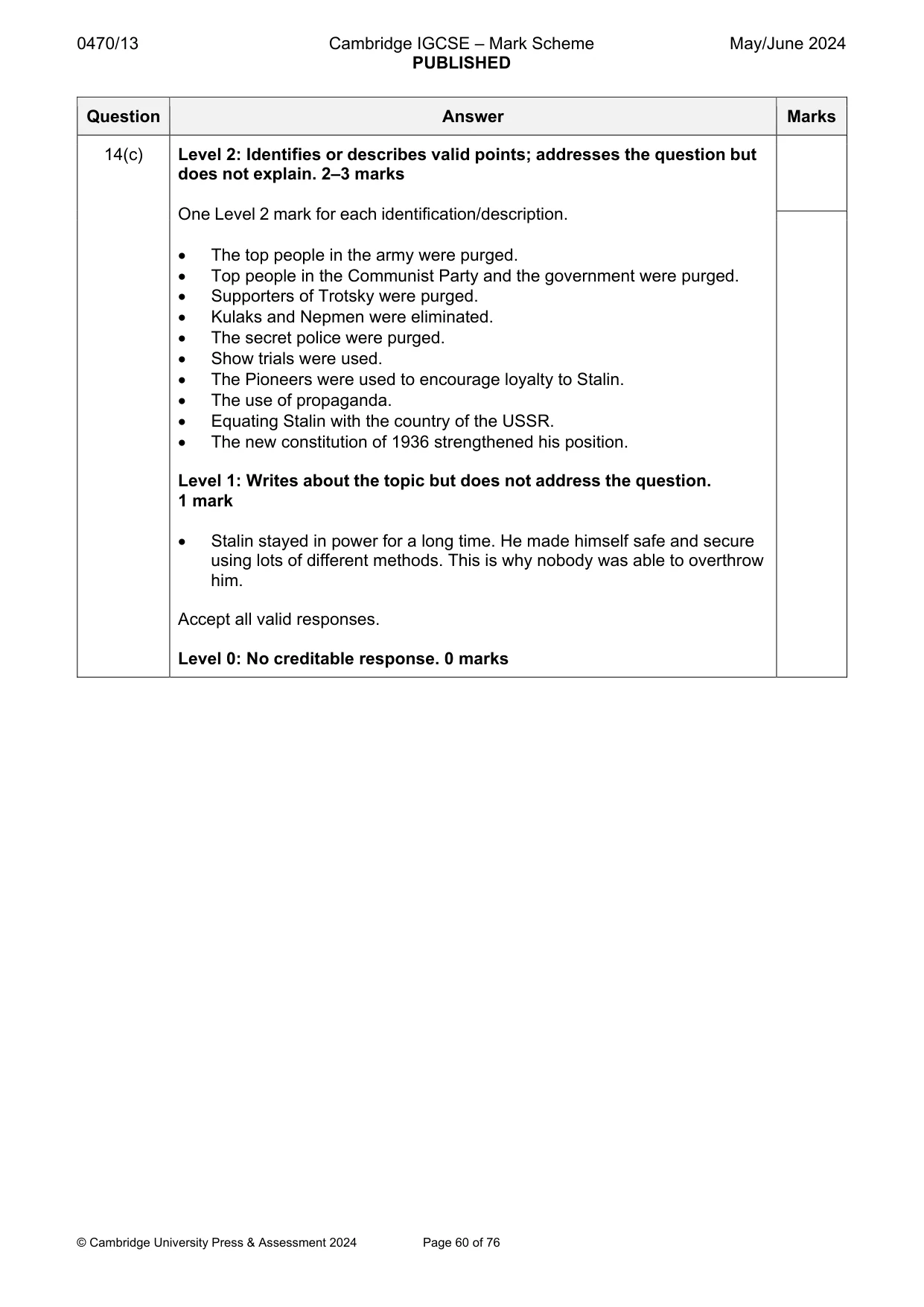
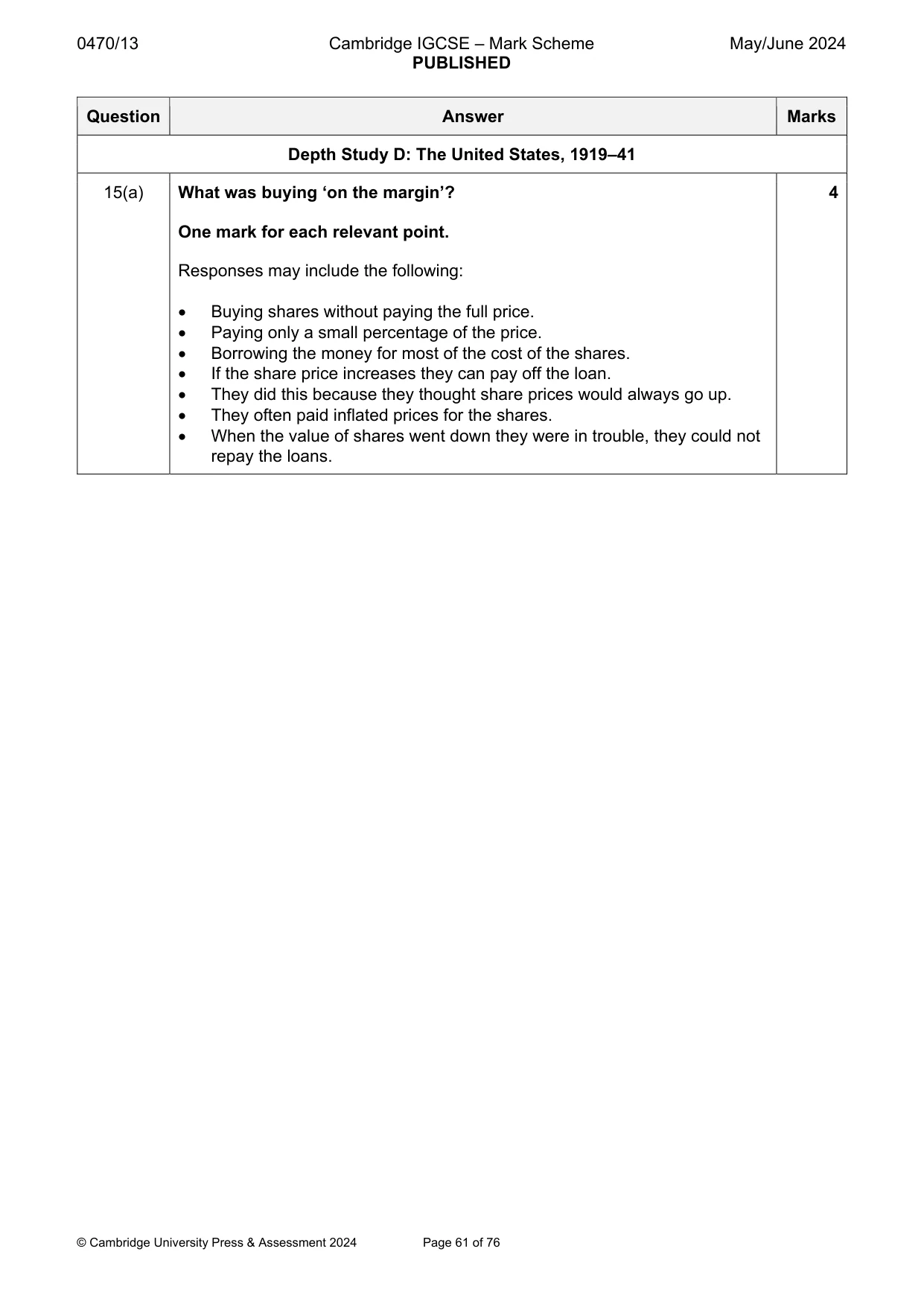
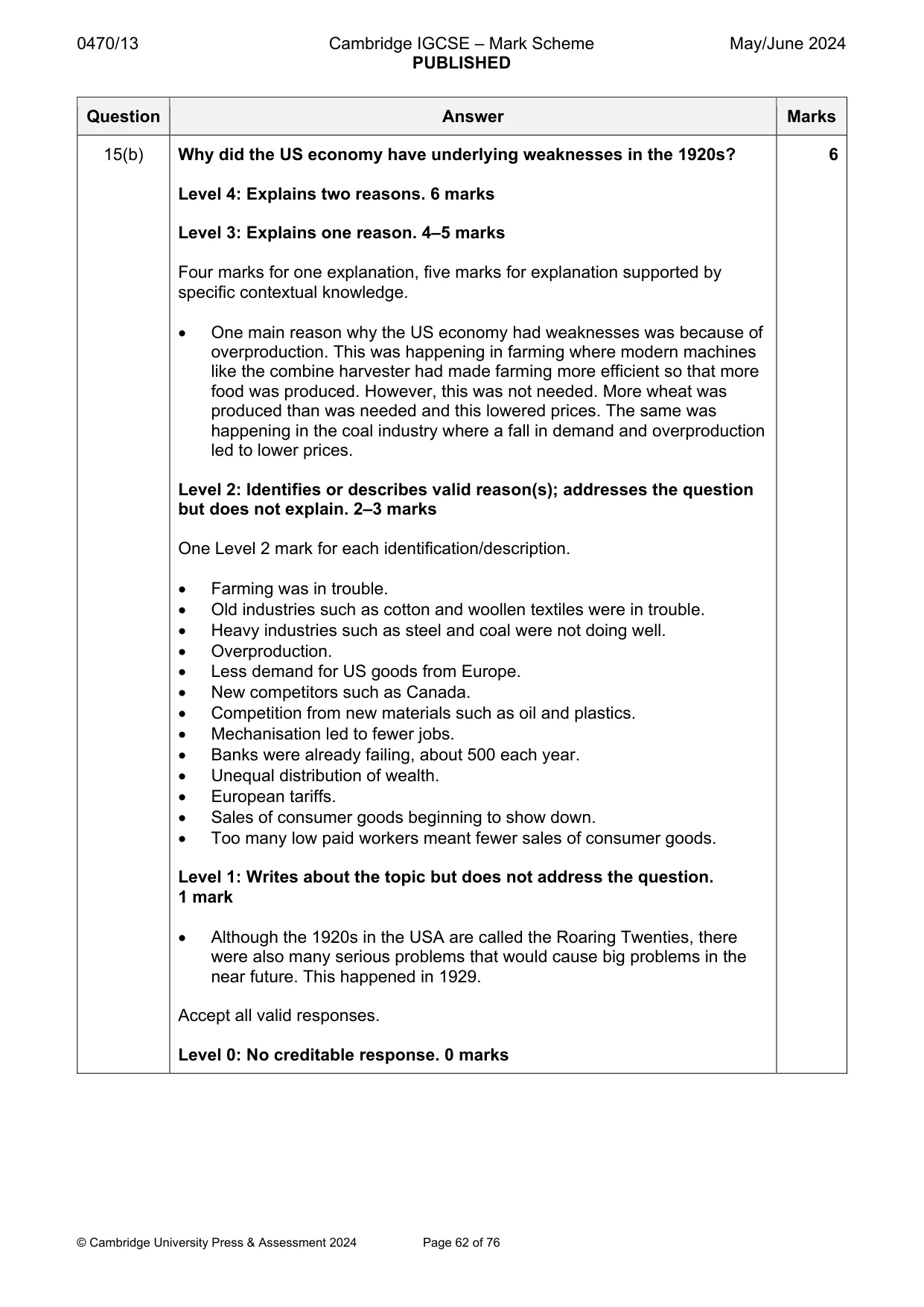
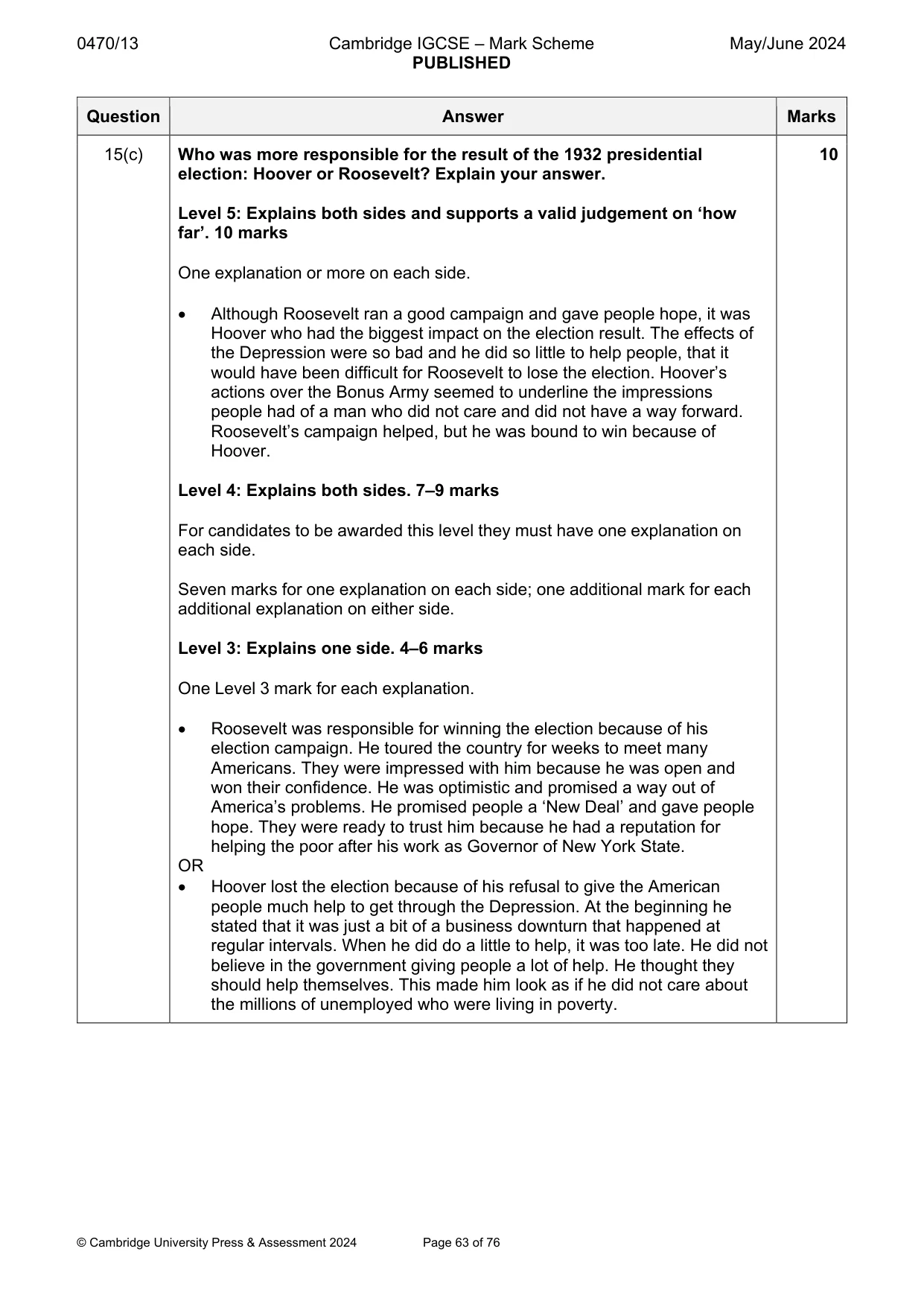
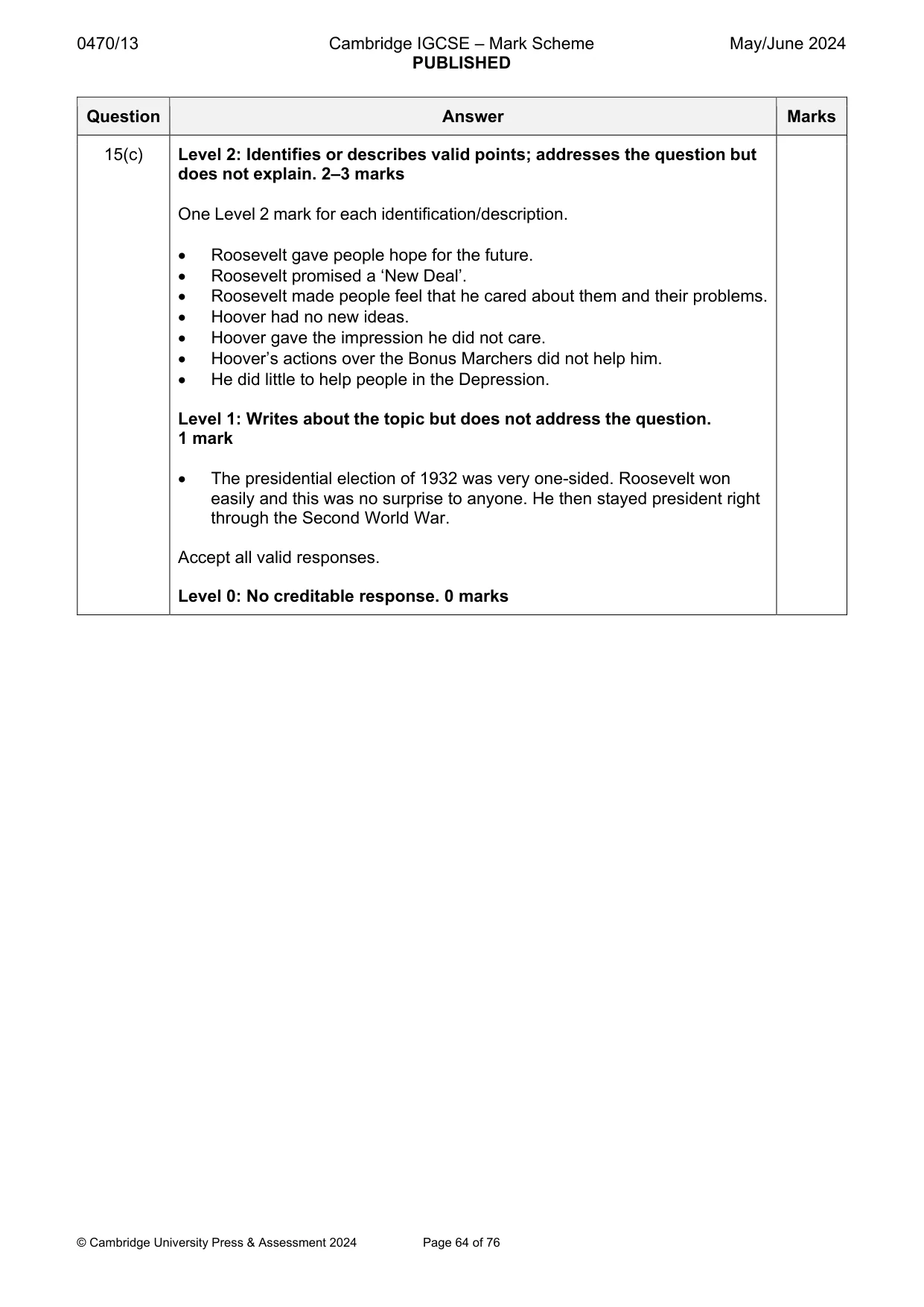
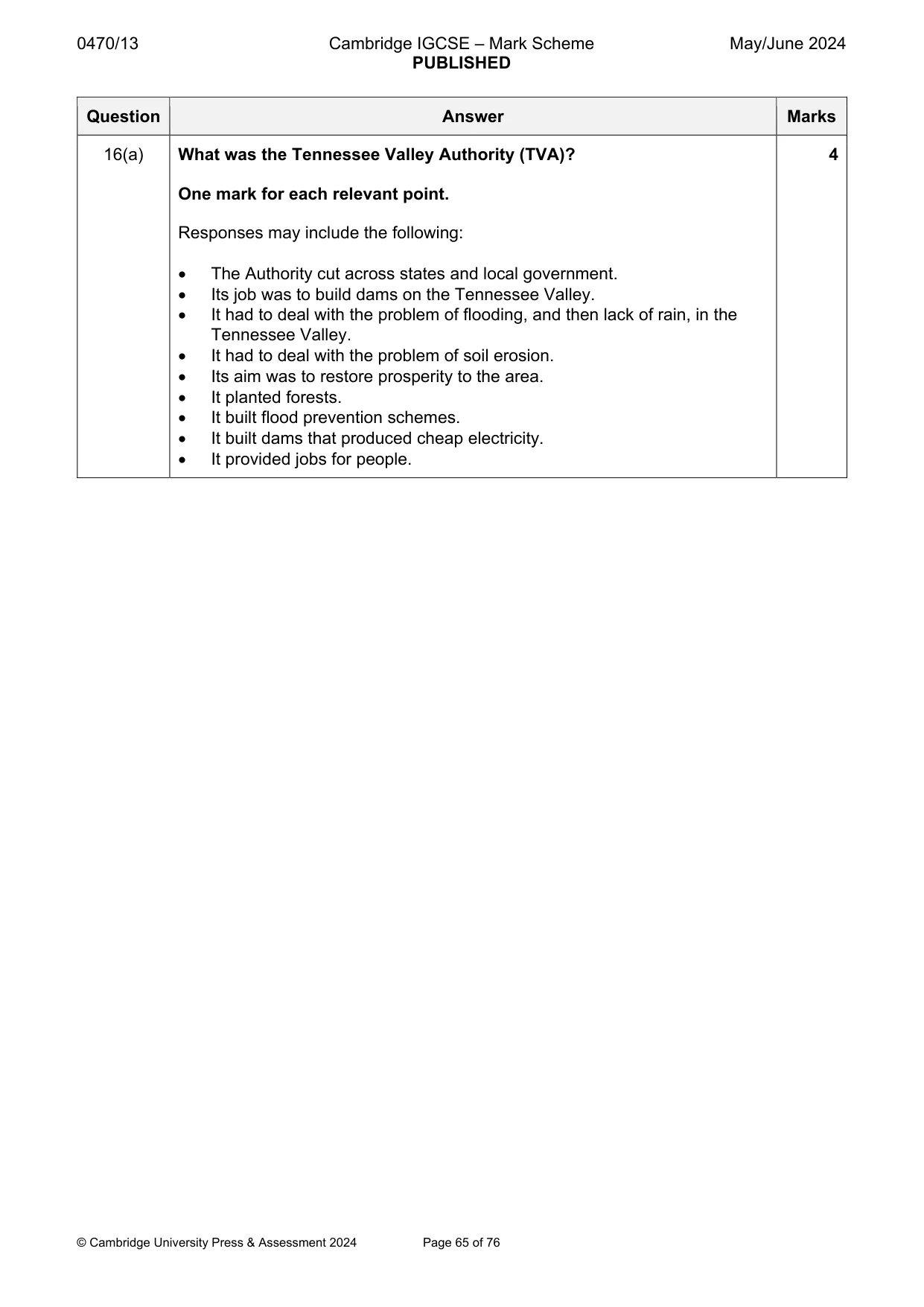
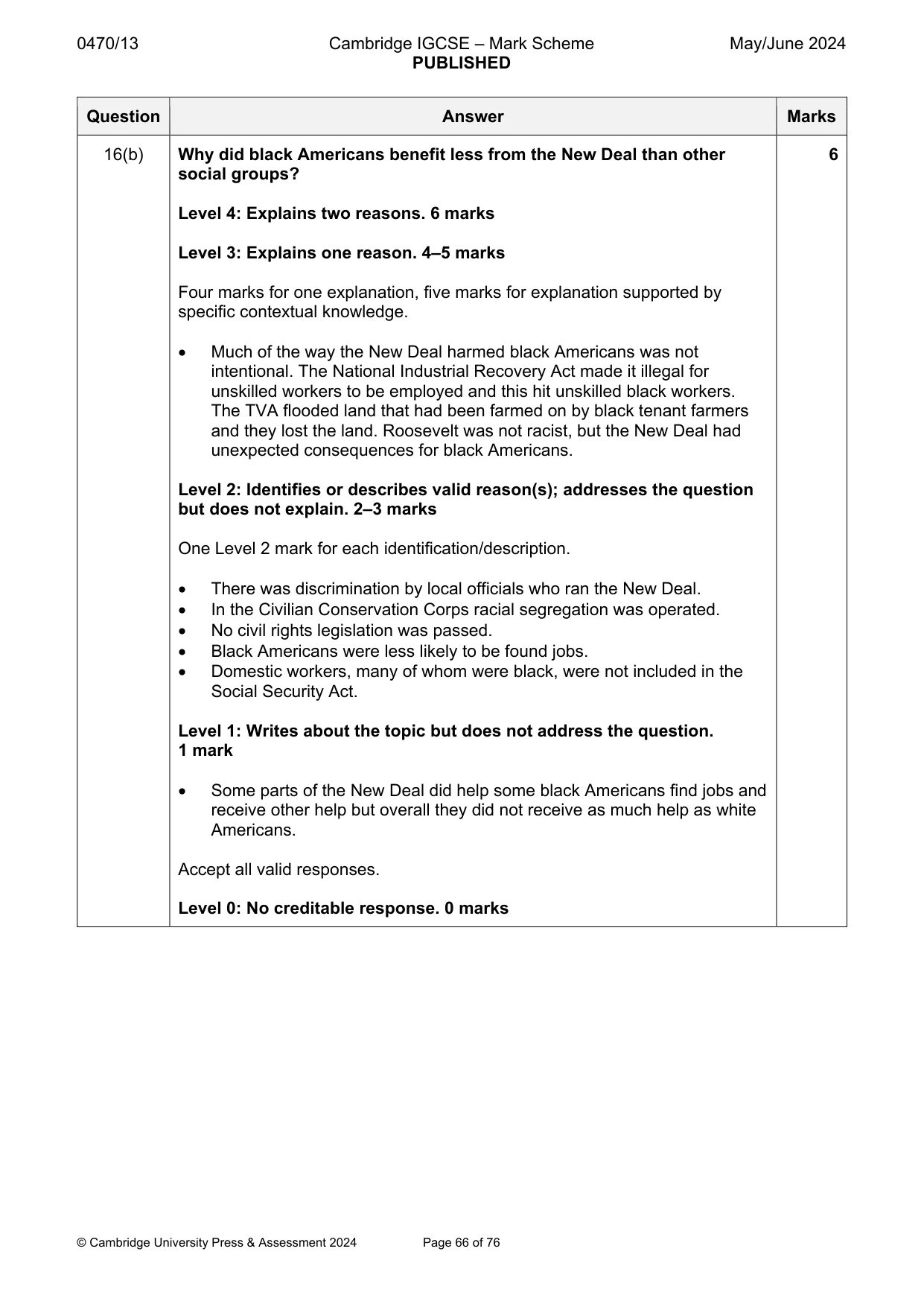
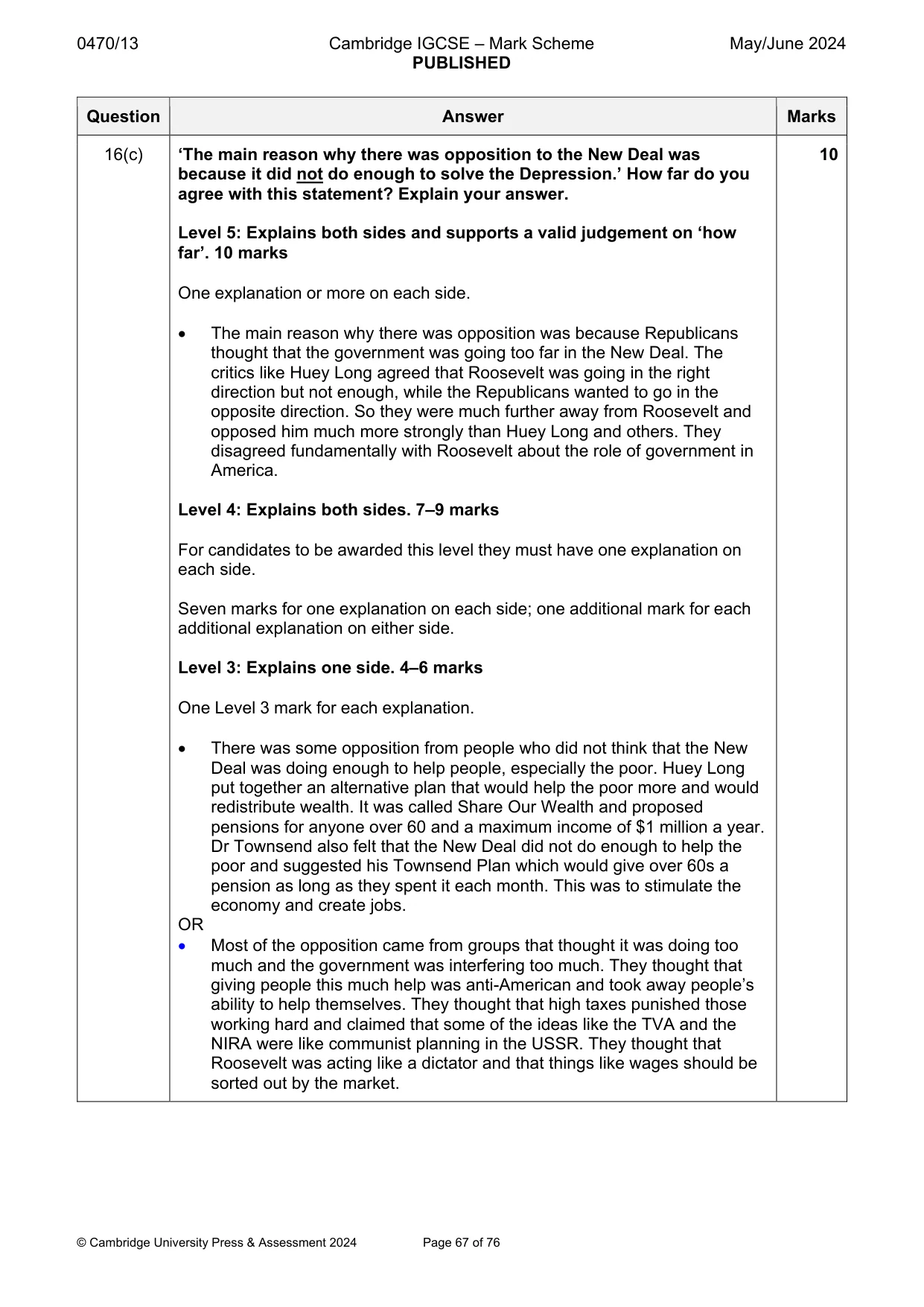
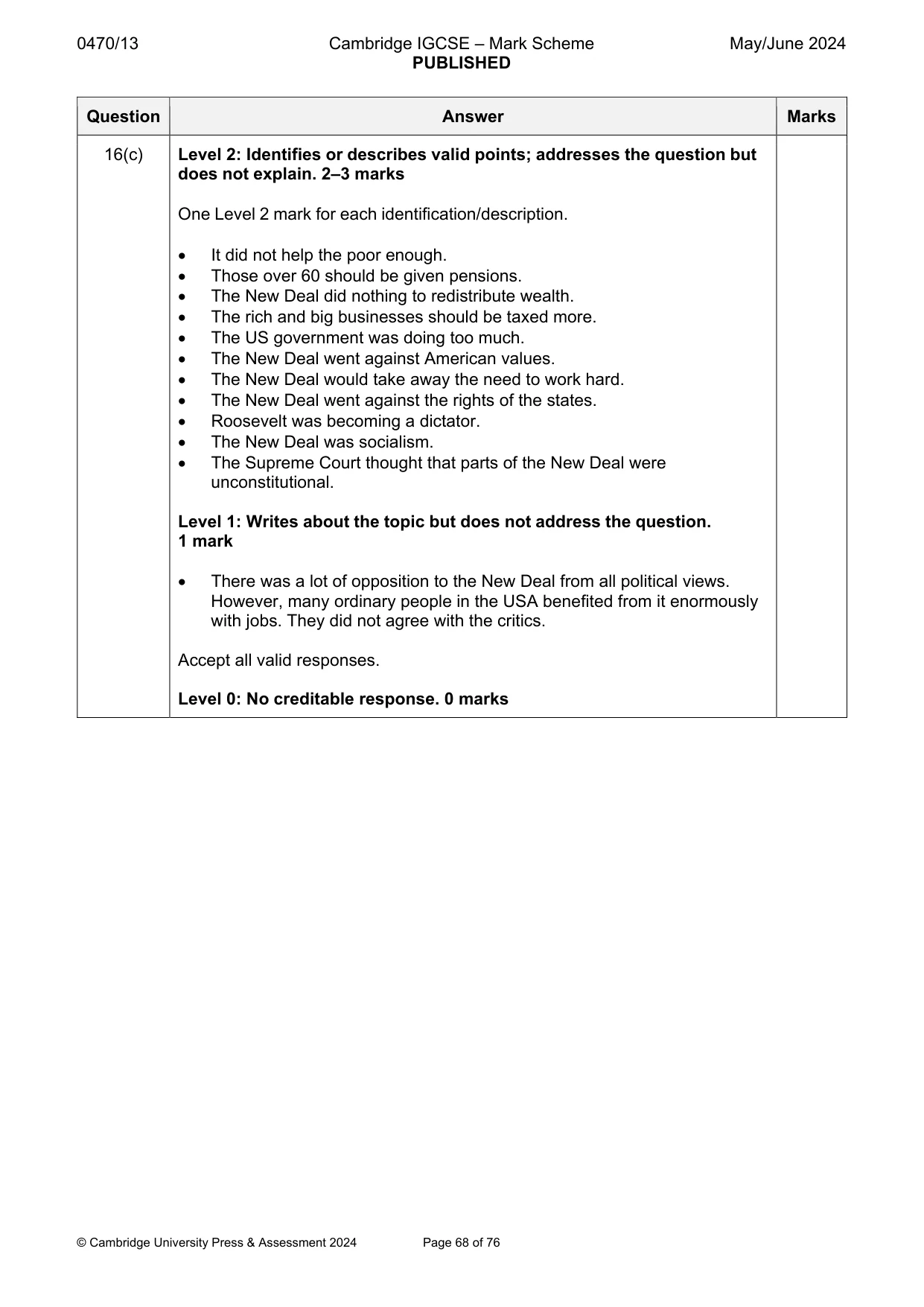
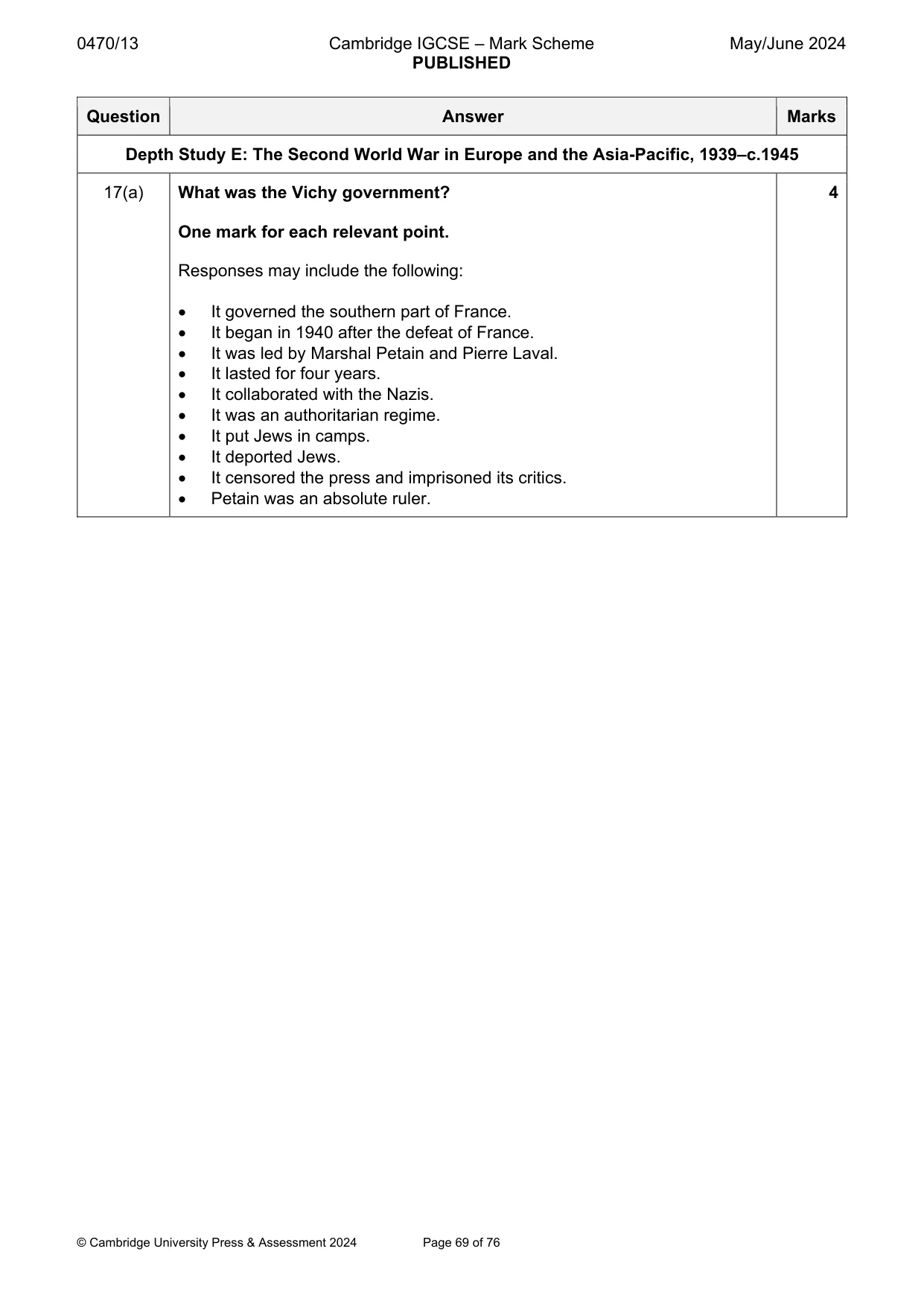
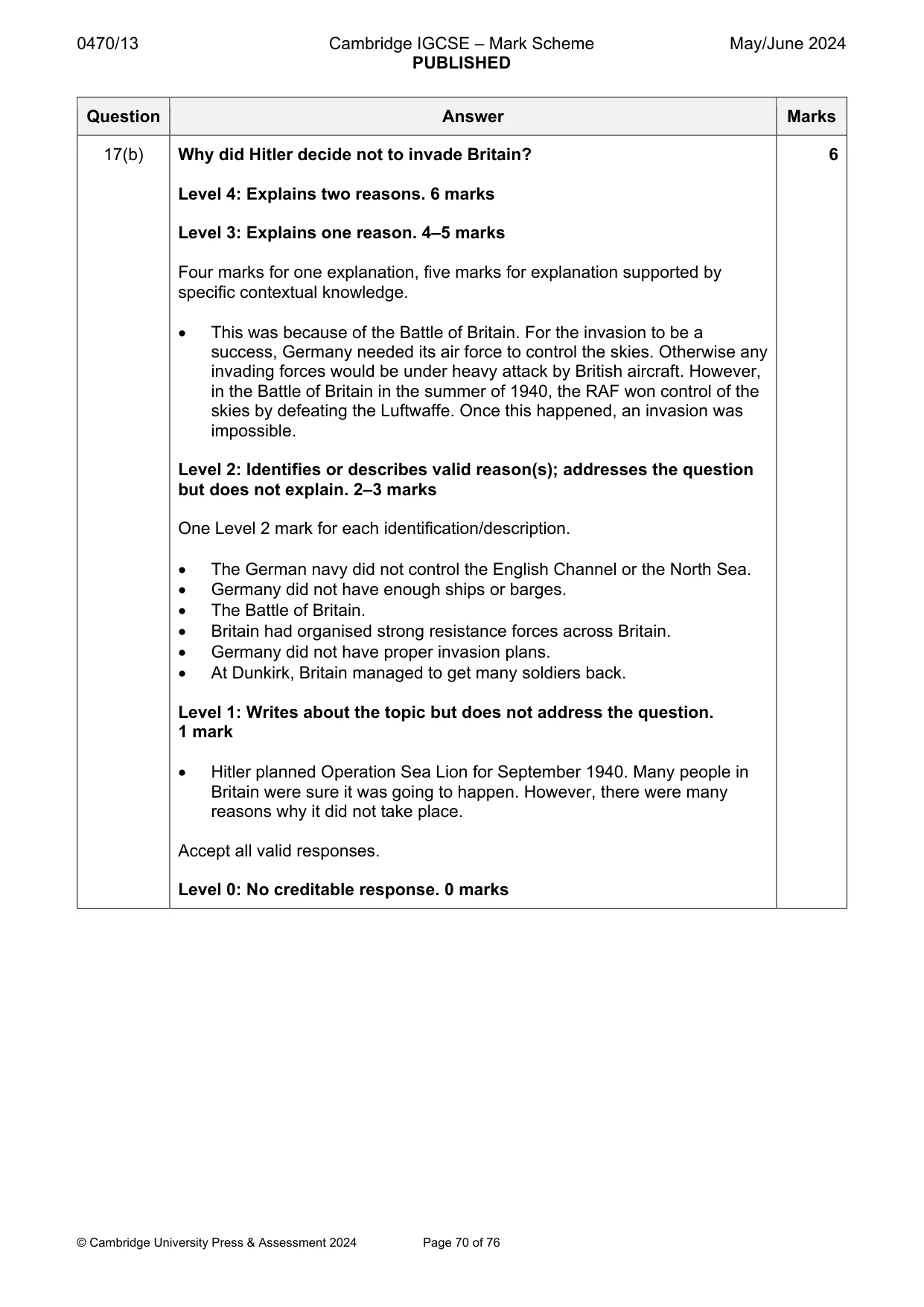
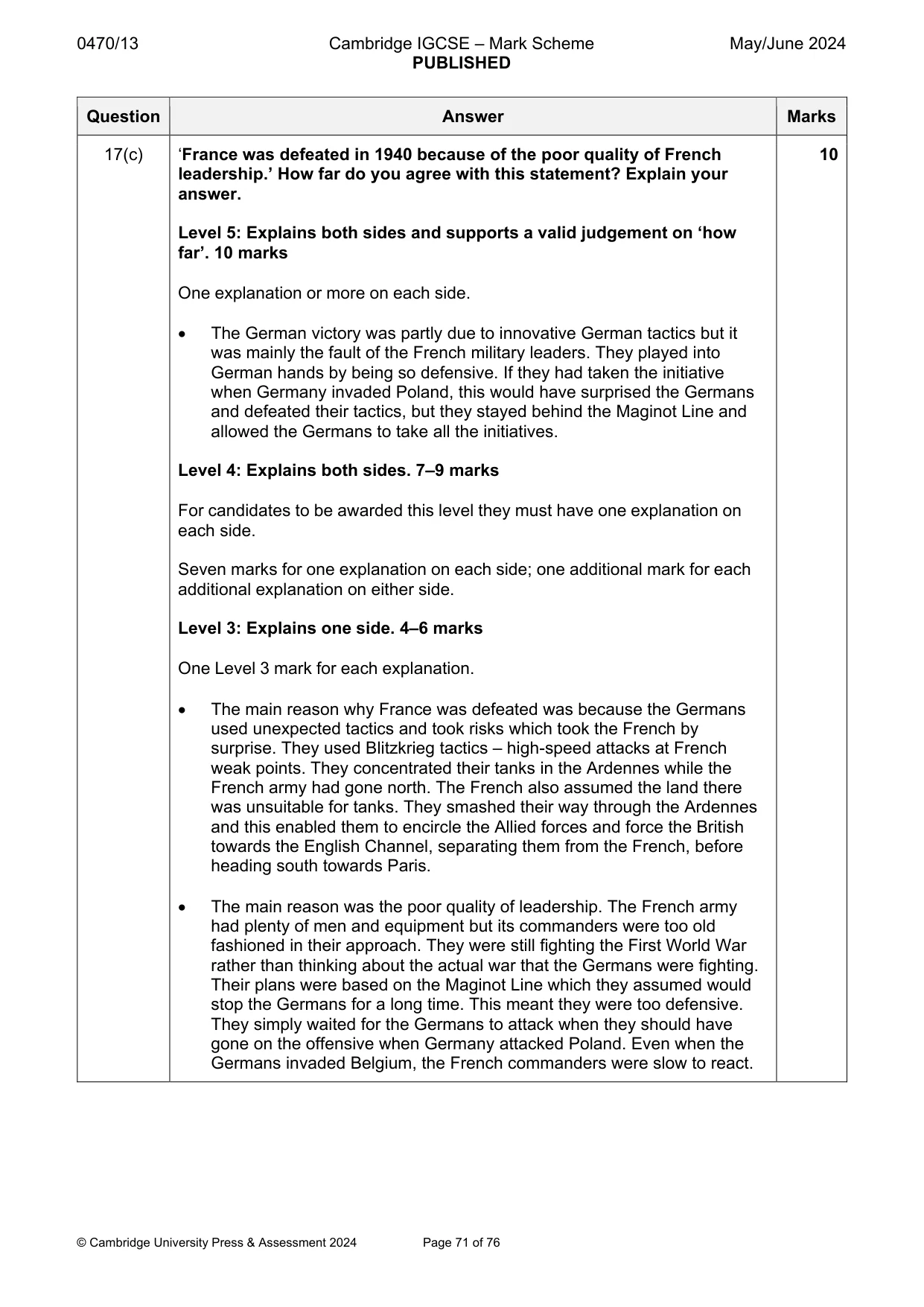
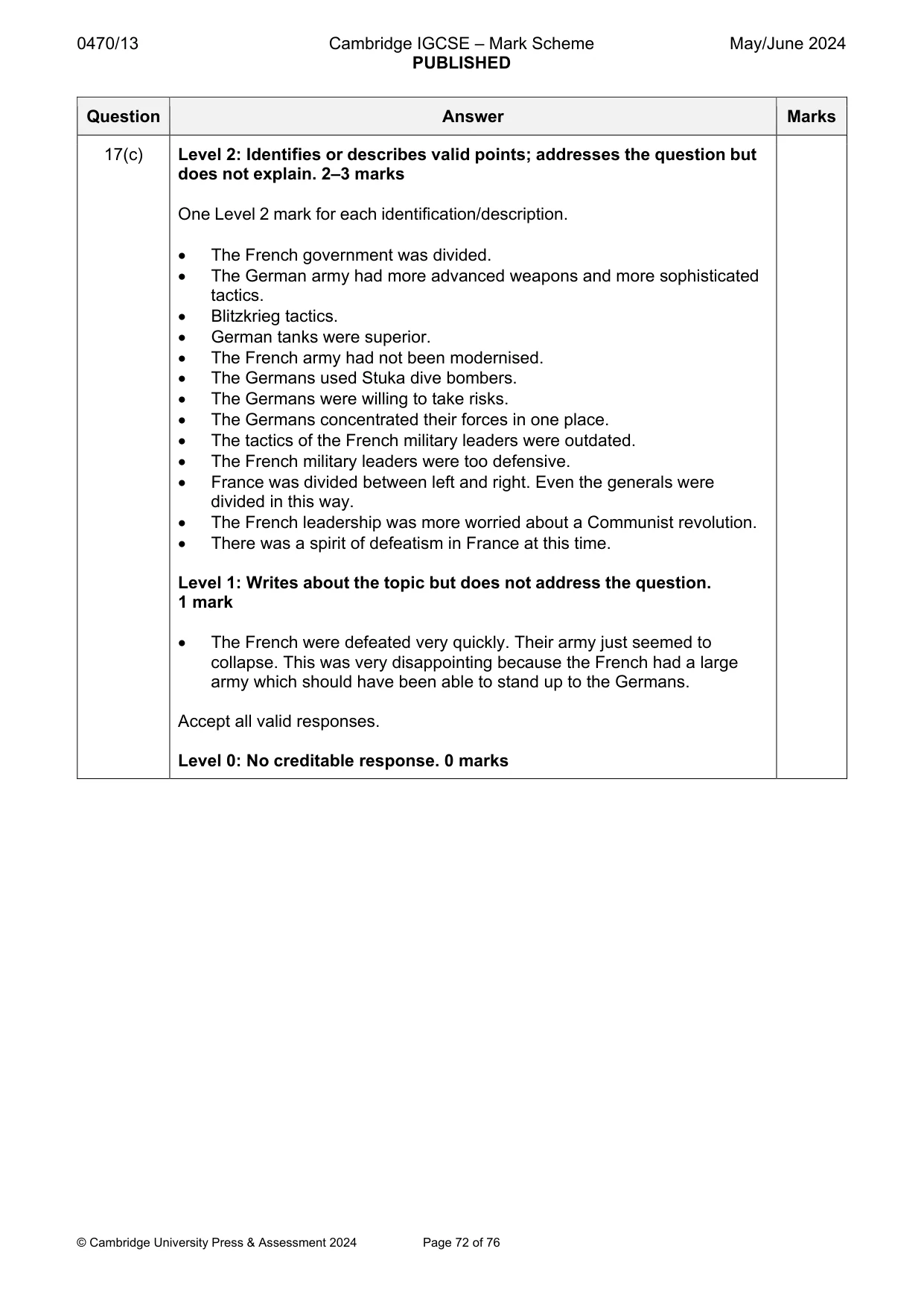
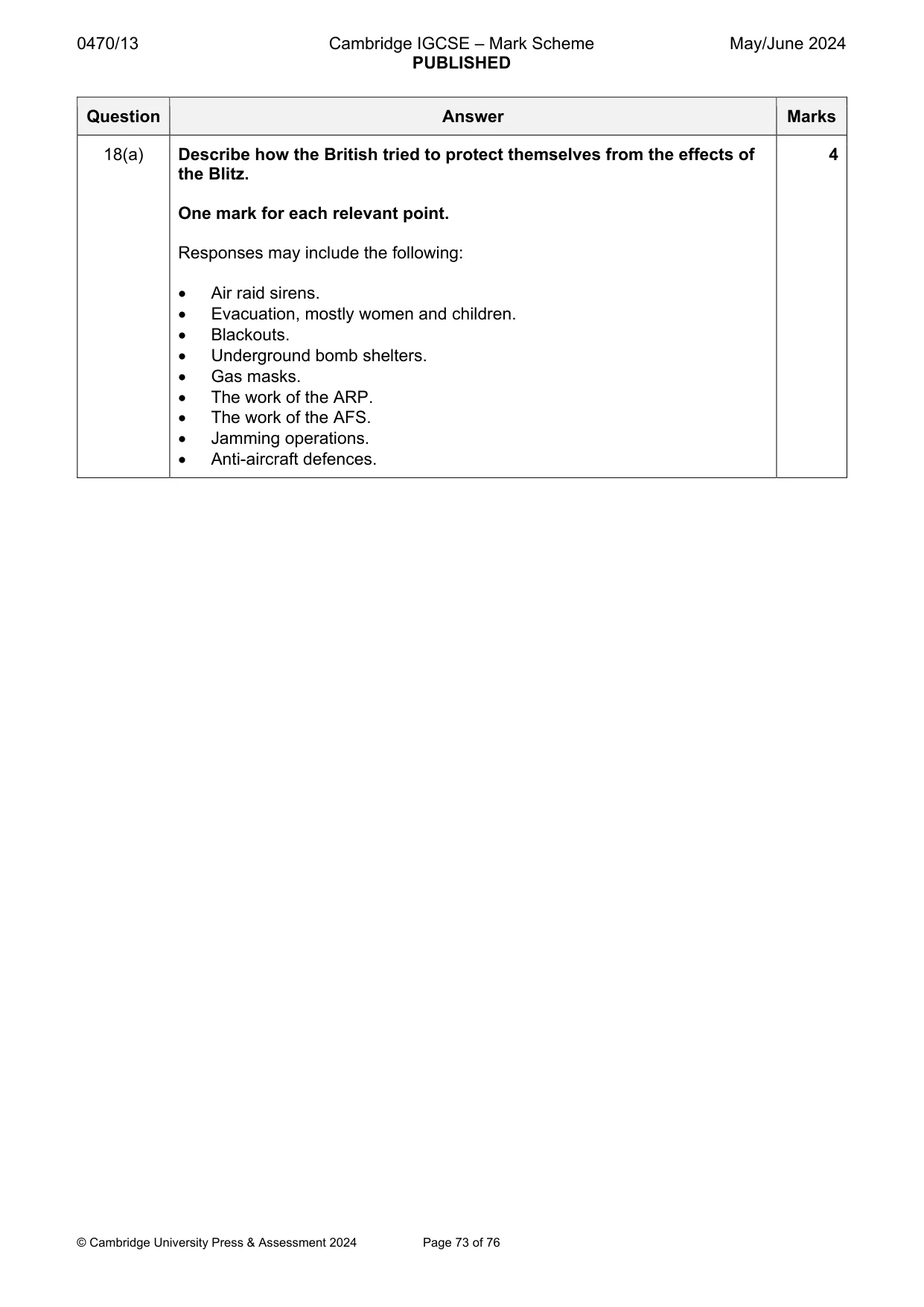
Paper as text
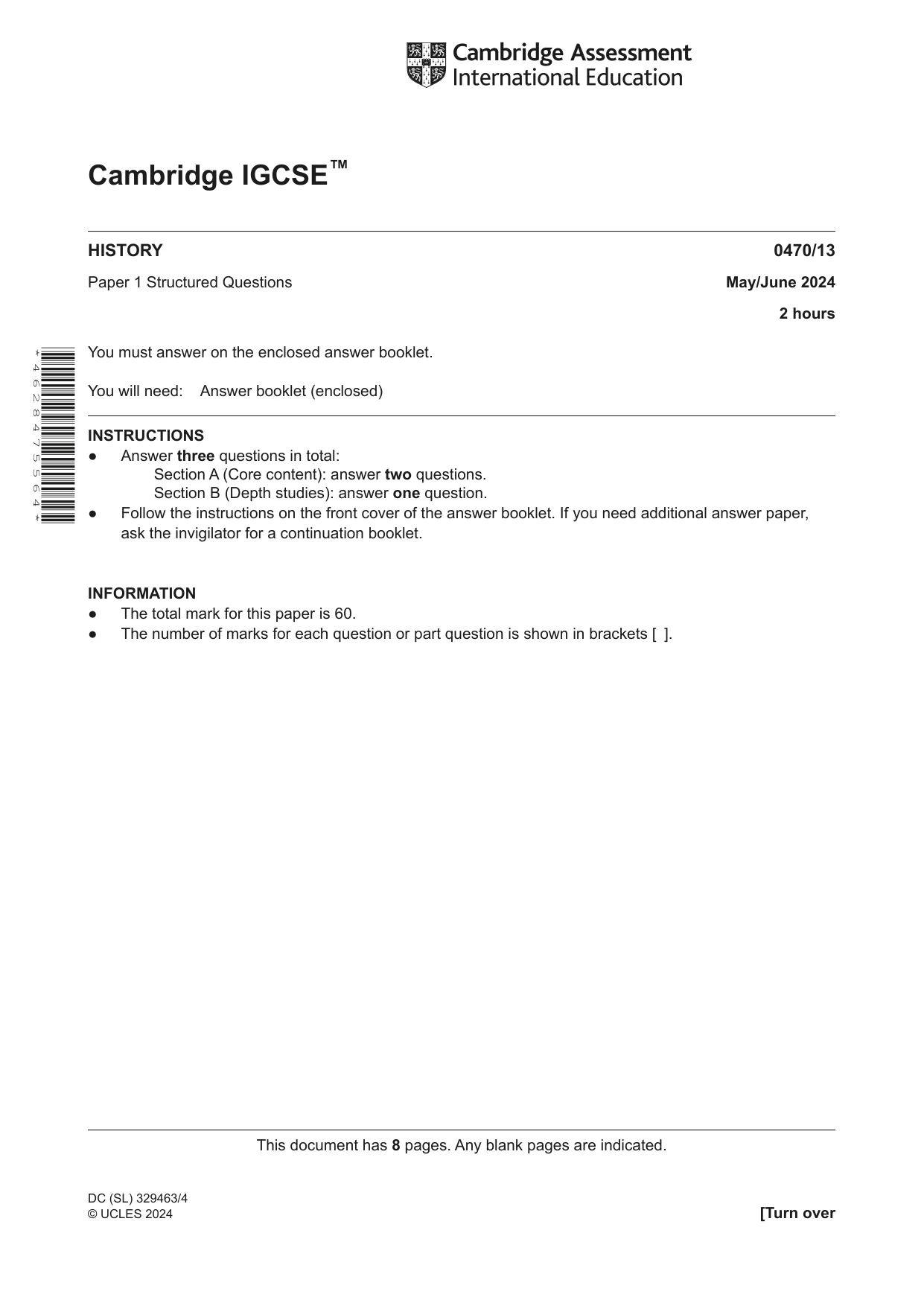
Question paper, page 1
This document has 8 pages. Any blank pages are indicated. [Turn over Cambridge IGCSE™ * 4 6 2 8 4 7 5 5 6 4 * HISTORY 0470/13 Paper 1 Structured Questions May/June 2024 2 hours You must answer on the enclosed answer booklet. You will need: Answer booklet (enclosed) INSTRUCTIONS ● Answer three questions in total: Section A (Core content): answer two questions. Section B (Depth studies): answer one question. ● Follow the instructions on the front cover of the answer booklet. If you need additional answer paper, ask the invigilator for a continuation booklet. INFORMATION ● The total mark for this paper is 60. ● The number of marks for each question or part question is shown in brackets [ ]. DC (SL) 329463/4 © UCLES 2024
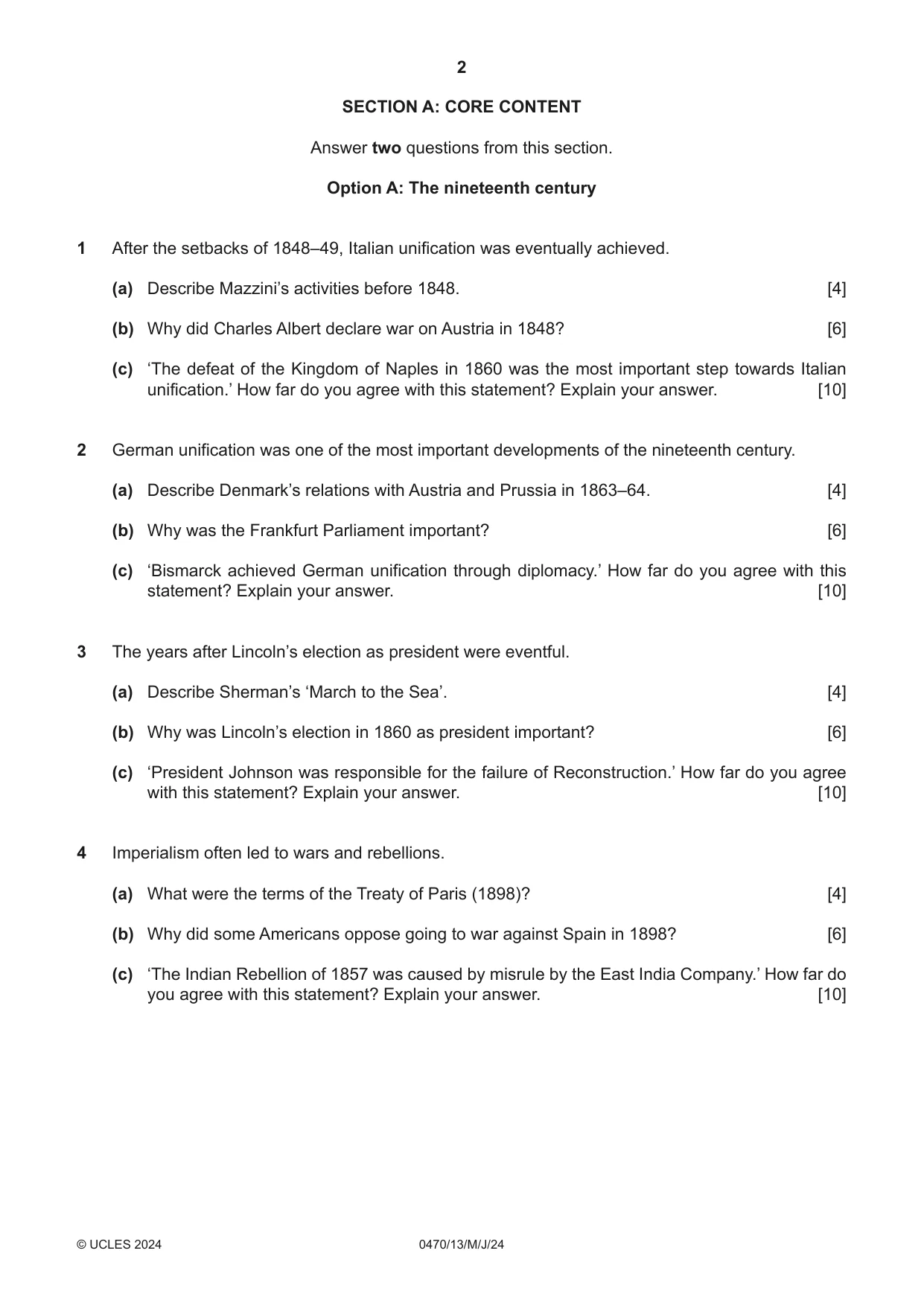
Question paper, page 2
2 0470/13/M/J/24 © UCLES 2024 SECTION A: CORE CONTENT Answer two questions from this section. Option A: The nineteenth century 1 After the setbacks of 1848–49, Italian unification was eventually achieved. (a) Describe Mazzini’s activities before 1848. [4] (b) Why did Charles Albert declare war on Austria in 1848? [6] (c) ‘The defeat of the Kingdom of Naples in 1860 was the most important step towards Italian unification.’ How far do you agree with this statement? Explain your answer. [10] 2 German unification was one of the most important developments of the nineteenth century. (a) Describe Denmark’s relations with Austria and Prussia in 1863–64. [4] (b) Why was the Frankfurt Parliament important? [6] (c) ‘Bismarck achieved German unification through diplomacy.’ How far do you agree with this statement? Explain your answer. [10] 3 The years after Lincoln’s election as president were eventful. (a) Describe Sherman’s ‘March to the Sea’. [4] (b) Why was Lincoln’s election in 1860 as president important? [6] (c) ‘President Johnson was responsible for the failure of Reconstruction.’ How far do you agree with this statement? Explain your answer. [10] 4 Imperialism often led to wars and rebellions. (a) What were the terms of the Treaty of Paris (1898)? [4] (b) Why did some Americans oppose going to war against Spain in 1898? [6] (c) ‘The Indian Rebellion of 1857 was caused by misrule by the East India Company.’ How far do you agree with this statement? Explain your answer. [10]
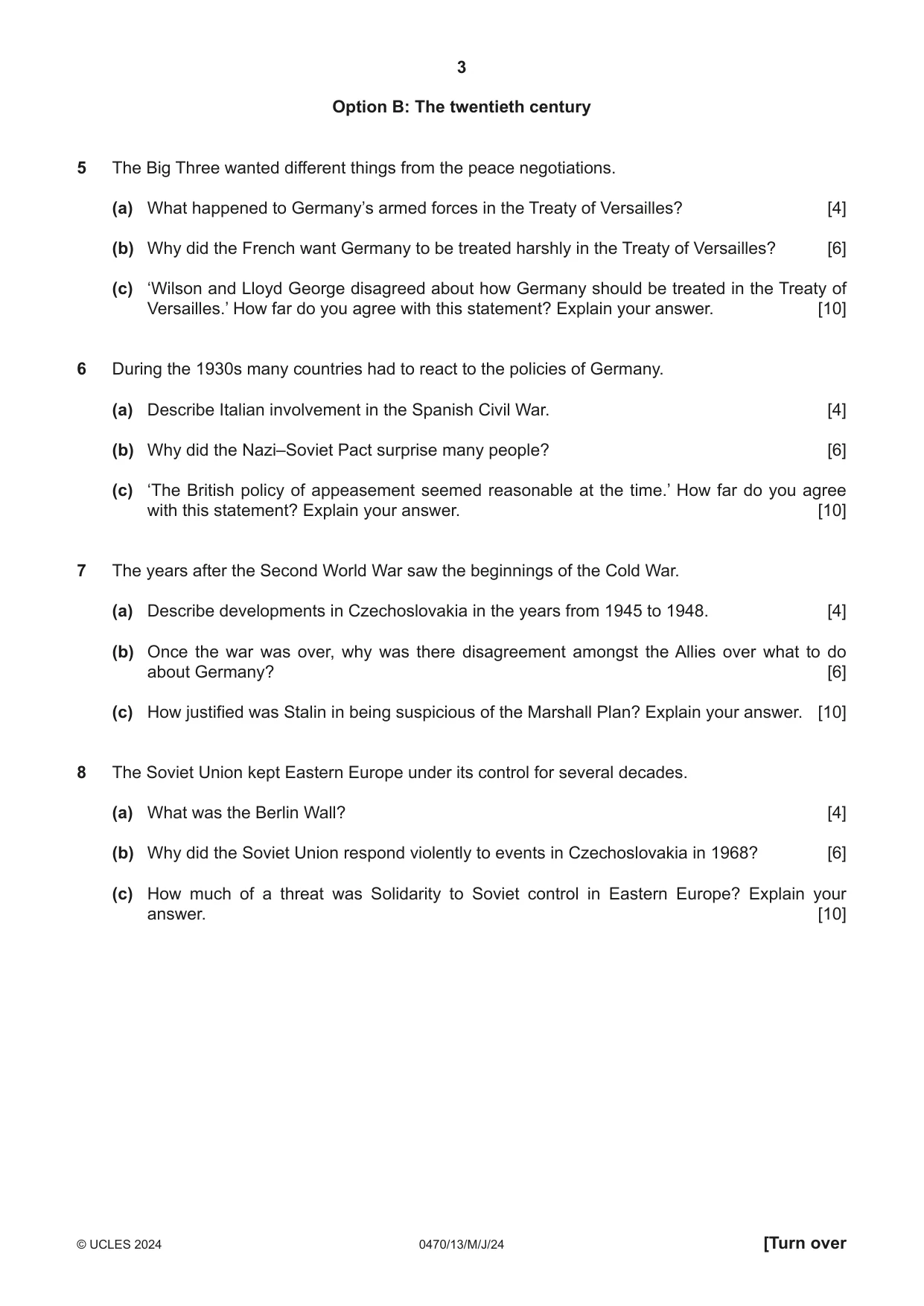
Question paper, page 3
3 0470/13/M/J/24 © UCLES 2024 [Turn over Option B: The twentieth century 5 The Big Three wanted different things from the peace negotiations. (a) What happened to Germany’s armed forces in the Treaty of Versailles? [4] (b) Why did the French want Germany to be treated harshly in the Treaty of Versailles? [6] (c) ‘Wilson and Lloyd George disagreed about how Germany should be treated in the Treaty of Versailles.’ How far do you agree with this statement? Explain your answer. [10] 6 During the 1930s many countries had to react to the policies of Germany. (a) Describe Italian involvement in the Spanish Civil War. [4] (b) Why did the Nazi–Soviet Pact surprise many people? [6] (c) ‘The British policy of appeasement seemed reasonable at the time.’ How far do you agree with this statement? Explain your answer. [10] 7 The years after the Second World War saw the beginnings of the Cold War. (a) Describe developments in Czechoslovakia in the years from 1945 to 1948. [4] (b) Once the war was over, why was there disagreement amongst the Allies over what to do about Germany? [6] (c) How justified was Stalin in being suspicious of the Marshall Plan? Explain your answer. [10] 8 The Soviet Union kept Eastern Europe under its control for several decades. (a) What was the Berlin Wall? [4] (b) Why did the Soviet Union respond violently to events in Czechoslovakia in 1968? [6] (c) How much of a threat was Solidarity to Soviet control in Eastern Europe? Explain your answer. [10]
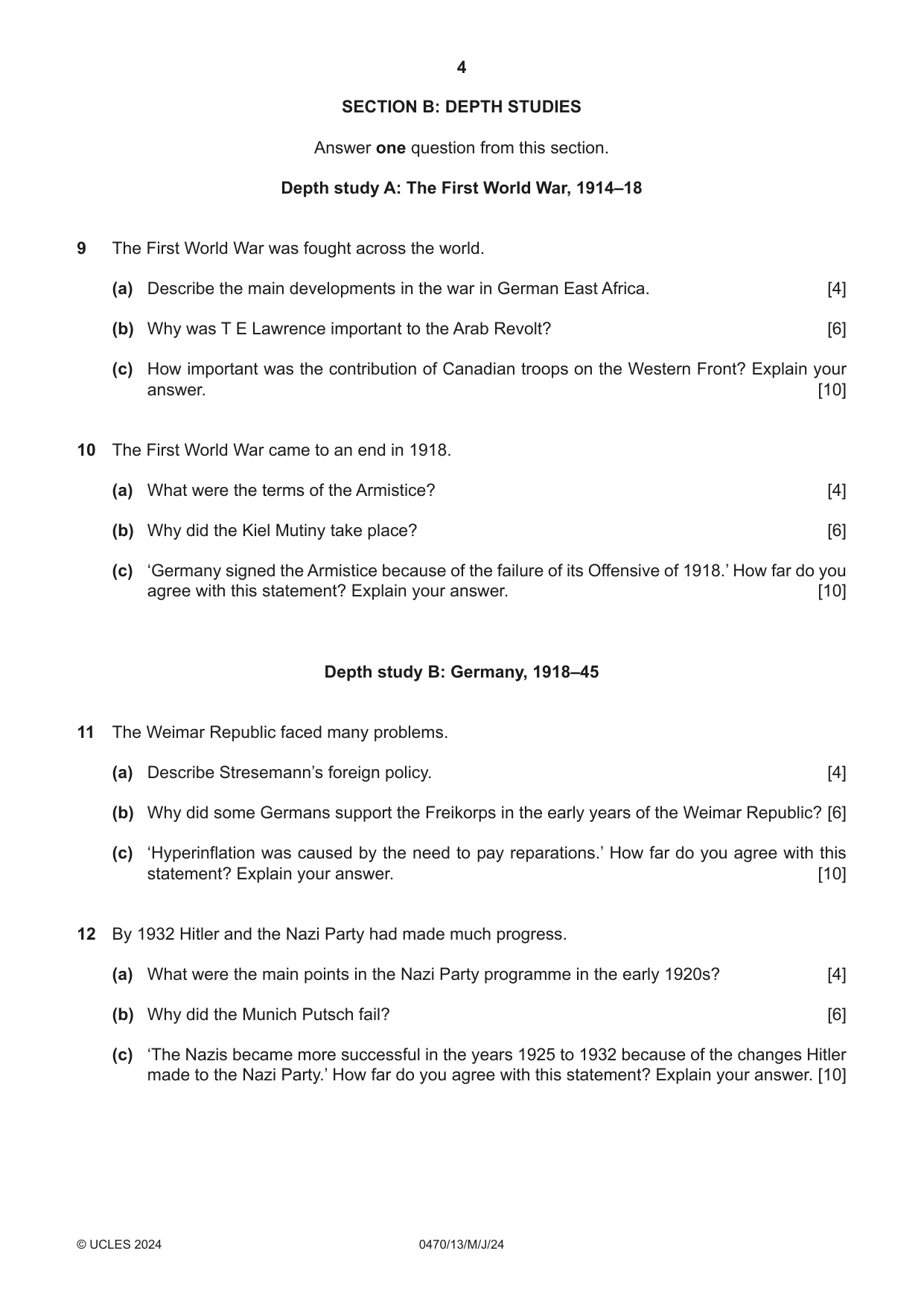
Question paper, page 4
4 0470/13/M/J/24 © UCLES 2024 SECTION B: DEPTH STUDIES Answer one question from this section. Depth study A: The First World War, 1914–18 9 The First World War was fought across the world. (a) Describe the main developments in the war in German East Africa. [4] (b) Why was T E Lawrence important to the Arab Revolt? [6] (c) How important was the contribution of Canadian troops on the Western Front? Explain your answer. [10] 10 The First World War came to an end in 1918. (a) What were the terms of the Armistice? [4] (b) Why did the Kiel Mutiny take place? [6] (c) ‘Germany signed the Armistice because of the failure of its Offensive of 1918.’ How far do you agree with this statement? Explain your answer. [10] Depth study B: Germany, 1918–45 11 The Weimar Republic faced many problems. (a) Describe Stresemann’s foreign policy. [4] (b) Why did some Germans support the Freikorps in the early years of the Weimar Republic? [6] (c) ‘Hyperinflation was caused by the need to pay reparations.’ How far do you agree with this statement? Explain your answer. [10] 12 By 1932 Hitler and the Nazi Party had made much progress. (a) What were the main points in the Nazi Party programme in the early 1920s? [4] (b) Why did the Munich Putsch fail? [6] (c) ‘The Nazis became more successful in the years 1925 to 1932 because of the changes Hitler made to the Nazi Party.’ How far do you agree with this statement? Explain your answer. [10]
Question paper, page 5
5 0470/13/M/J/24 © UCLES 2024 [Turn over Depth study C: Russia, 1905–41 13 War played an important part in Russian history at the beginning of the twentieth century. (a) Describe the impact of the First World War on the lives of the Russian people. [4] (b) Why was Stolypin important to the Tsar? [6] (c) ‘The Russo-Japanese War was the main cause of the 1905 Revolution.’ How far do you agree with this statement? Explain your answer. [10] 14 Stalin ensured that his hold on power was a strong one. (a) Describe the visible signs around the USSR of Stalin’s cult of personality. [4] (b) Why was there a struggle over who should follow Lenin as leader? [6] (c) ‘Stalin stayed in power because of the use of terror.’ How far do you agree with this statement? Explain your answer. [10] Depth study D: The United States, 1919–41 15 Hoover and Roosevelt had different ideas about how the United States should be governed. (a) What was buying ‘on the margin’? [4] (b) Why did the US economy have underlying weaknesses in the 1920s? [6] (c) Who was more responsible for the result of the 1932 presidential election: Hoover or Roosevelt? Explain your answer. [10] 16 Opinion in the United States over Roosevelt and the New Deal was divided. (a) What was the Tennessee Valley Authority (TVA)? [4] (b) Why did black Americans benefit less from the New Deal than other social groups? [6] (c) ‘The main reason why there was opposition to the New Deal was because it did not do enough to solve the Depression.’ How far do you agree with this statement? Explain your answer. [10]
Question paper, page 6
6 0470/13/M/J/24 © UCLES 2024 Depth study E: The Second World War in Europe and the Asia-Pacific, 1939–c.1945 17 Germany had some startling successes at the beginning of the Second World War. (a) What was the Vichy government? [4] (b) Why did Hitler decide not to invade Britain? [6] (c) ‘France was defeated in 1940 because of the poor quality of French leadership.’ How far do you agree with this statement? Explain your answer. [10] 18 The experiences of civilians differed widely during the Second World War. (a) Describe how the British tried to protect themselves from the effects of the Blitz. [4] (b) Why did the Nazis treat the Polish people so badly? [6] (c) ‘The French Resistance was more effective than the resistance movement in Malaya.’ How far do you agree with this statement? Explain your answer. [10]
Question paper, page 7
7 0470/13/M/J/24 © UCLES 2024 BLANK PAGE
Question paper, page 8
8 0470/13/M/J/24 © UCLES 2024 Permission to reproduce items where third-party owned material protected by copyright is included has been sought and cleared where possible. Every reasonable effort has been made by the publisher (UCLES) to trace copyright holders, but if any items requiring clearance have unwittingly been included, the publisher will be pleased to make amends at the earliest possible opportunity. To avoid the issue of disclosure of answer-related information to candidates, all copyright acknowledgements are reproduced online in the Cambridge Assessment International Education Copyright Acknowledgements Booklet. This is produced for each series of examinations and is freely available to download at www.cambridgeinternational.org after the live examination series. Cambridge Assessment International Education is part of Cambridge Assessment. Cambridge Assessment is the brand name of the University of Cambridge Local Examinations Syndicate (UCLES), which is a department of the University of Cambridge. BLANK PAGE
Mark scheme, page 1
This document consists of 76 printed pages. © Cambridge University Press & Assessment 2024 [Turn over Cambridge IGCSE™ HISTORY 0470/13 Paper 1 May/June 2024 MARK SCHEME Maximum Mark: 60 Published This mark scheme is published as an aid to teachers and candidates, to indicate the requirements of the examination. It shows the basis on which Examiners were instructed to award marks. It does not indicate the details of the discussions that took place at an Examiners’ meeting before marking began, which would have considered the acceptability of alternative answers. Mark schemes should be read in conjunction with the question paper and the Principal Examiner Report for Teachers. Cambridge International will not enter into discussions about these mark schemes. Cambridge International is publishing the mark schemes for the May/June 2024 series for most Cambridge IGCSE, Cambridge International A and AS Level and Cambridge Pre-U components, and some Cambridge O Level components.
Mark scheme, page 2
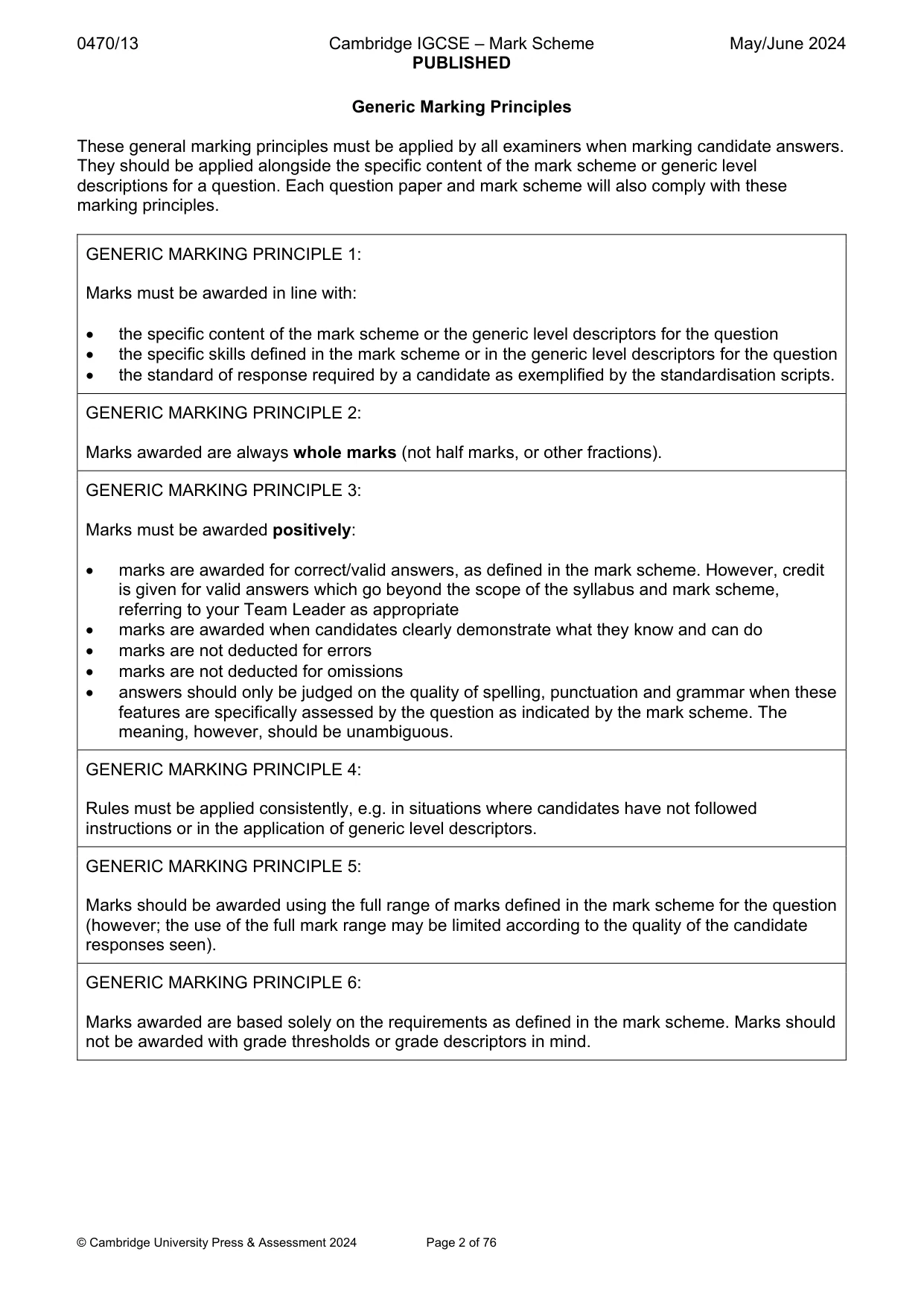
0470/13 Cambridge IGCSE – Mark Scheme PUBLISHED May/June 2024 © Cambridge University Press & Assessment 2024 Page 2 of 76 Generic Marking Principles These general marking principles must be applied by all examiners when marking candidate answers. They should be applied alongside the specific content of the mark scheme or generic level descriptions for a question. Each question paper and mark scheme will also comply with these marking principles. GENERIC MARKING PRINCIPLE 1: Marks must be awarded in line with: the specific content of the mark scheme or the generic level descriptors for the question the specific skills defined in the mark scheme or in the generic level descriptors for the question the standard of response required by a candidate as exemplified by the standardisation scripts. GENERIC MARKING PRINCIPLE 2: Marks awarded are always whole marks (not half marks, or other fractions). GENERIC MARKING PRINCIPLE 3: Marks must be awarded positively: marks are awarded for correct/valid answers, as defined in the mark scheme. However, credit is given for valid answers which go beyond the scope of the syllabus and mark scheme, referring to your Team Leader as appropriate marks are awarded when candidates clearly demonstrate what they know and can do marks are not deducted for errors marks are not deducted for omissions answers should only be judged on the quality of spelling, punctuation and grammar when these features are specifically assessed by the question as indicated by the mark scheme. The meaning, however, should be unambiguous. GENERIC MARKING PRINCIPLE 4: Rules must be applied consistently, e.g. in situations where candidates have not followed instructions or in the application of generic level descriptors. GENERIC MARKING PRINCIPLE 5: Marks should be awarded using the full range of marks defined in the mark scheme for the question (however; the use of the full mark range may be limited according to the quality of the candidate responses seen). GENERIC MARKING PRINCIPLE 6: Marks awarded are based solely on the requirements as defined in the mark scheme. Marks should not be awarded with grade thresholds or grade descriptors in mind.
Mark scheme, page 3
0470/13 Cambridge IGCSE – Mark Scheme PUBLISHED May/June 2024 © Cambridge University Press & Assessment 2024 Page 3 of 76 Assessment objectives AO1 An ability to recall, select, organise and deploy knowledge of the syllabus content. AO2 An ability to construct historical explanations using an understanding of: cause and consequence, change and continuity, similarity and difference the motives, emotions, intentions and beliefs of people in the past.
Mark scheme, page 4
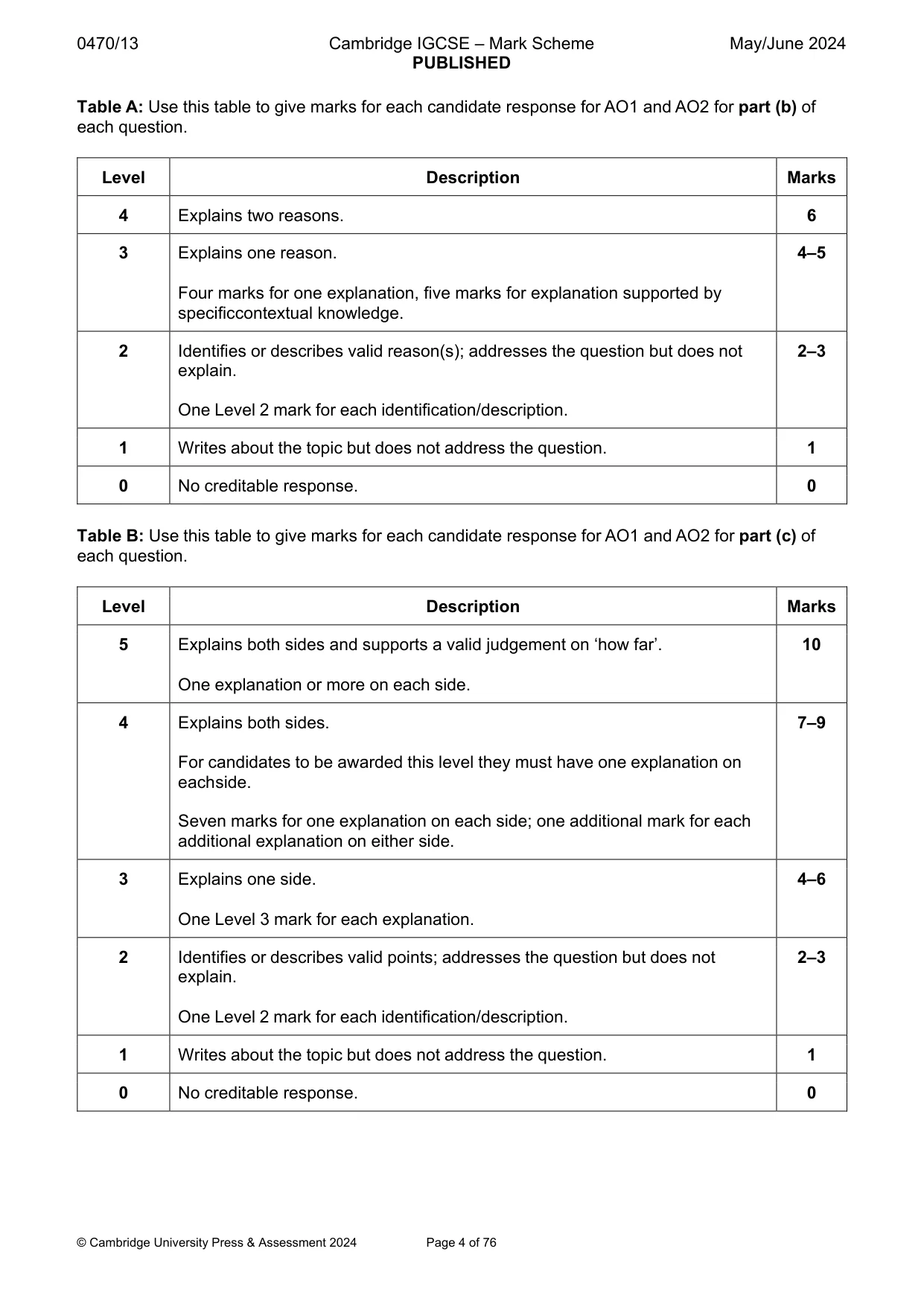
0470/13 Cambridge IGCSE – Mark Scheme PUBLISHED May/June 2024 © Cambridge University Press & Assessment 2024 Page 4 of 76 Table A: Use this table to give marks for each candidate response for AO1 and AO2 for part (b) of each question. Level Description Marks 4 Explains two reasons. 6 3 Explains one reason. Four marks for one explanation, five marks for explanation supported by specific contextual knowledge. 4–5 2 Identifies or describes valid reason(s); addresses the question but does not explain. One Level 2 mark for each identification/description. 2–3 1 Writes about the topic but does not address the question. 1 0 No creditable response. 0 Table B: Use this table to give marks for each candidate response for AO1 and AO2 for part (c) of each question. Level Description Marks 5 Explains both sides and supports a valid judgement on ‘how far’. One explanation or more on each side. 10 4 Explains both sides. For candidates to be awarded this level they must have one explanation on each side. Seven marks for one explanation on each side; one additional mark for each additional explanation on either side. 7–9 3 Explains one side. One Level 3 mark for each explanation. 4–6 2 Identifies or describes valid points; addresses the question but does not explain. One Level 2 mark for each identification/description. 2–3 1 Writes about the topic but does not address the question. 1 0 No creditable response. 0
Mark scheme, page 5
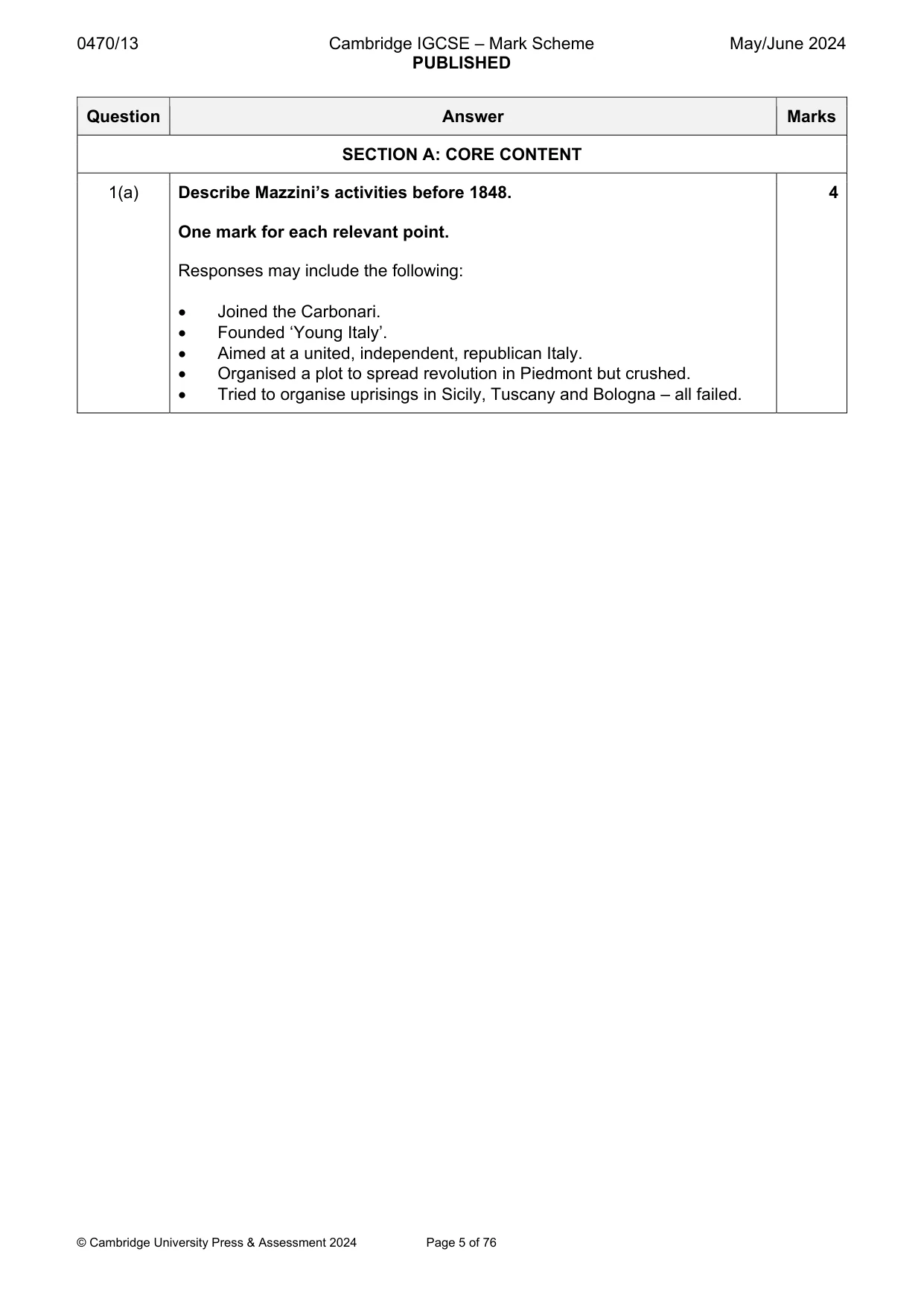
0470/13 Cambridge IGCSE – Mark Scheme PUBLISHED May/June 2024 © Cambridge University Press & Assessment 2024 Page 5 of 76 Question Answer Marks SECTION A: CORE CONTENT 1(a) Describe Mazzini’s activities before 1848. One mark for each relevant point. Responses may include the following: Joined the Carbonari. Founded ‘Young Italy’. Aimed at a united, independent, republican Italy. Organised a plot to spread revolution in Piedmont but crushed. Tried to organise uprisings in Sicily, Tuscany and Bologna – all failed. 4
Mark scheme, page 6
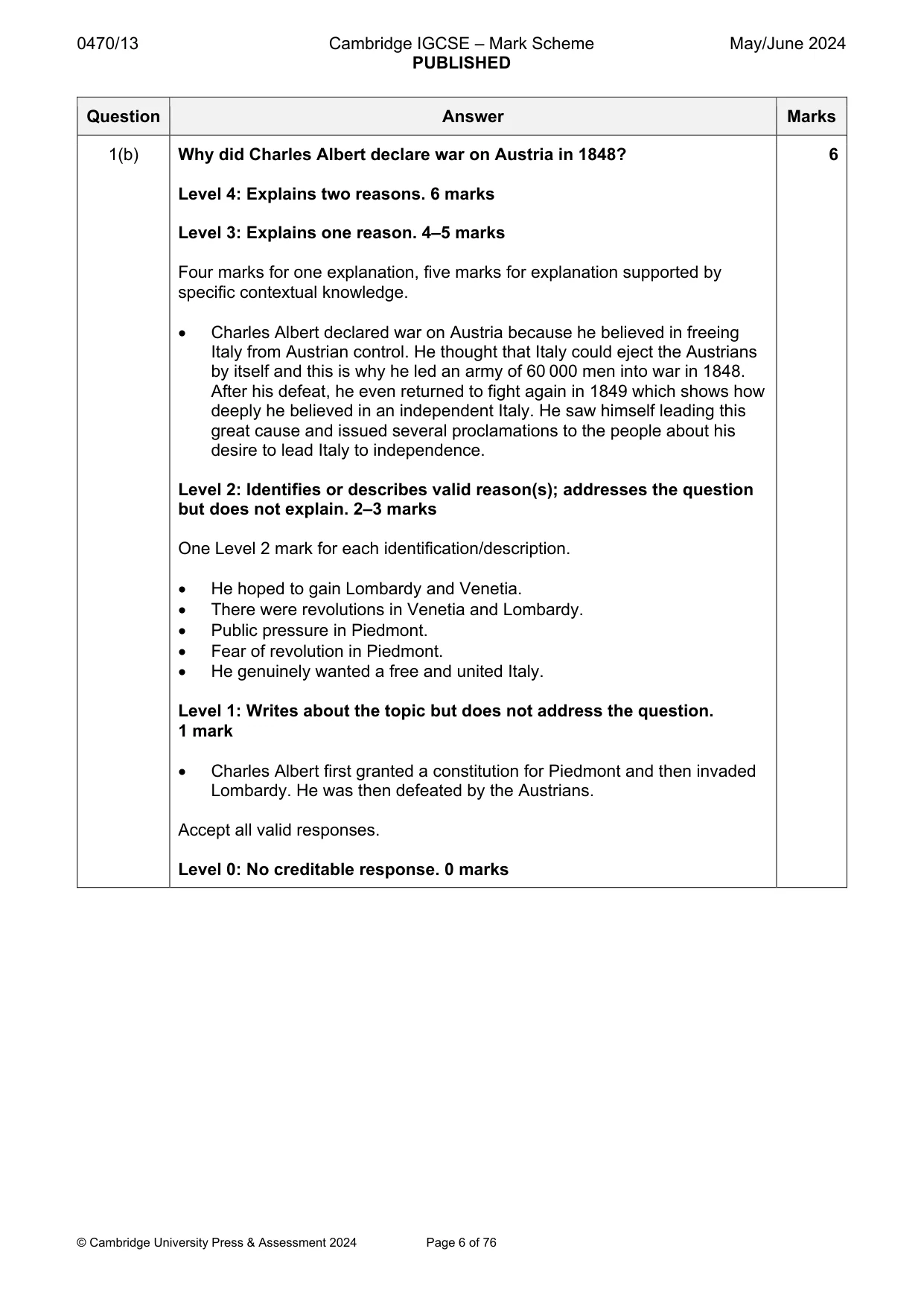
0470/13 Cambridge IGCSE – Mark Scheme PUBLISHED May/June 2024 © Cambridge University Press & Assessment 2024 Page 6 of 76 Question Answer Marks 1(b) Why did Charles Albert declare war on Austria in 1848? Level 4: Explains two reasons. 6 marks Level 3: Explains one reason. 4–5 marks Four marks for one explanation, five marks for explanation supported by specific contextual knowledge. Charles Albert declared war on Austria because he believed in freeing Italy from Austrian control. He thought that Italy could eject the Austrians by itself and this is why he led an army of 60 000 men into war in 1848. After his defeat, he even returned to fight again in 1849 which shows how deeply he believed in an independent Italy. He saw himself leading this great cause and issued several proclamations to the people about his desire to lead Italy to independence. Level 2: Identifies or describes valid reason(s); addresses the question but does not explain. 2–3 marks One Level 2 mark for each identification/description. He hoped to gain Lombardy and Venetia. There were revolutions in Venetia and Lombardy. Public pressure in Piedmont. Fear of revolution in Piedmont. He genuinely wanted a free and united Italy. Level 1: Writes about the topic but does not address the question. 1 mark Charles Albert first granted a constitution for Piedmont and then invaded Lombardy. He was then defeated by the Austrians. Accept all valid responses. Level 0: No creditable response. 0 marks 6
Mark scheme, page 7
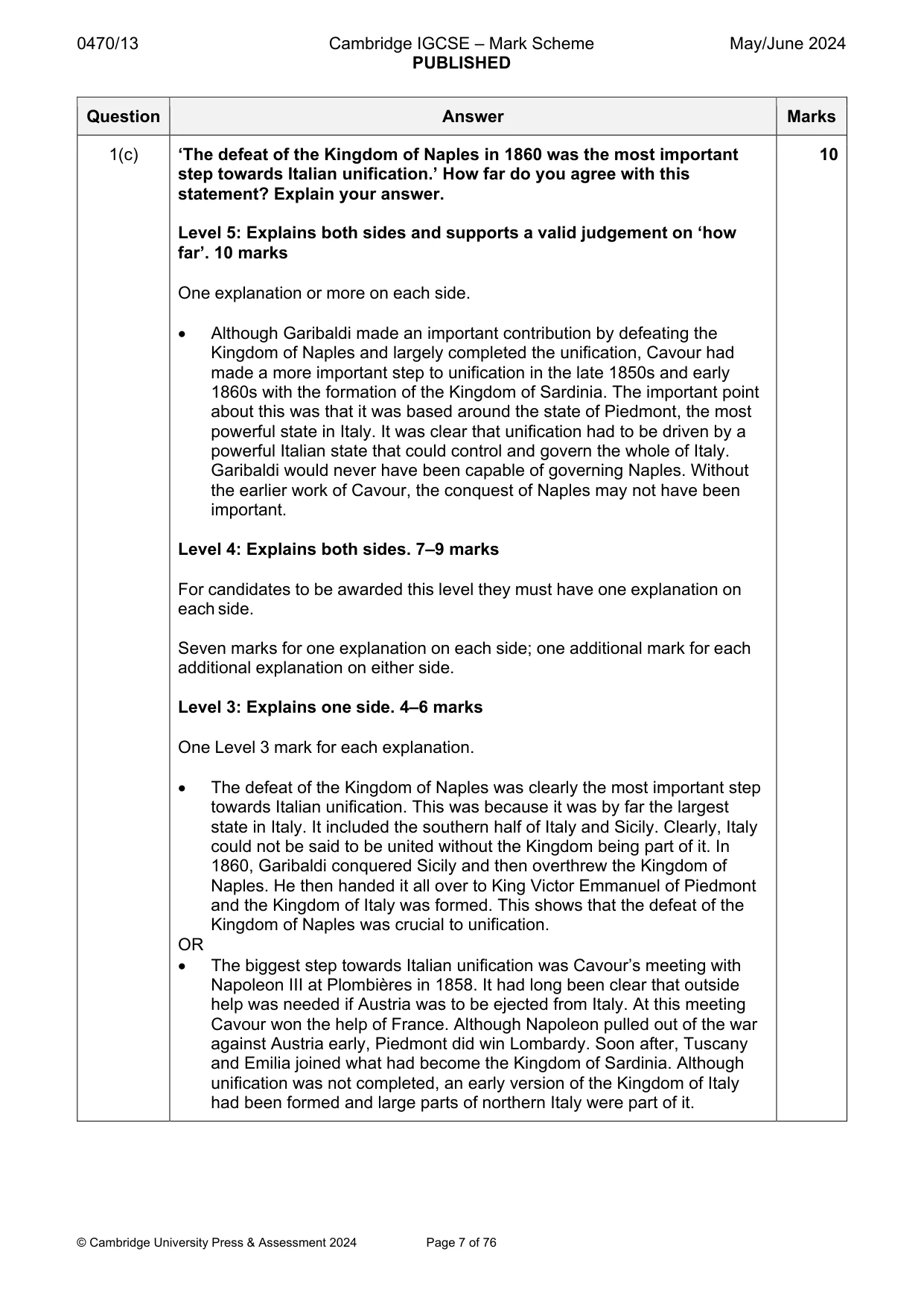
0470/13 Cambridge IGCSE – Mark Scheme PUBLISHED May/June 2024 © Cambridge University Press & Assessment 2024 Page 7 of 76 Question Answer Marks 1(c) ‘The defeat of the Kingdom of Naples in 1860 was the most important step towards Italian unification.’ How far do you agree with this statement? Explain your answer. Level 5: Explains both sides and supports a valid judgement on ‘how far’. 10 marks One explanation or more on each side. Although Garibaldi made an important contribution by defeating the Kingdom of Naples and largely completed the unification, Cavour had made a more important step to unification in the late 1850s and early 1860s with the formation of the Kingdom of Sardinia. The important point about this was that it was based around the state of Piedmont, the most powerful state in Italy. It was clear that unification had to be driven by a powerful Italian state that could control and govern the whole of Italy. Garibaldi would never have been capable of governing Naples. Without the earlier work of Cavour, the conquest of Naples may not have been important. Level 4: Explains both sides. 7–9 marks For candidates to be awarded this level they must have one explanation on each side. Seven marks for one explanation on each side; one additional mark for each additional explanation on either side. Level 3: Explains one side. 4–6 marks One Level 3 mark for each explanation. The defeat of the Kingdom of Naples was clearly the most important step towards Italian unification. This was because it was by far the largest state in Italy. It included the southern half of Italy and Sicily. Clearly, Italy could not be said to be united without the Kingdom being part of it. In 1860, Garibaldi conquered Sicily and then overthrew the Kingdom of Naples. He then handed it all over to King Victor Emmanuel of Piedmont and the Kingdom of Italy was formed. This shows that the defeat of the Kingdom of Naples was crucial to unification. OR The biggest step towards Italian unification was Cavour’s meeting with Napoleon III at Plombières in 1858. It had long been clear that outside help was needed if Austria was to be ejected from Italy. At this meeting Cavour won the help of France. Although Napoleon pulled out of the war against Austria early, Piedmont did win Lombardy. Soon after, Tuscany and Emilia joined what had become the Kingdom of Sardinia. Although unification was not completed, an early version of the Kingdom of Italy had been formed and large parts of northern Italy were part of it. 10
Mark scheme, page 8
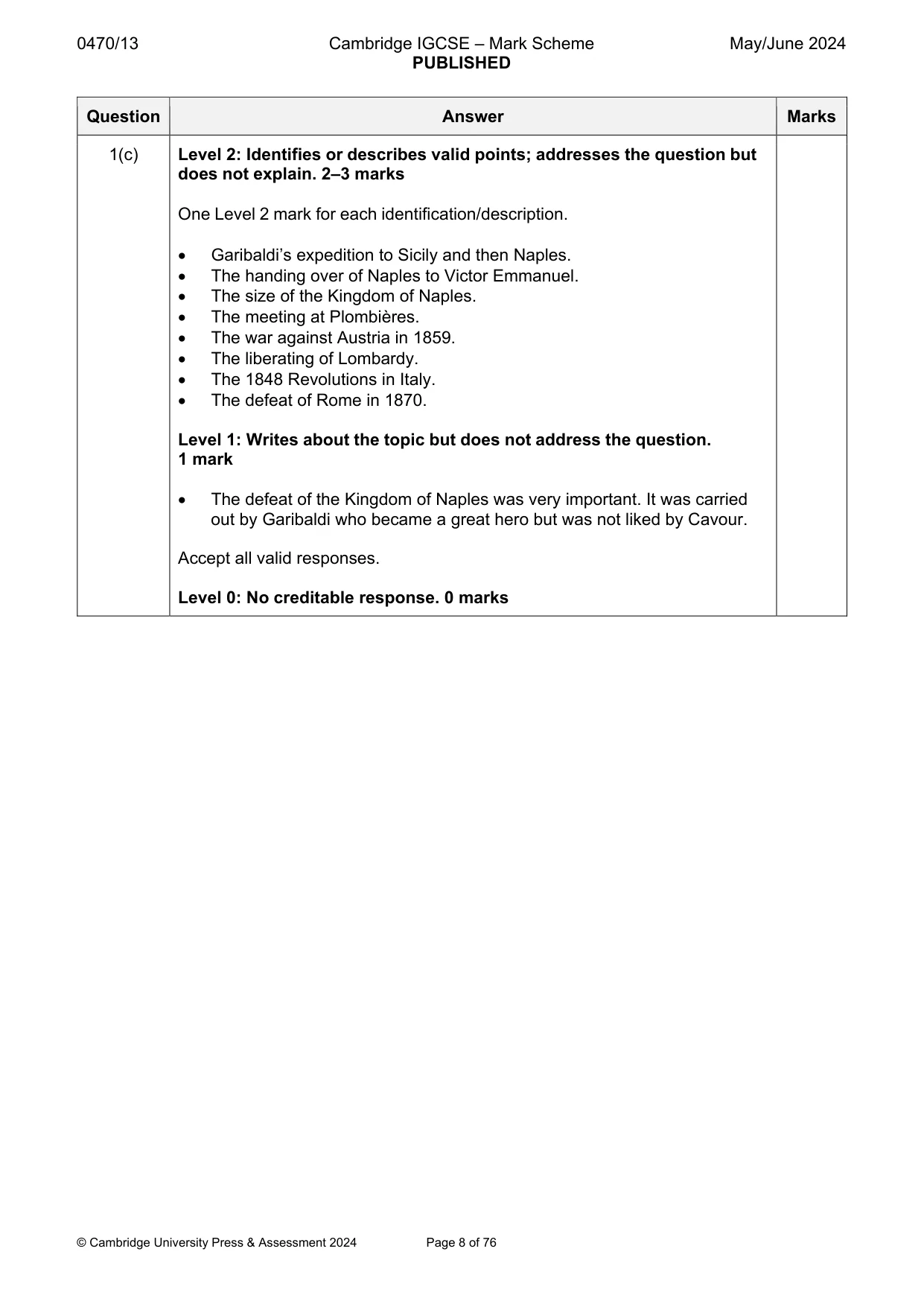
0470/13 Cambridge IGCSE – Mark Scheme PUBLISHED May/June 2024 © Cambridge University Press & Assessment 2024 Page 8 of 76 Question Answer Marks 1(c) Level 2: Identifies or describes valid points; addresses the question but does not explain. 2–3 marks One Level 2 mark for each identification/description. Garibaldi’s expedition to Sicily and then Naples. The handing over of Naples to Victor Emmanuel. The size of the Kingdom of Naples. The meeting at Plombières. The war against Austria in 1859. The liberating of Lombardy. The 1848 Revolutions in Italy. The defeat of Rome in 1870. Level 1: Writes about the topic but does not address the question. 1 mark The defeat of the Kingdom of Naples was very important. It was carried out by Garibaldi who became a great hero but was not liked by Cavour. Accept all valid responses. Level 0: No creditable response. 0 marks
Mark scheme, page 9
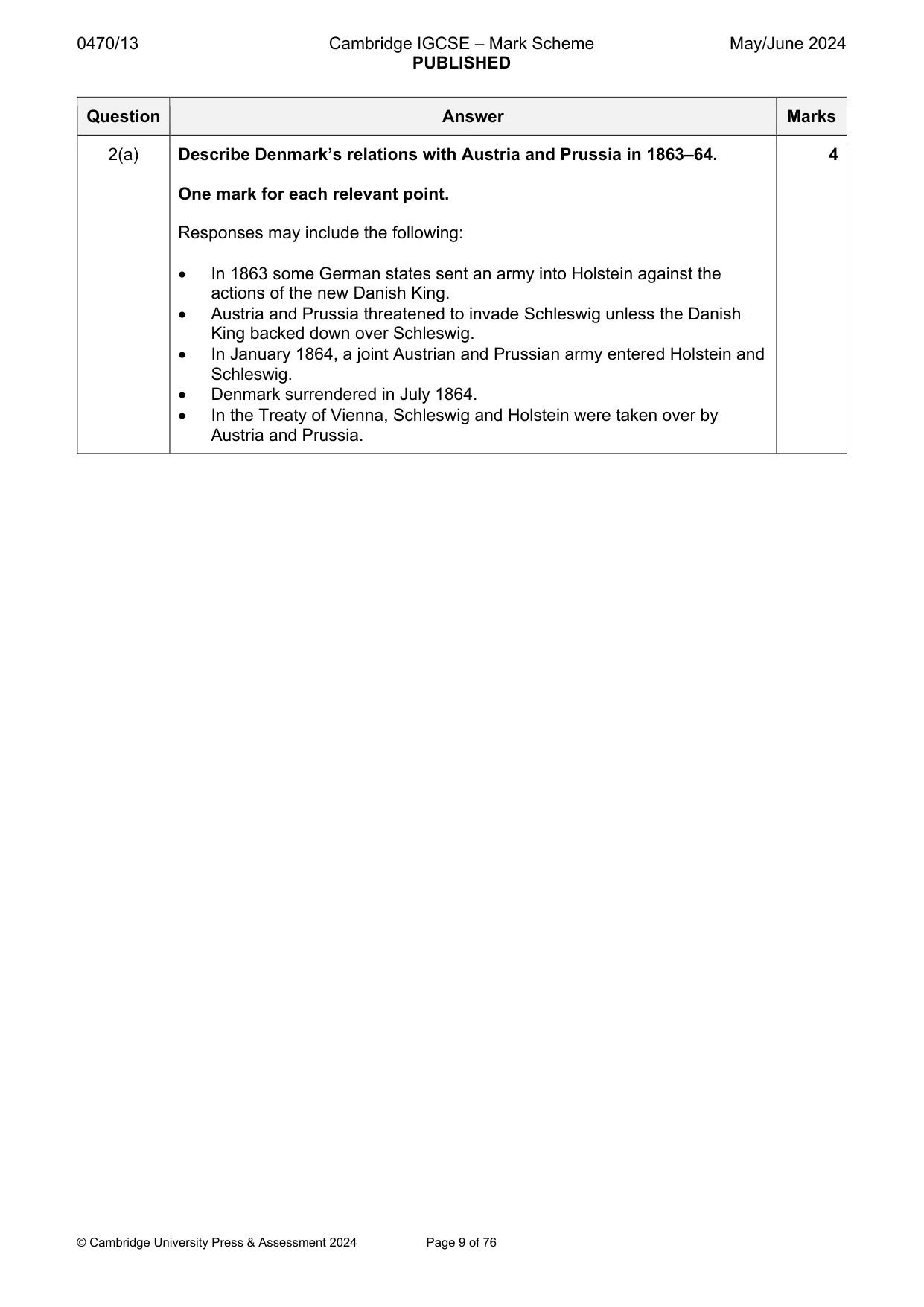
0470/13 Cambridge IGCSE – Mark Scheme PUBLISHED May/June 2024 © Cambridge University Press & Assessment 2024 Page 9 of 76 Question Answer Marks 2(a) Describe Denmark’s relations with Austria and Prussia in 1863–64. One mark for each relevant point. Responses may include the following: In 1863 some German states sent an army into Holstein against the actions of the new Danish King. Austria and Prussia threatened to invade Schleswig unless the Danish King backed down over Schleswig. In January 1864, a joint Austrian and Prussian army entered Holstein and Schleswig. Denmark surrendered in July 1864. In the Treaty of Vienna, Schleswig and Holstein were taken over by Austria and Prussia. 4
Mark scheme, page 10
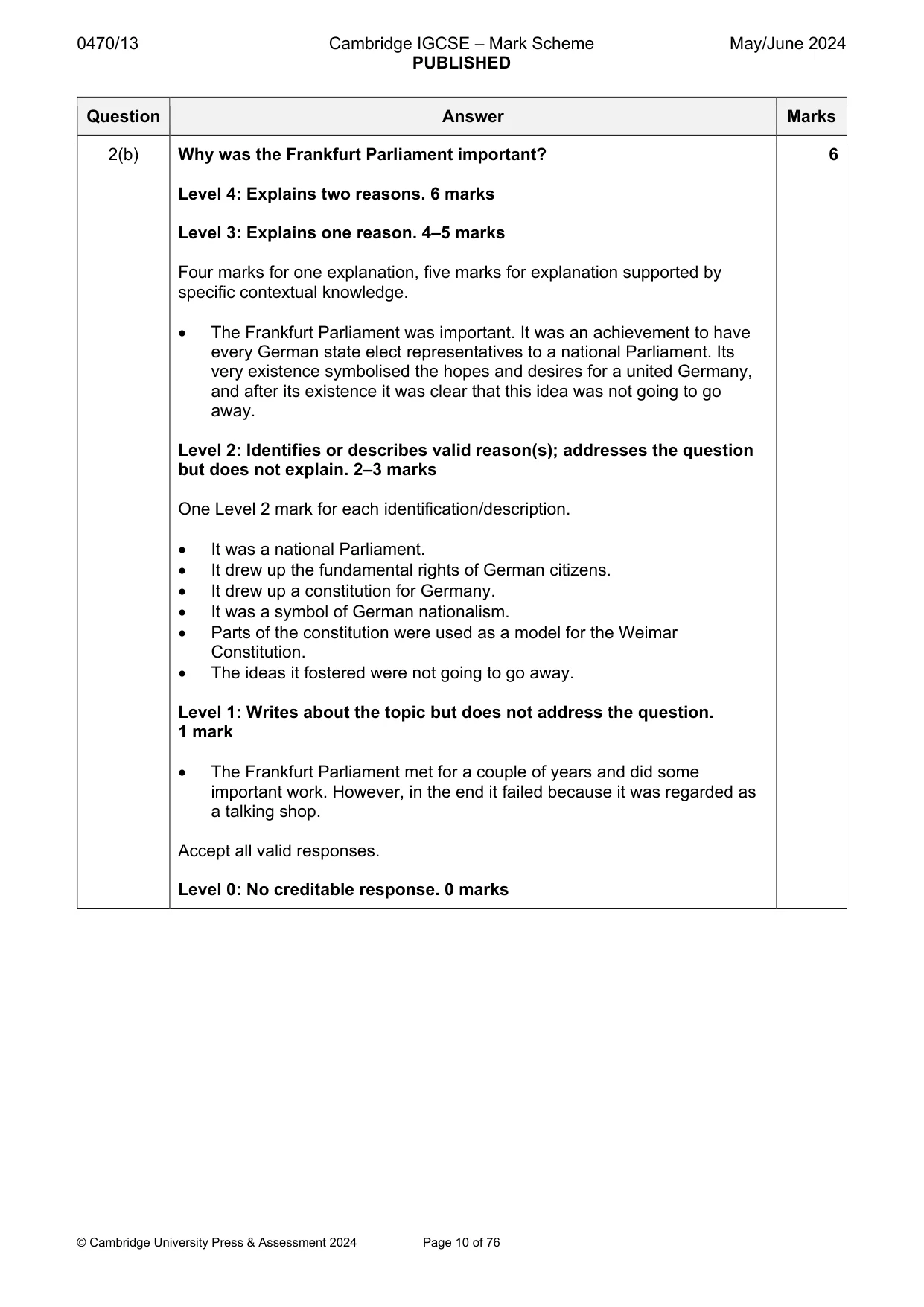
0470/13 Cambridge IGCSE – Mark Scheme PUBLISHED May/June 2024 © Cambridge University Press & Assessment 2024 Page 10 of 76 Question Answer Marks 2(b) Why was the Frankfurt Parliament important? Level 4: Explains two reasons. 6 marks Level 3: Explains one reason. 4–5 marks Four marks for one explanation, five marks for explanation supported by specific contextual knowledge. The Frankfurt Parliament was important. It was an achievement to have every German state elect representatives to a national Parliament. Its very existence symbolised the hopes and desires for a united Germany, and after its existence it was clear that this idea was not going to go away. Level 2: Identifies or describes valid reason(s); addresses the question but does not explain. 2–3 marks One Level 2 mark for each identification/description. It was a national Parliament. It drew up the fundamental rights of German citizens. It drew up a constitution for Germany. It was a symbol of German nationalism. Parts of the constitution were used as a model for the Weimar Constitution. The ideas it fostered were not going to go away. Level 1: Writes about the topic but does not address the question. 1 mark The Frankfurt Parliament met for a couple of years and did some important work. However, in the end it failed because it was regarded as a talking shop. Accept all valid responses. Level 0: No creditable response. 0 marks 6
Mark scheme, page 11
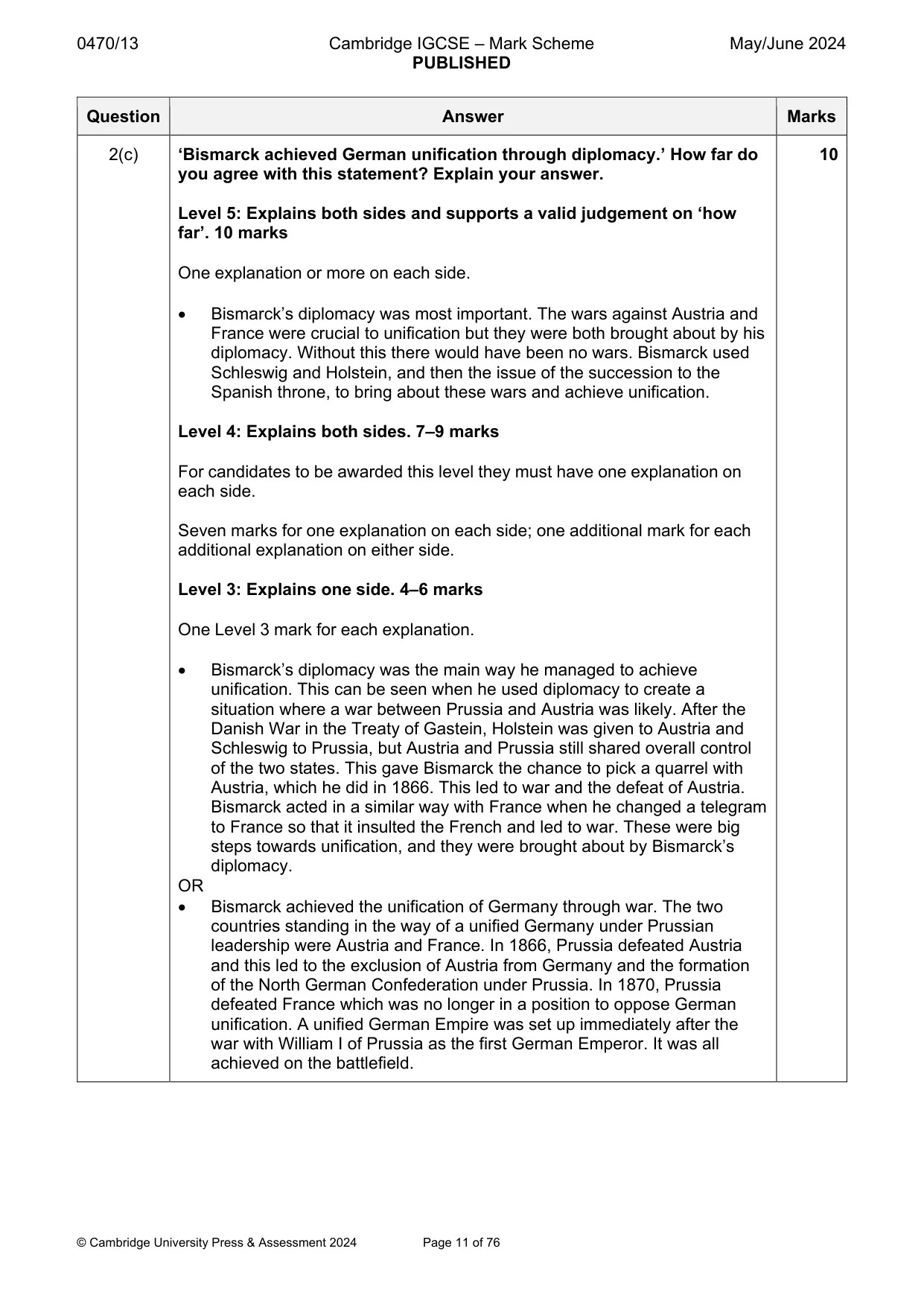
0470/13 Cambridge IGCSE – Mark Scheme PUBLISHED May/June 2024 © Cambridge University Press & Assessment 2024 Page 11 of 76 Question Answer Marks 2(c) ‘Bismarck achieved German unification through diplomacy.’ How far do you agree with this statement? Explain your answer. Level 5: Explains both sides and supports a valid judgement on ‘how far’. 10 marks One explanation or more on each side. Bismarck’s diplomacy was most important. The wars against Austria and France were crucial to unification but they were both brought about by his diplomacy. Without this there would have been no wars. Bismarck used Schleswig and Holstein, and then the issue of the succession to the Spanish throne, to bring about these wars and achieve unification. Level 4: Explains both sides. 7–9 marks For candidates to be awarded this level they must have one explanation on each side. Seven marks for one explanation on each side; one additional mark for each additional explanation on either side. Level 3: Explains one side. 4–6 marks One Level 3 mark for each explanation. Bismarck’s diplomacy was the main way he managed to achieve unification. This can be seen when he used diplomacy to create a situation where a war between Prussia and Austria was likely. After the Danish War in the Treaty of Gastein, Holstein was given to Austria and Schleswig to Prussia, but Austria and Prussia still shared overall control of the two states. This gave Bismarck the chance to pick a quarrel with Austria, which he did in 1866. This led to war and the defeat of Austria. Bismarck acted in a similar way with France when he changed a telegram to France so that it insulted the French and led to war. These were big steps towards unification, and they were brought about by Bismarck’s diplomacy. OR Bismarck achieved the unification of Germany through war. The two countries standing in the way of a unified Germany under Prussian leadership were Austria and France. In 1866, Prussia defeated Austria and this led to the exclusion of Austria from Germany and the formation of the North German Confederation under Prussia. In 1870, Prussia defeated France which was no longer in a position to oppose German unification. A unified German Empire was set up immediately after the war with William I of Prussia as the first German Emperor. It was all achieved on the battlefield. 10
Mark scheme, page 12
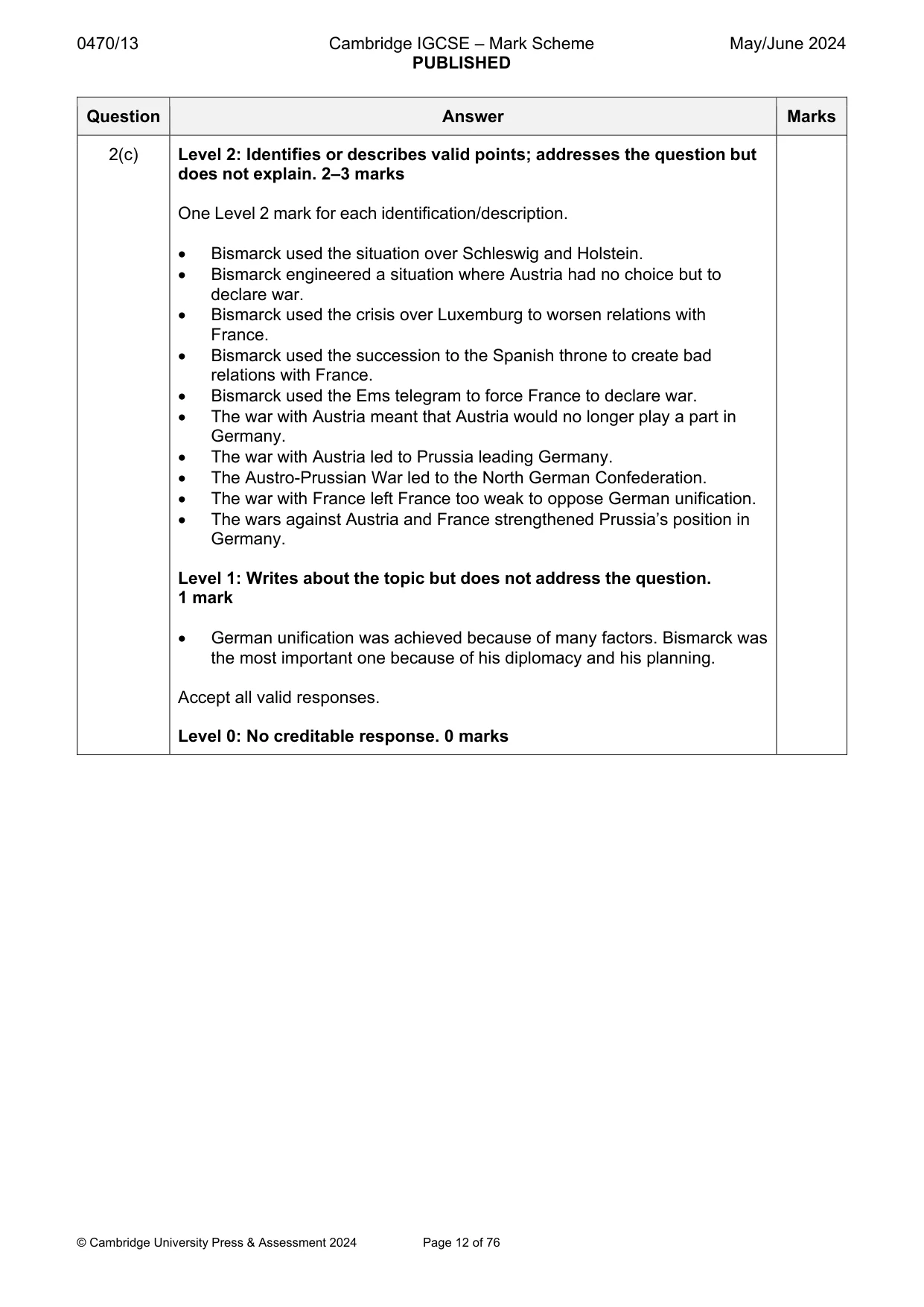
0470/13 Cambridge IGCSE – Mark Scheme PUBLISHED May/June 2024 © Cambridge University Press & Assessment 2024 Page 12 of 76 Question Answer Marks 2(c) Level 2: Identifies or describes valid points; addresses the question but does not explain. 2–3 marks One Level 2 mark for each identification/description. Bismarck used the situation over Schleswig and Holstein. Bismarck engineered a situation where Austria had no choice but to declare war. Bismarck used the crisis over Luxemburg to worsen relations with France. Bismarck used the succession to the Spanish throne to create bad relations with France. Bismarck used the Ems telegram to force France to declare war. The war with Austria meant that Austria would no longer play a part in Germany. The war with Austria led to Prussia leading Germany. The Austro-Prussian War led to the North German Confederation. The war with France left France too weak to oppose German unification. The wars against Austria and France strengthened Prussia’s position in Germany. Level 1: Writes about the topic but does not address the question. 1 mark German unification was achieved because of many factors. Bismarck was the most important one because of his diplomacy and his planning. Accept all valid responses. Level 0: No creditable response. 0 marks
Mark scheme, page 13
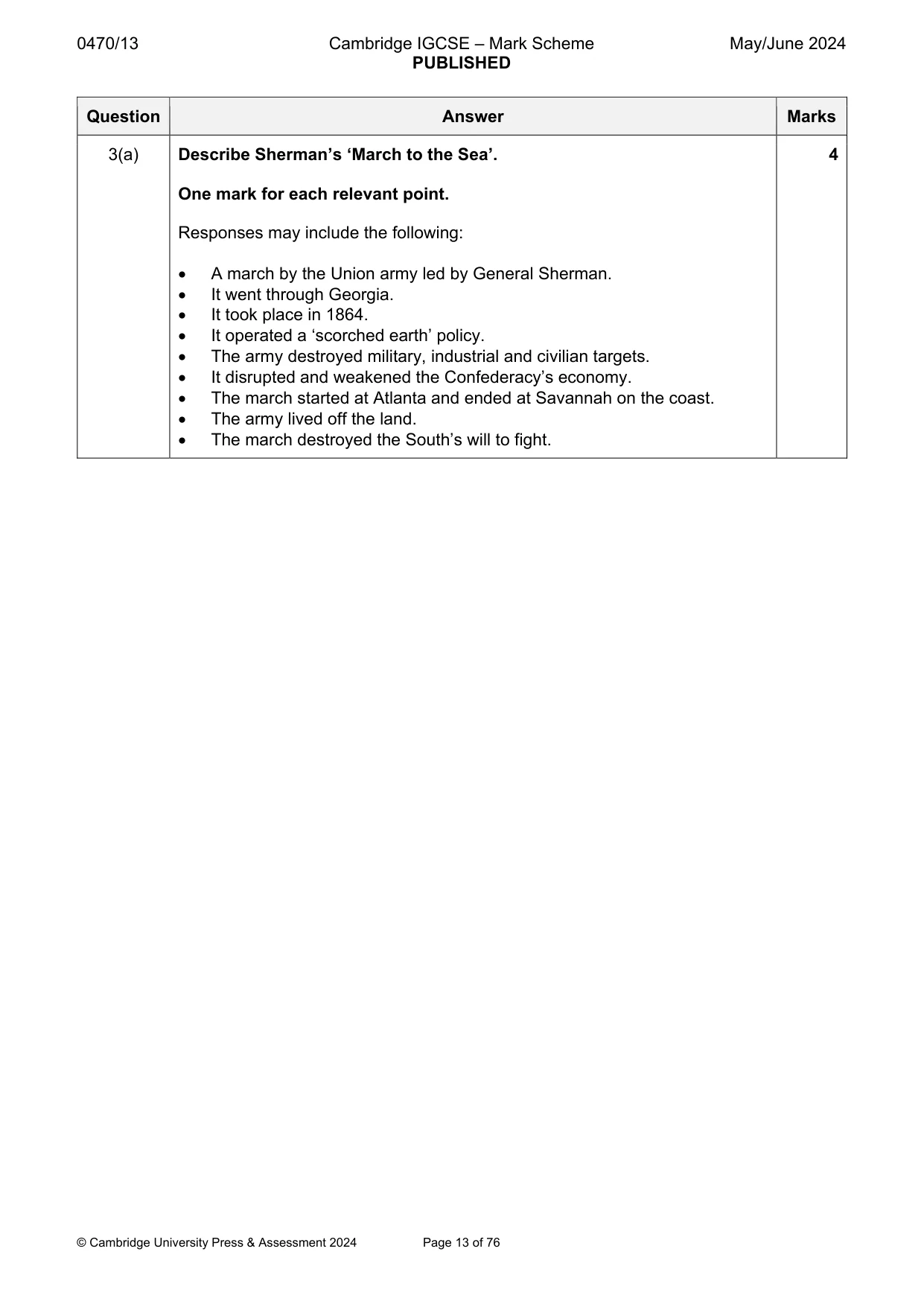
0470/13 Cambridge IGCSE – Mark Scheme PUBLISHED May/June 2024 © Cambridge University Press & Assessment 2024 Page 13 of 76 Question Answer Marks 3(a) Describe Sherman’s ‘March to the Sea’. One mark for each relevant point. Responses may include the following: A march by the Union army led by General Sherman. It went through Georgia. It took place in 1864. It operated a ‘scorched earth’ policy. The army destroyed military, industrial and civilian targets. It disrupted and weakened the Confederacy’s economy. The march started at Atlanta and ended at Savannah on the coast. The army lived off the land. The march destroyed the South’s will to fight. 4
Mark scheme, page 14
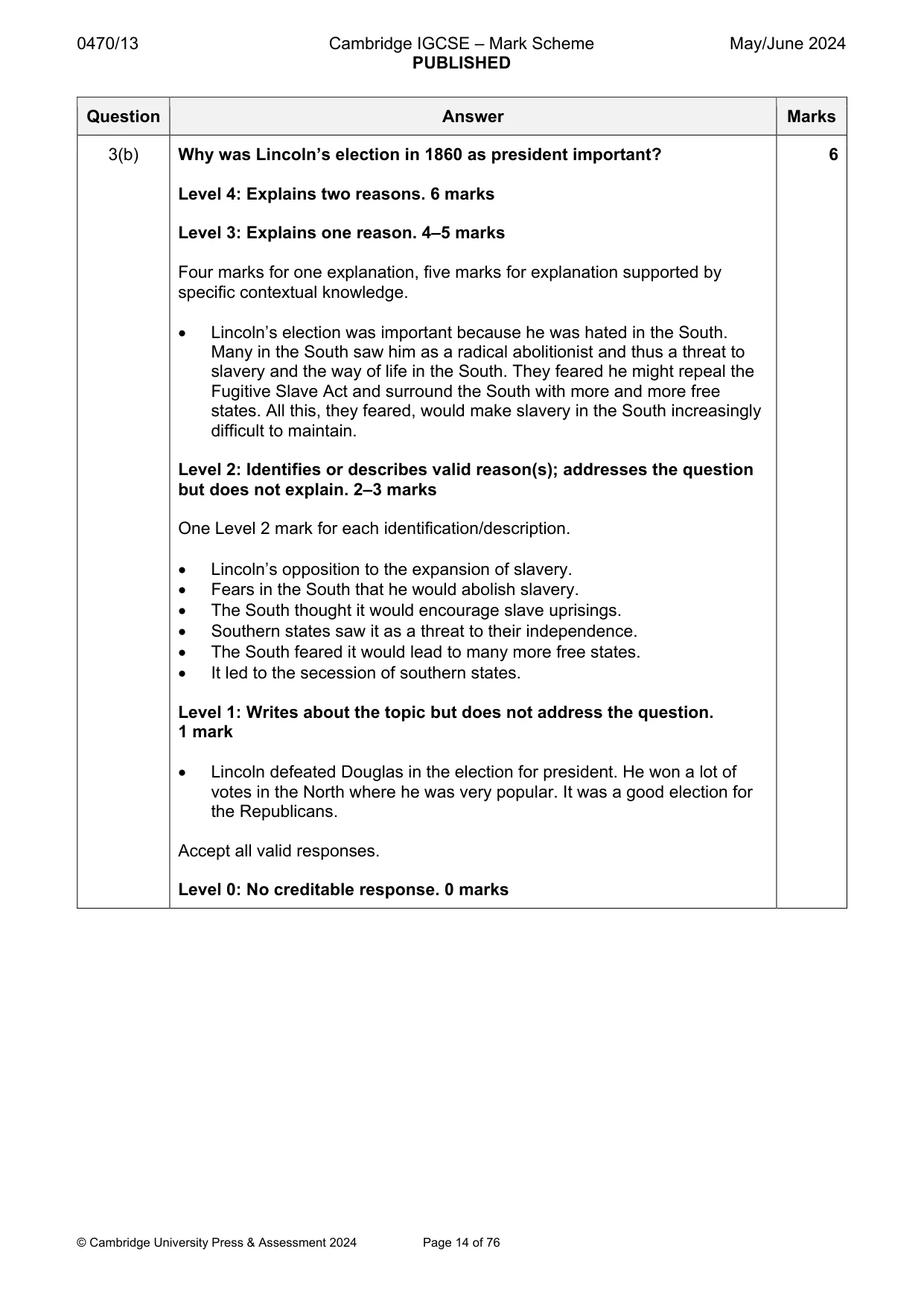
0470/13 Cambridge IGCSE – Mark Scheme PUBLISHED May/June 2024 © Cambridge University Press & Assessment 2024 Page 14 of 76 Question Answer Marks 3(b) Why was Lincoln’s election in 1860 as president important? Level 4: Explains two reasons. 6 marks Level 3: Explains one reason. 4–5 marks Four marks for one explanation, five marks for explanation supported by specific contextual knowledge. Lincoln’s election was important because he was hated in the South. Many in the South saw him as a radical abolitionist and thus a threat to slavery and the way of life in the South. They feared he might repeal the Fugitive Slave Act and surround the South with more and more free states. All this, they feared, would make slavery in the South increasingly difficult to maintain. Level 2: Identifies or describes valid reason(s); addresses the question but does not explain. 2–3 marks One Level 2 mark for each identification/description. Lincoln’s opposition to the expansion of slavery. Fears in the South that he would abolish slavery. The South thought it would encourage slave uprisings. Southern states saw it as a threat to their independence. The South feared it would lead to many more free states. It led to the secession of southern states. Level 1: Writes about the topic but does not address the question. 1 mark Lincoln defeated Douglas in the election for president. He won a lot of votes in the North where he was very popular. It was a good election for the Republicans. Accept all valid responses. Level 0: No creditable response. 0 marks 6
Mark scheme, page 15
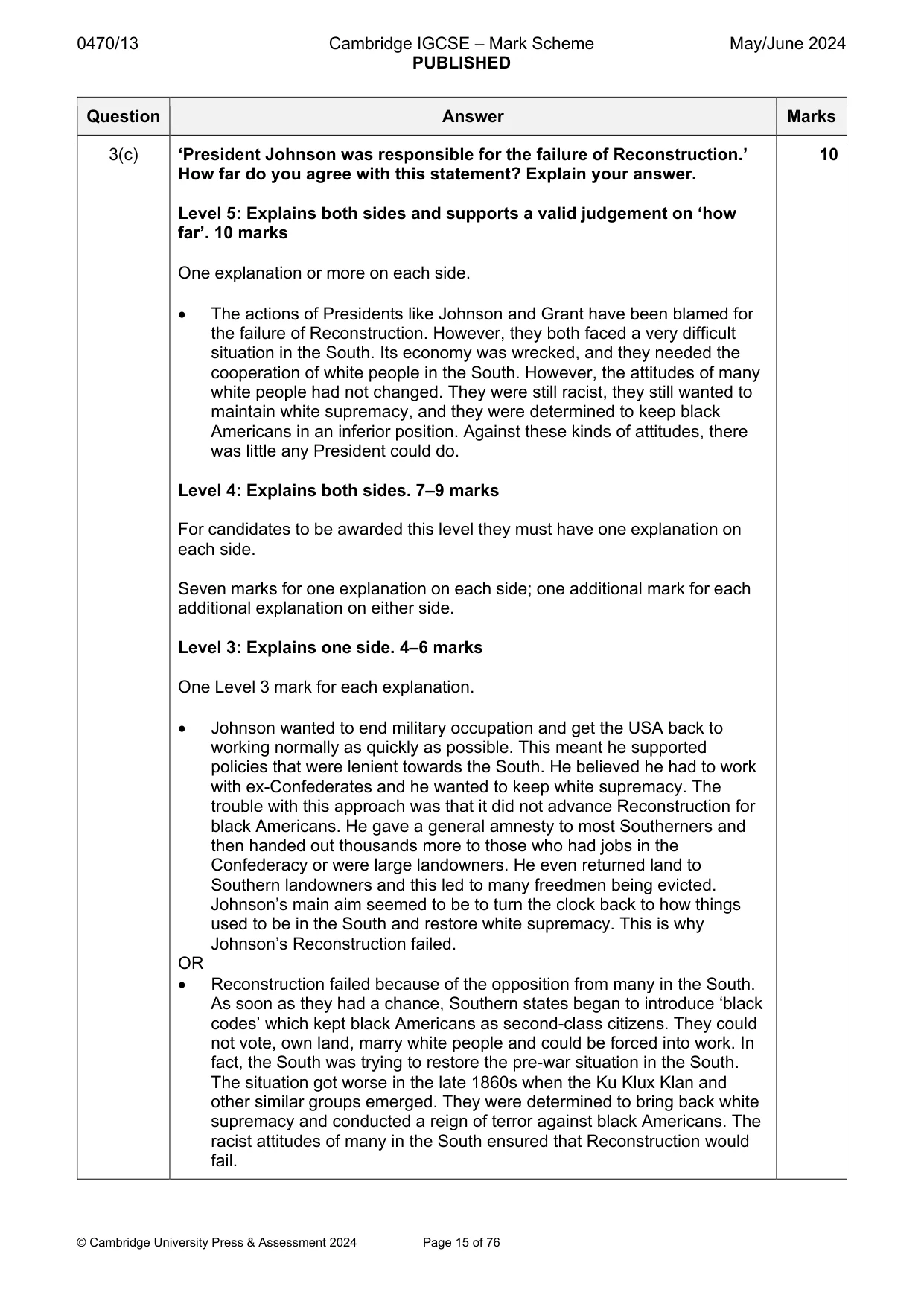
0470/13 Cambridge IGCSE – Mark Scheme PUBLISHED May/June 2024 © Cambridge University Press & Assessment 2024 Page 15 of 76 Question Answer Marks 3(c) ‘President Johnson was responsible for the failure of Reconstruction.’ How far do you agree with this statement? Explain your answer. Level 5: Explains both sides and supports a valid judgement on ‘how far’. 10 marks One explanation or more on each side. The actions of Presidents like Johnson and Grant have been blamed for the failure of Reconstruction. However, they both faced a very difficult situation in the South. Its economy was wrecked, and they needed the cooperation of white people in the South. However, the attitudes of many white people had not changed. They were still racist, they still wanted to maintain white supremacy, and they were determined to keep black Americans in an inferior position. Against these kinds of attitudes, there was little any President could do. Level 4: Explains both sides. 7–9 marks For candidates to be awarded this level they must have one explanation on each side. Seven marks for one explanation on each side; one additional mark for each additional explanation on either side. Level 3: Explains one side. 4–6 marks One Level 3 mark for each explanation. Johnson wanted to end military occupation and get the USA back to working normally as quickly as possible. This meant he supported policies that were lenient towards the South. He believed he had to work with ex-Confederates and he wanted to keep white supremacy. The trouble with this approach was that it did not advance Reconstruction for black Americans. He gave a general amnesty to most Southerners and then handed out thousands more to those who had jobs in the Confederacy or were large landowners. He even returned land to Southern landowners and this led to many freedmen being evicted. Johnson’s main aim seemed to be to turn the clock back to how things used to be in the South and restore white supremacy. This is why Johnson’s Reconstruction failed. OR Reconstruction failed because of the opposition from many in the South. As soon as they had a chance, Southern states began to introduce ‘black codes’ which kept black Americans as second-class citizens. They could not vote, own land, marry white people and could be forced into work. In fact, the South was trying to restore the pre-war situation in the South. The situation got worse in the late 1860s when the Ku Klux Klan and other similar groups emerged. They were determined to bring back white supremacy and conducted a reign of terror against black Americans. The racist attitudes of many in the South ensured that Reconstruction would fail. 10
Mark scheme, page 16
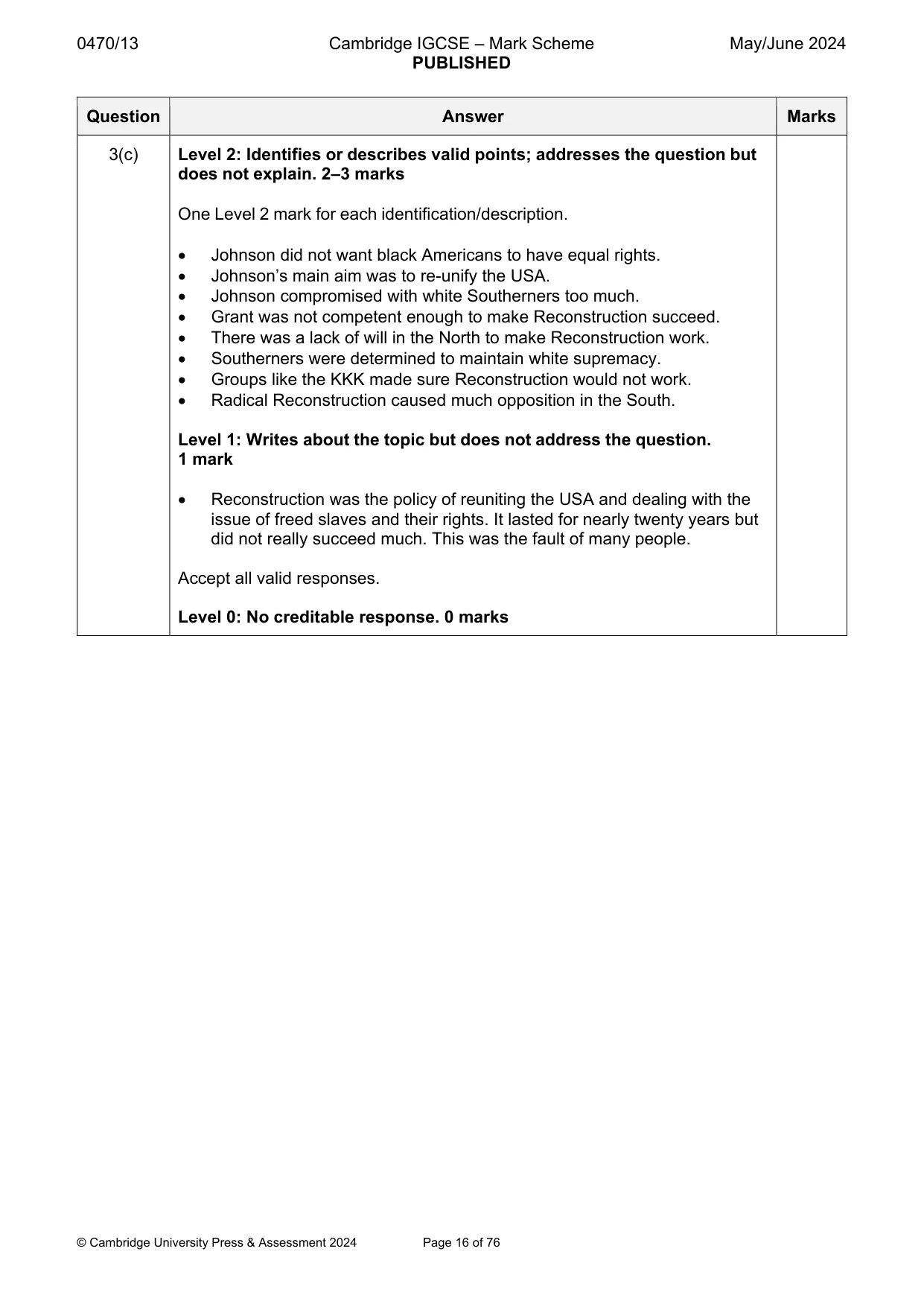
0470/13 Cambridge IGCSE – Mark Scheme PUBLISHED May/June 2024 © Cambridge University Press & Assessment 2024 Page 16 of 76 Question Answer Marks 3(c) Level 2: Identifies or describes valid points; addresses the question but does not explain. 2–3 marks One Level 2 mark for each identification/description. Johnson did not want black Americans to have equal rights. Johnson’s main aim was to re-unify the USA. Johnson compromised with white Southerners too much. Grant was not competent enough to make Reconstruction succeed. There was a lack of will in the North to make Reconstruction work. Southerners were determined to maintain white supremacy. Groups like the KKK made sure Reconstruction would not work. Radical Reconstruction caused much opposition in the South. Level 1: Writes about the topic but does not address the question. 1 mark Reconstruction was the policy of reuniting the USA and dealing with the issue of freed slaves and their rights. It lasted for nearly twenty years but did not really succeed much. This was the fault of many people. Accept all valid responses. Level 0: No creditable response. 0 marks
Mark scheme, page 17
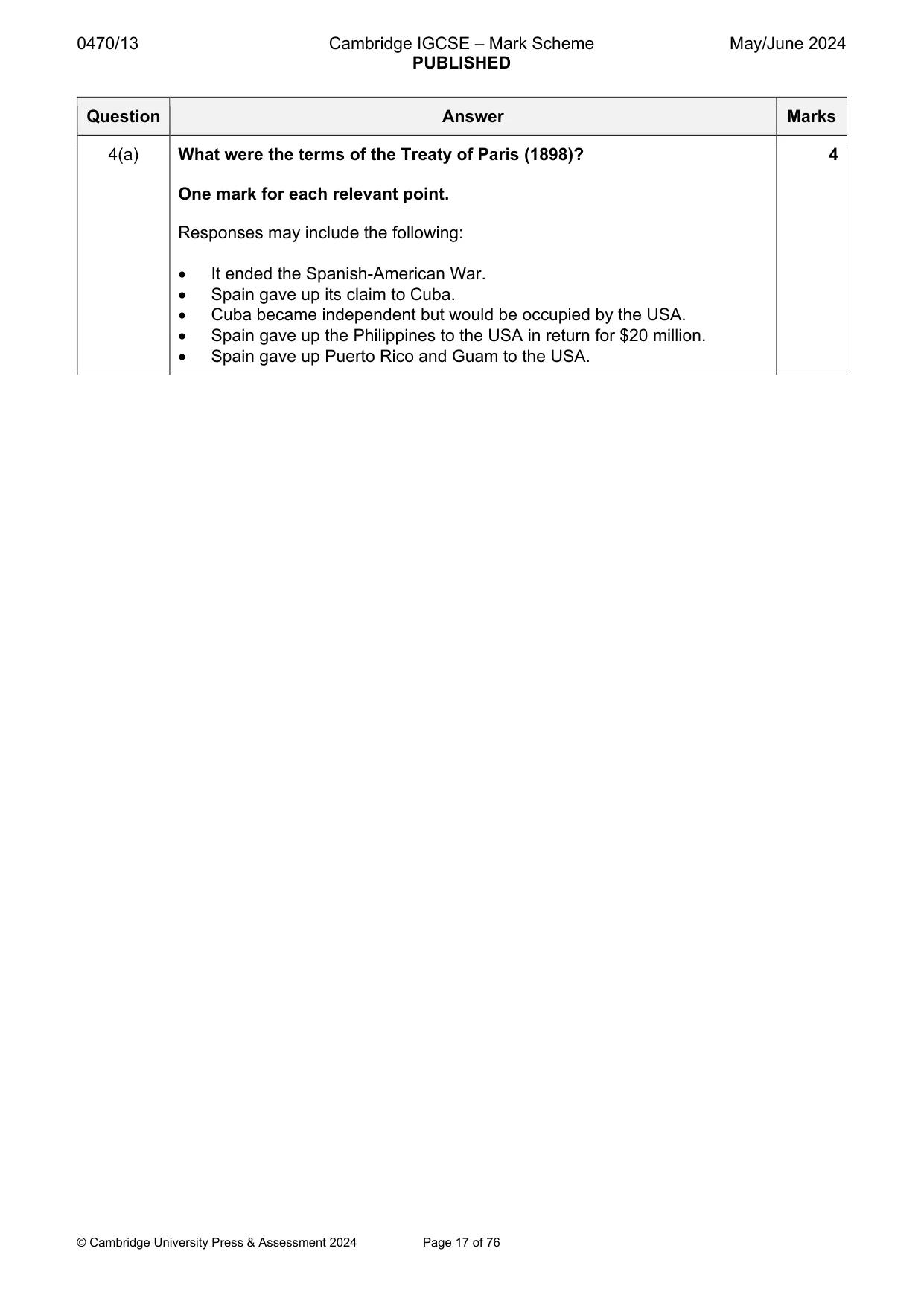
0470/13 Cambridge IGCSE – Mark Scheme PUBLISHED May/June 2024 © Cambridge University Press & Assessment 2024 Page 17 of 76 Question Answer Marks 4(a) What were the terms of the Treaty of Paris (1898)? One mark for each relevant point. Responses may include the following: It ended the Spanish-American War. Spain gave up its claim to Cuba. Cuba became independent but would be occupied by the USA. Spain gave up the Philippines to the USA in return for $20 million. Spain gave up Puerto Rico and Guam to the USA. 4
Mark scheme, page 18
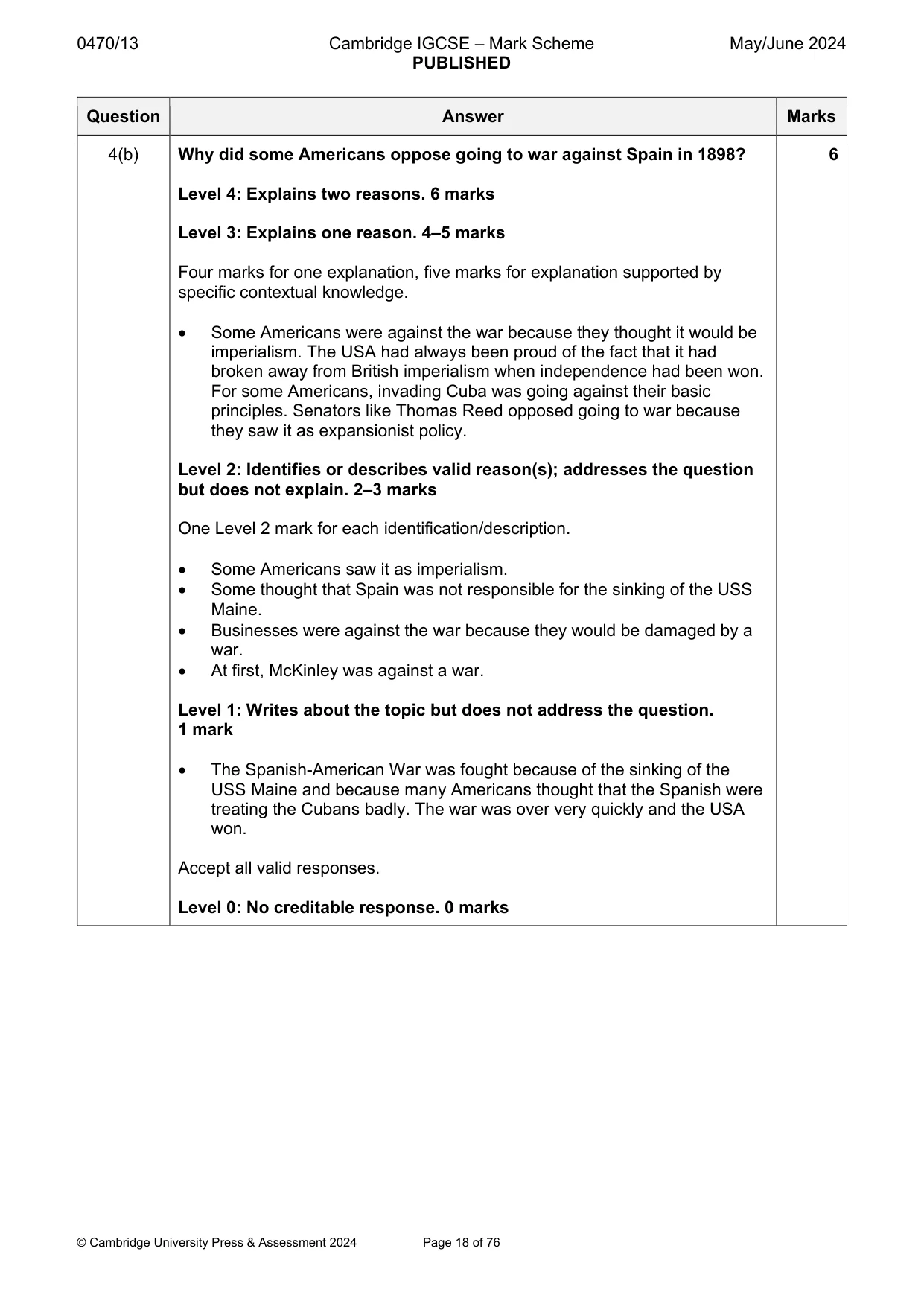
0470/13 Cambridge IGCSE – Mark Scheme PUBLISHED May/June 2024 © Cambridge University Press & Assessment 2024 Page 18 of 76 Question Answer Marks 4(b) Why did some Americans oppose going to war against Spain in 1898? Level 4: Explains two reasons. 6 marks Level 3: Explains one reason. 4–5 marks Four marks for one explanation, five marks for explanation supported by specific contextual knowledge. Some Americans were against the war because they thought it would be imperialism. The USA had always been proud of the fact that it had broken away from British imperialism when independence had been won. For some Americans, invading Cuba was going against their basic principles. Senators like Thomas Reed opposed going to war because they saw it as expansionist policy. Level 2: Identifies or describes valid reason(s); addresses the question but does not explain. 2–3 marks One Level 2 mark for each identification/description. Some Americans saw it as imperialism. Some thought that Spain was not responsible for the sinking of the USS Maine. Businesses were against the war because they would be damaged by a war. At first, McKinley was against a war. Level 1: Writes about the topic but does not address the question. 1 mark The Spanish-American War was fought because of the sinking of the USS Maine and because many Americans thought that the Spanish were treating the Cubans badly. The war was over very quickly and the USA won. Accept all valid responses. Level 0: No creditable response. 0 marks 6
Mark scheme, page 19
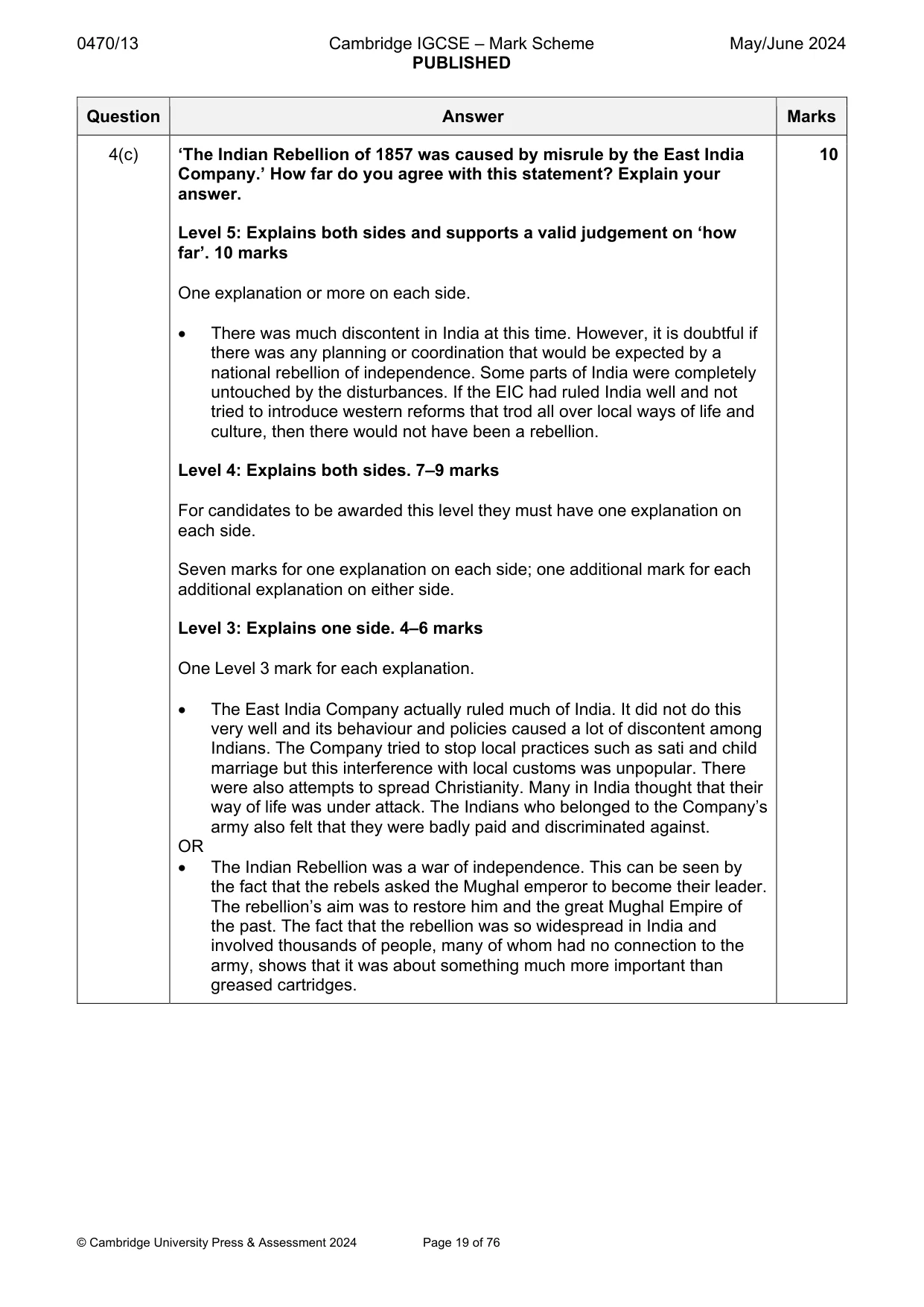
0470/13 Cambridge IGCSE – Mark Scheme PUBLISHED May/June 2024 © Cambridge University Press & Assessment 2024 Page 19 of 76 Question Answer Marks 4(c) ‘The Indian Rebellion of 1857 was caused by misrule by the East India Company.’ How far do you agree with this statement? Explain your answer. Level 5: Explains both sides and supports a valid judgement on ‘how far’. 10 marks One explanation or more on each side. There was much discontent in India at this time. However, it is doubtful if there was any planning or coordination that would be expected by a national rebellion of independence. Some parts of India were completely untouched by the disturbances. If the EIC had ruled India well and not tried to introduce western reforms that trod all over local ways of life and culture, then there would not have been a rebellion. Level 4: Explains both sides. 7–9 marks For candidates to be awarded this level they must have one explanation on each side. Seven marks for one explanation on each side; one additional mark for each additional explanation on either side. Level 3: Explains one side. 4–6 marks One Level 3 mark for each explanation. The East India Company actually ruled much of India. It did not do this very well and its behaviour and policies caused a lot of discontent among Indians. The Company tried to stop local practices such as sati and child marriage but this interference with local customs was unpopular. There were also attempts to spread Christianity. Many in India thought that their way of life was under attack. The Indians who belonged to the Company’s army also felt that they were badly paid and discriminated against. OR The Indian Rebellion was a war of independence. This can be seen by the fact that the rebels asked the Mughal emperor to become their leader. The rebellion’s aim was to restore him and the great Mughal Empire of the past. The fact that the rebellion was so widespread in India and involved thousands of people, many of whom had no connection to the army, shows that it was about something much more important than greased cartridges. 10
Mark scheme, page 20
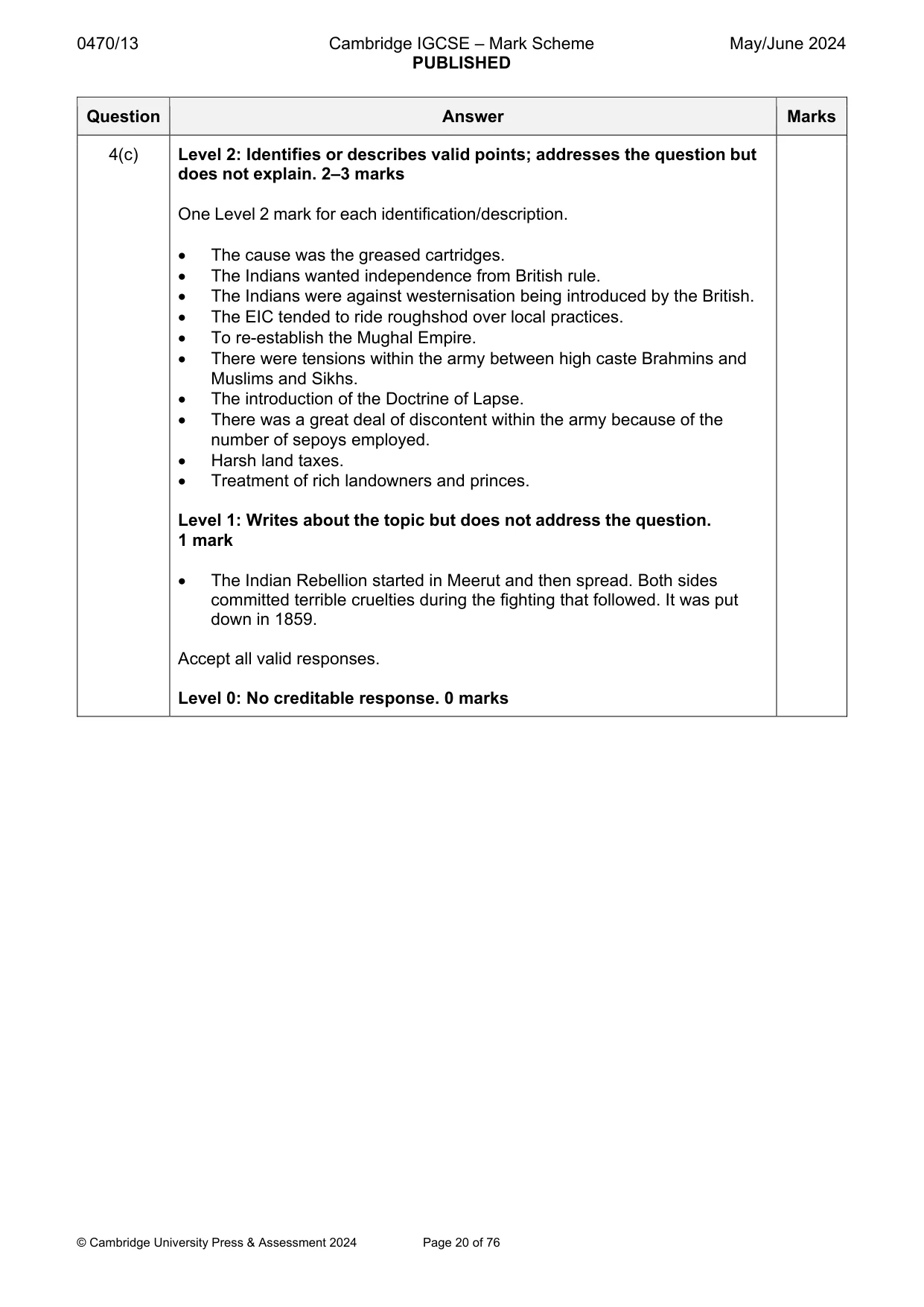
0470/13 Cambridge IGCSE – Mark Scheme PUBLISHED May/June 2024 © Cambridge University Press & Assessment 2024 Page 20 of 76 Question Answer Marks 4(c) Level 2: Identifies or describes valid points; addresses the question but does not explain. 2–3 marks One Level 2 mark for each identification/description. The cause was the greased cartridges. The Indians wanted independence from British rule. The Indians were against westernisation being introduced by the British. The EIC tended to ride roughshod over local practices. To re-establish the Mughal Empire. There were tensions within the army between high caste Brahmins and Muslims and Sikhs. The introduction of the Doctrine of Lapse. There was a great deal of discontent within the army because of the number of sepoys employed. Harsh land taxes. Treatment of rich landowners and princes. Level 1: Writes about the topic but does not address the question. 1 mark The Indian Rebellion started in Meerut and then spread. Both sides committed terrible cruelties during the fighting that followed. It was put down in 1859. Accept all valid responses. Level 0: No creditable response. 0 marks
Mark scheme, page 21
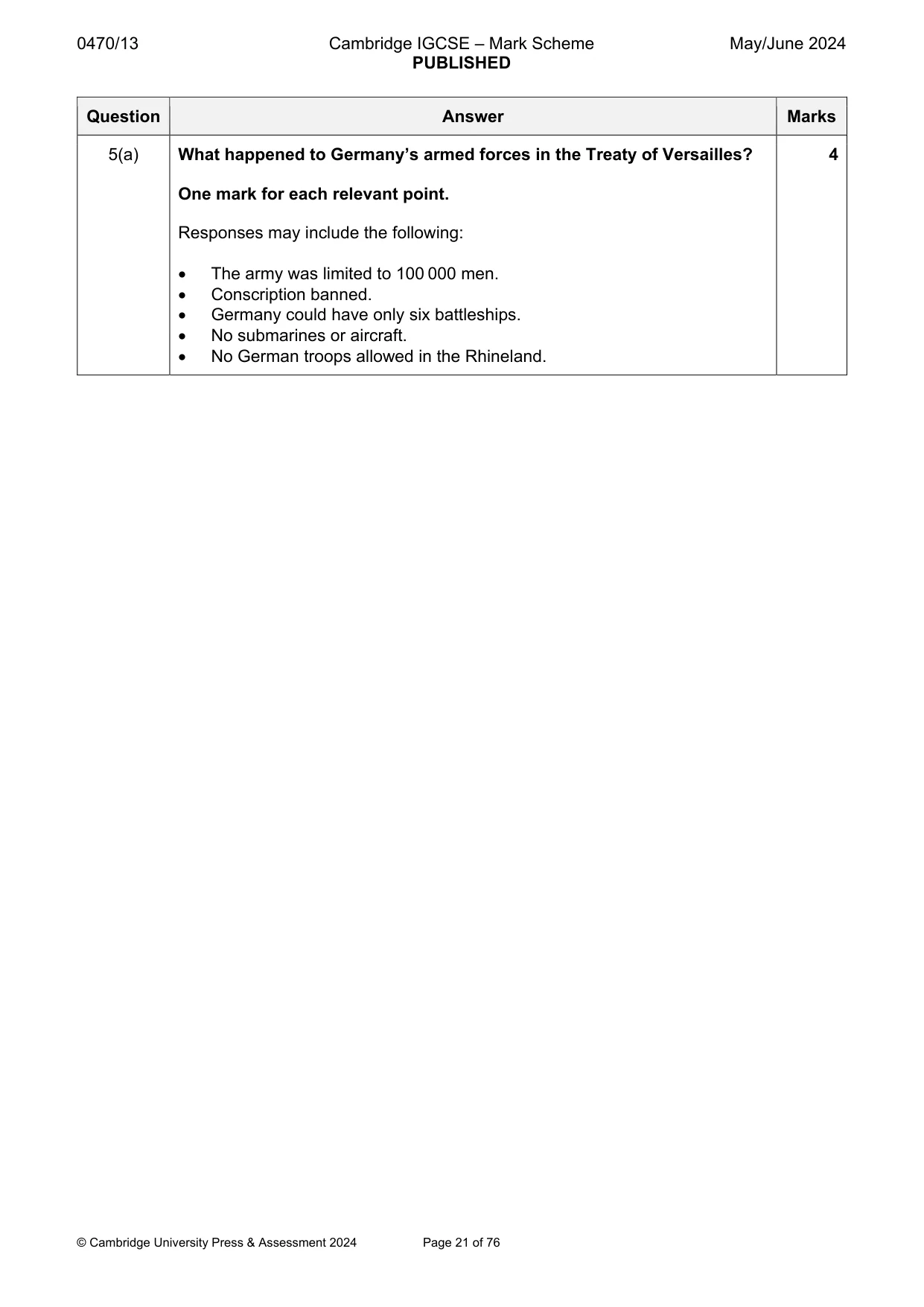
0470/13 Cambridge IGCSE – Mark Scheme PUBLISHED May/June 2024 © Cambridge University Press & Assessment 2024 Page 21 of 76 Question Answer Marks 5(a) What happened to Germany’s armed forces in the Treaty of Versailles? One mark for each relevant point. Responses may include the following: The army was limited to 100 000 men. Conscription banned. Germany could have only six battleships. No submarines or aircraft. No German troops allowed in the Rhineland. 4
Mark scheme, page 22
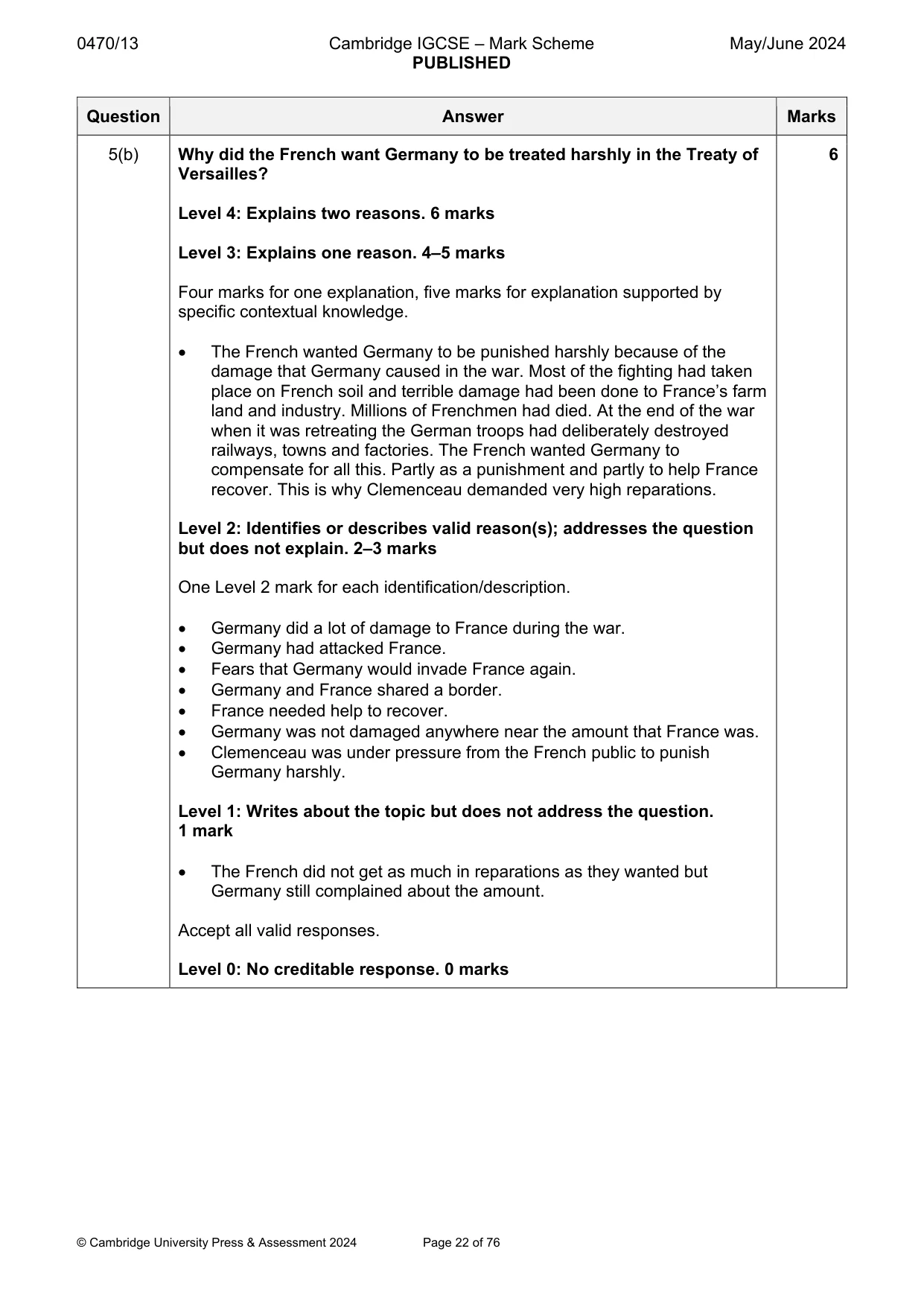
0470/13 Cambridge IGCSE – Mark Scheme PUBLISHED May/June 2024 © Cambridge University Press & Assessment 2024 Page 22 of 76 Question Answer Marks 5(b) Why did the French want Germany to be treated harshly in the Treaty of Versailles? Level 4: Explains two reasons. 6 marks Level 3: Explains one reason. 4–5 marks Four marks for one explanation, five marks for explanation supported by specific contextual knowledge. The French wanted Germany to be punished harshly because of the damage that Germany caused in the war. Most of the fighting had taken place on French soil and terrible damage had been done to France’s farm land and industry. Millions of Frenchmen had died. At the end of the war when it was retreating the German troops had deliberately destroyed railways, towns and factories. The French wanted Germany to compensate for all this. Partly as a punishment and partly to help France recover. This is why Clemenceau demanded very high reparations. Level 2: Identifies or describes valid reason(s); addresses the question but does not explain. 2–3 marks One Level 2 mark for each identification/description. Germany did a lot of damage to France during the war. Germany had attacked France. Fears that Germany would invade France again. Germany and France shared a border. France needed help to recover. Germany was not damaged anywhere near the amount that France was. Clemenceau was under pressure from the French public to punish Germany harshly. Level 1: Writes about the topic but does not address the question. 1 mark The French did not get as much in reparations as they wanted but Germany still complained about the amount. Accept all valid responses. Level 0: No creditable response. 0 marks 6
Mark scheme, page 23
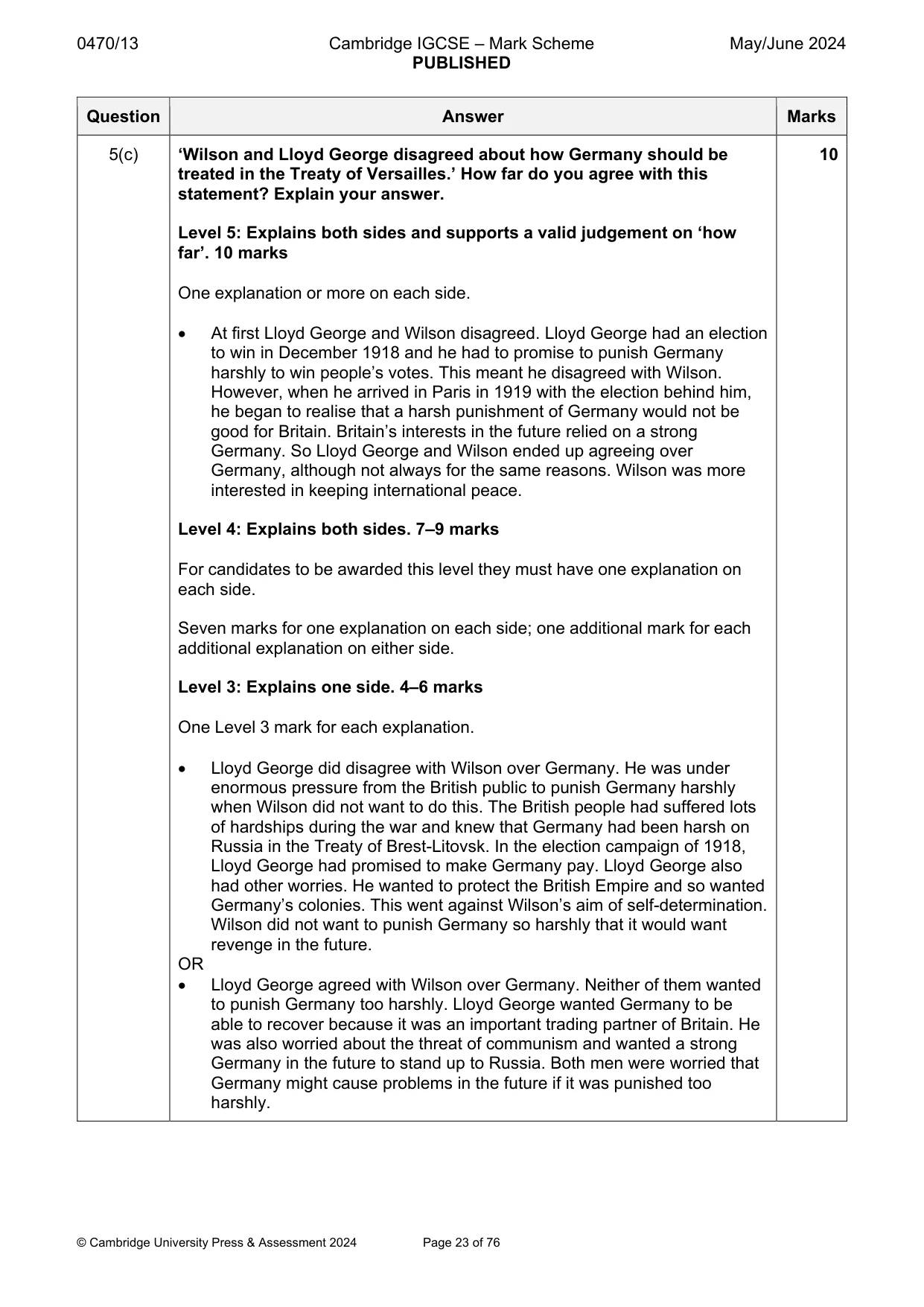
0470/13 Cambridge IGCSE – Mark Scheme PUBLISHED May/June 2024 © Cambridge University Press & Assessment 2024 Page 23 of 76 Question Answer Marks 5(c) ‘Wilson and Lloyd George disagreed about how Germany should be treated in the Treaty of Versailles.’ How far do you agree with this statement? Explain your answer. Level 5: Explains both sides and supports a valid judgement on ‘how far’. 10 marks One explanation or more on each side. At first Lloyd George and Wilson disagreed. Lloyd George had an election to win in December 1918 and he had to promise to punish Germany harshly to win people’s votes. This meant he disagreed with Wilson. However, when he arrived in Paris in 1919 with the election behind him, he began to realise that a harsh punishment of Germany would not be good for Britain. Britain’s interests in the future relied on a strong Germany. So Lloyd George and Wilson ended up agreeing over Germany, although not always for the same reasons. Wilson was more interested in keeping international peace. Level 4: Explains both sides. 7–9 marks For candidates to be awarded this level they must have one explanation on each side. Seven marks for one explanation on each side; one additional mark for each additional explanation on either side. Level 3: Explains one side. 4–6 marks One Level 3 mark for each explanation. Lloyd George did disagree with Wilson over Germany. He was under enormous pressure from the British public to punish Germany harshly when Wilson did not want to do this. The British people had suffered lots of hardships during the war and knew that Germany had been harsh on Russia in the Treaty of Brest-Litovsk. In the election campaign of 1918, Lloyd George had promised to make Germany pay. Lloyd George also had other worries. He wanted to protect the British Empire and so wanted Germany’s colonies. This went against Wilson’s aim of self-determination. Wilson did not want to punish Germany so harshly that it would want revenge in the future. OR Lloyd George agreed with Wilson over Germany. Neither of them wanted to punish Germany too harshly. Lloyd George wanted Germany to be able to recover because it was an important trading partner of Britain. He was also worried about the threat of communism and wanted a strong Germany in the future to stand up to Russia. Both men were worried that Germany might cause problems in the future if it was punished too harshly. 10
Mark scheme, page 24
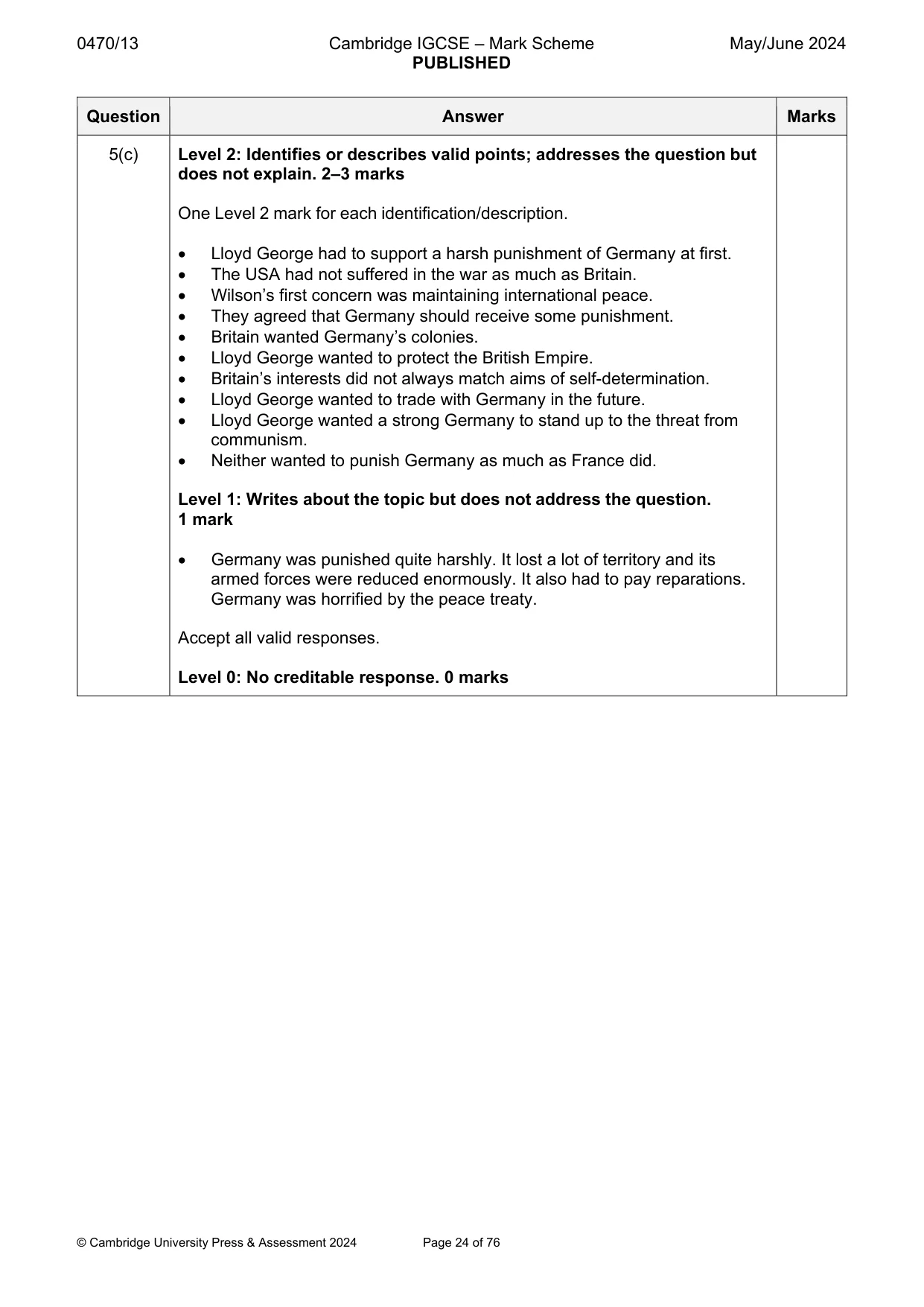
0470/13 Cambridge IGCSE – Mark Scheme PUBLISHED May/June 2024 © Cambridge University Press & Assessment 2024 Page 24 of 76 Question Answer Marks 5(c) Level 2: Identifies or describes valid points; addresses the question but does not explain. 2–3 marks One Level 2 mark for each identification/description. Lloyd George had to support a harsh punishment of Germany at first. The USA had not suffered in the war as much as Britain. Wilson’s first concern was maintaining international peace. They agreed that Germany should receive some punishment. Britain wanted Germany’s colonies. Lloyd George wanted to protect the British Empire. Britain’s interests did not always match aims of self-determination. Lloyd George wanted to trade with Germany in the future. Lloyd George wanted a strong Germany to stand up to the threat from communism. Neither wanted to punish Germany as much as France did. Level 1: Writes about the topic but does not address the question. 1 mark Germany was punished quite harshly. It lost a lot of territory and its armed forces were reduced enormously. It also had to pay reparations. Germany was horrified by the peace treaty. Accept all valid responses. Level 0: No creditable response. 0 marks
Mark scheme, page 25
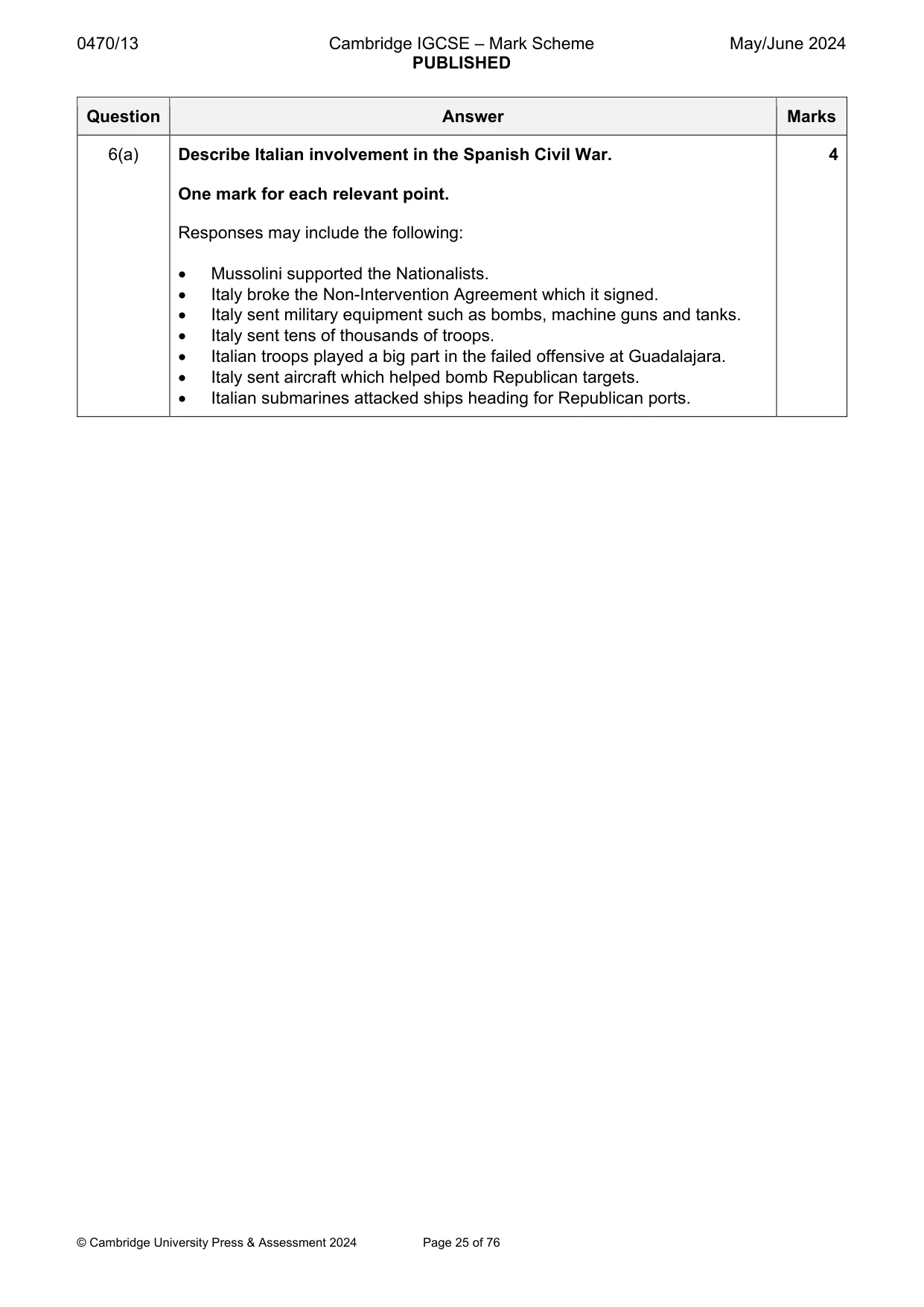
0470/13 Cambridge IGCSE – Mark Scheme PUBLISHED May/June 2024 © Cambridge University Press & Assessment 2024 Page 25 of 76 Question Answer Marks 6(a) Describe Italian involvement in the Spanish Civil War. One mark for each relevant point. Responses may include the following: Mussolini supported the Nationalists. Italy broke the Non-Intervention Agreement which it signed. Italy sent military equipment such as bombs, machine guns and tanks. Italy sent tens of thousands of troops. Italian troops played a big part in the failed offensive at Guadalajara. Italy sent aircraft which helped bomb Republican targets. Italian submarines attacked ships heading for Republican ports. 4
Mark scheme, page 26
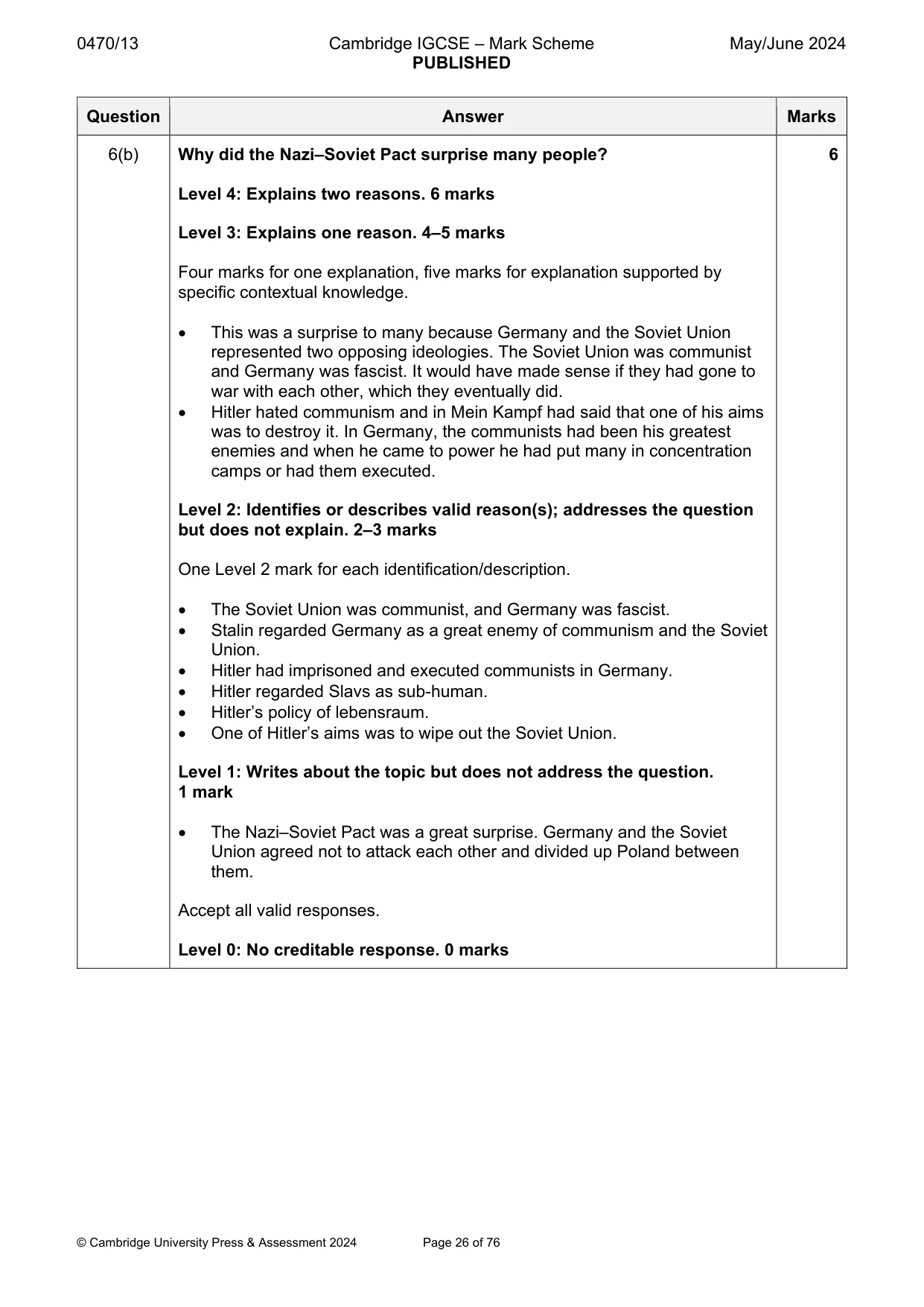
0470/13 Cambridge IGCSE – Mark Scheme PUBLISHED May/June 2024 © Cambridge University Press & Assessment 2024 Page 26 of 76 Question Answer Marks 6(b) Why did the Nazi–Soviet Pact surprise many people? Level 4: Explains two reasons. 6 marks Level 3: Explains one reason. 4–5 marks Four marks for one explanation, five marks for explanation supported by specific contextual knowledge. This was a surprise to many because Germany and the Soviet Union represented two opposing ideologies. The Soviet Union was communist and Germany was fascist. It would have made sense if they had gone to war with each other, which they eventually did. Hitler hated communism and in Mein Kampf had said that one of his aims was to destroy it. In Germany, the communists had been his greatest enemies and when he came to power he had put many in concentration camps or had them executed. Level 2: Identifies or describes valid reason(s); addresses the question but does not explain. 2–3 marks One Level 2 mark for each identification/description. The Soviet Union was communist, and Germany was fascist. Stalin regarded Germany as a great enemy of communism and the Soviet Union. Hitler had imprisoned and executed communists in Germany. Hitler regarded Slavs as sub-human. Hitler’s policy of lebensraum. One of Hitler’s aims was to wipe out the Soviet Union. Level 1: Writes about the topic but does not address the question. 1 mark The Nazi–Soviet Pact was a great surprise. Germany and the Soviet Union agreed not to attack each other and divided up Poland between them. Accept all valid responses. Level 0: No creditable response. 0 marks 6
Mark scheme, page 27
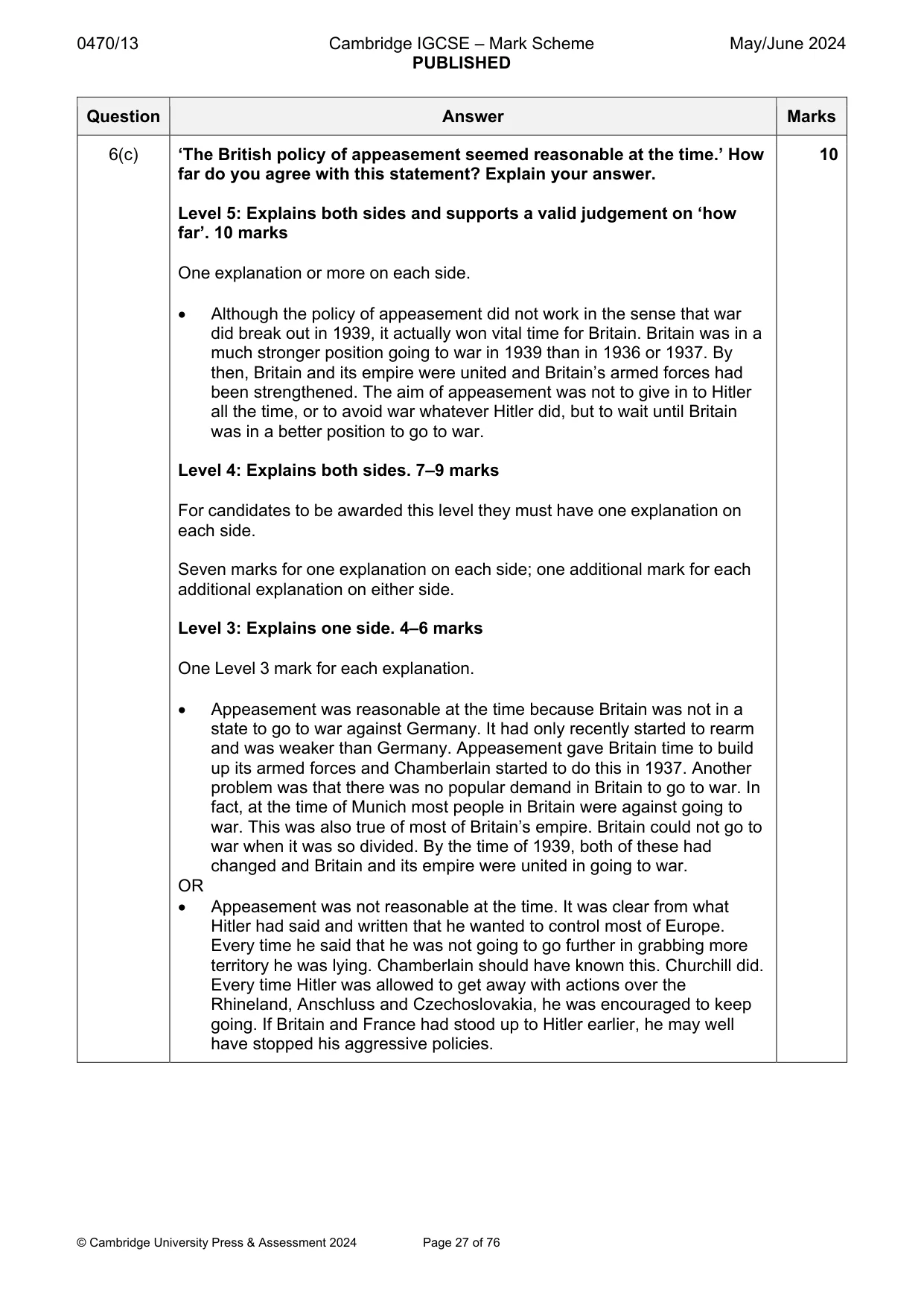
0470/13 Cambridge IGCSE – Mark Scheme PUBLISHED May/June 2024 © Cambridge University Press & Assessment 2024 Page 27 of 76 Question Answer Marks 6(c) ‘The British policy of appeasement seemed reasonable at the time.’ How far do you agree with this statement? Explain your answer. Level 5: Explains both sides and supports a valid judgement on ‘how far’. 10 marks One explanation or more on each side. Although the policy of appeasement did not work in the sense that war did break out in 1939, it actually won vital time for Britain. Britain was in a much stronger position going to war in 1939 than in 1936 or 1937. By then, Britain and its empire were united and Britain’s armed forces had been strengthened. The aim of appeasement was not to give in to Hitler all the time, or to avoid war whatever Hitler did, but to wait until Britain was in a better position to go to war. Level 4: Explains both sides. 7–9 marks For candidates to be awarded this level they must have one explanation on each side. Seven marks for one explanation on each side; one additional mark for each additional explanation on either side. Level 3: Explains one side. 4–6 marks One Level 3 mark for each explanation. Appeasement was reasonable at the time because Britain was not in a state to go to war against Germany. It had only recently started to rearm and was weaker than Germany. Appeasement gave Britain time to build up its armed forces and Chamberlain started to do this in 1937. Another problem was that there was no popular demand in Britain to go to war. In fact, at the time of Munich most people in Britain were against going to war. This was also true of most of Britain’s empire. Britain could not go to war when it was so divided. By the time of 1939, both of these had changed and Britain and its empire were united in going to war. OR Appeasement was not reasonable at the time. It was clear from what Hitler had said and written that he wanted to control most of Europe. Every time he said that he was not going to go further in grabbing more territory he was lying. Chamberlain should have known this. Churchill did. Every time Hitler was allowed to get away with actions over the Rhineland, Anschluss and Czechoslovakia, he was encouraged to keep going. If Britain and France had stood up to Hitler earlier, he may well have stopped his aggressive policies. 10
Mark scheme, page 28
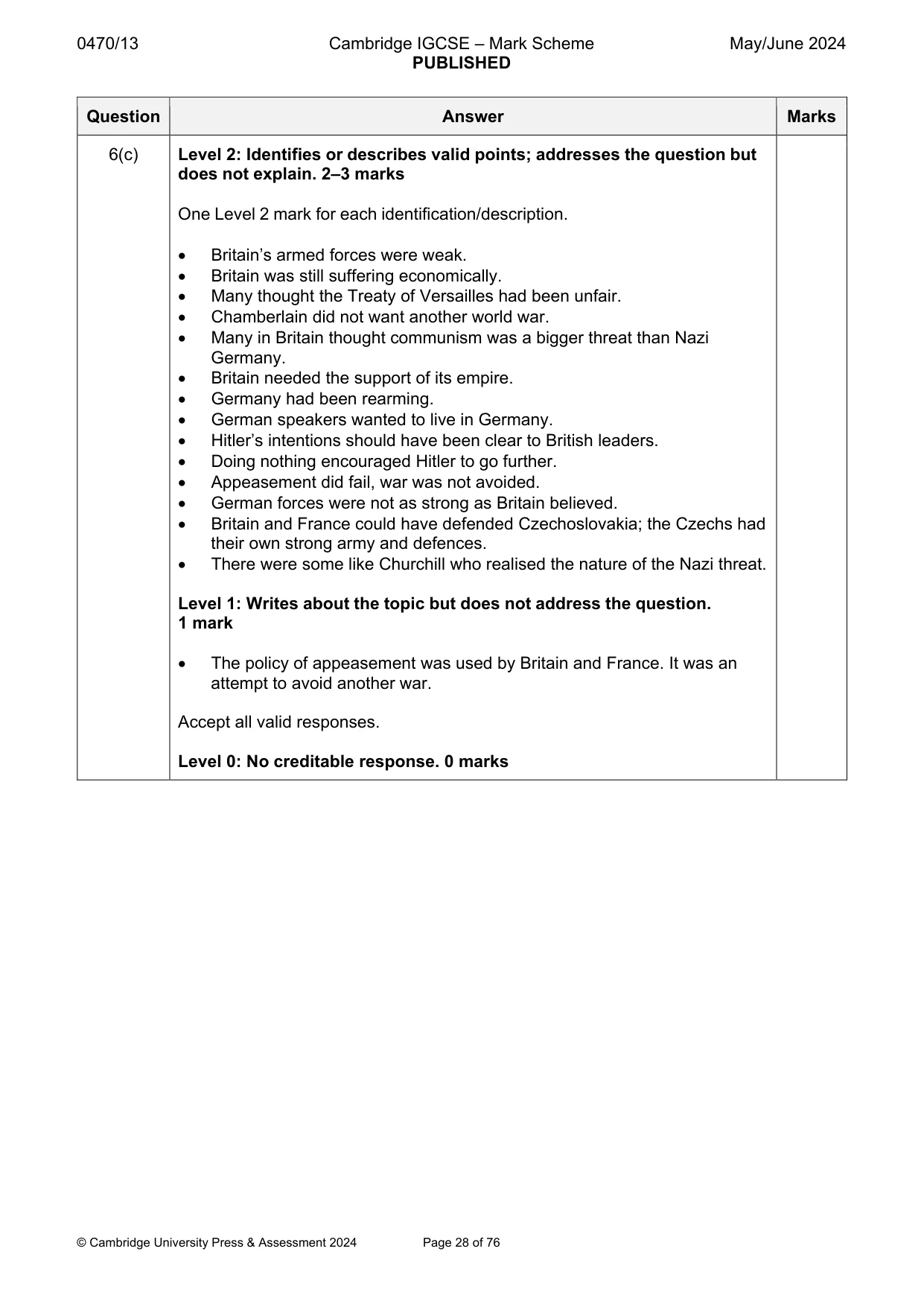
0470/13 Cambridge IGCSE – Mark Scheme PUBLISHED May/June 2024 © Cambridge University Press & Assessment 2024 Page 28 of 76 Question Answer Marks 6(c) Level 2: Identifies or describes valid points; addresses the question but does not explain. 2–3 marks One Level 2 mark for each identification/description. Britain’s armed forces were weak. Britain was still suffering economically. Many thought the Treaty of Versailles had been unfair. Chamberlain did not want another world war. Many in Britain thought communism was a bigger threat than Nazi Germany. Britain needed the support of its empire. Germany had been rearming. German speakers wanted to live in Germany. Hitler’s intentions should have been clear to British leaders. Doing nothing encouraged Hitler to go further. Appeasement did fail, war was not avoided. German forces were not as strong as Britain believed. Britain and France could have defended Czechoslovakia; the Czechs had their own strong army and defences. There were some like Churchill who realised the nature of the Nazi threat. Level 1: Writes about the topic but does not address the question. 1 mark The policy of appeasement was used by Britain and France. It was an attempt to avoid another war. Accept all valid responses. Level 0: No creditable response. 0 marks
Mark scheme, page 29
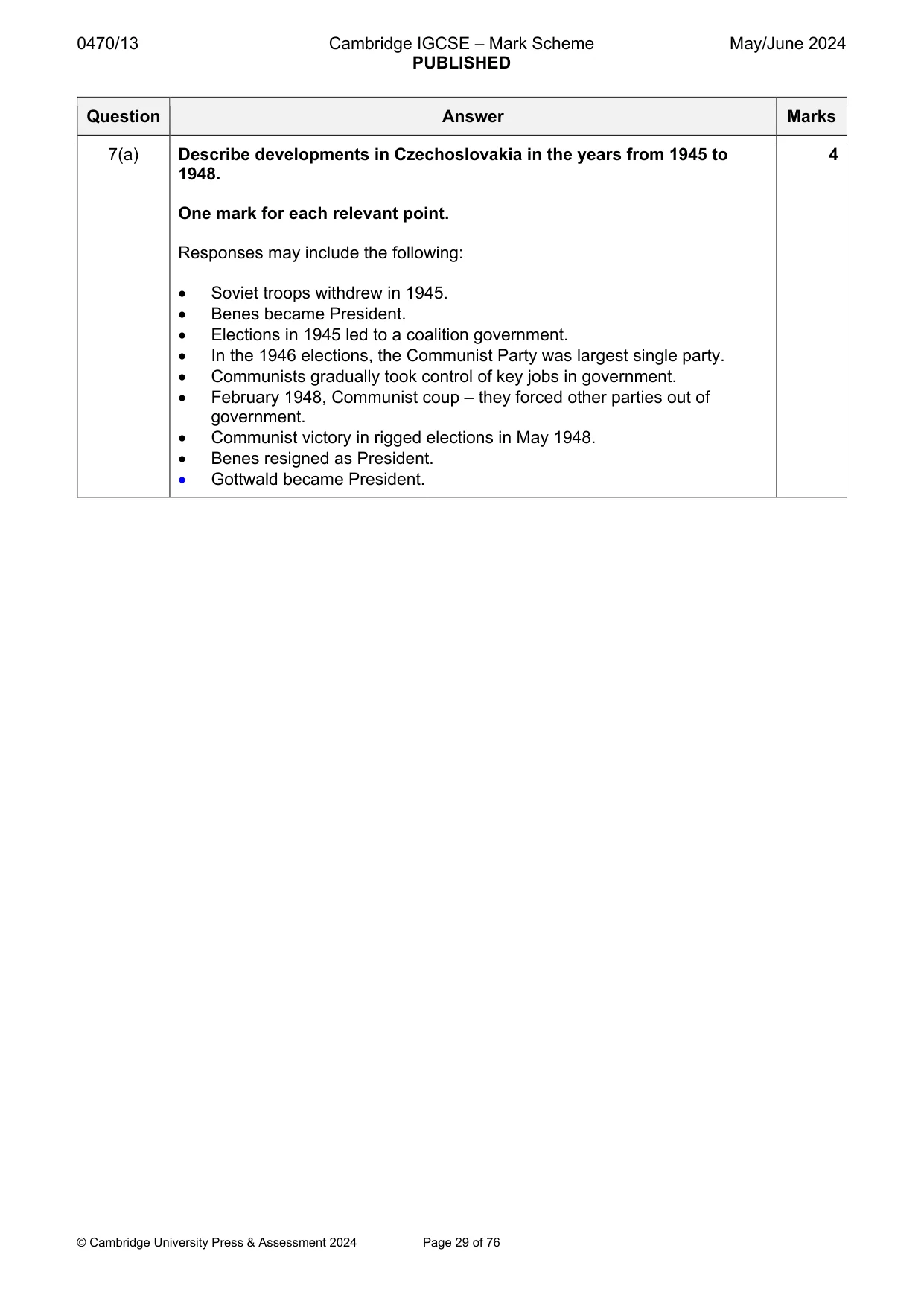
0470/13 Cambridge IGCSE – Mark Scheme PUBLISHED May/June 2024 © Cambridge University Press & Assessment 2024 Page 29 of 76 Question Answer Marks 7(a) Describe developments in Czechoslovakia in the years from 1945 to 1948. One mark for each relevant point. Responses may include the following: Soviet troops withdrew in 1945. Benes became President. Elections in 1945 led to a coalition government. In the 1946 elections, the Communist Party was largest single party. Communists gradually took control of key jobs in government. February 1948, Communist coup – they forced other parties out of government. Communist victory in rigged elections in May 1948. Benes resigned as President. Gottwald became President. 4
Mark scheme, page 30
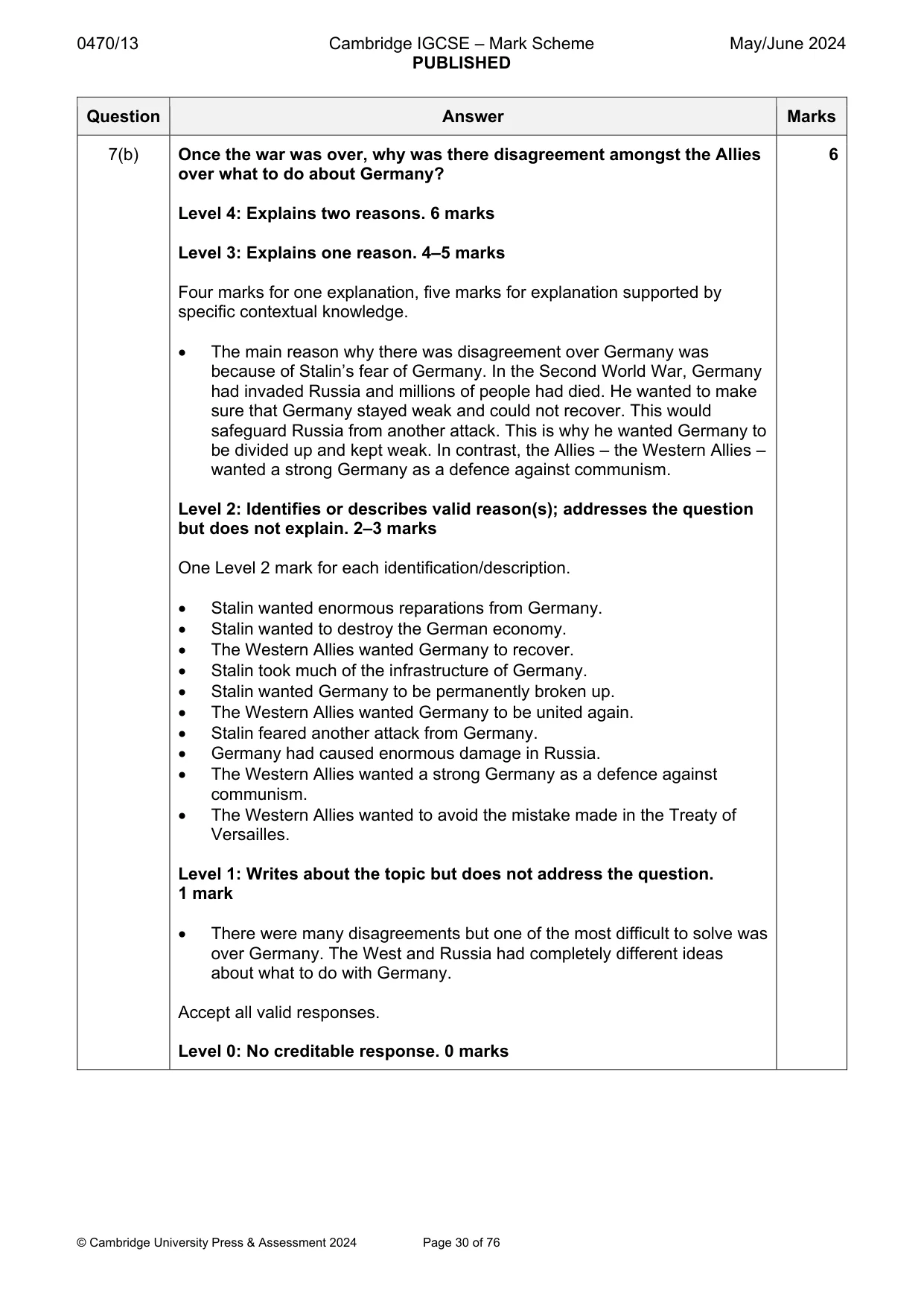
0470/13 Cambridge IGCSE – Mark Scheme PUBLISHED May/June 2024 © Cambridge University Press & Assessment 2024 Page 30 of 76 Question Answer Marks 7(b) Once the war was over, why was there disagreement amongst the Allies over what to do about Germany? Level 4: Explains two reasons. 6 marks Level 3: Explains one reason. 4–5 marks Four marks for one explanation, five marks for explanation supported by specific contextual knowledge. The main reason why there was disagreement over Germany was because of Stalin’s fear of Germany. In the Second World War, Germany had invaded Russia and millions of people had died. He wanted to make sure that Germany stayed weak and could not recover. This would safeguard Russia from another attack. This is why he wanted Germany to be divided up and kept weak. In contrast, the Allies – the Western Allies – wanted a strong Germany as a defence against communism. Level 2: Identifies or describes valid reason(s); addresses the question but does not explain. 2–3 marks One Level 2 mark for each identification/description. Stalin wanted enormous reparations from Germany. Stalin wanted to destroy the German economy. The Western Allies wanted Germany to recover. Stalin took much of the infrastructure of Germany. Stalin wanted Germany to be permanently broken up. The Western Allies wanted Germany to be united again. Stalin feared another attack from Germany. Germany had caused enormous damage in Russia. The Western Allies wanted a strong Germany as a defence against communism. The Western Allies wanted to avoid the mistake made in the Treaty of Versailles. Level 1: Writes about the topic but does not address the question. 1 mark There were many disagreements but one of the most difficult to solve was over Germany. The West and Russia had completely different ideas about what to do with Germany. Accept all valid responses. Level 0: No creditable response. 0 marks 6
Mark scheme, page 31
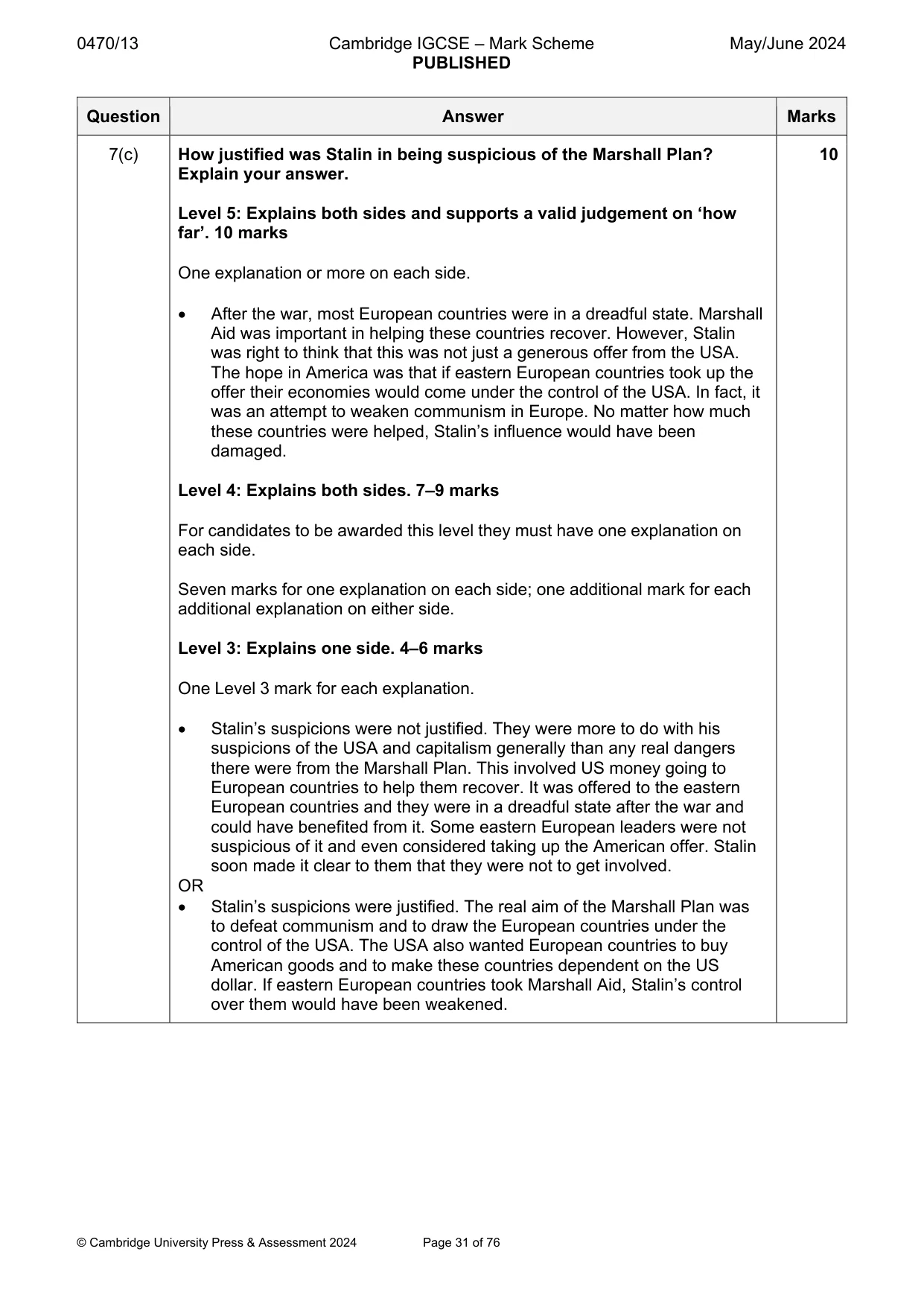
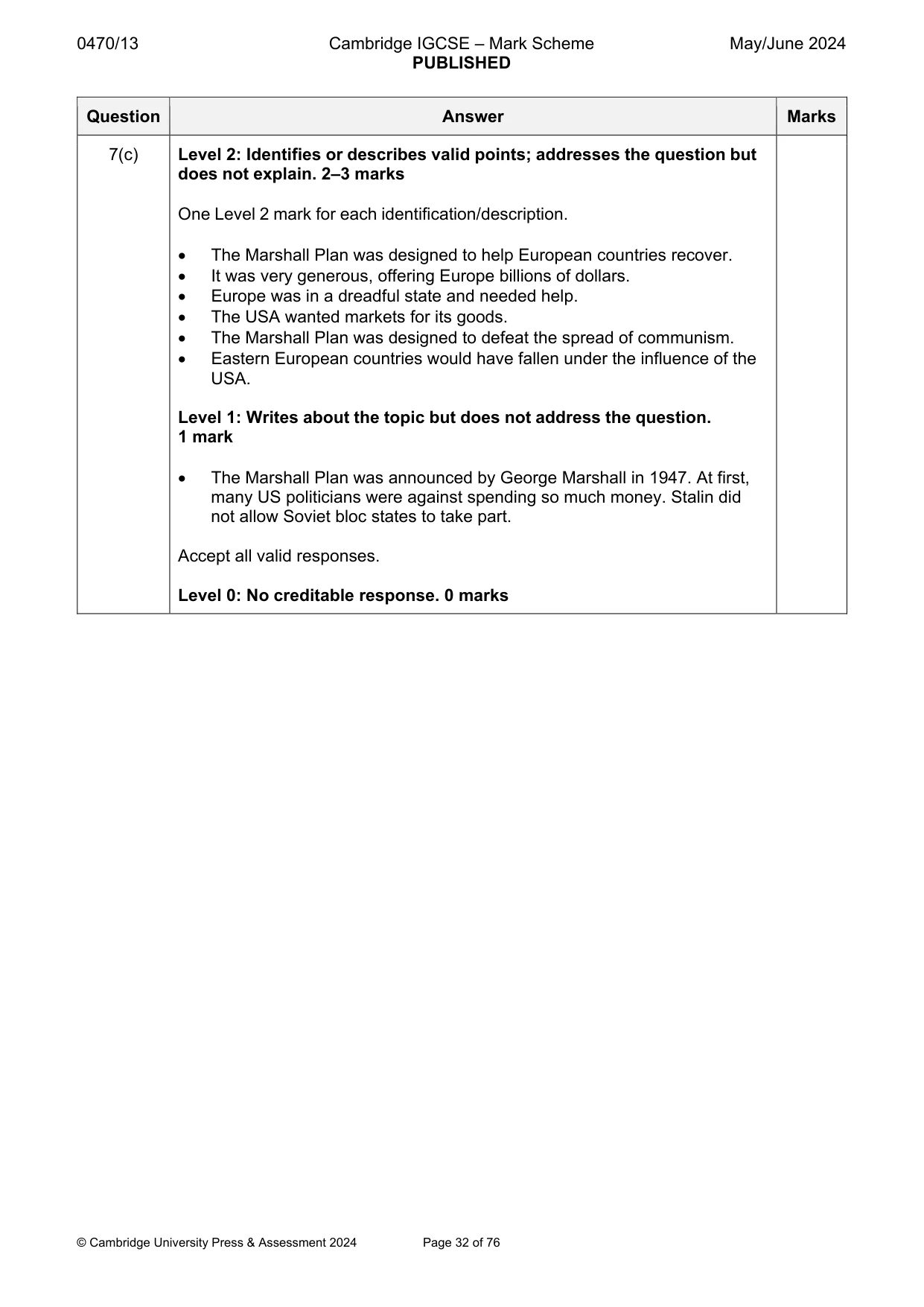
0470/13 Cambridge IGCSE – Mark Scheme PUBLISHED May/June 2024 © Cambridge University Press & Assessment 2024 Page 31 of 76 Question Answer Marks 7(c) How justified was Stalin in being suspicious of the Marshall Plan? Explain your answer. Level 5: Explains both sides and supports a valid judgement on ‘how far’. 10 marks One explanation or more on each side. After the war, most European countries were in a dreadful state. Marshall Aid was important in helping these countries recover. However, Stalin was right to think that this was not just a generous offer from the USA. The hope in America was that if eastern European countries took up the offer their economies would come under the control of the USA. In fact, it was an attempt to weaken communism in Europe. No matter how much these countries were helped, Stalin’s influence would have been damaged. Level 4: Explains both sides. 7–9 marks For candidates to be awarded this level they must have one explanation on each side. Seven marks for one explanation on each side; one additional mark for each additional explanation on either side. Level 3: Explains one side. 4–6 marks One Level 3 mark for each explanation. Stalin’s suspicions were not justified. They were more to do with his suspicions of the USA and capitalism generally than any real dangers there were from the Marshall Plan. This involved US money going to European countries to help them recover. It was offered to the eastern European countries and they were in a dreadful state after the war and could have benefited from it. Some eastern European leaders were not suspicious of it and even considered taking up the American offer. Stalin soon made it clear to them that they were not to get involved. OR Stalin’s suspicions were justified. The real aim of the Marshall Plan was to defeat communism and to draw the European countries under the control of the USA. The USA also wanted European countries to buy American goods and to make these countries dependent on the US dollar. If eastern European countries took Marshall Aid, Stalin’s control over them would have been weakened. 10
Mark scheme, page 32
0470/13 Cambridge IGCSE – Mark Scheme PUBLISHED May/June 2024 © Cambridge University Press & Assessment 2024 Page 32 of 76 Question Answer Marks 7(c) Level 2: Identifies or describes valid points; addresses the question but does not explain. 2–3 marks One Level 2 mark for each identification/description. The Marshall Plan was designed to help European countries recover. It was very generous, offering Europe billions of dollars. Europe was in a dreadful state and needed help. The USA wanted markets for its goods. The Marshall Plan was designed to defeat the spread of communism. Eastern European countries would have fallen under the influence of the USA. Level 1: Writes about the topic but does not address the question. 1 mark The Marshall Plan was announced by George Marshall in 1947. At first, many US politicians were against spending so much money. Stalin did not allow Soviet bloc states to take part. Accept all valid responses. Level 0: No creditable response. 0 marks
Mark scheme, page 33
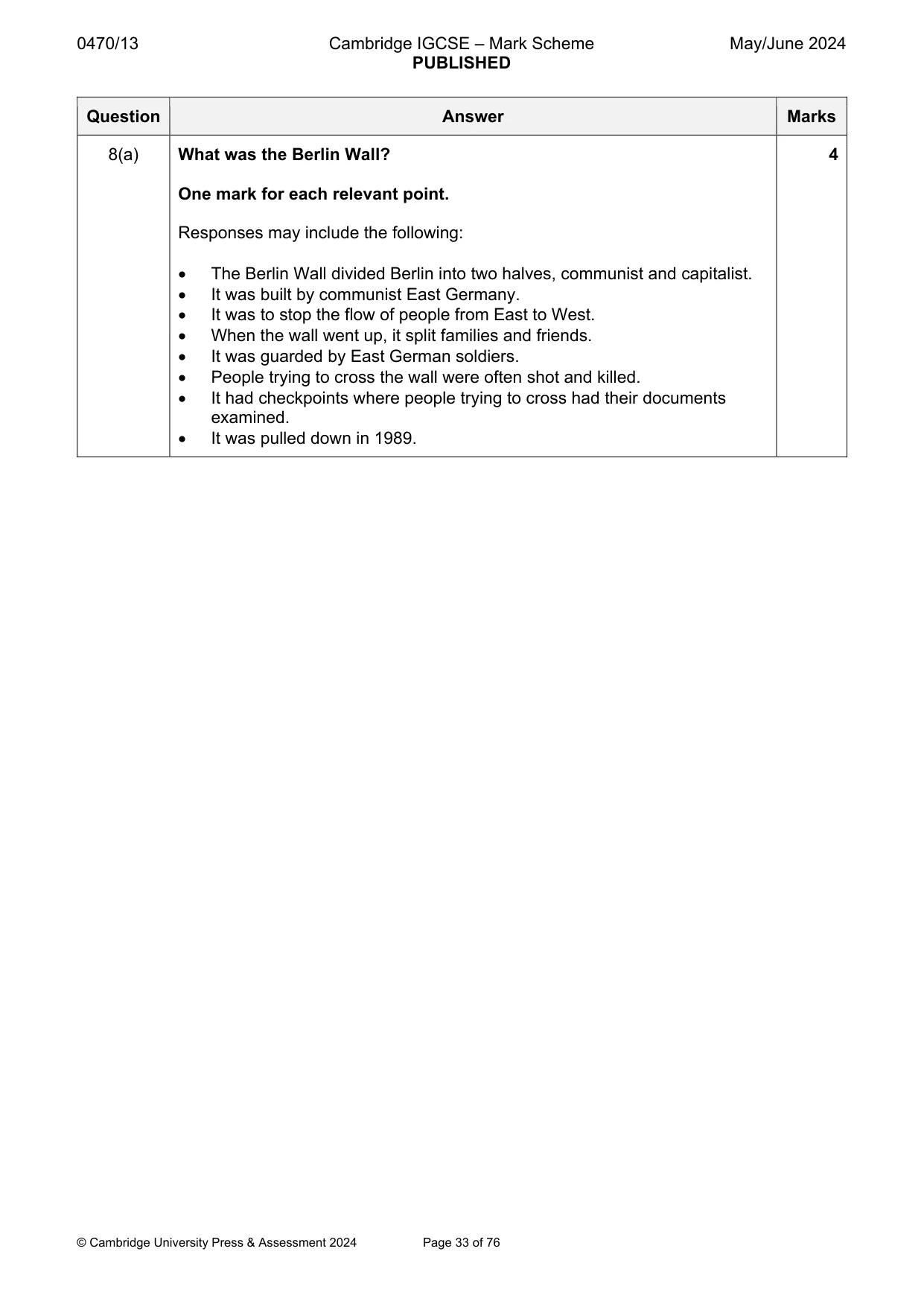
0470/13 Cambridge IGCSE – Mark Scheme PUBLISHED May/June 2024 © Cambridge University Press & Assessment 2024 Page 33 of 76 Question Answer Marks 8(a) What was the Berlin Wall? One mark for each relevant point. Responses may include the following: The Berlin Wall divided Berlin into two halves, communist and capitalist. It was built by communist East Germany. It was to stop the flow of people from East to West. When the wall went up, it split families and friends. It was guarded by East German soldiers. People trying to cross the wall were often shot and killed. It had checkpoints where people trying to cross had their documents examined. It was pulled down in 1989. 4
Mark scheme, page 34
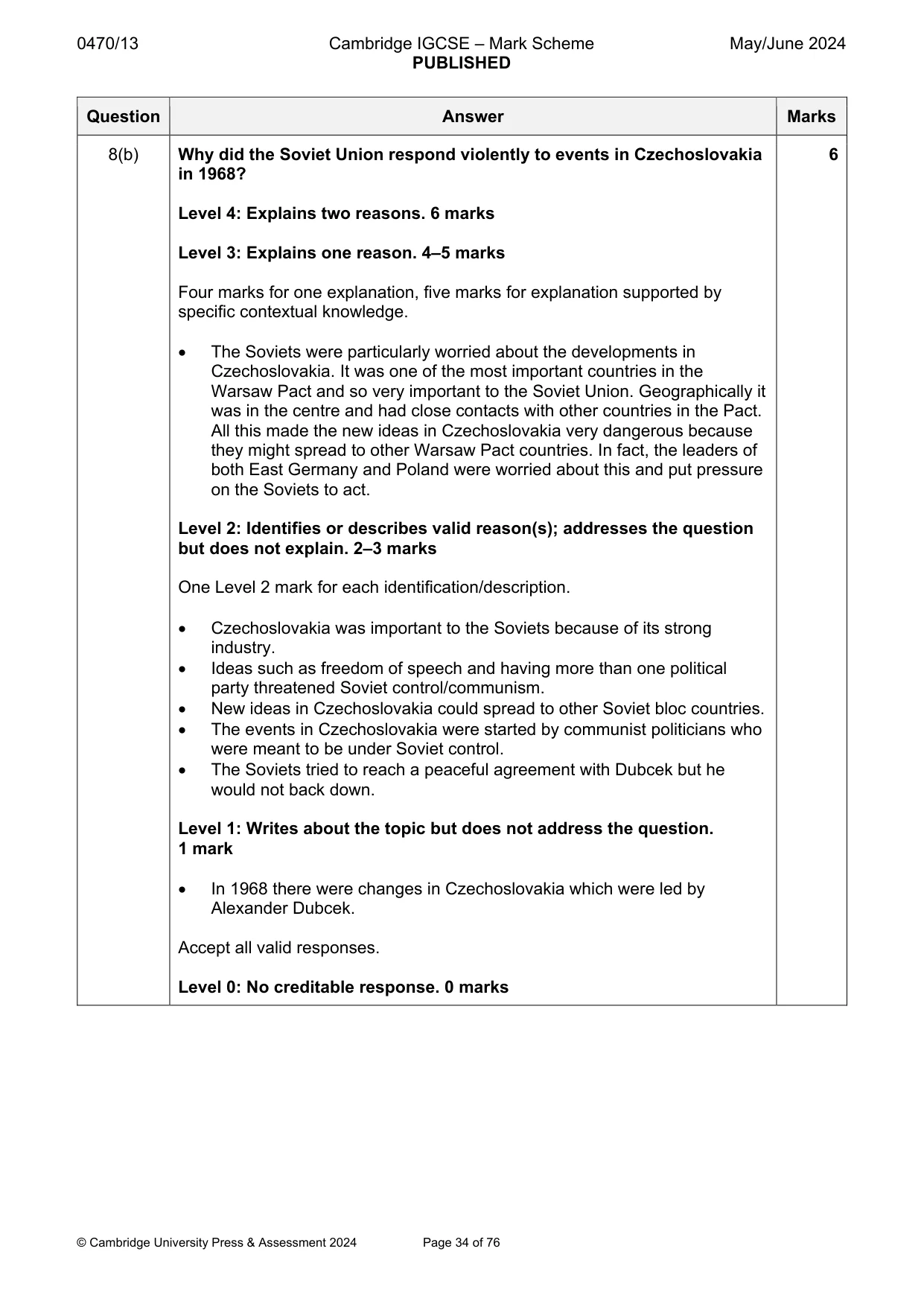
0470/13 Cambridge IGCSE – Mark Scheme PUBLISHED May/June 2024 © Cambridge University Press & Assessment 2024 Page 34 of 76 Question Answer Marks 8(b) Why did the Soviet Union respond violently to events in Czechoslovakia in 1968? Level 4: Explains two reasons. 6 marks Level 3: Explains one reason. 4–5 marks Four marks for one explanation, five marks for explanation supported by specific contextual knowledge. The Soviets were particularly worried about the developments in Czechoslovakia. It was one of the most important countries in the Warsaw Pact and so very important to the Soviet Union. Geographically it was in the centre and had close contacts with other countries in the Pact. All this made the new ideas in Czechoslovakia very dangerous because they might spread to other Warsaw Pact countries. In fact, the leaders of both East Germany and Poland were worried about this and put pressure on the Soviets to act. Level 2: Identifies or describes valid reason(s); addresses the question but does not explain. 2–3 marks One Level 2 mark for each identification/description. Czechoslovakia was important to the Soviets because of its strong industry. Ideas such as freedom of speech and having more than one political party threatened Soviet control/communism. New ideas in Czechoslovakia could spread to other Soviet bloc countries. The events in Czechoslovakia were started by communist politicians who were meant to be under Soviet control. The Soviets tried to reach a peaceful agreement with Dubcek but he would not back down. Level 1: Writes about the topic but does not address the question. 1 mark In 1968 there were changes in Czechoslovakia which were led by Alexander Dubcek. Accept all valid responses. Level 0: No creditable response. 0 marks 6
Mark scheme, page 35
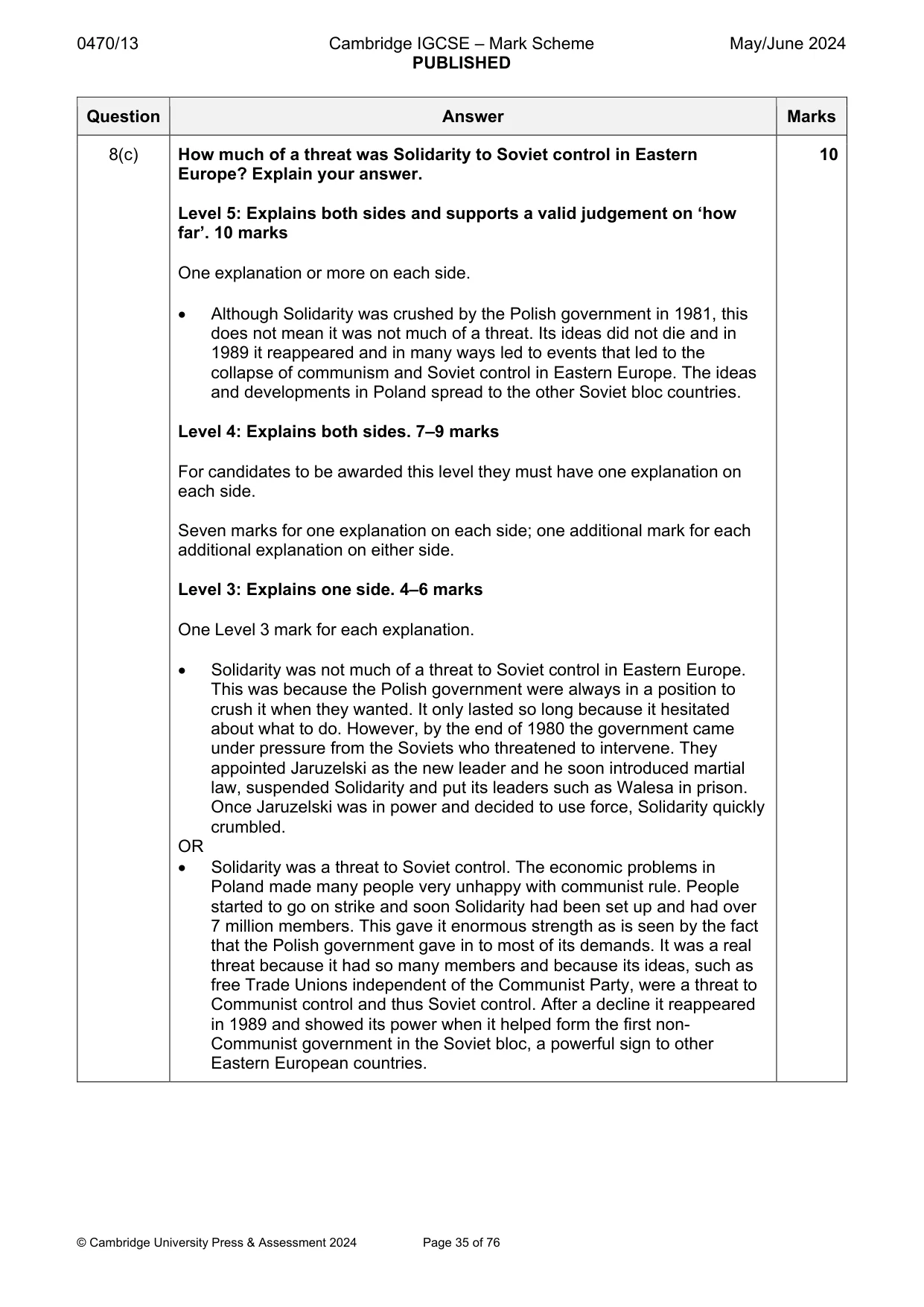
0470/13 Cambridge IGCSE – Mark Scheme PUBLISHED May/June 2024 © Cambridge University Press & Assessment 2024 Page 35 of 76 Question Answer Marks 8(c) How much of a threat was Solidarity to Soviet control in Eastern Europe? Explain your answer. Level 5: Explains both sides and supports a valid judgement on ‘how far’. 10 marks One explanation or more on each side. Although Solidarity was crushed by the Polish government in 1981, this does not mean it was not much of a threat. Its ideas did not die and in 1989 it reappeared and in many ways led to events that led to the collapse of communism and Soviet control in Eastern Europe. The ideas and developments in Poland spread to the other Soviet bloc countries. Level 4: Explains both sides. 7–9 marks For candidates to be awarded this level they must have one explanation on each side. Seven marks for one explanation on each side; one additional mark for each additional explanation on either side. Level 3: Explains one side. 4–6 marks One Level 3 mark for each explanation. Solidarity was not much of a threat to Soviet control in Eastern Europe. This was because the Polish government were always in a position to crush it when they wanted. It only lasted so long because it hesitated about what to do. However, by the end of 1980 the government came under pressure from the Soviets who threatened to intervene. They appointed Jaruzelski as the new leader and he soon introduced martial law, suspended Solidarity and put its leaders such as Walesa in prison. Once Jaruzelski was in power and decided to use force, Solidarity quickly crumbled. OR Solidarity was a threat to Soviet control. The economic problems in Poland made many people very unhappy with communist rule. People started to go on strike and soon Solidarity had been set up and had over 7 million members. This gave it enormous strength as is seen by the fact that the Polish government gave in to most of its demands. It was a real threat because it had so many members and because its ideas, such as free Trade Unions independent of the Communist Party, were a threat to Communist control and thus Soviet control. After a decline it reappeared in 1989 and showed its power when it helped form the first non- Communist government in the Soviet bloc, a powerful sign to other Eastern European countries. 10
Mark scheme, page 36
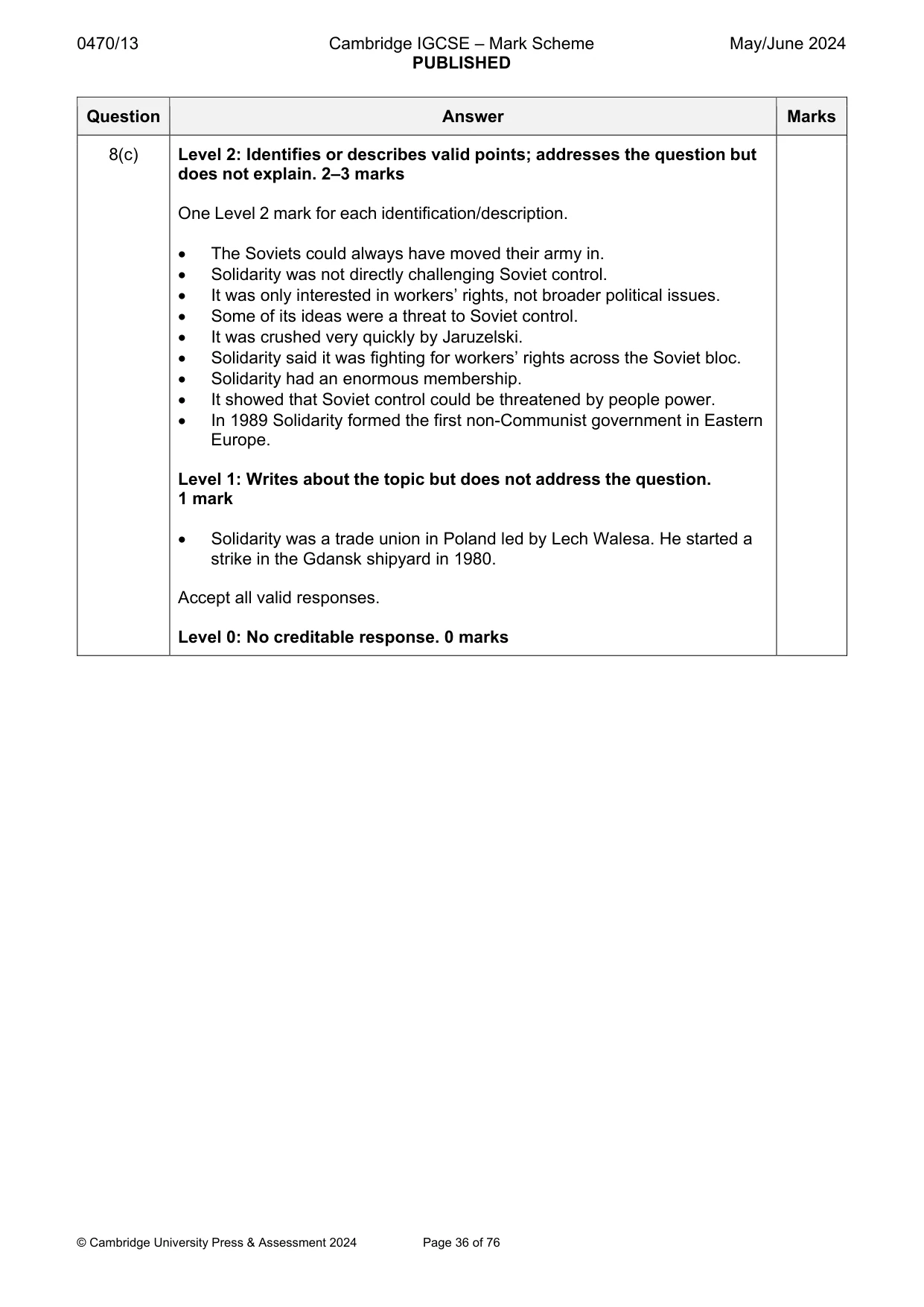
0470/13 Cambridge IGCSE – Mark Scheme PUBLISHED May/June 2024 © Cambridge University Press & Assessment 2024 Page 36 of 76 Question Answer Marks 8(c) Level 2: Identifies or describes valid points; addresses the question but does not explain. 2–3 marks One Level 2 mark for each identification/description. The Soviets could always have moved their army in. Solidarity was not directly challenging Soviet control. It was only interested in workers’ rights, not broader political issues. Some of its ideas were a threat to Soviet control. It was crushed very quickly by Jaruzelski. Solidarity said it was fighting for workers’ rights across the Soviet bloc. Solidarity had an enormous membership. It showed that Soviet control could be threatened by people power. In 1989 Solidarity formed the first non-Communist government in Eastern Europe. Level 1: Writes about the topic but does not address the question. 1 mark Solidarity was a trade union in Poland led by Lech Walesa. He started a strike in the Gdansk shipyard in 1980. Accept all valid responses. Level 0: No creditable response. 0 marks
Mark scheme, page 37
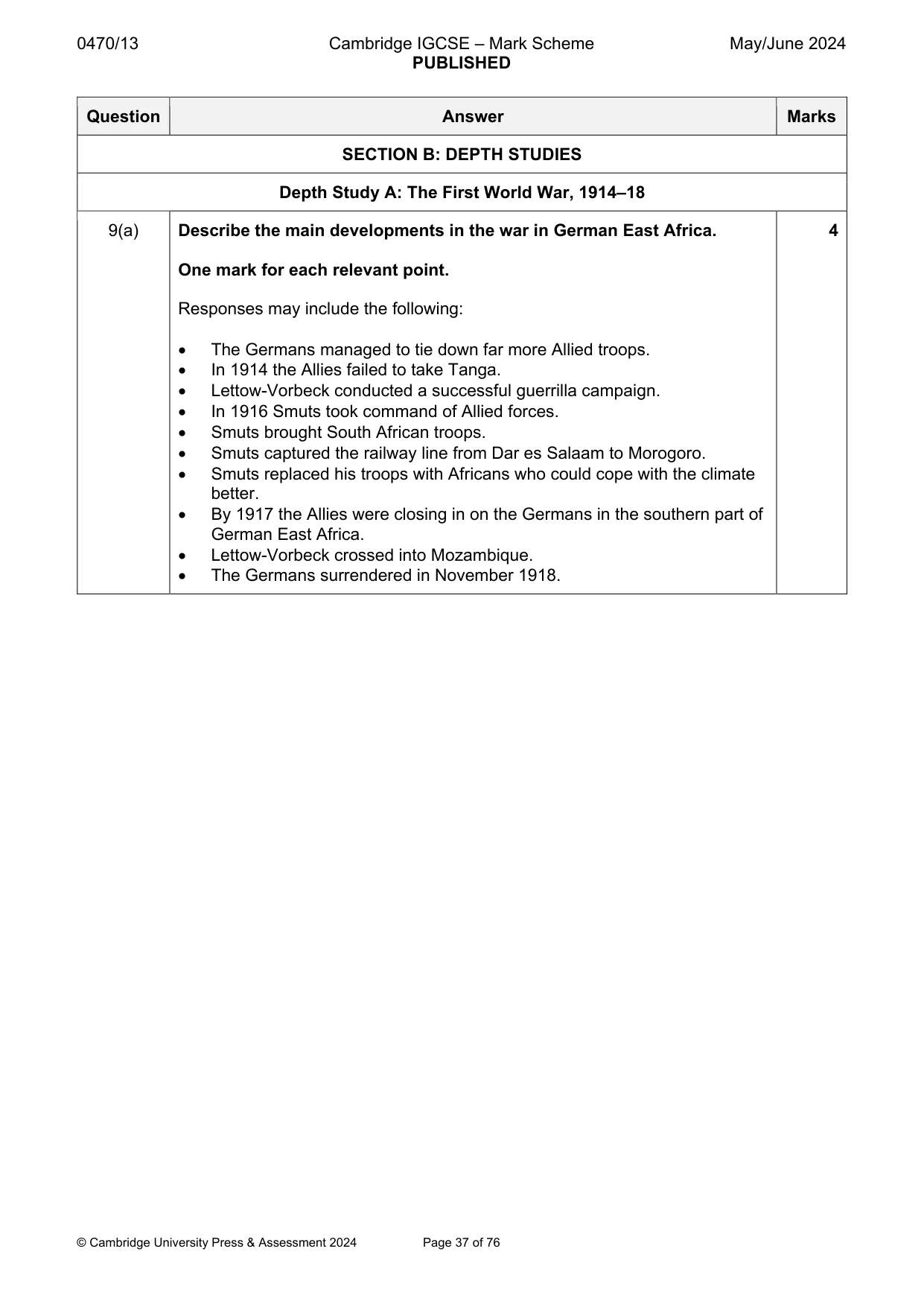
0470/13 Cambridge IGCSE – Mark Scheme PUBLISHED May/June 2024 © Cambridge University Press & Assessment 2024 Page 37 of 76 Question Answer Marks SECTION B: DEPTH STUDIES Depth Study A: The First World War, 1914–18 9(a) Describe the main developments in the war in German East Africa. One mark for each relevant point. Responses may include the following: The Germans managed to tie down far more Allied troops. In 1914 the Allies failed to take Tanga. Lettow-Vorbeck conducted a successful guerrilla campaign. In 1916 Smuts took command of Allied forces. Smuts brought South African troops. Smuts captured the railway line from Dar es Salaam to Morogoro. Smuts replaced his troops with Africans who could cope with the climate better. By 1917 the Allies were closing in on the Germans in the southern part of German East Africa. Lettow-Vorbeck crossed into Mozambique. The Germans surrendered in November 1918. 4
Mark scheme, page 38
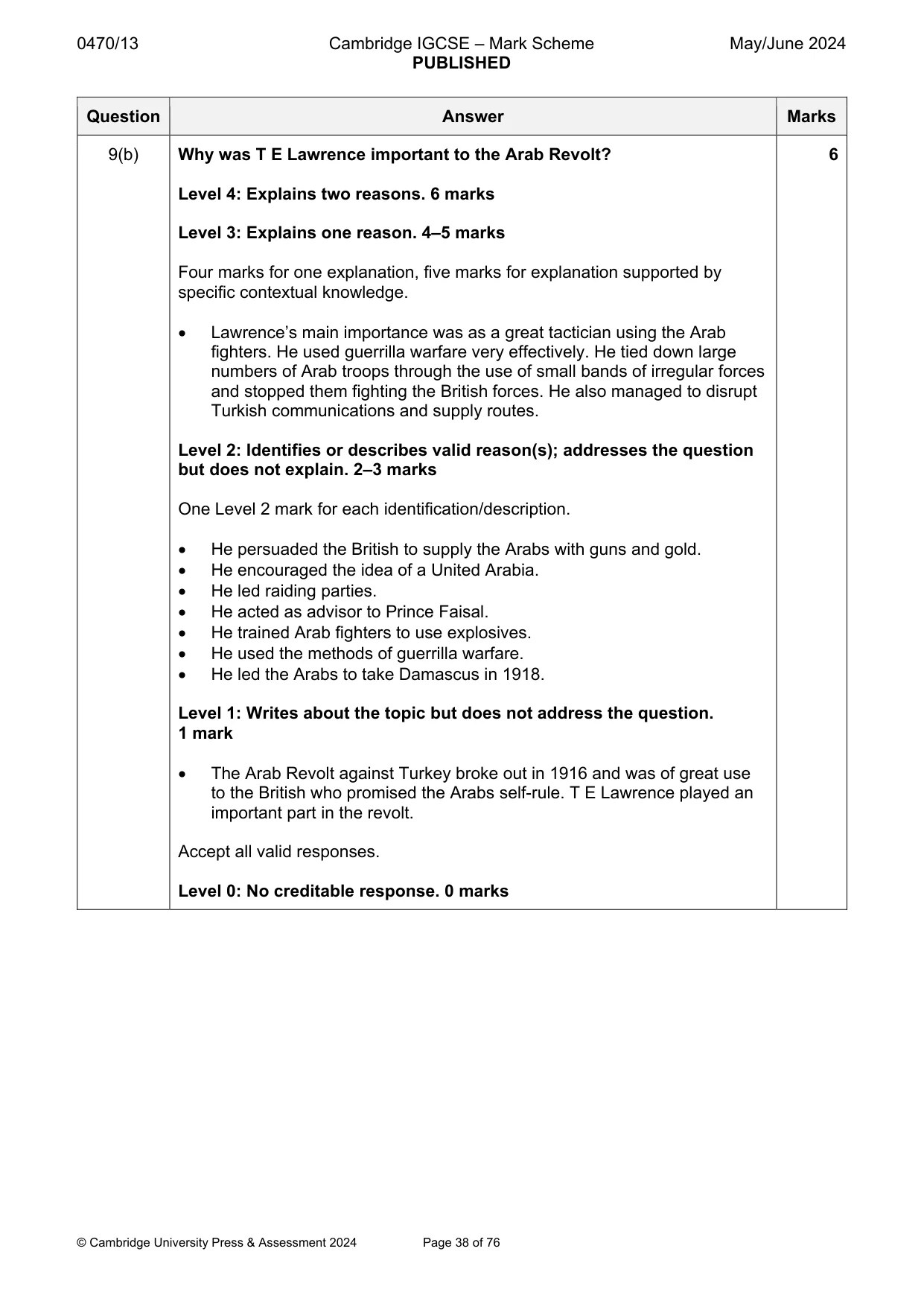
0470/13 Cambridge IGCSE – Mark Scheme PUBLISHED May/June 2024 © Cambridge University Press & Assessment 2024 Page 38 of 76 Question Answer Marks 9(b) Why was T E Lawrence important to the Arab Revolt? Level 4: Explains two reasons. 6 marks Level 3: Explains one reason. 4–5 marks Four marks for one explanation, five marks for explanation supported by specific contextual knowledge. Lawrence’s main importance was as a great tactician using the Arab fighters. He used guerrilla warfare very effectively. He tied down large numbers of Arab troops through the use of small bands of irregular forces and stopped them fighting the British forces. He also managed to disrupt Turkish communications and supply routes. Level 2: Identifies or describes valid reason(s); addresses the question but does not explain. 2–3 marks One Level 2 mark for each identification/description. He persuaded the British to supply the Arabs with guns and gold. He encouraged the idea of a United Arabia. He led raiding parties. He acted as advisor to Prince Faisal. He trained Arab fighters to use explosives. He used the methods of guerrilla warfare. He led the Arabs to take Damascus in 1918. Level 1: Writes about the topic but does not address the question. 1 mark The Arab Revolt against Turkey broke out in 1916 and was of great use to the British who promised the Arabs self-rule. T E Lawrence played an important part in the revolt. Accept all valid responses. Level 0: No creditable response. 0 marks 6
Mark scheme, page 39
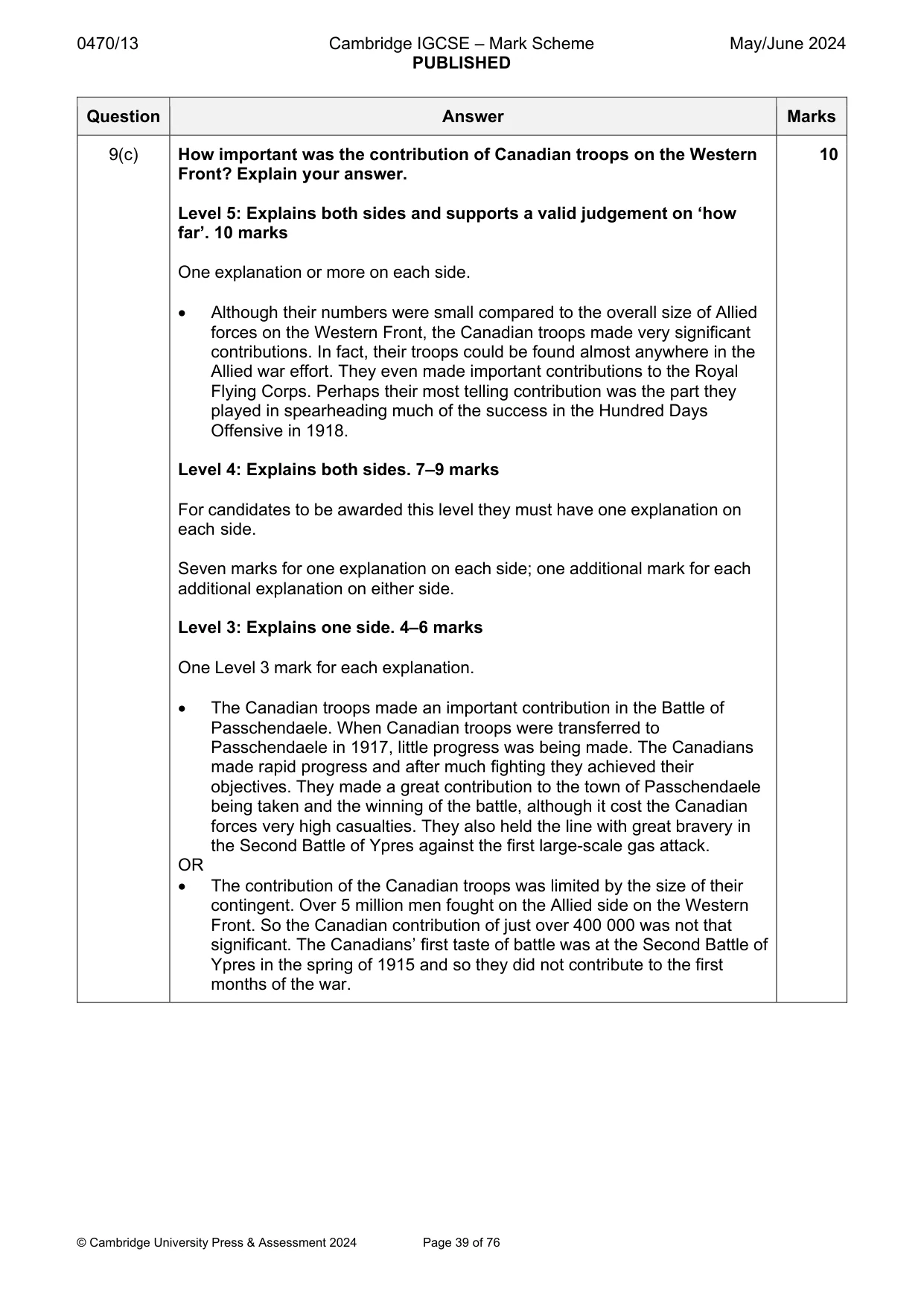
0470/13 Cambridge IGCSE – Mark Scheme PUBLISHED May/June 2024 © Cambridge University Press & Assessment 2024 Page 39 of 76 Question Answer Marks 9(c) How important was the contribution of Canadian troops on the Western Front? Explain your answer. Level 5: Explains both sides and supports a valid judgement on ‘how far’. 10 marks One explanation or more on each side. Although their numbers were small compared to the overall size of Allied forces on the Western Front, the Canadian troops made very significant contributions. In fact, their troops could be found almost anywhere in the Allied war effort. They even made important contributions to the Royal Flying Corps. Perhaps their most telling contribution was the part they played in spearheading much of the success in the Hundred Days Offensive in 1918. Level 4: Explains both sides. 7–9 marks For candidates to be awarded this level they must have one explanation on each side. Seven marks for one explanation on each side; one additional mark for each additional explanation on either side. Level 3: Explains one side. 4–6 marks One Level 3 mark for each explanation. The Canadian troops made an important contribution in the Battle of Passchendaele. When Canadian troops were transferred to Passchendaele in 1917, little progress was being made. The Canadians made rapid progress and after much fighting they achieved their objectives. They made a great contribution to the town of Passchendaele being taken and the winning of the battle, although it cost the Canadian forces very high casualties. They also held the line with great bravery in the Second Battle of Ypres against the first large-scale gas attack. OR The contribution of the Canadian troops was limited by the size of their contingent. Over 5 million men fought on the Allied side on the Western Front. So the Canadian contribution of just over 400 000 was not that significant. The Canadians’ first taste of battle was at the Second Battle of Ypres in the spring of 1915 and so they did not contribute to the first months of the war. 10
Mark scheme, page 40
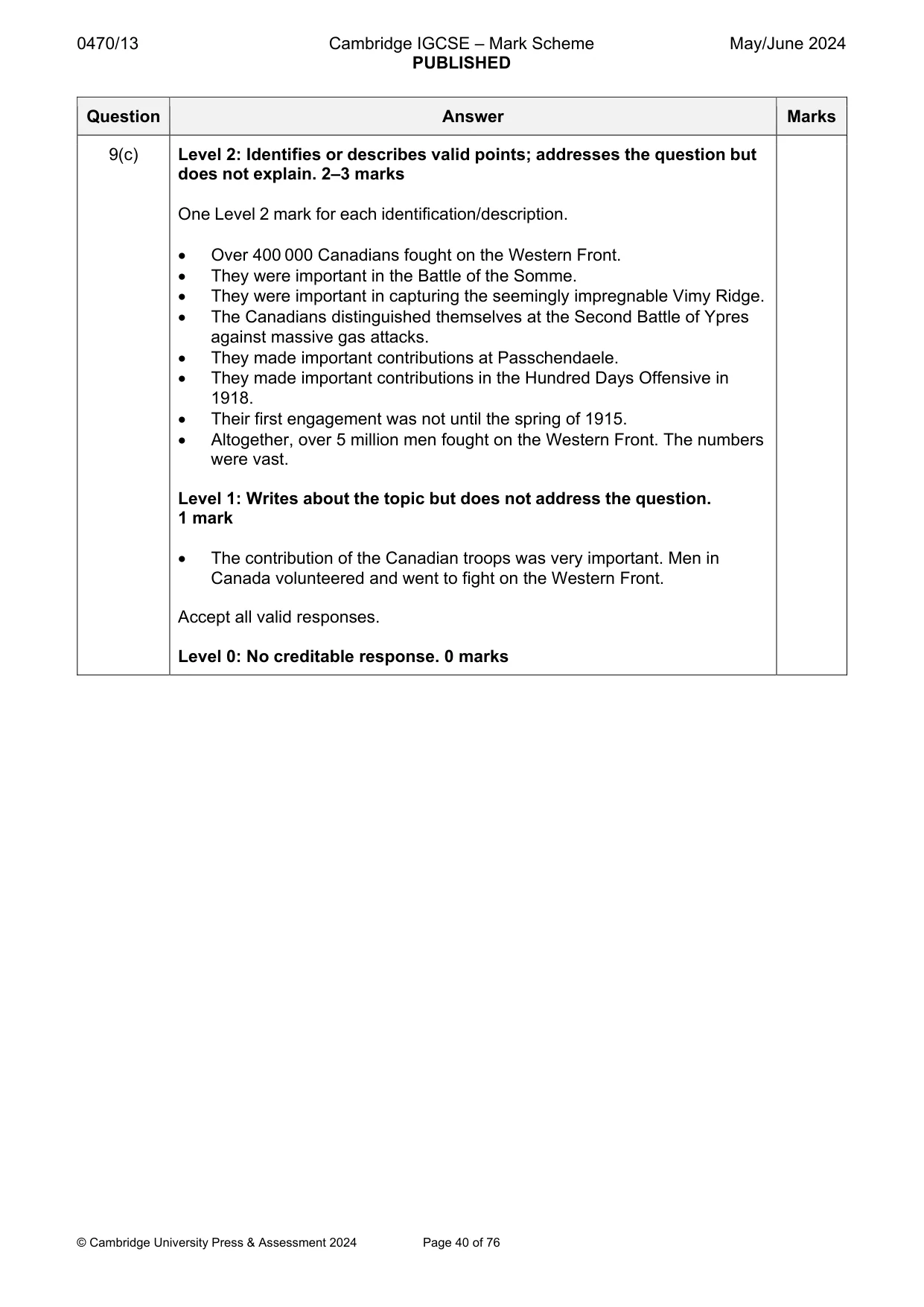
0470/13 Cambridge IGCSE – Mark Scheme PUBLISHED May/June 2024 © Cambridge University Press & Assessment 2024 Page 40 of 76 Question Answer Marks 9(c) Level 2: Identifies or describes valid points; addresses the question but does not explain. 2–3 marks One Level 2 mark for each identification/description. Over 400 000 Canadians fought on the Western Front. They were important in the Battle of the Somme. They were important in capturing the seemingly impregnable Vimy Ridge. The Canadians distinguished themselves at the Second Battle of Ypres against massive gas attacks. They made important contributions at Passchendaele. They made important contributions in the Hundred Days Offensive in 1918. Their first engagement was not until the spring of 1915. Altogether, over 5 million men fought on the Western Front. The numbers were vast. Level 1: Writes about the topic but does not address the question. 1 mark The contribution of the Canadian troops was very important. Men in Canada volunteered and went to fight on the Western Front. Accept all valid responses. Level 0: No creditable response. 0 marks
Mark scheme, page 41
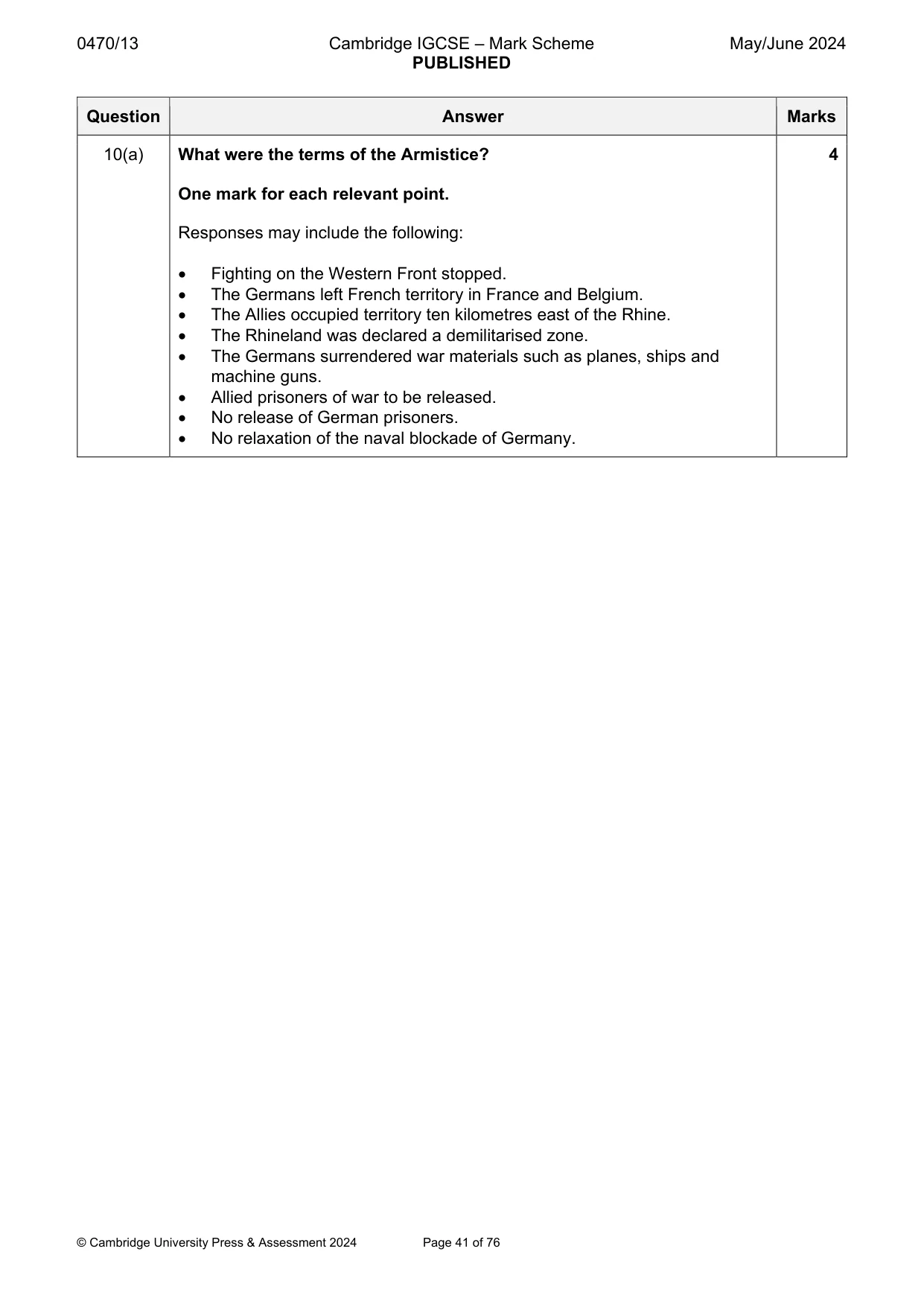
0470/13 Cambridge IGCSE – Mark Scheme PUBLISHED May/June 2024 © Cambridge University Press & Assessment 2024 Page 41 of 76 Question Answer Marks 10(a) What were the terms of the Armistice? One mark for each relevant point. Responses may include the following: Fighting on the Western Front stopped. The Germans left French territory in France and Belgium. The Allies occupied territory ten kilometres east of the Rhine. The Rhineland was declared a demilitarised zone. The Germans surrendered war materials such as planes, ships and machine guns. Allied prisoners of war to be released. No release of German prisoners. No relaxation of the naval blockade of Germany. 4
Mark scheme, page 42
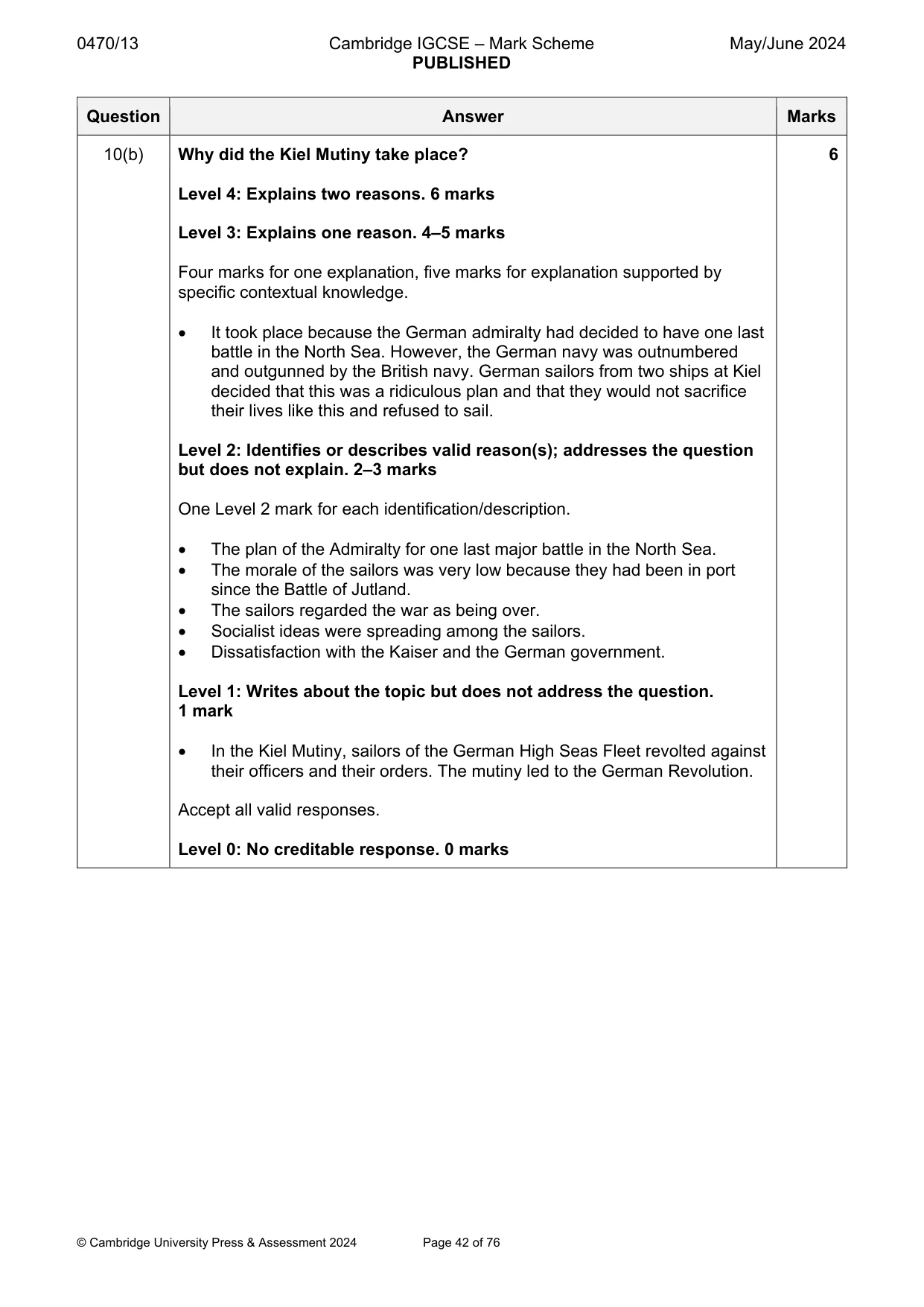
0470/13 Cambridge IGCSE – Mark Scheme PUBLISHED May/June 2024 © Cambridge University Press & Assessment 2024 Page 42 of 76 Question Answer Marks 10(b) Why did the Kiel Mutiny take place? Level 4: Explains two reasons. 6 marks Level 3: Explains one reason. 4–5 marks Four marks for one explanation, five marks for explanation supported by specific contextual knowledge. It took place because the German admiralty had decided to have one last battle in the North Sea. However, the German navy was outnumbered and outgunned by the British navy. German sailors from two ships at Kiel decided that this was a ridiculous plan and that they would not sacrifice their lives like this and refused to sail. Level 2: Identifies or describes valid reason(s); addresses the question but does not explain. 2–3 marks One Level 2 mark for each identification/description. The plan of the Admiralty for one last major battle in the North Sea. The morale of the sailors was very low because they had been in port since the Battle of Jutland. The sailors regarded the war as being over. Socialist ideas were spreading among the sailors. Dissatisfaction with the Kaiser and the German government. Level 1: Writes about the topic but does not address the question. 1 mark In the Kiel Mutiny, sailors of the German High Seas Fleet revolted against their officers and their orders. The mutiny led to the German Revolution. Accept all valid responses. Level 0: No creditable response. 0 marks 6
Mark scheme, page 43
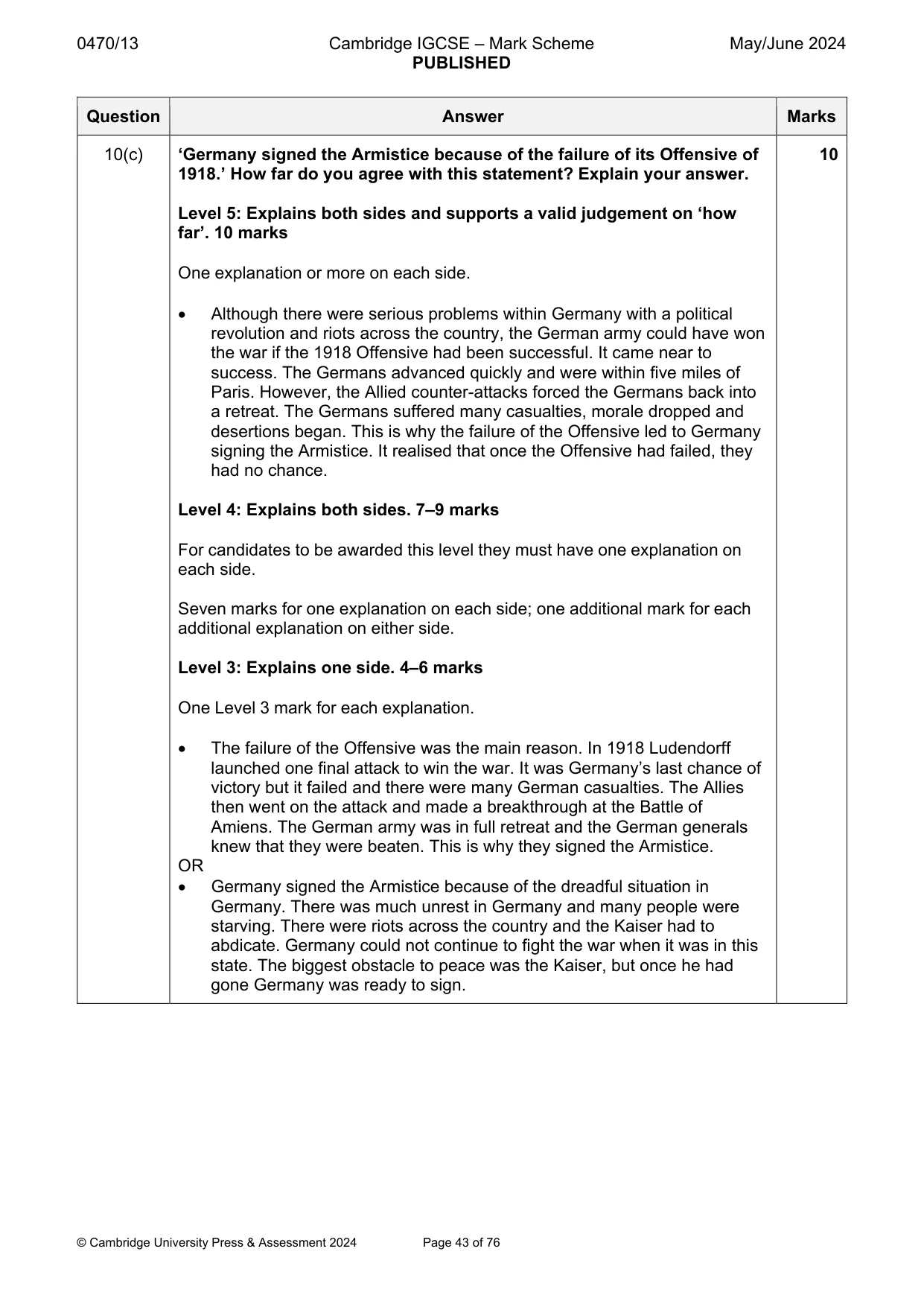
0470/13 Cambridge IGCSE – Mark Scheme PUBLISHED May/June 2024 © Cambridge University Press & Assessment 2024 Page 43 of 76 Question Answer Marks 10(c) ‘Germany signed the Armistice because of the failure of its Offensive of 1918.’ How far do you agree with this statement? Explain your answer. Level 5: Explains both sides and supports a valid judgement on ‘how far’. 10 marks One explanation or more on each side. Although there were serious problems within Germany with a political revolution and riots across the country, the German army could have won the war if the 1918 Offensive had been successful. It came near to success. The Germans advanced quickly and were within five miles of Paris. However, the Allied counter-attacks forced the Germans back into a retreat. The Germans suffered many casualties, morale dropped and desertions began. This is why the failure of the Offensive led to Germany signing the Armistice. It realised that once the Offensive had failed, they had no chance. Level 4: Explains both sides. 7–9 marks For candidates to be awarded this level they must have one explanation on each side. Seven marks for one explanation on each side; one additional mark for each additional explanation on either side. Level 3: Explains one side. 4–6 marks One Level 3 mark for each explanation. The failure of the Offensive was the main reason. In 1918 Ludendorff launched one final attack to win the war. It was Germany’s last chance of victory but it failed and there were many German casualties. The Allies then went on the attack and made a breakthrough at the Battle of Amiens. The German army was in full retreat and the German generals knew that they were beaten. This is why they signed the Armistice. OR Germany signed the Armistice because of the dreadful situation in Germany. There was much unrest in Germany and many people were starving. There were riots across the country and the Kaiser had to abdicate. Germany could not continue to fight the war when it was in this state. The biggest obstacle to peace was the Kaiser, but once he had gone Germany was ready to sign. 10
Mark scheme, page 44
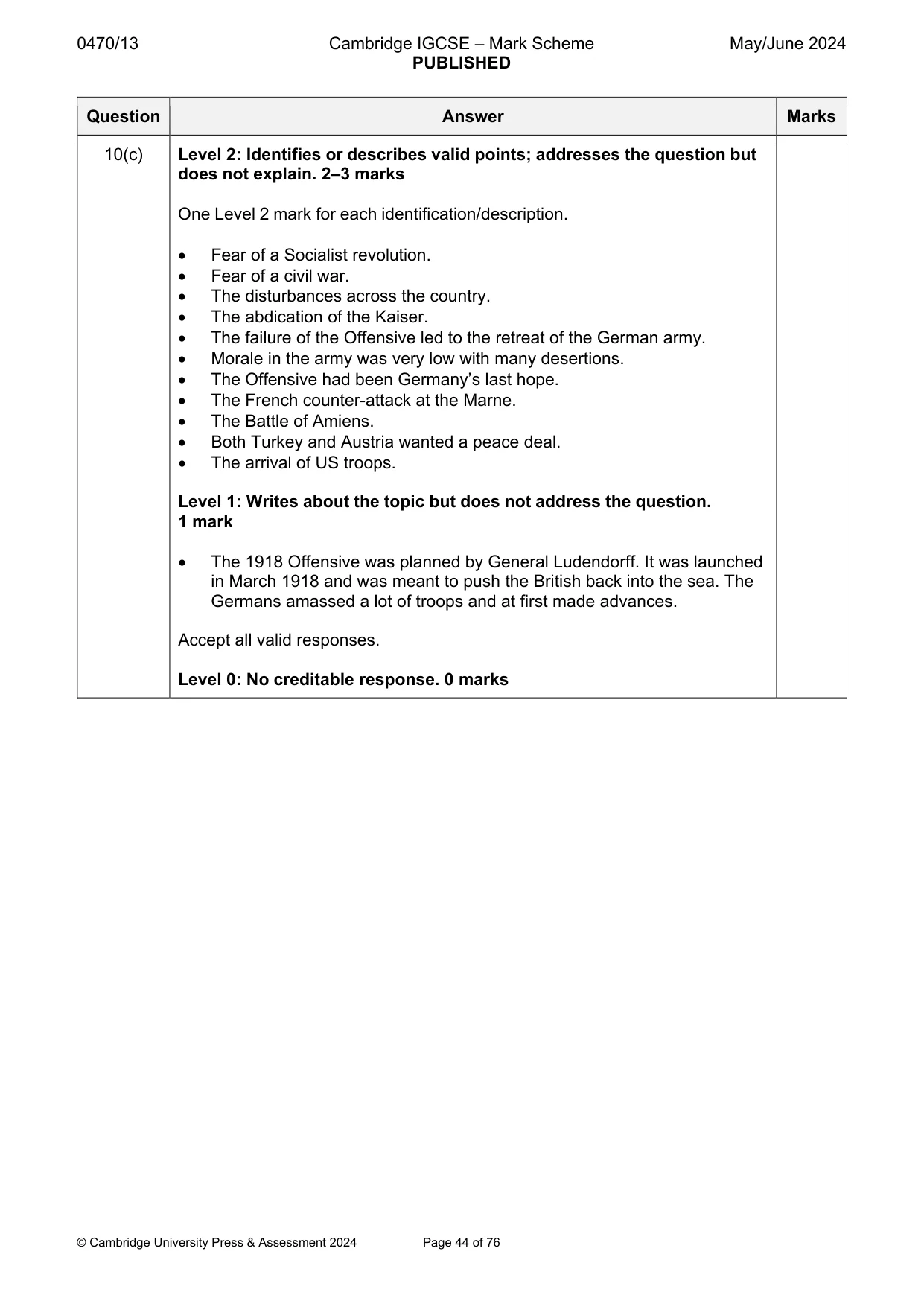
0470/13 Cambridge IGCSE – Mark Scheme PUBLISHED May/June 2024 © Cambridge University Press & Assessment 2024 Page 44 of 76 Question Answer Marks 10(c) Level 2: Identifies or describes valid points; addresses the question but does not explain. 2–3 marks One Level 2 mark for each identification/description. Fear of a Socialist revolution. Fear of a civil war. The disturbances across the country. The abdication of the Kaiser. The failure of the Offensive led to the retreat of the German army. Morale in the army was very low with many desertions. The Offensive had been Germany’s last hope. The French counter-attack at the Marne. The Battle of Amiens. Both Turkey and Austria wanted a peace deal. The arrival of US troops. Level 1: Writes about the topic but does not address the question. 1 mark The 1918 Offensive was planned by General Ludendorff. It was launched in March 1918 and was meant to push the British back into the sea. The Germans amassed a lot of troops and at first made advances. Accept all valid responses. Level 0: No creditable response. 0 marks
Mark scheme, page 45
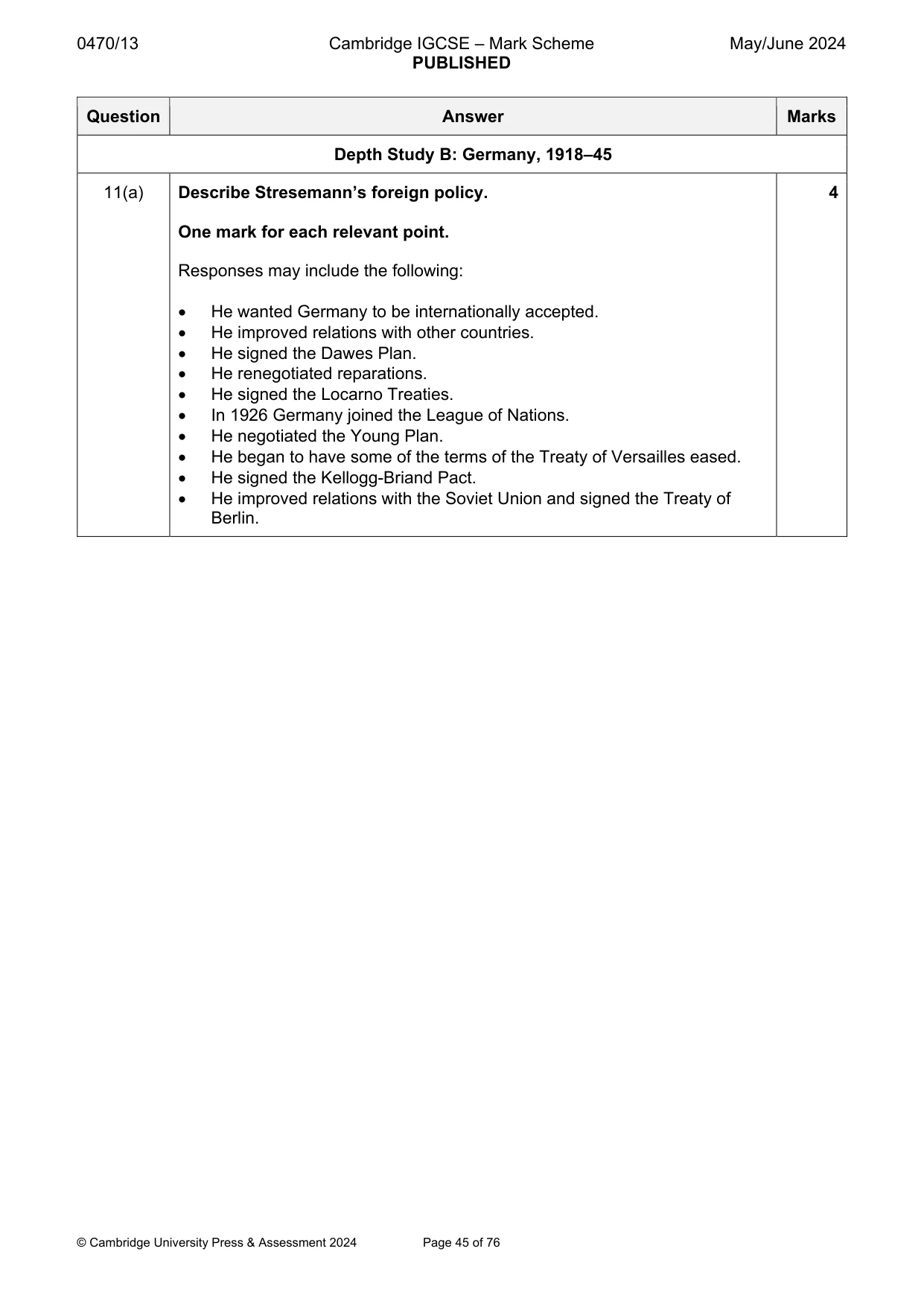
0470/13 Cambridge IGCSE – Mark Scheme PUBLISHED May/June 2024 © Cambridge University Press & Assessment 2024 Page 45 of 76 Question Answer Marks Depth Study B: Germany, 1918–45 11(a) Describe Stresemann’s foreign policy. One mark for each relevant point. Responses may include the following: He wanted Germany to be internationally accepted. He improved relations with other countries. He signed the Dawes Plan. He renegotiated reparations. He signed the Locarno Treaties. In 1926 Germany joined the League of Nations. He negotiated the Young Plan. He began to have some of the terms of the Treaty of Versailles eased. He signed the Kellogg-Briand Pact. He improved relations with the Soviet Union and signed the Treaty of Berlin. 4
Mark scheme, page 46
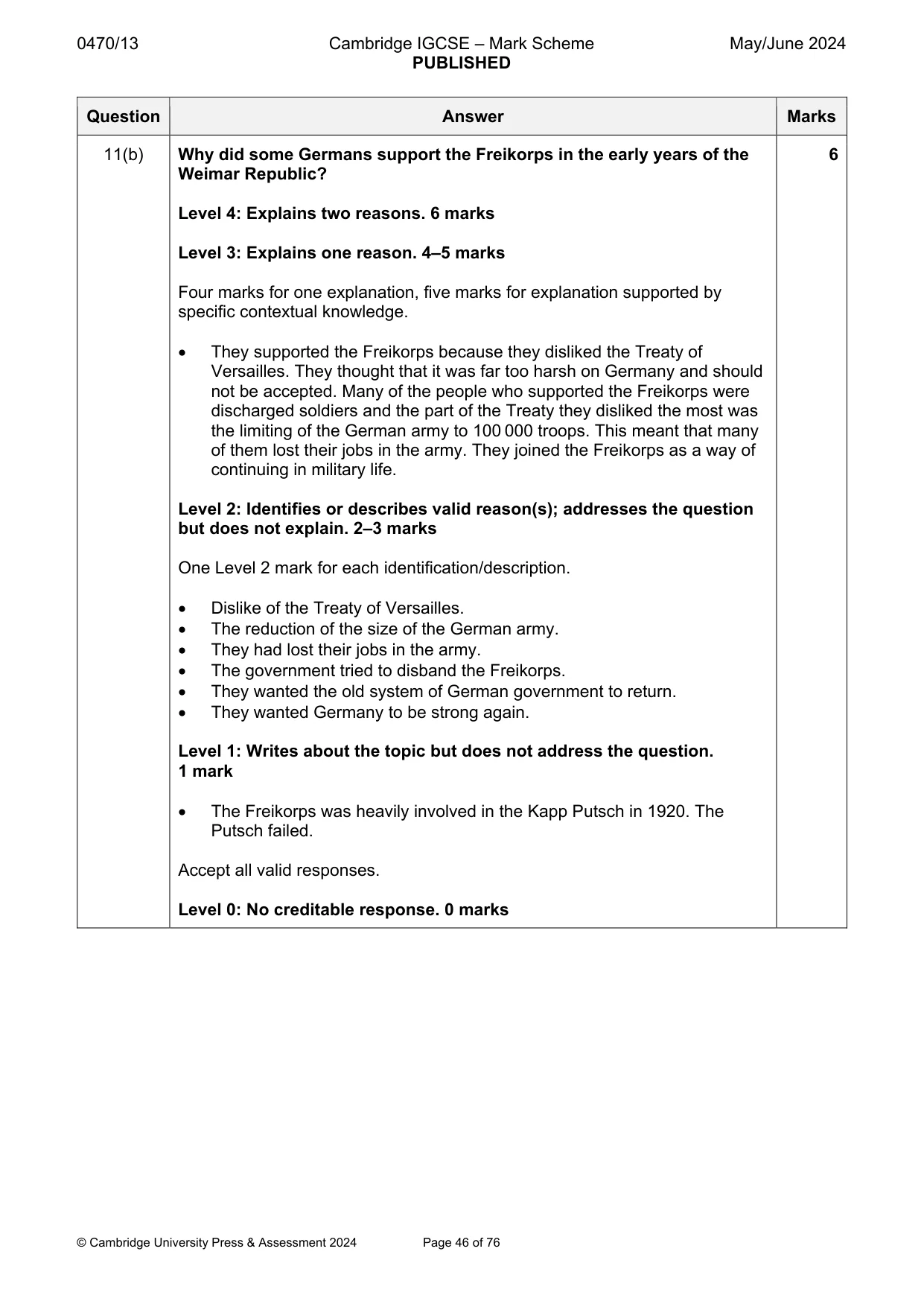
0470/13 Cambridge IGCSE – Mark Scheme PUBLISHED May/June 2024 © Cambridge University Press & Assessment 2024 Page 46 of 76 Question Answer Marks 11(b) Why did some Germans support the Freikorps in the early years of the Weimar Republic? Level 4: Explains two reasons. 6 marks Level 3: Explains one reason. 4–5 marks Four marks for one explanation, five marks for explanation supported by specific contextual knowledge. They supported the Freikorps because they disliked the Treaty of Versailles. They thought that it was far too harsh on Germany and should not be accepted. Many of the people who supported the Freikorps were discharged soldiers and the part of the Treaty they disliked the most was the limiting of the German army to 100 000 troops. This meant that many of them lost their jobs in the army. They joined the Freikorps as a way of continuing in military life. Level 2: Identifies or describes valid reason(s); addresses the question but does not explain. 2–3 marks One Level 2 mark for each identification/description. Dislike of the Treaty of Versailles. The reduction of the size of the German army. They had lost their jobs in the army. The government tried to disband the Freikorps. They wanted the old system of German government to return. They wanted Germany to be strong again. Level 1: Writes about the topic but does not address the question. 1 mark The Freikorps was heavily involved in the Kapp Putsch in 1920. The Putsch failed. Accept all valid responses. Level 0: No creditable response. 0 marks 6
Mark scheme, page 47
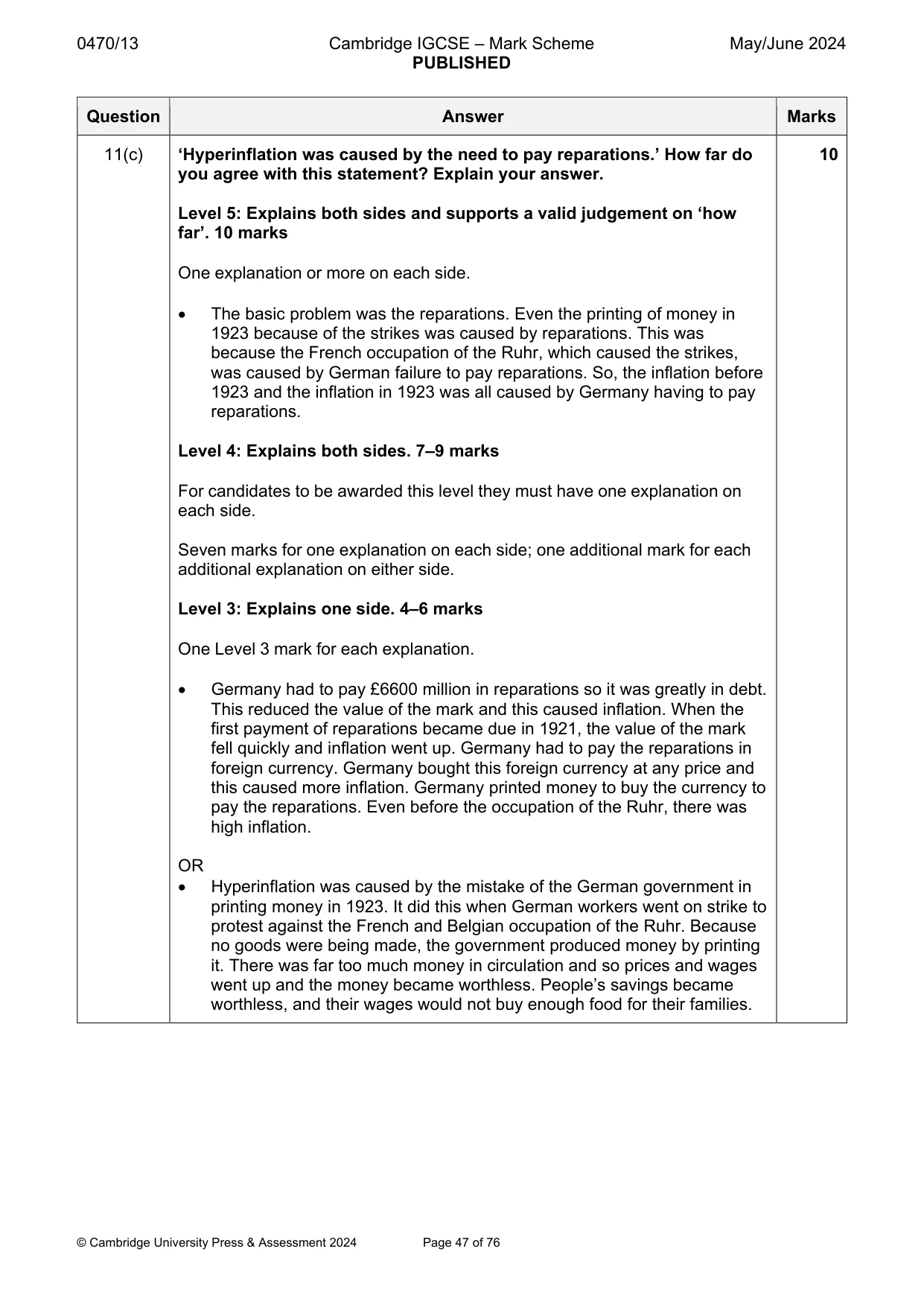
0470/13 Cambridge IGCSE – Mark Scheme PUBLISHED May/June 2024 © Cambridge University Press & Assessment 2024 Page 47 of 76 Question Answer Marks 11(c) ‘Hyperinflation was caused by the need to pay reparations.’ How far do you agree with this statement? Explain your answer. Level 5: Explains both sides and supports a valid judgement on ‘how far’. 10 marks One explanation or more on each side. The basic problem was the reparations. Even the printing of money in 1923 because of the strikes was caused by reparations. This was because the French occupation of the Ruhr, which caused the strikes, was caused by German failure to pay reparations. So, the inflation before 1923 and the inflation in 1923 was all caused by Germany having to pay reparations. Level 4: Explains both sides. 7–9 marks For candidates to be awarded this level they must have one explanation on each side. Seven marks for one explanation on each side; one additional mark for each additional explanation on either side. Level 3: Explains one side. 4–6 marks One Level 3 mark for each explanation. Germany had to pay £6600 million in reparations so it was greatly in debt. This reduced the value of the mark and this caused inflation. When the first payment of reparations became due in 1921, the value of the mark fell quickly and inflation went up. Germany had to pay the reparations in foreign currency. Germany bought this foreign currency at any price and this caused more inflation. Germany printed money to buy the currency to pay the reparations. Even before the occupation of the Ruhr, there was high inflation. OR Hyperinflation was caused by the mistake of the German government in printing money in 1923. It did this when German workers went on strike to protest against the French and Belgian occupation of the Ruhr. Because no goods were being made, the government produced money by printing it. There was far too much money in circulation and so prices and wages went up and the money became worthless. People’s savings became worthless, and their wages would not buy enough food for their families. 10
Mark scheme, page 48
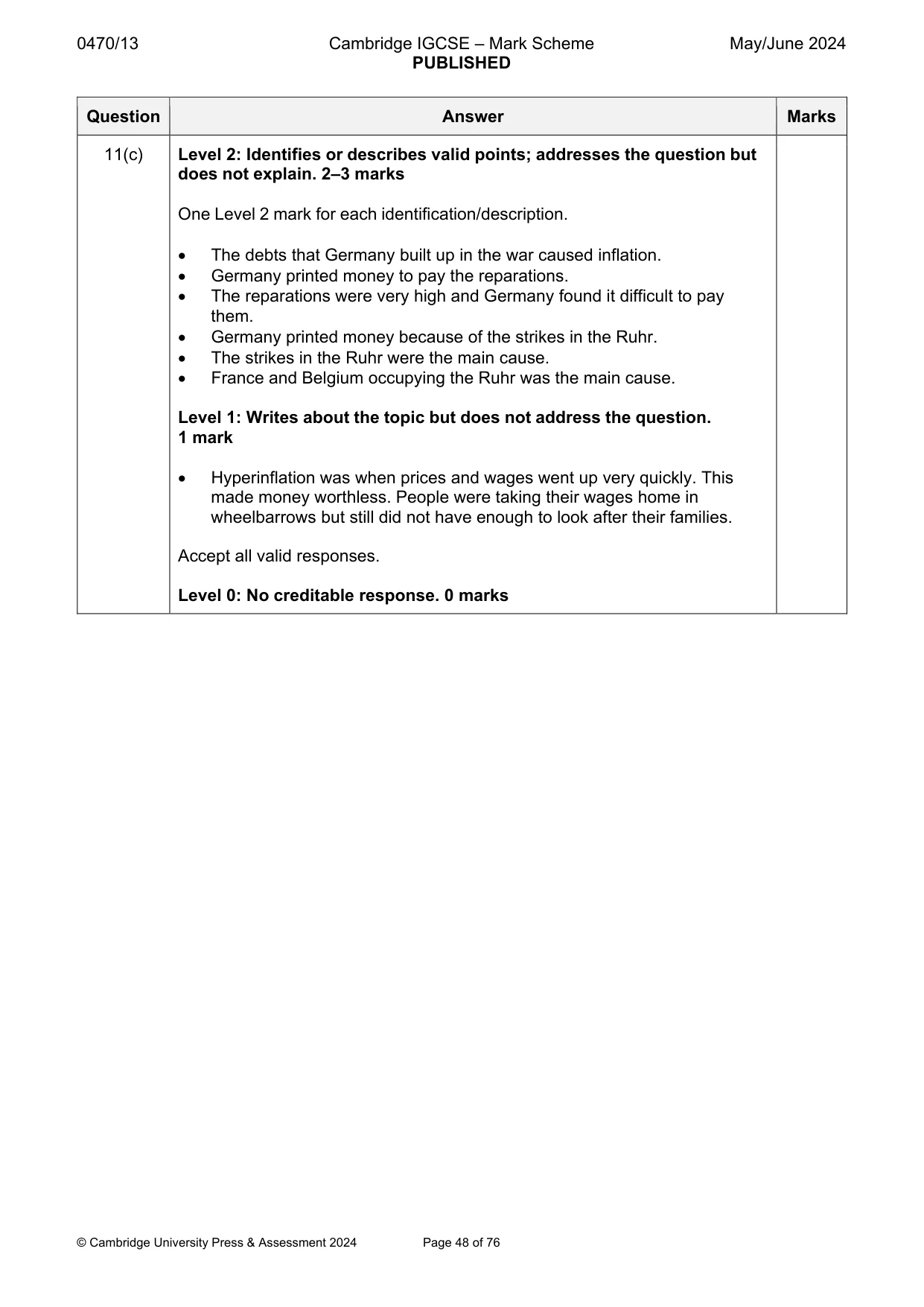
0470/13 Cambridge IGCSE – Mark Scheme PUBLISHED May/June 2024 © Cambridge University Press & Assessment 2024 Page 48 of 76 Question Answer Marks 11(c) Level 2: Identifies or describes valid points; addresses the question but does not explain. 2–3 marks One Level 2 mark for each identification/description. The debts that Germany built up in the war caused inflation. Germany printed money to pay the reparations. The reparations were very high and Germany found it difficult to pay them. Germany printed money because of the strikes in the Ruhr. The strikes in the Ruhr were the main cause. France and Belgium occupying the Ruhr was the main cause. Level 1: Writes about the topic but does not address the question. 1 mark Hyperinflation was when prices and wages went up very quickly. This made money worthless. People were taking their wages home in wheelbarrows but still did not have enough to look after their families. Accept all valid responses. Level 0: No creditable response. 0 marks
Mark scheme, page 49
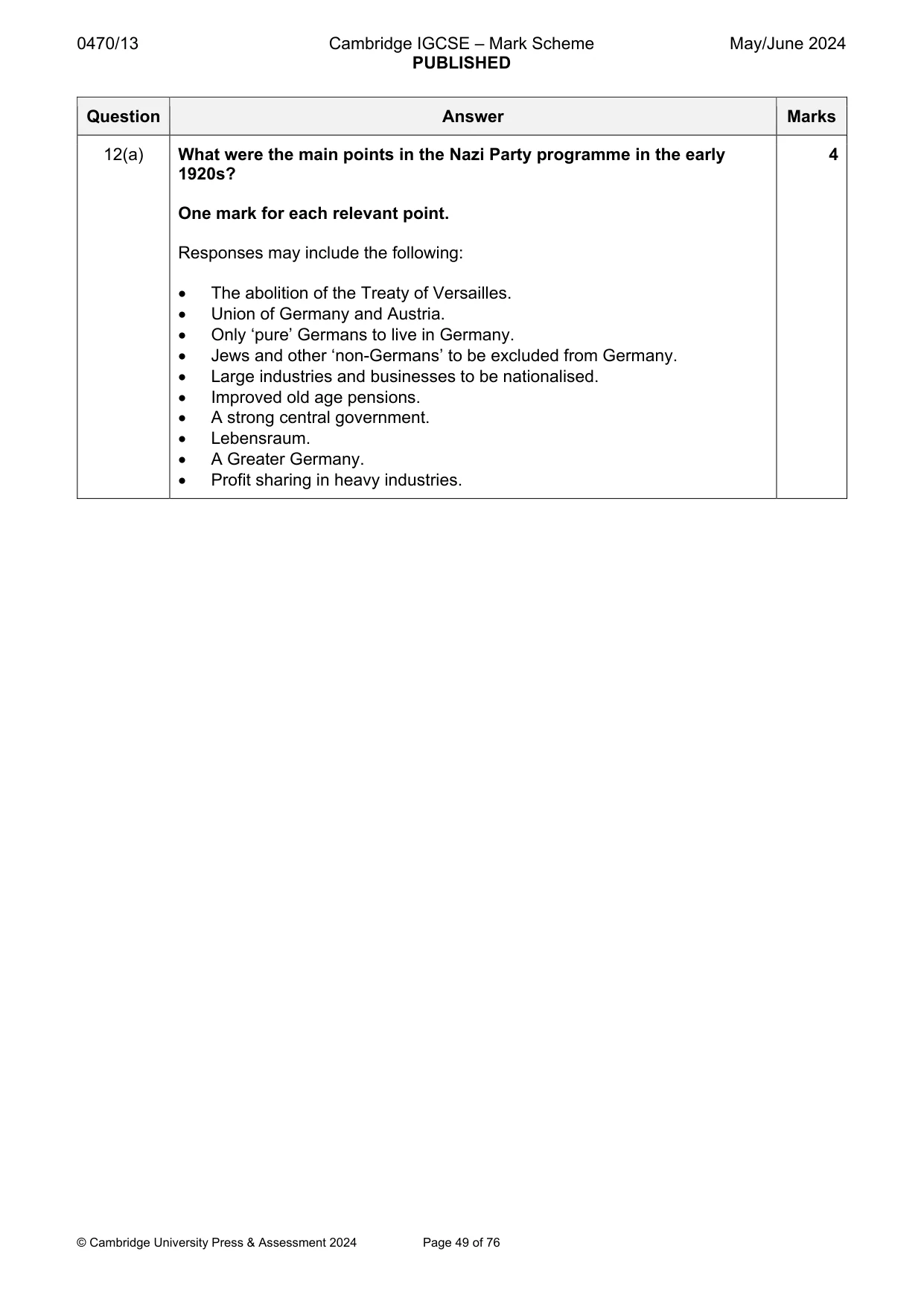
0470/13 Cambridge IGCSE – Mark Scheme PUBLISHED May/June 2024 © Cambridge University Press & Assessment 2024 Page 49 of 76 Question Answer Marks 12(a) What were the main points in the Nazi Party programme in the early 1920s? One mark for each relevant point. Responses may include the following: The abolition of the Treaty of Versailles. Union of Germany and Austria. Only ‘pure’ Germans to live in Germany. Jews and other ‘non-Germans’ to be excluded from Germany. Large industries and businesses to be nationalised. Improved old age pensions. A strong central government. Lebensraum. A Greater Germany. Profit sharing in heavy industries. 4
Mark scheme, page 50
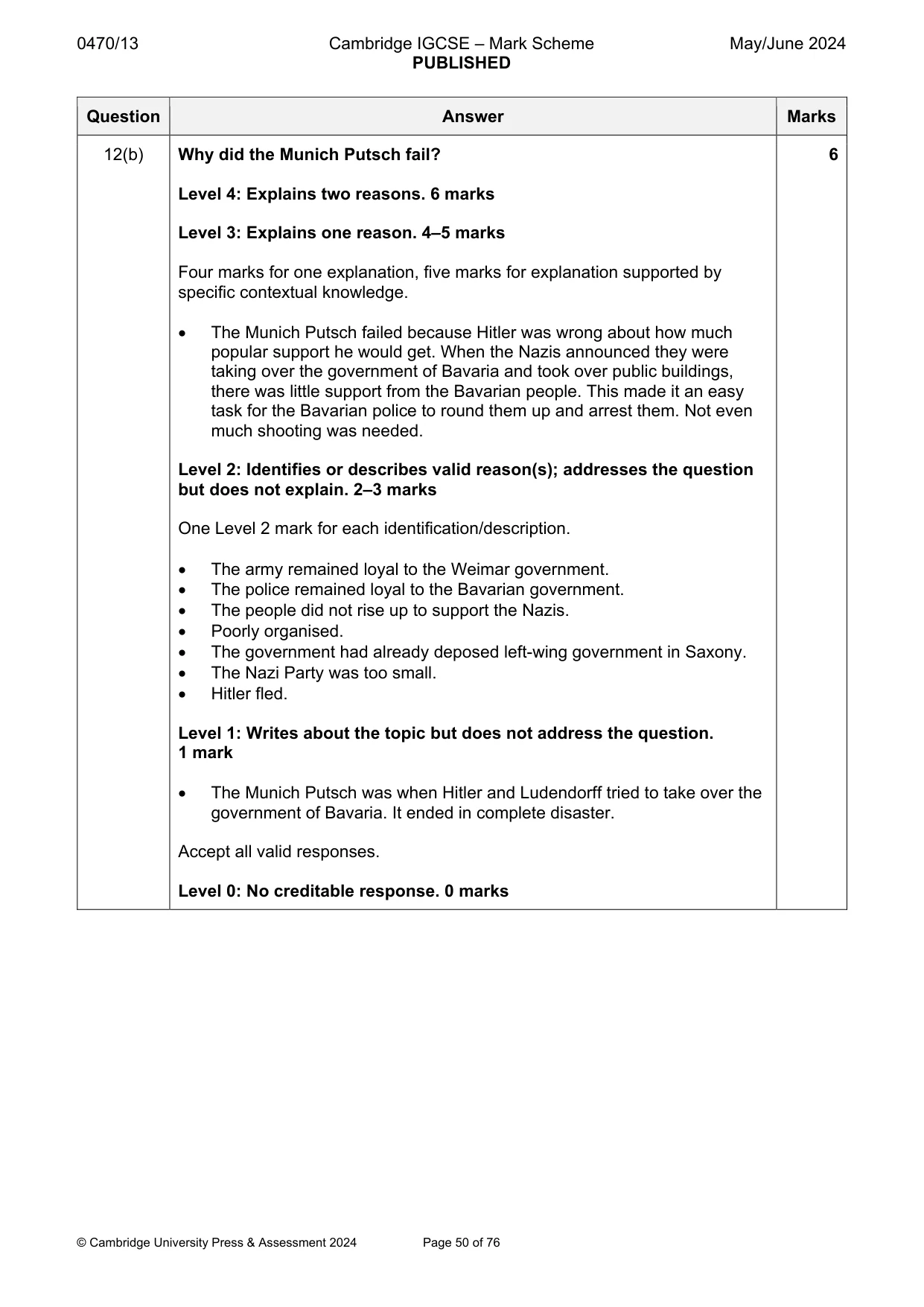
0470/13 Cambridge IGCSE – Mark Scheme PUBLISHED May/June 2024 © Cambridge University Press & Assessment 2024 Page 50 of 76 Question Answer Marks 12(b) Why did the Munich Putsch fail? Level 4: Explains two reasons. 6 marks Level 3: Explains one reason. 4–5 marks Four marks for one explanation, five marks for explanation supported by specific contextual knowledge. The Munich Putsch failed because Hitler was wrong about how much popular support he would get. When the Nazis announced they were taking over the government of Bavaria and took over public buildings, there was little support from the Bavarian people. This made it an easy task for the Bavarian police to round them up and arrest them. Not even much shooting was needed. Level 2: Identifies or describes valid reason(s); addresses the question but does not explain. 2–3 marks One Level 2 mark for each identification/description. The army remained loyal to the Weimar government. The police remained loyal to the Bavarian government. The people did not rise up to support the Nazis. Poorly organised. The government had already deposed left-wing government in Saxony. The Nazi Party was too small. Hitler fled. Level 1: Writes about the topic but does not address the question. 1 mark The Munich Putsch was when Hitler and Ludendorff tried to take over the government of Bavaria. It ended in complete disaster. Accept all valid responses. Level 0: No creditable response. 0 marks 6
Mark scheme, page 51
0470/13 Cambridge IGCSE – Mark Scheme PUBLISHED May/June 2024 © Cambridge University Press & Assessment 2024 Page 51 of 76 Question Answer Marks 12(c) ‘The Nazis became more successful in the years 1925 to 1932 because of the changes Hitler made to the Nazi Party.’ How far do you agree with this statement? Explain your answer. Level 5: Explains both sides and supports a valid judgement on ‘how far’. 10 marks One explanation or more on each side. The changes Hitler made to the party were important but he made many of these long before the fortunes of the Nazis changed. Even by the late ’20s they were picking up much support. What really changed things for them was the Great Depression. This was when their voting figures shot up. So, it was the Great Depression that caused the Nazis to be more successful. Level 4: Explains both sides. 7–9 marks For candidates to be awarded this level they must have one explanation on each side. Seven marks for one explanation on each side; one additional mark for each additional explanation on either side. Level 3: Explains one side. 4–6 marks One Level 3 mark for each explanation. The Nazis did not really become more successful until the end of the 1920s and this was because of the Great Depression. There was economic collapse in Germany. Businesses collapsed and workers were made unemployed, homeless and their families starved. The Nazis promised firm government and full employment. The governing parties like the Social Democrats were blamed by the voters for all Germany’s troubles while the Nazi propaganda promised people a much brighter future. OR When Hitler came out of prison, he made crucial changes to the Nazi Party and these were important in making it much more successful. First, he decided that the Nazi Party would use legal means through elections rather than trying to start revolution. Second, he re-organised the party so that it was efficient and could spread propaganda throughout the country. The most modern propaganda methods were used such as film, radio, torch-lit parades and mass rallies. Finally, Hitler was a brilliant speaker and could win people’s support. 10
Mark scheme, page 52
0470/13 Cambridge IGCSE – Mark Scheme PUBLISHED May/June 2024 © Cambridge University Press & Assessment 2024 Page 52 of 76 Question Answer Marks 12(c) Level 2: Identifies or describes valid points; addresses the question but does not explain. 2–3 marks One Level 2 mark for each identification/description. The Party became more efficient. Hitler decided to use legal means to gain power. The Party became organised right across the country with local offices. The Nazis focused on effective use of the most modern types of propaganda. Hitler could blame other parties for the Depression. The Nazis promised to solve unemployment. The Nazis promised to make Germany great again. The Depression made the German people poor, unemployed and without hope. Level 1: Writes about the topic but does not address the question. 1 mark The Nazi Party became very successful. By 1930 it was the second largest party in the Reichstag. This put them in a very powerful position. Accept all valid responses. Level 0: No creditable response. 0 marks
Mark scheme, page 53
0470/13 Cambridge IGCSE – Mark Scheme PUBLISHED May/June 2024 © Cambridge University Press & Assessment 2024 Page 53 of 76 Question Answer Marks Depth Study C: Russia, 1905–41 13(a) Describe the impact of the First World War on the lives of the Russian people. One mark for each relevant point. Responses may include the following: They linked the Tsar to military failures. Huge number of casualties affected people. More workers from cities forced to join the army. Food shortages in cities. High prices for food in cities. In February 1917, crowds march through Petrograd shouting anti-war slogans. By January 1917, people are striking and demanding bread. Troops firing on demonstrators. 4
Mark scheme, page 54
0470/13 Cambridge IGCSE – Mark Scheme PUBLISHED May/June 2024 © Cambridge University Press & Assessment 2024 Page 54 of 76 Question Answer Marks 13(b) Why was Stolypin important to the Tsar? Level 4: Explains two reasons. 6 marks Level 3: Explains one reason. 4–5 marks Four marks for one explanation, five marks for explanation supported by specific contextual knowledge. Stolypin was important to the Tsar because his agricultural reforms strengthened the position of the Tsar. Peasants were given loans by the Peasant’s Land Banks to buy land. Mirs were no longer allowed to stop peasants leaving to buy their own land. All of this increased peasant ownership of land by 30 per cent and increased production. Peasants who owned land and had a permanent stake in the country were much more likely to support the Tsar. Level 2: Identifies or describes valid reason(s); addresses the question but does not explain. 2–3 marks One Level 2 mark for each identification/description. He strengthened the position of the Tsar. His agricultural reforms were important. He increased the number of peasants owning land. Improvements such as safety inspectors improved working conditions. He boosted industrial production. He introduced a new system of martial law. He brutally suppressed strikers and revolutionaries. Level 1: Writes about the topic but does not address the question. 1 mark Stolypin was appointed by the Tsar in 1906. He helped the Tsar enormously but was assassinated in 1911. Accept all valid responses. Level 0: No creditable response. 0 marks 6
Mark scheme, page 55
0470/13 Cambridge IGCSE – Mark Scheme PUBLISHED May/June 2024 © Cambridge University Press & Assessment 2024 Page 55 of 76 Question Answer Marks 13(c) ‘The Russo-Japanese War was the main cause of the 1905 Revolution.’ How far do you agree with this statement? Explain your answer. Level 5: Explains both sides and supports a valid judgement on ‘how far’. 10 marks One explanation or more on each side. The war was not the main cause. Although it was a humiliation for Russia and the Tsar, it only made a bad situation worse. There was already enormous unrest across the country and the protest on Bloody Sunday had already been planned. The war was a spark but the underlying issues such as the economic depression, falling wages and great hardship were much more important. Level 4: Explains both sides. 7–9 marks For candidates to be awarded this level they must have one explanation on each side. Seven marks for one explanation on each side; one additional mark for each additional explanation on either side. Level 3: Explains one side. 4–6 marks One Level 3 mark for each explanation. The Tsar’s decision to go to war with Japan turned out to be a mistake. He probably thought that a war would unite the Russian people and he wanted to expand the Russian Empire in Asia. He gave the Russian people the impression that it would be easy to defeat a semi-feudal and backward country like Japan. However, Japan had modernised and the Tsar got a shock. Japan laid siege to Port Arthur and the port fell to the Japanese the week before Bloody Sunday. In 1905, the large Russian fleet was sunk or captured by a much smaller Japanese fleet. Russia had to agree to a peace treaty that gave Japan Port Arthur and recognised Japan’s authority over Korea. All of this was completely humiliating for the Tsar and made him very unpopular. OR The main cause of the Revolution was the economic depression. This led to falling wages, factories closing down and unemployment. Even those who still had jobs in factories worked in terrible conditions – an 11-hour day with only one day a week off. So many people had flooded into towns looking for jobs that their living conditions were terrible. This led to unrest and protests. 10
Mark scheme, page 56
0470/13 Cambridge IGCSE – Mark Scheme PUBLISHED May/June 2024 © Cambridge University Press & Assessment 2024 Page 56 of 76 Question Answer Marks 13(c) Level 2: Identifies or describes valid points; addresses the question but does not explain. 2–3 marks One Level 2 mark for each identification/description. The loss of Port Arthur. The defeat of the Russian fleet. Defeat by what the Russians regarded as a backward and inferior country. The war worsened Russia’s economy. The economic depression. Terrible living and working conditions in Russia’s cities. Bloody Sunday. The repression of the government. Hunger and famine in the countryside. Level 1: Writes about the topic but does not address the question. 1 mark The 1905 Revolution was a disaster for the Tsar from which he very nearly did not recover. However, he managed to survive. Accept all valid responses. Level 0: No creditable response. 0 marks
Mark scheme, page 57
0470/13 Cambridge IGCSE – Mark Scheme PUBLISHED May/June 2024 © Cambridge University Press & Assessment 2024 Page 57 of 76 Question Answer Marks 14(a) Describe the visible signs around the USSR of Stalin’s cult of personality. One mark for each relevant point. Responses may include the following: Portraits of Stalin in people’s homes. Statues of Stalin in public places. Regular public processions praising Stalin. Towns and streets were named after him. Films showed him as a great hero. Large pictures of Stalin in public places. 4
Mark scheme, page 58
0470/13 Cambridge IGCSE – Mark Scheme PUBLISHED May/June 2024 © Cambridge University Press & Assessment 2024 Page 58 of 76 Question Answer Marks 14(b) Why was there a struggle over who should follow Lenin as leader? Level 4: Explains two reasons. 6 marks Level 3: Explains one reason. 4–5 marks Four marks for one explanation, five marks for explanation supported by specific contextual knowledge. There was a struggle because Stalin and Trotsky disagreed over future policies. Stalin thought that the best way forward was ‘Socialism in One Country’. Securing communism in Russia first. This was possible at the time and would benefit the Russian people. Trotsky, on the other hand, believed in permanent revolution. He believed that the revolution in Russia could be used to spread revolution across the world so that everywhere became communist. Level 2: Identifies or describes valid reason(s); addresses the question but does not explain. 2–3 marks One Level 2 mark for each identification/description. Lenin left a letter urging the Party to remove Stalin from his post. There were several candidates including Stalin and Trotsky who hated each other. Lenin and Stalin disagreed about where to take the revolution next. Lenin did not name a successor. There was no one as an obvious candidate. Level 1: Writes about the topic but does not address the question. 1 mark There was a struggle because lots of people wanted the job. There was a lot of ambition and they were all determined to fight each other for the top job. Accept all valid responses. Level 0: No creditable response. 0 marks 6
Mark scheme, page 59
0470/13 Cambridge IGCSE – Mark Scheme PUBLISHED May/June 2024 © Cambridge University Press & Assessment 2024 Page 59 of 76 Question Answer Marks 14(c) ‘Stalin stayed in power because of the use of terror.’ How far do you agree with this statement? Explain your answer. Level 5: Explains both sides and supports a valid judgement on ‘how far’. 10 marks One explanation or more on each side. Propaganda was a useful weapon for Stalin and made many Russians see him as the great hero of the Soviet Union, but most ordinary people were not in a position to threaten Stalin’s position. However, powerful people like Bukharin and Radek, and those at the top of the army and the secret police, were in positions from which they could threaten him. This is why Stalin’s use of terror was the main reason why he stayed in power. It dealt with people who could threaten him. Level 4: Explains both sides. 7–9 marks For candidates to be awarded this level they must have one explanation on each side. Seven marks for one explanation on each side; one additional mark for each additional explanation on either side. Level 3: Explains one side. 4–6 marks One Level 3 mark for each explanation. Stalin did depend on terror to stay in power. He used purges to get rid of rivals and to frighten people into supporting him. He often used show trials to make it all very public. Stalin was always worried about people plotting to replace him and so he used the Purges to shoot or imprison leading figures in the army and navy, the secret police and the Communist Party. Anybody who was in a position to threaten him was dealt with. He also purged ordinary people like factory managers and workers. Neighbours and colleagues would be denounced by people who wanted to make themselves safe by showing that they were loyal to Stalin. Everybody was too scared to step out of line. OR Stalin stayed in power by using propaganda. Through propaganda posters and statues Stalin turned himself into a great hero. Photographs were tampered with to make him look like the great hero of the revolution. In this way Stalin made himself central to everything in the USSR. Everything good in the USSR was to be found in Stalin. People were bombarded with this propaganda everywhere they went and many ended up believing that to oppose Stalin was to oppose the country. 10
Mark scheme, page 60
0470/13 Cambridge IGCSE – Mark Scheme PUBLISHED May/June 2024 © Cambridge University Press & Assessment 2024 Page 60 of 76 Question Answer Marks 14(c) Level 2: Identifies or describes valid points; addresses the question but does not explain. 2–3 marks One Level 2 mark for each identification/description. The top people in the army were purged. Top people in the Communist Party and the government were purged. Supporters of Trotsky were purged. Kulaks and Nepmen were eliminated. The secret police were purged. Show trials were used. The Pioneers were used to encourage loyalty to Stalin. The use of propaganda. Equating Stalin with the country of the USSR. The new constitution of 1936 strengthened his position. Level 1: Writes about the topic but does not address the question. 1 mark Stalin stayed in power for a long time. He made himself safe and secure using lots of different methods. This is why nobody was able to overthrow him. Accept all valid responses. Level 0: No creditable response. 0 marks
Mark scheme, page 61
0470/13 Cambridge IGCSE – Mark Scheme PUBLISHED May/June 2024 © Cambridge University Press & Assessment 2024 Page 61 of 76 Question Answer Marks Depth Study D: The United States, 1919–41 15(a) What was buying ‘on the margin’? One mark for each relevant point. Responses may include the following: Buying shares without paying the full price. Paying only a small percentage of the price. Borrowing the money for most of the cost of the shares. If the share price increases they can pay off the loan. They did this because they thought share prices would always go up. They often paid inflated prices for the shares. When the value of shares went down they were in trouble, they could not repay the loans. 4
Mark scheme, page 62
0470/13 Cambridge IGCSE – Mark Scheme PUBLISHED May/June 2024 © Cambridge University Press & Assessment 2024 Page 62 of 76 Question Answer Marks 15(b) Why did the US economy have underlying weaknesses in the 1920s? Level 4: Explains two reasons. 6 marks Level 3: Explains one reason. 4–5 marks Four marks for one explanation, five marks for explanation supported by specific contextual knowledge. One main reason why the US economy had weaknesses was because of overproduction. This was happening in farming where modern machines like the combine harvester had made farming more efficient so that more food was produced. However, this was not needed. More wheat was produced than was needed and this lowered prices. The same was happening in the coal industry where a fall in demand and overproduction led to lower prices. Level 2: Identifies or describes valid reason(s); addresses the question but does not explain. 2–3 marks One Level 2 mark for each identification/description. Farming was in trouble. Old industries such as cotton and woollen textiles were in trouble. Heavy industries such as steel and coal were not doing well. Overproduction. Less demand for US goods from Europe. New competitors such as Canada. Competition from new materials such as oil and plastics. Mechanisation led to fewer jobs. Banks were already failing, about 500 each year. Unequal distribution of wealth. European tariffs. Sales of consumer goods beginning to show down. Too many low paid workers meant fewer sales of consumer goods. Level 1: Writes about the topic but does not address the question. 1 mark Although the 1920s in the USA are called the Roaring Twenties, there were also many serious problems that would cause big problems in the near future. This happened in 1929. Accept all valid responses. Level 0: No creditable response. 0 marks 6
Mark scheme, page 63
0470/13 Cambridge IGCSE – Mark Scheme PUBLISHED May/June 2024 © Cambridge University Press & Assessment 2024 Page 63 of 76 Question Answer Marks 15(c) Who was more responsible for the result of the 1932 presidential election: Hoover or Roosevelt? Explain your answer. Level 5: Explains both sides and supports a valid judgement on ‘how far’. 10 marks One explanation or more on each side. Although Roosevelt ran a good campaign and gave people hope, it was Hoover who had the biggest impact on the election result. The effects of the Depression were so bad and he did so little to help people, that it would have been difficult for Roosevelt to lose the election. Hoover’s actions over the Bonus Army seemed to underline the impressions people had of a man who did not care and did not have a way forward. Roosevelt’s campaign helped, but he was bound to win because of Hoover. Level 4: Explains both sides. 7–9 marks For candidates to be awarded this level they must have one explanation on each side. Seven marks for one explanation on each side; one additional mark for each additional explanation on either side. Level 3: Explains one side. 4–6 marks One Level 3 mark for each explanation. Roosevelt was responsible for winning the election because of his election campaign. He toured the country for weeks to meet many Americans. They were impressed with him because he was open and won their confidence. He was optimistic and promised a way out of America’s problems. He promised people a ‘New Deal’ and gave people hope. They were ready to trust him because he had a reputation for helping the poor after his work as Governor of New York State. OR Hoover lost the election because of his refusal to give the American people much help to get through the Depression. At the beginning he stated that it was just a bit of a business downturn that happened at regular intervals. When he did do a little to help, it was too late. He did not believe in the government giving people a lot of help. He thought they should help themselves. This made him look as if he did not care about the millions of unemployed who were living in poverty. 10
Mark scheme, page 64
0470/13 Cambridge IGCSE – Mark Scheme PUBLISHED May/June 2024 © Cambridge University Press & Assessment 2024 Page 64 of 76 Question Answer Marks 15(c) Level 2: Identifies or describes valid points; addresses the question but does not explain. 2–3 marks One Level 2 mark for each identification/description. Roosevelt gave people hope for the future. Roosevelt promised a ‘New Deal’. Roosevelt made people feel that he cared about them and their problems. Hoover had no new ideas. Hoover gave the impression he did not care. Hoover’s actions over the Bonus Marchers did not help him. He did little to help people in the Depression. Level 1: Writes about the topic but does not address the question. 1 mark The presidential election of 1932 was very one-sided. Roosevelt won easily and this was no surprise to anyone. He then stayed president right through the Second World War. Accept all valid responses. Level 0: No creditable response. 0 marks
Mark scheme, page 65
0470/13 Cambridge IGCSE – Mark Scheme PUBLISHED May/June 2024 © Cambridge University Press & Assessment 2024 Page 65 of 76 Question Answer Marks 16(a) What was the Tennessee Valley Authority (TVA)? One mark for each relevant point. Responses may include the following: The Authority cut across states and local government. Its job was to build dams on the Tennessee Valley. It had to deal with the problem of flooding, and then lack of rain, in the Tennessee Valley. It had to deal with the problem of soil erosion. Its aim was to restore prosperity to the area. It planted forests. It built flood prevention schemes. It built dams that produced cheap electricity. It provided jobs for people. 4
Mark scheme, page 66
0470/13 Cambridge IGCSE – Mark Scheme PUBLISHED May/June 2024 © Cambridge University Press & Assessment 2024 Page 66 of 76 Question Answer Marks 16(b) Why did black Americans benefit less from the New Deal than other social groups? Level 4: Explains two reasons. 6 marks Level 3: Explains one reason. 4–5 marks Four marks for one explanation, five marks for explanation supported by specific contextual knowledge. Much of the way the New Deal harmed black Americans was not intentional. The National Industrial Recovery Act made it illegal for unskilled workers to be employed and this hit unskilled black workers. The TVA flooded land that had been farmed on by black tenant farmers and they lost the land. Roosevelt was not racist, but the New Deal had unexpected consequences for black Americans. Level 2: Identifies or describes valid reason(s); addresses the question but does not explain. 2–3 marks One Level 2 mark for each identification/description. There was discrimination by local officials who ran the New Deal. In the Civilian Conservation Corps racial segregation was operated. No civil rights legislation was passed. Black Americans were less likely to be found jobs. Domestic workers, many of whom were black, were not included in the Social Security Act. Level 1: Writes about the topic but does not address the question. 1 mark Some parts of the New Deal did help some black Americans find jobs and receive other help but overall they did not receive as much help as white Americans. Accept all valid responses. Level 0: No creditable response. 0 marks 6
Mark scheme, page 67
0470/13 Cambridge IGCSE – Mark Scheme PUBLISHED May/June 2024 © Cambridge University Press & Assessment 2024 Page 67 of 76 Question Answer Marks 16(c) ‘The main reason why there was opposition to the New Deal was because it did not do enough to solve the Depression.’ How far do you agree with this statement? Explain your answer. Level 5: Explains both sides and supports a valid judgement on ‘how far’. 10 marks One explanation or more on each side. The main reason why there was opposition was because Republicans thought that the government was going too far in the New Deal. The critics like Huey Long agreed that Roosevelt was going in the right direction but not enough, while the Republicans wanted to go in the opposite direction. So they were much further away from Roosevelt and opposed him much more strongly than Huey Long and others. They disagreed fundamentally with Roosevelt about the role of government in America. Level 4: Explains both sides. 7–9 marks For candidates to be awarded this level they must have one explanation on each side. Seven marks for one explanation on each side; one additional mark for each additional explanation on either side. Level 3: Explains one side. 4–6 marks One Level 3 mark for each explanation. There was some opposition from people who did not think that the New Deal was doing enough to help people, especially the poor. Huey Long put together an alternative plan that would help the poor more and would redistribute wealth. It was called Share Our Wealth and proposed pensions for anyone over 60 and a maximum income of $1 million a year. Dr Townsend also felt that the New Deal did not do enough to help the poor and suggested his Townsend Plan which would give over 60s a pension as long as they spent it each month. This was to stimulate the economy and create jobs. OR Most of the opposition came from groups that thought it was doing too much and the government was interfering too much. They thought that giving people this much help was anti-American and took away people’s ability to help themselves. They thought that high taxes punished those working hard and claimed that some of the ideas like the TVA and the NIRA were like communist planning in the USSR. They thought that Roosevelt was acting like a dictator and that things like wages should be sorted out by the market. 10
Mark scheme, page 68
0470/13 Cambridge IGCSE – Mark Scheme PUBLISHED May/June 2024 © Cambridge University Press & Assessment 2024 Page 68 of 76 Question Answer Marks 16(c) Level 2: Identifies or describes valid points; addresses the question but does not explain. 2–3 marks One Level 2 mark for each identification/description. It did not help the poor enough. Those over 60 should be given pensions. The New Deal did nothing to redistribute wealth. The rich and big businesses should be taxed more. The US government was doing too much. The New Deal went against American values. The New Deal would take away the need to work hard. The New Deal went against the rights of the states. Roosevelt was becoming a dictator. The New Deal was socialism. The Supreme Court thought that parts of the New Deal were unconstitutional. Level 1: Writes about the topic but does not address the question. 1 mark There was a lot of opposition to the New Deal from all political views. However, many ordinary people in the USA benefited from it enormously with jobs. They did not agree with the critics. Accept all valid responses. Level 0: No creditable response. 0 marks
Mark scheme, page 69
0470/13 Cambridge IGCSE – Mark Scheme PUBLISHED May/June 2024 © Cambridge University Press & Assessment 2024 Page 69 of 76 Question Answer Marks Depth Study E: The Second World War in Europe and the Asia-Pacific, 1939–c.1945 17(a) What was the Vichy government? One mark for each relevant point. Responses may include the following: It governed the southern part of France. It began in 1940 after the defeat of France. It was led by Marshal Petain and Pierre Laval. It lasted for four years. It collaborated with the Nazis. It was an authoritarian regime. It put Jews in camps. It deported Jews. It censored the press and imprisoned its critics. Petain was an absolute ruler. 4
Mark scheme, page 70
0470/13 Cambridge IGCSE – Mark Scheme PUBLISHED May/June 2024 © Cambridge University Press & Assessment 2024 Page 70 of 76 Question Answer Marks 17(b) Why did Hitler decide not to invade Britain? Level 4: Explains two reasons. 6 marks Level 3: Explains one reason. 4–5 marks Four marks for one explanation, five marks for explanation supported by specific contextual knowledge. This was because of the Battle of Britain. For the invasion to be a success, Germany needed its air force to control the skies. Otherwise any invading forces would be under heavy attack by British aircraft. However, in the Battle of Britain in the summer of 1940, the RAF won control of the skies by defeating the Luftwaffe. Once this happened, an invasion was impossible. Level 2: Identifies or describes valid reason(s); addresses the question but does not explain. 2–3 marks One Level 2 mark for each identification/description. The German navy did not control the English Channel or the North Sea. Germany did not have enough ships or barges. The Battle of Britain. Britain had organised strong resistance forces across Britain. Germany did not have proper invasion plans. At Dunkirk, Britain managed to get many soldiers back. Level 1: Writes about the topic but does not address the question. 1 mark Hitler planned Operation Sea Lion for September 1940. Many people in Britain were sure it was going to happen. However, there were many reasons why it did not take place. Accept all valid responses. Level 0: No creditable response. 0 marks 6
Mark scheme, page 71
0470/13 Cambridge IGCSE – Mark Scheme PUBLISHED May/June 2024 © Cambridge University Press & Assessment 2024 Page 71 of 76 Question Answer Marks 17(c) ‘France was defeated in 1940 because of the poor quality of French leadership.’ How far do you agree with this statement? Explain your answer. Level 5: Explains both sides and supports a valid judgement on ‘how far’. 10 marks One explanation or more on each side. The German victory was partly due to innovative German tactics but it was mainly the fault of the French military leaders. They played into German hands by being so defensive. If they had taken the initiative when Germany invaded Poland, this would have surprised the Germans and defeated their tactics, but they stayed behind the Maginot Line and allowed the Germans to take all the initiatives. Level 4: Explains both sides. 7–9 marks For candidates to be awarded this level they must have one explanation on each side. Seven marks for one explanation on each side; one additional mark for each additional explanation on either side. Level 3: Explains one side. 4–6 marks One Level 3 mark for each explanation. The main reason why France was defeated was because the Germans used unexpected tactics and took risks which took the French by surprise. They used Blitzkrieg tactics – high-speed attacks at French weak points. They concentrated their tanks in the Ardennes while the French army had gone north. The French also assumed the land there was unsuitable for tanks. They smashed their way through the Ardennes and this enabled them to encircle the Allied forces and force the British towards the English Channel, separating them from the French, before heading south towards Paris. The main reason was the poor quality of leadership. The French army had plenty of men and equipment but its commanders were too old fashioned in their approach. They were still fighting the First World War rather than thinking about the actual war that the Germans were fighting. Their plans were based on the Maginot Line which they assumed would stop the Germans for a long time. This meant they were too defensive. They simply waited for the Germans to attack when they should have gone on the offensive when Germany attacked Poland. Even when the Germans invaded Belgium, the French commanders were slow to react. 10
Mark scheme, page 72
0470/13 Cambridge IGCSE – Mark Scheme PUBLISHED May/June 2024 © Cambridge University Press & Assessment 2024 Page 72 of 76 Question Answer Marks 17(c) Level 2: Identifies or describes valid points; addresses the question but does not explain. 2–3 marks One Level 2 mark for each identification/description. The French government was divided. The German army had more advanced weapons and more sophisticated tactics. Blitzkrieg tactics. German tanks were superior. The French army had not been modernised. The Germans used Stuka dive bombers. The Germans were willing to take risks. The Germans concentrated their forces in one place. The tactics of the French military leaders were outdated. The French military leaders were too defensive. France was divided between left and right. Even the generals were divided in this way. The French leadership was more worried about a Communist revolution. There was a spirit of defeatism in France at this time. Level 1: Writes about the topic but does not address the question. 1 mark The French were defeated very quickly. Their army just seemed to collapse. This was very disappointing because the French had a large army which should have been able to stand up to the Germans. Accept all valid responses. Level 0: No creditable response. 0 marks
Mark scheme, page 73
0470/13 Cambridge IGCSE – Mark Scheme PUBLISHED May/June 2024 © Cambridge University Press & Assessment 2024 Page 73 of 76 Question Answer Marks 18(a) Describe how the British tried to protect themselves from the effects of the Blitz. One mark for each relevant point. Responses may include the following: Air raid sirens. Evacuation, mostly women and children. Blackouts. Underground bomb shelters. Gas masks. The work of the ARP. The work of the AFS. Jamming operations. Anti-aircraft defences. 4
Mark scheme, page 74
0470/13 Cambridge IGCSE – Mark Scheme PUBLISHED May/June 2024 © Cambridge University Press & Assessment 2024 Page 74 of 76 Question Answer Marks 18(b) Why did the Nazis treat the Polish people so badly? Level 4: Explains two reasons. 6 marks Level 3: Explains one reason. 4–5 marks Four marks for one explanation, five marks for explanation supported by specific contextual knowledge. They treated them badly because they wanted their land. The Nazis wanted to extend Germany for the growing number of ‘pure’ Germans that they planned. They called this Lebensraum. They wanted the territory of Poland for this, which was to become a purely German area. This meant expelling nearly 2 million Poles. The expulsion was carried out in a brutal way. Polish farms and businesses were taken and given to ethnic Germans. The Poles, including women and children, were often taken away in cattle cars in freezing weather. Whole villages were destroyed. This was done because the Nazis wanted the land for ‘true’ Germans. Level 2: Identifies or describes valid reason(s); addresses the question but does not explain. 2–3 marks One Level 2 mark for each identification/description. Poles (Slavs) regarded as racially inferior. They wanted living space in the east. They thought the Poles were only suitable for slavery. They wanted the land for ‘true’ ethnic Germans. The Poles included a large number of Polish Jews. They wanted to eradicate Poland’s culture. They wanted to destroy the Polish people. Level 1: Writes about the topic but does not address the question. 1 mark The Germans treated the Poles terribly badly. They were very cruel to them. This was all done to carry out Nazi ideas. Accept all valid responses. Level 0: No creditable response. 0 marks 6
Mark scheme, page 75
0470/13 Cambridge IGCSE – Mark Scheme PUBLISHED May/June 2024 © Cambridge University Press & Assessment 2024 Page 75 of 76 Question Answer Marks 18(c) ‘The French Resistance was more effective than the resistance movement in Malaya.’ How far do you agree with this statement? Explain your answer. Level 5: Explains both sides and supports a valid judgement on ‘how far’. 10 marks One explanation or more on each side. Although the resistance in Malaya did cause problems for the Japanese, it was not as effective as the resistance in France. The French resistance was well organised and played a vital role when the Allies invaded. The intelligence that they provided for the Allies was very useful in the planning of the D-Day landings and afterwards. The resistance in Malaya was not so important when the Allies invaded Malaya. Level 4: Explains both sides. 7–9 marks For candidates to be awarded this level they must have one explanation on each side. Seven marks for one explanation on each side; one additional mark for each additional explanation on either side. Level 3: Explains one side. 4–6 marks One Level 3 mark for each explanation. It took the French resistance some time to organise itself but by 1941 it had become very effective. This was helped when all the communist groups joined to create one group. Attacks on the Germans increased, especially on railway lines which made it difficult for the Germans to move their equipment. The resistance was particularly effective in the build-up to D-Day. It collected enormous amounts of intelligence about the Germans which was of great use to the Allies for D-Day and afterwards. The resistance also destroyed many factories and supply and transport lines making it harder for the Germans to fight back against the Allies. OR The opposition in Malaya was mainly communist. They formed the MPAJA and used guerrilla tactics. They were supported by the British and in return for arms, money and training they agreed to accept orders from the British. It was on British advice that they avoided large-scale action against the Japanese, although after the war communist propaganda made them out to be heroes. They played a limited role in helping the Allied invasion of Malaya. They did not have enormous numbers and their relationship with the British rather limited the impact they had. 10
Mark scheme, page 76
0470/13 Cambridge IGCSE – Mark Scheme PUBLISHED May/June 2024 © Cambridge University Press & Assessment 2024 Page 76 of 76 Question Answer Marks 18(c) Level 2: Identifies or describes valid points; addresses the question but does not explain. 2–3 marks One Level 2 mark for each identification/description. The French resistance carried out sabotage against the Germans. The French resistance destroyed German supply and transport lines. The French resistance smuggled Jews out of France. The French resistance created much anti-German propaganda. The French resistance was more effective after different groups unified in 1943. The French resistance passed much vital intelligence to the Allies. The resistance in Malaya consisted of quite small numbers. The resistance in Malaya took orders from the British. The resistance in Malaya avoided large-scale operations against the Japanese. The role of the resistance when the Allies invaded was rather limited. Level 1: Writes about the topic but does not address the question. 1 mark Both resistance movements were useful. They caused problems for the Germans and the Japanese. The French resistance was probably the more effective. Accept all valid responses. Level 0: No creditable response. 0 marks
What you needed in this session
Cambridge’s own grade thresholds for 2024 May/June, Paper 1 · Variant 3. A higher threshold means an easier paper — the bar moves with how the cohort did.