Cambridge IGCSE History 0470 — 2023 Oct/Nov Paper 4 · Variant 1
0470/41/O/N/23 · 40 marks · ≈45 min
The question paper and its mark scheme, free to read here and free to download. This is Cambridge’s own paper, exactly as it was sat.
Question paper4 pages

Mark scheme18 pages
Answers below. Sit the paper first if you are practising.
Paper as text
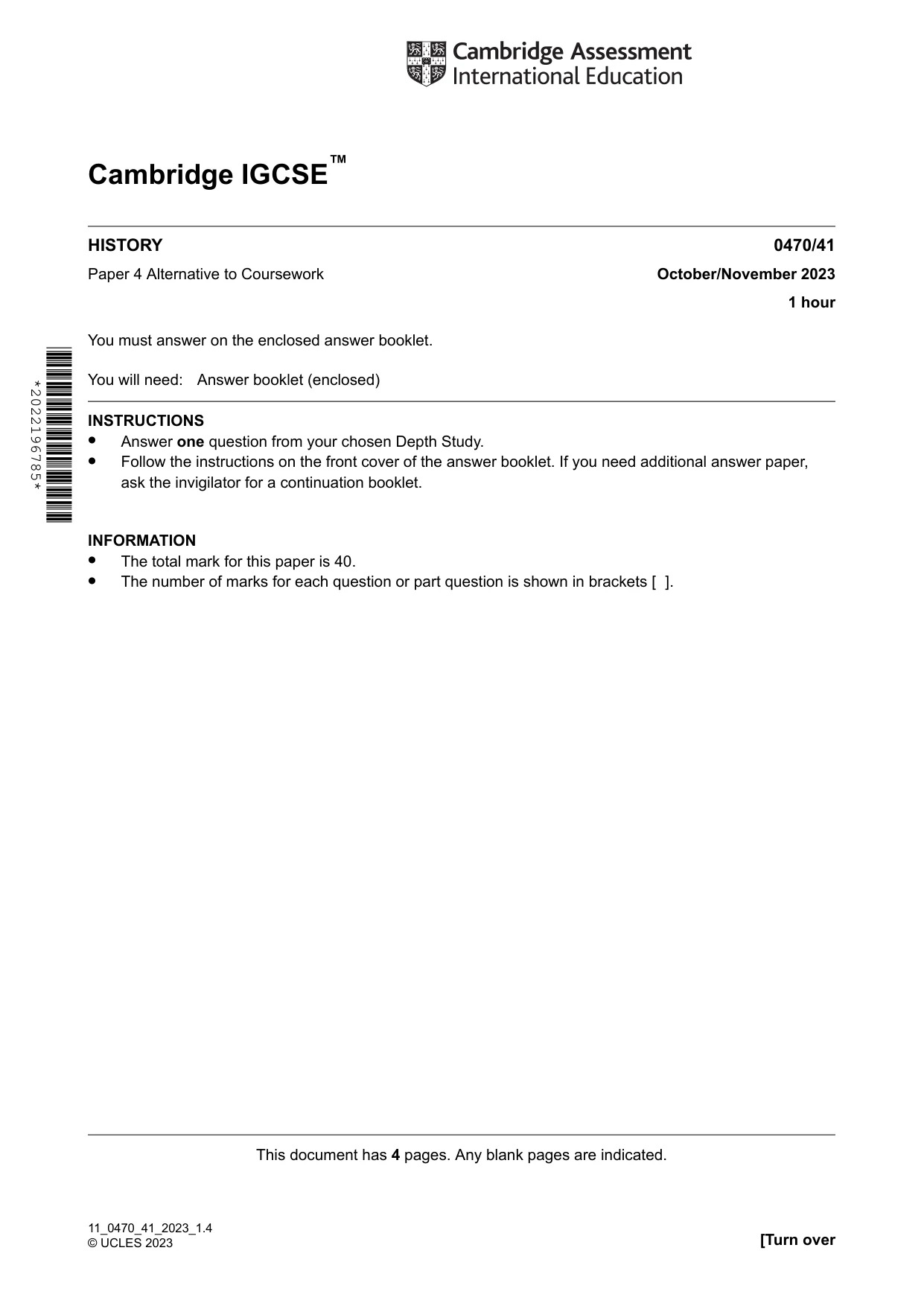
Question paper, page 1
Cambridge IGCSE™ 0470/41 October/November 2023 1 hour HISTORY Paper 4 Alternative to Coursework You must answer on the enclosed answer booklet. You will need: Answer booklet (enclosed) INSTRUCTIONS • Answer one question from your chosen Depth Study. • Follow the instructions on the front cover of the answer booklet. If you need additional answer paper, ask the invigilator for a continuation booklet. INFORMATION • The total mark for this paper is 40. • The number of marks for each question or part question is shown in brackets [ ]. This document has 4 pages. Any blank pages are indicated. [Turn over 11_0470_41_2023_1.4 © UCLES 2023 *2022196785*
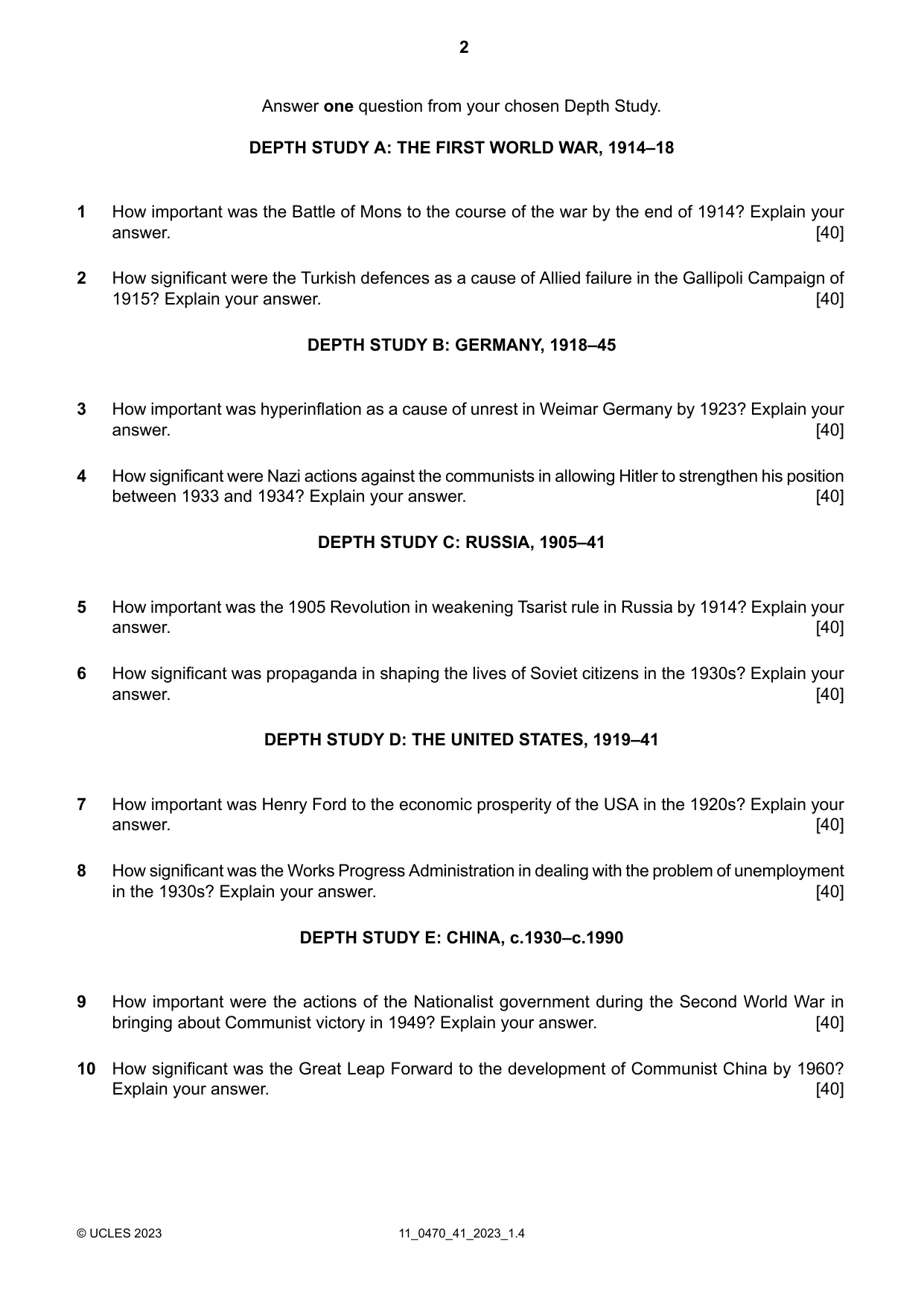
Question paper, page 2
Answer one question from your chosen Depth Study. DEPTH STUDY A: THE FIRST WORLD WAR, 1914–18 How important was the Battle of Mons to the course of the war by the end of 1914? Explain your answer. [40] 1 How significant were the Turkish defences as a cause of Allied failure in the Gallipoli Campaign of 1915? Explain your answer. [40] 2 DEPTH STUDY B: GERMANY, 1918–45 How important was hyperinflation as a cause of unrest in Weimar Germany by 1923? Explain your answer. [40] 3 How significant were Nazi actions against the communists in allowing Hitler to strengthen his position between 1933 and 1934? Explain your answer. [40] 4 DEPTH STUDY C: RUSSIA, 1905–41 How important was the 1905 Revolution in weakening Tsarist rule in Russia by 1914? Explain your answer. [40] 5 How significant was propaganda in shaping the lives of Soviet citizens in the 1930s? Explain your answer. [40] 6 DEPTH STUDY D: THE UNITED STATES, 1919–41 How important was Henry Ford to the economic prosperity of the USA in the 1920s? Explain your answer. [40] 7 How significant was the Works Progress Administration in dealing with the problem of unemployment in the 1930s? Explain your answer. [40] 8 DEPTH STUDY E: CHINA, c.1930–c.1990 How important were the actions of the Nationalist government during the Second World War in bringing about Communist victory in 1949? Explain your answer. [40] 9 How significant was the Great Leap Forward to the development of Communist China by 1960? Explain your answer. [40] 10 11_0470_41_2023_1.4 © UCLES 2023 2
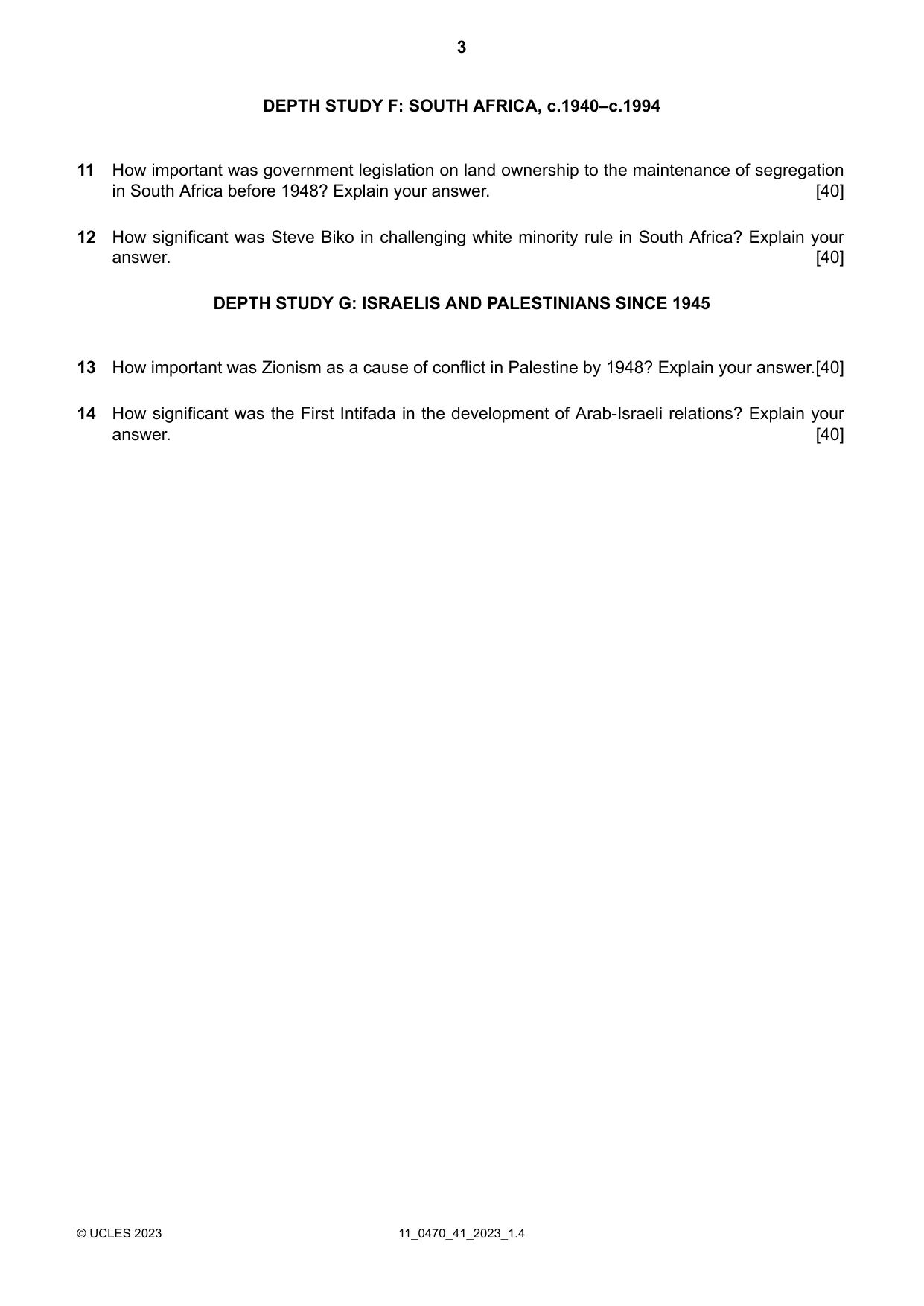
Question paper, page 3
DEPTH STUDY F: SOUTH AFRICA, c.1940–c.1994 How important was government legislation on land ownership to the maintenance of segregation in South Africa before 1948? Explain your answer. [40] 11 How significant was Steve Biko in challenging white minority rule in South Africa? Explain your answer. [40] 12 DEPTH STUDY G: ISRAELIS AND PALESTINIANS SINCE 1945 How important was Zionism as a cause of conflict in Palestine by 1948? Explain your answer.[40] 13 How significant was the First Intifada in the development of Arab-Israeli relations? Explain your answer. [40] 14 11_0470_41_2023_1.4 © UCLES 2023 3
Question paper, page 4
BLANK PAGE Permission to reproduce items where third-party owned material protected by copyright is included has been sought and cleared where possible. Every reasonable effort has been made by the publisher (UCLES) to trace copyright holders, but if any items requiring clearance have unwittingly been included, the publisher will be pleased to make amends at the earliest possible opportunity. To avoid the issue of disclosure of answer-related information to candidates, all copyright acknowledgements are reproduced online in the Cambridge Assessment International Education Copyright Acknowledgements Booklet. This is produced for each series of examinations and is freely available to download at www.cambridgeinternational.org after the live examination series. Cambridge Assessment International Education is part of Cambridge Assessment. Cambridge Assessment is the brand name of the University of Cambridge Local Examinations Syndicate (UCLES), which is a department of the University of Cambridge. 11_0470_41_2023_1.4 © UCLES 2023 4
Mark scheme, page 1
This document consists of 18 printed pages. © UCLES 2023 [Turn over Cambridge IGCSE™ HISTORY 0470/41 Paper 4 Alternative to Coursework October/November 2023 MARK SCHEME Maximum Mark: 40 Published This mark scheme is published as an aid to teachers and candidates, to indicate the requirements of the examination. It shows the basis on which Examiners were instructed to award marks. It does not indicate the details of the discussions that took place at an Examiners’ meeting before marking began, which would have considered the acceptability of alternative answers. Mark schemes should be read in conjunction with the question paper and the Principal Examiner Report for Teachers. Cambridge International will not enter into discussions about these mark schemes. Cambridge International is publishing the mark schemes for the October/November 2023 series for most Cambridge IGCSE, Cambridge International A and AS Level components, and some Cambridge O Level components.
Mark scheme, page 2
0470/41 Cambridge IGCSE – Mark Scheme PUBLISHED October/November 2023 © UCLES 2023 Page 2 of 18 Generic Marking Principles These general marking principles must be applied by all examiners when marking candidate answers. They should be applied alongside the specific content of the mark scheme or generic level descriptors for a question. Each question paper and mark scheme will also comply with these marking principles. GENERIC MARKING PRINCIPLE 1: Marks must be awarded in line with: • the specific content of the mark scheme or the generic level descriptors for the question • the specific skills defined in the mark scheme or in the generic level descriptors for the question • the standard of response required by a candidate as exemplified by the standardisation scripts. GENERIC MARKING PRINCIPLE 2: Marks awarded are always whole marks (not half marks, or other fractions). GENERIC MARKING PRINCIPLE 3: Marks must be awarded positively: • marks are awarded for correct/valid answers, as defined in the mark scheme. However, credit is given for valid answers which go beyond the scope of the syllabus and mark scheme, referring to your Team Leader as appropriate • marks are awarded when candidates clearly demonstrate what they know and can do • marks are not deducted for errors • marks are not deducted for omissions • answers should only be judged on the quality of spelling, punctuation and grammar when these features are specifically assessed by the question as indicated by the mark scheme. The meaning, however, should be unambiguous. GENERIC MARKING PRINCIPLE 4: Rules must be applied consistently, e.g. in situations where candidates have not followed instructions or in the application of generic level descriptors. GENERIC MARKING PRINCIPLE 5: Marks should be awarded using the full range of marks defined in the mark scheme for the question (however; the use of the full mark range may be limited according to the quality of the candidate responses seen). GENERIC MARKING PRINCIPLE 6: Marks awarded are based solely on the requirements as defined in the mark scheme. Marks should not be awarded with grade thresholds or grade descriptors in mind.
Mark scheme, page 3
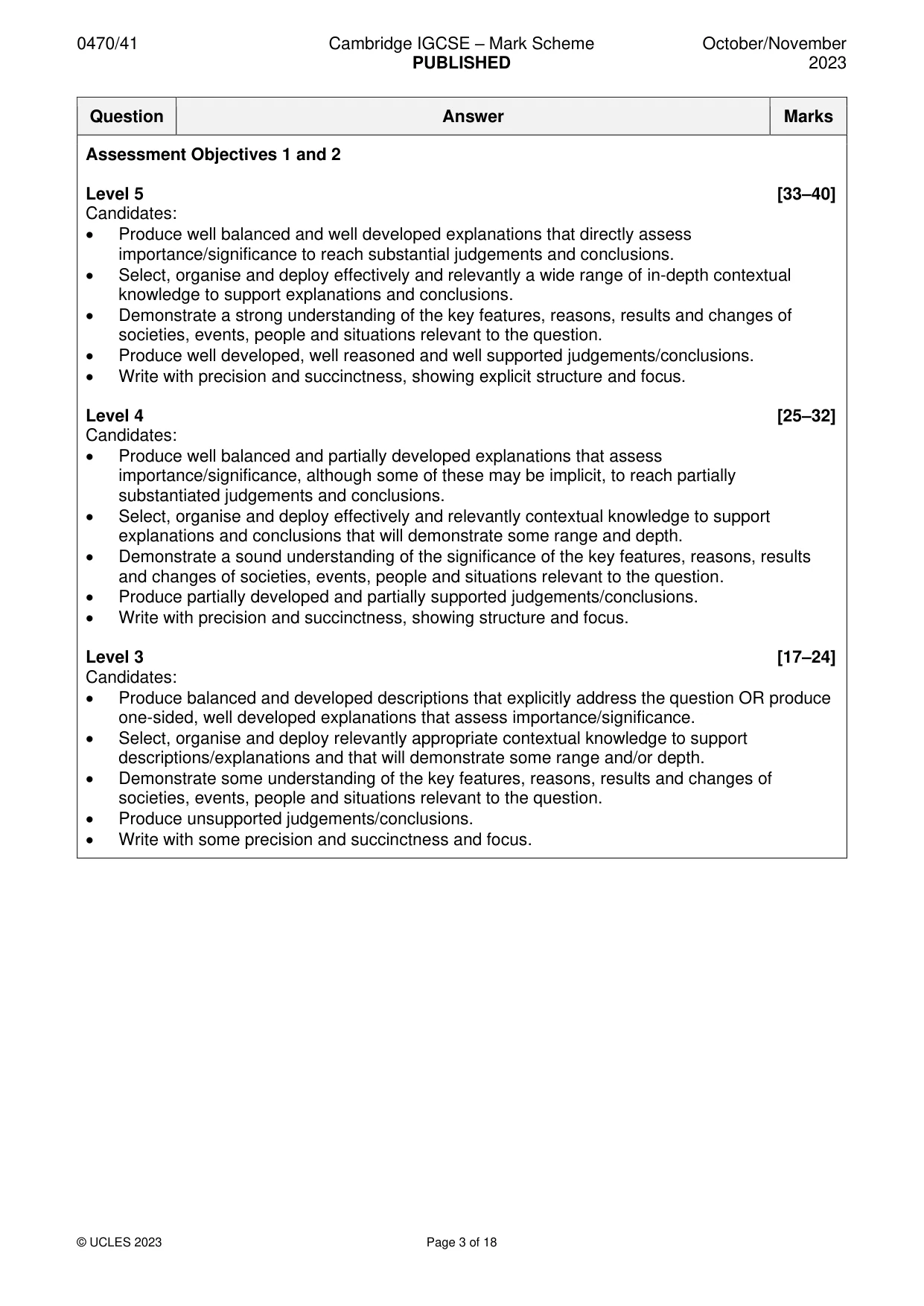
0470/41 Cambridge IGCSE – Mark Scheme PUBLISHED October/November 2023 © UCLES 2023 Page 3 of 18 Question Answer Marks Assessment Objectives 1 and 2 Level 5 [33–40] Candidates: • Produce well balanced and well developed explanations that directly assess importance/significance to reach substantial judgements and conclusions. • Select, organise and deploy effectively and relevantly a wide range of in-depth contextual knowledge to support explanations and conclusions. • Demonstrate a strong understanding of the key features, reasons, results and changes of societies, events, people and situations relevant to the question. • Produce well developed, well reasoned and well supported judgements/conclusions. • Write with precision and succinctness, showing explicit structure and focus. Level 4 [25–32] Candidates: • Produce well balanced and partially developed explanations that assess importance/significance, although some of these may be implicit, to reach partially substantiated judgements and conclusions. • Select, organise and deploy effectively and relevantly contextual knowledge to support explanations and conclusions that will demonstrate some range and depth. • Demonstrate a sound understanding of the significance of the key features, reasons, results and changes of societies, events, people and situations relevant to the question. • Produce partially developed and partially supported judgements/conclusions. • Write with precision and succinctness, showing structure and focus. Level 3 [17–24] Candidates: • Produce balanced and developed descriptions that explicitly address the question OR produce one-sided, well developed explanations that assess importance/significance. • Select, organise and deploy relevantly appropriate contextual knowledge to support descriptions/explanations and that will demonstrate some range and/or depth. • Demonstrate some understanding of the key features, reasons, results and changes of societies, events, people and situations relevant to the question. • Produce unsupported judgements/conclusions. • Write with some precision and succinctness and focus.
Mark scheme, page 4
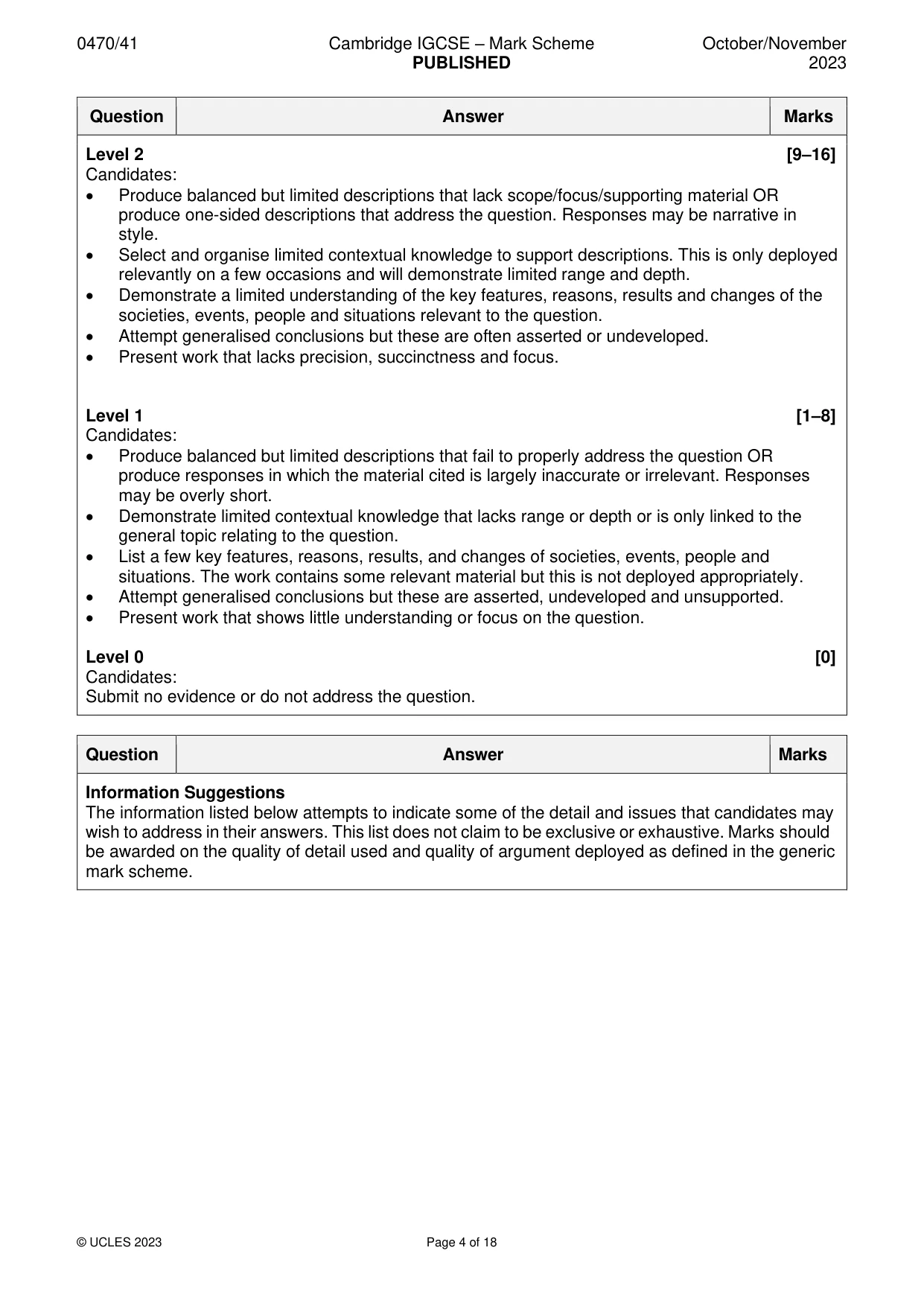
0470/41 Cambridge IGCSE – Mark Scheme PUBLISHED October/November 2023 © UCLES 2023 Page 4 of 18 Question Answer Marks Level 2 [9–16] Candidates: • Produce balanced but limited descriptions that lack scope/focus/supporting material OR produce one-sided descriptions that address the question. Responses may be narrative in style. • Select and organise limited contextual knowledge to support descriptions. This is only deployed relevantly on a few occasions and will demonstrate limited range and depth. • Demonstrate a limited understanding of the key features, reasons, results and changes of the societies, events, people and situations relevant to the question. • Attempt generalised conclusions but these are often asserted or undeveloped. • Present work that lacks precision, succinctness and focus. Level 1 [1–8] Candidates: • Produce balanced but limited descriptions that fail to properly address the question OR produce responses in which the material cited is largely inaccurate or irrelevant. Responses may be overly short. • Demonstrate limited contextual knowledge that lacks range or depth or is only linked to the general topic relating to the question. • List a few key features, reasons, results, and changes of societies, events, people and situations. The work contains some relevant material but this is not deployed appropriately. • Attempt generalised conclusions but these are asserted, undeveloped and unsupported. • Present work that shows little understanding or focus on the question. Level 0 [0] Candidates: Submit no evidence or do not address the question. Question Answer Marks Information Suggestions The information listed below attempts to indicate some of the detail and issues that candidates may wish to address in their answers. This list does not claim to be exclusive or exhaustive. Marks should be awarded on the quality of detail used and quality of argument deployed as defined in the generic mark scheme.
Mark scheme, page 5
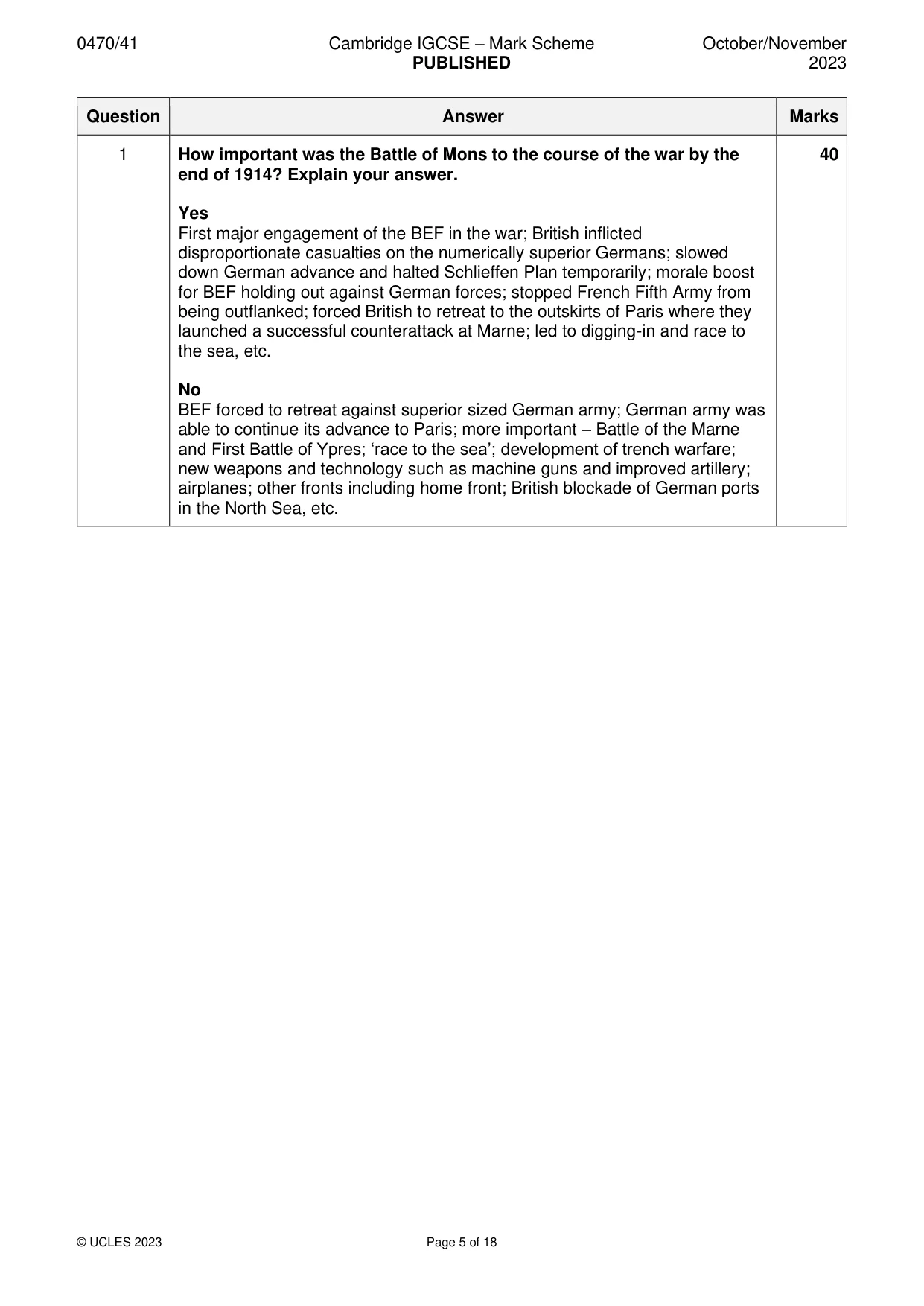
0470/41 Cambridge IGCSE – Mark Scheme PUBLISHED October/November 2023 © UCLES 2023 Page 5 of 18 Question Answer Marks 1 How important was the Battle of Mons to the course of the war by the end of 1914? Explain your answer. Yes First major engagement of the BEF in the war; British inflicted disproportionate casualties on the numerically superior Germans; slowed down German advance and halted Schlieffen Plan temporarily; morale boost for BEF holding out against German forces; stopped French Fifth Army from being outflanked; forced British to retreat to the outskirts of Paris where they launched a successful counterattack at Marne; led to digging-in and race to the sea, etc. No BEF forced to retreat against superior sized German army; German army was able to continue its advance to Paris; more important – Battle of the Marne and First Battle of Ypres; ‘race to the sea’; development of trench warfare; new weapons and technology such as machine guns and improved artillery; airplanes; other fronts including home front; British blockade of German ports in the North Sea, etc. 40
Mark scheme, page 6
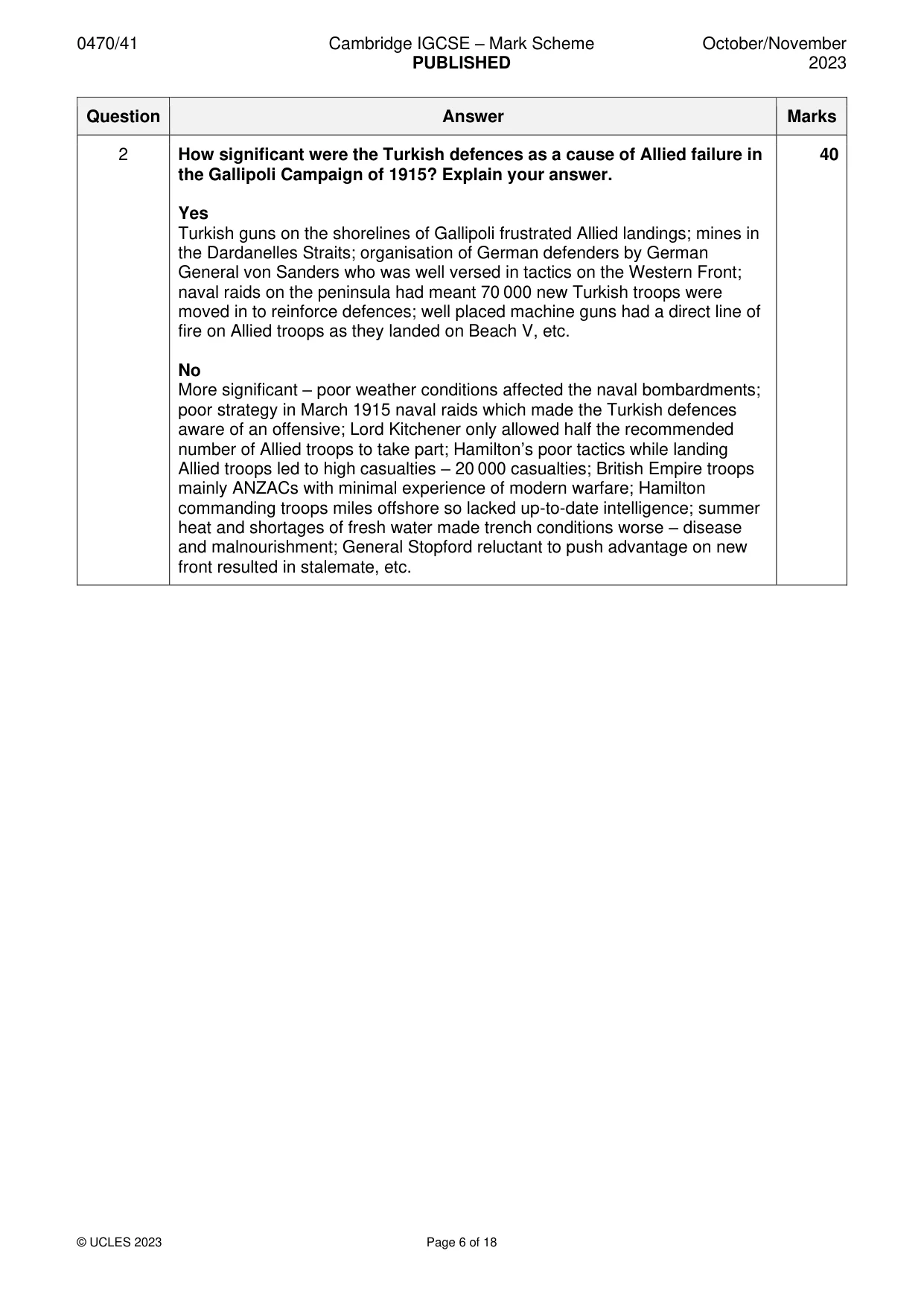
0470/41 Cambridge IGCSE – Mark Scheme PUBLISHED October/November 2023 © UCLES 2023 Page 6 of 18 Question Answer Marks 2 How significant were the Turkish defences as a cause of Allied failure in the Gallipoli Campaign of 1915? Explain your answer. Yes Turkish guns on the shorelines of Gallipoli frustrated Allied landings; mines in the Dardanelles Straits; organisation of German defenders by German General von Sanders who was well versed in tactics on the Western Front; naval raids on the peninsula had meant 70 000 new Turkish troops were moved in to reinforce defences; well placed machine guns had a direct line of fire on Allied troops as they landed on Beach V, etc. No More significant – poor weather conditions affected the naval bombardments; poor strategy in March 1915 naval raids which made the Turkish defences aware of an offensive; Lord Kitchener only allowed half the recommended number of Allied troops to take part; Hamilton’s poor tactics while landing Allied troops led to high casualties – 20 000 casualties; British Empire troops mainly ANZACs with minimal experience of modern warfare; Hamilton commanding troops miles offshore so lacked up-to-date intelligence; summer heat and shortages of fresh water made trench conditions worse – disease and malnourishment; General Stopford reluctant to push advantage on new front resulted in stalemate, etc. 40
Mark scheme, page 7
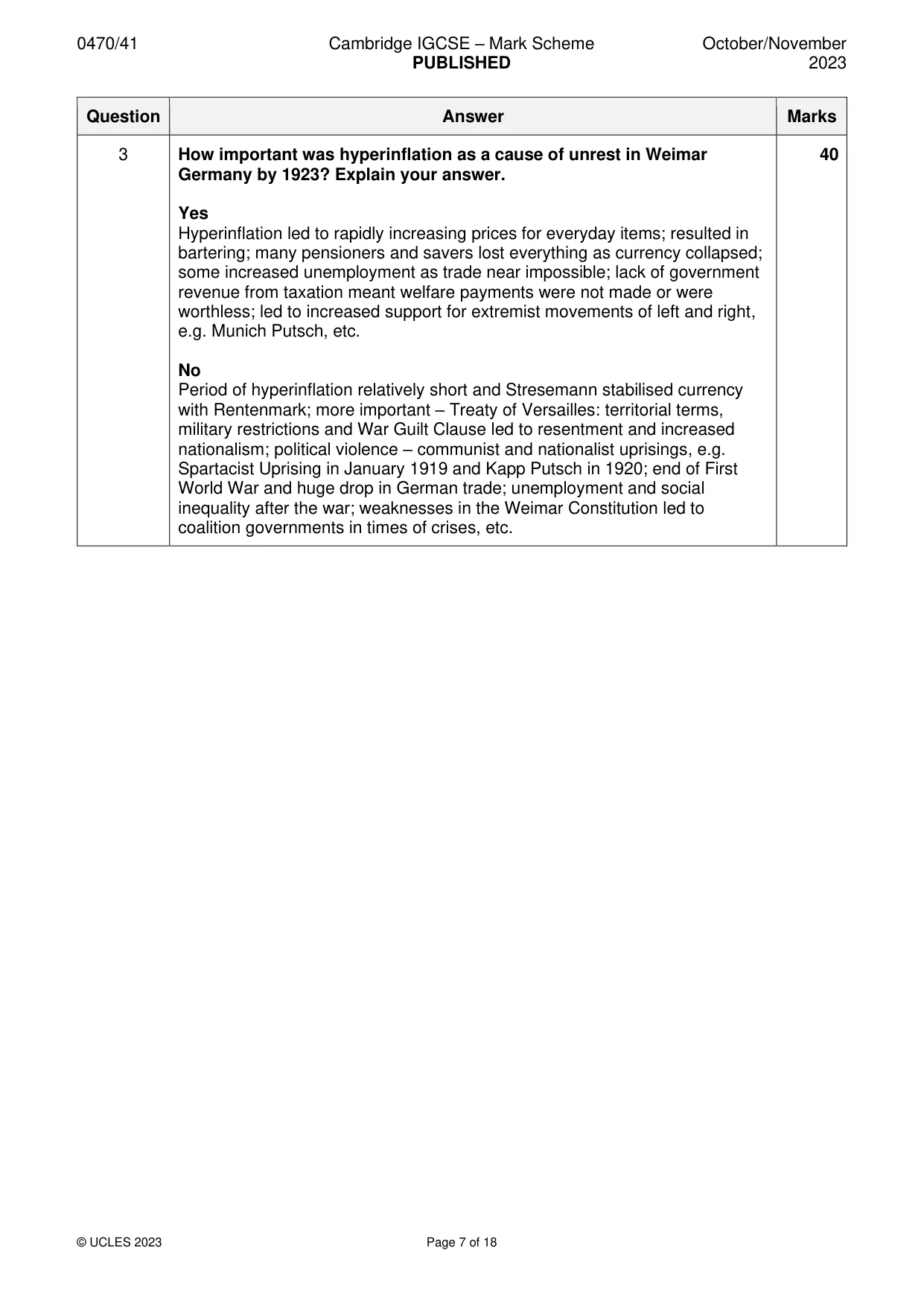
0470/41 Cambridge IGCSE – Mark Scheme PUBLISHED October/November 2023 © UCLES 2023 Page 7 of 18 Question Answer Marks 3 How important was hyperinflation as a cause of unrest in Weimar Germany by 1923? Explain your answer. Yes Hyperinflation led to rapidly increasing prices for everyday items; resulted in bartering; many pensioners and savers lost everything as currency collapsed; some increased unemployment as trade near impossible; lack of government revenue from taxation meant welfare payments were not made or were worthless; led to increased support for extremist movements of left and right, e.g. Munich Putsch, etc. No Period of hyperinflation relatively short and Stresemann stabilised currency with Rentenmark; more important – Treaty of Versailles: territorial terms, military restrictions and War Guilt Clause led to resentment and increased nationalism; political violence – communist and nationalist uprisings, e.g. Spartacist Uprising in January 1919 and Kapp Putsch in 1920; end of First World War and huge drop in German trade; unemployment and social inequality after the war; weaknesses in the Weimar Constitution led to coalition governments in times of crises, etc. 40
Mark scheme, page 8
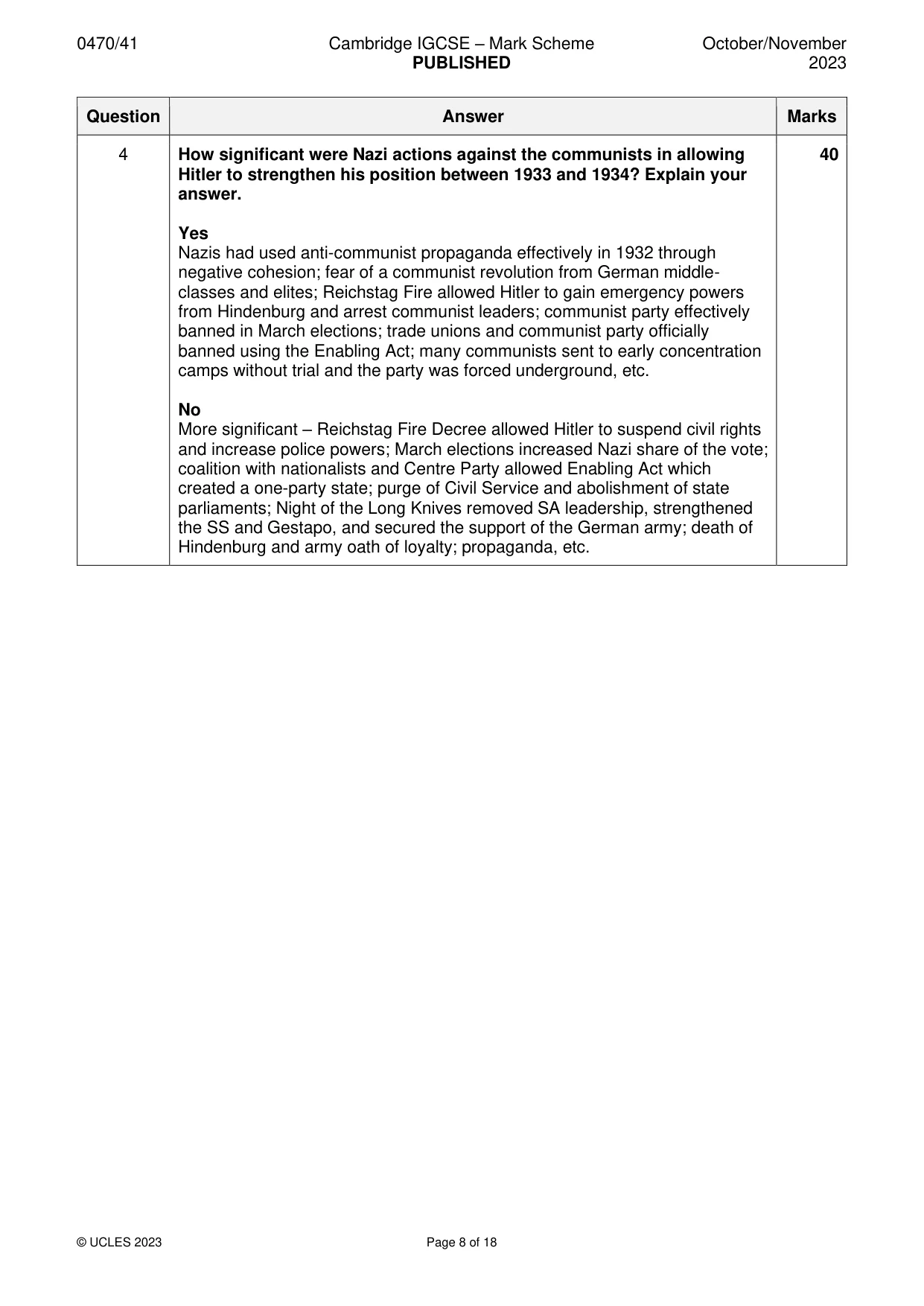
0470/41 Cambridge IGCSE – Mark Scheme PUBLISHED October/November 2023 © UCLES 2023 Page 8 of 18 Question Answer Marks 4 How significant were Nazi actions against the communists in allowing Hitler to strengthen his position between 1933 and 1934? Explain your answer. Yes Nazis had used anti-communist propaganda effectively in 1932 through negative cohesion; fear of a communist revolution from German middle- classes and elites; Reichstag Fire allowed Hitler to gain emergency powers from Hindenburg and arrest communist leaders; communist party effectively banned in March elections; trade unions and communist party officially banned using the Enabling Act; many communists sent to early concentration camps without trial and the party was forced underground, etc. No More significant – Reichstag Fire Decree allowed Hitler to suspend civil rights and increase police powers; March elections increased Nazi share of the vote; coalition with nationalists and Centre Party allowed Enabling Act which created a one-party state; purge of Civil Service and abolishment of state parliaments; Night of the Long Knives removed SA leadership, strengthened the SS and Gestapo, and secured the support of the German army; death of Hindenburg and army oath of loyalty; propaganda, etc. 40
Mark scheme, page 9
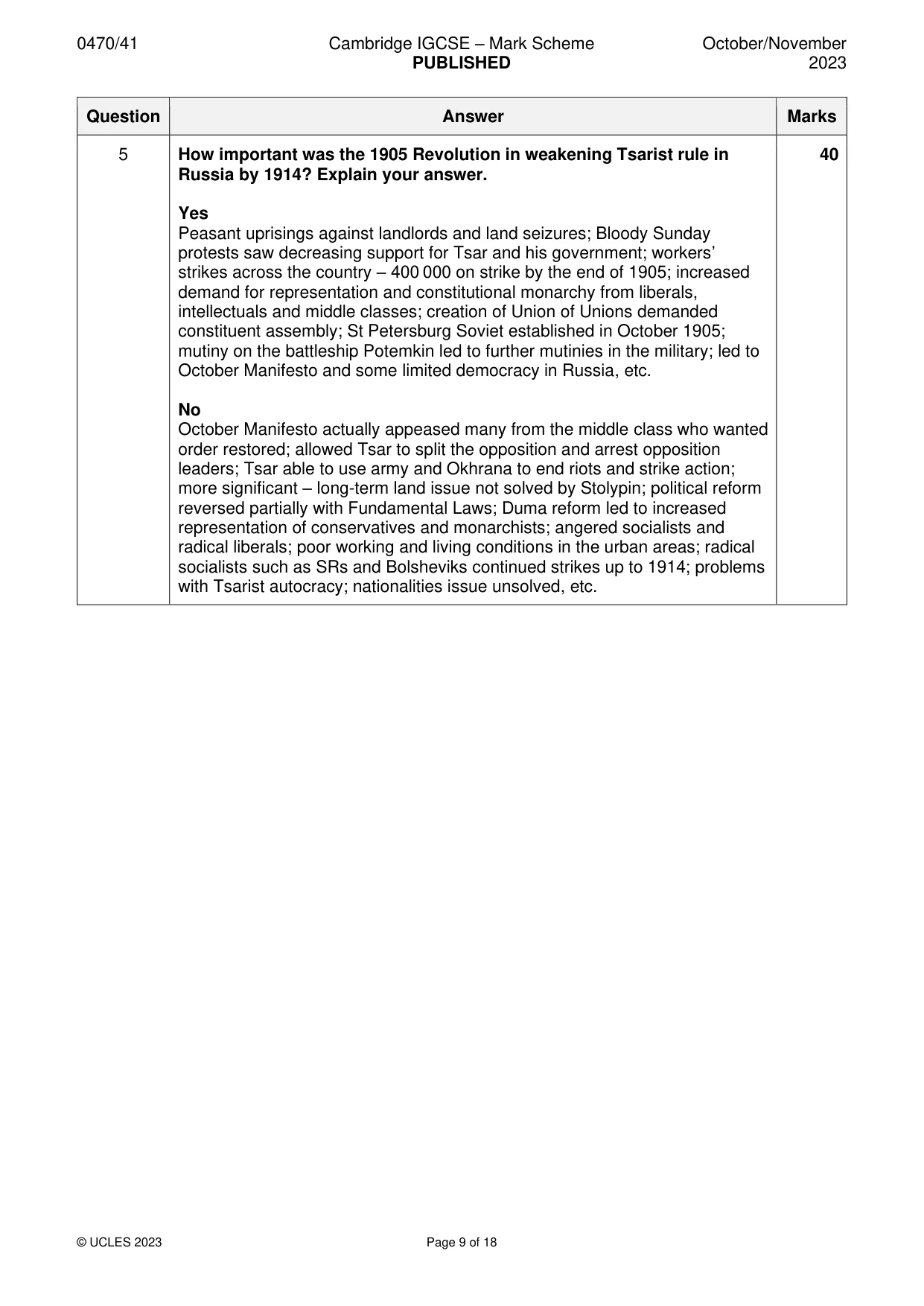
0470/41 Cambridge IGCSE – Mark Scheme PUBLISHED October/November 2023 © UCLES 2023 Page 9 of 18 Question Answer Marks 5 How important was the 1905 Revolution in weakening Tsarist rule in Russia by 1914? Explain your answer. Yes Peasant uprisings against landlords and land seizures; Bloody Sunday protests saw decreasing support for Tsar and his government; workers’ strikes across the country – 400 000 on strike by the end of 1905; increased demand for representation and constitutional monarchy from liberals, intellectuals and middle classes; creation of Union of Unions demanded constituent assembly; St Petersburg Soviet established in October 1905; mutiny on the battleship Potemkin led to further mutinies in the military; led to October Manifesto and some limited democracy in Russia, etc. No October Manifesto actually appeased many from the middle class who wanted order restored; allowed Tsar to split the opposition and arrest opposition leaders; Tsar able to use army and Okhrana to end riots and strike action; more significant – long-term land issue not solved by Stolypin; political reform reversed partially with Fundamental Laws; Duma reform led to increased representation of conservatives and monarchists; angered socialists and radical liberals; poor working and living conditions in the urban areas; radical socialists such as SRs and Bolsheviks continued strikes up to 1914; problems with Tsarist autocracy; nationalities issue unsolved, etc. 40
Mark scheme, page 10
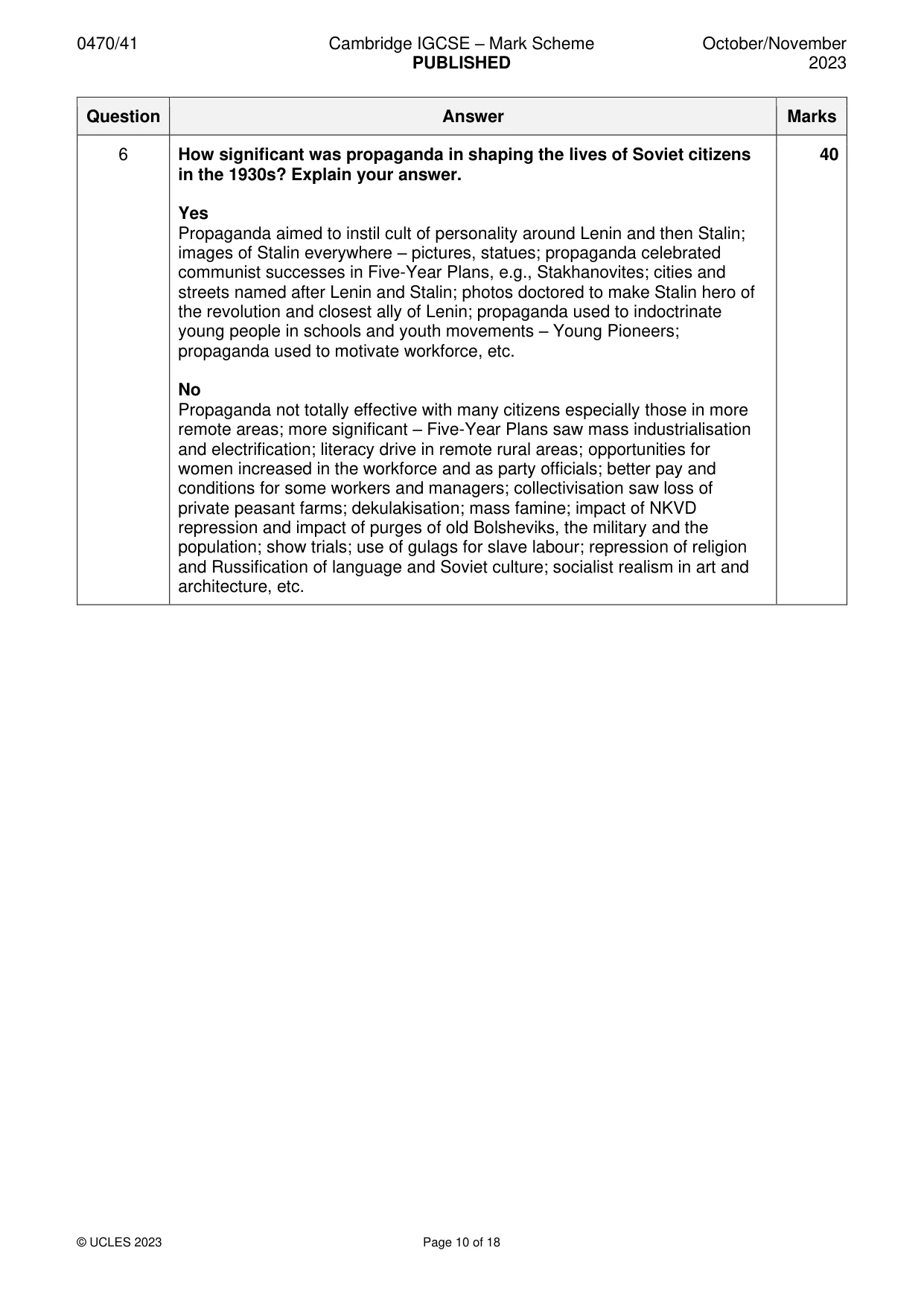
0470/41 Cambridge IGCSE – Mark Scheme PUBLISHED October/November 2023 © UCLES 2023 Page 10 of 18 Question Answer Marks 6 How significant was propaganda in shaping the lives of Soviet citizens in the 1930s? Explain your answer. Yes Propaganda aimed to instil cult of personality around Lenin and then Stalin; images of Stalin everywhere – pictures, statues; propaganda celebrated communist successes in Five-Year Plans, e.g., Stakhanovites; cities and streets named after Lenin and Stalin; photos doctored to make Stalin hero of the revolution and closest ally of Lenin; propaganda used to indoctrinate young people in schools and youth movements – Young Pioneers; propaganda used to motivate workforce, etc. No Propaganda not totally effective with many citizens especially those in more remote areas; more significant – Five-Year Plans saw mass industrialisation and electrification; literacy drive in remote rural areas; opportunities for women increased in the workforce and as party officials; better pay and conditions for some workers and managers; collectivisation saw loss of private peasant farms; dekulakisation; mass famine; impact of NKVD repression and impact of purges of old Bolsheviks, the military and the population; show trials; use of gulags for slave labour; repression of religion and Russification of language and Soviet culture; socialist realism in art and architecture, etc. 40
Mark scheme, page 11
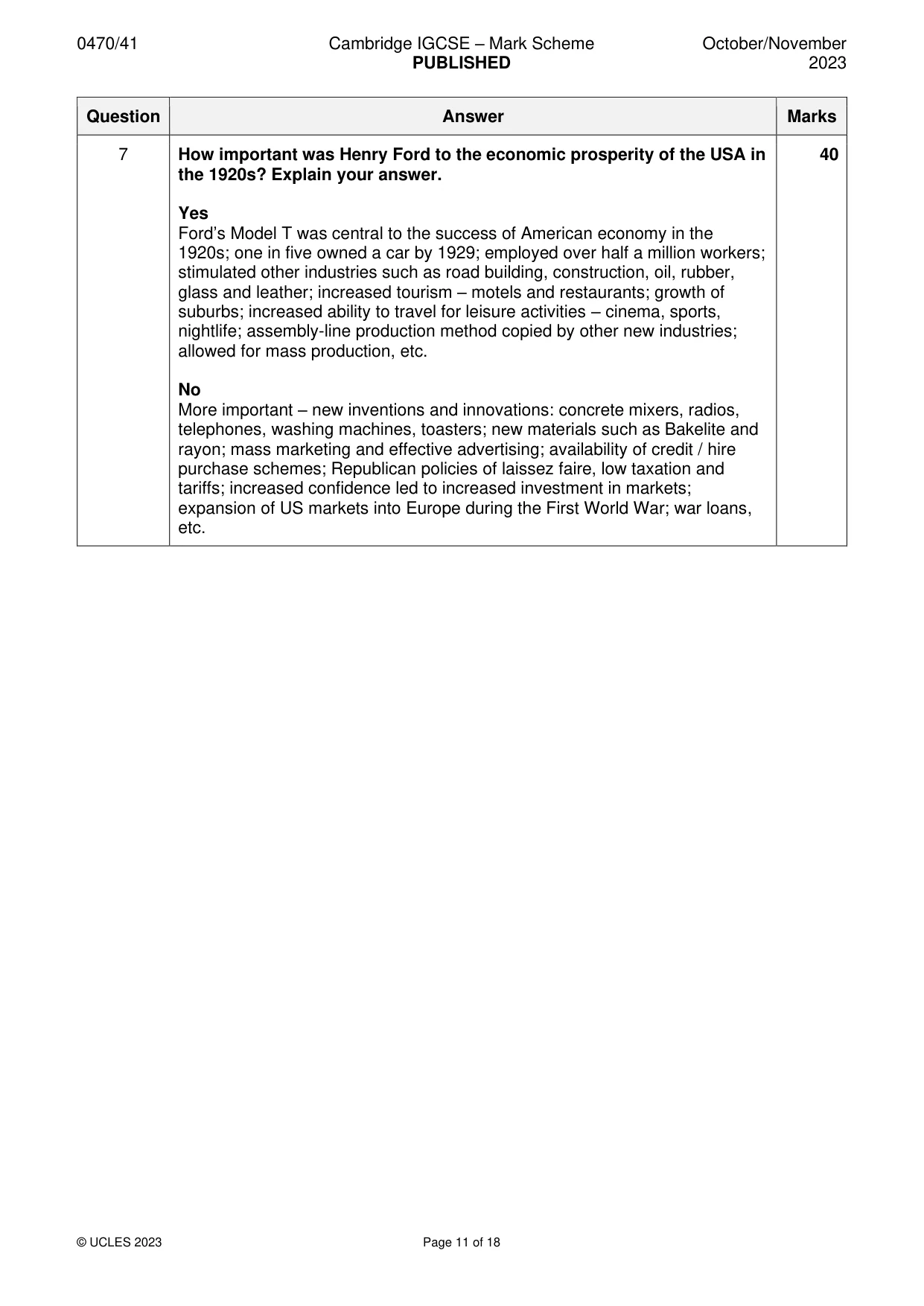
0470/41 Cambridge IGCSE – Mark Scheme PUBLISHED October/November 2023 © UCLES 2023 Page 11 of 18 Question Answer Marks 7 How important was Henry Ford to the economic prosperity of the USA in the 1920s? Explain your answer. Yes Ford’s Model T was central to the success of American economy in the 1920s; one in five owned a car by 1929; employed over half a million workers; stimulated other industries such as road building, construction, oil, rubber, glass and leather; increased tourism – motels and restaurants; growth of suburbs; increased ability to travel for leisure activities – cinema, sports, nightlife; assembly-line production method copied by other new industries; allowed for mass production, etc. No More important – new inventions and innovations: concrete mixers, radios, telephones, washing machines, toasters; new materials such as Bakelite and rayon; mass marketing and effective advertising; availability of credit / hire purchase schemes; Republican policies of laissez faire, low taxation and tariffs; increased confidence led to increased investment in markets; expansion of US markets into Europe during the First World War; war loans, etc. 40
Mark scheme, page 12
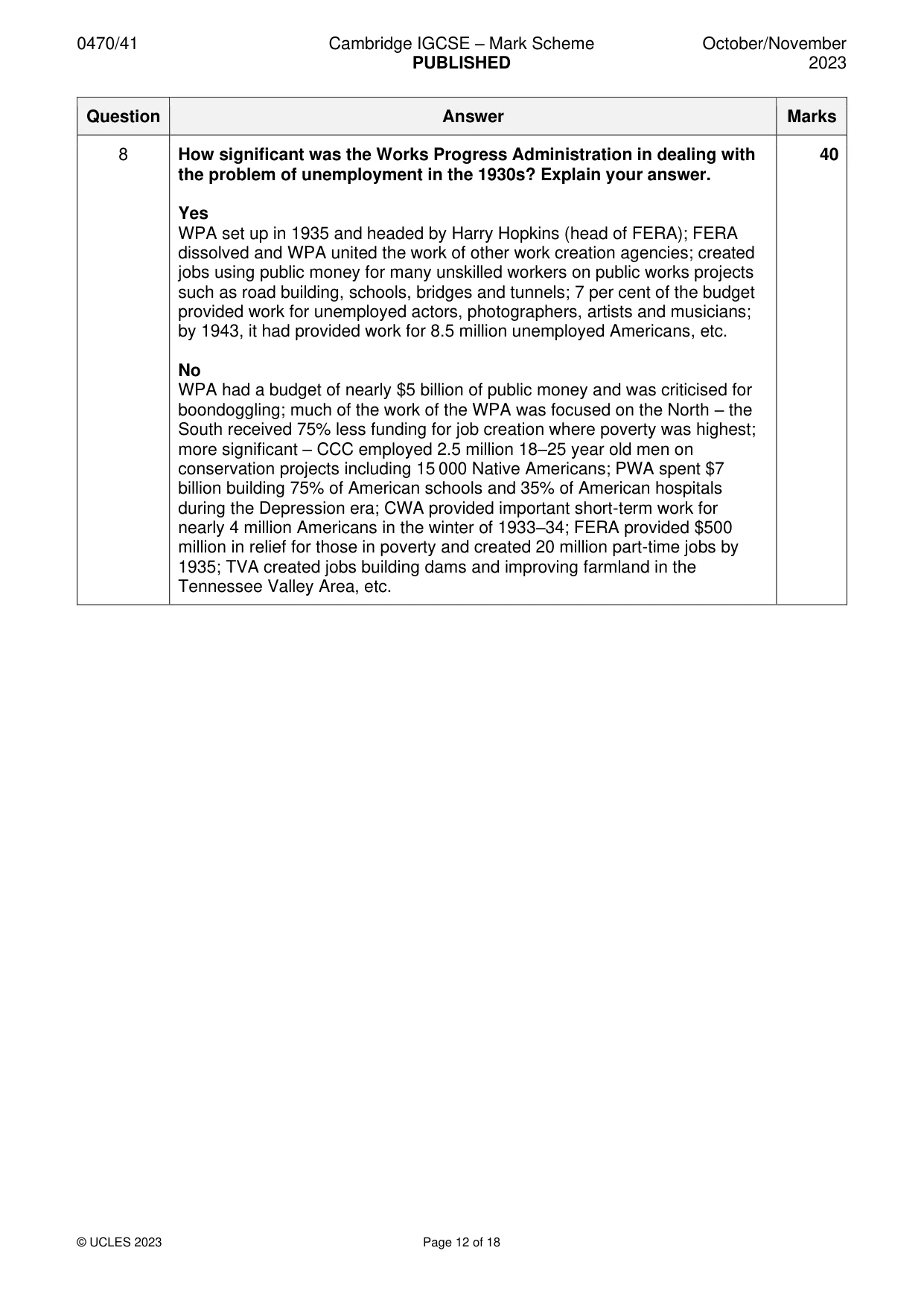
0470/41 Cambridge IGCSE – Mark Scheme PUBLISHED October/November 2023 © UCLES 2023 Page 12 of 18 Question Answer Marks 8 How significant was the Works Progress Administration in dealing with the problem of unemployment in the 1930s? Explain your answer. Yes WPA set up in 1935 and headed by Harry Hopkins (head of FERA); FERA dissolved and WPA united the work of other work creation agencies; created jobs using public money for many unskilled workers on public works projects such as road building, schools, bridges and tunnels; 7 per cent of the budget provided work for unemployed actors, photographers, artists and musicians; by 1943, it had provided work for 8.5 million unemployed Americans, etc. No WPA had a budget of nearly $5 billion of public money and was criticised for boondoggling; much of the work of the WPA was focused on the North – the South received 75% less funding for job creation where poverty was highest; more significant – CCC employed 2.5 million 18–25 year old men on conservation projects including 15 000 Native Americans; PWA spent $7 billion building 75% of American schools and 35% of American hospitals during the Depression era; CWA provided important short-term work for nearly 4 million Americans in the winter of 1933–34; FERA provided $500 million in relief for those in poverty and created 20 million part-time jobs by 1935; TVA created jobs building dams and improving farmland in the Tennessee Valley Area, etc. 40
Mark scheme, page 13
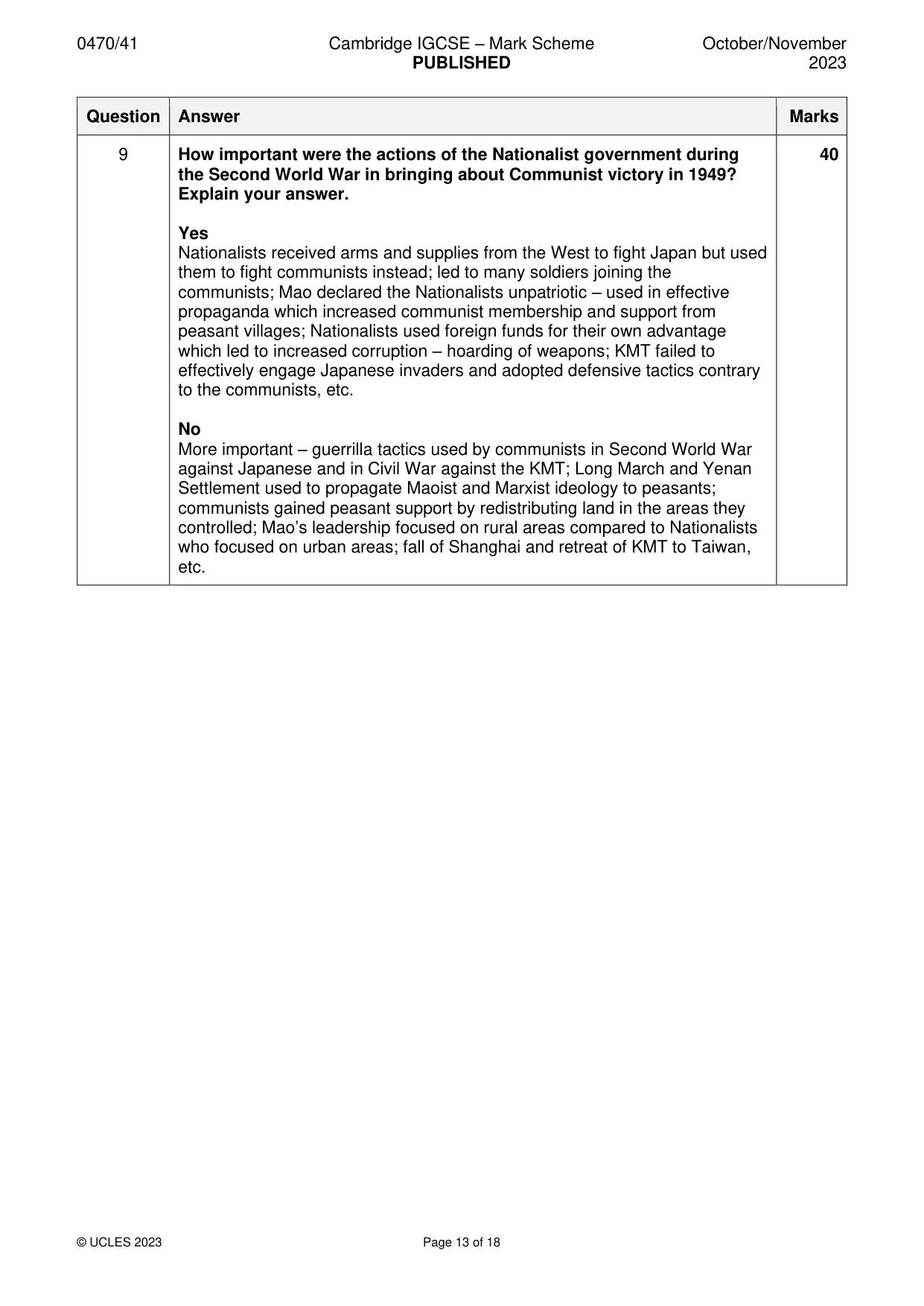
0470/41 Cambridge IGCSE – Mark Scheme PUBLISHED October/November 2023 © UCLES 2023 Page 13 of 18 Question Answer Marks 9 How important were the actions of the Nationalist government during the Second World War in bringing about Communist victory in 1949? Explain your answer. Yes Nationalists received arms and supplies from the West to fight Japan but used them to fight communists instead; led to many soldiers joining the communists; Mao declared the Nationalists unpatriotic – used in effective propaganda which increased communist membership and support from peasant villages; Nationalists used foreign funds for their own advantage which led to increased corruption – hoarding of weapons; KMT failed to effectively engage Japanese invaders and adopted defensive tactics contrary to the communists, etc. No More important – guerrilla tactics used by communists in Second World War against Japanese and in Civil War against the KMT; Long March and Yenan Settlement used to propagate Maoist and Marxist ideology to peasants; communists gained peasant support by redistributing land in the areas they controlled; Mao’s leadership focused on rural areas compared to Nationalists who focused on urban areas; fall of Shanghai and retreat of KMT to Taiwan, etc. 40
Mark scheme, page 14
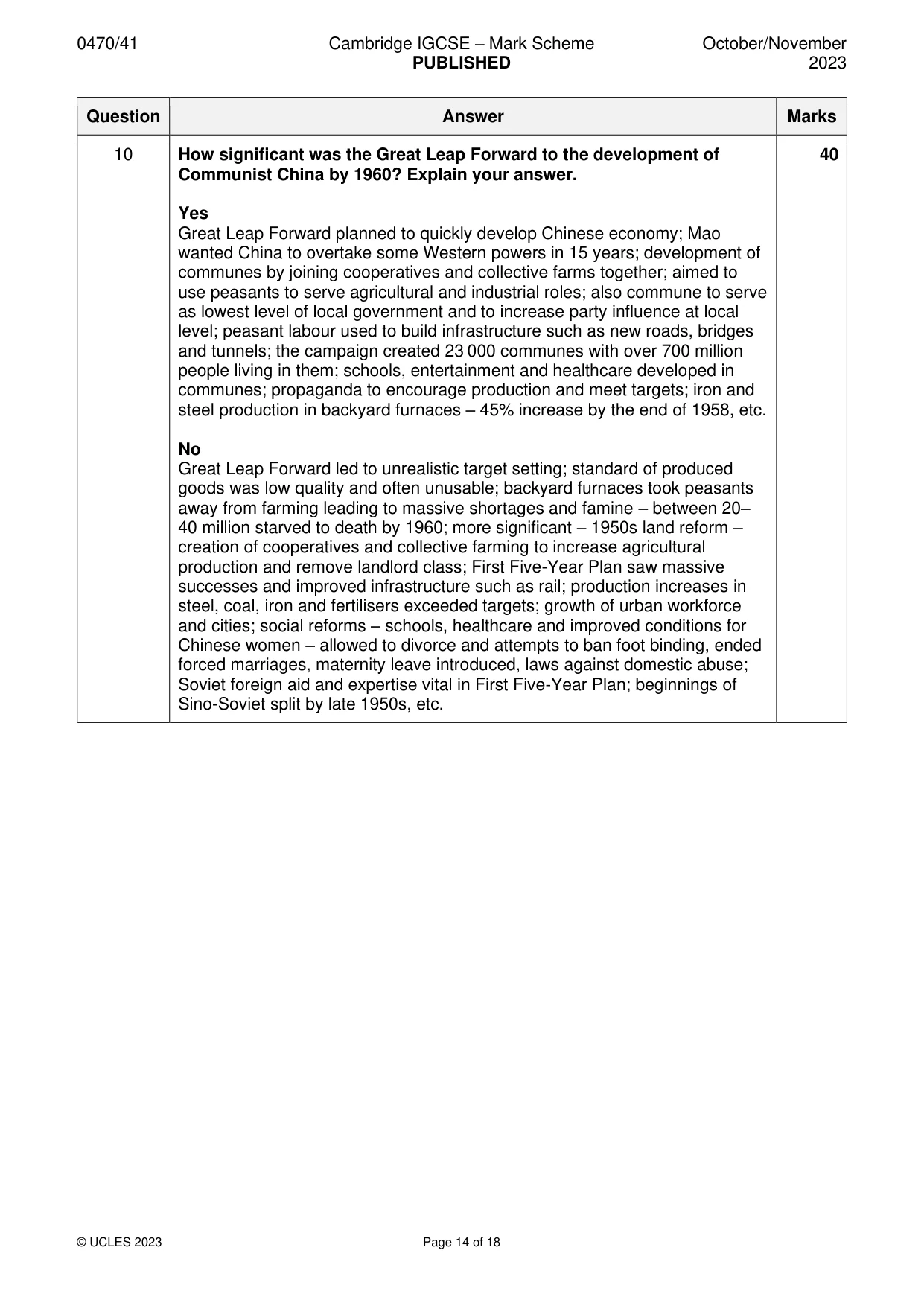
0470/41 Cambridge IGCSE – Mark Scheme PUBLISHED October/November 2023 © UCLES 2023 Page 14 of 18 Question Answer Marks 10 How significant was the Great Leap Forward to the development of Communist China by 1960? Explain your answer. Yes Great Leap Forward planned to quickly develop Chinese economy; Mao wanted China to overtake some Western powers in 15 years; development of communes by joining cooperatives and collective farms together; aimed to use peasants to serve agricultural and industrial roles; also commune to serve as lowest level of local government and to increase party influence at local level; peasant labour used to build infrastructure such as new roads, bridges and tunnels; the campaign created 23 000 communes with over 700 million people living in them; schools, entertainment and healthcare developed in communes; propaganda to encourage production and meet targets; iron and steel production in backyard furnaces – 45% increase by the end of 1958, etc. No Great Leap Forward led to unrealistic target setting; standard of produced goods was low quality and often unusable; backyard furnaces took peasants away from farming leading to massive shortages and famine – between 20– 40 million starved to death by 1960; more significant – 1950s land reform – creation of cooperatives and collective farming to increase agricultural production and remove landlord class; First Five-Year Plan saw massive successes and improved infrastructure such as rail; production increases in steel, coal, iron and fertilisers exceeded targets; growth of urban workforce and cities; social reforms – schools, healthcare and improved conditions for Chinese women – allowed to divorce and attempts to ban foot binding, ended forced marriages, maternity leave introduced, laws against domestic abuse; Soviet foreign aid and expertise vital in First Five-Year Plan; beginnings of Sino-Soviet split by late 1950s, etc. 40
Mark scheme, page 15
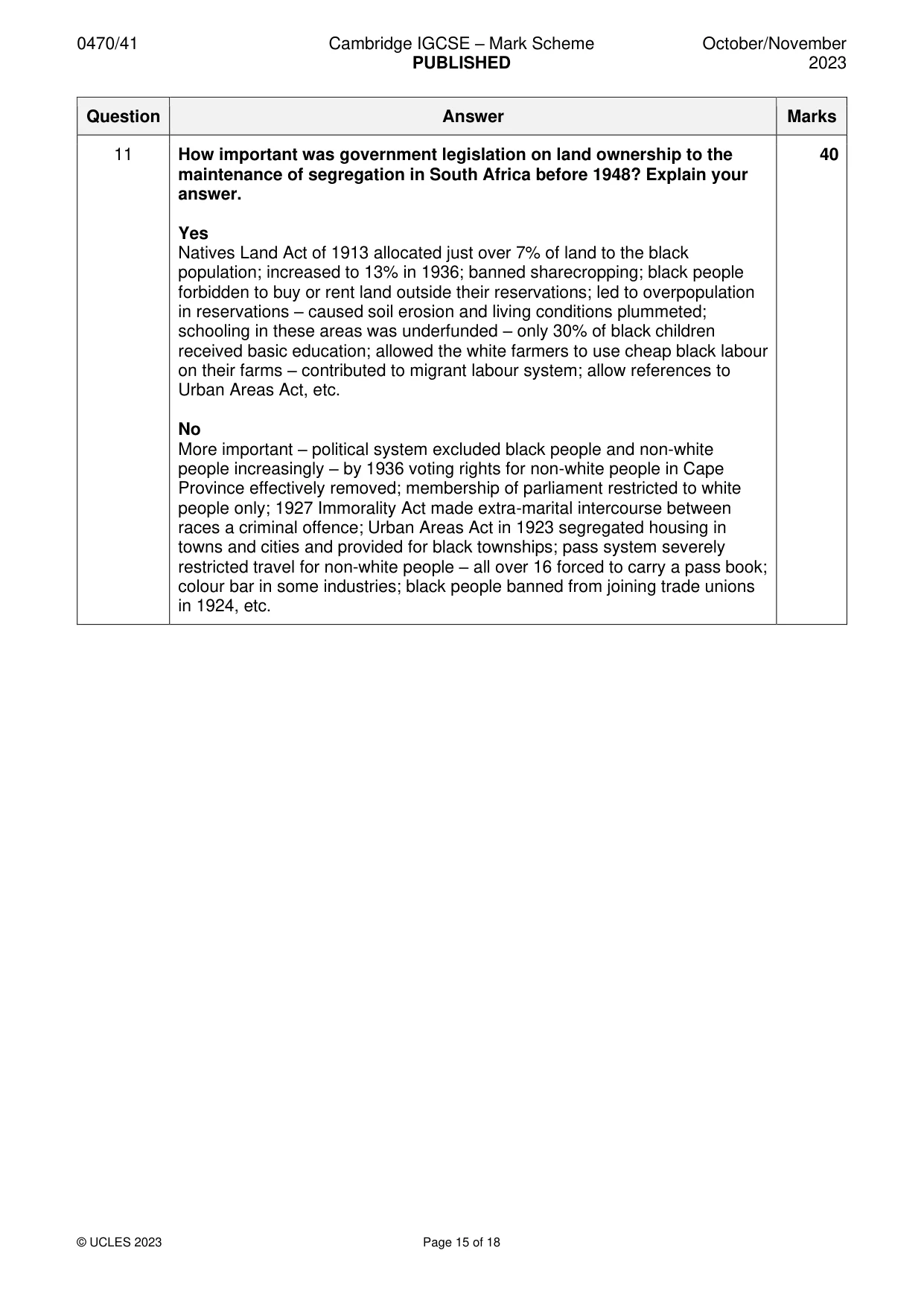
0470/41 Cambridge IGCSE – Mark Scheme PUBLISHED October/November 2023 © UCLES 2023 Page 15 of 18 Question Answer Marks 11 How important was government legislation on land ownership to the maintenance of segregation in South Africa before 1948? Explain your answer. Yes Natives Land Act of 1913 allocated just over 7% of land to the black population; increased to 13% in 1936; banned sharecropping; black people forbidden to buy or rent land outside their reservations; led to overpopulation in reservations – caused soil erosion and living conditions plummeted; schooling in these areas was underfunded – only 30% of black children received basic education; allowed the white farmers to use cheap black labour on their farms – contributed to migrant labour system; allow references to Urban Areas Act, etc. No More important – political system excluded black people and non-white people increasingly – by 1936 voting rights for non-white people in Cape Province effectively removed; membership of parliament restricted to white people only; 1927 Immorality Act made extra-marital intercourse between races a criminal offence; Urban Areas Act in 1923 segregated housing in towns and cities and provided for black townships; pass system severely restricted travel for non-white people – all over 16 forced to carry a pass book; colour bar in some industries; black people banned from joining trade unions in 1924, etc. 40
Mark scheme, page 16
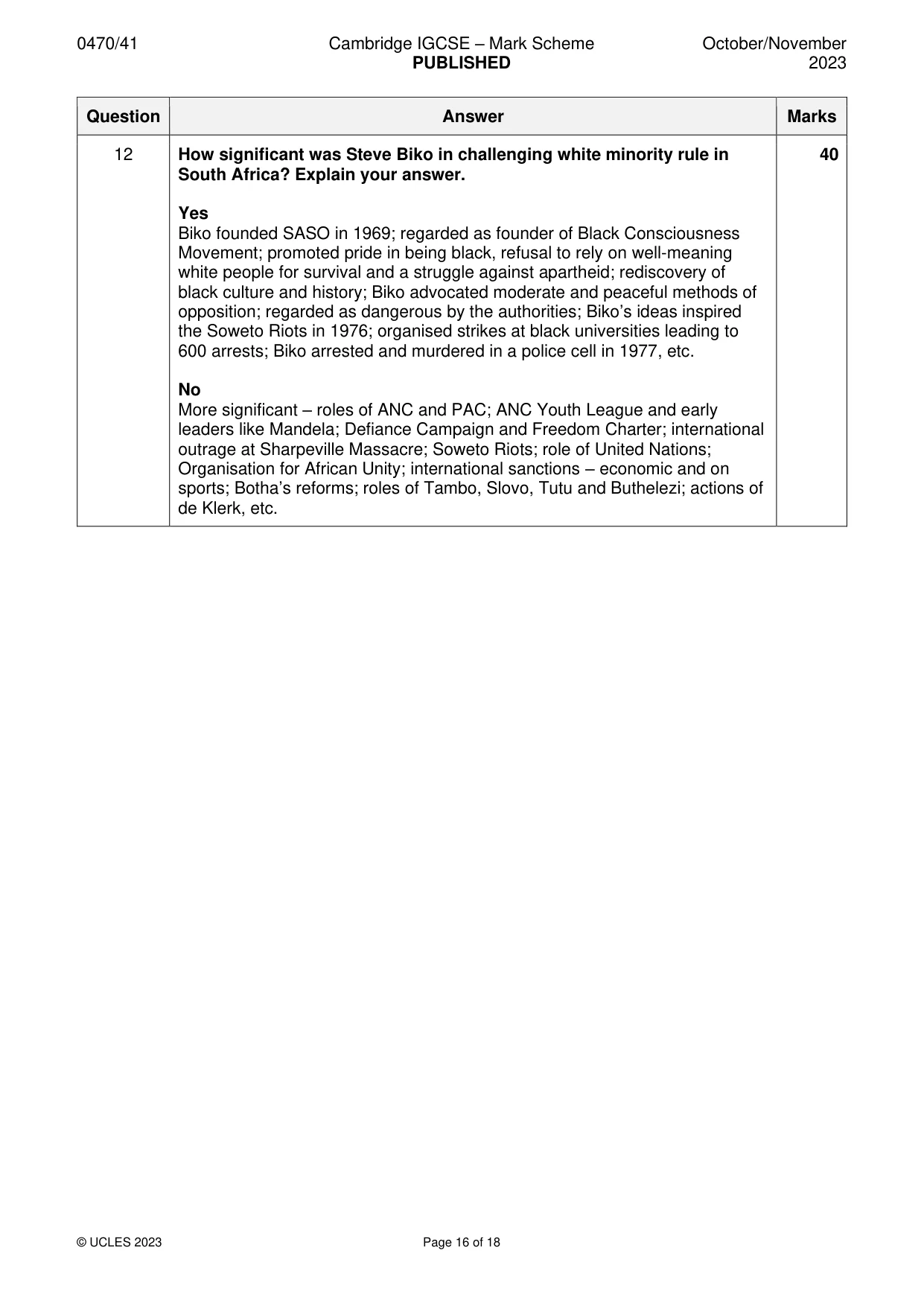
0470/41 Cambridge IGCSE – Mark Scheme PUBLISHED October/November 2023 © UCLES 2023 Page 16 of 18 Question Answer Marks 12 How significant was Steve Biko in challenging white minority rule in South Africa? Explain your answer. Yes Biko founded SASO in 1969; regarded as founder of Black Consciousness Movement; promoted pride in being black, refusal to rely on well-meaning white people for survival and a struggle against apartheid; rediscovery of black culture and history; Biko advocated moderate and peaceful methods of opposition; regarded as dangerous by the authorities; Biko’s ideas inspired the Soweto Riots in 1976; organised strikes at black universities leading to 600 arrests; Biko arrested and murdered in a police cell in 1977, etc. No More significant – roles of ANC and PAC; ANC Youth League and early leaders like Mandela; Defiance Campaign and Freedom Charter; international outrage at Sharpeville Massacre; Soweto Riots; role of United Nations; Organisation for African Unity; international sanctions – economic and on sports; Botha’s reforms; roles of Tambo, Slovo, Tutu and Buthelezi; actions of de Klerk, etc. 40
Mark scheme, page 17
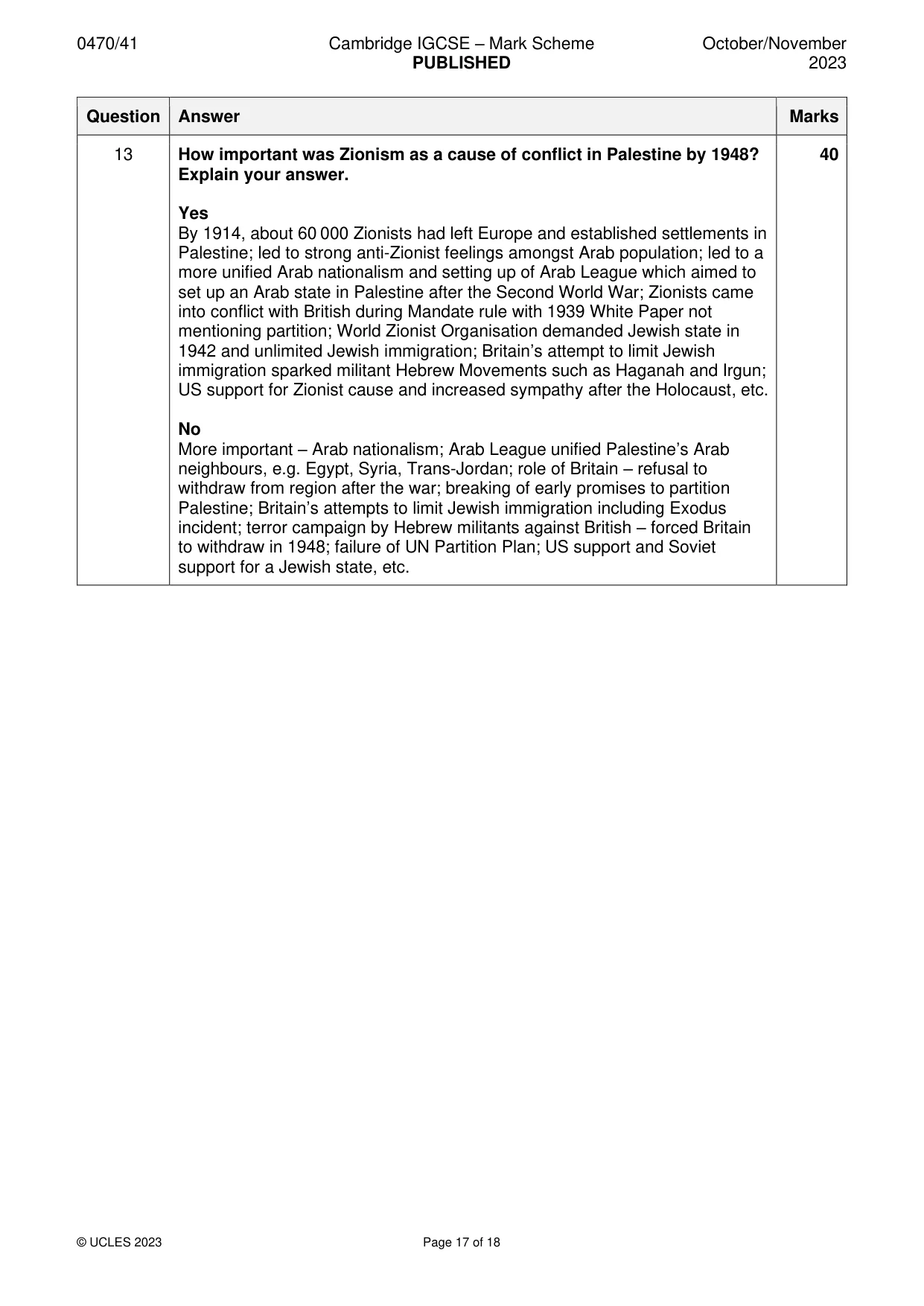
0470/41 Cambridge IGCSE – Mark Scheme PUBLISHED October/November 2023 © UCLES 2023 Page 17 of 18 Question Answer Marks 13 How important was Zionism as a cause of conflict in Palestine by 1948? Explain your answer. Yes By 1914, about 60 000 Zionists had left Europe and established settlements in Palestine; led to strong anti-Zionist feelings amongst Arab population; led to a more unified Arab nationalism and setting up of Arab League which aimed to set up an Arab state in Palestine after the Second World War; Zionists came into conflict with British during Mandate rule with 1939 White Paper not mentioning partition; World Zionist Organisation demanded Jewish state in 1942 and unlimited Jewish immigration; Britain’s attempt to limit Jewish immigration sparked militant Hebrew Movements such as Haganah and Irgun; US support for Zionist cause and increased sympathy after the Holocaust, etc. No More important – Arab nationalism; Arab League unified Palestine’s Arab neighbours, e.g. Egypt, Syria, Trans-Jordan; role of Britain – refusal to withdraw from region after the war; breaking of early promises to partition Palestine; Britain’s attempts to limit Jewish immigration including Exodus incident; terror campaign by Hebrew militants against British – forced Britain to withdraw in 1948; failure of UN Partition Plan; US support and Soviet support for a Jewish state, etc. 40
Mark scheme, page 18
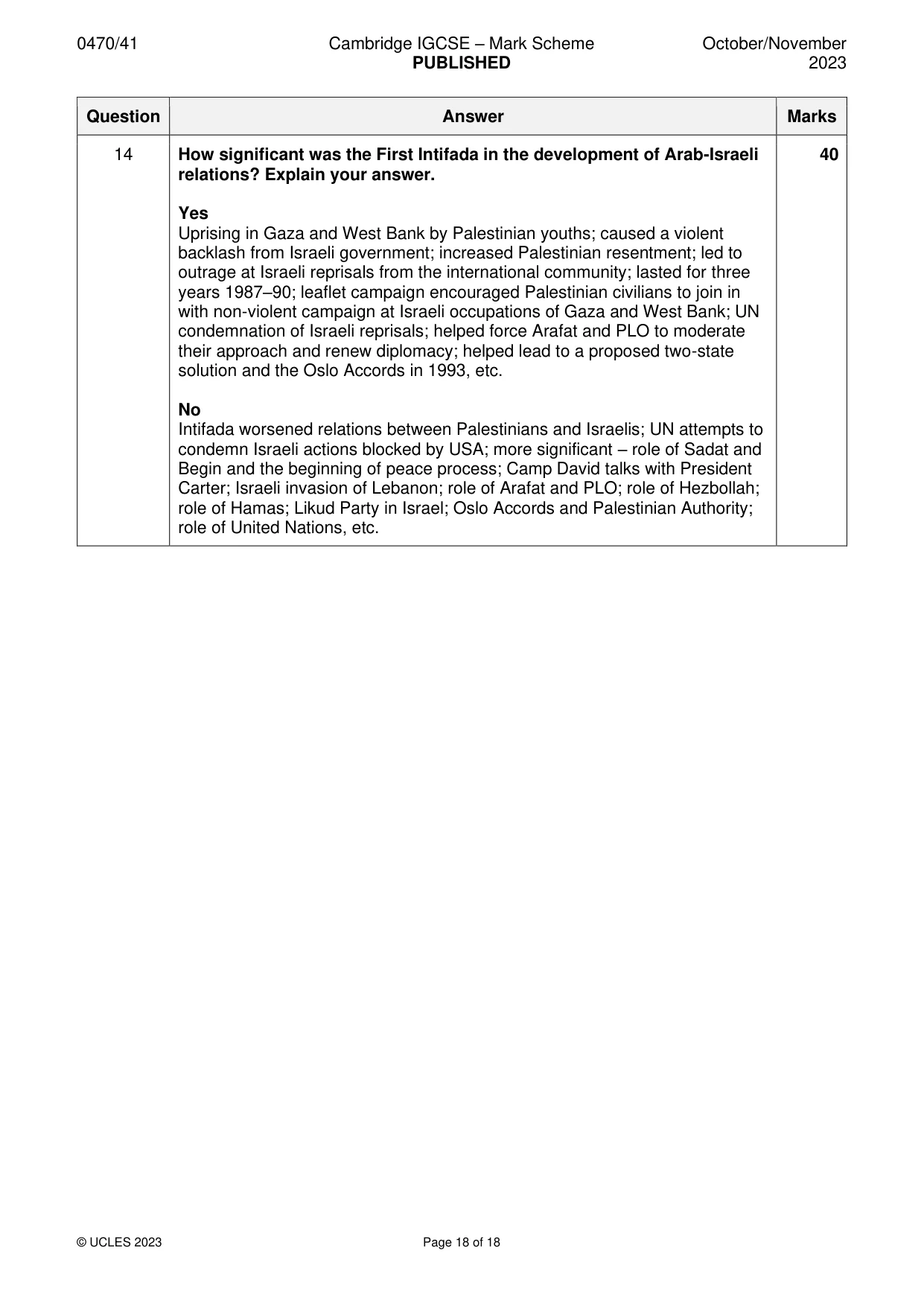
0470/41 Cambridge IGCSE – Mark Scheme PUBLISHED October/November 2023 © UCLES 2023 Page 18 of 18 Question Answer Marks 14 How significant was the First Intifada in the development of Arab-Israeli relations? Explain your answer. Yes Uprising in Gaza and West Bank by Palestinian youths; caused a violent backlash from Israeli government; increased Palestinian resentment; led to outrage at Israeli reprisals from the international community; lasted for three years 1987–90; leaflet campaign encouraged Palestinian civilians to join in with non-violent campaign at Israeli occupations of Gaza and West Bank; UN condemnation of Israeli reprisals; helped force Arafat and PLO to moderate their approach and renew diplomacy; helped lead to a proposed two-state solution and the Oslo Accords in 1993, etc. No Intifada worsened relations between Palestinians and Israelis; UN attempts to condemn Israeli actions blocked by USA; more significant – role of Sadat and Begin and the beginning of peace process; Camp David talks with President Carter; Israeli invasion of Lebanon; role of Arafat and PLO; role of Hezbollah; role of Hamas; Likud Party in Israel; Oslo Accords and Palestinian Authority; role of United Nations, etc. 40
What you needed in this session
Cambridge’s own grade thresholds for 2023 Oct/Nov, Paper 4 · Variant 1. A higher threshold means an easier paper — the bar moves with how the cohort did.