Cambridge IGCSE History 0470 — 2023 Oct/Nov Paper 4 · Variant 2
0470/42/O/N/23 · 40 marks · ≈45 min
The question paper and its mark scheme, free to read here and free to download. This is Cambridge’s own paper, exactly as it was sat.
Question paper4 pages

Mark scheme18 pages
Answers below. Sit the paper first if you are practising.
Paper as text
Question paper, page 1
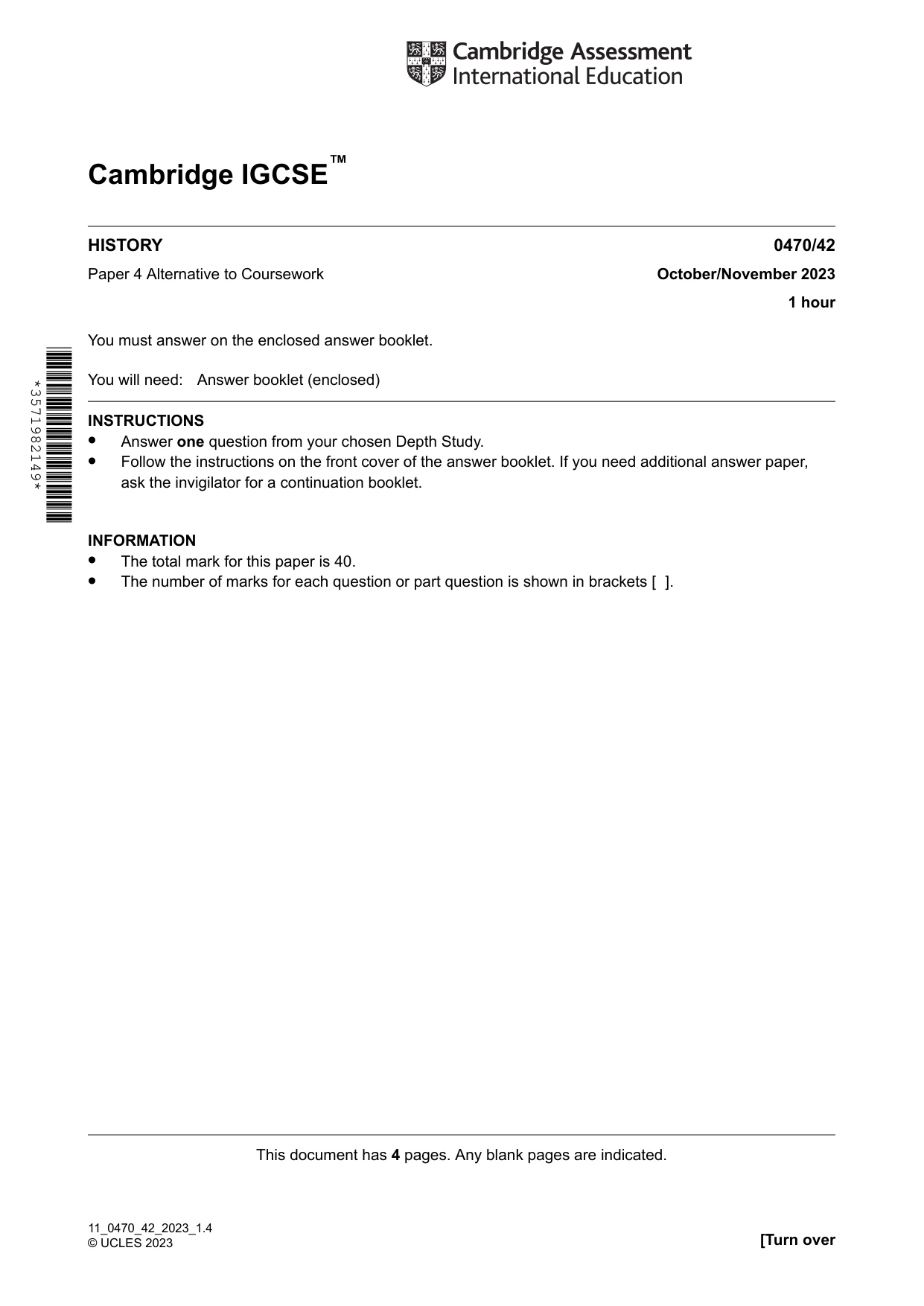
Cambridge IGCSE™ 0470/42 October/November 2023 1 hour HISTORY Paper 4 Alternative to Coursework You must answer on the enclosed answer booklet. You will need: Answer booklet (enclosed) INSTRUCTIONS • Answer one question from your chosen Depth Study. • Follow the instructions on the front cover of the answer booklet. If you need additional answer paper, ask the invigilator for a continuation booklet. INFORMATION • The total mark for this paper is 40. • The number of marks for each question or part question is shown in brackets [ ]. This document has 4 pages. Any blank pages are indicated. [Turn over 11_0470_42_2023_1.4 © UCLES 2023 *3571982149*
Question paper, page 2
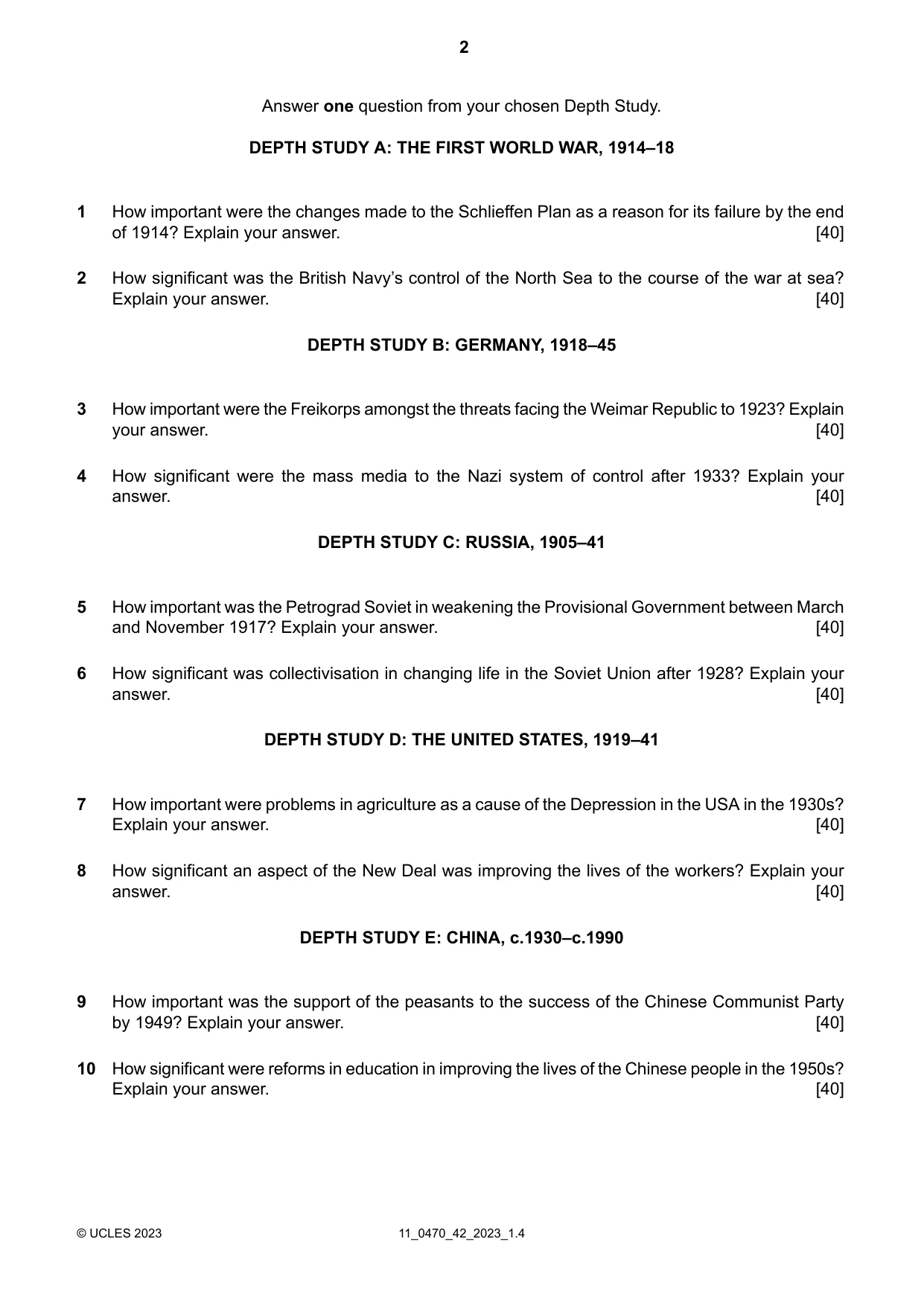
Answer one question from your chosen Depth Study. DEPTH STUDY A: THE FIRST WORLD WAR, 1914–18 How important were the changes made to the Schlieffen Plan as a reason for its failure by the end of 1914? Explain your answer. [40] 1 How significant was the British Navy’s control of the North Sea to the course of the war at sea? Explain your answer. [40] 2 DEPTH STUDY B: GERMANY, 1918–45 How important were the Freikorps amongst the threats facing the Weimar Republic to 1923? Explain your answer. [40] 3 How significant were the mass media to the Nazi system of control after 1933? Explain your answer. [40] 4 DEPTH STUDY C: RUSSIA, 1905–41 How important was the Petrograd Soviet in weakening the Provisional Government between March and November 1917? Explain your answer. [40] 5 How significant was collectivisation in changing life in the Soviet Union after 1928? Explain your answer. [40] 6 DEPTH STUDY D: THE UNITED STATES, 1919–41 How important were problems in agriculture as a cause of the Depression in the USA in the 1930s? Explain your answer. [40] 7 How significant an aspect of the New Deal was improving the lives of the workers? Explain your answer. [40] 8 DEPTH STUDY E: CHINA, c.1930–c.1990 How important was the support of the peasants to the success of the Chinese Communist Party by 1949? Explain your answer. [40] 9 How significant were reforms in education in improving the lives of the Chinese people in the 1950s? Explain your answer. [40] 10 11_0470_42_2023_1.4 © UCLES 2023 2
Question paper, page 3
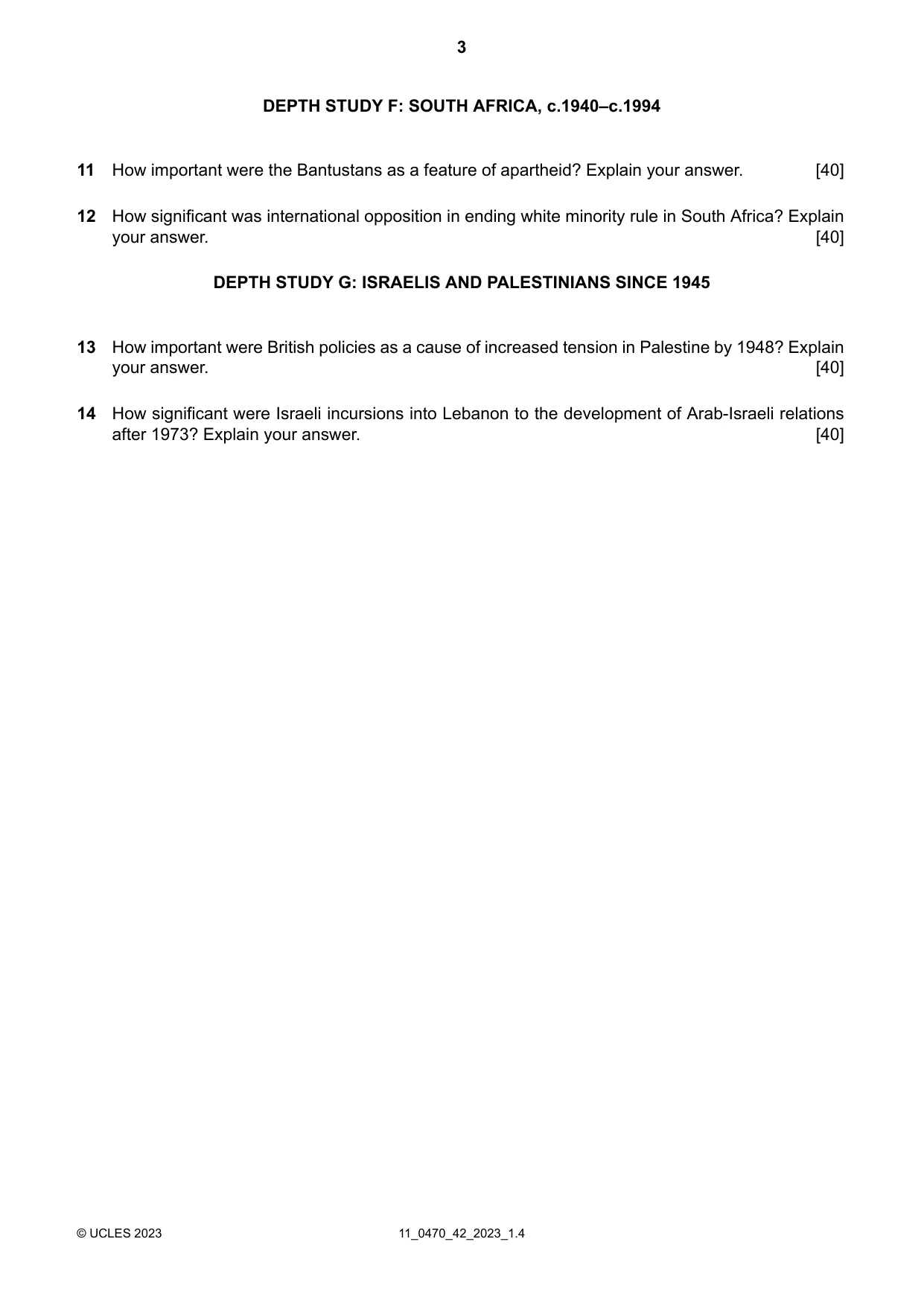
DEPTH STUDY F: SOUTH AFRICA, c.1940–c.1994 How important were the Bantustans as a feature of apartheid? Explain your answer. [40] 11 How significant was international opposition in ending white minority rule in South Africa? Explain your answer. [40] 12 DEPTH STUDY G: ISRAELIS AND PALESTINIANS SINCE 1945 How important were British policies as a cause of increased tension in Palestine by 1948? Explain your answer. [40] 13 How significant were Israeli incursions into Lebanon to the development of Arab-Israeli relations after 1973? Explain your answer. [40] 14 11_0470_42_2023_1.4 © UCLES 2023 3
Question paper, page 4
BLANK PAGE Permission to reproduce items where third-party owned material protected by copyright is included has been sought and cleared where possible. Every reasonable effort has been made by the publisher (UCLES) to trace copyright holders, but if any items requiring clearance have unwittingly been included, the publisher will be pleased to make amends at the earliest possible opportunity. To avoid the issue of disclosure of answer-related information to candidates, all copyright acknowledgements are reproduced online in the Cambridge Assessment International Education Copyright Acknowledgements Booklet. This is produced for each series of examinations and is freely available to download at www.cambridgeinternational.org after the live examination series. Cambridge Assessment International Education is part of Cambridge Assessment. Cambridge Assessment is the brand name of the University of Cambridge Local Examinations Syndicate (UCLES), which is a department of the University of Cambridge. 11_0470_42_2023_1.4 © UCLES 2023 4
Mark scheme, page 1
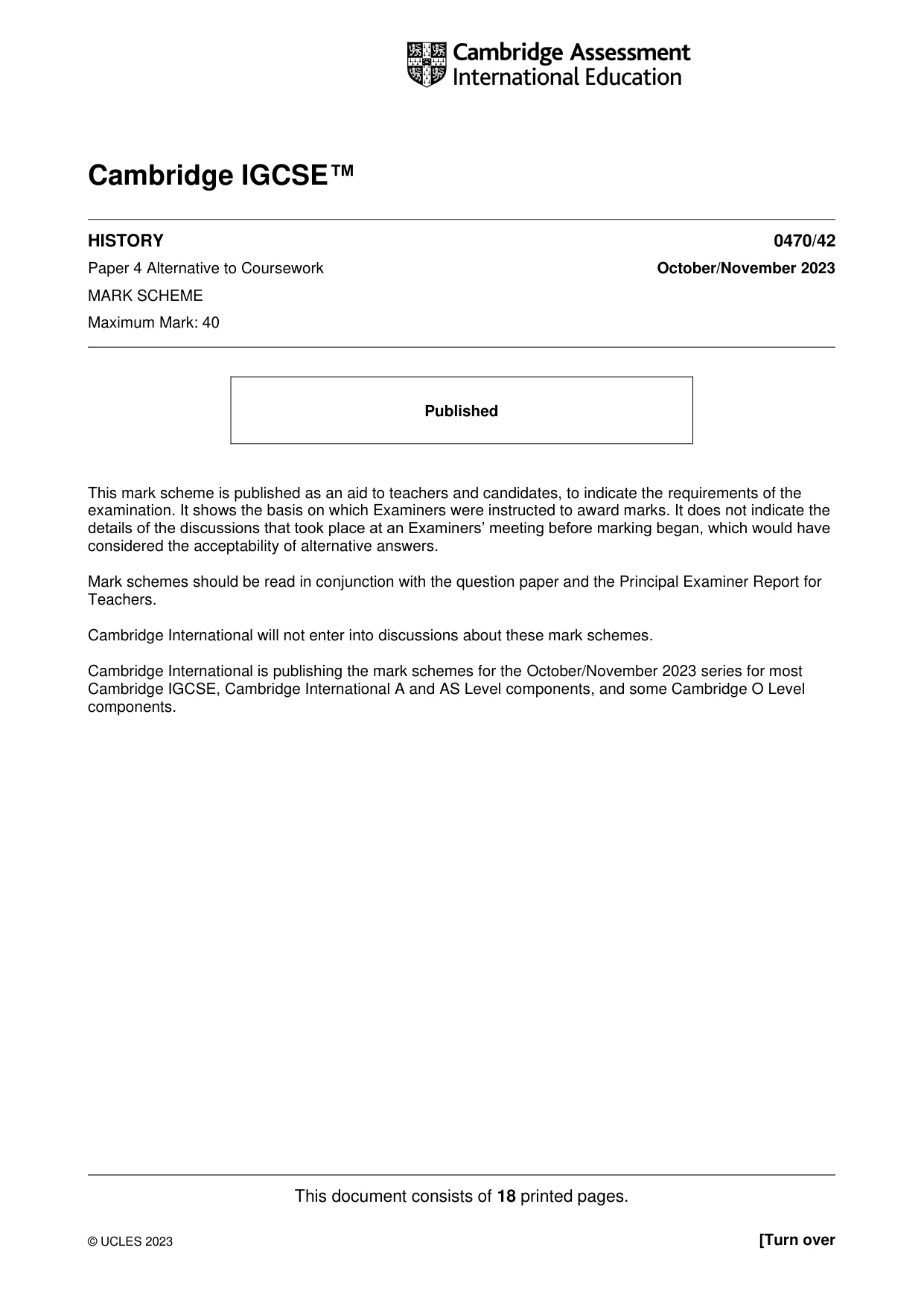
This document consists of 18 printed pages. © UCLES 2023 [Turn over Cambridge IGCSE™ HISTORY 0470/42 Paper 4 Alternative to Coursework October/November 2023 MARK SCHEME Maximum Mark: 40 Published This mark scheme is published as an aid to teachers and candidates, to indicate the requirements of the examination. It shows the basis on which Examiners were instructed to award marks. It does not indicate the details of the discussions that took place at an Examiners’ meeting before marking began, which would have considered the acceptability of alternative answers. Mark schemes should be read in conjunction with the question paper and the Principal Examiner Report for Teachers. Cambridge International will not enter into discussions about these mark schemes. Cambridge International is publishing the mark schemes for the October/November 2023 series for most Cambridge IGCSE, Cambridge International A and AS Level components, and some Cambridge O Level components.
Mark scheme, page 2
0470/42 Cambridge IGCSE – Mark Scheme PUBLISHED October/November 2023 © UCLES 2023 Page 2 of 18 Generic Marking Principles These general marking principles must be applied by all examiners when marking candidate answers. They should be applied alongside the specific content of the mark scheme or generic level descriptors for a question. Each question paper and mark scheme will also comply with these marking principles. GENERIC MARKING PRINCIPLE 1: Marks must be awarded in line with: • the specific content of the mark scheme or the generic level descriptors for the question • the specific skills defined in the mark scheme or in the generic level descriptors for the question • the standard of response required by a candidate as exemplified by the standardisation scripts. GENERIC MARKING PRINCIPLE 2: Marks awarded are always whole marks (not half marks, or other fractions). GENERIC MARKING PRINCIPLE 3: Marks must be awarded positively: • marks are awarded for correct/valid answers, as defined in the mark scheme. However, credit is given for valid answers which go beyond the scope of the syllabus and mark scheme, referring to your Team Leader as appropriate • marks are awarded when candidates clearly demonstrate what they know and can do • marks are not deducted for errors • marks are not deducted for omissions • answers should only be judged on the quality of spelling, punctuation and grammar when these features are specifically assessed by the question as indicated by the mark scheme. The meaning, however, should be unambiguous. GENERIC MARKING PRINCIPLE 4: Rules must be applied consistently, e.g. in situations where candidates have not followed instructions or in the application of generic level descriptors. GENERIC MARKING PRINCIPLE 5: Marks should be awarded using the full range of marks defined in the mark scheme for the question (however; the use of the full mark range may be limited according to the quality of the candidate responses seen). GENERIC MARKING PRINCIPLE 6: Marks awarded are based solely on the requirements as defined in the mark scheme. Marks should not be awarded with grade thresholds or grade descriptors in mind.
Mark scheme, page 3
0470/42 Cambridge IGCSE – Mark Scheme PUBLISHED October/November 2023 © UCLES 2023 Page 3 of 18 Assessment Objectives 1 and 2 Level 5 [33–40] Candidates: • Produce well balanced and well developed explanations that directly assess importance/significance to reach substantial judgements and conclusions. • Select, organise and deploy effectively and relevantly a wide range of in-depth contextual knowledge to support explanations and conclusions. • Demonstrate a strong understanding of the key features, reasons, results and changes of societies, events, people and situations relevant to the question. • Produce well developed, well reasoned and well supported judgements/conclusions. • Write with precision and succinctness, showing explicit structure and focus. Level 4 [25–32] Candidates: • Produce well balanced and partially developed explanations that assess importance/significance, although some of these may be implicit, to reach partially substantiated judgements and conclusions. • Select, organise and deploy effectively and relevantly contextual knowledge to support explanations and conclusions that will demonstrate some range and depth. • Demonstrate a sound understanding of the significance of the key features, reasons, results and changes of societies, events, people and situations relevant to the question. • Produce partially developed and partially supported judgements/conclusions. • Write with precision and succinctness, showing structure and focus. Level 3 [17–24] Candidates: • Produce balanced and developed descriptions that explicitly address the question OR produce one-sided, well developed explanations that assess importance/significance. • Select, organise and deploy relevantly appropriate contextual knowledge to support descriptions/explanations and that will demonstrate some range and/or depth. • Demonstrate some understanding of the key features, reasons, results and changes of societies, events, people and situations relevant to the question. • Produce unsupported judgements/conclusions. • Write with some precision and succinctness and focus.
Mark scheme, page 4
0470/42 Cambridge IGCSE – Mark Scheme PUBLISHED October/November 2023 © UCLES 2023 Page 4 of 18 Level 2 [9–16] Candidates: • Produce balanced but limited descriptions that lack scope/focus/supporting material OR produce one-sided descriptions that address the question. Responses may be narrative in style. • Select and organise limited contextual knowledge to support descriptions. This is only deployed relevantly on a few occasions and will demonstrate limited range and depth. • Demonstrate a limited understanding of the key features, reasons, results and changes of the societies, events, people and situations relevant to the question. • Attempt generalised conclusions but these are often asserted or undeveloped. • Present work that lacks precision, succinctness and focus. Level 1 [1–8] Candidates: • Produce balanced but limited descriptions that fail to properly address the question OR produce responses in which the material cited is largely inaccurate or irrelevant. Responses may be overly short. • Demonstrate limited contextual knowledge that lacks range or depth or is only linked to the general topic relating to the question. • List a few key features, reasons, results, and changes of societies, events, people and situations. The work contains some relevant material but this is not deployed appropriately. • Attempt generalised conclusions but these are asserted, undeveloped and unsupported. • Present work that shows little understanding or focus on the question. Level 0 [0] Candidates: Submit no evidence or do not address the question. Question Answer Marks Information Suggestions The information listed below attempts to indicate some of the detail and issues that candidates may wish to address in their answers. This list does not claim to be exclusive or exhaustive. Marks should be awarded on the quality of detail used and quality of argument deployed as defined in the generic mark scheme.
Mark scheme, page 5
0470/42 Cambridge IGCSE – Mark Scheme PUBLISHED October/November 2023 © UCLES 2023 Page 5 of 18 Question Answer Marks 1 How important were the changes made to the Schlieffen Plan as a reason for its failure by the end of 1914? Explain your answer. Yes Von Moltke believed the original plan was too daring and altered it; he reduced the commitment of troops in the East to contain the Russian advance; the original route was to go through Holland and Belgium – von Moltke decided to avoid Holland and took a direct route through Belgium; Moltke expected the British to not break Belgian neutrality, etc. No More important – Belgian resistance slowed the German advance, e.g. Liège; German failure to capture Belgian railway lines hampered supply lines; most German troops were green conscripts rather than professional soldiers; BEF entry into the war held up the German advance at the Battle of Mons; Battle of the Marne saw Germans retreat and dig-in; ‘race to the sea’ created a network of trenches from the English Channel to the Swiss frontier; First Battle of Ypres saw a stalemate set in, etc. 40
Mark scheme, page 6
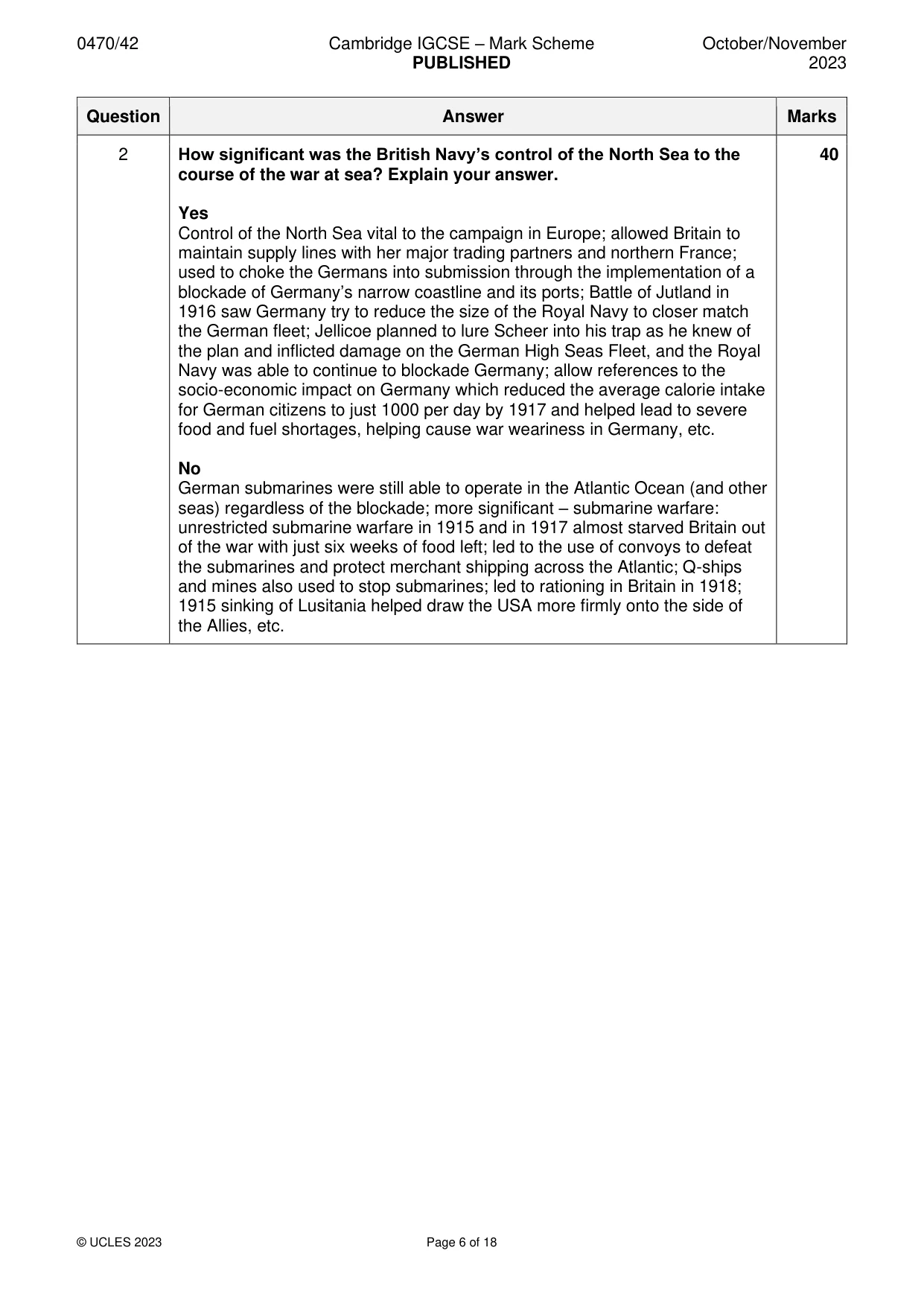
0470/42 Cambridge IGCSE – Mark Scheme PUBLISHED October/November 2023 © UCLES 2023 Page 6 of 18 Question Answer Marks 2 How significant was the British Navy’s control of the North Sea to the course of the war at sea? Explain your answer. Yes Control of the North Sea vital to the campaign in Europe; allowed Britain to maintain supply lines with her major trading partners and northern France; used to choke the Germans into submission through the implementation of a blockade of Germany’s narrow coastline and its ports; Battle of Jutland in 1916 saw Germany try to reduce the size of the Royal Navy to closer match the German fleet; Jellicoe planned to lure Scheer into his trap as he knew of the plan and inflicted damage on the German High Seas Fleet, and the Royal Navy was able to continue to blockade Germany; allow references to the socio-economic impact on Germany which reduced the average calorie intake for German citizens to just 1000 per day by 1917 and helped lead to severe food and fuel shortages, helping cause war weariness in Germany, etc. No German submarines were still able to operate in the Atlantic Ocean (and other seas) regardless of the blockade; more significant – submarine warfare: unrestricted submarine warfare in 1915 and in 1917 almost starved Britain out of the war with just six weeks of food left; led to the use of convoys to defeat the submarines and protect merchant shipping across the Atlantic; Q-ships and mines also used to stop submarines; led to rationing in Britain in 1918; 1915 sinking of Lusitania helped draw the USA more firmly onto the side of the Allies, etc. 40
Mark scheme, page 7
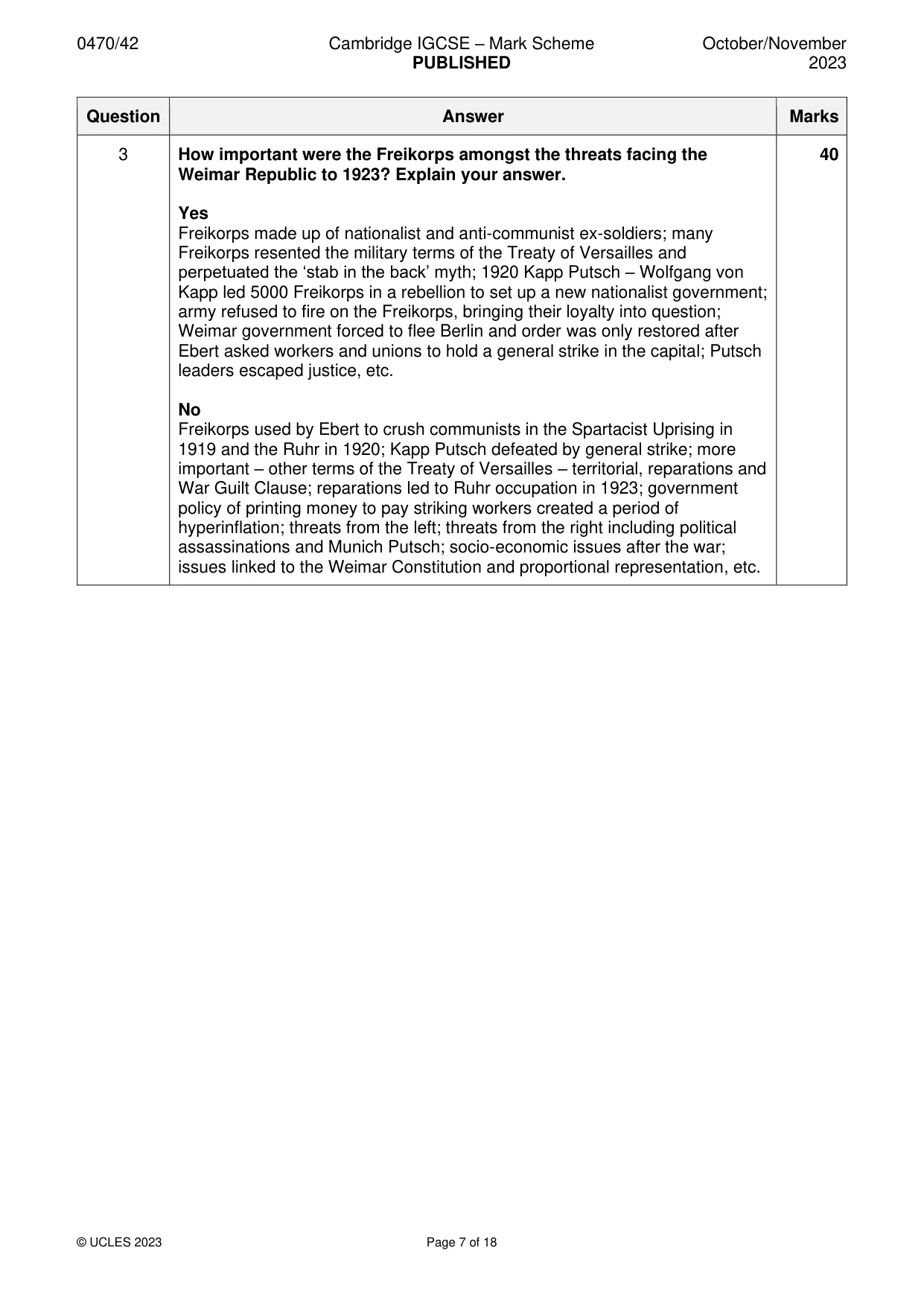
0470/42 Cambridge IGCSE – Mark Scheme PUBLISHED October/November 2023 © UCLES 2023 Page 7 of 18 Question Answer Marks 3 How important were the Freikorps amongst the threats facing the Weimar Republic to 1923? Explain your answer. Yes Freikorps made up of nationalist and anti-communist ex-soldiers; many Freikorps resented the military terms of the Treaty of Versailles and perpetuated the ‘stab in the back’ myth; 1920 Kapp Putsch – Wolfgang von Kapp led 5000 Freikorps in a rebellion to set up a new nationalist government; army refused to fire on the Freikorps, bringing their loyalty into question; Weimar government forced to flee Berlin and order was only restored after Ebert asked workers and unions to hold a general strike in the capital; Putsch leaders escaped justice, etc. No Freikorps used by Ebert to crush communists in the Spartacist Uprising in 1919 and the Ruhr in 1920; Kapp Putsch defeated by general strike; more important – other terms of the Treaty of Versailles – territorial, reparations and War Guilt Clause; reparations led to Ruhr occupation in 1923; government policy of printing money to pay striking workers created a period of hyperinflation; threats from the left; threats from the right including political assassinations and Munich Putsch; socio-economic issues after the war; issues linked to the Weimar Constitution and proportional representation, etc. 40
Mark scheme, page 8
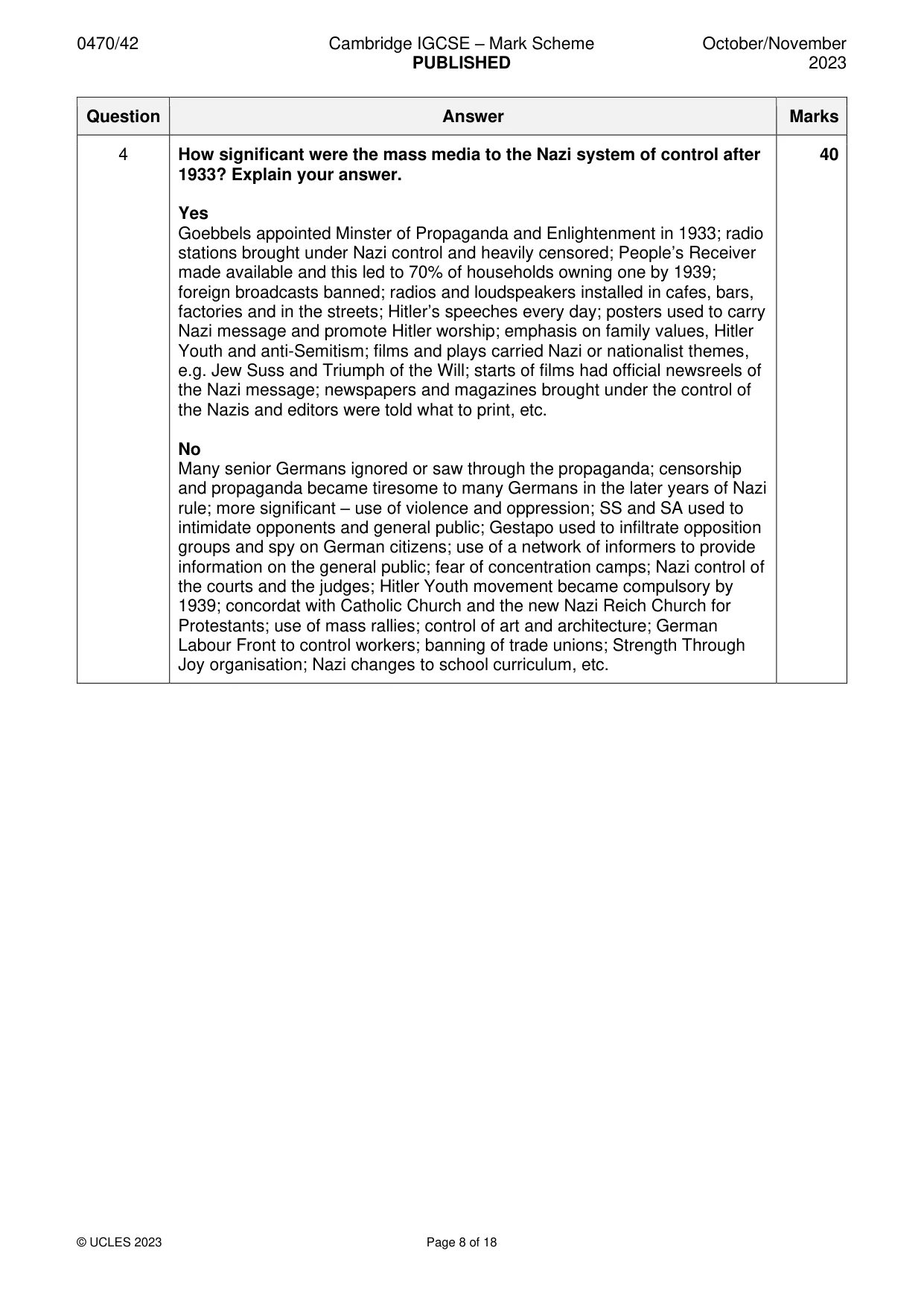
0470/42 Cambridge IGCSE – Mark Scheme PUBLISHED October/November 2023 © UCLES 2023 Page 8 of 18 Question Answer Marks 4 How significant were the mass media to the Nazi system of control after 1933? Explain your answer. Yes Goebbels appointed Minster of Propaganda and Enlightenment in 1933; radio stations brought under Nazi control and heavily censored; People’s Receiver made available and this led to 70% of households owning one by 1939; foreign broadcasts banned; radios and loudspeakers installed in cafes, bars, factories and in the streets; Hitler’s speeches every day; posters used to carry Nazi message and promote Hitler worship; emphasis on family values, Hitler Youth and anti-Semitism; films and plays carried Nazi or nationalist themes, e.g. Jew Suss and Triumph of the Will; starts of films had official newsreels of the Nazi message; newspapers and magazines brought under the control of the Nazis and editors were told what to print, etc. No Many senior Germans ignored or saw through the propaganda; censorship and propaganda became tiresome to many Germans in the later years of Nazi rule; more significant – use of violence and oppression; SS and SA used to intimidate opponents and general public; Gestapo used to infiltrate opposition groups and spy on German citizens; use of a network of informers to provide information on the general public; fear of concentration camps; Nazi control of the courts and the judges; Hitler Youth movement became compulsory by 1939; concordat with Catholic Church and the new Nazi Reich Church for Protestants; use of mass rallies; control of art and architecture; German Labour Front to control workers; banning of trade unions; Strength Through Joy organisation; Nazi changes to school curriculum, etc. 40
Mark scheme, page 9
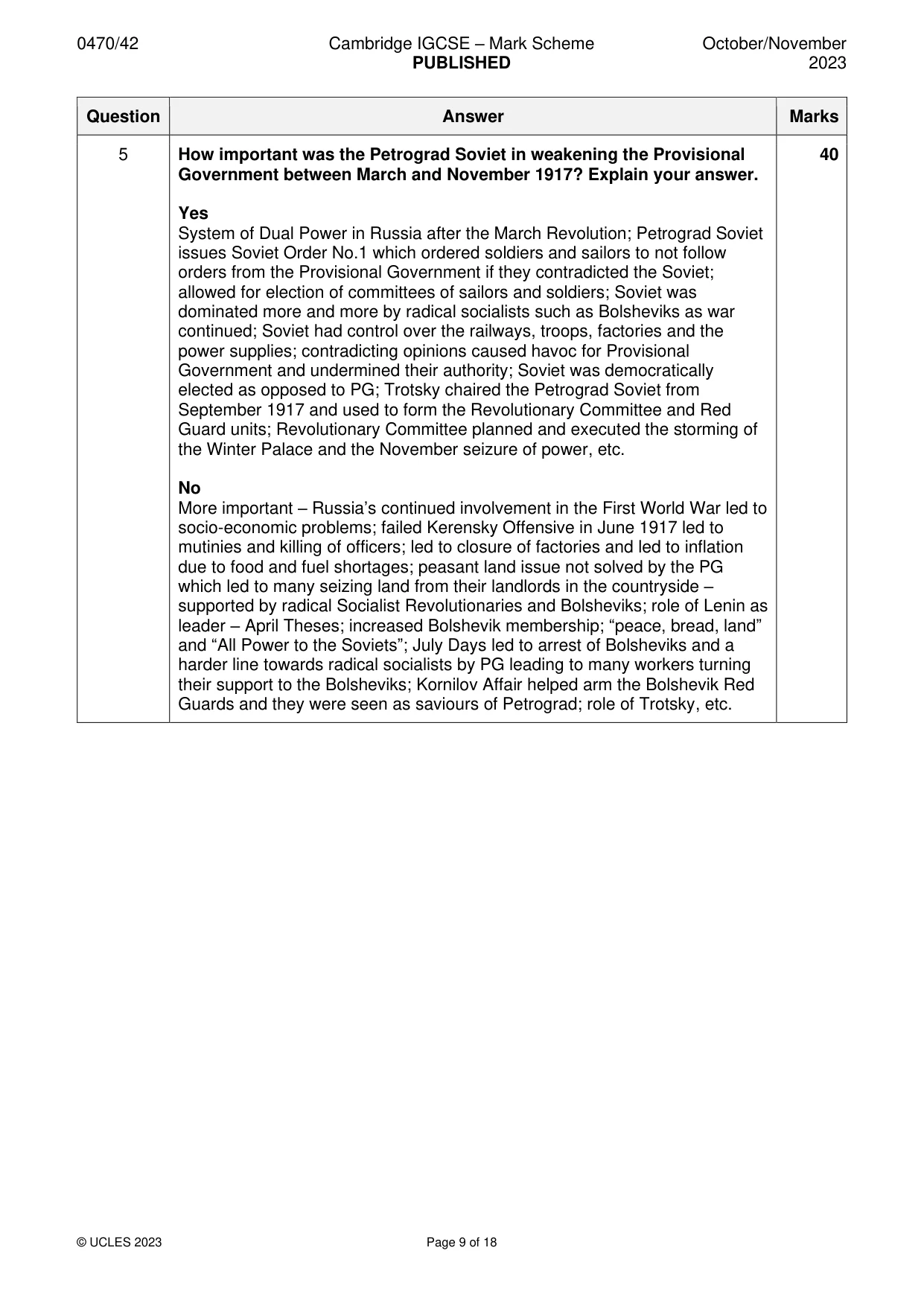
0470/42 Cambridge IGCSE – Mark Scheme PUBLISHED October/November 2023 © UCLES 2023 Page 9 of 18 Question Answer Marks 5 How important was the Petrograd Soviet in weakening the Provisional Government between March and November 1917? Explain your answer. Yes System of Dual Power in Russia after the March Revolution; Petrograd Soviet issues Soviet Order No.1 which ordered soldiers and sailors to not follow orders from the Provisional Government if they contradicted the Soviet; allowed for election of committees of sailors and soldiers; Soviet was dominated more and more by radical socialists such as Bolsheviks as war continued; Soviet had control over the railways, troops, factories and the power supplies; contradicting opinions caused havoc for Provisional Government and undermined their authority; Soviet was democratically elected as opposed to PG; Trotsky chaired the Petrograd Soviet from September 1917 and used to form the Revolutionary Committee and Red Guard units; Revolutionary Committee planned and executed the storming of the Winter Palace and the November seizure of power, etc. No More important – Russia’s continued involvement in the First World War led to socio-economic problems; failed Kerensky Offensive in June 1917 led to mutinies and killing of officers; led to closure of factories and led to inflation due to food and fuel shortages; peasant land issue not solved by the PG which led to many seizing land from their landlords in the countryside – supported by radical Socialist Revolutionaries and Bolsheviks; role of Lenin as leader – April Theses; increased Bolshevik membership; “peace, bread, land” and “All Power to the Soviets”; July Days led to arrest of Bolsheviks and a harder line towards radical socialists by PG leading to many workers turning their support to the Bolsheviks; Kornilov Affair helped arm the Bolshevik Red Guards and they were seen as saviours of Petrograd; role of Trotsky, etc. 40
Mark scheme, page 10
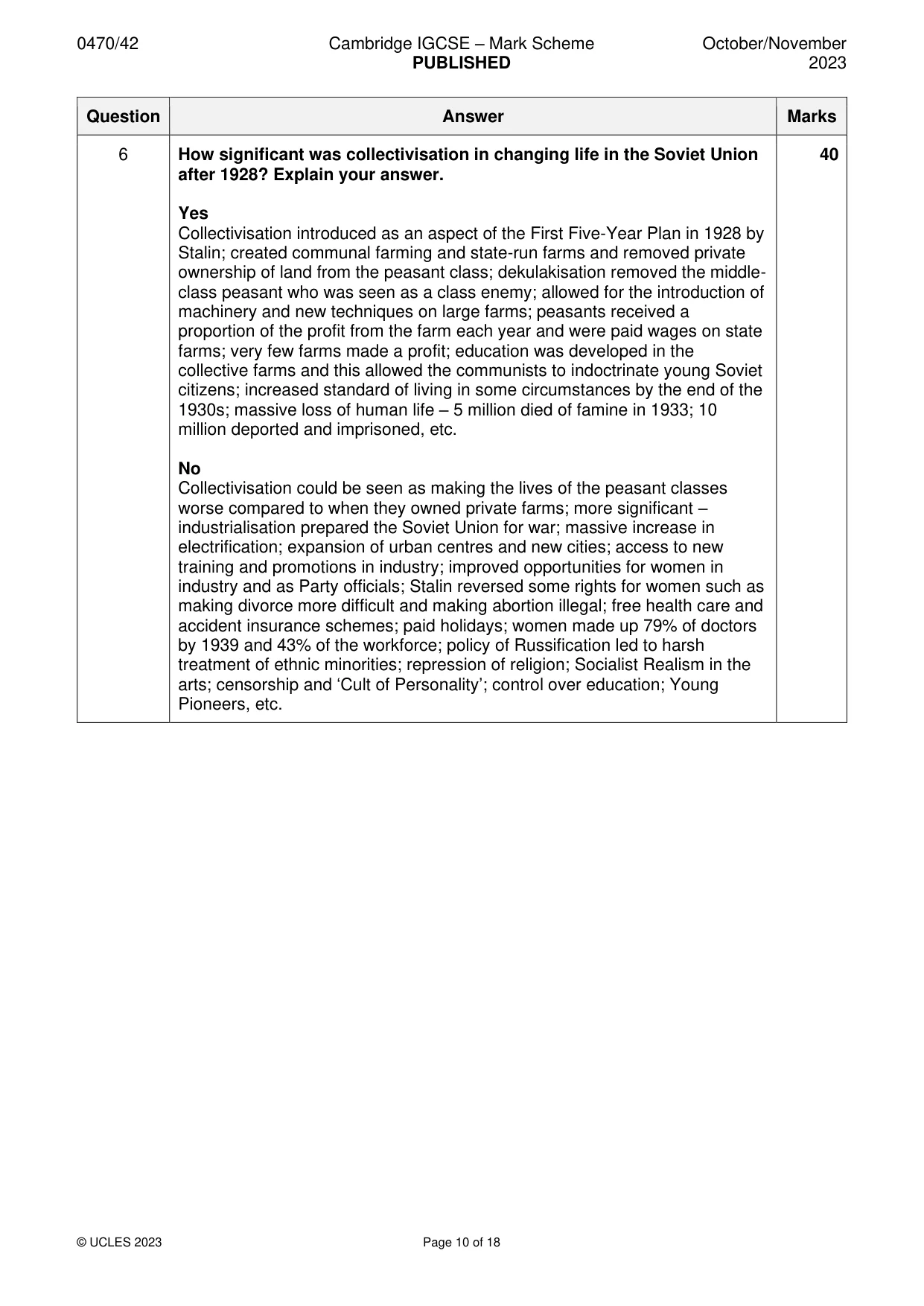
0470/42 Cambridge IGCSE – Mark Scheme PUBLISHED October/November 2023 © UCLES 2023 Page 10 of 18 Question Answer Marks 6 How significant was collectivisation in changing life in the Soviet Union after 1928? Explain your answer. Yes Collectivisation introduced as an aspect of the First Five-Year Plan in 1928 by Stalin; created communal farming and state-run farms and removed private ownership of land from the peasant class; dekulakisation removed the middle- class peasant who was seen as a class enemy; allowed for the introduction of machinery and new techniques on large farms; peasants received a proportion of the profit from the farm each year and were paid wages on state farms; very few farms made a profit; education was developed in the collective farms and this allowed the communists to indoctrinate young Soviet citizens; increased standard of living in some circumstances by the end of the 1930s; massive loss of human life – 5 million died of famine in 1933; 10 million deported and imprisoned, etc. No Collectivisation could be seen as making the lives of the peasant classes worse compared to when they owned private farms; more significant – industrialisation prepared the Soviet Union for war; massive increase in electrification; expansion of urban centres and new cities; access to new training and promotions in industry; improved opportunities for women in industry and as Party officials; Stalin reversed some rights for women such as making divorce more difficult and making abortion illegal; free health care and accident insurance schemes; paid holidays; women made up 79% of doctors by 1939 and 43% of the workforce; policy of Russification led to harsh treatment of ethnic minorities; repression of religion; Socialist Realism in the arts; censorship and ‘Cult of Personality’; control over education; Young Pioneers, etc. 40
Mark scheme, page 11
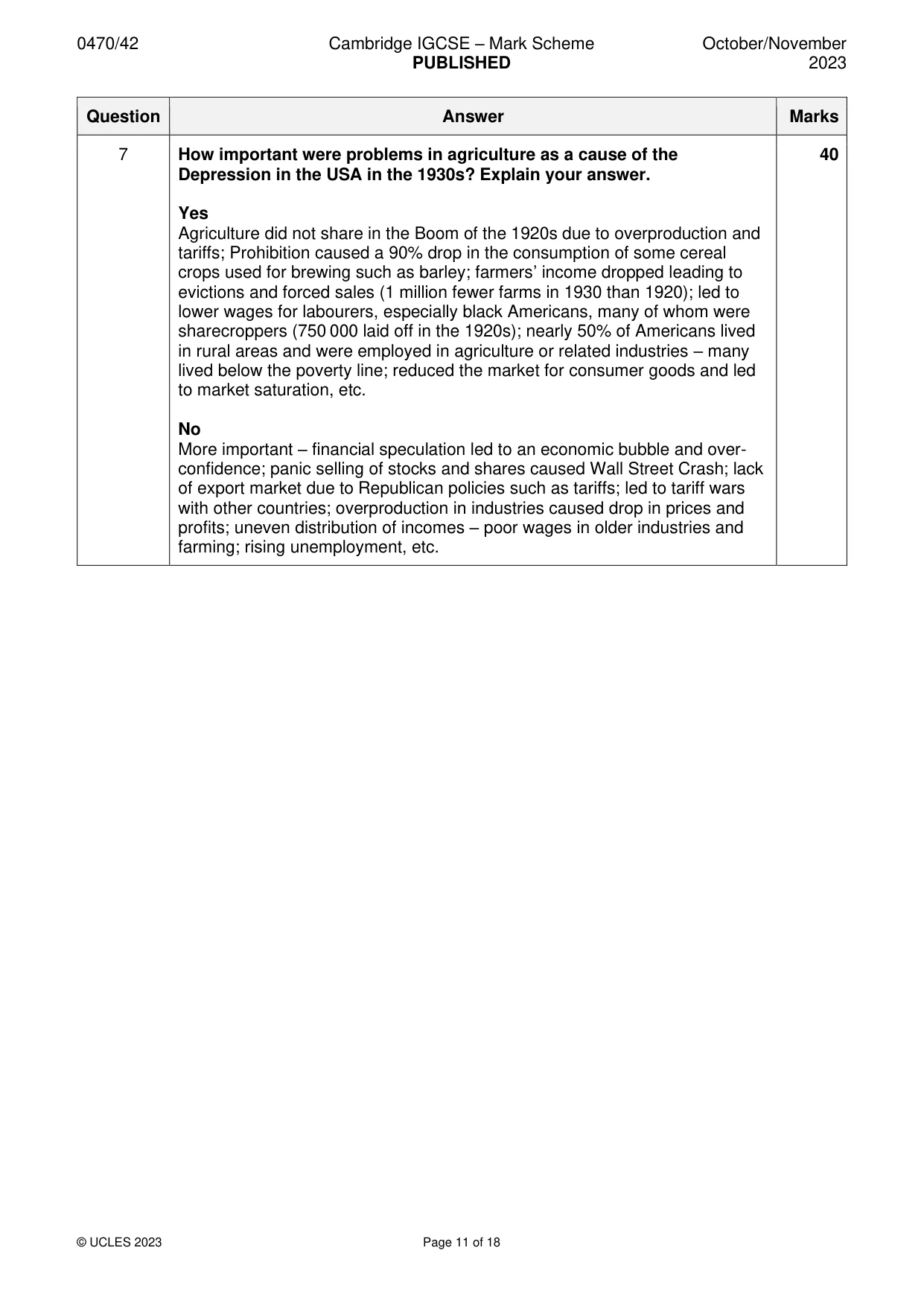
0470/42 Cambridge IGCSE – Mark Scheme PUBLISHED October/November 2023 © UCLES 2023 Page 11 of 18 Question Answer Marks 7 How important were problems in agriculture as a cause of the Depression in the USA in the 1930s? Explain your answer. Yes Agriculture did not share in the Boom of the 1920s due to overproduction and tariffs; Prohibition caused a 90% drop in the consumption of some cereal crops used for brewing such as barley; farmers’ income dropped leading to evictions and forced sales (1 million fewer farms in 1930 than 1920); led to lower wages for labourers, especially black Americans, many of whom were sharecroppers (750 000 laid off in the 1920s); nearly 50% of Americans lived in rural areas and were employed in agriculture or related industries – many lived below the poverty line; reduced the market for consumer goods and led to market saturation, etc. No More important – financial speculation led to an economic bubble and over- confidence; panic selling of stocks and shares caused Wall Street Crash; lack of export market due to Republican policies such as tariffs; led to tariff wars with other countries; overproduction in industries caused drop in prices and profits; uneven distribution of incomes – poor wages in older industries and farming; rising unemployment, etc. 40
Mark scheme, page 12
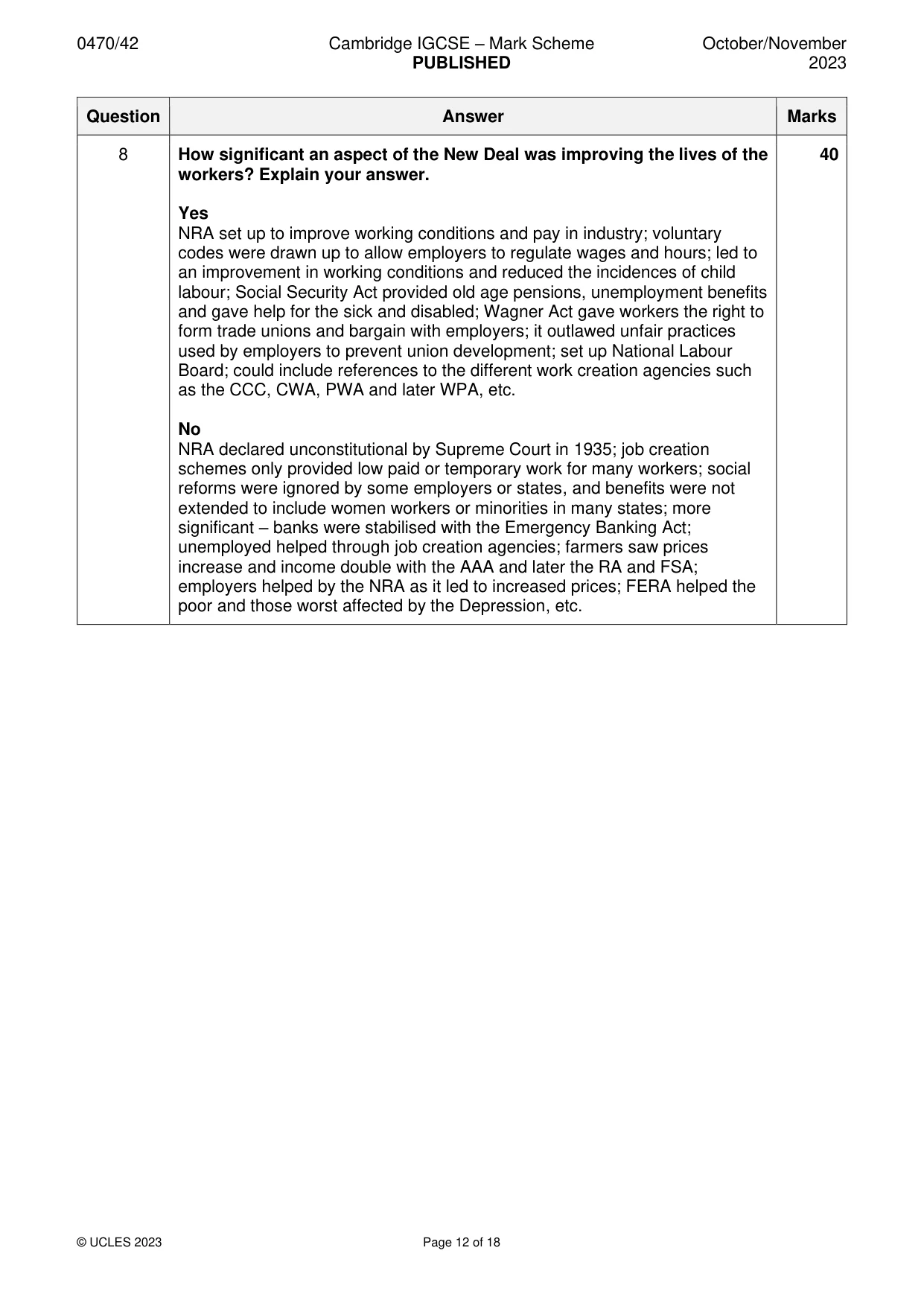
0470/42 Cambridge IGCSE – Mark Scheme PUBLISHED October/November 2023 © UCLES 2023 Page 12 of 18 Question Answer Marks 8 How significant an aspect of the New Deal was improving the lives of the workers? Explain your answer. Yes NRA set up to improve working conditions and pay in industry; voluntary codes were drawn up to allow employers to regulate wages and hours; led to an improvement in working conditions and reduced the incidences of child labour; Social Security Act provided old age pensions, unemployment benefits and gave help for the sick and disabled; Wagner Act gave workers the right to form trade unions and bargain with employers; it outlawed unfair practices used by employers to prevent union development; set up National Labour Board; could include references to the different work creation agencies such as the CCC, CWA, PWA and later WPA, etc. No NRA declared unconstitutional by Supreme Court in 1935; job creation schemes only provided low paid or temporary work for many workers; social reforms were ignored by some employers or states, and benefits were not extended to include women workers or minorities in many states; more significant – banks were stabilised with the Emergency Banking Act; unemployed helped through job creation agencies; farmers saw prices increase and income double with the AAA and later the RA and FSA; employers helped by the NRA as it led to increased prices; FERA helped the poor and those worst affected by the Depression, etc. 40
Mark scheme, page 13
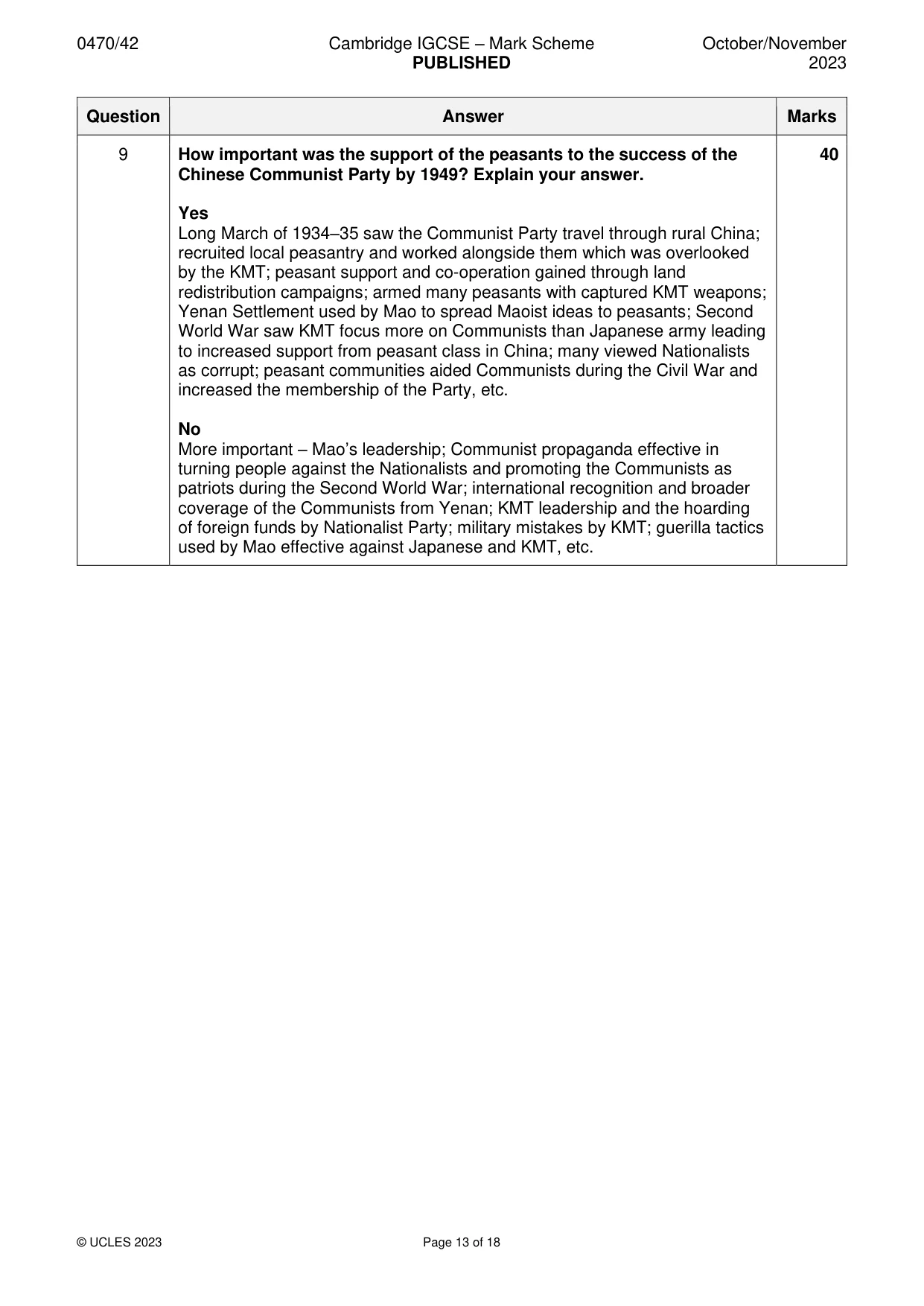
0470/42 Cambridge IGCSE – Mark Scheme PUBLISHED October/November 2023 © UCLES 2023 Page 13 of 18 Question Answer Marks 9 How important was the support of the peasants to the success of the Chinese Communist Party by 1949? Explain your answer. Yes Long March of 1934–35 saw the Communist Party travel through rural China; recruited local peasantry and worked alongside them which was overlooked by the KMT; peasant support and co-operation gained through land redistribution campaigns; armed many peasants with captured KMT weapons; Yenan Settlement used by Mao to spread Maoist ideas to peasants; Second World War saw KMT focus more on Communists than Japanese army leading to increased support from peasant class in China; many viewed Nationalists as corrupt; peasant communities aided Communists during the Civil War and increased the membership of the Party, etc. No More important – Mao’s leadership; Communist propaganda effective in turning people against the Nationalists and promoting the Communists as patriots during the Second World War; international recognition and broader coverage of the Communists from Yenan; KMT leadership and the hoarding of foreign funds by Nationalist Party; military mistakes by KMT; guerilla tactics used by Mao effective against Japanese and KMT, etc. 40
Mark scheme, page 14
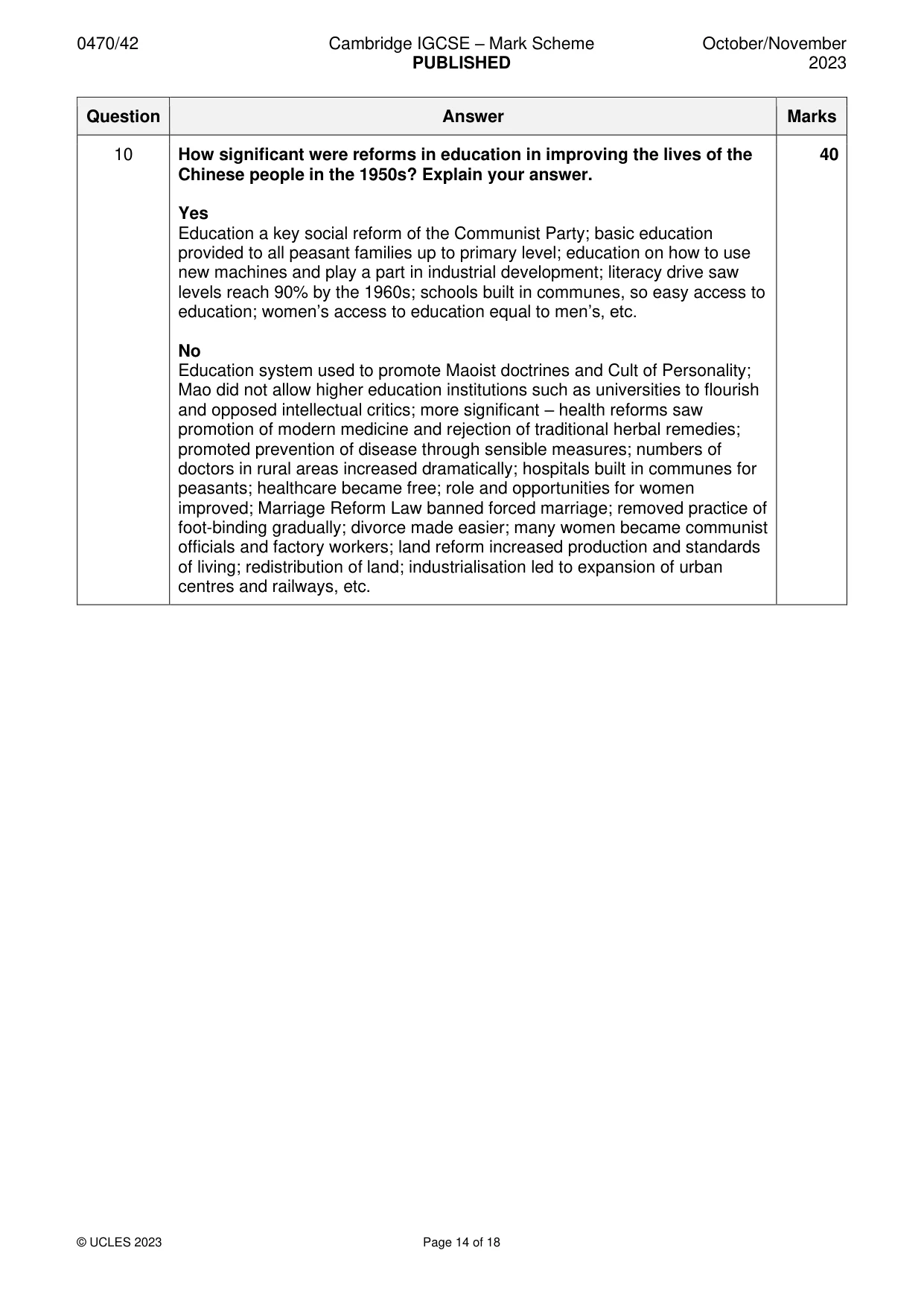
0470/42 Cambridge IGCSE – Mark Scheme PUBLISHED October/November 2023 © UCLES 2023 Page 14 of 18 Question Answer Marks 10 How significant were reforms in education in improving the lives of the Chinese people in the 1950s? Explain your answer. Yes Education a key social reform of the Communist Party; basic education provided to all peasant families up to primary level; education on how to use new machines and play a part in industrial development; literacy drive saw levels reach 90% by the 1960s; schools built in communes, so easy access to education; women’s access to education equal to men’s, etc. No Education system used to promote Maoist doctrines and Cult of Personality; Mao did not allow higher education institutions such as universities to flourish and opposed intellectual critics; more significant – health reforms saw promotion of modern medicine and rejection of traditional herbal remedies; promoted prevention of disease through sensible measures; numbers of doctors in rural areas increased dramatically; hospitals built in communes for peasants; healthcare became free; role and opportunities for women improved; Marriage Reform Law banned forced marriage; removed practice of foot-binding gradually; divorce made easier; many women became communist officials and factory workers; land reform increased production and standards of living; redistribution of land; industrialisation led to expansion of urban centres and railways, etc. 40
Mark scheme, page 15
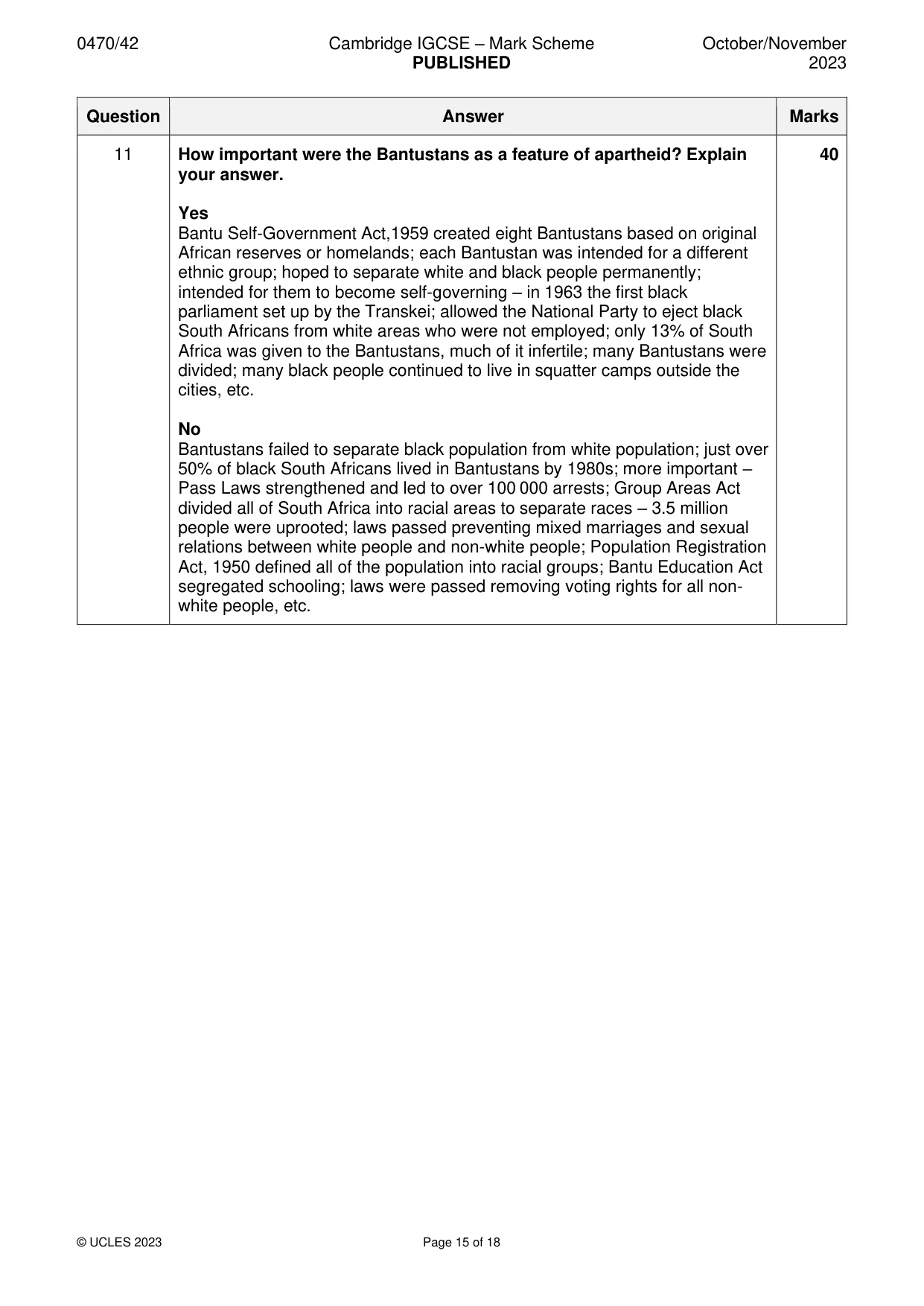
0470/42 Cambridge IGCSE – Mark Scheme PUBLISHED October/November 2023 © UCLES 2023 Page 15 of 18 Question Answer Marks 11 How important were the Bantustans as a feature of apartheid? Explain your answer. Yes Bantu Self-Government Act,1959 created eight Bantustans based on original African reserves or homelands; each Bantustan was intended for a different ethnic group; hoped to separate white and black people permanently; intended for them to become self-governing – in 1963 the first black parliament set up by the Transkei; allowed the National Party to eject black South Africans from white areas who were not employed; only 13% of South Africa was given to the Bantustans, much of it infertile; many Bantustans were divided; many black people continued to live in squatter camps outside the cities, etc. No Bantustans failed to separate black population from white population; just over 50% of black South Africans lived in Bantustans by 1980s; more important – Pass Laws strengthened and led to over 100 000 arrests; Group Areas Act divided all of South Africa into racial areas to separate races – 3.5 million people were uprooted; laws passed preventing mixed marriages and sexual relations between white people and non-white people; Population Registration Act, 1950 defined all of the population into racial groups; Bantu Education Act segregated schooling; laws were passed removing voting rights for all non- white people, etc. 40
Mark scheme, page 16
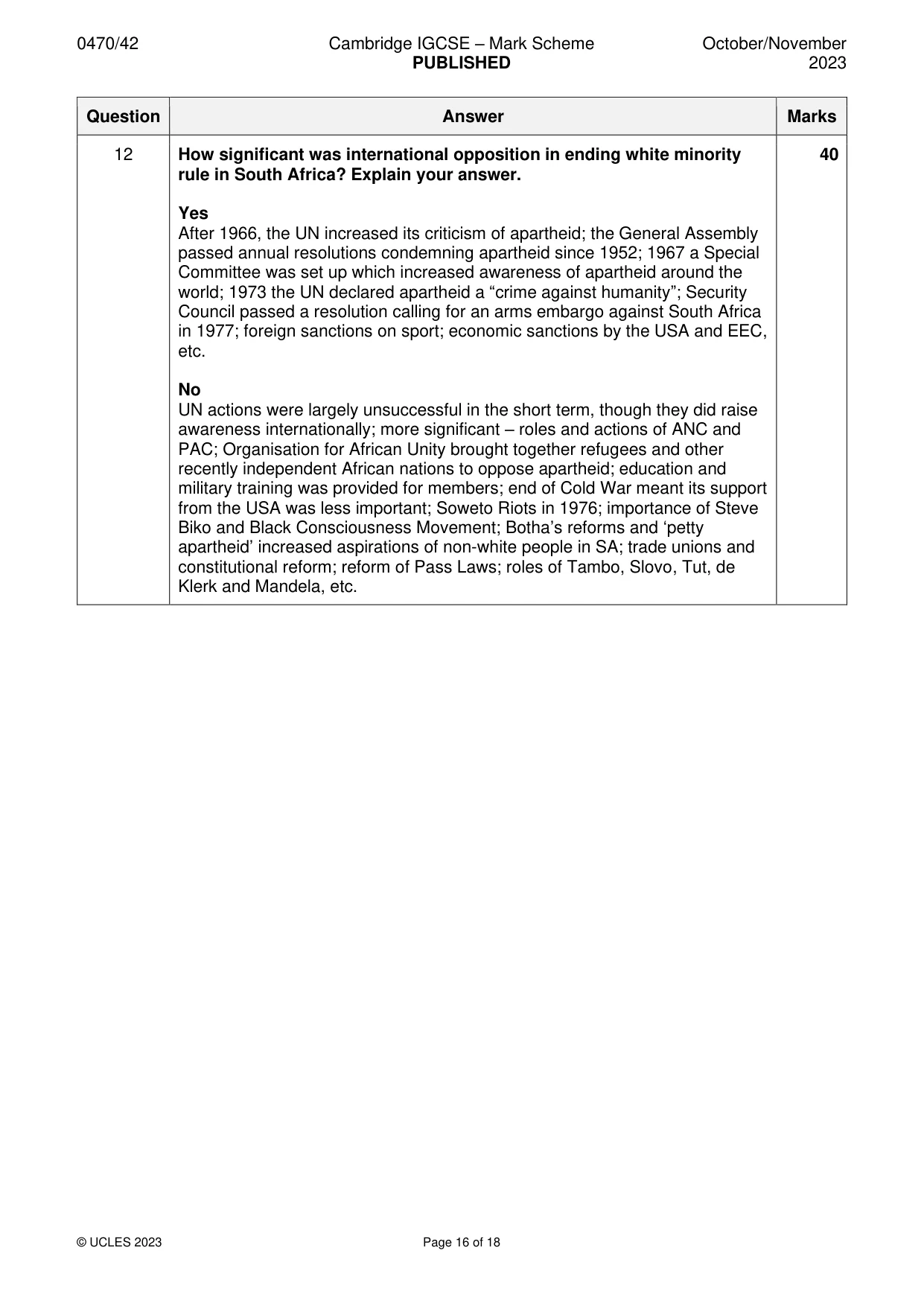
0470/42 Cambridge IGCSE – Mark Scheme PUBLISHED October/November 2023 © UCLES 2023 Page 16 of 18 Question Answer Marks 12 How significant was international opposition in ending white minority rule in South Africa? Explain your answer. Yes After 1966, the UN increased its criticism of apartheid; the General Assembly passed annual resolutions condemning apartheid since 1952; 1967 a Special Committee was set up which increased awareness of apartheid around the world; 1973 the UN declared apartheid a “crime against humanity”; Security Council passed a resolution calling for an arms embargo against South Africa in 1977; foreign sanctions on sport; economic sanctions by the USA and EEC, etc. No UN actions were largely unsuccessful in the short term, though they did raise awareness internationally; more significant – roles and actions of ANC and PAC; Organisation for African Unity brought together refugees and other recently independent African nations to oppose apartheid; education and military training was provided for members; end of Cold War meant its support from the USA was less important; Soweto Riots in 1976; importance of Steve Biko and Black Consciousness Movement; Botha’s reforms and ‘petty apartheid’ increased aspirations of non-white people in SA; trade unions and constitutional reform; reform of Pass Laws; roles of Tambo, Slovo, Tut, de Klerk and Mandela, etc. 40
Mark scheme, page 17
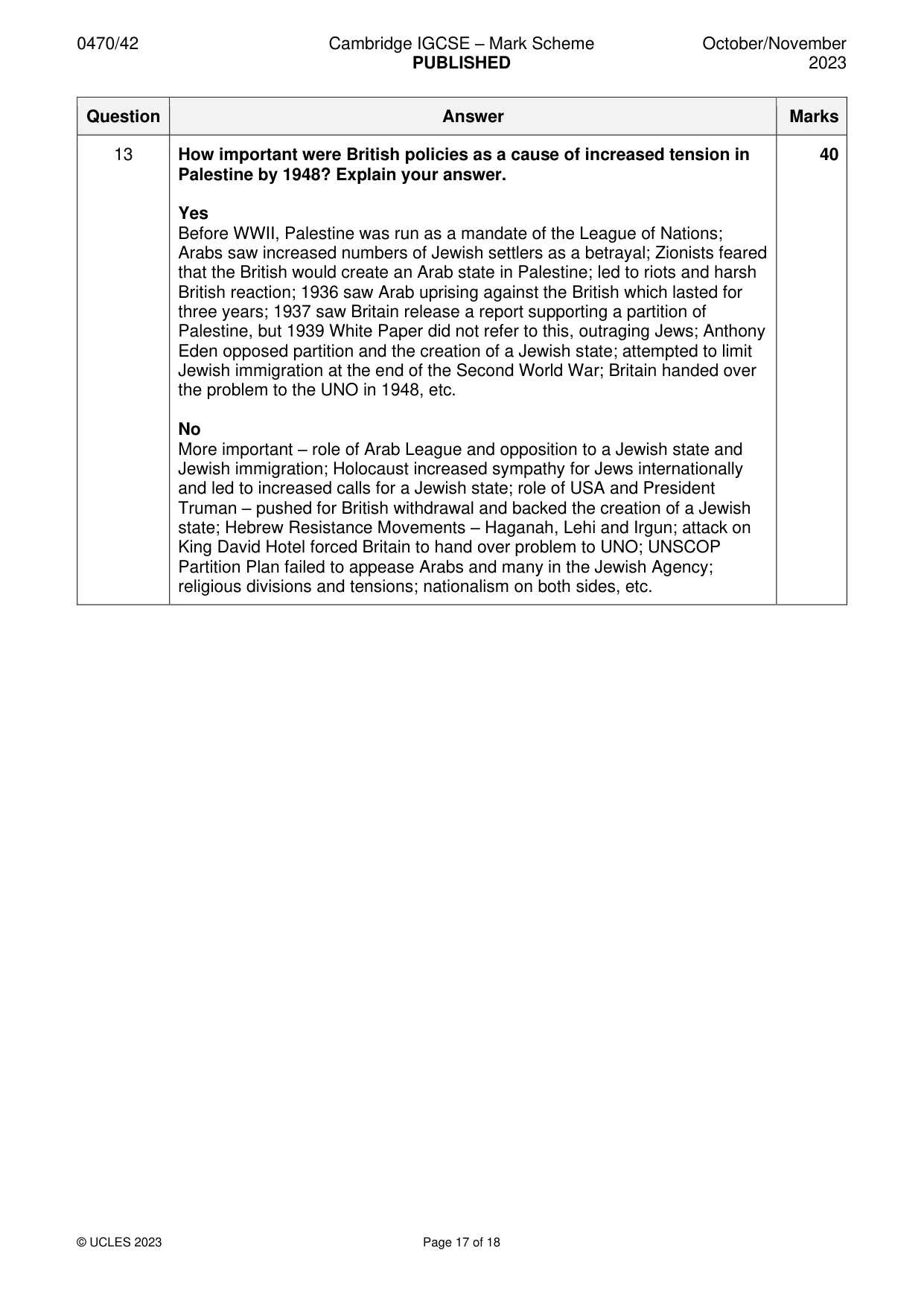
0470/42 Cambridge IGCSE – Mark Scheme PUBLISHED October/November 2023 © UCLES 2023 Page 17 of 18 Question Answer Marks 13 How important were British policies as a cause of increased tension in Palestine by 1948? Explain your answer. Yes Before WWII, Palestine was run as a mandate of the League of Nations; Arabs saw increased numbers of Jewish settlers as a betrayal; Zionists feared that the British would create an Arab state in Palestine; led to riots and harsh British reaction; 1936 saw Arab uprising against the British which lasted for three years; 1937 saw Britain release a report supporting a partition of Palestine, but 1939 White Paper did not refer to this, outraging Jews; Anthony Eden opposed partition and the creation of a Jewish state; attempted to limit Jewish immigration at the end of the Second World War; Britain handed over the problem to the UNO in 1948, etc. No More important – role of Arab League and opposition to a Jewish state and Jewish immigration; Holocaust increased sympathy for Jews internationally and led to increased calls for a Jewish state; role of USA and President Truman – pushed for British withdrawal and backed the creation of a Jewish state; Hebrew Resistance Movements – Haganah, Lehi and Irgun; attack on King David Hotel forced Britain to hand over problem to UNO; UNSCOP Partition Plan failed to appease Arabs and many in the Jewish Agency; religious divisions and tensions; nationalism on both sides, etc. 40
Mark scheme, page 18
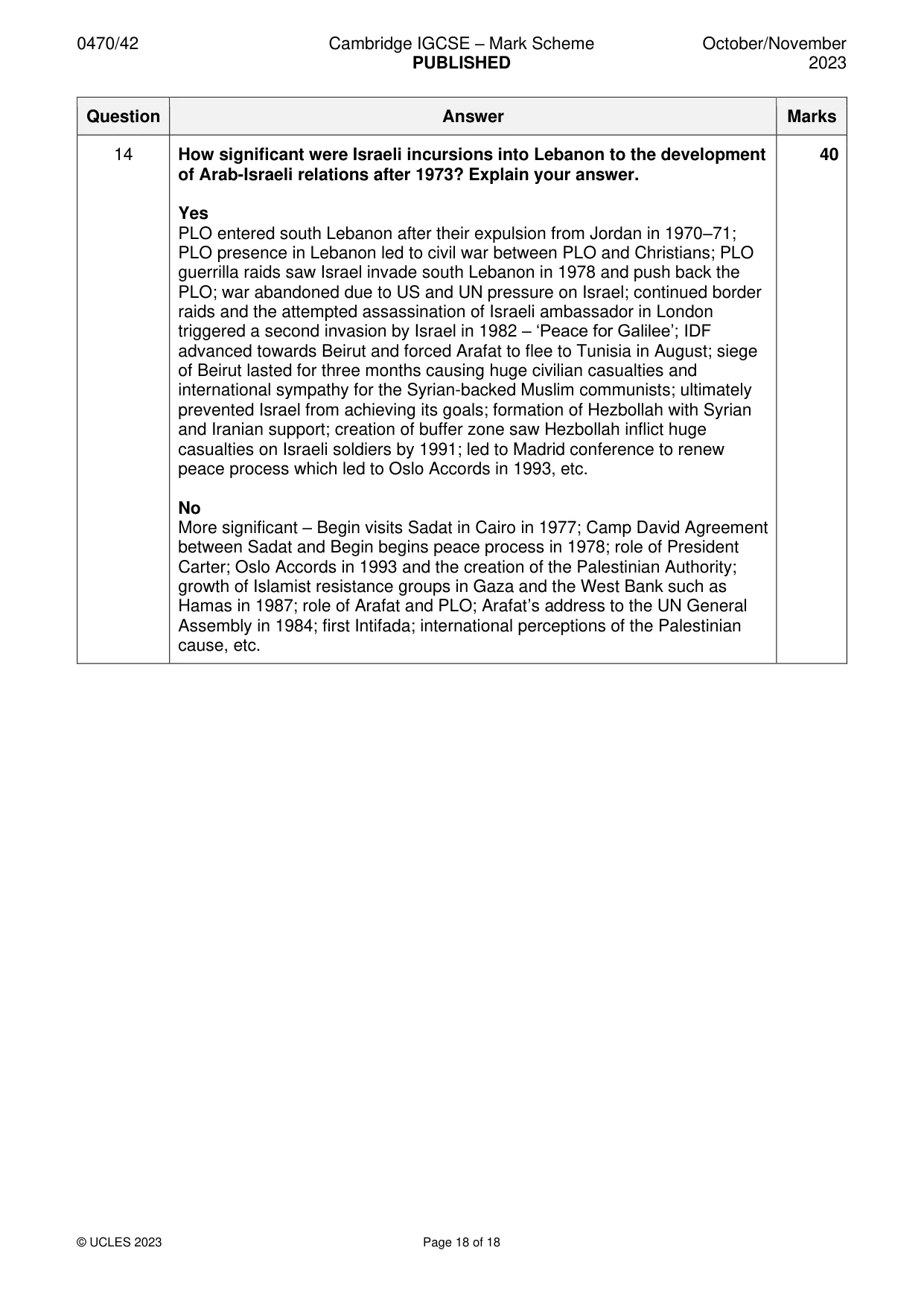
0470/42 Cambridge IGCSE – Mark Scheme PUBLISHED October/November 2023 © UCLES 2023 Page 18 of 18 Question Answer Marks 14 How significant were Israeli incursions into Lebanon to the development of Arab-Israeli relations after 1973? Explain your answer. Yes PLO entered south Lebanon after their expulsion from Jordan in 1970–71; PLO presence in Lebanon led to civil war between PLO and Christians; PLO guerrilla raids saw Israel invade south Lebanon in 1978 and push back the PLO; war abandoned due to US and UN pressure on Israel; continued border raids and the attempted assassination of Israeli ambassador in London triggered a second invasion by Israel in 1982 – ‘Peace for Galilee’; IDF advanced towards Beirut and forced Arafat to flee to Tunisia in August; siege of Beirut lasted for three months causing huge civilian casualties and international sympathy for the Syrian-backed Muslim communists; ultimately prevented Israel from achieving its goals; formation of Hezbollah with Syrian and Iranian support; creation of buffer zone saw Hezbollah inflict huge casualties on Israeli soldiers by 1991; led to Madrid conference to renew peace process which led to Oslo Accords in 1993, etc. No More significant – Begin visits Sadat in Cairo in 1977; Camp David Agreement between Sadat and Begin begins peace process in 1978; role of President Carter; Oslo Accords in 1993 and the creation of the Palestinian Authority; growth of Islamist resistance groups in Gaza and the West Bank such as Hamas in 1987; role of Arafat and PLO; Arafat’s address to the UN General Assembly in 1984; first Intifada; international perceptions of the Palestinian cause, etc. 40
What you needed in this session
Cambridge’s own grade thresholds for 2023 Oct/Nov, Paper 4 · Variant 2. A higher threshold means an easier paper — the bar moves with how the cohort did.