Cambridge IGCSE History 0470 — 2023 Oct/Nov Paper 2 · Variant 2
0470/22/O/N/23 · 50 marks · ≈56 min
The question paper and its mark scheme, free to read here and free to download. This is Cambridge’s own paper, exactly as it was sat.
Question paper16 pages

Mark scheme15 pages
Answers below. Sit the paper first if you are practising.
Paper as text
Question paper, page 1
This document has 16 pages. Any blank pages are indicated. [Turn over Cambridge IGCSE™ HISTORY 0470/22 Paper 2 October/November 2023 2 hours You must answer on the enclosed answer booklet. You will need: Answer booklet (enclosed) INSTRUCTIONS ● Answer all the questions on one option only. Option A: Nineteenth century topic Option B: Twentieth century topic ● Follow the instructions on the front cover of the answer booklet. If you need additional answer paper, ask the invigilator for a continuation booklet. INFORMATION ● The total mark for this paper is 50. ● The number of marks for each question or part question is shown in brackets [ ]. * 4 3 8 0 1 3 9 6 0 7 * DC (CE/FC) 317441/2 © UCLES 2023
Question paper, page 2
2 0470/22/O/N/23 © UCLES 2023 Option A: Nineteenth century topic WHY DID BRITAIN GO TO WAR WITH GERMANY IN 1914? Study the Background Information and the sources carefully, and then answer all the questions. Background Information Britain declared war on Germany on 4 August 1914. The reasons for this have long been debated by historians. At the time the British government claimed it was because of the Treaty of London of 1839, which required Belgium to remain neutral and committed Britain and a number of other European powers to defend that neutrality in the event of an invasion. In other words, Britain was acting honourably in keeping an international commitment. However, some historians have argued that rivalry with Germany and a desire to defend France and to keep the balance of power in Europe were more important reasons. They claim the British government used the Treaty of London as an excuse to go to war and as a device to win over British public opinion. Why did Britain declare war on Germany? SOURCE A If you are faced with war on two fronts and have not got the resources to fight both wars, what should you do? The German answer was to get in one blow first and eliminate one enemy. Their answer was to defeat France first. One essential part of the plan was to go through Belgium. This was a central part of the plan and not dependent on Britain’s attitudes. The other essential part was that there could be no delay between mobilisation and war, because if there was delay Russia would catch up. So, the decision for mobilisation which Germany made on 29 July was a decision for a general European war. The British government asserted that it had given no promises. In secret the British had already arranged to take the British army to the left flank of the French army but this had been concealed from the British public. Assertions were made constantly by the government that no commitment had been made. This was very awkward because the French had been told over and over, ‘Yes, we shall stand by you if you are threatened by Germany.’ Then came the news that Germany had demanded the right to go through Belgium. The British government had known these plans for a long time. However, it came as a great surprise to most British people. Britain it seemed went to war, not to play a part in the balance of power, not to aid France or destroy Germany, but to ‘fulfil its obligations to Belgium and in the defence of small nations’. This persuaded Parliament and British public opinion. However, the treaty of 1839 only gave Britain the right to intervene to defend the neutrality of Belgium. There was no treaty obligation for Britain to do so. This was invented for the sake of British public opinion. From a history book published in 1977.
Question paper, page 3
3 0470/22/O/N/23 © UCLES 2023 [Turn over SOURCE B The German army did not believe that they could conquer decisively if they had to fight on two fronts. Therefore, they had long planned to knock out France before Russia could mobilise. It has often been said that ‘mobilisation meant war’. This was not true. Most of the major powers could mobilise and yet go on with diplomacy. For the Germans, however, mobilisation and war were the same because the Russian decision to mobilise upset their plan. Either Germany had to stop Russian mobilisation by threat of war or it had to start the war with France. Germany tried to stop Russian mobilisation but Russia refused. On 31 July Bethmann Hollweg asked Moltke, ‘Is Germany in danger?’ Moltke answered, ‘Yes’. On 1 August Germany declared war on Russia and two days later on France. The First World War had begun, not quite as Germany had expected. Britain had no plan. Its indecisiveness may have given Germany the idea that it intended to remain neutral and this encouraged Germany to act. Britain’s eventual decision to join the war was about more than upholding the 1839 treaty. The British government felt it could not stand by and watch France defeated if it meant German dominance of Europe. Belgium did provide a good legal basis for intervention and one that was popular with the British public. However, in practice, the calculation about the balance of power in Europe was the more important one. From a recent history book. Bethmann Hollweg was head of the German government and Moltke was head of the German army.
Question paper, page 4
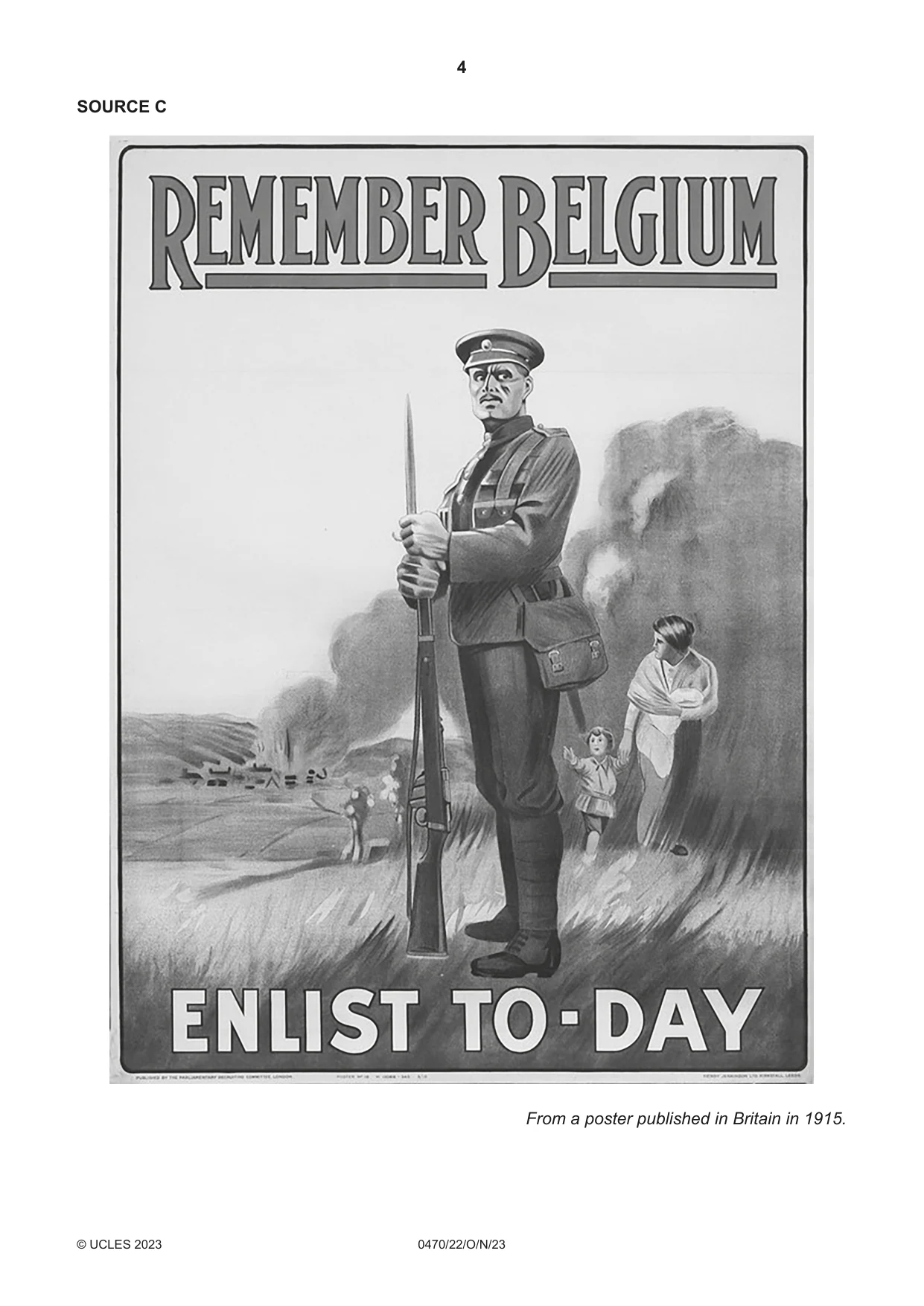
4 0470/22/O/N/23 © UCLES 2023 SOURCE C From a poster published in Britain in 1915.
Question paper, page 5
5 0470/22/O/N/23 © UCLES 2023 [Turn over SOURCE D We have had a long-standing friendship with France. I know this friendship involves obligations. I give an assurance that if the German fleet threatens the French coast, the British fleet will give all the protection in its power. And there is the more serious consideration of the neutrality of Belgium. Germany has offered Belgium friendly relations on condition that it allowed German troops to pass through Belgium. We were asked by Germany last week whether we would be satisfied if a guarantee were given that, after the war, Belgian independence would be preserved. We replied that we could not bargain away the treaty obligations we had over Belgian neutrality. From the point of view of British interests, consider what might be at stake. If France is defeated, and if Belgium falls under the same dominating influence, and then Holland and then Denmark, we cannot stay neutral. We have made a commitment to France and we have got the consideration of Belgium which prevents us from being neutral. From a speech to Parliament by the British Foreign Secretary, Sir Edward Grey, 3 August 1914. SOURCE E The truth is the British government is responsible for this greatest of all wars. Up to this summer British statesmen have assured their Parliament that no treaty existed limiting Britain’s independence of action. Should a war break out, Britain was free to decide whether it would participate in a European war or not. There was no treaty obligation, or threat to Britain, which forced the British statesmen to start a war. The British government allowed this monstrous world war, because they thought it was an opportunity to destroy the strength of its greatest European competitors in the markets of the world. The Belgian neutrality, which Britain pretended it was bound to defend, is a mask. On 2 August, 7.00 pm, we informed Brussels that France’s plan of campaign forced us, for reasons of self-preservation, to march through Belgium. But as early as the afternoon of the same day, before anything was known of this step, the British Government promised unconditional aid to France in case the German navy attacked the French coastline. Not a word was said of Belgian neutrality. This fact is established by the declaration made by Sir Edward Grey in Parliament on 3 August. From a speech by Bethmann Hollweg to the Reichstag, December 1914. SOURCE F Cambon said if we would only declare definitely on the side of Russia and France, it would decide the German attitude in favour of peace. I said to Cambon that Britain could not give any promise of support at the present time. We do not feel that any treaties or obligations of this country are involved. Further developments might alter this situation. The preservation of the neutrality of Belgium might be an important factor in determining our attitude. Cambon expressed great disappointment at my reply. He repeated his question of whether we would help France if Germany attacked. I said that as far as things had gone at present, we could not take any action. Grey writing to Sir Francis Bertie, British Ambassador in Paris, 31 July 1914. Cambon was the French Ambassador in London.
Question paper, page 6
6 0470/22/O/N/23 © UCLES 2023 SOURCE G A postcard published in Britain, 1914.
Question paper, page 7
7 0470/22/O/N/23 © UCLES 2023 [Turn over Now answer all the following questions. You may use any of the sources to help you answer the questions, in addition to those sources which you are told to use. In answering the questions you should use your knowledge of the topic to help you interpret and evaluate the sources. 1 Study Sources A and B. How far do these two sources agree? Explain your answer using details of the sources. [7] 2 Study Source C. How useful is this source to a historian studying why Britain went to war? Explain your answer using details of the source and your knowledge. [8] 3 Study Sources D and E. Does Source E prove that Grey was lying in Source D? Explain your answer using details of the sources and your knowledge. [8] 4 Study Source F. Are you surprised by Source F? Explain your answer using details of the source and your knowledge. [8] 5 Study Source G. Why was this postcard published in 1914? Explain your answer using details of the source and your knowledge. [7] 6 Study all the sources. How far do these sources provide convincing evidence that Britain went to war to keep its commitment to Belgium? Use the sources to explain your answer. [12]
Question paper, page 8
8 0470/22/O/N/23 © UCLES 2023 Option B: Twentieth century topic WAS THE BERLIN WALL CONSTRUCTED TO PROTECT THE PEOPLE OF EAST BERLIN? Study the Background Information and the sources carefully, and then answer all the questions. Background Information At the end of the Second World War Germany was divided into four zones. The eastern part of the country went to the Soviet Union while the western part was divided between the USA, Britain and France. Although Berlin was located in the Soviet zone, it was also divided into four zones. Thus, a capitalist West Berlin existed deep within communist East Germany. On 13 August 1961 the government of East Germany began to build a barbed wire and concrete wall between East and West Berlin. This made it nearly impossible for people to move between East and West Berlin. Why did the East Germans build the Wall? They claimed they were trying to protect the people of East Berlin and stop Western spies entering East Berlin and undermining the socialist state. However, other reasons have been suggested such as the communists’ desire to stop young skilled workers moving from East Berlin to West Berlin. Was the wall constructed to help the people of East Berlin? SOURCE A The Soviets’ relationship with other communist powers was the crucial factor in Khrushchev’s decision making in 1961. He was desperate for socialism to triumph over capitalism in Germany. The East Germans thought they could use this for their own benefit and solve the problem of their citizens fleeing to West Berlin. Khrushchev also needed the support of East Germany because of his split with China. Ulbricht had long wanted to close the border in Berlin. He blamed the Soviets for his country’s economic problems because of the Soviet post-war reparations policy when the Soviet Union had stolen much of East Germany’s wealth. Khrushchev, however, did not want to close the border in Berlin because it would make Cold War tensions worse and make communism look bad. In 1961 pressure from Ulbricht to close the border increased. He was desperate to reduce the problem of East German citizens fleeing to West Berlin because they had skills East Germany badly needed and he believed they were being mistreated in the West. Khrushchev reluctantly agreed in June, knowing that it would save the East German regime, limit Ulbricht’s influence in Eastern Europe, and show the Chinese and communist leaders in the Eastern bloc that he could stand up to the West. A start was made to the wall on 13 August 1961. From a recent history book. Ulbricht was leader of the East German government.
Question paper, page 9
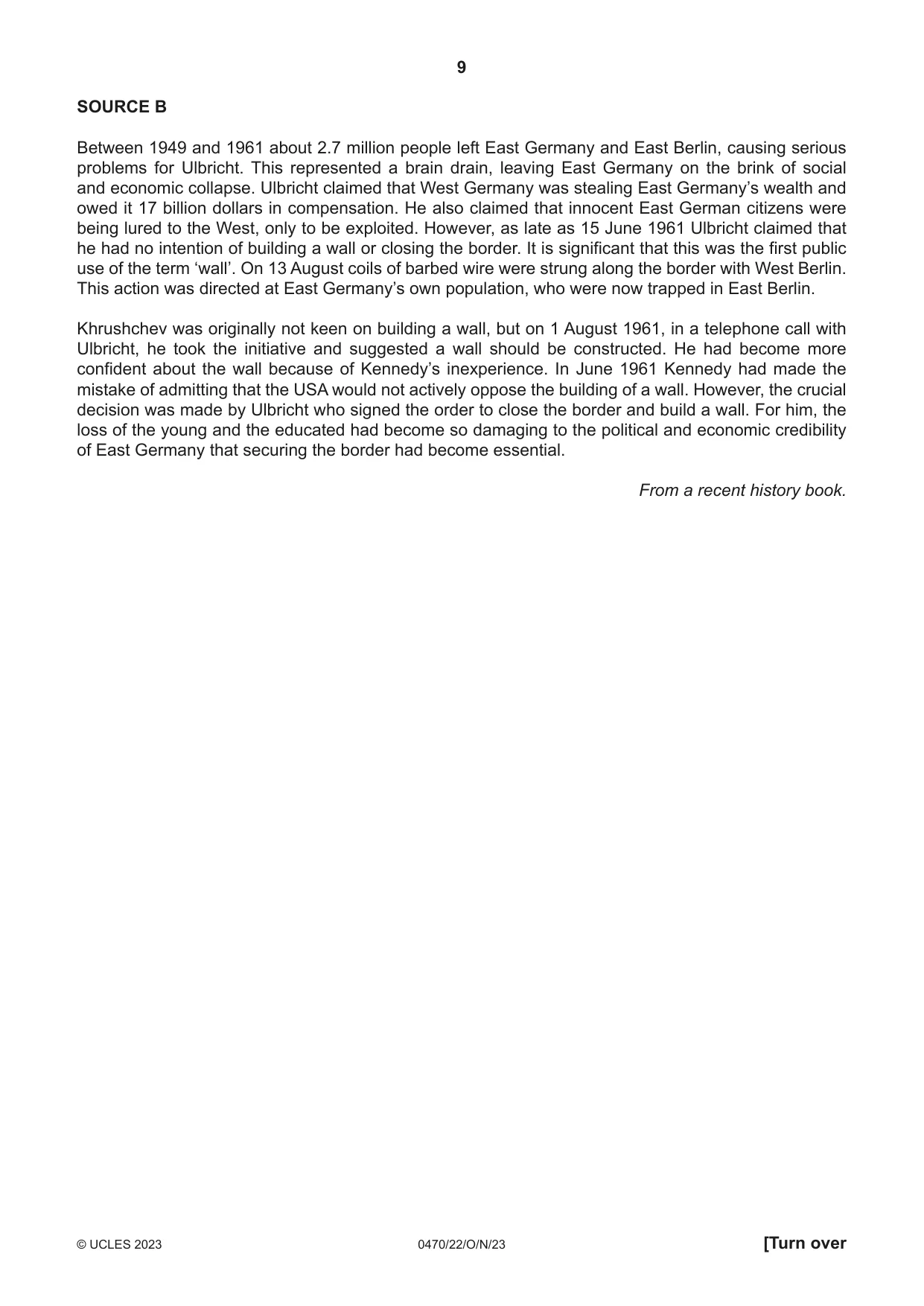
9 0470/22/O/N/23 © UCLES 2023 [Turn over SOURCE B Between 1949 and 1961 about 2.7 million people left East Germany and East Berlin, causing serious problems for Ulbricht. This represented a brain drain, leaving East Germany on the brink of social and economic collapse. Ulbricht claimed that West Germany was stealing East Germany’s wealth and owed it 17 billion dollars in compensation. He also claimed that innocent East German citizens were being lured to the West, only to be exploited. However, as late as 15 June 1961 Ulbricht claimed that he had no intention of building a wall or closing the border. It is significant that this was the first public use of the term ‘wall’. On 13 August coils of barbed wire were strung along the border with West Berlin. This action was directed at East Germany’s own population, who were now trapped in East Berlin. Khrushchev was originally not keen on building a wall, but on 1 August 1961, in a telephone call with Ulbricht, he took the initiative and suggested a wall should be constructed. He had become more confident about the wall because of Kennedy’s inexperience. In June 1961 Kennedy had made the mistake of admitting that the USA would not actively oppose the building of a wall. However, the crucial decision was made by Ulbricht who signed the order to close the border and build a wall. For him, the loss of the young and the educated had become so damaging to the political and economic credibility of East Germany that securing the border had become essential. From a recent history book.
Question paper, page 10
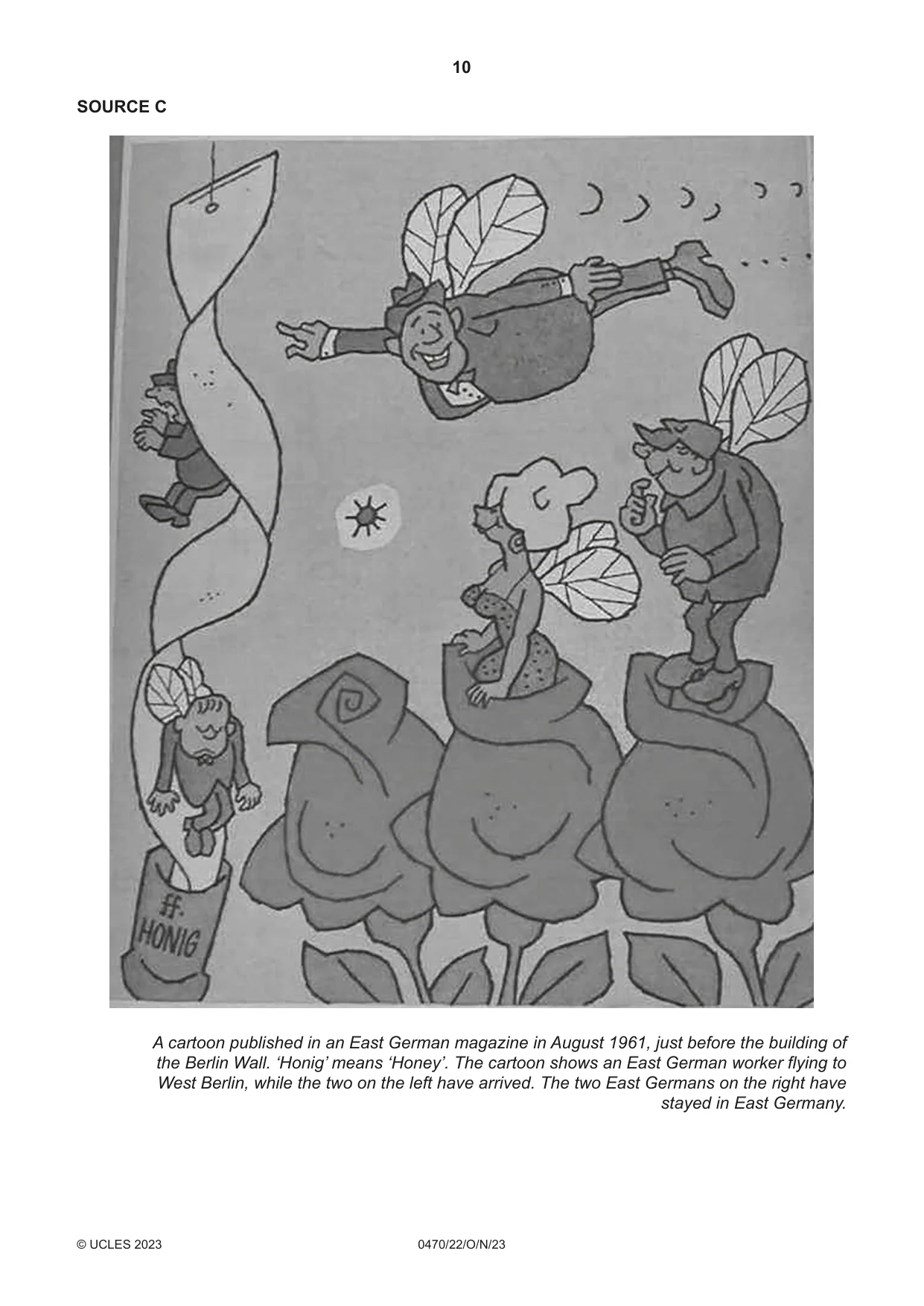
10 0470/22/O/N/23 © UCLES 2023 SOURCE C A cartoon published in an East German magazine in August 1961, just before the building of the Berlin Wall. ‘Honig’ means ‘Honey’. The cartoon shows an East German worker flying to West Berlin, while the two on the left have arrived. The two East Germans on the right have stayed in East Germany.
Question paper, page 11
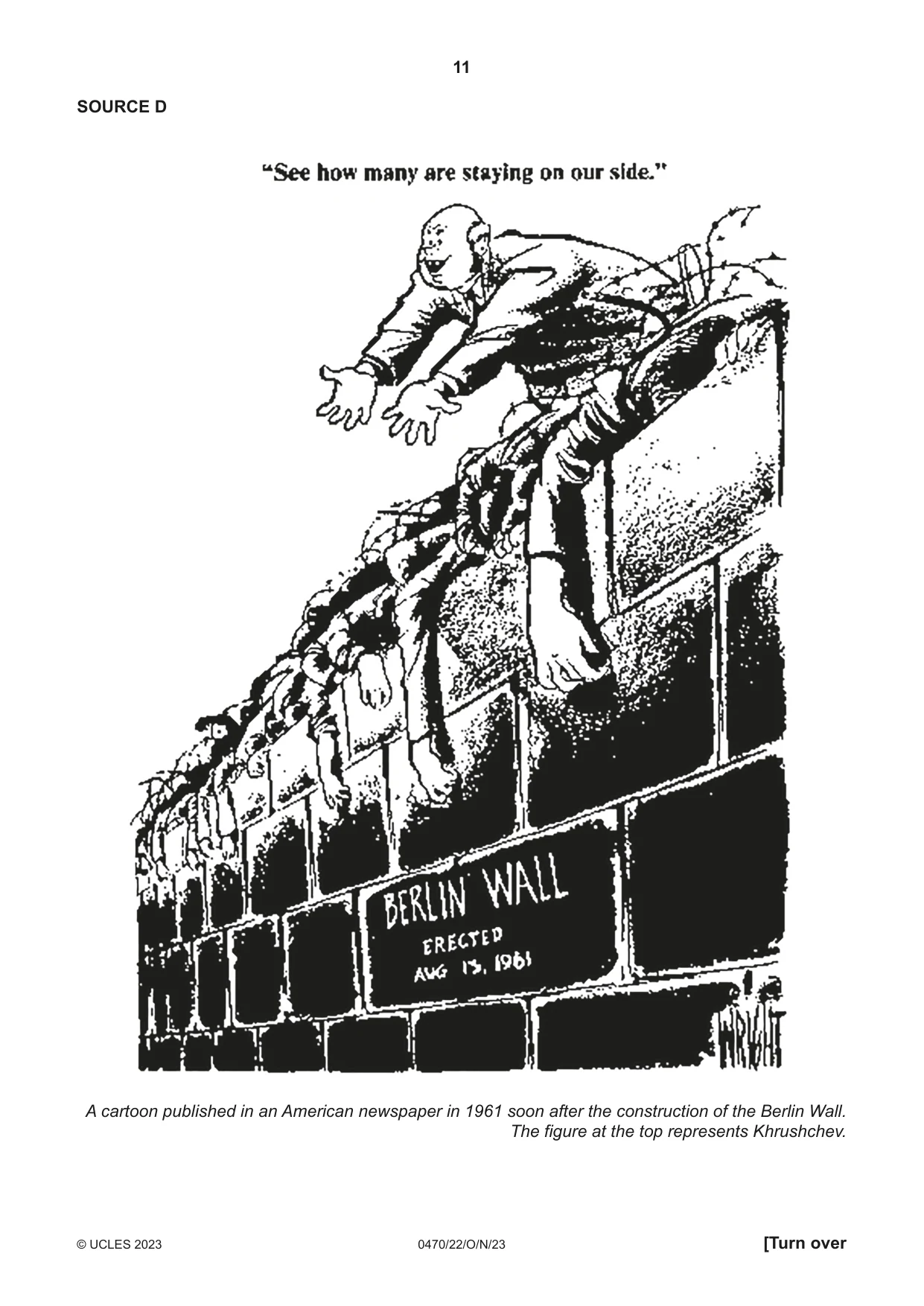
11 0470/22/O/N/23 © UCLES 2023 [Turn over SOURCE D A cartoon published in an American newspaper in 1961 soon after the construction of the Berlin Wall. The figure at the top represents Khrushchev.
Question paper, page 12
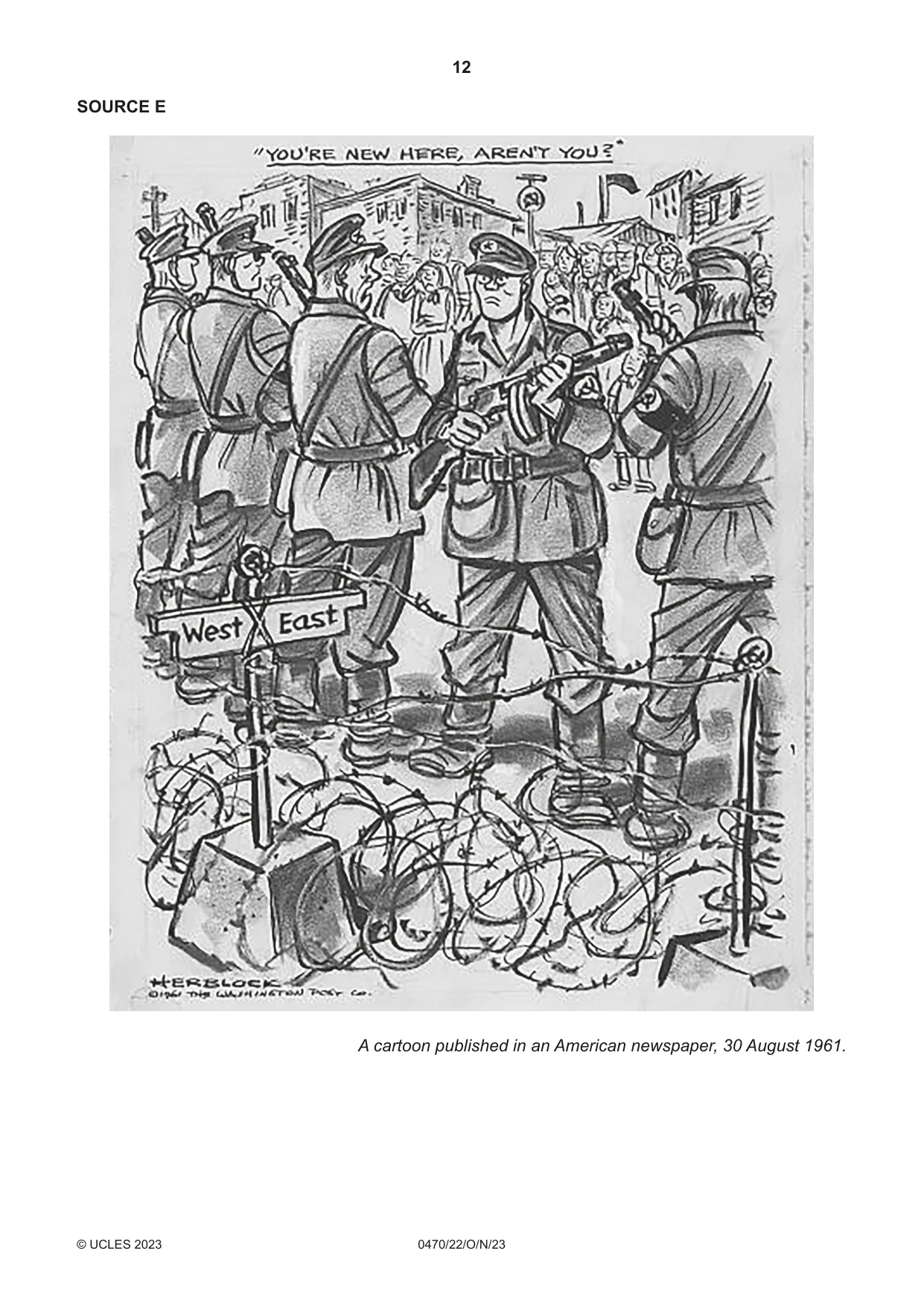
12 0470/22/O/N/23 © UCLES 2023 SOURCE E A cartoon published in an American newspaper, 30 August 1961.
Question paper, page 13
13 0470/22/O/N/23 © UCLES 2023 [Turn over SOURCE F TOP SECRET The proposals for the establishment of border security between East Berlin and West Berlin are politically unacceptable. You should meet with Ulbricht and tactfully explain the following. These measures would place under suspicion the sincerity of the governments of the Soviet Union and East Germany, which consistently speak out for German unification and the conclusion of a peace treaty, and would bring serious harm to our political successes in West Germany. These measures would break down the order in city life, bring disorganisation to the city economy, and would negatively affect the interests of the inhabitants of East and West Berlin, causing anger toward the East German government and the Soviet authorities in Germany. It should also be kept in mind that the establishment of border security along the border of East Berlin would worsen the Soviet Union’s relations with the USA, Britain and France, which would be a definite disadvantage to the countries in the camp of peace and democracy. Instructions from the Soviet Government to Soviet diplomats in East Germany in September 1953. SOURCE G The establishment of border control in 1961 straightened things out at once. Discipline in East Germany increased. Factories began working better. So did collective farms. Comrade Ulbricht informed us that there were immediate improvements in the economy of East Germany. The population of West Berlin had been shopping for food in East Berlin, taking advantage of lower prices there. Thus, the West Berliners had been devaluing the East German mark, placing a heavy burden on the shoulders of East German peasants and workers, and therefore extracting political as well as economic gains from the situation. Once we established border control, we put an end to this. From Khrushchev’s memoirs, published in 1971. SOURCE H FRONTIER SEQUENCE Germany today. Barbed wire running like a scar across the land, dividing East from West. Mr Khrushchev’s threat to change the status of Berlin is a threat to free people everywhere. These East German watch towers are not watching the West – they are watching for East Germans who would quit their country. Two thousand refugees a day risked everything to reach West Berlin. The frightened East Germans reacted by sealing off East Berlin in an attempt to keep by force those who would not stay by choice. REFUGEE SEQUENCE What kind of people are they, these refugees? These are not refugees from hunger or poverty – they are reasonably well fed and clothed. They are fleeing from oppression of the mind. They long to say what they think; to vote freely. Most are young. Nearly three million have left East Germany for the West in the last twelve years – and the great majority come through the gateway to freedom in West Germany and to a new life. An extract from the commentary of a film called ‘Outpost of Freedom – The Meaning of Berlin Today’, produced by the British Government in 1962.
Question paper, page 14
14 0470/22/O/N/23 © UCLES 2023 Now answer all the following questions. You may use any of the sources to help you answer the questions, in addition to those sources which you are told to use. In answering the questions you should use your knowledge of the topic to help you interpret and evaluate the sources. 1 Study Sources A and B. How far do these two sources agree? Explain your answer using details of the sources. [7] 2 Study Source C. Why was this cartoon published in August 1961? Explain your answer using details of the source and your knowledge. [8] 3 Study Sources D and E. How far do these two cartoonists agree? Explain your answer using details of the sources and your knowledge. [8] 4 Study Sources F and G. How far does Source F make Source G surprising? Explain your answer using details of the sources and your knowledge. [8] 5 Study Source H. How useful is this source to a historian studying the Berlin Wall? Explain your answer using details of the source and your knowledge. [7] 6 Study all the sources. How far do these sources provide convincing evidence that the Berlin Wall was built to protect East Germans? Use the sources to explain your answer. [12]
Question paper, page 15
15 0470/22/O/N/23 © UCLES 2023 BLANK PAGE
Question paper, page 16
16 0470/22/O/N/23 © UCLES 2023 Permission to reproduce items where third-party owned material protected by copyright is included has been sought and cleared where possible. Every reasonable effort has been made by the publisher (UCLES) to trace copyright holders, but if any items requiring clearance have unwittingly been included, the publisher will be pleased to make amends at the earliest possible opportunity. To avoid the issue of disclosure of answer-related information to candidates, all copyright acknowledgements are reproduced online in the Cambridge Assessment International Education Copyright Acknowledgements Booklet. This is produced for each series of examinations and is freely available to download at www.cambridgeinternational.org after the live examination series. Cambridge Assessment International Education is part of Cambridge Assessment. Cambridge Assessment is the brand name of the University of Cambridge Local Examinations Syndicate (UCLES), which is a department of the University of Cambridge. BLANK PAGE
Mark scheme, page 1
This document consists of 15 printed pages. © UCLES 2023 [Turn over Cambridge IGCSE™ HISTORY 0470/22 Paper 2 October/November 2023 MARK SCHEME Maximum Mark: 50 Published This mark scheme is published as an aid to teachers and candidates, to indicate the requirements of the examination. It shows the basis on which Examiners were instructed to award marks. It does not indicate the details of the discussions that took place at an Examiners’ meeting before marking began, which would have considered the acceptability of alternative answers. Mark schemes should be read in conjunction with the question paper and the Principal Examiner Report for Teachers. Cambridge International will not enter into discussions about these mark schemes. Cambridge International is publishing the mark schemes for the October/November 2023 series for most Cambridge IGCSE, Cambridge International A and AS Level components, and some Cambridge O Level components.
Mark scheme, page 2
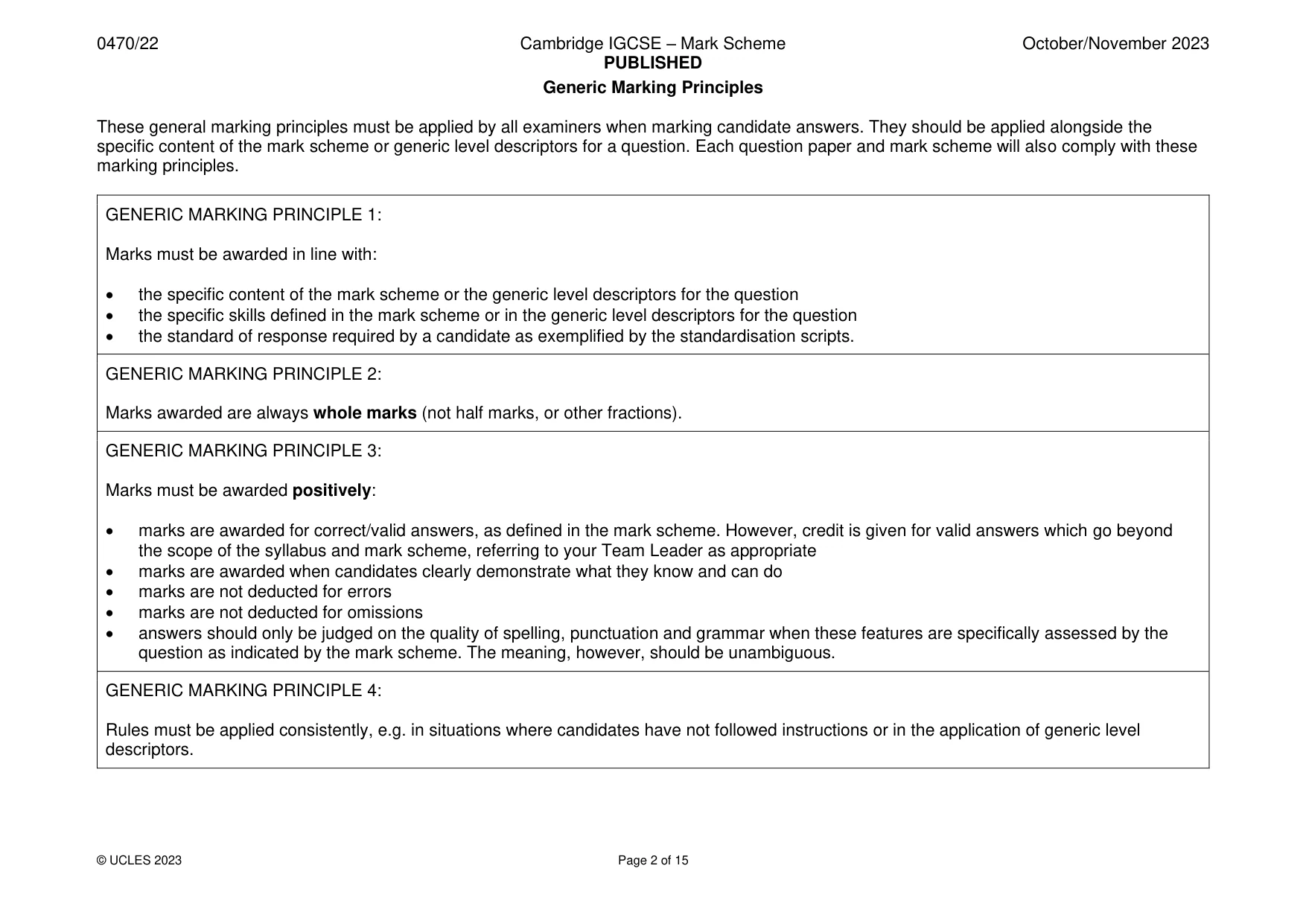
0470/22 Cambridge IGCSE – Mark Scheme PUBLISHED October/November 2023 © UCLES 2023 Page 2 of 15 Generic Marking Principles These general marking principles must be applied by all examiners when marking candidate answers. They should be applied alongside the specific content of the mark scheme or generic level descriptors for a question. Each question paper and mark scheme will also comply with these marking principles. GENERIC MARKING PRINCIPLE 1: Marks must be awarded in line with: • the specific content of the mark scheme or the generic level descriptors for the question • the specific skills defined in the mark scheme or in the generic level descriptors for the question • the standard of response required by a candidate as exemplified by the standardisation scripts. GENERIC MARKING PRINCIPLE 2: Marks awarded are always whole marks (not half marks, or other fractions). GENERIC MARKING PRINCIPLE 3: Marks must be awarded positively: • marks are awarded for correct/valid answers, as defined in the mark scheme. However, credit is given for valid answers which go beyond the scope of the syllabus and mark scheme, referring to your Team Leader as appropriate • marks are awarded when candidates clearly demonstrate what they know and can do • marks are not deducted for errors • marks are not deducted for omissions • answers should only be judged on the quality of spelling, punctuation and grammar when these features are specifically assessed by the question as indicated by the mark scheme. The meaning, however, should be unambiguous. GENERIC MARKING PRINCIPLE 4: Rules must be applied consistently, e.g. in situations where candidates have not followed instructions or in the application of generic level descriptors.
Mark scheme, page 3
0470/22 Cambridge IGCSE – Mark Scheme PUBLISHED October/November 2023 © UCLES 2023 Page 3 of 15 GENERIC MARKING PRINCIPLE 5: Marks should be awarded using the full range of marks defined in the mark scheme for the question (however; the use of the full mark range may be limited according to the quality of the candidate responses seen). GENERIC MARKING PRINCIPLE 6: Marks awarded are based solely on the requirements as defined in the mark scheme. Marks should not be awarded with grade thresholds or grade descriptors in mind.
Mark scheme, page 4
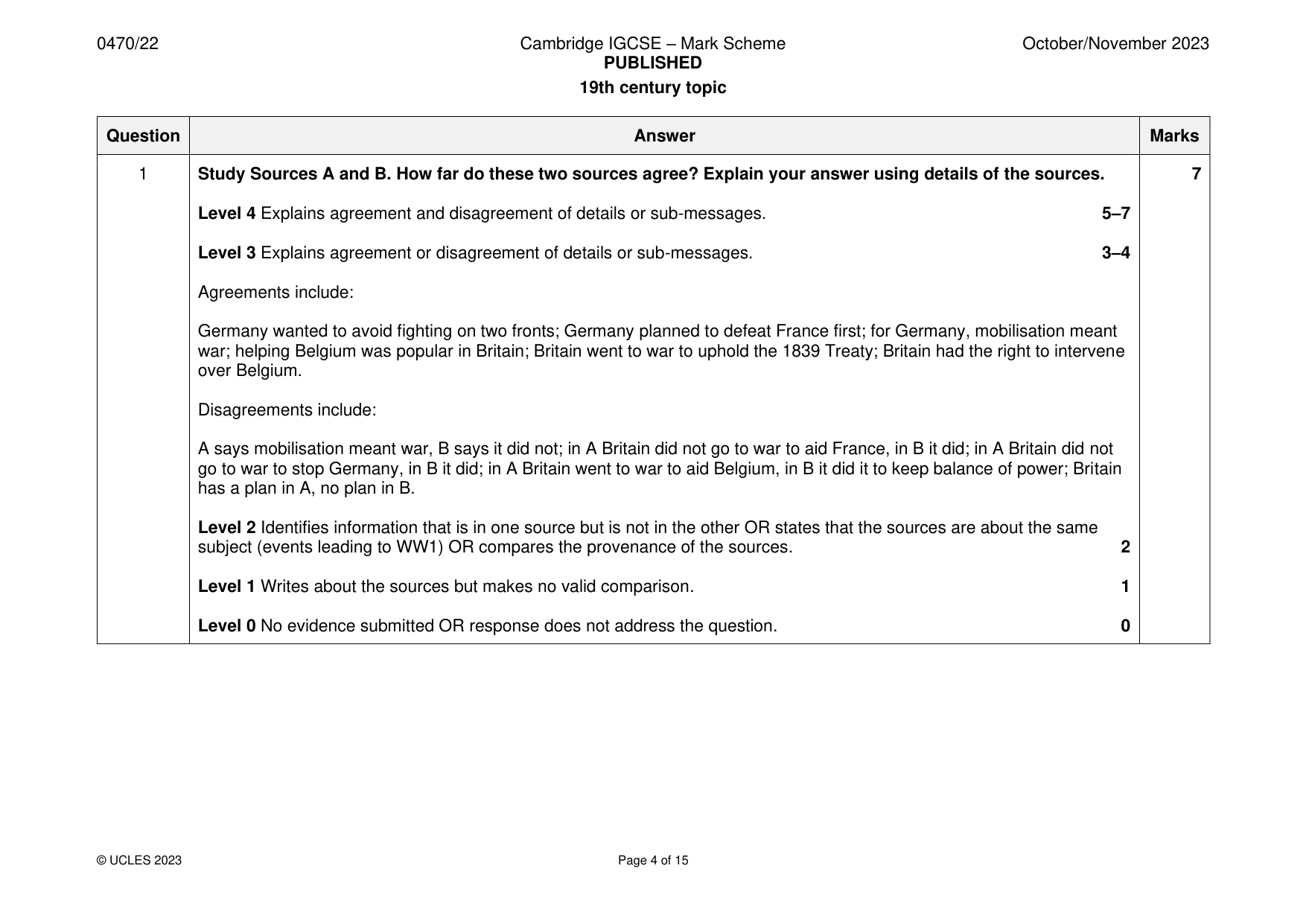
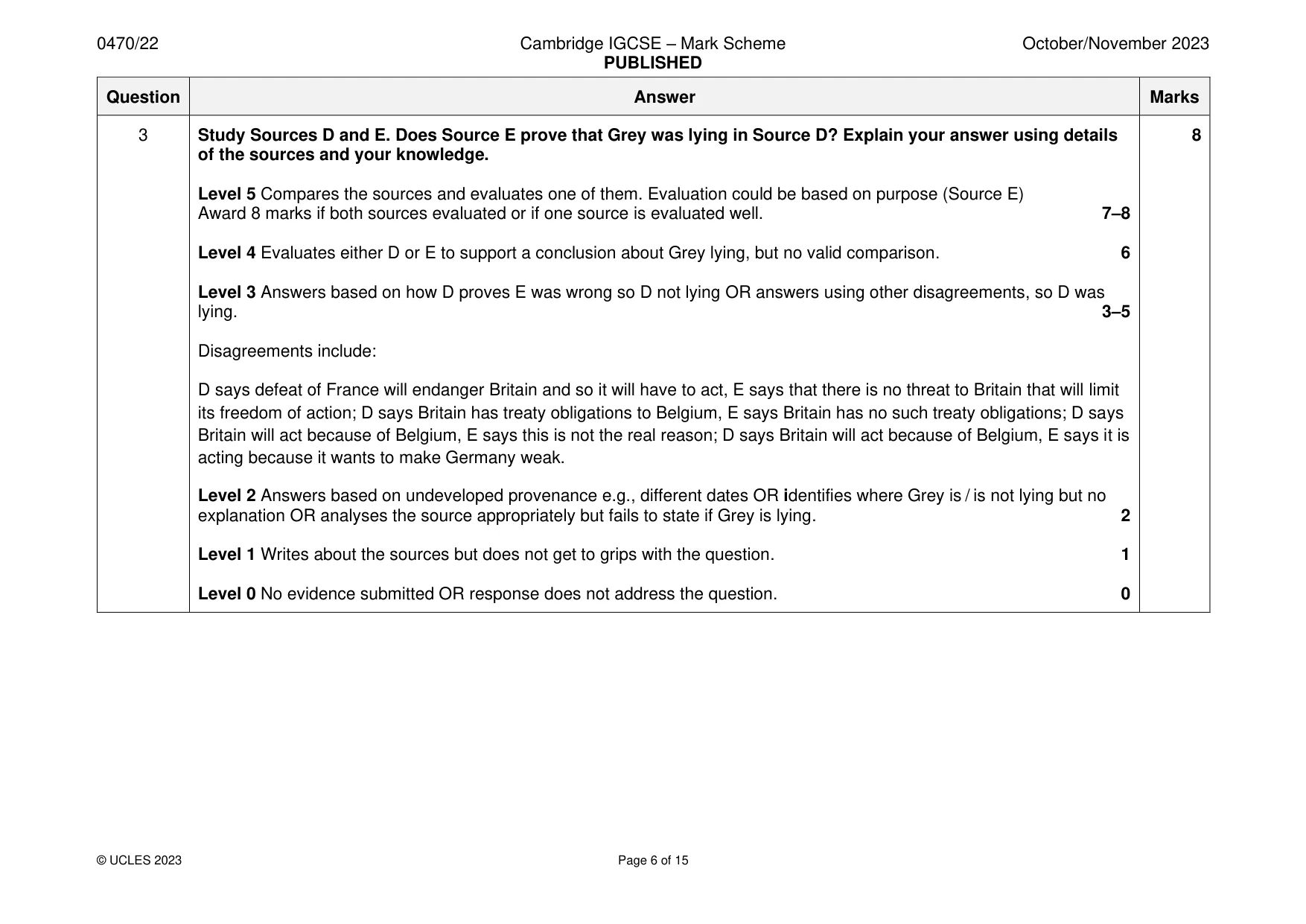
0470/22 Cambridge IGCSE – Mark Scheme PUBLISHED October/November 2023 © UCLES 2023 Page 4 of 15 19th century topic Question Answer Marks 1 Study Sources A and B. How far do these two sources agree? Explain your answer using details of the sources. Level 4 Explains agreement and disagreement of details or sub-messages. 5–7 Level 3 Explains agreement or disagreement of details or sub-messages. 3–4 Agreements include: Germany wanted to avoid fighting on two fronts; Germany planned to defeat France first; for Germany, mobilisation meant war; helping Belgium was popular in Britain; Britain went to war to uphold the 1839 Treaty; Britain had the right to intervene over Belgium. Disagreements include: A says mobilisation meant war, B says it did not; in A Britain did not go to war to aid France, in B it did; in A Britain did not go to war to stop Germany, in B it did; in A Britain went to war to aid Belgium, in B it did it to keep balance of power; Britain has a plan in A, no plan in B. Level 2 Identifies information that is in one source but is not in the other OR states that the sources are about the same subject (events leading to WW1) OR compares the provenance of the sources. 2 Level 1 Writes about the sources but makes no valid comparison. 1 Level 0 No evidence submitted OR response does not address the question. 0 7
Mark scheme, page 5
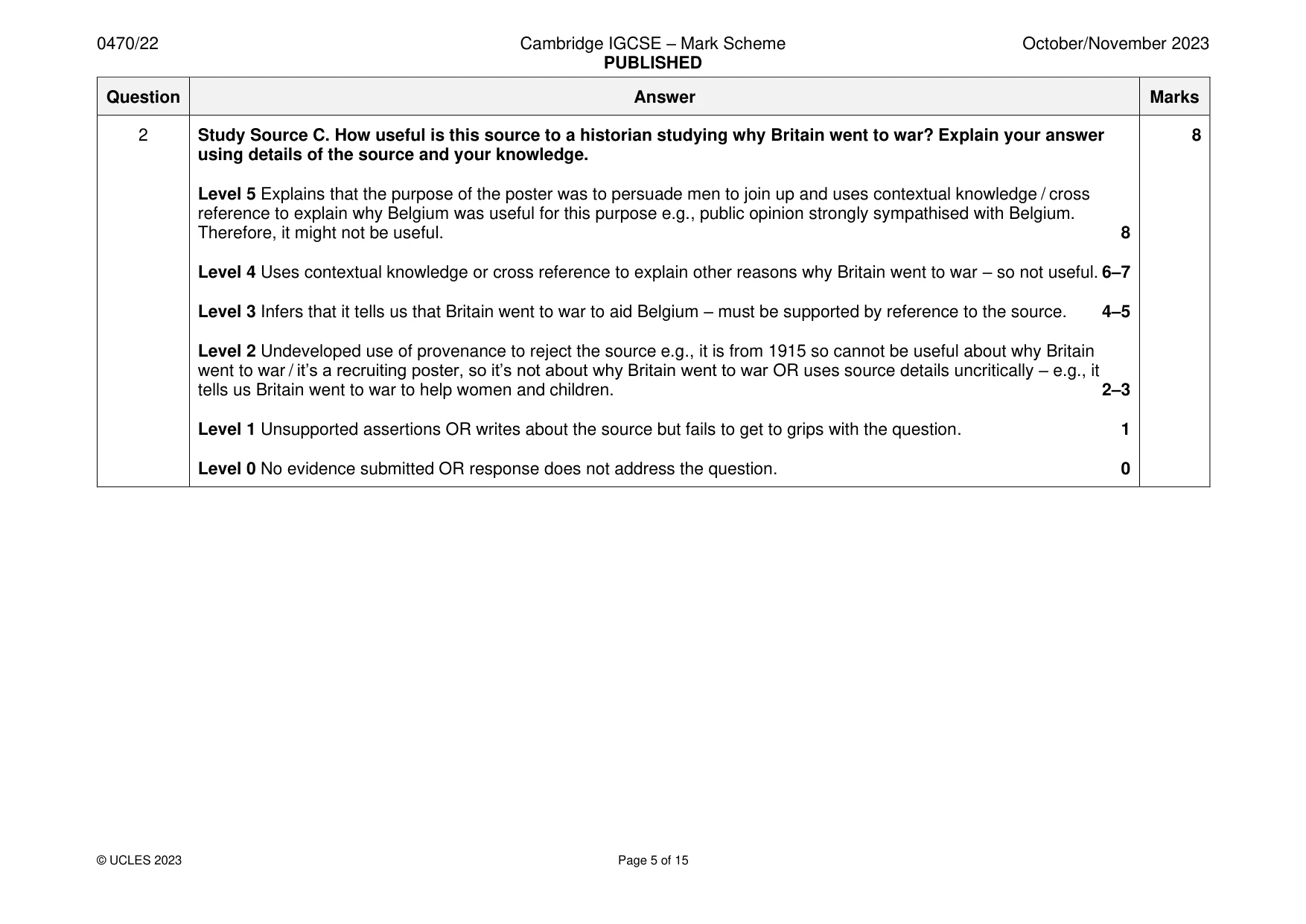
0470/22 Cambridge IGCSE – Mark Scheme PUBLISHED October/November 2023 © UCLES 2023 Page 5 of 15 Question Answer Marks 2 Study Source C. How useful is this source to a historian studying why Britain went to war? Explain your answer using details of the source and your knowledge. Level 5 Explains that the purpose of the poster was to persuade men to join up and uses contextual knowledge / cross reference to explain why Belgium was useful for this purpose e.g., public opinion strongly sympathised with Belgium. Therefore, it might not be useful. 8 Level 4 Uses contextual knowledge or cross reference to explain other reasons why Britain went to war – so not useful. 6–7 Level 3 Infers that it tells us that Britain went to war to aid Belgium – must be supported by reference to the source. 4–5 Level 2 Undeveloped use of provenance to reject the source e.g., it is from 1915 so cannot be useful about why Britain went to war / it’s a recruiting poster, so it’s not about why Britain went to war OR uses source details uncritically – e.g., it tells us Britain went to war to help women and children. 2–3 Level 1 Unsupported assertions OR writes about the source but fails to get to grips with the question. 1 Level 0 No evidence submitted OR response does not address the question. 0 8
Mark scheme, page 6
0470/22 Cambridge IGCSE – Mark Scheme PUBLISHED October/November 2023 © UCLES 2023 Page 6 of 15 Question Answer Marks 3 Study Sources D and E. Does Source E prove that Grey was lying in Source D? Explain your answer using details of the sources and your knowledge. Level 5 Compares the sources and evaluates one of them. Evaluation could be based on purpose (Source E) Award 8 marks if both sources evaluated or if one source is evaluated well. 7–8 Level 4 Evaluates either D or E to support a conclusion about Grey lying, but no valid comparison. 6 Level 3 Answers based on how D proves E was wrong so D not lying OR answers using other disagreements, so D was lying. 3–5 Disagreements include: D says defeat of France will endanger Britain and so it will have to act, E says that there is no threat to Britain that will limit its freedom of action; D says Britain has treaty obligations to Belgium, E says Britain has no such treaty obligations; D says Britain will act because of Belgium, E says this is not the real reason; D says Britain will act because of Belgium, E says it is acting because it wants to make Germany weak. Level 2 Answers based on undeveloped provenance e.g., different dates OR identifies where Grey is / is not lying but no explanation OR analyses the source appropriately but fails to state if Grey is lying. 2 Level 1 Writes about the sources but does not get to grips with the question. 1 Level 0 No evidence submitted OR response does not address the question. 0 8
Mark scheme, page 7
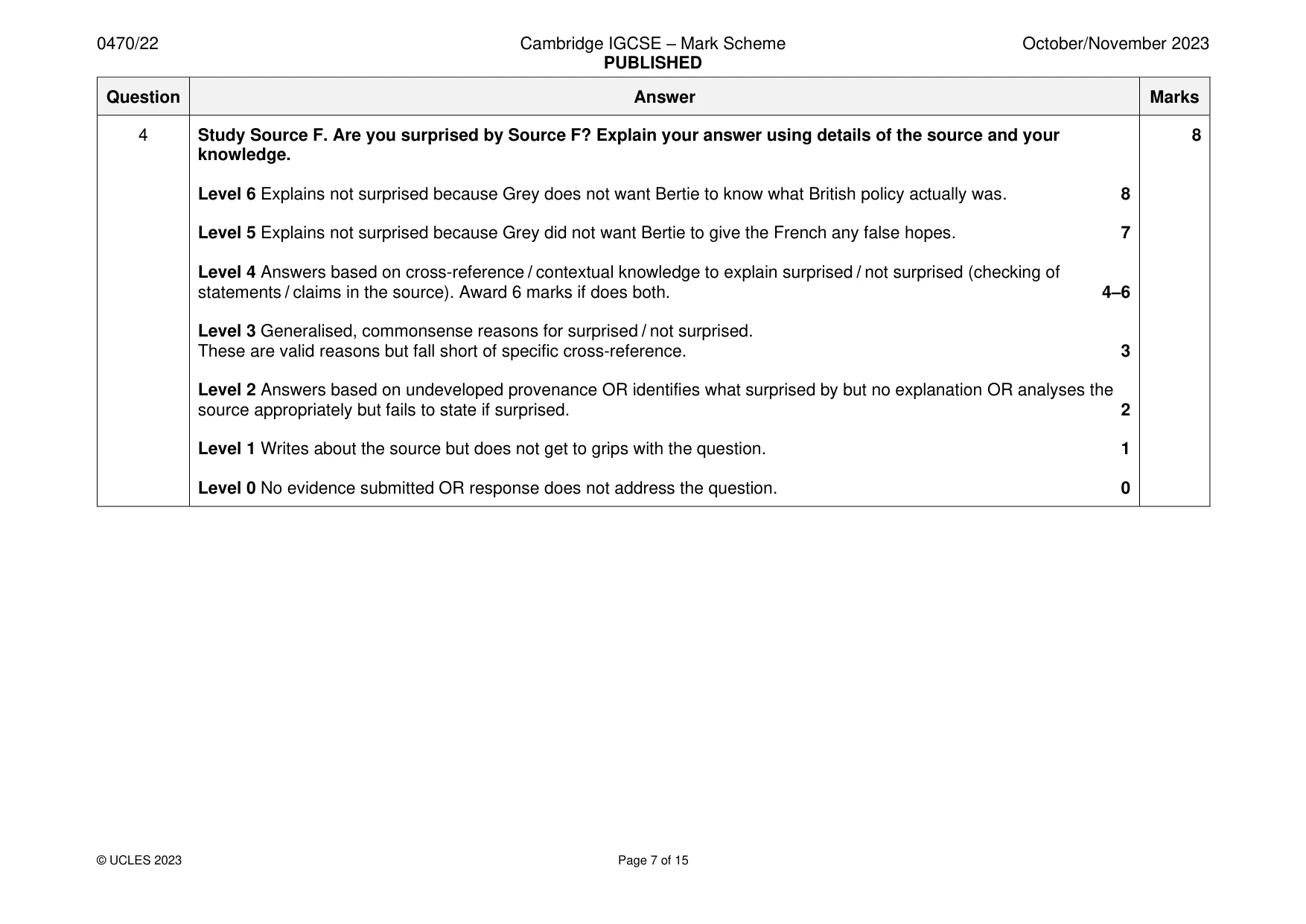
0470/22 Cambridge IGCSE – Mark Scheme PUBLISHED October/November 2023 © UCLES 2023 Page 7 of 15 Question Answer Marks 4 Study Source F. Are you surprised by Source F? Explain your answer using details of the source and your knowledge. Level 6 Explains not surprised because Grey does not want Bertie to know what British policy actually was. 8 Level 5 Explains not surprised because Grey did not want Bertie to give the French any false hopes. 7 Level 4 Answers based on cross-reference / contextual knowledge to explain surprised / not surprised (checking of statements / claims in the source). Award 6 marks if does both. 4–6 Level 3 Generalised, commonsense reasons for surprised / not surprised. These are valid reasons but fall short of specific cross-reference. 3 Level 2 Answers based on undeveloped provenance OR identifies what surprised by but no explanation OR analyses the source appropriately but fails to state if surprised. 2 Level 1 Writes about the source but does not get to grips with the question. 1 Level 0 No evidence submitted OR response does not address the question. 0 8
Mark scheme, page 8
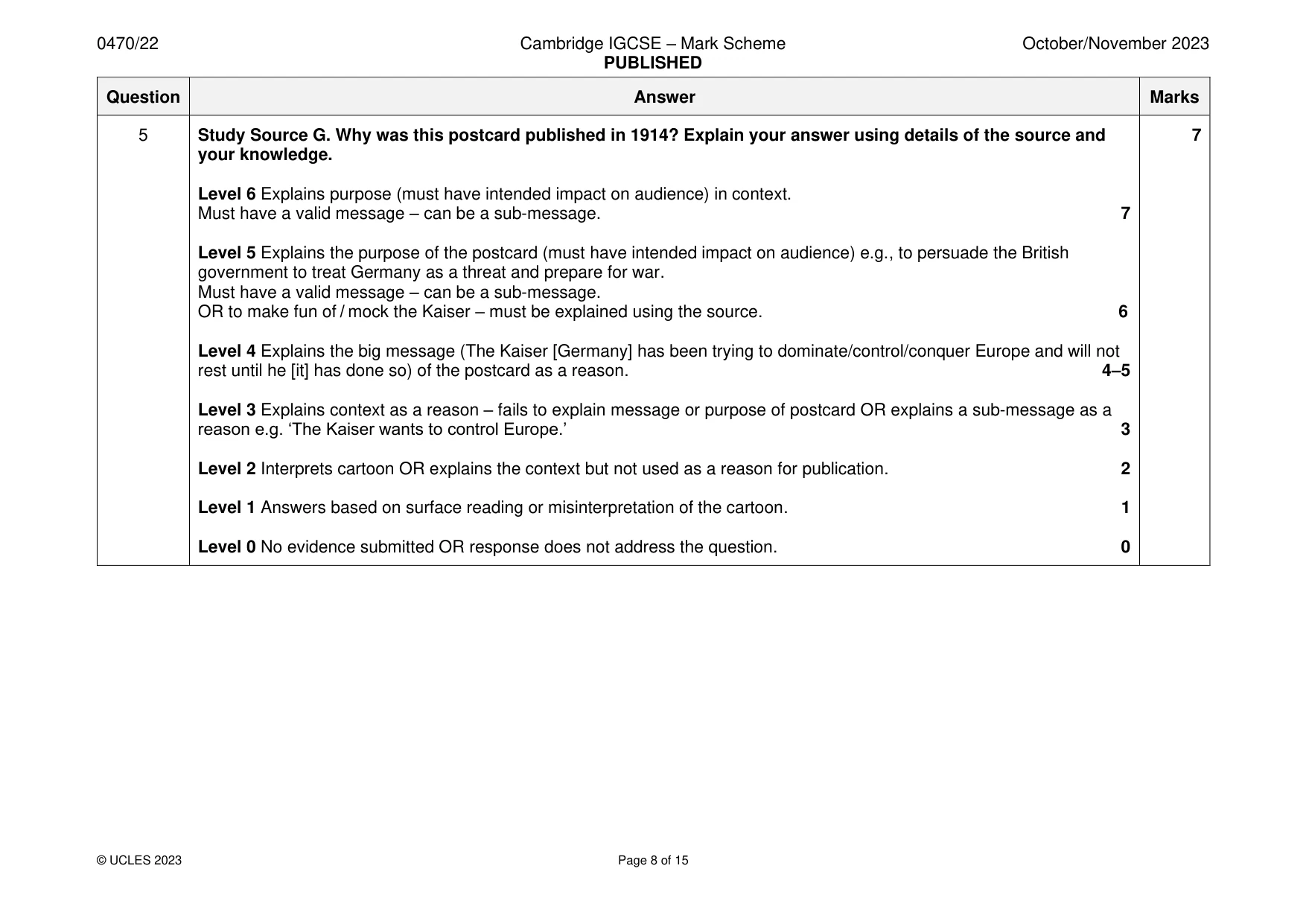
0470/22 Cambridge IGCSE – Mark Scheme PUBLISHED October/November 2023 © UCLES 2023 Page 8 of 15 Question Answer Marks 5 Study Source G. Why was this postcard published in 1914? Explain your answer using details of the source and your knowledge. Level 6 Explains purpose (must have intended impact on audience) in context. Must have a valid message – can be a sub-message. 7 Level 5 Explains the purpose of the postcard (must have intended impact on audience) e.g., to persuade the British government to treat Germany as a threat and prepare for war. Must have a valid message – can be a sub-message. OR to make fun of / mock the Kaiser – must be explained using the source. 6 Level 4 Explains the big message (The Kaiser [Germany] has been trying to dominate/control/conquer Europe and will not rest until he [it] has done so) of the postcard as a reason. 4–5 Level 3 Explains context as a reason – fails to explain message or purpose of postcard OR explains a sub-message as a reason e.g. ‘The Kaiser wants to control Europe.’ 3 Level 2 Interprets cartoon OR explains the context but not used as a reason for publication. 2 Level 1 Answers based on surface reading or misinterpretation of the cartoon. 1 Level 0 No evidence submitted OR response does not address the question. 0 7
Mark scheme, page 9
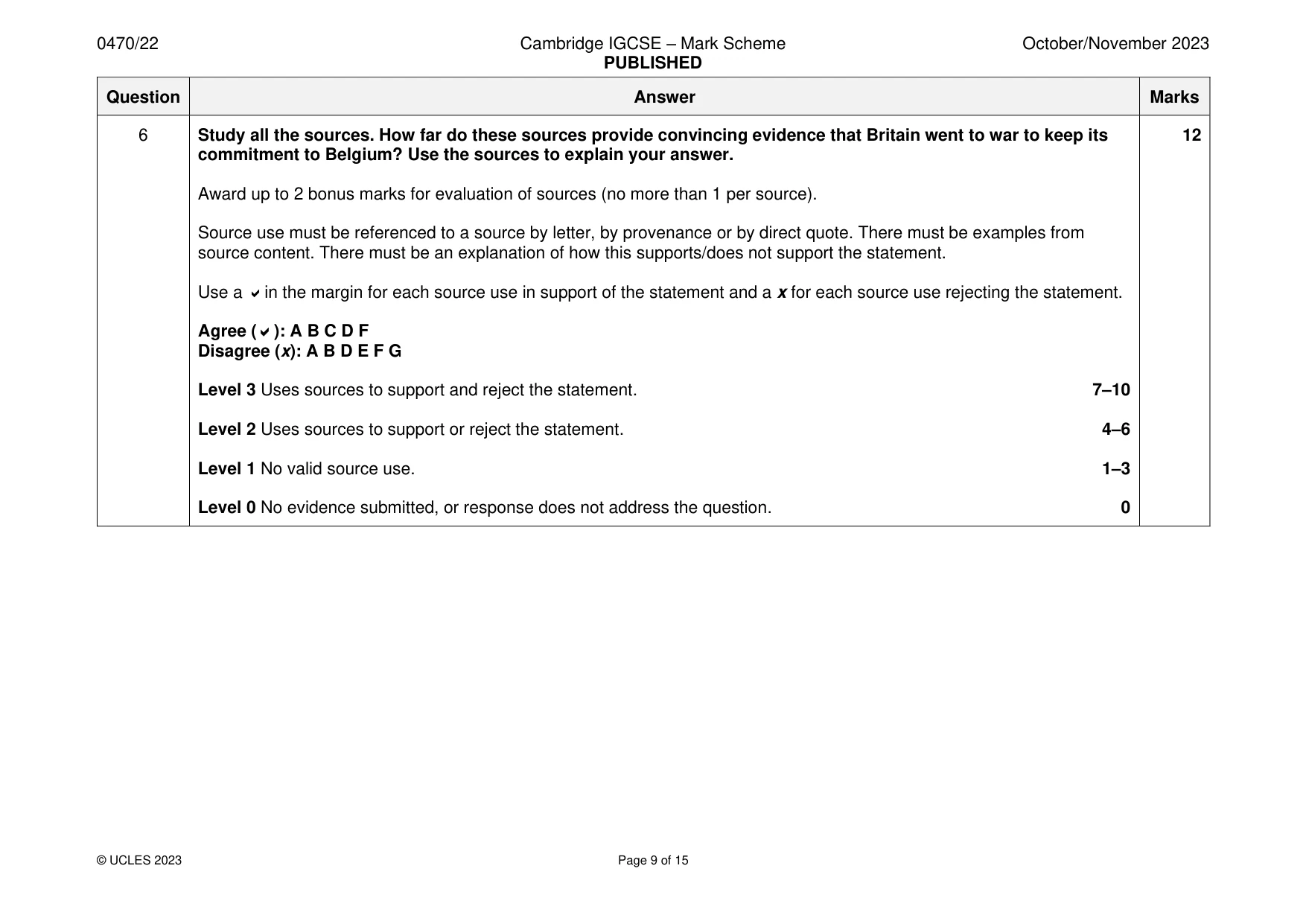
0470/22 Cambridge IGCSE – Mark Scheme PUBLISHED October/November 2023 © UCLES 2023 Page 9 of 15 Question Answer Marks 6 Study all the sources. How far do these sources provide convincing evidence that Britain went to war to keep its commitment to Belgium? Use the sources to explain your answer. Award up to 2 bonus marks for evaluation of sources (no more than 1 per source). Source use must be referenced to a source by letter, by provenance or by direct quote. There must be examples from source content. There must be an explanation of how this supports/does not support the statement. Use a in the margin for each source use in support of the statement and a x for each source use rejecting the statement. Agree (): A B C D F Disagree (x): A B D E F G Level 3 Uses sources to support and reject the statement. 7–10 Level 2 Uses sources to support or reject the statement. 4–6 Level 1 No valid source use. 1–3 Level 0 No evidence submitted, or response does not address the question. 0 12
Mark scheme, page 10
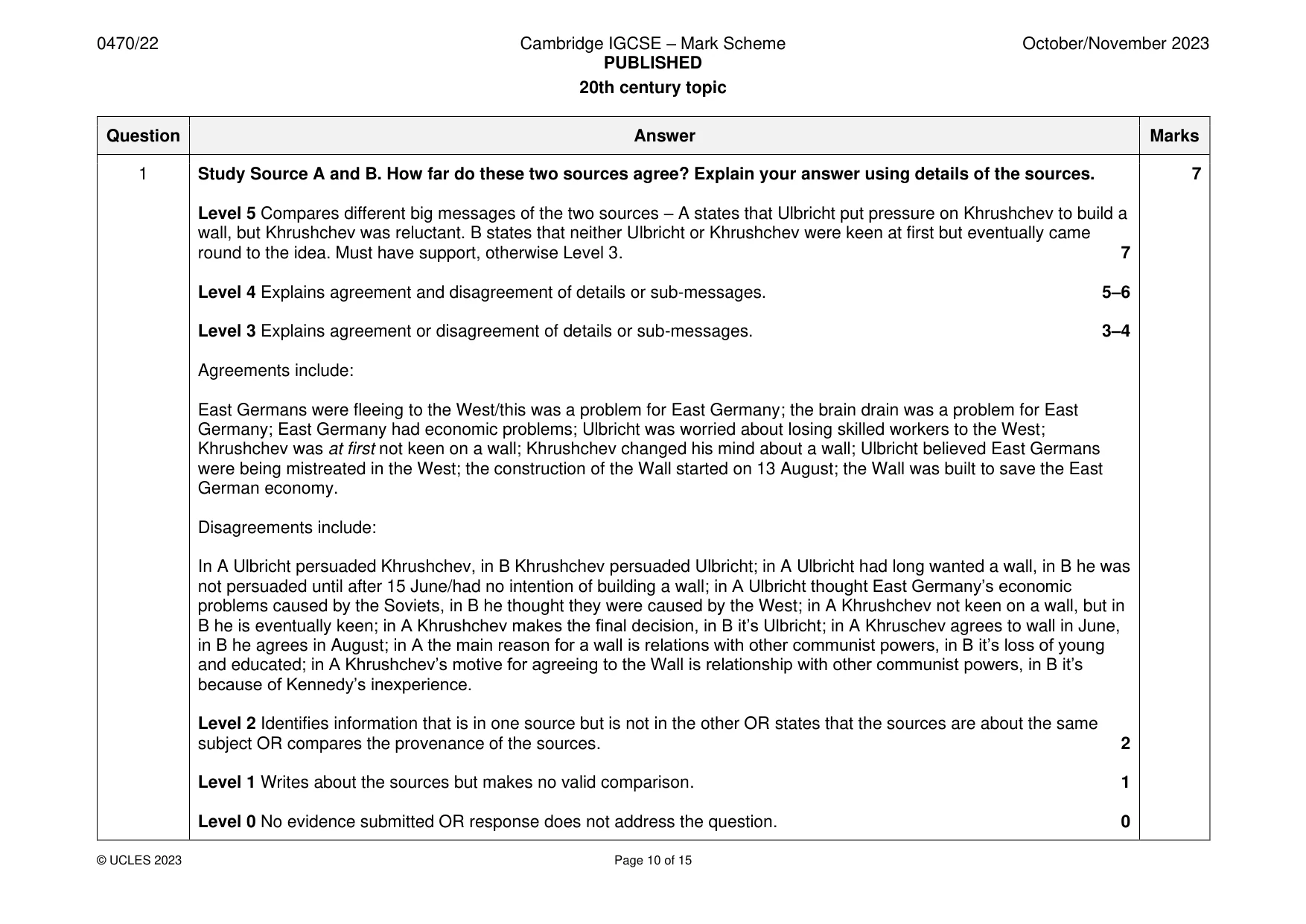
0470/22 Cambridge IGCSE – Mark Scheme PUBLISHED October/November 2023 © UCLES 2023 Page 10 of 15 20th century topic Question Answer Marks 1 Study Source A and B. How far do these two sources agree? Explain your answer using details of the sources. Level 5 Compares different big messages of the two sources – A states that Ulbricht put pressure on Khrushchev to build a wall, but Khrushchev was reluctant. B states that neither Ulbricht or Khrushchev were keen at first but eventually came round to the idea. Must have support, otherwise Level 3. 7 Level 4 Explains agreement and disagreement of details or sub-messages. 5–6 Level 3 Explains agreement or disagreement of details or sub-messages. 3–4 Agreements include: East Germans were fleeing to the West/this was a problem for East Germany; the brain drain was a problem for East Germany; East Germany had economic problems; Ulbricht was worried about losing skilled workers to the West; Khrushchev was at first not keen on a wall; Khrushchev changed his mind about a wall; Ulbricht believed East Germans were being mistreated in the West; the construction of the Wall started on 13 August; the Wall was built to save the East German economy. Disagreements include: In A Ulbricht persuaded Khrushchev, in B Khrushchev persuaded Ulbricht; in A Ulbricht had long wanted a wall, in B he was not persuaded until after 15 June/had no intention of building a wall; in A Ulbricht thought East Germany’s economic problems caused by the Soviets, in B he thought they were caused by the West; in A Khrushchev not keen on a wall, but in B he is eventually keen; in A Khrushchev makes the final decision, in B it’s Ulbricht; in A Khruschev agrees to wall in June, in B he agrees in August; in A the main reason for a wall is relations with other communist powers, in B it’s loss of young and educated; in A Khrushchev’s motive for agreeing to the Wall is relationship with other communist powers, in B it’s because of Kennedy’s inexperience. Level 2 Identifies information that is in one source but is not in the other OR states that the sources are about the same subject OR compares the provenance of the sources. 2 Level 1 Writes about the sources but makes no valid comparison. 1 Level 0 No evidence submitted OR response does not address the question. 0 7
Mark scheme, page 11
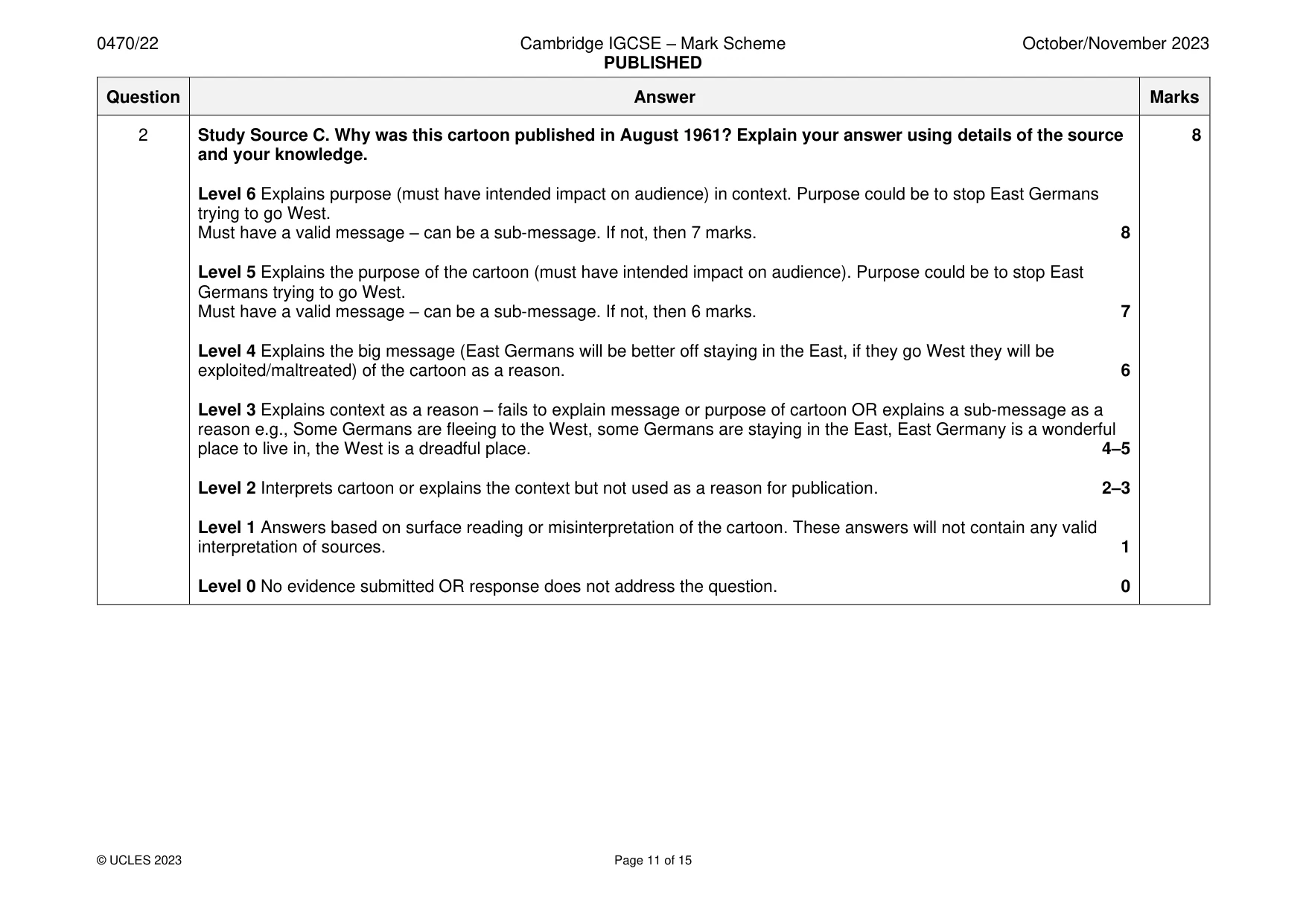
0470/22 Cambridge IGCSE – Mark Scheme PUBLISHED October/November 2023 © UCLES 2023 Page 11 of 15 Question Answer Marks 2 Study Source C. Why was this cartoon published in August 1961? Explain your answer using details of the source and your knowledge. Level 6 Explains purpose (must have intended impact on audience) in context. Purpose could be to stop East Germans trying to go West. Must have a valid message – can be a sub-message. If not, then 7 marks. 8 Level 5 Explains the purpose of the cartoon (must have intended impact on audience). Purpose could be to stop East Germans trying to go West. Must have a valid message – can be a sub-message. If not, then 6 marks. 7 Level 4 Explains the big message (East Germans will be better off staying in the East, if they go West they will be exploited/maltreated) of the cartoon as a reason. 6 Level 3 Explains context as a reason – fails to explain message or purpose of cartoon OR explains a sub-message as a reason e.g., Some Germans are fleeing to the West, some Germans are staying in the East, East Germany is a wonderful place to live in, the West is a dreadful place. 4–5 Level 2 Interprets cartoon or explains the context but not used as a reason for publication. 2–3 Level 1 Answers based on surface reading or misinterpretation of the cartoon. These answers will not contain any valid interpretation of sources. 1 Level 0 No evidence submitted OR response does not address the question. 0 8
Mark scheme, page 12
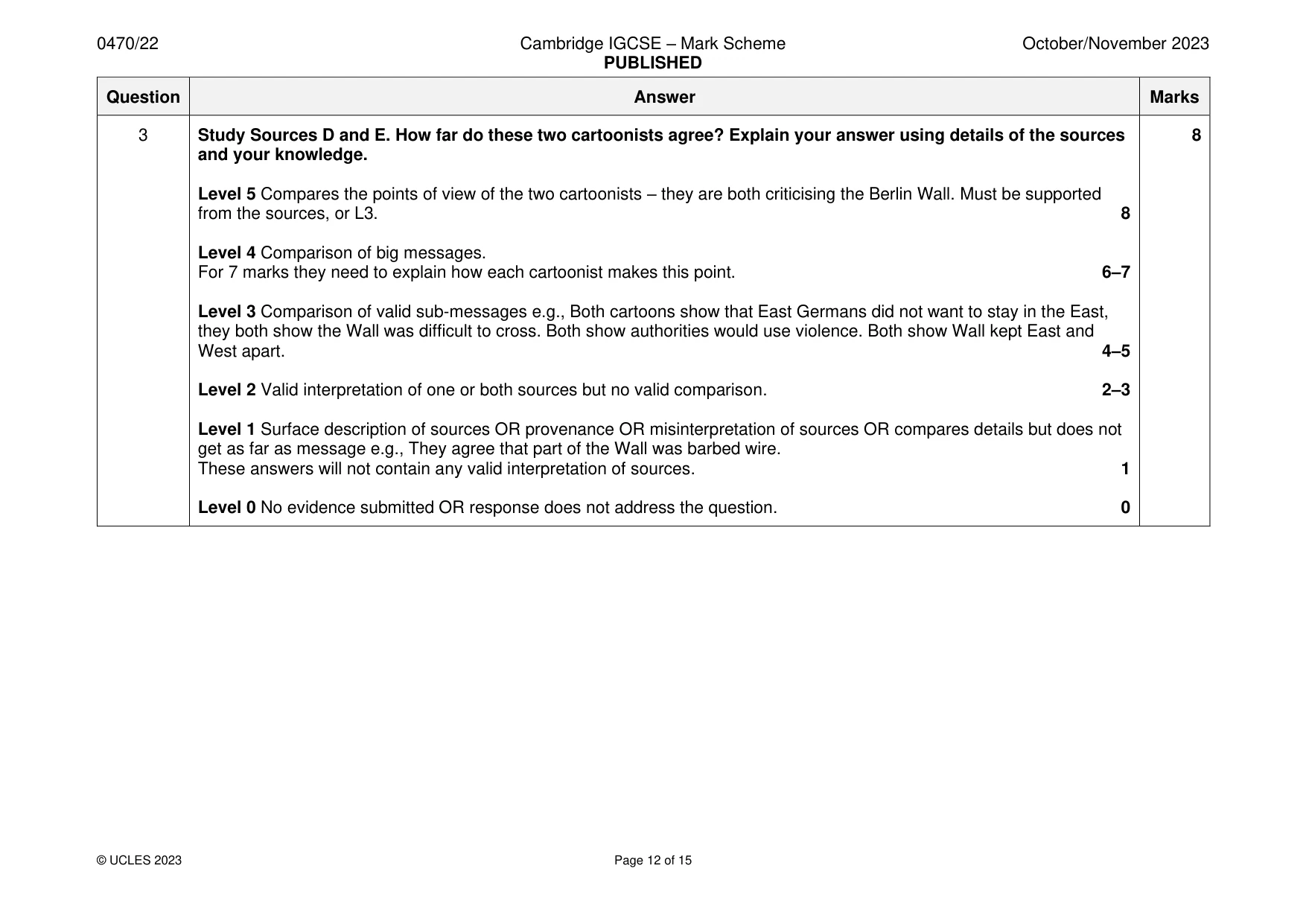
0470/22 Cambridge IGCSE – Mark Scheme PUBLISHED October/November 2023 © UCLES 2023 Page 12 of 15 Question Answer Marks 3 Study Sources D and E. How far do these two cartoonists agree? Explain your answer using details of the sources and your knowledge. Level 5 Compares the points of view of the two cartoonists – they are both criticising the Berlin Wall. Must be supported from the sources, or L3. 8 Level 4 Comparison of big messages. For 7 marks they need to explain how each cartoonist makes this point. 6–7 Level 3 Comparison of valid sub-messages e.g., Both cartoons show that East Germans did not want to stay in the East, they both show the Wall was difficult to cross. Both show authorities would use violence. Both show Wall kept East and West apart. 4–5 Level 2 Valid interpretation of one or both sources but no valid comparison. 2–3 Level 1 Surface description of sources OR provenance OR misinterpretation of sources OR compares details but does not get as far as message e.g., They agree that part of the Wall was barbed wire. These answers will not contain any valid interpretation of sources. 1 Level 0 No evidence submitted OR response does not address the question. 0 8
Mark scheme, page 13
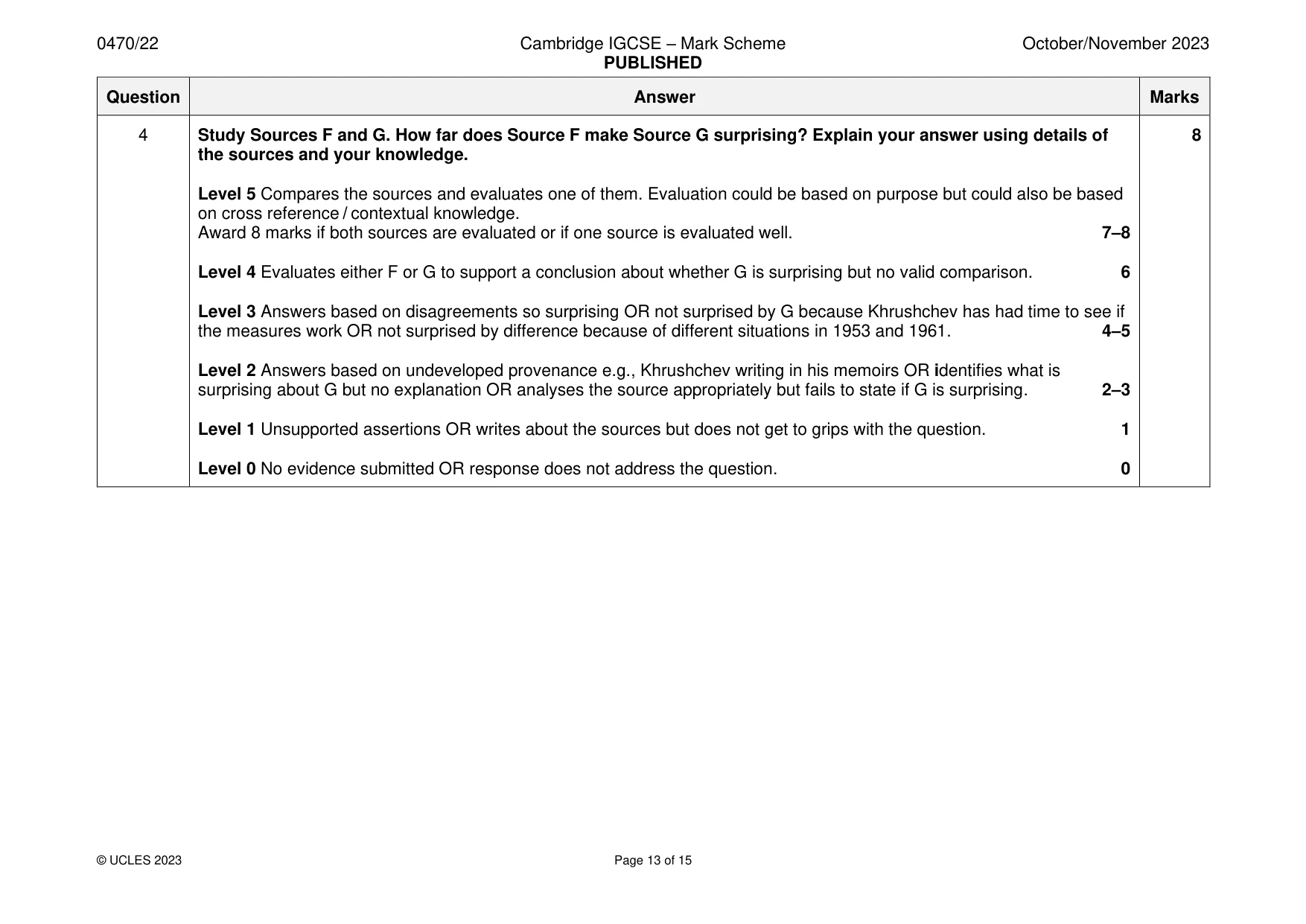
0470/22 Cambridge IGCSE – Mark Scheme PUBLISHED October/November 2023 © UCLES 2023 Page 13 of 15 Question Answer Marks 4 Study Sources F and G. How far does Source F make Source G surprising? Explain your answer using details of the sources and your knowledge. Level 5 Compares the sources and evaluates one of them. Evaluation could be based on purpose but could also be based on cross reference / contextual knowledge. Award 8 marks if both sources are evaluated or if one source is evaluated well. 7–8 Level 4 Evaluates either F or G to support a conclusion about whether G is surprising but no valid comparison. 6 Level 3 Answers based on disagreements so surprising OR not surprised by G because Khrushchev has had time to see if the measures work OR not surprised by difference because of different situations in 1953 and 1961. 4–5 Level 2 Answers based on undeveloped provenance e.g., Khrushchev writing in his memoirs OR identifies what is surprising about G but no explanation OR analyses the source appropriately but fails to state if G is surprising. 2–3 Level 1 Unsupported assertions OR writes about the sources but does not get to grips with the question. 1 Level 0 No evidence submitted OR response does not address the question. 0 8
Mark scheme, page 14
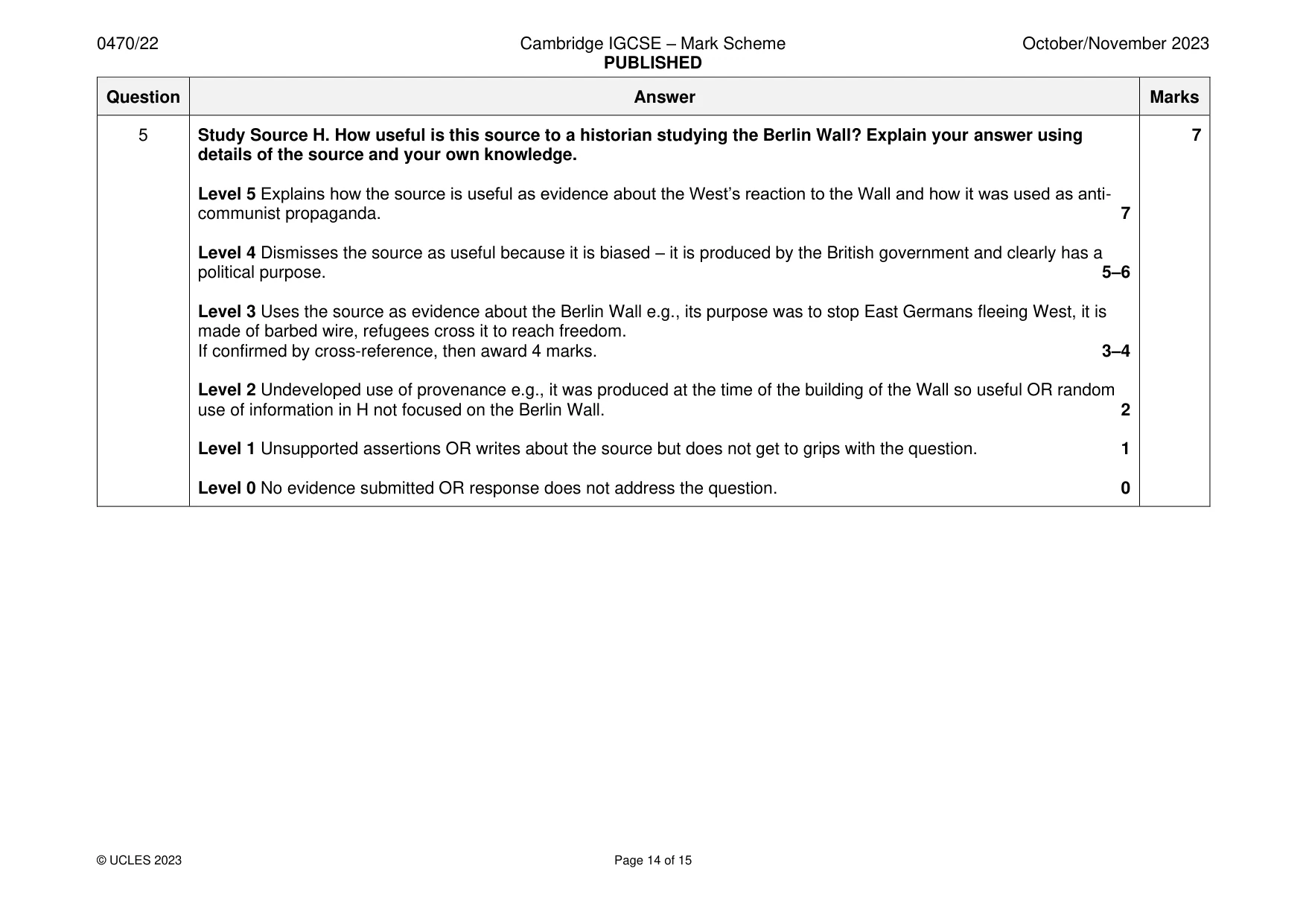
0470/22 Cambridge IGCSE – Mark Scheme PUBLISHED October/November 2023 © UCLES 2023 Page 14 of 15 Question Answer Marks 5 Study Source H. How useful is this source to a historian studying the Berlin Wall? Explain your answer using details of the source and your own knowledge. Level 5 Explains how the source is useful as evidence about the West’s reaction to the Wall and how it was used as anti- communist propaganda. 7 Level 4 Dismisses the source as useful because it is biased – it is produced by the British government and clearly has a political purpose. 5–6 Level 3 Uses the source as evidence about the Berlin Wall e.g., its purpose was to stop East Germans fleeing West, it is made of barbed wire, refugees cross it to reach freedom. If confirmed by cross-reference, then award 4 marks. 3–4 Level 2 Undeveloped use of provenance e.g., it was produced at the time of the building of the Wall so useful OR random use of information in H not focused on the Berlin Wall. 2 Level 1 Unsupported assertions OR writes about the source but does not get to grips with the question. 1 Level 0 No evidence submitted OR response does not address the question. 0 7
Mark scheme, page 15
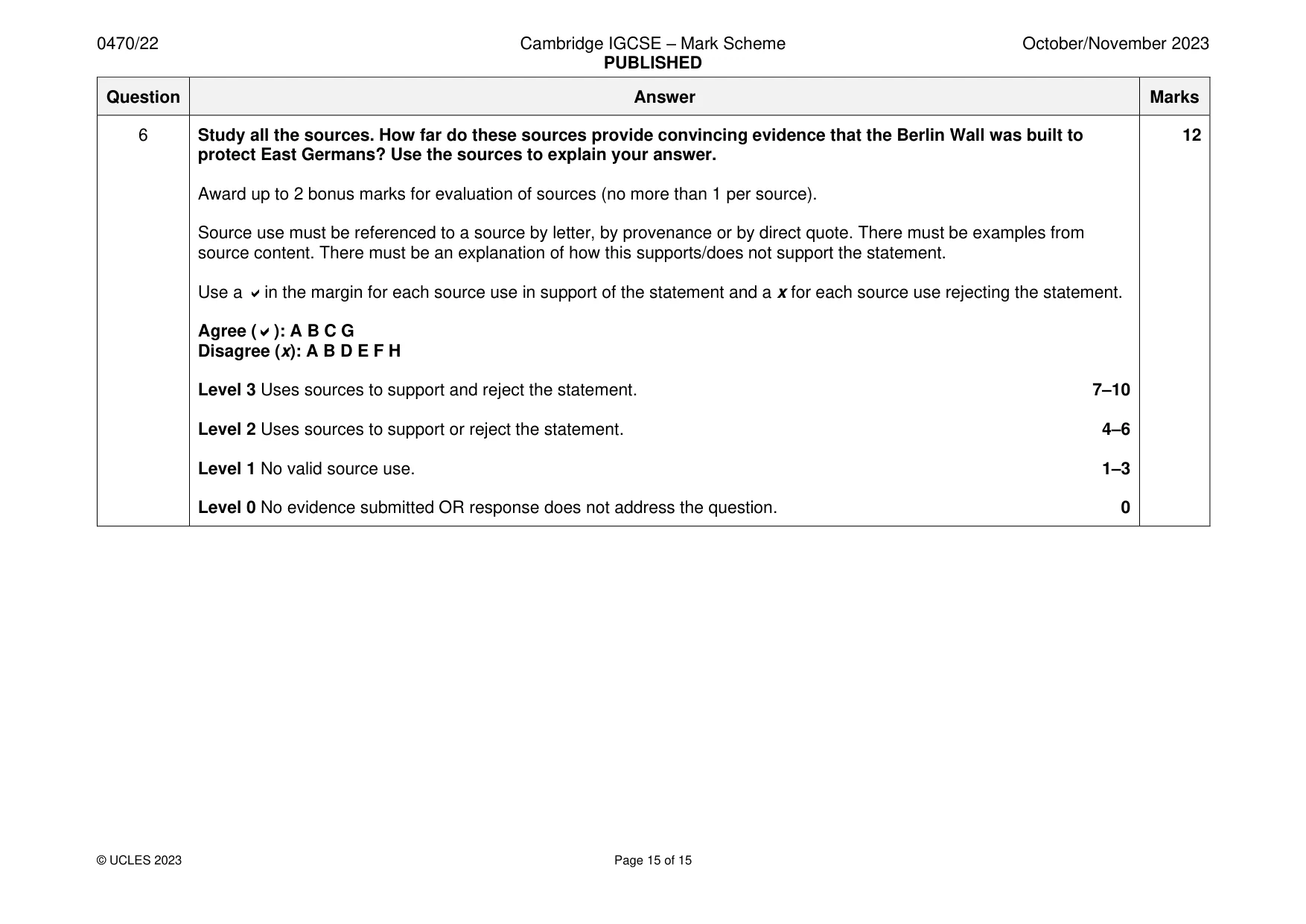
0470/22 Cambridge IGCSE – Mark Scheme PUBLISHED October/November 2023 © UCLES 2023 Page 15 of 15 Question Answer Marks 6 Study all the sources. How far do these sources provide convincing evidence that the Berlin Wall was built to protect East Germans? Use the sources to explain your answer. Award up to 2 bonus marks for evaluation of sources (no more than 1 per source). Source use must be referenced to a source by letter, by provenance or by direct quote. There must be examples from source content. There must be an explanation of how this supports/does not support the statement. Use a in the margin for each source use in support of the statement and a x for each source use rejecting the statement. Agree (): A B C G Disagree (x): A B D E F H Level 3 Uses sources to support and reject the statement. 7–10 Level 2 Uses sources to support or reject the statement. 4–6 Level 1 No valid source use. 1–3 Level 0 No evidence submitted OR response does not address the question. 0 12
What you needed in this session
Cambridge’s own grade thresholds for 2023 Oct/Nov, Paper 2 · Variant 2. A higher threshold means an easier paper — the bar moves with how the cohort did.