Cambridge IGCSE History 0470 — 2023 Oct/Nov Paper 1 · Variant 2
0470/12/O/N/23 · 60 marks · ≈68 min
The question paper and its mark scheme, free to read here and free to download. This is Cambridge’s own paper, exactly as it was sat.
Question paper12 pages

Mark scheme87 pages
Answers below. Sit the paper first if you are practising.
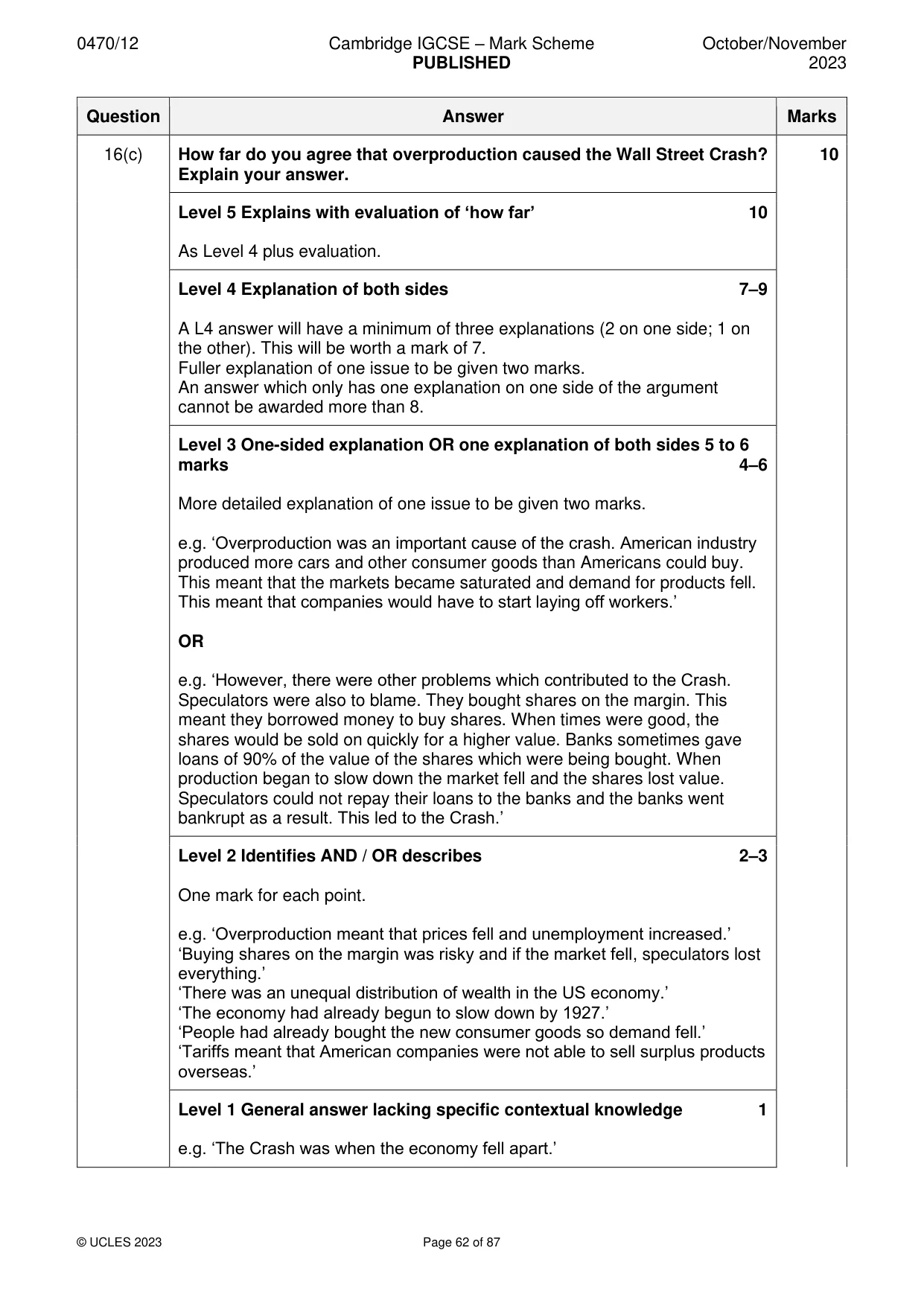
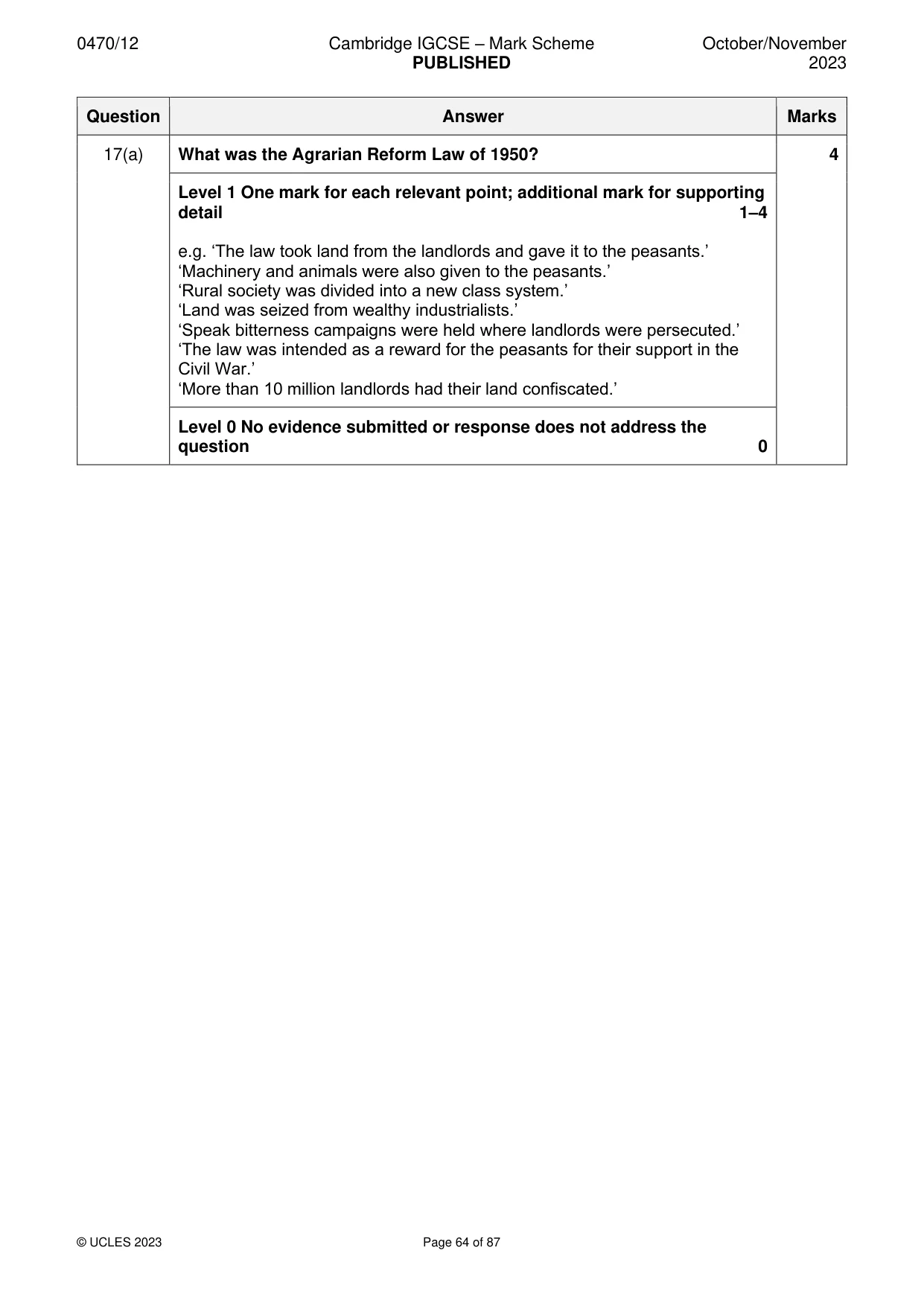
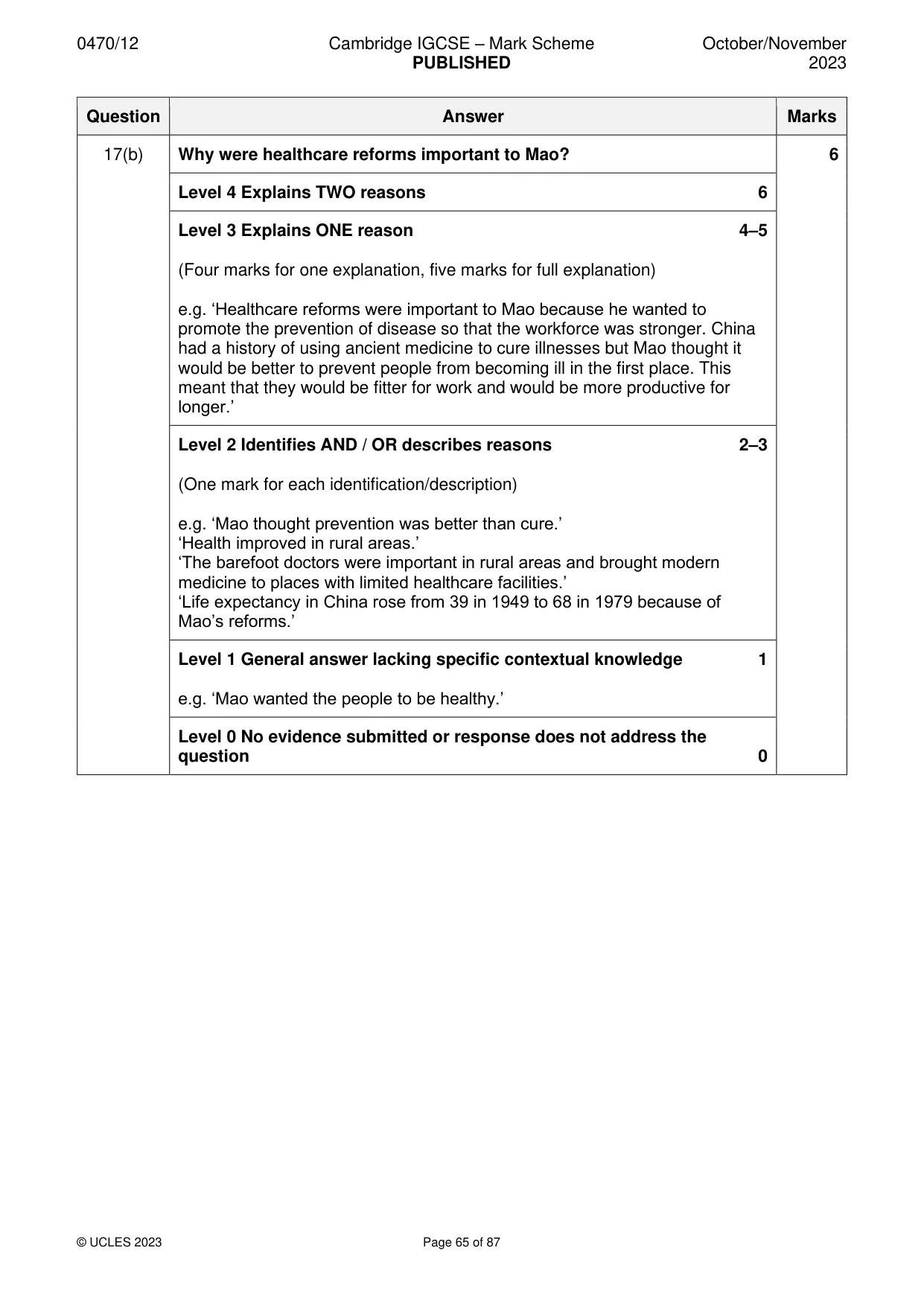
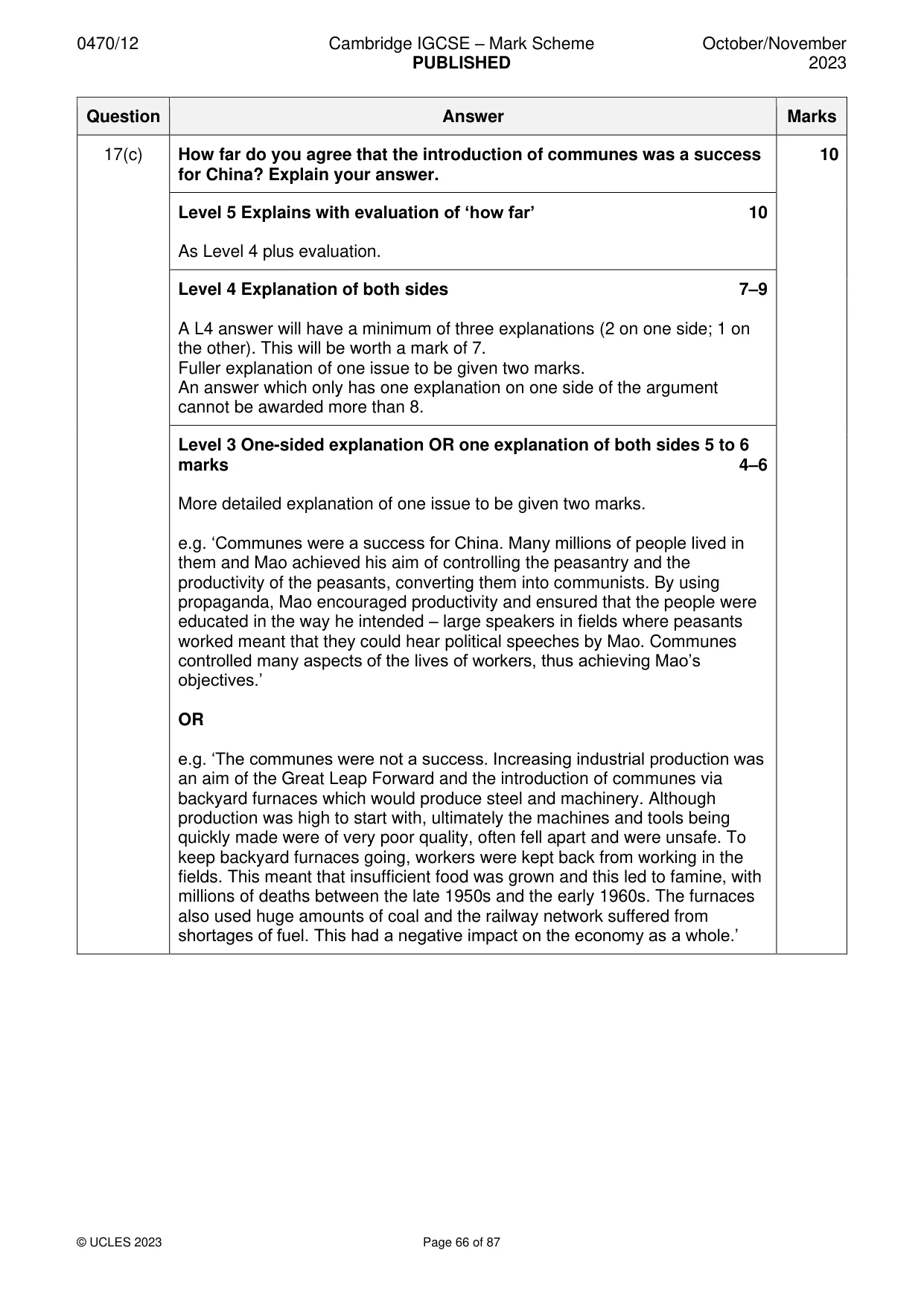
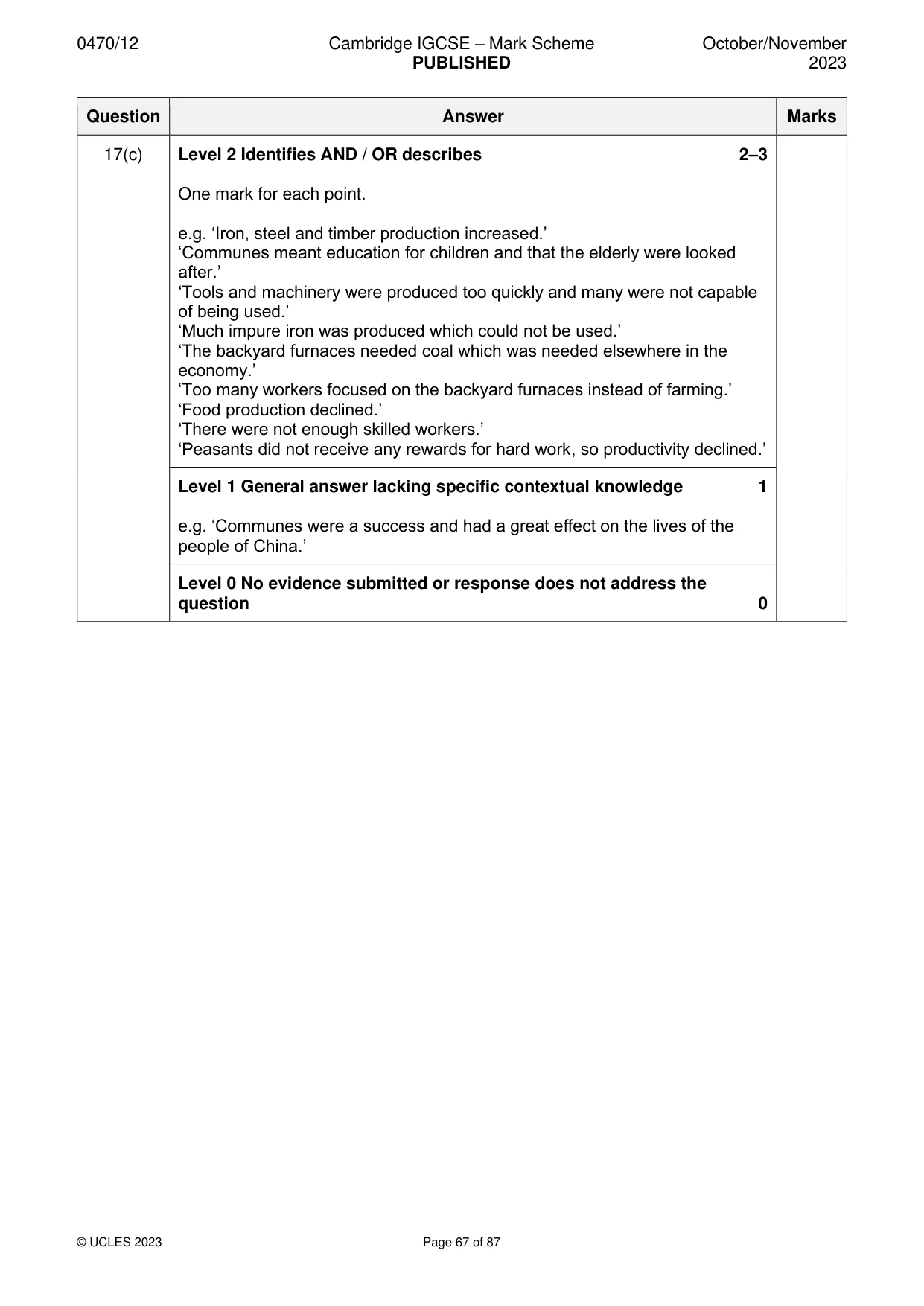
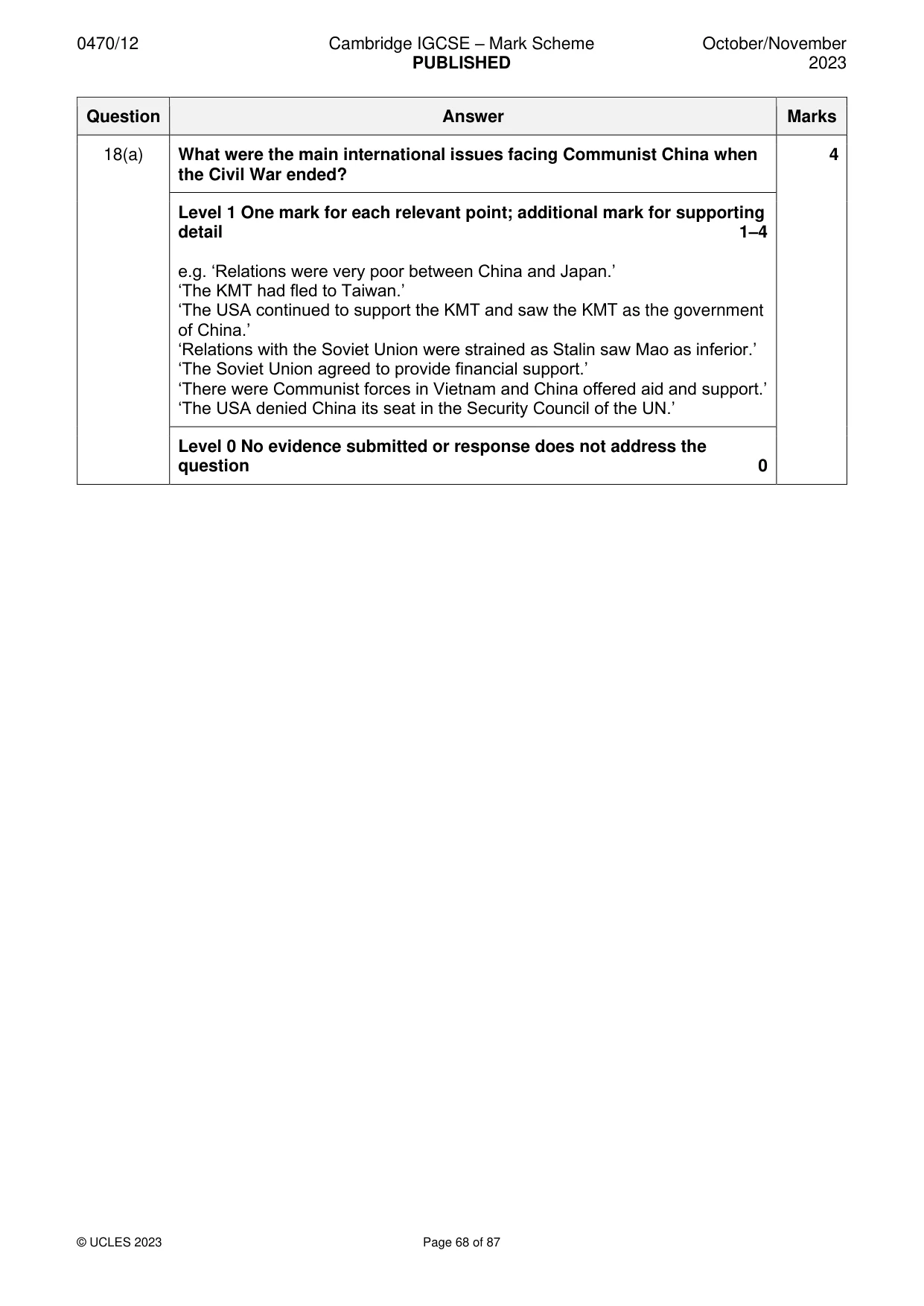
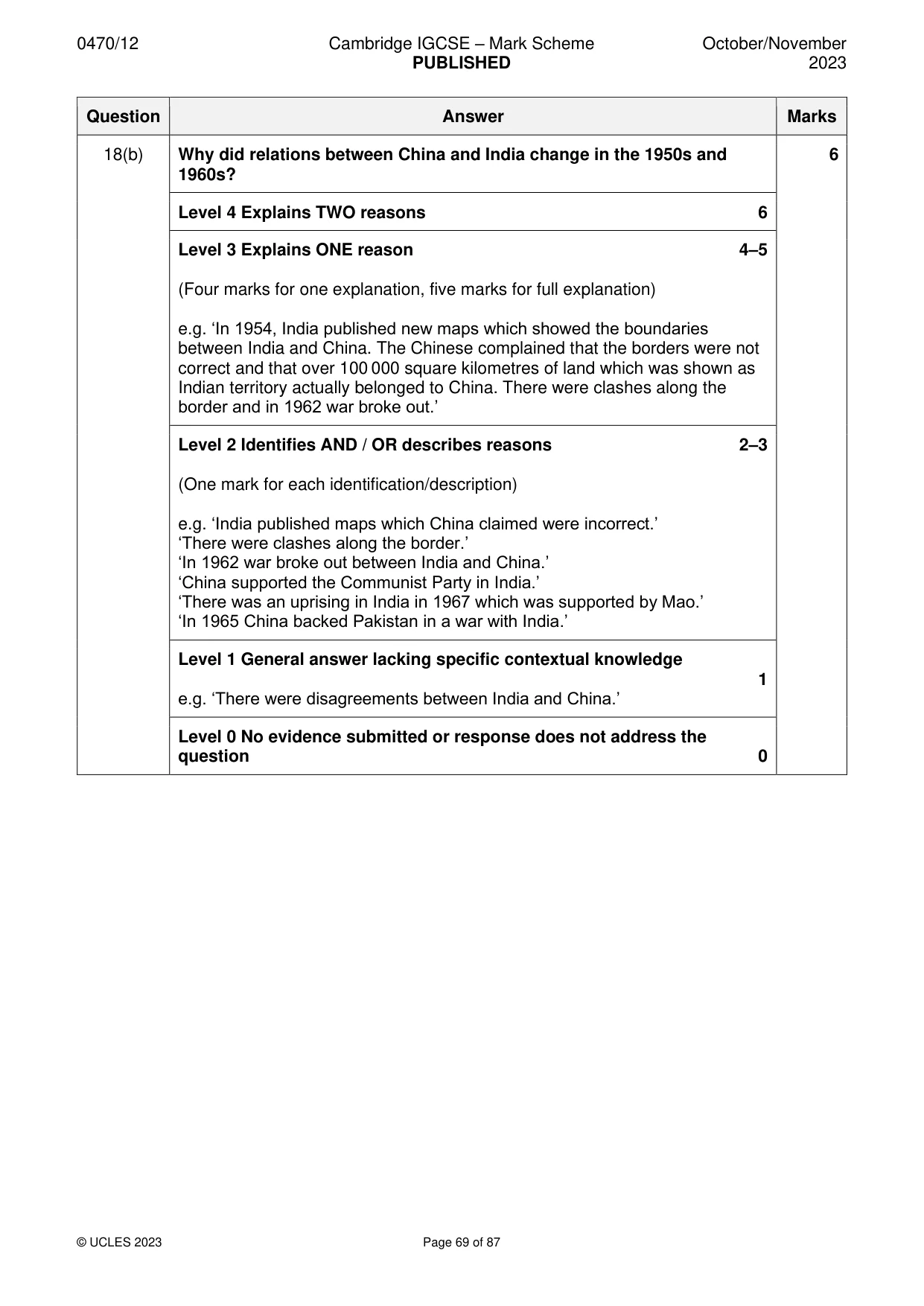
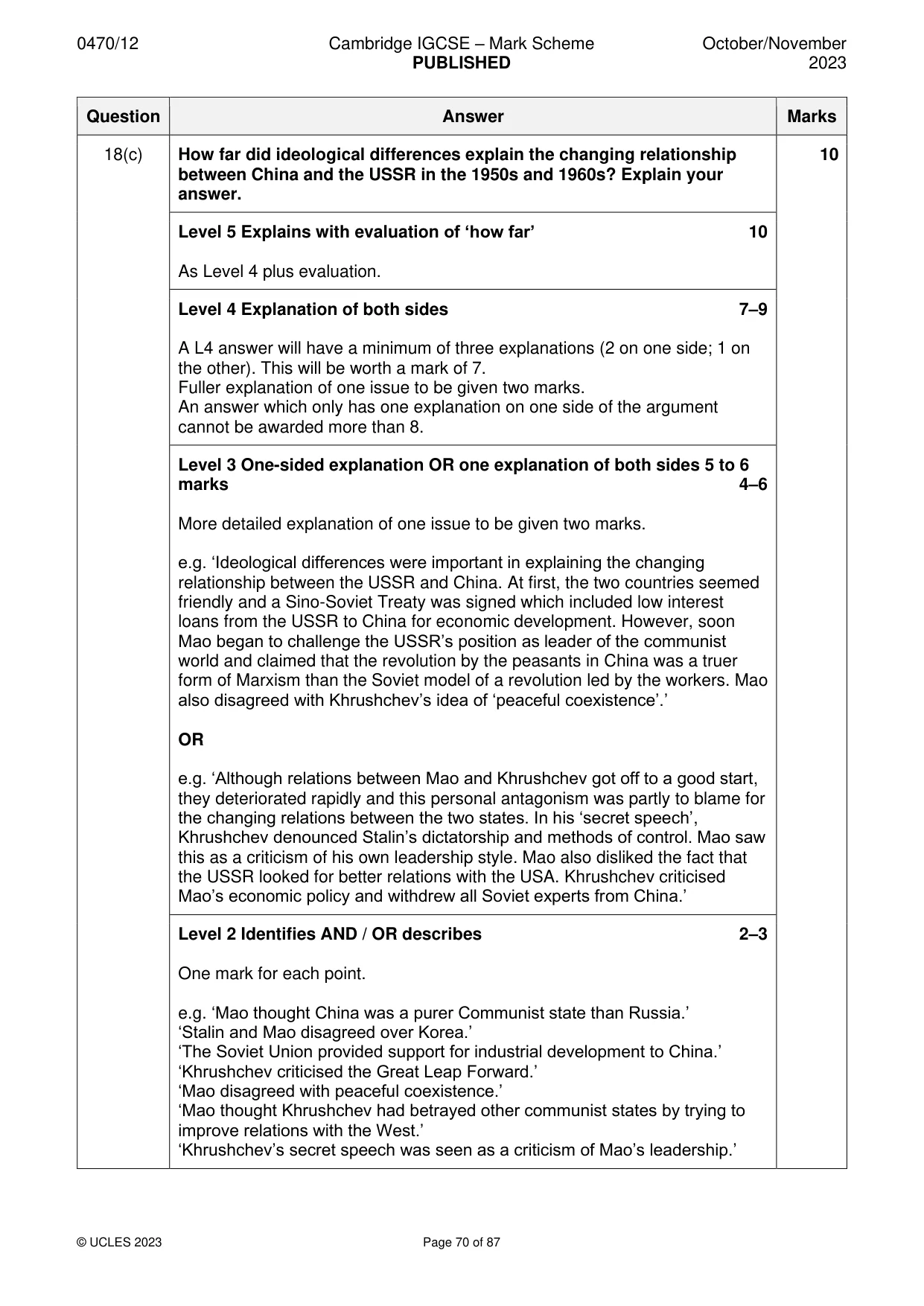
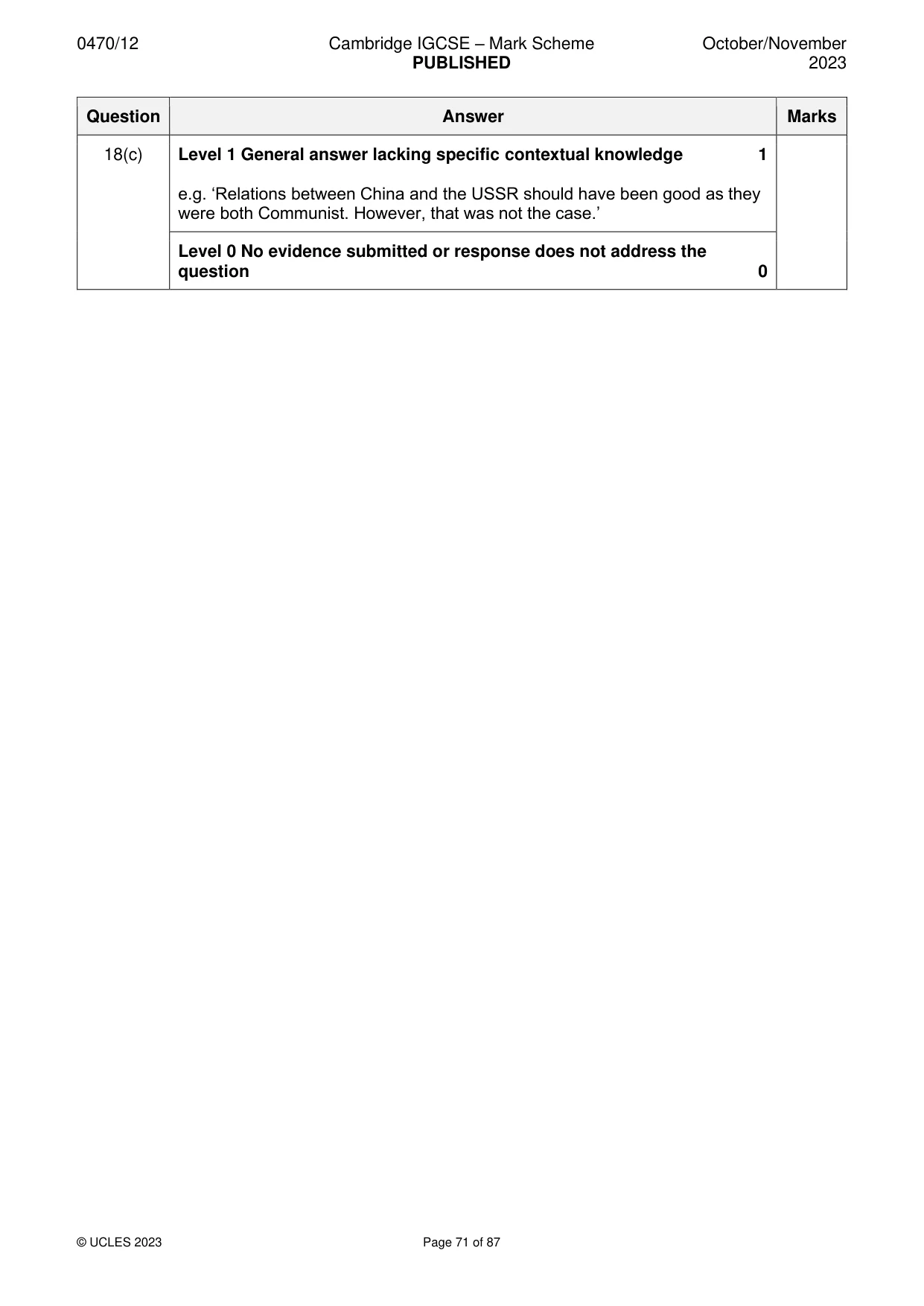
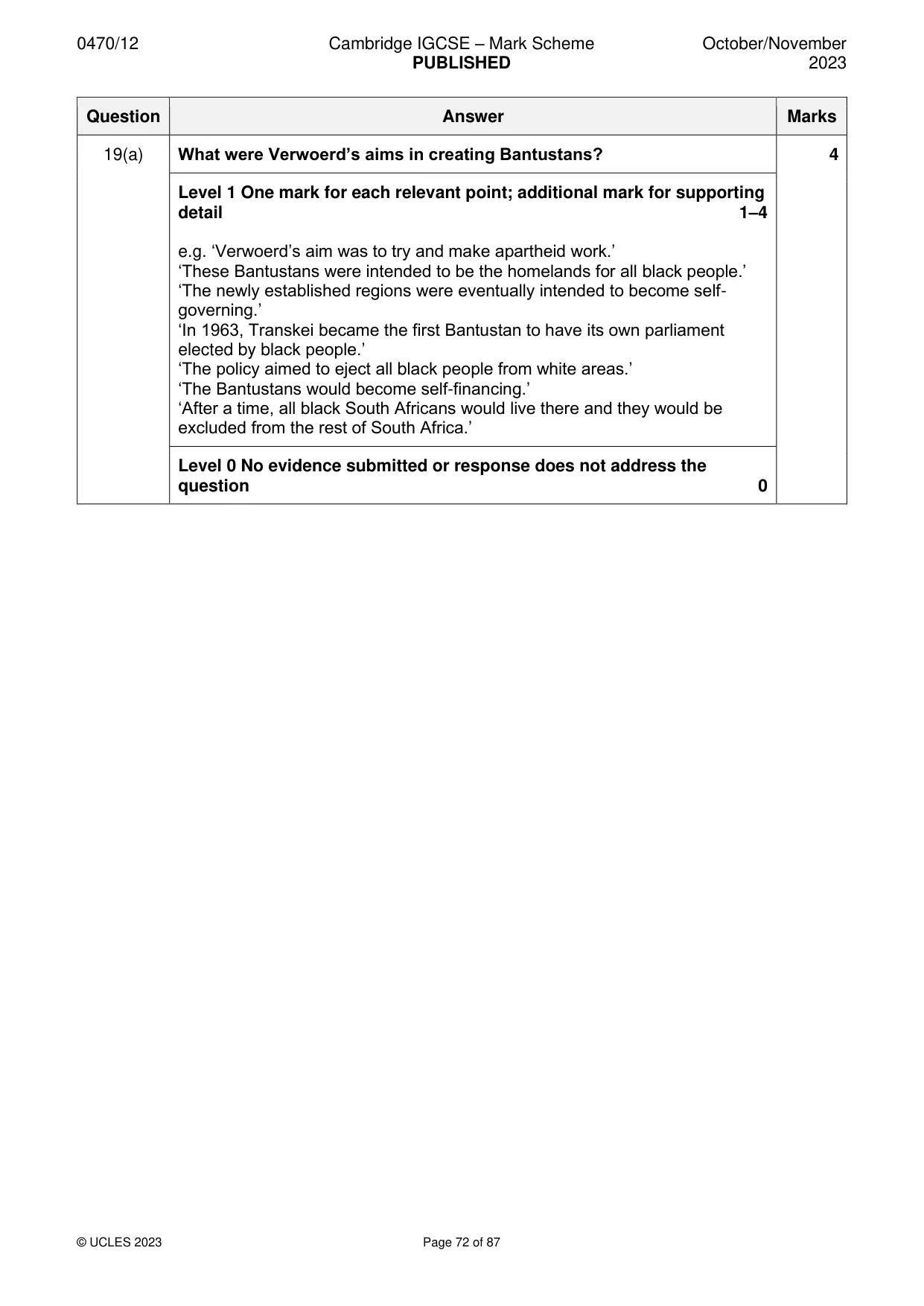
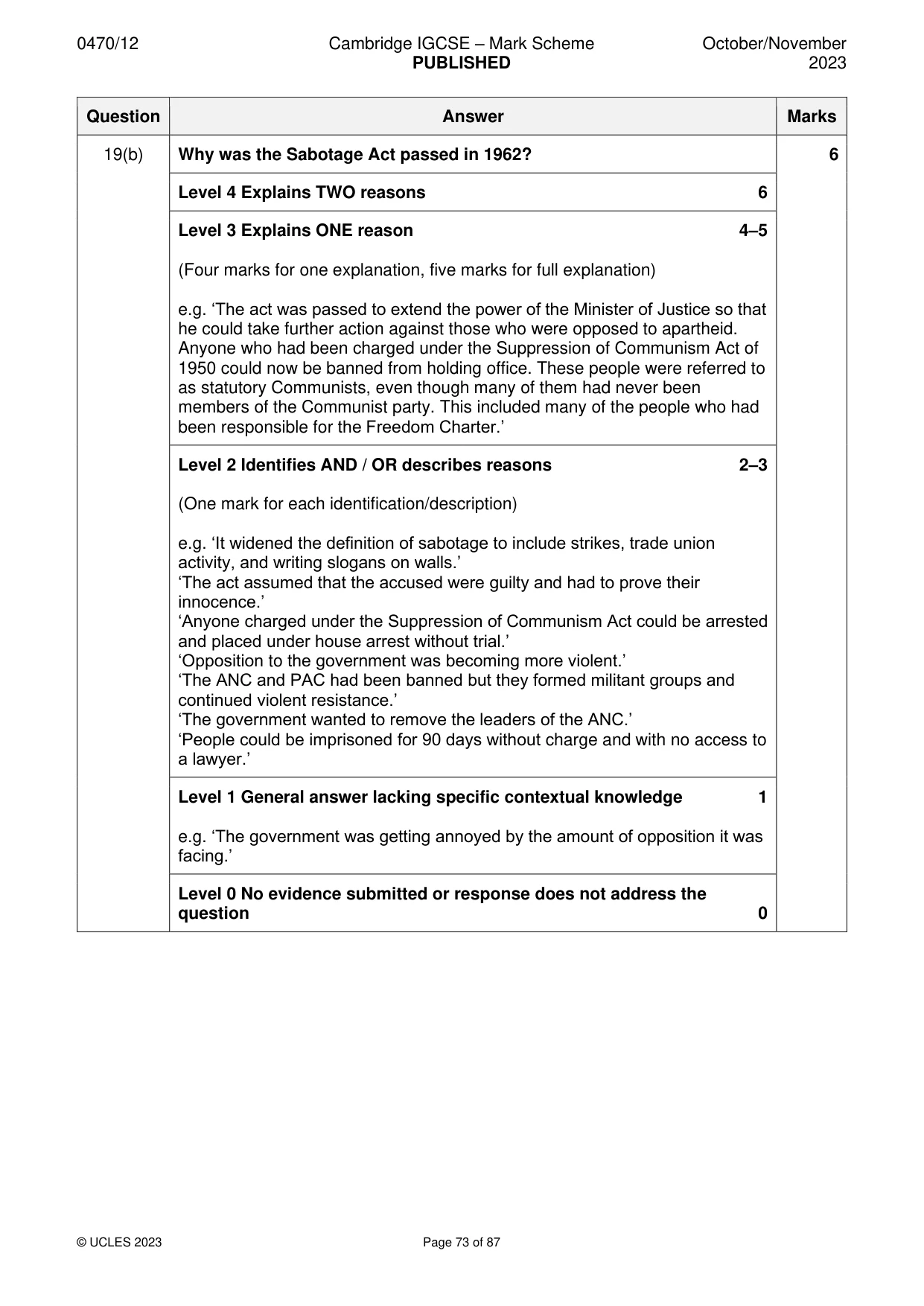
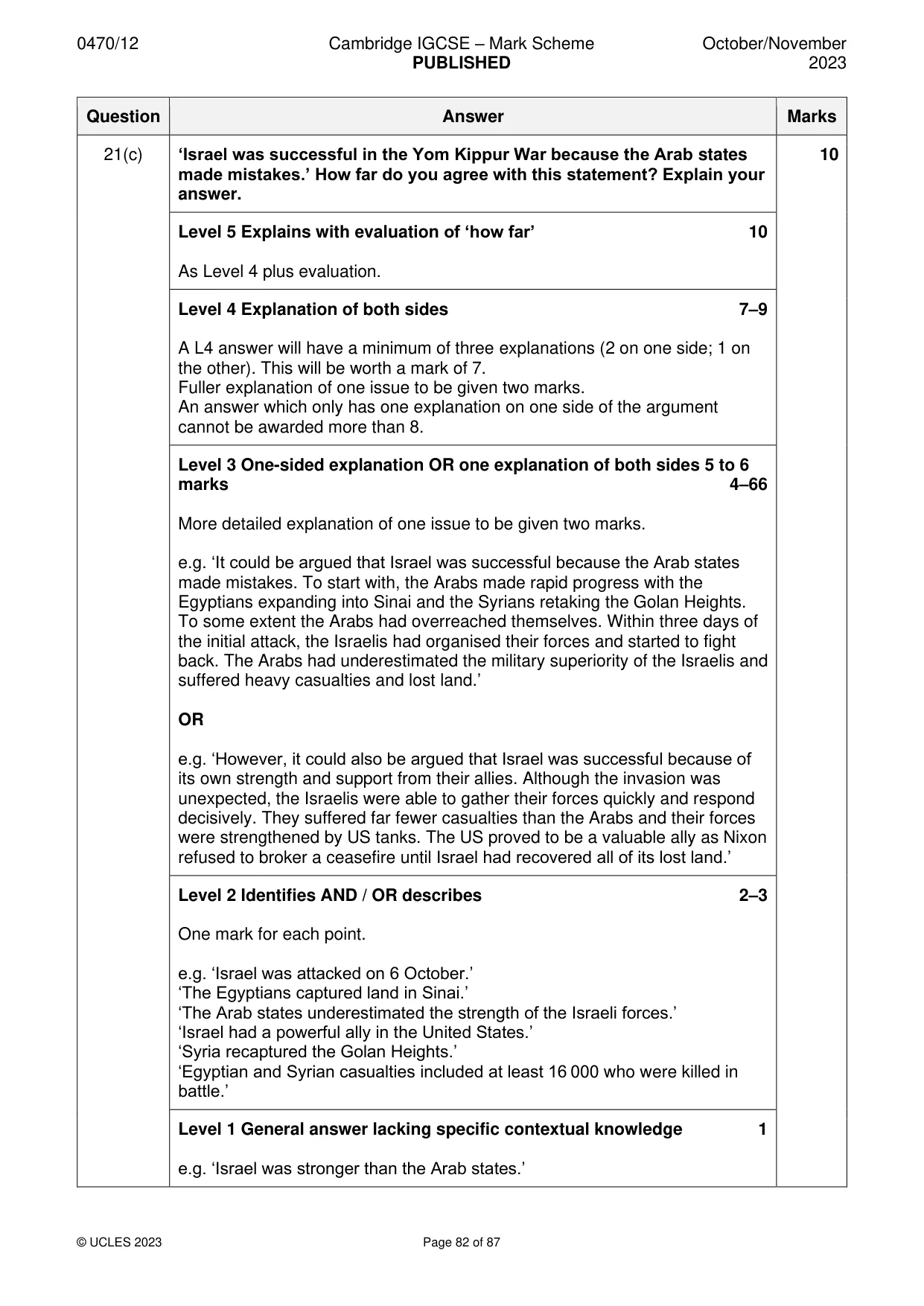
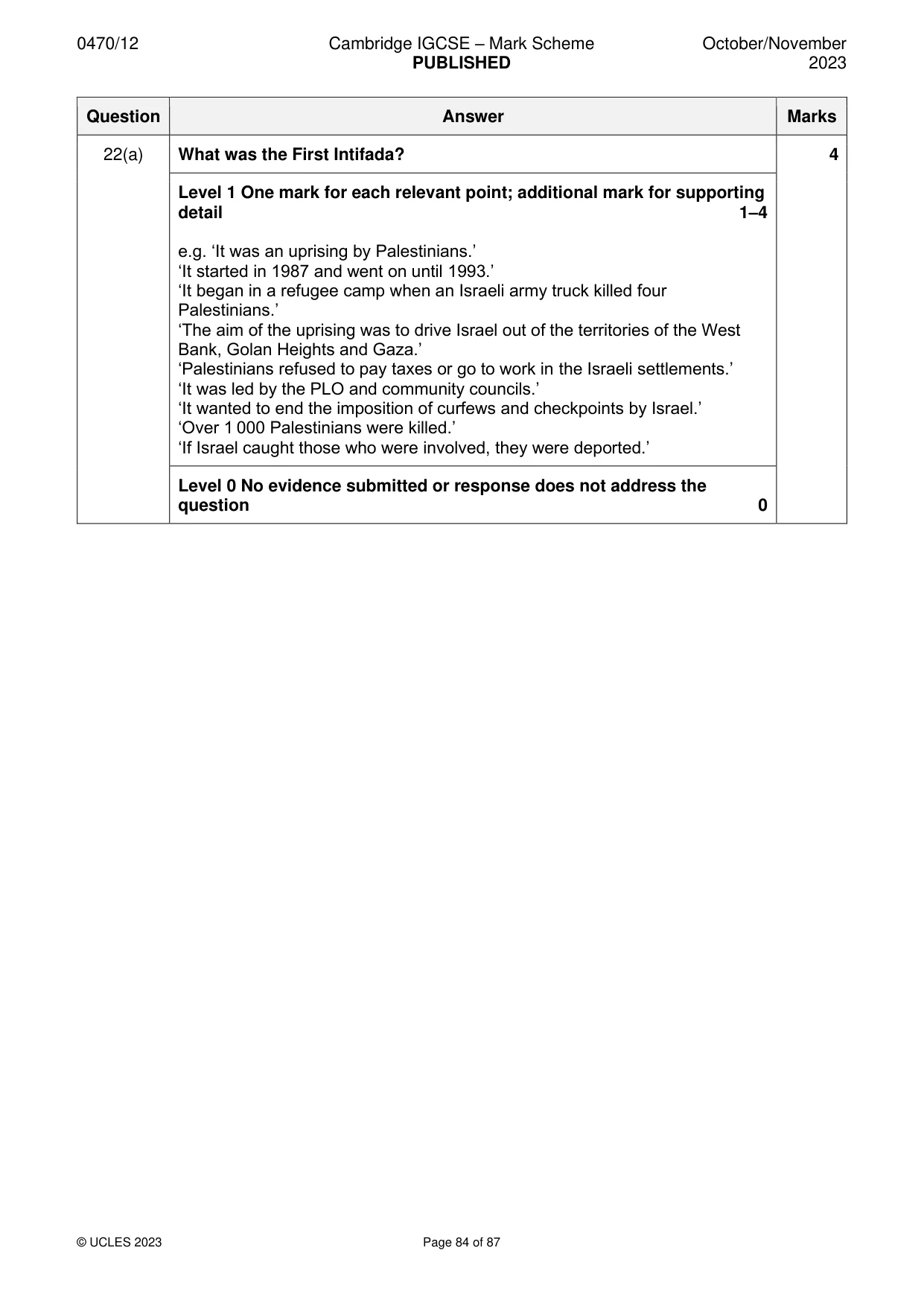
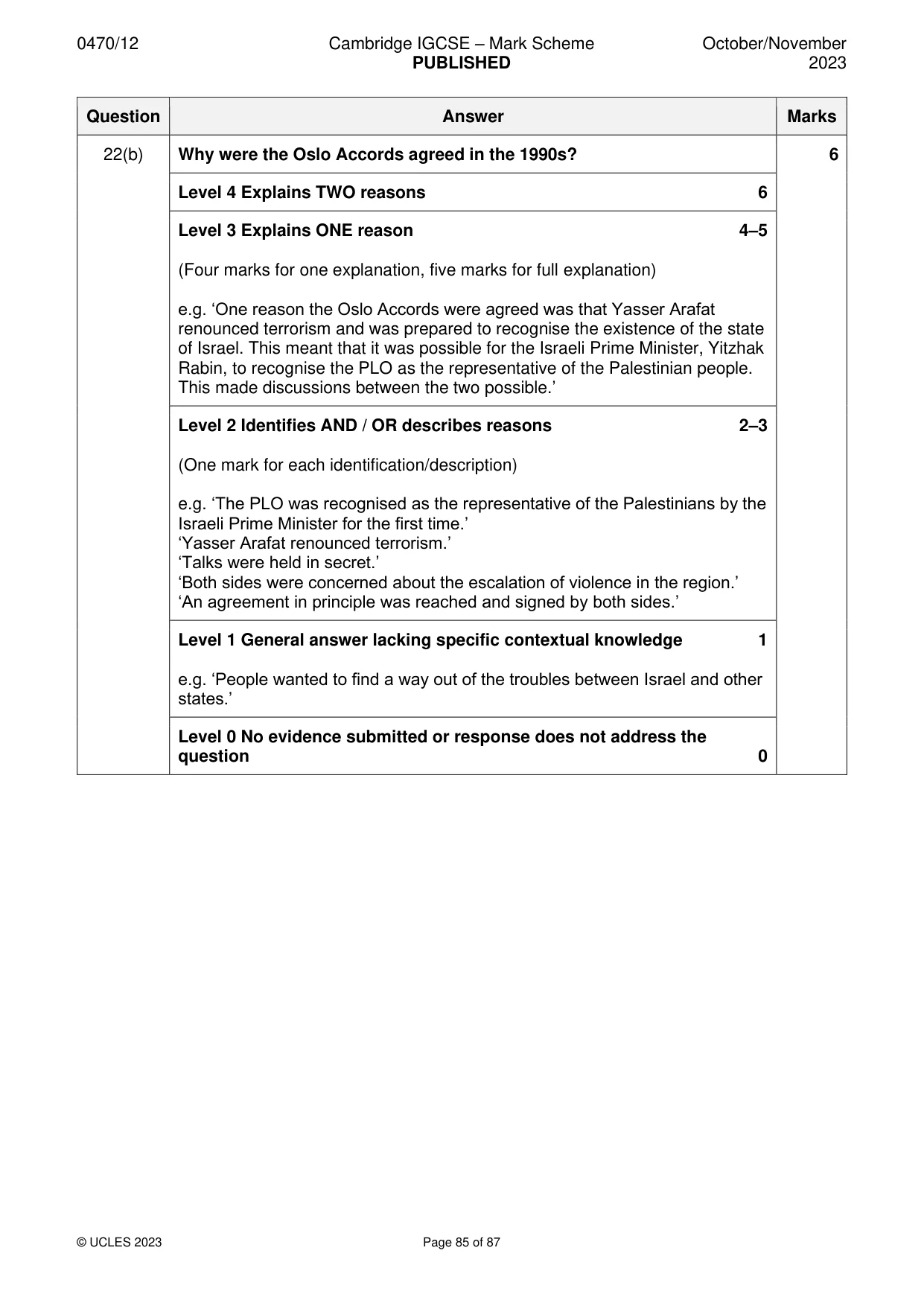
Paper as text
Question paper, page 1
This document has 12 pages. Any blank pages are indicated. [Turn over Cambridge IGCSE™ HISTORY 0470/12 Paper 1 October/November 2023 2 hours You must answer on the enclosed answer booklet. You will need: Answer booklet (enclosed) INSTRUCTIONS ● Answer three questions in total: Section A (Core Content): answer two questions. Section B (Depth Studies): answer one question. ● Follow the instructions on the front cover of the answer booklet. If you need additional answer paper, ask the invigilator for a continuation booklet. INFORMATION ● The total mark for this paper is 60. ● The number of marks for each question or part question is shown in brackets [ ]. * 6 5 5 5 4 6 6 3 8 1 * DC (LK) 314204/2 © UCLES 2023
Question paper, page 2
2 0470/12/O/N/23 © UCLES 2023 SECTION A: CORE CONTENT Answer any two questions from this section. 1 Revolutionary events spread across Europe in 1848–49. (a) What happened in Vienna in March 1848? [4] (b) Why did Louis Philippe abdicate? [6] (c) ‘Liberal ideas were more important than nationalism in causing the 1848 revolutions in the Austrian Empire.’ How far do you agree with this statement? Explain your answer. [10] 2 Early attempts to unify Italy met with failure. (a) What were Mazzini’s aims for Italy? [4] (b) Why did Cavour make an agreement with Napoleon III at Plombières in 1858? [6] (c) ‘Charles Albert was responsible for the failure of the 1848 revolution in Italy.’ How far do you agree with this statement? Explain your answer. [10] 3 Many factors contributed to the unification of Germany. (a) What did Prussia gain from the Treaty of Prague? [4] (b) Why was Prussia able to defeat Austria in 1866? [6] (c) ‘The main reason for France’s defeat in the war of 1870 was Prussia’s economic power.’ How far do you agree with this statement? Explain your answer. [10] 4 The issue of slavery caused tension in the USA. (a) Describe the actions of John Brown in supporting the abolitionist cause. [4] (b) Why did some states support slavery? [6] (c) ‘Secession was the main cause of the Civil War.’ How far do you agree with this statement? Explain your answer. [10]
Question paper, page 3
3 0470/12/O/N/23 © UCLES 2023 [Turn over 5 Negotiating the Paris peace settlement was a difficult task. (a) Describe the treatment of Turkey in the peace settlement. [4] (b) Why did Wilson and Clemenceau want different things from the peace settlement? [6] (c) ‘Lloyd George wanted Germany to be treated harshly in the peace settlement.’ How far do you agree with this statement? Explain your answer. [10] 6 The League of Nations faced many difficult situations. (a) Describe the League’s reaction to the Japanese invasion of Manchuria. [4] (b) Why did the League fail to give effective support to Haile Selassie? [6] (c) How far do you agree that the League was a success in the 1920s? Explain your answer. [10] 7 Relationships between the Allied powers deteriorated rapidly from 1945. (a) What methods did Stalin use to gain control over Eastern European states by 1948? [4] (b) Why was Berlin a cause of tension between the Allied powers? [6] (c) ‘The main reason for Stalin’s policy towards Eastern Europe was his fear of invasion from the West.’ How far do you agree with this statement? Explain your answer. [10] 8 Tension between Iraq and Kuwait led to war in 1990. (a) Describe Operation Desert Storm. [4] (b) Why did Iraqi civilians suffer because of the First Gulf War? [6] (c) How far do you agree that the cost of the war with Iran was the main reason for Iraq’s invasion of Kuwait in August 1990? Explain your answer. [10]
Question paper, page 4
4 0470/12/O/N/23 © UCLES 2023 SECTION B: DEPTH STUDIES Answer any one question from this section. DEPTH STUDY A: THE FIRST WORLD WAR, 1914–18 9 Fighting on the Western Front had reached a stalemate by the end of 1914. (a) What happened when Germany invaded Belgium in August 1914? [4] (b) Why was the ‘race to the sea’ important for the future of the war? [6] (c) ‘The Battle of Mons was the most important battle on the Western Front in 1914.’ How far do you agree with this statement? Explain your answer. [10] 10 Germany faced difficulties at home and on the battlefield in 1918. (a) Describe what happened at Kiel and Wilhelmshaven towards the end of 1918. [4] (b) Why did the USA decide to join the war on the side of the Entente powers? [6] (c) How far do you agree that the German offensive of 1918 failed because of the weakness of German forces? Explain your answer. [10]
Question paper, page 5
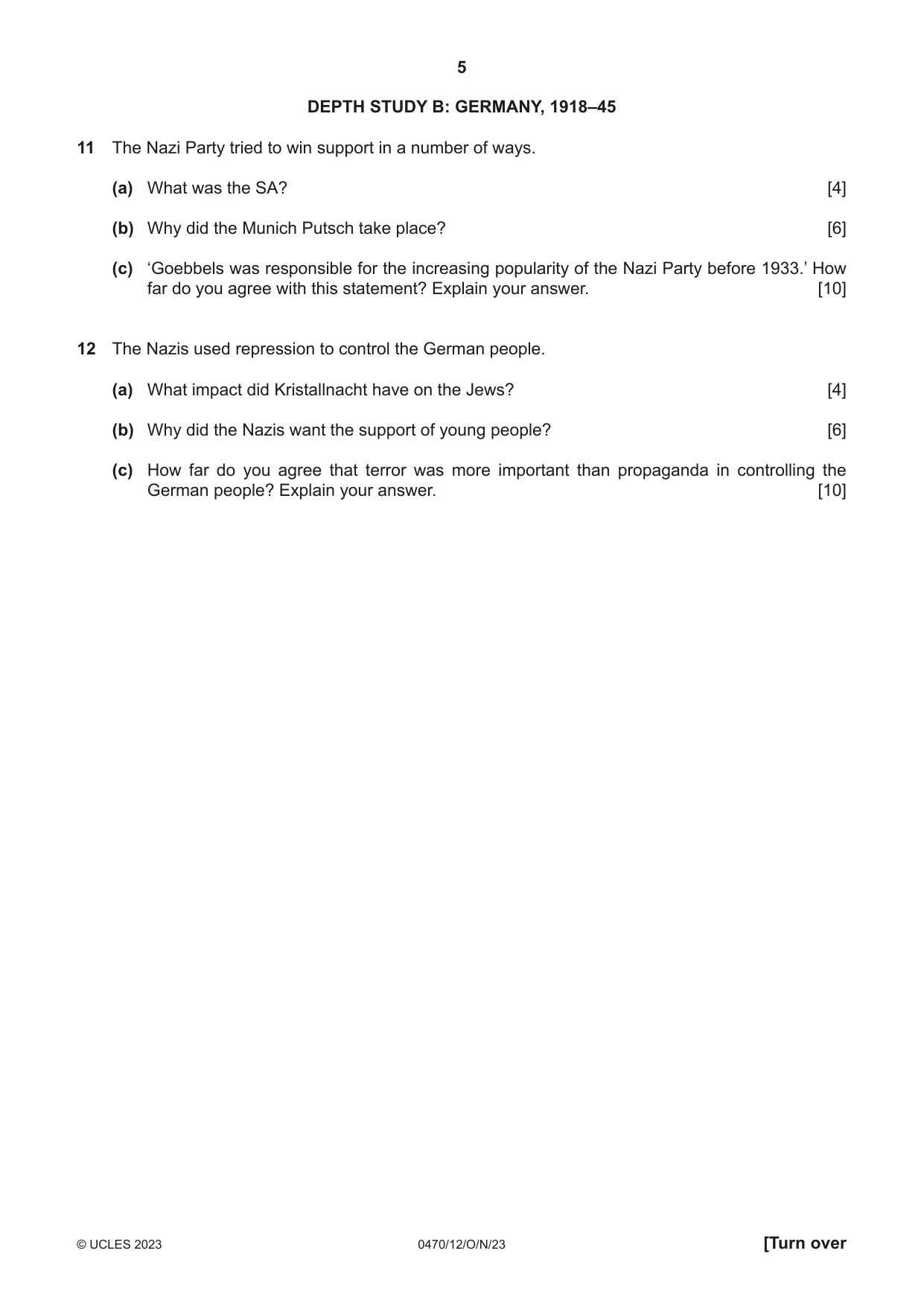
5 0470/12/O/N/23 © UCLES 2023 [Turn over DEPTH STUDY B: GERMANY, 1918–45 11 The Nazi Party tried to win support in a number of ways. (a) What was the SA? [4] (b) Why did the Munich Putsch take place? [6] (c) ‘Goebbels was responsible for the increasing popularity of the Nazi Party before 1933.’ How far do you agree with this statement? Explain your answer. [10] 12 The Nazis used repression to control the German people. (a) What impact did Kristallnacht have on the Jews? [4] (b) Why did the Nazis want the support of young people? [6] (c) How far do you agree that terror was more important than propaganda in controlling the German people? Explain your answer. [10]
Question paper, page 6
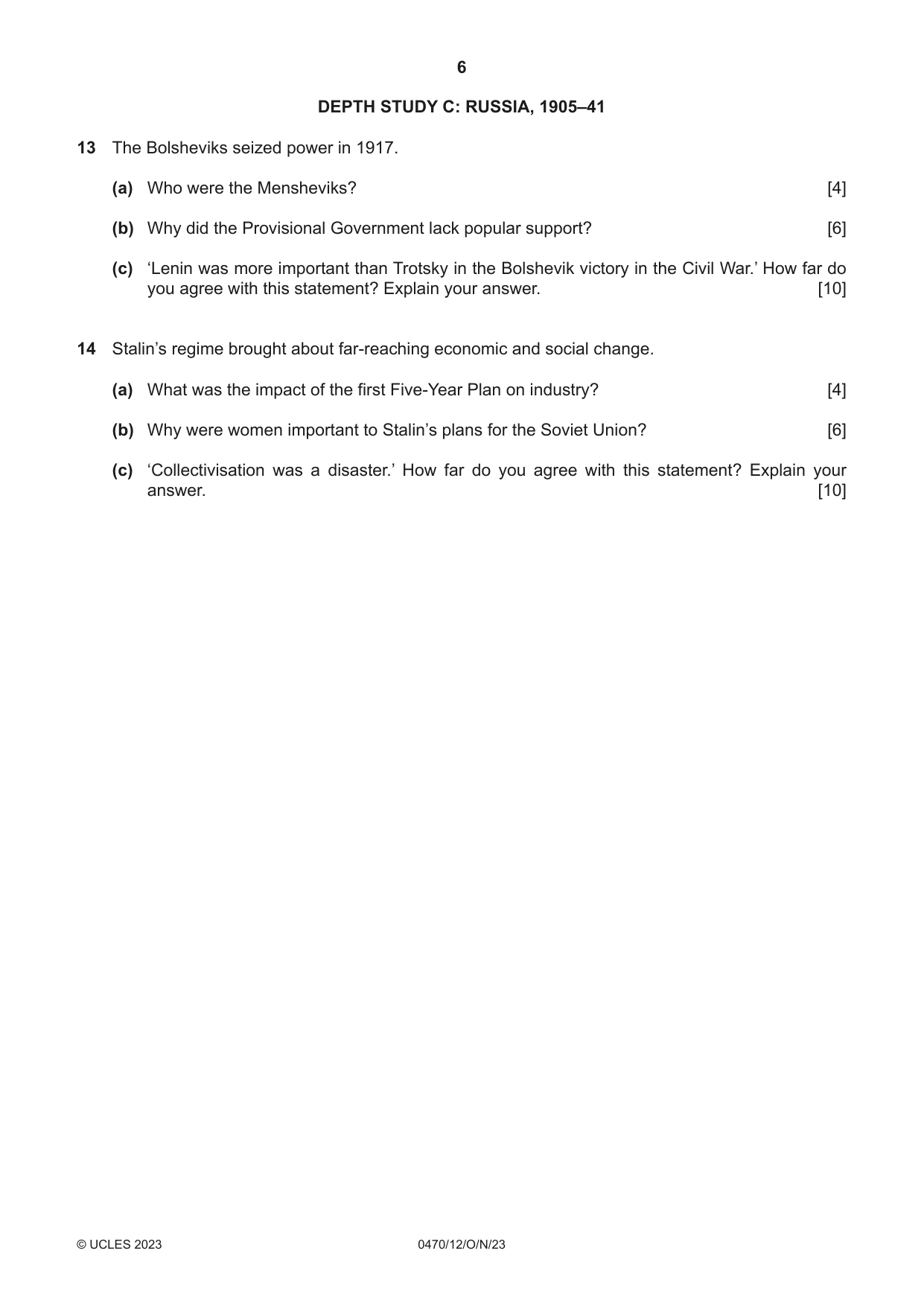
6 0470/12/O/N/23 © UCLES 2023 DEPTH STUDY C: RUSSIA, 1905–41 13 The Bolsheviks seized power in 1917. (a) Who were the Mensheviks? [4] (b) Why did the Provisional Government lack popular support? [6] (c) ‘Lenin was more important than Trotsky in the Bolshevik victory in the Civil War.’ How far do you agree with this statement? Explain your answer. [10] 14 Stalin’s regime brought about far-reaching economic and social change. (a) What was the impact of the first Five-Year Plan on industry? [4] (b) Why were women important to Stalin’s plans for the Soviet Union? [6] (c) ‘Collectivisation was a disaster.’ How far do you agree with this statement? Explain your answer. [10]
Question paper, page 7
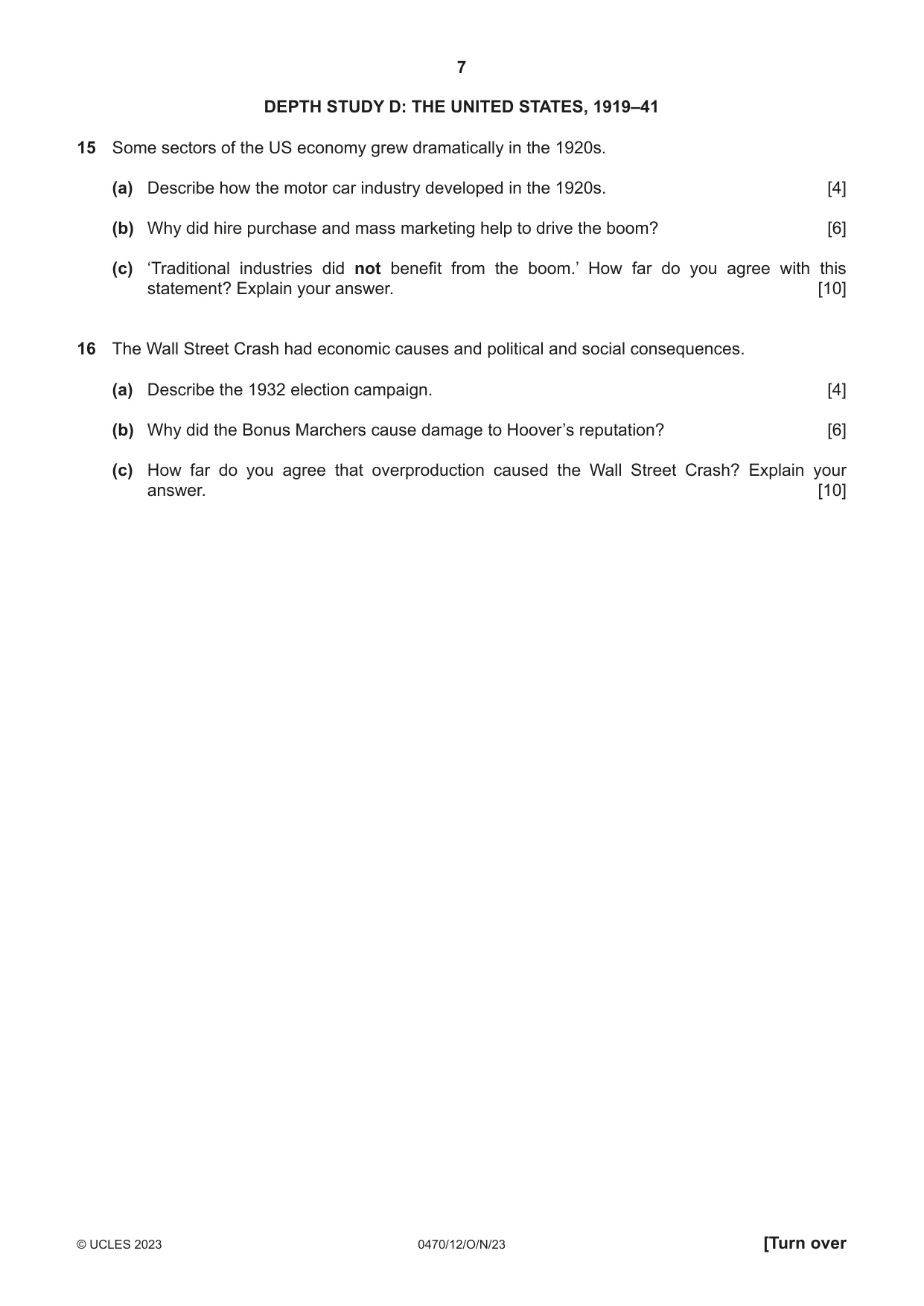
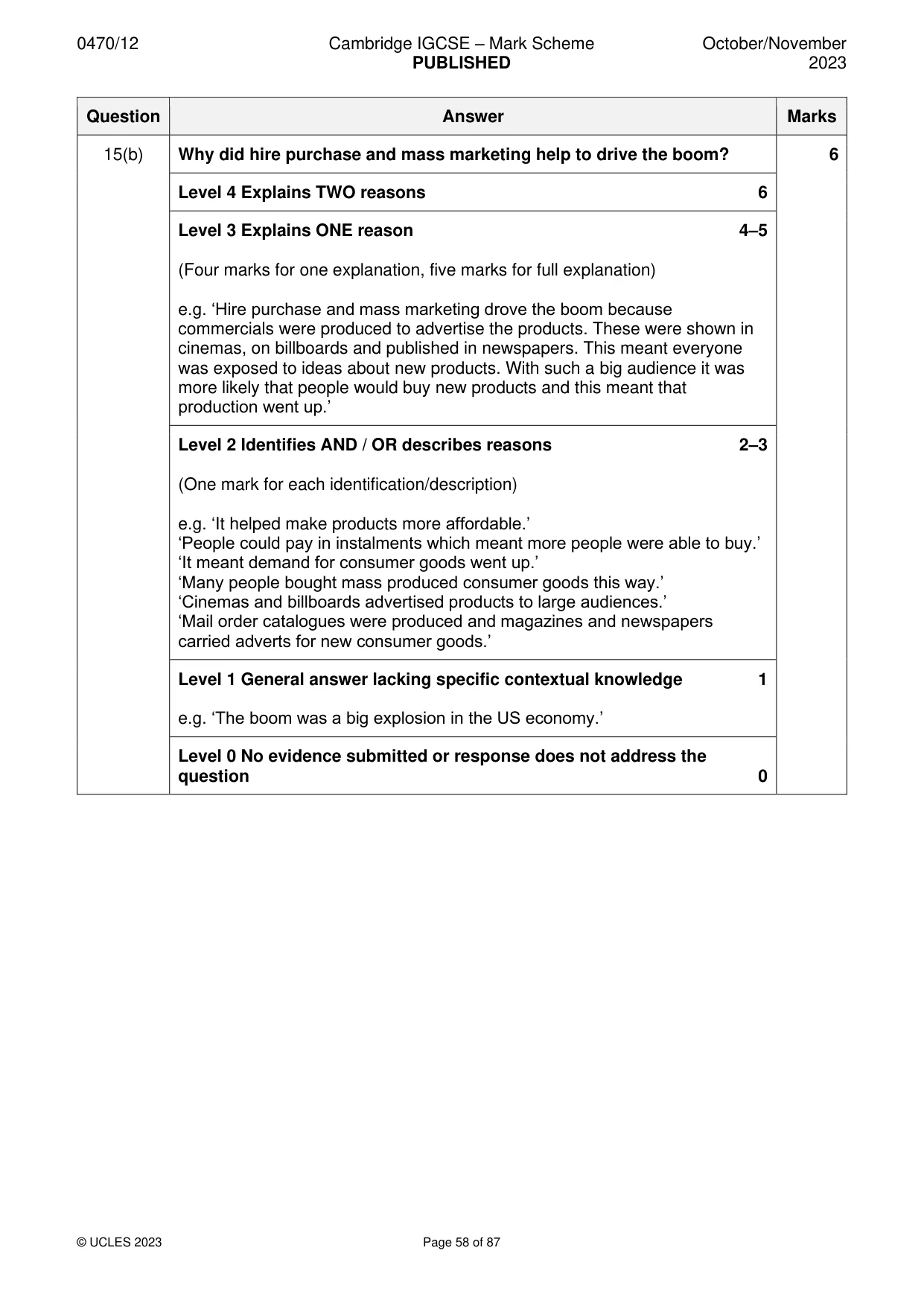
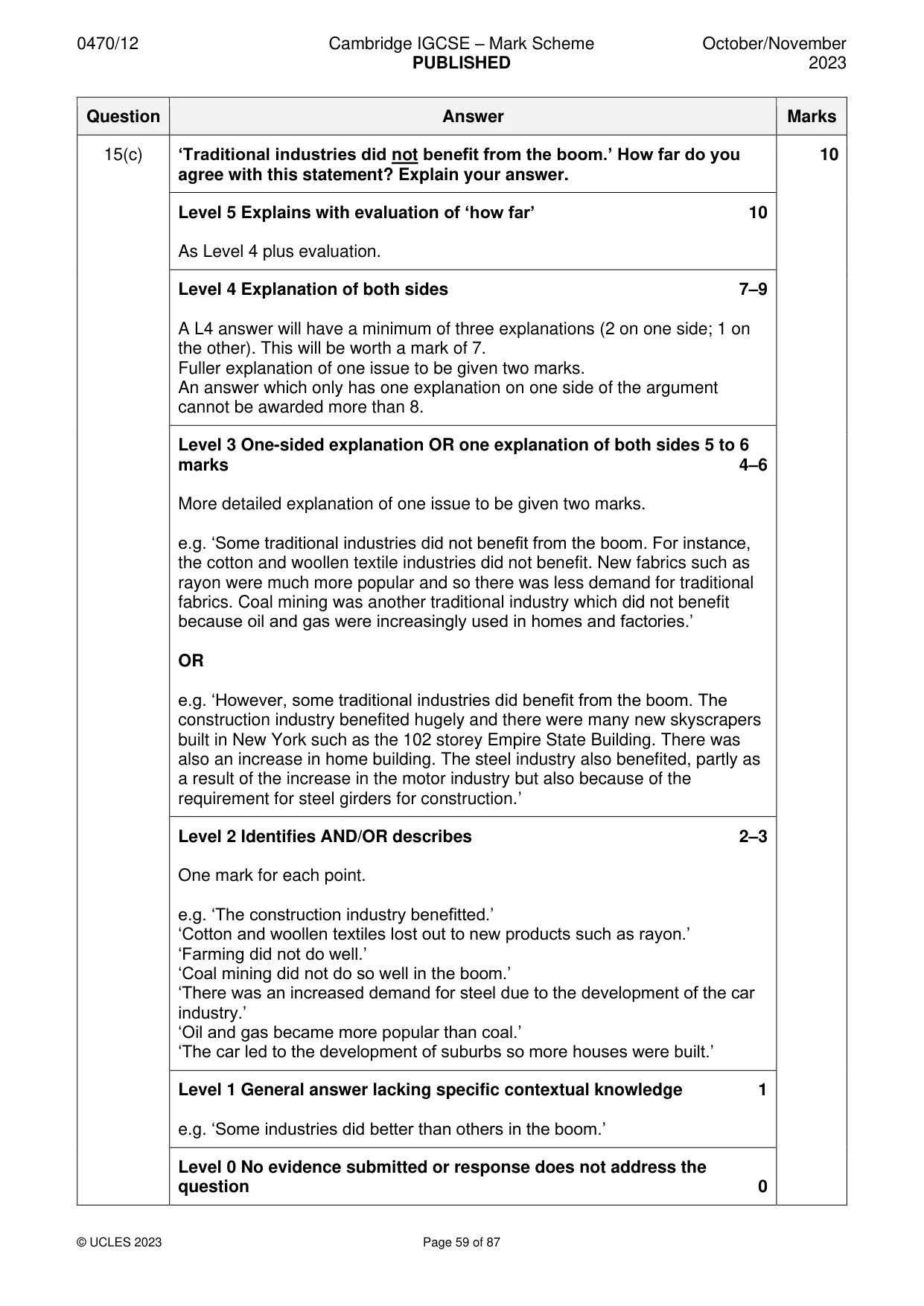
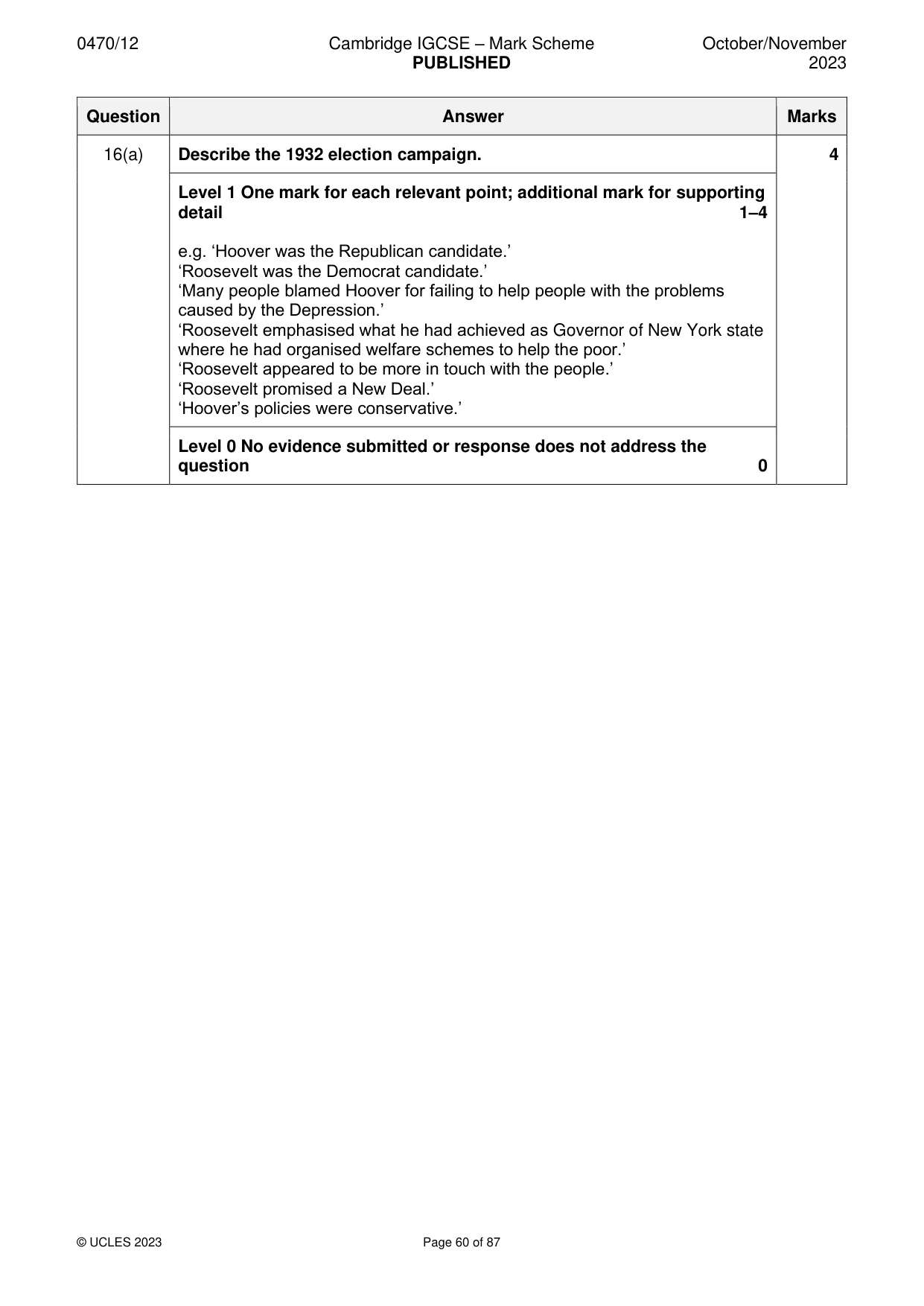
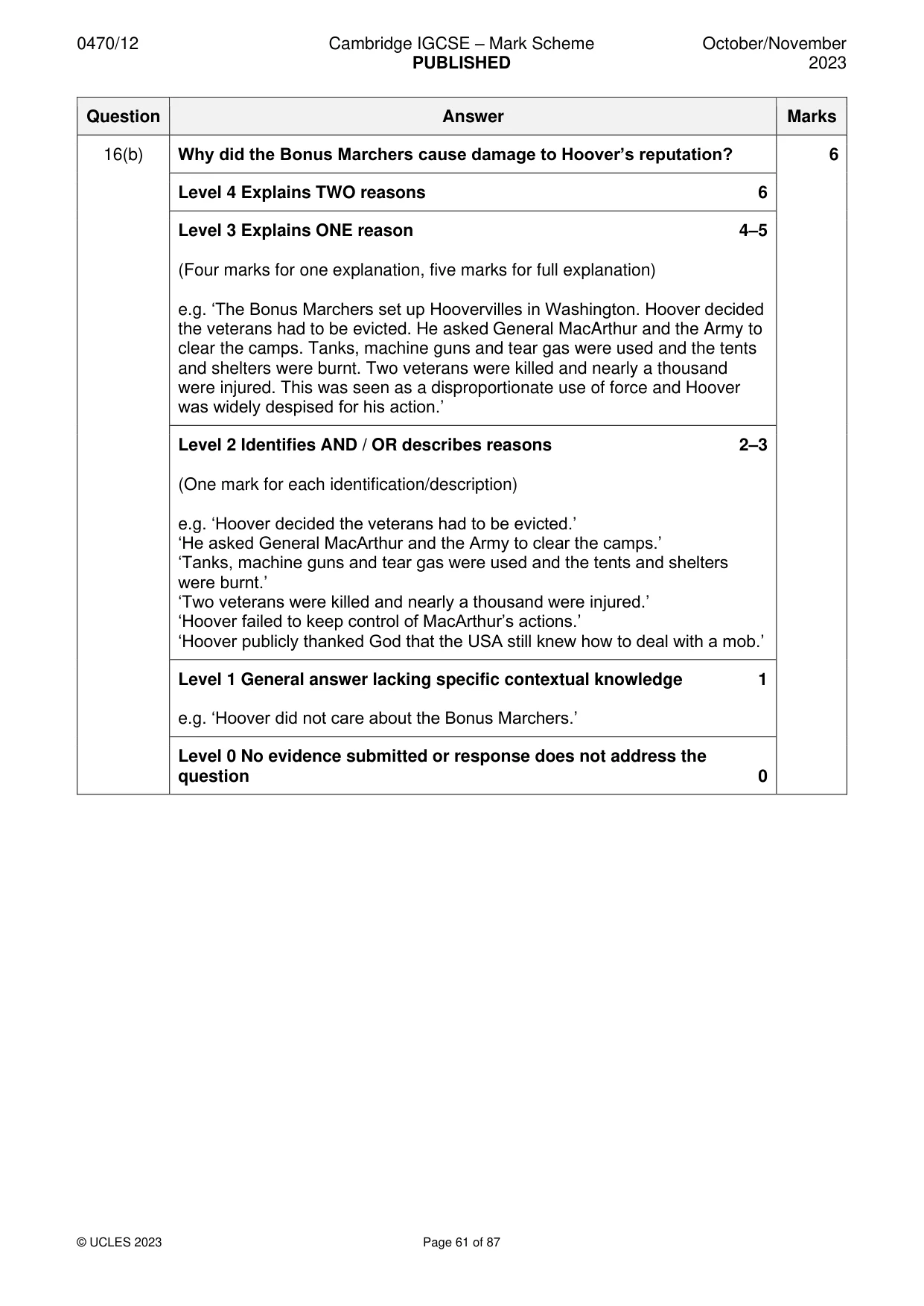
7 0470/12/O/N/23 © UCLES 2023 [Turn over DEPTH STUDY D: THE UNITED STATES, 1919–41 15 Some sectors of the US economy grew dramatically in the 1920s. (a) Describe how the motor car industry developed in the 1920s. [4] (b) Why did hire purchase and mass marketing help to drive the boom? [6] (c) ‘Traditional industries did not benefit from the boom.’ How far do you agree with this statement? Explain your answer. [10] 16 The Wall Street Crash had economic causes and political and social consequences. (a) Describe the 1932 election campaign. [4] (b) Why did the Bonus Marchers cause damage to Hoover’s reputation? [6] (c) How far do you agree that overproduction caused the Wall Street Crash? Explain your answer. [10]
Question paper, page 8
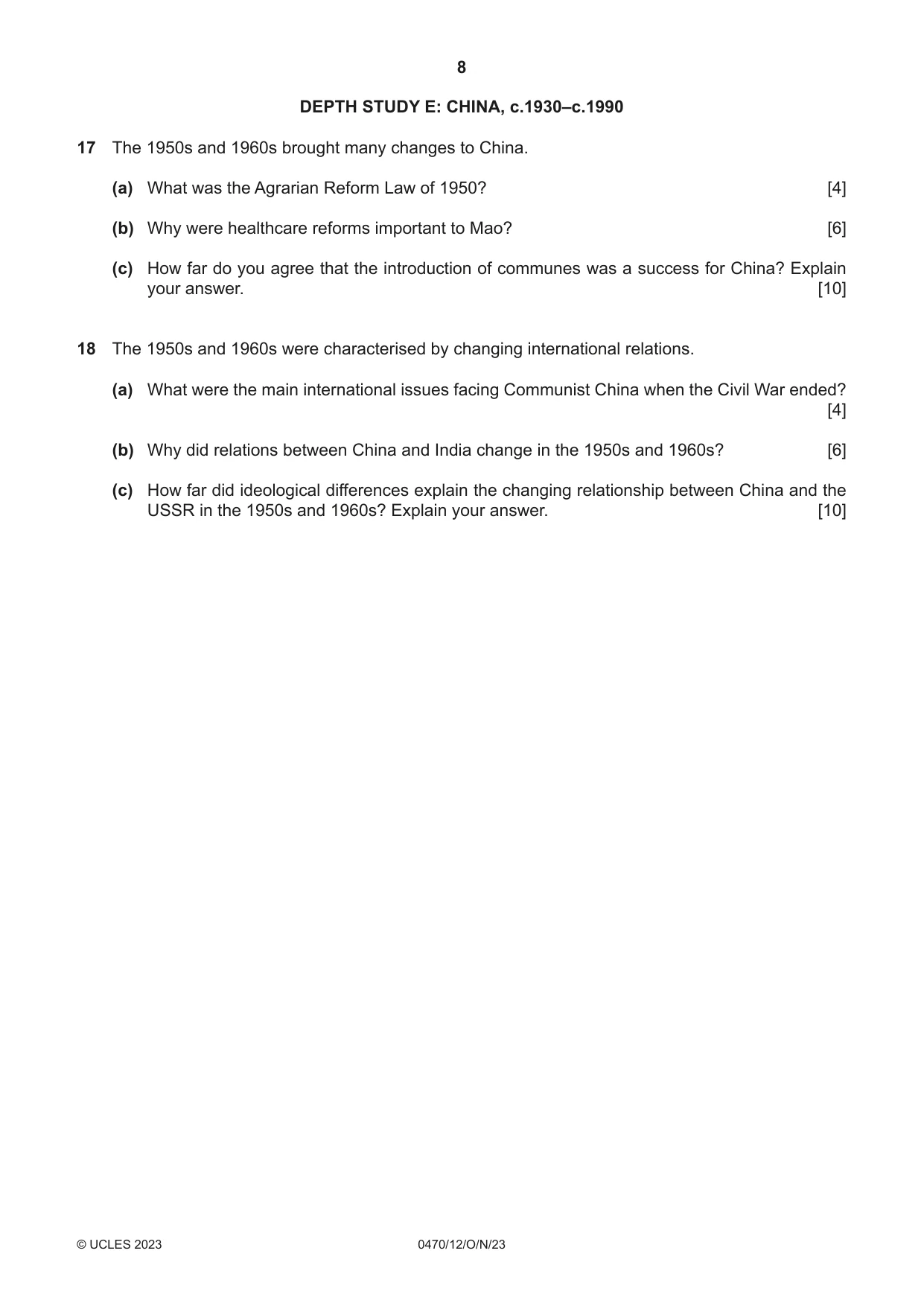
8 0470/12/O/N/23 © UCLES 2023 DEPTH STUDY E: CHINA, c.1930–c.1990 17 The 1950s and 1960s brought many changes to China. (a) What was the Agrarian Reform Law of 1950? [4] (b) Why were healthcare reforms important to Mao? [6] (c) How far do you agree that the introduction of communes was a success for China? Explain your answer. [10] 18 The 1950s and 1960s were characterised by changing international relations. (a) What were the main international issues facing Communist China when the Civil War ended? [4] (b) Why did relations between China and India change in the 1950s and 1960s? [6] (c) How far did ideological differences explain the changing relationship between China and the USSR in the 1950s and 1960s? Explain your answer. [10]
Question paper, page 9
9 0470/12/O/N/23 © UCLES 2023 [Turn over DEPTH STUDY F: SOUTH AFRICA, c.1940–c.1994 19 There were many attempts to strengthen apartheid over the years. (a) What were Verwoerd’s aims in creating Bantustans? [4] (b) Why was the Sabotage Act passed in 1962? [6] (c) How far do you agree that the Pass Laws were the most important element of the apartheid system? Explain your answer. [10] 20 It was difficult to achieve a peaceful transition of power. (a) What was Joe Slovo’s role in helping to bring apartheid to an end? [4] (b) Why did white extremist groups challenge government policies during the 1980s? [6] (c) ‘The greatest threat to the transition to majority rule was de Klerk’s failure to control the security forces.’ How far do you agree with this statement? Explain your answer. [10]
Question paper, page 10
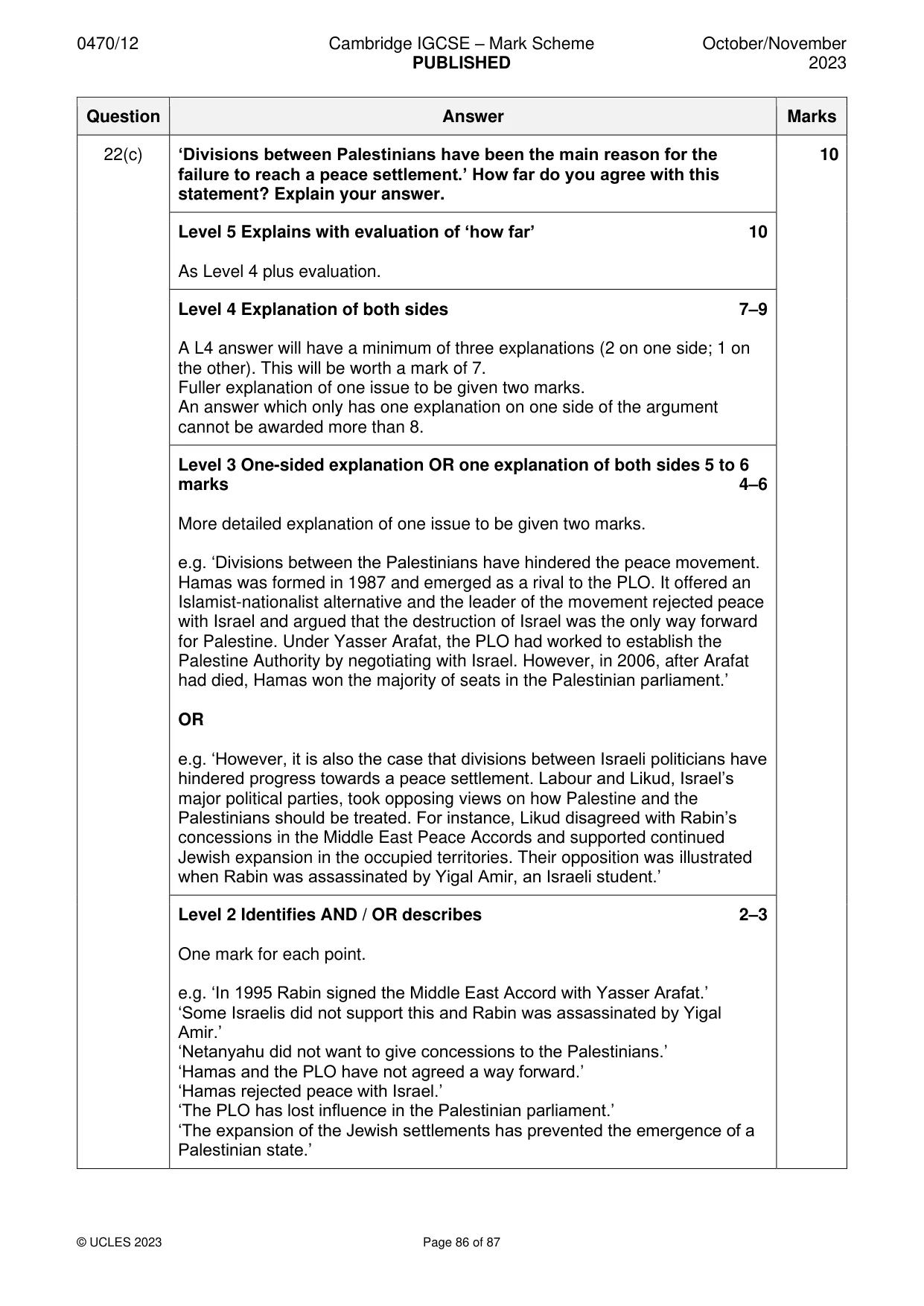
10 0470/12/O/N/23 © UCLES 2023 DEPTH STUDY G: ISRAELIS AND PALESTINIANS SINCE 1945 21 There was much tension between Israel and its neighbours. (a) Describe the role of the USA in the Suez Crisis. [4] (b) Why did war break out in June 1967? [6] (c) ‘Israel was successful in the Yom Kippur War because the Arab states made mistakes.’ How far do you agree with this statement? Explain your answer. [10] 22 Attempting to reach a peace settlement has been difficult. (a) What was the First Intifada? [4] (b) Why were the Oslo Accords agreed in the 1990s? [6] (c) ‘Divisions between Palestinians have been the main reason for the failure to reach a peace settlement.’ How far do you agree with this statement? Explain your answer. [10]
Question paper, page 11
11 0470/12/O/N/23 © UCLES 2023 BLANK PAGE
Question paper, page 12
12 0470/12/O/N/23 © UCLES 2023 Permission to reproduce items where third-party owned material protected by copyright is included has been sought and cleared where possible. Every reasonable effort has been made by the publisher (UCLES) to trace copyright holders, but if any items requiring clearance have unwittingly been included, the publisher will be pleased to make amends at the earliest possible opportunity. To avoid the issue of disclosure of answer-related information to candidates, all copyright acknowledgements are reproduced online in the Cambridge Assessment International Education Copyright Acknowledgements Booklet. This is produced for each series of examinations and is freely available to download at www.cambridgeinternational.org after the live examination series. Cambridge Assessment International Education is part of Cambridge Assessment. Cambridge Assessment is the brand name of the University of Cambridge Local Examinations Syndicate (UCLES), which is a department of the University of Cambridge. BLANK PAGE
Mark scheme, page 1
This document consists of 87 printed pages. © UCLES 2023 [Turn over Cambridge IGCSE™ HISTORY 0470/12 Paper 1 October/November 2023 MARK SCHEME Maximum Mark: 60 Published This mark scheme is published as an aid to teachers and candidates, to indicate the requirements of the examination. It shows the basis on which Examiners were instructed to award marks. It does not indicate the details of the discussions that took place at an Examiners’ meeting before marking began, which would have considered the acceptability of alternative answers. Mark schemes should be read in conjunction with the question paper and the Principal Examiner Report for Teachers. Cambridge International will not enter into discussions about these mark schemes. Cambridge International is publishing the mark schemes for the October/November 2023 series for most Cambridge IGCSE, Cambridge International A and AS Level components, and some Cambridge O Level components.
Mark scheme, page 2
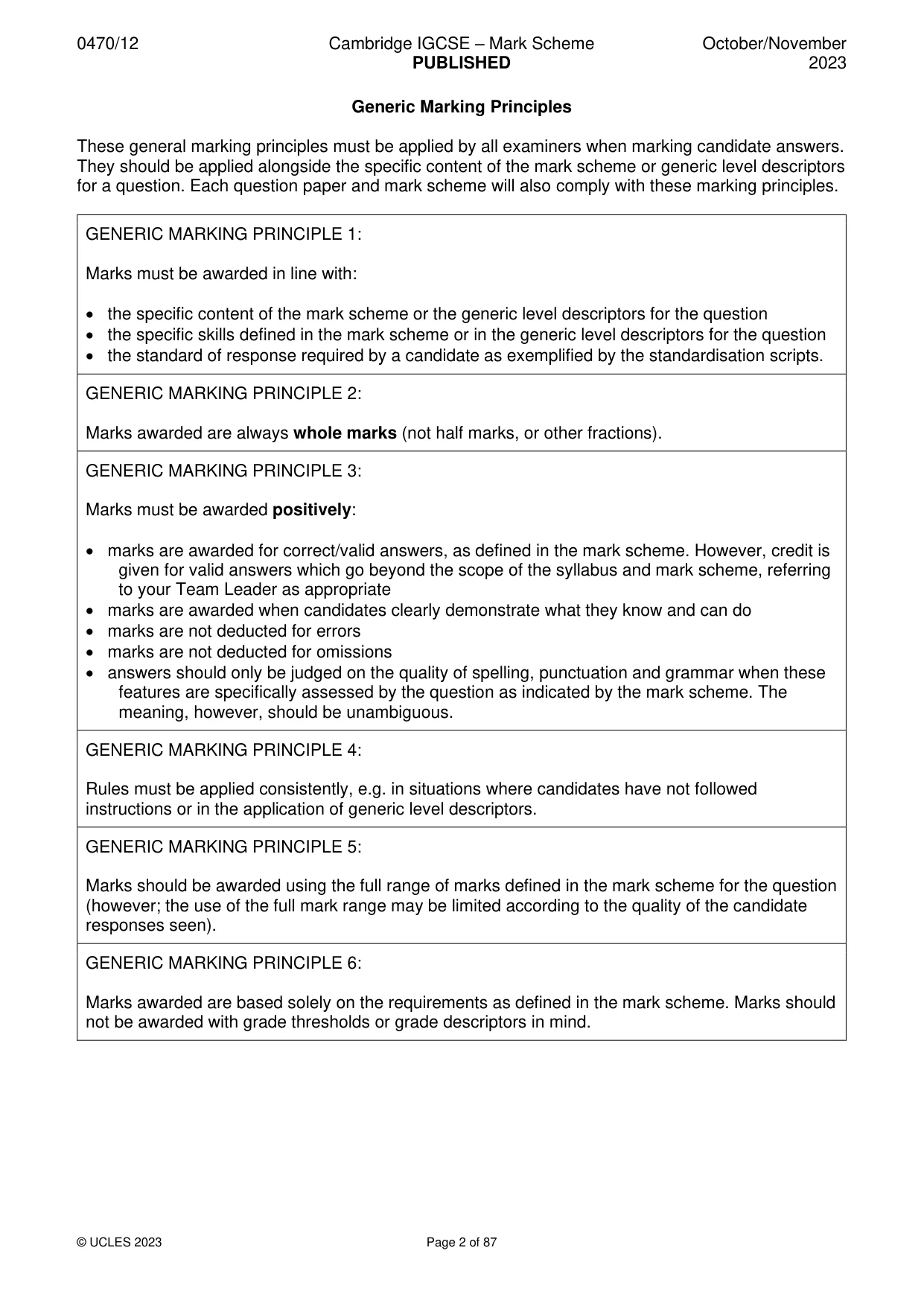
0470/12 Cambridge IGCSE – Mark Scheme PUBLISHED October/November 2023 © UCLES 2023 Page 2 of 87 Generic Marking Principles These general marking principles must be applied by all examiners when marking candidate answers. They should be applied alongside the specific content of the mark scheme or generic level descriptors for a question. Each question paper and mark scheme will also comply with these marking principles. GENERIC MARKING PRINCIPLE 1: Marks must be awarded in line with: • the specific content of the mark scheme or the generic level descriptors for the question • the specific skills defined in the mark scheme or in the generic level descriptors for the question • the standard of response required by a candidate as exemplified by the standardisation scripts. GENERIC MARKING PRINCIPLE 2: Marks awarded are always whole marks (not half marks, or other fractions). GENERIC MARKING PRINCIPLE 3: Marks must be awarded positively: • marks are awarded for correct/valid answers, as defined in the mark scheme. However, credit is given for valid answers which go beyond the scope of the syllabus and mark scheme, referring to your Team Leader as appropriate • marks are awarded when candidates clearly demonstrate what they know and can do • marks are not deducted for errors • marks are not deducted for omissions • answers should only be judged on the quality of spelling, punctuation and grammar when these features are specifically assessed by the question as indicated by the mark scheme. The meaning, however, should be unambiguous. GENERIC MARKING PRINCIPLE 4: Rules must be applied consistently, e.g. in situations where candidates have not followed instructions or in the application of generic level descriptors. GENERIC MARKING PRINCIPLE 5: Marks should be awarded using the full range of marks defined in the mark scheme for the question (however; the use of the full mark range may be limited according to the quality of the candidate responses seen). GENERIC MARKING PRINCIPLE 6: Marks awarded are based solely on the requirements as defined in the mark scheme. Marks should not be awarded with grade thresholds or grade descriptors in mind.
Mark scheme, page 3
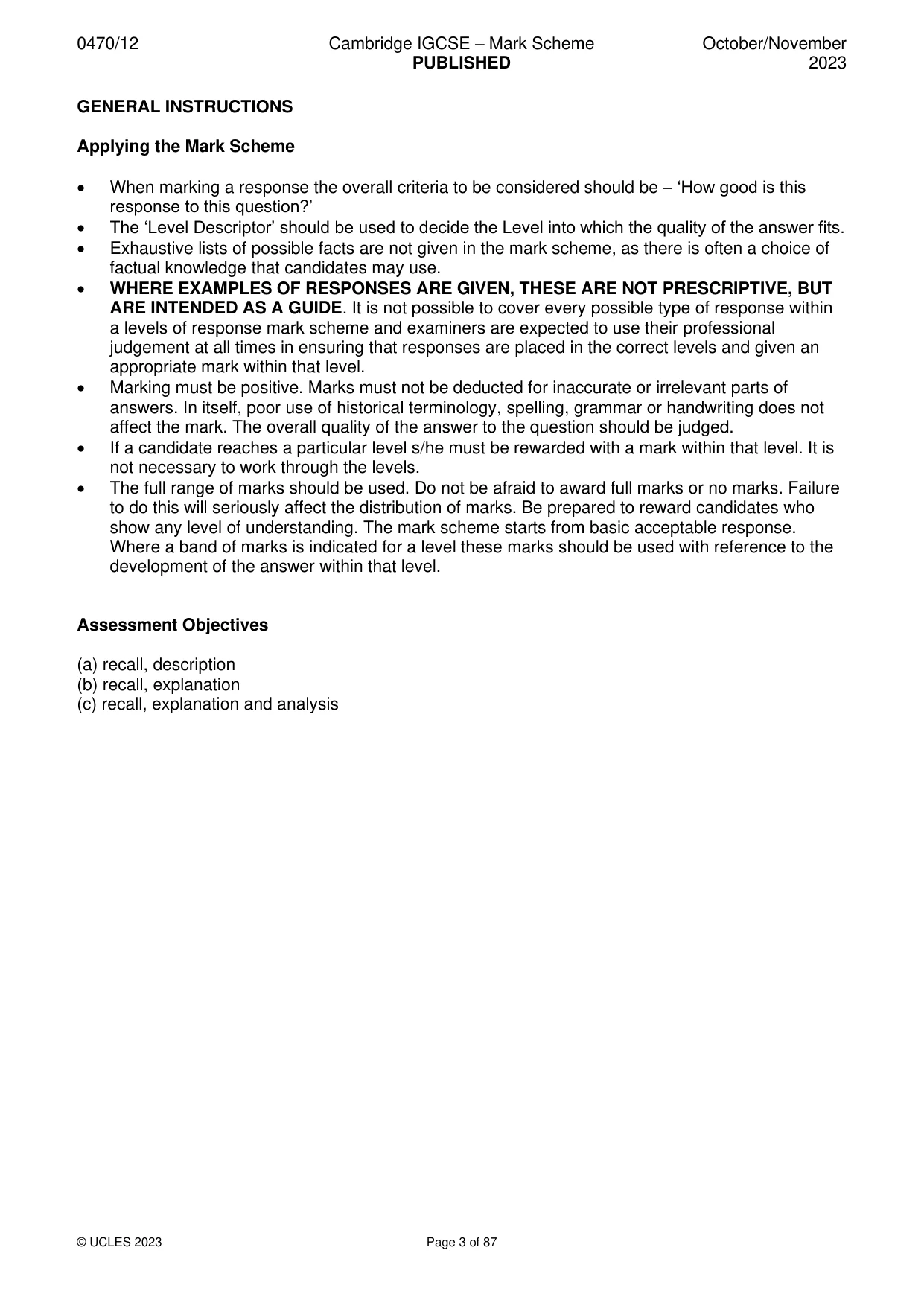
0470/12 Cambridge IGCSE – Mark Scheme PUBLISHED October/November 2023 © UCLES 2023 Page 3 of 87 GENERAL INSTRUCTIONS Applying the Mark Scheme • When marking a response the overall criteria to be considered should be – ‘How good is this response to this question?’ • The ‘Level Descriptor’ should be used to decide the Level into which the quality of the answer fits. • Exhaustive lists of possible facts are not given in the mark scheme, as there is often a choice of factual knowledge that candidates may use. • WHERE EXAMPLES OF RESPONSES ARE GIVEN, THESE ARE NOT PRESCRIPTIVE, BUT ARE INTENDED AS A GUIDE. It is not possible to cover every possible type of response within a levels of response mark scheme and examiners are expected to use their professional judgement at all times in ensuring that responses are placed in the correct levels and given an appropriate mark within that level. • Marking must be positive. Marks must not be deducted for inaccurate or irrelevant parts of answers. In itself, poor use of historical terminology, spelling, grammar or handwriting does not affect the mark. The overall quality of the answer to the question should be judged. • If a candidate reaches a particular level s/he must be rewarded with a mark within that level. It is not necessary to work through the levels. • The full range of marks should be used. Do not be afraid to award full marks or no marks. Failure to do this will seriously affect the distribution of marks. Be prepared to reward candidates who show any level of understanding. The mark scheme starts from basic acceptable response. Where a band of marks is indicated for a level these marks should be used with reference to the development of the answer within that level. Assessment Objectives (a) recall, description (b) recall, explanation (c) recall, explanation and analysis
Mark scheme, page 4
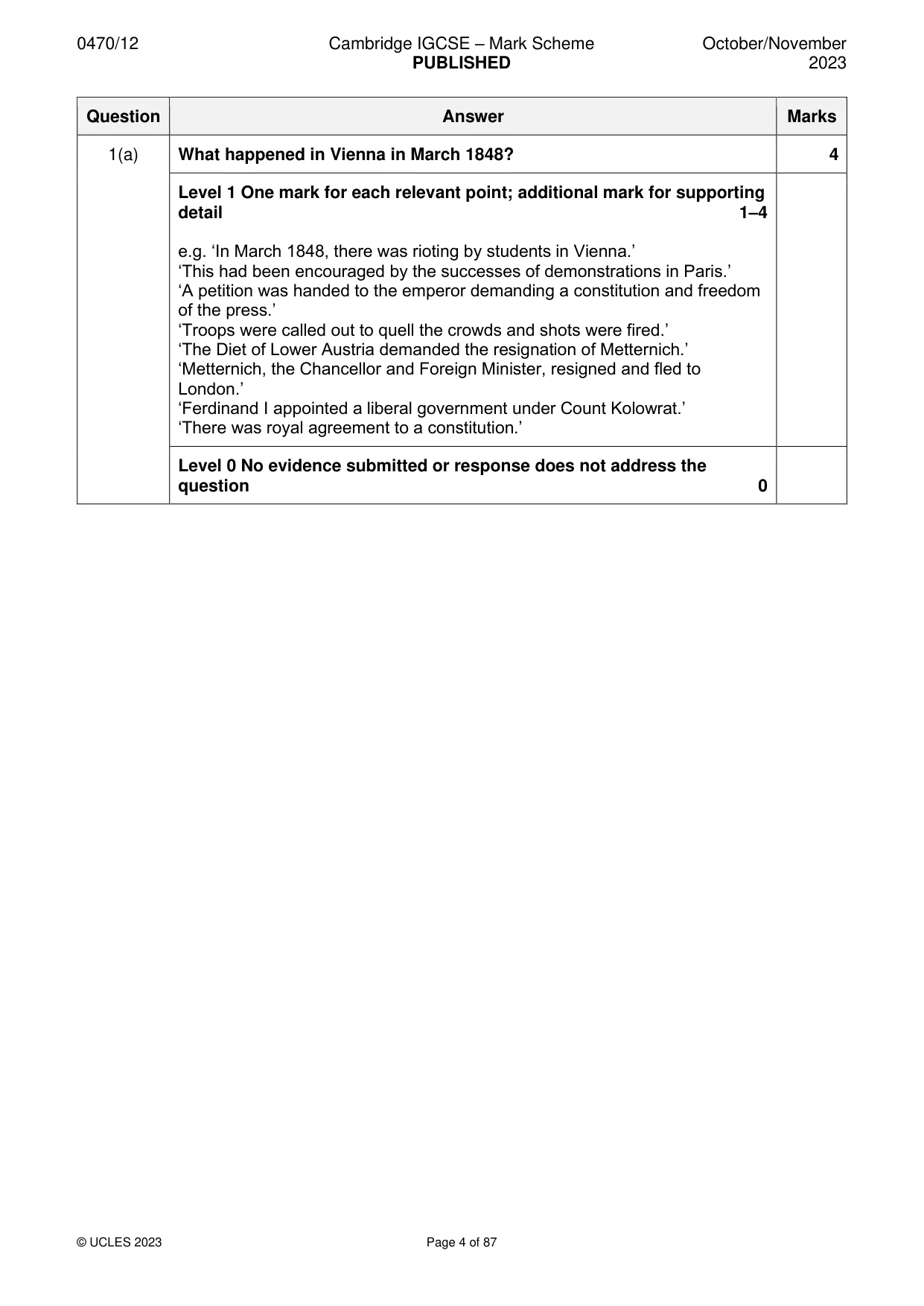
0470/12 Cambridge IGCSE – Mark Scheme PUBLISHED October/November 2023 © UCLES 2023 Page 4 of 87 Question Answer Marks 1(a) What happened in Vienna in March 1848? 4 Level 1 One mark for each relevant point; additional mark for supporting detail 1–4 e.g. ‘In March 1848, there was rioting by students in Vienna.’ ‘This had been encouraged by the successes of demonstrations in Paris.’ ‘A petition was handed to the emperor demanding a constitution and freedom of the press.’ ‘Troops were called out to quell the crowds and shots were fired.’ ‘The Diet of Lower Austria demanded the resignation of Metternich.’ ‘Metternich, the Chancellor and Foreign Minister, resigned and fled to London.’ ‘Ferdinand I appointed a liberal government under Count Kolowrat.’ ‘There was royal agreement to a constitution.’ Level 0 No evidence submitted or response does not address the question 0
Mark scheme, page 5
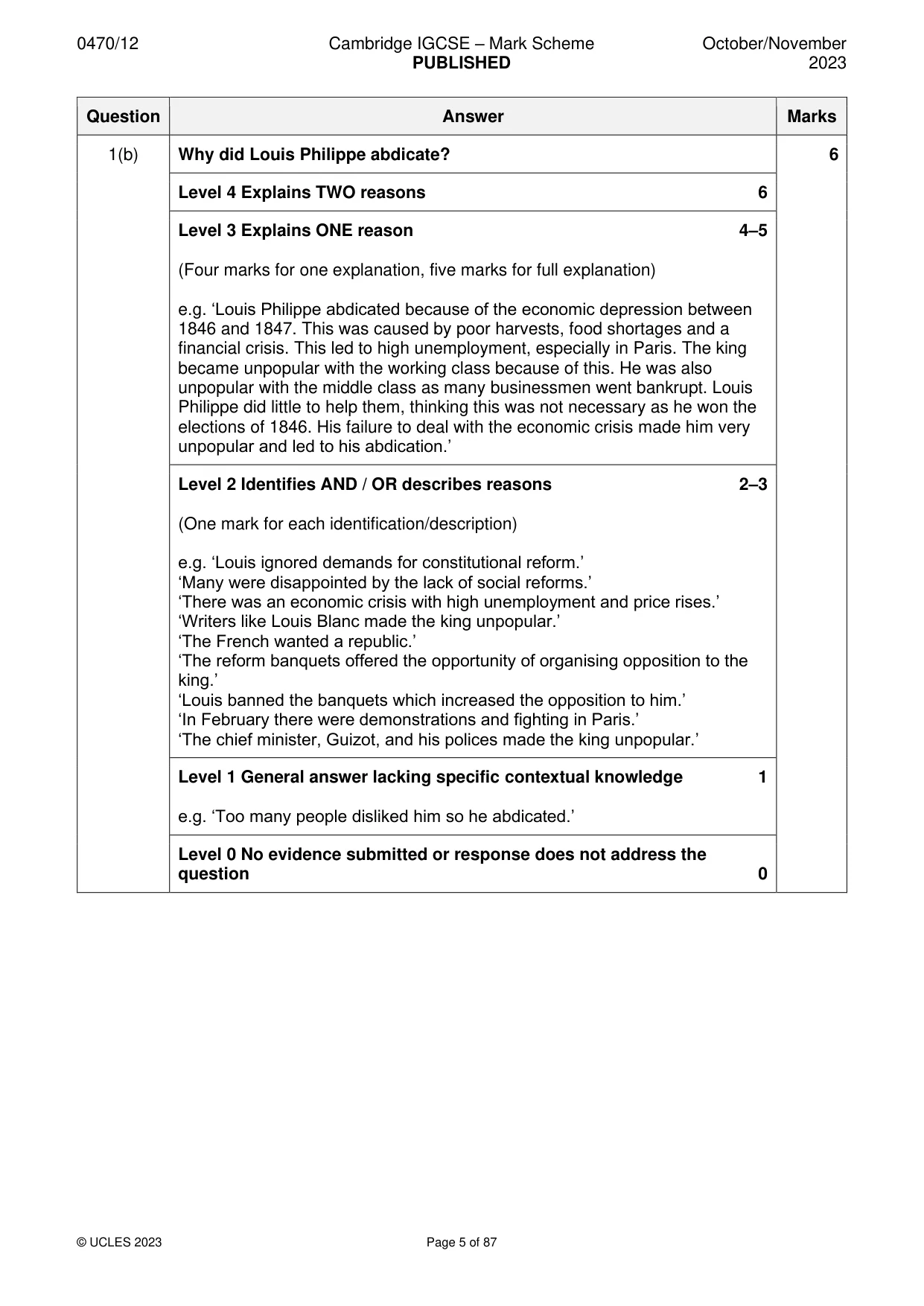
0470/12 Cambridge IGCSE – Mark Scheme PUBLISHED October/November 2023 © UCLES 2023 Page 5 of 87 Question Answer Marks 1(b) Why did Louis Philippe abdicate? 6 Level 4 Explains TWO reasons 6 Level 3 Explains ONE reason 4–5 (Four marks for one explanation, five marks for full explanation) e.g. ‘Louis Philippe abdicated because of the economic depression between 1846 and 1847. This was caused by poor harvests, food shortages and a financial crisis. This led to high unemployment, especially in Paris. The king became unpopular with the working class because of this. He was also unpopular with the middle class as many businessmen went bankrupt. Louis Philippe did little to help them, thinking this was not necessary as he won the elections of 1846. His failure to deal with the economic crisis made him very unpopular and led to his abdication.’ Level 2 Identifies AND / OR describes reasons 2–3 (One mark for each identification/description) e.g. ‘Louis ignored demands for constitutional reform.’ ‘Many were disappointed by the lack of social reforms.’ ‘There was an economic crisis with high unemployment and price rises.’ ‘Writers like Louis Blanc made the king unpopular.’ ‘The French wanted a republic.’ ‘The reform banquets offered the opportunity of organising opposition to the king.’ ‘Louis banned the banquets which increased the opposition to him.’ ‘In February there were demonstrations and fighting in Paris.’ ‘The chief minister, Guizot, and his polices made the king unpopular.’ Level 1 General answer lacking specific contextual knowledge 1 e.g. ‘Too many people disliked him so he abdicated.’ Level 0 No evidence submitted or response does not address the question 0
Mark scheme, page 6
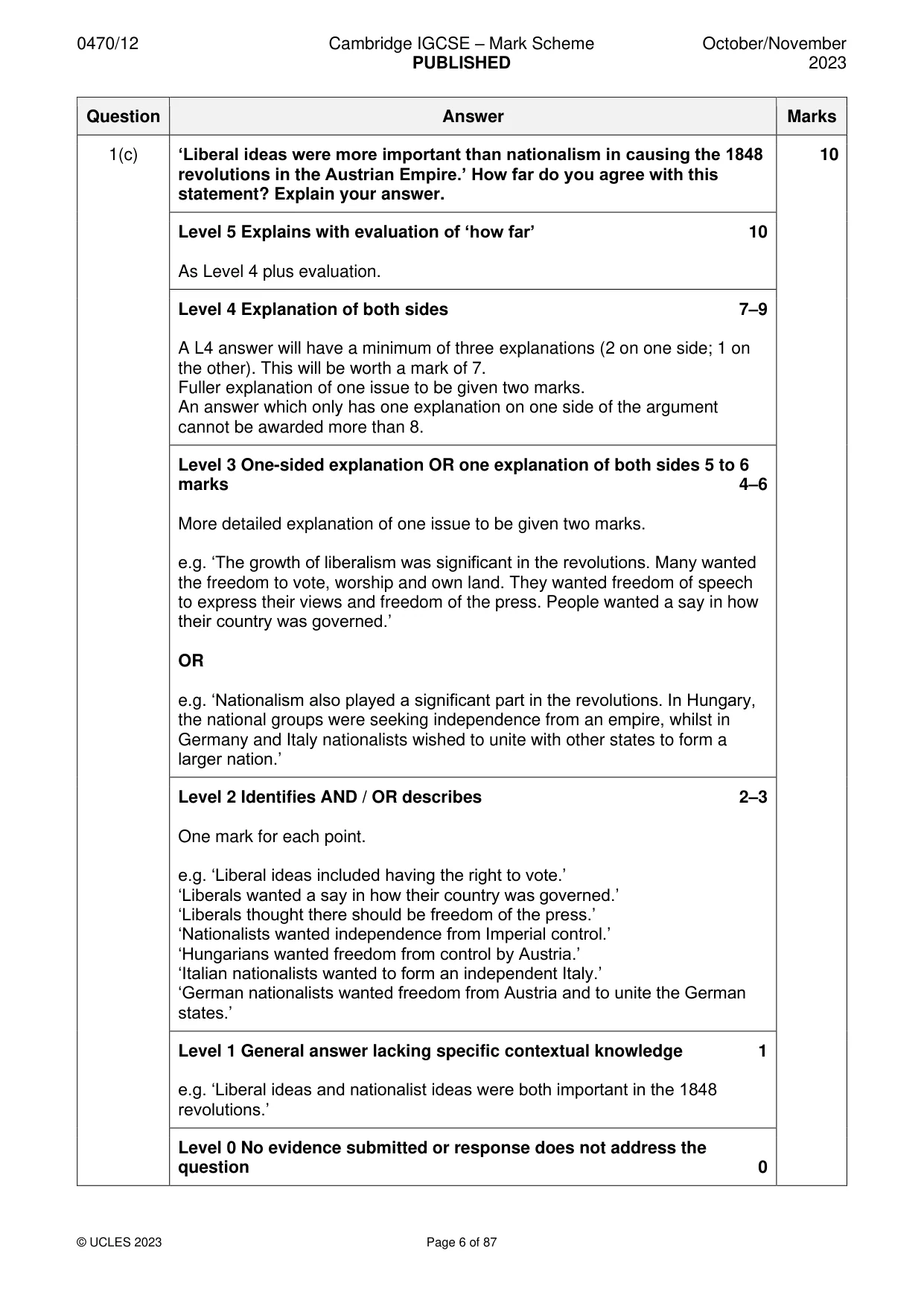
0470/12 Cambridge IGCSE – Mark Scheme PUBLISHED October/November 2023 © UCLES 2023 Page 6 of 87 Question Answer Marks 1(c) ‘Liberal ideas were more important than nationalism in causing the 1848 revolutions in the Austrian Empire.’ How far do you agree with this statement? Explain your answer. 10 Level 5 Explains with evaluation of ‘how far’ 10 As Level 4 plus evaluation. Level 4 Explanation of both sides 7–9 A L4 answer will have a minimum of three explanations (2 on one side; 1 on the other). This will be worth a mark of 7. Fuller explanation of one issue to be given two marks. An answer which only has one explanation on one side of the argument cannot be awarded more than 8. Level 3 One-sided explanation OR one explanation of both sides 5 to 6 marks 4–6 More detailed explanation of one issue to be given two marks. e.g. ‘The growth of liberalism was significant in the revolutions. Many wanted the freedom to vote, worship and own land. They wanted freedom of speech to express their views and freedom of the press. People wanted a say in how their country was governed.’ OR e.g. ‘Nationalism also played a significant part in the revolutions. In Hungary, the national groups were seeking independence from an empire, whilst in Germany and Italy nationalists wished to unite with other states to form a larger nation.’ Level 2 Identifies AND / OR describes 2–3 One mark for each point. e.g. ‘Liberal ideas included having the right to vote.’ ‘Liberals wanted a say in how their country was governed.’ ‘Liberals thought there should be freedom of the press.’ ‘Nationalists wanted independence from Imperial control.’ ‘Hungarians wanted freedom from control by Austria.’ ‘Italian nationalists wanted to form an independent Italy.’ ‘German nationalists wanted freedom from Austria and to unite the German states.’ Level 1 General answer lacking specific contextual knowledge 1 e.g. ‘Liberal ideas and nationalist ideas were both important in the 1848 revolutions.’ Level 0 No evidence submitted or response does not address the question 0
Mark scheme, page 7
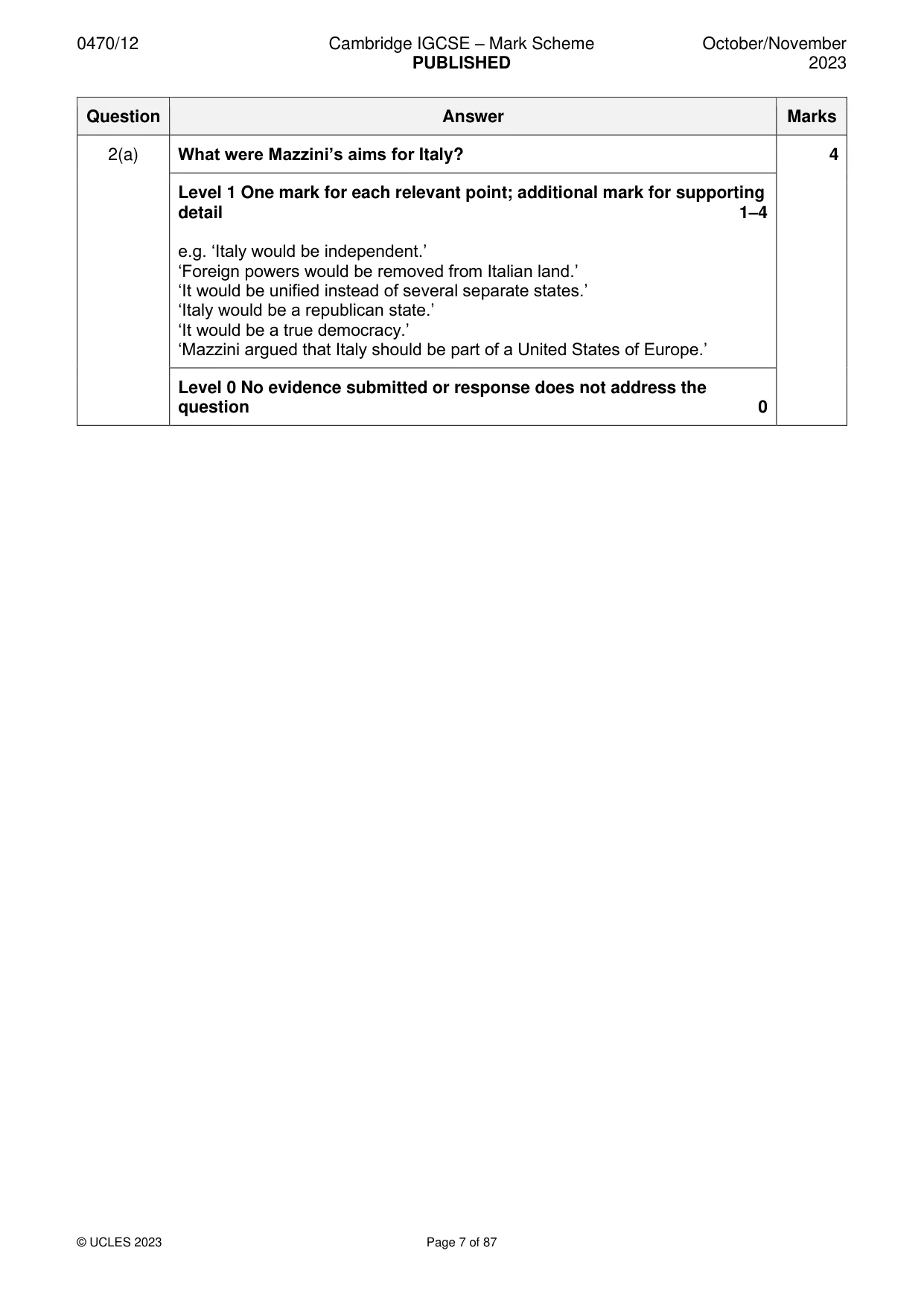
0470/12 Cambridge IGCSE – Mark Scheme PUBLISHED October/November 2023 © UCLES 2023 Page 7 of 87 Question Answer Marks 2(a) What were Mazzini’s aims for Italy? 4 Level 1 One mark for each relevant point; additional mark for supporting detail 1–4 e.g. ‘Italy would be independent.’ ‘Foreign powers would be removed from Italian land.’ ‘It would be unified instead of several separate states.’ ‘Italy would be a republican state.’ ‘It would be a true democracy.’ ‘Mazzini argued that Italy should be part of a United States of Europe.’ Level 0 No evidence submitted or response does not address the question 0
Mark scheme, page 8
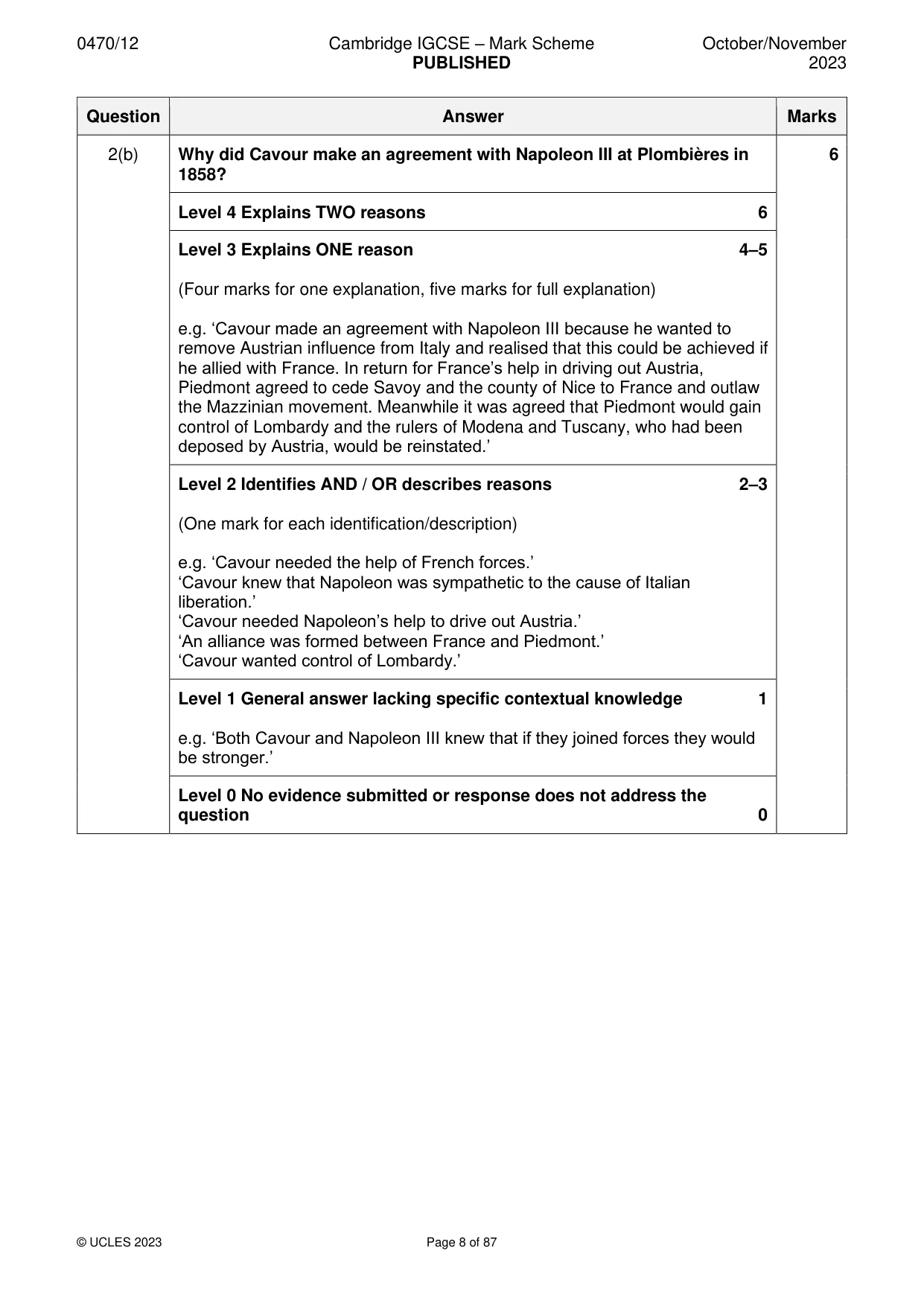
0470/12 Cambridge IGCSE – Mark Scheme PUBLISHED October/November 2023 © UCLES 2023 Page 8 of 87 Question Answer Marks 2(b) Why did Cavour make an agreement with Napoleon III at Plombières in 1858? 6 Level 4 Explains TWO reasons 6 Level 3 Explains ONE reason 4–5 (Four marks for one explanation, five marks for full explanation) e.g. ‘Cavour made an agreement with Napoleon III because he wanted to remove Austrian influence from Italy and realised that this could be achieved if he allied with France. In return for France’s help in driving out Austria, Piedmont agreed to cede Savoy and the county of Nice to France and outlaw the Mazzinian movement. Meanwhile it was agreed that Piedmont would gain control of Lombardy and the rulers of Modena and Tuscany, who had been deposed by Austria, would be reinstated.’ Level 2 Identifies AND / OR describes reasons 2–3 (One mark for each identification/description) e.g. ‘Cavour needed the help of French forces.’ ‘Cavour knew that Napoleon was sympathetic to the cause of Italian liberation.’ ‘Cavour needed Napoleon’s help to drive out Austria.’ ‘An alliance was formed between France and Piedmont.’ ‘Cavour wanted control of Lombardy.’ Level 1 General answer lacking specific contextual knowledge 1 e.g. ‘Both Cavour and Napoleon III knew that if they joined forces they would be stronger.’ Level 0 No evidence submitted or response does not address the question 0
Mark scheme, page 9
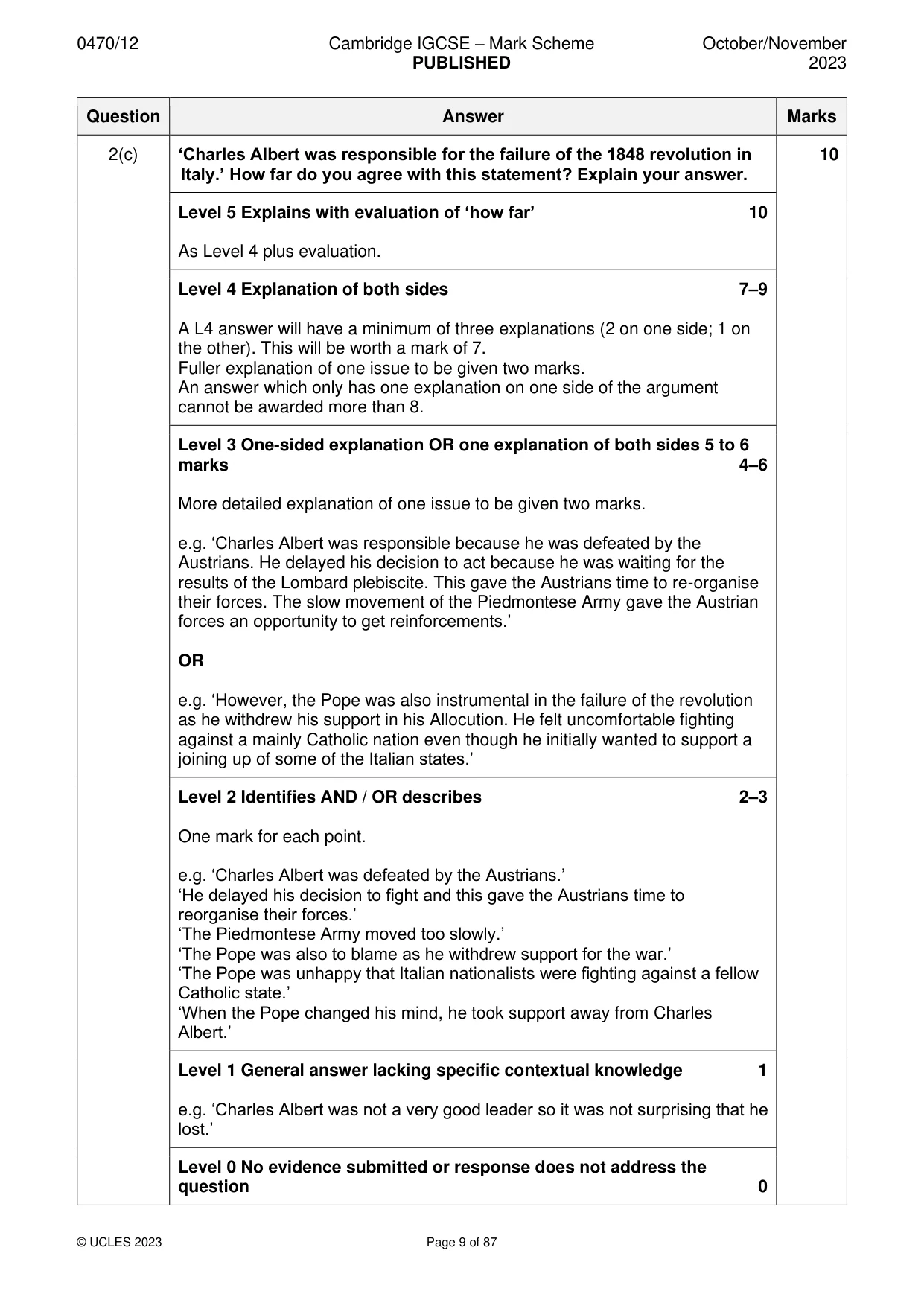
0470/12 Cambridge IGCSE – Mark Scheme PUBLISHED October/November 2023 © UCLES 2023 Page 9 of 87 Question Answer Marks 2(c) ‘Charles Albert was responsible for the failure of the 1848 revolution in Italy.’ How far do you agree with this statement? Explain your answer. 10 Level 5 Explains with evaluation of ‘how far’ 10 As Level 4 plus evaluation. Level 4 Explanation of both sides 7–9 A L4 answer will have a minimum of three explanations (2 on one side; 1 on the other). This will be worth a mark of 7. Fuller explanation of one issue to be given two marks. An answer which only has one explanation on one side of the argument cannot be awarded more than 8. Level 3 One-sided explanation OR one explanation of both sides 5 to 6 marks 4–6 More detailed explanation of one issue to be given two marks. e.g. ‘Charles Albert was responsible because he was defeated by the Austrians. He delayed his decision to act because he was waiting for the results of the Lombard plebiscite. This gave the Austrians time to re-organise their forces. The slow movement of the Piedmontese Army gave the Austrian forces an opportunity to get reinforcements.’ OR e.g. ‘However, the Pope was also instrumental in the failure of the revolution as he withdrew his support in his Allocution. He felt uncomfortable fighting against a mainly Catholic nation even though he initially wanted to support a joining up of some of the Italian states.’ Level 2 Identifies AND / OR describes 2–3 One mark for each point. e.g. ‘Charles Albert was defeated by the Austrians.’ ‘He delayed his decision to fight and this gave the Austrians time to reorganise their forces.’ ‘The Piedmontese Army moved too slowly.’ ‘The Pope was also to blame as he withdrew support for the war.’ ‘The Pope was unhappy that Italian nationalists were fighting against a fellow Catholic state.’ ‘When the Pope changed his mind, he took support away from Charles Albert.’ Level 1 General answer lacking specific contextual knowledge 1 e.g. ‘Charles Albert was not a very good leader so it was not surprising that he lost.’ Level 0 No evidence submitted or response does not address the question 0
Mark scheme, page 10
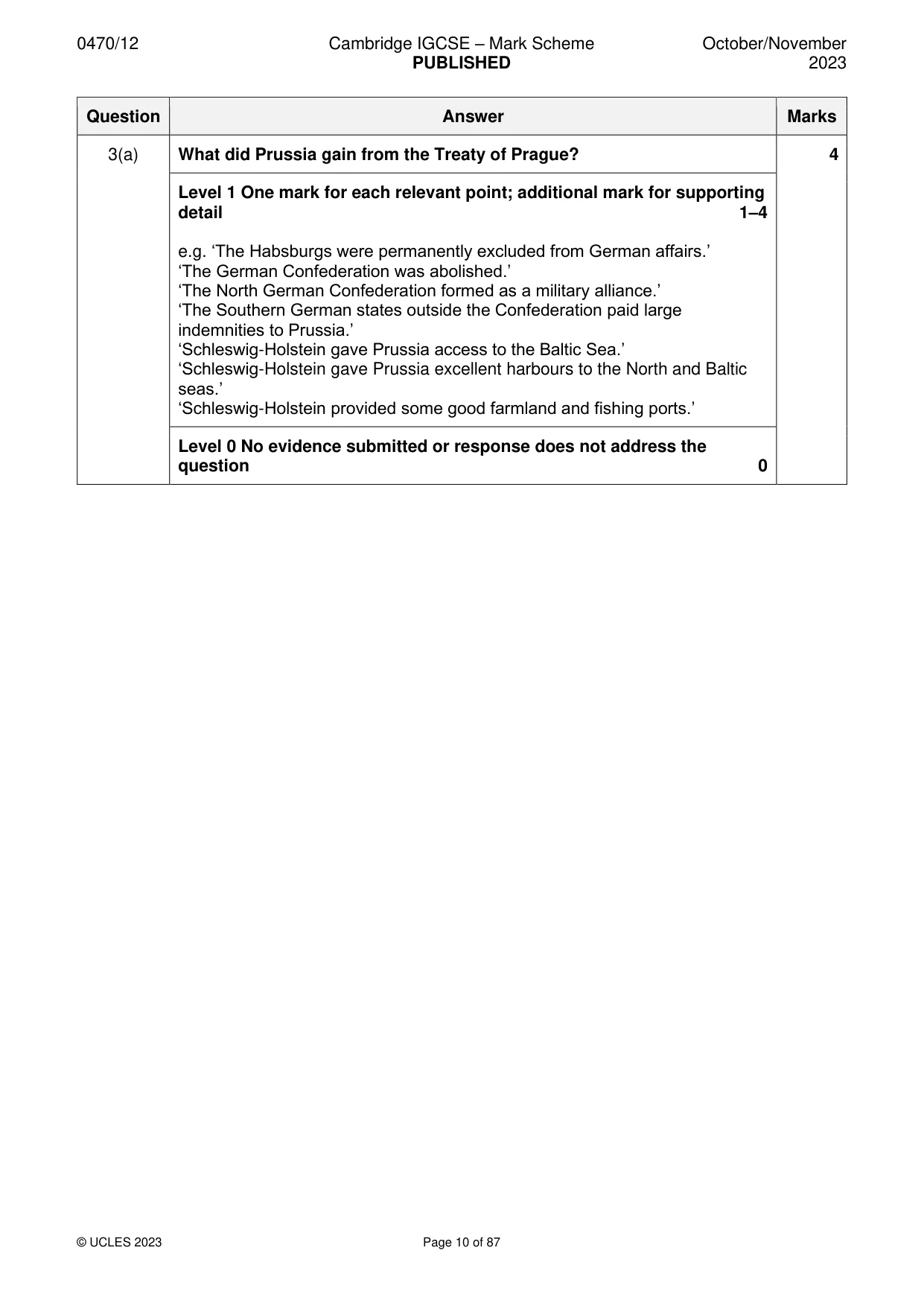
0470/12 Cambridge IGCSE – Mark Scheme PUBLISHED October/November 2023 © UCLES 2023 Page 10 of 87 Question Answer Marks 3(a) What did Prussia gain from the Treaty of Prague? 4 Level 1 One mark for each relevant point; additional mark for supporting detail 1–4 e.g. ‘The Habsburgs were permanently excluded from German affairs.’ ‘The German Confederation was abolished.’ ‘The North German Confederation formed as a military alliance.’ ‘The Southern German states outside the Confederation paid large indemnities to Prussia.’ ‘Schleswig-Holstein gave Prussia access to the Baltic Sea.’ ‘Schleswig-Holstein gave Prussia excellent harbours to the North and Baltic seas.’ ‘Schleswig-Holstein provided some good farmland and fishing ports.’ Level 0 No evidence submitted or response does not address the question 0
Mark scheme, page 11
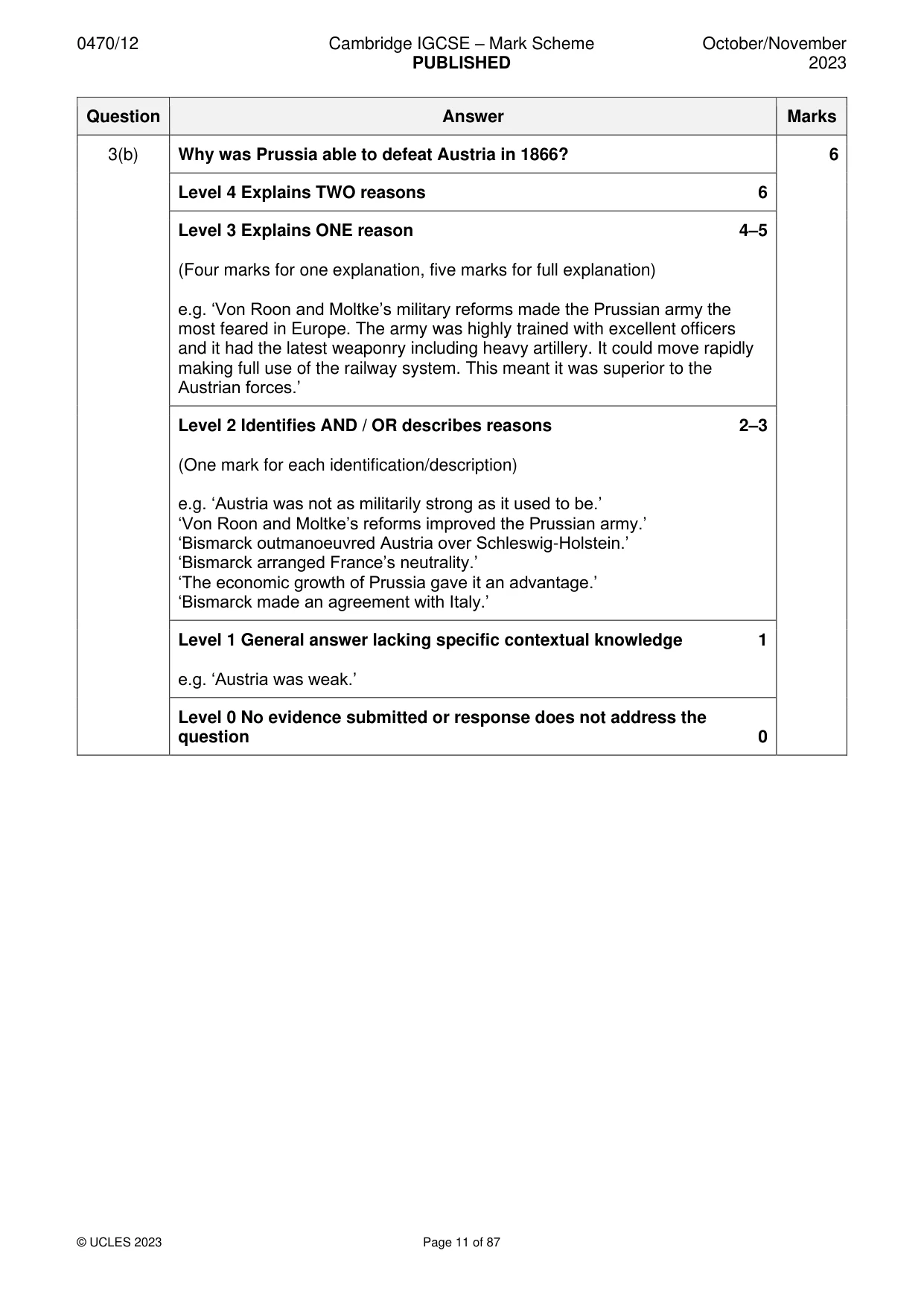
0470/12 Cambridge IGCSE – Mark Scheme PUBLISHED October/November 2023 © UCLES 2023 Page 11 of 87 Question Answer Marks 3(b) Why was Prussia able to defeat Austria in 1866? 6 Level 4 Explains TWO reasons 6 Level 3 Explains ONE reason 4–5 (Four marks for one explanation, five marks for full explanation) e.g. ‘Von Roon and Moltke’s military reforms made the Prussian army the most feared in Europe. The army was highly trained with excellent officers and it had the latest weaponry including heavy artillery. It could move rapidly making full use of the railway system. This meant it was superior to the Austrian forces.’ Level 2 Identifies AND / OR describes reasons 2–3 (One mark for each identification/description) e.g. ‘Austria was not as militarily strong as it used to be.’ ‘Von Roon and Moltke’s reforms improved the Prussian army.’ ‘Bismarck outmanoeuvred Austria over Schleswig-Holstein.’ ‘Bismarck arranged France’s neutrality.’ ‘The economic growth of Prussia gave it an advantage.’ ‘Bismarck made an agreement with Italy.’ Level 1 General answer lacking specific contextual knowledge 1 e.g. ‘Austria was weak.’ Level 0 No evidence submitted or response does not address the question 0
Mark scheme, page 12
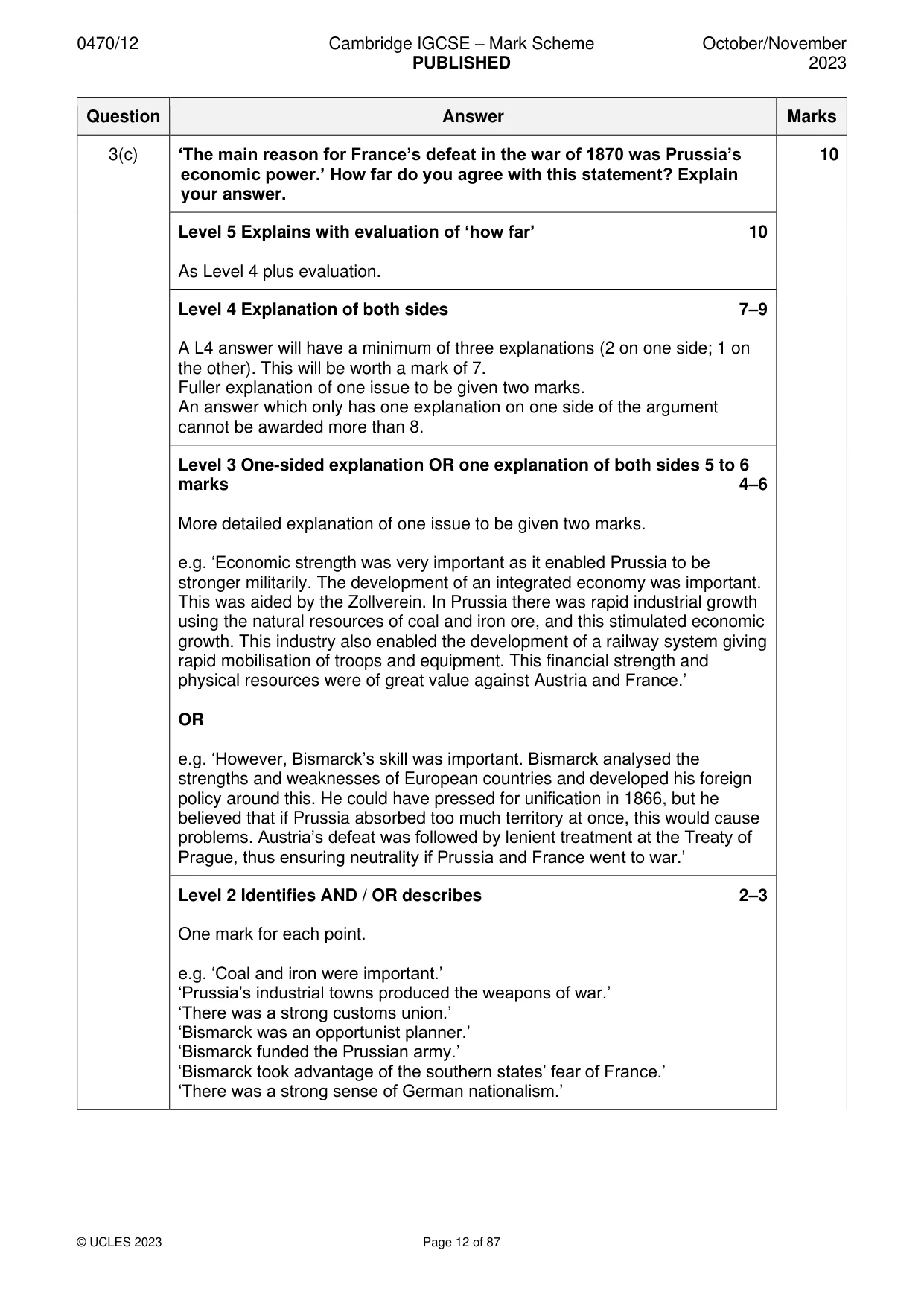
0470/12 Cambridge IGCSE – Mark Scheme PUBLISHED October/November 2023 © UCLES 2023 Page 12 of 87 Question Answer Marks 3(c) ‘The main reason for France’s defeat in the war of 1870 was Prussia’s economic power.’ How far do you agree with this statement? Explain your answer. 10 Level 5 Explains with evaluation of ‘how far’ 10 As Level 4 plus evaluation. Level 4 Explanation of both sides 7–9 A L4 answer will have a minimum of three explanations (2 on one side; 1 on the other). This will be worth a mark of 7. Fuller explanation of one issue to be given two marks. An answer which only has one explanation on one side of the argument cannot be awarded more than 8. Level 3 One-sided explanation OR one explanation of both sides 5 to 6 marks 4–6 More detailed explanation of one issue to be given two marks. e.g. ‘Economic strength was very important as it enabled Prussia to be stronger militarily. The development of an integrated economy was important. This was aided by the Zollverein. In Prussia there was rapid industrial growth using the natural resources of coal and iron ore, and this stimulated economic growth. This industry also enabled the development of a railway system giving rapid mobilisation of troops and equipment. This financial strength and physical resources were of great value against Austria and France.’ OR e.g. ‘However, Bismarck’s skill was important. Bismarck analysed the strengths and weaknesses of European countries and developed his foreign policy around this. He could have pressed for unification in 1866, but he believed that if Prussia absorbed too much territory at once, this would cause problems. Austria’s defeat was followed by lenient treatment at the Treaty of Prague, thus ensuring neutrality if Prussia and France went to war.’ Level 2 Identifies AND / OR describes 2–3 One mark for each point. e.g. ‘Coal and iron were important.’ ‘Prussia’s industrial towns produced the weapons of war.’ ‘There was a strong customs union.’ ‘Bismarck was an opportunist planner.’ ‘Bismarck funded the Prussian army.’ ‘Bismarck took advantage of the southern states’ fear of France.’ ‘There was a strong sense of German nationalism.’
Mark scheme, page 13
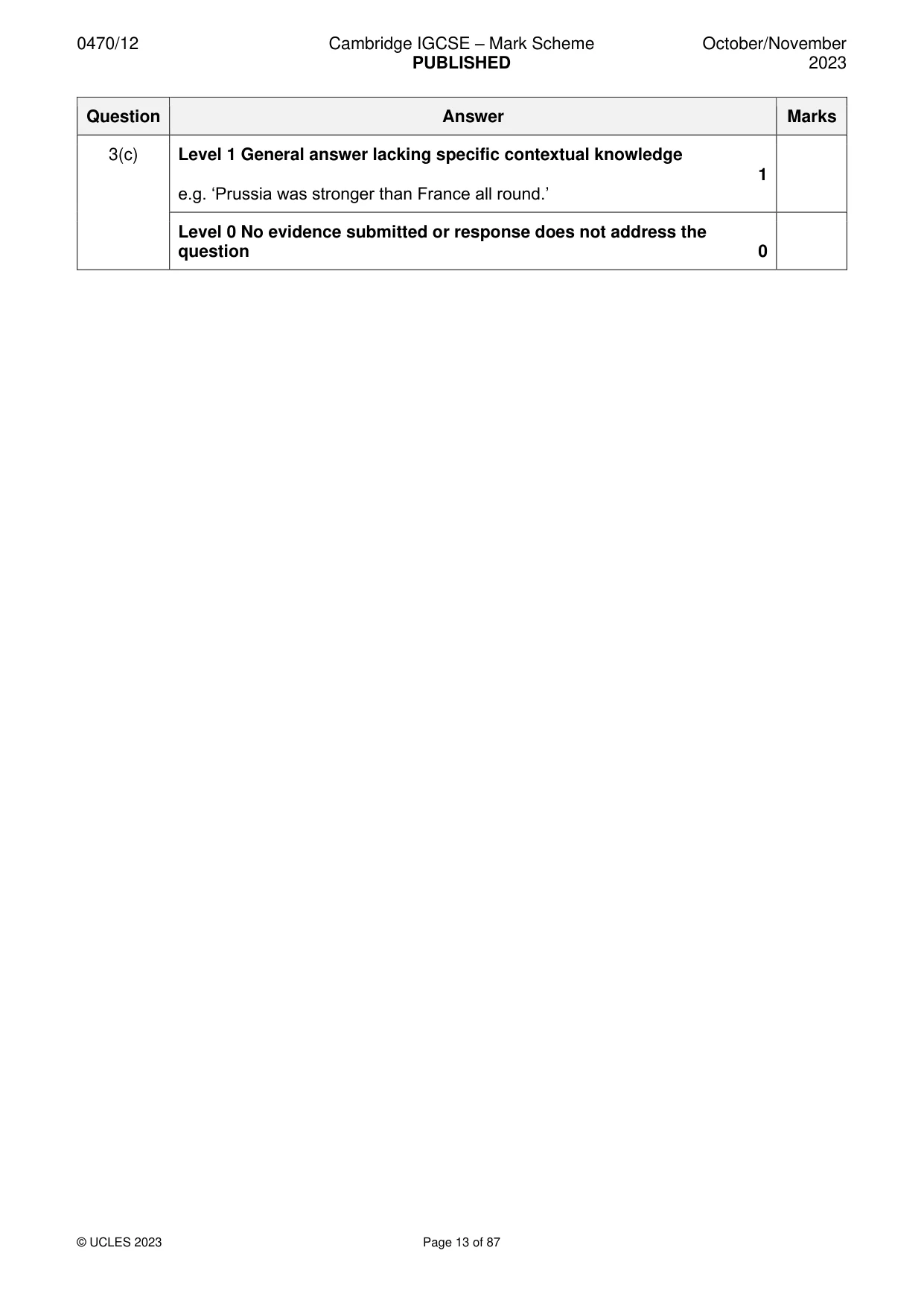
0470/12 Cambridge IGCSE – Mark Scheme PUBLISHED October/November 2023 © UCLES 2023 Page 13 of 87 Question Answer Marks 3(c) Level 1 General answer lacking specific contextual knowledge 1 e.g. ‘Prussia was stronger than France all round.’ Level 0 No evidence submitted or response does not address the question 0
Mark scheme, page 14
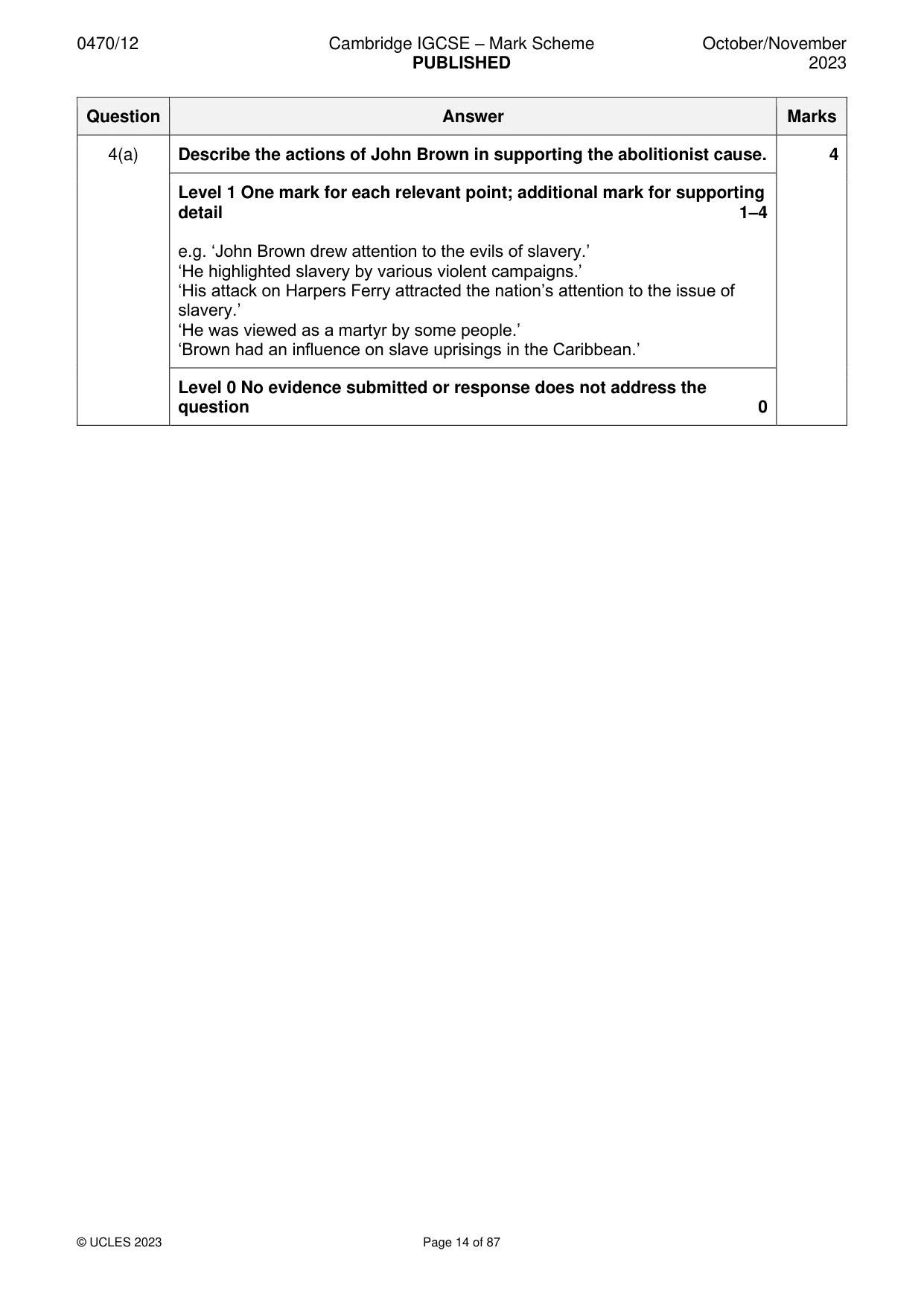
0470/12 Cambridge IGCSE – Mark Scheme PUBLISHED October/November 2023 © UCLES 2023 Page 14 of 87 Question Answer Marks 4(a) Describe the actions of John Brown in supporting the abolitionist cause. 4 Level 1 One mark for each relevant point; additional mark for supporting detail 1–4 e.g. ‘John Brown drew attention to the evils of slavery.’ ‘He highlighted slavery by various violent campaigns.’ ‘His attack on Harpers Ferry attracted the nation’s attention to the issue of slavery.’ ‘He was viewed as a martyr by some people.’ ‘Brown had an influence on slave uprisings in the Caribbean.’ Level 0 No evidence submitted or response does not address the question 0
Mark scheme, page 15
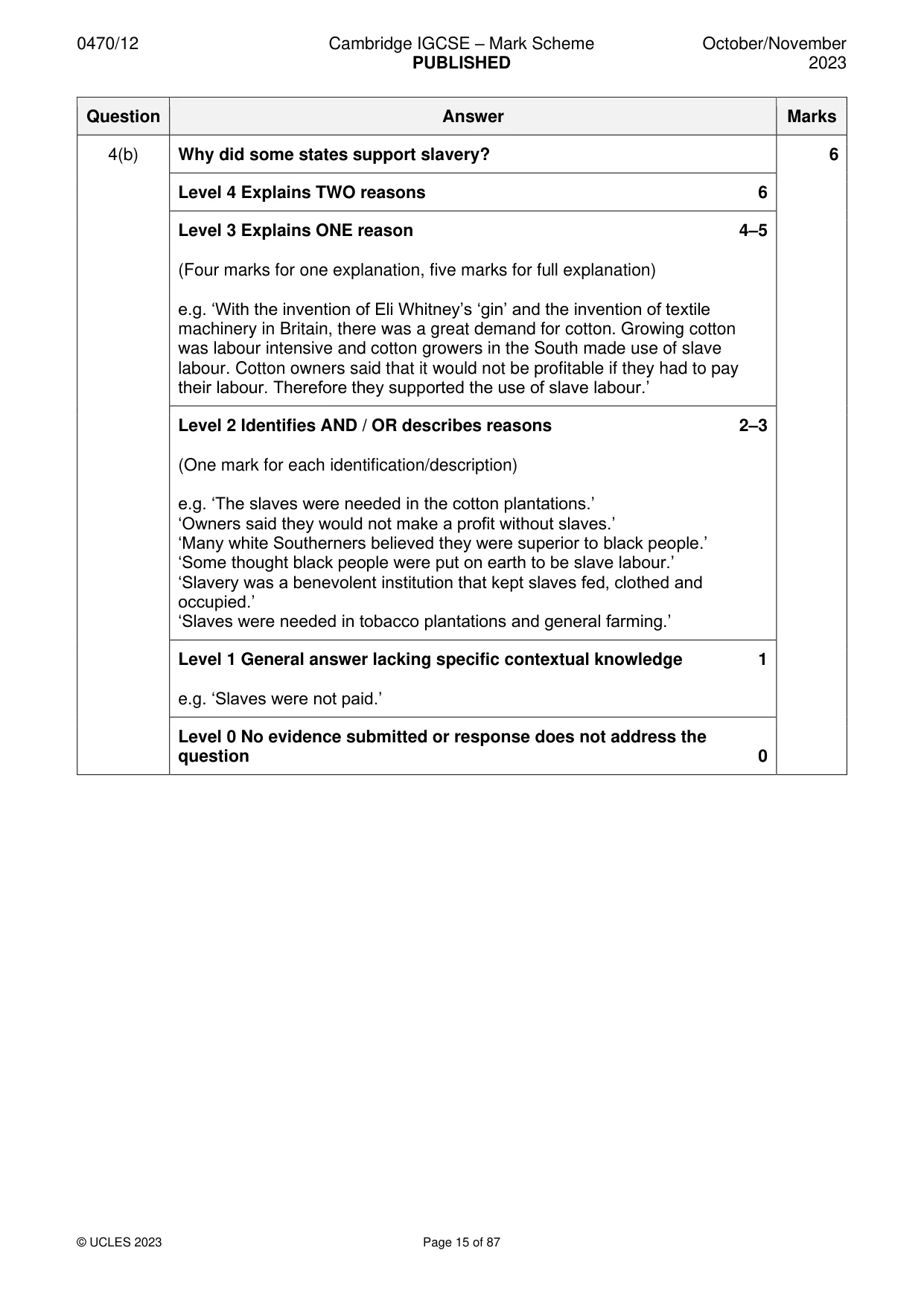
0470/12 Cambridge IGCSE – Mark Scheme PUBLISHED October/November 2023 © UCLES 2023 Page 15 of 87 Question Answer Marks 4(b) Why did some states support slavery? 6 Level 4 Explains TWO reasons 6 Level 3 Explains ONE reason 4–5 (Four marks for one explanation, five marks for full explanation) e.g. ‘With the invention of Eli Whitney’s ‘gin’ and the invention of textile machinery in Britain, there was a great demand for cotton. Growing cotton was labour intensive and cotton growers in the South made use of slave labour. Cotton owners said that it would not be profitable if they had to pay their labour. Therefore they supported the use of slave labour.’ Level 2 Identifies AND / OR describes reasons 2–3 (One mark for each identification/description) e.g. ‘The slaves were needed in the cotton plantations.’ ‘Owners said they would not make a profit without slaves.’ ‘Many white Southerners believed they were superior to black people.’ ‘Some thought black people were put on earth to be slave labour.’ ‘Slavery was a benevolent institution that kept slaves fed, clothed and occupied.’ ‘Slaves were needed in tobacco plantations and general farming.’ Level 1 General answer lacking specific contextual knowledge 1 e.g. ‘Slaves were not paid.’ Level 0 No evidence submitted or response does not address the question 0
Mark scheme, page 16
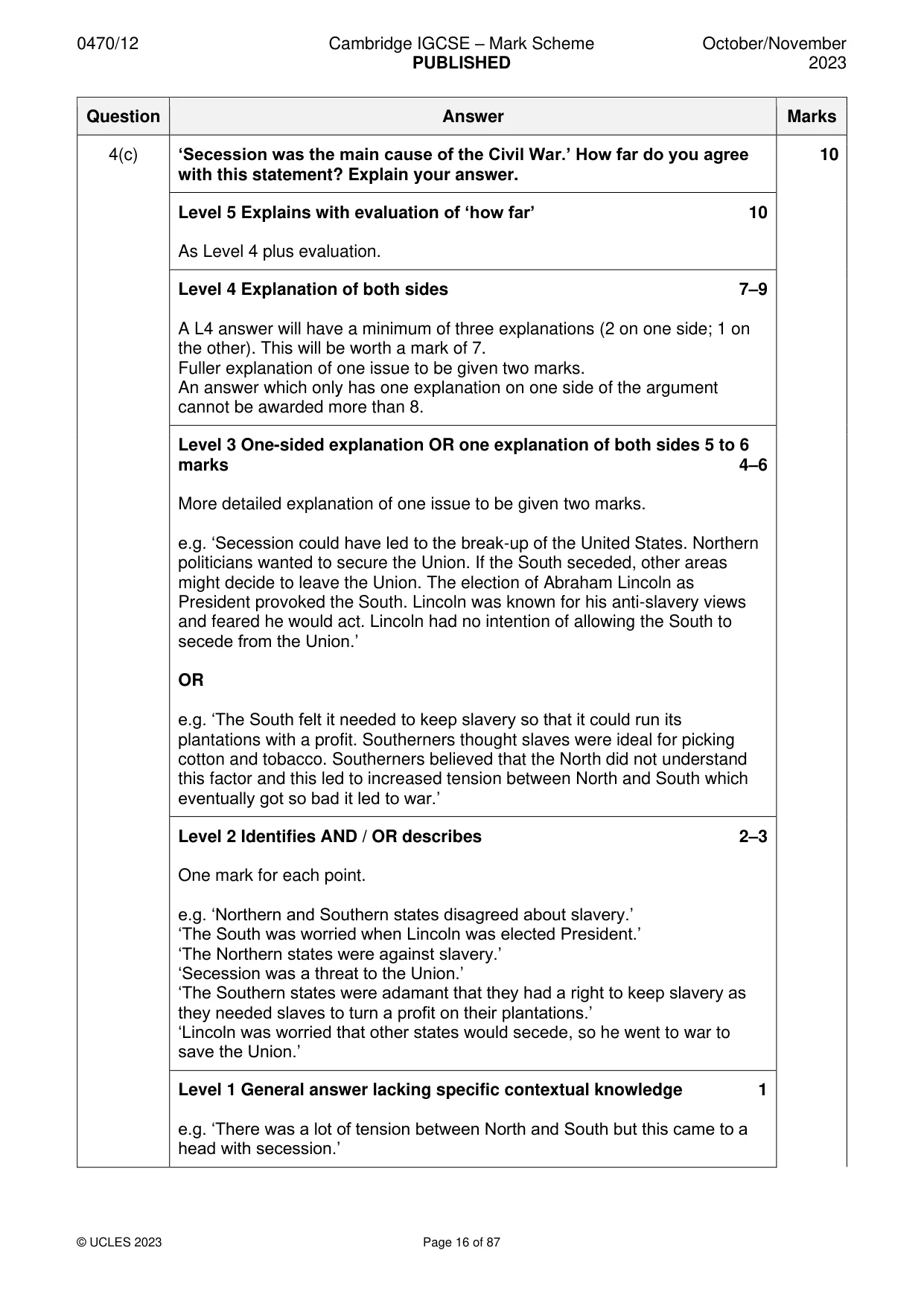
0470/12 Cambridge IGCSE – Mark Scheme PUBLISHED October/November 2023 © UCLES 2023 Page 16 of 87 Question Answer Marks 4(c) ‘Secession was the main cause of the Civil War.’ How far do you agree with this statement? Explain your answer. 10 Level 5 Explains with evaluation of ‘how far’ 10 As Level 4 plus evaluation. Level 4 Explanation of both sides 7–9 A L4 answer will have a minimum of three explanations (2 on one side; 1 on the other). This will be worth a mark of 7. Fuller explanation of one issue to be given two marks. An answer which only has one explanation on one side of the argument cannot be awarded more than 8. Level 3 One-sided explanation OR one explanation of both sides 5 to 6 marks 4–6 More detailed explanation of one issue to be given two marks. e.g. ‘Secession could have led to the break-up of the United States. Northern politicians wanted to secure the Union. If the South seceded, other areas might decide to leave the Union. The election of Abraham Lincoln as President provoked the South. Lincoln was known for his anti-slavery views and feared he would act. Lincoln had no intention of allowing the South to secede from the Union.’ OR e.g. ‘The South felt it needed to keep slavery so that it could run its plantations with a profit. Southerners thought slaves were ideal for picking cotton and tobacco. Southerners believed that the North did not understand this factor and this led to increased tension between North and South which eventually got so bad it led to war.’ Level 2 Identifies AND / OR describes 2–3 One mark for each point. e.g. ‘Northern and Southern states disagreed about slavery.’ ‘The South was worried when Lincoln was elected President.’ ‘The Northern states were against slavery.’ ‘Secession was a threat to the Union.’ ‘The Southern states were adamant that they had a right to keep slavery as they needed slaves to turn a profit on their plantations.’ ‘Lincoln was worried that other states would secede, so he went to war to save the Union.’ Level 1 General answer lacking specific contextual knowledge 1 e.g. ‘There was a lot of tension between North and South but this came to a head with secession.’
Mark scheme, page 17
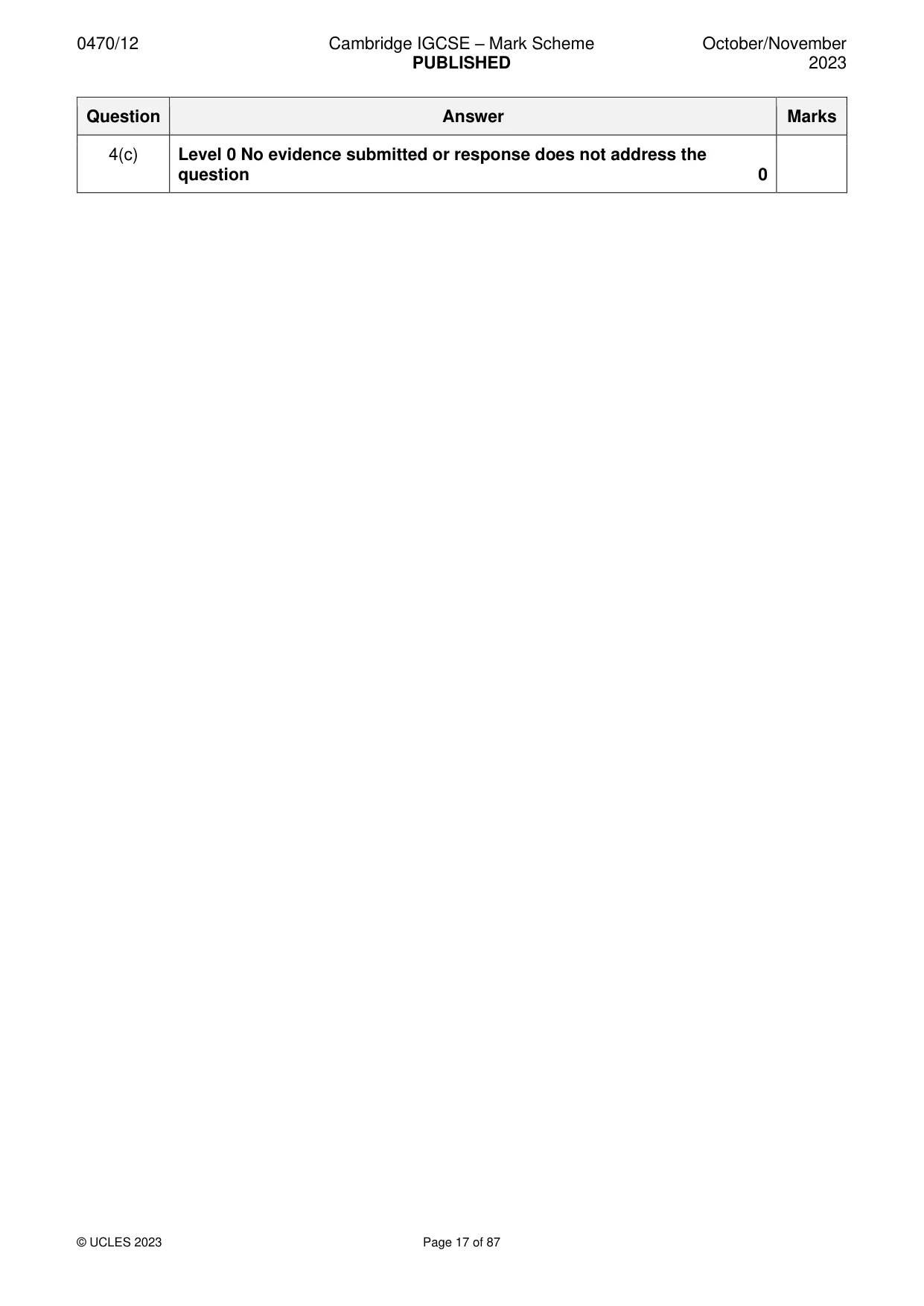
0470/12 Cambridge IGCSE – Mark Scheme PUBLISHED October/November 2023 © UCLES 2023 Page 17 of 87 Question Answer Marks 4(c) Level 0 No evidence submitted or response does not address the question 0
Mark scheme, page 18
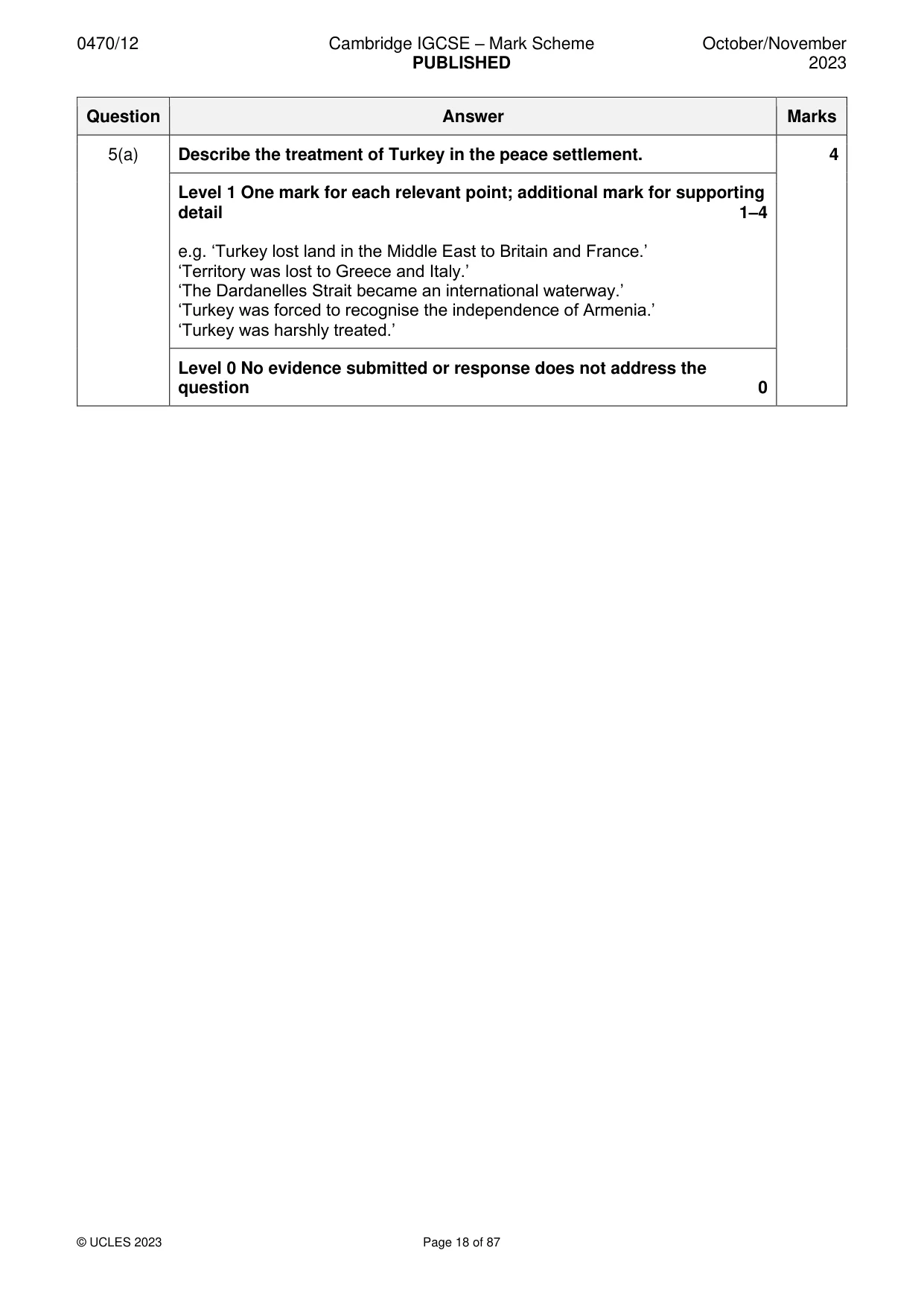
0470/12 Cambridge IGCSE – Mark Scheme PUBLISHED October/November 2023 © UCLES 2023 Page 18 of 87 Question Answer Marks 5(a) Describe the treatment of Turkey in the peace settlement. 4 Level 1 One mark for each relevant point; additional mark for supporting detail 1–4 e.g. ‘Turkey lost land in the Middle East to Britain and France.’ ‘Territory was lost to Greece and Italy.’ ‘The Dardanelles Strait became an international waterway.’ ‘Turkey was forced to recognise the independence of Armenia.’ ‘Turkey was harshly treated.’ Level 0 No evidence submitted or response does not address the question 0
Mark scheme, page 19
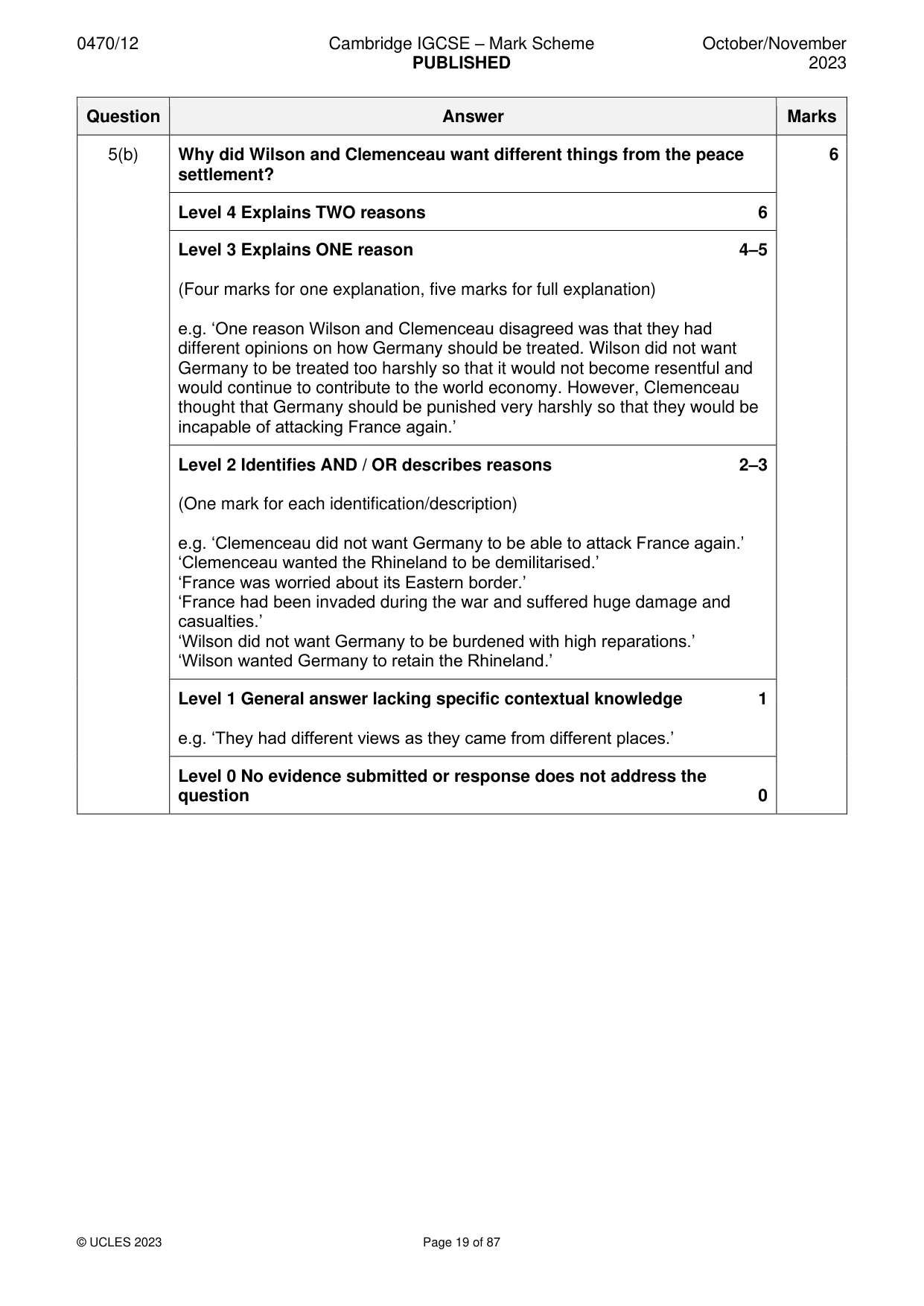
0470/12 Cambridge IGCSE – Mark Scheme PUBLISHED October/November 2023 © UCLES 2023 Page 19 of 87 Question Answer Marks 5(b) Why did Wilson and Clemenceau want different things from the peace settlement? 6 Level 4 Explains TWO reasons 6 Level 3 Explains ONE reason 4–5 (Four marks for one explanation, five marks for full explanation) e.g. ‘One reason Wilson and Clemenceau disagreed was that they had different opinions on how Germany should be treated. Wilson did not want Germany to be treated too harshly so that it would not become resentful and would continue to contribute to the world economy. However, Clemenceau thought that Germany should be punished very harshly so that they would be incapable of attacking France again.’ Level 2 Identifies AND / OR describes reasons 2–3 (One mark for each identification/description) e.g. ‘Clemenceau did not want Germany to be able to attack France again.’ ‘Clemenceau wanted the Rhineland to be demilitarised.’ ‘France was worried about its Eastern border.’ ‘France had been invaded during the war and suffered huge damage and casualties.’ ‘Wilson did not want Germany to be burdened with high reparations.’ ‘Wilson wanted Germany to retain the Rhineland.’ Level 1 General answer lacking specific contextual knowledge 1 e.g. ‘They had different views as they came from different places.’ Level 0 No evidence submitted or response does not address the question 0
Mark scheme, page 20
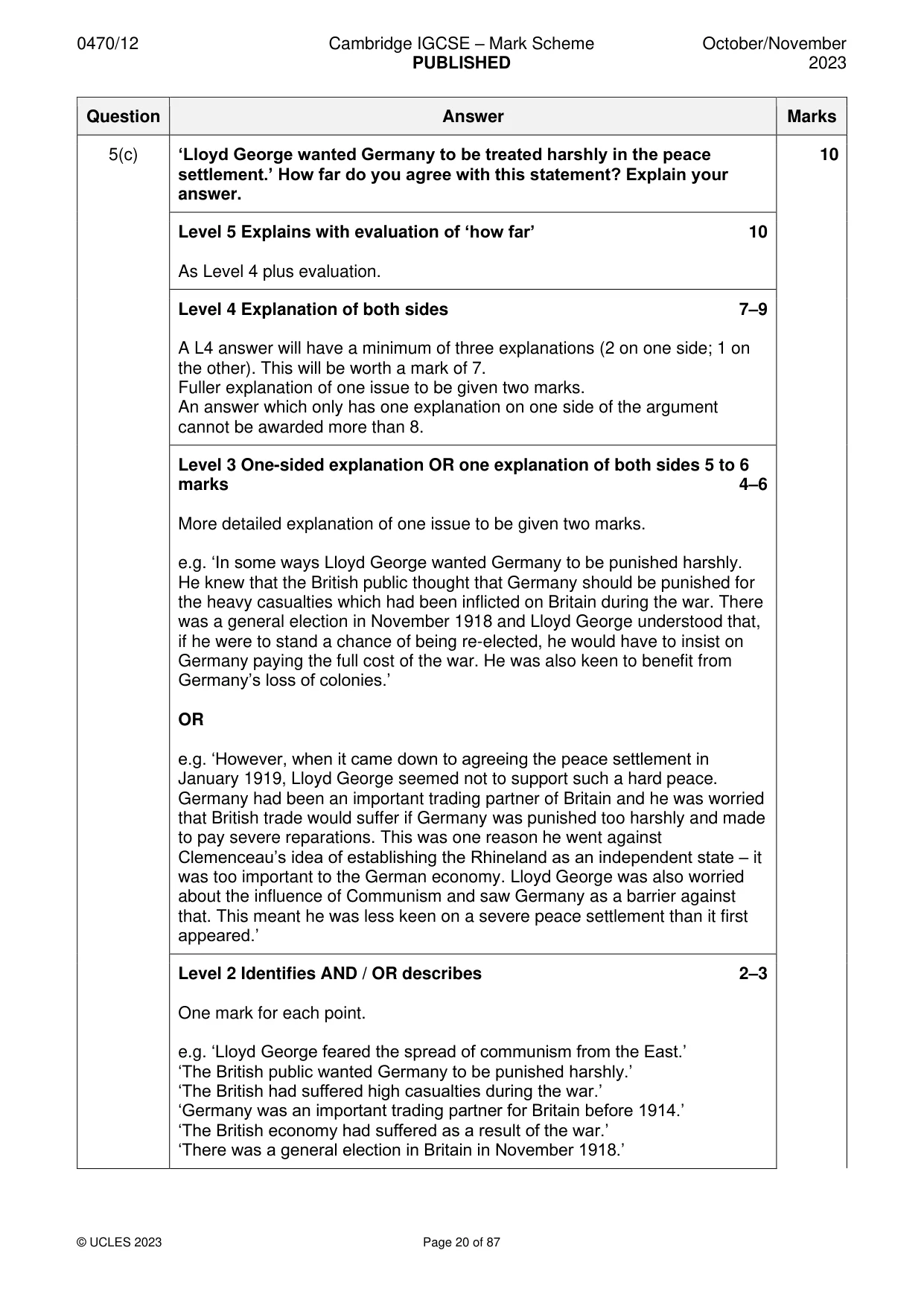
0470/12 Cambridge IGCSE – Mark Scheme PUBLISHED October/November 2023 © UCLES 2023 Page 20 of 87 Question Answer Marks 5(c) ‘Lloyd George wanted Germany to be treated harshly in the peace settlement.’ How far do you agree with this statement? Explain your answer. 10 Level 5 Explains with evaluation of ‘how far’ 10 As Level 4 plus evaluation. Level 4 Explanation of both sides 7–9 A L4 answer will have a minimum of three explanations (2 on one side; 1 on the other). This will be worth a mark of 7. Fuller explanation of one issue to be given two marks. An answer which only has one explanation on one side of the argument cannot be awarded more than 8. Level 3 One-sided explanation OR one explanation of both sides 5 to 6 marks 4–6 More detailed explanation of one issue to be given two marks. e.g. ‘In some ways Lloyd George wanted Germany to be punished harshly. He knew that the British public thought that Germany should be punished for the heavy casualties which had been inflicted on Britain during the war. There was a general election in November 1918 and Lloyd George understood that, if he were to stand a chance of being re-elected, he would have to insist on Germany paying the full cost of the war. He was also keen to benefit from Germany’s loss of colonies.’ OR e.g. ‘However, when it came down to agreeing the peace settlement in January 1919, Lloyd George seemed not to support such a hard peace. Germany had been an important trading partner of Britain and he was worried that British trade would suffer if Germany was punished too harshly and made to pay severe reparations. This was one reason he went against Clemenceau’s idea of establishing the Rhineland as an independent state – it was too important to the German economy. Lloyd George was also worried about the influence of Communism and saw Germany as a barrier against that. This meant he was less keen on a severe peace settlement than it first appeared.’ Level 2 Identifies AND / OR describes 2–3 One mark for each point. e.g. ‘Lloyd George feared the spread of communism from the East.’ ‘The British public wanted Germany to be punished harshly.’ ‘The British had suffered high casualties during the war.’ ‘Germany was an important trading partner for Britain before 1914.’ ‘The British economy had suffered as a result of the war.’ ‘There was a general election in Britain in November 1918.’
Mark scheme, page 21
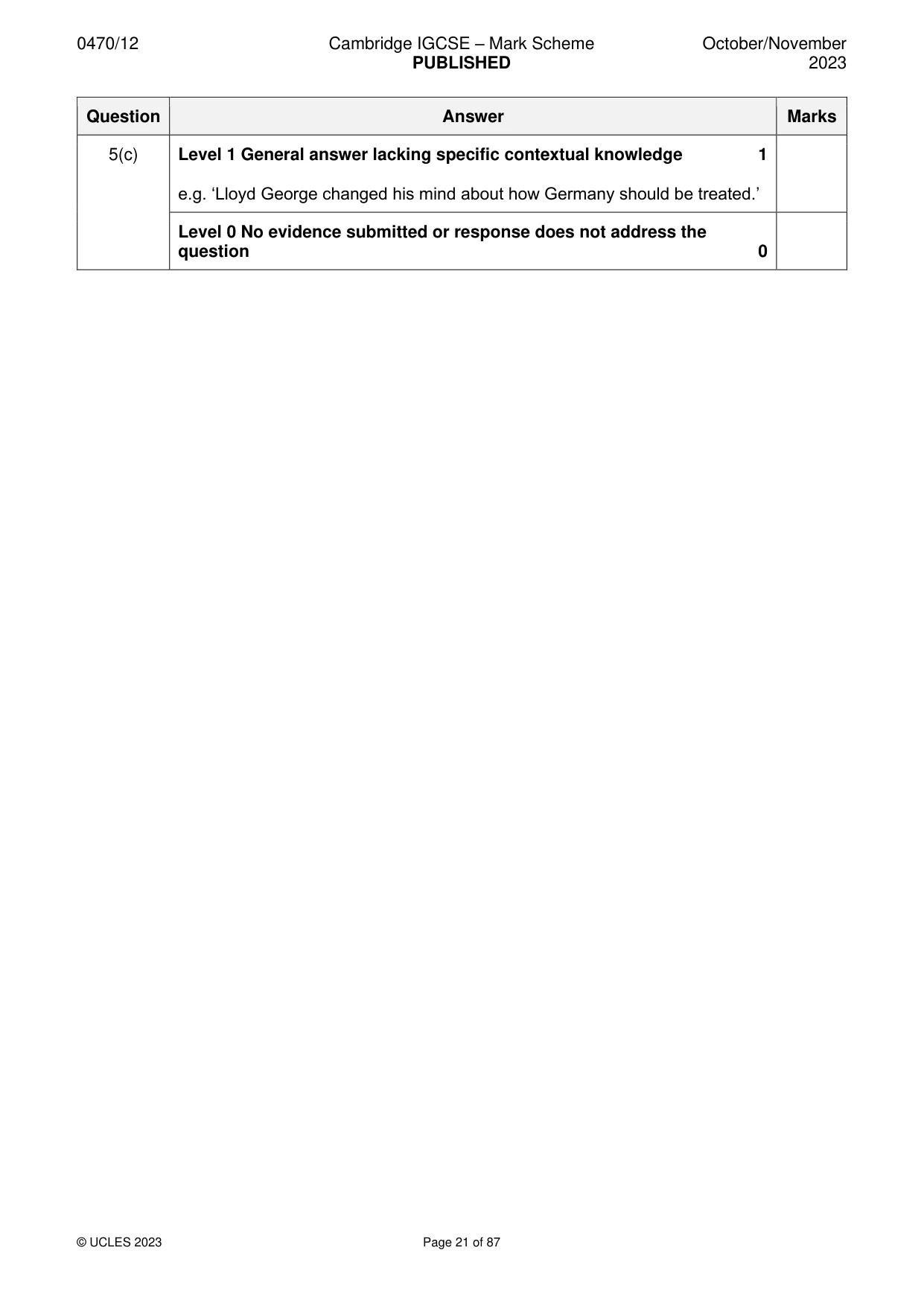
0470/12 Cambridge IGCSE – Mark Scheme PUBLISHED October/November 2023 © UCLES 2023 Page 21 of 87 Question Answer Marks 5(c) Level 1 General answer lacking specific contextual knowledge 1 e.g. ‘Lloyd George changed his mind about how Germany should be treated.’ Level 0 No evidence submitted or response does not address the question 0
Mark scheme, page 22
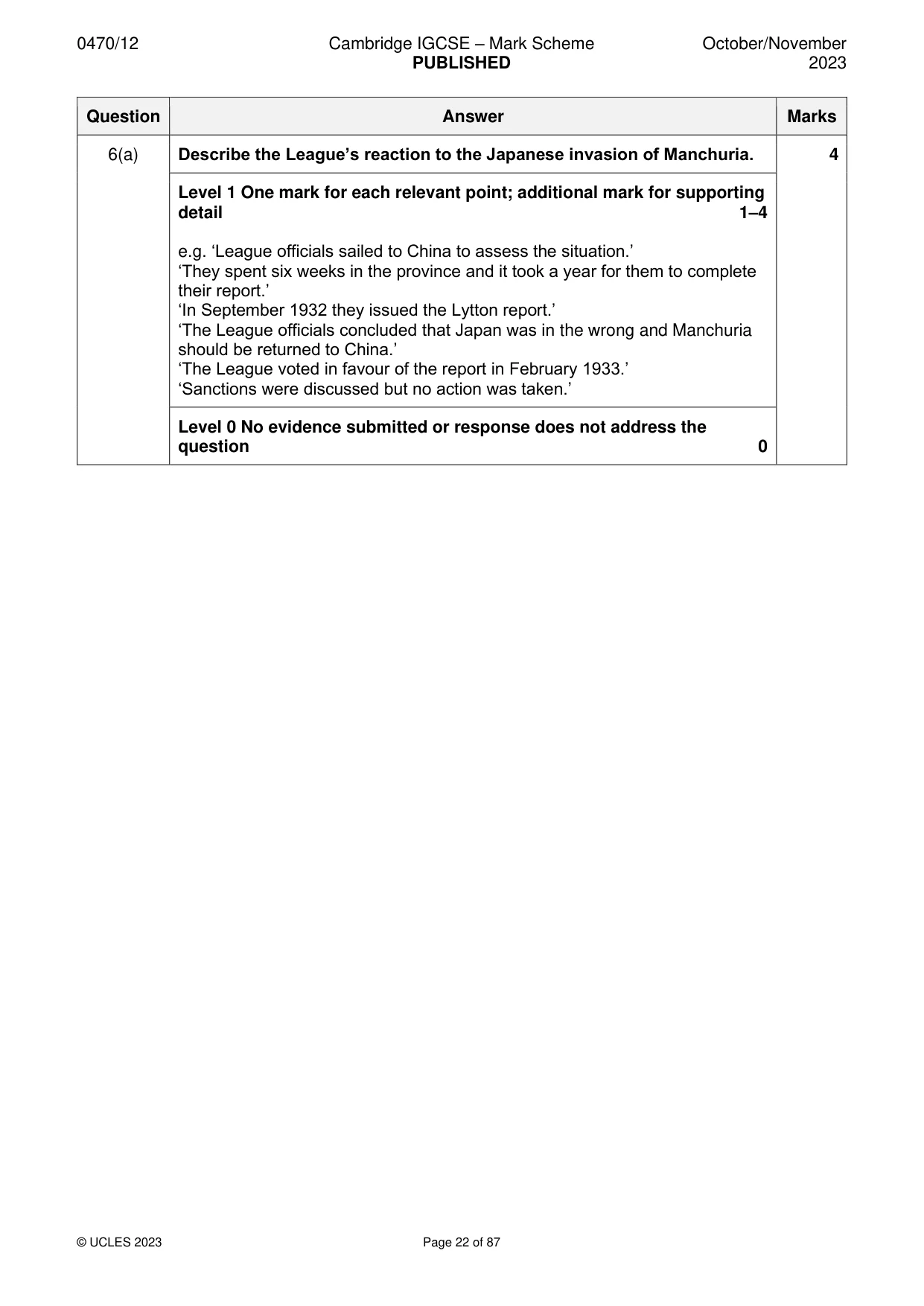
0470/12 Cambridge IGCSE – Mark Scheme PUBLISHED October/November 2023 © UCLES 2023 Page 22 of 87 Question Answer Marks 6(a) Describe the League’s reaction to the Japanese invasion of Manchuria. 4 Level 1 One mark for each relevant point; additional mark for supporting detail 1–4 e.g. ‘League officials sailed to China to assess the situation.’ ‘They spent six weeks in the province and it took a year for them to complete their report.’ ‘In September 1932 they issued the Lytton report.’ ‘The League officials concluded that Japan was in the wrong and Manchuria should be returned to China.’ ‘The League voted in favour of the report in February 1933.’ ‘Sanctions were discussed but no action was taken.’ Level 0 No evidence submitted or response does not address the question 0
Mark scheme, page 23
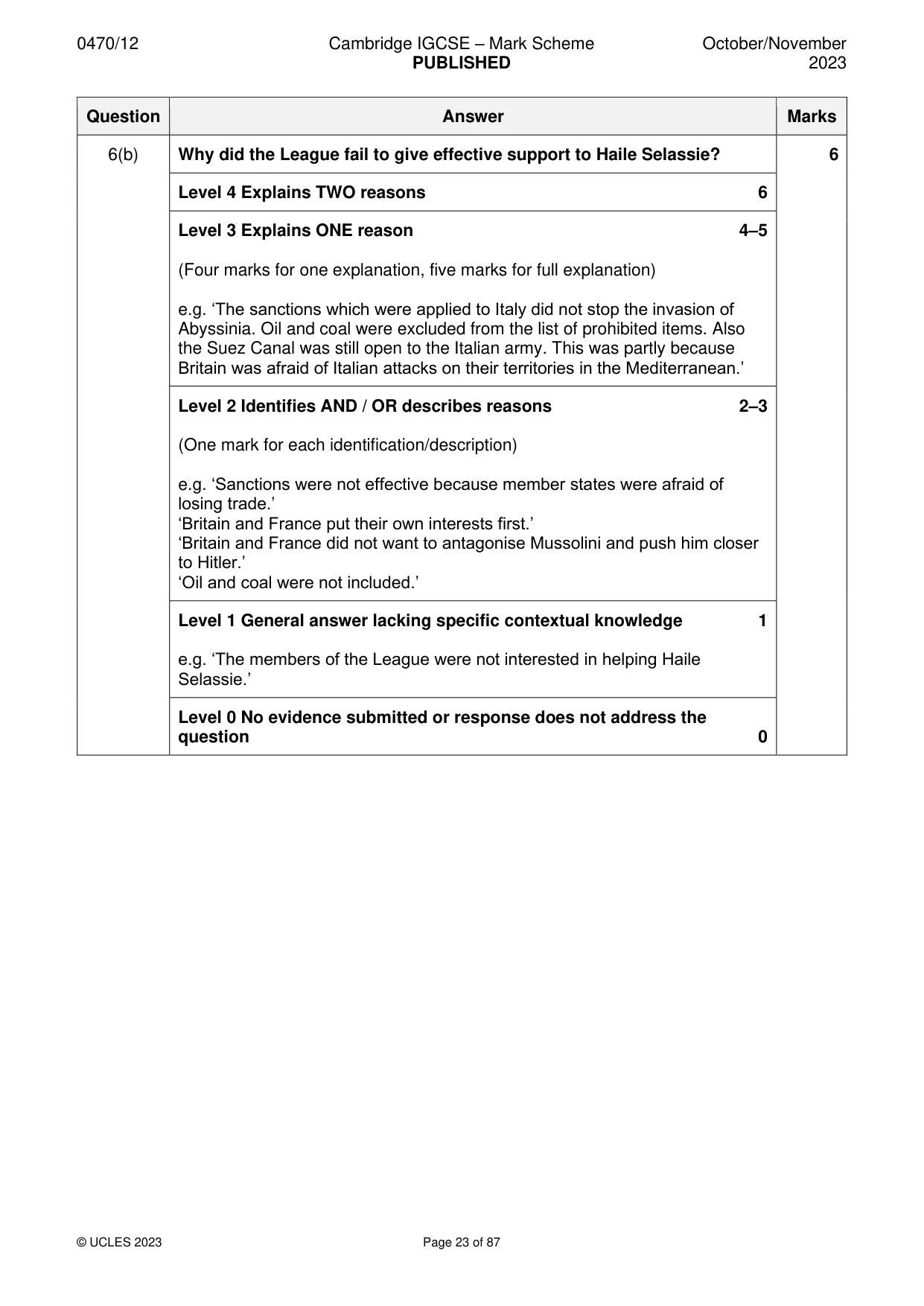
0470/12 Cambridge IGCSE – Mark Scheme PUBLISHED October/November 2023 © UCLES 2023 Page 23 of 87 Question Answer Marks 6(b) Why did the League fail to give effective support to Haile Selassie? 6 Level 4 Explains TWO reasons 6 Level 3 Explains ONE reason 4–5 (Four marks for one explanation, five marks for full explanation) e.g. ‘The sanctions which were applied to Italy did not stop the invasion of Abyssinia. Oil and coal were excluded from the list of prohibited items. Also the Suez Canal was still open to the Italian army. This was partly because Britain was afraid of Italian attacks on their territories in the Mediterranean.’ Level 2 Identifies AND / OR describes reasons 2–3 (One mark for each identification/description) e.g. ‘Sanctions were not effective because member states were afraid of losing trade.’ ‘Britain and France put their own interests first.’ ‘Britain and France did not want to antagonise Mussolini and push him closer to Hitler.’ ‘Oil and coal were not included.’ Level 1 General answer lacking specific contextual knowledge 1 e.g. ‘The members of the League were not interested in helping Haile Selassie.’ Level 0 No evidence submitted or response does not address the question 0
Mark scheme, page 24
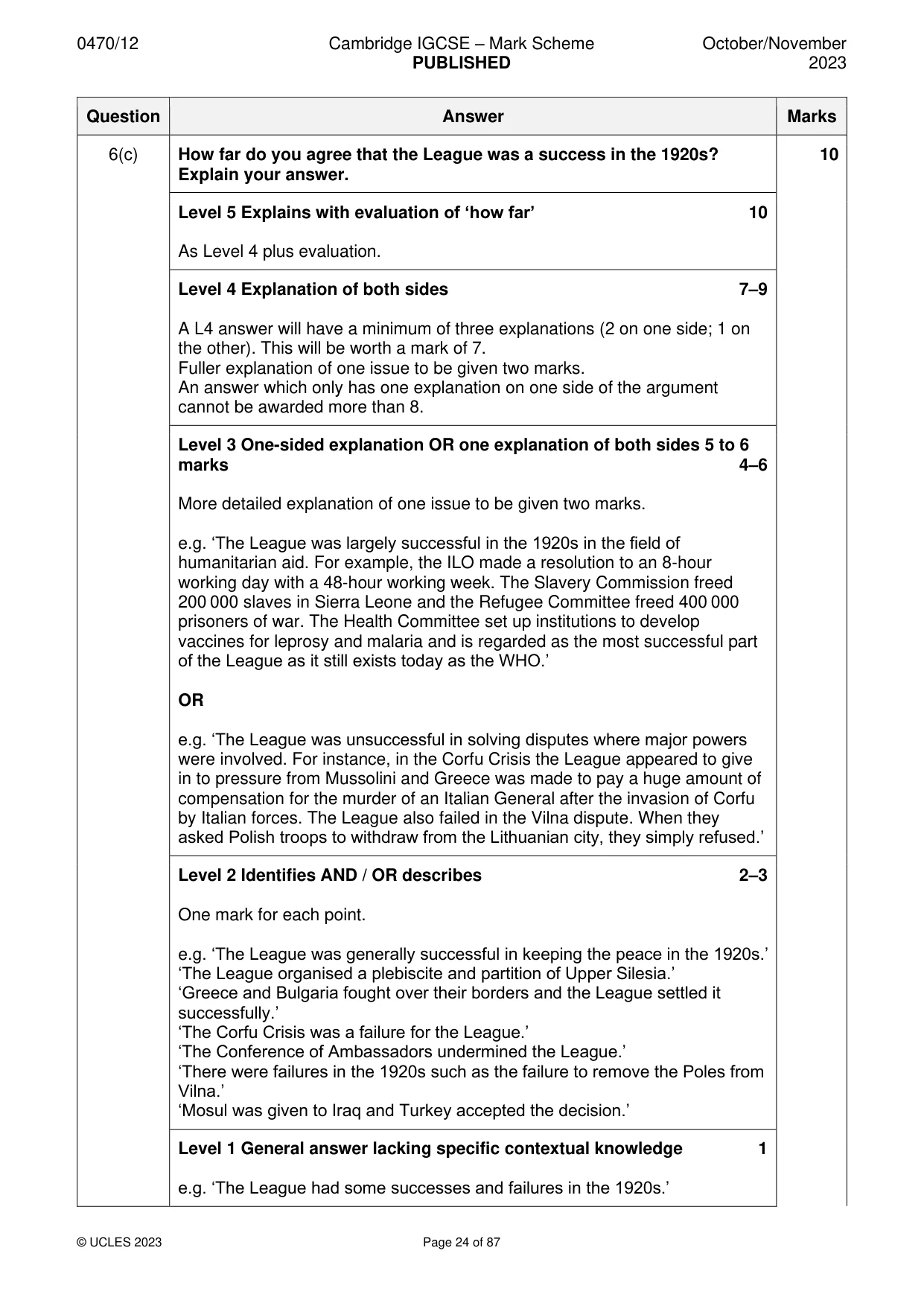
0470/12 Cambridge IGCSE – Mark Scheme PUBLISHED October/November 2023 © UCLES 2023 Page 24 of 87 Question Answer Marks 6(c) How far do you agree that the League was a success in the 1920s? Explain your answer. 10 Level 5 Explains with evaluation of ‘how far’ 10 As Level 4 plus evaluation. Level 4 Explanation of both sides 7–9 A L4 answer will have a minimum of three explanations (2 on one side; 1 on the other). This will be worth a mark of 7. Fuller explanation of one issue to be given two marks. An answer which only has one explanation on one side of the argument cannot be awarded more than 8. Level 3 One-sided explanation OR one explanation of both sides 5 to 6 marks 4–6 More detailed explanation of one issue to be given two marks. e.g. ‘The League was largely successful in the 1920s in the field of humanitarian aid. For example, the ILO made a resolution to an 8-hour working day with a 48-hour working week. The Slavery Commission freed 200 000 slaves in Sierra Leone and the Refugee Committee freed 400 000 prisoners of war. The Health Committee set up institutions to develop vaccines for leprosy and malaria and is regarded as the most successful part of the League as it still exists today as the WHO.’ OR e.g. ‘The League was unsuccessful in solving disputes where major powers were involved. For instance, in the Corfu Crisis the League appeared to give in to pressure from Mussolini and Greece was made to pay a huge amount of compensation for the murder of an Italian General after the invasion of Corfu by Italian forces. The League also failed in the Vilna dispute. When they asked Polish troops to withdraw from the Lithuanian city, they simply refused.’ Level 2 Identifies AND / OR describes 2–3 One mark for each point. e.g. ‘The League was generally successful in keeping the peace in the 1920s.’ ‘The League organised a plebiscite and partition of Upper Silesia.’ ‘Greece and Bulgaria fought over their borders and the League settled it successfully.’ ‘The Corfu Crisis was a failure for the League.’ ‘The Conference of Ambassadors undermined the League.’ ‘There were failures in the 1920s such as the failure to remove the Poles from Vilna.’ ‘Mosul was given to Iraq and Turkey accepted the decision.’ Level 1 General answer lacking specific contextual knowledge 1 e.g. ‘The League had some successes and failures in the 1920s.’
Mark scheme, page 25
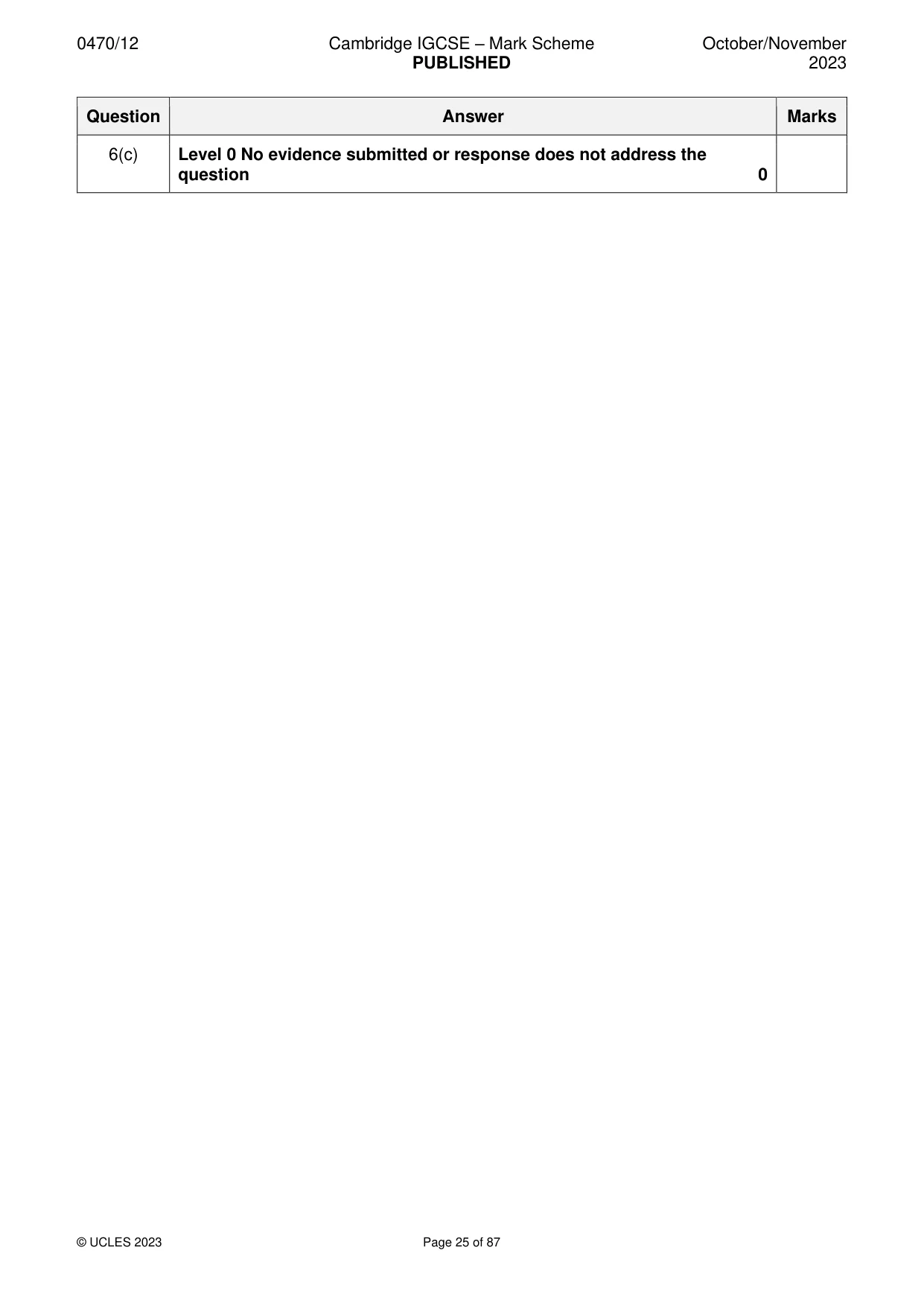
0470/12 Cambridge IGCSE – Mark Scheme PUBLISHED October/November 2023 © UCLES 2023 Page 25 of 87 Question Answer Marks 6(c) Level 0 No evidence submitted or response does not address the question 0
Mark scheme, page 26
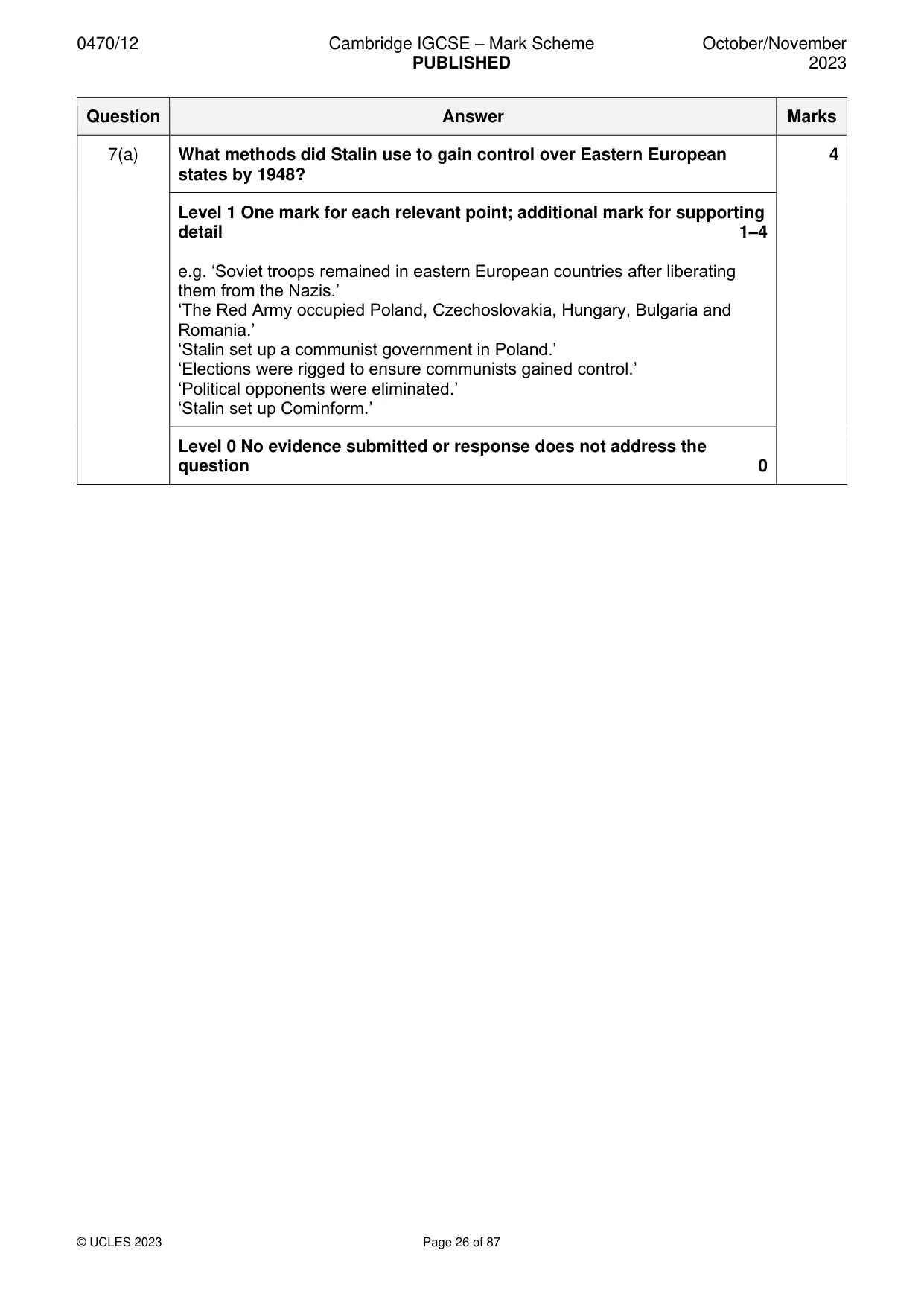
0470/12 Cambridge IGCSE – Mark Scheme PUBLISHED October/November 2023 © UCLES 2023 Page 26 of 87 Question Answer Marks 7(a) What methods did Stalin use to gain control over Eastern European states by 1948? 4 Level 1 One mark for each relevant point; additional mark for supporting detail 1–4 e.g. ‘Soviet troops remained in eastern European countries after liberating them from the Nazis.’ ‘The Red Army occupied Poland, Czechoslovakia, Hungary, Bulgaria and Romania.’ ‘Stalin set up a communist government in Poland.’ ‘Elections were rigged to ensure communists gained control.’ ‘Political opponents were eliminated.’ ‘Stalin set up Cominform.’ Level 0 No evidence submitted or response does not address the question 0
Mark scheme, page 27
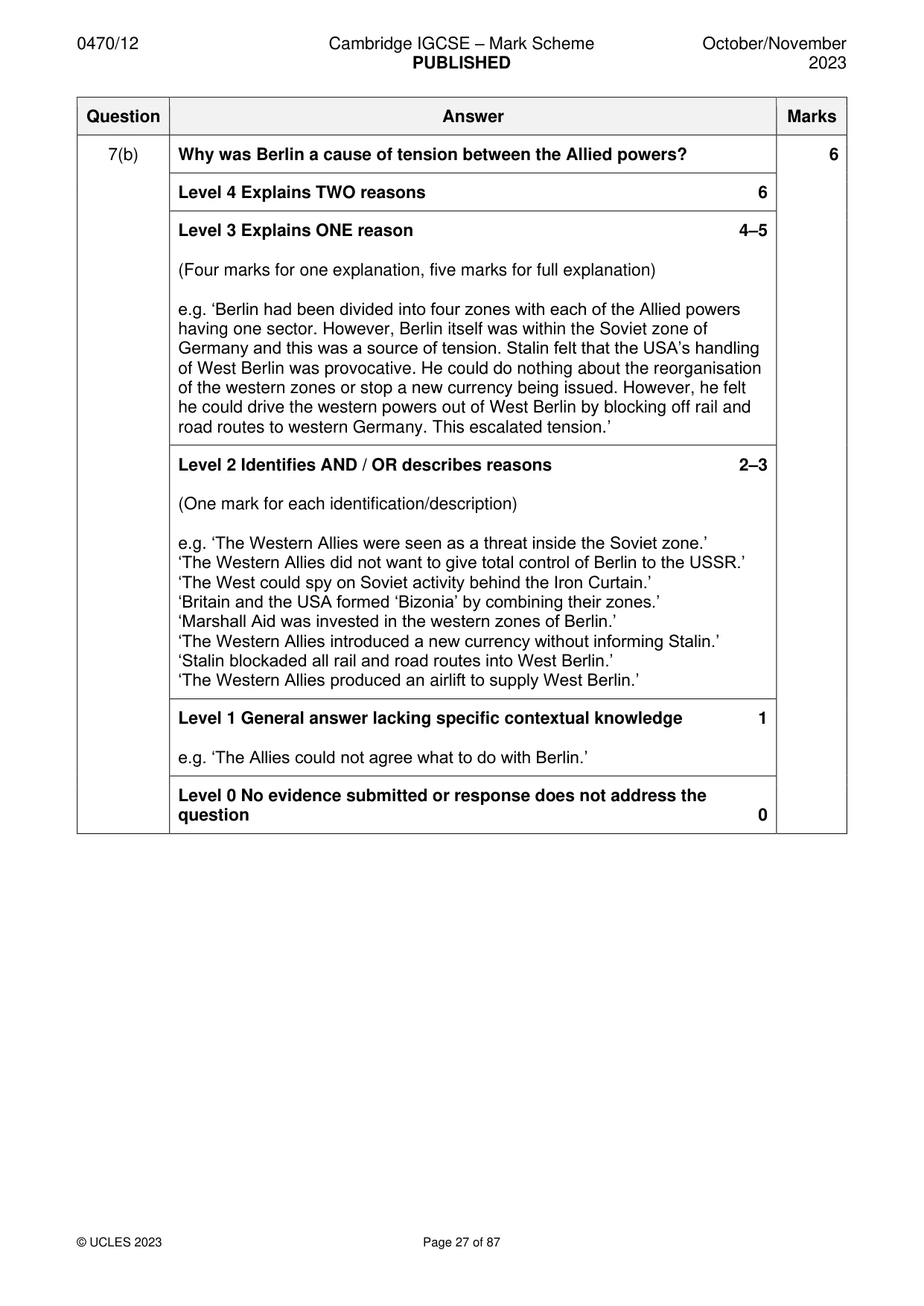
0470/12 Cambridge IGCSE – Mark Scheme PUBLISHED October/November 2023 © UCLES 2023 Page 27 of 87 Question Answer Marks 7(b) Why was Berlin a cause of tension between the Allied powers? 6 Level 4 Explains TWO reasons 6 Level 3 Explains ONE reason 4–5 (Four marks for one explanation, five marks for full explanation) e.g. ‘Berlin had been divided into four zones with each of the Allied powers having one sector. However, Berlin itself was within the Soviet zone of Germany and this was a source of tension. Stalin felt that the USA’s handling of West Berlin was provocative. He could do nothing about the reorganisation of the western zones or stop a new currency being issued. However, he felt he could drive the western powers out of West Berlin by blocking off rail and road routes to western Germany. This escalated tension.’ Level 2 Identifies AND / OR describes reasons 2–3 (One mark for each identification/description) e.g. ‘The Western Allies were seen as a threat inside the Soviet zone.’ ‘The Western Allies did not want to give total control of Berlin to the USSR.’ ‘The West could spy on Soviet activity behind the Iron Curtain.’ ‘Britain and the USA formed ‘Bizonia’ by combining their zones.’ ‘Marshall Aid was invested in the western zones of Berlin.’ ‘The Western Allies introduced a new currency without informing Stalin.’ ‘Stalin blockaded all rail and road routes into West Berlin.’ ‘The Western Allies produced an airlift to supply West Berlin.’ Level 1 General answer lacking specific contextual knowledge 1 e.g. ‘The Allies could not agree what to do with Berlin.’ Level 0 No evidence submitted or response does not address the question 0
Mark scheme, page 28
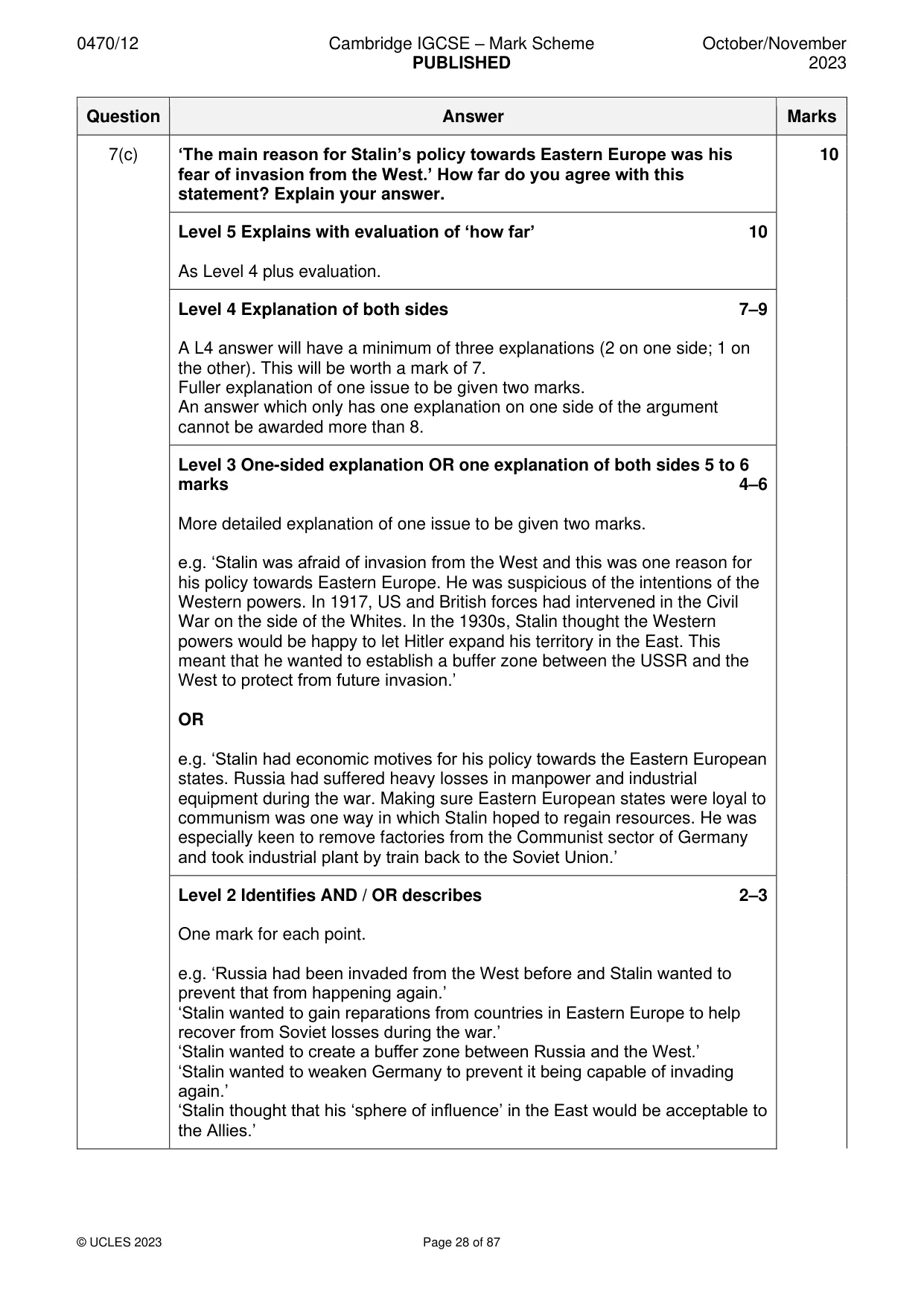
0470/12 Cambridge IGCSE – Mark Scheme PUBLISHED October/November 2023 © UCLES 2023 Page 28 of 87 Question Answer Marks 7(c) ‘The main reason for Stalin’s policy towards Eastern Europe was his fear of invasion from the West.’ How far do you agree with this statement? Explain your answer. 10 Level 5 Explains with evaluation of ‘how far’ 10 As Level 4 plus evaluation. Level 4 Explanation of both sides 7–9 A L4 answer will have a minimum of three explanations (2 on one side; 1 on the other). This will be worth a mark of 7. Fuller explanation of one issue to be given two marks. An answer which only has one explanation on one side of the argument cannot be awarded more than 8. Level 3 One-sided explanation OR one explanation of both sides 5 to 6 marks 4–6 More detailed explanation of one issue to be given two marks. e.g. ‘Stalin was afraid of invasion from the West and this was one reason for his policy towards Eastern Europe. He was suspicious of the intentions of the Western powers. In 1917, US and British forces had intervened in the Civil War on the side of the Whites. In the 1930s, Stalin thought the Western powers would be happy to let Hitler expand his territory in the East. This meant that he wanted to establish a buffer zone between the USSR and the West to protect from future invasion.’ OR e.g. ‘Stalin had economic motives for his policy towards the Eastern European states. Russia had suffered heavy losses in manpower and industrial equipment during the war. Making sure Eastern European states were loyal to communism was one way in which Stalin hoped to regain resources. He was especially keen to remove factories from the Communist sector of Germany and took industrial plant by train back to the Soviet Union.’ Level 2 Identifies AND / OR describes 2–3 One mark for each point. e.g. ‘Russia had been invaded from the West before and Stalin wanted to prevent that from happening again.’ ‘Stalin wanted to gain reparations from countries in Eastern Europe to help recover from Soviet losses during the war.’ ‘Stalin wanted to create a buffer zone between Russia and the West.’ ‘Stalin wanted to weaken Germany to prevent it being capable of invading again.’ ‘Stalin thought that his ‘sphere of influence’ in the East would be acceptable to the Allies.’
Mark scheme, page 29
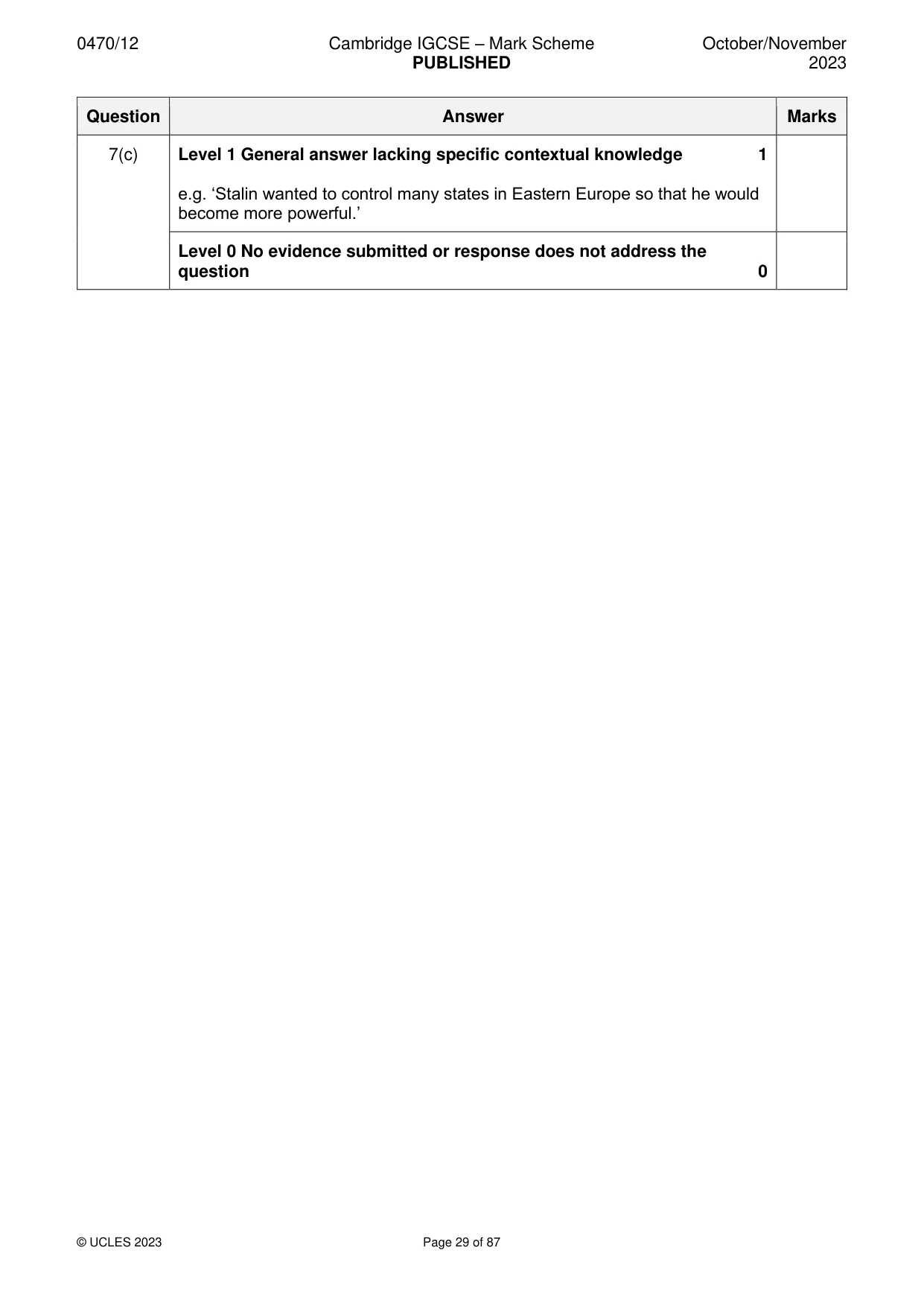
0470/12 Cambridge IGCSE – Mark Scheme PUBLISHED October/November 2023 © UCLES 2023 Page 29 of 87 Question Answer Marks 7(c) Level 1 General answer lacking specific contextual knowledge 1 e.g. ‘Stalin wanted to control many states in Eastern Europe so that he would become more powerful.’ Level 0 No evidence submitted or response does not address the question 0
Mark scheme, page 30
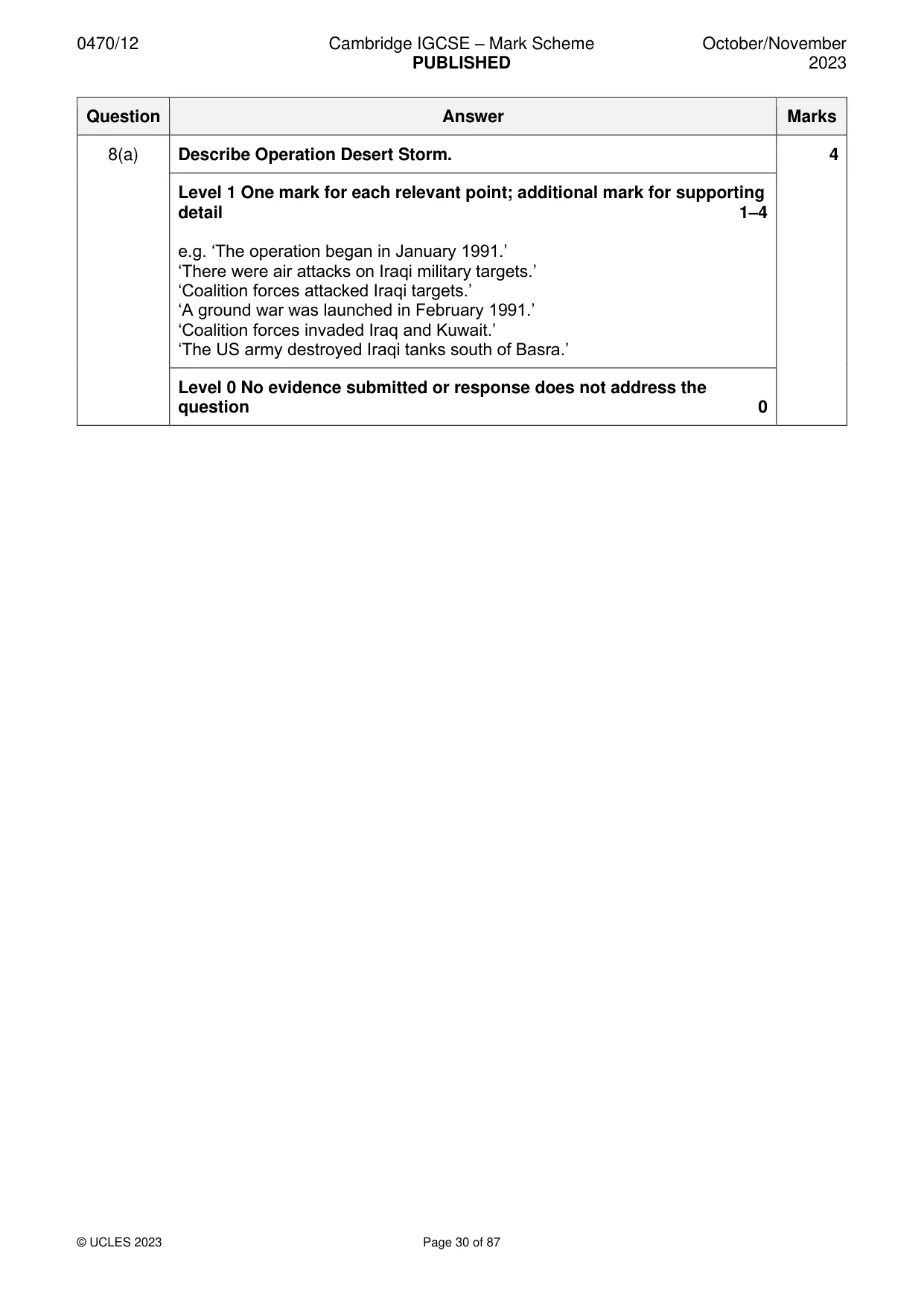
0470/12 Cambridge IGCSE – Mark Scheme PUBLISHED October/November 2023 © UCLES 2023 Page 30 of 87 Question Answer Marks 8(a) Describe Operation Desert Storm. 4 Level 1 One mark for each relevant point; additional mark for supporting detail 1–4 e.g. ‘The operation began in January 1991.’ ‘There were air attacks on Iraqi military targets.’ ‘Coalition forces attacked Iraqi targets.’ ‘A ground war was launched in February 1991.’ ‘Coalition forces invaded Iraq and Kuwait.’ ‘The US army destroyed Iraqi tanks south of Basra.’ Level 0 No evidence submitted or response does not address the question 0
Mark scheme, page 31
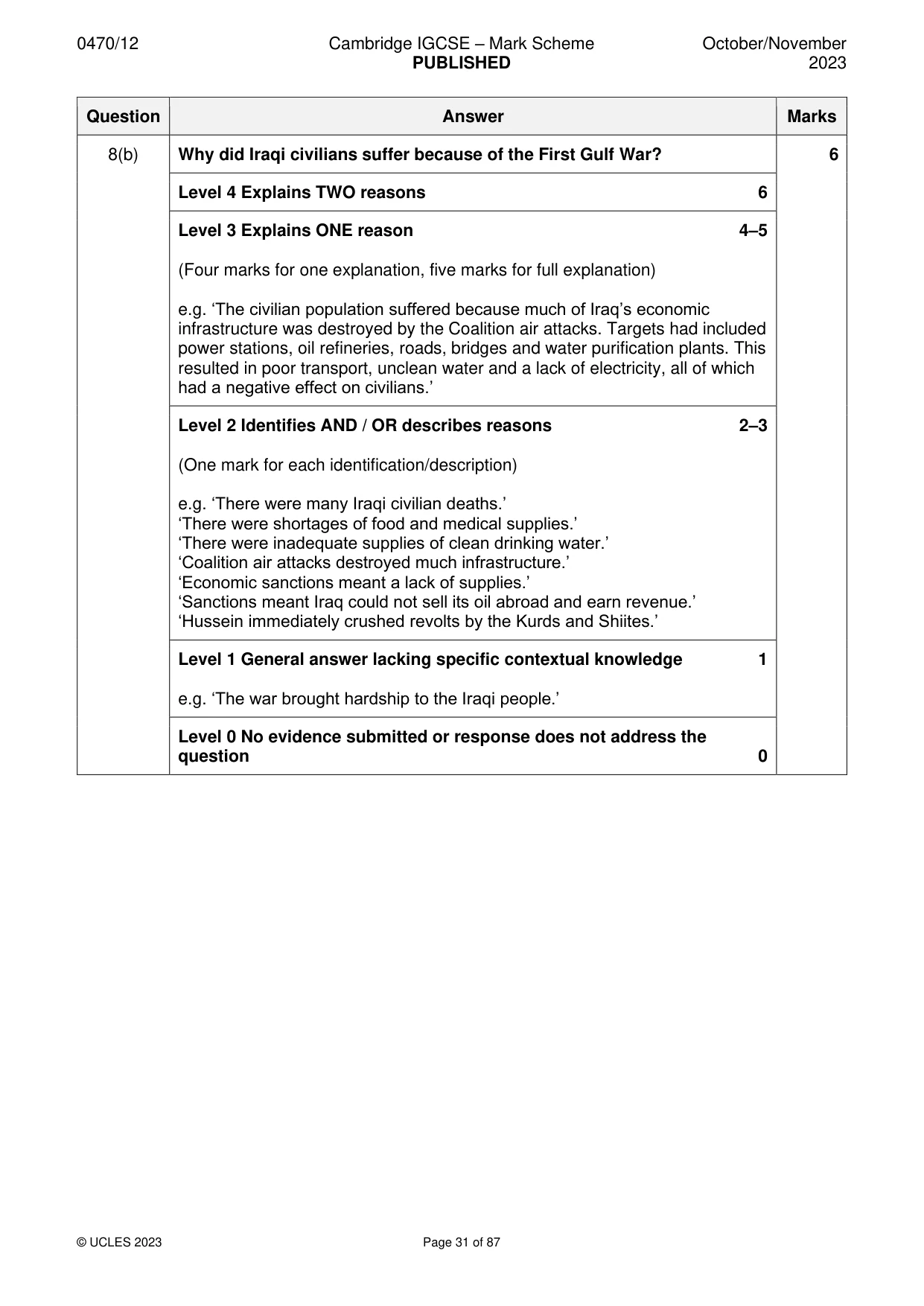
0470/12 Cambridge IGCSE – Mark Scheme PUBLISHED October/November 2023 © UCLES 2023 Page 31 of 87 Question Answer Marks 8(b) Why did Iraqi civilians suffer because of the First Gulf War? 6 Level 4 Explains TWO reasons 6 Level 3 Explains ONE reason 4–5 (Four marks for one explanation, five marks for full explanation) e.g. ‘The civilian population suffered because much of Iraq’s economic infrastructure was destroyed by the Coalition air attacks. Targets had included power stations, oil refineries, roads, bridges and water purification plants. This resulted in poor transport, unclean water and a lack of electricity, all of which had a negative effect on civilians.’ Level 2 Identifies AND / OR describes reasons 2–3 (One mark for each identification/description) e.g. ‘There were many Iraqi civilian deaths.’ ‘There were shortages of food and medical supplies.’ ‘There were inadequate supplies of clean drinking water.’ ‘Coalition air attacks destroyed much infrastructure.’ ‘Economic sanctions meant a lack of supplies.’ ‘Sanctions meant Iraq could not sell its oil abroad and earn revenue.’ ‘Hussein immediately crushed revolts by the Kurds and Shiites.’ Level 1 General answer lacking specific contextual knowledge 1 e.g. ‘The war brought hardship to the Iraqi people.’ Level 0 No evidence submitted or response does not address the question 0
Mark scheme, page 32
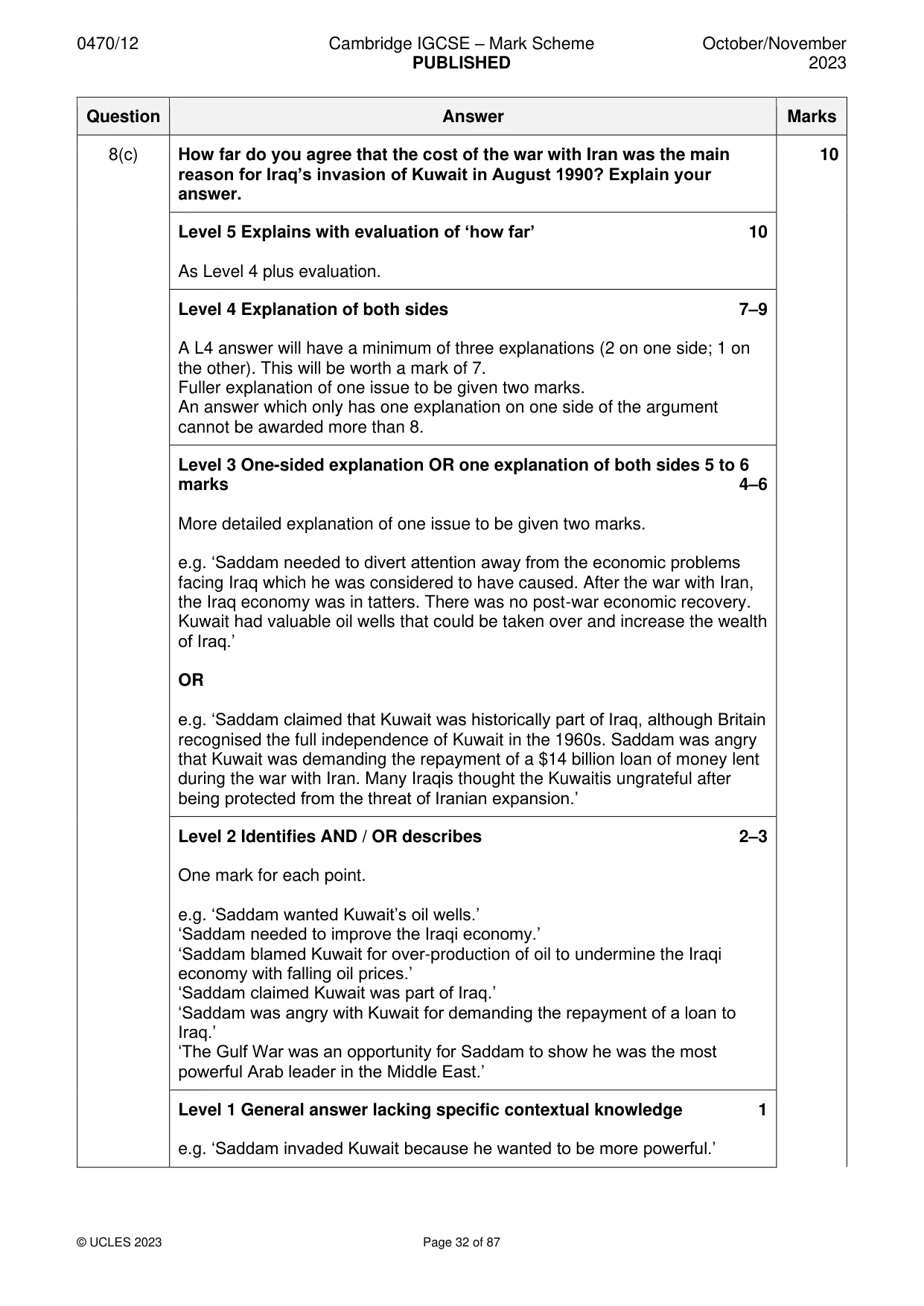
0470/12 Cambridge IGCSE – Mark Scheme PUBLISHED October/November 2023 © UCLES 2023 Page 32 of 87 Question Answer Marks 8(c) How far do you agree that the cost of the war with Iran was the main reason for Iraq’s invasion of Kuwait in August 1990? Explain your answer. 10 Level 5 Explains with evaluation of ‘how far’ 10 As Level 4 plus evaluation. Level 4 Explanation of both sides 7–9 A L4 answer will have a minimum of three explanations (2 on one side; 1 on the other). This will be worth a mark of 7. Fuller explanation of one issue to be given two marks. An answer which only has one explanation on one side of the argument cannot be awarded more than 8. Level 3 One-sided explanation OR one explanation of both sides 5 to 6 marks 4–6 More detailed explanation of one issue to be given two marks. e.g. ‘Saddam needed to divert attention away from the economic problems facing Iraq which he was considered to have caused. After the war with Iran, the Iraq economy was in tatters. There was no post-war economic recovery. Kuwait had valuable oil wells that could be taken over and increase the wealth of Iraq.’ OR e.g. ‘Saddam claimed that Kuwait was historically part of Iraq, although Britain recognised the full independence of Kuwait in the 1960s. Saddam was angry that Kuwait was demanding the repayment of a $14 billion loan of money lent during the war with Iran. Many Iraqis thought the Kuwaitis ungrateful after being protected from the threat of Iranian expansion.’ Level 2 Identifies AND / OR describes 2–3 One mark for each point. e.g. ‘Saddam wanted Kuwait’s oil wells.’ ‘Saddam needed to improve the Iraqi economy.’ ‘Saddam blamed Kuwait for over-production of oil to undermine the Iraqi economy with falling oil prices.’ ‘Saddam claimed Kuwait was part of Iraq.’ ‘Saddam was angry with Kuwait for demanding the repayment of a loan to Iraq.’ ‘The Gulf War was an opportunity for Saddam to show he was the most powerful Arab leader in the Middle East.’ Level 1 General answer lacking specific contextual knowledge 1 e.g. ‘Saddam invaded Kuwait because he wanted to be more powerful.’
Mark scheme, page 33
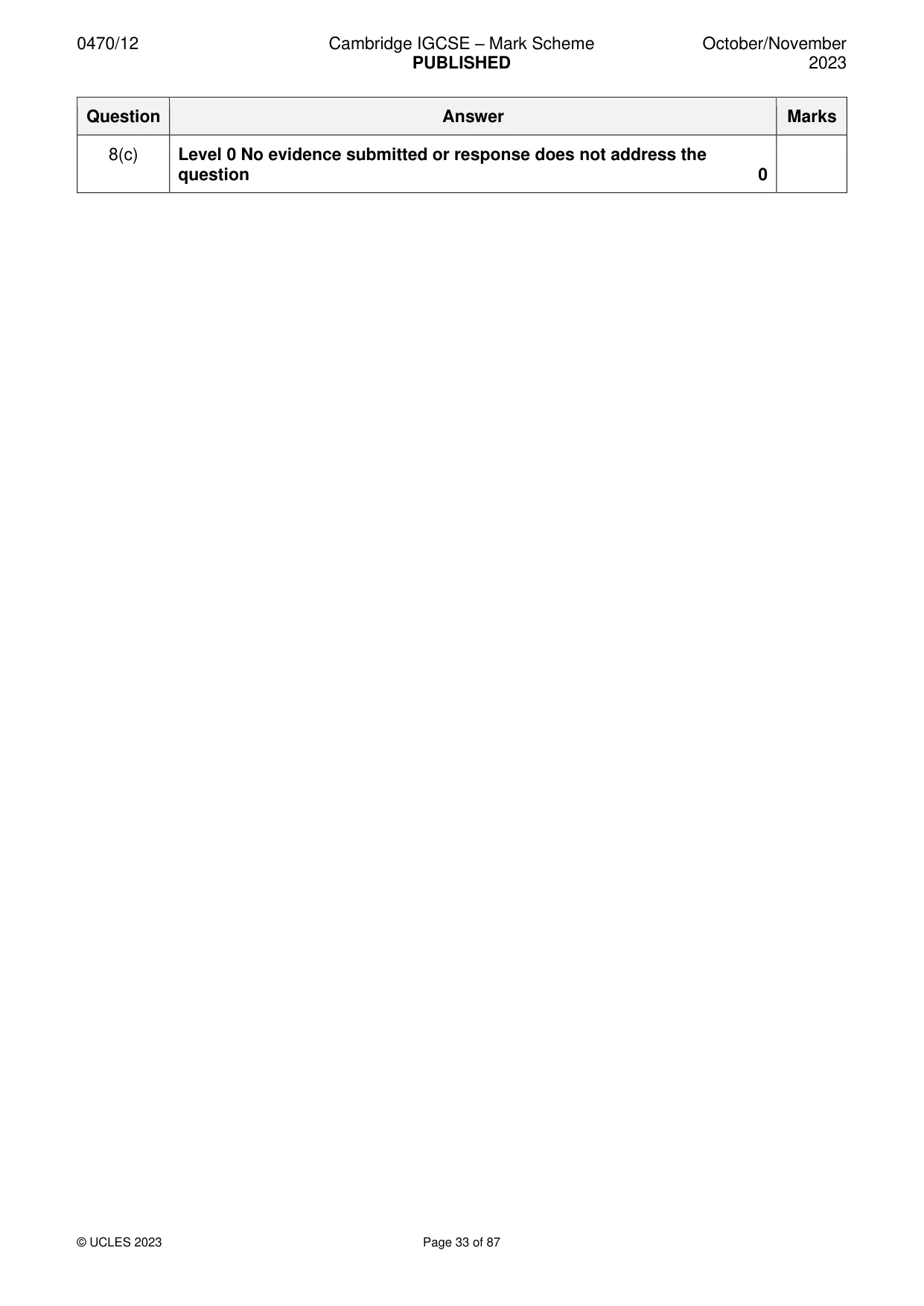
0470/12 Cambridge IGCSE – Mark Scheme PUBLISHED October/November 2023 © UCLES 2023 Page 33 of 87 Question Answer Marks 8(c) Level 0 No evidence submitted or response does not address the question 0
Mark scheme, page 34
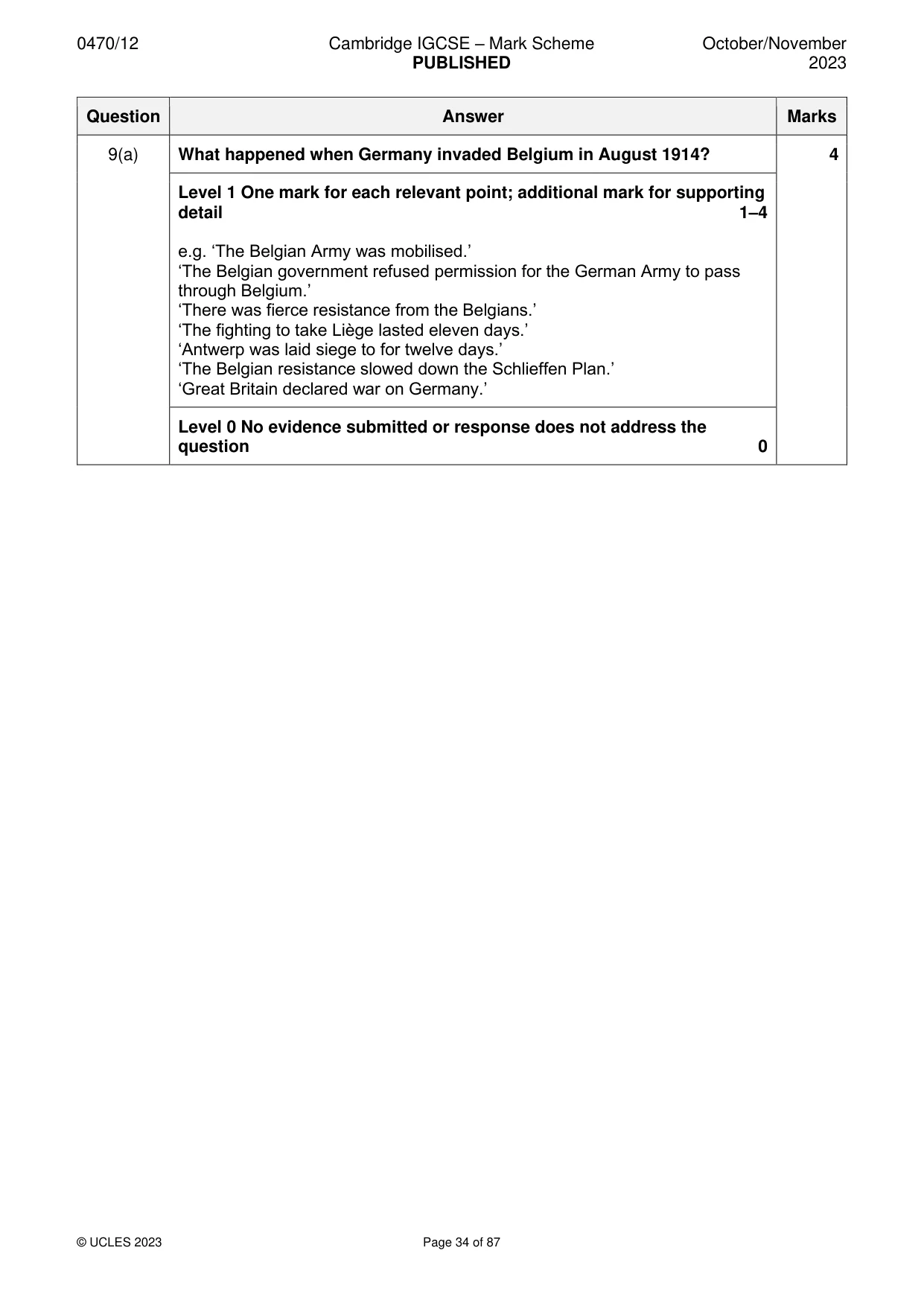
0470/12 Cambridge IGCSE – Mark Scheme PUBLISHED October/November 2023 © UCLES 2023 Page 34 of 87 Question Answer Marks 9(a) What happened when Germany invaded Belgium in August 1914? 4 Level 1 One mark for each relevant point; additional mark for supporting detail 1–4 e.g. ‘The Belgian Army was mobilised.’ ‘The Belgian government refused permission for the German Army to pass through Belgium.’ ‘There was fierce resistance from the Belgians.’ ‘The fighting to take Liège lasted eleven days.’ ‘Antwerp was laid siege to for twelve days.’ ‘The Belgian resistance slowed down the Schlieffen Plan.’ ‘Great Britain declared war on Germany.’ Level 0 No evidence submitted or response does not address the question 0
Mark scheme, page 35
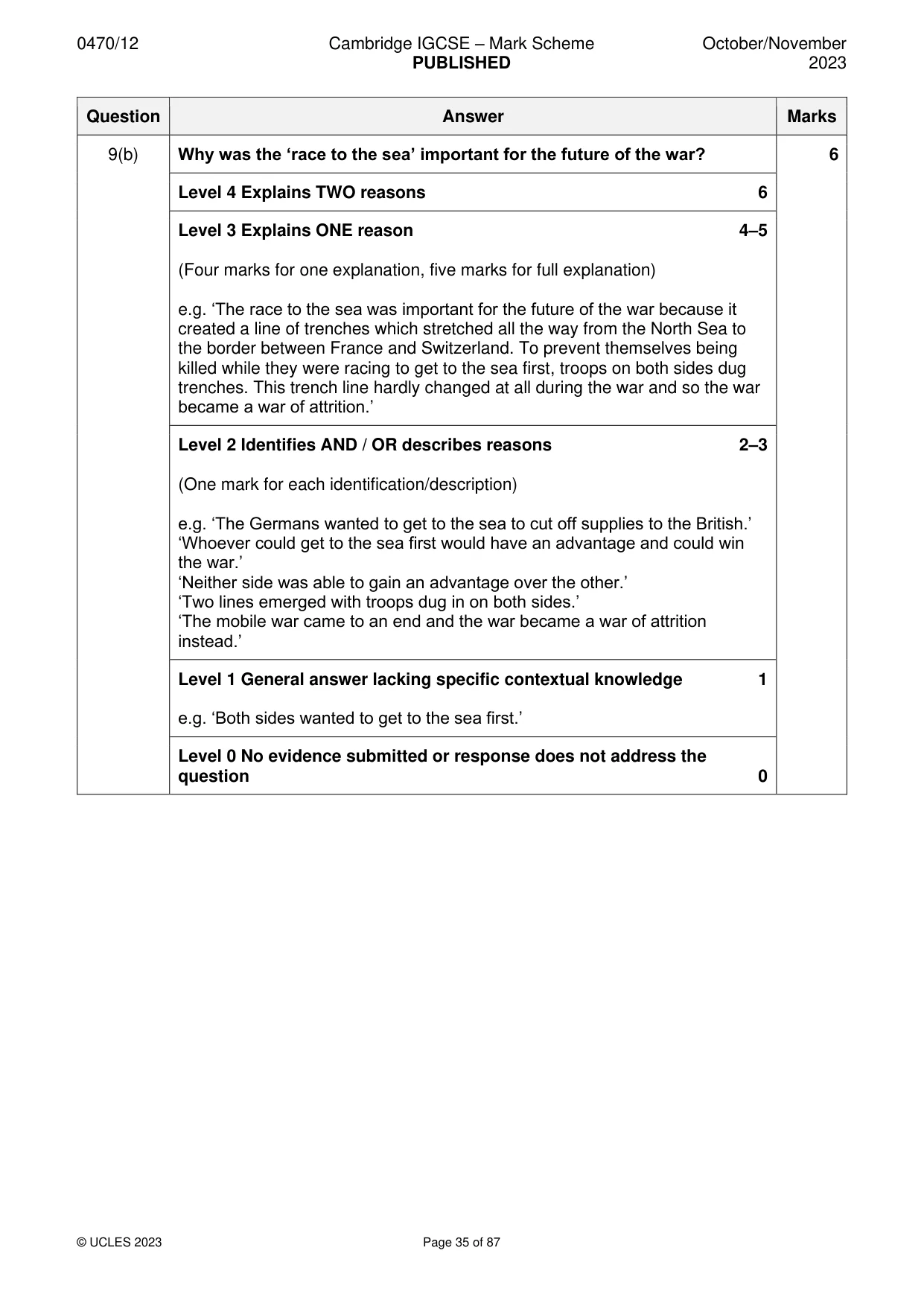
0470/12 Cambridge IGCSE – Mark Scheme PUBLISHED October/November 2023 © UCLES 2023 Page 35 of 87 Question Answer Marks 9(b) Why was the ‘race to the sea’ important for the future of the war? 6 Level 4 Explains TWO reasons 6 Level 3 Explains ONE reason 4–5 (Four marks for one explanation, five marks for full explanation) e.g. ‘The race to the sea was important for the future of the war because it created a line of trenches which stretched all the way from the North Sea to the border between France and Switzerland. To prevent themselves being killed while they were racing to get to the sea first, troops on both sides dug trenches. This trench line hardly changed at all during the war and so the war became a war of attrition.’ Level 2 Identifies AND / OR describes reasons 2–3 (One mark for each identification/description) e.g. ‘The Germans wanted to get to the sea to cut off supplies to the British.’ ‘Whoever could get to the sea first would have an advantage and could win the war.’ ‘Neither side was able to gain an advantage over the other.’ ‘Two lines emerged with troops dug in on both sides.’ ‘The mobile war came to an end and the war became a war of attrition instead.’ Level 1 General answer lacking specific contextual knowledge 1 e.g. ‘Both sides wanted to get to the sea first.’ Level 0 No evidence submitted or response does not address the question 0
Mark scheme, page 36
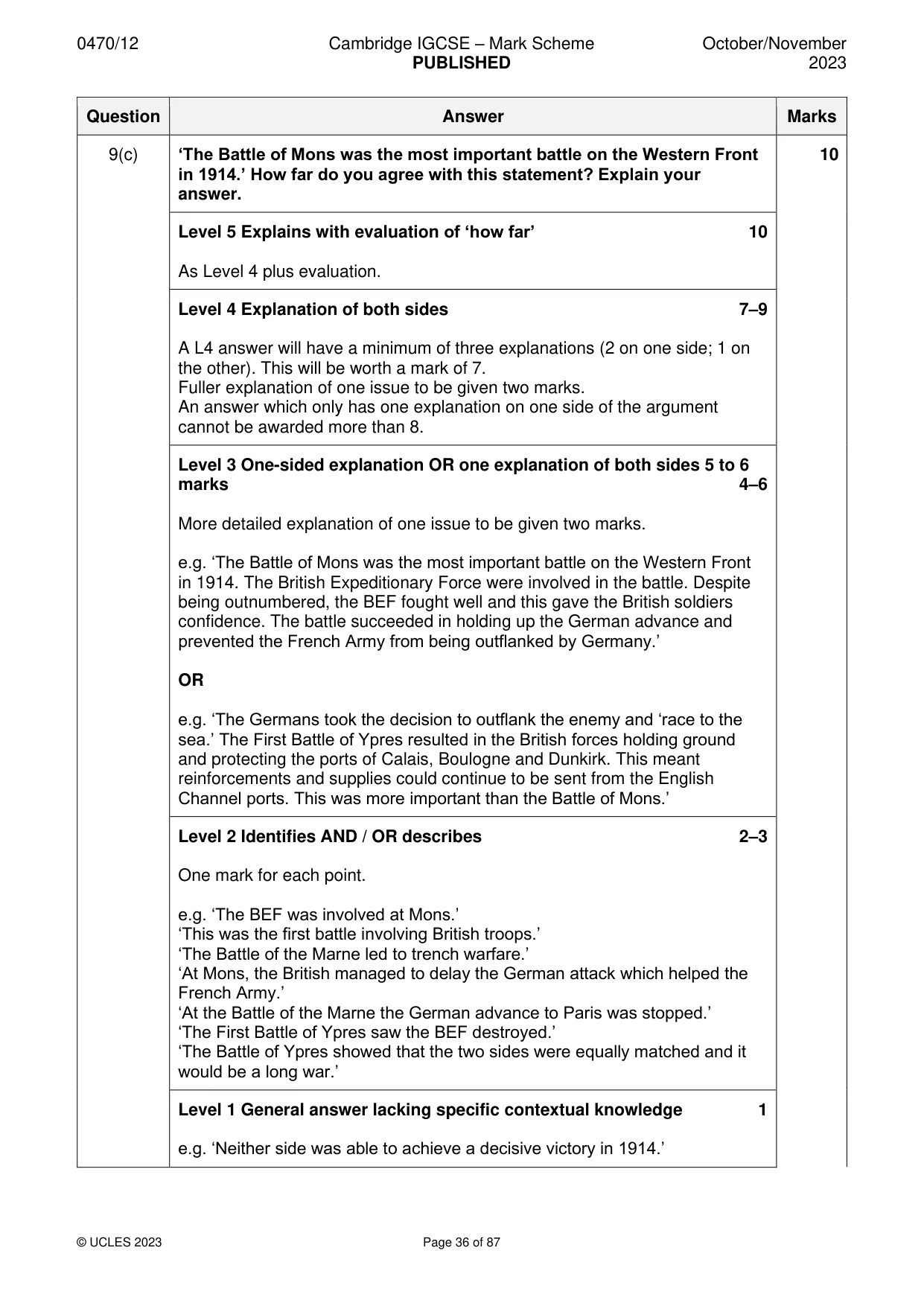
0470/12 Cambridge IGCSE – Mark Scheme PUBLISHED October/November 2023 © UCLES 2023 Page 36 of 87 Question Answer Marks 9(c) ‘The Battle of Mons was the most important battle on the Western Front in 1914.’ How far do you agree with this statement? Explain your answer. 10 Level 5 Explains with evaluation of ‘how far’ 10 As Level 4 plus evaluation. Level 4 Explanation of both sides 7–9 A L4 answer will have a minimum of three explanations (2 on one side; 1 on the other). This will be worth a mark of 7. Fuller explanation of one issue to be given two marks. An answer which only has one explanation on one side of the argument cannot be awarded more than 8. Level 3 One-sided explanation OR one explanation of both sides 5 to 6 marks 4–6 More detailed explanation of one issue to be given two marks. e.g. ‘The Battle of Mons was the most important battle on the Western Front in 1914. The British Expeditionary Force were involved in the battle. Despite being outnumbered, the BEF fought well and this gave the British soldiers confidence. The battle succeeded in holding up the German advance and prevented the French Army from being outflanked by Germany.’ OR e.g. ‘The Germans took the decision to outflank the enemy and ‘race to the sea.’ The First Battle of Ypres resulted in the British forces holding ground and protecting the ports of Calais, Boulogne and Dunkirk. This meant reinforcements and supplies could continue to be sent from the English Channel ports. This was more important than the Battle of Mons.’ Level 2 Identifies AND / OR describes 2–3 One mark for each point. e.g. ‘The BEF was involved at Mons.’ ‘This was the first battle involving British troops.’ ‘The Battle of the Marne led to trench warfare.’ ‘At Mons, the British managed to delay the German attack which helped the French Army.’ ‘At the Battle of the Marne the German advance to Paris was stopped.’ ‘The First Battle of Ypres saw the BEF destroyed.’ ‘The Battle of Ypres showed that the two sides were equally matched and it would be a long war.’ Level 1 General answer lacking specific contextual knowledge 1 e.g. ‘Neither side was able to achieve a decisive victory in 1914.’
Mark scheme, page 37
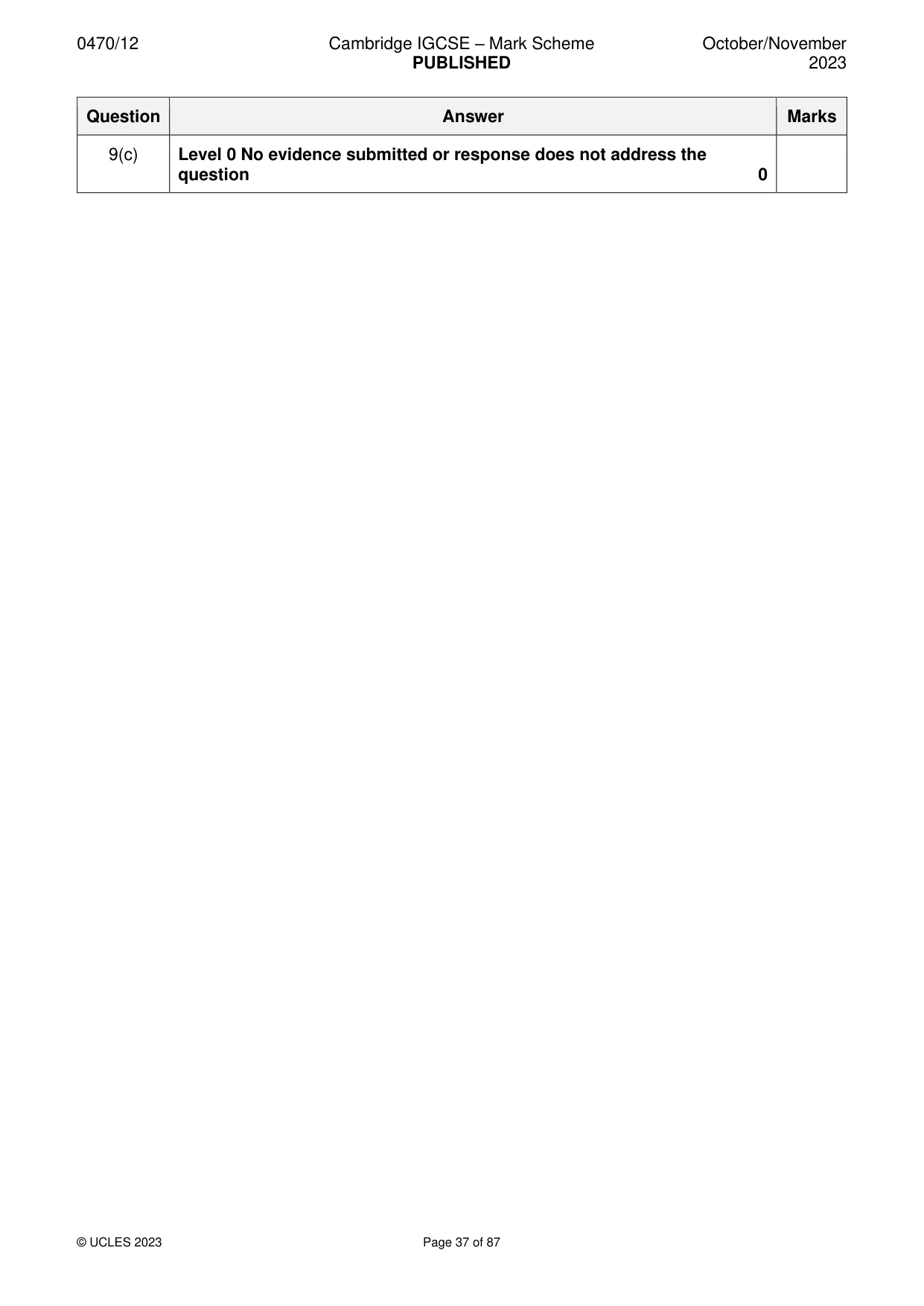
0470/12 Cambridge IGCSE – Mark Scheme PUBLISHED October/November 2023 © UCLES 2023 Page 37 of 87 Question Answer Marks 9(c) Level 0 No evidence submitted or response does not address the question 0
Mark scheme, page 38
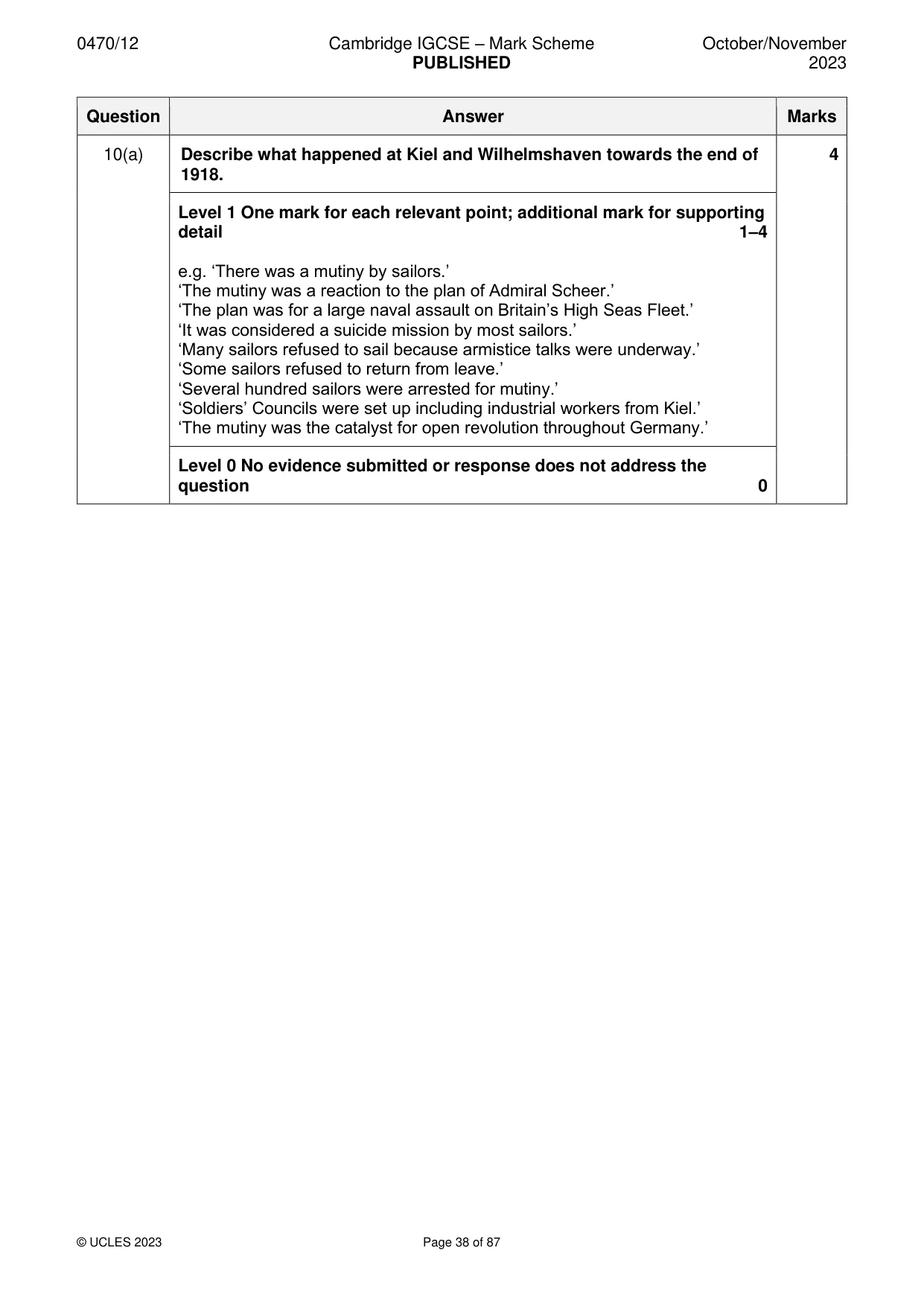
0470/12 Cambridge IGCSE – Mark Scheme PUBLISHED October/November 2023 © UCLES 2023 Page 38 of 87 Question Answer Marks 10(a) Describe what happened at Kiel and Wilhelmshaven towards the end of 1918. 4 Level 1 One mark for each relevant point; additional mark for supporting detail 1–4 e.g. ‘There was a mutiny by sailors.’ ‘The mutiny was a reaction to the plan of Admiral Scheer.’ ‘The plan was for a large naval assault on Britain’s High Seas Fleet.’ ‘It was considered a suicide mission by most sailors.’ ‘Many sailors refused to sail because armistice talks were underway.’ ‘Some sailors refused to return from leave.’ ‘Several hundred sailors were arrested for mutiny.’ ‘Soldiers’ Councils were set up including industrial workers from Kiel.’ ‘The mutiny was the catalyst for open revolution throughout Germany.’ Level 0 No evidence submitted or response does not address the question 0
Mark scheme, page 39
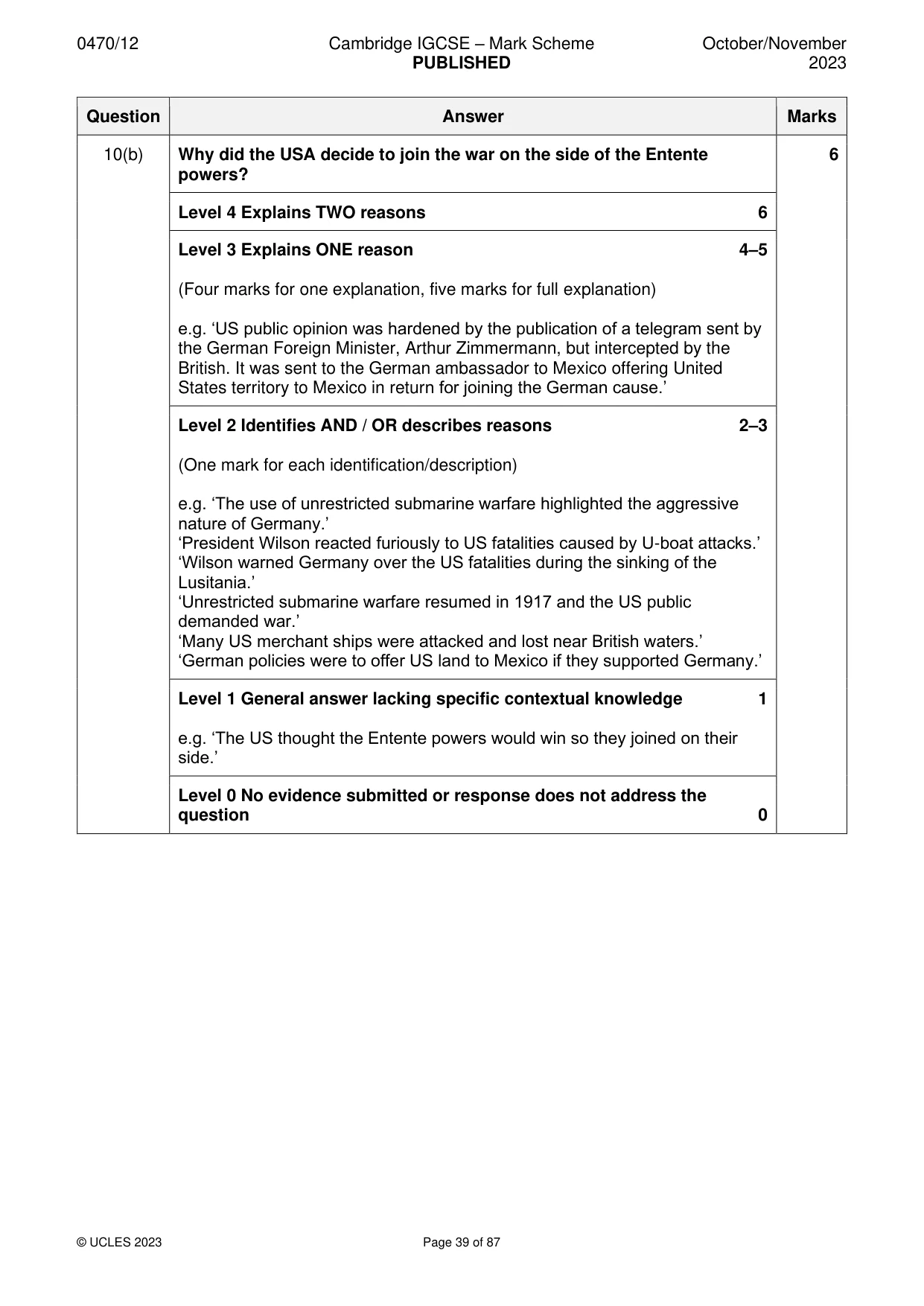
0470/12 Cambridge IGCSE – Mark Scheme PUBLISHED October/November 2023 © UCLES 2023 Page 39 of 87 Question Answer Marks 10(b) Why did the USA decide to join the war on the side of the Entente powers? 6 Level 4 Explains TWO reasons 6 Level 3 Explains ONE reason 4–5 (Four marks for one explanation, five marks for full explanation) e.g. ‘US public opinion was hardened by the publication of a telegram sent by the German Foreign Minister, Arthur Zimmermann, but intercepted by the British. It was sent to the German ambassador to Mexico offering United States territory to Mexico in return for joining the German cause.’ Level 2 Identifies AND / OR describes reasons 2–3 (One mark for each identification/description) e.g. ‘The use of unrestricted submarine warfare highlighted the aggressive nature of Germany.’ ‘President Wilson reacted furiously to US fatalities caused by U-boat attacks.’ ‘Wilson warned Germany over the US fatalities during the sinking of the Lusitania.’ ‘Unrestricted submarine warfare resumed in 1917 and the US public demanded war.’ ‘Many US merchant ships were attacked and lost near British waters.’ ‘German policies were to offer US land to Mexico if they supported Germany.’ Level 1 General answer lacking specific contextual knowledge 1 e.g. ‘The US thought the Entente powers would win so they joined on their side.’ Level 0 No evidence submitted or response does not address the question 0
Mark scheme, page 40
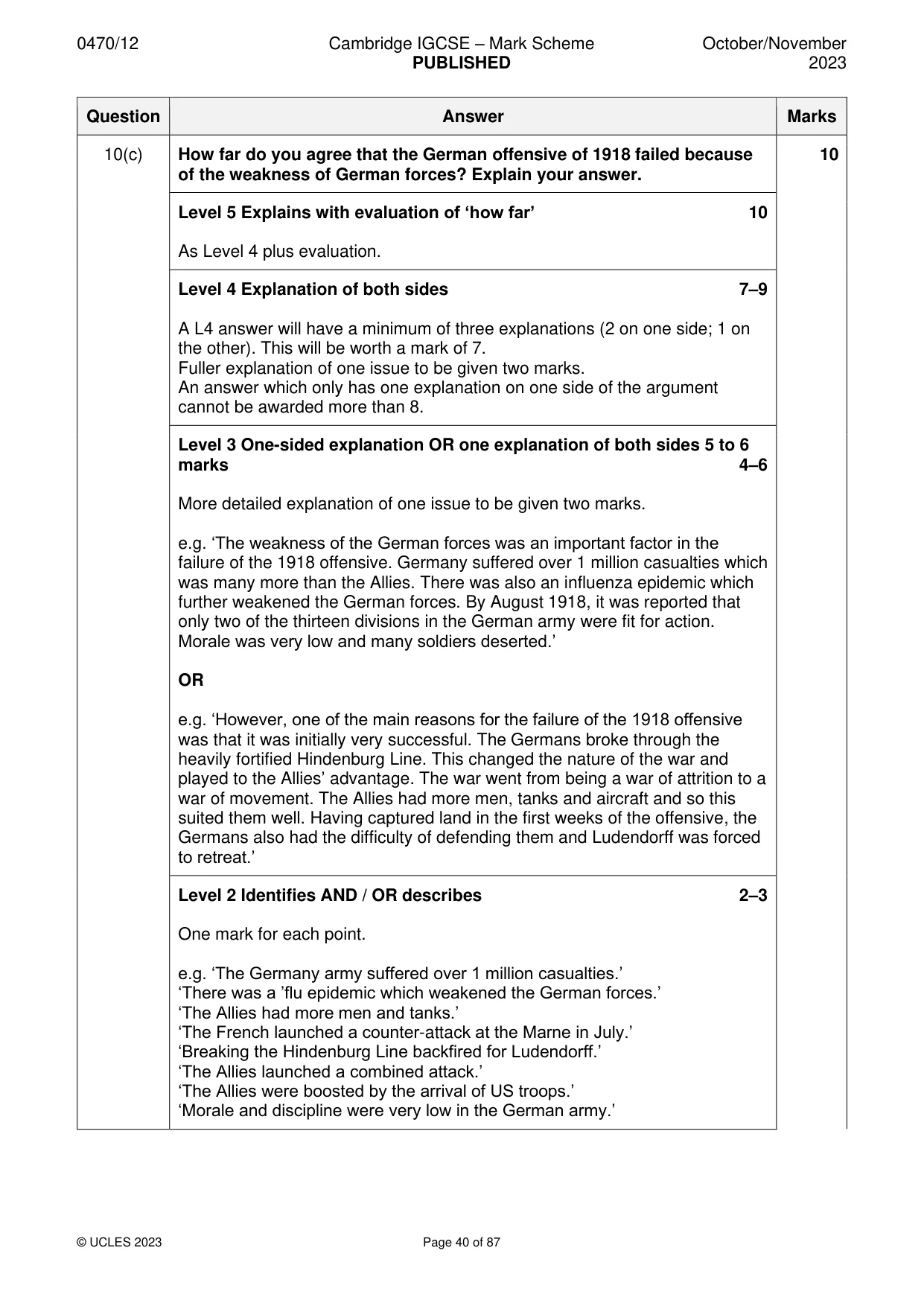
0470/12 Cambridge IGCSE – Mark Scheme PUBLISHED October/November 2023 © UCLES 2023 Page 40 of 87 Question Answer Marks 10(c) How far do you agree that the German offensive of 1918 failed because of the weakness of German forces? Explain your answer. 10 Level 5 Explains with evaluation of ‘how far’ 10 As Level 4 plus evaluation. Level 4 Explanation of both sides 7–9 A L4 answer will have a minimum of three explanations (2 on one side; 1 on the other). This will be worth a mark of 7. Fuller explanation of one issue to be given two marks. An answer which only has one explanation on one side of the argument cannot be awarded more than 8. Level 3 One-sided explanation OR one explanation of both sides 5 to 6 marks 4–6 More detailed explanation of one issue to be given two marks. e.g. ‘The weakness of the German forces was an important factor in the failure of the 1918 offensive. Germany suffered over 1 million casualties which was many more than the Allies. There was also an influenza epidemic which further weakened the German forces. By August 1918, it was reported that only two of the thirteen divisions in the German army were fit for action. Morale was very low and many soldiers deserted.’ OR e.g. ‘However, one of the main reasons for the failure of the 1918 offensive was that it was initially very successful. The Germans broke through the heavily fortified Hindenburg Line. This changed the nature of the war and played to the Allies’ advantage. The war went from being a war of attrition to a war of movement. The Allies had more men, tanks and aircraft and so this suited them well. Having captured land in the first weeks of the offensive, the Germans also had the difficulty of defending them and Ludendorff was forced to retreat.’ Level 2 Identifies AND / OR describes 2–3 One mark for each point. e.g. ‘The Germany army suffered over 1 million casualties.’ ‘There was a ’flu epidemic which weakened the German forces.’ ‘The Allies had more men and tanks.’ ‘The French launched a counter-attack at the Marne in July.’ ‘Breaking the Hindenburg Line backfired for Ludendorff.’ ‘The Allies launched a combined attack.’ ‘The Allies were boosted by the arrival of US troops.’ ‘Morale and discipline were very low in the German army.’
Mark scheme, page 41
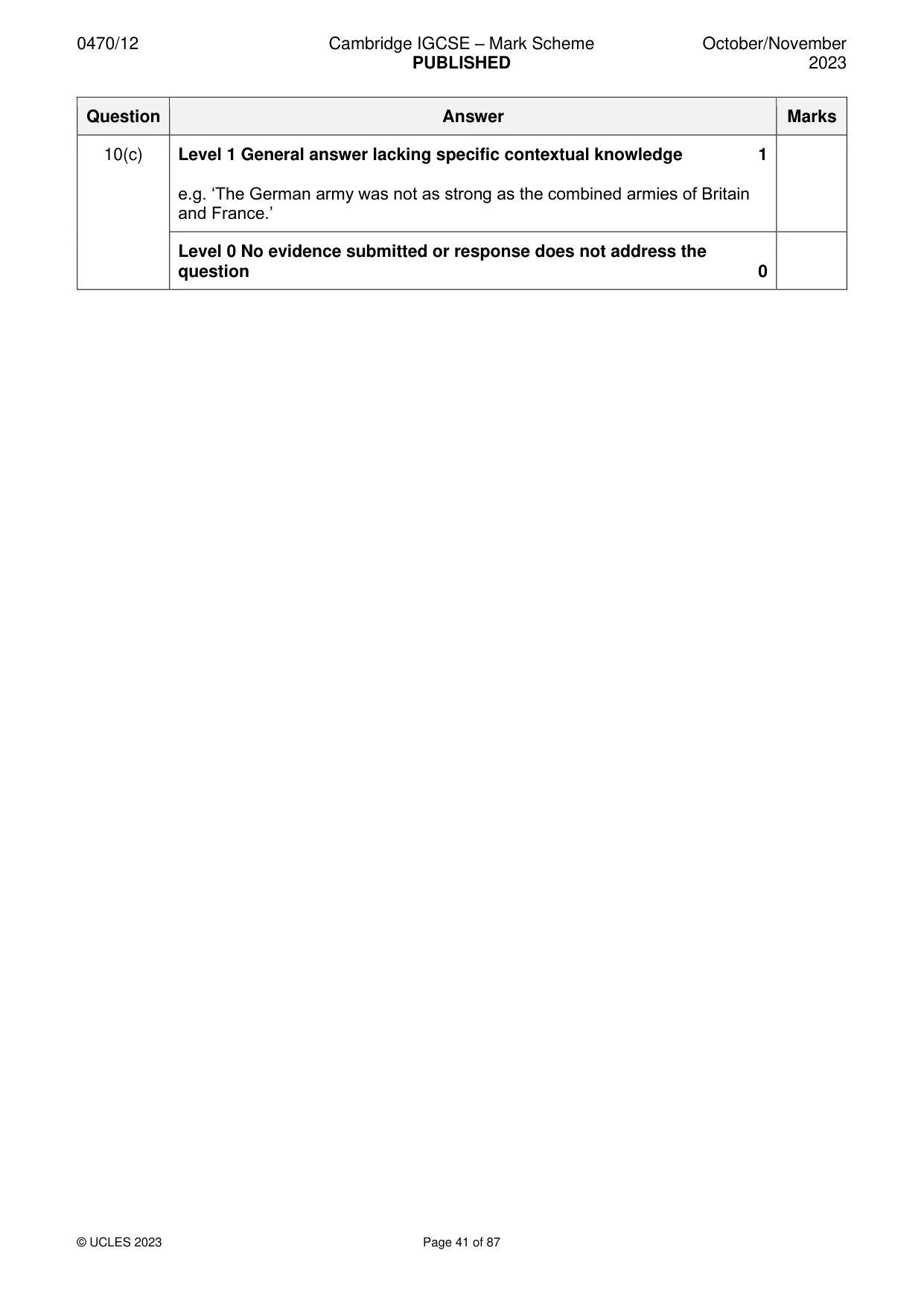
0470/12 Cambridge IGCSE – Mark Scheme PUBLISHED October/November 2023 © UCLES 2023 Page 41 of 87 Question Answer Marks 10(c) Level 1 General answer lacking specific contextual knowledge 1 e.g. ‘The German army was not as strong as the combined armies of Britain and France.’ Level 0 No evidence submitted or response does not address the question 0
Mark scheme, page 42
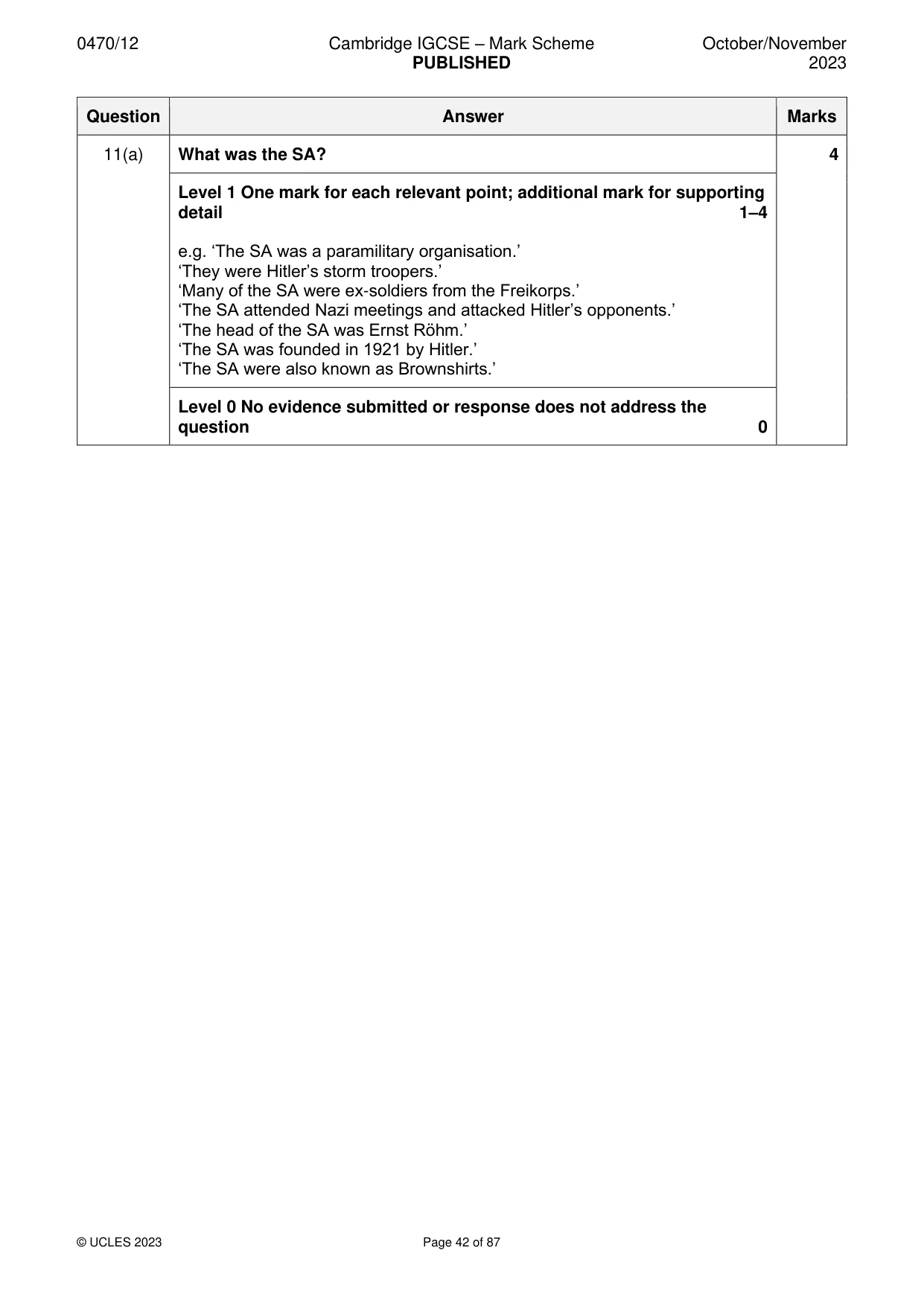
0470/12 Cambridge IGCSE – Mark Scheme PUBLISHED October/November 2023 © UCLES 2023 Page 42 of 87 Question Answer Marks 11(a) What was the SA? 4 Level 1 One mark for each relevant point; additional mark for supporting detail 1–4 e.g. ‘The SA was a paramilitary organisation.’ ‘They were Hitler’s storm troopers.’ ‘Many of the SA were ex-soldiers from the Freikorps.’ ‘The SA attended Nazi meetings and attacked Hitler’s opponents.’ ‘The head of the SA was Ernst Rӧhm.’ ‘The SA was founded in 1921 by Hitler.’ ‘The SA were also known as Brownshirts.’ Level 0 No evidence submitted or response does not address the question 0
Mark scheme, page 43
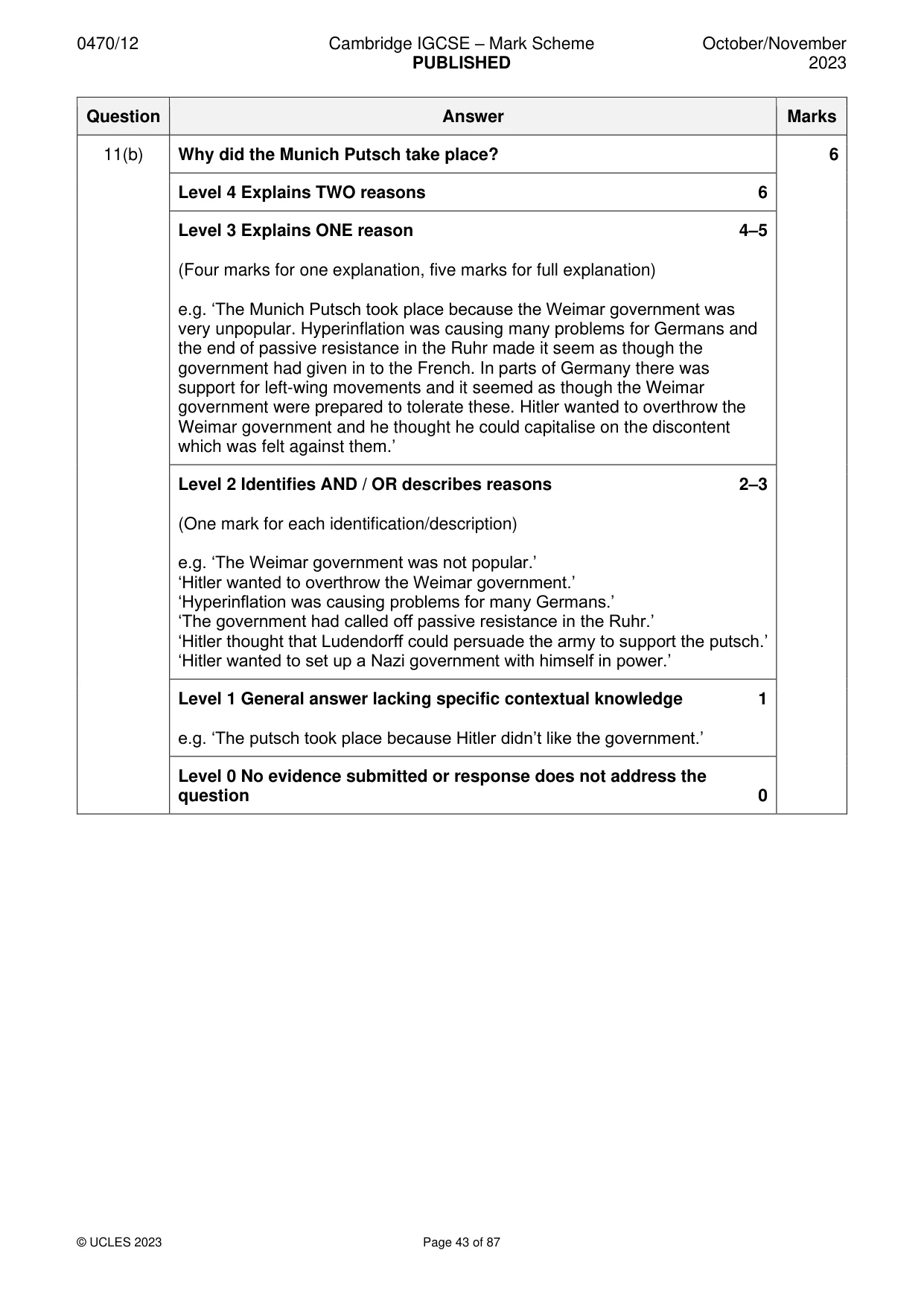
0470/12 Cambridge IGCSE – Mark Scheme PUBLISHED October/November 2023 © UCLES 2023 Page 43 of 87 Question Answer Marks 11(b) Why did the Munich Putsch take place? 6 Level 4 Explains TWO reasons 6 Level 3 Explains ONE reason 4–5 (Four marks for one explanation, five marks for full explanation) e.g. ‘The Munich Putsch took place because the Weimar government was very unpopular. Hyperinflation was causing many problems for Germans and the end of passive resistance in the Ruhr made it seem as though the government had given in to the French. In parts of Germany there was support for left-wing movements and it seemed as though the Weimar government were prepared to tolerate these. Hitler wanted to overthrow the Weimar government and he thought he could capitalise on the discontent which was felt against them.’ Level 2 Identifies AND / OR describes reasons 2–3 (One mark for each identification/description) e.g. ‘The Weimar government was not popular.’ ‘Hitler wanted to overthrow the Weimar government.’ ‘Hyperinflation was causing problems for many Germans.’ ‘The government had called off passive resistance in the Ruhr.’ ‘Hitler thought that Ludendorff could persuade the army to support the putsch.’ ‘Hitler wanted to set up a Nazi government with himself in power.’ Level 1 General answer lacking specific contextual knowledge 1 e.g. ‘The putsch took place because Hitler didn’t like the government.’ Level 0 No evidence submitted or response does not address the question 0
Mark scheme, page 44
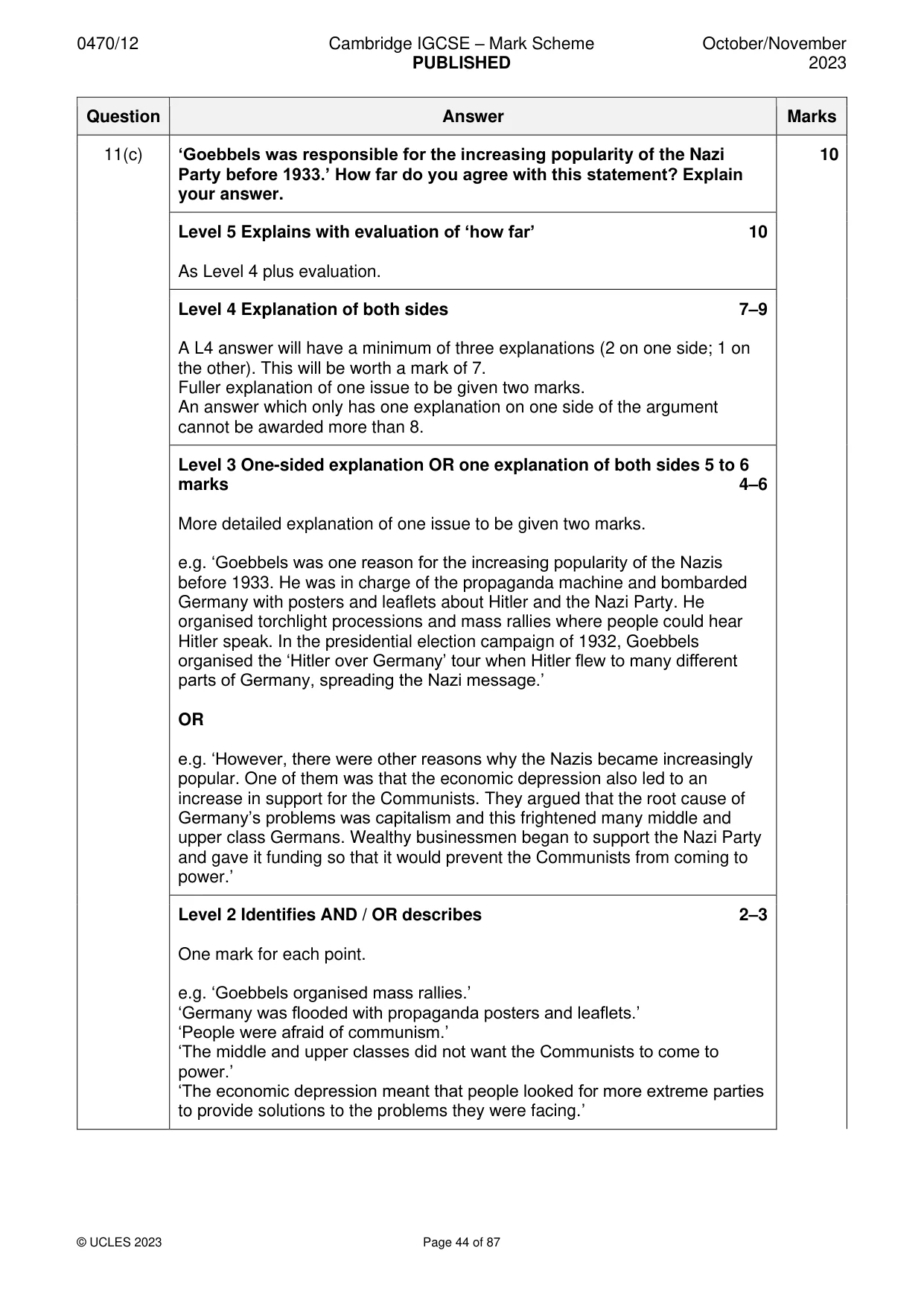
0470/12 Cambridge IGCSE – Mark Scheme PUBLISHED October/November 2023 © UCLES 2023 Page 44 of 87 Question Answer Marks 11(c) ‘Goebbels was responsible for the increasing popularity of the Nazi Party before 1933.’ How far do you agree with this statement? Explain your answer. 10 Level 5 Explains with evaluation of ‘how far’ 10 As Level 4 plus evaluation. Level 4 Explanation of both sides 7–9 A L4 answer will have a minimum of three explanations (2 on one side; 1 on the other). This will be worth a mark of 7. Fuller explanation of one issue to be given two marks. An answer which only has one explanation on one side of the argument cannot be awarded more than 8. Level 3 One-sided explanation OR one explanation of both sides 5 to 6 marks 4–6 More detailed explanation of one issue to be given two marks. e.g. ‘Goebbels was one reason for the increasing popularity of the Nazis before 1933. He was in charge of the propaganda machine and bombarded Germany with posters and leaflets about Hitler and the Nazi Party. He organised torchlight processions and mass rallies where people could hear Hitler speak. In the presidential election campaign of 1932, Goebbels organised the ‘Hitler over Germany’ tour when Hitler flew to many different parts of Germany, spreading the Nazi message.’ OR e.g. ‘However, there were other reasons why the Nazis became increasingly popular. One of them was that the economic depression also led to an increase in support for the Communists. They argued that the root cause of Germany’s problems was capitalism and this frightened many middle and upper class Germans. Wealthy businessmen began to support the Nazi Party and gave it funding so that it would prevent the Communists from coming to power.’ Level 2 Identifies AND / OR describes 2–3 One mark for each point. e.g. ‘Goebbels organised mass rallies.’ ‘Germany was flooded with propaganda posters and leaflets.’ ‘People were afraid of communism.’ ‘The middle and upper classes did not want the Communists to come to power.’ ‘The economic depression meant that people looked for more extreme parties to provide solutions to the problems they were facing.’
Mark scheme, page 45
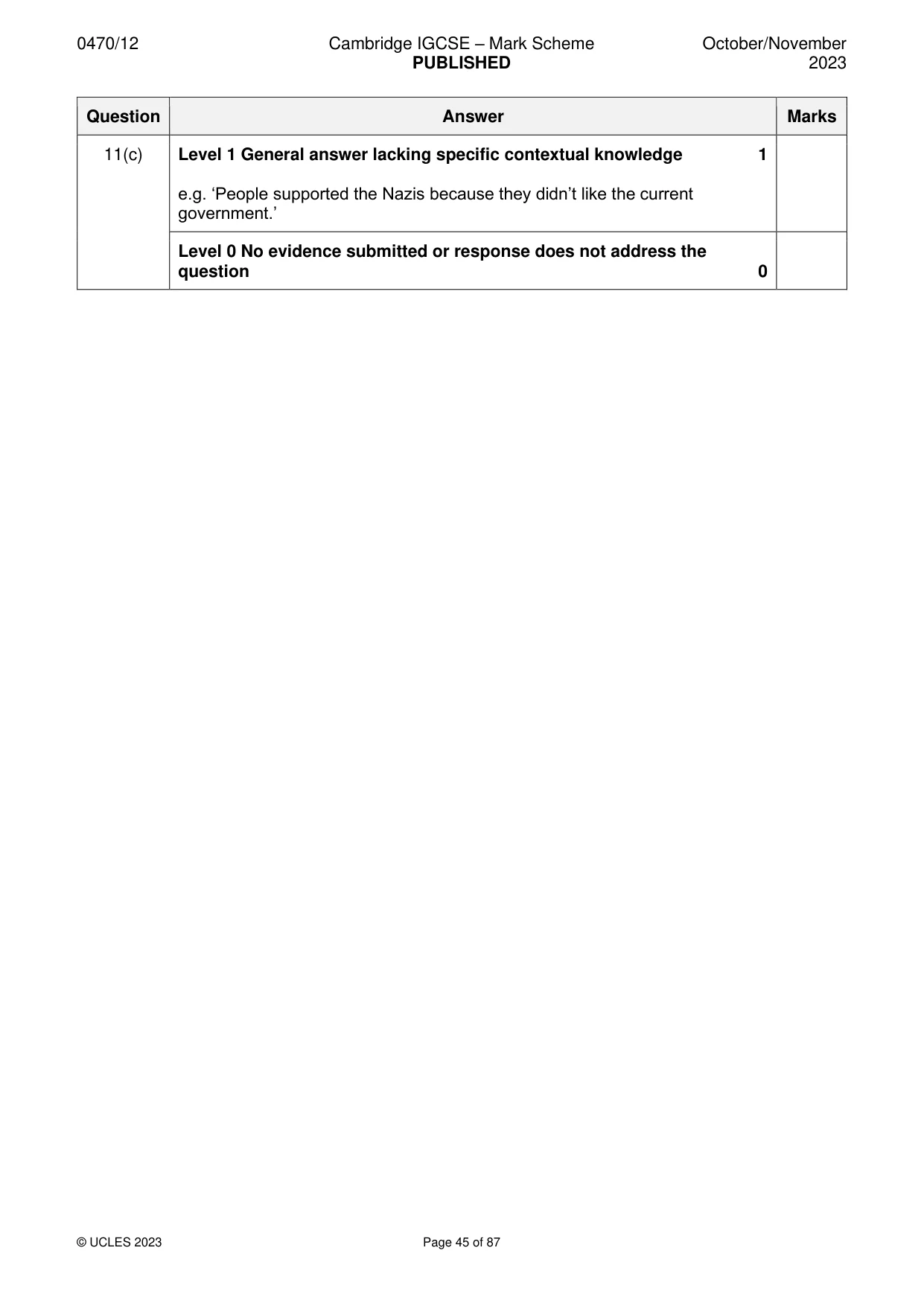
0470/12 Cambridge IGCSE – Mark Scheme PUBLISHED October/November 2023 © UCLES 2023 Page 45 of 87 Question Answer Marks 11(c) Level 1 General answer lacking specific contextual knowledge 1 e.g. ‘People supported the Nazis because they didn’t like the current government.’ Level 0 No evidence submitted or response does not address the question 0
Mark scheme, page 46
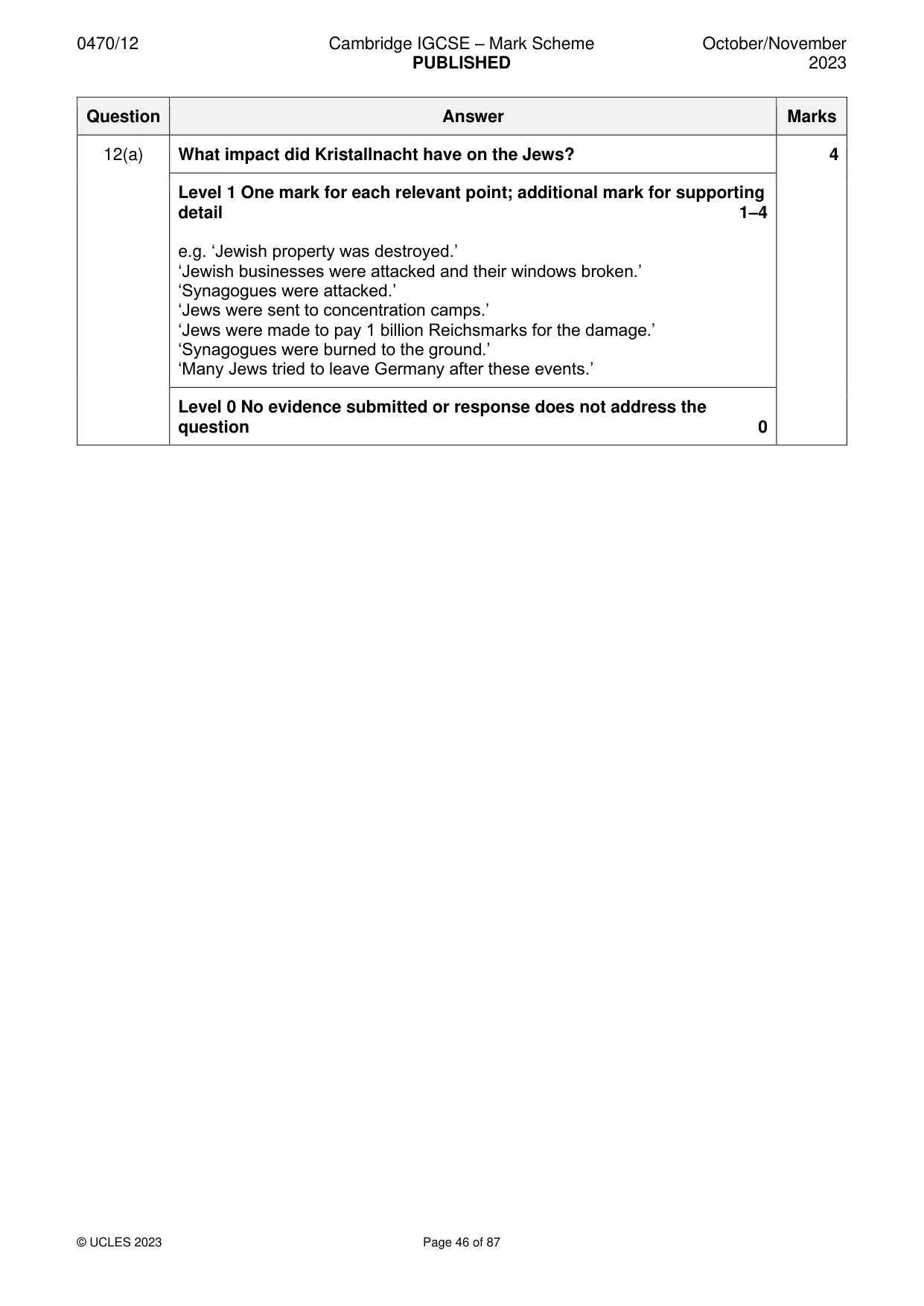
0470/12 Cambridge IGCSE – Mark Scheme PUBLISHED October/November 2023 © UCLES 2023 Page 46 of 87 Question Answer Marks 12(a) What impact did Kristallnacht have on the Jews? 4 Level 1 One mark for each relevant point; additional mark for supporting detail 1–4 e.g. ‘Jewish property was destroyed.’ ‘Jewish businesses were attacked and their windows broken.’ ‘Synagogues were attacked.’ ‘Jews were sent to concentration camps.’ ‘Jews were made to pay 1 billion Reichsmarks for the damage.’ ‘Synagogues were burned to the ground.’ ‘Many Jews tried to leave Germany after these events.’ Level 0 No evidence submitted or response does not address the question 0
Mark scheme, page 47
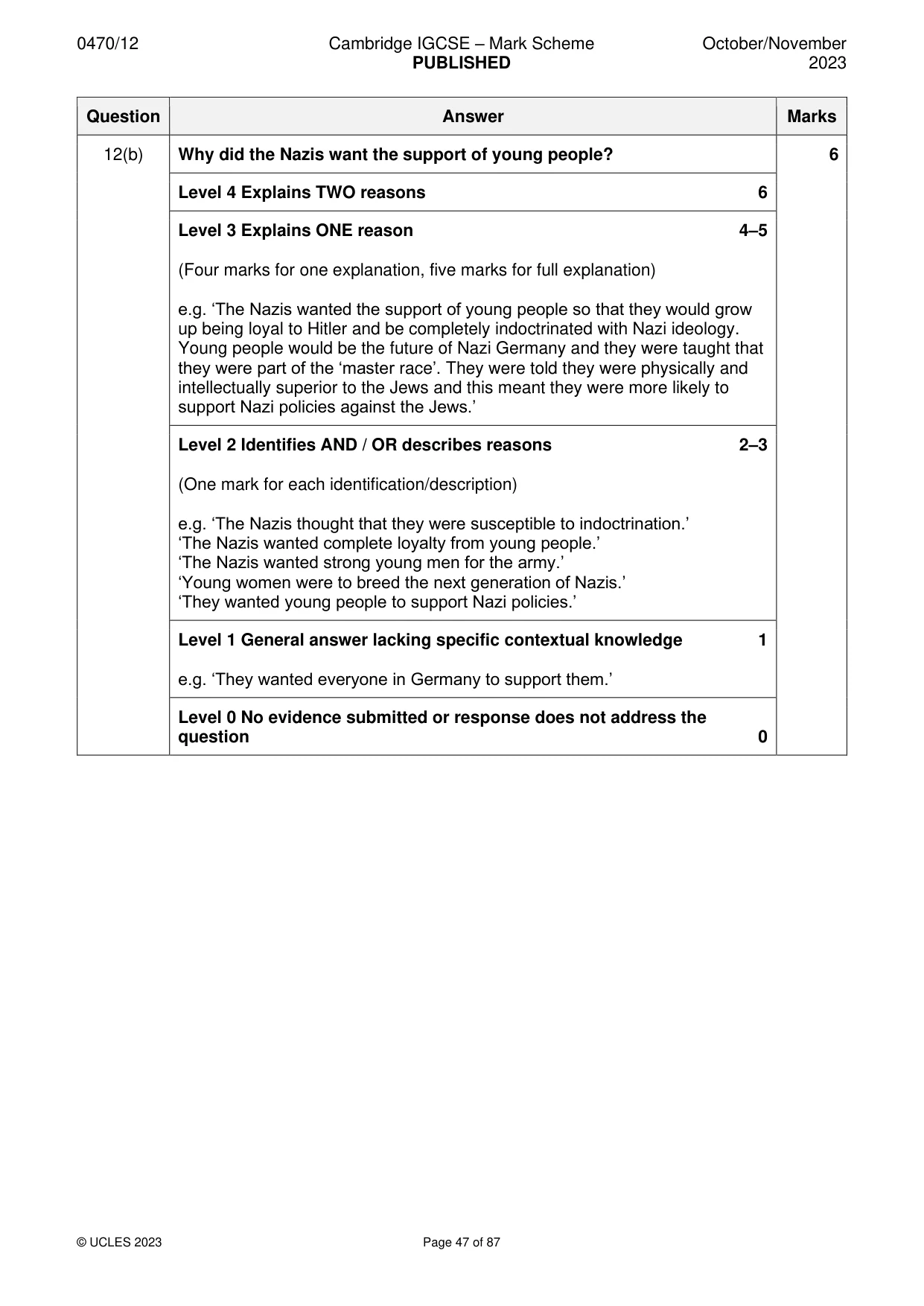
0470/12 Cambridge IGCSE – Mark Scheme PUBLISHED October/November 2023 © UCLES 2023 Page 47 of 87 Question Answer Marks 12(b) Why did the Nazis want the support of young people? 6 Level 4 Explains TWO reasons 6 Level 3 Explains ONE reason 4–5 (Four marks for one explanation, five marks for full explanation) e.g. ‘The Nazis wanted the support of young people so that they would grow up being loyal to Hitler and be completely indoctrinated with Nazi ideology. Young people would be the future of Nazi Germany and they were taught that they were part of the ‘master race’. They were told they were physically and intellectually superior to the Jews and this meant they were more likely to support Nazi policies against the Jews.’ Level 2 Identifies AND / OR describes reasons 2–3 (One mark for each identification/description) e.g. ‘The Nazis thought that they were susceptible to indoctrination.’ ‘The Nazis wanted complete loyalty from young people.’ ‘The Nazis wanted strong young men for the army.’ ‘Young women were to breed the next generation of Nazis.’ ‘They wanted young people to support Nazi policies.’ Level 1 General answer lacking specific contextual knowledge 1 e.g. ‘They wanted everyone in Germany to support them.’ Level 0 No evidence submitted or response does not address the question 0
Mark scheme, page 48
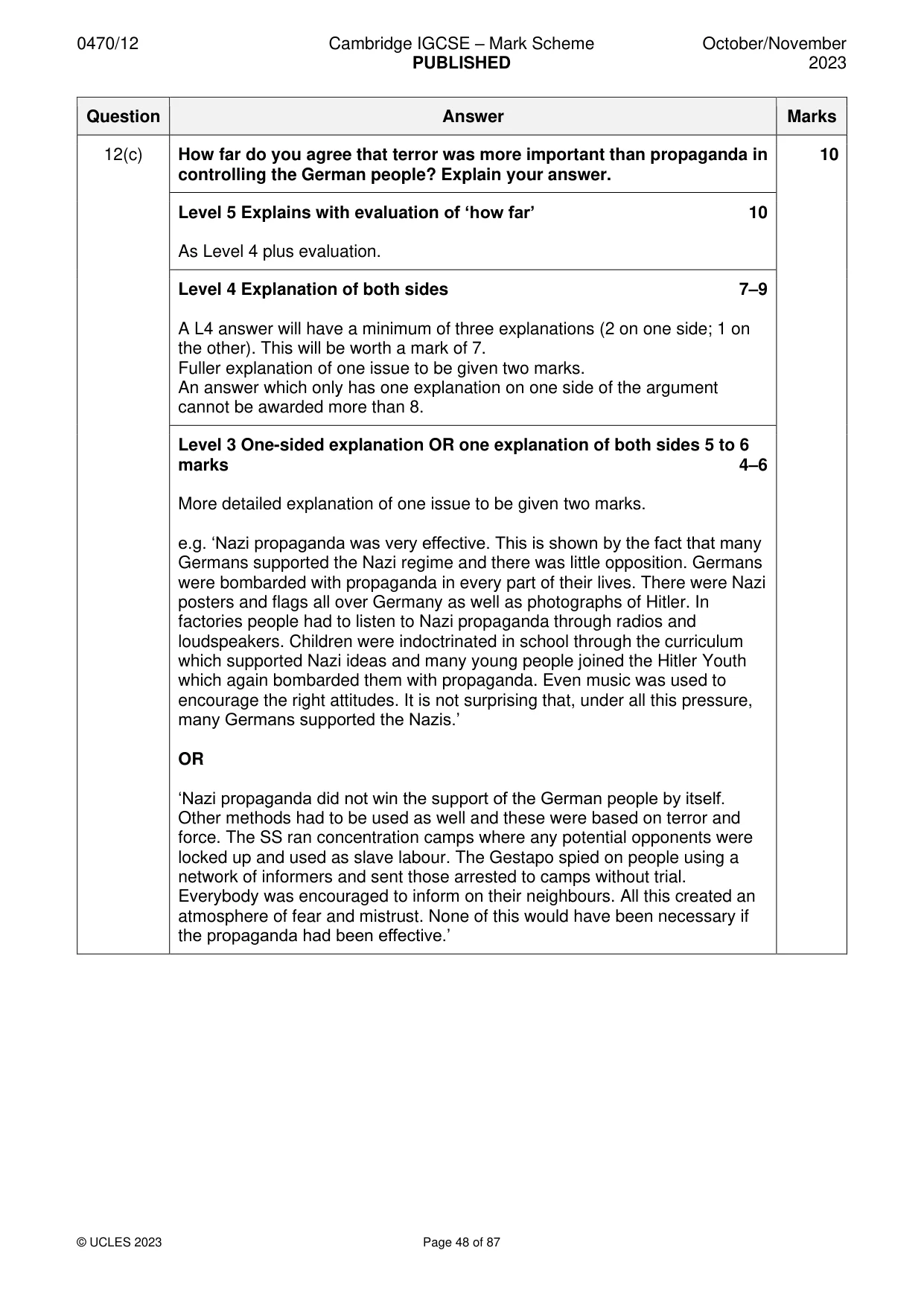
0470/12 Cambridge IGCSE – Mark Scheme PUBLISHED October/November 2023 © UCLES 2023 Page 48 of 87 Question Answer Marks 12(c) How far do you agree that terror was more important than propaganda in controlling the German people? Explain your answer. 10 Level 5 Explains with evaluation of ‘how far’ 10 As Level 4 plus evaluation. Level 4 Explanation of both sides 7–9 A L4 answer will have a minimum of three explanations (2 on one side; 1 on the other). This will be worth a mark of 7. Fuller explanation of one issue to be given two marks. An answer which only has one explanation on one side of the argument cannot be awarded more than 8. Level 3 One-sided explanation OR one explanation of both sides 5 to 6 marks 4–6 More detailed explanation of one issue to be given two marks. e.g. ‘Nazi propaganda was very effective. This is shown by the fact that many Germans supported the Nazi regime and there was little opposition. Germans were bombarded with propaganda in every part of their lives. There were Nazi posters and flags all over Germany as well as photographs of Hitler. In factories people had to listen to Nazi propaganda through radios and loudspeakers. Children were indoctrinated in school through the curriculum which supported Nazi ideas and many young people joined the Hitler Youth which again bombarded them with propaganda. Even music was used to encourage the right attitudes. It is not surprising that, under all this pressure, many Germans supported the Nazis.’ OR ‘Nazi propaganda did not win the support of the German people by itself. Other methods had to be used as well and these were based on terror and force. The SS ran concentration camps where any potential opponents were locked up and used as slave labour. The Gestapo spied on people using a network of informers and sent those arrested to camps without trial. Everybody was encouraged to inform on their neighbours. All this created an atmosphere of fear and mistrust. None of this would have been necessary if the propaganda had been effective.’
Mark scheme, page 49
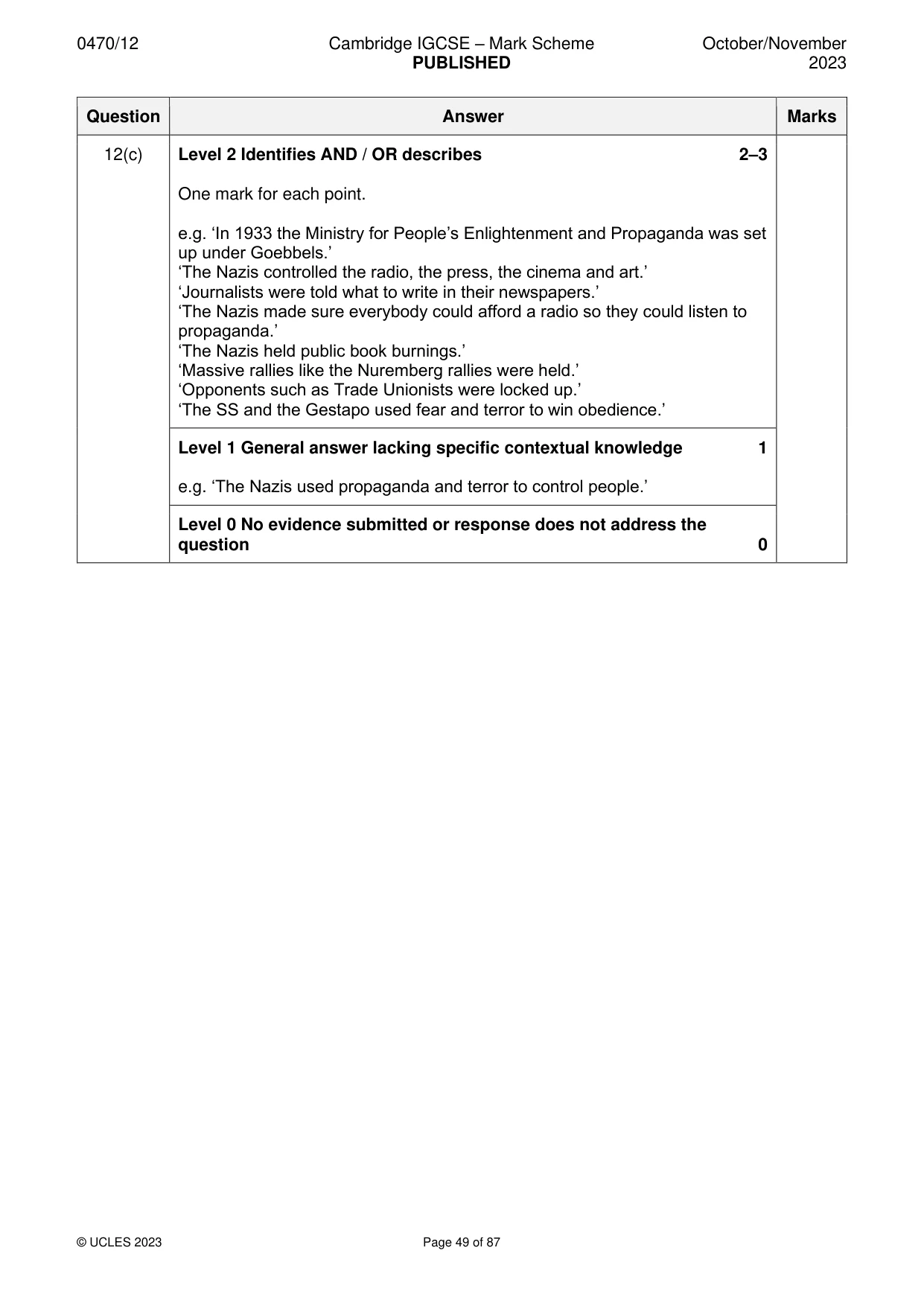
0470/12 Cambridge IGCSE – Mark Scheme PUBLISHED October/November 2023 © UCLES 2023 Page 49 of 87 Question Answer Marks 12(c) Level 2 Identifies AND / OR describes 2–3 One mark for each point. e.g. ‘In 1933 the Ministry for People’s Enlightenment and Propaganda was set up under Goebbels.’ ‘The Nazis controlled the radio, the press, the cinema and art.’ ‘Journalists were told what to write in their newspapers.’ ‘The Nazis made sure everybody could afford a radio so they could listen to propaganda.’ ‘The Nazis held public book burnings.’ ‘Massive rallies like the Nuremberg rallies were held.’ ‘Opponents such as Trade Unionists were locked up.’ ‘The SS and the Gestapo used fear and terror to win obedience.’ Level 1 General answer lacking specific contextual knowledge 1 e.g. ‘The Nazis used propaganda and terror to control people.’ Level 0 No evidence submitted or response does not address the question 0
Mark scheme, page 50
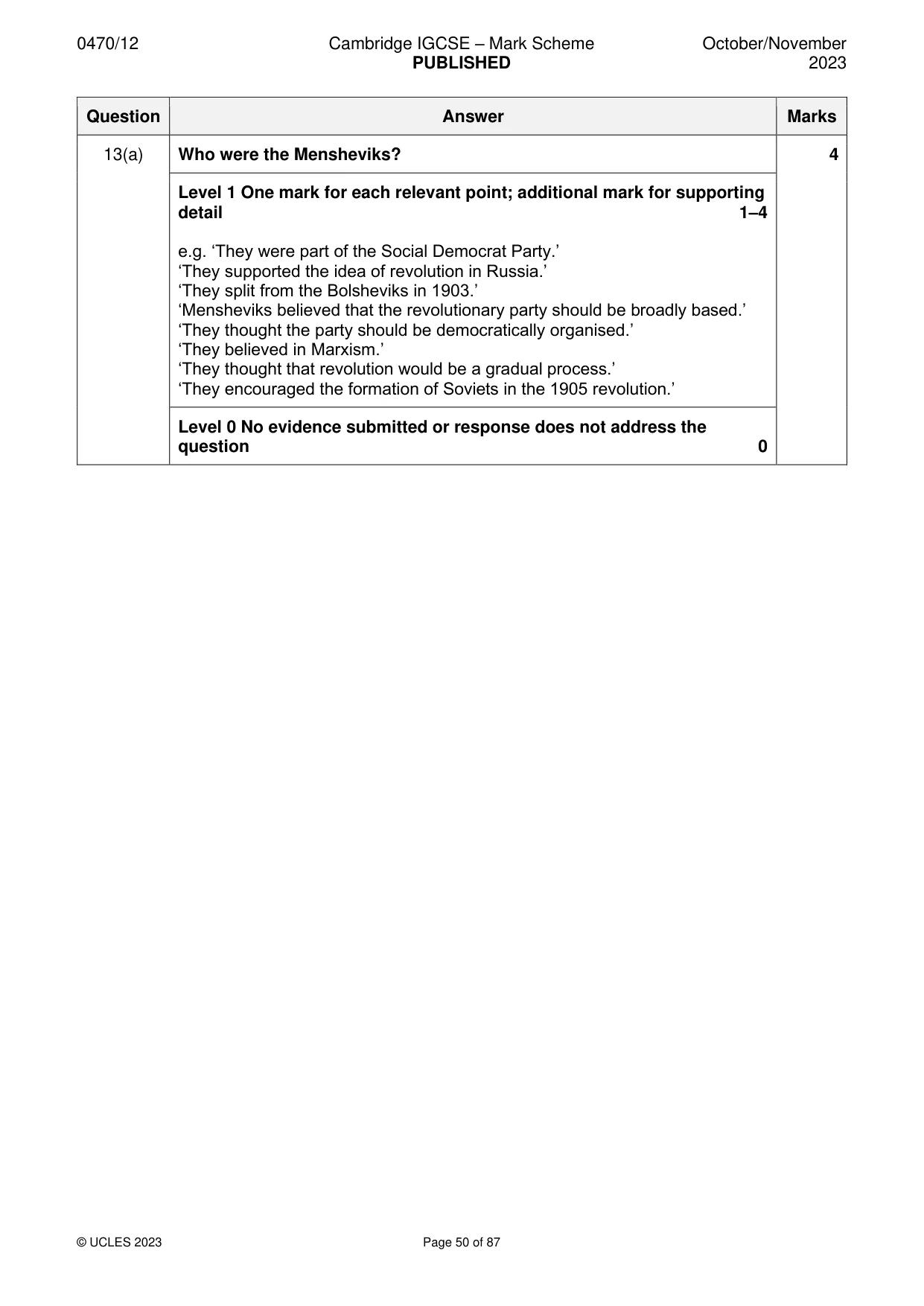
0470/12 Cambridge IGCSE – Mark Scheme PUBLISHED October/November 2023 © UCLES 2023 Page 50 of 87 Question Answer Marks 13(a) Who were the Mensheviks? 4 Level 1 One mark for each relevant point; additional mark for supporting detail 1–4 e.g. ‘They were part of the Social Democrat Party.’ ‘They supported the idea of revolution in Russia.’ ‘They split from the Bolsheviks in 1903.’ ‘Mensheviks believed that the revolutionary party should be broadly based.’ ‘They thought the party should be democratically organised.’ ‘They believed in Marxism.’ ‘They thought that revolution would be a gradual process.’ ‘They encouraged the formation of Soviets in the 1905 revolution.’ Level 0 No evidence submitted or response does not address the question 0
Mark scheme, page 51
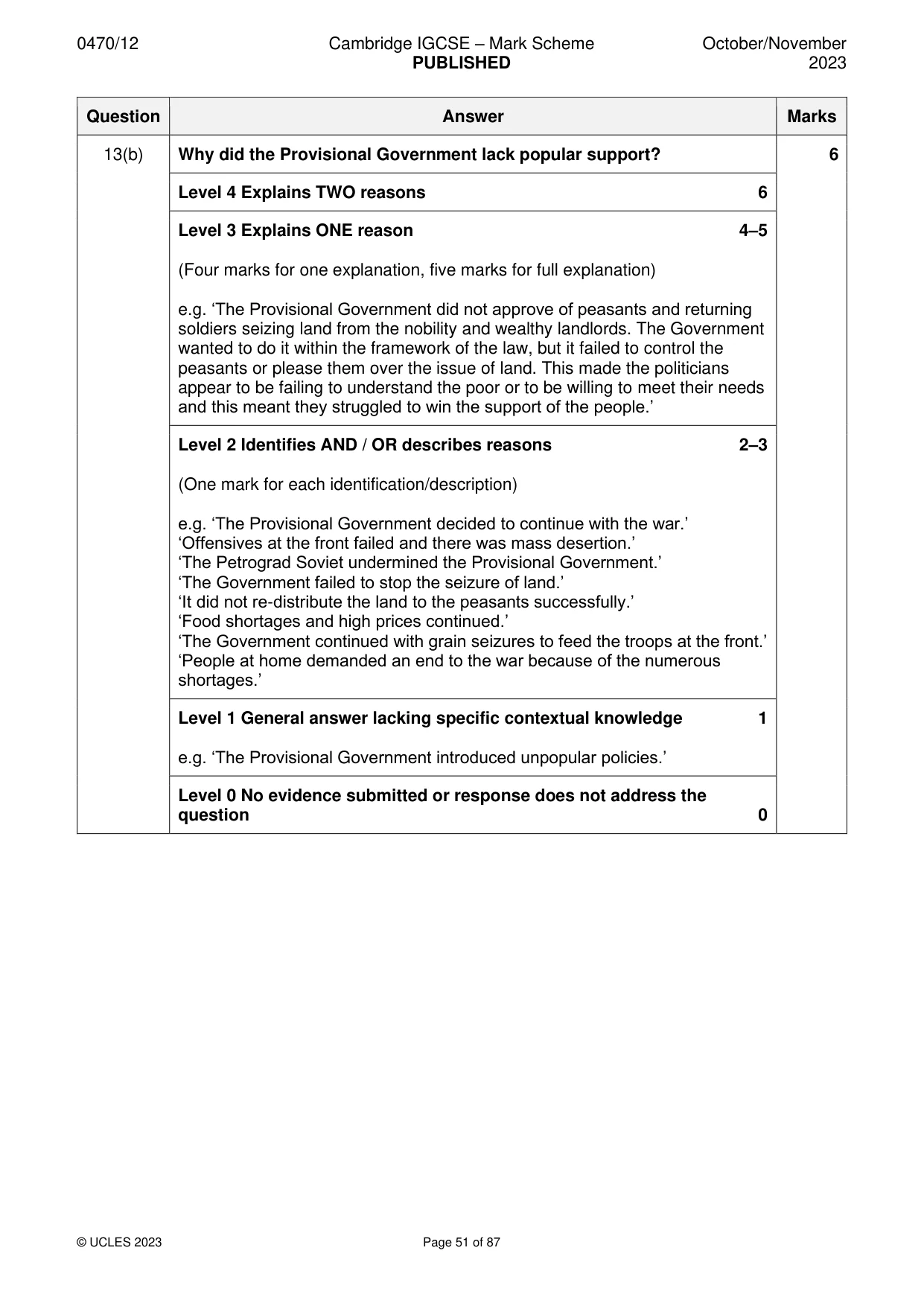
0470/12 Cambridge IGCSE – Mark Scheme PUBLISHED October/November 2023 © UCLES 2023 Page 51 of 87 Question Answer Marks 13(b) Why did the Provisional Government lack popular support? 6 Level 4 Explains TWO reasons 6 Level 3 Explains ONE reason 4–5 (Four marks for one explanation, five marks for full explanation) e.g. ‘The Provisional Government did not approve of peasants and returning soldiers seizing land from the nobility and wealthy landlords. The Government wanted to do it within the framework of the law, but it failed to control the peasants or please them over the issue of land. This made the politicians appear to be failing to understand the poor or to be willing to meet their needs and this meant they struggled to win the support of the people.’ Level 2 Identifies AND / OR describes reasons 2–3 (One mark for each identification/description) e.g. ‘The Provisional Government decided to continue with the war.’ ‘Offensives at the front failed and there was mass desertion.’ ‘The Petrograd Soviet undermined the Provisional Government.’ ‘The Government failed to stop the seizure of land.’ ‘It did not re-distribute the land to the peasants successfully.’ ‘Food shortages and high prices continued.’ ‘The Government continued with grain seizures to feed the troops at the front.’ ‘People at home demanded an end to the war because of the numerous shortages.’ Level 1 General answer lacking specific contextual knowledge 1 e.g. ‘The Provisional Government introduced unpopular policies.’ Level 0 No evidence submitted or response does not address the question 0
Mark scheme, page 52
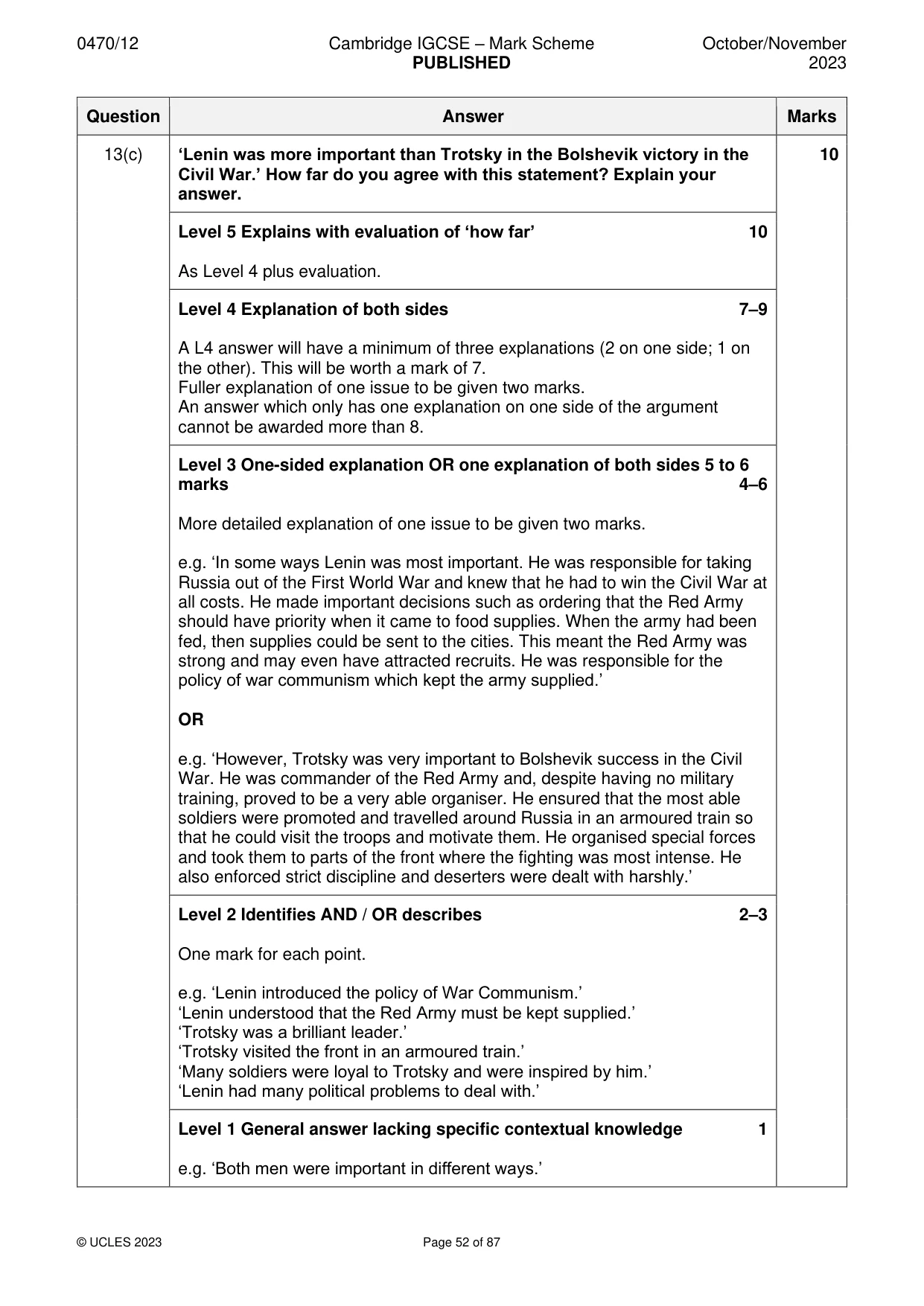
0470/12 Cambridge IGCSE – Mark Scheme PUBLISHED October/November 2023 © UCLES 2023 Page 52 of 87 Question Answer Marks 13(c) ‘Lenin was more important than Trotsky in the Bolshevik victory in the Civil War.’ How far do you agree with this statement? Explain your answer. 10 Level 5 Explains with evaluation of ‘how far’ 10 As Level 4 plus evaluation. Level 4 Explanation of both sides 7–9 A L4 answer will have a minimum of three explanations (2 on one side; 1 on the other). This will be worth a mark of 7. Fuller explanation of one issue to be given two marks. An answer which only has one explanation on one side of the argument cannot be awarded more than 8. Level 3 One-sided explanation OR one explanation of both sides 5 to 6 marks 4–6 More detailed explanation of one issue to be given two marks. e.g. ‘In some ways Lenin was most important. He was responsible for taking Russia out of the First World War and knew that he had to win the Civil War at all costs. He made important decisions such as ordering that the Red Army should have priority when it came to food supplies. When the army had been fed, then supplies could be sent to the cities. This meant the Red Army was strong and may even have attracted recruits. He was responsible for the policy of war communism which kept the army supplied.’ OR e.g. ‘However, Trotsky was very important to Bolshevik success in the Civil War. He was commander of the Red Army and, despite having no military training, proved to be a very able organiser. He ensured that the most able soldiers were promoted and travelled around Russia in an armoured train so that he could visit the troops and motivate them. He organised special forces and took them to parts of the front where the fighting was most intense. He also enforced strict discipline and deserters were dealt with harshly.’ Level 2 Identifies AND / OR describes 2–3 One mark for each point. e.g. ‘Lenin introduced the policy of War Communism.’ ‘Lenin understood that the Red Army must be kept supplied.’ ‘Trotsky was a brilliant leader.’ ‘Trotsky visited the front in an armoured train.’ ‘Many soldiers were loyal to Trotsky and were inspired by him.’ ‘Lenin had many political problems to deal with.’ Level 1 General answer lacking specific contextual knowledge 1 e.g. ‘Both men were important in different ways.’
Mark scheme, page 53
0470/12 Cambridge IGCSE – Mark Scheme PUBLISHED October/November 2023 © UCLES 2023 Page 53 of 87 Question Answer Marks 13(c) Level 0 No evidence submitted or response does not address the question 0
Mark scheme, page 54
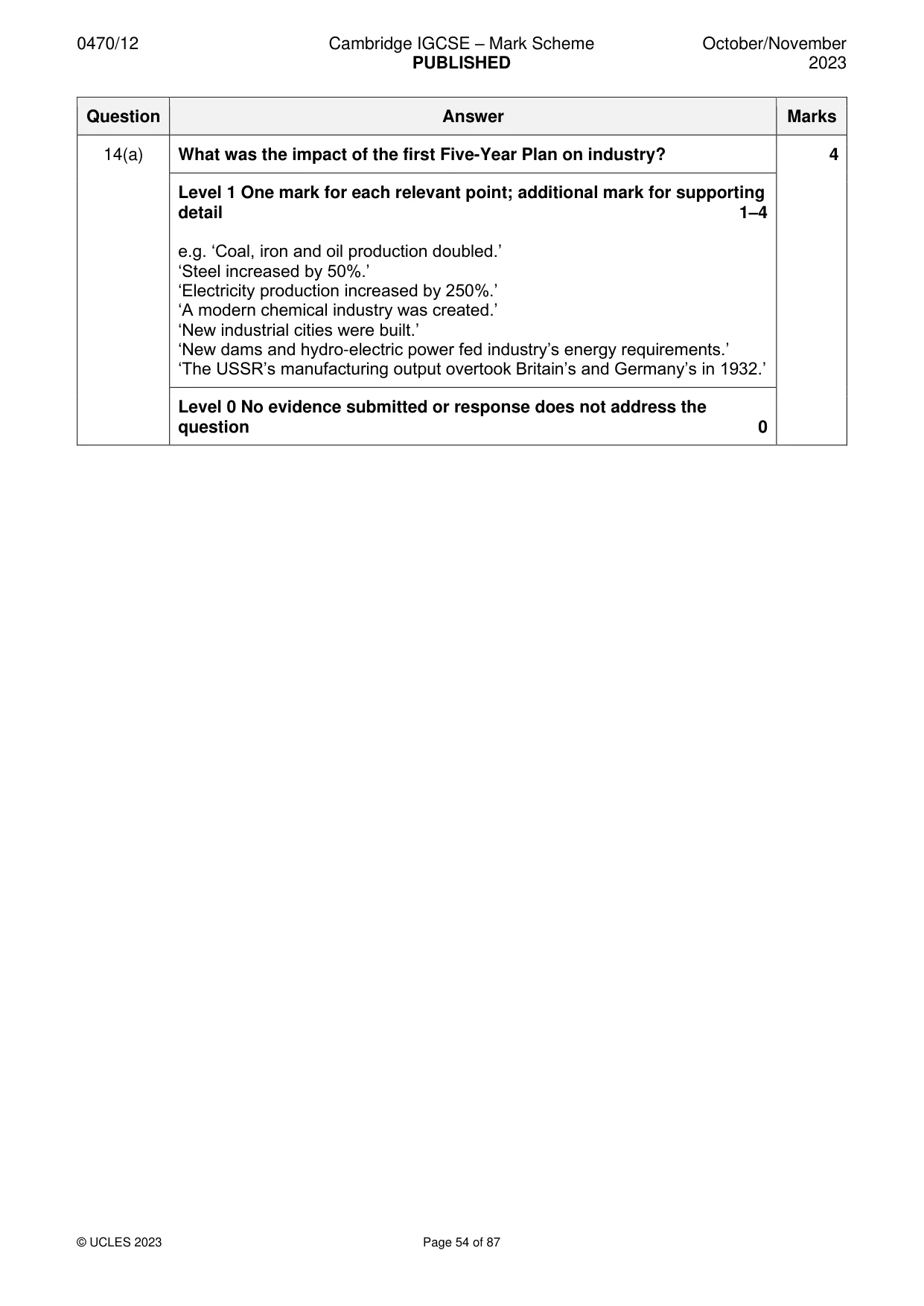
0470/12 Cambridge IGCSE – Mark Scheme PUBLISHED October/November 2023 © UCLES 2023 Page 54 of 87 Question Answer Marks 14(a) What was the impact of the first Five-Year Plan on industry? 4 Level 1 One mark for each relevant point; additional mark for supporting detail 1–4 e.g. ‘Coal, iron and oil production doubled.’ ‘Steel increased by 50%.’ ‘Electricity production increased by 250%.’ ‘A modern chemical industry was created.’ ‘New industrial cities were built.’ ‘New dams and hydro-electric power fed industry’s energy requirements.’ ‘The USSR’s manufacturing output overtook Britain’s and Germany’s in 1932.’ Level 0 No evidence submitted or response does not address the question 0
Mark scheme, page 55
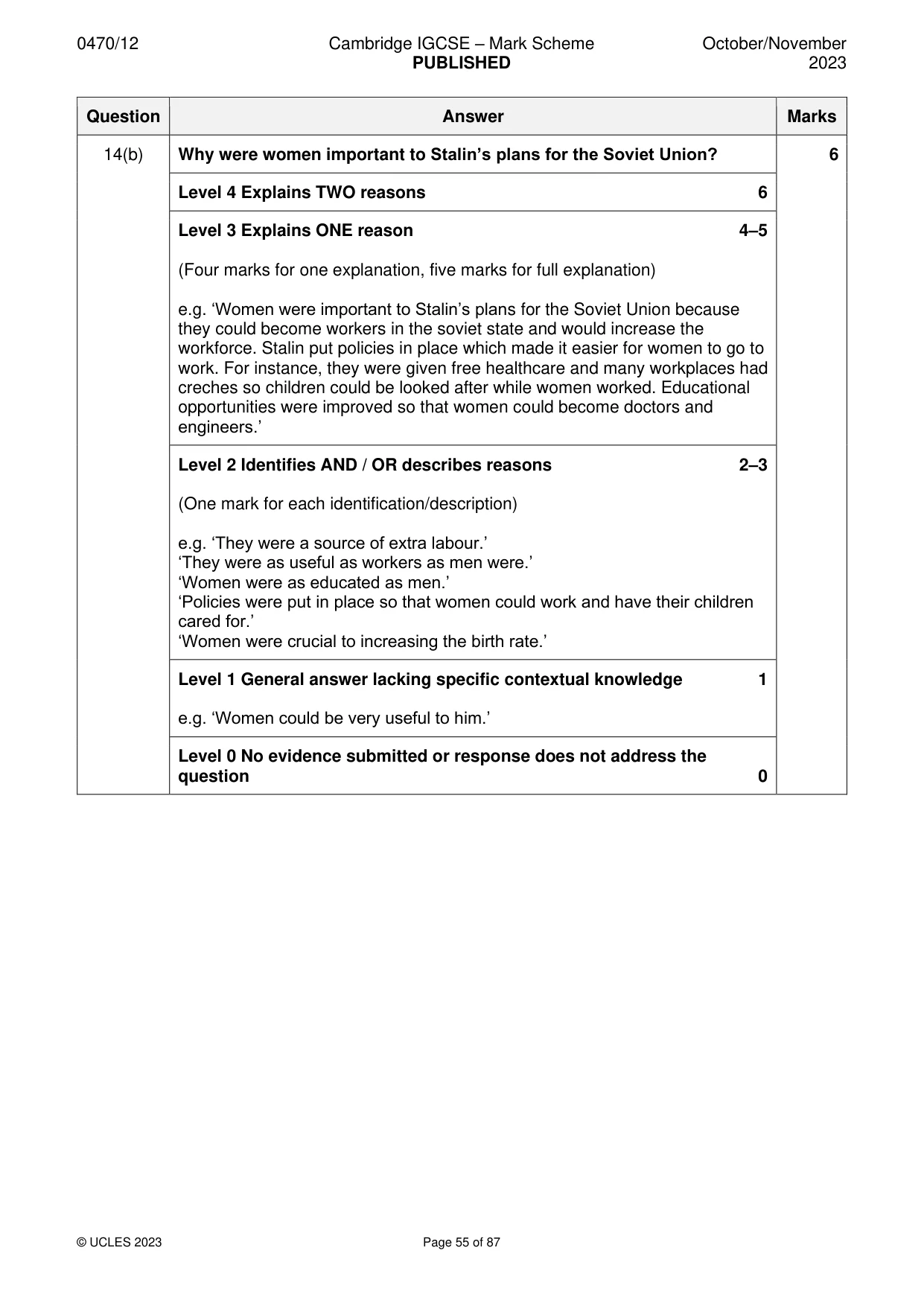
0470/12 Cambridge IGCSE – Mark Scheme PUBLISHED October/November 2023 © UCLES 2023 Page 55 of 87 Question Answer Marks 14(b) Why were women important to Stalin’s plans for the Soviet Union? 6 Level 4 Explains TWO reasons 6 Level 3 Explains ONE reason 4–5 (Four marks for one explanation, five marks for full explanation) e.g. ‘Women were important to Stalin’s plans for the Soviet Union because they could become workers in the soviet state and would increase the workforce. Stalin put policies in place which made it easier for women to go to work. For instance, they were given free healthcare and many workplaces had creches so children could be looked after while women worked. Educational opportunities were improved so that women could become doctors and engineers.’ Level 2 Identifies AND / OR describes reasons 2–3 (One mark for each identification/description) e.g. ‘They were a source of extra labour.’ ‘They were as useful as workers as men were.’ ‘Women were as educated as men.’ ‘Policies were put in place so that women could work and have their children cared for.’ ‘Women were crucial to increasing the birth rate.’ Level 1 General answer lacking specific contextual knowledge 1 e.g. ‘Women could be very useful to him.’ Level 0 No evidence submitted or response does not address the question 0
Mark scheme, page 56
0470/12 Cambridge IGCSE – Mark Scheme PUBLISHED October/November 2023 © UCLES 2023 Page 56 of 87 Question Answer Marks 14(c) ‘Collectivisation was a disaster.’ How far do you agree with this statement? Explain your answer. 10 Level 5 Explains with evaluation of ‘how far’ 10 As Level 4 plus evaluation. Level 4 Explanation of both sides 7–9 A L4 answer will have a minimum of three explanations (2 on one side; 1 on the other). This will be worth a mark of 7. Fuller explanation of one issue to be given two marks. An answer which only has one explanation on one side of the argument cannot be awarded more than 8. Level 3 One-sided explanation OR one explanation of both sides 5 to 6 marks 4–6 More detailed explanation of one issue to be given two marks. e.g. ‘Collectivisation was a disaster. Many peasants were against the idea. They destroyed their crops and livestock rather than give them to the state and this helped to create a famine in the early 1930s which killed millions of people.’ OR e.g. ‘However, Stalin would have argued that collectivisation wasn’t a disaster. He used it to get rid of the kulaks who were the wealthy peasants. Stalin disliked them as they were often opposed to Communist ideology. By removing the kulaks, Stalin thought he had removed a potential threat and therefore he would see collectivisation as a success.’ Level 2 Identifies AND / OR describes 2–3 One mark for each point. e.g. ‘Stalin saw the kulaks as a threat.’ ‘There was a famine in the 1930s and millions of people died.’ ‘The peasants did not want to give their crops to the state so they destroyed them.’ ‘The peasants did not know how to use the new machinery they were given in the kolkhoz.’ ‘Russia continued to export grain even though people were starving.’ ‘Collectivisation meant many people left the countryside to become workers in the towns.’ Level 1 General answer lacking specific contextual knowledge 1 e.g. ‘Collectivisation pleased some people but angered others.’ Level 0 No evidence submitted or response does not address the question 0
Mark scheme, page 57
0470/12 Cambridge IGCSE – Mark Scheme PUBLISHED October/November 2023 © UCLES 2023 Page 57 of 87 Question Answer Marks 15(a) Describe how the motor car industry developed in the 1920s. 4 Level 1 One mark for each relevant point; additional mark for supporting detail 1–4 e.g. ‘Cars were produced using assembly line techniques introduced by Henry Ford.’ ‘By 1929 one in five Americans owned a car.’ ‘The growth in car manufacture encouraged road building and the development of suburbs and holiday resorts.’ ‘Half a million workers were employed in the motor industry.’ ‘The cost of cars fell as more were produced.’ ‘Ford kept prices down by painting all the cars black.’ Level 0 No evidence submitted or response does not address the question 0
Mark scheme, page 58
0470/12 Cambridge IGCSE – Mark Scheme PUBLISHED October/November 2023 © UCLES 2023 Page 58 of 87 Question Answer Marks 15(b) Why did hire purchase and mass marketing help to drive the boom? 6 Level 4 Explains TWO reasons 6 Level 3 Explains ONE reason 4–5 (Four marks for one explanation, five marks for full explanation) e.g. ‘Hire purchase and mass marketing drove the boom because commercials were produced to advertise the products. These were shown in cinemas, on billboards and published in newspapers. This meant everyone was exposed to ideas about new products. With such a big audience it was more likely that people would buy new products and this meant that production went up.’ Level 2 Identifies AND / OR describes reasons 2–3 (One mark for each identification/description) e.g. ‘It helped make products more affordable.’ ‘People could pay in instalments which meant more people were able to buy.’ ‘It meant demand for consumer goods went up.’ ‘Many people bought mass produced consumer goods this way.’ ‘Cinemas and billboards advertised products to large audiences.’ ‘Mail order catalogues were produced and magazines and newspapers carried adverts for new consumer goods.’ Level 1 General answer lacking specific contextual knowledge 1 e.g. ‘The boom was a big explosion in the US economy.’ Level 0 No evidence submitted or response does not address the question 0
Mark scheme, page 59
0470/12 Cambridge IGCSE – Mark Scheme PUBLISHED October/November 2023 © UCLES 2023 Page 59 of 87 Question Answer Marks 15(c) ‘Traditional industries did not benefit from the boom.’ How far do you agree with this statement? Explain your answer. 10 Level 5 Explains with evaluation of ‘how far’ 10 As Level 4 plus evaluation. Level 4 Explanation of both sides 7–9 A L4 answer will have a minimum of three explanations (2 on one side; 1 on the other). This will be worth a mark of 7. Fuller explanation of one issue to be given two marks. An answer which only has one explanation on one side of the argument cannot be awarded more than 8. Level 3 One-sided explanation OR one explanation of both sides 5 to 6 marks 4–6 More detailed explanation of one issue to be given two marks. e.g. ‘Some traditional industries did not benefit from the boom. For instance, the cotton and woollen textile industries did not benefit. New fabrics such as rayon were much more popular and so there was less demand for traditional fabrics. Coal mining was another traditional industry which did not benefit because oil and gas were increasingly used in homes and factories.’ OR e.g. ‘However, some traditional industries did benefit from the boom. The construction industry benefited hugely and there were many new skyscrapers built in New York such as the 102 storey Empire State Building. There was also an increase in home building. The steel industry also benefited, partly as a result of the increase in the motor industry but also because of the requirement for steel girders for construction.’ Level 2 Identifies AND/OR describes 2–3 One mark for each point. e.g. ‘The construction industry benefitted.’ ‘Cotton and woollen textiles lost out to new products such as rayon.’ ‘Farming did not do well.’ ‘Coal mining did not do so well in the boom.’ ‘There was an increased demand for steel due to the development of the car industry.’ ‘Oil and gas became more popular than coal.’ ‘The car led to the development of suburbs so more houses were built.’ Level 1 General answer lacking specific contextual knowledge 1 e.g. ‘Some industries did better than others in the boom.’ Level 0 No evidence submitted or response does not address the question 0
Mark scheme, page 60
0470/12 Cambridge IGCSE – Mark Scheme PUBLISHED October/November 2023 © UCLES 2023 Page 60 of 87 Question Answer Marks 16(a) Describe the 1932 election campaign. 4 Level 1 One mark for each relevant point; additional mark for supporting detail 1–4 e.g. ‘Hoover was the Republican candidate.’ ‘Roosevelt was the Democrat candidate.’ ‘Many people blamed Hoover for failing to help people with the problems caused by the Depression.’ ‘Roosevelt emphasised what he had achieved as Governor of New York state where he had organised welfare schemes to help the poor.’ ‘Roosevelt appeared to be more in touch with the people.’ ‘Roosevelt promised a New Deal.’ ‘Hoover’s policies were conservative.’ Level 0 No evidence submitted or response does not address the question 0
Mark scheme, page 61
0470/12 Cambridge IGCSE – Mark Scheme PUBLISHED October/November 2023 © UCLES 2023 Page 61 of 87 Question Answer Marks 16(b) Why did the Bonus Marchers cause damage to Hoover’s reputation? 6 Level 4 Explains TWO reasons 6 Level 3 Explains ONE reason 4–5 (Four marks for one explanation, five marks for full explanation) e.g. ‘The Bonus Marchers set up Hoovervilles in Washington. Hoover decided the veterans had to be evicted. He asked General MacArthur and the Army to clear the camps. Tanks, machine guns and tear gas were used and the tents and shelters were burnt. Two veterans were killed and nearly a thousand were injured. This was seen as a disproportionate use of force and Hoover was widely despised for his action.’ Level 2 Identifies AND / OR describes reasons 2–3 (One mark for each identification/description) e.g. ‘Hoover decided the veterans had to be evicted.’ ‘He asked General MacArthur and the Army to clear the camps.’ ‘Tanks, machine guns and tear gas were used and the tents and shelters were burnt.’ ‘Two veterans were killed and nearly a thousand were injured.’ ‘Hoover failed to keep control of MacArthur’s actions.’ ‘Hoover publicly thanked God that the USA still knew how to deal with a mob.’ Level 1 General answer lacking specific contextual knowledge 1 e.g. ‘Hoover did not care about the Bonus Marchers.’ Level 0 No evidence submitted or response does not address the question 0
Mark scheme, page 62
0470/12 Cambridge IGCSE – Mark Scheme PUBLISHED October/November 2023 © UCLES 2023 Page 62 of 87 Question Answer Marks 16(c) How far do you agree that overproduction caused the Wall Street Crash? Explain your answer. 10 Level 5 Explains with evaluation of ‘how far’ 10 As Level 4 plus evaluation. Level 4 Explanation of both sides 7–9 A L4 answer will have a minimum of three explanations (2 on one side; 1 on the other). This will be worth a mark of 7. Fuller explanation of one issue to be given two marks. An answer which only has one explanation on one side of the argument cannot be awarded more than 8. Level 3 One-sided explanation OR one explanation of both sides 5 to 6 marks 4–6 More detailed explanation of one issue to be given two marks. e.g. ‘Overproduction was an important cause of the crash. American industry produced more cars and other consumer goods than Americans could buy. This meant that the markets became saturated and demand for products fell. This meant that companies would have to start laying off workers.’ OR e.g. ‘However, there were other problems which contributed to the Crash. Speculators were also to blame. They bought shares on the margin. This meant they borrowed money to buy shares. When times were good, the shares would be sold on quickly for a higher value. Banks sometimes gave loans of 90% of the value of the shares which were being bought. When production began to slow down the market fell and the shares lost value. Speculators could not repay their loans to the banks and the banks went bankrupt as a result. This led to the Crash.’ Level 2 Identifies AND / OR describes 2–3 One mark for each point. e.g. ‘Overproduction meant that prices fell and unemployment increased.’ ‘Buying shares on the margin was risky and if the market fell, speculators lost everything.’ ‘There was an unequal distribution of wealth in the US economy.’ ‘The economy had already begun to slow down by 1927.’ ‘People had already bought the new consumer goods so demand fell.’ ‘Tariffs meant that American companies were not able to sell surplus products overseas.’ Level 1 General answer lacking specific contextual knowledge 1 e.g. ‘The Crash was when the economy fell apart.’
Mark scheme, page 63
0470/12 Cambridge IGCSE – Mark Scheme PUBLISHED October/November 2023 © UCLES 2023 Page 63 of 87 Question Answer Marks 16(c) Level 0 No evidence submitted or response does not address the question 0
Mark scheme, page 64
0470/12 Cambridge IGCSE – Mark Scheme PUBLISHED October/November 2023 © UCLES 2023 Page 64 of 87 Question Answer Marks 17(a) What was the Agrarian Reform Law of 1950? 4 Level 1 One mark for each relevant point; additional mark for supporting detail 1–4 e.g. ‘The law took land from the landlords and gave it to the peasants.’ ‘Machinery and animals were also given to the peasants.’ ‘Rural society was divided into a new class system.’ ‘Land was seized from wealthy industrialists.’ ‘Speak bitterness campaigns were held where landlords were persecuted.’ ‘The law was intended as a reward for the peasants for their support in the Civil War.’ ‘More than 10 million landlords had their land confiscated.’ Level 0 No evidence submitted or response does not address the question 0
Mark scheme, page 65
0470/12 Cambridge IGCSE – Mark Scheme PUBLISHED October/November 2023 © UCLES 2023 Page 65 of 87 Question Answer Marks 17(b) Why were healthcare reforms important to Mao? 6 Level 4 Explains TWO reasons 6 Level 3 Explains ONE reason 4–5 (Four marks for one explanation, five marks for full explanation) e.g. ‘Healthcare reforms were important to Mao because he wanted to promote the prevention of disease so that the workforce was stronger. China had a history of using ancient medicine to cure illnesses but Mao thought it would be better to prevent people from becoming ill in the first place. This meant that they would be fitter for work and would be more productive for longer.’ Level 2 Identifies AND / OR describes reasons 2–3 (One mark for each identification/description) e.g. ‘Mao thought prevention was better than cure.’ ‘Health improved in rural areas.’ ‘The barefoot doctors were important in rural areas and brought modern medicine to places with limited healthcare facilities.’ ‘Life expectancy in China rose from 39 in 1949 to 68 in 1979 because of Mao’s reforms.’ Level 1 General answer lacking specific contextual knowledge 1 e.g. ‘Mao wanted the people to be healthy.’ Level 0 No evidence submitted or response does not address the question 0
Mark scheme, page 66
0470/12 Cambridge IGCSE – Mark Scheme PUBLISHED October/November 2023 © UCLES 2023 Page 66 of 87 Question Answer Marks 17(c) How far do you agree that the introduction of communes was a success for China? Explain your answer. 10 Level 5 Explains with evaluation of ‘how far’ 10 As Level 4 plus evaluation. Level 4 Explanation of both sides 7–9 A L4 answer will have a minimum of three explanations (2 on one side; 1 on the other). This will be worth a mark of 7. Fuller explanation of one issue to be given two marks. An answer which only has one explanation on one side of the argument cannot be awarded more than 8. Level 3 One-sided explanation OR one explanation of both sides 5 to 6 marks 4–6 More detailed explanation of one issue to be given two marks. e.g. ‘Communes were a success for China. Many millions of people lived in them and Mao achieved his aim of controlling the peasantry and the productivity of the peasants, converting them into communists. By using propaganda, Mao encouraged productivity and ensured that the people were educated in the way he intended – large speakers in fields where peasants worked meant that they could hear political speeches by Mao. Communes controlled many aspects of the lives of workers, thus achieving Mao’s objectives.’ OR e.g. ‘The communes were not a success. Increasing industrial production was an aim of the Great Leap Forward and the introduction of communes via backyard furnaces which would produce steel and machinery. Although production was high to start with, ultimately the machines and tools being quickly made were of very poor quality, often fell apart and were unsafe. To keep backyard furnaces going, workers were kept back from working in the fields. This meant that insufficient food was grown and this led to famine, with millions of deaths between the late 1950s and the early 1960s. The furnaces also used huge amounts of coal and the railway network suffered from shortages of fuel. This had a negative impact on the economy as a whole.’
Mark scheme, page 67
0470/12 Cambridge IGCSE – Mark Scheme PUBLISHED October/November 2023 © UCLES 2023 Page 67 of 87 Question Answer Marks 17(c) Level 2 Identifies AND / OR describes 2–3 One mark for each point. e.g. ‘Iron, steel and timber production increased.’ ‘Communes meant education for children and that the elderly were looked after.’ ‘Tools and machinery were produced too quickly and many were not capable of being used.’ ‘Much impure iron was produced which could not be used.’ ‘The backyard furnaces needed coal which was needed elsewhere in the economy.’ ‘Too many workers focused on the backyard furnaces instead of farming.’ ‘Food production declined.’ ‘There were not enough skilled workers.’ ‘Peasants did not receive any rewards for hard work, so productivity declined.’ Level 1 General answer lacking specific contextual knowledge 1 e.g. ‘Communes were a success and had a great effect on the lives of the people of China.’ Level 0 No evidence submitted or response does not address the question 0
Mark scheme, page 68
0470/12 Cambridge IGCSE – Mark Scheme PUBLISHED October/November 2023 © UCLES 2023 Page 68 of 87 Question Answer Marks 18(a) What were the main international issues facing Communist China when the Civil War ended? 4 Level 1 One mark for each relevant point; additional mark for supporting detail 1–4 e.g. ‘Relations were very poor between China and Japan.’ ‘The KMT had fled to Taiwan.’ ‘The USA continued to support the KMT and saw the KMT as the government of China.’ ‘Relations with the Soviet Union were strained as Stalin saw Mao as inferior.’ ‘The Soviet Union agreed to provide financial support.’ ‘There were Communist forces in Vietnam and China offered aid and support.’ ‘The USA denied China its seat in the Security Council of the UN.’ Level 0 No evidence submitted or response does not address the question 0
Mark scheme, page 69
0470/12 Cambridge IGCSE – Mark Scheme PUBLISHED October/November 2023 © UCLES 2023 Page 69 of 87 Question Answer Marks 18(b) Why did relations between China and India change in the 1950s and 1960s? 6 Level 4 Explains TWO reasons 6 Level 3 Explains ONE reason 4–5 (Four marks for one explanation, five marks for full explanation) e.g. ‘In 1954, India published new maps which showed the boundaries between India and China. The Chinese complained that the borders were not correct and that over 100 000 square kilometres of land which was shown as Indian territory actually belonged to China. There were clashes along the border and in 1962 war broke out.’ Level 2 Identifies AND / OR describes reasons 2–3 (One mark for each identification/description) e.g. ‘India published maps which China claimed were incorrect.’ ‘There were clashes along the border.’ ‘In 1962 war broke out between India and China.’ ‘China supported the Communist Party in India.’ ‘There was an uprising in India in 1967 which was supported by Mao.’ ‘In 1965 China backed Pakistan in a war with India.’ Level 1 General answer lacking specific contextual knowledge 1 e.g. ‘There were disagreements between India and China.’ Level 0 No evidence submitted or response does not address the question 0
Mark scheme, page 70
0470/12 Cambridge IGCSE – Mark Scheme PUBLISHED October/November 2023 © UCLES 2023 Page 70 of 87 Question Answer Marks 18(c) How far did ideological differences explain the changing relationship between China and the USSR in the 1950s and 1960s? Explain your answer. 10 Level 5 Explains with evaluation of ‘how far’ 10 As Level 4 plus evaluation. Level 4 Explanation of both sides 7–9 A L4 answer will have a minimum of three explanations (2 on one side; 1 on the other). This will be worth a mark of 7. Fuller explanation of one issue to be given two marks. An answer which only has one explanation on one side of the argument cannot be awarded more than 8. Level 3 One-sided explanation OR one explanation of both sides 5 to 6 marks 4–6 More detailed explanation of one issue to be given two marks. e.g. ‘Ideological differences were important in explaining the changing relationship between the USSR and China. At first, the two countries seemed friendly and a Sino-Soviet Treaty was signed which included low interest loans from the USSR to China for economic development. However, soon Mao began to challenge the USSR’s position as leader of the communist world and claimed that the revolution by the peasants in China was a truer form of Marxism than the Soviet model of a revolution led by the workers. Mao also disagreed with Khrushchev’s idea of ‘peaceful coexistence’.’ OR e.g. ‘Although relations between Mao and Khrushchev got off to a good start, they deteriorated rapidly and this personal antagonism was partly to blame for the changing relations between the two states. In his ‘secret speech’, Khrushchev denounced Stalin’s dictatorship and methods of control. Mao saw this as a criticism of his own leadership style. Mao also disliked the fact that the USSR looked for better relations with the USA. Khrushchev criticised Mao’s economic policy and withdrew all Soviet experts from China.’ Level 2 Identifies AND / OR describes 2–3 One mark for each point. e.g. ‘Mao thought China was a purer Communist state than Russia.’ ‘Stalin and Mao disagreed over Korea.’ ‘The Soviet Union provided support for industrial development to China.’ ‘Khrushchev criticised the Great Leap Forward.’ ‘Mao disagreed with peaceful coexistence.’ ‘Mao thought Khrushchev had betrayed other communist states by trying to improve relations with the West.’ ‘Khrushchev’s secret speech was seen as a criticism of Mao’s leadership.’
Mark scheme, page 71
0470/12 Cambridge IGCSE – Mark Scheme PUBLISHED October/November 2023 © UCLES 2023 Page 71 of 87 Question Answer Marks 18(c) Level 1 General answer lacking specific contextual knowledge 1 e.g. ‘Relations between China and the USSR should have been good as they were both Communist. However, that was not the case.’ Level 0 No evidence submitted or response does not address the question 0
Mark scheme, page 72
0470/12 Cambridge IGCSE – Mark Scheme PUBLISHED October/November 2023 © UCLES 2023 Page 72 of 87 Question Answer Marks 19(a) What were Verwoerd’s aims in creating Bantustans? 4 Level 1 One mark for each relevant point; additional mark for supporting detail 1–4 e.g. ‘Verwoerd’s aim was to try and make apartheid work.’ ‘These Bantustans were intended to be the homelands for all black people.’ ‘The newly established regions were eventually intended to become self- governing.’ ‘In 1963, Transkei became the first Bantustan to have its own parliament elected by black people.’ ‘The policy aimed to eject all black people from white areas.’ ‘The Bantustans would become self-financing.’ ‘After a time, all black South Africans would live there and they would be excluded from the rest of South Africa.’ Level 0 No evidence submitted or response does not address the question 0
Mark scheme, page 73
0470/12 Cambridge IGCSE – Mark Scheme PUBLISHED October/November 2023 © UCLES 2023 Page 73 of 87 Question Answer Marks 19(b) Why was the Sabotage Act passed in 1962? 6 Level 4 Explains TWO reasons 6 Level 3 Explains ONE reason 4–5 (Four marks for one explanation, five marks for full explanation) e.g. ‘The act was passed to extend the power of the Minister of Justice so that he could take further action against those who were opposed to apartheid. Anyone who had been charged under the Suppression of Communism Act of 1950 could now be banned from holding office. These people were referred to as statutory Communists, even though many of them had never been members of the Communist party. This included many of the people who had been responsible for the Freedom Charter.’ Level 2 Identifies AND / OR describes reasons 2–3 (One mark for each identification/description) e.g. ‘It widened the definition of sabotage to include strikes, trade union activity, and writing slogans on walls.’ ‘The act assumed that the accused were guilty and had to prove their innocence.’ ‘Anyone charged under the Suppression of Communism Act could be arrested and placed under house arrest without trial.’ ‘Opposition to the government was becoming more violent.’ ‘The ANC and PAC had been banned but they formed militant groups and continued violent resistance.’ ‘The government wanted to remove the leaders of the ANC.’ ‘People could be imprisoned for 90 days without charge and with no access to a lawyer.’ Level 1 General answer lacking specific contextual knowledge 1 e.g. ‘The government was getting annoyed by the amount of opposition it was facing.’ Level 0 No evidence submitted or response does not address the question 0
Mark scheme, page 74
0470/12 Cambridge IGCSE – Mark Scheme PUBLISHED October/November 2023 © UCLES 2023 Page 74 of 87 Question Answer Marks 19(c) How far do you agree that the Pass Laws were the most important element of the apartheid system? Explain your answer. 10 Level 5 Explains with evaluation of ‘how far’ 10 As Level 4 plus evaluation. Level 4 Explanation of both sides 7–9 A L4 answer will have a minimum of three explanations (2 on one side; 1 on the other). This will be worth a mark of 7. Fuller explanation of one issue to be given two marks. An answer which only has one explanation on one side of the argument cannot be awarded more than 8. Level 3 One-sided explanation OR one explanation of both sides 5 to 6 marks 4–6 More detailed explanation of one issue to be given two marks. e.g. ‘The Pass Laws were important because they were hated by non-white people for segregating the population. The movement of the non-white population was limited and the passbook gave a person permission to be outside the compounds. However, this permission could be cancelled by any government employee. If you could not produce your passbook when it was requested, then you were likely to end up in jail. The passbooks were the most despised symbol of apartheid.’ OR e.g. ‘The Group Areas Act could be said to be the most important element of apartheid as this separated South Africa into racial areas with only one group allowed to live in each area. Because of this act, almost 3.5 million people (mostly non-white) were forced to move. The people who lived in Sophiatown were forcibly removed, even though many had owned land there for 30 years. The removals caused bitter resentment against the government. Added to this, the areas people were forced to move to lacked facilities, had very poor housing and were often overcrowded.’ Level 2 Identifies AND / OR describes 2–3 One mark for each point. e.g. ‘People hated the Pass Laws.’ ‘If you were found outside your area without your passbook, you could be sent to jail.’ ‘The Group Areas Act meant many people were forcibly removed from their homes.’ ‘The Separate Amenities Act meant non-white South Africans could not use the same facilities as whites and theirs were inferior.’ ‘The Bantu Education Act was designed to reinforce the idea that black children were inferior.’ ‘Schools were underfunded and there was little hope of further education or advancement.’
Mark scheme, page 75
0470/12 Cambridge IGCSE – Mark Scheme PUBLISHED October/November 2023 © UCLES 2023 Page 75 of 87 Question Answer Marks 19(c) Level 1 General answer lacking specific contextual knowledge 1 e.g. ‘All of the apartheid laws were important because people hated them.’ Level 0 No evidence submitted or response does not address the question 0
Mark scheme, page 76
0470/12 Cambridge IGCSE – Mark Scheme PUBLISHED October/November 2023 © UCLES 2023 Page 76 of 87 Question Answer Marks 20(a) What was Joe Slovo’s role in helping to bring apartheid to an end? 4 Level 1 One mark for each relevant point; additional mark for supporting detail 1–4 e.g. ‘Joe Slovo was a member of the ANC.’ ‘He spent 27 years in exile.’ ‘He helped to establish Umkhonto we Sizwe (MK).’ ‘It was a paramilitary group.’ ‘It was the armed wing of the ANC.’ ‘He was one of the commanders of MK.’ ‘It was co-founded by Nelson Mandela.’ ‘Its first attacks on government installations were in December 1961.’ ‘Targets included police stations, courts, bars, power supplies.’ ‘It was classified as a terrorist group by the South African government and the USA.’ ‘It was banned by the South African government.’ ‘The MK set up bases in Angola, Zimbabwe, Mozambique and Namibia.’ Level 0 No evidence submitted or response does not address the question 0
Mark scheme, page 77
0470/12 Cambridge IGCSE – Mark Scheme PUBLISHED October/November 2023 © UCLES 2023 Page 77 of 87 Question Answer Marks 20(b) Why did white extremist groups challenge government policies during the 1980s? 6 Level 4 Explains TWO reasons 6 Level 3 Explains ONE reason 4–5 (Four marks for one explanation, five marks for full explanation) e.g. ‘Eugene Terre Blanche was a white extremist and he formed the Afrikaner Resistance movement. He wanted to break away from South Africa and form an independent Boer-Afrikaner Republic which was based entirely on the idea of white supremacy.’ Level 2 Identifies AND / OR describes reasons 2–3 (One mark for each identification/description) e.g. ‘Some thought that the ANC were terrorists.’ ‘Some people were angry because de Klerk wanted to negotiate with the ANC.’ ‘Terre Blanche believed in white supremacy.’ ‘There was a split in the National Party and the new Conservative Party of South Africa was formed on the basis that it wanted to keep apartheid.’ ‘In 1987 the Conservative Party won 26% of the vote.’ Level 1 General answer lacking specific contextual knowledge 1 e.g. ‘They didn’t like what was happening.’ Level 0 No evidence submitted or response does not address the question 0
Mark scheme, page 78
0470/12 Cambridge IGCSE – Mark Scheme PUBLISHED October/November 2023 © UCLES 2023 Page 78 of 87 Question Answer Marks 20(c) ‘The greatest threat to the transition to majority rule was de Klerk’s failure to control the security forces.’ How far do you agree with this statement? Explain your answer. 10 Level 5 Explains with evaluation of ‘how far’ 10 As Level 4 plus evaluation. Level 4 Explanation of both sides 7–9 A L4 answer will have a minimum of three explanations (2 on one side; 1 on the other). This will be worth a mark of 7. Fuller explanation of one issue to be given two marks. An answer which only has one explanation on one side of the argument cannot be awarded more than 8. Level 3 One-sided explanation OR one explanation of both sides 5 to 6 marks 4–6 More detailed explanation of one issue to be given two marks. e.g. ‘De Klerk had a problem maintaining control over his own security forces. On a number of occasions, they took the law into their own hands and carried out arrests without warrants, killings, the use of torture, beatings, using electric shock treatment, kidnappings and other atrocities. As a result, this led to violence from many black communities because of this illegal treatment.’ OR e.g. ‘However, there were other issues facing the transition of power. Mandela’s main problem concerned Chief Buthelezi, Prime Minister of KwaZulu and head of Inkatha. Buthelezi was a Zulu nationalist and hoped to make KwaZulu an independent state. This was at odds with Mandela’s ambitions for a unified South Africa. Friction between the ANC and Inkatha often led to violence, testing the fragile relationship between Mandela and de Klerk.’ Level 2 Identifies AND / OR describes 2–3 One mark for each point. e.g. ‘The security services used illegal methods, such as torture and murder.’ ‘Mandela thought the security forces used a ‘Third Force’ to stir up trouble between Inkatha and the ANC.’ ‘De Klerk had to convince many white people that apartheid had to come to an end.’ ‘Many of the ANC did not want talks with de Klerk.’ ‘Many of the ANC wanted to gain ‘freedom’ by the armed struggle.’ ‘Buthelezi wanted an independent state for Zulus.’ ‘There was fighting between the ANC and Inkatha.’ Level 1 General answer lacking specific contextual knowledge 1 e.g. ‘There were many problems facing South Africa at this time.’
Mark scheme, page 79
0470/12 Cambridge IGCSE – Mark Scheme PUBLISHED October/November 2023 © UCLES 2023 Page 79 of 87 Question Answer Marks 20(c) Level 0 No evidence submitted or response does not address the question 0
Mark scheme, page 80
0470/12 Cambridge IGCSE – Mark Scheme PUBLISHED October/November 2023 © UCLES 2023 Page 80 of 87 Question Answer Marks 21(a) Describe the role of the USA in the Suez Crisis. 4 Level 1 One mark for each relevant point; additional mark for supporting detail 1–4 e.g. ‘Eisenhower attempted to reach a diplomatic settlement of the British- French-Egyptian dispute.’ ‘The US proposed the formation of a Suez Canal Users’ Association (SCUA).’ ‘The proposals for SCUA were rejected.’ ‘The US put pressure on Britain and France to accept a ceasefire.’ ‘A ceasefire was agreed on 6 November 1956.’ ‘The US was uncomfortable with the way Britain and France treated Egypt.’ ‘The United States voted in favour of UN resolutions which condemned the invasion.’ ‘In the aftermath, the Eisenhower Doctrine was created.’ Level 0 No evidence submitted or response does not address the question 0
Mark scheme, page 81
0470/12 Cambridge IGCSE – Mark Scheme PUBLISHED October/November 2023 © UCLES 2023 Page 81 of 87 Question Answer Marks 21(b) Why did war break out in June 1967? 6 Level 4 Explains TWO reasons 6 Level 3 Explains ONE reason 4–5 (Four marks for one explanation, five marks for full explanation) e.g. ‘On 22nd of May, Nasser closed the Straits of Tiran, which led into the Gulf of Aqaba, to Israeli shipping. The Israelis regarded this as an act of aggression against Israel and claimed that the USA, France and Britain had guaranteed free passage for all shipping through the Gulf of Aqaba in 1957. The Americans suggested to an Israeli delegation in Washington that Israel should take action on its own to open the Straits and this led to war.’ Level 2 Identifies AND / OR describes reasons 2–3 (One mark for each identification/description) e.g. ‘Israel continued to modernise its forces with aid from the USA, Britain, France and West Germany.’ ‘The Arabs continued to receive military support from the USSR.’ ‘Border skirmishes continued between Israeli and Palestinian guerrilla groups.’ ‘A new Syrian government became even more violently anti-Israel.’ ‘The formation of the PLO was a threat to Israeli existence.’ ‘The USSR misinformed Syria and Egypt of Israeli forces massing on the Syrian border.’ ‘Nasser put 100 000 troops on alert by the Israeli border.’ ‘Nasser ordered the UN force to leave Egyptian territory.’ ‘The Israeli air force made a pre-emptive strike against Egyptian, Syrian and Jordanian airfields.’ Level 1 General answer lacking specific contextual knowledge 1 e.g. ‘Hostility between the Arab states and Israel led to war in 1967.’ Level 0 No evidence submitted or response does not address the question 0
Mark scheme, page 82
0470/12 Cambridge IGCSE – Mark Scheme PUBLISHED October/November 2023 © UCLES 2023 Page 82 of 87 Question Answer Marks 21(c) ‘Israel was successful in the Yom Kippur War because the Arab states made mistakes.’ How far do you agree with this statement? Explain your answer. 10 Level 5 Explains with evaluation of ‘how far’ 10 As Level 4 plus evaluation. Level 4 Explanation of both sides 7–9 A L4 answer will have a minimum of three explanations (2 on one side; 1 on the other). This will be worth a mark of 7. Fuller explanation of one issue to be given two marks. An answer which only has one explanation on one side of the argument cannot be awarded more than 8. Level 3 One-sided explanation OR one explanation of both sides 5 to 6 marks 4–66 More detailed explanation of one issue to be given two marks. e.g. ‘It could be argued that Israel was successful because the Arab states made mistakes. To start with, the Arabs made rapid progress with the Egyptians expanding into Sinai and the Syrians retaking the Golan Heights. To some extent the Arabs had overreached themselves. Within three days of the initial attack, the Israelis had organised their forces and started to fight back. The Arabs had underestimated the military superiority of the Israelis and suffered heavy casualties and lost land.’ OR e.g. ‘However, it could also be argued that Israel was successful because of its own strength and support from their allies. Although the invasion was unexpected, the Israelis were able to gather their forces quickly and respond decisively. They suffered far fewer casualties than the Arabs and their forces were strengthened by US tanks. The US proved to be a valuable ally as Nixon refused to broker a ceasefire until Israel had recovered all of its lost land.’ Level 2 Identifies AND / OR describes 2–3 One mark for each point. e.g. ‘Israel was attacked on 6 October.’ ‘The Egyptians captured land in Sinai.’ ‘The Arab states underestimated the strength of the Israeli forces.’ ‘Israel had a powerful ally in the United States.’ ‘Syria recaptured the Golan Heights.’ ‘Egyptian and Syrian casualties included at least 16 000 who were killed in battle.’ Level 1 General answer lacking specific contextual knowledge 1 e.g. ‘Israel was stronger than the Arab states.’
Mark scheme, page 83
0470/12 Cambridge IGCSE – Mark Scheme PUBLISHED October/November 2023 © UCLES 2023 Page 83 of 87 Question Answer Marks 21(c) Level 0 No evidence submitted or response does not address the question 0
Mark scheme, page 84
0470/12 Cambridge IGCSE – Mark Scheme PUBLISHED October/November 2023 © UCLES 2023 Page 84 of 87 Question Answer Marks 22(a) What was the First Intifada? 4 Level 1 One mark for each relevant point; additional mark for supporting detail 1–4 e.g. ‘It was an uprising by Palestinians.’ ‘It started in 1987 and went on until 1993.’ ‘It began in a refugee camp when an Israeli army truck killed four Palestinians.’ ‘The aim of the uprising was to drive Israel out of the territories of the West Bank, Golan Heights and Gaza.’ ‘Palestinians refused to pay taxes or go to work in the Israeli settlements.’ ‘It was led by the PLO and community councils.’ ‘It wanted to end the imposition of curfews and checkpoints by Israel.’ ‘Over 1 000 Palestinians were killed.’ ‘If Israel caught those who were involved, they were deported.’ Level 0 No evidence submitted or response does not address the question 0
Mark scheme, page 85
0470/12 Cambridge IGCSE – Mark Scheme PUBLISHED October/November 2023 © UCLES 2023 Page 85 of 87 Question Answer Marks 22(b) Why were the Oslo Accords agreed in the 1990s? 6 Level 4 Explains TWO reasons 6 Level 3 Explains ONE reason 4–5 (Four marks for one explanation, five marks for full explanation) e.g. ‘One reason the Oslo Accords were agreed was that Yasser Arafat renounced terrorism and was prepared to recognise the existence of the state of Israel. This meant that it was possible for the Israeli Prime Minister, Yitzhak Rabin, to recognise the PLO as the representative of the Palestinian people. This made discussions between the two possible.’ Level 2 Identifies AND / OR describes reasons 2–3 (One mark for each identification/description) e.g. ‘The PLO was recognised as the representative of the Palestinians by the Israeli Prime Minister for the first time.’ ‘Yasser Arafat renounced terrorism.’ ‘Talks were held in secret.’ ‘Both sides were concerned about the escalation of violence in the region.’ ‘An agreement in principle was reached and signed by both sides.’ Level 1 General answer lacking specific contextual knowledge 1 e.g. ‘People wanted to find a way out of the troubles between Israel and other states.’ Level 0 No evidence submitted or response does not address the question 0
Mark scheme, page 86
0470/12 Cambridge IGCSE – Mark Scheme PUBLISHED October/November 2023 © UCLES 2023 Page 86 of 87 Question Answer Marks 22(c) ‘Divisions between Palestinians have been the main reason for the failure to reach a peace settlement.’ How far do you agree with this statement? Explain your answer. 10 Level 5 Explains with evaluation of ‘how far’ 10 As Level 4 plus evaluation. Level 4 Explanation of both sides 7–9 A L4 answer will have a minimum of three explanations (2 on one side; 1 on the other). This will be worth a mark of 7. Fuller explanation of one issue to be given two marks. An answer which only has one explanation on one side of the argument cannot be awarded more than 8. Level 3 One-sided explanation OR one explanation of both sides 5 to 6 marks 4–6 More detailed explanation of one issue to be given two marks. e.g. ‘Divisions between the Palestinians have hindered the peace movement. Hamas was formed in 1987 and emerged as a rival to the PLO. It offered an Islamist-nationalist alternative and the leader of the movement rejected peace with Israel and argued that the destruction of Israel was the only way forward for Palestine. Under Yasser Arafat, the PLO had worked to establish the Palestine Authority by negotiating with Israel. However, in 2006, after Arafat had died, Hamas won the majority of seats in the Palestinian parliament.’ OR e.g. ‘However, it is also the case that divisions between Israeli politicians have hindered progress towards a peace settlement. Labour and Likud, Israel’s major political parties, took opposing views on how Palestine and the Palestinians should be treated. For instance, Likud disagreed with Rabin’s concessions in the Middle East Peace Accords and supported continued Jewish expansion in the occupied territories. Their opposition was illustrated when Rabin was assassinated by Yigal Amir, an Israeli student.’ Level 2 Identifies AND / OR describes 2–3 One mark for each point. e.g. ‘In 1995 Rabin signed the Middle East Accord with Yasser Arafat.’ ‘Some Israelis did not support this and Rabin was assassinated by Yigal Amir.’ ‘Netanyahu did not want to give concessions to the Palestinians.’ ‘Hamas and the PLO have not agreed a way forward.’ ‘Hamas rejected peace with Israel.’ ‘The PLO has lost influence in the Palestinian parliament.’ ‘The expansion of the Jewish settlements has prevented the emergence of a Palestinian state.’
Mark scheme, page 87
0470/12 Cambridge IGCSE – Mark Scheme PUBLISHED October/November 2023 © UCLES 2023 Page 87 of 87 Question Answer Marks 22(c) Level 1 General answer lacking specific contextual knowledge 1 e.g. ‘The Palestinians and Israelis find it impossible to agree how to achieve peace.’ Level 0 No evidence submitted or response does not address the question 0
What you needed in this session
Cambridge’s own grade thresholds for 2023 Oct/Nov, Paper 1 · Variant 2. A higher threshold means an easier paper — the bar moves with how the cohort did.