Cambridge IGCSE History 0470 — 2023 Oct/Nov Paper 1 · Variant 3
0470/13/O/N/23 · 60 marks · ≈68 min
The question paper and its mark scheme, free to read here and free to download. This is Cambridge’s own paper, exactly as it was sat.
Question paper12 pages

Mark scheme87 pages
Answers below. Sit the paper first if you are practising.
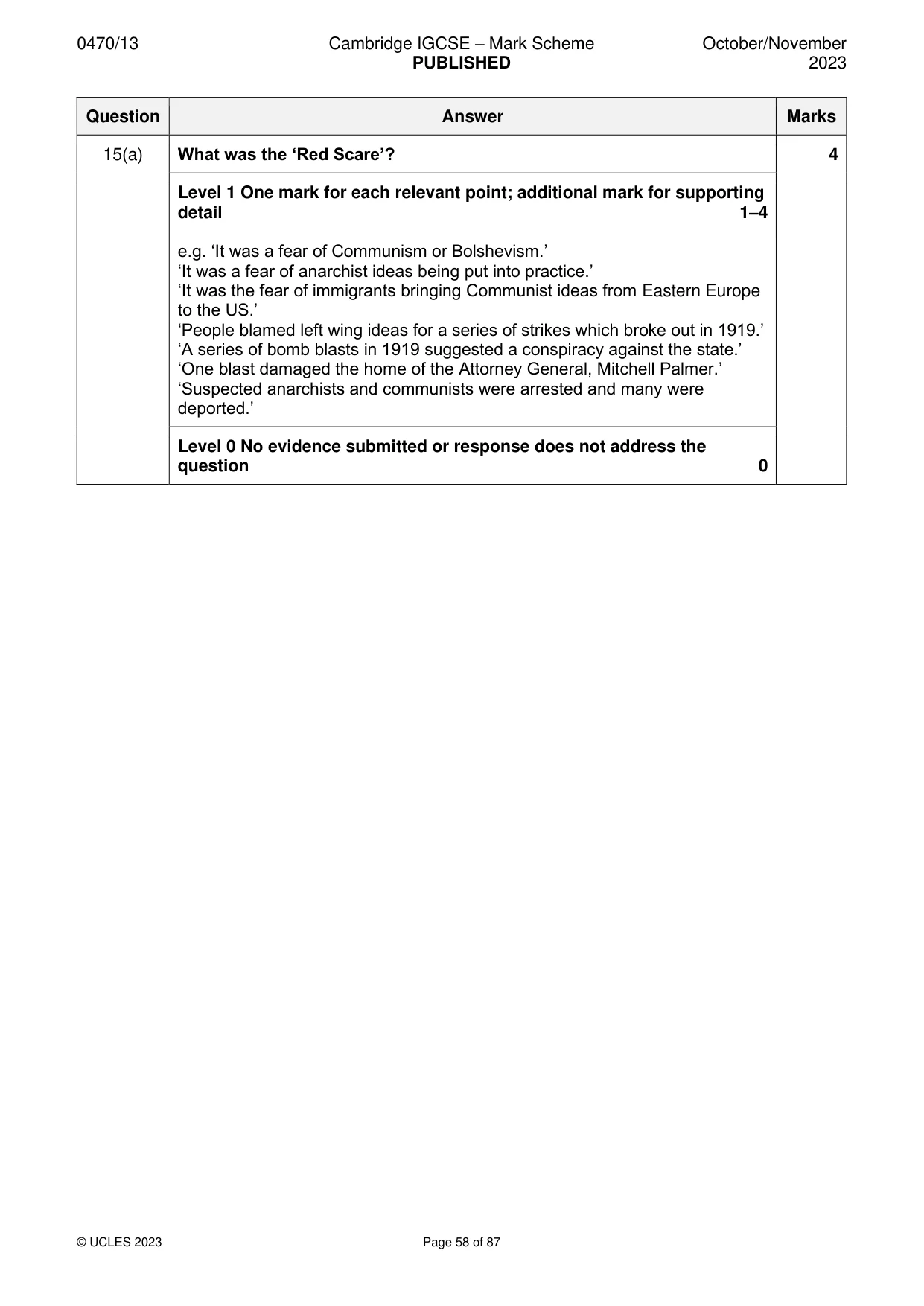
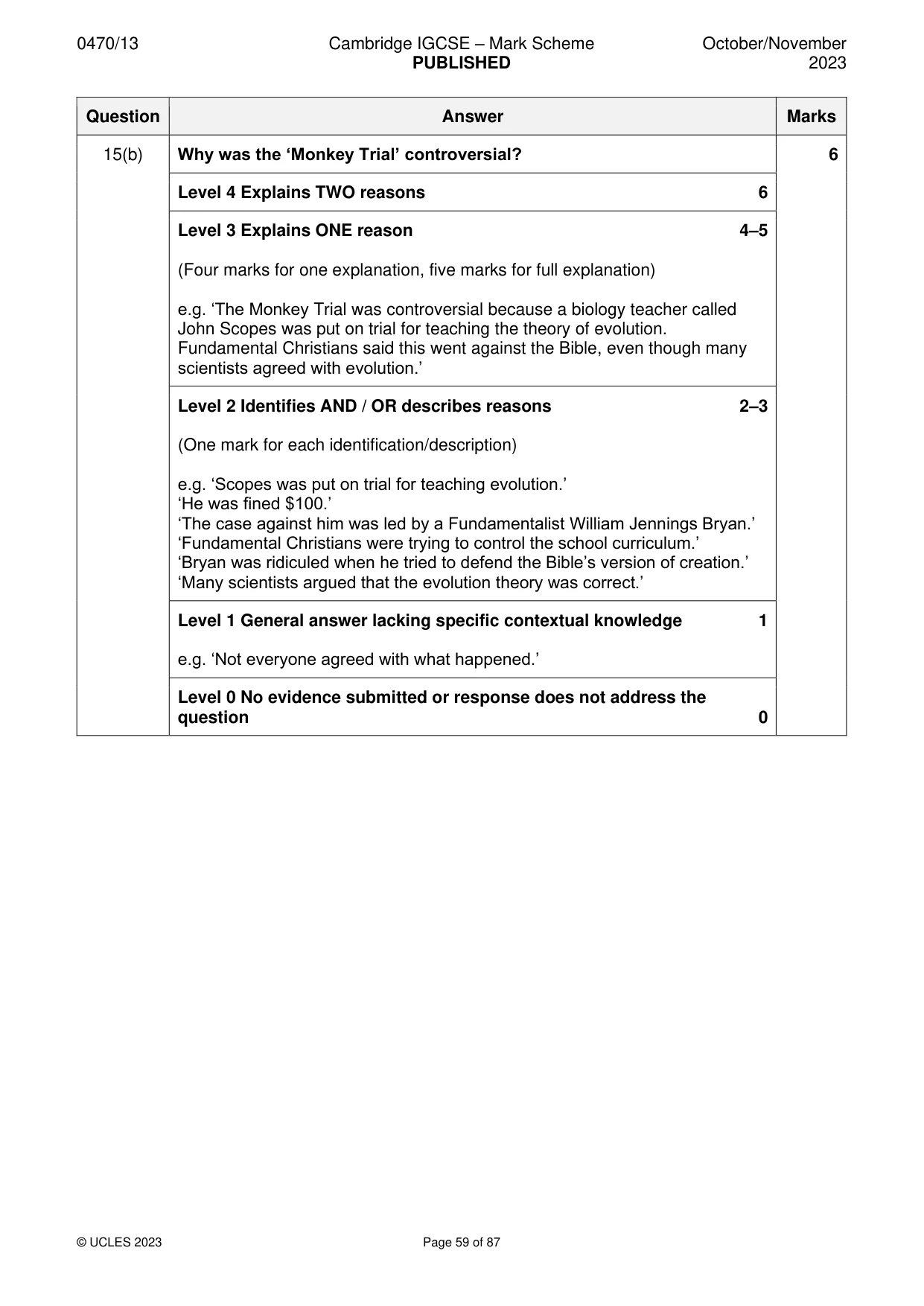
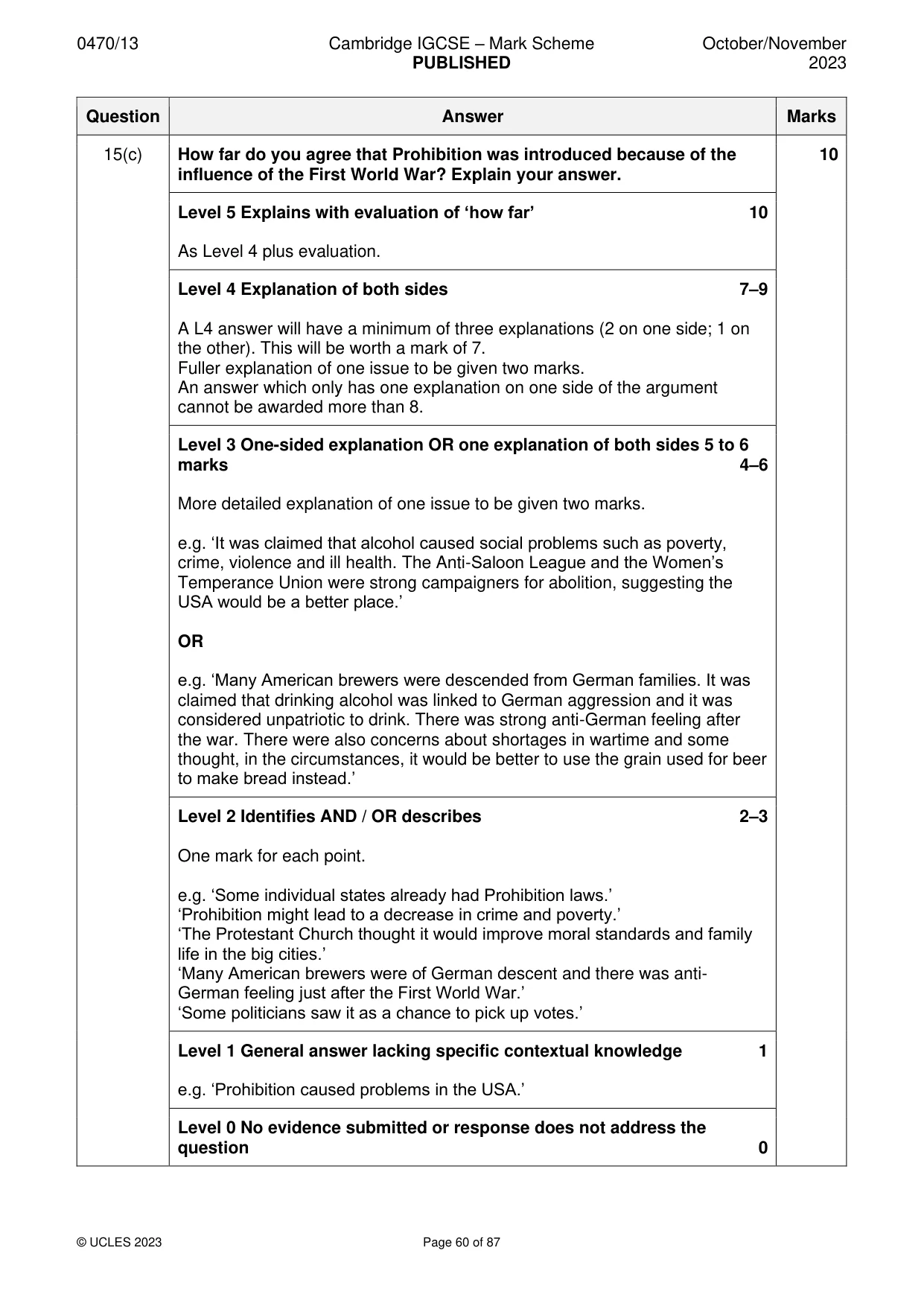
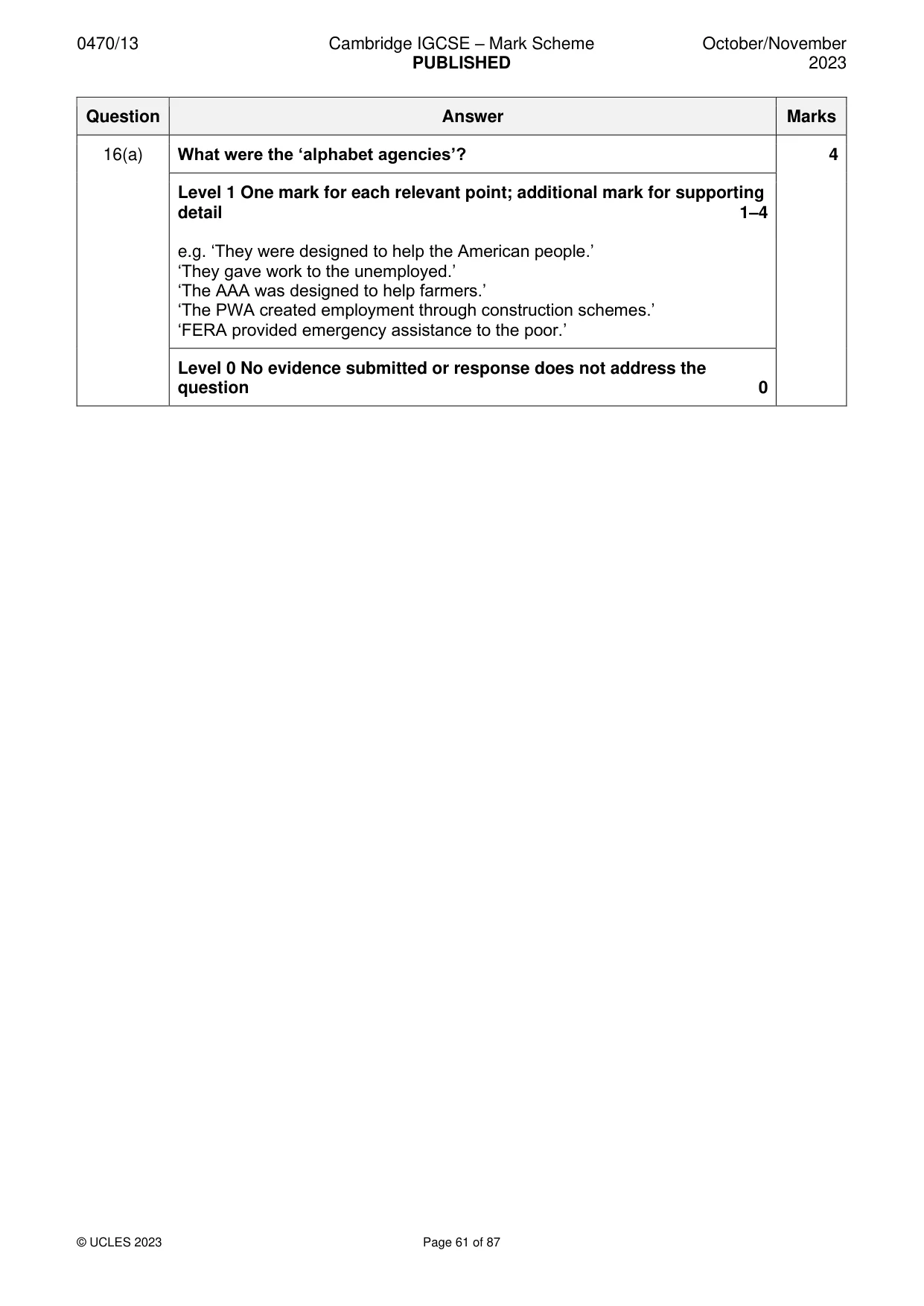
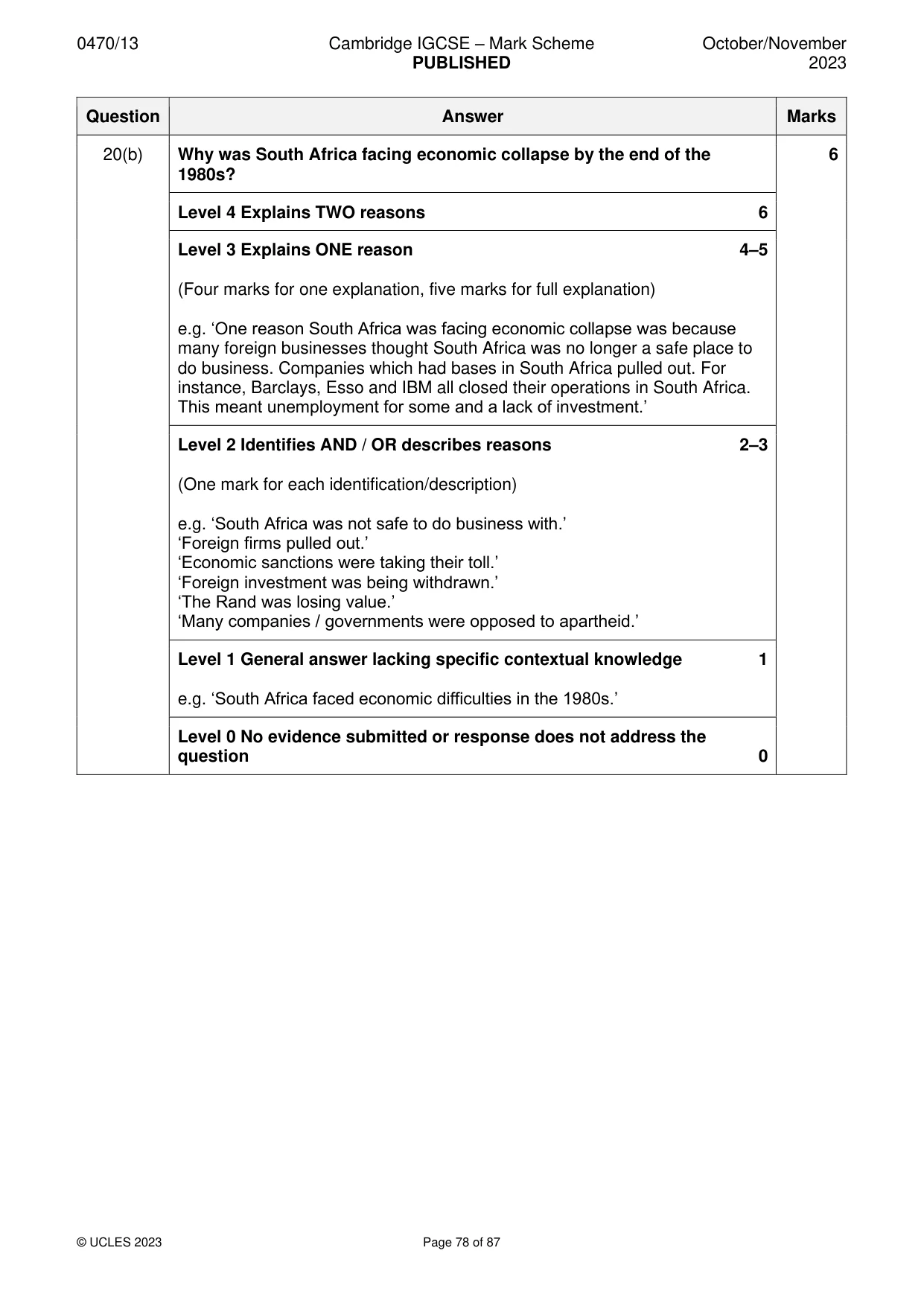
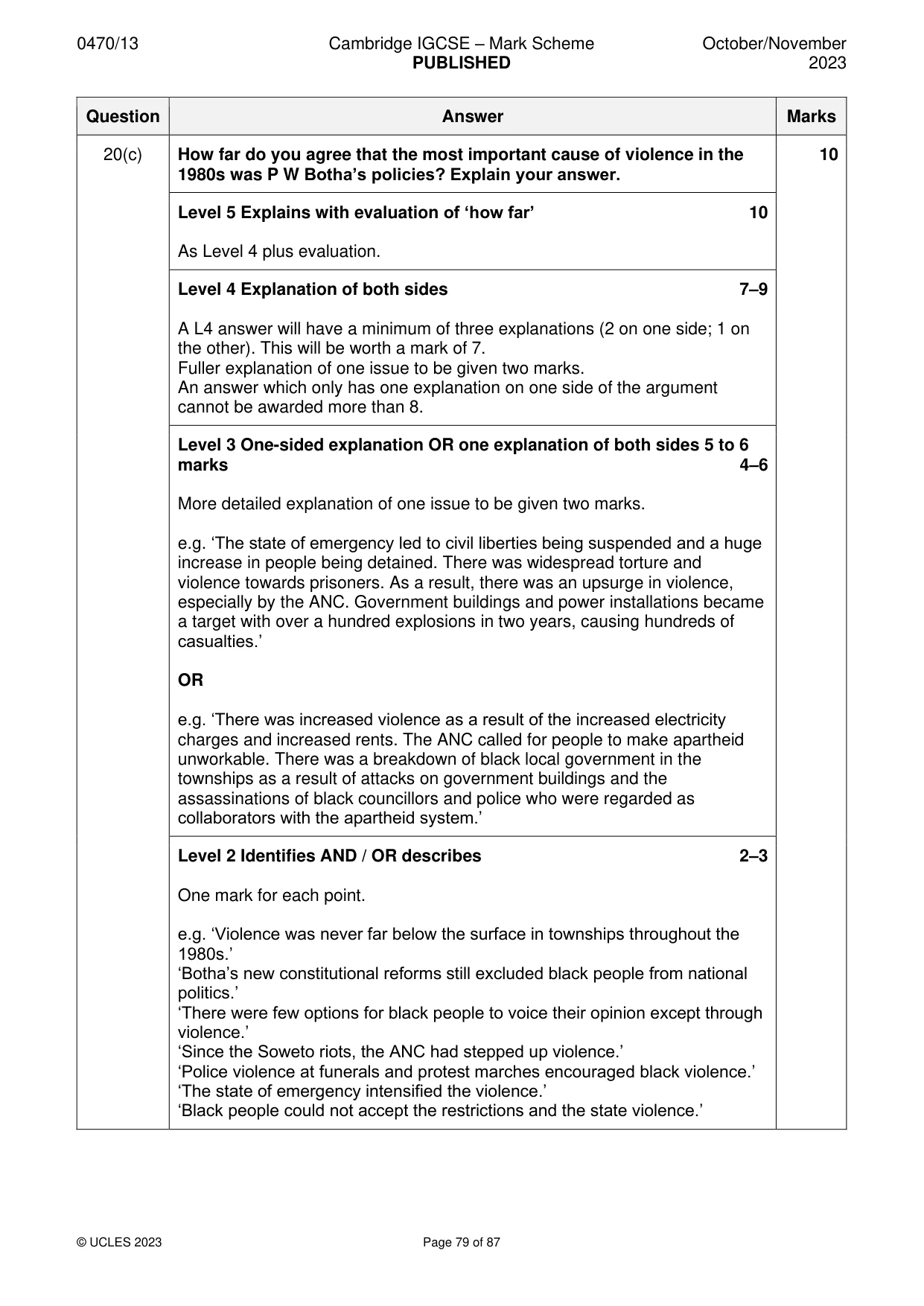
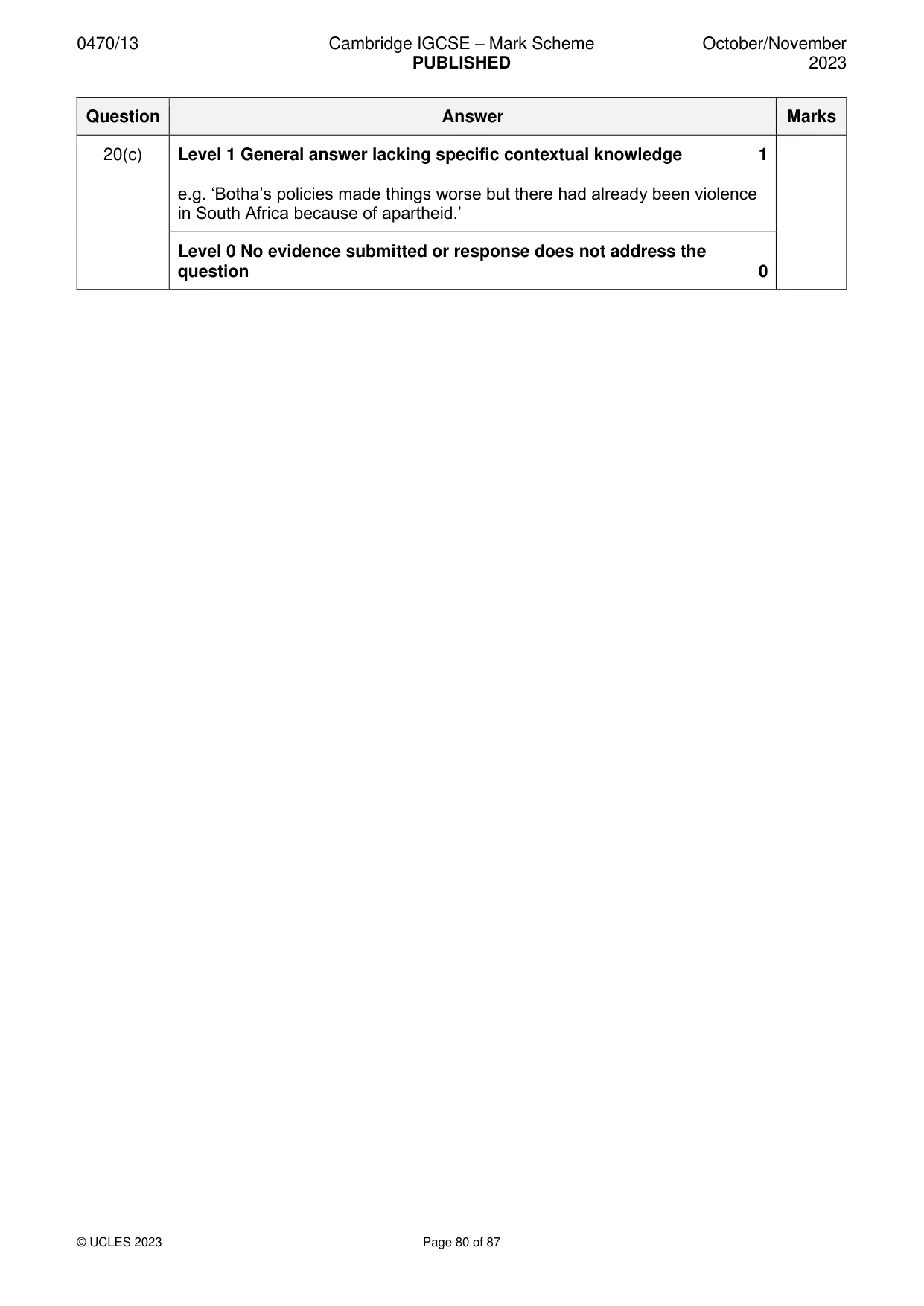
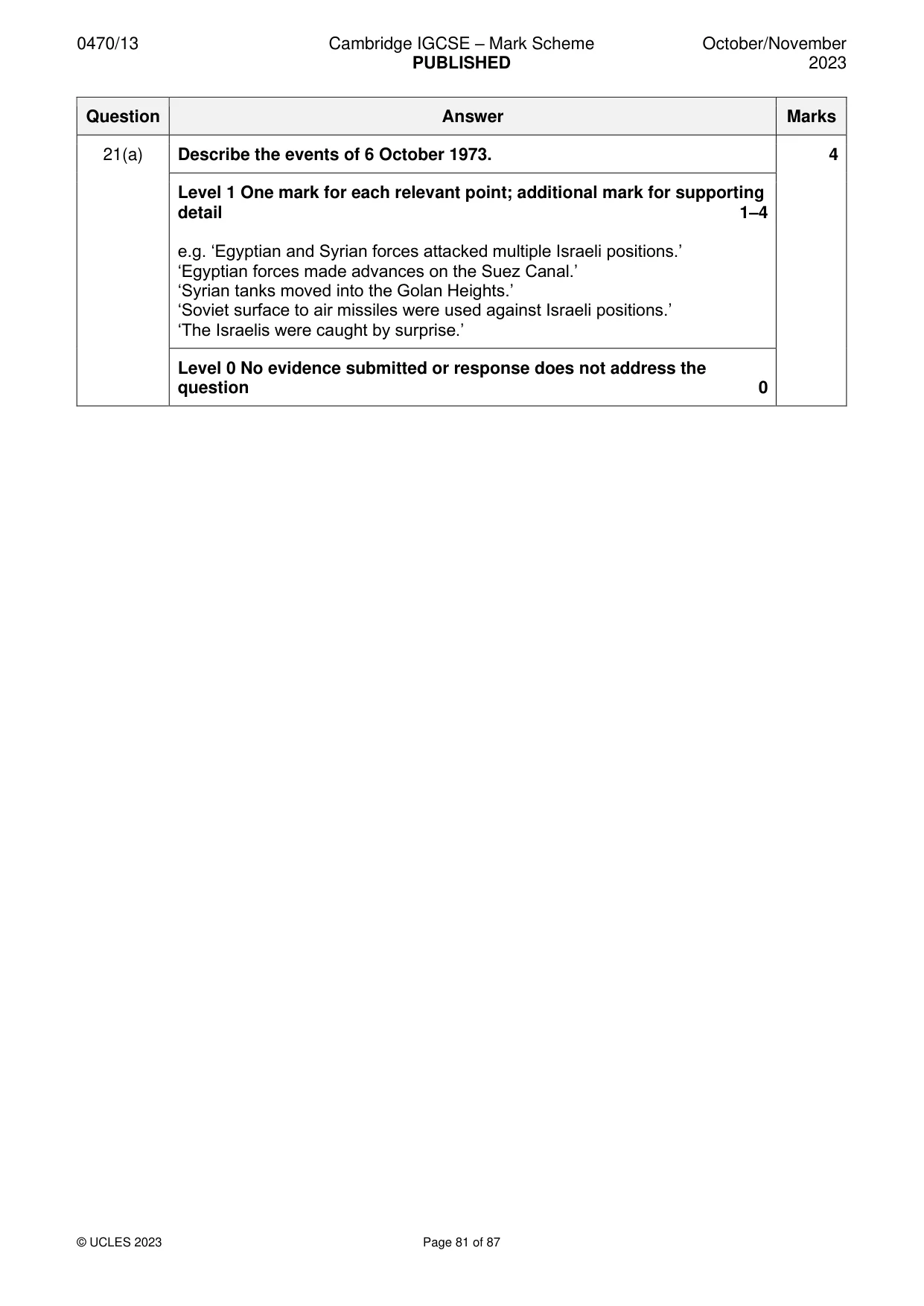
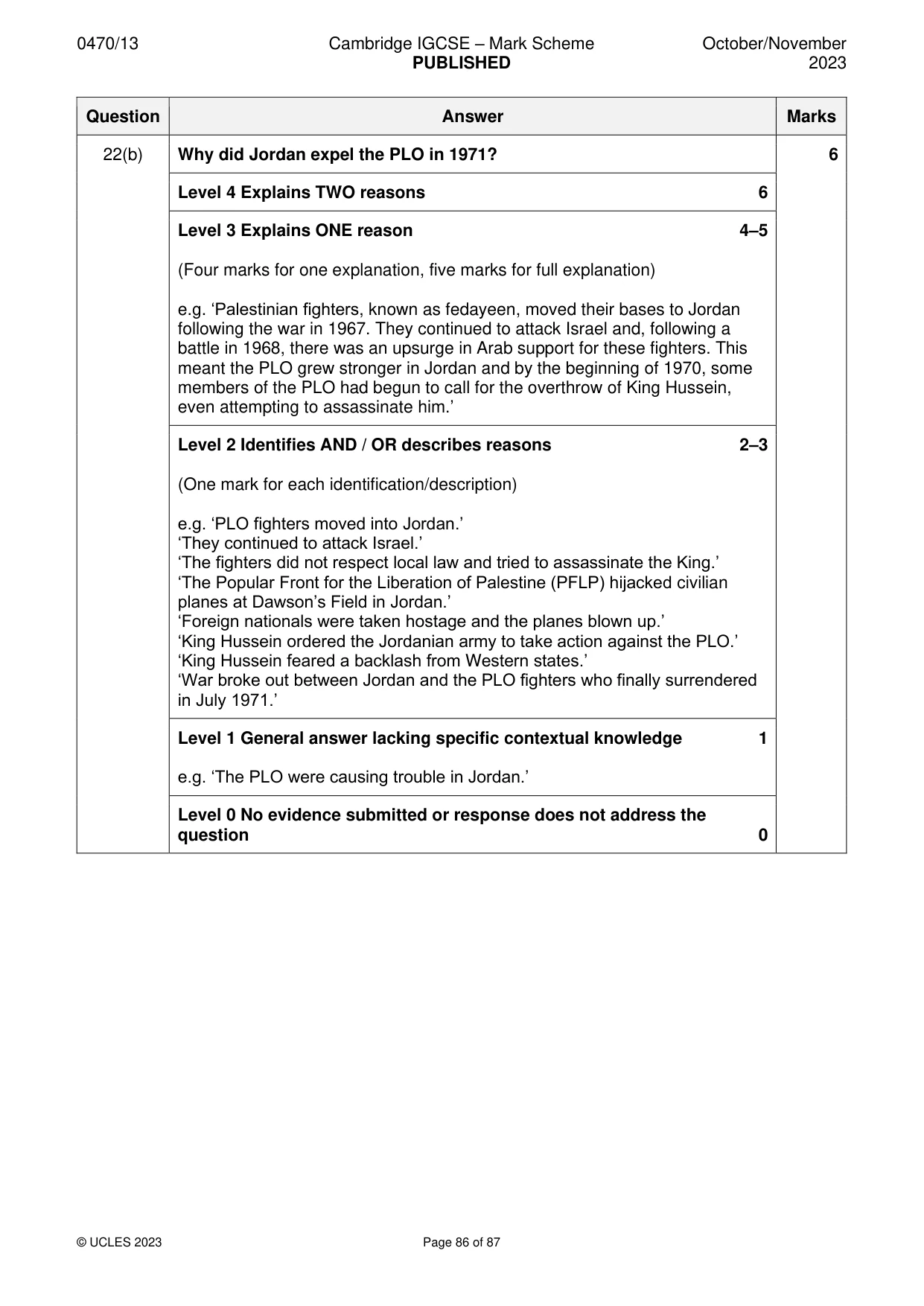
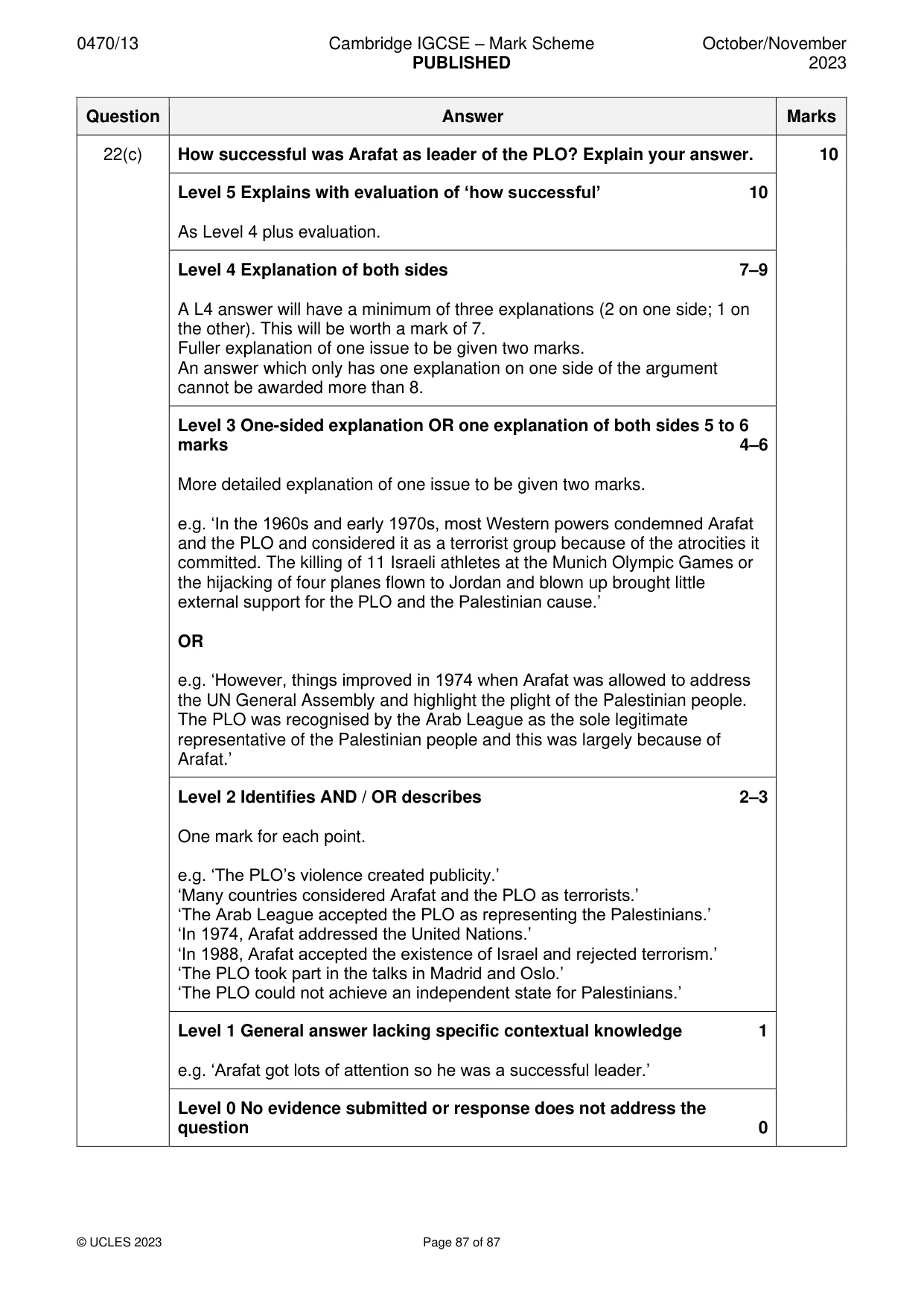
Paper as text
Question paper, page 1
This document has 12 pages. Any blank pages are indicated. [Turn over Cambridge IGCSE™ HISTORY 0470/13 Paper 1 October/November 2023 2 hours You must answer on the enclosed answer booklet. You will need: Answer booklet (enclosed) INSTRUCTIONS ● Answer three questions in total: Section A (Core Content): answer two questions. Section B (Depth Studies): answer one question. ● Follow the instructions on the front cover of the answer booklet. If you need additional answer paper, ask the invigilator for a continuation booklet. INFORMATION ● The total mark for this paper is 60. ● The number of marks for each question or part question is shown in brackets [ ]. * 6 3 1 3 8 6 6 6 1 9 * DC (LK) 314205/3 © UCLES 2023
Question paper, page 2
2 0470/13/O/N/23 © UCLES 2023 SECTION A: CORE CONTENT Answer any two questions from this section. 1 1848–49 was a period of upheaval in Europe. (a) In France, what was a ‘reform banquet’? [4] (b) Why was there support for liberal ideas in much of Europe by 1848? [6] (c) How far do you agree that the 1848–49 revolution in Hungary achieved little? Explain your answer. [10] 2 Certain individuals and places were important to Italian unification. (a) Describe Garibaldi’s campaign in Sicily and Naples in 1860. [4] (b) Why did Cavour resign in 1859? [6] (c) Which was more important in the struggle for Italian unification: Rome or Piedmont? Explain your answer. [10] 3 The unification of Germany was dependent on many factors. (a) Describe the main events of the Franco-Prussian War. [4] (b) Why was the Zollverein important in the unification of Germany? [6] (c) ‘Bismarck was a planner rather than an opportunist.’ How far do you agree with this statement? Explain your answer. [10] 4 Divisions between North and South remained after the Civil War. (a) Describe the establishment of the Confederacy in 1861. [4] (b) Why did the North win the Civil War? [6] (c) ‘The Civil War was more important than Reconstruction for black Americans.’ How far do you agree with this statement? Explain your answer. [10]
Question paper, page 3
3 0470/13/O/N/23 © UCLES 2023 [Turn over 5 Few people were satisfied with the outcome of the Paris peace settlement. (a) What were President Wilson’s ‘Fourteen Points’? [4] (b) Why did many Germans think the Treaty of Versailles was too harsh? [6] (c) Which was punished more harshly in the peace settlement of 1919–20: Austria or Turkey? Explain your answer. [10] 6 Many factors contributed to the collapse of peace in the 1930s. (a) Describe events in the Rhineland in March 1936. [4] (b) Why was Hitler’s policy of ‘lebensraum’ a threat to peace? [6] (c) ‘Britain and France were responsible for the outbreak of war in 1939.’ How far do you agree with this statement? Explain your answer. [10] 7 The wartime alliance broke down quickly at the end of the war. (a) What agreements about Germany were made at the Potsdam Conference? [4] (b) Why was Poland a cause of tension between the Allied powers in 1945? [6] (c) How far do you agree that Truman was to blame for the outbreak of the Cold War? Explain your answer. [10] 8 The First Gulf War had severe consequences for Iraq. (a) Describe the invasion of Kuwait in August 1990. [4] (b) Why did Saddam Hussein’s forces suffer heavy losses in the First Gulf War? [6] (c) ‘The First Gulf War was caused by the weakness of the Iraqi economy.’ How far do you agree with this statement? Explain your answer. [10]
Question paper, page 4
4 0470/13/O/N/23 © UCLES 2023 SECTION B: DEPTH STUDIES Answer any one question from this section. DEPTH STUDY A: THE FIRST WORLD WAR, 1914–18 9 Fighting on the Western Front was difficult and many soldiers’ lives were lost. (a) What was the ‘Western Front’? [4] (b) Why did the Battle of Verdun fail to break the stalemate on the Western Front? [6] (c) How far do you agree that ‘shell shock’ was the worst aspect of life in the trenches? Explain your answer. [10] 10 The First World War was not only fought on the Western Front. (a) What were ‘Q-ships’? [4] (b) Why did Britain blockade German ports? [6] (c) ‘Losing the element of surprise caused the defeat of the Allies at Gallipoli.’ How far do you agree with this statement? Explain your answer. [10]
Question paper, page 5
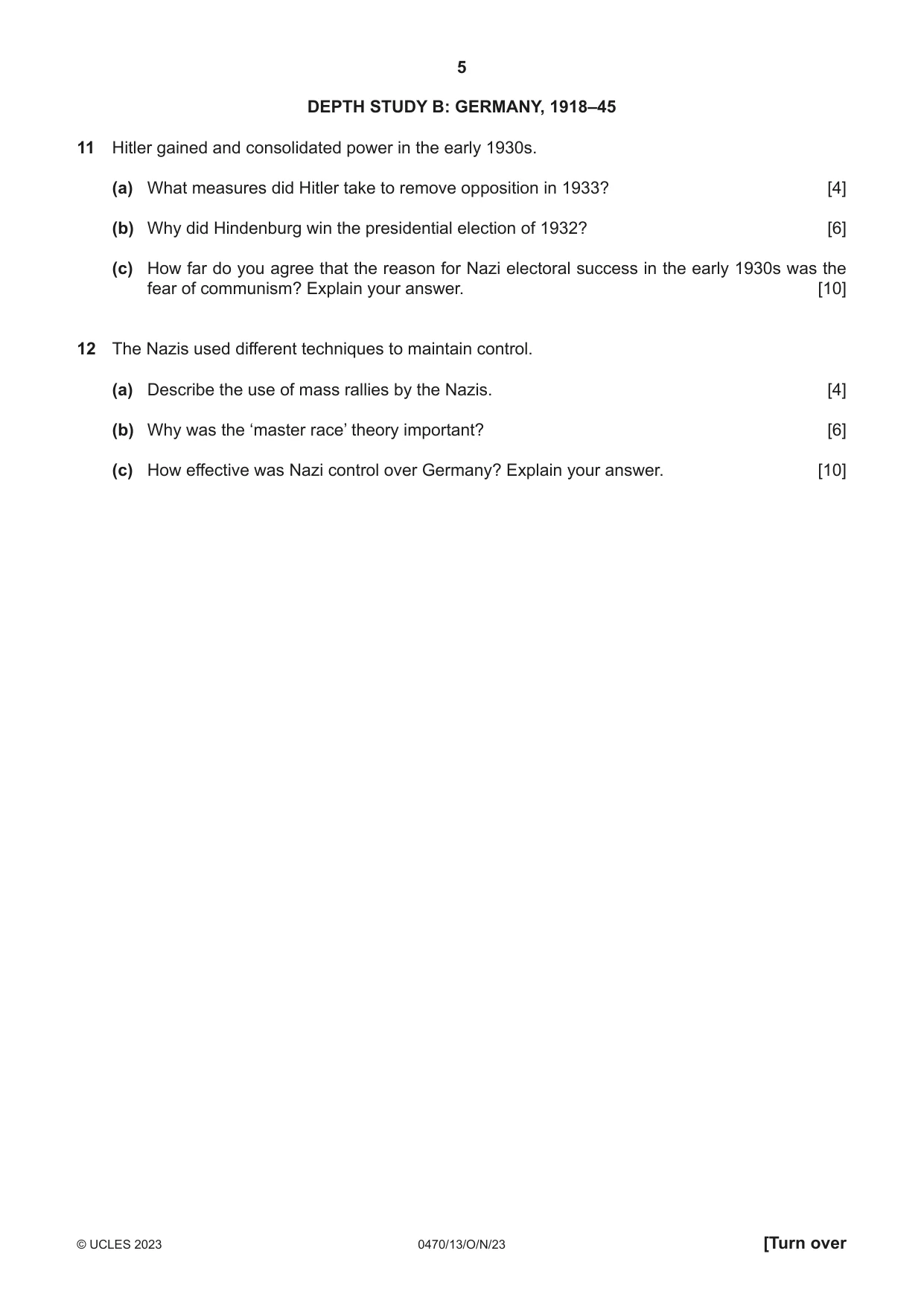
5 0470/13/O/N/23 © UCLES 2023 [Turn over DEPTH STUDY B: GERMANY, 1918–45 11 Hitler gained and consolidated power in the early 1930s. (a) What measures did Hitler take to remove opposition in 1933? [4] (b) Why did Hindenburg win the presidential election of 1932? [6] (c) How far do you agree that the reason for Nazi electoral success in the early 1930s was the fear of communism? Explain your answer. [10] 12 The Nazis used different techniques to maintain control. (a) Describe the use of mass rallies by the Nazis. [4] (b) Why was the ‘master race’ theory important? [6] (c) How effective was Nazi control over Germany? Explain your answer. [10]
Question paper, page 6
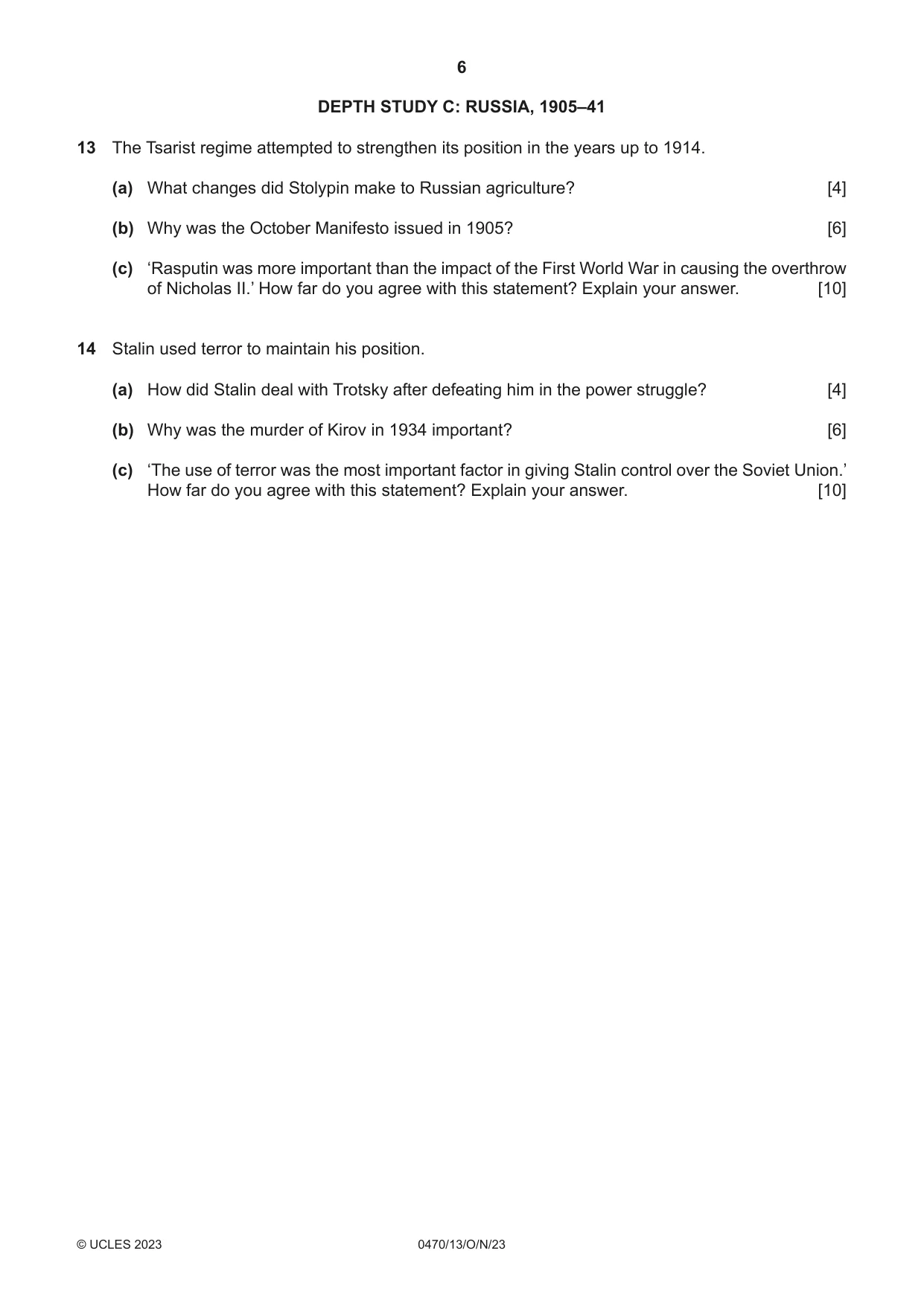
6 0470/13/O/N/23 © UCLES 2023 DEPTH STUDY C: RUSSIA, 1905–41 13 The Tsarist regime attempted to strengthen its position in the years up to 1914. (a) What changes did Stolypin make to Russian agriculture? [4] (b) Why was the October Manifesto issued in 1905? [6] (c) ‘Rasputin was more important than the impact of the First World War in causing the overthrow of Nicholas II.’ How far do you agree with this statement? Explain your answer. [10] 14 Stalin used terror to maintain his position. (a) How did Stalin deal with Trotsky after defeating him in the power struggle? [4] (b) Why was the murder of Kirov in 1934 important? [6] (c) ‘The use of terror was the most important factor in giving Stalin control over the Soviet Union.’ How far do you agree with this statement? Explain your answer. [10]
Question paper, page 7
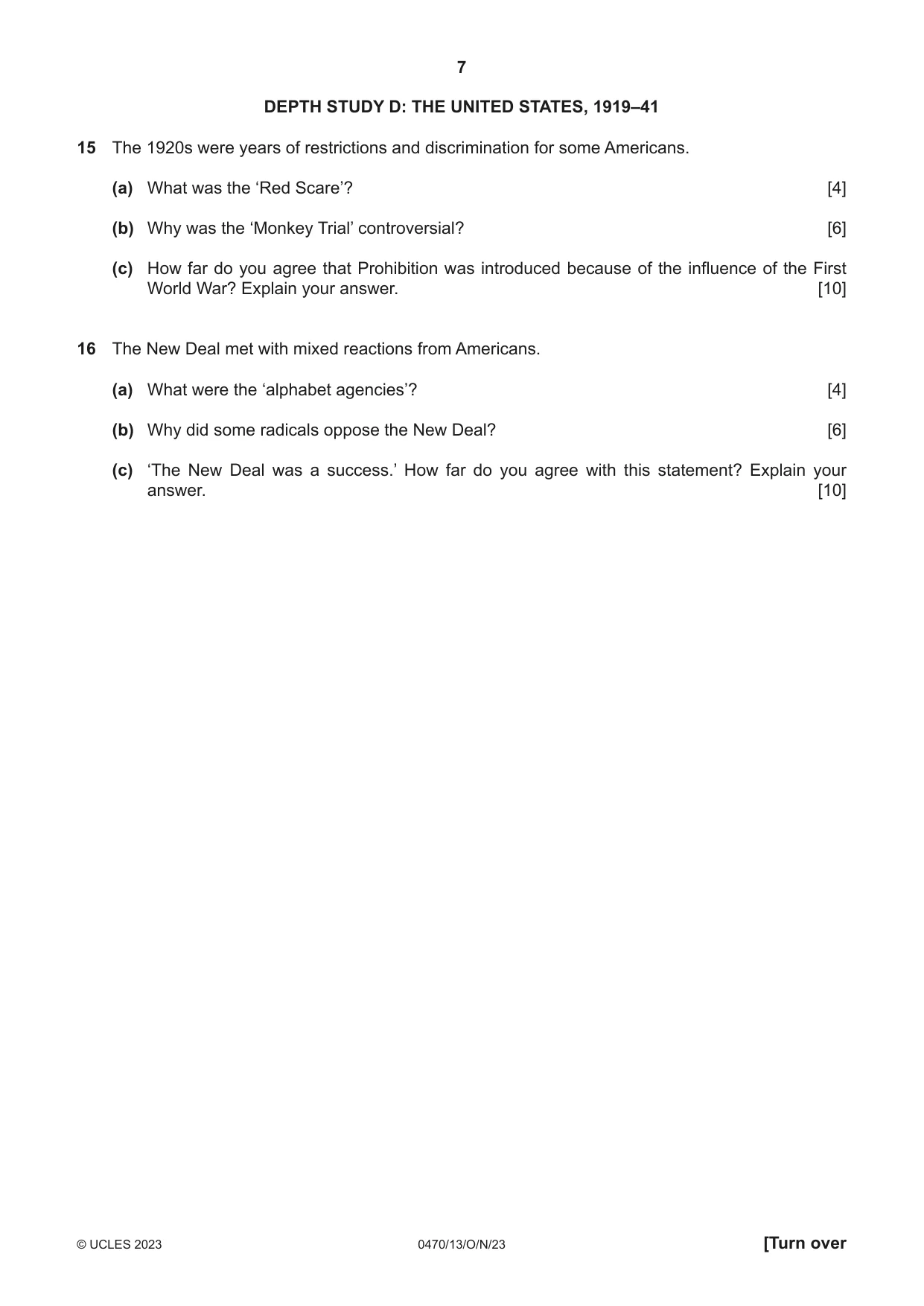
7 0470/13/O/N/23 © UCLES 2023 [Turn over DEPTH STUDY D: THE UNITED STATES, 1919–41 15 The 1920s were years of restrictions and discrimination for some Americans. (a) What was the ‘Red Scare’? [4] (b) Why was the ‘Monkey Trial’ controversial? [6] (c) How far do you agree that Prohibition was introduced because of the influence of the First World War? Explain your answer. [10] 16 The New Deal met with mixed reactions from Americans. (a) What were the ‘alphabet agencies’? [4] (b) Why did some radicals oppose the New Deal? [6] (c) ‘The New Deal was a success.’ How far do you agree with this statement? Explain your answer. [10]
Question paper, page 8
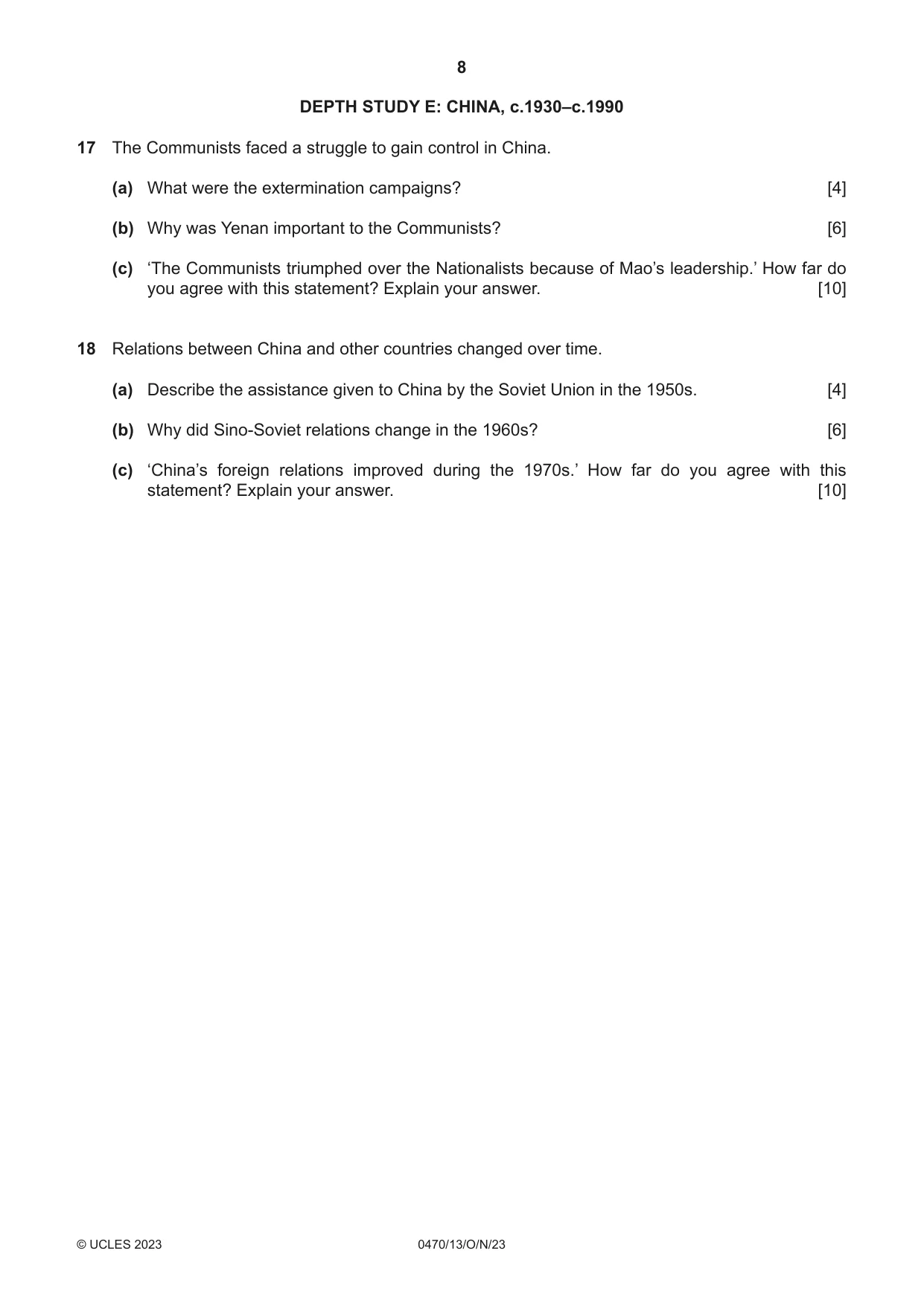
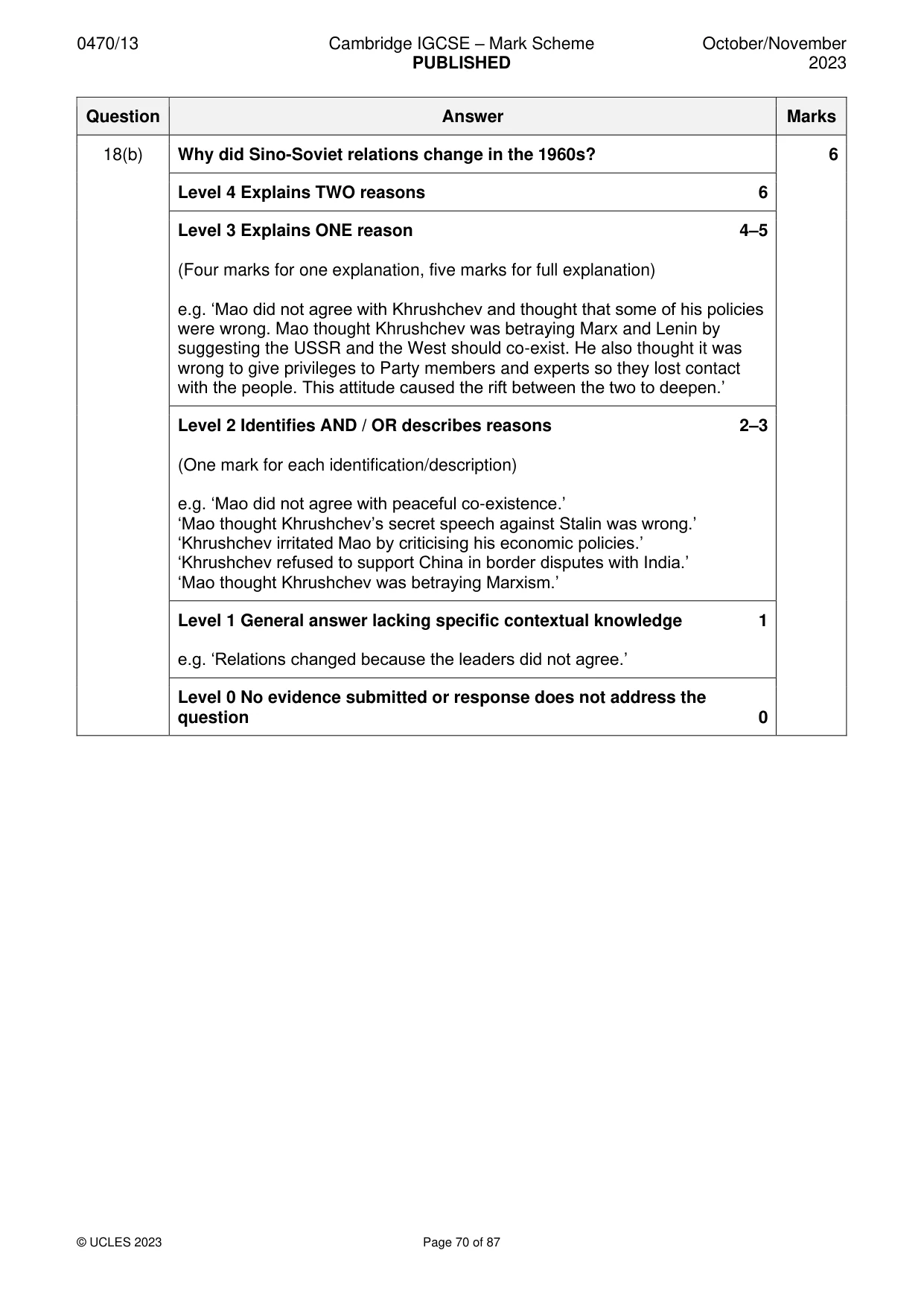
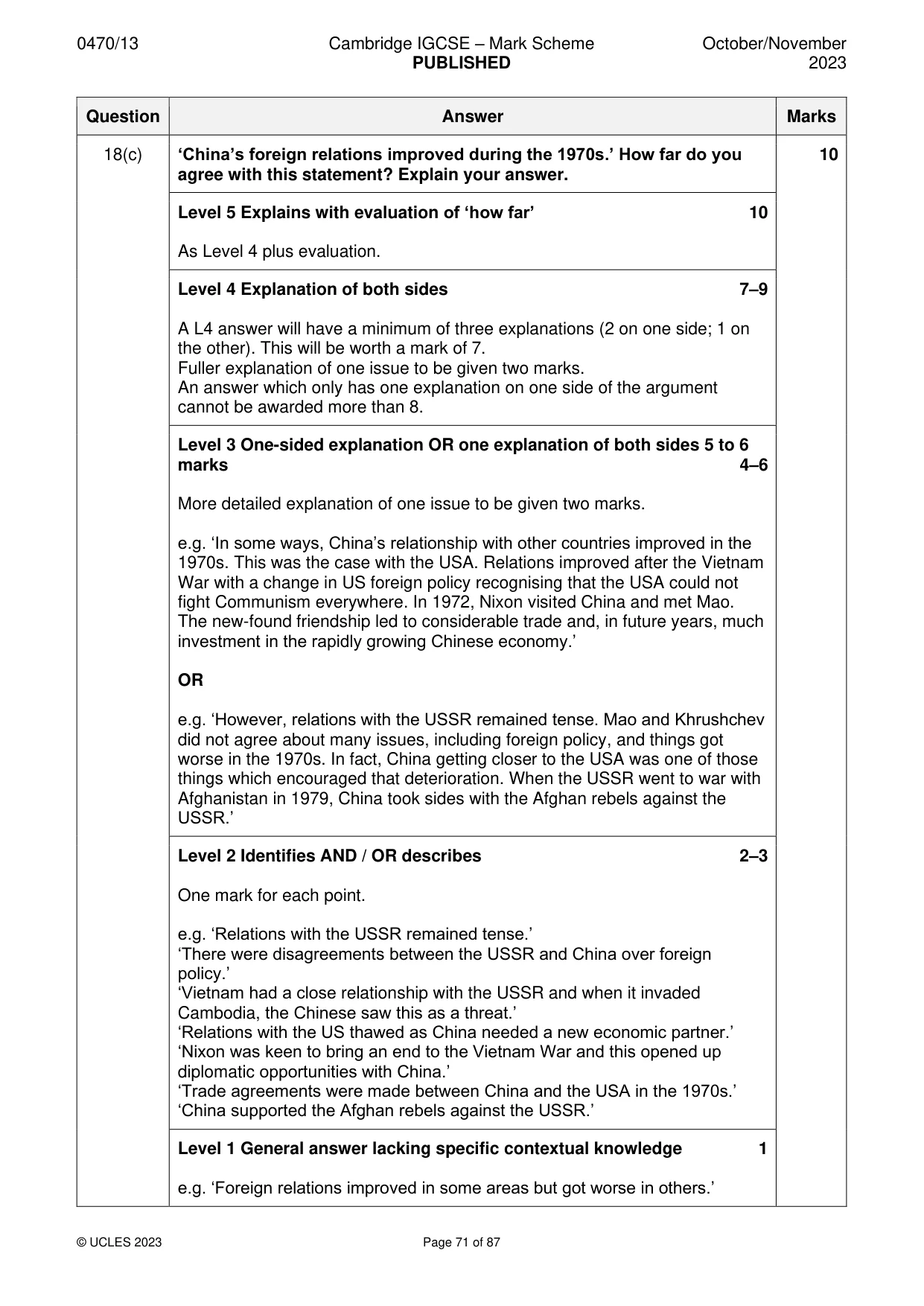
8 0470/13/O/N/23 © UCLES 2023 DEPTH STUDY E: CHINA, c.1930–c.1990 17 The Communists faced a struggle to gain control in China. (a) What were the extermination campaigns? [4] (b) Why was Yenan important to the Communists? [6] (c) ‘The Communists triumphed over the Nationalists because of Mao’s leadership.’ How far do you agree with this statement? Explain your answer. [10] 18 Relations between China and other countries changed over time. (a) Describe the assistance given to China by the Soviet Union in the 1950s. [4] (b) Why did Sino-Soviet relations change in the 1960s? [6] (c) ‘China’s foreign relations improved during the 1970s.’ How far do you agree with this statement? Explain your answer. [10]
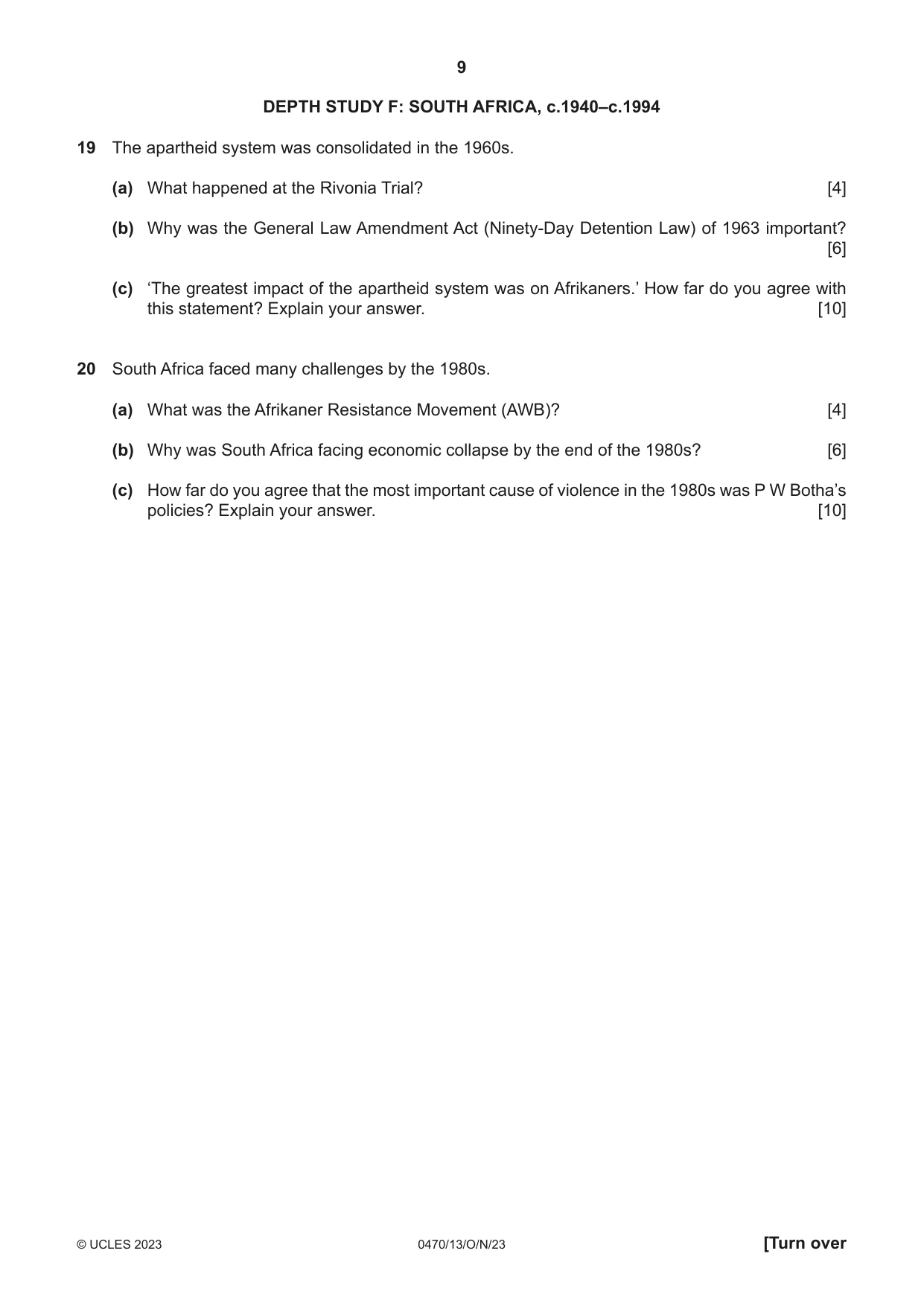
Question paper, page 9
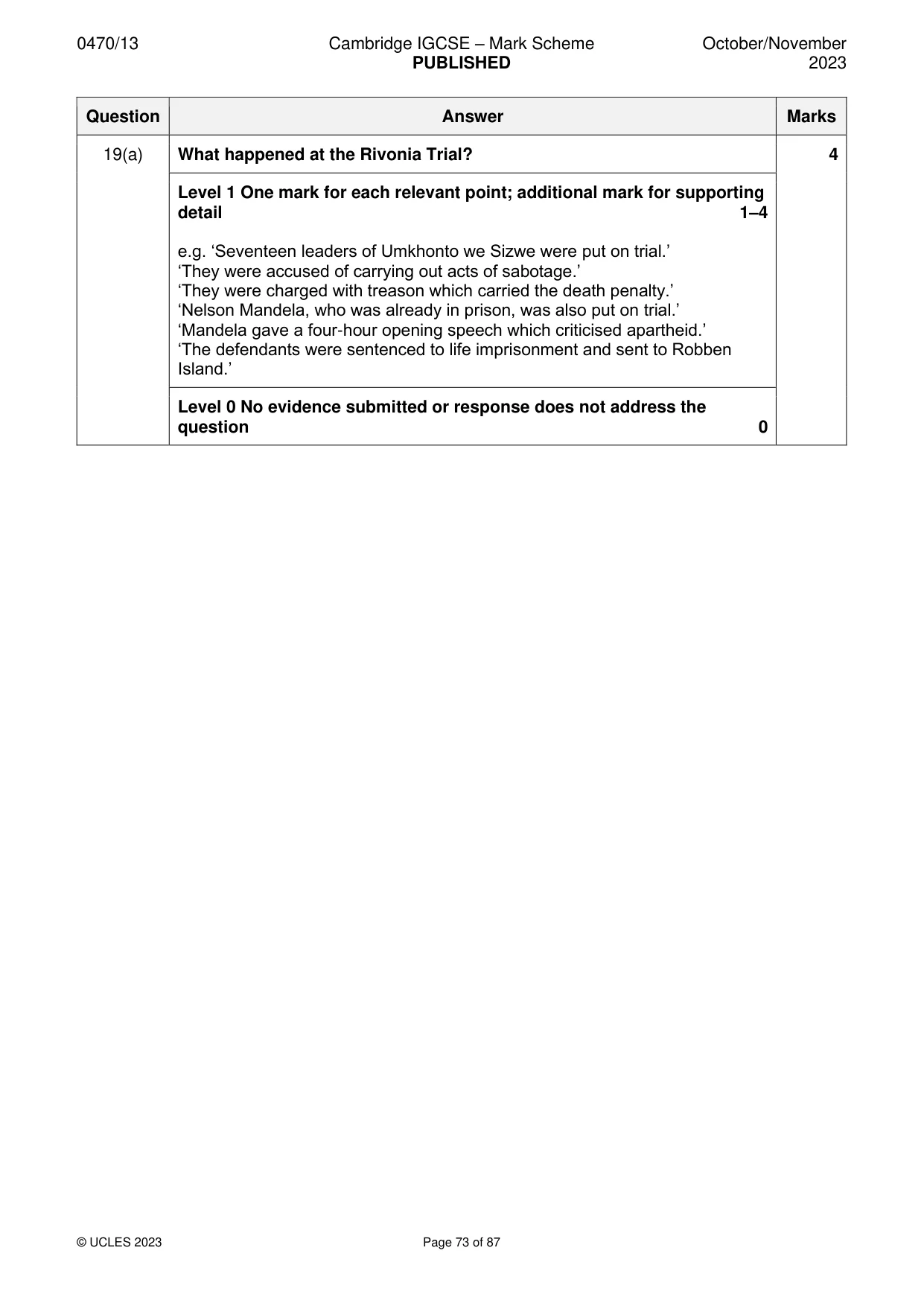
9 0470/13/O/N/23 © UCLES 2023 [Turn over DEPTH STUDY F: SOUTH AFRICA, c.1940–c.1994 19 The apartheid system was consolidated in the 1960s. (a) What happened at the Rivonia Trial? [4] (b) Why was the General Law Amendment Act (Ninety-Day Detention Law) of 1963 important? [6] (c) ‘The greatest impact of the apartheid system was on Afrikaners.’ How far do you agree with this statement? Explain your answer. [10] 20 South Africa faced many challenges by the 1980s. (a) What was the Afrikaner Resistance Movement (AWB)? [4] (b) Why was South Africa facing economic collapse by the end of the 1980s? [6] (c) How far do you agree that the most important cause of violence in the 1980s was P W Botha’s policies? Explain your answer. [10]
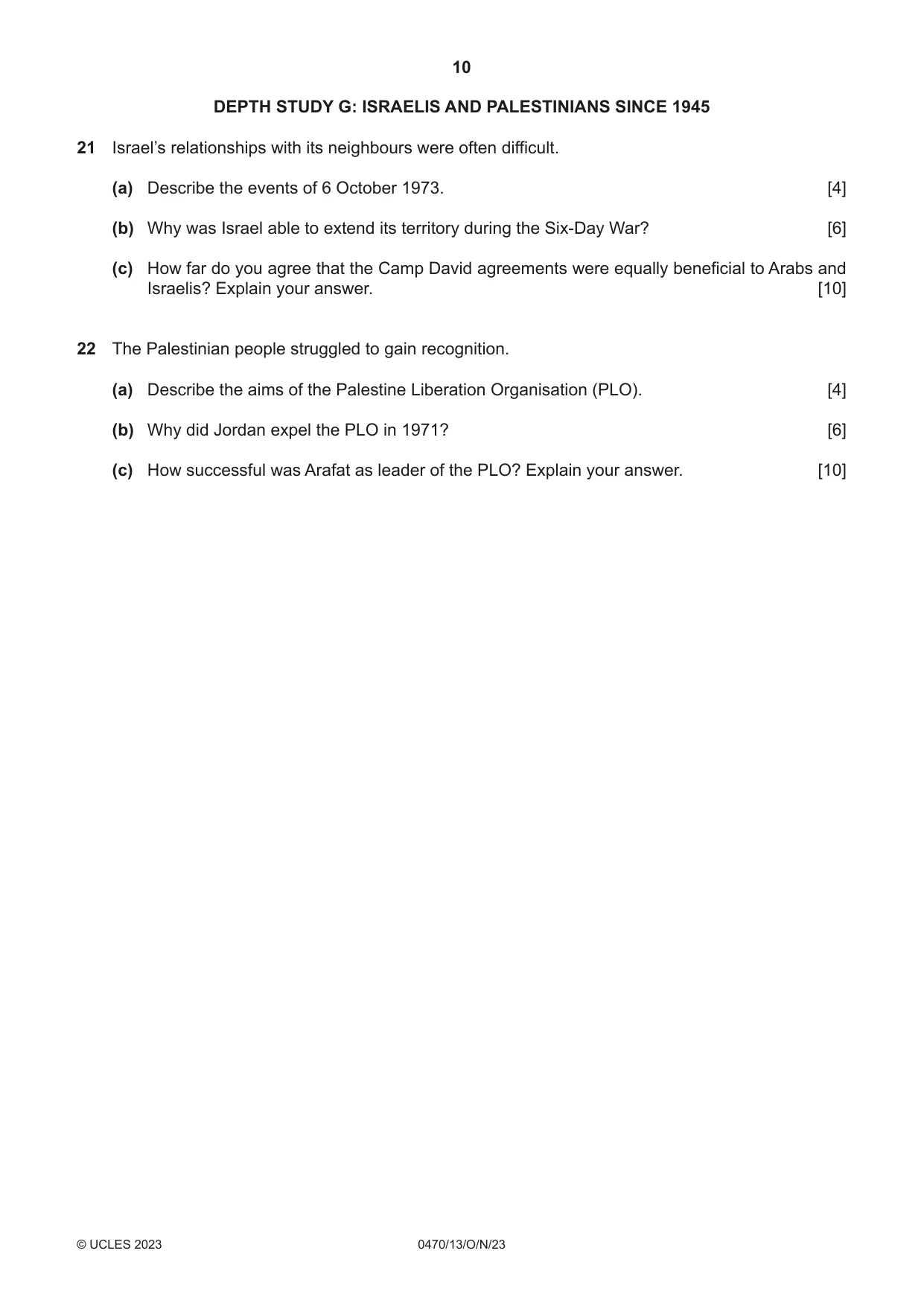
Question paper, page 10
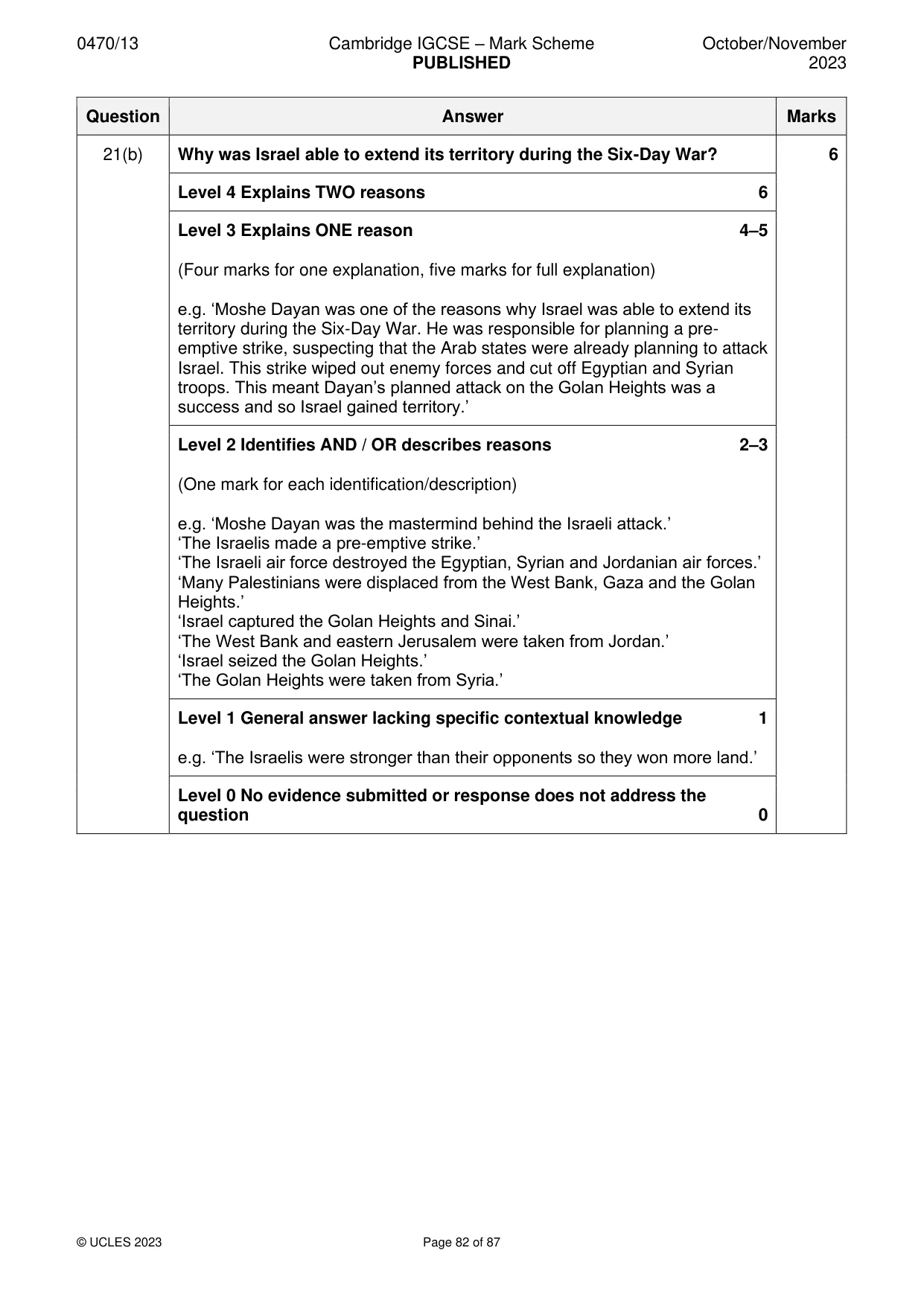
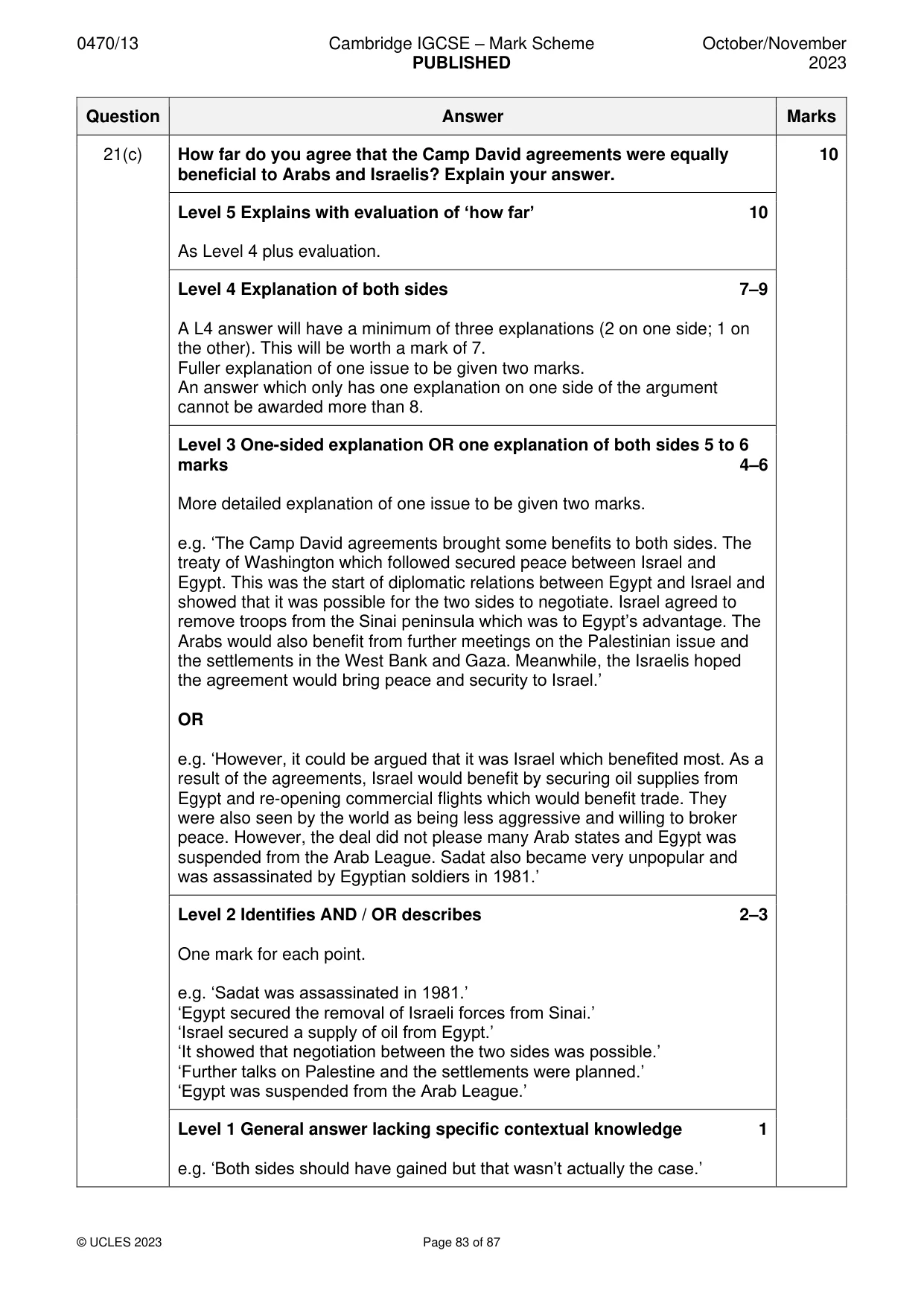
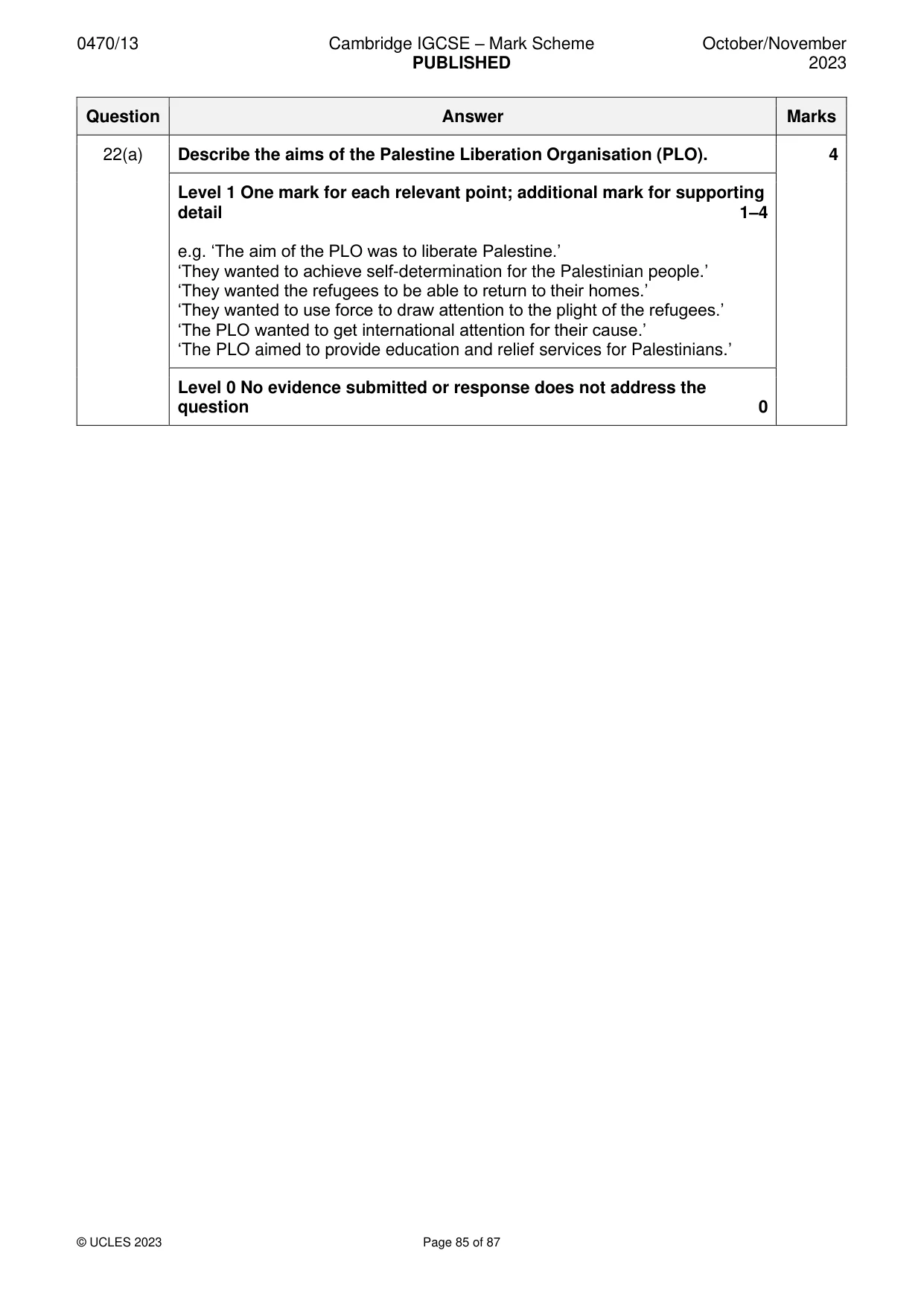
10 0470/13/O/N/23 © UCLES 2023 DEPTH STUDY G: ISRAELIS AND PALESTINIANS SINCE 1945 21 Israel’s relationships with its neighbours were often difficult. (a) Describe the events of 6 October 1973. [4] (b) Why was Israel able to extend its territory during the Six-Day War? [6] (c) How far do you agree that the Camp David agreements were equally beneficial to Arabs and Israelis? Explain your answer. [10] 22 The Palestinian people struggled to gain recognition. (a) Describe the aims of the Palestine Liberation Organisation (PLO). [4] (b) Why did Jordan expel the PLO in 1971? [6] (c) How successful was Arafat as leader of the PLO? Explain your answer. [10]
Question paper, page 11
11 0470/13/O/N/23 © UCLES 2023 BLANK PAGE
Question paper, page 12
12 0470/13/O/N/23 © UCLES 2023 Permission to reproduce items where third-party owned material protected by copyright is included has been sought and cleared where possible. Every reasonable effort has been made by the publisher (UCLES) to trace copyright holders, but if any items requiring clearance have unwittingly been included, the publisher will be pleased to make amends at the earliest possible opportunity. To avoid the issue of disclosure of answer-related information to candidates, all copyright acknowledgements are reproduced online in the Cambridge Assessment International Education Copyright Acknowledgements Booklet. This is produced for each series of examinations and is freely available to download at www.cambridgeinternational.org after the live examination series. Cambridge Assessment International Education is part of Cambridge Assessment. Cambridge Assessment is the brand name of the University of Cambridge Local Examinations Syndicate (UCLES), which is a department of the University of Cambridge. BLANK PAGE
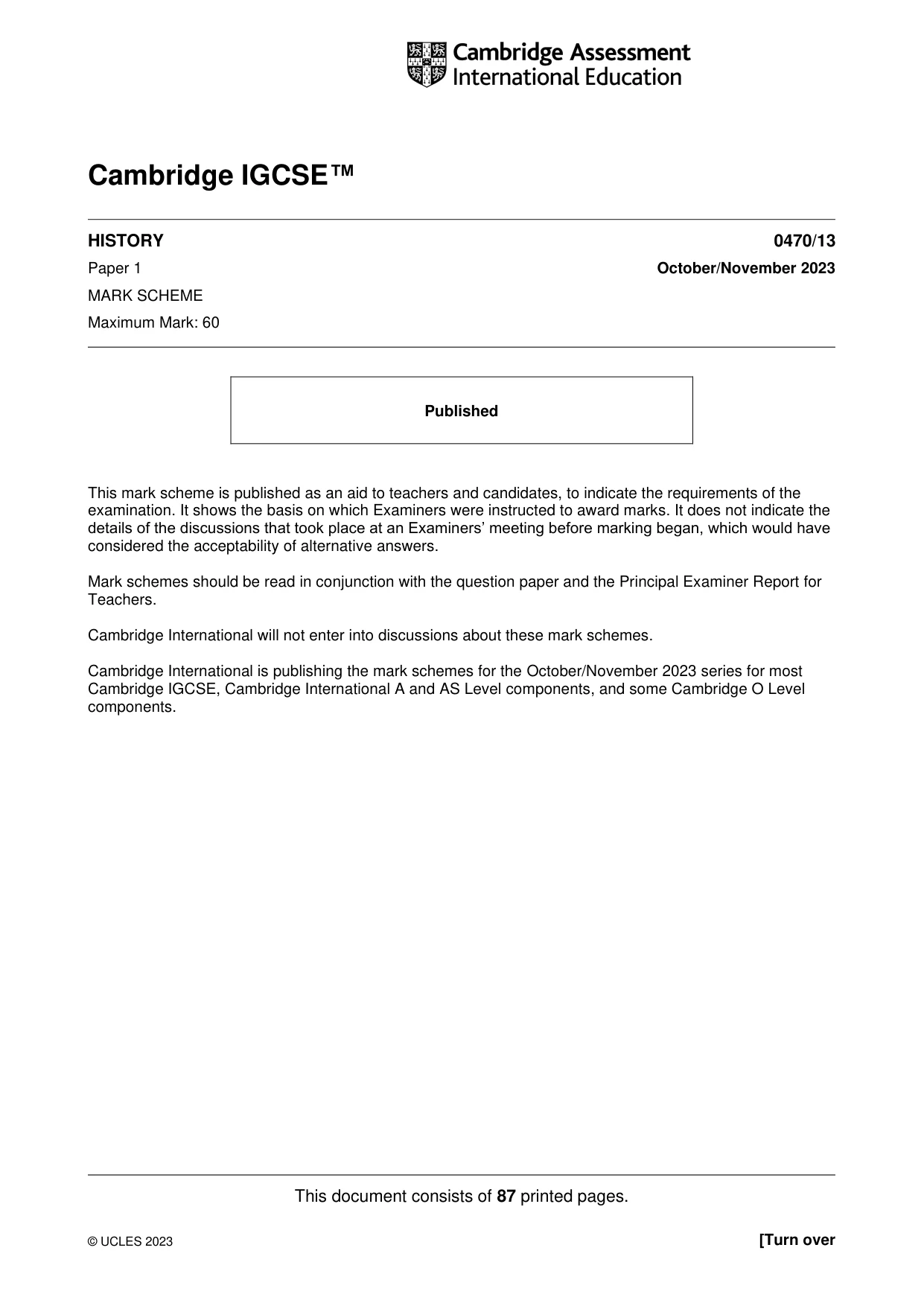
Mark scheme, page 1
This document consists of 87 printed pages. © UCLES 2023 [Turn over Cambridge IGCSE™ HISTORY 0470/13 Paper 1 October/November 2023 MARK SCHEME Maximum Mark: 60 Published This mark scheme is published as an aid to teachers and candidates, to indicate the requirements of the examination. It shows the basis on which Examiners were instructed to award marks. It does not indicate the details of the discussions that took place at an Examiners’ meeting before marking began, which would have considered the acceptability of alternative answers. Mark schemes should be read in conjunction with the question paper and the Principal Examiner Report for Teachers. Cambridge International will not enter into discussions about these mark schemes. Cambridge International is publishing the mark schemes for the October/November 2023 series for most Cambridge IGCSE, Cambridge International A and AS Level components, and some Cambridge O Level components.
Mark scheme, page 2
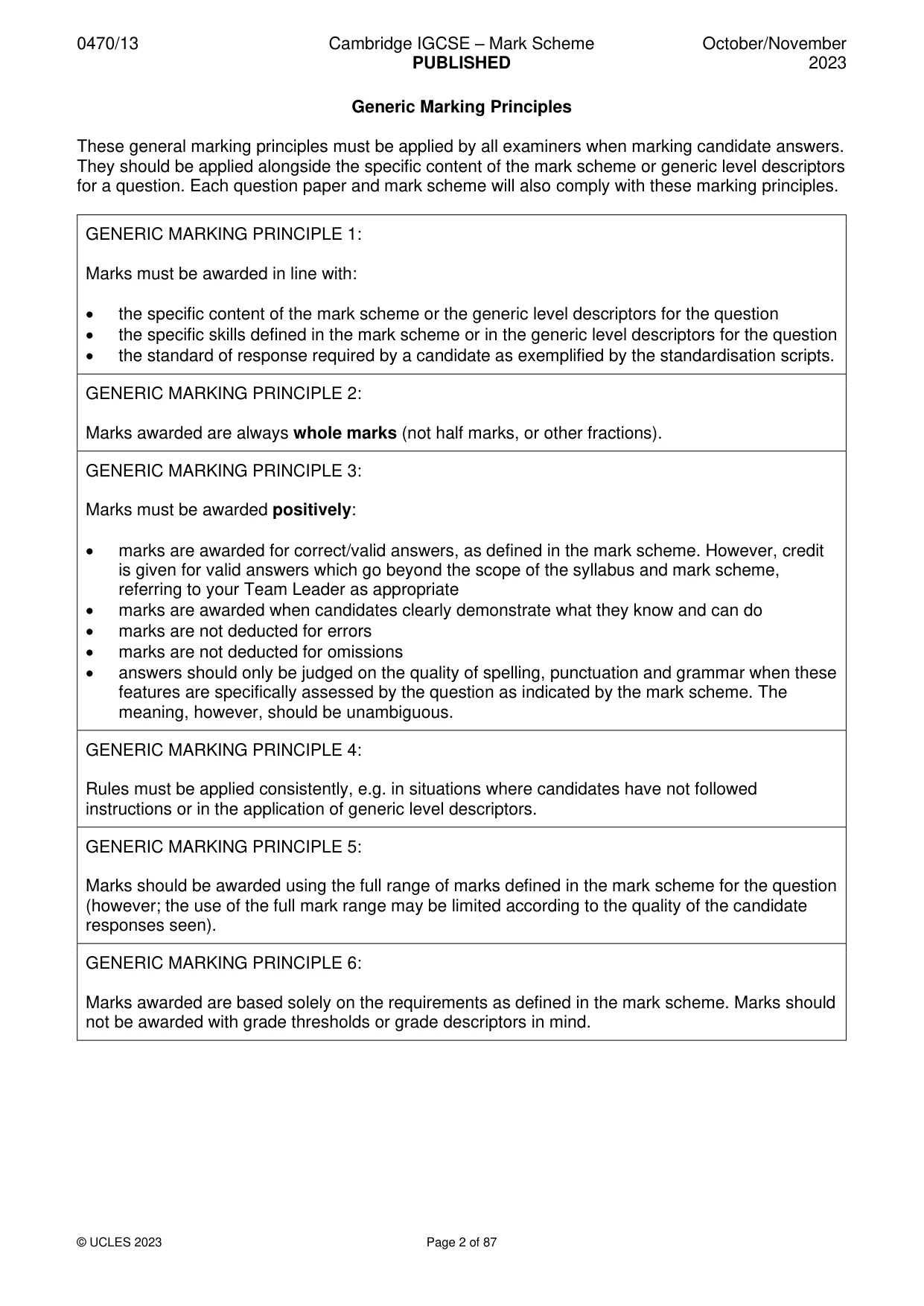
0470/13 Cambridge IGCSE – Mark Scheme PUBLISHED October/November 2023 © UCLES 2023 Page 2 of 87 Generic Marking Principles These general marking principles must be applied by all examiners when marking candidate answers. They should be applied alongside the specific content of the mark scheme or generic level descriptors for a question. Each question paper and mark scheme will also comply with these marking principles. GENERIC MARKING PRINCIPLE 1: Marks must be awarded in line with: • the specific content of the mark scheme or the generic level descriptors for the question • the specific skills defined in the mark scheme or in the generic level descriptors for the question • the standard of response required by a candidate as exemplified by the standardisation scripts. GENERIC MARKING PRINCIPLE 2: Marks awarded are always whole marks (not half marks, or other fractions). GENERIC MARKING PRINCIPLE 3: Marks must be awarded positively: • marks are awarded for correct/valid answers, as defined in the mark scheme. However, credit is given for valid answers which go beyond the scope of the syllabus and mark scheme, referring to your Team Leader as appropriate • marks are awarded when candidates clearly demonstrate what they know and can do • marks are not deducted for errors • marks are not deducted for omissions • answers should only be judged on the quality of spelling, punctuation and grammar when these features are specifically assessed by the question as indicated by the mark scheme. The meaning, however, should be unambiguous. GENERIC MARKING PRINCIPLE 4: Rules must be applied consistently, e.g. in situations where candidates have not followed instructions or in the application of generic level descriptors. GENERIC MARKING PRINCIPLE 5: Marks should be awarded using the full range of marks defined in the mark scheme for the question (however; the use of the full mark range may be limited according to the quality of the candidate responses seen). GENERIC MARKING PRINCIPLE 6: Marks awarded are based solely on the requirements as defined in the mark scheme. Marks should not be awarded with grade thresholds or grade descriptors in mind.
Mark scheme, page 3
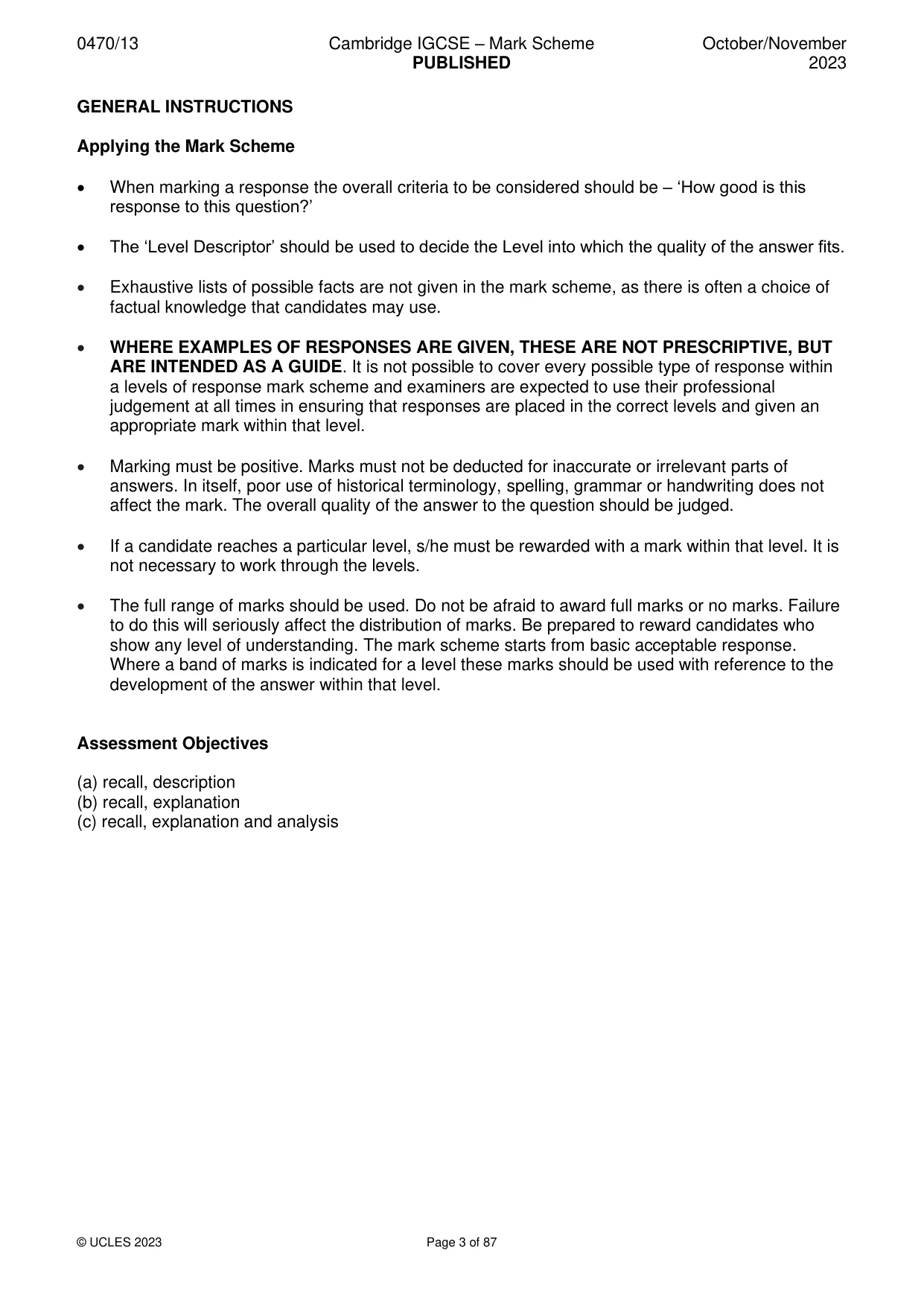
0470/13 Cambridge IGCSE – Mark Scheme PUBLISHED October/November 2023 © UCLES 2023 Page 3 of 87 GENERAL INSTRUCTIONS Applying the Mark Scheme • When marking a response the overall criteria to be considered should be – ‘How good is this response to this question?’ • The ‘Level Descriptor’ should be used to decide the Level into which the quality of the answer fits. • Exhaustive lists of possible facts are not given in the mark scheme, as there is often a choice of factual knowledge that candidates may use. • WHERE EXAMPLES OF RESPONSES ARE GIVEN, THESE ARE NOT PRESCRIPTIVE, BUT ARE INTENDED AS A GUIDE. It is not possible to cover every possible type of response within a levels of response mark scheme and examiners are expected to use their professional judgement at all times in ensuring that responses are placed in the correct levels and given an appropriate mark within that level. • Marking must be positive. Marks must not be deducted for inaccurate or irrelevant parts of answers. In itself, poor use of historical terminology, spelling, grammar or handwriting does not affect the mark. The overall quality of the answer to the question should be judged. • If a candidate reaches a particular level, s/he must be rewarded with a mark within that level. It is not necessary to work through the levels. • The full range of marks should be used. Do not be afraid to award full marks or no marks. Failure to do this will seriously affect the distribution of marks. Be prepared to reward candidates who show any level of understanding. The mark scheme starts from basic acceptable response. Where a band of marks is indicated for a level these marks should be used with reference to the development of the answer within that level. Assessment Objectives (a) recall, description (b) recall, explanation (c) recall, explanation and analysis
Mark scheme, page 4
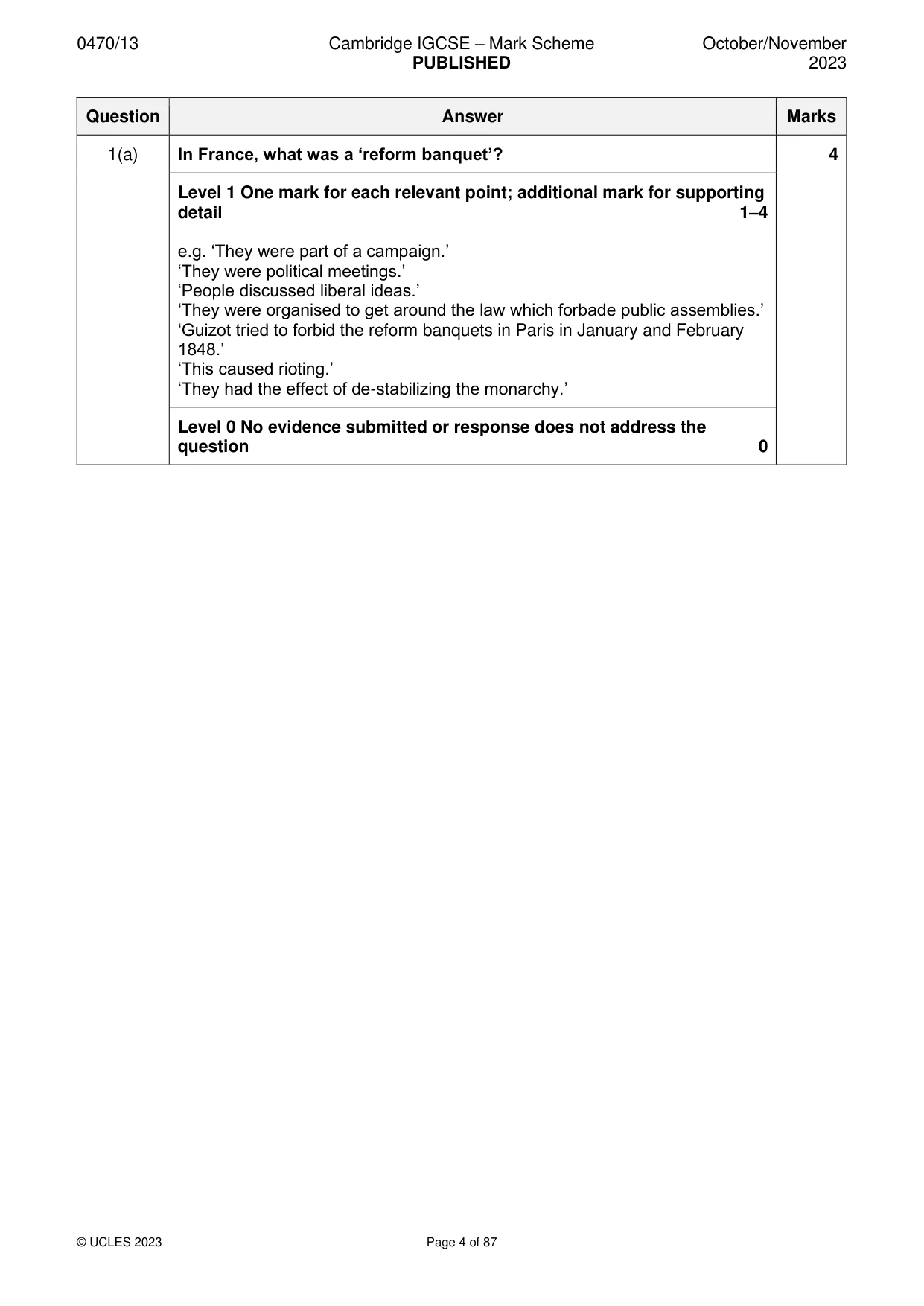
0470/13 Cambridge IGCSE – Mark Scheme PUBLISHED October/November 2023 © UCLES 2023 Page 4 of 87 Question Answer Marks 1(a) In France, what was a ‘reform banquet’? 4 Level 1 One mark for each relevant point; additional mark for supporting detail 1–4 e.g. ‘They were part of a campaign.’ ‘They were political meetings.’ ‘People discussed liberal ideas.’ ‘They were organised to get around the law which forbade public assemblies.’ ‘Guizot tried to forbid the reform banquets in Paris in January and February 1848.’ ‘This caused rioting.’ ‘They had the effect of de-stabilizing the monarchy.’ Level 0 No evidence submitted or response does not address the question 0
Mark scheme, page 5
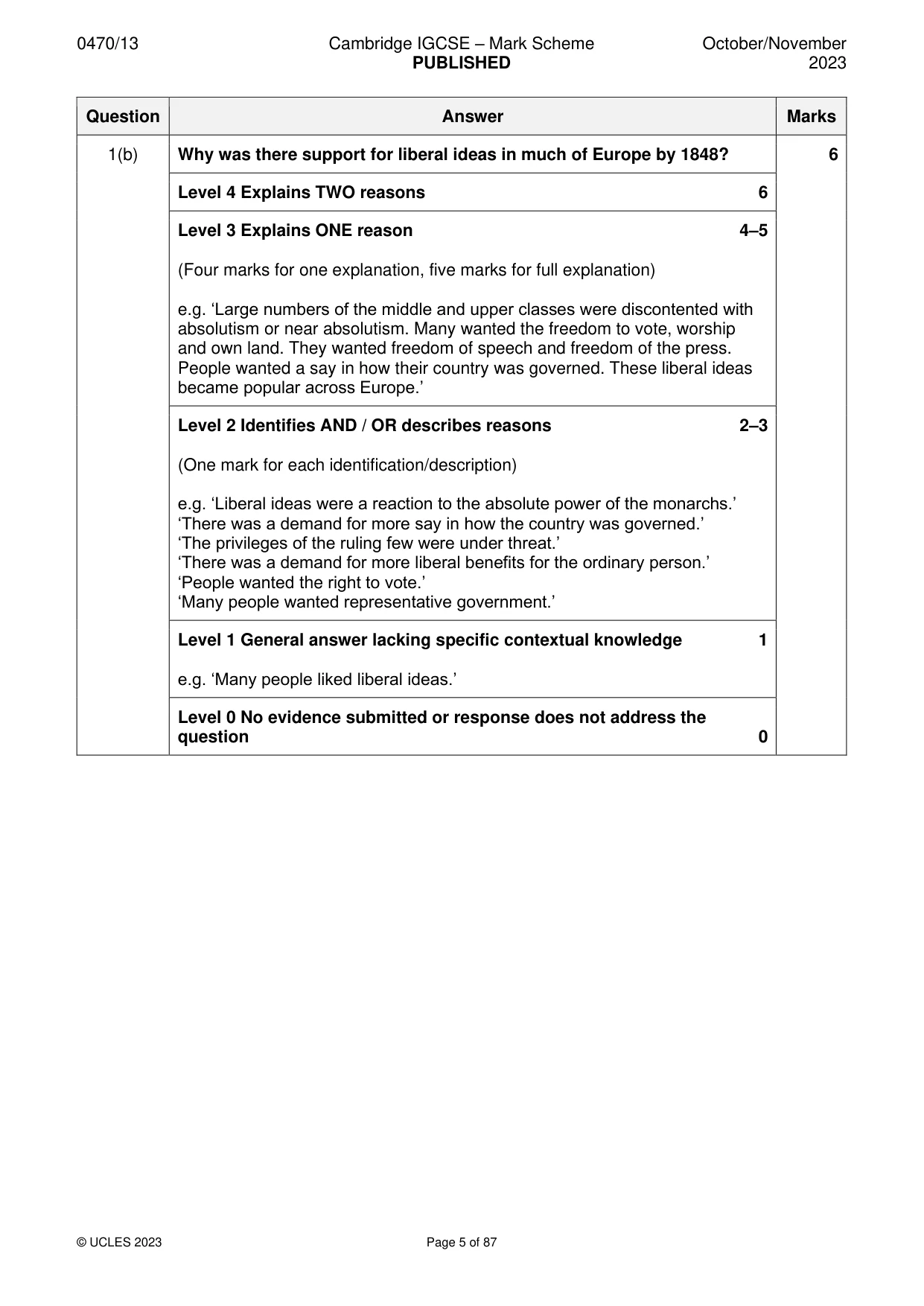
0470/13 Cambridge IGCSE – Mark Scheme PUBLISHED October/November 2023 © UCLES 2023 Page 5 of 87 Question Answer Marks 1(b) Why was there support for liberal ideas in much of Europe by 1848? 6 Level 4 Explains TWO reasons 6 Level 3 Explains ONE reason 4–5 (Four marks for one explanation, five marks for full explanation) e.g. ‘Large numbers of the middle and upper classes were discontented with absolutism or near absolutism. Many wanted the freedom to vote, worship and own land. They wanted freedom of speech and freedom of the press. People wanted a say in how their country was governed. These liberal ideas became popular across Europe.’ Level 2 Identifies AND / OR describes reasons 2–3 (One mark for each identification/description) e.g. ‘Liberal ideas were a reaction to the absolute power of the monarchs.’ ‘There was a demand for more say in how the country was governed.’ ‘The privileges of the ruling few were under threat.’ ‘There was a demand for more liberal benefits for the ordinary person.’ ‘People wanted the right to vote.’ ‘Many people wanted representative government.’ Level 1 General answer lacking specific contextual knowledge 1 e.g. ‘Many people liked liberal ideas.’ Level 0 No evidence submitted or response does not address the question 0
Mark scheme, page 6
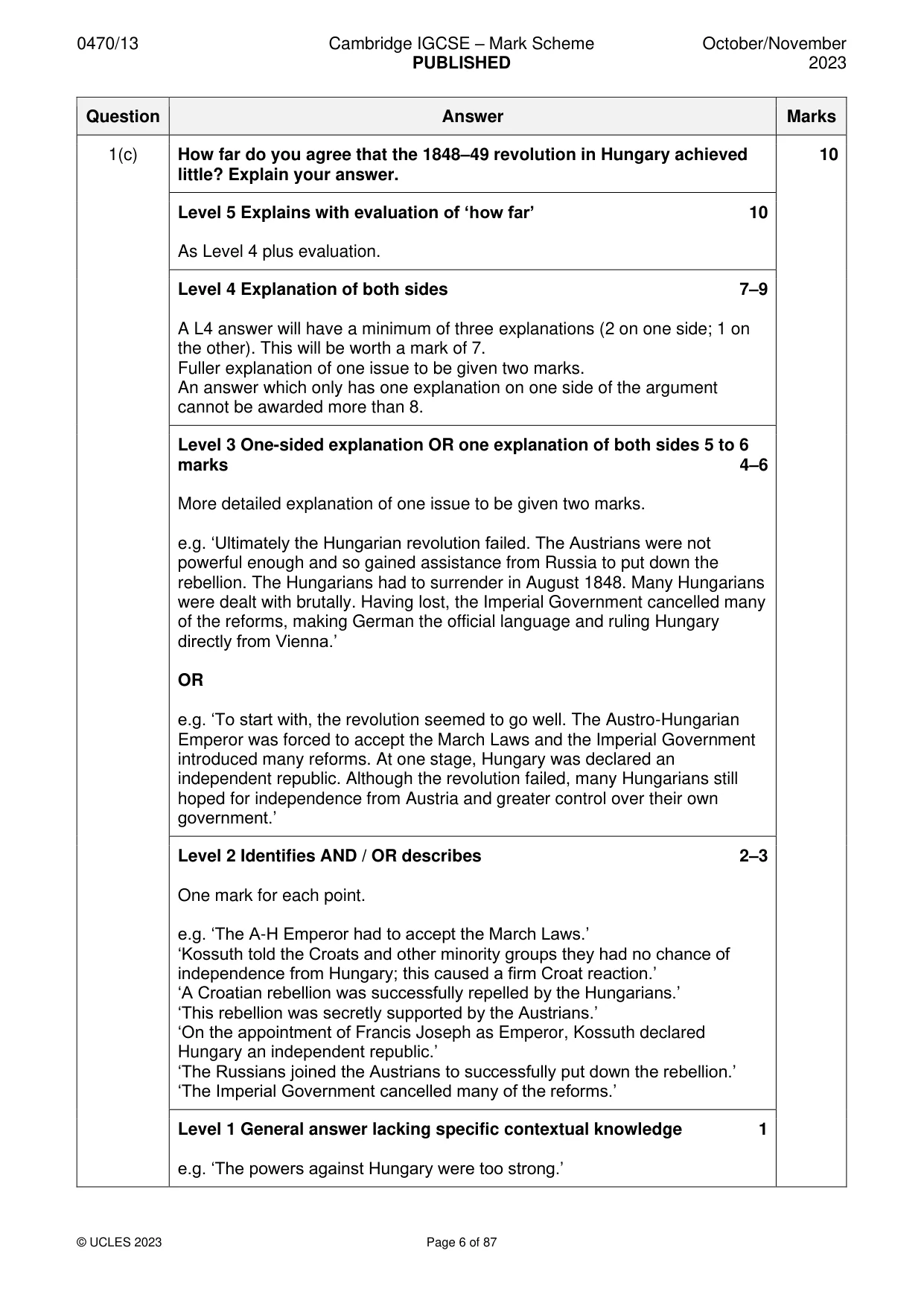
0470/13 Cambridge IGCSE – Mark Scheme PUBLISHED October/November 2023 © UCLES 2023 Page 6 of 87 Question Answer Marks 1(c) How far do you agree that the 1848–49 revolution in Hungary achieved little? Explain your answer. 10 Level 5 Explains with evaluation of ‘how far’ 10 As Level 4 plus evaluation. Level 4 Explanation of both sides 7–9 A L4 answer will have a minimum of three explanations (2 on one side; 1 on the other). This will be worth a mark of 7. Fuller explanation of one issue to be given two marks. An answer which only has one explanation on one side of the argument cannot be awarded more than 8. Level 3 One-sided explanation OR one explanation of both sides 5 to 6 marks 4–6 More detailed explanation of one issue to be given two marks. e.g. ‘Ultimately the Hungarian revolution failed. The Austrians were not powerful enough and so gained assistance from Russia to put down the rebellion. The Hungarians had to surrender in August 1848. Many Hungarians were dealt with brutally. Having lost, the Imperial Government cancelled many of the reforms, making German the official language and ruling Hungary directly from Vienna.’ OR e.g. ‘To start with, the revolution seemed to go well. The Austro-Hungarian Emperor was forced to accept the March Laws and the Imperial Government introduced many reforms. At one stage, Hungary was declared an independent republic. Although the revolution failed, many Hungarians still hoped for independence from Austria and greater control over their own government.’ Level 2 Identifies AND / OR describes 2–3 One mark for each point. e.g. ‘The A-H Emperor had to accept the March Laws.’ ‘Kossuth told the Croats and other minority groups they had no chance of independence from Hungary; this caused a firm Croat reaction.’ ‘A Croatian rebellion was successfully repelled by the Hungarians.’ ‘This rebellion was secretly supported by the Austrians.’ ‘On the appointment of Francis Joseph as Emperor, Kossuth declared Hungary an independent republic.’ ‘The Russians joined the Austrians to successfully put down the rebellion.’ ‘The Imperial Government cancelled many of the reforms.’ Level 1 General answer lacking specific contextual knowledge 1 e.g. ‘The powers against Hungary were too strong.’
Mark scheme, page 7
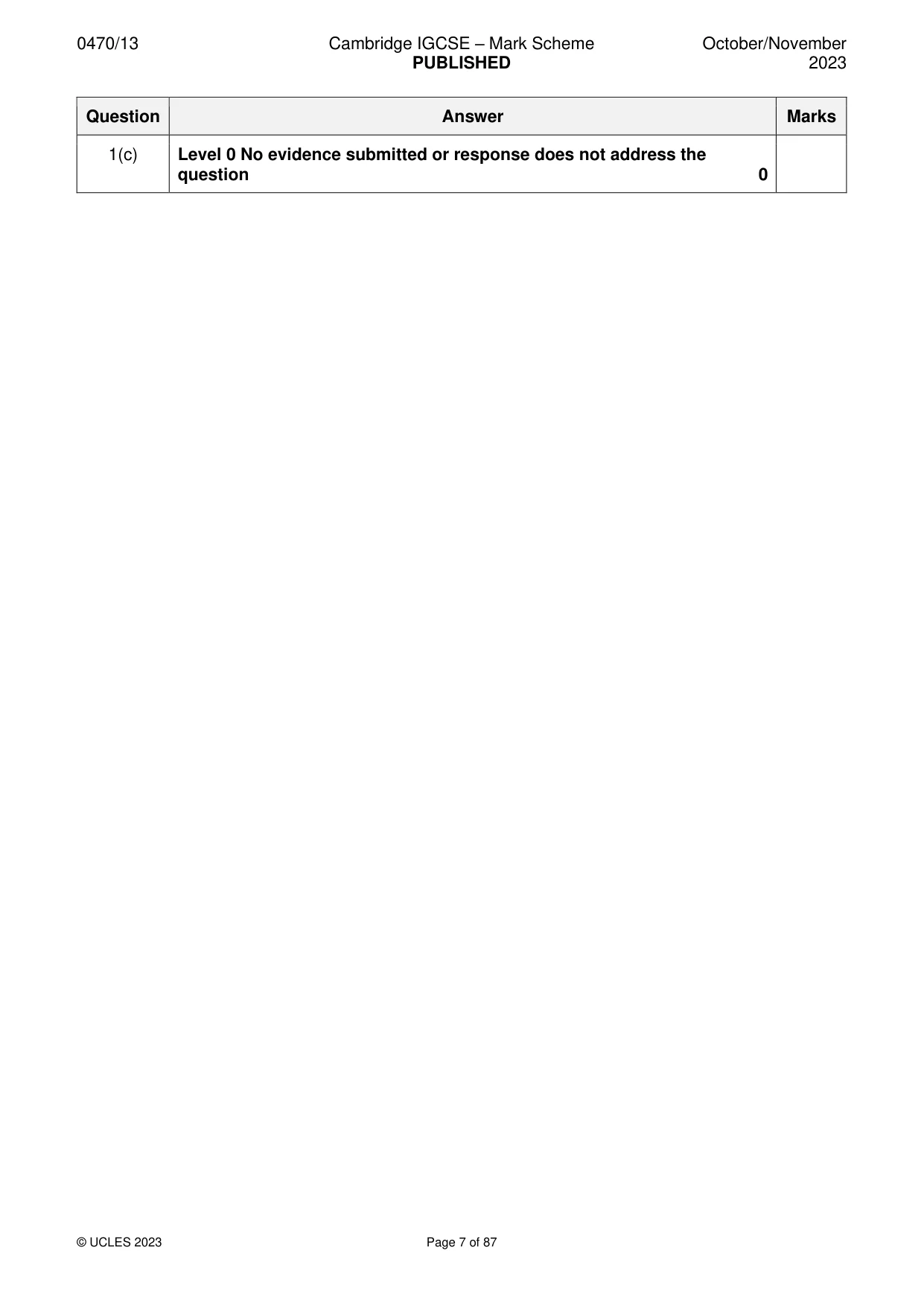
0470/13 Cambridge IGCSE – Mark Scheme PUBLISHED October/November 2023 © UCLES 2023 Page 7 of 87 Question Answer Marks 1(c) Level 0 No evidence submitted or response does not address the question 0
Mark scheme, page 8
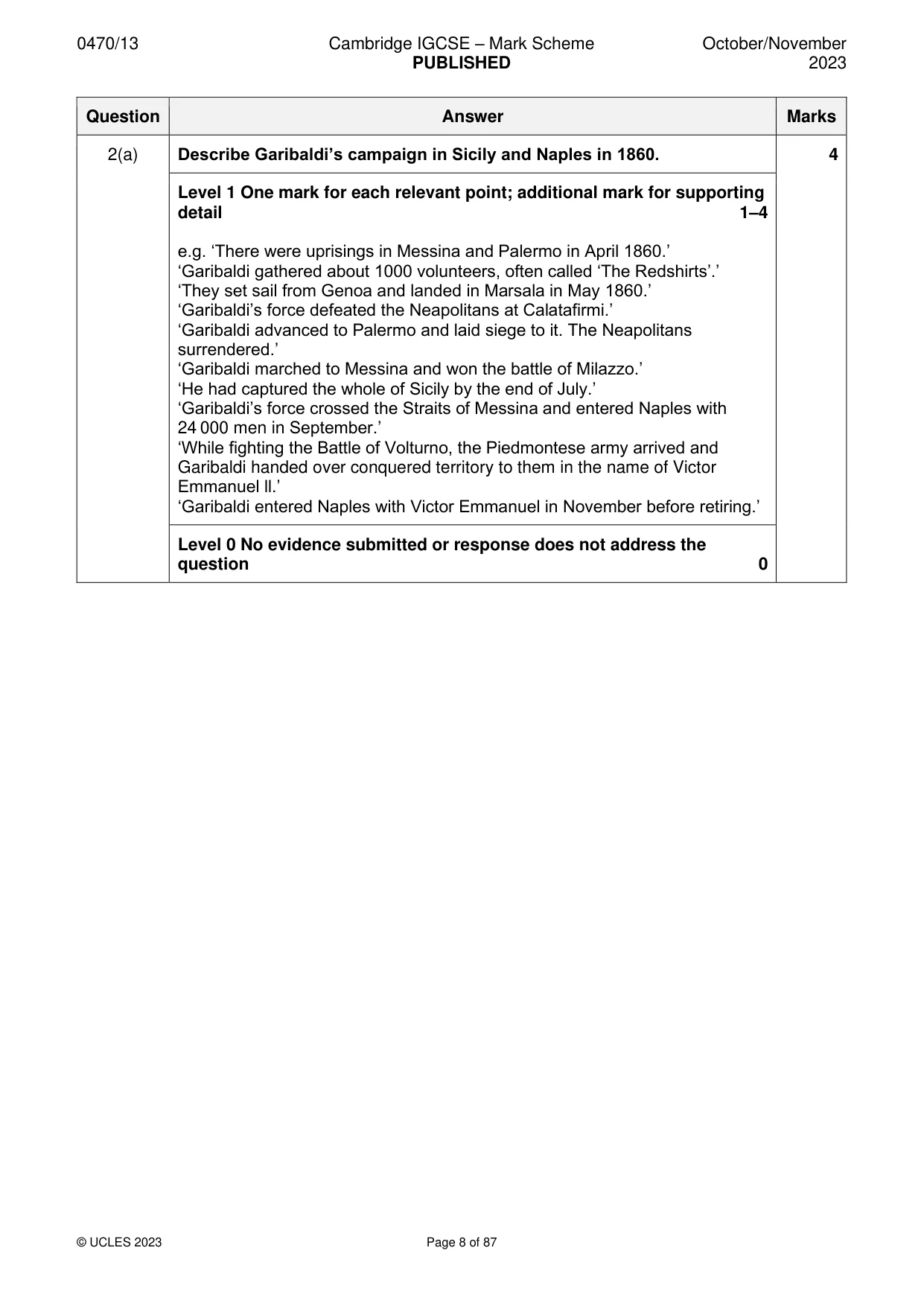
0470/13 Cambridge IGCSE – Mark Scheme PUBLISHED October/November 2023 © UCLES 2023 Page 8 of 87 Question Answer Marks 2(a) Describe Garibaldi’s campaign in Sicily and Naples in 1860. 4 Level 1 One mark for each relevant point; additional mark for supporting detail 1–4 e.g. ‘There were uprisings in Messina and Palermo in April 1860.’ ‘Garibaldi gathered about 1000 volunteers, often called ‘The Redshirts’.’ ‘They set sail from Genoa and landed in Marsala in May 1860.’ ‘Garibaldi’s force defeated the Neapolitans at Calatafirmi.’ ‘Garibaldi advanced to Palermo and laid siege to it. The Neapolitans surrendered.’ ‘Garibaldi marched to Messina and won the battle of Milazzo.’ ‘He had captured the whole of Sicily by the end of July.’ ‘Garibaldi’s force crossed the Straits of Messina and entered Naples with 24 000 men in September.’ ‘While fighting the Battle of Volturno, the Piedmontese army arrived and Garibaldi handed over conquered territory to them in the name of Victor Emmanuel ll.’ ‘Garibaldi entered Naples with Victor Emmanuel in November before retiring.’ Level 0 No evidence submitted or response does not address the question 0
Mark scheme, page 9
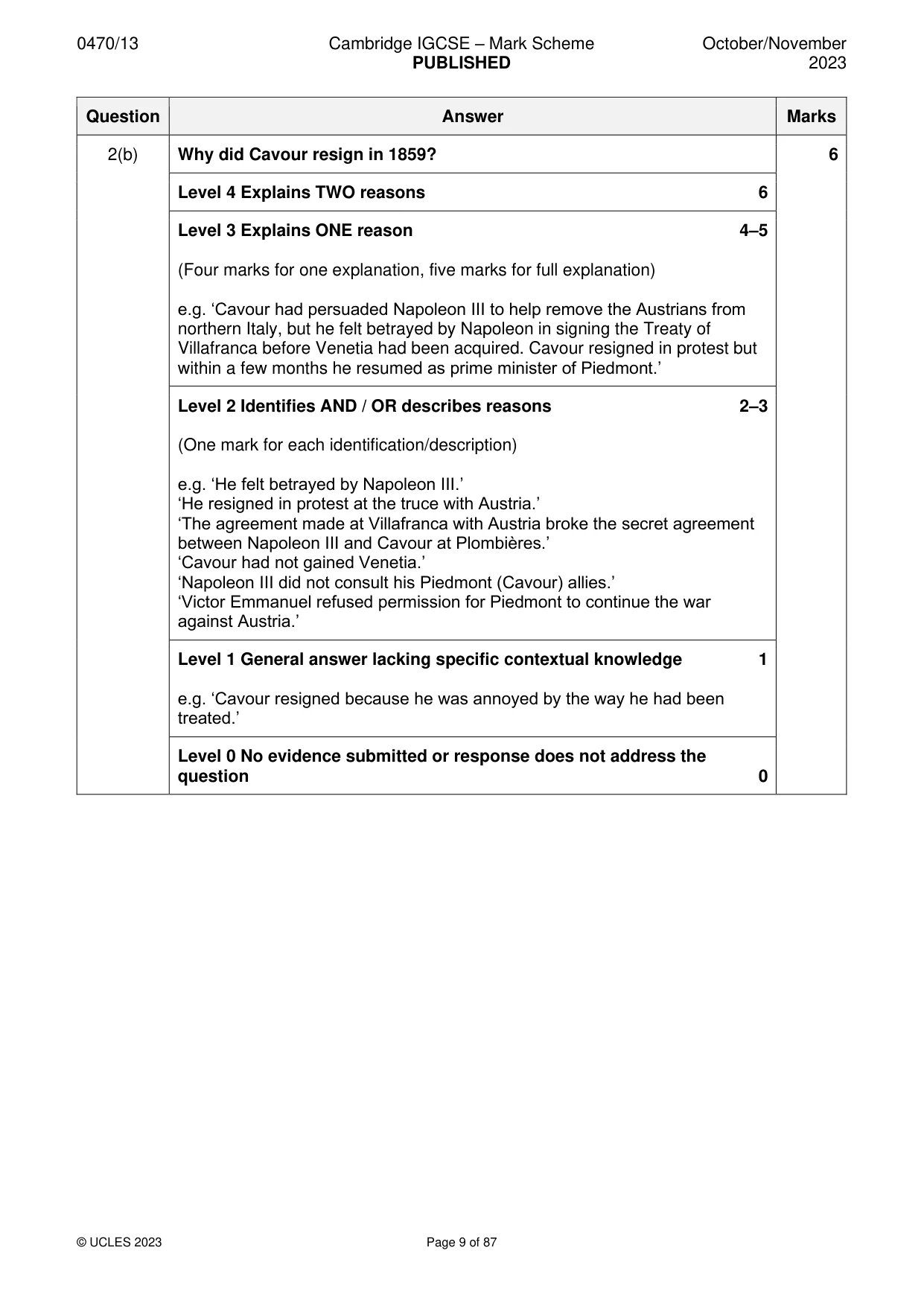
0470/13 Cambridge IGCSE – Mark Scheme PUBLISHED October/November 2023 © UCLES 2023 Page 9 of 87 Question Answer Marks 2(b) Why did Cavour resign in 1859? 6 Level 4 Explains TWO reasons 6 Level 3 Explains ONE reason 4–5 (Four marks for one explanation, five marks for full explanation) e.g. ‘Cavour had persuaded Napoleon III to help remove the Austrians from northern Italy, but he felt betrayed by Napoleon in signing the Treaty of Villafranca before Venetia had been acquired. Cavour resigned in protest but within a few months he resumed as prime minister of Piedmont.’ Level 2 Identifies AND / OR describes reasons 2–3 (One mark for each identification/description) e.g. ‘He felt betrayed by Napoleon III.’ ‘He resigned in protest at the truce with Austria.’ ‘The agreement made at Villafranca with Austria broke the secret agreement between Napoleon III and Cavour at Plombières.’ ‘Cavour had not gained Venetia.’ ‘Napoleon III did not consult his Piedmont (Cavour) allies.’ ‘Victor Emmanuel refused permission for Piedmont to continue the war against Austria.’ Level 1 General answer lacking specific contextual knowledge 1 e.g. ‘Cavour resigned because he was annoyed by the way he had been treated.’ Level 0 No evidence submitted or response does not address the question 0
Mark scheme, page 10
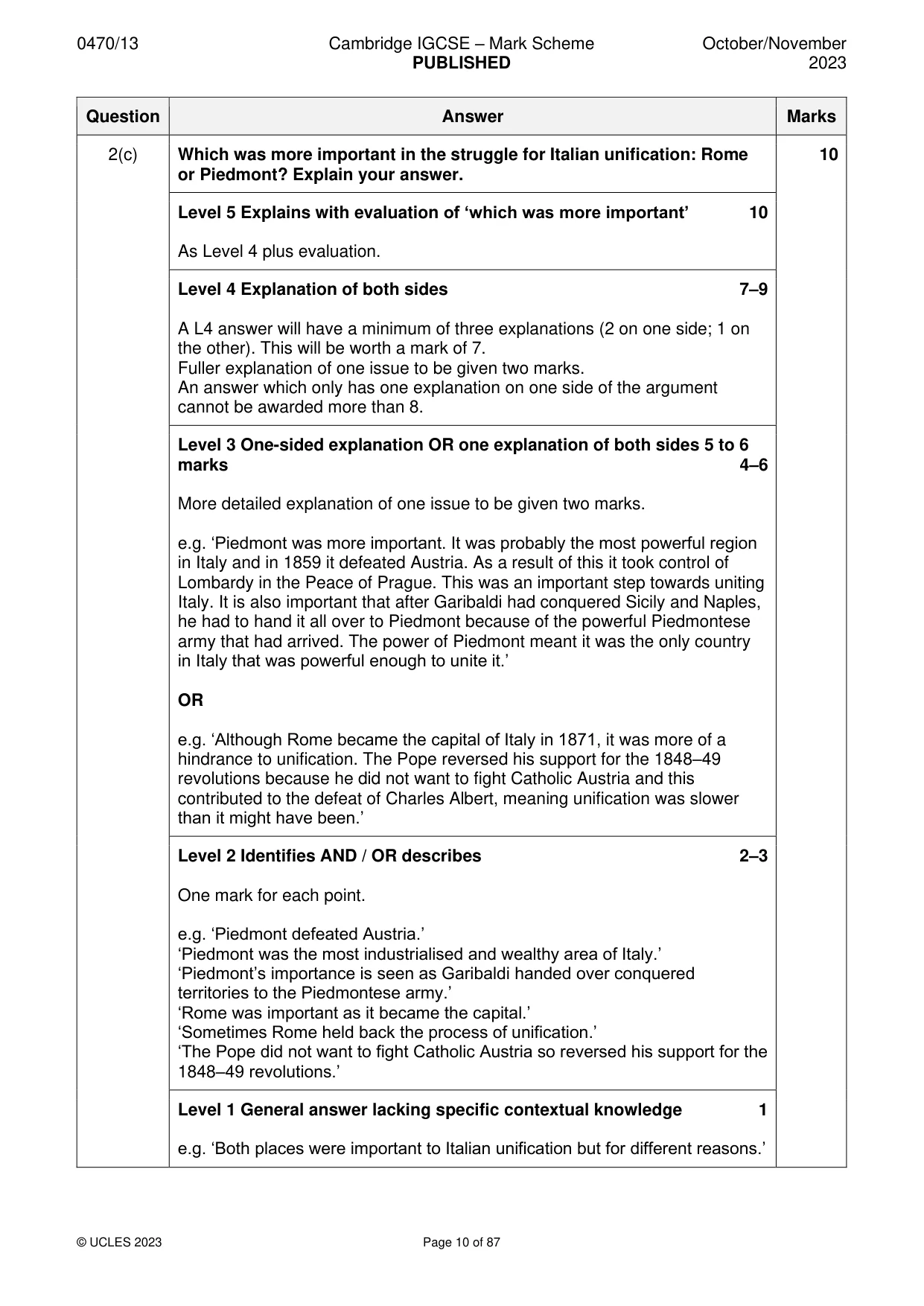
0470/13 Cambridge IGCSE – Mark Scheme PUBLISHED October/November 2023 © UCLES 2023 Page 10 of 87 Question Answer Marks 2(c) Which was more important in the struggle for Italian unification: Rome or Piedmont? Explain your answer. 10 Level 5 Explains with evaluation of ‘which was more important’ 10 As Level 4 plus evaluation. Level 4 Explanation of both sides 7–9 A L4 answer will have a minimum of three explanations (2 on one side; 1 on the other). This will be worth a mark of 7. Fuller explanation of one issue to be given two marks. An answer which only has one explanation on one side of the argument cannot be awarded more than 8. Level 3 One-sided explanation OR one explanation of both sides 5 to 6 marks 4–6 More detailed explanation of one issue to be given two marks. e.g. ‘Piedmont was more important. It was probably the most powerful region in Italy and in 1859 it defeated Austria. As a result of this it took control of Lombardy in the Peace of Prague. This was an important step towards uniting Italy. It is also important that after Garibaldi had conquered Sicily and Naples, he had to hand it all over to Piedmont because of the powerful Piedmontese army that had arrived. The power of Piedmont meant it was the only country in Italy that was powerful enough to unite it.’ OR e.g. ‘Although Rome became the capital of Italy in 1871, it was more of a hindrance to unification. The Pope reversed his support for the 1848–49 revolutions because he did not want to fight Catholic Austria and this contributed to the defeat of Charles Albert, meaning unification was slower than it might have been.’ Level 2 Identifies AND / OR describes 2–3 One mark for each point. e.g. ‘Piedmont defeated Austria.’ ‘Piedmont was the most industrialised and wealthy area of Italy.’ ‘Piedmont’s importance is seen as Garibaldi handed over conquered territories to the Piedmontese army.’ ‘Rome was important as it became the capital.’ ‘Sometimes Rome held back the process of unification.’ ‘The Pope did not want to fight Catholic Austria so reversed his support for the 1848–49 revolutions.’ Level 1 General answer lacking specific contextual knowledge 1 e.g. ‘Both places were important to Italian unification but for different reasons.’
Mark scheme, page 11
0470/13 Cambridge IGCSE – Mark Scheme PUBLISHED October/November 2023 © UCLES 2023 Page 11 of 87 Question Answer Marks 2(c) Level 0 No evidence submitted or response does not address the question 0
Mark scheme, page 12
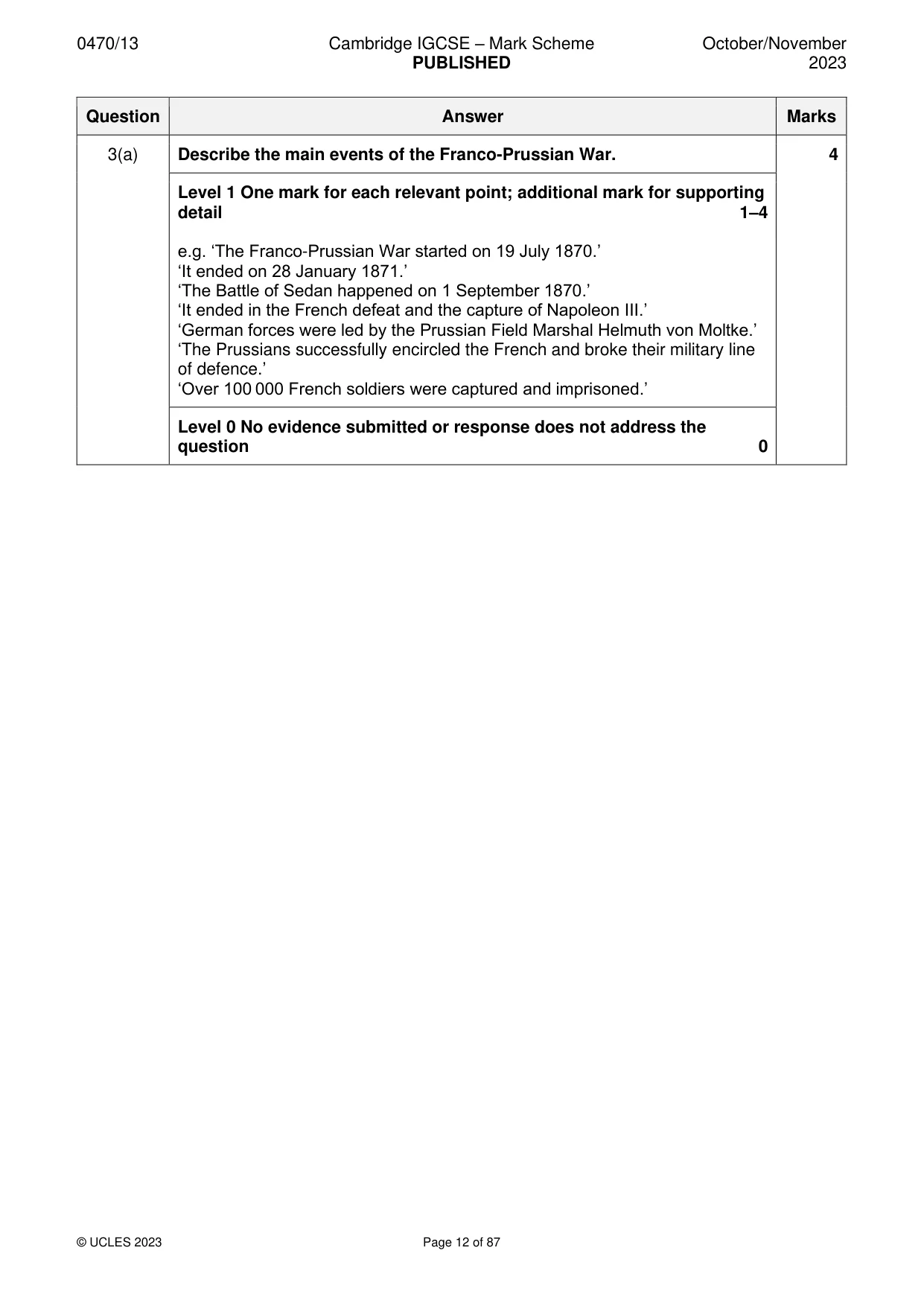
0470/13 Cambridge IGCSE – Mark Scheme PUBLISHED October/November 2023 © UCLES 2023 Page 12 of 87 Question Answer Marks 3(a) Describe the main events of the Franco-Prussian War. 4 Level 1 One mark for each relevant point; additional mark for supporting detail 1–4 e.g. ‘The Franco-Prussian War started on 19 July 1870.’ ‘It ended on 28 January 1871.’ ‘The Battle of Sedan happened on 1 September 1870.’ ‘It ended in the French defeat and the capture of Napoleon III.’ ‘German forces were led by the Prussian Field Marshal Helmuth von Moltke.’ ‘The Prussians successfully encircled the French and broke their military line of defence.’ ‘Over 100 000 French soldiers were captured and imprisoned.’ Level 0 No evidence submitted or response does not address the question 0
Mark scheme, page 13
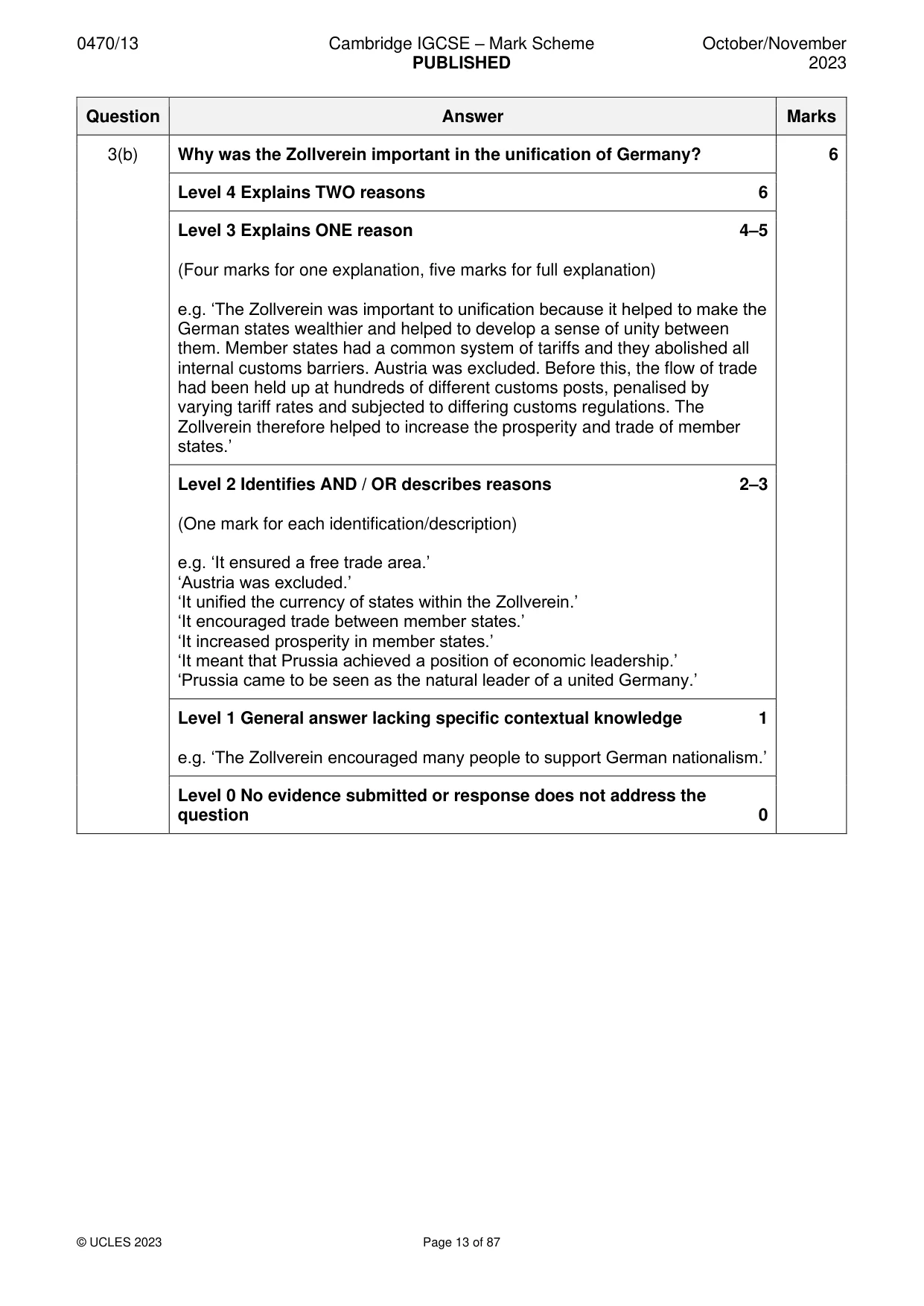
0470/13 Cambridge IGCSE – Mark Scheme PUBLISHED October/November 2023 © UCLES 2023 Page 13 of 87 Question Answer Marks 3(b) Why was the Zollverein important in the unification of Germany? 6 Level 4 Explains TWO reasons 6 Level 3 Explains ONE reason 4–5 (Four marks for one explanation, five marks for full explanation) e.g. ‘The Zollverein was important to unification because it helped to make the German states wealthier and helped to develop a sense of unity between them. Member states had a common system of tariffs and they abolished all internal customs barriers. Austria was excluded. Before this, the flow of trade had been held up at hundreds of different customs posts, penalised by varying tariff rates and subjected to differing customs regulations. The Zollverein therefore helped to increase the prosperity and trade of member states.’ Level 2 Identifies AND / OR describes reasons 2–3 (One mark for each identification/description) e.g. ‘It ensured a free trade area.’ ‘Austria was excluded.’ ‘It unified the currency of states within the Zollverein.’ ‘It encouraged trade between member states.’ ‘It increased prosperity in member states.’ ‘It meant that Prussia achieved a position of economic leadership.’ ‘Prussia came to be seen as the natural leader of a united Germany.’ Level 1 General answer lacking specific contextual knowledge 1 e.g. ‘The Zollverein encouraged many people to support German nationalism.’ Level 0 No evidence submitted or response does not address the question 0
Mark scheme, page 14
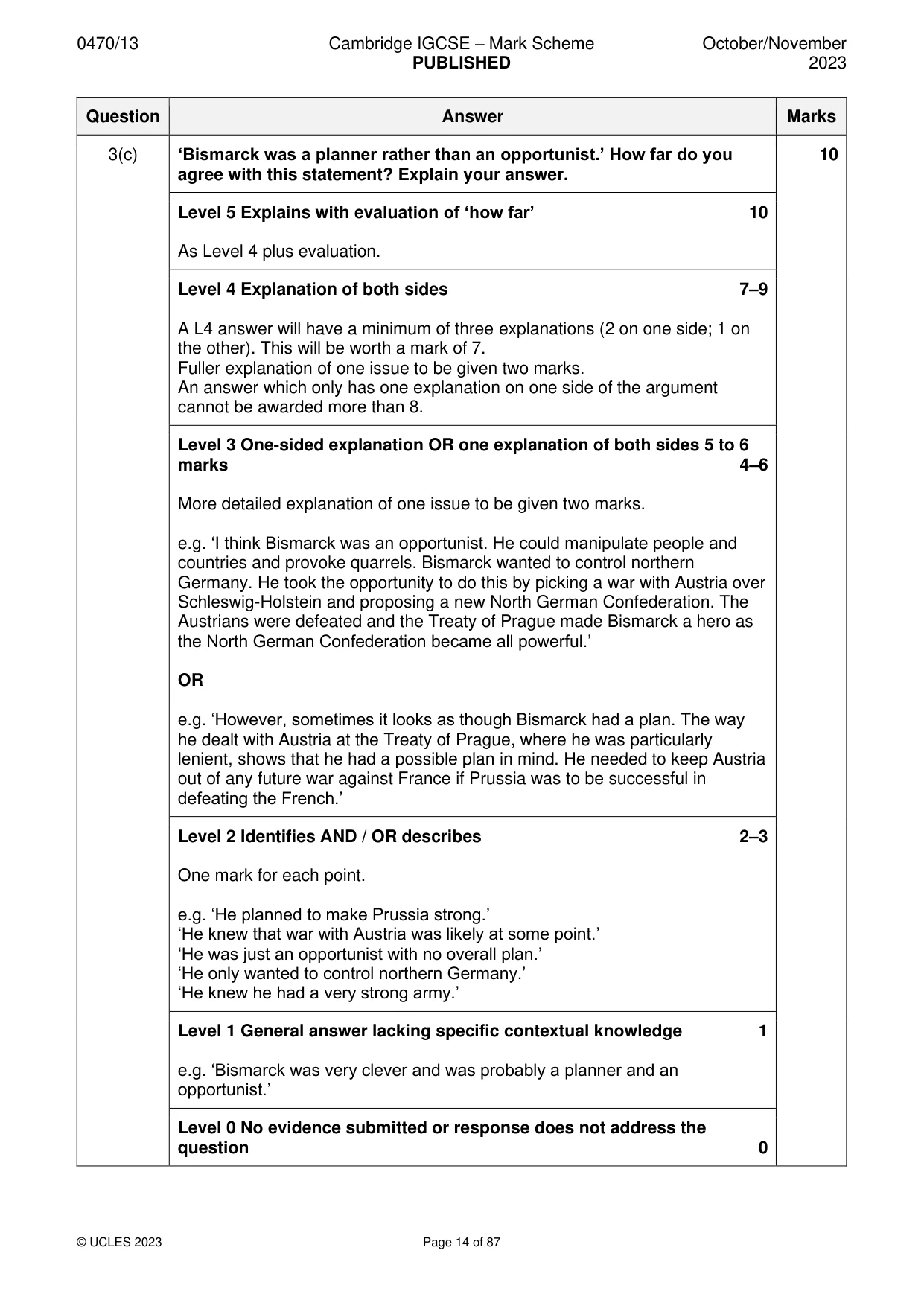
0470/13 Cambridge IGCSE – Mark Scheme PUBLISHED October/November 2023 © UCLES 2023 Page 14 of 87 Question Answer Marks 3(c) ‘Bismarck was a planner rather than an opportunist.’ How far do you agree with this statement? Explain your answer. 10 Level 5 Explains with evaluation of ‘how far’ 10 As Level 4 plus evaluation. Level 4 Explanation of both sides 7–9 A L4 answer will have a minimum of three explanations (2 on one side; 1 on the other). This will be worth a mark of 7. Fuller explanation of one issue to be given two marks. An answer which only has one explanation on one side of the argument cannot be awarded more than 8. Level 3 One-sided explanation OR one explanation of both sides 5 to 6 marks 4–6 More detailed explanation of one issue to be given two marks. e.g. ‘I think Bismarck was an opportunist. He could manipulate people and countries and provoke quarrels. Bismarck wanted to control northern Germany. He took the opportunity to do this by picking a war with Austria over Schleswig-Holstein and proposing a new North German Confederation. The Austrians were defeated and the Treaty of Prague made Bismarck a hero as the North German Confederation became all powerful.’ OR e.g. ‘However, sometimes it looks as though Bismarck had a plan. The way he dealt with Austria at the Treaty of Prague, where he was particularly lenient, shows that he had a possible plan in mind. He needed to keep Austria out of any future war against France if Prussia was to be successful in defeating the French.’ Level 2 Identifies AND / OR describes 2–3 One mark for each point. e.g. ‘He planned to make Prussia strong.’ ‘He knew that war with Austria was likely at some point.’ ‘He was just an opportunist with no overall plan.’ ‘He only wanted to control northern Germany.’ ‘He knew he had a very strong army.’ Level 1 General answer lacking specific contextual knowledge 1 e.g. ‘Bismarck was very clever and was probably a planner and an opportunist.’ Level 0 No evidence submitted or response does not address the question 0
Mark scheme, page 15
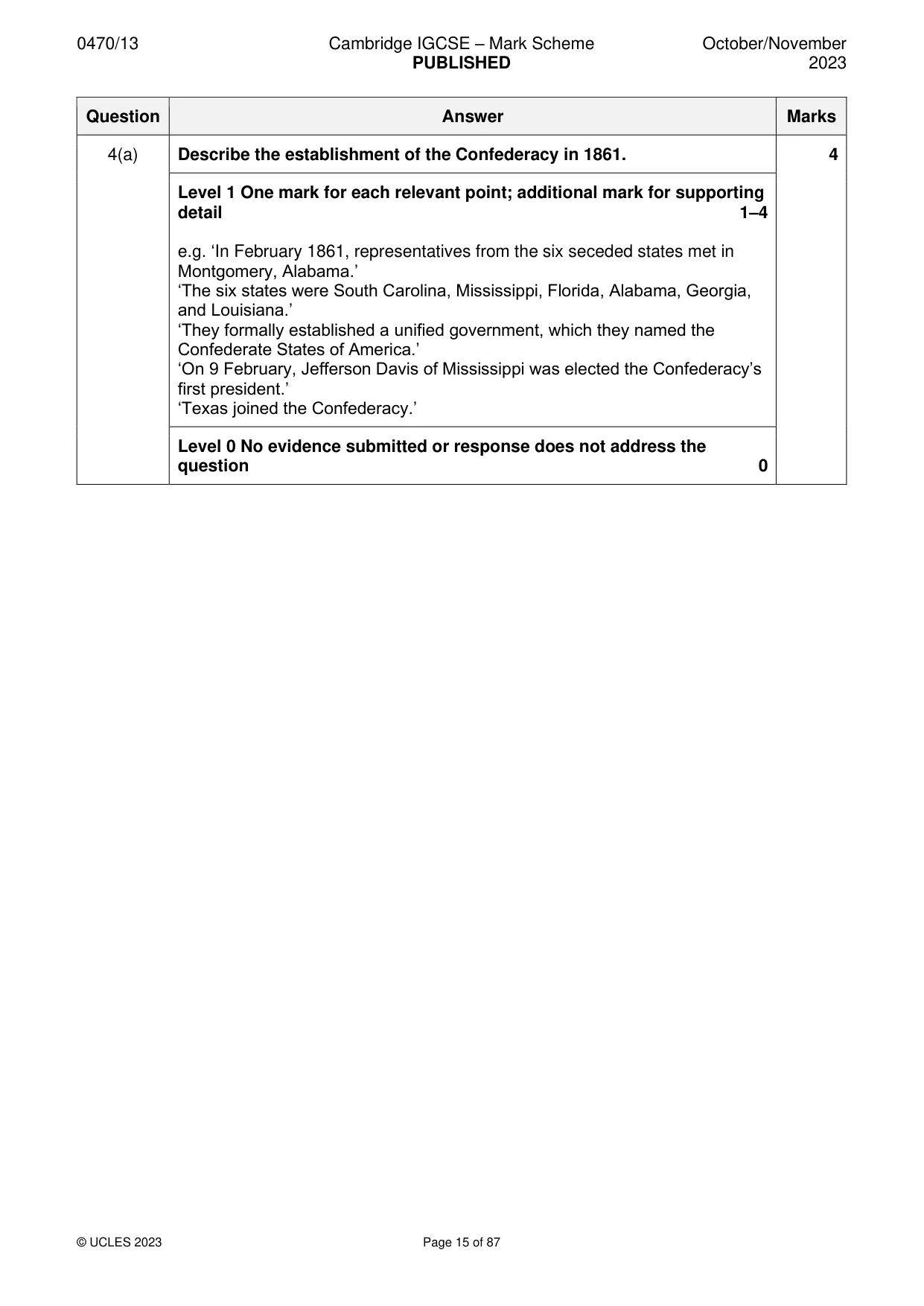
0470/13 Cambridge IGCSE – Mark Scheme PUBLISHED October/November 2023 © UCLES 2023 Page 15 of 87 Question Answer Marks 4(a) Describe the establishment of the Confederacy in 1861. 4 Level 1 One mark for each relevant point; additional mark for supporting detail 1–4 e.g. ‘In February 1861, representatives from the six seceded states met in Montgomery, Alabama.’ ‘The six states were South Carolina, Mississippi, Florida, Alabama, Georgia, and Louisiana.’ ‘They formally established a unified government, which they named the Confederate States of America.’ ‘On 9 February, Jefferson Davis of Mississippi was elected the Confederacy’s first president.’ ‘Texas joined the Confederacy.’ Level 0 No evidence submitted or response does not address the question 0
Mark scheme, page 16
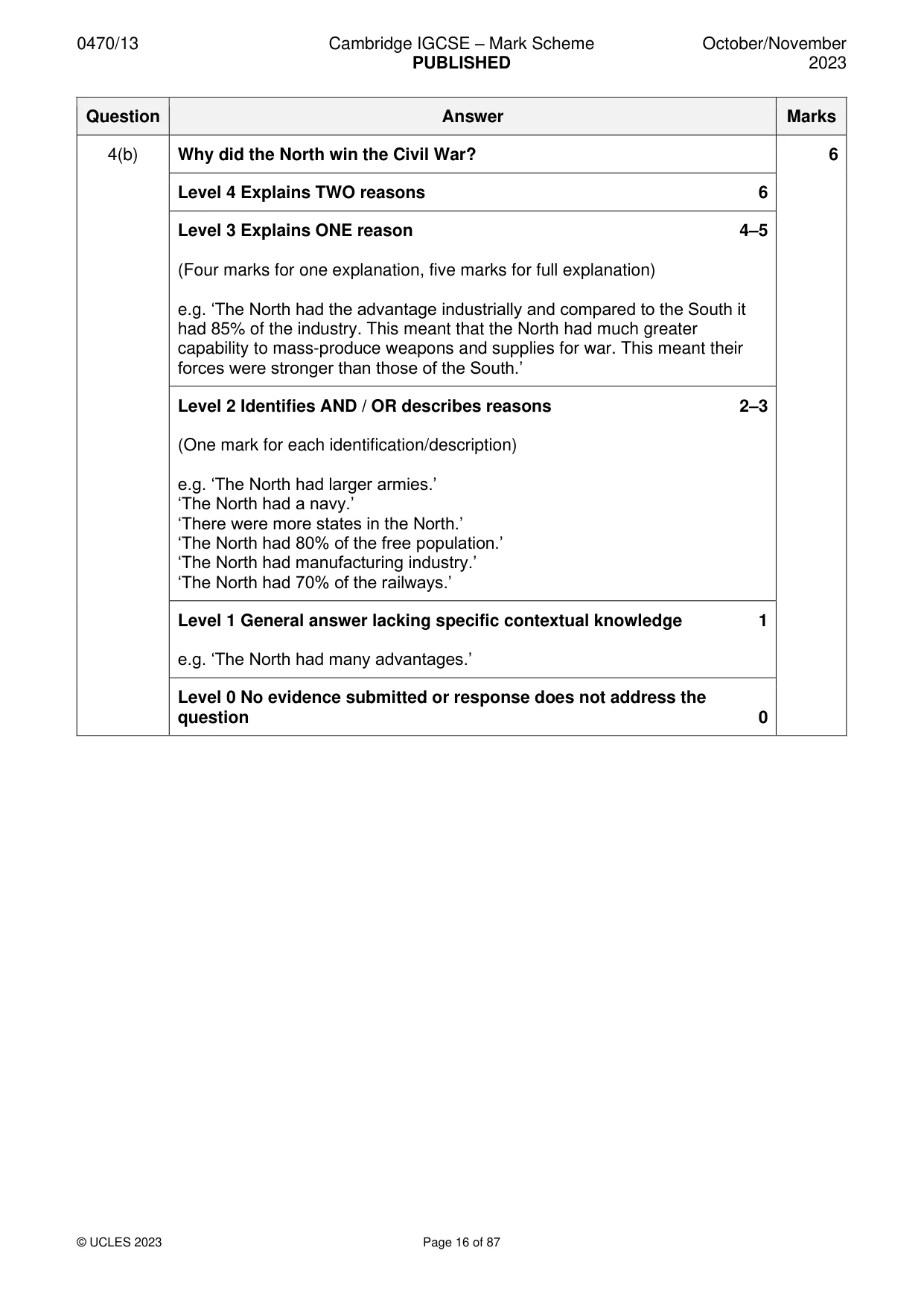
0470/13 Cambridge IGCSE – Mark Scheme PUBLISHED October/November 2023 © UCLES 2023 Page 16 of 87 Question Answer Marks 4(b) Why did the North win the Civil War? 6 Level 4 Explains TWO reasons 6 Level 3 Explains ONE reason 4–5 (Four marks for one explanation, five marks for full explanation) e.g. ‘The North had the advantage industrially and compared to the South it had 85% of the industry. This meant that the North had much greater capability to mass-produce weapons and supplies for war. This meant their forces were stronger than those of the South.’ Level 2 Identifies AND / OR describes reasons 2–3 (One mark for each identification/description) e.g. ‘The North had larger armies.’ ‘The North had a navy.’ ‘There were more states in the North.’ ‘The North had 80% of the free population.’ ‘The North had manufacturing industry.’ ‘The North had 70% of the railways.’ Level 1 General answer lacking specific contextual knowledge 1 e.g. ‘The North had many advantages.’ Level 0 No evidence submitted or response does not address the question 0
Mark scheme, page 17
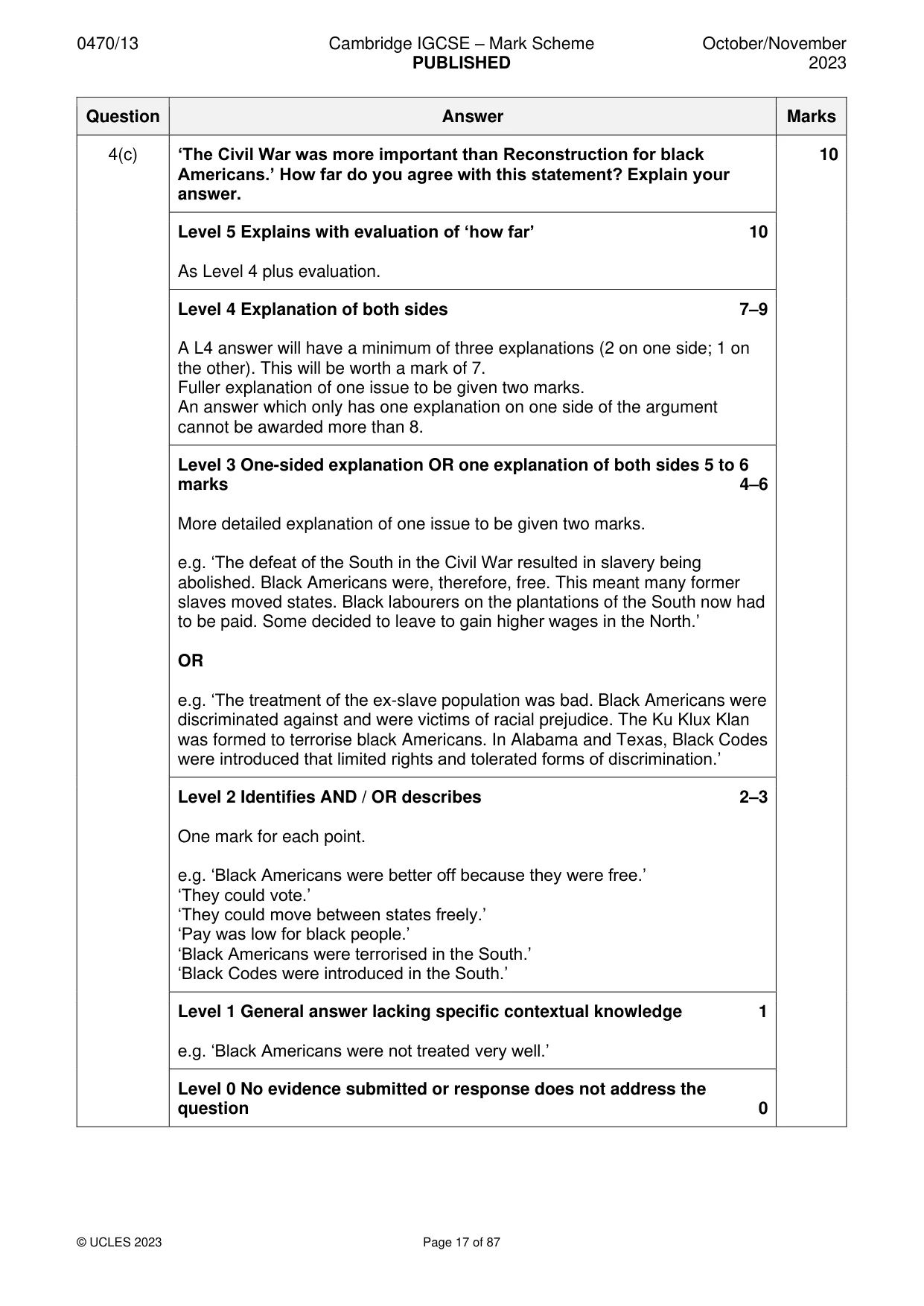
0470/13 Cambridge IGCSE – Mark Scheme PUBLISHED October/November 2023 © UCLES 2023 Page 17 of 87 Question Answer Marks 4(c) ‘The Civil War was more important than Reconstruction for black Americans.’ How far do you agree with this statement? Explain your answer. 10 Level 5 Explains with evaluation of ‘how far’ 10 As Level 4 plus evaluation. Level 4 Explanation of both sides 7–9 A L4 answer will have a minimum of three explanations (2 on one side; 1 on the other). This will be worth a mark of 7. Fuller explanation of one issue to be given two marks. An answer which only has one explanation on one side of the argument cannot be awarded more than 8. Level 3 One-sided explanation OR one explanation of both sides 5 to 6 marks 4–6 More detailed explanation of one issue to be given two marks. e.g. ‘The defeat of the South in the Civil War resulted in slavery being abolished. Black Americans were, therefore, free. This meant many former slaves moved states. Black labourers on the plantations of the South now had to be paid. Some decided to leave to gain higher wages in the North.’ OR e.g. ‘The treatment of the ex-slave population was bad. Black Americans were discriminated against and were victims of racial prejudice. The Ku Klux Klan was formed to terrorise black Americans. In Alabama and Texas, Black Codes were introduced that limited rights and tolerated forms of discrimination.’ Level 2 Identifies AND / OR describes 2–3 One mark for each point. e.g. ‘Black Americans were better off because they were free.’ ‘They could vote.’ ‘They could move between states freely.’ ‘Pay was low for black people.’ ‘Black Americans were terrorised in the South.’ ‘Black Codes were introduced in the South.’ Level 1 General answer lacking specific contextual knowledge 1 e.g. ‘Black Americans were not treated very well.’ Level 0 No evidence submitted or response does not address the question 0
Mark scheme, page 18
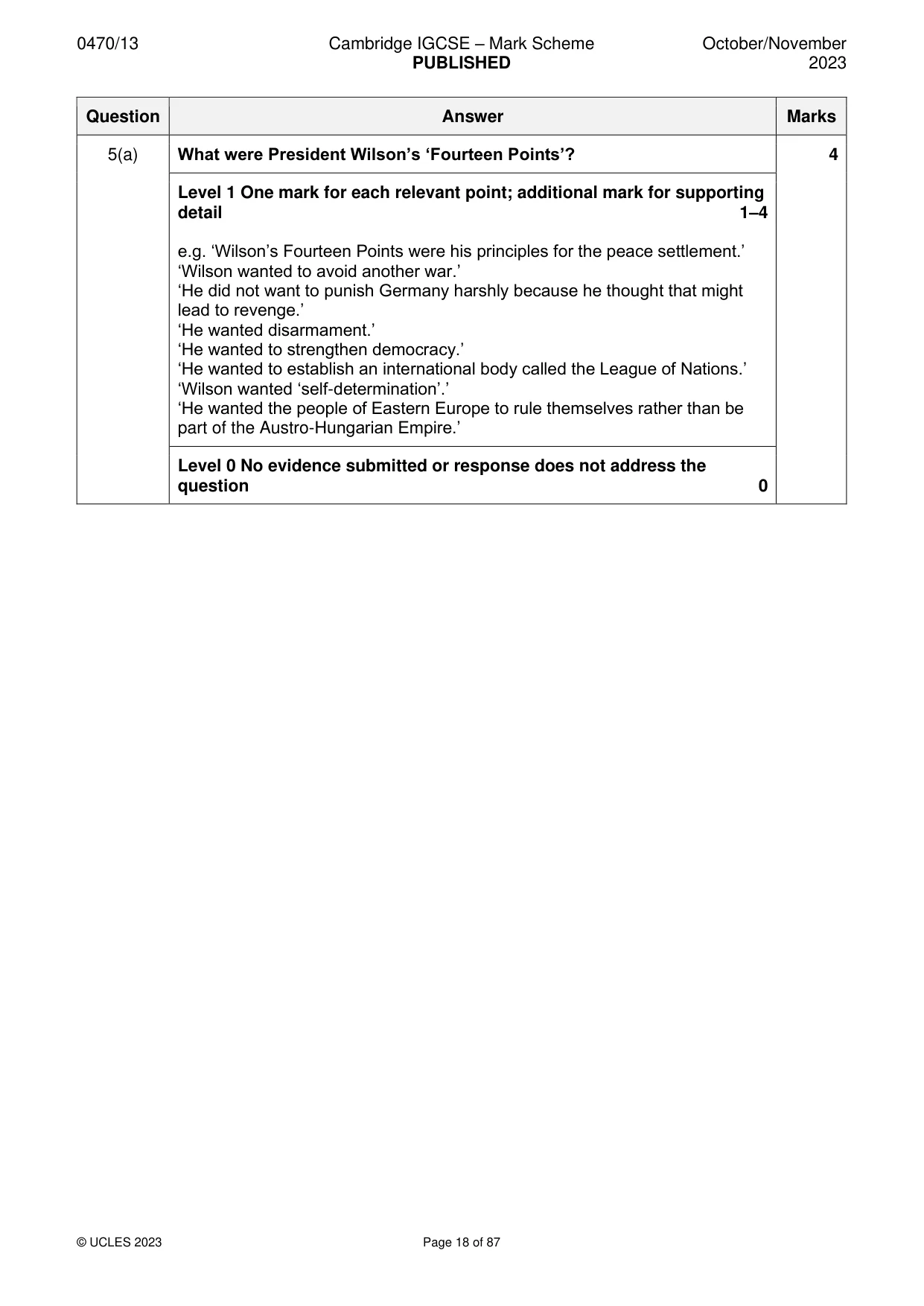
0470/13 Cambridge IGCSE – Mark Scheme PUBLISHED October/November 2023 © UCLES 2023 Page 18 of 87 Question Answer Marks 5(a) What were President Wilson’s ‘Fourteen Points’? 4 Level 1 One mark for each relevant point; additional mark for supporting detail 1–4 e.g. ‘Wilson’s Fourteen Points were his principles for the peace settlement.’ ‘Wilson wanted to avoid another war.’ ‘He did not want to punish Germany harshly because he thought that might lead to revenge.’ ‘He wanted disarmament.’ ‘He wanted to strengthen democracy.’ ‘He wanted to establish an international body called the League of Nations.’ ‘Wilson wanted ‘self-determination’.’ ‘He wanted the people of Eastern Europe to rule themselves rather than be part of the Austro-Hungarian Empire.’ Level 0 No evidence submitted or response does not address the question 0
Mark scheme, page 19
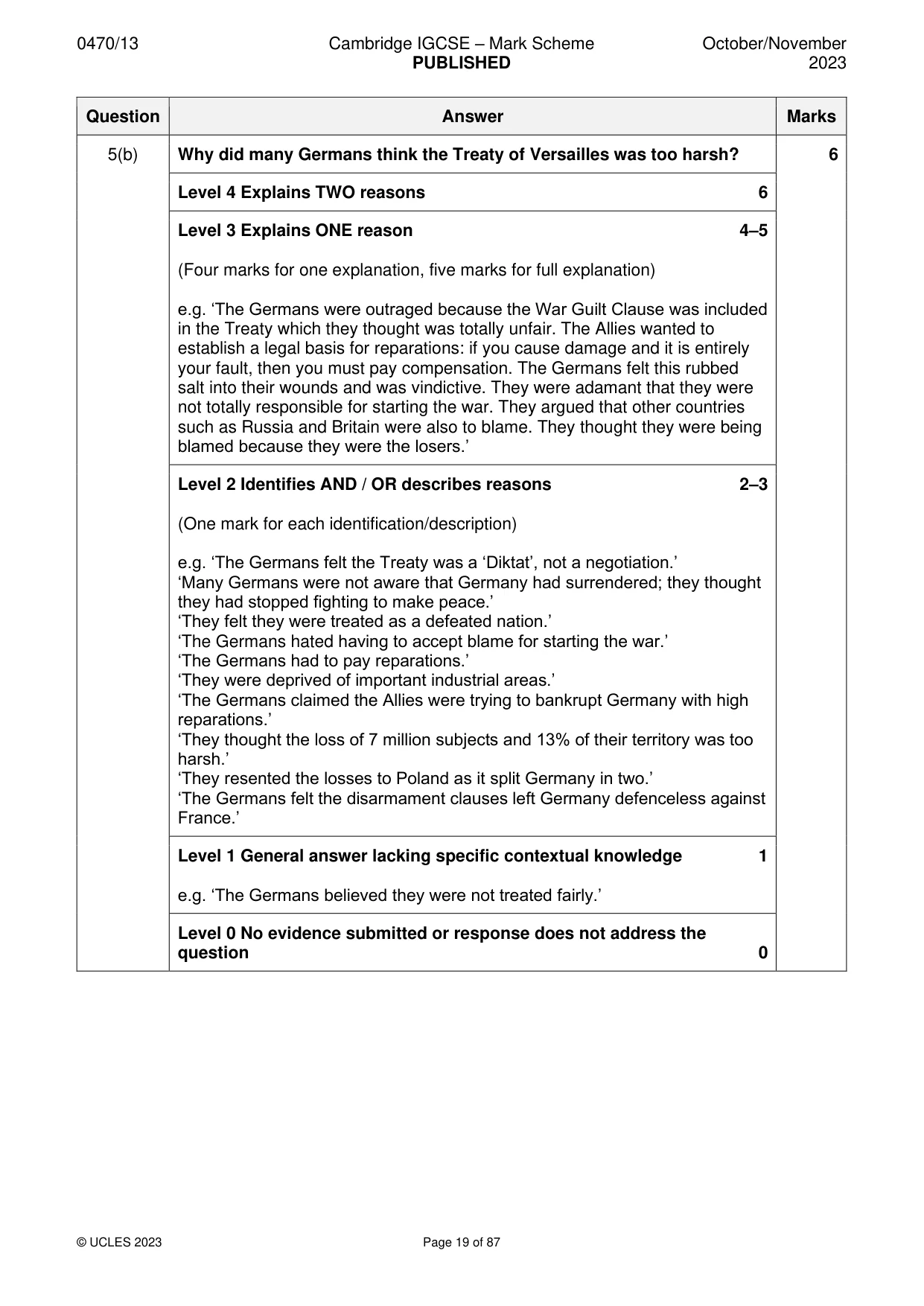
0470/13 Cambridge IGCSE – Mark Scheme PUBLISHED October/November 2023 © UCLES 2023 Page 19 of 87 Question Answer Marks 5(b) Why did many Germans think the Treaty of Versailles was too harsh? 6 Level 4 Explains TWO reasons 6 Level 3 Explains ONE reason 4–5 (Four marks for one explanation, five marks for full explanation) e.g. ‘The Germans were outraged because the War Guilt Clause was included in the Treaty which they thought was totally unfair. The Allies wanted to establish a legal basis for reparations: if you cause damage and it is entirely your fault, then you must pay compensation. The Germans felt this rubbed salt into their wounds and was vindictive. They were adamant that they were not totally responsible for starting the war. They argued that other countries such as Russia and Britain were also to blame. They thought they were being blamed because they were the losers.’ Level 2 Identifies AND / OR describes reasons 2–3 (One mark for each identification/description) e.g. ‘The Germans felt the Treaty was a ‘Diktat’, not a negotiation.’ ‘Many Germans were not aware that Germany had surrendered; they thought they had stopped fighting to make peace.’ ‘They felt they were treated as a defeated nation.’ ‘The Germans hated having to accept blame for starting the war.’ ‘The Germans had to pay reparations.’ ‘They were deprived of important industrial areas.’ ‘The Germans claimed the Allies were trying to bankrupt Germany with high reparations.’ ‘They thought the loss of 7 million subjects and 13% of their territory was too harsh.’ ‘They resented the losses to Poland as it split Germany in two.’ ‘The Germans felt the disarmament clauses left Germany defenceless against France.’ Level 1 General answer lacking specific contextual knowledge 1 e.g. ‘The Germans believed they were not treated fairly.’ Level 0 No evidence submitted or response does not address the question 0
Mark scheme, page 20
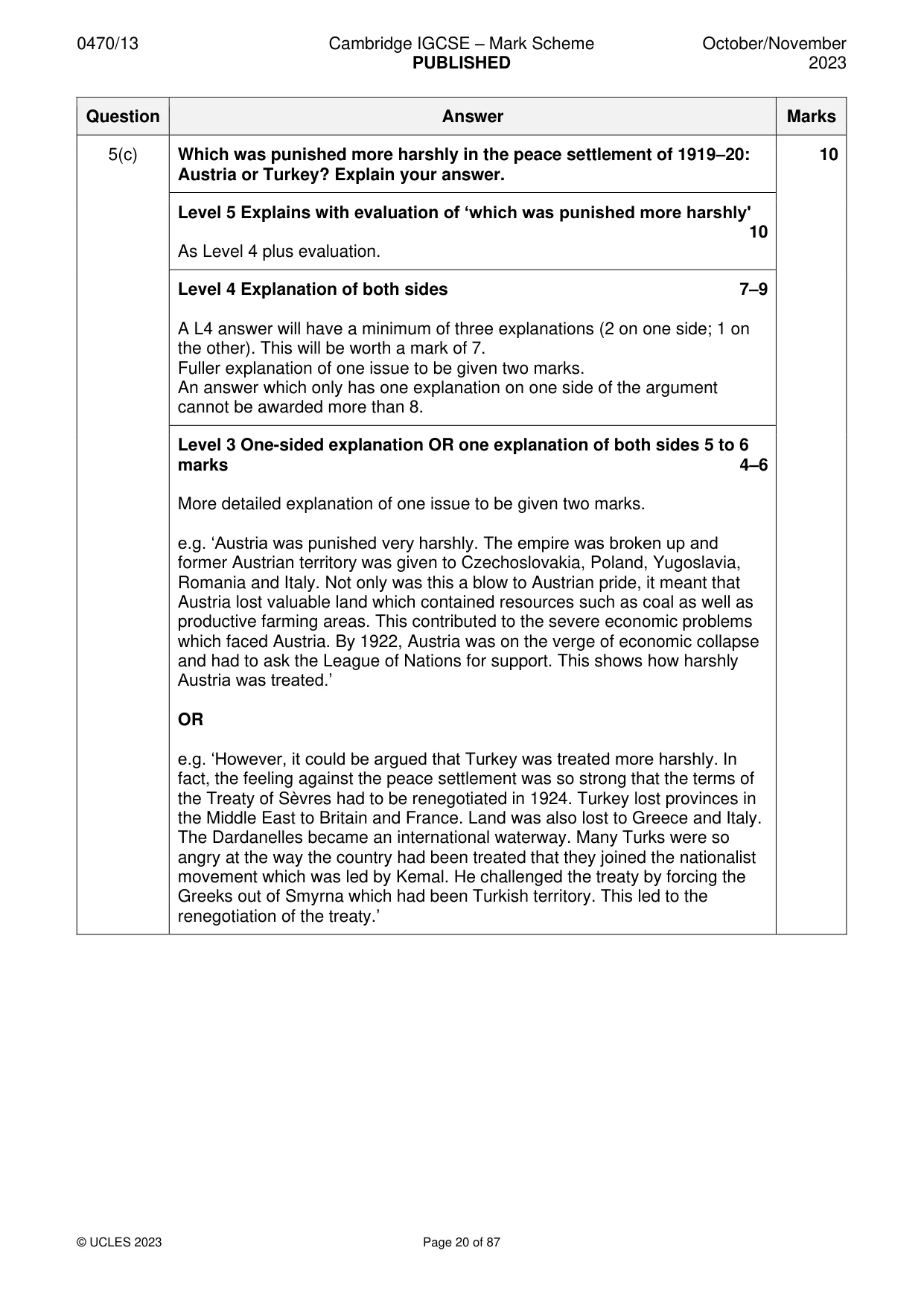
0470/13 Cambridge IGCSE – Mark Scheme PUBLISHED October/November 2023 © UCLES 2023 Page 20 of 87 Question Answer Marks 5(c) Which was punished more harshly in the peace settlement of 1919–20: Austria or Turkey? Explain your answer. 10 Level 5 Explains with evaluation of ‘which was punished more harshly' 10 As Level 4 plus evaluation. Level 4 Explanation of both sides 7–9 A L4 answer will have a minimum of three explanations (2 on one side; 1 on the other). This will be worth a mark of 7. Fuller explanation of one issue to be given two marks. An answer which only has one explanation on one side of the argument cannot be awarded more than 8. Level 3 One-sided explanation OR one explanation of both sides 5 to 6 marks 4–6 More detailed explanation of one issue to be given two marks. e.g. ‘Austria was punished very harshly. The empire was broken up and former Austrian territory was given to Czechoslovakia, Poland, Yugoslavia, Romania and Italy. Not only was this a blow to Austrian pride, it meant that Austria lost valuable land which contained resources such as coal as well as productive farming areas. This contributed to the severe economic problems which faced Austria. By 1922, Austria was on the verge of economic collapse and had to ask the League of Nations for support. This shows how harshly Austria was treated.’ OR e.g. ‘However, it could be argued that Turkey was treated more harshly. In fact, the feeling against the peace settlement was so strong that the terms of the Treaty of Sèvres had to be renegotiated in 1924. Turkey lost provinces in the Middle East to Britain and France. Land was also lost to Greece and Italy. The Dardanelles became an international waterway. Many Turks were so angry at the way the country had been treated that they joined the nationalist movement which was led by Kemal. He challenged the treaty by forcing the Greeks out of Smyrna which had been Turkish territory. This led to the renegotiation of the treaty.’
Mark scheme, page 21
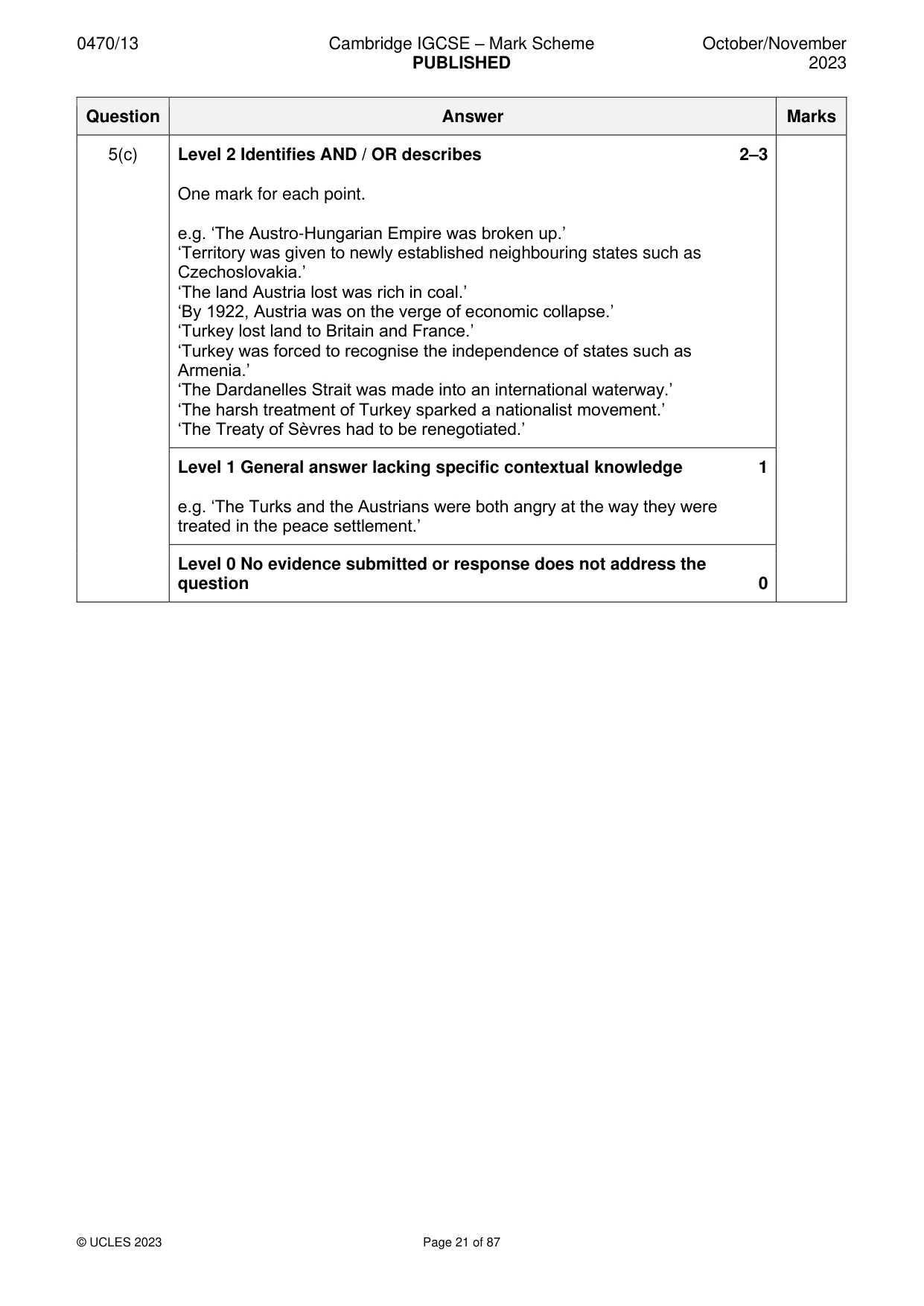
0470/13 Cambridge IGCSE – Mark Scheme PUBLISHED October/November 2023 © UCLES 2023 Page 21 of 87 Question Answer Marks 5(c) Level 2 Identifies AND / OR describes 2–3 One mark for each point. e.g. ‘The Austro-Hungarian Empire was broken up.’ ‘Territory was given to newly established neighbouring states such as Czechoslovakia.’ ‘The land Austria lost was rich in coal.’ ‘By 1922, Austria was on the verge of economic collapse.’ ‘Turkey lost land to Britain and France.’ ‘Turkey was forced to recognise the independence of states such as Armenia.’ ‘The Dardanelles Strait was made into an international waterway.’ ‘The harsh treatment of Turkey sparked a nationalist movement.’ ‘The Treaty of Sèvres had to be renegotiated.’ Level 1 General answer lacking specific contextual knowledge 1 e.g. ‘The Turks and the Austrians were both angry at the way they were treated in the peace settlement.’ Level 0 No evidence submitted or response does not address the question 0
Mark scheme, page 22
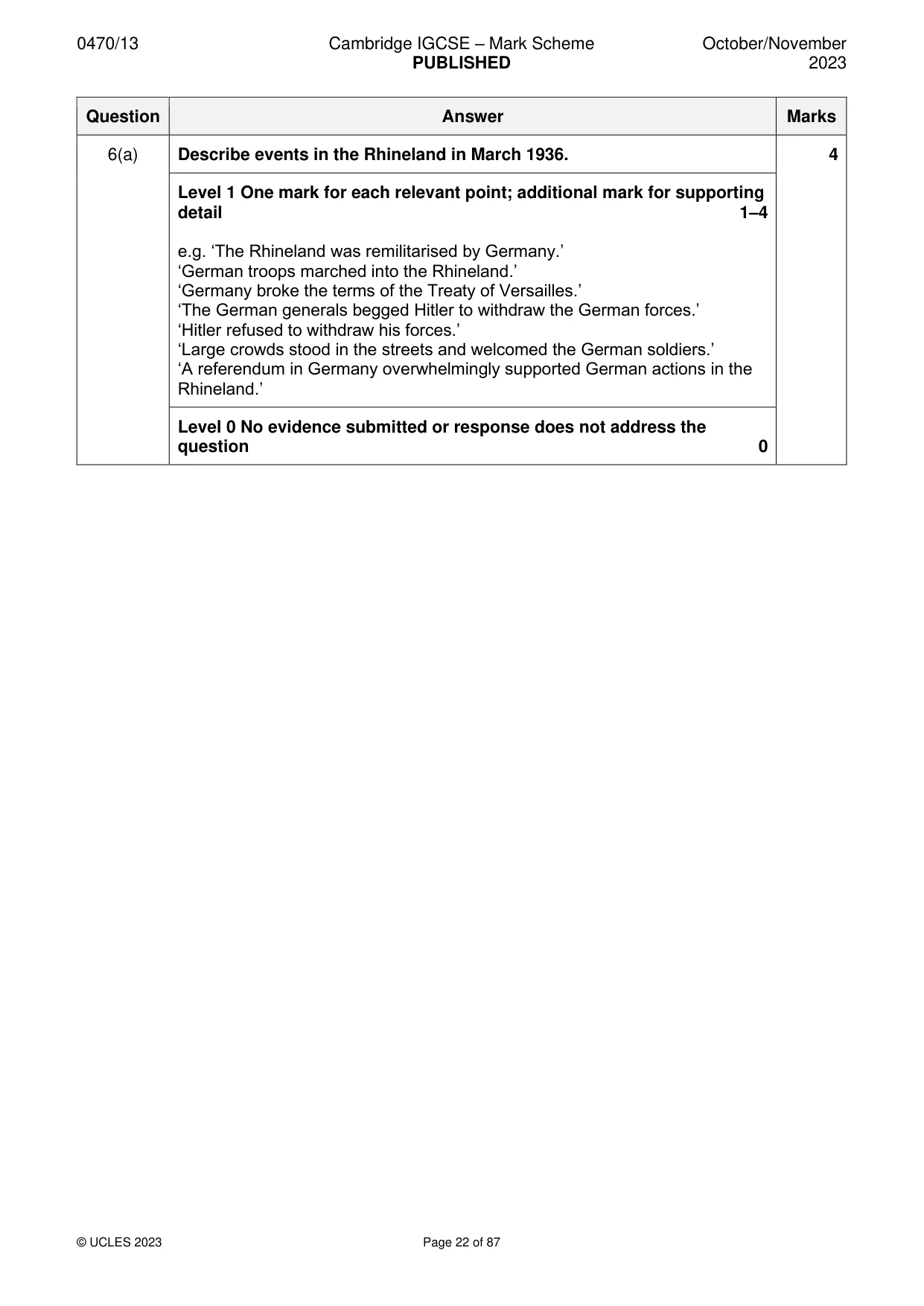
0470/13 Cambridge IGCSE – Mark Scheme PUBLISHED October/November 2023 © UCLES 2023 Page 22 of 87 Question Answer Marks 6(a) Describe events in the Rhineland in March 1936. 4 Level 1 One mark for each relevant point; additional mark for supporting detail 1–4 e.g. ‘The Rhineland was remilitarised by Germany.’ ‘German troops marched into the Rhineland.’ ‘Germany broke the terms of the Treaty of Versailles.’ ‘The German generals begged Hitler to withdraw the German forces.’ ‘Hitler refused to withdraw his forces.’ ‘Large crowds stood in the streets and welcomed the German soldiers.’ ‘A referendum in Germany overwhelmingly supported German actions in the Rhineland.’ Level 0 No evidence submitted or response does not address the question 0
Mark scheme, page 23
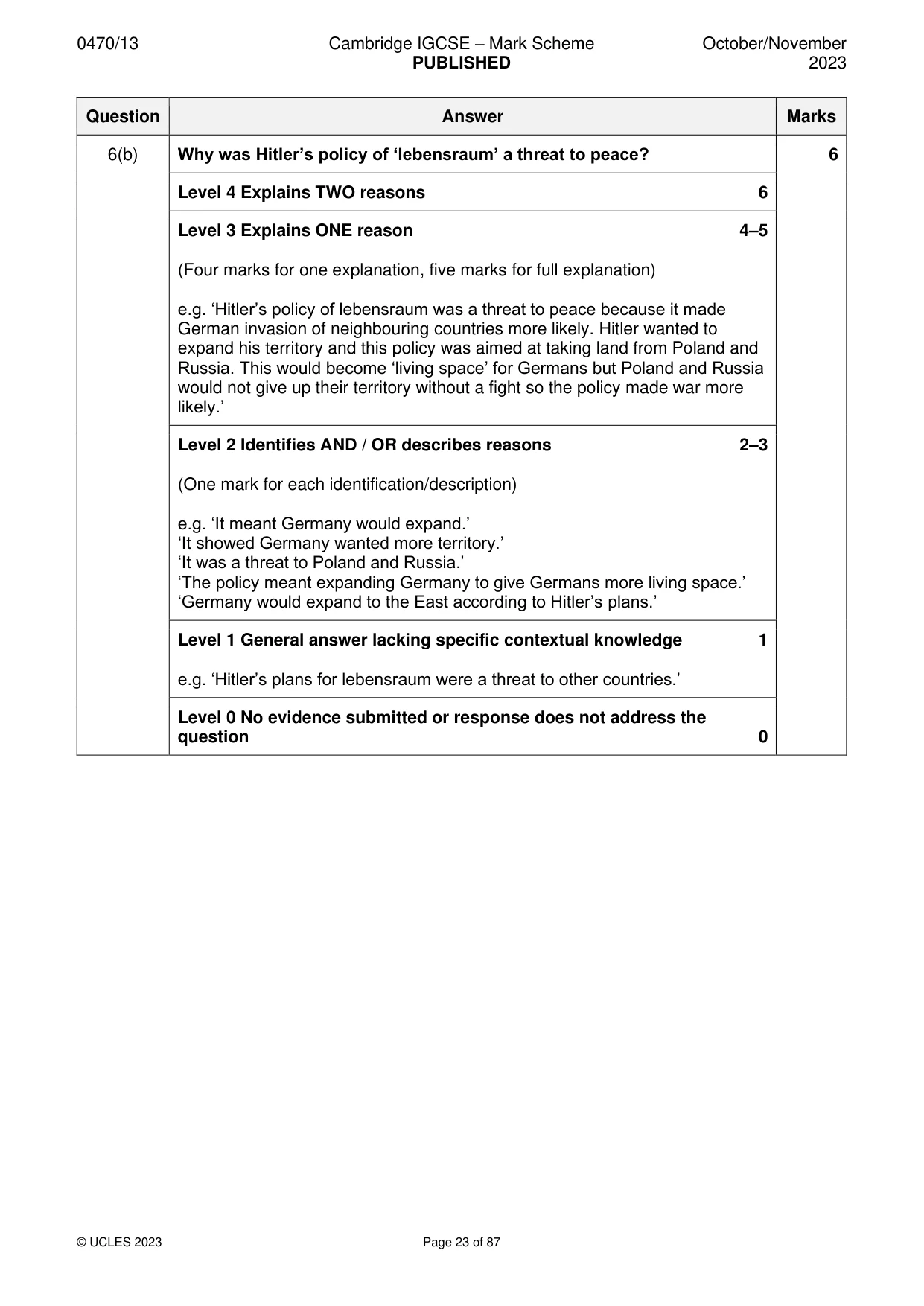
0470/13 Cambridge IGCSE – Mark Scheme PUBLISHED October/November 2023 © UCLES 2023 Page 23 of 87 Question Answer Marks 6(b) Why was Hitler’s policy of ‘lebensraum’ a threat to peace? 6 Level 4 Explains TWO reasons 6 Level 3 Explains ONE reason 4–5 (Four marks for one explanation, five marks for full explanation) e.g. ‘Hitler’s policy of lebensraum was a threat to peace because it made German invasion of neighbouring countries more likely. Hitler wanted to expand his territory and this policy was aimed at taking land from Poland and Russia. This would become ‘living space’ for Germans but Poland and Russia would not give up their territory without a fight so the policy made war more likely.’ Level 2 Identifies AND / OR describes reasons 2–3 (One mark for each identification/description) e.g. ‘It meant Germany would expand.’ ‘It showed Germany wanted more territory.’ ‘It was a threat to Poland and Russia.’ ‘The policy meant expanding Germany to give Germans more living space.’ ‘Germany would expand to the East according to Hitler’s plans.’ Level 1 General answer lacking specific contextual knowledge 1 e.g. ‘Hitler’s plans for lebensraum were a threat to other countries.’ Level 0 No evidence submitted or response does not address the question 0
Mark scheme, page 24
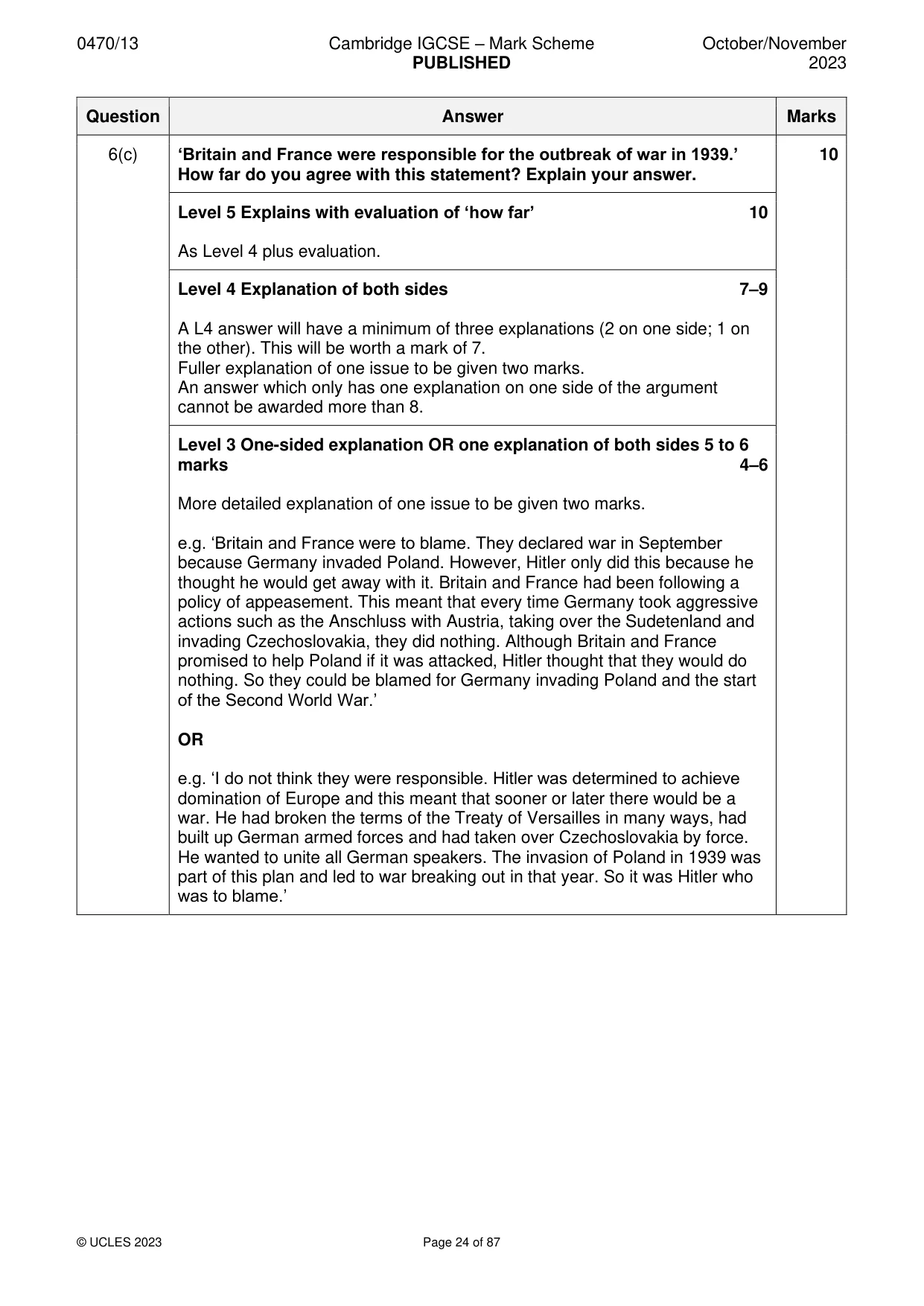
0470/13 Cambridge IGCSE – Mark Scheme PUBLISHED October/November 2023 © UCLES 2023 Page 24 of 87 Question Answer Marks 6(c) ‘Britain and France were responsible for the outbreak of war in 1939.’ How far do you agree with this statement? Explain your answer. 10 Level 5 Explains with evaluation of ‘how far’ 10 As Level 4 plus evaluation. Level 4 Explanation of both sides 7–9 A L4 answer will have a minimum of three explanations (2 on one side; 1 on the other). This will be worth a mark of 7. Fuller explanation of one issue to be given two marks. An answer which only has one explanation on one side of the argument cannot be awarded more than 8. Level 3 One-sided explanation OR one explanation of both sides 5 to 6 marks 4–6 More detailed explanation of one issue to be given two marks. e.g. ‘Britain and France were to blame. They declared war in September because Germany invaded Poland. However, Hitler only did this because he thought he would get away with it. Britain and France had been following a policy of appeasement. This meant that every time Germany took aggressive actions such as the Anschluss with Austria, taking over the Sudetenland and invading Czechoslovakia, they did nothing. Although Britain and France promised to help Poland if it was attacked, Hitler thought that they would do nothing. So they could be blamed for Germany invading Poland and the start of the Second World War.’ OR e.g. ‘I do not think they were responsible. Hitler was determined to achieve domination of Europe and this meant that sooner or later there would be a war. He had broken the terms of the Treaty of Versailles in many ways, had built up German armed forces and had taken over Czechoslovakia by force. He wanted to unite all German speakers. The invasion of Poland in 1939 was part of this plan and led to war breaking out in that year. So it was Hitler who was to blame.’
Mark scheme, page 25
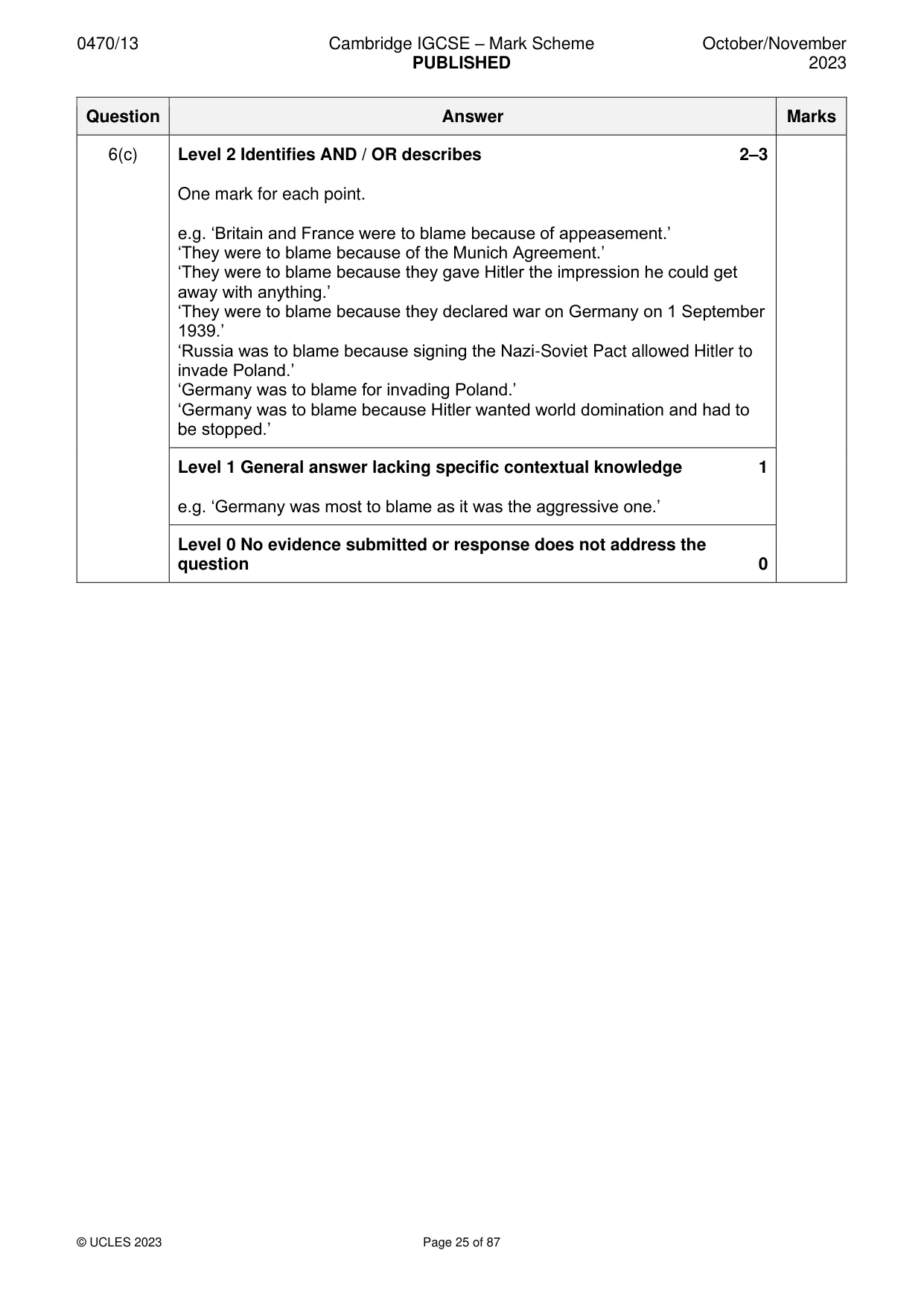
0470/13 Cambridge IGCSE – Mark Scheme PUBLISHED October/November 2023 © UCLES 2023 Page 25 of 87 Question Answer Marks 6(c) Level 2 Identifies AND / OR describes 2–3 One mark for each point. e.g. ‘Britain and France were to blame because of appeasement.’ ‘They were to blame because of the Munich Agreement.’ ‘They were to blame because they gave Hitler the impression he could get away with anything.’ ‘They were to blame because they declared war on Germany on 1 September 1939.’ ‘Russia was to blame because signing the Nazi-Soviet Pact allowed Hitler to invade Poland.’ ‘Germany was to blame for invading Poland.’ ‘Germany was to blame because Hitler wanted world domination and had to be stopped.’ Level 1 General answer lacking specific contextual knowledge 1 e.g. ‘Germany was most to blame as it was the aggressive one.’ Level 0 No evidence submitted or response does not address the question 0
Mark scheme, page 26
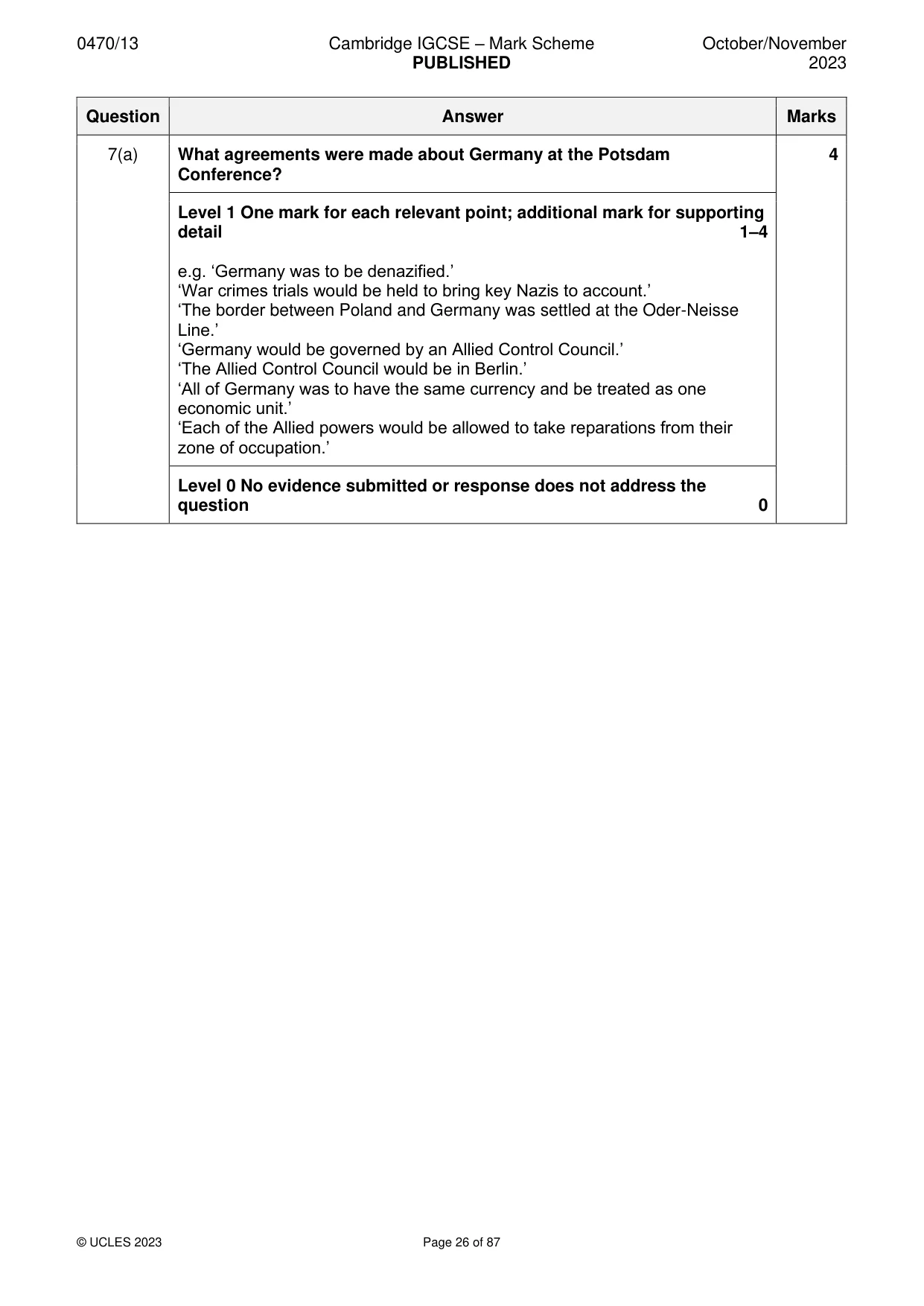
0470/13 Cambridge IGCSE – Mark Scheme PUBLISHED October/November 2023 © UCLES 2023 Page 26 of 87 Question Answer Marks 7(a) What agreements were made about Germany at the Potsdam Conference? 4 Level 1 One mark for each relevant point; additional mark for supporting detail 1–4 e.g. ‘Germany was to be denazified.’ ‘War crimes trials would be held to bring key Nazis to account.’ ‘The border between Poland and Germany was settled at the Oder-Neisse Line.’ ‘Germany would be governed by an Allied Control Council.’ ‘The Allied Control Council would be in Berlin.’ ‘All of Germany was to have the same currency and be treated as one economic unit.’ ‘Each of the Allied powers would be allowed to take reparations from their zone of occupation.’ Level 0 No evidence submitted or response does not address the question 0
Mark scheme, page 27
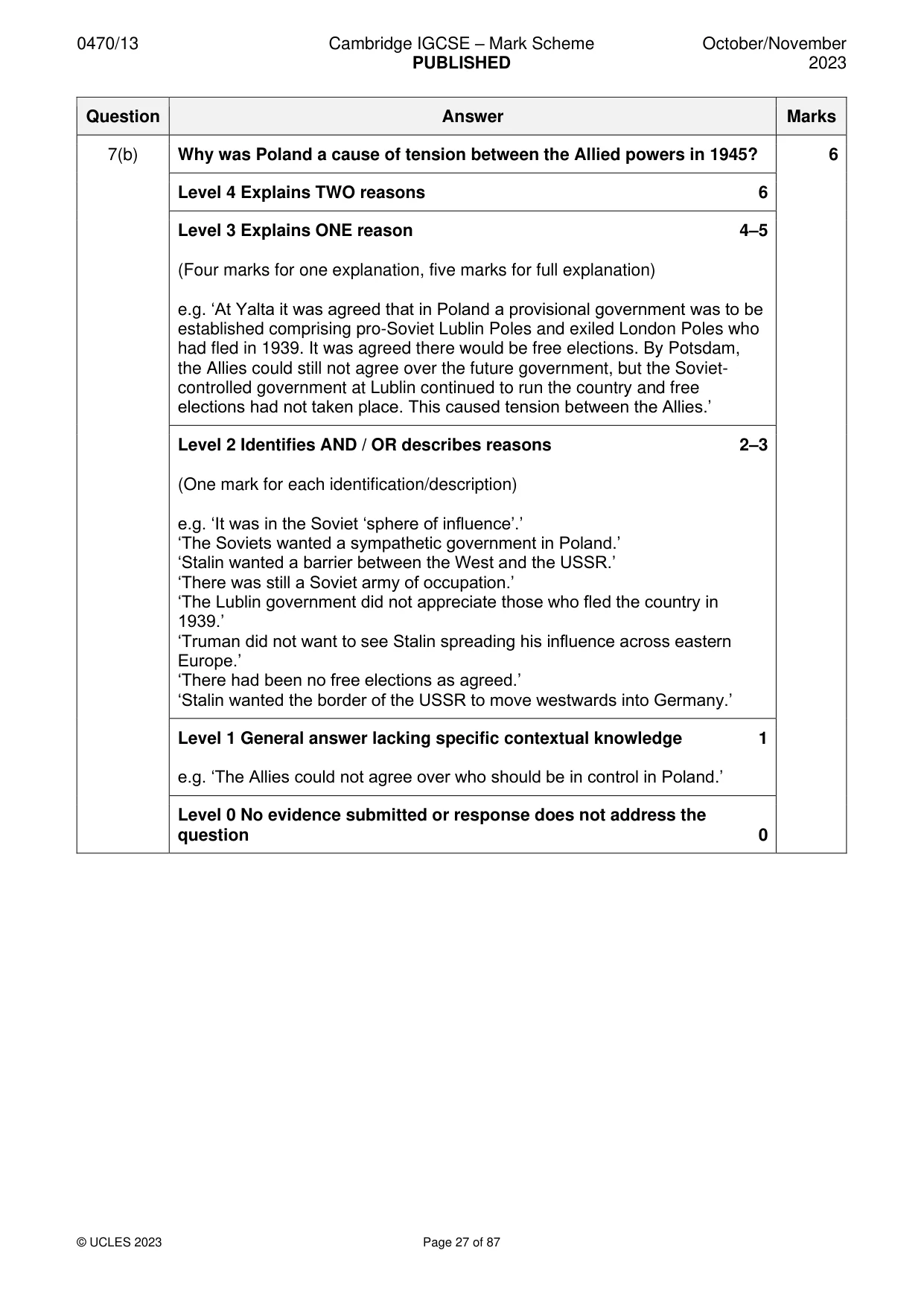
0470/13 Cambridge IGCSE – Mark Scheme PUBLISHED October/November 2023 © UCLES 2023 Page 27 of 87 Question Answer Marks 7(b) Why was Poland a cause of tension between the Allied powers in 1945? 6 Level 4 Explains TWO reasons 6 Level 3 Explains ONE reason 4–5 (Four marks for one explanation, five marks for full explanation) e.g. ‘At Yalta it was agreed that in Poland a provisional government was to be established comprising pro-Soviet Lublin Poles and exiled London Poles who had fled in 1939. It was agreed there would be free elections. By Potsdam, the Allies could still not agree over the future government, but the Soviet- controlled government at Lublin continued to run the country and free elections had not taken place. This caused tension between the Allies.’ Level 2 Identifies AND / OR describes reasons 2–3 (One mark for each identification/description) e.g. ‘It was in the Soviet ‘sphere of influence’.’ ‘The Soviets wanted a sympathetic government in Poland.’ ‘Stalin wanted a barrier between the West and the USSR.’ ‘There was still a Soviet army of occupation.’ ‘The Lublin government did not appreciate those who fled the country in 1939.’ ‘Truman did not want to see Stalin spreading his influence across eastern Europe.’ ‘There had been no free elections as agreed.’ ‘Stalin wanted the border of the USSR to move westwards into Germany.’ Level 1 General answer lacking specific contextual knowledge 1 e.g. ‘The Allies could not agree over who should be in control in Poland.’ Level 0 No evidence submitted or response does not address the question 0
Mark scheme, page 28
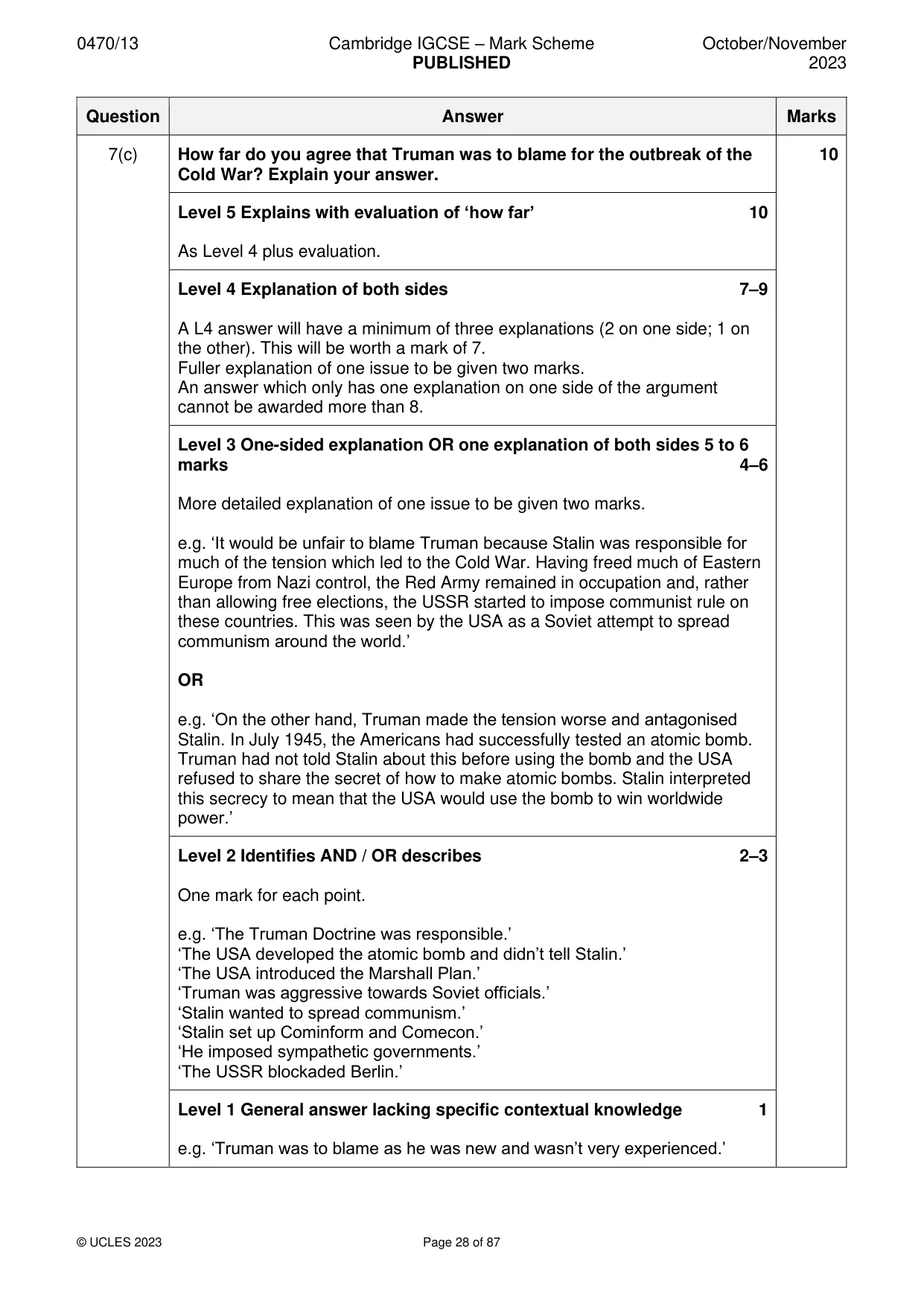
0470/13 Cambridge IGCSE – Mark Scheme PUBLISHED October/November 2023 © UCLES 2023 Page 28 of 87 Question Answer Marks 7(c) How far do you agree that Truman was to blame for the outbreak of the Cold War? Explain your answer. 10 Level 5 Explains with evaluation of ‘how far’ 10 As Level 4 plus evaluation. Level 4 Explanation of both sides 7–9 A L4 answer will have a minimum of three explanations (2 on one side; 1 on the other). This will be worth a mark of 7. Fuller explanation of one issue to be given two marks. An answer which only has one explanation on one side of the argument cannot be awarded more than 8. Level 3 One-sided explanation OR one explanation of both sides 5 to 6 marks 4–6 More detailed explanation of one issue to be given two marks. e.g. ‘It would be unfair to blame Truman because Stalin was responsible for much of the tension which led to the Cold War. Having freed much of Eastern Europe from Nazi control, the Red Army remained in occupation and, rather than allowing free elections, the USSR started to impose communist rule on these countries. This was seen by the USA as a Soviet attempt to spread communism around the world.’ OR e.g. ‘On the other hand, Truman made the tension worse and antagonised Stalin. In July 1945, the Americans had successfully tested an atomic bomb. Truman had not told Stalin about this before using the bomb and the USA refused to share the secret of how to make atomic bombs. Stalin interpreted this secrecy to mean that the USA would use the bomb to win worldwide power.’ Level 2 Identifies AND / OR describes 2–3 One mark for each point. e.g. ‘The Truman Doctrine was responsible.’ ‘The USA developed the atomic bomb and didn’t tell Stalin.’ ‘The USA introduced the Marshall Plan.’ ‘Truman was aggressive towards Soviet officials.’ ‘Stalin wanted to spread communism.’ ‘Stalin set up Cominform and Comecon.’ ‘He imposed sympathetic governments.’ ‘The USSR blockaded Berlin.’ Level 1 General answer lacking specific contextual knowledge 1 e.g. ‘Truman was to blame as he was new and wasn’t very experienced.’
Mark scheme, page 29
0470/13 Cambridge IGCSE – Mark Scheme PUBLISHED October/November 2023 © UCLES 2023 Page 29 of 87 Question Answer Marks 7(c) Level 0 No evidence submitted or response does not address the question 0
Mark scheme, page 30
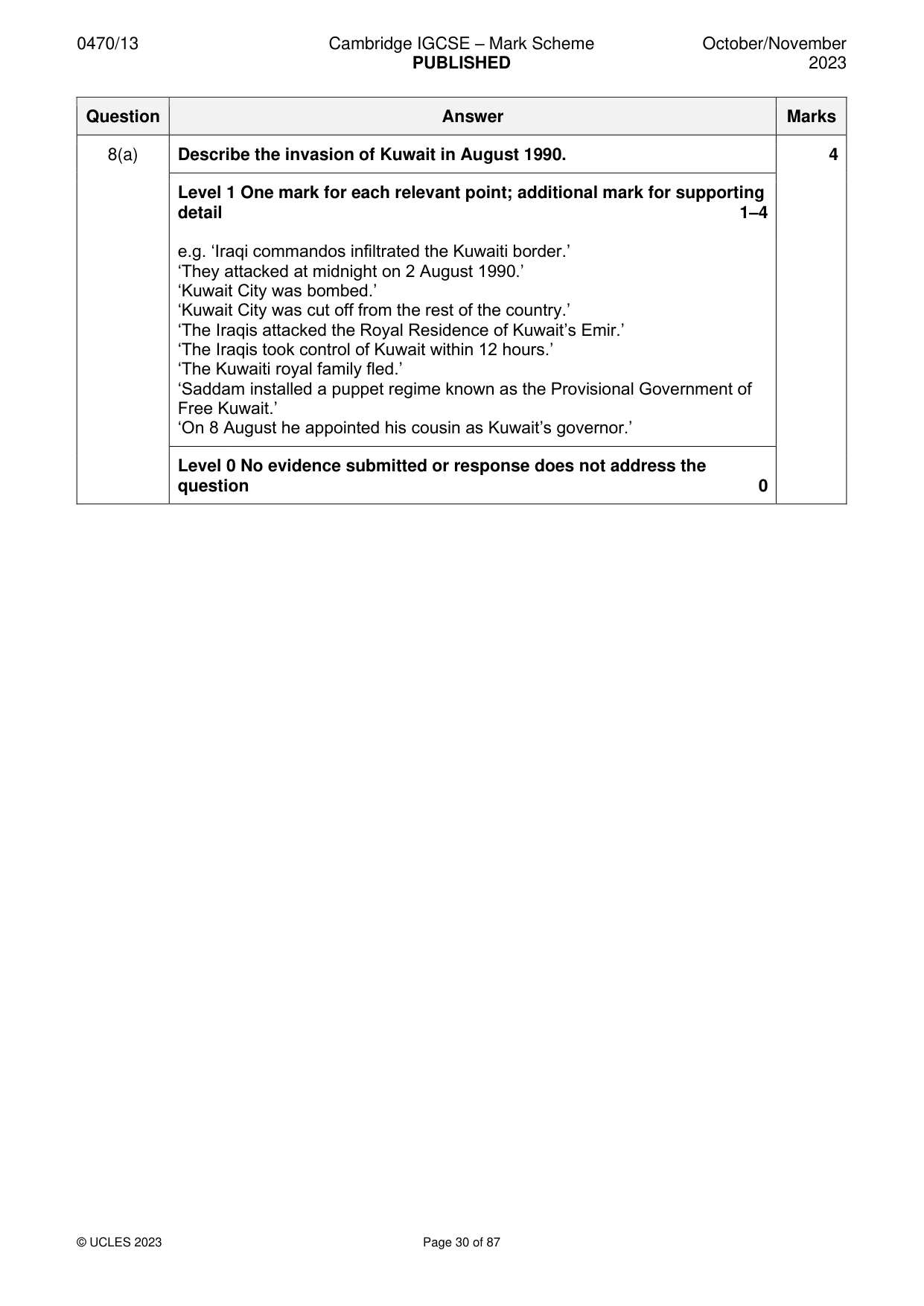
0470/13 Cambridge IGCSE – Mark Scheme PUBLISHED October/November 2023 © UCLES 2023 Page 30 of 87 Question Answer Marks 8(a) Describe the invasion of Kuwait in August 1990. 4 Level 1 One mark for each relevant point; additional mark for supporting detail 1–4 e.g. ‘Iraqi commandos infiltrated the Kuwaiti border.’ ‘They attacked at midnight on 2 August 1990.’ ‘Kuwait City was bombed.’ ‘Kuwait City was cut off from the rest of the country.’ ‘The Iraqis attacked the Royal Residence of Kuwait’s Emir.’ ‘The Iraqis took control of Kuwait within 12 hours.’ ‘The Kuwaiti royal family fled.’ ‘Saddam installed a puppet regime known as the Provisional Government of Free Kuwait.’ ‘On 8 August he appointed his cousin as Kuwait’s governor.’ Level 0 No evidence submitted or response does not address the question 0
Mark scheme, page 31
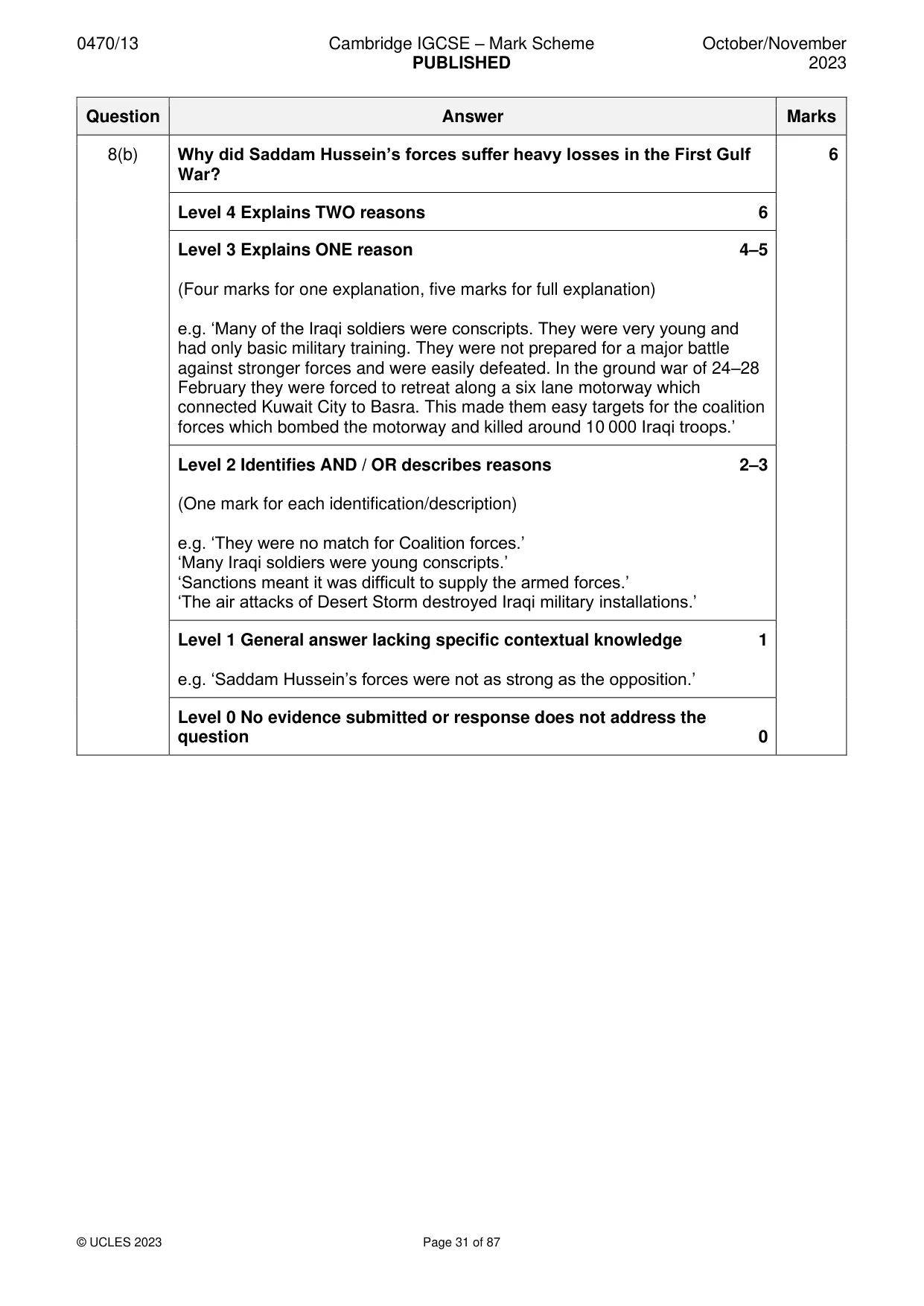
0470/13 Cambridge IGCSE – Mark Scheme PUBLISHED October/November 2023 © UCLES 2023 Page 31 of 87 Question Answer Marks 8(b) Why did Saddam Hussein’s forces suffer heavy losses in the First Gulf War? 6 Level 4 Explains TWO reasons 6 Level 3 Explains ONE reason 4–5 (Four marks for one explanation, five marks for full explanation) e.g. ‘Many of the Iraqi soldiers were conscripts. They were very young and had only basic military training. They were not prepared for a major battle against stronger forces and were easily defeated. In the ground war of 24–28 February they were forced to retreat along a six lane motorway which connected Kuwait City to Basra. This made them easy targets for the coalition forces which bombed the motorway and killed around 10 000 Iraqi troops.’ Level 2 Identifies AND / OR describes reasons 2–3 (One mark for each identification/description) e.g. ‘They were no match for Coalition forces.’ ‘Many Iraqi soldiers were young conscripts.’ ‘Sanctions meant it was difficult to supply the armed forces.’ ‘The air attacks of Desert Storm destroyed Iraqi military installations.’ Level 1 General answer lacking specific contextual knowledge 1 e.g. ‘Saddam Hussein’s forces were not as strong as the opposition.’ Level 0 No evidence submitted or response does not address the question 0
Mark scheme, page 32
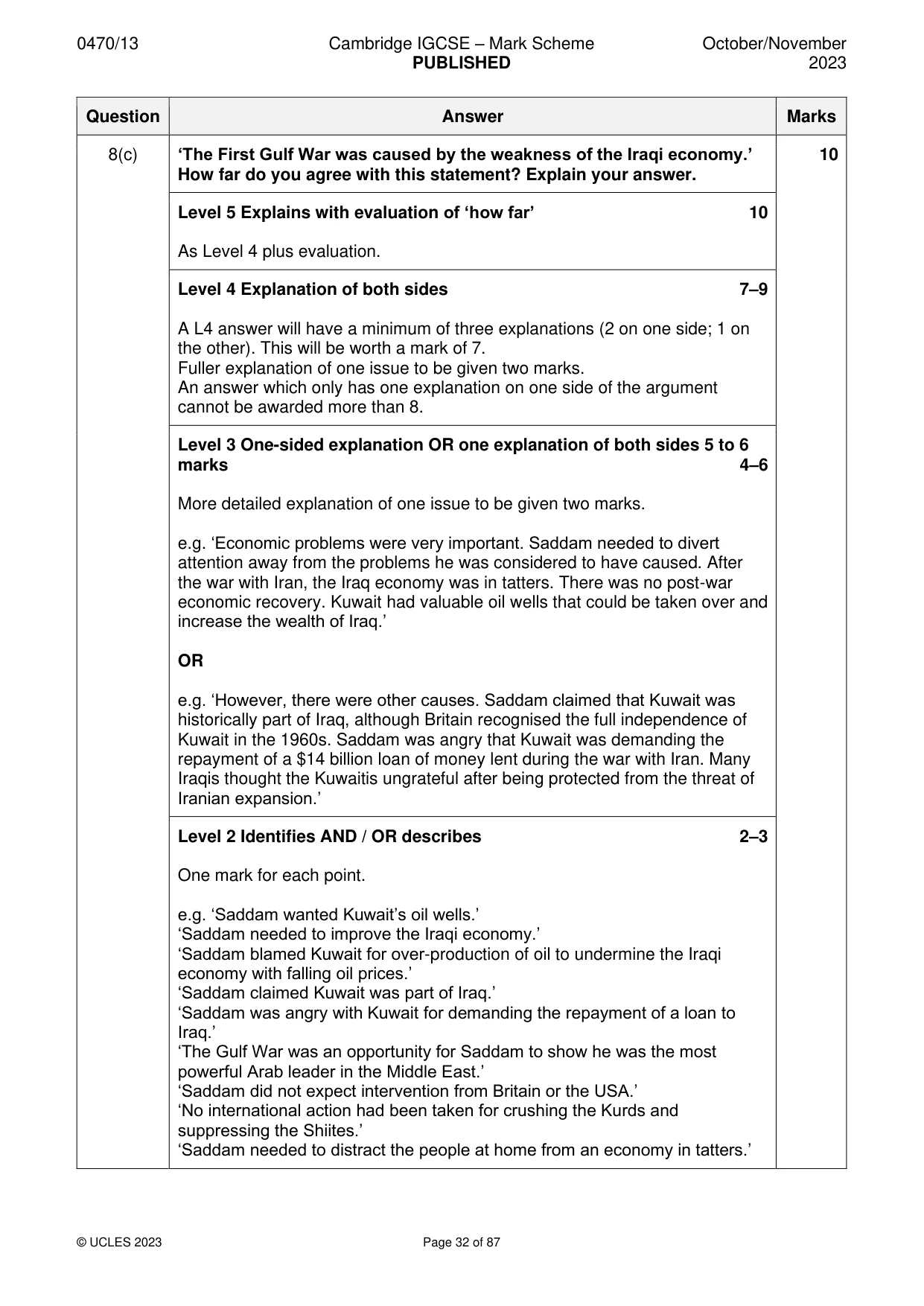
0470/13 Cambridge IGCSE – Mark Scheme PUBLISHED October/November 2023 © UCLES 2023 Page 32 of 87 Question Answer Marks 8(c) ‘The First Gulf War was caused by the weakness of the Iraqi economy.’ How far do you agree with this statement? Explain your answer. 10 Level 5 Explains with evaluation of ‘how far’ 10 As Level 4 plus evaluation. Level 4 Explanation of both sides 7–9 A L4 answer will have a minimum of three explanations (2 on one side; 1 on the other). This will be worth a mark of 7. Fuller explanation of one issue to be given two marks. An answer which only has one explanation on one side of the argument cannot be awarded more than 8. Level 3 One-sided explanation OR one explanation of both sides 5 to 6 marks 4–6 More detailed explanation of one issue to be given two marks. e.g. ‘Economic problems were very important. Saddam needed to divert attention away from the problems he was considered to have caused. After the war with Iran, the Iraq economy was in tatters. There was no post-war economic recovery. Kuwait had valuable oil wells that could be taken over and increase the wealth of Iraq.’ OR e.g. ‘However, there were other causes. Saddam claimed that Kuwait was historically part of Iraq, although Britain recognised the full independence of Kuwait in the 1960s. Saddam was angry that Kuwait was demanding the repayment of a $14 billion loan of money lent during the war with Iran. Many Iraqis thought the Kuwaitis ungrateful after being protected from the threat of Iranian expansion.’ Level 2 Identifies AND / OR describes 2–3 One mark for each point. e.g. ‘Saddam wanted Kuwait’s oil wells.’ ‘Saddam needed to improve the Iraqi economy.’ ‘Saddam blamed Kuwait for over-production of oil to undermine the Iraqi economy with falling oil prices.’ ‘Saddam claimed Kuwait was part of Iraq.’ ‘Saddam was angry with Kuwait for demanding the repayment of a loan to Iraq.’ ‘The Gulf War was an opportunity for Saddam to show he was the most powerful Arab leader in the Middle East.’ ‘Saddam did not expect intervention from Britain or the USA.’ ‘No international action had been taken for crushing the Kurds and suppressing the Shiites.’ ‘Saddam needed to distract the people at home from an economy in tatters.’
Mark scheme, page 33
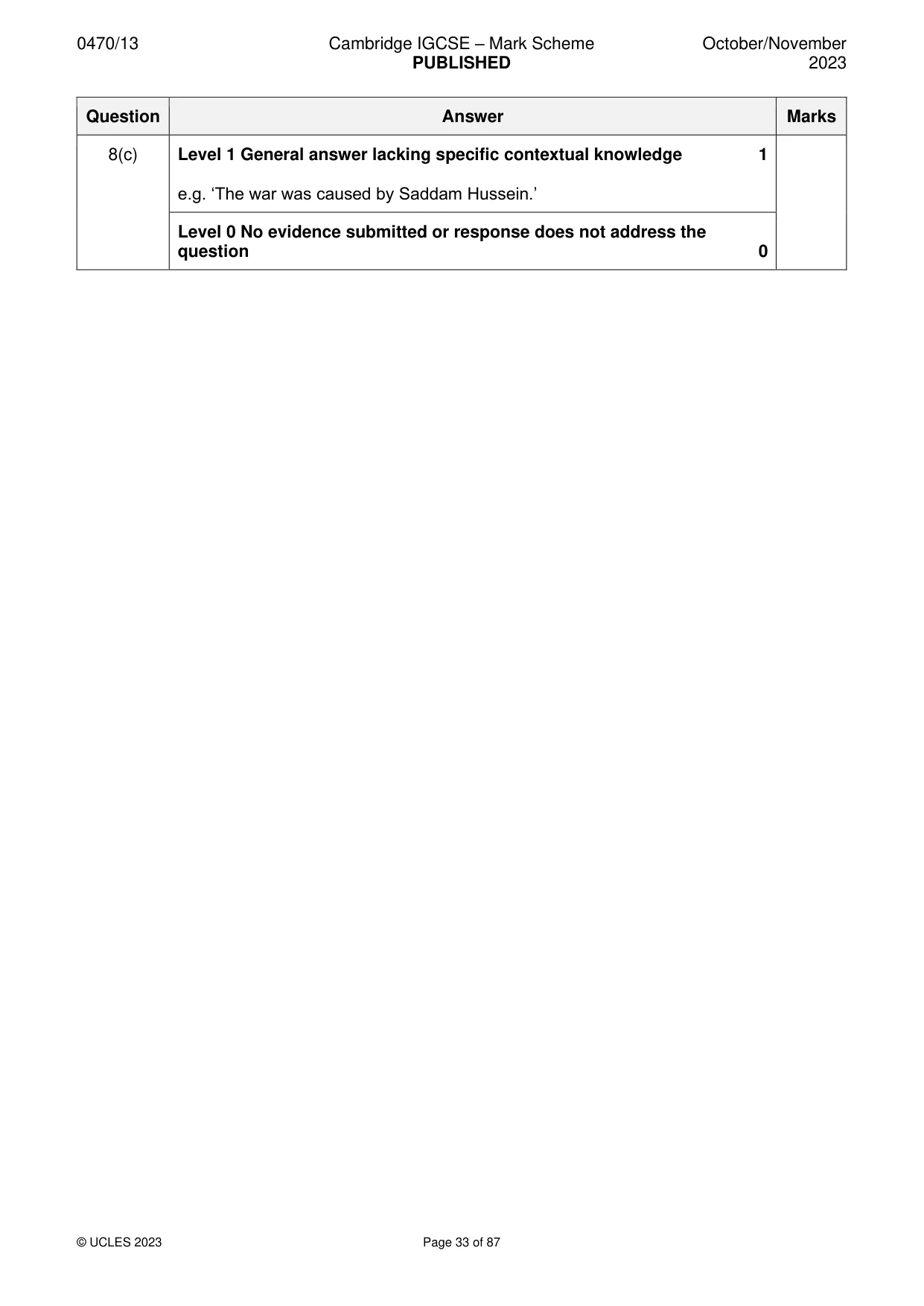
0470/13 Cambridge IGCSE – Mark Scheme PUBLISHED October/November 2023 © UCLES 2023 Page 33 of 87 Question Answer Marks 8(c) Level 1 General answer lacking specific contextual knowledge 1 e.g. ‘The war was caused by Saddam Hussein.’ Level 0 No evidence submitted or response does not address the question 0
Mark scheme, page 34
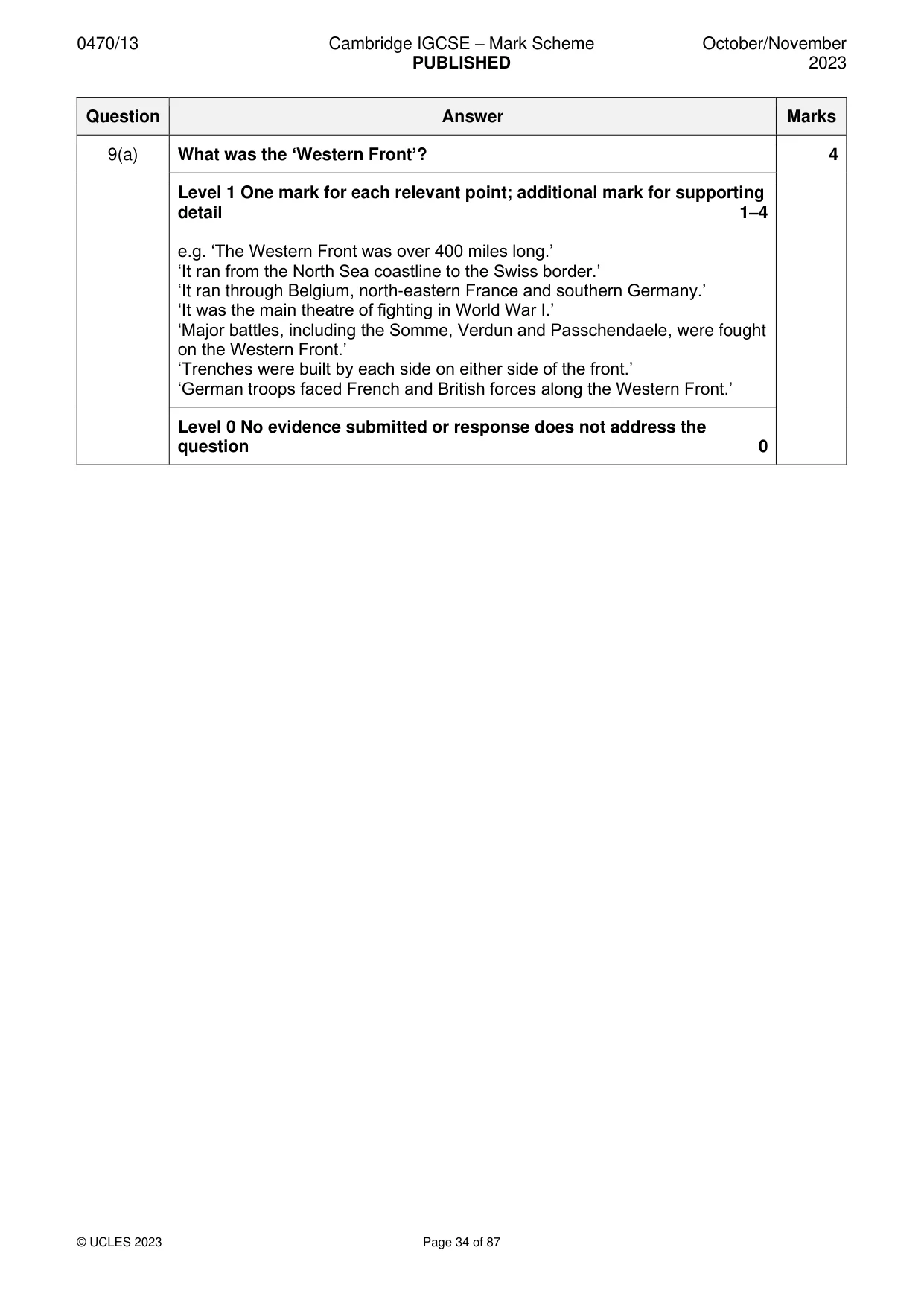
0470/13 Cambridge IGCSE – Mark Scheme PUBLISHED October/November 2023 © UCLES 2023 Page 34 of 87 Question Answer Marks 9(a) What was the ‘Western Front’? 4 Level 1 One mark for each relevant point; additional mark for supporting detail 1–4 e.g. ‘The Western Front was over 400 miles long.’ ‘It ran from the North Sea coastline to the Swiss border.’ ‘It ran through Belgium, north-eastern France and southern Germany.’ ‘It was the main theatre of fighting in World War I.’ ‘Major battles, including the Somme, Verdun and Passchendaele, were fought on the Western Front.’ ‘Trenches were built by each side on either side of the front.’ ‘German troops faced French and British forces along the Western Front.’ Level 0 No evidence submitted or response does not address the question 0
Mark scheme, page 35
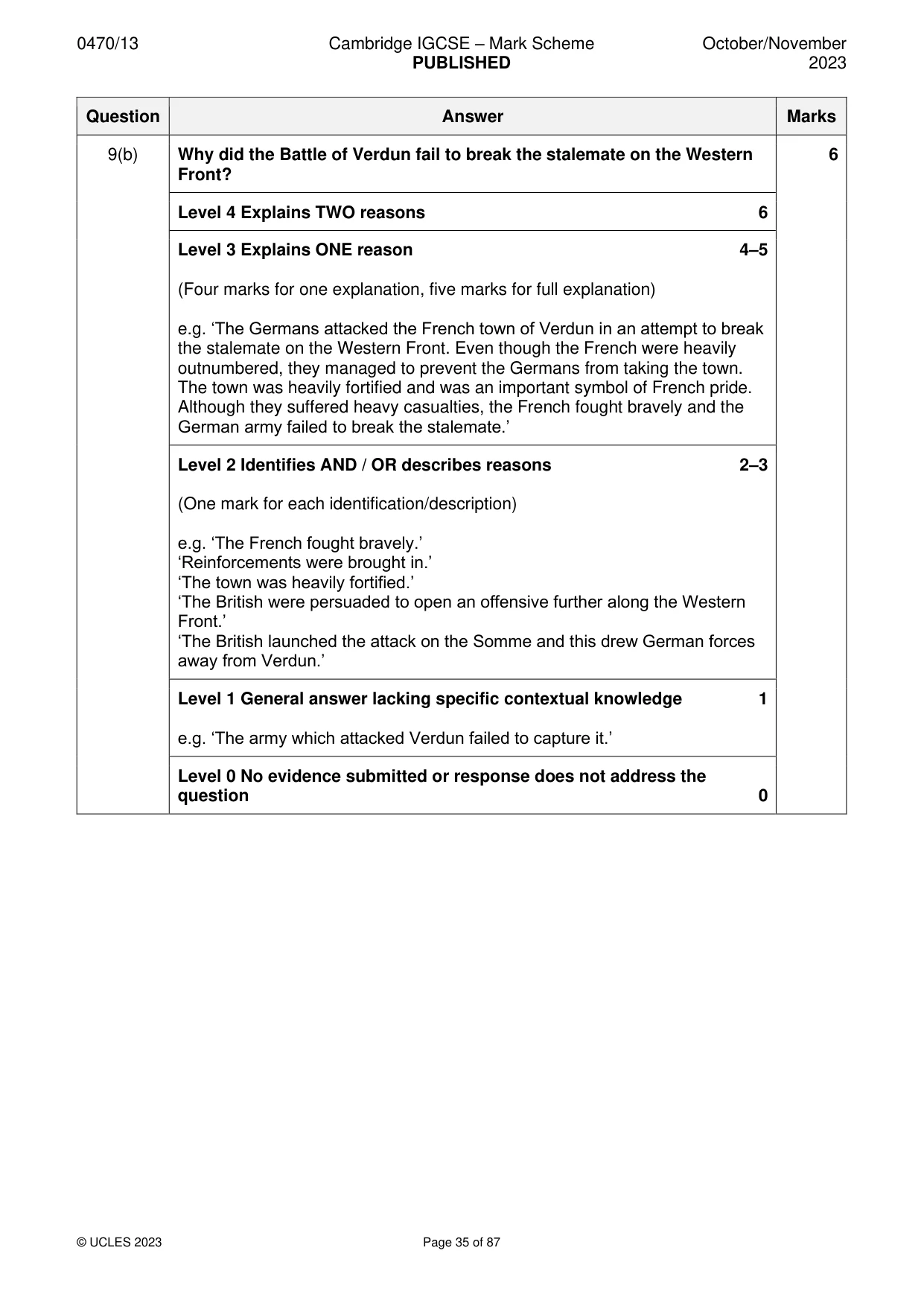
0470/13 Cambridge IGCSE – Mark Scheme PUBLISHED October/November 2023 © UCLES 2023 Page 35 of 87 Question Answer Marks 9(b) Why did the Battle of Verdun fail to break the stalemate on the Western Front? 6 Level 4 Explains TWO reasons 6 Level 3 Explains ONE reason 4–5 (Four marks for one explanation, five marks for full explanation) e.g. ‘The Germans attacked the French town of Verdun in an attempt to break the stalemate on the Western Front. Even though the French were heavily outnumbered, they managed to prevent the Germans from taking the town. The town was heavily fortified and was an important symbol of French pride. Although they suffered heavy casualties, the French fought bravely and the German army failed to break the stalemate.’ Level 2 Identifies AND / OR describes reasons 2–3 (One mark for each identification/description) e.g. ‘The French fought bravely.’ ‘Reinforcements were brought in.’ ‘The town was heavily fortified.’ ‘The British were persuaded to open an offensive further along the Western Front.’ ‘The British launched the attack on the Somme and this drew German forces away from Verdun.’ Level 1 General answer lacking specific contextual knowledge 1 e.g. ‘The army which attacked Verdun failed to capture it.’ Level 0 No evidence submitted or response does not address the question 0
Mark scheme, page 36
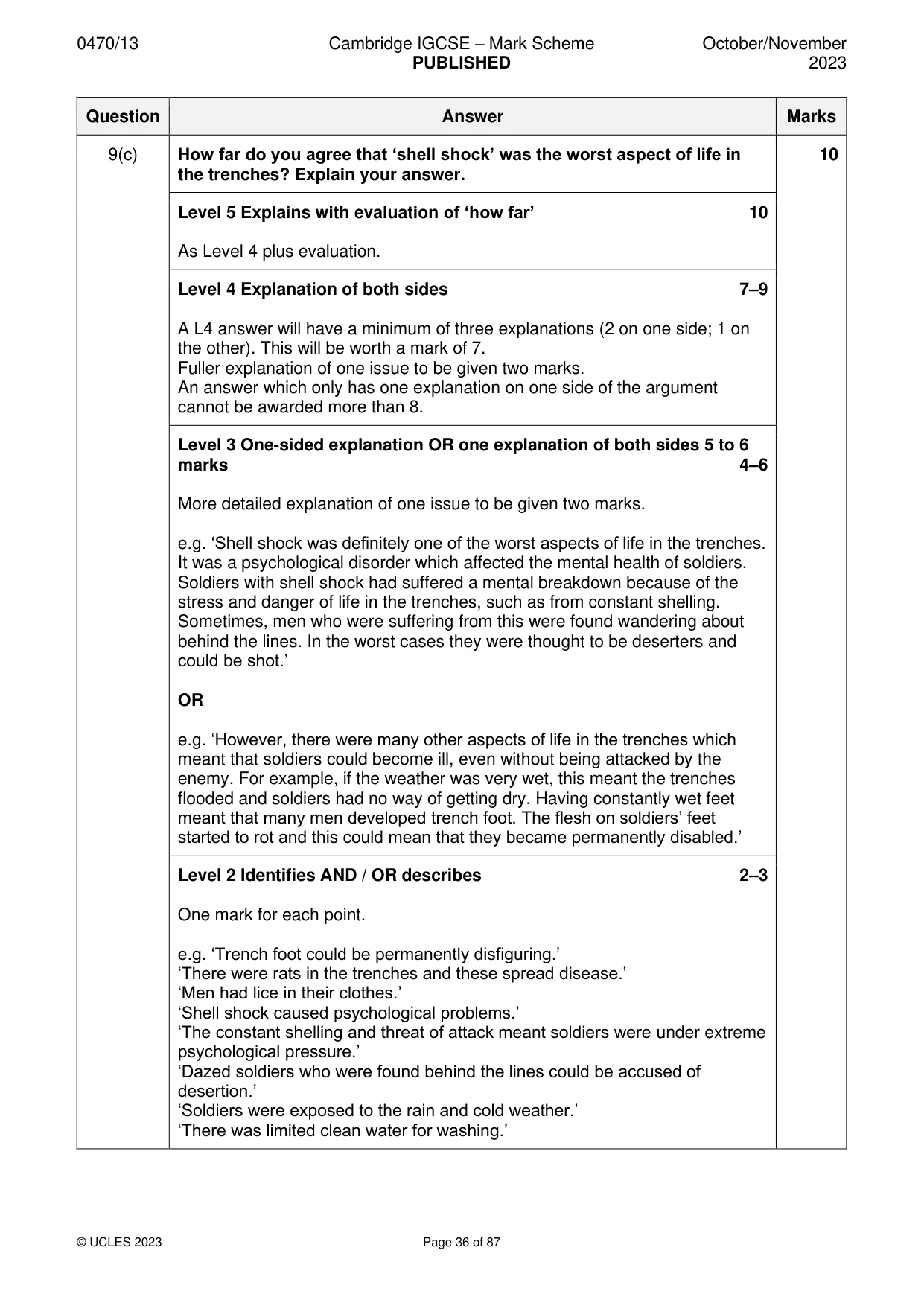
0470/13 Cambridge IGCSE – Mark Scheme PUBLISHED October/November 2023 © UCLES 2023 Page 36 of 87 Question Answer Marks 9(c) How far do you agree that ‘shell shock’ was the worst aspect of life in the trenches? Explain your answer. 10 Level 5 Explains with evaluation of ‘how far’ 10 As Level 4 plus evaluation. Level 4 Explanation of both sides 7–9 A L4 answer will have a minimum of three explanations (2 on one side; 1 on the other). This will be worth a mark of 7. Fuller explanation of one issue to be given two marks. An answer which only has one explanation on one side of the argument cannot be awarded more than 8. Level 3 One-sided explanation OR one explanation of both sides 5 to 6 marks 4–6 More detailed explanation of one issue to be given two marks. e.g. ‘Shell shock was definitely one of the worst aspects of life in the trenches. It was a psychological disorder which affected the mental health of soldiers. Soldiers with shell shock had suffered a mental breakdown because of the stress and danger of life in the trenches, such as from constant shelling. Sometimes, men who were suffering from this were found wandering about behind the lines. In the worst cases they were thought to be deserters and could be shot.’ OR e.g. ‘However, there were many other aspects of life in the trenches which meant that soldiers could become ill, even without being attacked by the enemy. For example, if the weather was very wet, this meant the trenches flooded and soldiers had no way of getting dry. Having constantly wet feet meant that many men developed trench foot. The flesh on soldiers’ feet started to rot and this could mean that they became permanently disabled.’ Level 2 Identifies AND / OR describes 2–3 One mark for each point. e.g. ‘Trench foot could be permanently disfiguring.’ ‘There were rats in the trenches and these spread disease.’ ‘Men had lice in their clothes.’ ‘Shell shock caused psychological problems.’ ‘The constant shelling and threat of attack meant soldiers were under extreme psychological pressure.’ ‘Dazed soldiers who were found behind the lines could be accused of desertion.’ ‘Soldiers were exposed to the rain and cold weather.’ ‘There was limited clean water for washing.’
Mark scheme, page 37
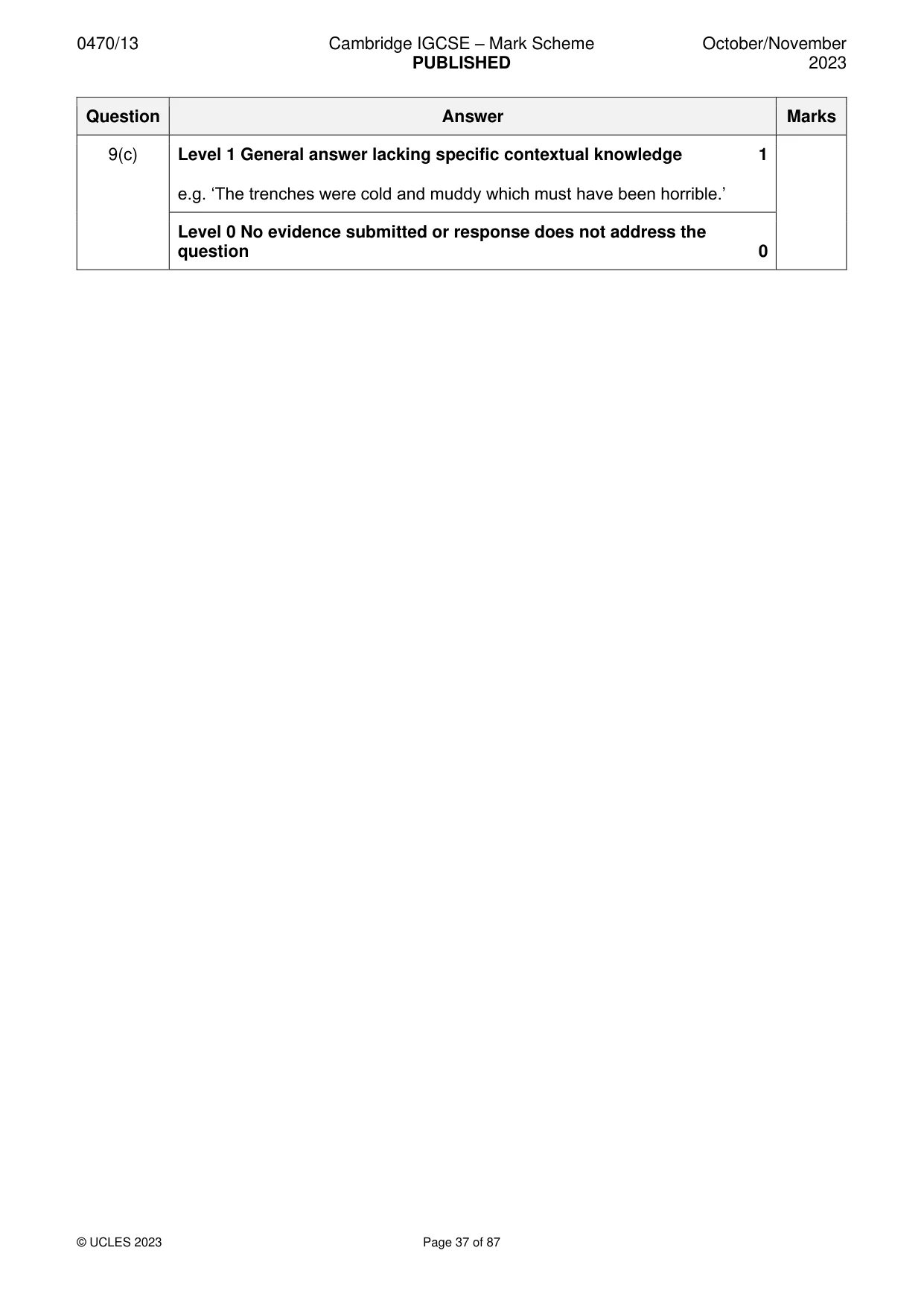
0470/13 Cambridge IGCSE – Mark Scheme PUBLISHED October/November 2023 © UCLES 2023 Page 37 of 87 Question Answer Marks 9(c) Level 1 General answer lacking specific contextual knowledge 1 e.g. ‘The trenches were cold and muddy which must have been horrible.’ Level 0 No evidence submitted or response does not address the question 0
Mark scheme, page 38
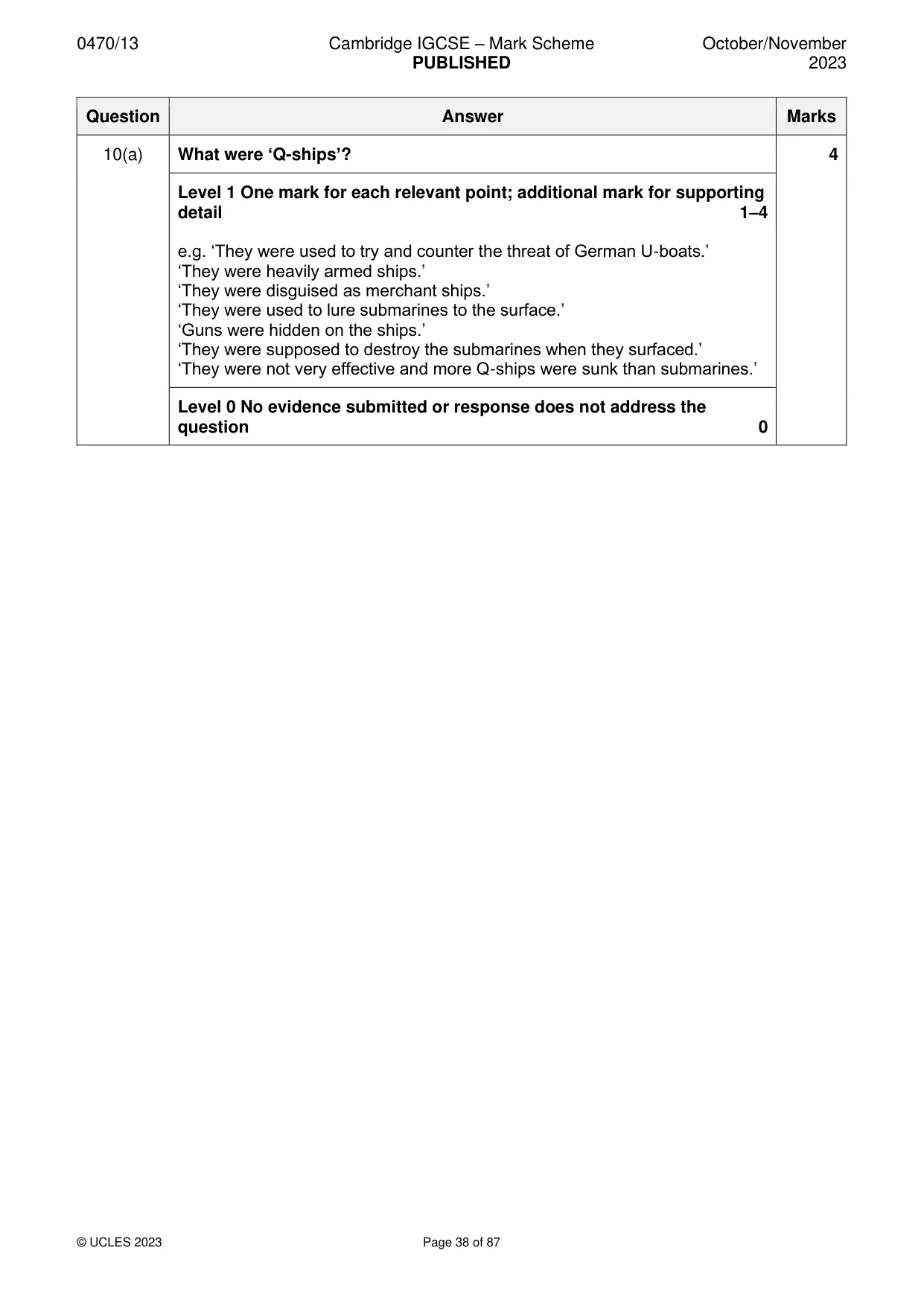
0470/13 Cambridge IGCSE – Mark Scheme PUBLISHED October/November 2023 © UCLES 2023 Page 38 of 87 Question Answer Marks 10(a) What were ‘Q-ships’? 4 Level 1 One mark for each relevant point; additional mark for supporting detail 1–4 e.g. ‘They were used to try and counter the threat of German U-boats.’ ‘They were heavily armed ships.’ ‘They were disguised as merchant ships.’ ‘They were used to lure submarines to the surface.’ ‘Guns were hidden on the ships.’ ‘They were supposed to destroy the submarines when they surfaced.’ ‘They were not very effective and more Q-ships were sunk than submarines.’ Level 0 No evidence submitted or response does not address the question 0
Mark scheme, page 39
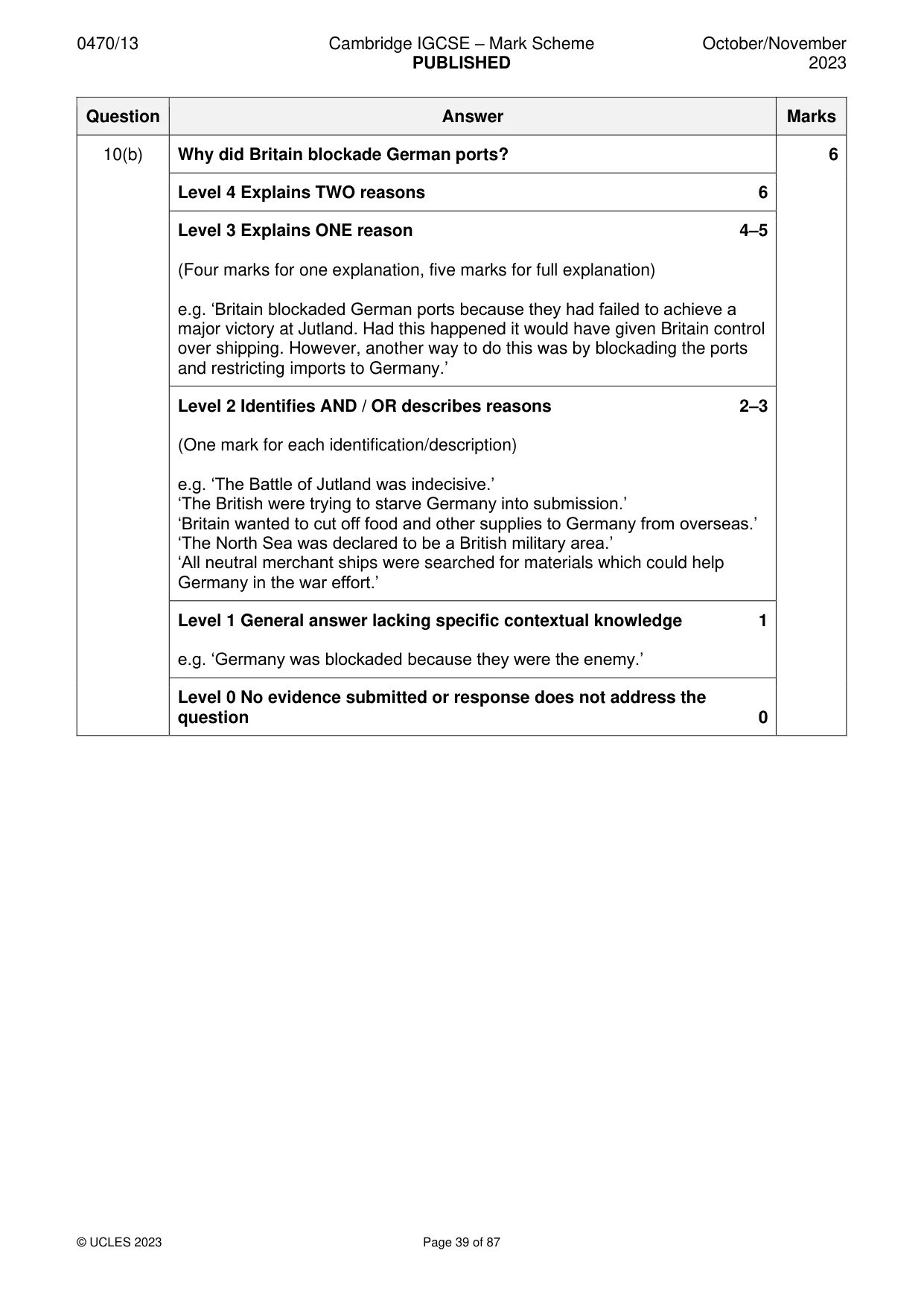
0470/13 Cambridge IGCSE – Mark Scheme PUBLISHED October/November 2023 © UCLES 2023 Page 39 of 87 Question Answer Marks 10(b) Why did Britain blockade German ports? 6 Level 4 Explains TWO reasons 6 Level 3 Explains ONE reason 4–5 (Four marks for one explanation, five marks for full explanation) e.g. ‘Britain blockaded German ports because they had failed to achieve a major victory at Jutland. Had this happened it would have given Britain control over shipping. However, another way to do this was by blockading the ports and restricting imports to Germany.’ Level 2 Identifies AND / OR describes reasons 2–3 (One mark for each identification/description) e.g. ‘The Battle of Jutland was indecisive.’ ‘The British were trying to starve Germany into submission.’ ‘Britain wanted to cut off food and other supplies to Germany from overseas.’ ‘The North Sea was declared to be a British military area.’ ‘All neutral merchant ships were searched for materials which could help Germany in the war effort.’ Level 1 General answer lacking specific contextual knowledge 1 e.g. ‘Germany was blockaded because they were the enemy.’ Level 0 No evidence submitted or response does not address the question 0
Mark scheme, page 40
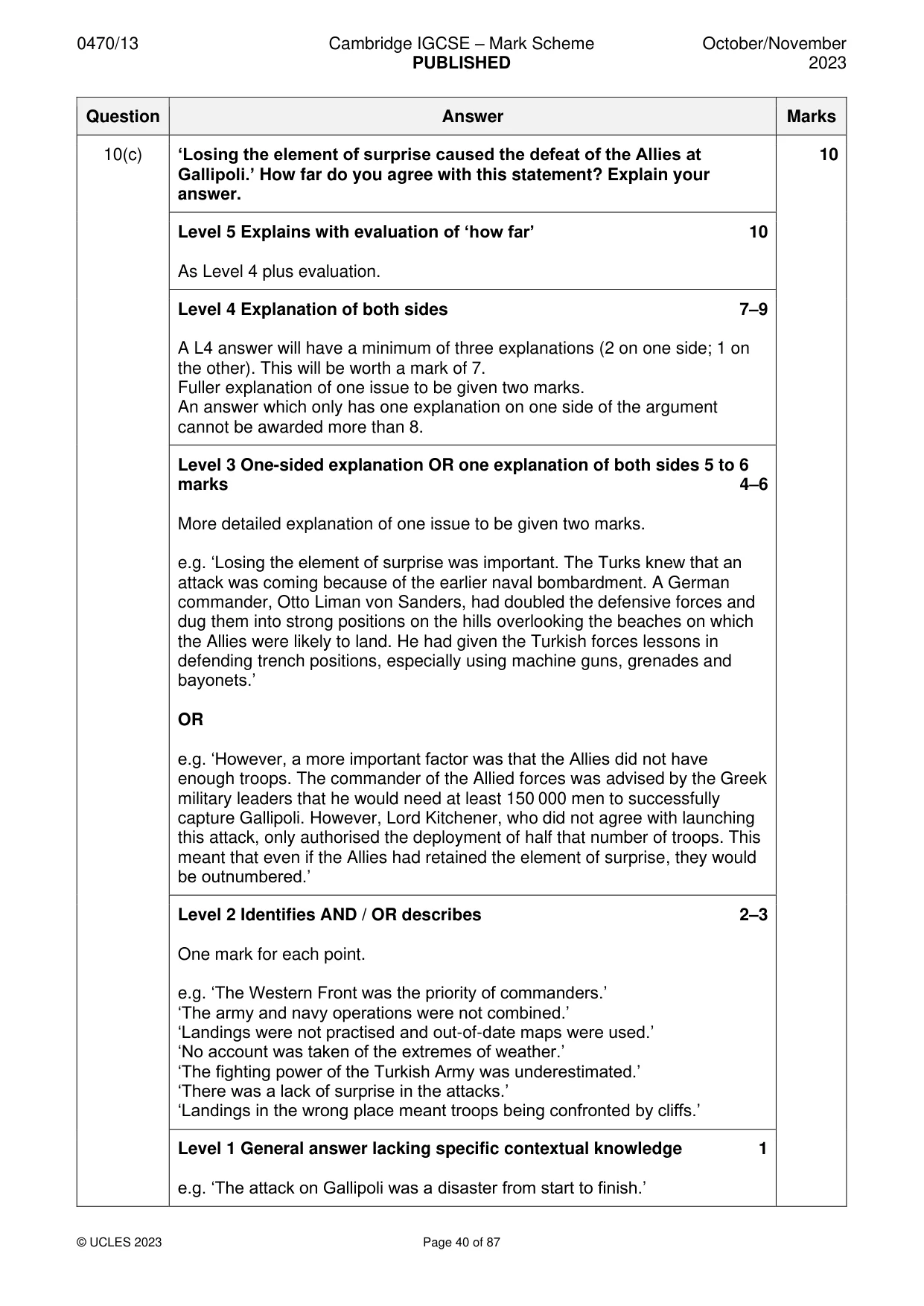
0470/13 Cambridge IGCSE – Mark Scheme PUBLISHED October/November 2023 © UCLES 2023 Page 40 of 87 Question Answer Marks 10(c) ‘Losing the element of surprise caused the defeat of the Allies at Gallipoli.’ How far do you agree with this statement? Explain your answer. 10 Level 5 Explains with evaluation of ‘how far’ 10 As Level 4 plus evaluation. Level 4 Explanation of both sides 7–9 A L4 answer will have a minimum of three explanations (2 on one side; 1 on the other). This will be worth a mark of 7. Fuller explanation of one issue to be given two marks. An answer which only has one explanation on one side of the argument cannot be awarded more than 8. Level 3 One-sided explanation OR one explanation of both sides 5 to 6 marks 4–6 More detailed explanation of one issue to be given two marks. e.g. ‘Losing the element of surprise was important. The Turks knew that an attack was coming because of the earlier naval bombardment. A German commander, Otto Liman von Sanders, had doubled the defensive forces and dug them into strong positions on the hills overlooking the beaches on which the Allies were likely to land. He had given the Turkish forces lessons in defending trench positions, especially using machine guns, grenades and bayonets.’ OR e.g. ‘However, a more important factor was that the Allies did not have enough troops. The commander of the Allied forces was advised by the Greek military leaders that he would need at least 150 000 men to successfully capture Gallipoli. However, Lord Kitchener, who did not agree with launching this attack, only authorised the deployment of half that number of troops. This meant that even if the Allies had retained the element of surprise, they would be outnumbered.’ Level 2 Identifies AND / OR describes 2–3 One mark for each point. e.g. ‘The Western Front was the priority of commanders.’ ‘The army and navy operations were not combined.’ ‘Landings were not practised and out-of-date maps were used.’ ‘No account was taken of the extremes of weather.’ ‘The fighting power of the Turkish Army was underestimated.’ ‘There was a lack of surprise in the attacks.’ ‘Landings in the wrong place meant troops being confronted by cliffs.’ Level 1 General answer lacking specific contextual knowledge 1 e.g. ‘The attack on Gallipoli was a disaster from start to finish.’
Mark scheme, page 41
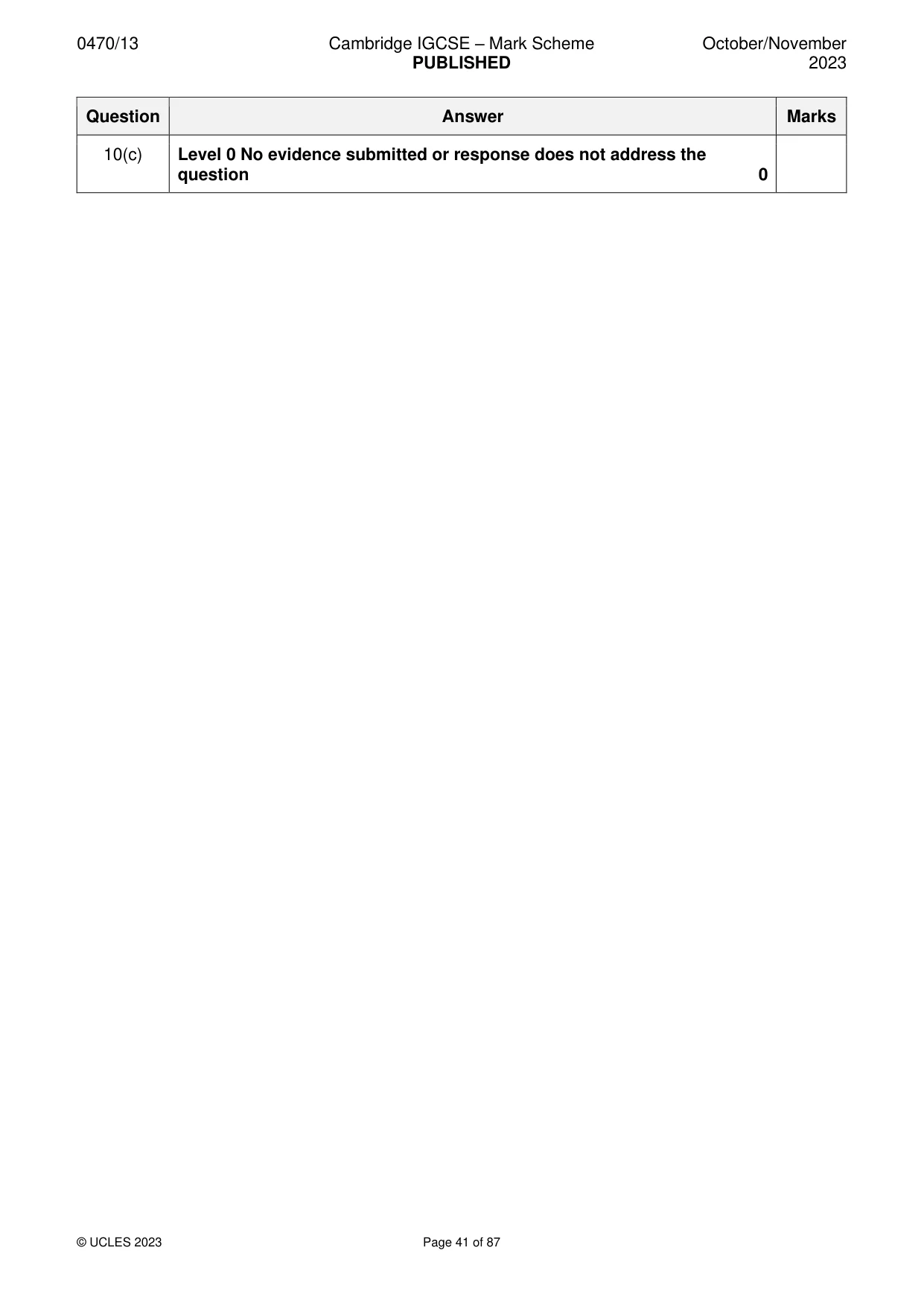
0470/13 Cambridge IGCSE – Mark Scheme PUBLISHED October/November 2023 © UCLES 2023 Page 41 of 87 Question Answer Marks 10(c) Level 0 No evidence submitted or response does not address the question 0
Mark scheme, page 42
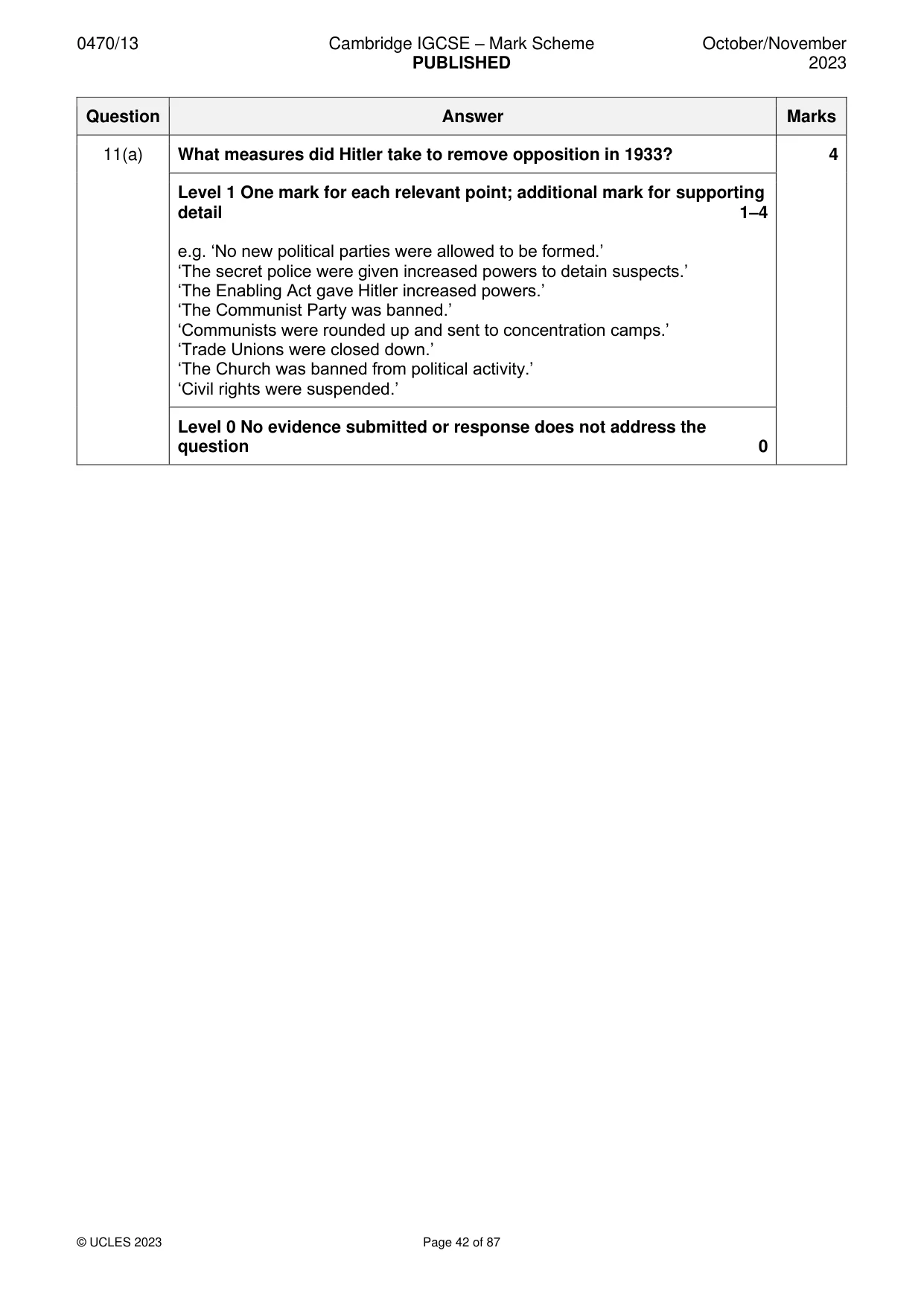
0470/13 Cambridge IGCSE – Mark Scheme PUBLISHED October/November 2023 © UCLES 2023 Page 42 of 87 Question Answer Marks 11(a) What measures did Hitler take to remove opposition in 1933? 4 Level 1 One mark for each relevant point; additional mark for supporting detail 1–4 e.g. ‘No new political parties were allowed to be formed.’ ‘The secret police were given increased powers to detain suspects.’ ‘The Enabling Act gave Hitler increased powers.’ ‘The Communist Party was banned.’ ‘Communists were rounded up and sent to concentration camps.’ ‘Trade Unions were closed down.’ ‘The Church was banned from political activity.’ ‘Civil rights were suspended.’ Level 0 No evidence submitted or response does not address the question 0
Mark scheme, page 43
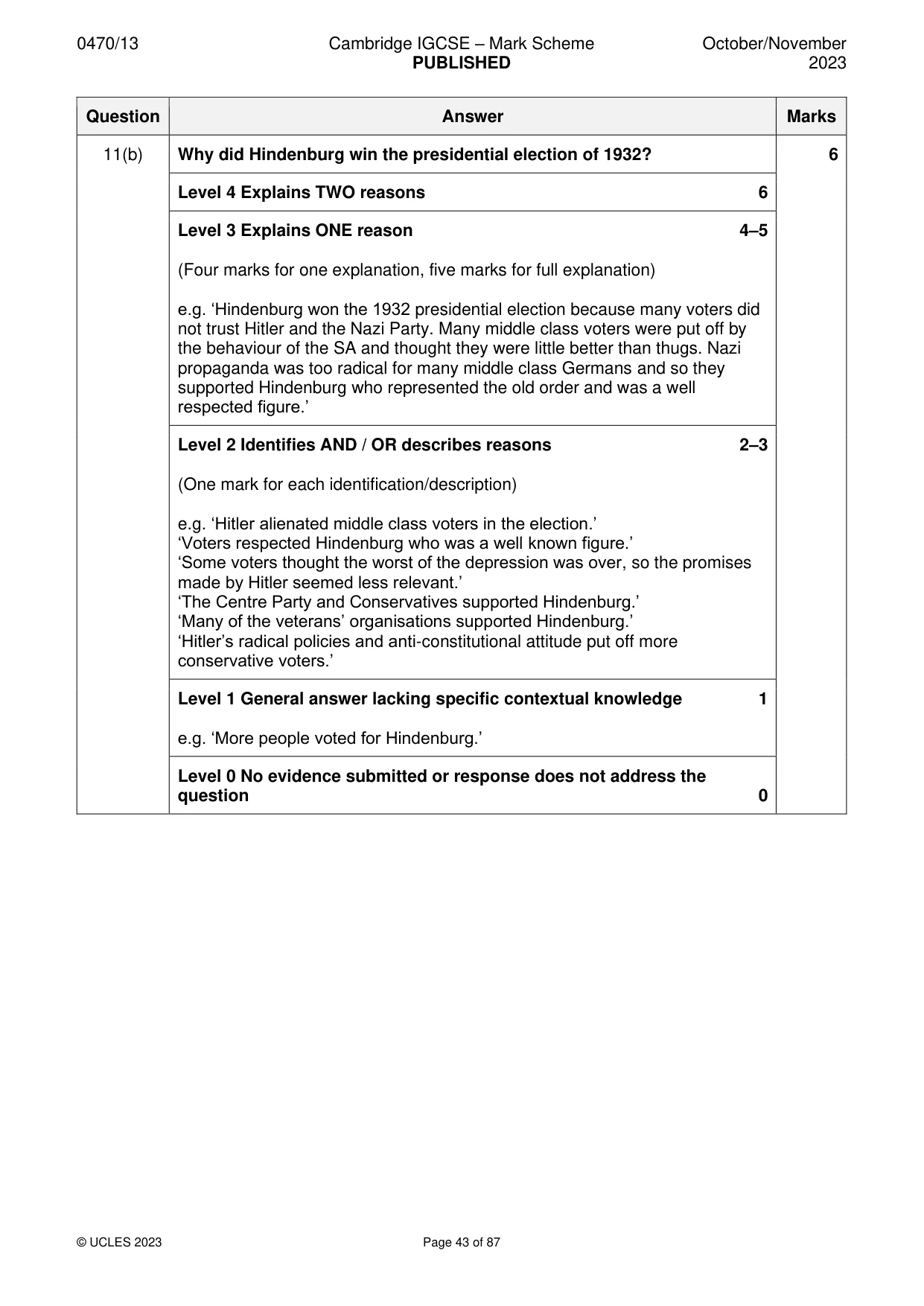
0470/13 Cambridge IGCSE – Mark Scheme PUBLISHED October/November 2023 © UCLES 2023 Page 43 of 87 Question Answer Marks 11(b) Why did Hindenburg win the presidential election of 1932? 6 Level 4 Explains TWO reasons 6 Level 3 Explains ONE reason 4–5 (Four marks for one explanation, five marks for full explanation) e.g. ‘Hindenburg won the 1932 presidential election because many voters did not trust Hitler and the Nazi Party. Many middle class voters were put off by the behaviour of the SA and thought they were little better than thugs. Nazi propaganda was too radical for many middle class Germans and so they supported Hindenburg who represented the old order and was a well respected figure.’ Level 2 Identifies AND / OR describes reasons 2–3 (One mark for each identification/description) e.g. ‘Hitler alienated middle class voters in the election.’ ‘Voters respected Hindenburg who was a well known figure.’ ‘Some voters thought the worst of the depression was over, so the promises made by Hitler seemed less relevant.’ ‘The Centre Party and Conservatives supported Hindenburg.’ ‘Many of the veterans’ organisations supported Hindenburg.’ ‘Hitler’s radical policies and anti-constitutional attitude put off more conservative voters.’ Level 1 General answer lacking specific contextual knowledge 1 e.g. ‘More people voted for Hindenburg.’ Level 0 No evidence submitted or response does not address the question 0
Mark scheme, page 44
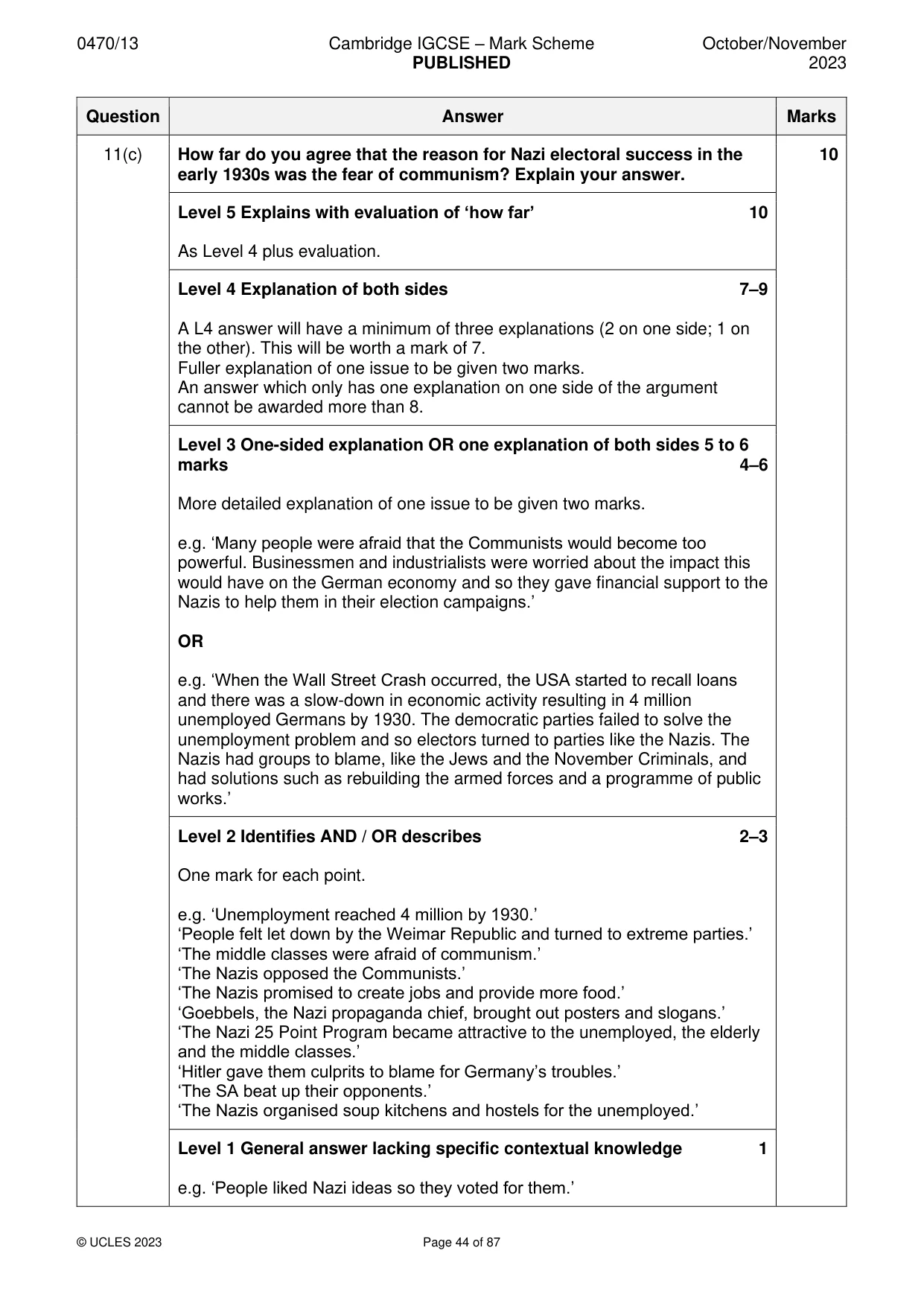
0470/13 Cambridge IGCSE – Mark Scheme PUBLISHED October/November 2023 © UCLES 2023 Page 44 of 87 Question Answer Marks 11(c) How far do you agree that the reason for Nazi electoral success in the early 1930s was the fear of communism? Explain your answer. 10 Level 5 Explains with evaluation of ‘how far’ 10 As Level 4 plus evaluation. Level 4 Explanation of both sides 7–9 A L4 answer will have a minimum of three explanations (2 on one side; 1 on the other). This will be worth a mark of 7. Fuller explanation of one issue to be given two marks. An answer which only has one explanation on one side of the argument cannot be awarded more than 8. Level 3 One-sided explanation OR one explanation of both sides 5 to 6 marks 4–6 More detailed explanation of one issue to be given two marks. e.g. ‘Many people were afraid that the Communists would become too powerful. Businessmen and industrialists were worried about the impact this would have on the German economy and so they gave financial support to the Nazis to help them in their election campaigns.’ OR e.g. ‘When the Wall Street Crash occurred, the USA started to recall loans and there was a slow-down in economic activity resulting in 4 million unemployed Germans by 1930. The democratic parties failed to solve the unemployment problem and so electors turned to parties like the Nazis. The Nazis had groups to blame, like the Jews and the November Criminals, and had solutions such as rebuilding the armed forces and a programme of public works.’ Level 2 Identifies AND / OR describes 2–3 One mark for each point. e.g. ‘Unemployment reached 4 million by 1930.’ ‘People felt let down by the Weimar Republic and turned to extreme parties.’ ‘The middle classes were afraid of communism.’ ‘The Nazis opposed the Communists.’ ‘The Nazis promised to create jobs and provide more food.’ ‘Goebbels, the Nazi propaganda chief, brought out posters and slogans.’ ‘The Nazi 25 Point Program became attractive to the unemployed, the elderly and the middle classes.’ ‘Hitler gave them culprits to blame for Germany’s troubles.’ ‘The SA beat up their opponents.’ ‘The Nazis organised soup kitchens and hostels for the unemployed.’ Level 1 General answer lacking specific contextual knowledge 1 e.g. ‘People liked Nazi ideas so they voted for them.’
Mark scheme, page 45
0470/13 Cambridge IGCSE – Mark Scheme PUBLISHED October/November 2023 © UCLES 2023 Page 45 of 87 Question Answer Marks 11(c) Level 0 No evidence submitted or response does not address the question 0
Mark scheme, page 46
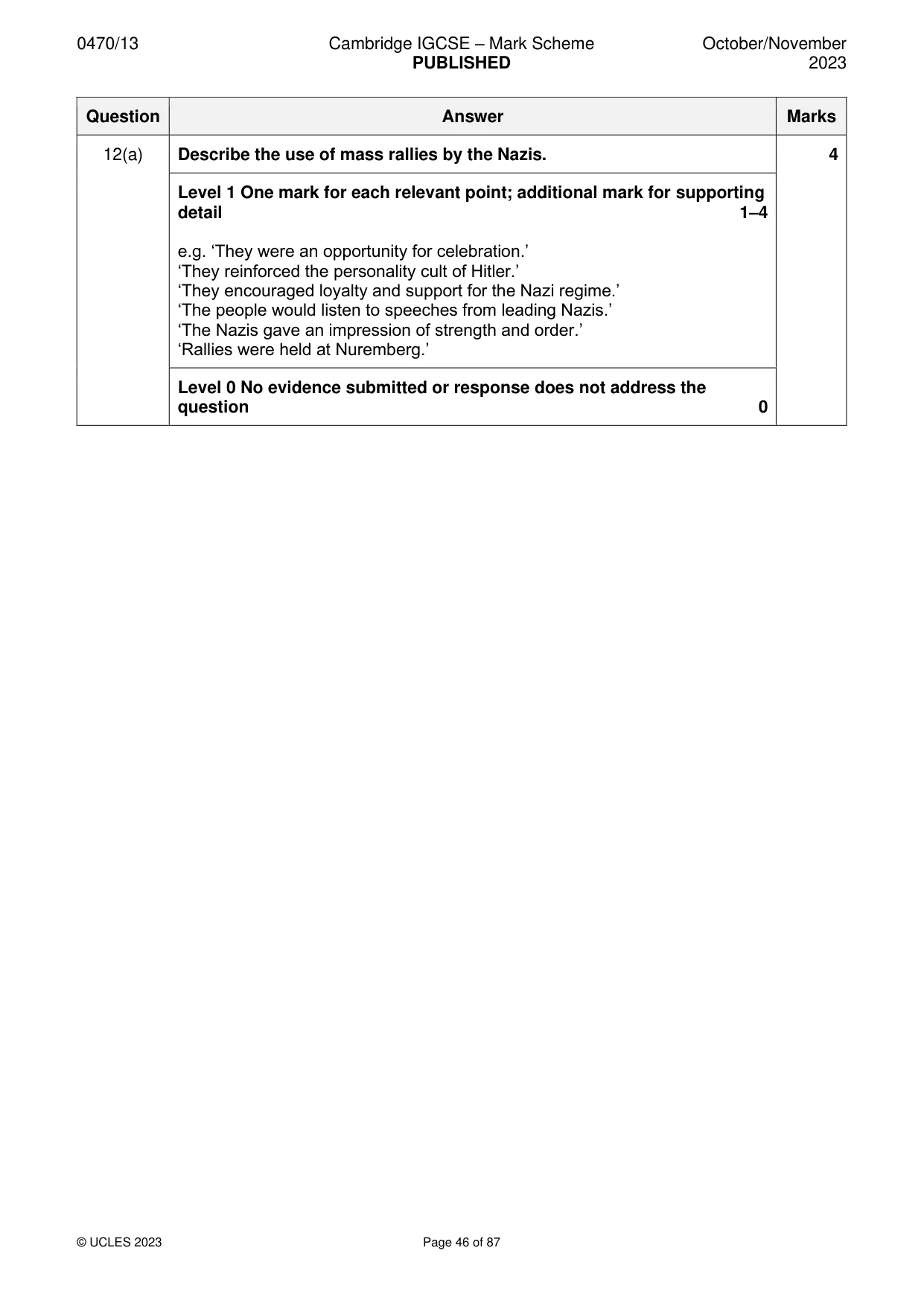
0470/13 Cambridge IGCSE – Mark Scheme PUBLISHED October/November 2023 © UCLES 2023 Page 46 of 87 Question Answer Marks 12(a) Describe the use of mass rallies by the Nazis. 4 Level 1 One mark for each relevant point; additional mark for supporting detail 1–4 e.g. ‘They were an opportunity for celebration.’ ‘They reinforced the personality cult of Hitler.’ ‘They encouraged loyalty and support for the Nazi regime.’ ‘The people would listen to speeches from leading Nazis.’ ‘The Nazis gave an impression of strength and order.’ ‘Rallies were held at Nuremberg.’ Level 0 No evidence submitted or response does not address the question 0
Mark scheme, page 47
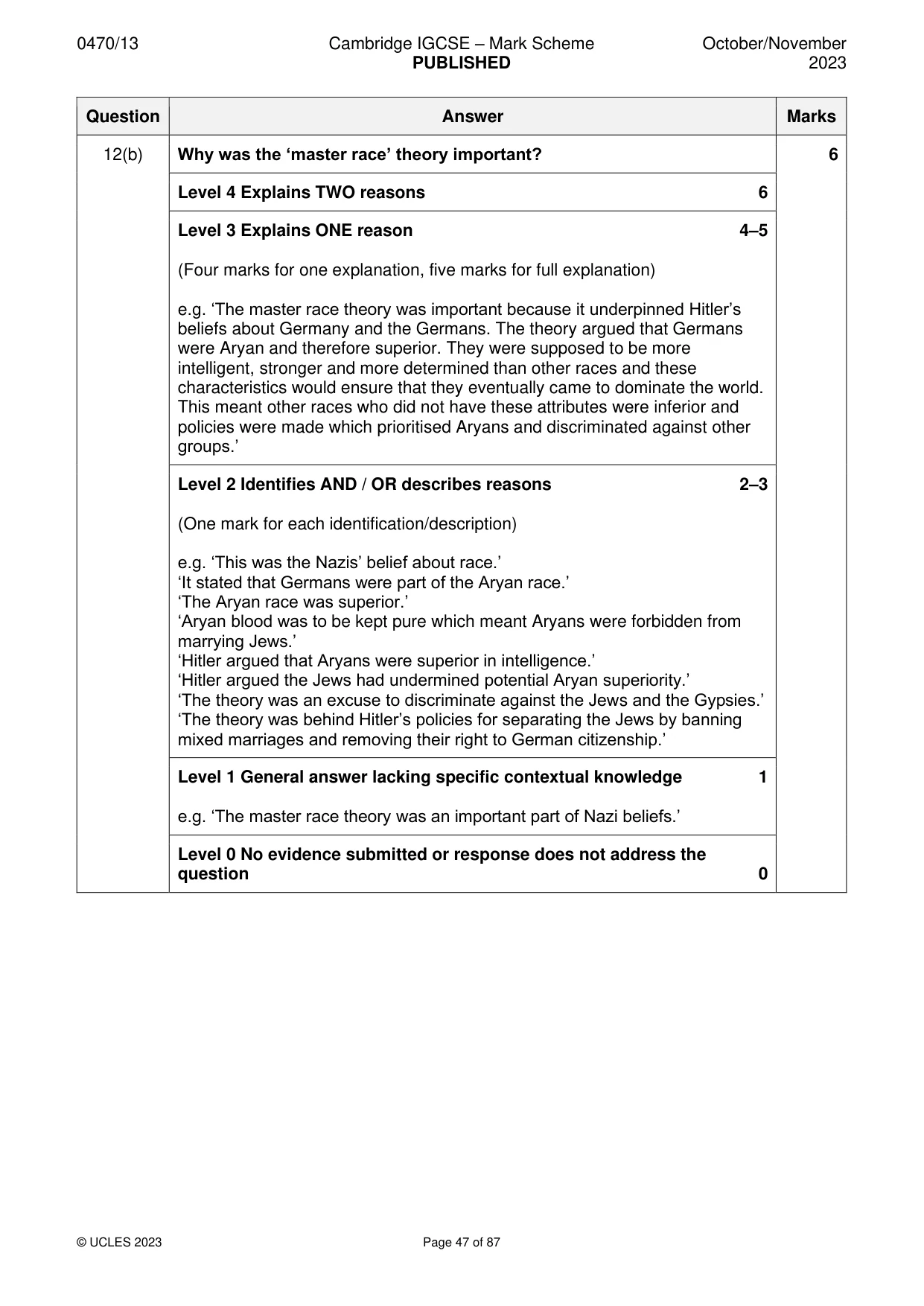
0470/13 Cambridge IGCSE – Mark Scheme PUBLISHED October/November 2023 © UCLES 2023 Page 47 of 87 Question Answer Marks 12(b) Why was the ‘master race’ theory important? 6 Level 4 Explains TWO reasons 6 Level 3 Explains ONE reason 4–5 (Four marks for one explanation, five marks for full explanation) e.g. ‘The master race theory was important because it underpinned Hitler’s beliefs about Germany and the Germans. The theory argued that Germans were Aryan and therefore superior. They were supposed to be more intelligent, stronger and more determined than other races and these characteristics would ensure that they eventually came to dominate the world. This meant other races who did not have these attributes were inferior and policies were made which prioritised Aryans and discriminated against other groups.’ Level 2 Identifies AND / OR describes reasons 2–3 (One mark for each identification/description) e.g. ‘This was the Nazis’ belief about race.’ ‘It stated that Germans were part of the Aryan race.’ ‘The Aryan race was superior.’ ‘Aryan blood was to be kept pure which meant Aryans were forbidden from marrying Jews.’ ‘Hitler argued that Aryans were superior in intelligence.’ ‘Hitler argued the Jews had undermined potential Aryan superiority.’ ‘The theory was an excuse to discriminate against the Jews and the Gypsies.’ ‘The theory was behind Hitler’s policies for separating the Jews by banning mixed marriages and removing their right to German citizenship.’ Level 1 General answer lacking specific contextual knowledge 1 e.g. ‘The master race theory was an important part of Nazi beliefs.’ Level 0 No evidence submitted or response does not address the question 0
Mark scheme, page 48
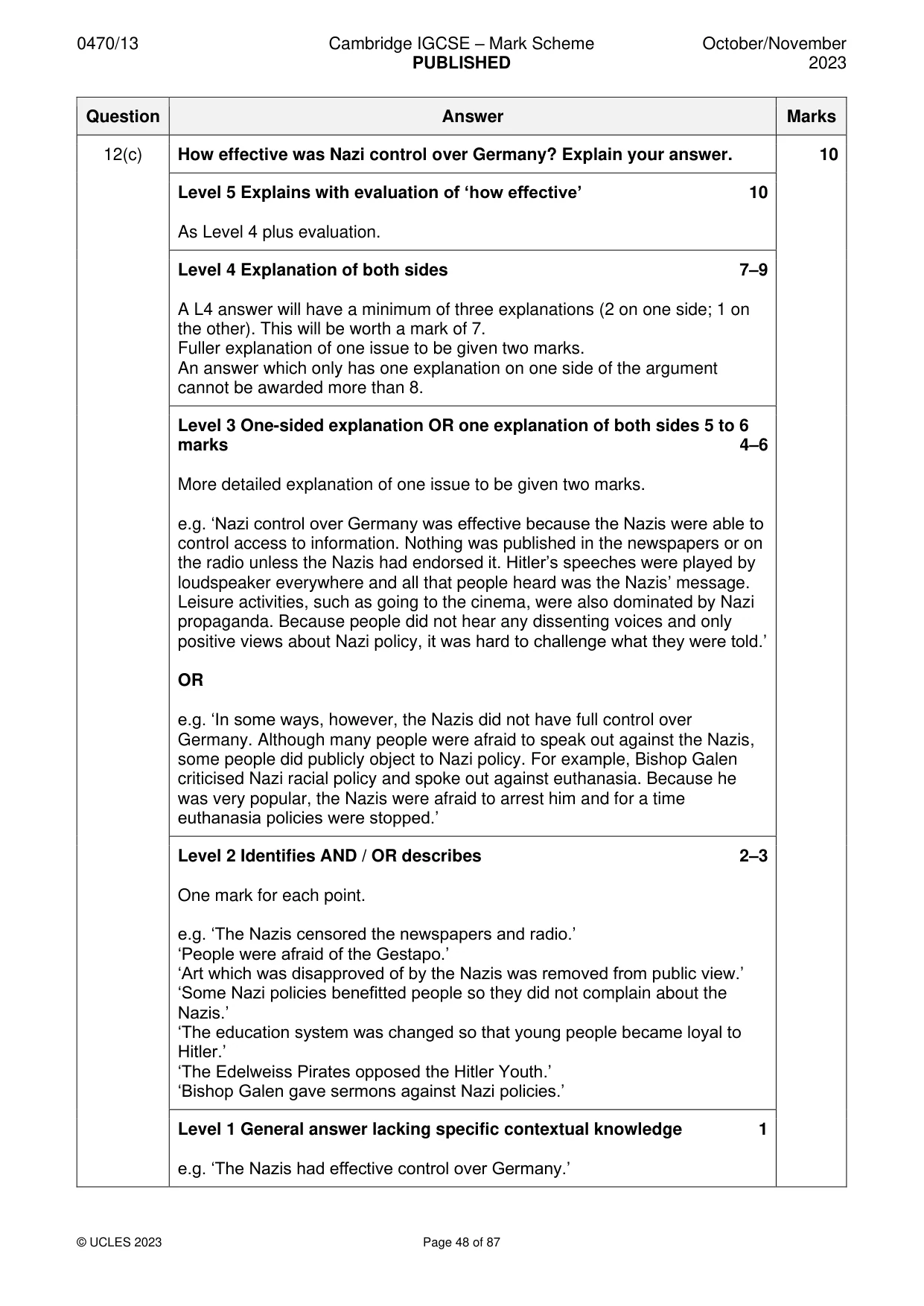
0470/13 Cambridge IGCSE – Mark Scheme PUBLISHED October/November 2023 © UCLES 2023 Page 48 of 87 Question Answer Marks 12(c) How effective was Nazi control over Germany? Explain your answer. 10 Level 5 Explains with evaluation of ‘how effective’ 10 As Level 4 plus evaluation. Level 4 Explanation of both sides 7–9 A L4 answer will have a minimum of three explanations (2 on one side; 1 on the other). This will be worth a mark of 7. Fuller explanation of one issue to be given two marks. An answer which only has one explanation on one side of the argument cannot be awarded more than 8. Level 3 One-sided explanation OR one explanation of both sides 5 to 6 marks 4–6 More detailed explanation of one issue to be given two marks. e.g. ‘Nazi control over Germany was effective because the Nazis were able to control access to information. Nothing was published in the newspapers or on the radio unless the Nazis had endorsed it. Hitler’s speeches were played by loudspeaker everywhere and all that people heard was the Nazis’ message. Leisure activities, such as going to the cinema, were also dominated by Nazi propaganda. Because people did not hear any dissenting voices and only positive views about Nazi policy, it was hard to challenge what they were told.’ OR e.g. ‘In some ways, however, the Nazis did not have full control over Germany. Although many people were afraid to speak out against the Nazis, some people did publicly object to Nazi policy. For example, Bishop Galen criticised Nazi racial policy and spoke out against euthanasia. Because he was very popular, the Nazis were afraid to arrest him and for a time euthanasia policies were stopped.’ Level 2 Identifies AND / OR describes 2–3 One mark for each point. e.g. ‘The Nazis censored the newspapers and radio.’ ‘People were afraid of the Gestapo.’ ‘Art which was disapproved of by the Nazis was removed from public view.’ ‘Some Nazi policies benefitted people so they did not complain about the Nazis.’ ‘The education system was changed so that young people became loyal to Hitler.’ ‘The Edelweiss Pirates opposed the Hitler Youth.’ ‘Bishop Galen gave sermons against Nazi policies.’ Level 1 General answer lacking specific contextual knowledge 1 e.g. ‘The Nazis had effective control over Germany.’
Mark scheme, page 49
0470/13 Cambridge IGCSE – Mark Scheme PUBLISHED October/November 2023 © UCLES 2023 Page 49 of 87 Question Answer Marks 12(c) Level 0 No evidence submitted or response does not address the question 0
Mark scheme, page 50
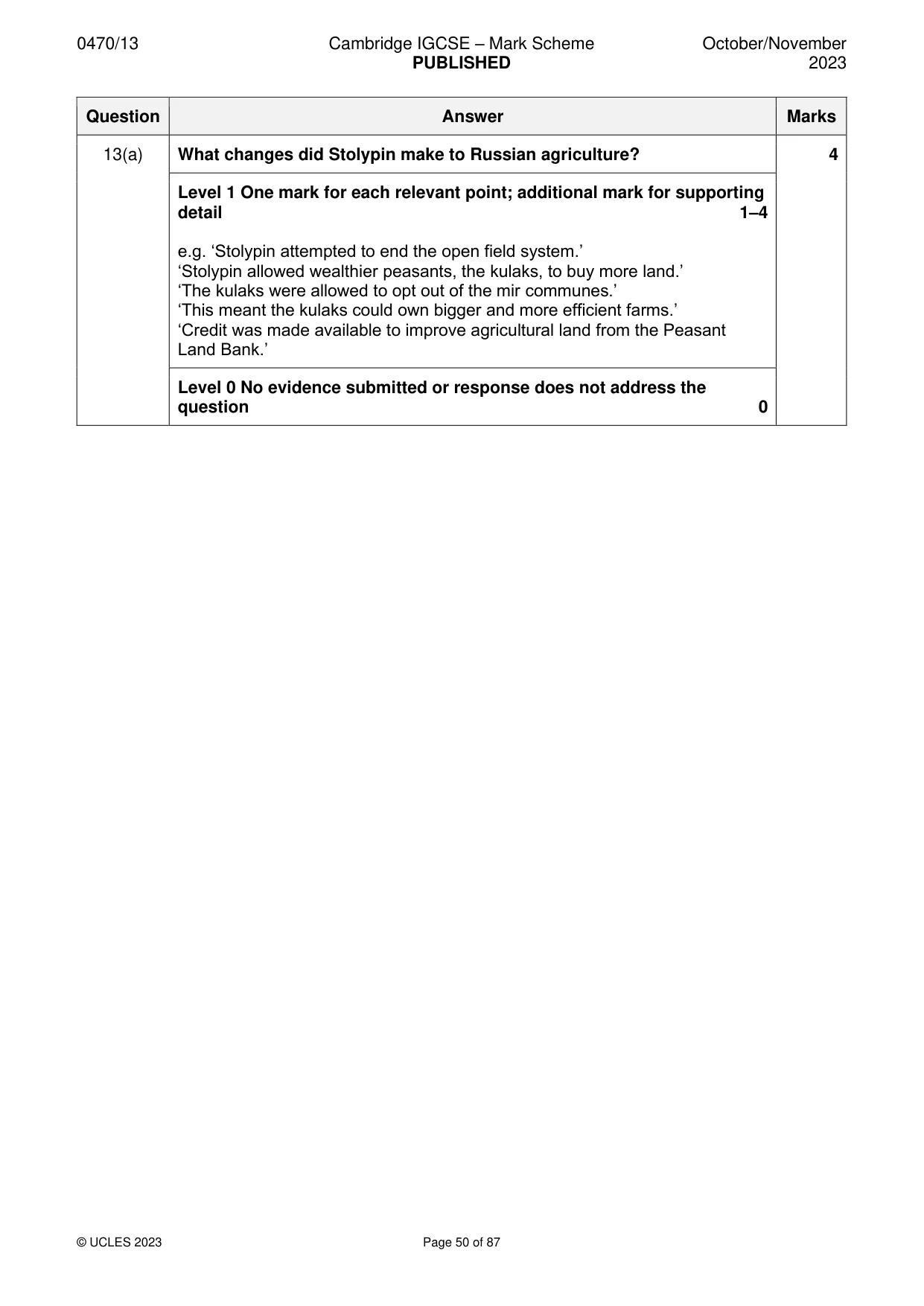
0470/13 Cambridge IGCSE – Mark Scheme PUBLISHED October/November 2023 © UCLES 2023 Page 50 of 87 Question Answer Marks 13(a) What changes did Stolypin make to Russian agriculture? 4 Level 1 One mark for each relevant point; additional mark for supporting detail 1–4 e.g. ‘Stolypin attempted to end the open field system.’ ‘Stolypin allowed wealthier peasants, the kulaks, to buy more land.’ ‘The kulaks were allowed to opt out of the mir communes.’ ‘This meant the kulaks could own bigger and more efficient farms.’ ‘Credit was made available to improve agricultural land from the Peasant Land Bank.’ Level 0 No evidence submitted or response does not address the question 0
Mark scheme, page 51
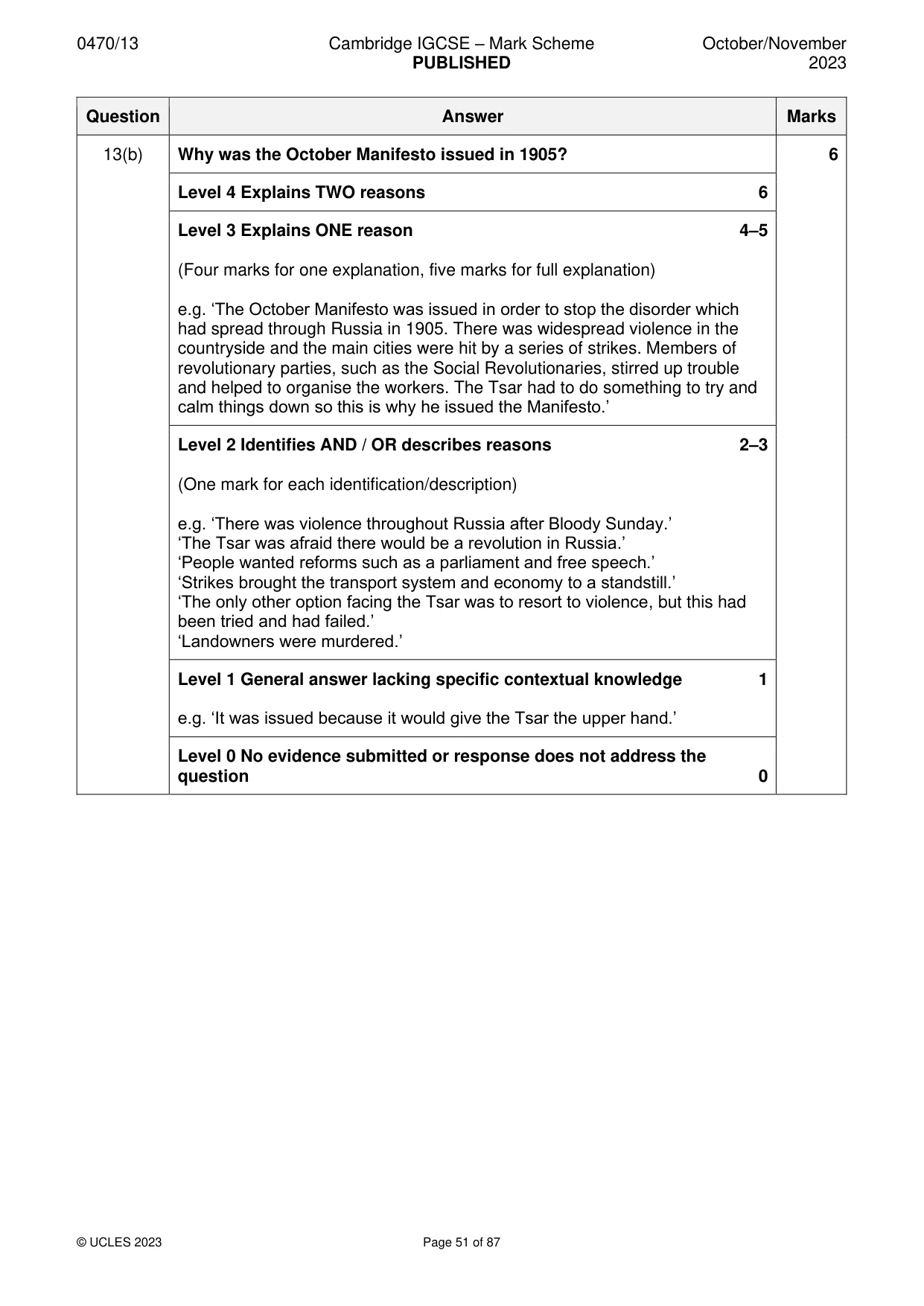
0470/13 Cambridge IGCSE – Mark Scheme PUBLISHED October/November 2023 © UCLES 2023 Page 51 of 87 Question Answer Marks 13(b) Why was the October Manifesto issued in 1905? 6 Level 4 Explains TWO reasons 6 Level 3 Explains ONE reason 4–5 (Four marks for one explanation, five marks for full explanation) e.g. ‘The October Manifesto was issued in order to stop the disorder which had spread through Russia in 1905. There was widespread violence in the countryside and the main cities were hit by a series of strikes. Members of revolutionary parties, such as the Social Revolutionaries, stirred up trouble and helped to organise the workers. The Tsar had to do something to try and calm things down so this is why he issued the Manifesto.’ Level 2 Identifies AND / OR describes reasons 2–3 (One mark for each identification/description) e.g. ‘There was violence throughout Russia after Bloody Sunday.’ ‘The Tsar was afraid there would be a revolution in Russia.’ ‘People wanted reforms such as a parliament and free speech.’ ‘Strikes brought the transport system and economy to a standstill.’ ‘The only other option facing the Tsar was to resort to violence, but this had been tried and had failed.’ ‘Landowners were murdered.’ Level 1 General answer lacking specific contextual knowledge 1 e.g. ‘It was issued because it would give the Tsar the upper hand.’ Level 0 No evidence submitted or response does not address the question 0
Mark scheme, page 52
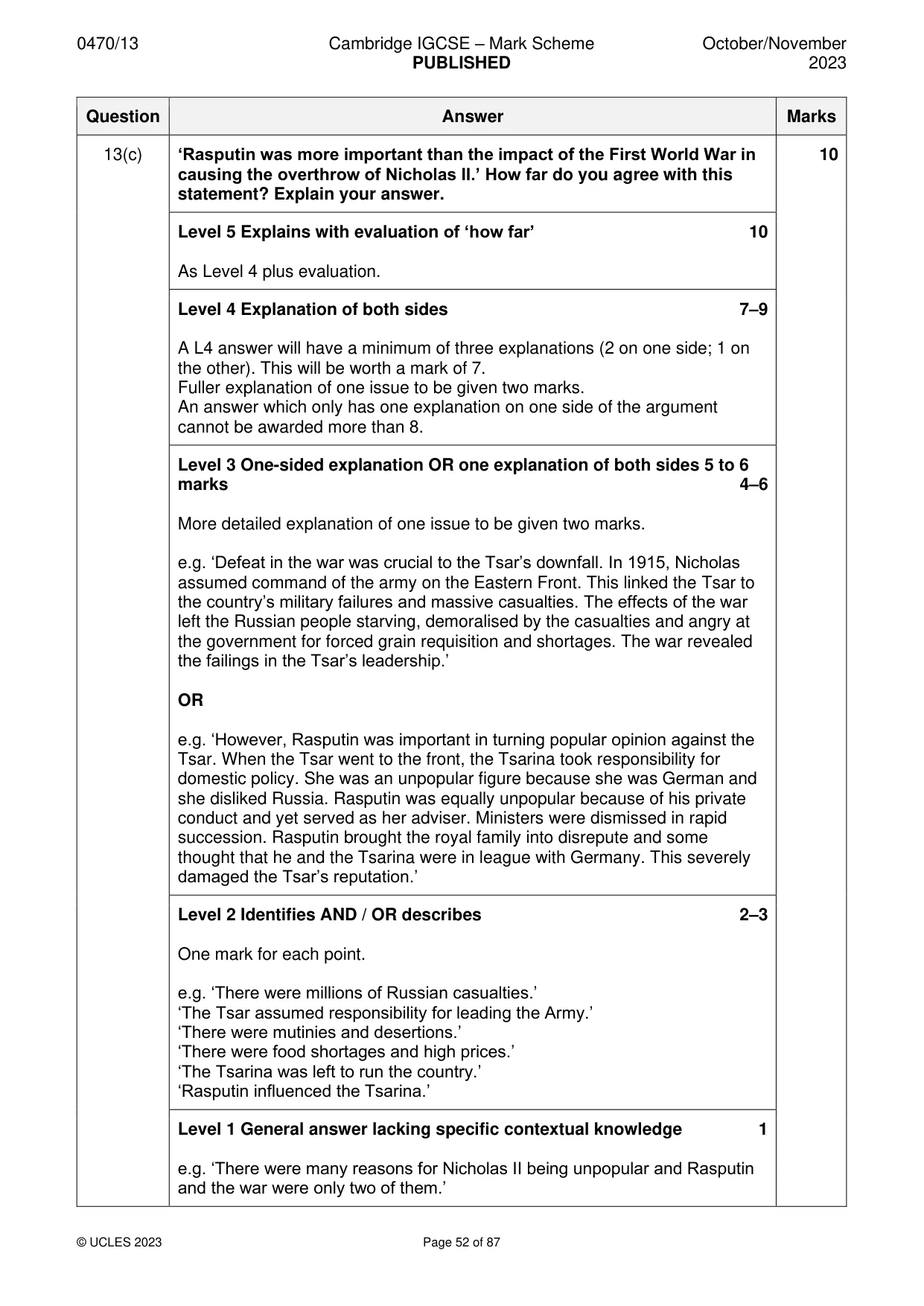
0470/13 Cambridge IGCSE – Mark Scheme PUBLISHED October/November 2023 © UCLES 2023 Page 52 of 87 Question Answer Marks 13(c) ‘Rasputin was more important than the impact of the First World War in causing the overthrow of Nicholas II.’ How far do you agree with this statement? Explain your answer. 10 Level 5 Explains with evaluation of ‘how far’ 10 As Level 4 plus evaluation. Level 4 Explanation of both sides 7–9 A L4 answer will have a minimum of three explanations (2 on one side; 1 on the other). This will be worth a mark of 7. Fuller explanation of one issue to be given two marks. An answer which only has one explanation on one side of the argument cannot be awarded more than 8. Level 3 One-sided explanation OR one explanation of both sides 5 to 6 marks 4–6 More detailed explanation of one issue to be given two marks. e.g. ‘Defeat in the war was crucial to the Tsar’s downfall. In 1915, Nicholas assumed command of the army on the Eastern Front. This linked the Tsar to the country’s military failures and massive casualties. The effects of the war left the Russian people starving, demoralised by the casualties and angry at the government for forced grain requisition and shortages. The war revealed the failings in the Tsar’s leadership.’ OR e.g. ‘However, Rasputin was important in turning popular opinion against the Tsar. When the Tsar went to the front, the Tsarina took responsibility for domestic policy. She was an unpopular figure because she was German and she disliked Russia. Rasputin was equally unpopular because of his private conduct and yet served as her adviser. Ministers were dismissed in rapid succession. Rasputin brought the royal family into disrepute and some thought that he and the Tsarina were in league with Germany. This severely damaged the Tsar’s reputation.’ Level 2 Identifies AND / OR describes 2–3 One mark for each point. e.g. ‘There were millions of Russian casualties.’ ‘The Tsar assumed responsibility for leading the Army.’ ‘There were mutinies and desertions.’ ‘There were food shortages and high prices.’ ‘The Tsarina was left to run the country.’ ‘Rasputin influenced the Tsarina.’ Level 1 General answer lacking specific contextual knowledge 1 e.g. ‘There were many reasons for Nicholas II being unpopular and Rasputin and the war were only two of them.’
Mark scheme, page 53
0470/13 Cambridge IGCSE – Mark Scheme PUBLISHED October/November 2023 © UCLES 2023 Page 53 of 87 Question Answer Marks 13(c) Level 0 No evidence submitted or response does not address the question 0
Mark scheme, page 54
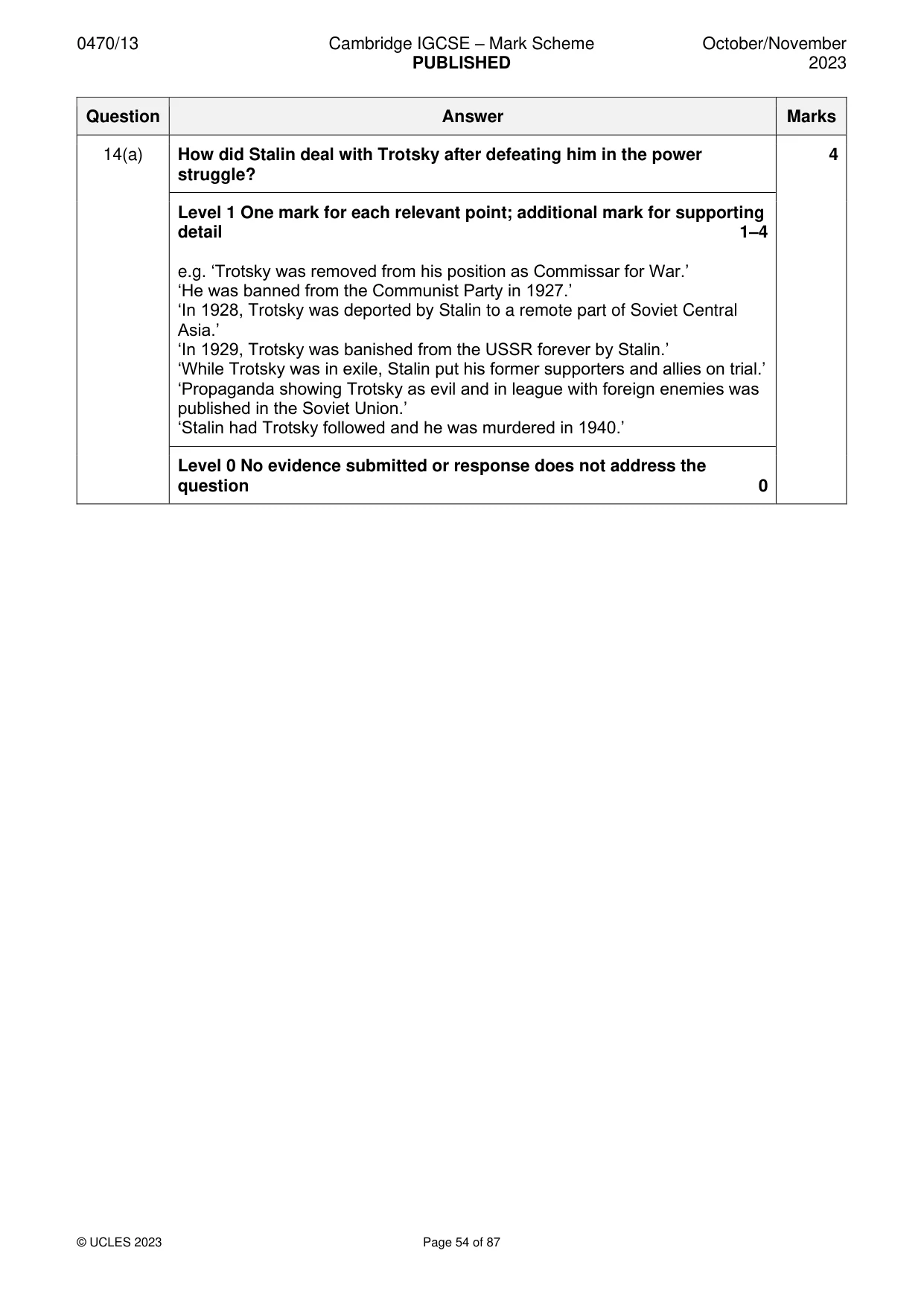
0470/13 Cambridge IGCSE – Mark Scheme PUBLISHED October/November 2023 © UCLES 2023 Page 54 of 87 Question Answer Marks 14(a) How did Stalin deal with Trotsky after defeating him in the power struggle? 4 Level 1 One mark for each relevant point; additional mark for supporting detail 1–4 e.g. ‘Trotsky was removed from his position as Commissar for War.’ ‘He was banned from the Communist Party in 1927.’ ‘In 1928, Trotsky was deported by Stalin to a remote part of Soviet Central Asia.’ ‘In 1929, Trotsky was banished from the USSR forever by Stalin.’ ‘While Trotsky was in exile, Stalin put his former supporters and allies on trial.’ ‘Propaganda showing Trotsky as evil and in league with foreign enemies was published in the Soviet Union.’ ‘Stalin had Trotsky followed and he was murdered in 1940.’ Level 0 No evidence submitted or response does not address the question 0
Mark scheme, page 55
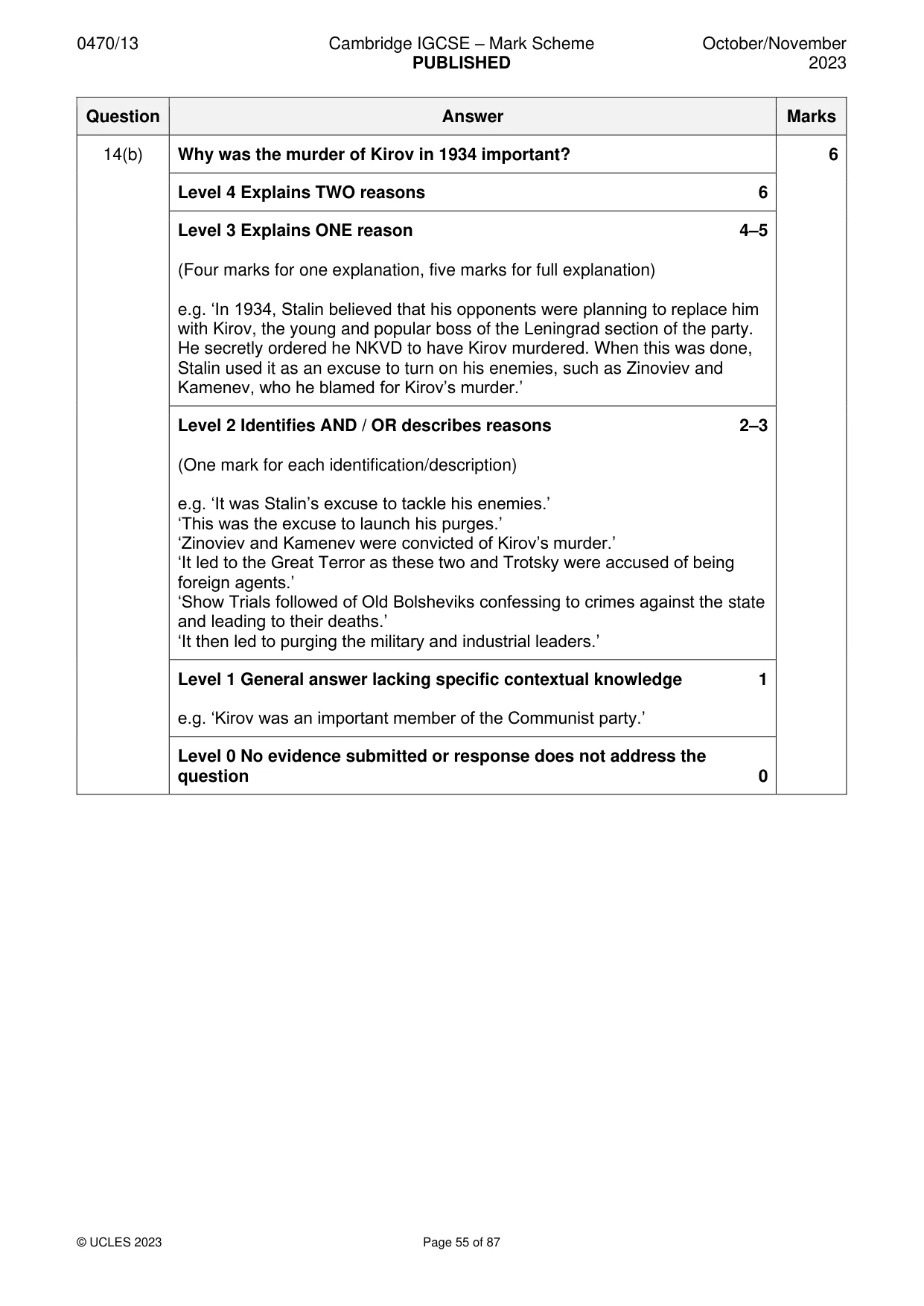
0470/13 Cambridge IGCSE – Mark Scheme PUBLISHED October/November 2023 © UCLES 2023 Page 55 of 87 Question Answer Marks 14(b) Why was the murder of Kirov in 1934 important? 6 Level 4 Explains TWO reasons 6 Level 3 Explains ONE reason 4–5 (Four marks for one explanation, five marks for full explanation) e.g. ‘In 1934, Stalin believed that his opponents were planning to replace him with Kirov, the young and popular boss of the Leningrad section of the party. He secretly ordered he NKVD to have Kirov murdered. When this was done, Stalin used it as an excuse to turn on his enemies, such as Zinoviev and Kamenev, who he blamed for Kirov’s murder.’ Level 2 Identifies AND / OR describes reasons 2–3 (One mark for each identification/description) e.g. ‘It was Stalin’s excuse to tackle his enemies.’ ‘This was the excuse to launch his purges.’ ‘Zinoviev and Kamenev were convicted of Kirov’s murder.’ ‘It led to the Great Terror as these two and Trotsky were accused of being foreign agents.’ ‘Show Trials followed of Old Bolsheviks confessing to crimes against the state and leading to their deaths.’ ‘It then led to purging the military and industrial leaders.’ Level 1 General answer lacking specific contextual knowledge 1 e.g. ‘Kirov was an important member of the Communist party.’ Level 0 No evidence submitted or response does not address the question 0
Mark scheme, page 56
0470/13 Cambridge IGCSE – Mark Scheme PUBLISHED October/November 2023 © UCLES 2023 Page 56 of 87 Question Answer Marks 14(c) ‘The use of terror was the most important factor in giving Stalin control over the Soviet Union.’ How far do you agree with this statement? Explain your answer. 10 Level 5 Explains with evaluation of ‘how far’ 10 As Level 4 plus evaluation. Level 4 Explanation of both sides 7–9 A L4 answer will have a minimum of three explanations (2 on one side; 1 on the other). This will be worth a mark of 7. Fuller explanation of one issue to be given two marks. An answer which only has one explanation on one side of the argument cannot be awarded more than 8. Level 3 One-sided explanation OR one explanation of both sides 5 to 6 marks 4–6 More detailed explanation of one issue to be given two marks. e.g. ‘The use of terror was important to Stalin in giving him control over the Soviet Union. The NKVD (secret police) were ruthless and efficient in capturing those who spoke against the regime or were accused of speaking out against the regime. Show trials were held in which former Bolsheviks were tried and executed. These were the start of the purges where a wide range of ‘opponents’ were rounded up, executed or sent to the gulags. This created a climate of fear where no one was prepared to speak out against Stalin for fear of the consequences, and this gave Stalin control.’ OR e.g. ‘However, Stalin also controlled propaganda and this gave him control. The only messages people heard were positive – always about how Stalin was helping the Soviet Union and the country was making great progress industrially. People wanted to believe that Russia was a strong and great country and so many were willing to believe what they were told. They were encouraged to look up to Stalin as a father figure who had their best interests at heart. This meant that some supported Stalin because they believed what he was doing was good rather than because they were frightened of him.’
Mark scheme, page 57
0470/13 Cambridge IGCSE – Mark Scheme PUBLISHED October/November 2023 © UCLES 2023 Page 57 of 87 Question Answer Marks 14(c) Level 2 Identifies AND / OR describes 2–3 One mark for each point. e.g. ‘Stalin controlled the NKVD.’ ‘Former Bolsheviks were put on public trial.’ ‘Thousands of people were executed.’ ‘No one was safe from denunciation as an ‘enemy of the people’.’ ‘Millions of people were sent to work in the gulags.’ ‘Propaganda convinced people that Stalin was solving the problems facing the USSR.’ ‘Successes in industry were exaggerated and celebrated.’ ‘Young people joined the Komsomol because they believed Stalin’s policies would bring a great future for Russia.’ ‘Stalin promised to make the USSR strong against foreign attack.’ Level 1 General answer lacking specific contextual knowledge 1 e.g. ‘Stalin had lots of ways of controlling the people and making sure they did not oppose him.’ Level 0 No evidence submitted or response does not address the question 0
Mark scheme, page 58
0470/13 Cambridge IGCSE – Mark Scheme PUBLISHED October/November 2023 © UCLES 2023 Page 58 of 87 Question Answer Marks 15(a) What was the ‘Red Scare’? 4 Level 1 One mark for each relevant point; additional mark for supporting detail 1–4 e.g. ‘It was a fear of Communism or Bolshevism.’ ‘It was a fear of anarchist ideas being put into practice.’ ‘It was the fear of immigrants bringing Communist ideas from Eastern Europe to the US.’ ‘People blamed left wing ideas for a series of strikes which broke out in 1919.’ ‘A series of bomb blasts in 1919 suggested a conspiracy against the state.’ ‘One blast damaged the home of the Attorney General, Mitchell Palmer.’ ‘Suspected anarchists and communists were arrested and many were deported.’ Level 0 No evidence submitted or response does not address the question 0
Mark scheme, page 59
0470/13 Cambridge IGCSE – Mark Scheme PUBLISHED October/November 2023 © UCLES 2023 Page 59 of 87 Question Answer Marks 15(b) Why was the ‘Monkey Trial’ controversial? 6 Level 4 Explains TWO reasons 6 Level 3 Explains ONE reason 4–5 (Four marks for one explanation, five marks for full explanation) e.g. ‘The Monkey Trial was controversial because a biology teacher called John Scopes was put on trial for teaching the theory of evolution. Fundamental Christians said this went against the Bible, even though many scientists agreed with evolution.’ Level 2 Identifies AND / OR describes reasons 2–3 (One mark for each identification/description) e.g. ‘Scopes was put on trial for teaching evolution.’ ‘He was fined $100.’ ‘The case against him was led by a Fundamentalist William Jennings Bryan.’ ‘Fundamental Christians were trying to control the school curriculum.’ ‘Bryan was ridiculed when he tried to defend the Bible’s version of creation.’ ‘Many scientists argued that the evolution theory was correct.’ Level 1 General answer lacking specific contextual knowledge 1 e.g. ‘Not everyone agreed with what happened.’ Level 0 No evidence submitted or response does not address the question 0
Mark scheme, page 60
0470/13 Cambridge IGCSE – Mark Scheme PUBLISHED October/November 2023 © UCLES 2023 Page 60 of 87 Question Answer Marks 15(c) How far do you agree that Prohibition was introduced because of the influence of the First World War? Explain your answer. 10 Level 5 Explains with evaluation of ‘how far’ 10 As Level 4 plus evaluation. Level 4 Explanation of both sides 7–9 A L4 answer will have a minimum of three explanations (2 on one side; 1 on the other). This will be worth a mark of 7. Fuller explanation of one issue to be given two marks. An answer which only has one explanation on one side of the argument cannot be awarded more than 8. Level 3 One-sided explanation OR one explanation of both sides 5 to 6 marks 4–6 More detailed explanation of one issue to be given two marks. e.g. ‘It was claimed that alcohol caused social problems such as poverty, crime, violence and ill health. The Anti-Saloon League and the Women’s Temperance Union were strong campaigners for abolition, suggesting the USA would be a better place.’ OR e.g. ‘Many American brewers were descended from German families. It was claimed that drinking alcohol was linked to German aggression and it was considered unpatriotic to drink. There was strong anti-German feeling after the war. There were also concerns about shortages in wartime and some thought, in the circumstances, it would be better to use the grain used for beer to make bread instead.’ Level 2 Identifies AND / OR describes 2–3 One mark for each point. e.g. ‘Some individual states already had Prohibition laws.’ ‘Prohibition might lead to a decrease in crime and poverty.’ ‘The Protestant Church thought it would improve moral standards and family life in the big cities.’ ‘Many American brewers were of German descent and there was anti- German feeling just after the First World War.’ ‘Some politicians saw it as a chance to pick up votes.’ Level 1 General answer lacking specific contextual knowledge 1 e.g. ‘Prohibition caused problems in the USA.’ Level 0 No evidence submitted or response does not address the question 0
Mark scheme, page 61
0470/13 Cambridge IGCSE – Mark Scheme PUBLISHED October/November 2023 © UCLES 2023 Page 61 of 87 Question Answer Marks 16(a) What were the ‘alphabet agencies’? 4 Level 1 One mark for each relevant point; additional mark for supporting detail 1–4 e.g. ‘They were designed to help the American people.’ ‘They gave work to the unemployed.’ ‘The AAA was designed to help farmers.’ ‘The PWA created employment through construction schemes.’ ‘FERA provided emergency assistance to the poor.’ Level 0 No evidence submitted or response does not address the question 0
Mark scheme, page 62
0470/13 Cambridge IGCSE – Mark Scheme PUBLISHED October/November 2023 © UCLES 2023 Page 62 of 87 Question Answer Marks 16(b) Why did some radicals oppose the New Deal? 6 Level 4 Explains TWO reasons 6 Level 3 Explains ONE reason 4–5 (Four marks for one explanation, five marks for full explanation) e.g. ‘Some radicals, such as Huey Long criticised the New Deal for not doing enough. He put forward a scheme called ‘Share Our Wealth’ which proposed the things he wanted to see which the New Deal was not doing. He wanted to reduce personal fortunes to a maximum of $3 million and a maximum annual income of $1 million. For the over sixties, he proposed a pension and a free washing machine and radio.’ Level 2 Identifies AND / OR describes reasons 2–3 (One mark for each identification/description) e.g. ‘Some thought the New Deal did not go far enough.’ ‘Long wanted greater wealth redistribution.’ ‘He wanted to tax more heavily the large corporations.’ ‘He wanted tax revenues to be shared out equally among all Americans.’ ‘Some, such as Father Coughlin, thought the New Deal did not do enough to help the poor.’ ‘Not enough was being done to support the elderly.’ ‘Townsend Clubs were formed to campaign for pensions for the over 60s.’ Level 1 General answer lacking specific contextual knowledge 1 e.g. ‘The radicals did not like New Deal policies.’ Level 0 No evidence submitted or response does not address the question 0
Mark scheme, page 63
0470/13 Cambridge IGCSE – Mark Scheme PUBLISHED October/November 2023 © UCLES 2023 Page 63 of 87 Question Answer Marks 16(c) ‘The New Deal was a success.’ How far do you agree with this statement? Explain your answer. 10 Level 5 Explains with evaluation of ‘how far’ 10 As Level 4 plus evaluation. Level 4 Explanation of both sides 7–9 A L4 answer will have a minimum of three explanations (2 on one side; 1 on the other). This will be worth a mark of 7. Fuller explanation of one issue to be given two marks. An answer which only has one explanation on one side of the argument cannot be awarded more than 8. Level 3 One-sided explanation OR one explanation of both sides 5 to 6 marks 4–6 More detailed explanation of one issue to be given two marks. e.g. ‘In some ways the New Deal could be argued to be a success. It created jobs for people and unemployment fell by over 30% between 1933 and 1939. It also introduced structural changes to the banking system through the EBA and this meant it saved more businesses from collapse. Agencies such as the TVA and WPA were important in providing work for many Americans and this spurred on the growth of the economy.’ OR e.g. ‘However, there were still problems in the economy which the New Deal failed to fix. Some argued that it was only the Second World War which really rescued the economy and there was an increase in unemployment in the late 1930s. The New Deal also did little to address the problems facing many farmers who were forced off the land in a bid to reduce overproduction.’ Level 2 Identifies AND / OR describes 2–3 One mark for each point. e.g. ‘The New Deal helped people to keep their homes.’ ‘The New Deal helped the unemployed.’ ‘The New Deal restored confidence in the banking system.’ ‘The New Deal showed the government was willing to help people.’ ‘Industrial workers had their faith restored.’ ‘Farm tenants and sharecroppers did not have their faith restored.’ ‘Some New Deal agencies discriminated against black Americans.’ ‘The Social Security Act did not help to restore the faith of all women.’ ‘Native Americans were still a poor and excluded group in American society.’ ‘Unemployment remained high.’ Level 1 General answer lacking specific contextual knowledge 1 e.g. ‘The New Deal did lots of good things but it also didn’t solve every problem.’
Mark scheme, page 64
0470/13 Cambridge IGCSE – Mark Scheme PUBLISHED October/November 2023 © UCLES 2023 Page 64 of 87 Question Answer Marks 16(c) Level 0 No evidence submitted or response does not address the question 0
Mark scheme, page 65
0470/13 Cambridge IGCSE – Mark Scheme PUBLISHED October/November 2023 © UCLES 2023 Page 65 of 87 Question Answer Marks 17(a) What were the extermination campaigns? 4 Level 1 One mark for each relevant point; additional mark for supporting detail 1–4 e.g. ‘The extermination campaigns were a series of attacks on the Communists to try and destroy them completely.’ ‘They took place between October 1930 and October 1934.’ ‘They were led by Chiang Kai-shek.’ ‘In October 1930 the Communists were attacked in Jiangxi.’ ‘The final campaign was launched towards the end of 1933.’ ‘The Communists were heavily defeated and forced to retreat.’ Level 0 No evidence submitted or response does not address the question 0
Mark scheme, page 66
0470/13 Cambridge IGCSE – Mark Scheme PUBLISHED October/November 2023 © UCLES 2023 Page 66 of 87 Question Answer Marks 17(b) Why was Yenan important to the Communists? 6 Level 4 Explains TWO reasons 6 Level 3 Explains ONE reason 4–5 (Four marks for one explanation, five marks for full explanation) e.g. ‘At Yenan the Communists really became the party of the peasants. Mao encouraged the Communists to support the peasants and this meant they had a strong power base for the future. Their numbers recovered as people joined them.’ Level 2 Identifies AND / OR describes reasons 2–3 (One mark for each identification/description) e.g. ‘The stay at Yenan gave Mao a chance to educate his followers in his ideas of how China would develop under Communism.’ ‘Journalists visited Yenan which allowed Mao to spread ideas about the Communists and about Nationalist atrocities.’ ‘Yenan became the headquarters of the Communists after the Long March.’ ‘The Communists stayed there for 13 years.’ ‘It gave them protection from the KMT.’ ‘It gave the CCP time to recover.’ ‘Membership grew to 100 000 by 1937.’ Level 1 General answer lacking specific contextual knowledge 1 e.g. ‘The Communists grew stronger when they were at Yenan.’ Level 0 No evidence submitted or response does not address the question 0
Mark scheme, page 67
0470/13 Cambridge IGCSE – Mark Scheme PUBLISHED October/November 2023 © UCLES 2023 Page 67 of 87 Question Answer Marks 17(c) ‘The Communists triumphed over the Nationalists because of Mao’s leadership.’ How far do you agree with this statement? Explain your answer. 10 Level 5 Explains with evaluation of ‘how far’ 10 As Level 4 plus evaluation. Level 4 Explanation of both sides 7–9 A L4 answer will have a minimum of three explanations (2 on one side; 1 on the other). This will be worth a mark of 7. Fuller explanation of one issue to be given two marks. An answer which only has one explanation on one side of the argument cannot be awarded more than 8. Level 3 One-sided explanation OR one explanation of both sides 5 to 6 marks 4–6 More detailed explanation of one issue to be given two marks. e.g. ‘Mao proved to be a very skilful leader and was important to the Communist victory. The Long March ensured the survival of the party and gave Mao the support of many party members. Mao knew it was also most important to win over the support of the peasants. The Red Army were instructed to be respectful towards the peasants and rents were reduced and land redistributed which won Mao many supporters among the peasantry. Mao also realised that the Communists could not afford to launch large scale battles which would bring heavy losses and so focused on using guerrilla tactics instead.’ OR e.g. ‘However, there were other reasons why the Communists triumphed. Many were to do with the KMT who were not well led, were seen as corrupt and ignored the peasants. The KMT relied on foreign aid and were not prepared to fight the Japanese. Eventually, the US refused to supply more aid to the KMT so they could not defeat the Communists. They did not offer solutions to the problems facing the Chinese economy and so many peasants decided to support the Communists instead.’ Level 2 Identifies AND / OR describes 2–3 One mark for each point. e.g. ‘Mao worked hard to win the support of the peasants.’ ‘Mao was seen as a hero because of the Long March.’ ‘The Red Army won over the support of the peasants.’ ‘The KMT were corrupt and did not care about the peasants.’ ‘The reputation of the KMT suffered as they did not fight against the Japanese.’ ‘Mao’s military tactics were superior.’
Mark scheme, page 68
0470/13 Cambridge IGCSE – Mark Scheme PUBLISHED October/November 2023 © UCLES 2023 Page 68 of 87 Question Answer Marks 17(c) Level 1 General answer lacking specific contextual knowledge 1 e.g. ‘Mao was the leader of the Communists and he was much better than the leader of the Nationalists.’ Level 0 No evidence submitted or response does not address the question 0
Mark scheme, page 69
0470/13 Cambridge IGCSE – Mark Scheme PUBLISHED October/November 2023 © UCLES 2023 Page 69 of 87 Question Answer Marks 18(a) Describe the assistance given to China by the Soviet Union in the 1950s. 4 Level 1 One mark for each relevant point; additional mark for supporting detail 1–4 e.g. ‘China and the USSR signed the Sino-Soviet Treaty of Friendship and Alliance.’ ‘The USSR gave China a $300 million low-interest loan.’ ‘The loan was spread over five years.’ ‘There was a 30 year military alliance between the two countries.’ ‘Russian industrialists and advisers were sent to help China develop its economy.’ ‘The ports of Dalian and Lushun were to be returned to China.’ Level 0 No evidence submitted or response does not address the question 0
Mark scheme, page 70
0470/13 Cambridge IGCSE – Mark Scheme PUBLISHED October/November 2023 © UCLES 2023 Page 70 of 87 Question Answer Marks 18(b) Why did Sino-Soviet relations change in the 1960s? 6 Level 4 Explains TWO reasons 6 Level 3 Explains ONE reason 4–5 (Four marks for one explanation, five marks for full explanation) e.g. ‘Mao did not agree with Khrushchev and thought that some of his policies were wrong. Mao thought Khrushchev was betraying Marx and Lenin by suggesting the USSR and the West should co-exist. He also thought it was wrong to give privileges to Party members and experts so they lost contact with the people. This attitude caused the rift between the two to deepen.’ Level 2 Identifies AND / OR describes reasons 2–3 (One mark for each identification/description) e.g. ‘Mao did not agree with peaceful co-existence.’ ‘Mao thought Khrushchev’s secret speech against Stalin was wrong.’ ‘Khrushchev irritated Mao by criticising his economic policies.’ ‘Khrushchev refused to support China in border disputes with India.’ ‘Mao thought Khrushchev was betraying Marxism.’ Level 1 General answer lacking specific contextual knowledge 1 e.g. ‘Relations changed because the leaders did not agree.’ Level 0 No evidence submitted or response does not address the question 0
Mark scheme, page 71
0470/13 Cambridge IGCSE – Mark Scheme PUBLISHED October/November 2023 © UCLES 2023 Page 71 of 87 Question Answer Marks 18(c) ‘China’s foreign relations improved during the 1970s.’ How far do you agree with this statement? Explain your answer. 10 Level 5 Explains with evaluation of ‘how far’ 10 As Level 4 plus evaluation. Level 4 Explanation of both sides 7–9 A L4 answer will have a minimum of three explanations (2 on one side; 1 on the other). This will be worth a mark of 7. Fuller explanation of one issue to be given two marks. An answer which only has one explanation on one side of the argument cannot be awarded more than 8. Level 3 One-sided explanation OR one explanation of both sides 5 to 6 marks 4–6 More detailed explanation of one issue to be given two marks. e.g. ‘In some ways, China’s relationship with other countries improved in the 1970s. This was the case with the USA. Relations improved after the Vietnam War with a change in US foreign policy recognising that the USA could not fight Communism everywhere. In 1972, Nixon visited China and met Mao. The new-found friendship led to considerable trade and, in future years, much investment in the rapidly growing Chinese economy.’ OR e.g. ‘However, relations with the USSR remained tense. Mao and Khrushchev did not agree about many issues, including foreign policy, and things got worse in the 1970s. In fact, China getting closer to the USA was one of those things which encouraged that deterioration. When the USSR went to war with Afghanistan in 1979, China took sides with the Afghan rebels against the USSR.’ Level 2 Identifies AND / OR describes 2–3 One mark for each point. e.g. ‘Relations with the USSR remained tense.’ ‘There were disagreements between the USSR and China over foreign policy.’ ‘Vietnam had a close relationship with the USSR and when it invaded Cambodia, the Chinese saw this as a threat.’ ‘Relations with the US thawed as China needed a new economic partner.’ ‘Nixon was keen to bring an end to the Vietnam War and this opened up diplomatic opportunities with China.’ ‘Trade agreements were made between China and the USA in the 1970s.’ ‘China supported the Afghan rebels against the USSR.’ Level 1 General answer lacking specific contextual knowledge 1 e.g. ‘Foreign relations improved in some areas but got worse in others.’
Mark scheme, page 72
0470/13 Cambridge IGCSE – Mark Scheme PUBLISHED October/November 2023 © UCLES 2023 Page 72 of 87 Question Answer Marks 18(c) Level 0 No evidence submitted or response does not address the question 0
Mark scheme, page 73
0470/13 Cambridge IGCSE – Mark Scheme PUBLISHED October/November 2023 © UCLES 2023 Page 73 of 87 Question Answer Marks 19(a) What happened at the Rivonia Trial? 4 Level 1 One mark for each relevant point; additional mark for supporting detail 1–4 e.g. ‘Seventeen leaders of Umkhonto we Sizwe were put on trial.’ ‘They were accused of carrying out acts of sabotage.’ ‘They were charged with treason which carried the death penalty.’ ‘Nelson Mandela, who was already in prison, was also put on trial.’ ‘Mandela gave a four-hour opening speech which criticised apartheid.’ ‘The defendants were sentenced to life imprisonment and sent to Robben Island.’ Level 0 No evidence submitted or response does not address the question 0
Mark scheme, page 74
0470/13 Cambridge IGCSE – Mark Scheme PUBLISHED October/November 2023 © UCLES 2023 Page 74 of 87 Question Answer Marks 19(b) Why was the General Law Amendment Act (Ninety-Day Detention Law) of 1963 important? 6 Level 4 Explains TWO reasons 6 Level 3 Explains ONE reason 4–5 (Four marks for one explanation, five marks for full explanation) e.g. ‘This law was important because it meant that the police could detain suspects without charge for 90 days. This meant they had indiscriminate powers of arrest and, as the suspects had no access to a lawyer, they were unable to do anything about their detention. This enabled the police to isolate key individuals in the movements against apartheid which made them less effective.’ Level 2 Identifies AND / OR describes reasons 2–3 (One mark for each identification/description) e.g. ‘The Act showed how desperate the government were to break the power of the MK, ANC and PAC.’ ‘Police were given the power to detain suspects for 90 days without charge.’ ‘The leadership of the resistance against apartheid was weakened.’ ‘Suspects were not allowed access to a lawyer so they couldn’t contest their arrest.’ ‘Steve Biko was arrested under this law and died in police custody.’ ‘By 1977, forty-five people had died in police custody having been arrested and detained under this law.’ Level 1 General answer lacking specific contextual knowledge 1 e.g. ‘The law was important as it was enforced very strictly.’ Level 0 No evidence submitted or response does not address the question 0
Mark scheme, page 75
0470/13 Cambridge IGCSE – Mark Scheme PUBLISHED October/November 2023 © UCLES 2023 Page 75 of 87 Question Answer Marks 19(c) ‘The greatest impact of the apartheid system was on Afrikaners.’ How far do you agree with this statement? Explain your answer. 10 Level 5 Explains with evaluation of ‘how far’ 10 As Level 4 plus evaluation. Level 4 Explanation of both sides 7–9 A L4 answer will have a minimum of three explanations (2 on one side; 1 on the other). This will be worth a mark of 7. Fuller explanation of one issue to be given two marks. An answer which only has one explanation on one side of the argument cannot be awarded more than 8. Level 3 One-sided explanation OR one explanation of both sides 5 to 6 marks 4–6 More detailed explanation of one issue to be given two marks. e.g. ‘The apartheid system had a big impact on the lives of Afrikaners and they were the group who benefited the most. In South Africa in the 1940s, the Afrikaners were generally less well off than English-speaking white South Africans. However, apartheid changed this. Afrikaner farmers were given huge state support and this enabled them to increase their profits. Afrikaners also made inroads into the professions. For example, many doctors and lawyers of Afrikaner origin were appointed and some were appointed to senior government positions. The government was keen to promote Afrikaners and state contracts were often given to their businesses.’ OR e.g. ‘However, while the Afrikaners generally benefited from apartheid, non- white South Africans most definitely did not. Although South Africa grew more prosperous in the 1950s and 1960s, the non-white people did not benefit from these changes. Their wages remained the same, which in real terms meant they were worse off. Forced into the Homelands, people had to live in poor quality, overcrowded accommodation, often without access to clean water. In turn, this meant life expectancy for white South Africans was on average fourteen years higher than for black South Africans.’
Mark scheme, page 76
0470/13 Cambridge IGCSE – Mark Scheme PUBLISHED October/November 2023 © UCLES 2023 Page 76 of 87 Question Answer Marks 19(c) Level 2 Identifies AND / OR describes 2–3 One mark for each point. e.g. ‘Afrikaners were no longer viewed as ‘poor relations’ to English-speaking white South Africans.’ ‘Government contracts were given to Afrikaner businesses.’ ‘Afrikaner farmers were given government subsidies.’ ‘Wages increased significantly for Afrikaners.’ ‘Wages remained low for non-white people.’ ‘Living conditions for non-white people got worse under apartheid.’ ‘Life expectancy was lower for black South Africans.’ ‘A small minority of black South Africans in the Bantustans earned high incomes as leaders or members of the governing council.’ Level 1 General answer lacking specific contextual knowledge 1 e.g. ‘Any South Africans who were not white did not do well under apartheid.’ Level 0 No evidence submitted or response does not address the question 0
Mark scheme, page 77
0470/13 Cambridge IGCSE – Mark Scheme PUBLISHED October/November 2023 © UCLES 2023 Page 77 of 87 Question Answer Marks 20(a) What was the Afrikaner Resistance Movement (AWB)? 4 Level 1 One mark for each relevant point; additional mark for supporting detail 1–4 e.g. ‘It was a para-military group.’ ‘It opposed the ending of white minority rule.’ ‘Originally formed in the 1970s, it grew stronger in the 1990s when the government announced its intention to move towards democracy.’ ‘It vowed to prevent the negotiations.’ ‘In 1993, a group of AWB members stormed the World Trade Centre at Kempton Park where discussions were being held.’ ‘It attempted to disrupt the 1994 elections with bomb blasts, but failed.’ Level 0 No evidence submitted or response does not address the question 0
Mark scheme, page 78
0470/13 Cambridge IGCSE – Mark Scheme PUBLISHED October/November 2023 © UCLES 2023 Page 78 of 87 Question Answer Marks 20(b) Why was South Africa facing economic collapse by the end of the 1980s? 6 Level 4 Explains TWO reasons 6 Level 3 Explains ONE reason 4–5 (Four marks for one explanation, five marks for full explanation) e.g. ‘One reason South Africa was facing economic collapse was because many foreign businesses thought South Africa was no longer a safe place to do business. Companies which had bases in South Africa pulled out. For instance, Barclays, Esso and IBM all closed their operations in South Africa. This meant unemployment for some and a lack of investment.’ Level 2 Identifies AND / OR describes reasons 2–3 (One mark for each identification/description) e.g. ‘South Africa was not safe to do business with.’ ‘Foreign firms pulled out.’ ‘Economic sanctions were taking their toll.’ ‘Foreign investment was being withdrawn.’ ‘The Rand was losing value.’ ‘Many companies / governments were opposed to apartheid.’ Level 1 General answer lacking specific contextual knowledge 1 e.g. ‘South Africa faced economic difficulties in the 1980s.’ Level 0 No evidence submitted or response does not address the question 0
Mark scheme, page 79
0470/13 Cambridge IGCSE – Mark Scheme PUBLISHED October/November 2023 © UCLES 2023 Page 79 of 87 Question Answer Marks 20(c) How far do you agree that the most important cause of violence in the 1980s was P W Botha’s policies? Explain your answer. 10 Level 5 Explains with evaluation of ‘how far’ 10 As Level 4 plus evaluation. Level 4 Explanation of both sides 7–9 A L4 answer will have a minimum of three explanations (2 on one side; 1 on the other). This will be worth a mark of 7. Fuller explanation of one issue to be given two marks. An answer which only has one explanation on one side of the argument cannot be awarded more than 8. Level 3 One-sided explanation OR one explanation of both sides 5 to 6 marks 4–6 More detailed explanation of one issue to be given two marks. e.g. ‘The state of emergency led to civil liberties being suspended and a huge increase in people being detained. There was widespread torture and violence towards prisoners. As a result, there was an upsurge in violence, especially by the ANC. Government buildings and power installations became a target with over a hundred explosions in two years, causing hundreds of casualties.’ OR e.g. ‘There was increased violence as a result of the increased electricity charges and increased rents. The ANC called for people to make apartheid unworkable. There was a breakdown of black local government in the townships as a result of attacks on government buildings and the assassinations of black councillors and police who were regarded as collaborators with the apartheid system.’ Level 2 Identifies AND / OR describes 2–3 One mark for each point. e.g. ‘Violence was never far below the surface in townships throughout the 1980s.’ ‘Botha’s new constitutional reforms still excluded black people from national politics.’ ‘There were few options for black people to voice their opinion except through violence.’ ‘Since the Soweto riots, the ANC had stepped up violence.’ ‘Police violence at funerals and protest marches encouraged black violence.’ ‘The state of emergency intensified the violence.’ ‘Black people could not accept the restrictions and the state violence.’
Mark scheme, page 80
0470/13 Cambridge IGCSE – Mark Scheme PUBLISHED October/November 2023 © UCLES 2023 Page 80 of 87 Question Answer Marks 20(c) Level 1 General answer lacking specific contextual knowledge 1 e.g. ‘Botha’s policies made things worse but there had already been violence in South Africa because of apartheid.’ Level 0 No evidence submitted or response does not address the question 0
Mark scheme, page 81
0470/13 Cambridge IGCSE – Mark Scheme PUBLISHED October/November 2023 © UCLES 2023 Page 81 of 87 Question Answer Marks 21(a) Describe the events of 6 October 1973. 4 Level 1 One mark for each relevant point; additional mark for supporting detail 1–4 e.g. ‘Egyptian and Syrian forces attacked multiple Israeli positions.’ ‘Egyptian forces made advances on the Suez Canal.’ ‘Syrian tanks moved into the Golan Heights.’ ‘Soviet surface to air missiles were used against Israeli positions.’ ‘The Israelis were caught by surprise.’ Level 0 No evidence submitted or response does not address the question 0
Mark scheme, page 82
0470/13 Cambridge IGCSE – Mark Scheme PUBLISHED October/November 2023 © UCLES 2023 Page 82 of 87 Question Answer Marks 21(b) Why was Israel able to extend its territory during the Six-Day War? 6 Level 4 Explains TWO reasons 6 Level 3 Explains ONE reason 4–5 (Four marks for one explanation, five marks for full explanation) e.g. ‘Moshe Dayan was one of the reasons why Israel was able to extend its territory during the Six-Day War. He was responsible for planning a pre- emptive strike, suspecting that the Arab states were already planning to attack Israel. This strike wiped out enemy forces and cut off Egyptian and Syrian troops. This meant Dayan’s planned attack on the Golan Heights was a success and so Israel gained territory.’ Level 2 Identifies AND / OR describes reasons 2–3 (One mark for each identification/description) e.g. ‘Moshe Dayan was the mastermind behind the Israeli attack.’ ‘The Israelis made a pre-emptive strike.’ ‘The Israeli air force destroyed the Egyptian, Syrian and Jordanian air forces.’ ‘Many Palestinians were displaced from the West Bank, Gaza and the Golan Heights.’ ‘Israel captured the Golan Heights and Sinai.’ ‘The West Bank and eastern Jerusalem were taken from Jordan.’ ‘Israel seized the Golan Heights.’ ‘The Golan Heights were taken from Syria.’ Level 1 General answer lacking specific contextual knowledge 1 e.g. ‘The Israelis were stronger than their opponents so they won more land.’ Level 0 No evidence submitted or response does not address the question 0
Mark scheme, page 83
0470/13 Cambridge IGCSE – Mark Scheme PUBLISHED October/November 2023 © UCLES 2023 Page 83 of 87 Question Answer Marks 21(c) How far do you agree that the Camp David agreements were equally beneficial to Arabs and Israelis? Explain your answer. 10 Level 5 Explains with evaluation of ‘how far’ 10 As Level 4 plus evaluation. Level 4 Explanation of both sides 7–9 A L4 answer will have a minimum of three explanations (2 on one side; 1 on the other). This will be worth a mark of 7. Fuller explanation of one issue to be given two marks. An answer which only has one explanation on one side of the argument cannot be awarded more than 8. Level 3 One-sided explanation OR one explanation of both sides 5 to 6 marks 4–6 More detailed explanation of one issue to be given two marks. e.g. ‘The Camp David agreements brought some benefits to both sides. The treaty of Washington which followed secured peace between Israel and Egypt. This was the start of diplomatic relations between Egypt and Israel and showed that it was possible for the two sides to negotiate. Israel agreed to remove troops from the Sinai peninsula which was to Egypt’s advantage. The Arabs would also benefit from further meetings on the Palestinian issue and the settlements in the West Bank and Gaza. Meanwhile, the Israelis hoped the agreement would bring peace and security to Israel.’ OR e.g. ‘However, it could be argued that it was Israel which benefited most. As a result of the agreements, Israel would benefit by securing oil supplies from Egypt and re-opening commercial flights which would benefit trade. They were also seen by the world as being less aggressive and willing to broker peace. However, the deal did not please many Arab states and Egypt was suspended from the Arab League. Sadat also became very unpopular and was assassinated by Egyptian soldiers in 1981.’ Level 2 Identifies AND / OR describes 2–3 One mark for each point. e.g. ‘Sadat was assassinated in 1981.’ ‘Egypt secured the removal of Israeli forces from Sinai.’ ‘Israel secured a supply of oil from Egypt.’ ‘It showed that negotiation between the two sides was possible.’ ‘Further talks on Palestine and the settlements were planned.’ ‘Egypt was suspended from the Arab League.’ Level 1 General answer lacking specific contextual knowledge 1 e.g. ‘Both sides should have gained but that wasn’t actually the case.’
Mark scheme, page 84
0470/13 Cambridge IGCSE – Mark Scheme PUBLISHED October/November 2023 © UCLES 2023 Page 84 of 87 Question Answer Marks 21(c) Level 0 No evidence submitted or response does not address the question 0
Mark scheme, page 85
0470/13 Cambridge IGCSE – Mark Scheme PUBLISHED October/November 2023 © UCLES 2023 Page 85 of 87 Question Answer Marks 22(a) Describe the aims of the Palestine Liberation Organisation (PLO). 4 Level 1 One mark for each relevant point; additional mark for supporting detail 1–4 e.g. ‘The aim of the PLO was to liberate Palestine.’ ‘They wanted to achieve self-determination for the Palestinian people.’ ‘They wanted the refugees to be able to return to their homes.’ ‘They wanted to use force to draw attention to the plight of the refugees.’ ‘The PLO wanted to get international attention for their cause.’ ‘The PLO aimed to provide education and relief services for Palestinians.’ Level 0 No evidence submitted or response does not address the question 0
Mark scheme, page 86
0470/13 Cambridge IGCSE – Mark Scheme PUBLISHED October/November 2023 © UCLES 2023 Page 86 of 87 Question Answer Marks 22(b) Why did Jordan expel the PLO in 1971? 6 Level 4 Explains TWO reasons 6 Level 3 Explains ONE reason 4–5 (Four marks for one explanation, five marks for full explanation) e.g. ‘Palestinian fighters, known as fedayeen, moved their bases to Jordan following the war in 1967. They continued to attack Israel and, following a battle in 1968, there was an upsurge in Arab support for these fighters. This meant the PLO grew stronger in Jordan and by the beginning of 1970, some members of the PLO had begun to call for the overthrow of King Hussein, even attempting to assassinate him.’ Level 2 Identifies AND / OR describes reasons 2–3 (One mark for each identification/description) e.g. ‘PLO fighters moved into Jordan.’ ‘They continued to attack Israel.’ ‘The fighters did not respect local law and tried to assassinate the King.’ ‘The Popular Front for the Liberation of Palestine (PFLP) hijacked civilian planes at Dawson’s Field in Jordan.’ ‘Foreign nationals were taken hostage and the planes blown up.’ ‘King Hussein ordered the Jordanian army to take action against the PLO.’ ‘King Hussein feared a backlash from Western states.’ ‘War broke out between Jordan and the PLO fighters who finally surrendered in July 1971.’ Level 1 General answer lacking specific contextual knowledge 1 e.g. ‘The PLO were causing trouble in Jordan.’ Level 0 No evidence submitted or response does not address the question 0
Mark scheme, page 87
0470/13 Cambridge IGCSE – Mark Scheme PUBLISHED October/November 2023 © UCLES 2023 Page 87 of 87 Question Answer Marks 22(c) How successful was Arafat as leader of the PLO? Explain your answer. 10 Level 5 Explains with evaluation of ‘how successful’ 10 As Level 4 plus evaluation. Level 4 Explanation of both sides 7–9 A L4 answer will have a minimum of three explanations (2 on one side; 1 on the other). This will be worth a mark of 7. Fuller explanation of one issue to be given two marks. An answer which only has one explanation on one side of the argument cannot be awarded more than 8. Level 3 One-sided explanation OR one explanation of both sides 5 to 6 marks 4–6 More detailed explanation of one issue to be given two marks. e.g. ‘In the 1960s and early 1970s, most Western powers condemned Arafat and the PLO and considered it as a terrorist group because of the atrocities it committed. The killing of 11 Israeli athletes at the Munich Olympic Games or the hijacking of four planes flown to Jordan and blown up brought little external support for the PLO and the Palestinian cause.’ OR e.g. ‘However, things improved in 1974 when Arafat was allowed to address the UN General Assembly and highlight the plight of the Palestinian people. The PLO was recognised by the Arab League as the sole legitimate representative of the Palestinian people and this was largely because of Arafat.’ Level 2 Identifies AND / OR describes 2–3 One mark for each point. e.g. ‘The PLO’s violence created publicity.’ ‘Many countries considered Arafat and the PLO as terrorists.’ ‘The Arab League accepted the PLO as representing the Palestinians.’ ‘In 1974, Arafat addressed the United Nations.’ ‘In 1988, Arafat accepted the existence of Israel and rejected terrorism.’ ‘The PLO took part in the talks in Madrid and Oslo.’ ‘The PLO could not achieve an independent state for Palestinians.’ Level 1 General answer lacking specific contextual knowledge 1 e.g. ‘Arafat got lots of attention so he was a successful leader.’ Level 0 No evidence submitted or response does not address the question 0
What you needed in this session
Cambridge’s own grade thresholds for 2023 Oct/Nov, Paper 1 · Variant 3. A higher threshold means an easier paper — the bar moves with how the cohort did.