Cambridge IGCSE History 0470 — 2022 Oct/Nov Paper 2 · Variant 3
0470/23/O/N/22 · 50 marks · ≈56 min
The question paper and its mark scheme, free to read here and free to download. This is Cambridge’s own paper, exactly as it was sat.
Question paper16 pages
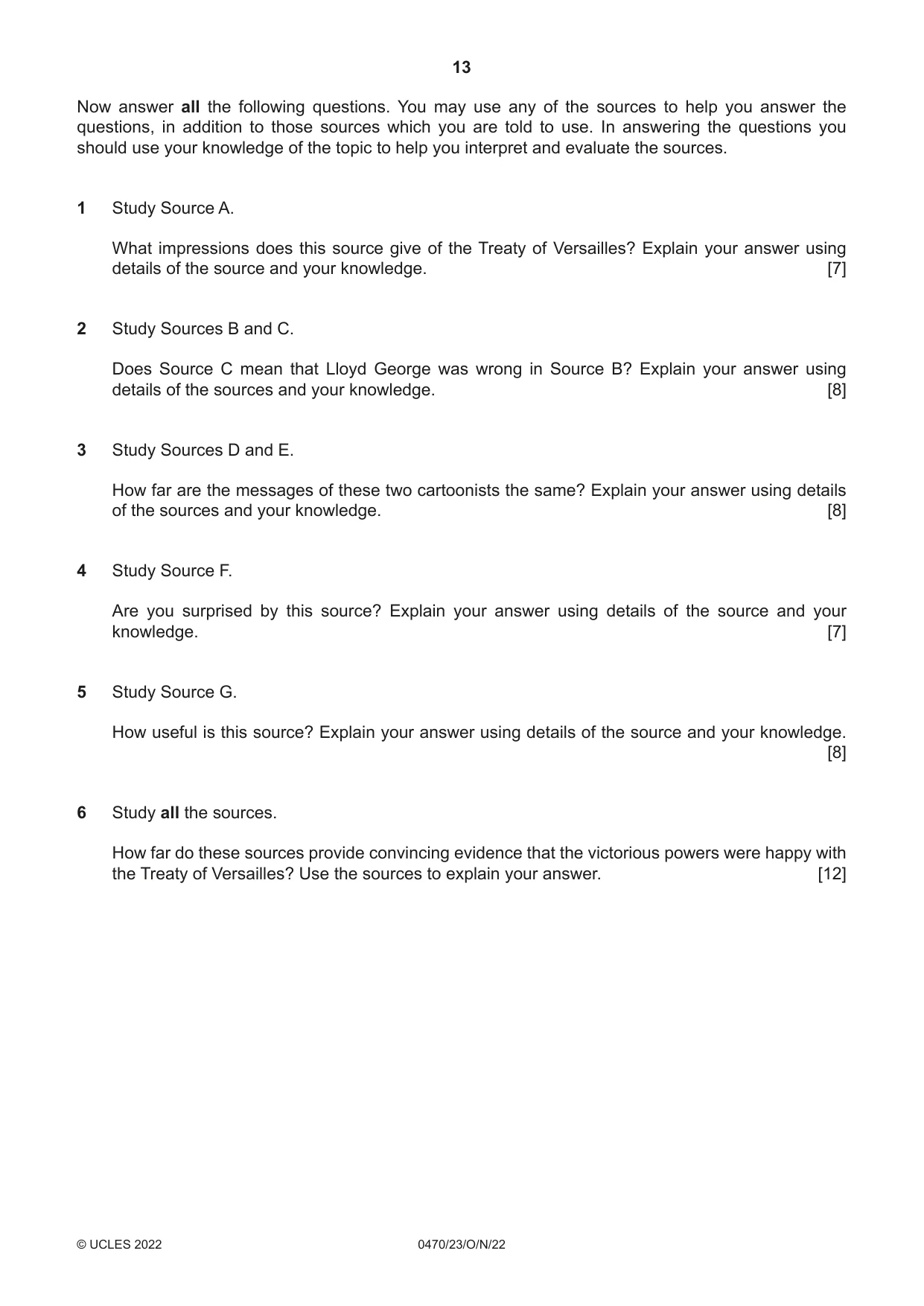
Mark scheme14 pages
Answers below. Sit the paper first if you are practising.
Paper as text
Question paper, page 1
This document has 16 pages. Any blank pages are indicated. [Turn over Cambridge IGCSE™ HISTORY 0470/23 Paper 2 October/November 2022 2 hours You must answer on the enclosed answer booklet. You will need: Answer booklet (enclosed) INSTRUCTIONS ● Answer all the questions on one option only. Option A: Nineteenth century topic Option B: Twentieth century topic ● Follow the instructions on the front cover of the answer booklet. If you need additional answer paper, ask the invigilator for a continuation booklet. INFORMATION ● The total mark for this paper is 50. ● The number of marks for each question or part question is shown in brackets [ ]. DC (MB/JG) 303394/3 © UCLES 2022 * 8 8 1 7 4 8 4 3 1 7 *
Question paper, page 2
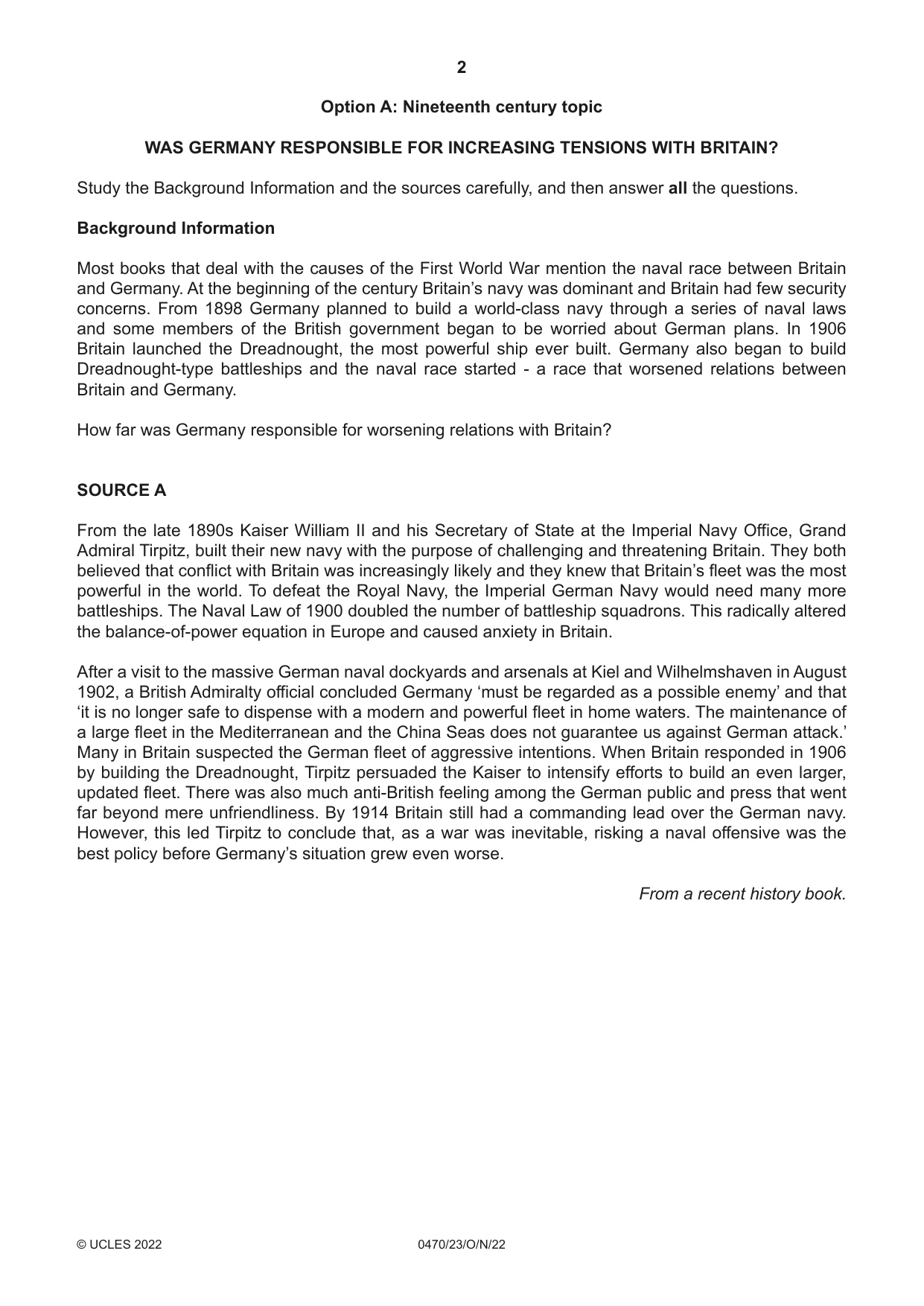
2 0470/23/O/N/22 © UCLES 2022 Option A: Nineteenth century topic WAS GERMANY RESPONSIBLE FOR INCREASING TENSIONS WITH BRITAIN? Study the Background Information and the sources carefully, and then answer all the questions. Background Information Most books that deal with the causes of the First World War mention the naval race between Britain and Germany. At the beginning of the century Britain’s navy was dominant and Britain had few security concerns. From 1898 Germany planned to build a world-class navy through a series of naval laws and some members of the British government began to be worried about German plans. In 1906 Britain launched the Dreadnought, the most powerful ship ever built. Germany also began to build Dreadnought-type battleships and the naval race started - a race that worsened relations between Britain and Germany. How far was Germany responsible for worsening relations with Britain? SOURCE A From the late 1890s Kaiser William II and his Secretary of State at the Imperial Navy Office, Grand Admiral Tirpitz, built their new navy with the purpose of challenging and threatening Britain. They both believed that conflict with Britain was increasingly likely and they knew that Britain’s fleet was the most powerful in the world. To defeat the Royal Navy, the Imperial German Navy would need many more battleships. The Naval Law of 1900 doubled the number of battleship squadrons. This radically altered the balance-of-power equation in Europe and caused anxiety in Britain. After a visit to the massive German naval dockyards and arsenals at Kiel and Wilhelmshaven in August 1902, a British Admiralty official concluded Germany ‘must be regarded as a possible enemy’ and that ‘it is no longer safe to dispense with a modern and powerful fleet in home waters. The maintenance of a large fleet in the Mediterranean and the China Seas does not guarantee us against German attack.’ Many in Britain suspected the German fleet of aggressive intentions. When Britain responded in 1906 by building the Dreadnought, Tirpitz persuaded the Kaiser to intensify efforts to build an even larger, updated fleet. There was also much anti-British feeling among the German public and press that went far beyond mere unfriendliness. By 1914 Britain still had a commanding lead over the German navy. However, this led Tirpitz to conclude that, as a war was inevitable, risking a naval offensive was the best policy before Germany’s situation grew even worse. From a recent history book.
Question paper, page 3
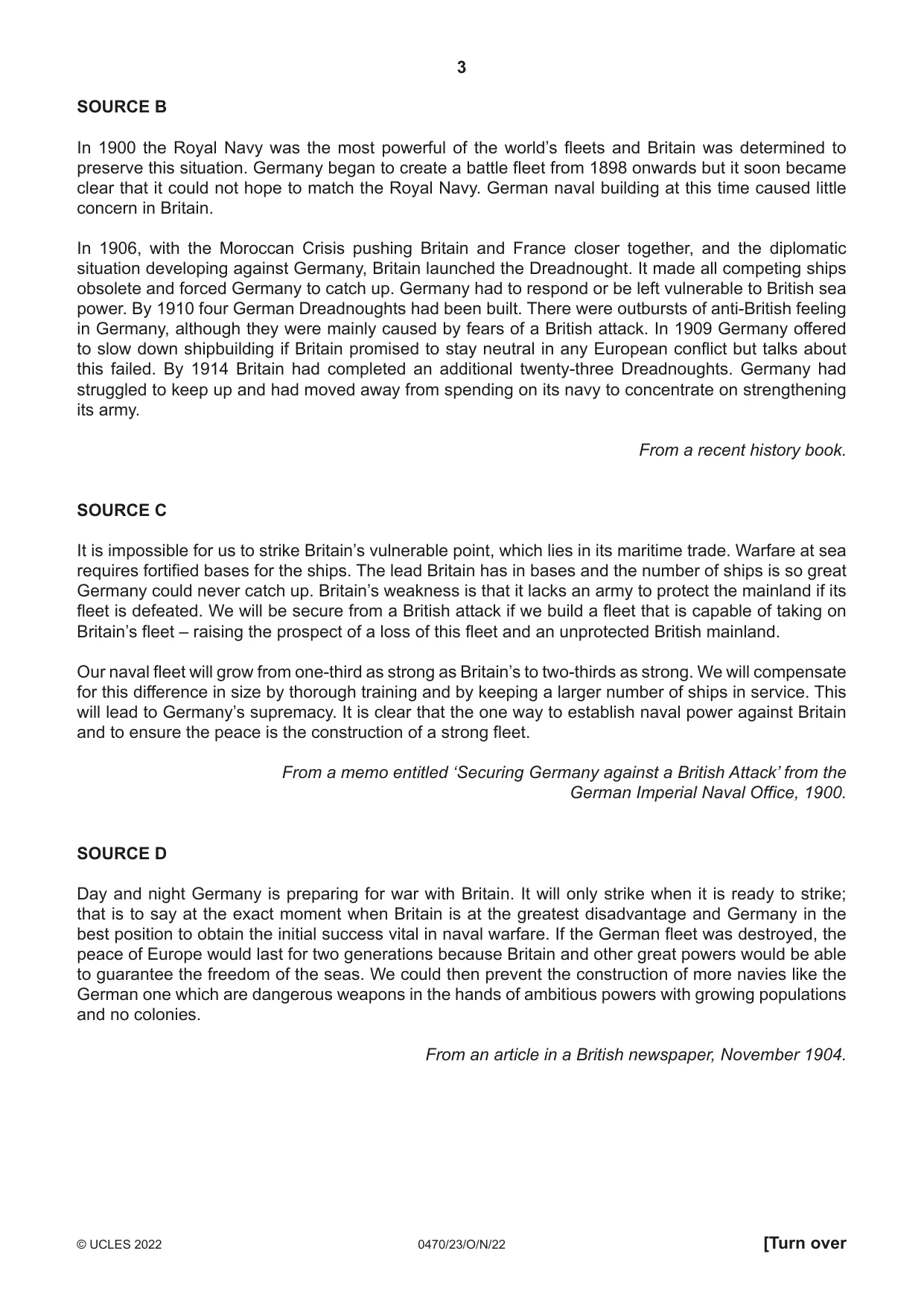
3 0470/23/O/N/22 © UCLES 2022 [Turn over SOURCE B In 1900 the Royal Navy was the most powerful of the world’s fleets and Britain was determined to preserve this situation. Germany began to create a battle fleet from 1898 onwards but it soon became clear that it could not hope to match the Royal Navy. German naval building at this time caused little concern in Britain. In 1906, with the Moroccan Crisis pushing Britain and France closer together, and the diplomatic situation developing against Germany, Britain launched the Dreadnought. It made all competing ships obsolete and forced Germany to catch up. Germany had to respond or be left vulnerable to British sea power. By 1910 four German Dreadnoughts had been built. There were outbursts of anti-British feeling in Germany, although they were mainly caused by fears of a British attack. In 1909 Germany offered to slow down shipbuilding if Britain promised to stay neutral in any European conflict but talks about this failed. By 1914 Britain had completed an additional twenty-three Dreadnoughts. Germany had struggled to keep up and had moved away from spending on its navy to concentrate on strengthening its army. From a recent history book. SOURCE C It is impossible for us to strike Britain’s vulnerable point, which lies in its maritime trade. Warfare at sea requires fortified bases for the ships. The lead Britain has in bases and the number of ships is so great Germany could never catch up. Britain’s weakness is that it lacks an army to protect the mainland if its fleet is defeated. We will be secure from a British attack if we build a fleet that is capable of taking on Britain’s fleet – raising the prospect of a loss of this fleet and an unprotected British mainland. Our naval fleet will grow from one-third as strong as Britain’s to two-thirds as strong. We will compensate for this difference in size by thorough training and by keeping a larger number of ships in service. This will lead to Germany’s supremacy. It is clear that the one way to establish naval power against Britain and to ensure the peace is the construction of a strong fleet. From a memo entitled ‘Securing Germany against a British Attack’ from the German Imperial Naval Office, 1900. SOURCE D Day and night Germany is preparing for war with Britain. It will only strike when it is ready to strike; that is to say at the exact moment when Britain is at the greatest disadvantage and Germany in the best position to obtain the initial success vital in naval warfare. If the German fleet was destroyed, the peace of Europe would last for two generations because Britain and other great powers would be able to guarantee the freedom of the seas. We could then prevent the construction of more navies like the German one which are dangerous weapons in the hands of ambitious powers with growing populations and no colonies. From an article in a British newspaper, November 1904.
Question paper, page 4
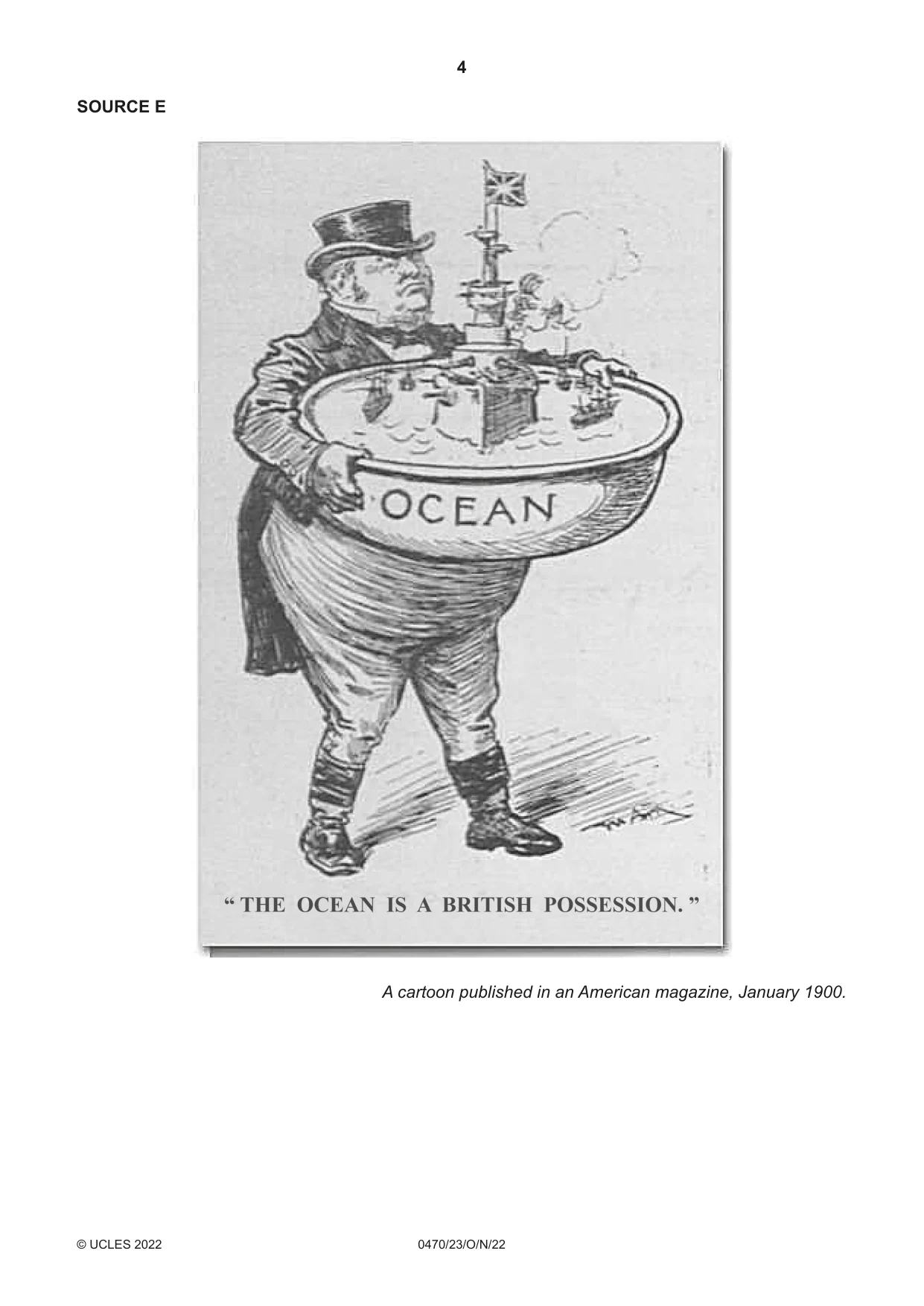
4 0470/23/O/N/22 © UCLES 2022 SOURCE E A cartoon published in an American magazine, January 1900.
Question paper, page 5
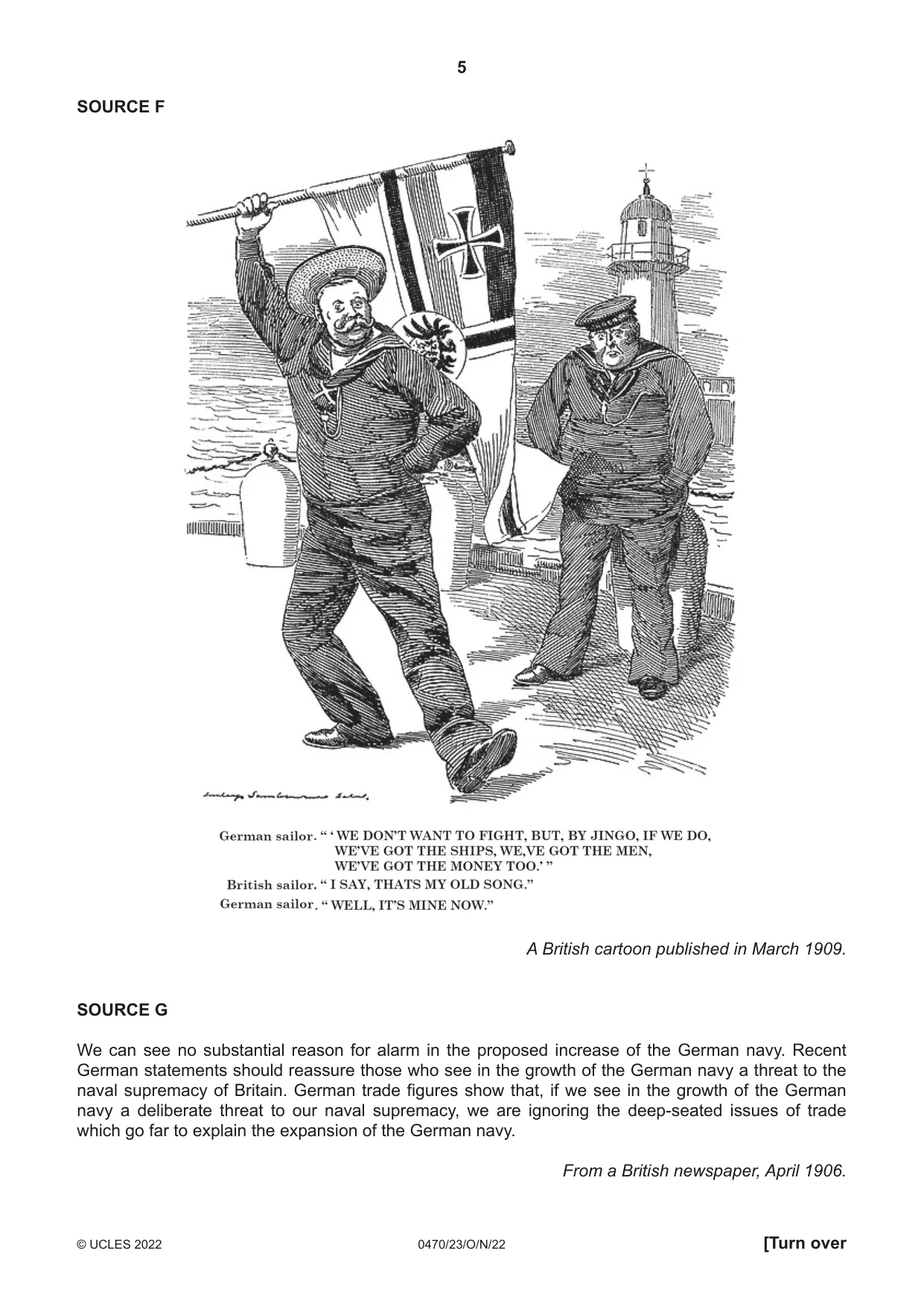
5 0470/23/O/N/22 © UCLES 2022 [Turn over SOURCE F A British cartoon published in March 1909. SOURCE G We can see no substantial reason for alarm in the proposed increase of the German navy. Recent German statements should reassure those who see in the growth of the German navy a threat to the naval supremacy of Britain. German trade figures show that, if we see in the growth of the German navy a deliberate threat to our naval supremacy, we are ignoring the deep-seated issues of trade which go far to explain the expansion of the German navy. From a British newspaper, April 1906.
Question paper, page 6
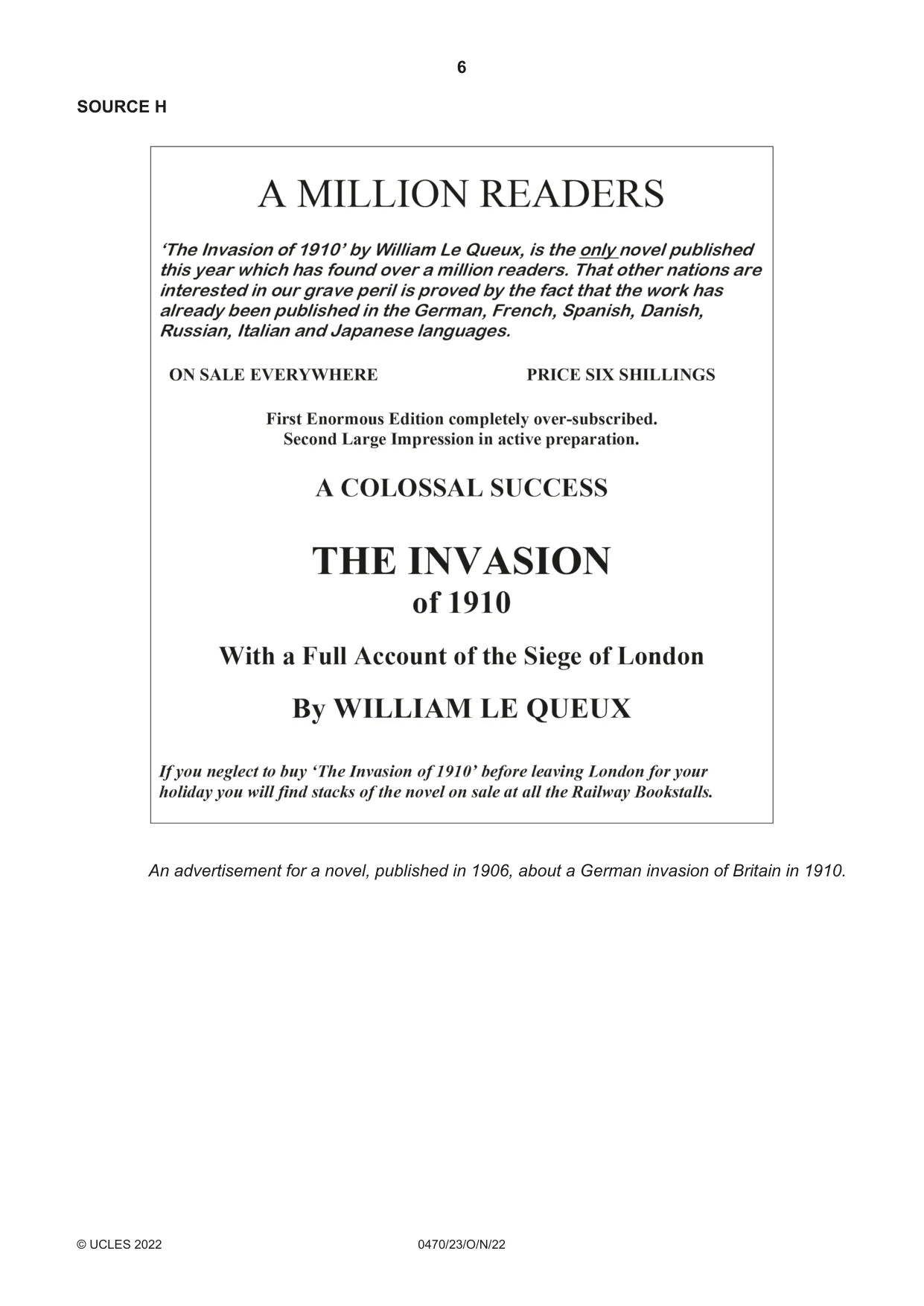
6 0470/23/O/N/22 © UCLES 2022 SOURCE H An advertisement for a novel, published in 1906, about a German invasion of Britain in 1910.
Question paper, page 7
7 0470/23/O/N/22 © UCLES 2022 [Turn over Now answer all the following questions. You may use any of the sources to help you answer the questions, in addition to those sources which you are told to use. In answering the questions you should use your knowledge of the topic to help you interpret and evaluate the sources. 1 Study Sources A and B. How far do these two sources agree? Explain your answer using details of the sources. [7] 2 Study Sources C and D. Does Source D mean that Source C cannot be believed? Explain your answer using details of the sources and your knowledge. [8] 3 Study Sources E and F. How far do these two cartoonists agree? Explain your answer using details of the sources and your knowledge. [8] 4 Study Source G. Are you surprised by this source? Explain your answer using details of the source and your knowledge. [7] 5 Study Source H. How useful is this source to a historian studying this period? Explain your answer using details of the source and your knowledge. [8] 6 Study all the sources. How far do these sources provide convincing evidence that Germany was responsible for worsening relations with Britain? Use the sources to explain your answer. [12]
Question paper, page 8
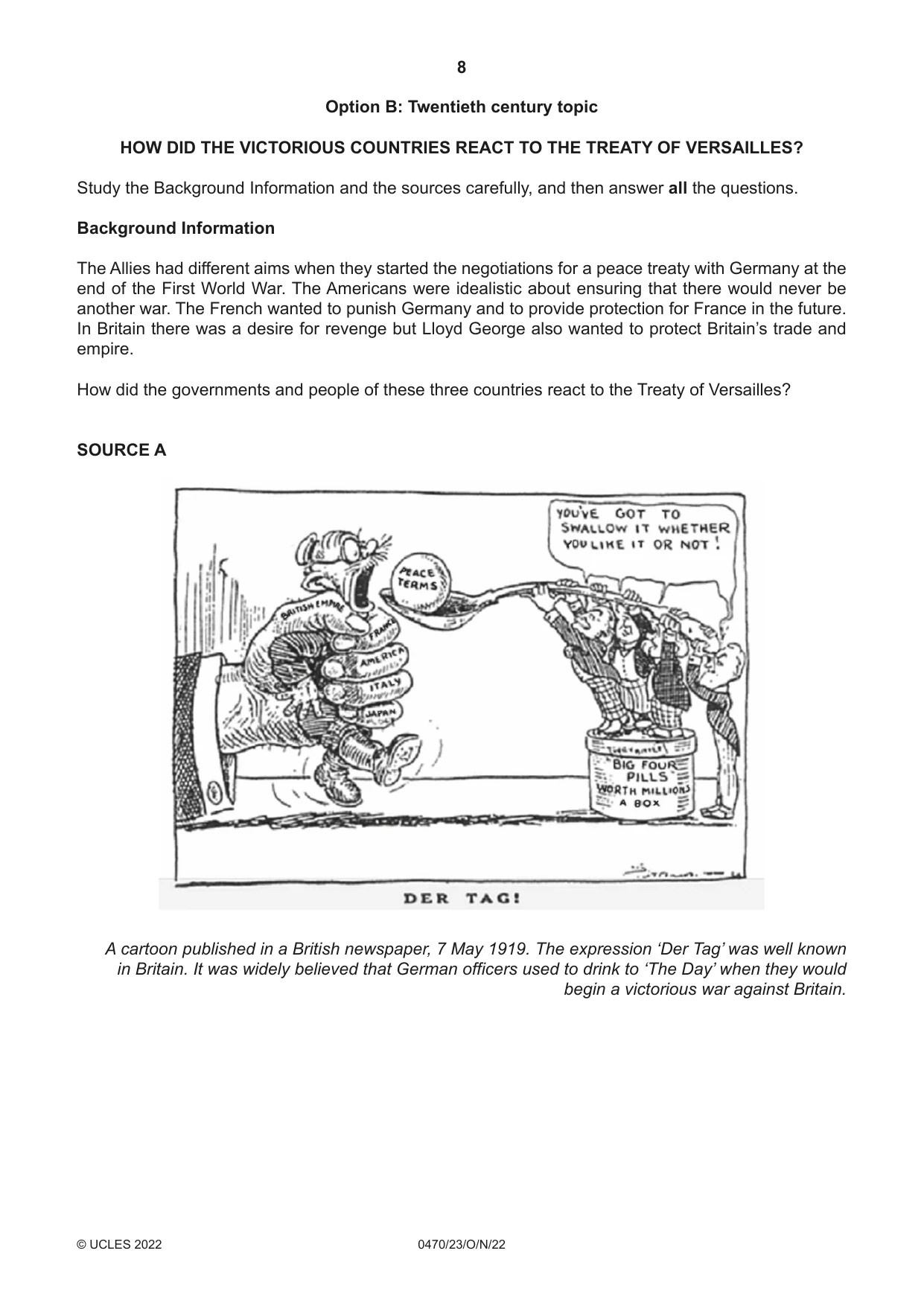
8 0470/23/O/N/22 © UCLES 2022 Option B: Twentieth century topic HOW DID THE VICTORIOUS COUNTRIES REACT TO THE TREATY OF VERSAILLES? Study the Background Information and the sources carefully, and then answer all the questions. Background Information The Allies had different aims when they started the negotiations for a peace treaty with Germany at the end of the First World War. The Americans were idealistic about ensuring that there would never be another war. The French wanted to punish Germany and to provide protection for France in the future. In Britain there was a desire for revenge but Lloyd George also wanted to protect Britain’s trade and empire. How did the governments and people of these three countries react to the Treaty of Versailles? SOURCE A A cartoon published in a British newspaper, 7 May 1919. The expression ‘Der Tag’ was well known in Britain. It was widely believed that German officers used to drink to ‘The Day’ when they would begin a victorious war against Britain.
Question paper, page 9
9 0470/23/O/N/22 © UCLES 2022 [Turn over SOURCE B We have restored where restoration was just, we have organised reparations where damage and injury had been inflicted, and we have secured guarantees against the repetition of these crimes and horrors from which the world is just emerging. We have disarmed, we have punished. We have demonstrated that you cannot trample on national rights and liberties. This is the task we set ourselves and I claim this Treaty will be like a lighthouse warning nations and their rulers against the perils on which the German Empire shattered itself. Lloyd George speaking in Parliament in a debate about the Treaty of Versailles, 21 July 1919. SOURCE C Clemenceau would say that Germany had behaved exactly as he had anticipated. He would blame himself for giving in to President Wilson and myself on the question of the Rhineland. He would be scornful of the weakness displayed by his successors over German re-armament and the military occupation of the Rhineland. He would express no surprise at the failure of the League of Nations. President Wilson’s opinions would not have changed. He would blame the present condition of the world on the failure of the League, and that failure on the actions of his political enemies in the United States. All three of us would agree that the Treaties were never given a chance by the second-rate statesmen of the past fifteen years. We would all agree that the failure of a great deal of what is best in the Treaties has been due to the fact that there has been no serious attempt to enforce them. Between the retreat of America and the treacheries of Europe, the Treaties of Peace were never given a fair trial. From ‘The Truth About the Peace Treaties’ by Lloyd George, published in 1938.
Question paper, page 10
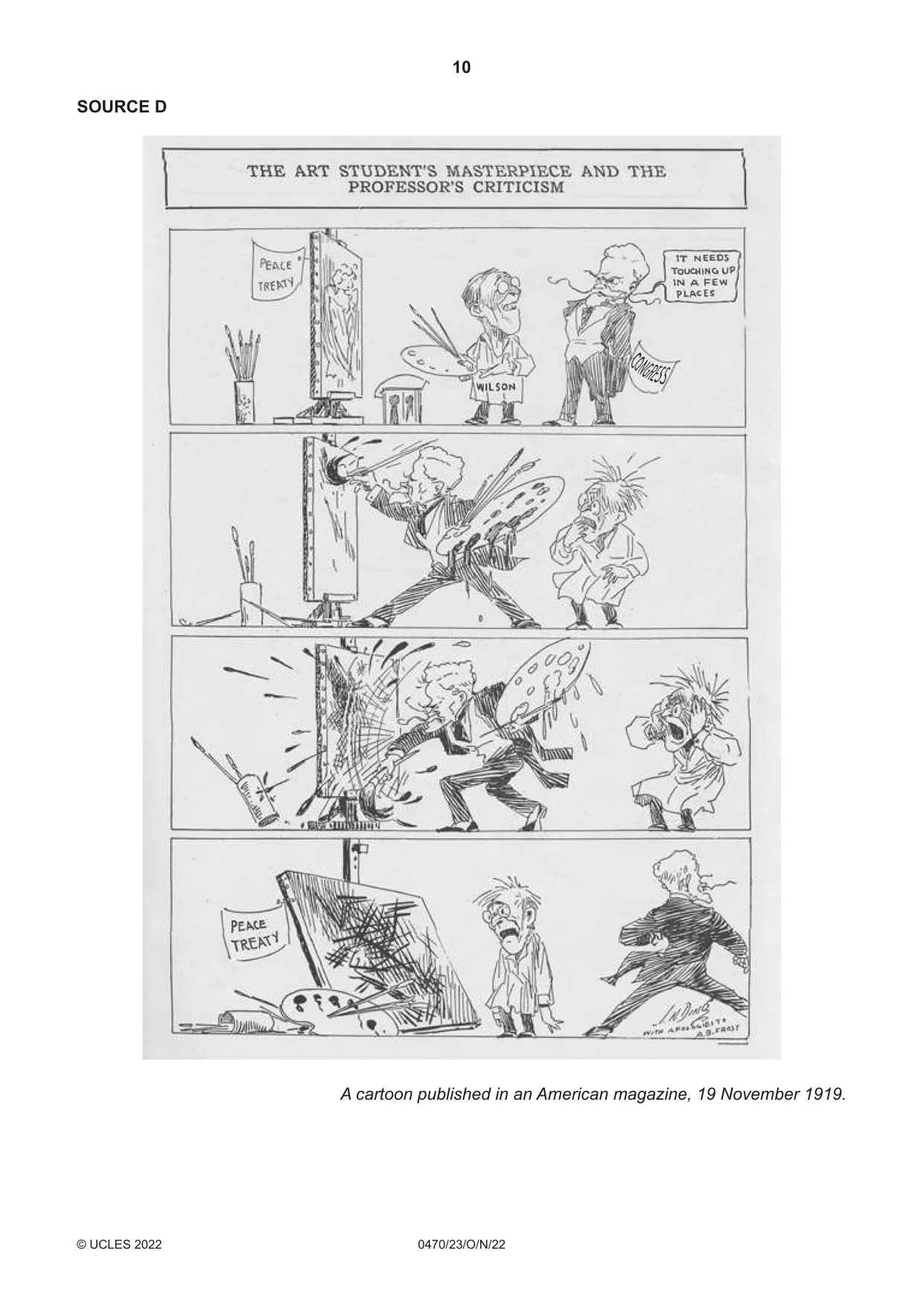
10 0470/23/O/N/22 © UCLES 2022 SOURCE D A cartoon published in an American magazine, 19 November 1919.
Question paper, page 11
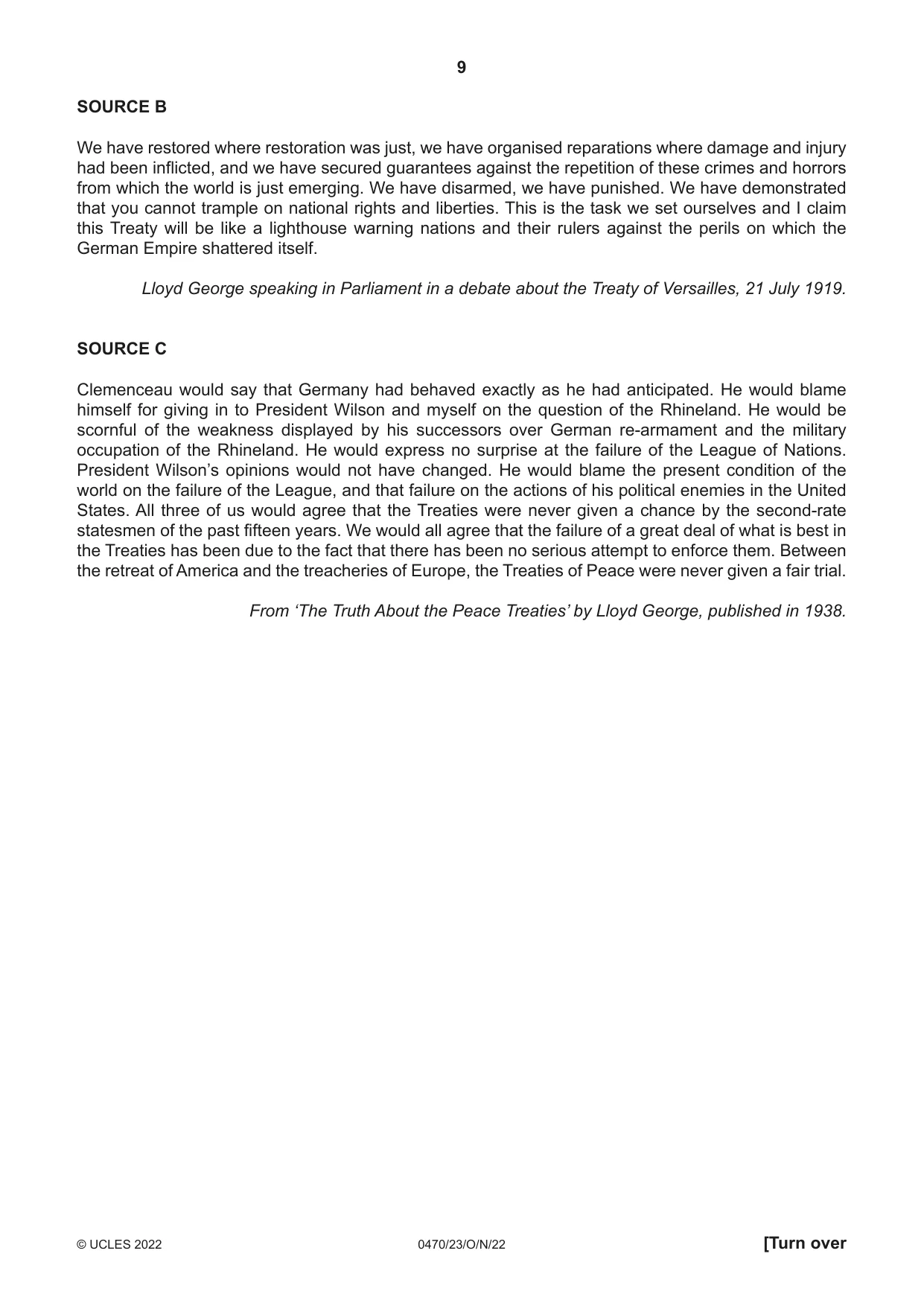
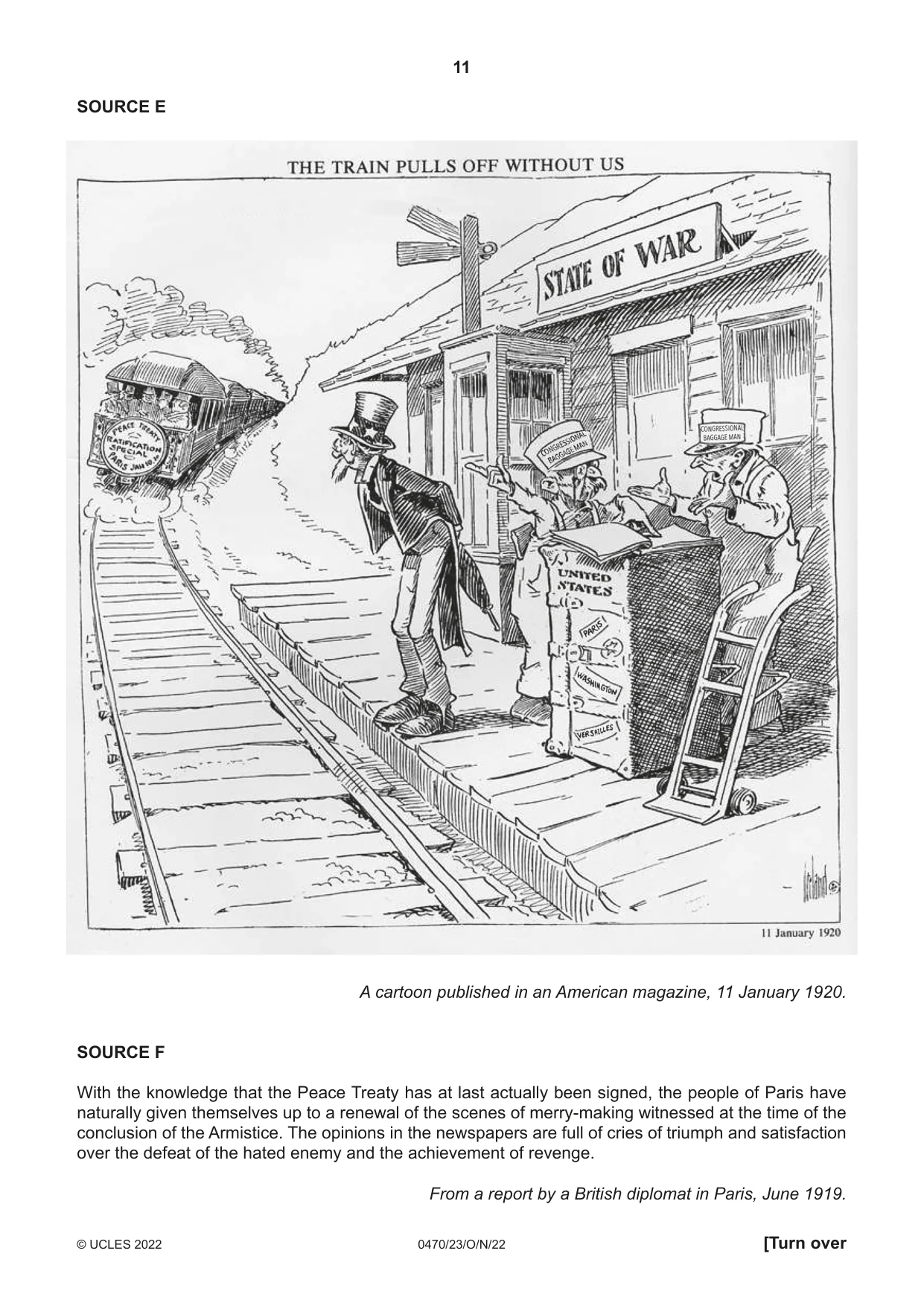
11 0470/23/O/N/22 © UCLES 2022 [Turn over SOURCE E A cartoon published in an American magazine, 11 January 1920. SOURCE F With the knowledge that the Peace Treaty has at last actually been signed, the people of Paris have naturally given themselves up to a renewal of the scenes of merry-making witnessed at the time of the conclusion of the Armistice. The opinions in the newspapers are full of cries of triumph and satisfaction over the defeat of the hated enemy and the achievement of revenge. From a report by a British diplomat in Paris, June 1919.
Question paper, page 12
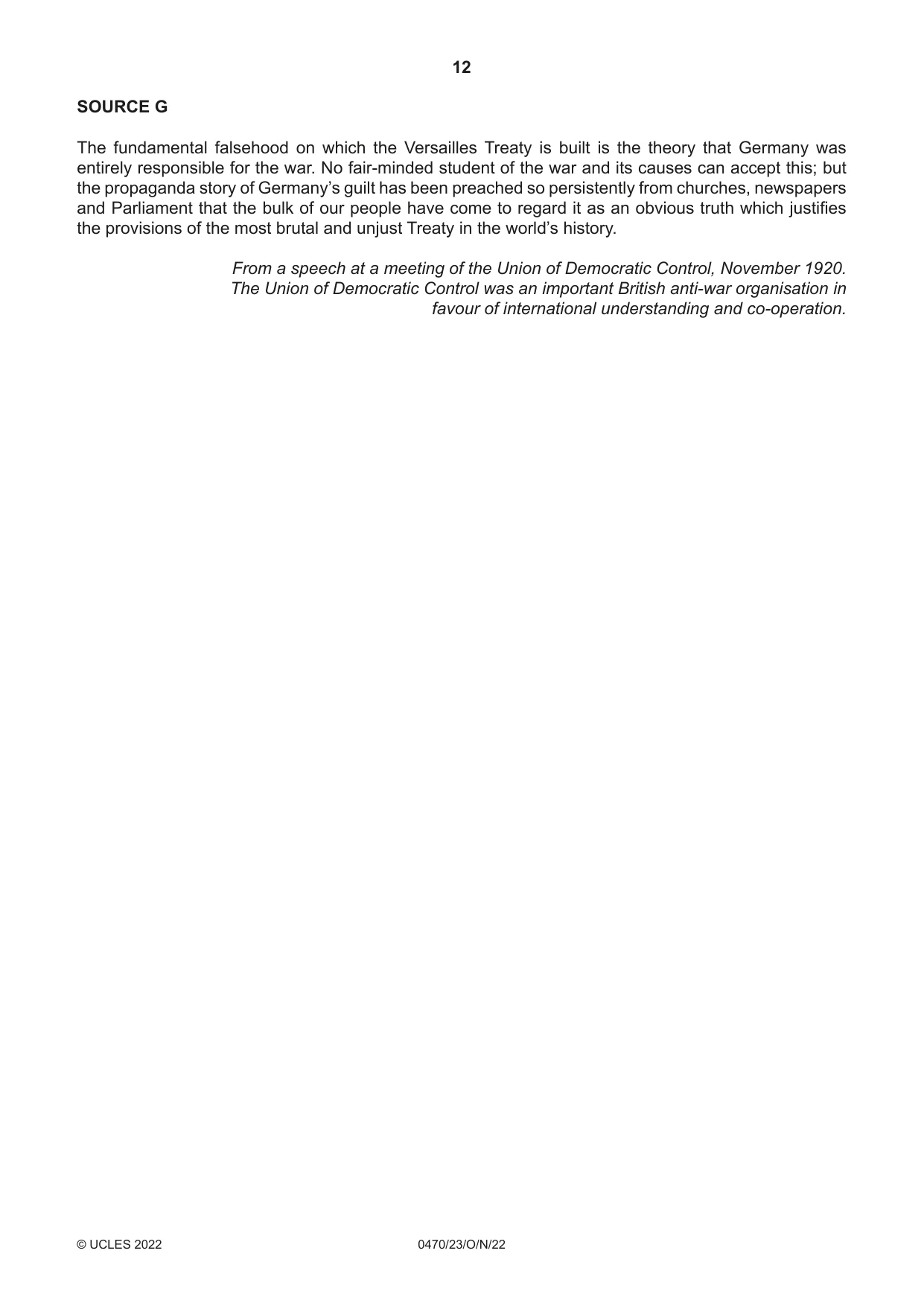
12 0470/23/O/N/22 © UCLES 2022 SOURCE G The fundamental falsehood on which the Versailles Treaty is built is the theory that Germany was entirely responsible for the war. No fair-minded student of the war and its causes can accept this; but the propaganda story of Germany’s guilt has been preached so persistently from churches, newspapers and Parliament that the bulk of our people have come to regard it as an obvious truth which justifies the provisions of the most brutal and unjust Treaty in the world’s history. From a speech at a meeting of the Union of Democratic Control, November 1920. The Union of Democratic Control was an important British anti-war organisation in favour of international understanding and co-operation.
Question paper, page 13
13 0470/23/O/N/22 © UCLES 2022 Now answer all the following questions. You may use any of the sources to help you answer the questions, in addition to those sources which you are told to use. In answering the questions you should use your knowledge of the topic to help you interpret and evaluate the sources. 1 Study Source A. What impressions does this source give of the Treaty of Versailles? Explain your answer using details of the source and your knowledge. [7] 2 Study Sources B and C. Does Source C mean that Lloyd George was wrong in Source B? Explain your answer using details of the sources and your knowledge. [8] 3 Study Sources D and E. How far are the messages of these two cartoonists the same? Explain your answer using details of the sources and your knowledge. [8] 4 Study Source F. Are you surprised by this source? Explain your answer using details of the source and your knowledge. [7] 5 Study Source G. How useful is this source? Explain your answer using details of the source and your knowledge. [8] 6 Study all the sources. How far do these sources provide convincing evidence that the victorious powers were happy with the Treaty of Versailles? Use the sources to explain your answer. [12]
Question paper, page 14
14 0470/23/O/N/22 © UCLES 2022 BLANK PAGE
Question paper, page 15
15 0470/23/O/N/22 © UCLES 2022 BLANK PAGE
Question paper, page 16
16 0470/23/O/N/22 © UCLES 2022 Permission to reproduce items where third-party owned material protected by copyright is included has been sought and cleared where possible. Every reasonable effort has been made by the publisher (UCLES) to trace copyright holders, but if any items requiring clearance have unwittingly been included, the publisher will be pleased to make amends at the earliest possible opportunity. To avoid the issue of disclosure of answer-related information to candidates, all copyright acknowledgements are reproduced online in the Cambridge Assessment International Education Copyright Acknowledgements Booklet. This is produced for each series of examinations and is freely available to download at www.cambridgeinternational.org after the live examination series. Cambridge Assessment International Education is part of Cambridge Assessment. Cambridge Assessment is the brand name of the University of Cambridge Local Examinations Syndicate (UCLES), which is a department of the University of Cambridge. BLANK PAGE
Mark scheme, page 1
This document consists of 14 printed pages. © UCLES 2022 [Turn over Cambridge IGCSE™ HISTORY 0470/23 Paper 2 October/November 2022 MARK SCHEME Maximum Mark: 50 Published This mark scheme is published as an aid to teachers and candidates, to indicate the requirements of the examination. It shows the basis on which Examiners were instructed to award marks. It does not indicate the details of the discussions that took place at an Examiners’ meeting before marking began, which would have considered the acceptability of alternative answers. Mark schemes should be read in conjunction with the question paper and the Principal Examiner Report for Teachers. Cambridge International will not enter into discussions about these mark schemes. Cambridge International is publishing the mark schemes for the October/November 2022 series for most Cambridge IGCSE™, Cambridge International A and AS Level components and some Cambridge O Level components.
Mark scheme, page 2
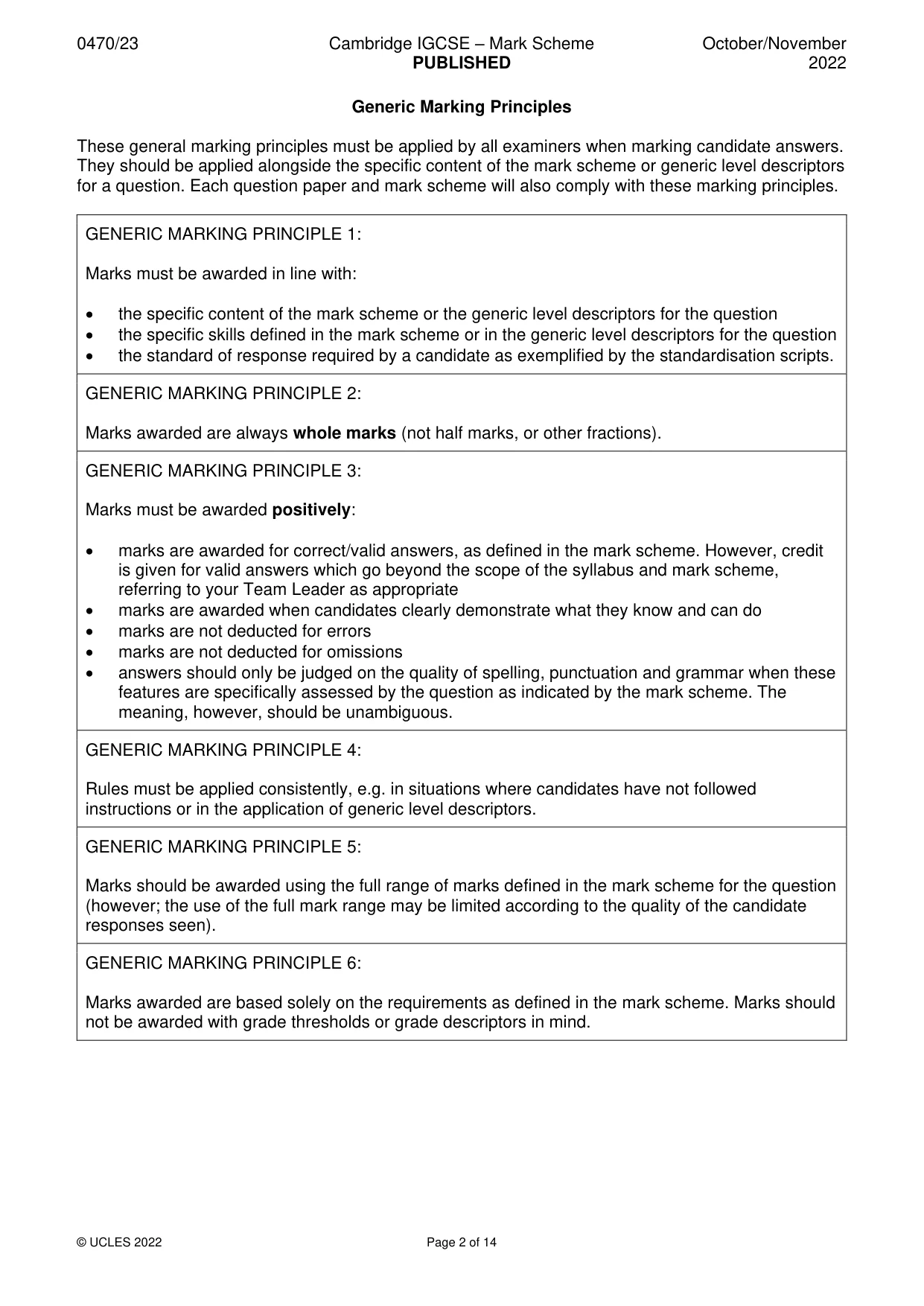
0470/23 Cambridge IGCSE – Mark Scheme PUBLISHED October/November 2022 © UCLES 2022 Page 2 of 14 Generic Marking Principles These general marking principles must be applied by all examiners when marking candidate answers. They should be applied alongside the specific content of the mark scheme or generic level descriptors for a question. Each question paper and mark scheme will also comply with these marking principles. GENERIC MARKING PRINCIPLE 1: Marks must be awarded in line with: • the specific content of the mark scheme or the generic level descriptors for the question • the specific skills defined in the mark scheme or in the generic level descriptors for the question • the standard of response required by a candidate as exemplified by the standardisation scripts. GENERIC MARKING PRINCIPLE 2: Marks awarded are always whole marks (not half marks, or other fractions). GENERIC MARKING PRINCIPLE 3: Marks must be awarded positively: • marks are awarded for correct/valid answers, as defined in the mark scheme. However, credit is given for valid answers which go beyond the scope of the syllabus and mark scheme, referring to your Team Leader as appropriate • marks are awarded when candidates clearly demonstrate what they know and can do • marks are not deducted for errors • marks are not deducted for omissions • answers should only be judged on the quality of spelling, punctuation and grammar when these features are specifically assessed by the question as indicated by the mark scheme. The meaning, however, should be unambiguous. GENERIC MARKING PRINCIPLE 4: Rules must be applied consistently, e.g. in situations where candidates have not followed instructions or in the application of generic level descriptors. GENERIC MARKING PRINCIPLE 5: Marks should be awarded using the full range of marks defined in the mark scheme for the question (however; the use of the full mark range may be limited according to the quality of the candidate responses seen). GENERIC MARKING PRINCIPLE 6: Marks awarded are based solely on the requirements as defined in the mark scheme. Marks should not be awarded with grade thresholds or grade descriptors in mind.
Mark scheme, page 3
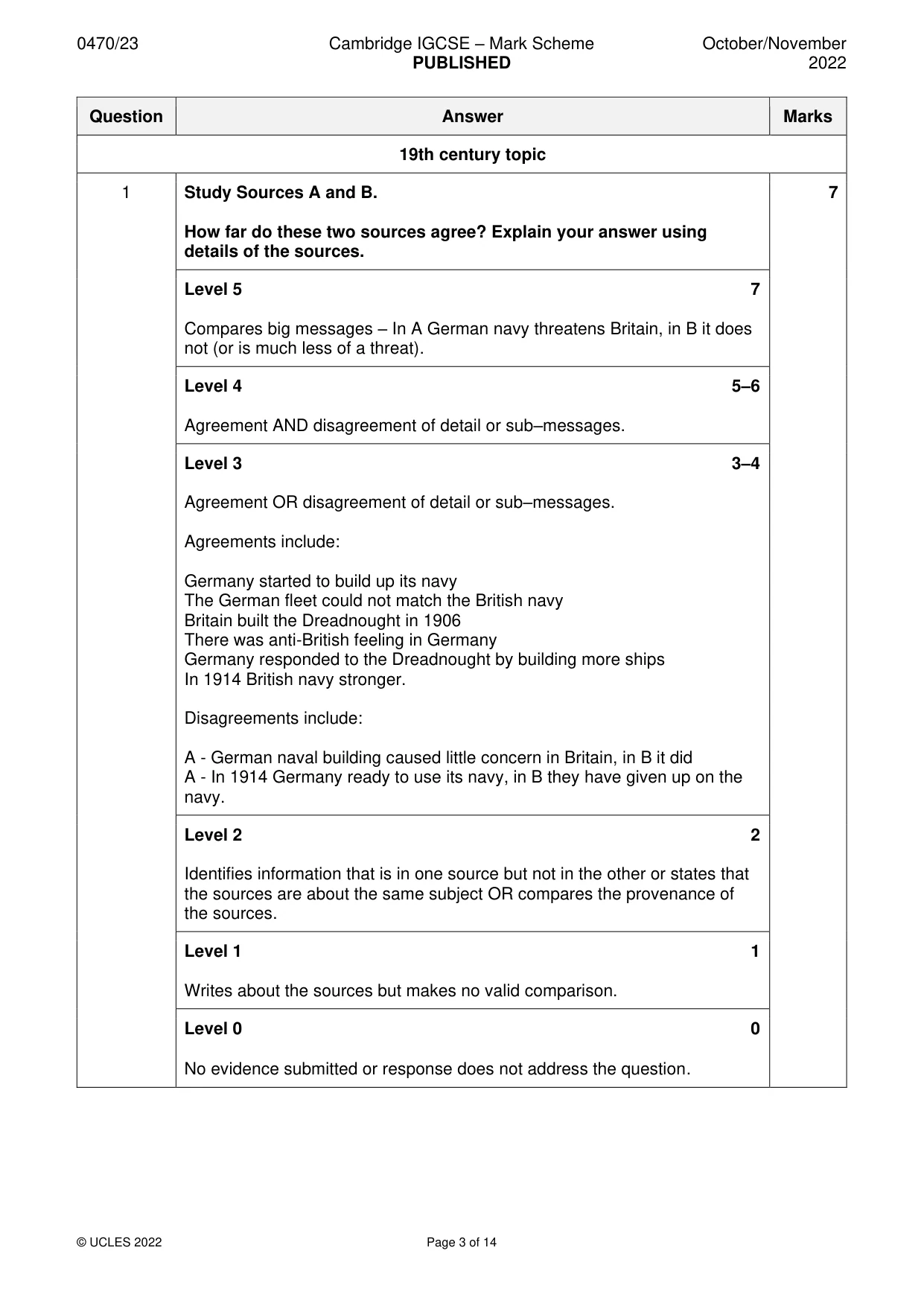
0470/23 Cambridge IGCSE – Mark Scheme PUBLISHED October/November 2022 © UCLES 2022 Page 3 of 14 Question Answer Marks 19th century topic 1 Study Sources A and B. How far do these two sources agree? Explain your answer using details of the sources. 7 Level 5 7 Compares big messages – In A German navy threatens Britain, in B it does not (or is much less of a threat). Level 4 5–6 Agreement AND disagreement of detail or sub–messages. Level 3 3–4 Agreement OR disagreement of detail or sub–messages. Agreements include: Germany started to build up its navy The German fleet could not match the British navy Britain built the Dreadnought in 1906 There was anti-British feeling in Germany Germany responded to the Dreadnought by building more ships In 1914 British navy stronger. Disagreements include: A - German naval building caused little concern in Britain, in B it did A - In 1914 Germany ready to use its navy, in B they have given up on the navy. Level 2 2 Identifies information that is in one source but not in the other or states that the sources are about the same subject OR compares the provenance of the sources. Level 1 1 Writes about the sources but makes no valid comparison. Level 0 0 No evidence submitted or response does not address the question.
Mark scheme, page 4
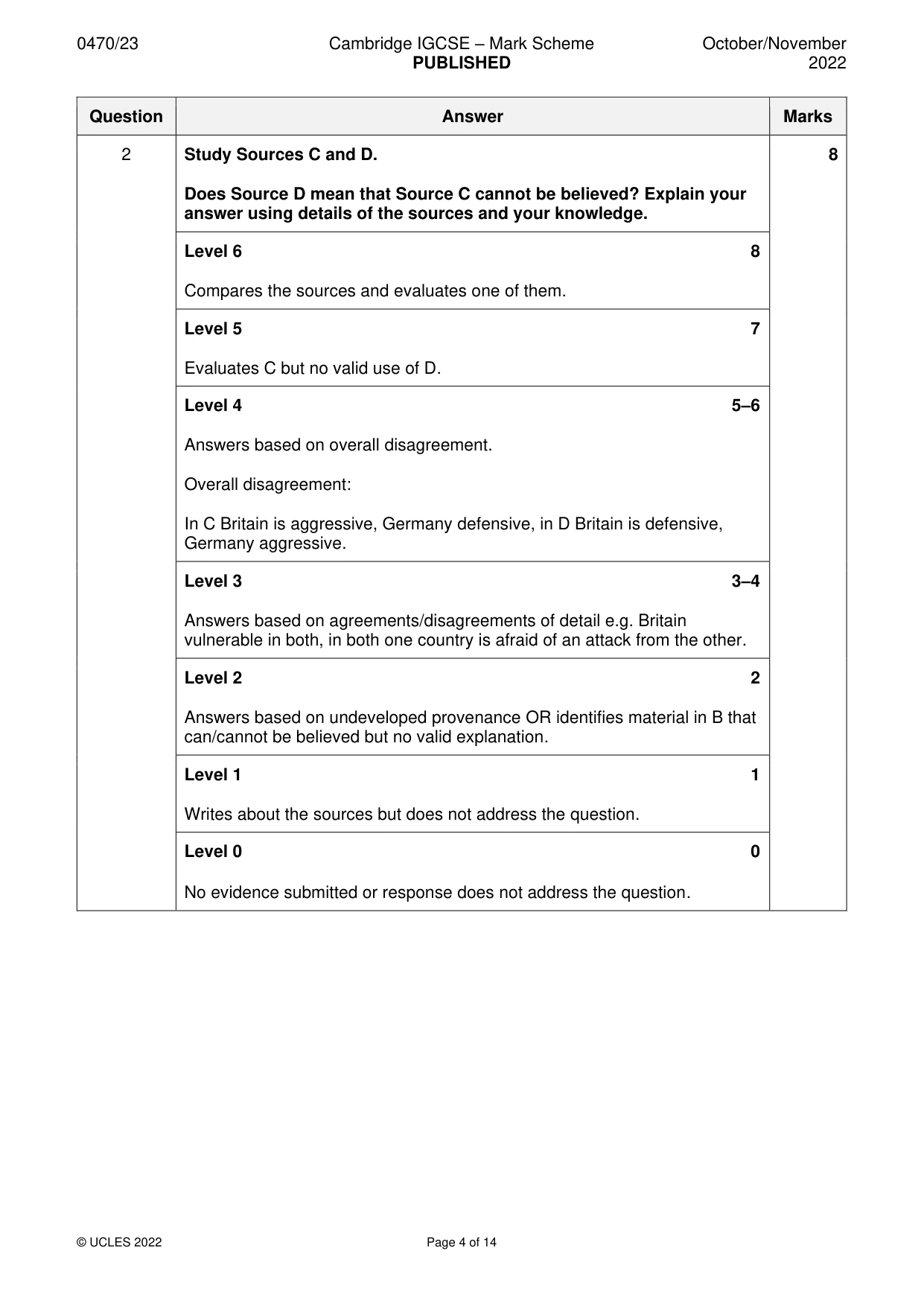
0470/23 Cambridge IGCSE – Mark Scheme PUBLISHED October/November 2022 © UCLES 2022 Page 4 of 14 Question Answer Marks 2 Study Sources C and D. Does Source D mean that Source C cannot be believed? Explain your answer using details of the sources and your knowledge. 8 Level 6 8 Compares the sources and evaluates one of them. Level 5 7 Evaluates C but no valid use of D. Level 4 5–6 Answers based on overall disagreement. Overall disagreement: In C Britain is aggressive, Germany defensive, in D Britain is defensive, Germany aggressive. Level 3 3–4 Answers based on agreements/disagreements of detail e.g. Britain vulnerable in both, in both one country is afraid of an attack from the other. Level 2 2 Answers based on undeveloped provenance OR identifies material in B that can/cannot be believed but no valid explanation. Level 1 1 Writes about the sources but does not address the question. Level 0 0 No evidence submitted or response does not address the question.
Mark scheme, page 5
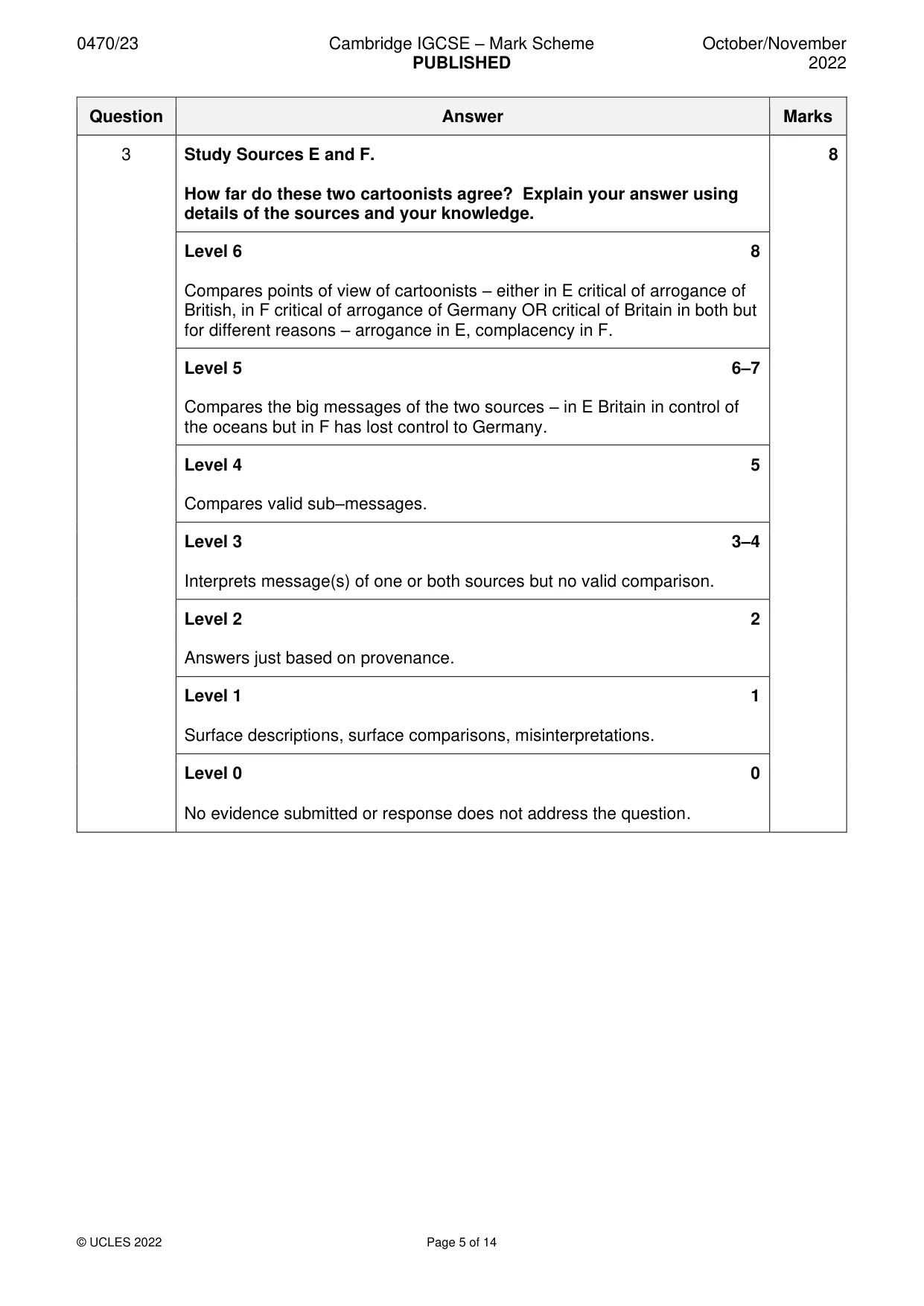
0470/23 Cambridge IGCSE – Mark Scheme PUBLISHED October/November 2022 © UCLES 2022 Page 5 of 14 Question Answer Marks 3 Study Sources E and F. How far do these two cartoonists agree? Explain your answer using details of the sources and your knowledge. 8 Level 6 8 Compares points of view of cartoonists – either in E critical of arrogance of British, in F critical of arrogance of Germany OR critical of Britain in both but for different reasons – arrogance in E, complacency in F. Level 5 6–7 Compares the big messages of the two sources – in E Britain in control of the oceans but in F has lost control to Germany. Level 4 5 Compares valid sub–messages. Level 3 3–4 Interprets message(s) of one or both sources but no valid comparison. Level 2 2 Answers just based on provenance. Level 1 1 Surface descriptions, surface comparisons, misinterpretations. Level 0 0 No evidence submitted or response does not address the question.
Mark scheme, page 6
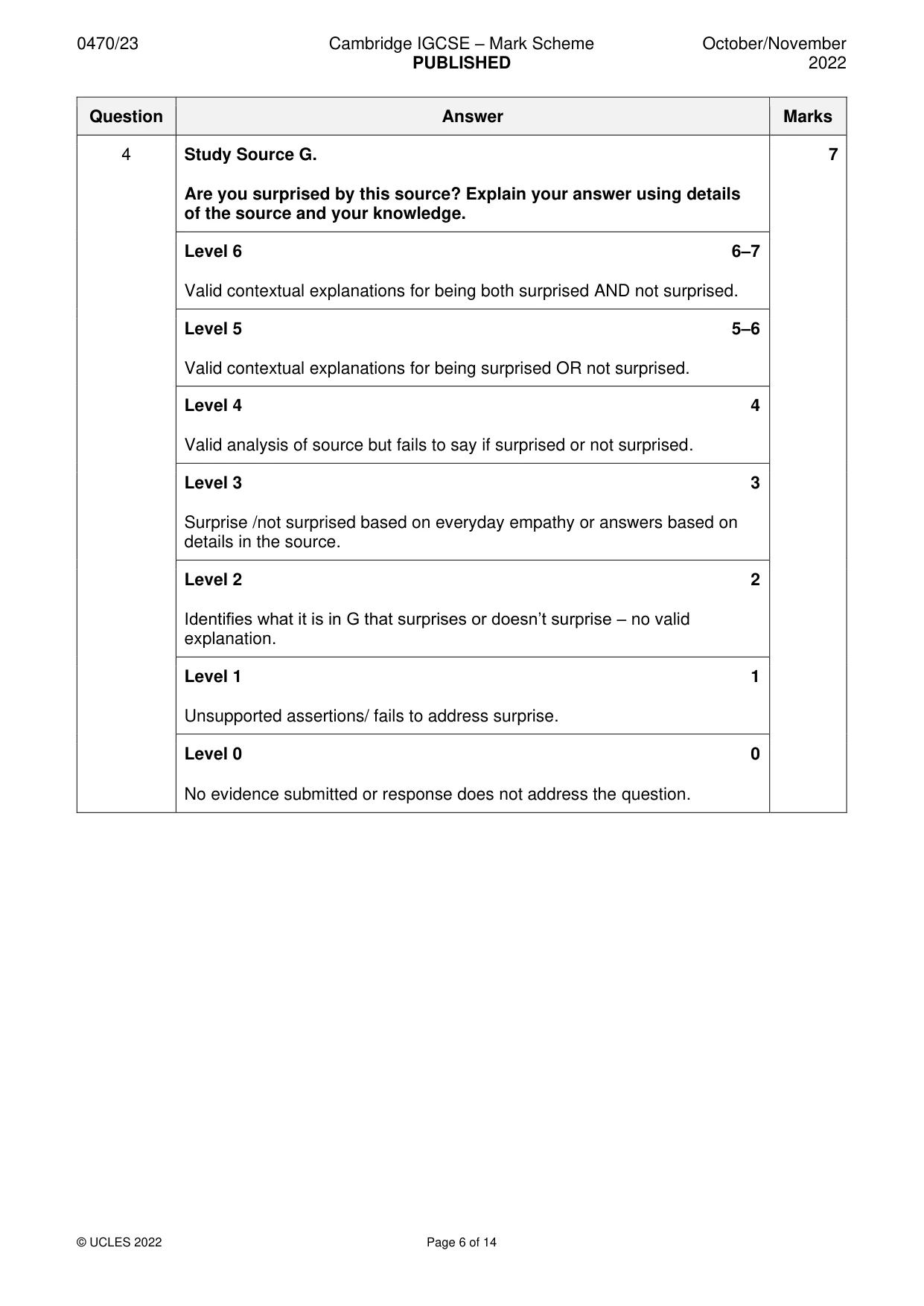
0470/23 Cambridge IGCSE – Mark Scheme PUBLISHED October/November 2022 © UCLES 2022 Page 6 of 14 Question Answer Marks 4 Study Source G. Are you surprised by this source? Explain your answer using details of the source and your knowledge. 7 Level 6 6–7 Valid contextual explanations for being both surprised AND not surprised. Level 5 5–6 Valid contextual explanations for being surprised OR not surprised. Level 4 4 Valid analysis of source but fails to say if surprised or not surprised. Level 3 3 Surprise /not surprised based on everyday empathy or answers based on details in the source. Level 2 2 Identifies what it is in G that surprises or doesn’t surprise – no valid explanation. Level 1 1 Unsupported assertions/ fails to address surprise. Level 0 0 No evidence submitted or response does not address the question.
Mark scheme, page 7
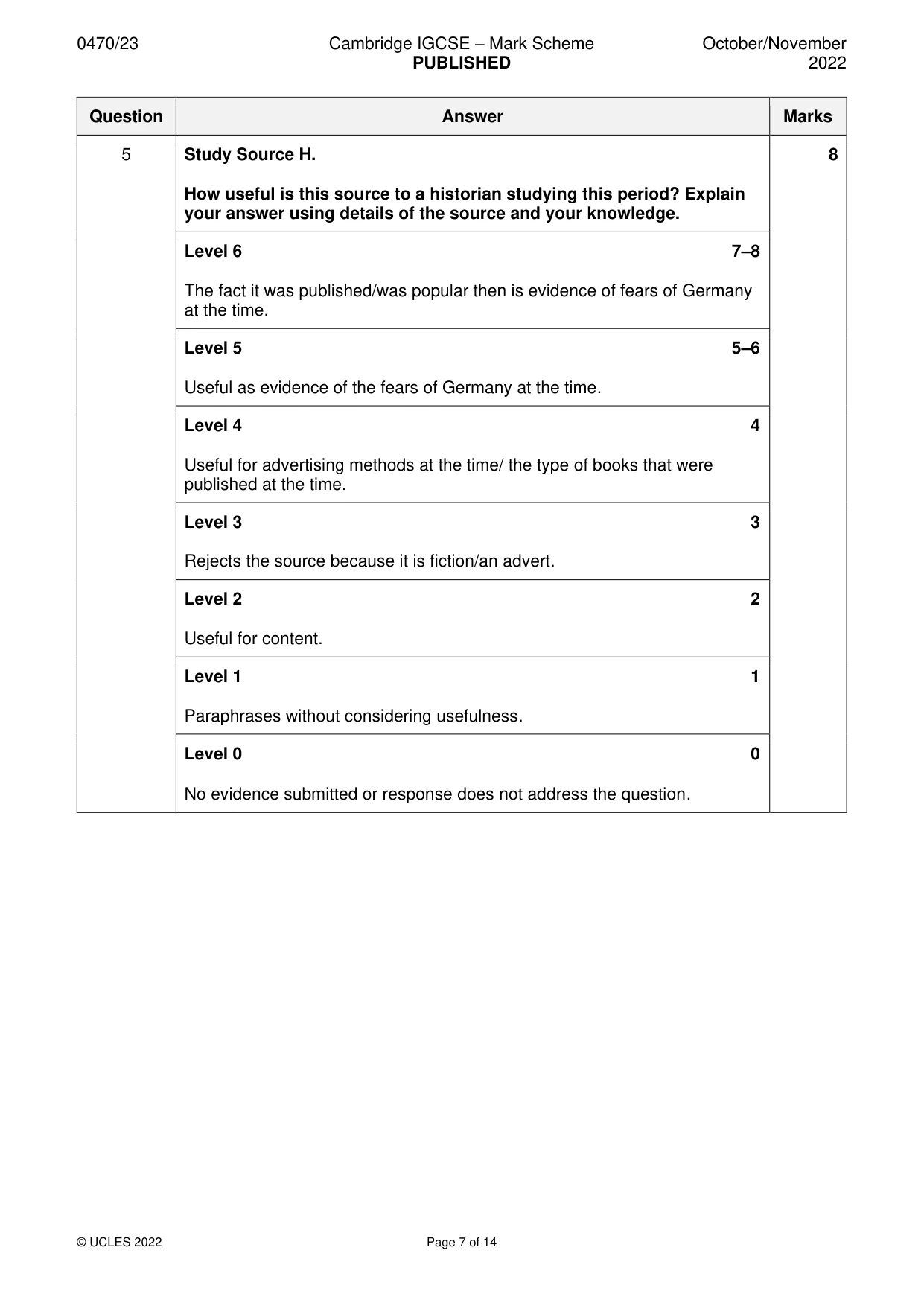
0470/23 Cambridge IGCSE – Mark Scheme PUBLISHED October/November 2022 © UCLES 2022 Page 7 of 14 Question Answer Marks 5 Study Source H. How useful is this source to a historian studying this period? Explain your answer using details of the source and your knowledge. 8 Level 6 7–8 The fact it was published/was popular then is evidence of fears of Germany at the time. Level 5 5–6 Useful as evidence of the fears of Germany at the time. Level 4 4 Useful for advertising methods at the time/ the type of books that were published at the time. Level 3 3 Rejects the source because it is fiction/an advert. Level 2 2 Useful for content. Level 1 1 Paraphrases without considering usefulness. Level 0 0 No evidence submitted or response does not address the question.
Mark scheme, page 8
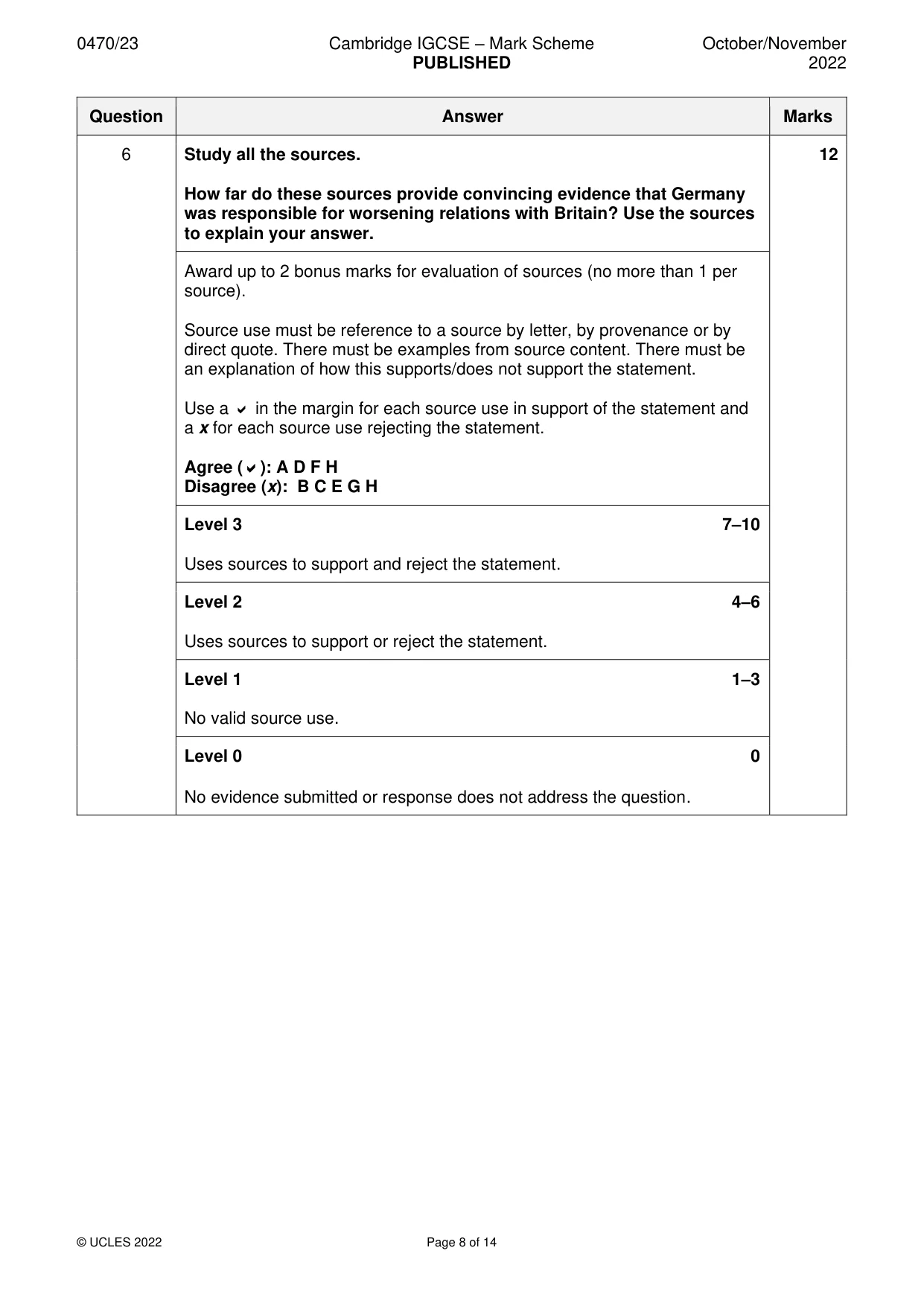
0470/23 Cambridge IGCSE – Mark Scheme PUBLISHED October/November 2022 © UCLES 2022 Page 8 of 14 Question Answer Marks 6 Study all the sources. How far do these sources provide convincing evidence that Germany was responsible for worsening relations with Britain? Use the sources to explain your answer. 12 Award up to 2 bonus marks for evaluation of sources (no more than 1 per source). Source use must be reference to a source by letter, by provenance or by direct quote. There must be examples from source content. There must be an explanation of how this supports/does not support the statement. Use a in the margin for each source use in support of the statement and a x for each source use rejecting the statement. Agree (): A D F H Disagree (x): B C E G H Level 3 7–10 Uses sources to support and reject the statement. Level 2 4–6 Uses sources to support or reject the statement. Level 1 1–3 No valid source use. Level 0 0 No evidence submitted or response does not address the question.
Mark scheme, page 9
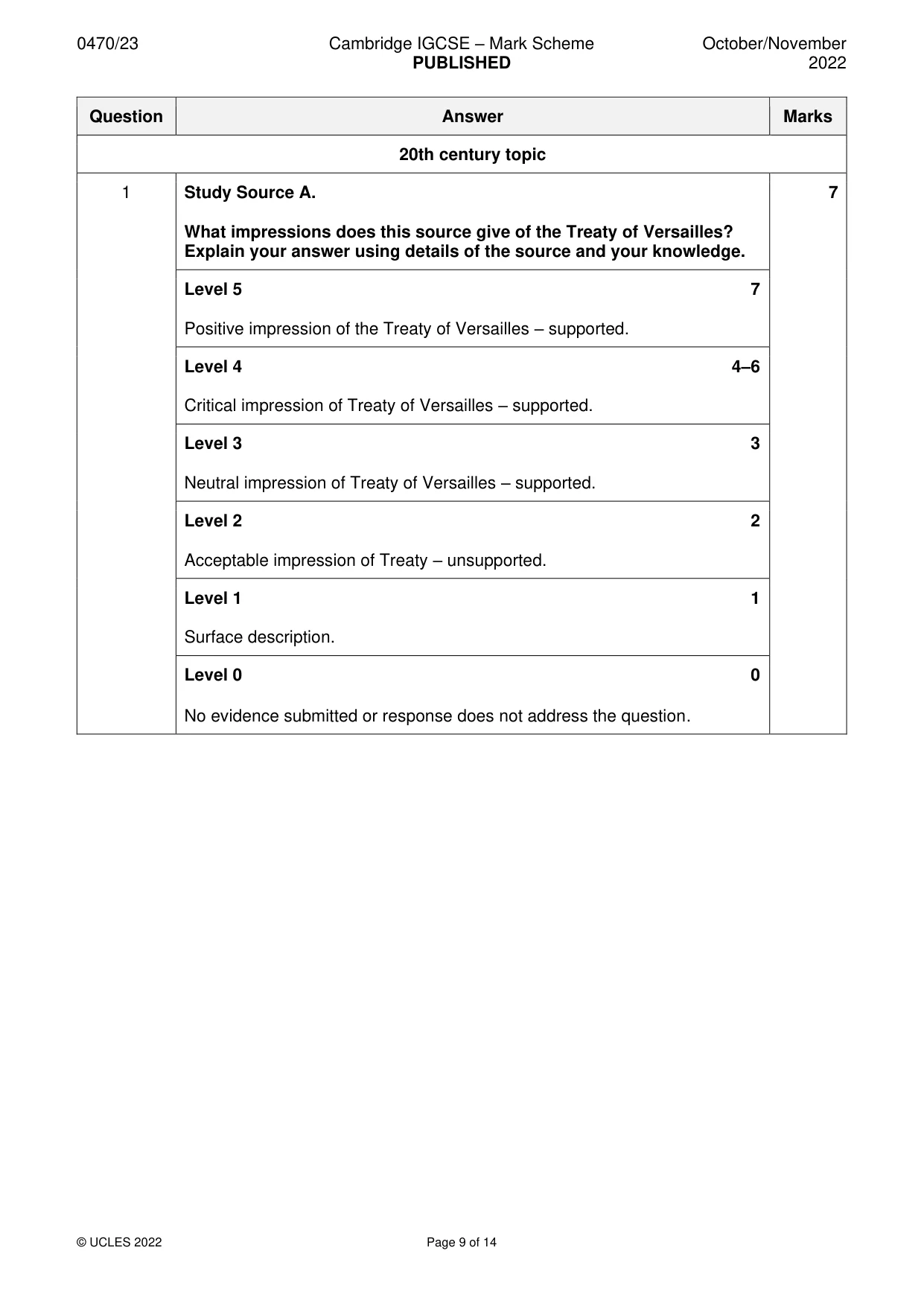
0470/23 Cambridge IGCSE – Mark Scheme PUBLISHED October/November 2022 © UCLES 2022 Page 9 of 14 Question Answer Marks 20th century topic 1 Study Source A. What impressions does this source give of the Treaty of Versailles? Explain your answer using details of the source and your knowledge. 7 Level 5 7 Positive impression of the Treaty of Versailles – supported. Level 4 4–6 Critical impression of Treaty of Versailles – supported. Level 3 3 Neutral impression of Treaty of Versailles – supported. Level 2 2 Acceptable impression of Treaty – unsupported. Level 1 1 Surface description. Level 0 0 No evidence submitted or response does not address the question.
Mark scheme, page 10
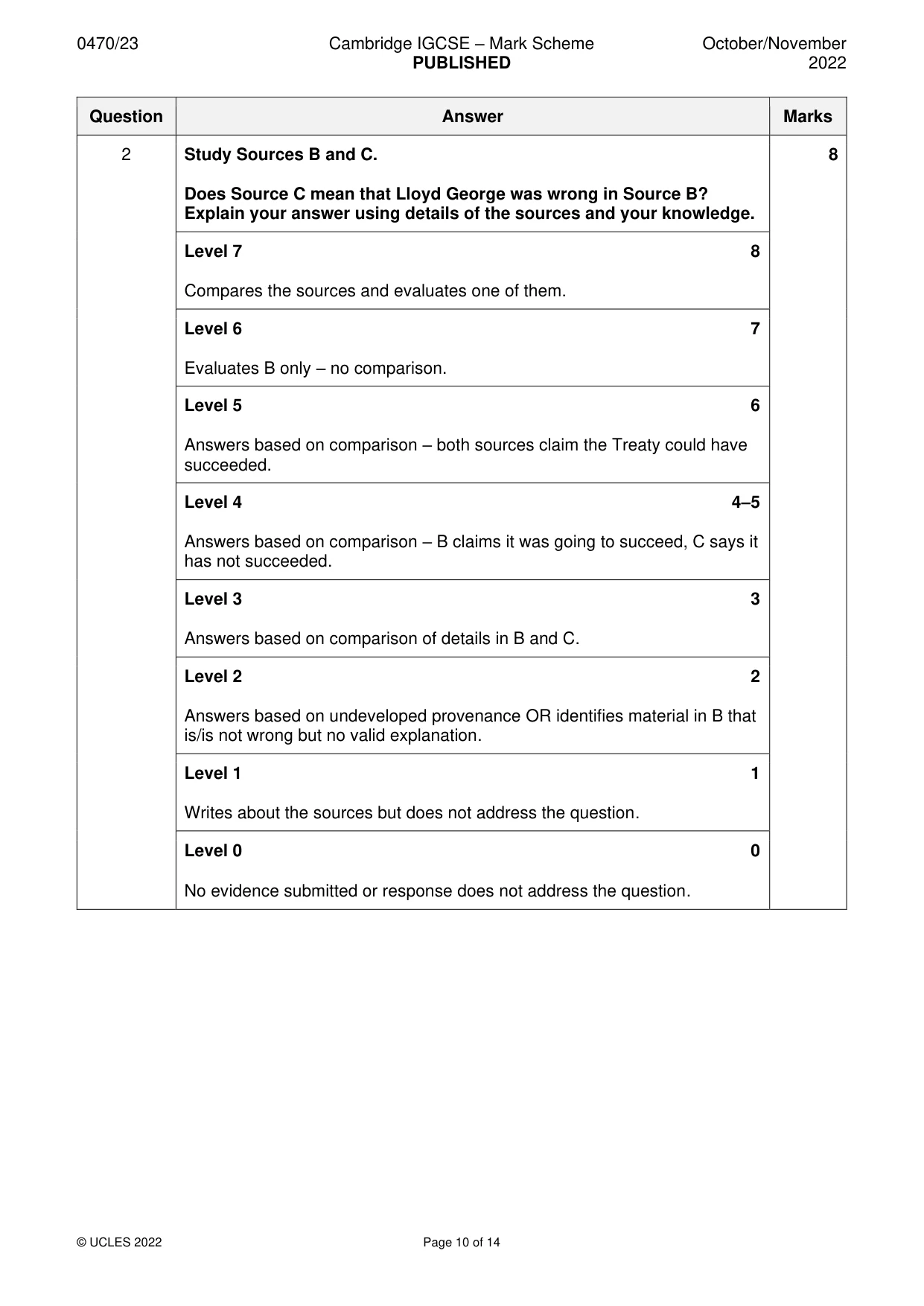
0470/23 Cambridge IGCSE – Mark Scheme PUBLISHED October/November 2022 © UCLES 2022 Page 10 of 14 Question Answer Marks 2 Study Sources B and C. Does Source C mean that Lloyd George was wrong in Source B? Explain your answer using details of the sources and your knowledge. 8 Level 7 8 Compares the sources and evaluates one of them. Level 6 7 Evaluates B only – no comparison. Level 5 6 Answers based on comparison – both sources claim the Treaty could have succeeded. Level 4 4–5 Answers based on comparison – B claims it was going to succeed, C says it has not succeeded. Level 3 3 Answers based on comparison of details in B and C. Level 2 2 Answers based on undeveloped provenance OR identifies material in B that is/is not wrong but no valid explanation. Level 1 1 Writes about the sources but does not address the question. Level 0 0 No evidence submitted or response does not address the question.
Mark scheme, page 11
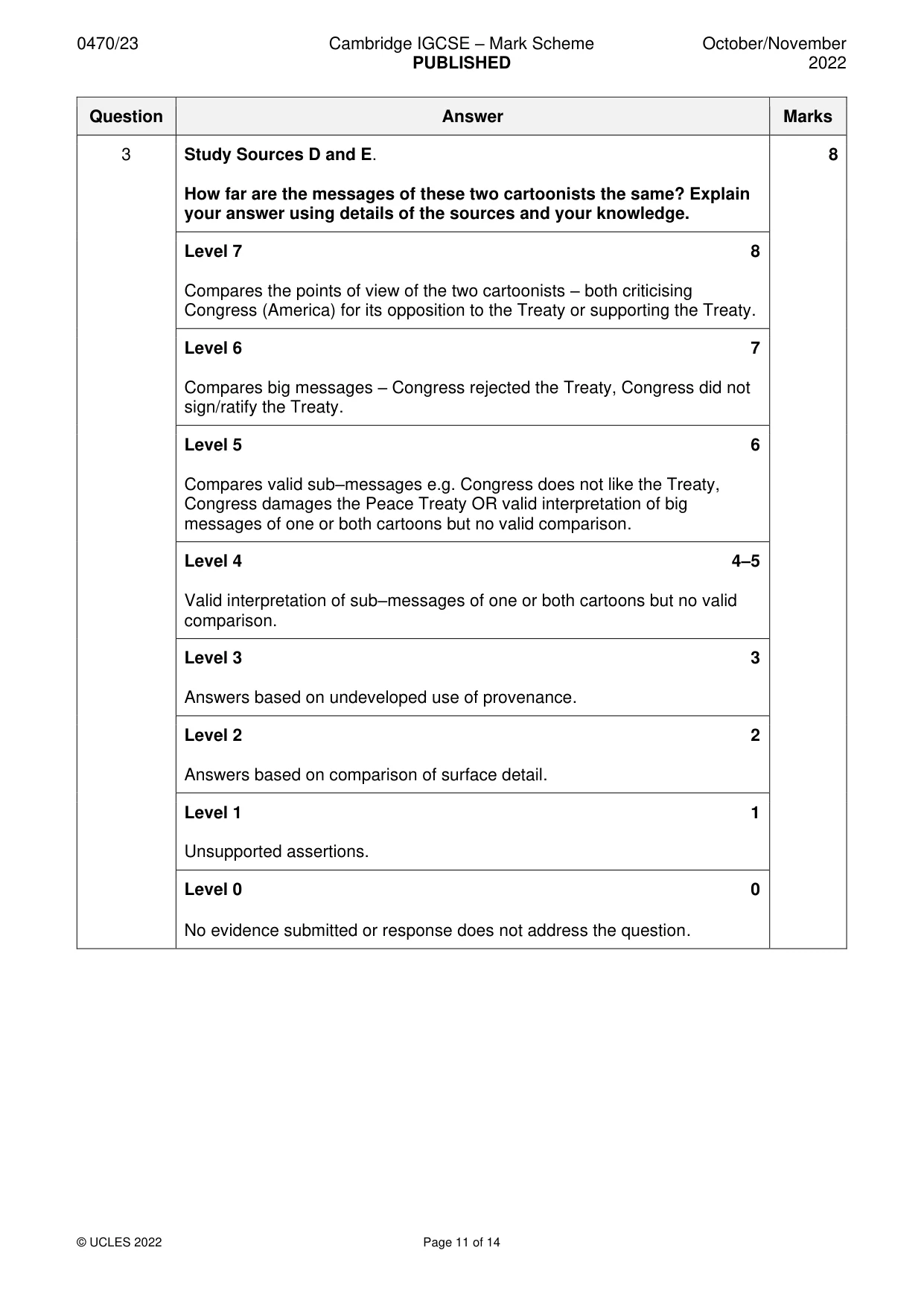
0470/23 Cambridge IGCSE – Mark Scheme PUBLISHED October/November 2022 © UCLES 2022 Page 11 of 14 Question Answer Marks 3 Study Sources D and E. How far are the messages of these two cartoonists the same? Explain your answer using details of the sources and your knowledge. 8 Level 7 8 Compares the points of view of the two cartoonists – both criticising Congress (America) for its opposition to the Treaty or supporting the Treaty. Level 6 7 Compares big messages – Congress rejected the Treaty, Congress did not sign/ratify the Treaty. Level 5 6 Compares valid sub–messages e.g. Congress does not like the Treaty, Congress damages the Peace Treaty OR valid interpretation of big messages of one or both cartoons but no valid comparison. Level 4 4–5 Valid interpretation of sub–messages of one or both cartoons but no valid comparison. Level 3 3 Answers based on undeveloped use of provenance. Level 2 2 Answers based on comparison of surface detail. Level 1 1 Unsupported assertions. Level 0 0 No evidence submitted or response does not address the question.
Mark scheme, page 12
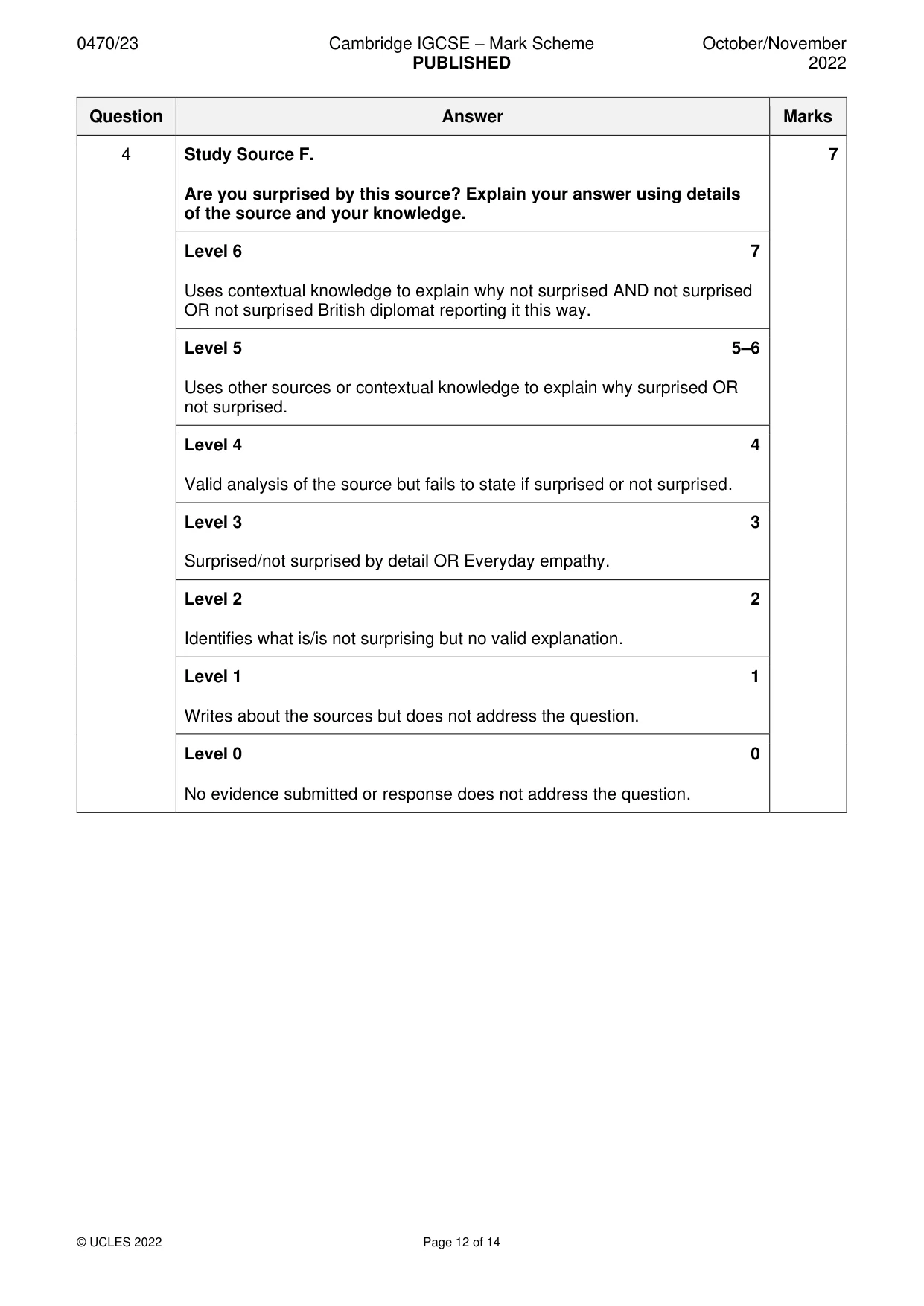
0470/23 Cambridge IGCSE – Mark Scheme PUBLISHED October/November 2022 © UCLES 2022 Page 12 of 14 Question Answer Marks 4 Study Source F. Are you surprised by this source? Explain your answer using details of the source and your knowledge. 7 Level 6 7 Uses contextual knowledge to explain why not surprised AND not surprised OR not surprised British diplomat reporting it this way. Level 5 5–6 Uses other sources or contextual knowledge to explain why surprised OR not surprised. Level 4 4 Valid analysis of the source but fails to state if surprised or not surprised. Level 3 3 Surprised/not surprised by detail OR Everyday empathy. Level 2 2 Identifies what is/is not surprising but no valid explanation. Level 1 1 Writes about the sources but does not address the question. Level 0 0 No evidence submitted or response does not address the question.
Mark scheme, page 13
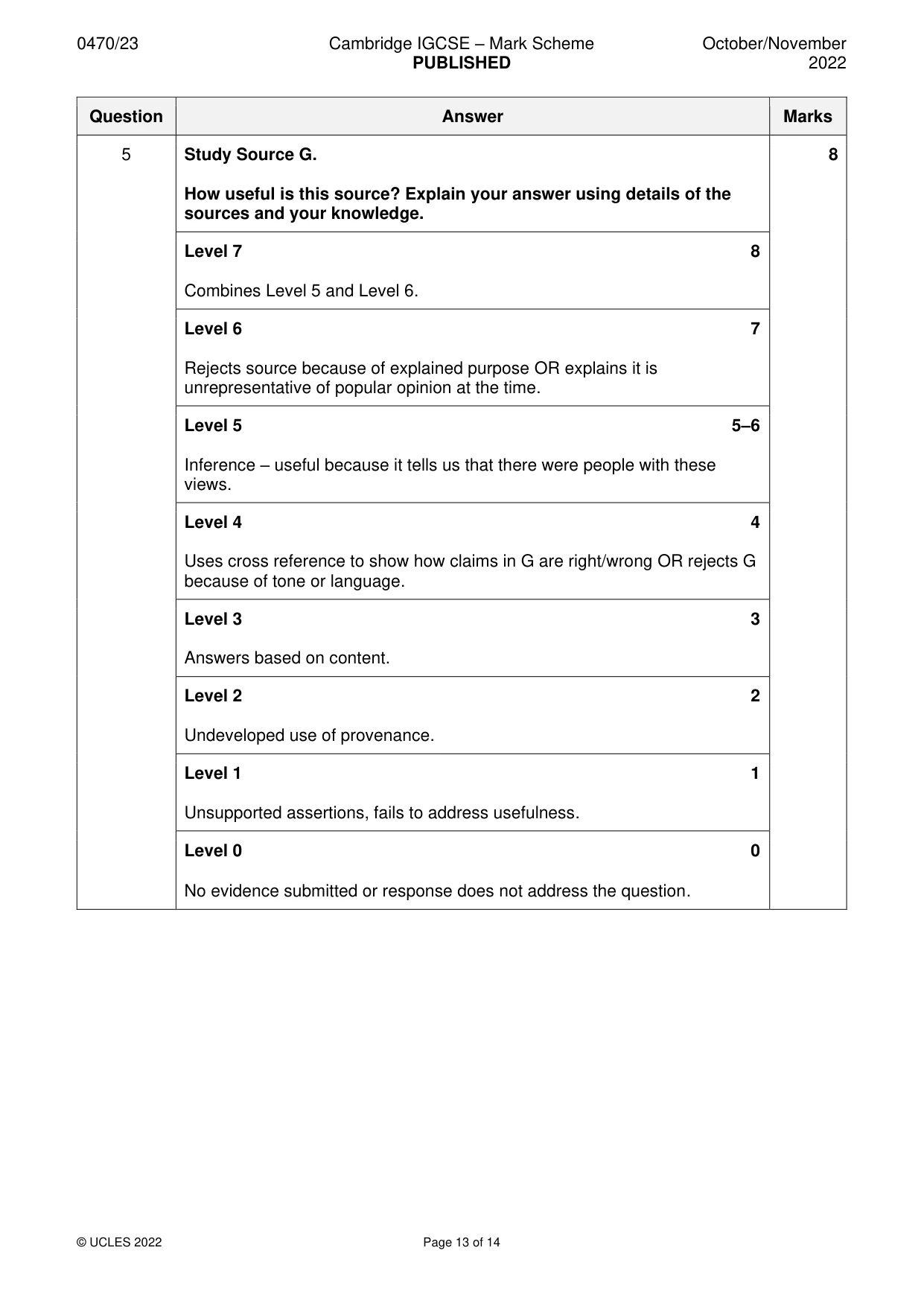
0470/23 Cambridge IGCSE – Mark Scheme PUBLISHED October/November 2022 © UCLES 2022 Page 13 of 14 Question Answer Marks 5 Study Source G. How useful is this source? Explain your answer using details of the sources and your knowledge. 8 Level 7 8 Combines Level 5 and Level 6. Level 6 7 Rejects source because of explained purpose OR explains it is unrepresentative of popular opinion at the time. Level 5 5–6 Inference – useful because it tells us that there were people with these views. Level 4 4 Uses cross reference to show how claims in G are right/wrong OR rejects G because of tone or language. Level 3 3 Answers based on content. Level 2 2 Undeveloped use of provenance. Level 1 1 Unsupported assertions, fails to address usefulness. Level 0 0 No evidence submitted or response does not address the question.
Mark scheme, page 14
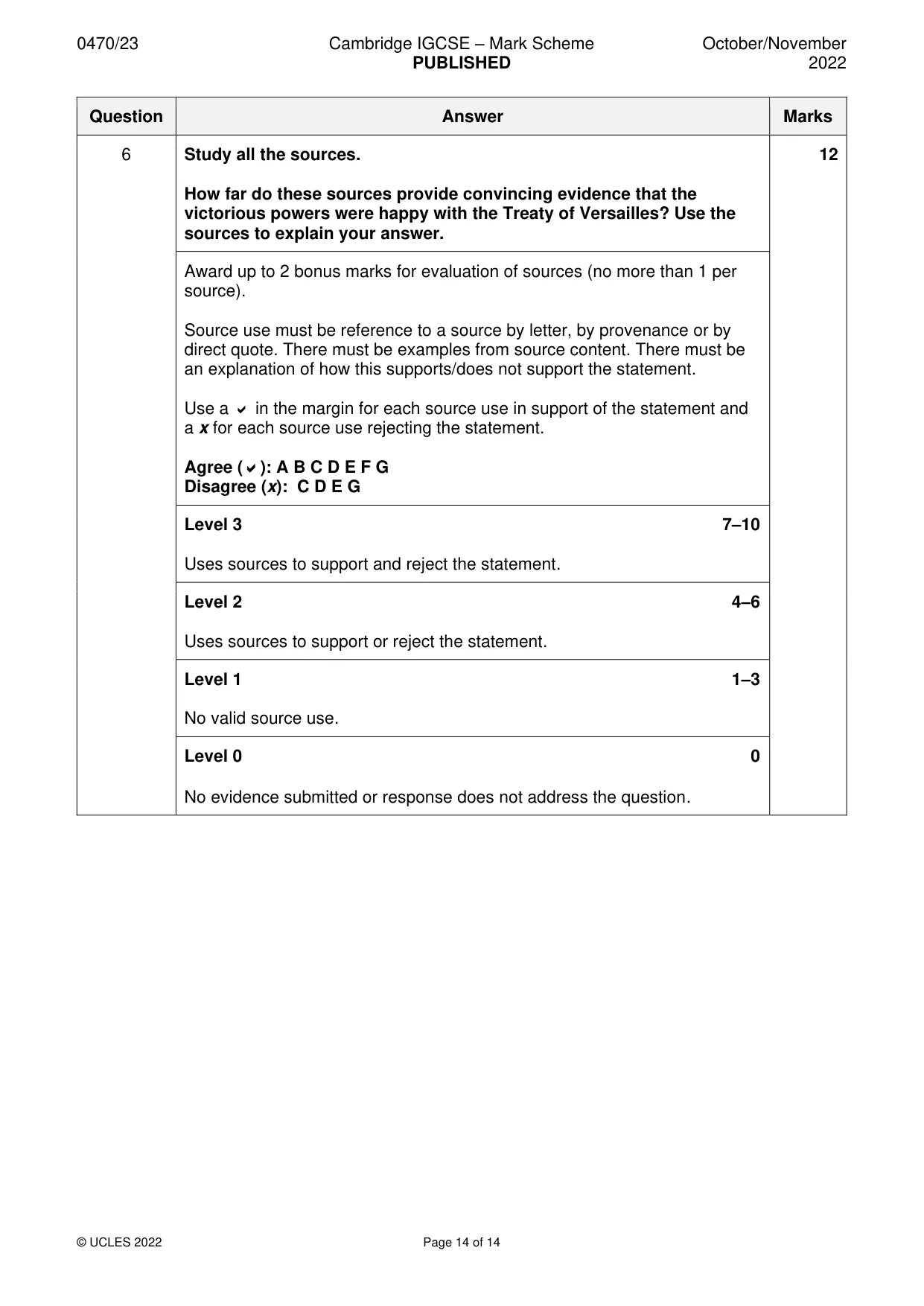
0470/23 Cambridge IGCSE – Mark Scheme PUBLISHED October/November 2022 © UCLES 2022 Page 14 of 14 Question Answer Marks 6 Study all the sources. How far do these sources provide convincing evidence that the victorious powers were happy with the Treaty of Versailles? Use the sources to explain your answer. 12 Award up to 2 bonus marks for evaluation of sources (no more than 1 per source). Source use must be reference to a source by letter, by provenance or by direct quote. There must be examples from source content. There must be an explanation of how this supports/does not support the statement. Use a in the margin for each source use in support of the statement and a x for each source use rejecting the statement. Agree (): A B C D E F G Disagree (x): C D E G Level 3 7–10 Uses sources to support and reject the statement. Level 2 4–6 Uses sources to support or reject the statement. Level 1 1–3 No valid source use. Level 0 0 No evidence submitted or response does not address the question.
What you needed in this session
Cambridge’s own grade thresholds for 2022 Oct/Nov, Paper 2 · Variant 3. A higher threshold means an easier paper — the bar moves with how the cohort did.