Cambridge IGCSE History 0470 — 2022 Oct/Nov Paper 2 · Variant 2
0470/22/O/N/22 · 50 marks · ≈56 min
The question paper and its mark scheme, free to read here and free to download. This is Cambridge’s own paper, exactly as it was sat.
Question paper16 pages


Mark scheme14 pages
Answers below. Sit the paper first if you are practising.
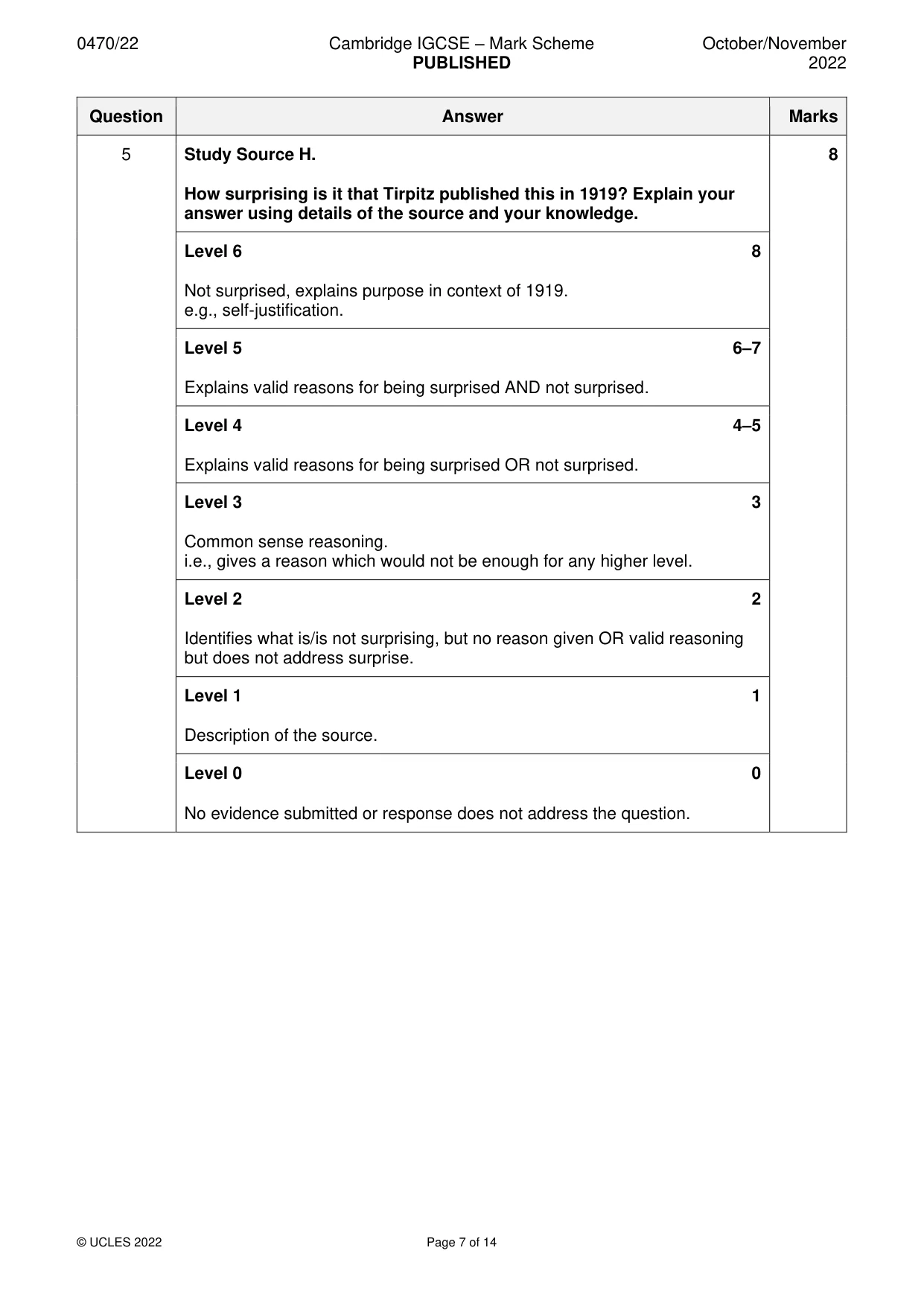
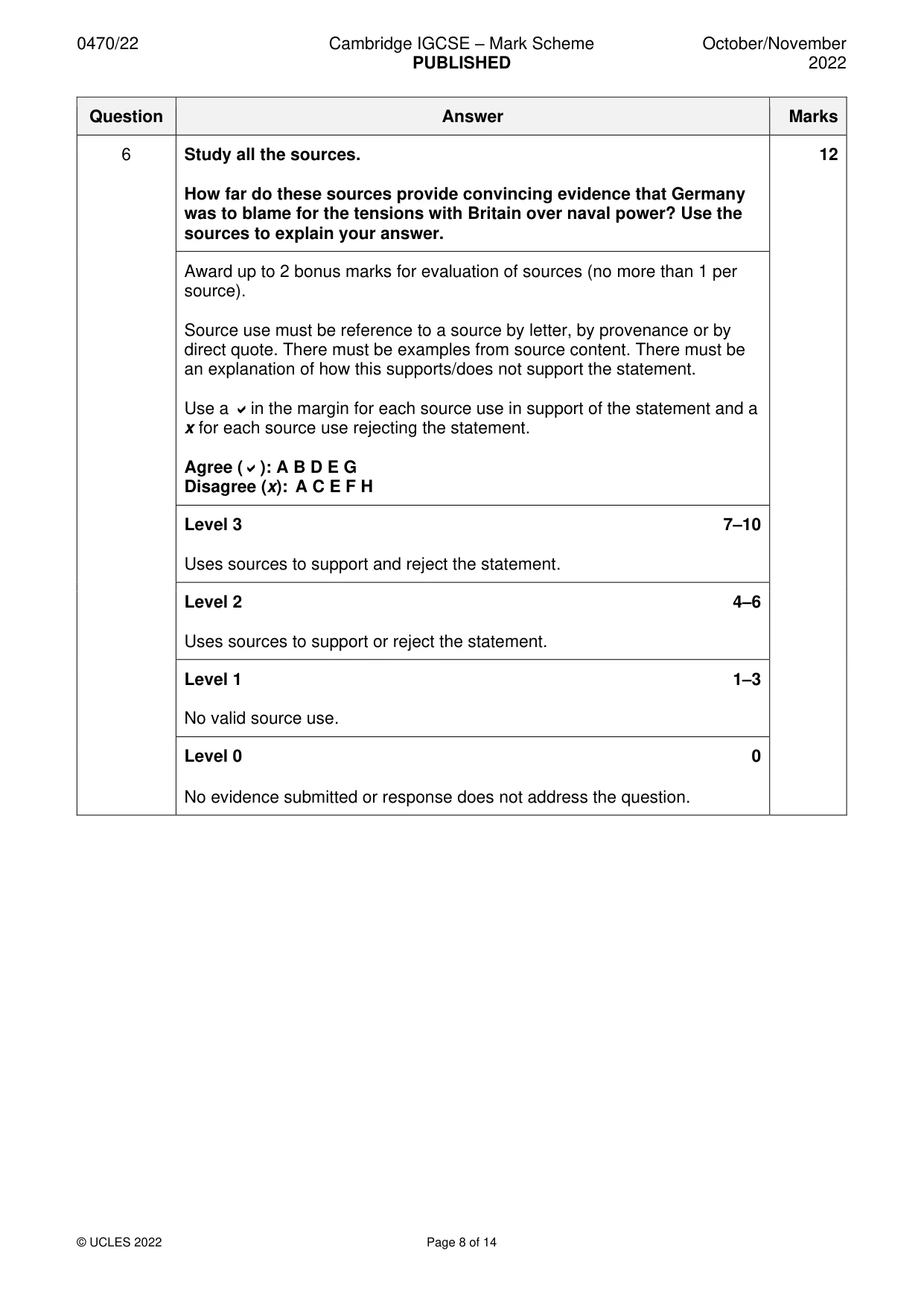
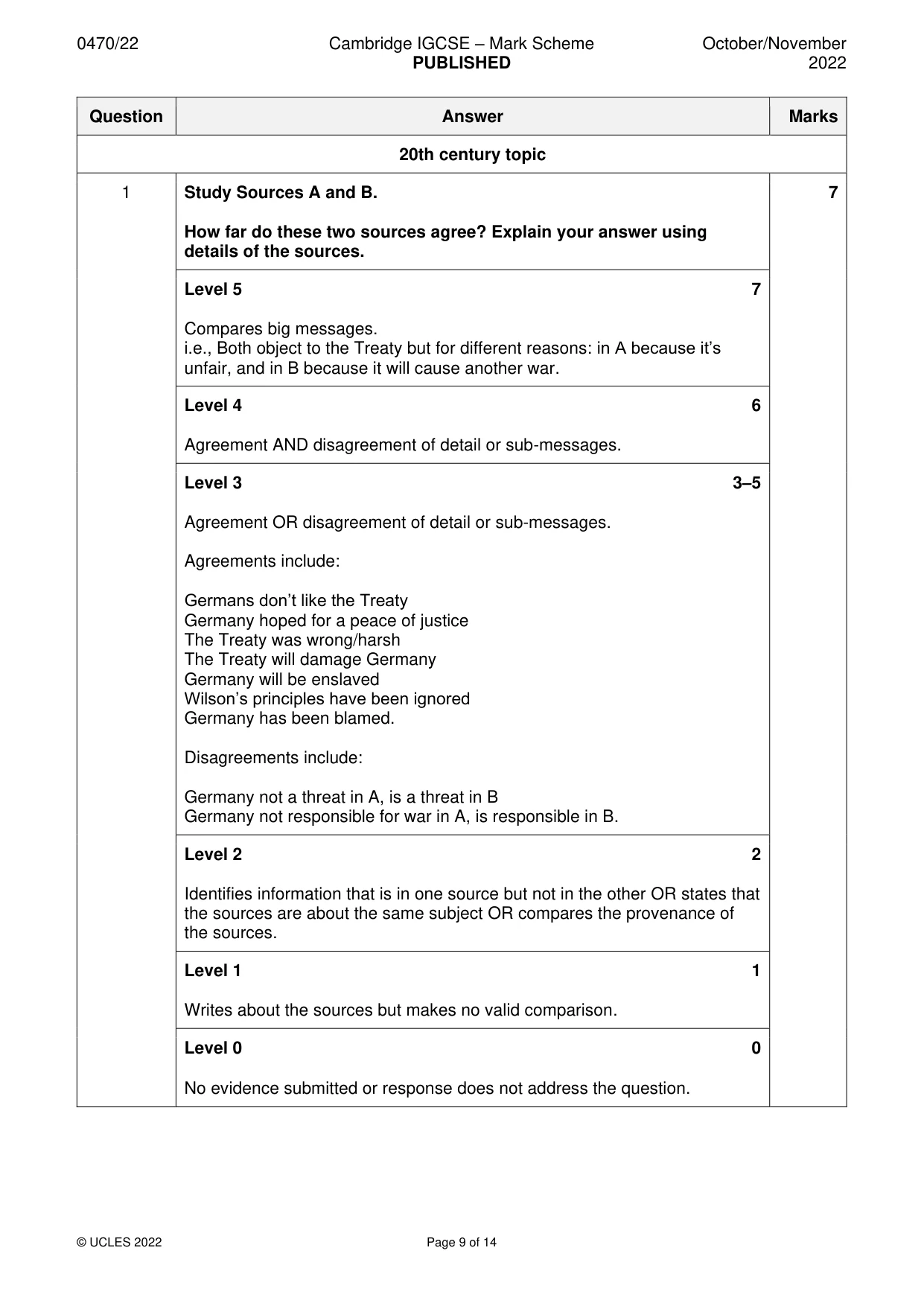
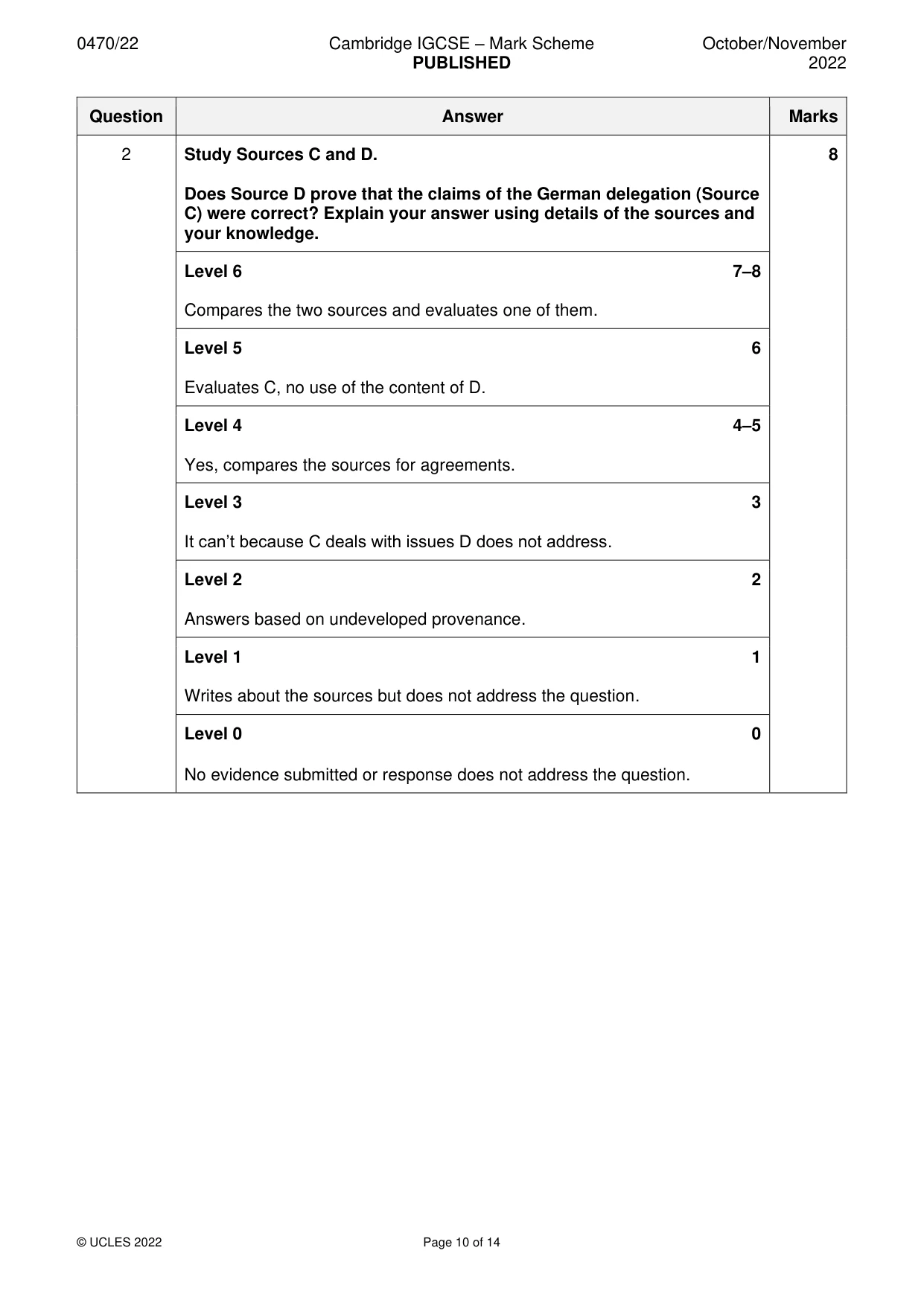
Paper as text
Question paper, page 1
This document has 16 pages. Any blank pages are indicated. [Turn over Cambridge IGCSE™ HISTORY 0470/22 Paper 2 October/November 2022 2 hours You must answer on the enclosed answer booklet. You will need: Answer booklet (enclosed) INSTRUCTIONS ● Answer all the questions on one option only. Option A: Nineteenth century topic Option B: Twentieth century topic ● Follow the instructions on the front cover of the answer booklet. If you need additional answer paper, ask the invigilator for a continuation booklet. INFORMATION ● The total mark for this paper is 50. ● The number of marks for each question or part question is shown in brackets [ ]. * 0 8 1 3 0 8 5 2 4 1 * DC (MB/SW) 215135/2 © UCLES 2022
Question paper, page 2
2 0470/22/O/N/22 © UCLES 2022 Option A: Nineteenth century topic HOW FAR WAS GERMANY RESPONSIBLE FOR TENSIONS OVER THE ISSUE OF NAVAL POWER? Study the Background Information and the sources carefully, and then answer all the questions. Background Information Many historians would agree that Anglo-German rivalry was one of the reasons for Europe’s descent into war in 1914. For much of the nineteenth century Britain had confidently ruled the oceans. However, in the early twentieth century both Britain and Germany financed programmes aimed at greatly increasing the size and power of their navies. This rivalry contributed to the growth of militarism and tension between the two countries which helped turn the events of 1914 into a terrible war. It has been argued that Germany was mainly responsible for this rivalry because it considered a strong navy as essential for world domination. On the other hand, it can be argued that Germany’s desire to have a strong navy was reasonable and that it was Britain’s determination to remain the strongest sea- power that increased tension. How far was Germany responsible for the growing tension between the two countries? SOURCE A Britain’s naval policy was driven by the idea that its navy should always be superior to the combined strength of the next two most powerful fleets. It viewed Germany as the main threat, especially when Germany decided that it needed a modern navy. The Second German Naval Law of 1900 led to an increase in the size of the German fleet. Germany wanted this enlarged navy to ensure that it could take a full part in world affairs and protect its trade and colonies. This expansion of the German navy led to anti-German hysteria in Britain with popular stories about Germany planning an invasion of Britain. At this time Britain was obsessed with the Navy and this popular feeling led in 1906 to Sir John Fisher (the most senior Admiral) massively increasing the power of the Royal Navy by launching the ‘Dreadnought’ battleship which could out-gun any battleship afloat. This transformed the whole idea of naval warfare into a dangerous arms race. Germany was horrified and was forced to construct three of this new type of ship in 1906. In Britain the popular response was ‘We want eight and we won’t wait.’ Soon the government agreed to build eight more. Germany’s fears were increased in 1907 when the Anglo-Russian Entente left Germany surrounded by a coalition of Britain, France and Russia. From a recent history book.
Question paper, page 3
3 0470/22/O/N/22 © UCLES 2022 [Turn over SOURCE B German battleship building and Weltpolitik opened the door to the Anglo-German naval race. Driven by a desire to make the German Empire the greatest world power and by anti-British motives, the Navy Laws of 1898 and 1900 laid out the course for a huge naval expansion. This expansion was directed against Great Britain and was supported by strong anti-British feeling in Germany. The completed navy would be stationed in home waters and be so strong that it could take offensive action against the British navy. It would also, so Admiral von Tirpitz hoped, force Britain into accepting the German bid for equality as a global empire. However, all it really achieved was to strengthen Britain’s determination to stay stronger than Germany by building Dreadnought battleships. Britain was faced with the German plan to build three large ships of the ‘Dreadnought’ type in 1906 and with the anti-British intentions of this plan. By 1908, Germany had launched the Nassau, the first Dreadnought battleship built for the German navy. From that time British naval construction and war- planning reflected the battleships being built in Germany and a full-scale naval race had begun. Some historians have argued that Germany’s desire to establish itself as a world power that over- shadowed Britain made the outbreak of war inevitable. From an online article. SOURCE C I see in British daily papers phrases such as ‘German challenge to British naval supremacy’. These phrases are daily drummed into British heads, and if not corrected, might bring about the most deplorable results. It is absolutely nonsensical and untrue that the German Naval Bill is to provide a navy meant as a ‘Challenge to British naval supremacy’. The German Fleet is being built against nobody at all. It is solely built for Germany’s needs in relation to our rapidly growing trade. A letter from William II to Lord Tweedmouth, February 1908. Tweedmouth was the British government minister in charge of the navy.
Question paper, page 4
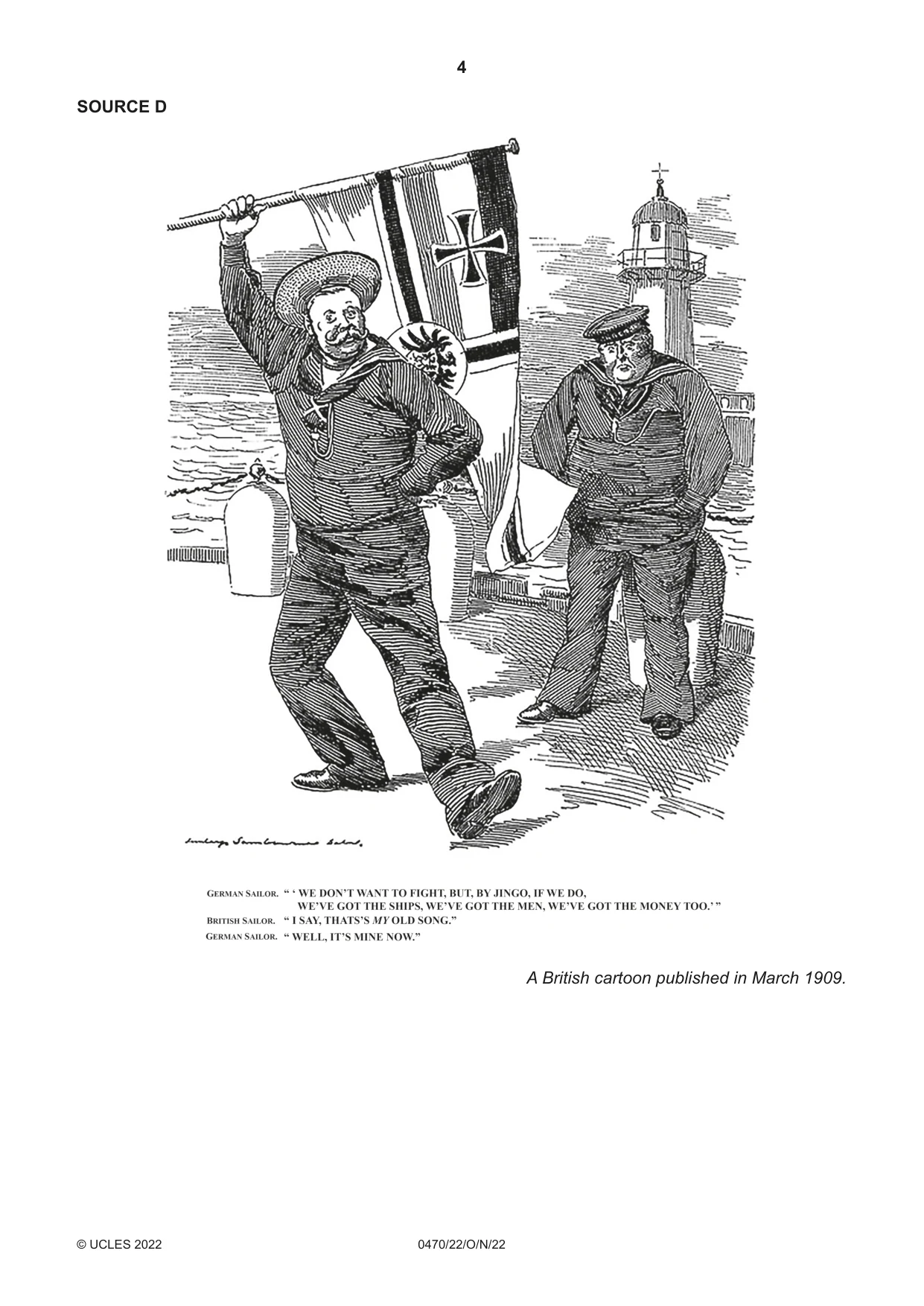
4 0470/22/O/N/22 © UCLES 2022 SOURCE D A British cartoon published in March 1909.
Question paper, page 5
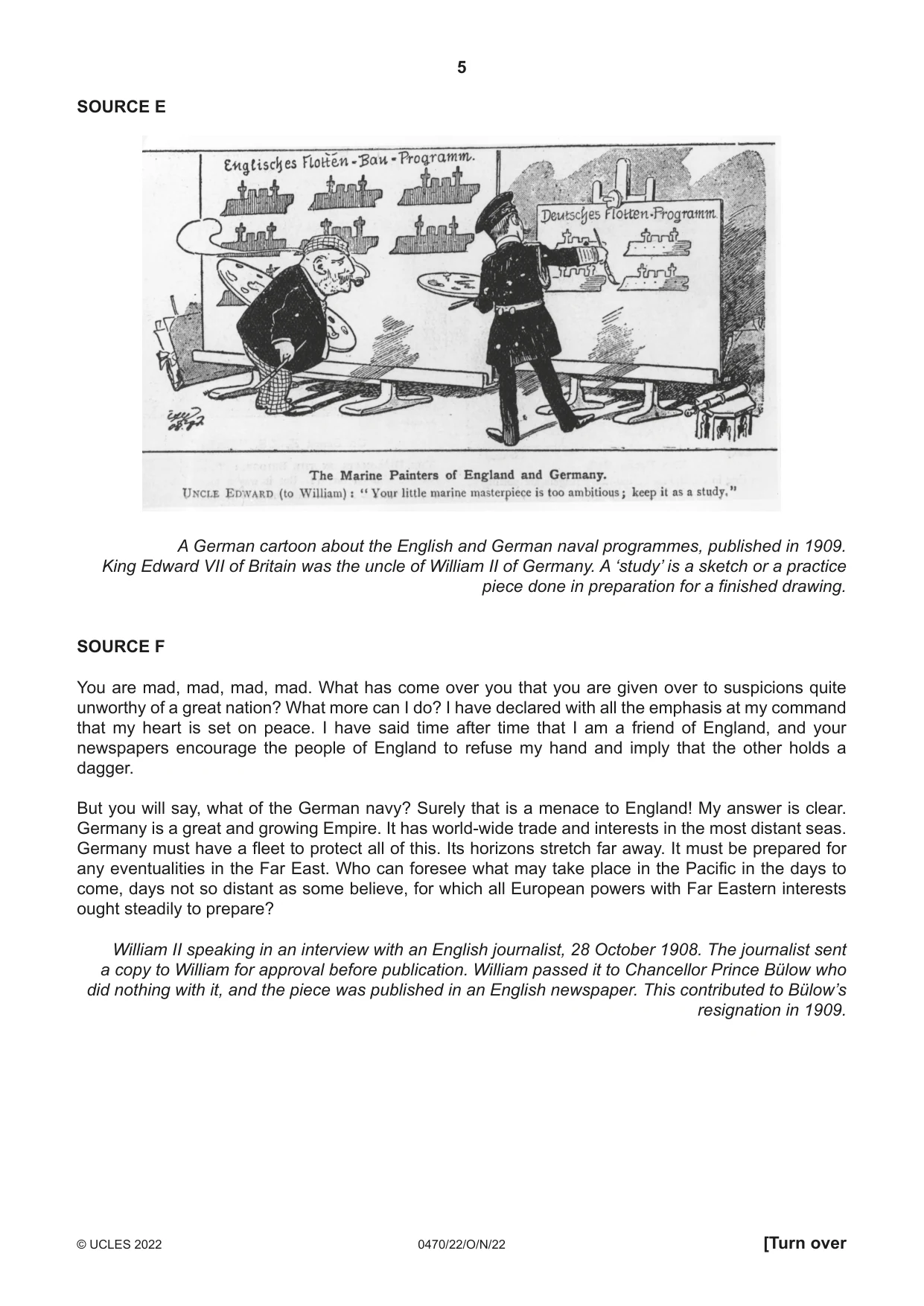
5 0470/22/O/N/22 © UCLES 2022 [Turn over SOURCE E A German cartoon about the English and German naval programmes, published in 1909. King Edward VII of Britain was the uncle of William II of Germany. A ‘study’ is a sketch or a practice piece done in preparation for a finished drawing. SOURCE F You are mad, mad, mad, mad. What has come over you that you are given over to suspicions quite unworthy of a great nation? What more can I do? I have declared with all the emphasis at my command that my heart is set on peace. I have said time after time that I am a friend of England, and your newspapers encourage the people of England to refuse my hand and imply that the other holds a dagger. But you will say, what of the German navy? Surely that is a menace to England! My answer is clear. Germany is a great and growing Empire. It has world-wide trade and interests in the most distant seas. Germany must have a fleet to protect all of this. Its horizons stretch far away. It must be prepared for any eventualities in the Far East. Who can foresee what may take place in the Pacific in the days to come, days not so distant as some believe, for which all European powers with Far Eastern interests ought steadily to prepare? William II speaking in an interview with an English journalist, 28 October 1908. The journalist sent a copy to William for approval before publication. William passed it to Chancellor Prince Bülow who did nothing with it, and the piece was published in an English newspaper. This contributed to Bülow’s resignation in 1909.
Question paper, page 6
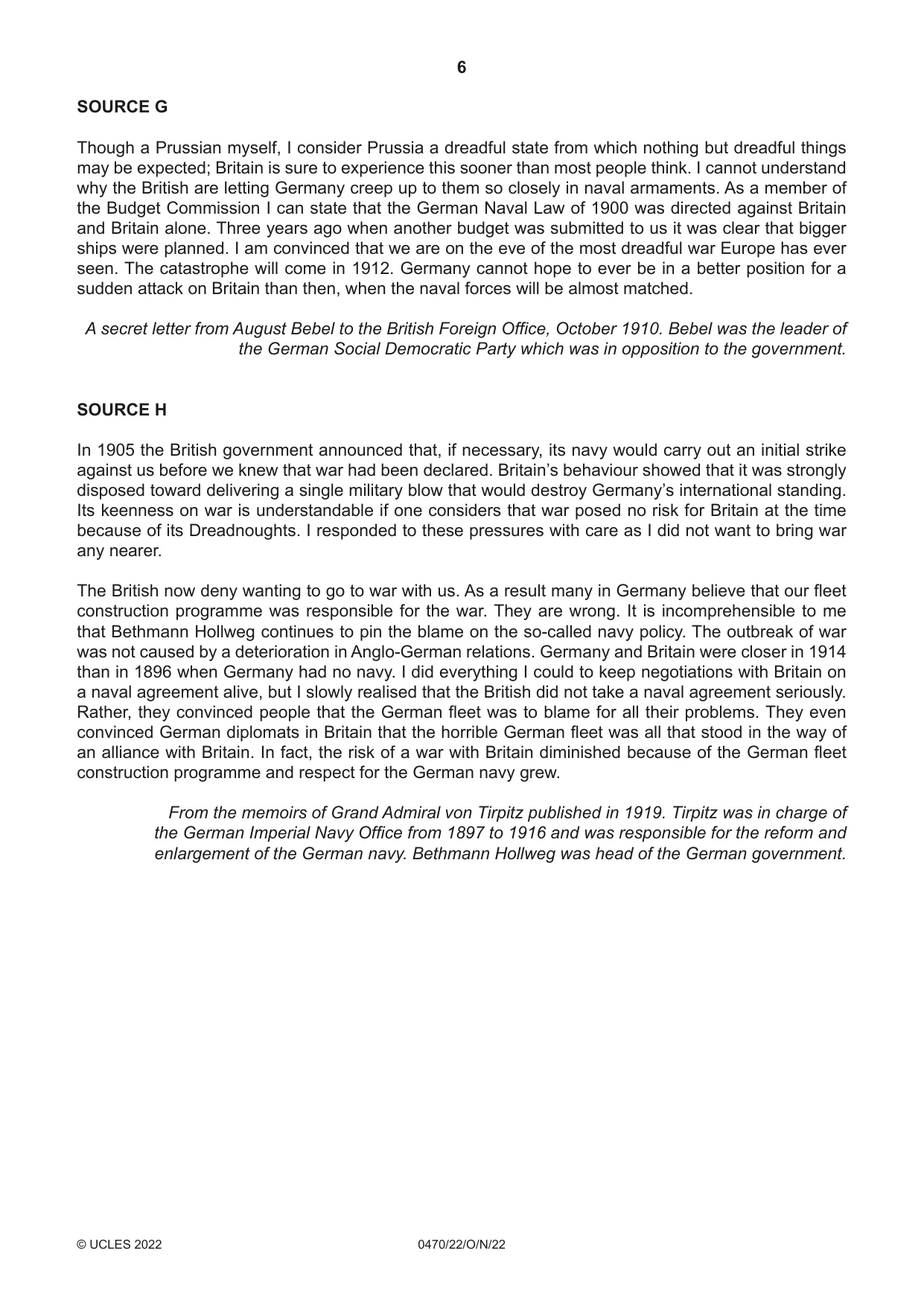
6 0470/22/O/N/22 © UCLES 2022 SOURCE G Though a Prussian myself, I consider Prussia a dreadful state from which nothing but dreadful things may be expected; Britain is sure to experience this sooner than most people think. I cannot understand why the British are letting Germany creep up to them so closely in naval armaments. As a member of the Budget Commission I can state that the German Naval Law of 1900 was directed against Britain and Britain alone. Three years ago when another budget was submitted to us it was clear that bigger ships were planned. I am convinced that we are on the eve of the most dreadful war Europe has ever seen. The catastrophe will come in 1912. Germany cannot hope to ever be in a better position for a sudden attack on Britain than then, when the naval forces will be almost matched. A secret letter from August Bebel to the British Foreign Office, October 1910. Bebel was the leader of the German Social Democratic Party which was in opposition to the government. SOURCE H In 1905 the British government announced that, if necessary, its navy would carry out an initial strike against us before we knew that war had been declared. Britain’s behaviour showed that it was strongly disposed toward delivering a single military blow that would destroy Germany’s international standing. Its keenness on war is understandable if one considers that war posed no risk for Britain at the time because of its Dreadnoughts. I responded to these pressures with care as I did not want to bring war any nearer. The British now deny wanting to go to war with us. As a result many in Germany believe that our fleet construction programme was responsible for the war. They are wrong. It is incomprehensible to me that Bethmann Hollweg continues to pin the blame on the so-called navy policy. The outbreak of war was not caused by a deterioration in Anglo-German relations. Germany and Britain were closer in 1914 than in 1896 when Germany had no navy. I did everything I could to keep negotiations with Britain on a naval agreement alive, but I slowly realised that the British did not take a naval agreement seriously. Rather, they convinced people that the German fleet was to blame for all their problems. They even convinced German diplomats in Britain that the horrible German fleet was all that stood in the way of an alliance with Britain. In fact, the risk of a war with Britain diminished because of the German fleet construction programme and respect for the German navy grew. From the memoirs of Grand Admiral von Tirpitz published in 1919. Tirpitz was in charge of the German Imperial Navy Office from 1897 to 1916 and was responsible for the reform and enlargement of the German navy. Bethmann Hollweg was head of the German government.
Question paper, page 7
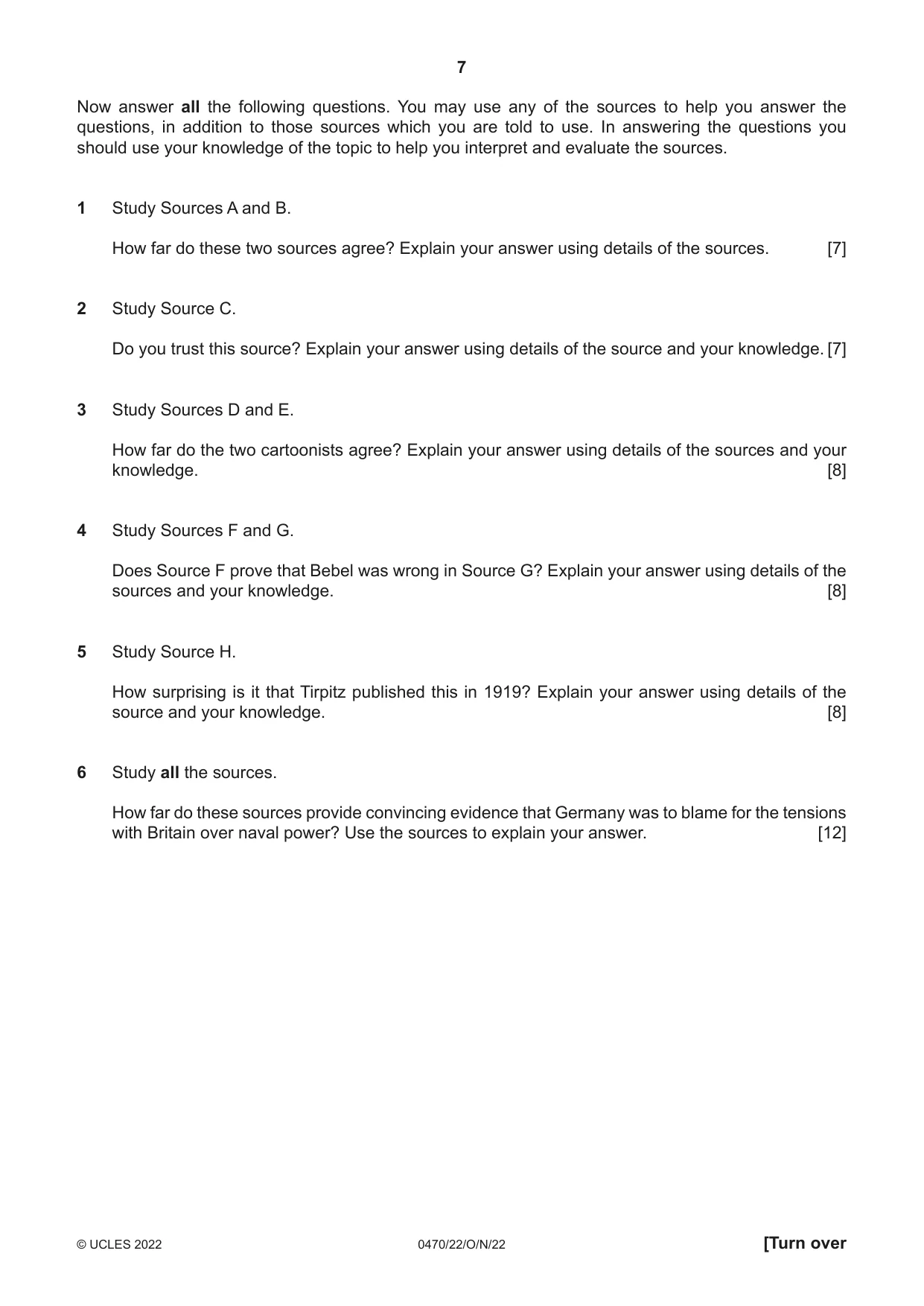
7 0470/22/O/N/22 © UCLES 2022 [Turn over Now answer all the following questions. You may use any of the sources to help you answer the questions, in addition to those sources which you are told to use. In answering the questions you should use your knowledge of the topic to help you interpret and evaluate the sources. 1 Study Sources A and B. How far do these two sources agree? Explain your answer using details of the sources. [7] 2 Study Source C. Do you trust this source? Explain your answer using details of the source and your knowledge. [7] 3 Study Sources D and E. How far do the two cartoonists agree? Explain your answer using details of the sources and your knowledge. [8] 4 Study Sources F and G. Does Source F prove that Bebel was wrong in Source G? Explain your answer using details of the sources and your knowledge. [8] 5 Study Source H. How surprising is it that Tirpitz published this in 1919? Explain your answer using details of the source and your knowledge. [8] 6 Study all the sources. How far do these sources provide convincing evidence that Germany was to blame for the tensions with Britain over naval power? Use the sources to explain your answer. [12]
Question paper, page 8
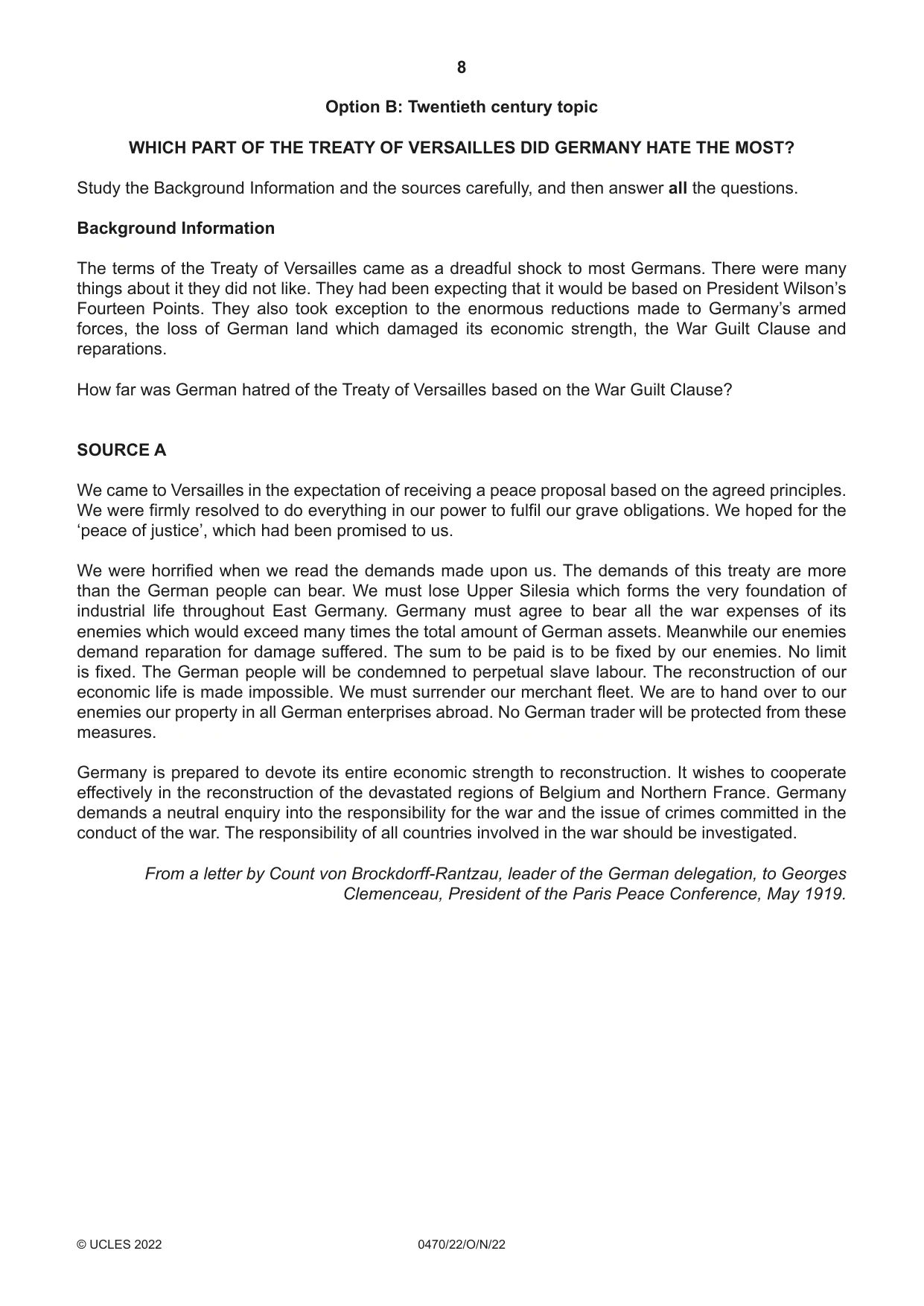
8 0470/22/O/N/22 © UCLES 2022 Option B: Twentieth century topic WHICH PART OF THE TREATY OF VERSAILLES DID GERMANY HATE THE MOST? Study the Background Information and the sources carefully, and then answer all the questions. Background Information The terms of the Treaty of Versailles came as a dreadful shock to most Germans. There were many things about it they did not like. They had been expecting that it would be based on President Wilson’s Fourteen Points. They also took exception to the enormous reductions made to Germany’s armed forces, the loss of German land which damaged its economic strength, the War Guilt Clause and reparations. How far was German hatred of the Treaty of Versailles based on the War Guilt Clause? SOURCE A We came to Versailles in the expectation of receiving a peace proposal based on the agreed principles. We were firmly resolved to do everything in our power to fulfil our grave obligations. We hoped for the ‘peace of justice’, which had been promised to us. We were horrified when we read the demands made upon us. The demands of this treaty are more than the German people can bear. We must lose Upper Silesia which forms the very foundation of industrial life throughout East Germany. Germany must agree to bear all the war expenses of its enemies which would exceed many times the total amount of German assets. Meanwhile our enemies demand reparation for damage suffered. The sum to be paid is to be fixed by our enemies. No limit is fixed. The German people will be condemned to perpetual slave labour. The reconstruction of our economic life is made impossible. We must surrender our merchant fleet. We are to hand over to our enemies our property in all German enterprises abroad. No German trader will be protected from these measures. Germany is prepared to devote its entire economic strength to reconstruction. It wishes to cooperate effectively in the reconstruction of the devastated regions of Belgium and Northern France. Germany demands a neutral enquiry into the responsibility for the war and the issue of crimes committed in the conduct of the war. The responsibility of all countries involved in the war should be investigated. From a letter by Count von Brockdorff-Rantzau, leader of the German delegation, to Georges Clemenceau, President of the Paris Peace Conference, May 1919.
Question paper, page 9
9 0470/22/O/N/22 © UCLES 2022 [Turn over SOURCE B The peace conditions are so hard and humiliating that even those who have the smallest expectation of a ‘peace of justice’ are bound to be deeply disappointed. Has Germany deserved such a hard peace? Everybody knows how we condemned the crimes committed against humanity by Germany. Our opinion of the lust for power and conquest of Germany is well known. But a condemnation of wartime actions must not amount to a lasting condemnation of a people. Is there any sense in punishing a people in such a way as the Allies wish to punish Germany? The Allies desire the complete destruction of Germany. The financial burden is so heavy that Germany is reduced to economic slavery. This peace is a mockery of President Wilson’s principles. These terms will never give peace. All Germans must feel that they wish to shake off the heavy burden imposed by the Allies, and we fear that opportunity will soon present itself. Chained and enslaved, Germany will always remain a menace to Europe. We understand the bitter feelings of the Allies. But that does not make these peace terms less wrong or less dangerous to the world. An article in a Dutch newspaper, June 1919. The Netherlands remained neutral during the First World War. SOURCE C The more we understood the spirit of this Treaty, the more we became convinced that it could not work. The demands raised go beyond the power of the German Nation. We know the impact of the hate we are encountering here, and we have heard the passionate demand of the victors, who require us, the defeated, to pay the bill and plan to punish us as the guilty party. We are asked to confess ourselves the only culprits; in my view, such a confession would be a lie. We strongly deny that the people of Germany, who were convinced that they were waging a war of defence, should be burdened with the whole guilt of that war. A message from the German Delegation to the Allies, June 1919.
Question paper, page 10
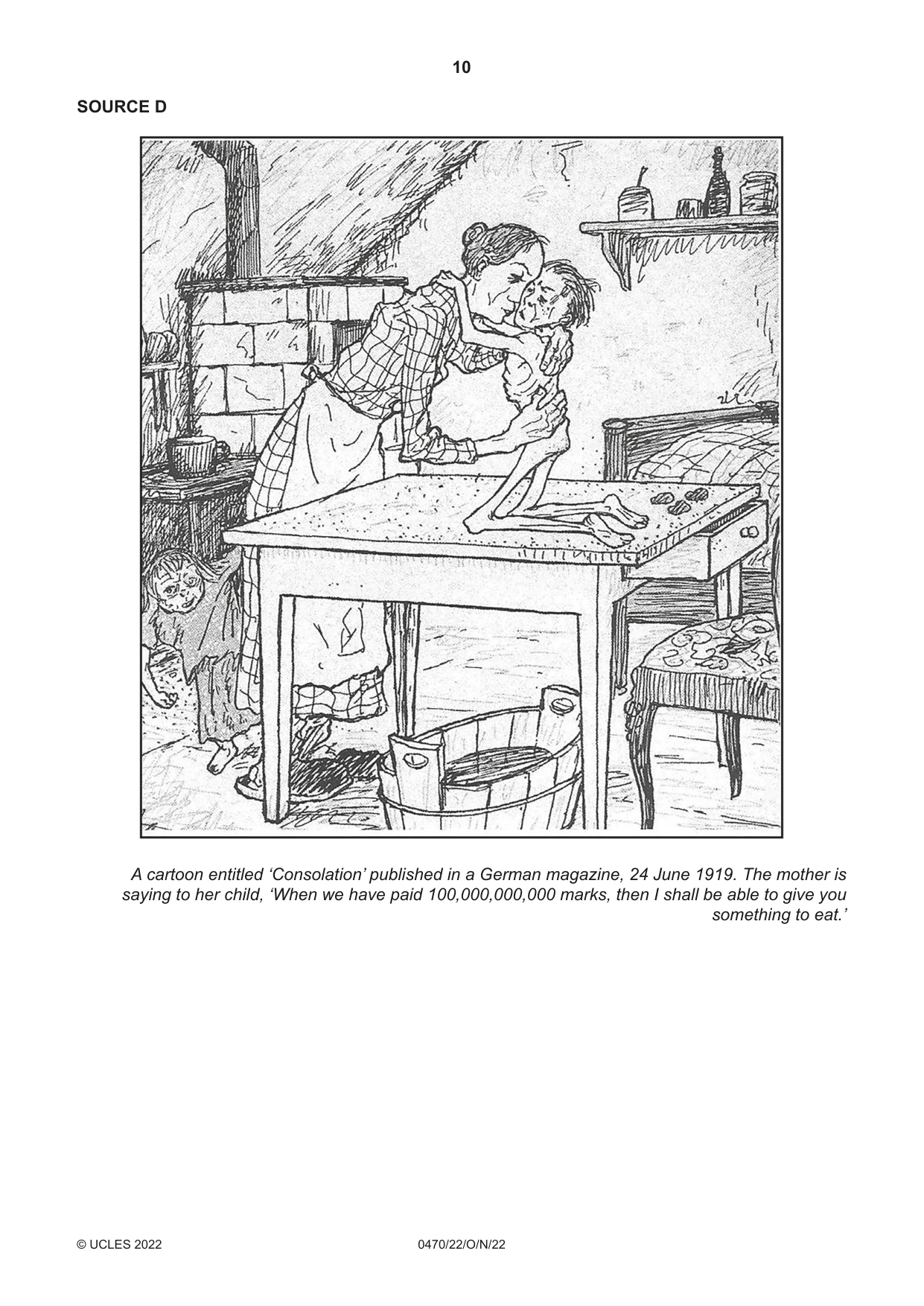
10 0470/22/O/N/22 © UCLES 2022 SOURCE D A cartoon entitled ‘Consolation’ published in a German magazine, 24 June 1919. The mother is saying to her child, ‘When we have paid 100,000,000,000 marks, then I shall be able to give you something to eat.’
Question paper, page 11
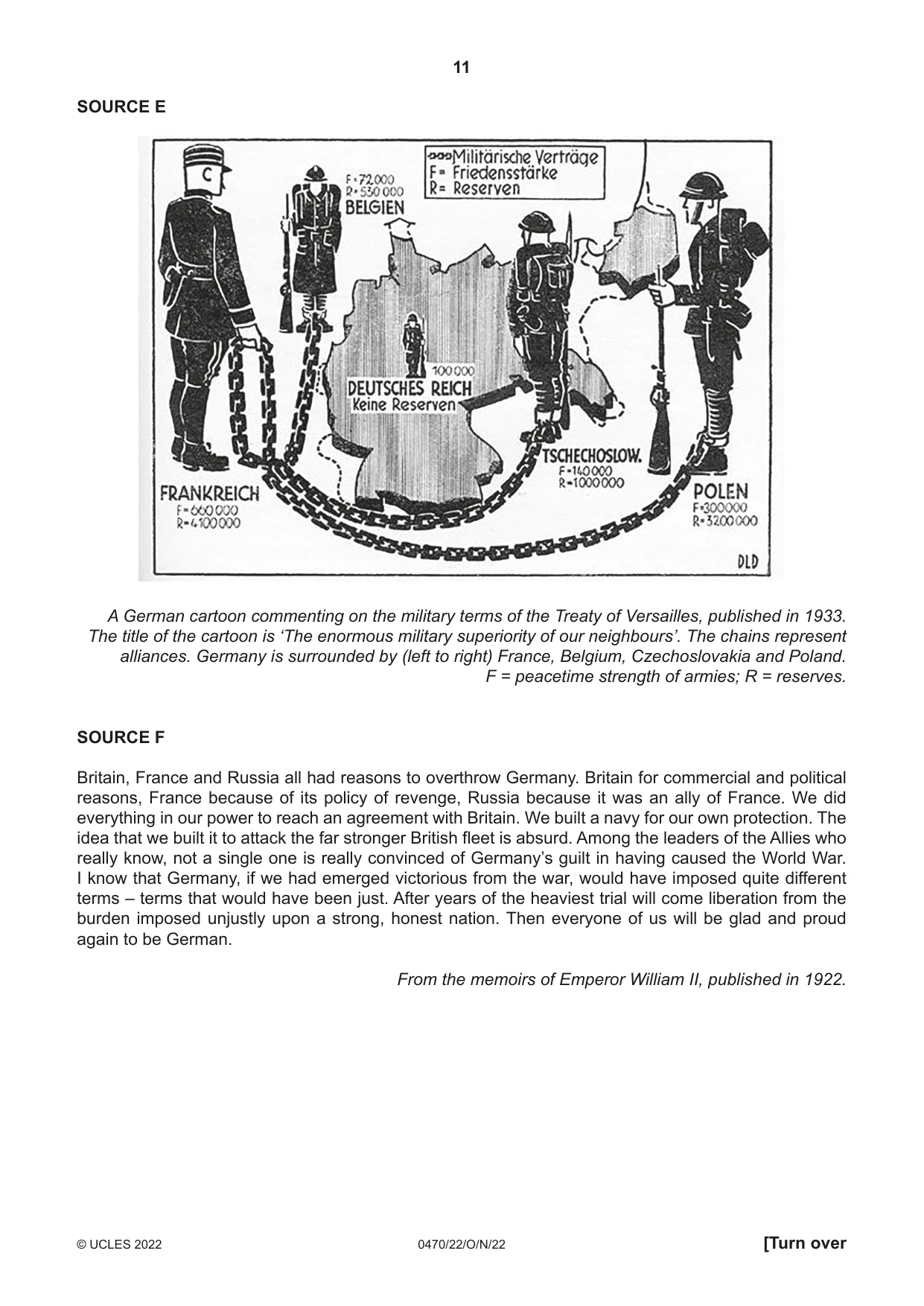
11 0470/22/O/N/22 © UCLES 2022 [Turn over SOURCE E A German cartoon commenting on the military terms of the Treaty of Versailles, published in 1933. The title of the cartoon is ‘The enormous military superiority of our neighbours’. The chains represent alliances. Germany is surrounded by (left to right) France, Belgium, Czechoslovakia and Poland. F = peacetime strength of armies; R = reserves. SOURCE F Britain, France and Russia all had reasons to overthrow Germany. Britain for commercial and political reasons, France because of its policy of revenge, Russia because it was an ally of France. We did everything in our power to reach an agreement with Britain. We built a navy for our own protection. The idea that we built it to attack the far stronger British fleet is absurd. Among the leaders of the Allies who really know, not a single one is really convinced of Germany’s guilt in having caused the World War. I know that Germany, if we had emerged victorious from the war, would have imposed quite different terms – terms that would have been just. After years of the heaviest trial will come liberation from the burden imposed unjustly upon a strong, honest nation. Then everyone of us will be glad and proud again to be German. From the memoirs of Emperor William II, published in 1922.
Question paper, page 12
12 0470/22/O/N/22 © UCLES 2022 SOURCE G The German Republic was born out of a terrible defeat. This cast a dark shadow over the new political order. Everyone had expected a peace settlement in accordance with Wilson’s Fourteen Points, which all the countries involved in the war had accepted as the basis for peace. The criminal madness of the Versailles Diktat was a shameless blow to the new Republic. Its constitution was born with a curse upon it. That it did not immediately collapse is striking proof of the genuine vitality of its basic principles. Written by Hugo Preuss in 1923. Preuss was a liberal politician and member of the first two governments of the Weimar Republic. He was chiefly responsible for writing the Weimar Constitution.
Question paper, page 13
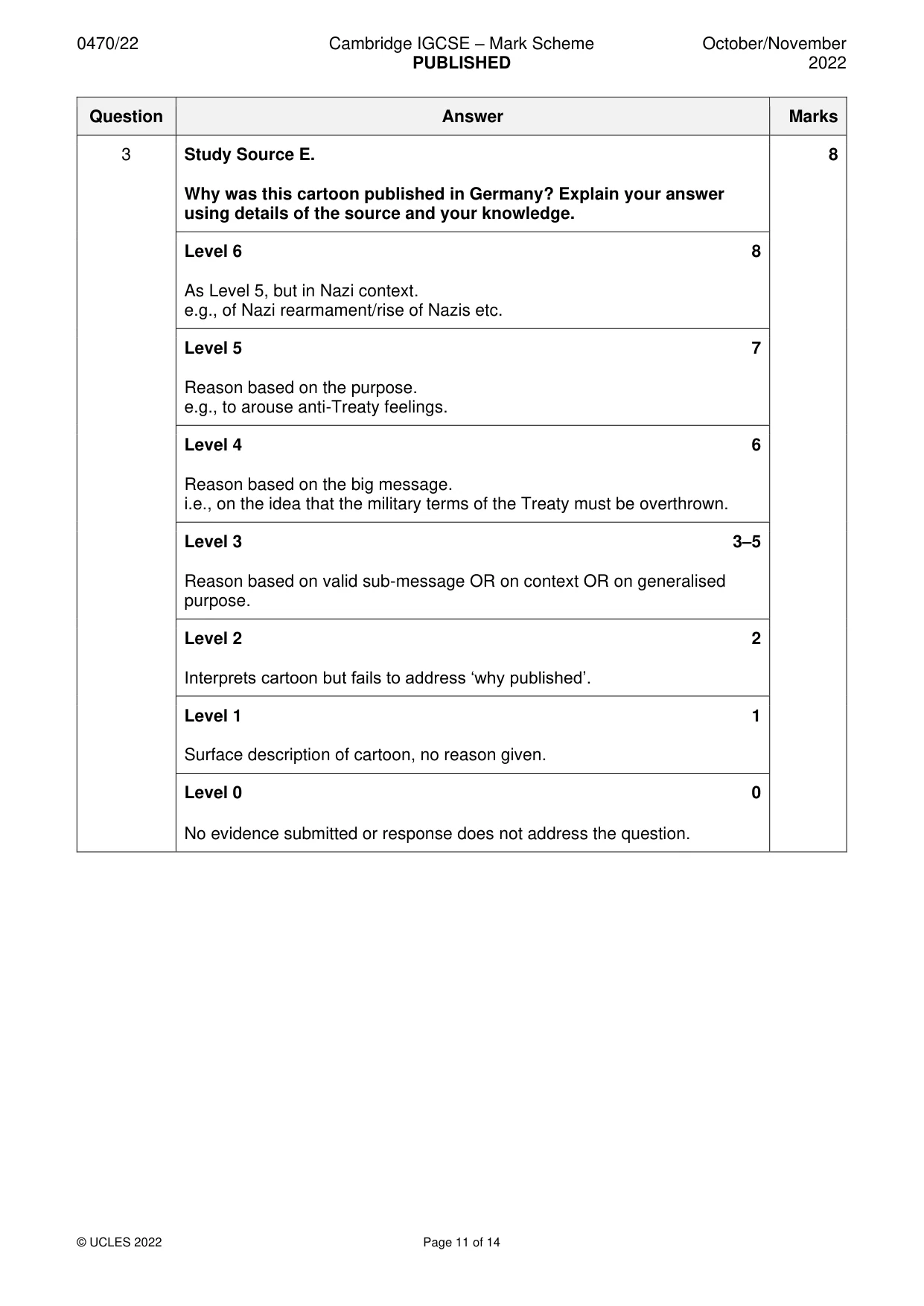
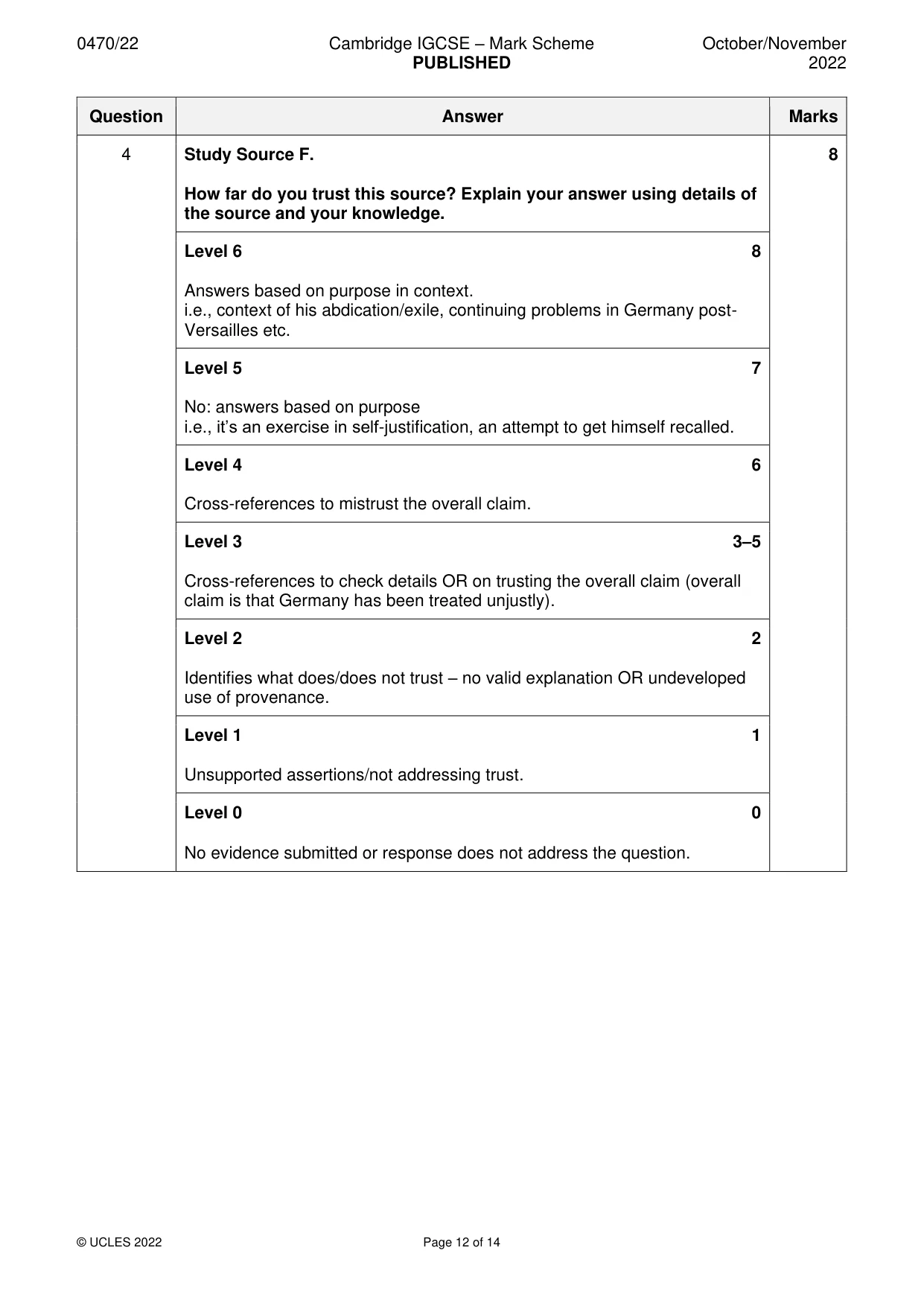
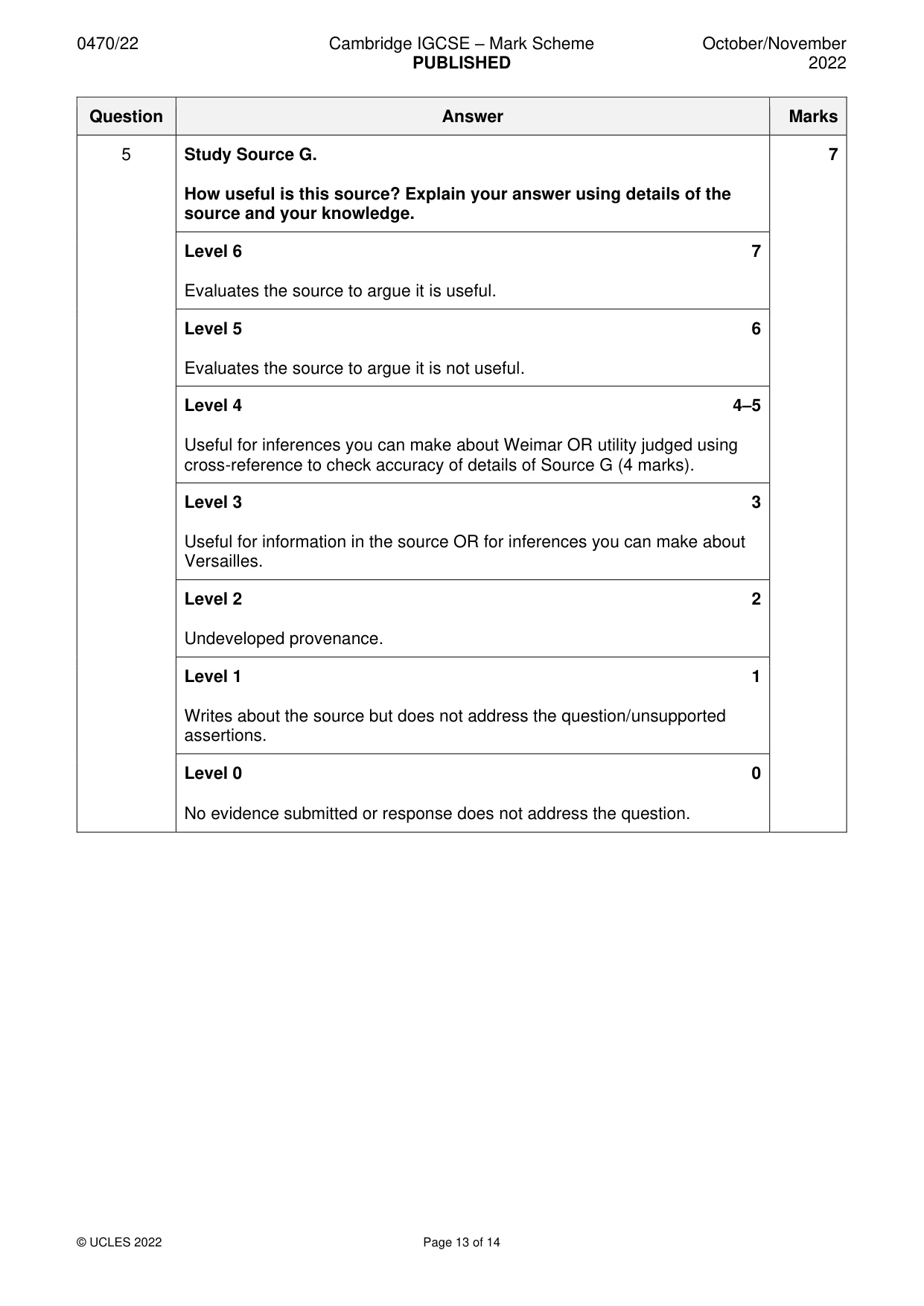
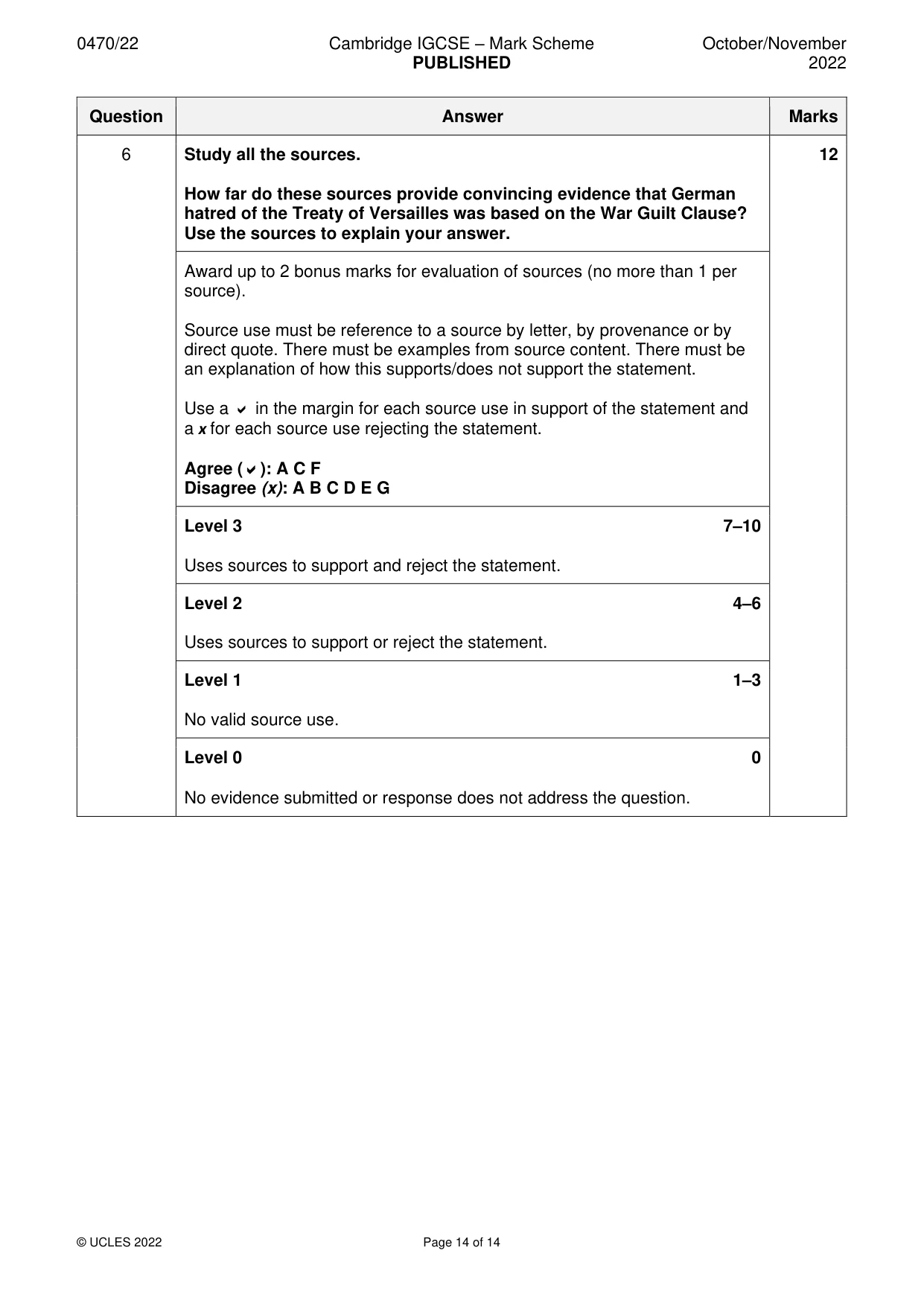
13 0470/22/O/N/22 © UCLES 2022 Now answer all the following questions. You may use any of the sources to help you answer the questions, in addition to those sources which you are told to use. In answering the questions you should use your knowledge of the topic to help you interpret and evaluate the sources. 1 Study Sources A and B. How far do these two sources agree? Explain your answer using details of the sources. [7] 2 Study Sources C and D. How far does Source D prove that the claims of the German delegation (Source C) were correct? Explain your answer using details of the sources and your knowledge. [8] 3 Study Source E. Why was this cartoon published in Germany? Explain your answer using details of the source and your knowledge. [8] 4 Study Source F. How far do you trust this source? Explain your answer using details of the source and your knowledge. [8] 5 Study Source G. How useful is this source? Explain your answer using details of the source and your knowledge. [7] 6 Study all the sources. How far do these sources provide convincing evidence that German hatred of the Treaty of Versailles was based on the War Guilt Clause? Use the sources to explain your answer. [12]
Question paper, page 14
14 0470/22/O/N/22 © UCLES 2022 BLANK PAGE
Question paper, page 15
15 0470/22/O/N/22 © UCLES 2022 BLANK PAGE
Question paper, page 16
16 0470/22/O/N/22 © UCLES 2022 Permission to reproduce items where third-party owned material protected by copyright is included has been sought and cleared where possible. Every reasonable effort has been made by the publisher (UCLES) to trace copyright holders, but if any items requiring clearance have unwittingly been included, the publisher will be pleased to make amends at the earliest possible opportunity. To avoid the issue of disclosure of answer-related information to candidates, all copyright acknowledgements are reproduced online in the Cambridge Assessment International Education Copyright Acknowledgements Booklet. This is produced for each series of examinations and is freely available to download at www.cambridgeinternational.org after the live examination series. Cambridge Assessment International Education is part of Cambridge Assessment. Cambridge Assessment is the brand name of the University of Cambridge Local Examinations Syndicate (UCLES), which is a department of the University of Cambridge. BLANK PAGE
Mark scheme, page 1
This document consists of 14 printed pages. © UCLES 2022 [Turn over Cambridge IGCSE™ HISTORY 0470/22 Paper 2 October/November 2022 MARK SCHEME Maximum Mark: 50 Published This mark scheme is published as an aid to teachers and candidates, to indicate the requirements of the examination. It shows the basis on which Examiners were instructed to award marks. It does not indicate the details of the discussions that took place at an Examiners’ meeting before marking began, which would have considered the acceptability of alternative answers. Mark schemes should be read in conjunction with the question paper and the Principal Examiner Report for Teachers. Cambridge International will not enter into discussions about these mark schemes. Cambridge International is publishing the mark schemes for the October/November 2022 series for most Cambridge IGCSE™, Cambridge International A and AS Level components and some Cambridge O Level components.
Mark scheme, page 2
0470/22 Cambridge IGCSE – Mark Scheme PUBLISHED October/November 2022 © UCLES 2022 Page 2 of 14 Generic Marking Principles These general marking principles must be applied by all examiners when marking candidate answers. They should be applied alongside the specific content of the mark scheme or generic level descriptors for a question. Each question paper and mark scheme will also comply with these marking principles. GENERIC MARKING PRINCIPLE 1: Marks must be awarded in line with: • the specific content of the mark scheme or the generic level descriptors for the question • the specific skills defined in the mark scheme or in the generic level descriptors for the question • the standard of response required by a candidate as exemplified by the standardisation scripts. GENERIC MARKING PRINCIPLE 2: Marks awarded are always whole marks (not half marks, or other fractions). GENERIC MARKING PRINCIPLE 3: Marks must be awarded positively: • marks are awarded for correct/valid answers, as defined in the mark scheme. However, credit is given for valid answers which go beyond the scope of the syllabus and mark scheme, referring to your Team Leader as appropriate • marks are awarded when candidates clearly demonstrate what they know and can do • marks are not deducted for errors • marks are not deducted for omissions • answers should only be judged on the quality of spelling, punctuation and grammar when these features are specifically assessed by the question as indicated by the mark scheme. The meaning, however, should be unambiguous. GENERIC MARKING PRINCIPLE 4: Rules must be applied consistently, e.g. in situations where candidates have not followed instructions or in the application of generic level descriptors. GENERIC MARKING PRINCIPLE 5: Marks should be awarded using the full range of marks defined in the mark scheme for the question (however; the use of the full mark range may be limited according to the quality of the candidate responses seen). GENERIC MARKING PRINCIPLE 6: Marks awarded are based solely on the requirements as defined in the mark scheme. Marks should not be awarded with grade thresholds or grade descriptors in mind.
Mark scheme, page 3
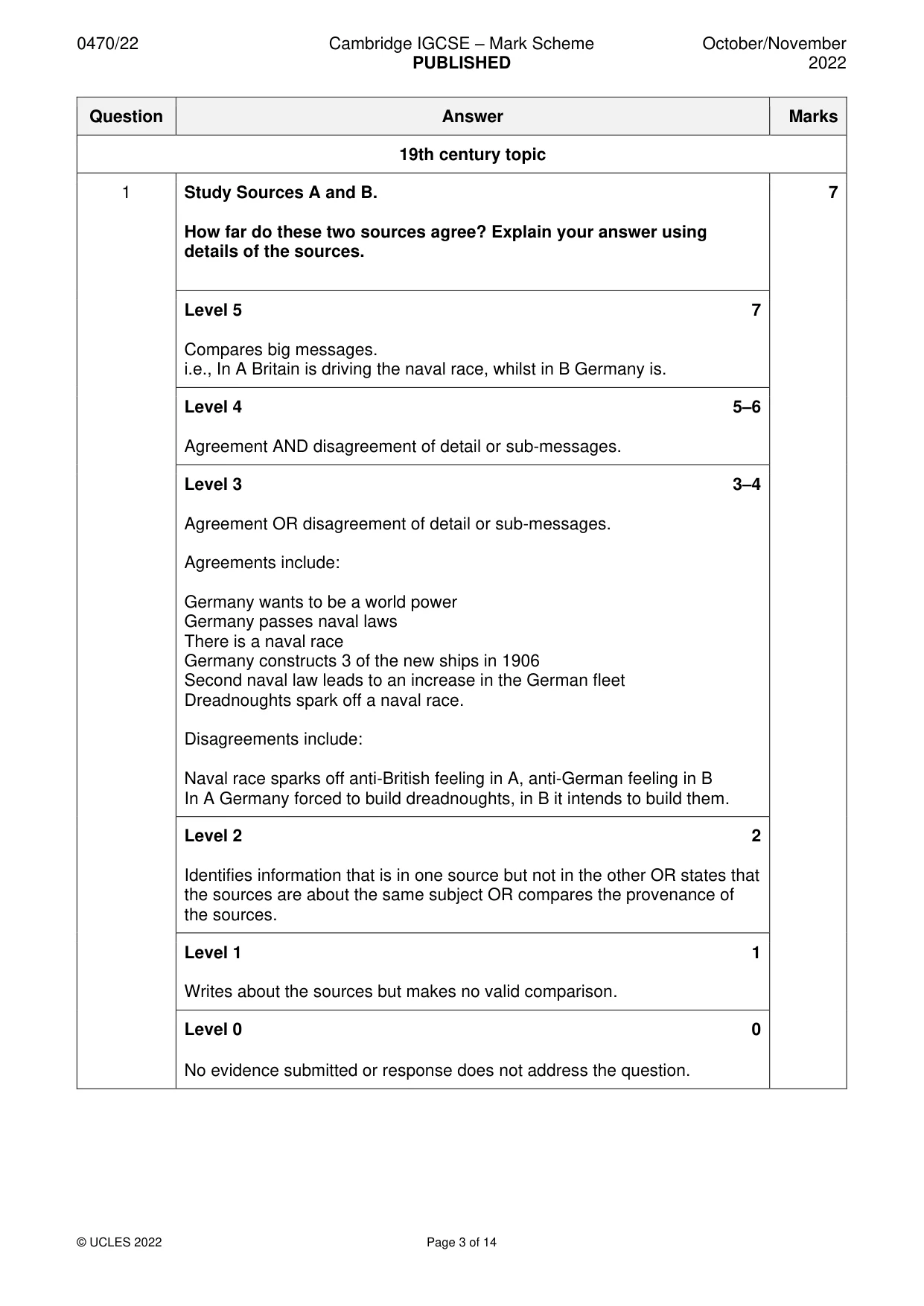
0470/22 Cambridge IGCSE – Mark Scheme PUBLISHED October/November 2022 © UCLES 2022 Page 3 of 14 Question Answer Marks 19th century topic 1 Study Sources A and B. How far do these two sources agree? Explain your answer using details of the sources. 7 Level 5 7 Compares big messages. i.e., In A Britain is driving the naval race, whilst in B Germany is. Level 4 5–6 Agreement AND disagreement of detail or sub-messages. Level 3 3–4 Agreement OR disagreement of detail or sub-messages. Agreements include: Germany wants to be a world power Germany passes naval laws There is a naval race Germany constructs 3 of the new ships in 1906 Second naval law leads to an increase in the German fleet Dreadnoughts spark off a naval race. Disagreements include: Naval race sparks off anti-British feeling in A, anti-German feeling in B In A Germany forced to build dreadnoughts, in B it intends to build them. Level 2 2 Identifies information that is in one source but not in the other OR states that the sources are about the same subject OR compares the provenance of the sources. Level 1 1 Writes about the sources but makes no valid comparison. Level 0 0 No evidence submitted or response does not address the question.
Mark scheme, page 4
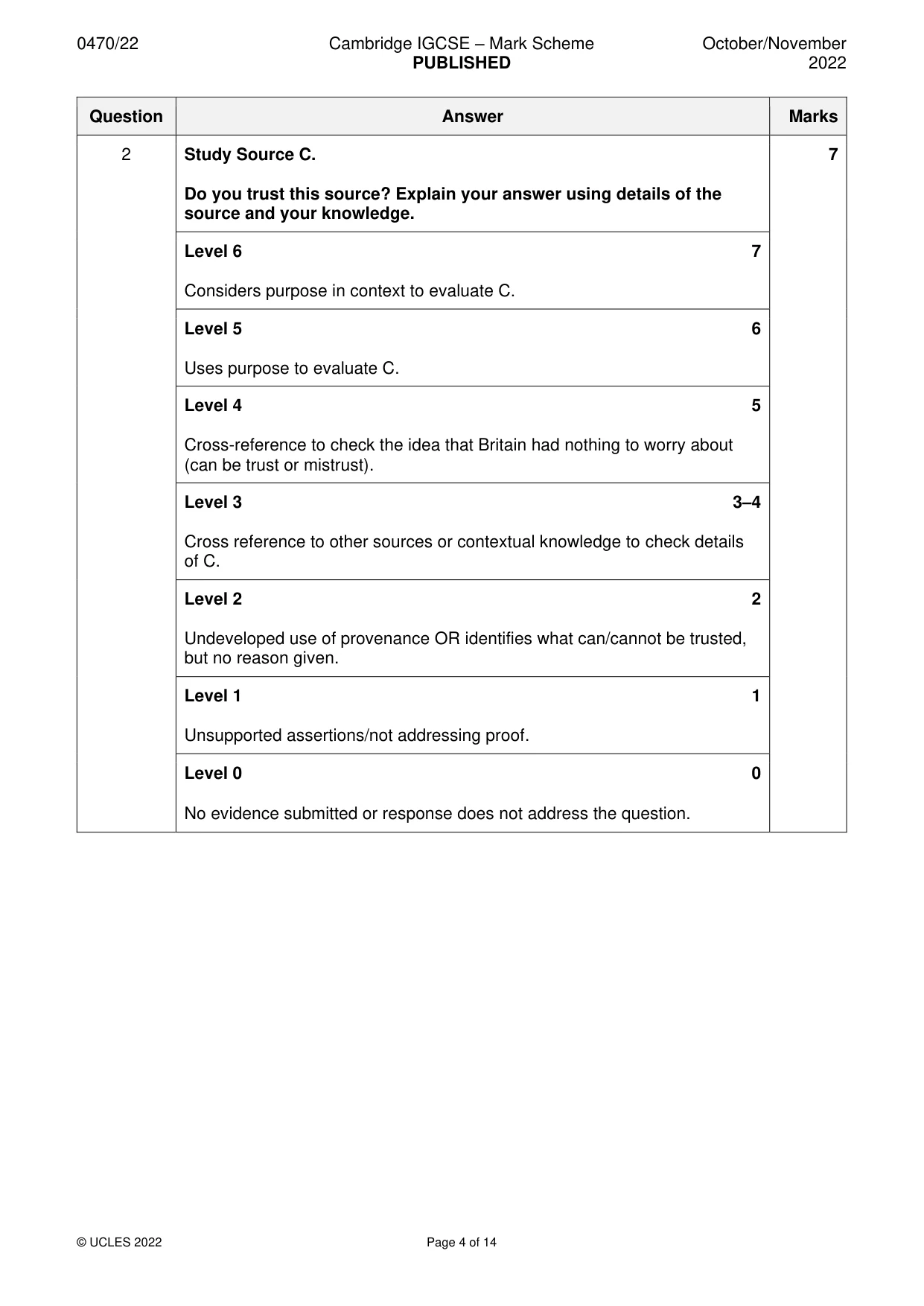
0470/22 Cambridge IGCSE – Mark Scheme PUBLISHED October/November 2022 © UCLES 2022 Page 4 of 14 Question Answer Marks 2 Study Source C. Do you trust this source? Explain your answer using details of the source and your knowledge. 7 Level 6 7 Considers purpose in context to evaluate C. Level 5 6 Uses purpose to evaluate C. Level 4 5 Cross-reference to check the idea that Britain had nothing to worry about (can be trust or mistrust). Level 3 3–4 Cross reference to other sources or contextual knowledge to check details of C. Level 2 2 Undeveloped use of provenance OR identifies what can/cannot be trusted, but no reason given. Level 1 1 Unsupported assertions/not addressing proof. Level 0 0 No evidence submitted or response does not address the question.
Mark scheme, page 5
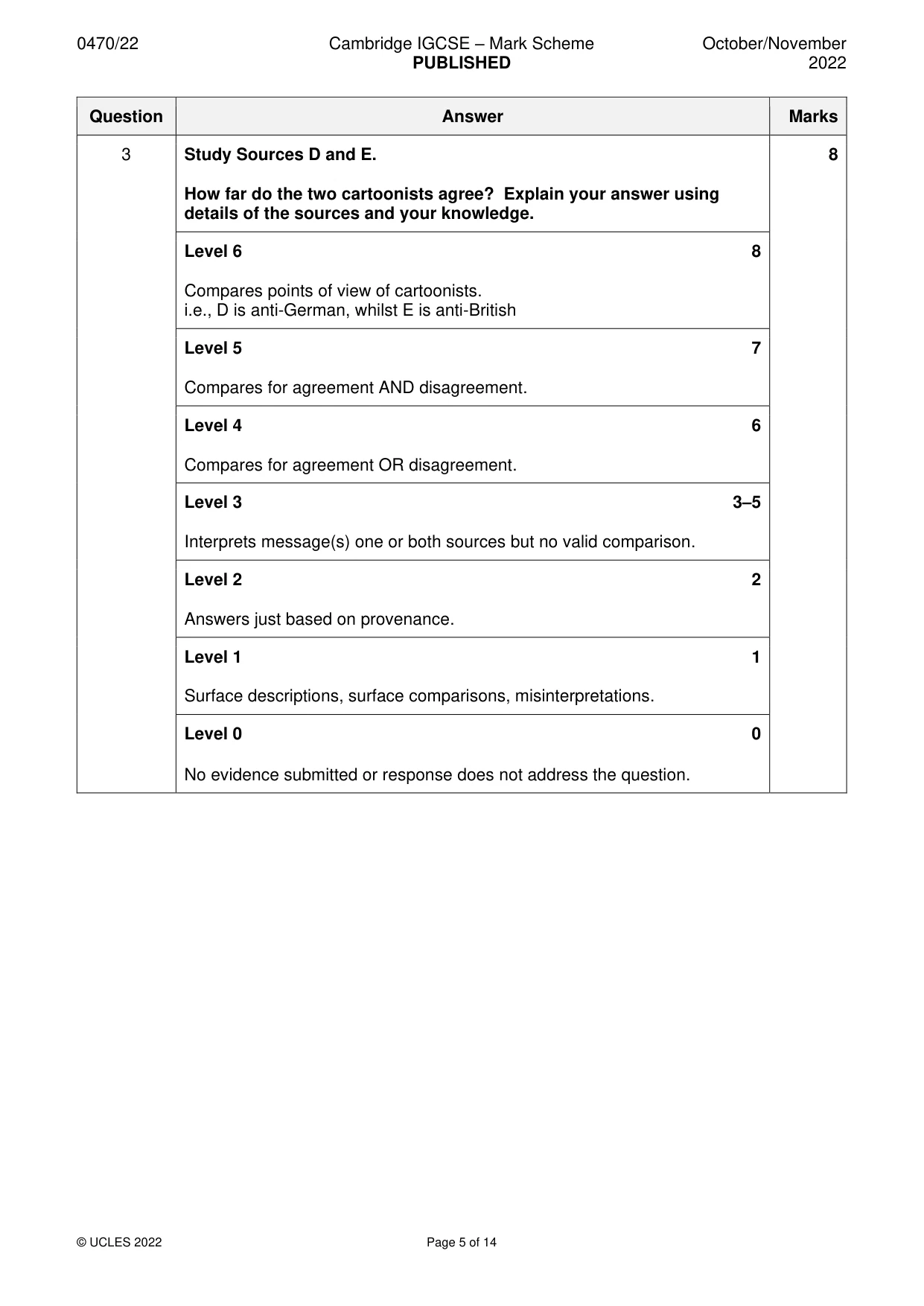
0470/22 Cambridge IGCSE – Mark Scheme PUBLISHED October/November 2022 © UCLES 2022 Page 5 of 14 Question Answer Marks 3 Study Sources D and E. How far do the two cartoonists agree? Explain your answer using details of the sources and your knowledge. 8 Level 6 8 Compares points of view of cartoonists. i.e., D is anti-German, whilst E is anti-British Level 5 7 Compares for agreement AND disagreement. Level 4 6 Compares for agreement OR disagreement. Level 3 3–5 Interprets message(s) one or both sources but no valid comparison. Level 2 2 Answers just based on provenance. Level 1 1 Surface descriptions, surface comparisons, misinterpretations. Level 0 0 No evidence submitted or response does not address the question.
Mark scheme, page 6
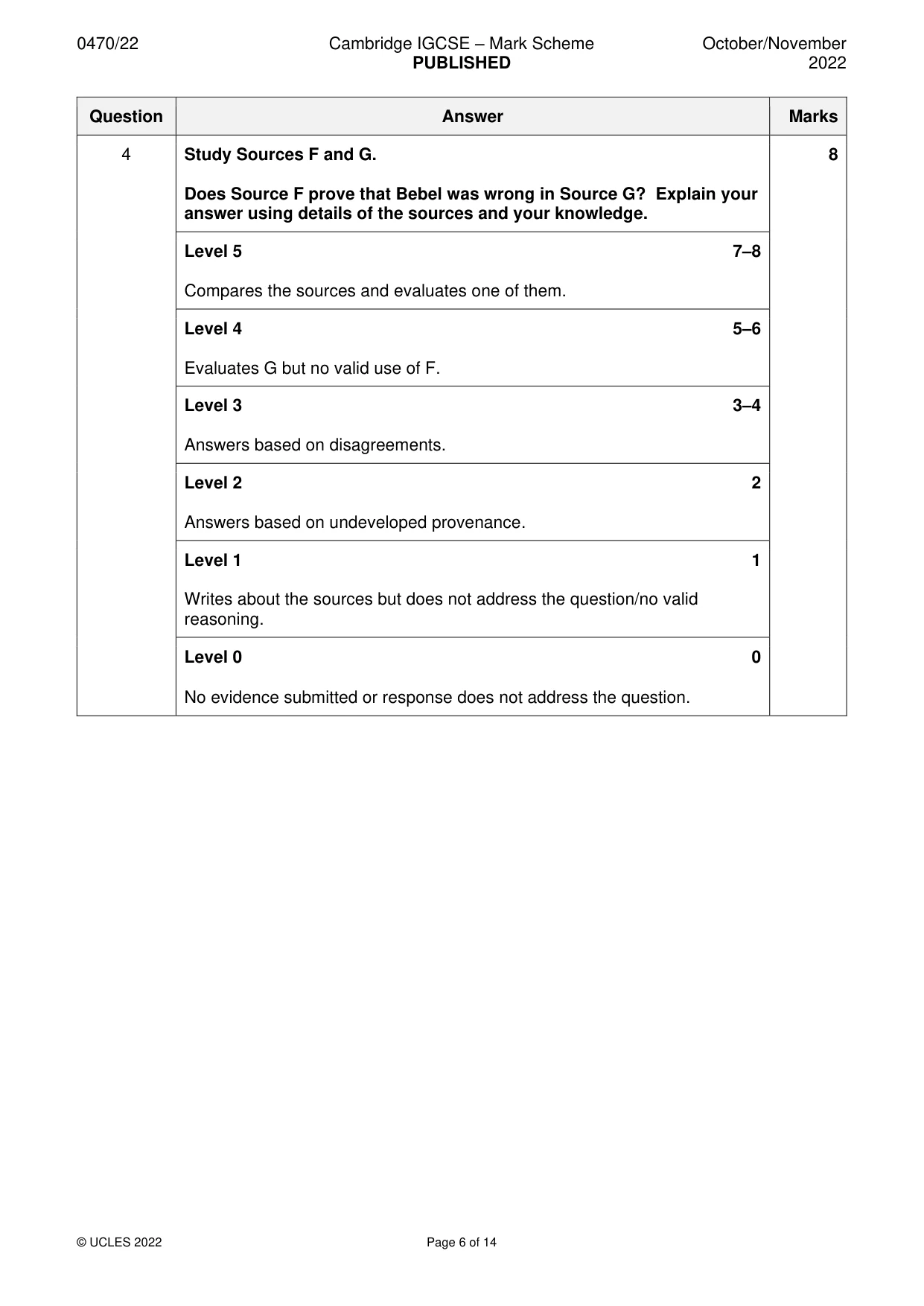
0470/22 Cambridge IGCSE – Mark Scheme PUBLISHED October/November 2022 © UCLES 2022 Page 6 of 14 Question Answer Marks 4 Study Sources F and G. Does Source F prove that Bebel was wrong in Source G? Explain your answer using details of the sources and your knowledge. 8 Level 5 7–8 Compares the sources and evaluates one of them. Level 4 5–6 Evaluates G but no valid use of F. Level 3 3–4 Answers based on disagreements. Level 2 2 Answers based on undeveloped provenance. Level 1 1 Writes about the sources but does not address the question/no valid reasoning. Level 0 0 No evidence submitted or response does not address the question.
Mark scheme, page 7
0470/22 Cambridge IGCSE – Mark Scheme PUBLISHED October/November 2022 © UCLES 2022 Page 7 of 14 Question Answer Marks 5 Study Source H. How surprising is it that Tirpitz published this in 1919? Explain your answer using details of the source and your knowledge. 8 Level 6 8 Not surprised, explains purpose in context of 1919. e.g., self-justification. Level 5 6–7 Explains valid reasons for being surprised AND not surprised. Level 4 4–5 Explains valid reasons for being surprised OR not surprised. Level 3 3 Common sense reasoning. i.e., gives a reason which would not be enough for any higher level. Level 2 2 Identifies what is/is not surprising, but no reason given OR valid reasoning but does not address surprise. Level 1 1 Description of the source. Level 0 0 No evidence submitted or response does not address the question.
Mark scheme, page 8
0470/22 Cambridge IGCSE – Mark Scheme PUBLISHED October/November 2022 © UCLES 2022 Page 8 of 14 Question Answer Marks 6 Study all the sources. How far do these sources provide convincing evidence that Germany was to blame for the tensions with Britain over naval power? Use the sources to explain your answer. 12 Award up to 2 bonus marks for evaluation of sources (no more than 1 per source). Source use must be reference to a source by letter, by provenance or by direct quote. There must be examples from source content. There must be an explanation of how this supports/does not support the statement. Use a in the margin for each source use in support of the statement and a x for each source use rejecting the statement. Agree (): A B D E G Disagree (x): A C E F H Level 3 7–10 Uses sources to support and reject the statement. Level 2 4–6 Uses sources to support or reject the statement. Level 1 1–3 No valid source use. Level 0 0 No evidence submitted or response does not address the question.
Mark scheme, page 9
0470/22 Cambridge IGCSE – Mark Scheme PUBLISHED October/November 2022 © UCLES 2022 Page 9 of 14 Question Answer Marks 20th century topic 1 Study Sources A and B. How far do these two sources agree? Explain your answer using details of the sources. 7 Level 5 7 Compares big messages. i.e., Both object to the Treaty but for different reasons: in A because it’s unfair, and in B because it will cause another war. Level 4 6 Agreement AND disagreement of detail or sub-messages. Level 3 3–5 Agreement OR disagreement of detail or sub-messages. Agreements include: Germans don’t like the Treaty Germany hoped for a peace of justice The Treaty was wrong/harsh The Treaty will damage Germany Germany will be enslaved Wilson’s principles have been ignored Germany has been blamed. Disagreements include: Germany not a threat in A, is a threat in B Germany not responsible for war in A, is responsible in B. Level 2 2 Identifies information that is in one source but not in the other OR states that the sources are about the same subject OR compares the provenance of the sources. Level 1 1 Writes about the sources but makes no valid comparison. Level 0 0 No evidence submitted or response does not address the question.
Mark scheme, page 10
0470/22 Cambridge IGCSE – Mark Scheme PUBLISHED October/November 2022 © UCLES 2022 Page 10 of 14 Question Answer Marks 2 Study Sources C and D. Does Source D prove that the claims of the German delegation (Source C) were correct? Explain your answer using details of the sources and your knowledge. 8 Level 6 7–8 Compares the two sources and evaluates one of them. Level 5 6 Evaluates C, no use of the content of D. Level 4 4–5 Yes, compares the sources for agreements. Level 3 3 It can’t because C deals with issues D does not address. Level 2 2 Answers based on undeveloped provenance. Level 1 1 Writes about the sources but does not address the question. Level 0 0 No evidence submitted or response does not address the question.
Mark scheme, page 11
0470/22 Cambridge IGCSE – Mark Scheme PUBLISHED October/November 2022 © UCLES 2022 Page 11 of 14 Question Answer Marks 3 Study Source E. Why was this cartoon published in Germany? Explain your answer using details of the source and your knowledge. 8 Level 6 8 As Level 5, but in Nazi context. e.g., of Nazi rearmament/rise of Nazis etc. Level 5 7 Reason based on the purpose. e.g., to arouse anti-Treaty feelings. Level 4 6 Reason based on the big message. i.e., on the idea that the military terms of the Treaty must be overthrown. Level 3 3–5 Reason based on valid sub-message OR on context OR on generalised purpose. Level 2 2 Interprets cartoon but fails to address ‘why published’. Level 1 1 Surface description of cartoon, no reason given. Level 0 0 No evidence submitted or response does not address the question.
Mark scheme, page 12
0470/22 Cambridge IGCSE – Mark Scheme PUBLISHED October/November 2022 © UCLES 2022 Page 12 of 14 Question Answer Marks 4 Study Source F. How far do you trust this source? Explain your answer using details of the source and your knowledge. 8 Level 6 8 Answers based on purpose in context. i.e., context of his abdication/exile, continuing problems in Germany post- Versailles etc. Level 5 7 No: answers based on purpose i.e., it’s an exercise in self-justification, an attempt to get himself recalled. Level 4 6 Cross-references to mistrust the overall claim. Level 3 3–5 Cross-references to check details OR on trusting the overall claim (overall claim is that Germany has been treated unjustly). Level 2 2 Identifies what does/does not trust – no valid explanation OR undeveloped use of provenance. Level 1 1 Unsupported assertions/not addressing trust. Level 0 0 No evidence submitted or response does not address the question.
Mark scheme, page 13
0470/22 Cambridge IGCSE – Mark Scheme PUBLISHED October/November 2022 © UCLES 2022 Page 13 of 14 Question Answer Marks 5 Study Source G. How useful is this source? Explain your answer using details of the source and your knowledge. 7 Level 6 7 Evaluates the source to argue it is useful. Level 5 6 Evaluates the source to argue it is not useful. Level 4 4–5 Useful for inferences you can make about Weimar OR utility judged using cross-reference to check accuracy of details of Source G (4 marks). Level 3 3 Useful for information in the source OR for inferences you can make about Versailles. Level 2 2 Undeveloped provenance. Level 1 1 Writes about the source but does not address the question/unsupported assertions. Level 0 0 No evidence submitted or response does not address the question.
Mark scheme, page 14
0470/22 Cambridge IGCSE – Mark Scheme PUBLISHED October/November 2022 © UCLES 2022 Page 14 of 14 Question Answer Marks 6 Study all the sources. How far do these sources provide convincing evidence that German hatred of the Treaty of Versailles was based on the War Guilt Clause? Use the sources to explain your answer. 12 Award up to 2 bonus marks for evaluation of sources (no more than 1 per source). Source use must be reference to a source by letter, by provenance or by direct quote. There must be examples from source content. There must be an explanation of how this supports/does not support the statement. Use a in the margin for each source use in support of the statement and a x for each source use rejecting the statement. Agree (): A C F Disagree (x): A B C D E G Level 3 7–10 Uses sources to support and reject the statement. Level 2 4–6 Uses sources to support or reject the statement. Level 1 1–3 No valid source use. Level 0 0 No evidence submitted or response does not address the question.
What you needed in this session
Cambridge’s own grade thresholds for 2022 Oct/Nov, Paper 2 · Variant 2. A higher threshold means an easier paper — the bar moves with how the cohort did.