Cambridge IGCSE History 0470 — 2022 Oct/Nov Paper 2 · Variant 1
0470/21/O/N/22 · 50 marks · ≈56 min
The question paper and its mark scheme, free to read here and free to download. This is Cambridge’s own paper, exactly as it was sat.
Question paper12 pages
Mark scheme14 pages
Answers below. Sit the paper first if you are practising.
Paper as text
Question paper, page 1
This document has 12 pages. [Turn over Cambridge IGCSE™ HISTORY 0470/21 Paper 2 October/November 2022 2 hours You must answer on the enclosed answer booklet. You will need: Answer booklet (enclosed) INSTRUCTIONS ● Answer all the questions on one option only. Option A: Nineteenth century topic Option B: Twentieth century topic ● Follow the instructions on the front cover of the answer booklet. If you need additional answer paper, ask the invigilator for a continuation booklet. INFORMATION ● The total mark for this paper is 50. ● The number of marks for each question or part question is shown in brackets [ ]. * 7 4 8 0 8 5 0 4 3 3 * DC (MB/JG) 215134/2 © UCLES 2022
Question paper, page 2
2 0470/21/O/N/22 © UCLES 2022 Option A: Nineteenth century topic WHAT WERE GERMANY’S MOTIVES IN THE MOROCCAN CRISIS OF 1905–06? Study the Background Information and the sources carefully, and then answer all the questions. Background Information In 1904 Britain signed an entente with France. The agreement included France recognising British control of Egypt while France was granted a ‘free hand’ in Morocco. In secret clauses, Britain agreed to support France diplomatically over Morocco. Germany was unhappy with the entente because it brought Britain and France closer together. On 31 March 1905, William II caused a crisis over Morocco by landing at Tangier and declaring his support for Moroccan independence. In August there were rumours that Germany was increasing its involvement in Morocco by granting the Sultan a huge loan. Some historians have argued that Germany’s main aim in interfering in Morocco was to test, and even destroy, the Anglo–French entente. However, Germany also had other concerns. It needed a success to raise its international status and many in Germany felt that it had legitimate interests in Morocco. Germany was also particularly concerned about the expansion of French power. Why did Germany interfere in Morocco? SOURCE A Bülow decided to test whether Britain would prove a true friend to France if Germany applied pressure. It was risky to attempt such a test, especially in light of his own advice to William about never doing anything that might endanger peace while the German fleet was not strong. However, Bülow trusted his own skill to avert a general war. When the French told the Sultan of Morocco that his troops should be placed under French officers, Bülow struck. He realised that he could use William, who happened to be sailing at the time in the Mediterranean. On 31 March William was sent ashore at Tangier and promised Germany’s support for the Sultan’s independence. This caused much concern in European capitals. Bülow then stepped up the tension by making it known that Germany did not recognise the right of France, Britain and Spain to settle the Moroccan question by themselves. He demanded a conference. The challenge was clear. Would the Entente hold? Did Germany really mean to force a war? For those in the British Foreign Office who were hostile to Germany the moment was right to act. Some even supported a naval war and landing troops on the north German coast. From a history book about the Moroccan Crisis. Bülow was head of the German government. SOURCE B Germany was competing with other Great Powers for favourable trading rights in Morocco and William was concerned that Germany was not being involved in decisions about North Africa. It was no secret that Germany wanted to occupy Morocco with its prime location in northwest Africa. William, desperate for a diplomatic success, descended on Tangier in March 1905 and assured the Sultan that he supported his sovereignty. The reasons for his action lay in Germany’s deteriorating international position, but it proved to be disastrous. The crisis accelerated the change in Britain’s strategic planning. It began thinking about a German violation of Belgian neutrality and British action to defend it. A continental role for Britain was seriously being considered. Assurances were given to France that it could rely on British support. A naval war was considered, especially while the German fleet had not been strengthened. The crisis brought Britain and France closer and when the French gave way to the German demand for an international conference on Morocco, the British followed the French lead. There was never any threat to the Entente, which was actually strengthened. From a recent history book.
Question paper, page 3
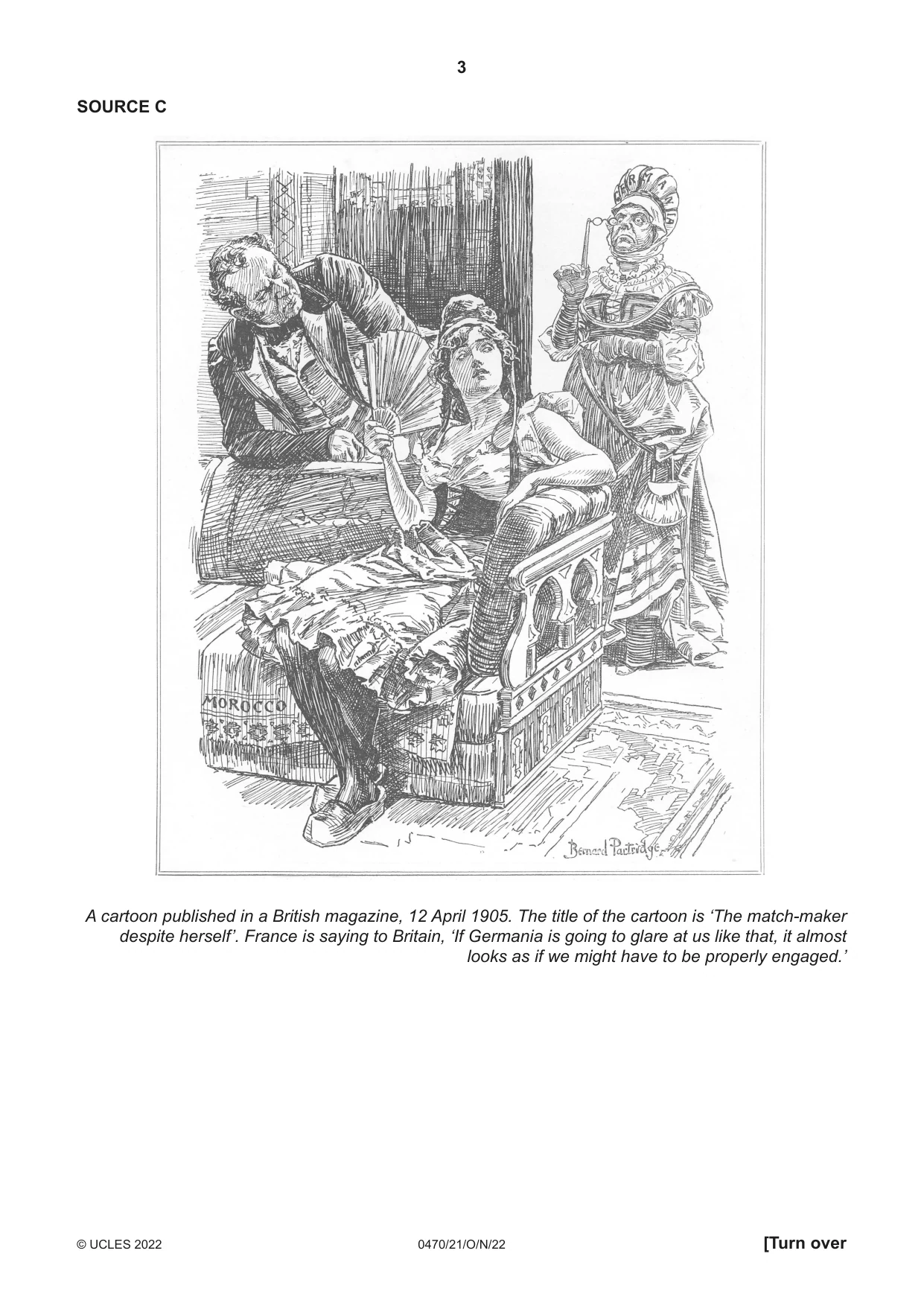
3 0470/21/O/N/22 © UCLES 2022 [Turn over SOURCE C A cartoon published in a British magazine, 12 April 1905. The title of the cartoon is ‘The match-maker despite herself’. France is saying to Britain, ‘If Germania is going to glare at us like that, it almost looks as if we might have to be properly engaged.’
Question paper, page 4
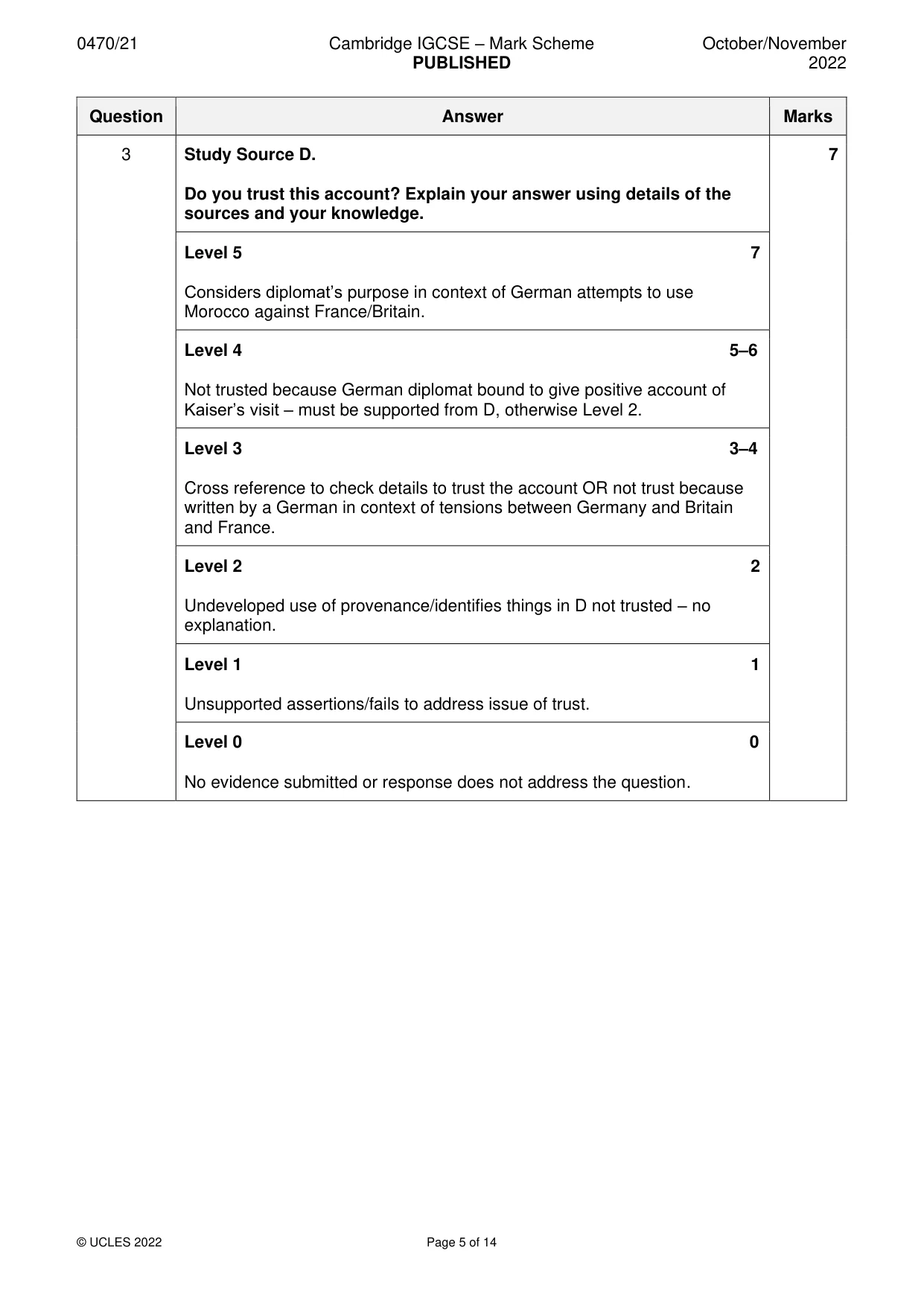
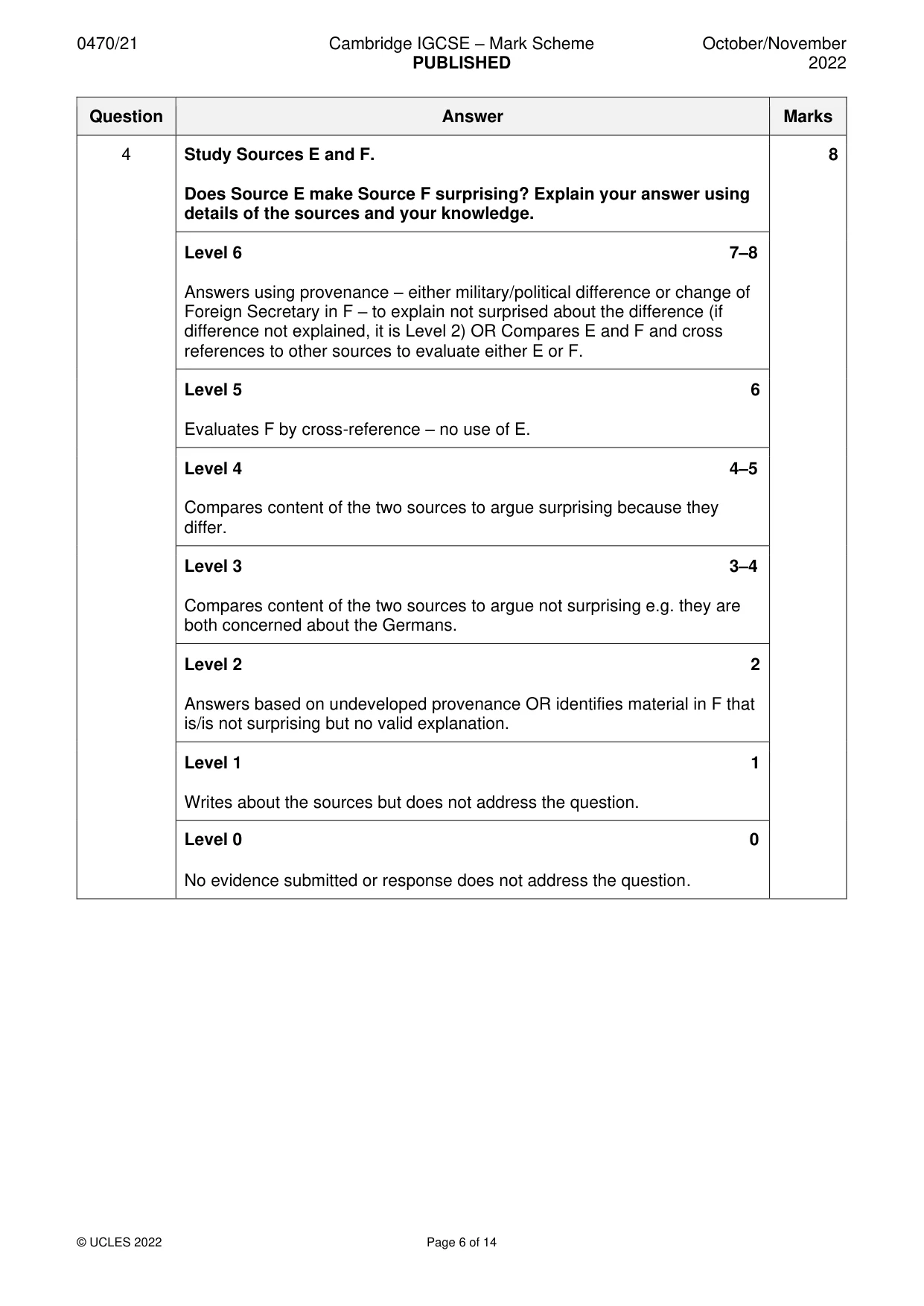
4 0470/21/O/N/22 © UCLES 2022 SOURCE D After landing in Tangier the Kaiser rode through the decorated streets amid the overwhelming joy of the natives and the European population. At the embassy the Kaiser told the French governor that his visit meant that His Majesty wanted free trade for Germany and complete equality of rights with other countries. He continued that he would like to talk with the Sultan, the free ruler of an independent country, as an equal. At these words the French governor became pale. He was about to reply when he was suddenly dismissed. He withdrew with bowed head. His Majesty’s brief visit ended splendidly without any unfortunate event and made a great impression on the Moroccans. His Majesty was highly satisfied with the visit, especially with the confidential message from the Sultan that he would not introduce any reforms without consulting the German government. A report from a German diplomat to the German government, 31 March 1905. SOURCE E Without any doubt the Germans would like a port on the coast of Morocco. Such a port would be very dangerous to us from a naval point of view and ought to be a cause of war, unless we get Tangier. The Germans will then ask for more Moroccan ports. This seems like a golden opportunity for fighting the Germans in alliance with the French, so I earnestly hope you may be able to bring this about. Of course, I don’t pretend to be a diplomat, but it strikes me that the German Emperor will greatly injure the splendid Anglo–French Entente if he is given any concessions. I hope that you will send a message to Paris that the English and French fleets are united. We could have the German fleet, the Kiel Canal and Schleswig-Holstein within a week. Admiral Fisher writing to Lord Lansdowne, who was in charge of British foreign policy, April 1905. Fisher was head of the British navy. SOURCE F A promise in advance committing this country to take part in a Continental war is very serious. It is very difficult for the British Government to give a commitment of that kind. It changes the entente into an alliance and alliances are not in accordance with our traditions. My opinion is that if France is let in for a war with Germany arising out of our agreement with it about Morocco, we cannot stand aside, but must take part with France. But a deliberate engagement, pledging this country in advance before the actual cause of war is known, goes far beyond anything envisaged in the Anglo–French agreement. Sir Edward Grey, who had followed Lansdowne as British foreign minister, writing to Sir Francis Bertie, the British Ambassador in Paris, 15 January 1906. Grey wrote this letter in response to the French Ambassador asking if Britain would support France if war broke out with Germany.
Question paper, page 5
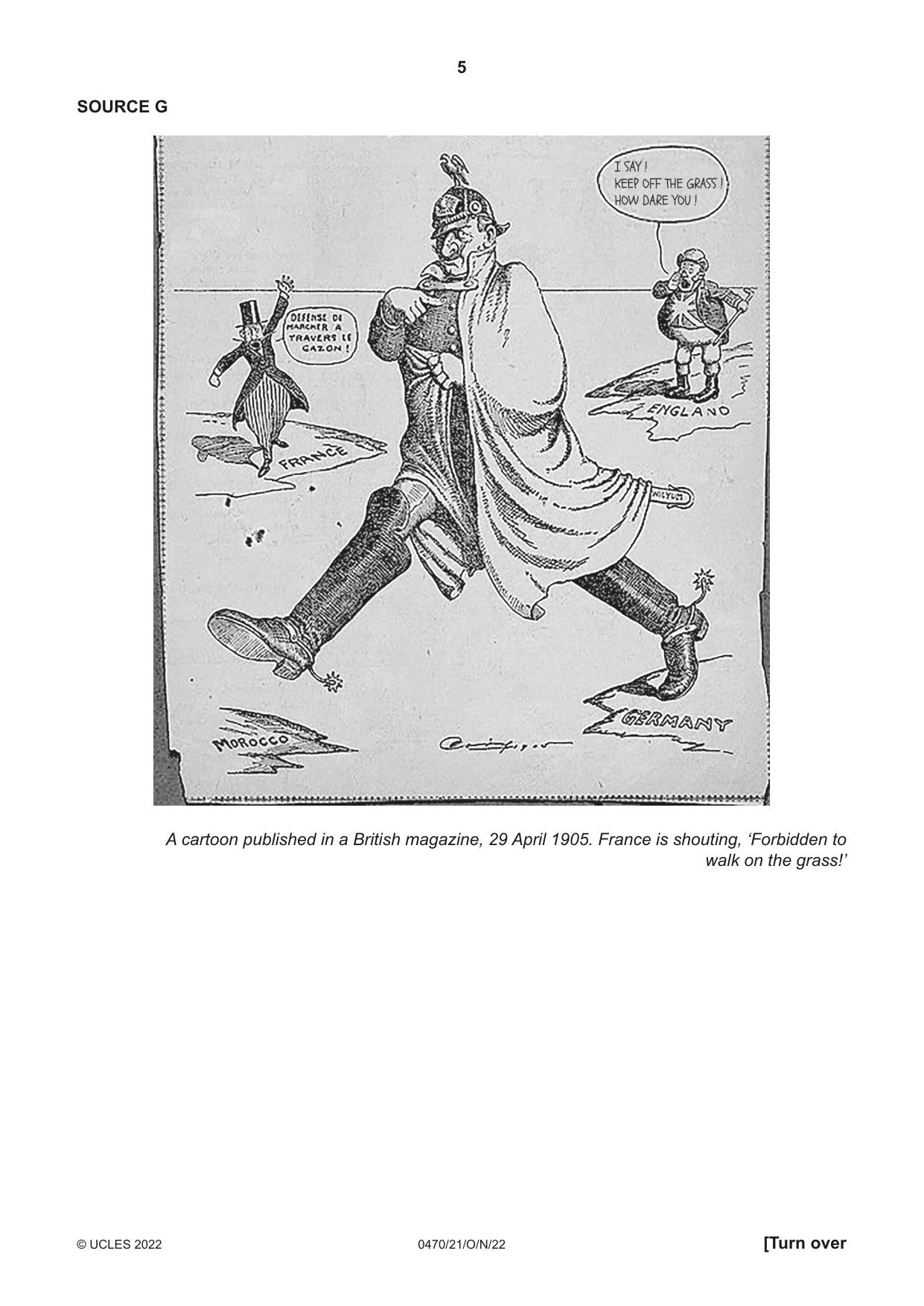
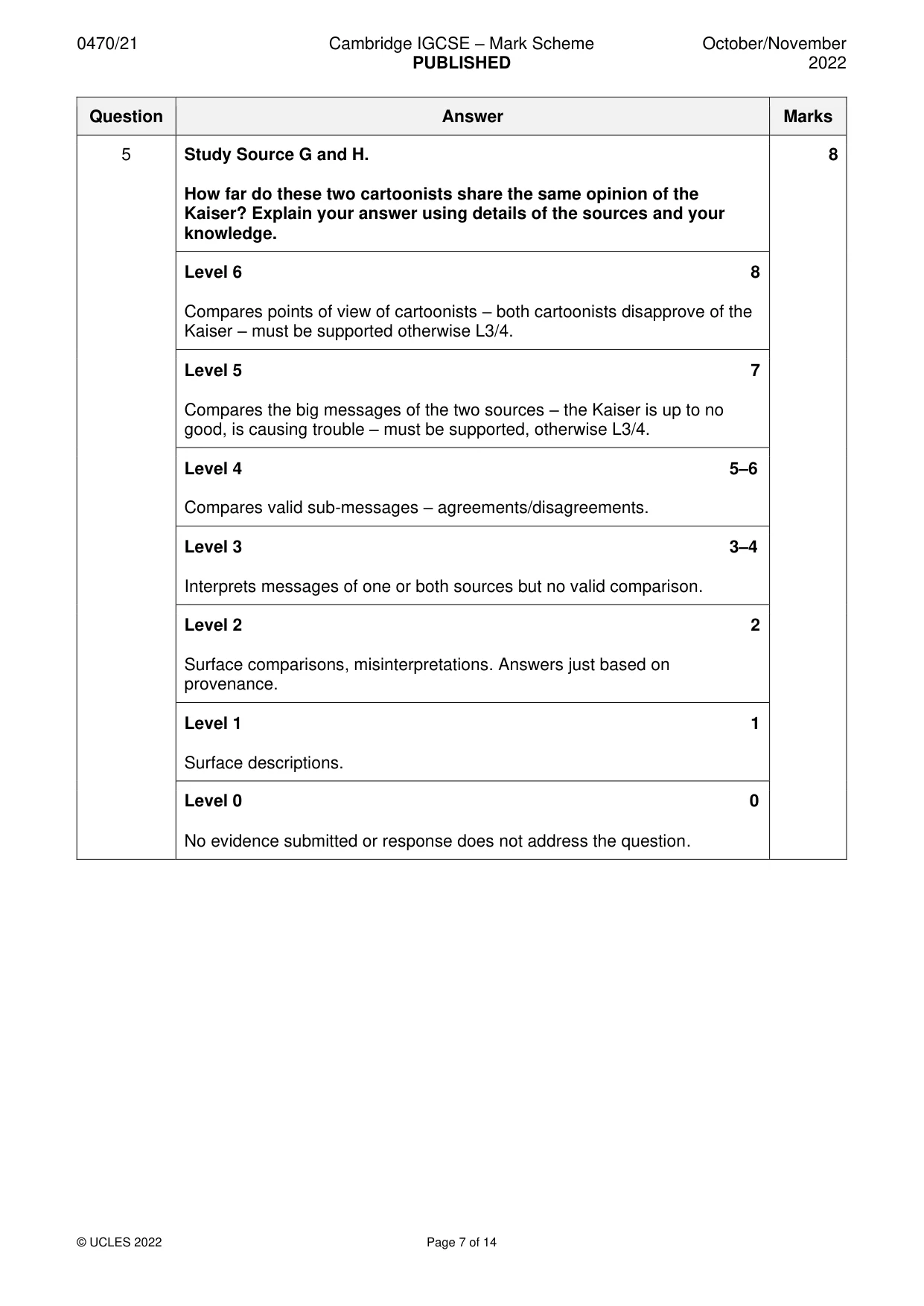
5 0470/21/O/N/22 © UCLES 2022 [Turn over SOURCE G A cartoon published in a British magazine, 29 April 1905. France is shouting, ‘Forbidden to walk on the grass!’
Question paper, page 6
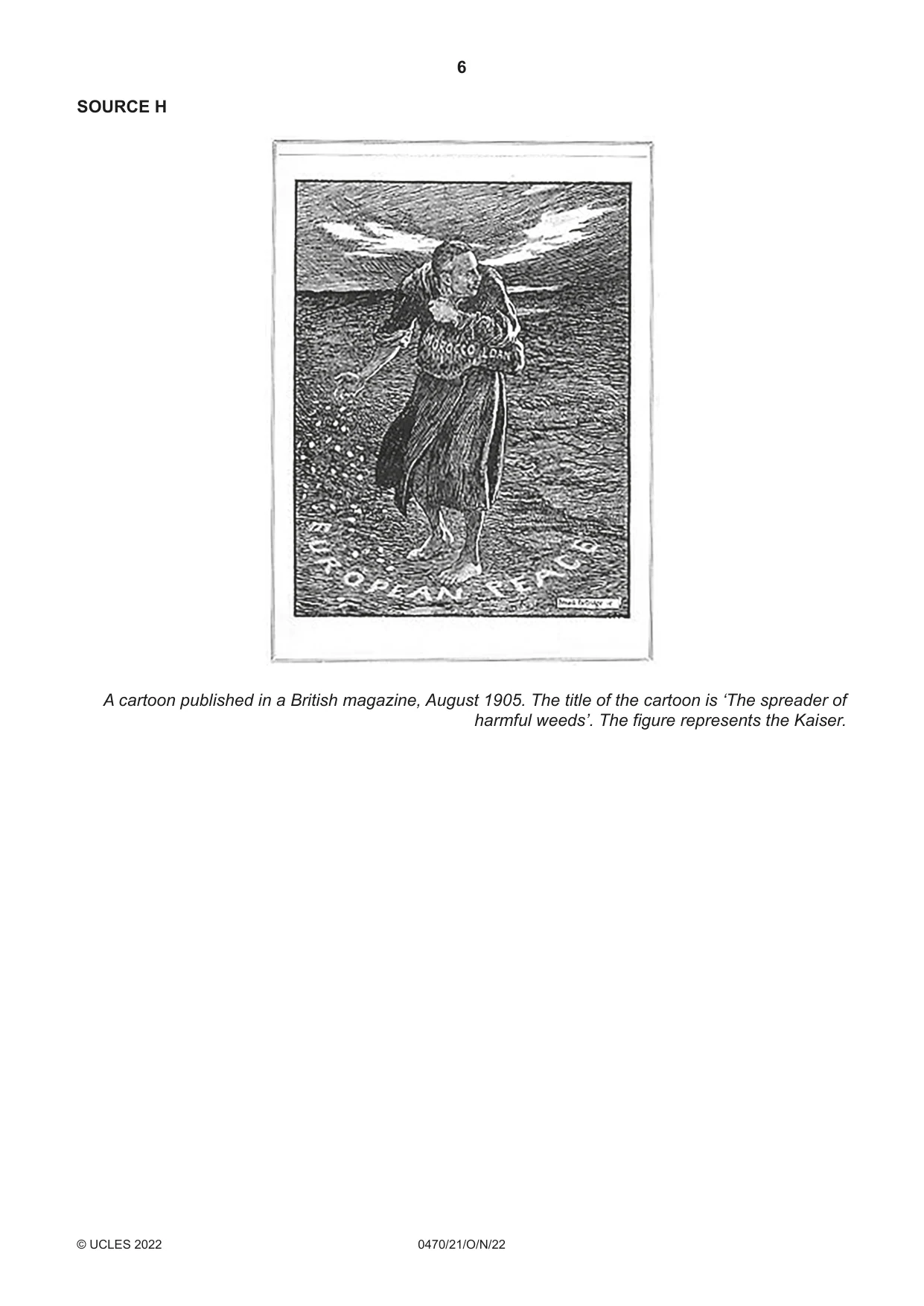
6 0470/21/O/N/22 © UCLES 2022 SOURCE H A cartoon published in a British magazine, August 1905. The title of the cartoon is ‘The spreader of harmful weeds’. The figure represents the Kaiser.
Question paper, page 7
7 0470/21/O/N/22 © UCLES 2022 [Turn over Now answer all the following questions. You may use any of the sources to help you answer the questions, in addition to those sources which you are told to use. In answering the questions you should use your knowledge of the topic to help you interpret and evaluate the sources. 1 Study Sources A and B. How far do these two sources agree? Explain your answer using details of the sources. [7] 2 Study Source C. What is the cartoonist’s message? Explain your answer using details of the source and your knowledge. [8] 3 Study Source D. Do you trust this account? Explain your answer using details of the source and your knowledge. [7] 4 Study Sources E and F. Does Source E make Source F surprising? Explain your answer using details of the sources and your knowledge. [8] 5 Study Sources G and H. How far do these two cartoonists share the same opinion of the Kaiser? Explain your answer using details of the sources and your knowledge. [8] 6 Study all the sources. How far do these sources provide convincing evidence that Germany’s aim in interfering in Morocco was to break the Anglo–French Entente? Use the sources to explain your answer. [12]
Question paper, page 8
8 0470/21/O/N/22 © UCLES 2022 Option B: Twentieth century topic WHO CAUSED THE DIFFICULTIES PRESIDENT WILSON FACED DURING THE PEACE NEGOTIATIONS? Study the Background Information and the sources carefully, and then answer all the questions. Background Information When President Wilson arrived in Paris in December 1918 for the peace talks he knew what he wanted to achieve. He did not want the peace treaty to be an act of revenge – he believed that this would lead to future war. Above all, he wanted a League of Nations so that international disputes could be settled without countries going to war. During the talks Wilson faced difficulties in achieving his aims. Britain and France had their own objectives and both Lloyd George and Clemenceau could be difficult to work with. Wilson ended up having to compromise over many issues in the Treaty and facing criticism from many countries. How far was Clemenceau responsible for this? SOURCE A Colonel House believed that Clemenceau was likely to be more reasonable than Lloyd George. Wilson met Clemenceau first. The crafty Frenchman listened quietly as Wilson did most of the talking, intervening only to express approval of the League of Nations. Wilson was favourably impressed and House, who hoped that France and the USA would make a common front against Britain, was delighted. However, Wilson soon came to the conclusion that he and the French were not as close in their views as House claimed. The French government had drawn up an agenda which placed the League of Nations well down the list of important issues to be decided. House disliked Lloyd George and called him ‘a mischief maker who changes his mind all the time’. Lloyd George, who recognised the supreme importance of a good relationship with the USA, set out to charm Wilson. Their first conversation went well. Lloyd George reported with relief to his colleagues that Wilson seemed open to compromise on the issues the British considered important, such as freedom of the seas and the fate of Germany’s colonies. Wilson had given the impression that his main concern was the League of Nations, which he wanted to discuss as soon as the peace conference opened. Lloyd George had agreed. From a history book published in 2001. Colonel House was Wilson’s chief advisor during the negotiations.
Question paper, page 9
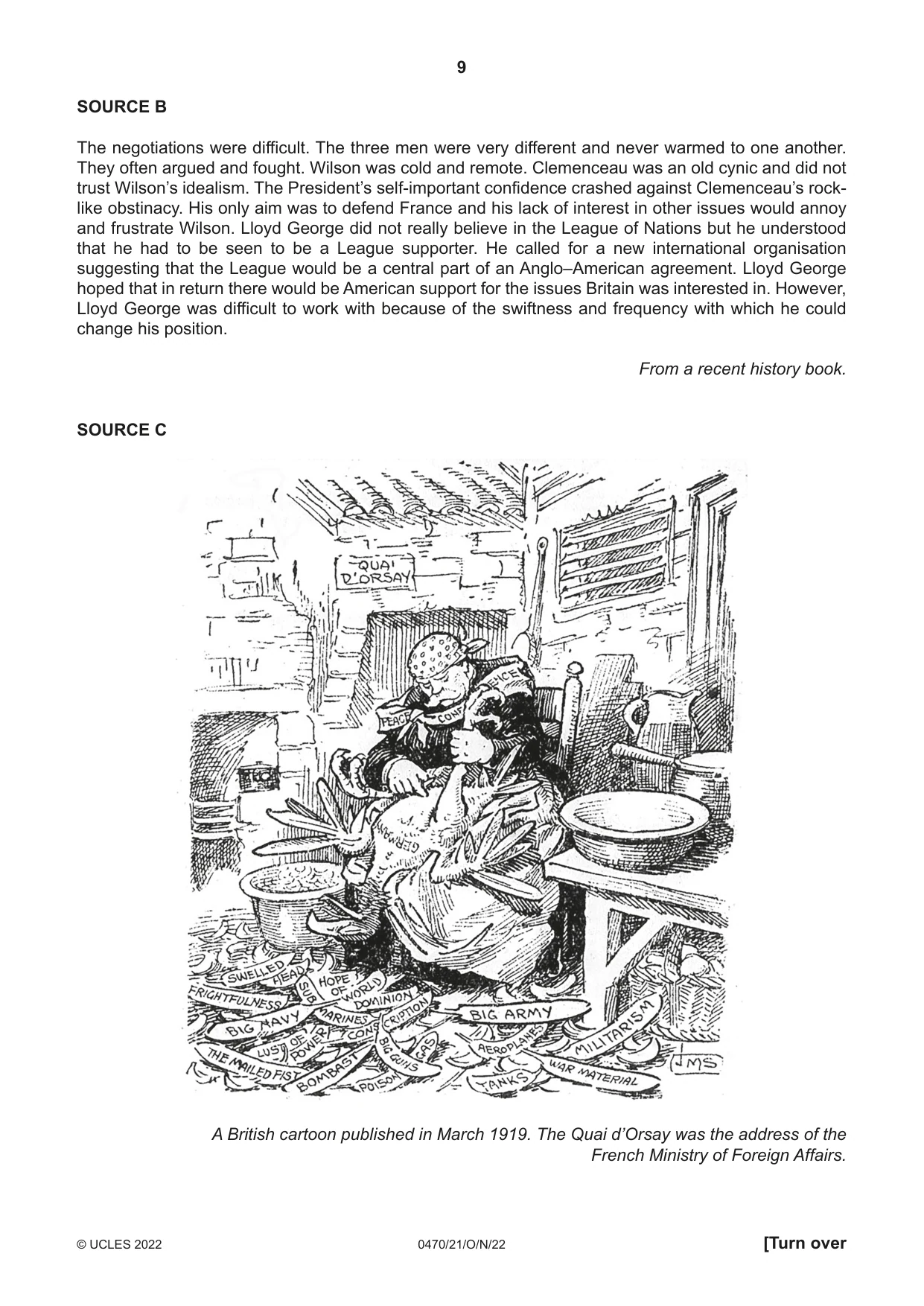
9 0470/21/O/N/22 © UCLES 2022 [Turn over SOURCE B The negotiations were difficult. The three men were very different and never warmed to one another. They often argued and fought. Wilson was cold and remote. Clemenceau was an old cynic and did not trust Wilson’s idealism. The President’s self-important confidence crashed against Clemenceau’s rock- like obstinacy. His only aim was to defend France and his lack of interest in other issues would annoy and frustrate Wilson. Lloyd George did not really believe in the League of Nations but he understood that he had to be seen to be a League supporter. He called for a new international organisation suggesting that the League would be a central part of an Anglo–American agreement. Lloyd George hoped that in return there would be American support for the issues Britain was interested in. However, Lloyd George was difficult to work with because of the swiftness and frequency with which he could change his position. From a recent history book. SOURCE C A British cartoon published in March 1919. The Quai d’Orsay was the address of the French Ministry of Foreign Affairs.
Question paper, page 10
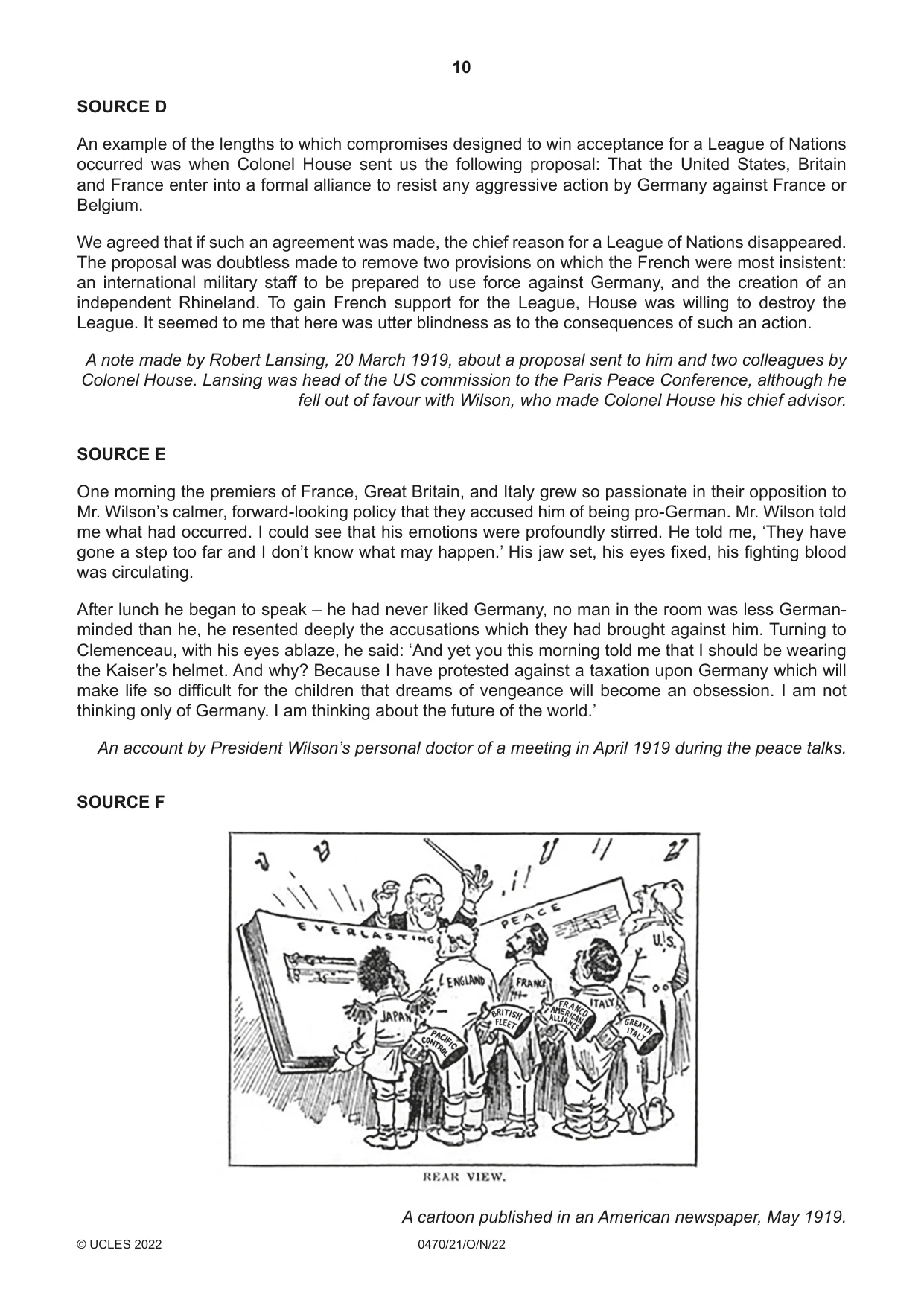
10 0470/21/O/N/22 © UCLES 2022 SOURCE D An example of the lengths to which compromises designed to win acceptance for a League of Nations occurred was when Colonel House sent us the following proposal: That the United States, Britain and France enter into a formal alliance to resist any aggressive action by Germany against France or Belgium. We agreed that if such an agreement was made, the chief reason for a League of Nations disappeared. The proposal was doubtless made to remove two provisions on which the French were most insistent: an international military staff to be prepared to use force against Germany, and the creation of an independent Rhineland. To gain French support for the League, House was willing to destroy the League. It seemed to me that here was utter blindness as to the consequences of such an action. A note made by Robert Lansing, 20 March 1919, about a proposal sent to him and two colleagues by Colonel House. Lansing was head of the US commission to the Paris Peace Conference, although he fell out of favour with Wilson, who made Colonel House his chief advisor. SOURCE E One morning the premiers of France, Great Britain, and Italy grew so passionate in their opposition to Mr. Wilson’s calmer, forward-looking policy that they accused him of being pro-German. Mr. Wilson told me what had occurred. I could see that his emotions were profoundly stirred. He told me, ‘They have gone a step too far and I don’t know what may happen.’ His jaw set, his eyes fixed, his fighting blood was circulating. After lunch he began to speak – he had never liked Germany, no man in the room was less German- minded than he, he resented deeply the accusations which they had brought against him. Turning to Clemenceau, with his eyes ablaze, he said: ‘And yet you this morning told me that I should be wearing the Kaiser’s helmet. And why? Because I have protested against a taxation upon Germany which will make life so difficult for the children that dreams of vengeance will become an obsession. I am not thinking only of Germany. I am thinking about the future of the world.’ An account by President Wilson’s personal doctor of a meeting in April 1919 during the peace talks. SOURCE F A cartoon published in an American newspaper, May 1919.
Question paper, page 11
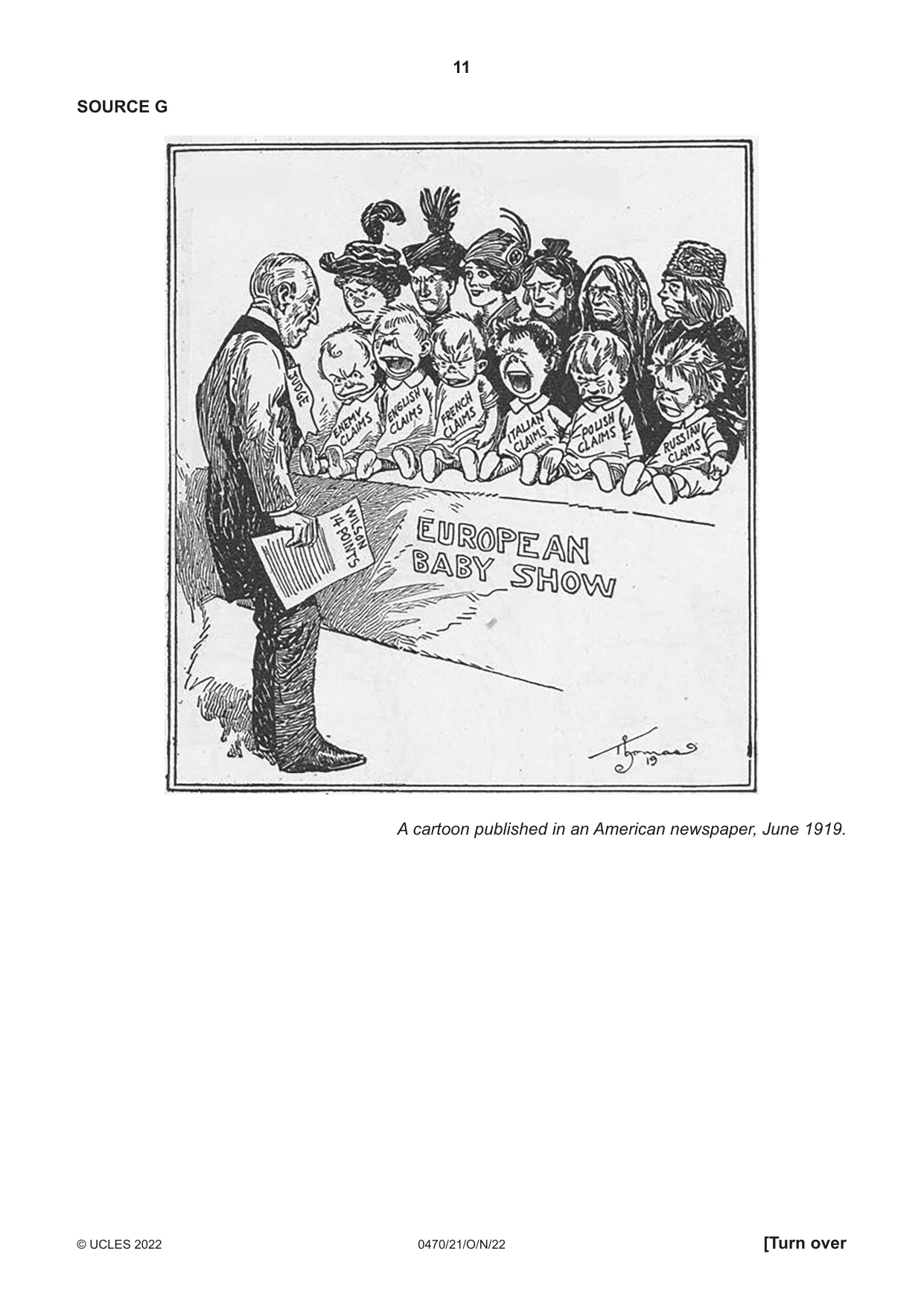
11 0470/21/O/N/22 © UCLES 2022 [Turn over SOURCE G A cartoon published in an American newspaper, June 1919.
Question paper, page 12
12 0470/21/O/N/22 © UCLES 2022 Permission to reproduce items where third-party owned material protected by copyright is included has been sought and cleared where possible. Every reasonable effort has been made by the publisher (UCLES) to trace copyright holders, but if any items requiring clearance have unwittingly been included, the publisher will be pleased to make amends at the earliest possible opportunity. To avoid the issue of disclosure of answer-related information to candidates, all copyright acknowledgements are reproduced online in the Cambridge Assessment International Education Copyright Acknowledgements Booklet. This is produced for each series of examinations and is freely available to download at www.cambridgeinternational.org after the live examination series. Cambridge Assessment International Education is part of Cambridge Assessment. Cambridge Assessment is the brand name of the University of Cambridge Local Examinations Syndicate (UCLES), which is a department of the University of Cambridge. Now answer all the following questions. You may use any of the sources to help you answer the questions, in addition to those sources which you are told to use. In answering the questions you should use your knowledge of the topic to help you interpret and evaluate the sources. 1 Study Sources A and B. How far do these two sources agree? Explain your answer using details of the sources. [7] 2 Study Source C. Why was this cartoon published in March 1919? Explain your answer using details of the source and your knowledge. [8] 3 Study Source D. Are you surprised by this source? Explain your answer using details of the source and your knowledge. [8] 4 Study Source E. What impressions does this source give of Wilson? Explain your answer using details of the source and your knowledge. [7] 5 Study Sources F and G. How far would these two cartoonists have agreed? Explain your answer using details of the sources and your knowledge. [8] 6 Study all the sources. How far do these sources provide convincing evidence that Wilson’s difficulties were mainly caused by Clemenceau? Use the sources to explain your answer. [12]
Mark scheme, page 1
This document consists of 14 printed pages. © UCLES 2022 [Turn over Cambridge IGCSE™ HISTORY 0470/21 Paper 2 October/November 2022 MARK SCHEME Maximum Mark: 50 Published This mark scheme is published as an aid to teachers and candidates, to indicate the requirements of the examination. It shows the basis on which Examiners were instructed to award marks. It does not indicate the details of the discussions that took place at an Examiners’ meeting before marking began, which would have considered the acceptability of alternative answers. Mark schemes should be read in conjunction with the question paper and the Principal Examiner Report for Teachers. Cambridge International will not enter into discussions about these mark schemes. Cambridge International is publishing the mark schemes for the October/November 2022 series for most Cambridge IGCSE™, Cambridge International A and AS Level components and some Cambridge O Level components.
Mark scheme, page 2
0470/21 Cambridge IGCSE – Mark Scheme PUBLISHED October/November 2022 © UCLES 2022 Page 2 of 14 Generic Marking Principles These general marking principles must be applied by all examiners when marking candidate answers. They should be applied alongside the specific content of the mark scheme or generic level descriptors for a question. Each question paper and mark scheme will also comply with these marking principles. GENERIC MARKING PRINCIPLE 1: Marks must be awarded in line with: • the specific content of the mark scheme or the generic level descriptors for the question • the specific skills defined in the mark scheme or in the generic level descriptors for the question • the standard of response required by a candidate as exemplified by the standardisation scripts. GENERIC MARKING PRINCIPLE 2: Marks awarded are always whole marks (not half marks, or other fractions). GENERIC MARKING PRINCIPLE 3: Marks must be awarded positively: • marks are awarded for correct/valid answers, as defined in the mark scheme. However, credit is given for valid answers which go beyond the scope of the syllabus and mark scheme, referring to your Team Leader as appropriate • marks are awarded when candidates clearly demonstrate what they know and can do • marks are not deducted for errors • marks are not deducted for omissions • answers should only be judged on the quality of spelling, punctuation and grammar when these features are specifically assessed by the question as indicated by the mark scheme. The meaning, however, should be unambiguous. GENERIC MARKING PRINCIPLE 4: Rules must be applied consistently, e.g. in situations where candidates have not followed instructions or in the application of generic level descriptors. GENERIC MARKING PRINCIPLE 5: Marks should be awarded using the full range of marks defined in the mark scheme for the question (however; the use of the full mark range may be limited according to the quality of the candidate responses seen). GENERIC MARKING PRINCIPLE 6: Marks awarded are based solely on the requirements as defined in the mark scheme. Marks should not be awarded with grade thresholds or grade descriptors in mind.
Mark scheme, page 3
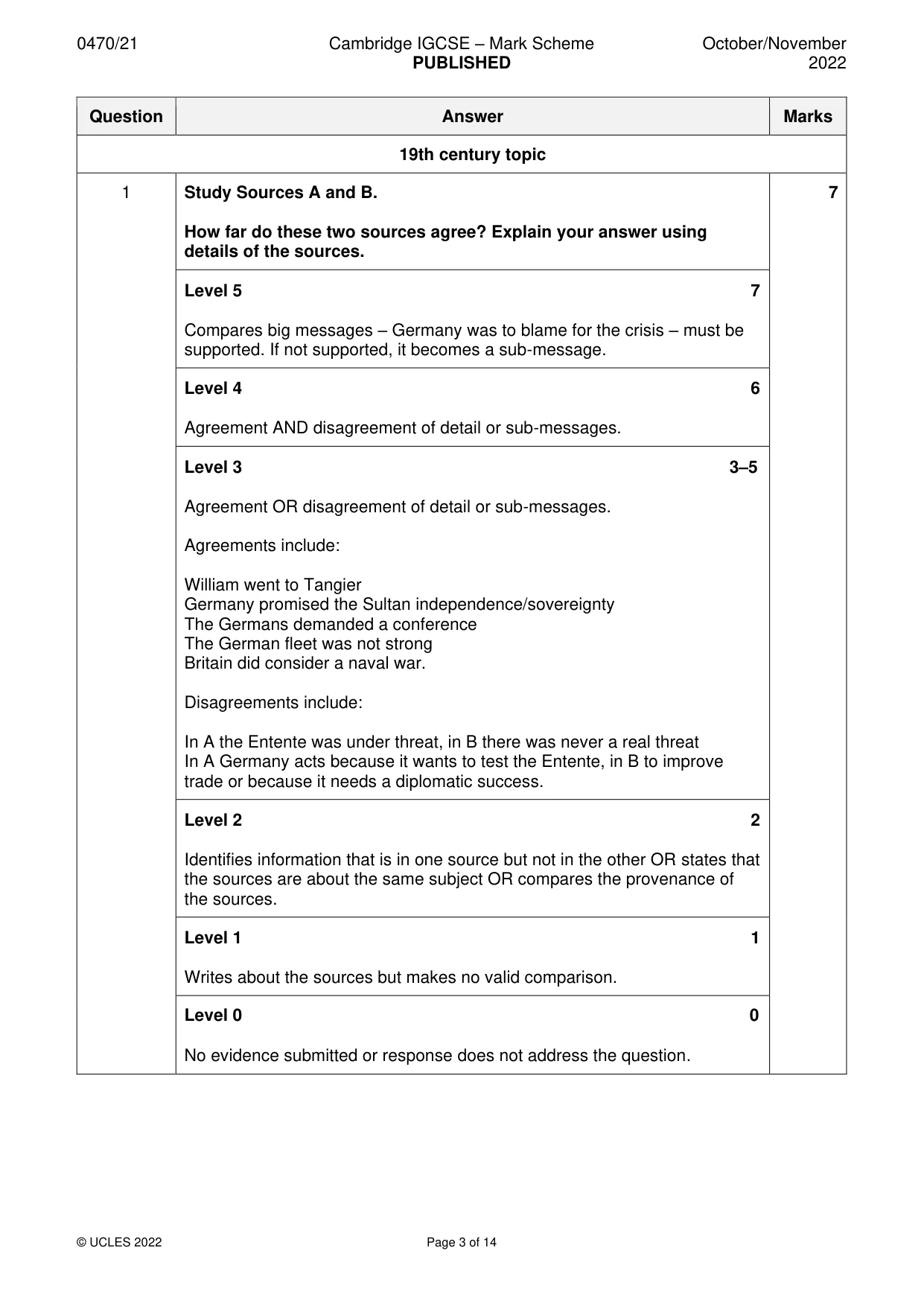
0470/21 Cambridge IGCSE – Mark Scheme PUBLISHED October/November 2022 © UCLES 2022 Page 3 of 14 Question Answer Marks 19th century topic 1 Study Sources A and B. How far do these two sources agree? Explain your answer using details of the sources. 7 Level 5 7 Compares big messages – Germany was to blame for the crisis – must be supported. If not supported, it becomes a sub-message. Level 4 6 Agreement AND disagreement of detail or sub-messages. Level 3 3–5 Agreement OR disagreement of detail or sub-messages. Agreements include: William went to Tangier Germany promised the Sultan independence/sovereignty The Germans demanded a conference The German fleet was not strong Britain did consider a naval war. Disagreements include: In A the Entente was under threat, in B there was never a real threat In A Germany acts because it wants to test the Entente, in B to improve trade or because it needs a diplomatic success. Level 2 2 Identifies information that is in one source but not in the other OR states that the sources are about the same subject OR compares the provenance of the sources. Level 1 1 Writes about the sources but makes no valid comparison. Level 0 0 No evidence submitted or response does not address the question.
Mark scheme, page 4
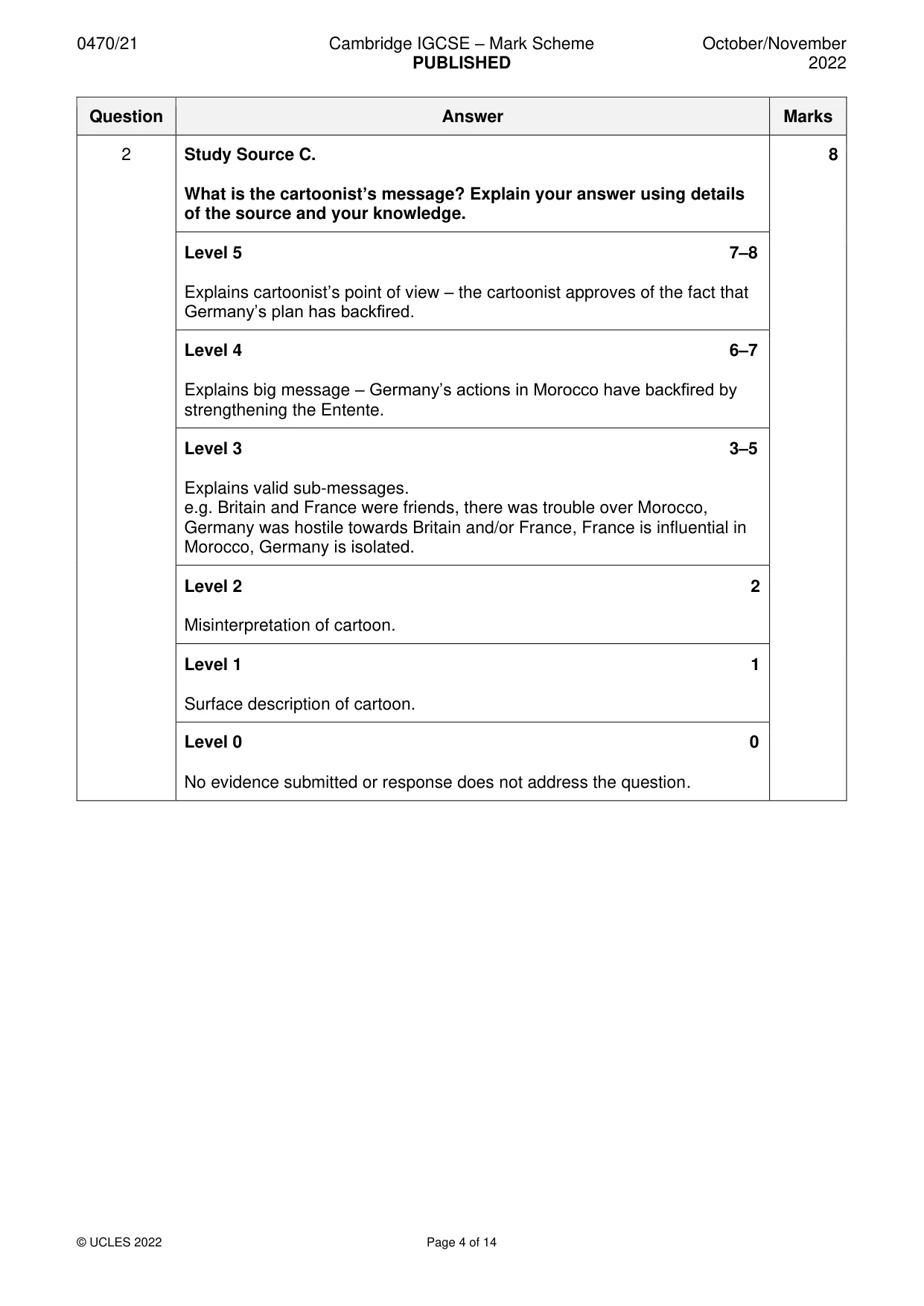
0470/21 Cambridge IGCSE – Mark Scheme PUBLISHED October/November 2022 © UCLES 2022 Page 4 of 14 Question Answer Marks 2 Study Source C. What is the cartoonist’s message? Explain your answer using details of the source and your knowledge. 8 Level 5 7–8 Explains cartoonist’s point of view – the cartoonist approves of the fact that Germany’s plan has backfired. Level 4 6–7 Explains big message – Germany’s actions in Morocco have backfired by strengthening the Entente. Level 3 3–5 Explains valid sub-messages. e.g. Britain and France were friends, there was trouble over Morocco, Germany was hostile towards Britain and/or France, France is influential in Morocco, Germany is isolated. Level 2 2 Misinterpretation of cartoon. Level 1 1 Surface description of cartoon. Level 0 0 No evidence submitted or response does not address the question.
Mark scheme, page 5
0470/21 Cambridge IGCSE – Mark Scheme PUBLISHED October/November 2022 © UCLES 2022 Page 5 of 14 Question Answer Marks 3 Study Source D. Do you trust this account? Explain your answer using details of the sources and your knowledge. 7 Level 5 7 Considers diplomat’s purpose in context of German attempts to use Morocco against France/Britain. Level 4 5–6 Not trusted because German diplomat bound to give positive account of Kaiser’s visit – must be supported from D, otherwise Level 2. Level 3 3–4 Cross reference to check details to trust the account OR not trust because written by a German in context of tensions between Germany and Britain and France. Level 2 2 Undeveloped use of provenance/identifies things in D not trusted – no explanation. Level 1 1 Unsupported assertions/fails to address issue of trust. Level 0 0 No evidence submitted or response does not address the question.
Mark scheme, page 6
0470/21 Cambridge IGCSE – Mark Scheme PUBLISHED October/November 2022 © UCLES 2022 Page 6 of 14 Question Answer Marks 4 Study Sources E and F. Does Source E make Source F surprising? Explain your answer using details of the sources and your knowledge. 8 Level 6 7–8 Answers using provenance – either military/political difference or change of Foreign Secretary in F – to explain not surprised about the difference (if difference not explained, it is Level 2) OR Compares E and F and cross references to other sources to evaluate either E or F. Level 5 6 Evaluates F by cross-reference – no use of E. Level 4 4–5 Compares content of the two sources to argue surprising because they differ. Level 3 3–4 Compares content of the two sources to argue not surprising e.g. they are both concerned about the Germans. Level 2 2 Answers based on undeveloped provenance OR identifies material in F that is/is not surprising but no valid explanation. Level 1 1 Writes about the sources but does not address the question. Level 0 0 No evidence submitted or response does not address the question.
Mark scheme, page 7
0470/21 Cambridge IGCSE – Mark Scheme PUBLISHED October/November 2022 © UCLES 2022 Page 7 of 14 Question Answer Marks 5 Study Source G and H. How far do these two cartoonists share the same opinion of the Kaiser? Explain your answer using details of the sources and your knowledge. 8 Level 6 8 Compares points of view of cartoonists – both cartoonists disapprove of the Kaiser – must be supported otherwise L3/4. Level 5 7 Compares the big messages of the two sources – the Kaiser is up to no good, is causing trouble – must be supported, otherwise L3/4. Level 4 5–6 Compares valid sub-messages – agreements/disagreements. Level 3 3–4 Interprets messages of one or both sources but no valid comparison. Level 2 2 Surface comparisons, misinterpretations. Answers just based on provenance. Level 1 1 Surface descriptions. Level 0 0 No evidence submitted or response does not address the question.
Mark scheme, page 8
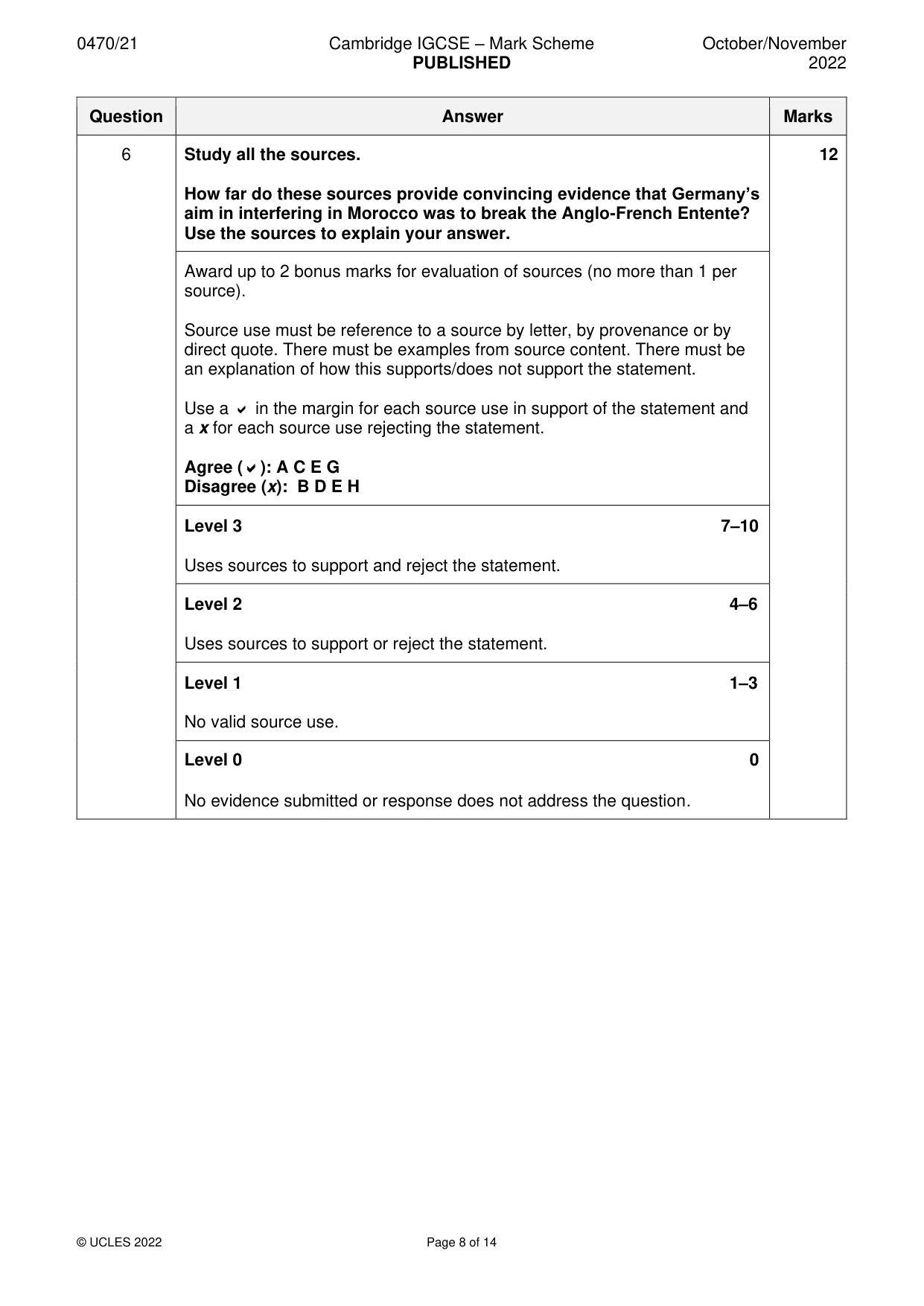
0470/21 Cambridge IGCSE – Mark Scheme PUBLISHED October/November 2022 © UCLES 2022 Page 8 of 14 Question Answer Marks 6 Study all the sources. How far do these sources provide convincing evidence that Germany’s aim in interfering in Morocco was to break the Anglo-French Entente? Use the sources to explain your answer. 12 Award up to 2 bonus marks for evaluation of sources (no more than 1 per source). Source use must be reference to a source by letter, by provenance or by direct quote. There must be examples from source content. There must be an explanation of how this supports/does not support the statement. Use a in the margin for each source use in support of the statement and a x for each source use rejecting the statement. Agree (): A C E G Disagree (x): B D E H Level 3 7–10 Uses sources to support and reject the statement. Level 2 4–6 Uses sources to support or reject the statement. Level 1 1–3 No valid source use. Level 0 0 No evidence submitted or response does not address the question.
Mark scheme, page 9
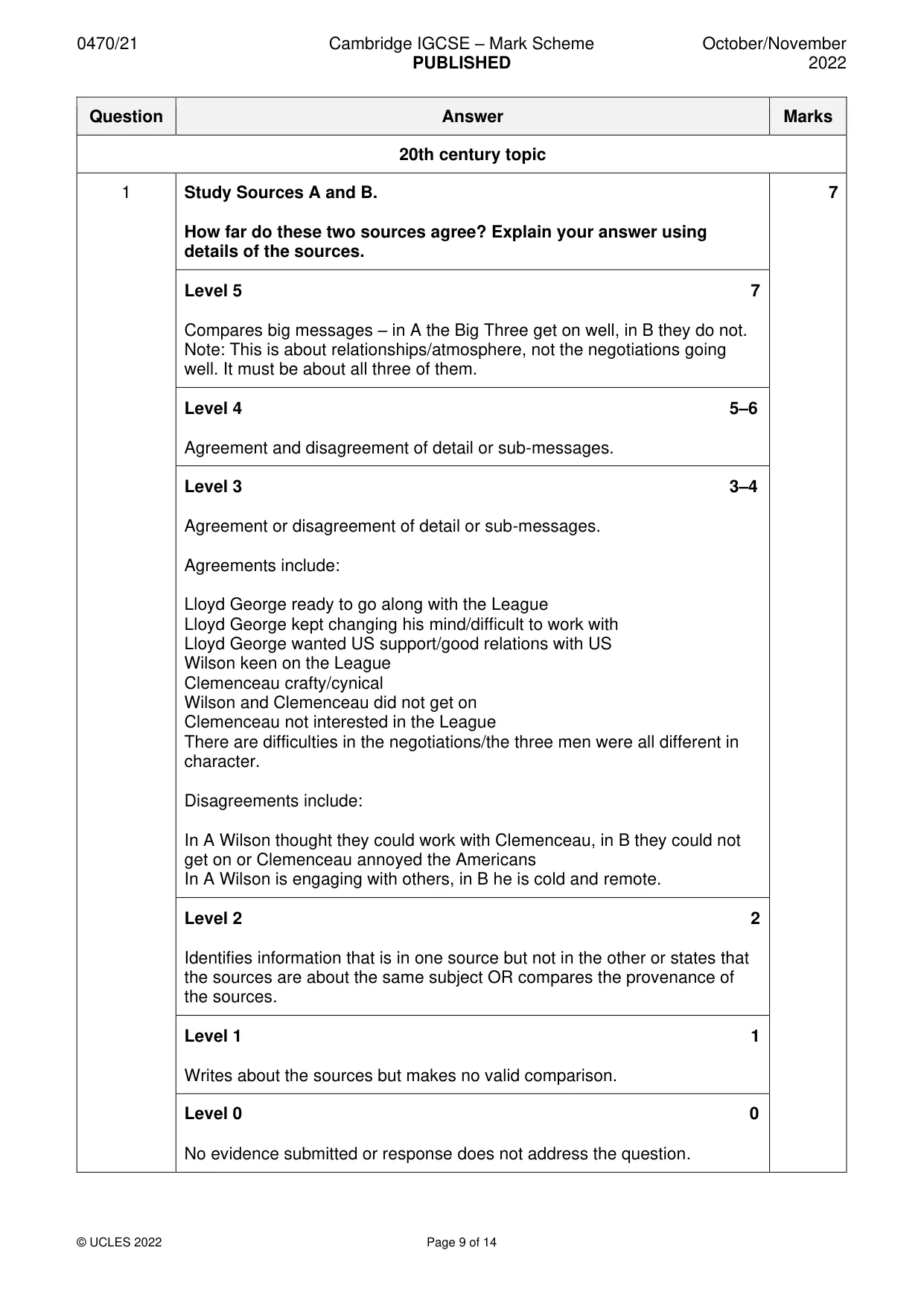
0470/21 Cambridge IGCSE – Mark Scheme PUBLISHED October/November 2022 © UCLES 2022 Page 9 of 14 Question Answer Marks 20th century topic 1 Study Sources A and B. How far do these two sources agree? Explain your answer using details of the sources. 7 Level 5 7 Compares big messages – in A the Big Three get on well, in B they do not. Note: This is about relationships/atmosphere, not the negotiations going well. It must be about all three of them. Level 4 5–6 Agreement and disagreement of detail or sub-messages. Level 3 3–4 Agreement or disagreement of detail or sub-messages. Agreements include: Lloyd George ready to go along with the League Lloyd George kept changing his mind/difficult to work with Lloyd George wanted US support/good relations with US Wilson keen on the League Clemenceau crafty/cynical Wilson and Clemenceau did not get on Clemenceau not interested in the League There are difficulties in the negotiations/the three men were all different in character. Disagreements include: In A Wilson thought they could work with Clemenceau, in B they could not get on or Clemenceau annoyed the Americans In A Wilson is engaging with others, in B he is cold and remote. Level 2 2 Identifies information that is in one source but not in the other or states that the sources are about the same subject OR compares the provenance of the sources. Level 1 1 Writes about the sources but makes no valid comparison. Level 0 0 No evidence submitted or response does not address the question.
Mark scheme, page 10
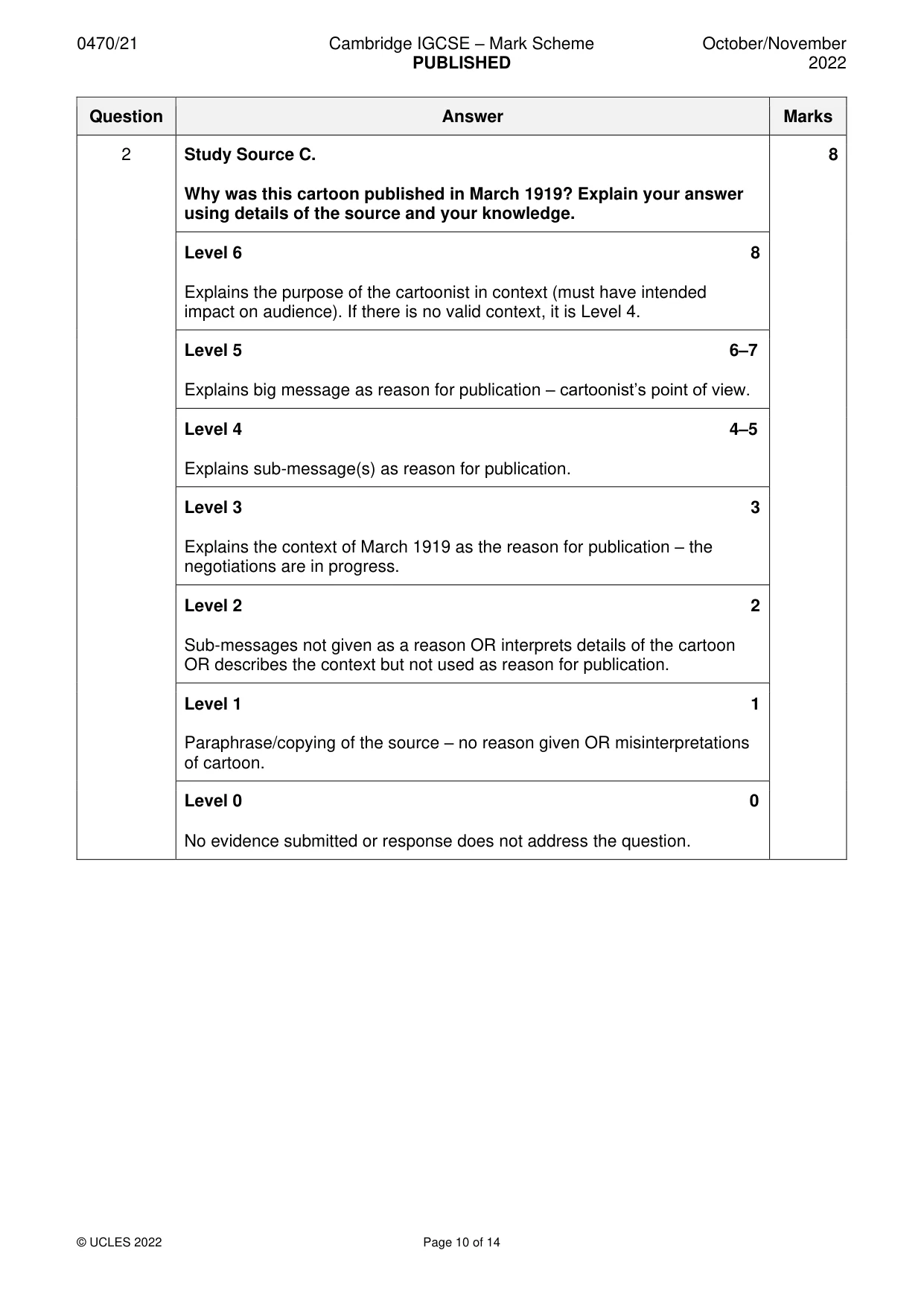
0470/21 Cambridge IGCSE – Mark Scheme PUBLISHED October/November 2022 © UCLES 2022 Page 10 of 14 Question Answer Marks 2 Study Source C. Why was this cartoon published in March 1919? Explain your answer using details of the source and your knowledge. 8 Level 6 8 Explains the purpose of the cartoonist in context (must have intended impact on audience). If there is no valid context, it is Level 4. Level 5 6–7 Explains big message as reason for publication – cartoonist’s point of view. Level 4 4–5 Explains sub-message(s) as reason for publication. Level 3 3 Explains the context of March 1919 as the reason for publication – the negotiations are in progress. Level 2 2 Sub-messages not given as a reason OR interprets details of the cartoon OR describes the context but not used as reason for publication. Level 1 1 Paraphrase/copying of the source – no reason given OR misinterpretations of cartoon. Level 0 0 No evidence submitted or response does not address the question.
Mark scheme, page 11
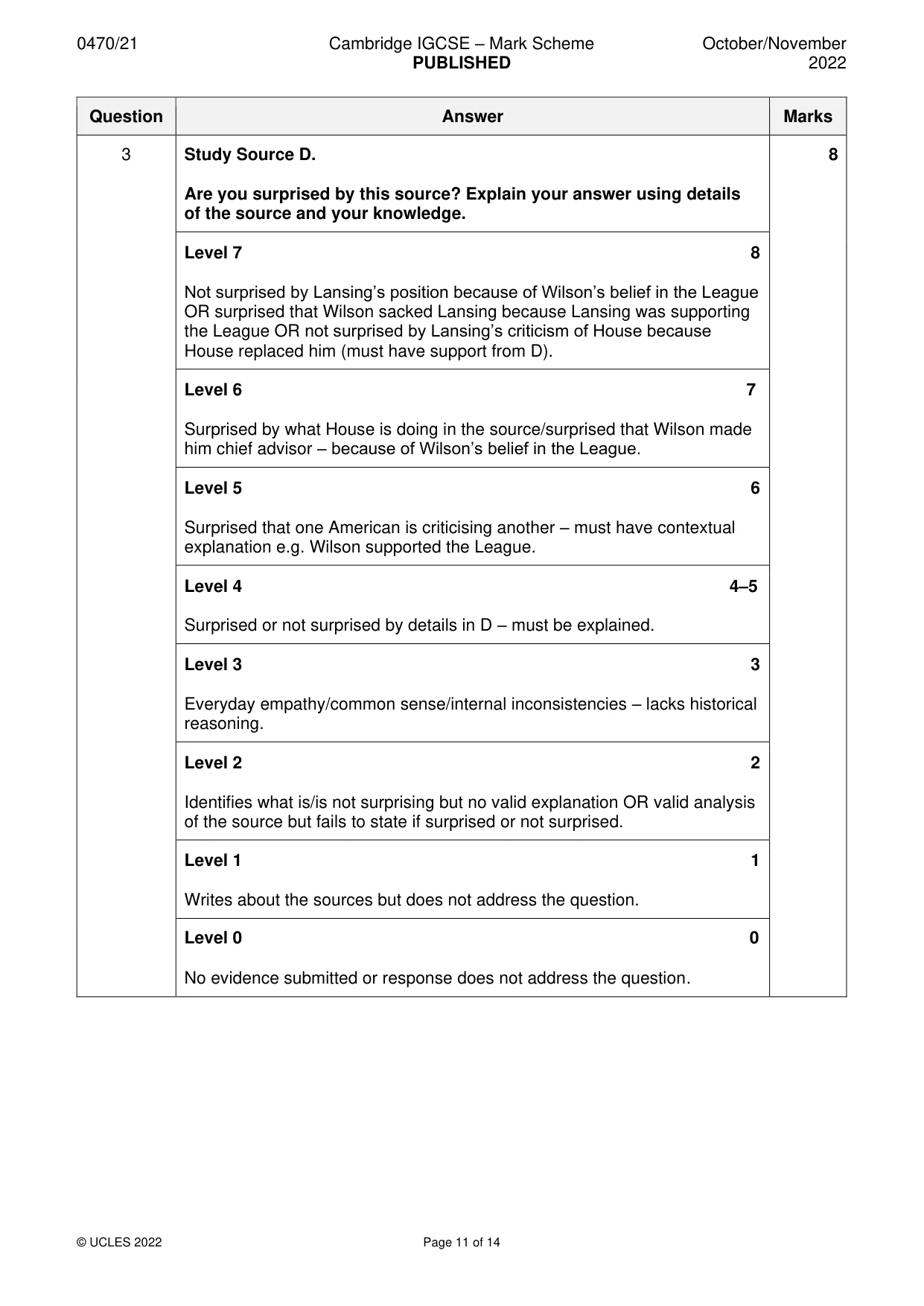
0470/21 Cambridge IGCSE – Mark Scheme PUBLISHED October/November 2022 © UCLES 2022 Page 11 of 14 Question Answer Marks 3 Study Source D. Are you surprised by this source? Explain your answer using details of the source and your knowledge. 8 Level 7 8 Not surprised by Lansing’s position because of Wilson’s belief in the League OR surprised that Wilson sacked Lansing because Lansing was supporting the League OR not surprised by Lansing’s criticism of House because House replaced him (must have support from D). Level 6 7 Surprised by what House is doing in the source/surprised that Wilson made him chief advisor – because of Wilson’s belief in the League. Level 5 6 Surprised that one American is criticising another – must have contextual explanation e.g. Wilson supported the League. Level 4 4–5 Surprised or not surprised by details in D – must be explained. Level 3 3 Everyday empathy/common sense/internal inconsistencies – lacks historical reasoning. Level 2 2 Identifies what is/is not surprising but no valid explanation OR valid analysis of the source but fails to state if surprised or not surprised. Level 1 1 Writes about the sources but does not address the question. Level 0 0 No evidence submitted or response does not address the question.
Mark scheme, page 12
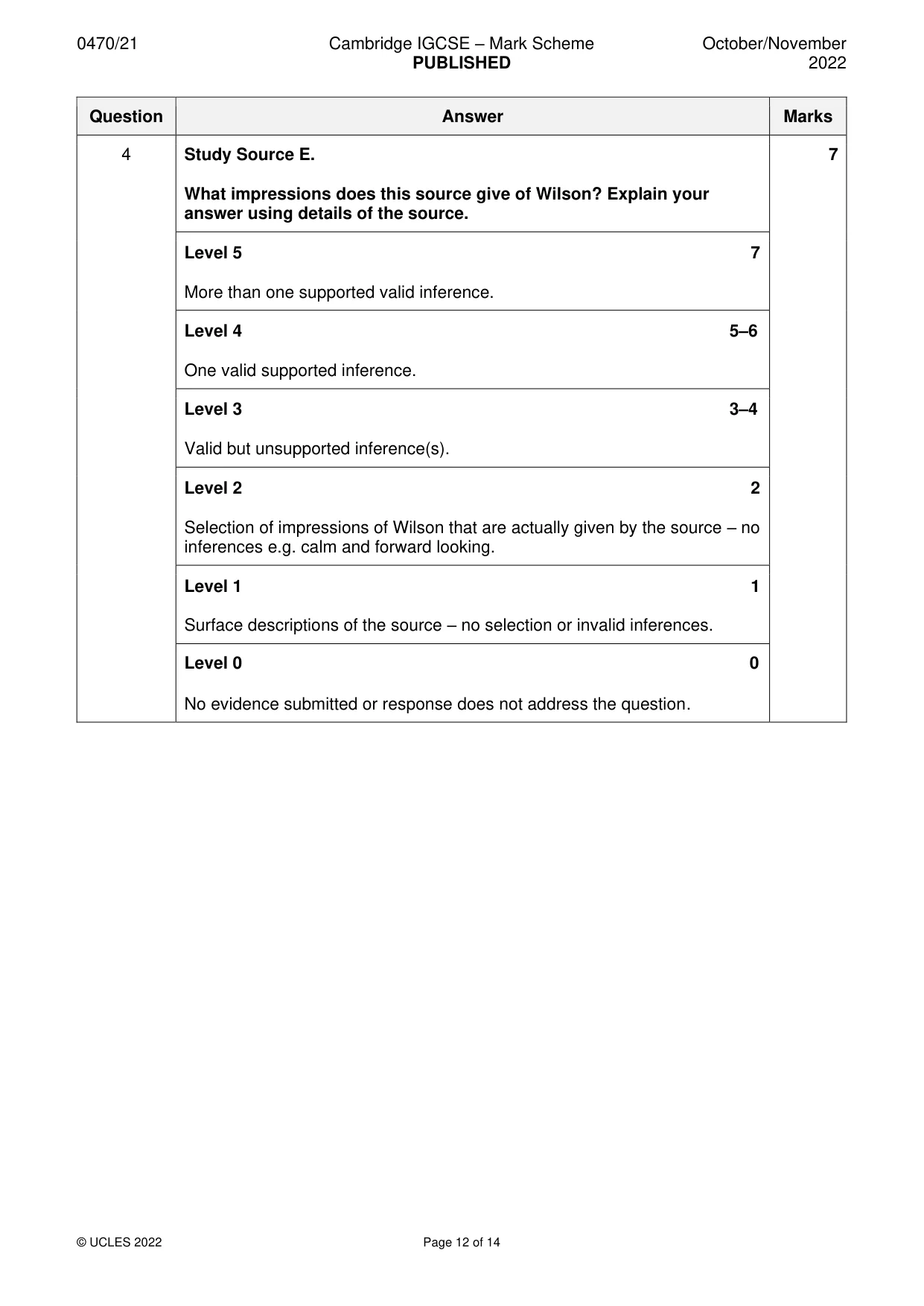
0470/21 Cambridge IGCSE – Mark Scheme PUBLISHED October/November 2022 © UCLES 2022 Page 12 of 14 Question Answer Marks 4 Study Source E. What impressions does this source give of Wilson? Explain your answer using details of the source. 7 Level 5 7 More than one supported valid inference. Level 4 5–6 One valid supported inference. Level 3 3–4 Valid but unsupported inference(s). Level 2 2 Selection of impressions of Wilson that are actually given by the source – no inferences e.g. calm and forward looking. Level 1 1 Surface descriptions of the source – no selection or invalid inferences. Level 0 0 No evidence submitted or response does not address the question.
Mark scheme, page 13
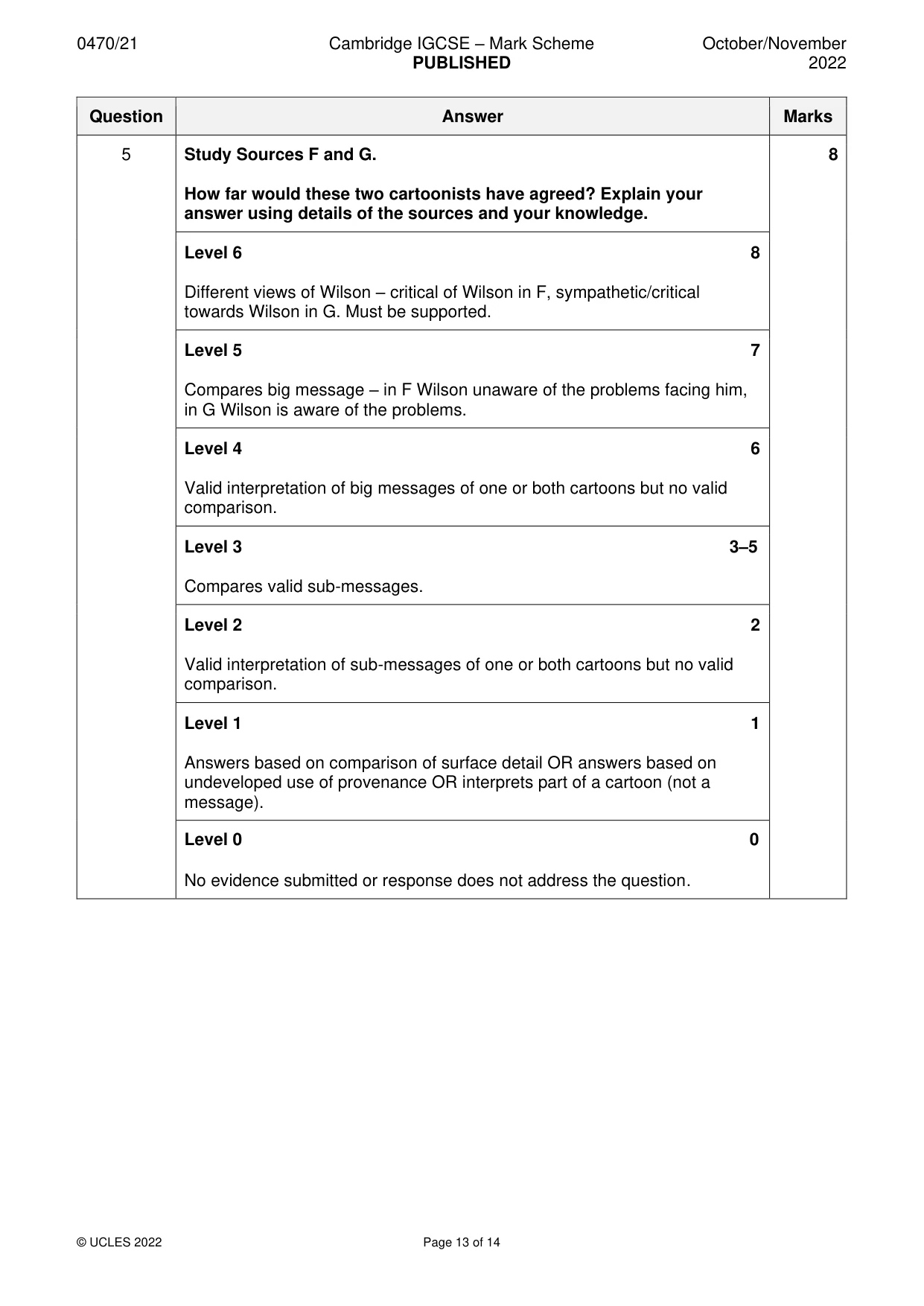
0470/21 Cambridge IGCSE – Mark Scheme PUBLISHED October/November 2022 © UCLES 2022 Page 13 of 14 Question Answer Marks 5 Study Sources F and G. How far would these two cartoonists have agreed? Explain your answer using details of the sources and your knowledge. 8 Level 6 8 Different views of Wilson – critical of Wilson in F, sympathetic/critical towards Wilson in G. Must be supported. Level 5 7 Compares big message – in F Wilson unaware of the problems facing him, in G Wilson is aware of the problems. Level 4 6 Valid interpretation of big messages of one or both cartoons but no valid comparison. Level 3 3–5 Compares valid sub-messages. Level 2 2 Valid interpretation of sub-messages of one or both cartoons but no valid comparison. Level 1 1 Answers based on comparison of surface detail OR answers based on undeveloped use of provenance OR interprets part of a cartoon (not a message). Level 0 0 No evidence submitted or response does not address the question.
Mark scheme, page 14
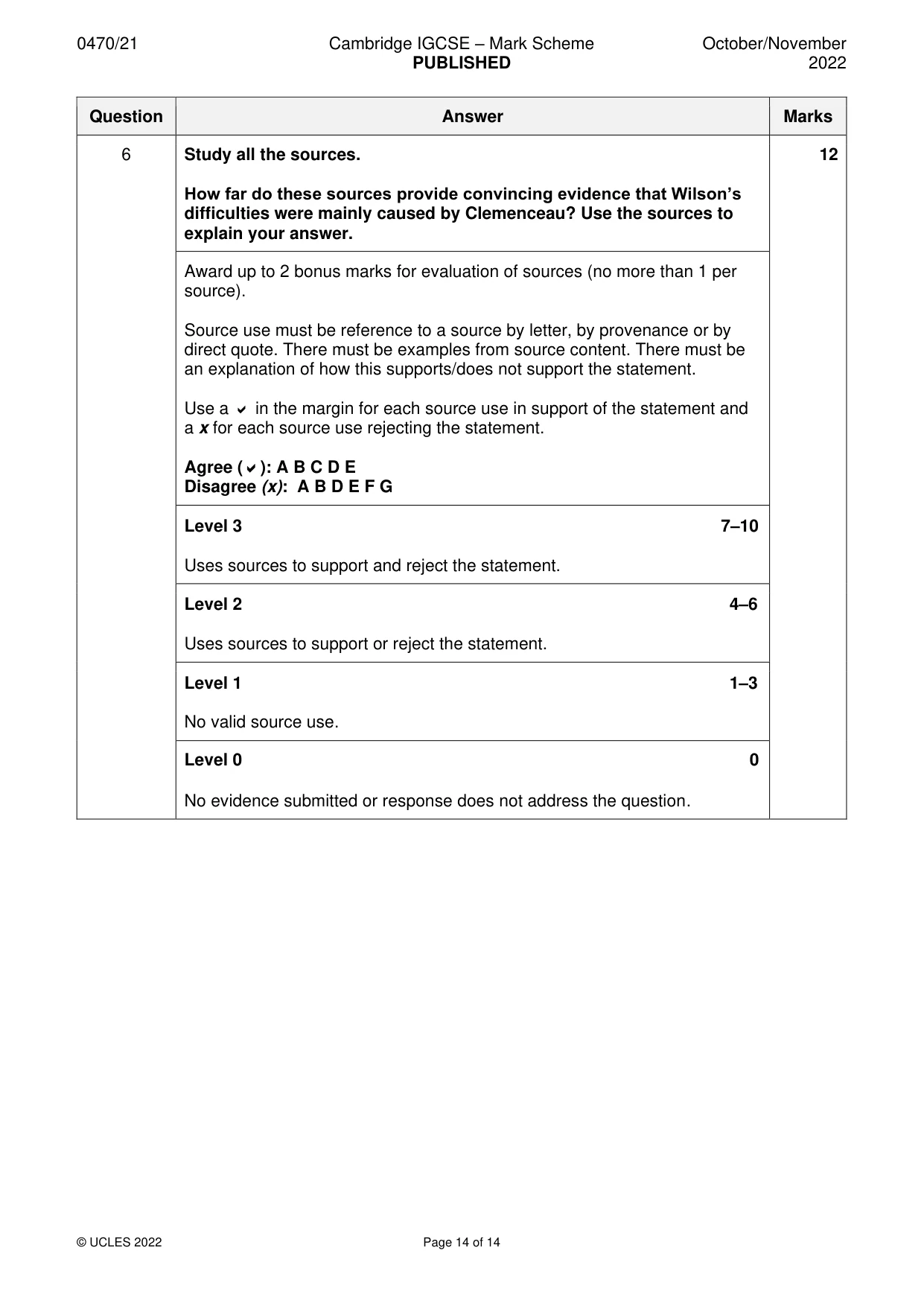
0470/21 Cambridge IGCSE – Mark Scheme PUBLISHED October/November 2022 © UCLES 2022 Page 14 of 14 Question Answer Marks 6 Study all the sources. How far do these sources provide convincing evidence that Wilson’s difficulties were mainly caused by Clemenceau? Use the sources to explain your answer. 12 Award up to 2 bonus marks for evaluation of sources (no more than 1 per source). Source use must be reference to a source by letter, by provenance or by direct quote. There must be examples from source content. There must be an explanation of how this supports/does not support the statement. Use a in the margin for each source use in support of the statement and a x for each source use rejecting the statement. Agree (): A B C D E Disagree (x): A B D E F G Level 3 7–10 Uses sources to support and reject the statement. Level 2 4–6 Uses sources to support or reject the statement. Level 1 1–3 No valid source use. Level 0 0 No evidence submitted or response does not address the question.
What you needed in this session
Cambridge’s own grade thresholds for 2022 Oct/Nov, Paper 2 · Variant 1. A higher threshold means an easier paper — the bar moves with how the cohort did.