Cambridge IGCSE History 0470 — 2022 May/June Paper 4 · Variant 1
0470/41/M/J/22 · 40 marks · ≈45 min
The question paper and its mark scheme, free to read here and free to download. This is Cambridge’s own paper, exactly as it was sat.
Question paper4 pages

Mark scheme11 pages
Answers below. Sit the paper first if you are practising.

Paper as text
Question paper, page 1
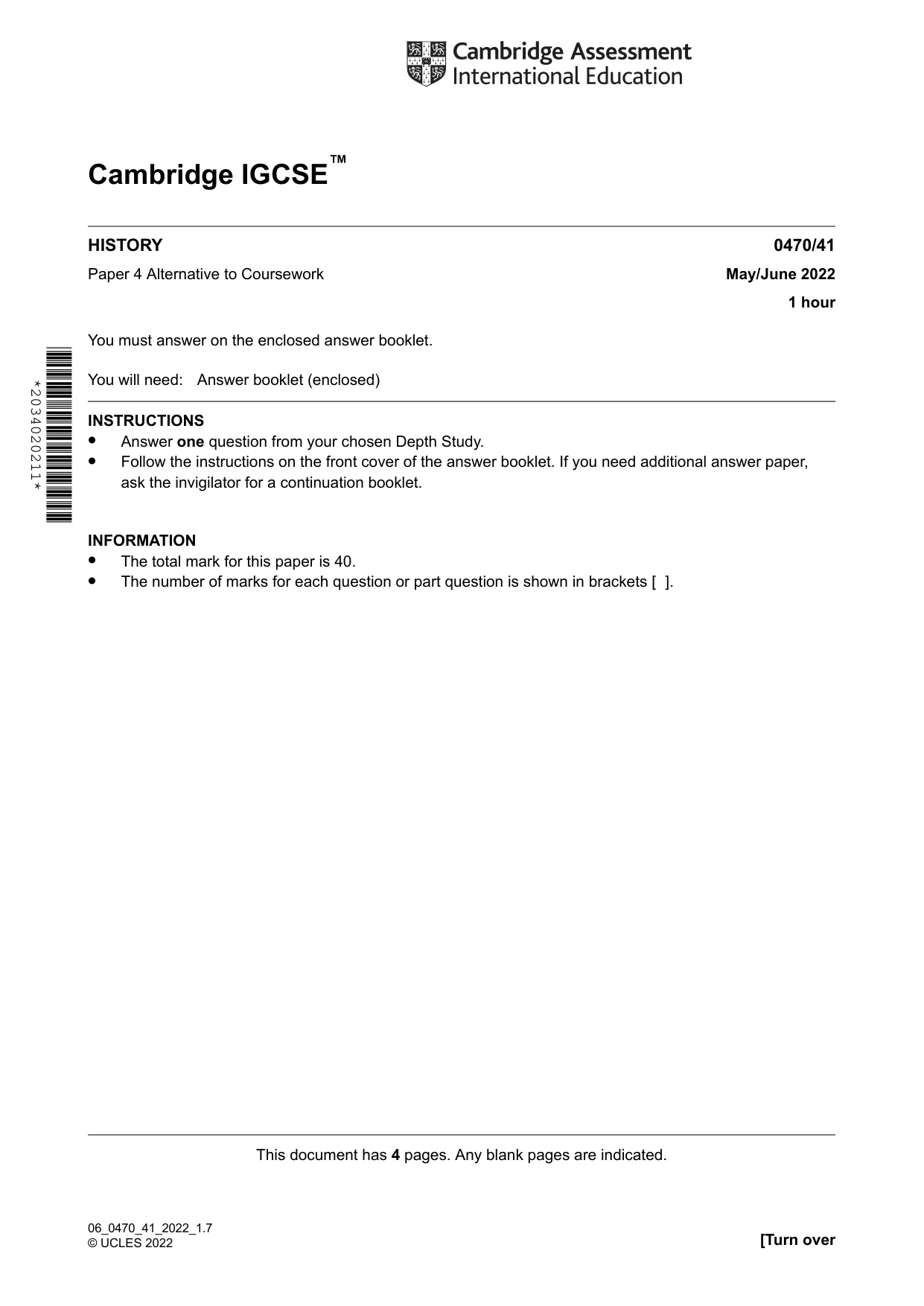
Cambridge IGCSE™ 0470/41 May/June 2022 1 hour HISTORY Paper 4 Alternative to Coursework You must answer on the enclosed answer booklet. You will need: Answer booklet (enclosed) INSTRUCTIONS • Answer one question from your chosen Depth Study. • Follow the instructions on the front cover of the answer booklet. If you need additional answer paper, ask the invigilator for a continuation booklet. INFORMATION • The total mark for this paper is 40. • The number of marks for each question or part question is shown in brackets [ ]. This document has 4 pages. Any blank pages are indicated. [Turn over 06_0470_41_2022_1.7 © UCLES 2022 *2034020211*
Question paper, page 2
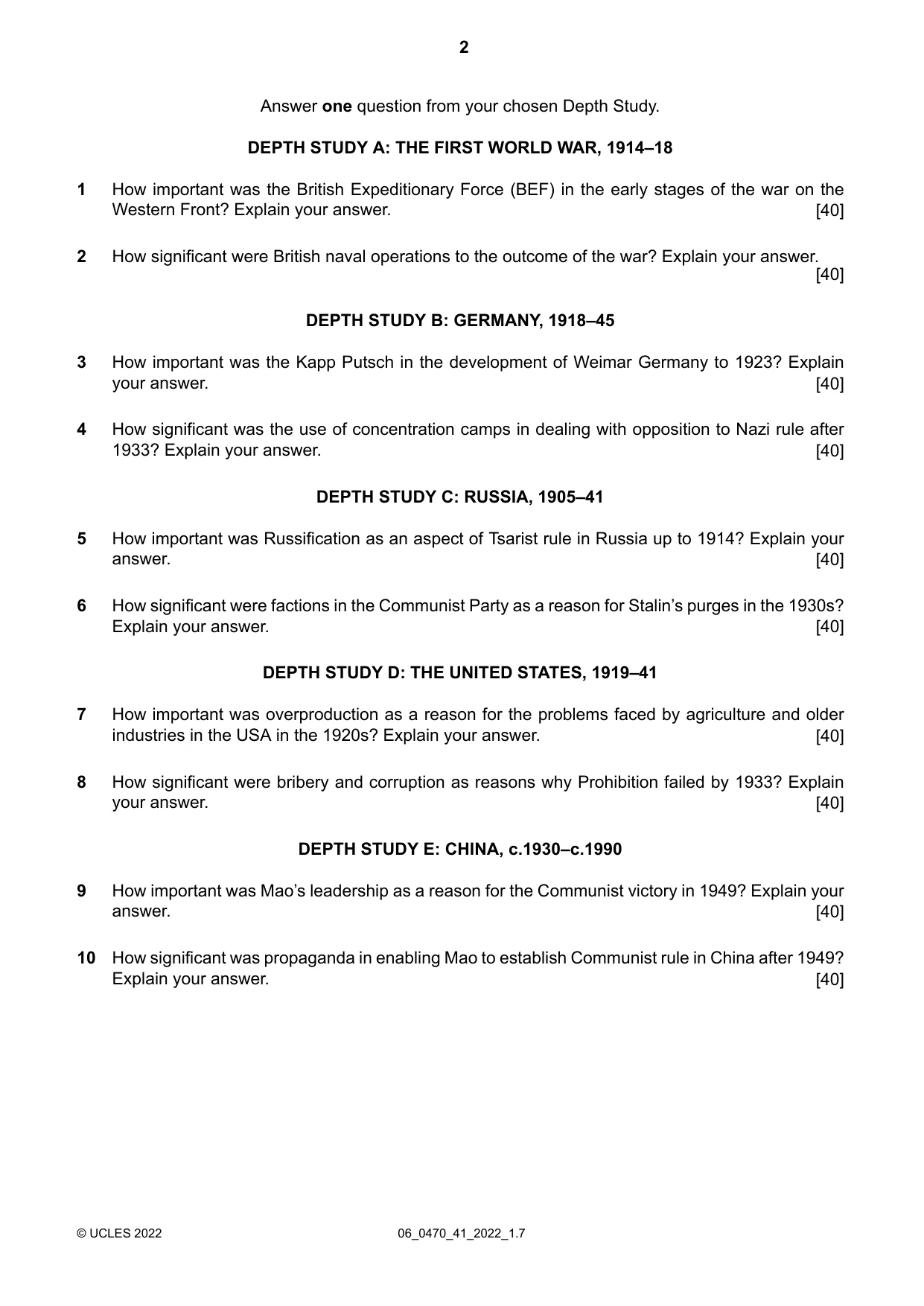
Answer one question from your chosen Depth Study. DEPTH STUDY A: THE FIRST WORLD WAR, 1914–18 How important was the British Expeditionary Force (BEF) in the early stages of the war on the Western Front? Explain your answer. [40] 1 How significant were British naval operations to the outcome of the war? Explain your answer. [40] 2 DEPTH STUDY B: GERMANY, 1918–45 How important was the Kapp Putsch in the development of Weimar Germany to 1923? Explain your answer. [40] 3 How significant was the use of concentration camps in dealing with opposition to Nazi rule after 1933? Explain your answer. [40] 4 DEPTH STUDY C: RUSSIA, 1905–41 How important was Russification as an aspect of Tsarist rule in Russia up to 1914? Explain your answer. [40] 5 How significant were factions in the Communist Party as a reason for Stalin’s purges in the 1930s? Explain your answer. [40] 6 DEPTH STUDY D: THE UNITED STATES, 1919–41 How important was overproduction as a reason for the problems faced by agriculture and older industries in the USA in the 1920s? Explain your answer. [40] 7 How significant were bribery and corruption as reasons why Prohibition failed by 1933? Explain your answer. [40] 8 DEPTH STUDY E: CHINA, c.1930–c.1990 How important was Mao’s leadership as a reason for the Communist victory in 1949? Explain your answer. [40] 9 How significant was propaganda in enabling Mao to establish Communist rule in China after 1949? Explain your answer. [40] 10 06_0470_41_2022_1.7 © UCLES 2022 2
Question paper, page 3
DEPTH STUDY F: SOUTH AFRICA, c.1940–c.1994 How important were government limitations on travel in maintaining segregation between the races in South Africa before 1948? Explain your answer. [40] 11 How significant was the growth in Black Consciousness in weakening the system of apartheid in South Africa? Explain your answer. [40] 12 DEPTH STUDY G: ISRAELIS AND PALESTINIANS SINCE 1945 How important was the British mandate as a factor that shaped events in Palestine, 1945-49? Explain your answer. [40] 13 How significant was Hamas in increasing tensions between Israelis and Palestinians? Explain your answer. [40] 14 06_0470_41_2022_1.7 © UCLES 2022 3
Question paper, page 4
BLANK PAGE Permission to reproduce items where third-party owned material protected by copyright is included has been sought and cleared where possible. Every reasonable effort has been made by the publisher (UCLES) to trace copyright holders, but if any items requiring clearance have unwittingly been included, the publisher will be pleased to make amends at the earliest possible opportunity. To avoid the issue of disclosure of answer-related information to candidates, all copyright acknowledgements are reproduced online in the Cambridge Assessment International Education Copyright Acknowledgements Booklet. This is produced for each series of examinations and is freely available to download at www.cambridgeinternational.org after the live examination series. Cambridge Assessment International Education is part of Cambridge Assessment. Cambridge Assessment is the brand name of the University of Cambridge Local Examinations Syndicate (UCLES), which is a department of the University of Cambridge. 06_0470_41_2022_1.7 © UCLES 2022 4
Mark scheme, page 1
This document consists of 11 printed pages. © UCLES 2022 [Turn over Cambridge IGCSE™ HISTORY 0470/41 Paper 4 Alternative to Coursework May/June 2022 MARK SCHEME Maximum Mark: 40 Published This mark scheme is published as an aid to teachers and candidates, to indicate the requirements of the examination. It shows the basis on which Examiners were instructed to award marks. It does not indicate the details of the discussions that took place at an Examiners’ meeting before marking began, which would have considered the acceptability of alternative answers. Mark schemes should be read in conjunction with the question paper and the Principal Examiner Report for Teachers. Cambridge International will not enter into discussions about these mark schemes. Cambridge International is publishing the mark schemes for the May/June 2022 series for most Cambridge IGCSE, Cambridge International A and AS Level and Cambridge Pre-U components, and some Cambridge O Level components.
Mark scheme, page 2
0470/41 Cambridge IGCSE – Mark Scheme PUBLISHED May/June 2022 © UCLES 2022 Page 2 of 11 Generic Marking Principles These general marking principles must be applied by all examiners when marking candidate answers. They should be applied alongside the specific content of the mark scheme or generic level descriptors for a question. Each question paper and mark scheme will also comply with these marking principles. GENERIC MARKING PRINCIPLE 1: Marks must be awarded in line with: the specific content of the mark scheme or the generic level descriptors for the question the specific skills defined in the mark scheme or in the generic level descriptors for the question the standard of response required by a candidate as exemplified by the standardisation scripts. GENERIC MARKING PRINCIPLE 2: Marks awarded are always whole marks (not half marks, or other fractions). GENERIC MARKING PRINCIPLE 3: Marks must be awarded positively: marks are awarded for correct/valid answers, as defined in the mark scheme. However, credit is given for valid answers which go beyond the scope of the syllabus and mark scheme, referring to your Team Leader as appropriate marks are awarded when candidates clearly demonstrate what they know and can do marks are not deducted for errors marks are not deducted for omissions answers should only be judged on the quality of spelling, punctuation and grammar when these features are specifically assessed by the question as indicated by the mark scheme. The meaning, however, should be unambiguous. GENERIC MARKING PRINCIPLE 4: Rules must be applied consistently, e.g. in situations where candidates have not followed instructions or in the application of generic level descriptors. GENERIC MARKING PRINCIPLE 5: Marks should be awarded using the full range of marks defined in the mark scheme for the question (however; the use of the full mark range may be limited according to the quality of the candidate responses seen). GENERIC MARKING PRINCIPLE 6: Marks awarded are based solely on the requirements as defined in the mark scheme. Marks should not be awarded with grade thresholds or grade descriptors in mind.
Mark scheme, page 3
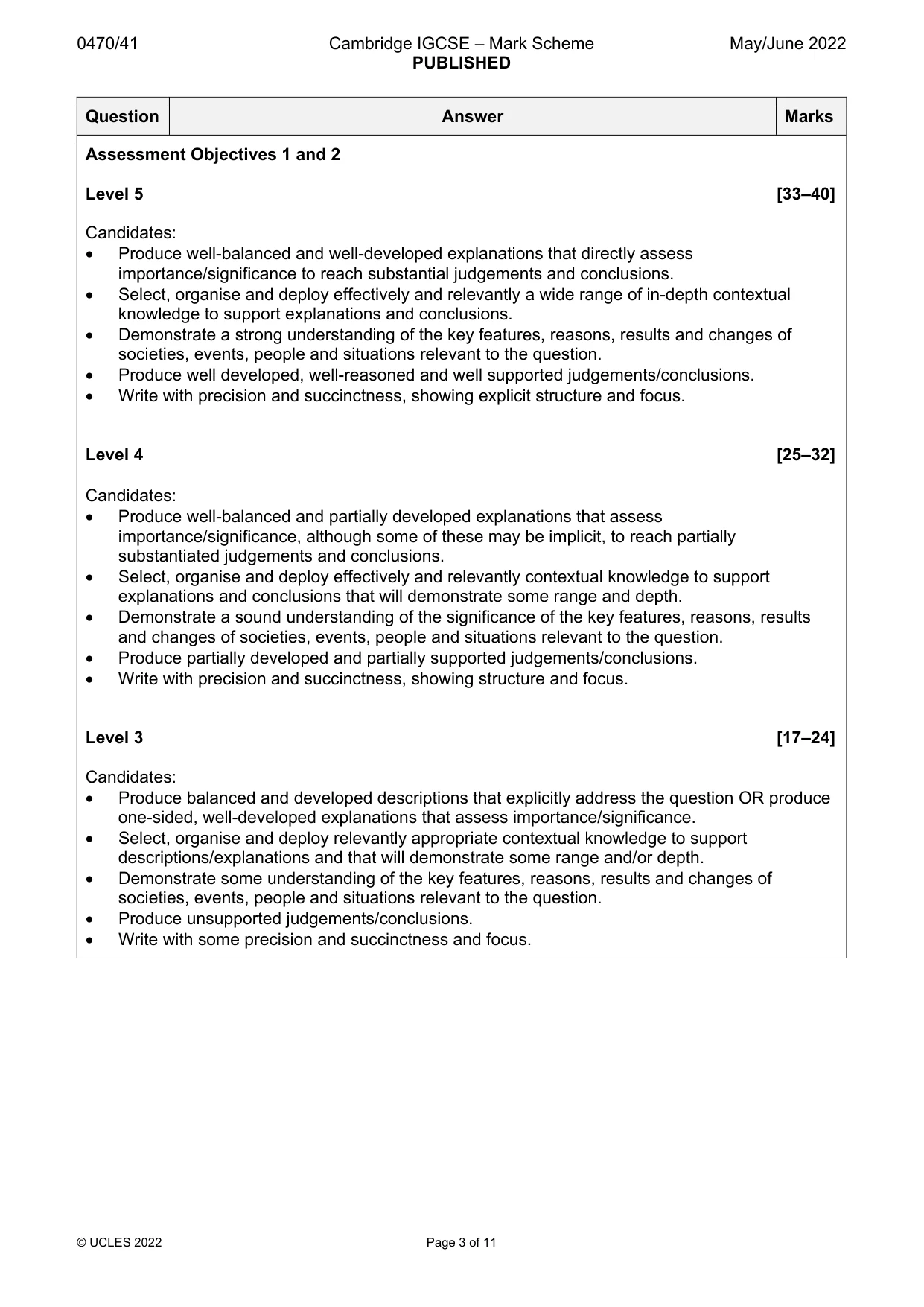
0470/41 Cambridge IGCSE – Mark Scheme PUBLISHED May/June 2022 © UCLES 2022 Page 3 of 11 Question Answer Marks Assessment Objectives 1 and 2 Level 5 [33–40] Candidates: Produce well-balanced and well-developed explanations that directly assess importance/significance to reach substantial judgements and conclusions. Select, organise and deploy effectively and relevantly a wide range of in-depth contextual knowledge to support explanations and conclusions. Demonstrate a strong understanding of the key features, reasons, results and changes of societies, events, people and situations relevant to the question. Produce well developed, well-reasoned and well supported judgements/conclusions. Write with precision and succinctness, showing explicit structure and focus. Level 4 [25–32] Candidates: Produce well-balanced and partially developed explanations that assess importance/significance, although some of these may be implicit, to reach partially substantiated judgements and conclusions. Select, organise and deploy effectively and relevantly contextual knowledge to support explanations and conclusions that will demonstrate some range and depth. Demonstrate a sound understanding of the significance of the key features, reasons, results and changes of societies, events, people and situations relevant to the question. Produce partially developed and partially supported judgements/conclusions. Write with precision and succinctness, showing structure and focus. Level 3 [17–24] Candidates: Produce balanced and developed descriptions that explicitly address the question OR produce one-sided, well-developed explanations that assess importance/significance. Select, organise and deploy relevantly appropriate contextual knowledge to support descriptions/explanations and that will demonstrate some range and/or depth. Demonstrate some understanding of the key features, reasons, results and changes of societies, events, people and situations relevant to the question. Produce unsupported judgements/conclusions. Write with some precision and succinctness and focus.
Mark scheme, page 4
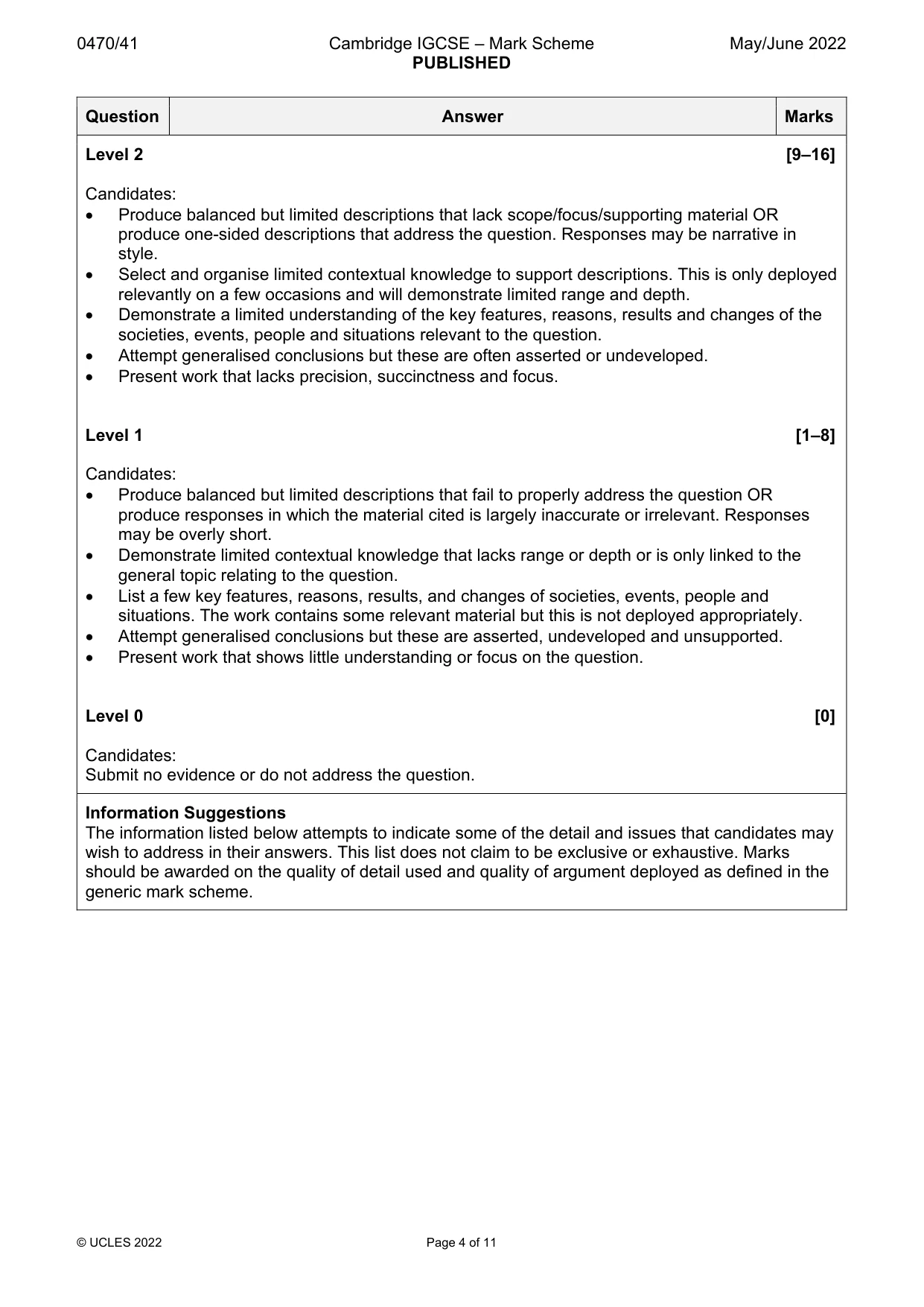
0470/41 Cambridge IGCSE – Mark Scheme PUBLISHED May/June 2022 © UCLES 2022 Page 4 of 11 Question Answer Marks Level 2 [9–16] Candidates: Produce balanced but limited descriptions that lack scope/focus/supporting material OR produce one-sided descriptions that address the question. Responses may be narrative in style. Select and organise limited contextual knowledge to support descriptions. This is only deployed relevantly on a few occasions and will demonstrate limited range and depth. Demonstrate a limited understanding of the key features, reasons, results and changes of the societies, events, people and situations relevant to the question. Attempt generalised conclusions but these are often asserted or undeveloped. Present work that lacks precision, succinctness and focus. Level 1 [1–8] Candidates: Produce balanced but limited descriptions that fail to properly address the question OR produce responses in which the material cited is largely inaccurate or irrelevant. Responses may be overly short. Demonstrate limited contextual knowledge that lacks range or depth or is only linked to the general topic relating to the question. List a few key features, reasons, results, and changes of societies, events, people and situations. The work contains some relevant material but this is not deployed appropriately. Attempt generalised conclusions but these are asserted, undeveloped and unsupported. Present work that shows little understanding or focus on the question. Level 0 [0] Candidates: Submit no evidence or do not address the question. Information Suggestions The information listed below attempts to indicate some of the detail and issues that candidates may wish to address in their answers. This list does not claim to be exclusive or exhaustive. Marks should be awarded on the quality of detail used and quality of argument deployed as defined in the generic mark scheme.
Mark scheme, page 5
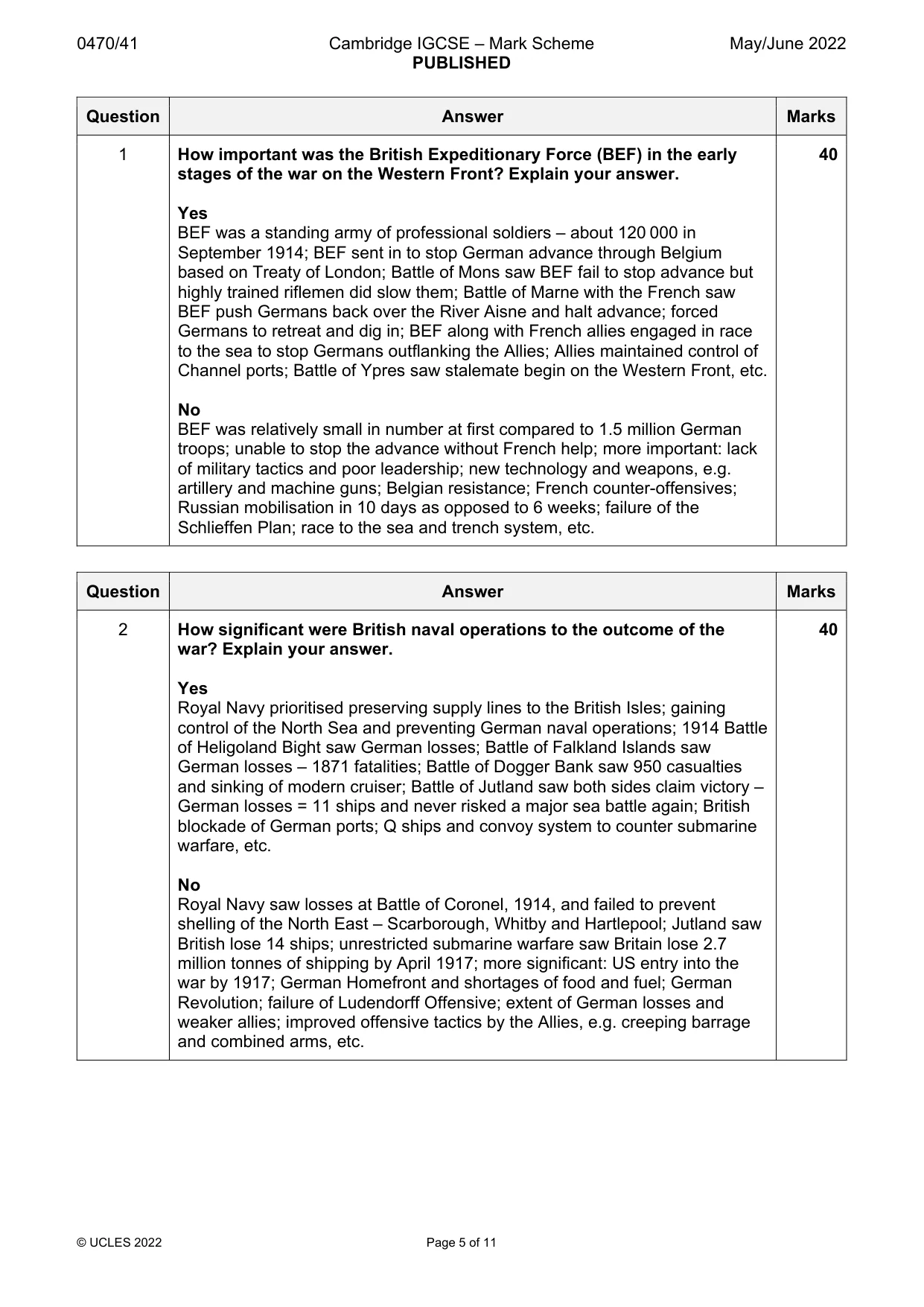
0470/41 Cambridge IGCSE – Mark Scheme PUBLISHED May/June 2022 © UCLES 2022 Page 5 of 11 Question Answer Marks 1 How important was the British Expeditionary Force (BEF) in the early stages of the war on the Western Front? Explain your answer. Yes BEF was a standing army of professional soldiers – about 120 000 in September 1914; BEF sent in to stop German advance through Belgium based on Treaty of London; Battle of Mons saw BEF fail to stop advance but highly trained riflemen did slow them; Battle of Marne with the French saw BEF push Germans back over the River Aisne and halt advance; forced Germans to retreat and dig in; BEF along with French allies engaged in race to the sea to stop Germans outflanking the Allies; Allies maintained control of Channel ports; Battle of Ypres saw stalemate begin on the Western Front, etc. No BEF was relatively small in number at first compared to 1.5 million German troops; unable to stop the advance without French help; more important: lack of military tactics and poor leadership; new technology and weapons, e.g. artillery and machine guns; Belgian resistance; French counter-offensives; Russian mobilisation in 10 days as opposed to 6 weeks; failure of the Schlieffen Plan; race to the sea and trench system, etc. 40 Question Answer Marks 2 How significant were British naval operations to the outcome of the war? Explain your answer. Yes Royal Navy prioritised preserving supply lines to the British Isles; gaining control of the North Sea and preventing German naval operations; 1914 Battle of Heligoland Bight saw German losses; Battle of Falkland Islands saw German losses – 1871 fatalities; Battle of Dogger Bank saw 950 casualties and sinking of modern cruiser; Battle of Jutland saw both sides claim victory – German losses = 11 ships and never risked a major sea battle again; British blockade of German ports; Q ships and convoy system to counter submarine warfare, etc. No Royal Navy saw losses at Battle of Coronel, 1914, and failed to prevent shelling of the North East – Scarborough, Whitby and Hartlepool; Jutland saw British lose 14 ships; unrestricted submarine warfare saw Britain lose 2.7 million tonnes of shipping by April 1917; more significant: US entry into the war by 1917; German Homefront and shortages of food and fuel; German Revolution; failure of Ludendorff Offensive; extent of German losses and weaker allies; improved offensive tactics by the Allies, e.g. creeping barrage and combined arms, etc. 40
Mark scheme, page 6
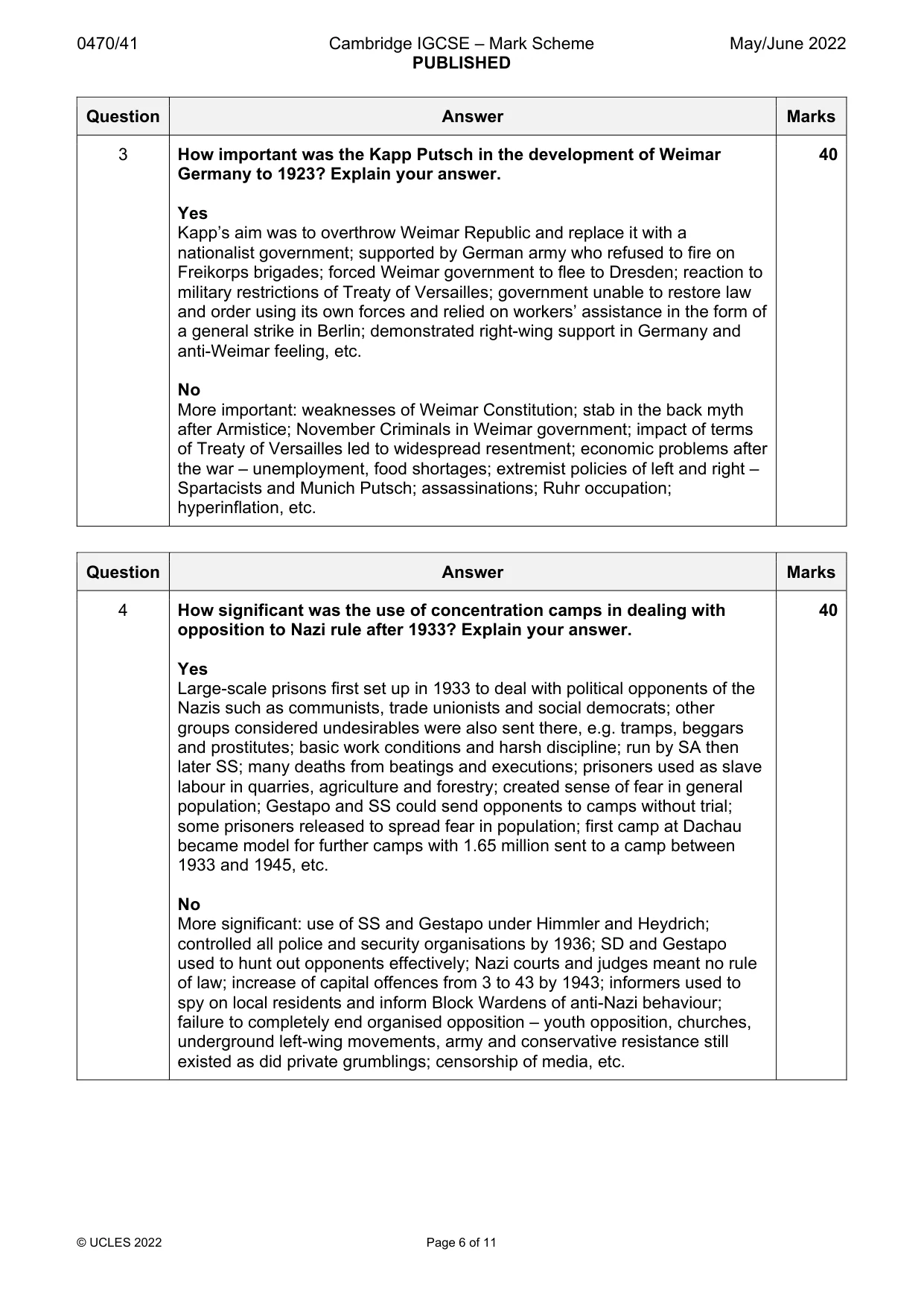
0470/41 Cambridge IGCSE – Mark Scheme PUBLISHED May/June 2022 © UCLES 2022 Page 6 of 11 Question Answer Marks 3 How important was the Kapp Putsch in the development of Weimar Germany to 1923? Explain your answer. Yes Kapp’s aim was to overthrow Weimar Republic and replace it with a nationalist government; supported by German army who refused to fire on Freikorps brigades; forced Weimar government to flee to Dresden; reaction to military restrictions of Treaty of Versailles; government unable to restore law and order using its own forces and relied on workers’ assistance in the form of a general strike in Berlin; demonstrated right-wing support in Germany and anti-Weimar feeling, etc. No More important: weaknesses of Weimar Constitution; stab in the back myth after Armistice; November Criminals in Weimar government; impact of terms of Treaty of Versailles led to widespread resentment; economic problems after the war – unemployment, food shortages; extremist policies of left and right – Spartacists and Munich Putsch; assassinations; Ruhr occupation; hyperinflation, etc. 40 Question Answer Marks 4 How significant was the use of concentration camps in dealing with opposition to Nazi rule after 1933? Explain your answer. Yes Large-scale prisons first set up in 1933 to deal with political opponents of the Nazis such as communists, trade unionists and social democrats; other groups considered undesirables were also sent there, e.g. tramps, beggars and prostitutes; basic work conditions and harsh discipline; run by SA then later SS; many deaths from beatings and executions; prisoners used as slave labour in quarries, agriculture and forestry; created sense of fear in general population; Gestapo and SS could send opponents to camps without trial; some prisoners released to spread fear in population; first camp at Dachau became model for further camps with 1.65 million sent to a camp between 1933 and 1945, etc. No More significant: use of SS and Gestapo under Himmler and Heydrich; controlled all police and security organisations by 1936; SD and Gestapo used to hunt out opponents effectively; Nazi courts and judges meant no rule of law; increase of capital offences from 3 to 43 by 1943; informers used to spy on local residents and inform Block Wardens of anti-Nazi behaviour; failure to completely end organised opposition – youth opposition, churches, underground left-wing movements, army and conservative resistance still existed as did private grumblings; censorship of media, etc. 40
Mark scheme, page 7
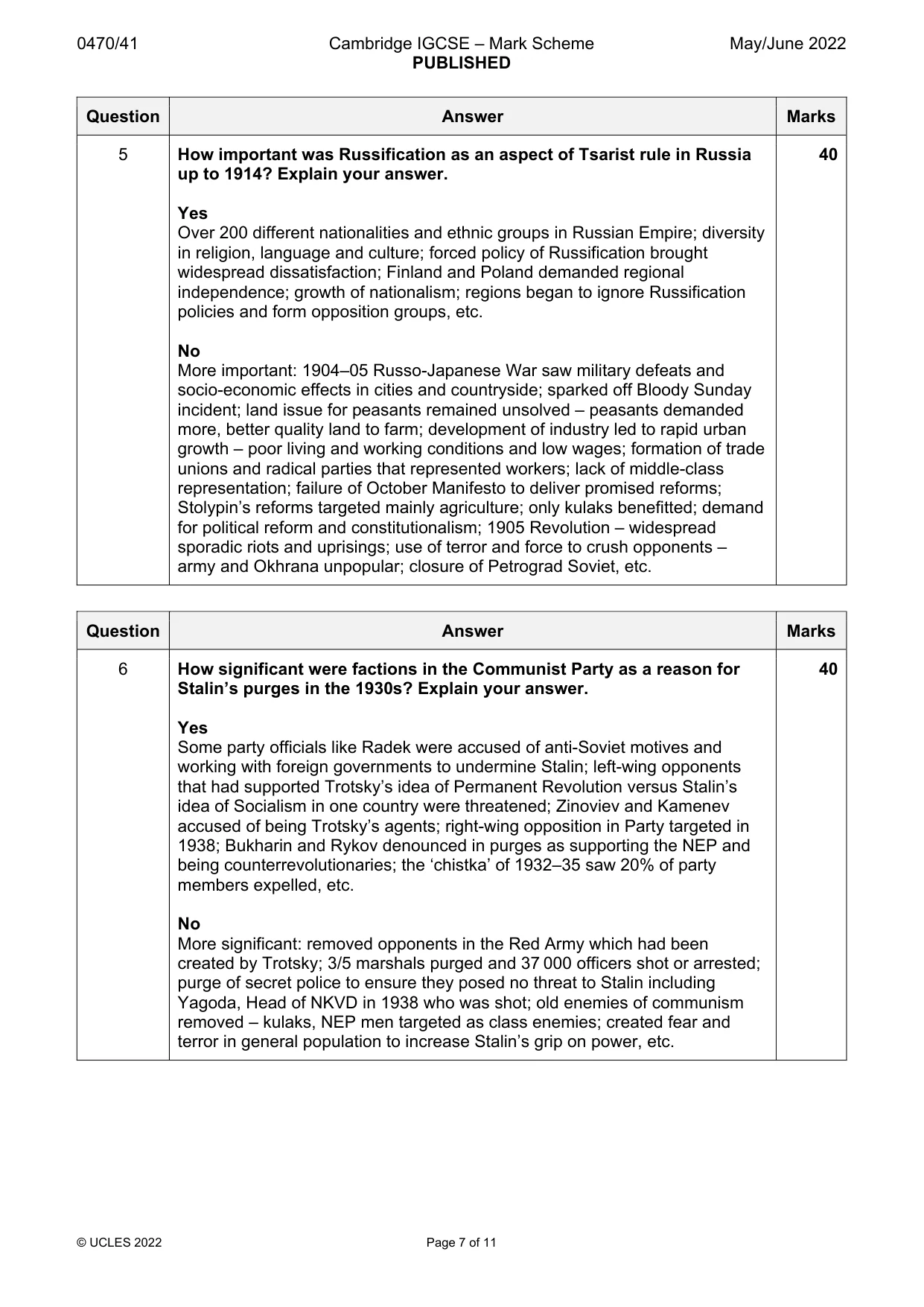
0470/41 Cambridge IGCSE – Mark Scheme PUBLISHED May/June 2022 © UCLES 2022 Page 7 of 11 Question Answer Marks 5 How important was Russification as an aspect of Tsarist rule in Russia up to 1914? Explain your answer. Yes Over 200 different nationalities and ethnic groups in Russian Empire; diversity in religion, language and culture; forced policy of Russification brought widespread dissatisfaction; Finland and Poland demanded regional independence; growth of nationalism; regions began to ignore Russification policies and form opposition groups, etc. No More important: 1904–05 Russo-Japanese War saw military defeats and socio-economic effects in cities and countryside; sparked off Bloody Sunday incident; land issue for peasants remained unsolved – peasants demanded more, better quality land to farm; development of industry led to rapid urban growth – poor living and working conditions and low wages; formation of trade unions and radical parties that represented workers; lack of middle-class representation; failure of October Manifesto to deliver promised reforms; Stolypin’s reforms targeted mainly agriculture; only kulaks benefitted; demand for political reform and constitutionalism; 1905 Revolution – widespread sporadic riots and uprisings; use of terror and force to crush opponents – army and Okhrana unpopular; closure of Petrograd Soviet, etc. 40 Question Answer Marks 6 How significant were factions in the Communist Party as a reason for Stalin’s purges in the 1930s? Explain your answer. Yes Some party officials like Radek were accused of anti-Soviet motives and working with foreign governments to undermine Stalin; left-wing opponents that had supported Trotsky’s idea of Permanent Revolution versus Stalin’s idea of Socialism in one country were threatened; Zinoviev and Kamenev accused of being Trotsky’s agents; right-wing opposition in Party targeted in 1938; Bukharin and Rykov denounced in purges as supporting the NEP and being counterrevolutionaries; the ‘chistka’ of 1932–35 saw 20% of party members expelled, etc. No More significant: removed opponents in the Red Army which had been created by Trotsky; 3/5 marshals purged and 37 000 officers shot or arrested; purge of secret police to ensure they posed no threat to Stalin including Yagoda, Head of NKVD in 1938 who was shot; old enemies of communism removed – kulaks, NEP men targeted as class enemies; created fear and terror in general population to increase Stalin’s grip on power, etc. 40
Mark scheme, page 8
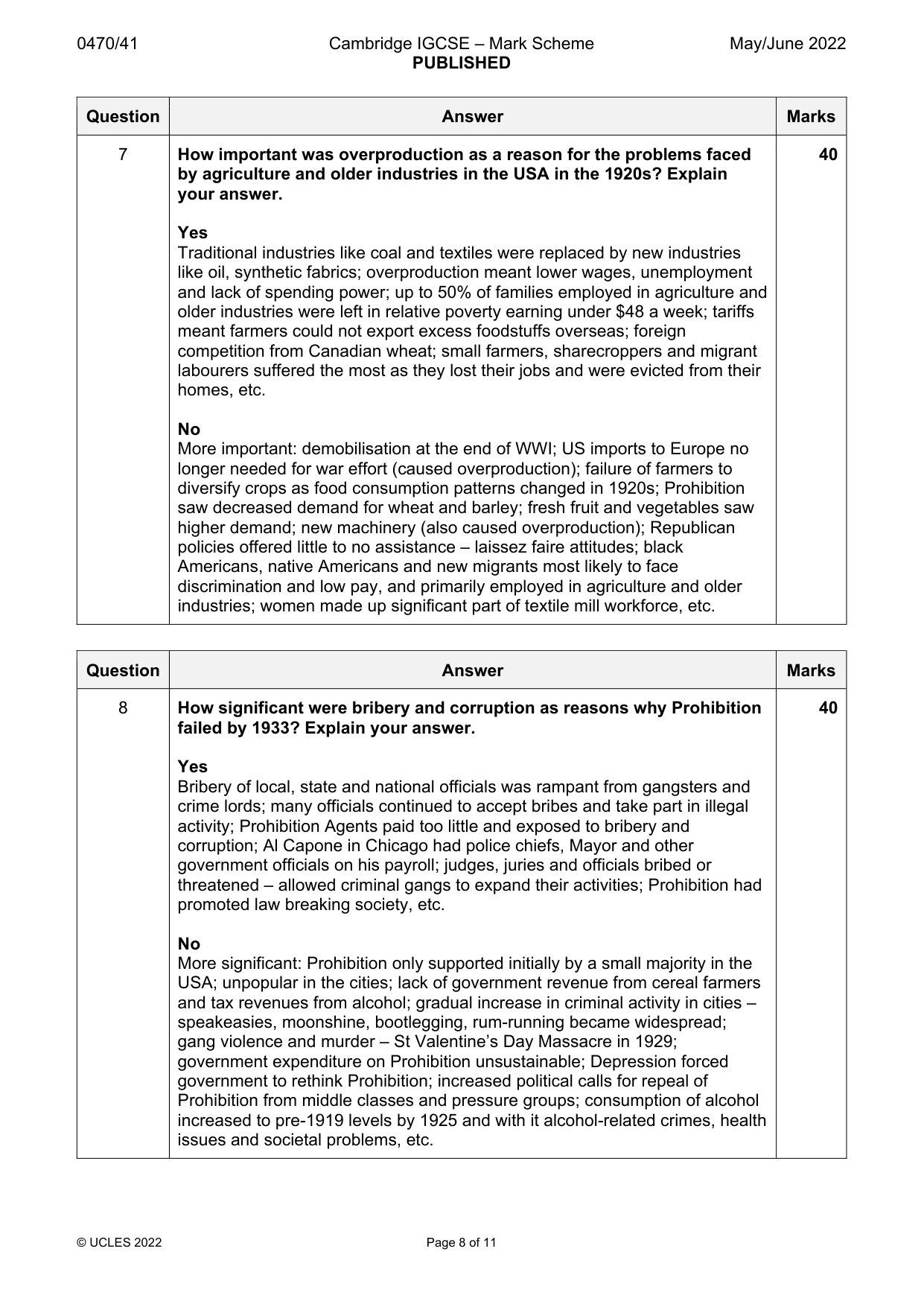
0470/41 Cambridge IGCSE – Mark Scheme PUBLISHED May/June 2022 © UCLES 2022 Page 8 of 11 Question Answer Marks 7 How important was overproduction as a reason for the problems faced by agriculture and older industries in the USA in the 1920s? Explain your answer. Yes Traditional industries like coal and textiles were replaced by new industries like oil, synthetic fabrics; overproduction meant lower wages, unemployment and lack of spending power; up to 50% of families employed in agriculture and older industries were left in relative poverty earning under $48 a week; tariffs meant farmers could not export excess foodstuffs overseas; foreign competition from Canadian wheat; small farmers, sharecroppers and migrant labourers suffered the most as they lost their jobs and were evicted from their homes, etc. No More important: demobilisation at the end of WWI; US imports to Europe no longer needed for war effort (caused overproduction); failure of farmers to diversify crops as food consumption patterns changed in 1920s; Prohibition saw decreased demand for wheat and barley; fresh fruit and vegetables saw higher demand; new machinery (also caused overproduction); Republican policies offered little to no assistance – laissez faire attitudes; black Americans, native Americans and new migrants most likely to face discrimination and low pay, and primarily employed in agriculture and older industries; women made up significant part of textile mill workforce, etc. 40 Question Answer Marks 8 How significant were bribery and corruption as reasons why Prohibition failed by 1933? Explain your answer. Yes Bribery of local, state and national officials was rampant from gangsters and crime lords; many officials continued to accept bribes and take part in illegal activity; Prohibition Agents paid too little and exposed to bribery and corruption; Al Capone in Chicago had police chiefs, Mayor and other government officials on his payroll; judges, juries and officials bribed or threatened – allowed criminal gangs to expand their activities; Prohibition had promoted law breaking society, etc. No More significant: Prohibition only supported initially by a small majority in the USA; unpopular in the cities; lack of government revenue from cereal farmers and tax revenues from alcohol; gradual increase in criminal activity in cities – speakeasies, moonshine, bootlegging, rum-running became widespread; gang violence and murder – St Valentine’s Day Massacre in 1929; government expenditure on Prohibition unsustainable; Depression forced government to rethink Prohibition; increased political calls for repeal of Prohibition from middle classes and pressure groups; consumption of alcohol increased to pre-1919 levels by 1925 and with it alcohol-related crimes, health issues and societal problems, etc. 40
Mark scheme, page 9
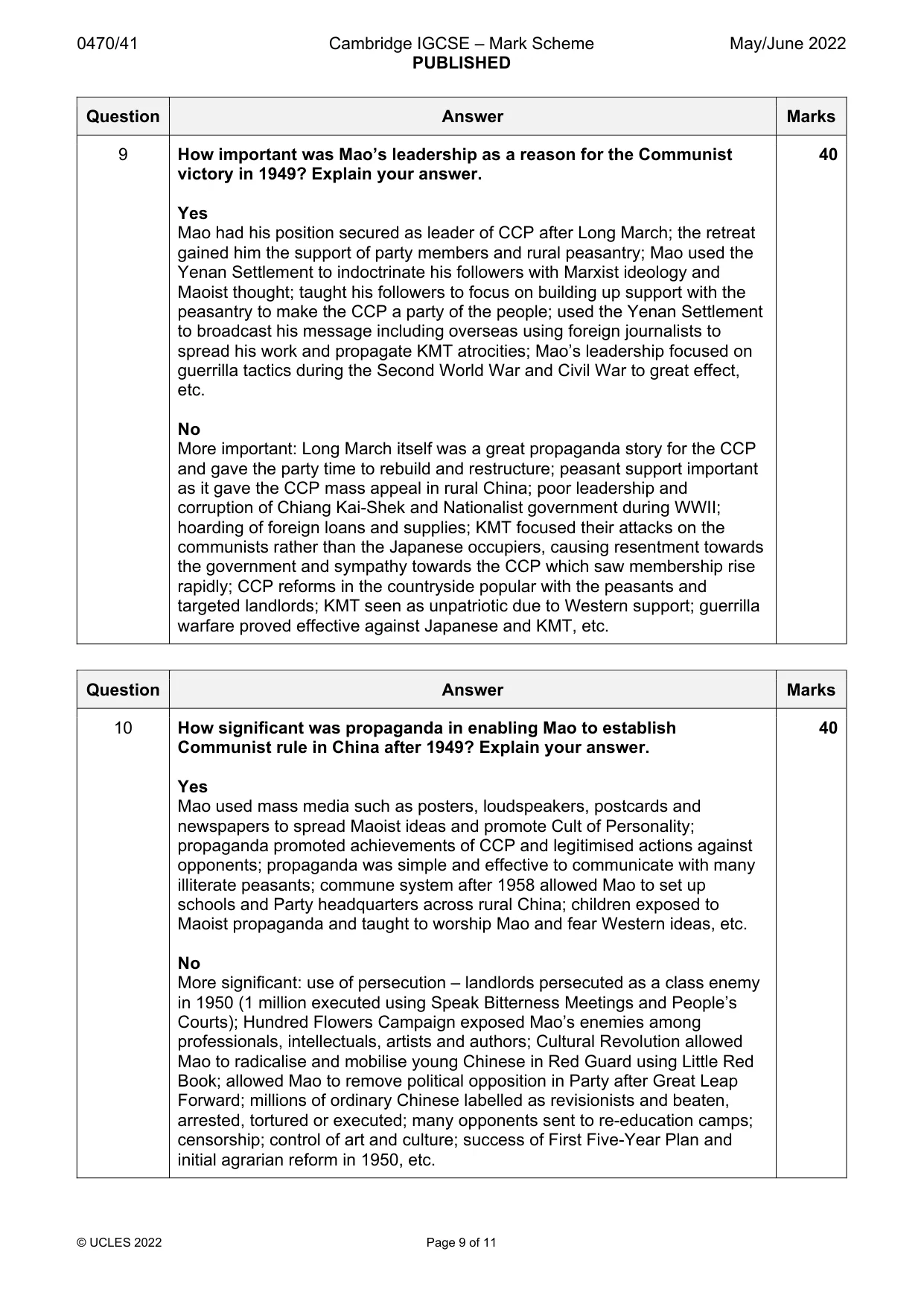
0470/41 Cambridge IGCSE – Mark Scheme PUBLISHED May/June 2022 © UCLES 2022 Page 9 of 11 Question Answer Marks 9 How important was Mao’s leadership as a reason for the Communist victory in 1949? Explain your answer. Yes Mao had his position secured as leader of CCP after Long March; the retreat gained him the support of party members and rural peasantry; Mao used the Yenan Settlement to indoctrinate his followers with Marxist ideology and Maoist thought; taught his followers to focus on building up support with the peasantry to make the CCP a party of the people; used the Yenan Settlement to broadcast his message including overseas using foreign journalists to spread his work and propagate KMT atrocities; Mao’s leadership focused on guerrilla tactics during the Second World War and Civil War to great effect, etc. No More important: Long March itself was a great propaganda story for the CCP and gave the party time to rebuild and restructure; peasant support important as it gave the CCP mass appeal in rural China; poor leadership and corruption of Chiang Kai-Shek and Nationalist government during WWII; hoarding of foreign loans and supplies; KMT focused their attacks on the communists rather than the Japanese occupiers, causing resentment towards the government and sympathy towards the CCP which saw membership rise rapidly; CCP reforms in the countryside popular with the peasants and targeted landlords; KMT seen as unpatriotic due to Western support; guerrilla warfare proved effective against Japanese and KMT, etc. 40 Question Answer Marks 10 How significant was propaganda in enabling Mao to establish Communist rule in China after 1949? Explain your answer. Yes Mao used mass media such as posters, loudspeakers, postcards and newspapers to spread Maoist ideas and promote Cult of Personality; propaganda promoted achievements of CCP and legitimised actions against opponents; propaganda was simple and effective to communicate with many illiterate peasants; commune system after 1958 allowed Mao to set up schools and Party headquarters across rural China; children exposed to Maoist propaganda and taught to worship Mao and fear Western ideas, etc. No More significant: use of persecution – landlords persecuted as a class enemy in 1950 (1 million executed using Speak Bitterness Meetings and People’s Courts); Hundred Flowers Campaign exposed Mao’s enemies among professionals, intellectuals, artists and authors; Cultural Revolution allowed Mao to radicalise and mobilise young Chinese in Red Guard using Little Red Book; allowed Mao to remove political opposition in Party after Great Leap Forward; millions of ordinary Chinese labelled as revisionists and beaten, arrested, tortured or executed; many opponents sent to re-education camps; censorship; control of art and culture; success of First Five-Year Plan and initial agrarian reform in 1950, etc. 40
Mark scheme, page 10
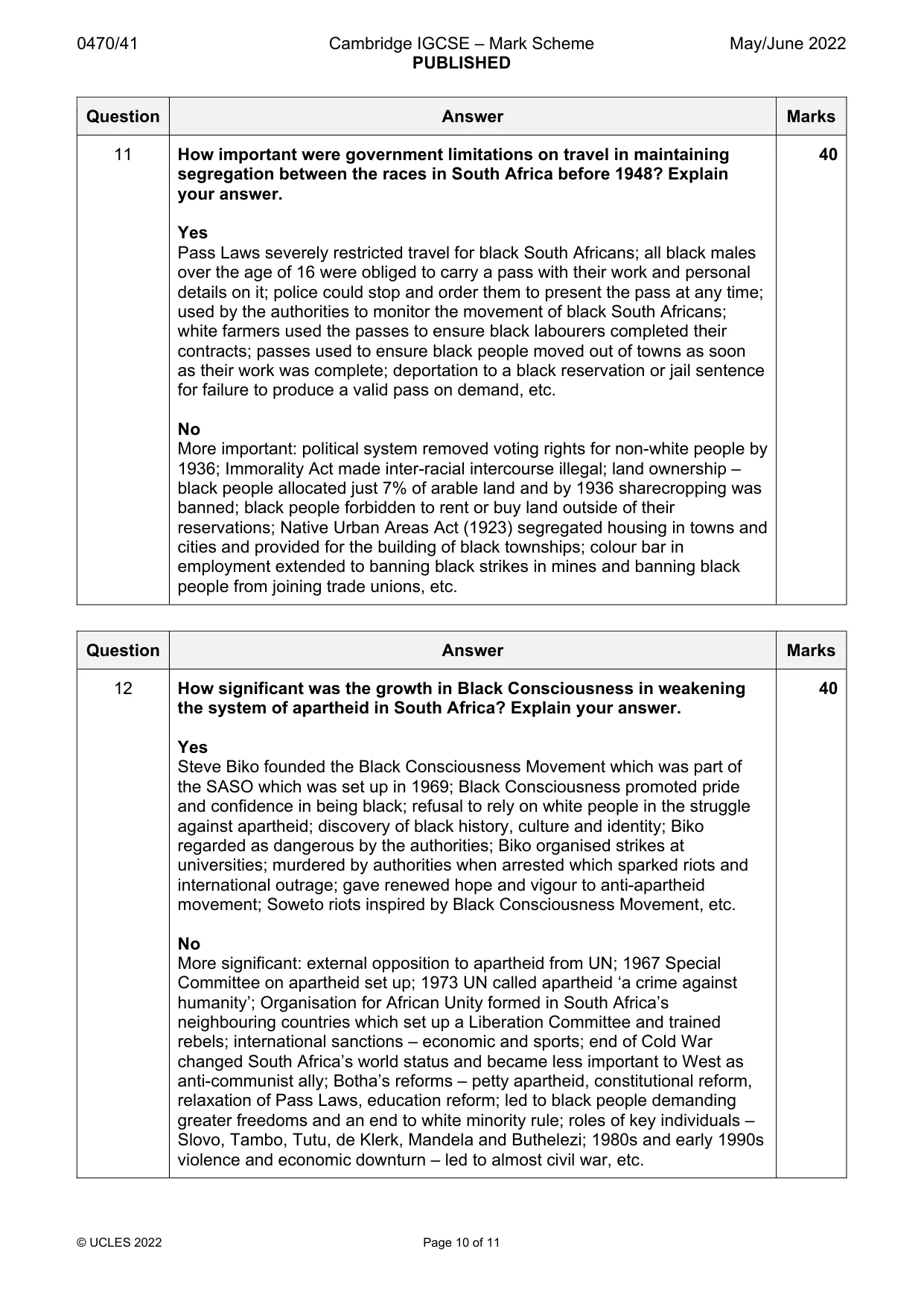
0470/41 Cambridge IGCSE – Mark Scheme PUBLISHED May/June 2022 © UCLES 2022 Page 10 of 11 Question Answer Marks 11 How important were government limitations on travel in maintaining segregation between the races in South Africa before 1948? Explain your answer. Yes Pass Laws severely restricted travel for black South Africans; all black males over the age of 16 were obliged to carry a pass with their work and personal details on it; police could stop and order them to present the pass at any time; used by the authorities to monitor the movement of black South Africans; white farmers used the passes to ensure black labourers completed their contracts; passes used to ensure black people moved out of towns as soon as their work was complete; deportation to a black reservation or jail sentence for failure to produce a valid pass on demand, etc. No More important: political system removed voting rights for non-white people by 1936; Immorality Act made inter-racial intercourse illegal; land ownership – black people allocated just 7% of arable land and by 1936 sharecropping was banned; black people forbidden to rent or buy land outside of their reservations; Native Urban Areas Act (1923) segregated housing in towns and cities and provided for the building of black townships; colour bar in employment extended to banning black strikes in mines and banning black people from joining trade unions, etc. 40 Question Answer Marks 12 How significant was the growth in Black Consciousness in weakening the system of apartheid in South Africa? Explain your answer. Yes Steve Biko founded the Black Consciousness Movement which was part of the SASO which was set up in 1969; Black Consciousness promoted pride and confidence in being black; refusal to rely on white people in the struggle against apartheid; discovery of black history, culture and identity; Biko regarded as dangerous by the authorities; Biko organised strikes at universities; murdered by authorities when arrested which sparked riots and international outrage; gave renewed hope and vigour to anti-apartheid movement; Soweto riots inspired by Black Consciousness Movement, etc. No More significant: external opposition to apartheid from UN; 1967 Special Committee on apartheid set up; 1973 UN called apartheid ‘a crime against humanity’; Organisation for African Unity formed in South Africa’s neighbouring countries which set up a Liberation Committee and trained rebels; international sanctions – economic and sports; end of Cold War changed South Africa’s world status and became less important to West as anti-communist ally; Botha’s reforms – petty apartheid, constitutional reform, relaxation of Pass Laws, education reform; led to black people demanding greater freedoms and an end to white minority rule; roles of key individuals – Slovo, Tambo, Tutu, de Klerk, Mandela and Buthelezi; 1980s and early 1990s violence and economic downturn – led to almost civil war, etc. 40
Mark scheme, page 11
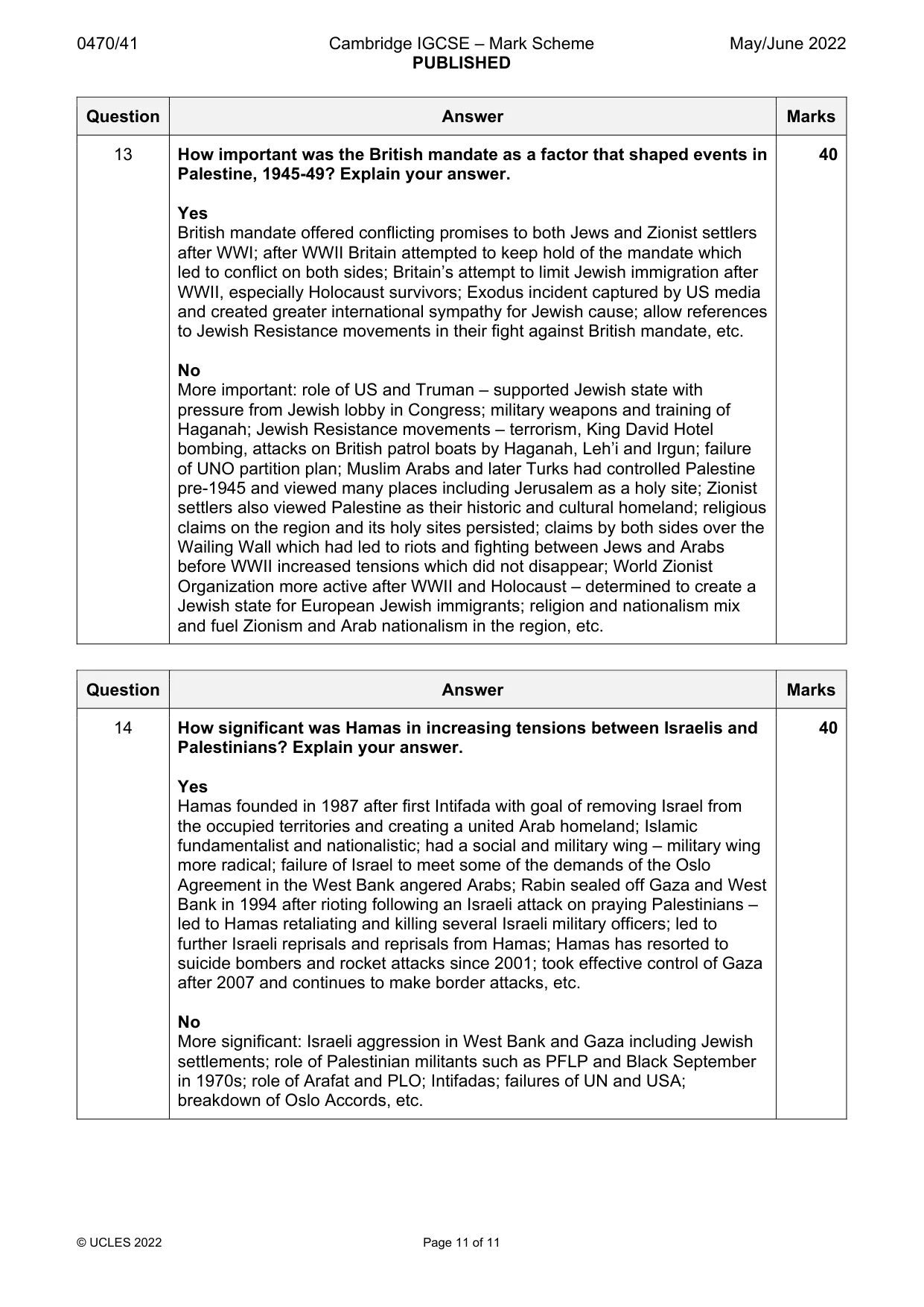
0470/41 Cambridge IGCSE – Mark Scheme PUBLISHED May/June 2022 © UCLES 2022 Page 11 of 11 Question Answer Marks 13 How important was the British mandate as a factor that shaped events in Palestine, 1945-49? Explain your answer. Yes British mandate offered conflicting promises to both Jews and Zionist settlers after WWI; after WWII Britain attempted to keep hold of the mandate which led to conflict on both sides; Britain’s attempt to limit Jewish immigration after WWII, especially Holocaust survivors; Exodus incident captured by US media and created greater international sympathy for Jewish cause; allow references to Jewish Resistance movements in their fight against British mandate, etc. No More important: role of US and Truman – supported Jewish state with pressure from Jewish lobby in Congress; military weapons and training of Haganah; Jewish Resistance movements – terrorism, King David Hotel bombing, attacks on British patrol boats by Haganah, Leh’i and Irgun; failure of UNO partition plan; Muslim Arabs and later Turks had controlled Palestine pre-1945 and viewed many places including Jerusalem as a holy site; Zionist settlers also viewed Palestine as their historic and cultural homeland; religious claims on the region and its holy sites persisted; claims by both sides over the Wailing Wall which had led to riots and fighting between Jews and Arabs before WWII increased tensions which did not disappear; World Zionist Organization more active after WWII and Holocaust – determined to create a Jewish state for European Jewish immigrants; religion and nationalism mix and fuel Zionism and Arab nationalism in the region, etc. 40 Question Answer Marks 14 How significant was Hamas in increasing tensions between Israelis and Palestinians? Explain your answer. Yes Hamas founded in 1987 after first Intifada with goal of removing Israel from the occupied territories and creating a united Arab homeland; Islamic fundamentalist and nationalistic; had a social and military wing – military wing more radical; failure of Israel to meet some of the demands of the Oslo Agreement in the West Bank angered Arabs; Rabin sealed off Gaza and West Bank in 1994 after rioting following an Israeli attack on praying Palestinians – led to Hamas retaliating and killing several Israeli military officers; led to further Israeli reprisals and reprisals from Hamas; Hamas has resorted to suicide bombers and rocket attacks since 2001; took effective control of Gaza after 2007 and continues to make border attacks, etc. No More significant: Israeli aggression in West Bank and Gaza including Jewish settlements; role of Palestinian militants such as PFLP and Black September in 1970s; role of Arafat and PLO; Intifadas; failures of UN and USA; breakdown of Oslo Accords, etc. 40
What you needed in this session
Cambridge’s own grade thresholds for 2022 May/June, Paper 4 · Variant 1. A higher threshold means an easier paper — the bar moves with how the cohort did.