Cambridge IGCSE History 0470 — 2022 May/June Paper 2 · Variant 2
0470/22/M/J/22 · 50 marks · ≈56 min
The question paper and its mark scheme, free to read here and free to download. This is Cambridge’s own paper, exactly as it was sat.
Question paper12 pages

Mark scheme10 pages
Answers below. Sit the paper first if you are practising.
Paper as text
Question paper, page 1
[Turn over DC (NF/CT) 304186/2 © UCLES 2022 This document has 12 pages. Any blank pages are indicated. * 0 1 7 5 8 1 6 2 0 3 * HISTORY 0470/22 Paper 2 May/June 2022 2 hours You must answer on the enclosed answer booklet. You will need: Answer booklet (enclosed) INSTRUCTIONS ● Answer all the questions on one option only. Option A: Nineteenth century topic Option B: Twentieth century topic ● Follow the instructions on the front cover of the answer booklet. If you need additional answer paper, ask the invigilator for a continuation booklet. INFORMATION ● The total mark for this paper is 50. ● The number of marks for each question or part question is shown in brackets [ ]. Cambridge IGCSE™
Question paper, page 2
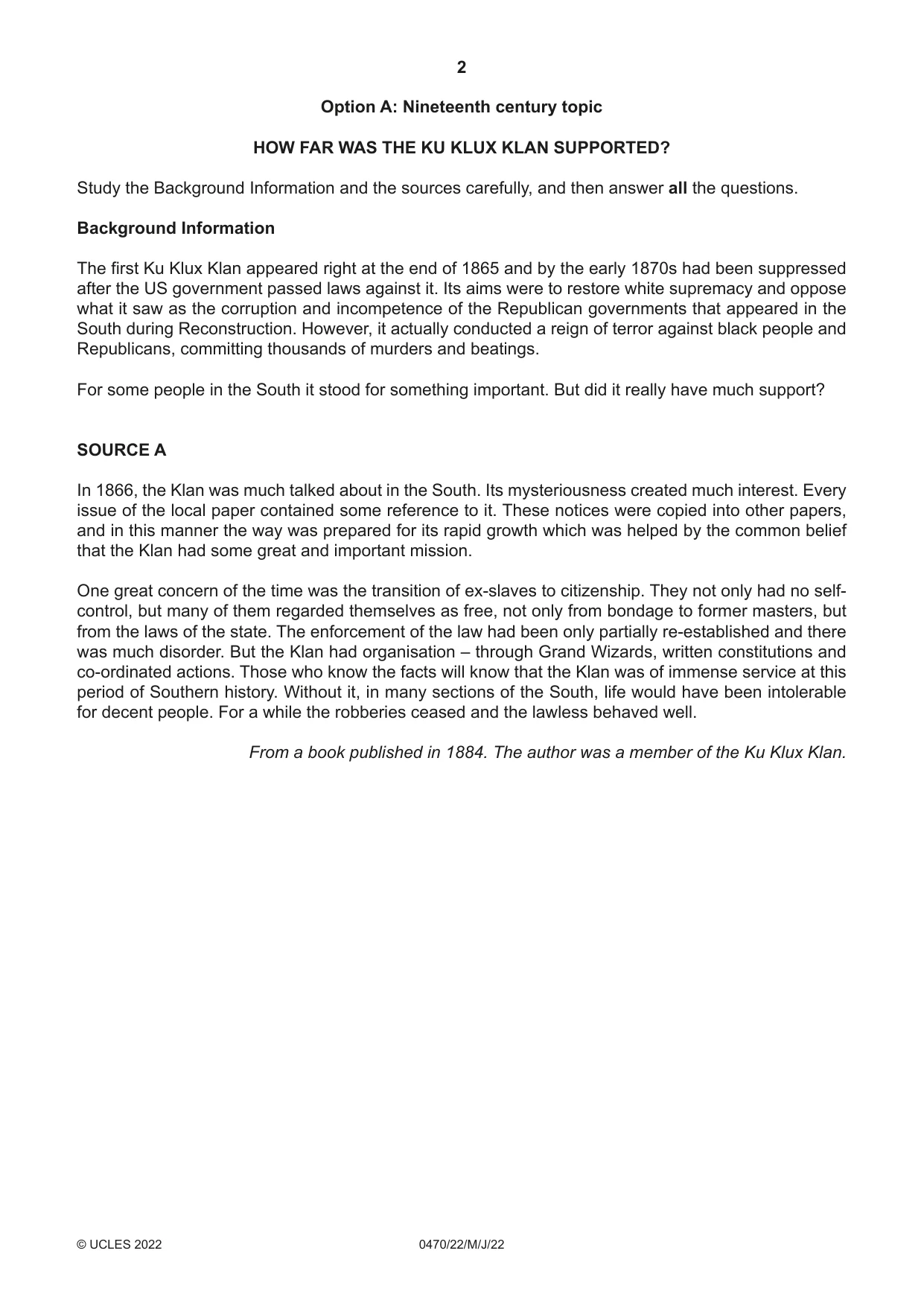
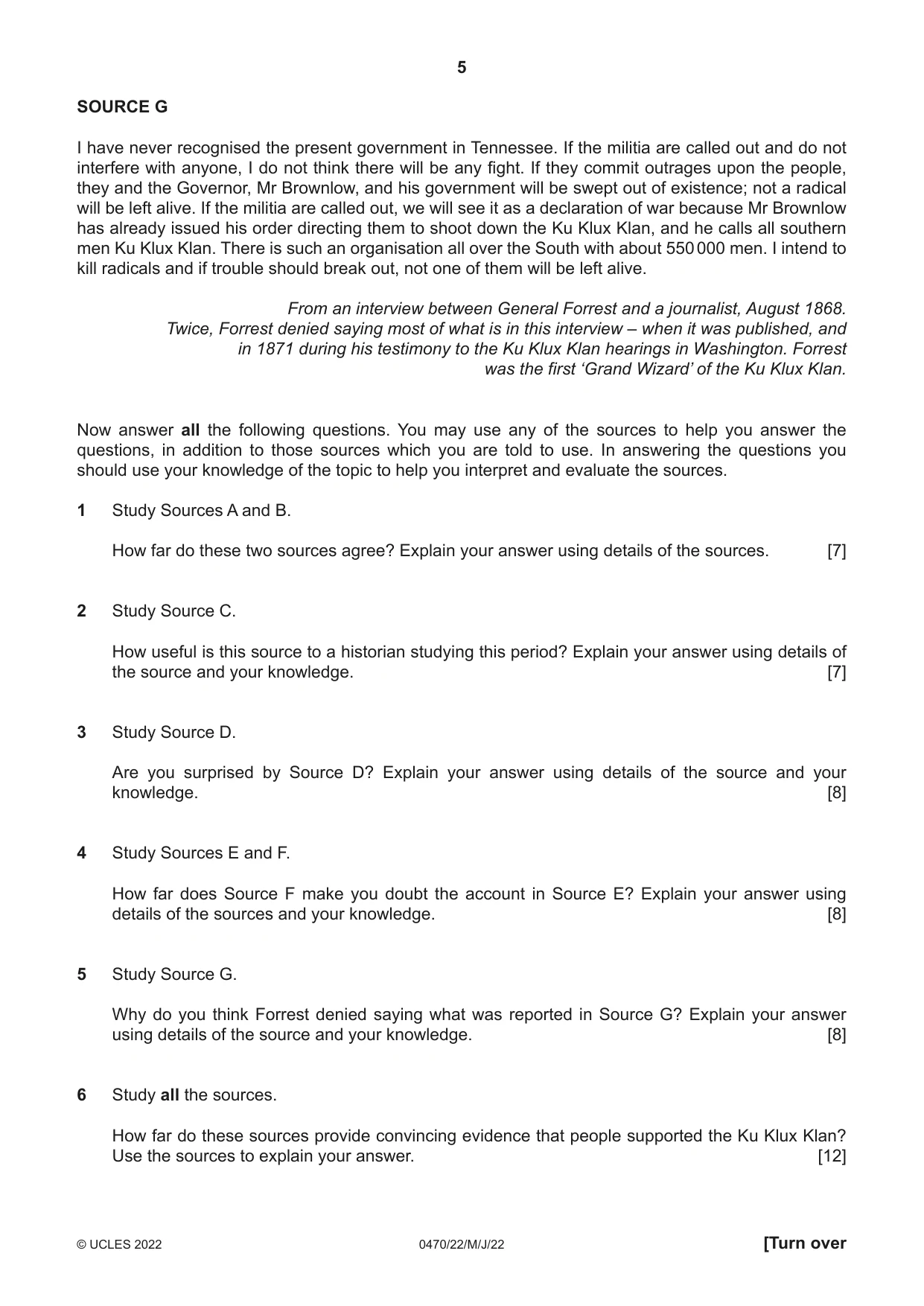
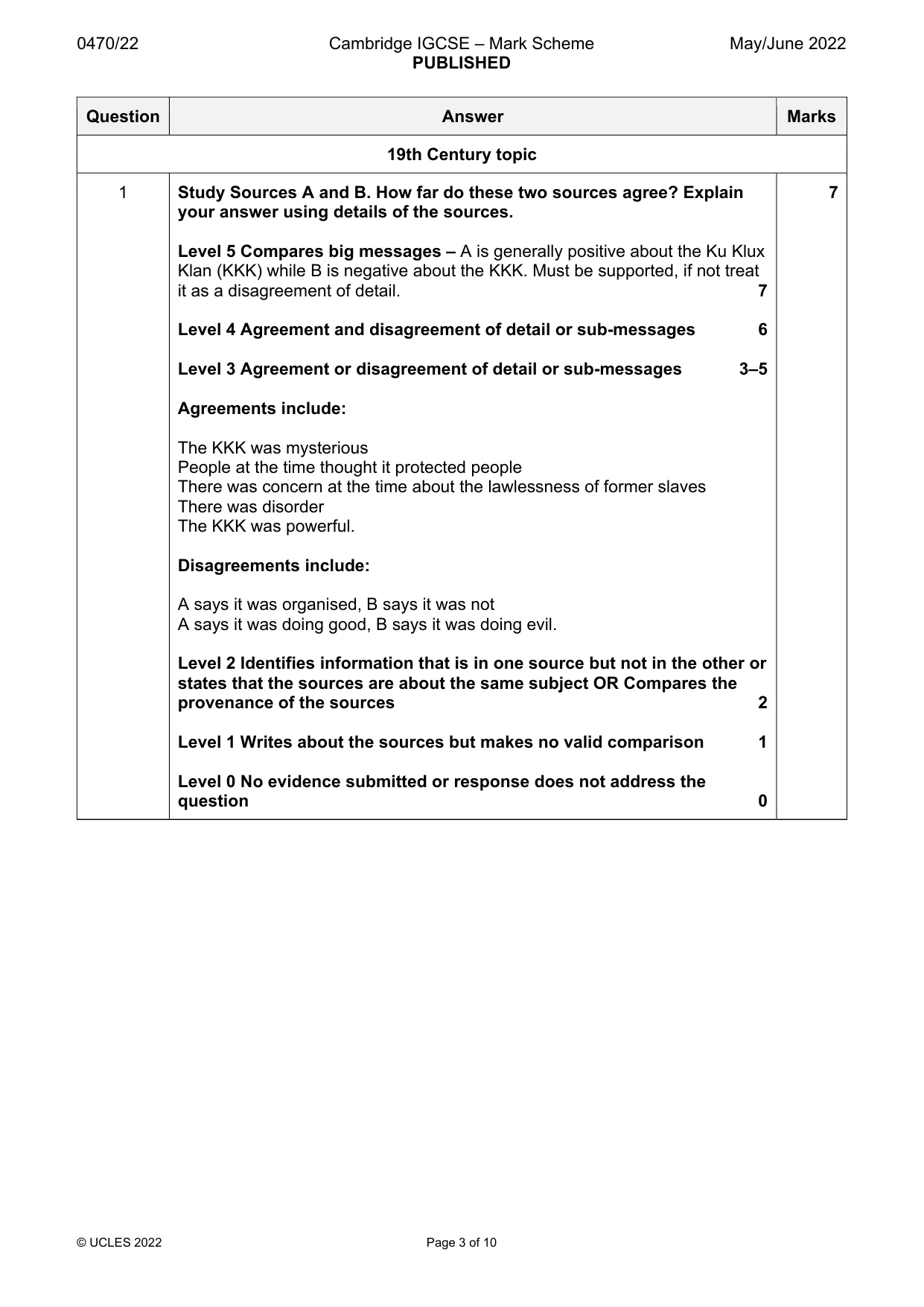
2 0470/22/M/J/22 © UCLES 2022 Option A: Nineteenth century topic HOW FAR WAS THE KU KLUX KLAN SUPPORTED? Study the Background Information and the sources carefully, and then answer all the questions. Background Information The first Ku Klux Klan appeared right at the end of 1865 and by the early 1870s had been suppressed after the US government passed laws against it. Its aims were to restore white supremacy and oppose what it saw as the corruption and incompetence of the Republican governments that appeared in the South during Reconstruction. However, it actually conducted a reign of terror against black people and Republicans, committing thousands of murders and beatings. For some people in the South it stood for something important. But did it really have much support? SOURCE A In 1866, the Klan was much talked about in the South. Its mysteriousness created much interest. Every issue of the local paper contained some reference to it. These notices were copied into other papers, and in this manner the way was prepared for its rapid growth which was helped by the common belief that the Klan had some great and important mission. One great concern of the time was the transition of ex-slaves to citizenship. They not only had no self- control, but many of them regarded themselves as free, not only from bondage to former masters, but from the laws of the state. The enforcement of the law had been only partially re-established and there was much disorder. But the Klan had organisation – through Grand Wizards, written constitutions and co-ordinated actions. Those who know the facts will know that the Klan was of immense service at this period of Southern history. Without it, in many sections of the South, life would have been intolerable for decent people. For a while the robberies ceased and the lawless behaved well. From a book published in 1884. The author was a member of the Ku Klux Klan.
Question paper, page 3
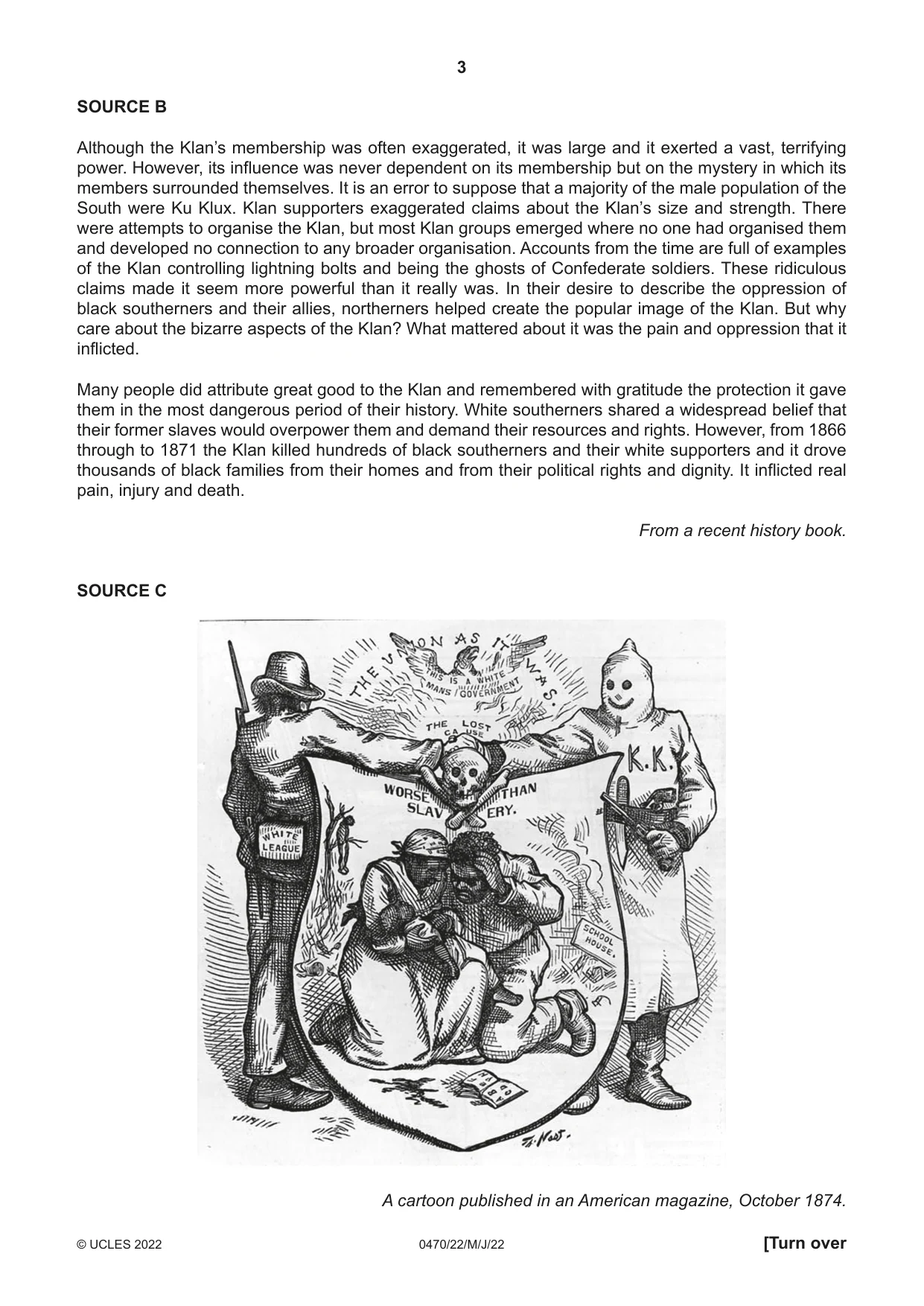
3 0470/22/M/J/22 © UCLES 2022 [Turn over SOURCE B Although the Klan’s membership was often exaggerated, it was large and it exerted a vast, terrifying power. However, its influence was never dependent on its membership but on the mystery in which its members surrounded themselves. It is an error to suppose that a majority of the male population of the South were Ku Klux. Klan supporters exaggerated claims about the Klan’s size and strength. There were attempts to organise the Klan, but most Klan groups emerged where no one had organised them and developed no connection to any broader organisation. Accounts from the time are full of examples of the Klan controlling lightning bolts and being the ghosts of Confederate soldiers. These ridiculous claims made it seem more powerful than it really was. In their desire to describe the oppression of black southerners and their allies, northerners helped create the popular image of the Klan. But why care about the bizarre aspects of the Klan? What mattered about it was the pain and oppression that it inflicted. Many people did attribute great good to the Klan and remembered with gratitude the protection it gave them in the most dangerous period of their history. White southerners shared a widespread belief that their former slaves would overpower them and demand their resources and rights. However, from 1866 through to 1871 the Klan killed hundreds of black southerners and their white supporters and it drove thousands of black families from their homes and from their political rights and dignity. It inflicted real pain, injury and death. From a recent history book. SOURCE C A cartoon published in an American magazine, October 1874.
Question paper, page 4
4 0470/22/M/J/22 © UCLES 2022 SOURCE D There is plenty of evidence of a secret organisation in many parts of this State, of men who, under the cover of masks, armed with knives and other deadly weapons, do appear at night to commit violence on peaceable citizens, robbing and murdering them, inflicting on them the most cruel treatment. This organisation has become a widespread and alarming evil in this State, defying all law. Any person away from his home, wearing a mask, or disguised in costume, shall be held guilty of a high crime. From a law outlawing the Ku Klux Klan, passed by the Alabama legislature, 1868. SOURCE E Movements of the Mystic Klan A reliable correspondent writes: about a week ago the Ku Klux came into town to regulate matters. They were here from eleven p.m. to three o’clock a.m. — five hundred in all. They shot one very bad black man. They also hanged three or four black men nearly dead, and whipped others severely in order to make them tell them about their nightly meetings. The strongest thing about them was that they did not hesitate to unmask themselves when asked to do so. Everyone who saw them says their horses were more beautiful than any in the country round about. They spoke little but always to a purpose. They did not disturb anyone else, nor did they take anything except a few Enfield rifles which were found in possession of some very bad black men. They called on the tax officer. What was said is not known, but it has made a great improvement in his behaviour. The visitors’ arrival has been to the benefit of the community. From a Tennessee newspaper, December 1868. SOURCE F In 1868 there occurred six bloody and terrible massacres. Over two thousand persons were killed or wounded within a few weeks of the presidential election. Half of Louisiana was overrun by violence, raids, murder and riot to keep the people in constant terror until the Republicans surrendered all claims and the election was won by the Democratic Party. One of the bloodiest riots on record occurred in the parish of Saint Landy, Louisiana. The Ku Klux Klan killed and wounded over two hundred Republicans, hunting and chasing them for two days and nights, through fields and swamps. Thirteen captives were taken from the jail and shot. A pile of twenty-five dead bodies was found half-buried in the woods. Having conquered the Republicans, killed and driven off their white leaders, the Ku Klux Klan captured the masses, led them to the polls and made them vote Democrat. From a report by a committee of the US House of Representatives, 1875.
Question paper, page 5
5 0470/22/M/J/22 © UCLES 2022 [Turn over SOURCE G I have never recognised the present government in Tennessee. If the militia are called out and do not interfere with anyone, I do not think there will be any fight. If they commit outrages upon the people, they and the Governor, Mr Brownlow, and his government will be swept out of existence; not a radical will be left alive. If the militia are called out, we will see it as a declaration of war because Mr Brownlow has already issued his order directing them to shoot down the Ku Klux Klan, and he calls all southern men Ku Klux Klan. There is such an organisation all over the South with about 550 000 men. I intend to kill radicals and if trouble should break out, not one of them will be left alive. From an interview between General Forrest and a journalist, August 1868. Twice, Forrest denied saying most of what is in this interview – when it was published, and in 1871 during his testimony to the Ku Klux Klan hearings in Washington. Forrest was the first ‘Grand Wizard’ of the Ku Klux Klan. Now answer all the following questions. You may use any of the sources to help you answer the questions, in addition to those sources which you are told to use. In answering the questions you should use your knowledge of the topic to help you interpret and evaluate the sources. 1 Study Sources A and B. How far do these two sources agree? Explain your answer using details of the sources. [7] 2 Study Source C. How useful is this source to a historian studying this period? Explain your answer using details of the source and your knowledge. [7] 3 Study Source D. Are you surprised by Source D? Explain your answer using details of the source and your knowledge. [8] 4 Study Sources E and F. How far does Source F make you doubt the account in Source E? Explain your answer using details of the sources and your knowledge. [8] 5 Study Source G. Why do you think Forrest denied saying what was reported in Source G? Explain your answer using details of the source and your knowledge. [8] 6 Study all the sources. How far do these sources provide convincing evidence that people supported the Ku Klux Klan? Use the sources to explain your answer. [12]
Question paper, page 6
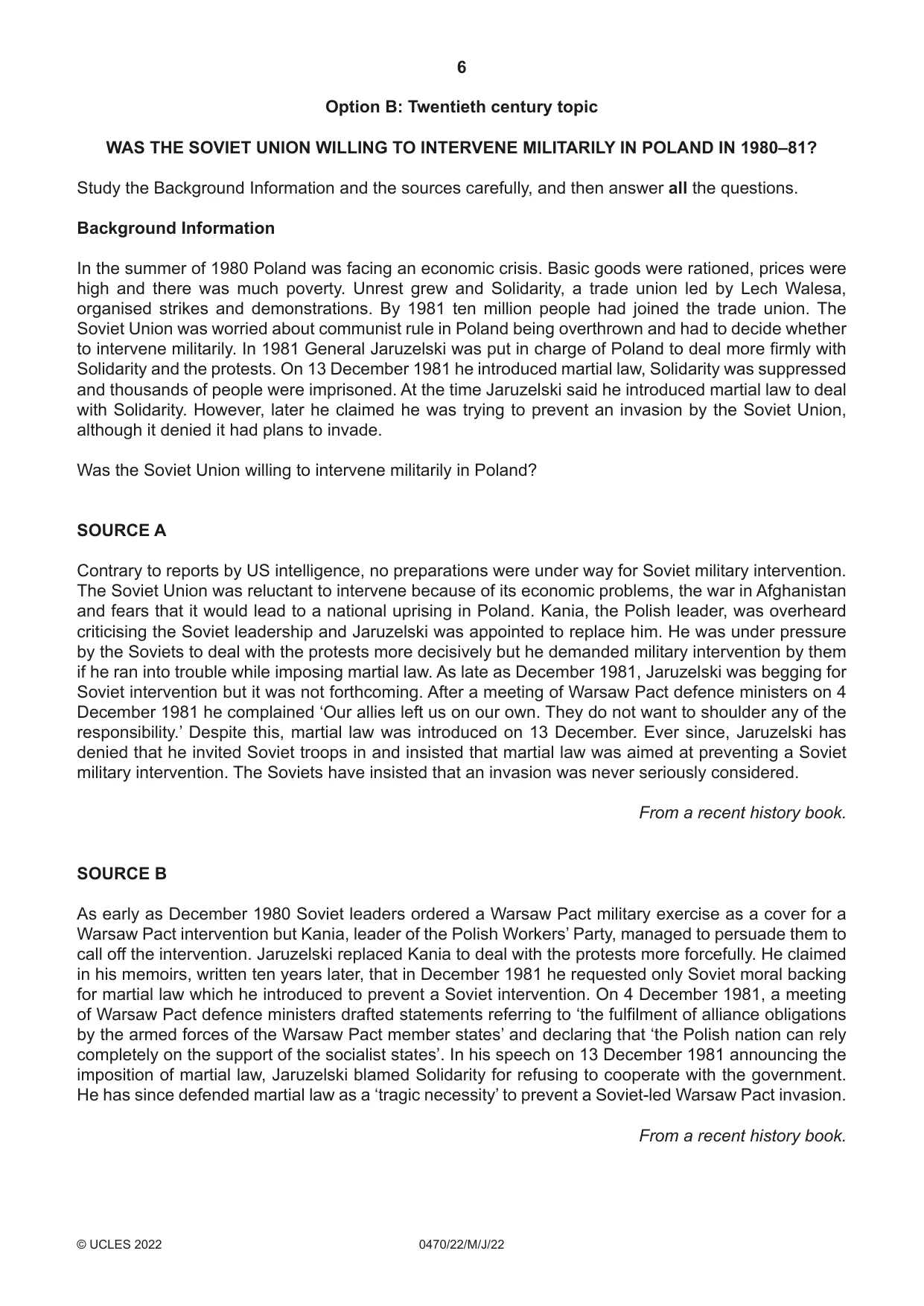
6 0470/22/M/J/22 © UCLES 2022 Option B: Twentieth century topic WAS THE SOVIET UNION WILLING TO INTERVENE MILITARILY IN POLAND IN 1980–81? Study the Background Information and the sources carefully, and then answer all the questions. Background Information In the summer of 1980 Poland was facing an economic crisis. Basic goods were rationed, prices were high and there was much poverty. Unrest grew and Solidarity, a trade union led by Lech Walesa, organised strikes and demonstrations. By 1981 ten million people had joined the trade union. The Soviet Union was worried about communist rule in Poland being overthrown and had to decide whether to intervene militarily. In 1981 General Jaruzelski was put in charge of Poland to deal more firmly with Solidarity and the protests. On 13 December 1981 he introduced martial law, Solidarity was suppressed and thousands of people were imprisoned. At the time Jaruzelski said he introduced martial law to deal with Solidarity. However, later he claimed he was trying to prevent an invasion by the Soviet Union, although it denied it had plans to invade. Was the Soviet Union willing to intervene militarily in Poland? SOURCE A Contrary to reports by US intelligence, no preparations were under way for Soviet military intervention. The Soviet Union was reluctant to intervene because of its economic problems, the war in Afghanistan and fears that it would lead to a national uprising in Poland. Kania, the Polish leader, was overheard criticising the Soviet leadership and Jaruzelski was appointed to replace him. He was under pressure by the Soviets to deal with the protests more decisively but he demanded military intervention by them if he ran into trouble while imposing martial law. As late as December 1981, Jaruzelski was begging for Soviet intervention but it was not forthcoming. After a meeting of Warsaw Pact defence ministers on 4 December 1981 he complained ‘Our allies left us on our own. They do not want to shoulder any of the responsibility.’ Despite this, martial law was introduced on 13 December. Ever since, Jaruzelski has denied that he invited Soviet troops in and insisted that martial law was aimed at preventing a Soviet military intervention. The Soviets have insisted that an invasion was never seriously considered. From a recent history book. SOURCE B As early as December 1980 Soviet leaders ordered a Warsaw Pact military exercise as a cover for a Warsaw Pact intervention but Kania, leader of the Polish Workers’ Party, managed to persuade them to call off the intervention. Jaruzelski replaced Kania to deal with the protests more forcefully. He claimed in his memoirs, written ten years later, that in December 1981 he requested only Soviet moral backing for martial law which he introduced to prevent a Soviet intervention. On 4 December 1981, a meeting of Warsaw Pact defence ministers drafted statements referring to ‘the fulfilment of alliance obligations by the armed forces of the Warsaw Pact member states’ and declaring that ‘the Polish nation can rely completely on the support of the socialist states’. In his speech on 13 December 1981 announcing the imposition of martial law, Jaruzelski blamed Solidarity for refusing to cooperate with the government. He has since defended martial law as a ‘tragic necessity’ to prevent a Soviet-led Warsaw Pact invasion. From a recent history book.
Question paper, page 7
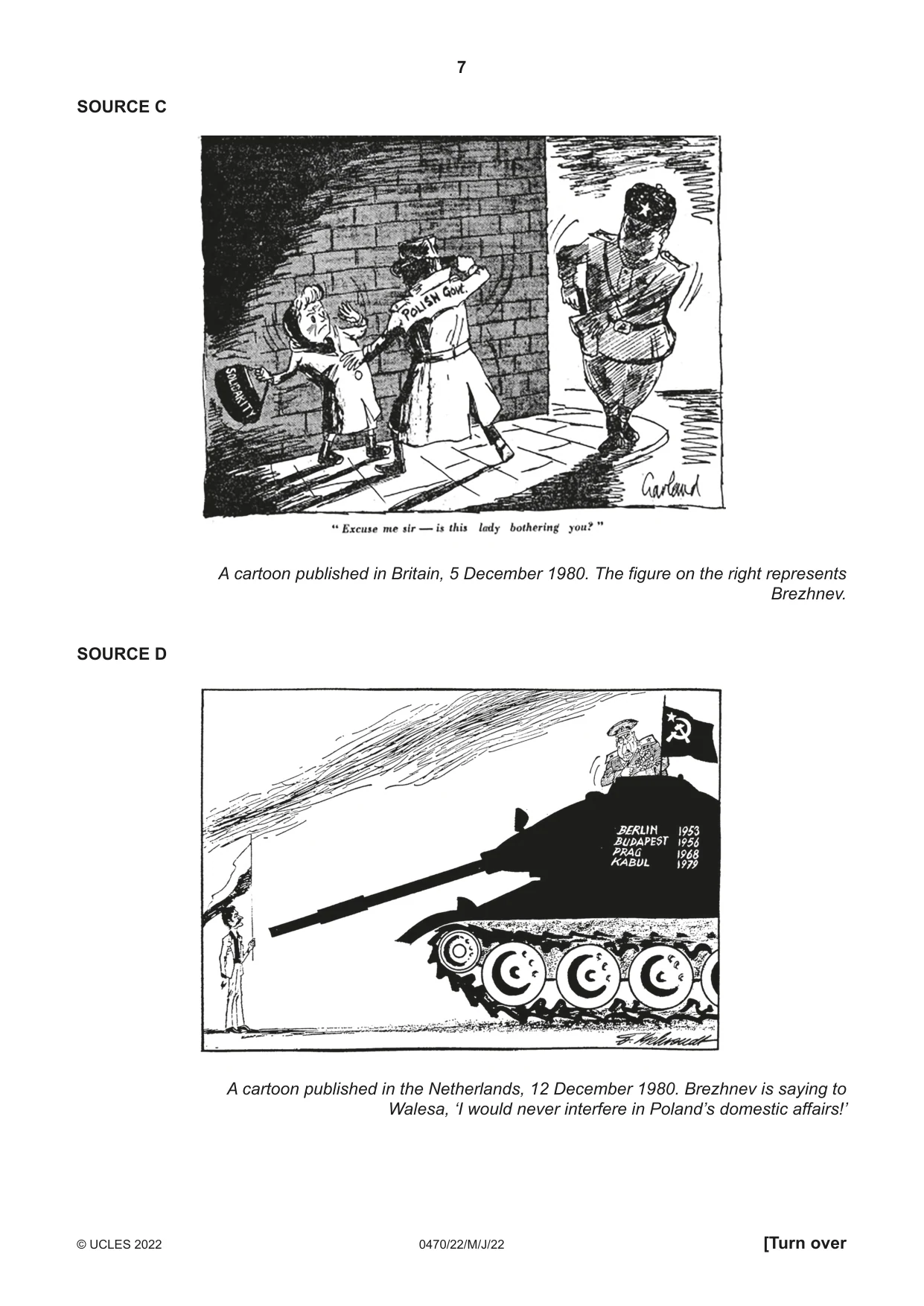
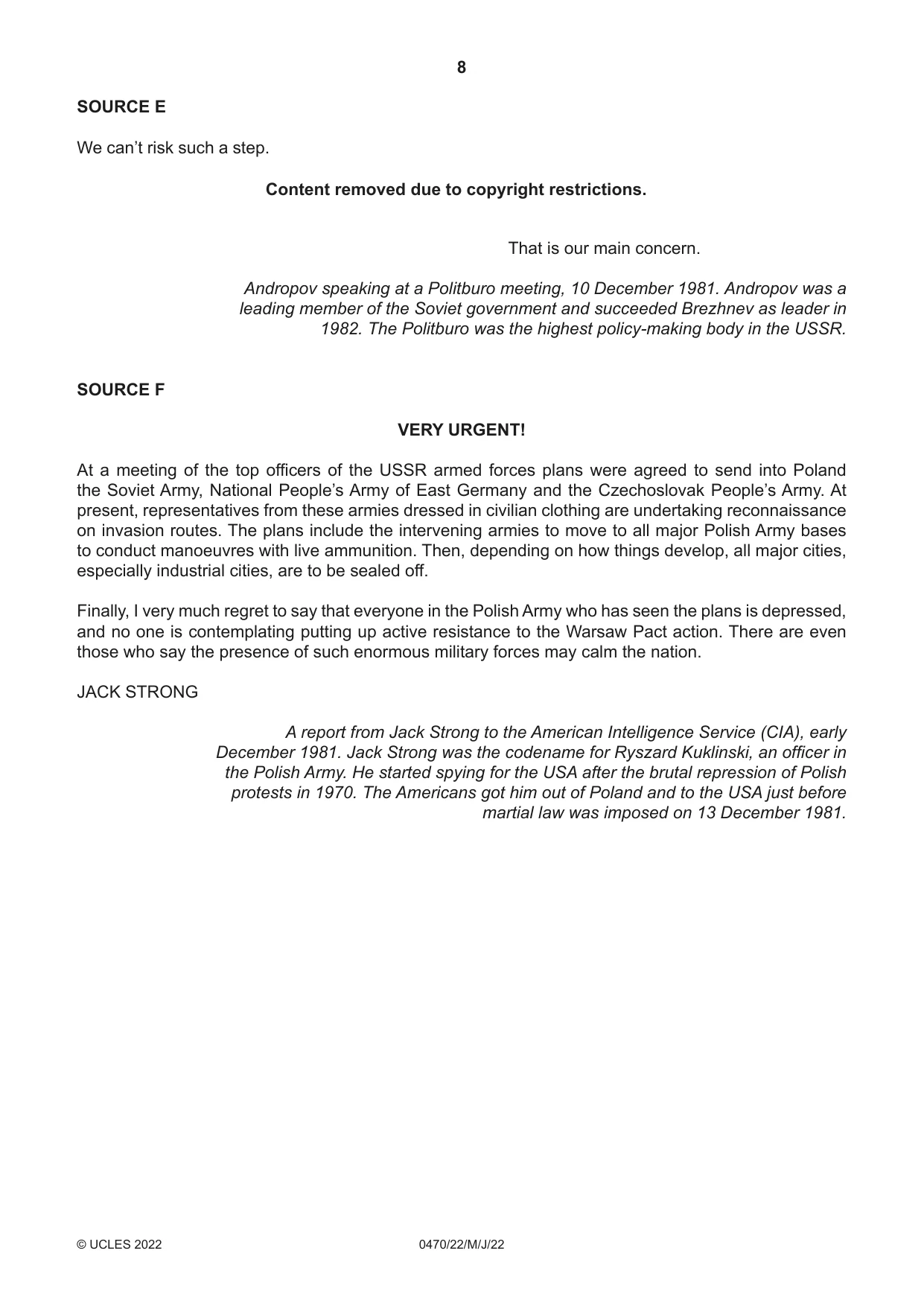
7 0470/22/M/J/22 © UCLES 2022 [Turn over SOURCE C A cartoon published in Britain, 5 December 1980. The figure on the right represents Brezhnev. SOURCE D A cartoon published in the Netherlands, 12 December 1980. Brezhnev is saying to Walesa, ‘I would never interfere in Poland’s domestic affairs!’
Question paper, page 8
8 0470/22/M/J/22 © UCLES 2022 SOURCE E We can’t risk such a step. That is our main concern. Andropov speaking at a Politburo meeting, 10 December 1981. Andropov was a leading member of the Soviet government and succeeded Brezhnev as leader in 1982. The Politburo was the highest policy-making body in the USSR. SOURCE F VERY URGENT! At a meeting of the top officers of the USSR armed forces plans were agreed to send into Poland the Soviet Army, National People’s Army of East Germany and the Czechoslovak People’s Army. At present, representatives from these armies dressed in civilian clothing are undertaking reconnaissance on invasion routes. The plans include the intervening armies to move to all major Polish Army bases to conduct manoeuvres with live ammunition. Then, depending on how things develop, all major cities, especially industrial cities, are to be sealed off. Finally, I very much regret to say that everyone in the Polish Army who has seen the plans is depressed, and no one is contemplating putting up active resistance to the Warsaw Pact action. There are even those who say the presence of such enormous military forces may calm the nation. JACK STRONG A report from Jack Strong to the American Intelligence Service (CIA), early December 1981. Jack Strong was the codename for Ryszard Kuklinski, an officer in the Polish Army. He started spying for the USA after the brutal repression of Polish protests in 1970. The Americans got him out of Poland and to the USA just before martial law was imposed on 13 December 1981. Content removed due to copyright restrictions.
Question paper, page 9
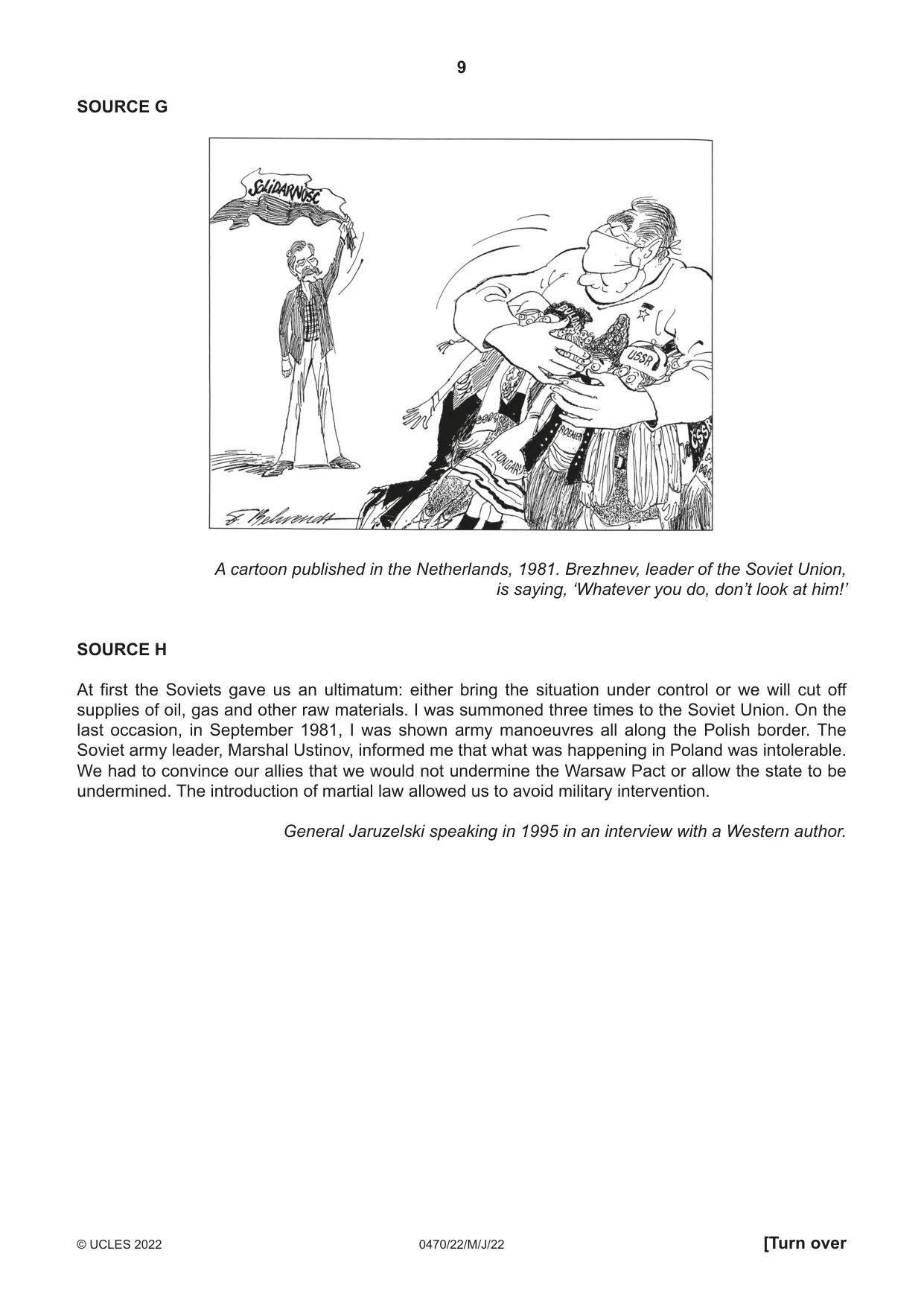
9 0470/22/M/J/22 © UCLES 2022 [Turn over SOURCE G A cartoon published in the Netherlands, 1981. Brezhnev, leader of the Soviet Union, is saying, ‘Whatever you do, don’t look at him!’ SOURCE H At first the Soviets gave us an ultimatum: either bring the situation under control or we will cut off supplies of oil, gas and other raw materials. I was summoned three times to the Soviet Union. On the last occasion, in September 1981, I was shown army manoeuvres all along the Polish border. The Soviet army leader, Marshal Ustinov, informed me that what was happening in Poland was intolerable. We had to convince our allies that we would not undermine the Warsaw Pact or allow the state to be undermined. The introduction of martial law allowed us to avoid military intervention. General Jaruzelski speaking in 1995 in an interview with a Western author.
Question paper, page 10
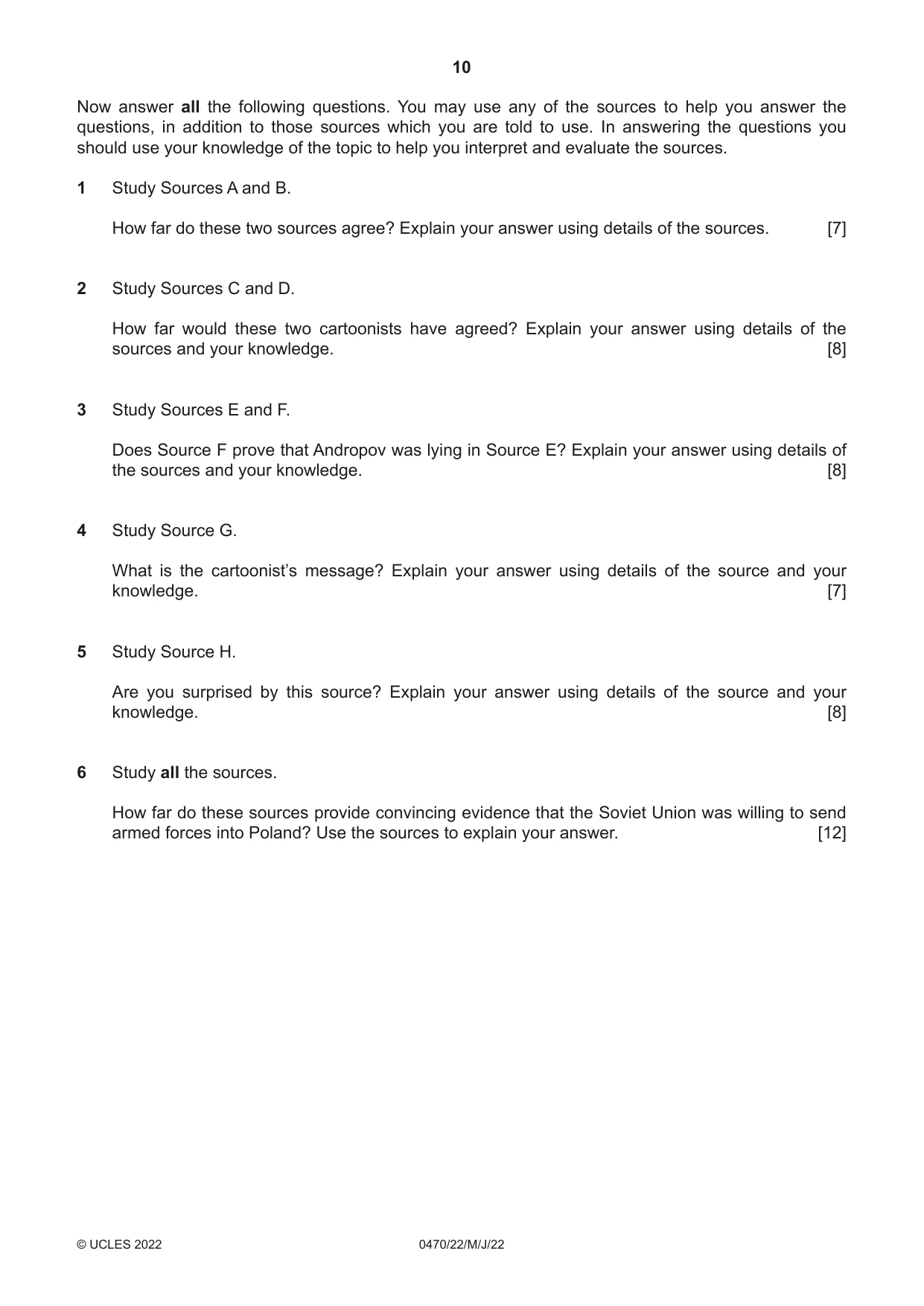
10 0470/22/M/J/22 © UCLES 2022 Now answer all the following questions. You may use any of the sources to help you answer the questions, in addition to those sources which you are told to use. In answering the questions you should use your knowledge of the topic to help you interpret and evaluate the sources. 1 Study Sources A and B. How far do these two sources agree? Explain your answer using details of the sources. [7] 2 Study Sources C and D. How far would these two cartoonists have agreed? Explain your answer using details of the sources and your knowledge. [8] 3 Study Sources E and F. Does Source F prove that Andropov was lying in Source E? Explain your answer using details of the sources and your knowledge. [8] 4 Study Source G. What is the cartoonist’s message? Explain your answer using details of the source and your knowledge. [7] 5 Study Source H. Are you surprised by this source? Explain your answer using details of the source and your knowledge. [8] 6 Study all the sources. How far do these sources provide convincing evidence that the Soviet Union was willing to send armed forces into Poland? Use the sources to explain your answer. [12]
Question paper, page 11
11 0470/22/M/J/22 © UCLES 2022 BLANK PAGE
Question paper, page 12
12 0470/22/M/J/22 © UCLES 2022 Permission to reproduce items where third-party owned material protected by copyright is included has been sought and cleared where possible. Every reasonable effort has been made by the publisher (UCLES) to trace copyright holders, but if any items requiring clearance have unwittingly been included, the publisher will be pleased to make amends at the earliest possible opportunity. To avoid the issue of disclosure of answer-related information to candidates, all copyright acknowledgements are reproduced online in the Cambridge Assessment International Education Copyright Acknowledgements Booklet. This is produced for each series of examinations and is freely available to download at www.cambridgeinternational.org after the live examination series. Cambridge Assessment International Education is part of Cambridge Assessment. Cambridge Assessment is the brand name of the University of Cambridge Local Examinations Syndicate (UCLES), which is a department of the University of Cambridge. BLANK PAGE
Mark scheme, page 1
This document consists of 10 printed pages. © UCLES 2022 [Turn over Cambridge IGCSE™ HISTORY 0470/22 Paper 2 May/June 2022 MARK SCHEME Maximum Mark: 50 Published This mark scheme is published as an aid to teachers and candidates, to indicate the requirements of the examination. It shows the basis on which Examiners were instructed to award marks. It does not indicate the details of the discussions that took place at an Examiners’ meeting before marking began, which would have considered the acceptability of alternative answers. Mark schemes should be read in conjunction with the question paper and the Principal Examiner Report for Teachers. Cambridge International will not enter into discussions about these mark schemes. Cambridge International is publishing the mark schemes for the May/June 2022 series for most Cambridge IGCSE, Cambridge International A and AS Level and Cambridge Pre-U components, and some Cambridge O Level components.
Mark scheme, page 2
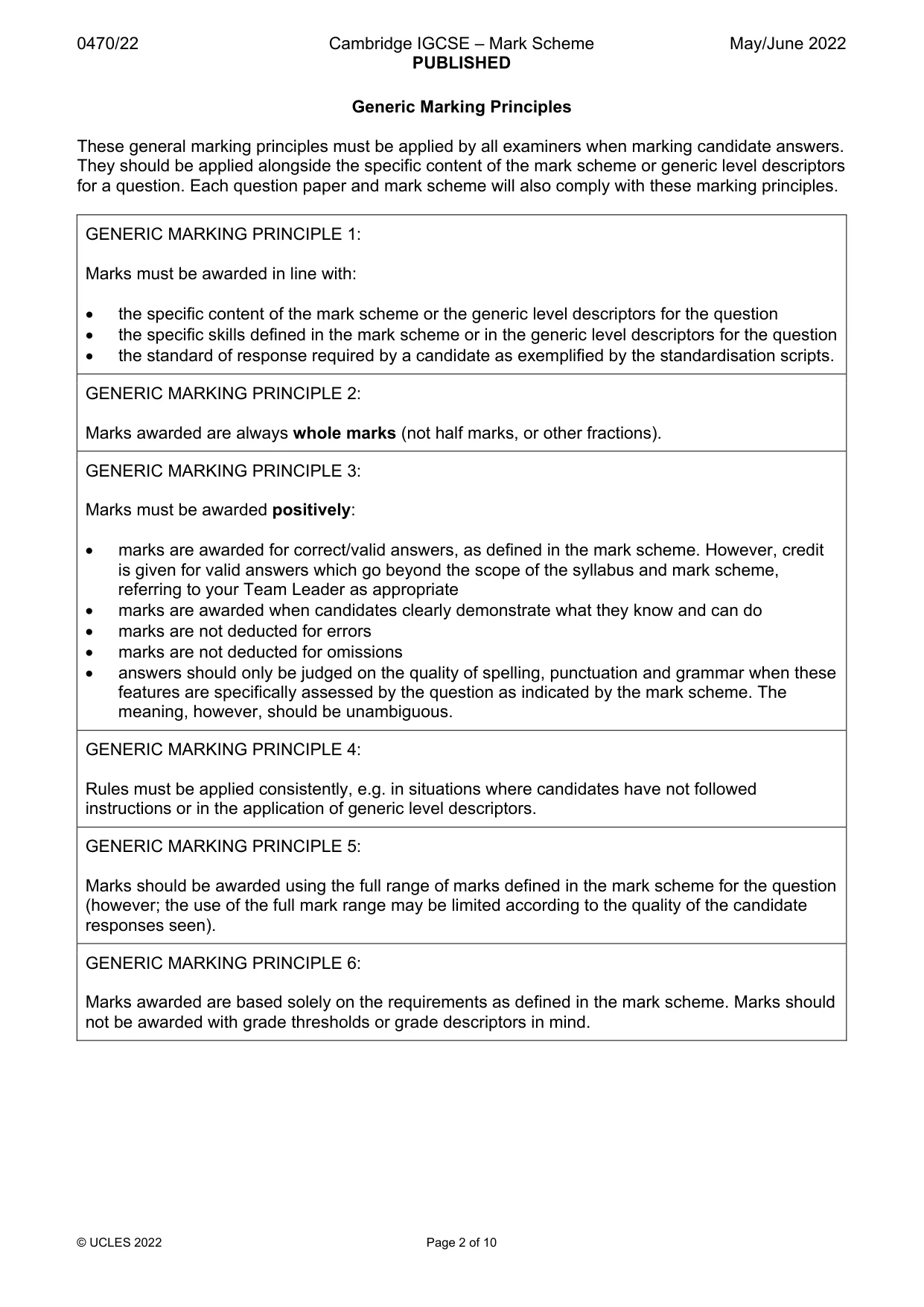
0470/22 Cambridge IGCSE – Mark Scheme PUBLISHED May/June 2022 © UCLES 2022 Page 2 of 10 Generic Marking Principles These general marking principles must be applied by all examiners when marking candidate answers. They should be applied alongside the specific content of the mark scheme or generic level descriptors for a question. Each question paper and mark scheme will also comply with these marking principles. GENERIC MARKING PRINCIPLE 1: Marks must be awarded in line with: the specific content of the mark scheme or the generic level descriptors for the question the specific skills defined in the mark scheme or in the generic level descriptors for the question the standard of response required by a candidate as exemplified by the standardisation scripts. GENERIC MARKING PRINCIPLE 2: Marks awarded are always whole marks (not half marks, or other fractions). GENERIC MARKING PRINCIPLE 3: Marks must be awarded positively: marks are awarded for correct/valid answers, as defined in the mark scheme. However, credit is given for valid answers which go beyond the scope of the syllabus and mark scheme, referring to your Team Leader as appropriate marks are awarded when candidates clearly demonstrate what they know and can do marks are not deducted for errors marks are not deducted for omissions answers should only be judged on the quality of spelling, punctuation and grammar when these features are specifically assessed by the question as indicated by the mark scheme. The meaning, however, should be unambiguous. GENERIC MARKING PRINCIPLE 4: Rules must be applied consistently, e.g. in situations where candidates have not followed instructions or in the application of generic level descriptors. GENERIC MARKING PRINCIPLE 5: Marks should be awarded using the full range of marks defined in the mark scheme for the question (however; the use of the full mark range may be limited according to the quality of the candidate responses seen). GENERIC MARKING PRINCIPLE 6: Marks awarded are based solely on the requirements as defined in the mark scheme. Marks should not be awarded with grade thresholds or grade descriptors in mind.
Mark scheme, page 3
0470/22 Cambridge IGCSE – Mark Scheme PUBLISHED May/June 2022 © UCLES 2022 Page 3 of 10 Question Answer Marks 19th Century topic 1 Study Sources A and B. How far do these two sources agree? Explain your answer using details of the sources. Level 5 Compares big messages – A is generally positive about the Ku Klux Klan (KKK) while B is negative about the KKK. Must be supported, if not treat it as a disagreement of detail. 7 Level 4 Agreement and disagreement of detail or sub-messages 6 Level 3 Agreement or disagreement of detail or sub-messages 3–5 Agreements include: The KKK was mysterious People at the time thought it protected people There was concern at the time about the lawlessness of former slaves There was disorder The KKK was powerful. Disagreements include: A says it was organised, B says it was not A says it was doing good, B says it was doing evil. Level 2 Identifies information that is in one source but not in the other or states that the sources are about the same subject OR Compares the provenance of the sources 2 Level 1 Writes about the sources but makes no valid comparison 1 Level 0 No evidence submitted or response does not address the question 0 7
Mark scheme, page 4
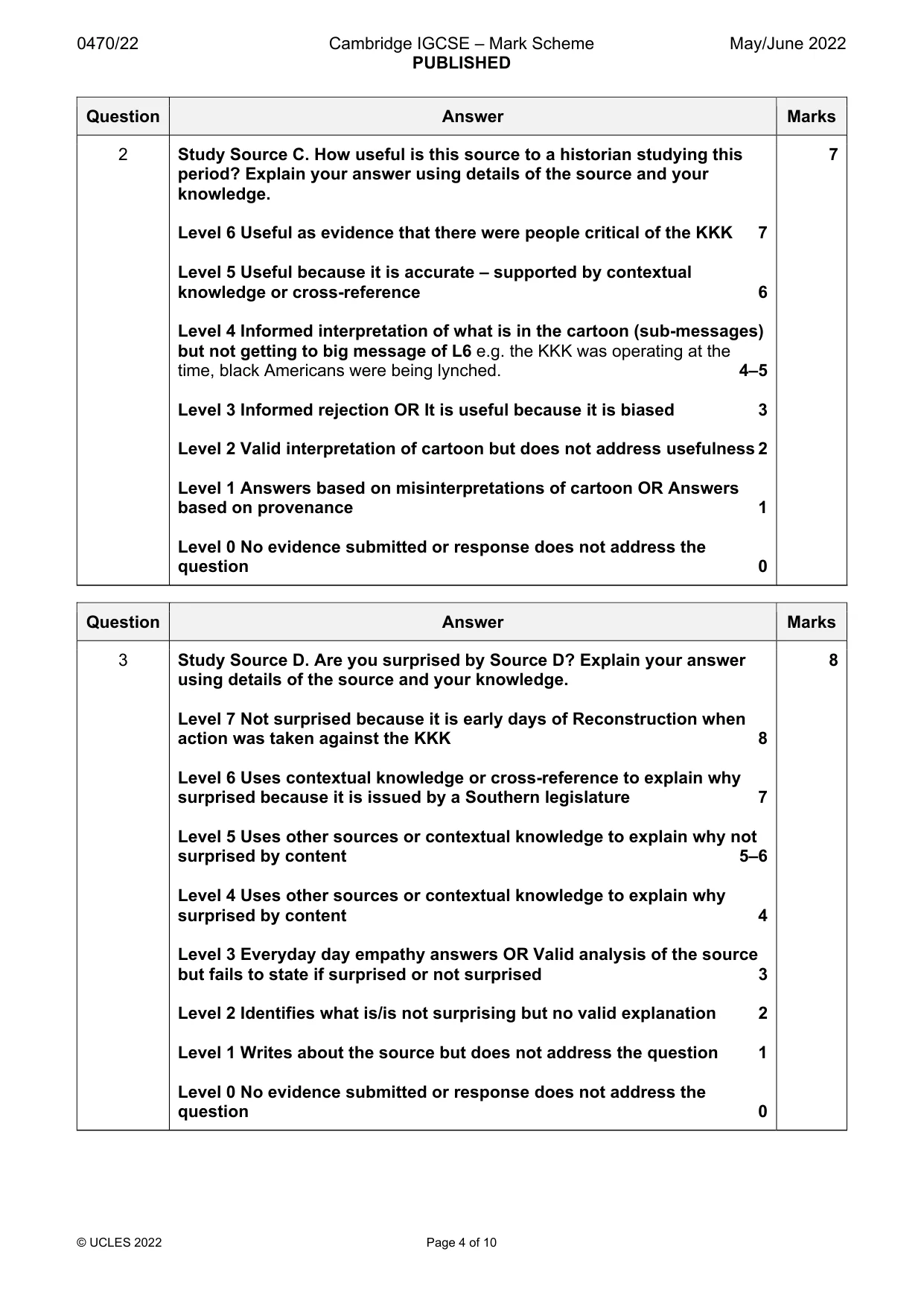
0470/22 Cambridge IGCSE – Mark Scheme PUBLISHED May/June 2022 © UCLES 2022 Page 4 of 10 Question Answer Marks 2 Study Source C. How useful is this source to a historian studying this period? Explain your answer using details of the source and your knowledge. Level 6 Useful as evidence that there were people critical of the KKK 7 Level 5 Useful because it is accurate – supported by contextual knowledge or cross-reference 6 Level 4 Informed interpretation of what is in the cartoon (sub-messages) but not getting to big message of L6 e.g. the KKK was operating at the time, black Americans were being lynched. 4–5 Level 3 Informed rejection OR It is useful because it is biased 3 Level 2 Valid interpretation of cartoon but does not address usefulness 2 Level 1 Answers based on misinterpretations of cartoon OR Answers based on provenance 1 Level 0 No evidence submitted or response does not address the question 0 7 Question Answer Marks 3 Study Source D. Are you surprised by Source D? Explain your answer using details of the source and your knowledge. Level 7 Not surprised because it is early days of Reconstruction when action was taken against the KKK 8 Level 6 Uses contextual knowledge or cross-reference to explain why surprised because it is issued by a Southern legislature 7 Level 5 Uses other sources or contextual knowledge to explain why not surprised by content 5–6 Level 4 Uses other sources or contextual knowledge to explain why surprised by content 4 Level 3 Everyday day empathy answers OR Valid analysis of the source but fails to state if surprised or not surprised 3 Level 2 Identifies what is/is not surprising but no valid explanation 2 Level 1 Writes about the source but does not address the question 1 Level 0 No evidence submitted or response does not address the question 0 8
Mark scheme, page 5
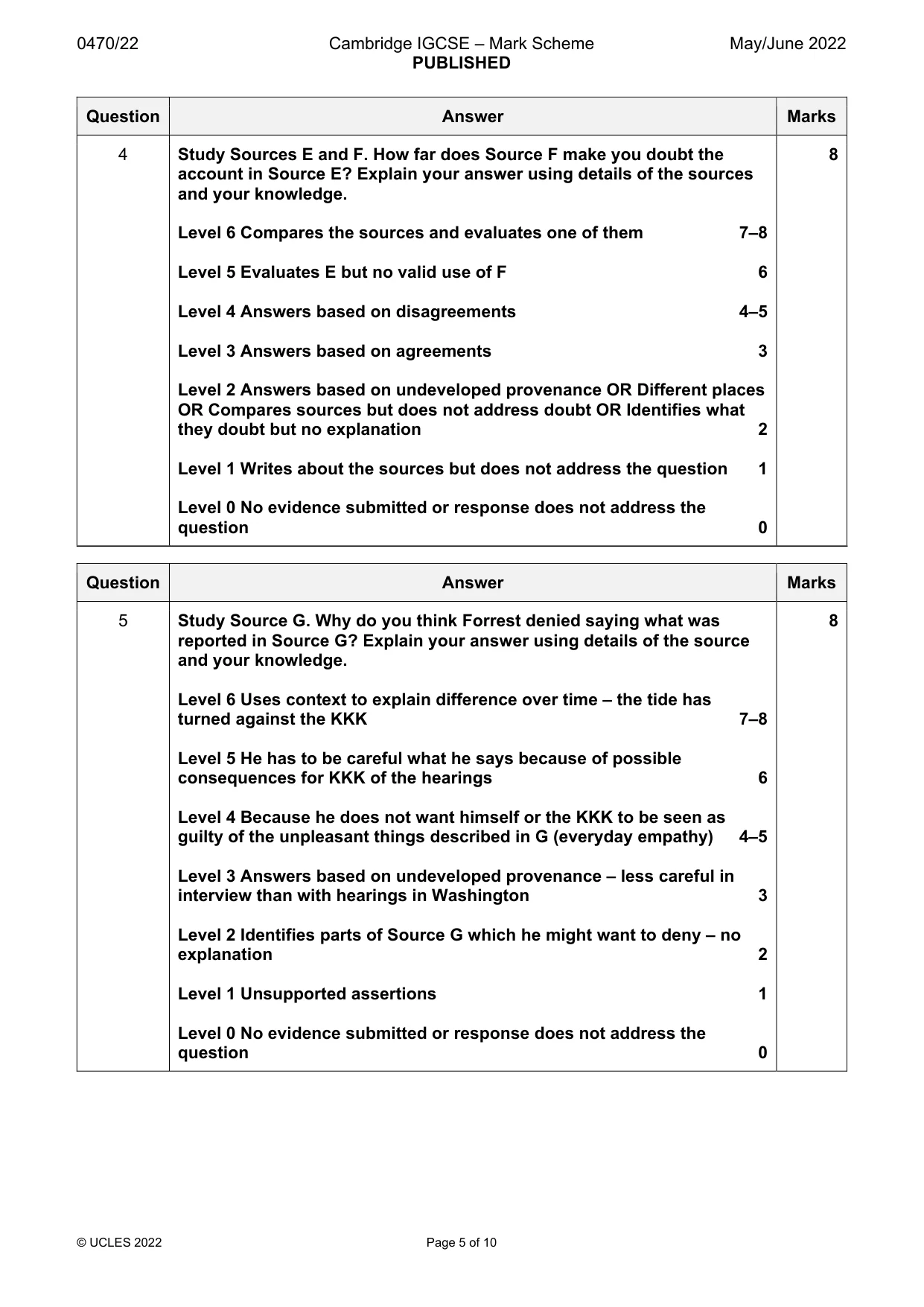
0470/22 Cambridge IGCSE – Mark Scheme PUBLISHED May/June 2022 © UCLES 2022 Page 5 of 10 Question Answer Marks 4 Study Sources E and F. How far does Source F make you doubt the account in Source E? Explain your answer using details of the sources and your knowledge. Level 6 Compares the sources and evaluates one of them 7–8 Level 5 Evaluates E but no valid use of F 6 Level 4 Answers based on disagreements 4–5 Level 3 Answers based on agreements 3 Level 2 Answers based on undeveloped provenance OR Different places OR Compares sources but does not address doubt OR Identifies what they doubt but no explanation 2 Level 1 Writes about the sources but does not address the question 1 Level 0 No evidence submitted or response does not address the question 0 8 Question Answer Marks 5 Study Source G. Why do you think Forrest denied saying what was reported in Source G? Explain your answer using details of the source and your knowledge. Level 6 Uses context to explain difference over time – the tide has turned against the KKK 7–8 Level 5 He has to be careful what he says because of possible consequences for KKK of the hearings 6 Level 4 Because he does not want himself or the KKK to be seen as guilty of the unpleasant things described in G (everyday empathy) 4–5 Level 3 Answers based on undeveloped provenance – less careful in interview than with hearings in Washington 3 Level 2 Identifies parts of Source G which he might want to deny – no explanation 2 Level 1 Unsupported assertions 1 Level 0 No evidence submitted or response does not address the question 0 8
Mark scheme, page 6
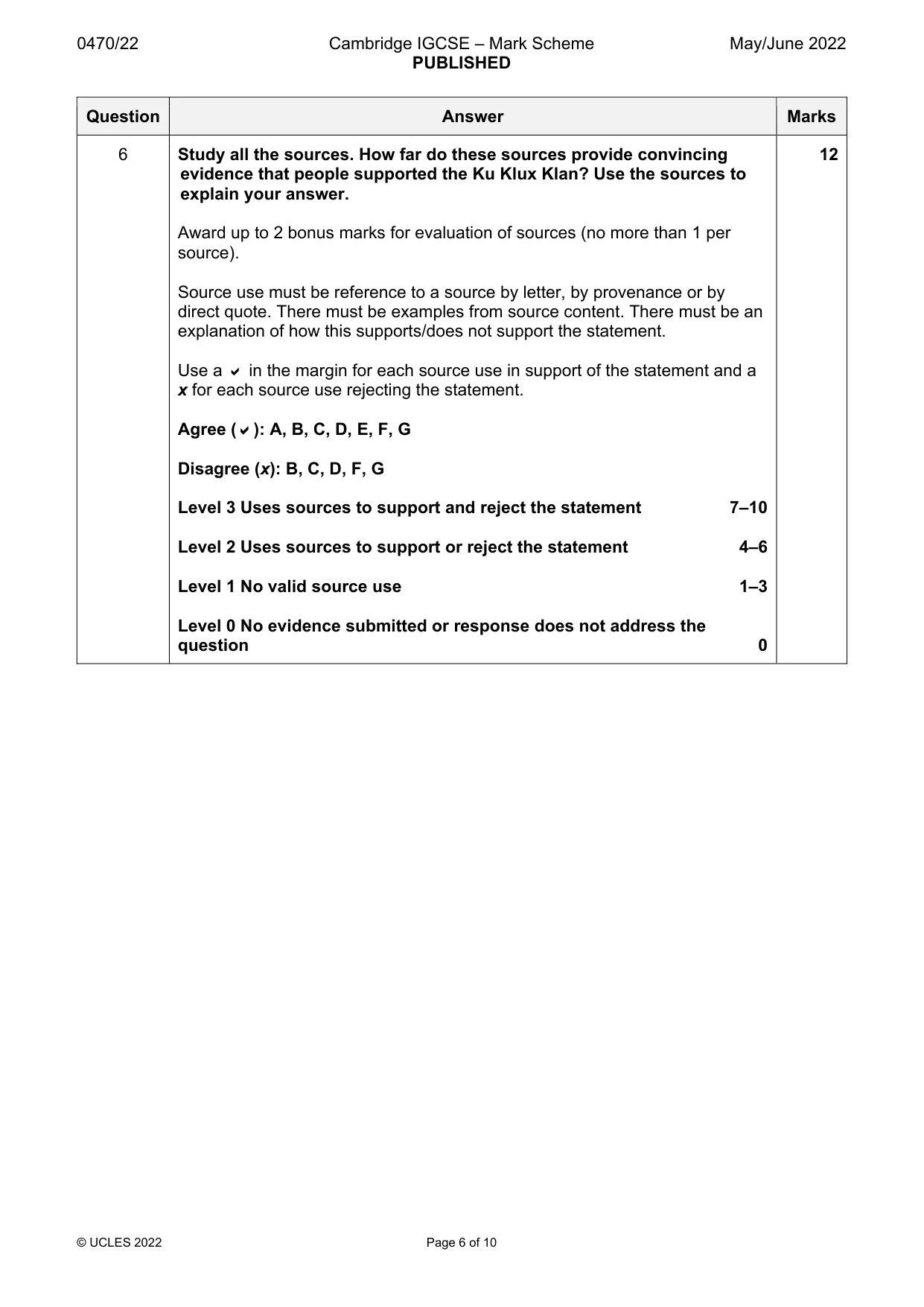
0470/22 Cambridge IGCSE – Mark Scheme PUBLISHED May/June 2022 © UCLES 2022 Page 6 of 10 Question Answer Marks 6 Study all the sources. How far do these sources provide convincing evidence that people supported the Ku Klux Klan? Use the sources to explain your answer. Award up to 2 bonus marks for evaluation of sources (no more than 1 per source). Source use must be reference to a source by letter, by provenance or by direct quote. There must be examples from source content. There must be an explanation of how this supports/does not support the statement. Use a in the margin for each source use in support of the statement and a x for each source use rejecting the statement. Agree (): A, B, C, D, E, F, G Disagree (x): B, C, D, F, G Level 3 Uses sources to support and reject the statement 7–10 Level 2 Uses sources to support or reject the statement 4–6 Level 1 No valid source use 1–3 Level 0 No evidence submitted or response does not address the question 0 12
Mark scheme, page 7
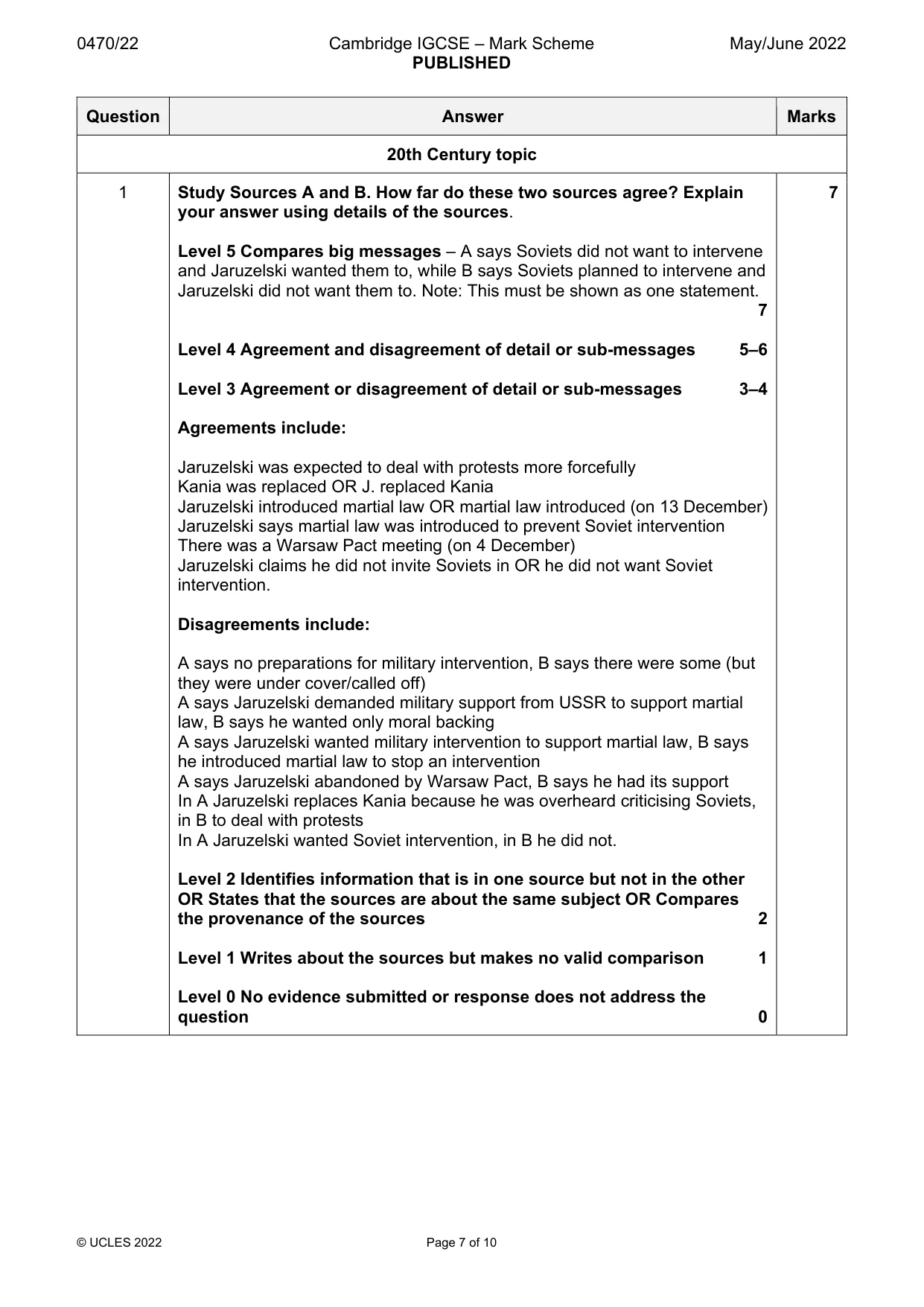
0470/22 Cambridge IGCSE – Mark Scheme PUBLISHED May/June 2022 © UCLES 2022 Page 7 of 10 Question Answer Marks 20th Century topic 1 Study Sources A and B. How far do these two sources agree? Explain your answer using details of the sources. Level 5 Compares big messages – A says Soviets did not want to intervene and Jaruzelski wanted them to, while B says Soviets planned to intervene and Jaruzelski did not want them to. Note: This must be shown as one statement. 7 Level 4 Agreement and disagreement of detail or sub-messages 5–6 Level 3 Agreement or disagreement of detail or sub-messages 3–4 Agreements include: Jaruzelski was expected to deal with protests more forcefully Kania was replaced OR J. replaced Kania Jaruzelski introduced martial law OR martial law introduced (on 13 December) Jaruzelski says martial law was introduced to prevent Soviet intervention There was a Warsaw Pact meeting (on 4 December) Jaruzelski claims he did not invite Soviets in OR he did not want Soviet intervention. Disagreements include: A says no preparations for military intervention, B says there were some (but they were under cover/called off) A says Jaruzelski demanded military support from USSR to support martial law, B says he wanted only moral backing A says Jaruzelski wanted military intervention to support martial law, B says he introduced martial law to stop an intervention A says Jaruzelski abandoned by Warsaw Pact, B says he had its support In A Jaruzelski replaces Kania because he was overheard criticising Soviets, in B to deal with protests In A Jaruzelski wanted Soviet intervention, in B he did not. Level 2 Identifies information that is in one source but not in the other OR States that the sources are about the same subject OR Compares the provenance of the sources 2 Level 1 Writes about the sources but makes no valid comparison 1 Level 0 No evidence submitted or response does not address the question 0 7
Mark scheme, page 8
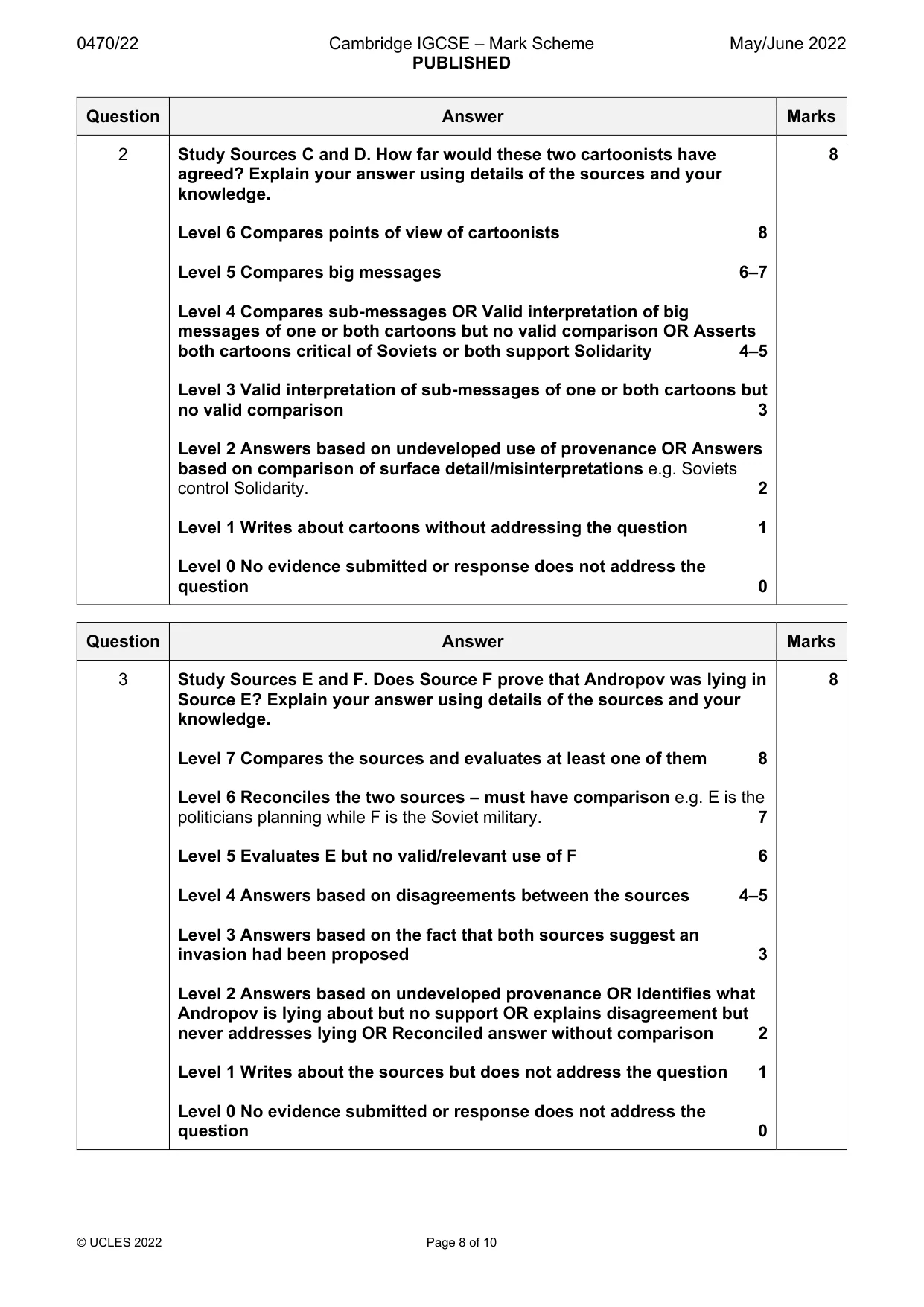
0470/22 Cambridge IGCSE – Mark Scheme PUBLISHED May/June 2022 © UCLES 2022 Page 8 of 10 Question Answer Marks 2 Study Sources C and D. How far would these two cartoonists have agreed? Explain your answer using details of the sources and your knowledge. Level 6 Compares points of view of cartoonists 8 Level 5 Compares big messages 6–7 Level 4 Compares sub-messages OR Valid interpretation of big messages of one or both cartoons but no valid comparison OR Asserts both cartoons critical of Soviets or both support Solidarity 4–5 Level 3 Valid interpretation of sub-messages of one or both cartoons but no valid comparison 3 Level 2 Answers based on undeveloped use of provenance OR Answers based on comparison of surface detail/misinterpretations e.g. Soviets control Solidarity. 2 Level 1 Writes about cartoons without addressing the question 1 Level 0 No evidence submitted or response does not address the question 0 8 Question Answer Marks 3 Study Sources E and F. Does Source F prove that Andropov was lying in Source E? Explain your answer using details of the sources and your knowledge. Level 7 Compares the sources and evaluates at least one of them 8 Level 6 Reconciles the two sources – must have comparison e.g. E is the politicians planning while F is the Soviet military. 7 Level 5 Evaluates E but no valid/relevant use of F 6 Level 4 Answers based on disagreements between the sources 4–5 Level 3 Answers based on the fact that both sources suggest an invasion had been proposed 3 Level 2 Answers based on undeveloped provenance OR Identifies what Andropov is lying about but no support OR explains disagreement but never addresses lying OR Reconciled answer without comparison 2 Level 1 Writes about the sources but does not address the question 1 Level 0 No evidence submitted or response does not address the question 0 8
Mark scheme, page 9
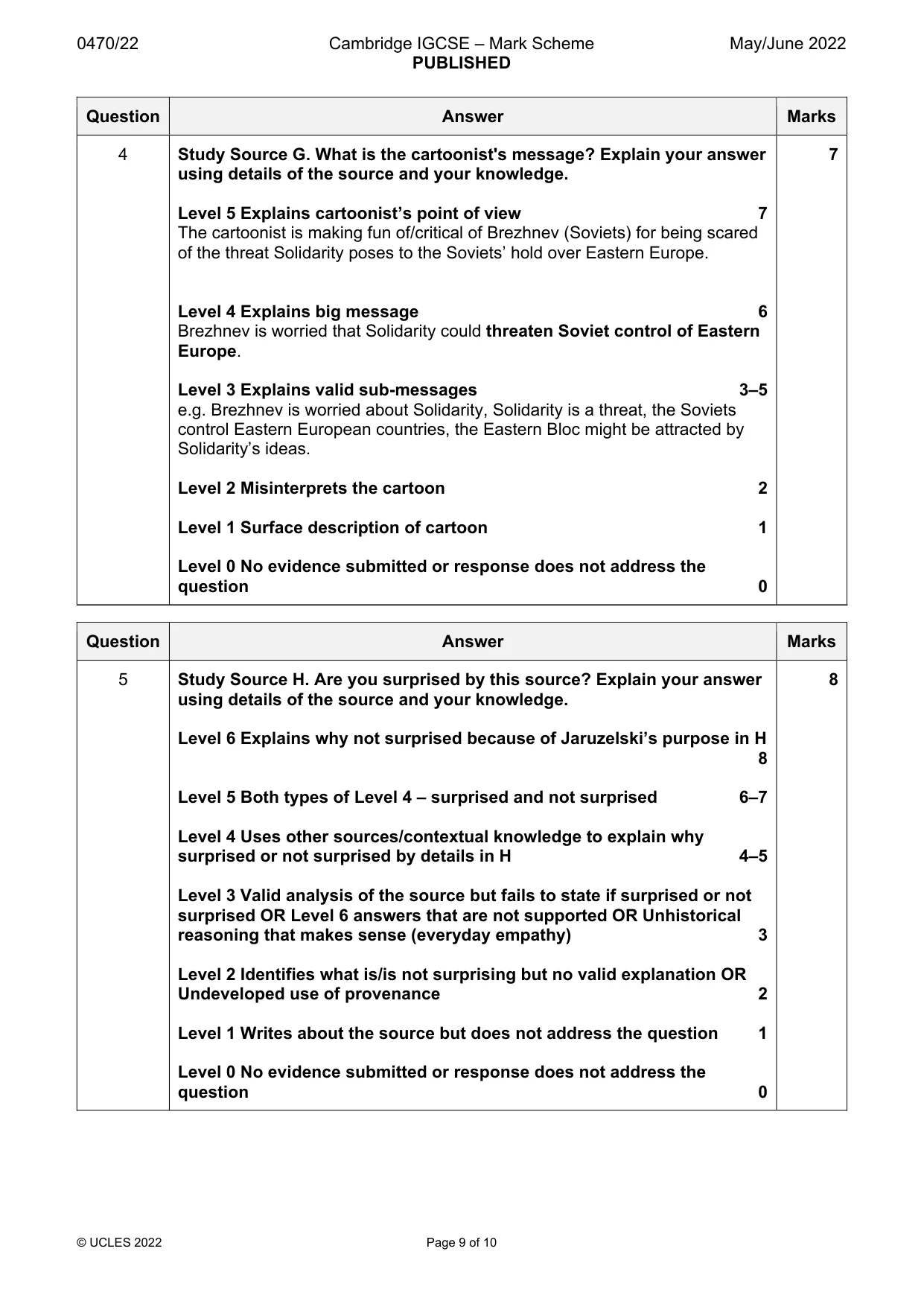
0470/22 Cambridge IGCSE – Mark Scheme PUBLISHED May/June 2022 © UCLES 2022 Page 9 of 10 Question Answer Marks 4 Study Source G. What is the cartoonist's message? Explain your answer using details of the source and your knowledge. Level 5 Explains cartoonist’s point of view 7 The cartoonist is making fun of/critical of Brezhnev (Soviets) for being scared of the threat Solidarity poses to the Soviets’ hold over Eastern Europe. Level 4 Explains big message 6 Brezhnev is worried that Solidarity could threaten Soviet control of Eastern Europe. Level 3 Explains valid sub-messages 3–5 e.g. Brezhnev is worried about Solidarity, Solidarity is a threat, the Soviets control Eastern European countries, the Eastern Bloc might be attracted by Solidarity’s ideas. Level 2 Misinterprets the cartoon 2 Level 1 Surface description of cartoon 1 Level 0 No evidence submitted or response does not address the question 0 7 Question Answer Marks 5 Study Source H. Are you surprised by this source? Explain your answer using details of the source and your knowledge. Level 6 Explains why not surprised because of Jaruzelski’s purpose in H 8 Level 5 Both types of Level 4 – surprised and not surprised 6–7 Level 4 Uses other sources/contextual knowledge to explain why surprised or not surprised by details in H 4–5 Level 3 Valid analysis of the source but fails to state if surprised or not surprised OR Level 6 answers that are not supported OR Unhistorical reasoning that makes sense (everyday empathy) 3 Level 2 Identifies what is/is not surprising but no valid explanation OR Undeveloped use of provenance 2 Level 1 Writes about the source but does not address the question 1 Level 0 No evidence submitted or response does not address the question 0 8
Mark scheme, page 10
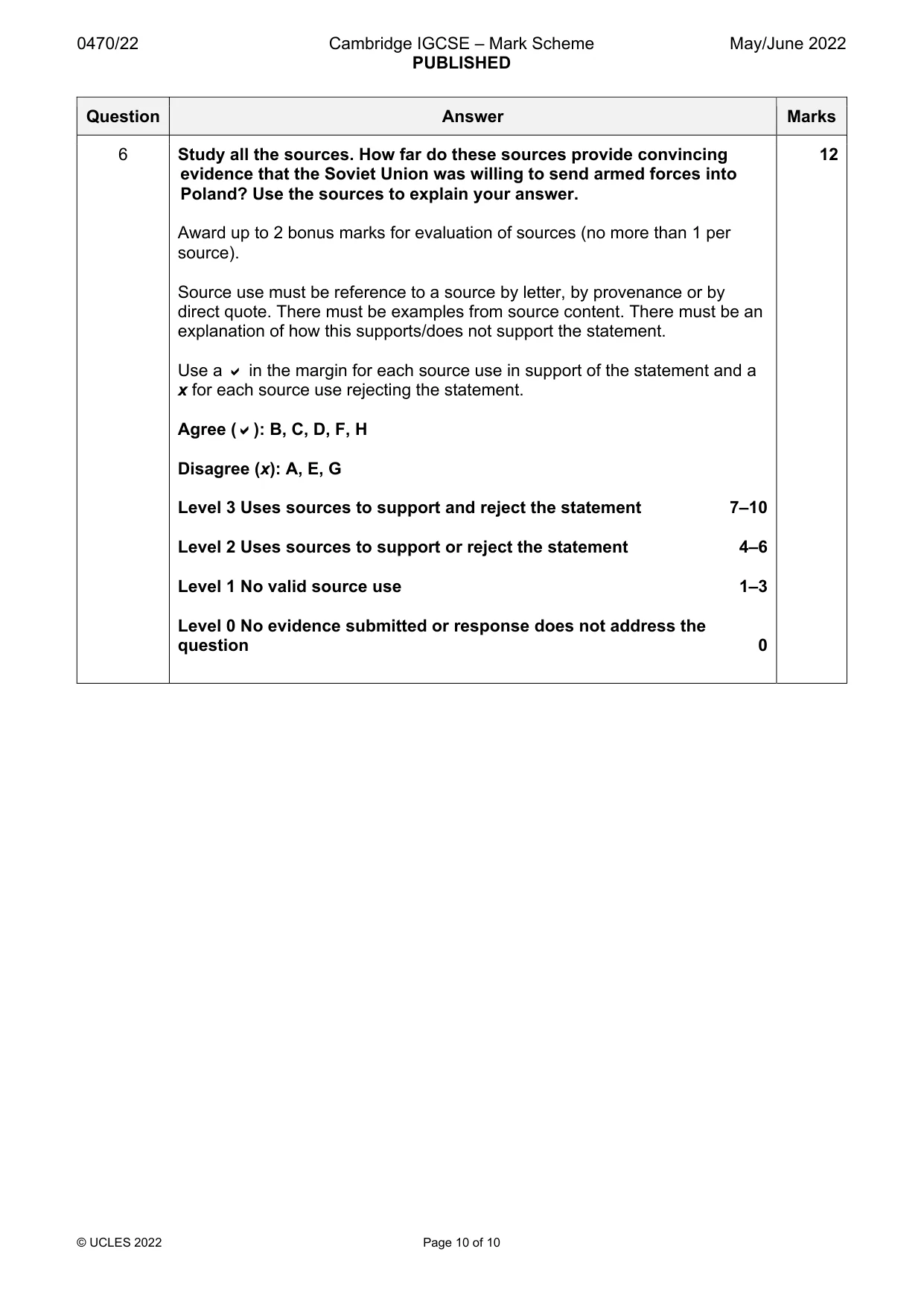
0470/22 Cambridge IGCSE – Mark Scheme PUBLISHED May/June 2022 © UCLES 2022 Page 10 of 10 Question Answer Marks 6 Study all the sources. How far do these sources provide convincing evidence that the Soviet Union was willing to send armed forces into Poland? Use the sources to explain your answer. Award up to 2 bonus marks for evaluation of sources (no more than 1 per source). Source use must be reference to a source by letter, by provenance or by direct quote. There must be examples from source content. There must be an explanation of how this supports/does not support the statement. Use a in the margin for each source use in support of the statement and a x for each source use rejecting the statement. Agree (): B, C, D, F, H Disagree (x): A, E, G Level 3 Uses sources to support and reject the statement 7–10 Level 2 Uses sources to support or reject the statement 4–6 Level 1 No valid source use 1–3 Level 0 No evidence submitted or response does not address the question 0 12
What you needed in this session
Cambridge’s own grade thresholds for 2022 May/June, Paper 2 · Variant 2. A higher threshold means an easier paper — the bar moves with how the cohort did.