Cambridge IGCSE History 0470 — 2021 Oct/Nov Paper 4 · Variant 3
0470/43/O/N/21 · 40 marks · ≈45 min
The question paper and its mark scheme, free to read here and free to download. This is Cambridge’s own paper, exactly as it was sat.
Question paper4 pages

Mark scheme11 pages
Answers below. Sit the paper first if you are practising.
Paper as text
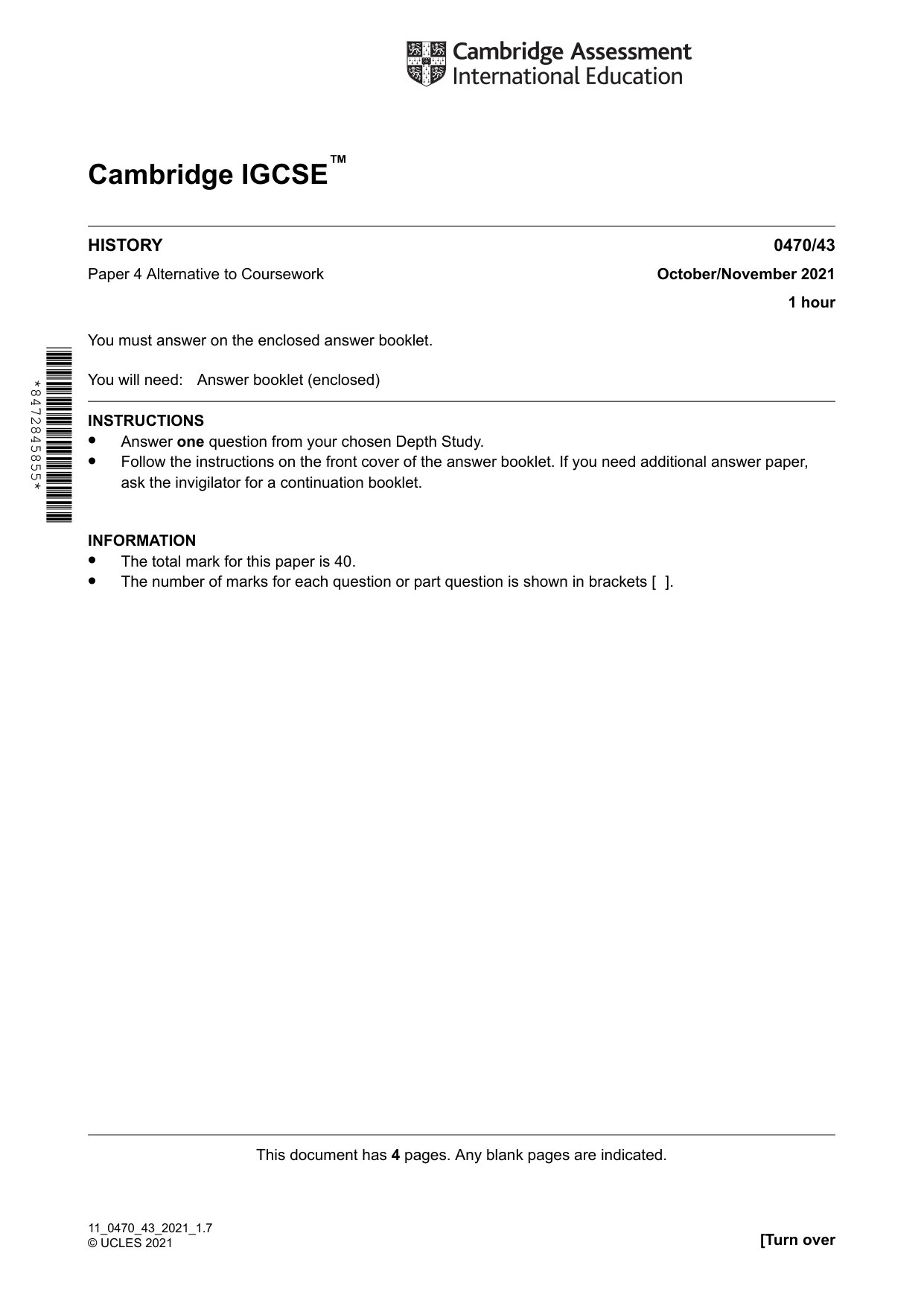
Question paper, page 1
Cambridge IGCSE™ 0470/43 October/November 2021 1 hour HISTORY Paper 4 Alternative to Coursework You must answer on the enclosed answer booklet. You will need: Answer booklet (enclosed) INSTRUCTIONS • Answer one question from your chosen Depth Study. • Follow the instructions on the front cover of the answer booklet. If you need additional answer paper, ask the invigilator for a continuation booklet. INFORMATION • The total mark for this paper is 40. • The number of marks for each question or part question is shown in brackets [ ]. This document has 4 pages. Any blank pages are indicated. [Turn over 11_0470_43_2021_1.7 © UCLES 2021 *8472845855*
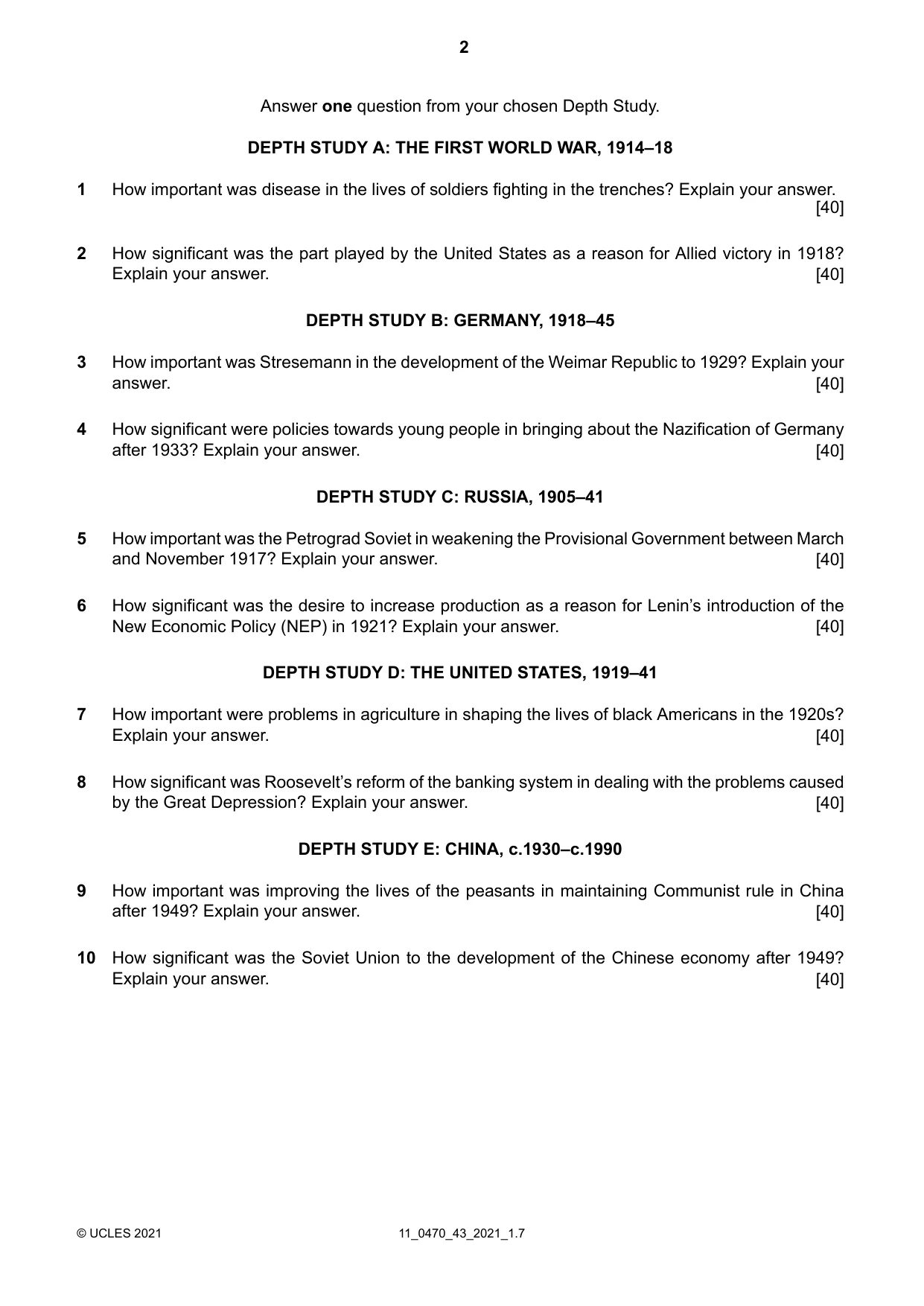
Question paper, page 2
Answer one question from your chosen Depth Study. DEPTH STUDY A: THE FIRST WORLD WAR, 1914–18 How important was disease in the lives of soldiers fighting in the trenches? Explain your answer. [40] 1 How significant was the part played by the United States as a reason for Allied victory in 1918? Explain your answer. [40] 2 DEPTH STUDY B: GERMANY, 1918–45 How important was Stresemann in the development of the Weimar Republic to 1929? Explain your answer. [40] 3 How significant were policies towards young people in bringing about the Nazification of Germany after 1933? Explain your answer. [40] 4 DEPTH STUDY C: RUSSIA, 1905–41 How important was the Petrograd Soviet in weakening the Provisional Government between March and November 1917? Explain your answer. [40] 5 How significant was the desire to increase production as a reason for Lenin’s introduction of the New Economic Policy (NEP) in 1921? Explain your answer. [40] 6 DEPTH STUDY D: THE UNITED STATES, 1919–41 How important were problems in agriculture in shaping the lives of black Americans in the 1920s? Explain your answer. [40] 7 How significant was Roosevelt’s reform of the banking system in dealing with the problems caused by the Great Depression? Explain your answer. [40] 8 DEPTH STUDY E: CHINA, c.1930–c.1990 How important was improving the lives of the peasants in maintaining Communist rule in China after 1949? Explain your answer. [40] 9 How significant was the Soviet Union to the development of the Chinese economy after 1949? Explain your answer. [40] 10 11_0470_43_2021_1.7 © UCLES 2021 2
Question paper, page 3
DEPTH STUDY F: SOUTH AFRICA, c.1940–c.1994 How important were the Pass Laws to the development of opposition against apartheid by 1966? Explain your answer. [40] 11 How significant were political reforms after 1978 in ending white minority rule? Explain your answer. [40] 12 DEPTH STUDY G: ISRAELIS AND PALESTINIANS SINCE 1945 How important was the Palestine Liberation Organisation (PLO) in the increasing tension between Israel and Arab states after 1964? Explain your answer. [40] 13 How significant has been the role played by the United Nations in the Arab-Israeli conflict? Explain your answer. [40] 14 11_0470_43_2021_1.7 © UCLES 2021 3
Question paper, page 4
BLANK PAGE Permission to reproduce items where third-party owned material protected by copyright is included has been sought and cleared where possible. Every reasonable effort has been made by the publisher (UCLES) to trace copyright holders, but if any items requiring clearance have unwittingly been included, the publisher will be pleased to make amends at the earliest possible opportunity. To avoid the issue of disclosure of answer-related information to candidates, all copyright acknowledgements are reproduced online in the Cambridge Assessment International Education Copyright Acknowledgements Booklet. This is produced for each series of examinations and is freely available to download at www.cambridgeinternational.org after the live examination series. Cambridge Assessment International Education is part of the Cambridge Assessment Group. Cambridge Assessment is the brand name of the University of Cambridge Local Examinations Syndicate (UCLES), which itself is a department of the University of Cambridge. 11_0470_43_2021_1.7 © UCLES 2021 4
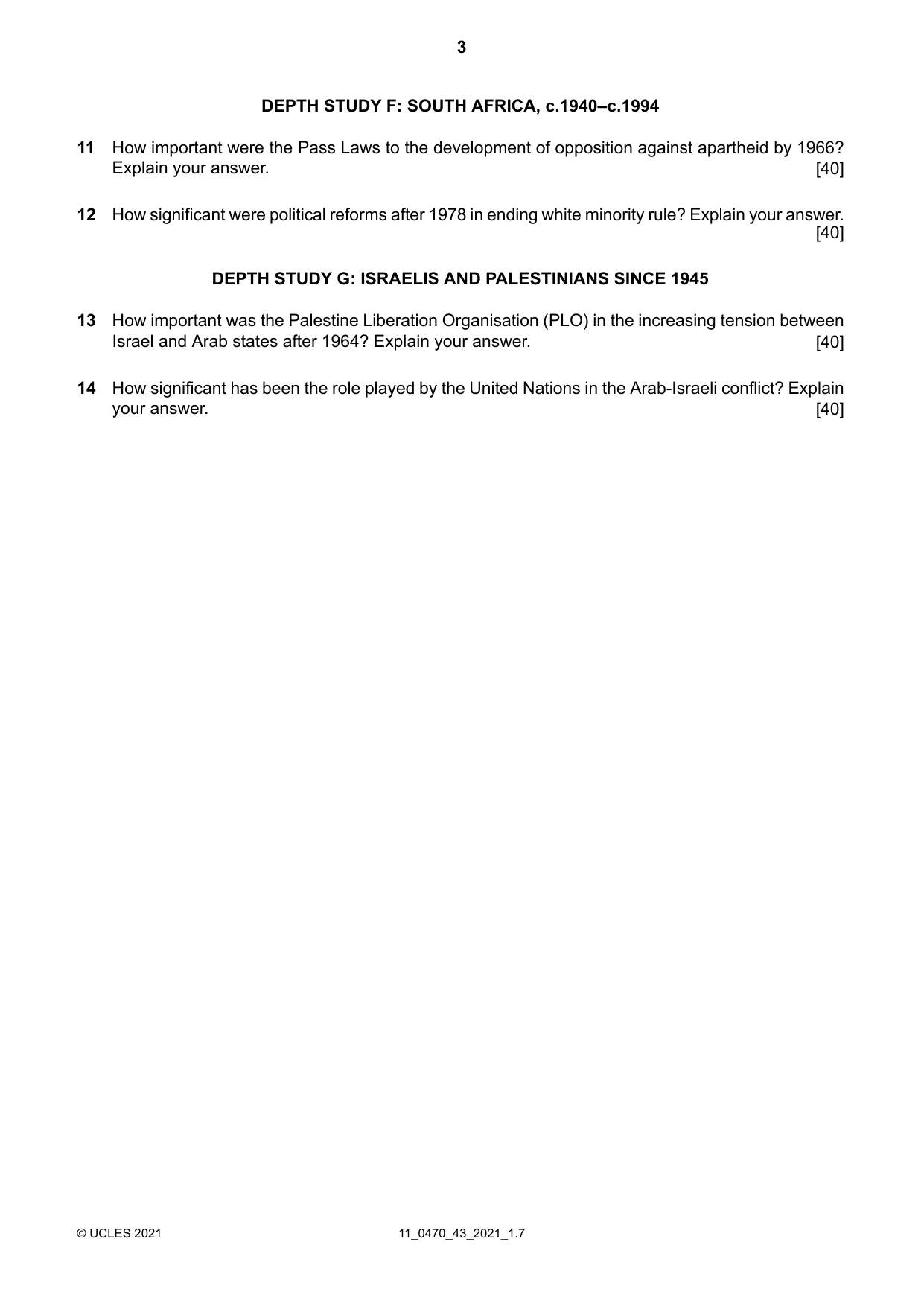
Mark scheme, page 1
This document consists of 11 printed pages. © UCLES 2021 [Turn over Cambridge IGCSE™ HISTORY 0470/43 Paper 4 Alternative to Coursework October/November 2021 MARK SCHEME Maximum Mark: 40 Published This mark scheme is published as an aid to teachers and candidates, to indicate the requirements of the examination. It shows the basis on which Examiners were instructed to award marks. It does not indicate the details of the discussions that took place at an Examiners’ meeting before marking began, which would have considered the acceptability of alternative answers. Mark schemes should be read in conjunction with the question paper and the Principal Examiner Report for Teachers. Cambridge International will not enter into discussions about these mark schemes. Cambridge International is publishing the mark schemes for the October/November 2021 series for most Cambridge IGCSE™, Cambridge International A and AS Level components and some Cambridge O Level components.
Mark scheme, page 2
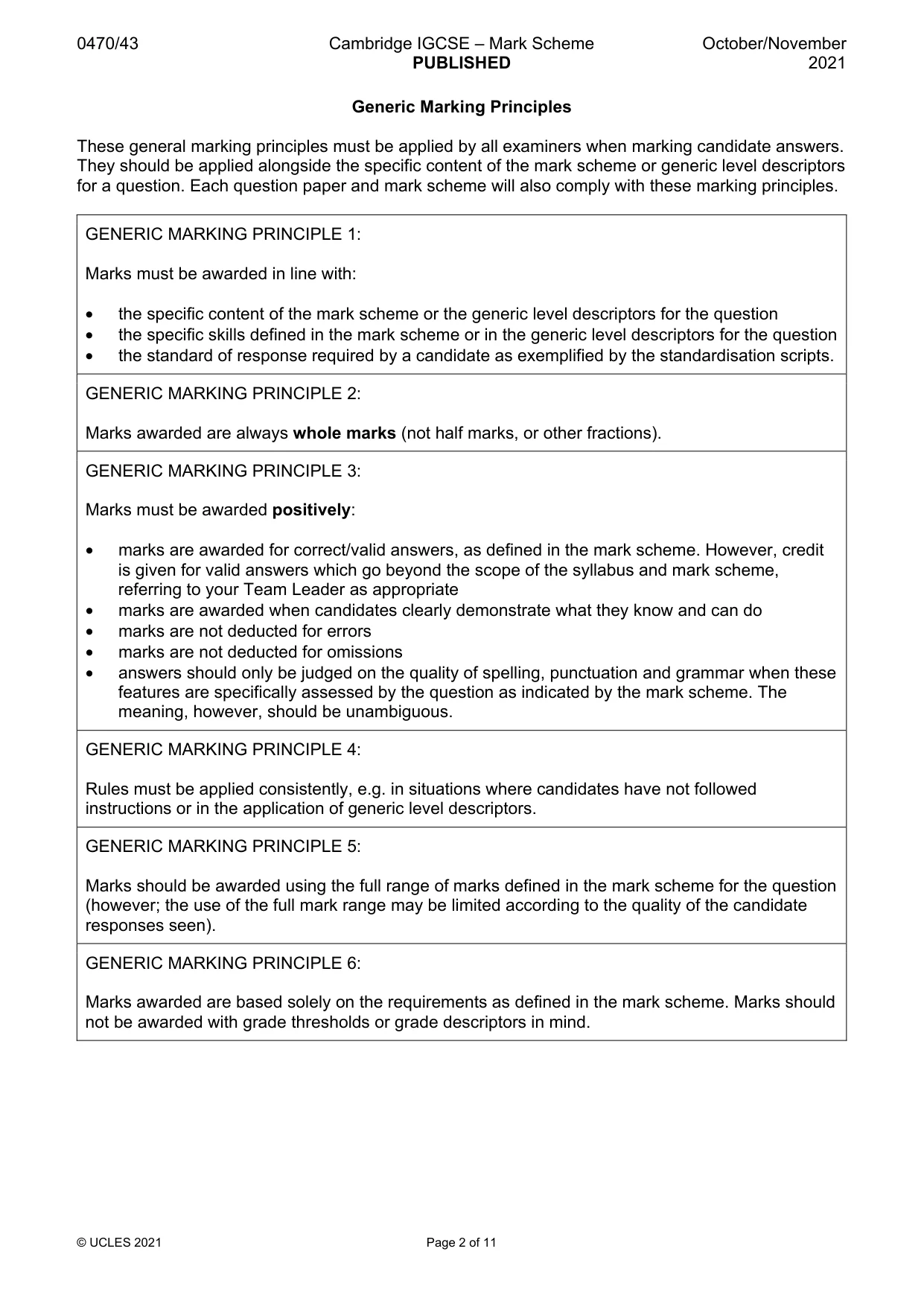
0470/43 Cambridge IGCSE – Mark Scheme PUBLISHED October/November 2021 © UCLES 2021 Page 2 of 11 Generic Marking Principles These general marking principles must be applied by all examiners when marking candidate answers. They should be applied alongside the specific content of the mark scheme or generic level descriptors for a question. Each question paper and mark scheme will also comply with these marking principles. GENERIC MARKING PRINCIPLE 1: Marks must be awarded in line with: • the specific content of the mark scheme or the generic level descriptors for the question • the specific skills defined in the mark scheme or in the generic level descriptors for the question • the standard of response required by a candidate as exemplified by the standardisation scripts. GENERIC MARKING PRINCIPLE 2: Marks awarded are always whole marks (not half marks, or other fractions). GENERIC MARKING PRINCIPLE 3: Marks must be awarded positively: • marks are awarded for correct/valid answers, as defined in the mark scheme. However, credit is given for valid answers which go beyond the scope of the syllabus and mark scheme, referring to your Team Leader as appropriate • marks are awarded when candidates clearly demonstrate what they know and can do • marks are not deducted for errors • marks are not deducted for omissions • answers should only be judged on the quality of spelling, punctuation and grammar when these features are specifically assessed by the question as indicated by the mark scheme. The meaning, however, should be unambiguous. GENERIC MARKING PRINCIPLE 4: Rules must be applied consistently, e.g. in situations where candidates have not followed instructions or in the application of generic level descriptors. GENERIC MARKING PRINCIPLE 5: Marks should be awarded using the full range of marks defined in the mark scheme for the question (however; the use of the full mark range may be limited according to the quality of the candidate responses seen). GENERIC MARKING PRINCIPLE 6: Marks awarded are based solely on the requirements as defined in the mark scheme. Marks should not be awarded with grade thresholds or grade descriptors in mind.
Mark scheme, page 3
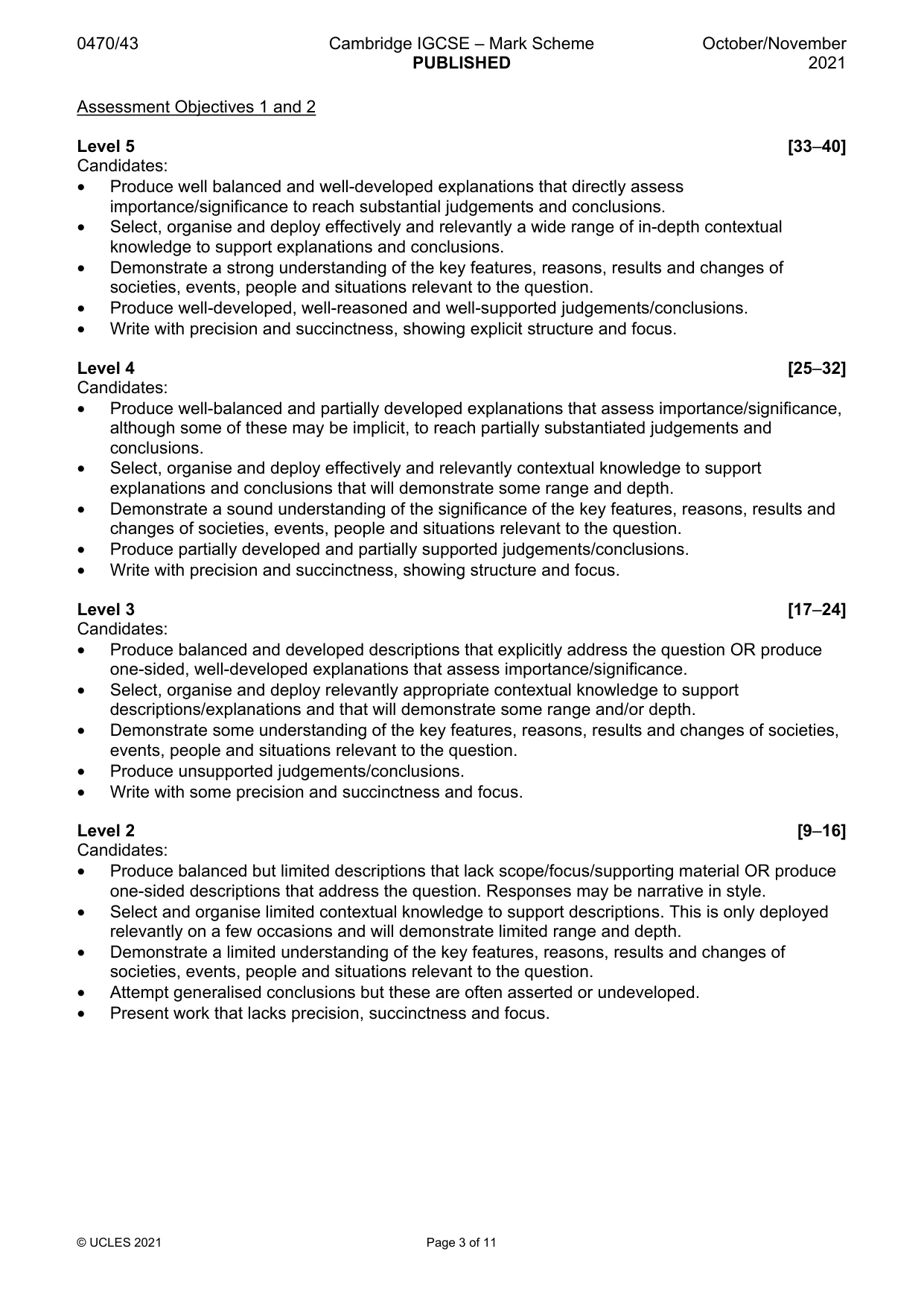
0470/43 Cambridge IGCSE – Mark Scheme PUBLISHED October/November 2021 © UCLES 2021 Page 3 of 11 Assessment Objectives 1 and 2 Level 5 [33–40] Candidates: • Produce well balanced and well-developed explanations that directly assess importance/significance to reach substantial judgements and conclusions. • Select, organise and deploy effectively and relevantly a wide range of in-depth contextual knowledge to support explanations and conclusions. • Demonstrate a strong understanding of the key features, reasons, results and changes of societies, events, people and situations relevant to the question. • Produce well-developed, well-reasoned and well-supported judgements/conclusions. • Write with precision and succinctness, showing explicit structure and focus. Level 4 [25–32] Candidates: • Produce well-balanced and partially developed explanations that assess importance/significance, although some of these may be implicit, to reach partially substantiated judgements and conclusions. • Select, organise and deploy effectively and relevantly contextual knowledge to support explanations and conclusions that will demonstrate some range and depth. • Demonstrate a sound understanding of the significance of the key features, reasons, results and changes of societies, events, people and situations relevant to the question. • Produce partially developed and partially supported judgements/conclusions. • Write with precision and succinctness, showing structure and focus. Level 3 [17–24] Candidates: • Produce balanced and developed descriptions that explicitly address the question OR produce one-sided, well-developed explanations that assess importance/significance. • Select, organise and deploy relevantly appropriate contextual knowledge to support descriptions/explanations and that will demonstrate some range and/or depth. • Demonstrate some understanding of the key features, reasons, results and changes of societies, events, people and situations relevant to the question. • Produce unsupported judgements/conclusions. • Write with some precision and succinctness and focus. Level 2 [9–16] Candidates: • Produce balanced but limited descriptions that lack scope/focus/supporting material OR produce one-sided descriptions that address the question. Responses may be narrative in style. • Select and organise limited contextual knowledge to support descriptions. This is only deployed relevantly on a few occasions and will demonstrate limited range and depth. • Demonstrate a limited understanding of the key features, reasons, results and changes of societies, events, people and situations relevant to the question. • Attempt generalised conclusions but these are often asserted or undeveloped. • Present work that lacks precision, succinctness and focus.
Mark scheme, page 4
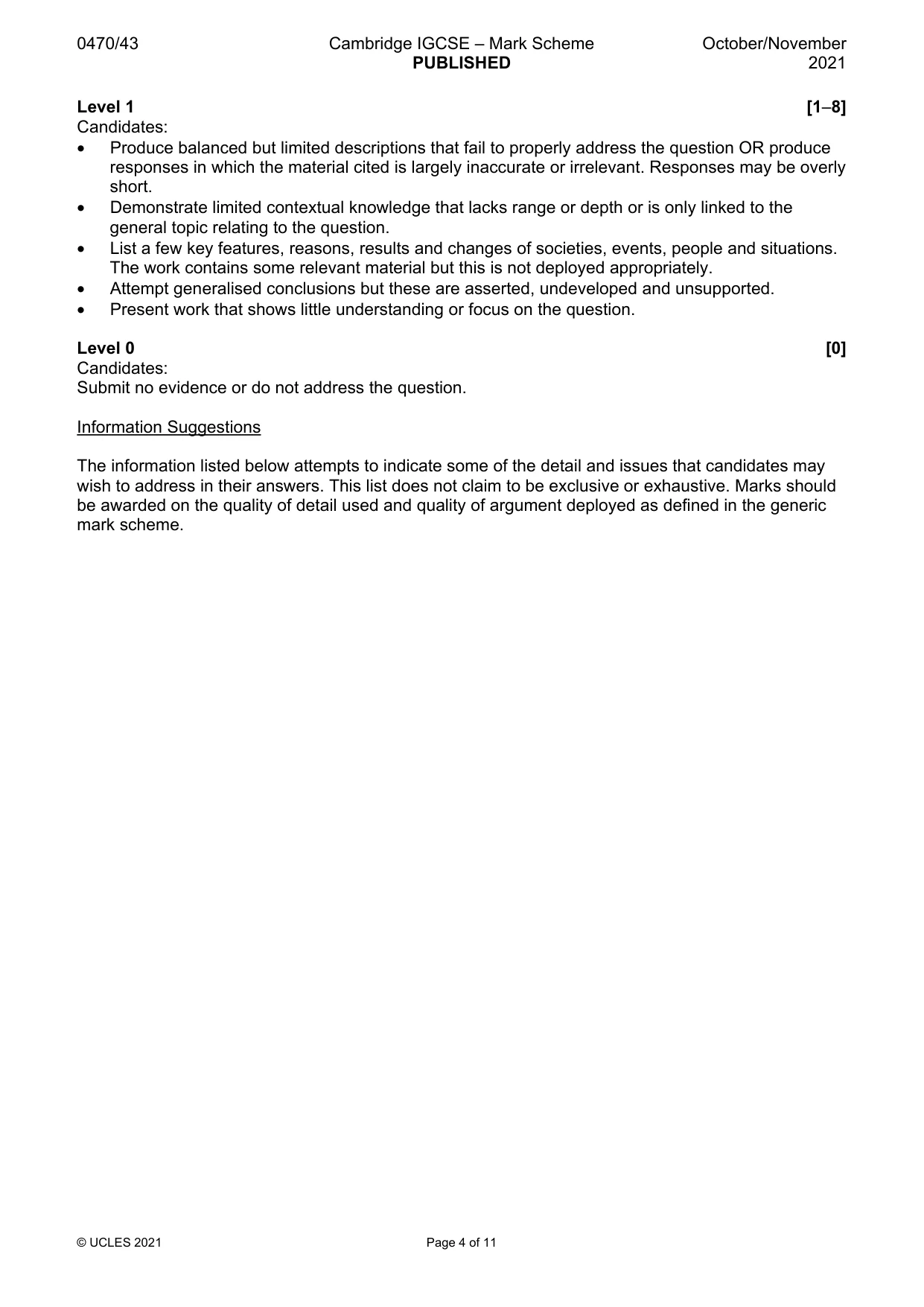
0470/43 Cambridge IGCSE – Mark Scheme PUBLISHED October/November 2021 © UCLES 2021 Page 4 of 11 Level 1 [1–8] Candidates: • Produce balanced but limited descriptions that fail to properly address the question OR produce responses in which the material cited is largely inaccurate or irrelevant. Responses may be overly short. • Demonstrate limited contextual knowledge that lacks range or depth or is only linked to the general topic relating to the question. • List a few key features, reasons, results and changes of societies, events, people and situations. The work contains some relevant material but this is not deployed appropriately. • Attempt generalised conclusions but these are asserted, undeveloped and unsupported. • Present work that shows little understanding or focus on the question. Level 0 [0] Candidates: Submit no evidence or do not address the question. Information Suggestions The information listed below attempts to indicate some of the detail and issues that candidates may wish to address in their answers. This list does not claim to be exclusive or exhaustive. Marks should be awarded on the quality of detail used and quality of argument deployed as defined in the generic mark scheme.
Mark scheme, page 5
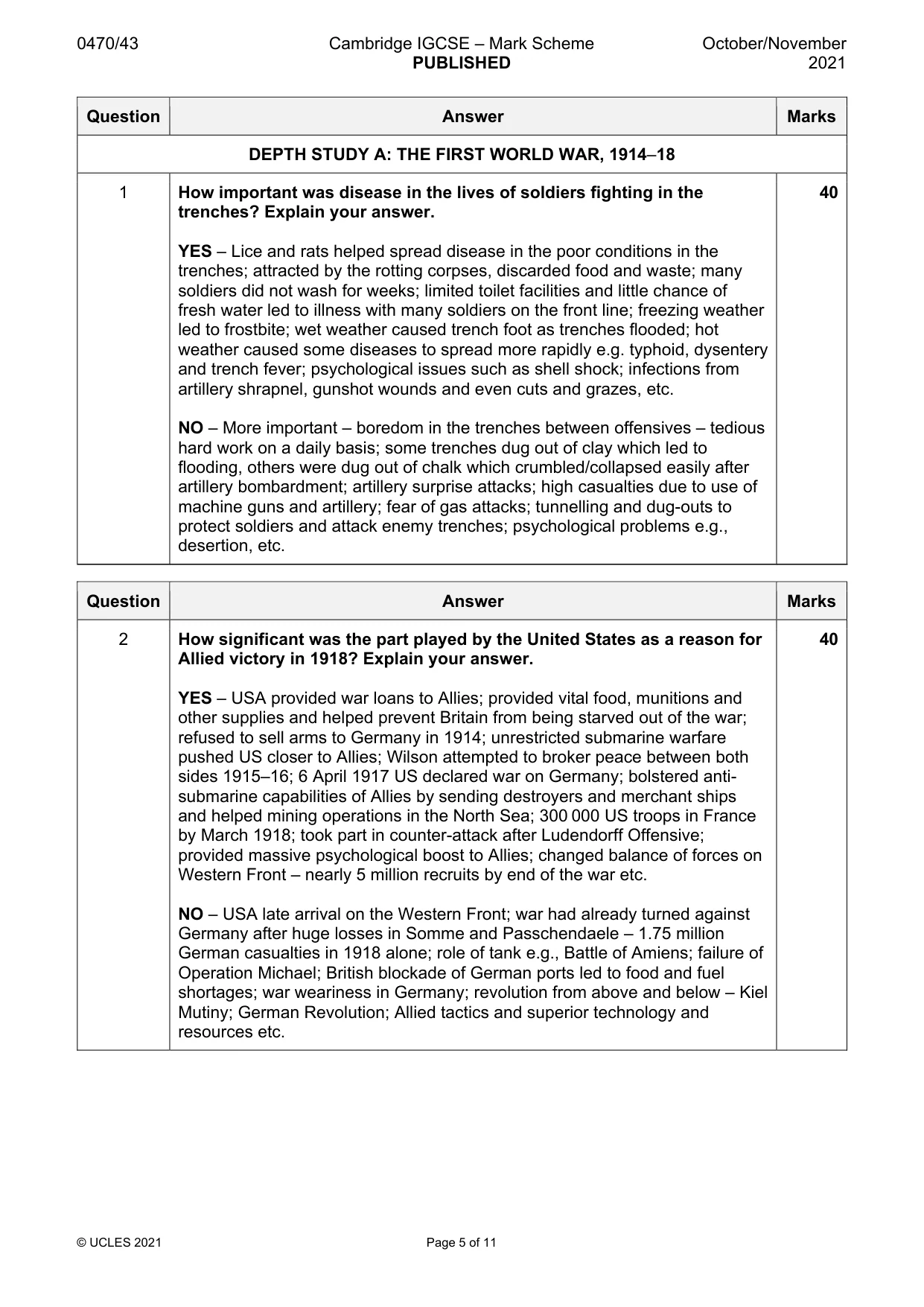
0470/43 Cambridge IGCSE – Mark Scheme PUBLISHED October/November 2021 © UCLES 2021 Page 5 of 11 Question Answer Marks DEPTH STUDY A: THE FIRST WORLD WAR, 1914–18 1 How important was disease in the lives of soldiers fighting in the trenches? Explain your answer. YES – Lice and rats helped spread disease in the poor conditions in the trenches; attracted by the rotting corpses, discarded food and waste; many soldiers did not wash for weeks; limited toilet facilities and little chance of fresh water led to illness with many soldiers on the front line; freezing weather led to frostbite; wet weather caused trench foot as trenches flooded; hot weather caused some diseases to spread more rapidly e.g. typhoid, dysentery and trench fever; psychological issues such as shell shock; infections from artillery shrapnel, gunshot wounds and even cuts and grazes, etc. NO – More important – boredom in the trenches between offensives – tedious hard work on a daily basis; some trenches dug out of clay which led to flooding, others were dug out of chalk which crumbled/collapsed easily after artillery bombardment; artillery surprise attacks; high casualties due to use of machine guns and artillery; fear of gas attacks; tunnelling and dug-outs to protect soldiers and attack enemy trenches; psychological problems e.g., desertion, etc. 40 Question Answer Marks 2 How significant was the part played by the United States as a reason for Allied victory in 1918? Explain your answer. YES – USA provided war loans to Allies; provided vital food, munitions and other supplies and helped prevent Britain from being starved out of the war; refused to sell arms to Germany in 1914; unrestricted submarine warfare pushed US closer to Allies; Wilson attempted to broker peace between both sides 1915–16; 6 April 1917 US declared war on Germany; bolstered anti- submarine capabilities of Allies by sending destroyers and merchant ships and helped mining operations in the North Sea; 300 000 US troops in France by March 1918; took part in counter-attack after Ludendorff Offensive; provided massive psychological boost to Allies; changed balance of forces on Western Front – nearly 5 million recruits by end of the war etc. NO – USA late arrival on the Western Front; war had already turned against Germany after huge losses in Somme and Passchendaele – 1.75 million German casualties in 1918 alone; role of tank e.g., Battle of Amiens; failure of Operation Michael; British blockade of German ports led to food and fuel shortages; war weariness in Germany; revolution from above and below – Kiel Mutiny; German Revolution; Allied tactics and superior technology and resources etc. 40
Mark scheme, page 6
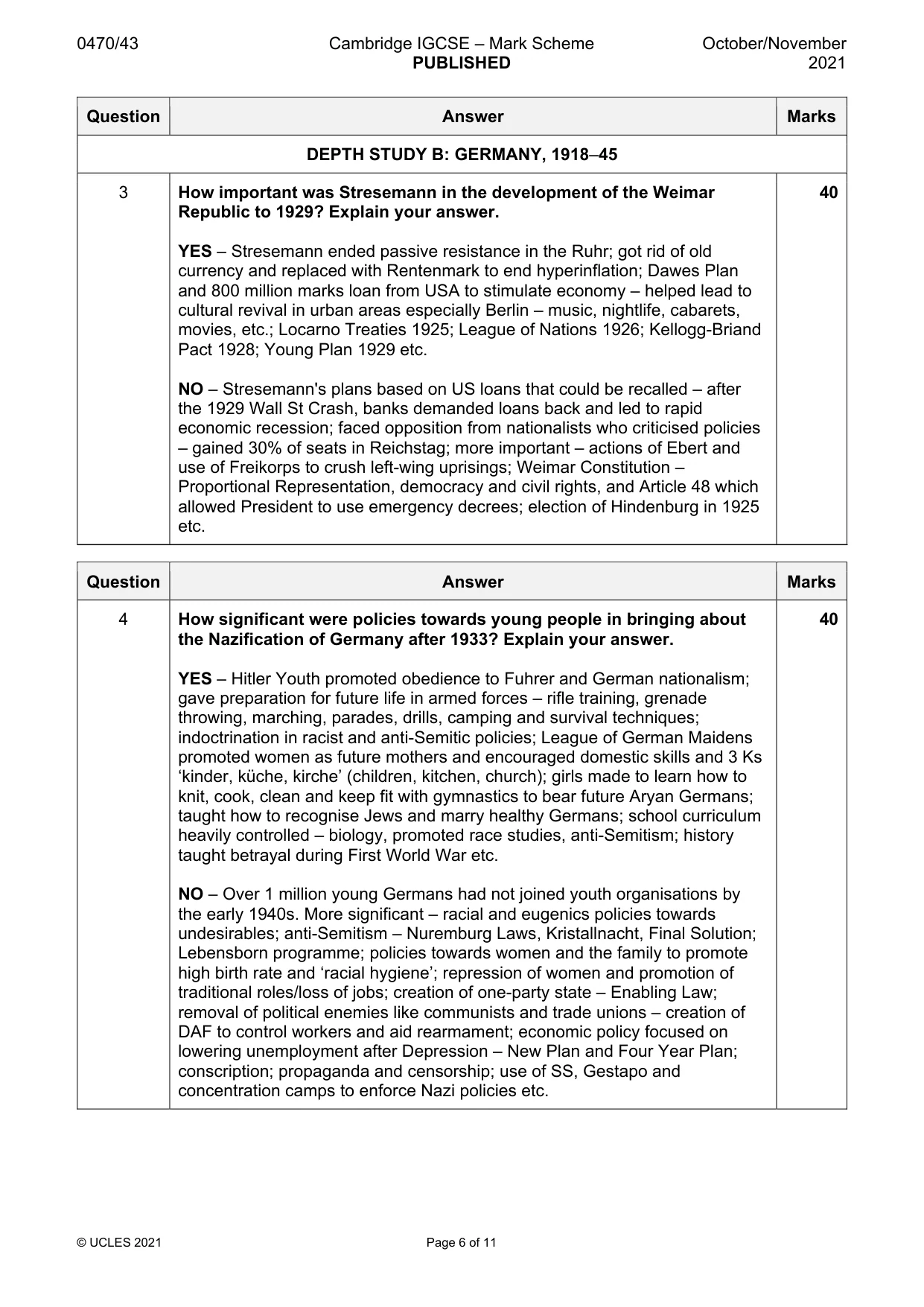
0470/43 Cambridge IGCSE – Mark Scheme PUBLISHED October/November 2021 © UCLES 2021 Page 6 of 11 Question Answer Marks DEPTH STUDY B: GERMANY, 1918–45 3 How important was Stresemann in the development of the Weimar Republic to 1929? Explain your answer. YES – Stresemann ended passive resistance in the Ruhr; got rid of old currency and replaced with Rentenmark to end hyperinflation; Dawes Plan and 800 million marks loan from USA to stimulate economy – helped lead to cultural revival in urban areas especially Berlin – music, nightlife, cabarets, movies, etc.; Locarno Treaties 1925; League of Nations 1926; Kellogg-Briand Pact 1928; Young Plan 1929 etc. NO – Stresemann's plans based on US loans that could be recalled – after the 1929 Wall St Crash, banks demanded loans back and led to rapid economic recession; faced opposition from nationalists who criticised policies – gained 30% of seats in Reichstag; more important – actions of Ebert and use of Freikorps to crush left-wing uprisings; Weimar Constitution – Proportional Representation, democracy and civil rights, and Article 48 which allowed President to use emergency decrees; election of Hindenburg in 1925 etc. 40 Question Answer Marks 4 How significant were policies towards young people in bringing about the Nazification of Germany after 1933? Explain your answer. YES – Hitler Youth promoted obedience to Fuhrer and German nationalism; gave preparation for future life in armed forces – rifle training, grenade throwing, marching, parades, drills, camping and survival techniques; indoctrination in racist and anti-Semitic policies; League of German Maidens promoted women as future mothers and encouraged domestic skills and 3 Ks ‘kinder, küche, kirche’ (children, kitchen, church); girls made to learn how to knit, cook, clean and keep fit with gymnastics to bear future Aryan Germans; taught how to recognise Jews and marry healthy Germans; school curriculum heavily controlled – biology, promoted race studies, anti-Semitism; history taught betrayal during First World War etc. NO – Over 1 million young Germans had not joined youth organisations by the early 1940s. More significant – racial and eugenics policies towards undesirables; anti-Semitism – Nuremburg Laws, Kristallnacht, Final Solution; Lebensborn programme; policies towards women and the family to promote high birth rate and ‘racial hygiene’; repression of women and promotion of traditional roles/loss of jobs; creation of one-party state – Enabling Law; removal of political enemies like communists and trade unions – creation of DAF to control workers and aid rearmament; economic policy focused on lowering unemployment after Depression – New Plan and Four Year Plan; conscription; propaganda and censorship; use of SS, Gestapo and concentration camps to enforce Nazi policies etc. 40
Mark scheme, page 7
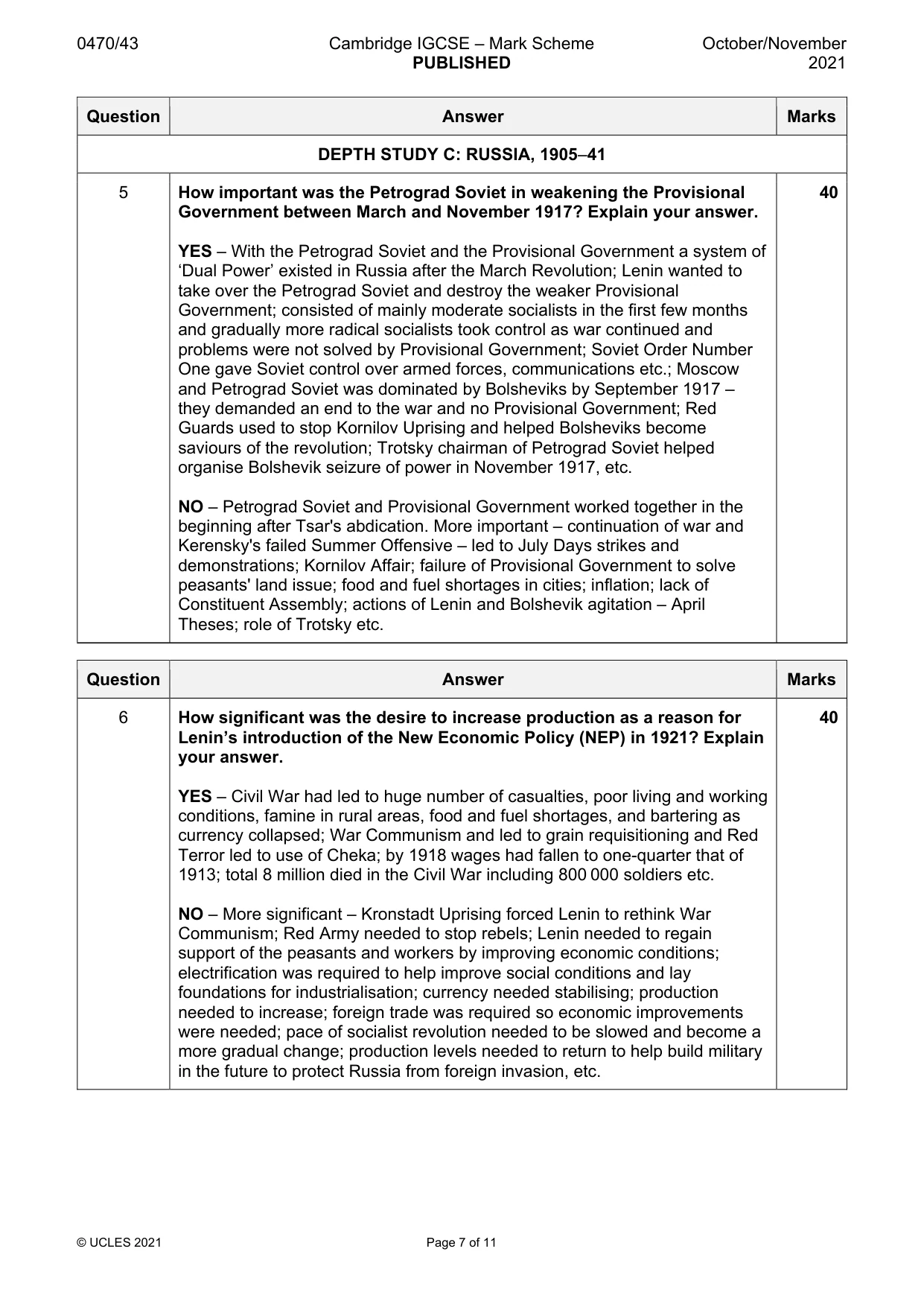
0470/43 Cambridge IGCSE – Mark Scheme PUBLISHED October/November 2021 © UCLES 2021 Page 7 of 11 Question Answer Marks DEPTH STUDY C: RUSSIA, 1905–41 5 How important was the Petrograd Soviet in weakening the Provisional Government between March and November 1917? Explain your answer. YES – With the Petrograd Soviet and the Provisional Government a system of ‘Dual Power’ existed in Russia after the March Revolution; Lenin wanted to take over the Petrograd Soviet and destroy the weaker Provisional Government; consisted of mainly moderate socialists in the first few months and gradually more radical socialists took control as war continued and problems were not solved by Provisional Government; Soviet Order Number One gave Soviet control over armed forces, communications etc.; Moscow and Petrograd Soviet was dominated by Bolsheviks by September 1917 – they demanded an end to the war and no Provisional Government; Red Guards used to stop Kornilov Uprising and helped Bolsheviks become saviours of the revolution; Trotsky chairman of Petrograd Soviet helped organise Bolshevik seizure of power in November 1917, etc. NO – Petrograd Soviet and Provisional Government worked together in the beginning after Tsar's abdication. More important – continuation of war and Kerensky's failed Summer Offensive – led to July Days strikes and demonstrations; Kornilov Affair; failure of Provisional Government to solve peasants' land issue; food and fuel shortages in cities; inflation; lack of Constituent Assembly; actions of Lenin and Bolshevik agitation – April Theses; role of Trotsky etc. 40 Question Answer Marks 6 How significant was the desire to increase production as a reason for Lenin’s introduction of the New Economic Policy (NEP) in 1921? Explain your answer. YES – Civil War had led to huge number of casualties, poor living and working conditions, famine in rural areas, food and fuel shortages, and bartering as currency collapsed; War Communism and led to grain requisitioning and Red Terror led to use of Cheka; by 1918 wages had fallen to one-quarter that of 1913; total 8 million died in the Civil War including 800 000 soldiers etc. NO – More significant – Kronstadt Uprising forced Lenin to rethink War Communism; Red Army needed to stop rebels; Lenin needed to regain support of the peasants and workers by improving economic conditions; electrification was required to help improve social conditions and lay foundations for industrialisation; currency needed stabilising; production needed to increase; foreign trade was required so economic improvements were needed; pace of socialist revolution needed to be slowed and become a more gradual change; production levels needed to return to help build military in the future to protect Russia from foreign invasion, etc. 40
Mark scheme, page 8
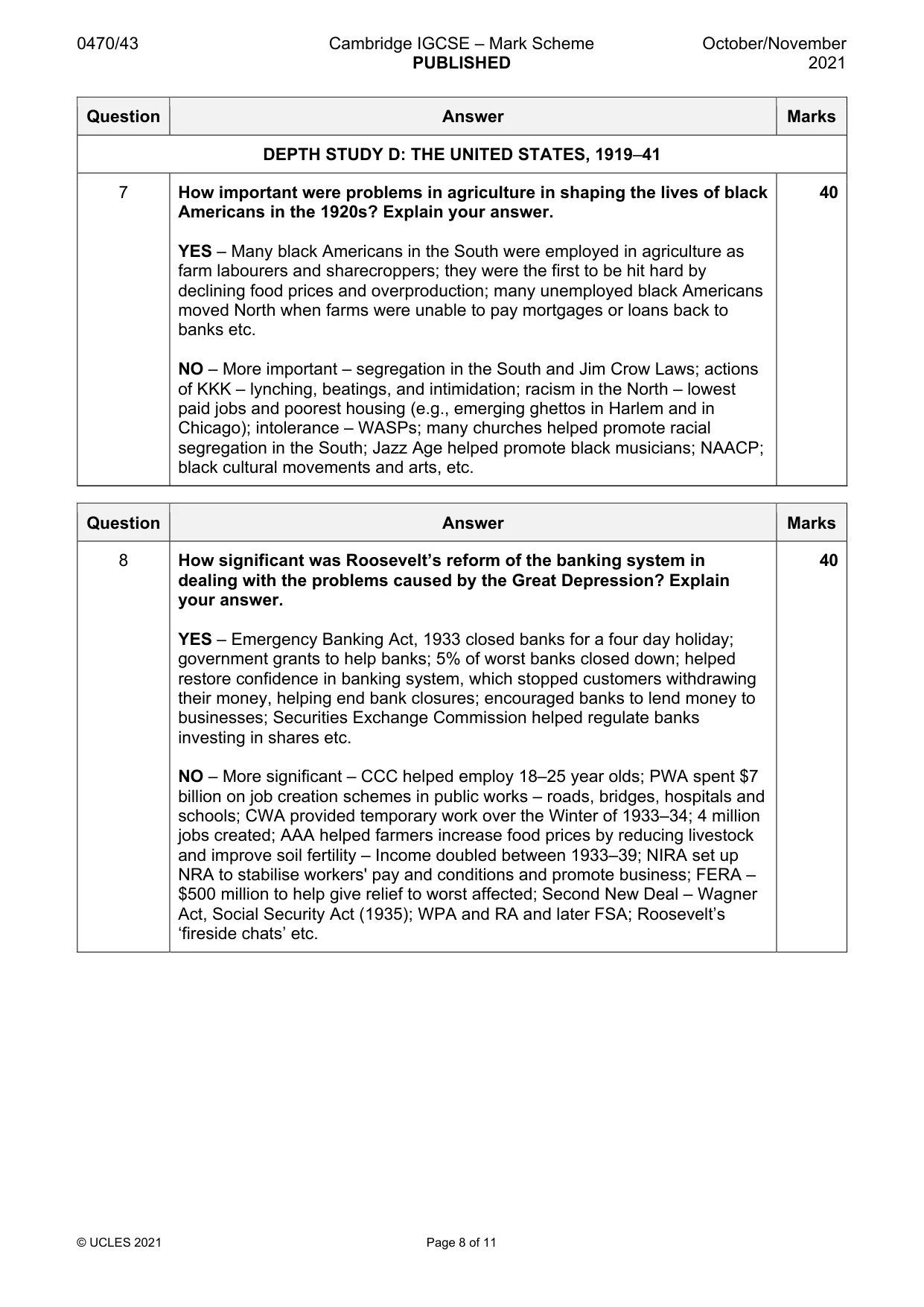
0470/43 Cambridge IGCSE – Mark Scheme PUBLISHED October/November 2021 © UCLES 2021 Page 8 of 11 Question Answer Marks DEPTH STUDY D: THE UNITED STATES, 1919–41 7 How important were problems in agriculture in shaping the lives of black Americans in the 1920s? Explain your answer. YES – Many black Americans in the South were employed in agriculture as farm labourers and sharecroppers; they were the first to be hit hard by declining food prices and overproduction; many unemployed black Americans moved North when farms were unable to pay mortgages or loans back to banks etc. NO – More important – segregation in the South and Jim Crow Laws; actions of KKK – lynching, beatings, and intimidation; racism in the North – lowest paid jobs and poorest housing (e.g., emerging ghettos in Harlem and in Chicago); intolerance – WASPs; many churches helped promote racial segregation in the South; Jazz Age helped promote black musicians; NAACP; black cultural movements and arts, etc. 40 Question Answer Marks 8 How significant was Roosevelt’s reform of the banking system in dealing with the problems caused by the Great Depression? Explain your answer. YES – Emergency Banking Act, 1933 closed banks for a four day holiday; government grants to help banks; 5% of worst banks closed down; helped restore confidence in banking system, which stopped customers withdrawing their money, helping end bank closures; encouraged banks to lend money to businesses; Securities Exchange Commission helped regulate banks investing in shares etc. NO – More significant – CCC helped employ 18–25 year olds; PWA spent $7 billion on job creation schemes in public works – roads, bridges, hospitals and schools; CWA provided temporary work over the Winter of 1933–34; 4 million jobs created; AAA helped farmers increase food prices by reducing livestock and improve soil fertility – Income doubled between 1933–39; NIRA set up NRA to stabilise workers' pay and conditions and promote business; FERA – $500 million to help give relief to worst affected; Second New Deal – Wagner Act, Social Security Act (1935); WPA and RA and later FSA; Roosevelt’s ‘fireside chats’ etc. 40
Mark scheme, page 9
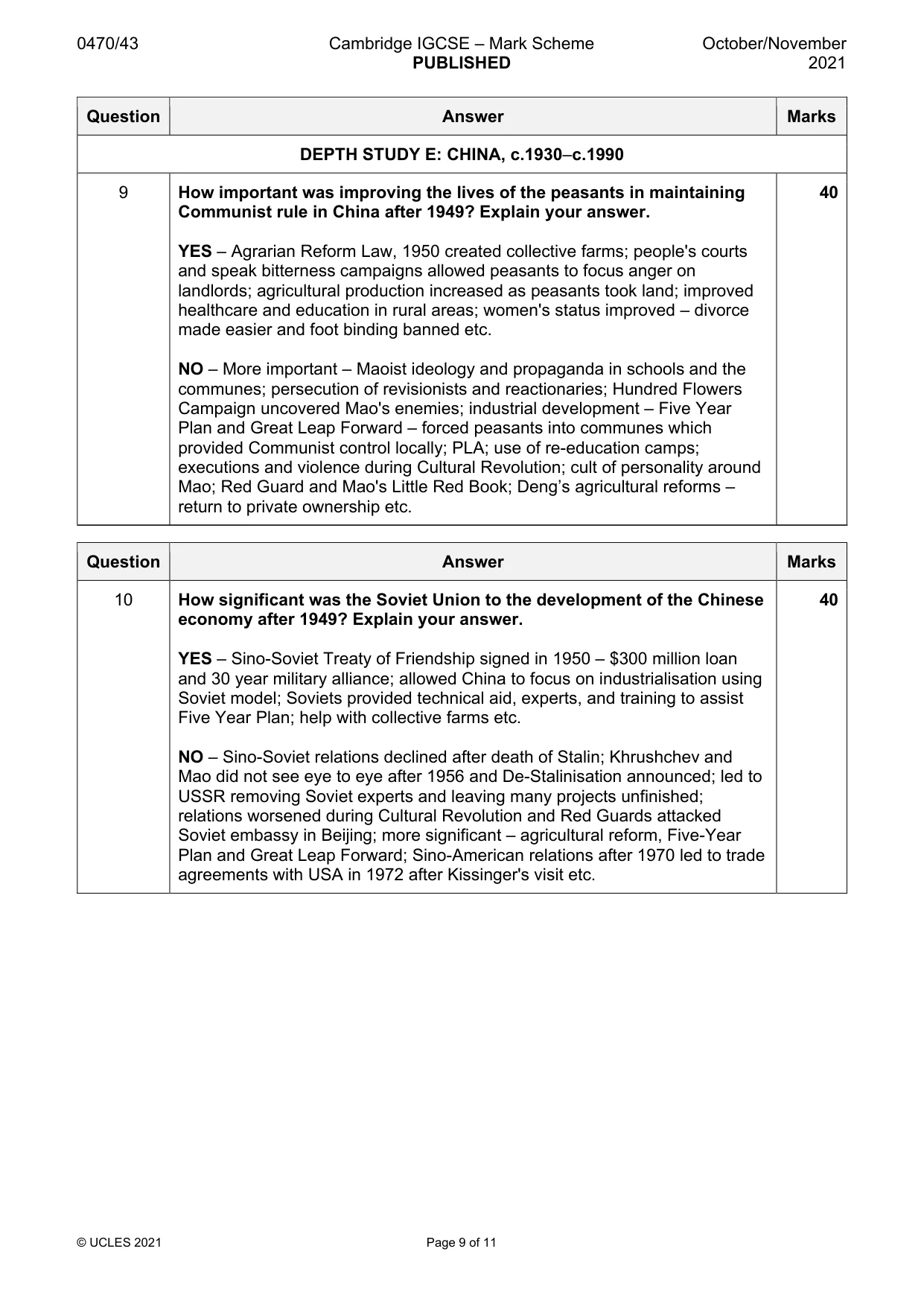
0470/43 Cambridge IGCSE – Mark Scheme PUBLISHED October/November 2021 © UCLES 2021 Page 9 of 11 Question Answer Marks DEPTH STUDY E: CHINA, c.1930–c.1990 9 How important was improving the lives of the peasants in maintaining Communist rule in China after 1949? Explain your answer. YES – Agrarian Reform Law, 1950 created collective farms; people's courts and speak bitterness campaigns allowed peasants to focus anger on landlords; agricultural production increased as peasants took land; improved healthcare and education in rural areas; women's status improved – divorce made easier and foot binding banned etc. NO – More important – Maoist ideology and propaganda in schools and the communes; persecution of revisionists and reactionaries; Hundred Flowers Campaign uncovered Mao's enemies; industrial development – Five Year Plan and Great Leap Forward – forced peasants into communes which provided Communist control locally; PLA; use of re-education camps; executions and violence during Cultural Revolution; cult of personality around Mao; Red Guard and Mao's Little Red Book; Deng’s agricultural reforms – return to private ownership etc. 40 Question Answer Marks 10 How significant was the Soviet Union to the development of the Chinese economy after 1949? Explain your answer. YES – Sino-Soviet Treaty of Friendship signed in 1950 – $300 million loan and 30 year military alliance; allowed China to focus on industrialisation using Soviet model; Soviets provided technical aid, experts, and training to assist Five Year Plan; help with collective farms etc. NO – Sino-Soviet relations declined after death of Stalin; Khrushchev and Mao did not see eye to eye after 1956 and De-Stalinisation announced; led to USSR removing Soviet experts and leaving many projects unfinished; relations worsened during Cultural Revolution and Red Guards attacked Soviet embassy in Beijing; more significant – agricultural reform, Five-Year Plan and Great Leap Forward; Sino-American relations after 1970 led to trade agreements with USA in 1972 after Kissinger's visit etc. 40
Mark scheme, page 10
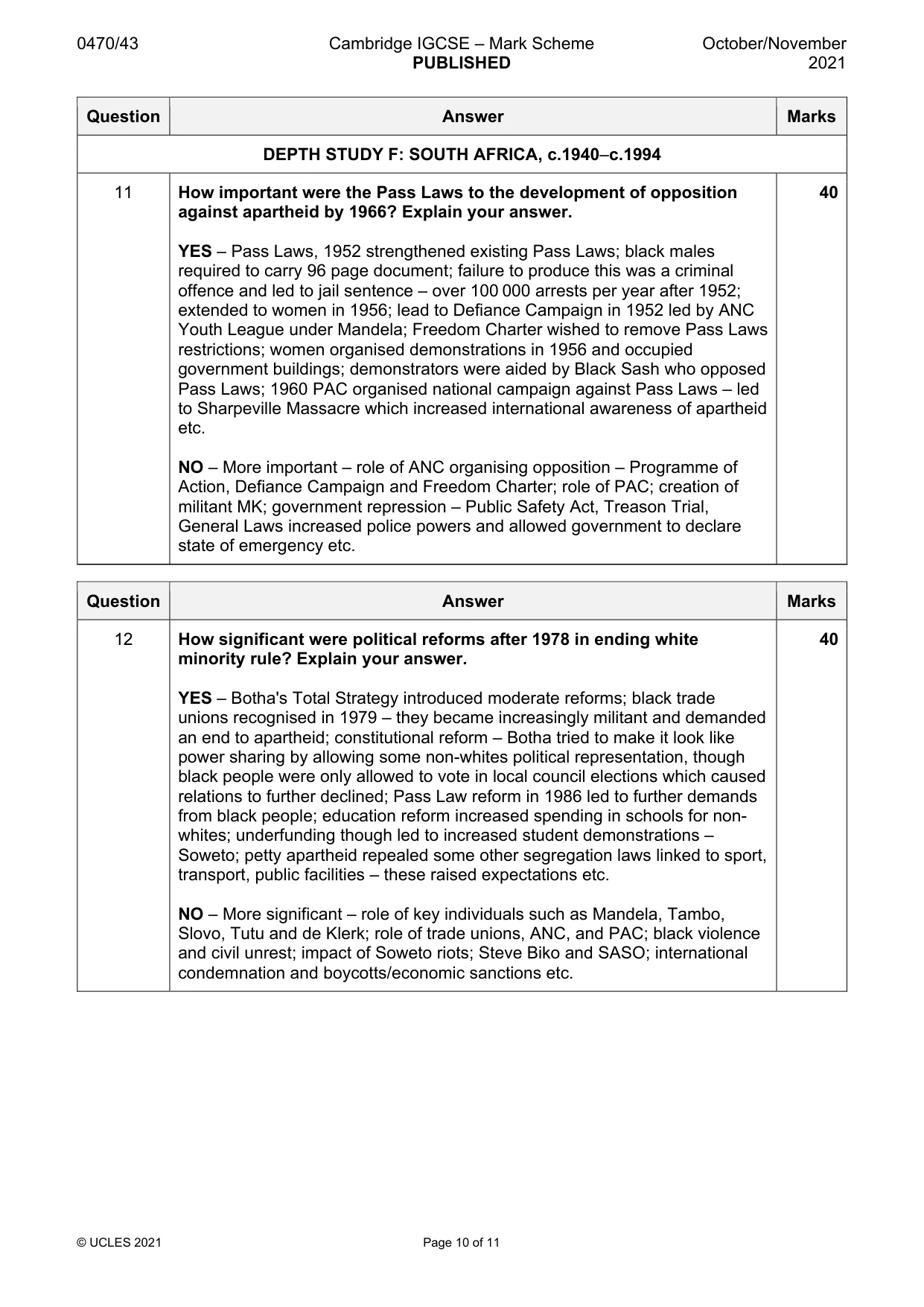
0470/43 Cambridge IGCSE – Mark Scheme PUBLISHED October/November 2021 © UCLES 2021 Page 10 of 11 Question Answer Marks DEPTH STUDY F: SOUTH AFRICA, c.1940–c.1994 11 How important were the Pass Laws to the development of opposition against apartheid by 1966? Explain your answer. YES – Pass Laws, 1952 strengthened existing Pass Laws; black males required to carry 96 page document; failure to produce this was a criminal offence and led to jail sentence – over 100 000 arrests per year after 1952; extended to women in 1956; lead to Defiance Campaign in 1952 led by ANC Youth League under Mandela; Freedom Charter wished to remove Pass Laws restrictions; women organised demonstrations in 1956 and occupied government buildings; demonstrators were aided by Black Sash who opposed Pass Laws; 1960 PAC organised national campaign against Pass Laws – led to Sharpeville Massacre which increased international awareness of apartheid etc. NO – More important – role of ANC organising opposition – Programme of Action, Defiance Campaign and Freedom Charter; role of PAC; creation of militant MK; government repression – Public Safety Act, Treason Trial, General Laws increased police powers and allowed government to declare state of emergency etc. 40 Question Answer Marks 12 How significant were political reforms after 1978 in ending white minority rule? Explain your answer. YES – Botha's Total Strategy introduced moderate reforms; black trade unions recognised in 1979 – they became increasingly militant and demanded an end to apartheid; constitutional reform – Botha tried to make it look like power sharing by allowing some non-whites political representation, though black people were only allowed to vote in local council elections which caused relations to further declined; Pass Law reform in 1986 led to further demands from black people; education reform increased spending in schools for non- whites; underfunding though led to increased student demonstrations – Soweto; petty apartheid repealed some other segregation laws linked to sport, transport, public facilities – these raised expectations etc. NO – More significant – role of key individuals such as Mandela, Tambo, Slovo, Tutu and de Klerk; role of trade unions, ANC, and PAC; black violence and civil unrest; impact of Soweto riots; Steve Biko and SASO; international condemnation and boycotts/economic sanctions etc. 40
Mark scheme, page 11
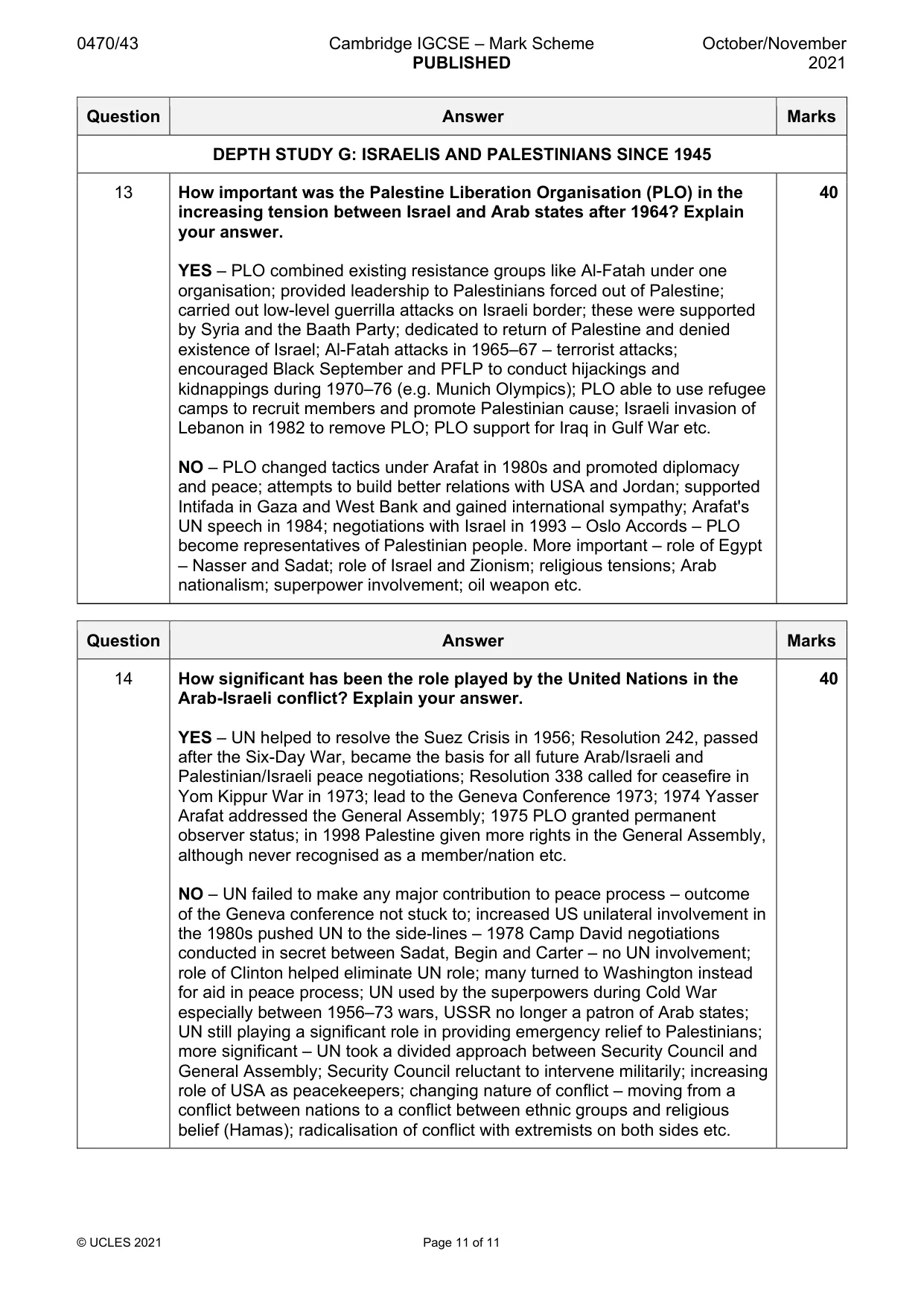
0470/43 Cambridge IGCSE – Mark Scheme PUBLISHED October/November 2021 © UCLES 2021 Page 11 of 11 Question Answer Marks DEPTH STUDY G: ISRAELIS AND PALESTINIANS SINCE 1945 13 How important was the Palestine Liberation Organisation (PLO) in the increasing tension between Israel and Arab states after 1964? Explain your answer. YES – PLO combined existing resistance groups like Al-Fatah under one organisation; provided leadership to Palestinians forced out of Palestine; carried out low-level guerrilla attacks on Israeli border; these were supported by Syria and the Baath Party; dedicated to return of Palestine and denied existence of Israel; Al-Fatah attacks in 1965–67 – terrorist attacks; encouraged Black September and PFLP to conduct hijackings and kidnappings during 1970–76 (e.g. Munich Olympics); PLO able to use refugee camps to recruit members and promote Palestinian cause; Israeli invasion of Lebanon in 1982 to remove PLO; PLO support for Iraq in Gulf War etc. NO – PLO changed tactics under Arafat in 1980s and promoted diplomacy and peace; attempts to build better relations with USA and Jordan; supported Intifada in Gaza and West Bank and gained international sympathy; Arafat's UN speech in 1984; negotiations with Israel in 1993 – Oslo Accords – PLO become representatives of Palestinian people. More important – role of Egypt – Nasser and Sadat; role of Israel and Zionism; religious tensions; Arab nationalism; superpower involvement; oil weapon etc. 40 Question Answer Marks 14 How significant has been the role played by the United Nations in the Arab-Israeli conflict? Explain your answer. YES – UN helped to resolve the Suez Crisis in 1956; Resolution 242, passed after the Six-Day War, became the basis for all future Arab/Israeli and Palestinian/Israeli peace negotiations; Resolution 338 called for ceasefire in Yom Kippur War in 1973; lead to the Geneva Conference 1973; 1974 Yasser Arafat addressed the General Assembly; 1975 PLO granted permanent observer status; in 1998 Palestine given more rights in the General Assembly, although never recognised as a member/nation etc. NO – UN failed to make any major contribution to peace process – outcome of the Geneva conference not stuck to; increased US unilateral involvement in the 1980s pushed UN to the side-lines – 1978 Camp David negotiations conducted in secret between Sadat, Begin and Carter – no UN involvement; role of Clinton helped eliminate UN role; many turned to Washington instead for aid in peace process; UN used by the superpowers during Cold War especially between 1956–73 wars, USSR no longer a patron of Arab states; UN still playing a significant role in providing emergency relief to Palestinians; more significant – UN took a divided approach between Security Council and General Assembly; Security Council reluctant to intervene militarily; increasing role of USA as peacekeepers; changing nature of conflict – moving from a conflict between nations to a conflict between ethnic groups and religious belief (Hamas); radicalisation of conflict with extremists on both sides etc. 40
What you needed in this session
Cambridge’s own grade thresholds for 2021 Oct/Nov, Paper 4 · Variant 3. A higher threshold means an easier paper — the bar moves with how the cohort did.