Cambridge IGCSE History 0470 — 2021 Oct/Nov Paper 4 · Variant 1
0470/41/O/N/21 · 40 marks · ≈45 min
The question paper and its mark scheme, free to read here and free to download. This is Cambridge’s own paper, exactly as it was sat.
Question paper4 pages

Mark scheme11 pages
Answers below. Sit the paper first if you are practising.

Paper as text
Question paper, page 1
Cambridge IGCSE™ 0470/41 October/November 2021 1 hour HISTORY Paper 4 Alternative to Coursework You must answer on the enclosed answer booklet. You will need: Answer booklet (enclosed) INSTRUCTIONS • Answer one question from your chosen Depth Study. • Follow the instructions on the front cover of the answer booklet. If you need additional answer paper, ask the invigilator for a continuation booklet. INFORMATION • The total mark for this paper is 40. • The number of marks for each question or part question is shown in brackets [ ]. This document has 4 pages. Any blank pages are indicated. [Turn over 11_0470_41_2021_1.6 © UCLES 2021 *1947640068*
Question paper, page 2
Answer one question from your chosen Depth Study. DEPTH STUDY A: THE FIRST WORLD WAR, 1914–18 How important was British and French resistance as a factor in the failure of the Schlieffen Plan? Explain your answer. [40] 1 How significant was the machine gun as a cause of the stalemate on the Western Front? Explain your answer. [40] 2 DEPTH STUDY B: GERMANY, 1918–45 How important was the occupation of the Ruhr amongst the social and economic problems in Weimar Germany, 1919–24? Explain your answer. [40] 3 How significant was the Second World War in determining Nazi policies towards the Jews? Explain your answer. [40] 4 DEPTH STUDY C: RUSSIA, 1905–41 How important was the 1905 Revolution in weakening the Tsarist system of government to 1914? Explain your answer. [40] 5 How significant were policies towards women amongst the social changes in Stalin’s Russia after 1928? Explain your answer. [40] 6 DEPTH STUDY D: THE UNITED STATES, 1919–41 How important was the loss of foreign markets as a reason why US agriculture did not prosper in the 1920s? Explain your answer. [40] 7 How significant was the Red Scare as an aspect of intolerance in US society in the 1920s? Explain your answer. [40] 8 DEPTH STUDY E: CHINA, c.1930–c.1990 How important was the Second World War in the rivalry between the Nationalist government and the Chinese Communist Party? Explain your answer. [40] 9 How significant was the Great Leap Forward in Mao's modernisation of China? Explain your answer. [40] 10 11_0470_41_2021_1.6 © UCLES 2021 2
Question paper, page 3
DEPTH STUDY F: SOUTH AFRICA, c.1940–c.1994 How important was economic growth in shaping the lives of South Africans before 1948? Explain your answer. [40] 11 How significant in the resistance to apartheid was the South African Students' Organisation (SASO)? Explain your answer. [40] 12 DEPTH STUDY G: ISRAELIS AND PALESTINIANS SINCE 1945 How important was President Nasser as a cause of the Suez War in 1956? Explain your answer. [40] 13 How significant were Palestinian militants as a factor shaping the Palestinian peace process? Explain your answer. [40] 14 11_0470_41_2021_1.6 © UCLES 2021 3
Question paper, page 4
BLANK PAGE Permission to reproduce items where third-party owned material protected by copyright is included has been sought and cleared where possible. Every reasonable effort has been made by the publisher (UCLES) to trace copyright holders, but if any items requiring clearance have unwittingly been included, the publisher will be pleased to make amends at the earliest possible opportunity. To avoid the issue of disclosure of answer-related information to candidates, all copyright acknowledgements are reproduced online in the Cambridge Assessment International Education Copyright Acknowledgements Booklet. This is produced for each series of examinations and is freely available to download at www.cambridgeinternational.org after the live examination series. Cambridge Assessment International Education is part of the Cambridge Assessment Group. Cambridge Assessment is the brand name of the University of Cambridge Local Examinations Syndicate (UCLES), which itself is a department of the University of Cambridge. 11_0470_41_2021_1.6 © UCLES 2021 4
Mark scheme, page 1
This document consists of 11 printed pages. © UCLES 2021 [Turn over Cambridge IGCSE™ HISTORY 0470/41 Paper 4 Alternative to Coursework October/November 2021 MARK SCHEME Maximum Mark: 40 Published This mark scheme is published as an aid to teachers and candidates, to indicate the requirements of the examination. It shows the basis on which Examiners were instructed to award marks. It does not indicate the details of the discussions that took place at an Examiners’ meeting before marking began, which would have considered the acceptability of alternative answers. Mark schemes should be read in conjunction with the question paper and the Principal Examiner Report for Teachers. Cambridge International will not enter into discussions about these mark schemes. Cambridge International is publishing the mark schemes for the October/November 2021 series for most Cambridge IGCSE™, Cambridge International A and AS Level components and some Cambridge O Level components.
Mark scheme, page 2
0470/41 Cambridge IGCSE – Mark Scheme PUBLISHED October/November 2021 © UCLES 2021 Page 2 of 11 Generic Marking Principles These general marking principles must be applied by all examiners when marking candidate answers. They should be applied alongside the specific content of the mark scheme or generic level descriptors for a question. Each question paper and mark scheme will also comply with these marking principles. GENERIC MARKING PRINCIPLE 1: Marks must be awarded in line with: • the specific content of the mark scheme or the generic level descriptors for the question • the specific skills defined in the mark scheme or in the generic level descriptors for the question • the standard of response required by a candidate as exemplified by the standardisation scripts. GENERIC MARKING PRINCIPLE 2: Marks awarded are always whole marks (not half marks, or other fractions). GENERIC MARKING PRINCIPLE 3: Marks must be awarded positively: • marks are awarded for correct/valid answers, as defined in the mark scheme. However, credit is given for valid answers which go beyond the scope of the syllabus and mark scheme, referring to your Team Leader as appropriate • marks are awarded when candidates clearly demonstrate what they know and can do • marks are not deducted for errors • marks are not deducted for omissions • answers should only be judged on the quality of spelling, punctuation and grammar when these features are specifically assessed by the question as indicated by the mark scheme. The meaning, however, should be unambiguous. GENERIC MARKING PRINCIPLE 4: Rules must be applied consistently, e.g. in situations where candidates have not followed instructions or in the application of generic level descriptors. GENERIC MARKING PRINCIPLE 5: Marks should be awarded using the full range of marks defined in the mark scheme for the question (however; the use of the full mark range may be limited according to the quality of the candidate responses seen). GENERIC MARKING PRINCIPLE 6: Marks awarded are based solely on the requirements as defined in the mark scheme. Marks should not be awarded with grade thresholds or grade descriptors in mind.
Mark scheme, page 3
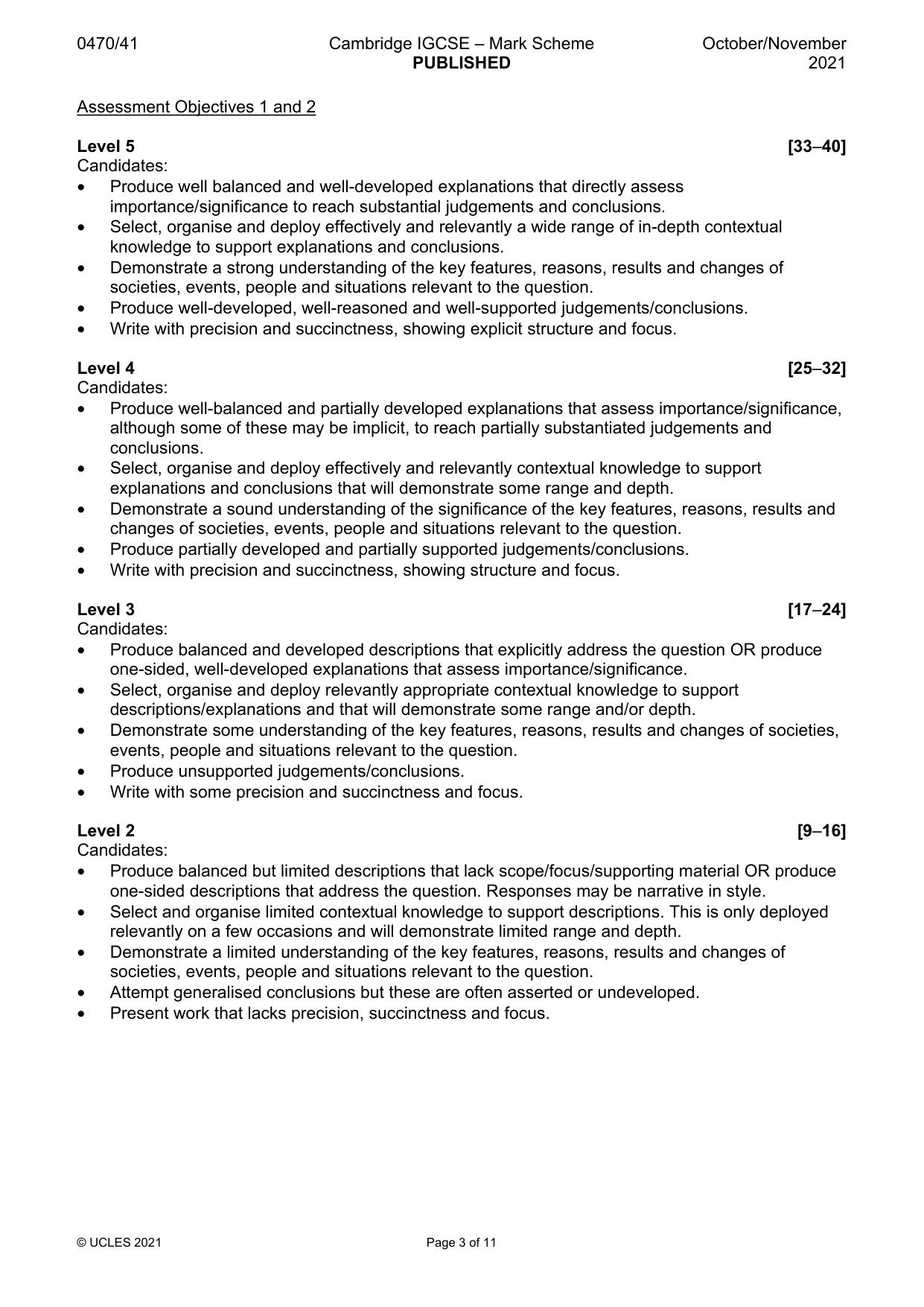
0470/41 Cambridge IGCSE – Mark Scheme PUBLISHED October/November 2021 © UCLES 2021 Page 3 of 11 Assessment Objectives 1 and 2 Level 5 [33–40] Candidates: • Produce well balanced and well-developed explanations that directly assess importance/significance to reach substantial judgements and conclusions. • Select, organise and deploy effectively and relevantly a wide range of in-depth contextual knowledge to support explanations and conclusions. • Demonstrate a strong understanding of the key features, reasons, results and changes of societies, events, people and situations relevant to the question. • Produce well-developed, well-reasoned and well-supported judgements/conclusions. • Write with precision and succinctness, showing explicit structure and focus. Level 4 [25–32] Candidates: • Produce well-balanced and partially developed explanations that assess importance/significance, although some of these may be implicit, to reach partially substantiated judgements and conclusions. • Select, organise and deploy effectively and relevantly contextual knowledge to support explanations and conclusions that will demonstrate some range and depth. • Demonstrate a sound understanding of the significance of the key features, reasons, results and changes of societies, events, people and situations relevant to the question. • Produce partially developed and partially supported judgements/conclusions. • Write with precision and succinctness, showing structure and focus. Level 3 [17–24] Candidates: • Produce balanced and developed descriptions that explicitly address the question OR produce one-sided, well-developed explanations that assess importance/significance. • Select, organise and deploy relevantly appropriate contextual knowledge to support descriptions/explanations and that will demonstrate some range and/or depth. • Demonstrate some understanding of the key features, reasons, results and changes of societies, events, people and situations relevant to the question. • Produce unsupported judgements/conclusions. • Write with some precision and succinctness and focus. Level 2 [9–16] Candidates: • Produce balanced but limited descriptions that lack scope/focus/supporting material OR produce one-sided descriptions that address the question. Responses may be narrative in style. • Select and organise limited contextual knowledge to support descriptions. This is only deployed relevantly on a few occasions and will demonstrate limited range and depth. • Demonstrate a limited understanding of the key features, reasons, results and changes of societies, events, people and situations relevant to the question. • Attempt generalised conclusions but these are often asserted or undeveloped. • Present work that lacks precision, succinctness and focus.
Mark scheme, page 4
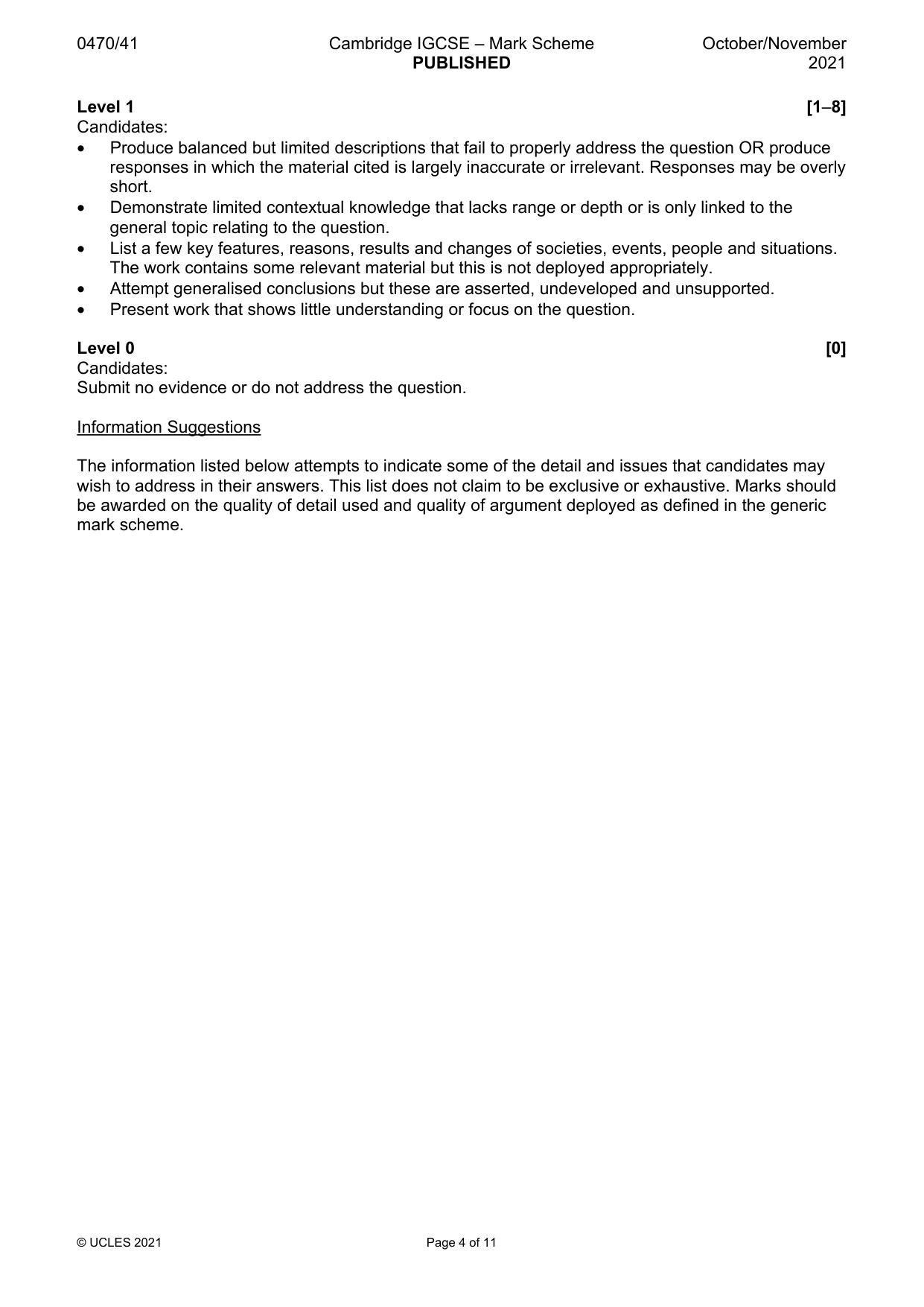
0470/41 Cambridge IGCSE – Mark Scheme PUBLISHED October/November 2021 © UCLES 2021 Page 4 of 11 Level 1 [1–8] Candidates: • Produce balanced but limited descriptions that fail to properly address the question OR produce responses in which the material cited is largely inaccurate or irrelevant. Responses may be overly short. • Demonstrate limited contextual knowledge that lacks range or depth or is only linked to the general topic relating to the question. • List a few key features, reasons, results and changes of societies, events, people and situations. The work contains some relevant material but this is not deployed appropriately. • Attempt generalised conclusions but these are asserted, undeveloped and unsupported. • Present work that shows little understanding or focus on the question. Level 0 [0] Candidates: Submit no evidence or do not address the question. Information Suggestions The information listed below attempts to indicate some of the detail and issues that candidates may wish to address in their answers. This list does not claim to be exclusive or exhaustive. Marks should be awarded on the quality of detail used and quality of argument deployed as defined in the generic mark scheme.
Mark scheme, page 5
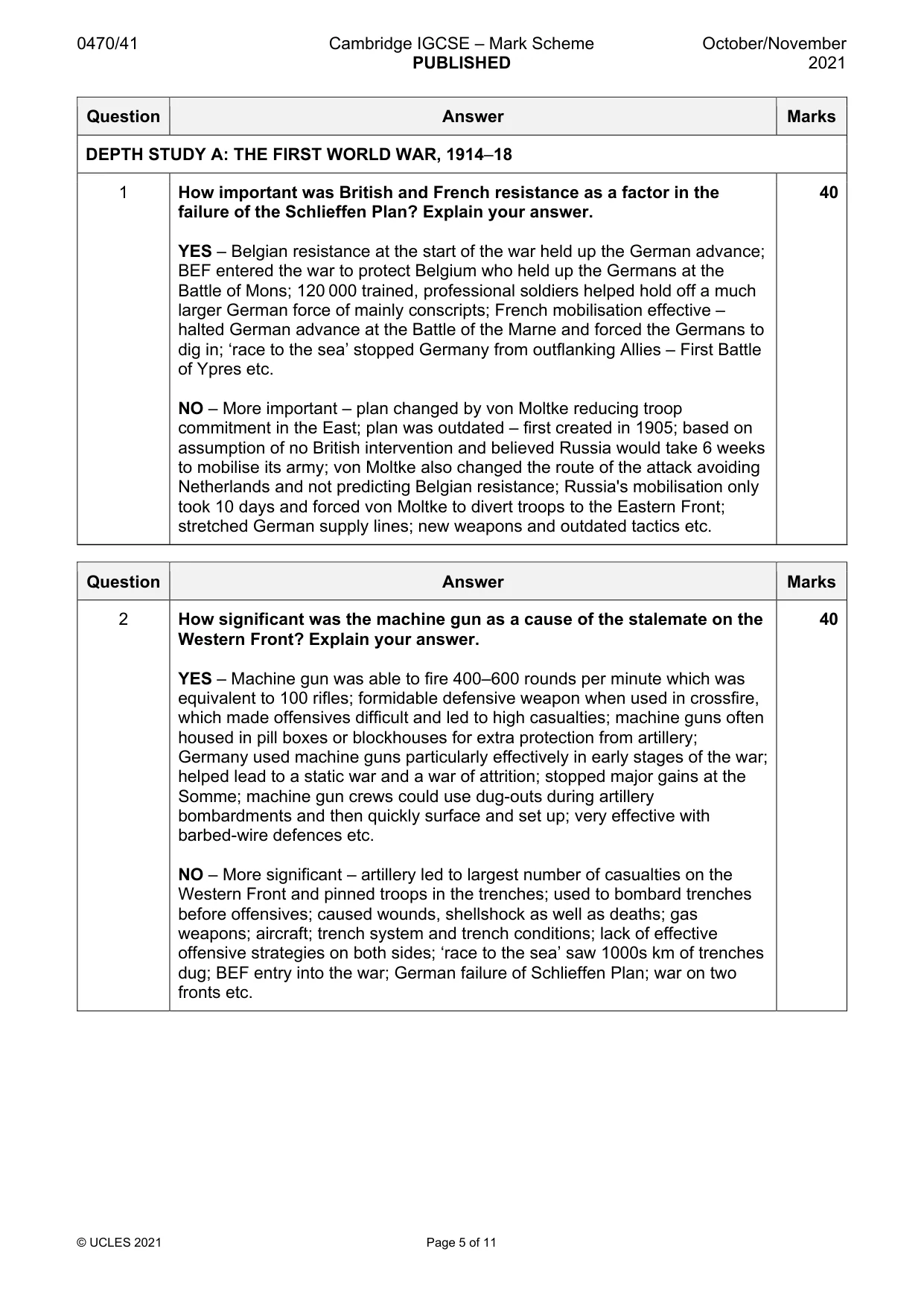
0470/41 Cambridge IGCSE – Mark Scheme PUBLISHED October/November 2021 © UCLES 2021 Page 5 of 11 Question Answer Marks DEPTH STUDY A: THE FIRST WORLD WAR, 1914–18 1 How important was British and French resistance as a factor in the failure of the Schlieffen Plan? Explain your answer. YES – Belgian resistance at the start of the war held up the German advance; BEF entered the war to protect Belgium who held up the Germans at the Battle of Mons; 120 000 trained, professional soldiers helped hold off a much larger German force of mainly conscripts; French mobilisation effective – halted German advance at the Battle of the Marne and forced the Germans to dig in; ‘race to the sea’ stopped Germany from outflanking Allies – First Battle of Ypres etc. NO – More important – plan changed by von Moltke reducing troop commitment in the East; plan was outdated – first created in 1905; based on assumption of no British intervention and believed Russia would take 6 weeks to mobilise its army; von Moltke also changed the route of the attack avoiding Netherlands and not predicting Belgian resistance; Russia's mobilisation only took 10 days and forced von Moltke to divert troops to the Eastern Front; stretched German supply lines; new weapons and outdated tactics etc. 40 Question Answer Marks 2 How significant was the machine gun as a cause of the stalemate on the Western Front? Explain your answer. YES – Machine gun was able to fire 400–600 rounds per minute which was equivalent to 100 rifles; formidable defensive weapon when used in crossfire, which made offensives difficult and led to high casualties; machine guns often housed in pill boxes or blockhouses for extra protection from artillery; Germany used machine guns particularly effectively in early stages of the war; helped lead to a static war and a war of attrition; stopped major gains at the Somme; machine gun crews could use dug-outs during artillery bombardments and then quickly surface and set up; very effective with barbed-wire defences etc. NO – More significant – artillery led to largest number of casualties on the Western Front and pinned troops in the trenches; used to bombard trenches before offensives; caused wounds, shellshock as well as deaths; gas weapons; aircraft; trench system and trench conditions; lack of effective offensive strategies on both sides; ‘race to the sea’ saw 1000s km of trenches dug; BEF entry into the war; German failure of Schlieffen Plan; war on two fronts etc. 40
Mark scheme, page 6
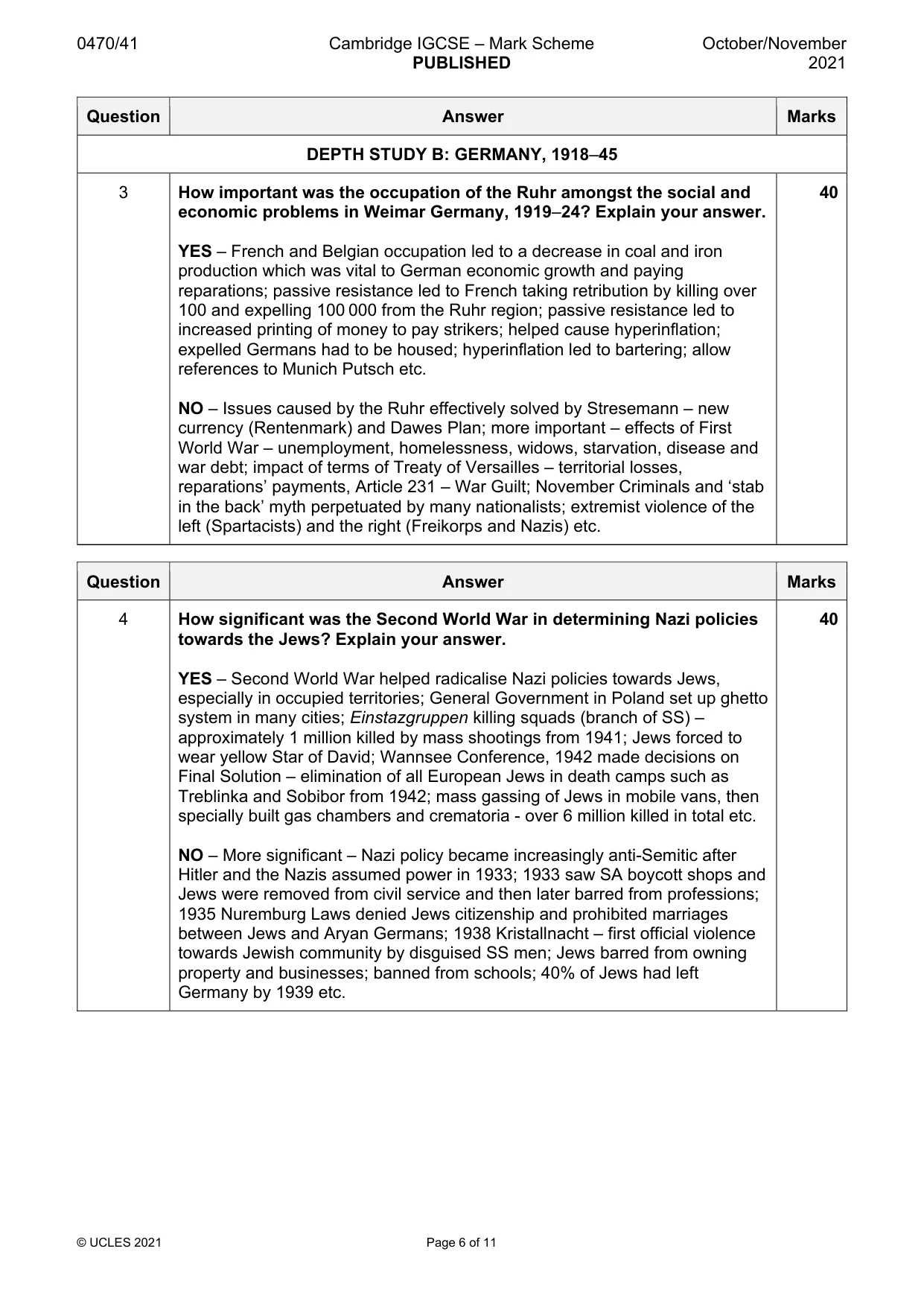
0470/41 Cambridge IGCSE – Mark Scheme PUBLISHED October/November 2021 © UCLES 2021 Page 6 of 11 Question Answer Marks DEPTH STUDY B: GERMANY, 1918–45 3 How important was the occupation of the Ruhr amongst the social and economic problems in Weimar Germany, 1919–24? Explain your answer. YES – French and Belgian occupation led to a decrease in coal and iron production which was vital to German economic growth and paying reparations; passive resistance led to French taking retribution by killing over 100 and expelling 100 000 from the Ruhr region; passive resistance led to increased printing of money to pay strikers; helped cause hyperinflation; expelled Germans had to be housed; hyperinflation led to bartering; allow references to Munich Putsch etc. NO – Issues caused by the Ruhr effectively solved by Stresemann – new currency (Rentenmark) and Dawes Plan; more important – effects of First World War – unemployment, homelessness, widows, starvation, disease and war debt; impact of terms of Treaty of Versailles – territorial losses, reparations’ payments, Article 231 – War Guilt; November Criminals and ‘stab in the back’ myth perpetuated by many nationalists; extremist violence of the left (Spartacists) and the right (Freikorps and Nazis) etc. 40 Question Answer Marks 4 How significant was the Second World War in determining Nazi policies towards the Jews? Explain your answer. YES – Second World War helped radicalise Nazi policies towards Jews, especially in occupied territories; General Government in Poland set up ghetto system in many cities; Einstazgruppen killing squads (branch of SS) – approximately 1 million killed by mass shootings from 1941; Jews forced to wear yellow Star of David; Wannsee Conference, 1942 made decisions on Final Solution – elimination of all European Jews in death camps such as Treblinka and Sobibor from 1942; mass gassing of Jews in mobile vans, then specially built gas chambers and crematoria - over 6 million killed in total etc. NO – More significant – Nazi policy became increasingly anti-Semitic after Hitler and the Nazis assumed power in 1933; 1933 saw SA boycott shops and Jews were removed from civil service and then later barred from professions; 1935 Nuremburg Laws denied Jews citizenship and prohibited marriages between Jews and Aryan Germans; 1938 Kristallnacht – first official violence towards Jewish community by disguised SS men; Jews barred from owning property and businesses; banned from schools; 40% of Jews had left Germany by 1939 etc. 40
Mark scheme, page 7
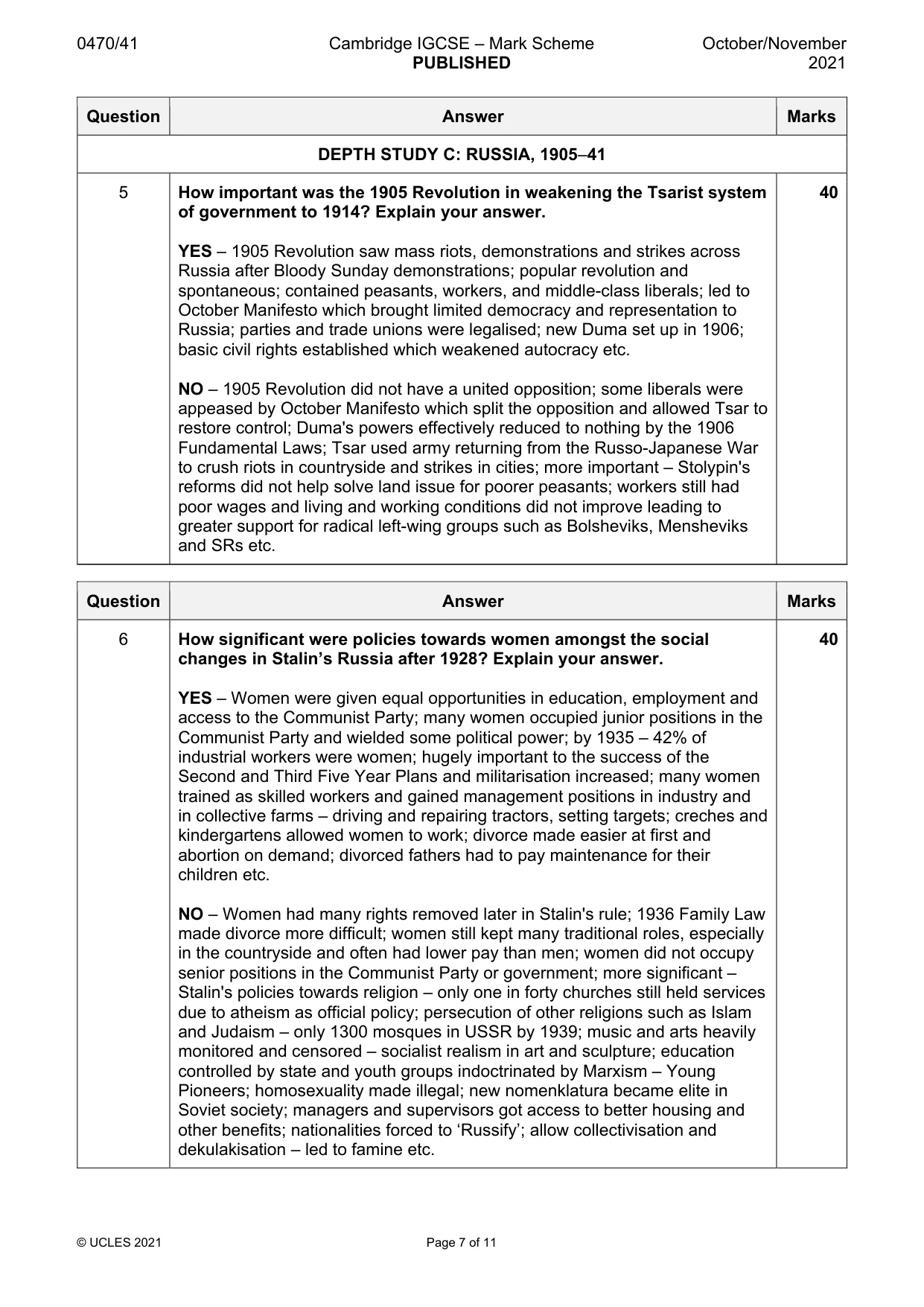
0470/41 Cambridge IGCSE – Mark Scheme PUBLISHED October/November 2021 © UCLES 2021 Page 7 of 11 Question Answer Marks DEPTH STUDY C: RUSSIA, 1905–41 5 How important was the 1905 Revolution in weakening the Tsarist system of government to 1914? Explain your answer. YES – 1905 Revolution saw mass riots, demonstrations and strikes across Russia after Bloody Sunday demonstrations; popular revolution and spontaneous; contained peasants, workers, and middle-class liberals; led to October Manifesto which brought limited democracy and representation to Russia; parties and trade unions were legalised; new Duma set up in 1906; basic civil rights established which weakened autocracy etc. NO – 1905 Revolution did not have a united opposition; some liberals were appeased by October Manifesto which split the opposition and allowed Tsar to restore control; Duma's powers effectively reduced to nothing by the 1906 Fundamental Laws; Tsar used army returning from the Russo-Japanese War to crush riots in countryside and strikes in cities; more important – Stolypin's reforms did not help solve land issue for poorer peasants; workers still had poor wages and living and working conditions did not improve leading to greater support for radical left-wing groups such as Bolsheviks, Mensheviks and SRs etc. 40 Question Answer Marks 6 How significant were policies towards women amongst the social changes in Stalin’s Russia after 1928? Explain your answer. YES – Women were given equal opportunities in education, employment and access to the Communist Party; many women occupied junior positions in the Communist Party and wielded some political power; by 1935 – 42% of industrial workers were women; hugely important to the success of the Second and Third Five Year Plans and militarisation increased; many women trained as skilled workers and gained management positions in industry and in collective farms – driving and repairing tractors, setting targets; creches and kindergartens allowed women to work; divorce made easier at first and abortion on demand; divorced fathers had to pay maintenance for their children etc. NO – Women had many rights removed later in Stalin's rule; 1936 Family Law made divorce more difficult; women still kept many traditional roles, especially in the countryside and often had lower pay than men; women did not occupy senior positions in the Communist Party or government; more significant – Stalin's policies towards religion – only one in forty churches still held services due to atheism as official policy; persecution of other religions such as Islam and Judaism – only 1300 mosques in USSR by 1939; music and arts heavily monitored and censored – socialist realism in art and sculpture; education controlled by state and youth groups indoctrinated by Marxism – Young Pioneers; homosexuality made illegal; new nomenklatura became elite in Soviet society; managers and supervisors got access to better housing and other benefits; nationalities forced to ‘Russify’; allow collectivisation and dekulakisation – led to famine etc. 40
Mark scheme, page 8
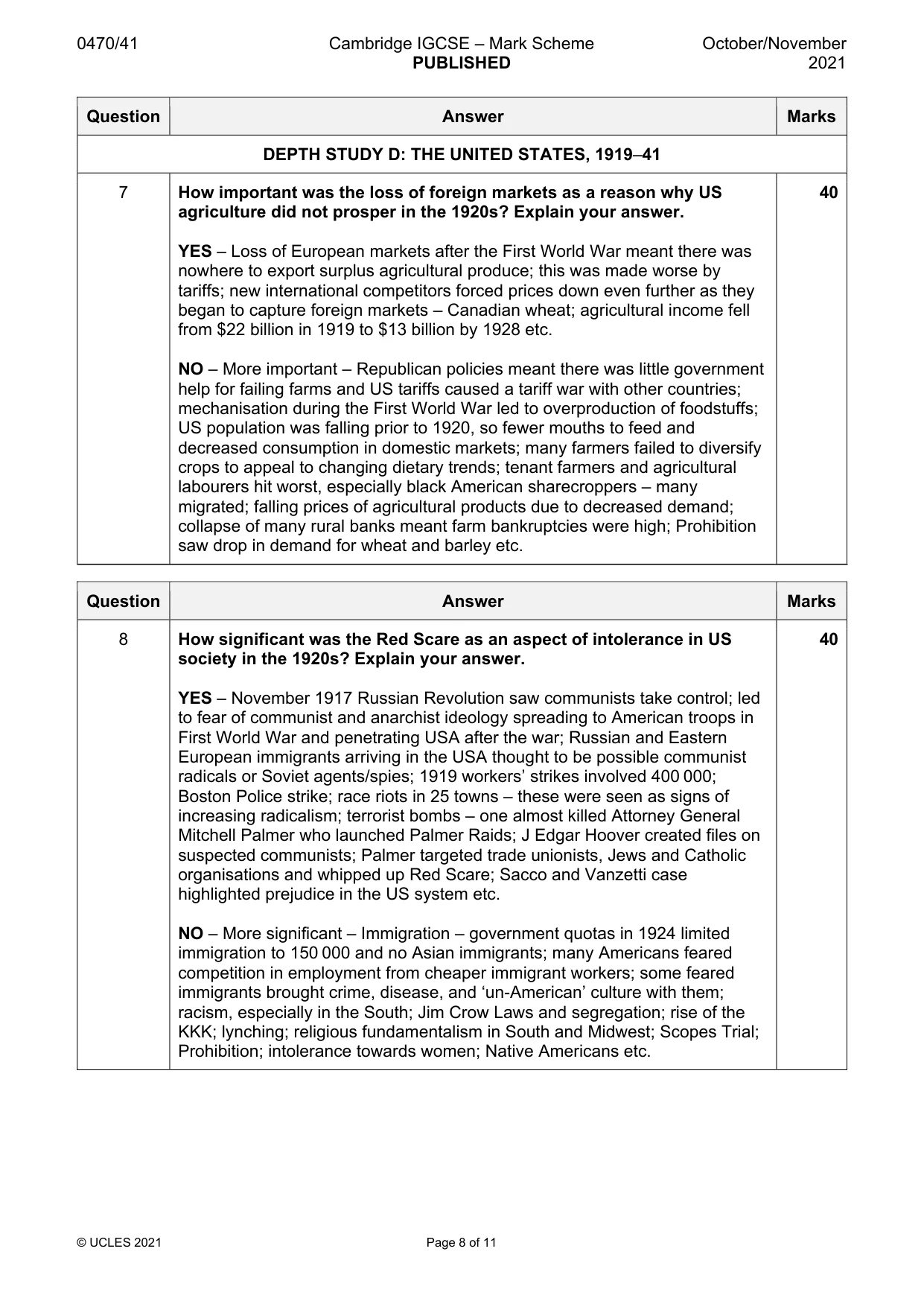
0470/41 Cambridge IGCSE – Mark Scheme PUBLISHED October/November 2021 © UCLES 2021 Page 8 of 11 Question Answer Marks DEPTH STUDY D: THE UNITED STATES, 1919–41 7 How important was the loss of foreign markets as a reason why US agriculture did not prosper in the 1920s? Explain your answer. YES – Loss of European markets after the First World War meant there was nowhere to export surplus agricultural produce; this was made worse by tariffs; new international competitors forced prices down even further as they began to capture foreign markets – Canadian wheat; agricultural income fell from $22 billion in 1919 to $13 billion by 1928 etc. NO – More important – Republican policies meant there was little government help for failing farms and US tariffs caused a tariff war with other countries; mechanisation during the First World War led to overproduction of foodstuffs; US population was falling prior to 1920, so fewer mouths to feed and decreased consumption in domestic markets; many farmers failed to diversify crops to appeal to changing dietary trends; tenant farmers and agricultural labourers hit worst, especially black American sharecroppers – many migrated; falling prices of agricultural products due to decreased demand; collapse of many rural banks meant farm bankruptcies were high; Prohibition saw drop in demand for wheat and barley etc. 40 Question Answer Marks 8 How significant was the Red Scare as an aspect of intolerance in US society in the 1920s? Explain your answer. YES – November 1917 Russian Revolution saw communists take control; led to fear of communist and anarchist ideology spreading to American troops in First World War and penetrating USA after the war; Russian and Eastern European immigrants arriving in the USA thought to be possible communist radicals or Soviet agents/spies; 1919 workers’ strikes involved 400 000; Boston Police strike; race riots in 25 towns – these were seen as signs of increasing radicalism; terrorist bombs – one almost killed Attorney General Mitchell Palmer who launched Palmer Raids; J Edgar Hoover created files on suspected communists; Palmer targeted trade unionists, Jews and Catholic organisations and whipped up Red Scare; Sacco and Vanzetti case highlighted prejudice in the US system etc. NO – More significant – Immigration – government quotas in 1924 limited immigration to 150 000 and no Asian immigrants; many Americans feared competition in employment from cheaper immigrant workers; some feared immigrants brought crime, disease, and ‘un-American’ culture with them; racism, especially in the South; Jim Crow Laws and segregation; rise of the KKK; lynching; religious fundamentalism in South and Midwest; Scopes Trial; Prohibition; intolerance towards women; Native Americans etc. 40
Mark scheme, page 9
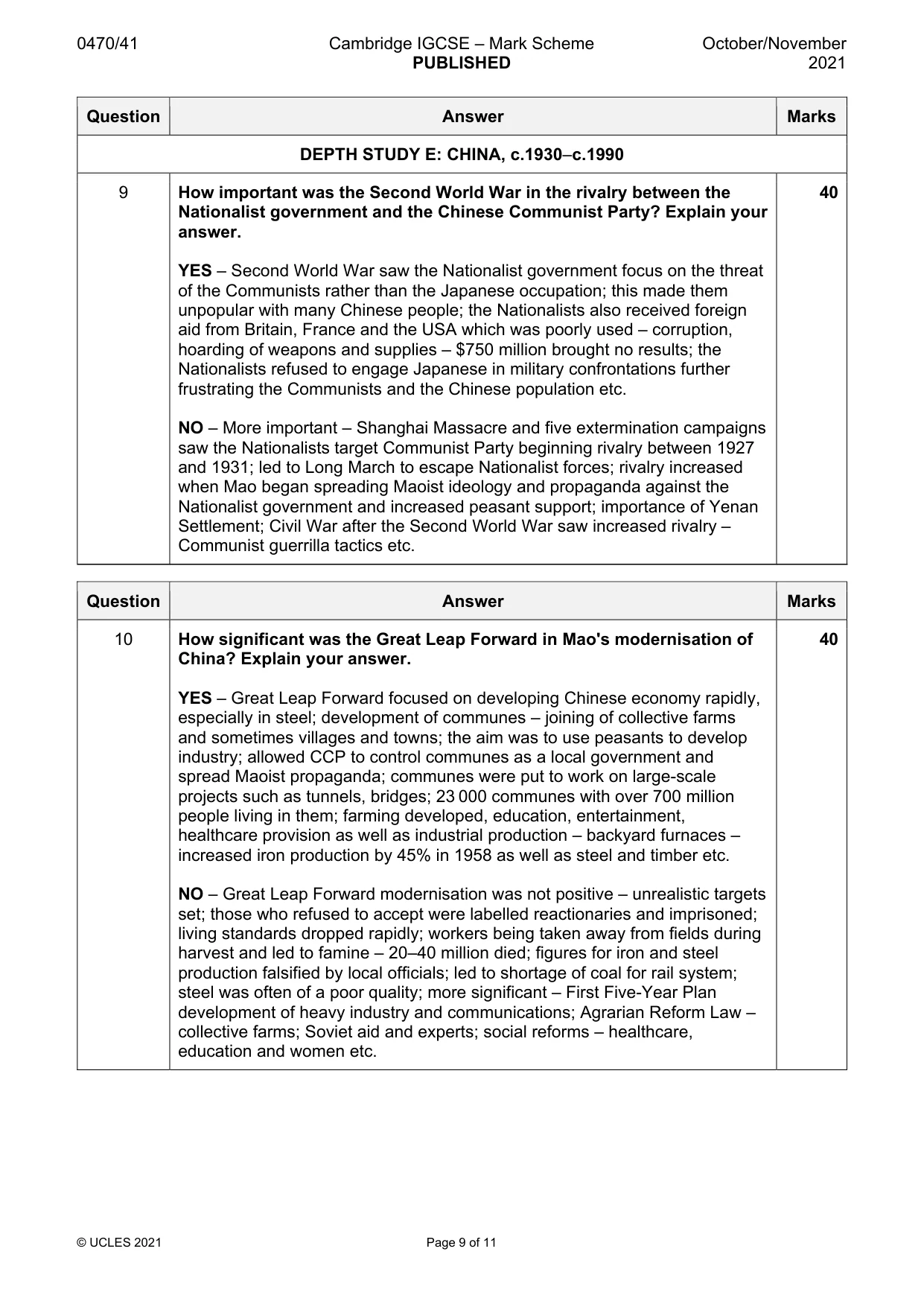
0470/41 Cambridge IGCSE – Mark Scheme PUBLISHED October/November 2021 © UCLES 2021 Page 9 of 11 Question Answer Marks DEPTH STUDY E: CHINA, c.1930–c.1990 9 How important was the Second World War in the rivalry between the Nationalist government and the Chinese Communist Party? Explain your answer. YES – Second World War saw the Nationalist government focus on the threat of the Communists rather than the Japanese occupation; this made them unpopular with many Chinese people; the Nationalists also received foreign aid from Britain, France and the USA which was poorly used – corruption, hoarding of weapons and supplies – $750 million brought no results; the Nationalists refused to engage Japanese in military confrontations further frustrating the Communists and the Chinese population etc. NO – More important – Shanghai Massacre and five extermination campaigns saw the Nationalists target Communist Party beginning rivalry between 1927 and 1931; led to Long March to escape Nationalist forces; rivalry increased when Mao began spreading Maoist ideology and propaganda against the Nationalist government and increased peasant support; importance of Yenan Settlement; Civil War after the Second World War saw increased rivalry – Communist guerrilla tactics etc. 40 Question Answer Marks 10 How significant was the Great Leap Forward in Mao's modernisation of China? Explain your answer. YES – Great Leap Forward focused on developing Chinese economy rapidly, especially in steel; development of communes – joining of collective farms and sometimes villages and towns; the aim was to use peasants to develop industry; allowed CCP to control communes as a local government and spread Maoist propaganda; communes were put to work on large-scale projects such as tunnels, bridges; 23 000 communes with over 700 million people living in them; farming developed, education, entertainment, healthcare provision as well as industrial production – backyard furnaces – increased iron production by 45% in 1958 as well as steel and timber etc. NO – Great Leap Forward modernisation was not positive – unrealistic targets set; those who refused to accept were labelled reactionaries and imprisoned; living standards dropped rapidly; workers being taken away from fields during harvest and led to famine – 20–40 million died; figures for iron and steel production falsified by local officials; led to shortage of coal for rail system; steel was often of a poor quality; more significant – First Five-Year Plan development of heavy industry and communications; Agrarian Reform Law – collective farms; Soviet aid and experts; social reforms – healthcare, education and women etc. 40
Mark scheme, page 10
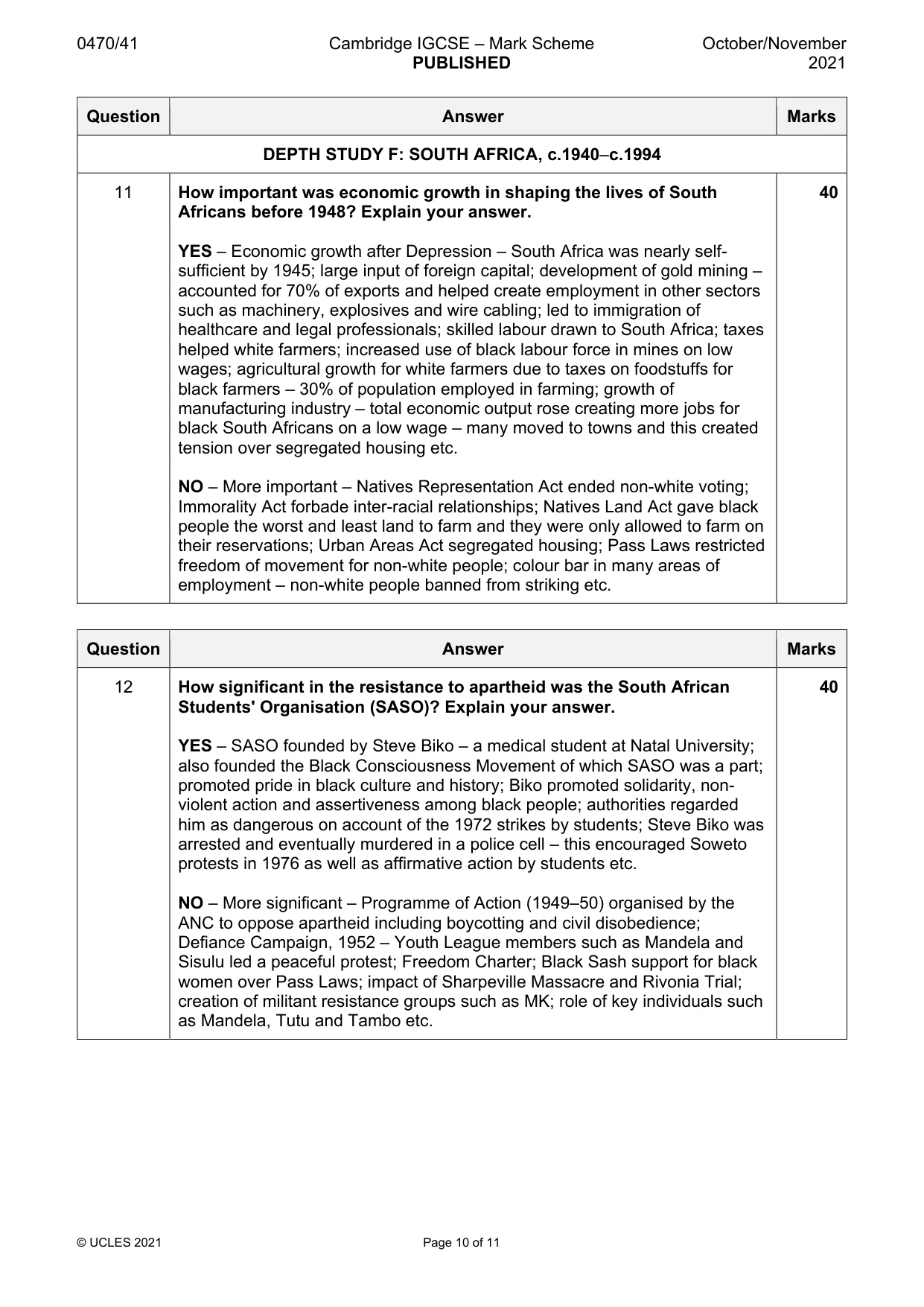
0470/41 Cambridge IGCSE – Mark Scheme PUBLISHED October/November 2021 © UCLES 2021 Page 10 of 11 Question Answer Marks DEPTH STUDY F: SOUTH AFRICA, c.1940–c.1994 11 How important was economic growth in shaping the lives of South Africans before 1948? Explain your answer. YES – Economic growth after Depression – South Africa was nearly self- sufficient by 1945; large input of foreign capital; development of gold mining – accounted for 70% of exports and helped create employment in other sectors such as machinery, explosives and wire cabling; led to immigration of healthcare and legal professionals; skilled labour drawn to South Africa; taxes helped white farmers; increased use of black labour force in mines on low wages; agricultural growth for white farmers due to taxes on foodstuffs for black farmers – 30% of population employed in farming; growth of manufacturing industry – total economic output rose creating more jobs for black South Africans on a low wage – many moved to towns and this created tension over segregated housing etc. NO – More important – Natives Representation Act ended non-white voting; Immorality Act forbade inter-racial relationships; Natives Land Act gave black people the worst and least land to farm and they were only allowed to farm on their reservations; Urban Areas Act segregated housing; Pass Laws restricted freedom of movement for non-white people; colour bar in many areas of employment – non-white people banned from striking etc. 40 Question Answer Marks 12 How significant in the resistance to apartheid was the South African Students' Organisation (SASO)? Explain your answer. YES – SASO founded by Steve Biko – a medical student at Natal University; also founded the Black Consciousness Movement of which SASO was a part; promoted pride in black culture and history; Biko promoted solidarity, non- violent action and assertiveness among black people; authorities regarded him as dangerous on account of the 1972 strikes by students; Steve Biko was arrested and eventually murdered in a police cell – this encouraged Soweto protests in 1976 as well as affirmative action by students etc. NO – More significant – Programme of Action (1949–50) organised by the ANC to oppose apartheid including boycotting and civil disobedience; Defiance Campaign, 1952 – Youth League members such as Mandela and Sisulu led a peaceful protest; Freedom Charter; Black Sash support for black women over Pass Laws; impact of Sharpeville Massacre and Rivonia Trial; creation of militant resistance groups such as MK; role of key individuals such as Mandela, Tutu and Tambo etc. 40
Mark scheme, page 11
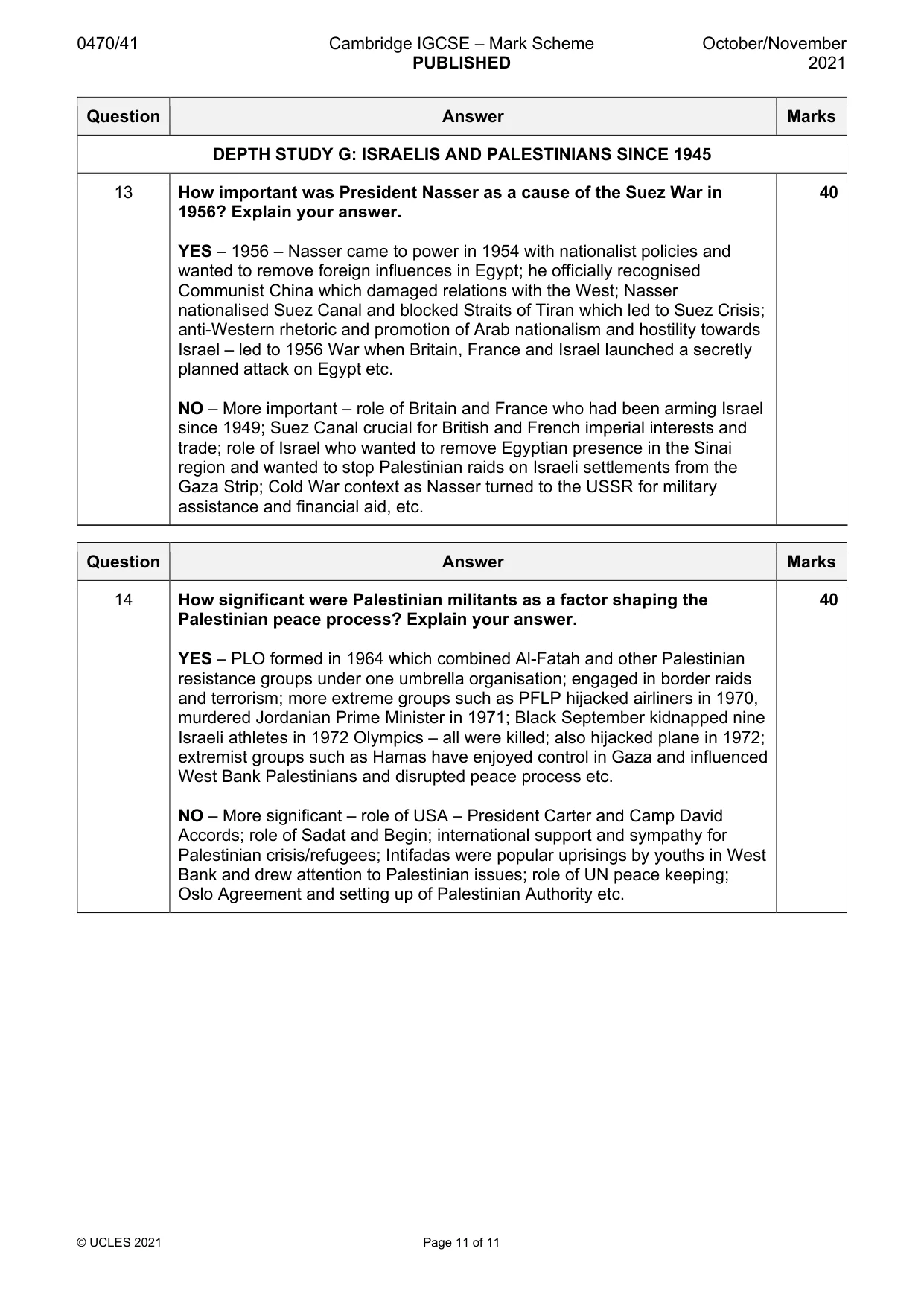
0470/41 Cambridge IGCSE – Mark Scheme PUBLISHED October/November 2021 © UCLES 2021 Page 11 of 11 Question Answer Marks DEPTH STUDY G: ISRAELIS AND PALESTINIANS SINCE 1945 13 How important was President Nasser as a cause of the Suez War in 1956? Explain your answer. YES – 1956 – Nasser came to power in 1954 with nationalist policies and wanted to remove foreign influences in Egypt; he officially recognised Communist China which damaged relations with the West; Nasser nationalised Suez Canal and blocked Straits of Tiran which led to Suez Crisis; anti-Western rhetoric and promotion of Arab nationalism and hostility towards Israel – led to 1956 War when Britain, France and Israel launched a secretly planned attack on Egypt etc. NO – More important – role of Britain and France who had been arming Israel since 1949; Suez Canal crucial for British and French imperial interests and trade; role of Israel who wanted to remove Egyptian presence in the Sinai region and wanted to stop Palestinian raids on Israeli settlements from the Gaza Strip; Cold War context as Nasser turned to the USSR for military assistance and financial aid, etc. 40 Question Answer Marks 14 How significant were Palestinian militants as a factor shaping the Palestinian peace process? Explain your answer. YES – PLO formed in 1964 which combined Al-Fatah and other Palestinian resistance groups under one umbrella organisation; engaged in border raids and terrorism; more extreme groups such as PFLP hijacked airliners in 1970, murdered Jordanian Prime Minister in 1971; Black September kidnapped nine Israeli athletes in 1972 Olympics – all were killed; also hijacked plane in 1972; extremist groups such as Hamas have enjoyed control in Gaza and influenced West Bank Palestinians and disrupted peace process etc. NO – More significant – role of USA – President Carter and Camp David Accords; role of Sadat and Begin; international support and sympathy for Palestinian crisis/refugees; Intifadas were popular uprisings by youths in West Bank and drew attention to Palestinian issues; role of UN peace keeping; Oslo Agreement and setting up of Palestinian Authority etc. 40
What you needed in this session
Cambridge’s own grade thresholds for 2021 Oct/Nov, Paper 4 · Variant 1. A higher threshold means an easier paper — the bar moves with how the cohort did.